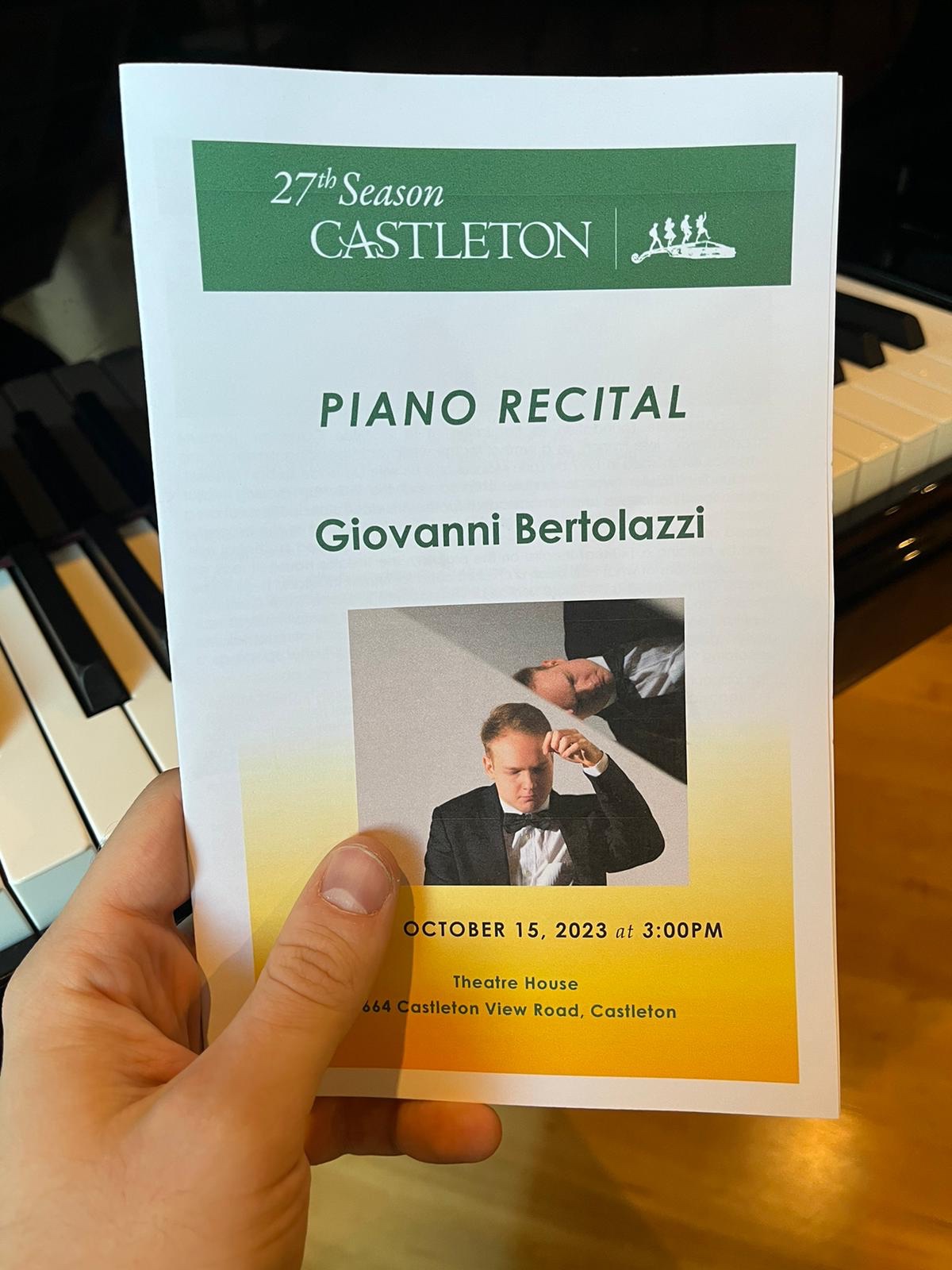
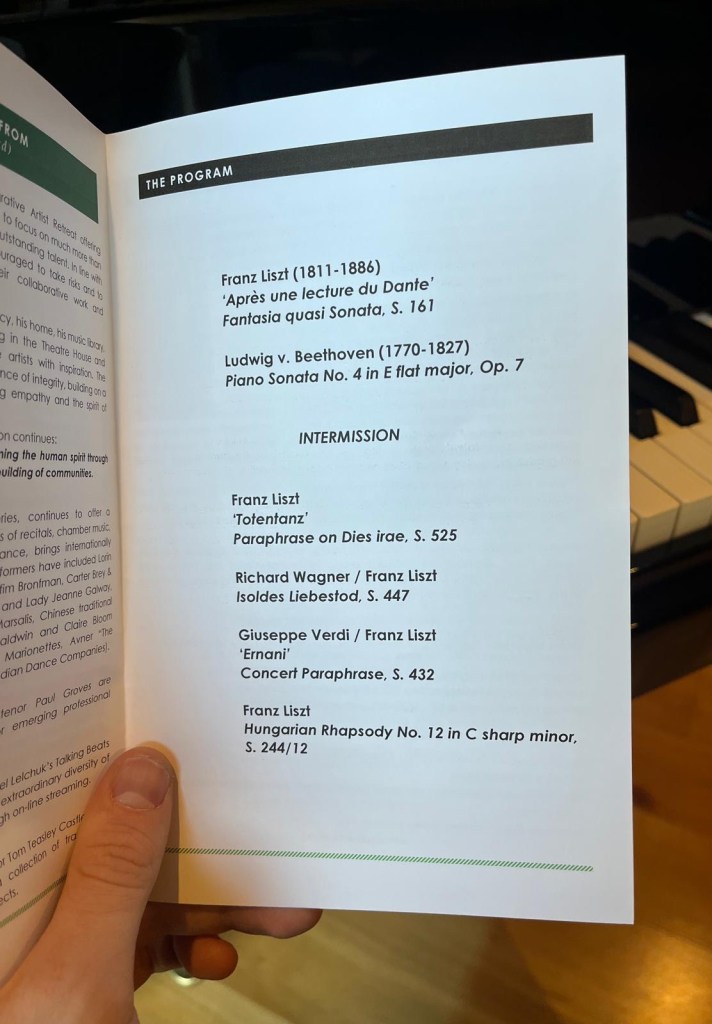
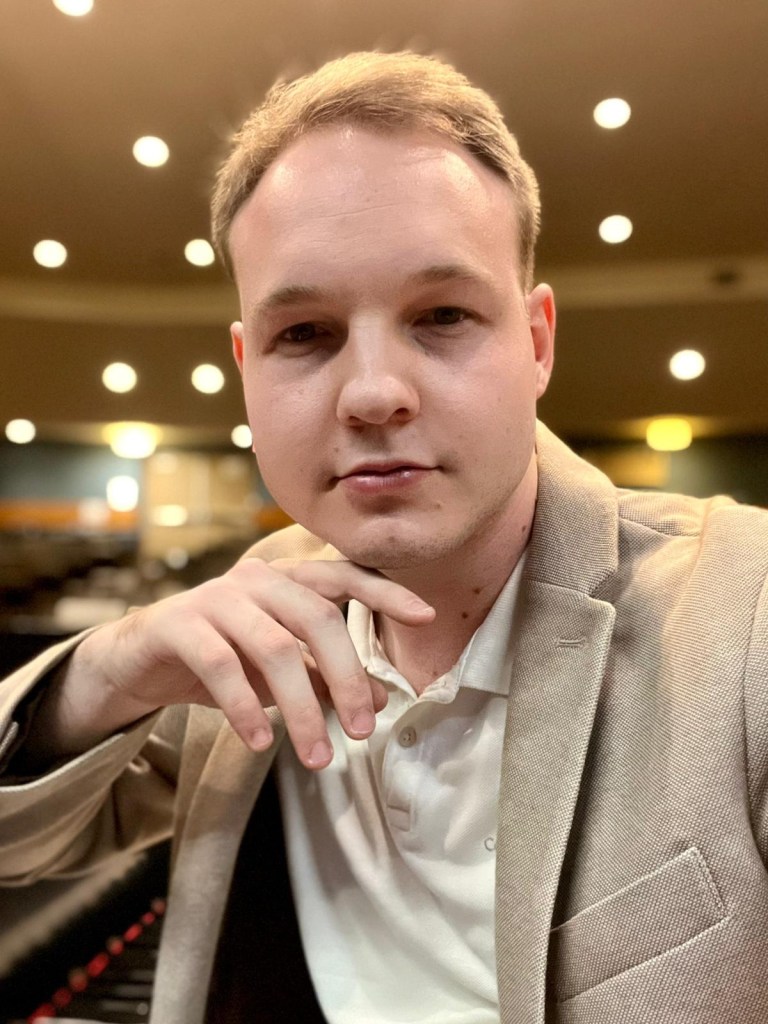
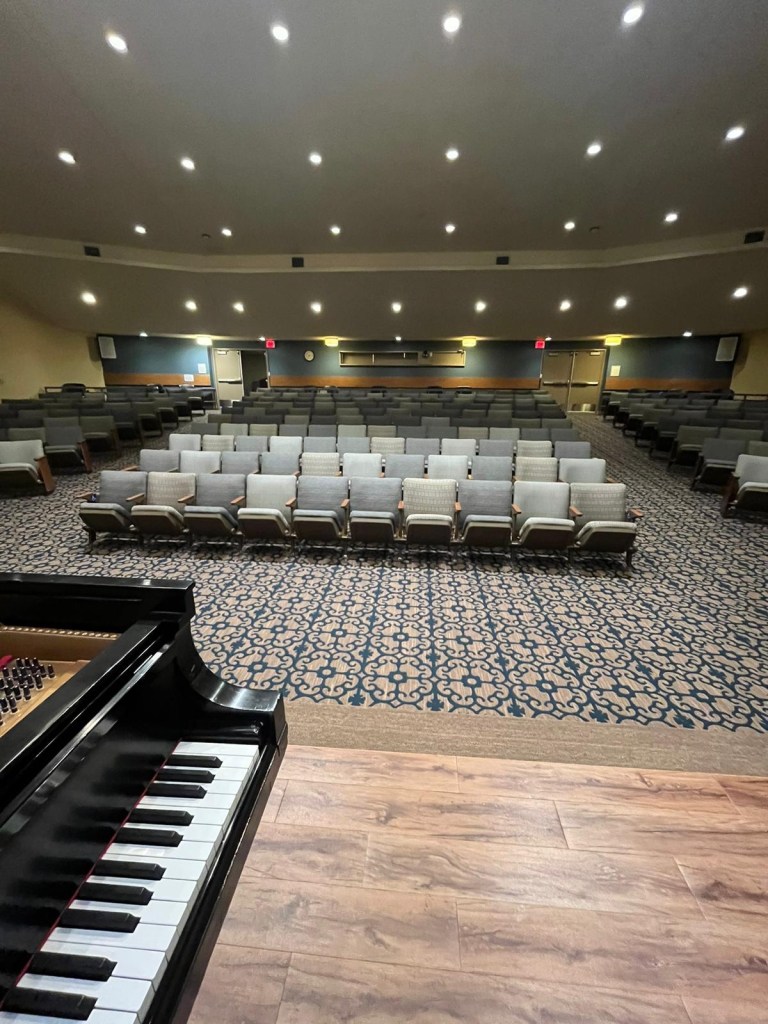
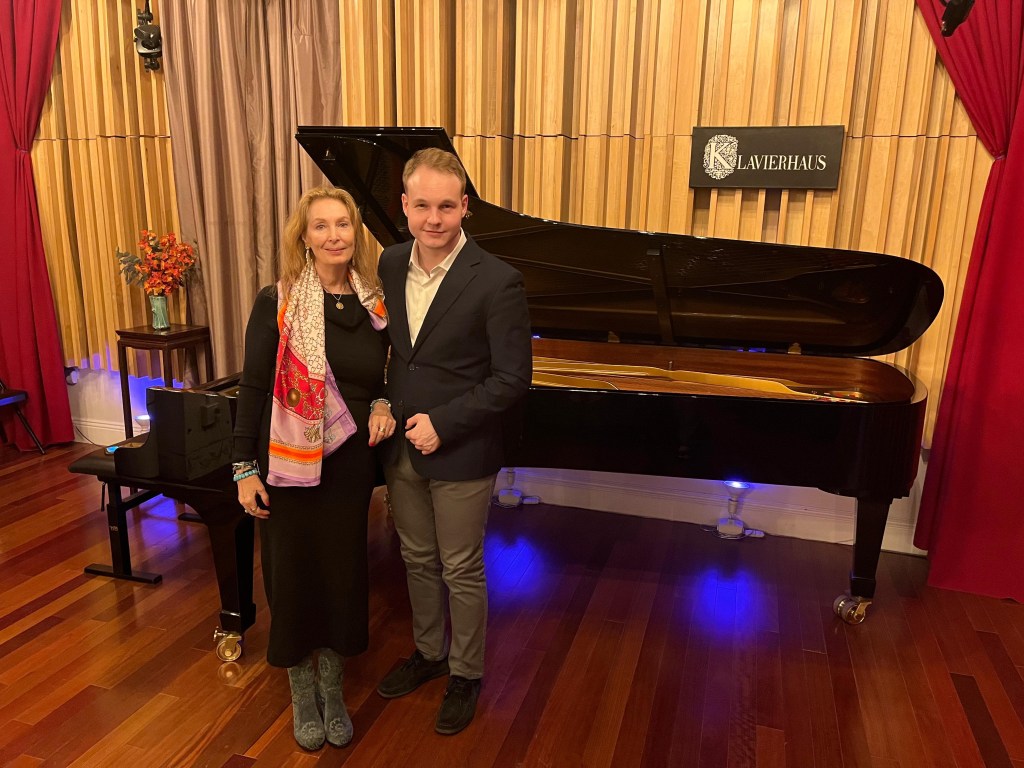
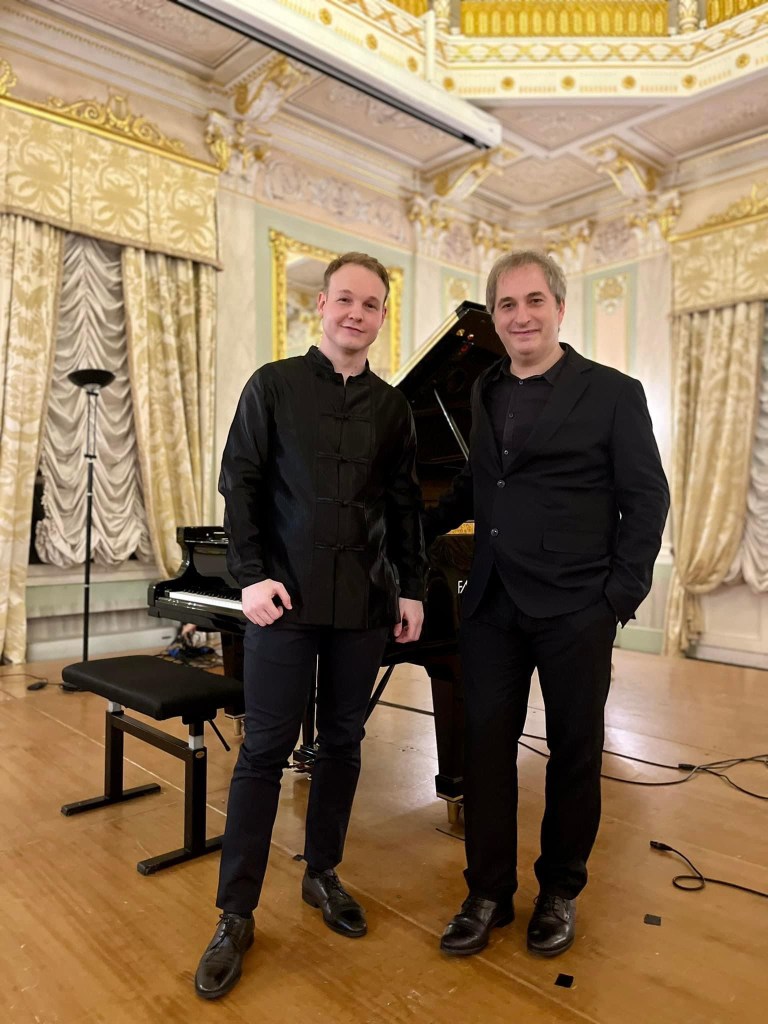
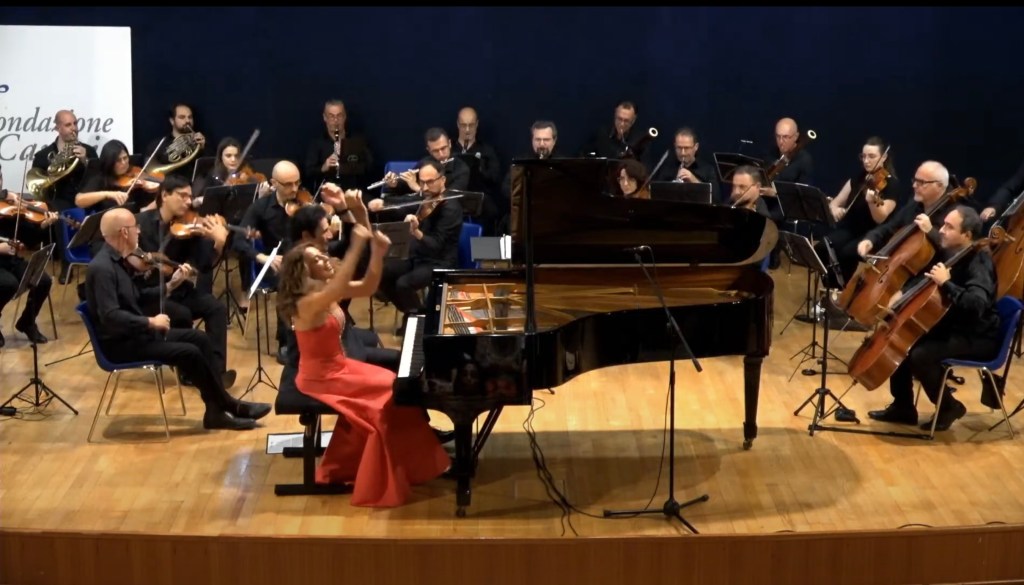
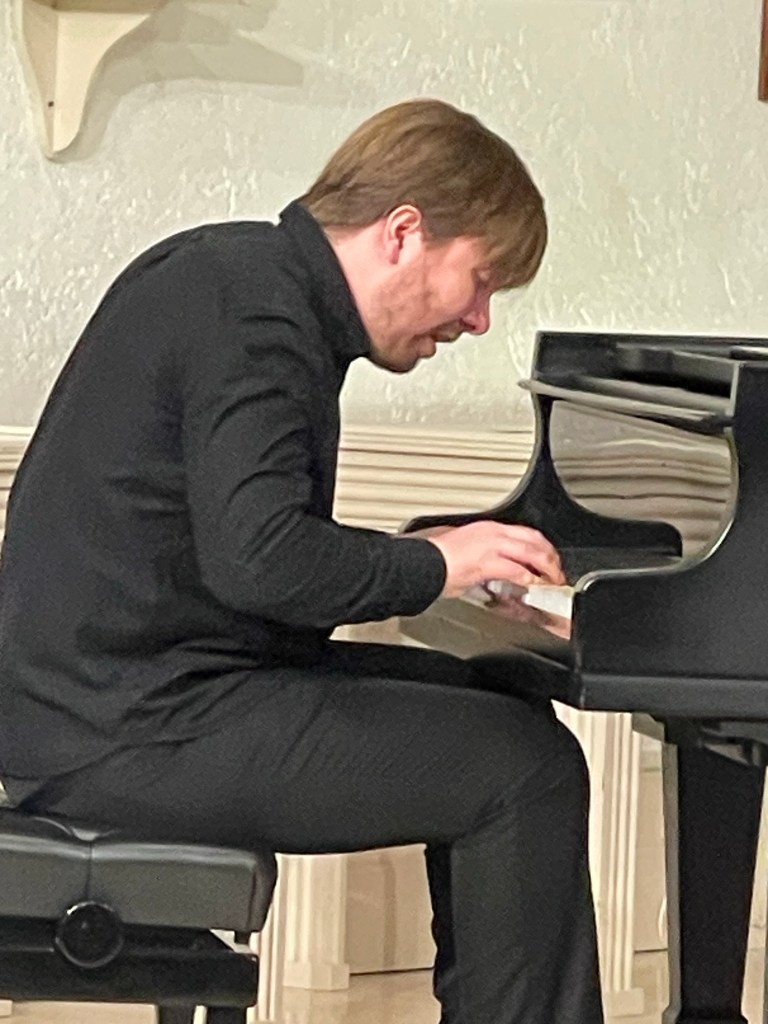
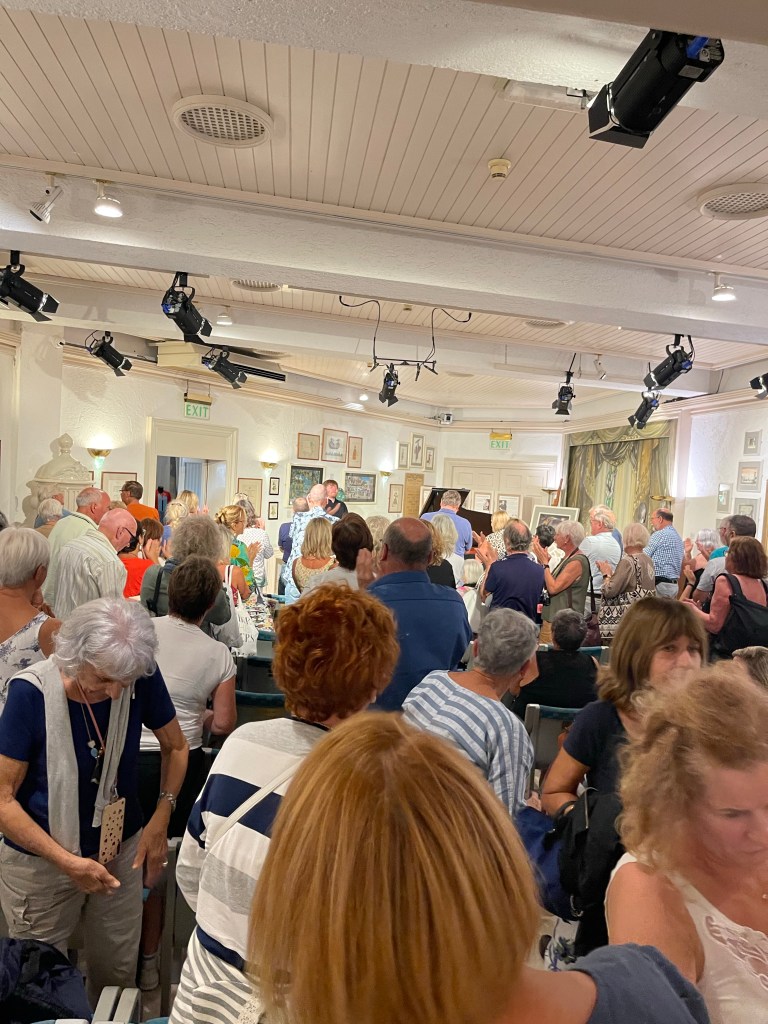
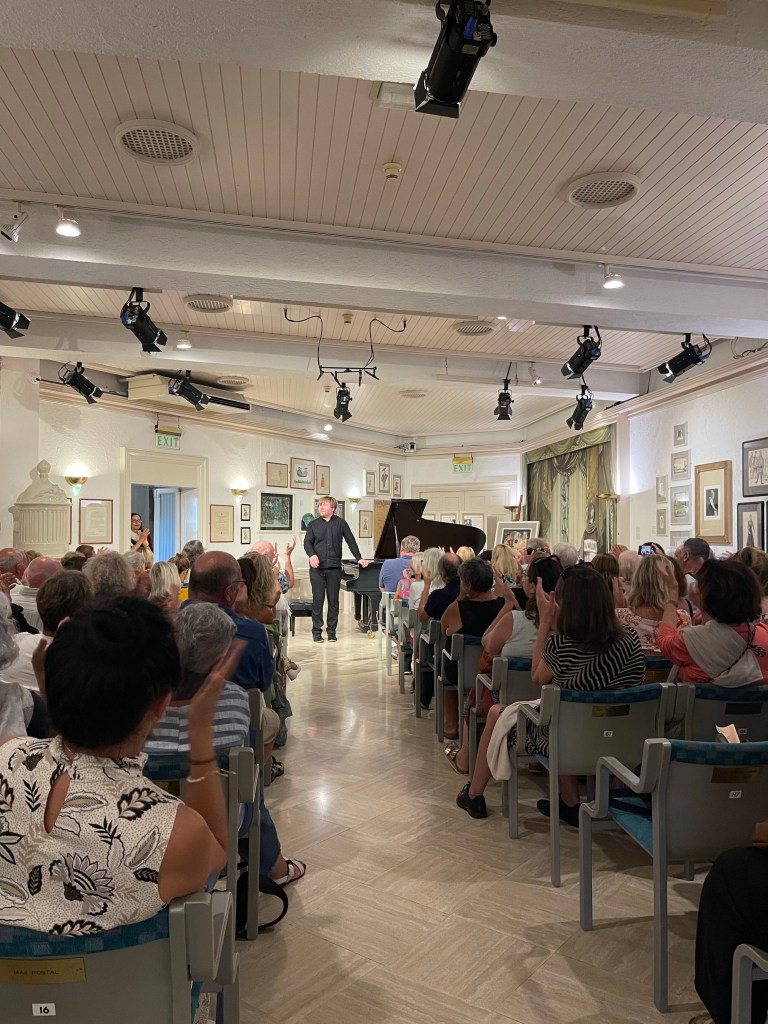
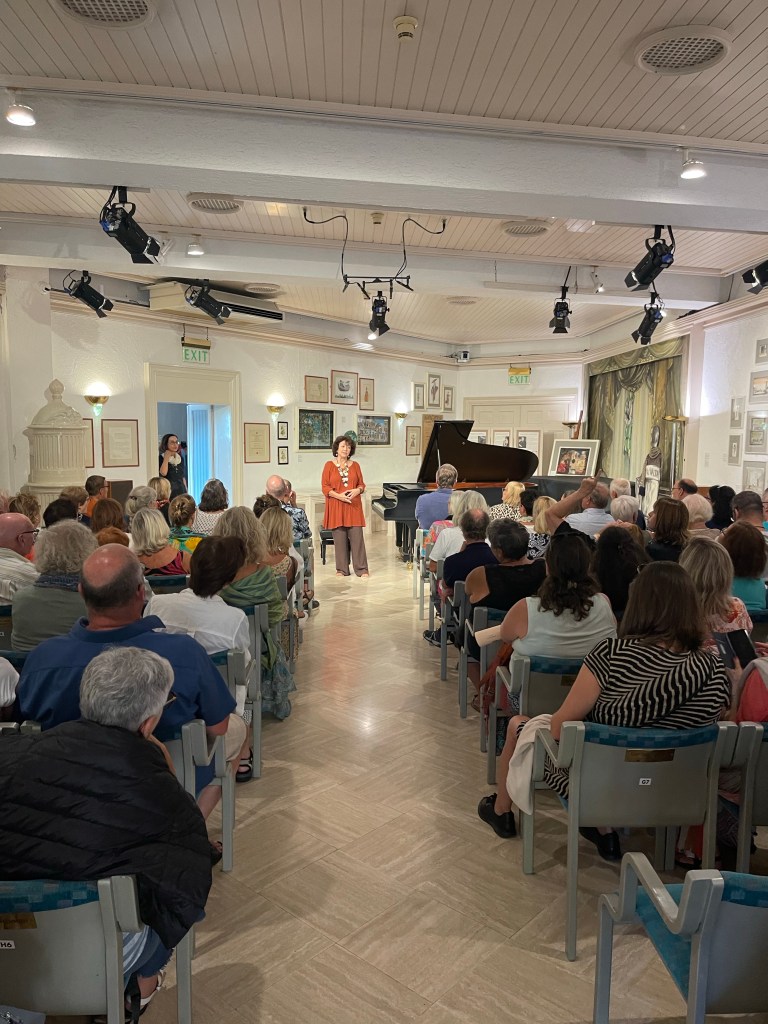
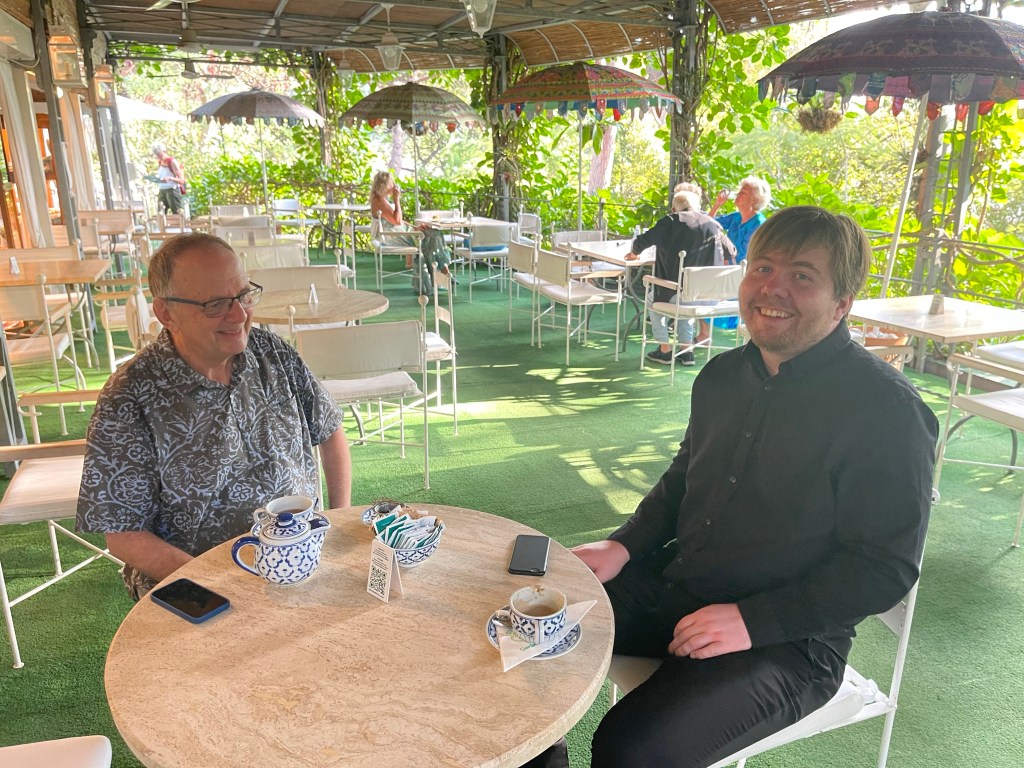
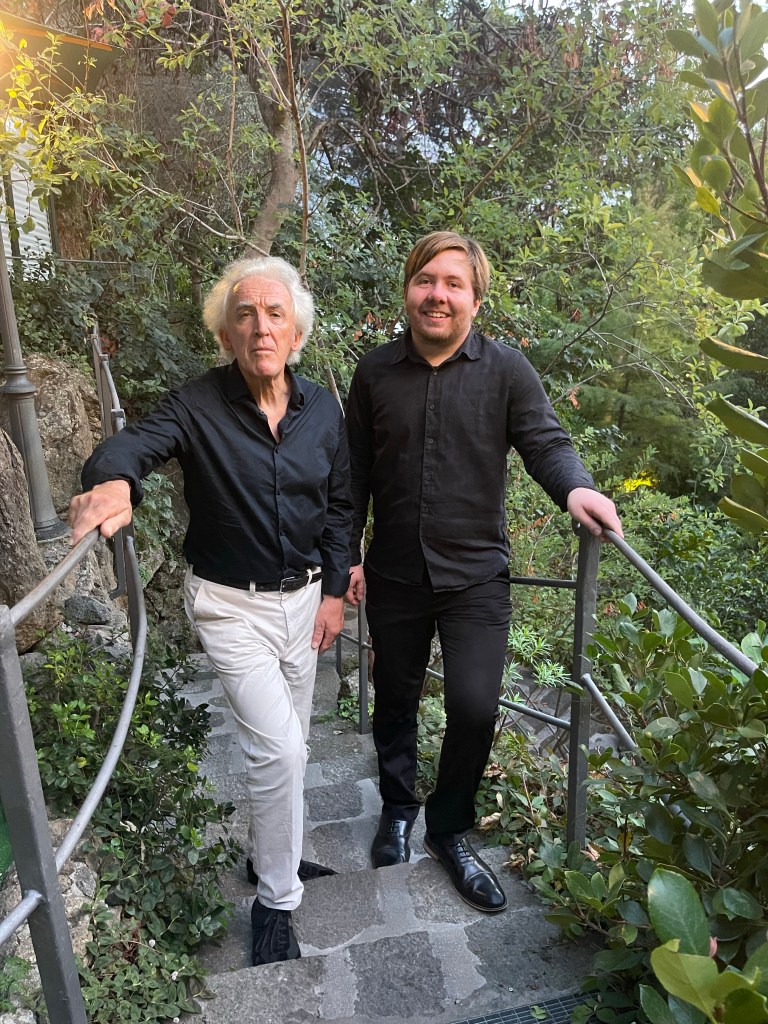
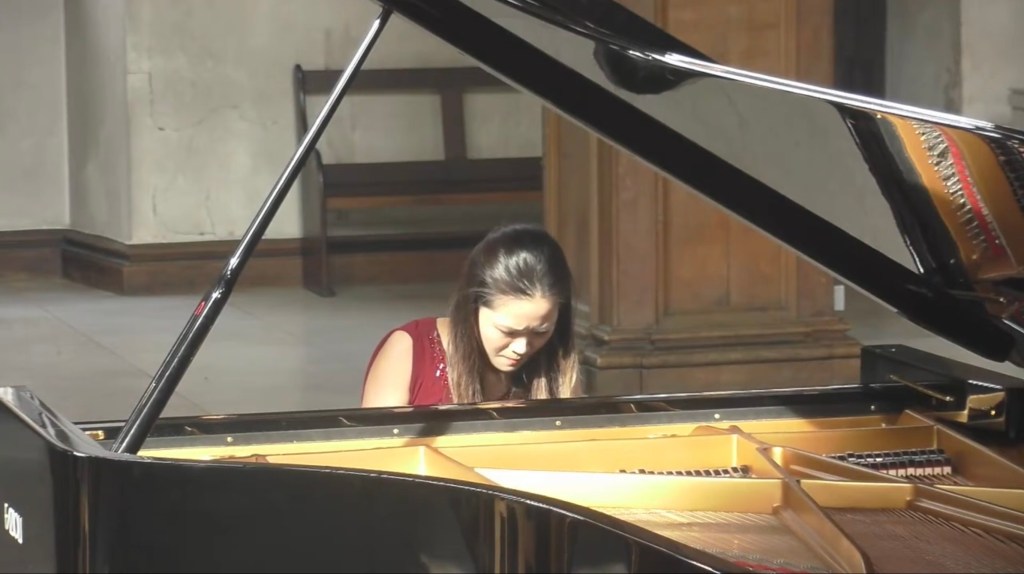
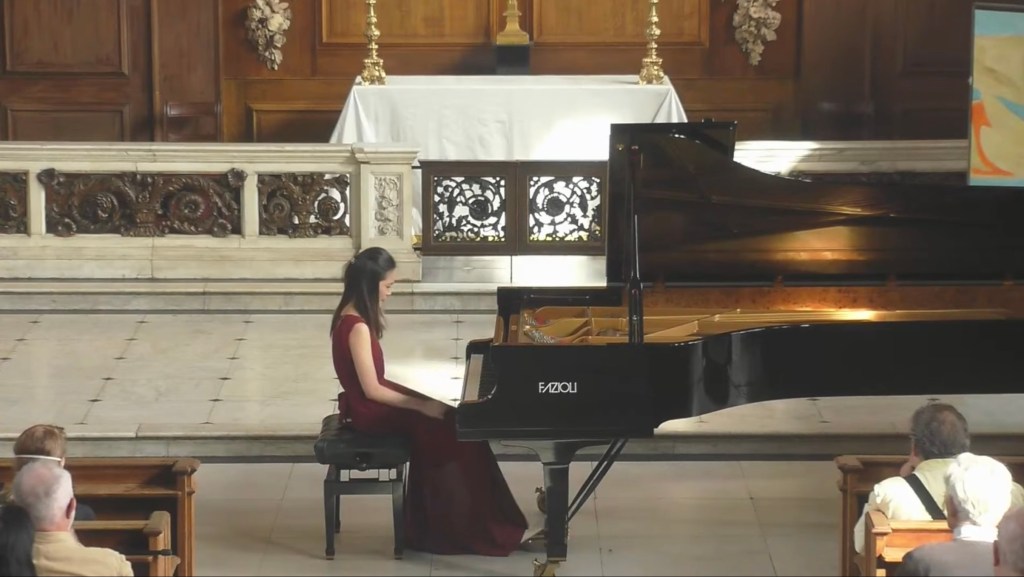
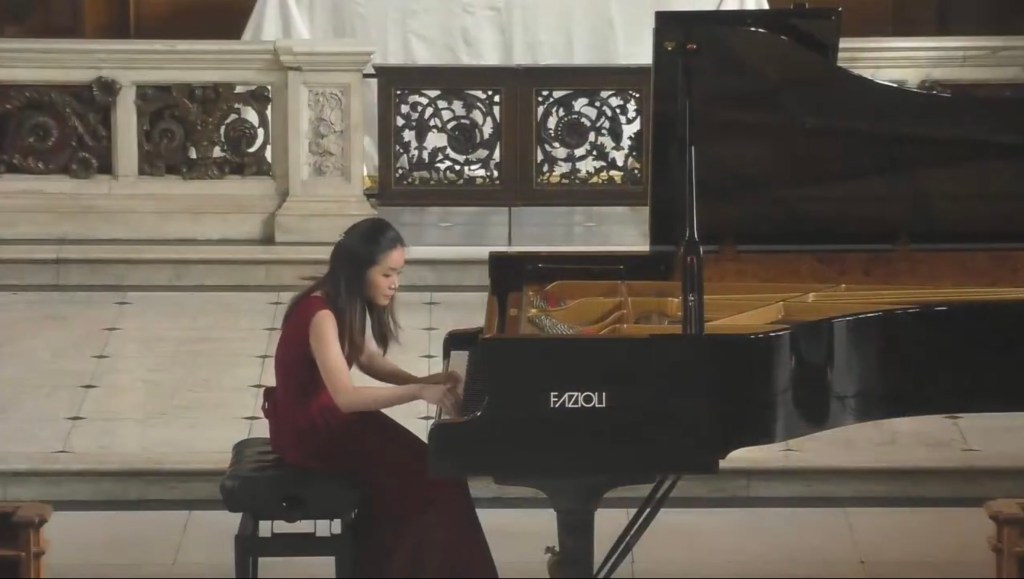
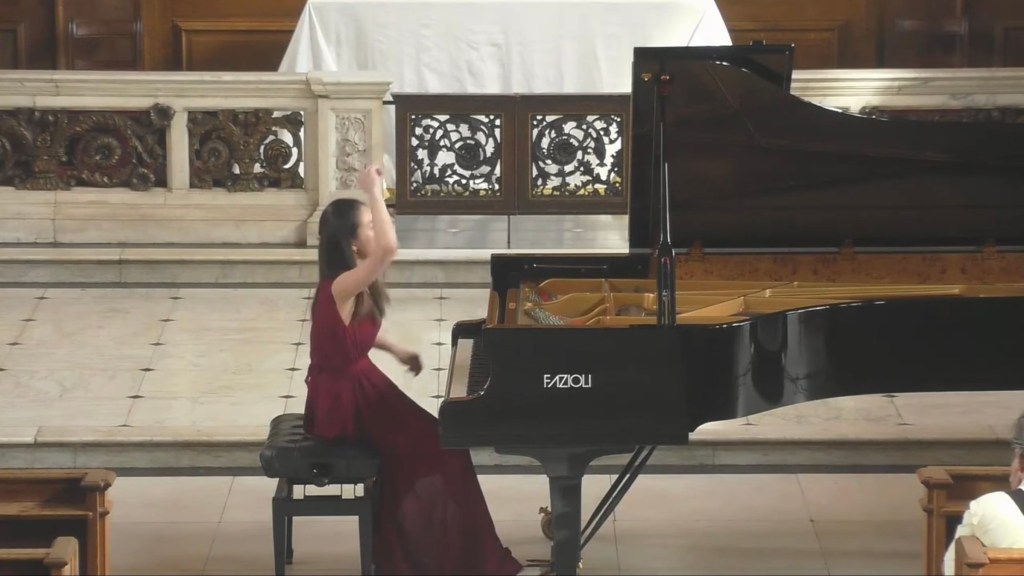
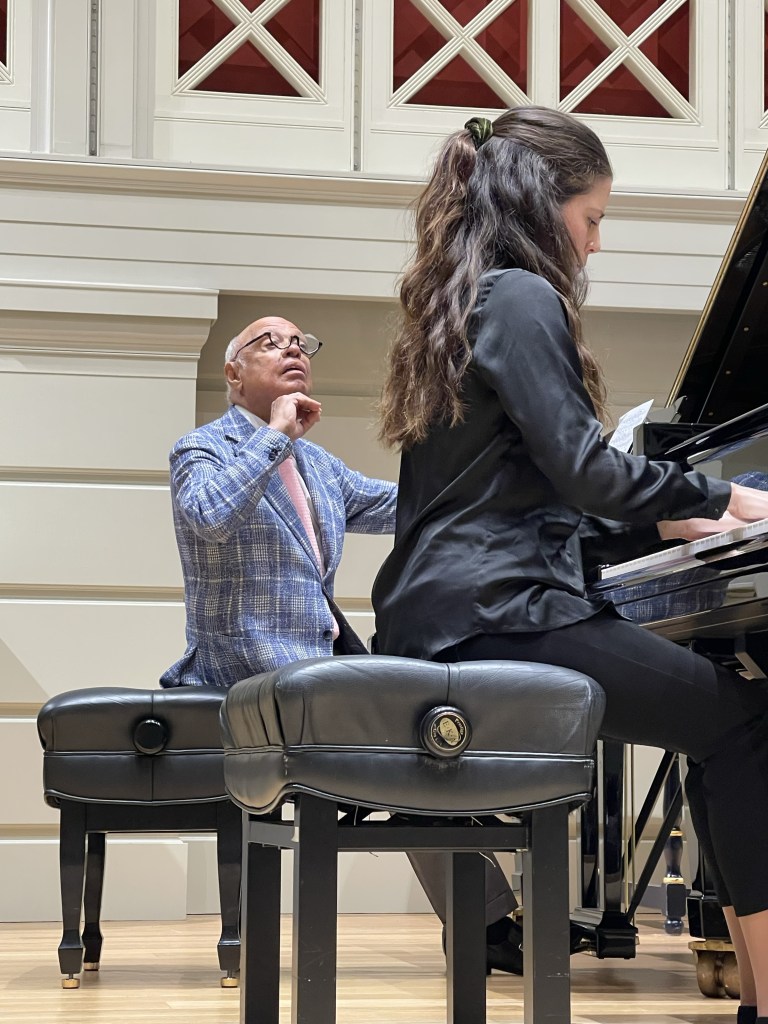
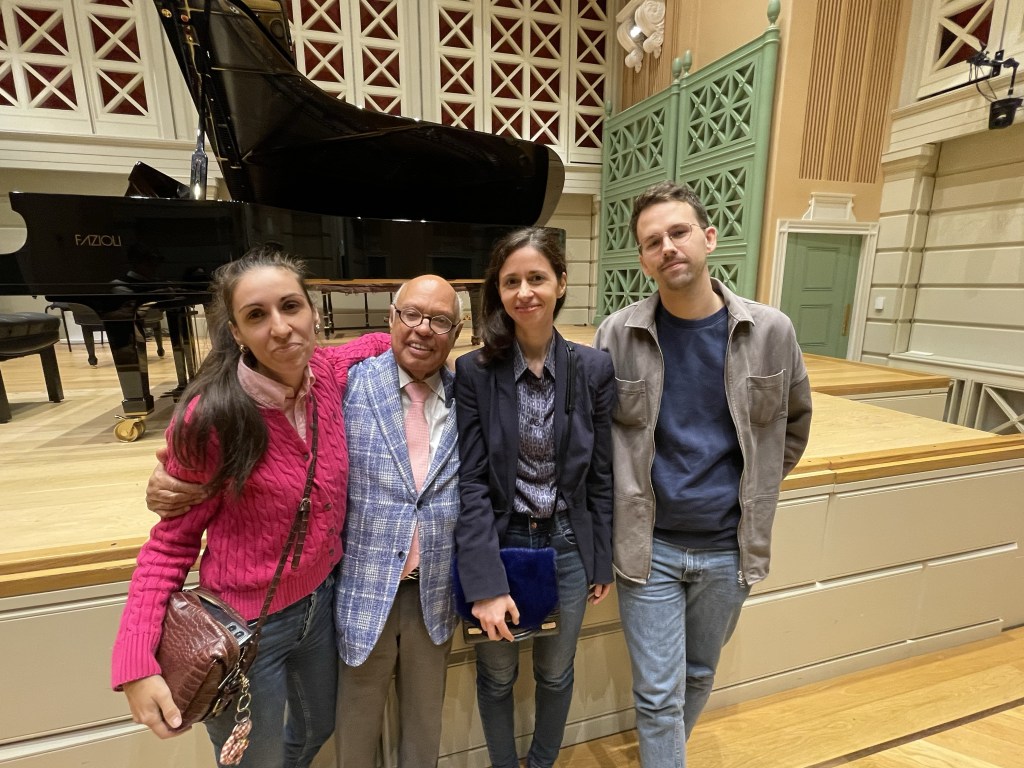
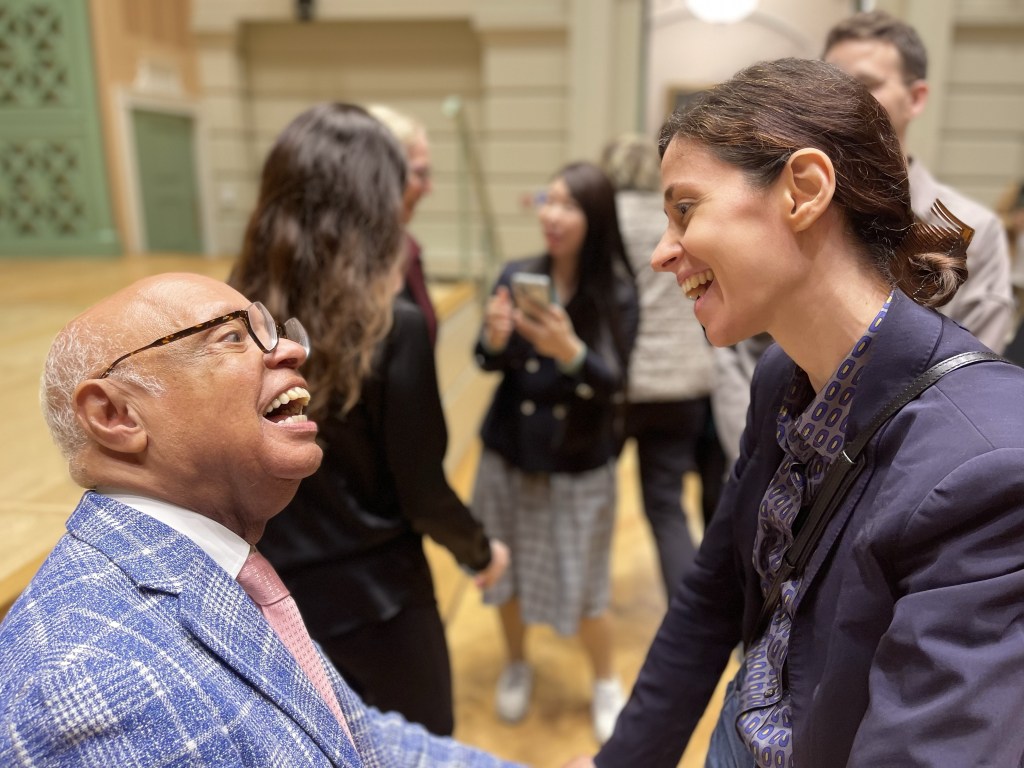
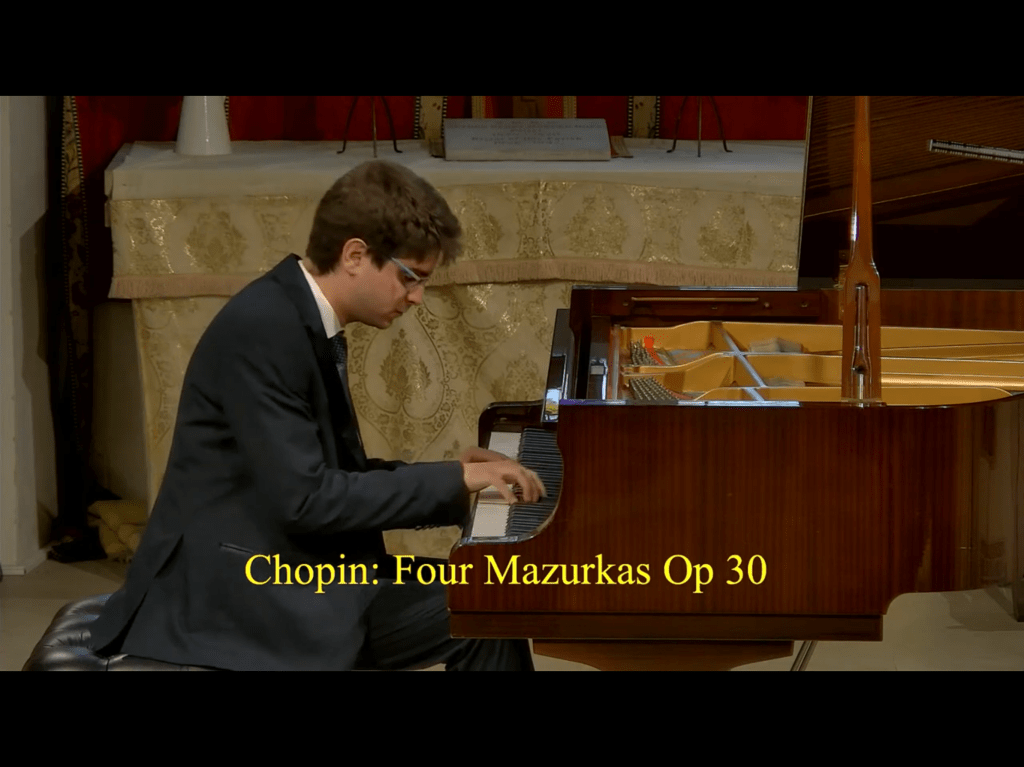
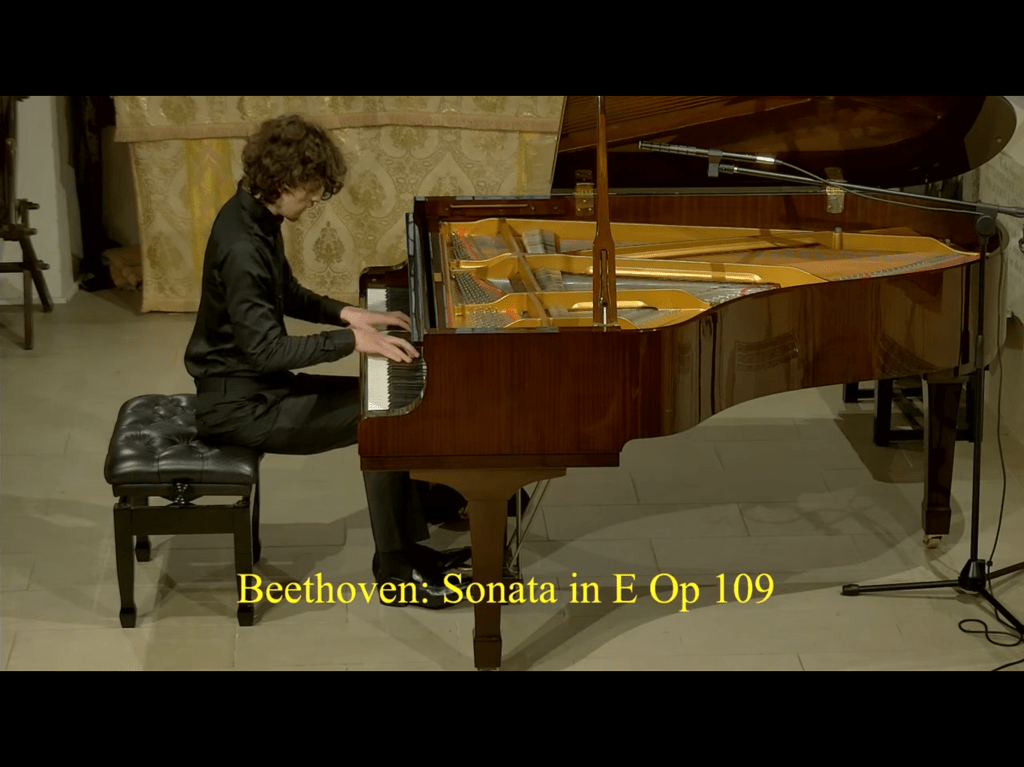
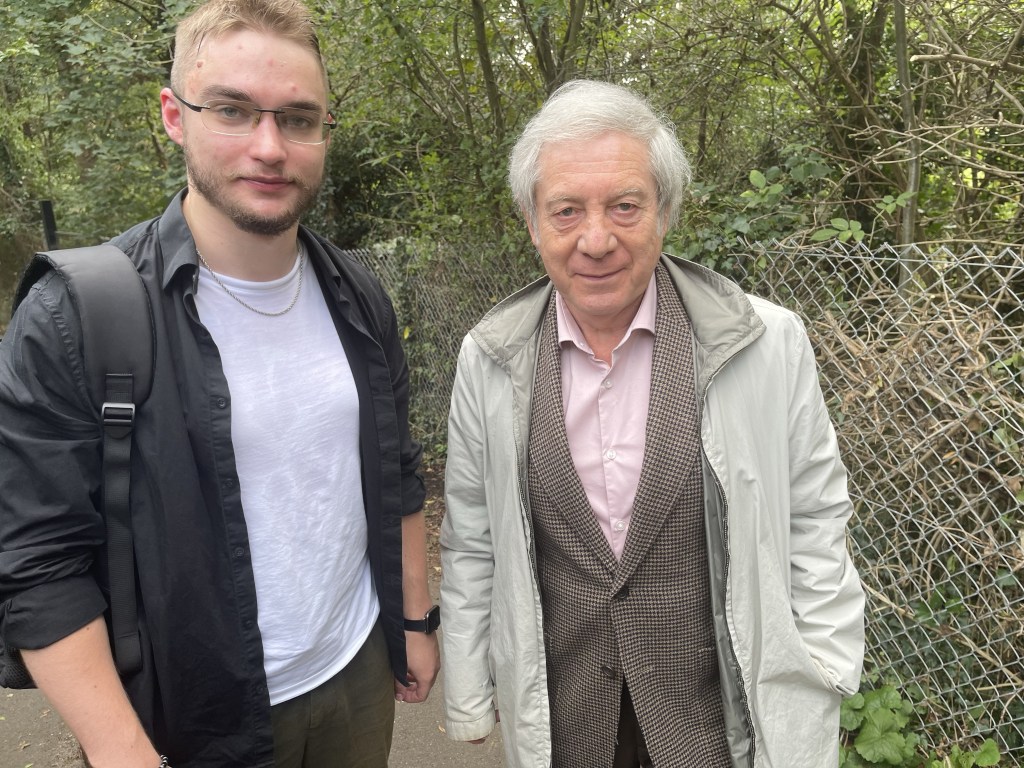
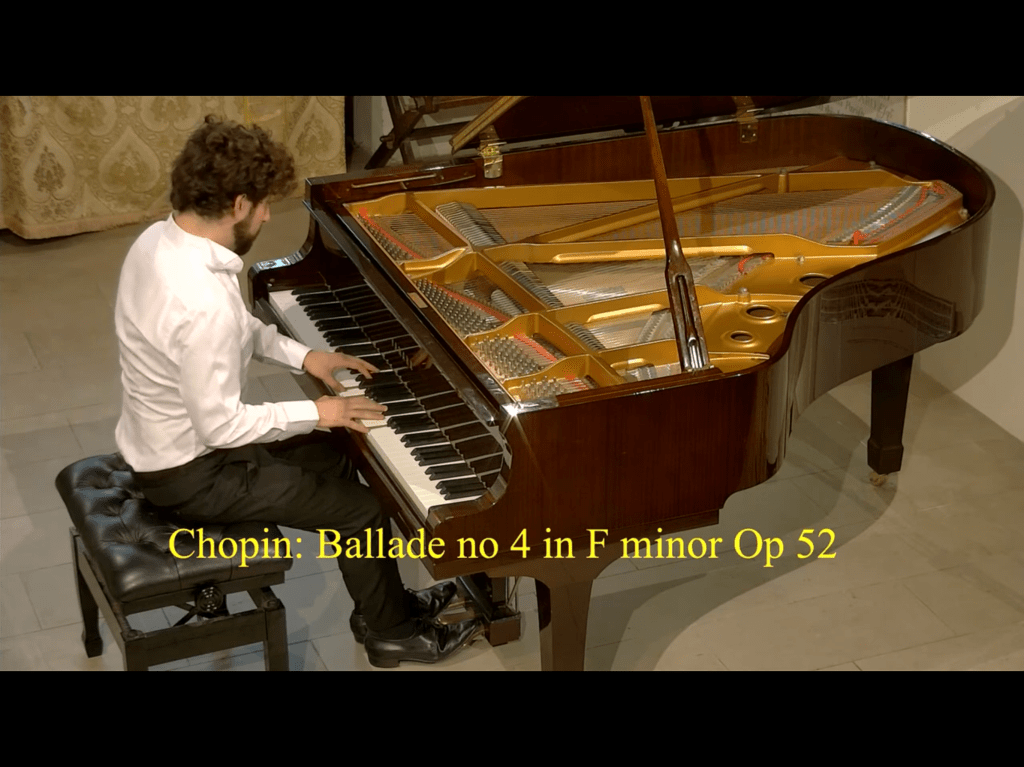
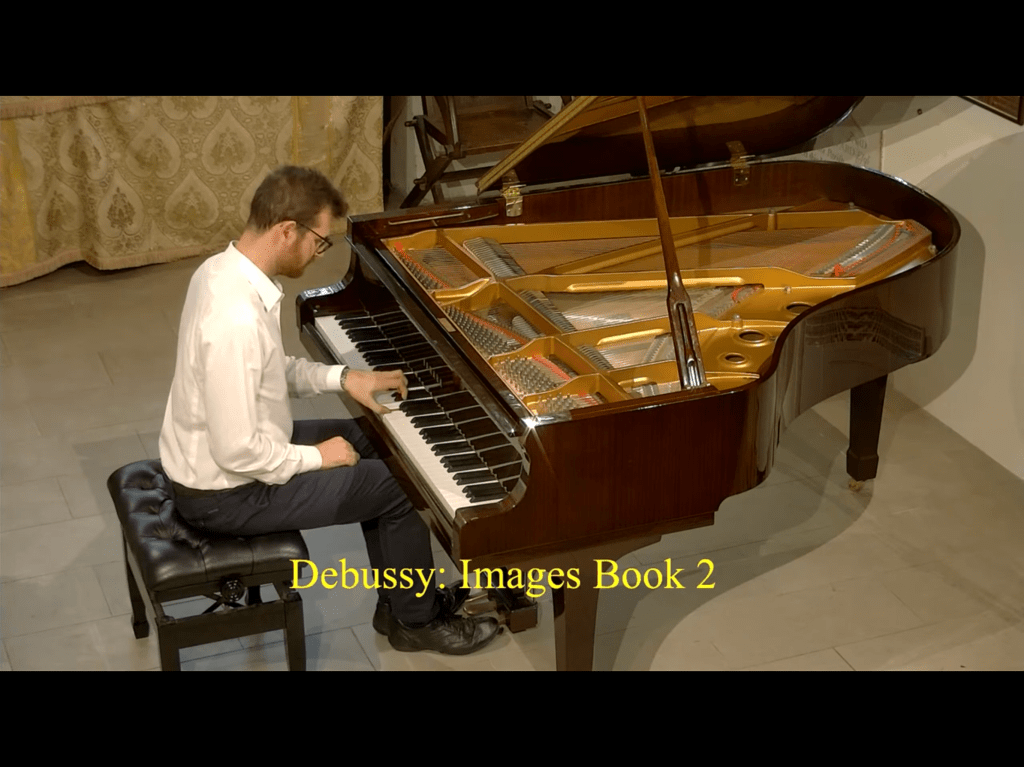
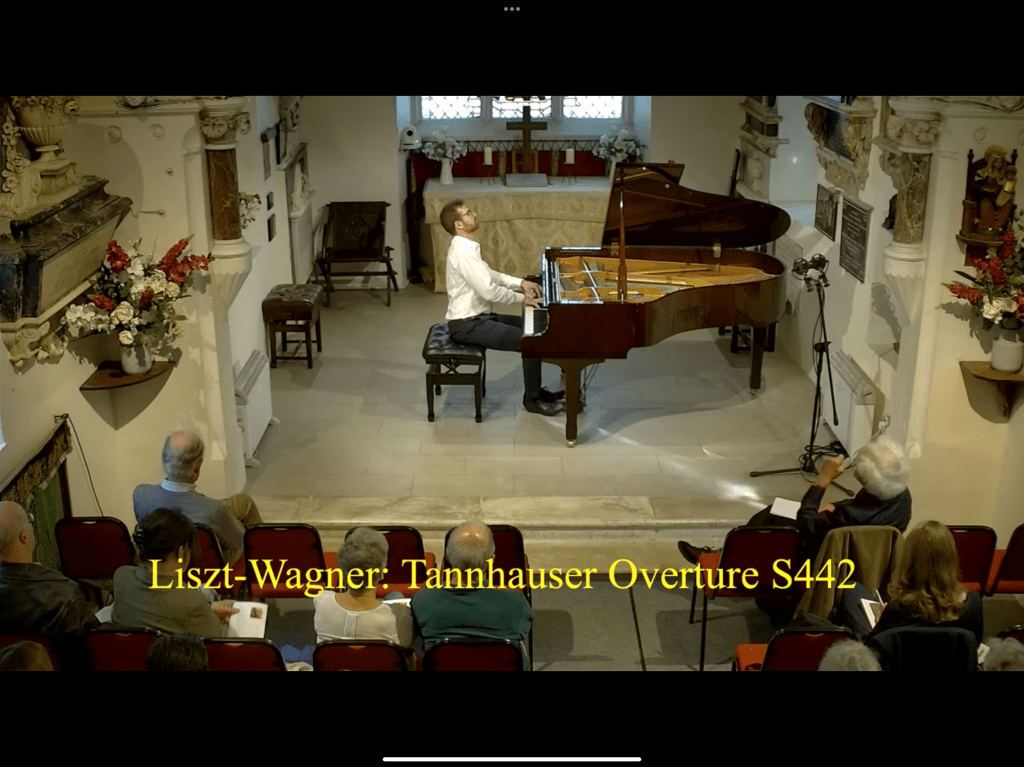
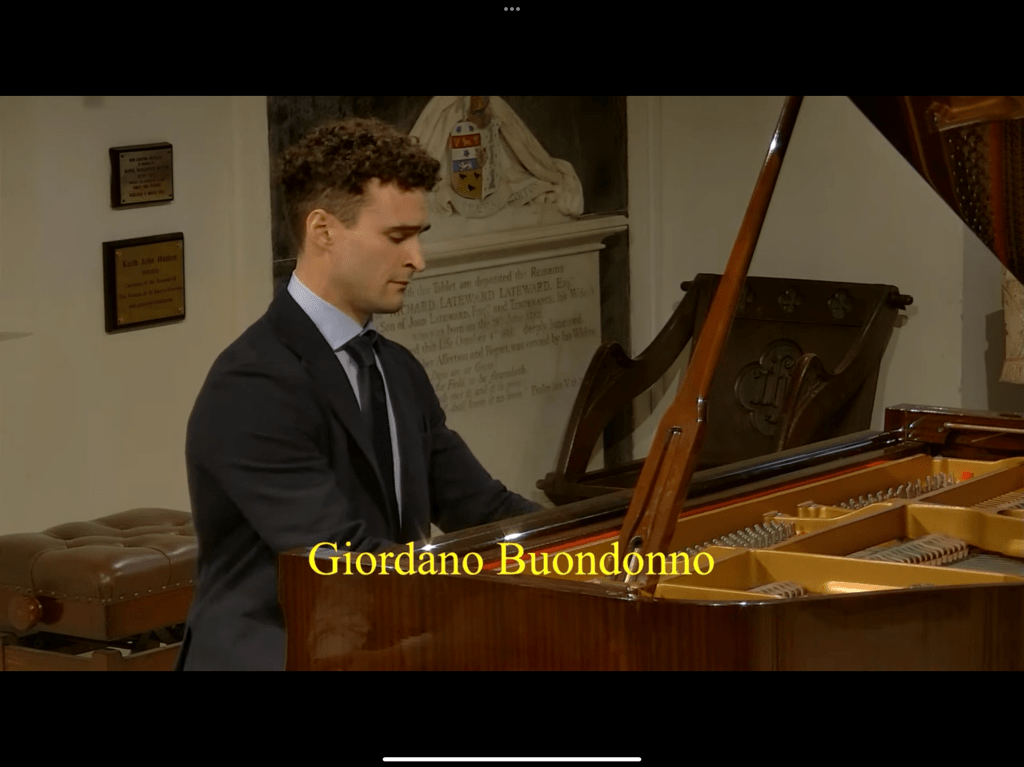
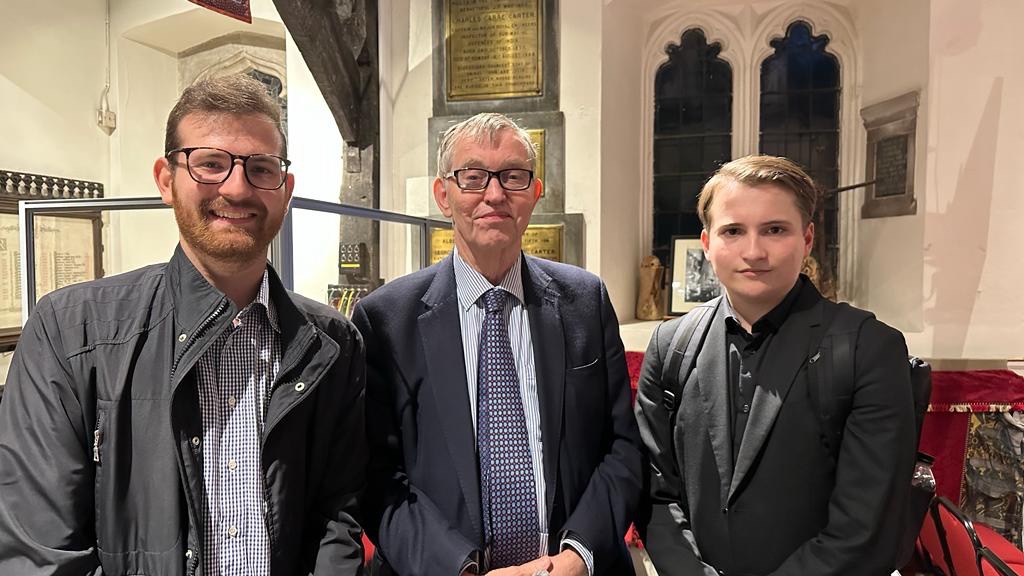
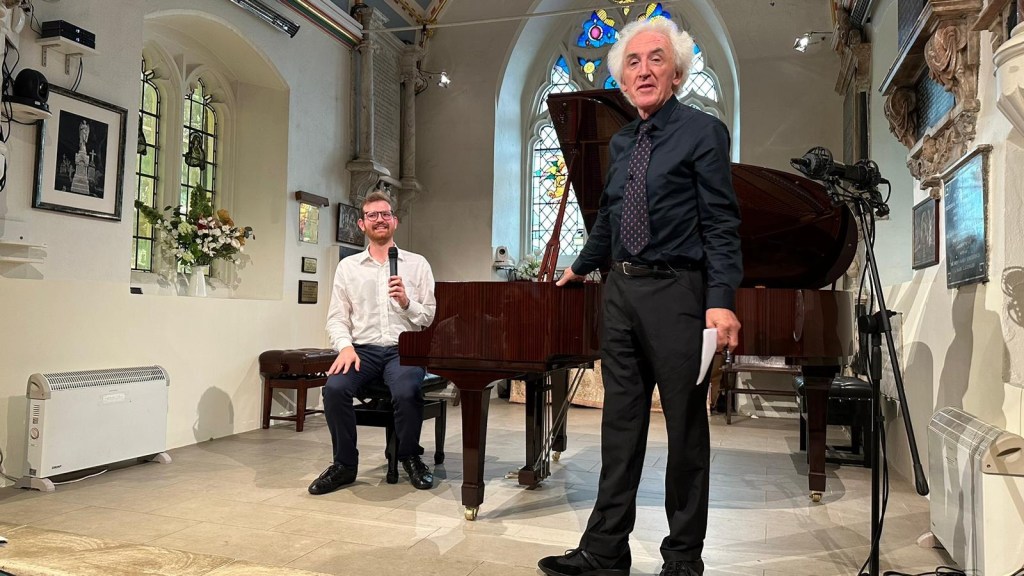
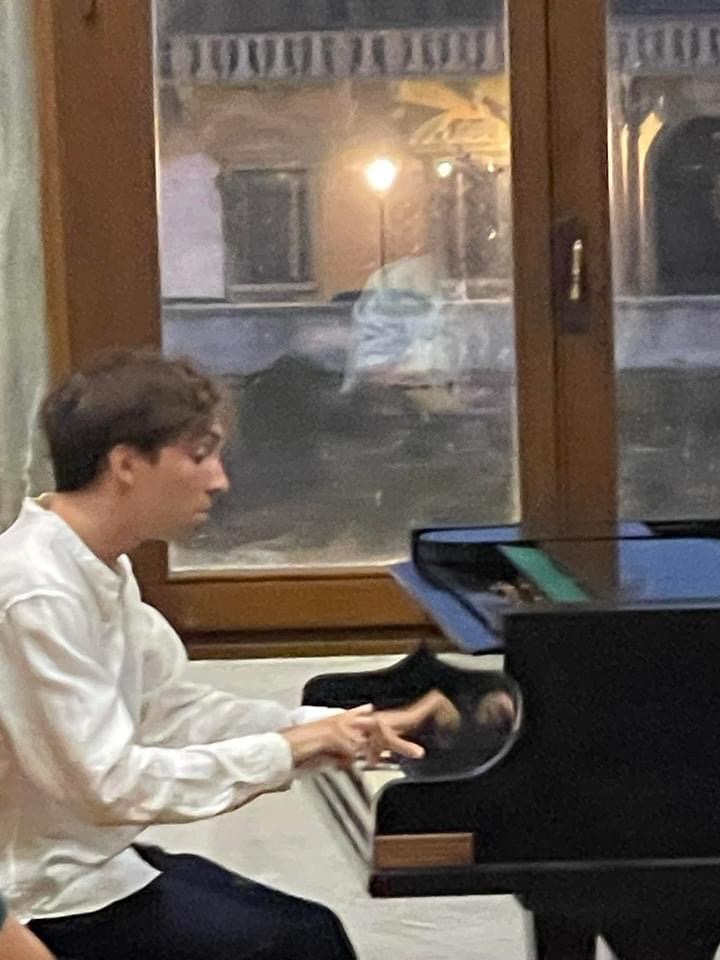
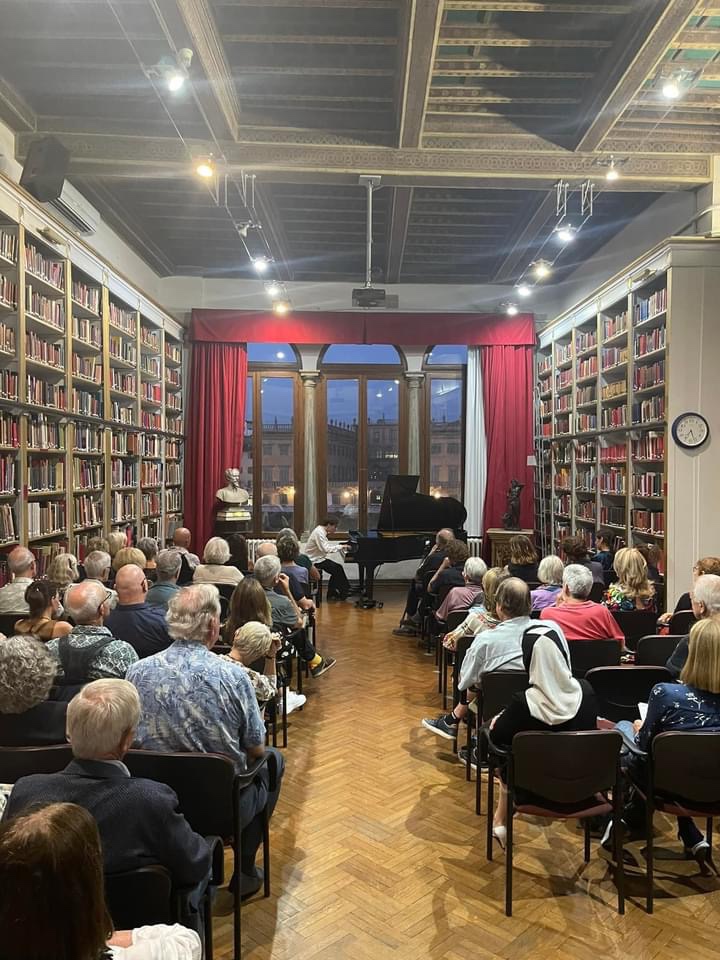
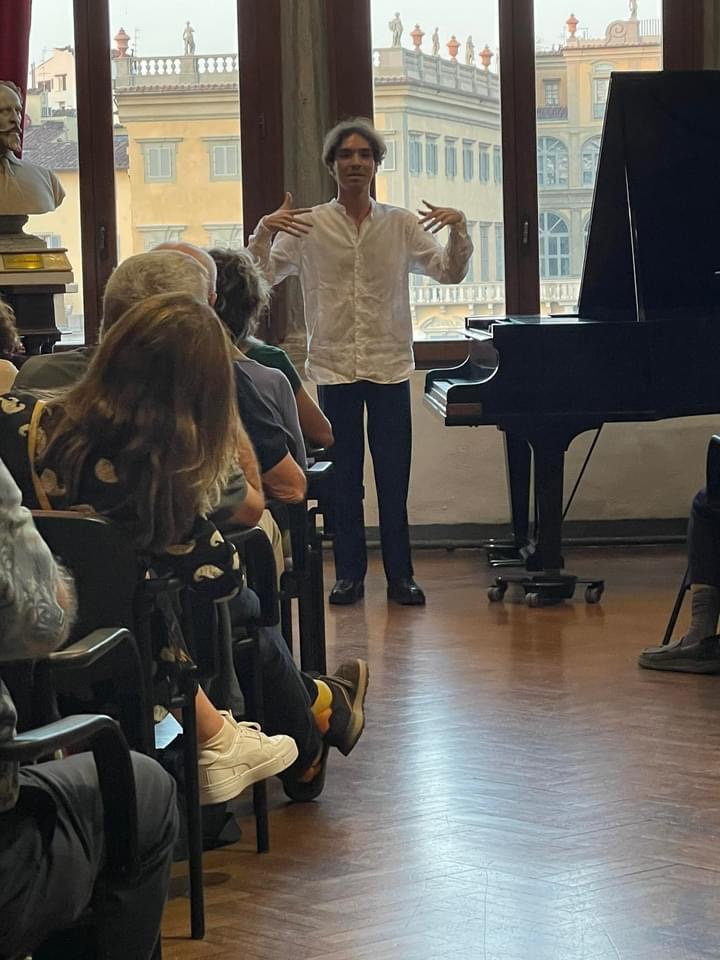
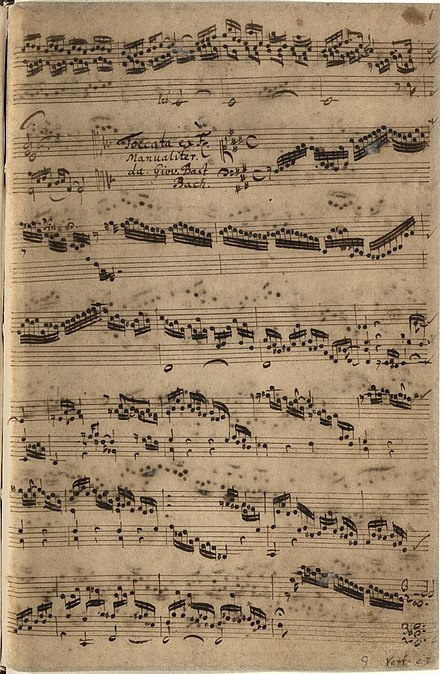
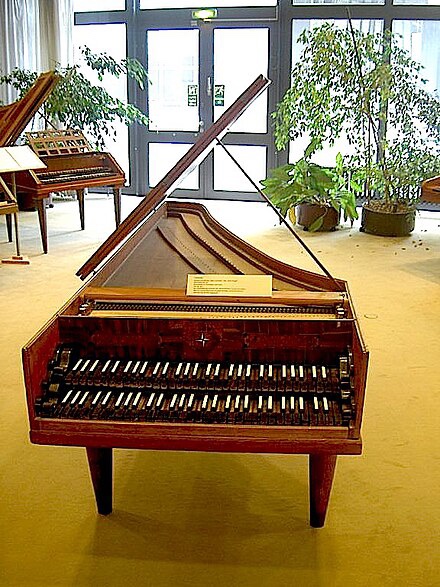
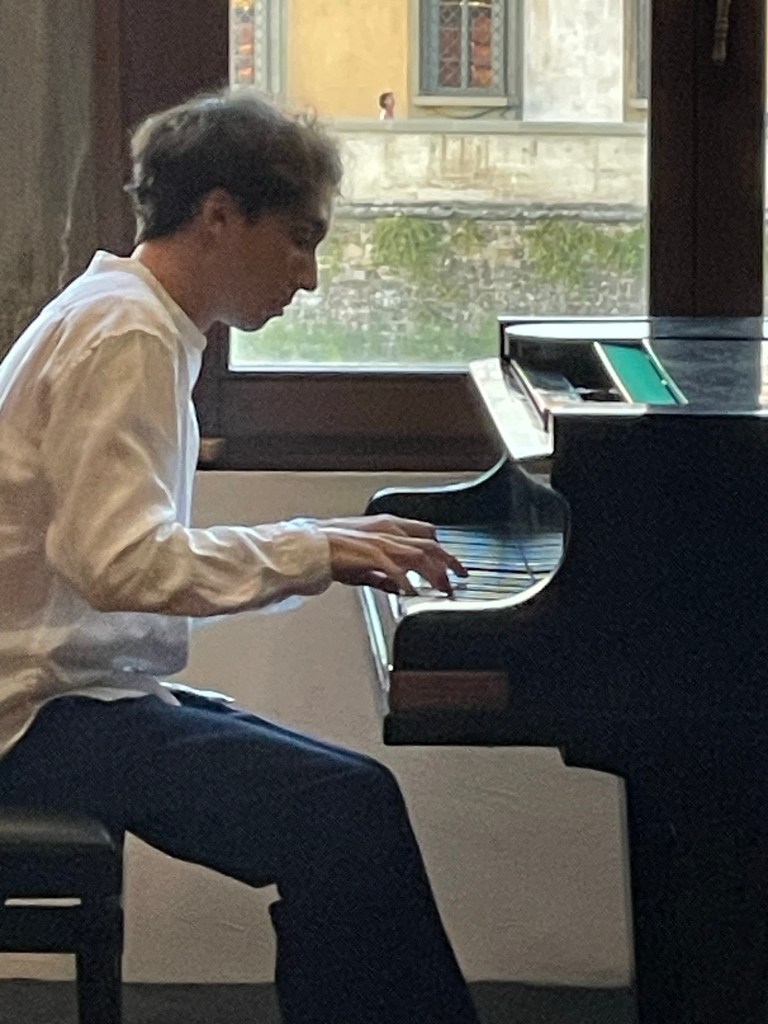
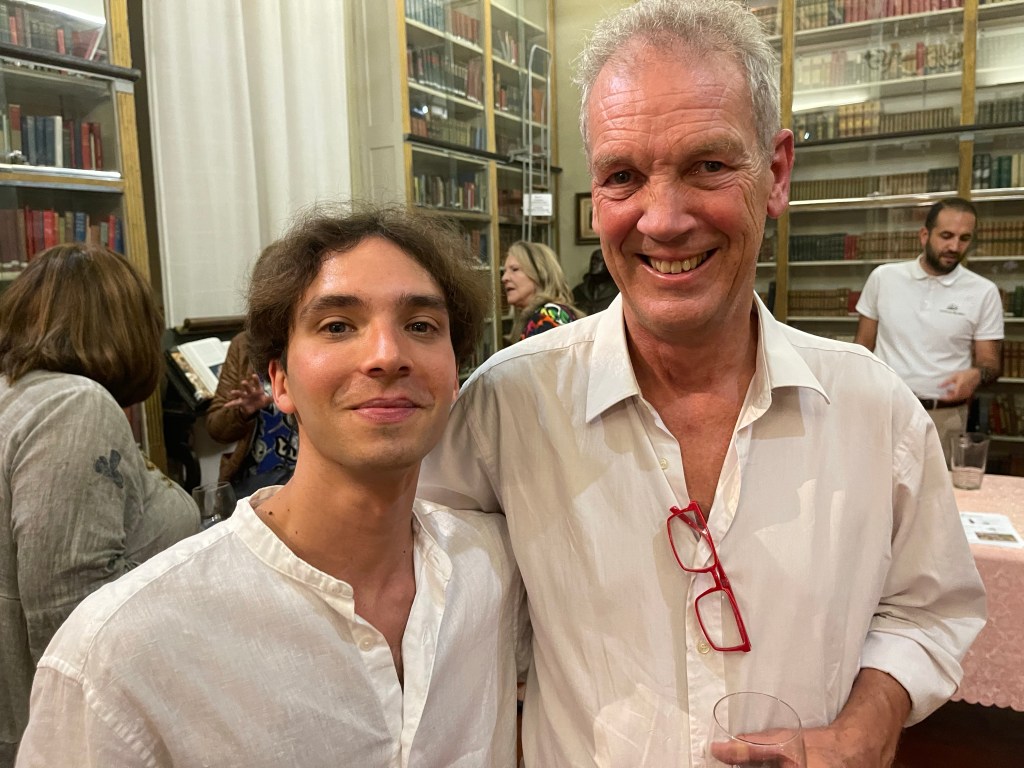
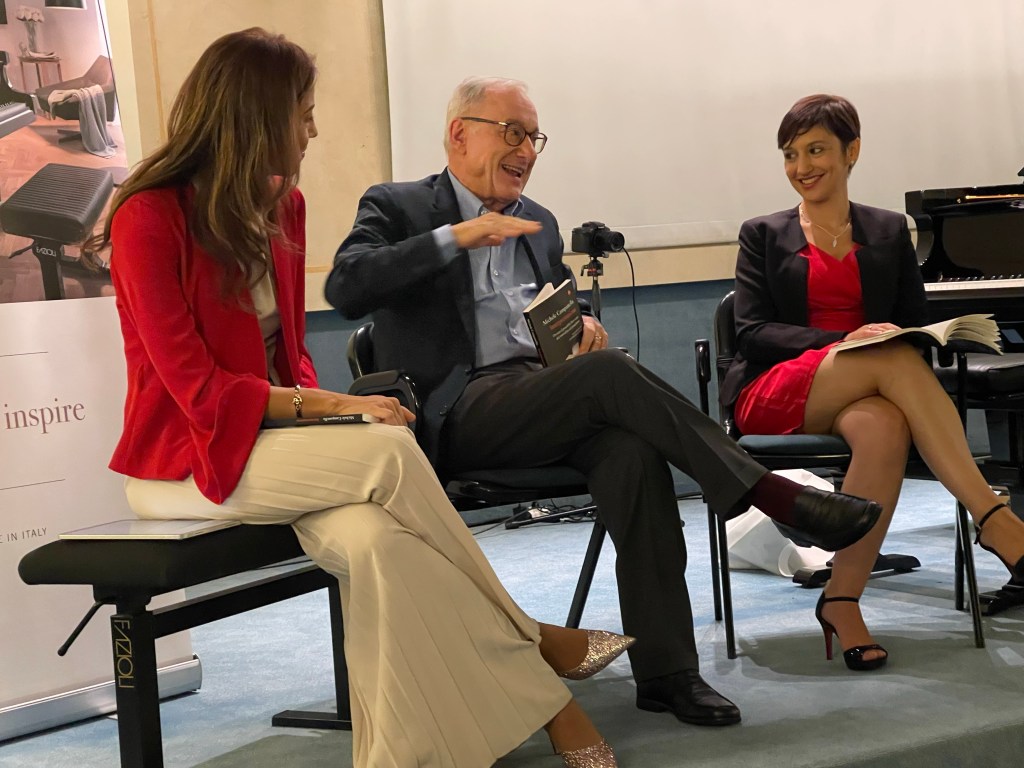
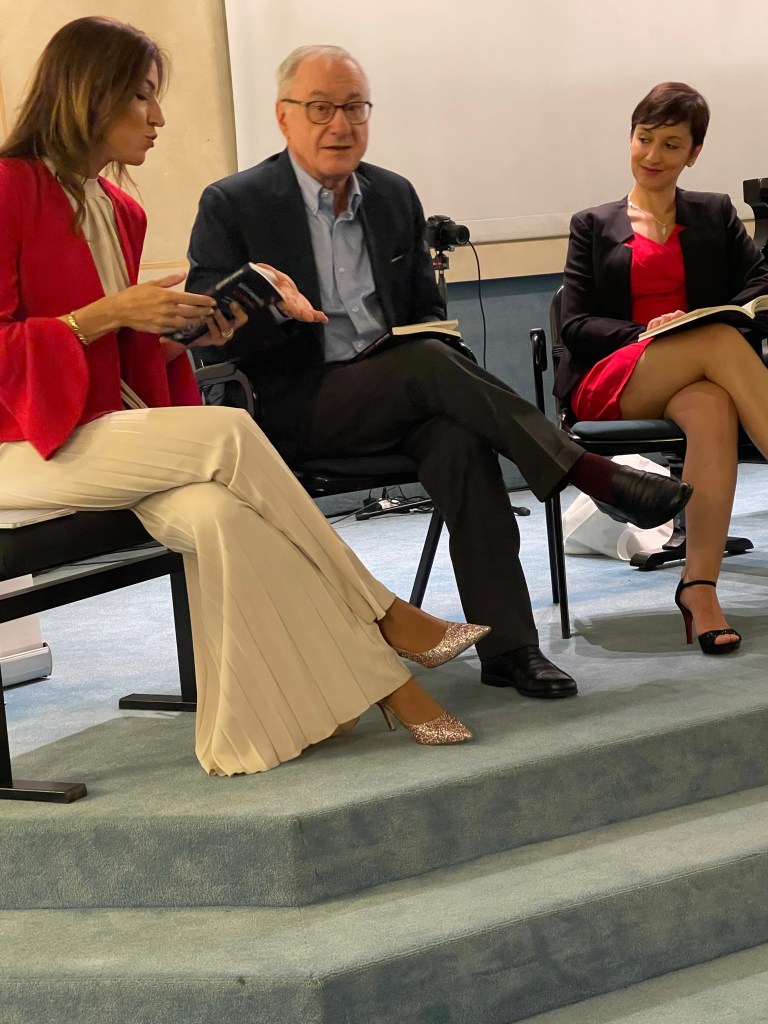
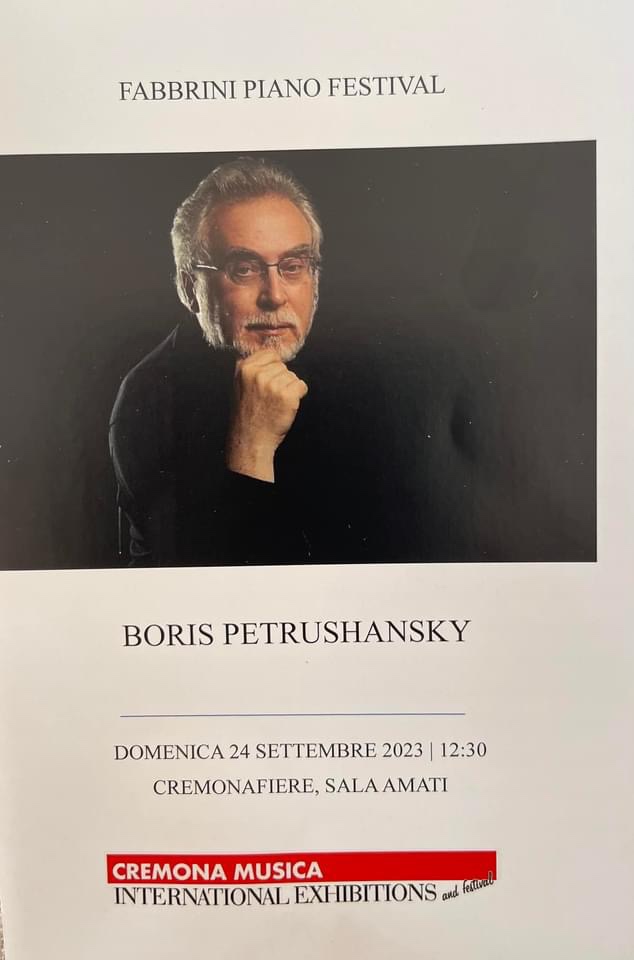
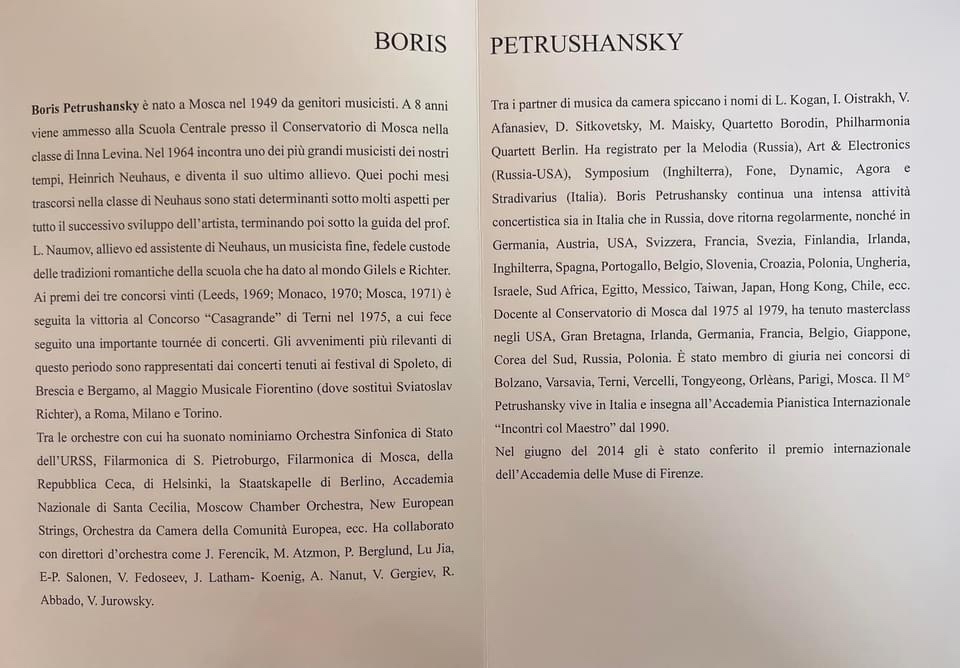
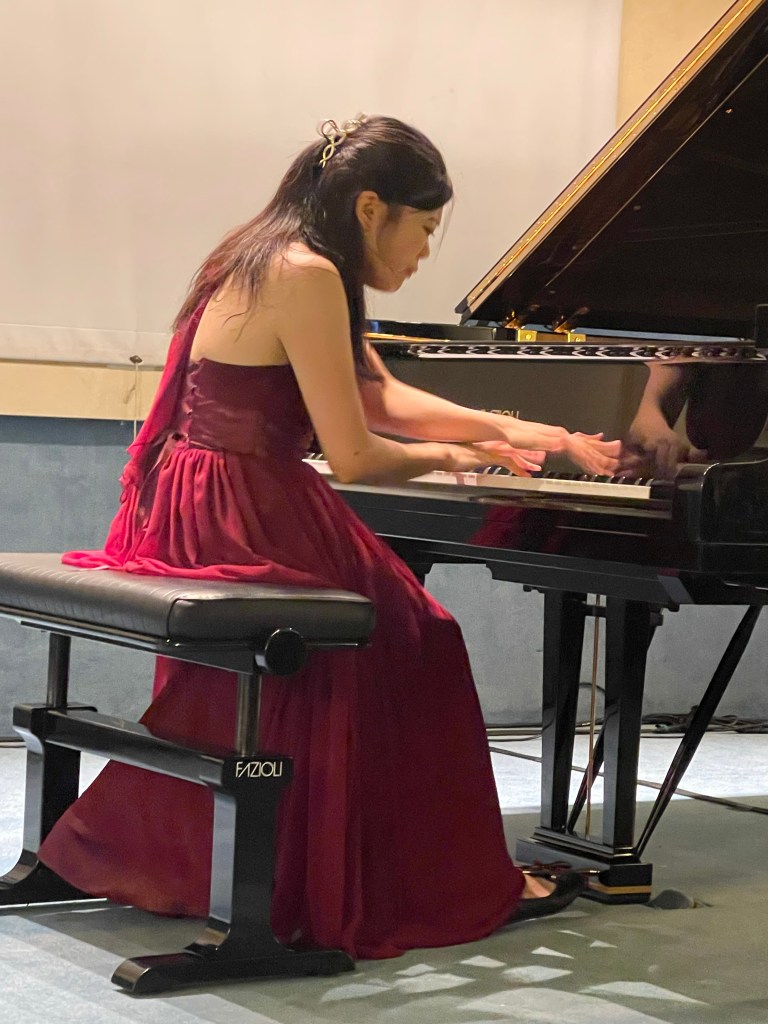
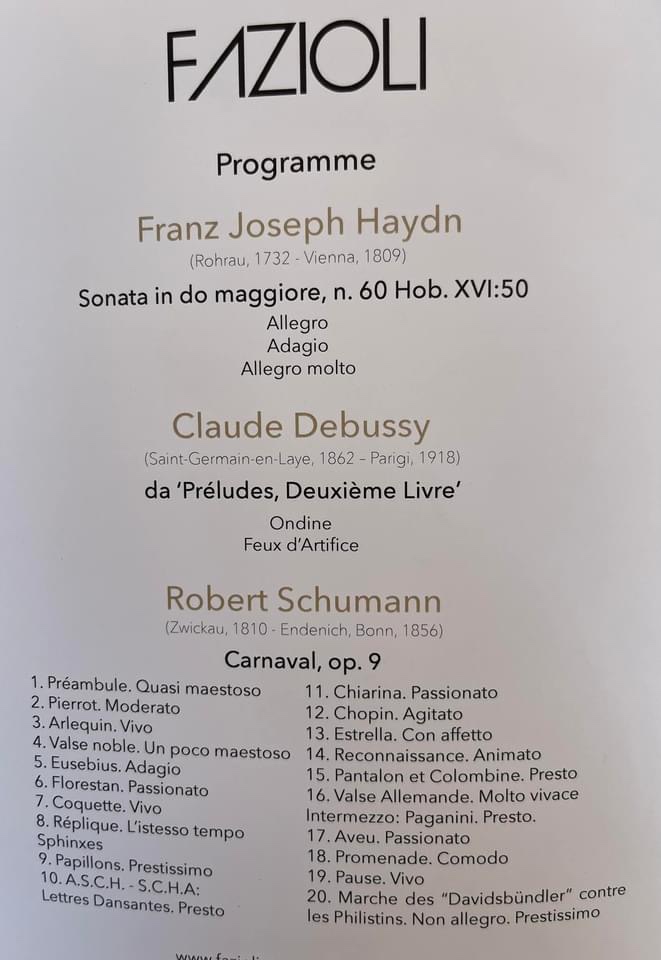
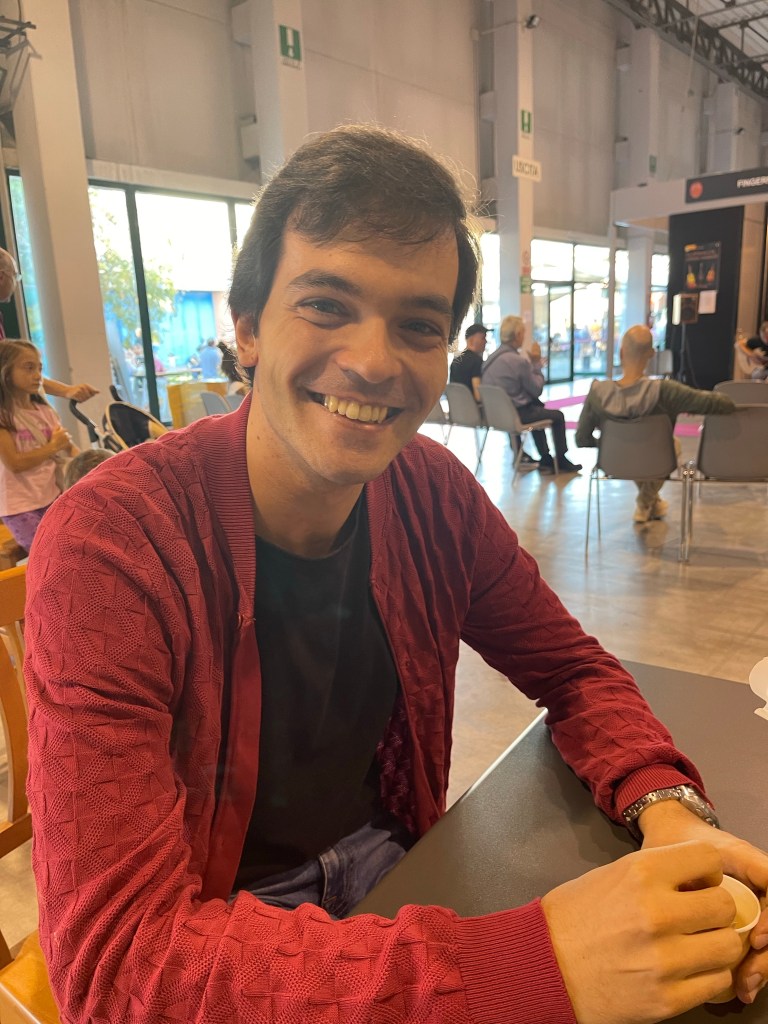
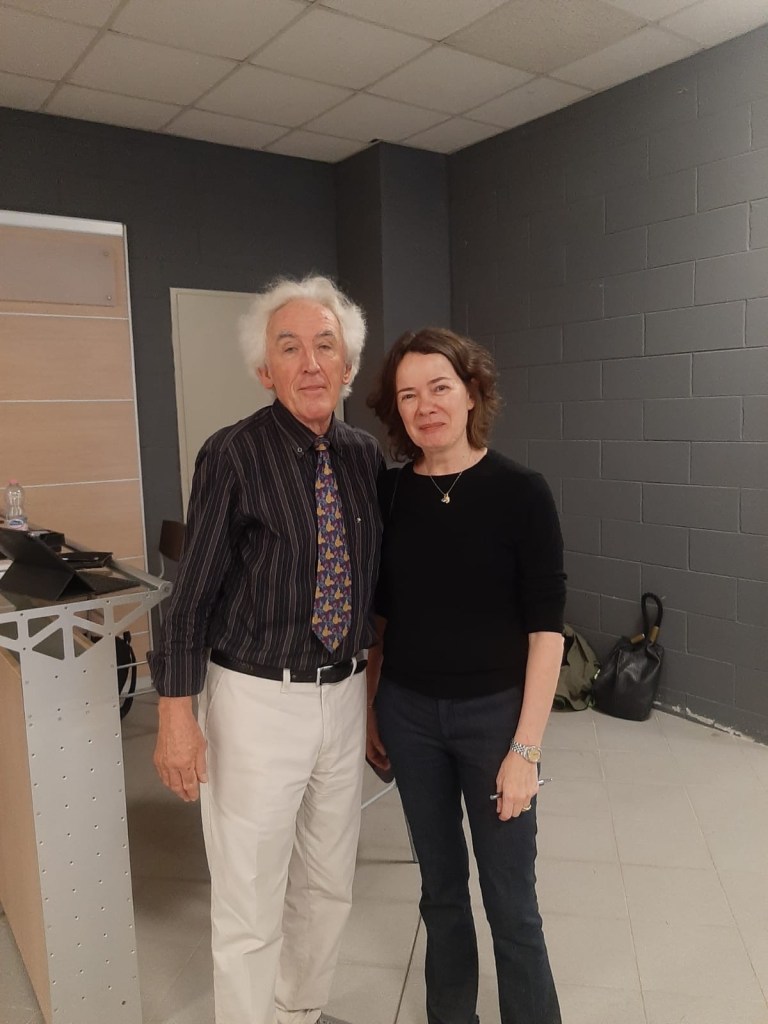
Giovanni Bertolazzi ,in my opinion the finest pianist of his generation,on tour in the USA for the Keyboard Trust ………starting in the beautiful theatre that Lorin Maazel create on his estate in Virginia on my birthday 15th October and proceeding to Washington 17th ;Philadelphia 18th;Delaware. 20th ;New York 21st.
October 15 – The Castleton Festival welcomes Italian pianist, Giovanni Bertolazzi, to its 2023-24 season, as it continues its partnership with the Keyboard Charitable Trust Foundation.
‘Giovanni is absolutely phenomenal!!!
He is not only technically ‘ridiculous’ (as my grandson called it), but he takes you on a journey as a narrator, he means every phrase he puts out. This is what Lorin used to call “conversational playing”.
If I was a fancy reviewer for the NYTimes, I would call Giovanni a combination of Emanuel Ax, Svatoslav Richter, and Alexis Weissenberg…
And what a sweet personality – no vanity, just super focused on what he is doing, otherwise completely unassuming (but so bright and informed about the world, etc!).
I could ramble/rave on and on …
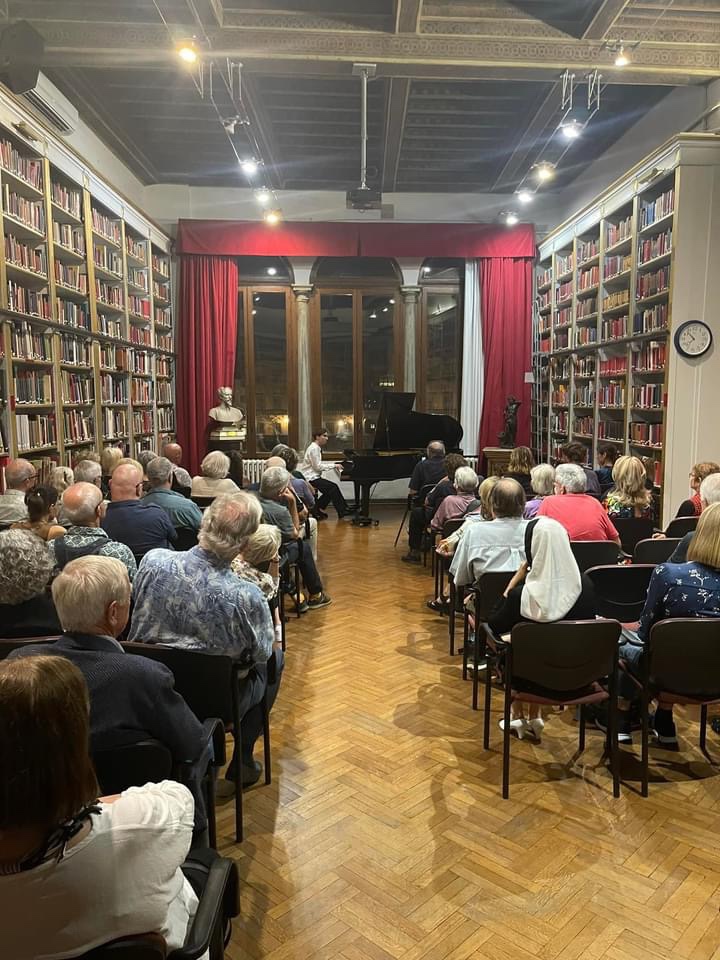
We had a nice, nearly full house, composed of mostly connoisseurs or new converts, and they were blown away!
Thank you and John and Noretta for sending him to us!
What a treat for us and our audience!’
Dietlinde Maazel-Wood
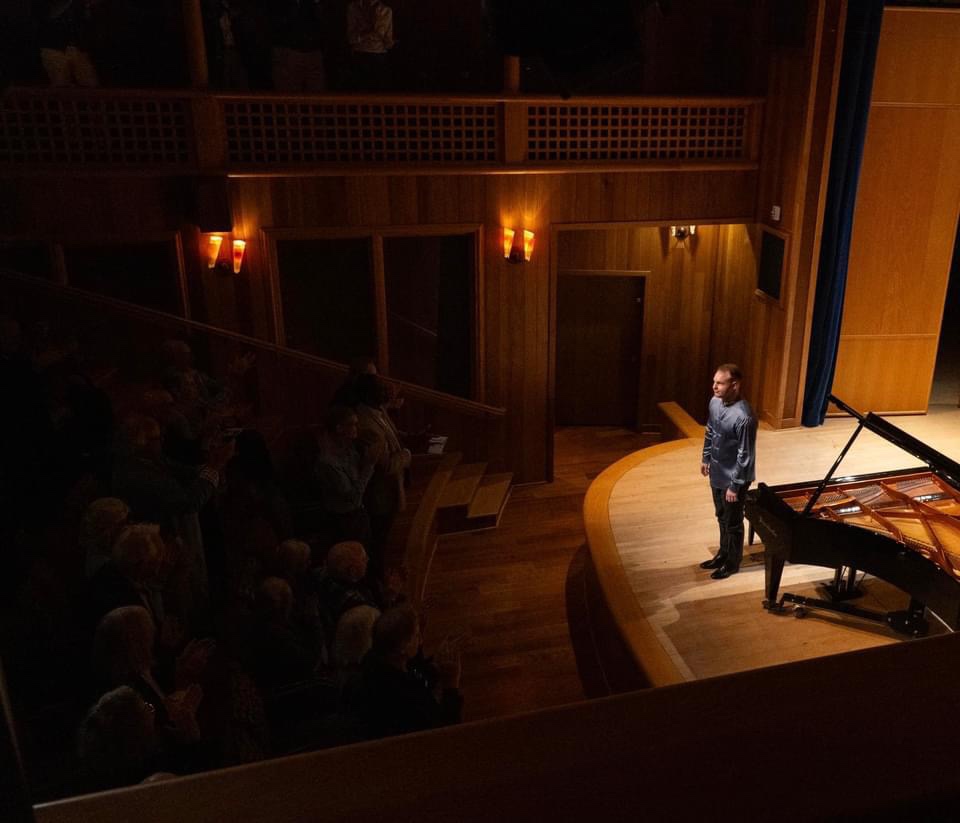
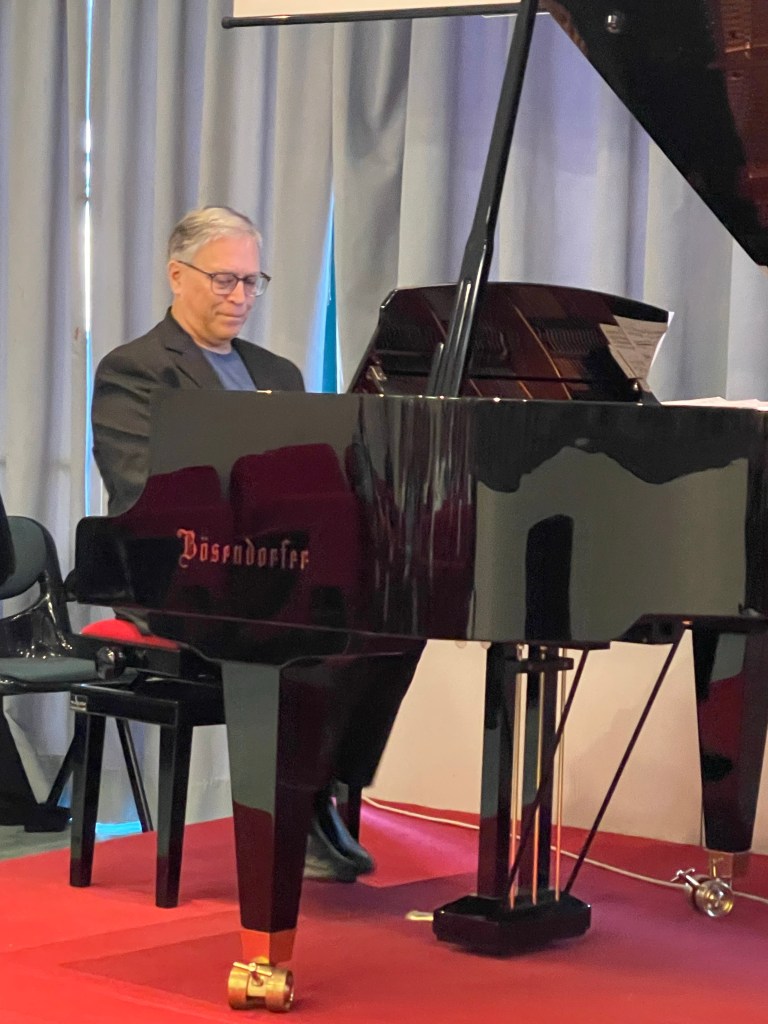
Giovanni in the beautiful Maazel Theatre in Castleton Virginia
Comment from Marja about Giovanni’s recital today in Philadelphia: “I was so excited about his playing and selling his CDs afterwards that I forgot to take pics! His playing was superb, always with rich tone, amazing clarity and gorgeous voicing. The standing ovation at the end was well deserved!”
Philadelphia hosts
And from Gloria in DC: “The repeated comment I’m hearing is that they’ve never heard a better pianist! It’s breaking my heart to have missed him! All said though I’m ecstatic it went so well and was so well received.”
Washington Arts Club Giovanni in Delaware
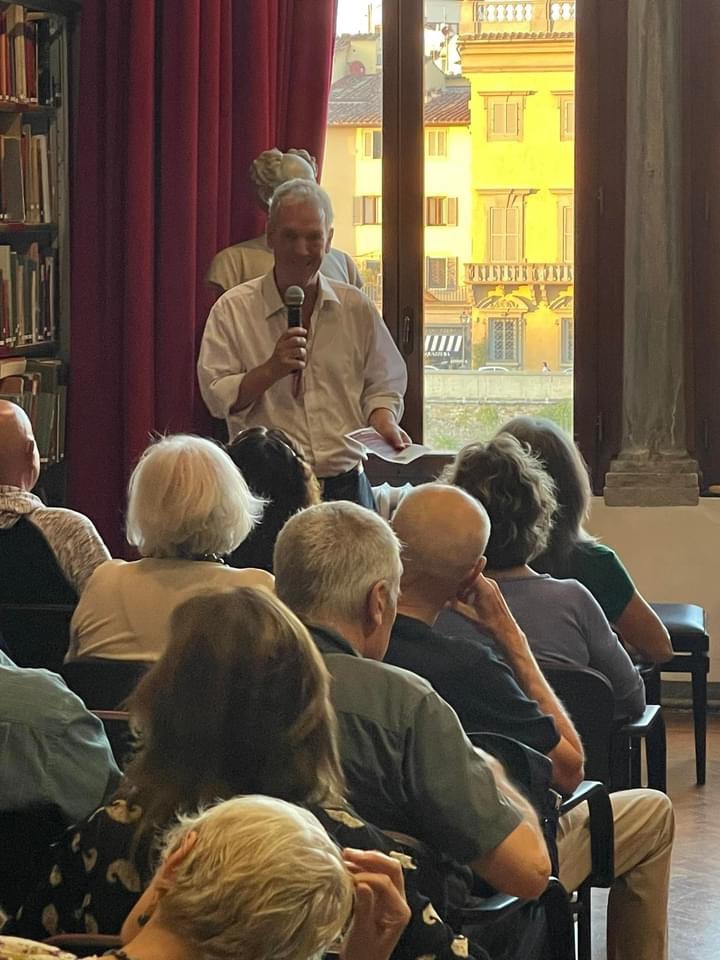
Private live stream recording of the concert in Delaware on the 20th october that I am happy to leave the moving introduction by Helen Foss about the founders of the Keyboard Trust .https:https://youtu.be/Sv5KJMerqTE?si=uS-VHSKtJsgWQUBx
Celebrating its 32nd Anniversary, the Keyboard Trust identifies today’s most promising young keyboard talent and enables them to perform in many of the most important music centres in Europe and the Americas.
Giovanni Bertolazzi won the 2nd Prize at the “Franz Liszt” International Piano Competition in Budapest (2021), along with five other special awards.
Born in Verona in 1998, Giovanni earned his Bachelor’s Degree from “B. Marcello” Conservatory of Music in Venice and then decided to continue his piano studies with Epifanio Comis at “V. Bellini” State Institute of Music in Catania, where he obtained his Master’s Degree in Piano Performance and in Chamber Music with top honours.
During his studies, he also attended several piano masterclasses held by distinguished pianists and pedagogues such as Lily Dorfman, Joaquín Achúcarro, Matti Raekallio, Boris Berezovsky, Stephen Kovacevich and Jean-Efflam Bavouzet.
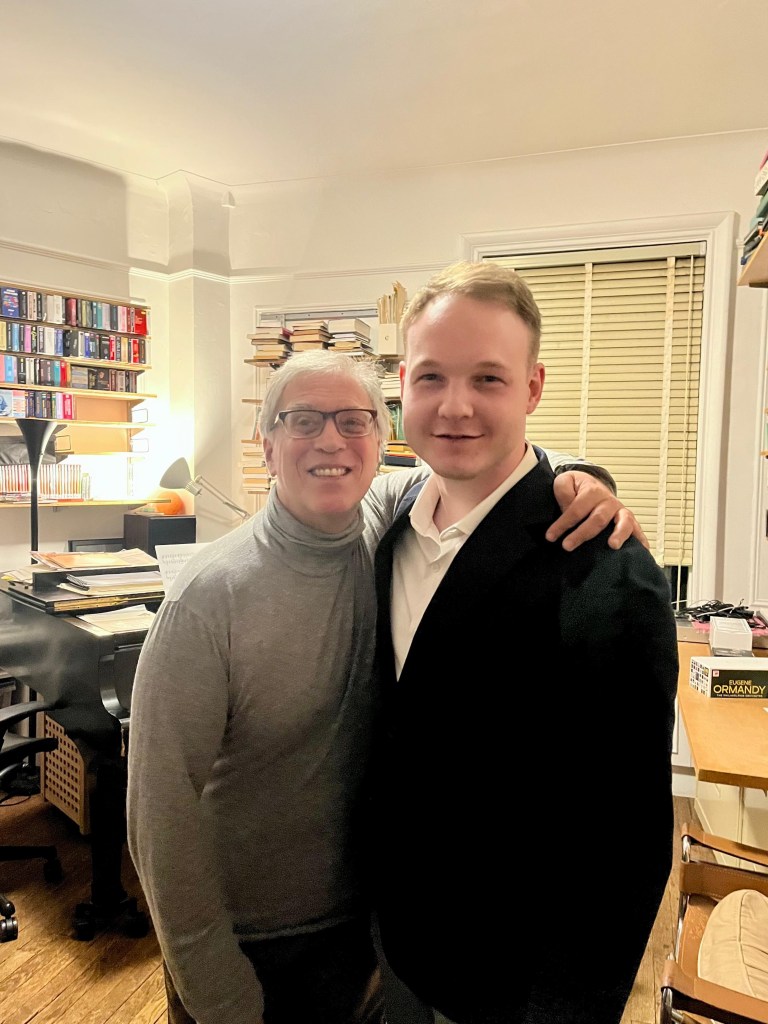
In New York on 21st October 2023
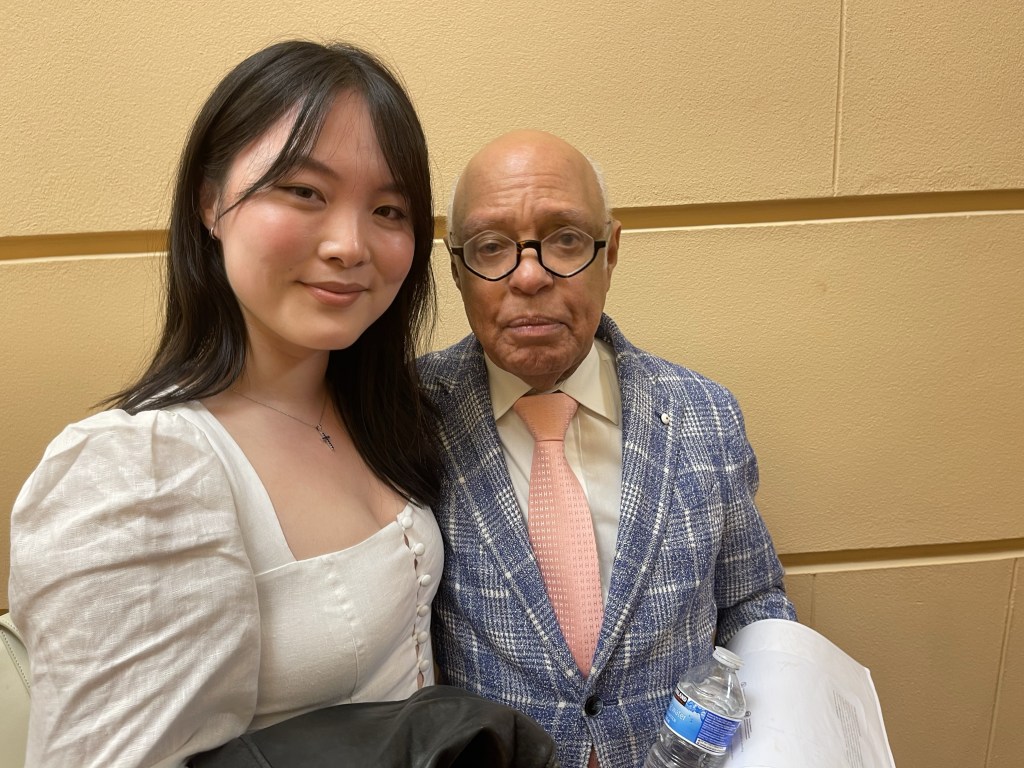
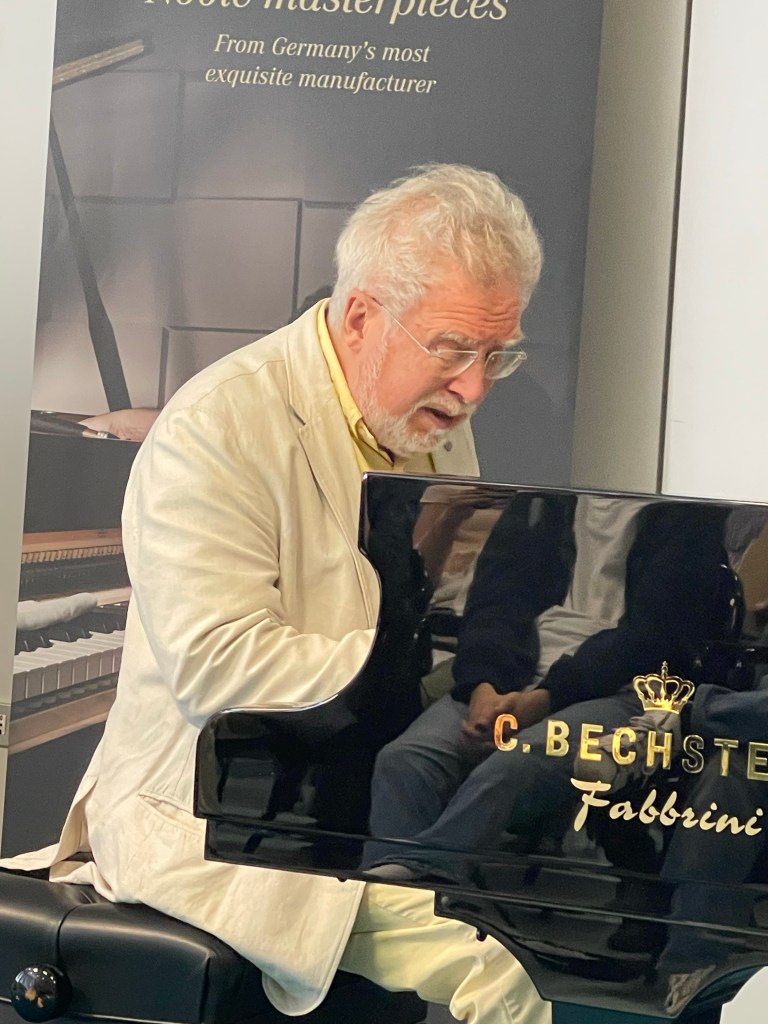
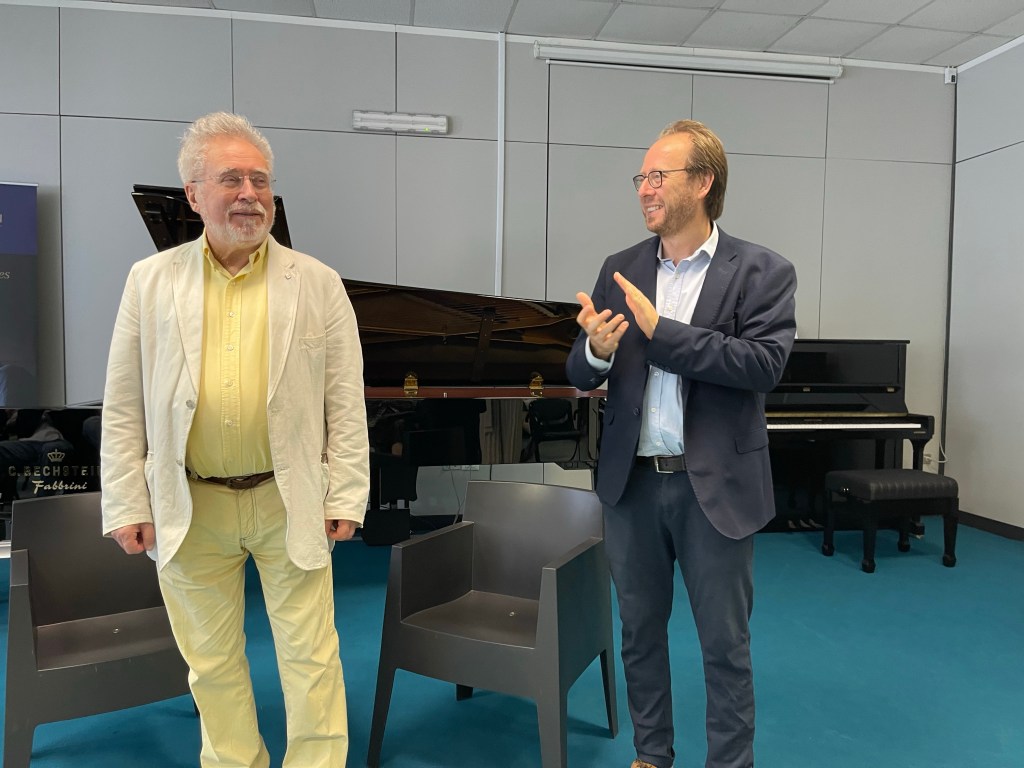
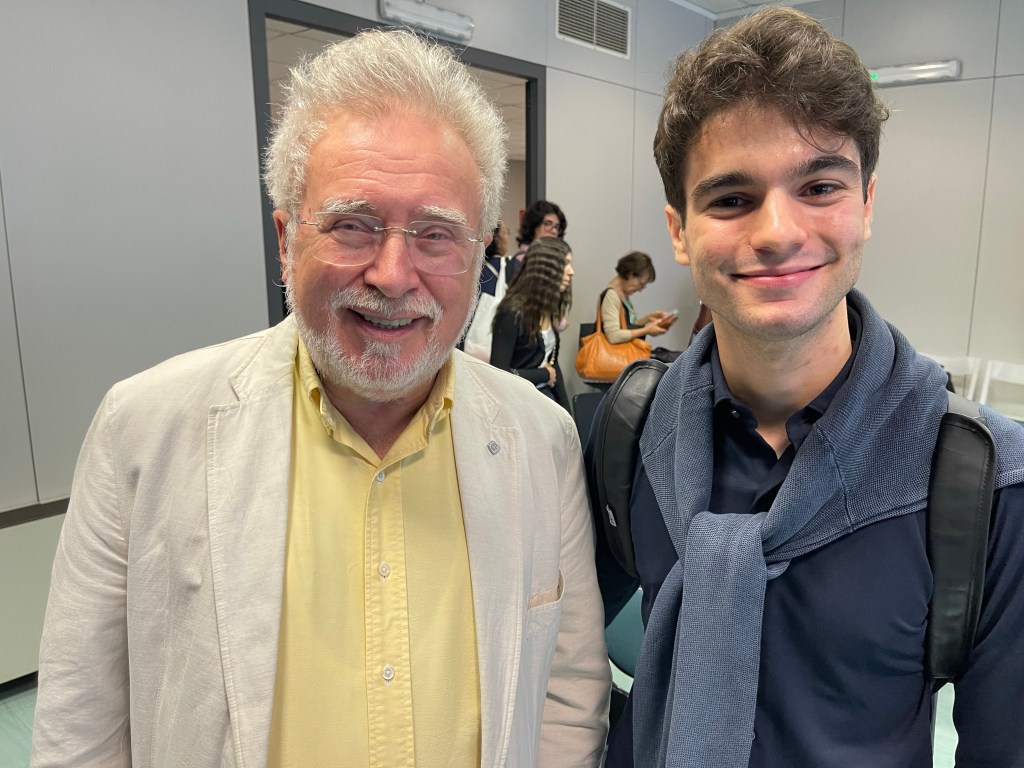
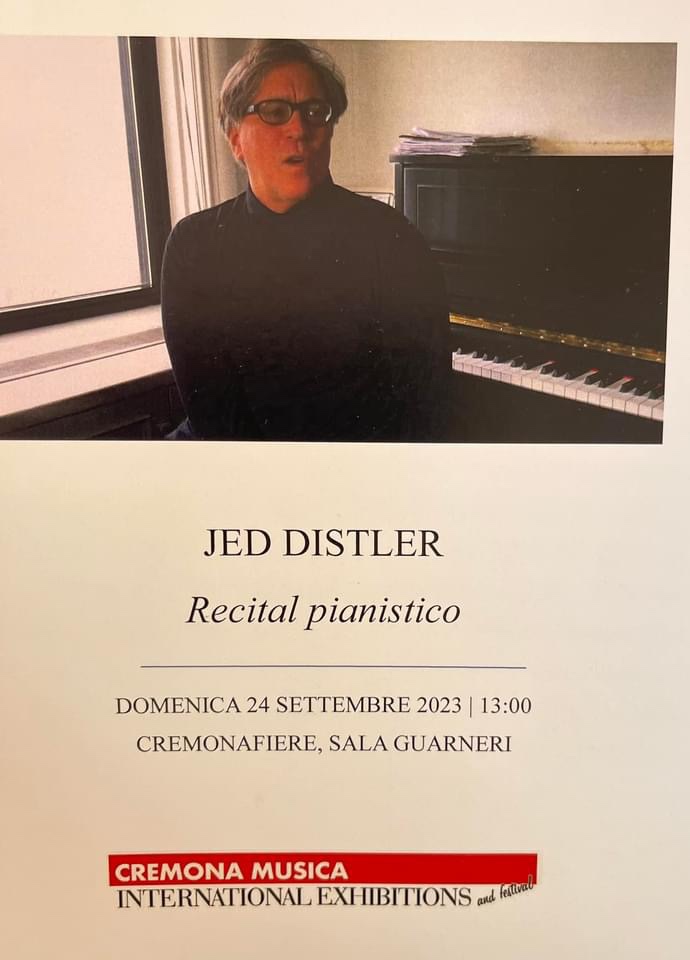
With the distinguished pianist and critic Jed Distler
‘He’s playing now and it’s perhaps the best Liszt I’ve heard in concert since Arrau
Amazing polyphony and bass lines, huge sound without ever banging , no dead spots whatsoever!!!! Wow!!!!’ Jed Distler New York
With Caroline von Reitzenstein in New York https://www.facebook.com/luca.ciammarughi/videos/1360781881204045/ Complimenti a Giovanni Bertolazzi e ad Enrico Bronzi che ieri sera, 26 Ottobre con un programma interamente dedicato a Rachmaninov, hanno conquistato le Sale Apollinee Sold Out al Teatro La Fenice! Per Giovanni, che nel 2023 è al centro di un progetto di Patronage Artistico pensato appositamente per la sua crescita professionale, questo è stato un altro importante successo nella Stagione insieme a Musica con le Ali! Grazie quindi a Giovanni per l’importante percorso fatto insieme quest’anno e…ci vediamo nel 2024! CARLO HRUBY ‘Musica con le Ali’https://www.facebook.com/luca.ciammarughi/videos/6706448439390714/Time to say goodbye USA 👋🏻🇺🇸 An exciting concert tour thanks to The Keyboard Charitable Trust Already looking forward to my next concert with cellist Enrico Bronzi at Teatro La Fenice on 26th Oct (in 2 days!)
Dear lovely Keyboard Trust Friends
Renewed thanks for ALL your hard work and amazing organisation in making Giovanni’s tour in October such a huge success! He loved every moment and has just written about his trip:
I always feel privileged when I’m able to express myself surrounded by wonderful people, so I’m immensely grateful for who I met and for their warm hospitality. A true pleasure to share the universal language of music with this new audience. I also found it particularly inspiring to perform in different cities and learn more about various aspects of the American culture. It has been an honour to tour the US in the name of the Keyboard Charitable Trust. I send you my warmest regards, Giovanni Bertolazzi. +39 3775329329. www.giovannibertolazzi.com
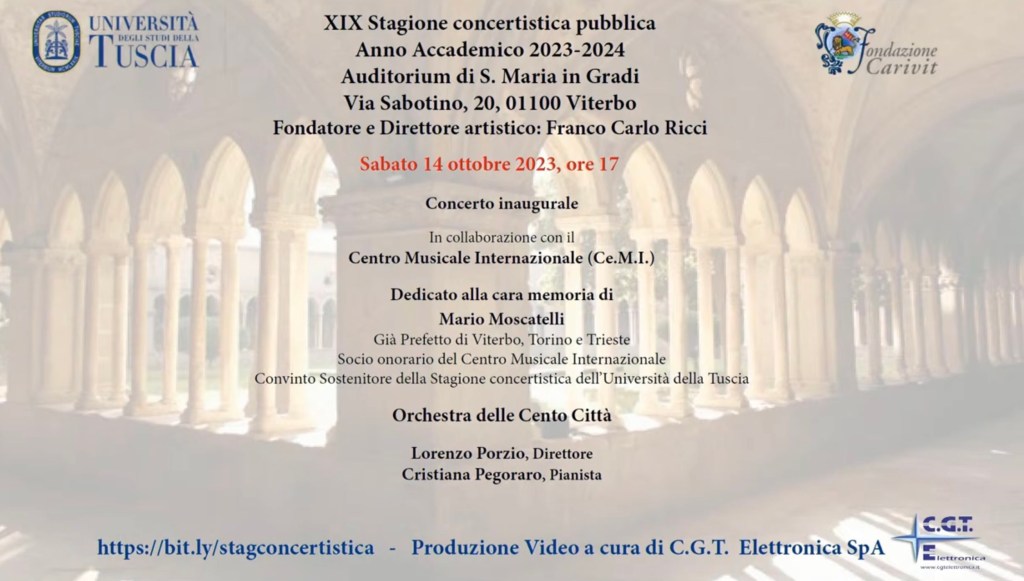
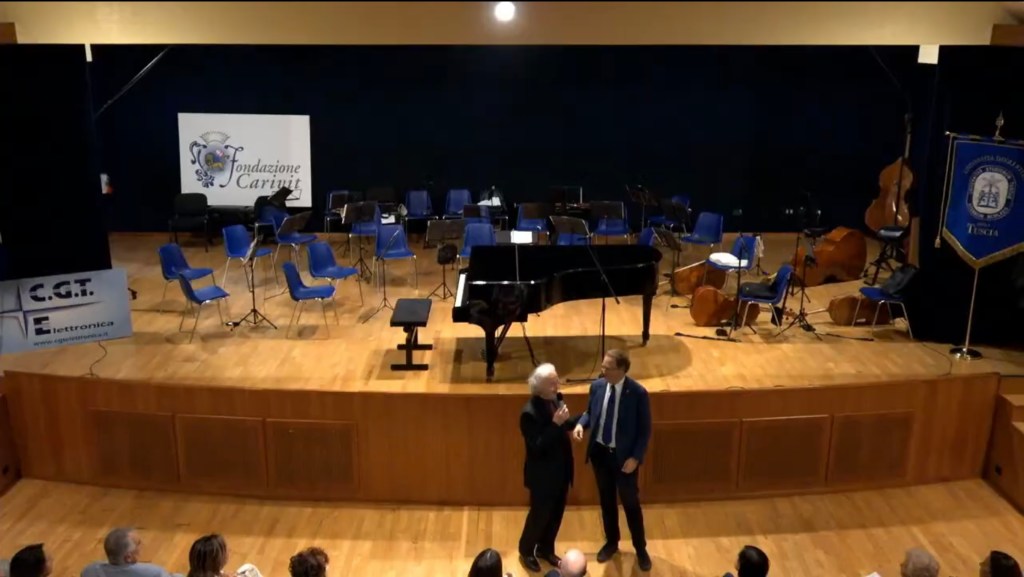
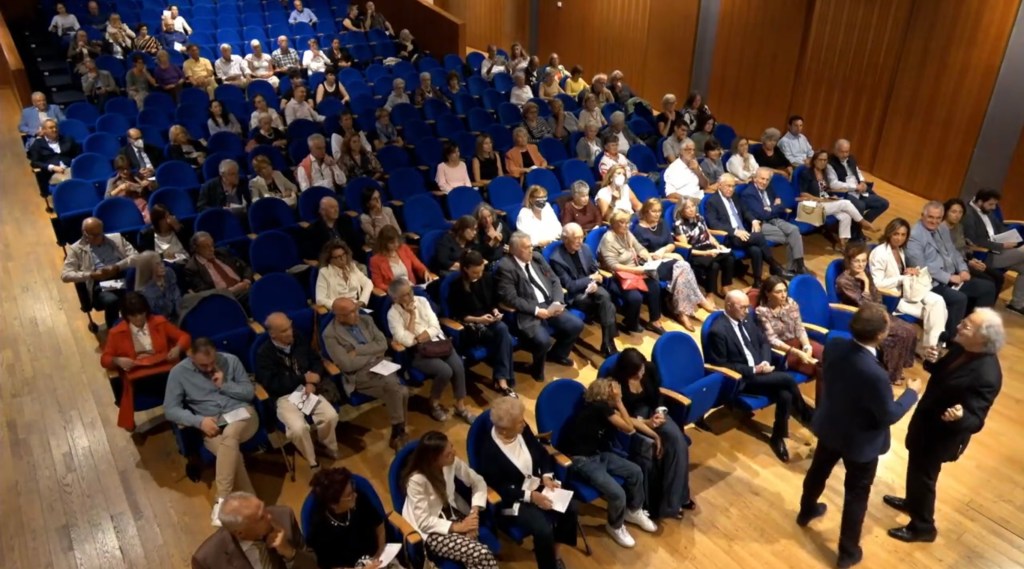
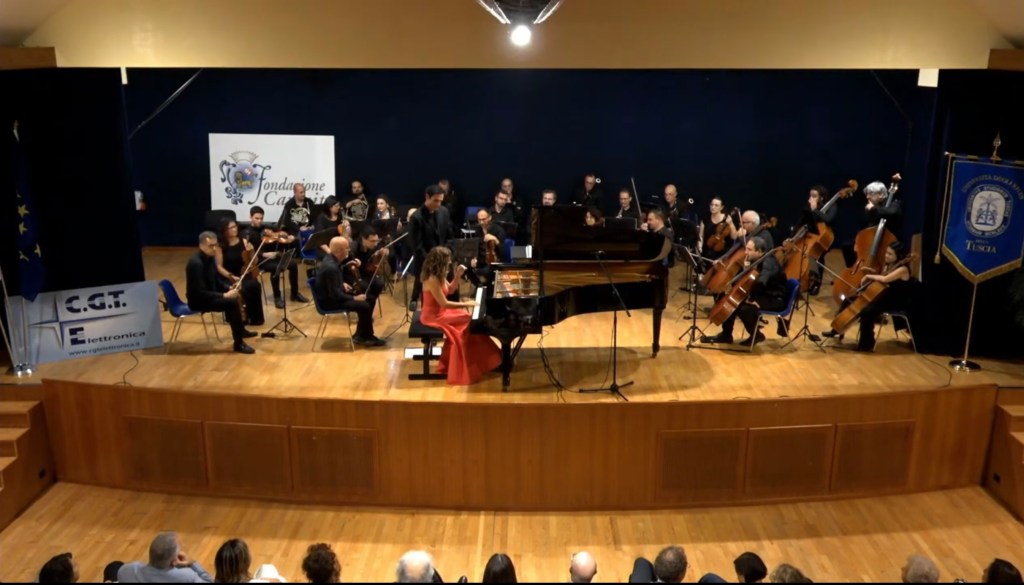
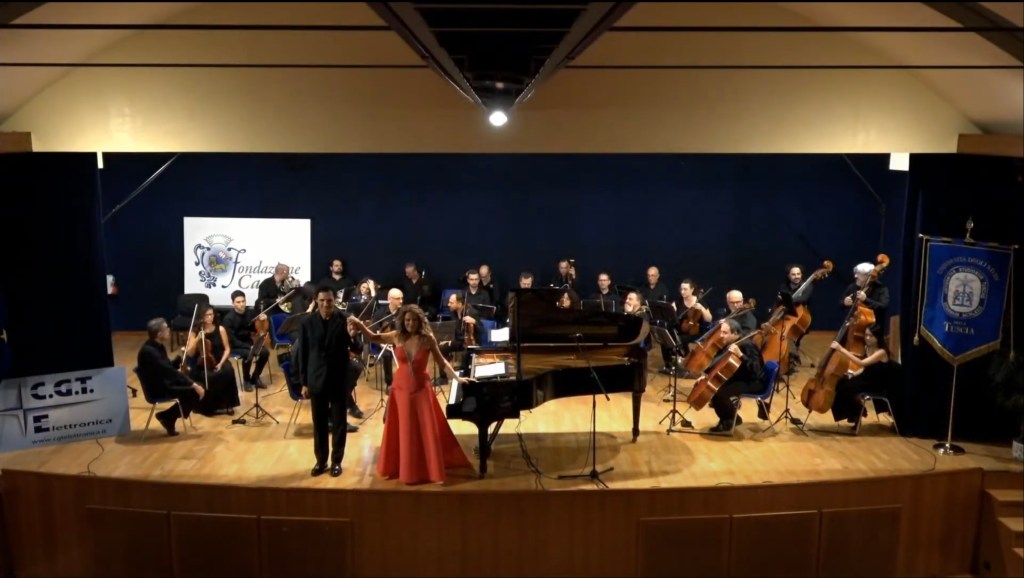
dell’Università degli Studi della Tuscia riprende l’attività inaugurando la XIX Edizione 2023-2024 sabato 14 ottobre 2023, alle 17. Come sempre i concerti si terranno nell’Auditorium di S. Maria in Gradi.
Il Concerto d’inaugurazione della Stagione concertistica dell’Università della Tuscia al quale, in considerazione dell’importanza dell’evento, hanno assicurato la presenza il Rettore dell’Ateneo, Prof. Stefano Ubertini, e il Direttore generale, Dott.ssa Alessandra Moscatelli.
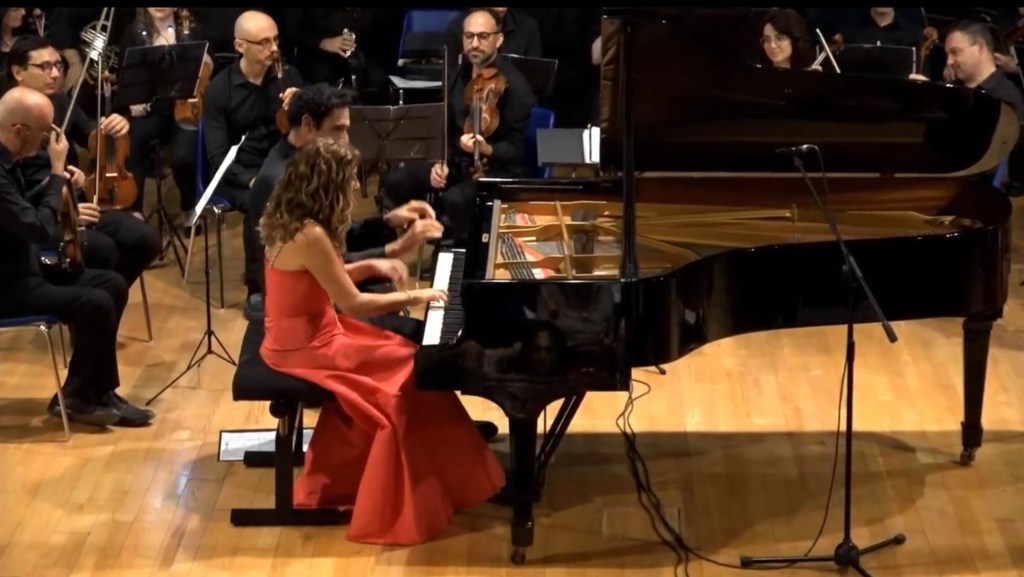
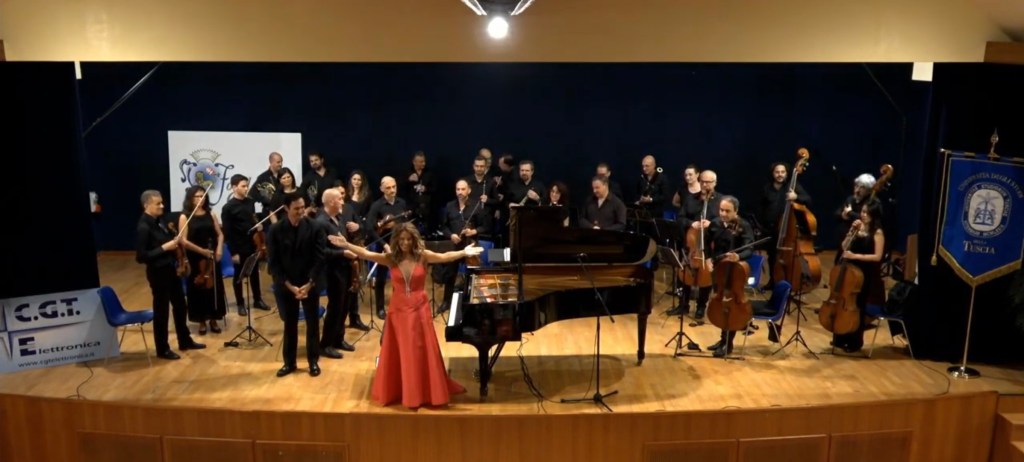
Sarà un evento di particolare importanza perché ne saranno protagonisti Lorenzo Porzio, alla guida dell’Orchestra delle Cento Città e la pianista Cristiana Pegoraro. Il programma, di grande interesse e godibilità prevede di Wolfgang Amadeus Mozart (Salisburgo, 1756-Vienna, 1791) il
Concerto per pianoforte e orchestra K. 488e la Sinfonia K 550 n. 40.
L’evento, in collaborazione con il Centro Musicale Internazionale (Ce.m.i.), è
dedicato alla cara memoria di Mario Moscatelli, che
recentemente ci ha lasciato.
Già Prefetto di Viterbo, Torino e Trieste, il Dott. Moscatelli era Socio onorario del Centro Musicale Internazionale e Convinto Sostenitore della Stagione concertistica dell’Università della Tuscia.
Nella sala antistante l’Auditorium, dopo il concerto, la nota Casa vinicola Casale del Giglio sarà presente con il “Banco di Assaggio ” per far conoscere varie etichette dei propri vini bianchi, rosati e rossi.
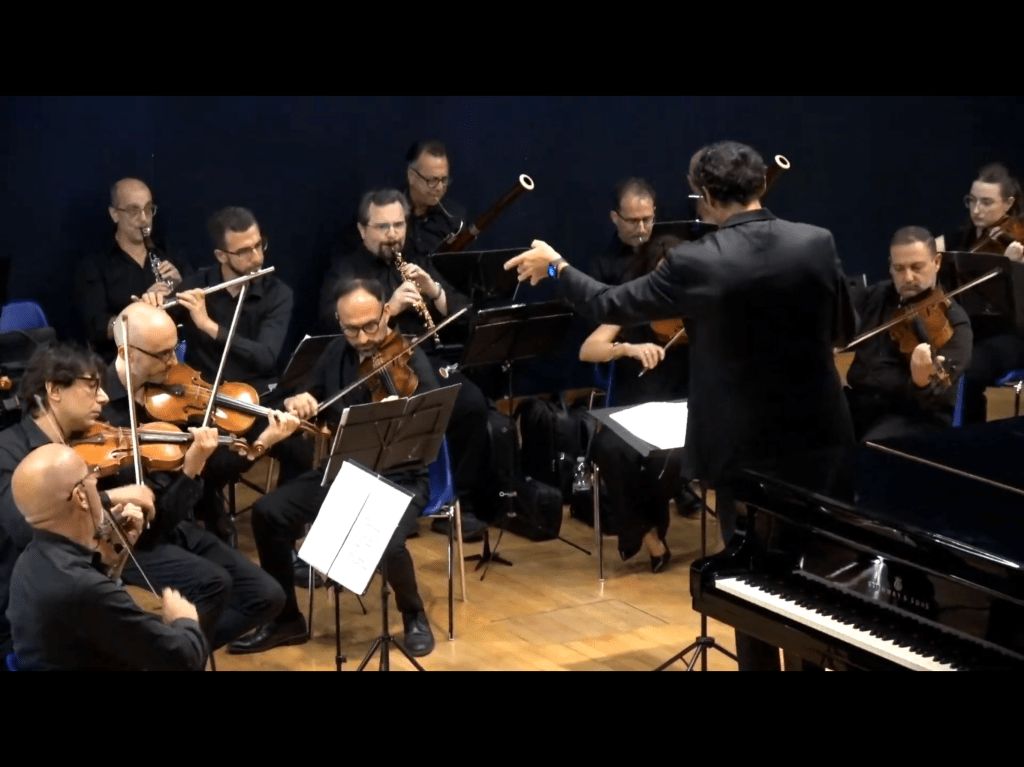
Some fine playing from the Orchestra delle Cento Città under Lorenzo Porzio with a programme dedicated to the genius of Mozart.A programme announced as the G minor Symphony and the A major piano concerto K.488 but there were surprises too.The first was the inclusion of the Overture to La Nozze di Figaro that opened the programme.An exhilarating performance full of rhythmic nervous energy beautifully shaped and its four minutes brought vividly to life.I remember my wife,Ileana Ghione asking a family friend, the great conductor and pedagogue,Franco Ferrara what was the secret of conducting?He just opened his arms in a gesture like entering water with a naturalness and continual flowing movement.Of course in the hands of a genius like Franco Ferrara it was so simple but in other hands it can seem like stabbing at the orchestral players with disjointed movements that can often lead to ragged ensemble and an overall lack of fluidity and cohesion .
It was refreshing to watch the beauty and fluidity of the arms of Lorenzo Porzio as he waded in to the musical sea with his excellent companions.The opening Molto Allegro of the G minor Symphony with a beautifully flowing tempo and superb phrasing contrasted both the lyrical and rhythmic but never loosing the underlying drive and sense of architectural shape.There was great drama too in the development where he found a clarity of line of intelligent musicianship with the question and answer between instruments.There was a Pastoral feel to the Andante with the wind players magical accompaniment to the sublime string melodic line .A real duet of almost chamber music proportions with the players listening attentively to their musical colleagues in a real musical conversation .Overseen but never interrupted by such a sensitive conductor who realised that this remarkable Andante is the very heart of this Symphony.The Menuetto was played with a nobility of driving dance rhythms .There was a beautiful contrasting lyricism to the trio as the strings were answered by the wind with great lyricism and charm.A buoyancy to the Allegro assai with its dynamic rhythmic contrasts of question and answer between the strings and the wind all superbly directed and never loosing the overall shape of this masterpiece, much admired by Beethoven and Schubert ,which is Mozart’s final Symphonic trilogy of which this could be considered the wonderfully lyrical central movement.
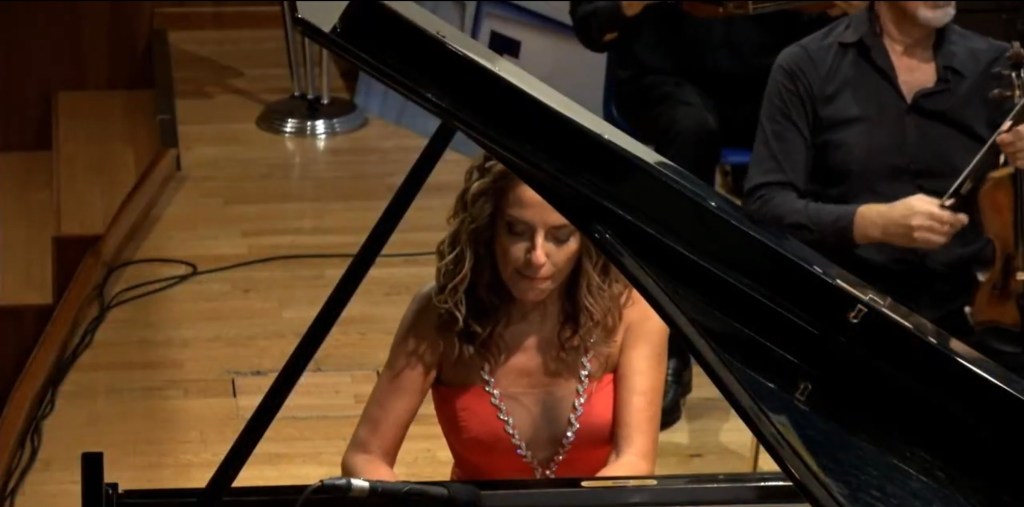
There was a beautiful fluidity too to the opening of the A major Piano Concerto K.488 which created the ideal opening for the crystalline playing of Cristiana Pegoraro.There was beautifully sensitive playing too in the second subject with great delicacy but never loosing the simplicity and clarity that is the Mozart that can be too difficult for adults but too easy for children.There is a sublime simplicity which Cristiana showed us with disarming elegance and ease with the evident joy of discovery.Nowhere more so than in Mozart’s own cadenza played with the same freedom and sense of improvisation that the composer himself must have discovered on the spur of the moment.
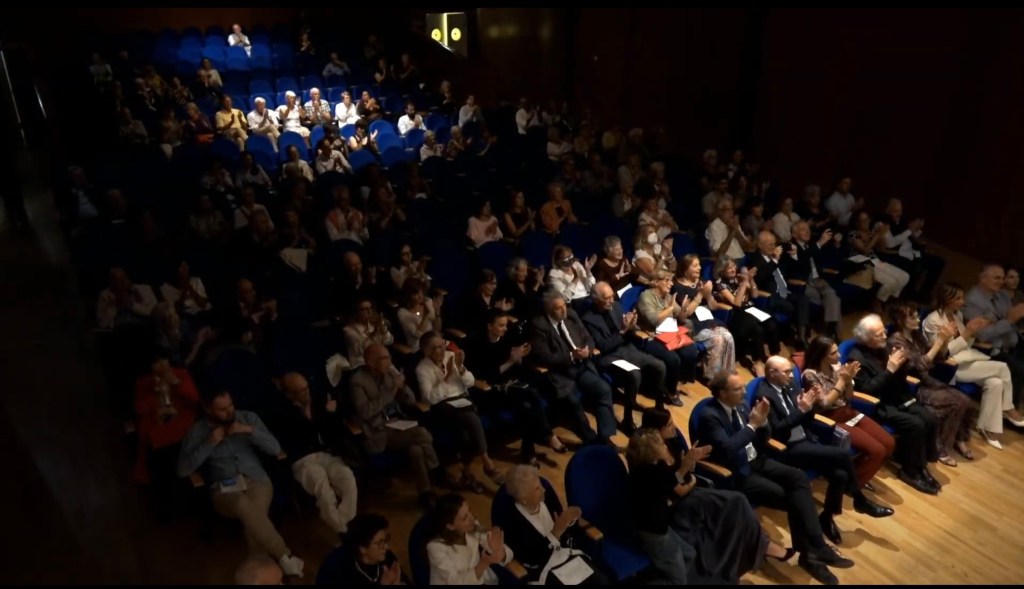
The ‘Adagio’ reached moments of sublime beauty with the piano and orchestra playing with equal sensitivity.A real duet in which the simple unadorned notes of the piano shone like jewels as the strings merely plucked their instruments with the wind providing the warmth of the harmonic invention.Cristiana happy to play Mozart’s notes without any of the ornamentation that we are plagued with these days in the name of authenticity.What a relief it was to hear this truly sublime simplicity!There was an infectious ‘joie de vivre’ to the ‘Allegro assai’ with virtuoso bassoon playing too replying to the pianists left hand with great technical skill and artistry.Cristiana with Lorenzo managed to purvey their obvious enjoyment at making music together in a continual joyous conversation between the piano and orchestra.An ovation from the audience at this opening concert of the season and it was now time to share one of Cristiana’s own compositions with an audience demanding more.’
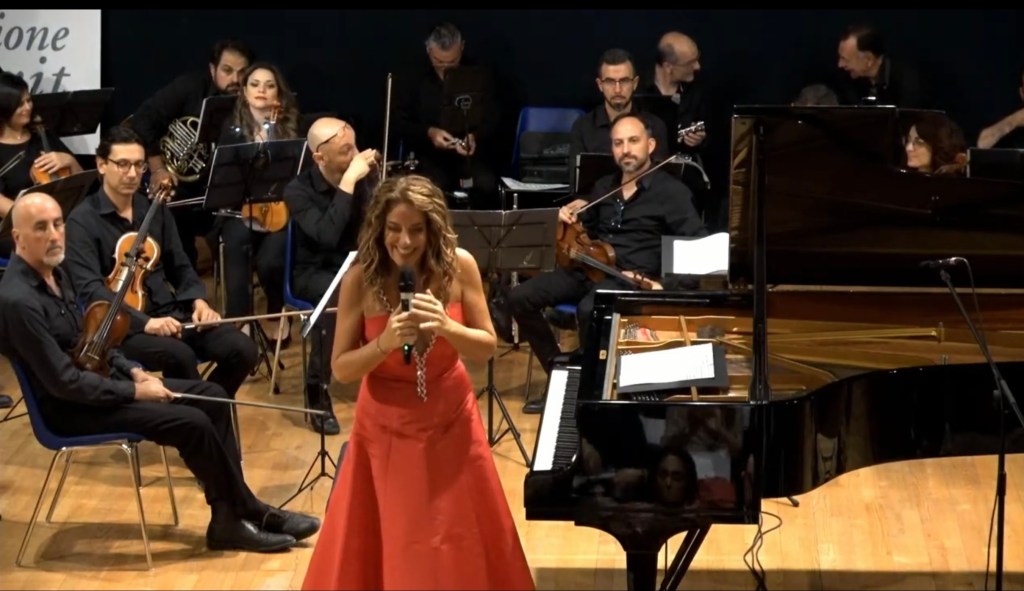
Sail Away’ is a piece that Cristiana has played in her recitals throughout the world and is a moving voyage of life .Life that is such a wondrous gift to us all.And what a joyous atmosphere she was able to create with her superb playing spilling over into an even more unexpected encore.
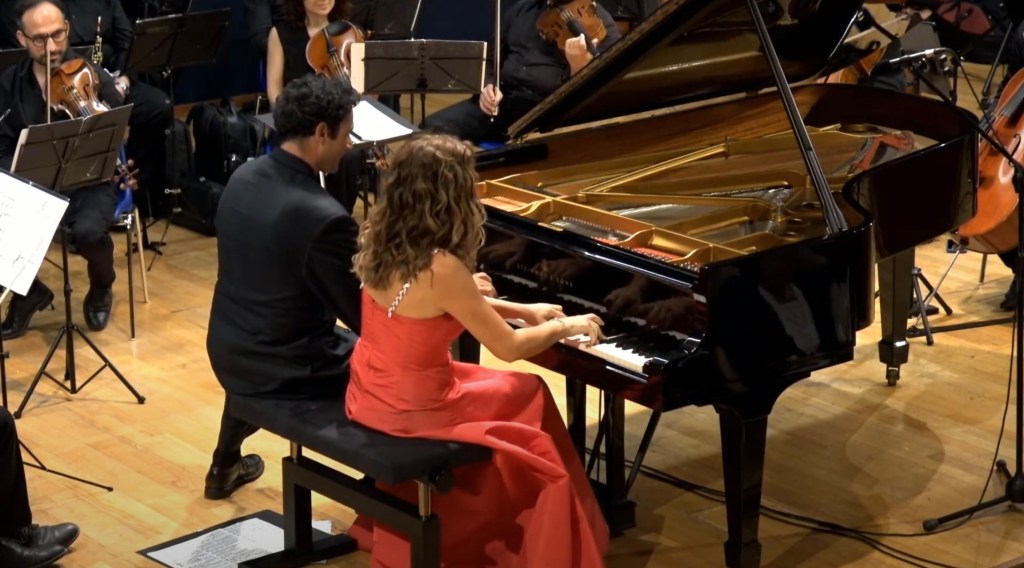
The ‘Turkish March’ by Mozart not only the last movement of his Piano Sonata but on this occasion turned into a joyous march in which her companion Lorenzo joined her at the keyboard as he also conducted the orchestra in the ‘chorus’.What a wonderfully joyous start to a glorious season of great music making .
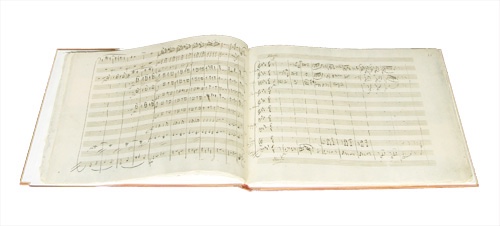
The opening page of the autograph manuscript The Piano Concerto No. 23 K.488 was finished, according to Mozart’s own catalogue, on March 2, 1786, two months prior to the premiere of his opera, Le nozze di Figaro ,and some three weeks prior to the completion of his concert in C minor K 491.It was one of three subscription concerts given that spring and was probably played by Mozart himself at one of these. Mozart c. 1788 Symphony No. 40 in g minor K.550 was written in 1788 and is sometimes referred to as the “Great G minor symphony”, to distinguish it from the “Little G minor symphony”, n.25. The date of completion of this symphony is known exactly, since Mozart in his mature years kept a full catalogue of his completed works; he entered the 40th Symphony into it on 25 July 1788.Work on the symphony occupied an exceptionally productive period of just a few weeks during which time he also completed the 39th and 41 st (Jupiter ) Symphonies (26 June and 10 August, respectively)..It has been suggested that Mozart composed the three symphonies as a unified work, pointing, among other things, to the fact that the Symphony No. 40, as the middle work, has no introduction (unlike No. 39) and does not have a finale of the scale of No. 41’s.Schumann regarded it as possessing “Grecian lightness and grace”.Charles Rosen called the symphony “a work of passion, violence, and grief.”Beethoven knew the symphony well, copying out 29 bars from the score in one of his sketchbooks.Schubert likewise copied down the music of Mozart’s minuet.Of his last three symphonies, Symhony No.40 is the most influential and visionary in its technical detail and emotional effect. Throughout the nineteenth century, its darker tone was hailed as a rare advance from the presumed superficiality of Mozart’s other work. Opinion among conductors varies as to which version, the first or second (the one with the addition of two clarinets, perhaps made for a specific performance), is the most powerful. The autograph scores, now in the possession of Gesellschaft der Musikfreunde in Vienna were once proudly owned by Johannes Brahms—he received them as a gift from Princess Anne of Hesse to whom the composer had dedicated his Piano Quintet in F Minor, op.34.
The symphony is scored (in its revised version) for flute , 2 oboes , 2 clarinets,, 2 bassoons , 2 horns , and strings .
The work is in four movements :Molto allegro ,Andante ,Menuetto,Allegretto-Trio.finale.Allegro assai .
Mozart revised his symphony and this “demonstrates that it was in fact performed, for Mozart would hardly have gone to the trouble of adding the clarinets and rewriting the flutes and oboes to accommodate them, had he not had a specific performance in view.”The orchestra for the 1791 Vienna concert included the clarinetist brothers Anton and Johann Nepomuk Stadler ; which, as Zaslaw points out, limits the possibilities to just the 39 th and 40th symphonies.
“The version without clarinets must also have been performed, for the reorchestrated version of two passages in the slow movement, which exists in Mozart’s hand, must have resulted from his having heard the work and discovered an aspect needing improvement.”
In 1782, the French playwright, Beaumarchais, offered private readings to King Louis XIV of his comedy of manners, The Marriage of Figaro. Instead of being pleased, the monarch decided the story was “detestable and must never be produced.” The irreverence was simply too much. As “forbidden fruit,” the play became the rage of the aristocracy, and it surfaced repeatedly in secret productions (one even including the King’s wife.) Like the King, Napoleon also sniffed danger in the plot, and he declared that the play was “the revolution already in action.” The Austrian government echoed the danger and banned the play from its borders. In 1784, the play was presented publicly in Paris to great acclaim, and within a year, Germany had twelve translations on hand. The Marriage of Figaro was unquenchable.
After searching through hundreds of plays for an opera buffa, Mozart decided this was just the ticket. With the librettist Lorenzo da Ponte, the pair produced the opera Marriage of Figaro in only six weeks. The Overture was completed only two days before the opening on May 1, 1786.
The overture to the opera Le nozze di Figaro, the first of Mozart’s three collaborations with librettist Lorenzo Da Ponte (the other two are Don Giovanni and Così fan tutte), begins with a busy whispering and buzzing that develops quickly into a short-breathed little theme that might just slip by the less than alert listener. Then, bang!, comes a tutti with trumpets and drums, the music subsequently driven by scampering violins, flutes, and oboes in a succession of hectically upbeat figurations, the whole accomplished in four minutes. The piece is self-contained, which is to say that it does not quote themes from the opera proper nor does its ending fade into the opening measures of the opera, both also characteristic of the overtures to Mozart’s Abduction from the Seraglio, Così fan tutte, and The Magic Flute. The Figaro overture does, however, give us a delectable foretaste of the mood of its opera: fleet, witty, often acerbic in its humor.The overture, it might be noted, originally contained a slow middle section with a melancholy oboe solo. But contrast be damned, Mozart wisely decided, and maintained the swirling, manically jolly mood throughout. Figaro was first presented on the stage of Vienna’s Burgtheater in May of 1786. The composer conducted from the keyboard.Written for 2 flutes, 2 oboes, 2 clarinets, 2 bassoons, 2 trumpets, 2 horns, timpani, and strings
Stagione concertistica pubblica
Auditorium di S. Maria in Gradi
Via Sabotino, 20, 01100 Viterbo
Fondatore e Direttore artistico: Franco Carlo Ricci
XIX Stagione concertistica 2023-2024
Ottobre 2023
Sabato 14, ore 17
In collaborazione con il
Centro Musicale Internazionale (Ce.M.I.)
Concerto dedicato alla cara memoria di
Mario Moscatelli
Già Prefetto di Viterbo, Torino e Trieste
Socio onorario del Centro Musicale Internazionale
Convinto Sostenitore della Stagione concertistica dell’Università della Tuscia
Orchestra delle Cento Città
Lorenzo Porzio, direttore
Cristiana Pegoraro, pianoforte
Wolfgang Amadeus Mozart (Salisburgo, 1756-Vienna, 1791)
Concerto per pianoforte n. 23 in la maggiore, K 488
(Allegro; Adagio; Allegro assai)
Sinfonia n. 40 in sol minore, K 550
(Molto allegro; Andante; Minuetto e trio. Allegretto; Allegro assai )
Sabato 21, ore 17
In collaborazione con il
Club Rotary Roma-ovest e il
Centro Musicale Internazionale
Orchestra “I concerti del Tempio”
Direttore
Daniele Camiz
Talenti emergenti del Magisterium pianistico di Marcella Crudeli
Wolfgang Amadeus Mozart (Salisburgo, 1756-Vienna, 1791) Idomeneo Re di Creta K 366
Ouverture
Wolfgang Amadeus Mozart (Salisburgo, 1756-Vienna, 1791) Dal Concerto in La Maggiore KW 414
(Primo movimento – Allegro)
Pianista
Giuseppe Manes
Ludwig van Beethoven (Bonn, 770-Vienna, 1827) Dal Concerto N. 2 in Si Bemolle Maggiore op. 19
(Primo movimento – Allegro con brio)
Pianista
Marianna Ruggiero
Ludwig van Beethoven (Bonn, 770-Vienna, 1827) Concerto N. 1 in Do Maggiore op. 15
(Allegro con brio; Largo Rondò-Allegro)
Pianista
Vera Cecino
Sabato 28 ore 17
Pianista
Riccardo Natale
Georg Friedrich Händel (Halle, 1685-Londra, 1759)
Suite HWV 427 in Fa maggiore
Fryderyk Chopin (Żelazowa Wola, 1810-Parigi, 1849)
Quattro Mazurke op. 30
Polonaise op. 44
*
Robert Schumann (Zwickau, 1810-Endenich, 1856) Davidsbundlertänze op. 6
Feat. Mario Marzi, sax soprano, contralto e baritono
Paolo Innarella, flauto, bansuri, sax soprano e tenore
Rohan Dasgupta, sitar
Marco de Tilla, contrabbasso
Sanjay Kansa Banik, tabla
Programma
Composizioni e arrangiamenti di Giuliana Soscia
Samsara, Indian Blues, Arabesque, Gange, Alpha Indi, Bloodshed
In collaborazione con
ISMEO-Associazione Internazionale di Studi sul Mediterraneo e l’Oriente
Progetto MUR CUP B85F21002660001
Sabato 18, ore 17
Gianluca Giganti, violoncello
Anna Lisa Bellini, pianoforte
In ricordo di Sergio Viterbini a 80 anni dalla morte
Fryderyk Chopin (Żelazowa Wola, 1810-Parigi, 1849)
Introduction et Polonaise, op. 3
Giuseppe Martucci (Capua, 1856-Napoli, 1909)
Due Romanze op. 72
Francesco Cilea (Palmi, 1866-Varazze, 1950)
Romanza dalla Sonata op. 38
Sergio Viterbini (Viterbo1890-1943)
Sogno
Canto d’amore
Il Kuku
Fryderyk Chopin (Żelazowa Wola, 1810-Parigi, 1849)
Sonata in sol minore op. 65
(Allegro moderato; Scherzo: Allegro con brio (re minore);
Largo (si bemolle maggiore); Finale: Allegro)
Sabato 25, ore 17
Pianista
Arturo Stalteri
MUSICA DALLA TERRA DI MEZZO
Prima Parte
Arturo Stàlteri
Le ultime luci di Brea
Verso Lòrien
Un viaggio inaspettato
Èowyn
Gandalf the white
The grey havens’ lullaby
Cavalieri neri
Seconda Parte
Howard Shore (Toronto, 1946)
Hobbit theme
Leonard Rosenman (New York, 1924-Los Angeles, 2008)
Theme from The Lord of the Rings
Mithrandir
Annbjørg Lien (Ålesund, Norvegia, 1971)
Galadriel
Enya (Gaoth Dobhair, Irlanda, 1961)
Lothlòrien
May it be
Bo Hansson (Göteborg, Svezia, 1943-2010, Stoccolma)
Homeward bound
The old forest
Dicembre 2023
Sabato 2, ore 17
Matteo Bonaccorso, flauto
Marco Nucci, flauto
Jacopo Petrucci, pianoforte
Jacques Ibert (Parigi, 1890-1962)
Deux Interludes per due flauti e pianoforte.
Claude Debussy (Saint-Germain-en-Laye, 1862-Parigi, 1918) Images I per pianoforte solo
(Reflets dans l’eau; Hommage à Rameau; Mouvement)
Petite suite per due flauti e pianoforte
(En bateau; Cortège; Menuet; Ballet)
Maurice Ravel (Ciboure, 1875-Parigi, 1937) Suite da Ma Mère l’Oye per due flauti e pianoforte
(Pavane de la Belle au bois dormant; Petit Poucet; Laideronnette, impératrice des pagodes; Les entretiens de la belle et de la bête; Le jardin féerique)
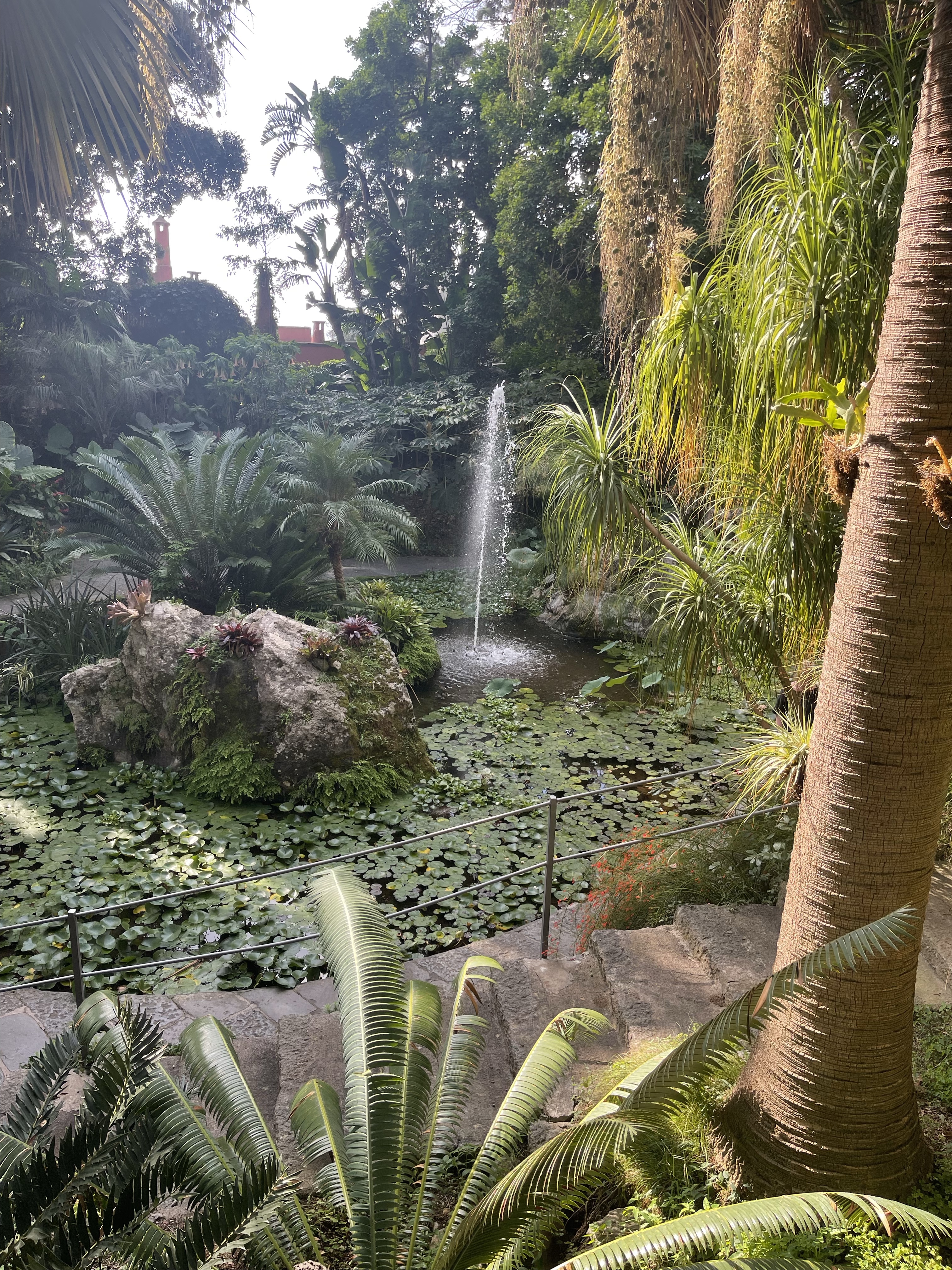
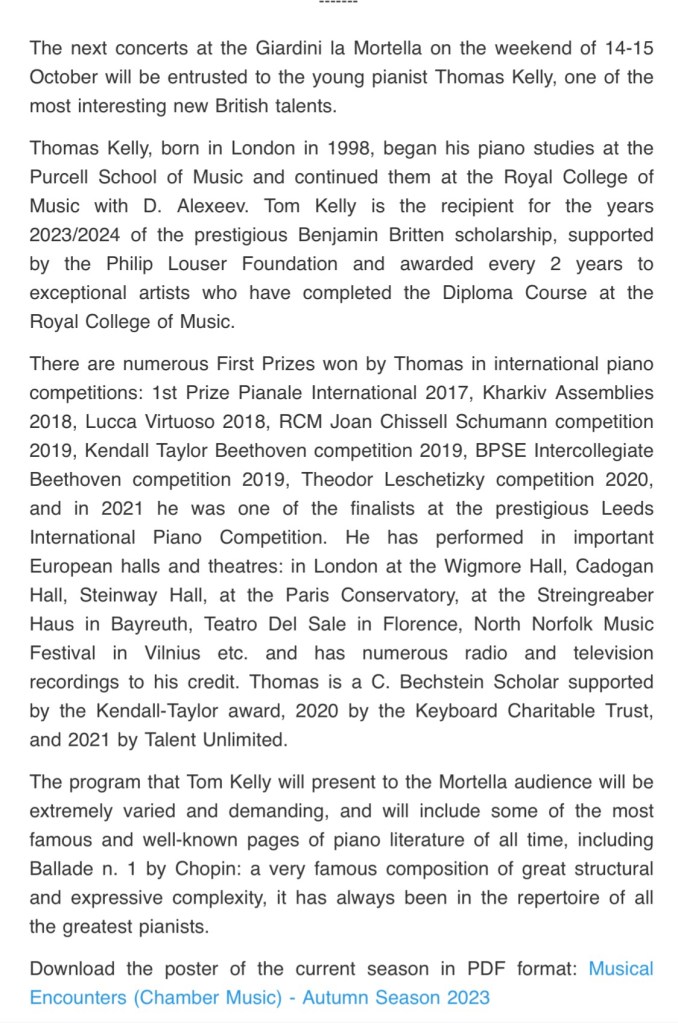
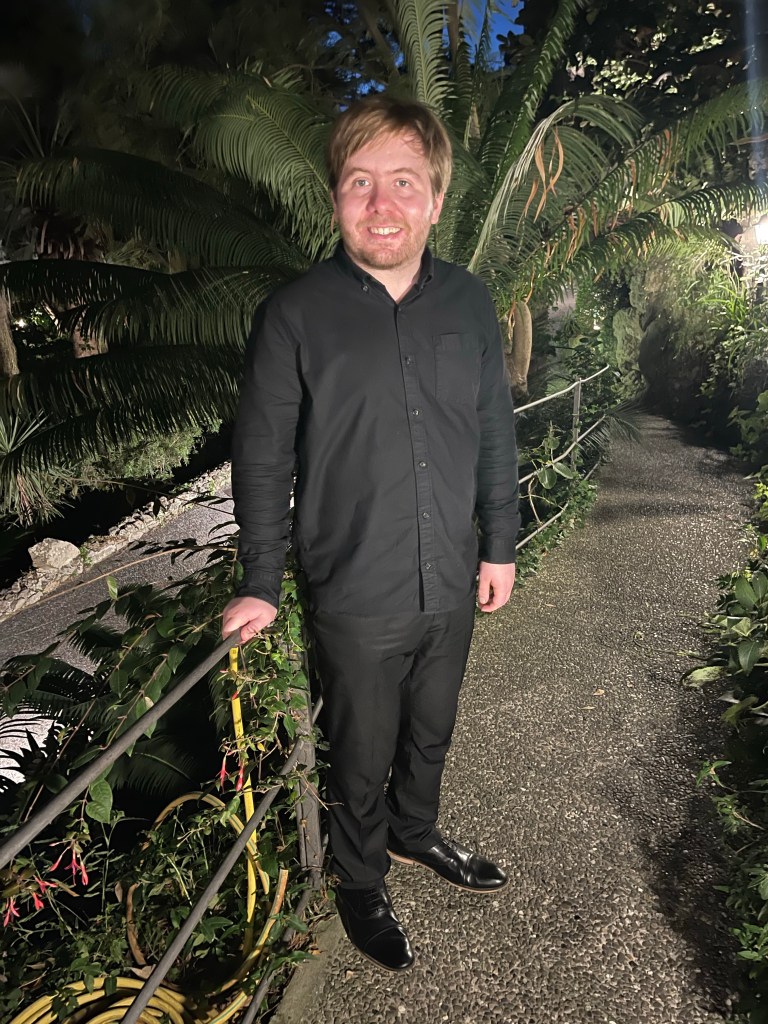
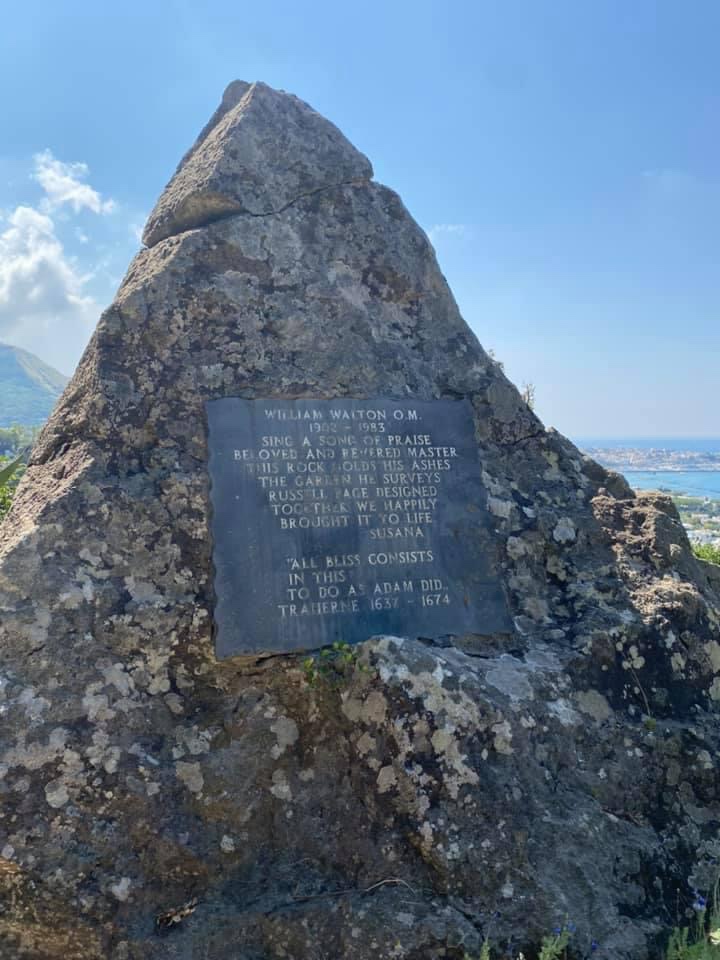
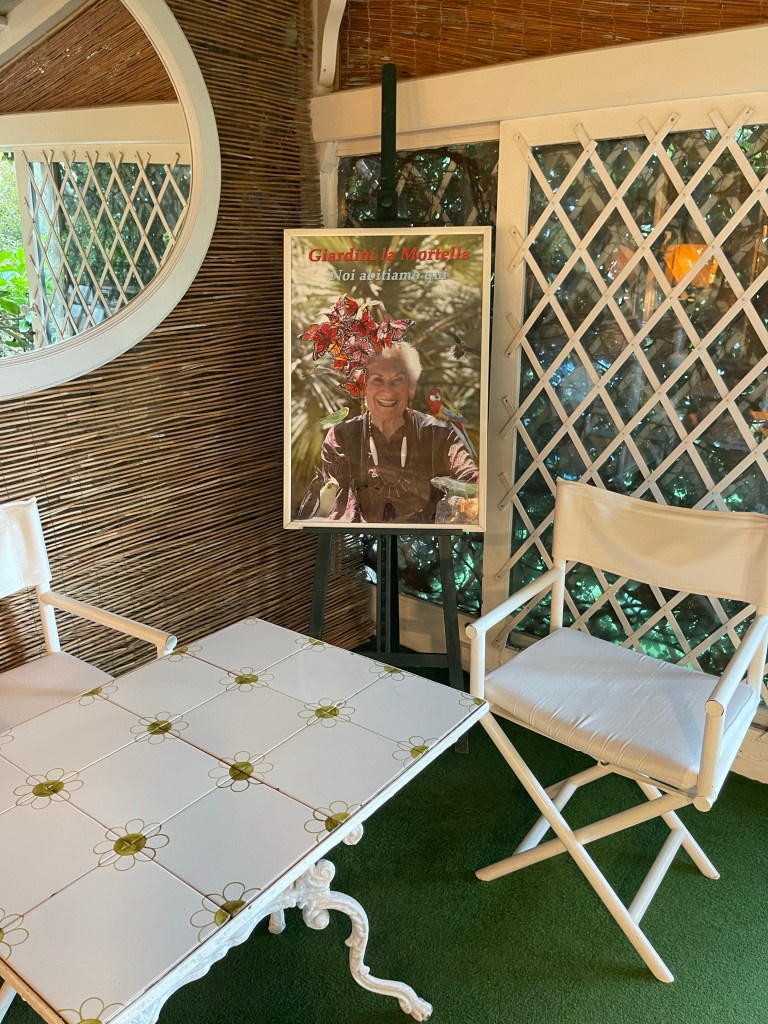
A standing ovation for playing that was just made for paradise. The paradise that Susana created to turn her husband’s dreams into reality. Sir William and Susana resting now overlooking their child that was born of the love of beauty that they shared together for over fifty years . Ogdon ,Richter ,Bream,Tortelier and many others all used to rent Lady Walton’s cottages that surrounded the estate of La Mortella.The cottages have now been sacrificed to set up a trust fund so the Walton Foundation can live on forever as was Sir William’s wish. I doubt that La Mortella has ever heard such sounds as Thomas Kelly conjured from the piano tonight. A refined palette of golden sounds allied to superb musicianship but above all the magic of an occasion that allowed us to wallow in sumptuous sounds with an impassioned demonic technical mastery that was both exhilaration, exciting and most definitely X certificate. Looking like Rachmaninov as though he had swallowed a knife but then producing ,like Vlado Perlemuter use to tell me,the most romantic sumptuous sounds from the piano. Horowitz too,head down just a twitch of his lips but some of the most obscenely decadent sounds that are only to be found by those who have truly made a pact with the devil. There was the most extraordinary display of Thalberg’s one upmanship on Liszt with his Don Pasquale Grande Fantaisie.Followed by the demonic throbbing of Mephisto that was heard in the distance as it came closer and closer and ever more insistent.The additions of Busoni and Horowitz added even more hair raising virtuosity and brilliance in a breathtaking display of playing that we have only heard recounted of the long past generation of a Golden era.
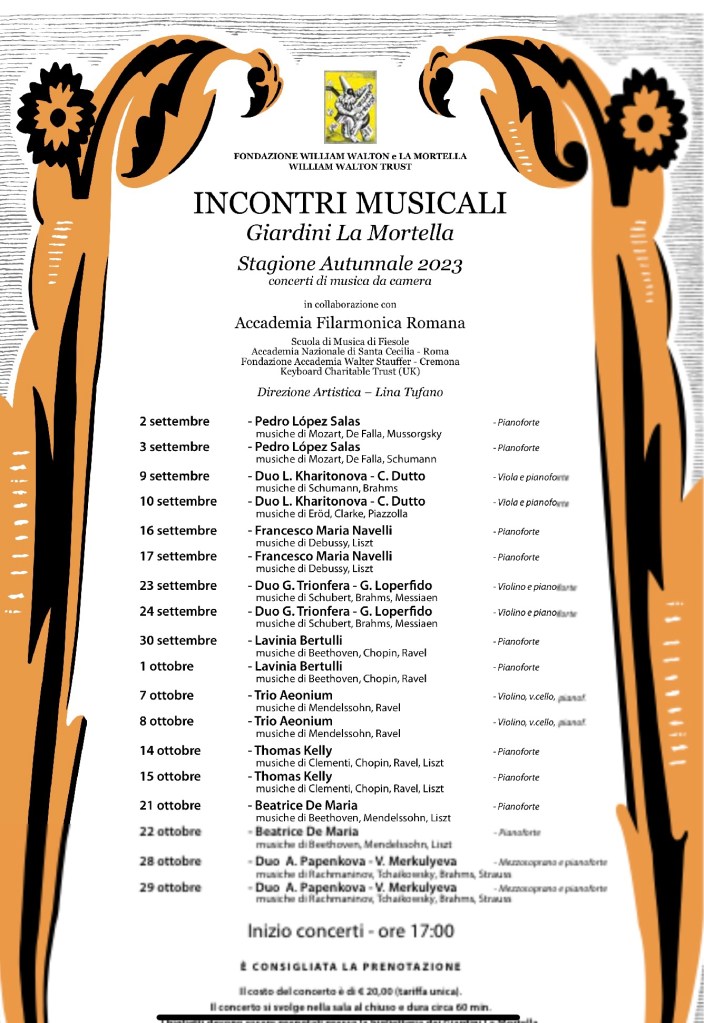
A standing ovation from an audience who had come to admire the botanical gardens but found themselves almost devoured by the devil. Pushed on stage by Lina Tufano , the artistic director of the Incontri Musicali, demanding an encore. Reluctantly and visibly exhausted Tom pulled out of his top hat a Campanella by Liszt and Busoni that was so astonishing the cheering at end was probably heard in Naples . Little could they have known that the evening before Tom had played a completely different programme including a monumental performance of Rachmaninov’s first sonata -up until now the poor relation of the second. This was just a break from Brahms 2 a week ago and Schumann A minor next week. Of course I forgot to mention that he plays here in Ischia on Monday Cesar Franck’s notoriously complex Piano Quintet . All this and Tom tells me he too will have a birthday soon. My 75th is tomorrow and what better way to celebrate than the birth of one of the greatest talents I have known.Amazingly Tom celebrates his 25th at the end of the month too .I am Libra but of course he is Scorpio!Fifty years may separate us but it is his music that unites us all in the end.
The Maxwell Quartet with Simon Rowland-Jones
To say we are in the hands of a piano genius is to put it mildly! The perfect balm after such decadence was to eavesdrop on a private performance of Mozart’s C major Quintet . The Maxwell Quartet giving an intimate performance as might have been when it was first penned. There was a complicity between musicians with the same souls playing with charm,elegance and grace but with a beguiling musicianship that allowed the superb cellist,Duncan Strachan,to be visibly encouraging his colleagues to indulge and enjoy even more the genius that is Mozart. Simon Rowland-Jones was the fifth partner in crime and it is he who for nineteen years has been bringing the Kirker Music Festival to La Mortella under the very discerning eye of Susana Lady Walton ….if music be the food of love ….play on ……with the Walton’s united again and looking on admiringly from their resting places next to each other on high.
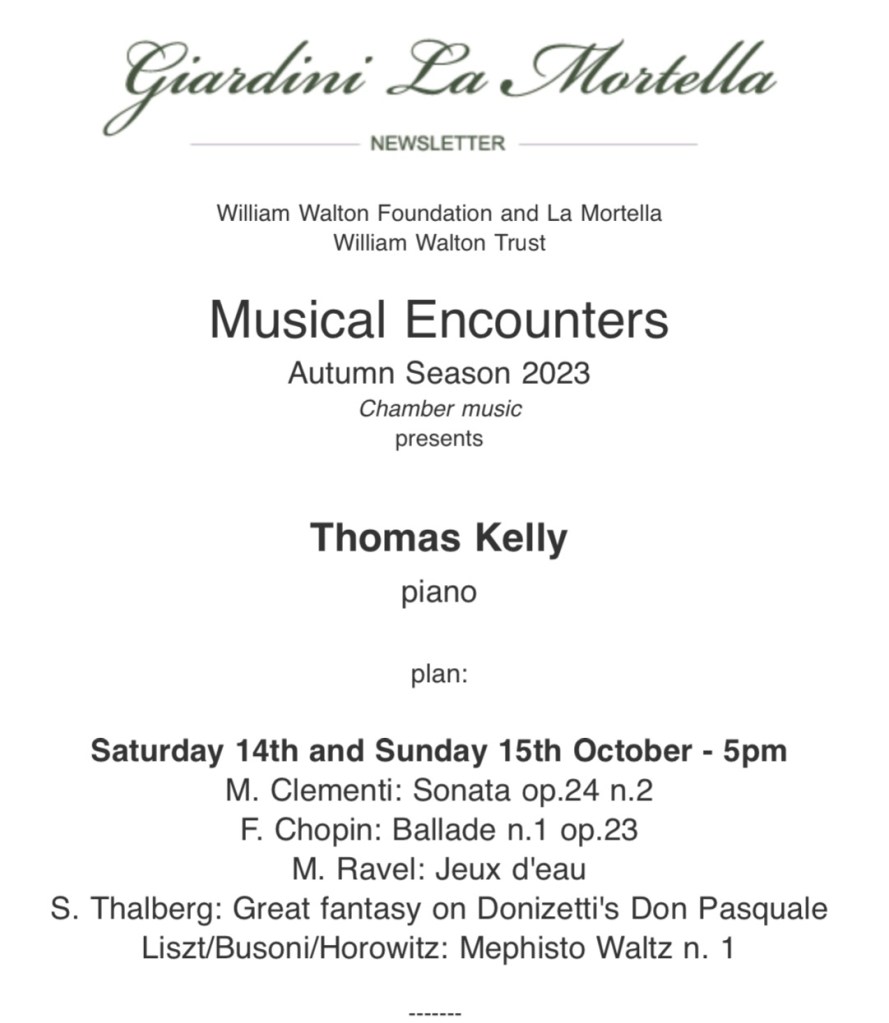
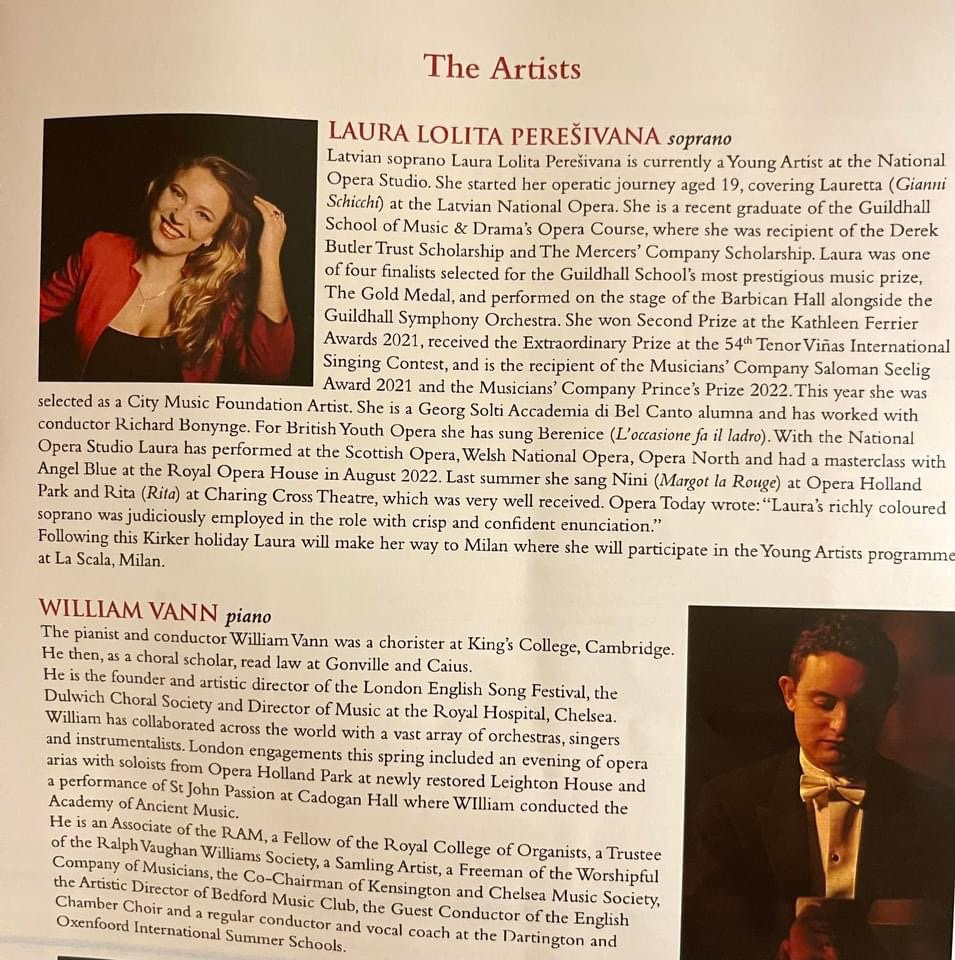
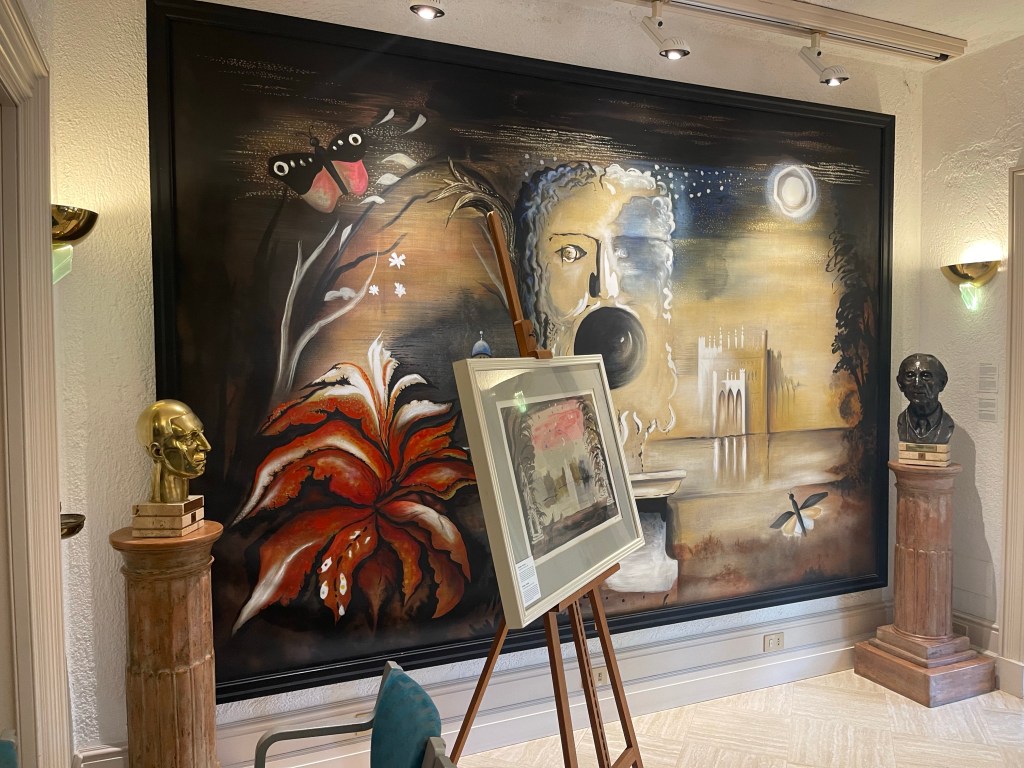
The resting place of Sir William and in the shadow of the big rock that contain his ashes ,that of his wife Susana .Lady Walton died in 2010 almost 25 years after her beloved husband and who,in his memory,their wishes she was so magnificently able to fulfill.Susana ever vigilant One of Clementi’s 110 Sonatas op 24 n.2 the one that was to inspire Mozart in his last opera ‘The Magic Flute’. It was played not only with the rhythmic brilliance of Clementi’s seemingly endless stream of notes but above all there was the elegance and sense of style of an inquisitive musical mind,with the same kaleidoscopic change of colour of looking through a prism.A grandiose opening of the ‘Andante’ that was indeed quasi ‘Allegretto’ with cascades of notes that were jewels glistening as they were shaped with a beguiling sense of elegance and style.The tongue in cheek after thought of the coda was thrown off with disarming nonchalance There was a remarkable ease with which notes became just streams of brilliant sounds in the Rondo ‘Assai Allegro’ ‘They could not be called jeux perlé because they were imbued with a driving energy that brought this much neglected sonata to a brilliant conclusion.There was a subdued opening to Chopin’s much abused First Ballade.Bathed in a long held pedal that had me searching the score to see if it was Chopin’s own very precise indication.The pedalling in Chopin,so often overlooked,gives us a precious insight into the sounds and shapes that Chopin wanted from his long Bel canto outpourings.Not sure if it was Chopin or Tom’s great sensitivity to sound that immediately turned this opening into a magic wand opening the flood gates to Chopin’s ravishingly beautiful long cantilenas.A subtle melodic line that was allowed to take flight with a ravishing sense of balance and delicacy.Leading to the first passionate outpouring that was shaped with sumptuous beauty and subtle phrasing that put this much maligned Ballade back where it belongs as one of the most original and beautiful early works of an innovative poetic genius of the piano.The jeux perlé that followed produced gleaming sounds rising and falling with a remarkable control that never lost sight of the music or allowed it to veer out of control as it so often does in the hands of so called ‘virtuosi’. A coda shaped like the true musician that Tom is but also played with the excitement and exhilaration of a Horowitz who like Liszt was also the greatest showman on earth too. Floristan and Eusebius are nothing compared to this ‘Devil and the deep blue sea’ approach from artists of such diabolical temperament.There was beauty and fluidity that Tom brought to Ravel’s ‘Jeux d’eau’ with an etherial sound of gossamer finesse and refined virtuosity.The curtain had now risen on Thalberg’s remarkable Grande Fantaisie on Donizetti’s Don Pasquale. Great drama and fantastic contrasts between legato and staccato with Thalberg – Liszt’s only true rival – showing us that the piano was also the greatest orchestra on earth capable of all the colours and sounds of the grandest of ensembles .Beguiling sounds seemingly appearing in every corner of the keyboard via a transcendental display of piano trickery of a different age.An age when technical mastery meant a chameleonic sense of colour each note containing a hundred gradations of sound and not just breaking the speed limit! Unbelievable the tumbling octave accompaniment over the entire keyboard whilst the melodic line was so perfectly shaped in the central most beautiful register of the piano. No wonder people of the day thought that Thalberg like Liszt and Paganini had made a pact with the devil to be given another couple of arms and hands.An amazing display of virtuosity in the true meaning of the word ,that of a complete mastery. It is Art that conceals Art as sumptuous sounds were allowed to erupt from this box of mere hammers and strings. Of course as Anton Rubinstein pointed out the pedal,a relatively new invention in their day ,is the real soul of the piano, and it is this that allows the illusion that a percussive instrument of hammers that hit the strings can appear to sing better than any Bel Canto nightingale of the day.There was a slow very deliberate opening to Liszt’s demonic Mephistophelian Waltz n.1 where even the opening octaves were played in a subdued melodic way with each one made up of four notes of different weight.This of course just opened the flood gates to a display of astonishing bravura of noble style and excitement. Horowitz,described on his first appearance in Paris,as the greatest pianist alive or dead,just added more colour and hysteria with the occasional added bass notes and padding out of chords.A filling out of embellishments too and adding double notes to Liszt’s already impossible antics. Bursting into red hot flames at the end where the showman Horowitz added octaves and all sorts of trickery that I am sure Liszt himself might have done given the evolution of the Steinway as opposed to its predecessor the Erard that was Liszt’s preferred instrument of the day. A spontaneous standing ovation reminded me of the stories in history books of aristocratic ladies in the Paris salons turning into hysterical animals trying to get as near as they dare to their conquering hero. A much more refined audience at La Mortella but they did manage to persuade Tom to play just one little piece before retiring. La Campanella by Liszt and his pupil Busoni produced even more phenomenal feats of subtle virtuosity that were breathtaking in their daring and refined beauty.Turning a pianistic showpiece into the tone poem that the Poet Liszt had intended with the same funabulistic virtuosity of Paganini translated by a Genius into a ravishingly beguiling show piece that like Paganini was only fit for a King.Alessandra Vinciguerra, Susana’s dedicated second in command and now Director of La Mortella .Fulfilling the Walton’s every wish to bring live music to the Gardens and especially to help young musicians at the beginning of their long climb up what can often be a very slippery ladder.Lina Tufano,artistic director of Incontri Musicali with Alessandra Vinciguerra ,director of La Mortella A second performance with the indomitable Lina Fortuna enjoying every minute of Tom’s extraordinary performances The extraordinary soprano Laura Lolita Perersivana provided the equally scintillating second evening recital And the equally extraordinary accompaniment and much more besides from William Van Three Sitwell songs by William Walton demonstrated what a wonderful but neglected composer he is .These three poems set to music with such flair and character that just illuminated Edith Sitwell’s amusing tantalising lines.Walton set three selections from Façade as art-songs for soprano and piano (1932),to be sung with full voice rather than spoken rhythmically. These are: Daphne Through Gilded Trellises Old Sir FaulkDame Edith looking on not amused The famous backcloth by John Piper for the first performance of Facade with Edith Sitwell reciting behind the screen with a megaphone in the mouth of the statue .The first performance was in the Aeolian Hall 100 years ago caused a scandal Portrait by Thomas Hardy (1794) Born Muzio Filippo Vincenzo Francesco Saverio Clementi 23 January 1752 Rome
Died 10 March 1832 (aged 80)Evesham United Kingdom
Muzio Filippo Vincenzo Francesco Saverio Clementi (23 January 1752 – 10 March 1832) was an Italian-British composer,virtuoso pianist, pedagogue,conductor , music publisher, editor, and piano manufacturer, who was mostly active in England.
Encouraged to study music by his father, he was sponsored as a young composer by Sir Peter Beckford who took him to England to advance his studies. Later, he toured Europe numerous times from his long-standing base in London. It was on one of these occasions, in 1781, that he engaged in a piano competition with Mozart.Clementi also produced and promoted his own brand of pianos and was a notable music publisher.Because of this activity many compositions by Clementi’s contemporaries and earlier artists have stayed in the repertoire. Though the reputation of Clementi was exceeded only by Haydn, Mozart, Beethoven, and Rossini in his day, his popularity languished for much of the 19th and 20th centuries.
As a composer of classical piano sonatas, Clementi was among the first to create keyboard works expressly for the capabilities of the piano. He has been called “Father of the Piano”.Clementi composed almost 110 piano sonatas ,some of the earlier and easier ones were later classified as sonatinas after the success of his Sonatinas Op. 36. Satie would later parody these sonatinas (specifically the Sonatina Op. 36, No. 1) in his Sonatine bureaucratique. However, most of Clementi’s sonatas are more difficult to play than those of Mozart, who wrote in a letter to his sister that he would prefer her not to play Clementi’s sonatas due to their jumped runs, and wide stretches and chords, which he thought might ruin the natural lightness of her hand.
Of Clementi’s playing in his youth, Moscheles wrote that it was “marked by a most beautiful legato, a supple touch in lively passages, and a most unfailing technique.” Domenico Scarlatti may be said to have closed the old and Clementi to have founded the newer school of technique on the piano.
Clementi visited Vienna in December 1781, playing the B flat Sonata from Op 24 before an audience that included Joseph II and Mozart. He ‘plays well, so far as execution with the right hand goes’, Mozart reported to his father (12 January 1782). ‘His greatest strength lies in his passages in thirds. Apart from this, he has not a pennyworth of taste or feeling—in short he is simply a mechanicus.’ (Clementi was more generous to his famous rival, publicly acknowledging his ‘singing touch and exquisite taste’.) Comprising a terse sonata Allegro (launched by an idea Mozart was to recollect/steal years later for his Magic Flute Overture), an expressive slow movement in the dominant, and a brilliantly ‘running’ Rondo finale, the B flat Sonata was first published by Storace of Howland Street, Rathbone Place, London, as part of a ‘Collection of Original Harpsichord Music’ (entered Stationers’ Hall, 23 July 1788).
Chopin at 28, from Delacroix’s joint portrait of Chopin and Sand. Born Fryderyk Franciszek Chopin 1 March 1810 Zelazowa Wola ,Poland Died 17 October 1849 (aged 39) Paris, France
The Ballade No. 1 in G minor, Op. 23, was completed in 1835 in Paris.In 1836, Schumann wrote: “I have a new Ballade by Chopin. It seems to me to be the work closest to his genius (though not the most brilliant). I even told him that it is my favourite of all of all his works. After a long, reflective pause he told me emphatically: ‘I am glad, because I too like it the best, it is my dearest work.’”
The term ballade was used by Chopin in the sense of a balletic interlude or dance-piece, equivalent to the old Italian ballata, but the term may also have connotations of the medieval heroic ballad, a narrative minstrel-song, often of a fantastical character. There are dramatic and dance-like elements in Chopin’s use of the genre, and he may be said to be a pioneer of the ballade as an abstract musical form. The four ballades are said to have been inspired by a friend of Chopin’s, poet Adam Mickiewicz.The exact inspiration for each individual ballade, however, is unclear and disputed.Though the ballades do not conform exactly to sonata form the “ballade form” created by Chopin for his four ballades is a variant of sonata form with specific discrepancies, such as the mirror reprise (presenting the two expositional themes in reverse order during the recapitulation The ballades have directly influenced composers such as Liszt and Brahms who, after Chopin, wrote ballades of their own.Besides sharing the title, the four ballades are entities distinct from each other. Each one differs entirely from the others, and they have but one thing in common – their romantic working out and the nobility of their motifs.
Maurice Ravel 1875 – 1937
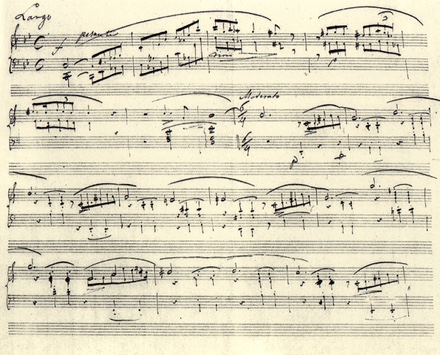
Jeux d’eau was composed in 1901 , at the age of 19 and is dedicated to his teacher Gabriel Fauré and premiered on April 5th 1902 by Ricardo Vines. The score bears as an epigraph a quote from Henri de Règnier : “Fluvial God laughing at the water which tickles him
Les Jeux d’eau, published in 1901, are at the origin of all the new pianistic innovations that people have wanted to notice in my work. This piece, inspired by the sound of water and the musical sounds of jets of water, waterfalls and streams, is based on two motifs in the style of the first part of a sonata, without however being subject to on a classic tonal level. » (Maurice Ravel, autobiographical sketch , 1928)
Fauré held the Jeux d’eau in great esteem, but Saint-Saens only saw this avant-garde piece as a “cacophony”. However, the work quickly enjoyed great success, definitively affirmed Ravel’s musical personality and had an influence on several of his contemporaries including Debussy ( Préludes , Études ). Its brevity and sweetness make it a popular page for concerts.Although Ravel’s reputation as a Debussyist and Impressionist dates from the Jeux d’eau , it was with Liszt ( Au bord d’une source , 1855 and Jeux d’Eau à la villa d’Este ,1883 ) that you have to look for the composer’s sources.
The Mephisto Waltzes (German: Mephisto-Walzer) are four waltzes composed from 1859 to 1862, from 1880 to 1881, and in 1883 and 1885. Nos. 1 and 2 were composed for orchestra, and later arranged for piano, piano duet and two pianos, whereas nos. 3 and 4 were written for piano only. Of the four, the first is the most popular and has been frequently performed in concert and recorded.
The first Mephisto Waltz is a typical example of programme music taking for its programme an episode from Nikolaus Lenau’s 1836 verse drama Faust ,not from Goethe. The following programme note, which Liszt took from Lenau, appears in the printed score:
There is a wedding feast in progress in the village inn, with music, dancing, carousing. Mephistopheles and Faust pass by, and Mephistopheles induces Faust to enter and take part in the festivities. Mephistopheles snatches the fiddle from the hands of a lethargic fiddler and draws from it indescribably seductive and intoxicating strains. The amorous Faust whirls about with a full-blooded village beauty in a wild dance; they waltz in mad abandon out of the room, into the open, away into the woods. The sounds of the fiddle grow softer and softer, and the nightingale warbles his love-laden song.
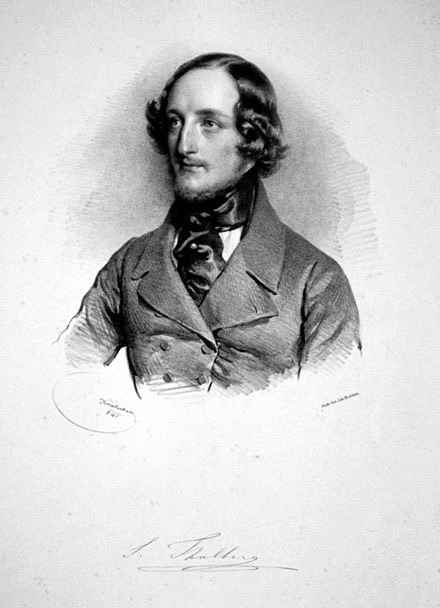
Lithograph by Josef Kriehuber , 1841 Born 8 January 1812 Pâquis, Switzerland Died 27 April 1871 Naples Italy
In 1843 Thalberg had married in Paris the daughter of the famous bass Luigi Lablache, widow of the painter Boucher. Attempts at operatic composition proved unsuccessful, with Florinda, staged in London in 1851 and Cristina di Suezia in Vienna four years later. His career as a virtuoso continued until 1863, when he retired to Posilippo, near Naples, to occupy himself for his remaining years with his vineyards. He died in Posilippo in 1871.
Some mystery surrounds the birth and parentage of the virtuoso pianist Sigismond Thalberg, popularly supposed to have been the illegitimate son of Count Moritz Dietrichstein and the Baroness von Wetzlar, born at Pâquis near Geneva in 1812. His birth certificate, however, provides him with different and relatively legitimate parentage, the son of a citizen of Frankfurt, Joseph Thalberg. There seems no particular reason, therefore, to suppose the name Thalberg an invention. Legend, however, provides the story of the Baroness proclaiming him a valley (“Thal”) that would one day rise to the heights of a mountain (“Berg”). Thalberg’s schooling took him to Vienna, where his fellow-pupil the Duke of Reichstadt, the son of Napoleon, almost persuaded him to a military career. Musical interests triumphed and he was able to study with Simon Sechler and with Mozart’s pupil Hummel. In Vienna he performed at private parties, making a particular impression when, as a fourteen-year-old, he played at the house of Prince Metternich. By 1828 he had started the series of compositions that were to prove important and necessary to his career as a virtuoso. In 1830 he undertook his first concert tour abroad, to England, where he had lessons from Moscheles. In 1834 he was appointed Kammervirtuos to the Emperor in Vienna and the following year appeared in Paris, where he had lessons from Kalkbrenner and Pixis.
Paris in the 1830s was a city of pianists. The Conservatoire was full of them, while salons and the showrooms of the chief piano-manufacturers Erard and Pleyel resounded with the virtuosity of Kalkbrenner, Pixis, Herz, and, of course, Liszt. The rivalry between Thalberg and Liszt was largely fomented by the press. Berlioz became the champion of the latter, while Fétis trumpeted the achievements of Thalberg. Liszt, at the time of Thalberg’s arrival in Paris, was in Switzerland, where he had retired with his mistress, the Comtesse Marie d’Agoult. It was she who wrote, under Liszt’s name, a disparaging attack on Thalberg, to which Fétis replied in equally offensive terms. The so-called “revolutionary princess”, Princess Belgiojoso, achieved a remarkable social coup when she persuaded the two virtuosi to play at her salon, in a concert in aid of Italian refugees. As in other such contests victory was tactfully shared between the two. Thalberg played his Moses fantasy, and Liszt answered with his new paraphrase from Pacini’s opera Niobe. The Princess declared Thalberg the first pianist in the world, while Liszt was unique. She went on to commission a series of variations on a patriotic theme from Bellini’s I Puritani from the six leading pianists in Paris, to which Liszt, Thalberg, Chopin, Pixis, Herz and Czerny contributed. This composite work, Hexaméron, remained in Liszt’s concert repertoire.The first of these operas of Donizetti was written in the winter of 1842 and performed early in January the following year in Paris. The elderly Don Pasquale attempts late marriage, with the purpose of siring children and thus disinheriting his nephew Ernesto. He is induced to see reason by what he supposes to be a real marriage to his nephew’s betrothed, disguised and behaving as an untamed shrew. All ends happily, when Don Pasquale agrees, with relief, to allow his nephew to marry the girl. Thalberg’s fantasy captures something of the spirit, humour and romance of its source
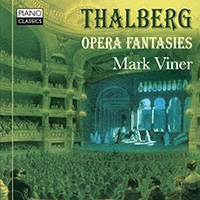
Mark Viner another great English virtuoso dedicated to bringing a forgotten world back to life with mastery and artistry .A swashbuckling extravaganza of nineteenth century pianism and a veritable contribution to Romantic Revivalism. This, Mark Viner’s début recording, presents the operatic paraphrases of the neglected pianist‐composer Sigismond Thalberg, aristocratic rival of Liszt and innovator of the so‐called ‘three‐hand effect’. Here are some of the very finest of his works – a music of opulent grandeur which draws upon all the heady romantic rhetoric and dramatic narrative of the opera house whilst being sumptuously conceived for the piano. A tour de force of virtuosity and an evocation of an era. Mark Viner is one of the most exciting young British pianists of his generation. 1st prize winner of the 2012 Alkan‐Zimmerman Competition in Athens, he is also the Chairman of the Alkan Society and is steadily gaining a reputation for his bold championing of unfamiliar pianistic terrain.Another pianist from the Keyboard Trust.
Tom with Simon R-j With Simon Roland-Jones , viola and Music Director of Kirker Music, who had invited Tom to play in their annual festival in Ischia Tom with the birthday boy
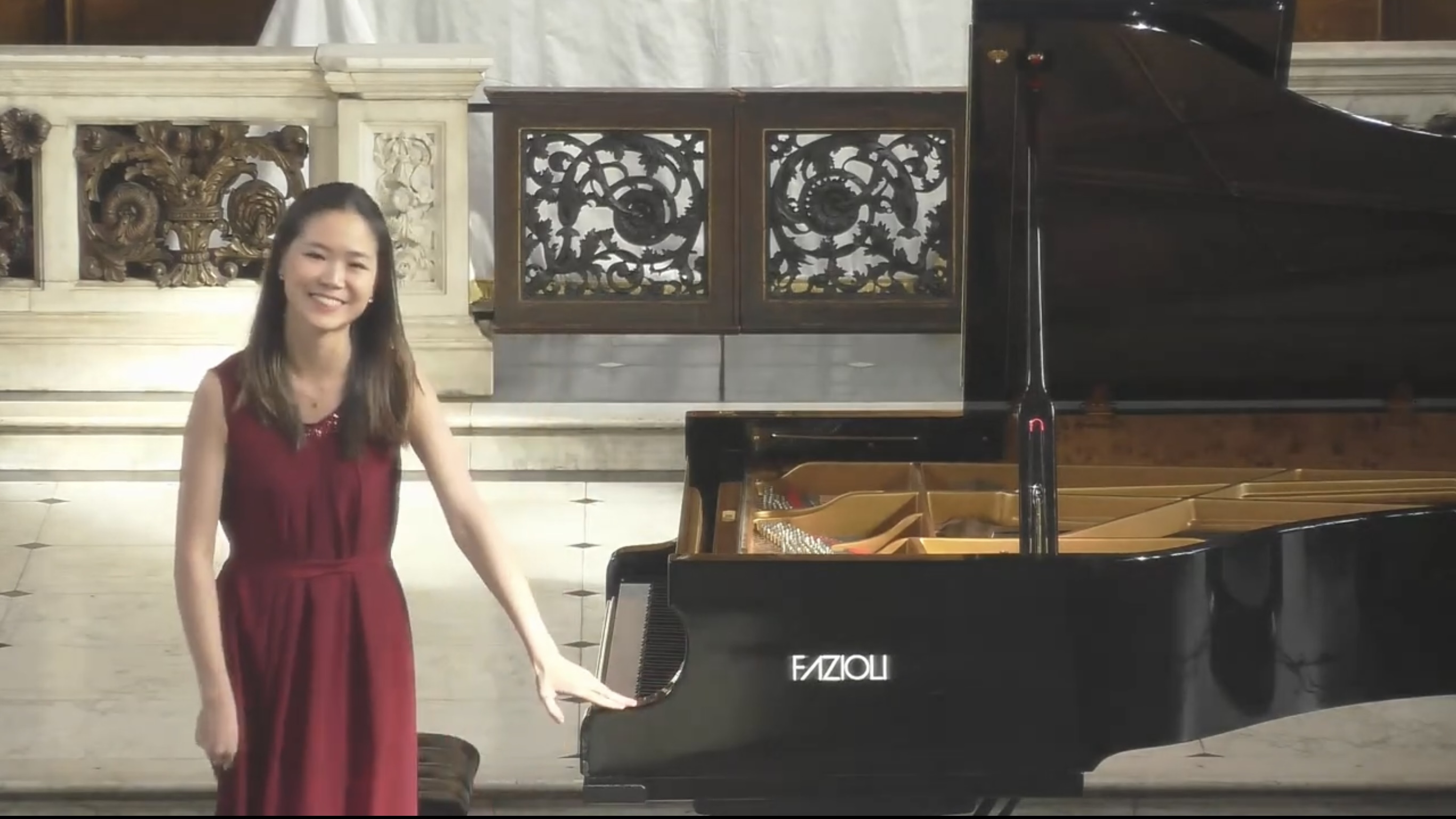
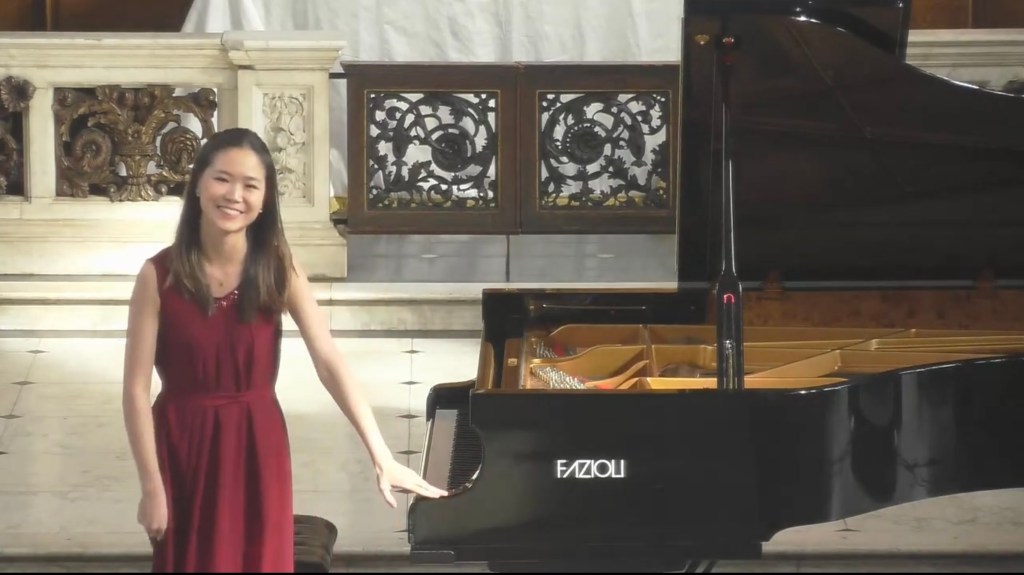
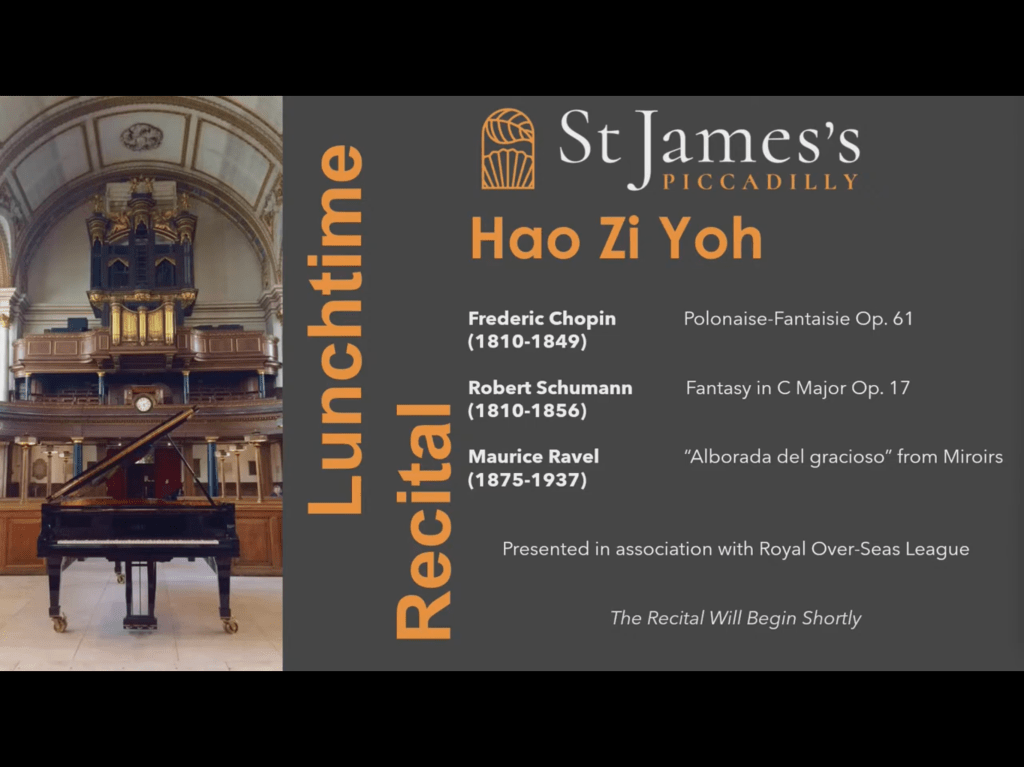
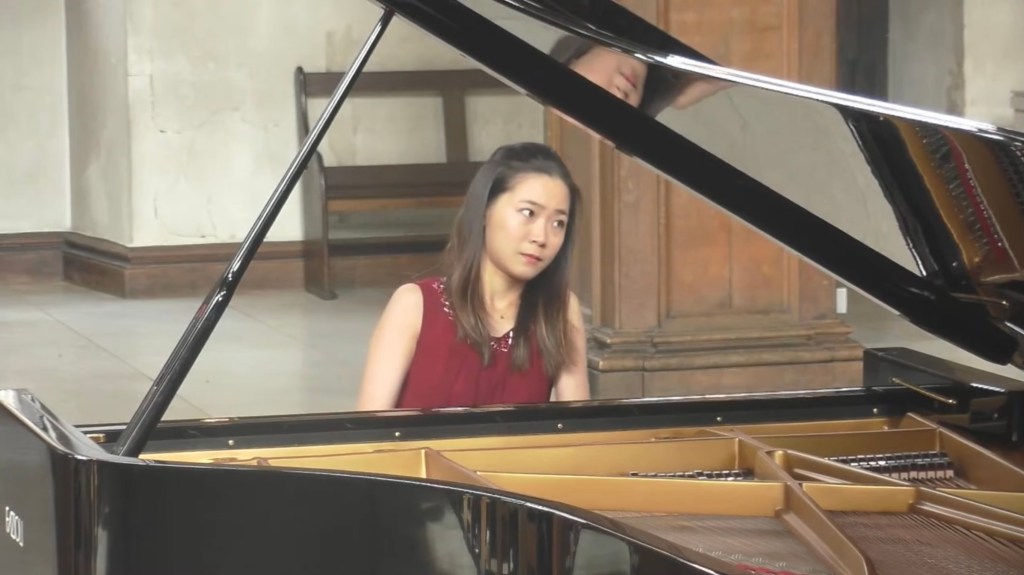
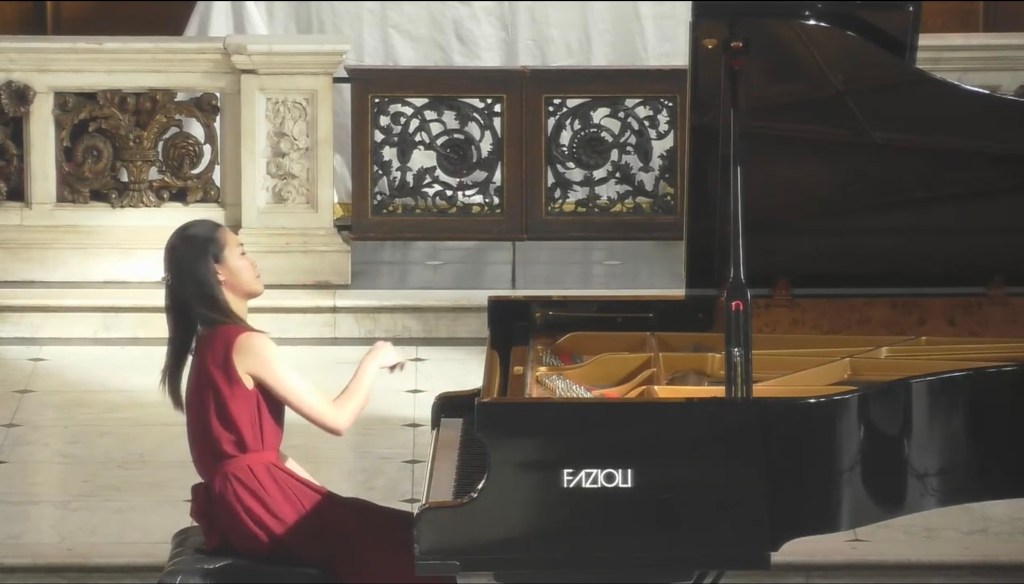
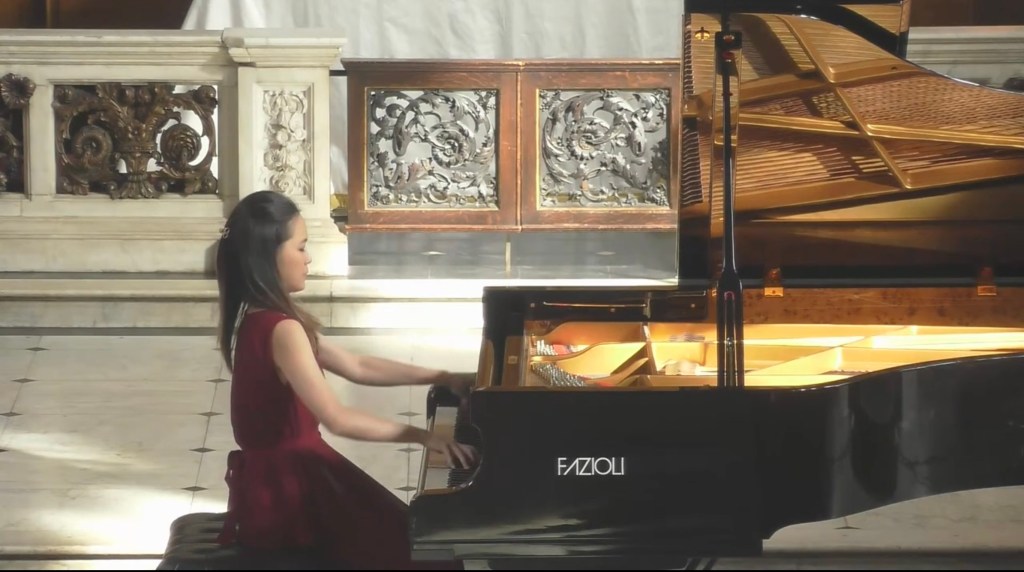
https://youtube.com/live/SOKUbHBPM5k?feature=sharedAn imposing opening immediately displayed Hao Zi’s remarkable artistry where authority is matched by poetic eloquence. An intelligence that allows her to look deep into the score and extract what the composer actually wrote and not just adhere to the so called ‘Chopin tradition’. If the opening arpeggios seemed at first rather slow one only has to look at the score to see how they were written and to hear how Hao Zi transformed them into the vital link between the central ‘più lento’ and the reawakening of the Polonaise. Passages that could in lesser hands be seen as empty scales took on a deeply poetic significance in Hao Zi’s hands as they lead into the central heart of this ‘Fantaisie Polonaise’.The ‘più lento’ was played with poetic poise as it lead to the opening fanfare that was now pregnant with poignancy.A deep nostalgic lament gradually unwinding in a tumultuous torrent of seamless scales leading to the glorious climax of the ‘Polonaise’.Played with authority ,aristocratic poise and passion as it gradually lay exhausted and spent on the final desolate A flat on high.Chopin’s penultimate work is perhaps his greatest work where architectural form and poetic content are united in a completely innovative way.
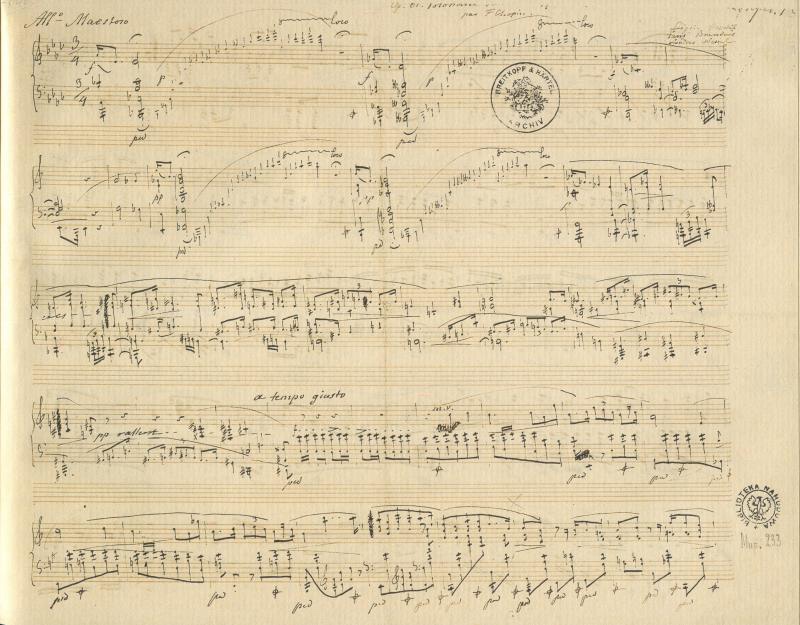
The Polonaise-fantaisie op 61, is dedicated to Mme A. Veyret, written and published in 1846.
This work was slow to gain favour with musicians, due to its harmonic complexity and intricate form.It “works on the hearer’s imagination with a power of suggestion equaled only by the F minor Fantasy or the fourth Ballade “, to quote the critic and renowned musicologist Arthur Hedley in 1947
It is intimately indebted to the polonaise for its metre,much of its rhythm , and some of its melodic character, but the fantaisie is the operative formal paradigm, and Chopin is said to have referred initially to the piece only as a Fantasy. Parallels with the Fantaisie in F minor include the work’s overall tonality, A-flat, the key of its slower middle section, B major , and the motive of the descending fourth.The Polonaise-Fantaisie represents a change in Chopin’s style from ‘late’ to ‘last’.It is suggested that the formal ambiguities of the piece (particularly the unconventional and musically misleading transitions into and out of the lyrical inner section) are the most significant defining qualities of this ‘last style’, which only includes this and one other piece—the F minor Mazurka op 68 n.4,Chopin’s last composition
Facsimile Edition of the Manuscript Held in the National Library in Warsaw.There was simplicity and natural beautiful phrasing that allowed the great opening to Schumann’s great love letter to pour from the piano with such overwhelming significance. A sense of line that made this opening a long song of passion and delicacy with a wondrous sense of balance as one hand answered the other.The central passionate climax immediately dissolved into whispered secrets of disarming simplicity.There was ravishing beauty of the final page with subtle voicing of inner parts that made Schumann’s loving quote of Beethoven’s ‘distant beloved’ even more poignant. Applause slightly disturbed the spell but not for long as Hao Zi lead us to the March with dynamic drive and great care of Schumann’s very precise dynamics.Her architectural sense of line made sense of Schumann’s sometimes obsessive dotted rhythms as she transformed the composers knotty twine into phrases of beauty and shape as only a true artist can do. The serenity of the ‘etwas langsamer’ and a very professional untying of a cunning unexpected knot as she took us to the treacherous coda with fearless musicianship and control with the final E flat chord magically transformed to the calming balm of C major . The rich harmonic support allowed loving care and beauty to sustain this miraculous outpouring that Schumann penned for his Clara – the mother to be of his eight children ! There was a disarming fluidity and transparency of sound after the first great climax as the melodic line became ever more beguilingly insinuating as it searched for the sublime outlet of Robert’s final moving declaration of undying love. The final three chords ‘Adagio’ not rallentando just showed Hao Zi’s total dedication in bringing to life the wishes of the composer she is so faithfully serving.
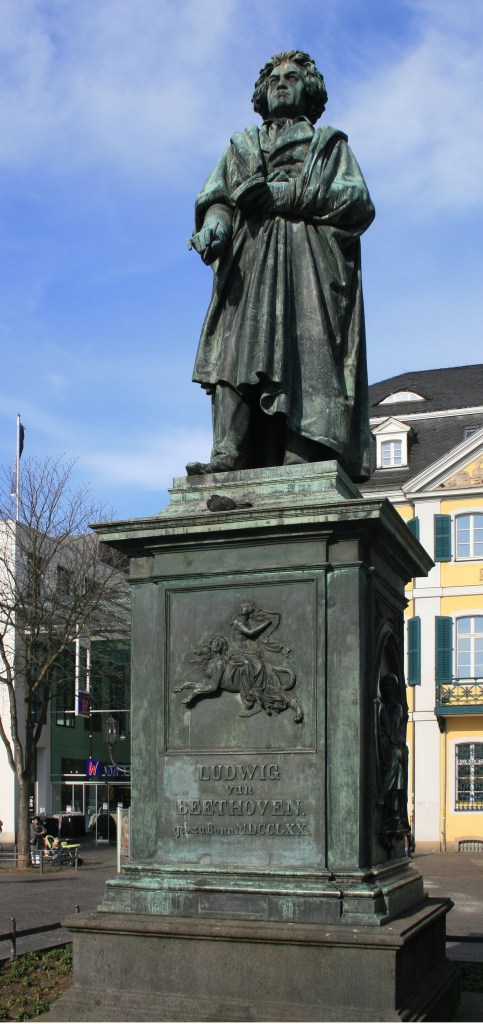
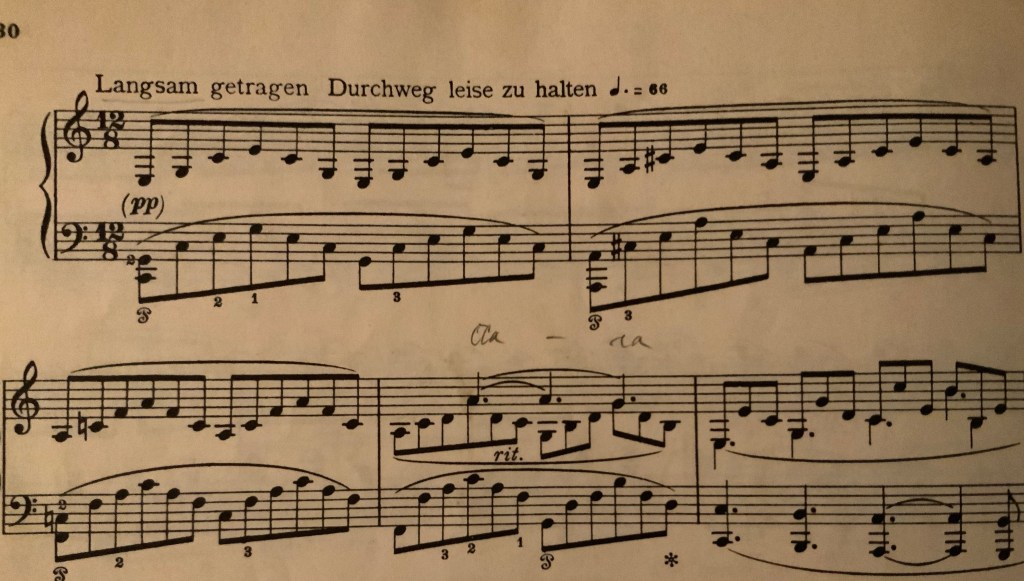
The Fantasie in C, op.17, was written by Robert Schumann in 1836. It was revised prior to publication in 1839, when it was dedicated to Franz Liszt.Liszt in return dedicated his B minor Sonata to Schumann.The two works are generally considered to be the pinnacles of piano music of the Romantic period.The Fantasie is in loose sonata form. Its three movements are headed:Durchaus fantastisch und leidenschaftlich vorzutragen; Im Legenden-Ton –Mäßig. Durchaus energisch – Langsam getragen. Durchweg leise zu halten. The piece has its origin in early 1836, when Schumann composed a piece entitled Ruines expressing his distress at being parted from his beloved Clara Wieck (later to become his wife). This later became the first movement of the Fantasy.Later that year, he wrote two more movements to create a work intended as a contribution to the appeal for funds to erect a monument to Beethoven in his birthplace, Bonn.
Liszt’s Beethoven Monument in Bonn
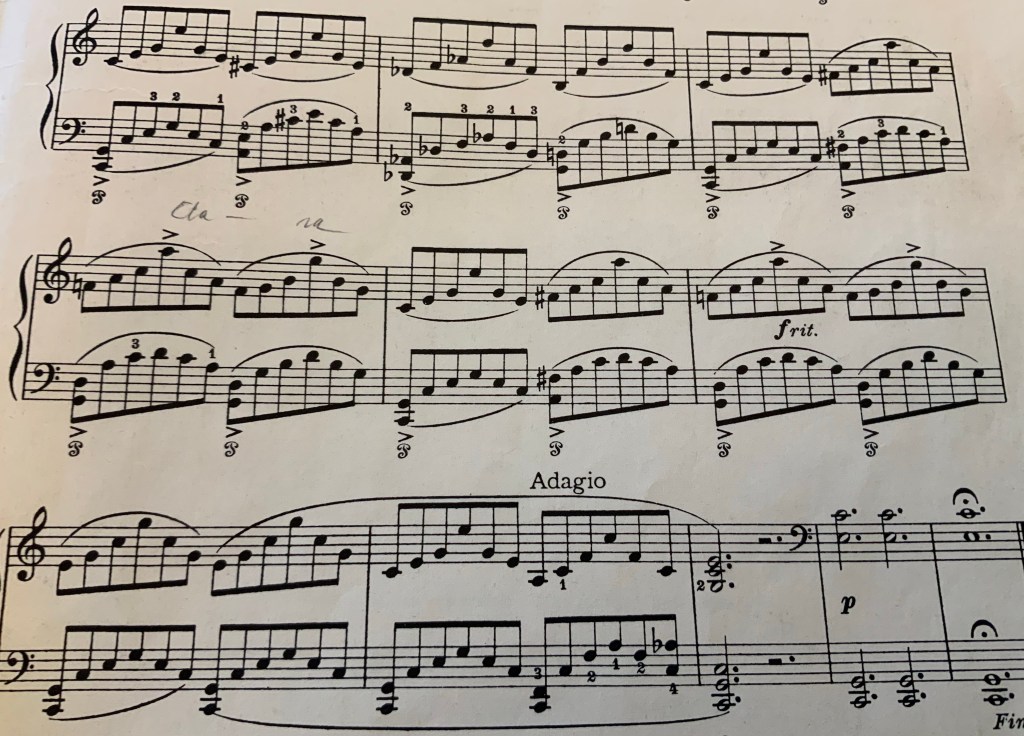
The movements’ subtitles (Ruins, Trophies, Palms) became Ruins, Triumphal Arch, and Constellation, and were then removed altogether before Breitkopf & Härtel eventually issued the Fantasie in May 1839.Schumann prefaced the work with a quote from Friedrich Schlegel:Durch alle Töne tönet Im bunten Erdentraum Ein leiser Ton gezogen Fur den, der heimlich lauschet.(Resounding through all the notes In the earth’s colourful dream There sounds a faint long-drawn note For the one who listens in secret.)Agosti a student of Busoni who was a student of Liszt wrote the word Cla-ra in my score over the long A to G in the last movement.
Cla- ra written by Agosti a pupil of Busoni who was a pupil of Liszt.
There is a musical quotation of a phrase from Beethoven’s song cycle An die ferne Geliebte (to the distant beloved )in the coda of the first movement :’Accept then these songs beloved, which I sang for you alone.’All Schumann wrote to Clara: The first movement may well be the most passionate I have ever composed – a deep lament for you. They still had many tribulations to suffer before they finally married four years later.
Cla- ra in Agosti’s hand in my score
Silence is golden indeed after a performance of such passionate eloquence
Liszt had played the piece to Schumann privately, and later incorporated it into his teaching repertory, but he considered it unsuitable for public performance and never played it in public.However, Liszt returned the honour by dedicating his own Sonata in B minor to Schumann in 1853. Clara Schumann did not start to perform the Fantasie in her concerts until 1866,ten years after the composer died ,the Liszt Sonata she never played as she considered it ‘a blind noise’!
There was a rhythmic drive to Ravel’s Alborada with it’s sudden explosions of Latin passion.Hao Zi showed her superb technical control where glissandi and repeated notes were mere nervous vibrations of sound of great intensity.The smokey passion to the recitativi had the rumble of distant passion in the background that eventually erupted into a transcendental final few bars of scintillating excitement.
Alborada del gracioso (“The Jester’s Aubade “), is one of the five movements of Ravel’s piano suite Miroirs written in 1904–05.It is a musical announcement of dawn, a sunrise song, the equivalent of a French or English aubade and the roots of the term can be traced to the old troubadour tradition in which the song portrayed the parting of two lovers at dawn.A gracioso was a figure from Spanish comedy, variously described as a jester or a clown,the classic genial buffoon,the standard grotesque lover,a humorous or amusingly entertaining person,and a servant or squire who often comments satirically on the actions of his superiors.Diaghilev also commissioned Ravel to orchestrate the Alborada (and the Chabrier piece, the Menuet pompeux) for a production of the ballet, retitled Les jardins d’Aranjuez, at the Alhambra Theatre , London in 1919.Before the ballet opened in London the orchestral Alborada was premiered in Paris on 17 May 1919 .
This programme was played in Milan in November 2023 with this ravingly insightful review sent by an equally enthusiastic Roberto Prosseda
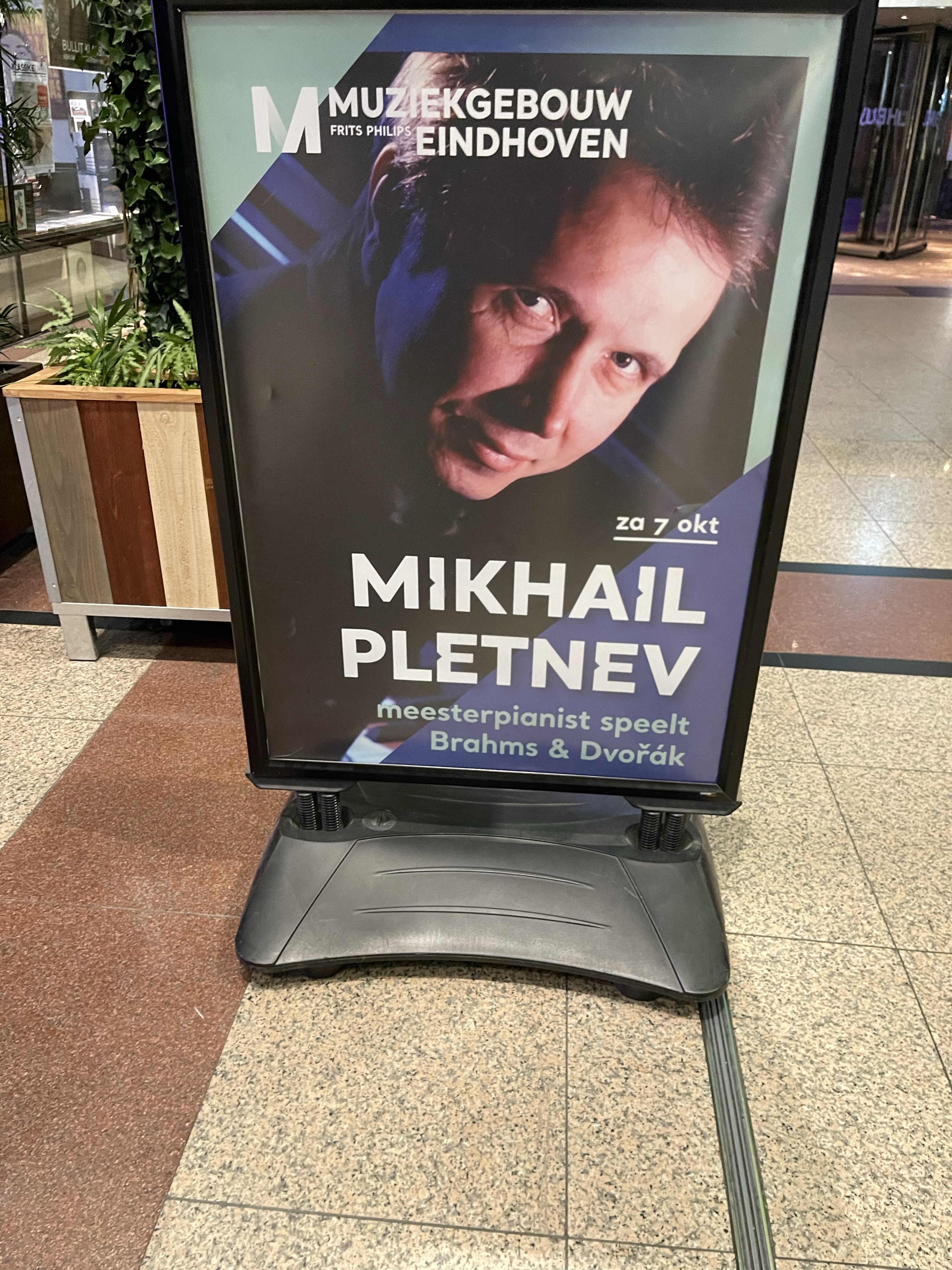
Recensione del concerto di Pletnev a Milano l’altro giorno, da parte di Francesco Maria Colombo (uno dei pochi (ex) critici che ci capisce davvero): “Pletnëv al Conservatorio, Serate Musicali. 24 Preludi di Scriabin e 24 Preludi di Chopin. Torno adesso. 1 – Partiamo dall’ovvio. Pletnëv ha una delle dotazioni manuali, brachiali e digitali più impressionanti che si diano. C’è un video, avrà avuto poco più di vent’anni, in cui suona in Russia la Rapsodia su tema di Paganini (dirige proprio Temirkanov, curiosamente) che è lo stato dell’arte della tecnica pianistica. Tutte le note nitidissime, l’articolazione cristallina, il controllo dei pesi e della dinamica senza compromessi, un appiombo ritmico, in quel pezzo stipato di tricks, da manuale. Ora Pletnëv ha 66 anni e sostanzialmente quella dotazione c’è ancora, nonostante qualche nota imprecisa e una certa cautela: ad es. nel Preludio in Si bemolle minore la velocità è rimarchevole, l’articolazione anche, ma per mantenere quell’articolazione e quella velocità viene un poco sacrificata la dinamica, e alla pagina viene a mancare il suo furore. Quanto al controllo dei pesi e della dinamica, siamo sempre a un livello che tutti gli altri pianisti possono invidiare, e questo permette a Pletnëv sostanzialmente due cose: una è il rilievo delle voci interne, l’altra è una incredibile varietà entro uno spettro dinamico volutamente ridotto, tant’è che in tutto il concerto gli autentici pianissimo e fortissimo saranno stati una dozzina: tutto il resto era uno scivolare di sfumature infinitesimali, preziosissime, sibaritiche. Ciò che è perfetto per la scrittura di Scriabin, fatta di screziature di seta; e ciò che in Chopin enfatizza la ricchezza (pazzesca, quando venga rivelata così) dell’armonia, proprio quel che è al centro dell’indagine chopiniana attraverso i 24 brani distribuiti nelle tonalità maggiori e minori. In molti Preludi, questa sera, si sentivano voci interne mai udite prima, grazie ai pedali e ai pedali di dito, alla pressione digitale differenziata, alle scelte di tempo mobilissime sempre pensate in funzione del percorso armonico. Meravigliosa fantasia quella di Pletnëv, e meravigliose le tecniche impiegate per tradurla in suono. 2 – Detto così, però, parrebbe che Pletnëv sia l’ultimo (c’è sempre l’ultimo di turno, lo fu Cortot, lo fu Horowitz, lo fu Cherkassky) dei romantici e invece mi pare che l’intenzione stilistica del pianista vada da tutt’altra parte. Le voci secondarie non erano delibate con la sensualità erotica di Horowitz, ma creavano quinte prospettiche, coni d’ombra, attese ingannate, rispondendo non alla seduzione dell’istante ma a un’analisi complessa, meticolosissima, studiata a tavolino: tutto si può dire di Pletnëv tranne che il suo suono nasca nell’istante (esempi di pianisti il cui suono nasce nell’istante: Samson François, György Cziffra). Il risultato era, mi pare, non la ricerca “romantica” della bellezza ma una dimensione poetica e atmosferica enormemente inquieta, fatta di balenii, di addensamenti misteriosi, di tonfi esausti. Dopo Scriabin e dopo metà dei Preludi di Chopin, così intrisi di stanchezza e di morte, mentre cercavo di capire verso quale strana malìa ci portasse l’interprete, ho cominciato a sentire uno stravagante senso di apprensione e di turbamento: quel che provava Erode nella Salome quando dice che sente un vento gelido e sottile svolazzare per i corridoi del palazzo. Quell’intirizzimento era paura; e a me, per quanto possa valere un’impressione emotiva soggettiva, quei Preludi decomposti e ricomposti, in bilico su miriadi di sfumature coloristiche tra il grigio perla e il grigio tortora, quel continuo sfarsi dell’armonia in percorsi non consueti, quell’assorbimento dei temi (che nei Preludi chopiniani non sono quasi mai stagliati nettamente) negli smottamenti della scrittura armonica, hanno di fatto mosso a paura. Se dovessi trovare un paragone letterario per queste miniature così eseguite, lo indicherei nelle pagine di Edgar Allan Poe; pittorico, lo indicherei nei neri Caprichos di Goya. 3 – Scriabin era per questo la causa finale di Chopin, e Chopin la causa efficiente di Scriabin. Sarebbe stata un’operazione intellettuale raffinatissima e niente più, se Pletnëv non l’avesse invece sciolta in poesia, estasi, irraggiungibile eleganza: ma, come scrisse Platen, “chi ha guardato negli occhi la bellezza, si è già consegnato alla morte”. Per fortuna che i due bis di Scriabin (i due più celebri Studi tra i suoi) ci hanno riportato un po’ sulla terra: non erano perfetti né possedevano l’ineluttabile drammaturgia che vi costruiva Horowitz. Insomma, per fortuna Pletnëv ha qualcosa di umano, altrimenti tra Poe, Goya e Platen c’è da spengere tutte le luci. “
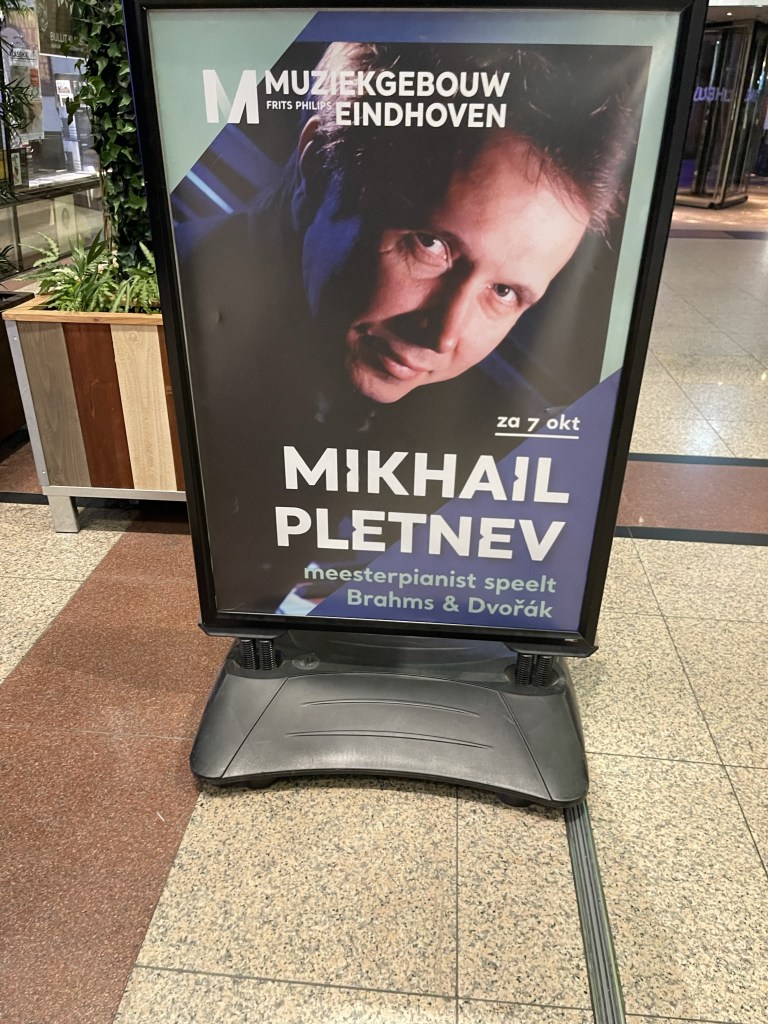
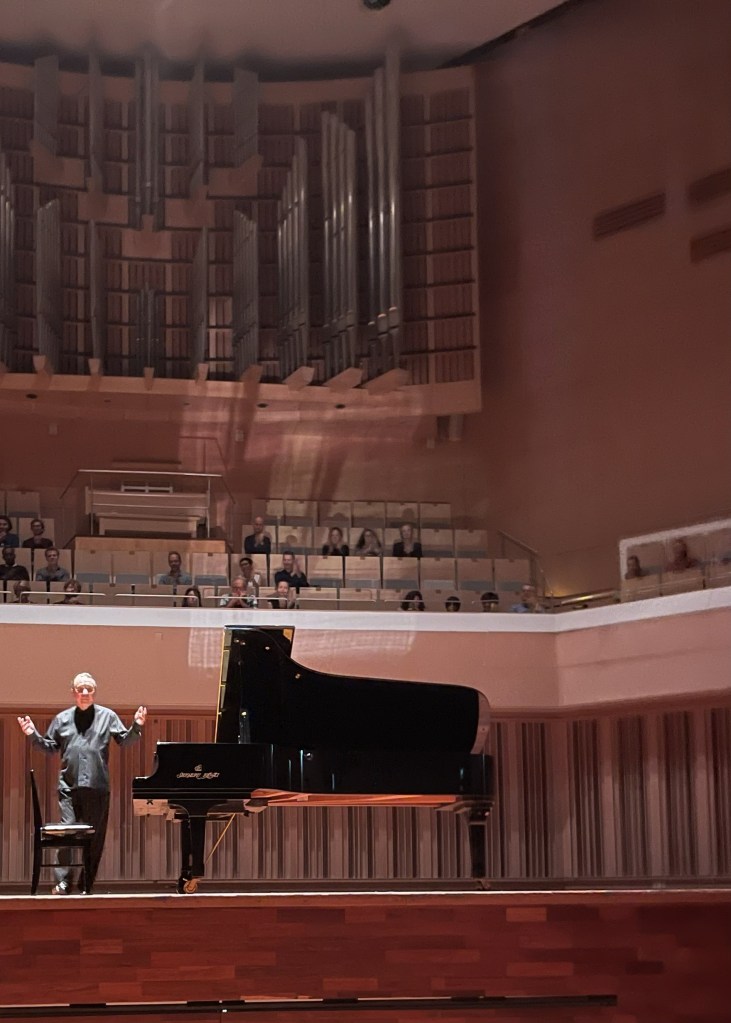
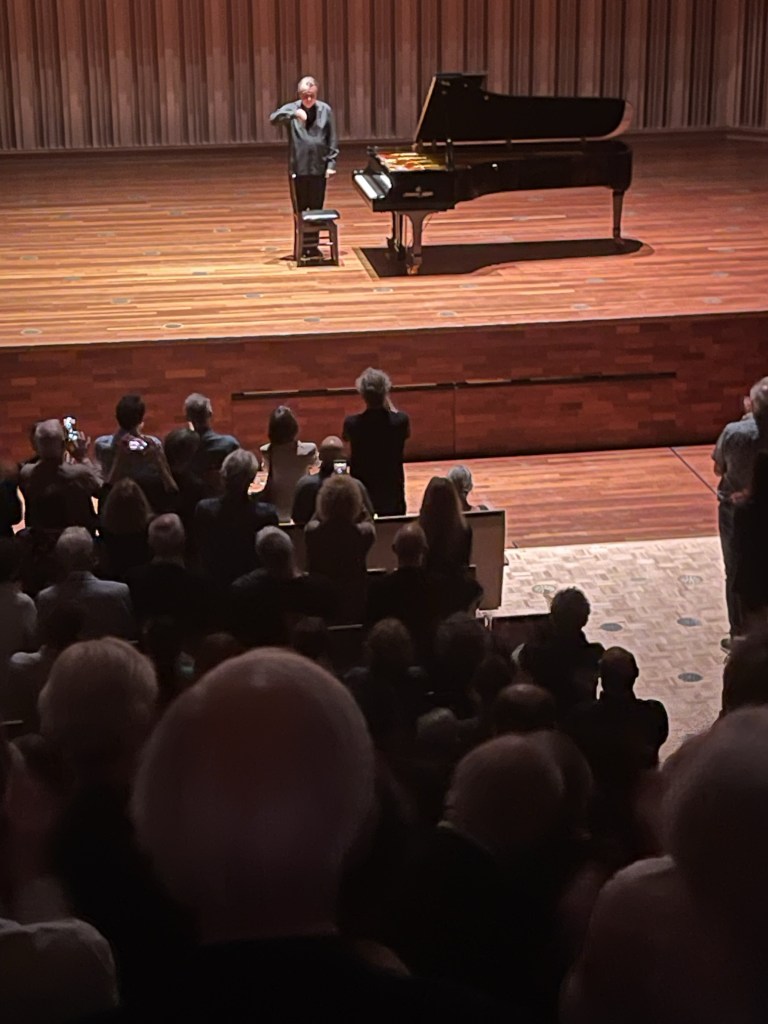
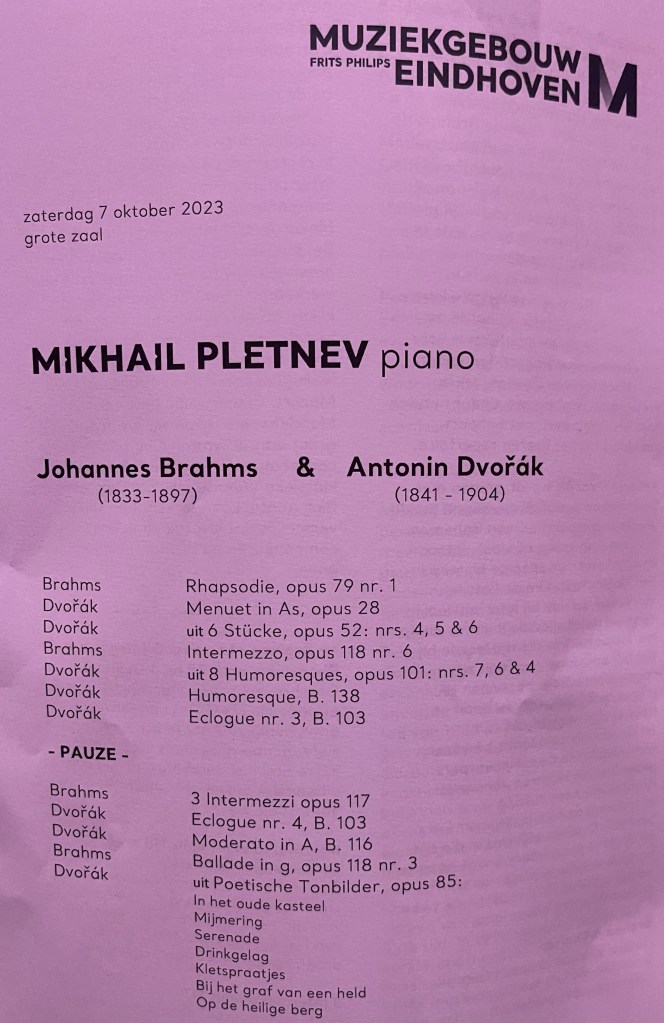
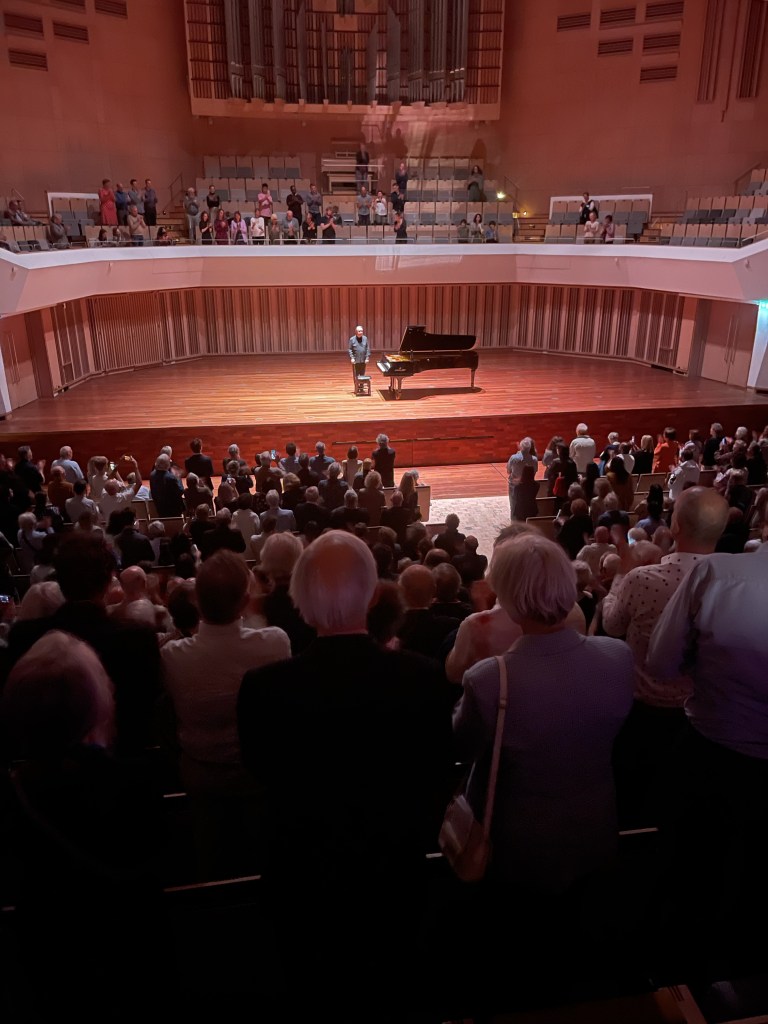
Mr Rubinstein used to turn baubles into gems ….Mr Pletnev manages to turn gems into baubles . Brahms and Dvorak alla De Pachman but Rachmaninov The Lark and Moszkovski Study in F minor played as encores had us on our feet to cheer performances that only Horowitz could have matched Fake -Fool – or Genius – Mr Pletnev is all three …irritating,exasperating but rarely boring with occasional moments of sublime inspiration.
Tonight there was the same improvised freedom with Brahms op 79 with a grandiose addition of bass octaves before the sweeping upward scales that was quite unexpected and overwhelming .Contrasting with the whispered eloquence of the lyrical passages and ravishing sense of balance of the coda.There was the beguiling charm of Dvorak’s Menuet op 28 and the mystery of op 52 n.4.The Brahms of 117 n.1 was played in gasps and the B flat minor n. 2 at breakneck speed but with a monumentally epic final few bars and a final chord that shone like a radiant moonbeam.The Ballade in G minor was so bathed in pedal as to be almost unrecognisable as he tried to link it to the Dvorak moderato.An evening of a collection of cameos played with a beguiling kaleidoscope of colour but one could only see a shadow of the former Pletnev who conquered the Tchaikowsky competition in 1978 who like the present day Lugansky could astonish and conquer all before them.Pletnev now lives in a dream world of his own private musings that he shares with a world if they still want it ……..there is a modesty and humility to his performances that is unique ,frustrating and at times ravishingly beautiful but more for the private salons of Chopin’s time than the concert hall of today.
The same programme we had heard in Rome last December :
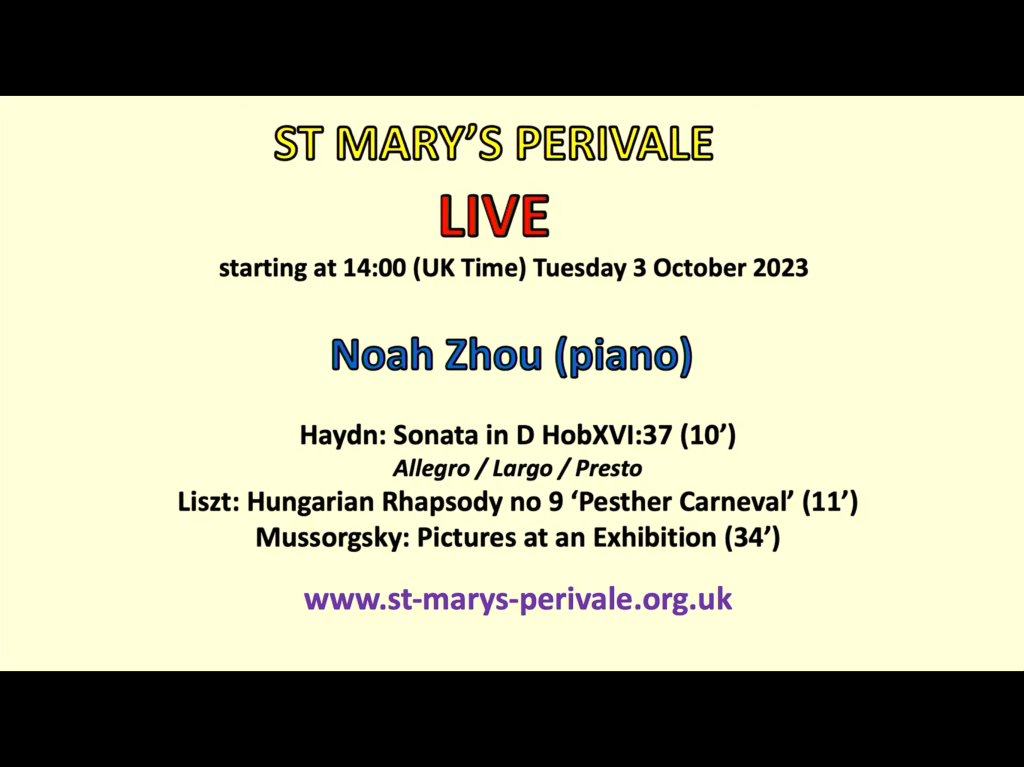
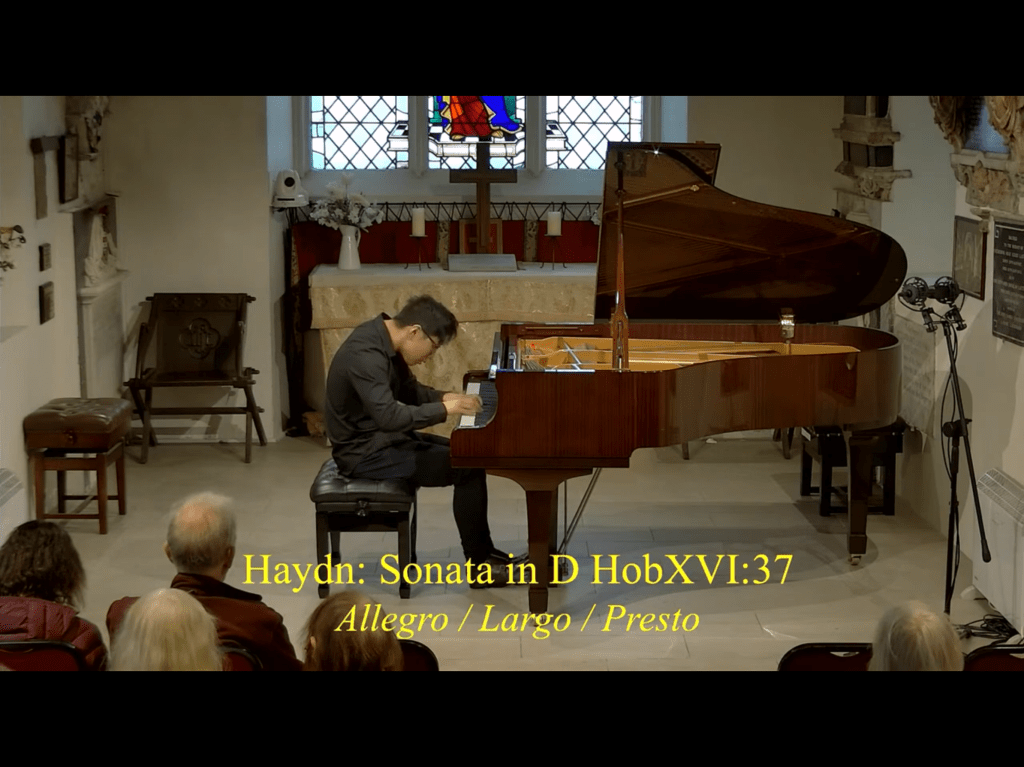
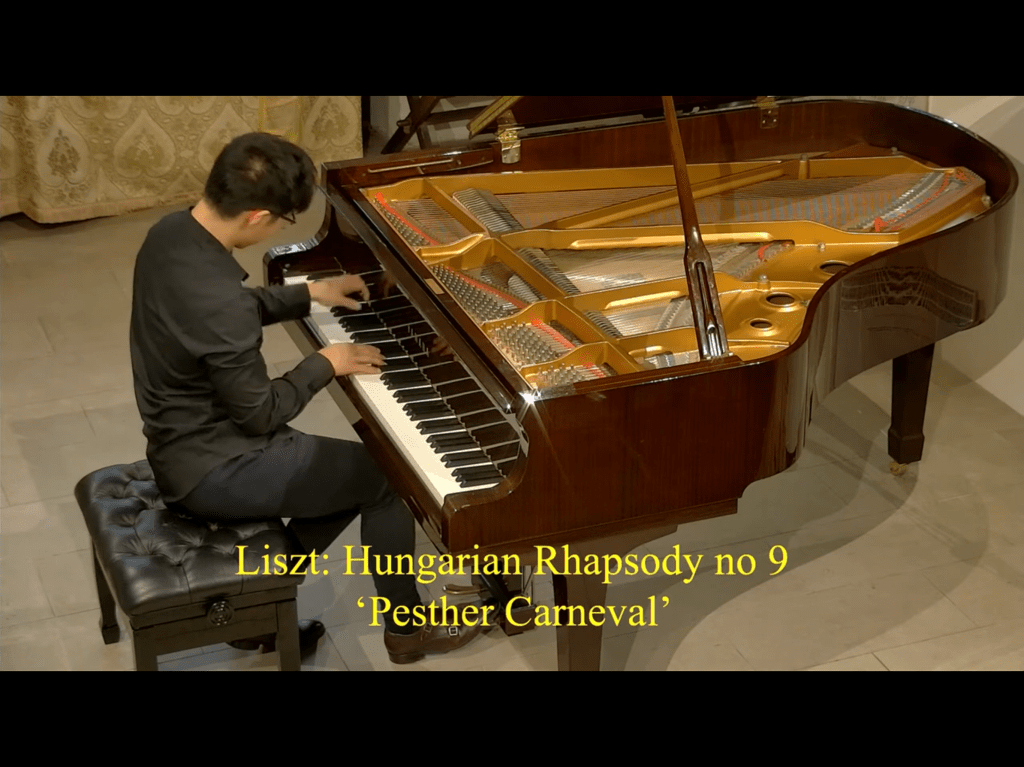
https://youtube.com/live/kO29-nPp9wY?feature=sharedA dynamic drive from the very first notes like a tiger let out of a cage ready to go on the rampage.There was a great sense of characterisation – joyous playing of total conviction.The beauty and measure in the Largo was of noble sentiment played with the weight of really intense feeling.There was refined beauty to the presto as it sprang to life with such vitality as he lived every moment bringing it to life with astonishing freshness and innocence.What a noble opening to the Liszt echoed only in the encore of Rachmaninov’s Etude Tableau op 33 n. 8 .Embellishments thrown off with an ease and sense of style of extraordinary mastery.His whole body involved with an elasticity as he swam in a sea of sumptuous sounds.Fantastic authority and an amazing volume of sound as the melody in the bass was accompanied by arabesques of quite extraordinary virtuosity.Intelligence,passion and virtuosity and showmanship that is an integral part of these tone poems that Liszt would have astonished his adoring audiences with during his days as the greatest showman on earth.
Hungarian Rhapsody No. 9, S.244/9in E flat , is the ninth .It is nicknamed the “Carnival in Pest” or “Pesther Carneval” and was composed in 1847. Liszt also made versions of the piece for piano four hands and for piano, violin, and cello.Liszt used five themes in this rhapsody. The first of these, possibly Italian in origin, can be found in one Liszt’s manuscript notebooks. The second theme is a csardas by an unknown composer. After the third theme, which is an unidentified folk tune, Liszt quotes an authentic Hungarian folk song, A kertmegi káposzta. The final theme quoted is a third folk tune, Mikor én még legény voltam.The Hungarian Rhapsodies, S.244 R.106 are a set of 19 pieces based on Hungarian folk themes and were composed during 1846–1853, and later in 1882 and 1885. In their original piano form, the Hungarian Rhapsodies are noted for their difficultyLiszt incorporated many themes he had heard in his native western Hungary and which he believed to be folk music, though many were in fact tunes written by members of the Hungarian upper middle class, or by composers such as Jozsef Kossovits often played by Roma (Gypsy) bands. The large scale structure of each was influenced by the verbunkos,a Hungarian dance in several parts, each with a different tempo Within this structure, Liszt preserved the two main structural elements of typical Gypsy improvisation—the lassan (“slow”) and the friska (“fast”). At the same time, Liszt incorporated a number of effects unique to the sound of Gypsy bands, especially the pianistic equivalent of the cimbalon .He also makes much use of the Hungarian gypsy scale
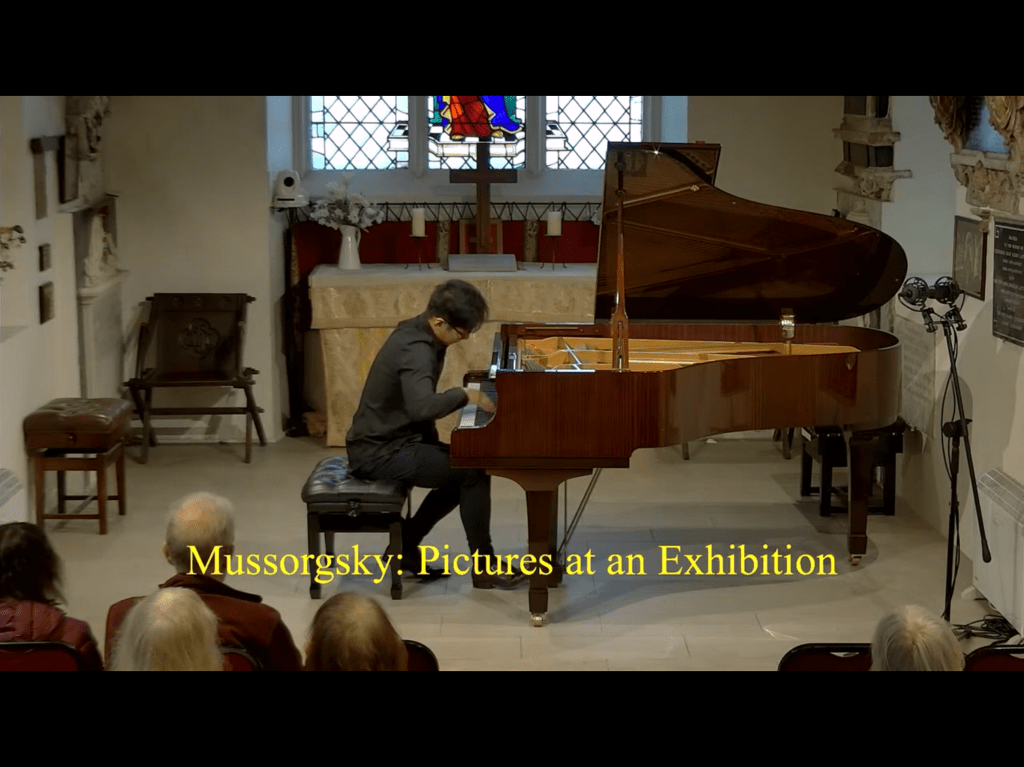
A monumental performance of Mussorgsky played like the great musician he is.Demonstrated immediately by the legato and shape he gave to the opening Promenade. Each of the ten pictures was shaped with astonishing characterisation as he lived so intensely each piece finding a chameleonic sense of colour and shape to each one. ‘Gnomus’ rudely interrupted the promenade where his orchestral feel for the octaves in’ Poco meno mosso pesante’ meant that he could bring out the bass which gave great depth to the sound in which each of the octaves were made up of individual sounds.The terrifying left hand trills were but vibrations leading to a final cry and a mad rush for shelter.Extraordinary virtuosity made for an easy escape ‘velocissimo con tutta forza’.’The old castle’was allowed to flow with great intensity and the highlighting of inner harmonies gave great depth and richness to the sound.’Tuileries’ was played with enviable jeux perlé and beguiling capriciousness.Rumbustuous ‘Bydlo’ suddenly took to the stage but with a beautiful sense of phrasing and colouring and the final appearance in the tenor register was of quite ravishing beauty.A Promenade made in heaven was only interrupted by the frenzied activity of the ‘Ballet and cackling of unhatched chicks’.The trills of the trio were played with irresistible energy before ‘Samuel Goldenberg’ entered the scene with nobility and authority ,Schmuyle’s beautiful pleadings were mere vibrations of sound before Goldenberg gave us full blast in the bass leading to the rather forlorn addieu of Schmuyle with the final word,of course , to Goldenberg. There was extraordinary dexterity in the ‘Market Place of Limoges’ with some transcendental playing of mastery and musicianship.It was a revelation of how the notes were allowed to vibrate in Catacombae – one could literally feel the beats as he played with real weight and not just hardness- delving deep into the notes where true secrets lie for those that can find them.’Con mortuis’ entered in a whisper with the left hand melody so beautifully and sensitively shaped.A breathtaking savagery to ‘Baba Yaga’ played with relentless energy with the beautiful orchestral oasis of the Andante mosso and the streaks of lightening that heralded the return of the demonic ‘Baba Yaga’.’The Great Gate of Kiev’ was played with aristocratic control with the opening statement only forte leaving enough space for the fortissimo vibrations of E flat later.Control,passion and aristocratic good taste gave the final bars a weight and timely significance for the true Gateway to Freedom.
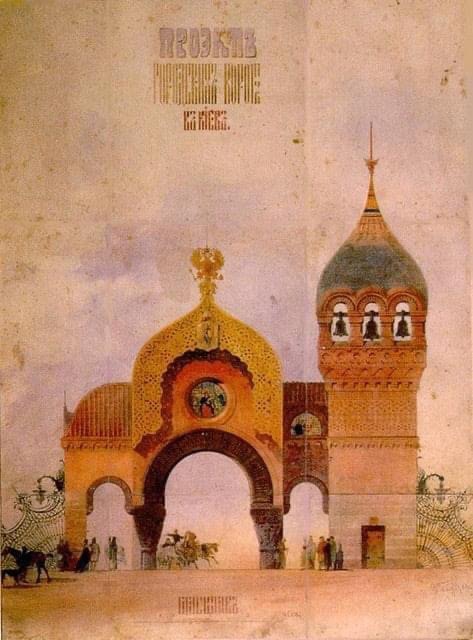
Pictures at an Exhibition is based on pictures by the artist, architect, and designer Viktor Hartmann. It was probably in 1868 that Mussorgsky first met Hartmann, not long after the latter’s return to Russia from abroad. Both men were devoted to the cause of an intrinsically Russian art and quickly became friends. They met in the home of the influential critic Vladimir Stasov, who followed both of their careers with interest. According to Stasov’s testimony, in 1868, Hartmann gave Mussorgsky two of the pictures that later formed the basis of Pictures at an Exhibition.
The Great Gate of Kiev
PICTURES AT AN EXHIBITION Promenade l The Gnomes Promenade ll The Old Castle Promenade lll The Tuileries: Children’s dispute after play Bydlo Promenade IV Ballet of the unhatched chicks Two Polish Jews: Rich and poor Promenade V The market at Limoges Roman Catacombs – With the dead in a dead language Baba Yaga: The Witch The Heroes Gate at Kiev
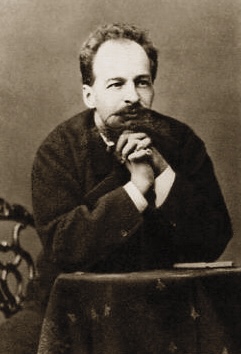
Viktor Hartmann
Hartmann’s sudden death on 4 August 1873 from an aneurysm shook Mussorgsky along with others in Russia’s art world. The loss of the artist, aged only 39, plunged the composer into deep despair. Stasov helped to organize a memorial exhibition of over 400 Hartmann works in the Imperial Academy of Arts in Saint Petersburg in February and March 1874. Mussorgsky lent the exhibition the two pictures Hartmann had given him, and viewed the show in person, inspired to compose Pictures at an Exhibition, quickly completing the score in three weeks (2–22 June 1874).Five days after finishing the composition, he wrote on the title page of the manuscript a tribute to Vladimir Stasov, to whom the work is dedicated.The music depicts his tour of the exhibition, with each of the ten numbers of the suite serving as a musical illustration of an individual work by Hartmann.Although composed very rapidly, during June 1874, the work did not appear in print until 1886, five years after the composer’s death, when a not very accurate edition by the composer’s friend and colleague Nikolai Rimsky-Korsakov was published.
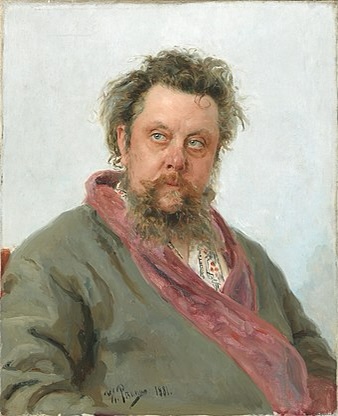
A portrait painted by Ilya Repin a few days before the death of Mussorgsky in 1881
Mussorgsky suffered personally from alcoholism, it was also a behavior pattern considered typical for those of Mussorgsky’s generation who wanted to oppose the establishment and protest through extreme forms of behavior.One contemporary notes, “an intense worship of Bacchus was considered to be almost obligatory for a writer of that period.”Mussorgsky spent day and night in a Saint Petersburg tavern of low repute, the Maly Yaroslavets, accompanied by other bohemian dropouts. He and his fellow drinkers idealized their alcoholism, perhaps seeing it as ethical and aesthetic opposition. This bravado, however, led to little more than isolation and eventual self-destruction.
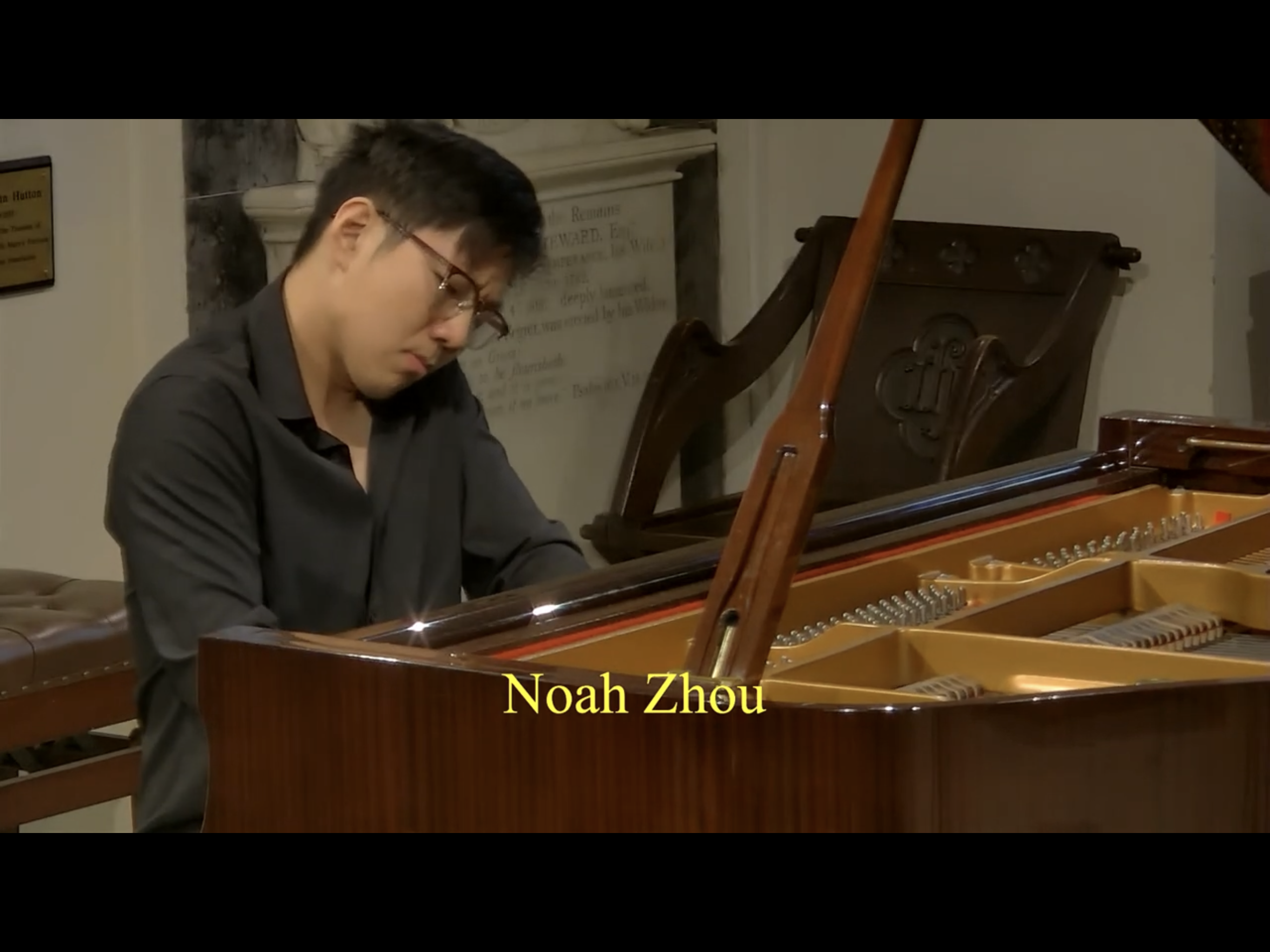
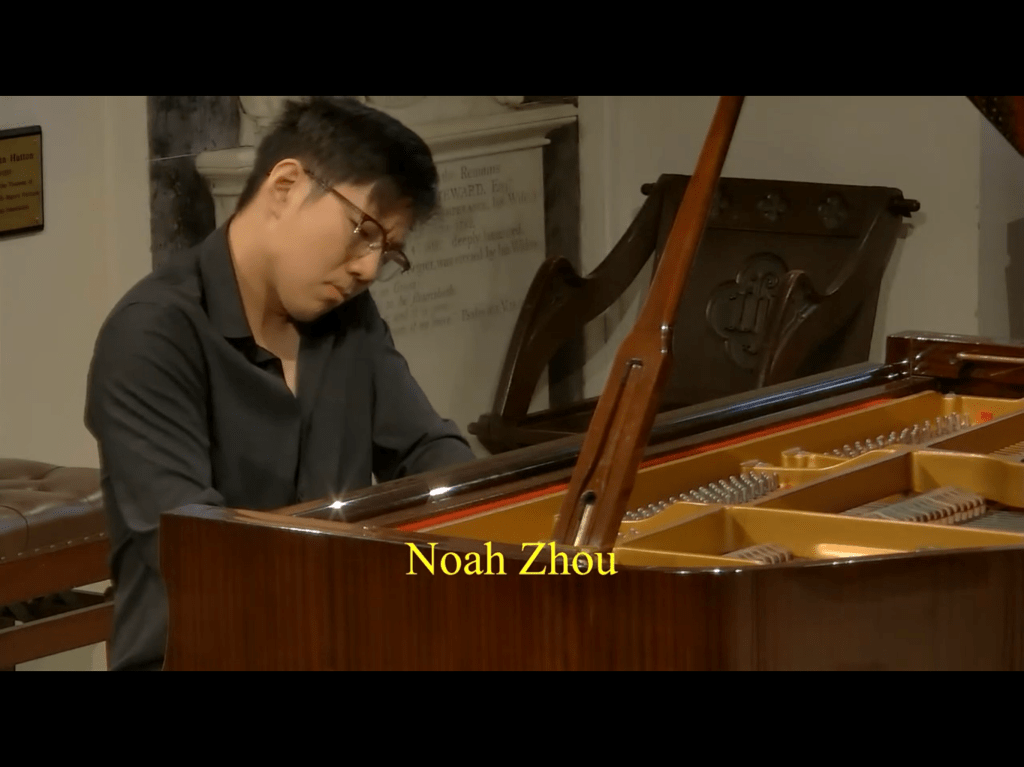
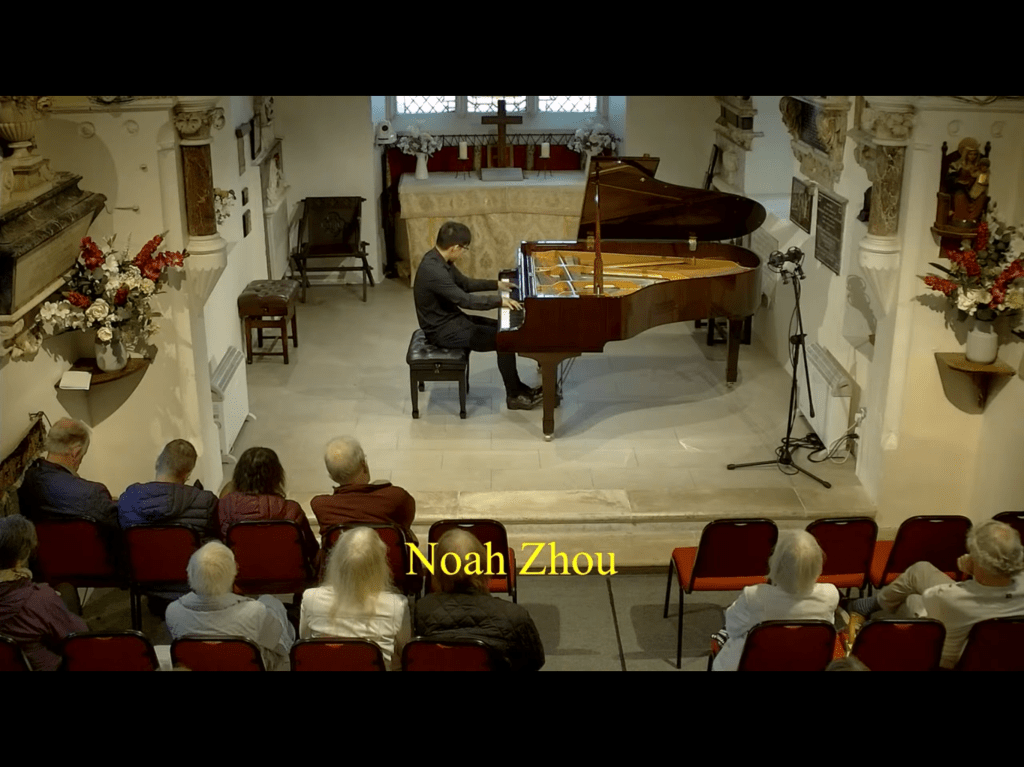
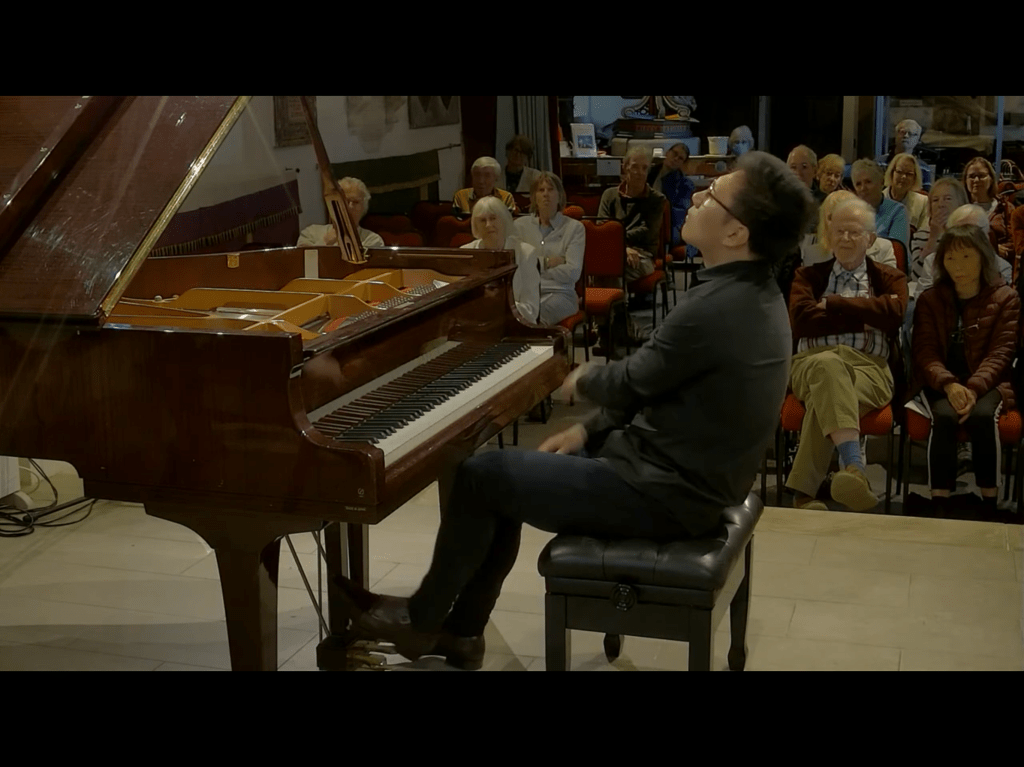
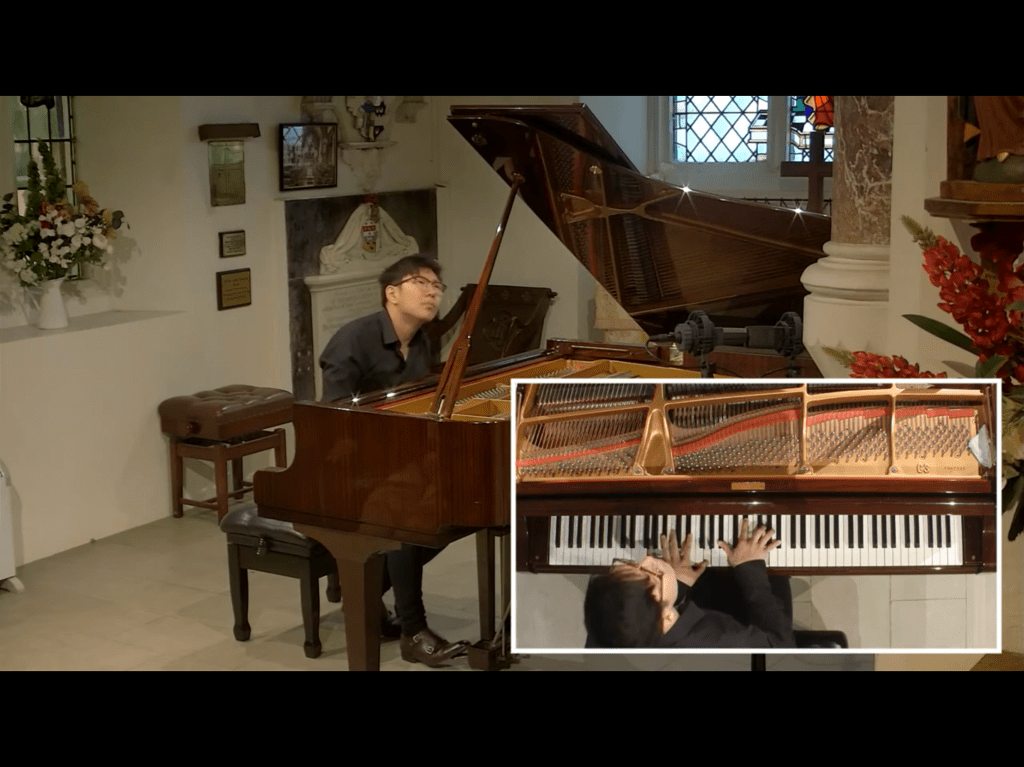
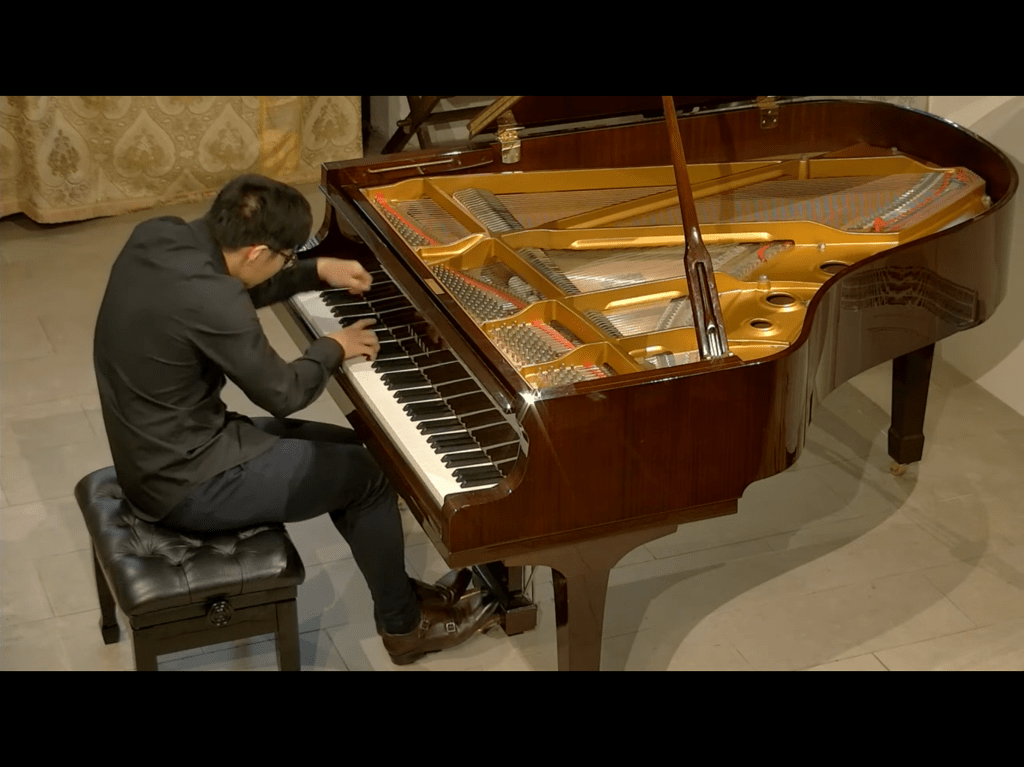
Based in London, British-Chinese pianist Noah Zhou began his musical journey at the age of 5. Generously supported by the Eileen Rowe Musical Trust for a number of years, he has since gone on to have completed his Bachelor’s degree at the Royal Academy of Music, where he was awarded the Sir Elton John Scholarship. Now he is pursuing his Master’s at the same institution, where he studies with the Emeritus Head of Keyboard, Christopher Elton. He is also generously supported by the Hattori Foundation and the Countess of Munster Trust.
Noah has been the recipient of a number of awards, notably 2nd Prize at the YPF European Grand Prix (2022), as well as the Royal Philharmonic Society of Great Britain’s Duet Prize for Best Young Instrumentalist (2018). He has also been awarded 1st Prizes at Valsesia Musica International Competition (2021) and the Euregio Piano Award (2021). On top of this, Noah has to his name the titles of Laureate of the Rio International Competition (2022); Horowitz International Competition (2019); Campillos International Competition (2021), and was a finalist at the UK Piano Open (2020); and Manchester International Concerto Competition (2019).
Noah is a frequent performer – orchestras with which he has collaborated include, the Phion Orchestra of the Netherlands (under Antony Hermus); the National Philharmonic Orchestra of Ukraine (under Vitaliy Protasov); the Brazilian National Symphony Orchestra (under Roberto Tibiriçá); the Danube Symphony Orchestra (under András Deák); the Manchester Camerata (under Stephen Threlfall); the Pazardzhik Symphony Orchestra (under Grigor Palikarov); and the Malaga Symphony Orchestra (under Victor Eloy Lopez Cerezo).
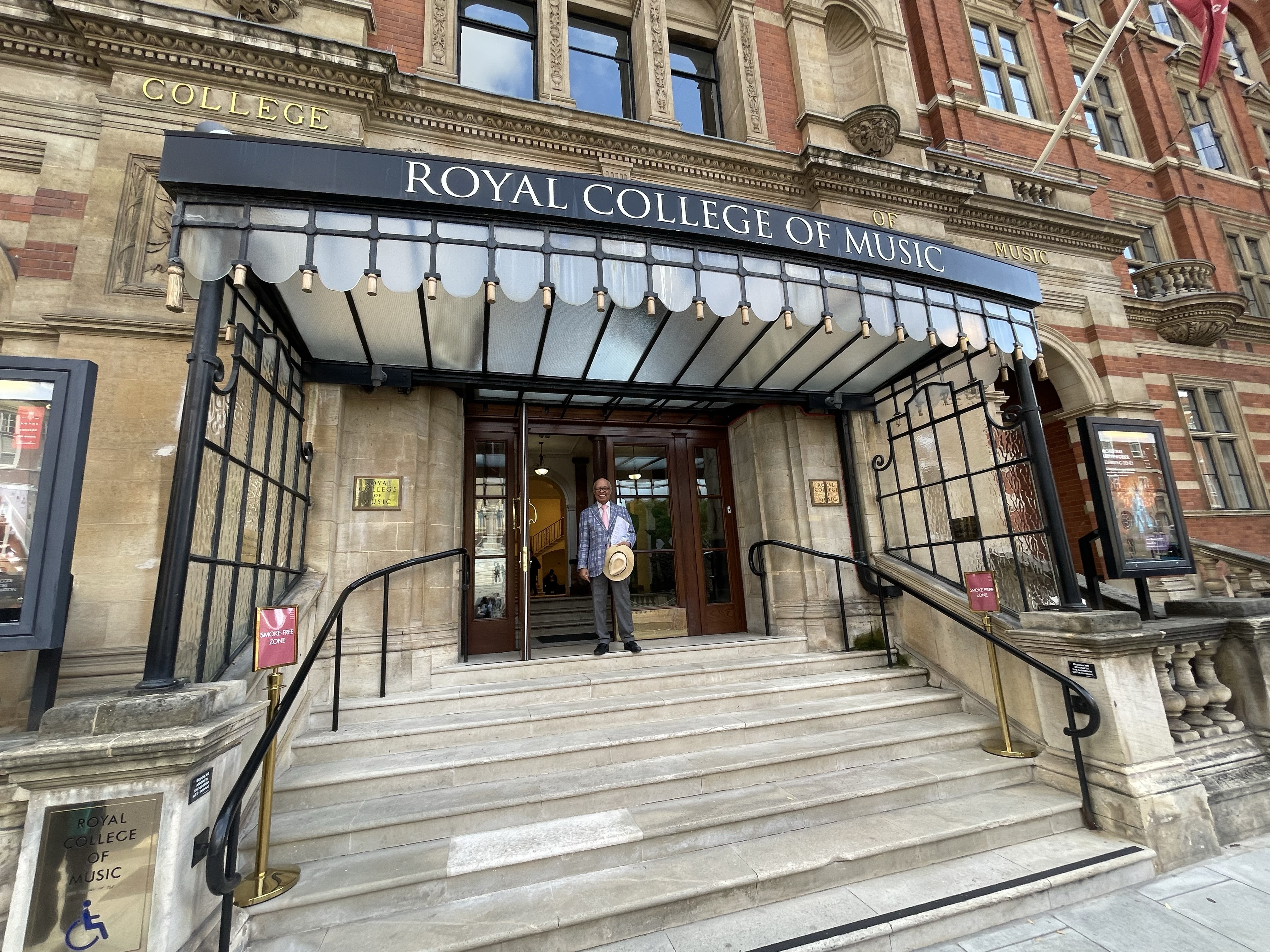
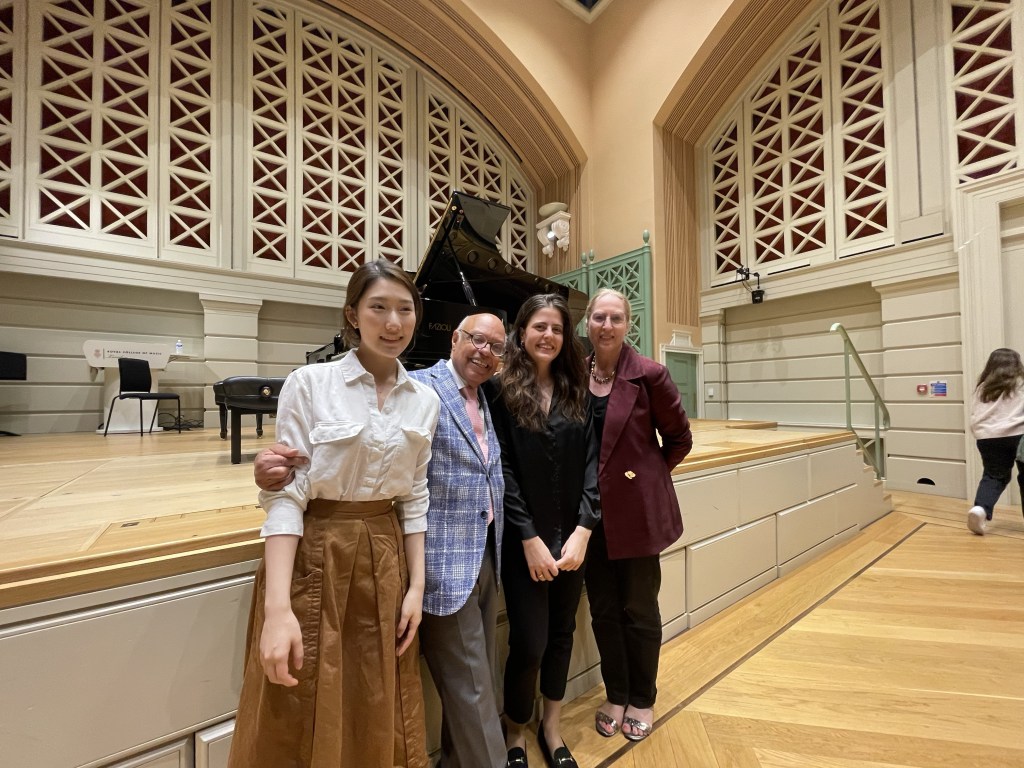
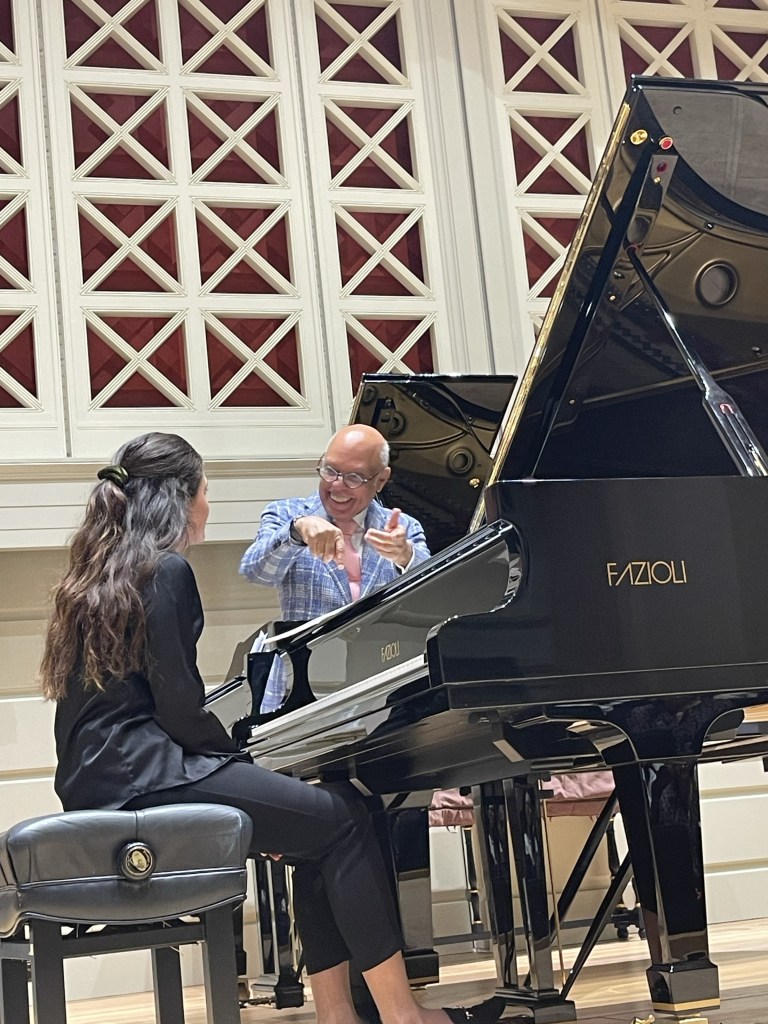
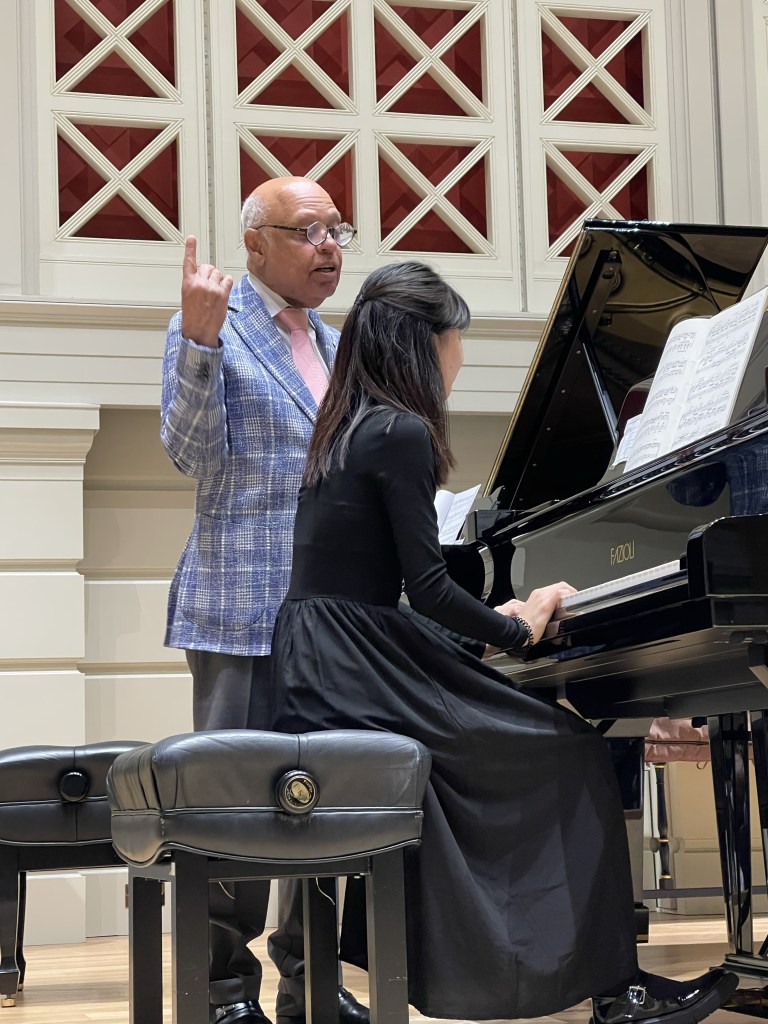
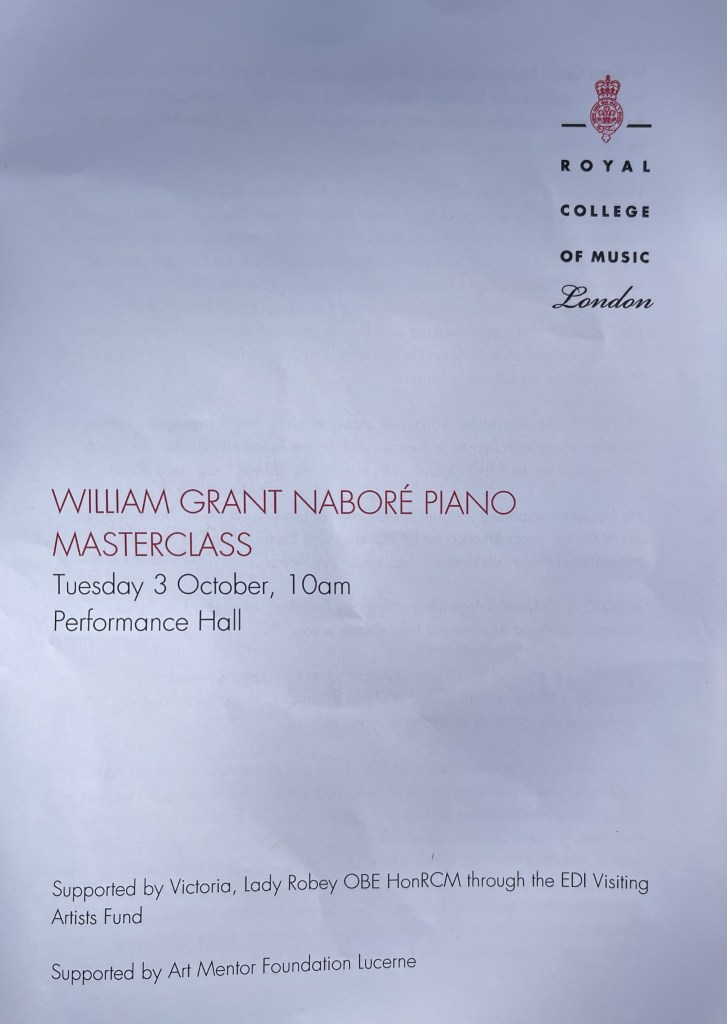
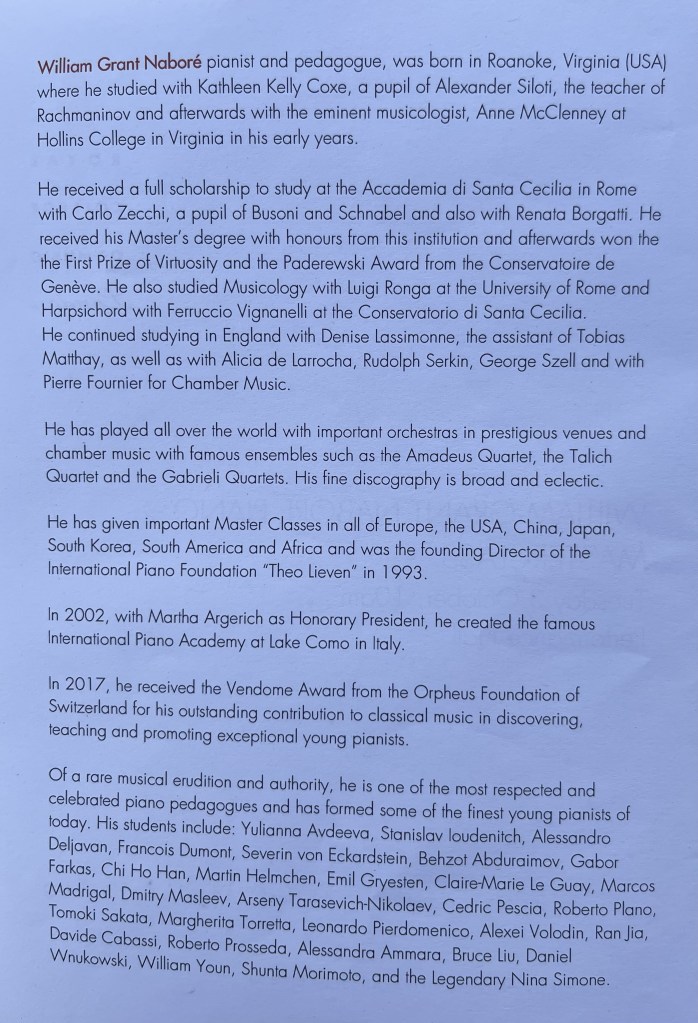
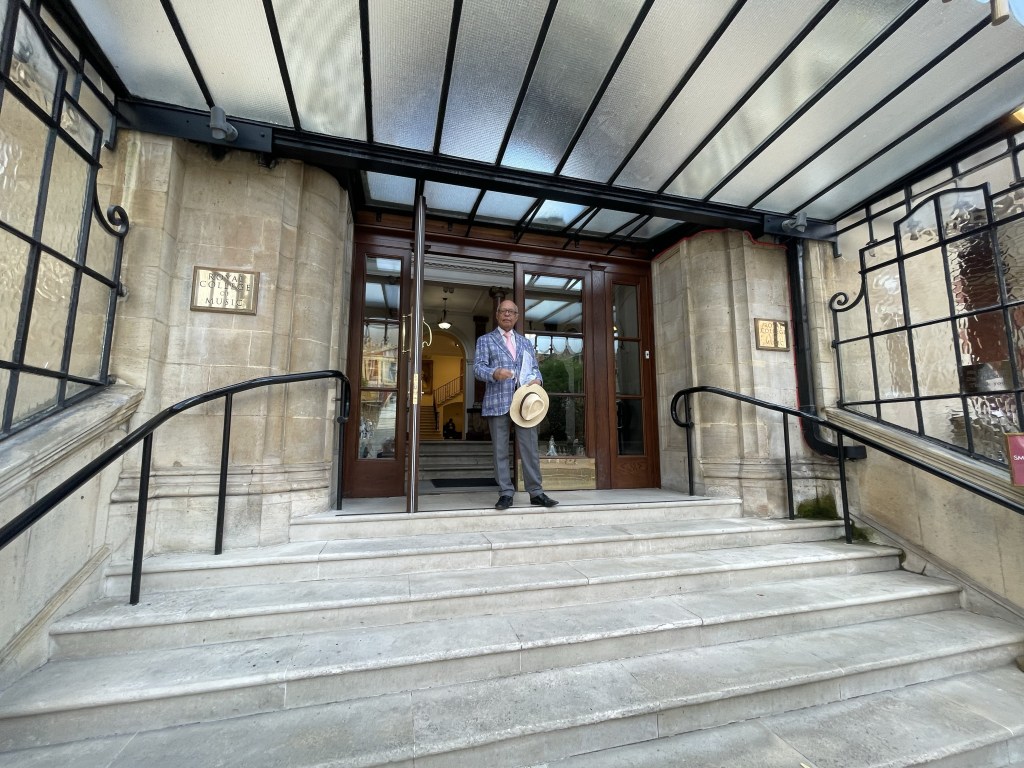
London has waited too long but better late than never and thanks to Vanessa Latarche and Ian Jones at last he made it ………William Naboré bestrides the RCM like a Colossus
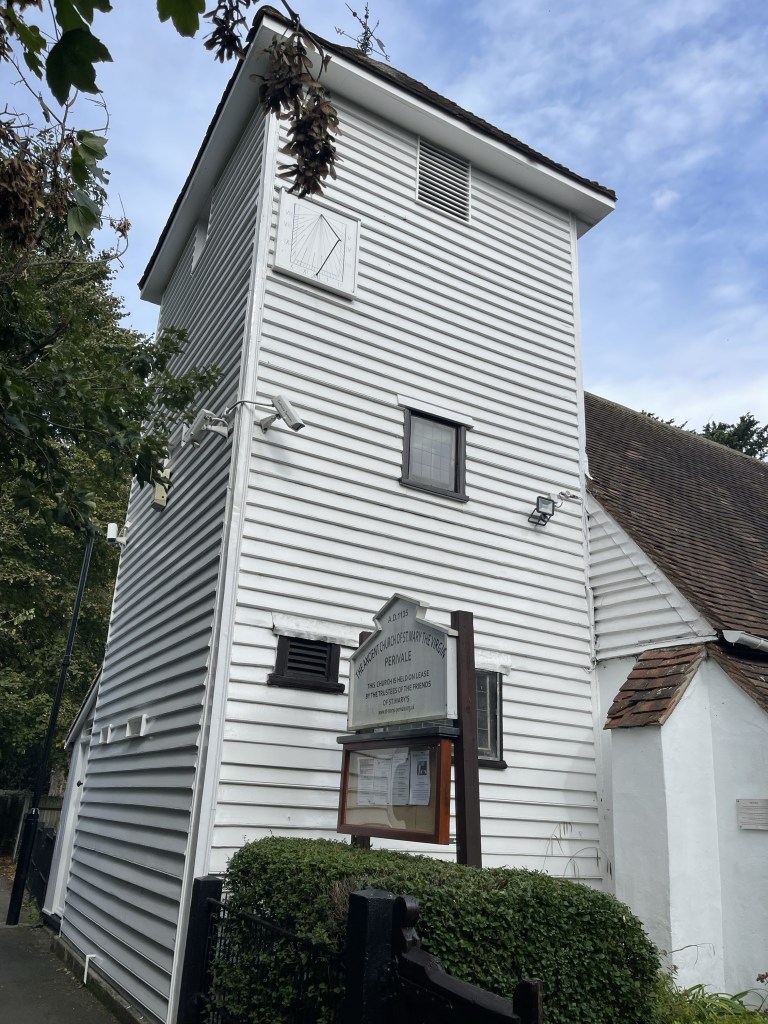
THE KEYBOARD CHARITABLE TRUST in collaboration with ST MARY’S, PERIVALE present
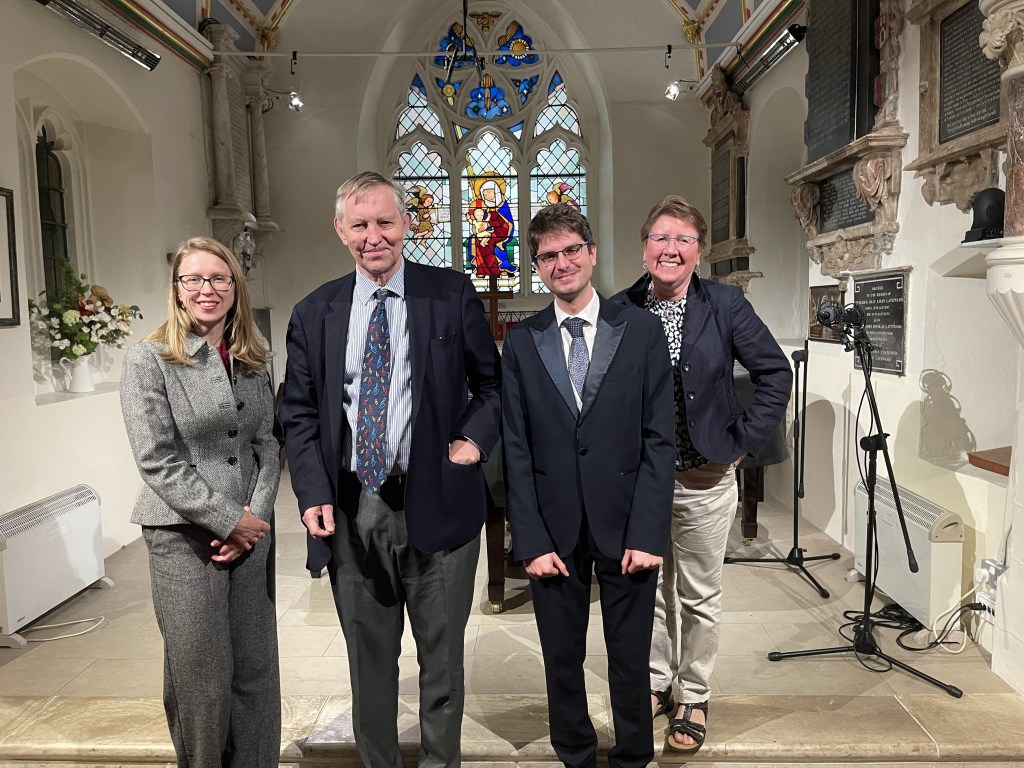
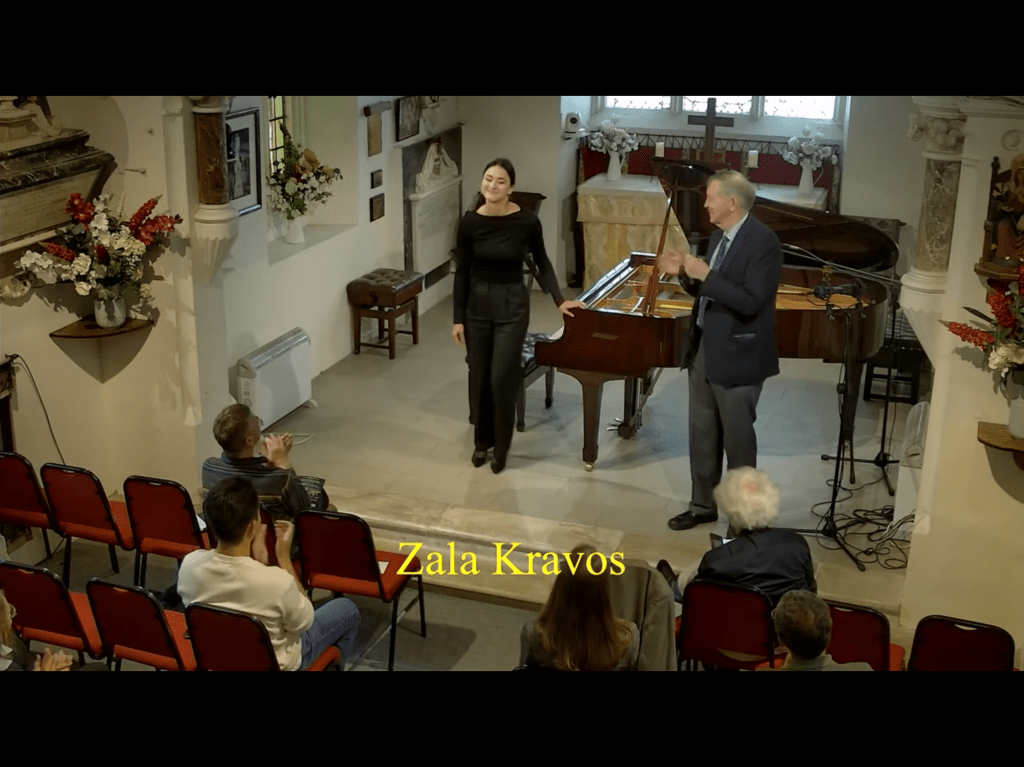
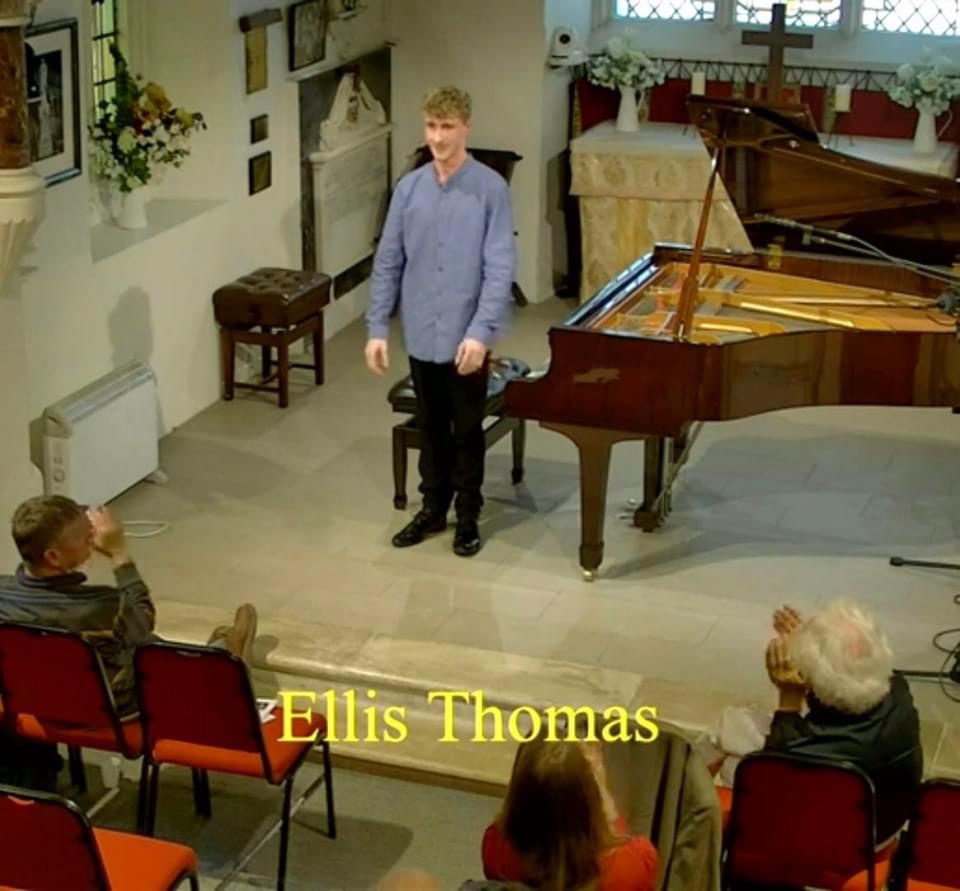
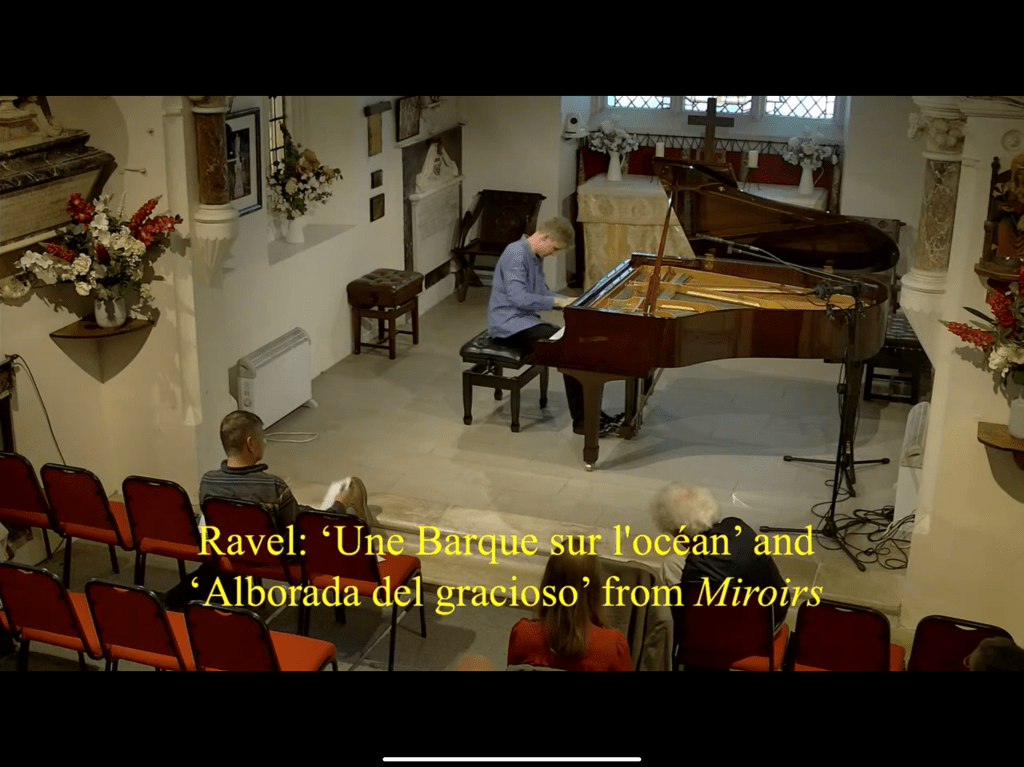
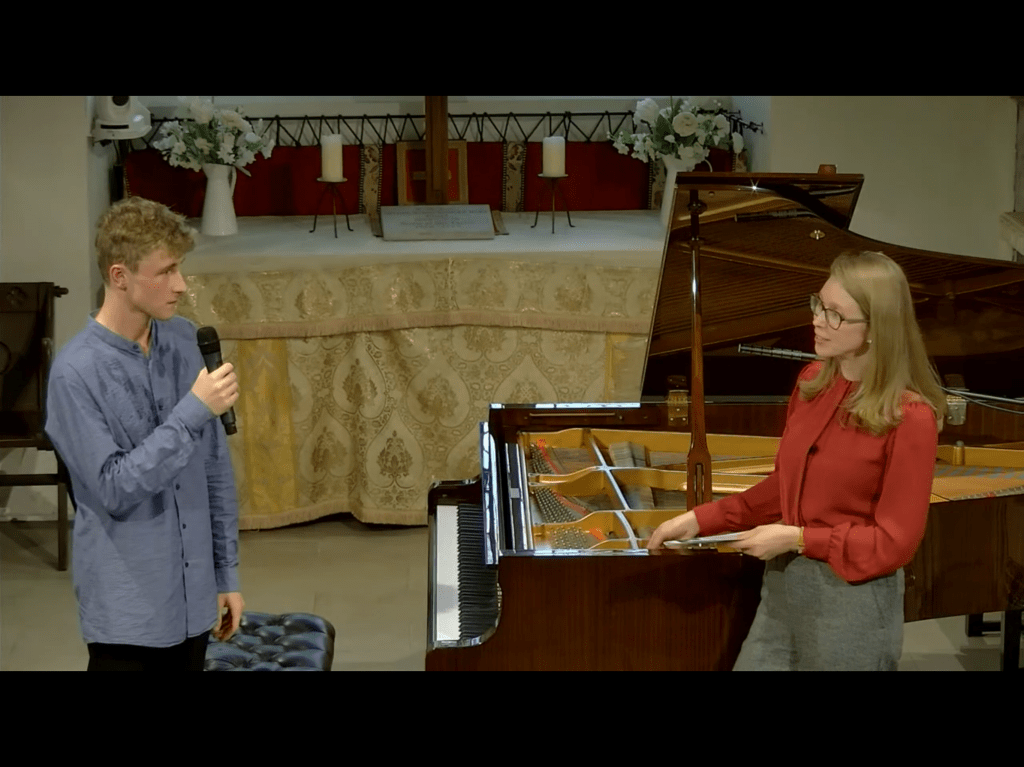
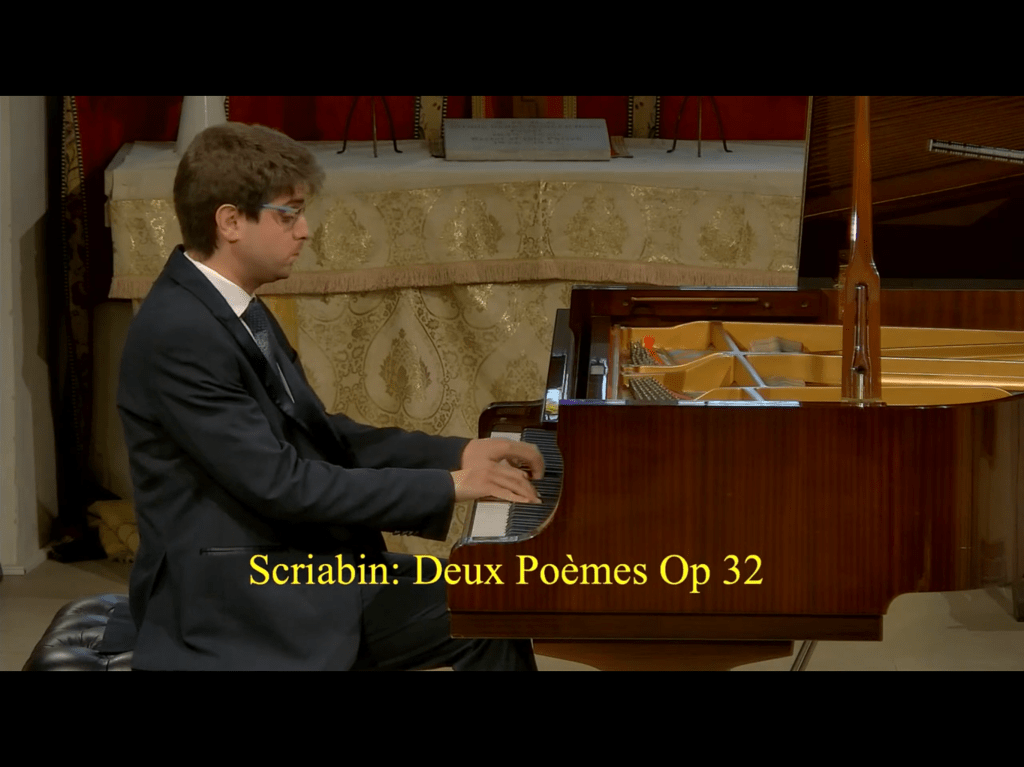
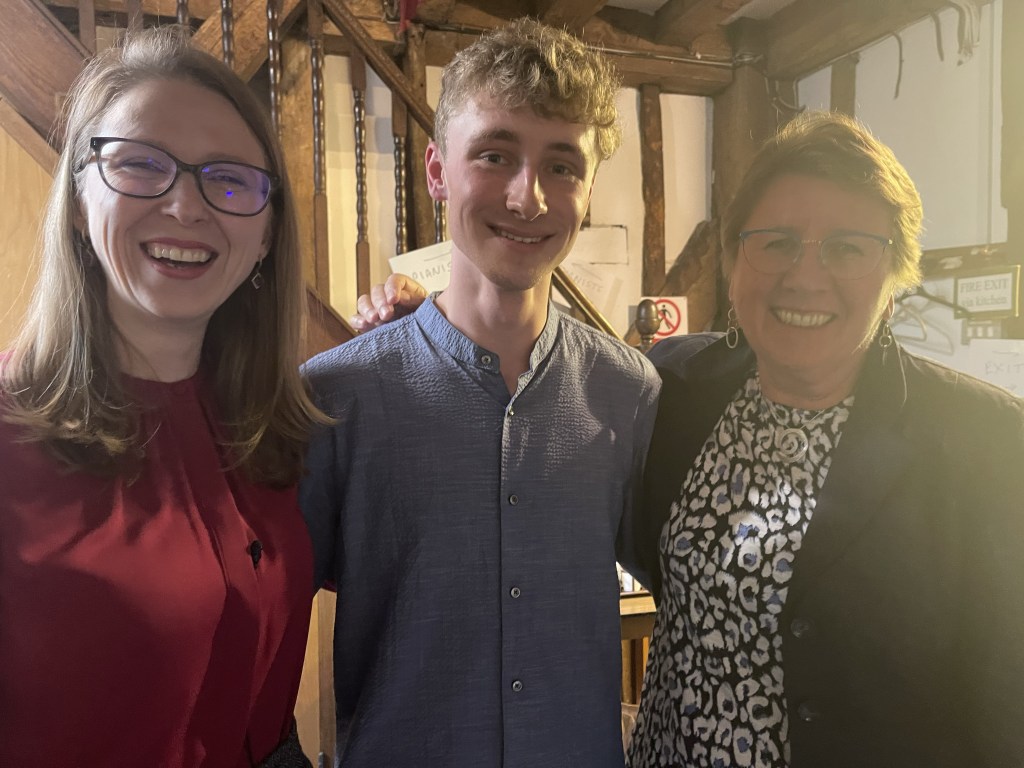
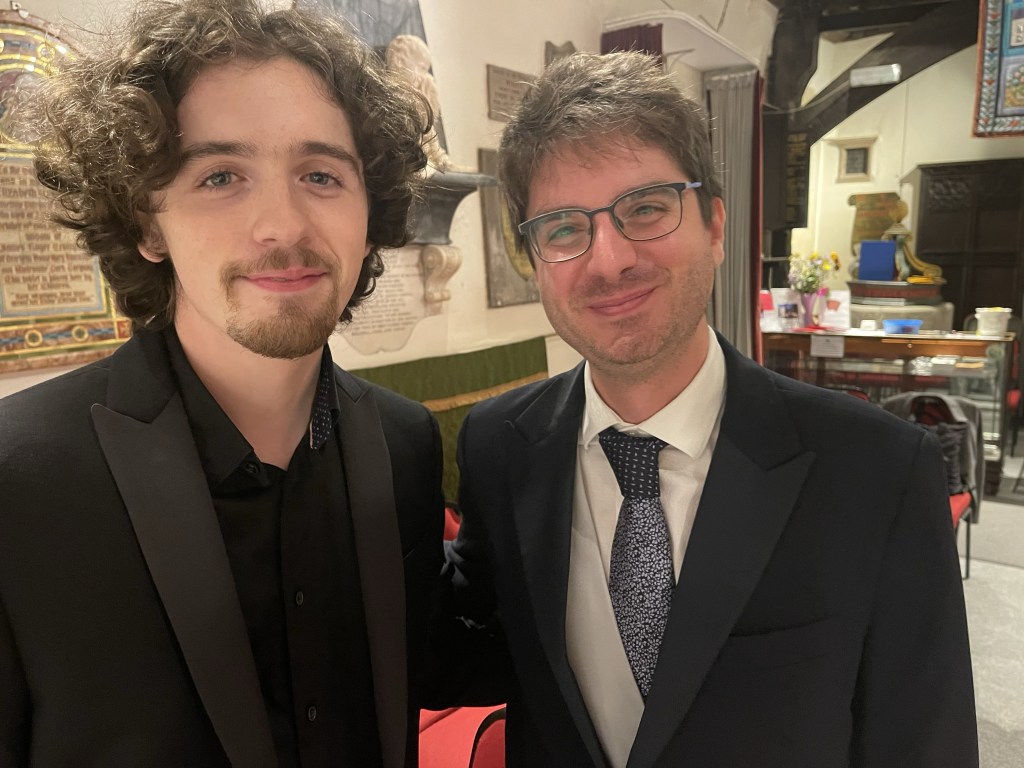
Elena Vorotko -Dr Hugh Mather -Antonio Morabito – Sarah Biggs Dr Mather presenting Zala the first of five remarkable pianists .Roger Nellist of St Mary’s writes :”As expected, a remarkably high standard of musical performance by all 5 pianists during the first day of our Autumn Piano Festival today, run jointly with the Keyboard Charitable Trust. ‘Exceptional’, ‘excellent’, ‘fabulous’, ‘profound’ and ‘immaculate’ were some of the many compliments from the 40 or so online viewers watching our Livestream in USA, Canada, UK, Poland, Italy, Spain, Ukraine and RSA. We also had 20 – 40 followers attending in the church during the afternoon and evening sessions. Huge thanks to Zala Kravos, Nikita Burzanitsa, Ellis Thomas, Antonio Morabito and Kyle Hutchings who treated us to a feast of Beethoven, Chopin, Prokofiev, Scarlatti, Brahms, Ravel, Bach and Mozart. After each performance, KCT Artistic Director Elena Vorotko interviewed the pianists, adding to the enjoyment of this successful first day. We resume at 2pm tomorrow, Sunday 1 Oct, to hear another 5 international pianists.”Dr Hugh Mather
An Autumn Piano Festival
A series of great masterpieces performed by ten of the finest young pianists of our time.
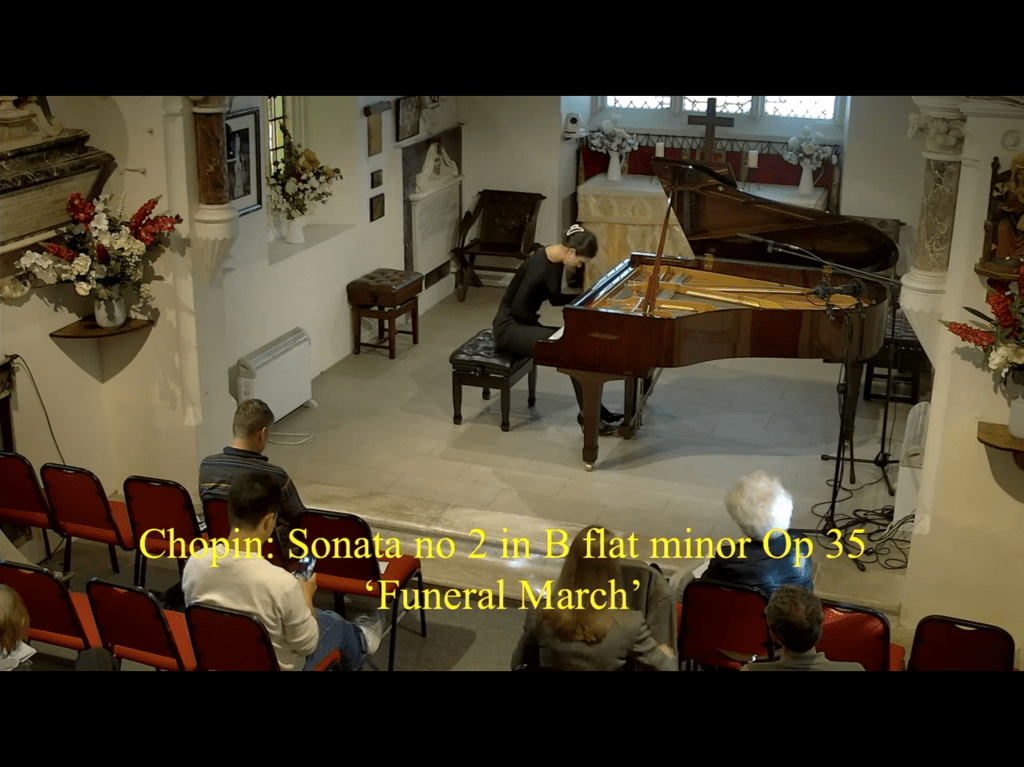
A real stylist playing with intelligence and a very strong personality.Playing with a refreshing freedom but always with the composers intentions in mind.Sometimes her personality pushes her to the limit of the composers parameters but the meaning is paramount and her sense of communication is compelling.Almost distorting the rhythm as the inner trills in the first movement were held back just a fraction just as the impossible crescendo on the last note was not even contemplated as she smoothed over the notes with unerring style.Wonderful sound of absence and a magical ending leading to the pastoral return of the ‘vivacissimamente’.The great chiming notes played fearlessly with enviable authority.It was the same authority that she brought to the opening of the Chopin Sonata.The Grave played with imperious force and the opening of the doppio movimento was like a gun shot with an added bass note just to drive home her fearless interpretation.Overwhelming but totally convincing as all she did.A driving energy only to unwind into a second subject of aristocratic beauty.No worries for her about the repeat and like most great pianists she just left it out as she went straight into the development with Beethovenian vehemence.A beautifully capricious Scherzo with an ending that was truly memorable.A Funeral March that was a great statement in her hands with contrasts that might have seemed for some rather exaggerated but her personality was so convincing that we could only wallow at the view on a voyage with such an expert driver.The trio was a little languid but was of such beauty that you never wanted the March to interrupt it again.And the wind over the Graves was played with astonishing clarity and sense of direction that the final chords came as a rude interruption of a wind that could happily have gone on for ever.
Zala Kravos was born in Slovenia in 2002 and started piano lessons at the age of five. The following year she entered the Conservatory of the City of Luxembourg, where she was awarded diplomas in performance and music theory. From 2012 to 2018, she studied in parallel at the Queen Elisabeth Music Chapel in Belgium with Maria João Pires and Louis Lortie. At the age of seventeen she was accepted in Bachelor of Music (Hons) programme at the Royal College of Music. She graduated in July and is now in the Master of Music in Performance (Keyboard) programme. Her piano professor is Norma Fisher. Since 2010, she has regularly taken part in masterclasses with many other internationally renowned pianists. Between 2009 and 2016, Zala won national and international competitions in Luxembourg, France and the USA, where she was invited to perform at Carnegie Hall. She has been regularly performing solo, chamber music and with orchestras since the age of six and has already played in nineteen countries. She recorded in Germany her first solo album in 2017 and in 2021, she recorded a second album of piano duets with her younger brother, Val. Critics across Europe were unanimous in their praise of both recordings. ‘One of the greatest talents I have ever seen.’ – Maria João Pires ‘An artist with a distinct and compelling voice and a musical sincerity that is rare, indeed.’ – Norma Fisher ‘A performing career that is already international enough to make her talk as if she’s an old hand.’ – International Piano Magazine
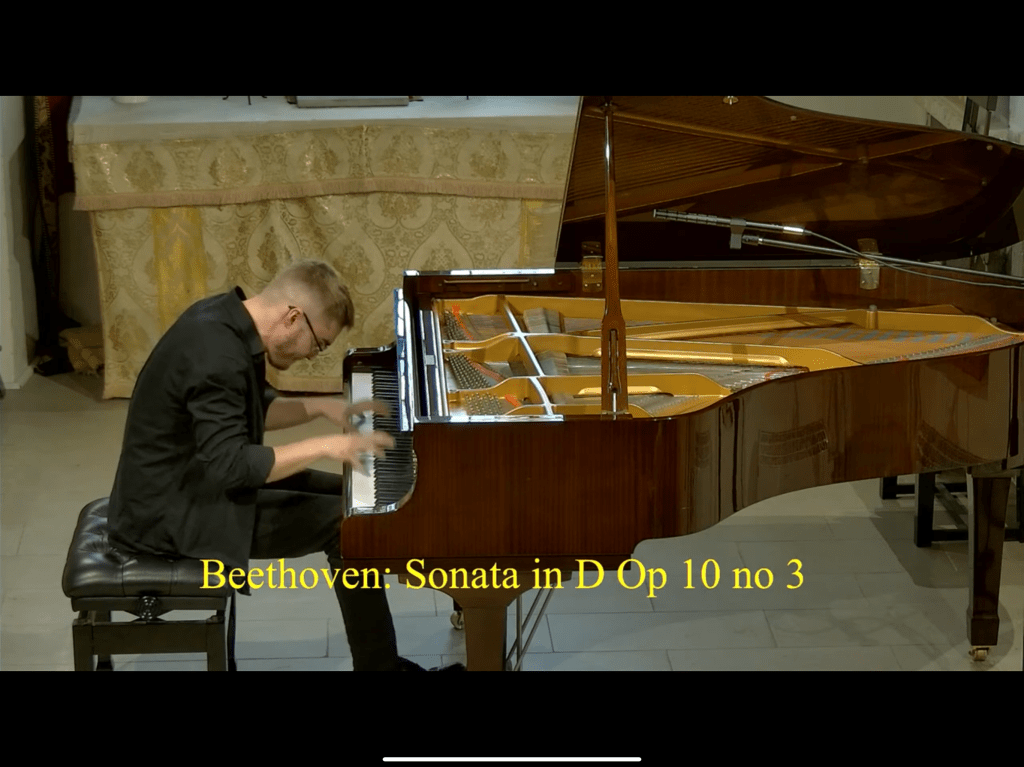
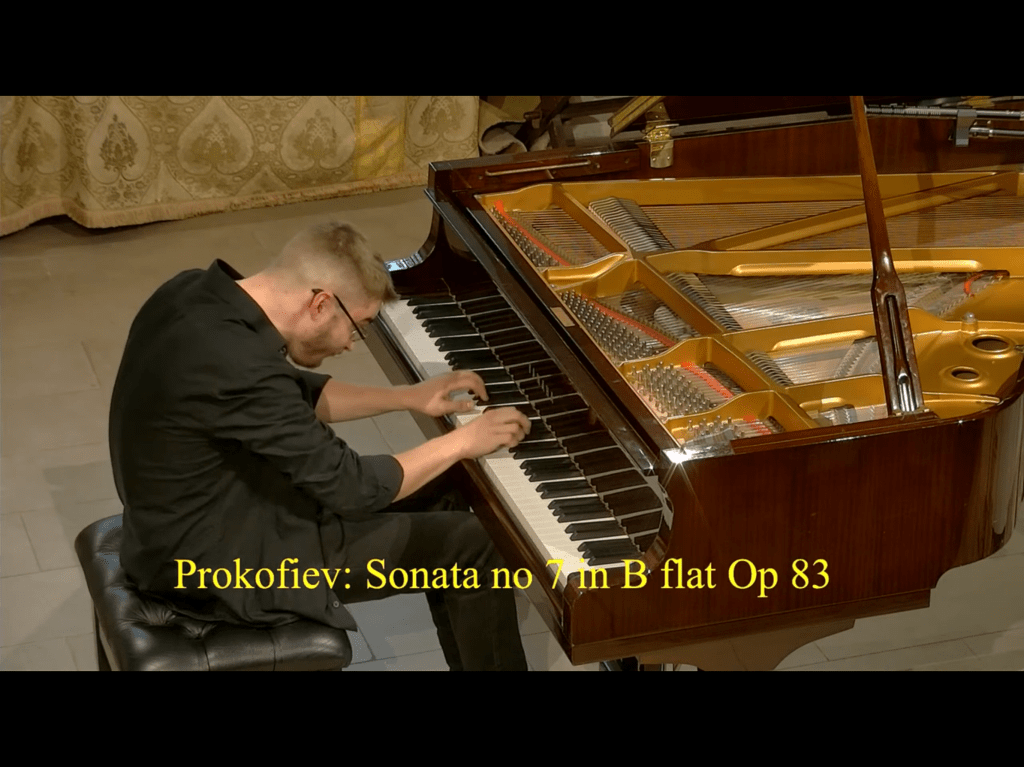
There was a rhythmic drive to the playing that with the dynamic contrasts he found was quite intoxicating.The energy that Beethoven can transmit in these early sonatas is quite remarkable as he breaks away from his teacher ,Haydn,and forges a new world in which the force of his irascible changeable temperament is quite overwhelming.There was nobility and beauty in the Largo e mesto that with his earlier Sonata op 7 is a work of visionary genius.It was played with a scrupulous attention to Beethoven’s very precise indications as you might expect from a star of Alexeev’s class at the RCM.A beautifully fluid and mellifluous Menuetto was contrasted with the questioning opening of the Rondo leading the final streams of sounds that spread across the entire keyboard with enviable precision and drive finishing deep in the bass of the piano with disarming nonchalance. And a star Nikita truly is as he allowed Prokofiev’s War Sonata n. 7 to explode before our astonished eyes.Could this be the same piano that had just given us such intelligent refined Beethoven.There was a cocktail mixture of violence and mystery with playing of great clarity and rhythmic energy but with an astonishing palette of sounds.From the whispered to the truly explosive .The Andante caloroso was just that as it was bathed in warmth with a combination of majesty and passion in an overpowering outpouring of emotion.The siren at the end of the Andante I had never been aware of until now as Nikita allowed the glass like sounds to cut through the languid atmosphere of a movement that lay exhausted from such powerful emotion.The Precipitato was played with driving energy and relentless forward movement with the passion and technical reserves of a triumphant youthful virtuoso – ‘veni vidi vici indeed!’
Nikita Burzanitsa was born into a family of musicians in Donetsk, Ukraine. In 2015, he won a scholarship to Wells Cathedral School where he studied with John Byrne. In 2017, he returned to Donetsk to study at the State Conservatoire. Since 2020 he has been studying at the Royal College of Music with Dmitri Alexeev. His competition successes include winning the Wells Concerto Competition and First Prize in the International London Piano and Music Competition in 2017. In 2020, he won the Sevenoaks Young Musician of the Year – and in the following year, he won Second Prize in the Joan Chissell Schumann Piano Competition and in the Orbetello Piano Competition (Junior) in Italy. He also won First Prize in the Moscow International Music Competition in 2021, at the Nouvelles Étoiles International Music Competition in Paris, in the Four Notes Piano Competition in Abu Dhabi and in the Vienna Music Competition (virtuoso category). He has taken part in masterclasses with Dmytro Suhovienko, Andrey Ivanovich, John Byrne, Ian Jones, Steven Hough, Vanessa Latarche, Mitsuko Uchida, Barry Douglas, Boris Berman, Vovka Ashkenazy and Miguel Angel Shebba.
4 pm Ellis Thomas
I had heard a lot about Ellis but never listened to him in live performance until today.Only 22 with a first class honours degree from Cambridge under his belt and studies that are continuing with Tessa Nicholson as a postgraduate at the Royal Academy .Well they told me he was good but they did not say HOW good !Simple,beautiful playing of great intelligence and clarity.A Scarlatti that just came vividly to life in his hands as the various strands were allowed to play and answer in the sunshine.But it was the Brahms Handel Variations that was so remarkable.Scarlatti led straight into Handel with such naturalness and ease as the ornaments spun from his agile fingers like springs uncurling.Each of the 25 variations was imbued with character style and a chameleonic sense of colour as it led inexorably to the final triumphant declaration of Handel’s innocent melody.A fugue that was played with a purity and clarity that belied the technical difficulties that Brahms delights in throwing into the arena.The final triumphant gong played with a relentless clockwork precision passing from the treble to the bass as Ellis fearlessly filled in the spaces in between.A quite remarkable performance of technical precision and perfection but above all of musicianly understanding and burning passionate temperament. Ravel was played with luminosity of ravishing flowing washes of colour.Notes disappeared as sounds of water were allowed to fill the entire keyboard that became awash with the impending stormy waters.The return to calm with the continuous splash of water was played with enviable precision by the right hand as a religious calm brought us back to the serenity and peace of the start of the voyage.Alborada was played with burning intensity of indecent Latin passion and the double glissandi were things that dreams are made of.This is a young artist of such mastery and a modesty as he thinks more of the music than himself
Welsh pianist Ellis Thomas has been acclaimed as a ‘sincere and committed’ musician, offering performances ‘with real understanding’ (Julian Jacobson, Beethoven Piano Society of Europe). He is equally at home with core repertoire as with contemporary and lesser-known works. Ellis has performed extensively at venues around the UK and is regularly invited to perform at music festivals in England and Wales. In recent years, he has also performed in Spain, Germany and Italy, and his performances and interviews have been broadcast on BBC Radio Wales, BBC Cymru, and S4C television. He has won prizes at many competitions including at the 2021 Düsseldorf Robert Schumann International Piano Competition. He also won First Prize at the Wales International Piano Festival, Gregynog Young Musician and the RIBI National Young Musician, and the Wales National Eisteddfod, amongst others. He has taken part in masterclasses with, and received lessons from, Boris Berman, Imogen Cooper, Pascal Rogé, Yevgeny Sudbin, Till Felner, Péter Nagy and Steven Osborne. He regularly performs as part of several chamber groups and ensembles. Ellis is a collaborative pianist and faculty member for the International Music Academy of Solsona in Spain.
Ellis also holds the Philharmonia Orchestra’s MMSF Piano Fellowship for the 2023-24 season. He is interested in exploring new connections between music and other arts. He recently worked with artist Appau Junior Boakye-Yiadom for an exhibition at Kettle’s Yard Gallery in Cambridge, providing improvisations for a series of short films. Ellis graduated from the University of Cambridge in 2022 with First Class Honours, where he achieved the highest mark in a final recital performance. Prior to this, Ellis studied at the Royal Northern College of Music’s Junior department for six years with Manola Hatfield. He is currently pursuing postgraduate studies at the Royal Academy of Music, where he is studying with Tessa Nicholson. Alongside a generous scholarship from the Academy, Ellis is grateful for support from the Countess of Munster Musical Trust, the Robert Turnbull Piano Foundation, the Ryan Davies Memorial Fund, the Kathleen Trust and Talent Unlimited.
5.15 pm : Antonio Morabito
A pianist who can charm and seduce his audience not only with his playing but also with a personality that illuminates all that he does.The grandiose Fantasy in Liszt’s hands was even better than the original organ work with the piano able to add a freedom and fantasy that somehow does not belong to the world of the church.The Fugue was quite literal of course as Liszt bowed before the Genius of Kothen.A little too fast in Antonio’s hands but he maintained the clarity and precision even at top speed. A completely different world of voluptuous sounds of subtle suggestion of Scriabin’s first poem were played with delicate luminosity and the second was a passionate outpouring of symphonic sounds. The Mazurkas op 30 by Chopin were played with a subtle palette of colours full of nostalgia and infectious dance rhythms.Four miniature tone poems in which Chopin with so little can say so much . Two studies op 25 in sixths and octaves were played with sumptuous sounds and allowed to breathe so naturally .Unlike the studies op 10 so admired by Liszt to whom they are dedicated “à mon ami Franz Liszt” these are real ‘canons ‘ of transcendental difficulty covered in flowers obviously love letters dedicated to Franz Liszt’s mistress, Marie d’Agoult,the reasons for which are a matter of speculation.Ending with one of the greatest works of the romantic piano repertoire,the Fourth Ballade was played with a continuous unfolding of beauty and invention.Notes just disappeared as the music was allowed to unfold so naturally with mastery and passion.
Antonio Morabito is an Italian pianist and graduate of the Royal College of Music in London with a Master’s Degree in Piano Performance. He teaches through the Royal College of Music Teaching Service. He also teaches as a Piano Professor at the Blackheath Conservatoire and at the Cardinal Vaughan Memorial School in London – and as a choral conductor at St. Augustine’s Church in Hammersmith. Antonio graduated with distinction in piano from the Cilea Conservatory under the guidance of Marialaura Cosentino who continues to be a mentor. Whilst studying at the Cilea Conservatory, he also studied composition. As a composer, he has written solo piano and chamber music, some of which he has performed himself in public concerts and for television broadcasts in Italy.
In 2019, Antonio won a scholarship from the European Commission and obtained a Master’s Degree from the J. Rodrigo Conservatory of Valencia in piano and chamber music with Adolfo Bueso and in choir conducting with Nadya Stoyanova. In 2019, he graduated with distinction in chamber music from the Cilea Conservatory. He also graduated in philosophy from the University of Messina. He has participated in masterclasses with acclaimed musicians such as Freddy Kempf, Enrique Batiz Campbell, Cristiano Burato, François-Joël Thiollier, Michele Campanella, Benedetto Lupo, Stefan Stroissnig and Leslie Howard.
He has also received prizes and achieved high rankings in national and international piano competitions, including at the Bruxelles International Piano Competition, the International Competition Città di Barletta, the Mandanici Award, the Rome Competition, the Làszlò Spezzaferri International Music Competition, the International Music Competition ‘Città di Pesaro’, the VII Odin International Music Online Competitio, the ‘San Donà di Piave’ Piano International Competition, the International Youth Music Competition in Atlanta, USA, the London Classic Music Competition and the International Moscow Music Competition. He was named ‘Young Artist of Excellence for the Musical Arts’ in 2014 by the UNICRAM Association.His studies at the RCM were generously supported by the Members of the Board of ‘Il Circolo’.
Last but certainly not least with 22 year old Kyle having started piano lessons only at the age of 12.Now with a fifteen month baby girl called Scarlett and coming straight from an onerous day’s teaching he sat at the piano and gave us performances of two of the great works for piano that were of perfection and purity.A musical intelligence as he translated the composers wishes into sound.Total concentration too as he watched his hands fly over the keyboard and extract sounds of a musician who was able to reveal secrets rarely noticed by others .The Mozart’s C minor Sonata had a dynamic drive with superbly crisp ornaments and playing of a crystal clarity of a purity with dramatic contrasts and beautifully sensitive phrasing. Subtle beauty of the Adagio which was played with a fluidity that contrasted with the drive and mystery of the Allegro assai. There was beauty and precision in Beethoven with dynamic drive allied to scrupulous musicianship.The Prestissimo was played with drive and fire with great sweep as the music drove inexorably forward.The ‘Andante molto cantabile ed espressivo ‘- the very heart of this Sonata was played with simple noble artistry as the variations were allowed to unfold so naturally as they led to the celestial sounds that only Beethoven could imagine in his head and miraculously could share with posterity.The miracle was revealed by Kyle with the innocence and simplicity that is too easy for children but too difficult for adults.At 22 this young man has a lifetime of discovery to look forward to.
Kyle Hutchings is a British pianist who, after just twelve months of self-taught playing, won a scholarship to study in London with pianist, Richard Meyrick on the Pianoman Scholarship’s Scheme, sponsored by Sir Harvey and Lady Allison McGrath. He subsequently made his London debut with the Arch Sinfonia playing Beethoven’s Second Piano Concerto.
Kyle has performed at many venues in the U.K. including at London’s King’s Place, the BT Tower and the Lansdowne Club, as part of the Blüthner Recital Series. He also performs internationally and recently gave recitals in Italy and Poland. He has been the recipient of many scholarships and prizes and was awarded the Nancy Thomas Prize for Piano as well as the Director’s Prize for Excellence during his scholarship studies at Trinity Laban. Kyle was also nominated for the Conservatoire’s coveted Gold Medal.
Kyle with Elena Vorotko Elena Vorotko c/o Artistic Director of the KT – Sarah Biggs C.E.O of the KT with Ellis ThomasKyle Hutchings with Antonio MorabitoNikita Burzanitsa with Dmitri Alexeev Elena VorotokoEllis Thomas Antonio MorabitoElena Vorotko
THE KEYBOARD CHARITABLE TRUST in collaboration with ST MARY’S, PERIVALE present Sunday 1 October 2.00 – 7.00 pm
An Autumn Piano Festival Day 2
Dr Mather with Christopher Axworthy directed by Roger Nellist for the live stream
Roger Nellist writes :”A second day of fabulous recitals by 5 international pianists playing in our Autumn Piano Festival, run jointly with the Keyboard Charitable Trust. Just so many effusive comments were offered about their performances from audience members in the church and from the numerous online viewers (with several pianist friends today in Italy and Bolivia, as well as our usual followers in Poland, USA, Canada and UK). Today, KCT Artistic Director Christopher Axworthy interviewed each pianist after their performance, adding much interest to the day. He will prepare a more detailed review but for all of us this two-day festival has been a musical triumph – which ended in something of a party atmosphere with pianists, KCT organisers (Christopher, Elena and Sarah Biggs), St Mary’s team and some in our audience chatting together and photographing afterwards. It was especially good to see some of our pianists staying to hear the others play. So, very special thanks for their impressive performances go to: JOSE NAVARRO-SILBERSTEIN (Bolivia), FILIPPO TENISCI (Albania/Italy), GIORDANO BUONDONNO (Italy), KASPARAS MIKUZIS (Lithuania) and MISHA KAPLOUKHII (Russia).
I have heard José many times over the past year whilst he was at the RCM preparing his Artist’s Diploma with Norma Fisher and Ian Jones.Flown in from Brussels ,where he is now a musician at La Chapelle,at less that 24 hours notice he gave a recital that was extraordinary for its authority,musicianship and technical mastery. I have never heard him play so well. He has put his competition status to one side and allowed his artistry to grow and be nurtured in performances that are being ever more admired.At a certain point it is only by playing in public that one really listens to oneself and grows artistically. A C.P.E Bach Fantasy – a truly nobel declaration of vibrating harmonies .A heart beating with warmth and character as this great improvisation was played out with extraordinary freedom and a kaleidoscope of colour and imagination.The deeply nostalgic recurring theme in José’s hands today made me realise how reminiscent it is of that deep yearning that is found in Janacek.Food for thought provoked by a performance of great conviction and mastery. A Beethoven op 90 with its imperious opening dissolving into a vision of the beauty that was yet to come with the simple Schubertian beauty of the second movement and it’s bagatelle like finish.Scrupulous attention to detail in a work that was to be Beethoven’s gateway to paradise. The Chopin Fourth Ballade opened in one long whispered breath before the theme and variations that were played with beauty,passion and a fluidity that took us on a long voyage to the final passionate outpouring.A coda that was played with the same aristocratic control and undercurrent of fire that I remember so well from Rubinstein’s hands.The four last chords played with the authority of the great artist that José is fast becoming. Ginastera was played with total conviction and astonishing freedom.From simple beauty to searing passion and animal like frenzy in an astonishing display of native fire and passion.
The young Bolivian pianist has performed in different countries in venues and festivals in Europe, South America and USA. Halls include Teatro Municipal “Alberto Saavedra Pérez” in his hometown La Paz to the Musikverein in Vienna. He is a Talent Unlimited Artist in London. As a soloist, he has performed with the Jena Philharmonic Orchestra, Norddeutsche Philharmonie Rostock, Georgian Philarmonic Orchestra, La Paz Symphony Orchestra, Orquesta de Jóvenes Musicos Bolivianos, Orquesta Sinfónica Juvenil de Santa Cruz de la Sierra among others. He is a prize winner at the Anton Rubinstein Piano Competition in Düsseldorf, Tbilisi International Piano Competition in Georgia, International Competition Young Academy Award in Rome, Claudio Arrau International Piano Competition in Chile among many others. He was a finalist at the Eppan Piano Academy and at the 63r d Ferruccio Busoni International Piano Competition. In Bolivia he gave masterclasses in La Paz Conservatory, Sucre Conservatory Santa Cruz Fine Arts College and Laredo School in Cochabamba. He served as a jury member in national music competitions. He was mentored by Paul Badura Skoda. He studied with Balasz Szokolay at the Franz Liszt University in Weimar and with Claudio Martínez Mehner at the University of Music and Dance in Cologne. At the moment he is at the Artist Diploma programme at the Royal College of Music in London under the guidance of Norma Fisher and Ian Jones.He holds scholarships from Royal College of Music, Herrmann Foundaiton Liechtenstein- Bolivia, Theo and Petra Lieven Foundation of Hamburg, Clavarte Foundation in Bern and Elfrun Gabriel Foundation for Young Pianists.
Luminosity and purity of sound poured from Filippo’s hands as Debussy’s extraordinary bells were allowed to be seen in the distance coming closer and closer with joyous intensity.Playing of extraordinary sensitivity and with the mystery and revelation of the moon shining brightly in the desolate landscape that Filippo was able to create with mastery and imagination.The Golden Fish was played with a clarity and aristocratic simplicity as the piano was awash with sounds of great fluidity and disarming beauty. Filippo is becoming quite an authority on the relationship between Liszt and his son in law Wagner.Having recorded one CD of the transcriptions there is another in the pipe line which will include the Tannhauser Overture that astonished and overwhelmed us today. I had heard him play it it in Italy on a piano that Liszt would have used – an Erard of 1876- but today on this modern grand piano it was even more overwhelming for the volume of sound and the pianistic invention of bringing the full Wagner orchestra onto a single instrument.A tour de force from Filippo who was visibly exhausted after such a marathon of athleticism full of excitement and exultation.It was above all a tour de force of invention that would have put Liszt’s rival Thalberg to shame as Liszt was able to literally bring the score to life on a single instrument. Filippo had been to Bayreuth last summer having been awarded the prestigious Bayreuth Festspiele Scholarship and had been able to hear all four hours of Parsifal in the theatre where it was born.The Solemn March is a paraphrase of great suggestion of brooding insistence full of colour and radiance and lead straight into the nobility of the brass at the opening of Tannhauser.Two remarkable performances of Wagner /Liszt from a young man who is dedicating his time to a deep study of this extraordinary world and recording many of his finds venturing into a world that only Leslie Howard has dared pioneer before him.
Debussy : Images (book 2) 1. Cloches à travers les feuilles (Be(blls through the leaves) 2. Et la lune descend sur le temple qui fut (And the moon sets over the former temple) 3. Poissons d’or (Golden fish)
Born in 1998 in Tirana, Filippo Tenisci began his studies with Emira Dervinyte. He later trained with Daniel Rivera, Massimo Spada, Maurizio Baglini and Roberto Galletto. He has also attended masterclasses with Beatrice Rana, Elisso Virsaladze, Boris Petrushansky, Andrea Lucchesini, Ewa Poblocka, Justas Dvarionas, Uta Weyand, Jun Kanno, Ralf Nattkemper and Elisabetta Guglielmin. In 2016, he won Third Prize at the International Competition ‘Resonances’ in Paris and the prize for the best performer of Ukrainian music. In 2018, he was the overall winner of the International Competition for Youth ‘Dinu Lipatti’. In the same year, he won First Prize in the Franz Liszt Competition at the Hungarian Academy in Rome and was among the top eight semi-finalists at the Pianale Academy and Competition. In 2019, he won Second Prize and the ‘Scarlatti Prize’ at the Riga International Competition for Young Pianists. In 2020, he collaborated in the making of the documentary ‘Richard Wagner, ovvero la musica dell’avvenire’ by Valerio Vicari. In 2021, he made his debut with the Roma Tre Orchestra performing Mozart’s Piano Concerto No. 15 K.450 conducted by Sieva Borzak. Again with Roma Tre Orchestra, he performed Mozart’s Concerto for Three Pianos and Orchestra, with pianist Giuseppe Rossi, conducted by Maurizio Baglini for the Baglini Project 2021. Active internationally, he has recently made his debut in Romania at the Classic for Teens 2020 Festival, and has also performed in France, Germany, Latvia, Bosnia and Switzerland.
‘Tenisci’s … sensitivity and maturity at the piano surprise us despite his age’ – Quinte Parallele
‘Filippo Tenisci is considered as one of the best and promising talents of his generation. A passionate and sensitive musician, capable of capturing the audience’s attention thanks to his undoubted maturity and talent’ – Monferrato Classic Festival
Scarlatti sonatas of clarity and precision with the brilliance and rhythmic tension of the Sonata in D of intoxicating elan. The unmistakeable voice of Rachmaninov tinged Bach’s violin suite with elegance and charm liked a well aged postcard.It was played with irresistible rhythmic energy with Rachmaninov’s ingenuous invention added to Bach’s genius that in Giordano’s hands reminded one of the perfect match between Kreisler and Rachmaninov.A Gavotte that was full of subtle charm and persuasion and a Gigue of knotty twine beautifully unfolded by Giordano’s well oiled fingers.Some sumptuous playing of great colour and style. I have heard Giordano play all four of Brahms’s Ballades on Michelangeli’s Fabbrini Steinway in the studio that was of Sir George Solti.A work that was long associated with Michelangeli together with the Debussy Images Book One that was on the programme today . Playing only the first two of the Ballades for reasons of programming he brought great nobility and beauty to the first with a carefully crafted build up to a euphoric climax that was to die away to a mere whisper.There was a beautiful fluidity to the ravishing melodic line of the second Ballade ,floating on wave of magic sounds with the searching of the central episode before the return to the opening poetic paradise. Debussy Images Book One were played with a chiselled clarity the same that I remember so well from Michelangeli.’Reflets dans l’eau’ had freedom and beauty as the reflections were allowed to reverberate around the keyboard with a fluidity and ease that was quite beguiling.’Homage a Rameau’ was played with regal artistry bathed in sunlight.’Movements’was all lightness and brilliance as the melodic lines were like streaks of lightening that crossed the path of this never ending flow of sounds.
B
Debussy: Images (Book 1) 1. Reflets dans l’eau (Reflections in the water) 2. Hommage à Rameau (Homage to Rameau) 3. Mouvement
Born in Italy, Giordano Buondonno graduated from the Giacomo Puccini Conservatoire with Honours, receiving the highest mark in his class. He completed his Master’s Degree and an Artist Diploma, both achieved with Distinction, at Trinity Laban Conservatoire under the guidance of Sergio De Simone and Deniz Gelenbe. At the age of nineteen, Giordano won First Prize at the Clara Schumann Competition. In 2017 and 2019, he performed for the Piano City Festival in Milan. He was also the First Prize winner at the PianoLink Concerto Competition, playing Chopin’s First Piano Concerto with the PianoLink Philharmonic Orchestra in Milan. Giordano’s performances in the U.K. include recitals at St. James’s Piccadilly in London and at Henley Park Manor in Surrey, for His Serene Highness Prince Donatus von Hohenzollern. He also represented Trinity Laban as a finalist in the 2019 Beethoven Society Intercollegiate Piano Competition and, more recently, he was selected to represent Trinity Laban’s Keyboard Department in the annual Gold Medal Showcase at King’s Place in London. In 2021, he won Third Prize at the Sheepdrove Intercollegiate Piano Competition, and was a finalist in the Trinity Laban Soloist Competition. Giordano is a recipient of The Leverhulme Trust Scholarship, Arthur Haynes Scholarship, Gladys Bratton Scholarship and two Jaqueline Williams Scholarships for his studies at Trinity Laban.
It is amazing how Lithuanian trained pianists all have an enviable ease of playing and a fluidity of sound that is unmistakeable and is allied to a great temperament. Mikuzis came on stage looking as though he had lost his way until he got to the piano and it was like an atomic explosion.Breathtaking authority and conviction with a fluidity of sound and a rhythmic drive that was like being caught up in a whirlwind. A Sonata from 1953 of Bacewicz that was a totally unexpected bombshell but there was also the deep contemplation of the slow movement before the Toccata last movement of astonishing brilliance. Rachmaninov’s Corelli Variations were played each with great character and an astonishing palette of colours.A dynamic rhythmic drive that was overpowering as he had a full orchestra in his hands.A wondrous magic carpet at the end of ravishingly beautiful chiselled sounds. Chopin’s 3rd Scherzo was played with imposing authority from the the very first demonic notes.If the octaves could have been more melodic and less hypnotic it would have lead more naturally into the wondrous chorale with its commenting cascades of golden streams of sound and given a more architectural cohesion to the whole work .But this was a young man’s Chopin of passionate conviction and transcendental technical authority which was totally compelling and really quite breathtaking.I remember being overwhelmed last time I heard him on this very stage and I am even more so now.
By the age of twenty, Lithuanian-born pianist Kasparas Mikužis had performed at Wigmore Hall, the Purcell Room and the Concertgebouw. He had also released a debut CD and his performances had been televised on Mezzo TV and broadcast on Lithuanian radio and Radio Classique in France. Kasparas’s distinctive piano playing was acknowledged when he became a scholar of SOS Talents Foundation at the age of ten. Since then, Kasparas has performed across Europe including at the United Nations’ Headquarters in Geneva and at ‘EMMA for Peace’, the World Summit of Nobel Prize Peace Laureates concert in Warsaw. In 2018, Kasparas was invited to participate in the V. Krainev Competition in Kharkiv where he performed Prokofiev’s Third Piano Concerto. He has also performed in the Lithuanian Philharmonic Hall, the Fazioli factory concert hall in Sacile, Italy, Steinway Hall in Barcelona and in Kharkiv Philharmonic Hall with the Kharkiv Philharmonic Orchestra. Kasparas is a laureate of twenty-two international competitions including the Grand Prix at the tenth international Balys Dvarionas competition for young pianists in Lithuania and a double First Prize at the twenty-eighth Roma International Piano Competition, where he won First Prize in both the nineteen and twenty-five-year old categories. Kasparas is currently studying at the Royal Academy of Music with Diana Ketler. He previously studied with Justas Dvarionas at the Purcell School and with Liudmila Kašetiene. Recently, Kasparas was invited to play for Sir András Schiff in the Riga Jurmala Music Festival masterclass. Forthcoming engagements include a chamber music concert with Jack Liebeck and Josephine Knight at the Royal Academy of Music and a recital at Bridgewater Hall, Manchester. Kasparas is grateful for the help and support of SOS Talents Foundation, the M. Rostropovich Charity and Support Foundation (Lithuania), Talent Unlimited Foundation, the Hattori Foundation and Drake Calleja Trust. For representing Lithuania on an international stage Kasparas was awarded a letter of gratitude by the President of the Republic of Lithuania.
Misha I have heard play many times over the past two years and the young teenager I was so impressed with when he played Rachmaninov First Concert at Cadogan Hall is fast turning into a considerable musician of great stature.I also heard him play Liszt Second Concerto as winner of the RCM Concerto Prize but now at the ripe old age of 20 we can judge his playing not only of virtuoso gymnastics but of a true thinking interpreter of the deepest thoughts of the classical composers.It is thanks to the careful help of Ian Jones that this Russian trained pianist from the Gnessin School in Moscow is now delving deep into the scores of the great classics.It is only here that he will learn the real secrets of a true interpreter who thinks more of the composers wishes than his own! It was the very first bars of Beethoven’s penultimate sonata that revealed a profound interpreter of the composers very precise indications.The wonderful way that the opening trill was just a vibration that lead to the opening sublime melodic outpouring.But there were also the cascades of delicate arpeggios played with a clarity and shape that was enthralling.The rising and falling scales that accompany the development section were beautifully realised as was the magic change of key from the E flat to D flat just before, played so simply allowing Beethoven’s genius to speak for itself.The measured tempo of the Allegro molto and the absolute authority of the treacherous Trio was a great contrast to the mellifluous outpouring of the ‘Moderato cantabile molto espressivo’.The ending just disappearing on a cloud of pedal as Beethoven reaches on high to one of his most sublime creations.There was a clarity to the fugue that made the return of the Arioso even more poignant as the fugue returns in a whispered backward turn leading inexorably to the final glorious exultation and the triumphant arrival home on A flat.A performance of great maturity and intelligence allied of course to a superb technical command. There was luminosity and an atmosphere of deep contemplation in Liszt’s magical tone poem of St Francis preaching to the birds.An artist is known by his programmes and Misha’s choice of this Liszt ,in particular,to follow Beethoven’s most mellifluous sonata just showed what an artist we have before us. Now Misha could let his hair down and like the great virtuosi of the Golden Age of piano playing he could show us his beguiling seductive waltz steps of breathtaking virtuosity and subtlety.Godowsky was known as the pianist’s pianist and the performances in his studio were the stuff that legends were made of.A very private man who could play better in his studio than on the stage but left many transcriptions and some original piano works that show what the word virtuoso really means.Not loud and fast but pianissimo and pianississimo with a range of colours that could turn a box of hammers and strings into a box of jewels that could entrance and hypnotise all those that were lucky enough to be caught in it’s spell. Misha has this sense of style allied to a transcendental technical command and it was this wonderful performance that had us clicking our heels and with a smile on our face coming to the end of a piano marathon of ten wonderful pianists over two afternoons wanting even more .
Misha Kaploukhii was born in 2002 and is an alumnus of the Moscow Gnessin College of Music. He is currently studying at the Royal College of Music and is an RCM and ABRSM award holder generously supported by the Robert Turnbull Piano Foundation and Talent Unlimited studying for a Bachelor of Music with Prof. Ian Jones.
Misha has gained inspiration from lessons and masterclasses with musicians such as Claudio Martínez Mehner, Dmitri Bashkirov, Jerome Lowenthal and Konstantin Lifschitz. He has performed with orchestras around the world including his recent debut in Cadogan Hall performing Rachmaninov’s First Piano Concerto. His repertoire includes a wide range of solo and chamber music. Recently, Misha won prizes in the RCM Concerto Competition (playing Liszt’s Second Piano Concerto) and in the International Ettlingen Piano Competition.
Interview with Misha KaploukhiiInterview with José Navarro Silberstein CA with Elena Vorotko -Giordano Buondonno -Sarah Biggs Filippo Tenisci- Hugh Mather – Misha KaploukhiiGiordano Buondonno with Kasparas MikuzisCA interview with Filippo TenisciGiordano – Kasparas – Filippo – Misha Elena Vorotko -Giordano Buondonno -Sarah Biggs Discussions and excitement at the end of the festival The last word must go to the pianists
Jonathan Ferrucci is back in his home city of Florence, with the seven Toccatas by Bach,in the Harold Acton library now part of the British Institute.
As Jonathan said,’Bach invites you to dance with him’ in these early works inspired by listening to the great organist Buxtehude.An invitation to improvise and ornament in works that do not have a specific formal construction and are very free almost improvised episodes before bursting into flaming showmanship with the sudden eruption of the toccata itself.
Starting with the scintillating C minor and ending with the imperious D major. But what a wonderful surprise the grandeur of the F sharp minor BWV 910 or the very busy knotty twine of the E minor.A kaleidoscope of colour in the opening C minor with a very deliberately paced toccata where the whispered return was as breathtaking as the ecstatic outpouring of glorious exultation of the ending.Ravishing beauty and delicacy of the G major before the popular ditty of the toccata that disappeared into the depths of the Keyboard.What contemplation of the greatly extended D minor.
Jonathan had a whole world in his hands and all with the gentle sunset through the beautiful windows turning Jonathan’s silhouette into a room with a remarkable view indeed . But another Toccata that Jonathan had up his sleeve was truly a breathtaking and exhilarating cleansing of the air .Ravel’s decadent and ravishingly exotic Toccata from a work dedicated to friends sent to their slaughter in the First World War .A whole generation wiped out and denied the better world that Bach had already depicted with mathematical universal genIus.
The Toccatas for Keyboard, BWV 910–916, are seven pieces for clavier written by J S Bach Although the pieces were not originally organized into a collection by Bach himself (as were most of his other keyboard works, such as the Well Tempered Clavier and the English Suites etc.), the pieces share many similarities, and are frequently grouped and performed together under a collective title.
The seven Toccatas by J.S. Bach contain some of the great master’s most joyous keyboard music. The toccatas are youthful, improvisatory, virtuoso works, composed in the aftermath of Bach’s trip in 1705 to Lübeck to hear the great organist and composer Buxtehude.
Director Simon Gammell O.B.E presenting the concert
The toccatas represent Bach’s earliest keyboard compositions known under a collective title.The earliest sources of the BWV 910, 911 and 916 toccatas appear in the Andreas Bach Book ,an important collection of keyboard and organ manuscripts of various composers compiled by Bach’s oldest brother, Johann Christoph between 1707 and 1713. An early version of the BWV 912 (known as the BWV 912a) also exists in another collection compiled by Johann Christoph Bach known as the ‘Moller manuscript’ from around 1703 to 1707.This indicates that most of these works originated no later than Bach’s early Weimar years, though the early northern German style indicates possible Arnstadt origin.
Jonathan Ferrucci explaining the programme -‘dancing with J.S.B
Though the specific instrumentation is not given for any of the works, none of them call for pedal parts and like Bach’s other clavier works, these toccatas are frequently performed on the piano
The actual order of tonight’s performance was C minor BWV.911 – G major BWV. 916 – G minor BWV.915 – E minor BWV.914 – F sharp minor BWV 910 – D minor BWV .913 – D major BWV.912
Toccata in F-sharp minor, BWV 910
(Toccata)
[no tempo indication]
Presto e Staccato (Fuga)
[no tempo indication]
(Fuga)
Toccata in C-minor, BWV 911
(Toccata)
Adagio
(Fuga)
Adagio
(Fuga)
Adagio / Prest
Toccata in D-major, BWV 912
Presto
Allegro
Adagio
[no tempo indication]
Con Discrezione
Fuga
Toccata in D-minor, BWV 913
(Toccata)
[no tempo indication]
Presto
Adagio
Allegro
Toccata in E-minor, BWV 914
(Toccata)
Un Poco Allegro (a 4 voci.)
Adagio
Allegro – Fuga (a 3 voci.)
Toccata in G-minor, BWV 915
(Toccata)
Adagio
Allegro
Adagio
Fuga
Toccata in G-major, BWV 916
Presto
Adagio
Allegro (Fuga)
The beginning of the BWV 910 F# minor Toccata – from the Andreas Bach Book, in the hand of Johann Christoph Bach.The Bach Harpsichord in the Berlin Musical Instrument Museum
Last but certainly not least a round table discussion with many experts from institutions around the world ;’Beyond Erasmus’ Musical Education Abroad and Across Institutions………mediated by Roberto Prosedda it can be seen on the Cremona Musica web site .
The presentation of Michele Campanella’s ‘The Possible Breviary of The Pianist’ A short impassioned encounter with a legendary name and a pianist that I still can remember from my student days being so overwhelmed by his performance of Mussorgsky ‘Pictures ‘ in the suggestive atmosphere of the amphitheatre in Fiesole.He was a young man at the start of an illustrious career and now at 76 he can share words of wisdom from a lifetime’s experience of concertising.’Speed is not a good thing for our society’- ‘Pauses thought out but not lived’- ‘the importance of theatre to realise how punctuation in fundamental in understanding the meaning’.I could only stay for a very short glimpse of this idol of my youth but it was enough to realise what food for thought there must be in his book.Boris Petrushansky the Maestro of Maestros invited to Cremona by Roberto Prosedda,an ex student from Imola Academy where most of the pianist playing today have studied.Persuaded to play and apologising that he was not prepared.But a true artist is never truly prepared but their great artistry is evident for all to see.Beauty of sound and exquisite phrasing together with an architectural control in Schubert’s Impromptu op 142 n.2 held us in his spell as only the truly great can do ‘at the drop of a hat’
Just next door was the amazing Jed Distler not only one of the finest critics (with the late Piero Rattalino and Bryce Morrison pianophiles who have no peers). But Jed is also a pianist to be reckoned with as he demonstrated with an eclectic programme where the palette of sounds he found on the Bosendorfer 280 would be the envy of his illustrious colleagues.An ease and ‘ joie de vivre’ that like his great friend Inna Faliks fills the hall with a very special happy atmosphere with supreme intelligence and mastery.Jed had just performed in London Mahler 2nd Symphony in a four hand arrangement together with Gabriele Baldocci a protégée of Martha Argerich.Ever generous he and Inna were taken by Roberto to Rovigo Conservatory where they gave masterclasses immediately after the Cremona Musica Fair.Jed wrote to me this morning exclaiming how impressed he was with Roberto’s students and in particular a young man who had been acting as a volunteer in Cremona and then gave an amazing performance of Cesar Franck ….’one of the best he has ever heard’.
Alessio Santolini and Francesca Antonucci two students of Roberto Prosedda at Rovigo Conservatory in the masterclass of Jed Distler and Inna Faliks immediately after the Cremona Fair. . https://www.youtube.com/live/pAoDYqnb8q4?feature=sharedJed Distler Masterclass in Rovigo with Jed Distler in persuasive mood.Jed with Elia Cecino whose CD he had played on his radio programme in New York :”Beyond the Keys’ so needed no introduction from me!
A final afternoon in which many performances overlapped and I was sorry to miss, including a recital by Alessandro Riccardi but I look forward to listening to his CD’s
Preludi e sonetti italiani
G. F. Malipiero (1882-1973): Preludi autunnali
F. Liszt (1811-1886): Sonetto “Tanto gentile e tanto onesta”
Tre Sonetti del Petrarca
Selezionato tra i migliori pianisti diplomati nei conservatori italiani nel 2014, Alessandro Riccardi ha partecipato ai festival pianistici del Teatro La Fenice di Venezia, al Festival Pianistico Scriabin e Rachmaninov di Kjustendil (Bulgaria), alla “Giovine Orchestra Genovese” di Genova e al Concorso Pianistico Internazionale “Ferruccio Busoni” di Bolzano. Ha conseguito il Diploma di Laurea in Pianoforte con lode nel 2014 presso il Conservatorio Pietro Mascagni di Livorno, sotto la guida di Marco Baraldi e Monica Cecchi. Ha proseguito gli studi pianistici con Cristiano Burato presso il Conservatorio Claudio Monteverdi di Bolzano, dove ha conseguito il Diploma di Master in Piano Solo Performance con il massimo dei voti nel 2017. Ha studiato con Robert Palmer e James Helton presso la Ball State University di Muncie, Indiana (USA), per conseguire l’Artist Diploma in Piano Performance. Ha approfondito il repertorio di Chopin presso l’Accademia Musicale Karol Szymanowski di Katowice (Polonia) frequentando le masterclass di Andrzej Jasiński e Wojciech Šwitała.
Nel 2017 Alessandro è stato selezionato per suonare il Concerto per pianoforte e orchestra di Schumann in tour accompagnato dall’Orchestra Sinfonica Monteverdi. Ha inoltre vinto le audizioni Monteverdi per tenere recital di pianoforte solo nella Krzysztof Penderecki Concert Hall di Radom (Polonia) e nella Athanas Kurtiev Concert Hall di Kjustendil (Bulgaria). Ha effettuato tournée in Europa e in America, suonando da solista e con orchestra. Tra le varie sedi in cui si è esibito figurano il Palais des Congrès (Parigi), la Wiener Stadthalle (Vienna), il Teatro degli Arcimboldi (Milano), l’Auditoria Forum (Barcellona), il Palacio Vistalegre (Madrid), il Palacio Euskalduna (Bilbao) l’Hallenstadion (Zurigo), la Porche Arena (Stoccarda), l’Heineken Music Hall (Amsterdam), l’Indiana Wesleyan University (Marion, IN, USA) e l’Università di Yukatàn (Mérida, Messico). Alessandro è stato premiato con il primo premio all’VIII Concorso Nazionale di Musica “Val Di Sole”, al XII Concorso Nazionale di Musica “Bardolino” (VR, Italia) e al Concorso “Rotary Club Mascagni Livorno”, con il secondo premio al Concorso Pianistico Matinée Musicale di Indianapolis, al Concorso Pianistico di Livorno e nel 2018 è stato uno dei 100 partecipanti selezionati al Concorso Pianistico Internazionale “F. Busoni”.
Alessandro ha insegnato pianoforte alla Ball State University di Muncie nel 2019 e nel 2020, alla Scuola di Musica “Vivaldi” di Bolzano (Italia) e ha tenuto masterclass all’Università di Yukatán a Mérida (Messico) e a Terni (Italia) durante il “Festival Internazionale dei Colli” in collaborazione con l’Università di Łódź (Polonia). Nel 2019, durante una tournée in Messico, ha tenuto un recital sul repertorio di Scriabin: Alexander Scriabin, the Romantic Soul of the Early Piano Works. Nel 2020 ha registrato il suo primo album per pianoforte per Da Vinci Publishing: Alexander Scriabin, The Early Piano Works, che include la Ballata incompiuta Ahn. 14 in prima incisione mondiale. Il CD è stato accolto con favore dal Presidente dell’Associazione Alexander Scriabin di Mosca, Alexandr Serafimovich Scriabin, parente del compositore russo. Alessandro è attualmente docente presso il Conservatorio Fausto Torrefranca di Vibo Valentia (Italia).I did not want to miss the fascinating talk by Eric Schoones that had so intrigued me with our conversation on the bus that morning .A presentation of the German Edition of his book :’Walking Up the Mountain Track- The Zen Way to Enlightened Musicianship’.Talking about great pianists and International Piano Competitions.The Cremona Music award to Steven Isserlis where I was just able to hear he and Roberto play Casals’ ‘Song of the Birds’ in a hall that I have rarely seen so full.Roberto and Steven I had known in Sermoneta when Roberto ,then artistic director of the Pontine Festival, had invited Steven to play a work by Mendelssohn that Roberto had found in the archives and that had never been performed.Recording for Hyperion the most enlightened of recording companies,I was at the festival with Angela Hewitt also a Hyperion artist with whom she recorded the complete works of Bach. What fun we all had in the town where Roberto was born with two Hyperion artists meeting for the first time up a mountain in the middle of Italy. Now all established artists with important careers but united around Roberto and Alessandra with mutual admiration and friendship.I was only able to catch the Scarlatti encore of Greta’s recital and was sorry to miss Chopin’s B minor Sonata having been able to admire her musicianship and technical mastery in one of Scarlatti’s most enticingly rhythmic Sonatas .
Having missed completely Atso Almila’s presentation of the ‘Finnish Conducting School’ that we had spoken about over breakfast – I just hope that I can’t catch up with the recordings that were made of the live stream.A man that exudes the simplicity of the truly great I would dearly love to hear all that he has to say about the wonderful Finnish conductors that are taking over as Principal conductors of many of the greatest orchestras of the world .Finally I was able to enjoy some ravishing Debussy from Saya Ota in the Fazioli Concert Hall.Ondine and Feux d’Artifice played with a crystalline clarity and wonderful use of the pedals creating the same magic atmosphere as Carlo Guaitoli had done on this beautiful instrument only 24 hours before.
A Schumann Carnaval played with great style as one would expect from a student of Magarius at the Academy of Imola.Some beautifully stylish playing of great authority even though I was not totally convinced by her rather detached Pierrot. Coquette was played to absolute perfection as was Chopin the aristocrat with a heart of gold.But the best was still to come with a scintillating performance of Liszt’s Rigoletto Paraphrase .A Strauss paraphrase ‘Soirées de Vienne’ by Grunfeld ( not Rosenthal) was played with irresistible charm and ease and was a world that ignited her imagination and for me was a memorable way to close these wonderful three days immersed in a world of dreams .Pasquale Evangelista who I had heard in Angela Hewitt’s masterclasses in Perugia a month ago.I remember his Fauré Ballade that Angela was so happy to listen to – she has recorded it twice but it is a rarity in the concert hall these days. Recently transferred to Cremona I suggested he came to Cremona Musica to meet many interesting people from the world of music.A student of Orazio Maione he is now studying in Paris with Francois-Joel Thiollier and is a name to watch out for. https://christopheraxworthymusiccommentary.com/2023/08/24/angelas-generosity-and-infectious-song-and-dance-inspires-her-illustrious-students/Danieli Longo flown in especially from the Conservatory in San Paolo in Brazil William Fong of the Purcell School enjoying every minute of this feast of music in Cremona Well I had said I would forgive him if he played from the score as this was a one off performance sandwiched between Rachmaninoff First Sonata and Brahms B flat and Schumann Concertos …………..so would you mind turning the pages for me …….always the perfect gentleman !Cremona is above all this ………What marvels there are to be seen in this city where dreams become reality .
The entire cast of the Saturday evening concert in the Museo del violino