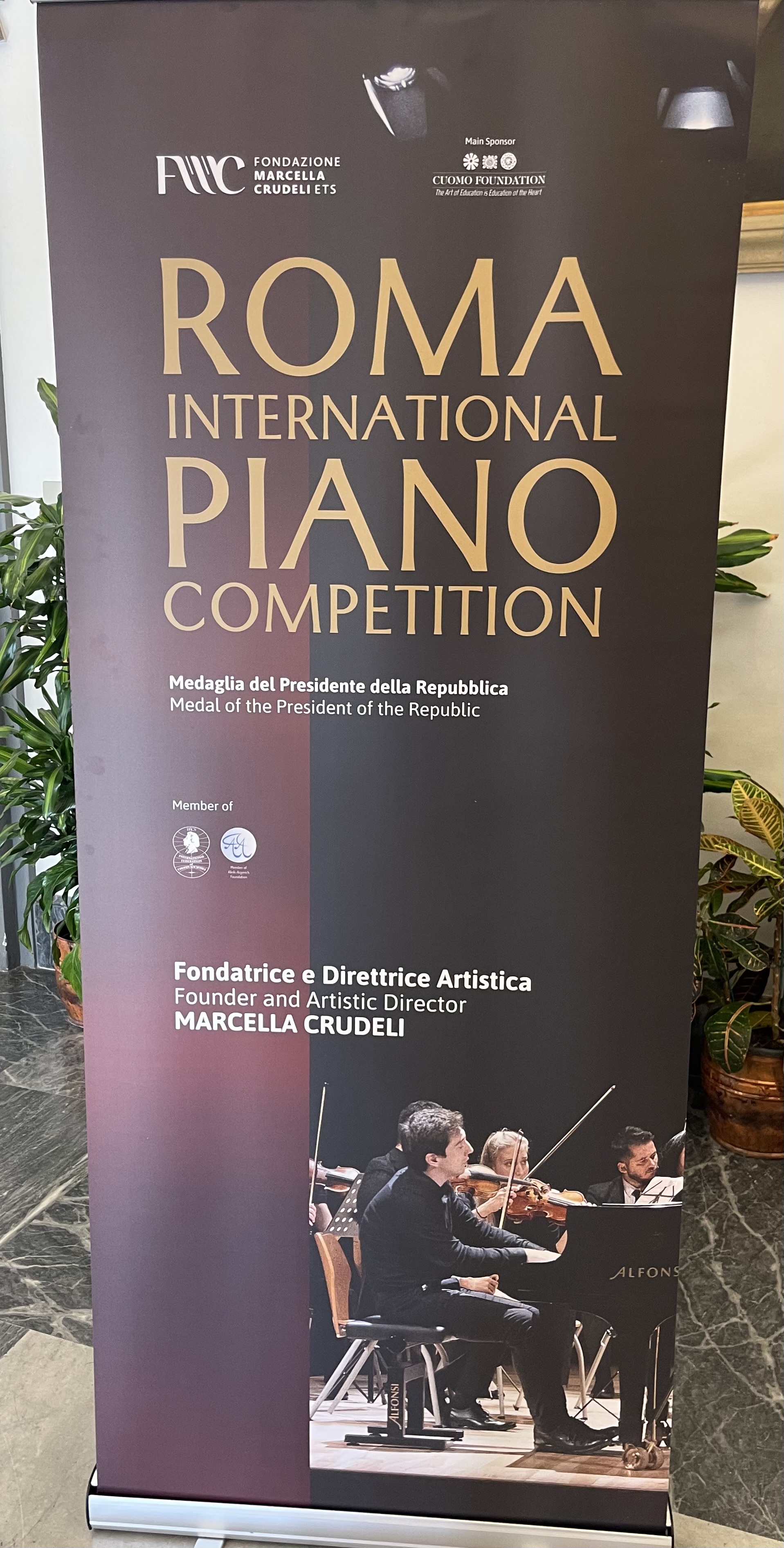
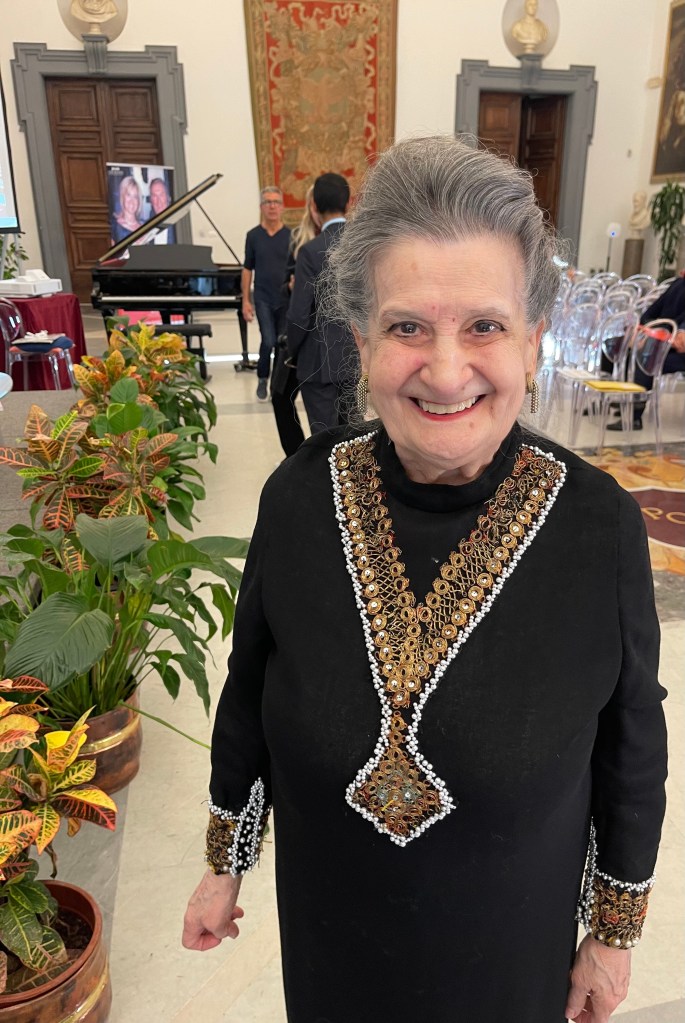
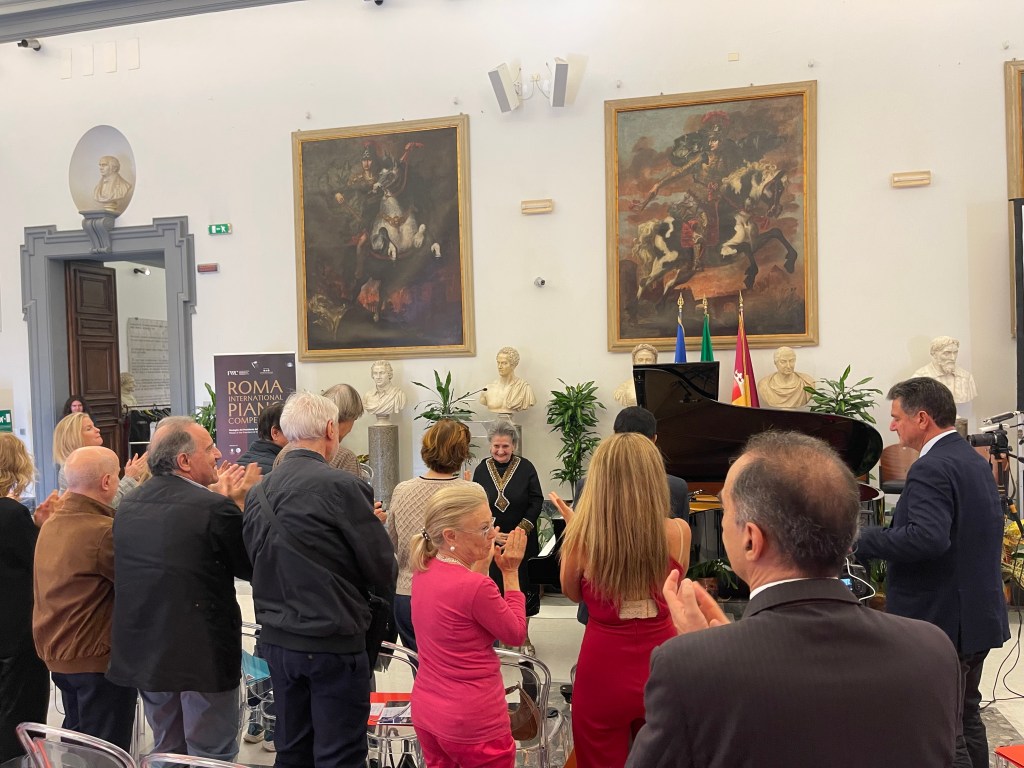
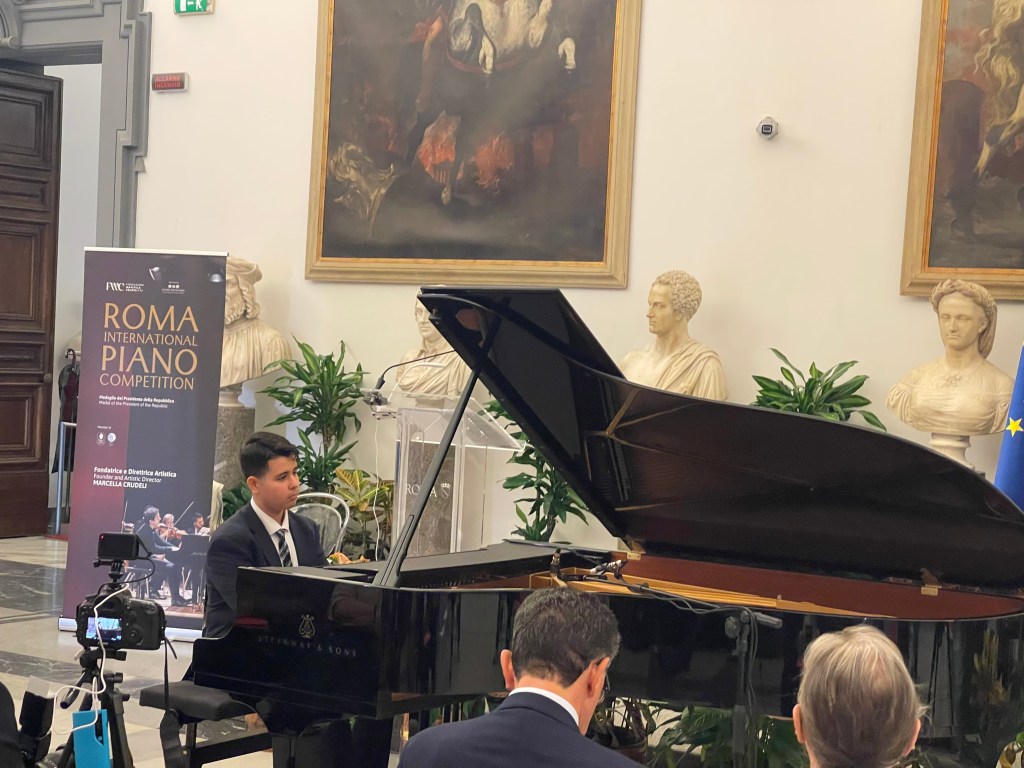
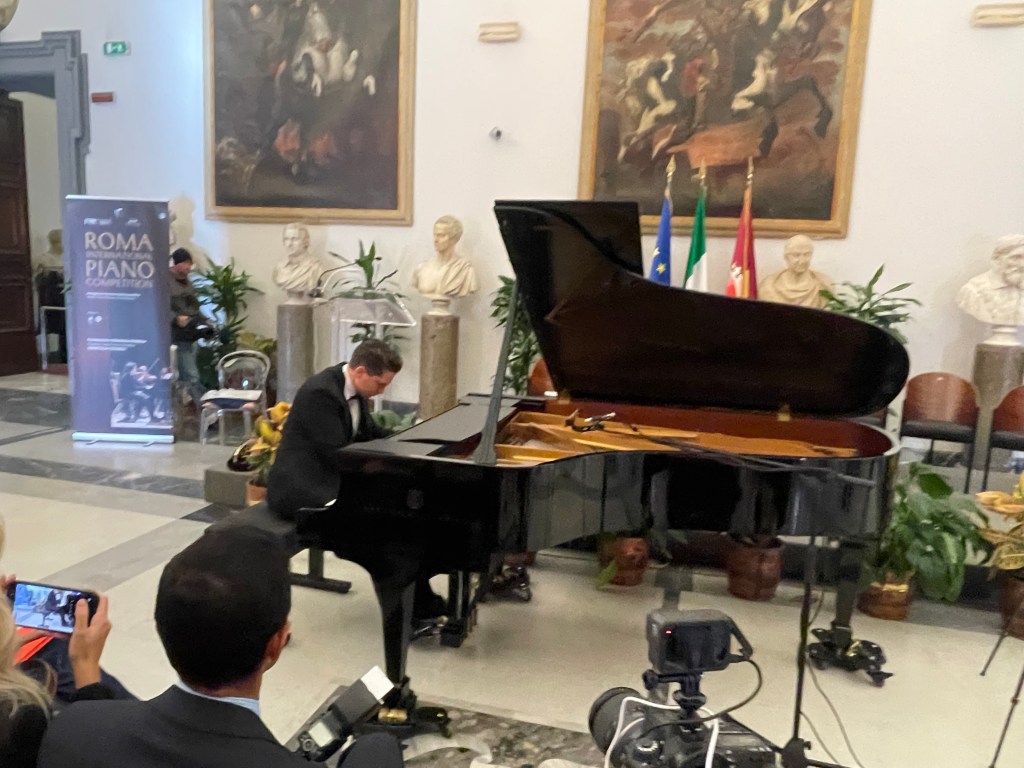
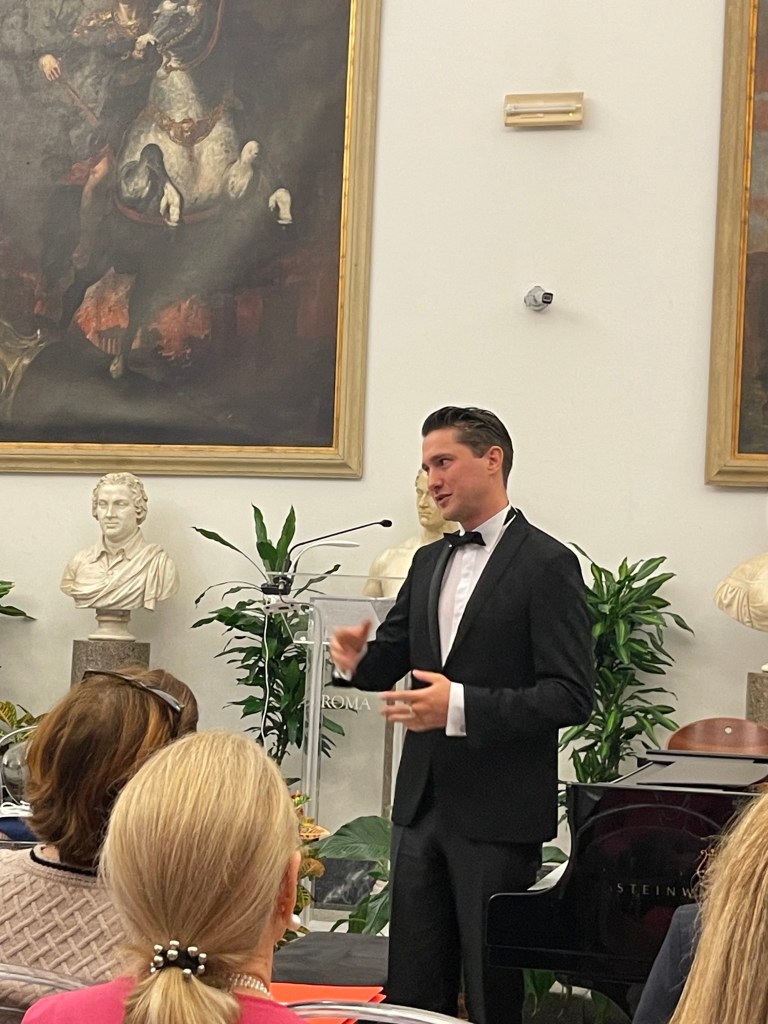
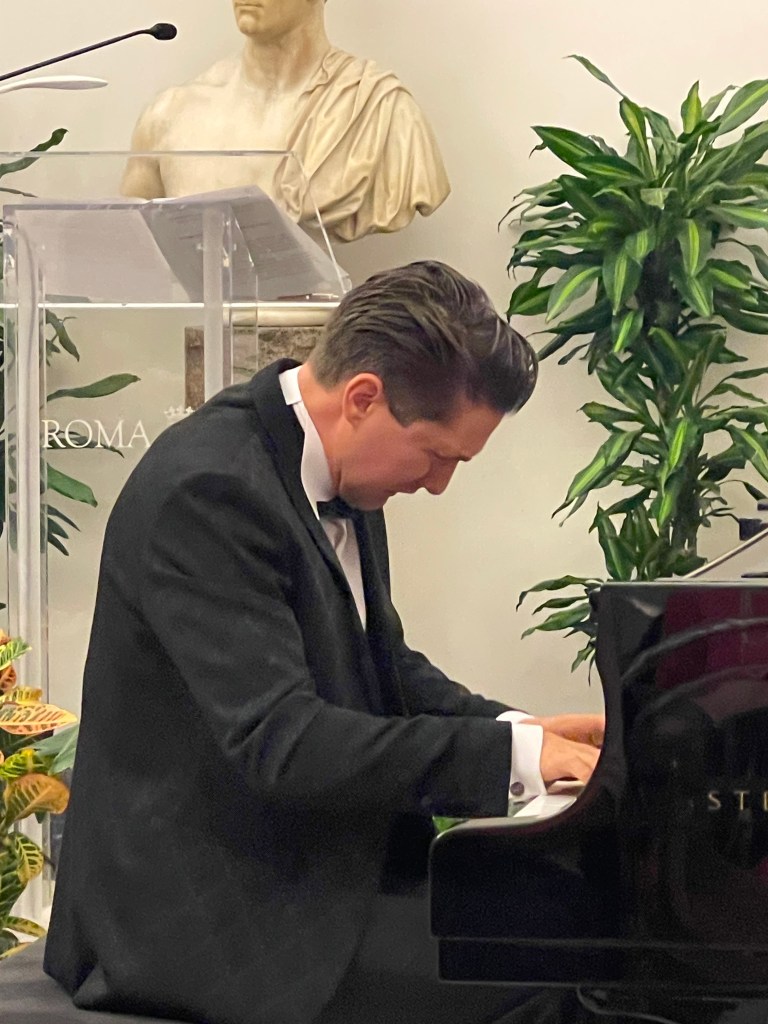
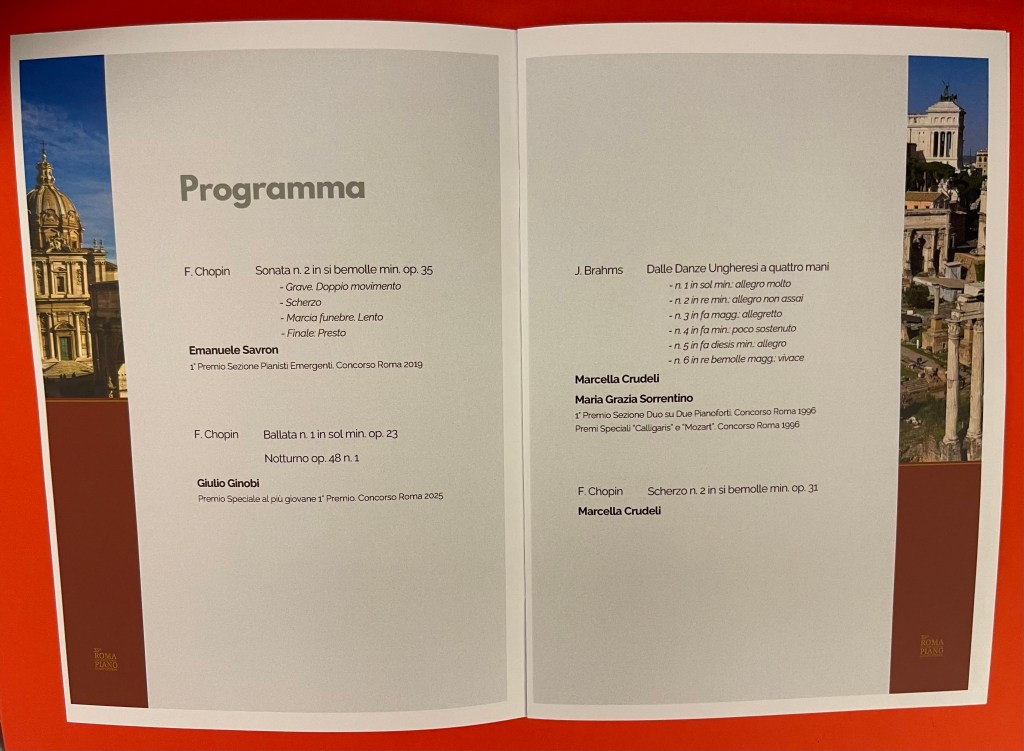
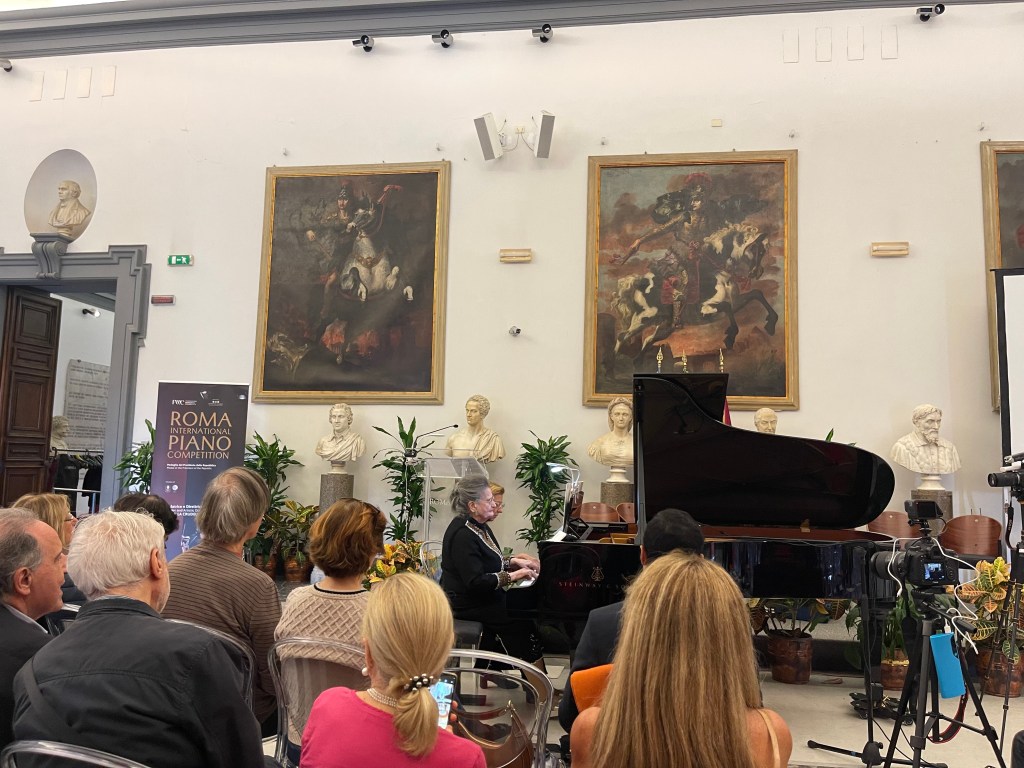
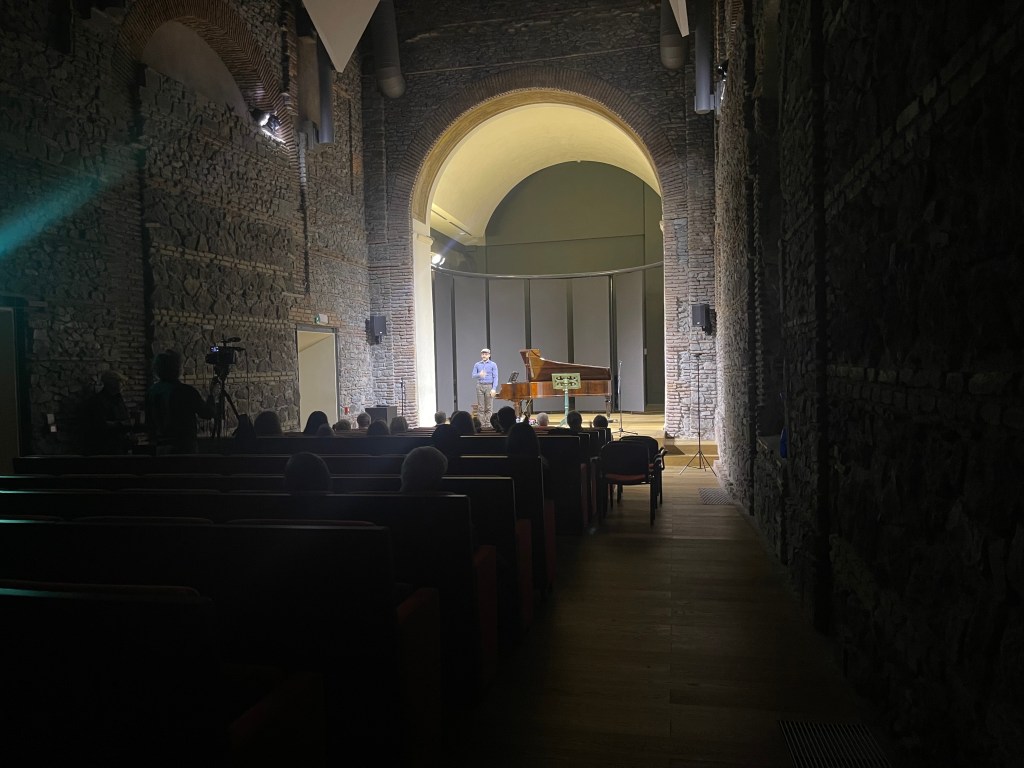
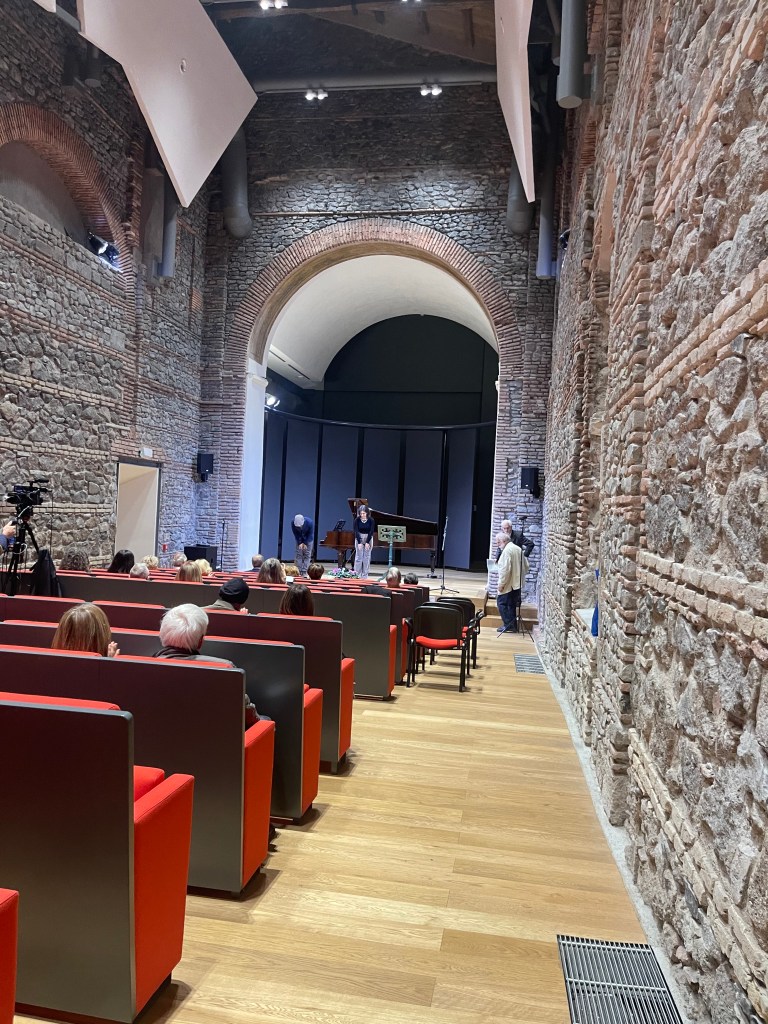
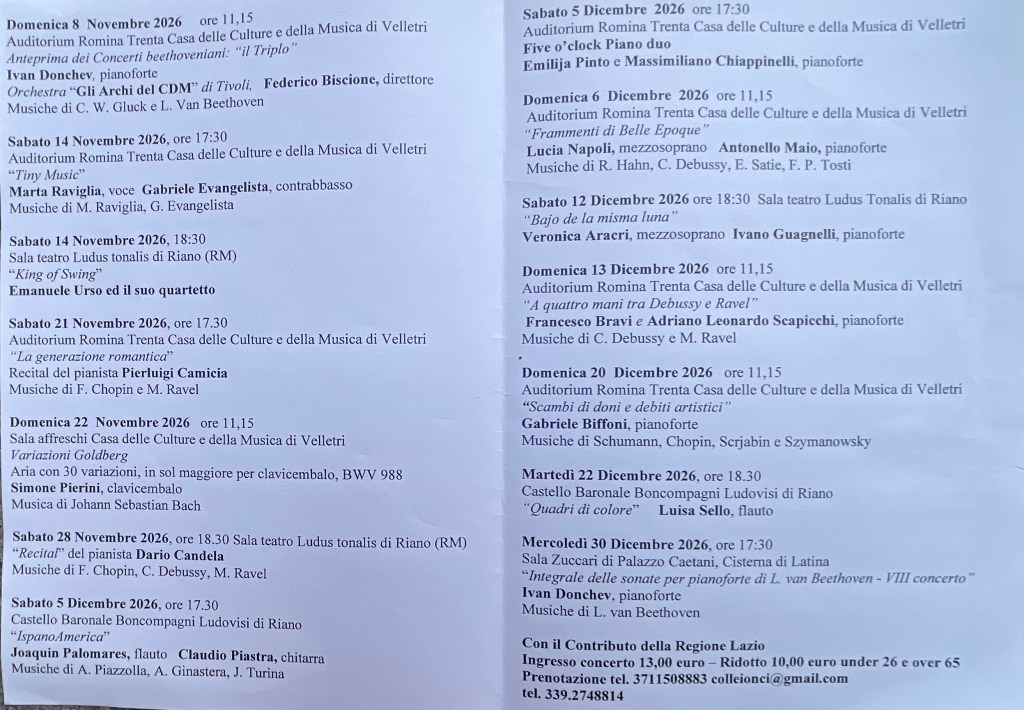
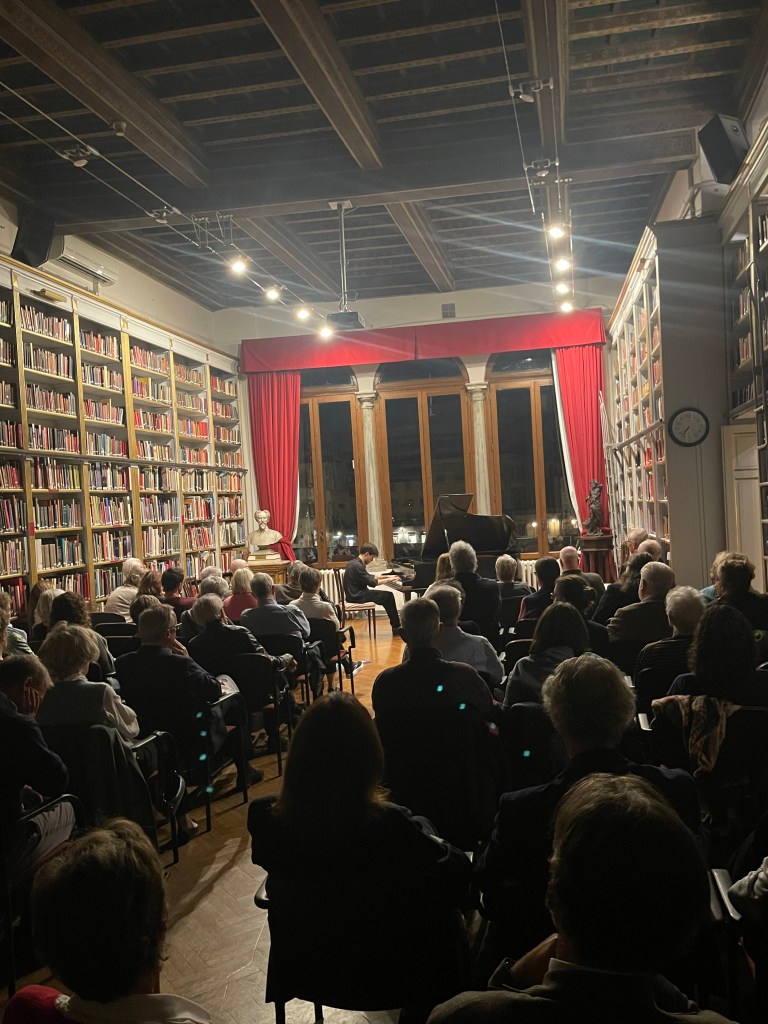
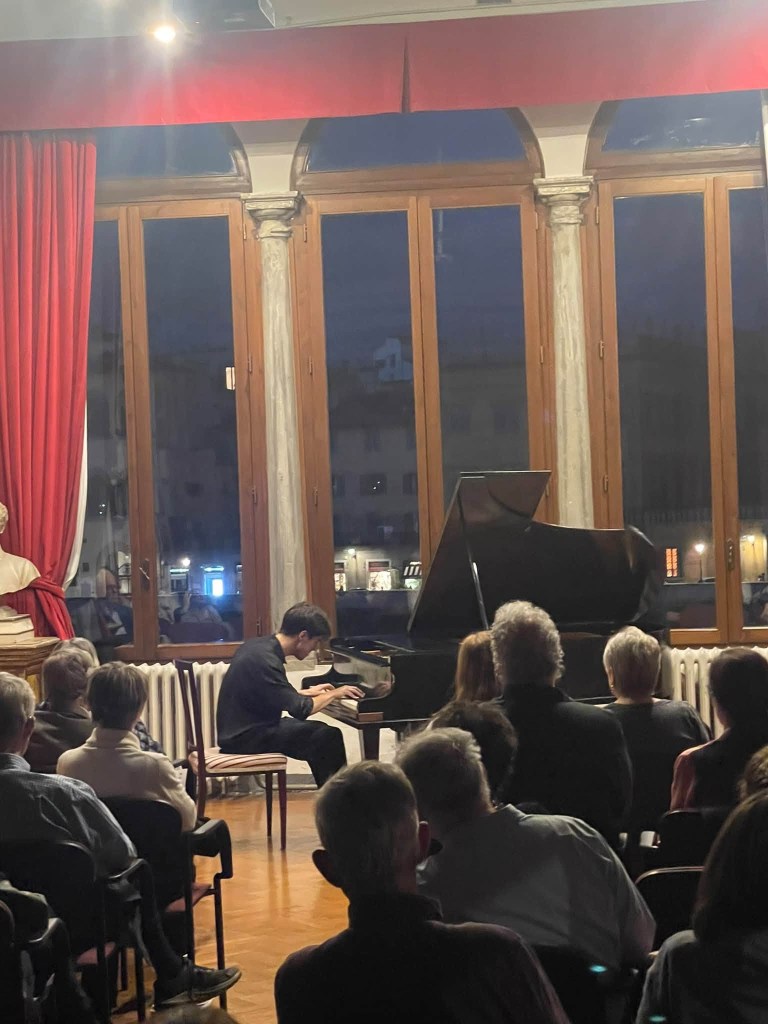
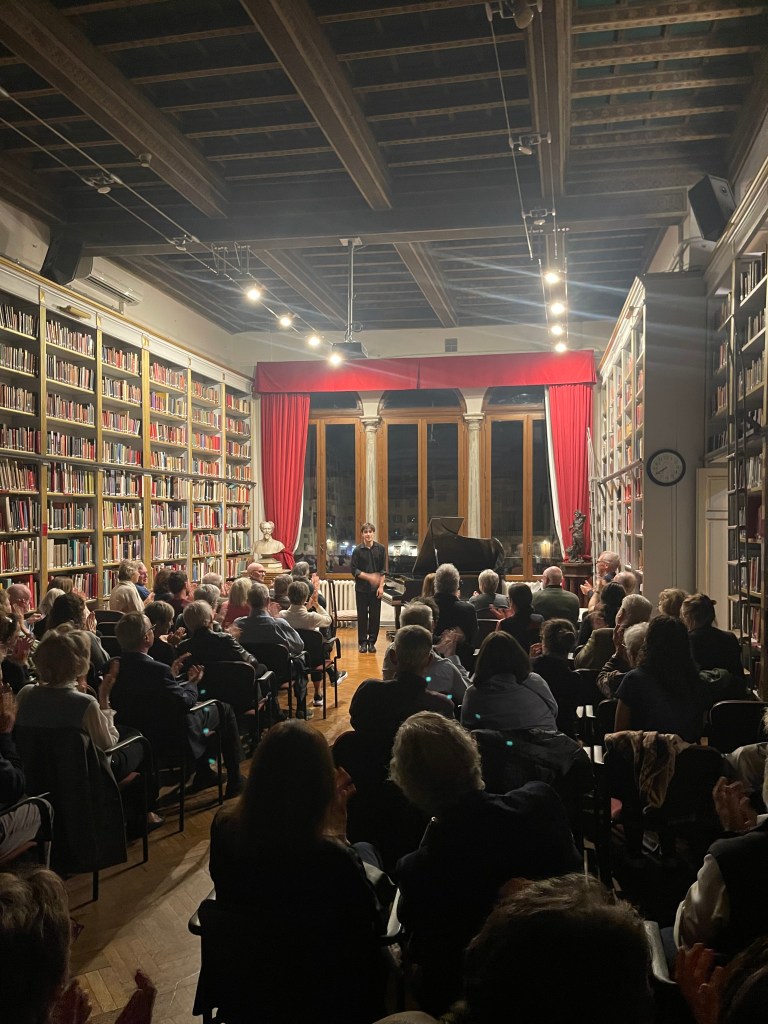
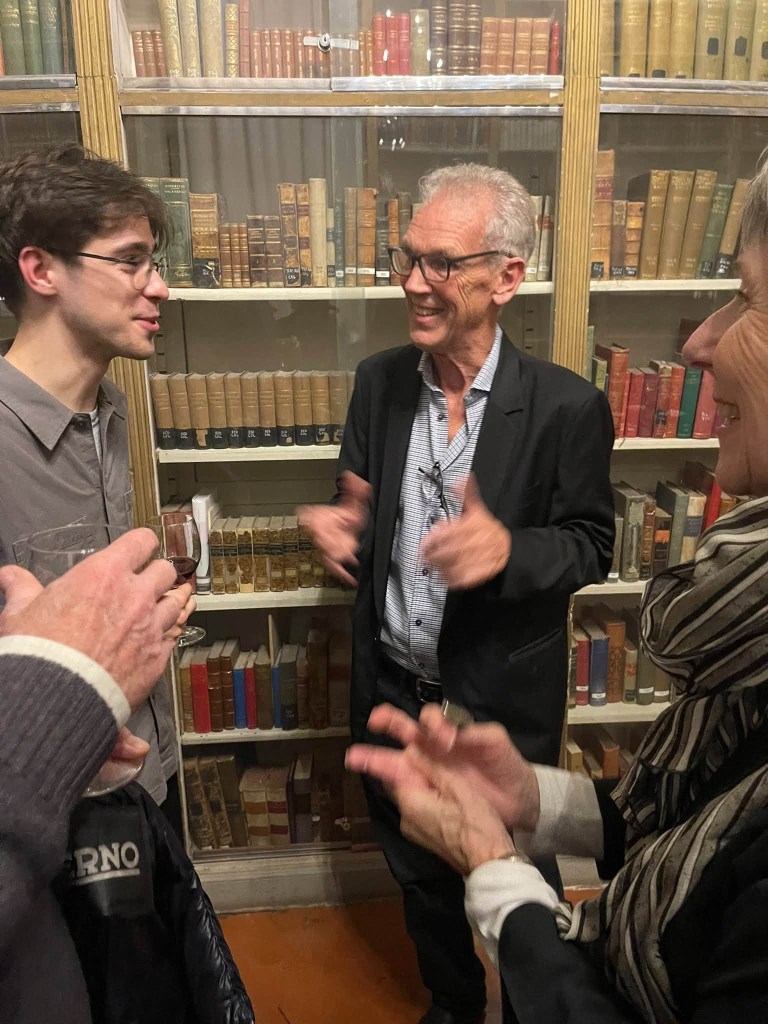
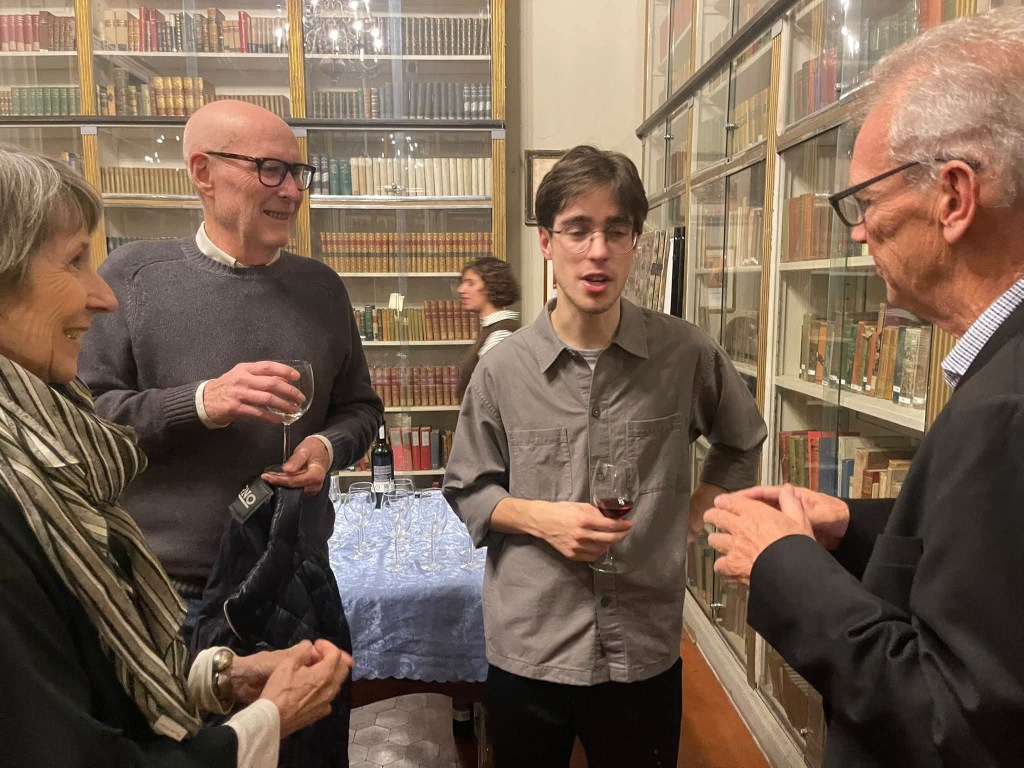
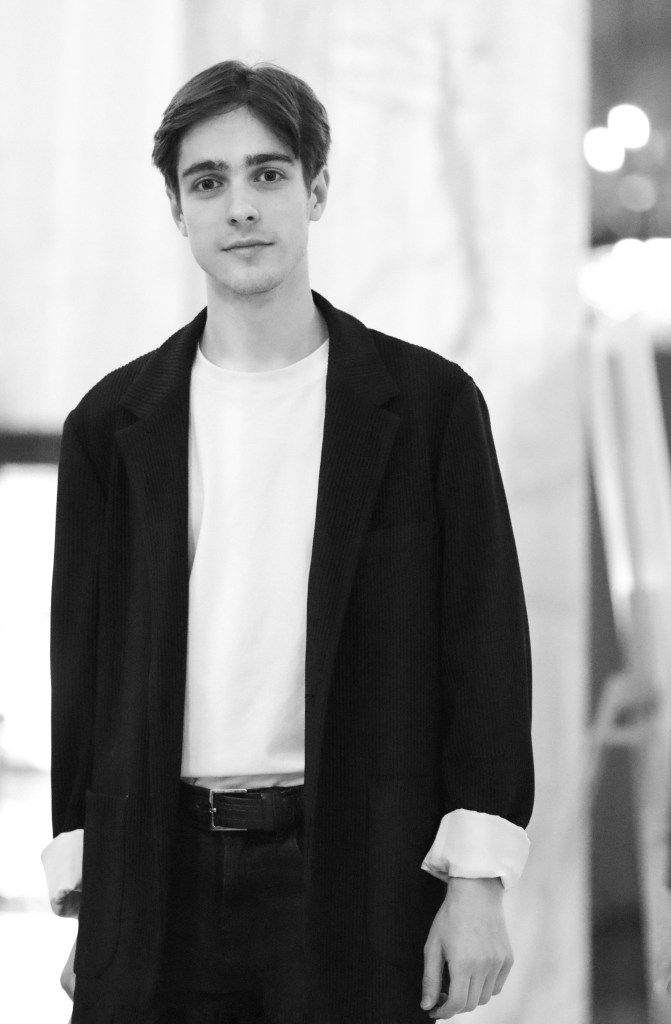
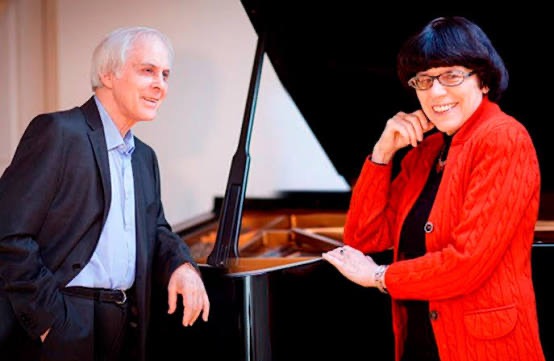
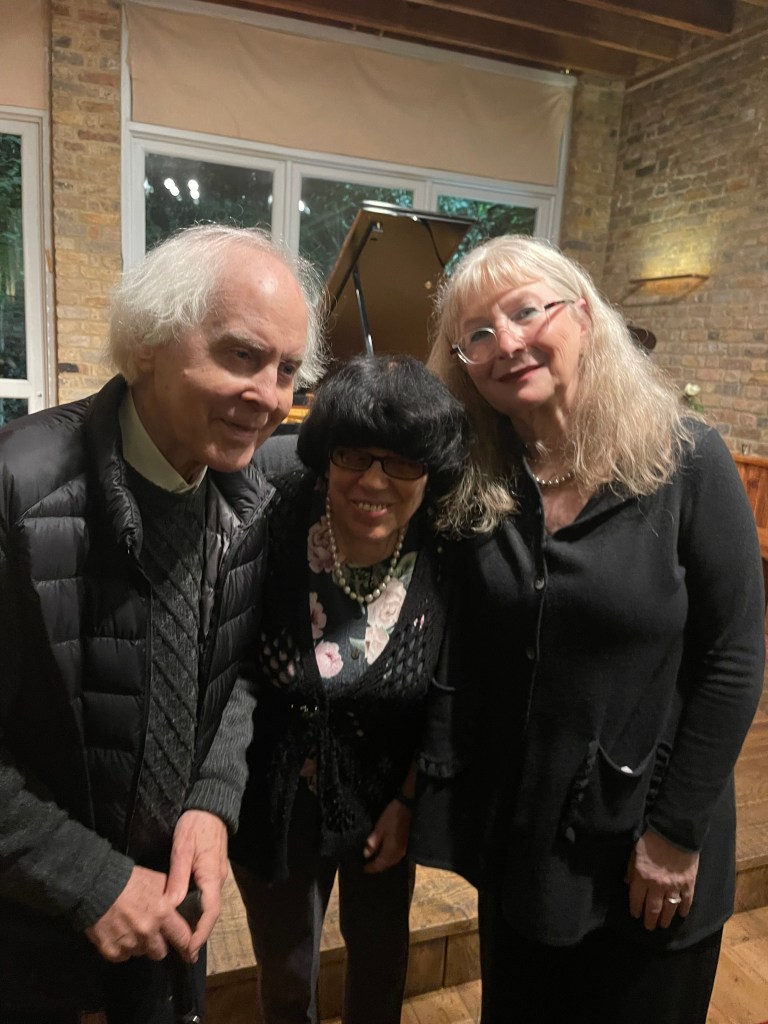
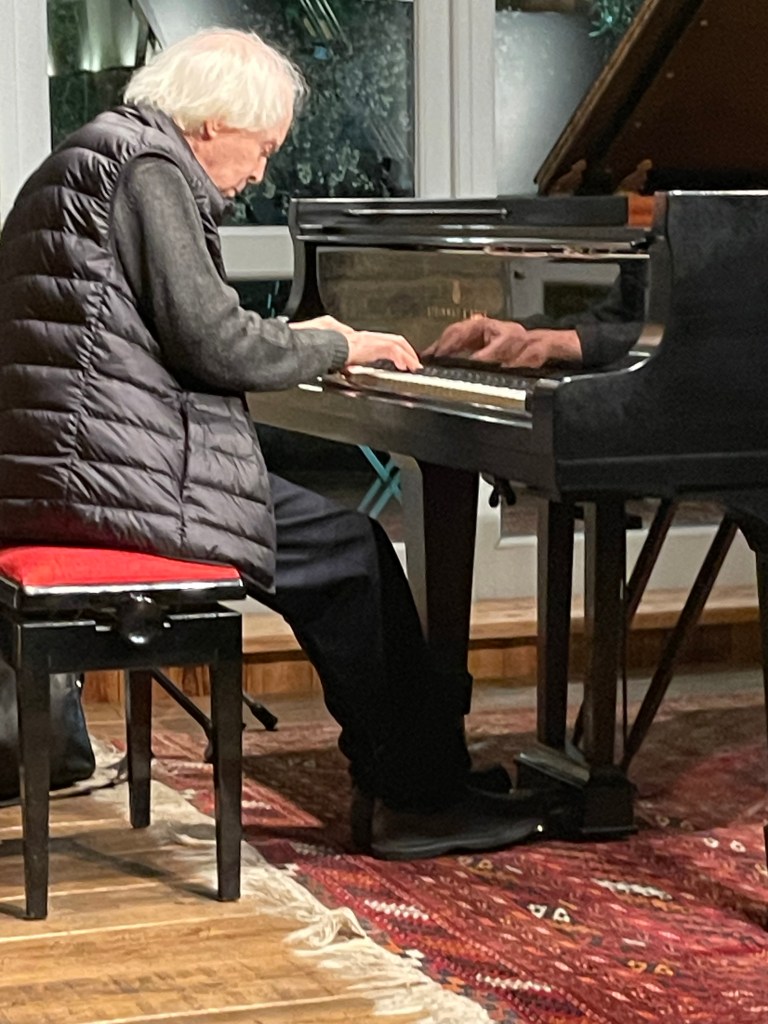
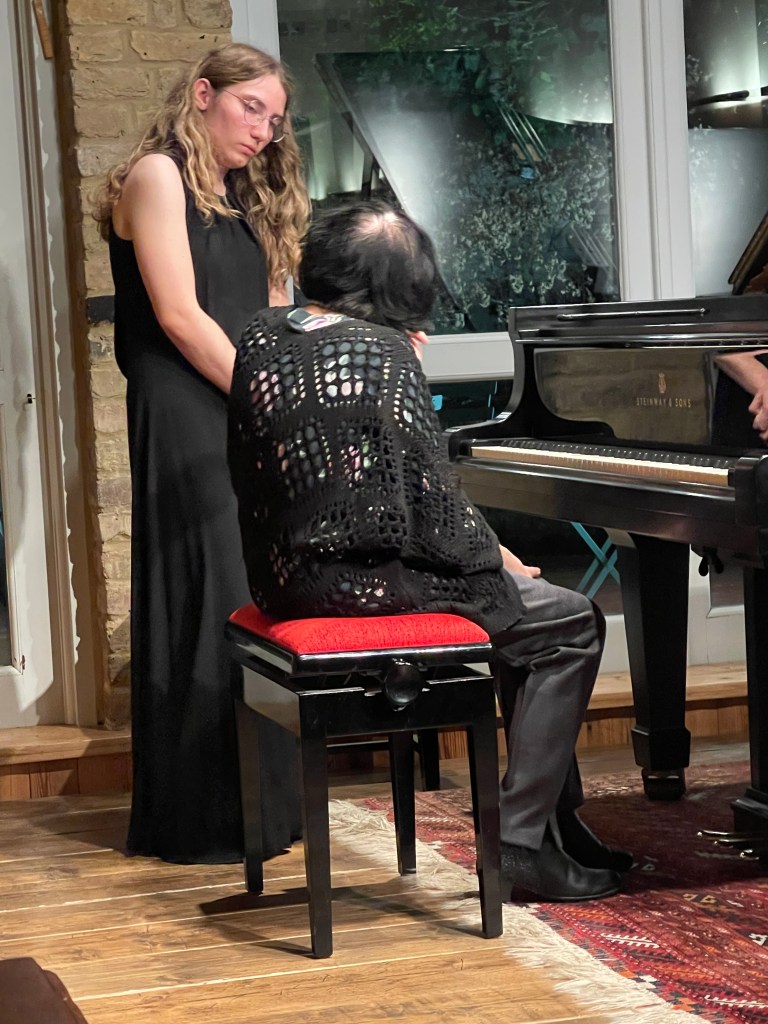
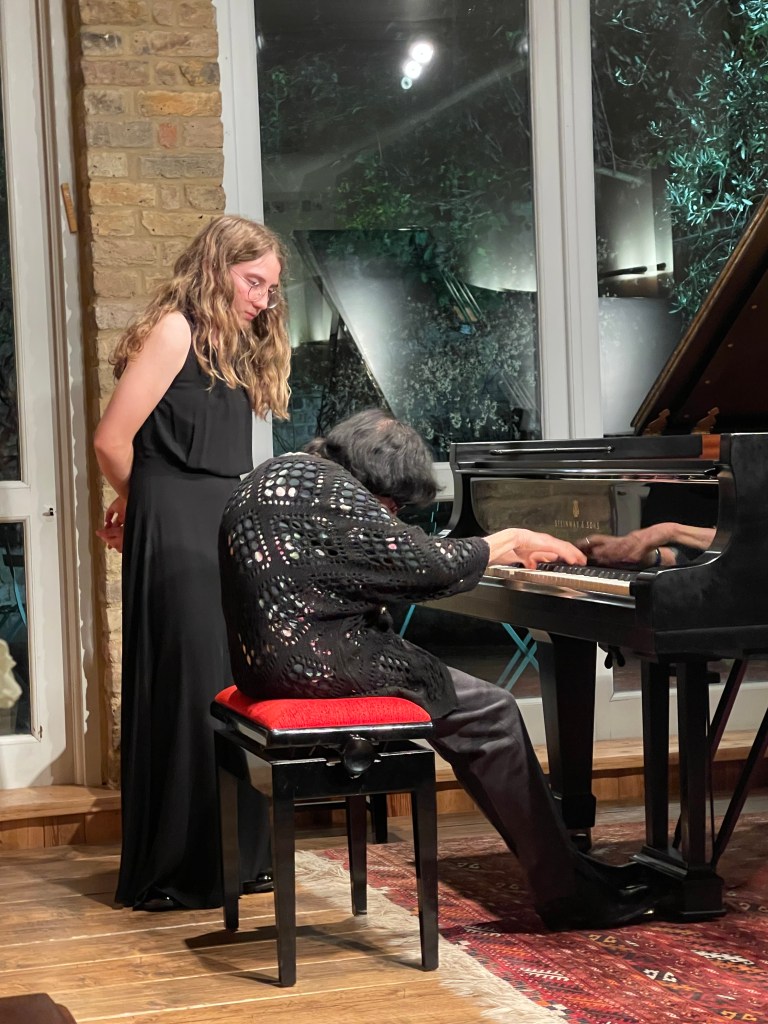
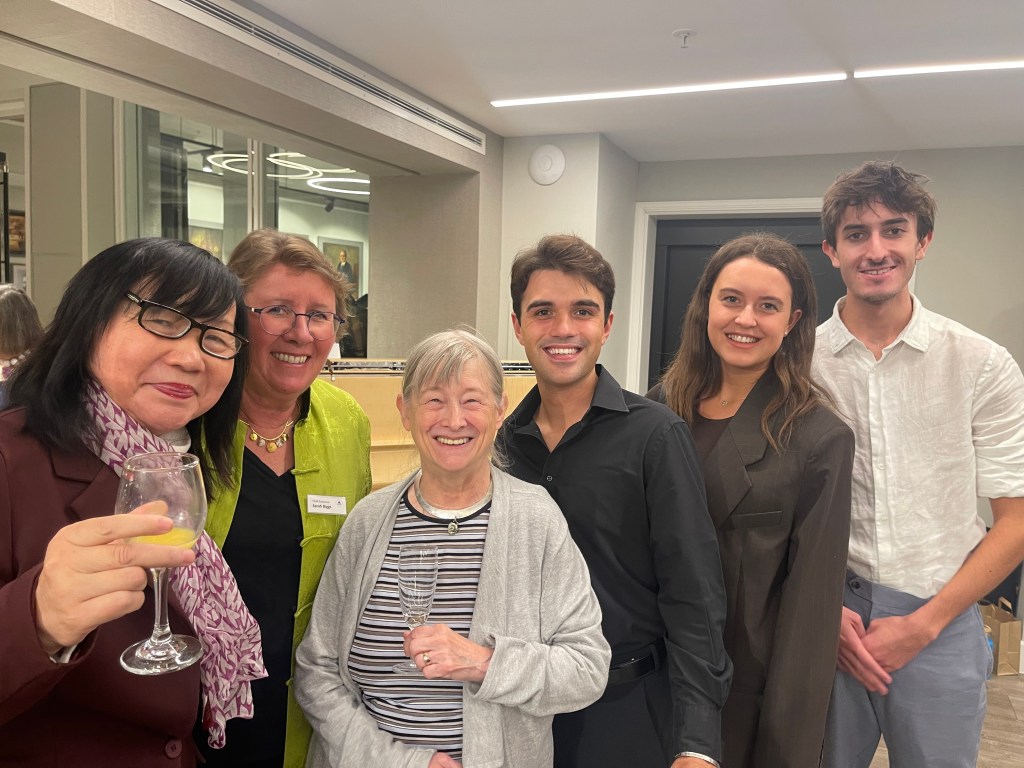
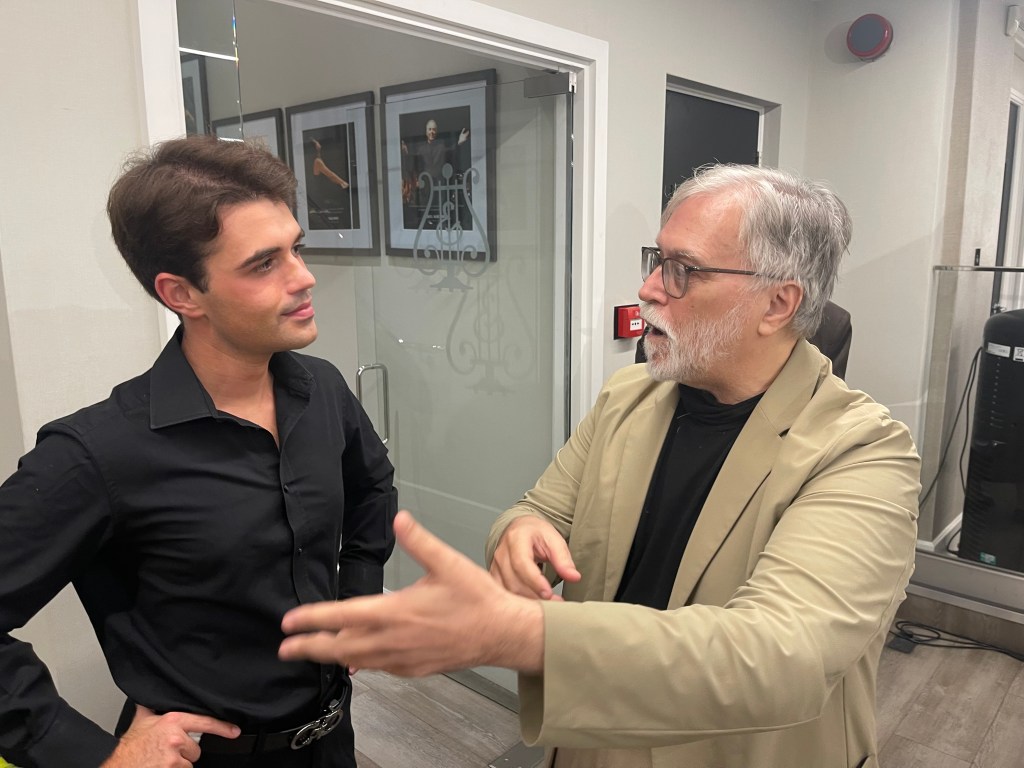
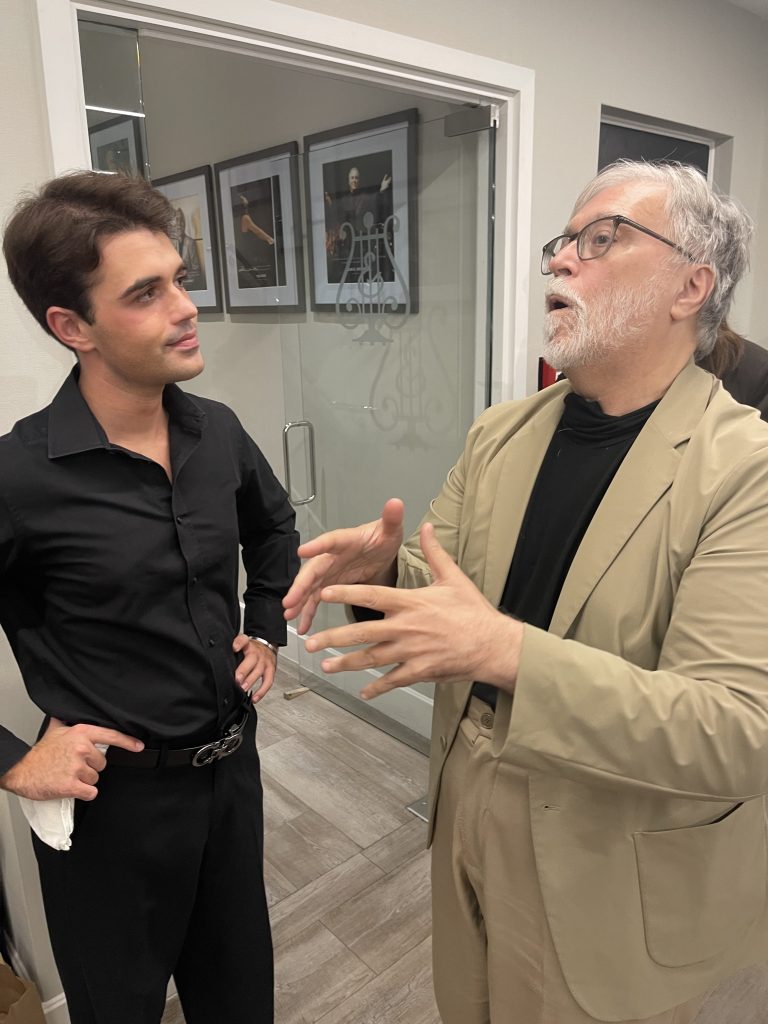
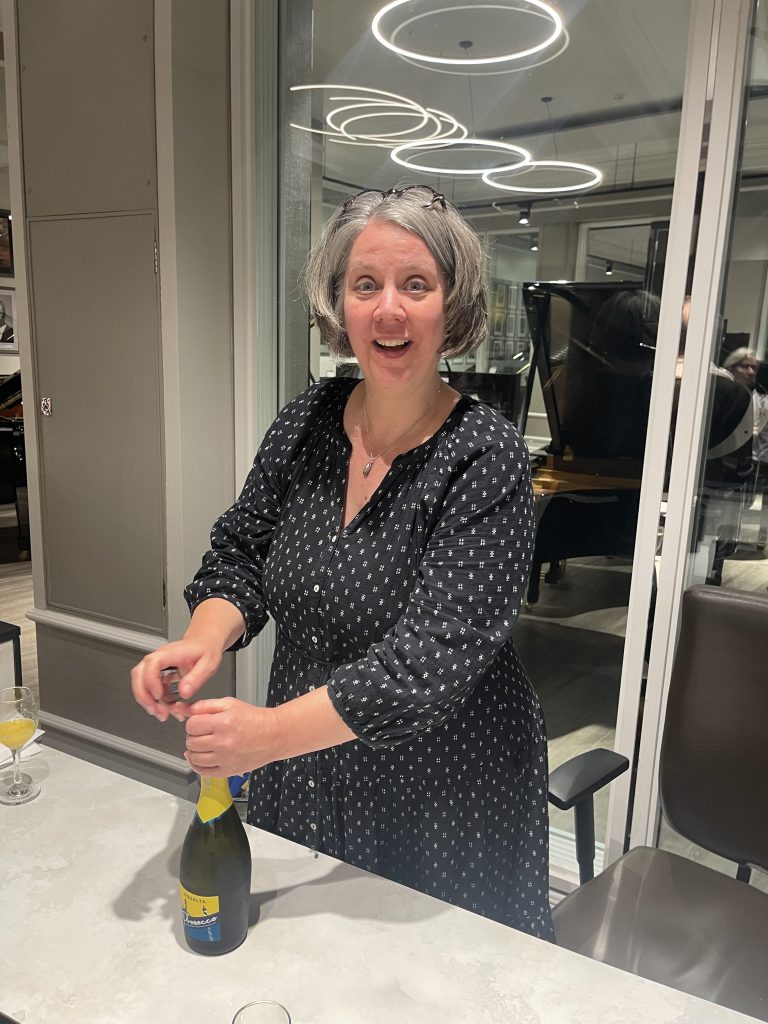
The indomitable Marcella Crudeli announces the 35th edition of the Rome International created by her in 1990 . The final this year will be in Teatro Ghione on the 15th November.
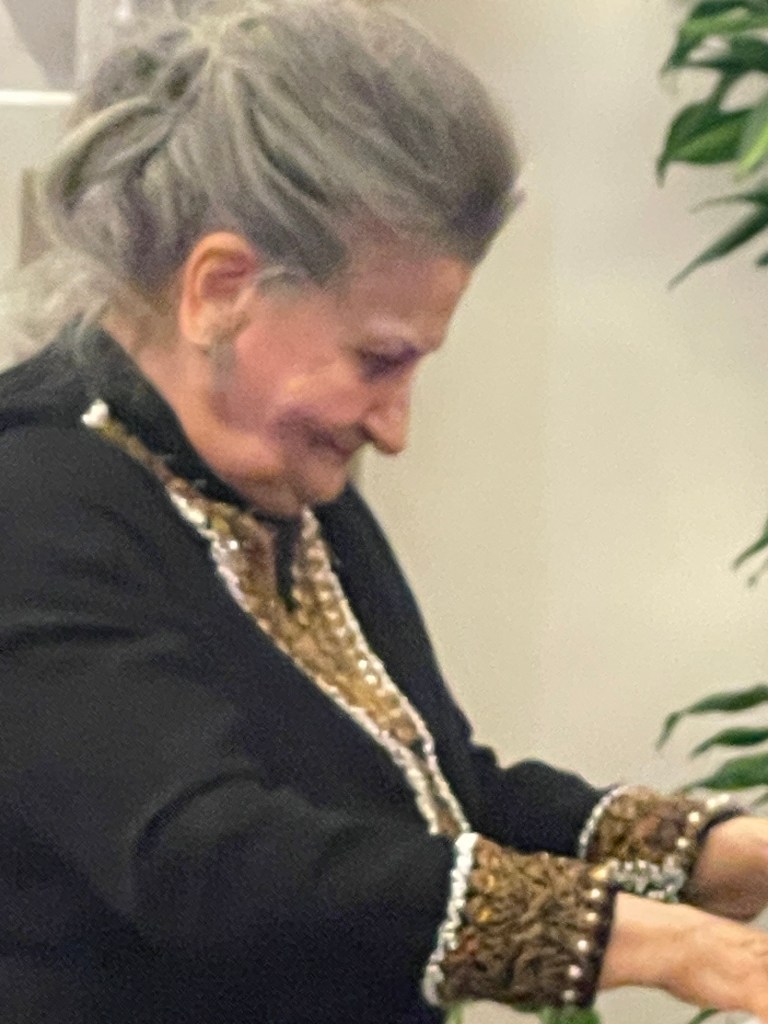
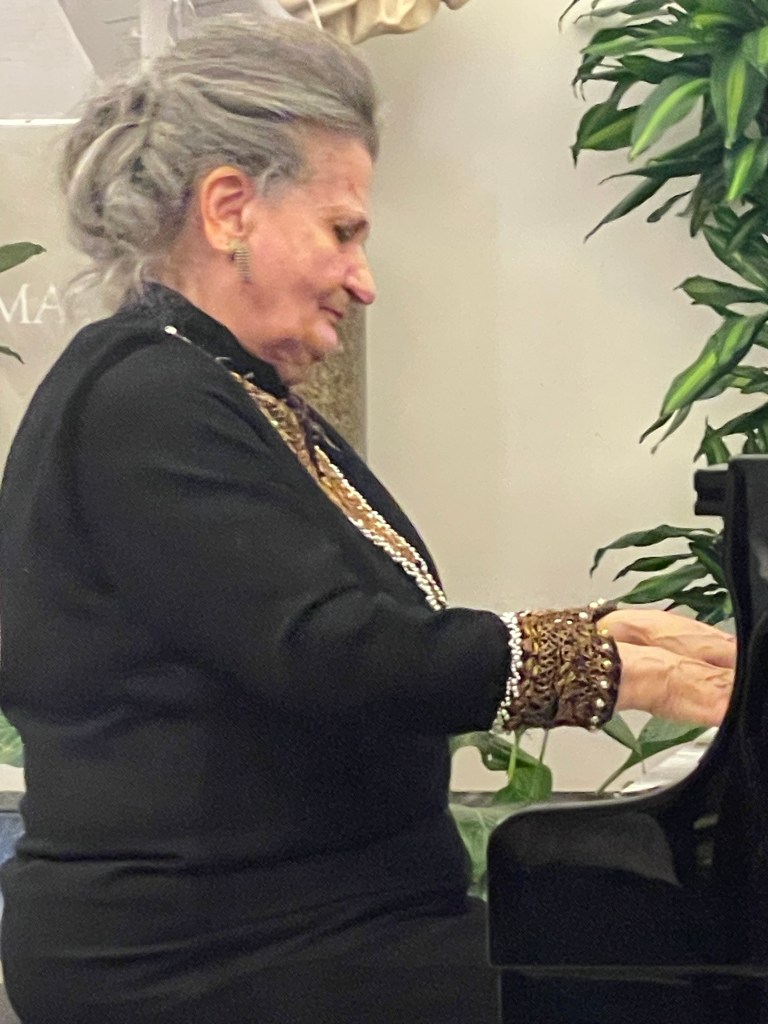
Not only announcing her competition but signing off this morning with a fearless performance of Chopin’s B flat minor Scherzo.
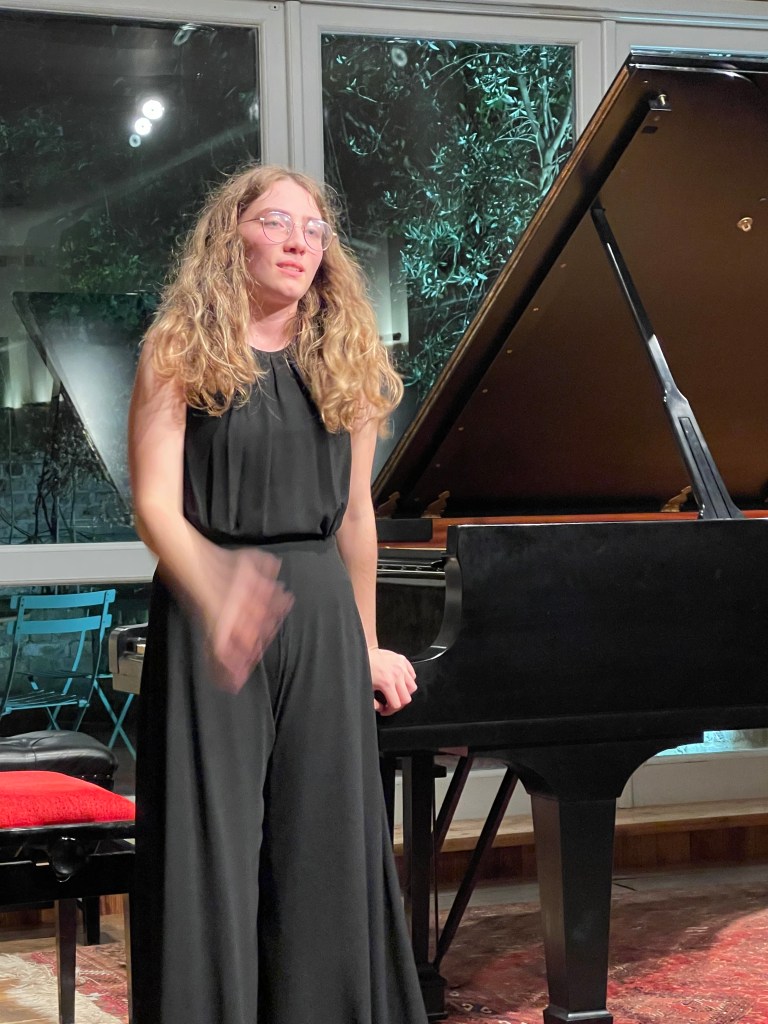
Sharing the platform with 13 year old Giulio Ginobi who gave a remarkably mature performance of Chopin’s First Ballade and the Nocturne op 48 n. 1
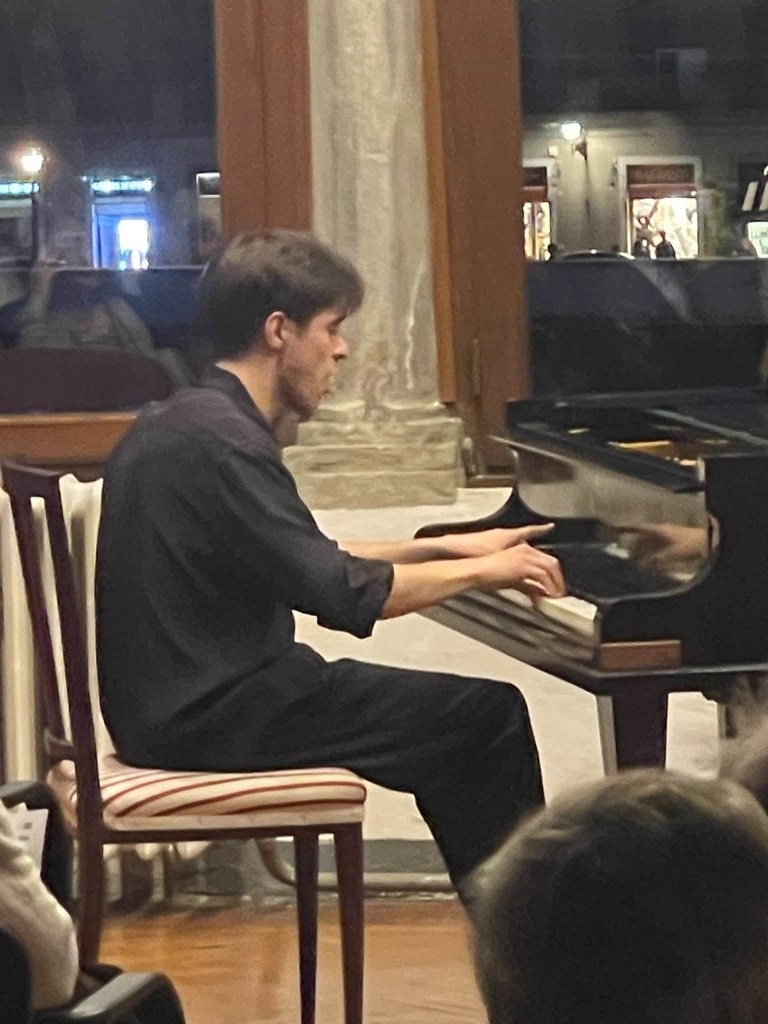
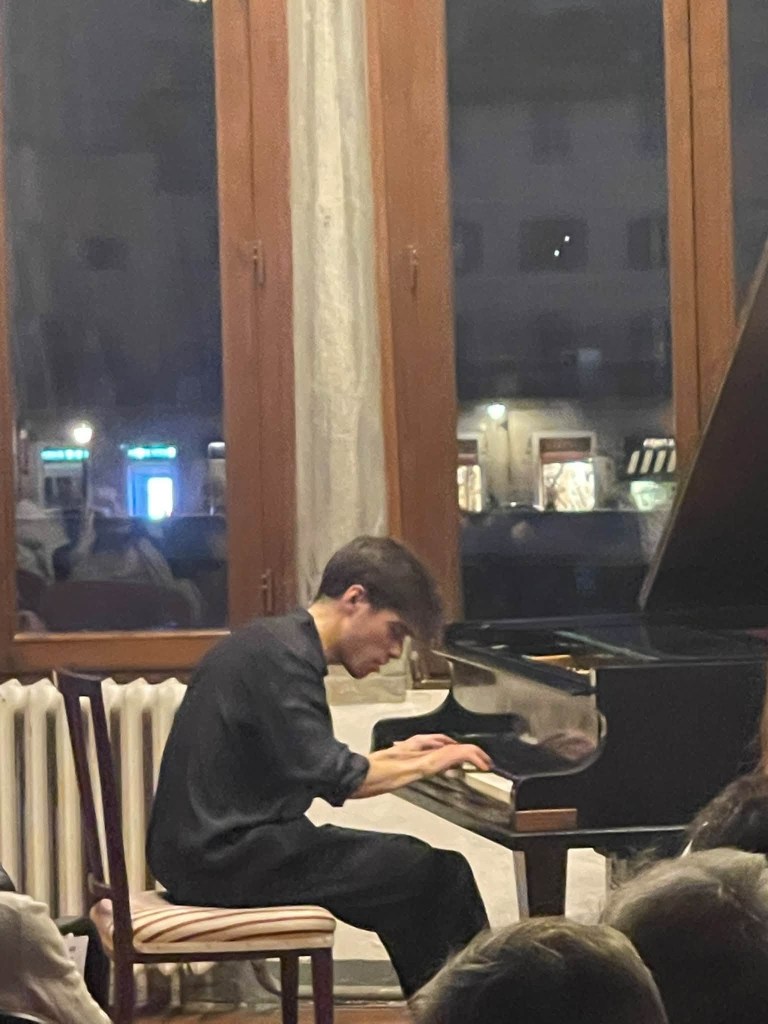
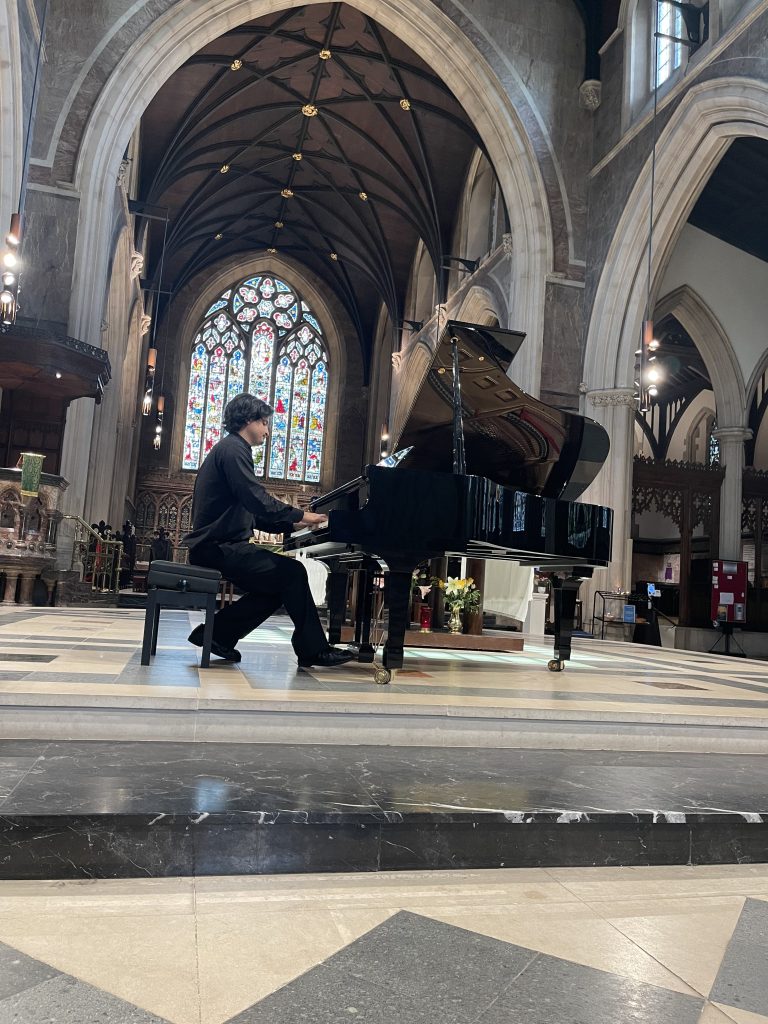
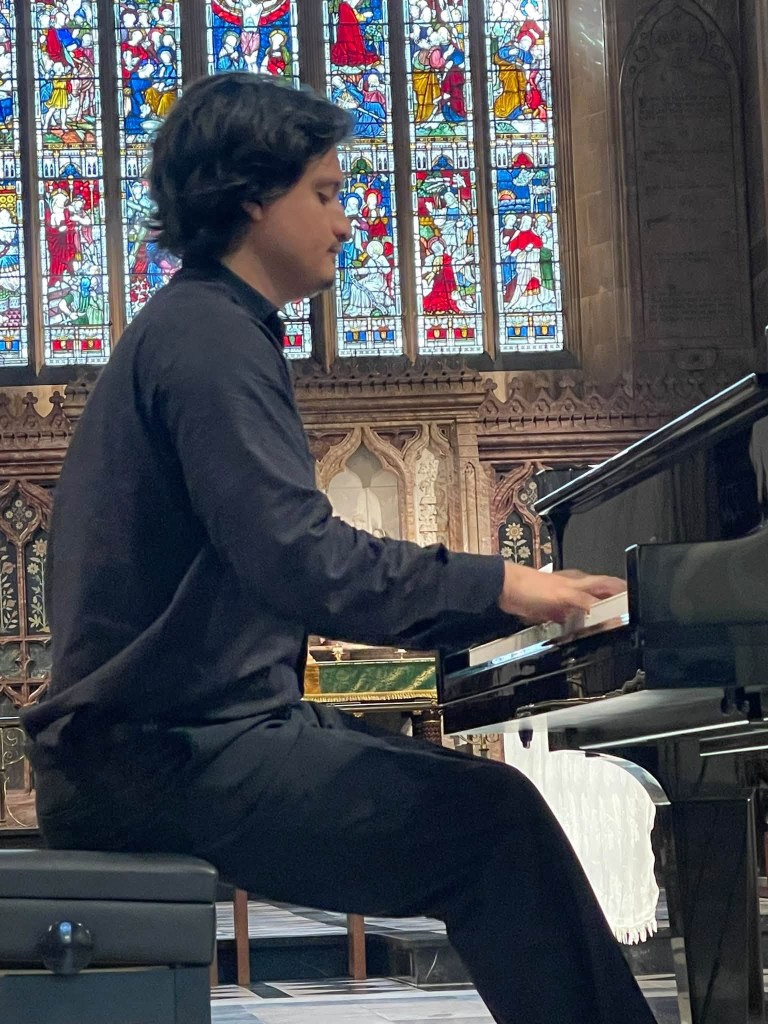
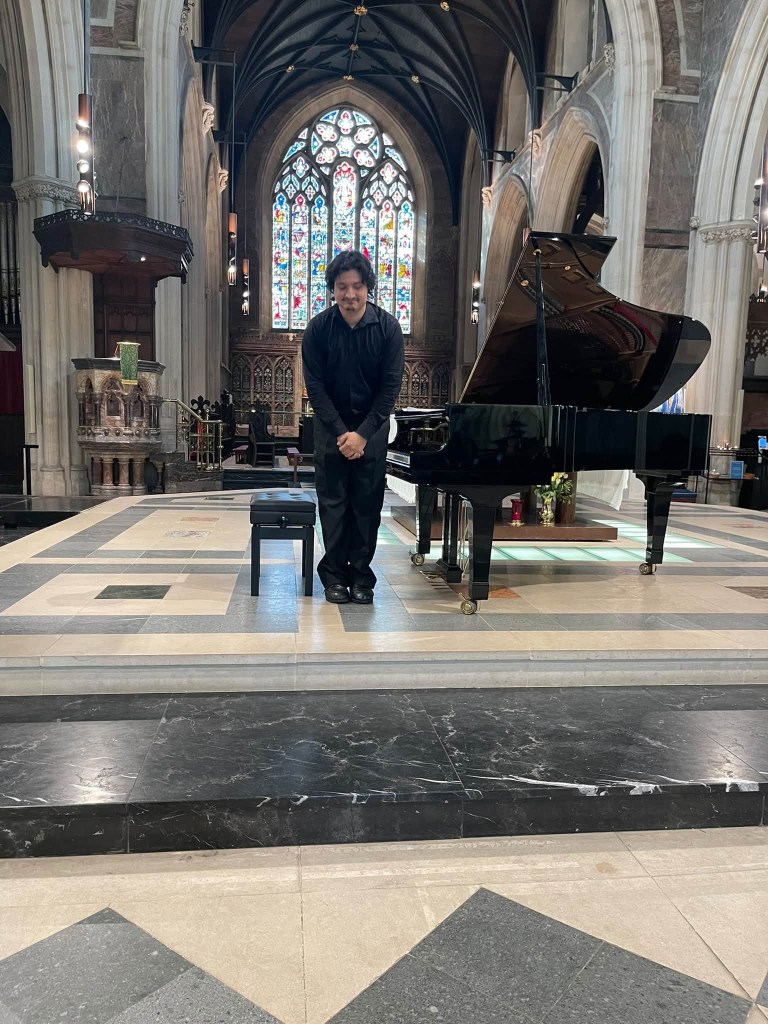
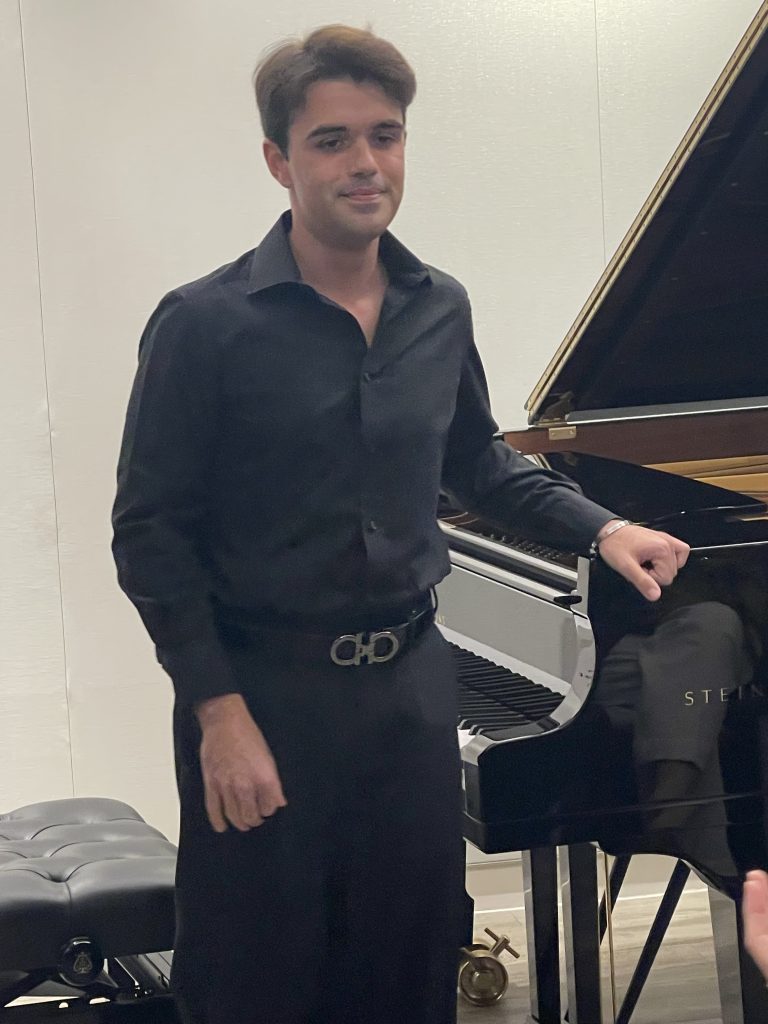
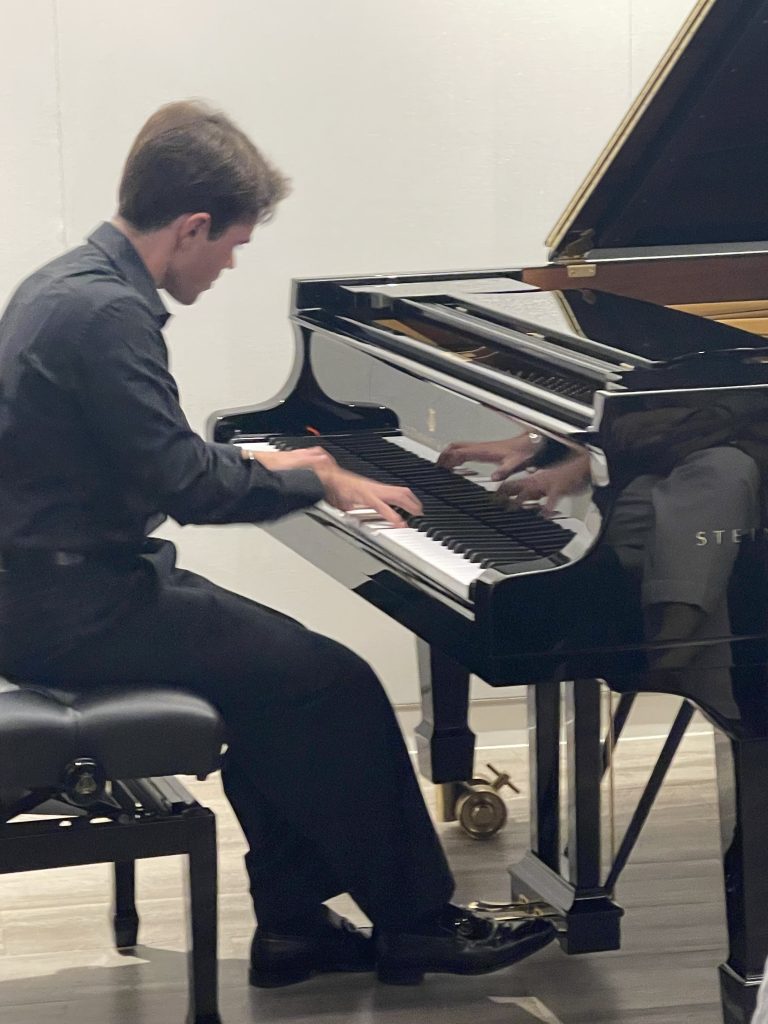
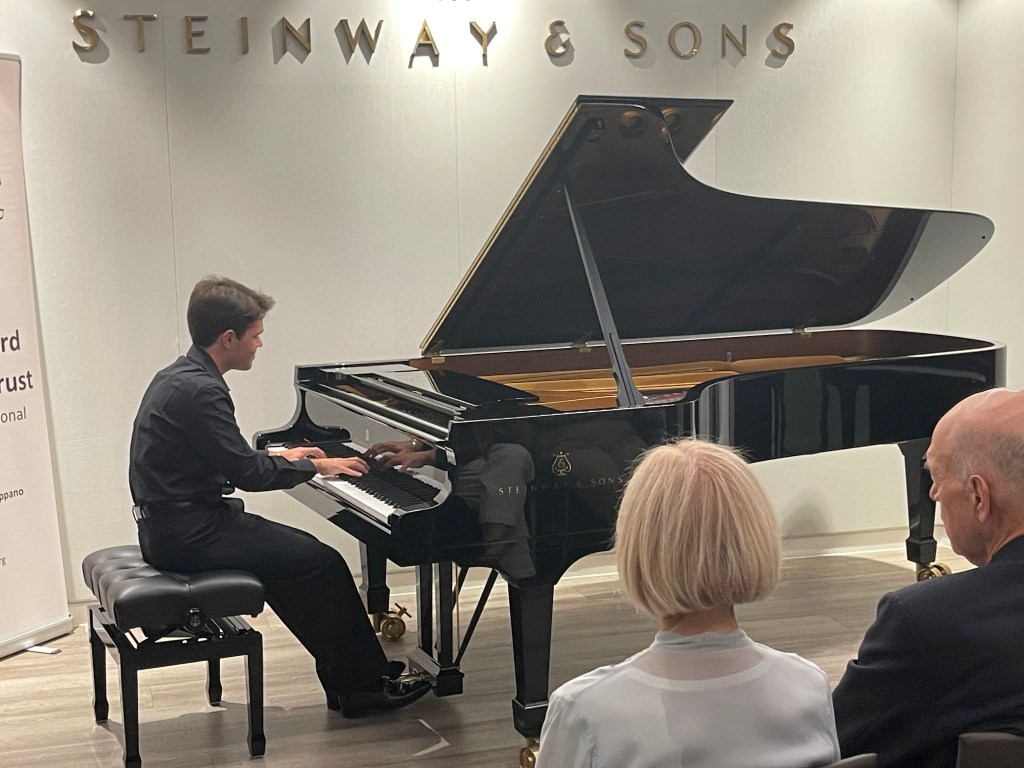
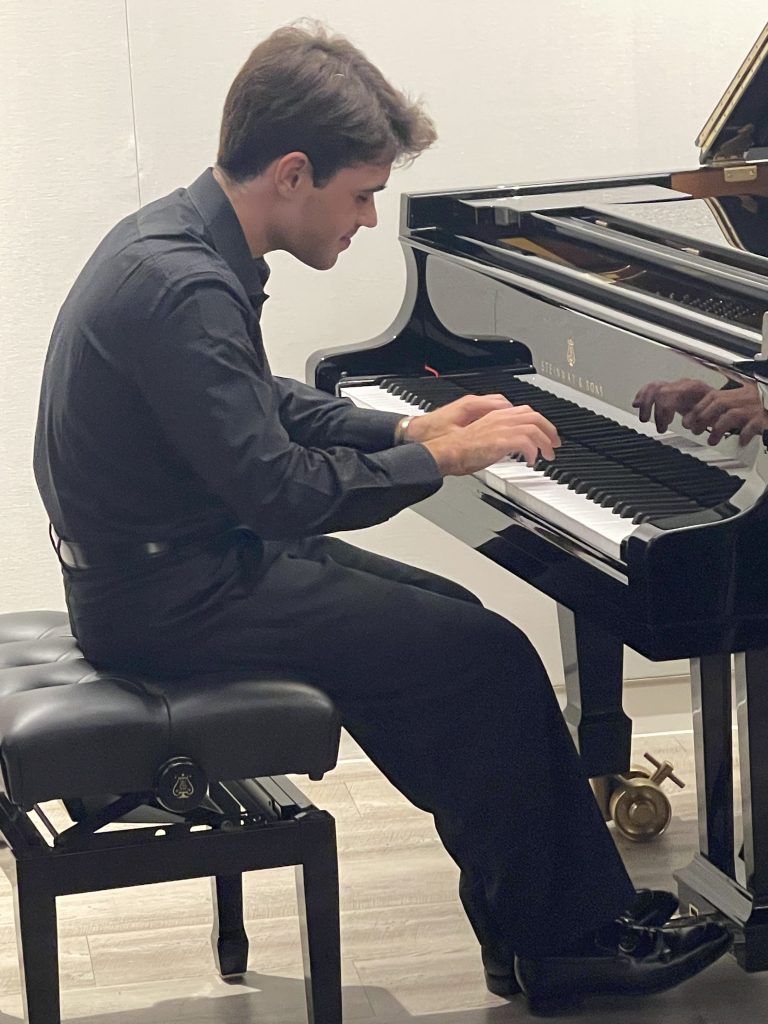
A former student Emanuele Savron opened this short concert with Chopin’s Second Sonata op 35 which he played with dynamic mastery demonstrating a remarkable musical personality with a musical pedigree tempered now by that master musician Louis Lortie.
Six Hungarian Dances by Brahms were played by Maria Grazia Sorrentino together with Marcella Crudeli . Marcella letting rip with passionate outbursts and moments of touching sensual insinuation
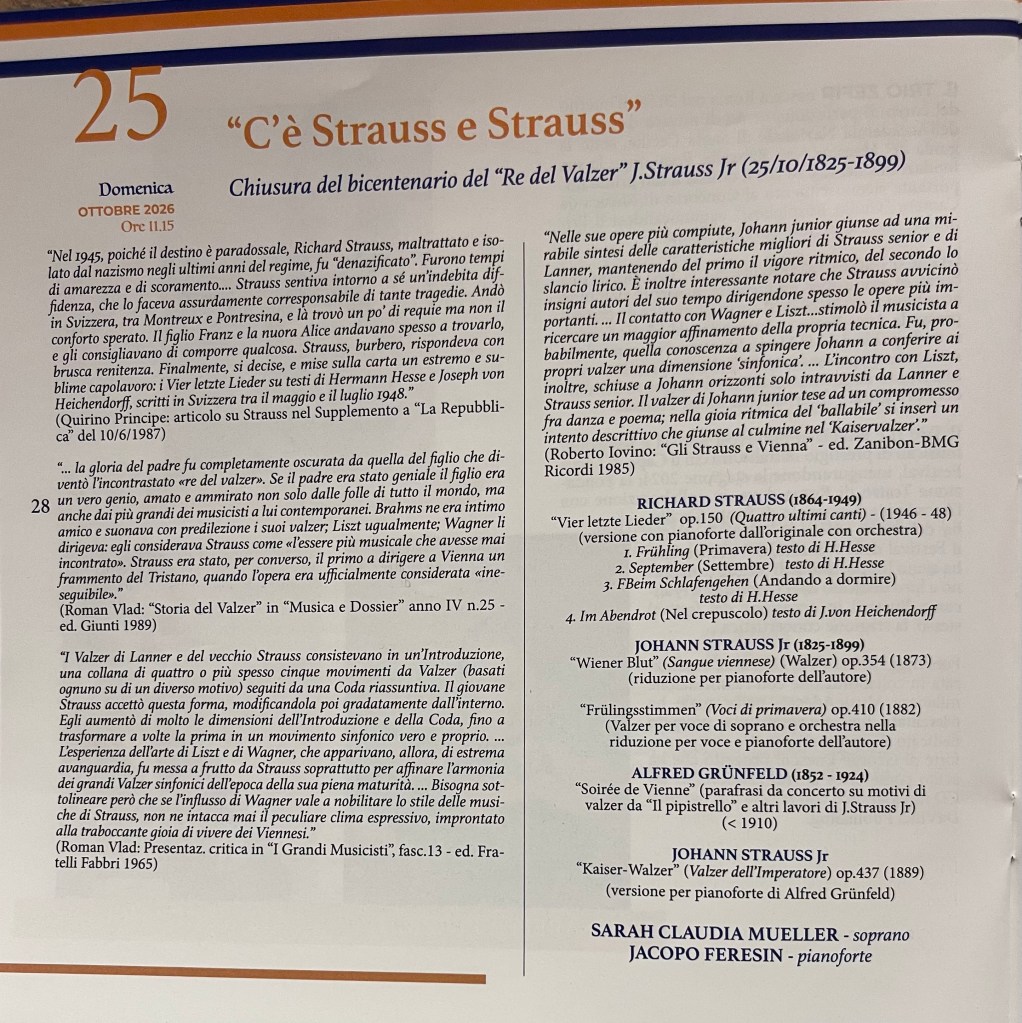
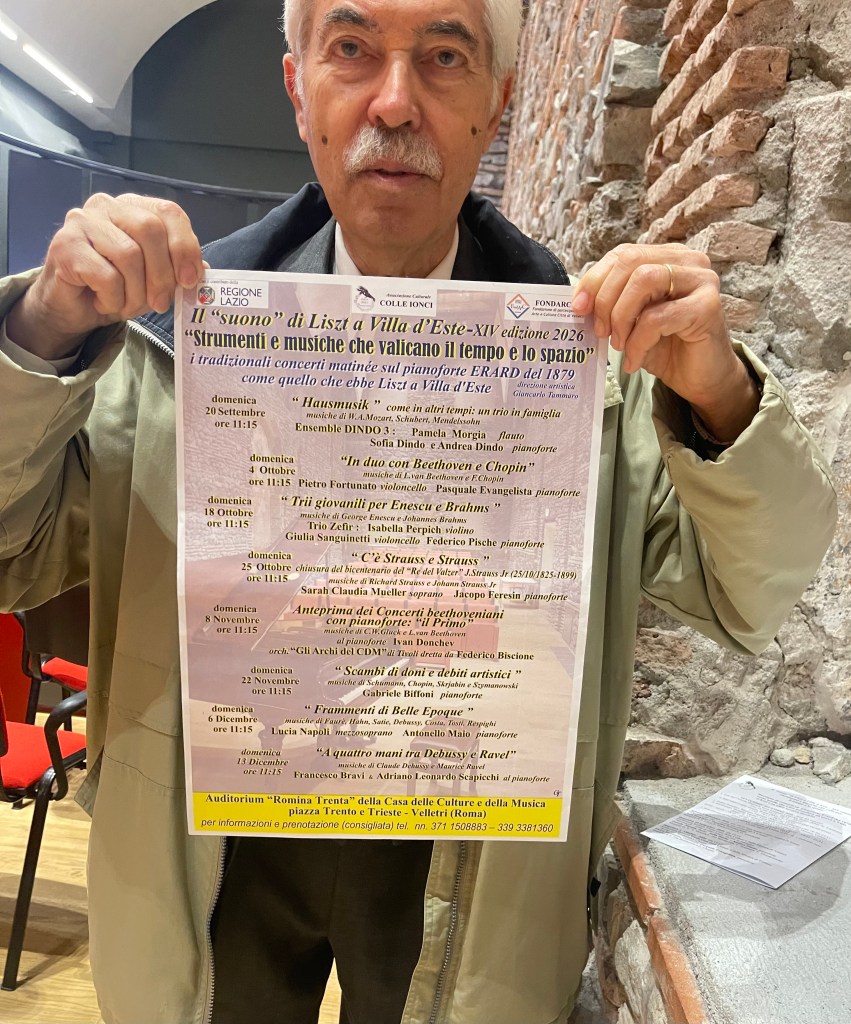
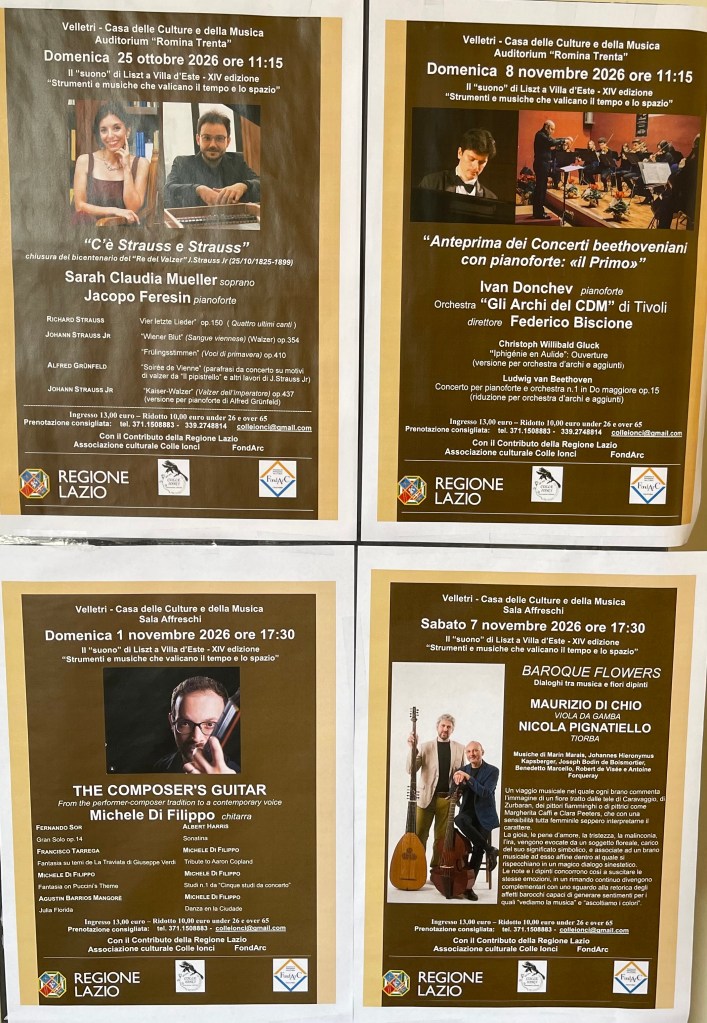
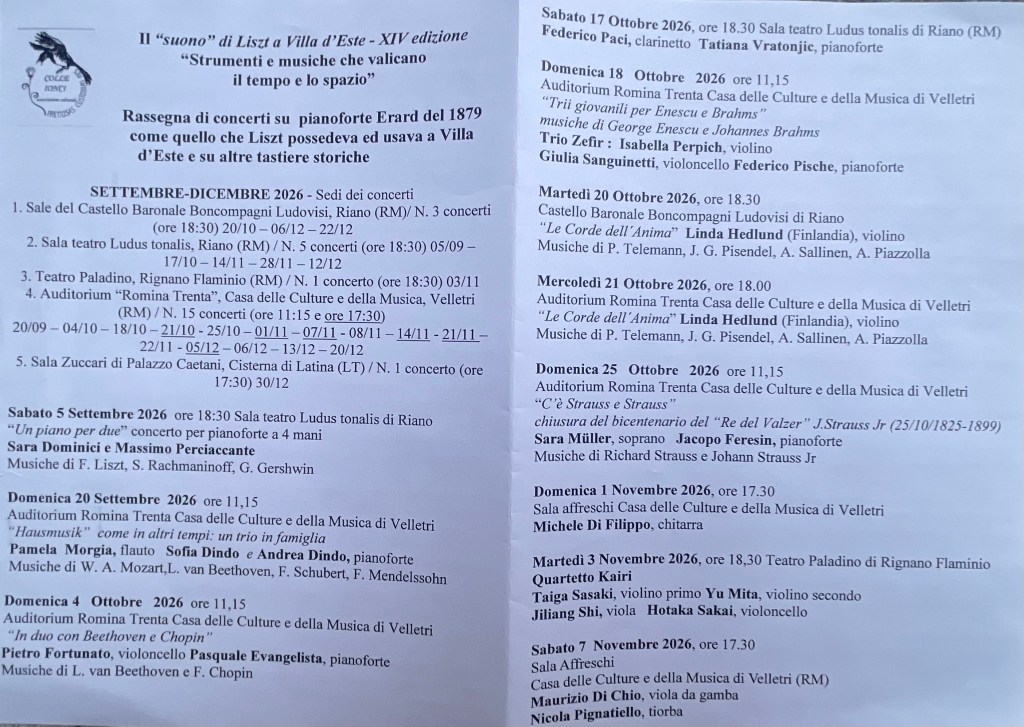
Johann Strauss junior was born this day in 1825 and it was Ing. Tammaro who decided to celebrate it 201 years later with a concert in Velletri dedicated to both Richard and Johann jr.
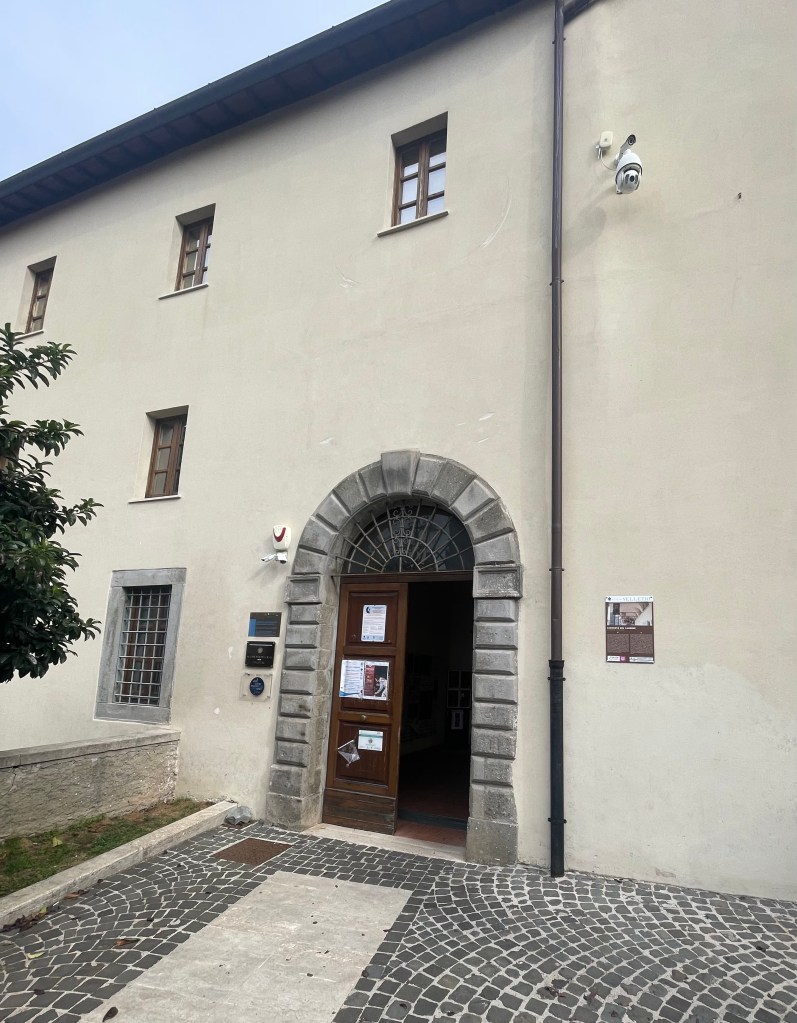
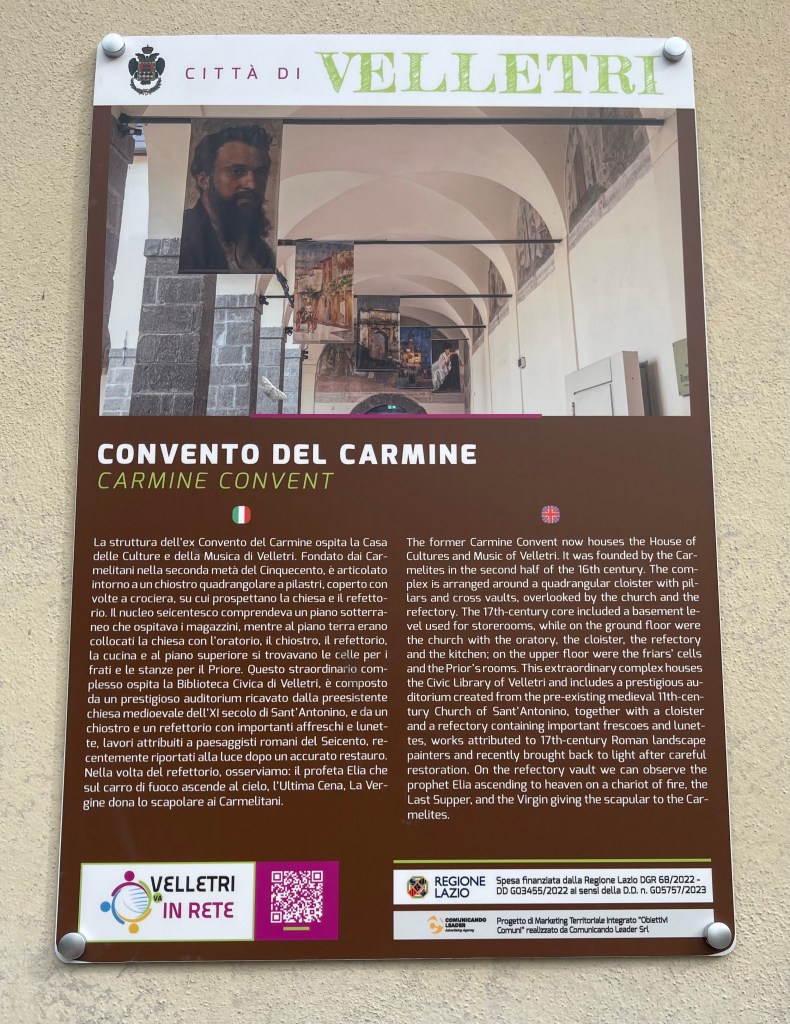
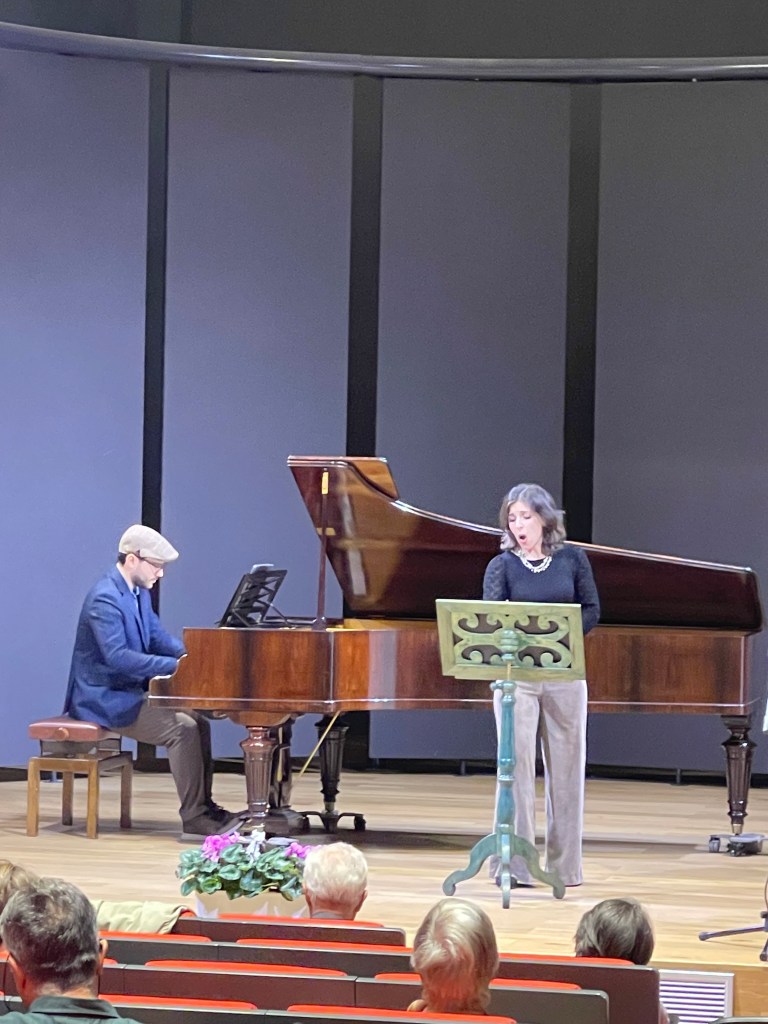
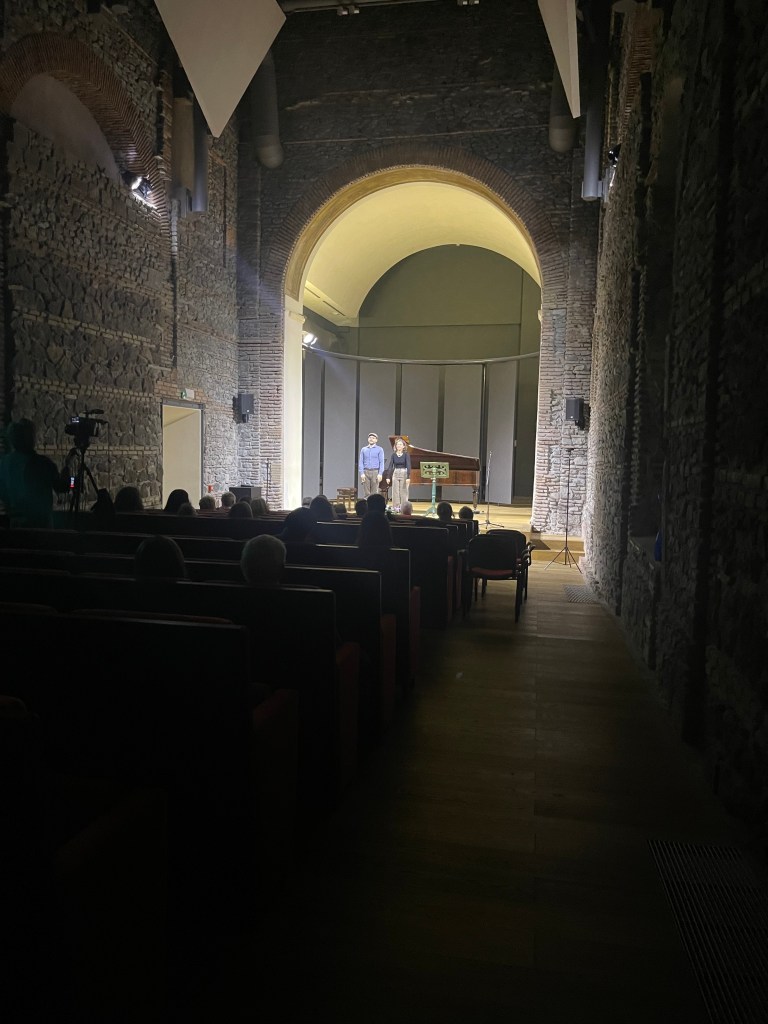
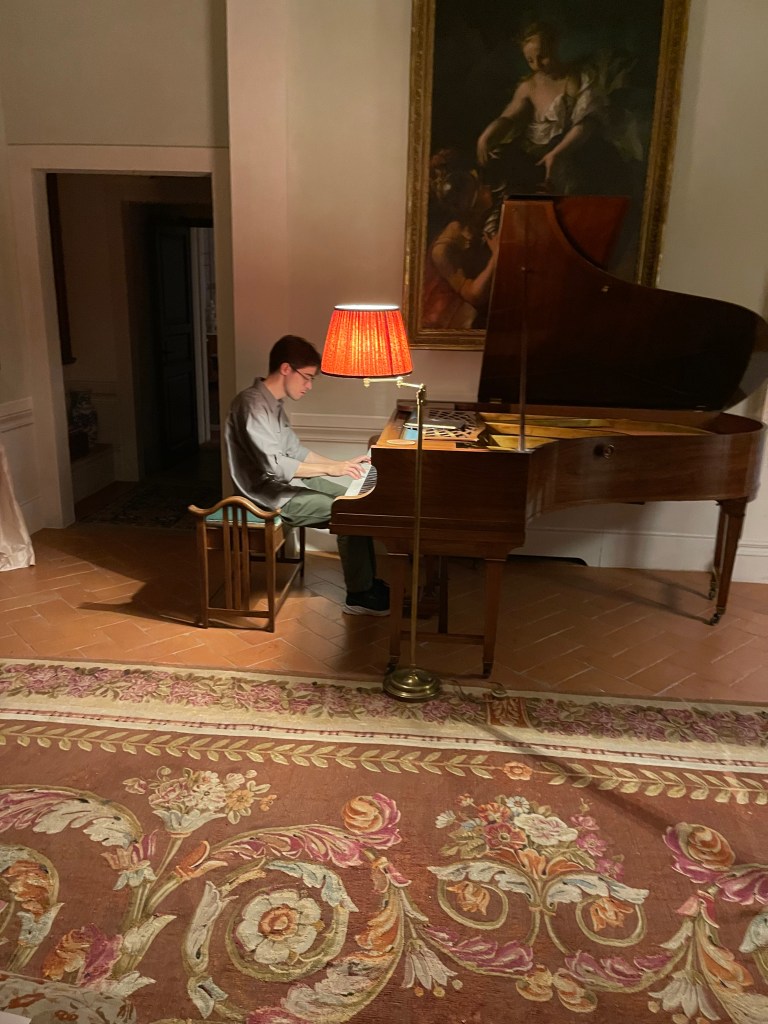
Ing. Tammarow’s superbly restored Erard piano from1879, with its mellow tone and lightweight brilliance, was a poignant reminder of the deep significance of Richard Strauss’s last outpouring of beauty and resignation. The rich golden sounds of Sarah Claudia Mueller’s voice soaring into the heights of this ex convent sited at the end of a meandering lane and an oasis of beauty in a town that has become the crossroads to the ‘Castelli Romani’ where the nobility of the day would have their sumptuous country residences.
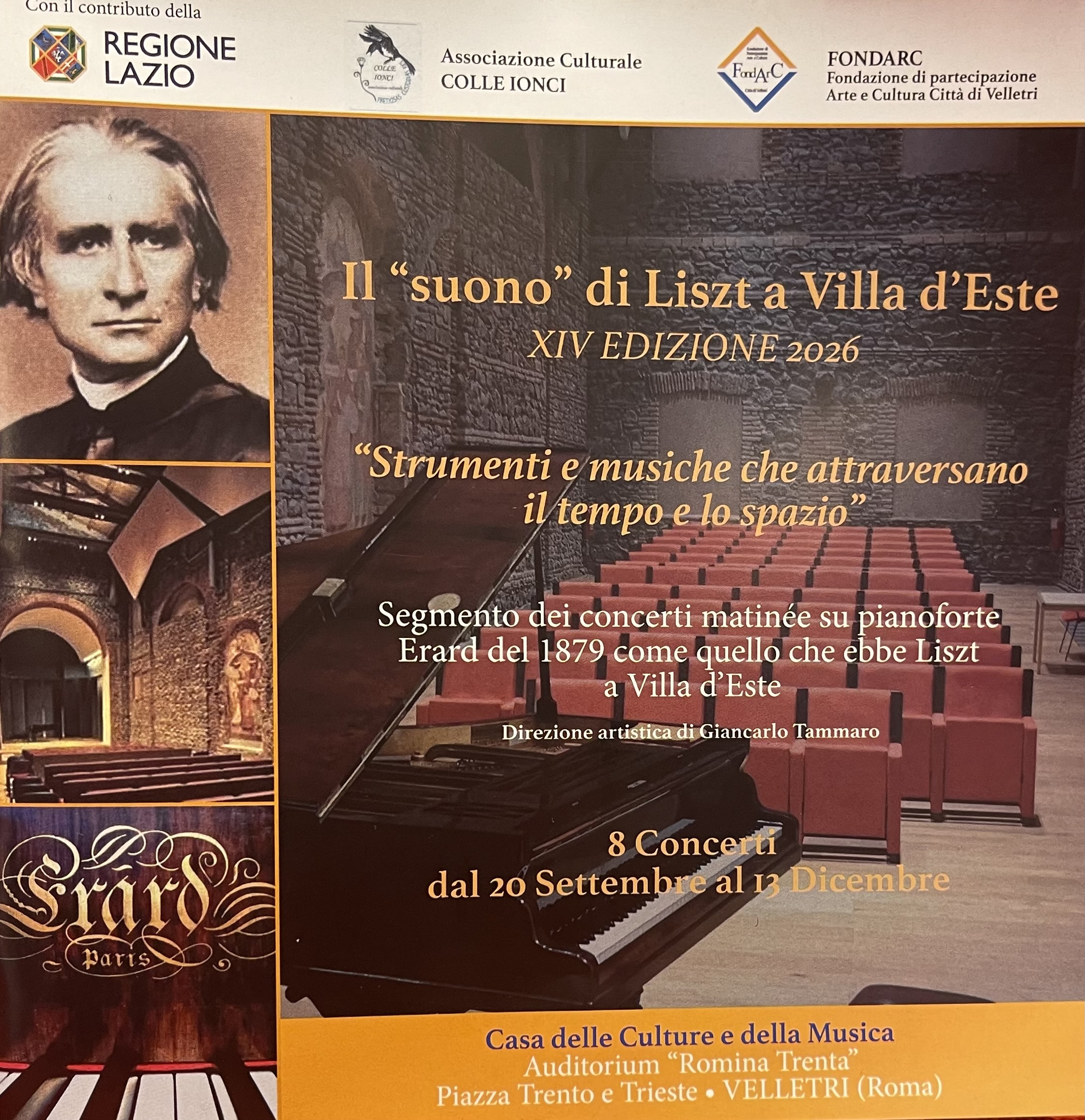
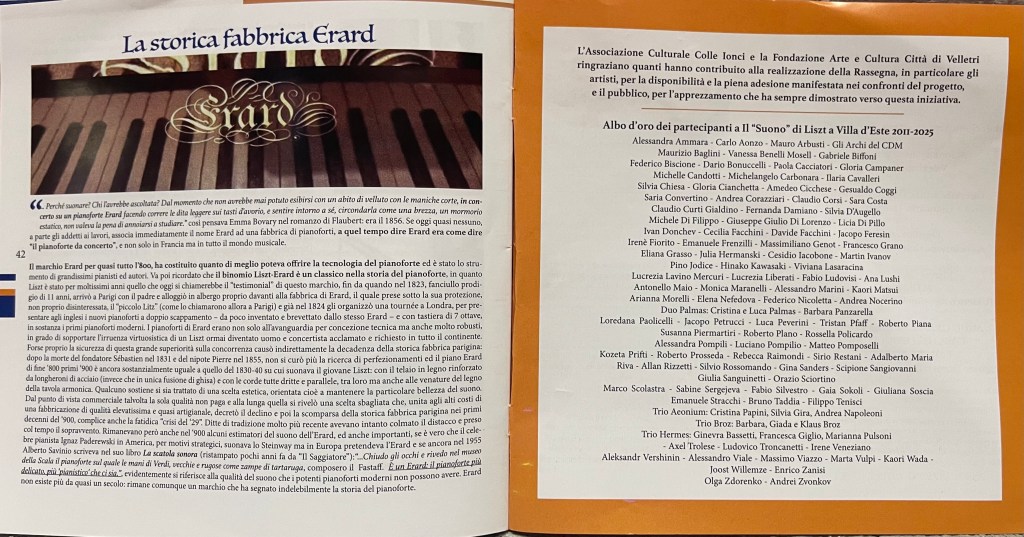
It is the very title of this concerts series, now in its fourteenth edition, that was born in the Villa d’Este where Liszt would spend much time whilst taking holy orders in the Eternal City below.
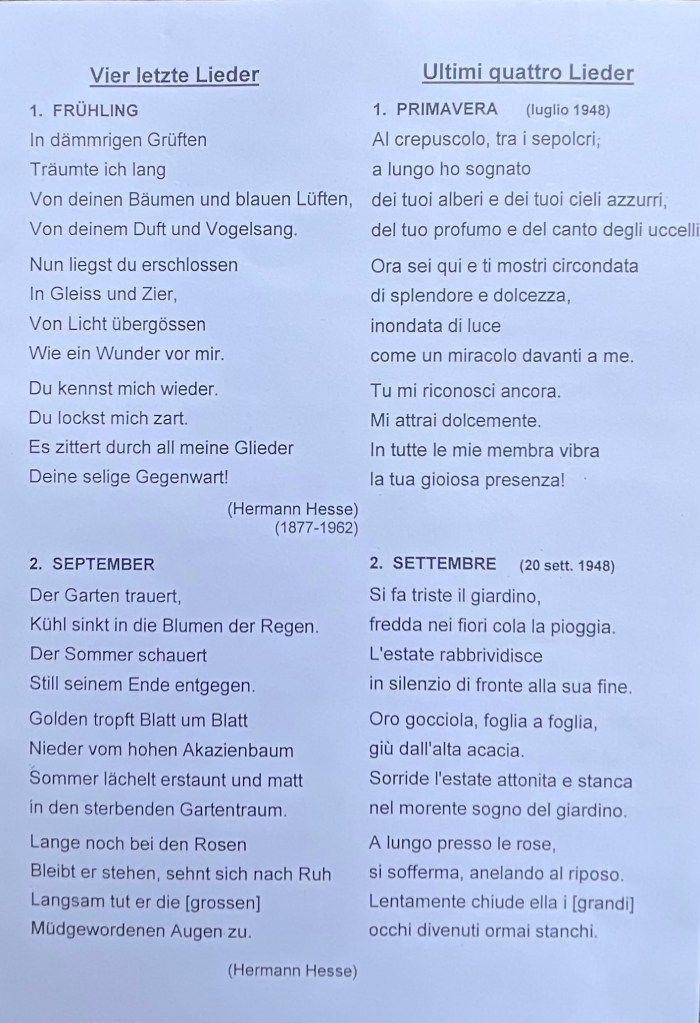
The concert had begun with Richard Strauss’s Four last songs. A sublime outpouring written at the end of the Second World War when Strauss had been vindicated as being part of an evil regime but had suffered from insinuations that were being thrust at a man whose only crime was to inhabit a world of sublime music that would last much longer than any political or social conflicts. Four songs that were to be his glowing testament that beauty can outlive evil and be the inspiration to others intent on conflict.The Four Last Songs (German: Vier letzte Lieder), op posth., for soprano and orchestra were composed in 1948 when Richard Strauss was 84. They are – with the exception of the song “Malven” (Mallows), composed later the same year – Strauss final completed works. The title Four Last Songs was provided posthumously by Strauss’s friend Ernst Roth , who published the four songs as a single unit in 1950 after Strauss’s death.
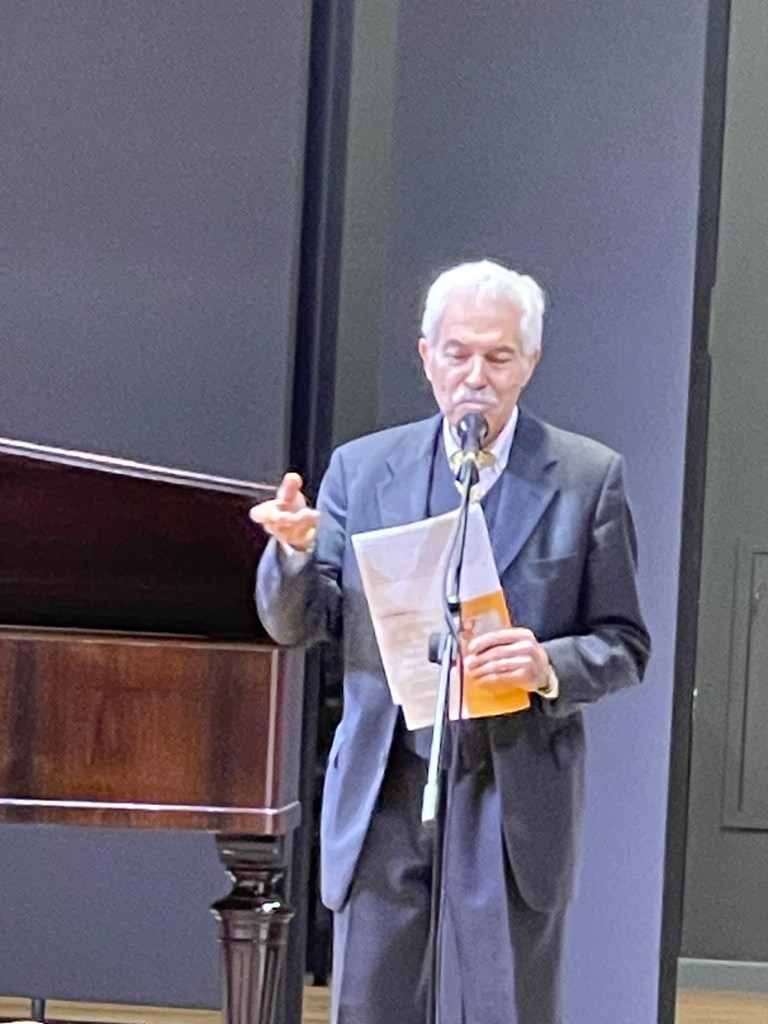
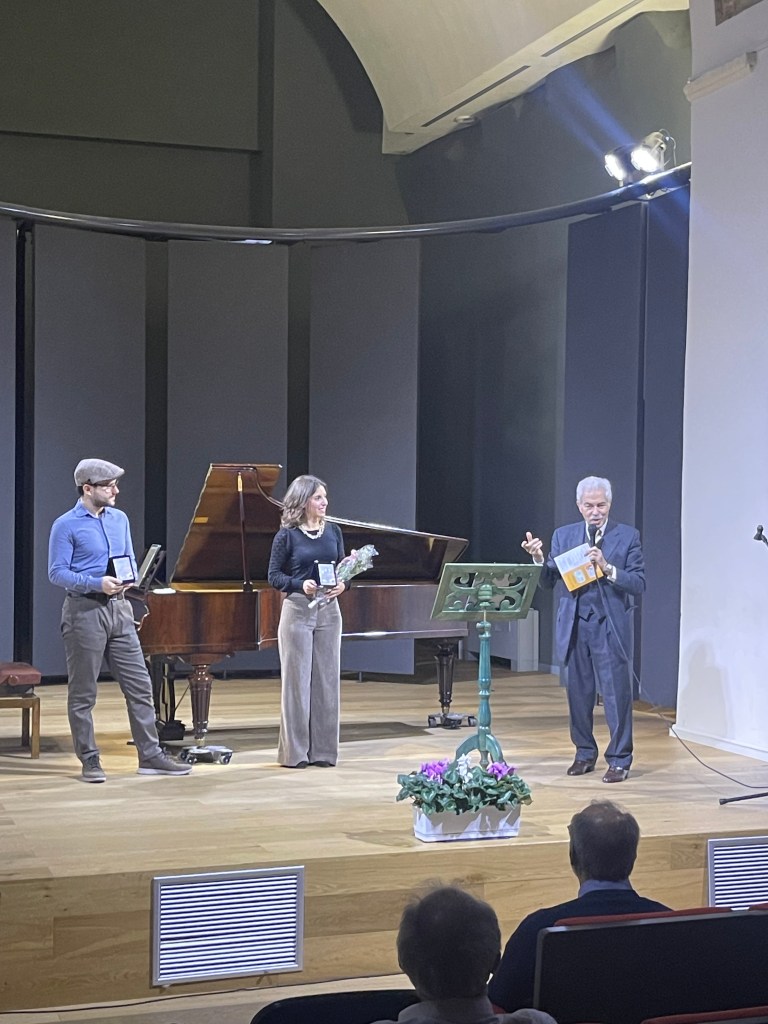
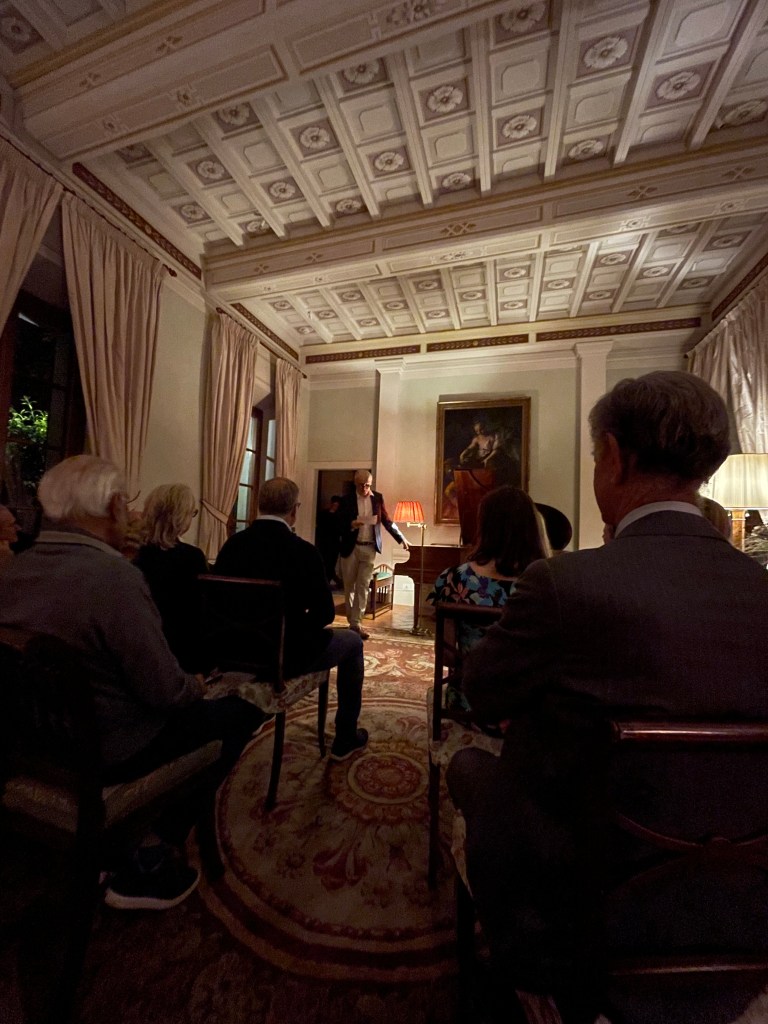
Ing. Tamarrow presenting the concert
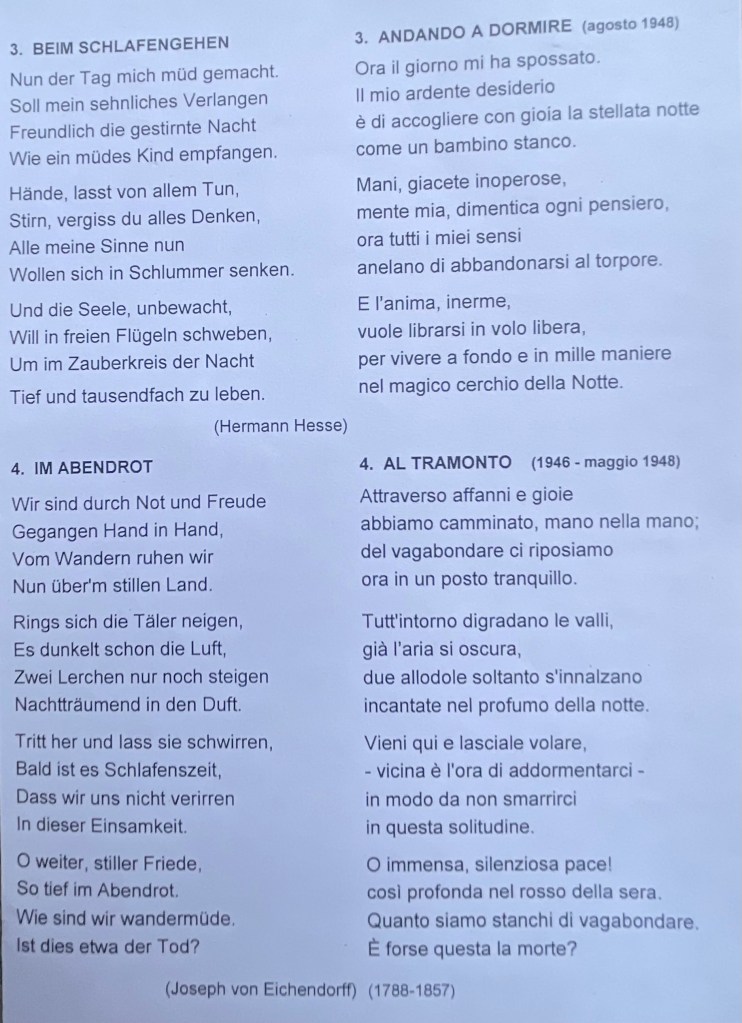
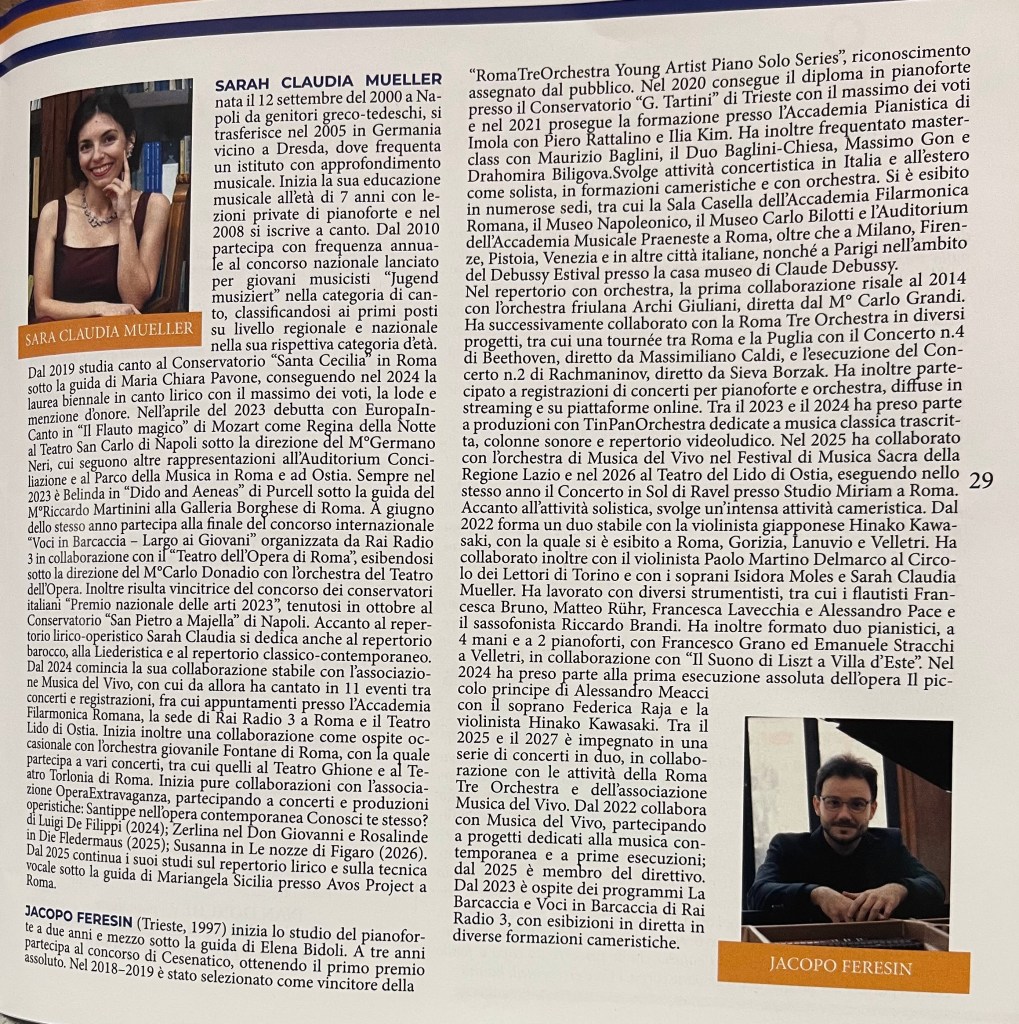
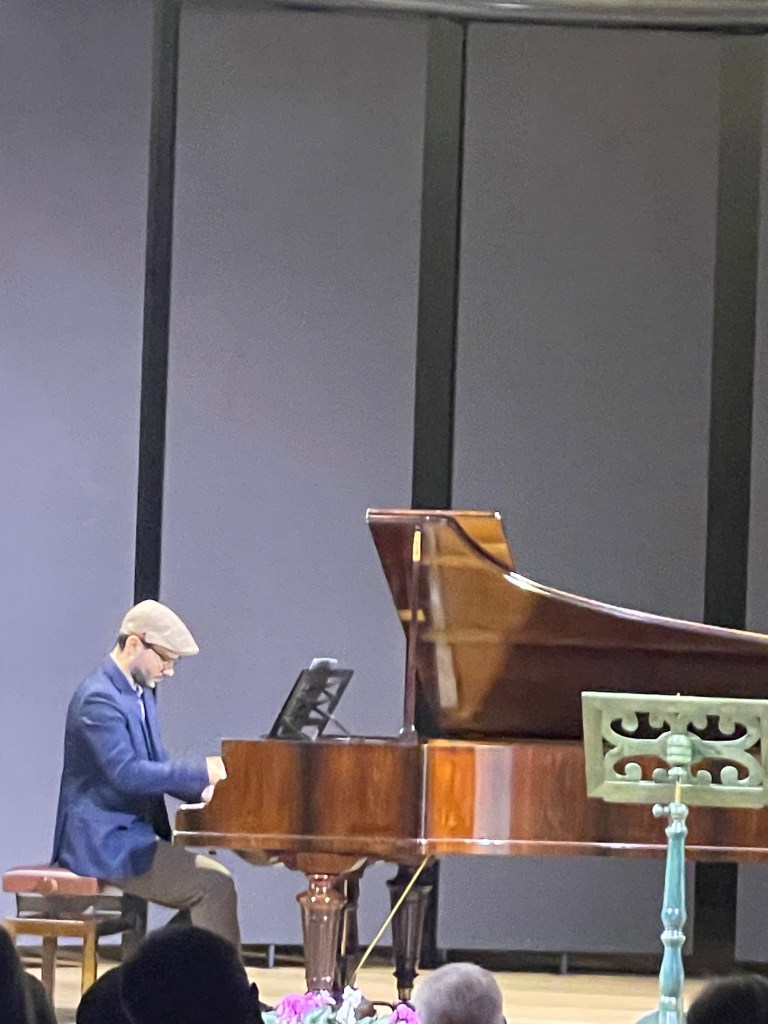
Jacopo Feresin I have heard play many times and with his superb musicianship and technical mastery he was a very sensitive partner. The piano lid fully opened but there was never any fear of him overpowering the radiant outpourings of Sarah Mueller because sharing the same sound board with their similar poetic mastery, the sounds wafted into this oasis of beauty with radiance and power. A great emotional intensity to ‘Frühling’ was contrasted with the mellow sounds of the countryside in ‘September’ as we too could contemplate the end of summer where the cycle of life becomes so evident. Deep bass notes resounded from Jacopo’s sensitive fingers as the gentle lullaby ‘Beim Schlafengehen’ was allowed to unfold with disarming beauty. The mellifluous sounds of the Erard only adding to the touching poignancy as Sarah’s radiant tones reached for the heights of sublime beauty. The poignant lament of ‘Im Abendrot’ was outlined with deeply felt sentiments as death appears on the horizon with the rich subtle colours of the Erard bringing a stillness and eery unease as birds were heard to utter their crystalline plaintive call.
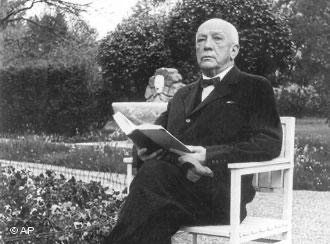
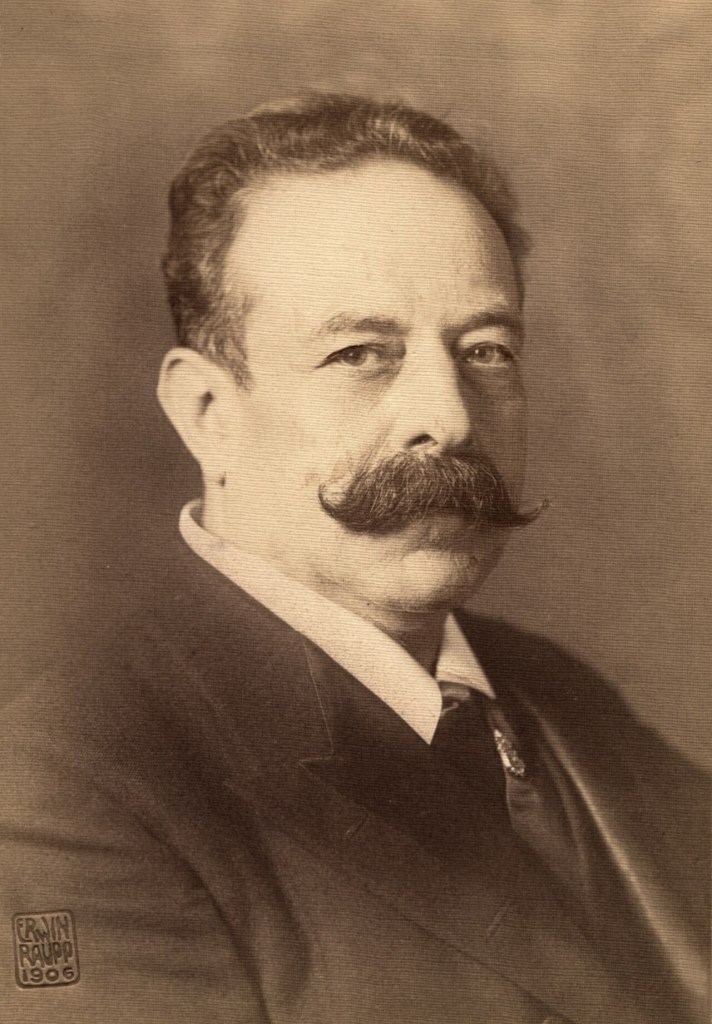
Richard Strauss
11 June 1864. Munich 8 September 1949 (aged 85) Garmisch- Partenkirchen Germany
Strauss died in September 1949 and the premiere was given at the Royal Albert Hall in London on 22 May 1950 by soprano Kirsten Flagstad and the Philarmonia Orchestra conducted by Wilhelm Furtwängler as was the composers dying wish. All of the songs but “Frühling” deal with death and being written shortly before Strauss died, they are suffused with a sense of calm, acceptance, and completeness.Towards the end of “Im Abendrot”, after the soprano’s intonation of “Ist dies etwa der Tod?” (“Is this perhaps death?”), Strauss musically quotes his own tone poem Death and Transfiguration, written 60 years earlier where the quoted seven-note phrase (known as the “transfiguration theme”) has been seen as the fulfilment of the soul through death.
Through sorrow and joy we have gone hand in hand; we are both at rest from our wanderings now above the quiet land.
Around us, the valleys bow, the air already darkens. Only two larks soar musingly into the haze.
Come close, and let them flutter, soon it will be time to sleep so that we don’t get lost in this solitude.
O vast, tranquil peace, so deep in the afterglow! How weary we are of wandering – Is this perhaps death?
Strauss had come across the poem “Im Abendrot” by Joseph von Eichendorff, which had a special meaning for him. He set its text to music in May 1948. Strauss had also recently been given a copy of the complete poems of Hermann Hesse and was strongly inspired by them. He set three of them – “Frühling”, “September”, and “Beim Schlafengehen” – for soprano and orchestra, and contemplated setting two more, “Nacht” (Night) and “Höhe des Sommers” (Height of Summer), in the same manner. He also embarked on a choral setting of Hesse’s “Besinnung” (Reflection), but laid it aside after the projected fugue became “too complicated”.
The Four Last Songs, are seen as his final statements about music, and the links they exhibit to Strauss’s earlier works, as well as some of the symbols Strauss includes in the songs, lend them a retrospective, valedictory character.
Two worlds apart with the sublime final outpourings of a composer accused of collaborating with an evil regime but who vindicated himself showing the world that it was he who had found the keys to a sublime heavenly kingdom.
And almost a century earlier a composer whose waltzes were to define an era of lighthearted elegance and enjoyment. An art form that was to finish with Strauss’s death in 1899 and the conflict of the First World War that underlined the social and political injustices that had been swept aside in waltz time.
After the deep contemplation and clouds of doubt and resignation of the first half of this Sunday morning concert, Johann Strauss jr was the ideal antidote with the beguiling timeless, carefree world of the elegance and frivolity of an age of privilege that would soon come to a violent end with the death of the ‘King of the waltz’.The beguiling style and commanding tessitura of Sarah Mueller was matched by the robust rhythmic drive from her partner in a performance of Johann Strauss’s own transcription for voice and piano of ‘Frülingsstimmen’.
It was time now for Jacopo to unleash his technical wizardry as he played three piano solo versions of Strauss Waltzes.
The first ‘Wiener Blut’ was a rather literal transcription by the composer and although Jacopo did all he could it was outclassed by the extraordinary transcriptions from a pianists of the Golden Age of Piano Playing.
Two breathtaking paraphrases by Alfred Grünfeld with the ‘Soirée de Vienne’ ( Moritz Rosenthal also wrote a paraphrase with the same title ) where Jacopo could now demonstrate his refined technical mastery with ‘tricks of the trade’ paraded one after the other with each change of Waltz heralded by a bird call high in the keyboard .
Alfred Grünfeld Prague 4 July 1852 Vienna 4 January 1924 Grünfeld became the most popular salon pianist in Vienna, performing frequently in the salons of Viennese high society. His concert tours took him around Austro-Hungary, to Paris, London, Germany, Scandinavia, Holland, Russia, Poland, Romania, Estonia, Constantinople, Belgrade and the USA. He received many honours and titles for his performances.He was close friend of Johann Strauss who dedicated his Frühlingsstimmen Waltz to him . He became famous for his transcriptions of Strauss waltzes, and particularly of the Frühlingsstimmen which he often played as an encore. He was the first pianist of note to make commercial recordings. His earliest recording was made in 1889 on wax cylinder for the Edison Phonograph
The crystalline clarity of these birds too was something to marvel at with Jacopo’s well oiled fingers able to demonstrate the clarity and ease of an instrument that was to be forgotten within the next fifty years ,outclassed by the innovative technical improvements of the great German pianos. Sumptuous rich sounds too as Jacopo delved deep into the keyboard and with a masterly sense of balance could bring a richness and orchestral fullness with moments of breathtaking daring and technical bravura.
“The Blue Danube” 1866 Premiere 15 February 1867; Vienna Conductor Rudolf Weinwurm
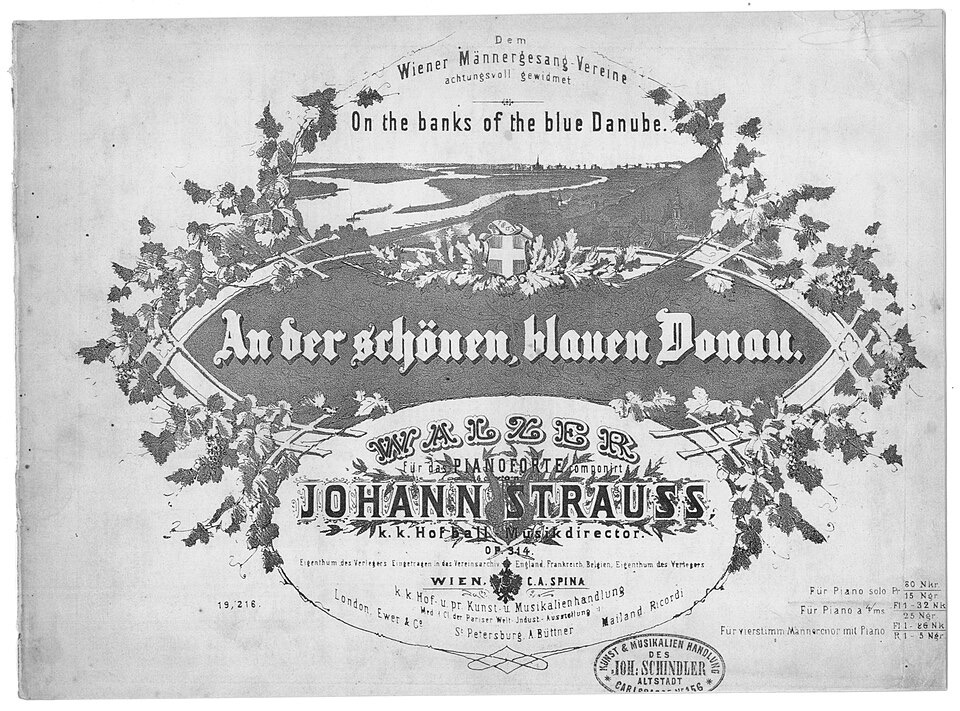
It was Johann Strauss’s 201st birthday and of course we celebrated with the most celebrated waltz of all : ‘The Blue Danube’. Originally performed on 15 February 1867 at a concert of the Wiener Männergesang- Verein (Vienna Men’s Choral Association), it has been one of the most consistently popular pieces of music in the classical repertoire. Its initial performance was considered only a mild success,however, and Strauss is reputed to have said, “The devil take the waltz, my only regret is for the coda—I wish that had been a success!”. Such was its fame however that when Strauss’s stepdaughter, Alice von Meyszner-Strauss, asked Brahms to sign her autograph-book , he wrote down the first bars of “The Blue Danube”, but added “Leider nicht von Johannes Brahms” (“Unfortunately not by Johannes Brahms”)!
Jacopo had prepared the solo piano version to play but of course was happy to share the spotlight with Sarah even though he had to master the score in just a few minutes before the concert.
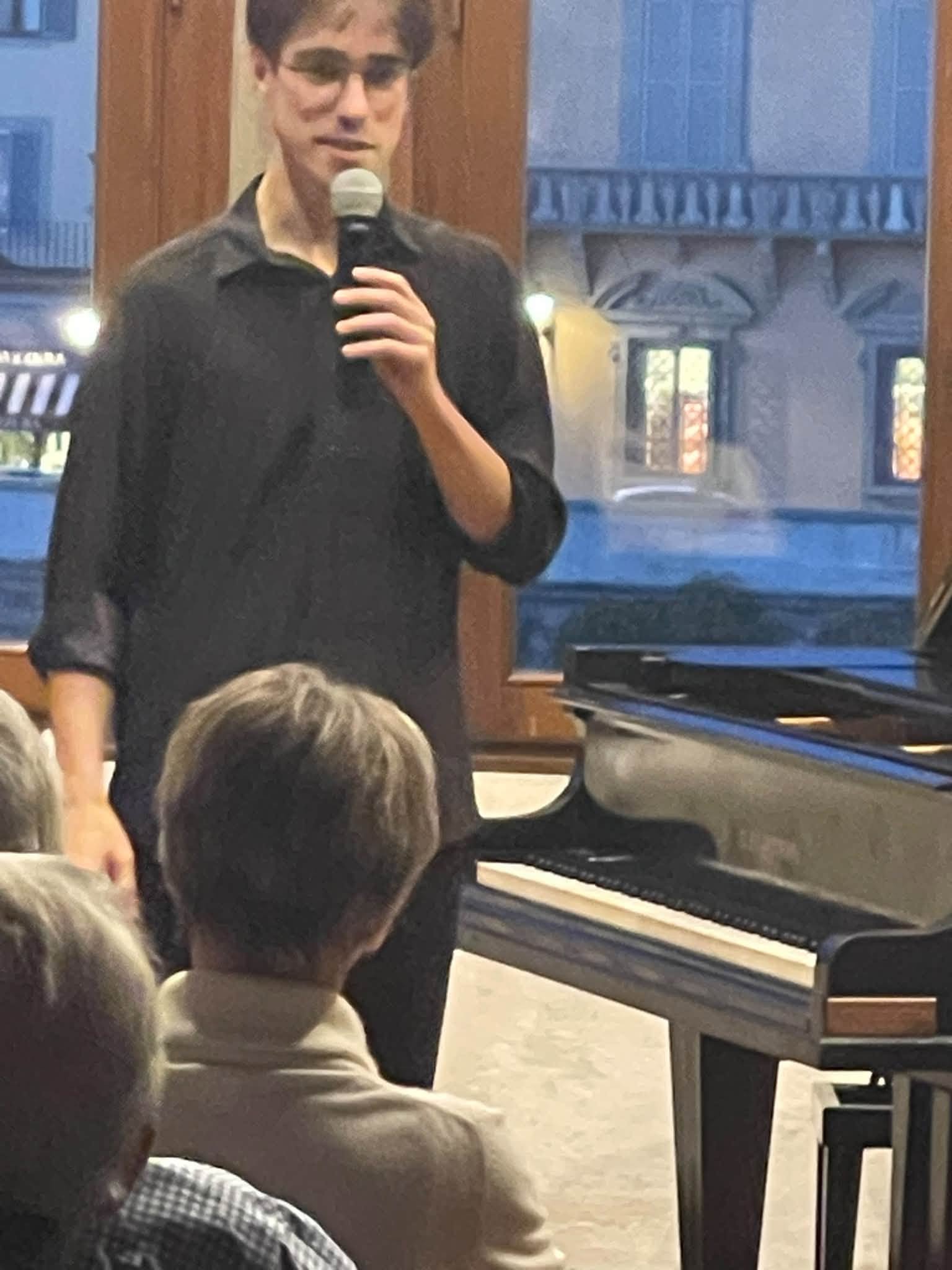
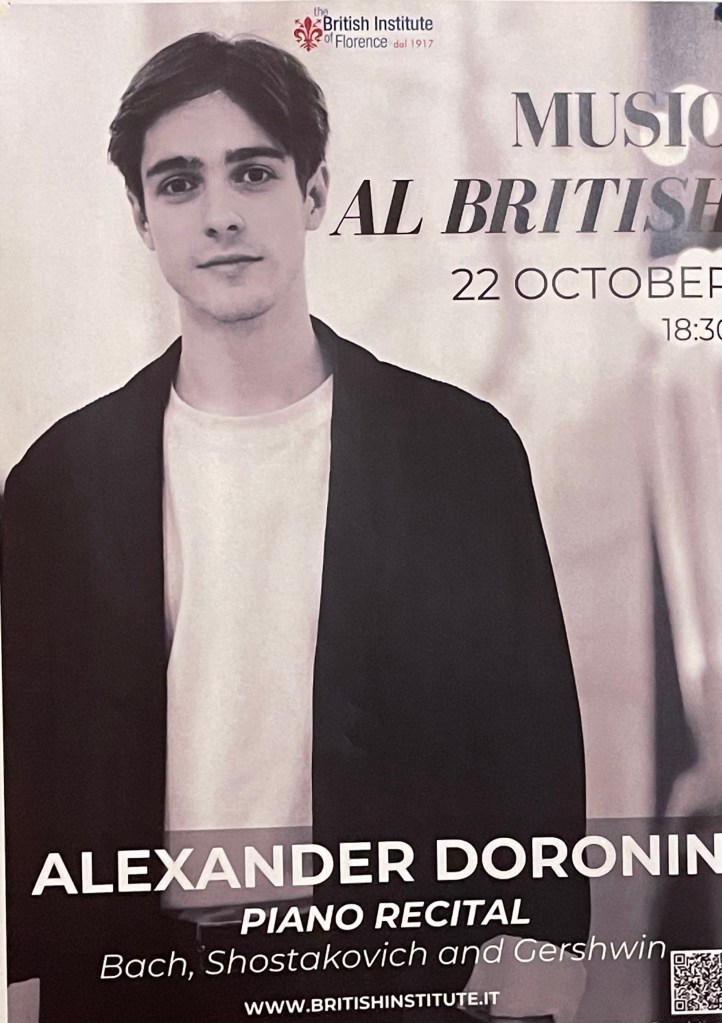
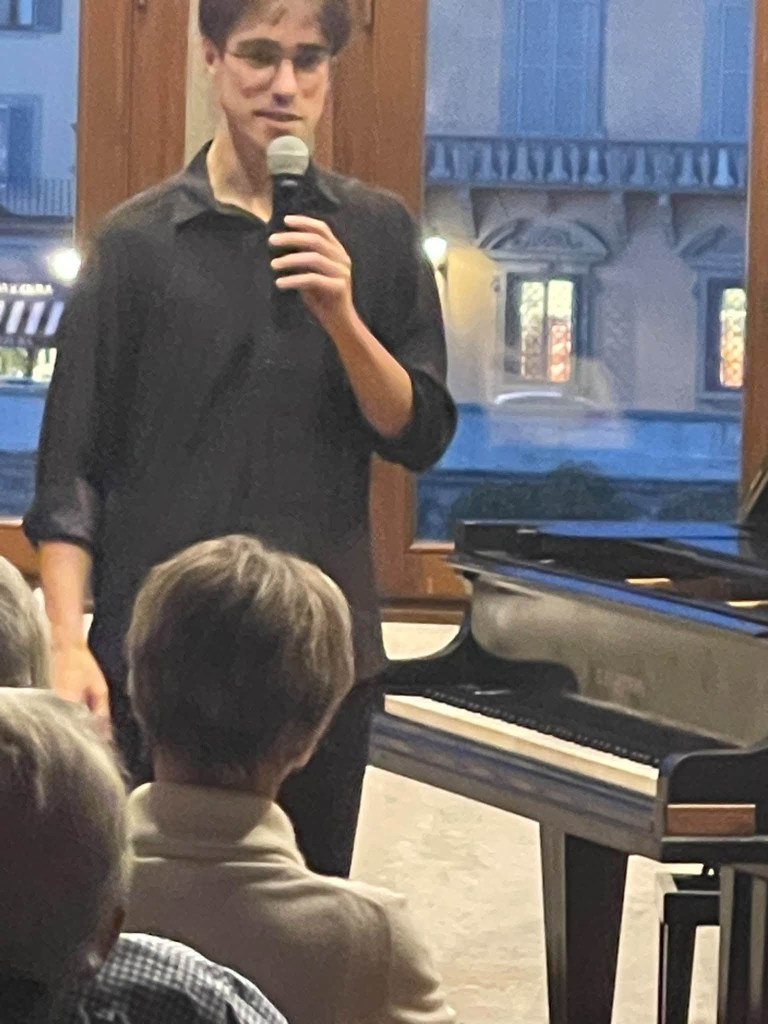
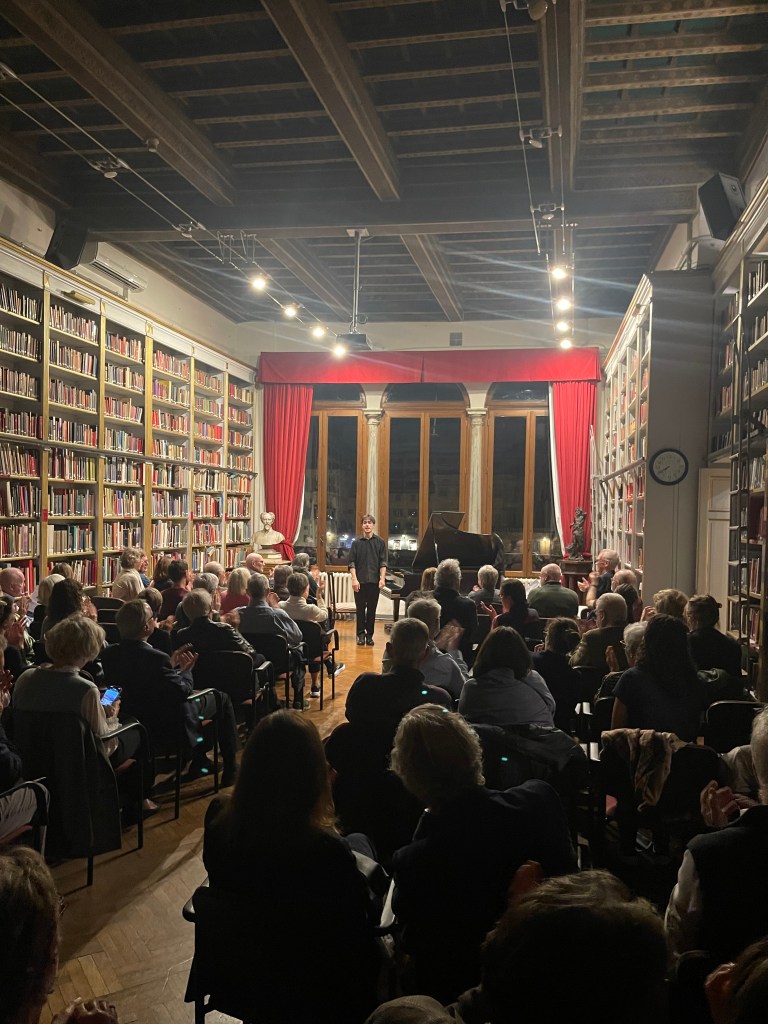
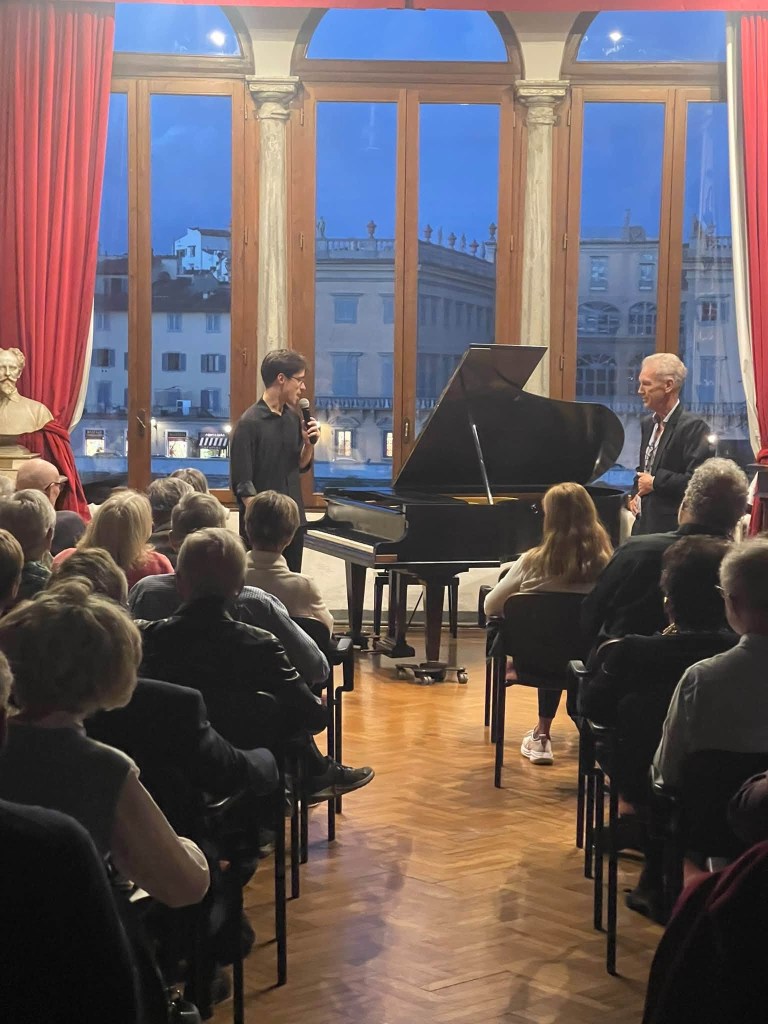
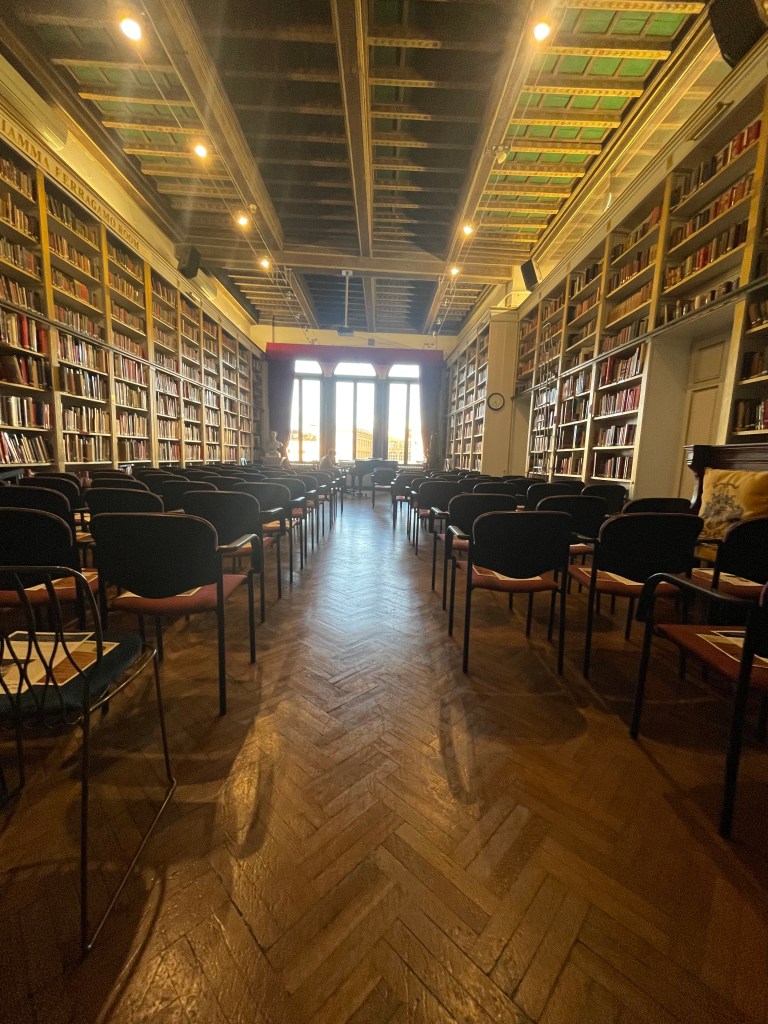
Alexander Doronin making his Florentine debut for the Keyboard Trust in the Harold Acton Library of the British Institute with a programme of Bach, Shostakovich and Gershwin.
Sasha presenting his programme Simon Gammell ,OBE, director of BI presenting the concert
This is a young man with a story to tell and an extraordinary palette of sounds with which he paints pictures in sound with chameleonic changes of character and colour that held a very full hall spellbound. After a programme of such sensitivity and eloquence the encore was indeed a song with out words, by Mendelssohn, of whispered undulating beauty.
The concert had begun with Bach’s Italian concerto with the opening ‘Allegro’ full of rhythmic drive but allied to a refined sound world where very subtle changes of colour brought this movement vividly to life. A range of colours as he appeared to change manuals and registers without ever drawing attention to itself but allowing Bach’s music to seemingly speak with flowing ease and simplicity. A whispered ‘Andante’, where the left hand accompaniment was completely colourless and opaque, so when the ‘Aria’ entered with chiselled glowing beauty there was this duet of almost religious purity and poignancy. The final ‘Presto’ just flew from his fingers, but like the first movement, with a fluidity without any harsh accents or rhythmic hi jinx, as the music was a flood of sounds of hypnotic immediacy. Very subtle colouring to the counterpoints where this young man had an orchestra in his hands that with extraordinary mastery he could give a voice to all the strands of Bach’s knotty twine never getting into a tangle but allowing us to follow each voice with string quartet clarity and reasoning .
What a voyage of discovery this recital was with a pianist who had ten wonderful players in his hands that he could command with such mastery as he paid scrupulous attention to the composers intent as left as mere dots and dashes on the page.
It was even more apparent with the 24 Preludes op 34 by Shostakovich. A work which in a lifetime of concert going I have never heard played in public before. We hear of his Preludes and Fugues inspired by the Bach playing of Tatiana Nikolaeva when Shostakovich was on the jury of the Bach Competition in Leipzig. But these twenty four preludes are miniature tone poems similar to the well known 22 Visions Fugitives by Prokofiev.
Here the mastery and poetic imagination of this young man had turned these works of Shostakovich into the vibrant jewels that obviously had inspired the composer to jot them down. Rather than fearing twenty four pieces by a semi contemporary Russian composer we were so spellbound that we could easily have listened to many more . Here were stories being told by a poet of the piano with a range of sounds of the eloquence and colours of the human voice. From delicacy, quixotic, demonic , desolate , nostalgic, pompous, radiance , ravishing bel canto, lonesome landscapes , this was an compendium of sounds and experiences as Shostakovich played on our sensibilities like a Cordon Bleu cook with our taste buds. One of the audience members was so entranced that she likened them to Julian Barnes’s ‘The Noise of Time’. Julian with Angela Hewitt had give a recital here together a few years back so maybe the memory still lingers in this wondrous Harold Acton Library
I stopped counting after the first few preludes and like the audience allowed myself to be transported into a magic land of make believe. The impish motif of one of the first preludes returned though, and it struck me that Shostakovich , the master craftsman, had given an overall architectural shape to these twenty four pictures .
Just as I was thinking that this must be the final prelude our Prince of the Keyboard was allowing the trill of Gershwin’s clarinet to transport us into the world of show business with the famous Benny Goodman clarinet ‘wail’ that heralds the opening of Rhapsody in Blue .
We are so used to this famous piece being played or almost hammered out with rhythmic fireworks and with it’s final sumptuous Hollywoodian denouement that listening to Sasha we were suddenly aware of what a genial invention this piece is. It was in fact Nadia Boulanger, the renowned pedagogue of most of the greatest contemporary composers of the day, who refused to teach Gershwin as she did not want to risk ruining his genial natural talent.Ravel simply asked Gershwin how much he earned, and when he told him he said that it was he who should be asking for lessons from Gershwin!
What subtlety where real jazz is often improvised with insinuation and style rather than hammered out with percussion and showmanship . A quite extraordinary range of sounds from this young man, that when the famous tenor jazz melody appeared in the left hand it was of such an overpowering effect of recognition and radiance that it was like a jewel suddenly catching the light and allowed to enchant and bewitch us all with its radiant beauty. We were caught in a spell where technical mastery and poetic intensity were on hand but we were never aware of it. Such was the power of recreational music making that we were held breathless and spellbound by a work brought to life with the ink seemingly still wet on the page . Even the final chords which are often hammered out, here were ntoned with a sense of balance that where we expected hammered out chords they were suddenly whispered as being the start of a crescendo to the wonderful joyous final burst of mellifluous slinky jazz idioms .
An ovation from a more than usually full hall was greeted by the whispered disarming beauty of a Mendelssohn song without words. Subtle colouring and refined good taste was a wonderful way to finish this concert by an extraordinary pianist of refined poetic mastery
Sasha confided afterwards that he had arrived in Florence on a night train from Salzburg where he has a term studying at the Mozarteum before completing his Master degree at the Royal College in London next spring. But he was also still jet lagged as he had just flown in from concerts in Hong Kong as winner of their International Piano Competition!
After every concert in this collaboration between the Keyboard Trust and Simon Gammell’s British Institute the audience say it is the best ever.
This time they really meant it !!
Of course there is no such thing as comparative music making but it is the communication and emotions that we are treated to in an unrepeatable moment that make music in this new ‘A.I’ age so essential.
We were sorry that Sir David Scholey the generous sponsor of Music at British , should miss such a treat due to fatigue at the age of 91, but hope that Sasha will play for him this morning in his beautiful home overlooking the Uffizi gallery.
It is the tonic that we all need !
First Prize & Gold Medal, 7th Hong Kong International Piano Competition (2025). Studies with Professor Dmitri Alexeev at the Royal College of Music, London. Doronin studied at the Gnessin Moscow Special School of Music with Mikhail Khokhlov (piano) and Olga Martynova (harpsichord) from 2015 to 2021, before moving to London to study at the Royal College of Music as an ABRSM Scholar. He graduated in 2025 with a First Class Bachelor of Music degree and is now pursuing a Master of Music degree as a Musicians’ Company Lambert Scholar, under the guidance of Professor Dmitri Alexeev. In 2025 he won First Prize and the Gold Medal at the 7th Hong Kong International Piano Competition, which brought with it a series of international engagements. As a soloist he has performed with the Russian National Orchestra under Mikhail Pletnev and the Royal College of Music Symphony Orchestra, among others, and given recitals across the UK, Austria, Poland, China, Vietnam, the Netherlands and Switzerland. Alongside his solo career, Alexander performs regularly in chamber and collaborative projects. EDUCATION 2021–25Royal College of Music, London — BMus (First Class); currently MMus, with Dmitri Alexeev 2015–21Gnessin Moscow Special School of Music — with Mikhail Khokhlov (piano), Olga Martynova (harpsichord) SUPPORT London Symphony Orchestra Scholar Musicians’ Company Lambert Scholar Eileen Rowe Musical Trust Drake Calleja Trust Countess of Munster Trust
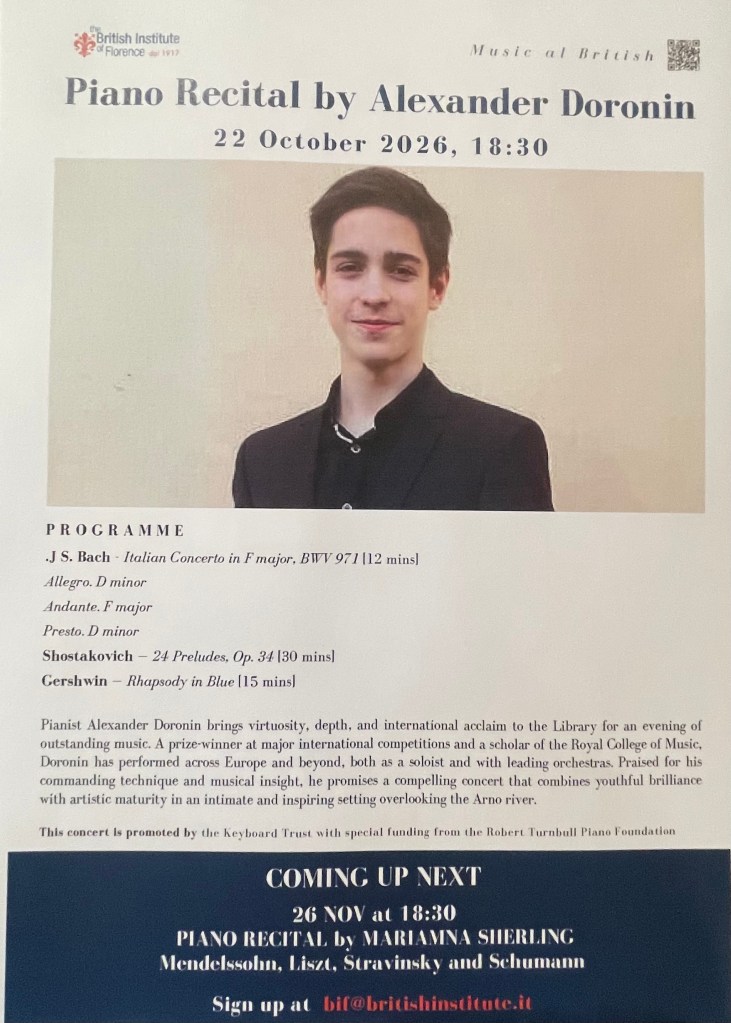
Pianist Alexander Doronin brings virtuosity, depth, and international acclaim to the Library for an evening of outstanding music. A prize-winner at major international competitions and a scholar of the Royal College of Music, Doronin has performed across Europe and beyond, both as a soloist and with leading orchestras. Praised for his commanding technique and musical insight, he promises a compelling concert that combines youthful brilliance with artistic maturity in an intimate and inspiring setting overlooking the Arno river.
Programme:
J S. Bach – Italian Concerto in F major, BWV 971 [12 mins]
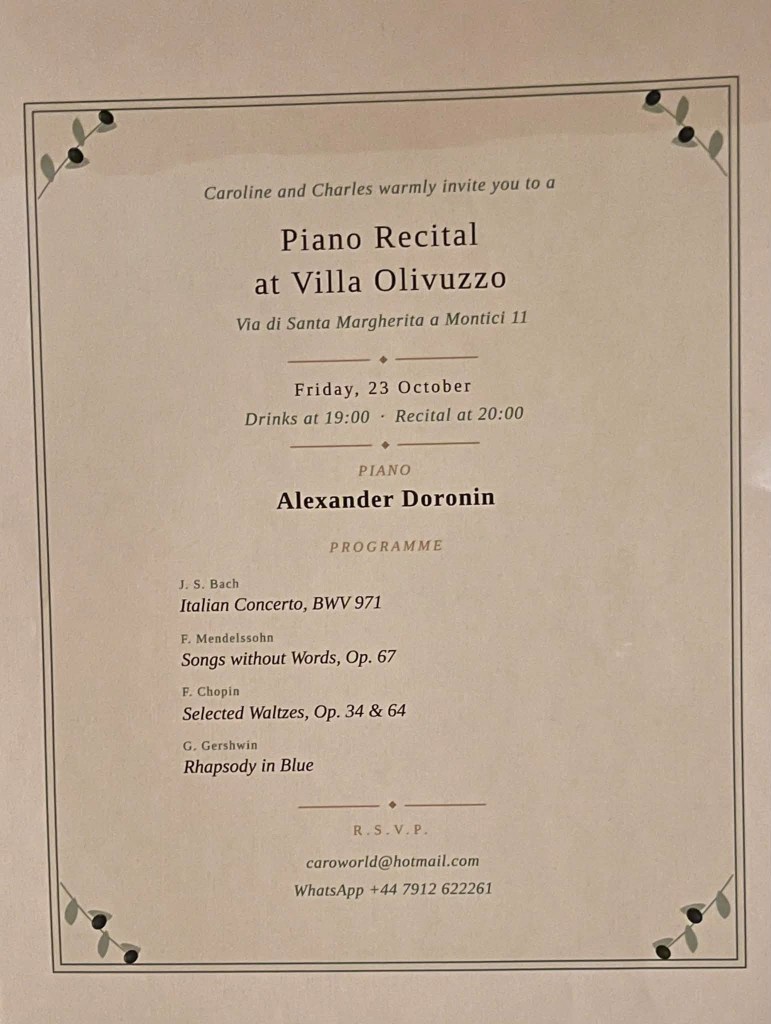
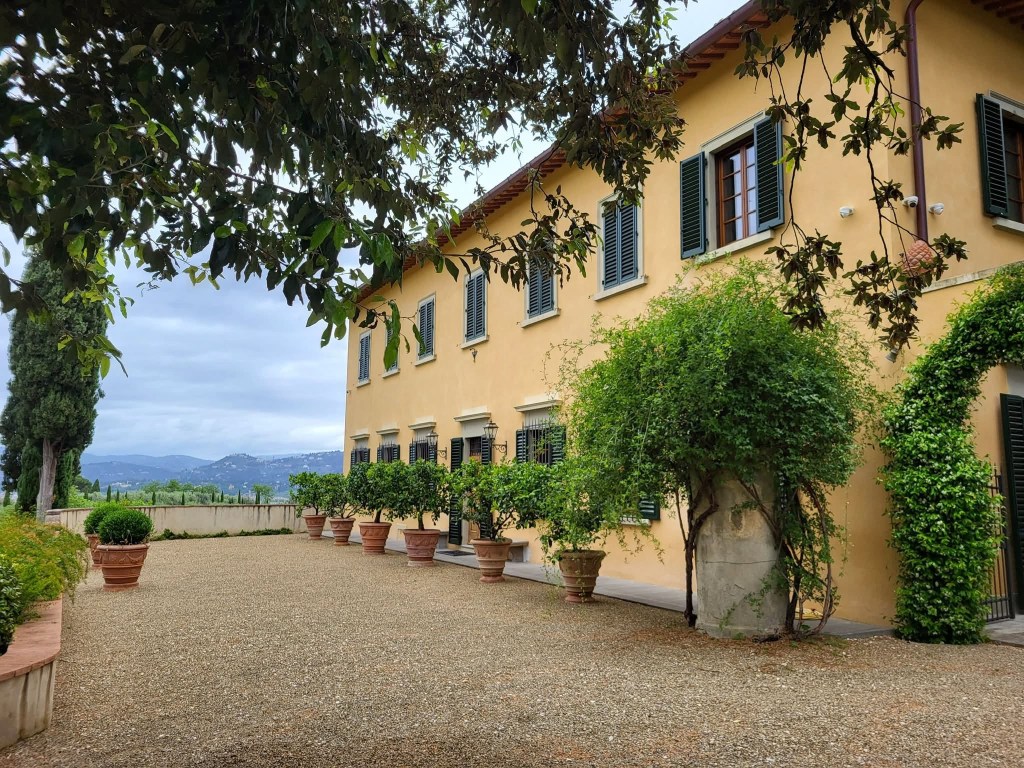
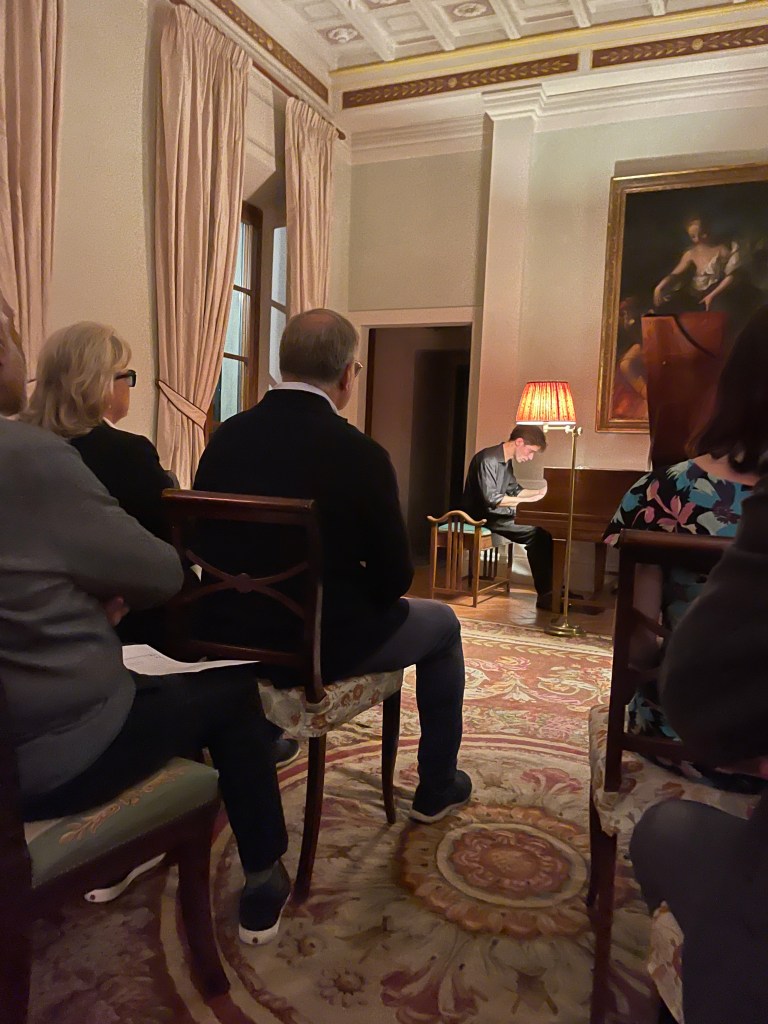
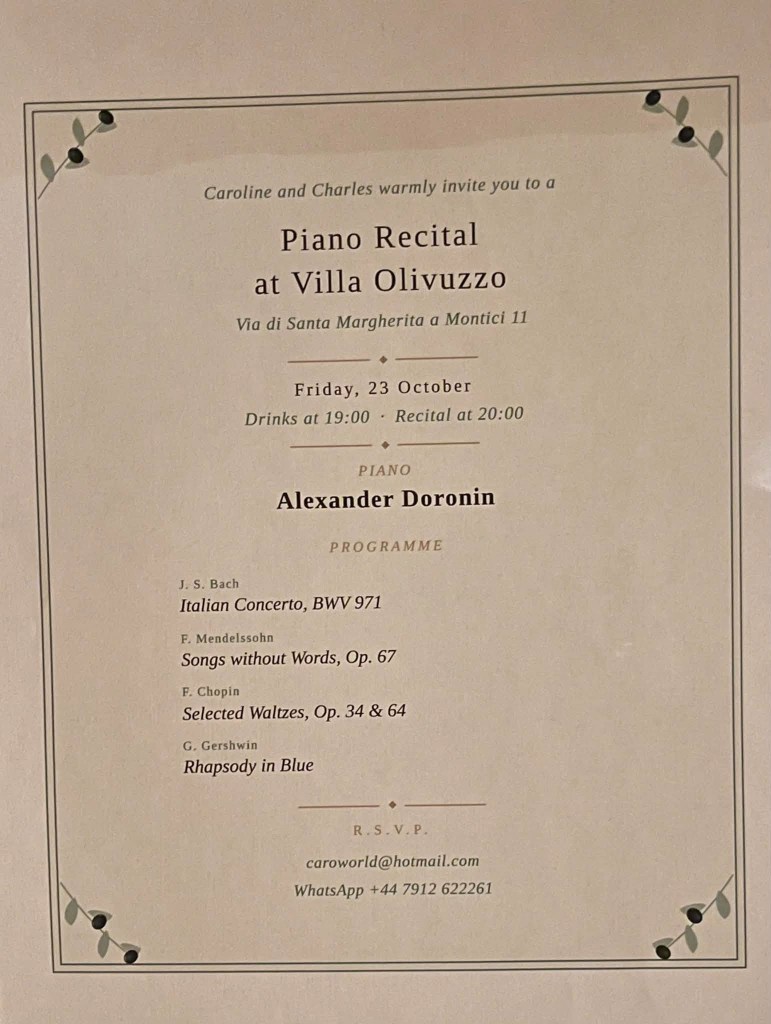
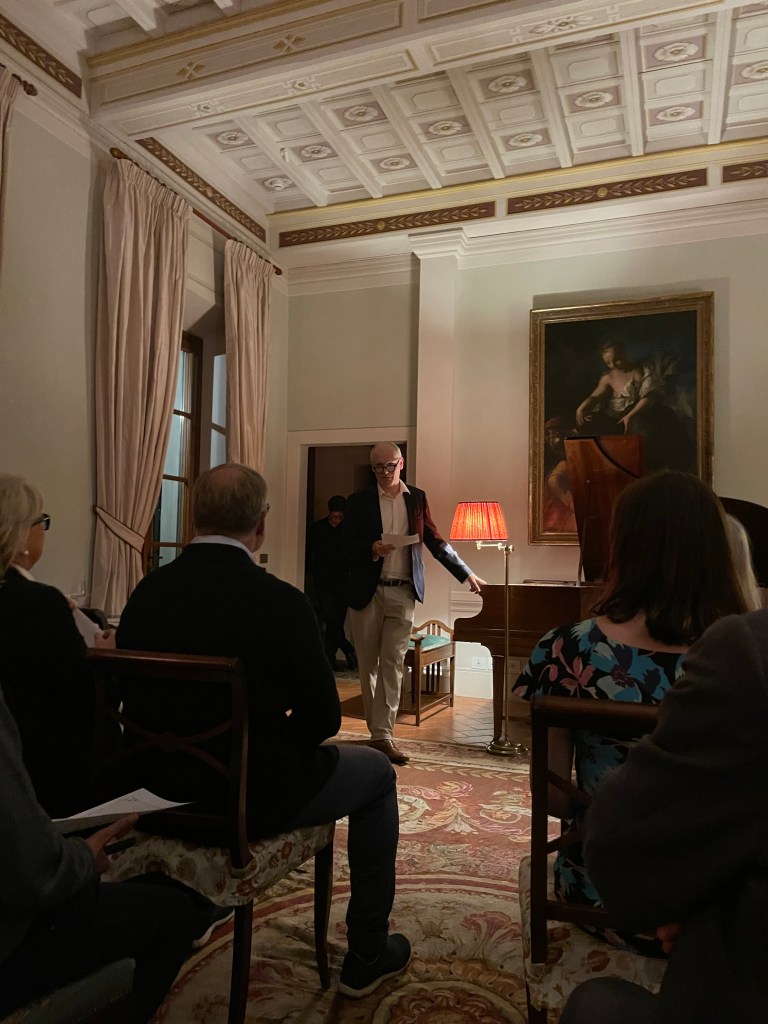
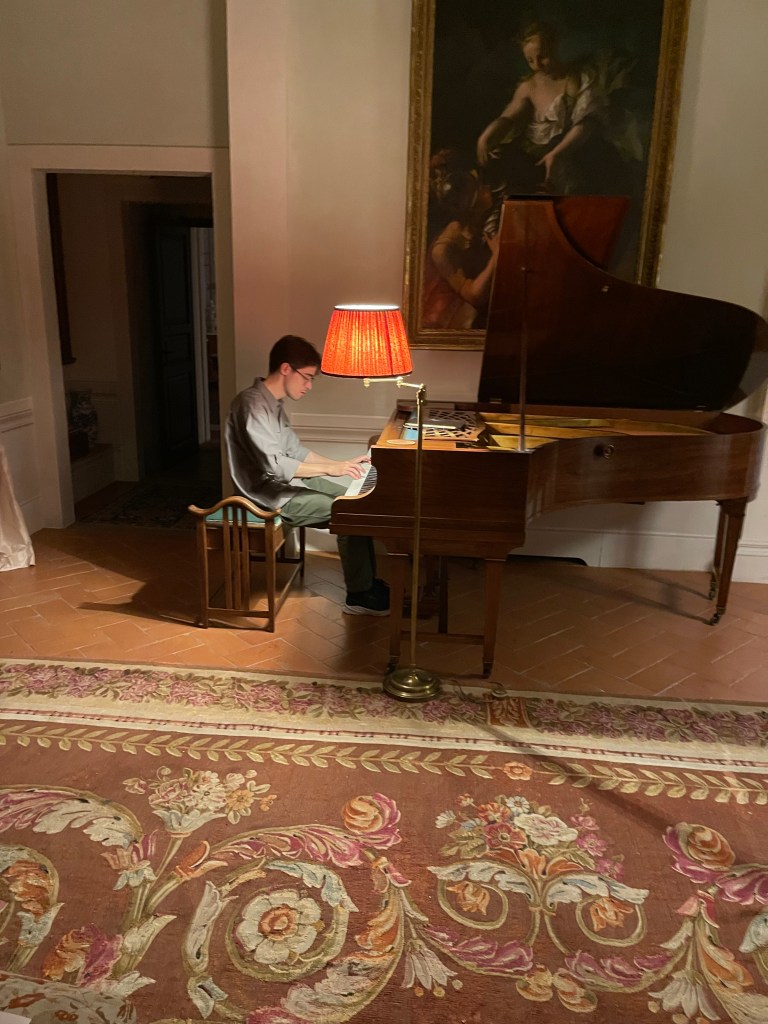
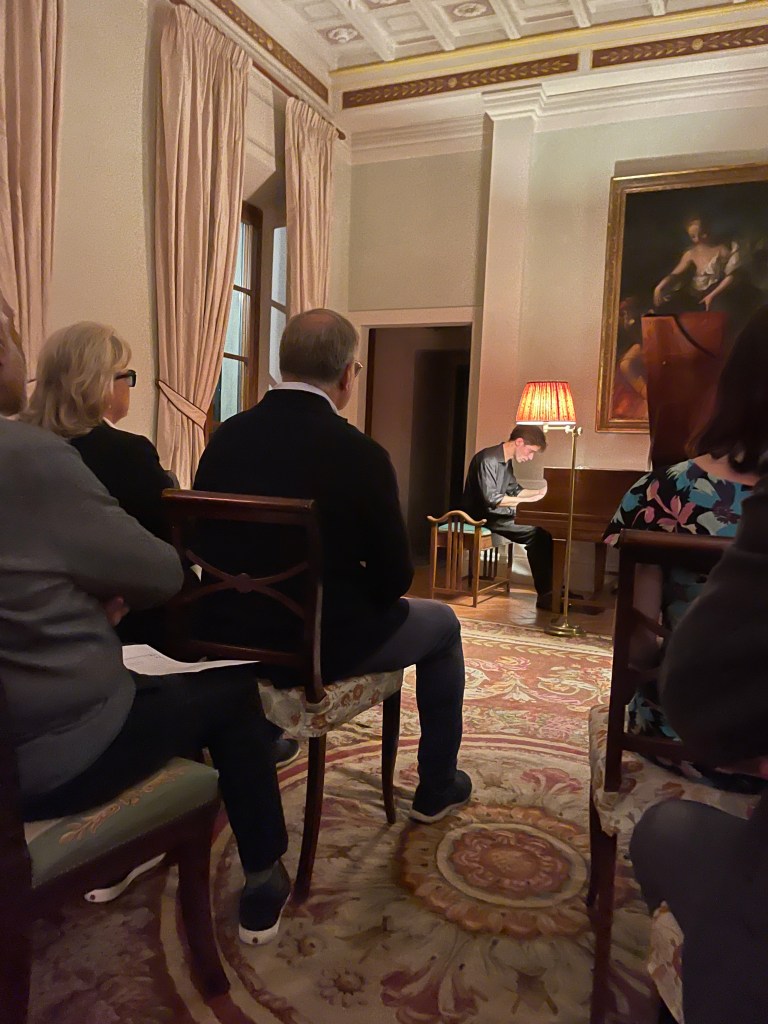
A second concert for Alexander Doronin thanks to Charles and Caroline Pridgeon in their beautiful house on the hill overlooking Florence. Chopin Watzes op 34 and Mendelssohn Songs without Words op 67 were just crafted to be played in such sumptuous surrounds
Alexander Doronin making his Florentine debut for the Keyboard Trust in the Harold Acton Library of the British Institute with a programme of Bach, Shostakovich and Gershwin.
Sasha presenting his programme Simon Gammell ,OBE, director of BI presenting the concert
This is a young man with a story to tell and an extraordinary palette of sounds with which he paints pictures in sound with chameleonic changes of character and colour that held a very full hall spellbound. After a programme of such sensitivity and eloquence the encore was indeed a song with out words, by Mendelssohn, of whispered undulating beauty.
The concert had begun with Bach’s Italian concerto with the opening ‘Allegro’ full of rhythmic drive but allied to a refined sound world where very subtle changes of colour brought this movement vividly to life. A range of colours as he appeared to change manuals and registers without ever drawing attention to itself but allowing Bach’s music to seemingly speak with flowing ease and simplicity. A whispered ‘Andante’, where the left hand accompaniment was completely colourless and opaque, so when the ‘Aria’ entered with chiselled glowing beauty there was this duet of almost religious purity and poignancy. The final ‘Presto’ just flew from his fingers, but like the first movement, with a fluidity without any harsh accents or rhythmic hi jinx, as the music was a flood of sounds of hypnotic immediacy. Very subtle colouring to the counterpoints where this young man had an orchestra in his hands that with extraordinary mastery he could give a voice to all the strands of Bach’s knotty twine never getting into a tangle but allowing us to follow each voice with string quartet clarity and reasoning .
What a voyage of discovery this recital was with a pianist who had ten wonderful players in his hands that he could command with such mastery as he paid scrupulous attention to the composers intent as left as mere dots and dashes on the page.
It was even more apparent with the 24 Preludes op 34 by Shostakovich. A work which in a lifetime of concert going I have never heard played in public before. We hear of his Preludes and Fugues inspired by the Bach playing of Tatiana Nikolaeva when Shostakovich was on the jury of the Bach Competition in Leipzig. But these twenty four preludes are miniature tone poems similar to the well known 22 Visions Fugitives by Prokofiev.
Here the mastery and poetic imagination of this young man had turned these works of Shostakovich into the vibrant jewels that obviously had inspired the composer to jot them down. Rather than fearing twenty four pieces by a semi contemporary Russian composer we were so spellbound that we could easily have listened to many more . Here were stories being told by a poet of the piano with a range of sounds of the eloquence and colours of the human voice. From delicacy, quixotic, demonic , desolate , nostalgic, pompous, radiance , ravishing bel canto, lonesome landscapes , this was an compendium of sounds and experiences as Shostakovich played on our sensibilities like a Cordon Bleu cook with our taste buds. One of the audience members was so entranced that she likened them to Julian Barnes’s ‘The Noise of Time’. Julian with Angela Hewitt had give a recital here together a few years back so maybe the memory still lingers in this wondrous Harold Acton Library
I stopped counting after the first few preludes and like the audience allowed myself to be transported into a magic land of make believe. The impish motif of one of the first preludes returned though, and it struck me that Shostakovich , the master craftsman, had given an overall architectural shape to these twenty four pictures .
Just as I was thinking that this must be the final prelude our Prince of the Keyboard was allowing the trill of Gershwin’s clarinet to transport us into the world of show business with the famous Benny Goodman clarinet ‘wail’ that heralds the opening of Rhapsody in Blue .
We are so used to this famous piece being played or almost hammered out with rhythmic fireworks and with it’s final sumptuous Hollywoodian denouement that listening to Sasha we were suddenly aware of what a genial invention this piece is. It was in fact Nadia Boulanger, the renowned pedagogue of most of the greatest contemporary composers of the day, who refused to teach Gershwin as she did not want to risk ruining his genial natural talent.Ravel simply asked Gershwin how much he earned, and when he told him he said that it was he who should be asking for lessons from Gershwin!
What subtlety where real jazz is often improvised with insinuation and style rather than hammered out with percussion and showmanship . A quite extraordinary range of sounds from this young man, that when the famous tenor jazz melody appeared in the left hand it was of such an overpowering effect of recognition and radiance that it was like a jewel suddenly catching the light and allowed to enchant and bewitch us all with its radiant beauty. We were caught in a spell where technical mastery and poetic intensity were on hand but we were never aware of it. Such was the power of recreational music making that we were held breathless and spellbound by a work brought to life with the ink seemingly still wet on the page . Even the final chords which are often hammered out, here were ntoned with a sense of balance that where we expected hammered out chords they were suddenly whispered as being the start of a crescendo to the wonderful joyous final burst of mellifluous slinky jazz idioms .
An ovation from a more than usually full hall was greeted by the whispered disarming beauty of a Mendelssohn song without words. Subtle colouring and refined good taste was a wonderful way to finish this concert by an extraordinary pianist of refined poetic mastery
Sasha confided afterwards that he had arrived in Florence on a night train from Salzburg where he has a term studying at the Mozarteum before completing his Master degree at the Royal College in London next spring. But he was also still jet lagged as he had just flown in from concerts in Hong Kong as winner of their International Piano Competition!
After every concert in this collaboration between the Keyboard Trust and Simon Gammell’s British Institute the audience say it is the best ever.
This time they really meant it !!
Of course there is no such thing as comparative music making but it is the communication and emotions that we are treated to in an unrepeatable moment that make music in this new ‘A.I’ age so essential.
We were sorry that Sir David Scholey the generous sponsor of Music at British , should miss such a treat due to fatigue at the age of 91, but hope that Sasha will play for him this morning in his beautiful home overlooking the Uffizi gallery.
It is the tonic that we all need !
First Prize & Gold Medal, 7th Hong Kong International Piano Competition (2025). Studies with Professor Dmitri Alexeev at the Royal College of Music, London. Doronin studied at the Gnessin Moscow Special School of Music with Mikhail Khokhlov (piano) and Olga Martynova (harpsichord) from 2015 to 2021, before moving to London to study at the Royal College of Music as an ABRSM Scholar. He graduated in 2025 with a First Class Bachelor of Music degree and is now pursuing a Master of Music degree as a Musicians’ Company Lambert Scholar, under the guidance of Professor Dmitri Alexeev. In 2025 he won First Prize and the Gold Medal at the 7th Hong Kong International Piano Competition, which brought with it a series of international engagements. As a soloist he has performed with the Russian National Orchestra under Mikhail Pletnev and the Royal College of Music Symphony Orchestra, among others, and given recitals across the UK, Austria, Poland, China, Vietnam, the Netherlands and Switzerland. Alongside his solo career, Alexander performs regularly in chamber and collaborative projects. EDUCATION 2021–25Royal College of Music, London — BMus (First Class); currently MMus, with Dmitri Alexeev 2015–21Gnessin Moscow Special School of Music — with Mikhail Khokhlov (piano), Olga Martynova (harpsichord) SUPPORT London Symphony Orchestra Scholar Musicians’ Company Lambert Scholar Eileen Rowe Musical Trust Drake Calleja Trust Countess of Munster Trust
Pianist Alexander Doronin brings virtuosity, depth, and international acclaim to the Library for an evening of outstanding music. A prize-winner at major international competitions and a scholar of the Royal College of Music, Doronin has performed across Europe and beyond, both as a soloist and with leading orchestras. Praised for his commanding technique and musical insight, he promises a compelling concert that combines youthful brilliance with artistic maturity in an intimate and inspiring setting overlooking the Arno river.
Programme:
J S. Bach – Italian Concerto in F major, BWV 971 [12 mins]
A second concert for Alexander Doronin thanks to Charles and Caroline Pridgeon in their beautiful house on the hill overlooking Florence . Chopin Watzes op 34 and Mendelssohn Songs without Words op 67 were just crafted to be played in such sumptuous surrounds.
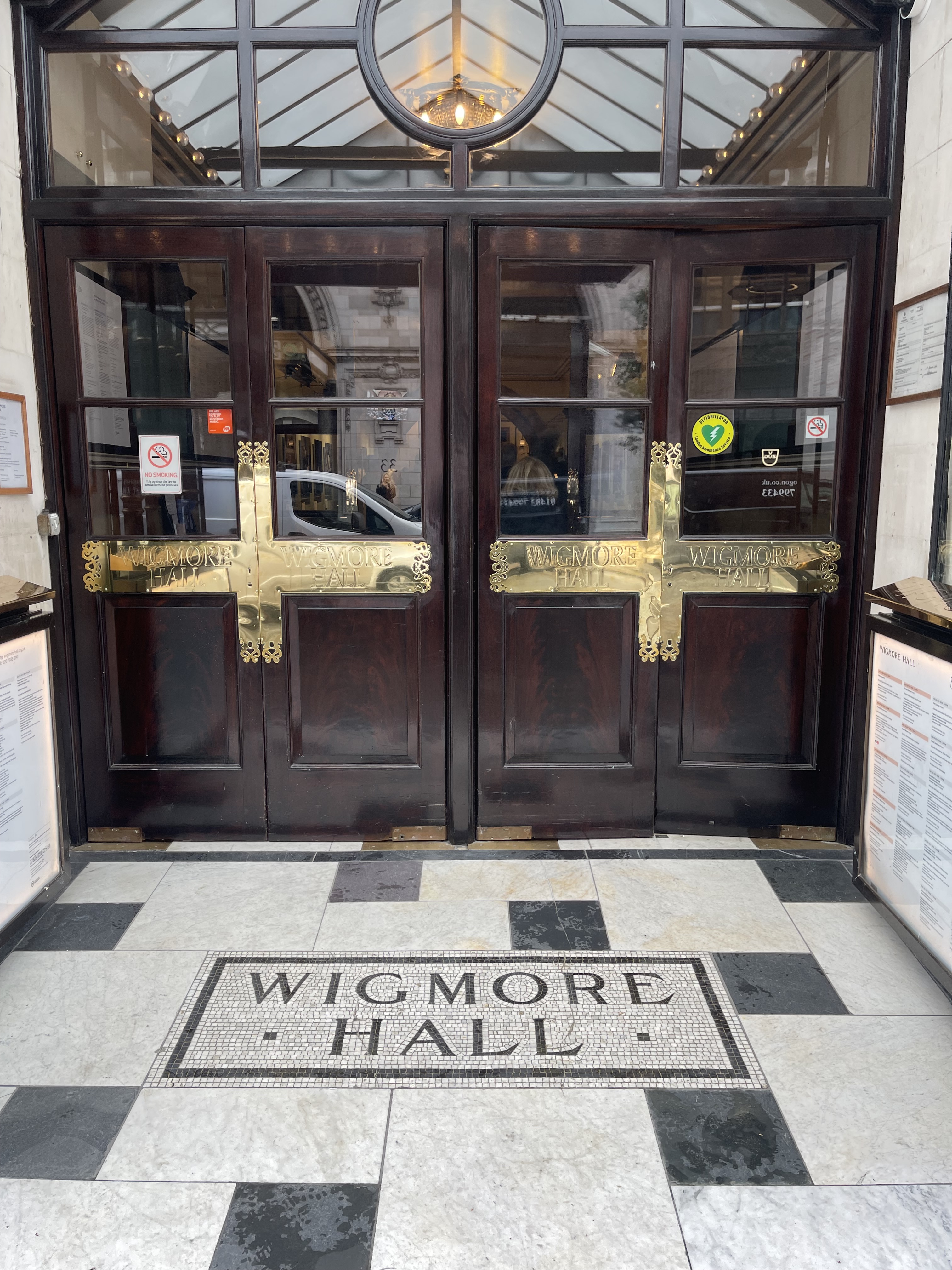
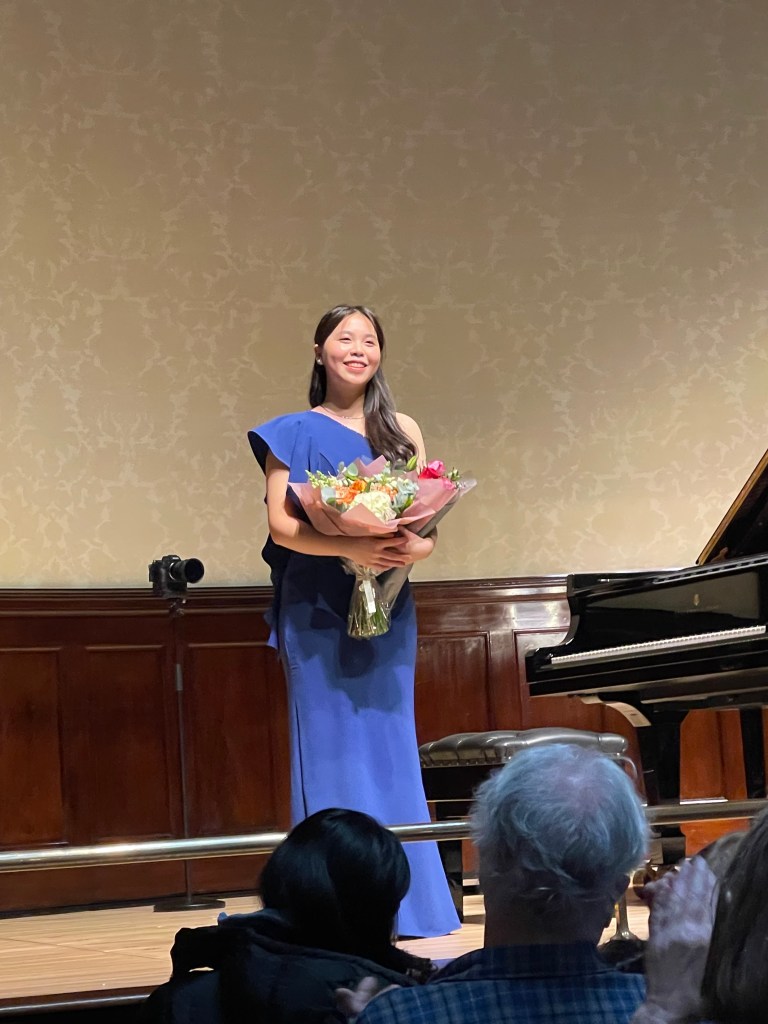
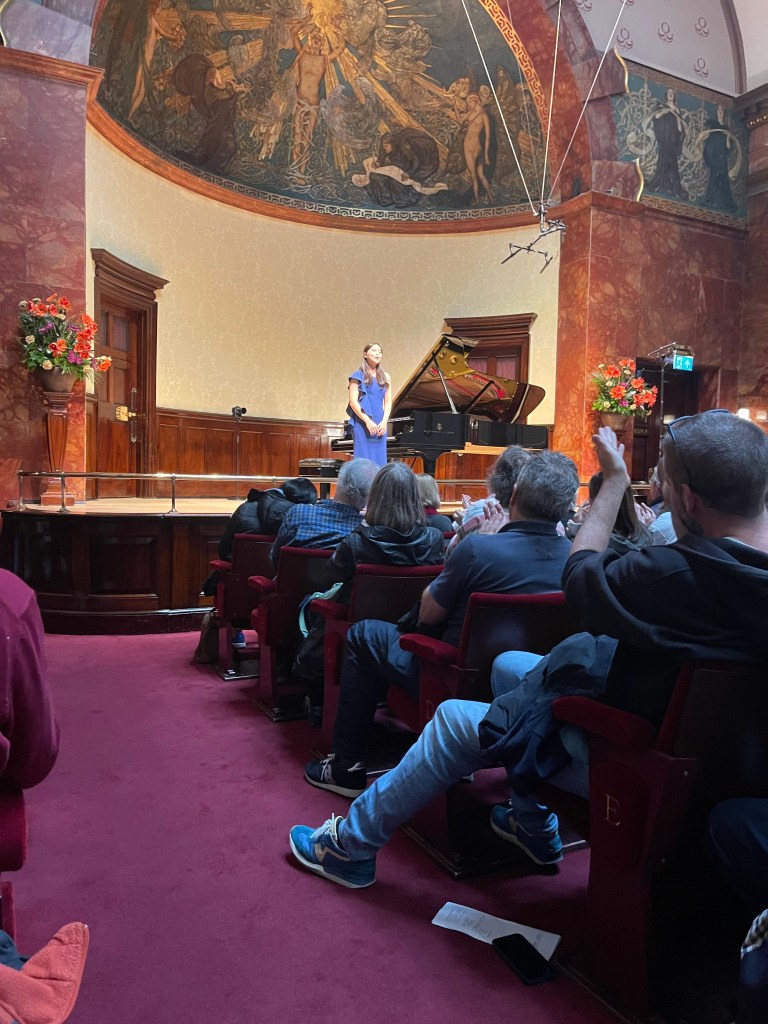
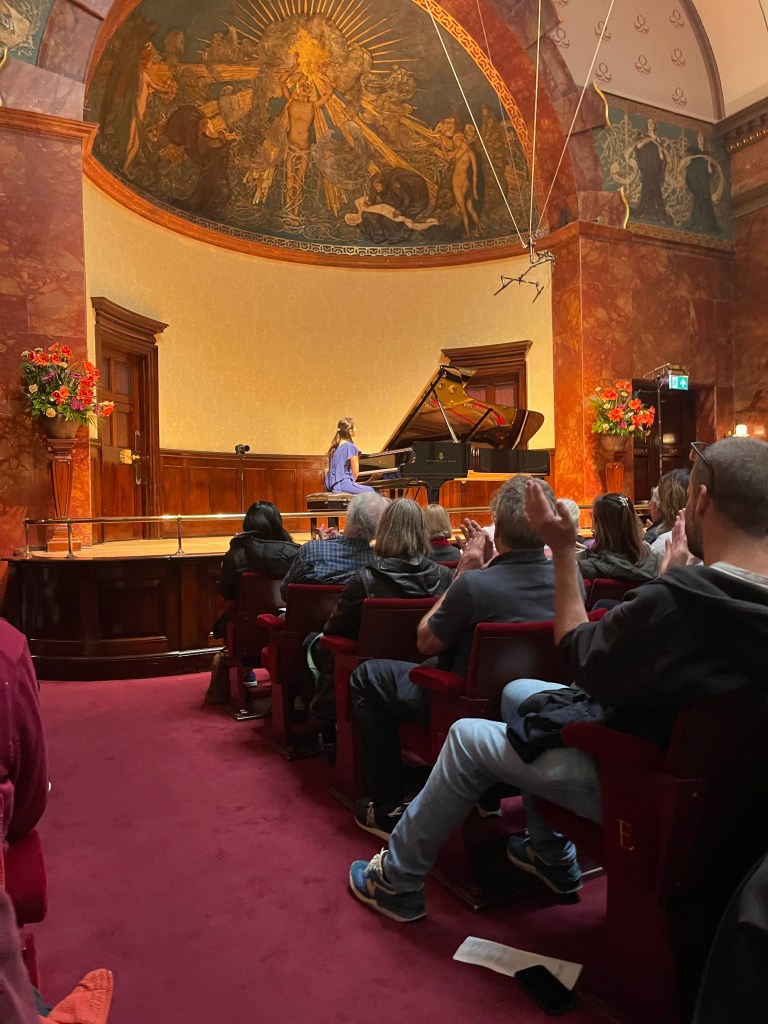
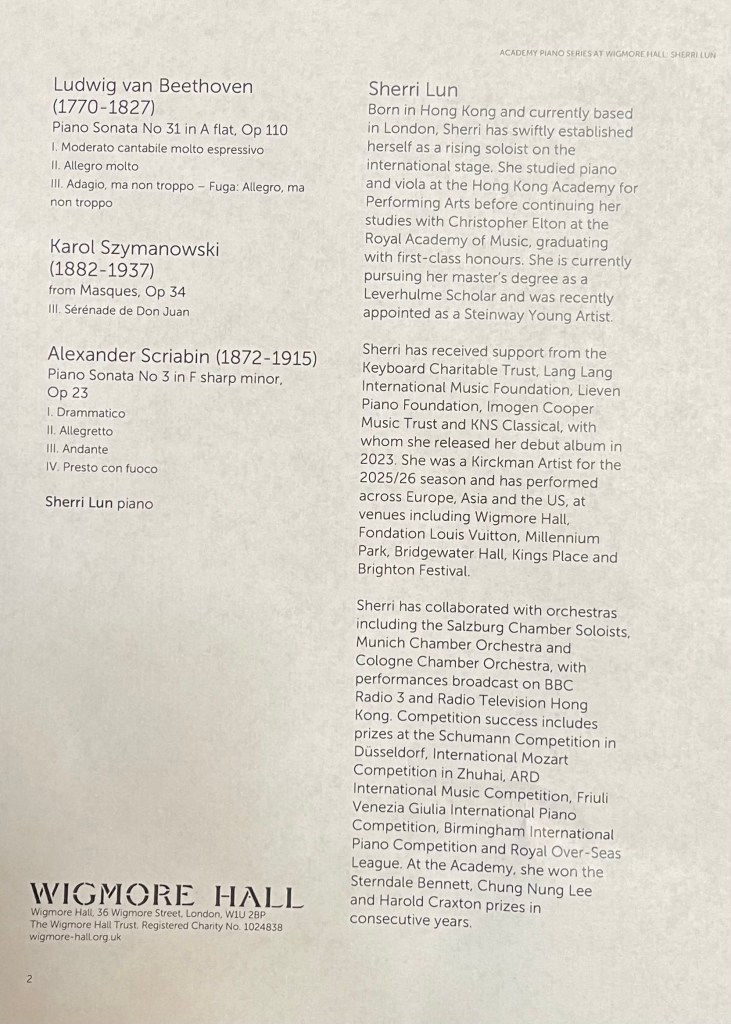
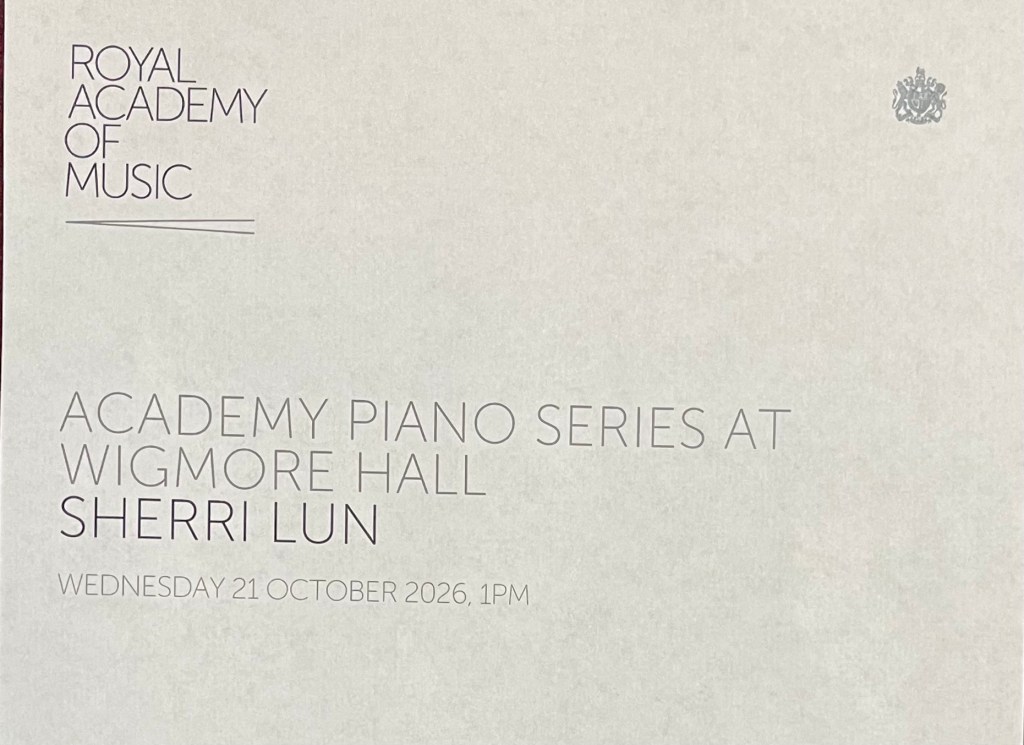
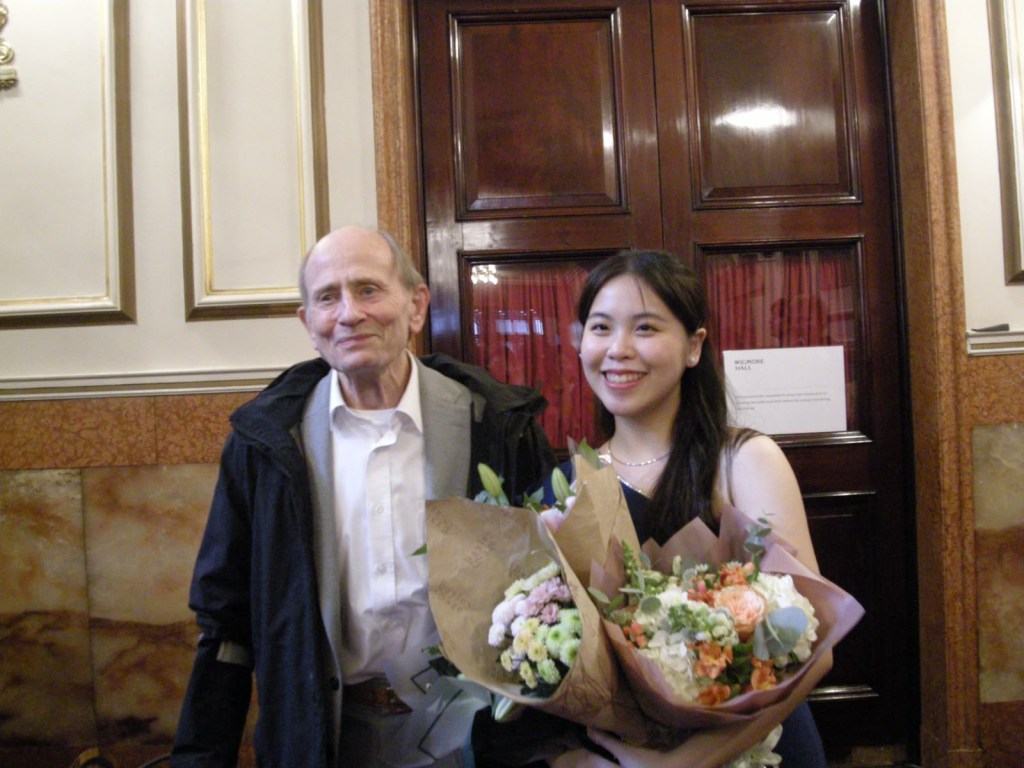
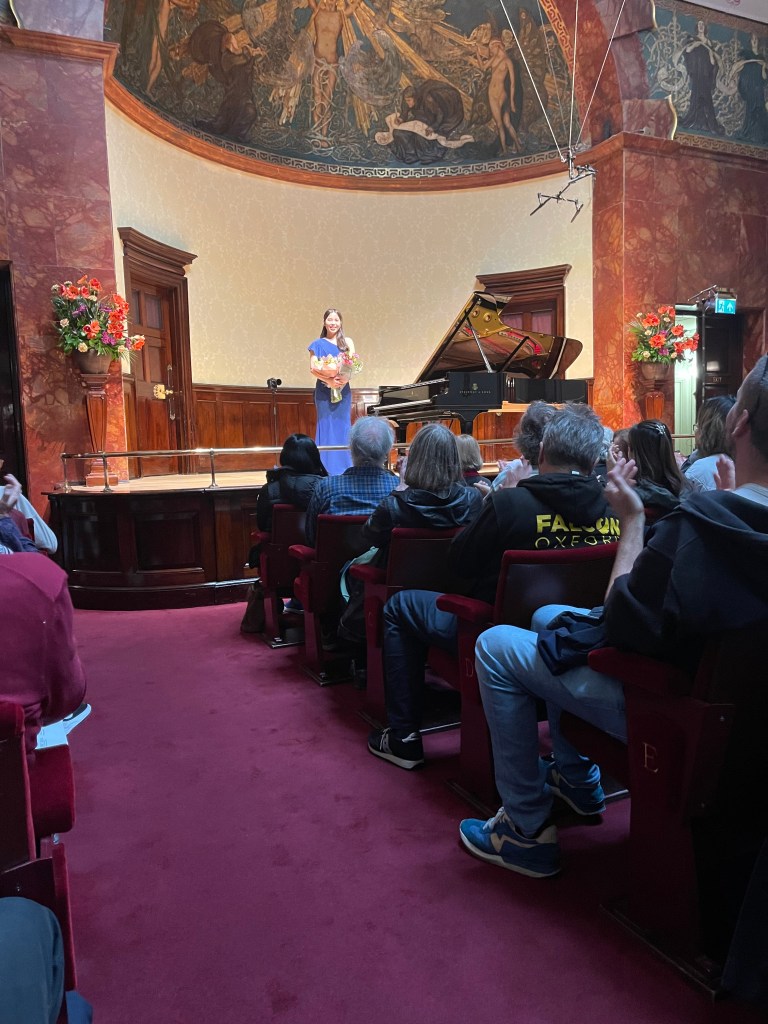
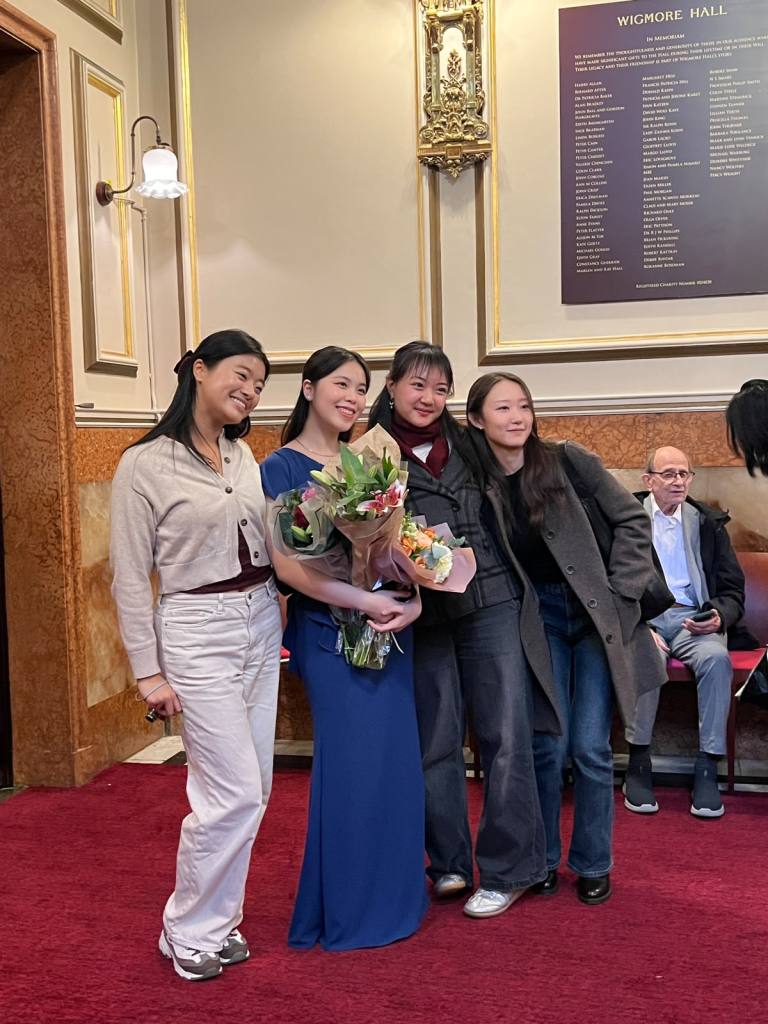
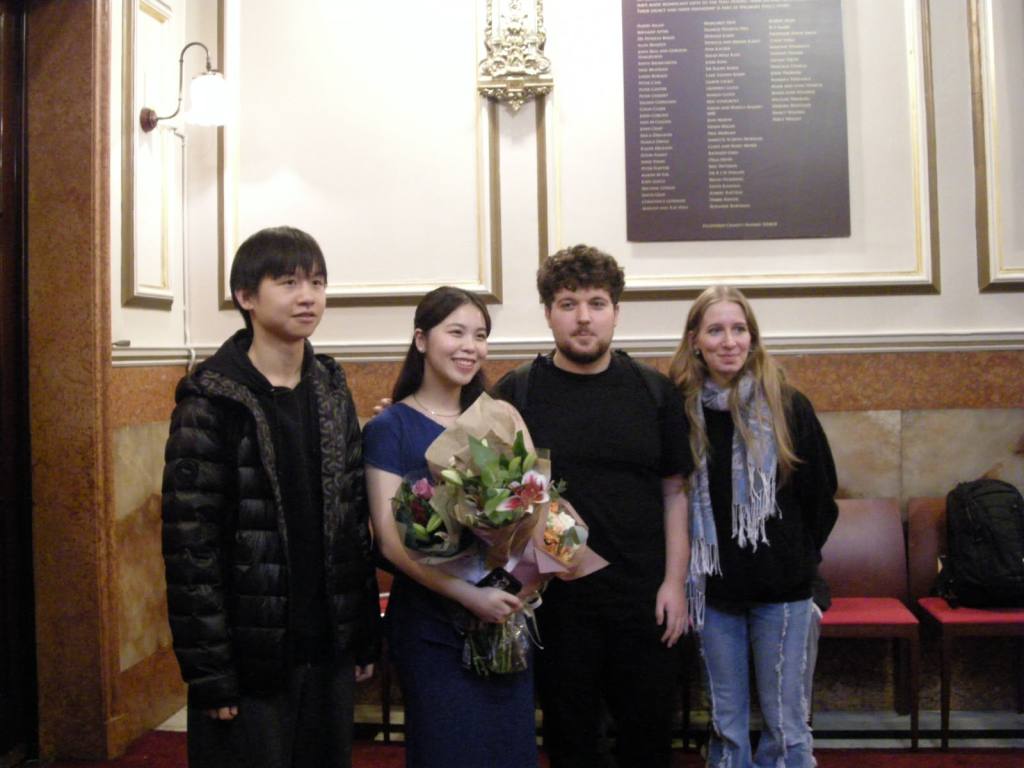
Sherri Lun making her Wigmore Hall debut with Beethoven, Szymanowski ,Scriabin and ending with her own delicate transcription of Poulenc’s ‘Les Chemins de l’Amour.’
Beginning with Beethoven’s great song of life with the Sonata op 110 played with masterly simplicity and a scrupulous attention to the composers very precise indications. Precision and purity with playing of a crystalline clarity of timeless beauty. The whispered opening played with loving care until a vibrant trill opens the magic box to Beethoven’s poignant bel canto. Rumbling bass accompanied the melody with undulating sounds of meandering urgency. An extraordinary range of dynamics with playing of poetic sensitivity. An ‘Allegro molto’ all energy and power with a rhythmic drive of pulsating vibrancy. The treacherous weaving of knotty twine was played with extraordinary authority dissolving to a whisper for the entry of the ‘Adagio’. Playing of poignant significance, the bass rising in intensity as the Aria floated on this heart beat of delicate constancy. The entry of the fugue on a wave of luxuriant sonorities was a moment of timeless wonder as was the fugue in inversion as it built to a tumultuous climax of brilliance and passionate intensity
Don Juan followed, in the multicoloured depiction of Szymanowski with Sherri’s chameleonic palette of colours of ravishing sounds flitting around the keyboard with will o’ the wisp insistence.
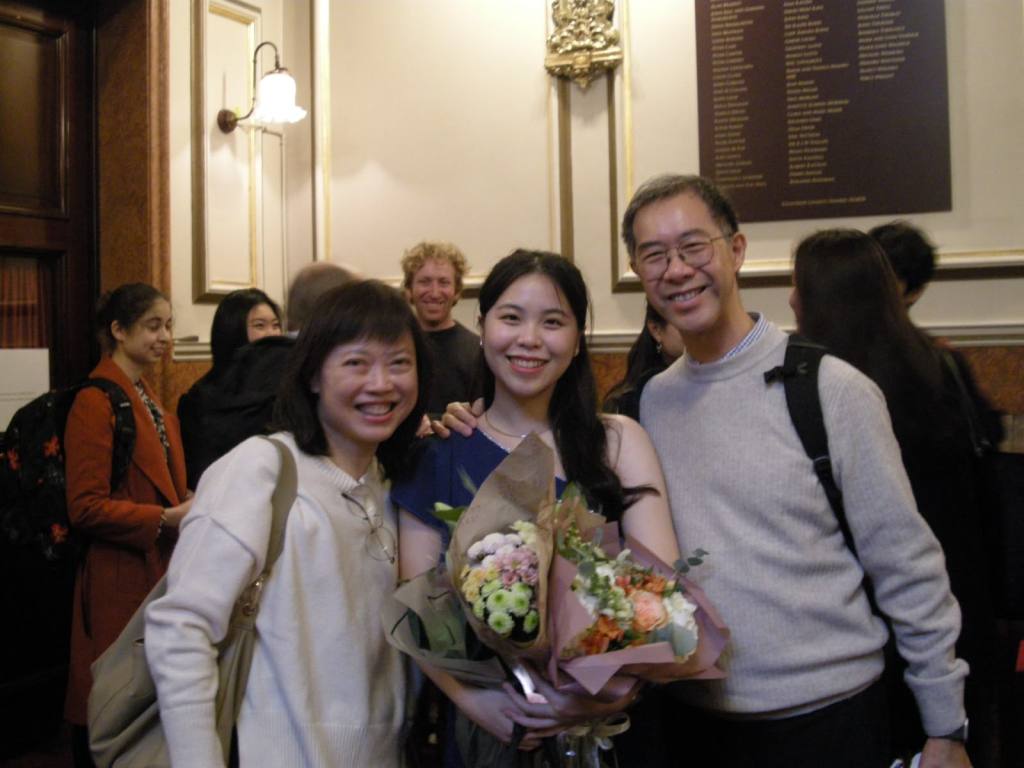
Sherri with her parentswith her teacher Christopher Elton
The final work was Scriabin’s menacing third sonata which was played with passionate intensity on a cauldron of sounds, ready to burst into the open with sumptuous decadence that Sherri played with diabolical intent and insinuating seduction. Luminosity and light from the first notes bathed in pedal with a menace from below played with aristocratic authority of imposing dynamism. A constant reminder of menace from the bass with liquid sounds floated with such luminosity above. She brought a great sweep to the ‘Allegretto’ with playing of the burning intensity of gasps as she came up for air. An ‘Andante’ of crystalline purity with playing of disarming simplicity and a magic web of sounds as the rumbling menace in the bass came ever closer, bursting into the ‘Presto con fuoco’ that flew from Sherri’s fingers with demonic impetus. Opening up into a passionate climax that she played with remarkable control and passionate intensity as the music gradually died away before the final dying gasp of defiance.
A scintillating encore of refined eloquence reminded me of Weissenberg but with the sounds of Cherkassky and brought this extraordinary debut to a sumptuous close
“- tackling the bruising finale with pinpoint clarity and convincing bravura, while the lighter moments danced with an impish joy that brought the audience to their feet after the final bars.” – Chicago Tribune
A Steinway Young Artist, Sherri Lun was named ‘2020 Performing Artist of the Year’ by the South China Morning Post and has garnered acclaim for her “pinpoint clarity and convincing bravura” (Chicago Tribune). Born in Hong Kong and currently based in London, Sherri has swiftly established herself as a rising soloist on the international stage. A 2025/26 Kirckman Artist, Sherri is also supported by the Keyboard Charitable Trust, Lang Lang International Music Foundation, and KNS Classical, with whom she released her debut CD in 2023. She made her concerto debut at the Ravinia Festival at the age of 10 with the Midwest Young Artists and has since performed extensively across Europe, Asia, and the United States. Her engagements have included appearances at major venues such as Wigmore Hall in London, Fondation Louis Vuitton in Paris, and Millennium Park in Chicago.The 2026 season features solo debuts at Bridgewater Hall, Wigmore Hall, Kings Place, and the Brighton Festival, alongside concerto appearances in the UK and Italy. Recent engagements have included the Hammerklavier International Piano Series in Barcelona and Girona, Festival Musicale delle Nazioni in Rome, and appearances at Steinway Halls in London and Vienna, as well as recital tours across Italy and Malaysia organised by Keyboard Charitable Trust and Persatuan Chopin Society. She has collaborated with ensembles including the Salzburg Chamber Soloists, Munich Chamber Orchestra, Cologne Chamber Orchestra, and Hong Kong Youth Orchestra. Her performances have also been broadcast by Radio Television Hong Kong and BBC Radio 3. In 2025, she was invited to join the Lieven Piano Foundation, and in 2026 was selected as a scholar of the Imogen Cooper Music Trust. Sherri’s recent international distinctions include the Special Prize from the Mozart Society Munich at the 74th ARD International Music Competition and Second Prize together with two additional prizes at the 2026 Friuli Venezia Giulia International Piano Competition. She captured both First and Audience Prizes at the 2024 Birmingham International Piano Competition and was named a 2025 Royal Over-Seas League award winner, following top prizes at the Robert Schumann Competition (Düsseldorf), Zhuhai Mozart Competition, Hong Kong Generation Next Arts §, and Steinway & Sons Youth Piano Competition. At the Royal Academy, she won the Sterndale Bennett, Chung Nung Lee, and Harold Craxton Prizes in consecutive years.
Born in 2003, Sherri majored in piano and viola as a junior student of the Hong Kong Academy for Performing Arts. In Hong Kong, she formed her own piano and string quartet which won top prizes in all ensemble categories in the Hong Kong Schools Music Festival and performed at the Government House for the Chief Executive of Hong Kong. She continued her studies with Prof. Christopher Elton at the Royal Academy of Music, graduating with first-class honours, supported by the Hong Kong Scholarship for Excellence Scheme. She is currently pursuing her Master’s as a Leverhulme Scholar, with additional scholarships from the Craxton Memorial Trust, Help Musicians UK Rupert Heggs Award, and the Countess of Munster Musical Trust.
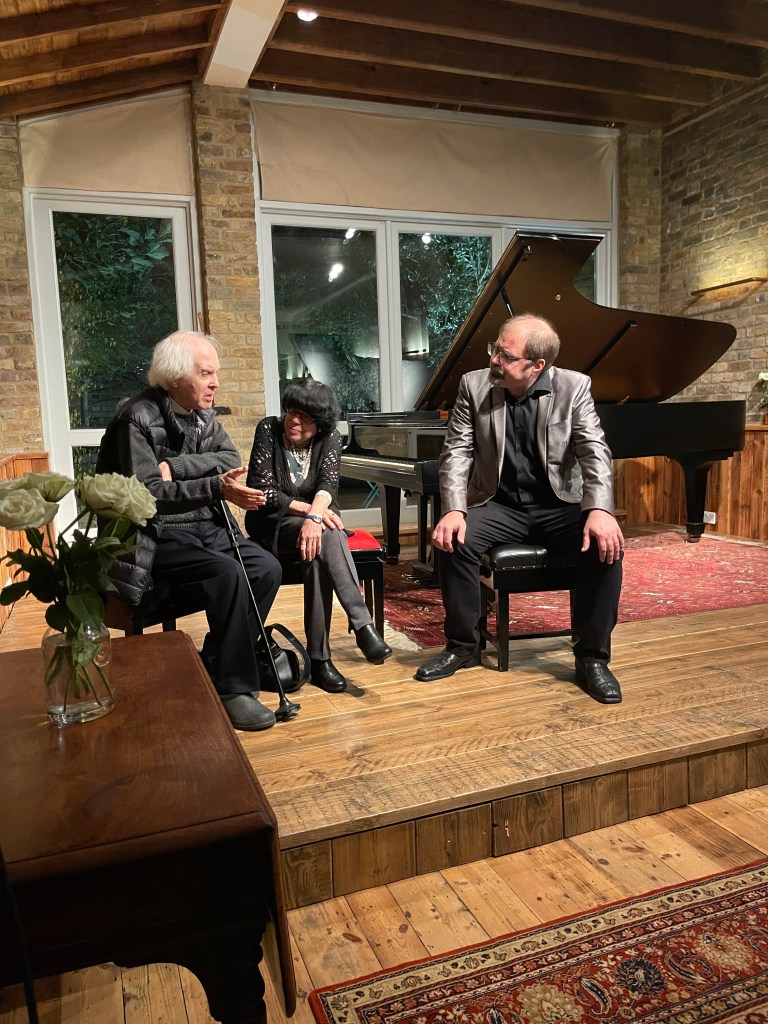
A conversation with Tatiana Zelikman and Vladimir Tropp, surprise performance by Vladimir Tropp was followed by young artist’s appearance: Deva Mira Sperandio played Schumann “Kreisleriana”, Op.16 and Mischa Carr played Medtner Sonata-Idyll, Op.56
What an evening and all thanks to Dina Parakhina where our two illustrious musicians are guests and above all to Oleg Kogan,and his wonderfully independent Razumovsky Academy, who could immediately decide that these two historic figures at the age of 87 could and should meet a public that has only read about them in books or heard them on historic re issued CD performances.
It was a very private and intimate gathering around FouTs’ong’s Steinway D that stands so proudly in the Razumovsky Academy that the distinguished ‘cellist Oleg Kogan built with his own hands. With the same loving care he invites selected people into his home where they can be engulfed in warmth, remarkable music making and on occasion Oleg’s cordon bleu cuisine. Today these two legendary figures not only performed but also answered questions and listened to two students of Dina with whom they were happy to share their precious advice. Such an informal gathering that Dina was not sure if they would be happy to play, but it was Vladimir Tropp who felt so at ease that he was happy to play much longer than we could have hoped for.
Three short works by Scriabin were played with chiselled eloquence, vibrant intensity and even impish good humour. A truly epic performance of Chopin’s Nocturne op 27 n. 1. Chiselled and etched in gold as this nocturne was played with imposing nobility and not the usual whispered whimperings but a voice of extraordinary strength and imposing importance bursting into an overpowering left hand octave cadenza before disappearing into a whispered land of glowing beauty. This Nocturne maybe the most Scriabineque and also showed Maestro Tropp’s Scriabin that was played with imposing sounds of authority and aristocratic simplicity. But the surprise was to come with Rachmaninov’s C sharp minor prelude op 3 that was played with overwhelming power. Two voices, one of overpowering sounds and the other with whispered echos. It was an extraordinarily forceful declamation that exploded with the enormous sonorities of the climax before the hesitant and distant final bars played with timeless wonder. This was indeed a revelation and a performance of searing originality from a musician with a towering personality. Tchaikovsky’s Evening Prayer from the seasons was the final work that this master was to share with us.
Now it was his wife Tatiana Zelikman who was to give an extraordinarily original performance of Schumann’s Arabesque op 18 with many details underlined and pointed out with chiselled weight. It was ,though, in the excerpts from Schumann’s Kreisleriana that she played in the short masterclass afterwards ,that showed her remarkable fantasy and fearless authority. Playing with hands that look as though they are swimming in sounds as she played without the score remembering all the details that she had heard from this brilliant young student of Dina Parakhina,Deva Mira Sperandio.Imploring this young musician to play with more fantasy and horizontally not vertically.
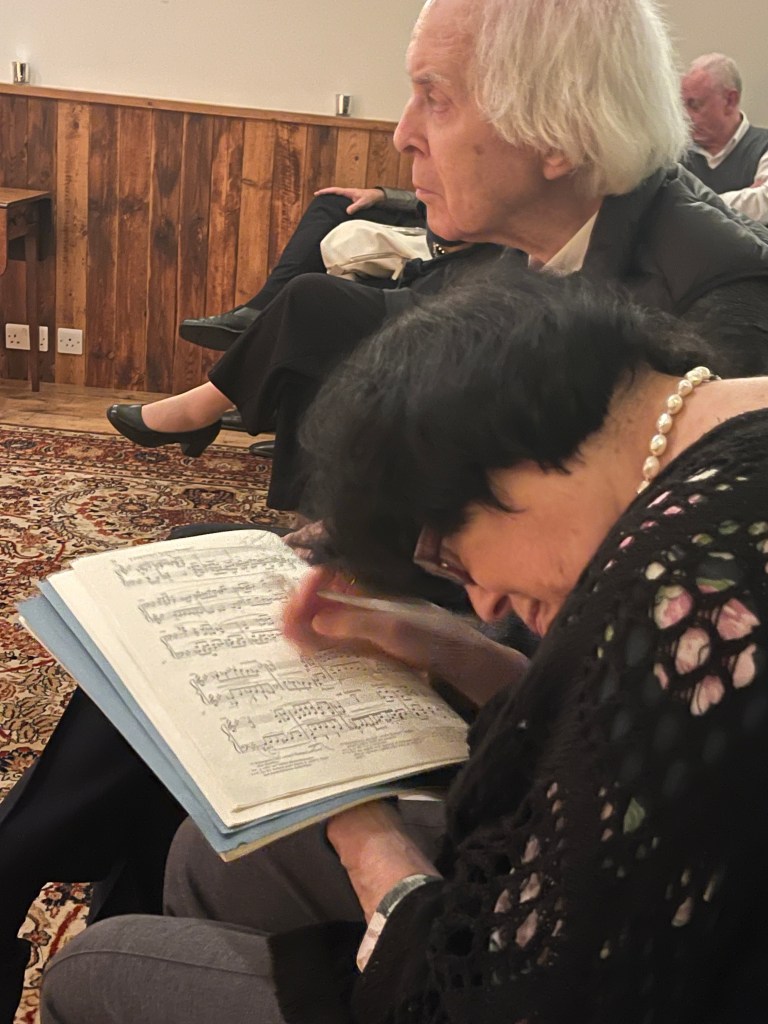
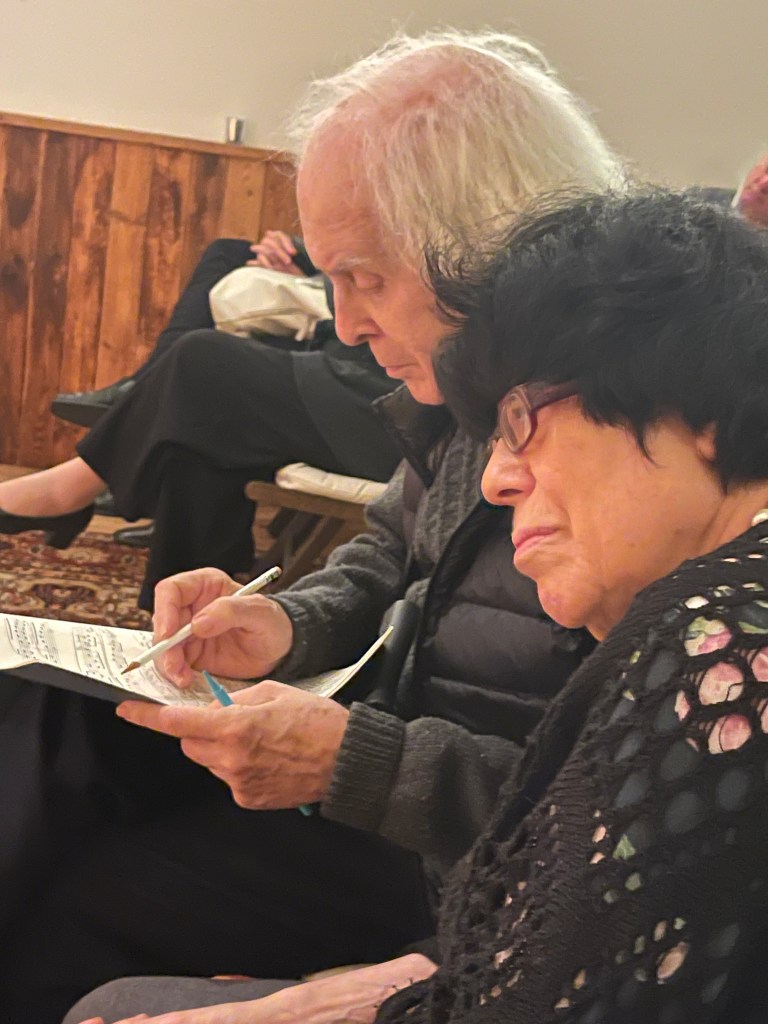
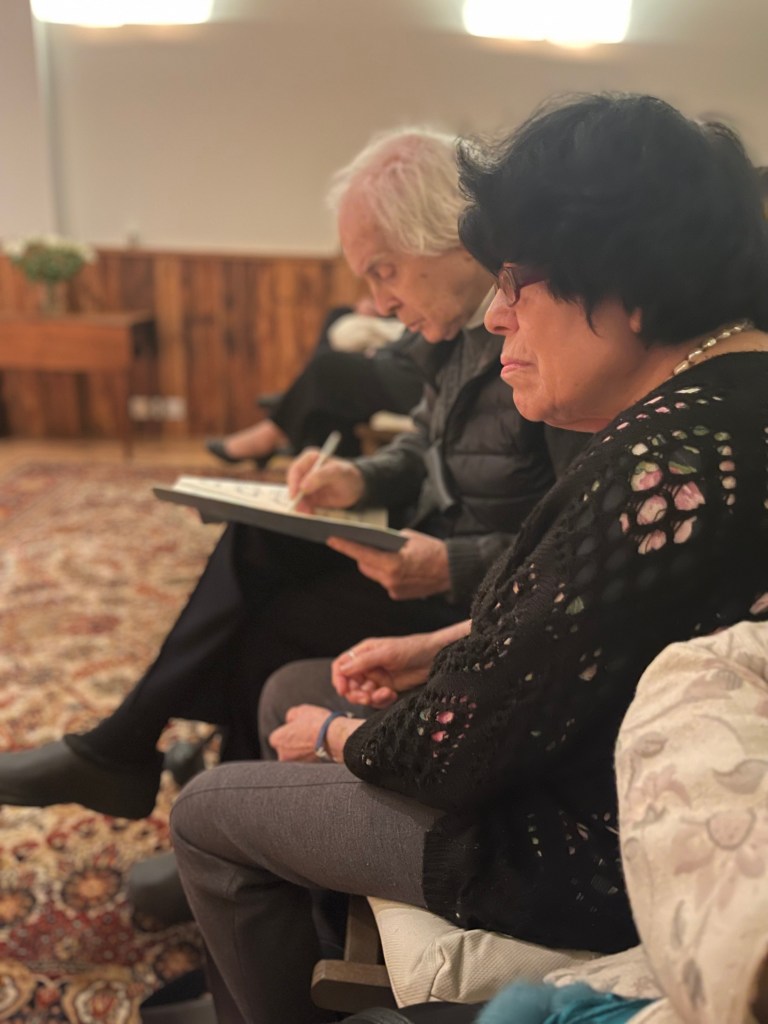
Both she and her husband had made copious notes in the score whilst Deva was playing. Pointing to particular points which they took in turns to mark with delicate circles in her score.
Nothing was missed, with Tatiana curled up over the score like a croissant, whilst Victor was bolt upright with burning eyes of concentration. What a formidable team! At 87 their burning passion for the music uniting them with a dedication that the only thing that mattered were the sounds in that very minute. Vladimir Tropp had pointed out to Misha Carr many refined phrasings that would clarify the melodic line in her very fine performance of Medtner’s Sonata -Idyll.
Jed Distler
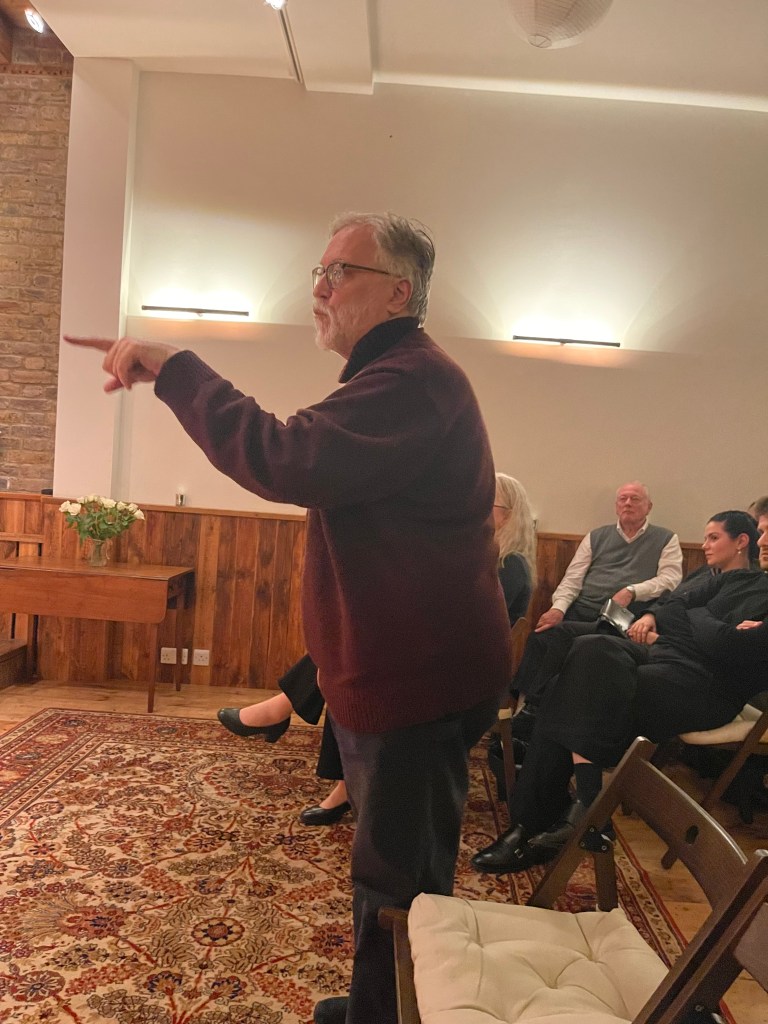
A question and answer session was a fascinating journey to be able to touch history from the people that had been In Moscow when history was being made. Jed Distler was anxious to know about the appearance of Glenn Gould in Moscow in the 50’s. An empty hall where Tatiana was seated in the front row intrigued by the mastery of Gould’s ‘Art of Fugue’. Neuhaus was so overwhelmed that he had the interval prolonged whilst he communicated to his colleagues and students the marvels that were taking place from this unknown Canadian pianist. The next concerts of course were completely sold out!
To hear of Sofronitsky who was considered a God by all those that had heard him live. Including Richter, who they both heard many times and who bowed to Sofonitsky as a leading light. Even if he was uneven his playing was always of the vibrant presence of recreation.
a sumptuous feast prepared by Oleg Kogan for his guests
An extraordinary evening when we could have a direct link with the past as we watched these remarkable artists at the age of 87 living for the present and united in their quest for perfection, with a passion and intensity that was truly a lesson to us all.
Tatiana Zelikman is considered to be one of the finest piano teachers today. Over the years she has taught pianists such as Daniil Trifonov, Konstantin Lifschitz, Alexei Volodin and Alexander Kobrin, all artists of rare talent who have become celebrities. Many of her students have enjoyed remarkable careers have obtained the most prestigious prizes, including the Tchaikovsky and the Rubinstein, Van Cliburn, Busoni and Chopin piano competitions, and today perform on the major stages of the world. Many have also followed in her footsteps and become highly regarded teachers. Her entire career, from the School to her higher studies in the class of Teodor Gutman, a disciple of the great Heinrich Neuhaus, has been characterised by a sound, a memory and an ear of rare quality, musical subtlety, and most important a distinctive personality that shines through in her art of interpretation. Her repertoire included works by François Couperin, Scriabin, Schumann, Haydn, Mozart and Beethoven, Schubert and Chopin; she had an insatiable passion for the music of Ravel and Debussy.
Vladimir Tropp was born in Moscow and studied at the celebrated Gnessins Music School from an early age. His teachers were the distinguished Russian pedagogues, Moisey Feigin and Teodor Gutman, both pupils of Heinrich Neuhaus.
In 1963 Tropp graduated with distinction from the Gnessins State Musical Institute, now named the Gnessins Russian Academy of Music. He immediately began his graduate work while teaching there and is now regarded as of the Academy’s leading professors. In 1997 he became chair of the Academy’s piano department. He has also held a professorship at the Tchaikovsky Moscow State Conservatory. In his teaching Professor Tropp strives to maintain the highest traditions of the Russian piano school. In 1970, Tropp became a laureate of the International Enesco Piano Competition in Bucharest. Since then, he has regularly appeared in performance and gave maseterclasses in Russia and many countries all over the world. The principal part of his repertoire is romantic music, with acclaimed performances of Rachmaninoff, Scriabin and Medtner. He serves on the boards of the Rachmaninoff (as a vice-president) and Scriabin Societies in Russia and is a member of the Teodor Leschetizki and Scriabin Societies in the US and the Glenn Gould Society in Canada. He regularly serves on juries of international and national piano competitions.
Dina Parakhina and Dmitri Alexeev are a very special presence at the Royal College of Music representing the Russian School of piano playing. Inviting the masters that had inspired them to share their unique message with young musicians in London.
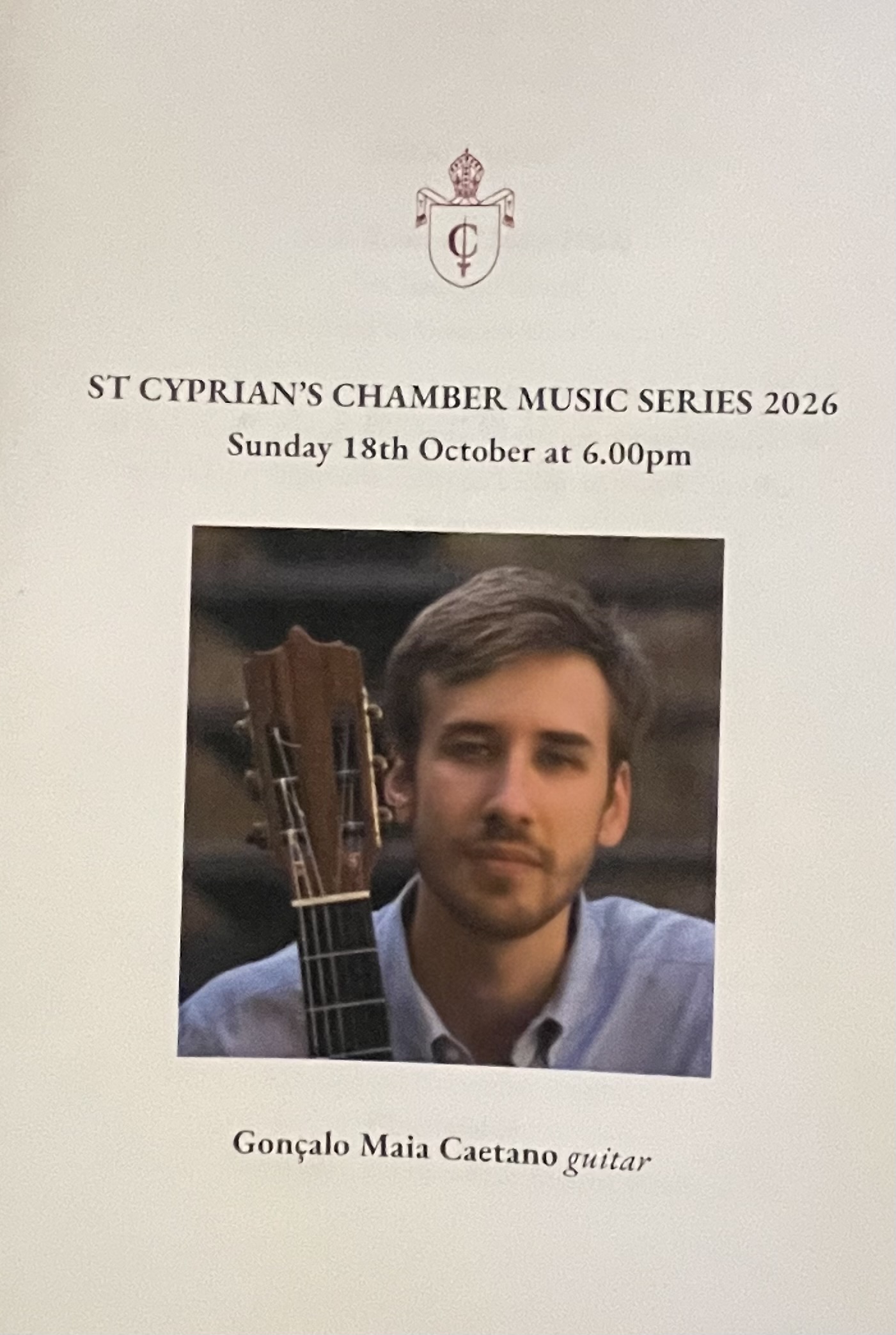
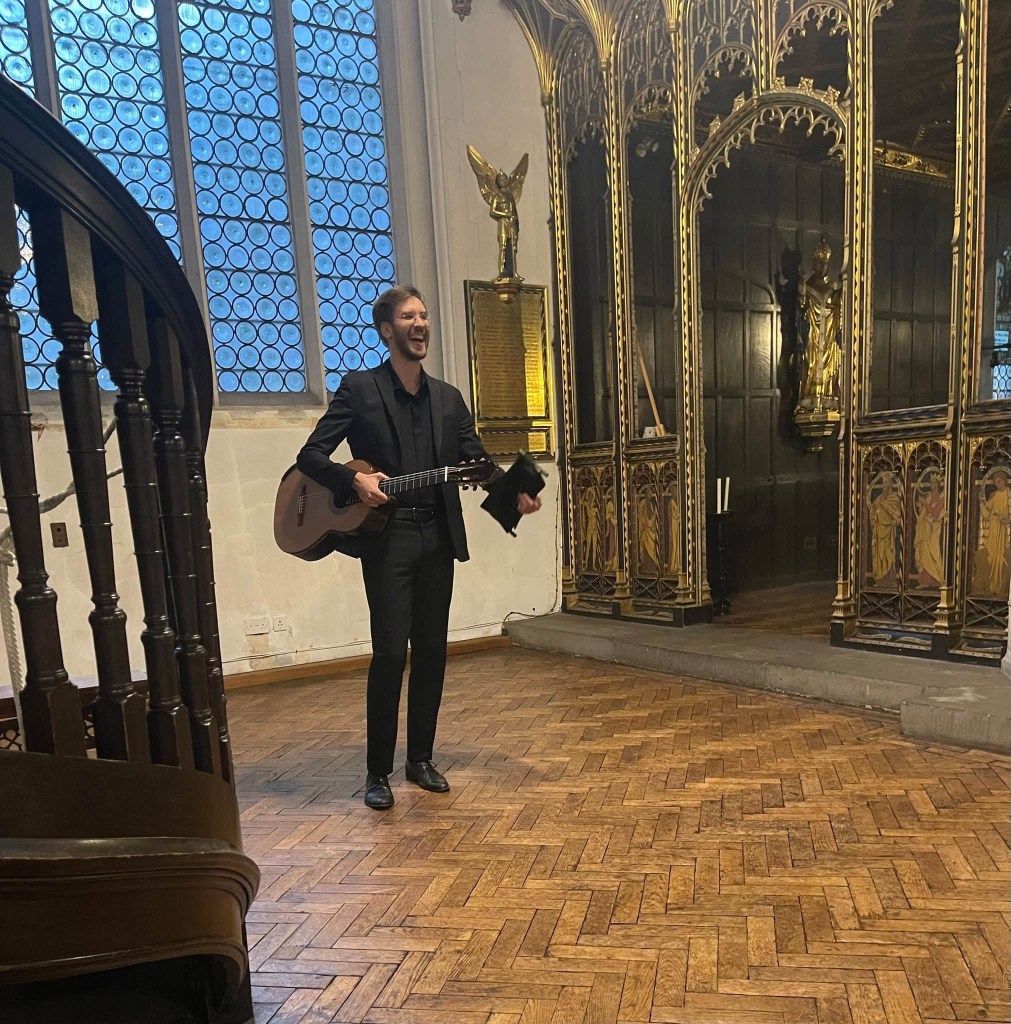
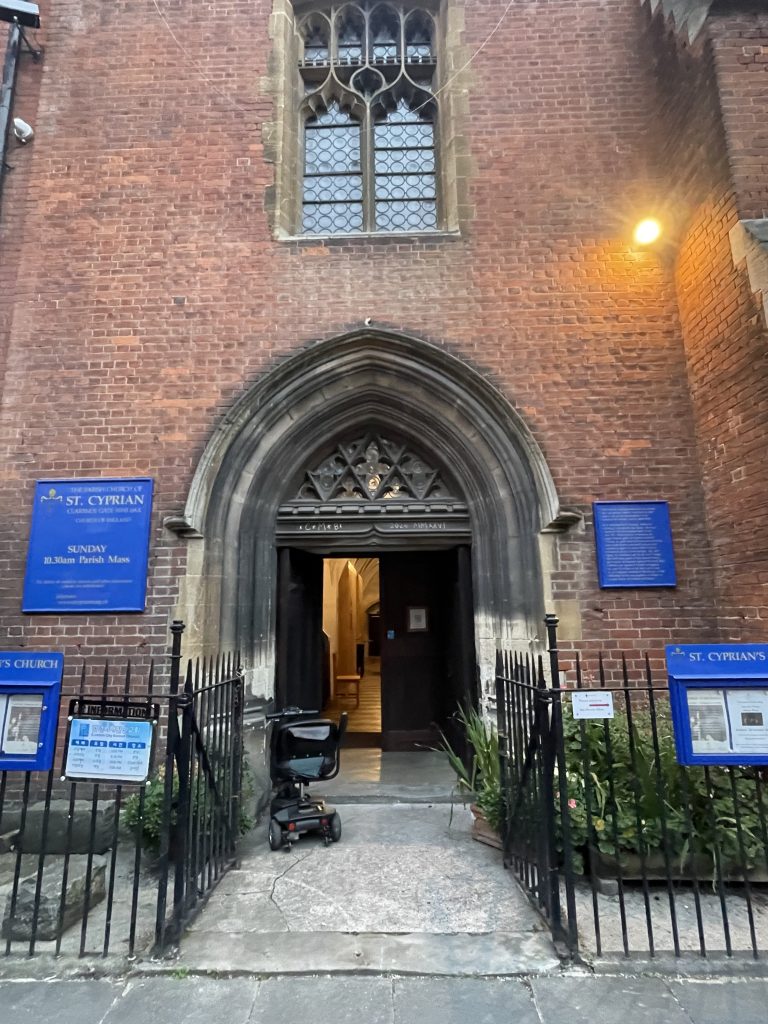
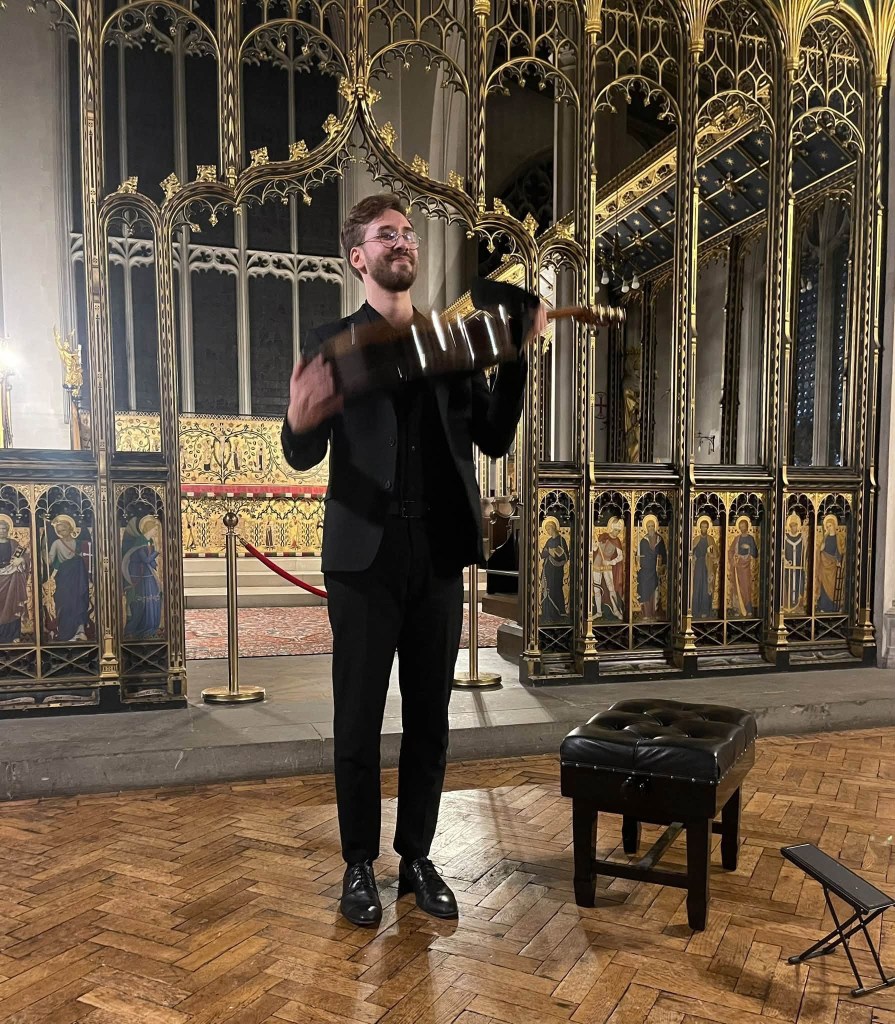
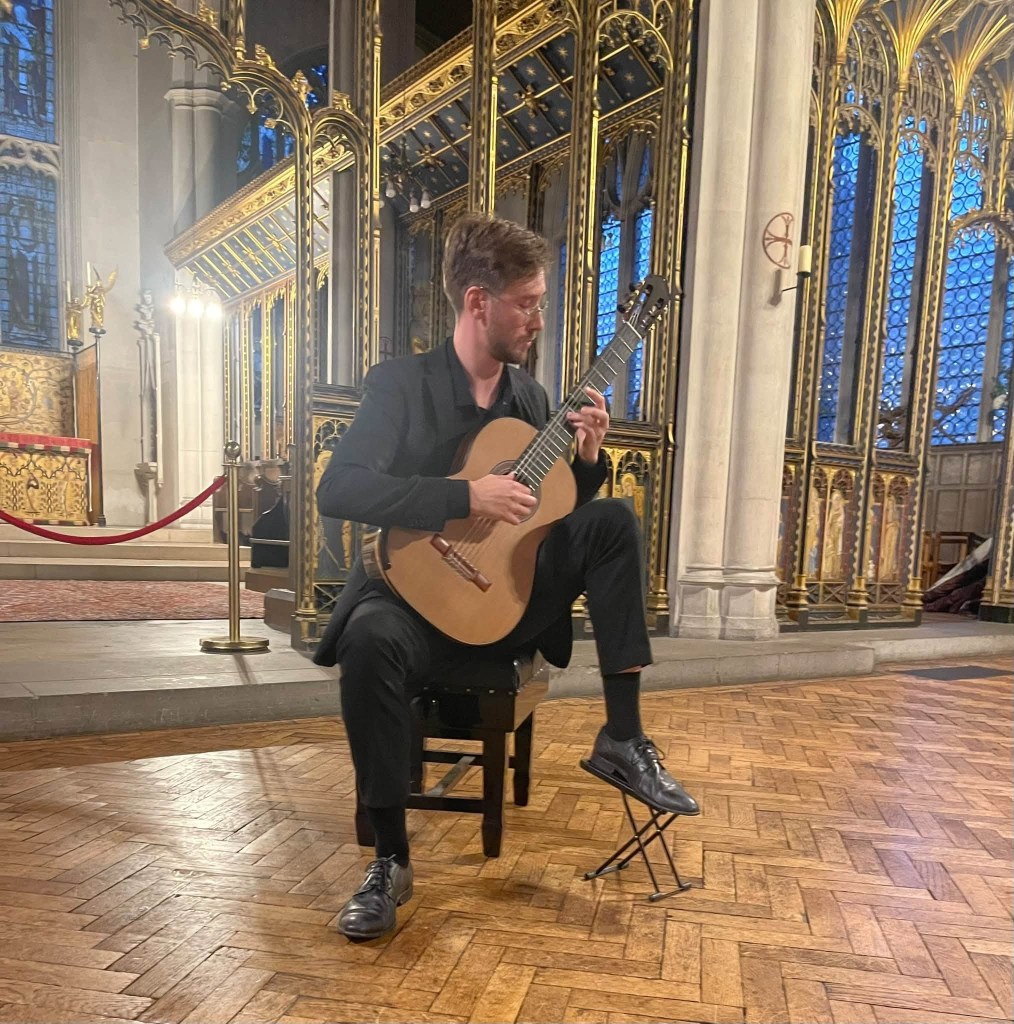
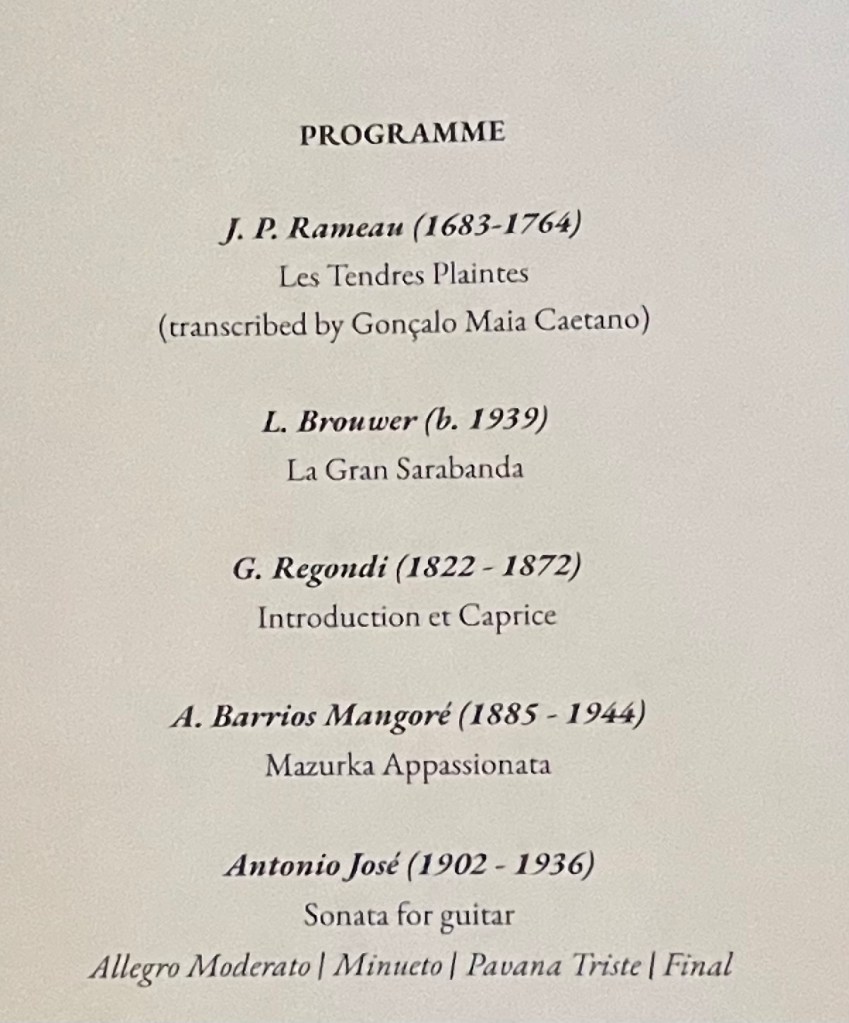
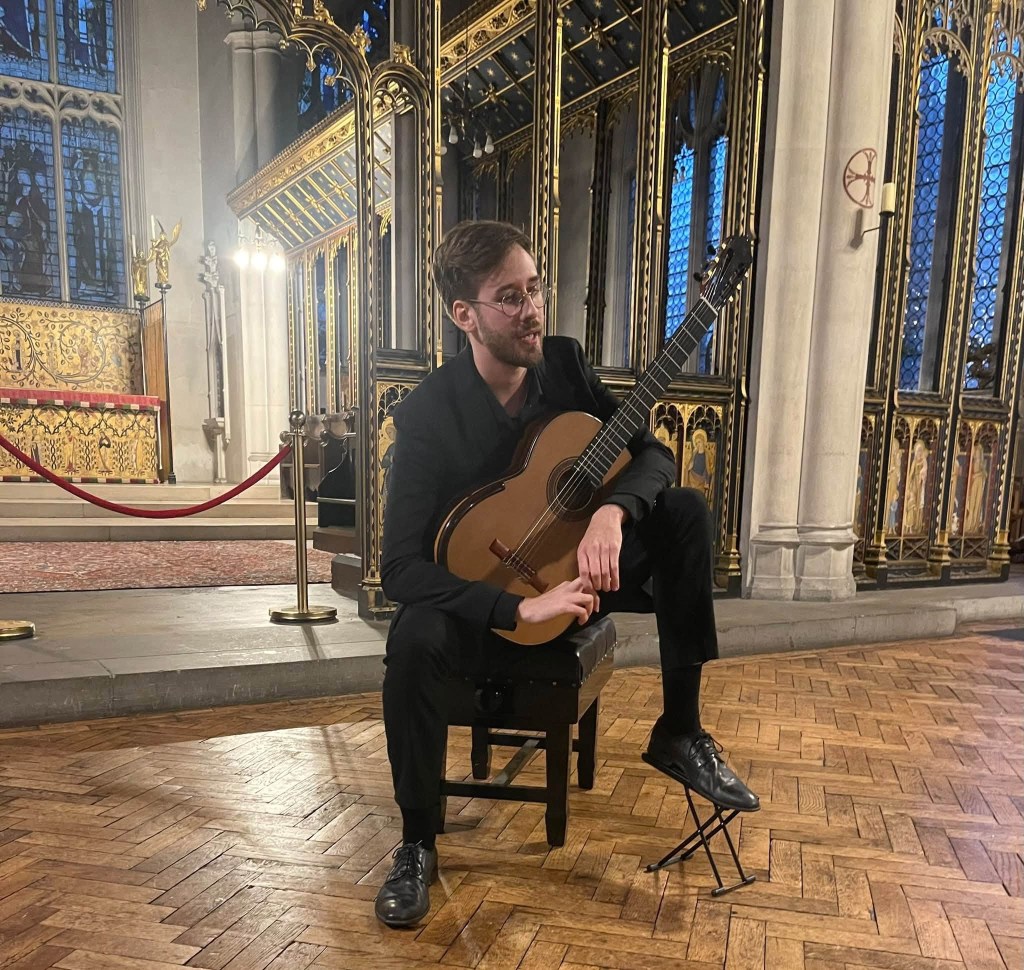
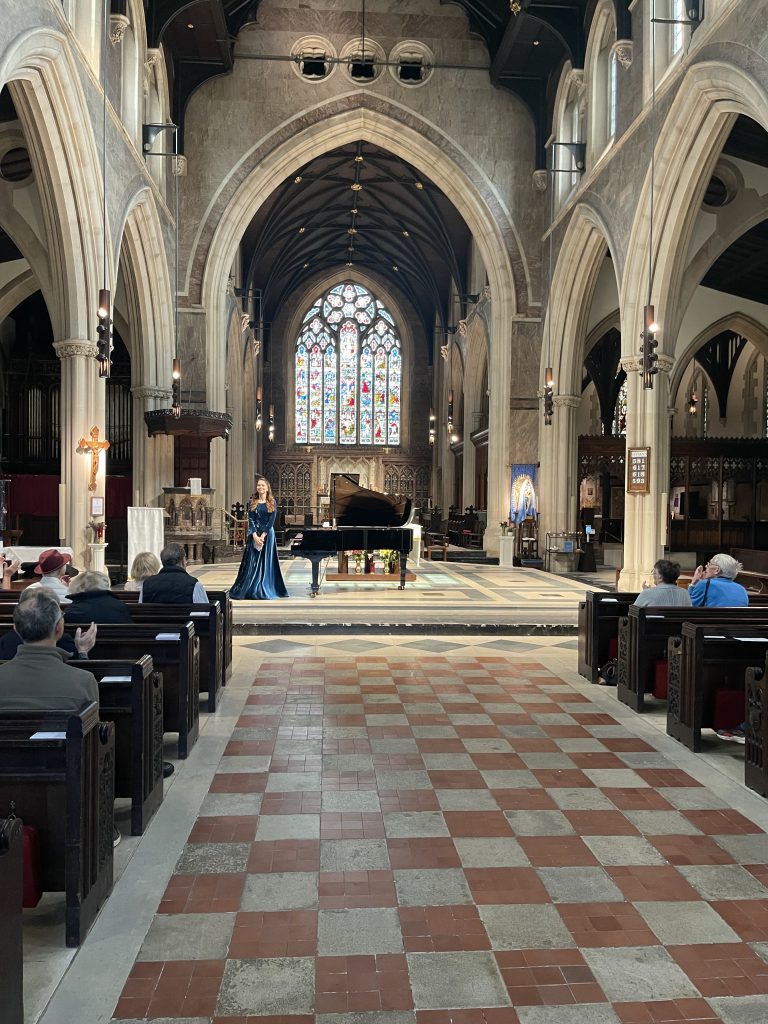
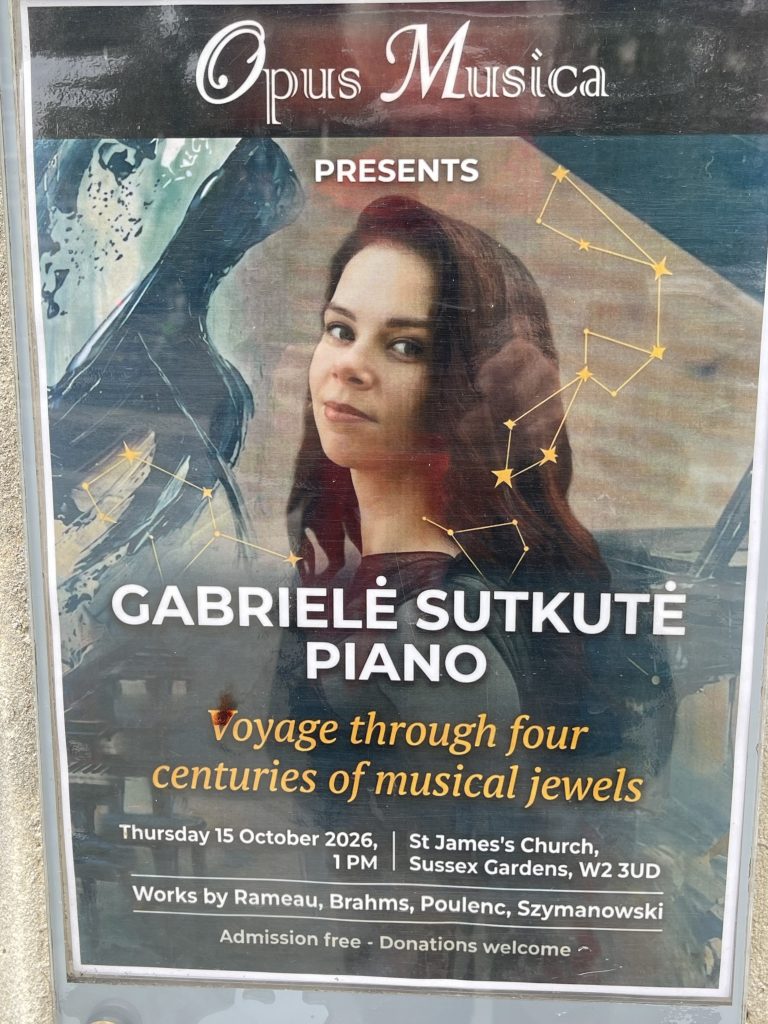
Gonçalo Maia Caetano at St Cyprian’s Chamber Music Series just a stone’s throw from the Royal Academy where he and his girlfriend Gabrielé Sutkuté have both recently graduated with honours. It was in fact a work from Gabrielé’s recent repertoire that opened Gonçalo ‘s recital with his own transcription for guitar of Rameau’s ‘Les Tendres Plaintes.’
Like Segovia on the guitar or Casals on the cello discovering repertoire and inventing technique to allow such masterpiece to grow and glow in their hands .
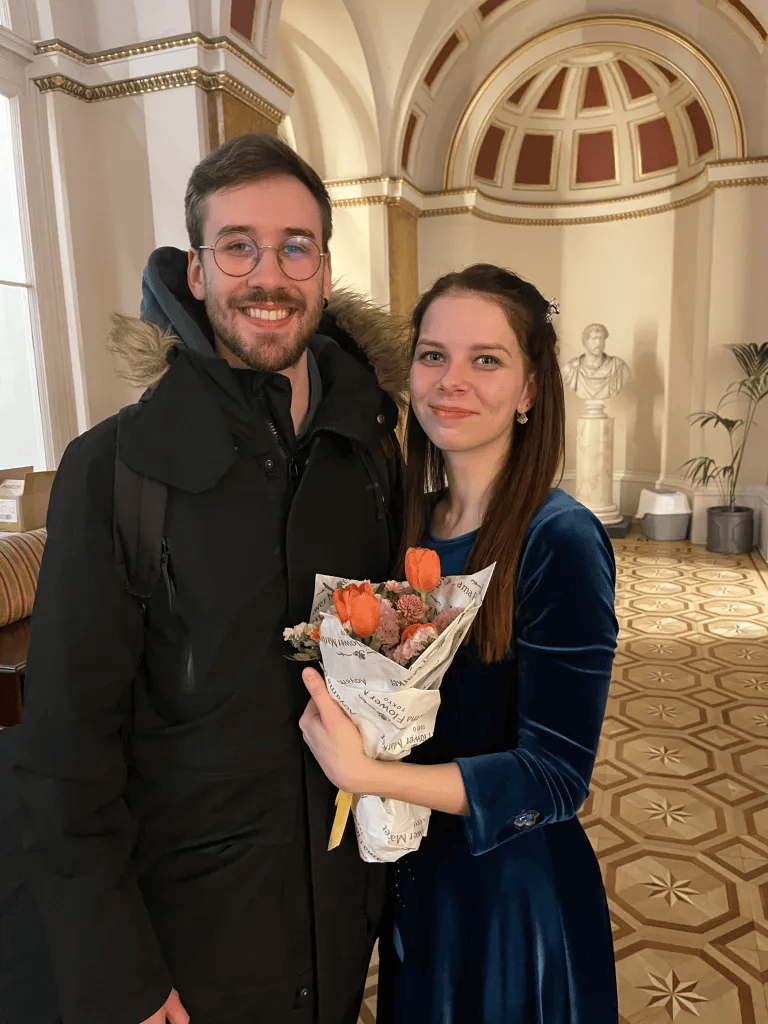
Gonçalo and Gabrielé sharing their life in music together was a touching way to open his recital today. A golden couple indeed.
Exquisite ornamentation in the Rameau that was even more suited to the guitar than the piano. The piano of course with its luxuriant legato of subtle beauty and colouring but on the guitar it took on a different character of a more detached beauty of a refined aristocratic sound world of its time. However both were able to transmit the extraordinary sentiment that Rameau hides in these miniature tone poems. ‘La Gran Sarabanda’ by Leo Brouwer was played with extraordinary technical brilliance which contrasted with the charm and beguiling rubato of Giulio Regondi’s Introduction that he played with great weight before embracing the style of the Caprice . It was the same charm and style that he brought to Barrios Mangoré’s ‘Mazurka Appassionata’ and the formidable mastery that he brought to Antonio José’s only work for guitar his sonata .
I have been unwittingly exposed to many of the great guitarists of our time. A group of young guitarists in Rome brought David Russell to play and give Masterclasses for some years in my Euromusica season in the theatre I had created with my actress wife in Rome. Others brought Julian Bream, John Williams, Manuel Barrueco and the fabulous Duo Assad. The one that impressed me the most, though, for his extraordinary musicality was Oscar Ghiglia. Yamashita came one year and played the Mussorgsky Pictures at an Exhibition on the guitar ! A mechanic of manic proportions but when he returned some years later it was with his wife and three little children all of whom played the guitar. Father and family played like angels this time, and when my wife died they wrote to me that they would like to give a performance in her memory. I was very grateful but explained that to arrange a concert would take time and organisation. I had not understood because they explained they just wanted to play to me, privately, in the theatre that my wife and I had created together, to share their love via their music and to fill my heart not with sadness but with joy. So you see the guitar has a very special place in my heart and I was very pleased to attend Conçalo’s guitar recital after so many years which brought back so many poignant memories.
Gonçalo Maia Caetano is a classical guitarist from Portugal who has concluded his Advanced Diploma course at the Royal Academy of Music with professor Michael Lewin. The guitarist also got a Bachelor of Music Degree (with First Class Honours) and a Master of Arts’ Degree (with DipRAM) there.
Gonçalo has performed in many concerts throughout Portugal, Spain, Italy, Germany, Austria and United Kingdom. He has performed in renowned venues such as The King’s Place in London, Wiener Saal in Salzburg, Austria, among others.
In 2016 Gonçalo won the 2nd prize Ex-Aequo in Valencia’s International Guitar Competition and later in the year he was awarded the 3rd prize in Guimarães International Guitar Competition. In the following year, he was the winner in the competition “Grand Prize Virtuoso” and consequently was invited to give a concert in Wiener Saal, Mozarteum in Salzburg, Austria. In 2021, Gonçalo was the Winner of the Blyth Watson Guitar Concerto Prize at the Royal Academy of Music. In 2023 Gonçalo received 1st Prize at the prestigious “The Prince’s Prize” competition, the 2nd prize at the Ivor Mairants Guitar Competition and the 2nd prize in Pleven Guitar Competition. In 2024 he was awarded the 2nd prize in the Gallery of Guitars Competition in Scotland and this year he won the 2nd prize in Lagoa Guitar Festival in the chamber music category with his duo “Volt Duo” with Gus Mcquade.
Gonçalo has had Masterclasses with distinguished guitarists such as David Russell, Fabio Zanon, Aniello Desiderio, Lukasz Kuropaczewski, Roland Dyens, Laura Young, Graham Devine, Michel Sadanowsky, Carlo Marchione and many more acclaimed musicians.
Apart from his classical guitar studies, he is very interested in Jazz. In the end of his first year at the Royal Academy of Music, Gonçalo started his second study in Jazz Guitar. He also has his own Jazz project “Maia” with which he released the single “Yellow”. In 2020, Gonçalo joined the “Phemo Quartet” as a Bass player and in 2022 the quartet performed in the Vortex Jazz Club. Later this year, the quartet will release their debut album “Anti-Revelation”.
Gonçalo is currently being supported by the Musicians’ Company, Help Musicians UK, IGF and Talent Unlimited
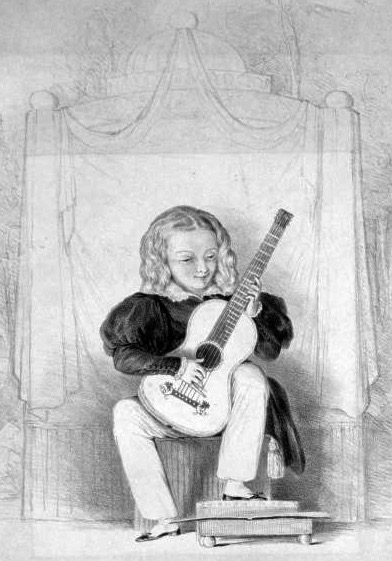
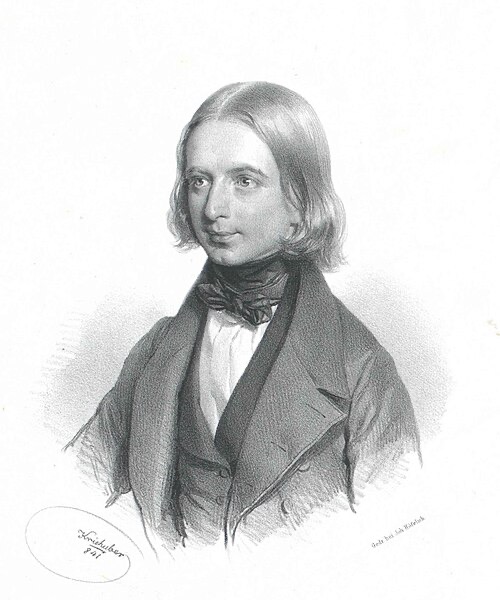
Giulio Regondi (1822 – 6 May 1872) was a Swiss-born classical guitarist, concertinist and composer active in France and (mainly) the United Kingdom.
Regondi was born of a German mother and an Italian father in Geneva Switzerland. In 1831 Fernando Sor dedicated his Souvenir d’amitié op. 46 to Regondi, a child prodigy when the boy was just nine.
There is a reference to his appearing in London in 1831, presented as a child prodigy of the guitar.All of Regondi’s concertina music was written for the English system, at which he was a virtuoso though his guitar music is now better known. Regondi’s works for solo guitar comprise a set of etudes, variations on a theme by Bellini and five larger works.
Regondi died in London and is buried in Kensal Rise Cemetery.
Agustín Pío Barrios Ferreira May 5, 1885 San Juan Bautista Paraquay August 7, 1944 (aged 59). San Salvador El Salvador
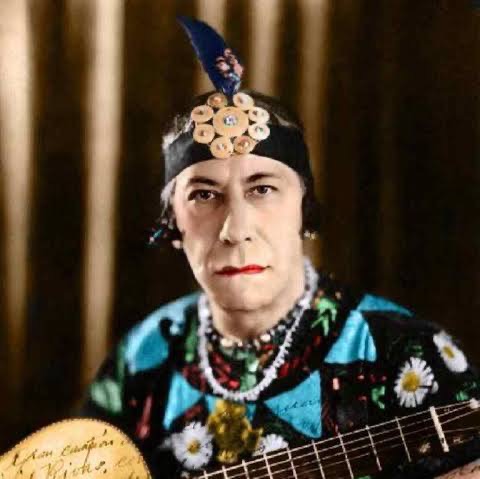
Agustín Pío Barrios (also known as Agustín Barrios Mangoré and Nitsuga—Agustín spelled backwards—Mangoré; May 5, 1885 – August 7, 1944) was a Paraguayan virtuoso classical guitarist and composer, regarded by some as one of the greatest performers and arguably the most prolific composer for the classical guitar Barrios was famed for his phenomenal performances, both live and on gramophone recordings. Eye-witness testimony from Lope Texera in Caracas Venezuela on April 18, 1932, declared that Barrios was “superior to Segovia whom I saw in London last year”. Barrios has been credited as the first classical guitarist to make recordings, in 1909/10. Barrios sometimes performed in concert in traditional Paraguayan dress (he was partly of Guarani origin), beginning in 1932 using the pseudonym of Nitsuga Mangoré (‘Nitsuga’ being Agustín spelled backwards, and ‘Mangoré’ being the name of a cacique of the South American indigenous group Timbú).During his performing years, Barrios only informally shared bits of his musical knowledge with his patrons Luis Pasquet, Martin Borda Pagola, Dionisio Basualdo, Bautista and Lalyta Almiron, and Raul Borges.
Barrios vehemently rejected the idea of devoting time to the formal instruction of students, as he saw it detrimental to the flourishing of the artist, often responding to persuasive attempts “cuando nace el maestro, muere el artista”(the artist dies with the birth of the teacher). Given his masterful command of the instrument and compositional prolificity, the stance was then perceived as tragic eccentricityThe J.S.Bach -inspired La Catedral, from 1921, is widely considered to be Barrios’ magnum opus, winning the approval of Segovia who said “In 1921 in Buenos Aires, I played at the hall La Argentina noted for its good acoustics for guitar, where Barrios had concertized just weeks before me. He was presented to me by his secretary Elbio Trapani. At my invitation, Barrios visited me at the hotel and played for me upon my very own guitar several of his compositions, among which the one that really impressed me was a magnificent concert piece The Cathedral whose first movement is an andante, like an introduction and prelude, and a second very virtuosic piece which is ideal for the repertory of any concert guitarist. Barrios had promised to send me immediately a copy of the work (I had ten days remaining before continuing my journey) but I never received a copy.”However, it is possible that Segovia did receive the score and chose not to play it, either out of distaste for Barrios’ folk-based music or professional jealousy (because Barrios was more of a composer than he was).
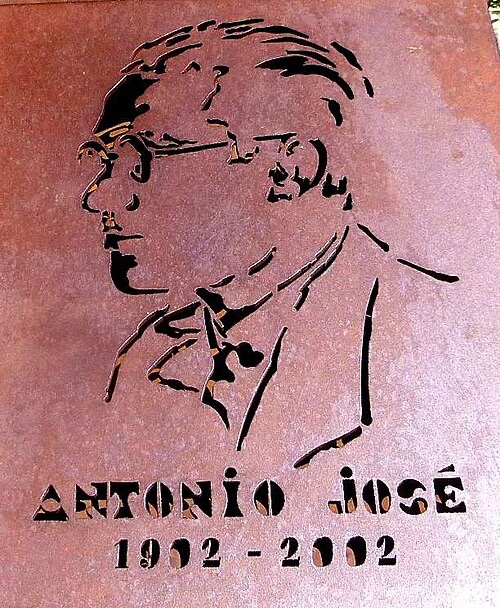
Antonio José Martínez Palacios (12 December 1902 –11 October 1936), professionally known as Antonio José, was a Spanish composer . Maurice Ravel apparently said of Antonio José: “He will become the Spanish composer of our century”, however, his music lay forgotten until the 1980s.
Monument marking the centenary of the composer’s birth 12 December 1902 Burgos ,Castile and León Spain – 11 October 1936 (aged 33) Estépar, Castile and León, Spain
Born in Burgos ,Castile and León, Antonio José became a music teacher at a Jesuit school and conducted the city choir in Burgos. The sheer volume of his work (he died at 33) was prodigious. He penned his first composition when he was 14. He was hired as a director of a musical review in Burgos at the age of 18. He wrote extensively for voice in his quest to present the melodies of his native Burgos to the world. His compositions, especially the Sinfonía castellana and Suite Ingenua, put his orchestration on a par with anything at the time in the twentieth century. His most famous work is a sonata for guitar.
His harmonic understanding put him in the forefront of post-impressionist composers, and though a disciple of Ravel, his particular voice and choice of medium set him distinctly apart. His chief biographer, Miguel Ángel Palacios Garoz, points out that Antonio José was not only a prolific composer but a writer with an intellectually facile mind that was open to influences from all fronts of contemporary music.
Falangists had success in the July 18 1936 coup , and he was arrested on August 6 and detained in Burgos.
Antonio José was executed by a Falangist firing squad at Estépar. His body was thrown into one of the Mass graves. Like poet and playwright Federico Garcia Lorca , who met a similar fate in the province of Granada his remains have yet to be identified.
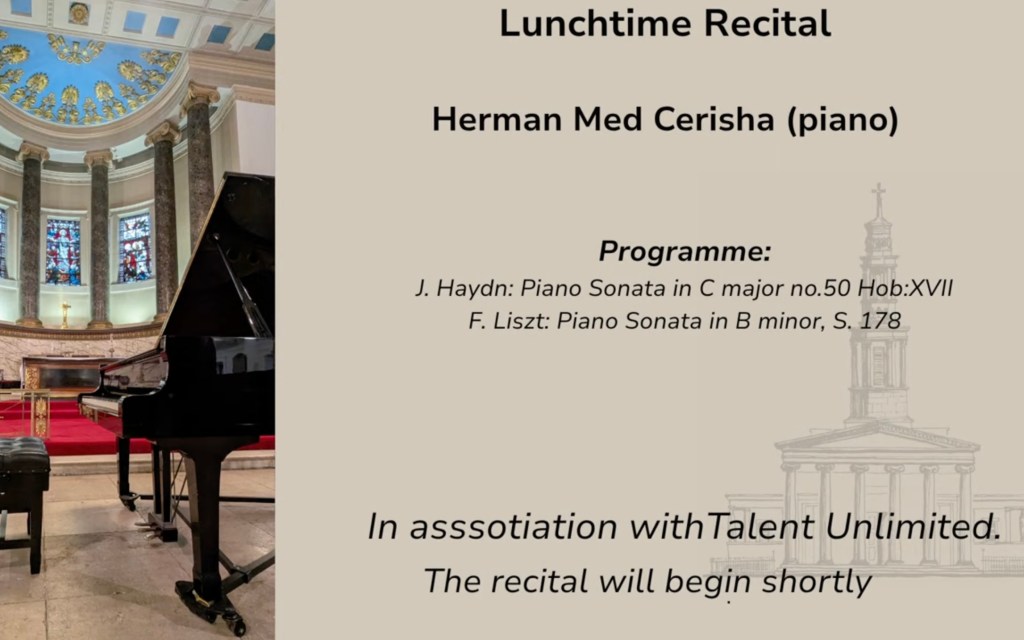
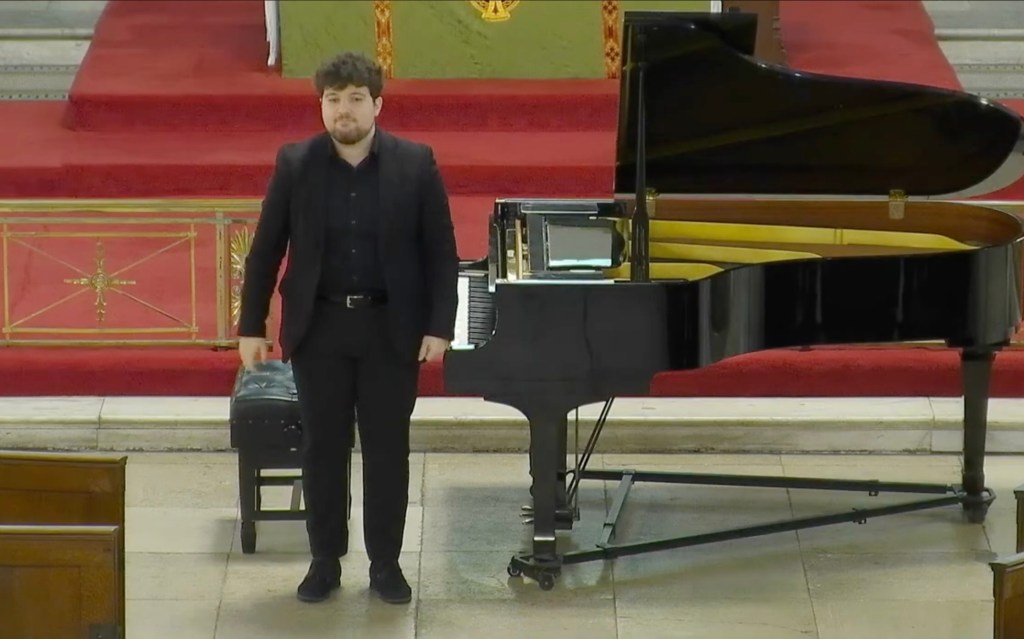
Herman opened his recital with Haydn’s C major Sonata ( English sonata ) probably the last of Haydn’s sonata which is a non plus ultra of thematic concentration, a brilliant, extrovert counterpart to the strenuous ‘Fifths’ Quartet, Op 76 No 2. It was written for and dedicated to Therese Jansen Bartolozzi in 1794, who subsequently published the sonata in 1800 with the title: “A Grand Sonata for the Piano Forte Composed Expressly for and dedicated to Mrs. Bartolozzi by Haydn … Op. 79 … London. Printed for, and to be had of the Proprietor 82 Wells Street and of the Publishers J. and H. Caulfield 36 Picadilly.” After a poetically embellished, quasi-improvisatory Adagio in F—a rhapsodic meditation such as we find in many of the late piano trios—the finale is a candidate for the most subversively comic piece that even Haydn ever wrote. A scherzo in all but name, it continually baffles with its lopsided phrases (the quirky main theme consists of five plus two bars), outrageous sudden silences and disorienting feints to absurdly remote keys that, unlike Haydn’s usual practice, remain arbitrary and unexplained to the end.
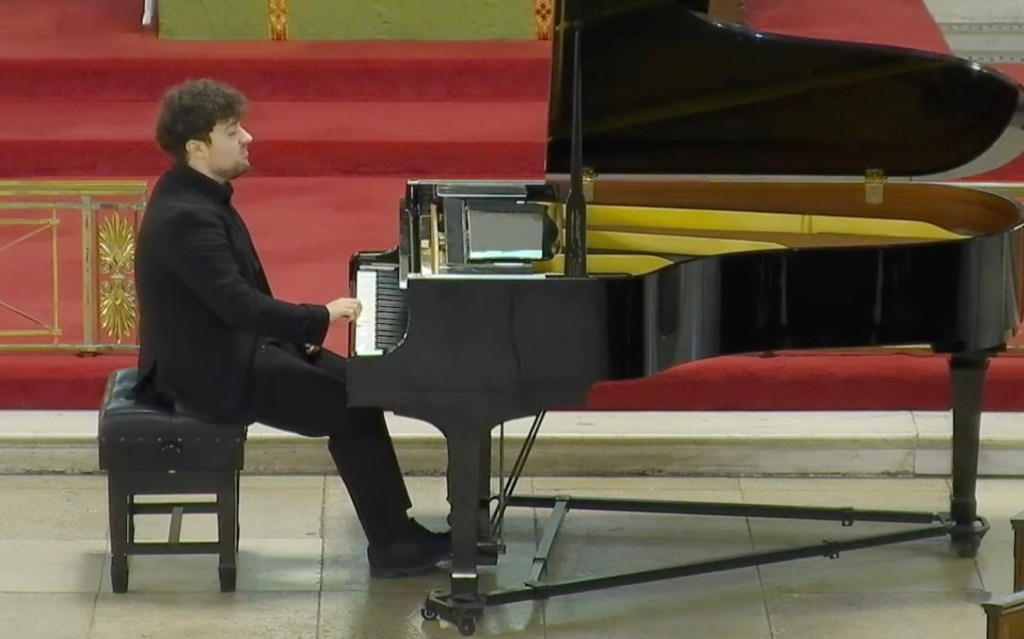
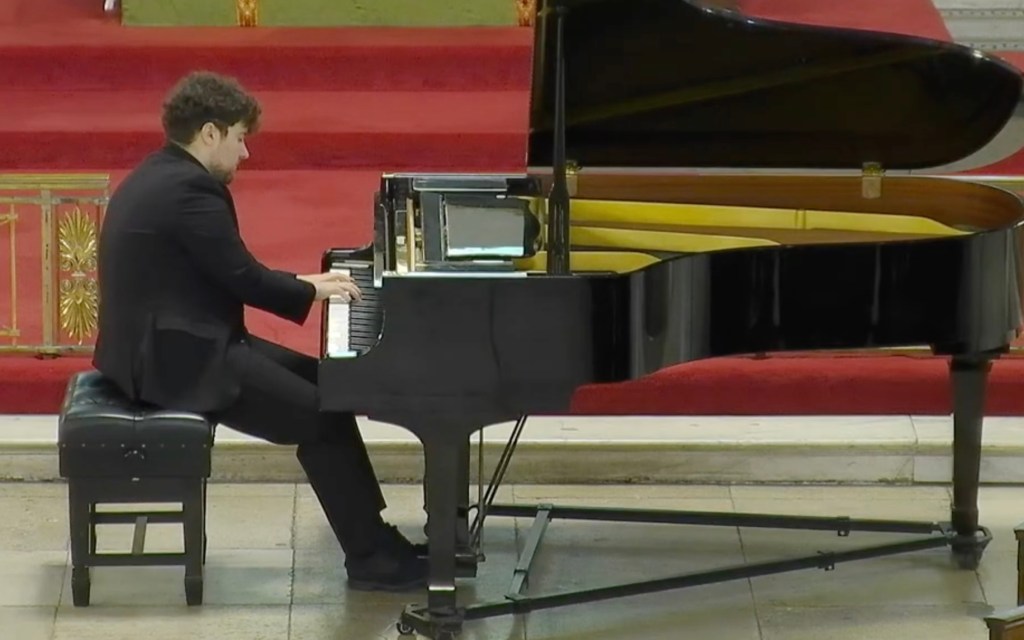
Herman playing with a clarity and refined phrasing of impish good humour and a rhythmic drive of irresistible charm. What fun he was having as he unravelled Haydn’s knotty twine with such spirit with the composer’s own poetic pedal effects realised so beautifully, following on afterwards with playing of crystalline clarity and scintillating jeux perlé. Adding a teasing embellishment to the slow unwinding cadenza before flying high again with the return of the opening. A grandiose opening to the ‘Adagio’ and the simple unadorned beauty of Haydn’s ‘bel canto’ that Herman played with grace and style adding a delicate unobtrusive rubato that allowed the music to speak with a human voice. Beautifully radiant sounds of delicacy and strength where the shadow that momentarily passes over the keys was played with poignant significance before the return of the ‘Adagio’ , embellished by the composer with just a little help from Herman! He brought delicacy and beauty to a coda of pleading, whispered poetic intensity. The Allegro molto just flew from his fingers with its continual questioning and joyous response with playing of a ‘joie de vivre’ of masterly poetic control and impish good humour .
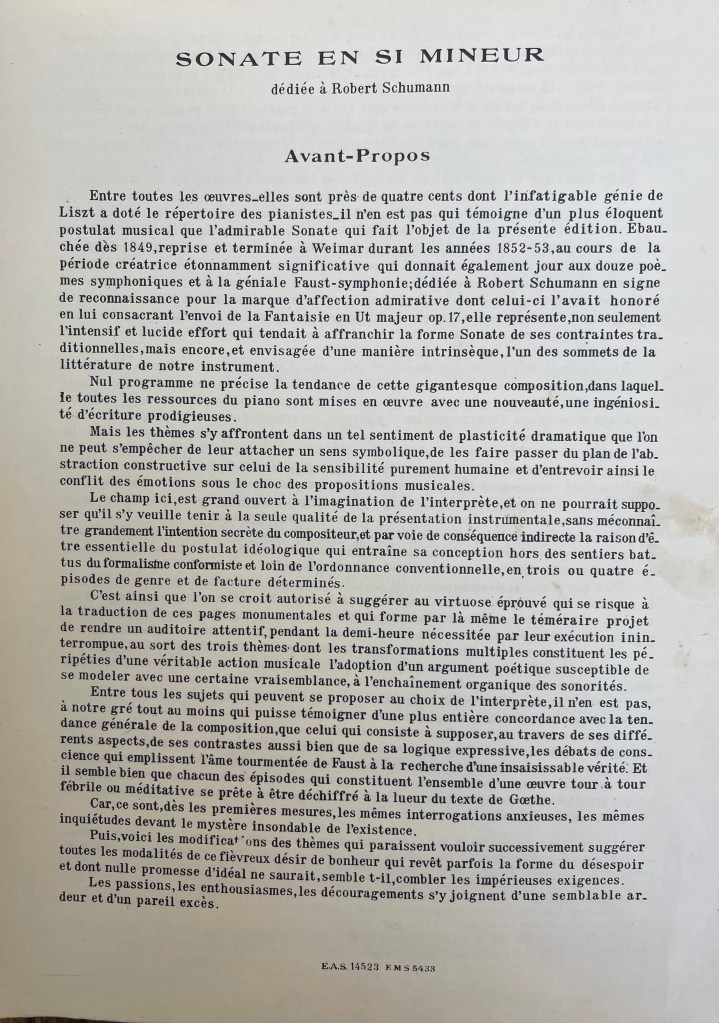
The Piano Sonata in B minor S.178 is in a a single-movement that Liszt completed during his time in Weimar, Germany in 1853, a year before it was published in 1854 and performed in 1857. It was dedicated to Robert Schumann in return for Schumann’s dedication to Liszt in his Fantaisie in C op 17. A copy arrived at Schumann’s house in May 1854, after he had entered Endenich sanatorium, but Clara Schumann did not perform the Sonata despite her marriage to Robert Schumann; as she found it ‘ merely a blind noise’.
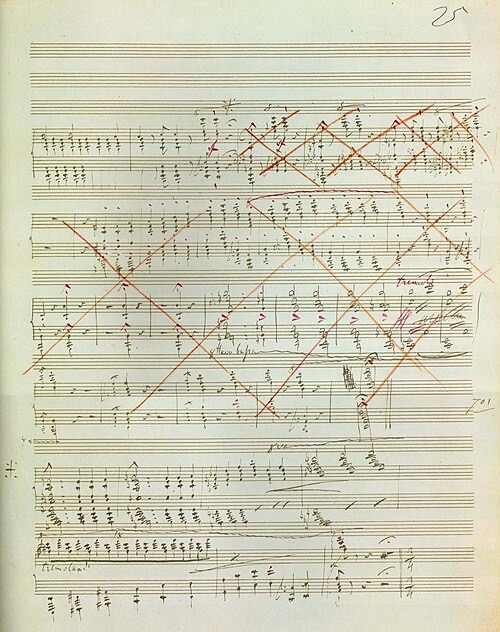
Page 25 of the manuscript. The large section crossed out in red contains the original loud ending
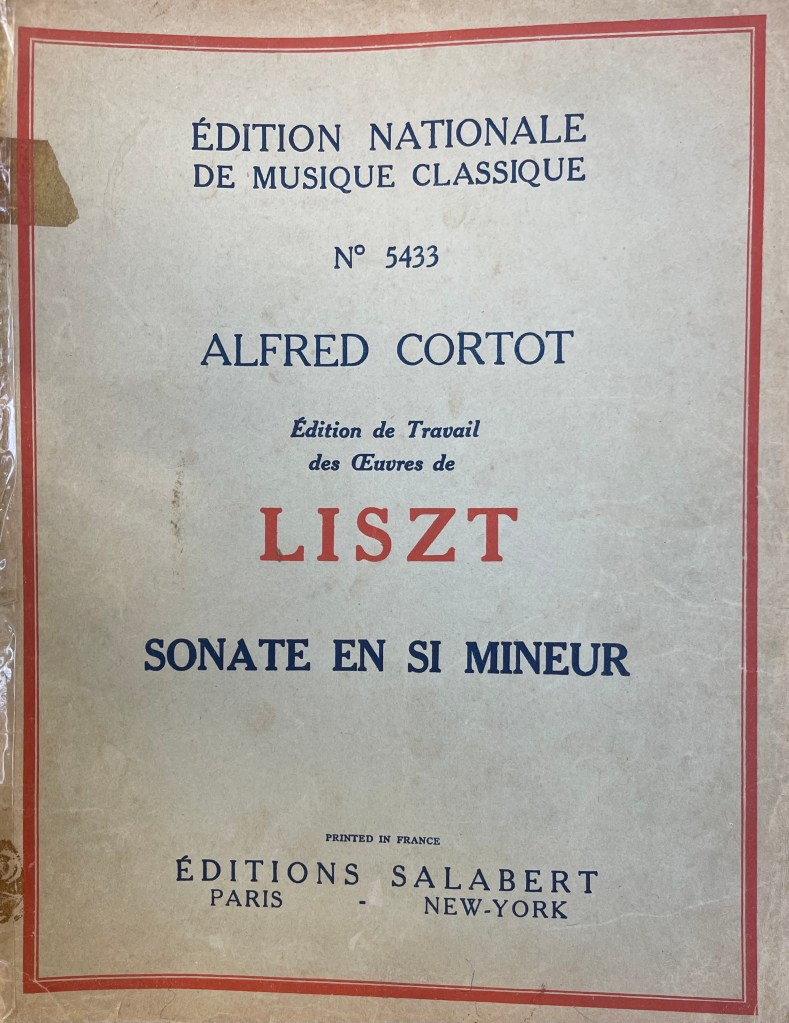
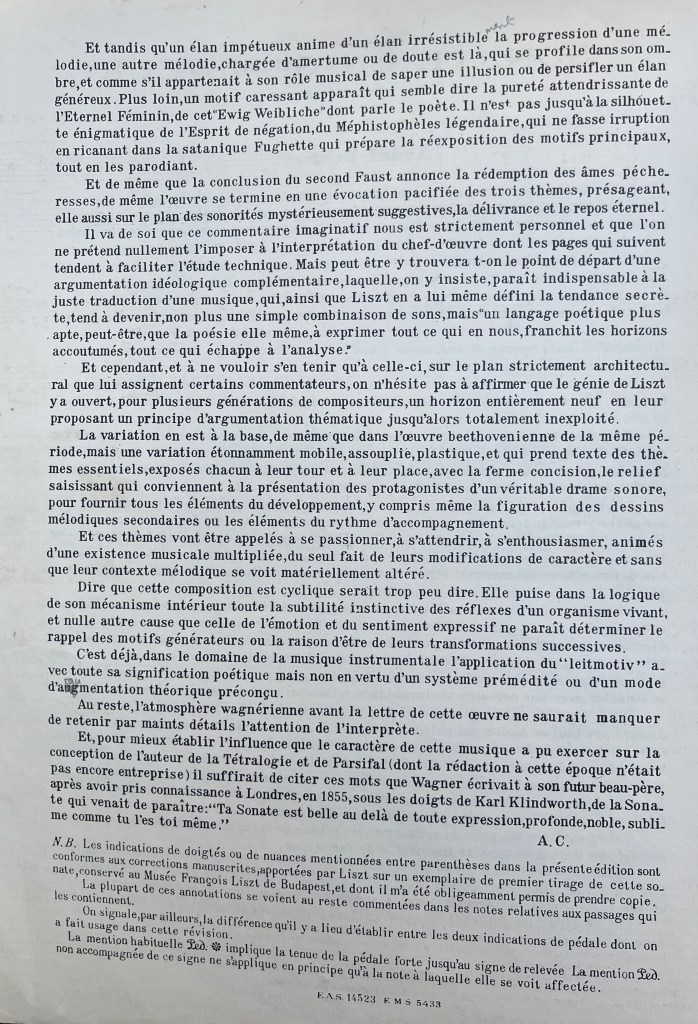
It was published by Breitkopf & Härtel in 1854 and first performed on 27 January 1857 in Berlin[ by Hans von Bülow. It was attacked by the critic Eduard Hanslick who said ‘anyone who has heard it and finds it beautiful is beyond help’. Brahms reputedly fell asleep when Liszt performed the work in 1853,and it was also criticized by the pianist and composer Anton Rubinstein. However, the Sonata drew enthusiasm from Wagner following a private performance of the piece by Karl Klindworth on April 5, 1855. Today it is considered the pinnacle of the romantic piano repertoire with the first commercial recording made by Alfred Cortot on March 13, 1929, at the Small Queen’s Hall in London.
This was Herman’s first outing with the sonata that he has obviously pondered over for a long time because it was played with a maturity ,intelligence and masterly control. A scrupulous attention to Liszt’s very precise instructions and a look at the score without any rhetoric, but delving deep and finding many things that were for me a revelation. For example the fermata before the central ‘Andante sostenuto’ or the accent on the deep F sharp after the pianississimo scales. An astonishing clarity and precision that just added to the passion and intensity of the more energetic passages but also the poignancy to the ravishingly beauty of the slow parts that were never hurried or given unnecessary rhetorical rubatos. The opening was played ‘piano’ and ‘forte’ with ‘fortissimo’ only where the actual Sonata takes wing. I have only heard Curzon play the left hand semiquaver passages so precisely, where usually the last notes of the bar are clipped in an effort to make the music more exciting. The great octave outpouring of the second theme was played with astonishing accuracy and clarity leading to the first ‘Grandioso’ that was played with an extraordinary sense of balance and control, the burning palpitations merely sustaining the melody but not overpowering it. This young man is a thinking musician who reads the score and turns what he sees into music where he is free to add his own remarkable personality of refined good taste and intelligence. The ‘Margherita’ theme was played ‘cantando espressivo’ but not before the third theme was allowed to give its final gasps as it surrendered to the radiance and beauty that followed. Absolute rhythmic precision meant that the clockwork perfection of the build up to the first great climax allowed the actual point of arrival to be breathtaking in its audacity. Usually played at breakneck speed Herman kept it under control with the same aristocratic mastery of Arrau.
The great declamatory chords before the ‘Andante’ were even more astonishing for the burning intensity of the silences between them, making the ‘recitativi’ even more poignantly significant. The fugato after the central movement was played with a control of sound as it gradually grew in intensity leading to the eruption of the recapitulation. The ‘Grandioso’ theme now played as requested ‘accentuate il canto’ and it was a moment ‘avec un sentiment de regret’ of great significance and radiance .The final octaves were played with fearless abandon and extraordinary clarity with the final outburst now overwhelming in its intensity. A burning silence followed where Herman held the tension until he lowered his hand once more onto the keys to carve out with mastery and a musicianship of poetic vision, the final pages that Liszt had added as an afterthought, and that are the most remarkable two pages of his entire output. Prophetic, profound and with disarming simplicity pointing into the future.
I look forward to Herman’s next performances of the sonata that will grow even more in significance as he delves deeper and deeper into the score on his masterly voyage of discovery
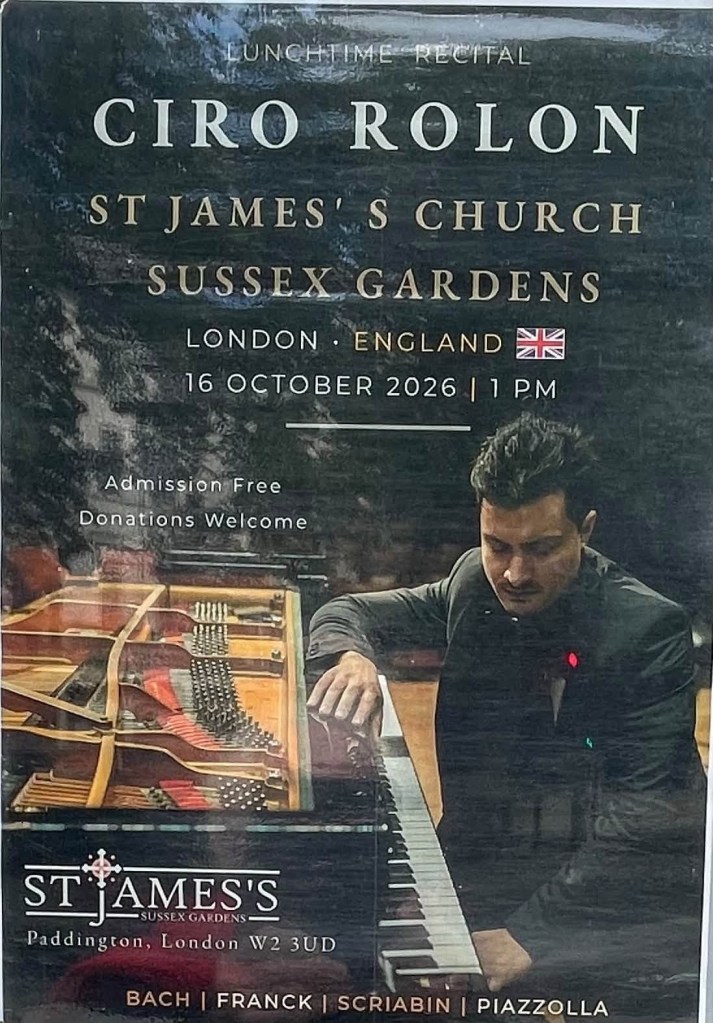
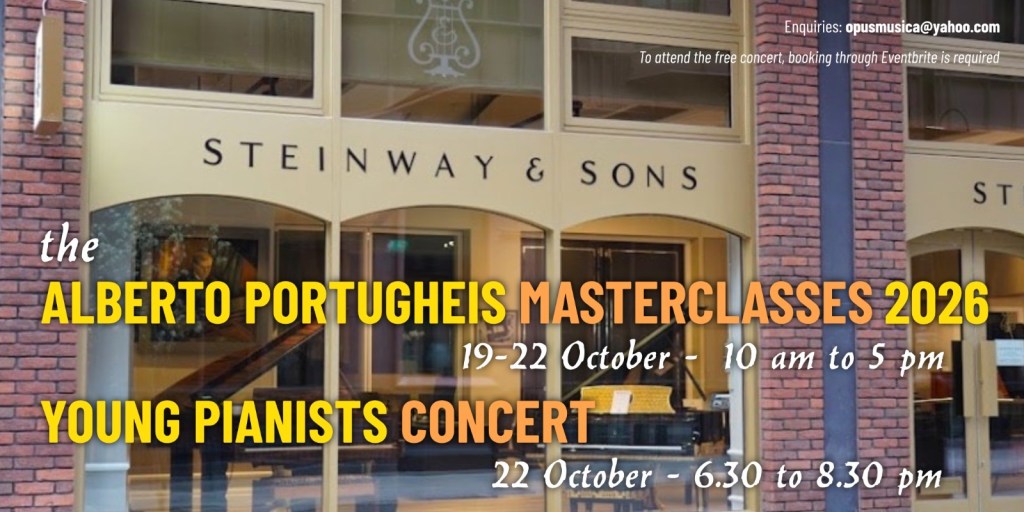
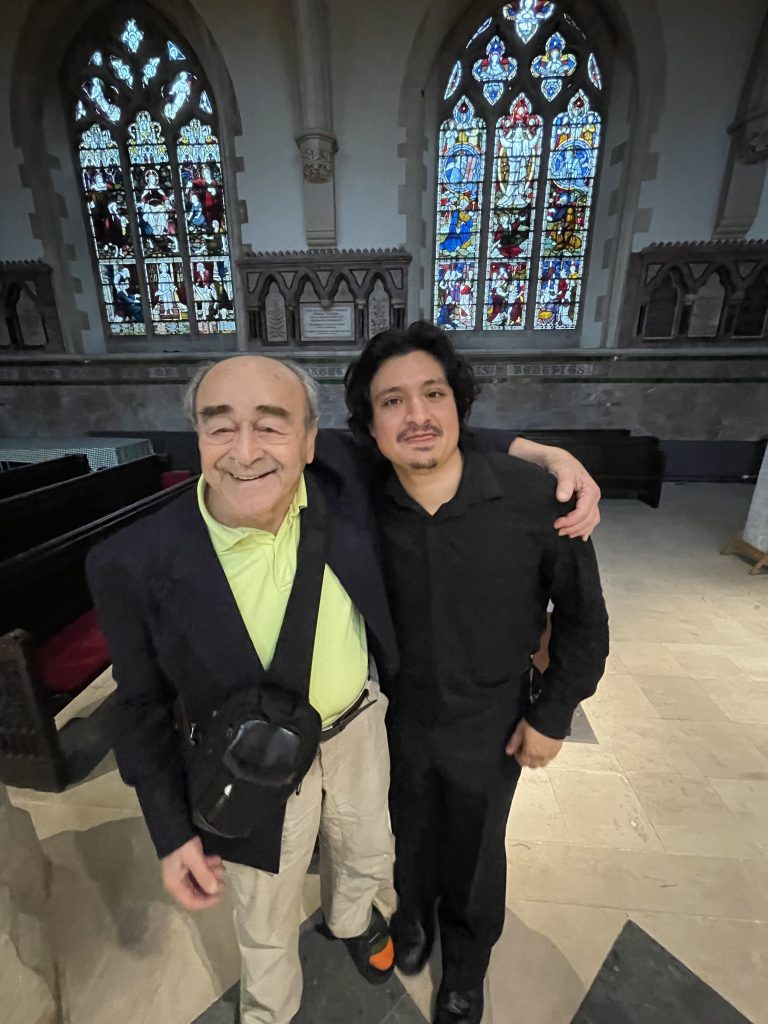
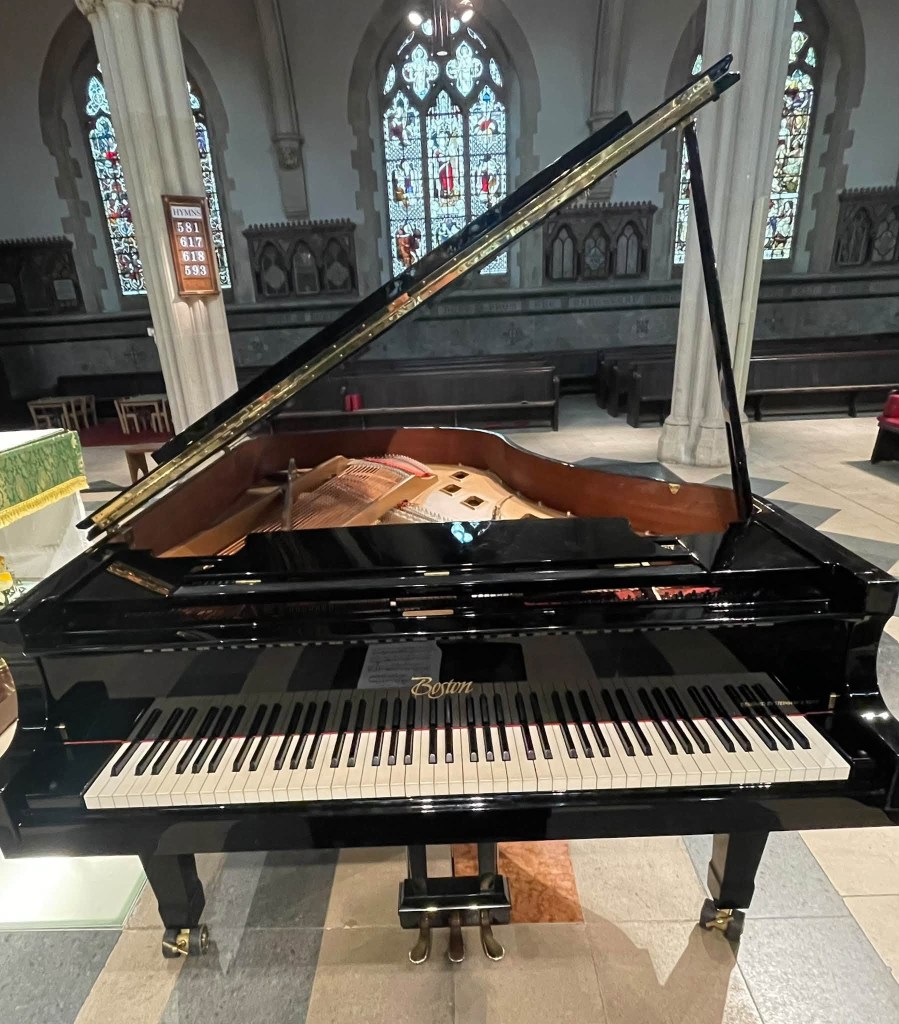
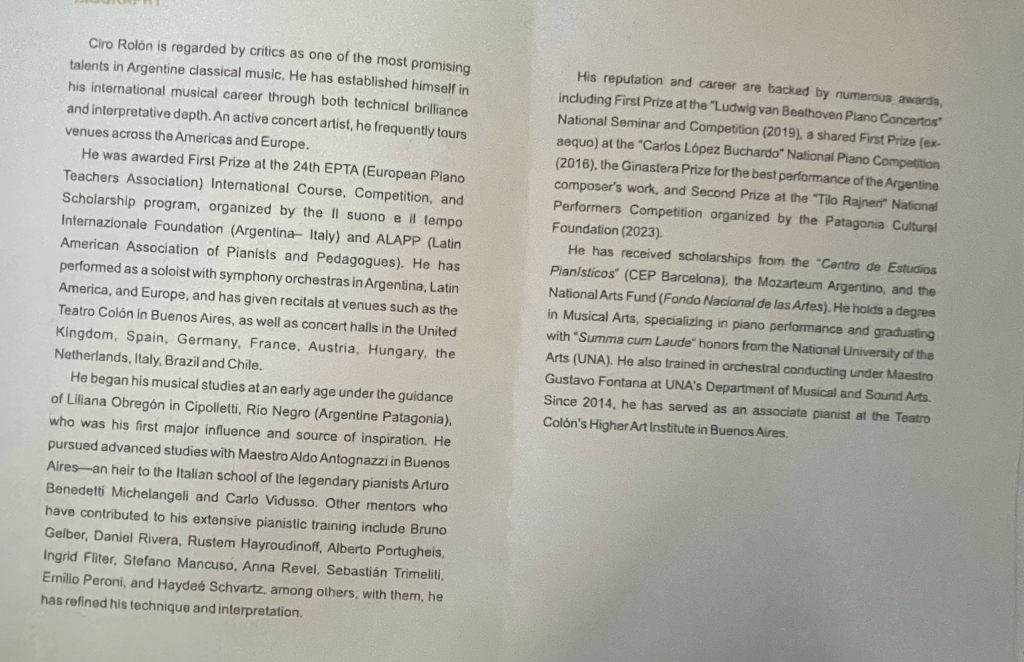
Today Ciro Rolon had flown in especially from Argentina, as winner of the 24th Sound & Time competition in Buenos Aires, Argentina, to play in the historic masterclasses that this unstoppable eclectic master is holding in Steinway Hall from 19 to 22 October.
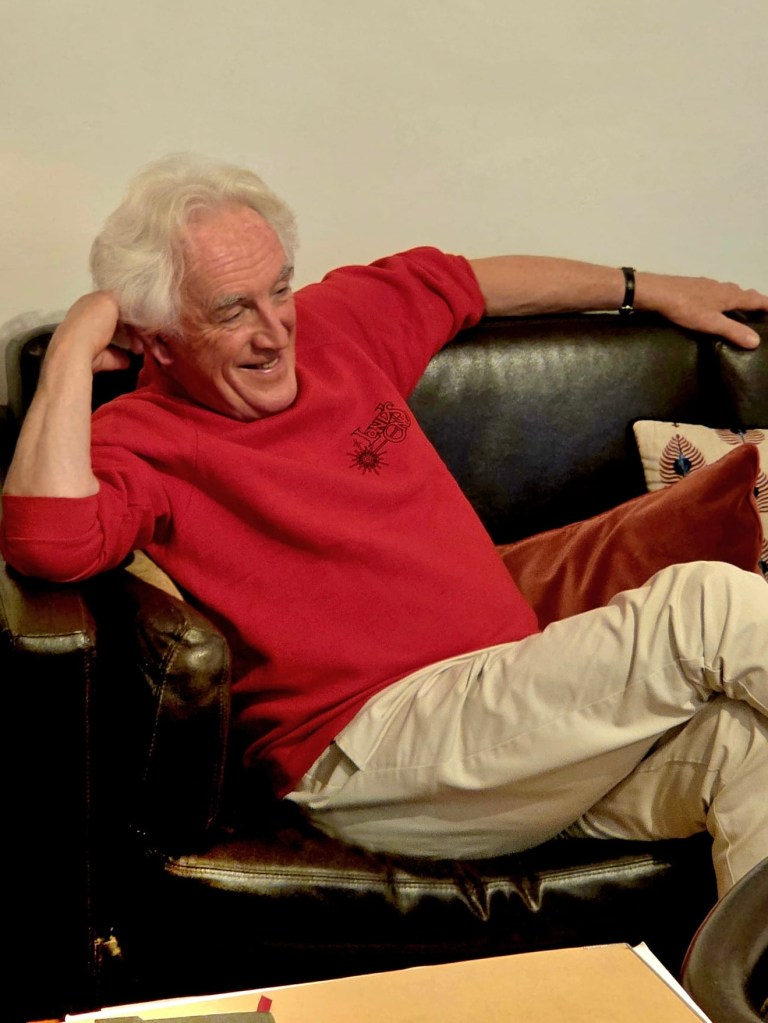
Alberto will then fly off to Bangkok for an International Peace Conference, he has been nominated twice for the Nobel Peace Prize . Just a few days later he will be in Sorrento where after his success this summer he has been invited back by the owners of the sumptuous Vittoria Hotel to give a concert for their guests on the 3rd December.
On New Years’ Eve he will celebrate his 86th birthday!
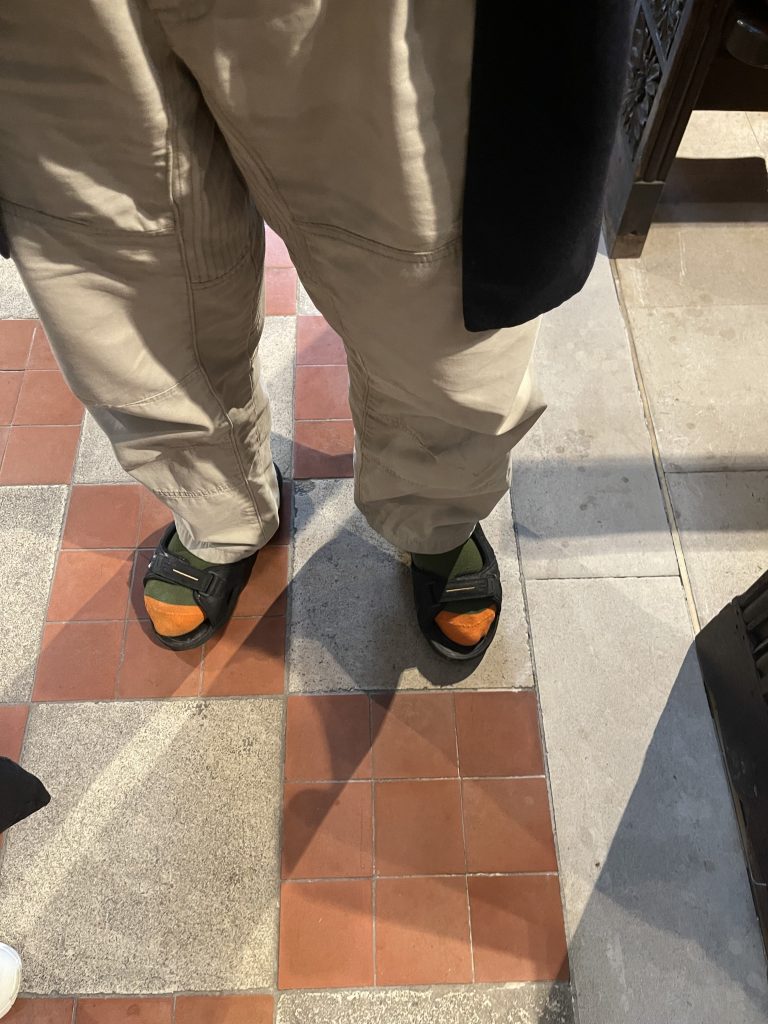
Arriving at the concert in open sandals because he had lent the pianist his shoes and dress trousers as Ciro’s luggage had been lost in transit from Argentina to London !
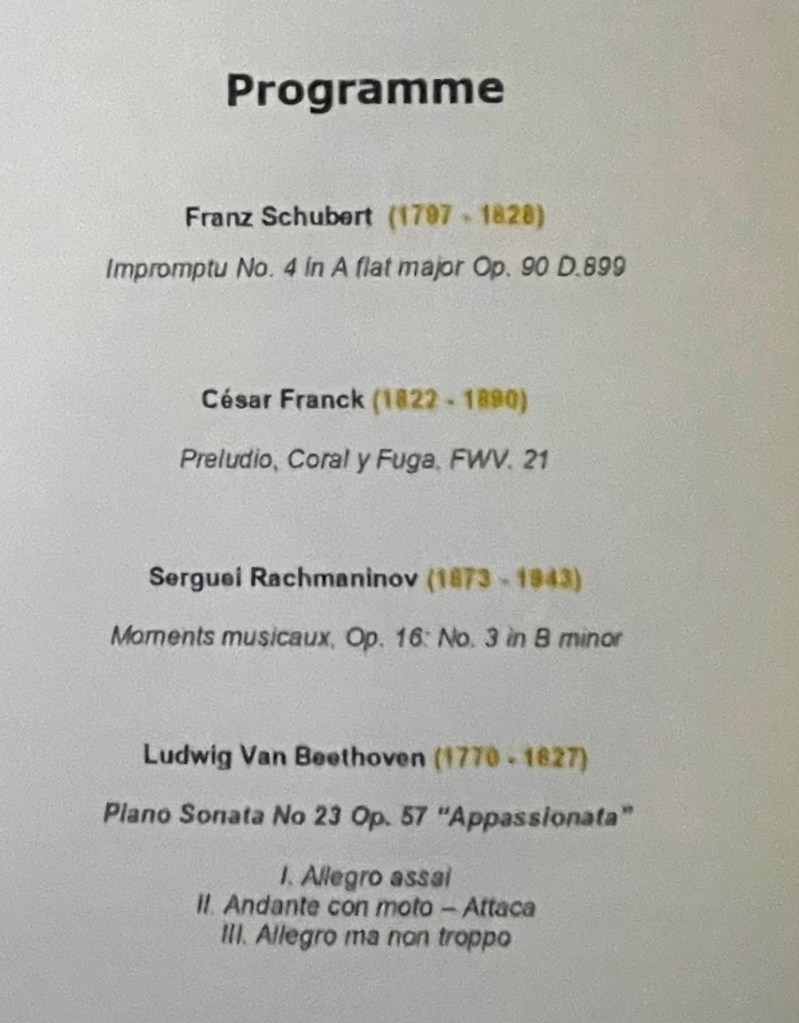
A programme of Schubert, Franck, Rachmaninov and Beethoven demonstrating his pedigree from the Italian School of Aldo Antognazzi heir to the leggendary Michelangeli and Vidusso . A beauty of sound and limpet touch without doubt from his studies with Bruno Leonardo Gelber.
From the very first notes the liquid fluidity of his playing of Schubert’s A flat Impromptu D. 899 demonstrated his timeless musicianship where his sense of style and beauty allowed the music to live and breathe naturally with a palette of sounds that were never hard or vertical but pure and horizontal . His arms outstretched as they embraced the beauty that was lying within each note like jewels on a velvet cushion.
The same fluidity he was to find in the opening of César Franck’s Prelude, Chorale and Fugue with washes of sound out of which emerged the musical line of magical limpidity. A poetic sensibility that on occasion he allowed too much reign at the expense of the architectural line, but it was done with such loving care and with fingers that delved deep into the keys to find the gold that was hidden within. Almost imperceptibly the ‘Chorale’ was heard floating magically on waves of expansive harmonic arpeggios. Building to a climax that was sumptuous and sonorous but never hard or ungrateful. A ‘Fugue’ that was allowed to unfold so naturally until the bubble burst and a cloud of radiance filled the air. Jewels that seems to glisten and glow as César Franck stealthily combined the three main ingredients into one sumptuous passionate outpouring to the Glory of God the maker of peace and harmony. A dynamic outpouring of rich broken chords brought this magical feast to a brilliant end.
The Rachmaninov ‘Elegie’ of the Moments musicaux op 16 n. 3 ,was played with weight and the poignant significance of Russian nostalgia.
The last work on the programme was Beethoven’s’Appassionata’ Sonata op 57. Ciro played with great style but could at times sound a little laboured as his control and measured playing demonstrated an achitectural sense of line at the expense of the dynamic drive that the title ‘Appassionata’ should imply. The ‘Andante con moto’ flowed well and the variations grew naturally out of the processional theme that was played with sensibility but rather too vertically for the string quartet quality which Beethoven defines. The final movement was played with great intensity and if there was a little too much pedal it was because he was shaping the multitude of notes into phrases of musicianly understanding . A coda in which he finally allowed his temperament full reign. If he played too loudly the chords after the two dramatic declamations it at last brought a sense of excitement and ‘Appassionata’ to a performance of great style and beauty but lacking the dramatic character of one of Beethoven’s most imperious sonatas.
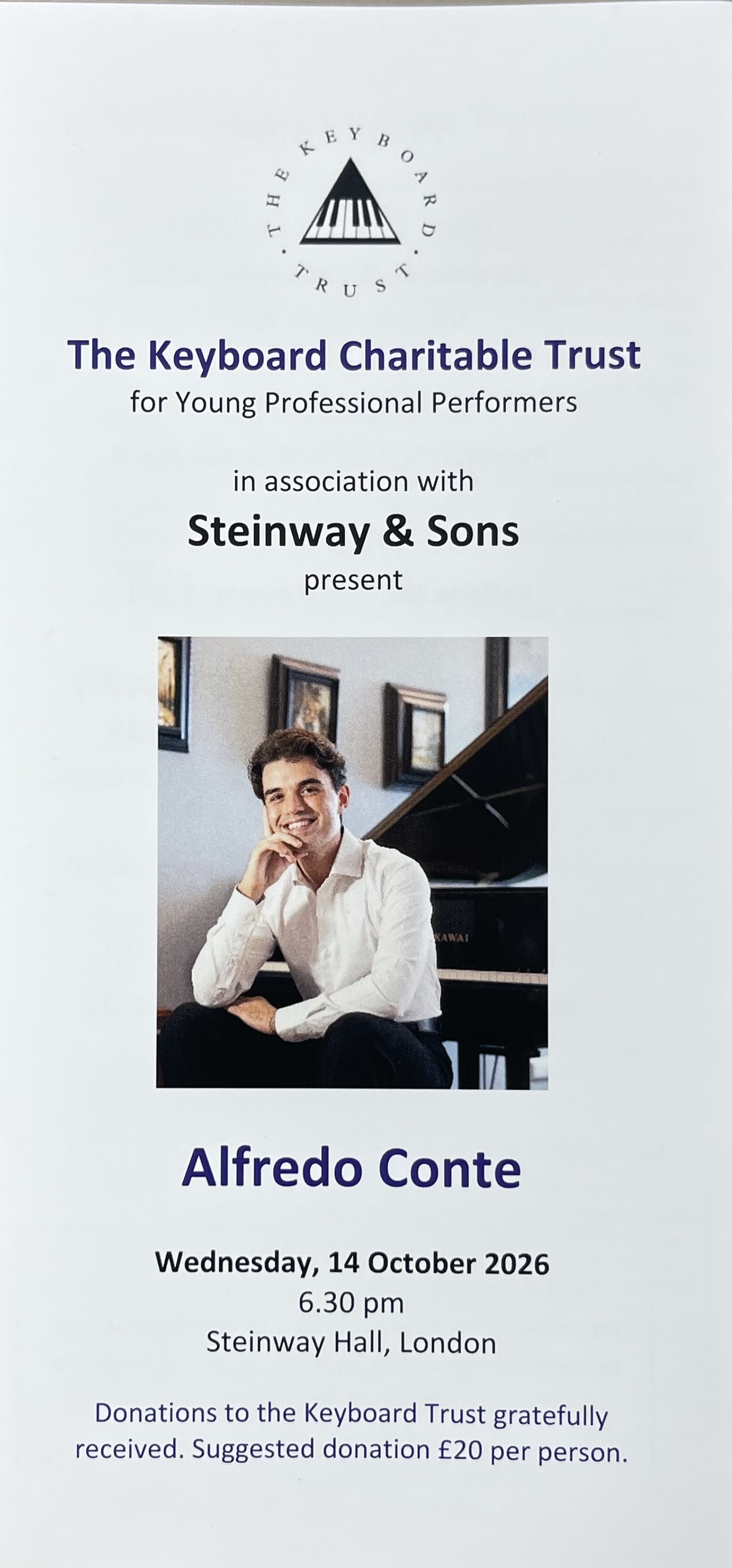
Alfredo the young Italian pianist who at only 24 already has a Bachelor and Masters degree from Rome Conservatory to which he has added a first class honours degree from Kings College,London. In his burning pursuit for knowledge and mastery he is pursuing a PHD at the Guildhall with playing mentored by Ronan O’Hora. Awarded a special Pappano Scholarship through the generosity of Madame Bassatne which has also allowed him to have precious guidance from the KT honorary Patron . Gabriella Bassatne was also a very close friend of Noretta and John Leech the KT founders, who was with us last night for the KT debut recital of this distinguished young artist. An audience that included many illustrious musicians and two much feared critics Jed Distler and Bryce Morrison.
Rising to the occasion with an eclectic programme of Liszt, Beethoven and Scriabin which he crowned with a glowing performance of Clementi, a much neglected English based composer whose slow movement of the F sharp minor Sonata was the highlight of a special occasion.
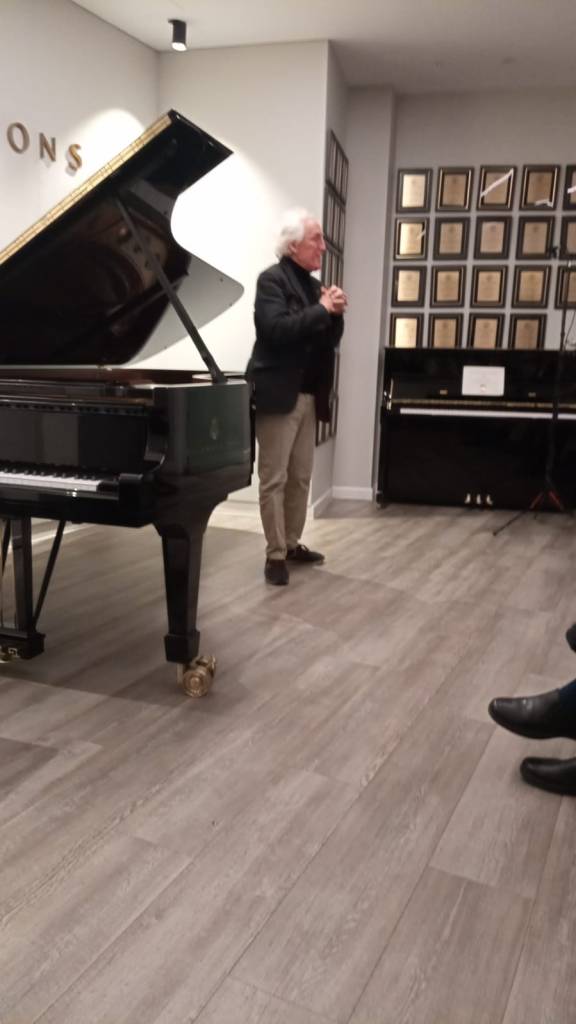
Alfredo in the discussion that followed with the ‘birthday boy’ described how he had managed to combine his original training from the late Maura Pansini of the Neapolitan school with that of Ronan O’Hora of the Cortot (Perlemuter) school. Cleanliness, precision but allied to poetic fantasy colour and real weight, a difficult conundrum but one which Alfredo showed us is becoming a reality in playing that spanned the romantic ,classical and fantasmagorical.
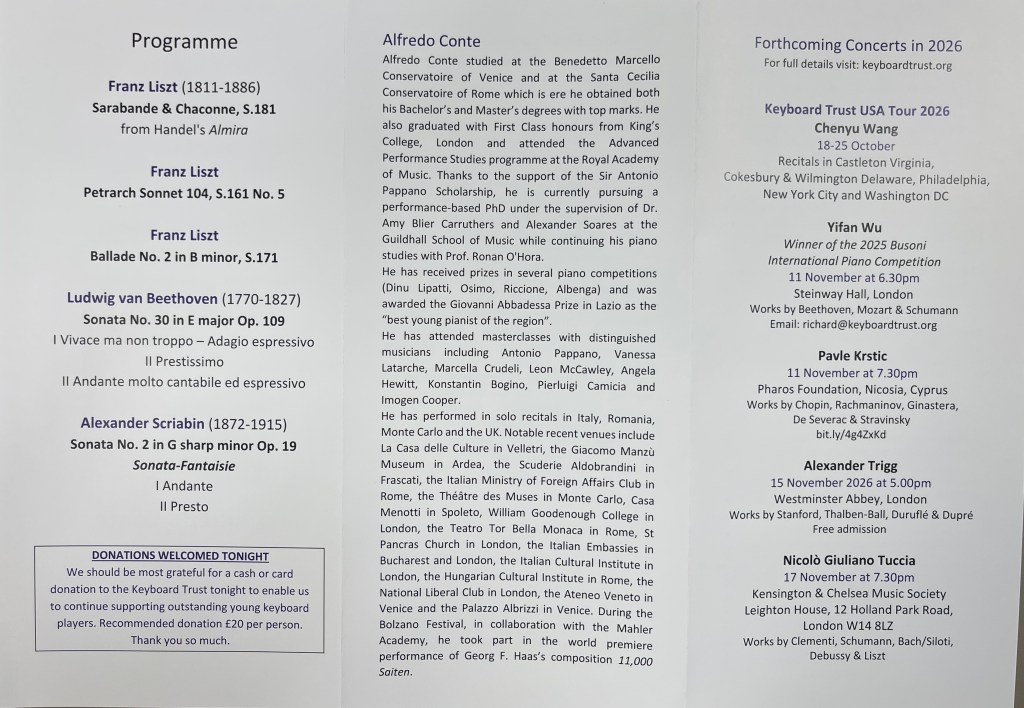
Opening with a rare work by Liszt “The Sarabande and Chaconne’ from Handel’s Almira that Leslie Howard,had brought to light via the inclusion as the set piece in the Liszt Utrecht competition and thanks to him is now being included in many pianist’s repertoire.
Leslie , a co artistic director and founder member of the KT could not be present to interview Alfredo but he will be in Perivale on the 28th November when Alfredo and five other pianists will compete for the prestigious first prize of the UK Liszt Society
This year’s first prize winner Max Walsh was also present last night and will give a recital in Perivale as a curtain raiser to the Annual Liszt Day in St Mary’s Perivale that can be followed worldwide by their superb streaming at. A long and taxing work that Mariam Batsashvili ,another KT artist, has made her own but that Alfredo showed a fearless authority and architectural understanding of Liszt’s long, genial and at times meandering thoughts. Handel’s much neglected masterpiece recently had such an enormous success at Covent Garden where Handel’s oratorio type operas have been unjustly neglected for too long. Alfredo followed with a poetic account of the Petrarch Sonnet 104 . Playing of radiance and flowing beauty with ornaments thrown of with glistening mastery as the subtle beauty of Liszt’s writing was conveyed with poignant significance.
The epic poem of Hero and Leander depicted ( according to Arrau) by Liszt in his Ballade in B minor was played with a palette of sounds that could indeed portray this harrowing tale.The chromatic rumbling in the bass representing the sea: “You really can perceive how the journey turns more and more difficult each time. In the fourth night he drowns. Next, the last pages are a transfiguration”. Played by Alfredo with great authority but also radiant beauty as the wonderful tenor melody filled the piano with sumptuous rich sounds that are elaborated with ever more transcendental effusions.
Of the two sonatas that followed it was the enigmatic fantasy of Scriabin’s ‘purple’ Sonata that suited our young virtuoso the best. A subtle palette of sounds but allied always to an intelligence and architectural awareness where Scriabin’s still early Chopinesque writing . The beginning and guiding light to the composers lifelong search for the ‘star’ that was to be a diabolical journey of harrowing torment. A technical mastery of the Presto, perpetuo mobile, that did not deny the unstoppable Romantic outbursts of Romantic effusions.
Charles Coop with Alfredo’s supervisor of Kings Aiden Modica ,right ,KT / Weior Trust artist
The Beethoven Sonata ,a new work for Alfredo, I found a little too earthbound. The opening Vivace lacking improvised fluidity and freedom as Alfredo seemed intimidated and too respectful of the first of Beethoven’s great trio of late Sonatas. It missed the etherial beauty and imprecisions of a composer searching for a world of peaceful coexistance. A beauty that was to be revealed in the final theme and variations of the last movement that Alfredo played with remarkable authority.Here again I felt his Neapolitan verticality was at odds with Cortot’s horizontality.
far right Max Walsh KT Weir Trust artist mentored by Norma Fisher at the RCM winner of Liszt Competition 2025
All this was resolved however in the radiant beauty and understanding that he brought to the Clementi encore. Jed Distler the most discerning of critics thought that Alfredo had found the perfect key with a performance where the beauty and radiance of the opening sounded like a Bach chorale prelude such was the glowing simple beauty of playing that allowed the music to speak for itself.
in discussion with Jed Distler
Alfredo in discussion with Jed at the end and which is the raison d’être of the meeting the artist reception that Steinways very generously allow in their beautiful showroom. Good times where in a relaxed atmosphere a mutual love and respect for the music can be debated over many glasses of Champagne and on this occasion a birthday cake with the recipe bequeathed to Elena Vorotoko ,co artistic director , by our much missed founder Noretta Conci .
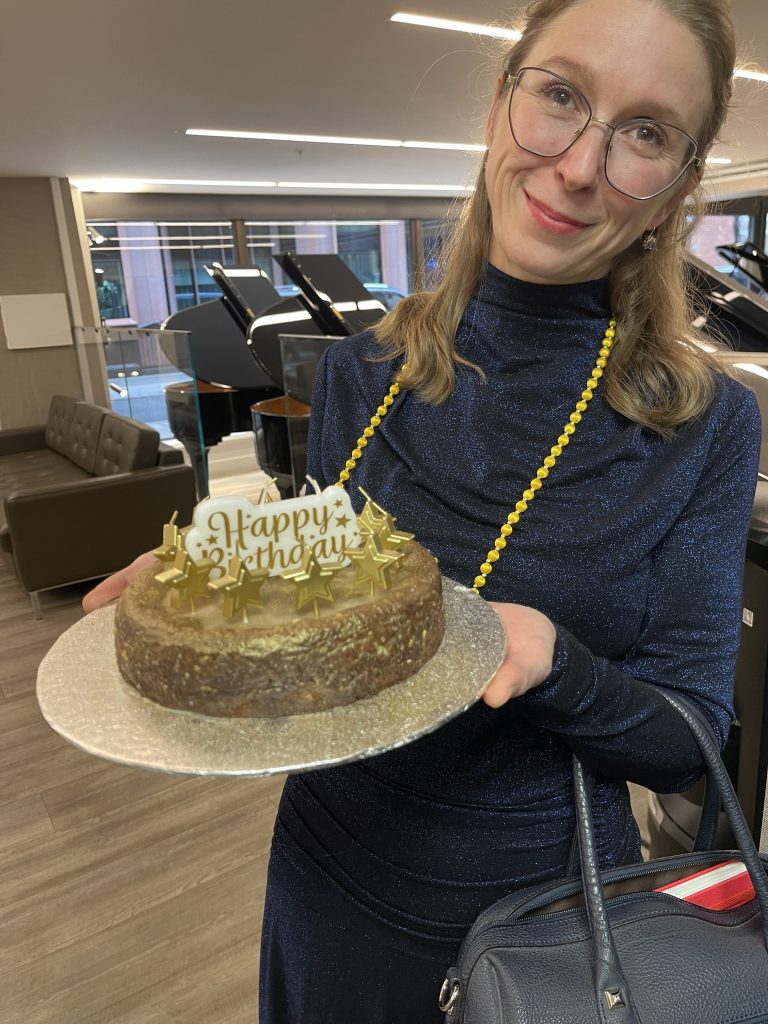
Wiebke Greinus ,concert manager Steinway & Sons Elena Vorotko with Noretta’s cake
Noretta will be celebrated in her home town of Trento where the Filarmonica are proud to host a celebration together with Evgeny Kissin and many emeritus KT artists on the 29th November 2026.