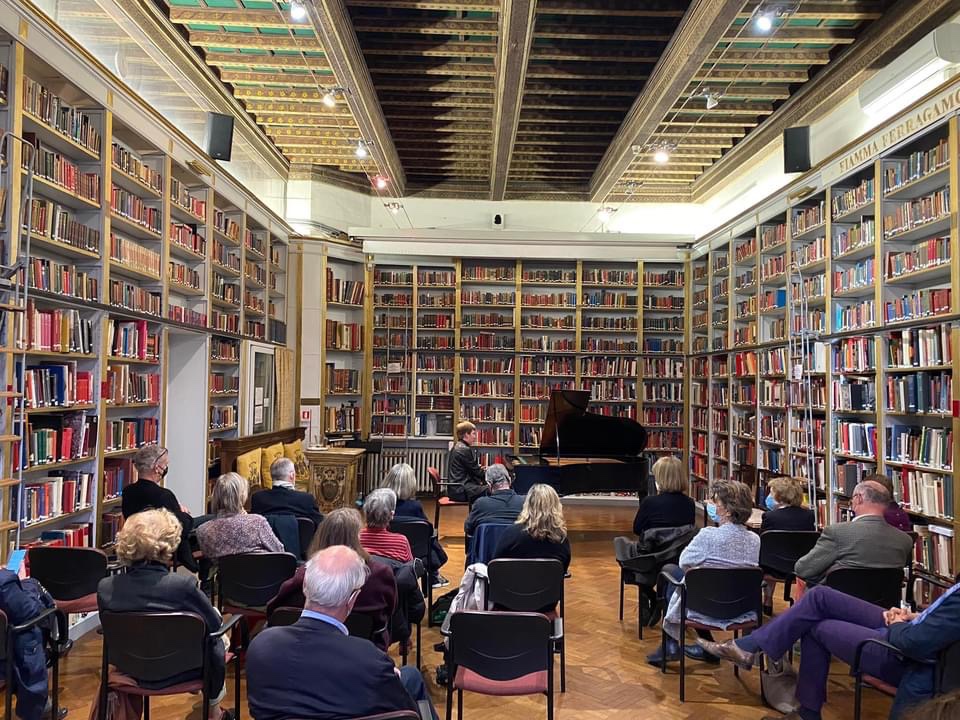
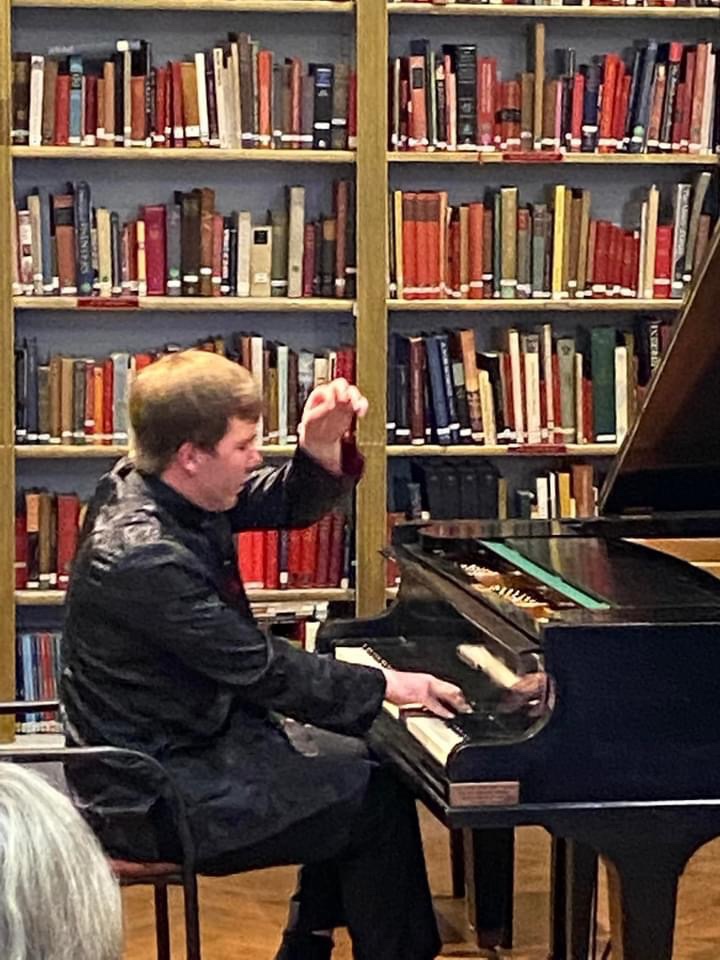
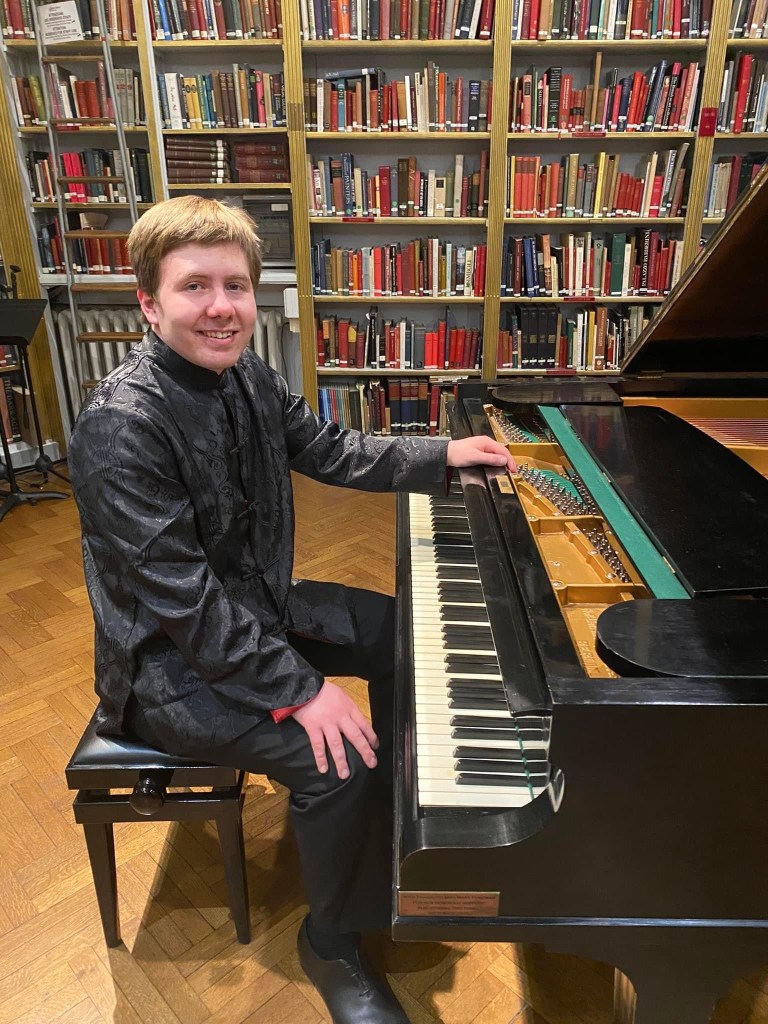
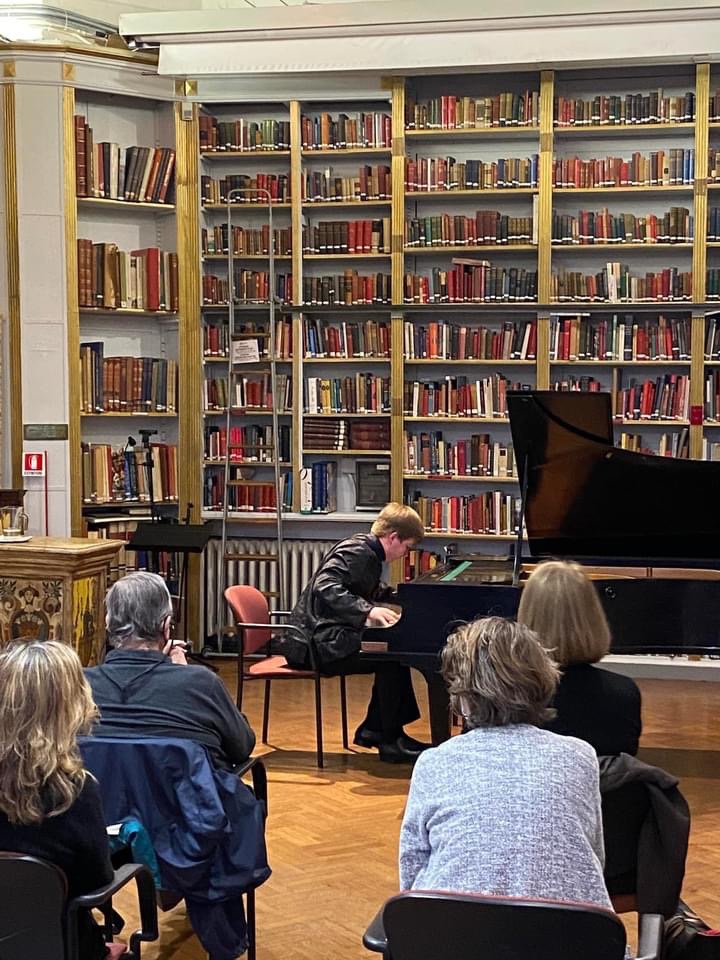
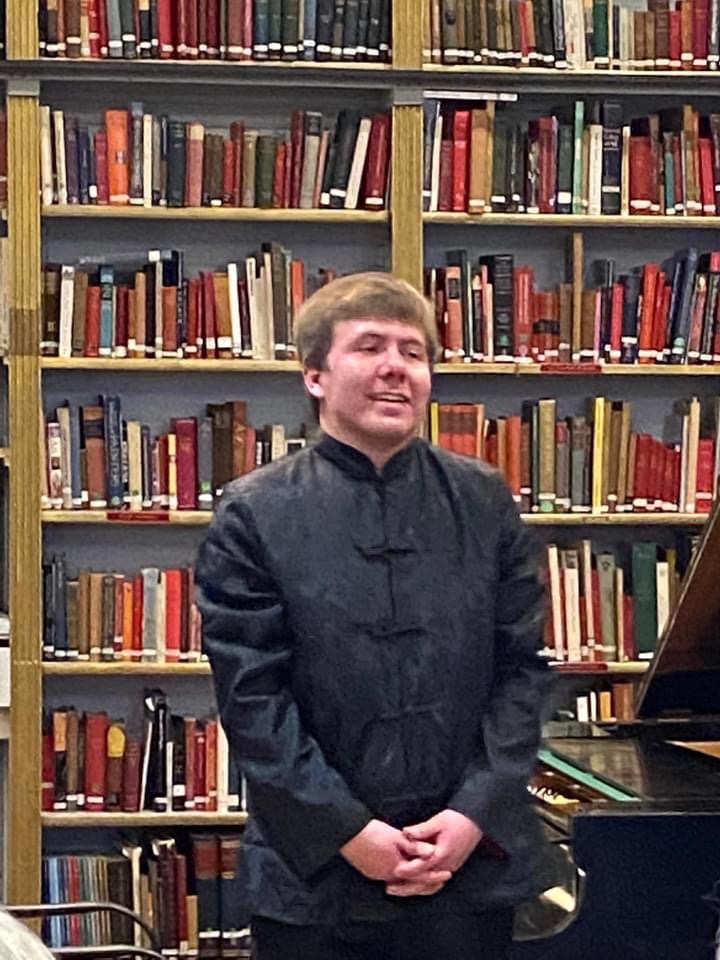
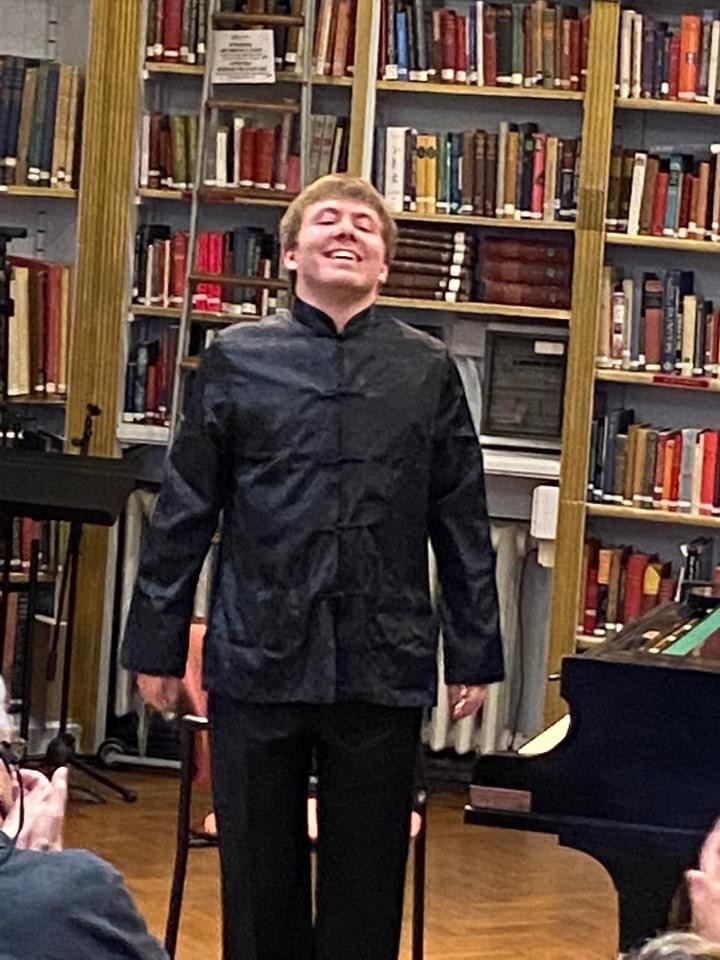
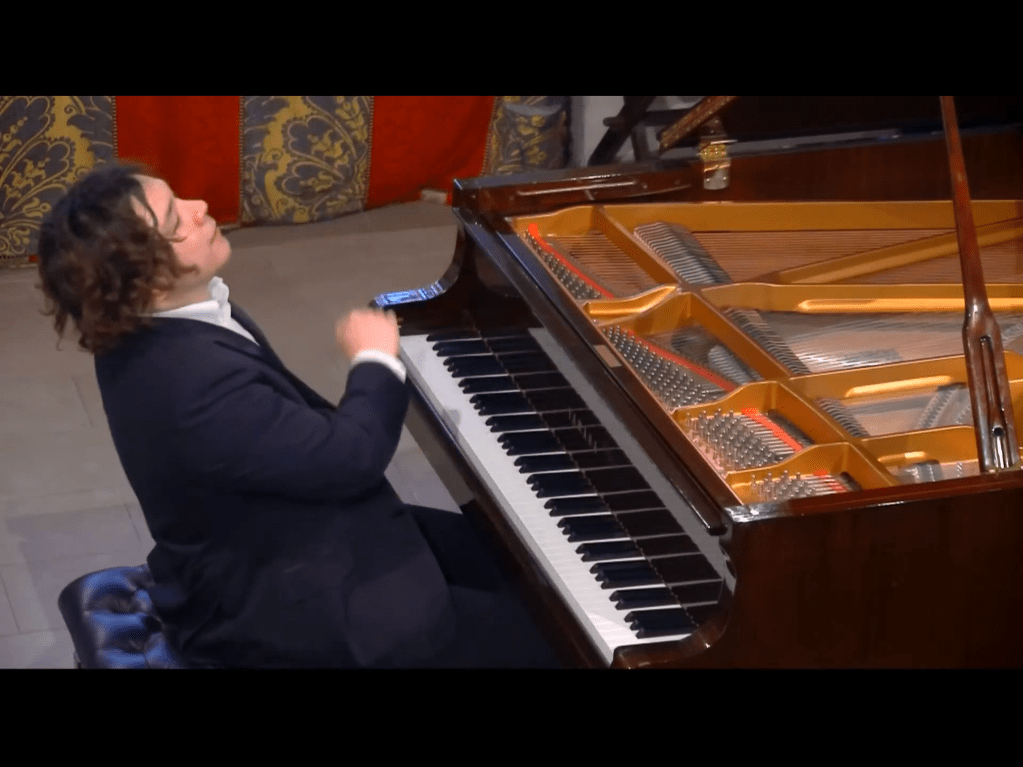
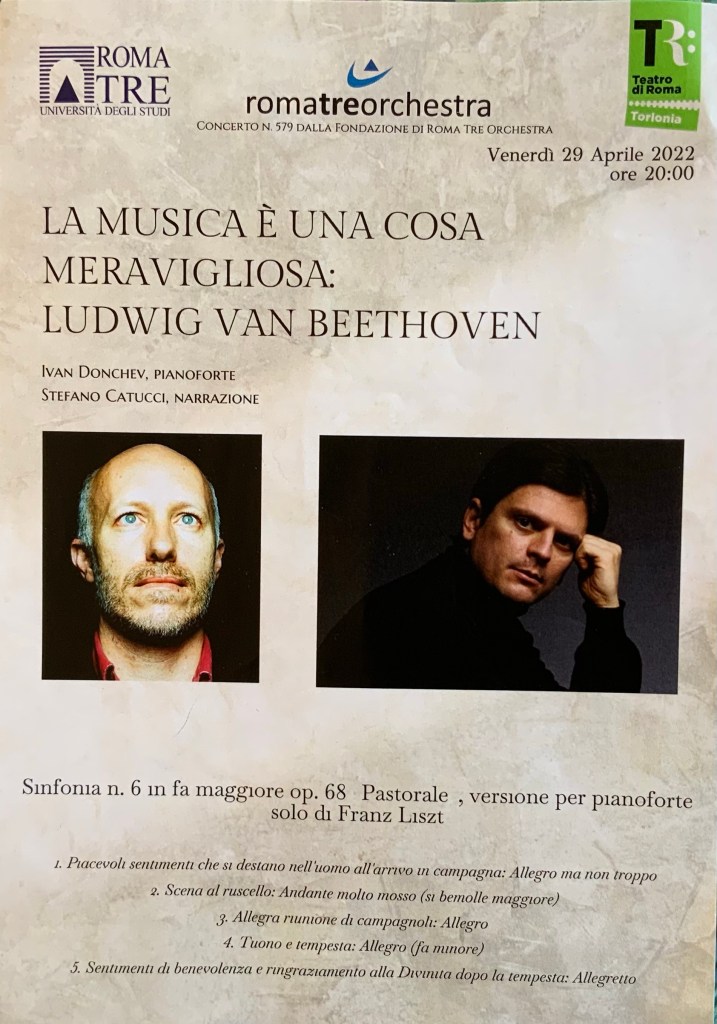
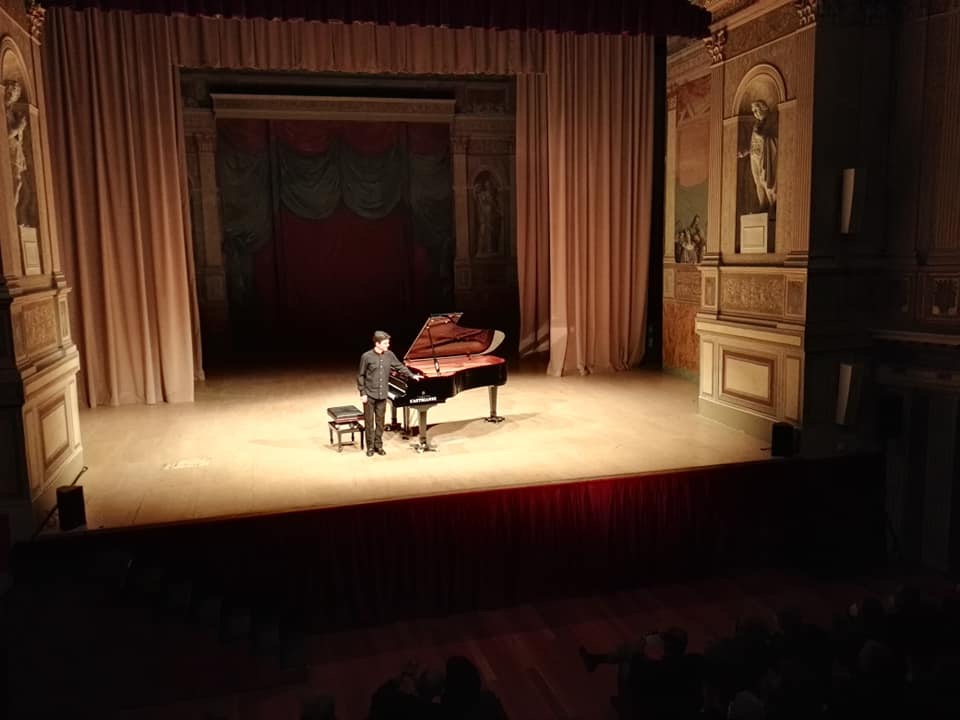
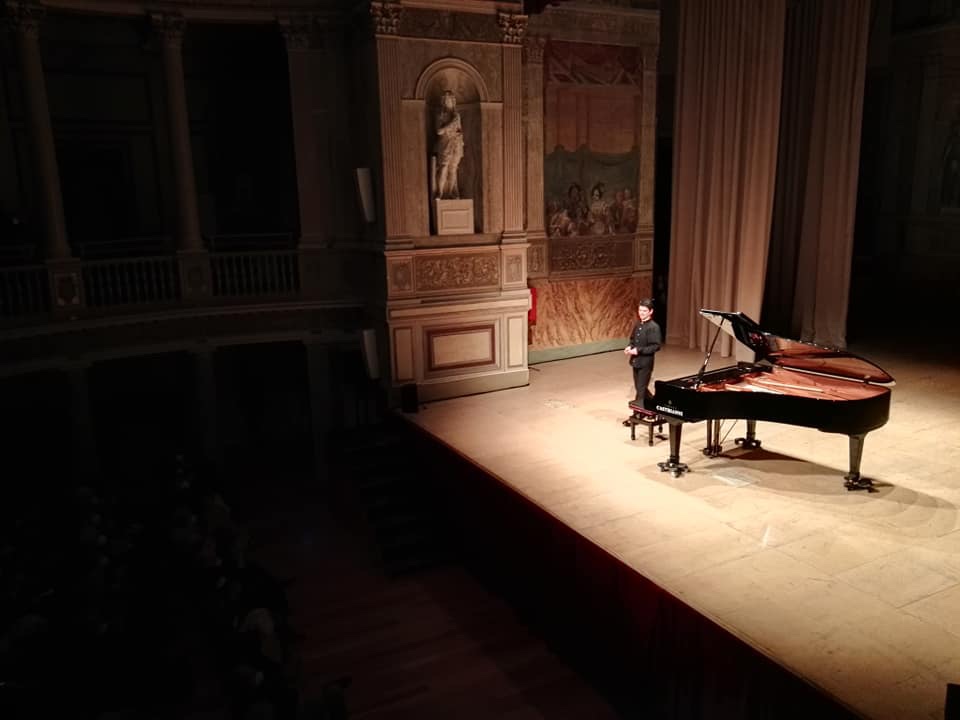
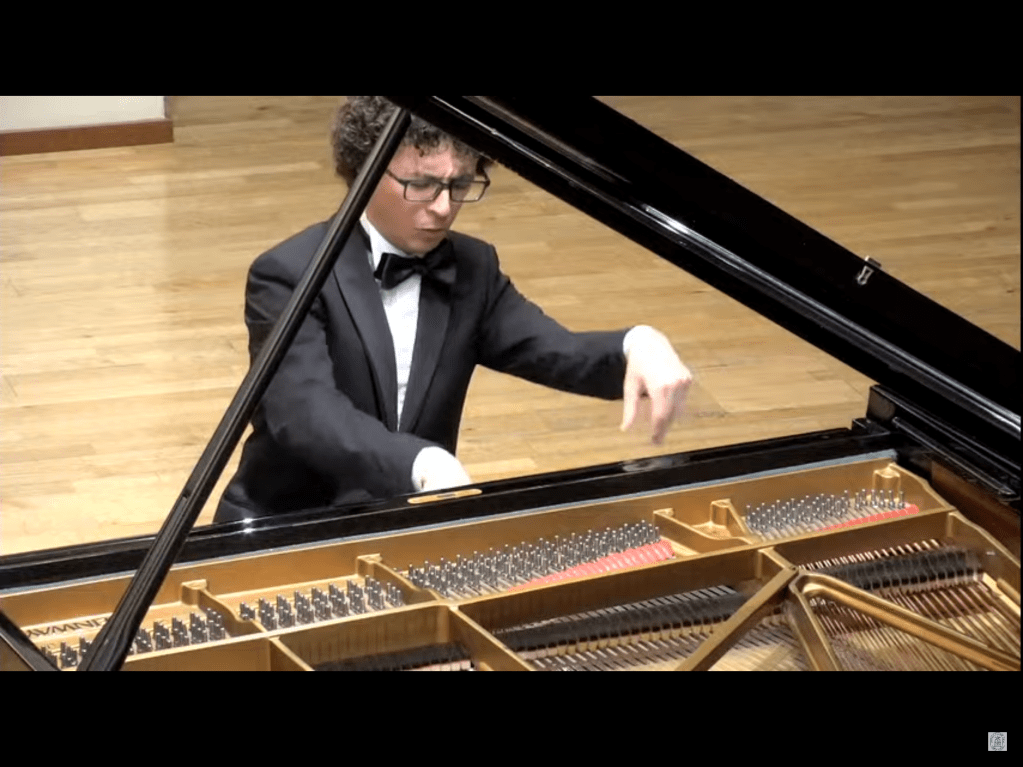
It has now reach the penultimate concert with Liszt the transcriber of Beethoven .A very interesting short introduction by Prof Stefano Catucci was followed by a remarkable performance by Ivan Donchev.I am indebted to Leslie Howard the renowned Liszt expert for his detailed description of this transcription below and can only add that listening to Ivan’s performance I was totally amazed by how faithful Liszt’s transcription is .Not only,but the magical sounds and tumultuous virtuosity brought the symphony vividly to life .The Thunderstorm showed Ivan’s quite amazing technical prowess but always at the service of the music as it described the drama of the storm so clearly.The gentle lilt to the ‘Scene by the Brook’ was beautifully captured and the birdsong that Leslie Howard describes so well was played with such clarity and colour and showed off Ivan’s quite remarkable technical command.The beauty he brought to the ‘Shepherds song and the Joyful,thankful feelings after the storm ‘ was ravishing in its luminosity and subtle whispered fluidity of tone.
What more could one ask after such a transcendental performance by a pianist who has recently become a father to a son that he has very aptly christened ‘Leo’.A Lion indeed as Ivan astonished and seduced us with a performance of such ravishing colour and style and above all a transcendental command of the piano.I have heard and admired Ivan many times but today his performance was quite overwhelming .It was even more astonishing as it was played without the score, something all too rare in these times of the ever more invasive ‘ I Pad’.
But this was by no means the end of the recital as he had obviously thought very carefully about an eventual encore.And it just shows his great artistry as he sat at the piano and intoned Schumann’s Abschiedfrom Waldscenen op 82 .It was the perfect link that just enhanced Beethoven’s own thanksgiving and created the same magic that Ivan’s mentor Aldo Ciccolini would create at the end of his memorable recitals.It was played with ravishing whispered sounds with the streams of golden counterpoints weaving their way around the beauty of the melodic line.After such a moving experience an ever more insistent public was rewarded with a scintillating performance of Chopin’s ‘Cat’ waltz where Ivan’s sense of style and charm completed a memorable evening.
Prof Catucci speaking so eloquently about Beethoven and Liszt
I am indebted to the Liszt expert Leslie Howard who I quote from his learned writings of this transcription of the Sixth Symphony. “Liszt had a great success with the Sixth Symphony from the beginning. It was probably the first of the Beethoven symphonies that he set himself to transcribe, and he played at least the last three movements at many a public concert. Beethoven completed the work at about the same time as the previous symphony, in 1808 and the Sixth remains perhaps the most congenial of all of Liszt’s symphonic transcriptions from a pianistic point of view.In the ‘Awakening of joyful feelings upon arrival in the countryside’ (Liszt gives only French titles in the first version) one revels in the joy of finding all of Beethoven’s textures not a ripple or birdsong is missed in the ‘Scene by the Brook’ – to the extent of some dangerous left-hand stretches simultaneous with combined trills and melodies in the right hand. And tranquil athleticism is the only way to describe the requirements at the recapitulation with its added clarinet and violin arpeggios.Liszt apparently told Berlioz that he played the second eight bars of the ‘Happy gathering of the country folk’ slightly slower because they represented the old peasants – in contrast with the young peasants at the opening and it seems like an excellent idea to have in mind whilst performing the piece. High points of the transcription include the wonderfully mad bit with the fiddle ostinato, the oboe melody and the artless bassoon – quite a challenge at the keyboard – and the whole 2/4 section which imitates the bagpipe and brings the flute counterpoint into much finer prominence than most orchestral balance usually achieves.’The Thunderstorm’ is an inspired piece of virtuoso writing. Just as Beethoven extends the demands on his orchestra in the interest of special effects, so does Liszt mirror them in equivalent pianistic devices, and the relief when the storm subsides is almost tangible in both cases.’Similarly, the ‘Shepherds’ Song. Joyful, thankful feelings after the storm’ finds Liszt at one with Beethoven’s spirit.”
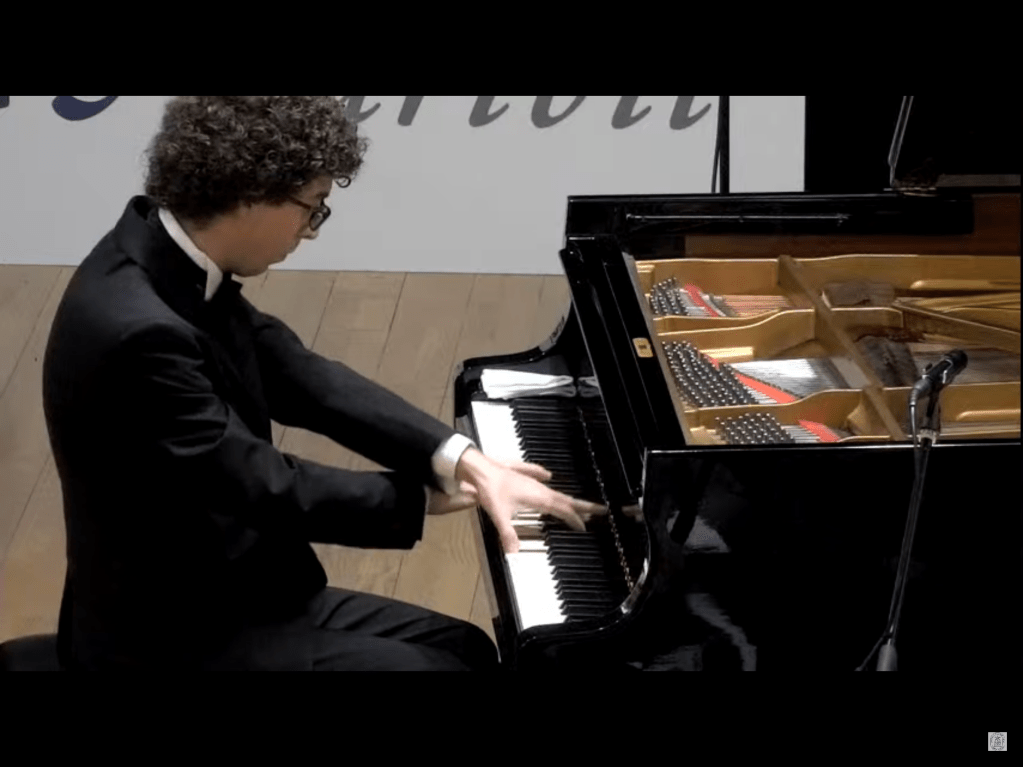
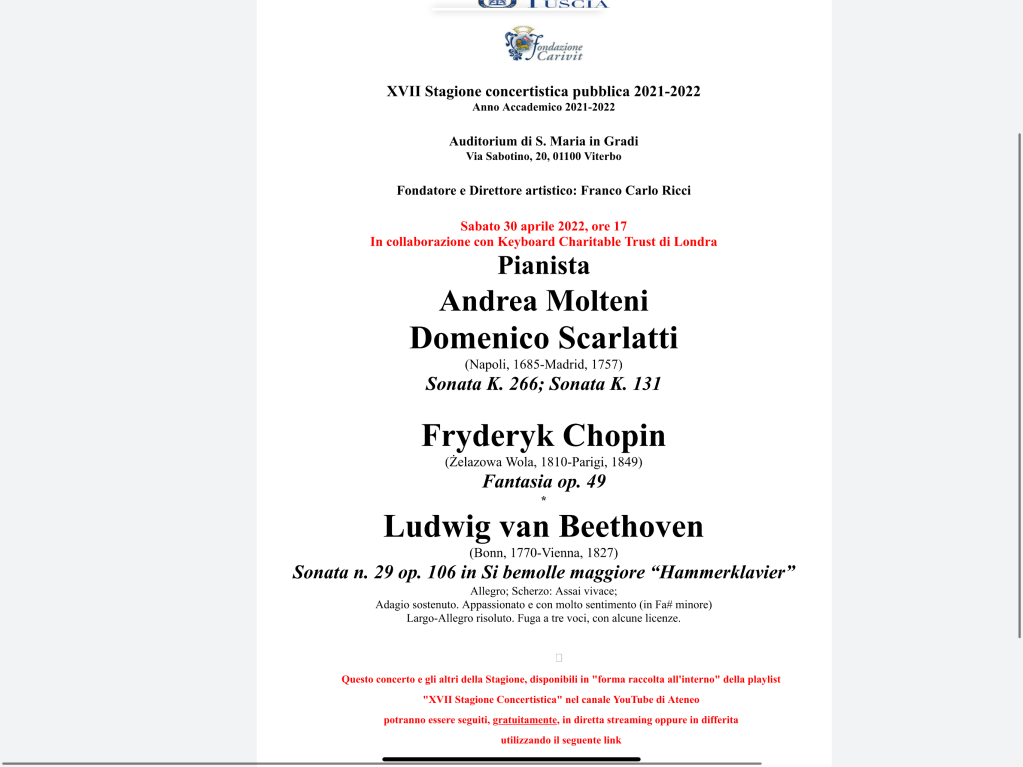
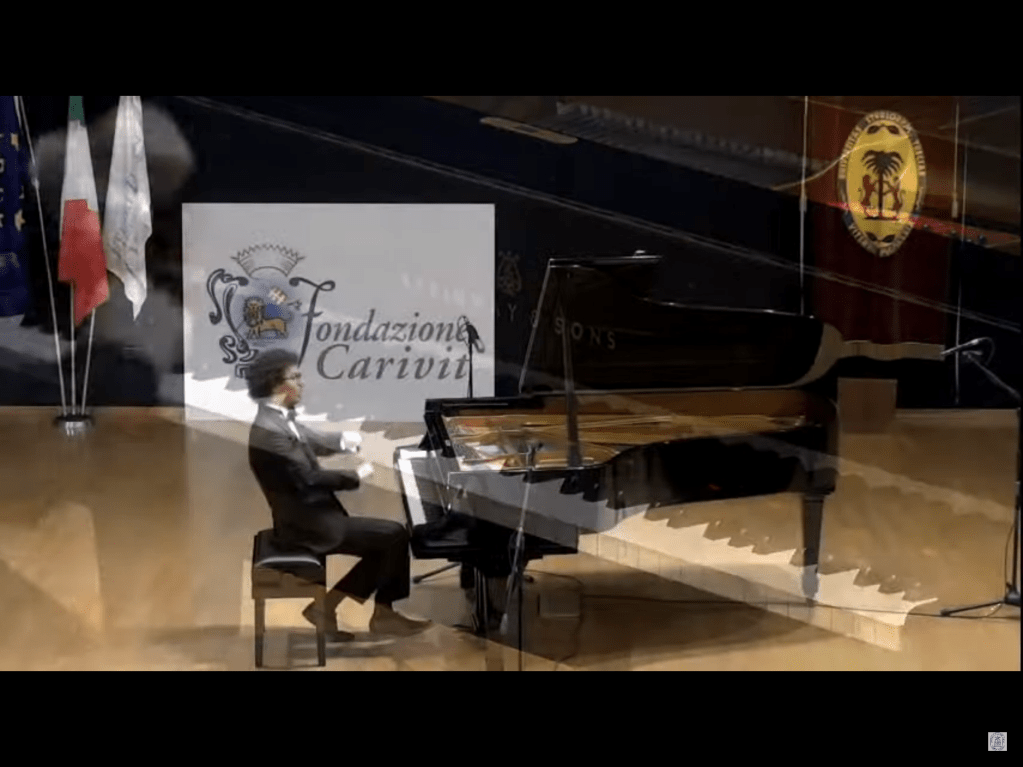
A quite astonishing recital from Andrea Molteni with a performance of Beethoven’s mighty Hammerklavier Sonata that was monumental in its relentless forward movement and total authority. His intellectual and architectural understanding of this great masterpiece was of someone of a maturity way above his actual 23 years.There was a clarity and unwavering vision that from the very first opening fanfare demanded our attention.The treacherous leaps played as Beethoven asks with one hand as this is a work only for fearless musicians that are ready to risk all with Beethoven.There were moments of sublime beauty in the Adagio sostenuto that Beethoven implores to be played with passion and great feeling.And as if that was not enough Beethoven demands the near impossible in the mighty final fugue which ends this the longest of all his thirty two sonatas. I will never forget the monumental performance of Rudolf Serkin in London many years ago where the tension and endless struggle of playing op 106 left him in a state of complete abandon on the final great chord as at the end of a momentous journey he was emotionally in pieces as we in the audience were too. Serkin was well into his sixties then and Andrea is only in his early twenties.As Andrea matures he will sweat more blood and tears over the superhuman feats that he now performs with astonishing mastery. Menuhin as a child prodigy could play all the greatest concertos when he was in his early teens .It was a natural mastery and musicianship that he never questioned in his innocent successful youthful career.It was when he was well established on the world stage that he began to question all that had been so natural in his youth and began to delve deep into the inner meaning of all he was doing.
Andrea’s is one of the most remarkable performances I have heard for its clarity,musicianship and architectural understanding it will now grow in stature as life’s struggle begins to take over. It will undoubtedly open an even deeper understanding of Beethoven’s own great struggle with life which culminated in this Hammerklavier Sonata. After this sonata was to come the final great trilogy where Beethoven was at last to come to peace with life and himself and hear in his private ear the paradise that awaits us all. The incredible genius of Beethoven was that when totally deaf he could find a way of notating the sounds for posterity that only he could hear in his head.
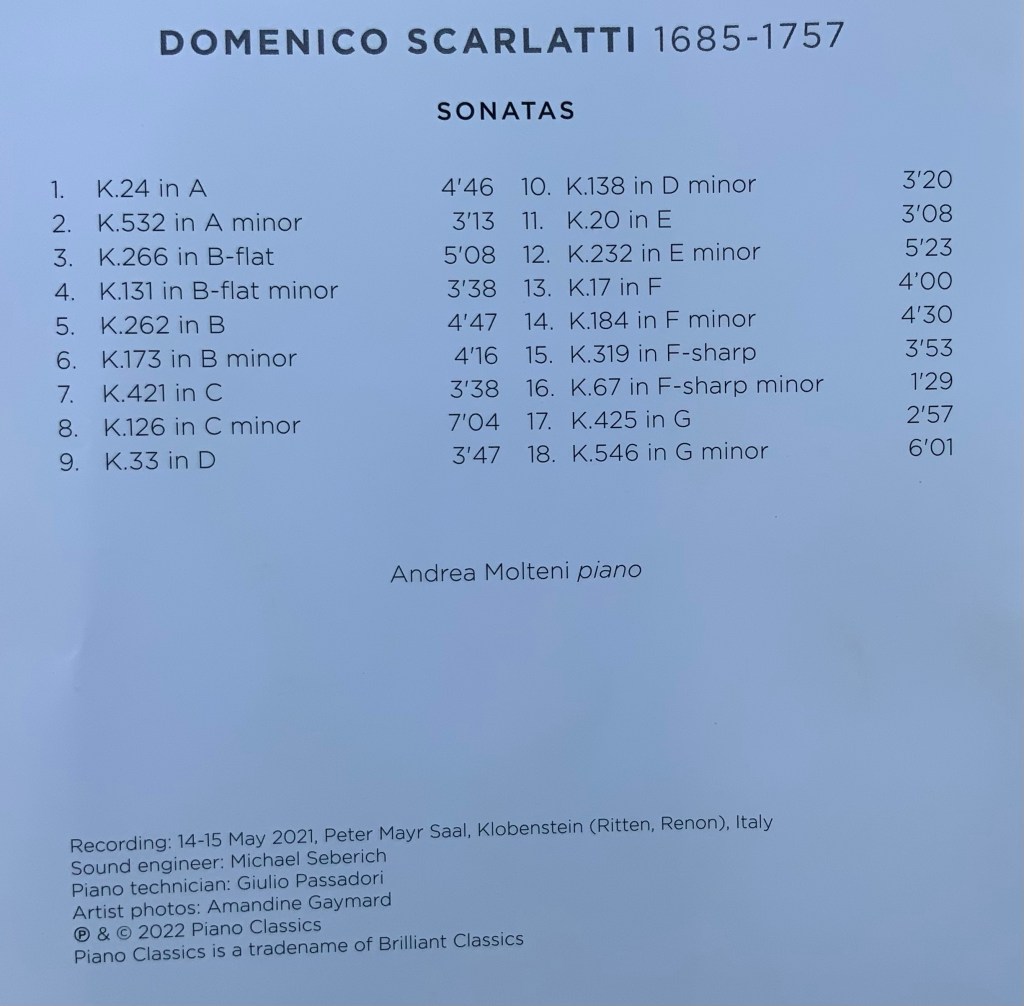
The three Scarlatti Sonatas that Andrea played (two in the programme and one as an encore) were scintillating jewels that just poured from his fingers with such ease and delicacy.The infectious rhythmic drive and banging of the drum in K 131 was played with such drive and precision contrasting with the graceful beauty and delicate colouring of of K.266 where the ornaments glistened like jewels in his remarkable hands. These are all from his new CD of some of the lesser known Scarlatti sonatas chosen with such intelligence and care from the 550 or more that Scarlatti had left us.
There was aristocratic playing too of great passion and excitement in the F minor fantasy of Chopin that prefaced the Hammerklavier.The Lento sostenuto was played with such simple beauty and the great technical challenges of the outer episodes were incorporated into the musical shape with great style and beauty.
Two encores from a very insistent audience brought not only another scintillating Scarlatti Sonata but a performance of Chopin’s Study op 10 n.4 that was quite hair raising in its audacity and passionate technical authority.
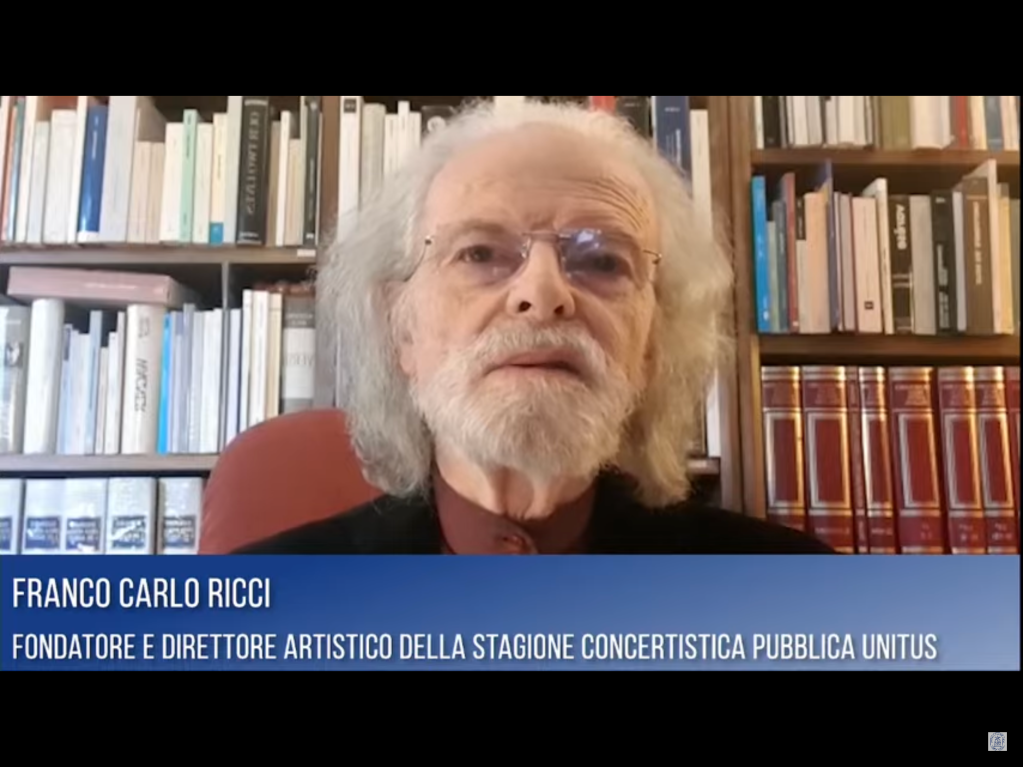
Prof.Franco Ricci artistic director and creator of the concert series in Viterbo now in its twenty fifth year.It is in his beautiful hall in the Tuscia University of Viterbo where the Keyboard Charitable Trust has found a home for so many of the remarkable young musicians that it encourages at the beginning of their career with tours in Italy,Germany,USA and many other parts of the world. https://christopheraxworthymusiccommentary.wordpress.com/2021/01/15/alberto-chines-a-musician-in-viterbo-for-the-keyboard-trust/
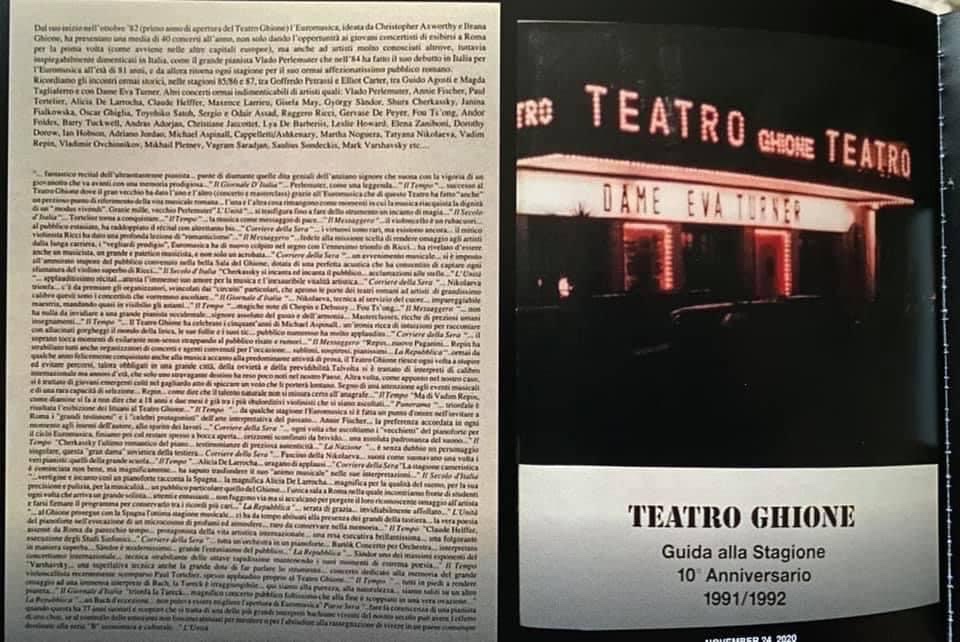
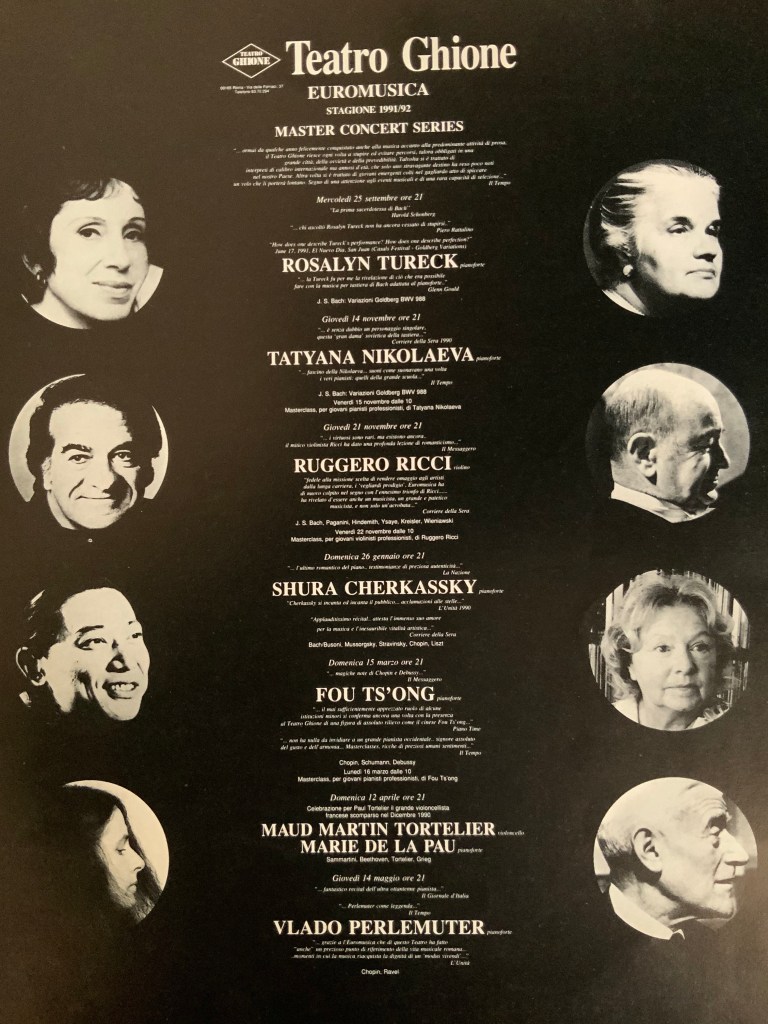
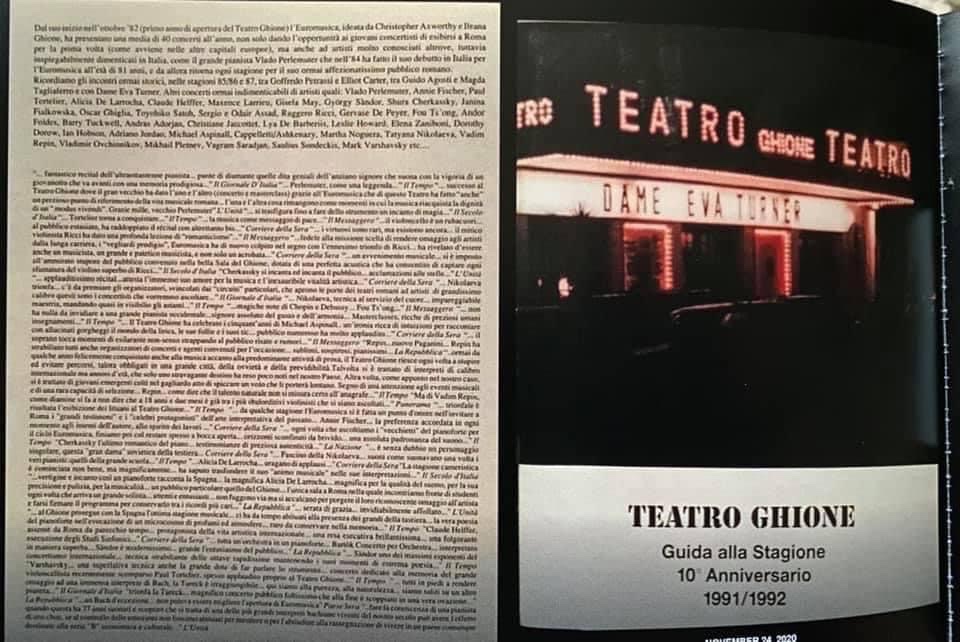
With COVID restrictions there have been some inevitable cancellations and Franco Ricci a great friend of forty years often asks me on these occasions if I can suggest a substitute.Something I am very happy to do as artistic director not only of the Keyboard Trust but also of the Euromusica Concert Season at the Ghione in Rome which has enhanced the cultural life of the Eternal City since the opening of the theatre with my wife,Ileana Ghione ,in 1982.
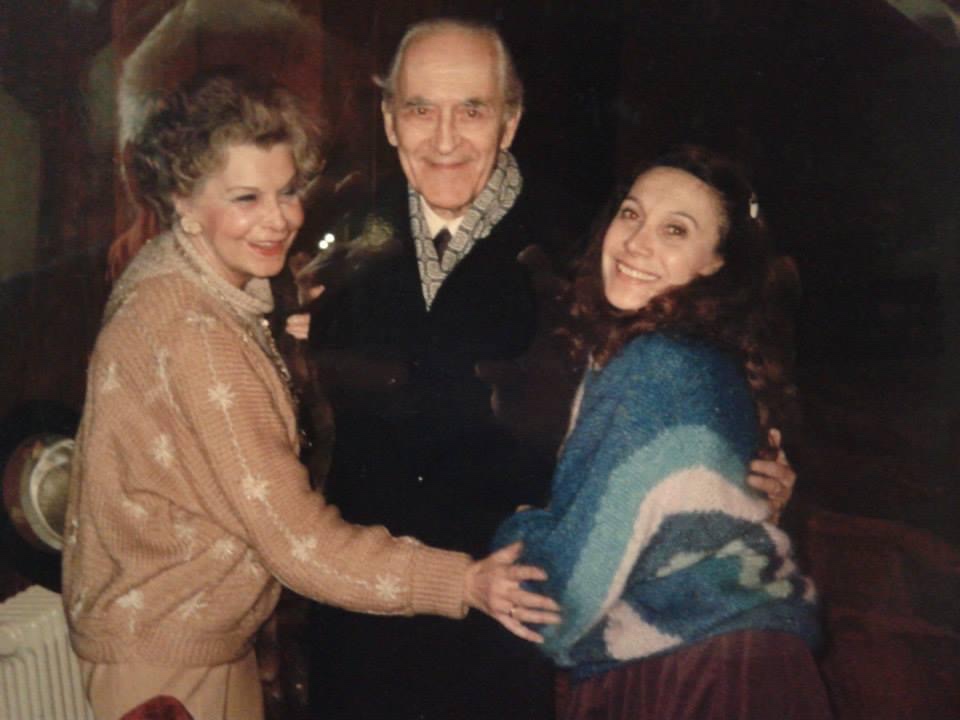
Ileana Ghione in the theatre that bears her name with Lydia and Guido Agosti
Some of the greatest musicians have found a home in Rome where before the opening of the Parco della Musica there was only one concert hall to satisfy the needs of so many artists who had been excluded from Rome for lack of space.The International Piano Academy in Lake Como was created by another friend in Rome ,William Naboré in 1993 .
Bill ,who I had heard give a memorable performance of the Diabelli Variations at the Gonfalone in 1972,would often ask me if I could persuade some of the great artists playing for us in Rome to give up a week of their time to live and work with some of the greatest young talents who had flocked to his new mecca of piano playing.
William Naboré at home with Andrea Molteni a pianist who he has taken under his wing for the past three years.
Bill lives and teaches also in Rome so when Franco Ricci sends out an alarm signal I discuss with Bill to decide who best might be ready to stand in usually at short notice.This season it has happened three times and Shunta Morimoto and Andrea Molteni both studying with Bill were recommended by him.
Their extraordinary success has been noted not only in Viterbo but also worldwide due to the excellent streaming that the University still provide even though public is now permitted to attend.
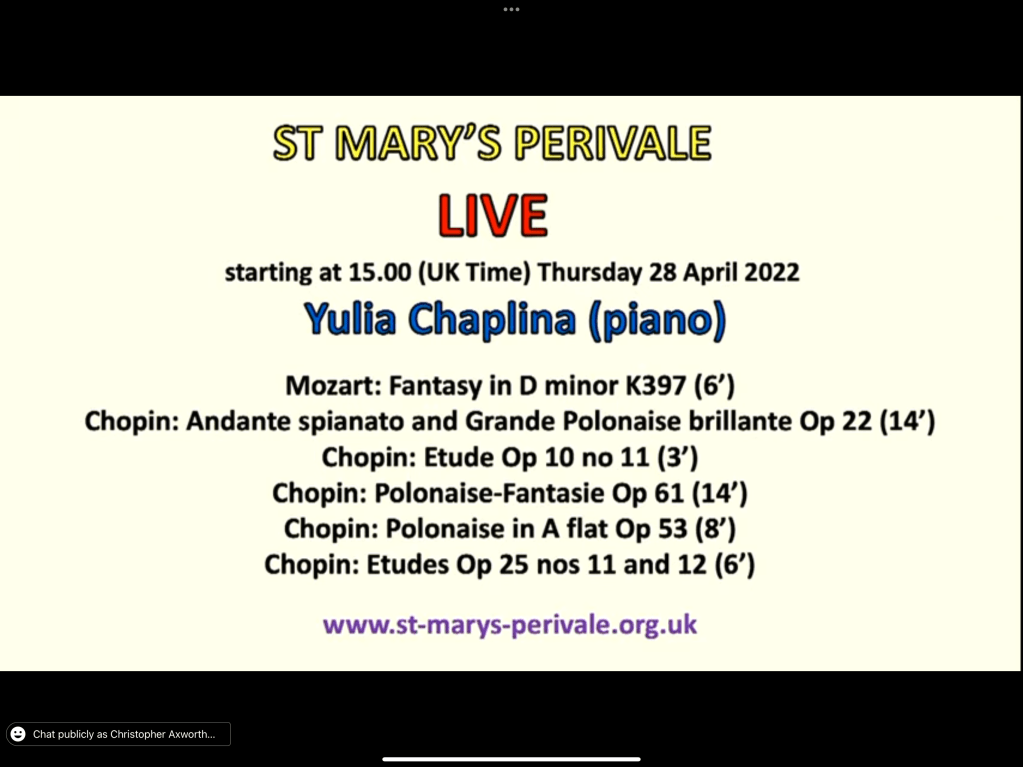
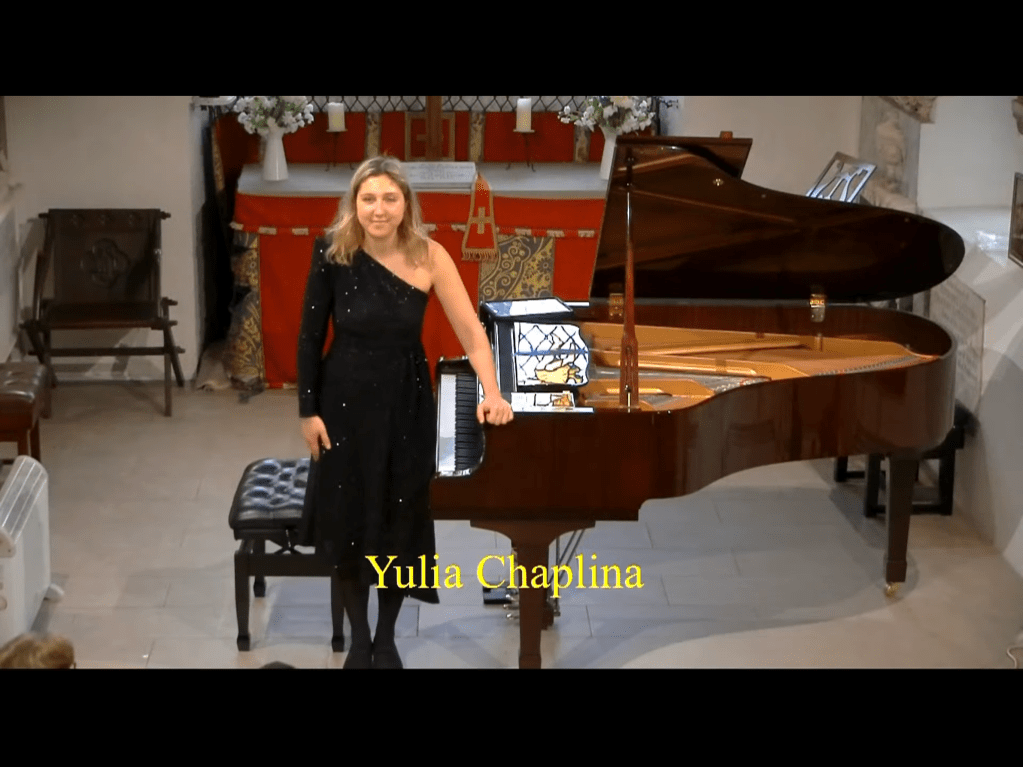
What a refreshing thing it was to hear Yulia Chaplina’s Chopin recital at St Mary’s today.An improvised solo recital instead of the advertised violin and piano duo.It is something of a rarity these days to hear an all Chopin recital but I remember the recitals of Smeterlin,Askenase and Rubinstein filling the Festival Hall on a Sunday afternoon.Rubinstein would add four mazurkas by his friend and compatriot Szmanowski to cleanse the air for the second half of his all Chopin recitals.How could one ever forget Rubinstein playing a recital at the Fairfield Hall Croydon,dedicated to his compatriots of the Polish Air Force.He sat at the piano and immediately intoned the Polish and English national anthems before embarking on a memorable all Chopin recital.Croydon comes to mind too as it was where Peter Katin lived,in St Peters Road,a pilgrimage that all aspiring pianist would make in that period.We should not forget his annual Chopin recitals in a sold out Festival Hall that were memorable even though not particularly admired by Joan Chissell of the Times.It was a miniature Chopin painted in porcelain not blood and tears but nevertheless very beautiful and we should not forget the stature of this rather underrated English pianist. It was the same love that we heard today from an artist who has lived and loved these pieces for a long time and could add freedom and timelessness to her artistry in works we know so well.
Yulia’s playing was certainly not miniature as she carved out a programme that showed the evolution of Chopin’s pianistic genius.
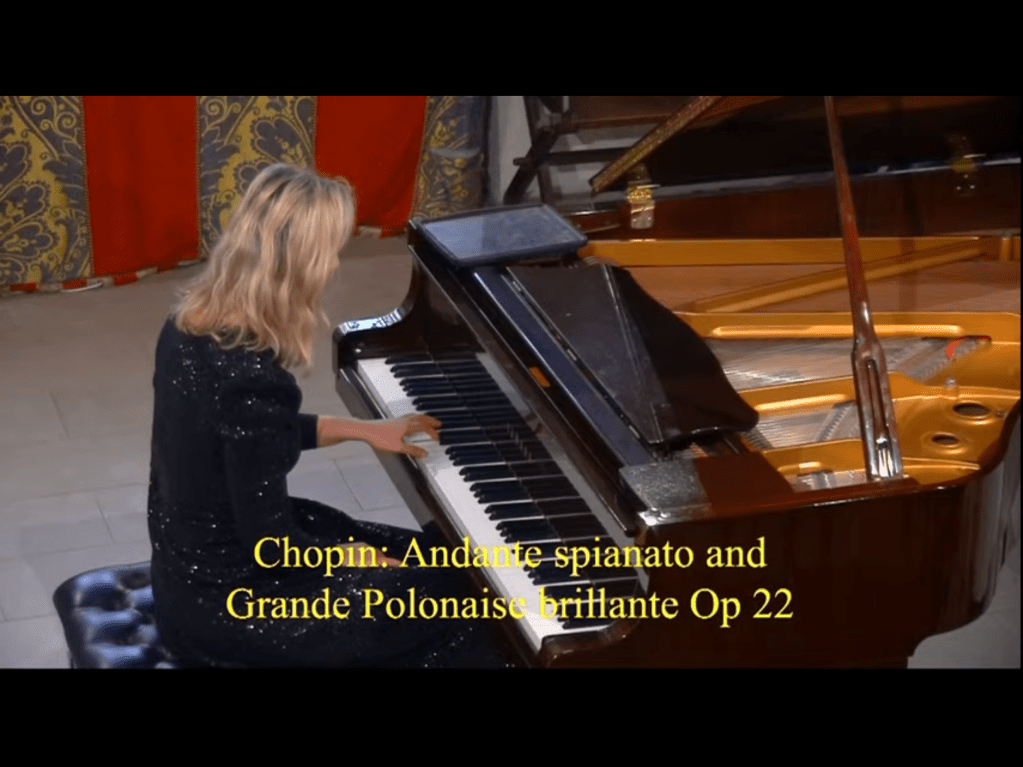
Mozart ,together with Bach,was one of Chopin’s most admired composers and opened the programme with his D minor Fantasy.It was played with a refreshing simplicity and sense of improvised discovery and was an ideal introduction to the early Andante spianato and Grande Polonaise that Chopin would have ravished the audiences of the Parisian salons with,as a twenty year old Polish émigré.
The Grande polonaise brillante is a work for piano and orchestra, although the piano part is often played on its own. The Andante spianato (spianato means “even” or “smooth”) for solo piano was composed as an introduction to the polonaise after Chopin received a long-awaited invitation to perform in one of Habeneck’s Conservatoire Concerts in Paris. This was the only time Chopin had ever used the term spianato as a description for any of his works.There was beautiful cantabile and superb sense of balance in Yulia’s playing with very delicate embellishments and an aristocratic sense of timelessness.There was great rhythmic impulse to the Polonaise but a feeling that there was time to allow the music to unfold in a beautifully natural way.Even the dramatic octave flourishes and scintillating passage work were incorporated into the overall shape with such loving care and dynamic control.
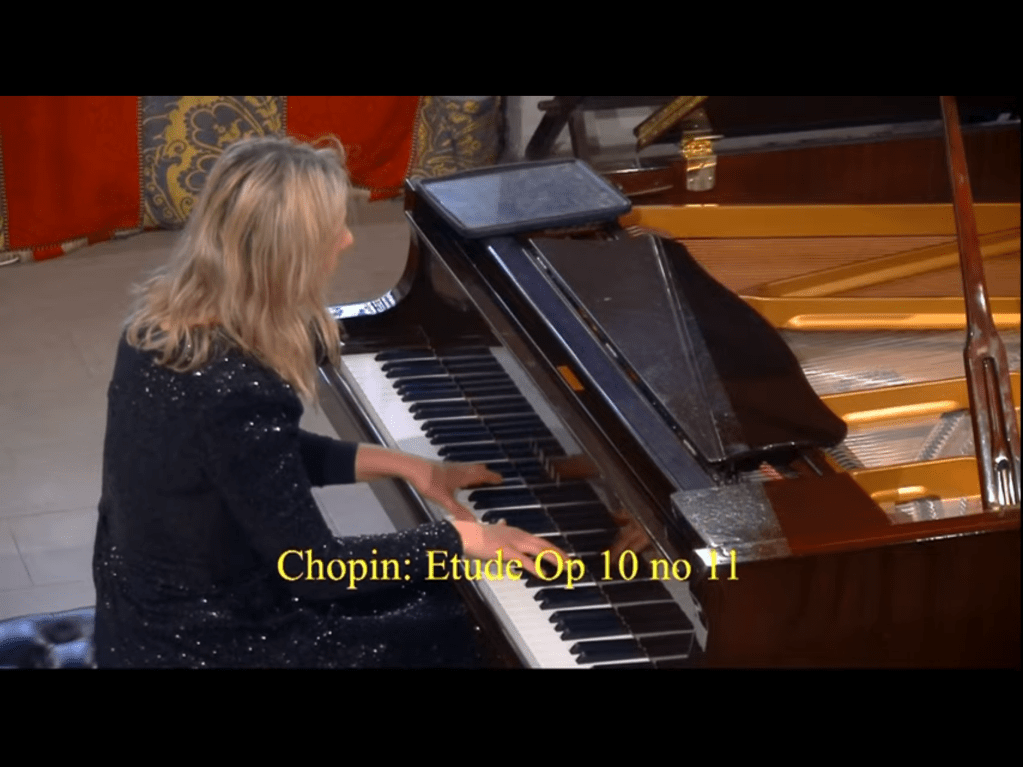
The arpeggio study op 10 n.11 too was allowed time to unfold as the marvels that Chopin unravels were revealed with such subtle colouring and sense of style.It became in Yulia’s sensitive hands a miniature tone poem – ‘canons covered in flowers’ indeed.
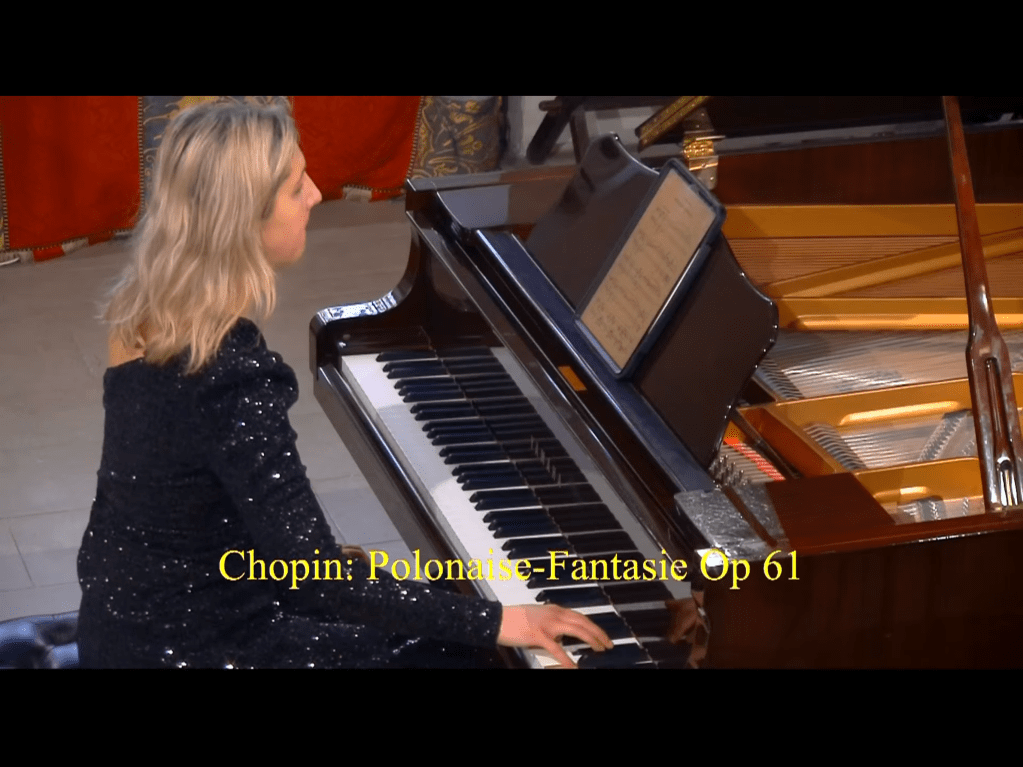
The Polonaise-Fantasie in A-flat major, Op. 61, is dedicated to Mme A. Veyret and was written and published in 1846 just three years before Chopin’s untimely death. It was slow to gain favour with musicians, due to its harmonic complexity and intricate form.But as the great Chopin expert Arthur Hedley wrote in 1947 it ‘works on the hearer’s imagination with a power of suggestion equaled only by the F minor Fantasy or the fourth Ballade’.It is indeed a remarkable work more Fantasy than Polonaise with its magic opening of washes of colour that pass over the entire keyboard preparing us for the gentle first appearance of the Polonaise rhythm.There was an architectural shape to Yulia’s playing but also a sensitivity and sumptuous beauty especially in the mellifluous central episode before the explosive trills that lead to the triumphant climax that dies away to a mere whisper with a final resigned A flat on high.
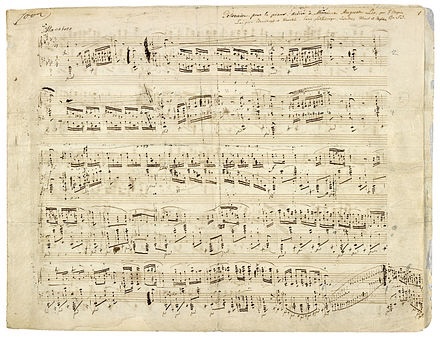
Manuscript of the Polonaise op 53
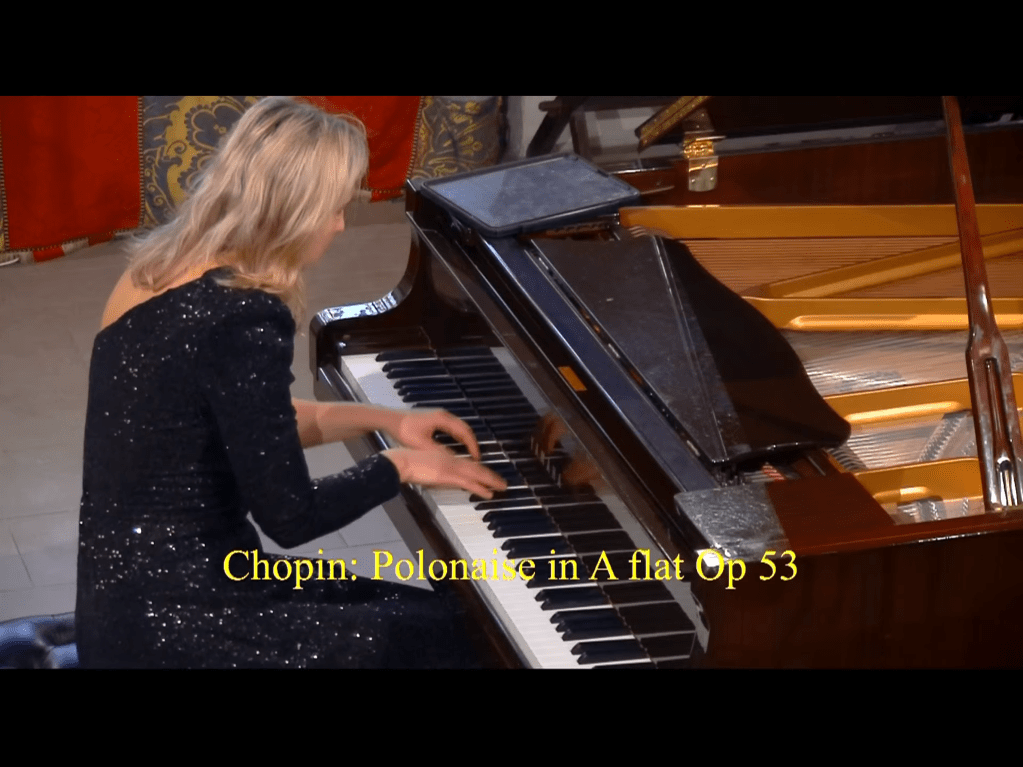
The same A flat that opens the Heroic Polonaise op 53 written only four years before the Polonaise Fantasie
George Sand in one of their private letters wrote passionately, “L’inspiration! La force! La vigueur! Il est indéniable qu’un tel esprit doit être présent dans la Révolution française. Désormais cette polonaise devrait être un symbole, un symbole héroïque!” (“The inspiration! The force! The vigour! There is no doubt that such a spirit must be present in the French Revolution. From now on this polonaise should be a symbol, a heroic symbol”).
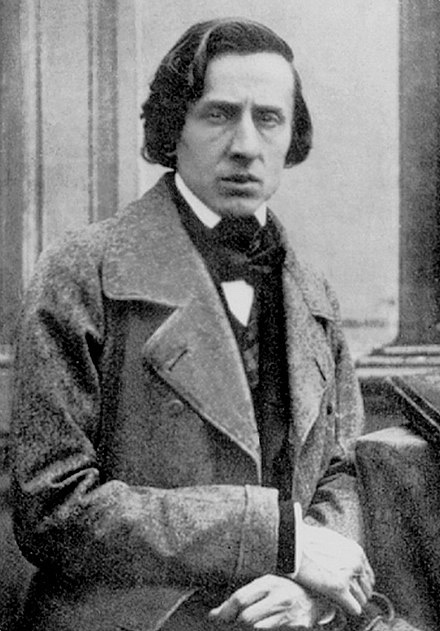
Chopin daguerreotype taken around 1847 in the studio of Louis-Auguste Bisson
Yulia played it with great energy but also with beauty and sumptuous rich sounds.The left hand octaves of the military charge were played with absolute authority but never overpowering the melodic line that rides above it.There was such subtle colouring to the build up to the final triumphant outpouring of the Polonaise theme and a coda of great excitement and transcendental technical command.
The last two studies from op 25 were played with great technical assurance and ravishing sounds with an aristocratic sense of architectural line.It brought this refreshingly simple Chopin recital to a wonderful end and as Dr Mather said is a good preview for the 17 hours of Chopin’s works that will be played by many different pianists over a weekend next October.
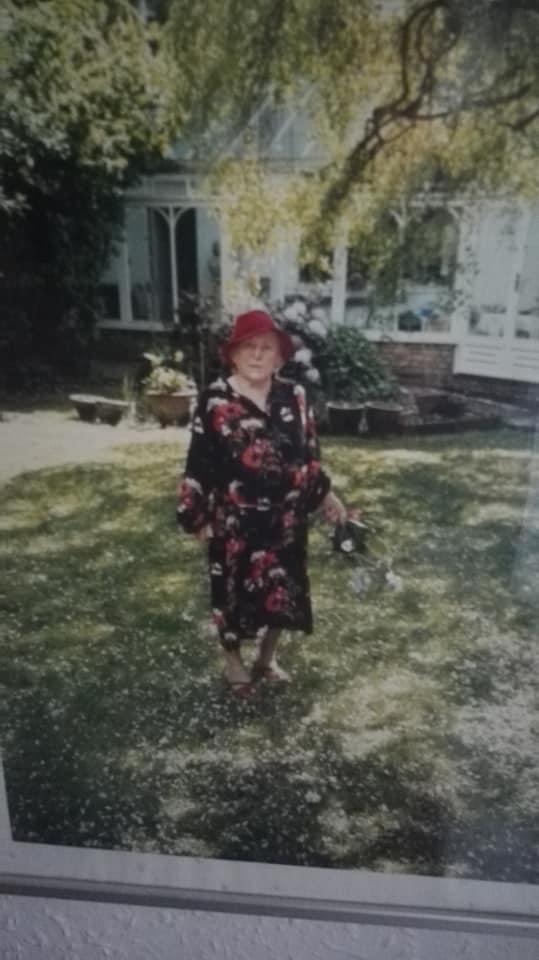
My mother with my wife Ileana Ghione in our garden in Kew
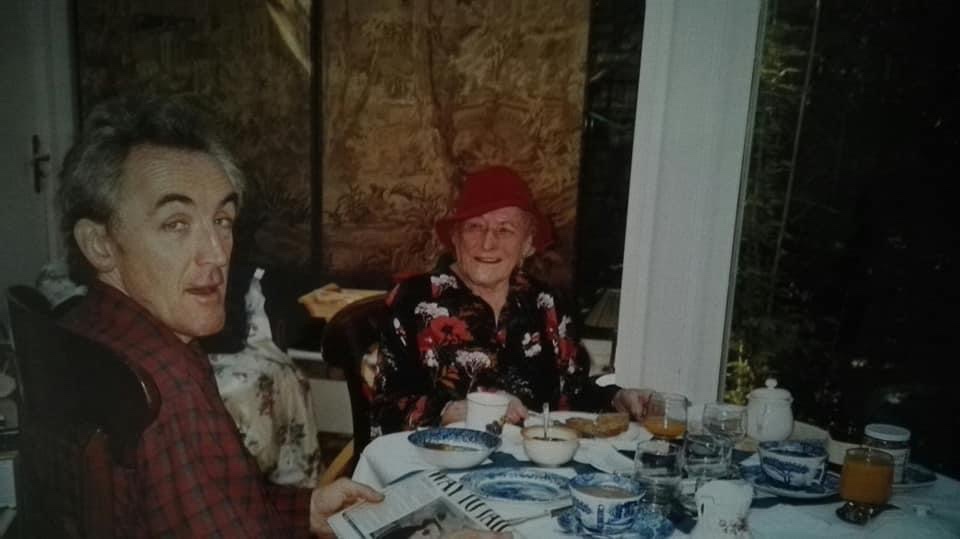
As a final note to remember my mother whose 109th birthday it would have been today.When I was still a child she would accompany me to many Chopin recitals of Jan Smeterlin at the Festival Hall which was where my passion for music was born.
Yulia Chaplina is the winner of 7 international piano competitions. Since winning the First Prize & the Gold Medal in the prestigious Tchaikovsky International Competition for Young Musicians, she has performed regularly as a soloist in many of the world’s finest venues, including the Wigmore Hall and the Southbank Centre in London, Berlin’s Philharmonie, the Grand Halls of the Moscow Conservatoire and the St. Petersburg Philharmonia, Bunka Kaikan Hall in Tokyo and many other concert halls. She holds a Bachelor’s degree from the University of Arts (Berlin), Masters in Music & Fellowship from the RCM (London). Yulia received music coaching from Mstislav Rostropovitch, Andras Schiff, Mitsuko Uchida, Paul Badura-Skoda, David Waterman, Steven Isserlis, Thomas Adès and Liliya Zilberstein. She has been invited to participate as a jury member in several music competitions in the UK, Russia and Italy. Her students have won prizes in many prestigious piano competitions. Yulia is the Artistic director of the Prokofiev Festival in London. Yulia is a regular music contributor for Russian Arts & Culture and has written extensively for many UK music publications, including Gramophone, Pianist, International Piano and BBC Classical Music magazine.
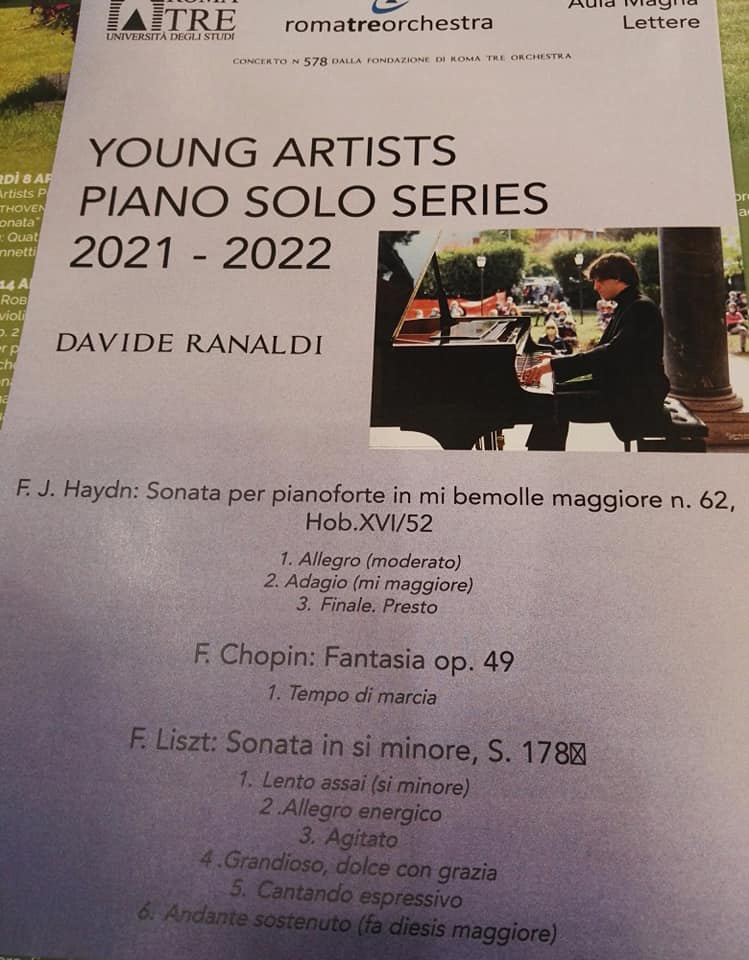
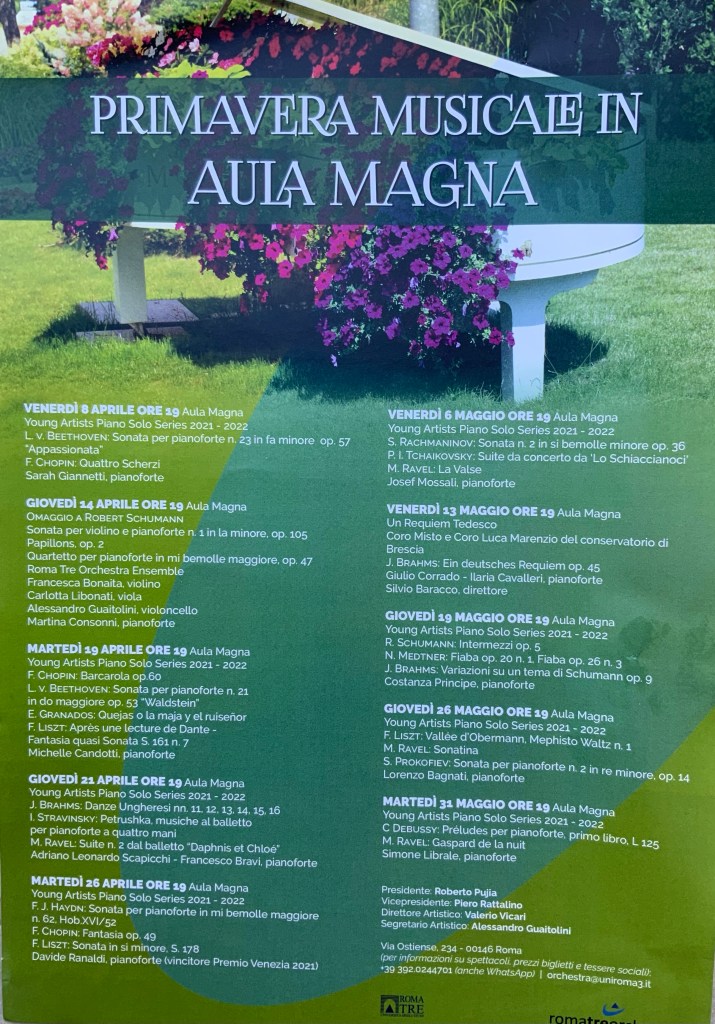
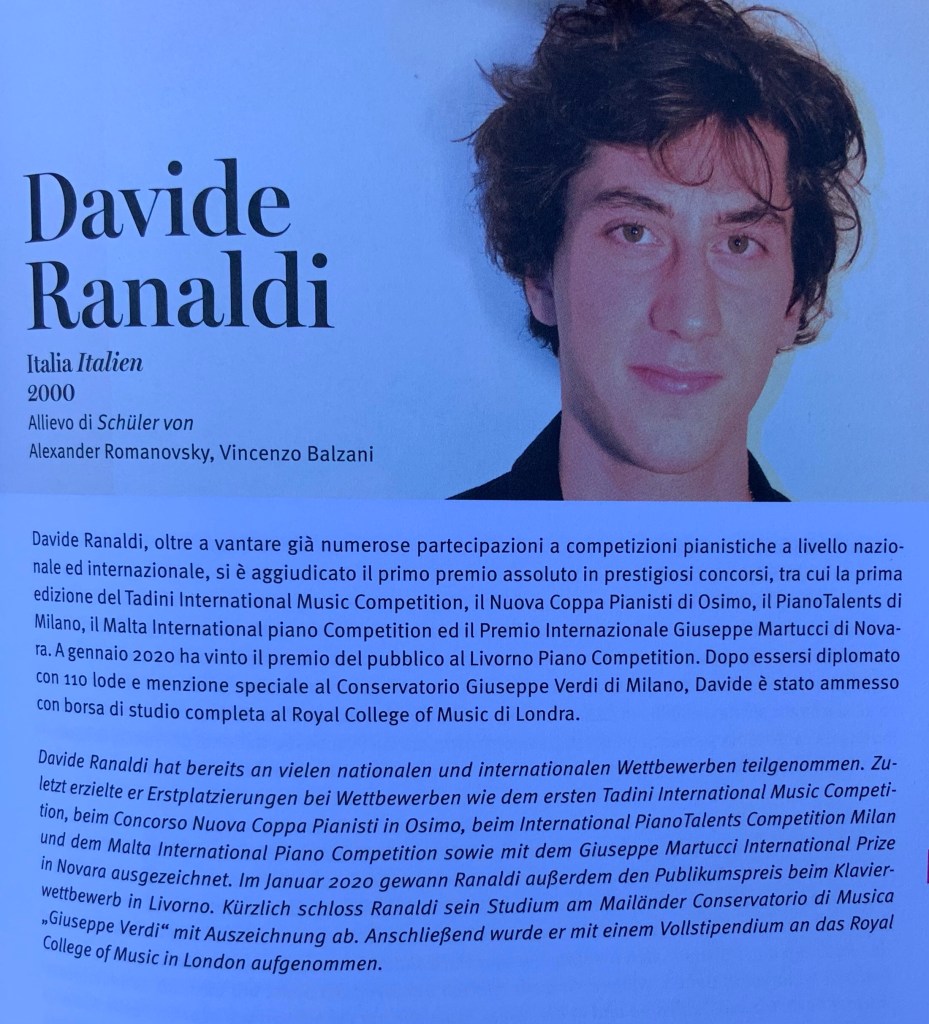
Some superb playing from Davide Ranaldi a student of Magarius and Romanovsky and recent winner of the prestigious Premio Venezia. Thanks to Roma Tre and its enlightened artistic director we are able to hear these superb young talents in Rome in the Aula Magna or in the beautiful theatre of Villa Torlonia. Hats off to Roma Tre for bringing in a superb new Fazioli concert grand for this series entitled :’Primavera Musicale in Aula Magna’.
On a wonderful summers day here in Rome I could enjoy a Roma Tre protogee Pietro Fresa playing in the UK and a couple of hours later Davide Ranaldi live in Rome. More of Pietro Fresa in my next review but first I would like to express my astonishment at the performance of a Haydn Sonata by this young Italian musician. https://christopheraxworthymusiccommentary.wordpress.com/2021/10/30/mozart-triumphs-at-torlonia-with-jonathan-ferrucci-pietro-fresa-sieva-borzak/ A performance of searing intensity and total commitment that from the very first noble outcry it was evident that we were in the presence of a master. From the very first notes we were taken by storm and held in his hands until the final Presto.There was great authority and weight to his performance with a breathtaking rhythmic energy that held us captivated as he brought such character to each of the genial episodes of this still much underrated composer.There was a colour and sense of style that left no doubt about a great musical personality showing us the way.
It was interesting to see Davide as Kabos would say ‘all curled up like a croissant’ his head down in total concentration on every note that he played with animal like conviction.Was not Richter just as anti conventional as he attacked the piano with the same demonic energy and commitment? Even the Adagio had a beautiful full sound and there were great contrasts as he lived every moment of the drama that was unfolding.The Presto was played with enviable clarity and control. To watch his high fingers seemingly pointing the way like a pointillist painter was to watch his teacher Romanovsky who had enthralled us in Rome recently with his complete Rachmaninov series. https://christopheraxworthymusiccommentary.wordpress.com/2022/04/13/romanovsky-a-miracle-in-the-eternal-city-the-reincarnation-of-richter-and-rachmaninov/ The other two works in Davide’s recital were the Chopin Fantasie in F minor and the Liszt Sonata in B minor.
It was here that Davide’s great temperament and physical approach to the keyboard put a barrier between his emotional stylistic approach and the supreme musical intelligence that he showed in the Haydn Sonata. It could lead to moments of great excitement and animal involvement and sometimes sublime discovery but at the price of loosing control and sometimes almost allowing the boat to subside. Of course his great professionalism saw him through the moments of panic and the overall impression was of searing intensity and animal excitement.If you look more carefully,though,at the opening of the Liszt Sonata it is marked more piano and at the most forte and certainly not fortissimo .The rests too have great significance and in the great fortissimo recitativo later were completely overlooked.Details that in the Haydn were observed with the same temperament but with a microscopic control and intelligence that he forfeited in the Liszt and to a lesser extent in the Chopin for a self pleasing approach rather than that of a servant being at the service of the composer and the music.The Siloti Prelude in B minor was a fitting bridge to the Bach aria that he played as an encore where the simplicity,luminosity of sound and musical intelligence showed the supreme artistry of Davide in the classical repertoire and a maturity that I am sure he will bring to the romantic repertoire as his career progresses.
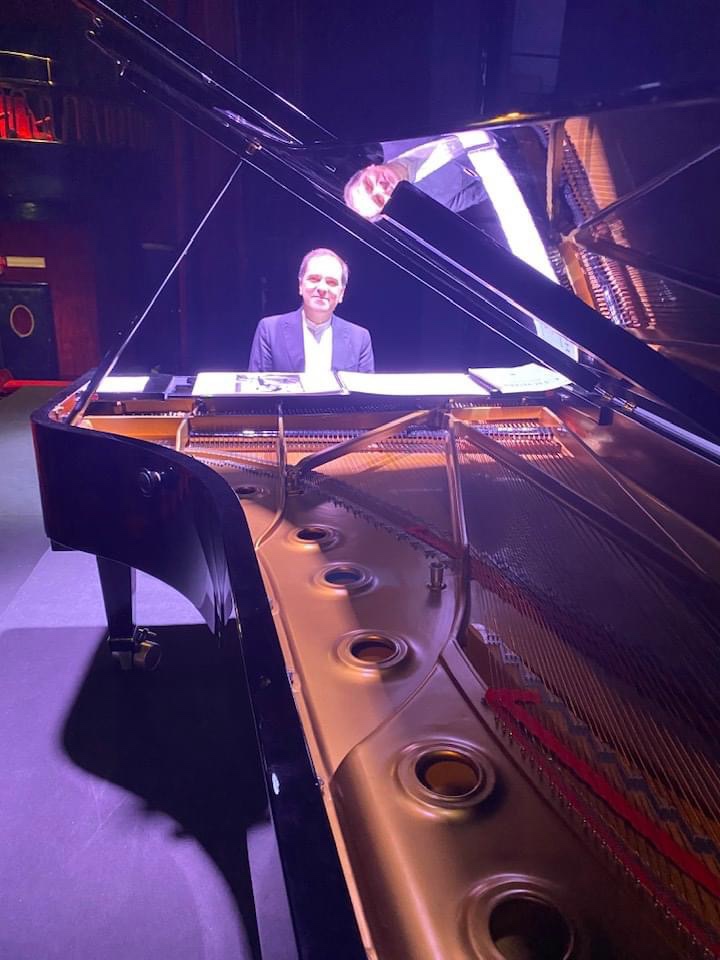
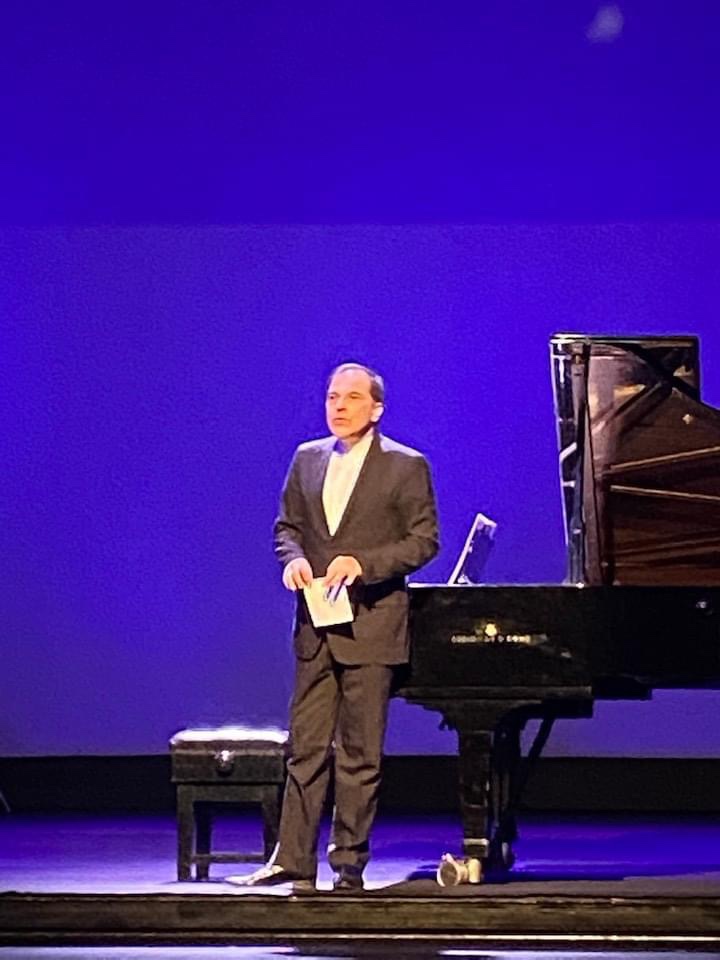
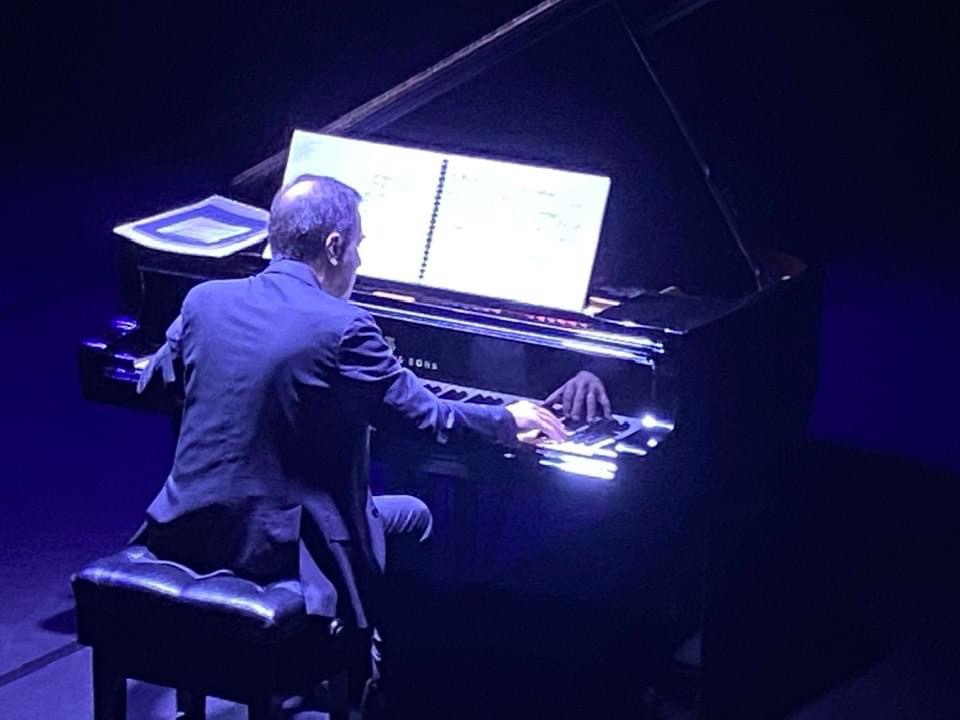
A concert dedicated to Maestro Fabiani,present in the hall, to thank him for the love and respect that he had shared with his student Marco Scolastra.
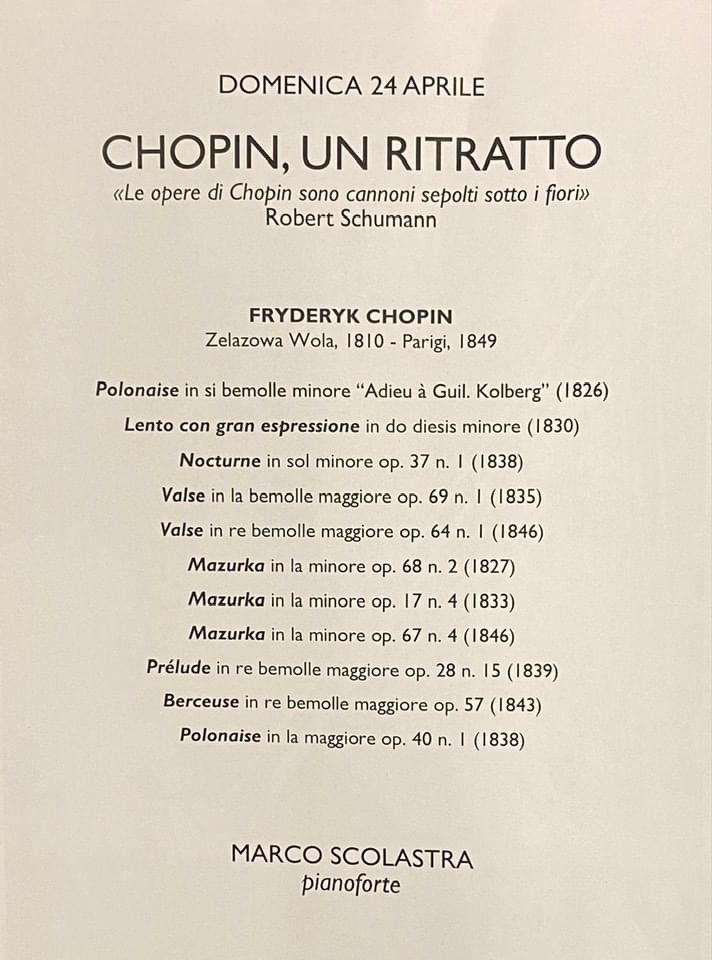
Reading from various sources including Chopin’s diary in which it was never in doubt that the soul of Chopin always belonged to Poland. He had left his homeland as a teenager seeking recognition and inspiration in Paris which was the centre of European culture. He never returned to Poland but he never forgot his roots which fill his music with nostalgia and the folklore of his homeland. It was this nostalgia allied to the aristocratic atmosphere of the Parisian salons that make his music unique .Creating new art forms that like Liszt were to revolutionise the concept of the piano. A piano that could now sing as eloquently as the greatest bel canto singers of the day.
It was fascinating to hear that the middle section of the Polonaise that opened the programme had been inspired by an aria from Rossini’s ‘Gazza Ladra’.A polonaise written by the 17 year old Chopin ‘Adieu a Guil.Kolberg’.It was played with scintillating virtuosity but it was the eloquence and beauty of the central episode that touched the core or should I say the ‘cuore’ of Chopin. A heart that after Chopin’s early death was transported back to his homeland where it had always belonged.
This led so naturally to the nocturne op posth in C sharp minor with its unmistakable Chopinesque bel canto of such subtle aristocratic beauty. It contrasted well with the Nocturne op 37 n.1 where the chorale central episode was played with religious calm and deep meditation. The two waltzes from a later period showed the elegance and brilliance of the Parisian salons of the period.But even the middle episode of the A flat waltz op 69 n.1 showed the dance element that was always hidden inside Chopin’s soul.
The so called ‘minute waltz’ op 64 n.1 was played with great elegance and style and may well have been the two minute waltz as Marco brought such timeless beauty and shape to a piece often timed with a stopwatch by lesser artists. ‘Canons covered in flowers’ is what Schumann described Chopin’s mazurkas.Miniature tone poems where the feeling for his homeland were allowed space as he indulged his longing,creating what are considered to be his finest works. A whole world captured in such a short space that in sixty gasps and tears show the absolute mastery of Chopin. Marco played them with beauty but also with great strength that was of heartfelt sentiment but never sentimental. For nine years Chopin’s name was linked to that of George Sand the pen name of Amantine Lucile Aurore Dupin. Her estate at Nohant was frequented by the most famous poets and artists of the day and it was on her suggestion that Chopin was persuaded to spend the winter in warmer climes in Majorca. Unfortunately the humidity and confusion only exacerbated the tuberculosis that was to claim him at the age of only 39. It was here that he wrote his Preludes op 28 in the damp room of the abandoned Monastery of Valldemossa. Marco played the so called ‘raindrop’ prelude where the obsessive repetition in the middle section was obviously the continuous rain that greeted Chopin every day on this ‘magic’ island. Marco brought great contrast between the fleeting glimpses of sunlight overshadowed by the continuous storms overhead. It was though the sublime beauty of the Berceuse played with ravishing beauty and measure,where Chopin had found peace and could await only a few years later to join the celestial angels that were already showing him the way.
A past season of music at the Ghione Theatre
The ‘military’Polonaise was a fitting way to finish the concert with a refined call to ‘arms’ especially on the very morning when France is being called to the ‘urns’. Some very robust playing with sumptuous bass notes that have been missing for too long from this hallowed hall. An encore of one of Chopins Polish Songs -the second – dedicated to the Spring was played with golden streams of sound which added even more magic to a memorable morning in the company of Chopin.
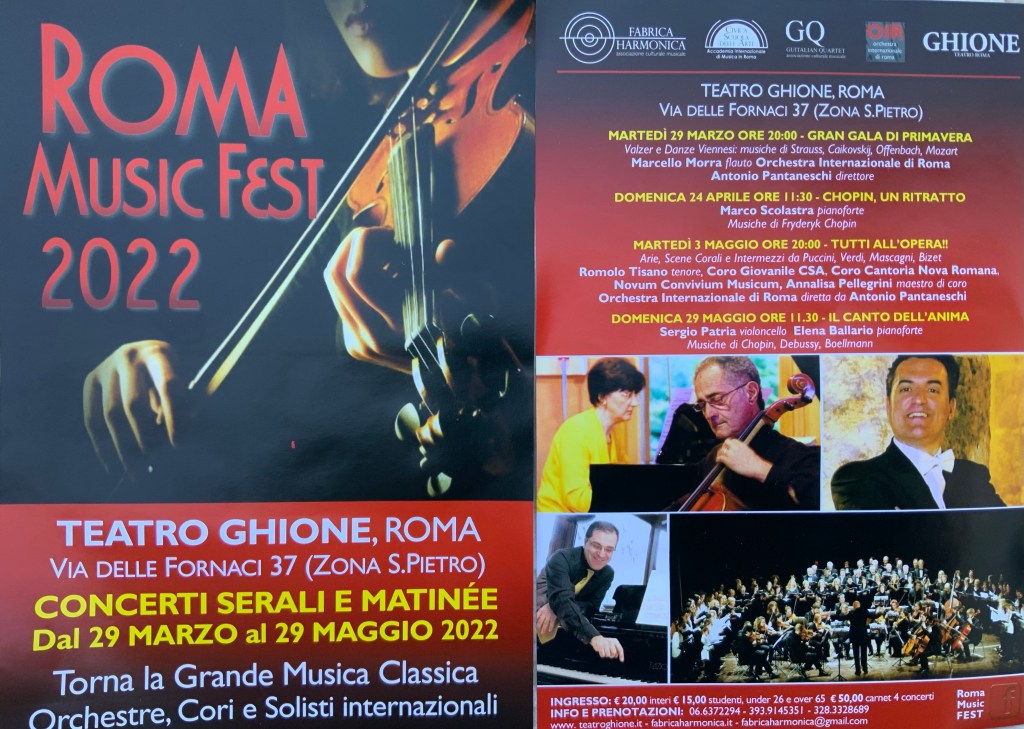
Following on in the tradition of great music at the Ghione Theatre Marco Scolastra with Maestro FabianiAndrea Tidona part of Ileana Ghione’s Theatre Company returned to the stage he knows so well – now well known for being part of the Montalbano films on the right Giulio the son of his companion Carla Cassola
Schubert: Two Impromptus from D 935 no 1 in F minor and no 2 in A flat
Brahms – Variations and Fugue on a theme by Handel Op 24
Some very assured playing from Pietro Fresa with two Schubert impromptus played with a simplicity and beauty that allowed the music to unfold so naturally.There was passion and authority too in the first impromptu that gave way to a hauntingly beautiful duet between the treble and the bass.The accompaniment was like water flowing on which floated this conversation between bass and soprano ever more intense but giving way to a heart rending surrender.It was played with such simplicity and luminous tone and contrasted so well with the rather more authoritative opening flourish.There was great beauty in the second impromptu with a fleetingly nostalgic atmosphere where the slight pointing of the bass notes gave great depth to the melodic line.The fluidity of the central episode was enhanced by his subtle definition of the melodic line which was illuminated like jewels in the sunlight.A complete performance of the four Impromptus D 935 I heard last December and have written about his performance in the link below
Brahms’s Variations and Fugue on a theme by Handel were played with astonishing clarity and rhythmic drive leading to a truly monumental climax worthy indeed of the Great Gate of Kiev that is in most of our thoughts these days.
The Variations and Fugue on a Theme by Handel, Op. 24, was written by Brahms in 1861 and consists of a set of twenty-five variations and a concluding fugue, all based on a theme from Handel’s Harpsichord Suite n.1 in B flat HWV 434. Tovey ranked it among “the half-dozen greatest sets of variations ever written”.Written in September 1861 after Brahms, aged 28, abandoned the work he had been doing as director of the Hamburg women’s choir (Frauenchor) and moved out of his family’s cramped and shabby apartments in Hamburg to his own apartment in the quiet suburb of Hamm, initiating a highly productive period that produced “a series of early masterworks”.Written in a single stretch in September 1861,it is dedicated to a “beloved friend”, Clara Schumann widow of Robert Schumann.It was presented to her on her 42nd birthday, September 13. At about the same time, his interest in, and mastery of, the piano also shows in his writing two important piano quartets, in G minor and A major. Barely two months later, in November 1861, he produced his second set of Schumann Variations, Op. 23, for piano four hands.One aspect of his approach to variation writing is made explicit in a number of letters. “In a theme for a set of variations, it is almost only the bass that has any meaning for me. But this is sacred to me, it is the firm foundation on which I then build my stories. What I do with a melody is only playing around … If I vary only the melody, then I cannot easily be more than clever or graceful, or, indeed, if full of feeling, deepen a pretty thought. On the given bass, I invent something actually new, I discover new melodies in it, I create.” The role of the bass is critical.Brahms played them at a meeting with Wagner who commented:’One sees what still may be done in the old forms when someone comes along who knows how to use them”.’Clara writes in her diary :’On Dec 7th I gave another soirée, at which I played Johannes’ Handel Variations. I was in agonies of nervousness, but I played them well all the same, and they were much applauded. Johannes, however, hurt me very much by his indifference. He declared that he could no longer bear to hear the variations, it was altogether too dreadful for him to listen to anything of his own and to have to sit by and do nothing. Although I can well understand this feeling, I cannot help finding it hard when one has devoted all one’s powers to a work, and the composer himself has not a kind word for it.’
Pietro played the theme with scintillating ornaments that sprang from his fingers like springs and gave such luminous clarity to the theme that was to be so nobly enhanced by Brahms in the triumphant 25th variation.There was never a moment in Pietro’s authoritative performance that seemed anything other than inevitable.The transcendental difficulties and complex musical ideas just poured from his sensitive hands as he gave an architectural shape to the twenty five variations culminating in a final fugal climax of overwhelming power and authority.There was rhythmic energy and clarity and joie de vivre to the first variation contrasting with the fluidity and legatissimo of the second with some very interestingly pointed counterpoints.There was a gentle lilt to the third and great sonorities to the octaves of the fourth.Gentle flowing lyricism of the fifth leading to the legatissimo octave question and answer of the sixth bringing great rhythmic impetus to the fanfare of the seventh.There was a gradual build up with a sudden rhythmic impetus to the eighth and admirable control of the whispered sonorities of the octaves answering one another in the ninth.There was a sudden change of character with the quixotic flight from the top to the bottom of the keyboard in the tenth contrasting with the beautifully lyrical eleventh.The languid left hand melodic line in the twelfth was very slow and unusually beautiful followed by the noble sonorities of pompous regal sonorities of the thirteenth.Tovey sees a grouping in Variations 14–18, which he describes as “arising one out of the other in a wonderful decrescendo of tone and crescendo of Romantic beauty”.The nineteenth is slow, relaxing variation, with its lilting rhythm and 12/8 time,written in the dance style of a Baroque French siciliana from the school of Couperin (Brahms had edited Couperin’s music ).It uses chords almost exclusively in the root position, perhaps as another reminiscence of “antique” music. In a technique often used by Brahms, the melodic line is hidden in an inner part and was played with a clarity and simplicity before the final build up to the twenty fifth triumphant fanfare and the mighty fugue.In fact there was great character to each of the variations played with an underlying rhythmic impetus which as Brahms clearly describes come from the solidity of the bass allowing freedom for all that rides on it.There was much beauty in the music box twenty second variation leading to the spikey staccato build up ever more energetic until the final explosion of the theme in all its glory.The fugue was played with amazing clarity and a build up of tolling bells and frenzied movement that demonstrated his truly transcendental technical prowess.An overpowering performance of one of the masterworks for the piano all too often used as a tool for aspiring young pianists struggling with the technical difficulties and not always realising the enormous musical invention that the 28 year old Brahms demonstrated at the same time as writing his poorly received first piano concerto
A tender whispered Mazurka by Chopin was played with the same refined sense of colour and artistry that had imbued all that he played in this short recital at St Mary’s …….a prelude to his recital at Steinway Hall on the 18th May for the Keyboard Trust
Pietro Fresa was born in Bologna in 2000 and first became known in musical circles when he made his debut in Liverpool in September 2017 playing Beethoven’s third concertoas representative of the Italian nation for the event “Bologna-Liverpool UNESCO city of music”. He studied at the Conservatorio G. B. Martini of Bologna in 2010 where he obtained the highest marks possible graduating with distinction in 2017. He also studied from the age of 11 at the prestigious Accademia Pianistica Internazionale in Imola with Jin Ju, and at present is a pupil of the renowned Russian Maestro, Boris Petrushansky. He then began his studies at the London Royal College of Music under Dmitri Alexeev and Sofya Gulyak. At twelve years old, he gave his first public performance with orchestra and since then he has embarked on an intensive career as a concert pianist both as a soloist and in chamber music in numerous musical events in Italy. He has been awarded first prize in more than thirty piano competitions, including the Vienna International Competition, and the Grand Prize Virtuoso Competition. Most recently Pietro has completed a tour as soloist in the English cities of Liverpool, Shrewsbury and Ludlow. Since then he has been living in London and has performed frequently in England.
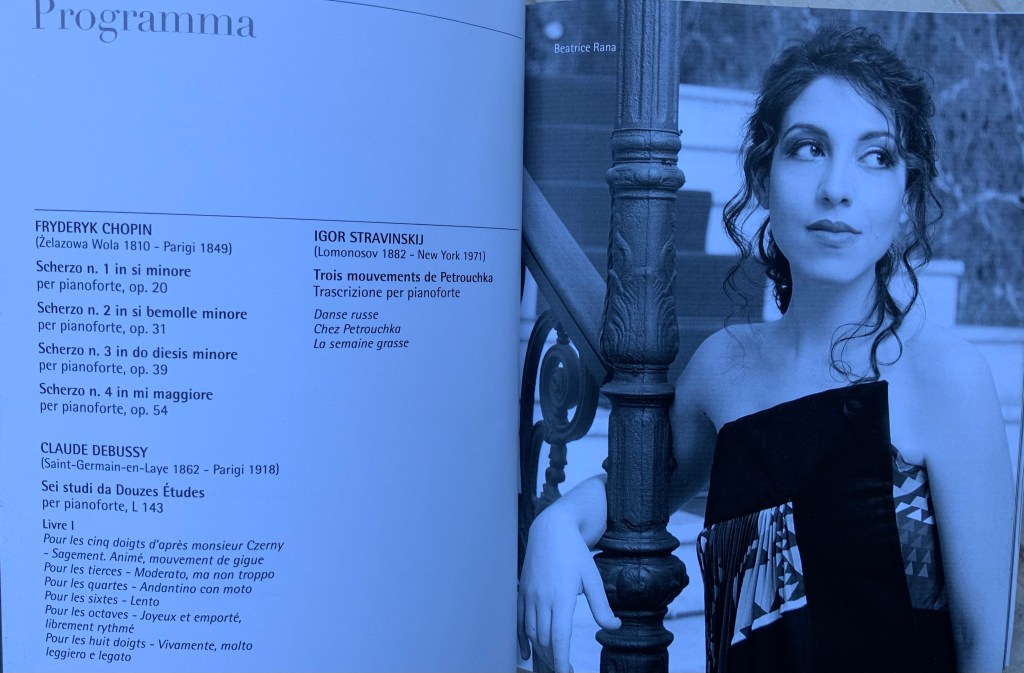
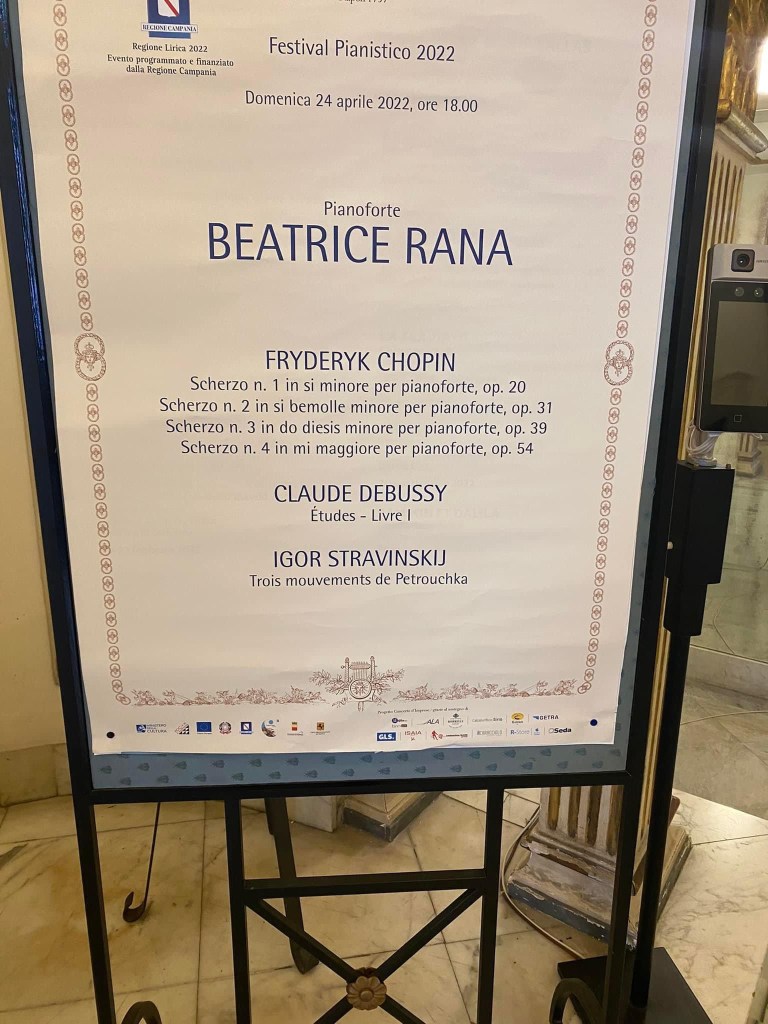
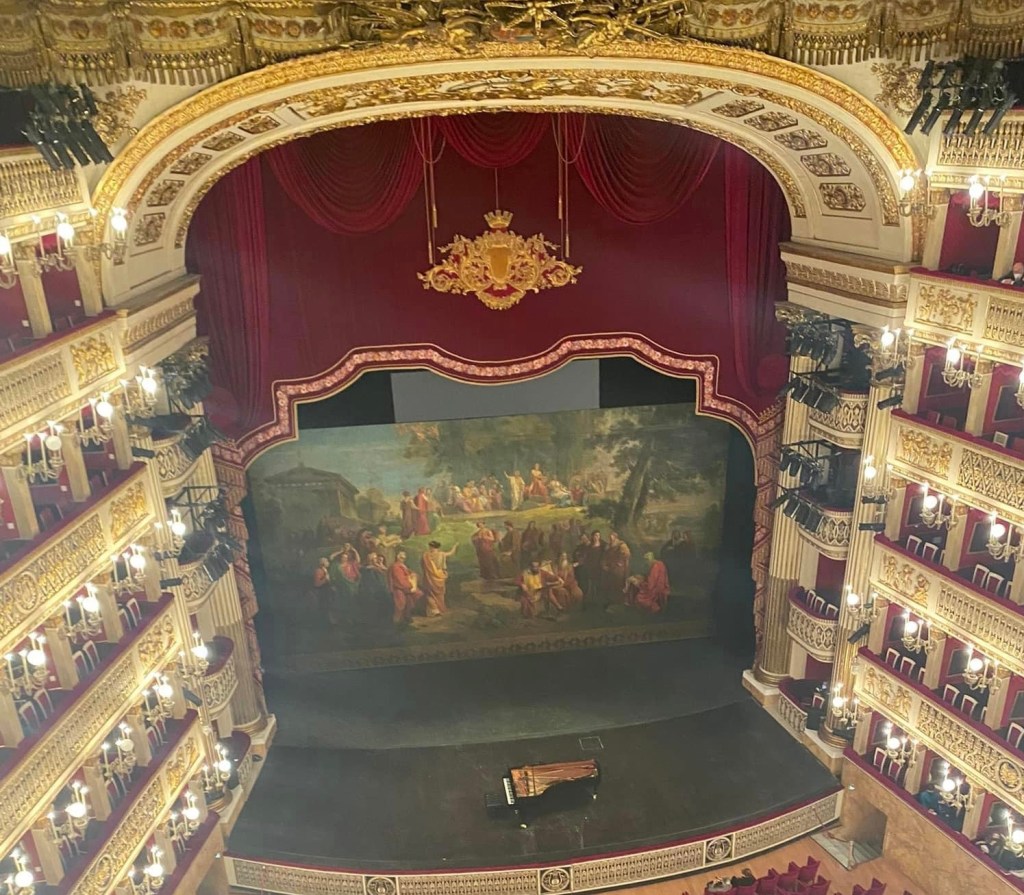
Wonderful to see Beatrice Rana on this vast stage of one of the most beautiful opera houses in the world – San Carlo in Naples.The third in a series of six piano recitals for this new venture of artistic director Stéphane Lissner :Festival Pianistico 2022.A festival that is alternating with the much awaited performances of Turandot with Jonas Kaufmann.
An indisposed Daniel Barenboim who was to open the festival was substituted by another of the greatest pianists of our age :Arcadi Volodos.-https://christopheraxworthymusiccommentary.wordpress.com/2021/11/30/arcadi-volodos-whispered-secrets-of-introspection-and-fantasy/-(It reminds me of Montserrat Caballé cancelling at the Ghione Theatre in Rome due to a broken leg – her place was taken by Marylene Horne!)The other concerts are : Alexandra Dovgan ( a fifteen year old pianist much admired by Sokolov and not only!),Beatrice Rana,Bertrand Chamayou,https://christopheraxworthymusiccommentary.wordpress.com/2018/04/05/bertrand-chamayou-at-the-wigmore-hall/,Rafal Blechacz ( 2005 winner of the Chopin competition in Warsaw) and Benjamin Grosvenor ( winner of the BBC young musicians competition at the age of 11).
A fascinating array of stars mostly from the younger generation that bodes well for future festivals. I heard from the artistic director’s very informed conversation on RAI 3 that next years festival is already in advanced stage of organisation with Maria Jose Pires at the helm.To see a Steinway concert grand on this vast stage sitting nobly in front of the beautiful historic backcloth is indeed a wonder in itself.But when a beautiful young lady in a sumptuous evening gown floats on and begins to play one realises what wonders they could perform in the past centuries.Creating in this beautiful horseshoe shape a natural acoustic that would allow the sound to carry with the same intensity in the front row as to the last seats high in the ‘Gods’.At La Fenice Opera House in Venice the sound is helped by meters of broken glass being placed in the orchestral pit!And we think we are so much more advanced these days!
And what a sound it was as Beatrice attacked the piano with the devilish Presto con fuoco of the first of Chopin’s four scherzi.Immediately noticeable were the deep bass notes that allowed her fiery temperament to shoot so fearlessly to the top of the keyboard arriving on high with a crack of the whip.Her supreme musicianship made her aware of the left hand melodic line in the ritenuto passages that are revealed after startlingly virtuosistic passages.A deep bass melody that I have never heard played so prominently leading to the beauty and busy weaving sotto voce agitato,almost Schumannesque, as the harmonies are allowed to glow with such warmth.The beautiful middle episode that Chopin quotes from an old Polish Christmas song (Lulajże Jezuniu) was played with intimate reflection and beauty.I felt that here,though,and in the other lyrical passages in the first three scherzi that there was a rather too intimate change of mood and that more diaphragm was needed to keep the coherent overall architectural shape alive even in these moments of intimate confession.It is exactly in these vast opera houses that actors and singers learn what it means to have an instrument that can whisper the most secret confessions to the audience that will arrive with the same intensity in the first row as in the last!Instrumentalists call it weight that allows the sounds to fill the hall,arriving so perfectly to every member of their audience awaiting with baited breath!The mighty coda of this first scherzo held no terror for the fearless onslaught that she brought to these savage passages of fortississimo chords before exploding into the fiery transcendental virtuosity of the final few bars. This scherzo was written in 1831, during the November Uprising against the Russian Empire.A friend of Chopin’s, Thomas Albrecht, to whom it was dedicated, convinced him to stay in Vienna, away from his family in Poland and to build his musical career. During this time he only played one concert, where he performed his E minor Concerto.Because of the struggle and the war, his compositions changed from pieces of a brilliant style to works in a new, darker tonality.Chopin composed this scherzo and several of the Etudes op.10 in this period when he was only 21.As Schumann was to say:’How is ‘gravity’ to clothe itself if ‘jest’ goes about in dark veils’.
There was great beauty in the second scherzo where the ‘con anima’ was played with ravishing colours alternating with the tempestuous outpourings of passages that swept across the entire keyboard.The beautiful central ‘sostenuto’ marked in several passages delicatissimo drew her audience in to overhear these subtle intimate confessions.Building to a triumphant climax that dies away to the menacing whisper of the opening theme.I found this climax a bit clipped and could well have been bathed in more pedal as Chopin himself does in fact indicate.She built the coda to a high pitch of animal excitement in a passage that would have Rubinstein rising from the stool in the same frenzy of passionate involvement.To quote Schumann, “so overflowing with tenderness, boldness, love and contempt.”
The third scherzo was completed in 1839, and was written in the abandoned monastery of Valldemossa in Majorca and is the most terse, ironic, and tightly constructed of the four scherzi, with an almost Beethovenian grandeur.The great octave statements and the following relentless left hand passages were played with remarkable virtuosity but it was the chorale with its shimmering celestial comments that was so moving.Here her architectural sense of shape allowed the chorale melody to ring out with sumptuous clarity.The sotto voce very moving minor statement of the chorale was played much slower and lost some of the impetus and overall shape even though played quite ravishingly.With Chopin there is always an aristocratic sentiment like Schumann’s Florestan and very rarely a Eusebius or sentimental one as Rubinstein was to show us on this very stage so many times.It was in the elusive fourth scherzo that Beatrice was to give her most magnificent performance of the Scherzi.Her fleeting jeux perlé and poetic vision created a vision of at times Mendelssohnian lightness and aristocratic control. The beautiful ‘polish song’ of the sublime central episode was played with such subtle inflections and style that contrasted with the final nobility and grandeur that she brought to the final pages.
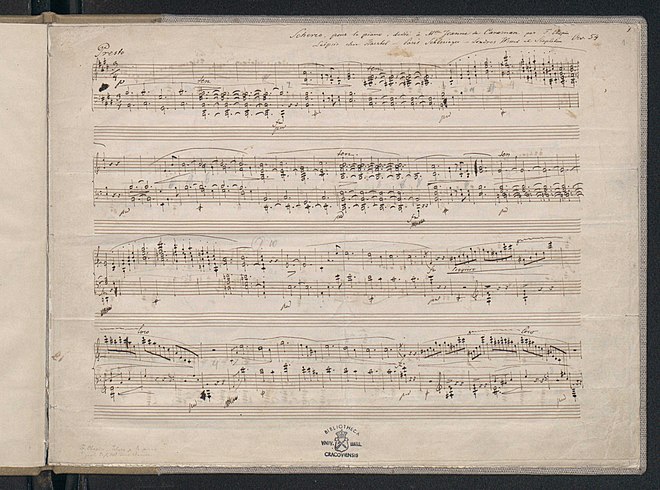
Chopin’s manuscript of the Fourth Scherzo
The first three Scherzi are all in a minor key and the major key to the fourth brings a radiance and lyricism that was to be such a mark of Chopin in his later years.Unlike the classical model of the Scherzo the musical form adopted by Chopin is not characterised by humour or elements of surprise, but by highly charged “gestures of despair and demonic energy”.Schumann wrote about the first scherzo: “How is ‘gravity’ to clothe itself if ‘jest’ goes about in dark veils?”Although various Beethovenian features of the scherzo are preserved—an A–B–A structure with sections A and B contrasting, triple time, pronounced articulation and sforzando accents—in terms of musical depth, Chopin’s four scherzos enter into a different and grander realm. They are all marked presto or presto con fuoco and “expand immeasurably both the scale of the genre and its expressive range”. In these piano pieces, particular the first three, any initial feeling of levity or jocularity is replaced by “an almost demonic power and energy”.
The studies by Debussy are a set of 12 piano études composed in 1915. Debussy described them as “a warning to pianists not to take up the musical profession unless they have remarkable hands”.They are broadly considered his late masterpieces.And in Beatrice’s hands she created a sound world that was magic indeed.Starting with the innocent five finger exercise that was gradually transformed into washes of colour and transcendental virtuosity ironically dedicated to Monsieur Czerny!Such delicacy in the study in thirds and the pure magic of the fourths.There was lightness and total command in the octave study and the study for eight fingers was quite breathtaking in its sweep and authority.
The whole of this second half was a continuous outpouring of amazing virtuosity allied to a sense of style and character that was truly remarkable.Whereas her Chopin beautiful and respectful though it was,it was in these works by Debussy and Stravinsky that she threw herself with absolute conviction and a fearless sense of fantasy and colour that one could feel the sparks flying even from my place high up in what at Teatro Colon is called Paradiso.
Paradise it was indeed as after a much deserved tumultuous ovation she returned to play Godowsky’s magical transcription of Saint Saens -The Swan.How many times I heard Cherkassky play this too after his triumphant recitals in the Ghione Theatre .The last time I heard him play it was at his own funeral at St George’s in Hannover Square – chosen because it was in the same street as the hallowed hall of Steinways.
Our fearless Beatrice driven by such an ovation gave a performance of Chopin’s most feared Prelude op 28 n.16.It was played with breathtaking audacity and superlative control but allied to the same passion and fiery temperament that we were to find in the overcrowded streets of Naples that awaited us after such a sumptuous feast of piano playing.
A seething mass of humans waiting for ‘they know not what’ as shabby bearded street urchins on battered Vespas arise out of their midst like praying mantice adding quite notably to the black economy that Italy boasts in this untethered wilderness.Pity my phone was snatched out of my hand on the way to the station(which accounts for the paucity of photos here) but if that is the price one must pay these days for venturing into one of the most extraordinary cities in the world I would risk it again and again to hear such wondrous sounds.
The British Institute are delighted to welcome Thomas Kelly, a rising star in the classical music world. He has won numerous prizes at international piano competitions and performed in many leading venues in London, Paris and beyond. He is making waves in the UK as an emerging superstar pianist, and we are thrilled to be presenting him here in Florence, thanks to our partnership with the Keyboard Trust (UK). After a recent concert in UK, Christopher Axworthy wrote:
Astonished, amazed and completely exhausted by a performance of staggering proportions by Thomas Kelly playing Rachmaninov…where there was no doubt about a great musical personality on the crest of a wave. I am much looking forward to his recital in Florence in a few weeks’ time with the Rachmaninov second sonata
PROGRAMME:
Schubert – Sonata in A Major D.959 Allegro – Andantino -Scherzo:Allegro vivace -Trio:un poco più lento -Rondo:Allegretto Presto
Live at the British Institute Library.This is an in person-only event, in collaboration with the Keyboard Charitable Trust in London and the fourth in a series of concerts .The next concert in the series that has included Jonathan Ferrucci,Cristian Sandrin,Simone Tavoni and Thomas Kelly will be with Salvatore Sanchez on the 30th June
Thomas Kelly takes Florence by storm.In the beautiful library bequeathed by that great aesthete Harold Acton.
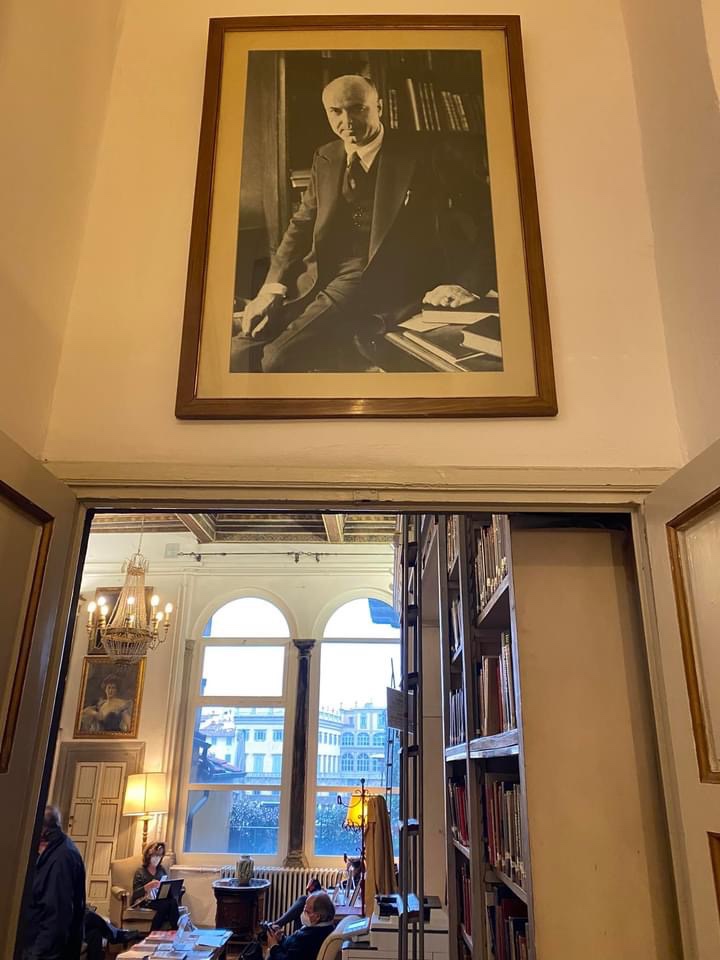
Harold Acton looking on as Michele Padovano awaits the concert
Thomas Kelly astonished and seduced the select audience at the British Institute.Performances of such intelligence and musical understanding that gave new life to the two Sonatas by Schubert and Rachmaninov.
Schubert’s last three piano sonatas D.958, 959 and 960, are his last major compositions for solo piano. They were written during the last months of his life, between the spring and autumn of 1828, but were not published until about ten years after his death, in 1838–39.Like the rest of Schubert’s piano sonatas, they were mostly neglected in the 19th century but by the late 20th century, however, public and critical opinion had changed, and these sonatas are now considered among the most important of the composer’s mature masterpieces.The last year of Schubert’s life was marked by growing public acclaim for the composer’s works, but also by the gradual deterioration of his health. On March 26, 1828, together with other musicians in Vienna, Schubert gave a public concert of his own works, which was a great success and earned him a considerable profit. In addition, two new German publishers took an interest in his works, leading to a short period of financial well-being. However, by the time the summer months arrived, Schubert was again short of money and had to cancel some journeys he had previously planned.He had been struggling with syphilis since 1822–23, and suffered from weakness, headaches and dizziness. However, he seems to have led a relatively normal life until September 1828, when new symptoms appeared. At this stage he moved from the Vienna home of his friend Franz von Schober to his brother Ferdinand’s house in the suburbs, following the advice of his doctor; unfortunately, this may have actually worsened his condition. However, up until the last weeks of his life in November 1828, he continued to compose an extraordinary amount of music, including such masterpieces as the three last sonatas.
There was a rhythmic energy from the very opening fanfare of this penultimate Sonata – power and delicacy with playing of such subtle colouring but also an overall architectural shape that gave great strength to all that he did.The beauty of the cantabile that he brought to the Andantino where his extraordinary sense of balance and technical control allowed the melody to sing so naturally.An accompaniment just a whisper as it sustained and added colour to Schubert’s miraculous outpouring of melodic invention.The tempestuous middle episode showed his transcendental control and technical prowess with streams of notes that were waves of sound of shifting colour as they led us to the recitativo that was enacted with great drama.The beseeching solo voice answered by ever more insistent chords.The storm passing and the clouds opened to show rays of radiant light as the opening melody returned as a mere whisper.There was an ever more intricate accompaniment, played with the same delicacy that the late Radu Lupu would entrance us with,as he drew the audience in to a secret world of ravishing beauty with a superhuman control of sound.The final plodding chords played like an emotionally weary traveller at the end of an unexpected journey.The Scherzo of beguiling capriciousness which contrasted so well with the luminosity of the trio.Its beautifully fluid melodic line played so clearly with the accompaniment just adding delicate comments from above and below.There were such subtle inflections and flexible phrasing to the beautiful Rondo theme that like the human voice seemed to speak so eloquently as it flowed on its pastoral journey.The drama of the minor key soon gave way to the supreme tenderness of the return and the final disintegration of the theme.Here Schubert seems to be searching for a way out that he finds with a Presto coda of exhilaration and nobility that reminds us of the start of this wondrous journey.An audience mesmerised by playing where Thomas allowed the music to speak so eloquently and with such emotional impact where forty minutes seemed to pass all too quickly in his intelligent musicianly hands.
Three years after Rachmaninoff had completed his third piano concerto he moved with his family to the house in Rome where Tchaikovsky had stayed .It was during this time in Rome that Rachmaninoff started working on his second piano sonata.However, because both of his daughters contracted typhoid fever, he was unable to finish it in Rome and moved his family on to Berlin in order to consult with doctors.When the girls were well enough, Rachmaninoff travelled with his family back to Ivanovka ,his country estate, where he finished the second piano sonata.Its premiere took place in Kursk on 18 October 1913 (5 October in the Julian calendar)When Rachmaninoff performed the piece at its premiere in Moscow, it was well received but he himself was not satisfied with the work and felt that too much in the piece was superfluous.Thus, in 1931, he commenced work on a revision. Major cuts were made to the middle sections of the second and third movements and all three sections of the first movement, and some technically difficult passages were simplified.He added to the score , “The new version, revised and reduced by author.”A performance of the original version lasts approximately 25 minutes,while a performance of the revised version lasts approximately 19 minutes.
Thomas chose to play this revised version with a pulsating romanticism of heroic proportions.Like his recent performance of Rachmaninoff third concerto in London one was left astonished,breathless and seduced by playing of authority and total command .Not only scintillating virtuosity but also moments of contrasting poetic confessions played with a kaleidoscopic sense of colour that was truly ravishing.An old Bechstein piano that Thomas delved deep into its soul and drew out sounds that one would not have thought possible.A special thanks must go to the composer – piano technician Michele Padovano for his labour of love on this beautiful instrument.
It was Sviatoslav Richter too who enjoyed the challenge of discovery of pianos he found on his famous whistle-stop tour of Russia.He would stop the train in little villages and announce an improvised concert for the locals on any instrument that was available.
There were moments in the lead up to the final passionate climax that could have been from Scriabin on his mystical search for the star.But Rachmaninoff with his unmistakable musical vocabulary takes over from this fleeting mysterious moment and the passionate outpouring of sounds is unmistakably of the great Russian master.Like his third concerto we are enveloped into the sumptuous world of the Philadelphia Orchestra (Rachmaninoff’s favourite orchestra which he confessed was always in his thoughts whilst composing).With its rich velvety sound never harsh or blaring ,and here playing of a romantic sweep that is quite breathtaking in its inevitability.The final coda in Thomas’s hands was an amazing technical tour de force that brought a spontaneous ovation from an enraptured audience.
Thomas said he had not thought of an encore after two such noble works but with a still insistent audience he offered a work that he told me afterwards that he had not played for a month.It was a Fairytale op 20 n.1 by Medtner.A Russian composer that I often describe as Rachmaninoff without the tunes!But not today in Thomas’s musicianly hands there was a sense of line and architectural shape that I have rarely noticed in lesser hands.It was the same simplicity of line that he had brought to the Rachmaninoff Sonata and that Thomas brought to all he played.An intelligence and technical command that can see the overall architectural shape and that gives a rhythmic propulsion and overall meaning to all that he does.
Exhilarated as he was exhilarating after a mammoth performance of Rachmaninoff’s second sonata
Thank you dear Thomas I now retract my rather mean remark about Medtner who spent his last years in England and is buried in Hendon Cemetery.I know that Thomas is playing in a few days time in the late Sir George Solti’s house opening a new season of concerts with the Sonata Tragica by Medtner which I will now very much look forward to from these noble hands.
Thomas with the director of the British Institute Simon Gammell OBE happy to toast not only her majesty the Queen but also John Leech the founder of the Keyboard Trust who shares a birthday with her majesty and is one year older – 97 today- and still at the helm of the Trust that helps so many gifted young musicians at the start of their long journey in music
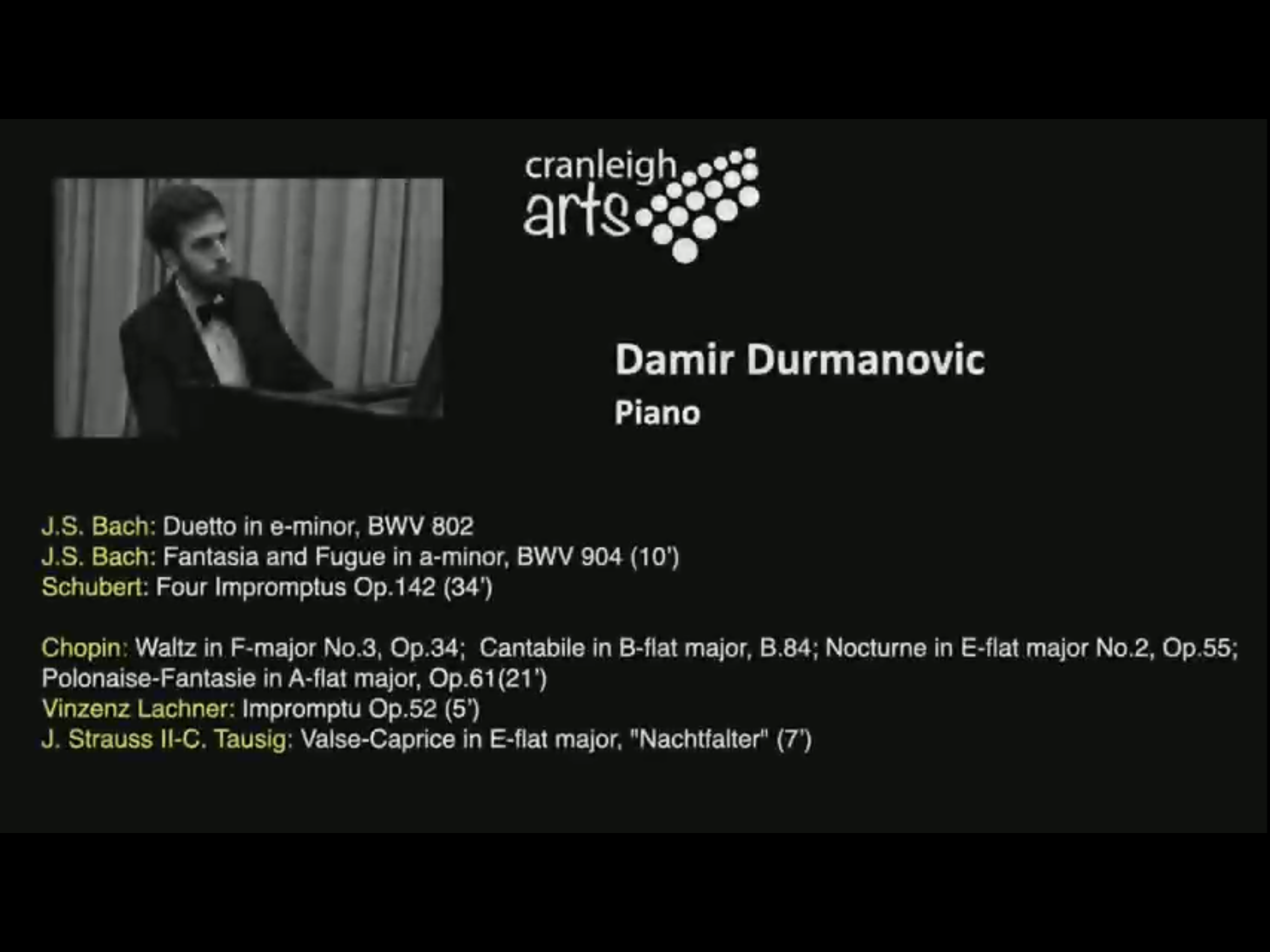
It is always stimulating to hear a recital by a real thinking musician and it was just this that Cranleigh Arts offered to us in a performance live and streamed.In partnership with the Keyboard Trust Damir Duramovic not only offered a fascinating programme but also spoke with such refreshing simplicity and intelligence about his musical pedigree.
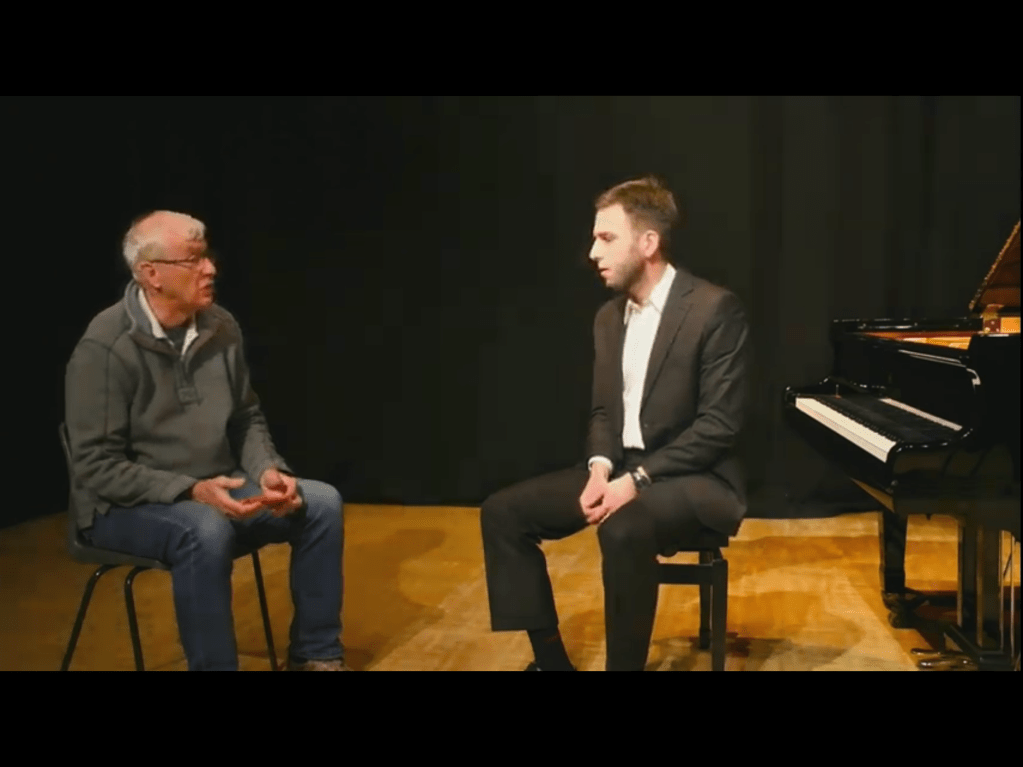
An informal conversation with Stephen Dennison during the interval for those like me watching from afar.No gin and tonic but another type of tonic to hear this young artist describe the unparalleled education that he had received from the age of fourteen at the Menuhin School.As it happens Cobham is just a short drive away from Cranleigh.An illustrious list of musicians who he had been able to come into contact with in his formative years .But it is Robert Levin who stands out for the obvious influence that he had on a young student fresh from Bosnia.A country as he explained where folk music and improvised performances were more the norm than classical concerts.Of course he received the state musical education from the schools run on the Eastern European system of serious training from an early age.Damir was lucky as a teenager to continue this early training with Marcel Baudet at the Menuhin and Dmitri Alexeev at the Royal College,both superb trainers of so many magnificent musicians.But there is a moment in one’s youth when a light is suddenly illuminated and it is this influence that remains into maturity.Both Can Arisoy and Damir spent their schooldays together at the Menuhin School in Cobham and they are both two of the most complete musicians that I know amongst the younger generation.Both obviously greatly inspired by the authority and scholarship of Robert Levin and the teaching of Marcel Baudet.
In their fascinating conversation Damir described how he organised a recital programme around key relationships and that he even improvised between each piece where necessary to prepare the ear by moving to the dominant key of the work that was to follow.The ‘historic’ performance practices of ornamentation and rhythmic adjustments were all elements that Damir explained were to bring the works he played back to life with the same sense of voyage of discovery as when the ink was still fresh in the page .He explained that this and choosing from different styles was his way of getting away from the standardised ‘recital’ formula and breathing new life into interpretations not only of recognised master pieces but also compositions long forgotten and now completely overlooked.
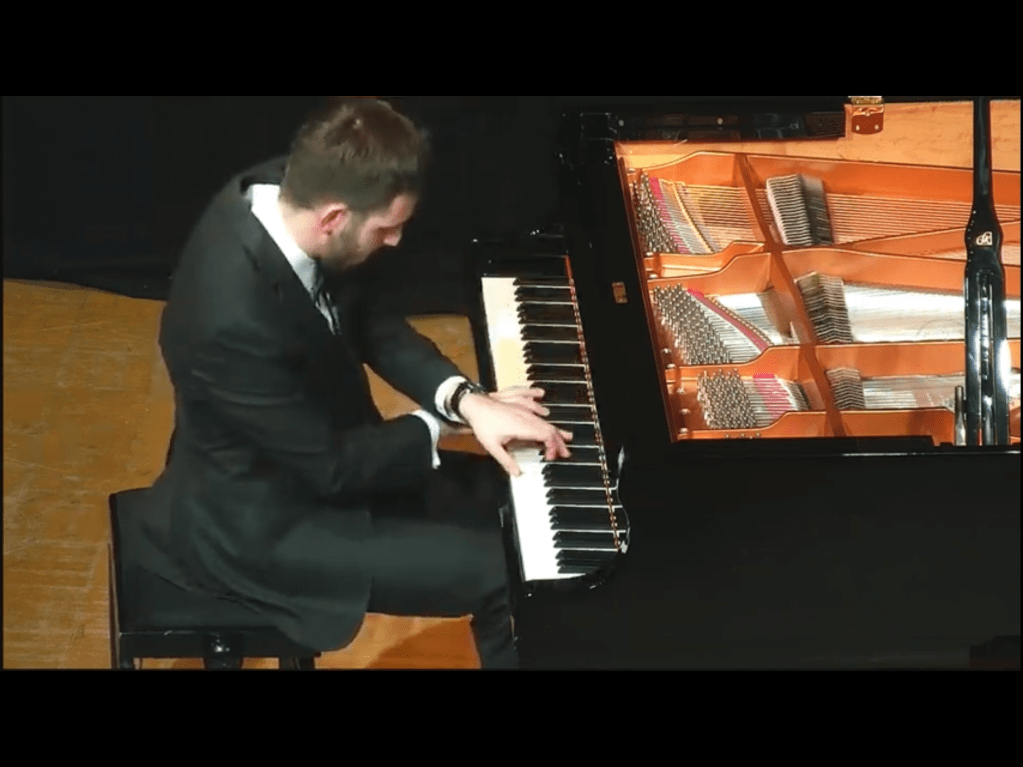
And so it was that the programme in Cranleigh was carefully thought out and spanned from Bach to Strauss with an unknown Lachner thrown in as a bridge between Chopin’s masterpiece op 61 and much lighter salon pieces.Ending with a Tausig arrangement of Strauss that one might well have encountered in recitals of the Golden age of piano playing at the beginning of the twentieth century in the hands of the legendary Lhevine ,Godowsky or Rachmaninov .Damir’s musicianship shone through all that he did as he created a sound world which was so flexible one felt that it could unfold in so many unexpected ways.A natural timelessness where even slight blemishes were incorporated into the music making of the moment.There was also great passion and driving energy but it was the music making of a kapellmeister that was very similar to that of Wilhelm Kempff.Such was Kempff’s total absorption in music he would arrive at a recording studio asking what they would like to record that day.He,more than any other pianists I have heard had the same preparation as the real musicians that would have to prepare music every week for the church and more often than not have to improvise much of the music as well as preparing the choir.A complete musician where music would pour out of them as naturally as breathing .
Damir’s Bach was of a crystal clarity where the single parts were played with a simplicity and purity with the ornaments adding the emotional expression that together with slight rhythmic deviations was the practice in Bach’s day.There was grandeur in the Fantasia but never clouding the texture or the clarity of the architectural line.
The first of four duets published in 1739 as part 3 of the Clavier Ubung consists of a double fugue of 73 bars in which the material is invertible: for example, it is possible to invert the two parts. The first subject is exhibited in six bars and it is a scale that leads to a syncopated passage . In the sixth bar a theme in two-tone is introduced which will be developed later and which will also serve as a modulation between the two parts of the piece. The second subject, in contrast to the first, is composed of quavers . The harmony between the two parts is very similar to that of the prelude BWV 889 in the second book of The 48 , and it is therefore probable that Bach composed the two pieces in the same period.
The Fantasia and fugue in A minor as is often the case with Bach, little is known about the origins of the piece. It is not even clear whether he intended it for organ, clavichord or harpsichord.The Fantasia begins with a series of descending notes in the bass, and descending lines continue to dominate the rest of the piece. The Fugue builds up steadily to a four-part web of harmonies. Then halfway through, there is a chromatically descending line as a second theme, which takes the idea of the descending bass in the Fantasia one step further. And then Bach weaves both themes together to form a rich harmonic whole.
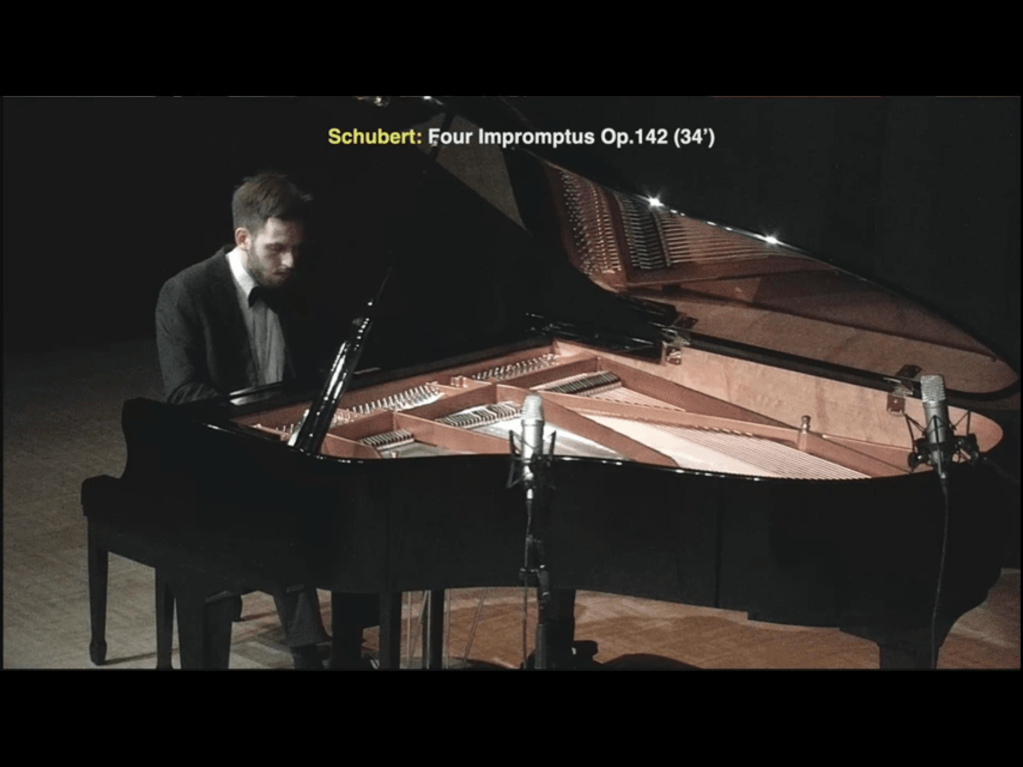
The Schubert Impromptus are a series of eight pieces for solo piano composed in 1827. Schubert was born in 1797 and died in Vienna, aged 31, on 19 November 1828, at the apartment of his brother Ferdinand. The cause of his death was officially diagnosed as typhoid fever , though other theories have been proposed, including the tertiary stage of syphilis.It was near the grave of Beethoven, whom he had admired all his life, that Schubert was buried at his own request, in the village cemetery of Wahring on the edge of the Vienna Woods.A year earlier he had served as a torchbearer at Beethoven’s funeral.The Impromptus were published in two sets of four : the first two pieces of the first set were published in the composer’s lifetime as Op. 90; the second set was published posthumously as Op. 142 in 1839 (with a dedication added by the publisher to Franz Liszt).The third and fourth pieces of the first set were published in 1857.As the first and last pieces in this second set are in the same key (F minor) and the set bears some resemblance to a four-movement sonata it has been suggested that these Impromptus may be a sonata in disguise.It was Schumann and Einstein , who claim that Schubert called them Impromptus and allowed them to be individually published to enhance their sales potential.However, this claim has been disputed as it is also believed that the set was originally intended to be a continuation of the previous set, as Schubert originally numbered them as Nos. 5–8.
Improvised modulation from Bach to Schubert brought us to the beauty and simplicity of the four late Impromptus.Damir’s slight hesitations just added to their poetic intensity and there was beauty in the long central duet over the flowing accompaniment of the first impromptu in F minor.The second was in A flat so no need for an improvised bridge and there was great melodic weight and sumptuous rich sound that excluded any sentimentality to the melodic line.There was subtle ornamentation too that just added to the simplicity and beauty of Schubert’s melodic outpouring.The middle episode was beautifully fluid and shaped so eloquently.A slight bridge from A flat to B flat for the beautiful theme and variations of the third Impromptu.Variations that evolved one out of the other from the lightness of the jeux perlé of the second variation to passionate intensity of the third.There was a beautiful lilt to the duet between left and right hand in the fourth and streams of sound in the fifth before the improvisation to the playful but also menacing dance of the fourth.There was also a frenzy and intensity to the great washes of sound that eventually led to the final streak of sound from the treble to the final mighty bass note.The Devil and the Deep Blue Sea indeed!
Damir’s Chopin was played with great sense of style.The waltz op 34 n 3 is known as the cat waltz for the way it leaps with cat like movements across the keys.It was played with a perfect flowing tempo that allowed the music to speak so eloquently.The little one page ‘Cantabile’ that I heard for the first time in recital,was played with ravishing colour and all the freedom that its bel canto demands.The nocturne op.55 n.2,one of Chopin’s most beautiful creations,was an outpouring of ecstasy ,delicacy and intimate sentiment.The Polonaise Fantasie op 61 that ended this Chopin group was played with a great sense of architectural shape but also with ravishing sounds and a forward movement that led to its triumphant final outpouring.An overall sound that was of a fluidity and flexibility,always though with the simplicity and aristocratic good taste of a true musician.
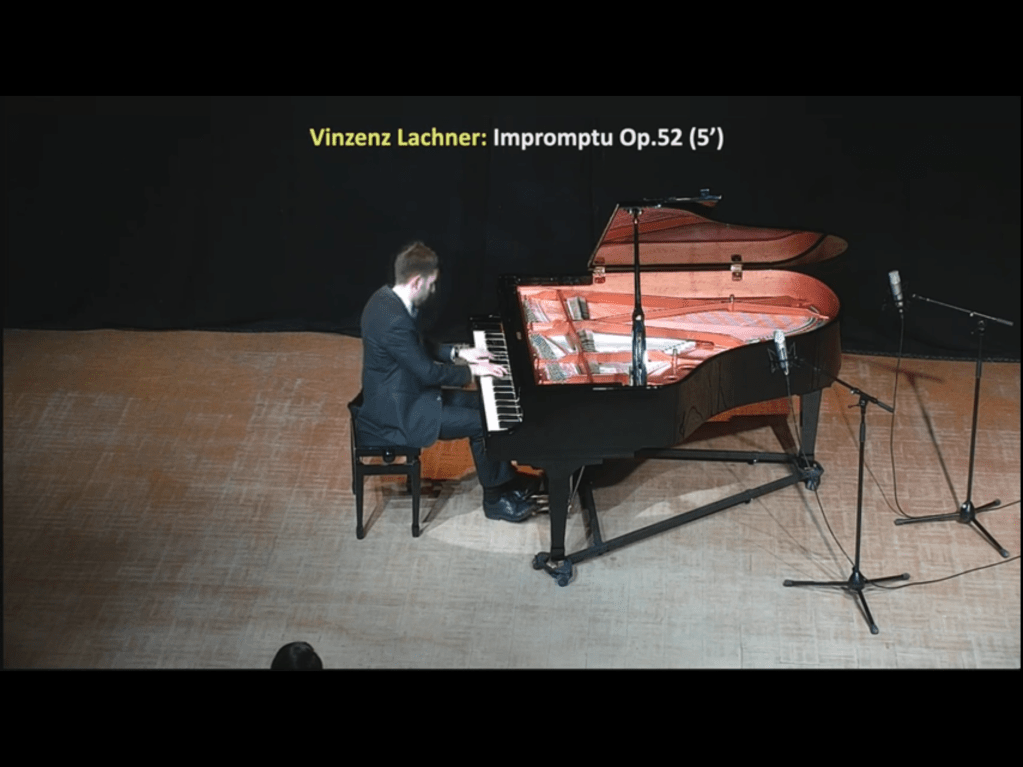
Vinzenz Lachner (also spelled Vincenz) (19 July 1811 – 22 January 1893)was a German composer and conductor.Born in Rain am Lech in Bavaria .Vinzenz was the youngest brother of Franz Lachner also a composer and conductor and a close friend of Schubert.As a composer Vinzenz was essentially self-taught and was first educated by his father Anton Lachner, the municipal organist.Like all the Lachner brothers, he was friendly with Brahms and in 1879, he wrote a letter to Brahms asking why he had used trombones, tuba, and a drumroll — trombones being associated with death — early in the pastoral first movement of his Second Symphony.Brahms replied in detail, expressing the “great and genuine” pleasure he received from the letter, calling Lachner’s analyses unusually perceptive and insightful, then saying “I would have to confess that I am, by the by, a severely melancholic person, that black wings are constantly flapping above us” Lachner died in Karlsruhe after a number of strokes at the age of 81.Lachner’s compositions include symphonies, overtures, festive marches, works for wind orchestra; a Mass in D minor, a setting of the 100th Psalm and other choral works; incidental music to Schiller’s Turandot; a tone poem entitled Lagerleben; a Piano Quartet, String Trio, two String Quartets, 42 Variations on the C major scale, Op. 42, for piano or string quartet;Deutsche Tanzweisen for cello and piano; a set of Landler for piano duet (dedicated to Brahms); and numerous songs of which the cycle Scherz im Ernst und Ernst im Scherz was popular during his lifetime. His song-cycle Frauenliebe und legend appeared in c1839, not long before Schumann made his better-known settings of Adelbert von Chamisso’s poems.Few of his works have been revived or reprinted, though a recording of the string quartets issued in 2005 reveals a minor master of that genre.
It was interesting to hear this short salon piece by Lachner with its gloriously rich tenor melody that gave way to an exuberant jeux perlé stream of notes that was very reminiscent of Mendelssohn.It led so well to the charm and ravishing colours of the Valse Caprice by Tausig of Strauss’s ‘Nachtfalter’.It was played with the style and charm of a lost age of teasing rubati and exuberant virtuosity that all the great pianists of the past would end their recitals with.A little Mazurka by Scriabin was Damir’s way of thanking his very appreciative audience at Cranleigh Arts
As an internationally sought-after performer, Damir Durmanovic has performed in venues and festivals including the Wigmore Hall, Champs Hill Studios, YPF Festival Amsterdam, Wimbledon Music Festival, Renia Sofia Audotorium Madrid, Gstaad Menuhin Festival, Derby Multifaith Center, Flusserei Flums, ‘Ballenlager’ Vaduz. He has won prizes in numerous international competitions including The Beethoven Intercollegiate Junior Competition in London, Adilia Alieva International Piano Competition in Geneva and Isidor Bajic International Piano Competition in Novi Sad.He has performed in masterclasses with Claudio Martinez-Mehner, Dmitri Bashkirov, Pascal Devoyon, Jacques Rouvier, Robert Levin, Jean-Bernard Pommier, Tatyana Sarkisova, and chamber ensembles such as the Emerson Quartet. Damir is also a scholar at the ‘Musikakademie Liechtestein’ and regularly participates in the courses organised by the academy.Damir began his studies at age of eight in his home country, Bosnia and Herzegovina, with Maja Azabagic before continuing his studies at the Yehudi Menuhin School where he studied with professor Marcel Baudet.Damir is an ABRSM scholar and is kindly supported by the Talent Unlimited Scheme. He has been studying at the Royal College of Music in London with professor Dmitri Alexeev where he graduated in 2021.Damir is supported by the Keyboard Trust
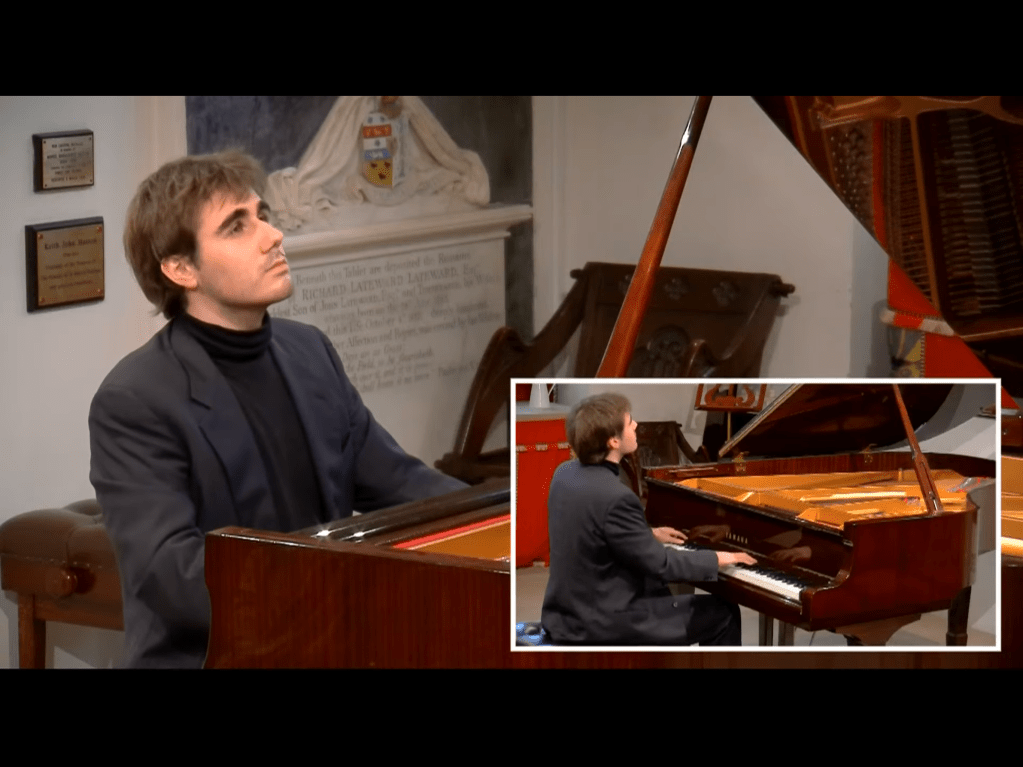
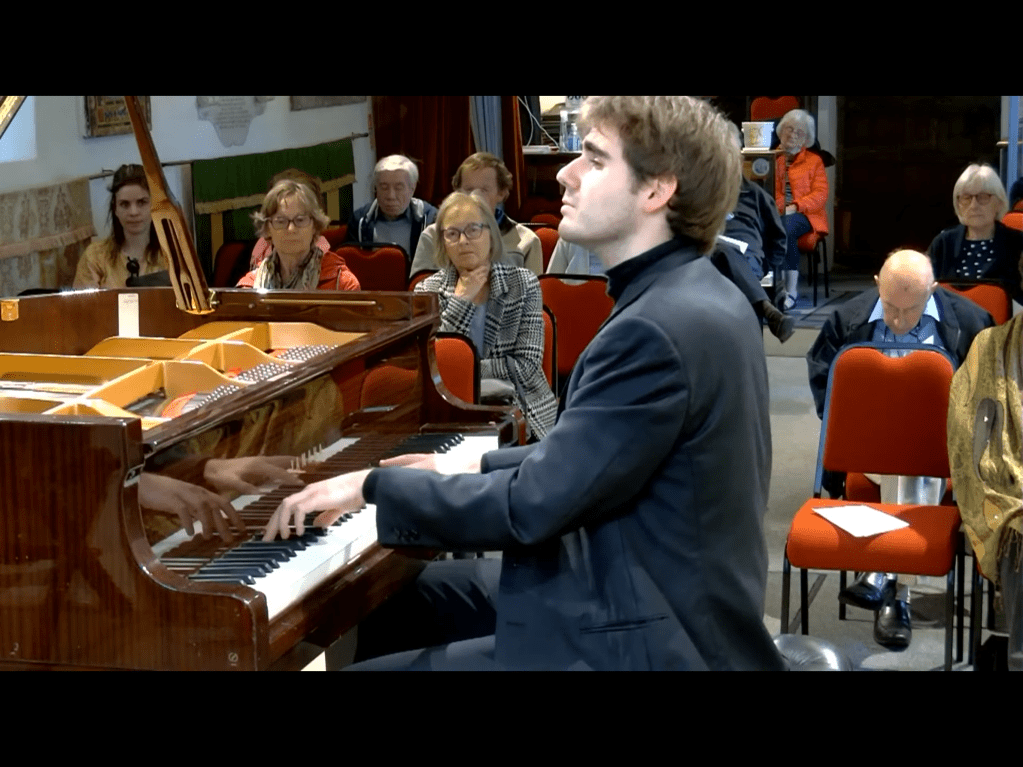
Mastery and monumental are two words that are all too little to describe the authority and beauty of the recital by Daniel Hyunwoo.Three Debussy preludes played with such character and self identification that one was not aware of the absolute mastery and control that allowed the music to become truly ‘pictures in sound’.Fingers that seemed to fit each note like a glove where each finger was allowed to dig deep into the keys to extract the exact sound that Daniel had in his poetic soul.Not only absolute authority in which there was no doubt about the message he was transmitting.He had gone deep into the soul of the music too and with superb technical control and intelligence had led us through a technical maze with a clarity and sense of architectural shape that was remarkable.
It was more then ever noticeable in his playing of Schubert of how the anchor in the bass allowed him such freedom to discover so many wondrous sounds but without ever sacrificing the great wave on which we were travelling on a timeless voyage of discovery.The simplicity of the musical line and the beauty of sound that flowed so naturally from his fingers was quite mesmerising.A voyage that after the scintillating kaleidoscopic colours of Debussy he had entered via the world of Bach with sounds of luminosity,clarity and a simplicity that allowed the music to speak with such poignancy.It was a voyage that he had been persuaded to take by a colleague Damir Duramovic who was in the audience and who Daniel accused of having imparted his undying love for Schubert. https://christopheraxworthymusiccommentary.wordpress.com/2022/04/18/damir-duramovic-at-cranleigh-arts-a-musician-speaks-with-simplicity-and-poetry/. His encore he dedicated to Damir whose performance had inspired him to learn the Schubert Drei Klavierstucke .Daniel played the first of them with a drive and sense of architectural shape that was remarkable for its solidity and a central episode of passionate abandon almost improvised with its streams of ravishing embellishments.
Debussy wrote two books of 12 Preludes and Daniel chose three from the second book that was written between 1912 and 1913.The German-English pianist Walter Morse Rummel a student of Leopold Godowsky, gave the premiere of the entire second book of preludes in 1913 in London.The titles of the preludes are highly significant, both in terms of their descriptive quality and in the way they were placed in the written score. The titles are written at the end of each work,allowing the performer to experience each individual sound world without being influenced by Debussy’s titles beforehand.Les fées sont d’exquises danseuses» is from J.M. Barrie’s book ‘Peter Pan in Kensington Gardens’ which Debussy’s daughter had received as a gift.It was the first of three Preludes that Daniel played and was remarkable for its absolute clarity and sumptuous sense of style with its magical sounds of atmospheric trills.There was a beautiful melodic sense of line with jeux perlé comments of streams of silvery sounds thrown off with such ease.General Lavine was eccentric indeed with his pompous appearance dissolving into a cake walk.The rapid changes of mood were played with quixotic temperament from the strident to the seductive with such apparent ease and ‘joie de vivre’ to the final stomping off of the General.There was pure magic in ‘La ternasse…….’with streams of glistening sounds and a rousing climax that dissolves as quickly as it appears leading to the final luminous atmospheric sounds of ravishing effect.
The Prelude and Fugue in F sharp minor from Book 2 of Bach’s 48 was played with a luminosity of sound and sublime simplicity as it was allowed to flow so poignantly out of Daniel’s sensitive fingers .Fingers that seemed to grip the keys with such loving care where the return of the main theme was pure magic as it wove its way to such a beautiful final cadence.The fugue was played in a deliberate way where there was a great sense of shape and natural forward movement.’Knotty twine’ as Delius may have described Bach but in Daniel’s hands there was absolute clarity and sense of architectural shape where the amazing intricacies of the three voice fugue created a work of monumental power.
Schubert’s last three piano sonatas , D 958, 959 and 960, are his last major compositions for solo piano. They were written during the last months of his life, between the spring and autumn of 1828, but were not published until about ten years after his death, in 1838–39.Like the rest of Schubert’s piano sonatas, they were mostly neglected in the 19th century but by the late 20th century, however, public and critical opinion had changed, and these sonatas are now considered among the most important of the composer’s mature masterpieces. The last year of Schubert’s life was marked by growing public acclaim for the composer’s works, but also by the gradual deterioration of his health. On March 26, 1828, together with other musicians in Vienna Schubert gave a public concert of his own works, which was a great success and earned him a considerable profit. In addition, two new German publishers took an interest in his works, leading to a short period of financial well-being. However, by the time the summer months arrived, Schubert was again short of money and had to cancel some journeys he had previously planned.He had been struggling with syphilis since 1822–23, and suffered from weakness, headaches and dizziness. However, he seems to have led a relatively normal life until September 1828, when new symptoms appeared. At this stage he moved from the Vienna home of his friend Franz von Schober to his brother Ferdinand’s house in the suburbs, following the advice of his doctor; unfortunately, this may have actually worsened his condition. However, up until the last weeks of his life in November 1828, he continued to compose an extraordinary amount of music, including such masterpieces as the three last sonatas.
There was a rhythmic drive and nobility to the opening of this penultimate sonata .An authority that allowed no doubt as to its inner meaning and musical shape.There was great weight to the beautiful cantabile of the Andantino.Nostalgia and wondrous colours worthy of many a great singer leading gradually to the turbulence of the middle episode.So unexpected and unrelenting as it died away to a mere whisper with the return of the main theme and barely audible embellishments played with a transcendental control of sound.The scherzo was played with great character and there was a beautiful sense of shape to the melodic line in the trio with delicate counterpoints above and below.The Rondo was beautifully phrased with its long outpouring of song .There was great drama too and a coda of rhythmic energy and excitement.The end of a wondrous journey in the hands of a true poet who could guide us with such simplicity and authority.
Daniel Hyunwoo is quickly establishing himself as one of the most exciting pianists and musicians of his generation. Having been offered generous scholarships to study at both the Guildhall School of Music and Drama under Joan Havill and the Royal College of music under Norma Fisher, Daniel has since gone on to establish himself as one the UK’s most promising emerging artists. Daniel has won prizes in international Piano Competitions in the USA, Europe and Asia and was the recipient of both the Kerr Memorial Award and the Euregio Piano Award. He has performed recitals and collaborations at venues in London including the Wigmore Hall, Cadogan Hall and Milton Court and has performed concertos, recitals and chamber music around the world in countries such as Norway, France, Germany, Italy, Spain, Israel, China, Korea and the USA. Daniel continues to take on mentors for his musical development and has worked extensively with three great American musicians; Richard Goode, Robert Levin and Benjamin Zander on a wide range of repertoire as he develops his career. Daniel continues to display his wide range of musical abilities in the fields of composing, conducting and in classical and jazz improvisation; having his string quartet performed on BBC Radio 3 live from the proms, improvising stylistic cadenzas in performances of Mozart Concerti and collaborating in concert with Sholmi Goldberg on standards such as ‘Summertime’ and ‘it ain’t necessarily so.’




























.jpg "Image")