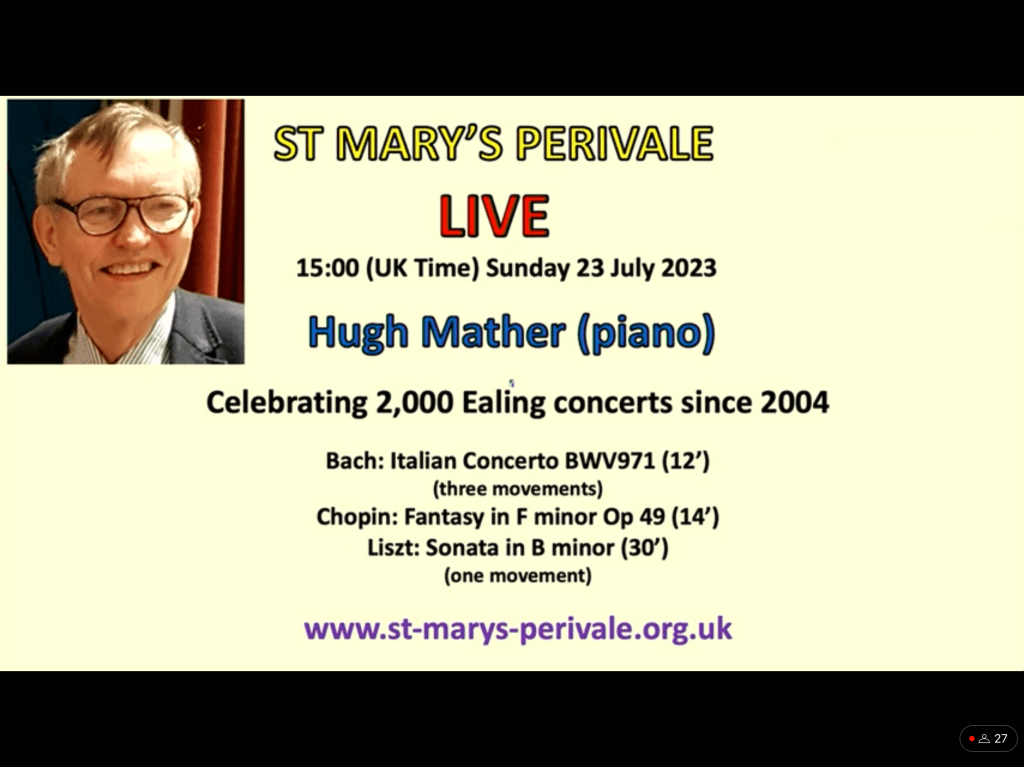
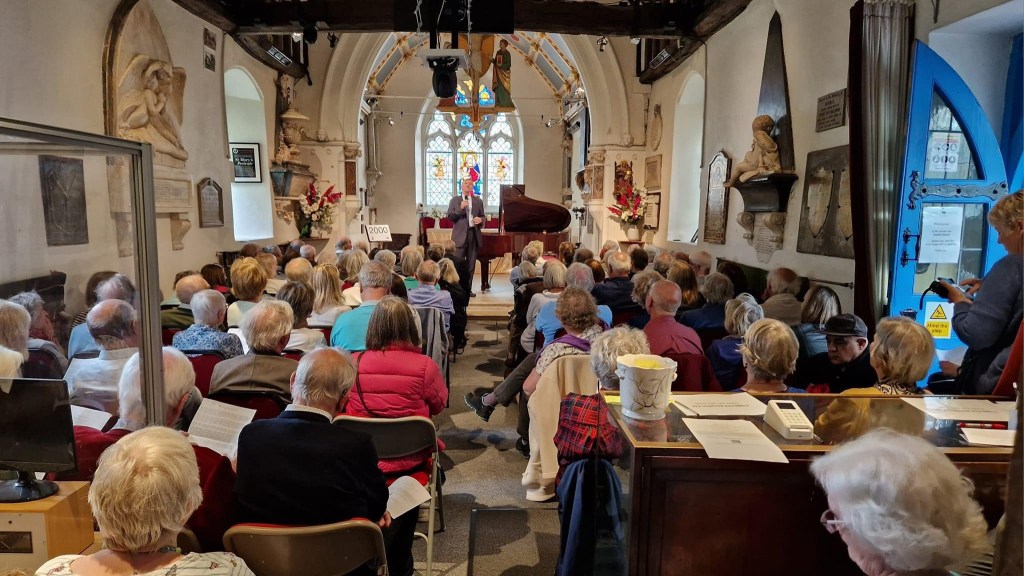
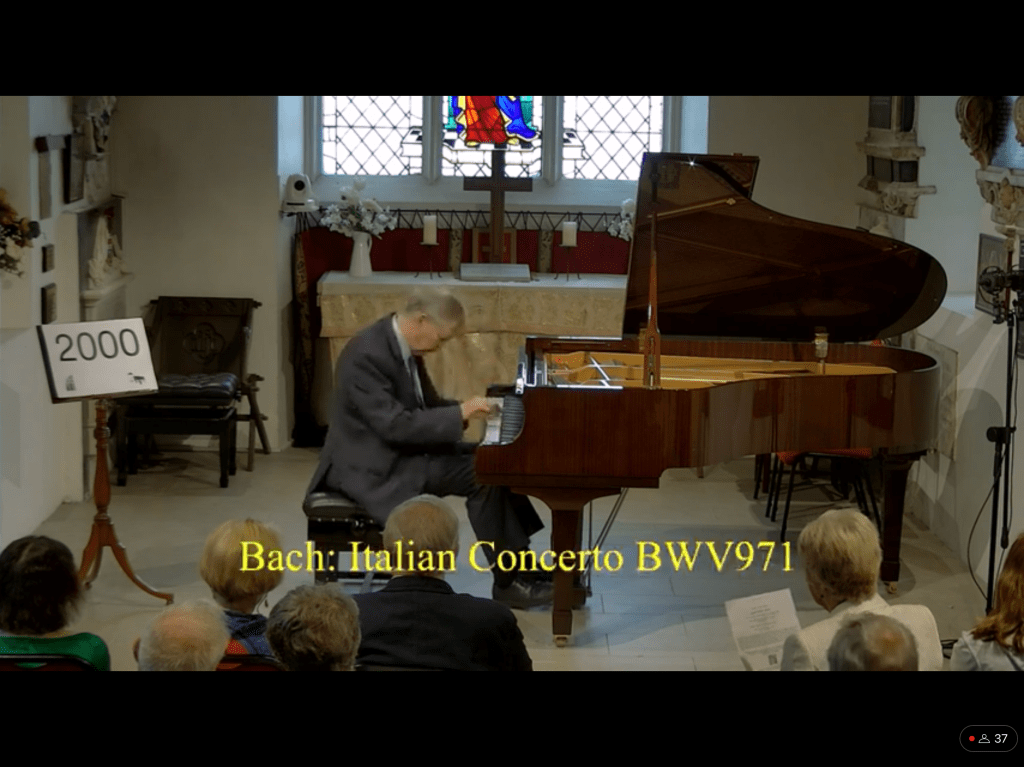
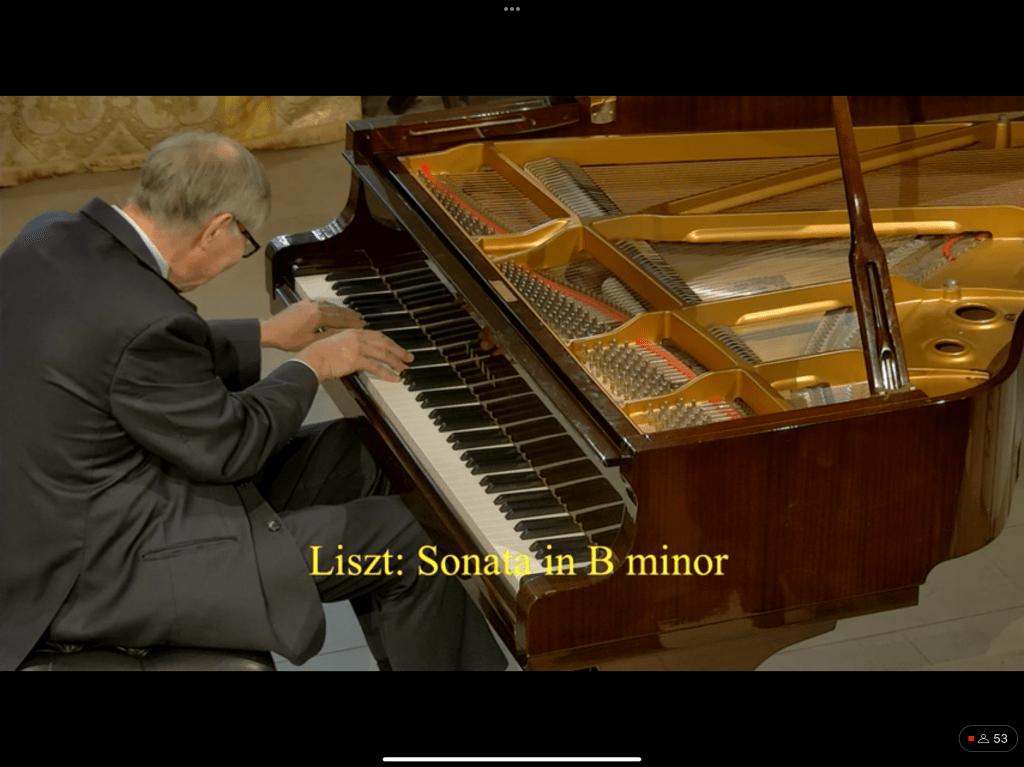
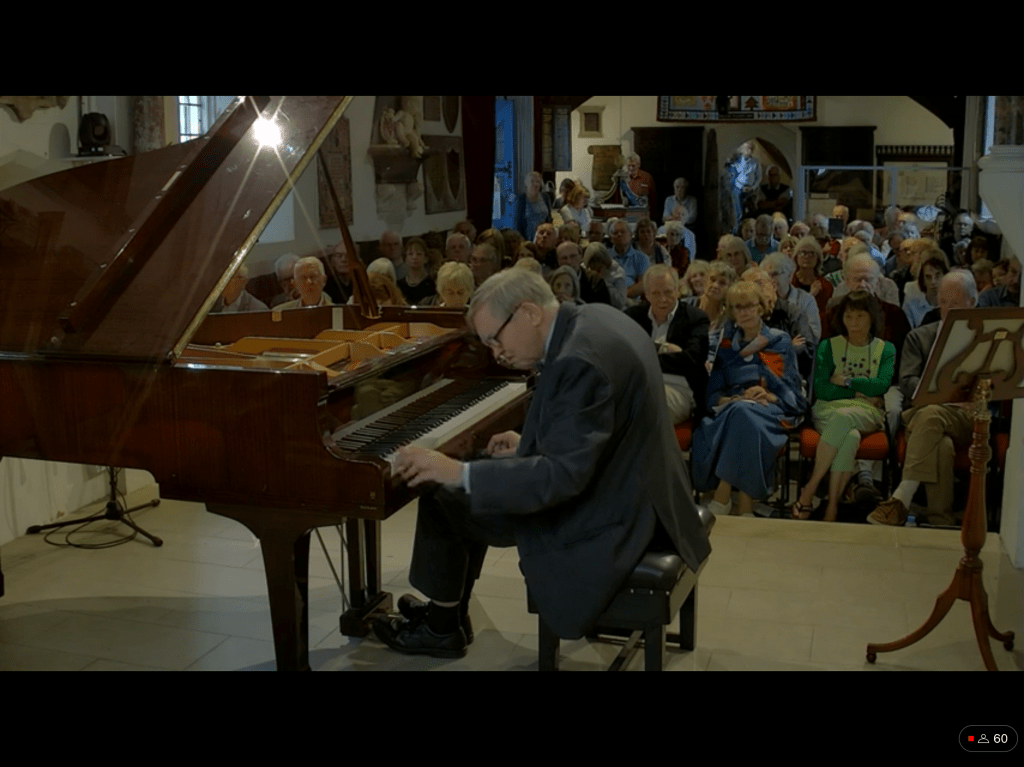
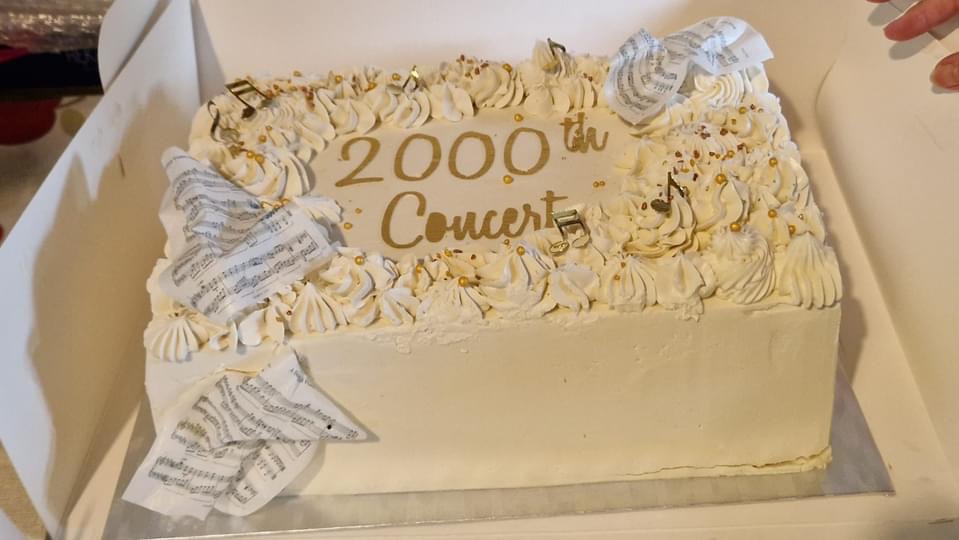
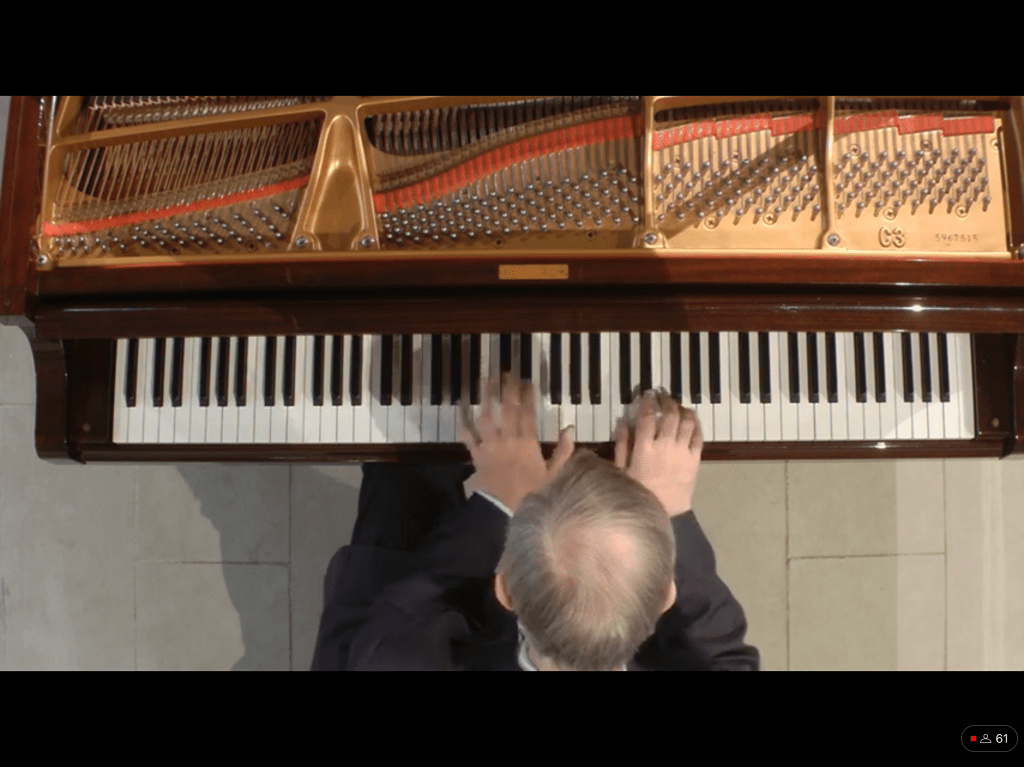
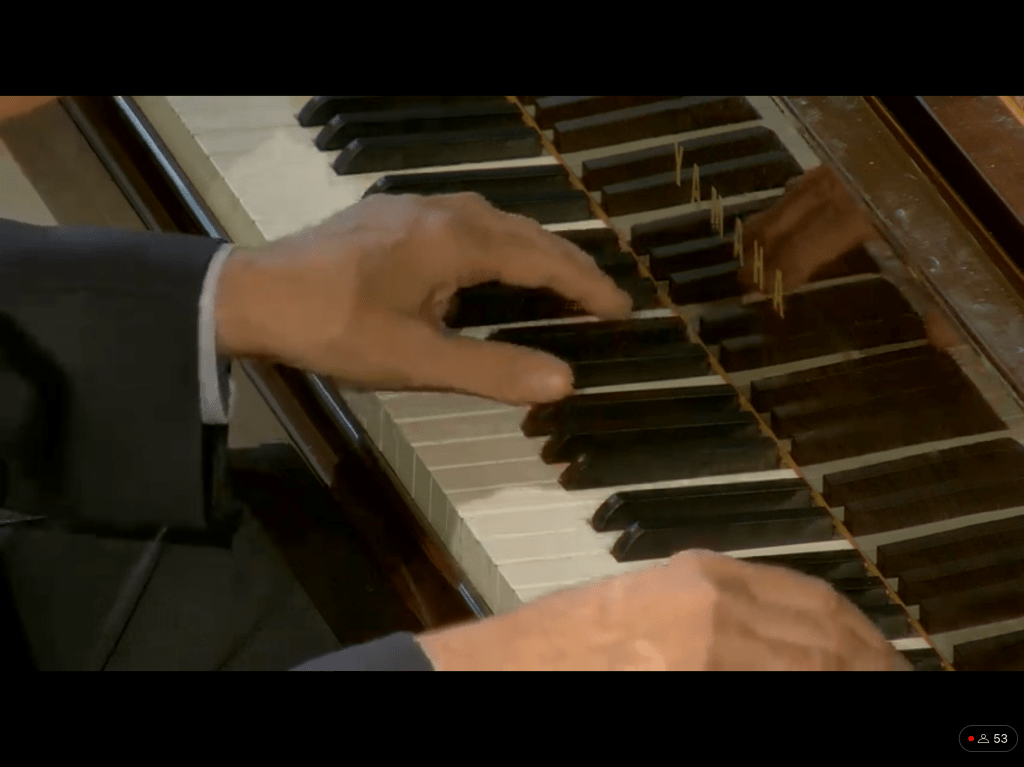
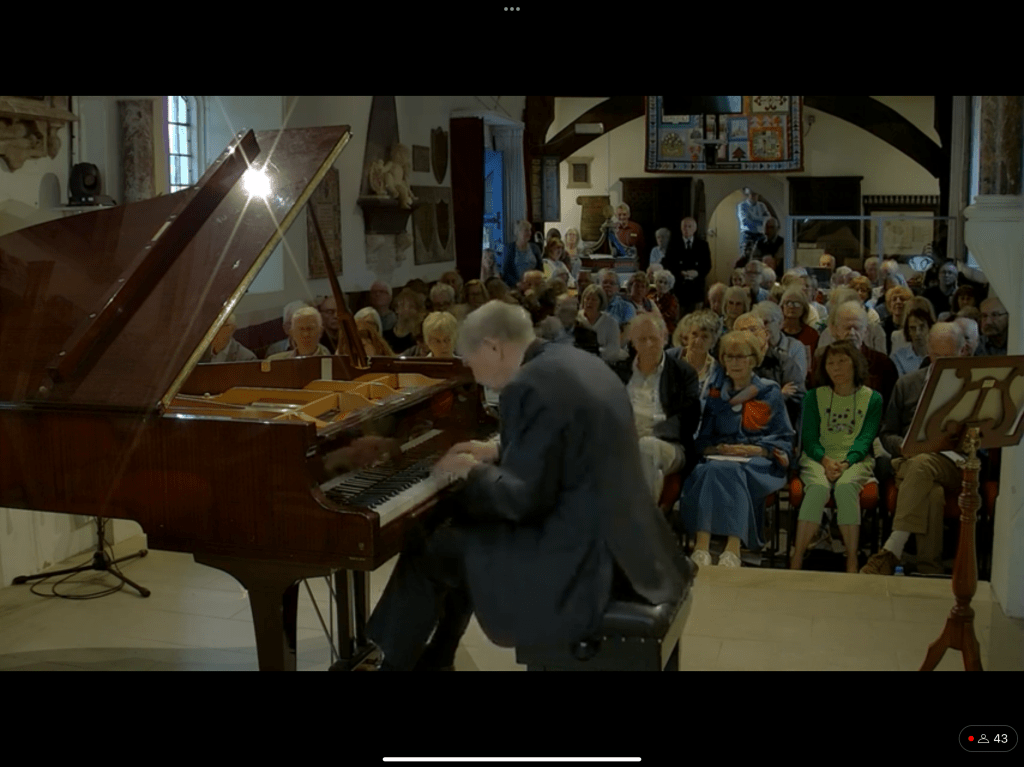
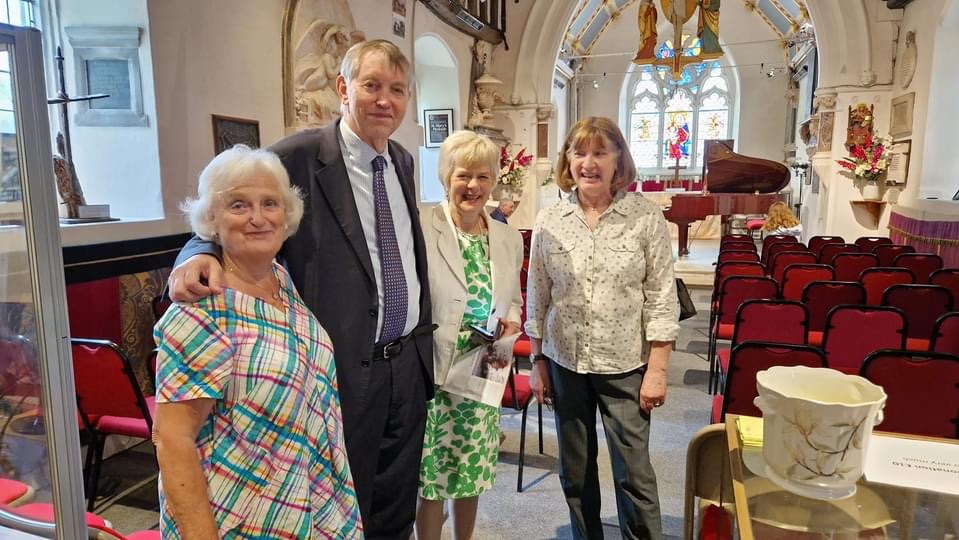
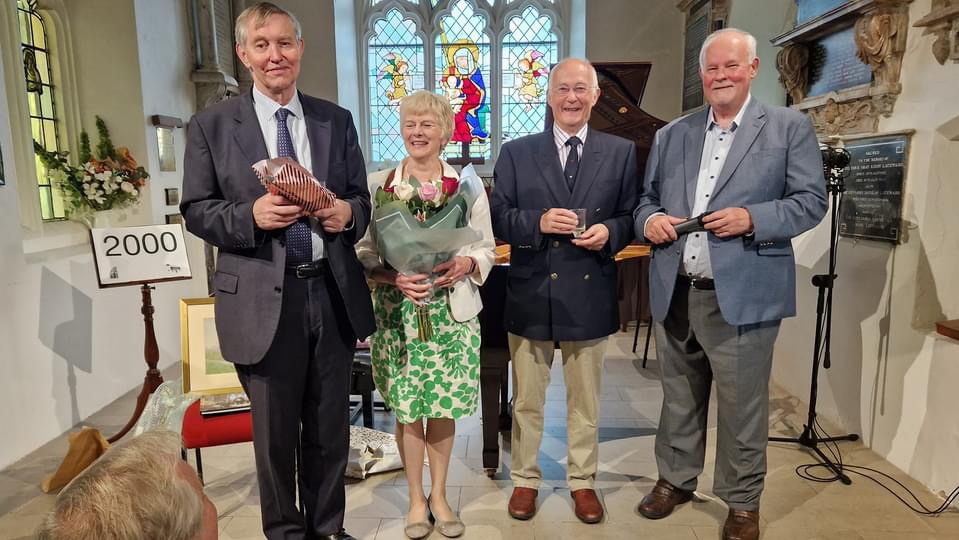
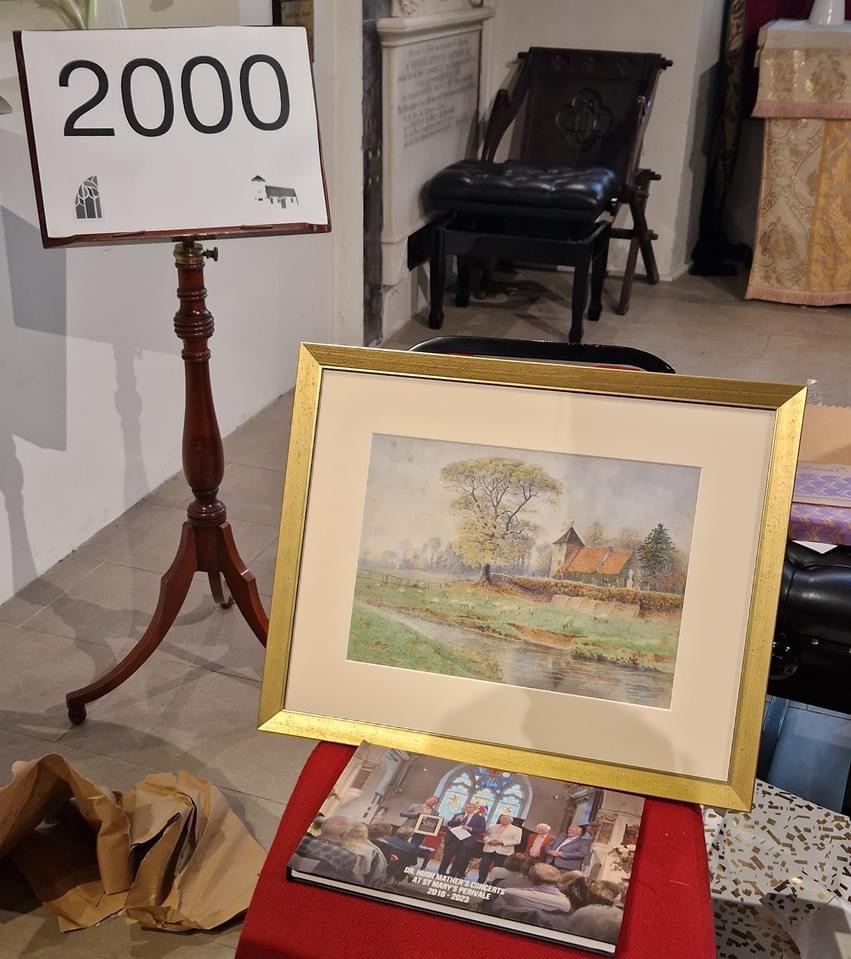
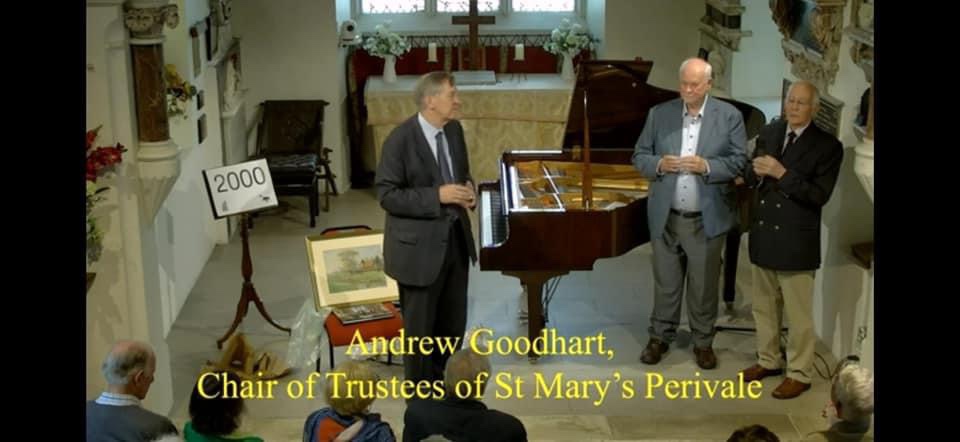
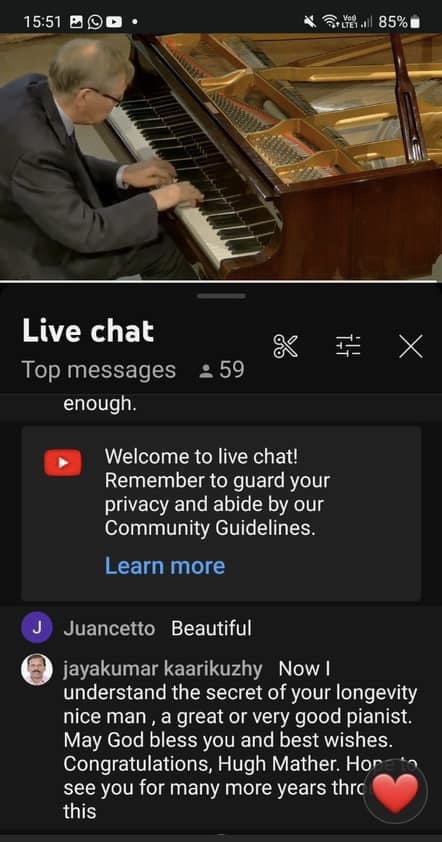
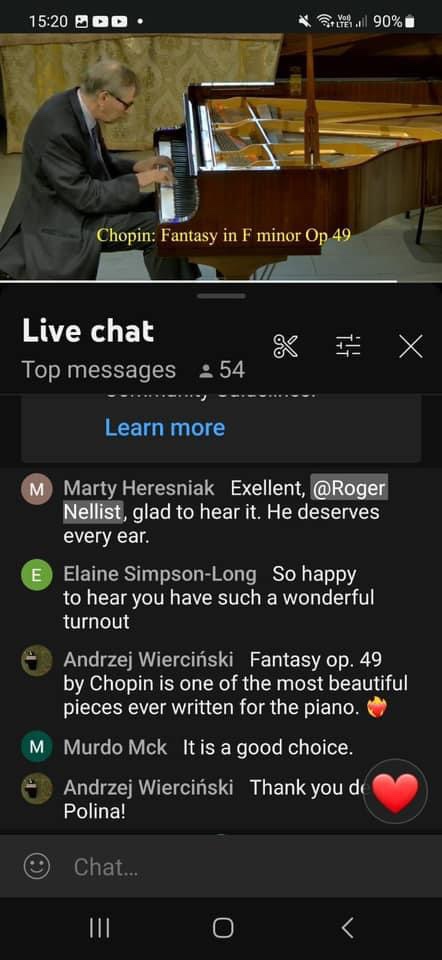
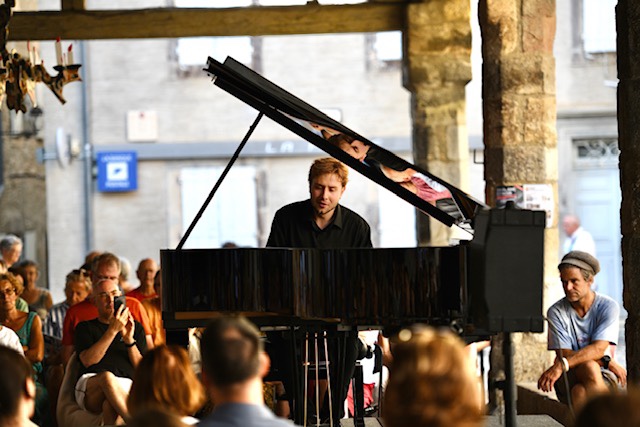
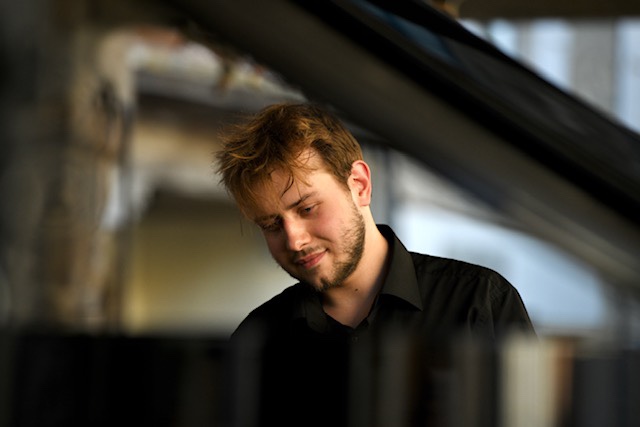
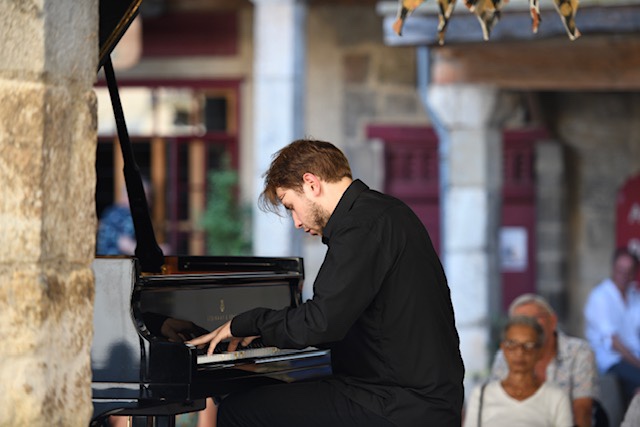
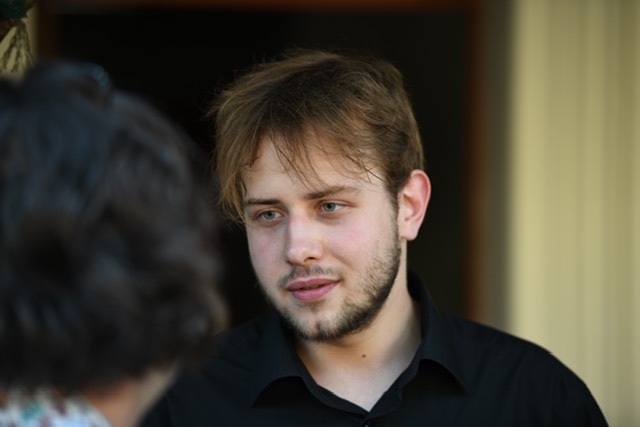
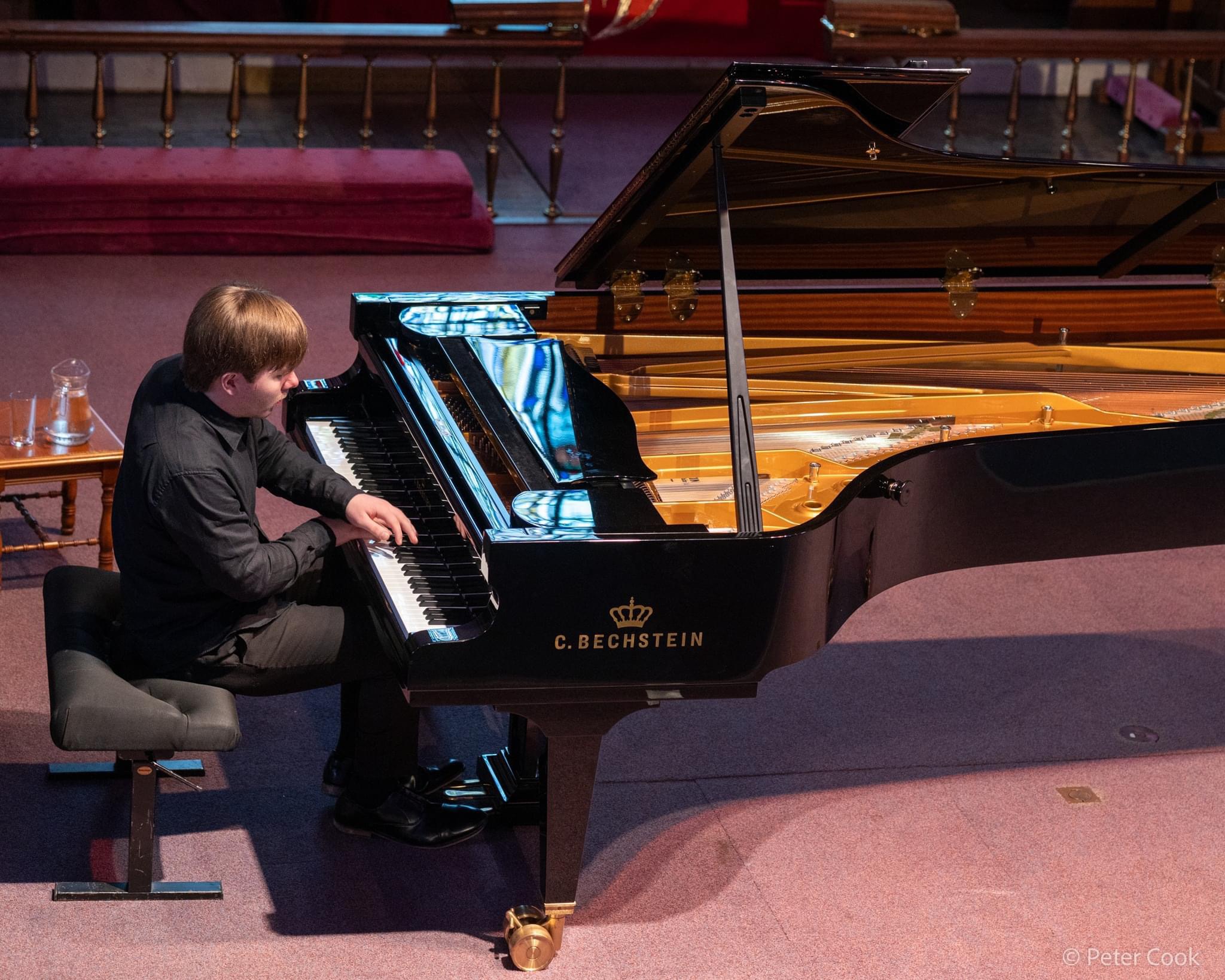
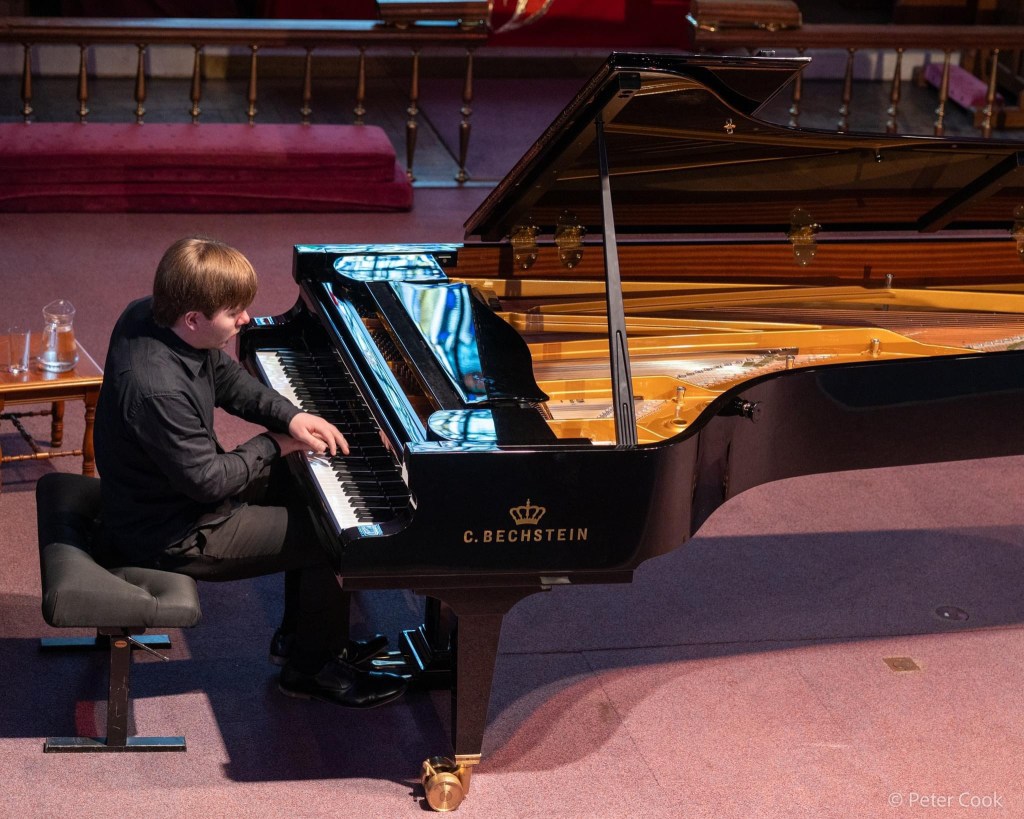
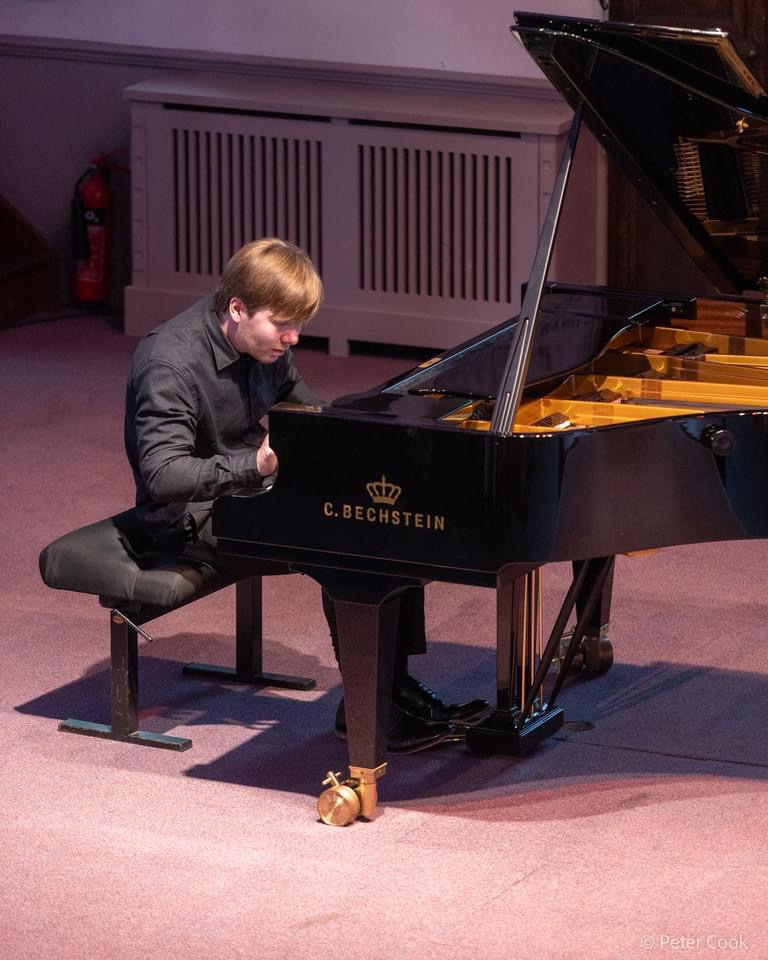
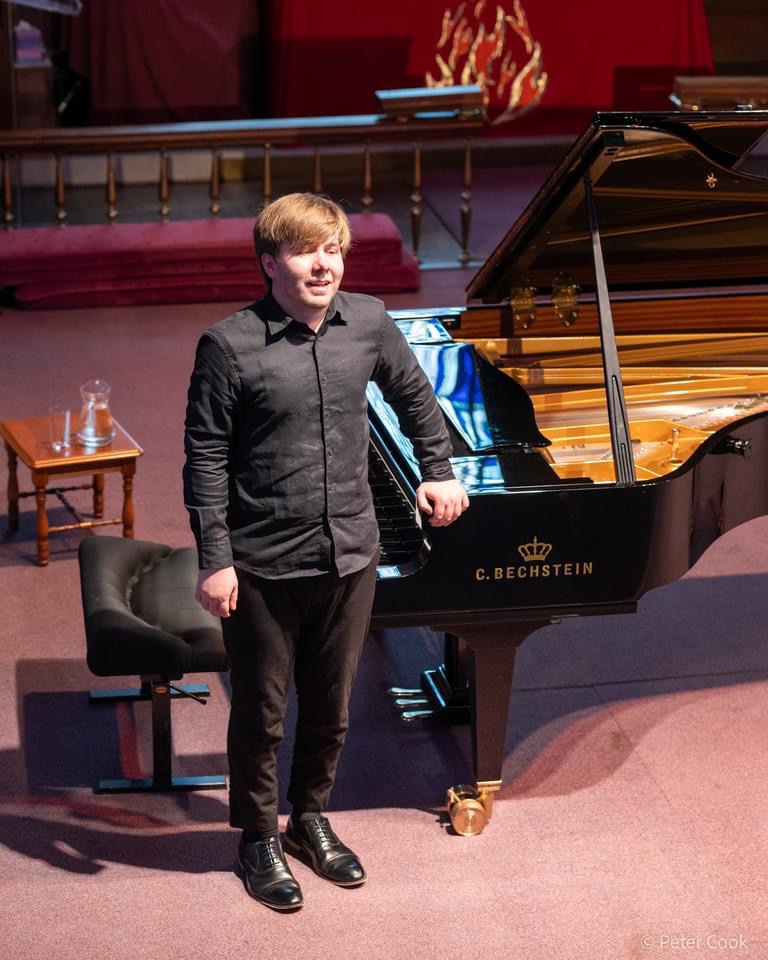
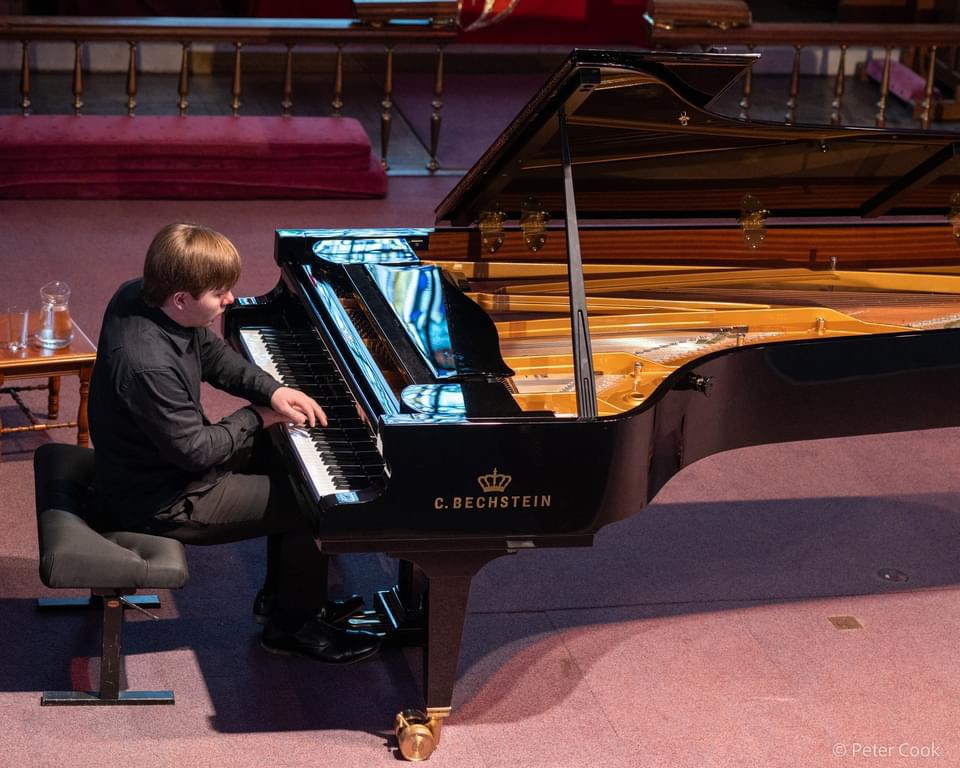
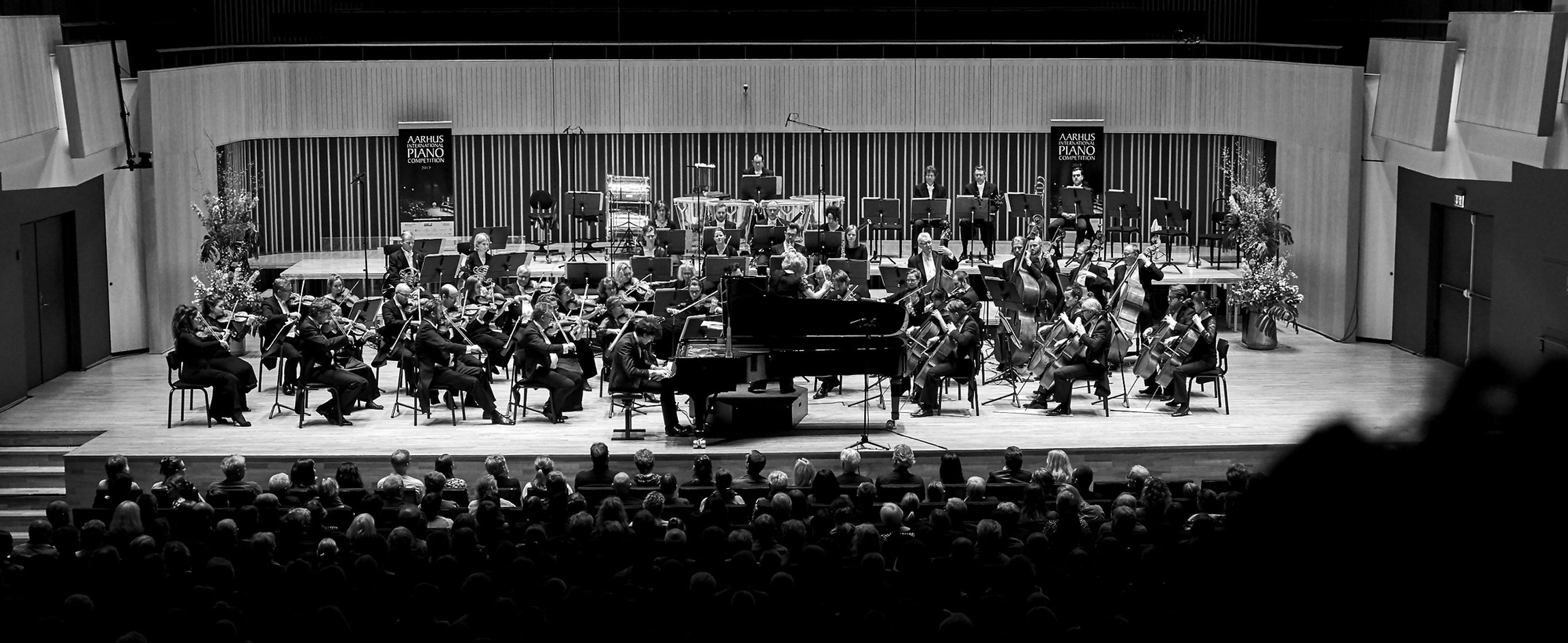
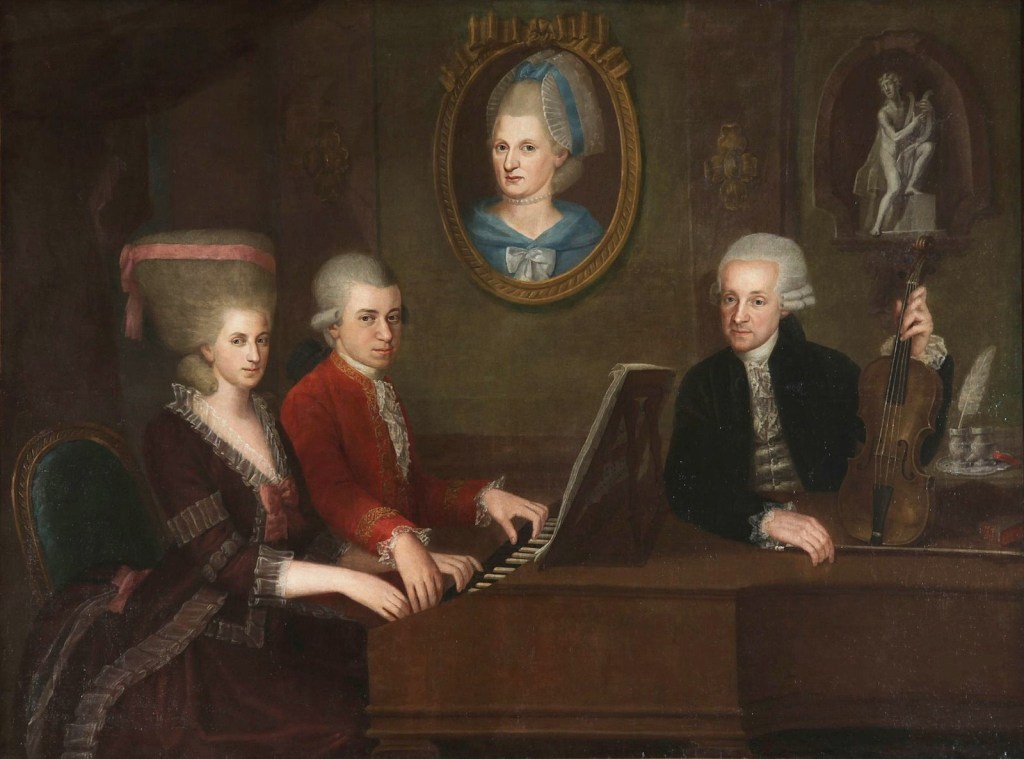
‘That young man has a great future’ was one of the comments from a listener today as Dr Hugh Mather played a programme of Arrau proportions to celebrate the 2000th concert in Ealing since 2004. Playing of real musicianship from the opening of the Italian Concerto with a clarity, rhythmic energy and ornaments that sparkled like jewels.
An Andante that flowed so beautifully and where the expansive improvised beauty of the melodic line could be revealed with purity and simplicity. A presto that was as light and gracious as it was rhythmically infectious but with an aristocratic control that never lost sight of the musical line.
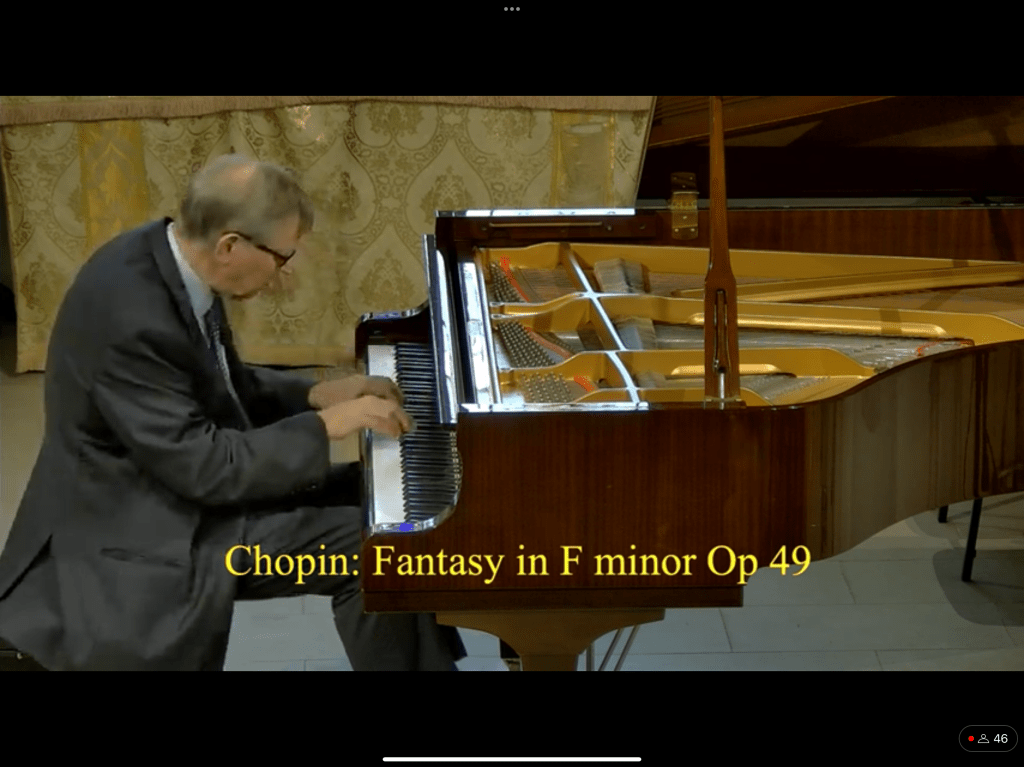
There was such beautiful legato in the Chopin Fantasy contrasting with the non legato polonaise like opening.A sense of balance that gave luminosity to the melodic line without ever hardening the texture or slowing the forward movement .The opening arpeggios blossomed with refined beauty and restrained passion before bursting into bloom only to dissolve into a central section of ravishing beauty.The final cadenza after a passionate outpouring of the opening theme came as a gentle relief,bathed in pedal,before the golden stream of notes that took us to the final imperious chords.
Liszt’s great pinnacle of the Romantic piano repertoire was played with remarkable musicianship and amazing technical control.A sense of line and a forward movement that gave great weight to the overall architectural line.
The final note of the Liszt Sonata placed with absolute mastery
It was in the transition into and out of the Andante sostenuto that showed Dr Mather’s impeccable musicianship as he kept the momentum flowing from below like a great wave that was always present and on which Liszt sailed with such innovative genius.There was passion too ,of course,but always with a sense of balance where the accompaniment never smothered the musical line .Dr Mather’s mature musicianship could oversee the general shape and follow Liszt’s very precise indications with intelligence and remarkable understanding.
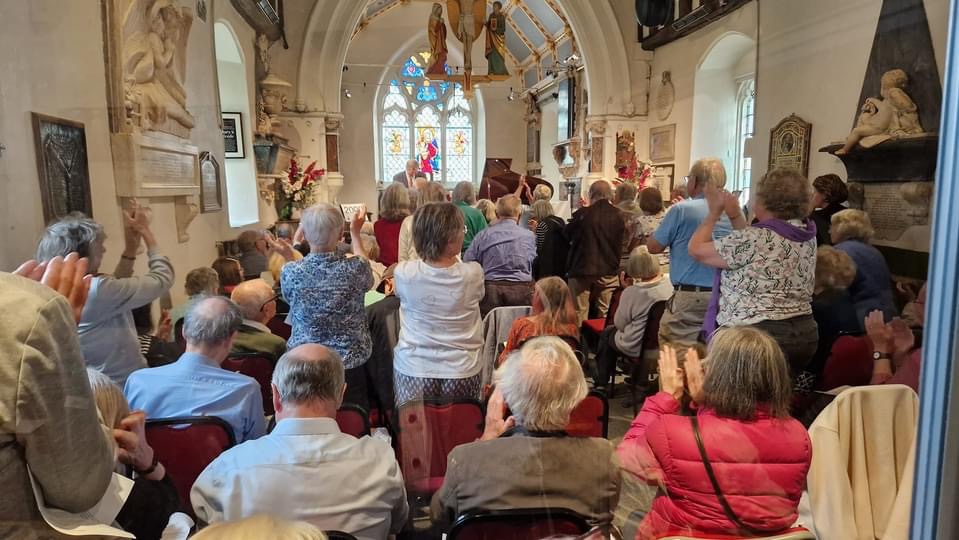
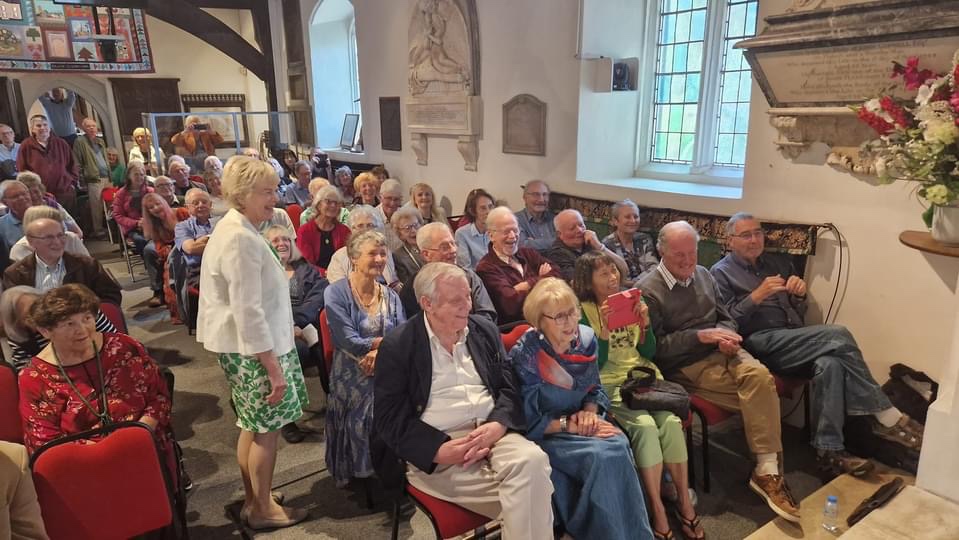
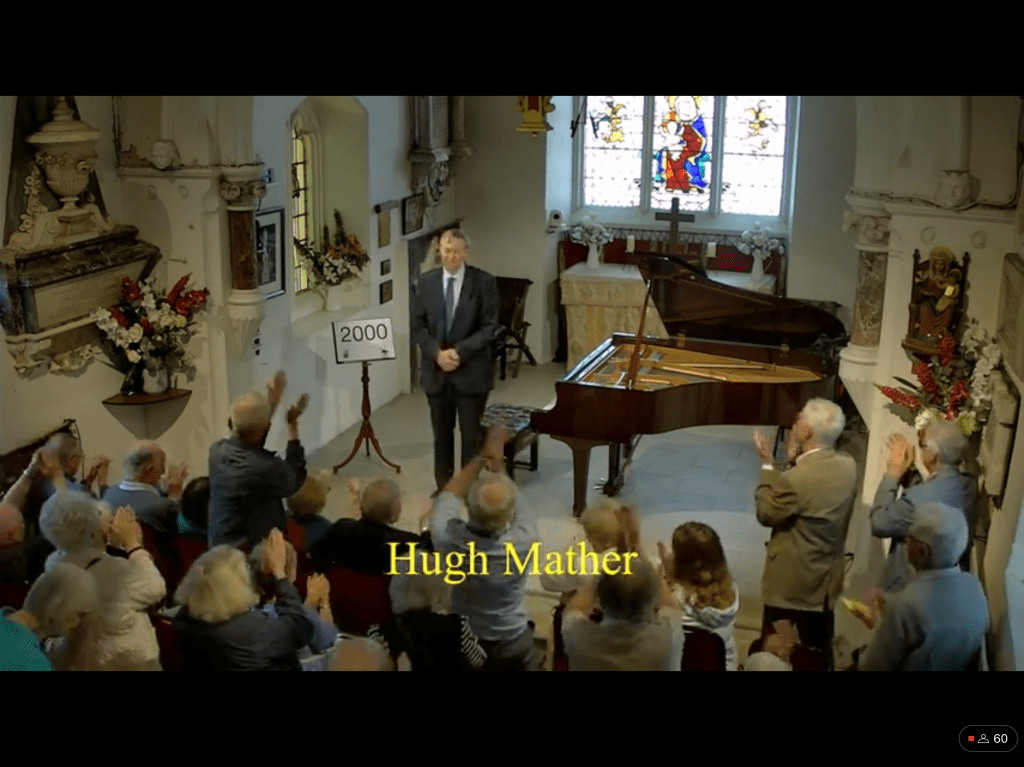
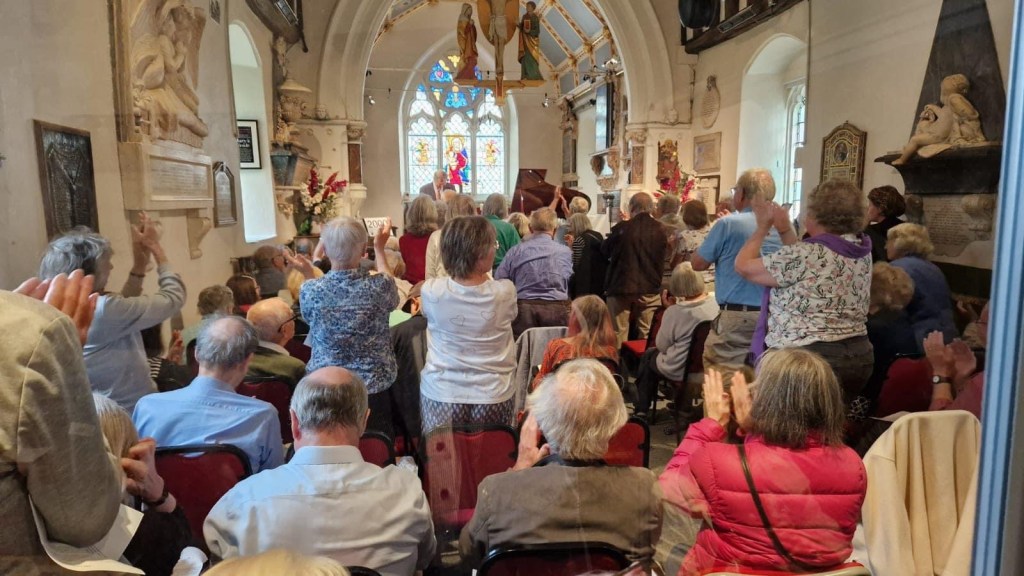
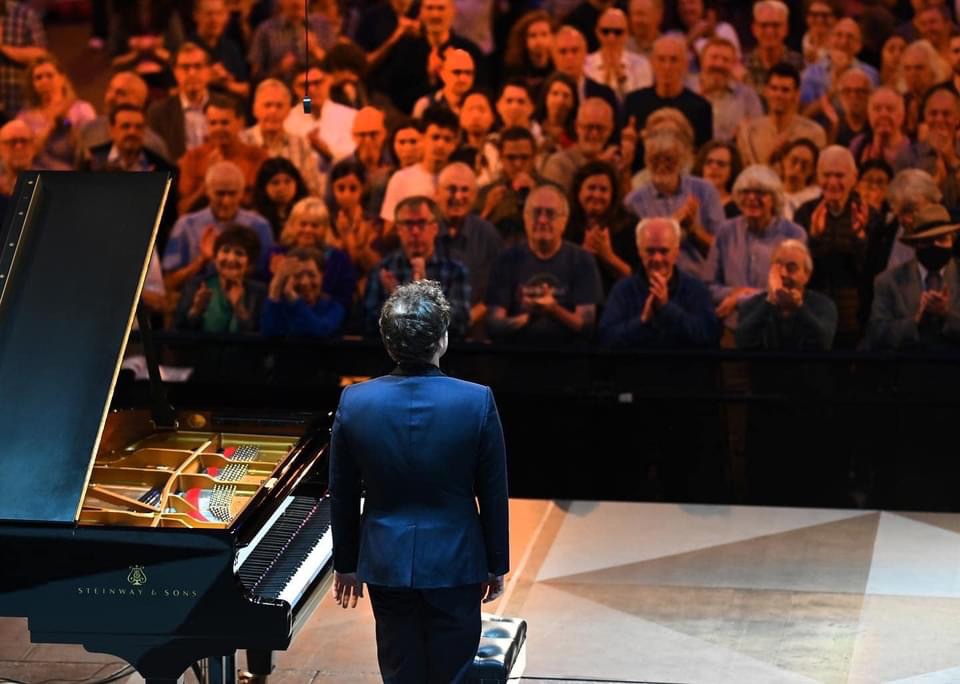
A standing ovation from the public of St Mary’s, full to overflowing for Hugh’s remarkable recital
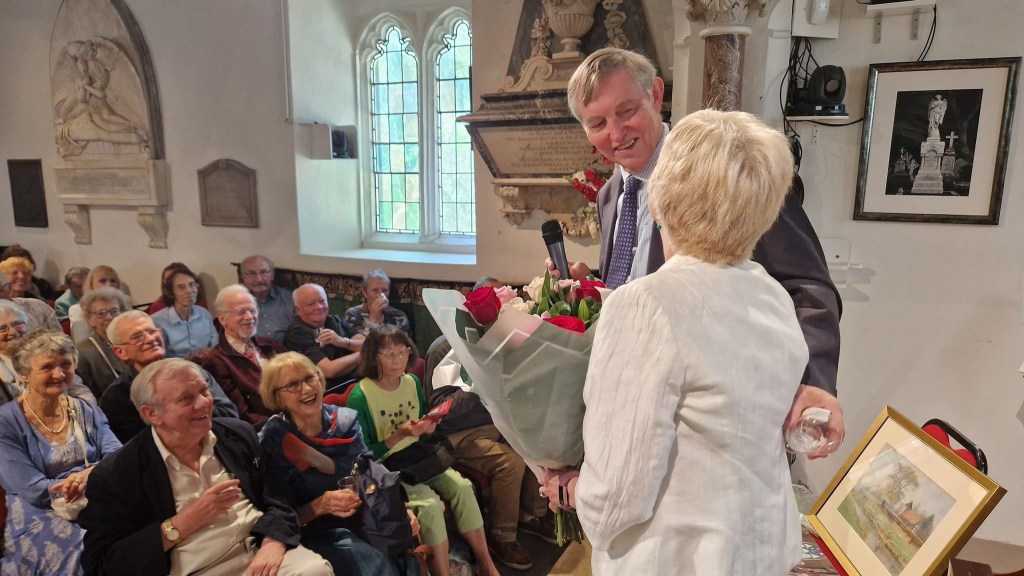
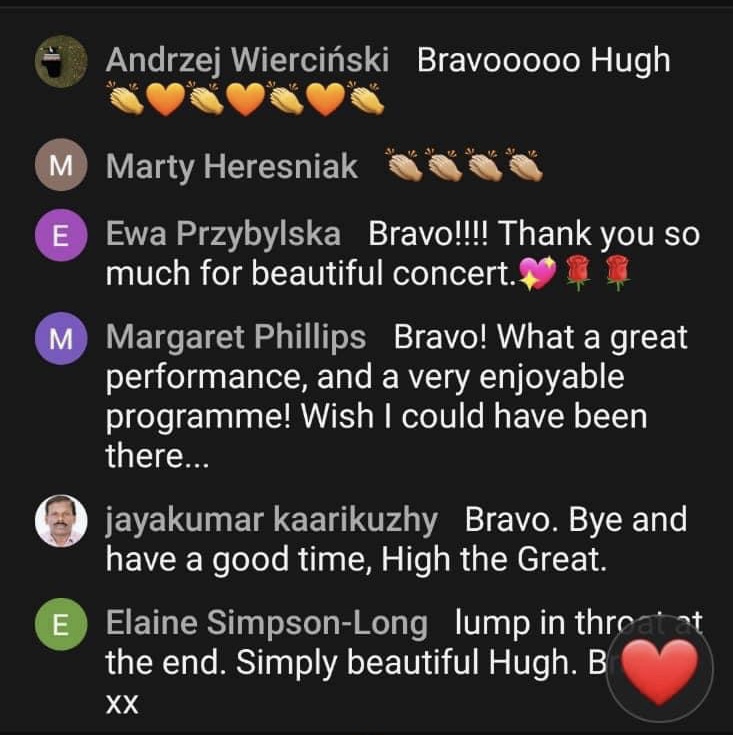
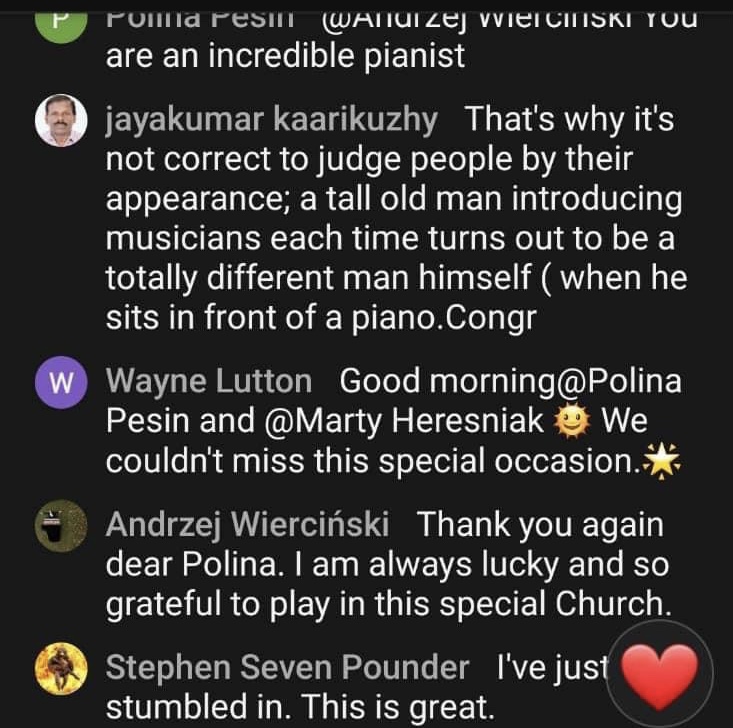
Greeted by a standing ovation Hugh still had the strength to offer an encore of Mendelssoh’s Andante and Rondo Capriccioso.It was played with ravishing sound and refined rubato before bursting into the scintillating featherlight fantasy that is so typical of Mendelssohn. Remarkable performances from a retired physician that would have done any professional pianist proud. Many comments from the young musicians that Dr Mather and his team have promoted with such tireless dedication.They just show with what esteem we all hold this remarkable man whose still loves music with the same passion of the eighteen year old who stole Felicity’s heart with his first performance of the Liszt Sonata at Cambridge University sixty years ago . A team indeed Hugh and Felicity,surrounded by a wonderful group of professional admirers and helpers all dedicated to encouraging young musicians to reach their goal in life,on and off stage,as they so obviously have. If Music be the Food of Love …………play on – what better example could there be than today’s wonderful performances .
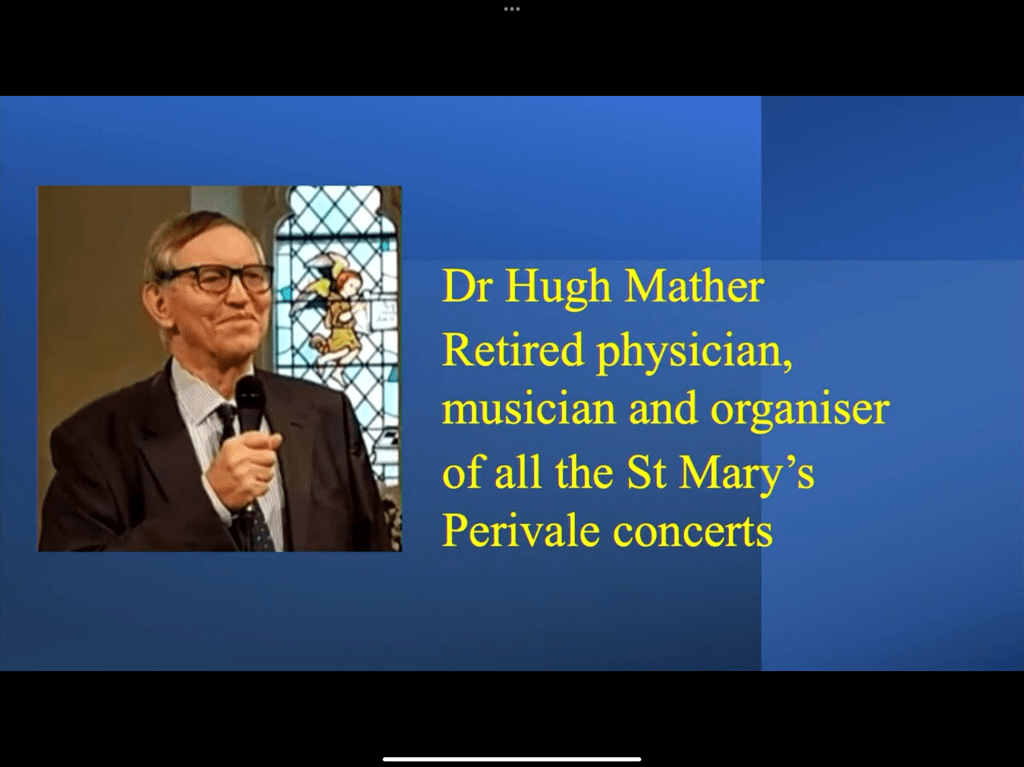
Hugh Mather was born in 1945 and was educated at Westminster Abbey Choir School and Clifton College, Bristol. He gained the FRCO diploma with the Limpus and Reid prizes while still at school, and subsequently the ARCM (piano performers) diploma. He studied medicine at Cambridge University and Westminster Medical School, and was Consultant Physician at Ealing Hospital from 1982 to to 2006, before retiring to pursue his musical interests. He continued his piano studies with James Gibb for many years, and gave countless concerts in West London as concerto soloist, recitalist, accompanist and chamber musician. He has performed concerti by Mozart, Beethoven, Brahms, Chopin, Mendelssohn, Gershwin, Grieg, and Schumann. He has been Chairman of the Friends of St Mary’s Perivale since 2005, and has organized 2000 concerts in Ealing over the past 20 years, with 657 at St Barnabas Ealing and (as of this recital) 1343 at St Mary’s Perivale. More details re his concert organizing activities are available
Dr Mather writes :’My 2000th Ealing concert is next Sunday. Here is an overview of 19 years (2004 – 2023) fixing 1334 concerts at St Mary’s Perivale and 657 at St Barnabas. https://www.st-marys-perivale.org.uk/2000-concerts.shtml To celebrate, I am playing one final solo performance, with Bach, Chopin and the Liszt B minor on Sunday July 23rd at St Mary’s Perivale at 3 pm. Hope I survive !’
2000 Ealing concerts – 2004 to 2023 A personal statement Hugh Mather.
My piano recital at St Mary’s Perivale on July 23rd 2023 marks a personal milestone, namely the organization of 2000 Ealing concerts since 2004, at St Mary’s Perivale and St Barnabas Ealing. I think it is appropriate to give a few more details about this. As a brief overview, I was born in 1945 and studied medicine at Cambridge University and Westminster Medical School, and was Consultant Physician at Ealing Hospital from 1982 to 2006. I am also a pianist and organist, obtaining the FRCO diploma with the Limpus prize while at school, and subsequently the ARCM (piano performers) diploma, and I continued piano studies with James Gibb for many years.
I gave several piano recitals at St Mary’s Perivale from 1985 onwards, and thus became involved with this wonderful church – a tiny 12th-century building which became redundant in 1972 and is now a highly-regarded classical music centre with a magical ambience and excellent acoustics. In 2003 I facilitated the purchase of a new Yamaha grand piano, and commenced concerts there in 2004, becoming Chairman of the Friends of St Mary’s Perivale in 2005. Since then, with an excellent and motivated team we have held 1343 concerts, detailed in our archive section on st Mary’s web site .We held about 50 concerts per year on Sunday afternoons and Wednesday evenings until 2016, when we introduced Tuesday afternoon piano recitals, at the suggestion of Roger Nellist, with the annual total rising to about 120.
I am also organist at St Barnabas Church, Ealing, and in 2007 I bought a Bösendorfer concert grand for the church. That fine instrument was the basis for the 657 concerts held there between 2007 and 2020, raising over £250,000 for church funds, with over 530 Friday Lunchtime Concerts, 13 major weekend piano festivals and 6 series of Summer Proms.
Thus the combined total of concerts at St Mary’s Perivale (1343) and St Barnabas (657) reaches 2000 on July 23rd 2023, and has included performances by over 550 pianists, 250 violinists and 150 cellists etc. A list of all the musicians playing at Perivale is available here. All concerts at St Mary’s Perivale since 2007 have been recorded with equipment installed by Simon Shute. We started to livestream our concerts in December 2018, and since then have broadcast over 400 on YouTube. We were thus able to broadcast ‘live’ concerts throughout the pandemic, with 154 streamed from an empty church, supporting musicians with paid performances, and we received the ‘Lockdown Star’ award from the Critics’ Circle in recognition. Our broadcasts have been viewed almost 400,000 times since 2018, and now attract over 100,000 views annually in nearly 70 countries. We have raised almost £100,000 for our musicians during and since the pandemic. Further details about our livestreaming activities are available on the St . Marys’ web site
None of this would be possible without our team of volunteers, led by Roger Nellist and Simon Shute, with George Auckland, Andrew Whadcoat, Gill Rowley, Rob Jenkins, Truus Bos, Peter Sandison, Sherry White, Felicity Mather, Andrew Goodhart, Richard Norris and David Brown, among many others. We are firm believers in the future of live broadcasts of classical music, and are now one of the foremost UK broadcasters of piano recitals and chamber music.
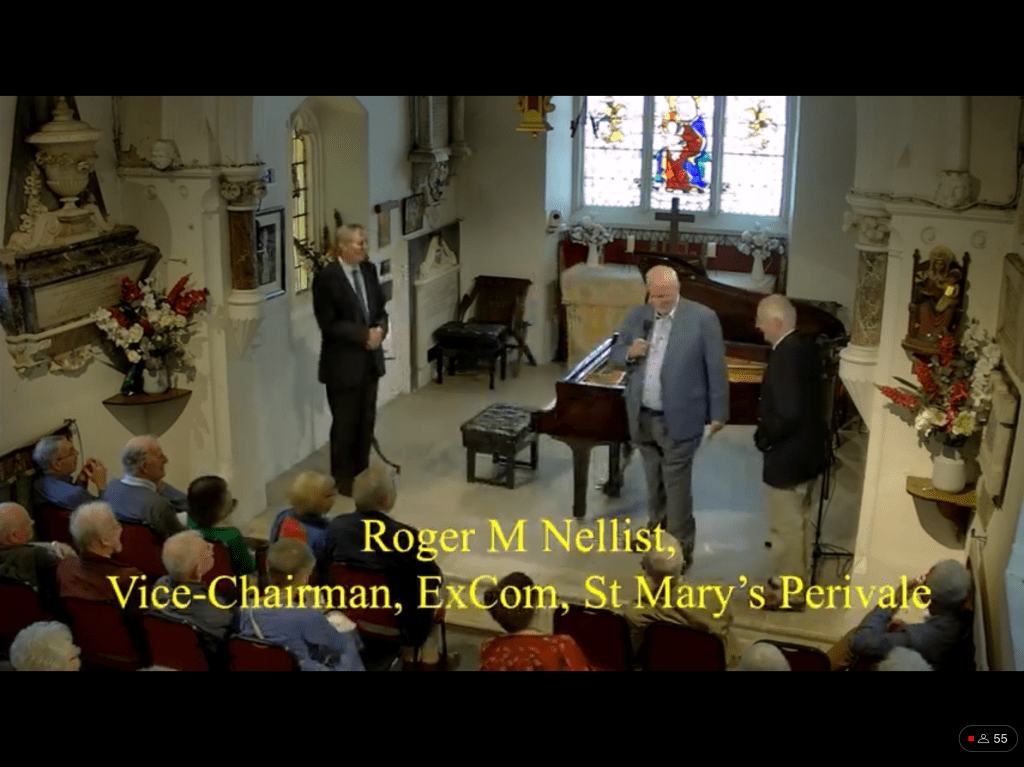
Roger Nellist taking over Hugh’s role today as Master of Ceremonies
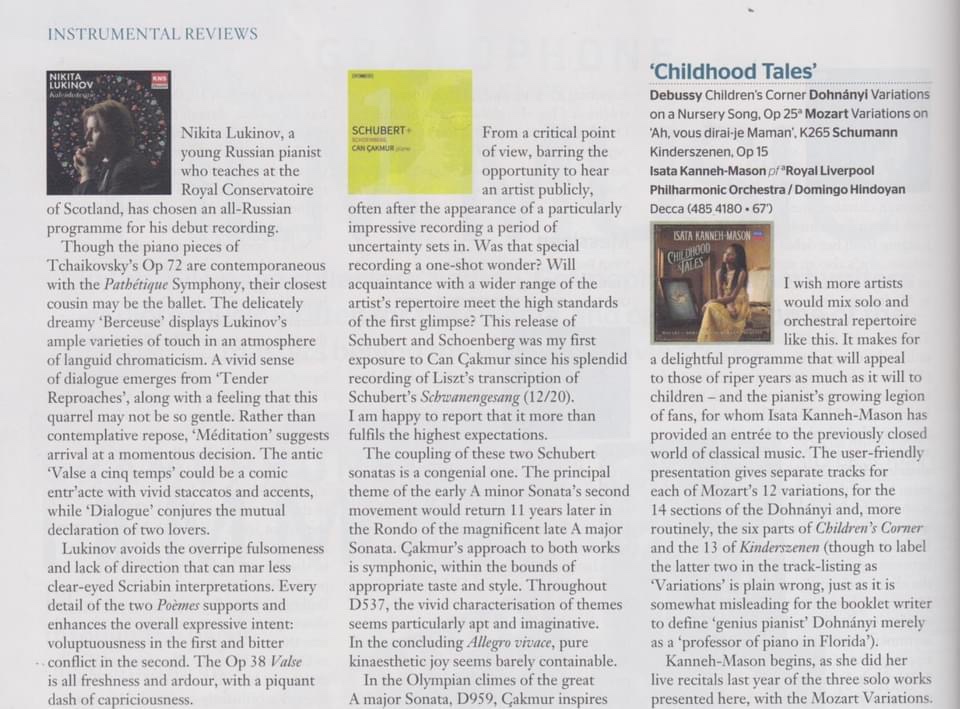
“…Extraordinary breadth and freedom of imagination…” Thrilled to receive this review of “Kaleidoscope” from the GRAMOPHONE magazine!!! 🥳🤩🏆 The album is available on all streaming platforms 💿🎶🎹
On behalf of all the volunteers and association members that make En Blanc et Noir a reality, we would like to thank you and the Keyboard Trust for generously making Nikita’s presence this year at the festival a possibility! He played an incredible recital and was otherwise a very cherished member of the community for the days he stayed with us in Lagrasse. Thank you for finding not only a brilliant artist but also a lovely person with whom it was a joy to spend time together.
We look forward to continuing our collaboration with the Keyboard Trust in future years, and Bobby will be in touch with you about selecting an artist for the 2024 edition of En Blanc et Noir. Sincerely, Alain and Bobby
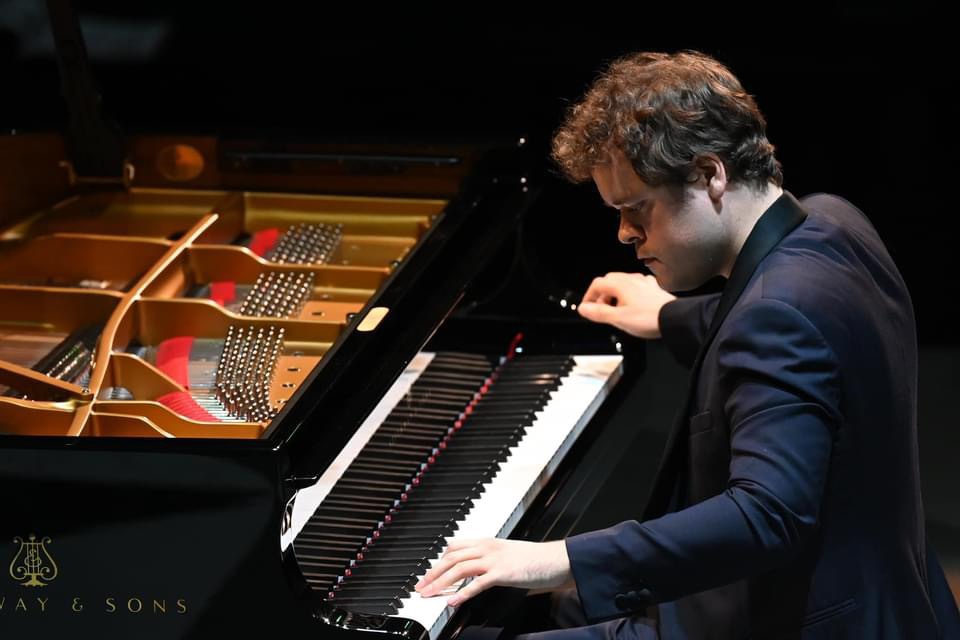
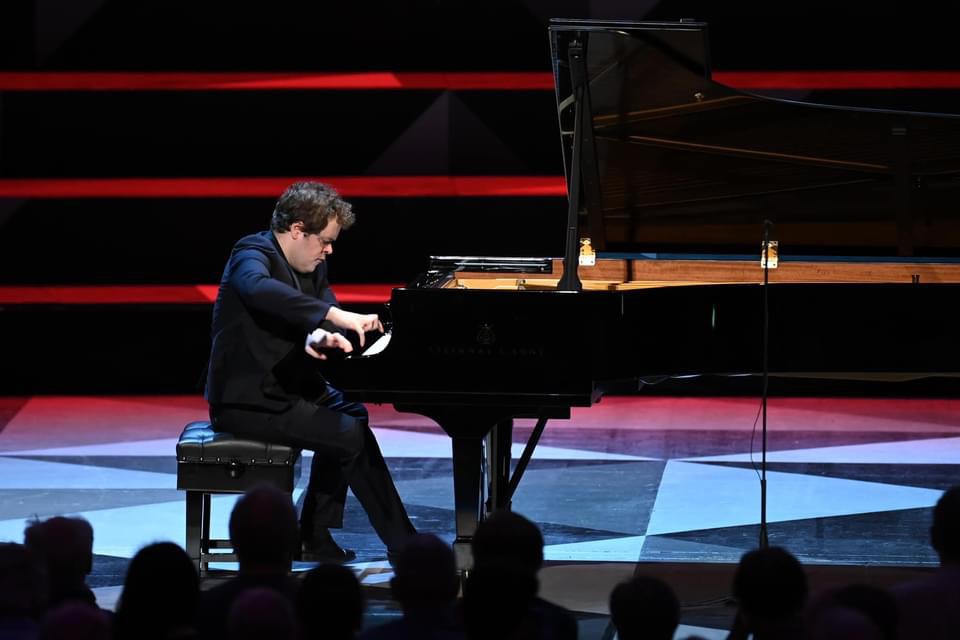
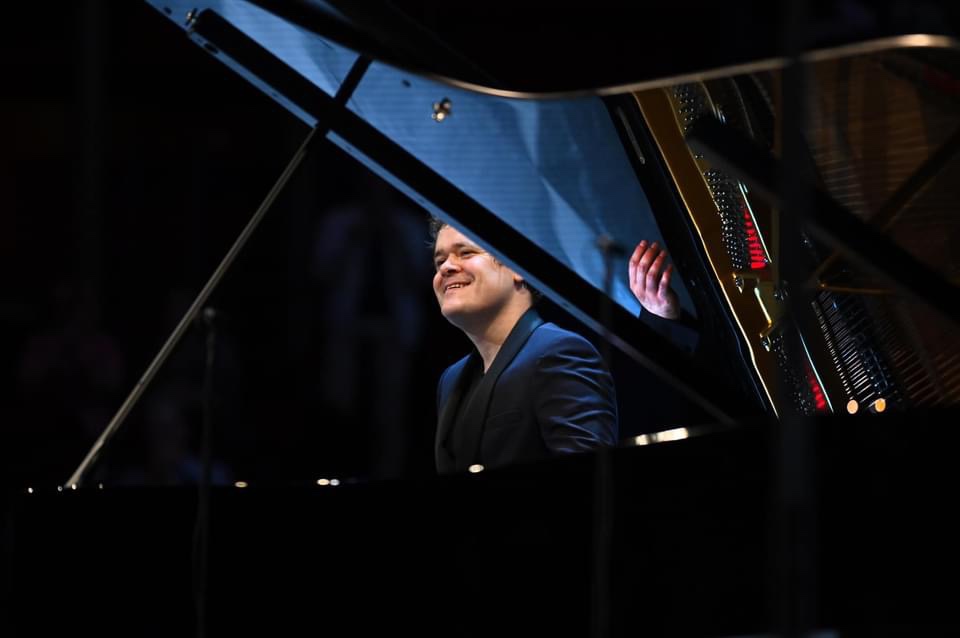
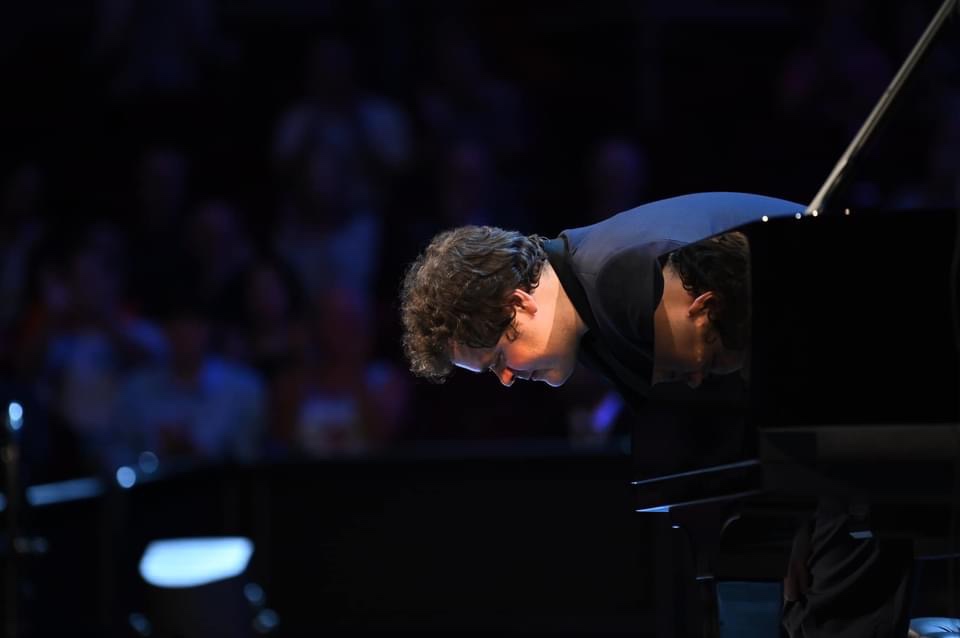
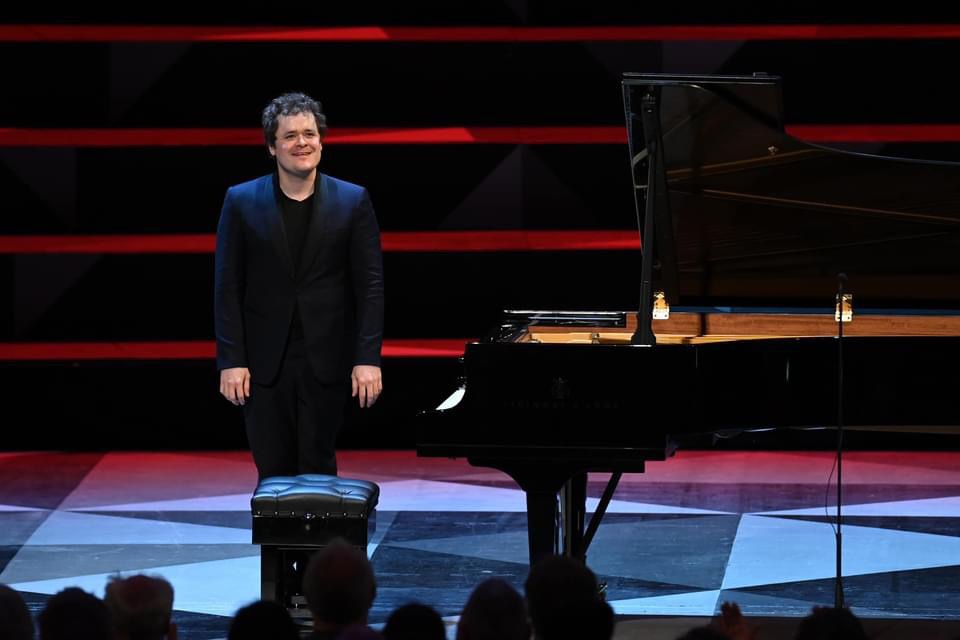
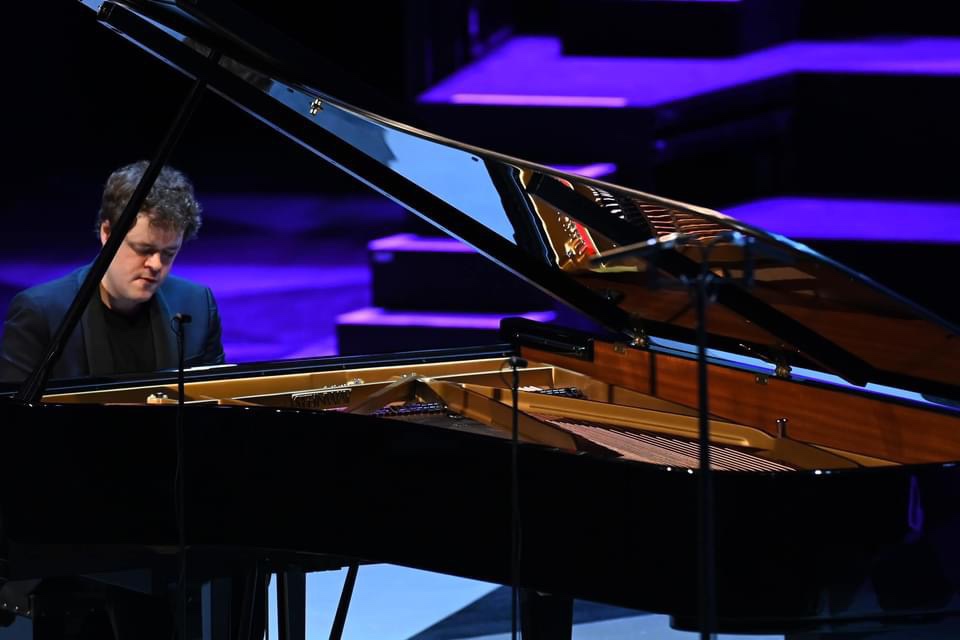
Live at the BBC Proms: celebrated British pianist Benjamin Grosvenor performs Debussy’s Prélude à l’après-midi d’un faune and Ravel’s Le tombeau de Couperin.
Debussy arr. Borwick: Prélude à l’après-midi d’un faune Liszt: Réminiscences de Norma Ravel: Le tombeau de Couperin; La valse
Benjamin Grosvenor, piano
A regular at the Proms since his debut here over a decade ago, former BBC Young Musician of the Year Finalist Benjamin Grosvenor brings a selection of transcriptions and arrangements of works better known in other guises. The sensuality of Debussy’s Prélude à l’après-midi d’un faune melts into Ravel’s tender Le tombeau de Couperin suite and his heady, war-scarred La valse, while a passing visit to the Italian opera comes courtesy of Liszt’s virtuosic reimagining of Bellini’s Norma, a bel canto tale of warring Druids and Romans, set in ancient Gaul.
It was at the end of the morning recital in the vast space that is the Royal Albert Hall when Benjamin Grosvenor having astonished,amazed and seduced us with diabolical transcriptions as Liszt and Thalberg must have done in their day.He gave a whispered account of Saint Saëns ‘ The Swan’ in Godowsky’s magic transcription.Streams of golden sounds,insinuating counterpoints and a ravishing sense of balance drew this vast crowd in to him to eavesdrop on a performance of delicacy and poetic artistry.A sense of rubato and timing that held us all in his hand as he stretched and shaped the sounds with the same artistry that Godowsky himself must have shared with his public in the ‘Golden Era’ of piano playing.An era where transcendental mastery of the keyboard meant that with the same skill as an illusionist Rosenthal,Levitski ,Lhevine or Hoffman could persuade us that the piano could sing with the same subtle inflections as the greatest of Bel canto singers.They could also persuade us that the piano could roar and shout with the same sumptuous sounds as the Philadelphia Orchestra that Rachmaninov so admired.
It was the same piece that Cherkassky played at his own funeral in 1995 in Hanover Square.A work he had played many times in a long career since his child prodigy days with Hoffman .Horowitz often used to say to Shura that we are the only two left from the Golden Age of piano playing.Shura gave ten recitals in my season of Euromusic in Rome and knowing that I video recorded all the performances Piero Rattalino asked me if he could have the recording of his Albeniz/Godowsky Tango.Not Morton Gould’s Boogie Woogie study or the Eugene Onegin Paraphrase.It was the subtle way of caressing the keys and savouring the intoxicating sounds that interested a Professor who knew more about pianists and piano playing than anyone alive.There was an article in ‘Le Monde de la Musique’ about Cherkassky the title was ‘Je sens,je joue,je trasmets’ and it is exactly this that sums up his artistry and those like Horowitz and Rubinstein where the audience is an essential part of this recreation.Rubinstein famously said that there must always be risk and the unexpected in playing in public and that one should not have a printed copy ready to trot out in public.It is an act of love,said Rubinstein the greatest lover of all time!
It is this act of love that we were witness to today with Benjamin Grosvenor in an astonishing display not only of pyrotechnics and breathtaking agility but of his palette of kaleidoscopic sounds that he could project out to his audience with devastating effect but that he could also draw in to him with the intimacy of a ritual of almost indecent seduction of the senses.
It was from the very first notes of Debussy’s ‘Après midi’ that we were made away of the luminosity of the flute solo that we know so well.Here was a transcription by a student of Clara Schumann that I have heard from lesser hands in rather black and white performances that made one wonder whether it was a necessary addition to the already saturated piano repertoire.Researching Leonard Borwick he was described as a poet of the keyboard,a painter of pianistic colours,he communed with beauty and saw visions.It was exactly this that could describe the magic that Benjamin Grosvenor conjured out of the piano today.A magic sweep of sounds-not individual notes – a sumptuous bass that gave an anchor to rays of sound that could float on a magic carpet of gold and silver.There were very precise clear sounds too as the woodwind added their individual sound world to this timeless beautiful landscape of radiance and slumbering beauty.
The mighty call to attention of Norma broke the spell with its rhythmic precision where even the rests became so ominous.A sumptuous bass accompaniment of transcendental octaves that became a shimmering accompaniment to the the glorious bel canto melodies of Bellini.Anton Rubinstein said the pedal is the soul of the piano and it was Benjamin’s wondrous use of the pedal that could convince us that there were many more hands and feet involved as Thalberg had done in the fashionable salons of the day .A way of floating the melodic line in the tenor register with swirls of arpeggios and scintillating scales all around.Like Paganini on the violin there was something superhuman and diabolic to the way the themes from the popular operas of the day could be transformed into an orchestra of breathtaking dimension by artists that were feted like the pop stars of their day.Benjamin Grosvenor created the same fervour and breathtaking excitement today with the sumptuous sounds of a truly ‘Grand ‘piano.There was never an ungrateful or hard sound in a recital that drew the pianist to the limits of technical funabulism.What control of sound that at the build up of tension could suddenly reduce the sound without changing the red hot drive.It meant that at the absolute climax he could still have the sumptuous full sound as the two main melodies combined in a moment of delirious passion ending with a virtuosity of breathtaking daring.I am reminded of the same mastery of Gilels who had us sitting on the edge of our seats in the Festival hall in London ,as he brought a relentless drive to Liszt’s Spanish Rhapsody with a grandeur of sumptuous sounds in a performance that like today will go down in history.
There was absolute clarity to each of the six pieces that make up Ravel’s ‘Le Tombeau.’ A golden stream of sounds in the ‘Prelude’with the occasional clicking of heels as it arrived at the final glowing trill ending.Deep melancholy of the ‘Fugue’ played with ravishing colour and remarkable architectural shape.There was a beguiling lilt to the ‘Forlane’ and a rhythmic energy to the contrasting ‘Rigaudon’.There was a beautiful flowing central episode of infectious dance on which Ravel – like Schubert – floated a magical outpouring of melody before the return of the Rigaudon.Subtle shading and beauty of the Minuet with its plain chant central episode was played with disarming simplicity.The Minuet just floated on top of this chant disappearing to a whispered trill on high.There was clockwork precision of the ‘Toccata.’Not just dry precision but something that was like a live wire of driving rhythmic impulse where again – like Schubert – Ravel has an outpouring of mellifluous beauty and radiance like a cloud lifting to show a ray of light as the toccata picks up momentum leading to the tumultuous final explosion of glory and excitement.
La Valse was truly overwhelming starting with the ominous opening rumble deep in the bass but with such clarity of line as streams of sounds of steamy decadence took over.A sophisticated elegance of a past era always with the insistent dance rhythm so clearly defined no matter how seedy things became.Breathtaking glissandi and tricks of the trade as the piece reaches the boiling cauldron with unbelievable technical demands of the player.Ravel obviously trying to outdo himself and Balakirev with the transcendental virtuosity that Liszt had led the way inspired by the Devil with a violin himself!
I remember Fou Ts’ong telling me it was easier to be more intimate in a big space than in a small one.Benjamin Grosvenor just proved how true that was as he barely whispered the sounds as we strained to hear.But like all great artists he has a diaphragm that can send the most intimate of messages to the front row of the hall but can project with the same intensity to the very last row in ‘Paradiso’ the ‘Gods’.A secret of only the greatest musicians that can feel the vibrations in their body and know that they will arrive safely to their destiny.I remembered too in this hall Raymond Lewenthal who appeared on stage with a lamp standard by the piano to give the appearance of an intimate salon as he played the ‘Moonlight’ and Chopin’s first Ballade,hoping to create the atmosphere of a Busoni,much to the perplexity of his agent Wilfred van Wyke Unfortunately it was not until he set the piano on fire with the Hexameron where fireworks started to fly with the same sensational performances of Liszt that had London at his feet with queues all around the Wigmore Hall.
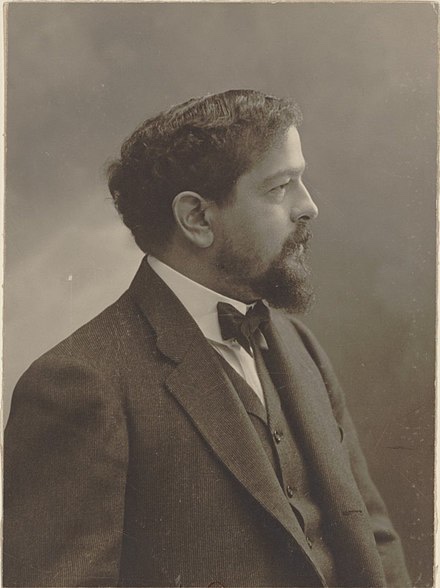
Prélude à l’après-midi d’un faune (L. 86), was composed in 1894 and first performed in Paris on 22 December 1894 inspired by the poem by Stephane Mallarmé .It is one of Debussy’s most famous works and is considered a turning point in the history of Western Music .Pierre Boulez considered the score to be the beginning of modern music observing that “the flute of the faun brought new breath to the art of music.”
Claude Debussy
Debussy wrote :”The music of this prelude is a very free illustration of Mallarmé’s beautiful poem. By no means does it claim to be a synthesis of it. Rather there is a succession of scenes through which pass the desires and dreams of the faun in the heat of the afternoon. Then, tired of pursuing the timorous flight of nymphs and naiads , he succumbs to intoxicating sleep, in which he can finally realize his dreams of possession in universal Nature.”
Transcribed for piano solo by Leonard Borwick
Leonard Borwick born in Walthamstow in 1868 and died in Le Mans France in 1925 – a student of Clara Schumann
Leonard Borwick was an English concert pianist especially associated with the music of Robert Schumann and Johannes Brahms.His London debut was on 8 May 1890, at a Royal Philharmonic Society concert concert, in Schumann’s Piano Concerto . He performed it again in London on 12 June, and on 17 June in a concert for Hans Richter .He also played the Brahms D minor concerto which George Bernard Shaw called ‘a hash of bits and scraps with plenty of thickening in the pianoforte part, which Mr Leonard Borwick played with the enthusiasm of youth in a style technically admirable’. Shaw recommended that he should embark on recitals.Borwick played Brahms’s D minor concerto under Hans Richter in Vienna in 1891. Brahms himself was at this concert, and wrote to Clara Schumann that her pupil’s playing had contained all the fire and passion and technical ability the composer had hoped for in his most sanguine moments. Clara Schumann wrote to Professor Bernuth in Hamburg to recommend Borwick as ‘probably her finest pupil: I never heard the A minor concerto of Schumann nor the D minor of Brahms played better.’In 1921 he gave two recitals in the Aeolian Hall in March and April, which included his transcription of Debussy’s Prelude a l’apres-midi d’un faune (originally premiered for him by Mark Hambourg ).He is remembered as a poet of the keyboard, a great painter of pianistic colours, who possessed a very broad range of expression from the most delicate touch to a fire and resource of tonal depth greater than that usually associated with the Clara Schumann school. Plunket Greene remembered how he communed with beauty and saw visions, his reverence, quiet simplicity, and his avoidance of personal publicity. He made no gramophone records. The Royal College of Music awards a Leonard Borwick Pianoforte Prize to outstanding students.
Liszt undertook the challenge of diluting Bellini’s opera Norma into a 15 minute solo piano work in 1841. The work easily equals the dramatic impact of the original opera through Liszt’s dynamic and highly virtuosic writing. No less than seven arias dominate Liszt’s transcription of Norma which are threaded together to create a nearly continuous stream of music.The title role of Norma is often said to be one of the hardest roles for a soprano to sing, and this adds to the drama and intensity of the music. A brief summary of the opera has been described by Greg Anderson:
“Norma, a priestess facing battle against the Romans, secretly falls in love with a Roman commander, and together they have two illegitimate children. When he falls for another woman, she reveals the children to her people and accepts the penalty of death. The closing scenes and much of the concert fantasy reveal Norma begging her father to take care of the children and her lover admitting he was wrong.”
The complex music represents the tragedy woven into this story, which is perhaps why Liszt made the effort to transfer the challenges of this score into a piano fantasy. With cascading arpeggios, massive interval changes and dynamic changes at every turn, Réminiscenes is a true test of technical ability. The score is saturated with huge chordal movement, fast-paced cadenza sequences and a raffle of different tempo markings. Pianist Leslie Howard described the work as “a triumph of understanding not just of Bellini’s masterpiece, but of practically all the sound possibilities of the piano in Romantic literature.”
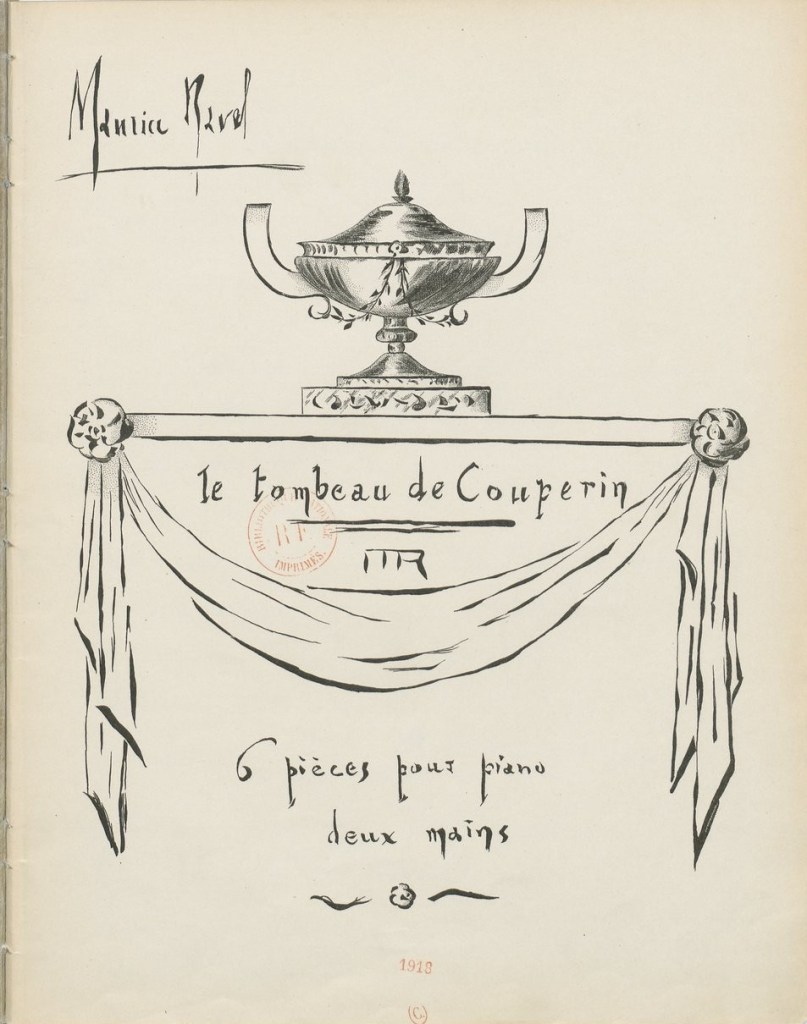
Cover of the first edition
Le Tombeau de Couperin (The Grave of Couperin) is a suite for solo piano composed between 1914 and 1917. The piece is in six movements, based on those of a traditional Baroque suite. Each movement is dedicated to the memory of a friend of the composer (or in one case, two brothers) who had died fighting in World War 1.Written after the death of Ravel’s mother in 1917 and of friends in the First World War, Le Tombeau de Couperin is a light-hearted, and sometimes reflective work rather than a sombre one which Ravel explained in response to criticism saying: “The dead are sad enough, in their eternal silence.”Ravel stated that his intention was to pay homage more generally to the sensibilities of the Baroque French keyboard suite,not necessarily to imitate or pay tribute to Couperin himself in particular. This is reflected in the piece’s structure, which imitates a Baroque dance suite.
The idea of writing a score on a great waltz occurred to Ravel as early as 1906 and in February he wrote to his friend Jean Marnold: “What I am undertaking now is not refined: a great waltz, a sort of homage to memory of the great Strauss, not Richard, the other, Johann. You know my intense sympathy for these adorable rhythms and how much I esteem the joy of living expressed by dance” After a short time the project began to take shape in the musician’s mind, so he thought of writing a sort of apotheosis of the waltz, a symphonic poem entitled Wien and dedicating it to Misia Sert , his friend and supporter Diaghilev listened to the composition in a version for two pianos performed by the author and Marcelle Meyer in the presence of Stravinsky and the choreographer Serge Lifar.The impresario, after the audition, declared that it was certainly a masterpiece, but it could not possibly be used for a ballet; according to Lifar, Ravel’s score for Diaghilev paralyzed any possibility of creating a choreography . Ravel, hurt by the comment, broke off all contact with the impresario.La valse soon became a popular concert venue work, and when the two men met again in 1925, Ravel refused to shake Diaghilev’s hand. The impresario challenged Ravel to a duel,but his friends persuaded Diaghilev to recant. The two men never met again. The manuscript of the piano version, which is actually the first version, albeit intended as a draft for the symphonic version, is kept in the Pierpoint-Morgan Library in New York.The temptation to “re-transcribe” for solo piano from the version for orchestra is however strong for all performers, and various pianists, starting with Thiollier , have introduced some small additions taken from the score into Ravei’s text. Glenn Gould thought that Ravel’s piano version was mediocre overall and prepared a transcription of his own ,very virtuosic and influenced by the style of Liszt. Gould’s transcript has not been published to date. But the problem he raised remains open:
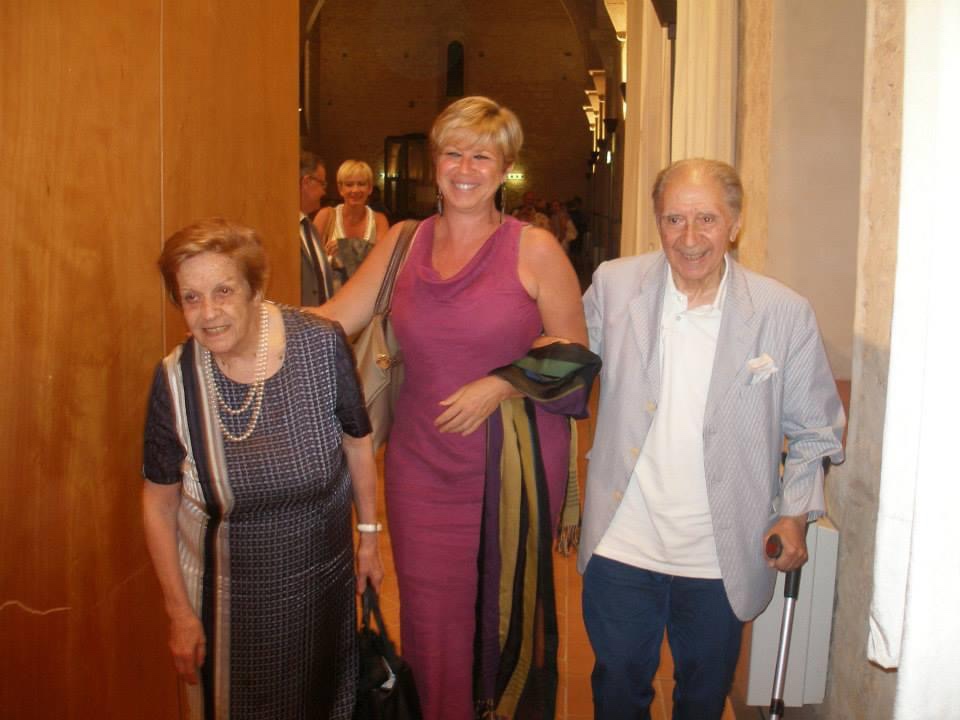
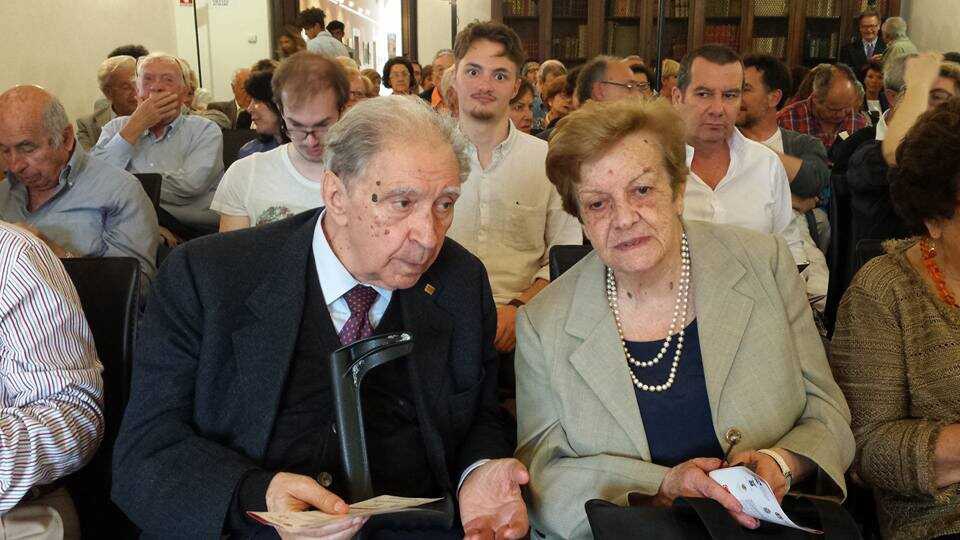
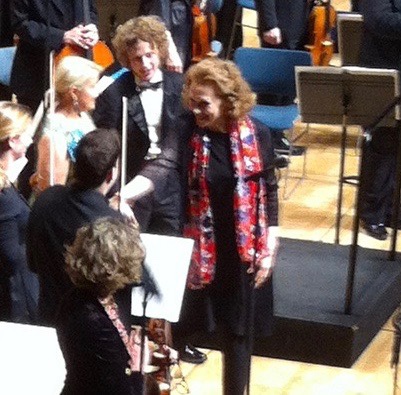
The Cerocchi’s :mother father and daughter all working to bring culture to their home town of Latrina
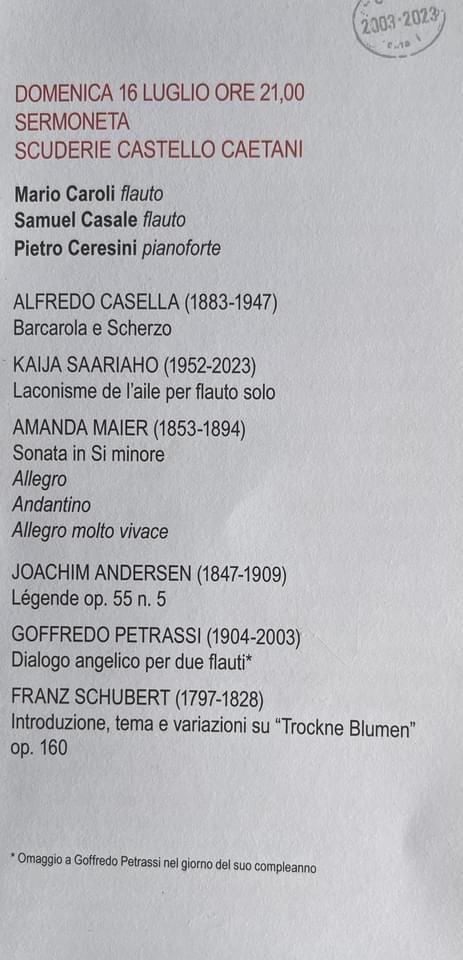
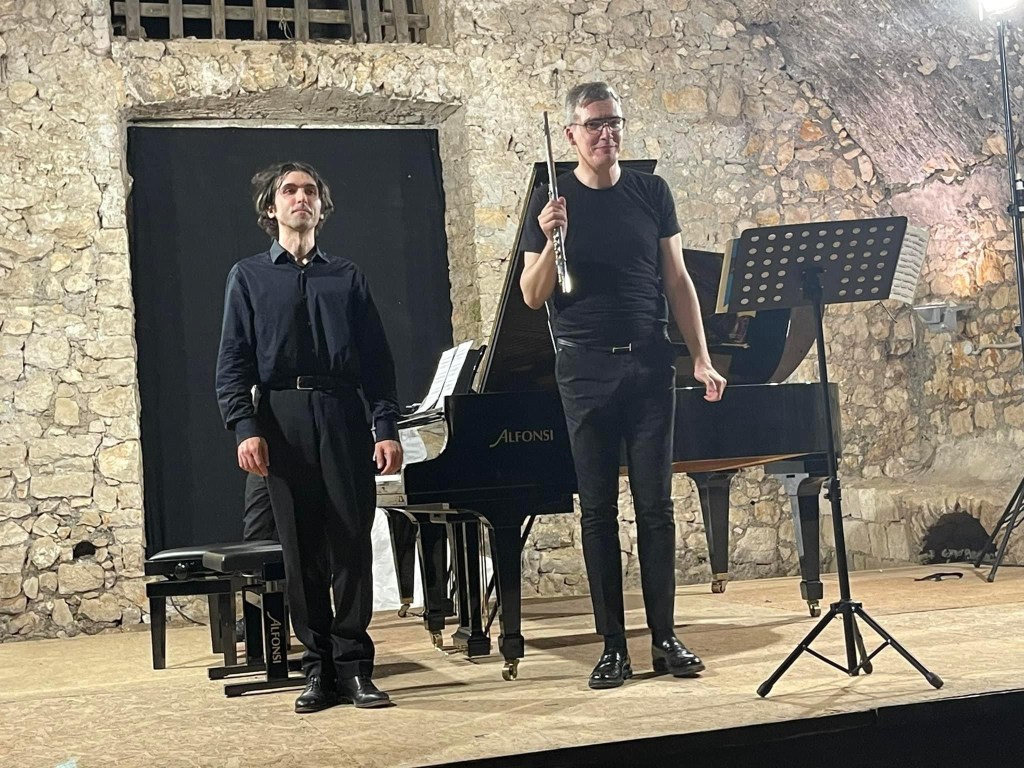
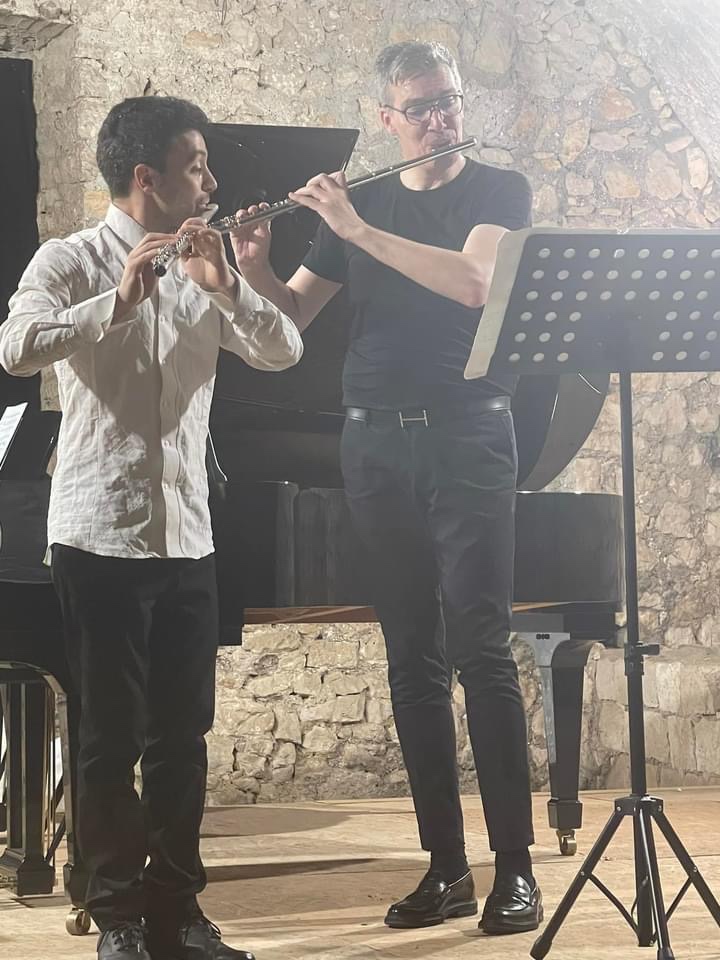
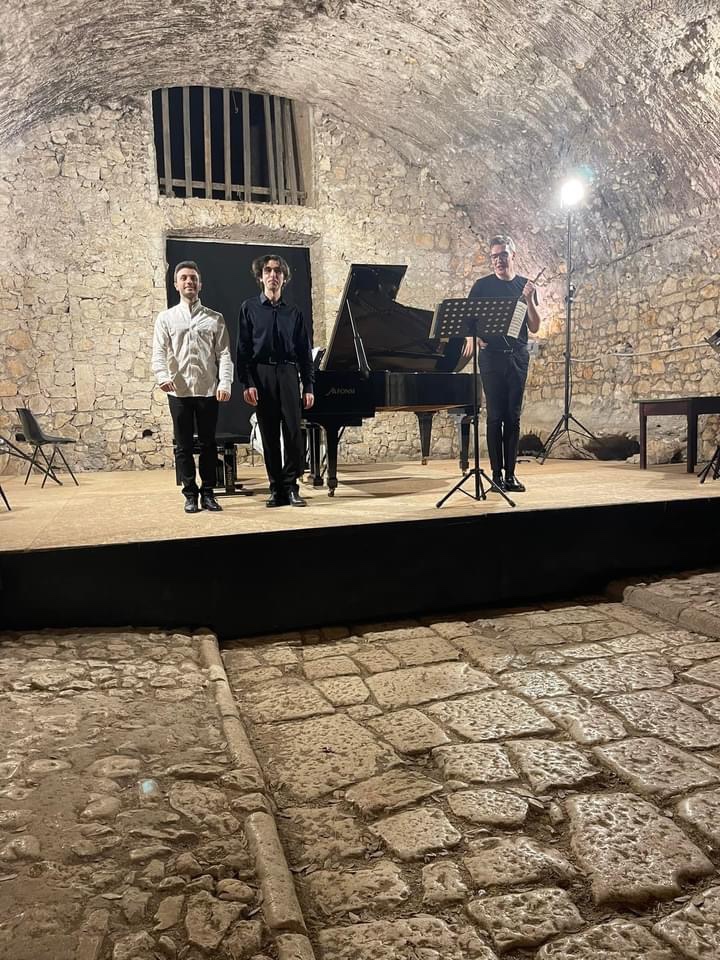
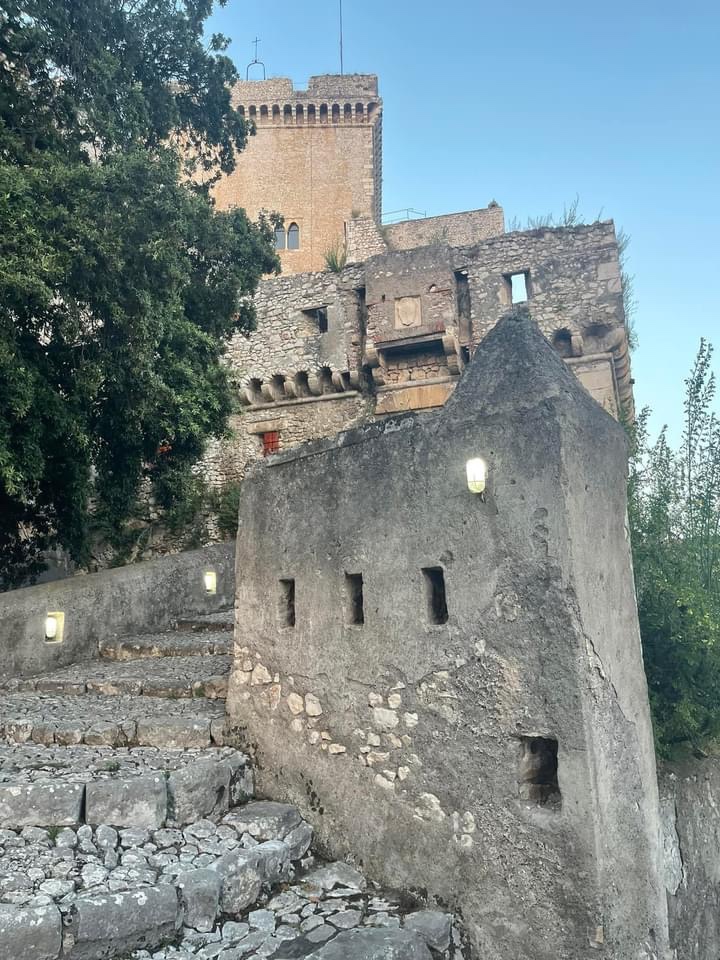
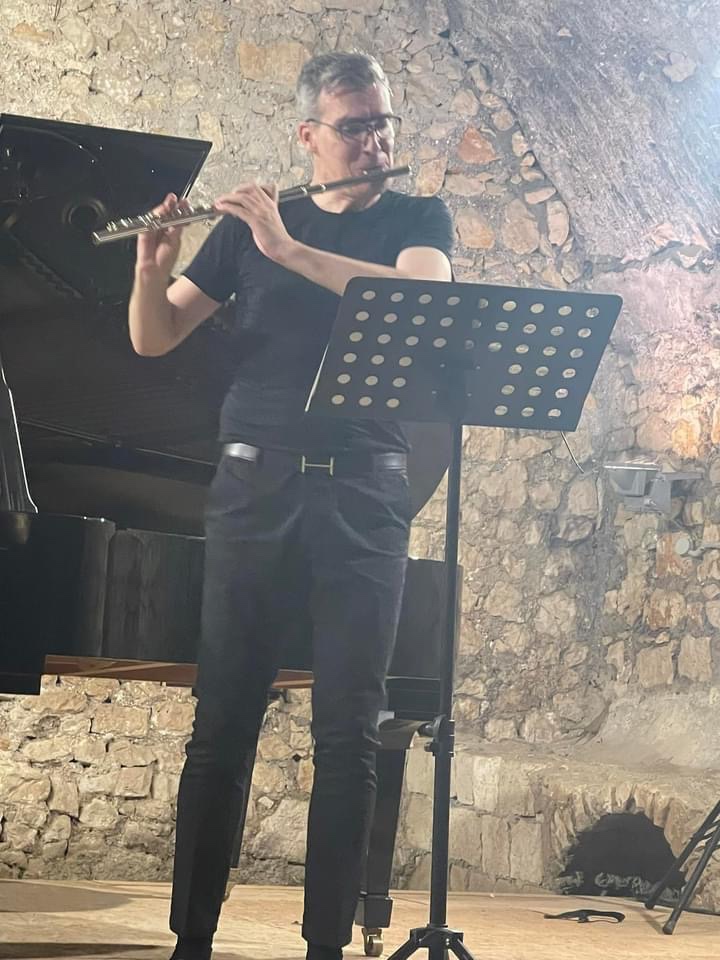
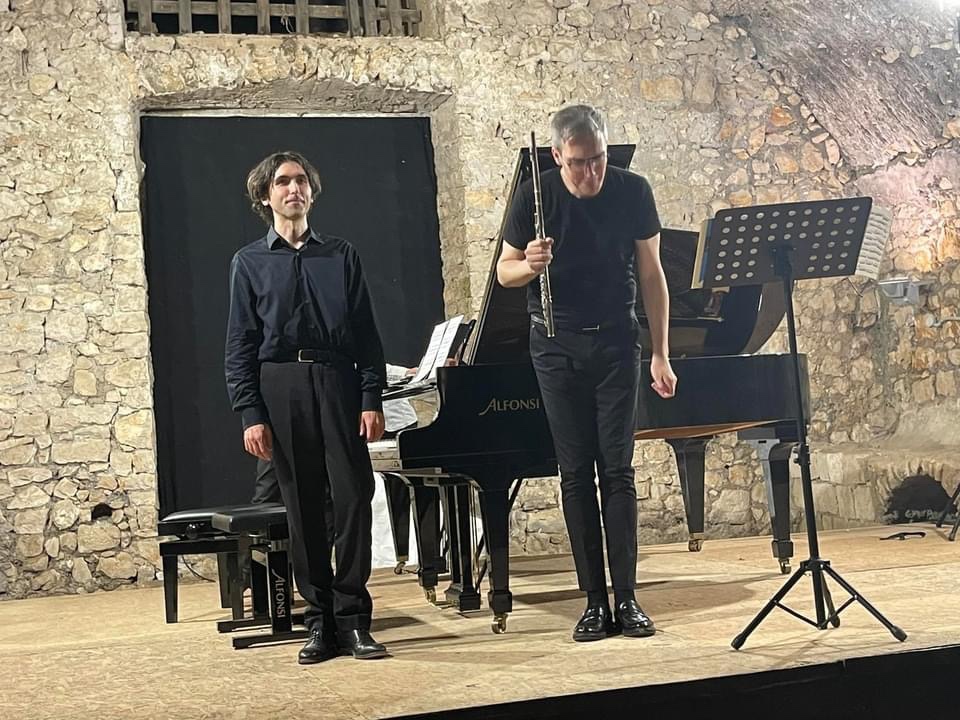
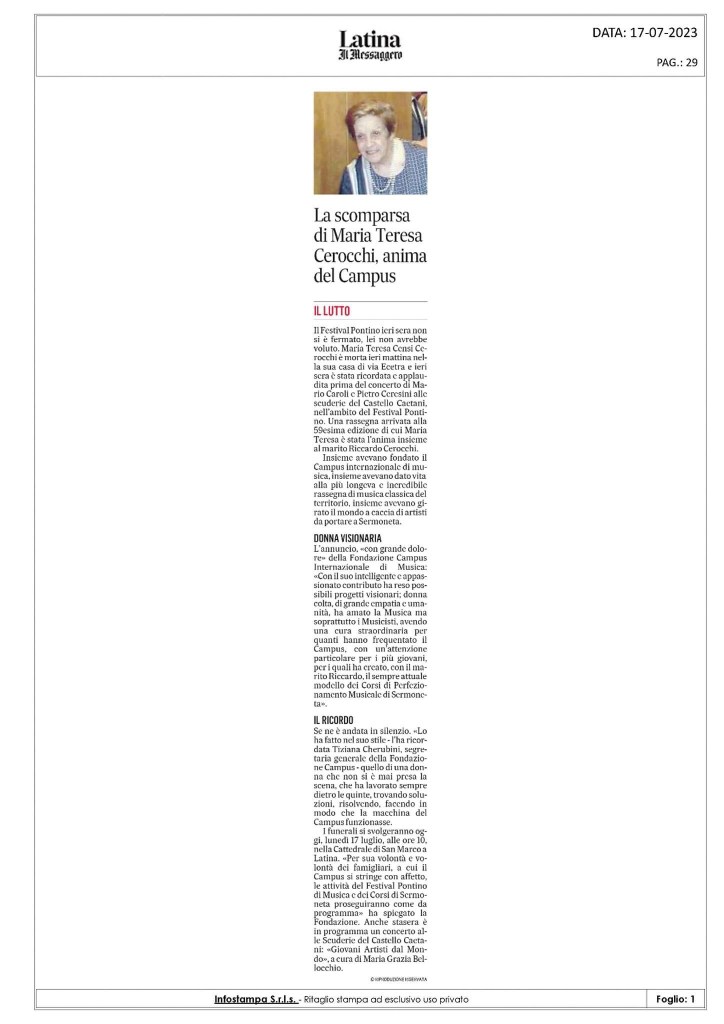
Concerto dedicated to Maria Teresa Cerocchi in the castle of Sermoneta last night.Mario Caroli and Pietro Ceresini flute and piano joined by Samuel Casale in Petrassi’s Dialogo Angelico for two solo flutes.As always this castle has resounded to the sound of music since the time of Szigeti and Menuhin.A tradition continued by the Cerocchi family whose impeccable musical taste has been the guiding light for these past 50 years
A fascinating programme with a discovery of a composer Amanda Maier with a sonata that could have been by Schumann or Mendelssohn but with an individual voice all her own. Played by Caroli with his magic flute that became part of his being as they swayed together and moved like a wondrous ballet dancer bringing to life with vivid imagination a score that has lain dormant for too long .A pianist too that was very much his equal from the school of Perticaroli and Cappello weaving in and out of a musical discourse that was hypnotic and intoxicating.
A solo work too by Saariaho where sounds of every sort from an opening whispered. chant to which were added the sound of wind being blown into the flute before actual notes were allowed to appear and were used to create a special atmosphere from a composer who died only a short time ago.Of course the variations on ‘Trockne Blumen’ were played with brilliance and virtuosity by a duo that played as one such was their complete musical understanding with an extraordinary transcendental control of their instruments.The pianist playing with the piano lid wide open which gave great resonance without ever overpowering the flute.On the contrary it provided a shell in which the music could Iive and breathe with sublime beauty and harmony.A beautiful Barcarolle by Casella was another discovery of a work of lyrical beauty that contrasted with its partnered Scherzo of whirlwind energy.Another composer unjustly overlooked these days.Of course as one would expect from Casella there was a luxuriant piano part that was played with a subtle brilliance and colour that created a golden shell in which the live wire of a scherzo could weave its magic web undisturbed.
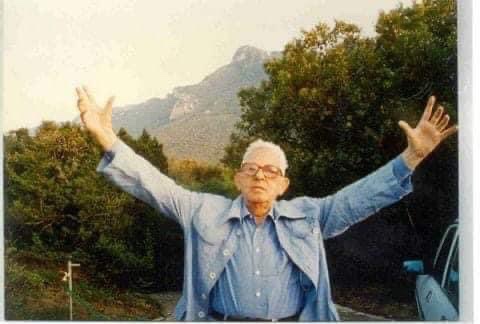
Petrassi taken by Ileana Ghione in our garden at Torre Paola
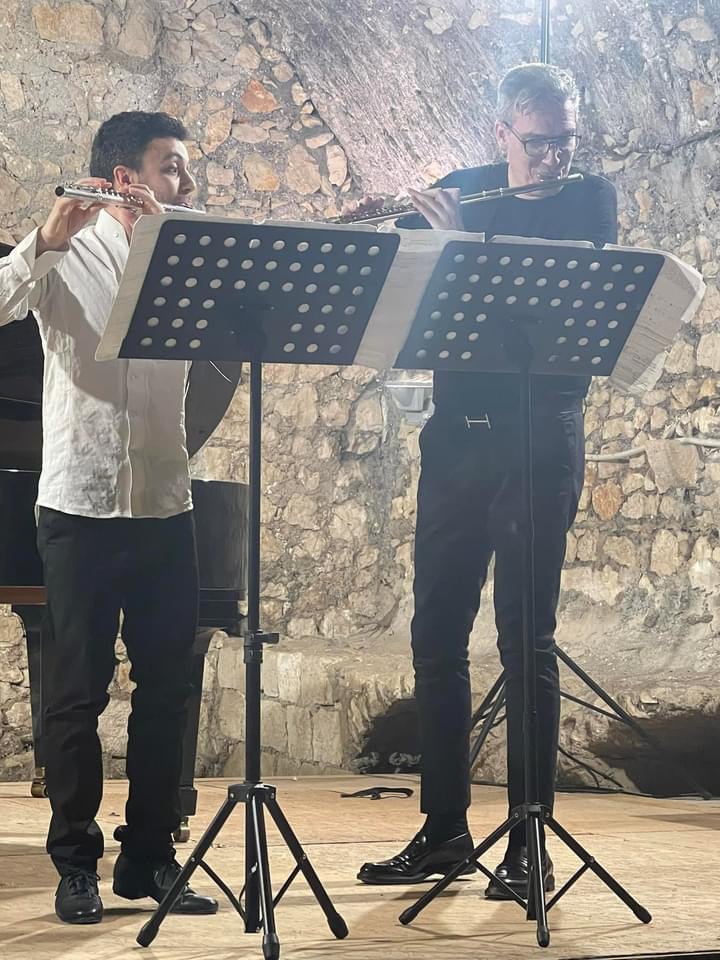
Petrassi ‘s twentieth anniversary celebrations this year included his ‘Dialogo angelico’ for two flutes.Not at all like the diabolical staircase by Ligeti that can regularly tie even the finest pianists in knots.
Here was a work of great beauty for two flutes starting on the left of two stands and working towards the right in such harmony and elegance that their final emergence into ‘fresh air’ came as a complete surprise as we watched them almost dance their way through the score with such florid shapes and movements.
Samuel Casale not only turned pages for the concert ,played in duo with Caroli but also the next morning played so beautifully at the funeral of Madam Cerocchi.
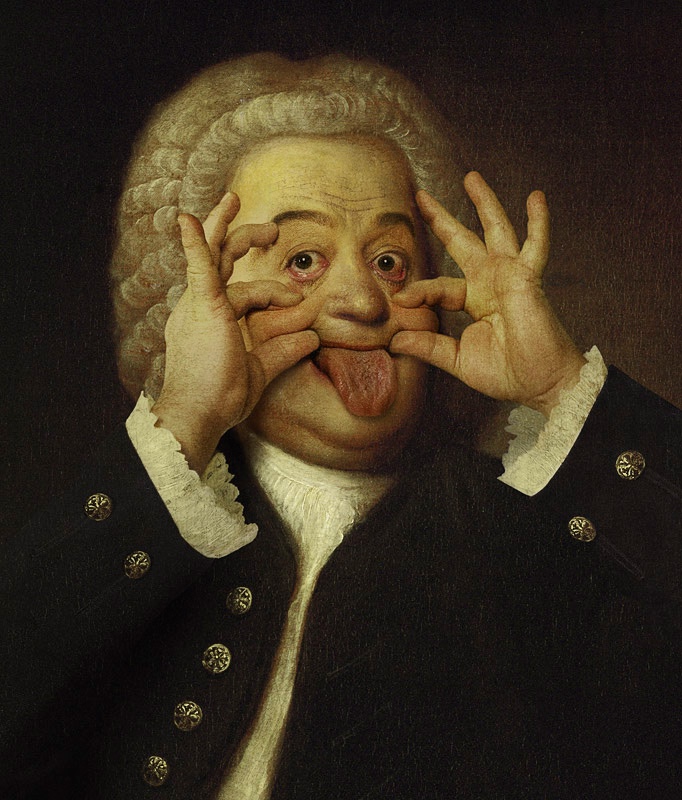
J.S.Bach.Had 17 children and consequently a sense of humour.He would have been much bemused to think church is only for prayer and not for the Glory of God !
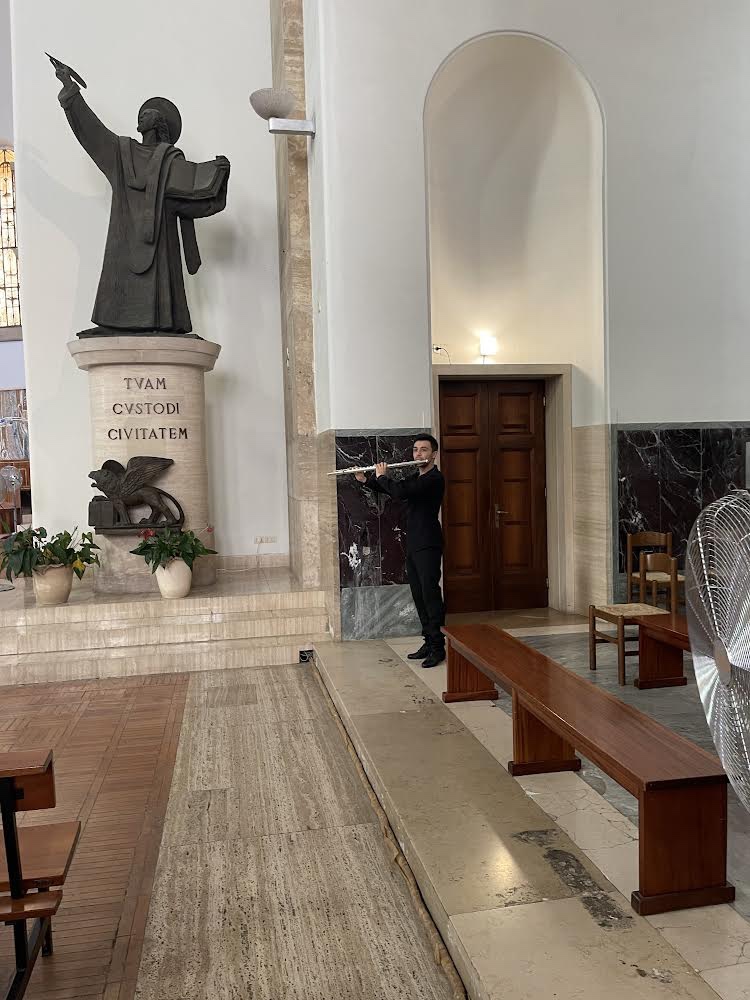
The priest had said that a church was for prayer not music (Bach would be very surprised to hear that) but did allow Samuel with his flute to enchant and enhance the rather dull performance by the priest!
Samuel Casale in S Marco Cathedral Latina
I was not expecting to be so moved or entranced as I had come to pay hommage to a dear person that I have known for a lifetime. But like everything in Sermoneta the hills are resounding to the sound of music …..and what music! If music be the food of love ………and it will play on in the hands of Elisa Cerocchi the true spiritual heir to her extraordinary pioneering parents.Her spiritual heirs Tiziana Cherubini and family will ensure that the daily running of the Campus will go from strength to strength on such solid foundations of musical integrity and honesty.
Maria Teresa Cerocchi taken by Tiziana Cherubini with the love for her adopted mother
Mario Caroli has nearly superhuman skill, paired with extraordinary musical intelligence.” — American Record Guide
“He made a sound you wanted to drink in.” — New York Times
“A musician whose possibilities are boundless.” — Le Monde de la Musique
“The range of colour and texture that this outstanding soloist obtains is hauntingly beautiful.” — The Guardian
At the occasion of one of Mario Caroli’s recitals at the Société Philarmonique of Bruxelles, a critic remarked: “the audience was literally amazed by his technique, his power, his poetry and his musicality”, whereas his first recital at the Théâtre du Châtelet in Paris was called to be “of an amazing evocative power.”Mario Caroli appears regularly in the greatest concert halls of the world including the Philharmonic Halls of Berlin and Cologne, the Vienna Konzerthaus, the Royal Festival Hall in London, the Théâtre du Châtelet and the Opéra Garnier in Paris, the New York Lincoln Center (in the cycle of “Great Performers”), Oji Hall, Suntory Hall and Opera City House of Tokyo, the Parco della Musica in Rome, the Palais des Beaux Arts in Bruxelles, the Amsterdam Muziekgebouw.He plays flute concertos – from Vivaldi to Sciarrino, as well as Mercadante, Ibert or Jolivet – with the Orchestra Sinfonica Nazionale della RAI, the Philharmonia Orchestra (London), the National Orchestra of Belgium, the Orchestra of Radio Cologne (WDR), the Orchestra of the Stuttgart Opera Theatre, the Orchestra of the Rouen Opera, the Philharmonic Orchestra of Stockholm, Les Percussions de Strasbourg, the Ensemble Contrechamps of Geneva, the Neue Vocalsolisten Stuttgart, the Schola Heidelberg with conductors like Pierre Boulez, Peter Eötvös, Heinz Holliger, Christian Mandeal, Kazushi Ono, Pascal Rophé, Oswald Sallaberger.Mario Caroli also obtained a university degree in philosophy (summa cum laude, with a thesis on Nietzsche’s “Der Antichrist”) and has a passion for poetry, cinema and psychology. This cultural interest supports his attempts to renew and revitalise the traditional views on the instrument and its repertoire. Going beyond the great canon of the historical flute repertoire, Mario Caroli became a preferred soloist for some of the greatest composers of today. He is the only contemporary flutist having performed on monographic concerts the complete works for the flute by Sciarrino, Ferneyhough and Jolivet. Interpretations of a stunning virtuosity, phantasy and energy which made critics call him a “phenomenon”.His scenic appearance was often a subject of critics: “Tall and elegant, he seems to be a figure by El Greco, with a total mastery of his instrument” (Muzsika, Budapest). Others wrote: “He played fairly rocking out in ecstasy, and one could only look in an incredulous stupor” (Musicweb international, New York), “A musical gesture elegant as well as sensual, he gave a concert which doesn’t allow any objection” (Diario Basco, San Sebastian).His discography contains approximately twenty titles. The recent recordings of works for flute by Jolivet (“one of the best performances heard in recent months – maybe even in a few years”, American Record Guide) and by Sciarrino were received with the highest possible acclaim: “Diapason d’or” (Diapason), “Recommandé” (Répertoire), “Coup de Coeur de l’Académie Charles Cros”, “A!” (Anaclase), “Eccezionale!” (Musica), “Best recording of the year” (Musicweb international), “Best CD of the month” (Amadeus and CD Classics). His recordings and concerts have been broadcasted by radio and TV stations thoughout the whole world.Concerning his didactic activities, Mario Caroli has given masterclasses and worked as an artist in residence at prestigious institutions like Harvard University (where he was invited to hold the FROMM-residency between 2007 and 2008), Toho College (Tokyo), the Sibelius Academy (Helsinki), the Centre Acanthes (Paris, Metz) or the Conservatoire Superieur of Geneva. After having been teaching for 17 years at the Académie Supérieure de Musique de Strasbourg, the city where he still lives, Mario is holds the chair of flute at the Hochschule für Musik in Freiburg (Germany), whose prestigious fluteclass is recognized worldwide. At the occasion of one of his recitals at the Société Philarmonique of Bruxelles, a critic remarked: “the audience was litterally amazed by his technique, his power, his poetry and his musicality”, whereas his first recital at the Théâtre du Châtelet in Paris was called to be “of an amazing evocative power.” A cosmopolitan and polyglot artist, Mario speaks fluently in six languages.
Pietro Ceresini graduated from Conservatorio di Parma (Prof. R. Capello), Accademia di Santa Cecilia (Prof. S. Perticaroli) and Musikhochschule Lübeck (Prof. Sischka). He performed numerous recitals and concerts.Prizes: J. S. Bach Geneve (2004); A. M. A. Calabria (2006).Pietro Ceresini inizia lo studio del pianoforte all’età di sei anni e a sette si esibisce già presso il Teatro della sua città. Dopo gli studi con R. Cappello presso il Conservatorio A. Boito di Parma, in cui si diploma con il massimo dei voti, lode e menzione d’onore e laurea con indirizzo musicale, si diploma a Roma all’Accademia di Santa Cecilia con S. Perticaroli e si perfeziona con P. Bordoni e F. Gamba. Nel 2009 consegue a pieni voti il diploma di Composizione, prima di trasferirsi in Germania dove intraprende il corso Master a Lubecca nella classe della Prof. K. Eickhorst e successivamente a Friburgo, in cui conclude lo studio post-laurea con eccellenza nella classe del Prof. C. Sischka. Vincitore di concorsi nazionali e internazionali si è esibito presso istituzioni prestigiose come l’Auditorium della Conciliazione a Roma, il Teatro Farnese di Parma, La Casa della Musica a Parma, i festival pianistici di Spoleto (Teatro Caio Melisso), Misano Adriatico, il Festival Pontino di Musica, al Centro de musica de Belem a Lisbona e presso la sala concerti dell’Istituto Italiano di cultura di Strasburgo. Ha suonato il Concerto in re minore di Mozart KV 466, a Lübeck si è esibito nell’ambito del Festival “Kunst am Kai” nella Fantasia per coro e Orchestra op. 80 di Beethoven. Ha tenuto concerti con l’Orchestra Sinfonica Nacional in Perù a Lima con il Concerto n. 5 di Beethoven, con l’Orchestra Filarmonica Arturo Toscanini con il Concerto n. 2 di Liszt, a Lamezia Terme presso il Teatro Grandinetti con la Filarmonica Mihail Jora; con l’Orchestra della Musikhochschule di Friburgo è stato protagonista di un’applaudita esecuzione del Concerto n. 1 di Čajkovskij. Nel 2021 ha eseguito il Concerto di Grieg con l’Orchestra A. Vivaldi al Teatro Filarmonico di Verona e al Teatro Sociale di Sondrio. In Germania è ospite in veste di solista e in formazioni cameristiche di diverse istituzioni concertistiche, quali Gesellschaft der Musikfreunde Bremen, Neckar Musik Festival, Jahrhundertswende Gesellschaft presso Kammermusiksaal der Musikhochschule Köln, Mendelssohn Institut Berlin, Villa Eschenburg Lübeck, Brigitte Feldman Saal Schwerin, Theater Kiel, Kongresshaus Heidelberg. Ha effettuato numerose registrazioni radiofoniche in diversi paesi (Antena 2 Portugal, Radio 3 e Radio Classica Italia, NDR Podium der Jungen Amburgo e Kiel, Germania). Attualmente detiene una cattedra di pianoforte presso la Musikhochschule di Freiburg (Germania) e il Tiroler Landeskonservatorium Innsbruck (Austria).
The Cerocchi’s founders of the Campus Musicale in Latina
If you have not heard of Amanda Maier (1853-1894), you are not alone. A celebrated violin soloist and composer during her lifetime, Maier was all but forgotten in death. (This was a common, if unjust fate among women musicians, who were largely ignored by music scholars for most of the twentieth century.) Today, however, Maier’s popularity is making a comeback, and rightfully so! Researchers and performers, predominantly in Sweden and the Netherlands, have become enamored with Maier, resulting in new publications and performances of her music, and renewed efforts to find her lost manuscripts. There have been only a few performances of her works in North America, where Maier remains a relative unknown.
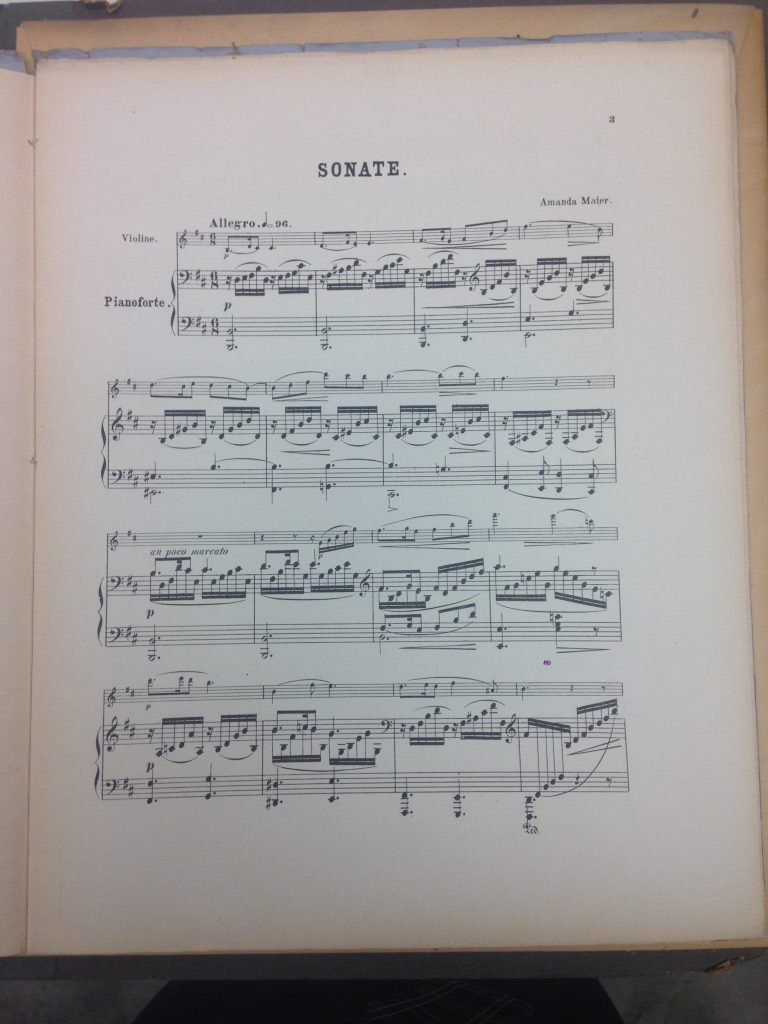
Maier, Sonata for violin and piano [first page], Musikaliska Konstföreningen, 1878. Library of Congress Music Division, M219.M217.
The Library of Congress Music Division holds published scores of two works by Swedish composer Amanda Maier (1853-1894): Sonata for violin and piano in B minor (Musikaliska Konstföreningen 1878) and piano Quartet in E minor (Donemus 2010).
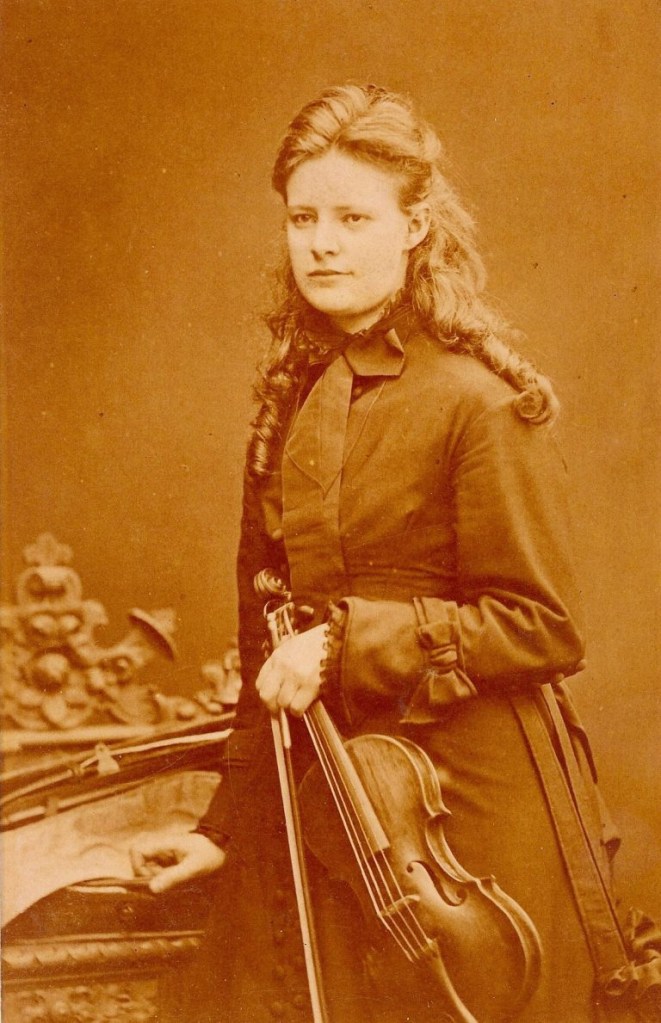
Amanda Maier was born in Landskrona, Sweden, on February 20, 1853. Her father taught her violin and piano when she was a child and, showing great musical promise, she enrolled at the Kungliga Musikaliska Akademien in Stockholm at age sixteen. In Stockholm her principal instrument was the organ, but she also studied cello, piano, violin, elementary singing, composition, counterpoint, harmony, instrumentation, and history and aesthetics of music. When Maier graduated with top grades in 1873, she became the first woman ever to earn the title of Musikdirektor (Director of Music) from the institution.
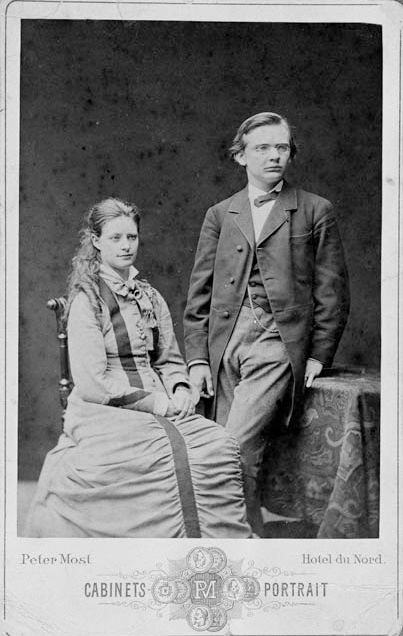
Amanda Maier with husband Julius Röntgen (Courtesy of Jennifer Martyn/Fridtjof Thiadens)
In 1873 Maier moved to Leipzig to pursue further studies in violin and composition. Among her teachers were Engelbert Röntgen (concertmaster of the Gewandhaus orchestra), Carl Reinecke (director of the Gewandhaus orchestra) and Ernst Friedrich Richter (professor of harmony and counterpoint at the Hochschule für Musik and cantor of the Thomasschule). In Leipzig Maier spent her time studying, composing, and performing, and nearly every evening she participated in some sort of musical activity. She attended many concerts, sat in on rehearsals of the Gewandhaus orchestra, and frequently participated in musical soirées, where she socialized and collaborated with the city’s finest musicians.
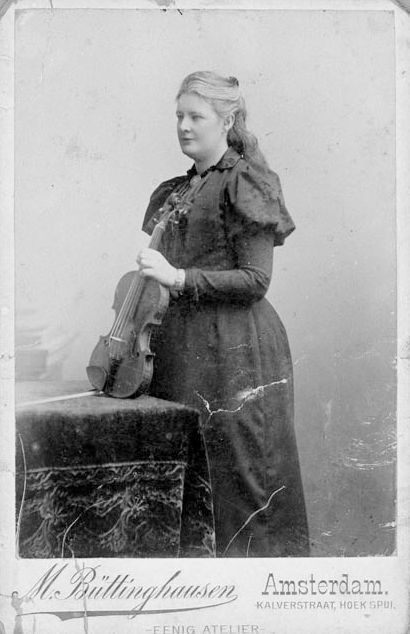
Amanda Maier in Amsterdam in the 1880s (Courtesy of Jennifer Martyn/Fridtjof Thiadens)
Maier’s career as both violinist and composer flourished in the 1870s. Most of her compositions were written during this decade, and she performed frequently in both Germany and Sweden. Some of her most notable performances include those of her own violin concerto: with the Gewandhaus orchestra in Leipzig, for King Oscar II in Malmö, and at the Royal Theatre in Stockholm, all in 1876. In the summers of 1874 and 1876 Maier and her colleague, soprano Louise Pyk, performed many concerts in southern Sweden. In 1878 and 1879 they were joined by pianist Augusta Kjellander for much more ambitious tours that took them farther north and into Norway in 1878, and to St. Petersburg and Finland in 1879. Maier’s performances were well received. Reviews were positive, and in her diaries she often wrote of numerous curtain calls, dozens of bouquets of flowers, and requests for future performances. Maier was a celebrity in the Swedish press, which followed her whereabouts and reported rumours about forthcoming compositions in addition to concert advertisements and reviews. It was reported that in 1878 Maier declined an offer of an extensive tour in the United States.In Leipzig, Maier grew close to her violin teacher’s son, the pianist and composer Julius Röntgen .Maier and Röntgen spent many evenings playing music together, including each other’s works-in-progress. They were engaged in 1876 and were married in Landskrona in 1880. The pair settled in Amsterdam, where Röntgen had been teaching for two years, and where he later led a number of musical organizations. Maier’s career, in contrast, declined significantly. She very rarely performed in public, and composed much less. She did however continue to participate in social musical evenings, where she had the opportunity to collaborate not only with local musicians, but guests to the city, such as Brahms,Grieg and Anton Rubinstein.Maier suffered a series of health problems that undoubtedly contributed to the decline in her musical activities. Throughout her adult life, she suffered from difficulty with her eyes, often leaving her bedridden for days at a time. Between the birth of her two sons (Julius in 1881 and Engelbert in 1886), Maier suffered three difficult miscarriages, and shortly after Engelbert’s birth, she fell ill with pleurisy, the first encounter with the illness that would eventually take her life. Despite several rest cures in France and Switzerland, and tranquil summers spent in Norway and Denmark, she never fully recovered. Maier died in her sleep on June 15, 1894.
Kaija Anneli Saariaho néeLaakkonen; 14 October 1952 – 2 June 2023) was a Finnish composer based in Paris, France. During the course of her career, Saariaho received commissions from the Lincoln Center for the Kronos Quartet and from IRCAM for the Ensemble Intercontemporain, the BBC, the New York Philharmonic, the Salzburg Music Festival, the Théâtre du Châtelet in Paris, and the Finnish National Opera, among others.[1] In a 2019 composers’ poll by BBC Music Magazine, Saariaho was ranked the greatest living composer.[2]
Saariaho studied composition in Helsinki, Freiburg and Paris, where she also lived since 1982. Her research at the IRCAM marked a turning point in her music away from strict serialism towards spectralism.Her characteristically rich, polyphonic textures are often created by combining live music and electronics.
She found her teachers’ emphasis on strict serialism and mathematical structures stifling, saying in an interview:
You were not allowed to have pulse, or tonally oriented harmonies, or melodies. I don’t want to write music through negations. Everything is permissible as long as it’s done in good taste.[3]
I was one of many at Friday’s performance in Deal. I explained that I was wife of a trustee of the Keyboard Trust. My brief word with you did not not do you justice.
Your recital was absolutely terrific and most uplifting.
You have the ability to create stillness in yourself as brilliance flows from you head through your hands to the piano with which you are in perfect combination and harmony.
You are the quiet performer who can achieve what you do you do – allowing the genius of the composer to pass through your own quiet presence to the audience.
This was especially apparent for me in Rachmaninoff where articulation of every note and thought of the composer could not be missed. And then to be followed by Paganini as an encore – remarkable !!
As someone living near to Canterbury I so wish that I could have been present when – already years ago – you started what is an established career with a magnificent future ahead.
My husband Geoffrey – the trustee – returned from necessary absence abroad yesterday in the evening and was really unhappy at not being able to hear you live. Instead, he reminded himself via YouTube or similar of some of your stunning publicly available recordings to date.
You brought real pleasure to many, and to me last week.
Thank you
Best wishes
Philippa (Nice)
It was a totally entrancing performance – all issues of music and piano presented in complete harmony with ease and passion. I don’t often manage to get to hear you live, and certainly this was an inspiration on every level – heartfelt thanks for what you do, it’s very special (and please quote me on that!) Andrew Charity
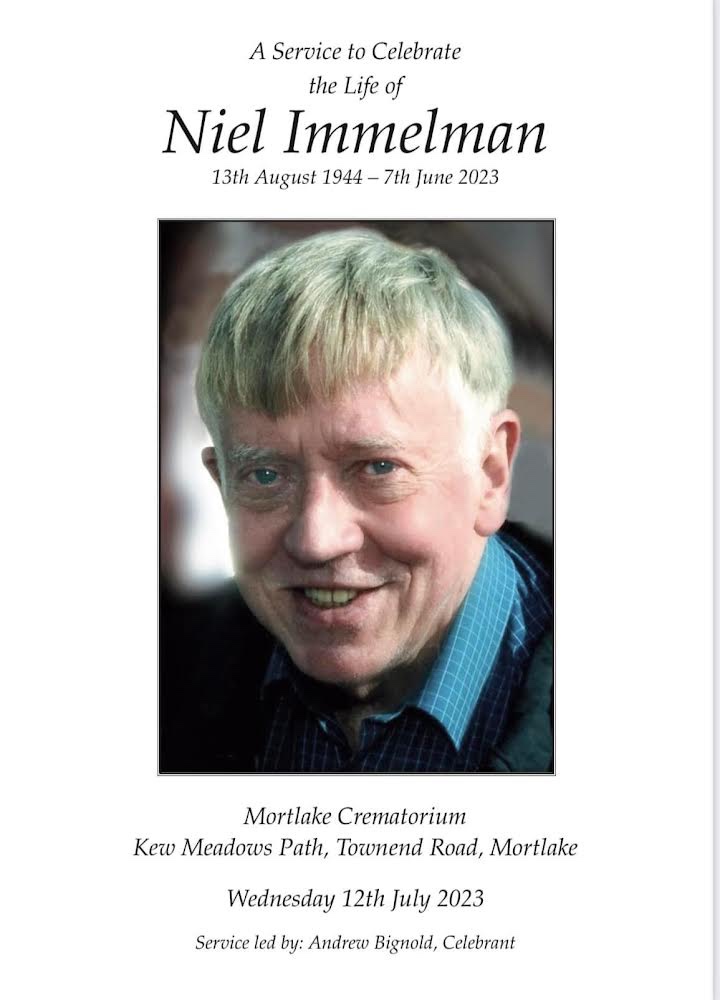
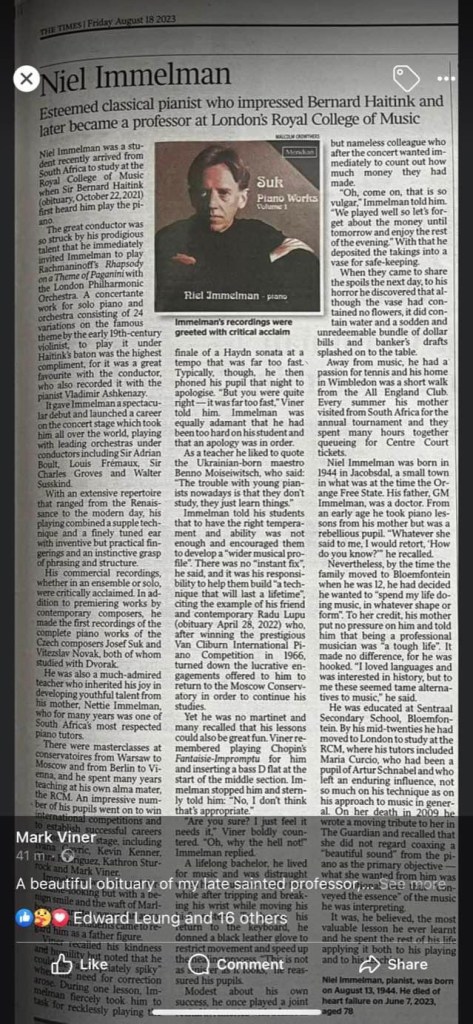
Quite a few have asked for a copy of the tribute I gave at Niel Immelman’s funeral yesterday. As it seemed to go down so well, I reproduce it here:
I should start by saying that Niel Immelman never missed a birthday of mine and, God bless him, he’s managed not to miss today’s, either (!)
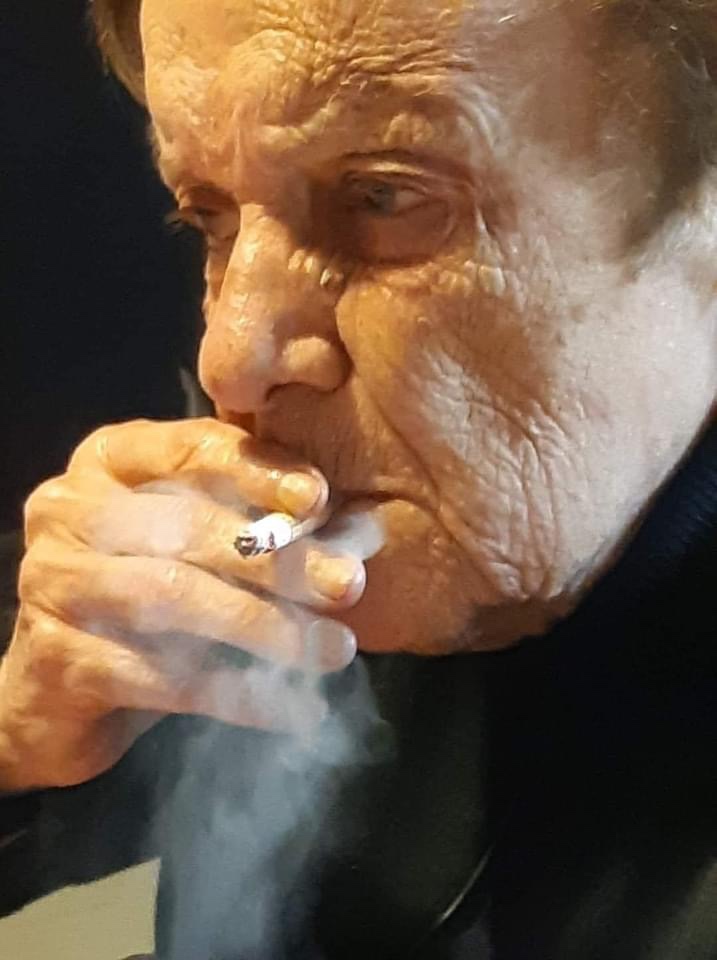
We first met in 2005 at the Oxford Piano Festival when I played the Second French Suite of Bach for him in the oak-panelled Recital Hall of the Faculty of Music. My first memory was of a tall, rather formidable-looking man in a dark suit and tie, with the scent of his Marlboro cigarettes never far away, grinning benevolently at me from the second piano: of course, Niel Immelman.
There is little I remember about that particular masterclass today but I remember thinking at the time it was clear I would end up studying with him one day. Two years later he was already a close friend and embodied absolutely every quality required of a mentor – unerringly kind, caring and supportive — and especially so of my exploration of unfamiliar repertoire, providing guidance and encouragement when I found little elsewhere. Every work I brought to him was treated with equal seriousness; be it a Sonata of Beethoven or a Fantasy of Thalberg; an Etude of Alkan or a Tale of Medtner: all were given due attention and none escaped his ability to penetrate the core of each work. As a teacher, he seemed to have that uncanny knack of being able to address multiple issues in one fell swoop with a single word or gesture somehow tying up the loose ends. He wasn’t all softness, of course, and could be appropriately spiky if need be. I remember one particular lesson where, on reflection, I was being distressingly wilful with the finale of a Haydn Sonata and was, quite rightly, taken to task for it. Imagine my surprise when I received a ‘phone call from him that night, apologising for having been so hard on me — “But you were quite right – it was far too fast”, I protested, but he insisted he’d been too hard and wanted to apologise.
Humility and modesty closely related. Few of us had any idea that he was busy preparing for a recording of the piano music of Novák. I only caught wind of the project on espying the scores, neatly annotated with fingerings, on the music desk of the second piano in hie teaching room, Once I discovered it had already been released in 2008 I asked why he never mentioned it – “Oh, that’s not my style”, he retorted… I later discovered his joyous survey of the complete piano music of Suk and it was only really then that I realised the true measure of what he was like as a pianist. Indeed, these recordings remain a valuable testament of his artistry.
His modesty as a musician sometimes resulted in hilarious (if terrifying at the time) consequences. He once recounted a tale of having played a joint recital with a colleague at Lake Placid, U.S.A., and after what they both felt was an especially successful evening of music-making, his colleague was keen on counting out how much money they had both made over a well-deserved libation. “Oh, come on, man, this is so vulgar – we played well – let’s just forget about that for now and enjoy the rest of the evening.” And so saying, he proceeded to deposit the evening’s plunder into a vase for safe-keeping as they whiled away the night hours. Of course, what he hadn’t considered was that while the vase contained no flowers, it did, however, contain water (!) so one can imagine their collective horror on upturning the said receptacle and beholding a deluge of foul water issue forth and a sodden bundle of dollar bills and banker’s drafts (ink running!) plopping onto the table.
Humour was never far away in and out of lessons and he invariably displayed that valuable asset of making light of things. I remember one particular occasion when, after having tripped and broken his wrist in the process of moving his hifi, he resorted to donning a black leather glove in order to restrict movement and speed up the healing process. Approaching the music desk of the first piano, black-gloved hand awkwardly clutching one of his 2B pencils, he gently reassured me with the words: “Now, this is not as sinister as it looks…”
Similarly, he was not averse to making light of himself, either. He once recalled an incident which happened many years ago when he made some recordings for Greek television which necessitated a session in the make-up artist’s chair. Once filming was complete, he decided, despite the intense summer heat, to walk back to his hotel, rather than take a taxi. En route, he couldn’t help noticing some rather odd glances from passing pedestrians. Thinking nothing of it, he decided to take refuge from the Athenian sun at the Hilton Hotel where he stopped for a Coca-Cola, This necessitated a trip to the restroom and it was only when looking in the mirror that he realised the source of consternation on the faces of the general public: the liberal daubing of make-up he had been given for his television appearance hours earlier had run down his face in rivulets under the intense mediterranean heat — “It was like ‘Death in Venice'”, he chuckled to me.
His sense of humour often spilled over into music, as well, I remember one occasion, when ascending the lift to begin one of our lessons, a guitarist was playing something alluring and Spanish in the stairwell – “Such a friendly instrument”, he purred with the munificence of a tiger full from its last meal. On another occasion, when I played him the Chopin Fantaisie-Impromptu, I hurled down a bass D flat at the start of the middle section when he said “No, I don’t think that’s appropriate.” “But, are you sure?”, I bravely enquired – “I just feel it needs it…” Then, in a flash of reckless abandon: “Oh, why the hell not?!” I’ll never forget that mischievous twinkle in his eye or his subtle way with words.
They say one never quite realises what one has until it is gone and, in many ways, I agree. Though somehow loss and grief also compel us to quantify what a person meant to us with greater clarity and, as such, one grieves each attribute of the person in stages. I am sure I speak for many of us when I say that, aside from the immediate shock of losing an invaluable mentor with whom I could run by a recital programme or ask about ‘that’ bar in a Beethoven Sonata, I have also lost an esteemed colleague with whom I could discuss the various practicalities of teaching. And yet, greater still, I have lost a friend and confidant who was always at the other end of the ‘phone to lend a sympathetic ear and offer friendly and impartial advice: in short, a father figure. And whether we are comfortable with the notion that the end of this life ushers us into easeful oblivion or take solace that flights of angels sing us to our rest – though I’m sure he would have eventually tired of all those harps (!) – we can all, collectively, take comfort in the sure and certain fact that Niel shall live on in our hearts, minds, and for many of us, our fingers, as we continue our own paths in the lives we have ahead of us, passing on his wisdom through teaching, his insight through playing, and his generosity of spirit through living out the example he set to us all.
Thank you.
Rest eternal grant unto him, O Lord: and let light perpetual shine upon him
I was so sorry not to be in the UK to say goodbye especially as the service took place at the end of my road in Kew .Peter Bithell had become over the years a very close friend of Niel .Peter ,Tessa Nicholson and I had been very close friends in our student days before I followed my heart and left the UK for theatre life in Rome.It was Niel who I remember so well in the 70’s before my RAM student days when we were Rubinstein Groupies.Wherever Rubinstein played there was sure to be Niel.I remember very well a recital at Eton College for the Menuhin Windsor Festival where the whole audience was in tails so when Rubinstein appeared on stage no one took much notice……..except when he started to play.I was still at school when I discovered free concerts at the Royal College near enough to my home in Chiswick to frequent almost daily.There were all the marvellous students of Cyril Smith of which Niel,George Barbour,Frank Wibaut,Dennis Lee** were the stars .John Lill,not a student of Smith,made his debut at 17 with Rachmaninov 3 with the big cadenza.It was widely reported in the press as ‘greater than Ogdon’.But there was George Barbour and Dennis Lee both playing Brahms 2 all with Sir Adrian Boult with his extra long baton that transmitted such magic between his sergeant major look and the message he transmitted to the students.George Barbour made his London debut with Beethoven op 126,111,120 sponsored by a wealthy philanthropist who lived in Mayfair and used to collect piano lessons (my old teacher Sidney Harrison gave him a lesson as did many others).He was at the door of the Wigmore to make sure that we all really appreciated his star prodigy!George became the duo Rostal and Schaffer ,heirs to Gold and Fitzdale.I well remember the solidity and beauty of Cyril Smiths students and of course Niel was very much to the fore.The film ‘Shine’ was obviously based on Cyril Smith and the performance of John Lill of the elusive Rach 3!David Helfgott though was nowhere around but Niel and the others certainly were stars in that period.Niel was the only pianist I saw at all the most important recitals in or around London and it was obviously his acquiring of good taste that he transmitted to all his students.Mark and Tyler Hay in particular I have noted the tradition being passed down to his disciples.I last saw Niel at Andrew Ball’s commemoration concert in April and he looked as though he had suffered a lot from doctors over zealous hands.I saw him again just a few weeks ago as I was listening to one of the final recitals at the RCM and he was just leaving after a full days teaching. I mentioned to Tessa how he seemed to have suffered so much ,curved with a stick,but she assured me that he still had a full class of students and that they regularly discussed music as they had for a lifetime.The next I knew was a telephone call from Peter Bithell to ask advice about a place where friends could congregate after Niel’s funeral cremation .The Ship I told him and hope they all sailed in it and toasted this gentle ,oh so modest giant who had selflessly given so much to so many.Tyler practicing Chopin studies in my house nearby at 7am determined not to miss the farewell to his mentor but to give always of his best to his public that evening as Niel had always taught him .
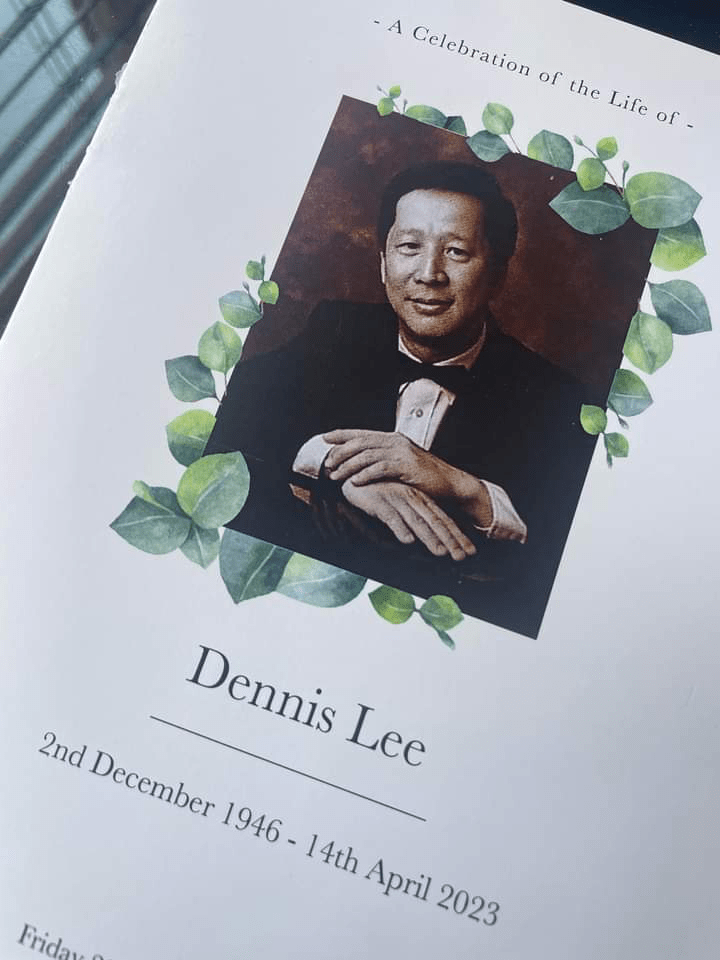
** Just went to a funeral today, saw Frank Wibaut there – Dennis Lee a Malaysian pianist suddenly passed away…he was the very first Malaysian pianist outside of Malaysia… Frank Wibaut is looking very thin, in ill health…..so it seems like a lot of musicians are not in great health… I knew him well I heard him often at the RCM even Brahms 2 with Sir Adrian Bouit he and his wife went to study with the Rumanian teacher of Radu Lupu
Frank I got to know at Dartington he was star student of Cyril Smith ….he had a lovely wife who was a radio presenter but they split up I believe
When did Dennis Lee die I have not heard of him since maybe he went into teaching like Frank in some important college ?Is there an obituary ? Dennis died on the 14th April, around two weeks ago…he recorded some solo Debussy recently I think, but mainly played and taught together with his now-widow over the years…they travelled to Asia together quite a lot, and did some duo things in Canada and America…I think he was a teacher at Kingston University and also did some work for the Associated Board……..in the general piano circle here in London, Dennis is not really that known, but in Malaysia he is still held in high esteem that sort of thing…
Actually, I was e-mailing this guy Lee Kum Sing about yesterday’s funeral, Lee Kum Sing lives in Vancouver and his latest prodigy is apparently Ryan Wang, Yisha went to Louis Vuitton hall in Paris to watch this kid’s concert……Lee Kum Sing, Dennis Lee and a couple of others were sort of musical pioneers from South-East Asia that kind of thing…
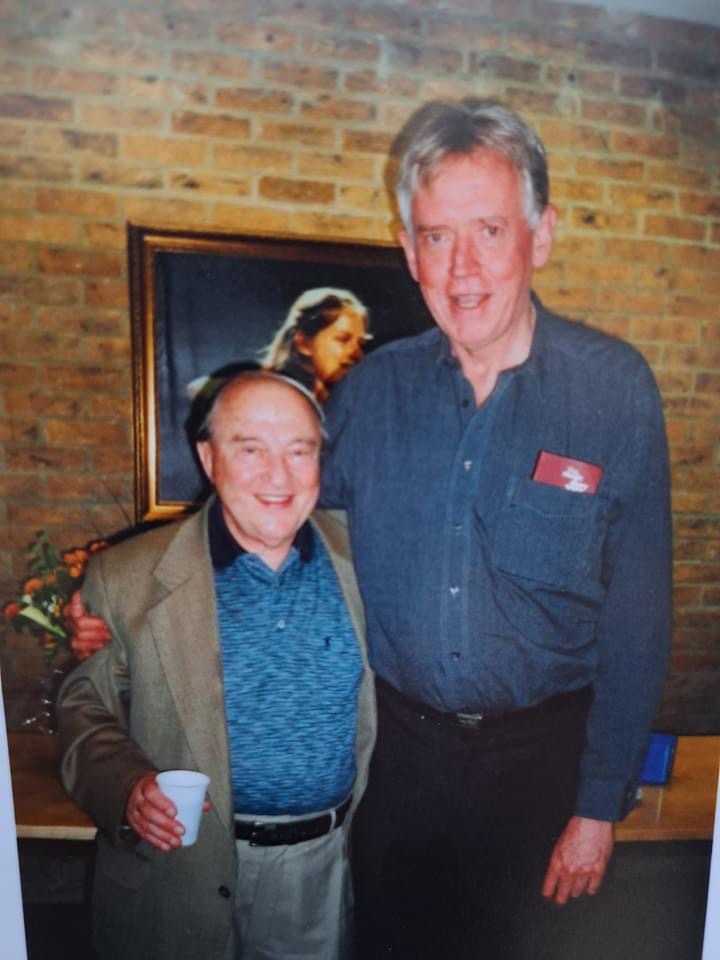
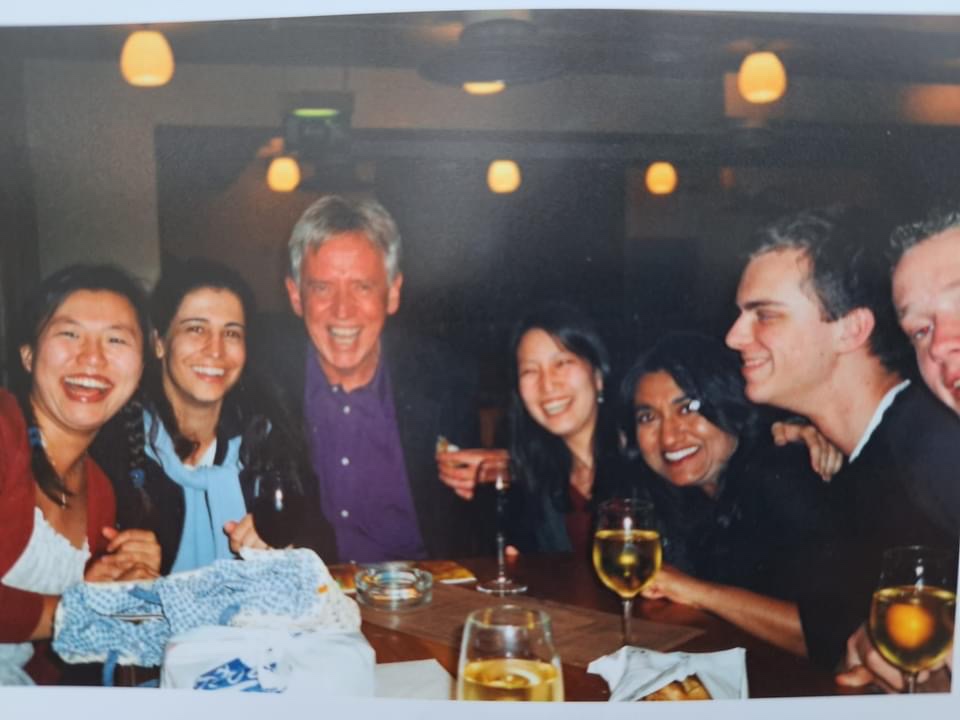
With Mark VinerMy dear, much missed friend, Niel Immelman with Menahem Pressler (also much missed) at the Oxford Piano Festival a few years ago. And Niel relaxing with some of the participants in party mood! Tessa Nicholson
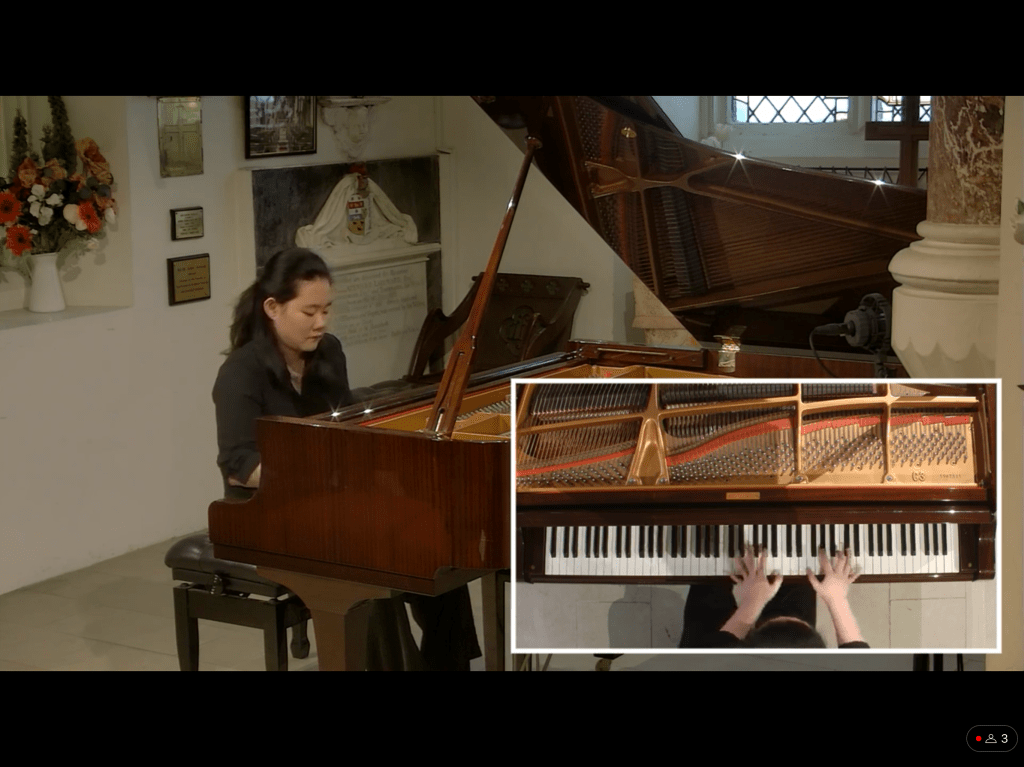
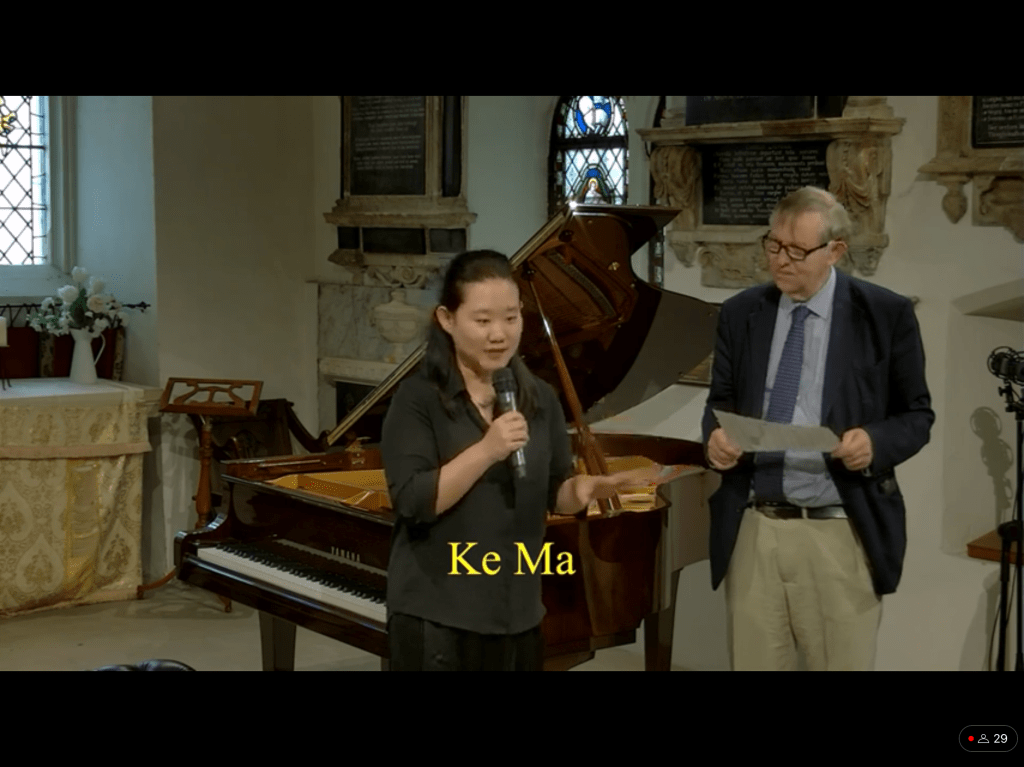
Some superb musicianly playing from Ke Ma .From the very first notes of the Schubert G flat Impromptu there were beautiful rich sounds of changing harmonies on which emerged the melodic line .Incorporated into the harmonic fabric the melodic line emerged with such strength and beauty .A disarming simplicity in which Schubert’s ‘Liebestraum’ was not of bitter sweet sentimentality but strong sentiments of poignant beauty.Playing of almost orchestral proportions as the F minor impromptu unwound with a rhythmic energy and buoyancy with moments of joyous excitement as the embellishments were thrown off with such deliberation.The central episode had a luminosity without ever loosing the rhythmic propulsion of this final exhilarating Impromptu.There were moments of great fantasy as Schubert seemed to be searching for a way back to the opening exhilarating dance.It was played with beauty and intelligent musicianship creating a tension of expectation just waiting for the moment of arrival and unwinding of the spring to lead to the return of the dance and the final great plunge to the bottom of the keyboard.
The absolute desolation of the opening of Book 2 of Debussy’s Image was just the scene for the bells that started to peal all over the keyboard creating a magic spell that was quite extraordinarily atmospheric.’Doucement sonore’ and ‘un peu en dehors’ Debussy suggests and later ‘très égal come une buée irisée’ all played with a transcendental control of sound as the melodic line was floated on this wave of sound.What grandeur there was too as the bells became more and more insistent only to die away to a mere whisper.What beauty she brought to the bleak landscape of the moon shining down on the Temple with wondrous sounds of unearthly luminosity.A masterly control of the pedal and of touch but above all an intelligence as she brought to life all the minute indications that Debussy seminates throughout the score.Have Gold Fish ever found such shimmering murmured pools to dip in and out of?Ke Ma brought a wonderful clarity to the melodic line as the fish enjoyed splashing around with such evident joy and exhilaration only to find absolute peace and tranquility in the final bars.Debussy wrote to his publisher,Jacques Durand :”Without false pride, I feel that these three pieces hold together well, and that they will find their place in the literature of the piano … to the left of Schumann, or to the right of Chopin… “
Cloches à travers les feuilles” was inspired by the bells in the church steeple in the village of Rahon in Jura,France.Rahon was the hometown of Louis Laloy ,a close friend of Debussy and also his first biographer.
“Et la lune descend sur le temple qui fut” (And the moon descends on the temple that was) was dedicated to Laloy.The name of the piece, which evokes images of East Asia ,was suggested by Laloy, a Sinologist The piece is evocative of Indonesian gamelan music, which famously influenced Debussy.
“Poissons d’or” was probably inspired by an image of a golden fish in Chinese lacquer artwork or embroidery ,or on a Japanese print. Other sources suggest it may have been inspired by actual goldfish swimming in a bowl,though the French for goldfish is ‘poisson rouge’ (red fish).
The revised 1931 version of Rachmaninov’s Sonata n.2 in B flat minor was played with passion and sumptuous sounds.But it was her musical intelligence and absolute attention to Rachmaninov’s indications that gave such strength and authority to a work that in lesser hands can seem so superficial and episodic.Her sense of orchestral colouring with a kaleidoscopic palette of colours was allied to the full Philadelphian luxuriant sounds that are so much part of Rachmaninov’s world.There was excitement and transcendental virtuosity but always with an organic feel of architectural shape and meaning.
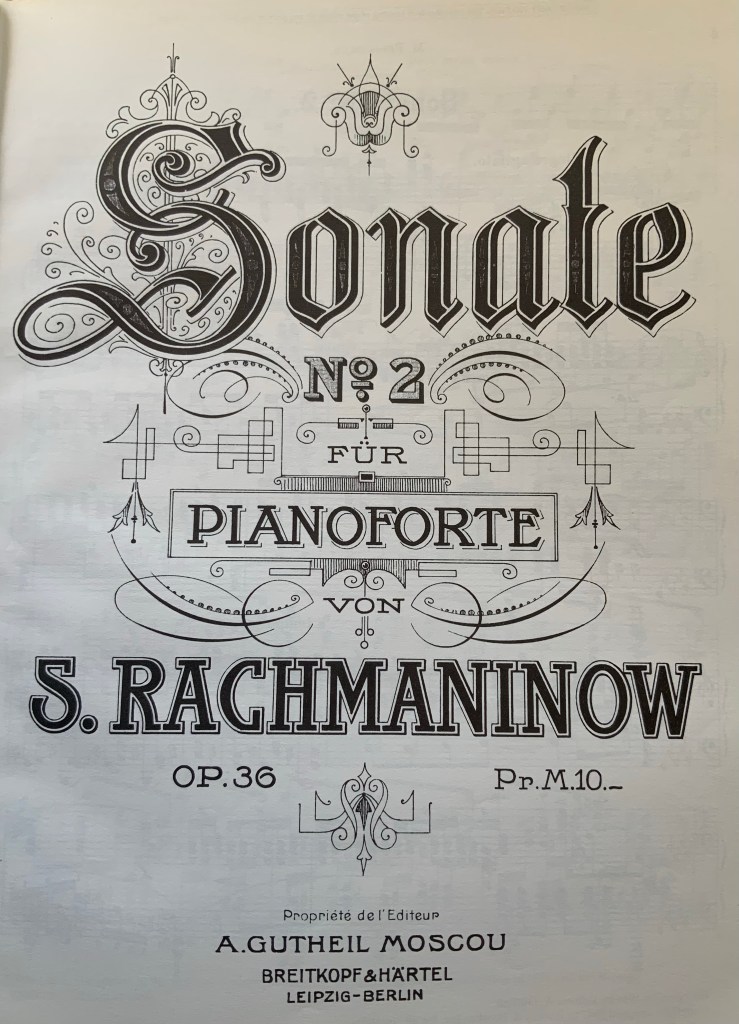
The original 1913 edition
Rachmaninov worked on his Second Sonata over several months in 1913, beginning it while in Rome and later completing it in Russia and including it in his concerts that Autumn prior to its publication the following Spring.Although conceived in three movements (Allegro agitato, non allegro, Allegro molto), the Second Sonata flows as one astonishing piece, its bravura technical demands matched by that dark emotional intensity which runs through so much of Rachmaninov’s music. The movements are bound together by thematic cross-references and transformation; in particular, the opening descending passage pervades all three movements in different guises.The original version is not without its problems however; not only is the scale of the work daunting, so too some of the passage-work makes very significant demands on the performer.
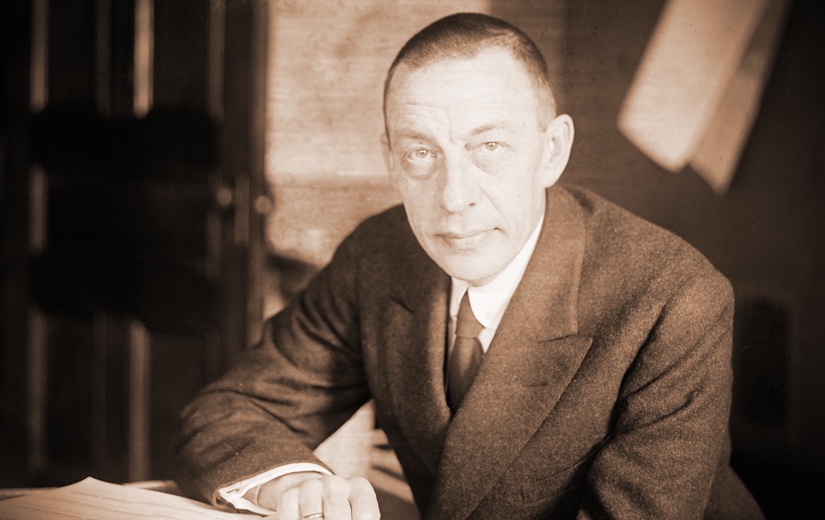
Serghei Rachmaninov
Rachmaninov’s own thoughts were expressed when he himself later wrote:”I look at some of my earlier works and see how much there is that is superfluous. Even in this Sonata so many voices are moving simultaneously, and it is so long. Chopin’s Sonata lasts nineteen minutes and all has been said.”
It was no doubt to address these points that Rachmaninov set about revising the Sonata in the summer of 1931, just as he was also composing his final solo piano work, the Corelli Variations.In this revised version, Rachmaninov makes significant changes to the piano writing throughout, both giving the piece a cleaner, more transparent texture and at the same time making the piece easier to play. In addition to these changes, he reduced the overall length of the Sonata by some 120 bars, tightening the structure considerably.
In spite of these efforts, as Rahmer points out in his concise but illuminating Preface to the new Henle edition,
“The question of whether Rachmaninov really altered the Sonata to its advantage is disputed to the present day among pianists and music critics. While many authors consider the significant cuts as a successful tightening up and elimination of unnecessary virtuoso ballast, the opposing faction criticises this intervention as a mutilation that upsets the Sonata’s formal balance and thematic conception.”
He goes on to note that while the revised version is the one frequently heard, some such as Zoltán Kocsis have advocated a return to the unaltered first version, while many others (notably Horowitz and Van Cliburn) have produced their own composite versions, based on their preferred elements from both.
Ke Ma introducing her programme subject of a thesis for her Doctorate that she is preparing at the Guildhall on the Chinese influence on western music
Born in Datong, China, Ke Ma is a highly accomplished pianist who has earned international acclaim for her exceptional musical talent and technical prowess. She pursued her musical education at the prestigious Royal Academy of Music in London, under the tutelage of Christopher Elton, Michael Dussek, and Andrew West, and graduated with a Masters with distinction (DipRAM) in 2017. Currently, Ke is actively engaged in her Doctoral study at Guildhall School of Music and Drama, where she is studying with esteemed professors Joan Havill, Dr. Alexander Soares, and Rolf Hind. Ke’s impressive achievements include securing top prizes at several international competitions, including 1st Prize at the 2016 Concours International de la vie de Maisons-Laffitte and Karoly Mocsari Special Prize in France, 1st Prize at the 2014 Shenzhen Competition in China, and 3rd Prize at the 2012 Ettlingen Competition in Germany. She has showcased her exceptional talent as a soloist, having performed with renowned orchestras such as the Royal Philharmonic Orchestra, Shenzhen Symphony Orchestra, and Miskolc Symphony Orchestra conducted by Tamás Gál at the Palace of the Arts in Budapest , among others.
Żelazowa Wola is a village in Gmina Sochaczew, Sochaczew County, Masovian Voivodeship, in east-central Poland.It lies on the Utrata River, some 8 kilometres (5 mi) northeast of Sochaczew and 46 km (29 mi) west of Warsaw. Żelazowa Wola has a population of 65.The name means “Iron will” in Polish and is the birthplace of ChopinIt is known for its picturesque Masovian landscape , including numerous winding streams surrounded by willows and hills.
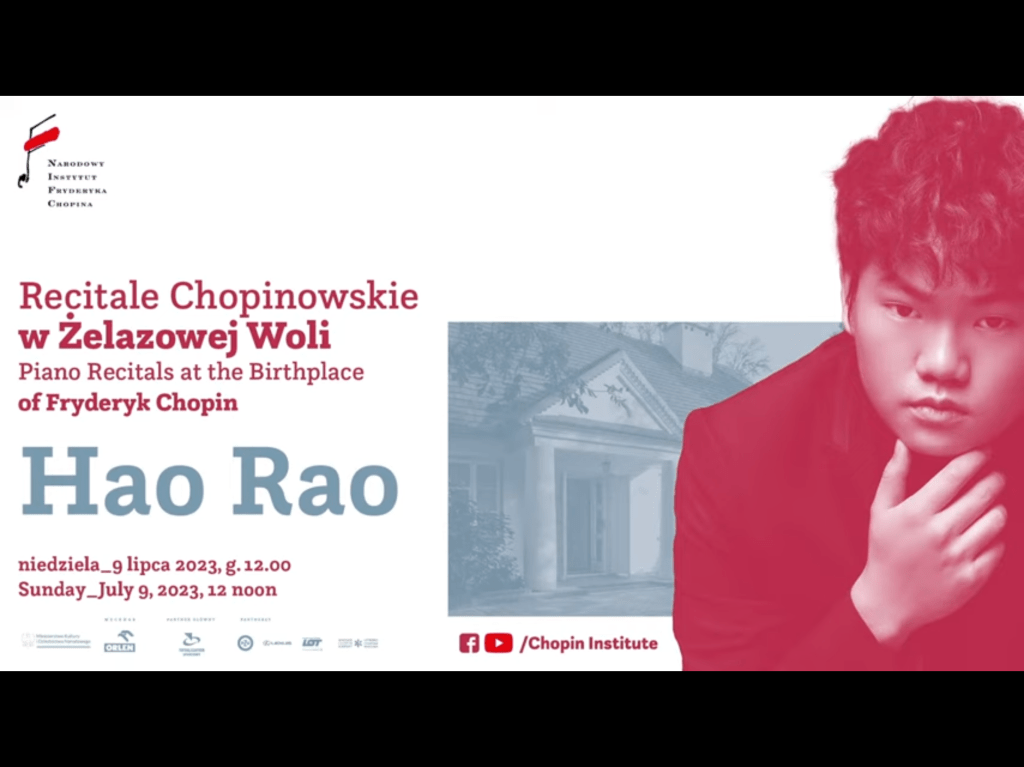
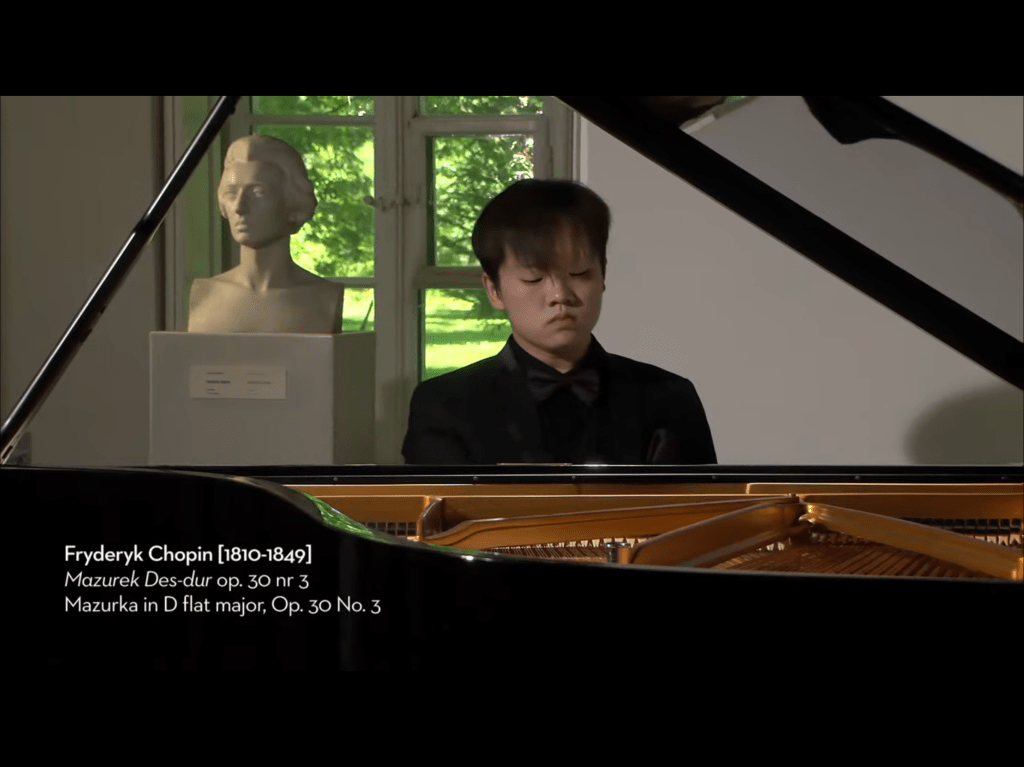
Playing of extraordinary maturity and beauty from this twenty year old Chinese pianist.A beauty not only of sound but the delicacy with which his fingers caressed the sounds out of the keys with a certainty and authority that would be the envy of pianists twice his age.
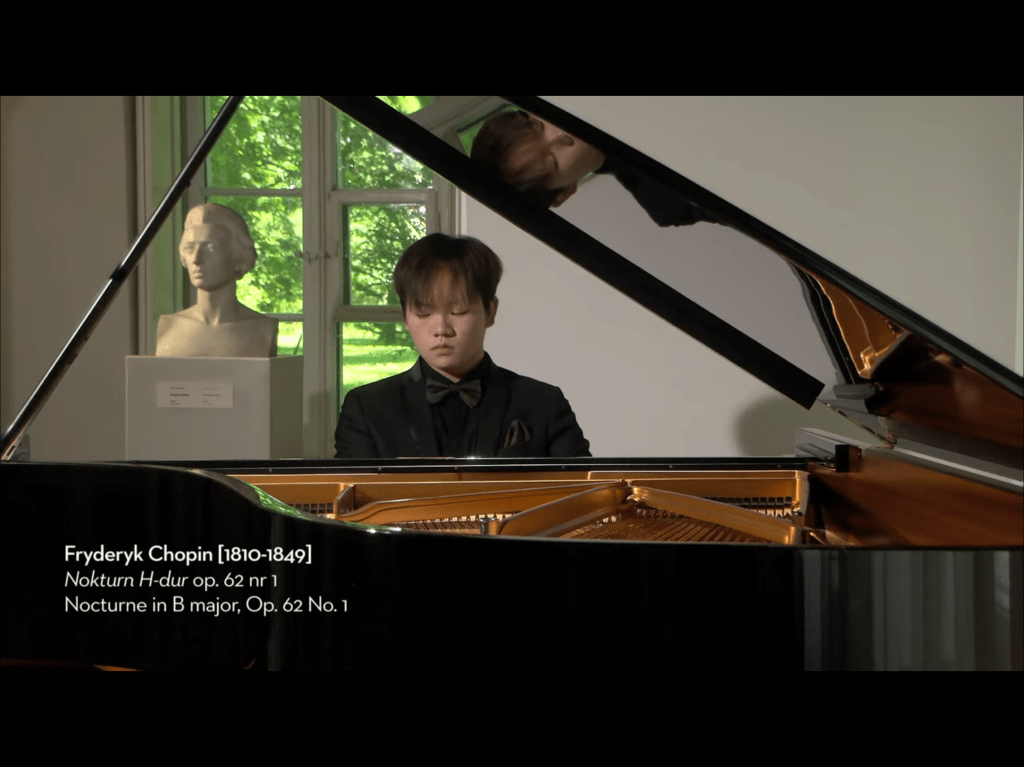
Chopin’s late nocturne in B major was played with aristocratic beauty and a finesse of sounds with whispered secrets of ravishing beauty .Trills that were mere vibrations of sound out of which unwound embellishments of exquisite delicacy.But there was strength too as these were sentiments of profound meaning and his weight and depth gave a poignancy and strength to this Nocturne written as Chopin neared the paradise that lay in waiting at such an early age.
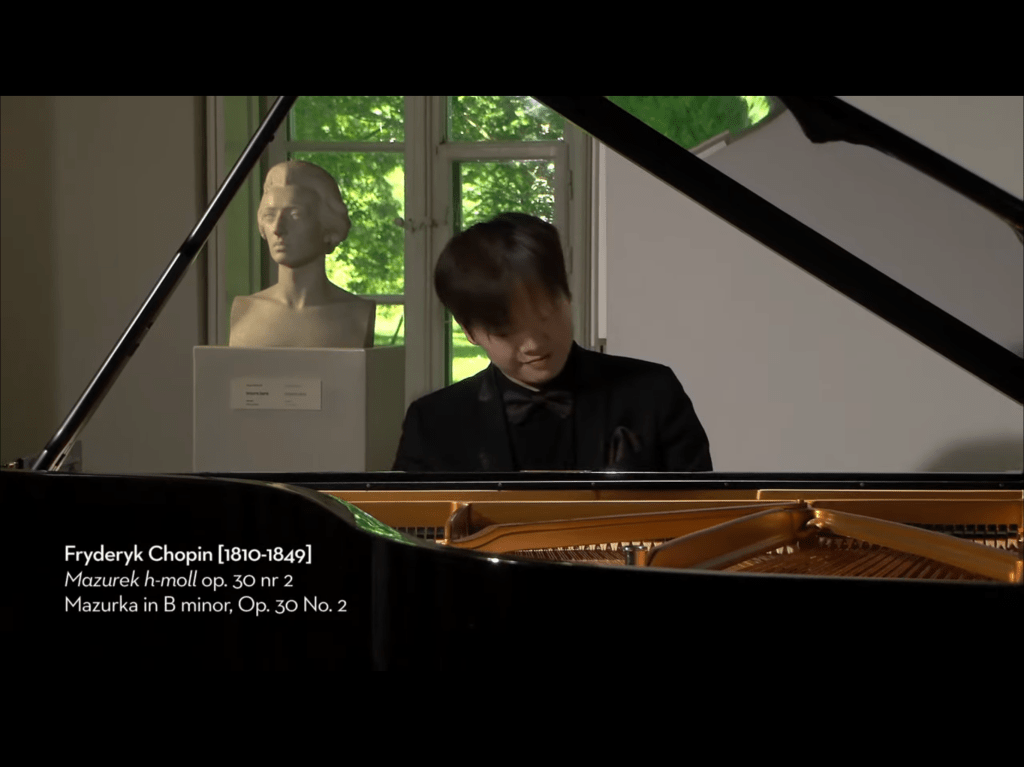
There was delicacy and flamboyance in the B minor Mazurka with a stream of nostalgia and a beguiling natural buoyancy that made one marvel at how a native of China could understand so perfectly the Polish soul of Chopin.It was the same question that perplexed the jury of one of the very first Chopin Competitions when the Mazurka prize was awarded much to the surprise of the polish contestants to Fou Ts’ong.Ts’ong was to become a great friend playing every year and giving masterclasses in my Euromusica Concert Series in Rome.He would often liken the poetic soul of Chopin to the same poetic soul that was to be found in the works of the great Chinese poets.The great tolling bell and calling to attention of the Mazuka op30 n.3 in D flat.Its beautifully suggestive central episode ‘con anima’ searching for a way back to the rumbustuous opening dance with a search of such fantasy and a pianissimo ‘slentando’ as Chopin indicates in the score.
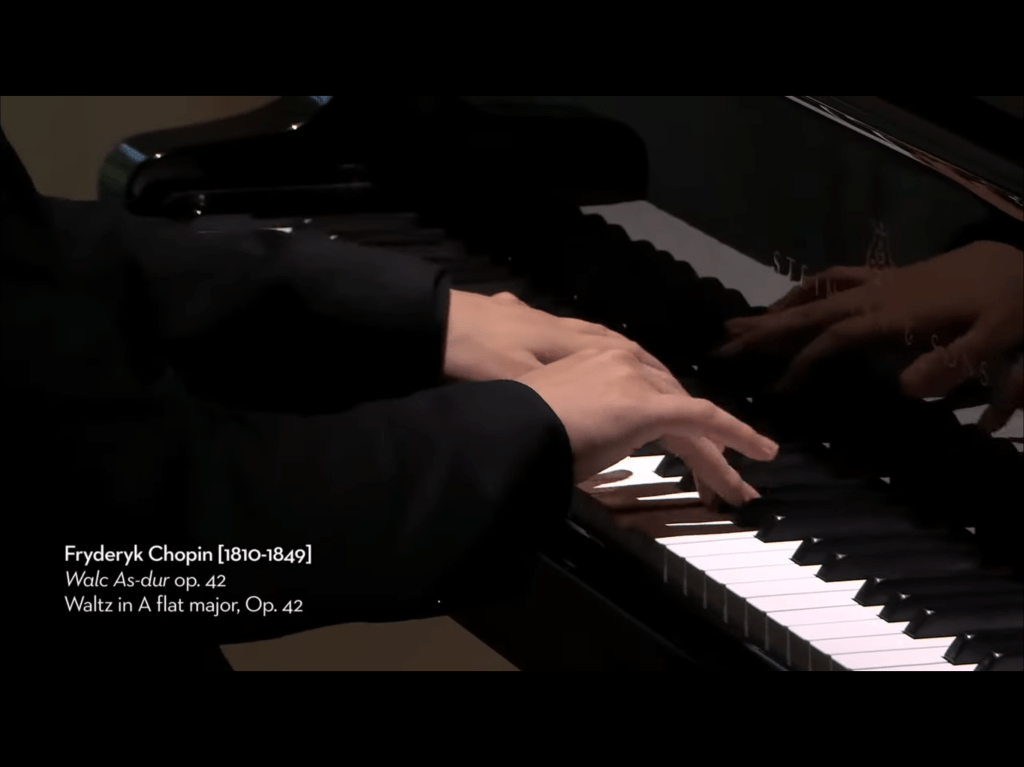
There was an irresistible rhythmic impulse to the Waltz in A flat op 42 with it’s rhythmic obstinacy and legato melodic line played so sensitively by Hao Rao.He did not have quite the aristocratic poise allied to rhythmic energy that was so much part of Rubinstein’s playing but it did have the same elegance and poise of Cortot and Rachmaninov .
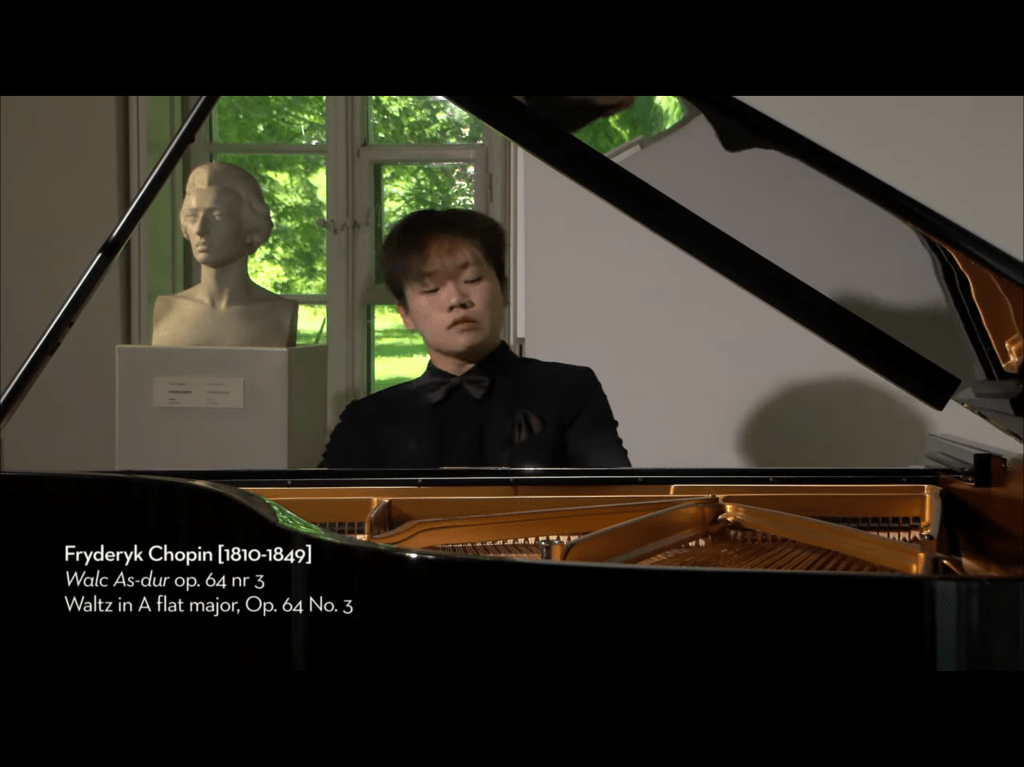
The other waltz also in A flat op 64 n.3 was played with a ravishing insinuation almost of salon character but never descending into vulgar but always with the head held high.The beauty of the whispered bass melodic line was mirrored by the brilliance of the final bars ending deep in the bass.
Hao Rao brought a timeless beauty to the A flat Ballade,the most pastoral of the four ballades.It was beautifully phrased but with a clarity even in the most mysterious episodes of weaving contrapuntal scales.The build up to the final climax was played with a relentless forward propulsion before the explosion of the final climax of passion and nobility.
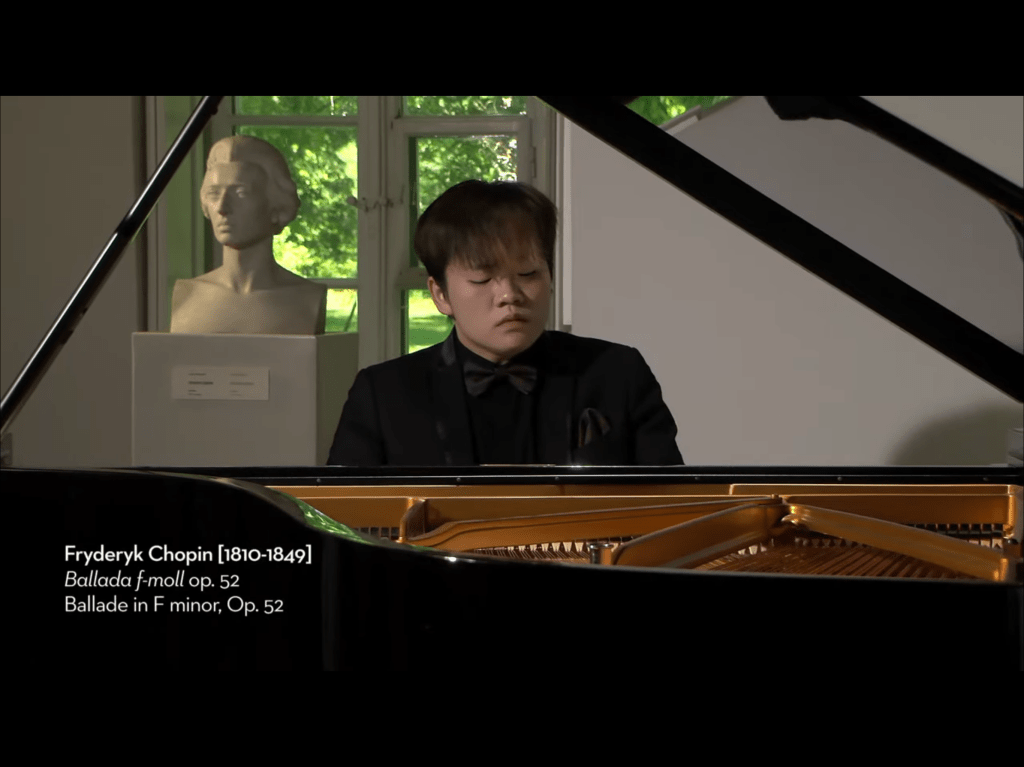
Absolute delicacy announced the elusive opening of the fourth Ballade.Followed by the opening theme played with great sentiment but also great strength and a sense of forward movement as each variation grew so naturally out of the other.There was a timeless beauty to the mazurka episode and a passionate climax before the heartrending return of the opening introduction which Cortot described as ‘avec un sentiment de regret’.The final variation where the embellishment of the theme is spread like a great wave over the entire keyboard was played with overwhelming beauty but there was also a transcendental control and shape as it lead to the final outpouring and the sumptuous waves of surging passionate sounds.The ‘stretto’ chords were a bit too literally staccato for my taste and could perhaps have had less speed but more weight.But the ravishing beauty of the five pianissimo chiselled chords before the coda was memorable.The sforzando deep in the bass so often ignored at the opening of the coda just showed what intelligence Hao Rao brought to his interpretation with the wishes of the composer utmost in his thoughts and soul.A tour de force of musicianly virtuosity brought this masterpiece to a magnificent conclusion .
Authority and Nobility were the hallmarks of a superb performance of Chopin’s ‘Heroique’ Polonaise op 53.Beautiful rich sonorities never hard but a sumptuous full orchestra.I noticed his very high wrist in the notorious left hand octaves but it was the legato of the cavalry above the stamping of the horses hooves that was so remarkable.A sense of balance that never lost sight of the musical line.There were some very beautiful deep bass notes as the Polonaise gradually picked up momentum leading to the tumultuous excitement of Chopin’s great cry of Victory.
At just seventeen years old, Hao Rao was a finalist and Honorable Mention at the 2021 18th Chopin International Piano Competition in Warsaw, performing Chopin’s First Piano Concerto in the finals under the baton of Andrey Boreyko and drawing praise both internationally and domestically. Jan Popis, special music commentator of the Chopin Competitionclaimed: “The 17-year-old Chinese boy has been manifesting his naturally charming talent since his first round. His playing is poetic, his legato is beautiful like a song, with a sound full of colors. He’s a great talent!”Born in the mountainous village of Jishou and beginning his piano studies at the age of four, Hao’s talent was evident from the beginning, and at the age of eight, he began making 32-hour roundtrip commutes to Guangzhou for studies with Dr. Vivian Li at Xinghai Conservatory Middle School where he is currently enrolled as a third-year high school student. Though still young, Hao Rao has already amassed an impressive resume of competition awards including first prize at the three most prestigious Chinese national piano competitions – Steinway, Pearl River, and Xinghai Cup – as well as top prizes in major international competitions including the Youth Gina Bachauer, E-piano Junior, Krainev, Aarhus, Ettlingen, Beijing Chopin and Zhuhai Mozart. He is also a three-year full scholarship student of the highly exclusive Morningside Music Bridge Program. His extensive performance experiences have taken him from Asia to Europe and North America in solo and chamber as well as concerto appearances with the China NCPA Orchestra, Orchestra Academia China, Warsaw Philharmonic, Salzburg Chamber Soloists and symphony orchestras of Shenzhen, Ningbo, Shenyang, Guizhou, Central and Xinghai Conservatories, collaborating with conductors Jia Lü, Guoyong Zhang, En Shao, Lin Chen, Huan Jing and Ming Liu.Outside of piano, Hao loves opera, ballet, pop culture, gourmet, singing, as well as riding roller coaster.
At the Cliburn Junior international Piano Competition China the 15 year old HAO RAO wrote this :
Hao Rao grew up in the mountainside town of Jishou, China. Every week, his mother would take him on a 16-hour train ride to his piano lesson; he never tired of the trip and instead saw it as “departing for a great music journey with unknown surprises.” He now attends the Middle School of Xinghai Conservatory of Music in the sprawling city of Guangzhou, but still studies with his teacher of almost seven years, Vivian Li (Suirong). He has won three major national competitions in China, received prizes at the 2018 Ettlingen Competition and the 2019 Aarhus Competition, and—at the age of 13—presented the complete Chopin etudes in recital. He listens to opera and enjoys reading fiction, playing sports, and sampling desserts.
“I’ve been to several competitions or festivals abroad, and every time it was a life-changing inspiration with unforgettable memories, but the Cliburn Fort Worth… that’s almost like the Vatican for pianists. For me, it almost seems like a fairy tale, and I will treasure every moment of this journey.”
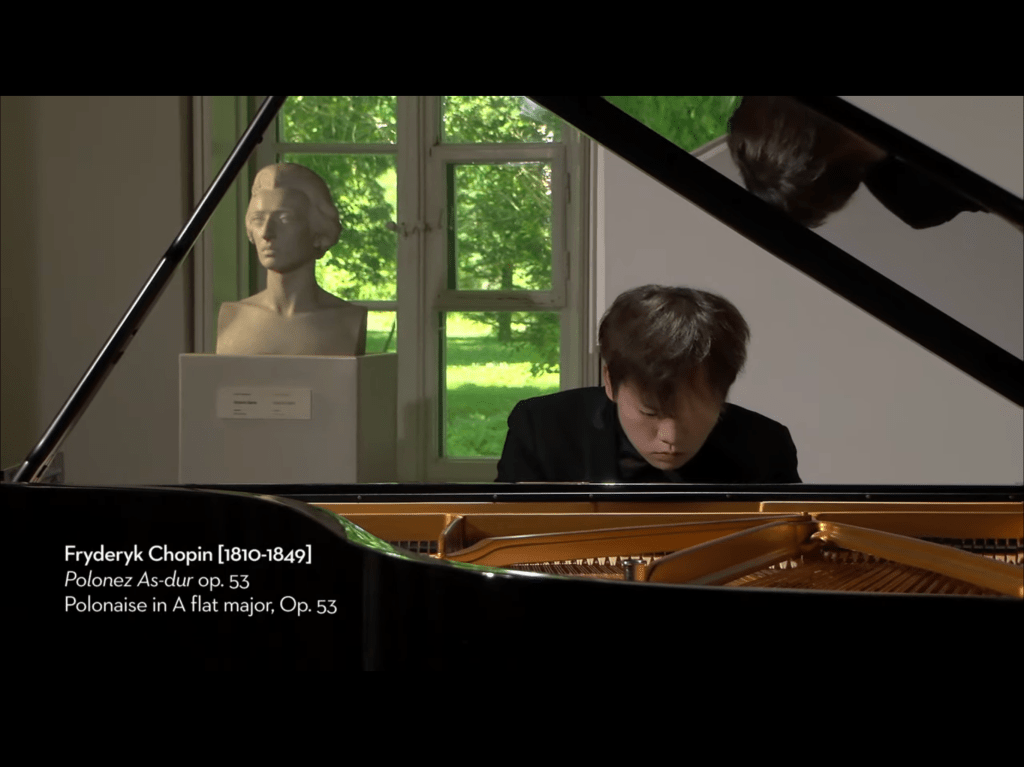
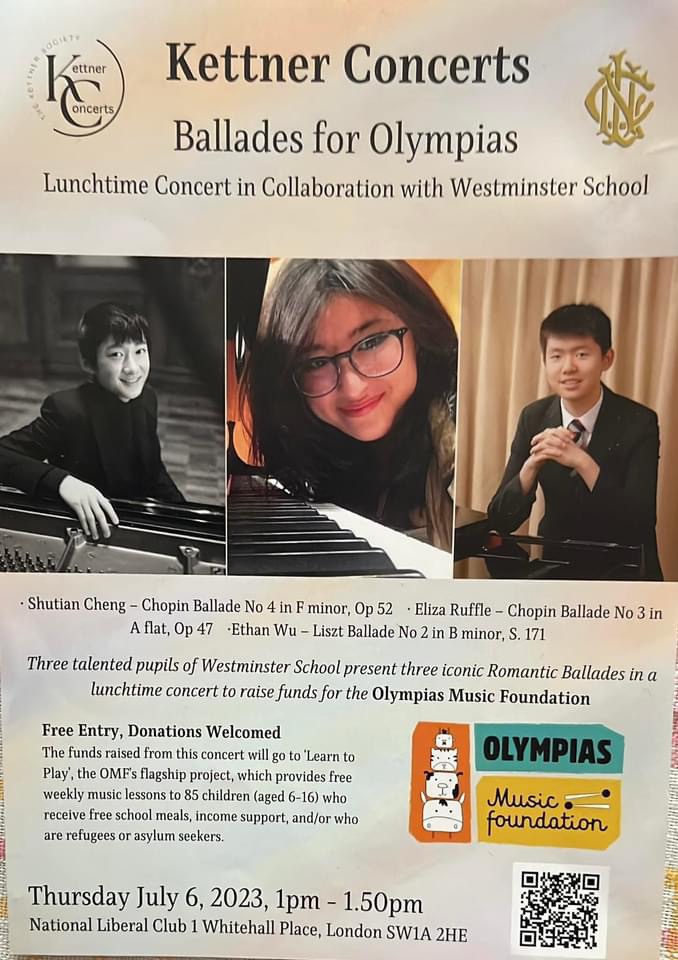
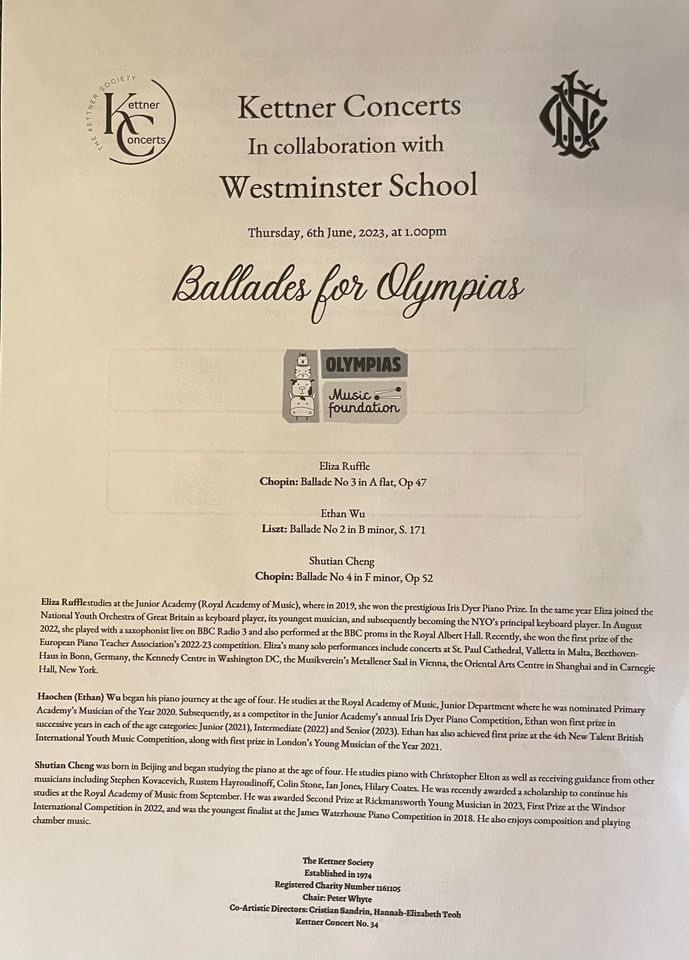
A new lunchtime series for the Kettner Concert Society at the National Liberal Club.An opportunity for young musicians from Westminster School with three remarkably gifted young pianists playing two Ballades by Chopin and one by Liszt. ‘Ballades for Olympias’ raised over 500 pounds today for the music education charity in Longsight,Manchester.These funds will go to ‘Learn to Play’which will provide free weekly music lessons to 85 children aged between 6-16. The Olympias Foundation believe that everyone should be given the opportunity to partecipate in music regardless of income or background.
Three precociously gifted young musicians gave remarkable performances of Ballades by Liszt and Chopin.
Eliza Ruffle
Eliza Ruffle gave an at times very passionate performance of Chopin’s Third Ballade.It was also a professionally prepared performance of a prize winning student of the Junior Academy.Already a member of the National Youth Orchestra but still a student and trained by the magnificent piano faculty of Westminster she is obviously going on to even greater things.
Ethan Wu
Ethan Wu gave an extraordinary account of Liszt’s spectacularly evocative Second Ballade.Claudio Arrau ,who studied under Liszt’s disciple Martin Krause, maintained that the Ballade was based on the Greek myth of Hero and Leander, with the piece’s chromatic ostinati representing the sea: “You really can perceive how the journey turns more and more difficult each time. In the fourth night he drowns. Next, the last pages are a transfiguration”.In Ethan’s hands it sprang to life with subtlety and virtuosity. Extraordinary mastery of the keyboard sonorities and remarkable virtuosity allied to a poetic understanding of this very evocative tone poem.Ethan has been studying for the past year with Prof Christopher Elton.
Shuntian Cheng
Shutian Cheng I have heard before playing Rachmaninov’s notoriously difficult third piano concerto at St John’s Smith Square.Just finishing in the sixth form at Westminster and ready for University he has been studying for the past six years with that magnificent trainer of so many remarkable pianists:Christopher Elton at the Royal Academy.He will now open a new chapter in his musical life with Rustem Hayroudinoff.A real artist who could bring to life the elusive opening of one of the pinnacles of the piano repertoire:Chopin’s Fourth Ballade.He also could turn the technical difficulties of the coda into ravishing music of passionate fervour.
Cristian Sandrin co artistic director of Kettner Concerts with the Head of Keyboard at Westminster School Mr Steven Wray
Three pianists that have been endowed by Westminster with the early training that gives them the possibility of choosing music as a professional career. Life will lead them to whichever road they choose but Music will always be present and will be their guiding light wherever life takes them . So pleased that the new artistic directors Cristian Sandrin and Hannah Elizabeth Teoh are giving a platform to the stars of tomorrow.I hope that after Westminster their series might continue with the Purcell and Menuhin schools as well as many others on an exciting voyage of discovery reaching for the stars.
Chairwoman of the National Liberal Club Karin RehacekThe imperious stairway to the David Llloyd George Music room
A thing of beauty is a joy forever sprang to mind as the sounds of Mozart and Schubert engulfed us as we were surrounded by beautiful paintings.
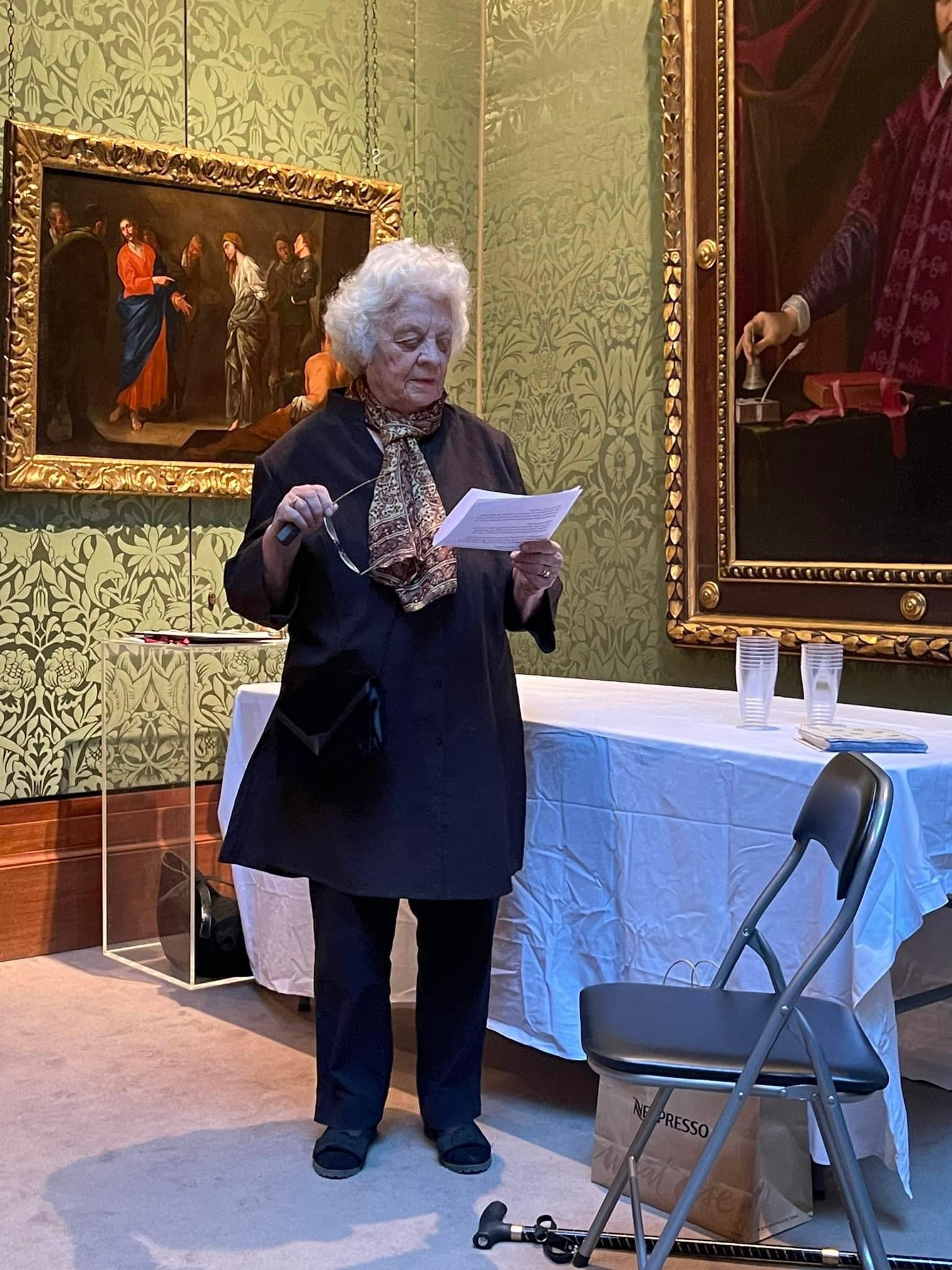
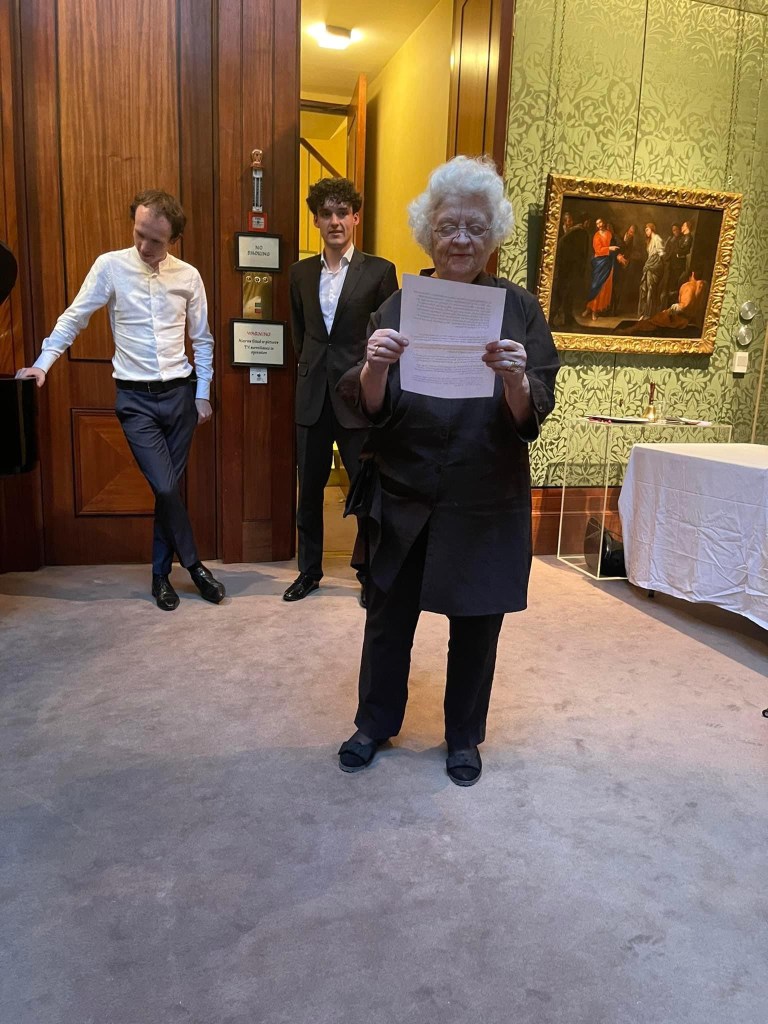
The indomitable Mary Orr a lady with a heart of gold
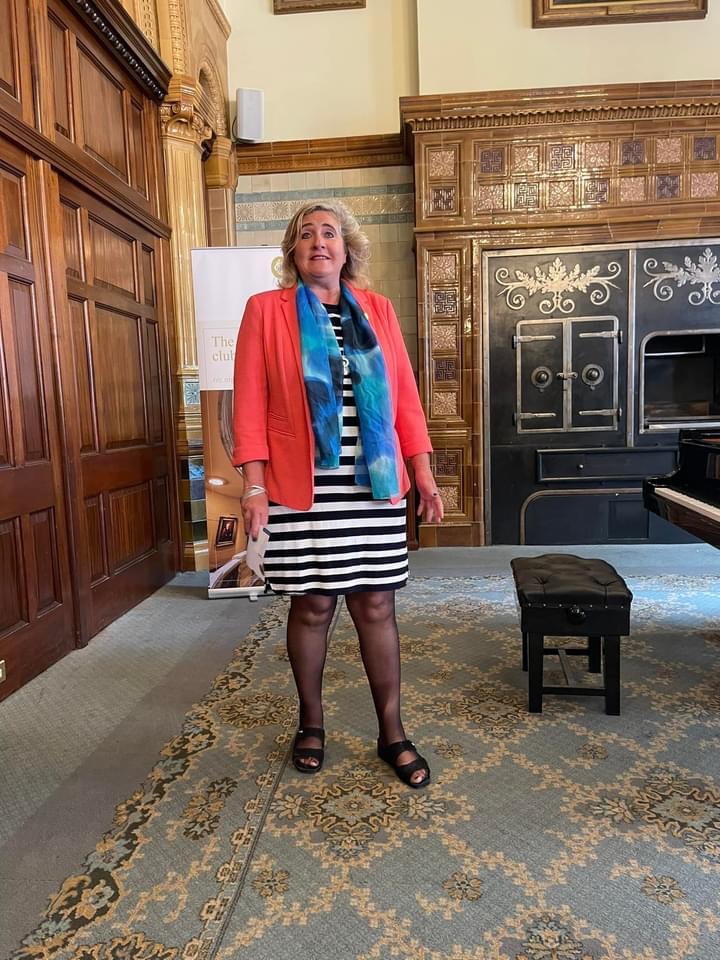
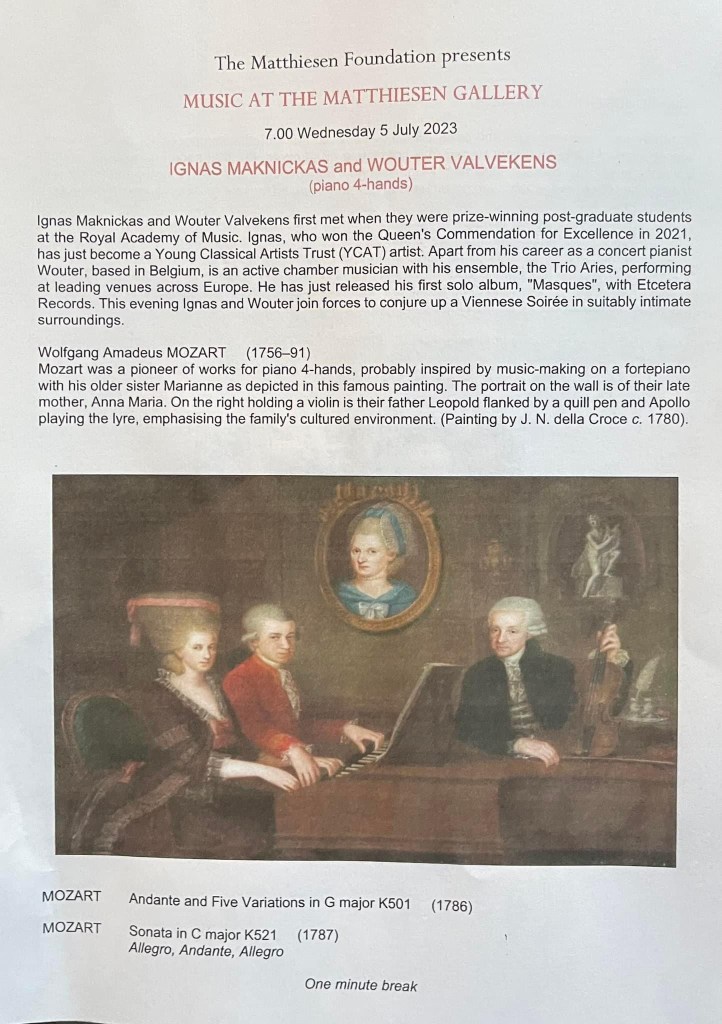
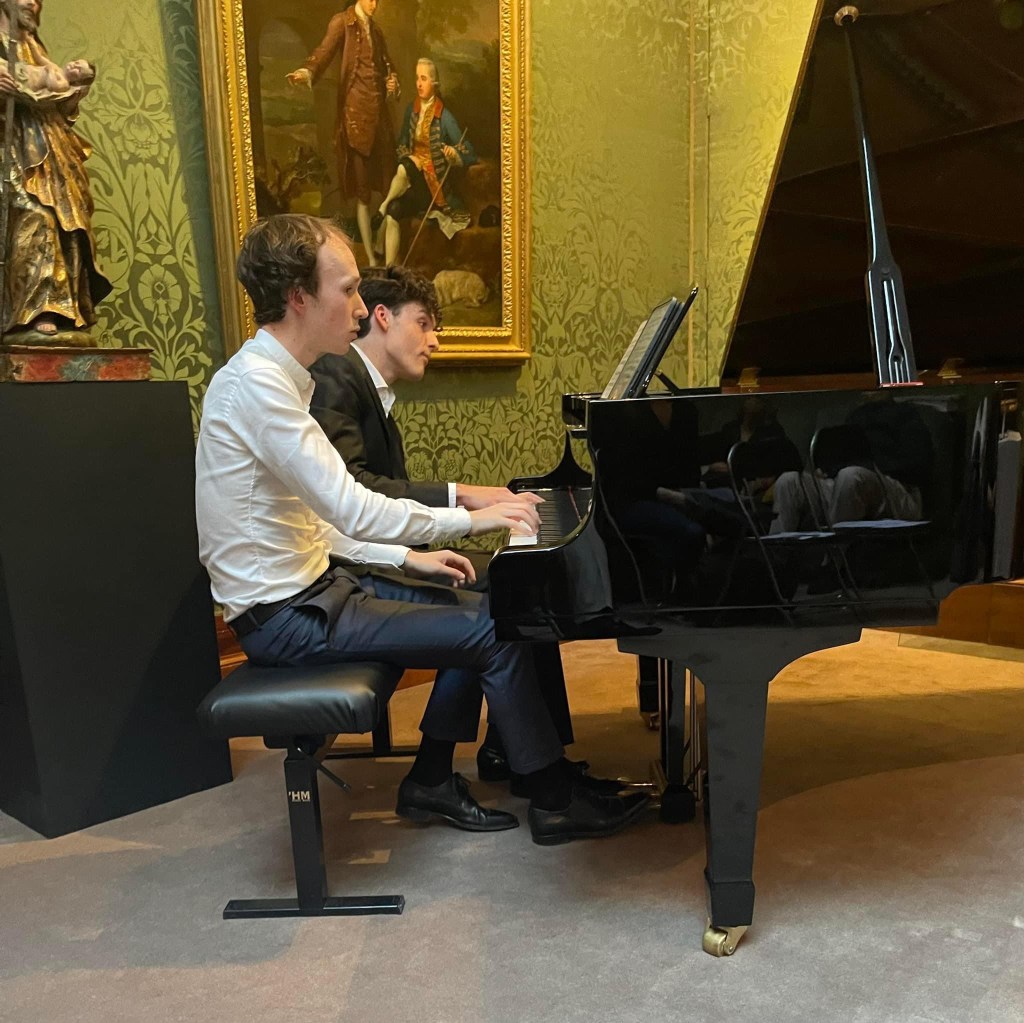
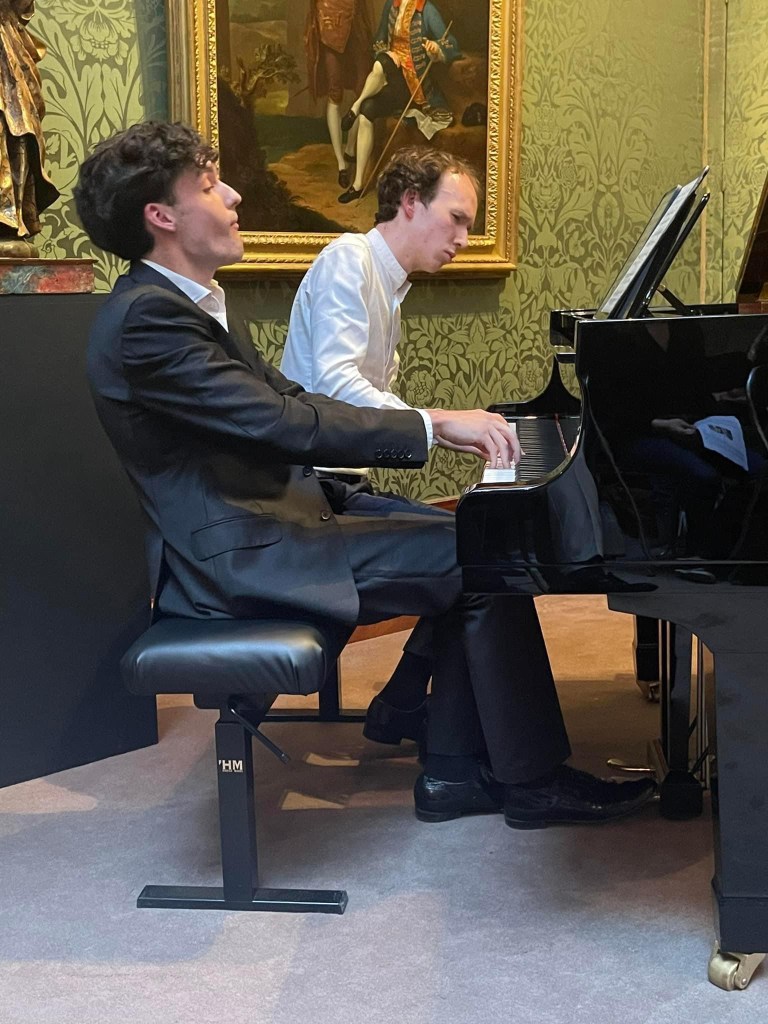
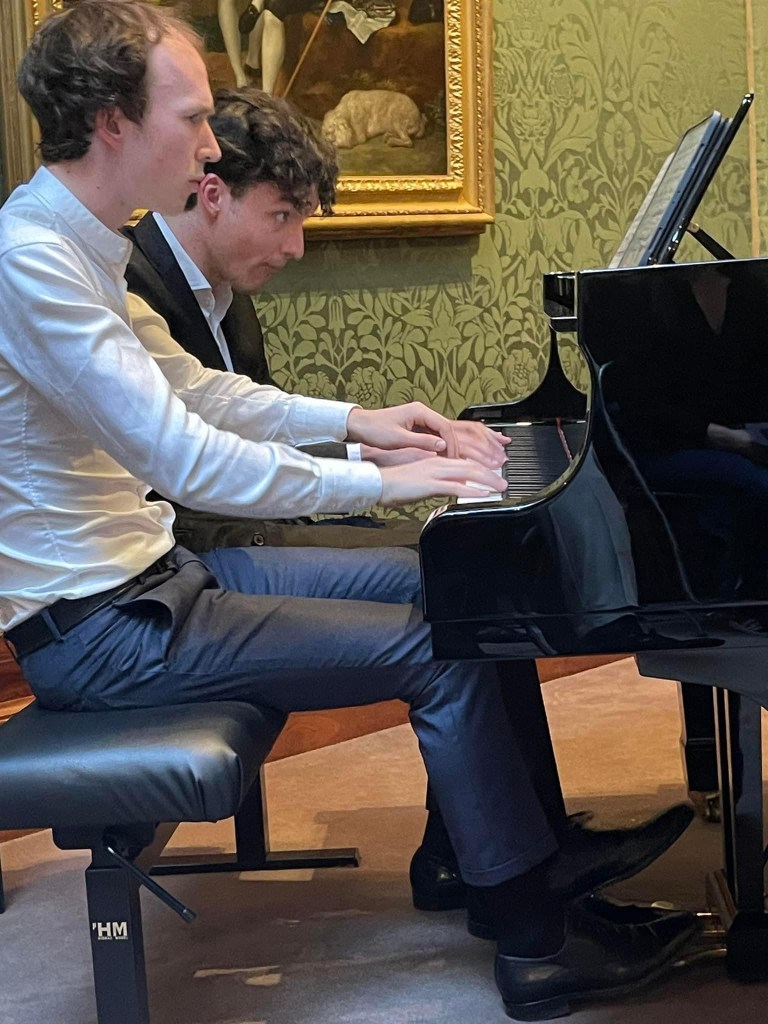
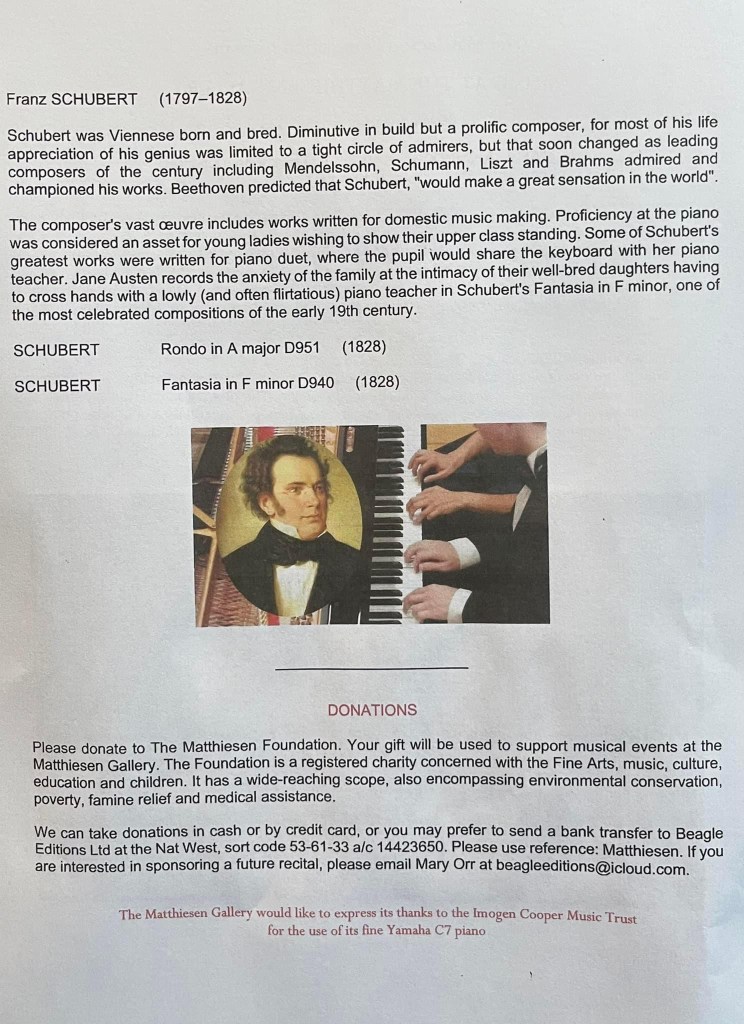
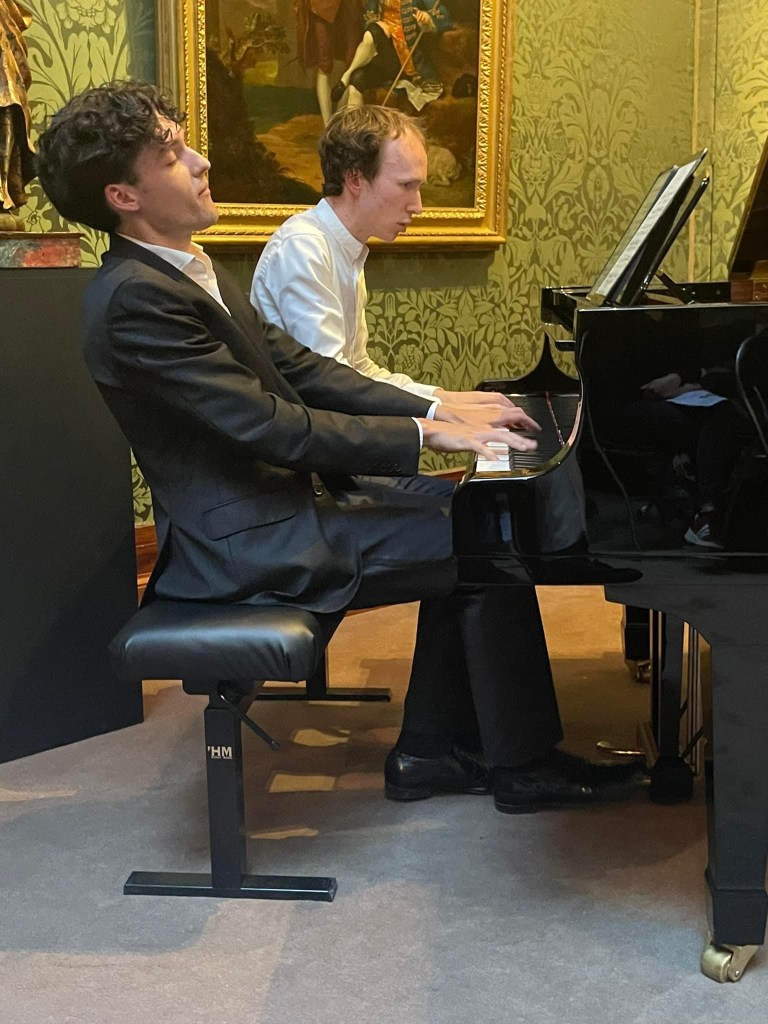
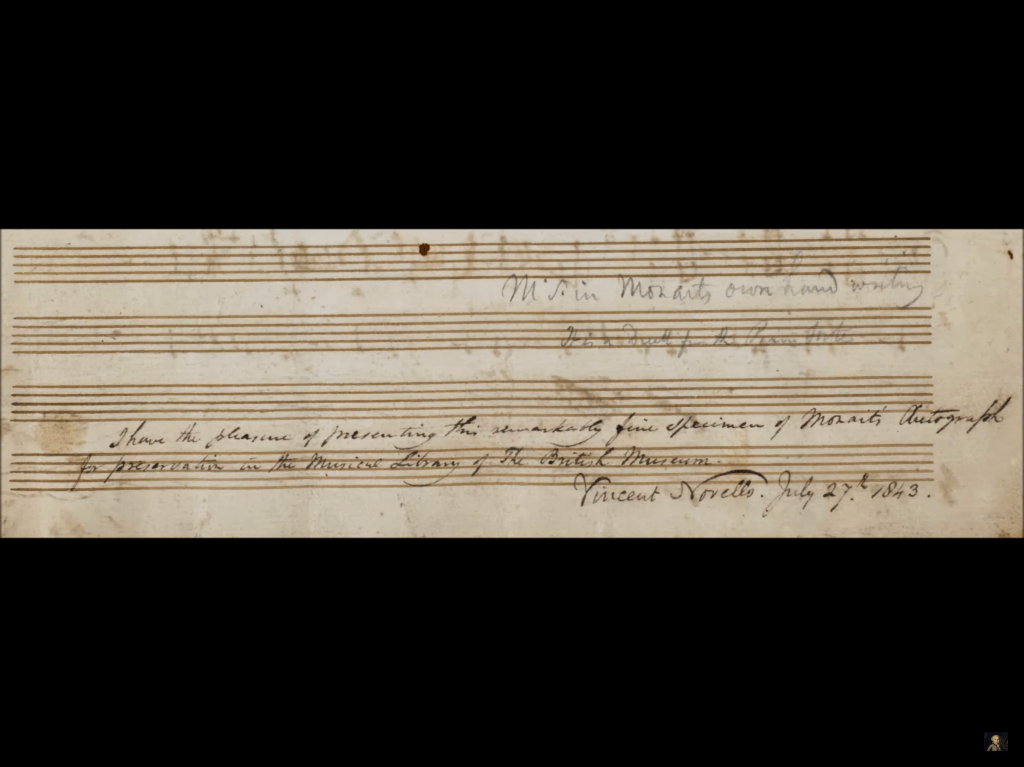
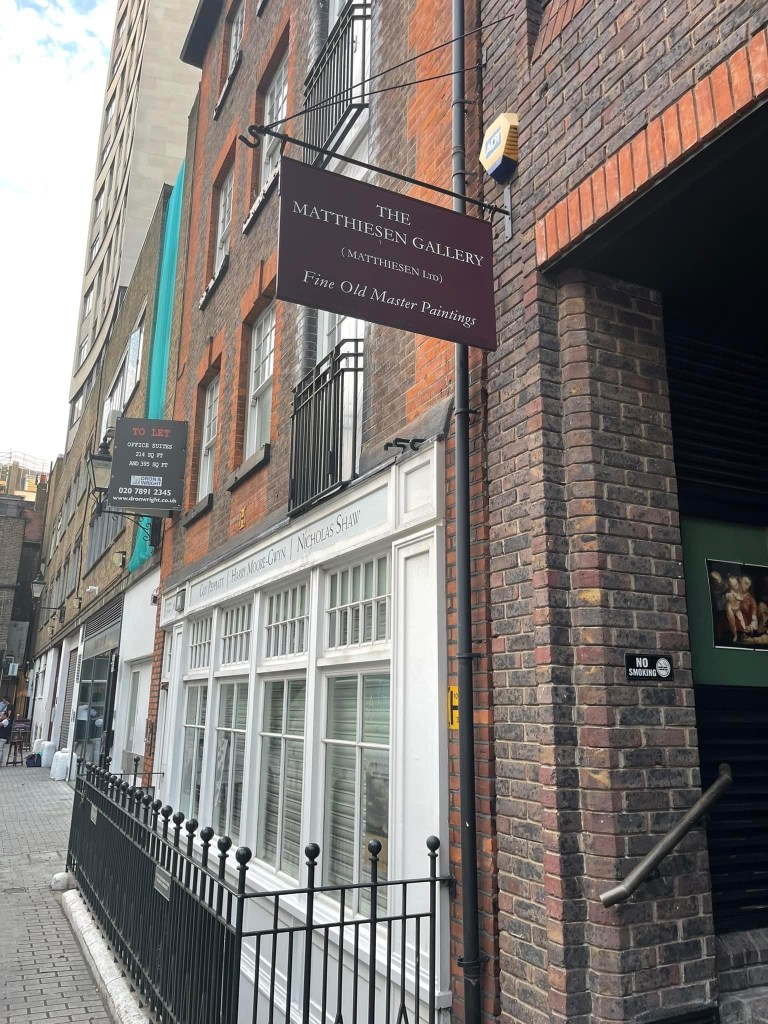
Music at the Matthiesen Gallery organised by the Matthiesen Foundation and the indomitable Mary Orr with many thanks to the Imogen Cooper Music Trust for the loan of their magnificent piano.A sparkling jewel in a crown and an honour to have Imogen Cooper at the concert too to support two young artists who had met at the Royal Academy and teamed up as a duo under her guidance at the ICMT masterclasses held annually in France.
How could one ever forget the supreme artistry of two remarkable women pianists Imogen Cooper and Ann Queffélec who had met in Leeds at the beginning of their illustrious careers as soloists and as kindred spirits became duo partners bringing music and joy to so many. Nice to be able to appreciate a new generation whose musical values and intelligent musicianship are added to a natural God given talent.
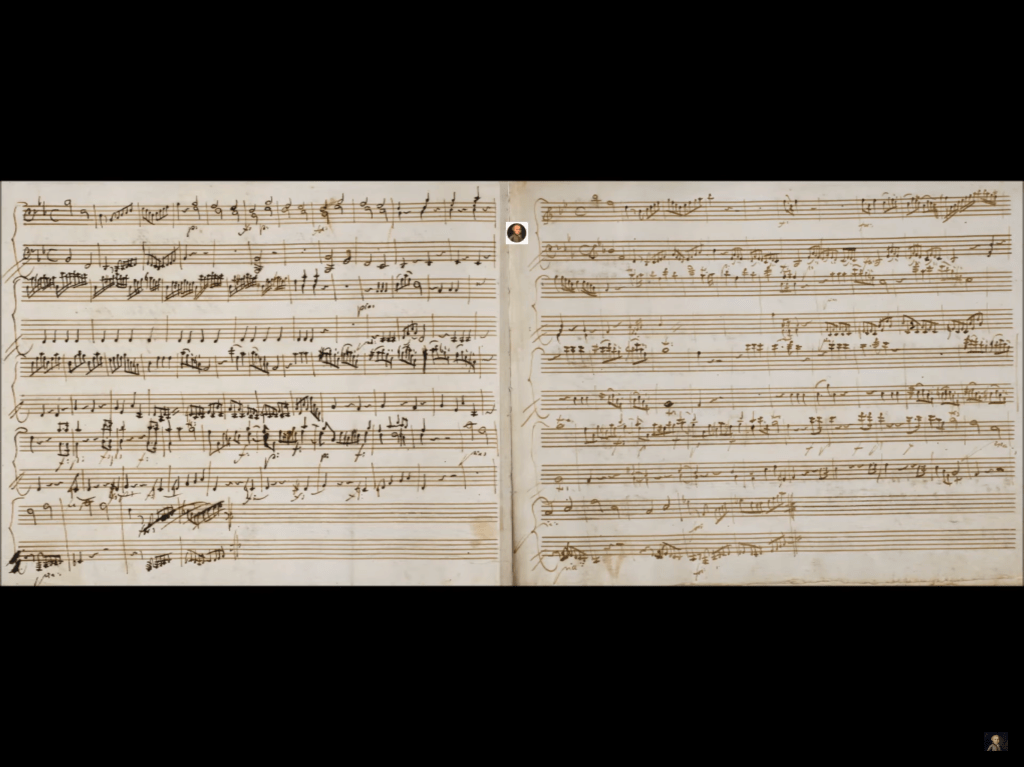
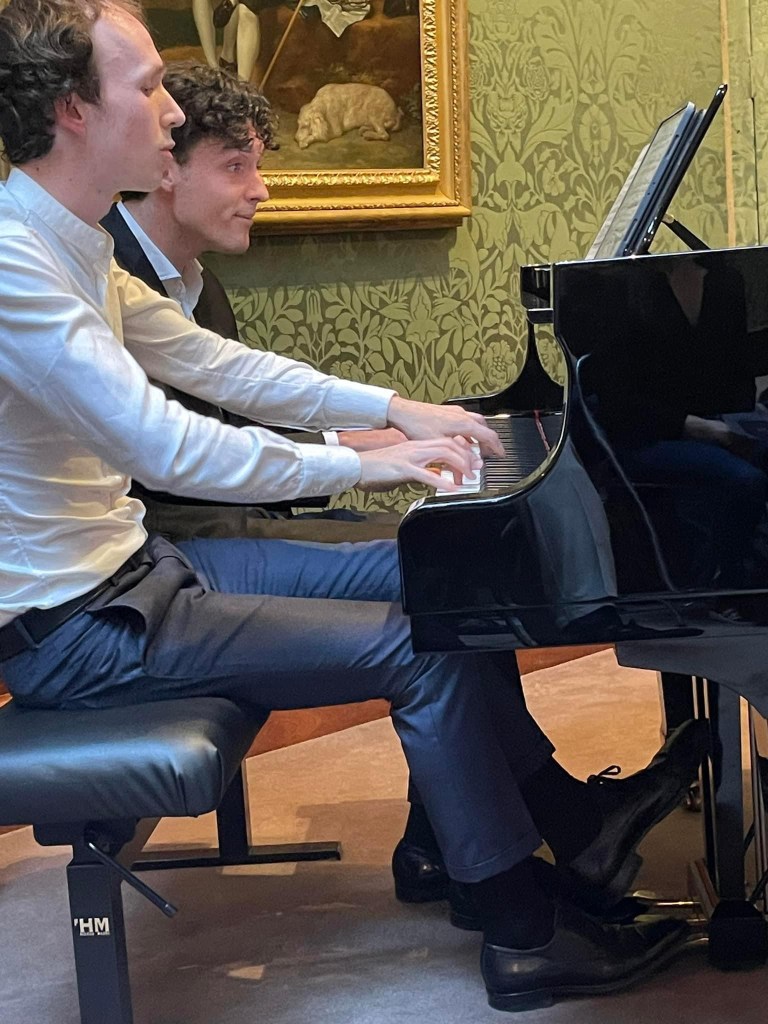
Two works by Mozart opened this short but very satisfying recital for the Matthiesen Foundation – Music at the Matthiesen Gallery. The beauty and simplicity they brought to the Andante and Variations in G K501 immediately showed us that we were in the hands of very fine musicians.A fluidity and beauty that Wouter brought to the disarming simplicity of the theme as accompanied by the delicacy of Ignas’s playing.The hardest thing for a piano duo is that four hands should sound as two.It means a supreme sense of balance is essential to avoid any conflict with the musical line that should be so clearly defined.It was exactly this that was so apparent today that these two young artists were actually listening to each other in their wish to create a single unified whole. Two pianists played as one – there could be no greater compliment and I wonder if indeed Mozart experienced the same with his sister for whom he wrote a number of important works for four hands. Very little pedal meant that there was great clarity but with their well oiled fingers there was a fluidity created by fingers not feet.Wouter occasionally touched the pedal to add colour especially in the ‘minor’ fourth variation.The beauty and clarity that Wouter brought to the first variation was shadowed by the fleeting lightness of Ignas in the second.The same lightness and obvious enjoyment they brought to the third .Their mastery was even more evident in the clarity and brilliance they both brought to the scintillating fifth variation.A beautifully poignant and graceful return of the theme just underlined the genius of Mozart where so few notes could mean so much.
The Sonata in C major K521 was played with a rhythmic energy from the first engaging opening fanfare.But it soon dissolved into elegance and nobility.Ignas’s agile fingers replied to Wouter’s purity of sound that was crisp and clear and very sensitively and discreetly ornamented.The dramatic question and answer between the two players was played with a sudden injection of youthful energy.The Andante was played with a purity of sound that was of a simple flowing natural beauty.There was great beauty to the opening of the Allegro but swiftly turned into the impetuosity and rhythmic energy of this final movement with great agility from Wouter and sensitivity from Ignas in the bass. Two very fine performances that as they play more together will find the freedom and flexibility of the voice with its natural breathing and shaping which was after all the early seeds of ‘bel canto’ and indeed the supreme Genius of Mozart.
Ignas Maknickas and Wouter Valvekens are two young musicians at the start of their careers.Like their mentor they will obviously fly high and ensure that the values of musical integrity and honesty go hand and hand with dedication and above all love for music -‘If music be the food of love,play on!’ And it will,thanks to Mary Orr,who as she says two charitable organisations linking up are a guiding force for the new generation of artists seeking an audience to share their wonderful gifts with.
Beautiful musicianly performances of Mozart and Schubert were crowned with a glorious performance of Dvorak’s most Brahmsian of Slavonic Dances op 72 n.2. Here the heavens opened as these two young artists revealed their very soul to us with such freedom and artistry and were not intimidated by the great masterpieces they had shared so beautifully but respectfully with us. To savour and enjoy them with respect but not too much!
Two works by Schubert completed the programme.This time Ignas was ‘Primo’ .The A major Rondo was published in December 1828, less than a month after Schubert died.Schubert left the largest number of piano duets and four-hand works of all the great composers and his Rondo, D. 951, dates from 1828, the last year of his life.A beautiful continuous outpouring of melodic invention transferring the final reprise of the rondo theme to the sonorous tenor register, with a continuous pattern of semiquavers unfolding above it. Particularly beautiful is the manner in which one of the important subsidiary themes returns towards the end, surmounted by a shimmering pianissimo accompaniment in repeated chords from the primo player.It was now Ignas who his the pedals and could add the ravishing colours that illuminate this masterpiece .It is usually customary for the bass or secondo to have the pedal because the harmonies are created from the bass upwards.Benjamin Britten thought so too until in performance with Richter at Aldeburgh he suddenly found two rather large feet on top of his! No such problem today with Wouter and Ignas in total harmony and as Schubert himself was to write in the his next Rondo D 608 ‘Notre amitié est invariable.’
The Fantasia in F minor by Franz Schubert, D.940 (Op. posth. 103) is one of Schubert’s most important works .He composed it in 1828, the last year of his life dedicating it to his former pupil Caroline Esterházy Schubert began writing the Fantasia in January 1828 in Vienna.The work was completed in March of that year, and first performed in May. Schubert’s friend Eduard von Bauernfeld recorded in his diary on May 9 that a memorable duet was played, by Schubert and Franz Lachner.The work was dedicated to Caroline Esterházy, with whom Schubert was in (unrequited) love. Schubert died in November 1828. After his death, his friends and family undertook to have a number of his works published. This work is one of those pieces; it was published by Anton Diabelli in March 1829. In four continuous movements Allegro molto moderato Largo Scherzo. Allegro vivace Finale. Allegro molto moderato The basic idea of a fantasia with four connected movements also appears in Schubert’s Wanderer Fantasy and represents a stylistic bridge between the traditional sonata form and the essentially free form tone poem and it was beautifully played with a flexibility and freedom.There was also nobility and rhythmic precision in the Largo and an energetic Scherzo but a ‘Trio’ that was far too serious and more ‘joie de vivre’ and flexibility would have lightened the tension and dynamic drive.The fugue was played with great authority and extraordinary technical command but never loosing sight of the overall musical line.The disarming return of the opening fantasia was one of those master strokes of the Genius of Schubert giving such shape to one of the most beautiful of all Fantasias
Mozart and Schubert had the same youthful soul as these two valiant artists whose sensitive fingers had been entrusted with such treasures today .
Mary Orr presenting the two young artists Mozart original manuscript Schubert Fantasy original manuscript
Wouter Valvekens is a Belgian concert pianist. He has been invited to perform on different occasions in Belgium, Portugal, Italy, the Netherlands, Germany and the United Kingdom, for solo recitals and with orchestras such as the Chamber Orchestra of Mechelen, the Euregio Youth Orchestra and the St. John’s Chamber Orchestra in Maidenhead. Apart from his solo career, Wouter Valvekens is also a very active chamber musician. He is a founding member of the ‘Trio Aries’, which won the prestigious Supernova Chamber Music Competition 2020. The ensemble had its debut in the Henri Le Boeuf-Hall of BOZAR Brussels. He is also a founding member of the ‘Werther Piano Quartet’, which is supported by the Mozart Gesellschaft Dortmund. The ensemble gave its debut in the Konzerthaus Dortmund in 2018, to critical acclaim. During his studies, Wouter Valvekens has been actively participating in numerous national and international competitions. In 2014 he was awarded the first prize at the Belfius Classics competition. He was a finalist at the International VriendenCultuurPrijs Theaters Tilburg and he was awarded the second prize in the International André Charlier piano competition in 2015. In 2016, he won the 1st prize and the prize of the audience in the international VriendenCultuurPrijs piano competition in Tilburg, the Netherlands, and the 3rd prize in the César Franck International Piano Competition. Wouter won the first prize, and two special prizes at the International Paços Premium Competition in Paços de Brandão, Portugal. Wouter Valvekens received his first piano lessons at age 6 at the Conservatory of Mechelen, where he was studying with Rita Degraeuwe from 2004 to 2014. From 2014 to 2018, Wouter studied with Polina Leschenko at the Royal Conservatory of Antwerp. In 2017, he obtained the degree of Bachelor in Music magna cum laude. From 2018 to 2020 he studied with Ian Fountain at the Royal Academy of Music in London, where he obtained his Postgraduate degree in 2020. His studies at the Academy were generously supported by the Winifred Christie Trust Award, a scholarship award from Inspiratum vzw and a Senior Award from the Hattori Foundation.He has worked with András Schiff, Imogen Cooper, Elisabeth Leonskaja, Richard Goode, Klaus Hellwig, Frank Braley amongst others in various masterclasses. Wouter Valvekens is also supported by the SWUK Flanders Foundation to follow masterclasses worldwide.
July 2021 Ignas Maknickas received “The Queen’s Award for Excellence” as the highest-scoring graduate of the Royal Academy of Music. In June 2023 Ignas became the winner of Young Classical Artists Trust (YCAT) International Auditions. He has taken First Prize at the XIX Fryderyk Chopin Piano Competition for Youth in Szafarnia, First Prize at the XX Piano Competition “Young Virtuoso” in Zagreb, Third Prize at the Aarhus Piano Competition and, in 2021, was the semi-finalist of the Vendome Prize.Ignas has appeared with the Aarhus Symphony, Alicante Philharmonic, Dartington Festival Orchestra, Lithuanian National Symphony, Lithuanian State Symphony, Lithuanian Chamber Orchestra, London Mozart Players and Royal Academy of Music Chamber Orchestra.2023-24 highlights include Mozart K. 467 with London Mozart Players in London, Rachmaninoff Piano Concerto No. 2 with Bloomington Symphony Orchestra in Indiana and solo recital at the Wigmore Hall in London.Born in California in 1998, Ignas was raised in Lithuania. In 2017, graduating from the National M.K. Čiurlionis School of Art in Vilnius, he was honoured by the President of Lithuania, H.E. Dalia Grybauskaitė. With his sister and three brothers the talented Maknickas Family Ensemble has represented Lithuania on National Television and at State Occasions.Ignas completed his Bachelor of Music at the Royal Academy of Music on full scholarship under Professor Joanna MacGregor. In September 2021 he commenced the Master of Arts Programme with Professor MacGregor, also on full scholarship. He is a Leverhulme Arts Scholar, a recipient of the ABRSM Scholarship Award, the Imogen Cooper Music Trust Scholarship, Munster Trust Mark James Award, Robert Turnbull Piano Foundation Award, Tillett Trust and Colin Keer Trust Award and Hattori Foundation Award. He is an Artist of the Munster Trust Recital Scheme.He has attended masterclasses with Dmitri Bashkirov, Dame Imogen Cooper, Christopher Elton, Stephen Hough, Yoheved Kaplinsky, Marios Papadopoulos, Menahem Pressler, Geoffrey Simon, Tamás Ungár, Arie Vardi and Ilana Vered. As a soloist he has appeared at the Steinway Hall in London, Auditorium du Louvre in Paris, Charlottenborg Festival Hall in Copenhagen, Ed Landreth Hall in Fort Worth, Lithuanian National Philharmonic in Vilnius and Kinross House in Scotland.