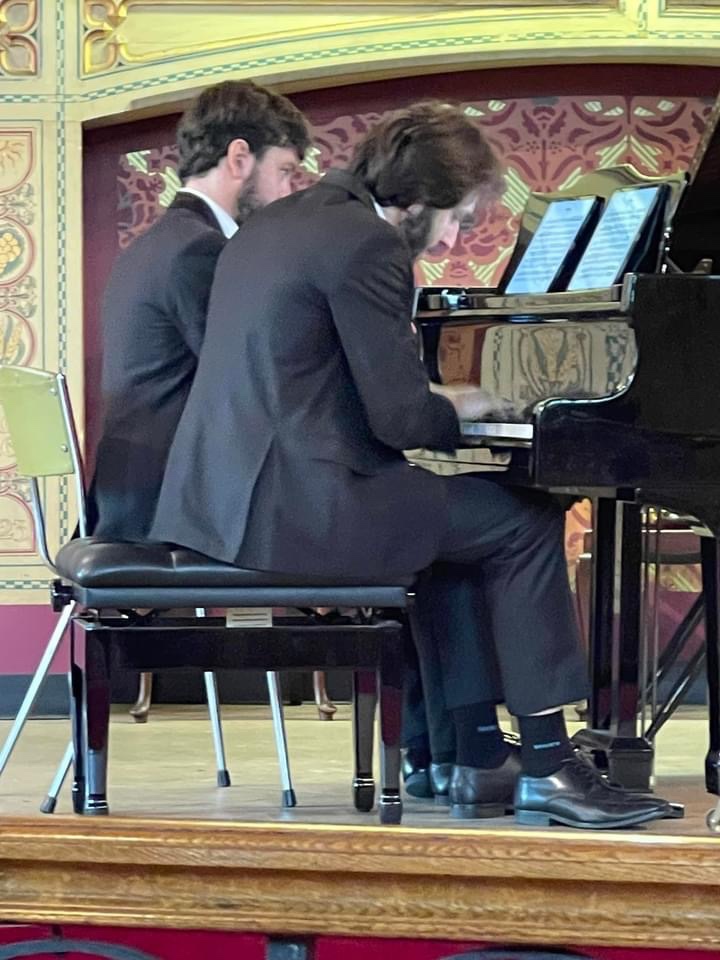
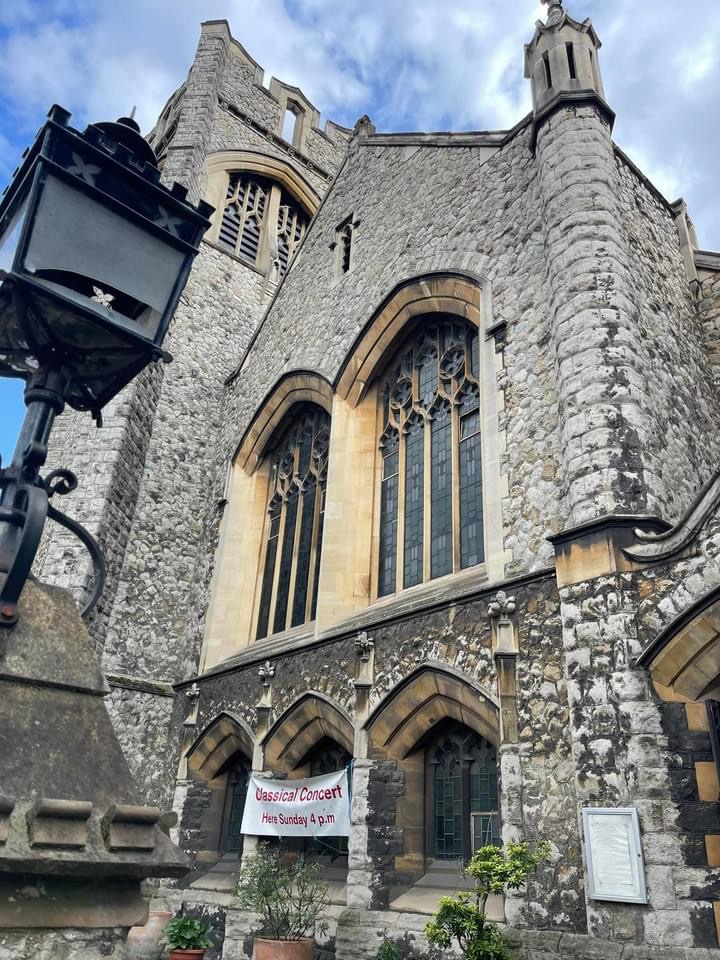
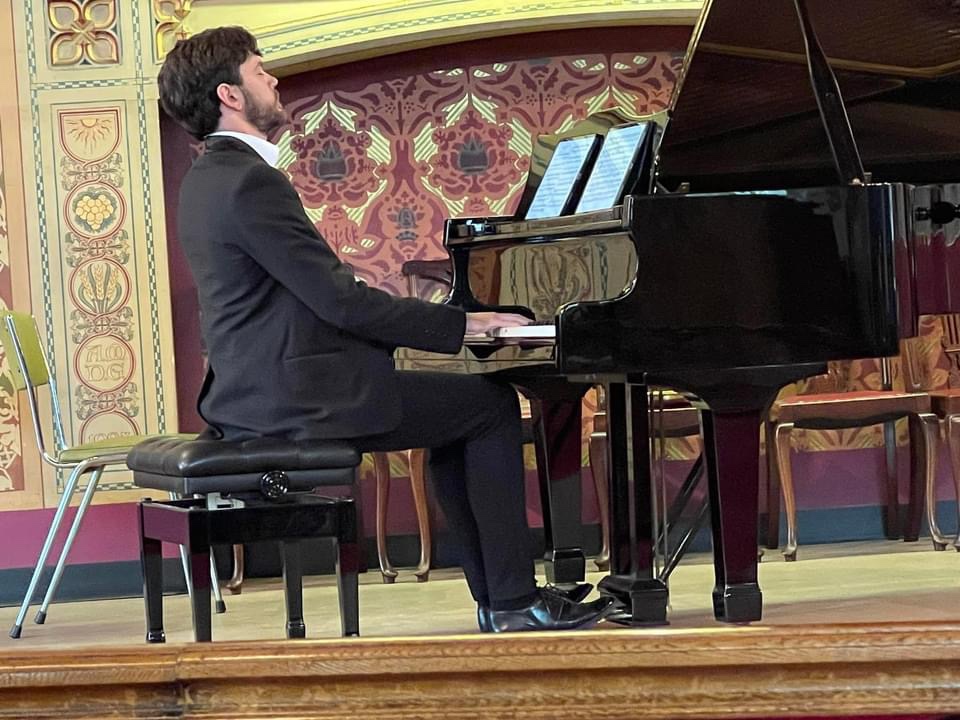
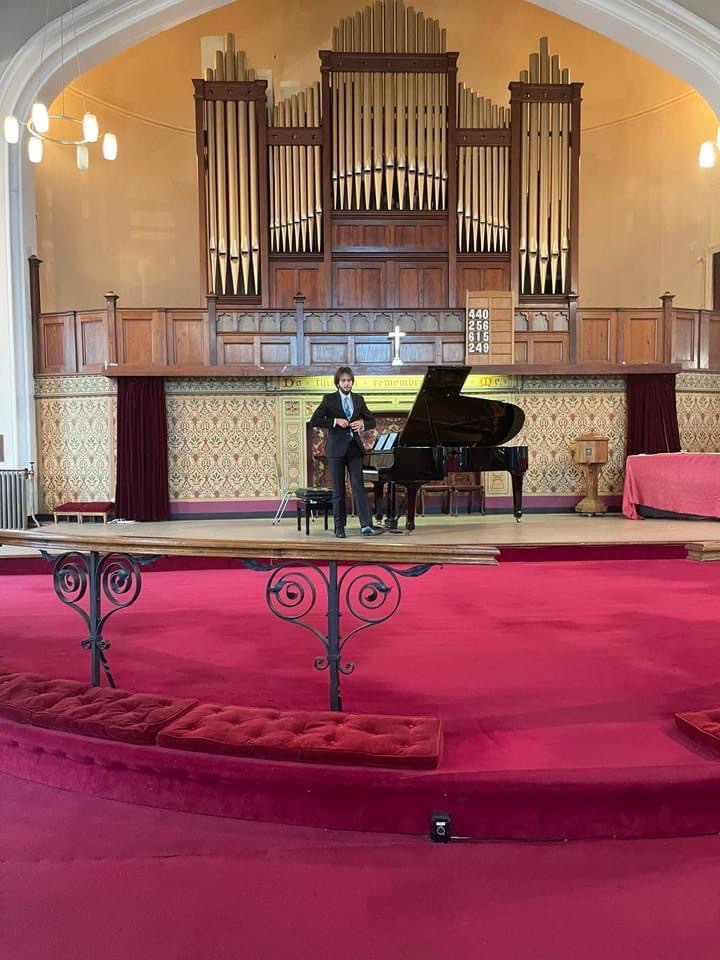
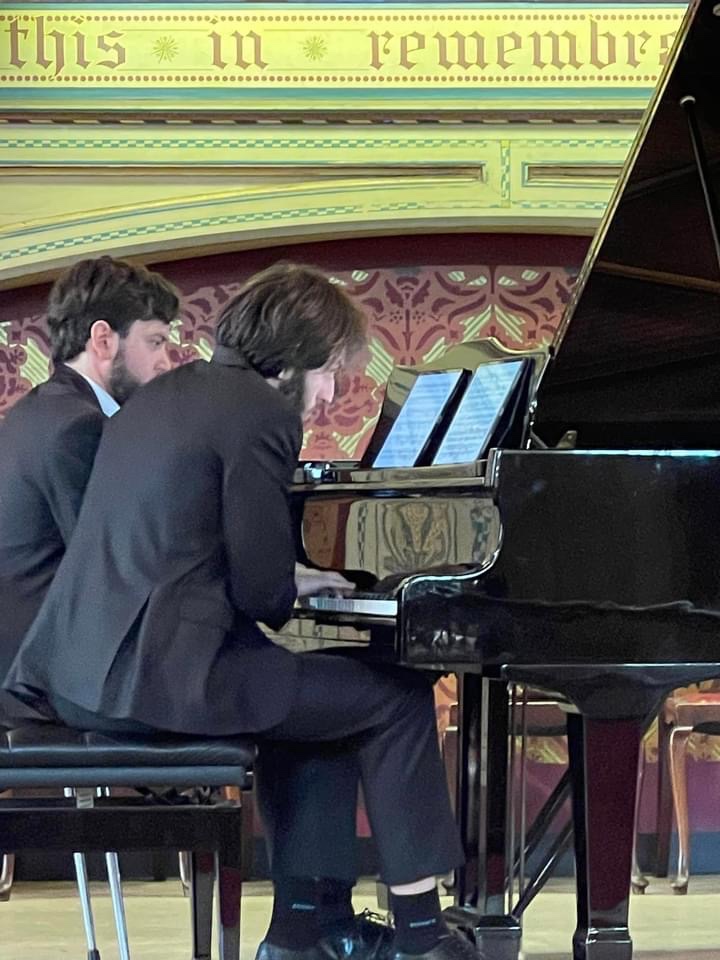
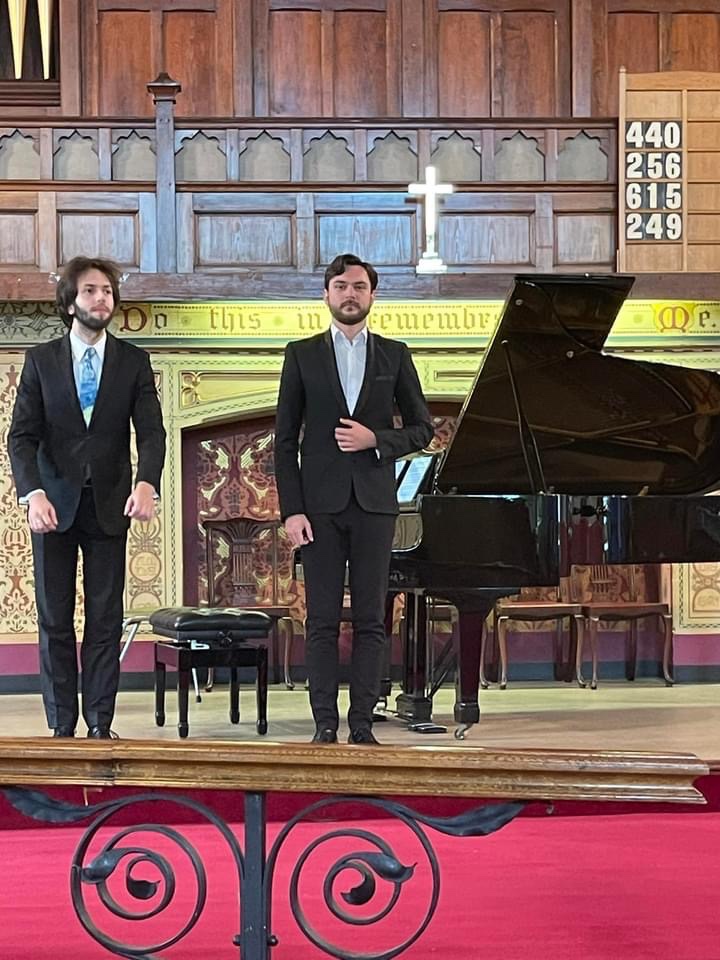
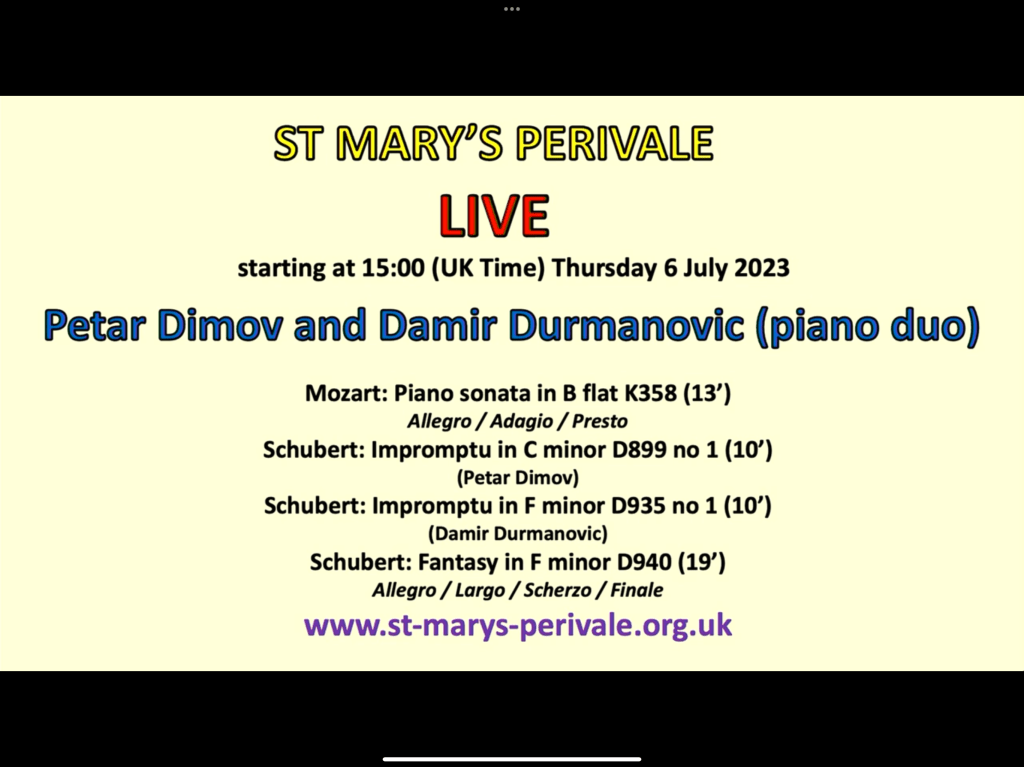
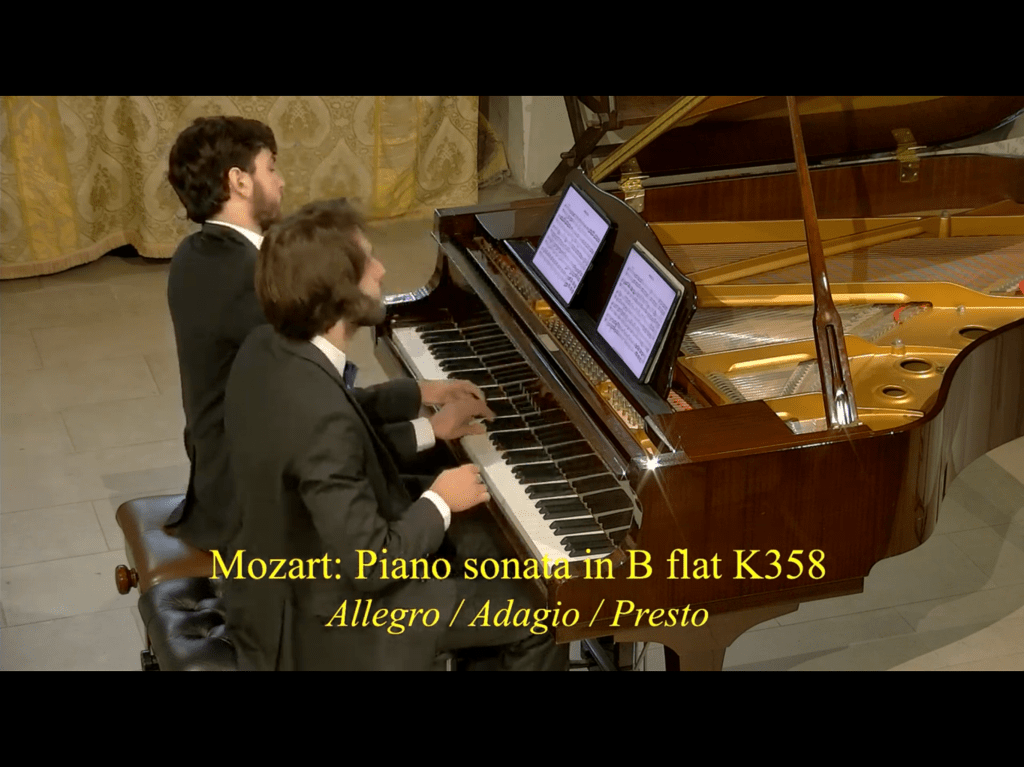
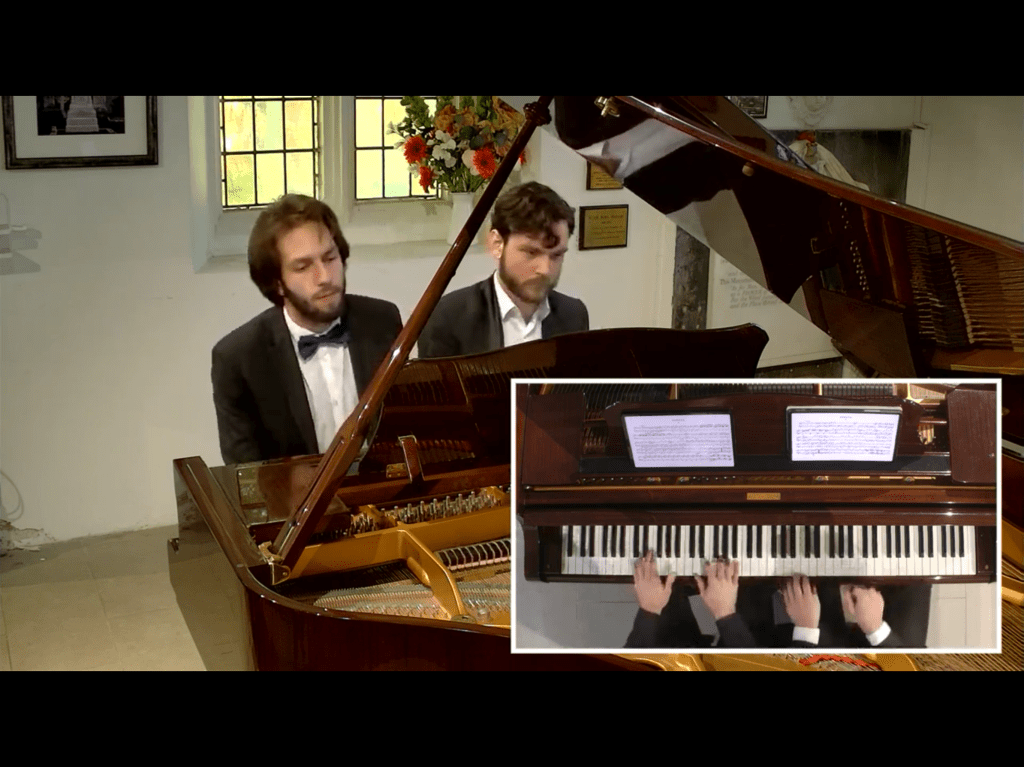
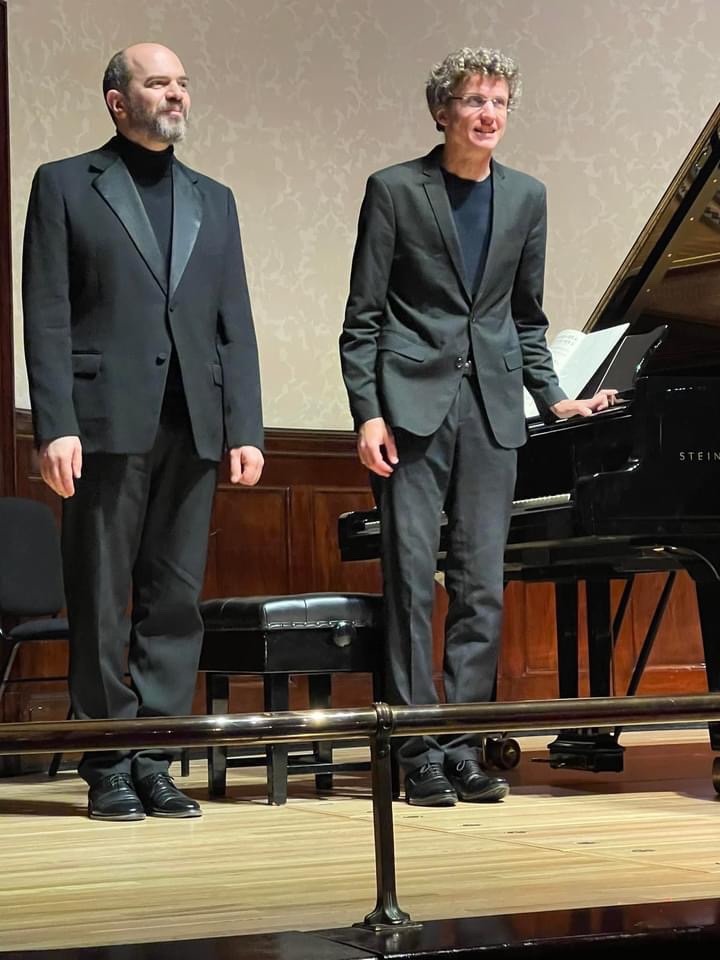
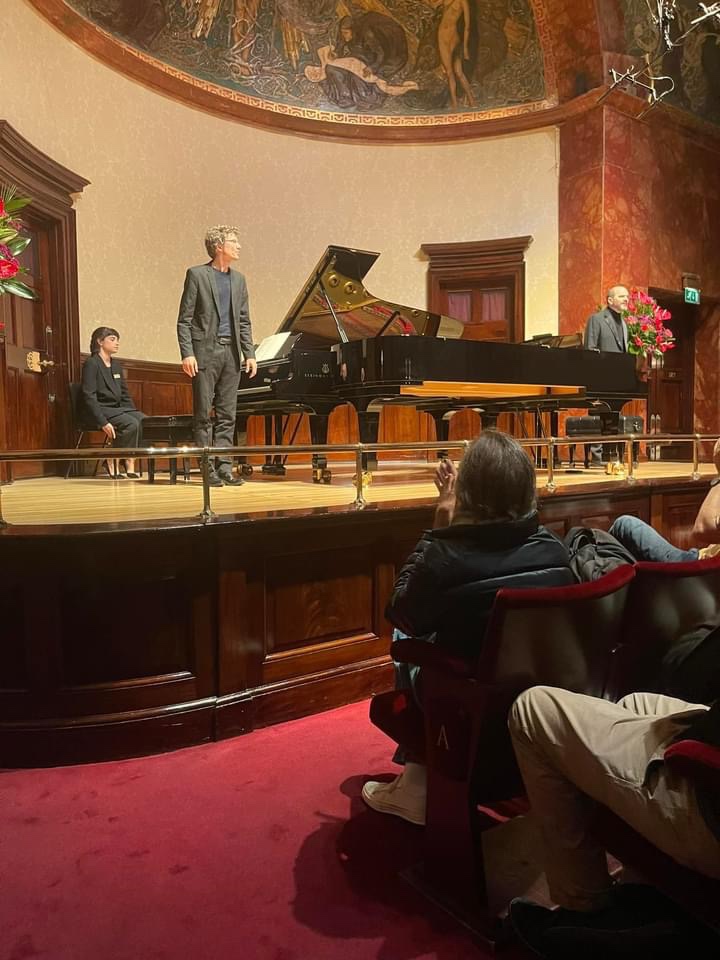
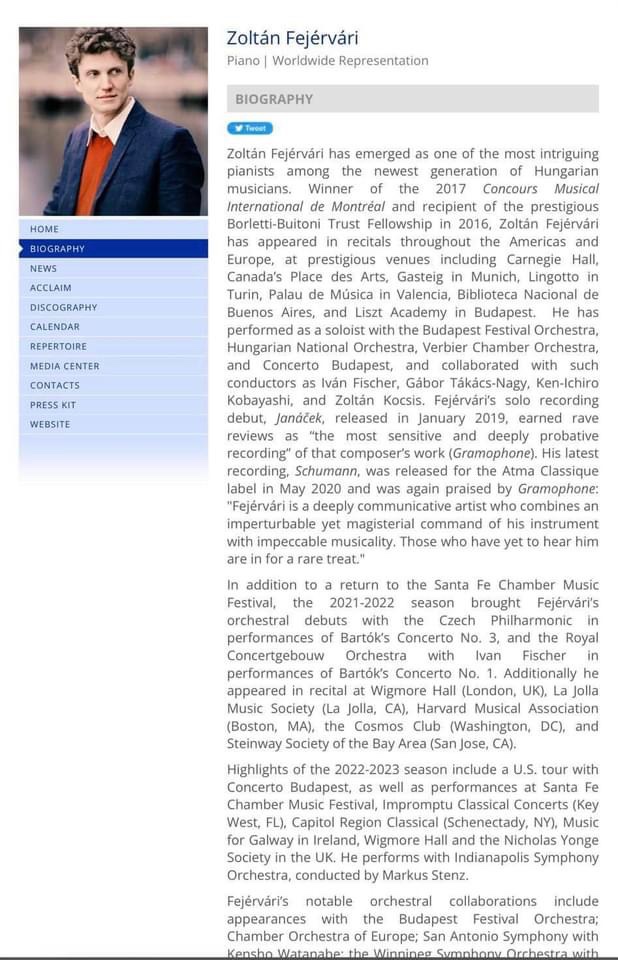
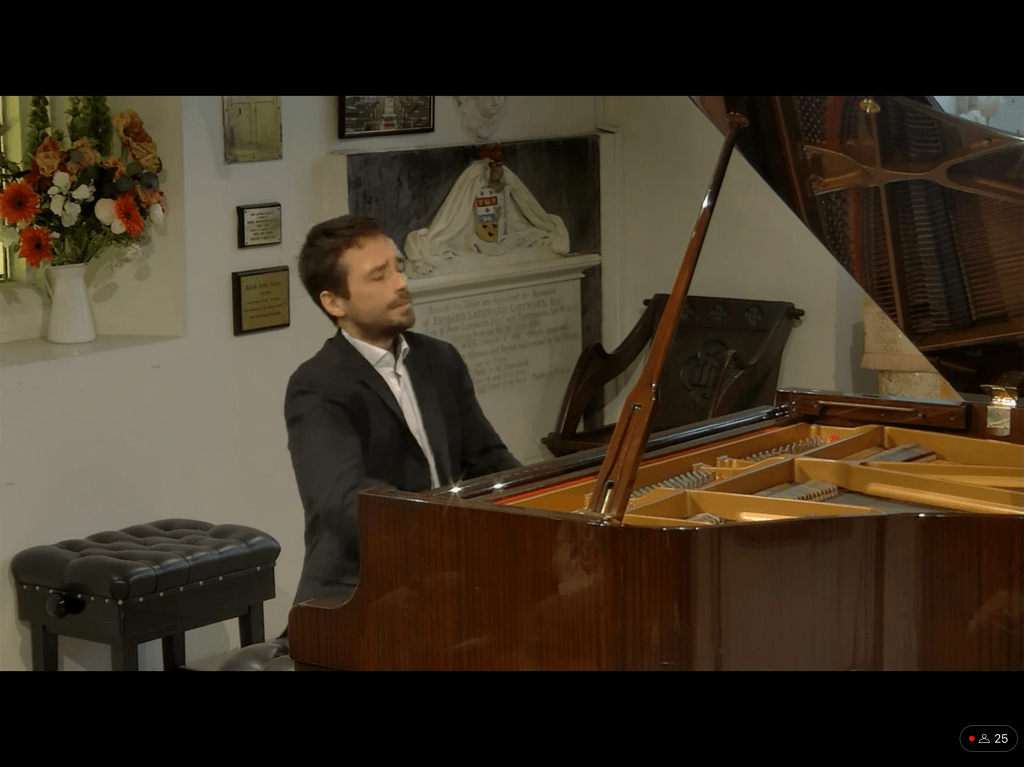
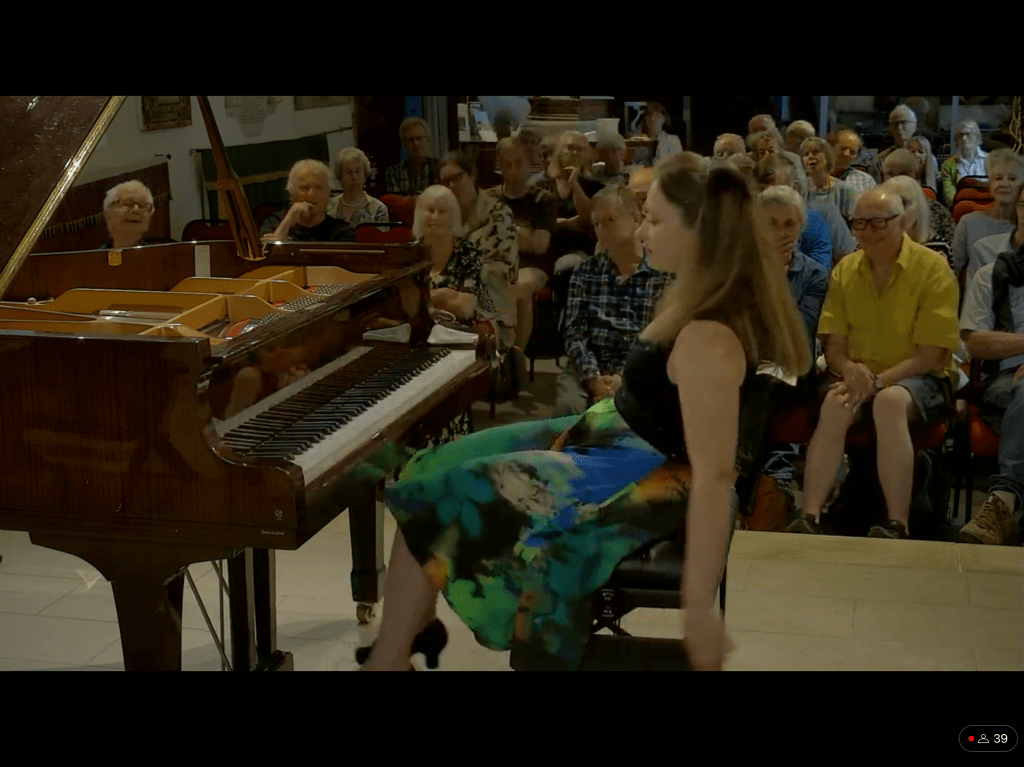
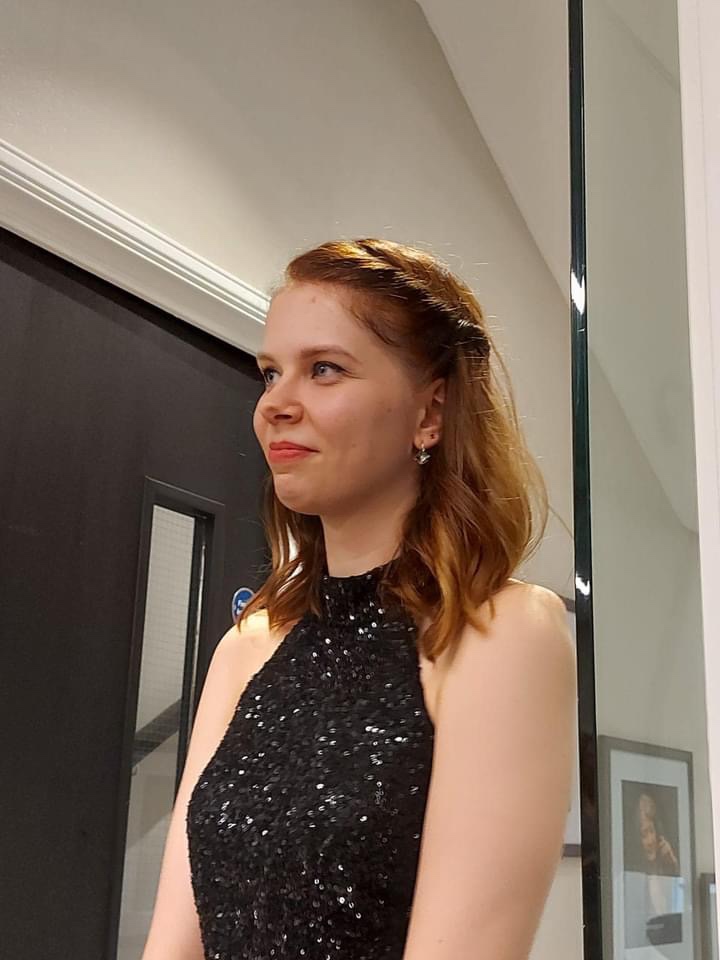
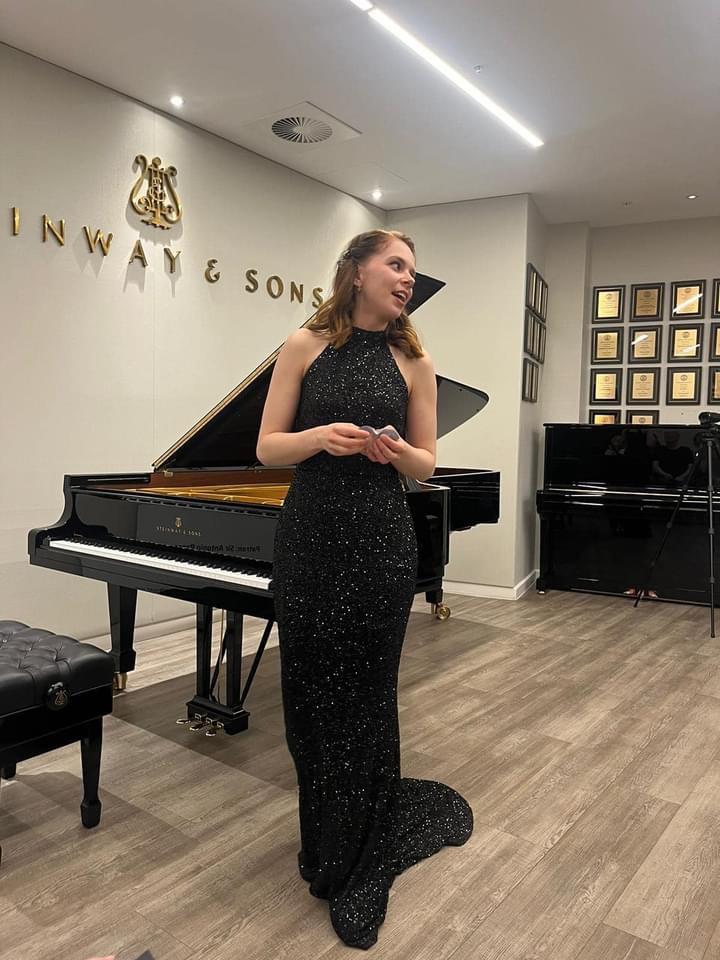
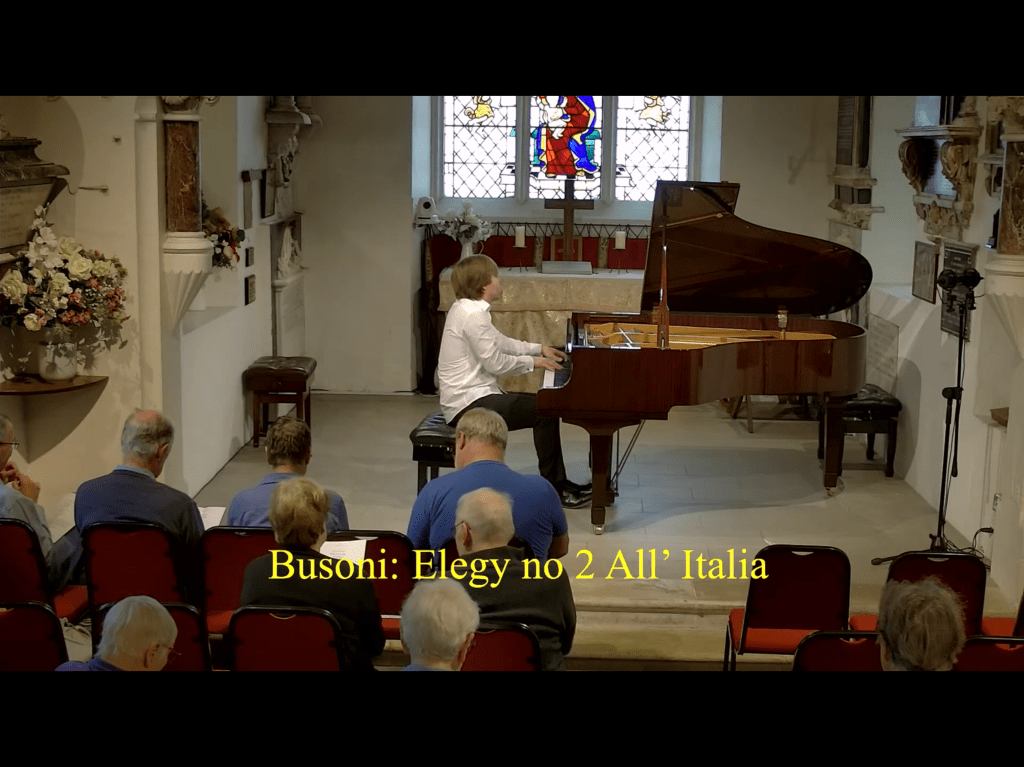
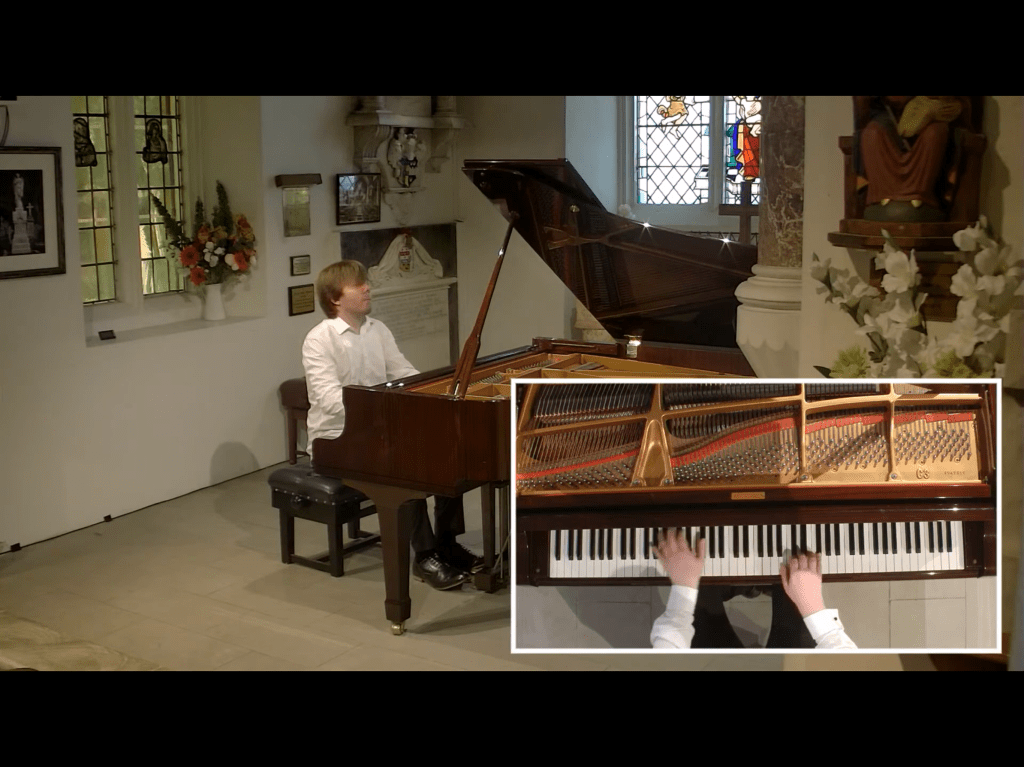
When two superb musicians decide to team up to make music together sparks begin to fly even in Acton on a balmy summer Sunday afternoon.
Acton Hill Church home of the Iris Axon Concert Series
From the first notes of Mozart’s B flat Sonata with its driving energy and perfect sense of balance where four hands played as two.A musical shape where the added ornamentation added an extra colour to the question and answer that passed between their hands. An Adagio of simple beauty and a molto presto strangely deliberately played with a beguiling non legato touch of great effect .Obviously enjoying their intelligent liberty of ornamentation but occasionally exaggerating in their zeal to inject the music with charm sometimes at the expense of the overall architectural shape .
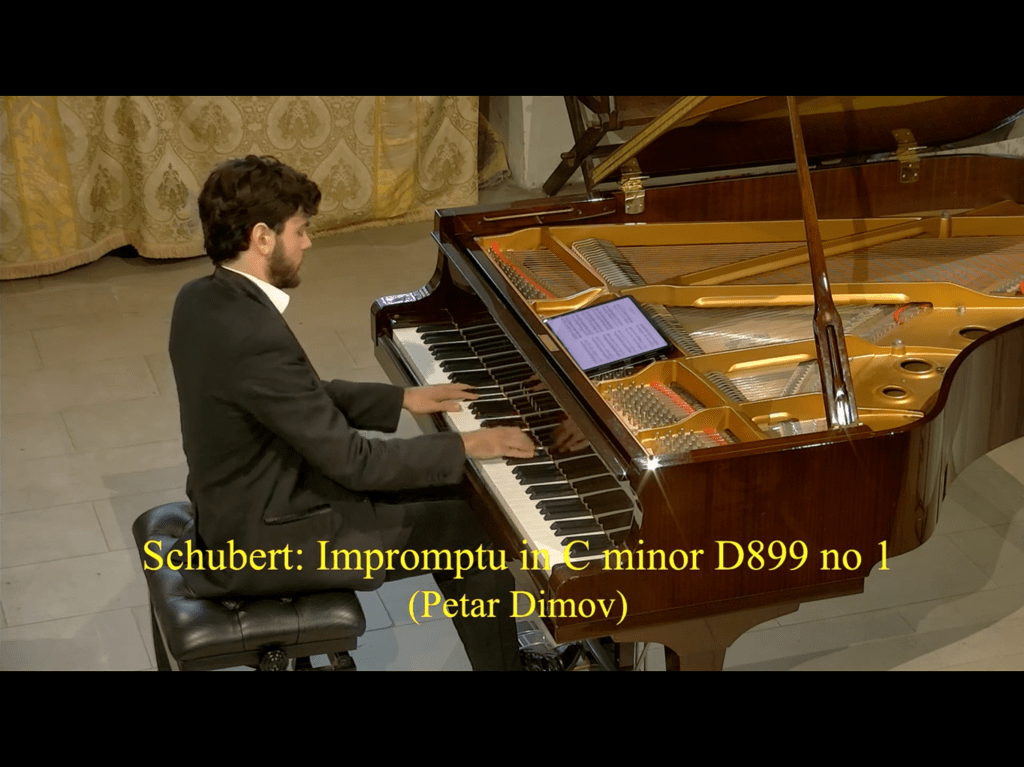
Petar Dimov plays Schubert Impromptu op 90 n.1 D.899
Petar Dimov offered a solo of the first desolate Impromptu from Schubert’s op 90.A long sustained opening note out of which could be overheard a distant ethereal march.A large range of colours from passionate outpourings to beseeching beauty of this remarkable tone poem with its whispered ending of disarming simplicity.
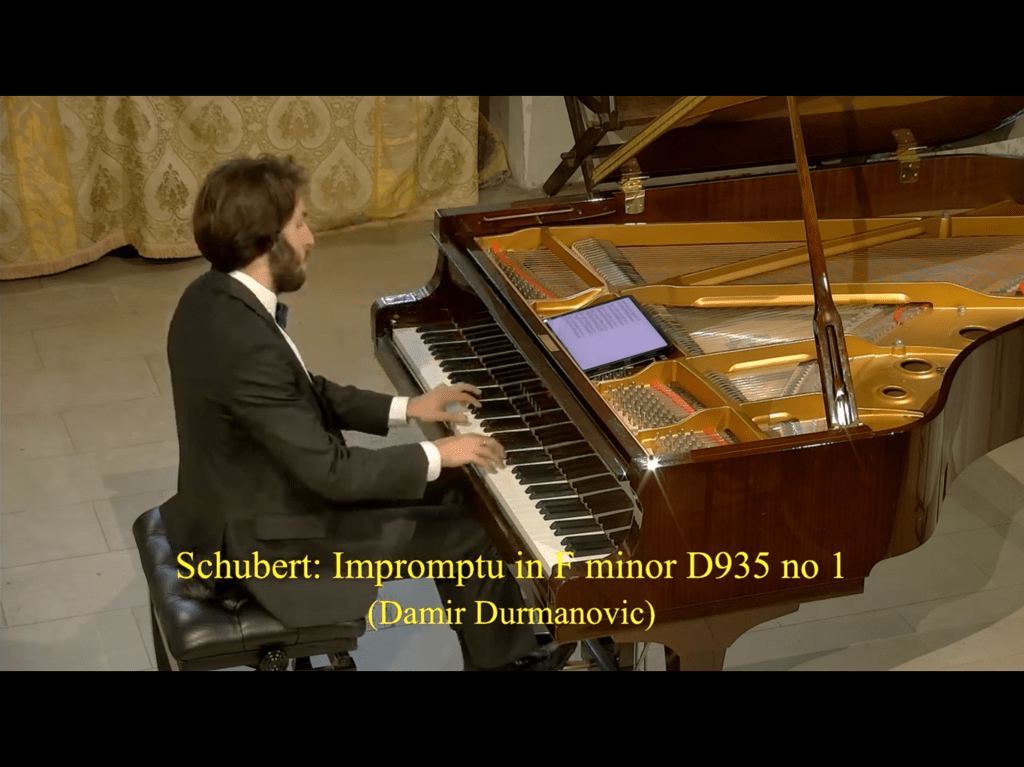
Damir Duramovic played Schubert Impromptu op 142 n.1 D.935
Damir Durmanovic played the first impromptu from the second set op 142.A fluidity and beauty with whispered utterings of sublime mellifluous invention.Time stood still as the tenor and soprano voices communed over a murmuring flood of sound. A performance of extraordinary communication and a musicality that allowed the music to pour from his fingers with a poetic simplicity as Schubert reached for the sublime heights in the short time still left to him on this earth.
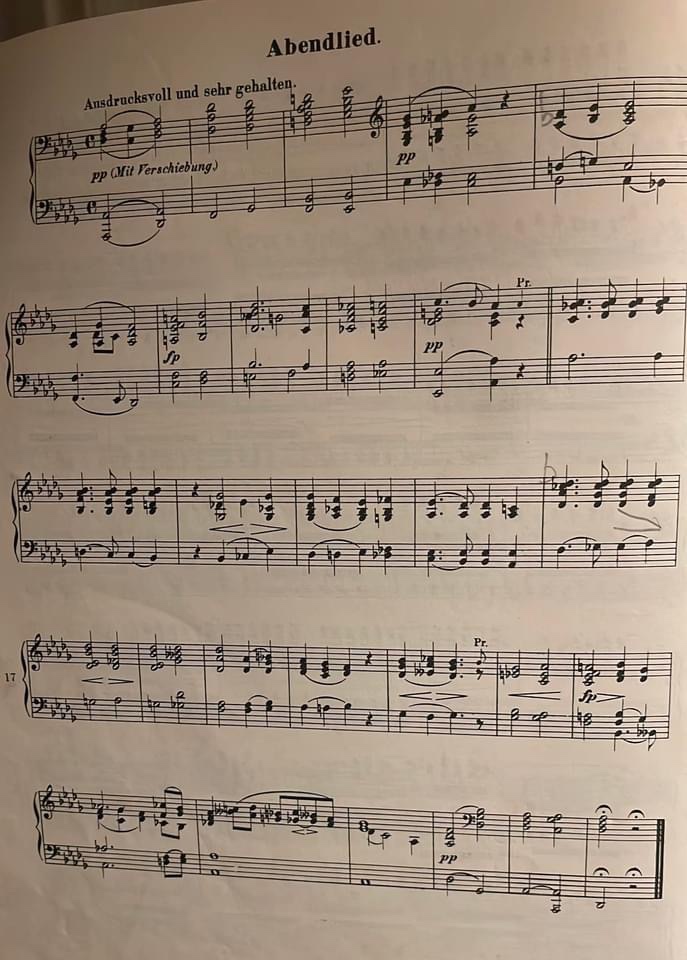
It was in the F minor Fantasy that the supreme artistry of these two young artist allowed Schubert’s sublime creation to shine with ravishing beauty and nobility.The magic created by Petar who barely touching the keys created a layer of sound on which Damir could allow the simple magic of one of Schubert’s most sublime creations to unfold with subtle poetry and sensitivity.There was great nobility to the dotted rhythms of the Largo and a wonderful fluidity to the Minuet and Trio.The fugue was brought to a monumental climax before the beseeching calm of the return of the opening creating the magic but also tragic atmosphere of the final noble ending to this sublime masterpiece . A superb sense of balance between the two pianists who played as one with the unity and musicianship of a partnership of kindred spirits. A mix up of parts in the beautiful page by Schumann of his Abendlied op 85 n 12 ,offered as an encore, meant that Damir had to completely improvise the simple chordal accompaniment to one of Schumann’s most poetic outpourings.
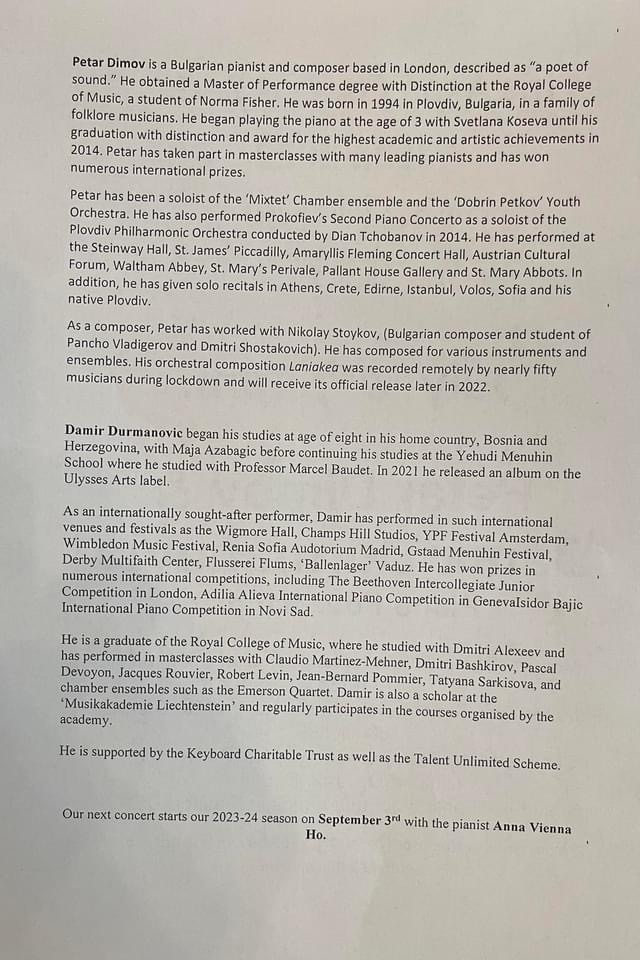
Trained from an early age at the Menuhin school this was part of Damir being a complete musician and his further training from Dimitri Alexeev at the RCM just complimented Petar’s musicianly training from Norma Fisher where he had been awarded his Masters degree at the Royal College of Music.
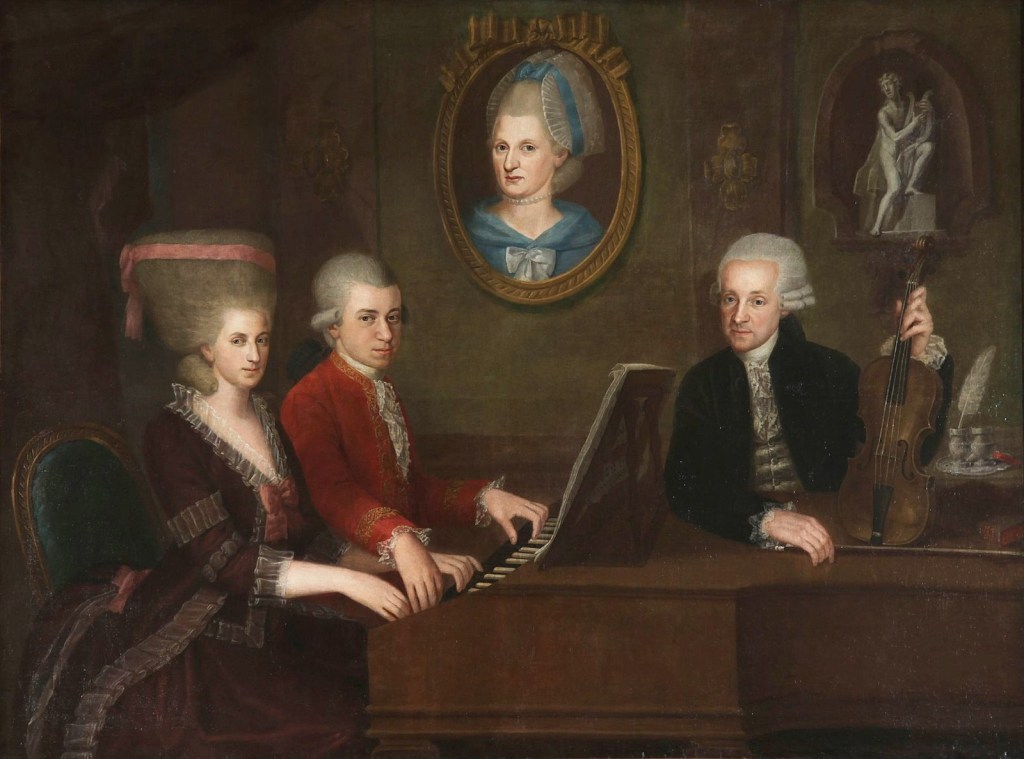
Mozart composed his Sonata for piano duet in B flat major, K. 358, in Salzburg some time in 1773 or 1774 for his sister Nanerl and himself to perform in Paris and Vienna. A three-movement work, the first two without tempo markings, but self-evidently an Allegro and an Adagio, and a finale marked Molto presto,The Sonata in B flat is full of virtuoso fingerwork and lightly lyrical melodies, and its finale is especially brilliant and was published in 1783.Mozart is one of the pioneers of works for piano four-hands; he was undoubtedly encouraged to do so through his music-making on the harpsichord with his sister, as depicted in the famous family portrait by della Croce (1780/81).
Johann Nepomuk della Croce ( 7 August 1736 – 4 March 1819) was an Austrian painter, known in Italy as Giovanni .Wolfgang with his sister Maria Anna and father Leopold on the wall a portrait of his dead mother Anna Maria c. 1780
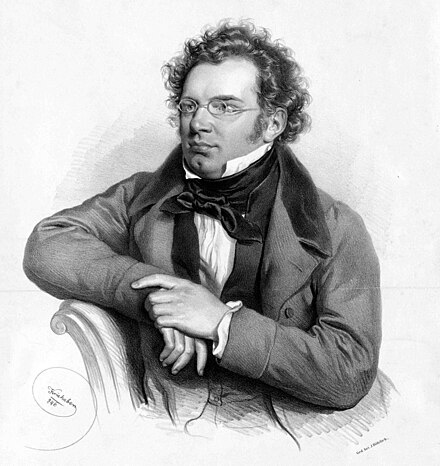
Schubert began writing the Fantasia in January 1828 in Vienna and it was completed in March of that year, and first performed in May. Schubert’s friend Eduard von Bauernfeld recorded in his diary on May 9 that a memorable duet was played, by Schubert and Franz Lachner and was dedicated to Caroline Esterházy, with whom Schubert was in (unrequited) love.
Caroline Esterházy
Schubert died in November 1828. After his death, his friends and family undertook to have a number of his works published. This work is one of those pieces and was published by Anton Diabelli in March 1829.
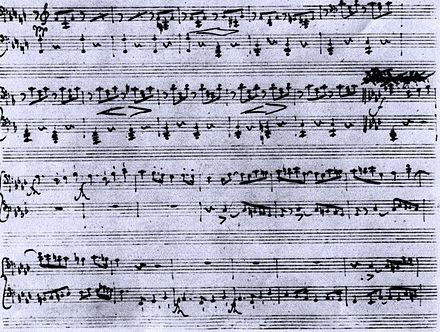
Original manuscript of a section of the left hand part of the fourth movement
The Fantasia is divided into four movements, that are interconnected and played without pause.
Allegro molto moderato
Largo
Scherzo. Allegro vivace
Finale. Allegro molto moderato
The basic idea of a fantasia with four connected movements also appears in Schubert’s Wanderer Fantasy and represents a stylistic bridge between the traditional sonata form and the essentially free-form tone-poem.The basic structure of the two fantasies is essentially the same: allegro, slow movement, scherzo, allegro with fugue.The form of this work, with its relatively tight structure (more so than the fantasias of Beethoven and Mozart was influential on the work of Franz Liszt who arranged the Wanderer Fantasy for piano and orchestra among other transcriptions he made of Schubert’s music.
Interesting to se and here this piano born out of Clive Pinkham’s love and passion for the piano .The enthusiasm for the instrument from an early age gave him a lifetime of dedication striving for perfection. He used to do ten hours a day piano practice and found it frustrating having to play on poor pianos. From this a burning desire was born to make a piano that would respond accurately to what he asked of it. His aim was to create a piano that was affordable to all. A piano that would respond accurately to what he was asking from it, and a piano that would produce an effortless long rich sweet singing tone. Clive Pinkham gave his first piano recital at the age of eight and went on to win the prestigious August Holmes scholarship to the London College of Music. He has given recitals at the Purcell Room of the Royal Festival Hall, at the Wigmore Hall and has appeared on American and British television.
“My philosophy is a total commitment to quality and customer satisfaction. For me it is important for my pianos to of the very best as it is my name that is on the front of each piano, and I know myself first hand how much pleasure can be given by a piano that is a dream to play.”
Ludwig van Beethoven (1770-1827)Fantasia in G minor Op. 77
Fryderyk Chopin (1810-1849) Fantasy in F minor Op. 49
Franz Schubert (1797-1828) Wanderer D760
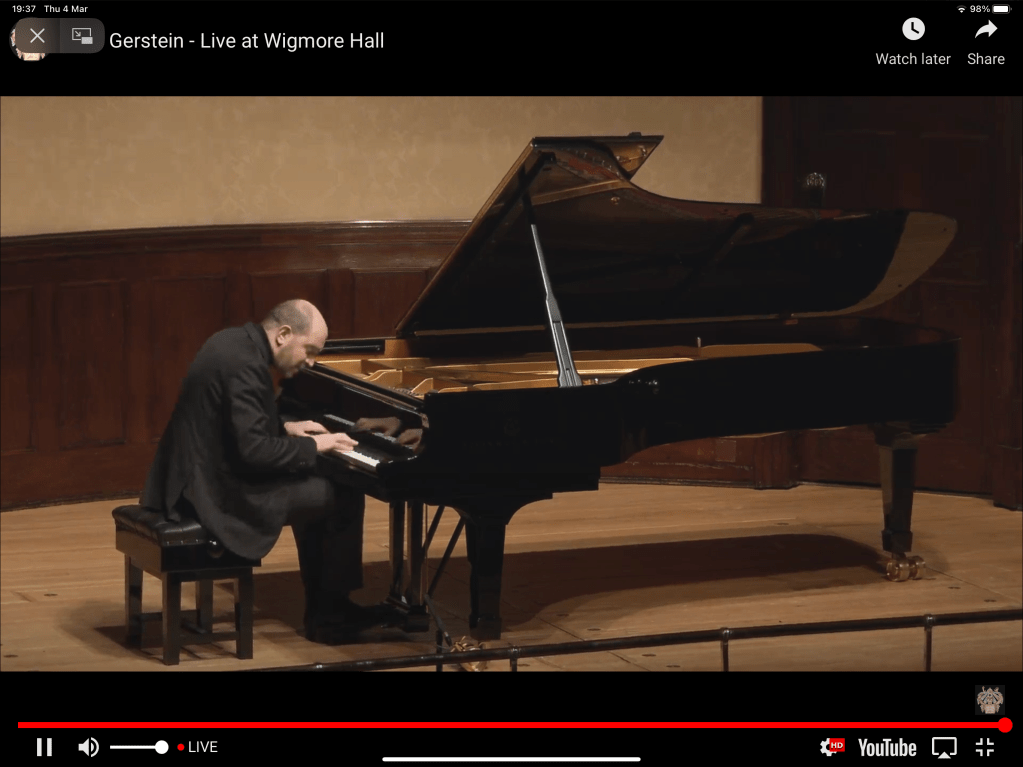
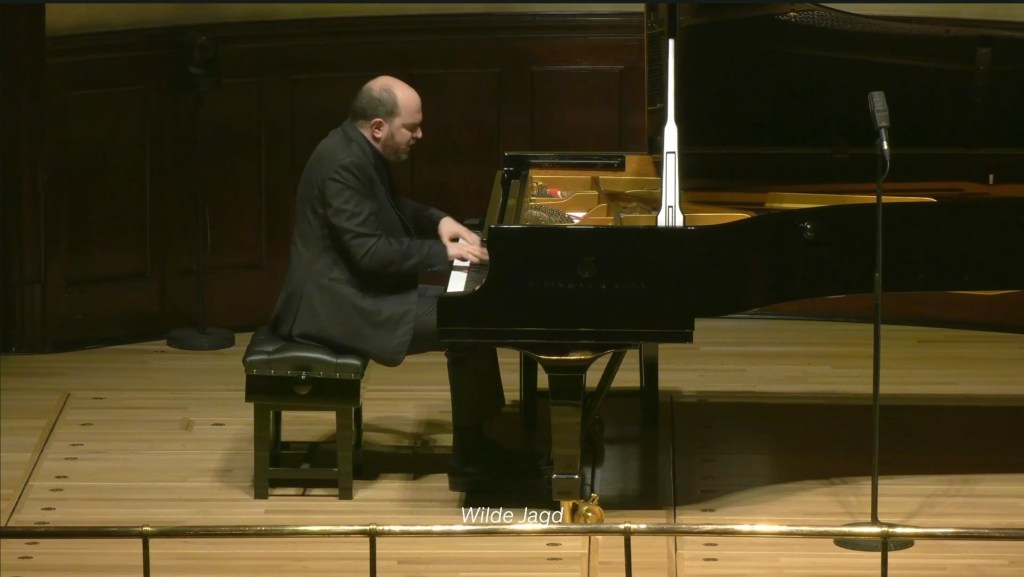
A thrilling recital by a master musician.Kirill Gerstein teased us with Fantasies by Master and pupil.Haydn’s rarely heard C major Fantasia linked up to Beethoven’s even rarer G minor .Played with a truly improvisatory flare that was a real jack in the box of delights. And what better birthday present for Chopin than one of his greatest works restored to the noblest of spirits by an artist who could seduce as he could take our breath away with aristocratic dynamism. Going full circle back to C major for a breathtaking account of Schubert’s Wanderer Fantasy. Played with sumptuous clarity and moments of sublime beauty and with an overall architectural shape that had us on the edge of our seats from the first to the last exultant notes. A birthday gift for Thomas Ades too sharing the day with Chopin.Playing Ades’s Berceuse with the rattling of the cupboard door at the end that was enough to turn our golden dreams into nightmares. A quite remarkable tour de force of musicianship and total mastery
Ferruccio Busoni (1866-1924). Franz Liszt (1811-1886)
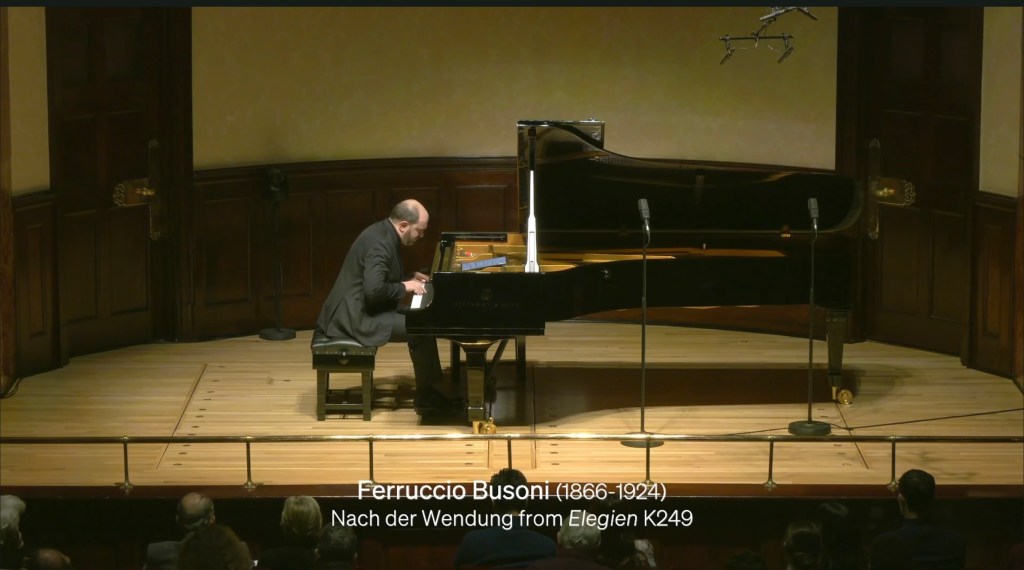
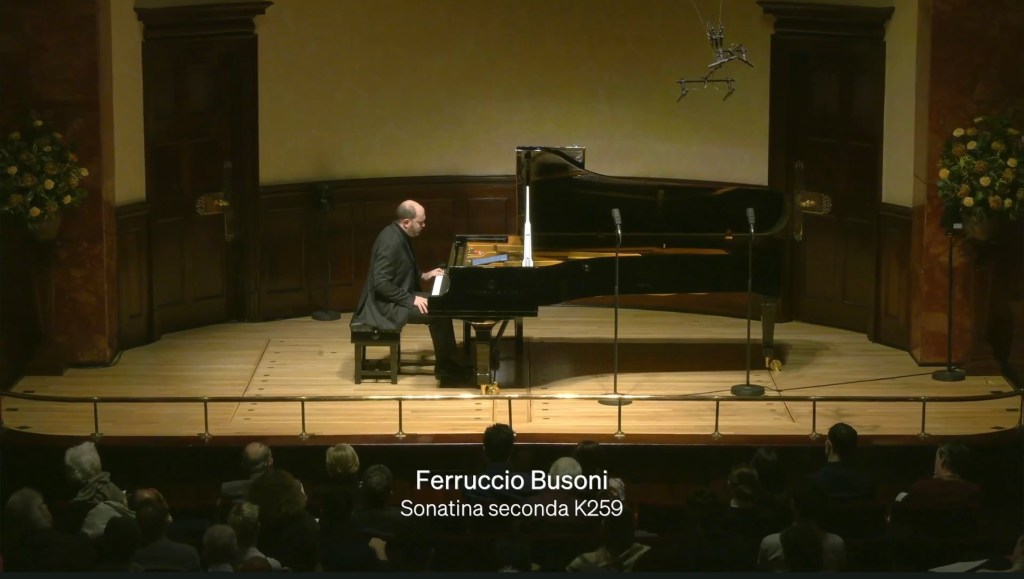
For so many reasons the recital by Kirill Gerstein was a remarkable event.Firstly because the performances he gave were sensational for their musical authority and technical mastery.Even the seemingly obscure works by Busoni were brought to life by someone who had entered so fully into this mysterious sound world that was described by Gernstein with a quote from 1901 :’A musical sun that set at Liszt’s death and shines again through Busoni.‘It was on this very stage known then as Bechstein Hall that was inaugurated by Busoni and Ysaye on 31st May 1901.
It was fascinating to hear Gerstein talk about Busoni as he took us on a journey from his Elégie n.1 ‘ after the turning’ where Busoni had finally freed himself from the romanticism of his early piano concerto and was reaching out to find a new musical voice.It was the voice that Liszt hints at in his late works and is a voice made of mists and colours ,music without key signatures or bar lines.Again quoting Busoni:’Music is born free and to win back it’s freedom is it’s destiny.
And so it was with the Second Sonatina of 1912 ‘senza tonalità’ where all boundaries are removed.
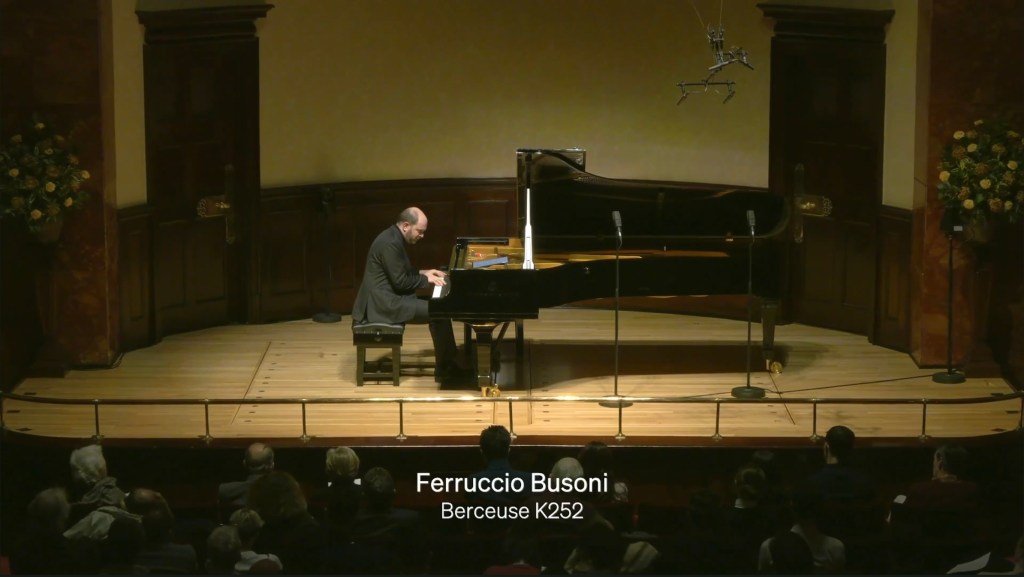
The mists of sound of the Berceuse – 7th Elégie which Mahler had included in the orchestral version in his last concert.Mysterious sounds out of which emerge a melodic line ,similar in many ways to the searching sound world of late Scriabin.I have not heard it played in recital since Serkin included it with the Toccata in London in the 70’s (together with works by Reger in a programme including the Schumann Carnaval and Beethoven op 111).
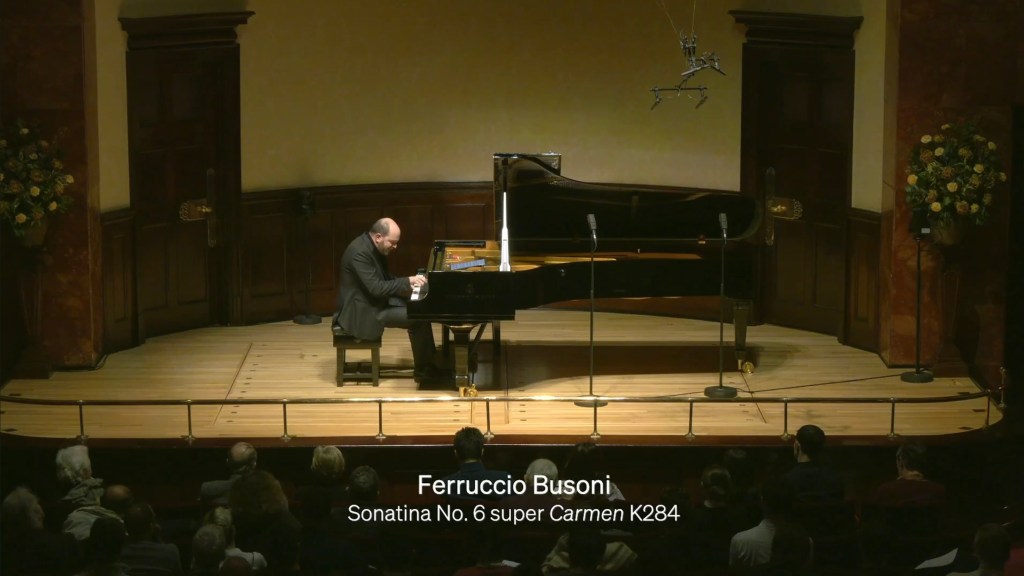
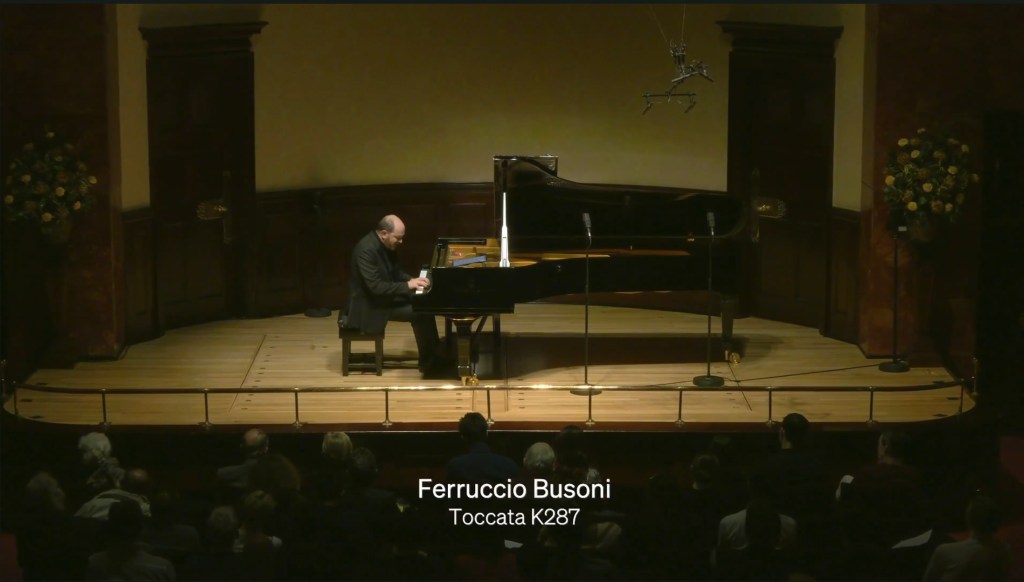
The sixth sonatina that followed is known as the Carmen fantasy as it was Busoni’s recreation of the opera he had seen in Paris in 1920.The ending he even marks Andante visionario which of course it is.Like Liszt’s transcriptions or paraphrases this was someone who had understood the very core of the work and was able to transmit it’s inner message more clearly and in Liszt’s case sometime improve on it by changing the order of appearance.Thomas Ades was present in the audience and a close friend from whom Gerstein had recently commissioned a piano concerto (with funds from the prestigious Gilmore Trust).He describes Busoni’s music as a ‘suitcase with a false bottom’.The last piano work that Busoni wrote was the Toccata where he prefaces it with a quote of Frescobaldi:’Not without difficulty will we come to the end” Busoni had exchanged Frescobaldi’s ‘effort’for ‘difficulty’.Busoni’s last appearance at the now renamed Wigmore Hall was in 1922 when he was already suffering from a kidney disease no doubt due to his love of Champagne – he died two year later.Greatly disturbed by the First World War exclaiming :’The uninterrupted arch of our life has been interrupted!”These were only the fascinating introductions to the works that Gernstein played with such overwhelming mastery.Playing of such extraordinary sounds where notes did not seem to exist as we moved from one shimmering atmospheric planet to another.There were moments of breathtaking virtuosity as in the opening of the Carmen Fantasy taken at a breakneck speed but with such character and clarity – bright sunlight – before the amorous and ominous clouds overtook.
The toccata too was played with extraordinary authority and technical command.But it was the overall understanding of a sound world that was so remarkable and a sense of balance that could make the musical landscape of Busoni so clear.Indeed the world that Liszt so prophetically had pointed to at the end of his life suddenly came alive with sense and reason and just underlined the opening quote between the sun setting with Liszt and rising again with Busoni.A fascinating journey of pure music where the fact that we were listening to one of the great pianists of our time was secondary to his overwhelming musical authority.I think that could also be the way of describing Busoni himself!
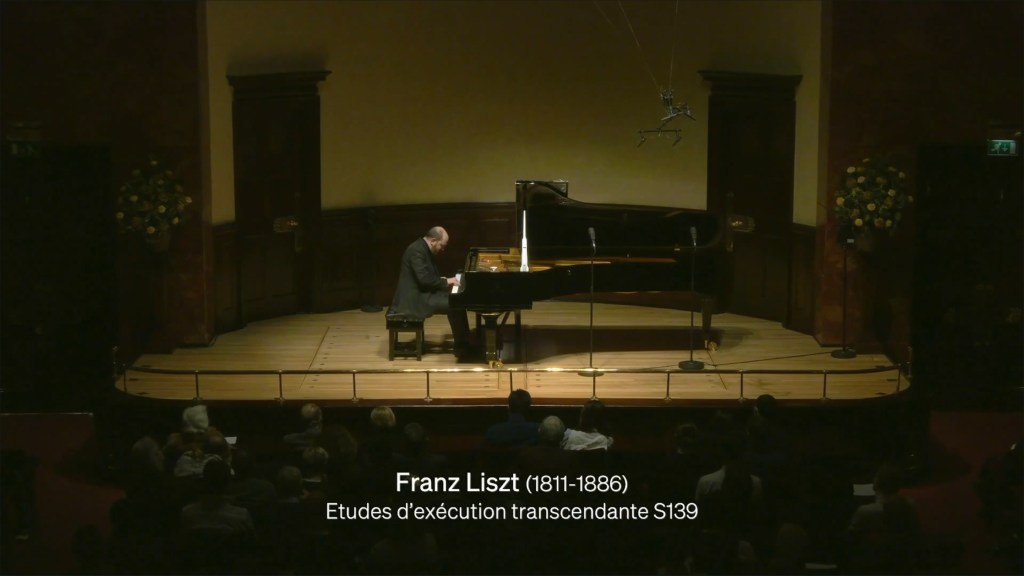
What seemed so remarkable and indeed visionary in the first half of the concert opened the door for Liszt’s transcendental studies.They were played with the same sense of colour and architectural shape that the feat of being able to play so many notes paled into insignificance before the musical message that was being transmitted.I remember listening to Lazar Berman play the studies in one of his first concerts in the Festival Hall in London.There was such overwhelming sound that I quickly left the hall after the third one as my ears could just not take so much continuous sound.A school of playing where every note is played right to the bottom of the key ….and beyond ………exemplified by master virtuosi such Alexander Toradze and Denis Matsueev.A school that turns the piano back into a percussion instrument whereas Liszt and Busoni had pointed us into the direction of multicoloured sounds.A world where notes were transformed into shapes and atmospheres.A magic world where a box full of hammers and strings could be turned into a kaleidoscope of sounds and emotions.Was it not Thalberg who when he played was accused of having made a pact with the devil as it seemed he had three hands,such was the illusion he was able to create by the subtle use of the pedal,balance and technical control.It was Anton Rubinstein who had said that the pedal is the ‘soul’ of the piano We seem these day to have lost what was known as the ‘Matthay touch’,where every note could have at least one hundred different gradations.I remember Rosalyn Tureck who if the lid of the piano was not left shut before a concert she would spend time brushing off the minutest particles of dust that could impede her from weighing up each key.It was this that made Kirill Gernstein’s performance today so remarkable.
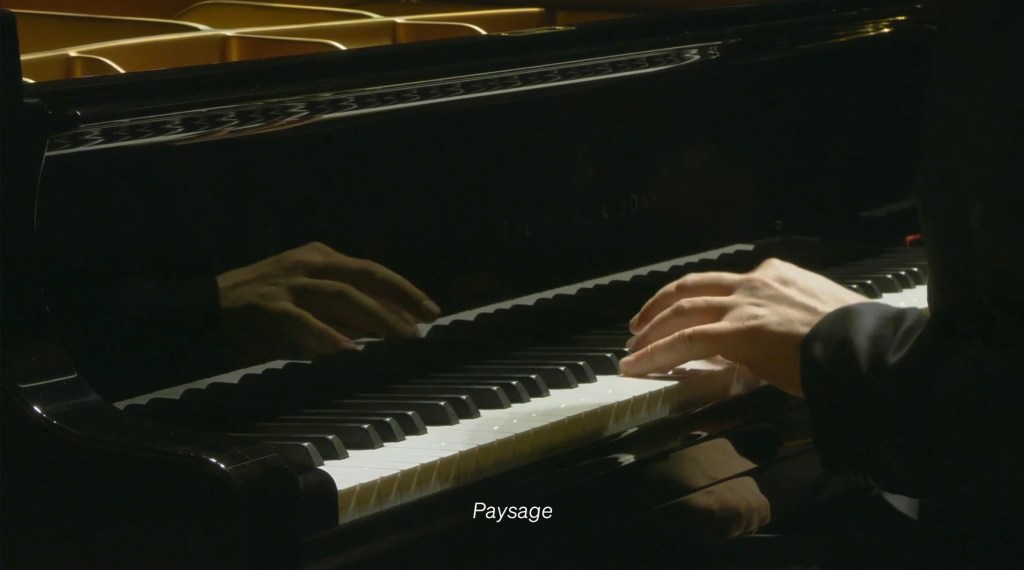
We were treated to twelve miniature tone poems where Paysage became just as significant as Der Wilde Jagd because the passionate involvement and sense of line was the same .
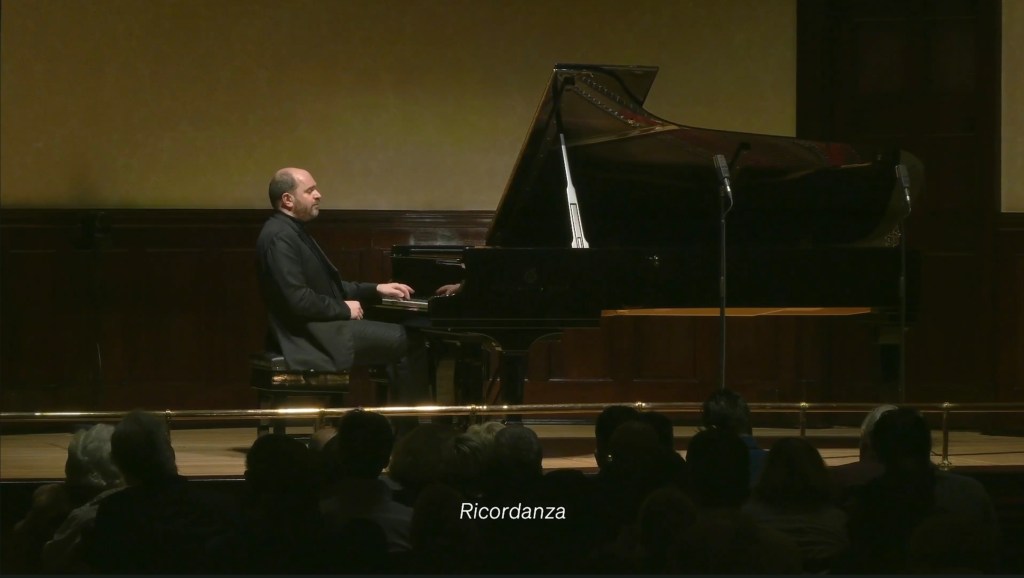
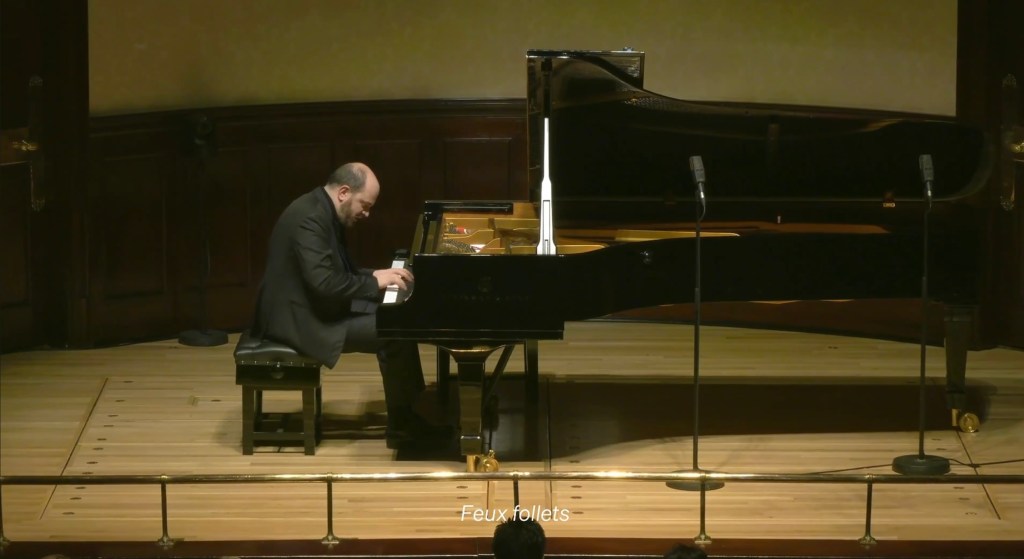
The ravishing beauty of Ricordanza – ‘a bunch of faded love letters tied with a pink ribbon’ to quote Busoni and the incredible fleeting impression of ‘Will o’ the wisp’ Feux Follets .One of the most technically challenging of all piano pieces was played with such a haze of sounds that blew across the keyboard with a left hand that was like a jewels sparkling in the night air.
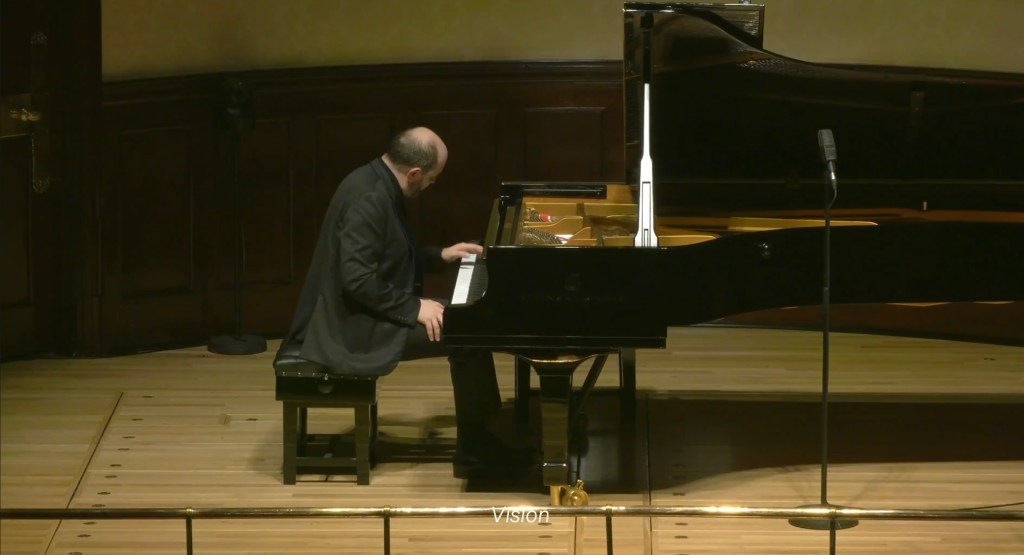
Has Vision ever sounded as noble or ‘visionary’ with such sumptuous sounds?The whole opening page played by the left hand alone before the streams of sounds where even two hands did not seem enough!
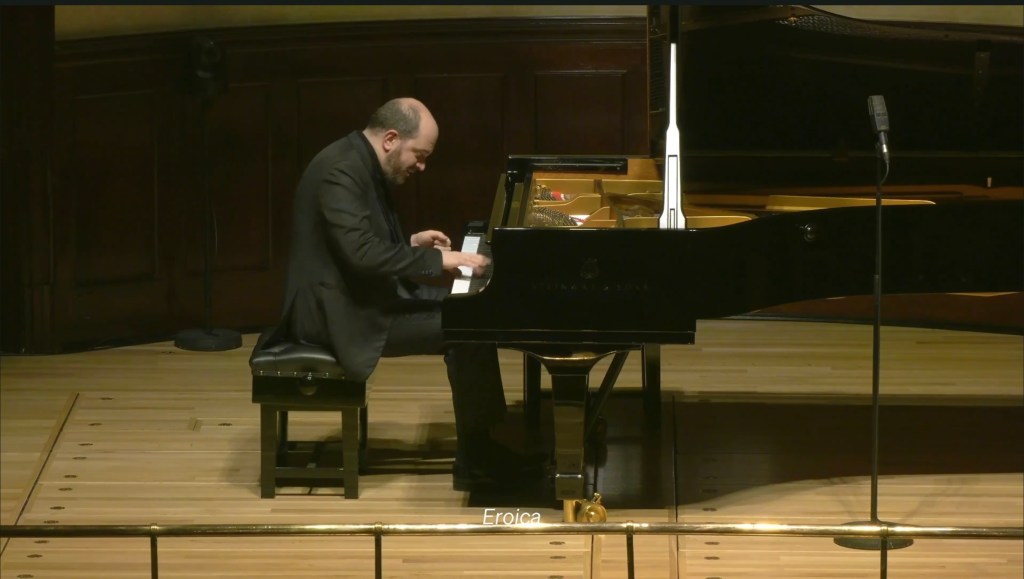
The octaves in Eroica after the quixotic opening were like vibrations of sound and we were certainly not aware that they were the notoriously difficult octaves that we all wait for.
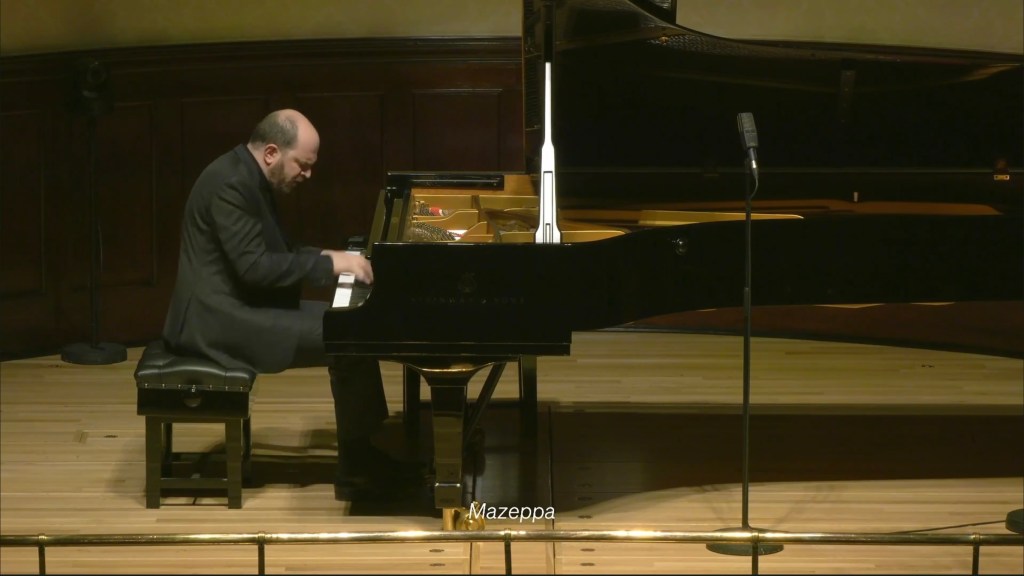
Mazeppa too was played with astonishing energy but also a sense of balance where everything was so clear as the excitement grew to breathtaking proportions.The central episode,sumptuous tenor melody with streams of golden sounds cascading around it.Has the Fminor study ever sounded more passionately abandoned or beautifully phrased with a coda of terrifying brilliance? Harmonies du soir was played like Paysage with ravishing sounds and passionate involvement.The final left hand arpeggios so reminiscent of Busoni’s own Berceuse with just a mist of sound on which floated the melodic line.
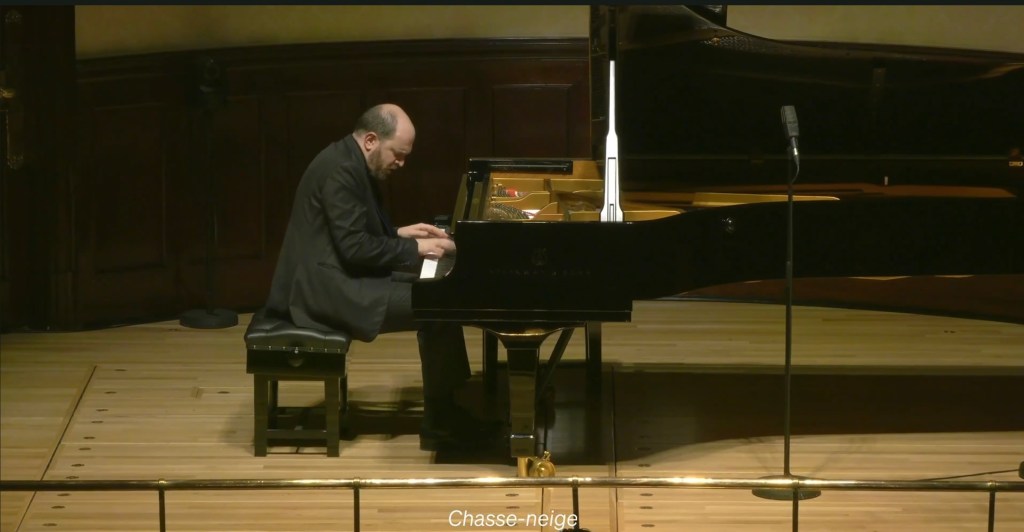
Chasse Neige ,considered by many to be the finest of the set ,was played with an extraordinary sense of balance and forward movement building up to a breathtaking climax before dying away with swirls of sound.It died away to end this extraordinary performance with a simple bare chord.
Minutes of aching silence at the end as the audience tried to come to terms with what they had experienced and Kirill Gernstein had a moment of recovery.
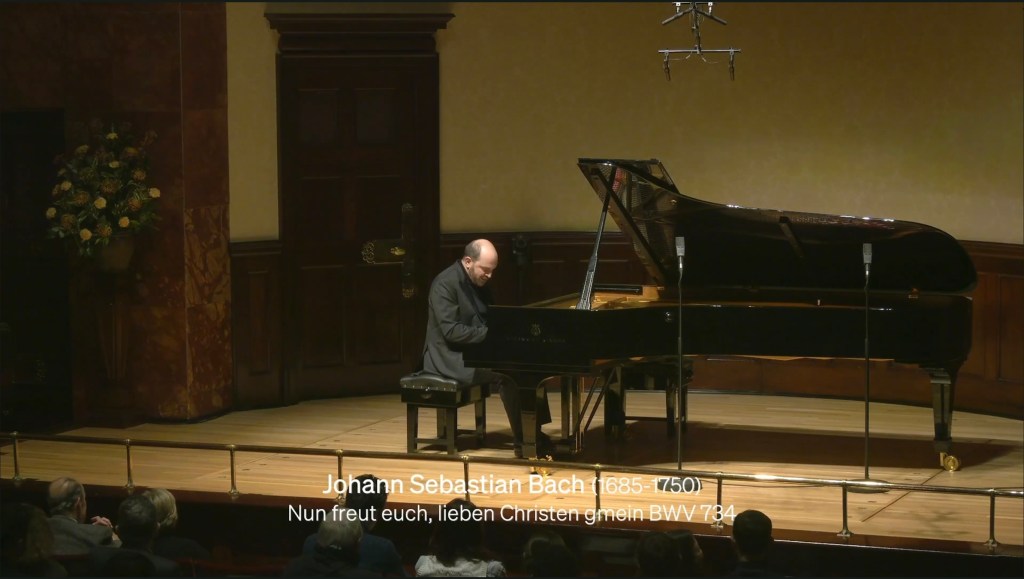
The only encore possible after that could be by Bach-Busoni!It was in fact the chorale prelude ‘Nun freut euch ,Lieben Christen gemein’ played at incredible speed but with such clarity,the melodic line miraculously emerging above the joyous outpouring of brilliance.
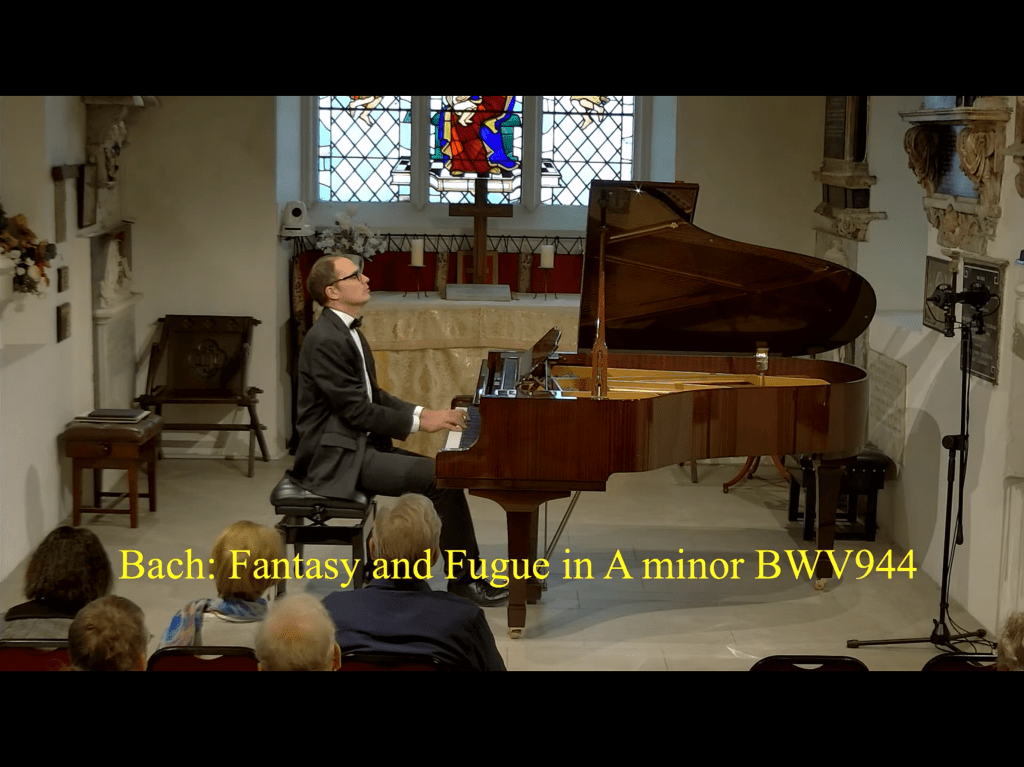
The Hungarian roots of Domonkos were apparent throughout his recital at St Mary’s Perivale not only for the obvious dance idioms in Kodaly’s ‘Dances of Marosszek’ but in the very sound he produced from the very opening notes of Bach’s Fantasia and Fugue BWV 944. A Hungarian school of playing with a very crisp and clean sound of great fluidity very noticeable in Geza Anda,Tamas Vasary ,Deso Ranki and Zoltan Kocsis.It gives great clarity to the sound but with a kaleidoscopic range too from gently whispered sounds to the full sound of a truly Grand piano.
There was a clarity to the long improvised lines of the Bach Fantasia with a fugue that had an inner rhythmic propulsion where Bach’s extremely ‘knotty twine’ was unravelled with extraordinary beauty of sound.Each strand had a life of its own while creating a architectural whole of great nobility.
It was a sound that was ideally suited to the world of Benjamin Britten where luminosity and subtlety created a world where every note seems to have a life of its own in a musical language that is always based on the human voice.The piano accompaniments of the Song Cycles like the Winter Words or Michelangelo Sonnets are so similar to this sound world of solo piano. Britten was a wonderful pianist but more like Gerald Moore where their accompaniment for singers was quite unique.Britten’s creation of a new genre of song (and opera)for his companion Peter Pears and his duo playing of Schubert with Richter or Rostropovich from Aldeburgh has become legend.
Rostropovich and Britten, 1964
I was studying in Italy in 1972 when I was asked by the British Council to give a series of recitals to celebrate Britten’s 60th birthday playing the entire piano works of Britten together with the song cycle ‘Winter Words ‘ and some of his folk song arrangements.The piano works were Holiday Diary Suite and the Notturno commissioned for the first Leeds International Piano Competition. Today is the first time since then that I have seen this suite on a concert programme. Domonkos played it with superb character where Britten’s very individual language created a world where you could visualise the atmosphere that Britten was describing.A master craftsman Britten knew exactly how to make the piano talk with the same inflections and shapes as the human voice.The crystal clear sounds that are so much part of Domonkos’s technical finesse were ideally suited and it brought each of the four scenes of a ‘Holiday Suite’ vividly to life. ‘The Early Morning Bathe’ where you could almost see the water splashing,taking a plunge into the icy water and the tentative steps before taking another.Or the beautiful serene melodic line ‘sailing’ on gently moving waves.The agitation as they sailed into deeper waters only to return to the serenity and calm as they neared the shore.All the fun of the ‘Fun Fair’ with its sparkling perpetuum mobile played with such enviable precision.Fireworks shooting off with glissandi fired from Domonkos’s superbly trained fingers.The extraordinary lament as ‘Night’ falls with the tenor melody that sings out so poignantly while all around slumber is taking over.A superb sense of balance and complete control of timbre and balance made this a particularly poignant farewell. A work that deserves a place on more concert programmes when played with the mastery that we heard today (I can imagine Curzon for whom it was eventually dedicated bringing the same eloquence to these seemingly sparse notes – as he did of course to Mozart). A very individual ’medley’ of four completely different works from the musicianly hands of Domonkos turned into a Sonata of magnificence and opulence.
‘Finlandia’ transcribed by the composer Sibelius was a revelation as Domonkos showed us a tone poem of extraordinary evocative suggestion with its imperious orchestral opening and sumptuous string chords answered by the purity of the woodwinds.A virtuosistic build up to the glorious melodic outpouring of Nationalistic pride that has become the emblem of Finland.Superb full orchestral sound never hard or ungrateful from Domonkos’s wonderfully fluid sound world.
A beautiful Chopin Prelude op 28 n.17 was played with aristocratic rubato and sounds of magic and wonder.The deep tolling bell in the base and the mist it created for the apparition of the opening melody,floating into a stratosphere of poetic beauty,was quite memorable.
Rachmaninov’s G sharp minor prelude was played with a poetic sensibility and kaleidoscope of ravishing colours.
The sombre entry of S.Paolo walking on the waves was just a prelude to a tone poem of remarkable grandeur and beauty that was truly breathtaking.I have only heard the like from Wilhelm Kempff on his all too few historic recordings of Liszt.
The Kodaly ‘Dances’were played to the manner born with scintillating colours of such insinuating beguiling sounds and also technical brilliance of nobility and grandeur.
Domonkos Csabay is a Hungarian concert pianist, chamber musician and accompanist. He studied with András Kemenes and István Lantos at the Liszt Academy Budapest, and is a graduate of Royal Birmingham Conservatoire, where his professors were Pascal Nemirovski and John Thwaites. Besides pursuing a solo carreer, he has worked as a répétiteur with renowned opera companies and co-operated with diverse chamber ensembles. He has made several concerto appearances and has been invited to many prestigous venues and festivals, such as the Budapest Spring Festival or the Wye Valley Chamber Music Festival. Competition successes include 1st prize at the Lyon International Chamber Music competition and at the Birmingham International Piano Chamber Music Competition in 2022, special award in the Budapest Liszt Piano Competition, as well as prizes won as a composer in Romania and as member of a Lied duo in Wales. His performances have been broadcast on BBC Radio 3 and in the Hungarian Radio. His debut CD was issued by Naxos in 2021, his second solo album is appearing soon with the label Hungaroton. Domonkos recently finished his fellowship as a collaborative pianist the Royal College of Music, London.”
The Holiday Diary (Tales) of 1934, dedicated in the first published edition of 1935 to Arthur Benjamin, the composer’s piano teacher at the RCM, were later—in a sense—re-dedicated on the manuscript given to Britten’s friend, the pianist Clifford Curzon (‘who made them his’). They show Britten’s sharp sense of the descriptive and that boyish sense of fun which never entirely deserted him. The exuberant ‘Early Morning Bathe’ (Britten loved swimming) is irresistible with its hesitant shivers before taking the plunge, its wave-like arpeggios gathering momentum into warmer tonal waters, and the shivers in reverse of its coda as the bather emerges from the water. ‘Sailing’ broaches a vein of melodic serenity (parodied in a turbulent middle section) that was to prove consistent in many a more emotionally serious situation in Britten. The delights of the ‘Fun-Fair’ (a brisk toccata-like rondo with descriptive episodes) are a riot of piano sonority. The work concludes with an atmospheric night-piece in which the ghosts of former themes from the suite float past.
Jean Sibelius 1865–1957
Jean Sibelius born Johan Julius Christian Sibelius;(8 December 1865 – 20 September 1957) was a Finnish composer of the late Romantic and early-modern periods. He is widely regarded as his country’s greatest composer, and his music is often credited with having helped Finland develop a national identity during its struggle for independence from Russia.The core of his oeuvre is his set of seven symphonies which, like his other major works, are regularly performed and recorded in Finland and countries around the world. His other best-known compositions are Finlandia ,the Karelia Suite ,Valse triste ,the violin Concerto ,the choral symphony Kullervo,and The Swan of Tuonela (from the Lemminkainen suite).There is also quite a large number of piano pieces yet to be discovered .In performing selected piano works, Lief Ove Andsnes finds that audiences were “astonished that there could be a major composer out there with such beautiful, accessible music that people don’t know.”
Piano Suite (Florestan), JS 82 (1889)
Sonata in F major op 12.(1893)
10 Pieces, Op. 24 (1894–1903)
10 Bagatelles, Op. 34 (1914–16)
10 Pensées lyriques, Op. 40 (1912–14)
10 Pieces, Op. 58 (1909)
Three Sonatinas, Op. 67 (1912)
No. 1 in F-sharp minor
No. 2 in E major
No. 3 in B-flat minor
2 Rondinos, Op. 68 (1912)
4 Lyric Pieces, Op. 74 (1914)
5 Pieces (The Trees), Op. 75 (1914)
13 Pieces, Op. 76 (1914)
5 Pieces (The Flowers), Op. 85 (1916)
6 Pieces, Op. 94 (1919)
6 Bagatelles, Op. 97 (1920)
8 Short Pieces, Op. 99 (1922)
5 Romantic Compositions, Op. 101 (1923)
5 Characteristic Impressions, Op. 103 (1924)
5 Esquisses, Op. 114 (1929)
Kyllikki
Six Impromptus
1) No. 1 in G minor (Moderato)
2) No. 2 in G minor (Lento-Vivace)
3) No. 3 in A minor (Moderato/Alla marcia)
4) No. 4 in E minor (Andantino)
5) No. 5 in B minor (Vivace)
6) No. 6 in E major (Commodo)
The Dances of Marosszek were written for piano in 1927, and expanded for orchestra in 1930, this colourful folk-inspired music is one of Zoltán Kodály’s most celebrated pieces. Kodály often composed in a similar fashion to Bella Bartók, venturing into regions to get authentic impressions and samples of the native music. The six tunes featured in this piece were collected from Marosszek, a town in the Szekely region of eastern Hungary.Kodály in the 1930s Born 16 December 1882 Died 6 March 1967 (aged 84) Budapest, Hungary
Born in Kecskemet,Hungary and learned to play the violin as a child .In 1900 he entered the department of Languages at the University of Budapest and at the same time Hans von Kössler’s composition class at the Royal Hungarian Academy of Music. After completing his studies, he studied in Paris with Charles Widor for a year.
In 1905 he visited remote villages to collect songs, recording them on phonograph cylinders.In 1906 he wrote a thesis on Hungarian folk song, “Strophic Construction in Hungarian Folksong”. At around this time Kodály met fellow composer and compatriot Bela Barto whom he took under his wing and introduced to some of the methods involved in folk song collecting. The two became lifelong friends and champions of each other’s music.
Kirill Gerstein piano Zoltán Fejérvári piano Wolfgang Amadeus Mozart (1756-1791) Ferruccio Busoni (1866-1924) Wolfgang Amadeus Mozart Ferruccio Busoni Sonata in D for 2 pianos K448 (1781) I. Allegro con spirito • II. Andante • III. Allegro molto Improvisation on JS Bach’s Chorale Wie wohl ist mir, o Freund der Seele BV271 (1916)
Interval
Fantasia in F minor for mechanical organ K608 (1791) arranged by Ferruccio Busoni Duettino concertante after the finale of Mozart’s Piano Concerto No. 19 in F K459 BVB88 (1919) Fantasia contrappuntistica for 2 pianos BV256b (1921)
Choral-Variationen (Einleitung – Choral und Variationen – Übergang) – 2. Fuga I – 3. Fuga II – 4. Fuga III – 5. Intermezzo – 6. Variato I –
Variato II – 8. Variato III – 9. Cadenza – 10. Fuga IV – 11. Corale – 12. Stretta
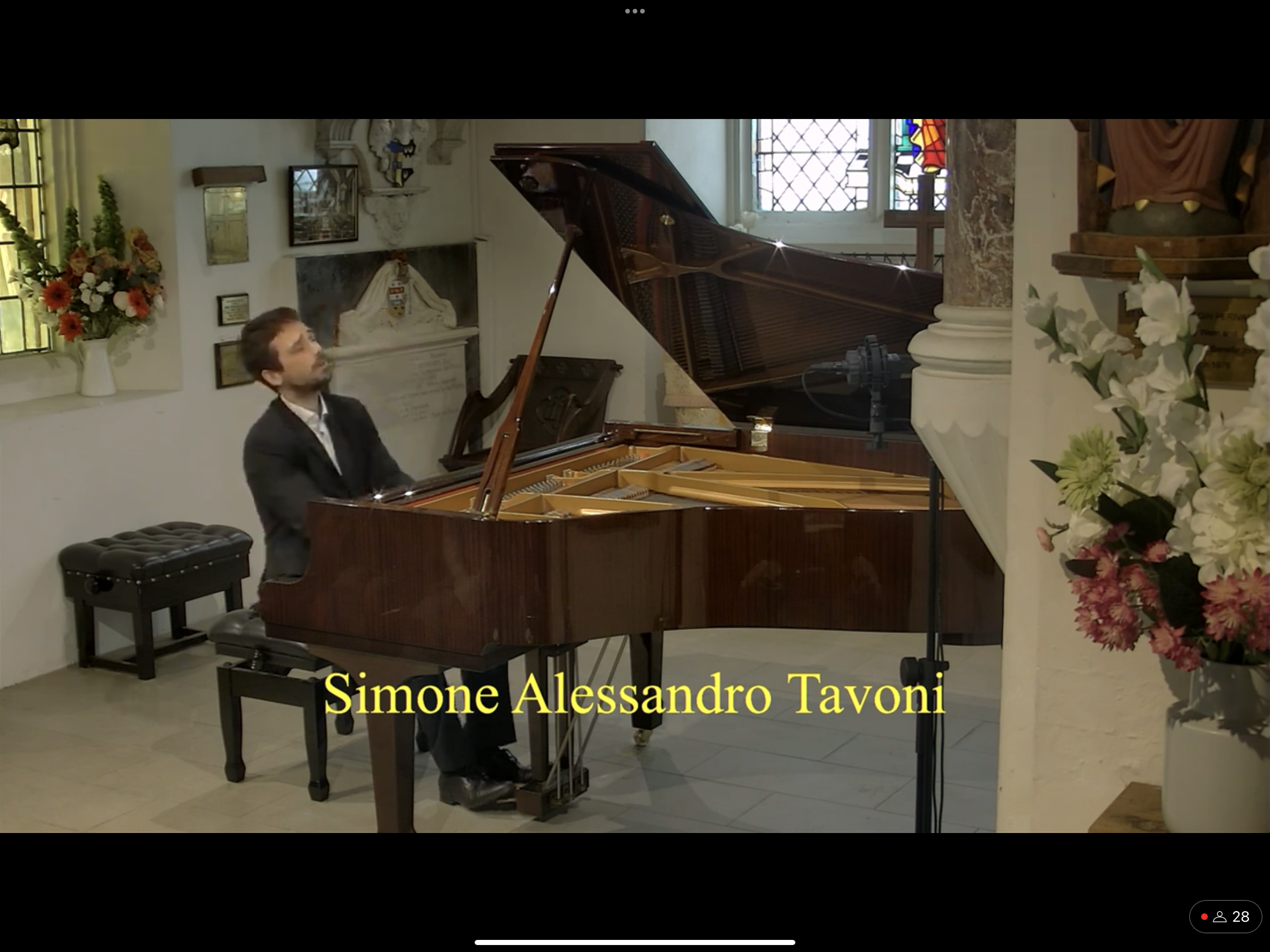
A beautiful programme played with simplicity,sensitivity and intelligence.It was the hallmark of Simone Tavoni’s programme that he had dedicated to the memory of Radu Lupu a few months ago at Leighton House.It was in 1969 that Radu Lupu had shown us the beauty of Schubert when played with simplicity and a kaleidoscopic range of sounds that we had never heard the like of before.It was the same dedicated musicianship that was to be revealed again in Leeds three years later when Murray Perahia astounded a jury of celebrated pianists with a miraculous performance of the Sonata op 106 by Mendelssohn.These two great musicians fast became friends and their recording of Schubert F minor Fantasy is one of the wonders of our age.Simone had chosen a programme that was a continuous outpouring of song which was so much part of Radu Lupu’s ever more intimate musicianship.
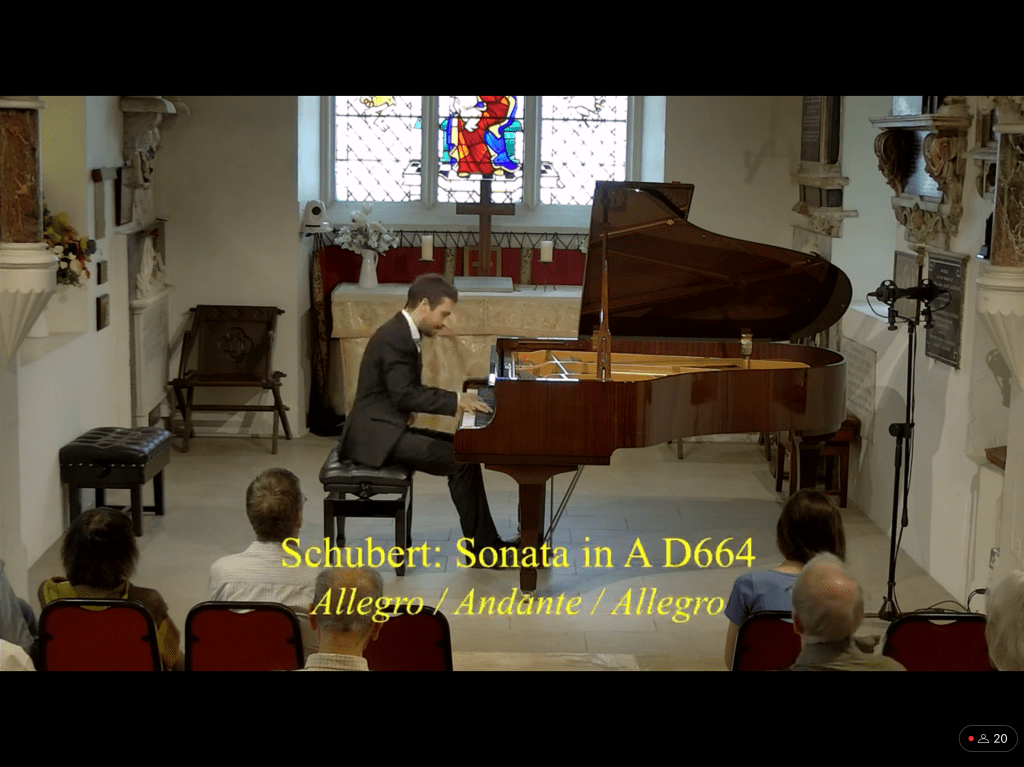
What better work to choose than the ‘little’A major Sonata by Schubert ( Lupu in Leeds had chosen the ‘little’A minor Sonata in the first round).One of the shortest of Schubert’s Sonatas with a lyricism from the first to the last note where the ‘sturm und drang’ of the age had been translated into a pastoral outpouring of simple beauty.There was timeless lyricism to the opening in Simone’s performance and although he did not have the sound palette of Lupu (that was more of Richter than of Solomon) there was a beautiful fluidity and simple intelligent musicianship to all he did.Even the strident question and answer of octaves was incorporated into an architectural line that made such sense and never disturbed the musical flow for a show of empty virtuosity.The Andante was profoundly expressive but with a luminosity of sound that allowed the music to speak with such disarming simplicity.The Allegretto had great rhythmic energy and a ‘joie de vivre’ that was indeed exhilarating.A performance where the music was allowed to speak for itself played with a technical command of art that conceals art.
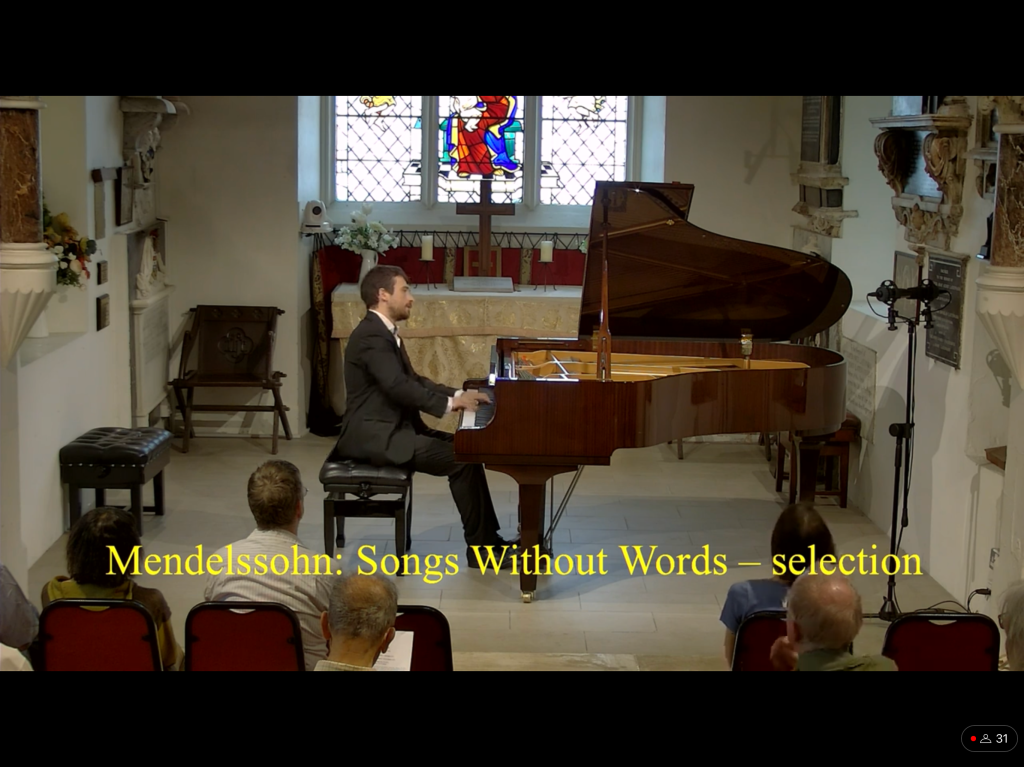
Simone is right when he says that Mendelssohn is unjustly neglected in concert programmes.I remember Perahia’s mentor Rudolf Serkin playing Mendelssohn’s Preludes and Fugues in a programme that included Reger and late Beethoven.The ‘Songs without Words’ where Mendelssohn’s seeming endless melodic outpourings are every bit as astonishing as Schuberts.A different period of course where ‘heart on sleeve ‘ sentiments were more easily expressed but if played with an aristocratic sense of style allowing the music to unfold naturally can reveal gems of ravishing beauty and astonishing musical invention.It was just this beauty that Simone was able to share with us today with his choice of five contrasting ‘Songs’.The first with its long outpouring and the beauty of the melodic line.And how magically he added the chiming bell in the distance over the continuing melodic line.The contrast of staccato and legato in the second although not as teasing as in the hands of Horowitz or Davis was played with exemplary charm and grace.The third one revealed a magical unfolding of the melodic line of fragmented mellifluous invention.The unashamedly sentimental outpouring of the fourth was played with aristocratic simplicity allowing the music to unfold so naturally with a supremely stylish ending.The last one,as Simone had told us,was written in London,and was a Brahmsian outpouring of fervent longing and touching nostalgia.
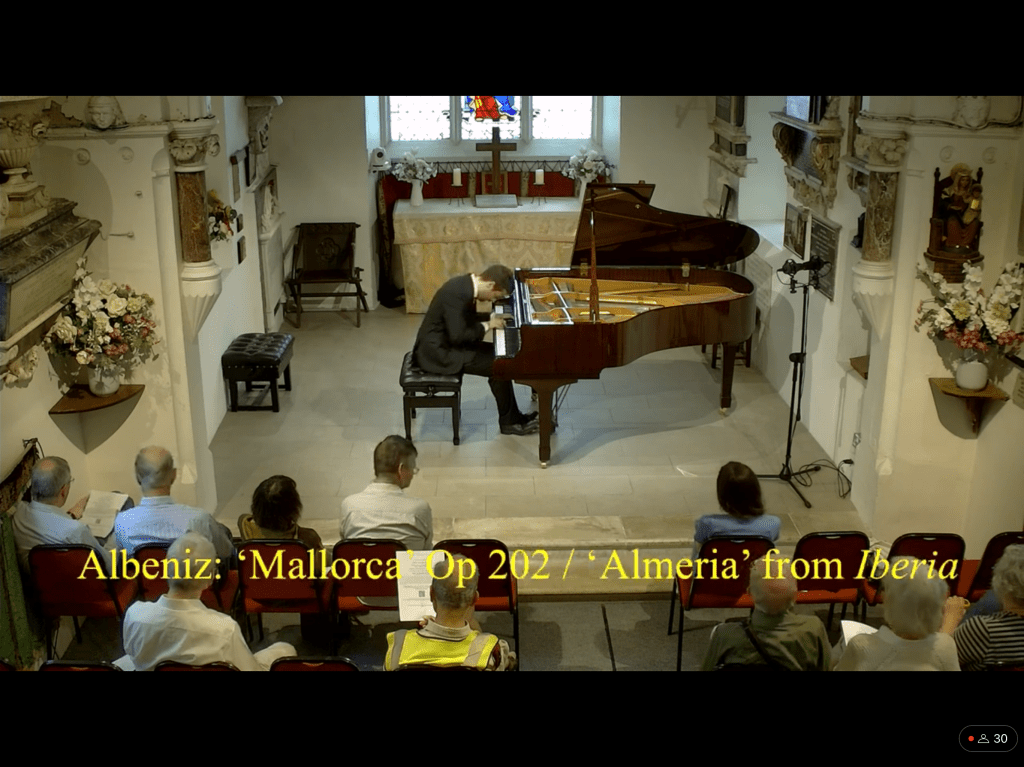
The Albeniz too was beautifully lyrical with the Barcarolle with its unmistakably Spanish idiom.The doubling of the melodic line in the lyrical middle episode was played with great sweep and contrasted with the magical atmosphere of the final arabesques.Almeria flowed so eloquently with its pungent expressive harmonies leading to the bass melodic line and strumming of guitars.A misty atmosphere of excitement disappearing to a distant memory of chiselled beauty.
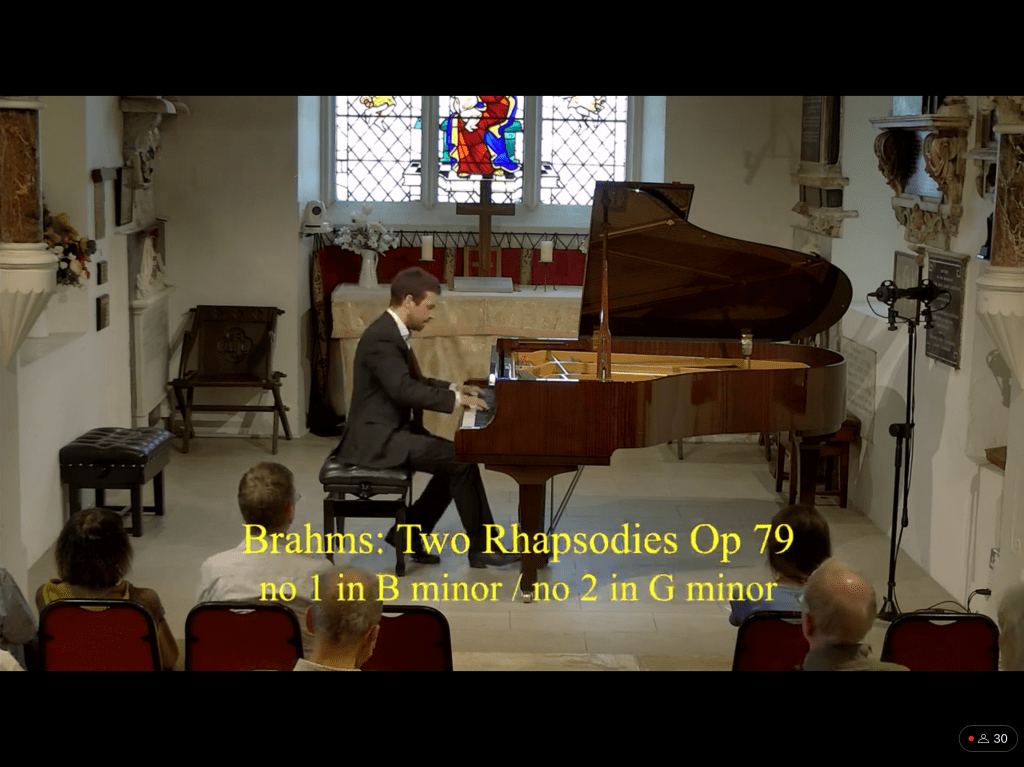
Brahms was played with passion and dynamic drive but also with intelligence and a sense of orchestral colour.There was excitement and grandeur and also deep brooding of mounting passion and drive.I have heard Simone play these two Rhapsodies on other occasions but today he played with great authority and an involvement that was totally convincing.A beautiful programme played with beauty,simplicity and authority but above all with intelligence and great artistry.The encore of a Sonata by Clementi was played with a playful charm and beguiling sense of ease that was an ideal way to close such an enjoyable recital.
Simone Alessandro Tavoni has given recitals internationally across Europe and U.S in venue such the Purcell room, Wigmore Hall, Royal Festival Hall, St Martin in the FieldsSt.John’s Smith Square, Steinway Hall, St.Mary Perivale in London , Liszt Museum in Budapest, Palau de la MusicaCatalana in Barcelona, the Aarhus concert hall, The Tallin Philarmonia ( Estonia ) and the Florence Conservatory hall. In 2019, Simone has been selected as a Parklane Group Artist, as Keyboard Charitable Trust Artist and received the Luciano and Giancarla Berti full-ride scholarship to attend the Aspen Music Festival and School studying with renowned professor Fabio Bidini. Graduated at Royal College of Music with professor Andrew Ball, and Simone has recently attained an Artist Diploma at Trinity Laban Conservatoire with professors Deniz Gelenbe and Peter Tuite. He began his musical education in Italy with professor Marco Podesta’ and pursue his studies at the Liszt Academy of Budapest with Dr.Kecskes Balazs and in Germany at the Hochschule fur Musik un Darstellende of Stuttgart with Dr,Peter Nagy. In 2016 was selected for the BBC pathway scheme and he is a fellow at the Aspen Music Festival and School. He is generously assisted by HSH Dr.Donatus Prince of Hohenzollern.
‘Several people assured me that under my hands the keys become singing voices, which, if it is true, pleases me very much, because I cannot abide the accursed hacking which is a characteristic even of first-class pianists, as it pleases neither the ear nor the spirit.‘ Franz Schubert
The Sonata in A major, D664 was in all likelihood the work which Schubert’s civil-servant friend Albert Stadler remembered many years later as having been written in the summer of 1819 for Josefa von Koller, the daughter of a wealthy iron merchant, during the composer’s first visit to the town of Steyr, in Upper Austria, in the company of the famous baritone Johann Michael Vogl. ‘Yesterday … a very violent thunderstorm broke out in Steyr, killing a young girl and injuring two men in the arm’, Schubert told his brother Ferdinand at the time. ‘In the house where I’m staying there are eight girls, almost all pretty. You can see we’re kept busy. The daughter of Herr v. Koller, at whose house I and Vogl eat every day, is very pretty, plays the piano well, and is going to sing several of my songs.’The Little” A major sonata is so called to distinguish it from the 1828 penultimate sonata in the same key and is the shortest among Schubert’s complete sonatas.The manuscript, completed in July 1819, was dedicated to Josephine von Koller of Steyr in Upper Austria, whom he considered to be “very pretty” and “a good pianist”. The lyrical, buoyant, in spots typically poignant nature of this sonata fits the image of a young Schubert in love, living in a summery Austrian countryside, which he also considered to be “unimaginably lovely”
Johannes Brahms
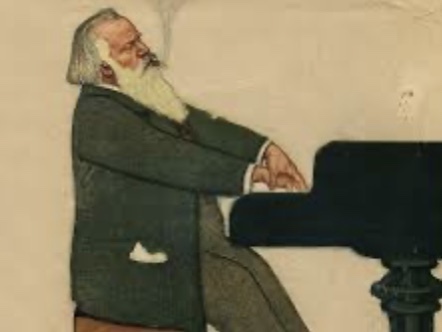
The Rhapsodies, Op. 79 were written in 1879 during Brahms’summer stay in Portschach when he had reached the maturity of his career. They were inscribed to his friend, the musician and composer Elisabeth von Herzogenberg.At the suggestion of the dedicatee, Brahms reluctantly renamed the sophisticated compositions from “Klavierstücke” (piano pieces) to “rhapsodies”Brahms’ “Rhapsodies” op. 79 written more than a quarter-century after his three piano sonatas are among his most frequently played works. He had a hard time finding a suitable title for them, vacillating between “Piano Piece”, “Capriccio” (No. 1) and ”Caprices”. His hand was forced by the dedicatee Elisabeth von Herzogenberg, who welcomed the pieces with the salutation “Ye (to me) nameless ones in the nebulous garb of rhapsodies”.
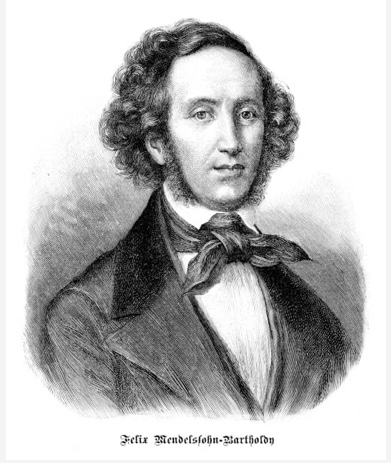
The eight volumes of Songs Without Words, each consisting of six songs were written at various points throughout Mendelssohn’s life between 1829 and 1845 and were published separately. The piano became increasingly popular in Europe during the early nineteenth century, when it became a standard item in many middle-class households.Many of the ‘songs’ are within the grasp of pianists of various abilities and this undoubtedly contributed to their popularity. The title Song Without Words seems to have been Felix Mendelssohn’s own invention. In 1828 his sister ,Fanny wrote in a letter “My birthday was celebrated very nicely … Felix has given me a ‘song without words’ for my album (he has lately written several beautiful ones).”
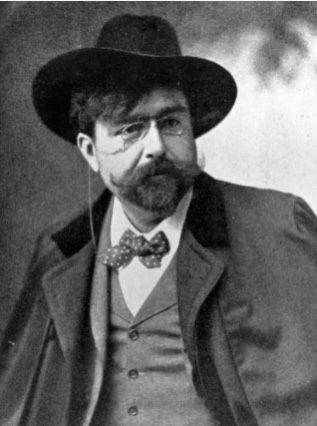
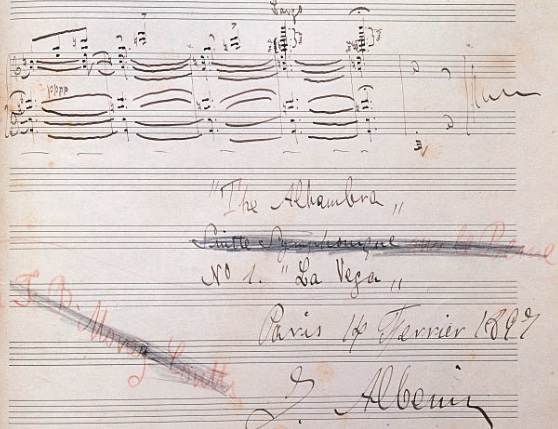
Isaac Albeniz
Mallorca ‘Barcarola’, Op 202, was written in London in 1890. Albeniz’s performances were very well received in Britain where in 1890 he did an extensive concert tour there. The barcarolle is usually associated with the soothing stroke of the Venetian gondoliers, or the rocking motion of lullabies; however, the barcarola of Albéniz’s Mallorca refers to a style of lament, particular to the island of Mallorca, which is sung by one grieving the loss of a fiancé who has died.Although Albéniz did not write a single piece for the guitar, a great number of his works, originally composed for the piano, were taken up and transcribed by guitarists almost immediately after they were written, and they have remained an important part of the classical guitar repertoire ever since.It has been played and recorded by guitarists such as Julian Bream and John Williams and many others. John Williams said “I like to play Mallorca, a piece depicting a mysterious, beautiful island with a Moorish influence.”
Almería (G major), relating to the Andalusian seaport of Almeria is loosely based on tarantas a flamenco form characteristic of the region of Almeria.From Iberia and written between 1905 and 1909 a suite of four books of three pieces each.
It is Albéniz’s best-known work and considered his masterpiece. It was highly praised by Debussy and Messiaen who said: “Iberia is the wonder for the piano; it is perhaps on the highest place among the more brilliant pieces for the king of instruments”.It is considered one of the most challenging works for the piano: “There is really nothing in Isaac Albeniz’s Iberia that a good three-handed pianist could not master, given unlimited years of practice and permission to play at half tempo. But there are few pianists thus endowed.”
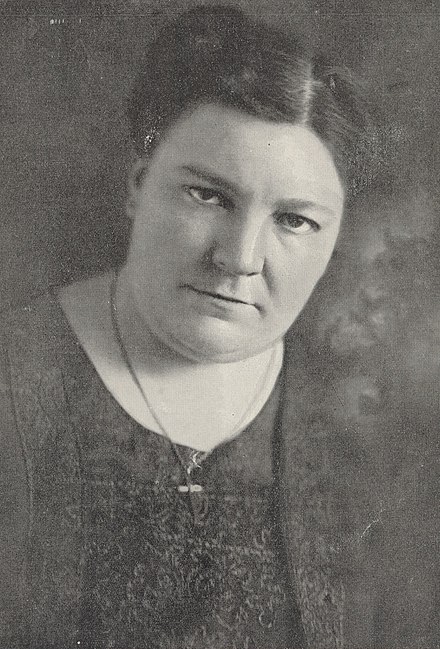
Blanche Selva
The twelve pieces were first performed by the French pianist Blanche Selva but each book was premiered in a different place and on a different date. Three of the performances were in Paris book 1/111/IV Book 11 of which Almeria is the second was premiered in a small town in the south of France Saint Jean de Luz the birthplace of Ravel
Marie Blanche Selva (Catalan Blanca Selva i Henry, 29 January 1884 – 3 December 1942) was active as a translator and transcriber. But her main work is a monumental 7-volumes work on piano technique:L’Enseignement musical de la Technique du Piano, Paris from 1916 to 1925 a radically new approach to piano playing. Her predilection for big arm gestures and her detailed descriptions of the most unusual types of attack, combined with the constant attention to the resulting tone-colour,make her book a unique contribution to the history of the piano and its literature.She was the only French pianist of her time to specialise in Czech music where she was consequently very popular .She continued to tour and work as a concert pianist in Europe and by the age of 20 she had performed all of Bach’s keyboard works in 17 recitals.Between 1906 and 1909 she premiered all four books of Albeniz’s piano suite Iberia. https://youtube.com/watch?v=IdlM-nK8ppM&feature=share
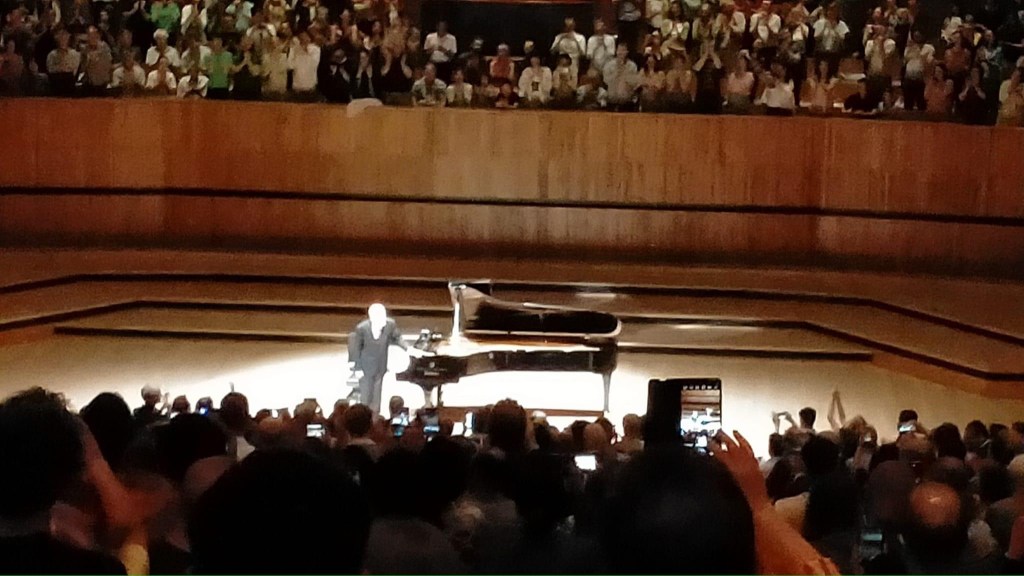
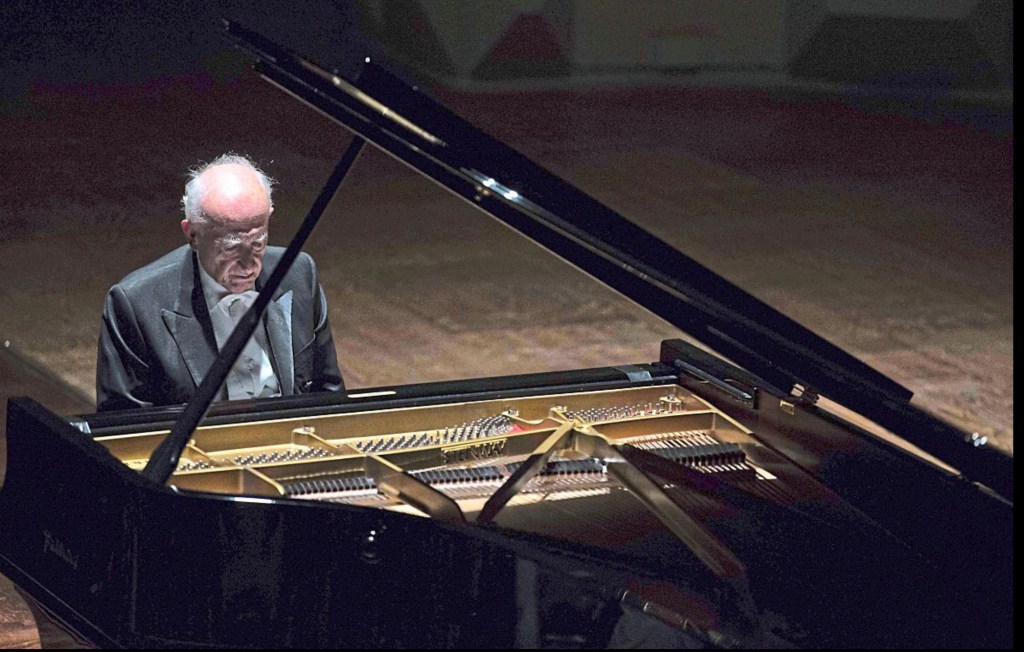
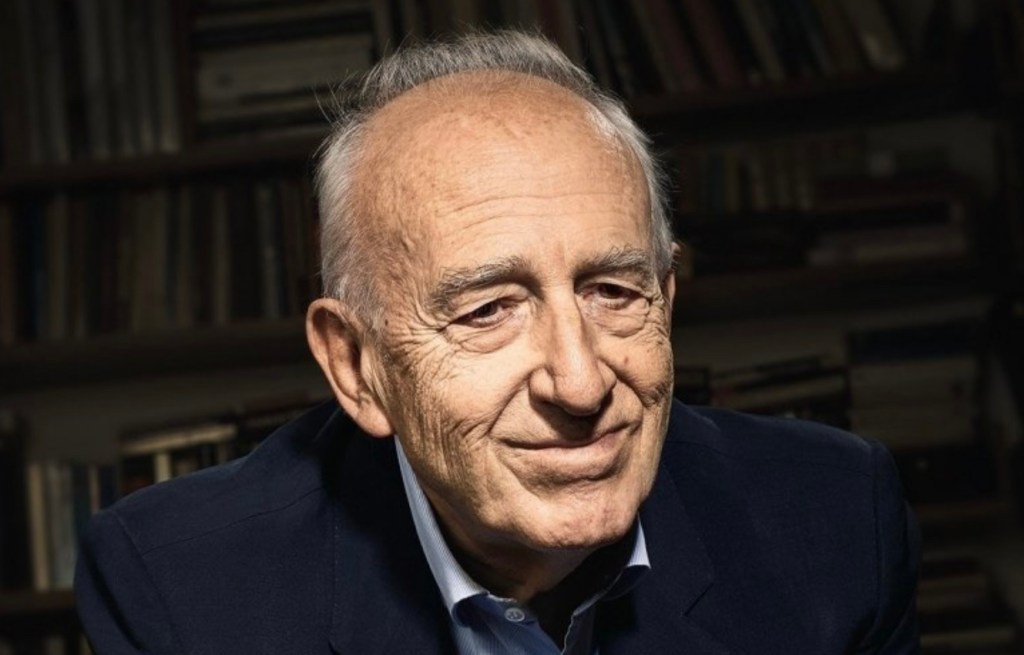
Pollini in London: STORY OF A MIRACLE! By a young Italian pianist graduate of the RCM London – Antonio Morabito
The day before yesterday I witnessed what I would define, in no uncertain terms, a miracle.Indeed, a series of miracles in an evening that is unbelievable!
Pianists please read this post.
I start from the beginning.Maurizio Pollini, renowned Italian pianist, one of the greatest pianists of the twentieth century gave a recital at the Festival Hall at the Southbank in London.Obviously, with my dear friend Riccardo, we go very excited to listen to what promises to be a concert we will never forget.It was,but not for the reasons you would expect…
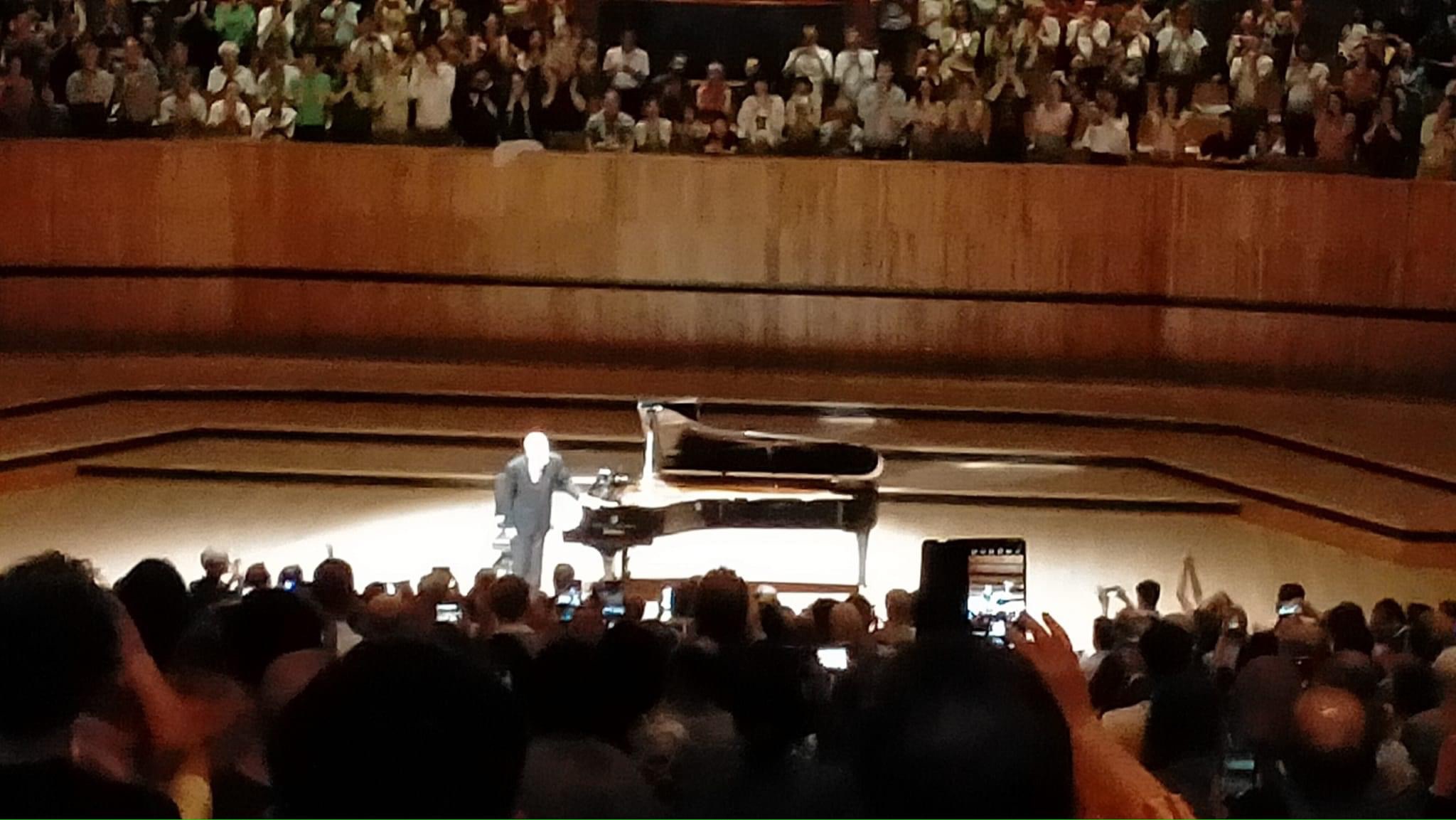
Silence in the hall, of the kind that is generally felt in sacred places before mass begins, lights off and stage lit with the piano in all its majesty in the centre. Everyone looking at the little door on stage left. Here it is! It’s really him, it’s not a YouTube frame, he really exists!Pollini enters a hall,packed to the rafters,staggering, bent over, almost in a hurry, he manages to reach the piano to lean on and stop himself falling over.He finally arrives, leans on the piano and bows gratefully for the unending applause that usually awaits a great artist at the end of the concert.There’s no doubt, the audience knows who they are looking at and pays homage to him.We join in the tribute, grateful, excited and proud to be Italian like him.
The programme is interesting, Schumann and Chopin.Riccardo, also a pianist, and I already imagine the refined artistry that awaits us too.The applause is still going on but Pollini is impatient, he doesn’t even adjust the bench, he doesn’t take those usual seconds of concentration that you would expect, he doesn’t let the applause end and immediately starts playing. Everyone stops clapping instantly.The concert has begun!We are once again immersed in the religious silence of before with the only difference that this time we are all hypnotized by his hands and by what they will be able to do.
The first piece is the famous Arabesque Op. 18.We are looking for the refinements, the enjoyment that comes from the interpretation of an artist of his caliber,but the Arabesque is nervous, with not too much emotional involvement, of a sound that appears shallow and hurried in the “cantabile”and too forced in the ” forte”(Pollini uses his whole body for the “sforzandi”).His tenseness is palpable, you can feel it even from the back row of the hall.It’s a lesson for me. A confirmation, if any were needed, that in a concert hall a connection is created between artist and audience that is really difficult to explain rationally.
Pure magic.The piece ends. It wasn’t what we expected but, as you know, the start of a concert is terrible for anyone, can you imagine for a 81 year old man? And then how can we ever dare to criticise Pollini!?We just join the thunderous applause of a crowd that couldn’t wait to continue its initial homage to the master and we give him the due recognition that he deserves,regardless.The second piece is the Fantasy op 17.We can not wait!Surely after the initial emotion he will demonstrate his his mastery.
What will happen, however, is unimaginable.Pollini sits down, hastily, and this time too he doesn’t let the applause end and starts playing again.But the piece that he plays is not Schumann’s Fantasy ,after a few notes we look at each other with Riccardo puzzled and I ask him: “wasn’t there the Fantasy now?”.Double-checking the program to see if I remember correctly. No mistake, he’s playing another piece. But what?After a very short time I understand that Pollini is improvising. Rapid arpeggios and harmonic sequences that occasionally recall passages from the Fantasy but nothing that has to do with a real piece nor with the Fantasy.The atmosphere is surreal.My heart is pounding, I empathize with him, I can’t believe it’s really happening.The great Pollini forgot the beginning of Schumann’s Fantasy.The confirmation comes when he stops playing and in a great state of confusion brings his hands to his head as if to say: “what’s wrong with me?”. For a moment I think of everything: “Is he feeling ill?A dizziness? Maybe something more serious?”The audience is astonished, petrified.He resumes playing, more arpeggios and miscellaneous improvisations, loud, angrily, using his whole body to play, almost angry with the piano.The same piano that crowned him for decades as one of the greatest pianists of recent times has now become the enemy which is forcing him to perform under these conditions.He stops playing, concluding with a cadenza in C major, pretending he’s played a piece that really exists.He stands up.The audience applauds shocked, worried, incredulous. It’s not the same applause as previously This is different.Pollini leaves the stage with the same speed with which he had entered.I’m in a cold sweat, my heart is pounding . I feel like it’s me on stage. And if I were there, what would I do? I don’t want to think about it.Endless minutes go by in which I sincerely think that a staff member will soon come out to say that the master, due to illness, is unable to continue. But no one comes on stage. Time passes and a general murmur accompanies anxious moments.
But here is the first miracle.The little door opens. It’s not the hall staff. It’s the Master!Pollini returns to the stage and the audience goes crazy with joy and emotion. They flood him once again with incredible affection! (By the way, the London crowd is not renowned for its warmth,more for its composure). But this Friday night is the night of miracles and anything can happen.Pollini returns to the stage with a book, he doesn’t have the hall staff bring it to him. He carries it himself. It’s his book that weighs like a rock this time. He will play with the book in front of him.Right after him a member of staff enters carrying the piano stand to put on the piano.The stand is placed on the piano while the audience does not stop encouraging Pollini by applauding like never before and shouting “bravo” loudly. The maestro always appears nervous and at the same time sorry but always grateful to the audience and in fact he takes a shy bow and without waiting for the staff member to leave the stage, he starts playing again before the applause ends.This time it is the beginning of Schumann’s Fantasy. Unmistakable!But there is something wrong, the book is there but where is the page turner and his chair? How is it possible that there isn’t one?Maybe he just needs to have the book in front of him for the beginning but he won’t use it?Unfortunately this is not the case as incredibly he turns the pages by himself by interrupting the piece or removing some notes!It’s absurd! How is it possible that he is doing this? Why didn’t he call a page turner?There is general embarrassment in the air and the first movement continues with many uncertainties, memory lapses, improvised or repeated parts. His hand is shaking and he can’t turn the pages.I am literally dead.I can not believe my eyes. It is a mixture of sadness and emotion.Pollini ends the first movement somehow.
And here is where the second mysterious miracle happens.Pollini stands up, tired, weary, angry, incredulous and extremely sad.The entire audience bursts into thunderous applause, the maestro almost in tears is forced to bow down and gestures with his hands as if to say “I’m sorry, forgive me”.And here the public does something unthinkable: they all stand up, stalls, stage,anyone, even the hall staff, in an ovation that I have personally never seen in my life!At that moment it was the piano world, and not only,present in London that embraced the sacrosanct fragility of a man who is a giant, but still a man and, with that embrace, they were reminding him of it.Pollini leaves the scene but the public doesn’t stop cheering him on. They praises the great man but also the great pianist that he is.It won’t be a performance to compromise a stratospheric career!
The Milanese pianist returns with a page turner and the concert continues.The Fantasy ends which is affected by the initial event but which in any case is completed with dignity.Same thing will be for the second part of the concert with Chopin. He will play everything, with the score in front of him, certainly not at the full level of his undisputed piano skills, always nervous, but without major problems, allowing us to glimpse the expressiveness of his touch, the brilliance and agility of some passages which, although not always impeccable, leave the listener with the idea that he is in any case in front of an exceptional pianist, witness of the piano history of an entire century.
What happens after the last note of the concert belongs to history.The audience applaude non-stop, all on their feet, an exhausted pianist, clearly embarrassed by applause he probably thinks he doesn’t deserve. Bent over on himself, leaning on what was his Olympus and at the same time his suffering, he bows grateful and is moved.It is truly a moving scene.He will be forced out 4 times, the audience shouts for an encore. It’s probably not the right day to continue playing but the public hopes for it, in vain, convinced that at any moment Pollini can erase what has gone wrong with a few notes played divinely as only he can.
No encore, the concert is over but his lesson will remain eternal for me.What this pianist did is miraculous. The strength and courage of a man who could have escaped at any moment but didn’t. He remained on stage and demonstrated to everyone that being an artist is above all a moral duty towards Art, towards oneself and towards the public.The man who won, among others, the Warsaw Chopin Competition, the most important piano competition on the planet, shows his fragility and his art remains indelible in the hearts of all those who recognized it and paid homage to him, no matter what happened. As it should be.I would have liked to hug that elderly man on stage who could have been my grandfather.I would have liked to say to him: “Maestro, don’t worry, you remain a giant of Music, an immense artist and today you have given us more than other millions of flawless pianists could ever convey”.
I tried to wait for him in vain, together with hundreds of people of all nationalities, at the artists’ exit but he preferred to leave through a secondary exit. Like the true artists do. No autographs, no selfies. I guess he thought: “I’m not worthy, not this time.” But I really wanted to answer him: “Yes Master, you will always be worthy.Especially this time.” Antonio Morabito
Thank you Antonio for translating your beautiful poetic account it is so moving but not everyone can understand the poetic nature of your Italian …………….London salutes a giant and it makes me proud to be a Londoner. I remember Radu Lupu’s last performance in London greeted with criticism by the press .I was so incensed that I wrote an appreciation for what this giant had given us for over half a century.I was actually thanked for doing it ……..proving that those than can ,do, those that can’t criticise. And shows that great artists are also human beings ……in the beginning is our end …..no escape for anyone but it is what goes on during that period and with what selfless generosity one gives of oneself,even when physical problems raise their head ,that marks out the men from the boys. Hats off to a Genius
And from Dr Moritz von Bredow : I presume Pollini’s London recital was an exception. I’ve just read the review from Vienna of June 16. It is heavenly, especially the fantasy by Schumann. Perhaps Pollini was tired or dehydrated. One should not put too much emphasis on that recital. This can, of course happen to anybody. And another absolutely ravishing review of his recital in Vienna, absolutely fantastic. Don’t worry about the London night, I’m sure he will surprise us again in the future with beauty of sound, technique, expression and experience.
Pollini a Londra: STORIA DI UN MIRACOLO! Un racconto da un pianista italiano a Londra Antonio Morabito
Avantieri ho assistito a quello che io definirei, senza mezzi termini, un miracolo. Anzi, una serie di miracoli in una serata che ha dell’incredibile!
Pianisti, per favore, leggete questo post.
Parto dall’inizio. Maurizio Pollini, notissimo pianista italiano, uno dei più grandi pianisti dei Novecento ha tenuto un recital alla Festival Hall del Southbank di Londra. Ovviamente, col mio caro amico Riccardo, andiamo eccitatissimi ad ascoltare quello che si preannuncia essere un concerto che mai dimenticaremo. Così è stato, ma non per i motivi che vi aspettereste…
Silenzio in sala, di quelli che generalmente si avvertono nei luoghi sacri prima che inizi il culto, luci spente e palco illuminato con al centro il Pianoforte in tutta la sua maestà. Tutti a guardare la porticina a sinistra del palco. Eccolo lì! È veramente lui, non è un fotogramma di YouTube, esiste davvero! Pollini entra, in una sala gremita fino agli ultimi posti, barcollante, curvo, quasi di fretta va a raggiunge il pianoforte per appoggiarsi e scongiurare il pericolo caduta. Finalmente arriva, si appoggia al pianoforte e si inchina riconoscente per un applauso infinito che sembra essere quello di fine concerto. Non c’è dubbio, il pubblico sa chi ha di fronte e gli rende omaggio. Noi ci uniamo all’omaggio, grati, eccitati e orgogliosi di essere italiani come lui. Il programma è interessante, Schumann e Chopin. Io e Riccardo, anch’egli pianista, già pregustiamo le raffinatezze che non vediamo l’ora di sentire. L’applauso è ancora in corso ma Pollini è impaziente, non si aggiusta neanche la panca, non si prende quei soliti secondi di concentrazione che ci si aspetterebbe, non lascia terminare l’applauso e comincia immediatamente a suonare. Tutti smettono di applaudire all’istante. Il concerto è iniziato! Siamo di nuovo immersi nel silenzio religioso di prima con l’unica differenza che stavolta siamo tutti ipnotizzati dalle sue mani e da ciò che saranno in grado di fare. Il primo pezzo è il celebre arabesque Op. 18. Siamo alla ricerca delle raffinatezze, del godimento che si trae dall’interpretazione di un artista del suo calibro ma l’arabesque si rivela nervoso, con non troppo coinvolgimento emotivo, di un suono che appare poco profondo e frettoloso nei cantabili e troppo spinto nei “forti” (Pollini si aiuta col corpo per gli “sforzandi”). La sua tensione è palpabile, la si avverte anche dall’ultima fila della sala. È una lezione per me. Una conferma, qualora ce ne fosse bisogno, che in una sala da concerto si crea un collegamento tra artista e pubblico che è veramente difficile da spiegare razionalmente. Magia pura. Il brano termina. Non era quello che ci aspettavamo ma, si sa, l’inizio di un concerto è terribile per tutti, figuriamoci per un uomo di 81 anni! E poi come possiamo mai azzardarci a dire qualcosa a Pollini!? Non ci resta che unirci allo scrosciante applauso di una folla che non vedeva l’ora di continuare l’applauso iniziale e inondiamo il maestro del dovuto riconoscimento che merita a prescindere. Il secondo pezzo è la fantasia Op.17. Non vediamo l’ora! Sicuramente dopo l’emozione iniziale darà sfoggio di tutta la sua maestria. Quello che succederà, invece, è inimmaginabile. Pollini si risiede, frettolosamente, e anche stavolta non lascia finire l’applauso e ricomincia a suonare. Ma il pezzo che suona non è la fantasia di Schumann, dopo poche note ci guardiamo con Riccardo perplessi e io gli chiedo: “non c’era la fantasia adesso?”. Ricontrollo il programma per vedere se ricordo male. Nessun errore, sta suonando un altro pezzo. Ma cosa? Dopo pochissimo capisco che Pollini sta improvvisando. Dei rapidi arpeggi e concatenazioni armoniche che ricordano di tanto in tanto dei passaggi della fantasia ma nulla che abbia a fare con un vero e proprio pezzo né tantomeno con la Fantasia. Il clima è surreale. Mi batte forte il cuore, mi immedesimo in lui, non posso crederci, sta succedendo davvero. Il grande Pollini ha dimenticato l’inizio della Fantasia di Schumann. La conferma arriva quando smette di suonare e in grande stato confusionale avvicina le mani alla testa come a dire: “che mi succede?”. Per un attimo penso di tutto: “si sta sentendo male? Un giramento di testa? Magari qualcosa di più grave?” Il pubblico è attonito, impietrito. Riprende a suonare, altri arpeggi e improvvisazioni varie, forti, con rabbia, usa tutto il corpo per suonare, quasi arrabbiato col pianoforte, lo stesso pianoforte che lo ha incoronato per decenni come uno dei pianisti più grandiosi degli ultimi tempi è ora diventato il nemico che lo sta costringendo ad esibirsi in queste condizioni. Smette di suonare, concludendo con una cadenza in do maggiore, fingendo di aver suonato un pezzo che esiste davvero. Si alza. Il pubblico applaude scosso, preoccupato, incredulo. Non è l’applauso di prima. Questo è diverso. Pollini lascia il palco con la stessa velocità con cui era entrato. Io sudo freddo, il cuore mi batte a tremila. Mi sento come se fossi io sul palco. E se fossi io lì, cosa farei? Non ci voglio pensare. Passano interminabili minuti in cui io sinceramente penso che a breve uscirà un membro dello staff a dire che il maestro, a causa di un malessere, non è in grado di proseguire. Ma nessuno arriva sul palco. Il tempo passa e un bisbiglío generale accompagna momenti interminabili. Ma ecco qui il primo miracolo. La porticina si apre. Non è nessuno dello staff. È il Maestro! Pollini rientra sul palco e il pubblico impazzisce di gioia e commozione. Lo inonda ancora una volta di un affetto che ha dell’incredibile! (Tra l’altro il pubblico londinese non è rinomato per il suo calore, ma per la sua compostezza). Ma questo venerdì sera è la sera dei miracoli e tutto può succedere. Pollini rientra sul palco con un libro, non se lo fa portare dello staff. Lo porta lui stesso. È il suo libro che stavolta pesa come un macigno. Suonerà con la carta davanti. Subito dopo di lui un membro dello staff sta portando il leggio da mettere sul pianoforte. Il leggio viene sistemato sul pianoforte dallo staff mentre il pubblico non smette di incoraggiarlo applaudendo come non mai e gridando “bravo” a gran voce. Il maestro appare sempre nervoso e allo stesso tempo dispiaciuto ma sempre riconoscente al pubblico e difatti fa un timido inchino e senza aspettare che lo staff esca dal palco, ricomincia a suonare, anche stavolta prima che l’applauso termini. Stavolta è l’inizio della Fantasia di Schumann. Inconfondibile! Ma c’è qualcosa che non va, il libro c’è ma dov’è il girapagine? Com’è possibile non ci sia? Magari avrà bisogno solo di avere il libro davanti per l’inizio ma non lo userà? Purtroppo non è così, incredibilmente si gira le pagine da solo interrompendo il pezzo o rimuovendo qualche nota! È assurdo! Com’è possibile che stia facendo questo? Perché non ha chiamato un girapagine? Nell’aria c’è un imbarazzo generale e il primo movimento prosegue con tante incertezze, vuoti di memoria, parti improvvisate o ripetute. La sua mano è tremante e non riesce a girare le pagine. Io sono letteralmente morto. Non credo ai miei occhi. È un misto di tristezza e commozione. Pollini finisce il primo movimento in qualche modo. Ed ecco qui che accade il secondo miracolo che mette i brividi. Pollini si alza, stanco, affaticato, arrabbiato, incredulo ed estremamente triste. Il pubblico intero scoppia in un fragorosissimo applauso, il maestro quasi in lacrime è costretto ad inchinarsi e con le mani gesticola quasi a dire “mi dispiace, perdonatemi”. Ed ecco che il pubblico fa qualcosa di impensabile: si alza tutto in piedi, platea , palchetti, chiunque, pure lo staff, in un’ovazione che personalmente non ho mai visto in vita mia! In quel momento era il mondo pianistico, e non solo, presente a Londra che abbracciava la sacrosanta fragilità di uomo che è un gigante, ma pur sempre un uomo e, con quell’abbraccio glielo stava ricordando. Pollini esce di scena ma il pubblico non smette di osannarlo. Si osanna il grande uomo ma anche il grandissimo pianista che è. Non sarà mica un’esibizione a compromettere una carriera stratosferica! Il pianista milanese ritorna con un gira pagine e il concerto continua. Finisce la fantasia che risente dell’accaduto iniziale ma che comunque viene portata a termine dignitosamente. Stessa cosa sarà per la seconda parte del concerto con Chopin. Suonerà tutto, con la carta davanti, non al pieno delle sue indiscusse doti pianistiche sicuramente, sempre nervoso, ma senza grossi problemi, lasciando intravedere l’espressività del suo tocco, la brillantezza e l’agilità di alcuni passaggi che, pur non sempre impeccabili, lasciano all’ascoltatore l’idea che è comunque davanti ad un pianista eccezionale, testimone della storia pianistica di un secolo intero. Quello che succede dopo l’ultima nota del concerto appartiene alla storia. Il pubblico applaude senza sosta, tutto in piedi, un pianista esausto, chiaramente imbarazzato per applausi che probabilmente pensa di non meritare. Ricurvo su se stesso, appoggiato a quello che è stato il suo olimpo ed insieme la sua sofferenza, si inchina grato e commosso. È veramente una scena commovente. Sarà costretto ad uscire ben 4 volte, il pubblico grida a gran voce il bis. Non è probabilmente la giornata giusta per continuare a suonare ma il pubblico ci spera, invano, convinto che da un momento all’altro Pollini possa cancellare ciò che non è andato con poche note suonate divinamente come solo lui sa fare. Niente bis, il concerto è finito ma la sua lezione rimarrà per me eterna.
Quello che ha fatto questo pianista ha del miracoloso. La forza e il coraggio di un uomo che poteva scappare in qualsiasi momento e invece non lo ha fatto. È rimasto sul palco e ha dimostrato a tutti che essere artista è prima di tutto un dovere morale verso l’Arte, verso se stessi e verso il pubblico. L’uomo che ha vinto, tra gli altri, il Concorso Chopin di Varsavia, la competizione pianistica più importante del pianeta, si è messo a nudo in tutta la sua fragilità e la sua arte rimane indelebile nel cuore di tutti coloro che l’hanno riconosciuta e gli hanno reso omaggio indipendentemente da tutto. Come è giusto che sia. Lo avrei voluto abbracciare quell’uomo anziano sul palco che poteva essere mio nonno, gli avrei voluto dire: “Maestro, non si preoccupi, lei rimane un gigante della Musica, un artista immenso e oggi ci ha trasmesso più di quello che altri milioni di pianisti impeccabili non avrebbero mai potuto trasmettere”. Ho provato ad aspettarlo invano, insieme ad un centinaio di persone di ogni nazionalità, all’uscita degli artisti ma lui ha preferito uscire da un’uscita secondaria. Come fanno i grandi. Niente autografi, niente selfie. Immagino avrà pensato: “non ne sono degno, non questa volta”. Ma io gli avrei voluto tanto rispondere: “Si Maestro, lei ne sarà sempre degno. Soprattutto questa volta”.
What a privilege indeed to have such a wonderful artist play at St Mary’s.The world does not know what it is missing but rather selfishly we will keep that to ourselves! A magnificent Schumann where each of the eight pictures were painted with a kaleidoscopic sense of colour and the same aristocratic poise that I remember from Artur Rubinstein.
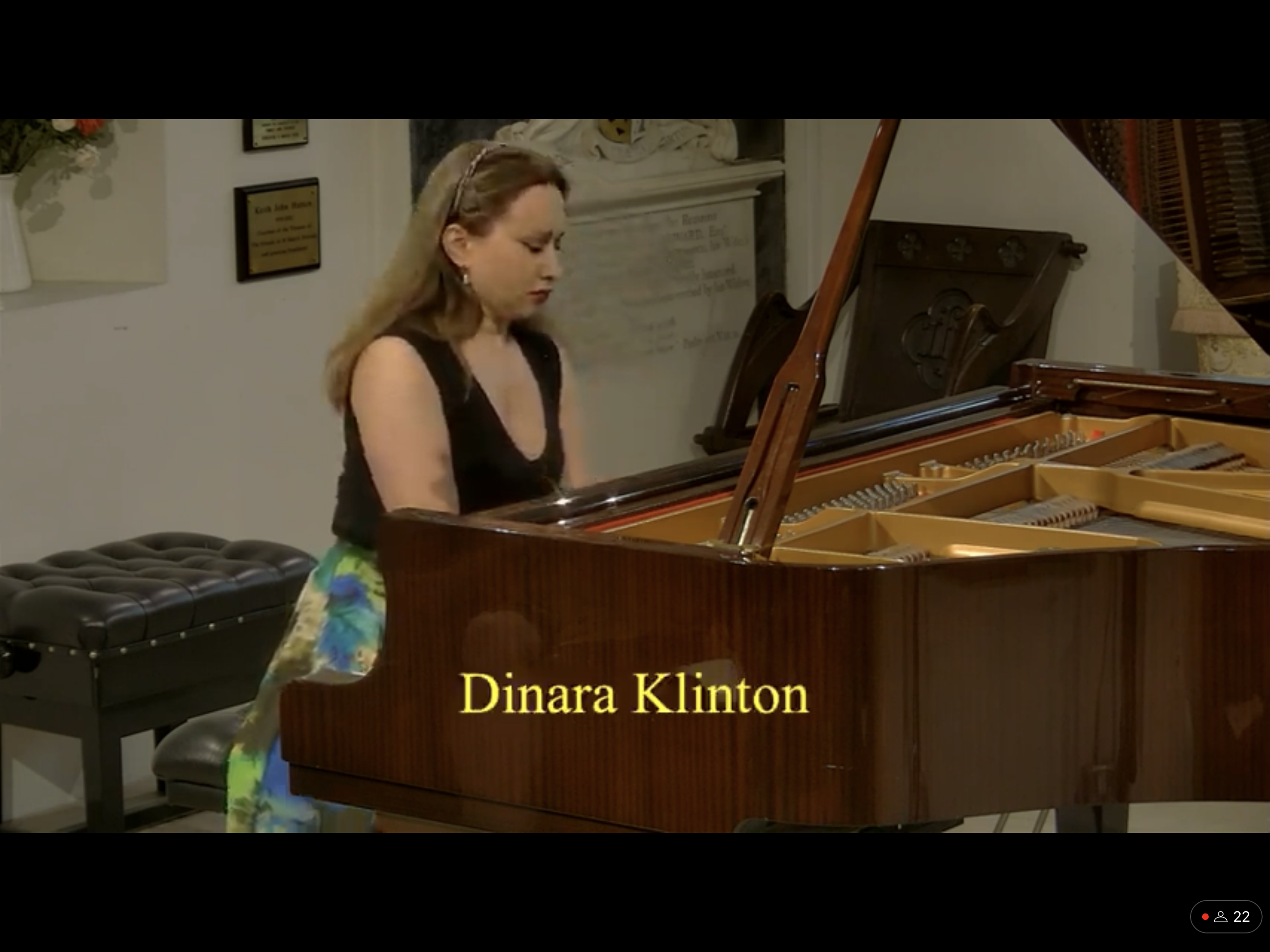
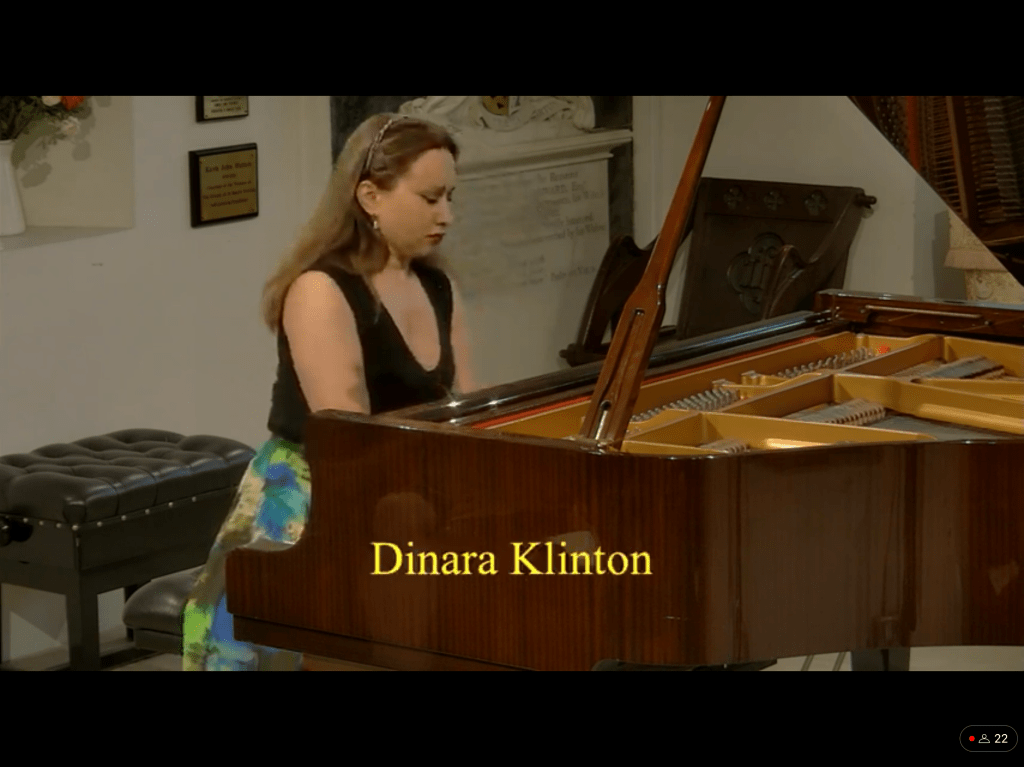
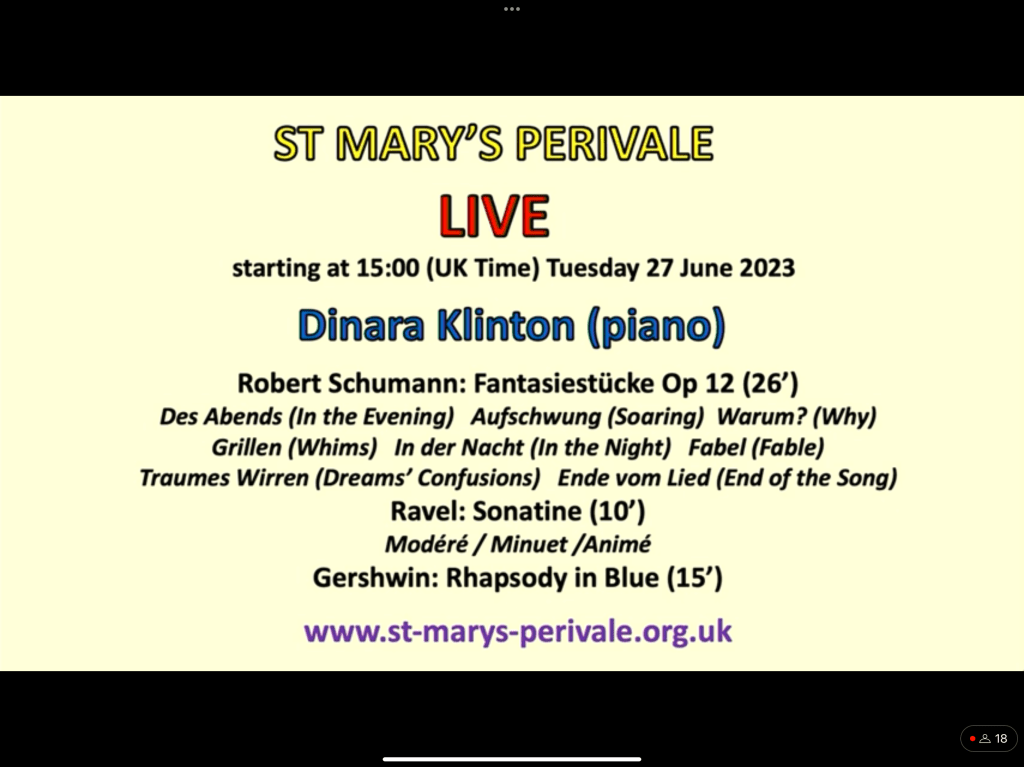
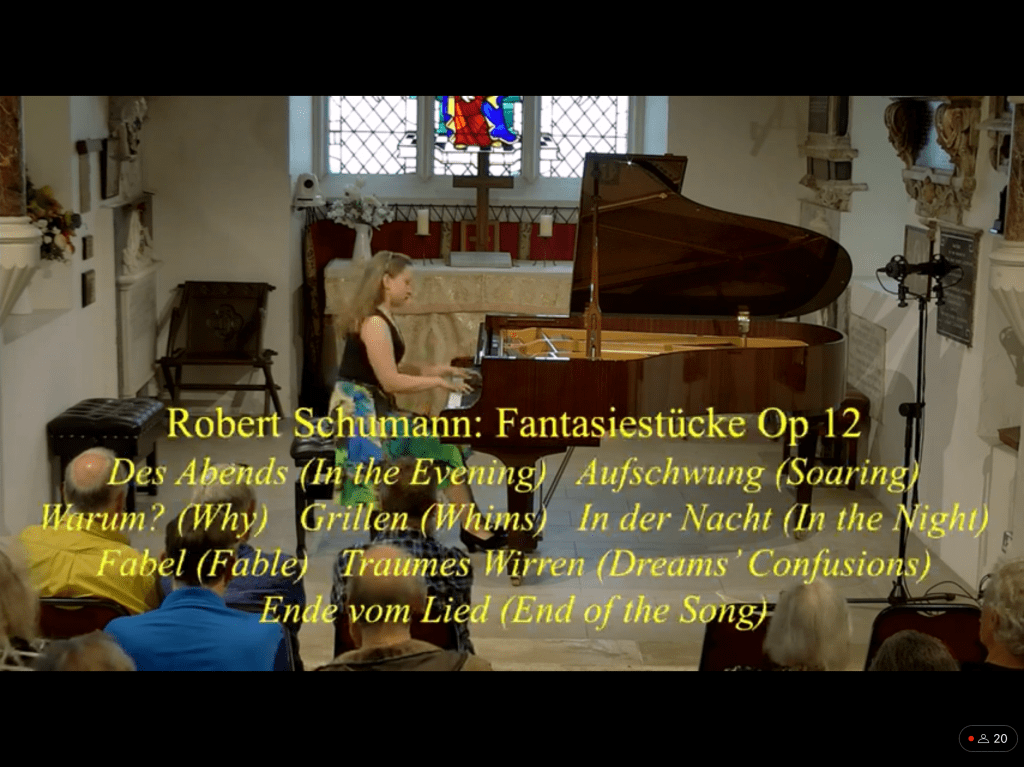
From the very first notes of ‘Des Abends’ there was an exquisite sense of balance and aristocratic control.But there was more than that because there was a sense of communication that is so rare to find these days.Time seemed to stand still such was the poignant beauty that was pouring from her fingers.A melodic line etched in gold on a cushion of pure velvet. The sumptuous sounds in ‘Aufschwung’ where passion and control came together with a rhythmic drive and sounds of beguiling beauty.’Soaring’ indeed with a romantic sweep and a wonderful bass voice leading the way in the central episode.Her scrupulous attention to the composers indications had me searching the score for the wonderful staccatos before the brooding build up to the majesterial return of the opening passionate outpouring. Her exquisite sense of balance had me indeed wondering ‘why’ this wonderful artist is not to be found more often on the world stage .I had heard her recently in the Royal Festival Hall and it was exactly her masterly control of sound that allowed her to project the softest of whispers with a radiance to the far reaches of that notorious cavern,as only Rubinstein or Arrau could do. ‘Warum’ indeed ………with its voices touchingly intertwined as they communed with each other so tenderly.A gentle comment from the bass adding a sensuousness to such disarming simplicity. ‘Grillen’ was played with such humour that she cheekily decided to add an unwarranted but much appreciated repeat. There was a sweep to the ghostly murmurings of ‘In der Nacht’with strands of melody emerging with crystalline clarity above.The ‘Etwas Langsamer’ seemed actually to get faster rather than slower.Such was her artistry that the haunting melody that floats on top reminded me of a similar magic moment in the Fantasie op 17 that was to follow in a sequence of masterpieces that seemed to pour continuously from Schumann’s pen from op 1 to op 26. Visions of such beauty that it is hardly surprising that his duel personality of Eusebius and Florestan in the end fought it out in his head with him ending up in an asylum ! A wonderfully capricious ‘Fabel’with its question and answer eloquently expressed exactly as Rubinstein used to enchant us with.Her masterly control was always present as the final chords were so beautifully placed each one slightly different from the other. A masterly ‘Traumes Wirren’ as you would expect from a pianist known in the business as Mrs Feux Follets. A masterclass in the RCM with Emanuel Ax some years ago when Professor Dinara was still a student and had just played two of Liszt’s Transcendental studies:’Paysage’and ‘Chasse Neige’.The next student down to play the ‘Hammerklavier’ after her,unsurprisingly,could not be found!So the Maestro asked Dinara to play something else while the search was on. I held my breath and hoped she would play ‘Feux Follets.’She did,and Emanuel Ax burst out laughing at the end as he could not believe that anyone could play it with such ease and beauty.He had been the winner of the first Rubinstein Competition and certainly could never have played it like that! Dinara is not a machine but a sensitive artist and ‘Traumes Wirren’ as ‘Feux Follets’ was played as a miniature tone poem not a cold blooded study!There was here in Schumann a flexibility of pulse and a ravishing sense of colour.Aristocratic grandeur signalled the ‘Ende vom Lied’ and if the ‘Etwas lebhafter’ was of the same colour it was because the shape and colour she brought to this central episode was part of an overall architectural measure that was totally convincing.The rapt concentration she brought to the coda where suddenly time stands still as the melody returns as if in a dream .The gradual disintegration in a magic ending of sublime poetic inspiration.It was as if Eusebius had been at work again like he had been in the last desolate dance of the Davidsbundler op 6.
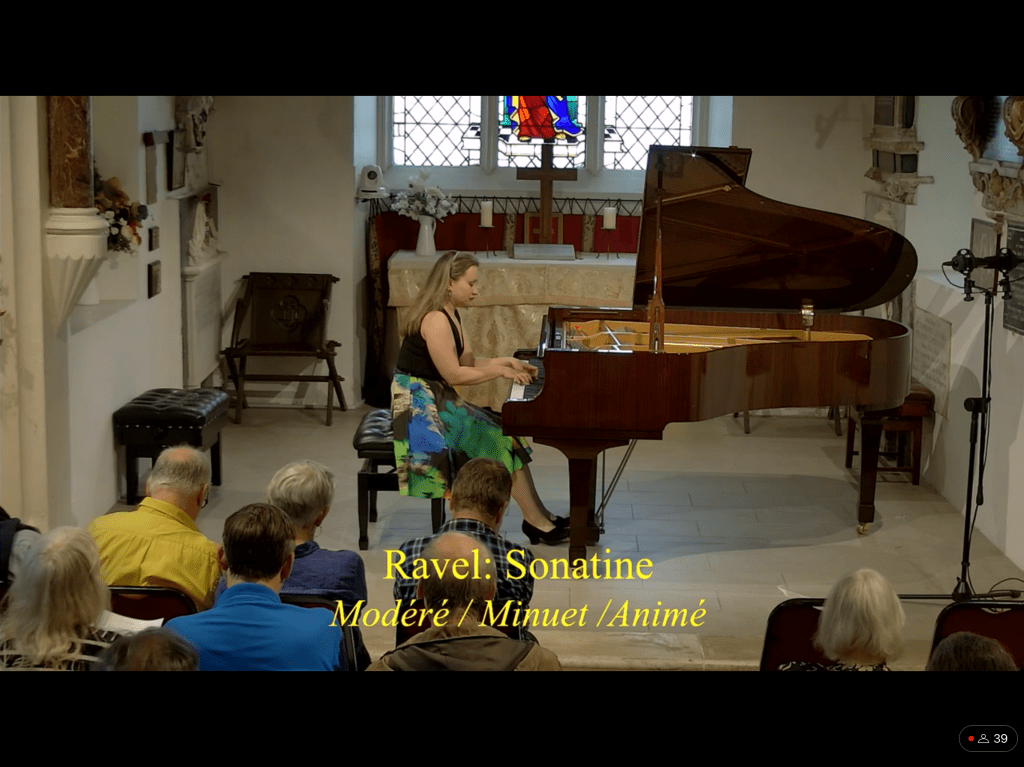
There was a wonderful sense of colour in the opening of the Ravel ‘Sonatine’ with the left hand doubling the melody giving great depth and haunting beauty to this fleetingly etherial opening.Fluidity and purity of the melodic line takes over with a feeling of resignation and nostalgia leading to the hauntingly beautiful ending with an almost unbelievable control of the magical sonorities .There was delicacy and a formal stately beauty to the ‘Menuet ‘ with a luminosity of sound of great simplicity.A beguiling tenor melody that crept in surreptitiously towards the end with ornaments that were played with the same delicacy that she was to show us in the Chopin nocturne that was still to come after the jazz and swing of Gershwin.A great wave of sounds engulfed the keyboard in the ‘Animé.’There were mysterious ghostly apparitions of melody duetting over a mist of sound.Simplicity,beauty and masterly control gave this innocent Sonatine the life of a jewel shining brightly in a sound world unmistakeable aristocratic and French.
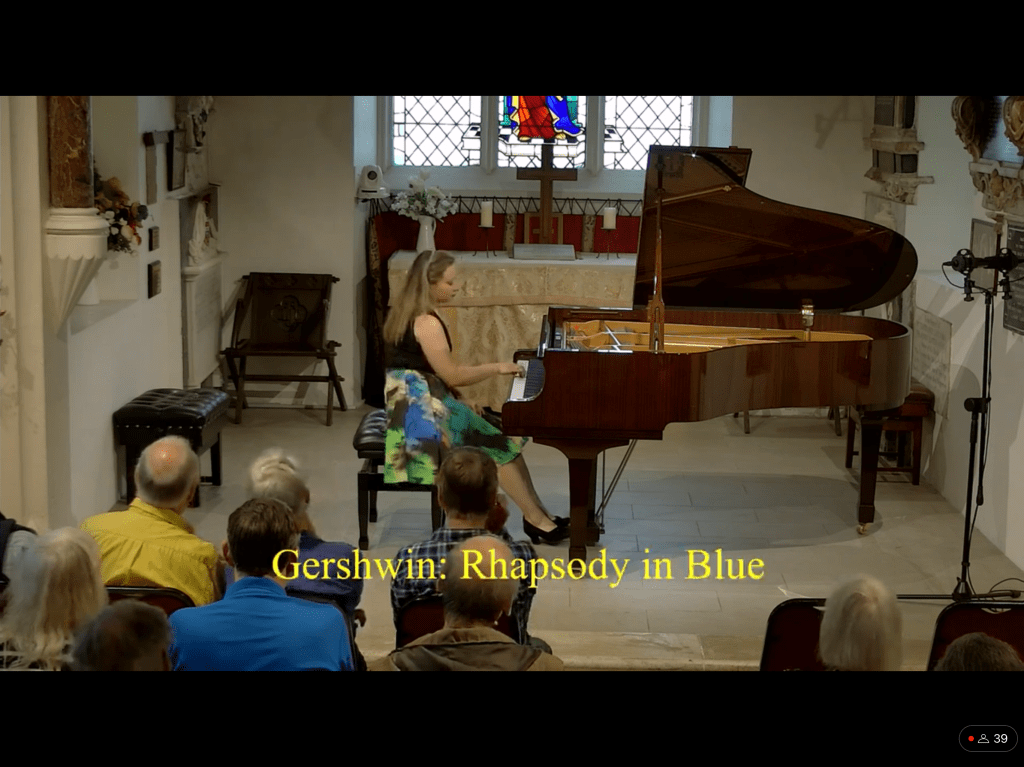
Gershwin was sleezy and dreamy,jazzy and improvised.Astonishing technical brilliance and mastery with the sumptuous sleepy final melody played with consummate artistry.Guitar like interruptions of animal excitement and magnificence just showed why Nadia Boulanger had refused to teach such an original talent for fear of contaminating this original mix of improvised and organised brilliance. Chopin’s Nocturne in D flat op 27 n.2 was just the magic touch that Rubinstein would have added to a wonderfully satisfying programme.A magic mist of sound on which floated a bel canto of ravishing beauty.A timeless rubato with embellishments that just flowed so effortlessly from her masterly fingers with gossamer lightness.The whispered acciaccaturas at the end were of such delicacy that time stood still as it had all those years ago for Artur Rubinstein. Dinara I continue to say is one of the great pianists of our time who has as yet to be discovered by a world submerged by mediocre piano players who are not great artists.Unfortunately we live in a speedy age where artists are getting fewer and fewer as our high speed world is too ready to accept quantity rather than quality.
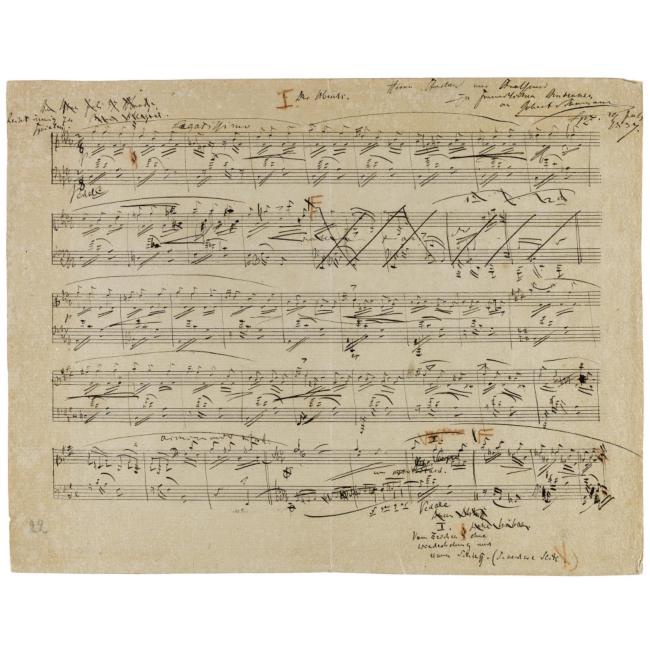
Schumann Fantasiestücke, op 12, is a set of eight pieces written in 1837The title was inspired by the 1814–15 collection of novellas,essays, treatises, letters, and writings about music, Fantasiestücke in Callots Manier (which also included the complete Kreisleriana, another source of inspiration for Schumann) by one of his favourite authors, E.T.A.Hoffmann.He dedicated the pieces to Fräulein Anna Robena Laidlaw, an accomplished 18-year-old Scottish pianist with whom Schumann had become good friends.
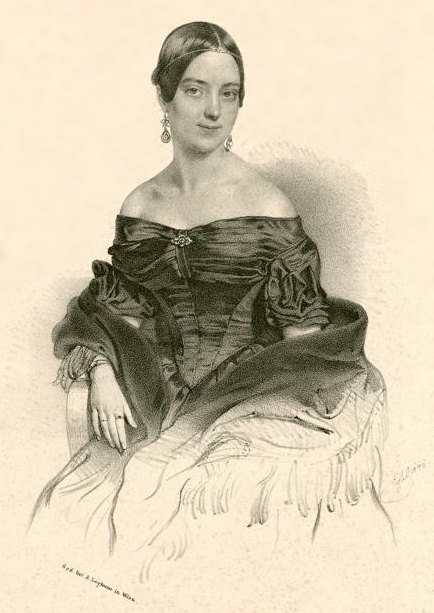
Robena Anna Keddy Laidlaw was born in West Breton in Yorkshire in 1819. She was the daughter of Alexander Laidlaw who was a merchant of Scottish descent and his Irish wife Ann Keddy. Her father’s family knew Sir Walter Scott and she was sent to Edinburgh to study the piano with Robert Müller. She continued her studies in Königsberg and later in London where she studied under Henri Herz In 1834 she played for William IV and the ageing Paganini before returning two years later to play in Warsaw, St Petersburg, Dresden, and Vienna and the following year in Leipzig. There she met Schumann who created the eight pieces op 12 for her , in her honour, in the same year of 1837. It is not clear how close their relationship was, but Laidlaw is presumed to be the reason he started to compose again after a break of four months. It was Schumann’s idea to reverse her first two names so that it was Anna Robena Laidlaw who was appointed court pianist to the queen of Hanover in 1840. She toured Europe until 1845 when she returned to London where she lived with her parents until she married in 1852. Her new husband, George Thomson worked in insurance and together they had four daughters. Laidlaw died in London in 1901.First draft of Des Abends
Schumann composed the pieces with the characters Florestan and Eusebius in mind, representing the duality of his personality. Eusebius depicts the dreamer in Schumann while Florestan represents his passionate side. These two characters parlay with one another throughout the collection, ending self-reflectively with Eusebius in “Ende vom Lied”.
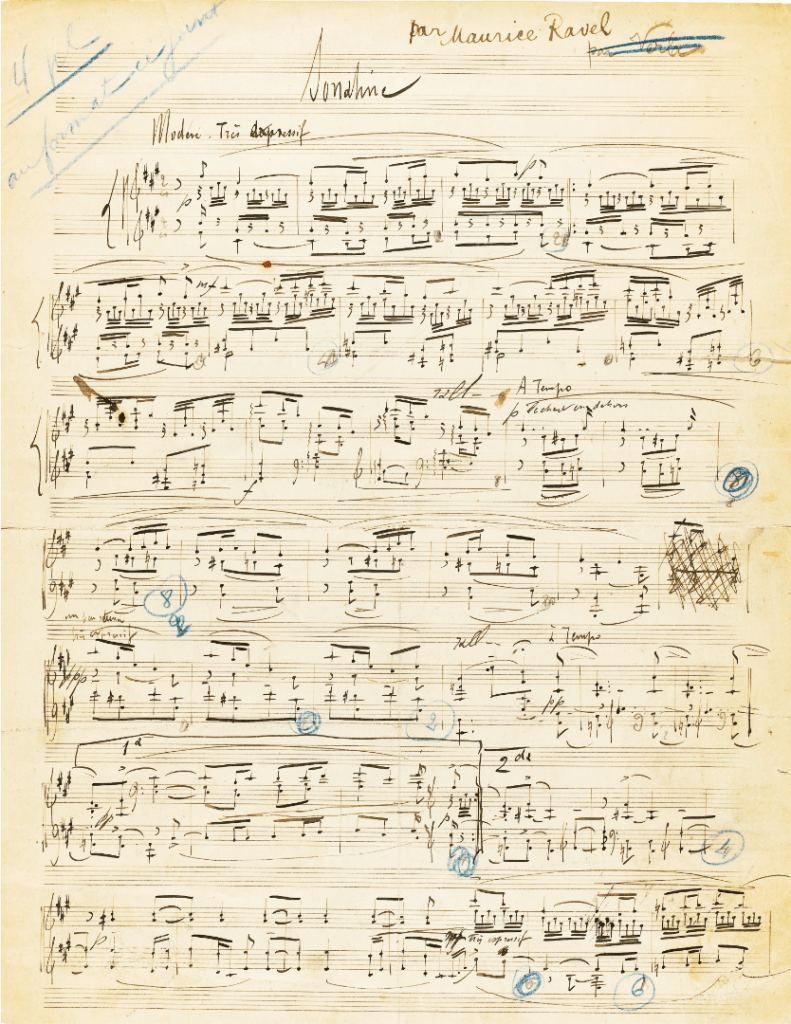
Ravel wrote the first movement of the Sonatine for a competition sponsored by the Weekly Critical Review magazine after being encouraged by a close friend who was a contributor to that publication. The competition requirement was the composition of the first movement of a piano sonatina no longer than 75 bars,with the prize being 100 francs.Calvocoressi recounted how he supposedly encouraged Ravel to write the piece in response to a competition posted in the Paris Weekly Critical Review.It seems to have been written between 1903 and 1905 as mentioned in an article in the Review published on 3rd March 1903 .The original manuscript that Ravel submitted had the text ‘par Verla’ written and struck out, replaced with ‘par Maurice Ravel’. Ravel submitted the piece under a pseudonym and chose an anagram of his name.
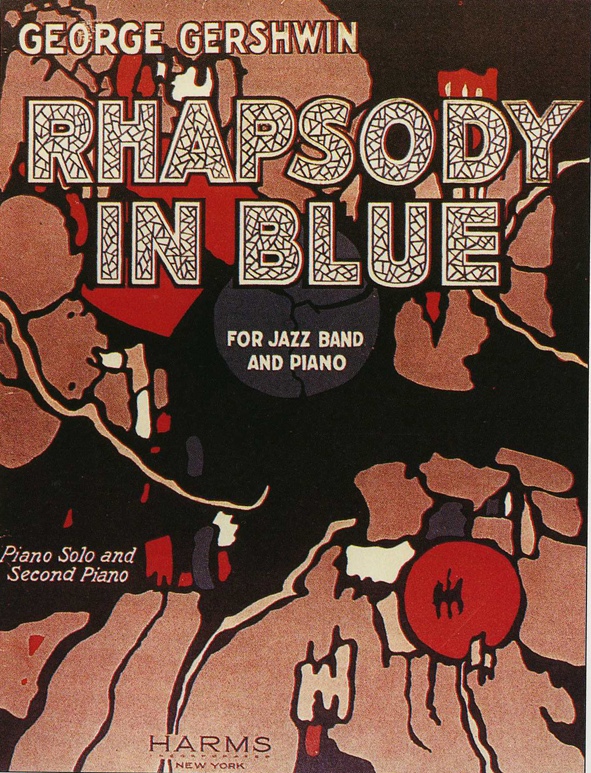
Cover of the original sheet music of Rhapsody in Blue
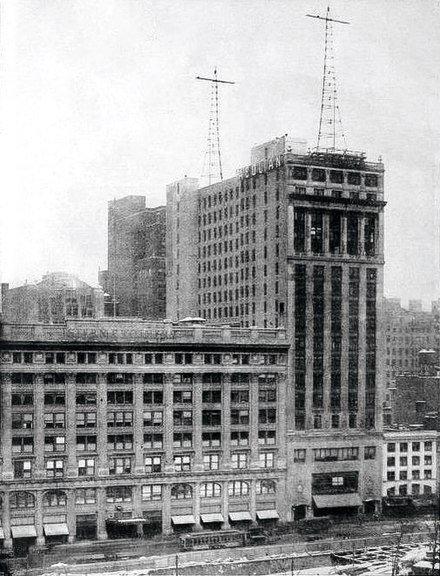
Rhapsody in Blue was written in 1924 for solo piano and jazz band, which combines elements of classical with jazz influenced effects. Commissioned by bandleader Paul Whiteman , the work premiered in a concert titled “An Experiment in Modern Music” on February 12, 1924, in Aeolian Hall ,New York City.Whiteman’s band performed the rhapsody with Gershwin playing the piano.Whiteman’s arranger Ferde Grofé orchestrated the rhapsody several times including the 1924 original.
With only five weeks remaining until the premiere, Gershwin hurriedly set about composing the work.He later claimed that, while on a train journey to Boston ,the thematic seeds for Rhapsody in Blue began to germinate in his mind.
The Rhapsody premiered on a snowy afternoon at Aeolian Hall, Manhattan, pictured here in 1923.
‘It was on the train, with its steely rhythms, its rattle-ty bang, that is so often so stimulating to a composer…. I frequently hear music in the very heart of the noise. And there I suddenly heard—and even saw on paper—the complete construction of the rhapsody, from beginning to end. No new themes came to me, but I worked on the thematic material already in my mind and tried to conceive the composition as a whole. I heard it as a sort of musical kaleidoscope of America, of our vast melting pot of our unduplicated national pep, of our metropolitan madness. By the time I reached Boston I had a definite plot of the piece, as distinguished from its actual substance.’
After sharing the top prize at the 2006 Busoni Piano Competition age 18, Dinara took up a busy international concert schedule, appearing at many festivals including the “Progetto Martha Argerich” in Lugano, the Aldeburgh Proms and “La Roque d’Antheron”. She has performed at many of the world’s major concert venues, including the Royal Festival Hall and Wigmore Hall in London, Berliner Philharmonie and Konzerthaus, Elbphilharmonie Hamburg, Gewandhaus Leipzig, New York 92Y, Cleveland Severance Hall. Her concerto engagements include The Philharmonia, Royal Philharmonic Orchestra, Lucerne Symphony Orchestra and others. Dinara combines her performing career with piano professor positions at the Royal College of Music and the Yehudi Menuhin School. As a recording artist, she has received widespread critical acclaim. Her album of Liszt’s Études d’exécution transcendante, released by the German label GENUIN classics, resulted in dazzling reviews and was selected by BBC Music Magazine as Recording of the Month. Her other albums include the complete Prokofiev Piano Sonatas released by Piano Classics.Dinara’s music education started in the age of five in her native Kharkiv, Ukraine. She graduated with highest honours at the Moscow State Conservatory P.I. Tchaikovsky under Eliso Virsaladze and went on to complete her Master’s degree at the Royal College of Music under Dina Parakhina.
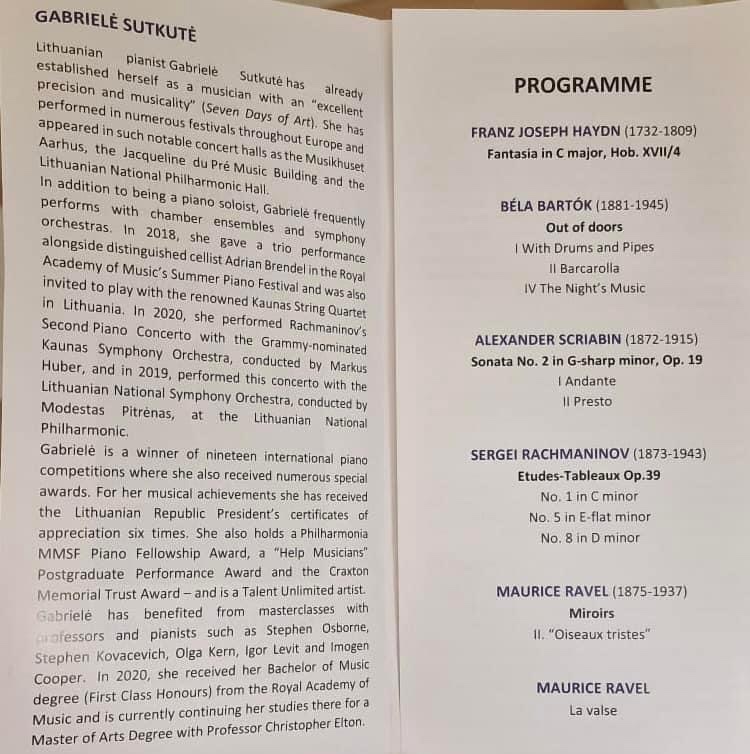
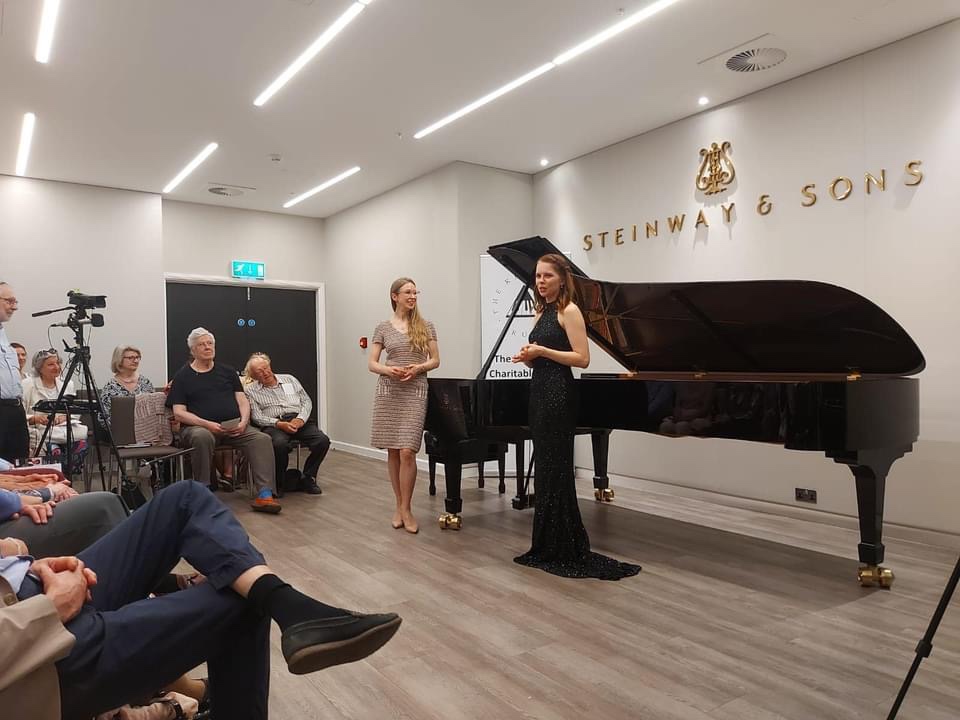
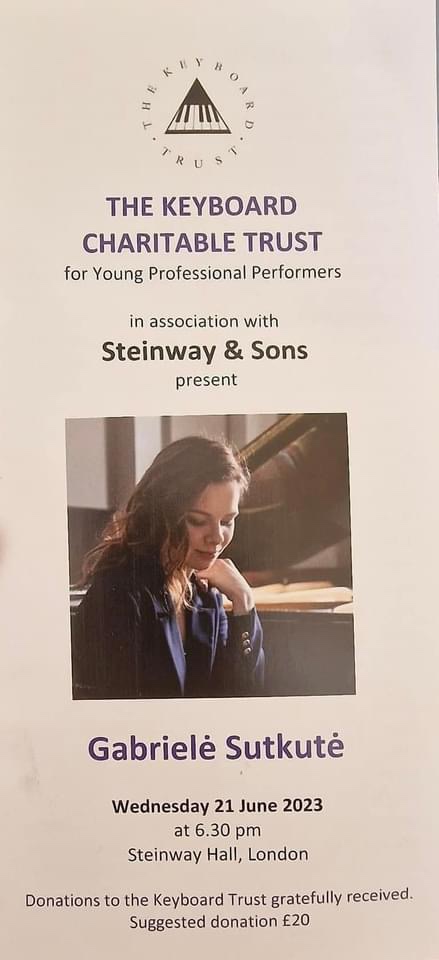
Elena Vorotko co artistic director of the KT writes:
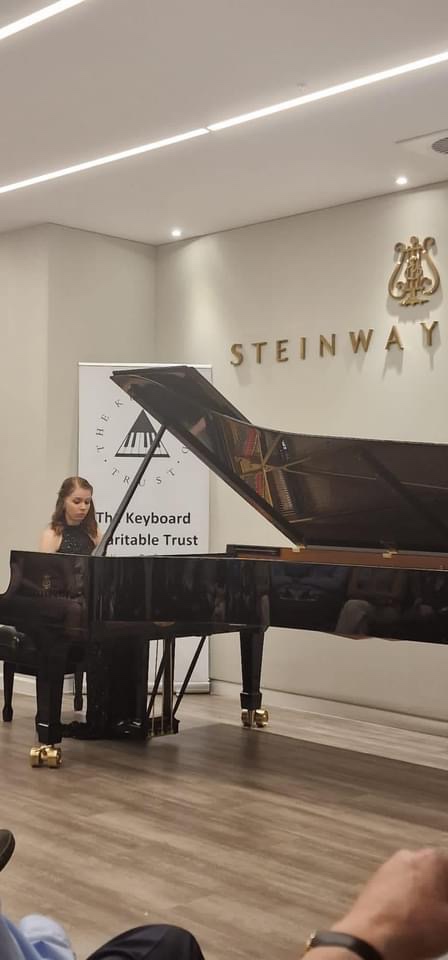
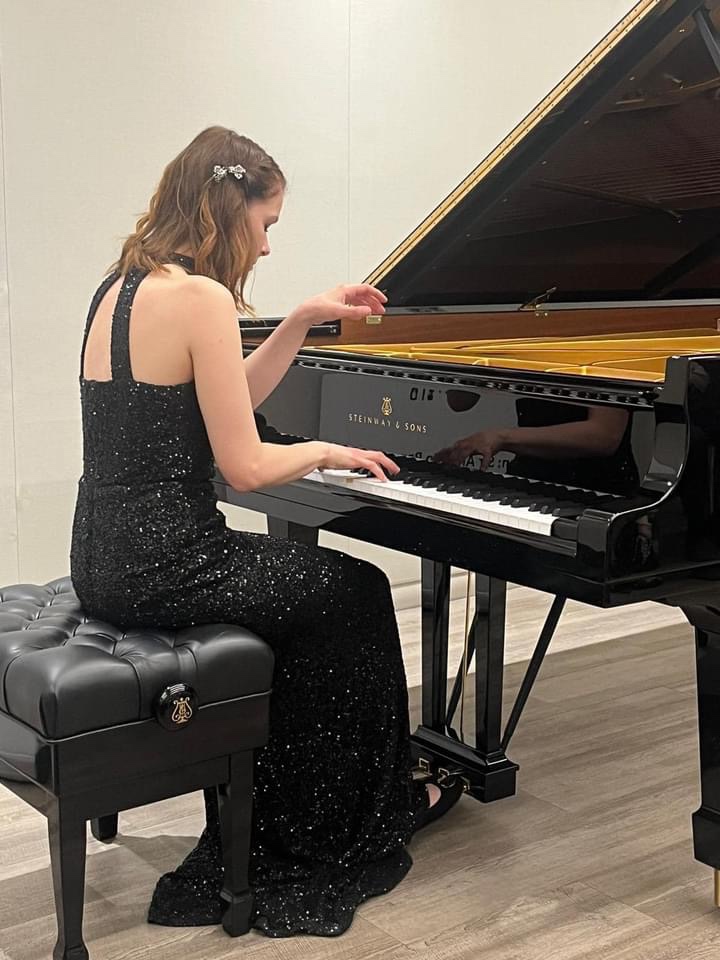
‘Passion and power in Gabrielė Sutkutė’s New Artist Recital at the Steinway Hall. Her complete technical freedom, acute musical intuition and impeccable sense of style made her performance an exhilarating experience for the audience.
First on the programme was Haydn’s Fantasia in C major, the main theme of which is a folk song ‘the farmer’s wife had lost her cat’, as was eloquently explained by Gabrielė in her introduction.This was masterfully played with an impish sense of humour, stylishly articulated and with great rhythmic drive. A strong contrast was achieved at the start of Bartok’s suite ‘Out of doors’. Gabrielė created vivid sonic pictures full of longing and powerful outbursts
In Scriabin’s 2nd Piano Sonata Gabrielė found yet another, totally different soundscape. A warmer and more velvety sound created mesmerising moments of delicate lyricism.The powerful and unpredictable second movement was brilliantly executed, with great ease and yet total involvement in the musical narrative. Rachmaninov’s 3 Etudes Tableaux revealed yet another, distinctive sonic palette with rich sonorities with a multitude of colours and effects. Seemless phrases and heart-wrenching lyricism contrasted with uncompromising virtuosity and brilliant polyphonic layering of textures. If that was not enough, Gabrielė finished her recital with Ravel’s ‘Oiseaux Tristes’ and ‘La Valse’. Here she created much more transparent, ‘glassy’ sonorities, so well suited for French repertoire. With a perfect sense of musical timing she achieved a moving rendition of the saddest of birds. La Valse showed off her total command of the instrument in this fiendish and highly complex virtuosic arrangement of a large scale orchestral work. The audience were transfixed by the beauty of sonorities Gabrielė created as well as the fantastic power of her musical conviction. A standing ovation followed as exhilarated listeners applauded this young star’s triumph.’ Elena Vorotko
From the very first notes of Scarlatti it was clear that we were in for a very special afternoon of sumptuous playing from the Golden age of piano playing .The age when not only was there an ease of playing but there was a fantasy and imagination that with a palette of a seemingly infinite range of sounds that could ravish beguile,charm and astonish .
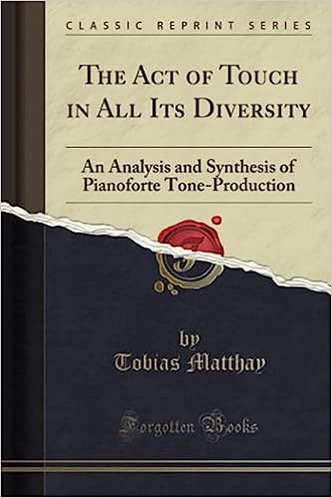
The idea was put into words by Tobias Matthay who would describe the way that in every note there was an infinite gradation of sounds that with a very sensitive touch could be as expressive as the human voice.I remember my first visit as a schoolboy to Sidney Harrison who sat at his wonderful inlaid Steinway and played the theme of Schumann’s Symphonic Studies.It was then that I knew music was to be the most important thing in my life.Lessons with him would be a revelation as he would search out songs where he could show me how to make the music speak in the same way as the human voice.We would spend hours finding the right inflection and shape to Traumerei of Schumann’s Kinderszenen.Of course there was also the technical preparation of Geoffrey Tankard’s books and Bach Preludes and Fugues,and much else besides but the seed was set.He would take me down the road to hear Frank Holland’s piano rolls in the Brentford Piano Museum of which he was honorary president .I could not believe the superhuman sounds of Godowsky,Rosenthal.Lhevine or the scintillating charm of Levitski.Later I was to be bowled over by Cortot’s Ballades on old recordings on loan from the local library.Followed by Horowitz’s return to the Carnegie Hall with his Schumann Fantasy of unbelievable colour and unashamed passion.Etincelles of scintillating charm and phenomenal technical wizardry.And later a mind blowing Stars and Stripes where the cheeky little piccolo would appear miraculously amidst his full orchestral sounds.Later the discovery of Rubinstein in concert where the beauty of his sound had us queuing up at six in the morning to be sure of getting in to his annual return visits.
All this to say that I was reminded of this world listening again to Thomas Kelly today.Someone who is steeped in a style of what I thought a bygone age.A fluidity and technical mastery that made sense of the word ‘jeux perlé’.A pianist who listens to himself and in love with the sound of the piano as he shapes and delves deep in to the keys and draws more secrets out of them than others who do not even know they exist.I have heard Thomas many times since five years ago when he surprised everyone with his prize winning Carnaval for the Schumann Prize at the RCM.I have followed his progress since then and seen a supremely gifted young student become and artists of great stature.Of course the seeds were set by his friend and mentor the late Andrew Ball.https://christopheraxworthymusiccommentary.com/2023/02/14/a-celebration-of-the-life-of-andrew-ball-the-thinker-pianist-at-the-r-c-m-london/. Now his artistry has been transformed into a complete mastery thanks to the help and encouragement from the Alexeevs and their past prodigies now distinguished teachers and performers in their own right.https://christopheraxworthymusiccommentary.com/2021/11/13/dmitri-alexeev-mastery-and-communication-beyond-all-boundaries/Above all thanks should go to the Head of Keyboard Vanessa Latarche who had taken over the reigns of this post from Andrew Ball fifteen years ago and who has had the not easy task of helping this young ‘Ogdon’ to come to terms with a world outside music !
The very first notes of the four scarlatti Sonatas that’s he had chosen showed off a unique voice and sense of colour with shading of such subtle artistry.A ‘joie di vivre’ that illuminated K 13 in G and ‘La Chasse’ played with such an original new voice.
Ravel’s’ Jeux d’eau with a subtle flexibility and an aristocratic sense of style with ravishing colours and seemingly endless layers of sound.The overhead cameras at St Mary’s allowed us to observe the beautiful circular movements of Thomas’s chubby fingers.Like someone swimming in an imaginary bath of sound.The natural movements of the hand and arms are something that are to marvel at with Volodos.Thomas is still not completely liberated with his body movements as is the ‘Master’ but it is only a question of time until his whole body will unite in this unique union with the keyboard.Infact the piano seemed to glow with a golden radiance at the end of the Ravel as Thomas gradually allowed his body to shadow and be enveloped by the sounds he was producing.
There was a beguiling charm to the Paganini study in E flat and awe inspiring octaves played with nonchalant ease and charm.There was extraordinary clarity in the central episode of octaves but it was the beguiling charm of the opening that revealed the art that conceals art.It is something that cannot be taught and it is inspired by a sensitivity at the moment of creation almost teasing and playing with his audience like a cat and mouse.The A minor study was played with great fantasy and grandeur as the variations gradually unfolded to the final triumphant flourishes.Here we were treated to the Grandest of Grand Pianos.
Instinctively the world of Busoni was linked to the world of Liszt as without a break the waves of the Gondeliera grew out of the final mysterious bars of All’Italia.The strange world of Busoni takes a remarkable musician to make sense of the washes of sound that had been inspired by Liszt’s prophetic late experiments in a search for a new sound world.It was Kiril Gernstein who recently opened up this world for us and showed us the very clear link between Liszt and Busoni and who like Thomas today could see a line that guides us through the clouds of mist and mystery which surrounds a line that is apparent only to the very finest of musicians.Thomas today revealed a work of sumptuous sounds of fantasy and grandiloquence.The amazingly atmospheric final few sounds were so rightly linked up to the Liszt that followed without the slightest break.
There was ravishing beauty to the Gondoliers song with a fluidity and ease that led so naturally into the plaintive cry of the ‘Canzone’ that followed.Thomas chose not to follow Liszt’s very precise pedal marking that links the ‘Canzone’ to the’Tarantella’ but all must surely be forgiven when the breathtaking virtuosity and sublime beauty that he brought to this ‘cavallo di battaglia’ of so many virtuosi of the past was quite unique.La Campanella offered as an encore was played with a subtlety and refined tone palette together with a scintillating technical mastery that reminded me of the piano role of Lhevine that had so inspired my undying love of the piano.
Thomas Kelly was born in 1998. He passed Grade 8 with Distinction in 2006 and performed Mozart Piano Concerto No. 24 in Canterbury’s Marlowe Theatre two years later. After moving to Cheshire, he regularly played in festivals, winning prizes including in the Birmingham Festival, 3rd prize in Young Pianist of The North 2012, and 1st prize in the 2014 Warrington Competition for Young Musicians. Since 2015, Thomas has studied with Andrew Ball, initially at the Purcell School for Young Musicians and now at Royal College of Music, where he is a third-year undergraduate. Thomas has won first prizes including Pianale International Piano Competition 2017, Kharkiv Assemblies 2018, Lucca Virtuoso e Bel Canto festival 2018, RCM Joan Chissell Schumann competition 2019, Kendall Taylor Beethoven Competition 2019 and BPSE Intercollegiate Beethoven Competition 2019. He has also performed in venues including the Wigmore Hall, Cadogan Hall, Holy Trinity Sloane Square, St James’ Piccadilly, Oxford Town Hall, St Mary’s Perivale, St Paul’s Bedford, Poole Lighthouse Arts Centre, Stoller Hall, Paris Conservatoire, the StreingreaberHaus in Bayreuth, the Teatro del Sale in Florence, in Vilnius and Palanga. Thomas’ studies at RCM are generously supported by Pat Kendall-Taylor, Ms Daunt and Ms Stevenson and C. Bechstein pianos. He won 5th prize at the 2021 Leeds International Piano Competition, and was the first British pianist to reach the finals of this prestigious competition for 18 years. He has been given the ‘Young Talent (piano)’ award for 2022 by the Critics’ Circle.