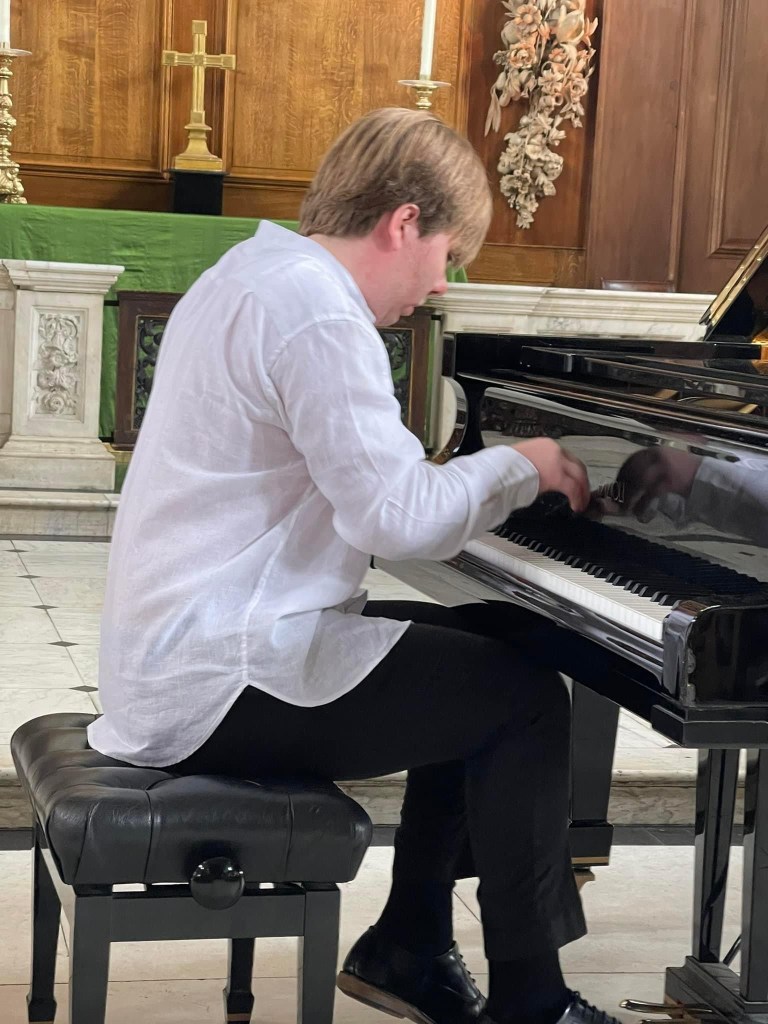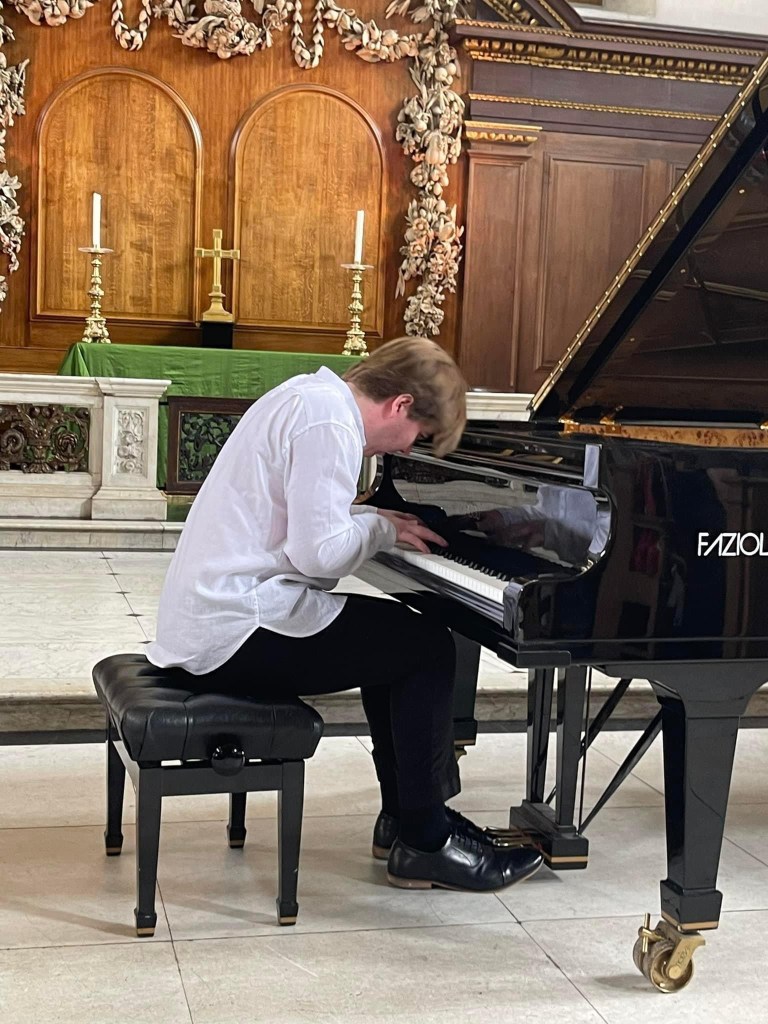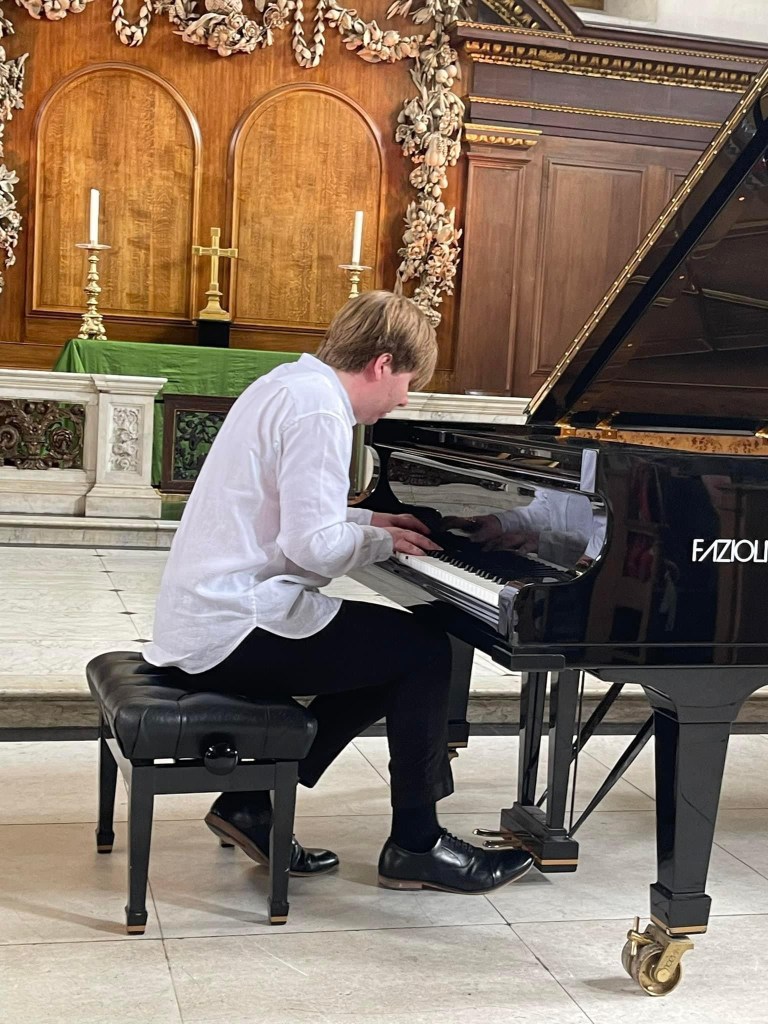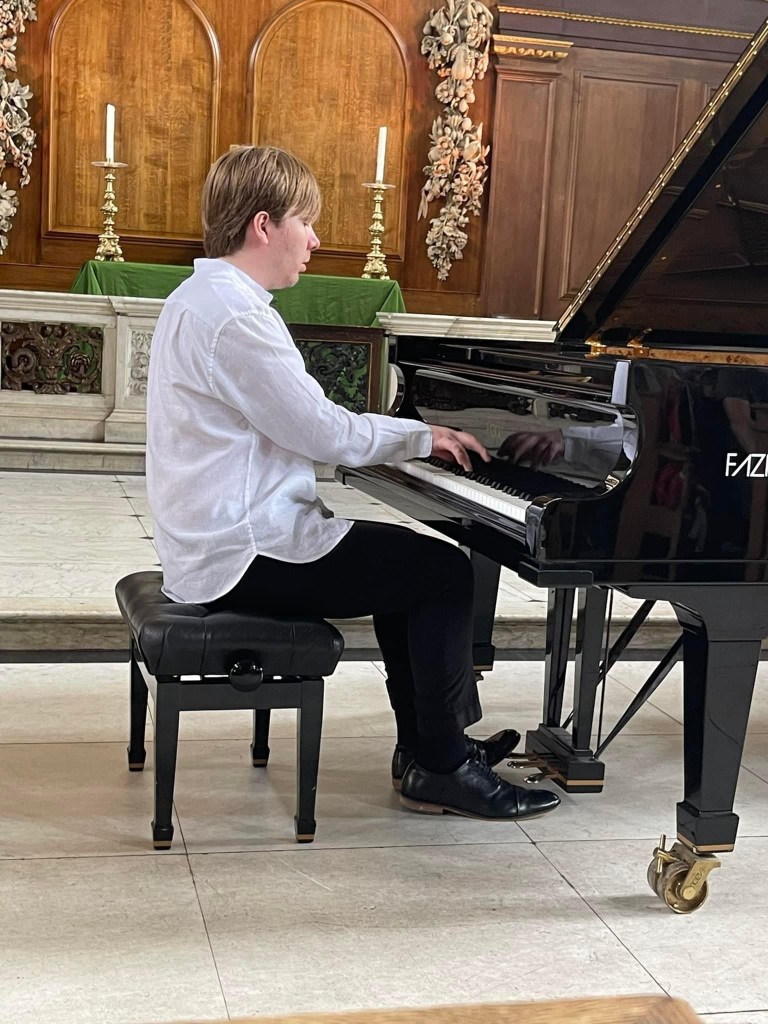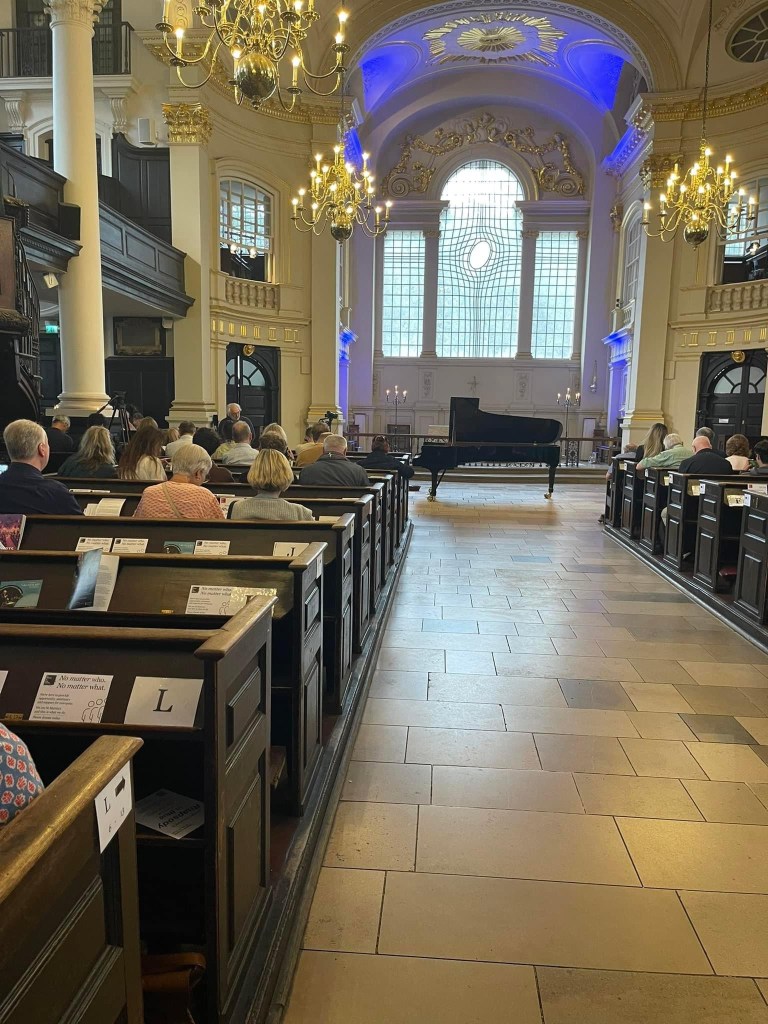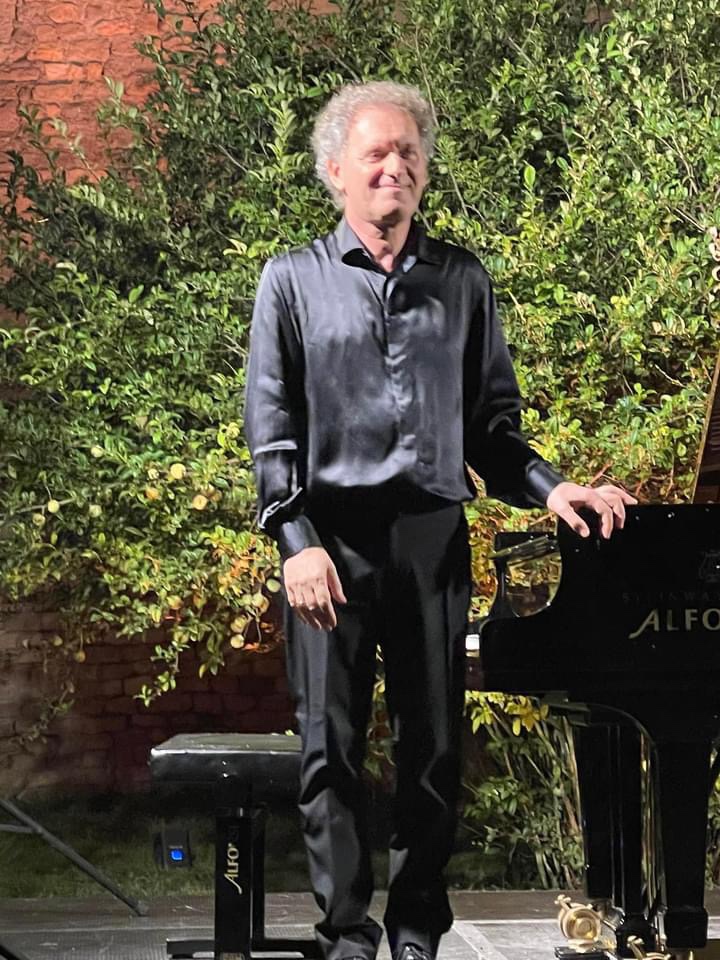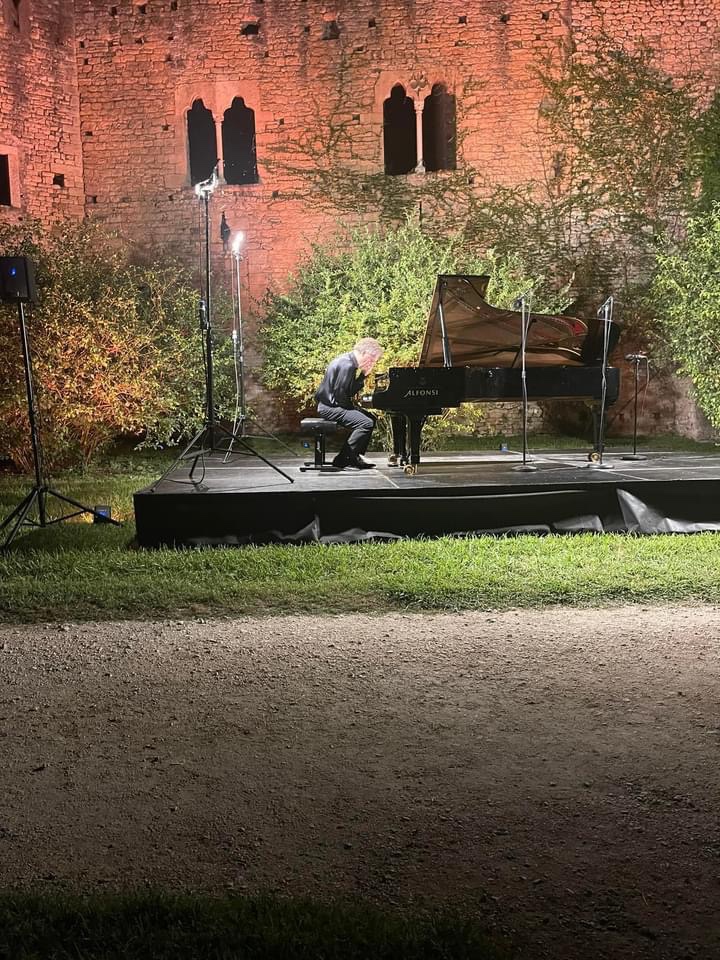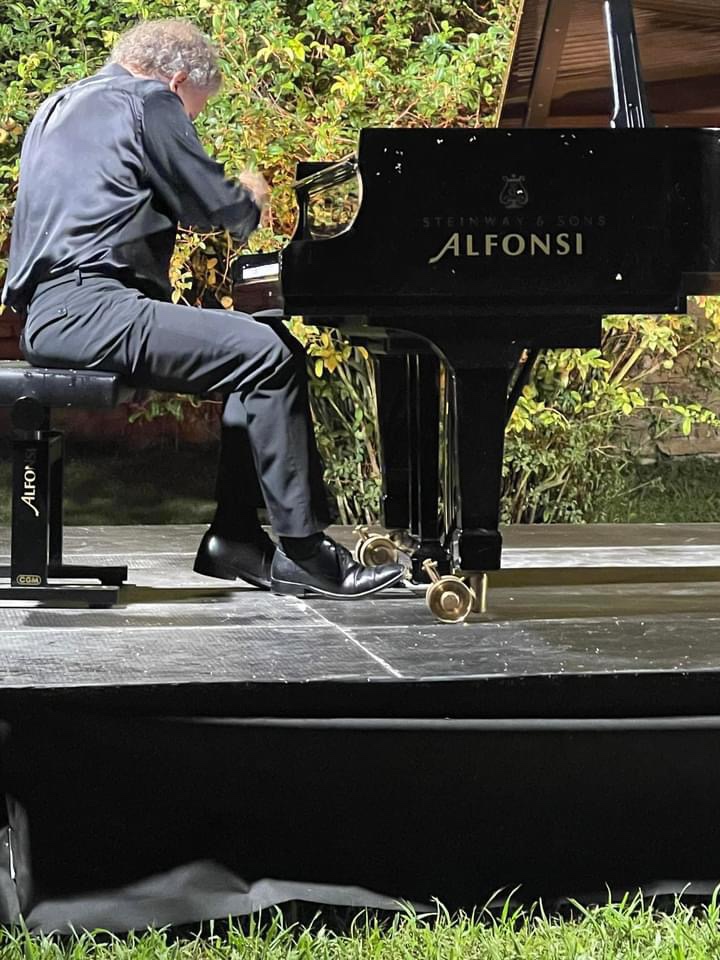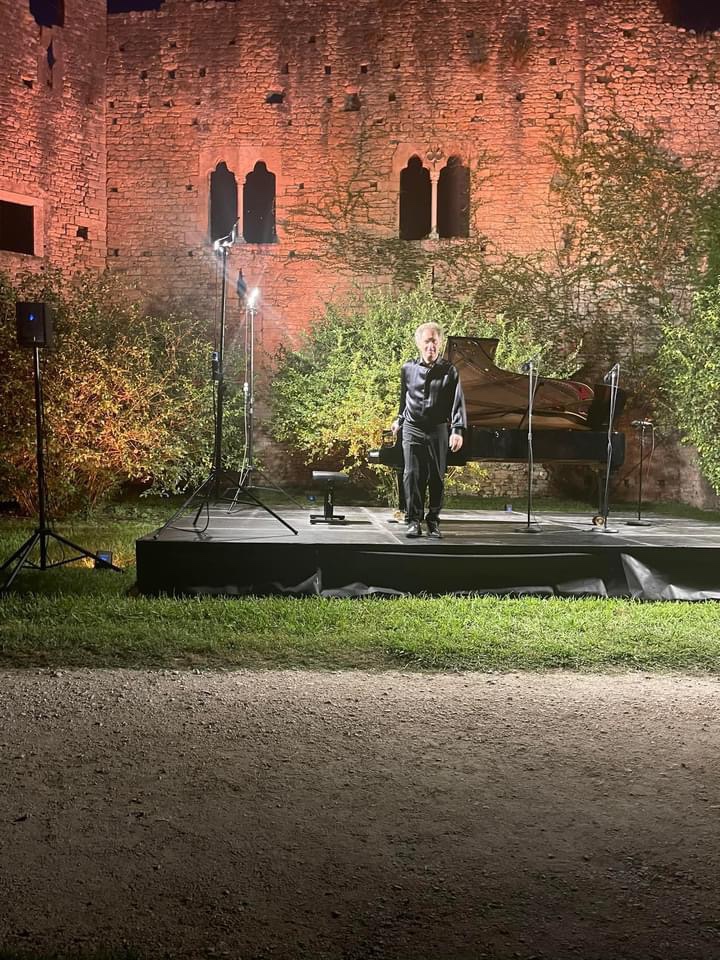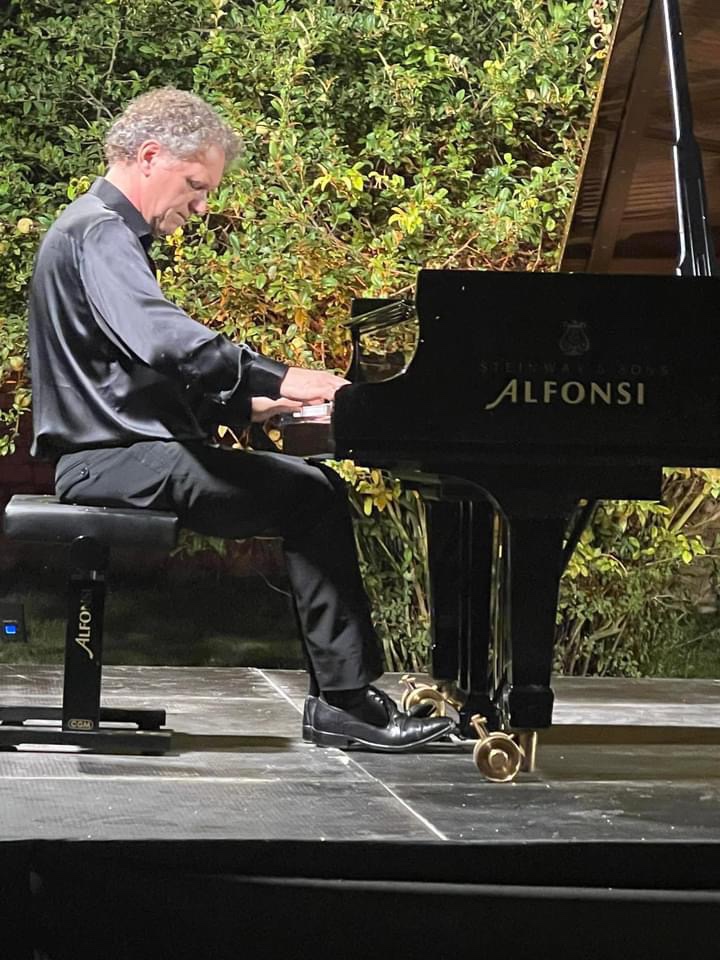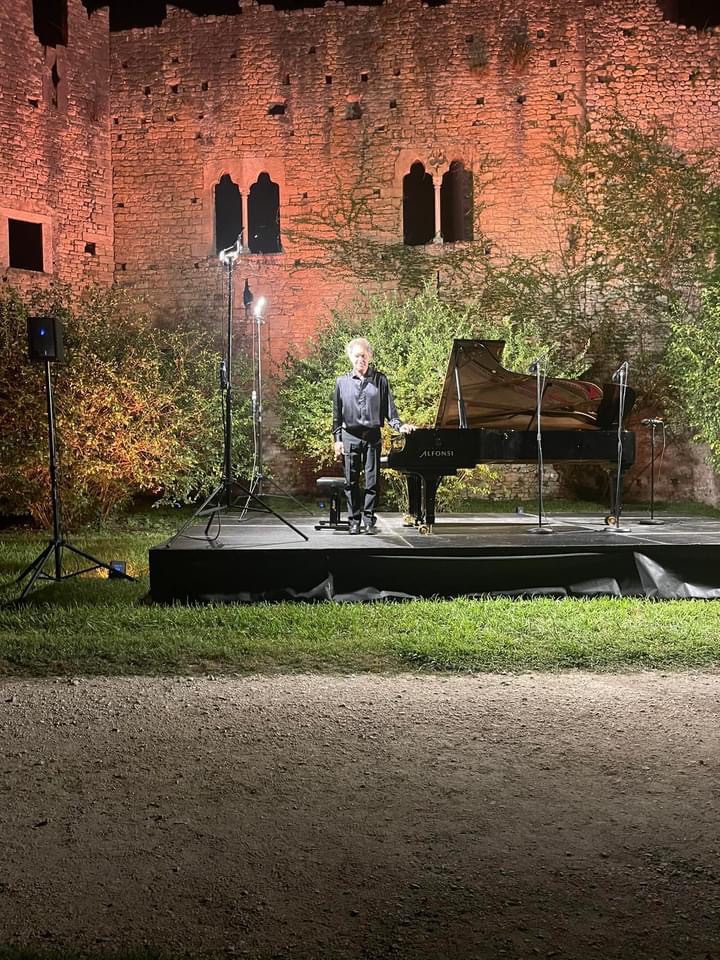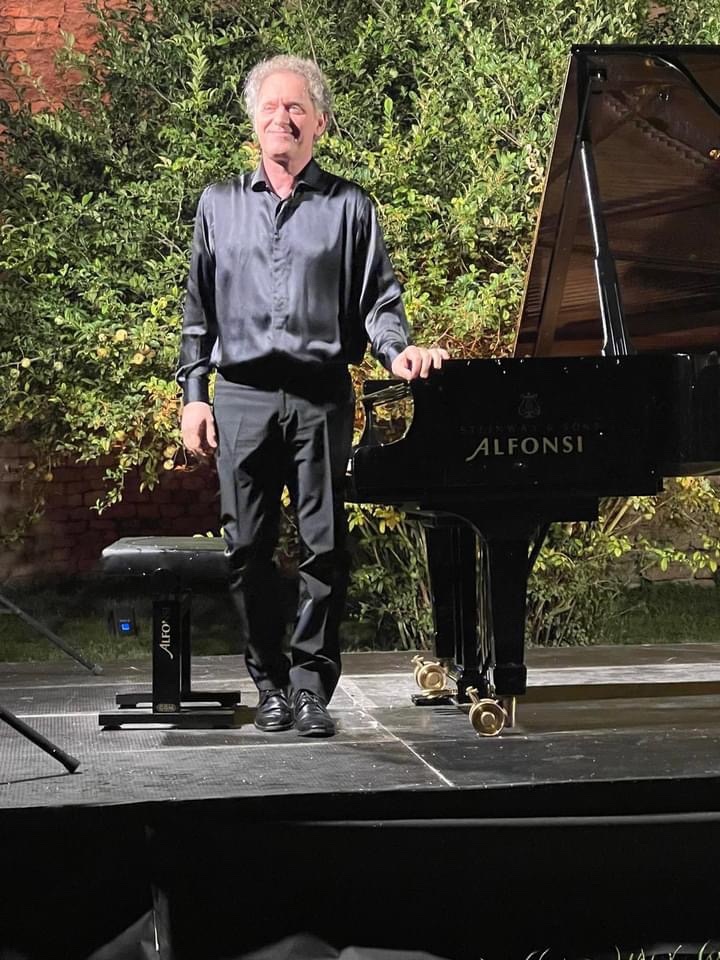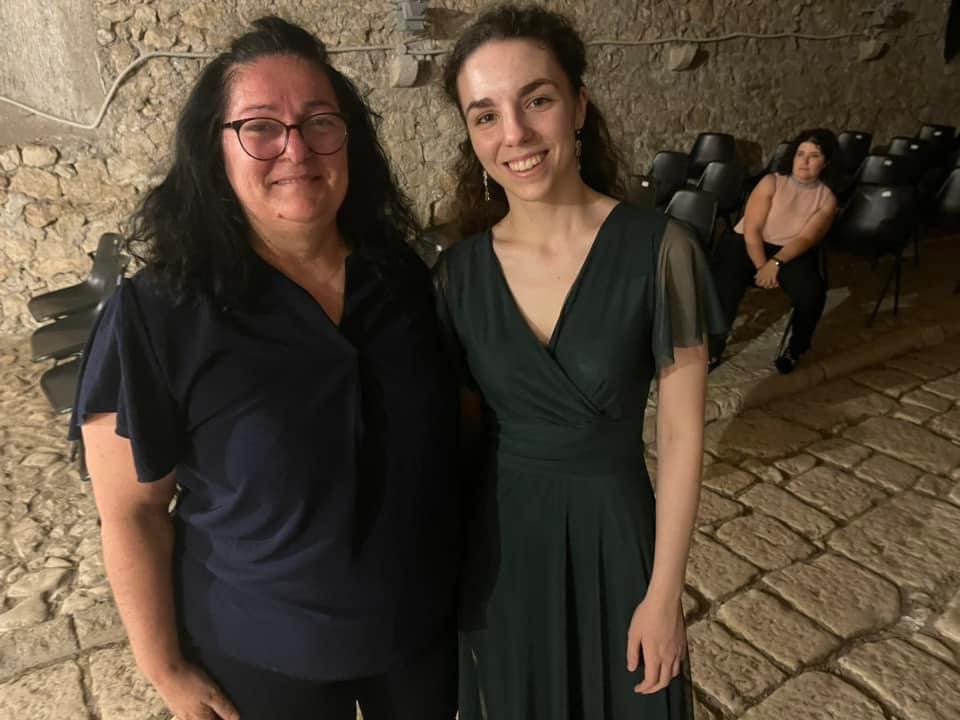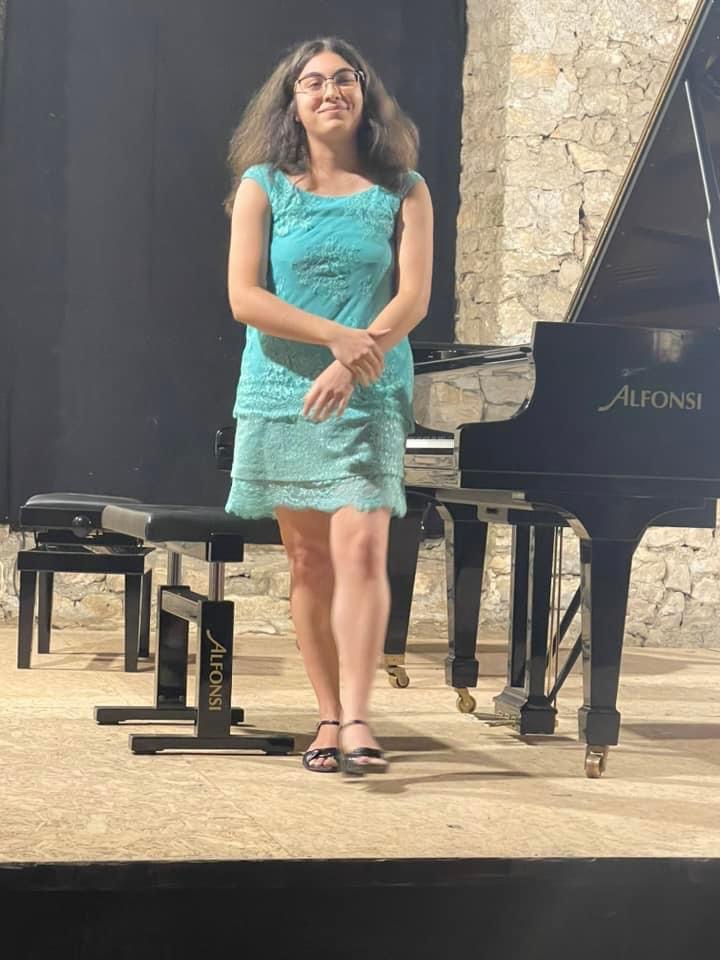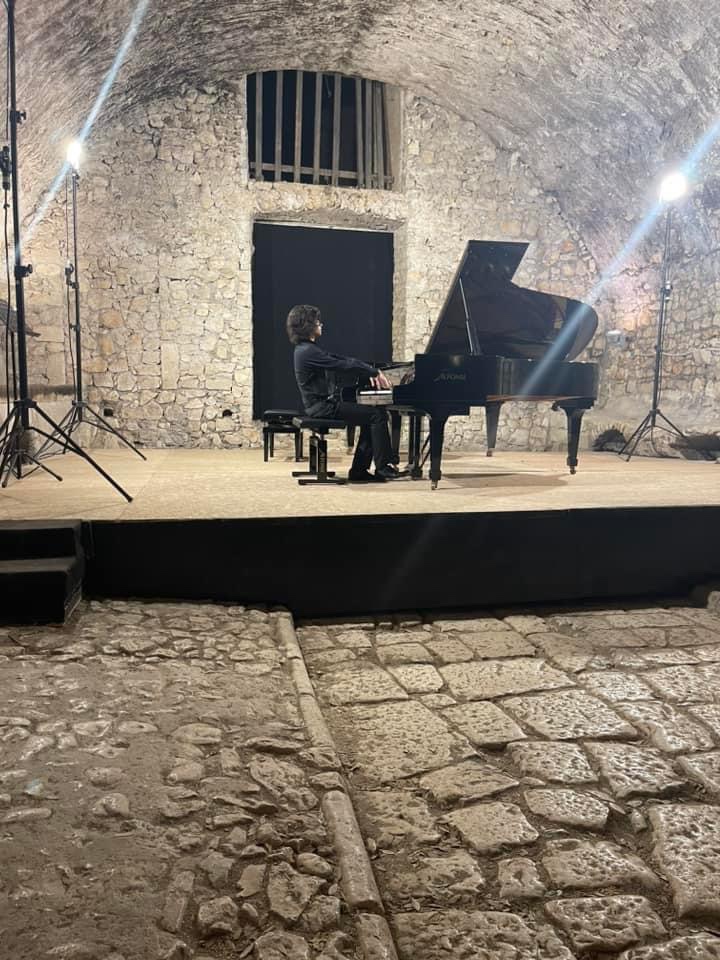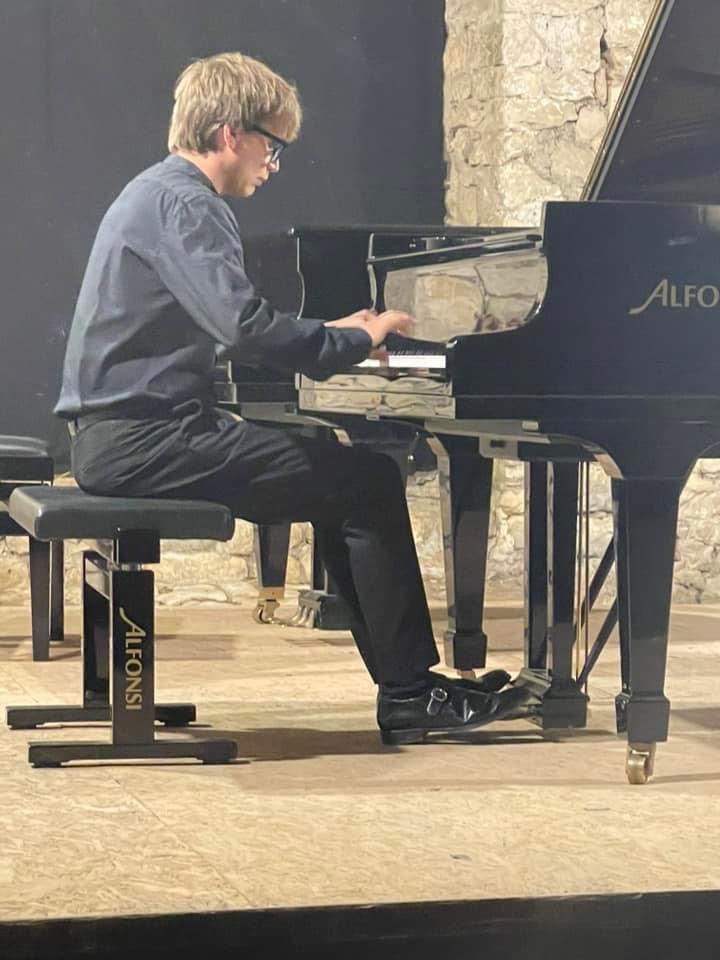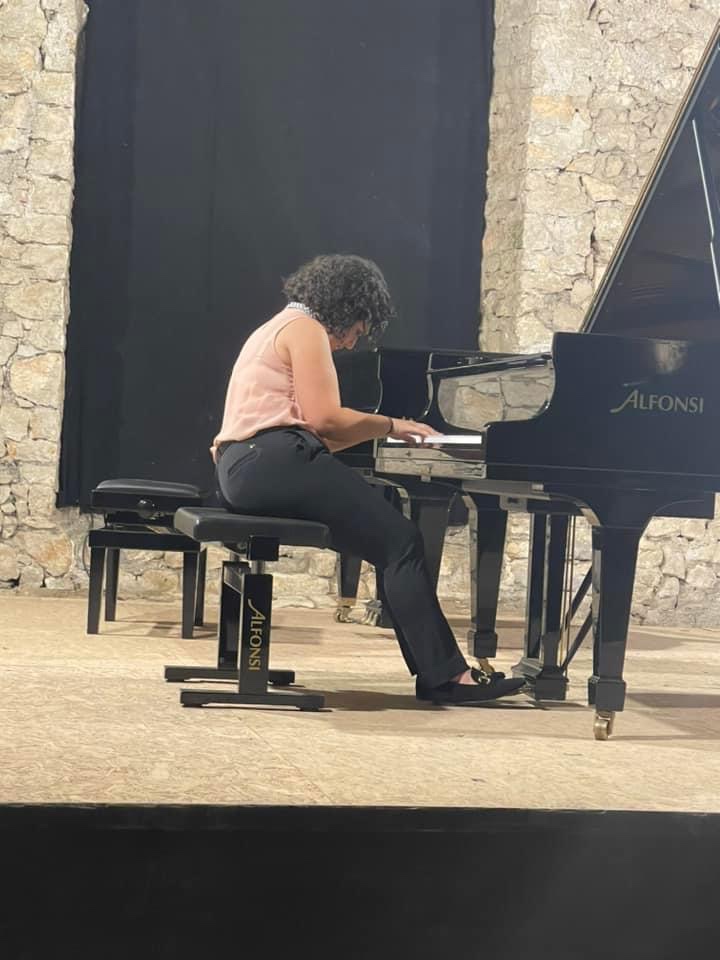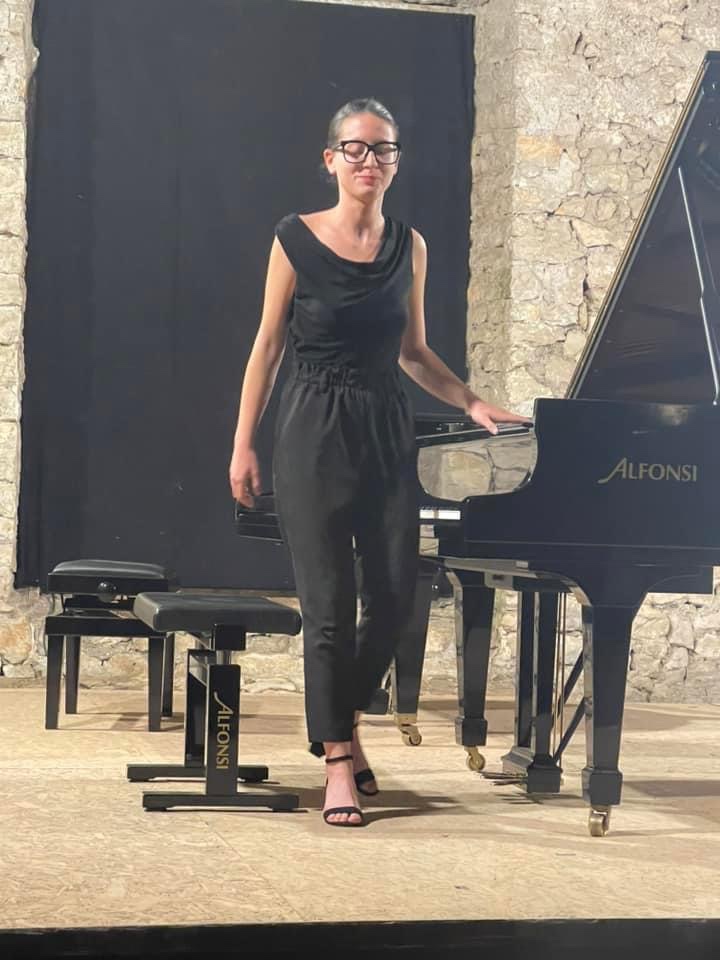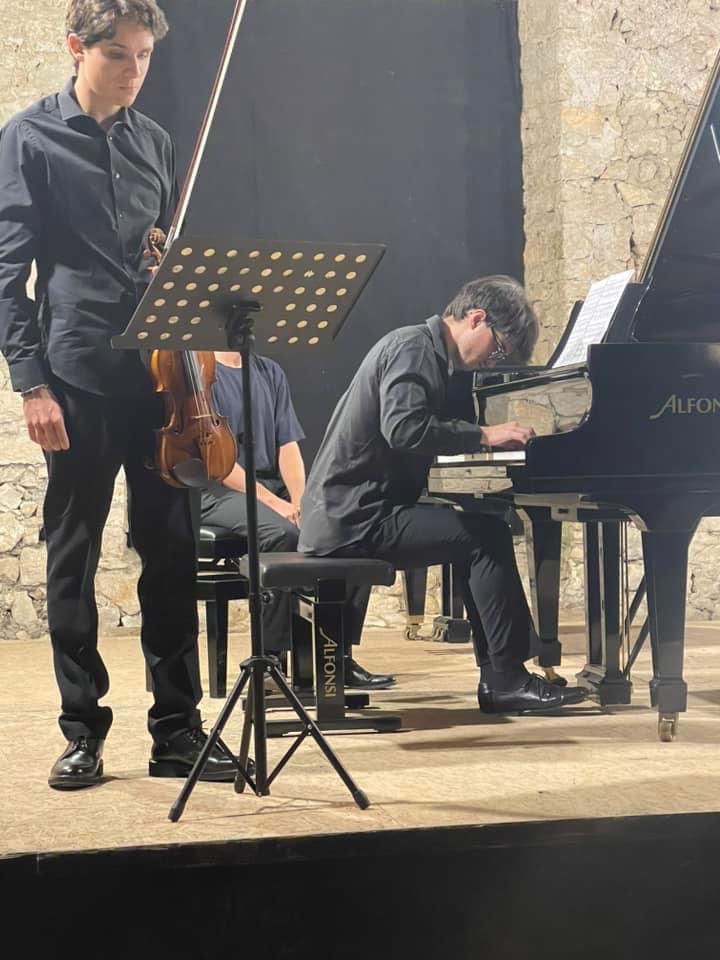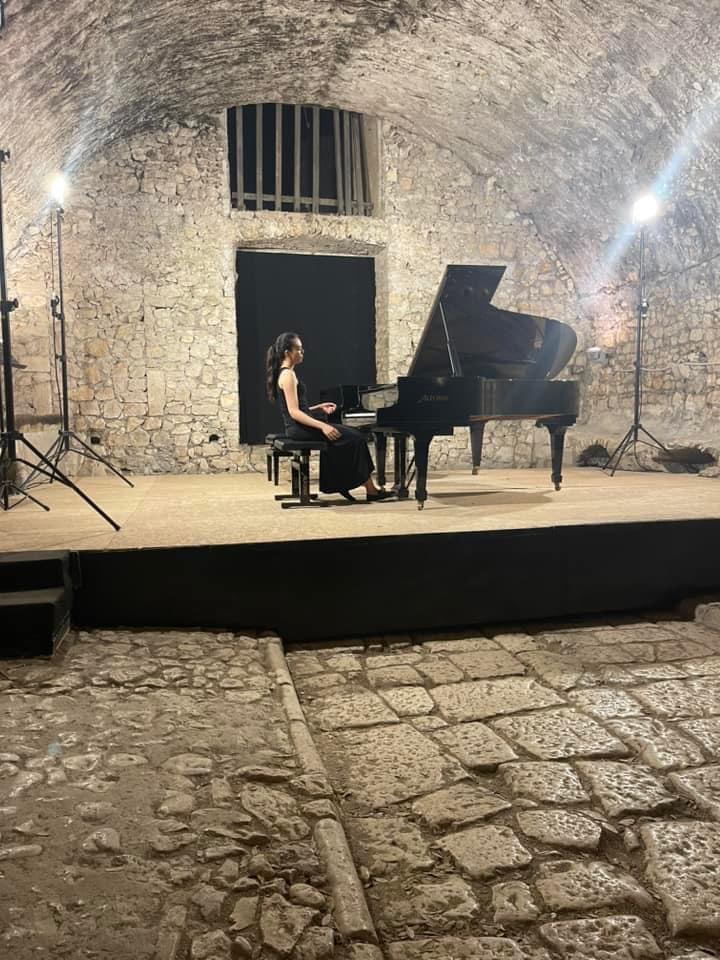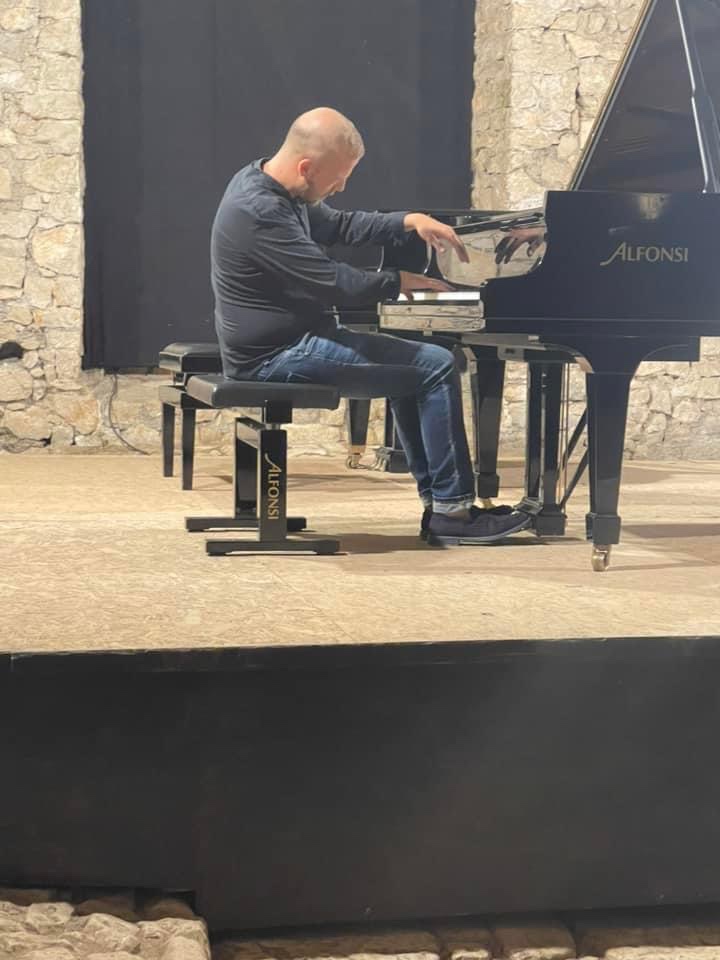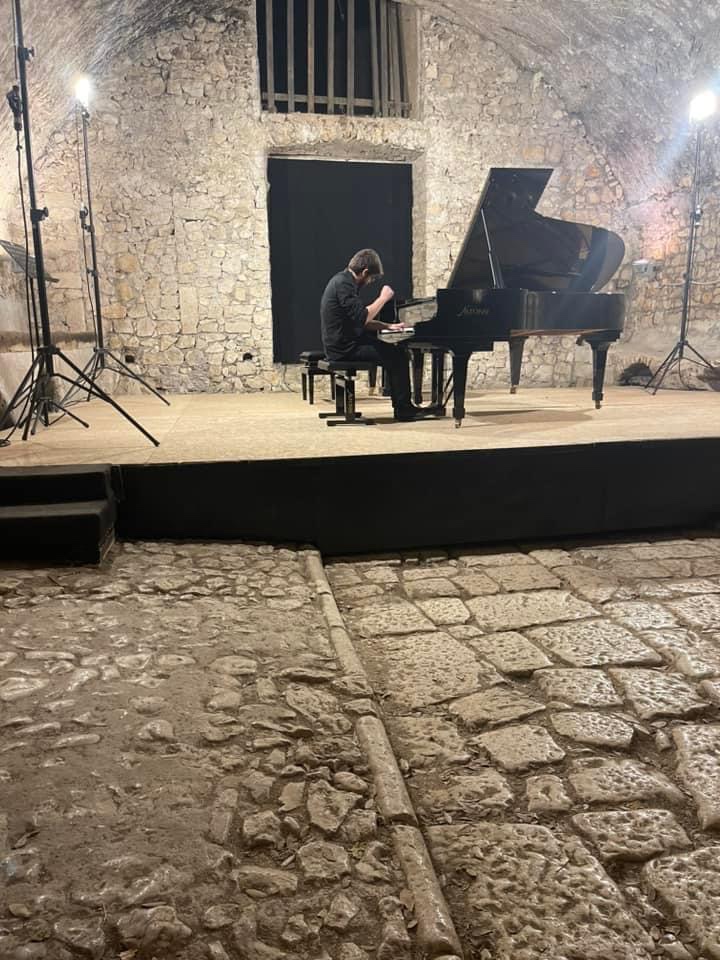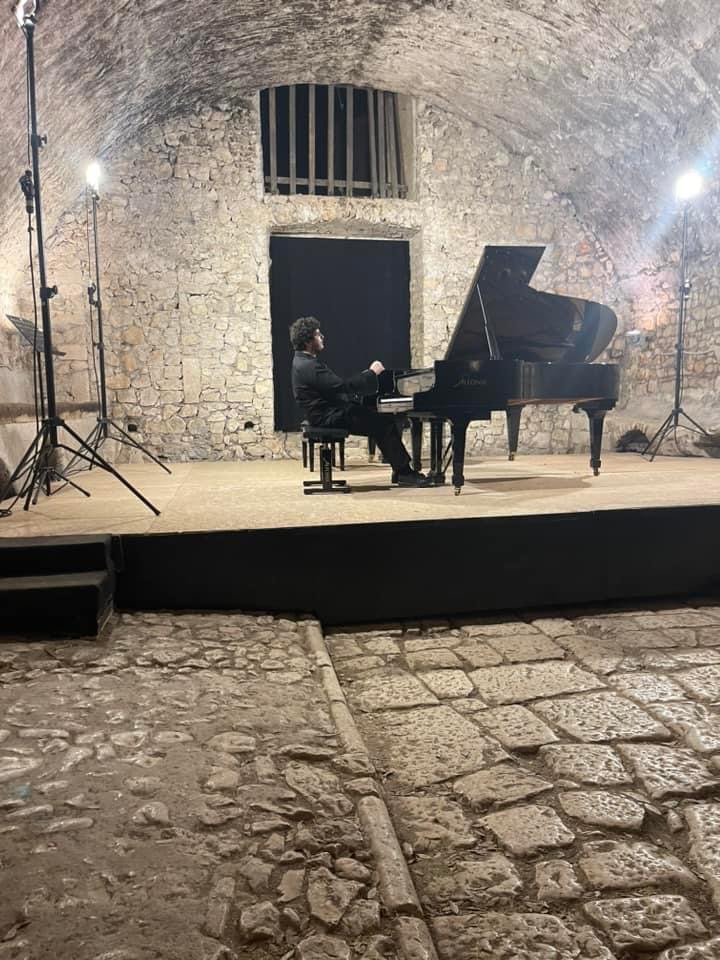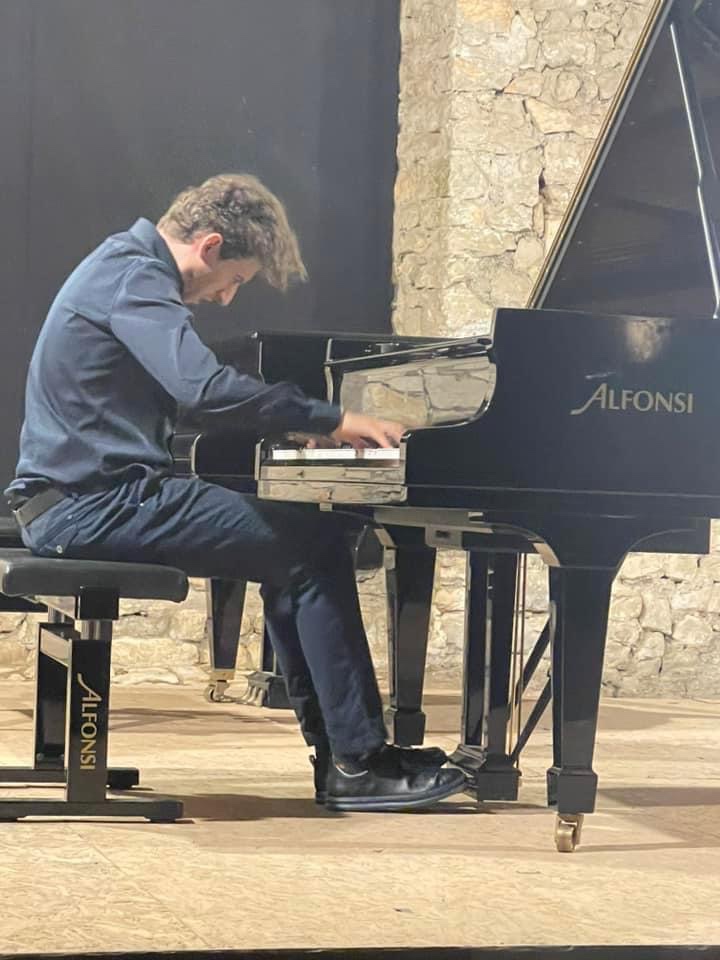
New Faces in Perivale Day 1

Saturday 11 March 2.00 pm – 6.00 pm  

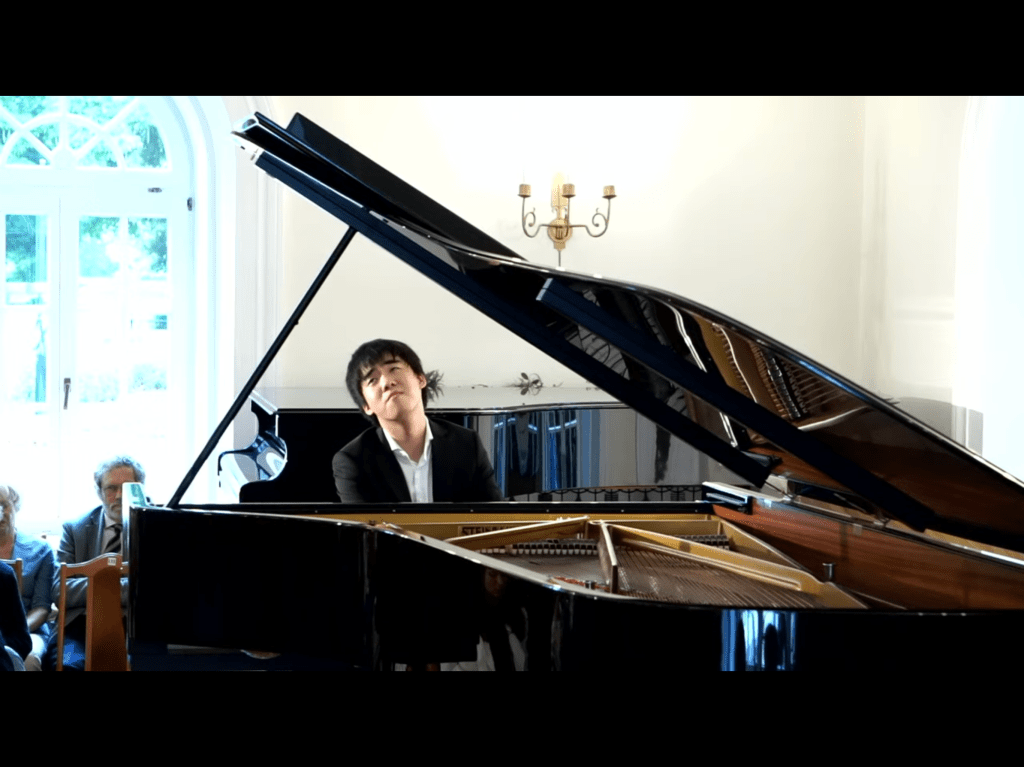
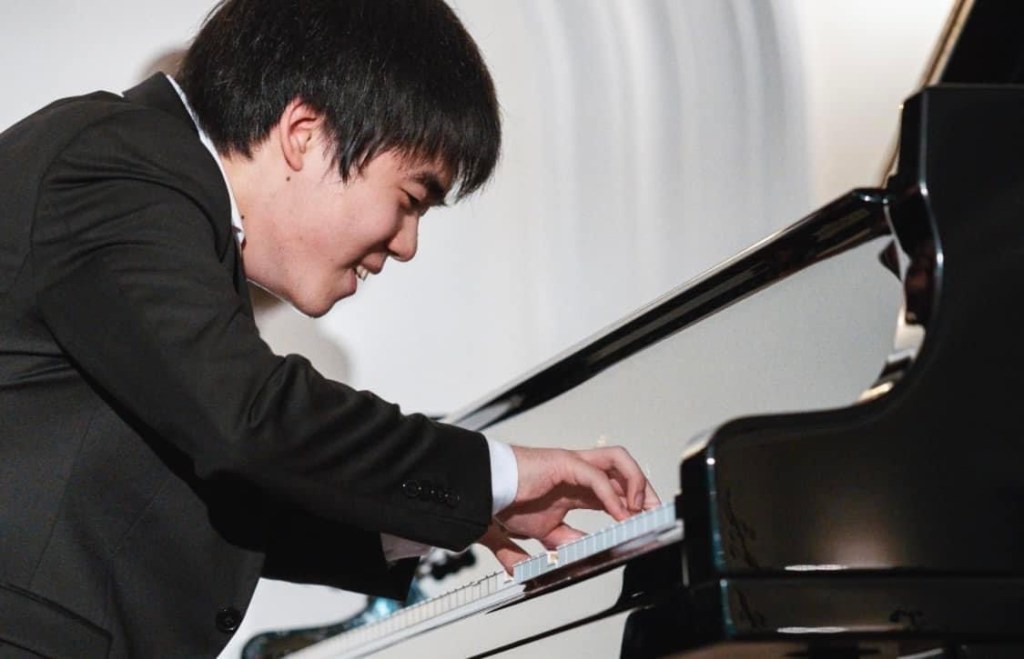
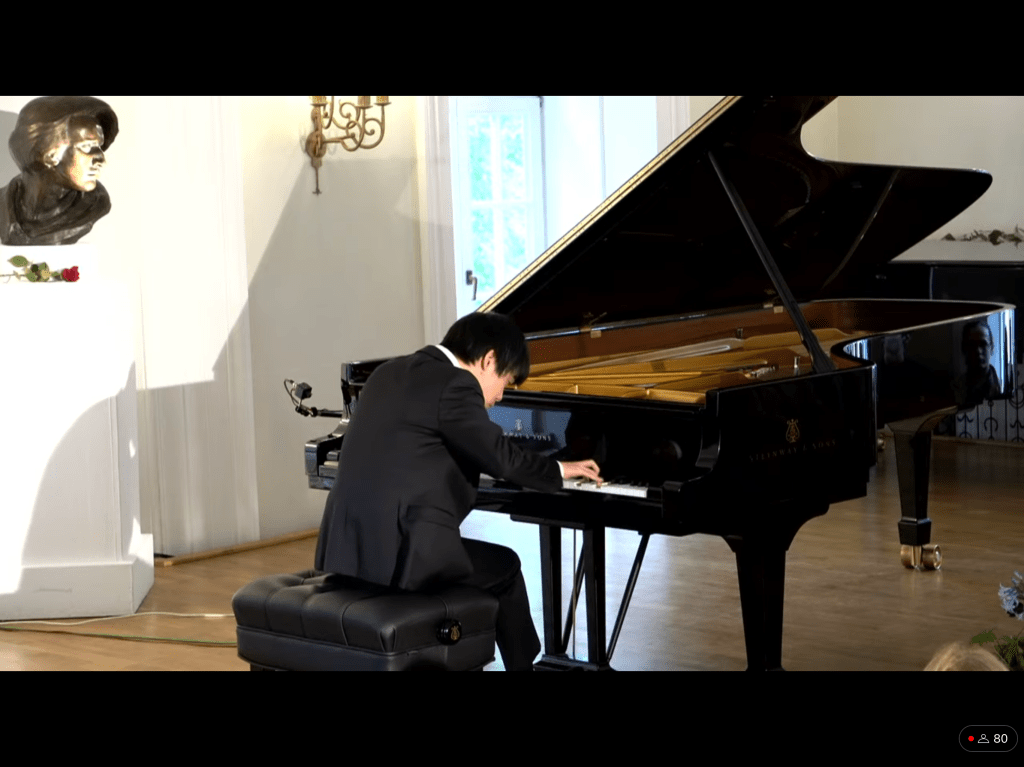
‘New Faces’ Piano Festival – Day 1

8 superb pianists play their debut recitals at St Mary’s Perivale
organized by St Mary’s Perivale and Christopher Axworthy

https://youtube.com/live/F0doBi0kG2Y?feature=share

https://youtube.com/live/qs4v_4f97Nw?feature=share

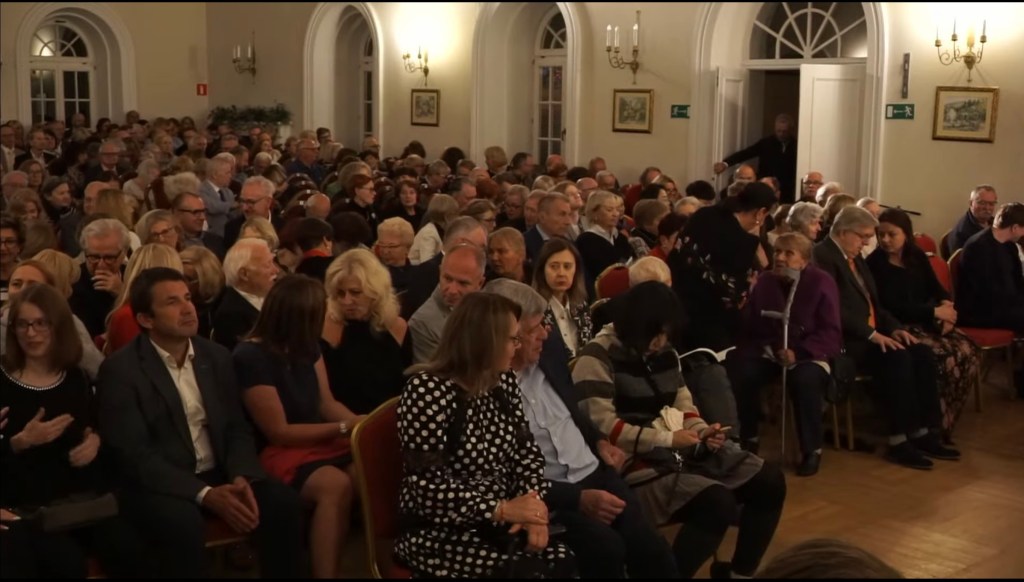
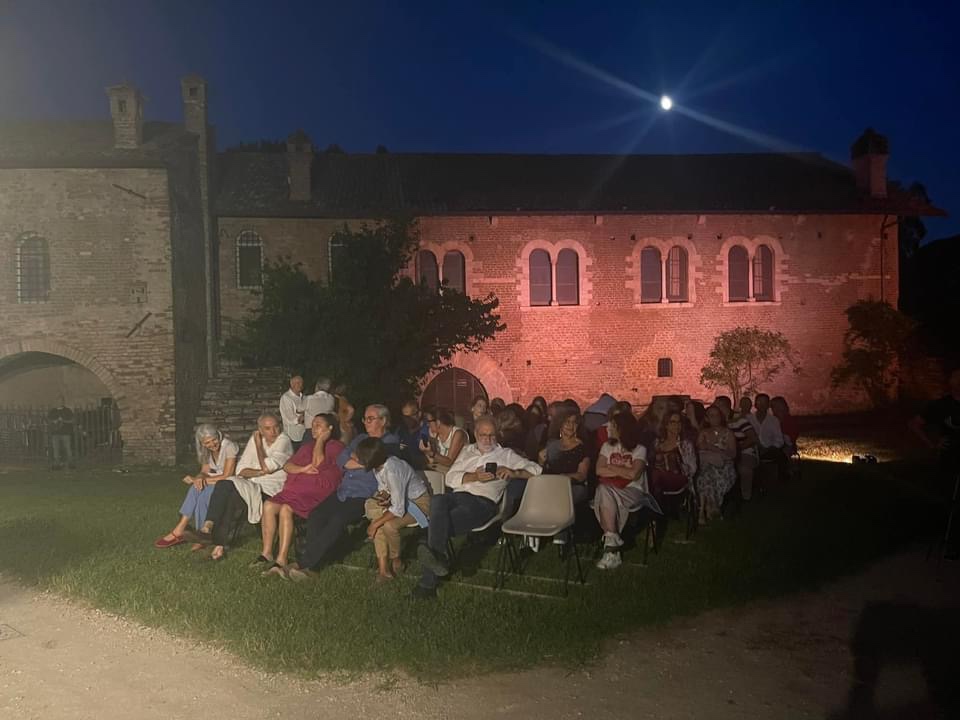
Eight star pianists in a unique showcase festival at the Piano Mecca of London …..all streamed live on you tube or Vimeo ……they just need an audience of discerning listeners – the rest they will do themselves with their extraordinary artistry and with a little technical help from the magnificent team led by Hugh Mather.

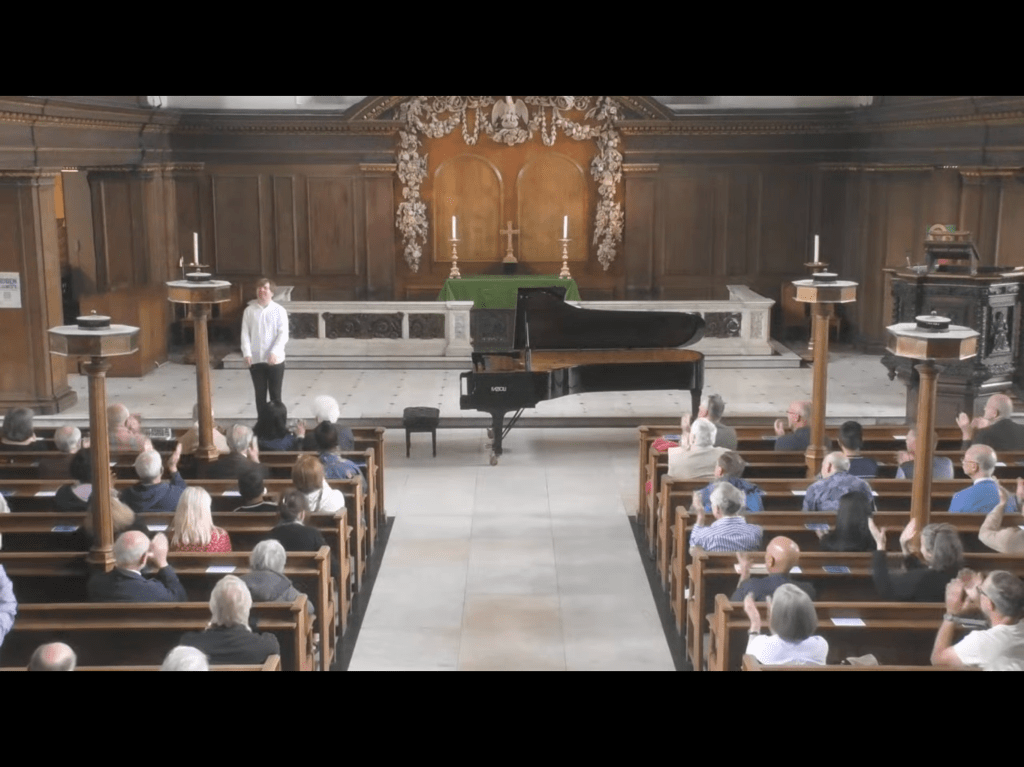
Day one saw four pianists two of whom are new to me but none have ever played at St Mary’s before.Four very interesting recitals with completely different programmes with remarkably no overlapping of works.The interesting thing was the fact that although it is the same piano they are playing they all got completely different sounds from it.Of course all four pianists have a technical mastery earned by years of hard work and discipline under expert guidance.But there are many different sounds in each key and it is personal taste that decides what sound to draw out of each key.A taste acquired by listening to many performances of music of all types and choosing a path from listening to performances that one does not agree with as well as those that are cherished .A musical character is formed and in the practice studio hours are spent trying to piece together a jigsaw puzzle that is an accumulation of personal taste.Rubinstein likened it to the bees pollinating flowers that they choose ,every bee chooses differently and so each pot of honey is different from another.A simple analogy from a pianist who at the end of his long life had found the sublime simplicity that had the world at his feet.

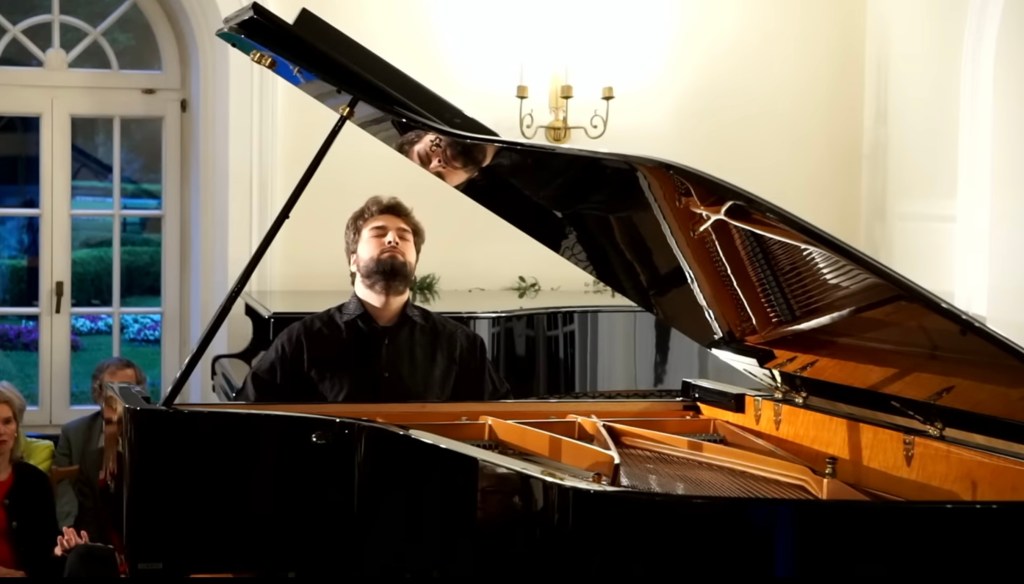
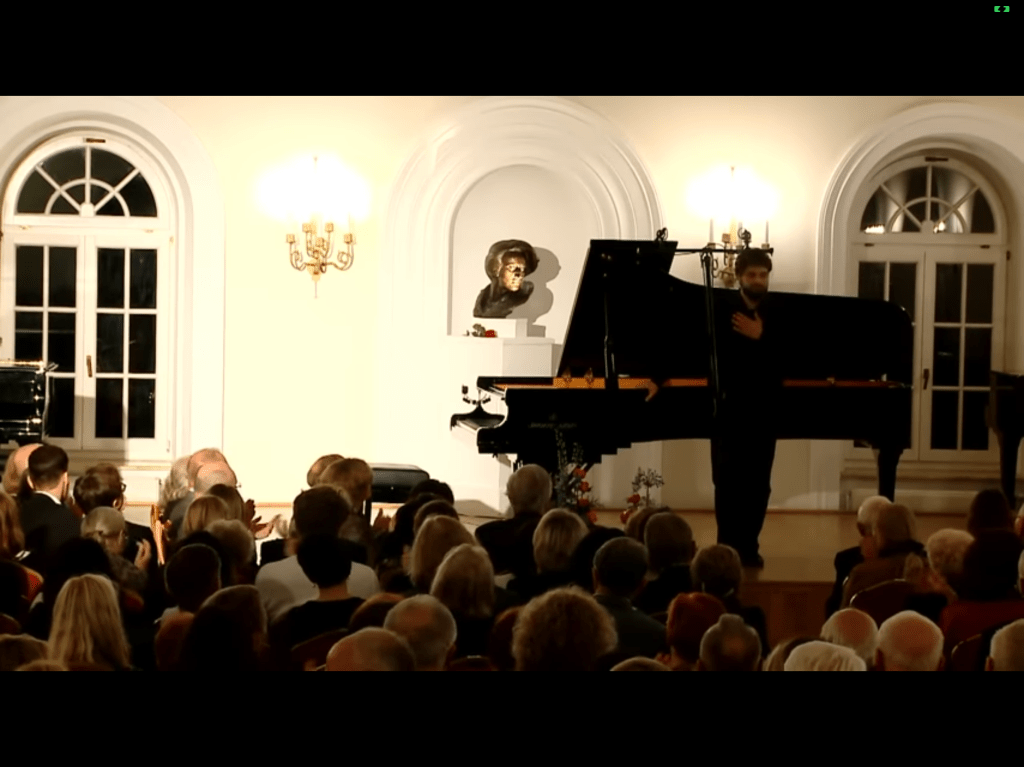
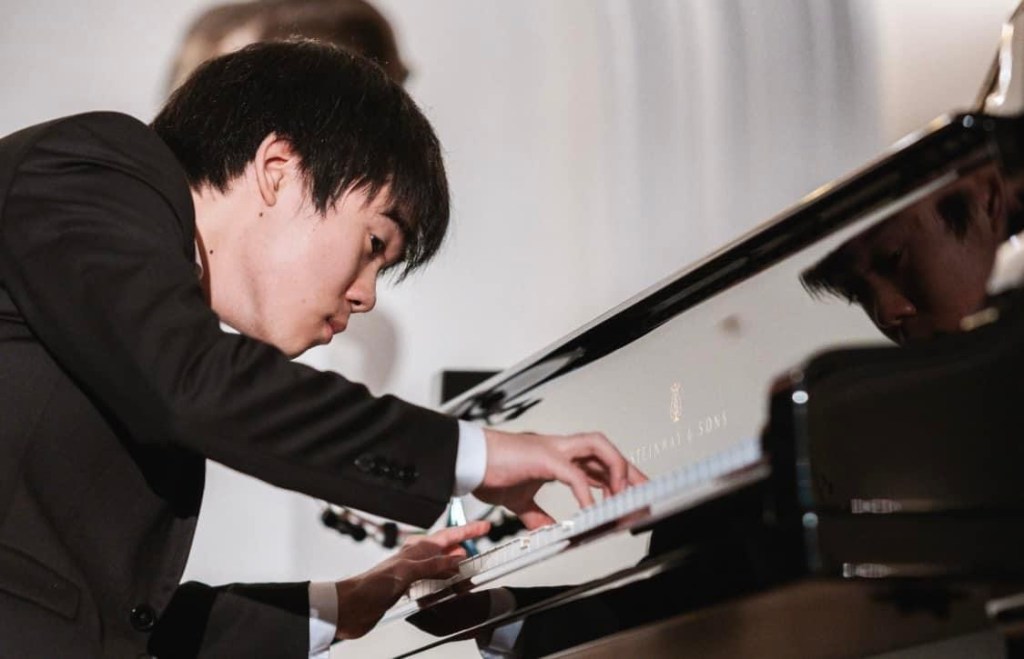
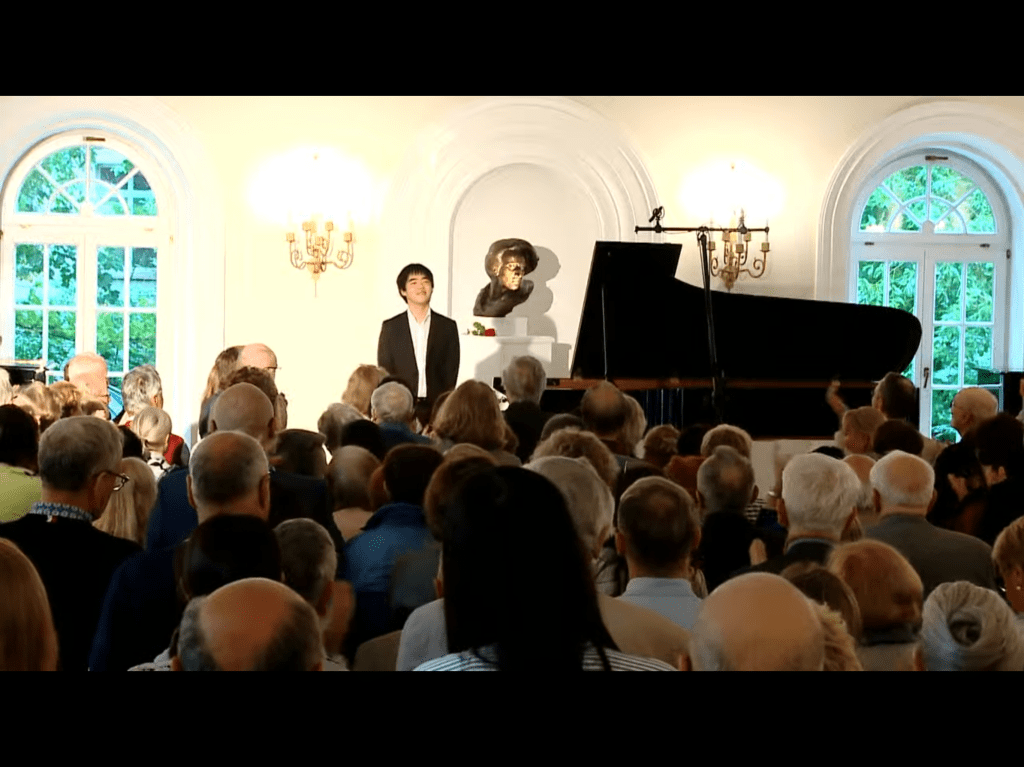
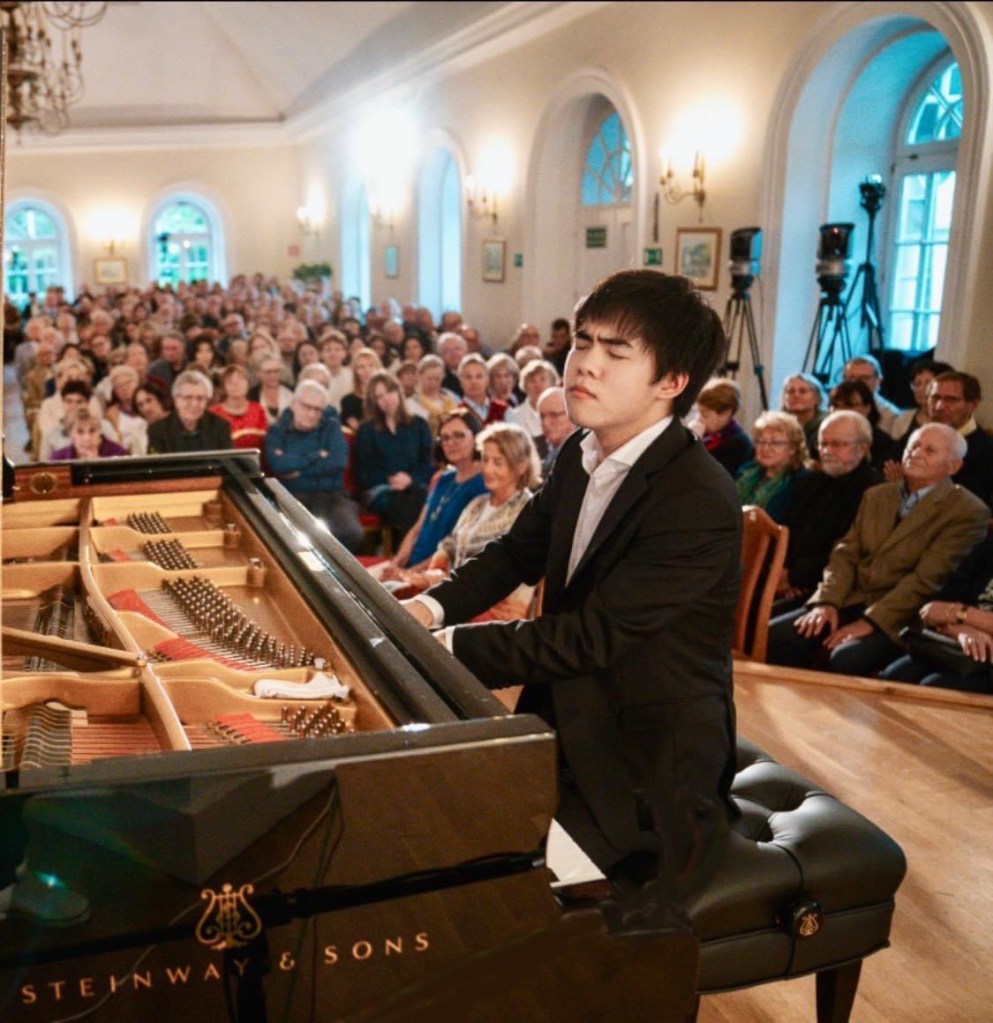
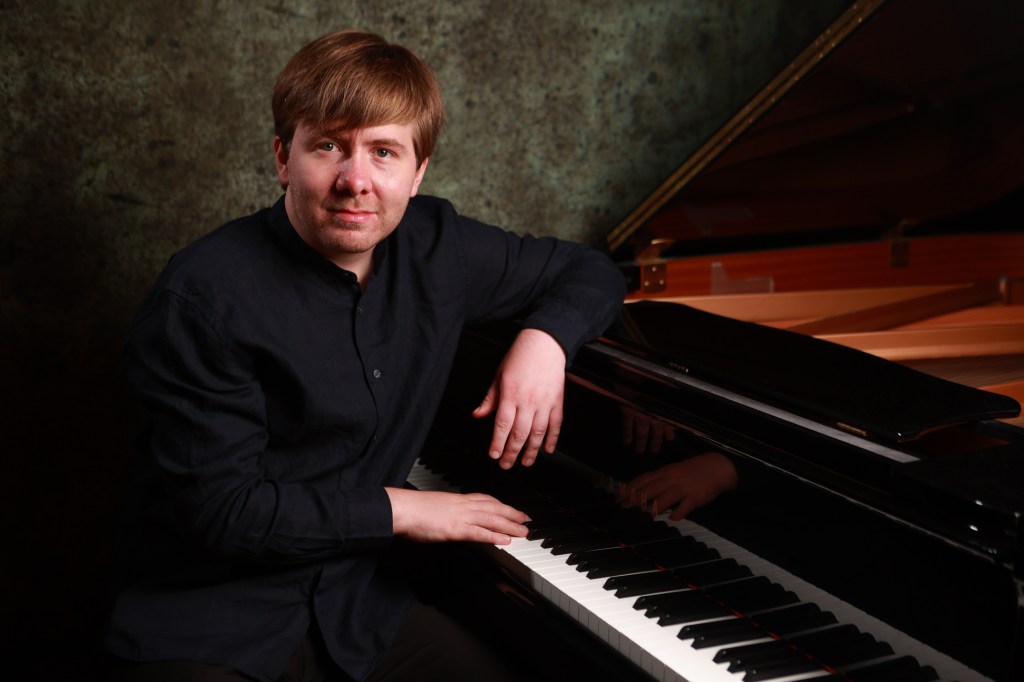
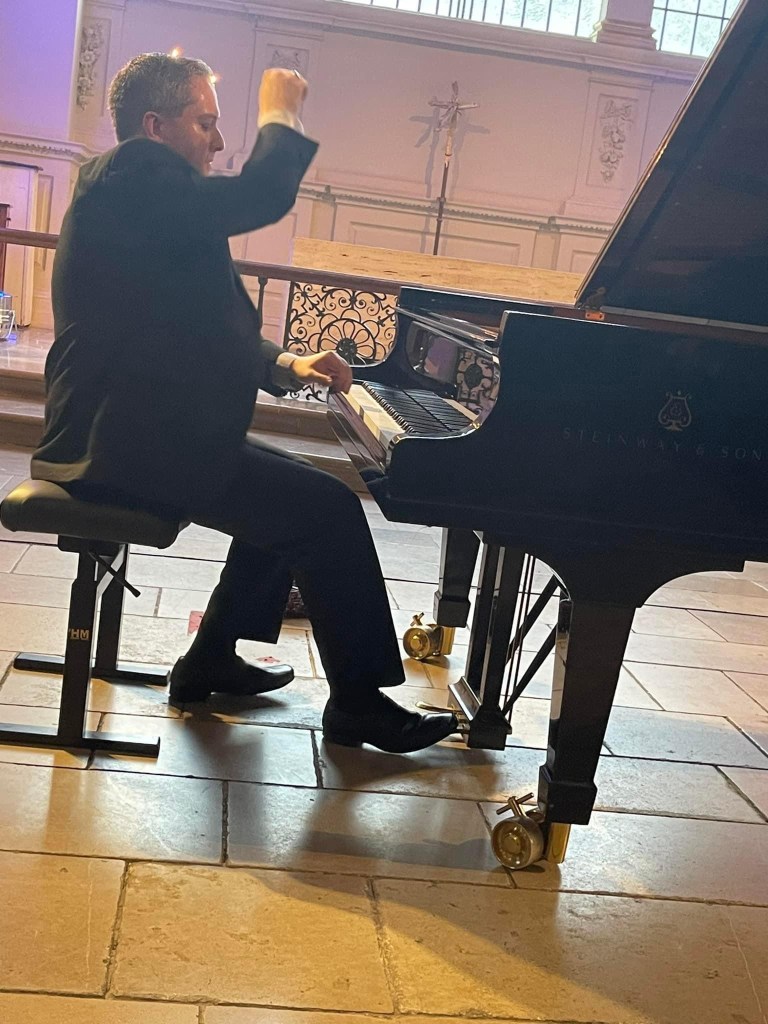
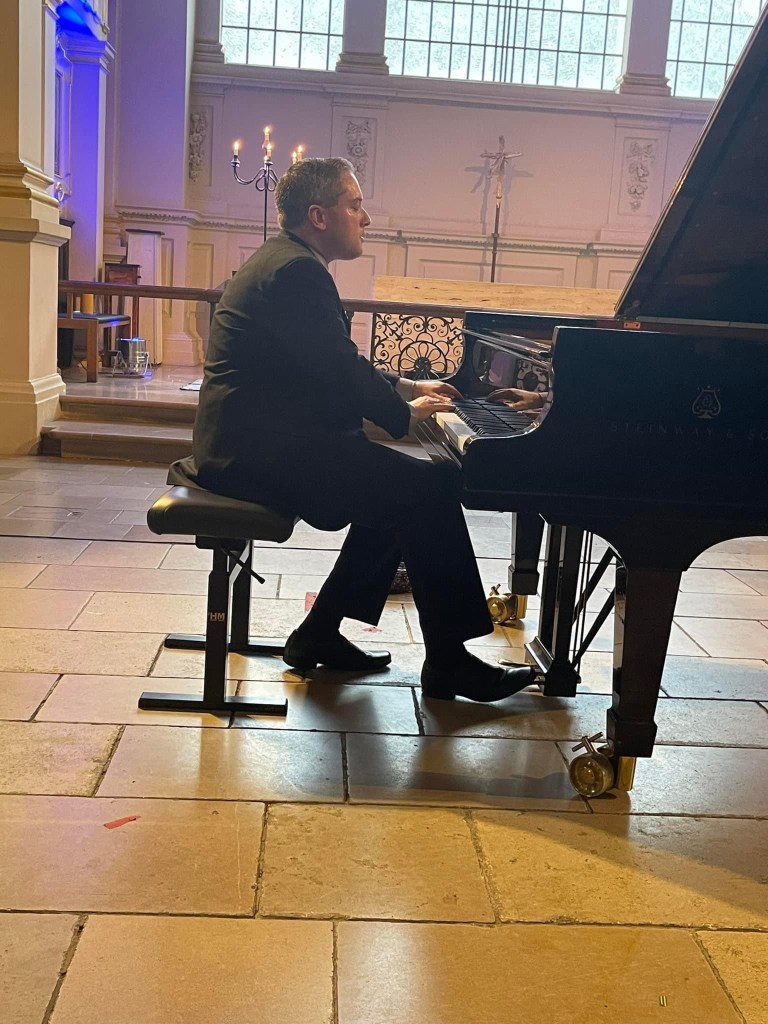
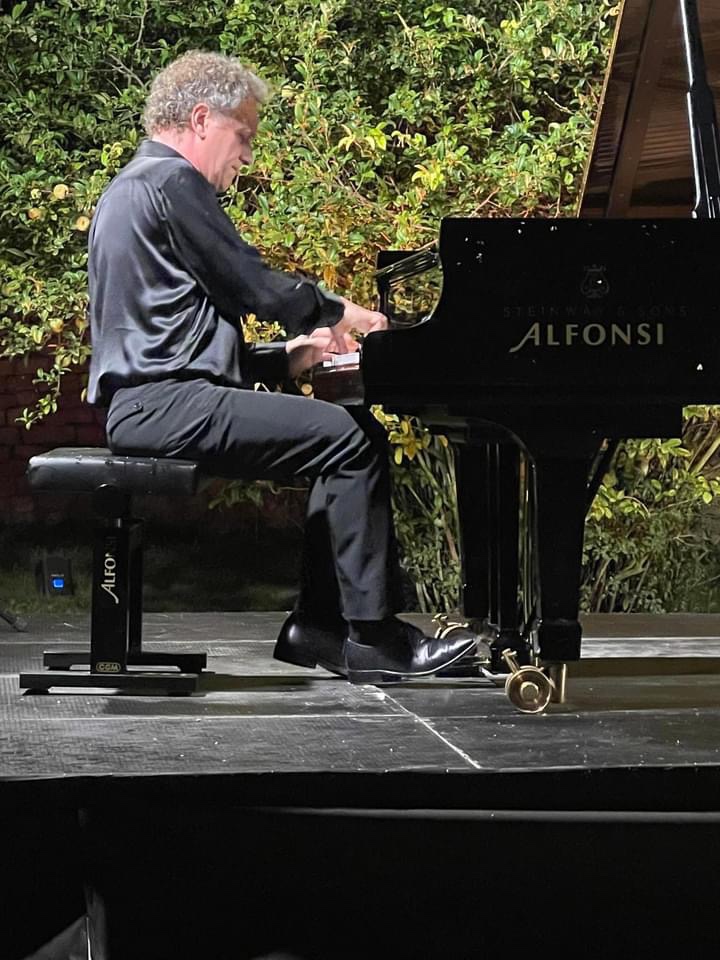
2.0 pm Henry Cash

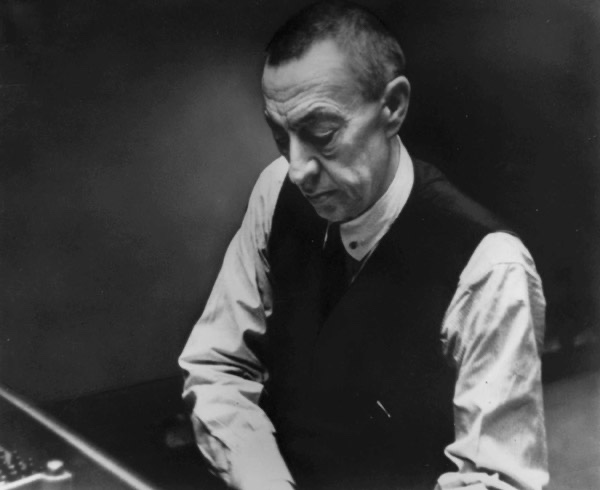
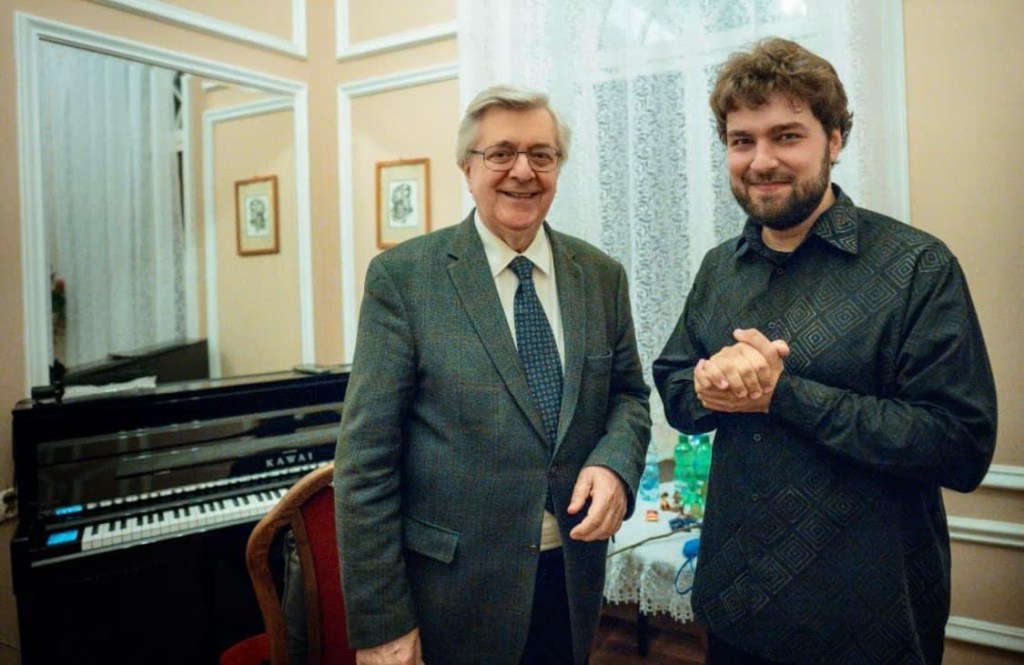
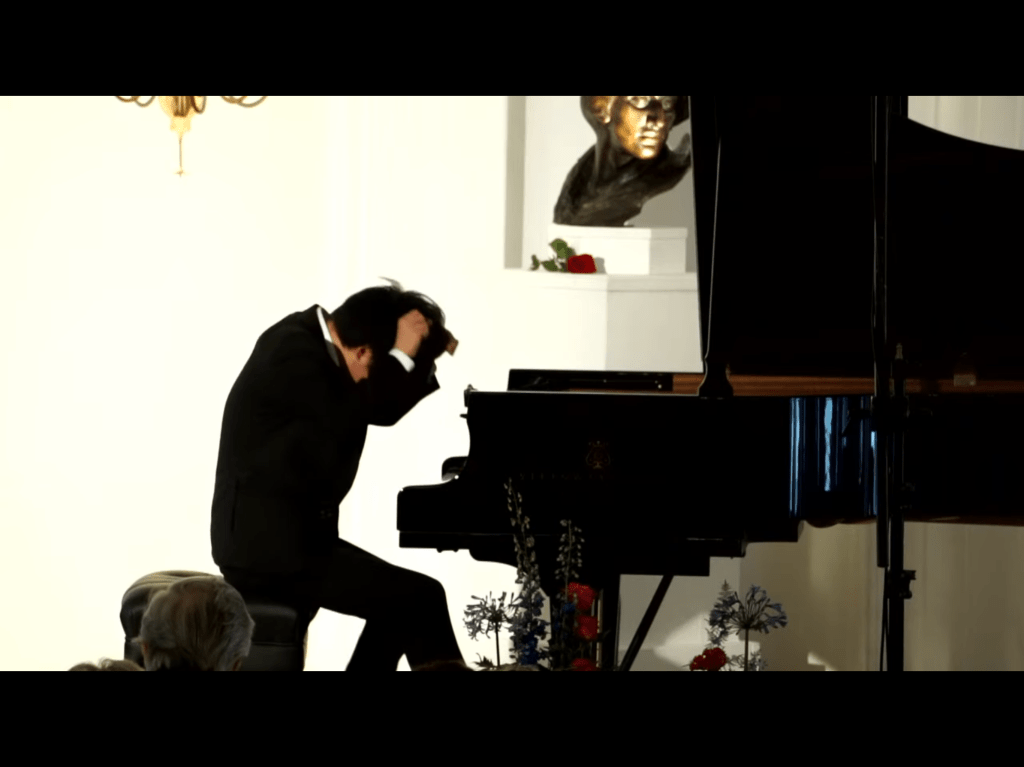
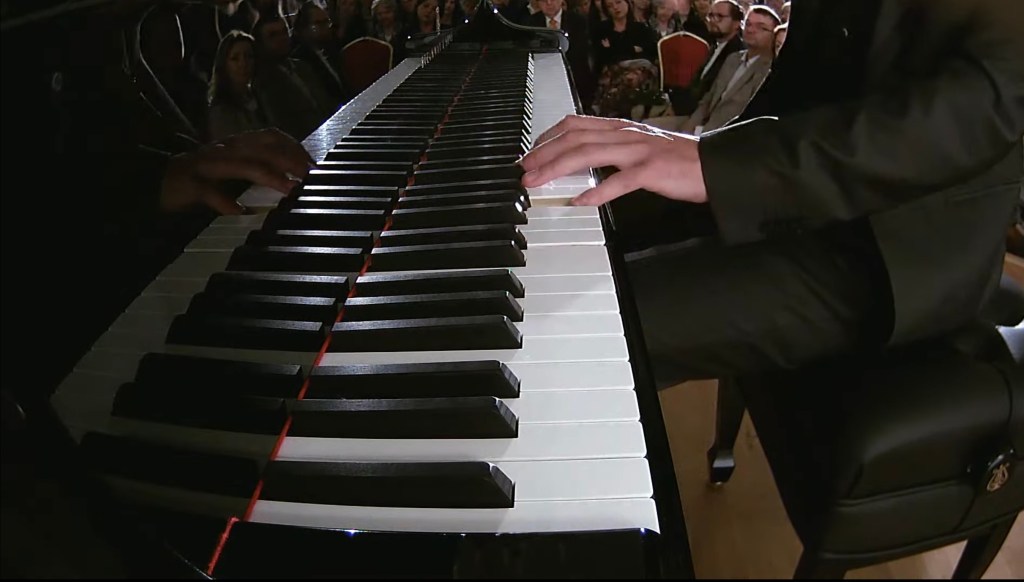
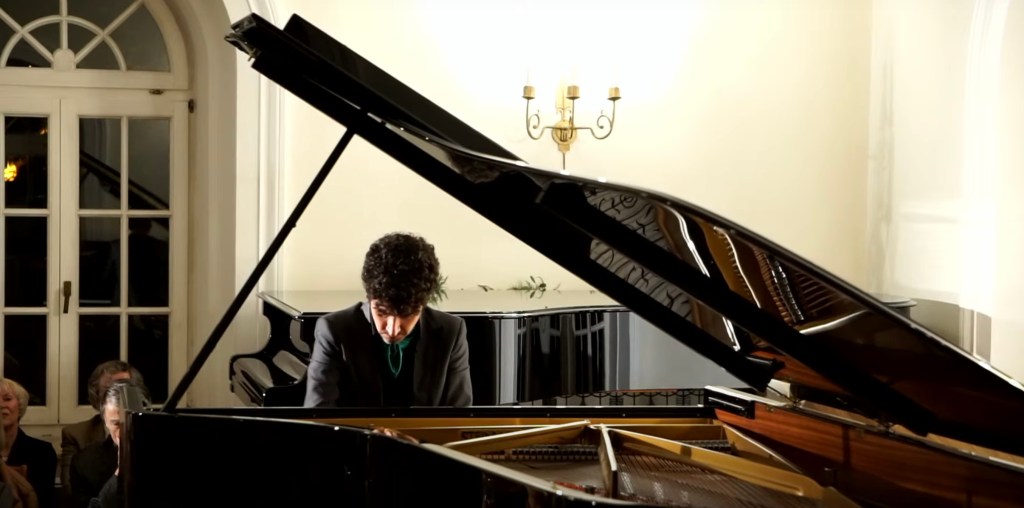
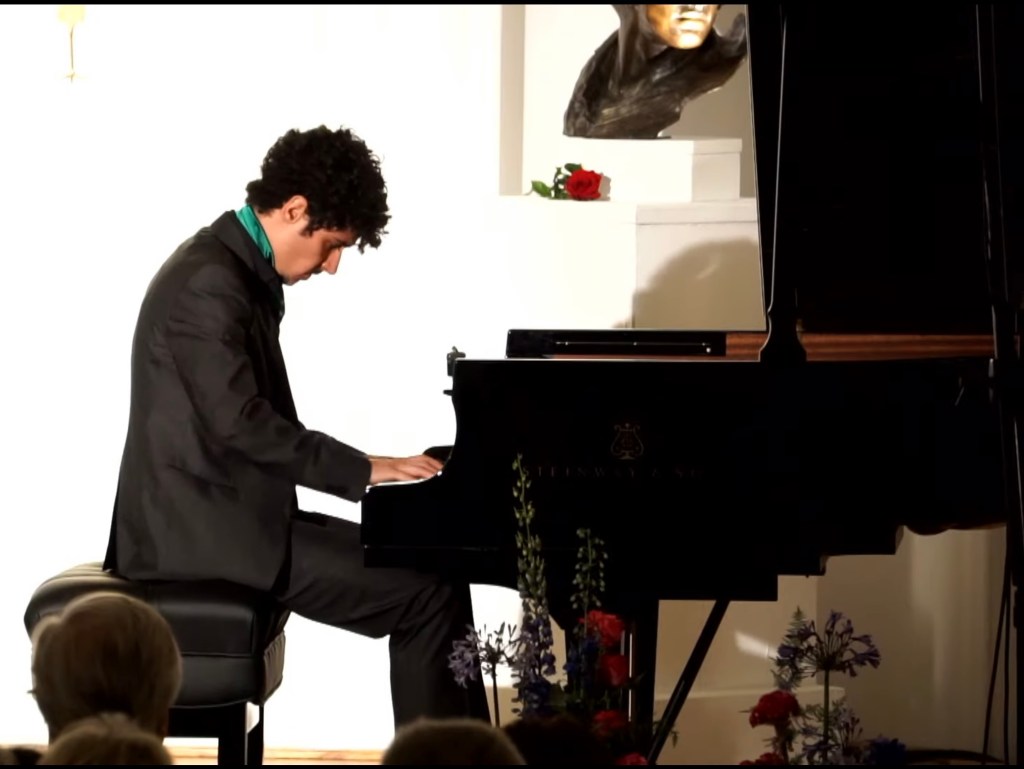
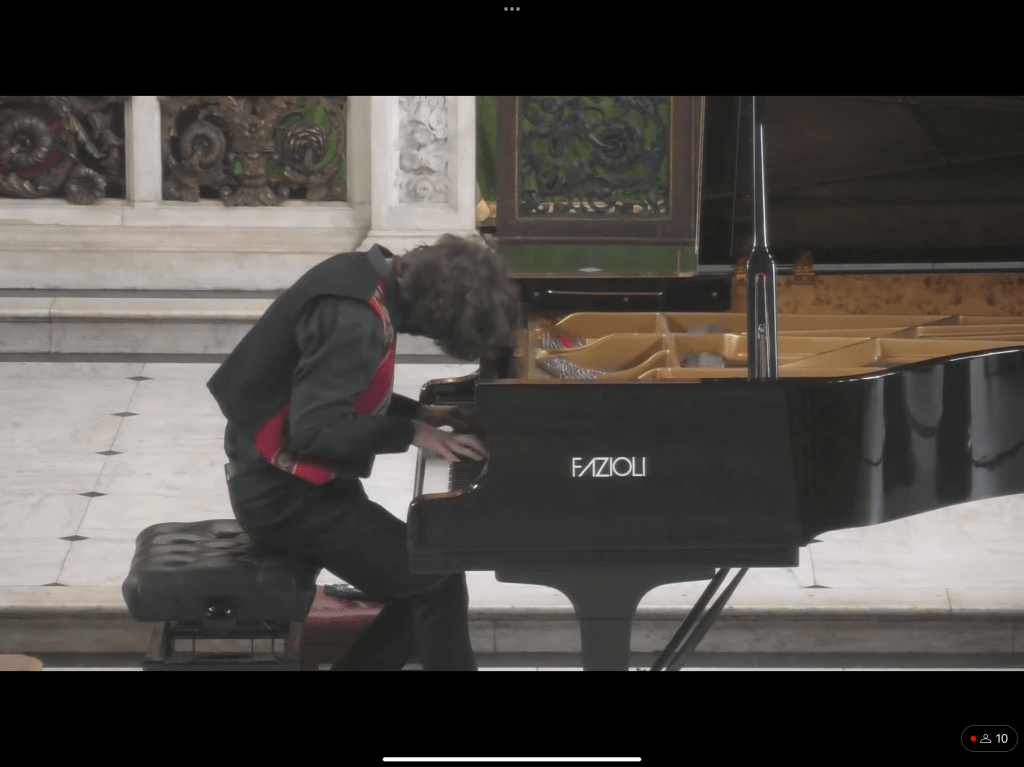
Henry Cash I have not heard before but his teacher Colin Stone has played many times in Perivale.It was obvious from his musicianly performances that he is receiving advice from a master.Henry is a true musician armed with a very solid technique that seems to know no difficulties .He chose Rachmaninov’s favourite prelude to open his concert.I remember Benno Moiseiwitch playing it to his friend Rachmaninov who was surprised when Benno said it reminded him of ‘the return’.Rachmaninov was taken aback as that is exactly what inspired the piece.Henry played it with great poise and a remarkable clarity,simplicity and great assurance.His musicianship is of great architectural lines and his body movements are like a continual wave from which sounds are discovered with naturalness and ease.There are no half lights or insinuating textures but a direct simple message without any rhetoric or showmanship that could interrupt this continual flow of sounds.

The Brahms Sonata in five movements is a very difficult work to hold together as the intimate details and contrasts can detract from the continual flowing undercurrent that takes us on a forty minute journey .I have rarely heard this sonata played with such assurance both technical and musical as today in the hands of this twenty three year old artist.Because an artist he certainly is and there were many ravishingly beautiful things in his performance as there was also passion,drama and a technical mastery that allowed him to play fearlessly the treacherous octave leaps that Brahms demands.The coda to the last movement was played with a clarity and a speed that I have rarely heard in the concert hall.The scherzo too was played with exhilarating daring and a relentless forward movement.It contrasted with the sublime beauty of the Andante and the intensity of the Intermezzo

Henry Cash is 23 and from Huddersfield. He began his musical training at Chetham’s School of Music, age 13, before receiving a scholarship in 2017 to study with Rustem Hayroudinoff at the Royal Academy of Music. After graduating with a first class degree from the Royal Academy he received a scholarship to study with Colin Stone at the Royal Northern College of Music. He has given numerous concerts in the UK and abroad including solo recitals in venues such as the Bridgewater Hall, the Stoller Hall and St James’s Piccadilly. He performed Rachmaninov’s Piano Concerto No 1 in 2015 (age 16), accompanied by the Chetham’s Symphony Orchestra and again with the Bristol Classical Players in 2018. Henry won second prize at the 2021 James Mottram International Piano Competition performing the Grieg Piano Concerto with the Royal Liverpool Philharmonic Orchestra in the final round. He is grateful for the generous support he recieves from the Drake-Calleja Trust, the Pendle Young Musicians’ Bursary and the Oglesby Charitable Trust. 

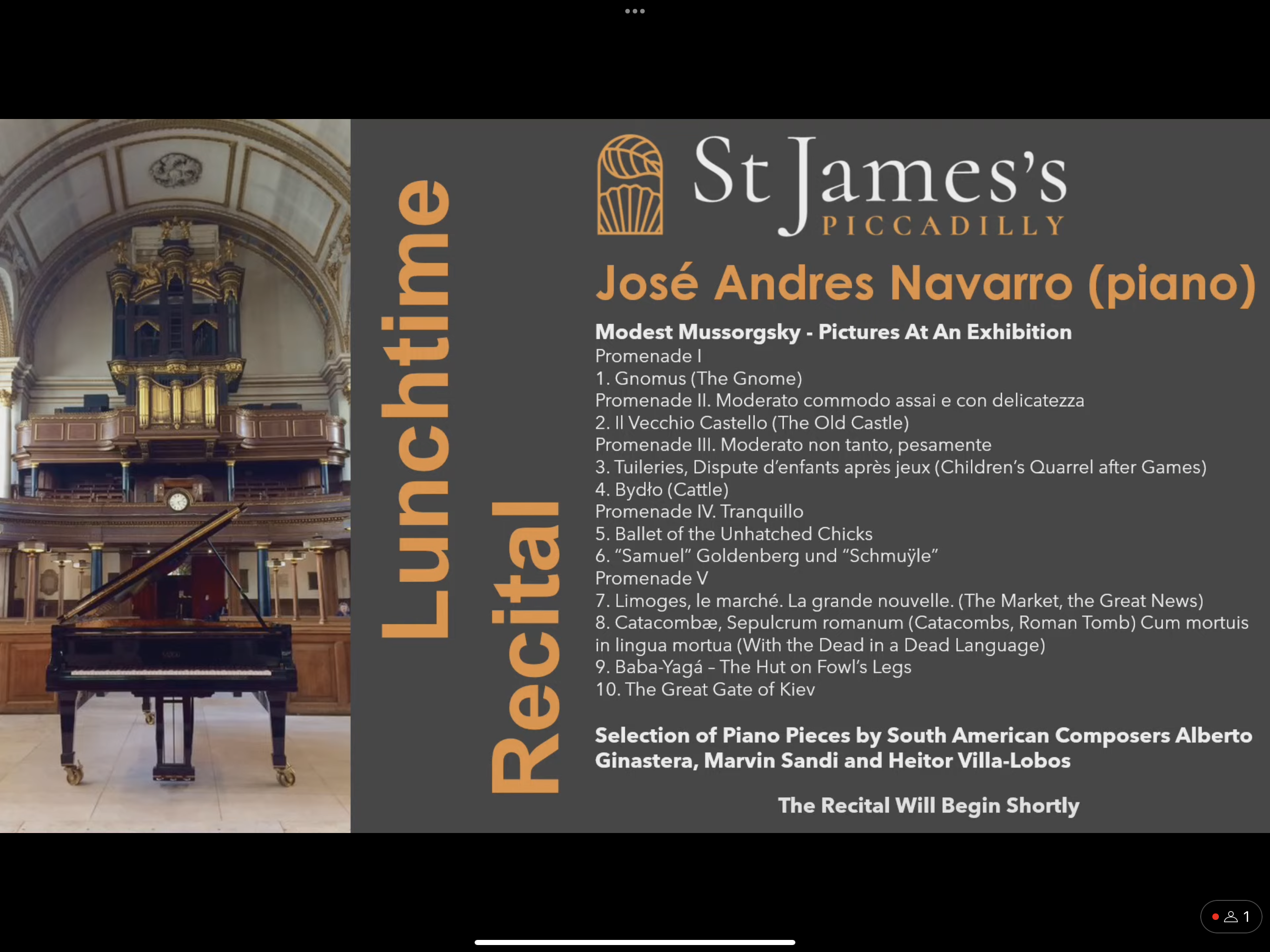
3.0 pm José Navarro Silberstein

The Davidsbundler saw another side of this remarkable musician.He had put aside his native love of life for the more serious German side to his character.The dances were played with superb intelligence and remarkable control even if it sometimes missed the fleeting dance element of elegance and grace of Eusebius.Florestan was very much magnificently in charge and even the opening Lebhaft was played with a more military band than a court orchestra opening the ball.There was not much humour to the party like atmosphere of the third dance but there was ravishing beauty and superb sense of balance with the ‘innig’ that precedes it.This is the true voice of Eusebius- Schumann’s soul speaking.Florestan could have fun too as he showed us so eloquently and with superb technical control in the sixth ‘Sehr rasch’.Frisch and lebhaft were German style and not part of they party atmosphere until we got to ‘mit humour ‘which was thrown of with ease and grace and daring technical skill.Banana skins abound,in this little dance ,for lesser mortals but theres was no fear of slipping for José.It was in the thirteenth dance that the two sides of Schumann’s personality were united in a performance that was both ‘wild und lustig’ but also touchingly solemn and serious.The most beautiful of all is the fourteenth ‘zart und singend’ and it was here that we could appreciate the true artistry of this young Bolivian pianist.A perfect sense of balance that allowed one of Schumann’s most beautiful melodies to sing so simply and naturally.How Schumann with so little could say so much is a wonder of the world.Liebeslied and the end of Liederkreis are touching examples of Schumann’s inheritance from Schubert.Followed by a rather German style ‘Frisch’ and ‘mit gutem humor’ that brought us back into the real world too soon.The magical 8th of book 2 – the final dance where José was back in wonderland with a distant look back at the magical evening that had been spent together .A masterly control of sound and colour as we were left suspended in air on the final chord.Schumann had more to say with his last nostalgic waltz where José put his scholarship behind him as he allowed his heart to sing with the deeply felt sould of a true artist.

Who better to play Villa Lobos’s ‘Brazilian Cycle’ than José Navarro.Latin blood was flowing with hypnotic results as he played the four pieces W.374 with scintillating excitement and throbbing passion.Hysterics too in the ‘Feast of the Hinterlands’ with a joyous toccata full of bright sunlight and high spirits.There was the haunting beauty of the ‘Native Planting Song’ with it’s seductively beautiful tenor melody accompanied by golden arabesques.They were exquisite with an etherial lightness,a jeux perlé par excellence,from a pianist with a mastery of colour and style.There were almost hysterical interruptions of startling virtuosity but always returning to the ever more beautiful native melody.The ‘Dance of the White Indian’ with it’s menacing bass rumble and ever more insistent excitement was played with astonishing energy and virtuosity.

The young Bolivian pianist has performed in different countries in venues and festivals in Europe, South America and USA. Halls include Teatro Municipal “Alberto Saavedra Pérez” in his hometown La Paz to the Musikverein in Vienna. He is a Talent Unlimited Artist in London. As a soloist, he has performed with the Jena Philharmonic Orchestra, Norddeutsche Philharmonie Rostock, Georgian Philarmonic Orchestra, La Paz Symphony Orchestra, Orquesta de Jóvenes Musicos Bolivianos, Orquesta Sinfónica Juvenil de Santa Cruz de la Sierra among others. He is a prize winner at the Anton Rubinstein Piano Competition in Düsseldorf, Tbilisi International Piano Competition in Georgia, International Competition Young Academy Award in Rome, Claudio Arrau International Piano Competition in Chile among many others. He was a finalist at the Eppan Piano Academy and at the 63r d Ferruccio Busoni International Piano Competition. In Bolivia he gave masterclasses in La Paz Conservatory, Sucre Conservatory Santa Cruz Fine Arts College and Laredo School in Cochabamba. He served as a jury member in national music competitions. He was mentored by Paul Badura Skoda. He studied with Balasz Szokolay at the Franz Liszt University in Weimar and with Claudio Martínez Mehner at the University of Music and Dance in Cologne. At the moment he is at the Artist Diploma programme at the Royal College of Music in London under the guidance of Norma Fisher and Ian Jones.He holds scholarships from Royal College of Music, Herrmann Foundaiton Liechtenstein- Bolivia, Theo and Petra Lieven Foundation of Hamburg, Clavarte Foundation in Bern and Elfrun Gabriel Foundation for Young Pianists.

https://christopheraxworthymusiccommentary.com/2022/10/24/jose-andres-navarro-at-st-jamess-piccadilly/

4.10 pm Misha Kaploukii

A Mozart of crystalline clarity with ornaments that sprang from Misha’s fingers like well oiled springs.There was a driving rhythmic energy but also subtle contrasts in dynamics played with elegance and style.An Andantino that had a purity of sound with its chiselled beauty and poise and a Rondo of such innocent good humour and driving energy.Exemplary Mozart exclaimed Dr Mather,but it was more than that as it was played like a true artist who listens to himself and shapes the music with loving care and intelligence .

The piano was immediately engulfed in sumptuous sounds with Schumann’s eighth novelette.The longest and most complex ,it could well have been the first movement of a Sonata or Fantasy with its continual changes of character and mood.There was a driving passion but also a clarity due to Misha’s sparing use of the pedals that allowed all the strands of Schumann’s ingenious counterpoints to be heard so clearly.Playful capricious contrasts alternated with passionate outbursts of swirling romantic fervour played with remarkable technical mastery.There was also the touching etherial beauty where Misha played with such refined sounds.Schumann shows us a whole world in this last of his op 21 novelettes.Richter used to play it (together with the fourth in D ) with the same driving rhythms and breathtaking passion that swept all before it .Misha too showed us what a masterpiece it can be in the hands of a true artist.
The piano was engulfed in romantic sounds as Brahms’s poignant arpeggios spread over the keyboard with driving passion and poignancy.A technical command that incorporated the playful capricious contrasts before being enveloped in the washes of even more passionate cascades of notes.There was a beautiful simplicity to Brahms’s seemingly innocent B minor Capriccio with its quixotic changes 4643 5z and sty4t4eafescjle.

There was an extraordinary technical control in the Bartok studies with amazing sounds spread with remarkable virtuosity over the entire keyboard in the second.There was also the toccata like gymnastics of the third study with its majestic outpouring and surprise ending .

Mompou was played with a capriciousness and ravishing beauty.There were sumptuous rich sounds of beguiling melodic insinuation.Tinged with nostalgia as it was played with great artistry.One could do no better than to quote Joan Chissell when she said ‘Baubles were turned into Gems.’

Pianist and flautist Misha Kaploukhii was born in 2002 and is an alumnus of the Moscow Gnessin College of Music, where he studied in the piano class of Mikhail Egiazarian. Misha is currently studying at the Royal College of Music; he is an RCM and ABRSM award holder generously supported by Robert Turnbull Piano Foundation and Talent Unlimited charity studying for a Bachelor of Music with Professor Ian Jones. He also gained inspiration from lessons and masterclasses with musicians such as Claudio Martínez Mehner, Dmitri Bashkirov, Jerome Lowenthal and Konstantin Lifschitz. Misha already has experience of performing with orchestras internationally including his recent debut in Cadogan Hall with the Rachmaninoff 1st Piano Concerto, his overall repertoire includes a wide range of solo and chamber music. Recently, Misha has won prizes in the RCM concerto competition (playing Liszt’s 2nd Piano Concerto) and in the International Ettlingen Piano Competition.”
https://christopheraxworthymusiccommentary.com/2022/10/28/misha-kaploukii-plays-liszt-at-the-rcm-a-sea-symphony-concert-youth-and-music-a-joy-to-behold/

5.10 pm Yura Zaiki 

Debussy’s Images Book 1 were played with great poise and elegance.Reflets dans l’eau was allowed to hover above the keys and Hommage a Rameau was played with aristocratic style. Mouvement was a continuous outpouring of whispered sounds with tumultuous outbursts played with technical bravura of notes spread with ease over the entire keyboard.

The Liszt Sonata was played with blazing passion and technical bravura.There were moments in the andante of great beauty.This is one of the great works of the Romantic repertoire and is dedicated to Schumann.When the score arrived at the Schumann household Clara declared that it was a blazing noise and she certainly would never play it in public.Hans von Bulow gave the first performance and it takes a true musician to followed Liszt’s very precise road map for a work of such blazing originality.The opening pages are marked piano,mezzo forte leading to the fortissimo outburst and the true start of Liszt’s adventure on the second page.The three opening themes are the leit motif that are transformed in a highly original way creating a revolutionary new art form that was to be such an influence on Liszt’s son in law .Richard Wagner took it to sublime heights in the Ring Cycle.Yura played it with great conviction and the public were totally won over but a more careful study of the score would reveal a work of searing originality and fundamental importance and not just a showpiece for brilliant virtuosi.

Yura Zaiki is a Japanese pianist based in London. She studied at the Royal Conservatoire of Scotland with Professors Aaron Shorr, Fali Pavri, and Jonathan Plowright, where she completed her bachelor and masters degree. Her studies have been supported by the ABRSM scholarship, and the Royal Conservatoire of Scotland trust scholarship. She graduated top of her class and was awarded the Performance Prize for Keyboard.Previously, she joined the Junior Department of the Royal Academy of op let Music, where she won First prize in the Iris Dyer Piano Competition. Her awards in competitions include First prize in the Evangelia Tjiarri International Competition, Second prize in the Elena Richter International Competition, First prize in the Chiba Piano Competition, plain First prize in the North London Piano Festival, Fifth prize in the Petrof Piano Competition. She also received the Craxton Memorial Trust Award.She has performed in venues such as the Piano Festival at FAZIOLI Hall in Italy, and the BBC interval concert at Glasgow City Halls. She was also invited to perform by the Embassy of the Republic of Lithuania & Japan at Goldsmiths University of London, at the Institut français d’Écosse in Edinburgh, and the Larnaca Municipal Theater in Cyprus. She is an animal lover and a founder of The Cerasus, where she organises a series of charity concerts in Tokyo, London, and Glasgow, for animals in need. She also had the privilege of playing in Masterclasses with great pianists including Jean-Efflam Bavouzet, Richard Goode, Robert Levin, Steven Osborne and Frank Wibaut. (250)

What fun we had …..and what music ……..,and another day still to enjoy

Tea and cakes with Dr Felicity Mather

Filippo Tenisci exults the genius of Wagner and Liszt in Velletri

The second concert in this eleventh edition inspired by Liszt’s Erard piano lovingly restored by Ing .Tammaro.He also had the genial idea of bringing this antique instrument to life with an annual series of concerts which also give a platform to young master musicians.And it all started with the Liszt bicentennial celebrations in 2011 originally in the Villa D’Este but now transferred to another of the hills around Rome in Velletri.
In the beautifully restored monastery that is now a thriving arts centre this Erard piano has found the ideal home for an instrument that was destined for intimate gatherings and certainly not the vast concert halls of today.


Today it was an all Wagner concert alla Liszt by the young Albanian born pianist Filippo Tenisci from the class of Maurizio Baglini. https://christopheraxworthymusiccommentary.com/2021/06/24/che-festa-the-joy-of-musicmaurizio-baglini-project-at-roma-3/
Maurizio Baglini and Roberto Prosseda are two prodigiously eclectic promoters of music and young musicians in Italy.
I am proud to say that they were both spotted and helped in their formative years by the Keyboard Trust which has now taken Filippo under their wing too.


Leslie Howard the noted Liszt expert is one of the artistic directors of the KT and will play later in this season on the 14th May with his young Sienese protégée Ludovico Troncanetti.https://christopheraxworthymusiccommentary.com/2022/06/11/leslie-howard-and-ludovico-troncanetti-at-st-marys-a-wondrous-voyage-of-discovery/

Celebration concert in London just a month before his much awaited appearance this season in Velletri


The world is very small when one encounters master musicians dedicated to a voyage of discovery into the world of the great composers bringing their discoveries to life with dedicated scholarship,passion and instrumental mastery.
And so it was today with this young musician who I had heard recently playing so beautifully a Mozart concerto with the University Roma Tre Orchestra.https://christopheraxworthymusiccommentary.com/2021/02/09/roma-3-orchestra-the-mozart-project/
I was not expecting to find such dedicated mastery and serious scholarship in an eclectic repertoire of Wagner as from the hands of his father in law Liszt.
I have only heard the Tannhauser Overture before as it was the ‘cavallo di battaglia’ of the great ‘virtuosi’of the past .
There exists a famous video recording of Moiseiwitch playing it. https://youtube.com/watch?v=XKDYla5C5cA&feature=share
I also remember Shura Cherkassky playing it for us in Rome in one of his many recitals there in his glorious Indian summer.
It is a real paraphrase and as Ing.Tammaro rightly explained is the only piece on the programme today that is not just a pure transcription.
It is a work in which virtuosistic gymnastics abound but above all requires a superb sense of balance and colour to restore its orchestral glory to two hands and two feet in front of a box of strings and hammers !


Here and in the ingenious ‘Spinnerlied’or the ‘Entrata degli ospiti nel Warburg’ Filippo showed his technical mastery of the keyboard with sparkling jeux perlé,brilliant arabesques and powerful octaves.There was real beauty as he intoned the ‘Coro dei Pellegrini’ with its atmospheric ending that was later to be transformed in the Overture paraphrase with the transcendental gymnastics of a master illusionist.There was ravishing beauty that opened the ‘O du mein holder Abendstern’ with its tenor melody and lapping arabesques before its apparition on high bathed in a luminous mist of pedal.This was just the introduction to the full sumptuous tenor melody in all its moving glory.It was played with great delicacy surrounded by arabesques gradually building to a truly ecstatic climax.It showed Filippo’s very stylish mastery without ever loosing the aristocratic sentiment pregnant with meaning and never descending into empty sentimentalism.

A sudden injection of life with ‘Entrata degli ospiti nel Wartburg’ with the troups insistently marching in the left hand leading to a triumphant finale of great virtuosity and showmanship.The Ballade unfolded with great drama and was a true tone poem in Filippo’s inspired and convincing hands It followed the busy weaving of the famous ‘Spinnerlied’ already mentioned.

It is interesting to note that with Lohengrin Wagner left his youthful world of Tannhauser and Rienzi and was heading for the genial heights that changed the world of opera forever.The first performance in Weimar of Lohengrin was with Liszt on the podium who wrote to Wagner: ‘The wonderful score of Lohengrin moved me deeply.Your opera is simply sublime’.And so it was with the’Corteo nuziale di Elsa alla Cattedrale’ that the long drawn out melodic line was played with absolute serenity as Filippo unfolded it’s simple melodic line in this most literal of transcriptions.The ‘Dream of Elsa’ from Lohengrin was played with the tenor line ,sumptuous and simple over a shimmering accompaniment of great sensibility .


It was Filippo’s remarkable musicianship and scholarship that shone through all he did.Nowhere more than in the brief encore that he offered after a transcendental performance of the Tannhauser Overture.I look forward to the imminent publication of his new Wagner/Liszt CD.
Filippo took this opportunity of publically thanking Ing.Tammaro for the untiring help he gives to young musicians.Giving them a much needed platform to be able to share their music with a discerning public in his seasons of such scholarship and meaningful importance .


He announced he would like to play a piece written for the piano by Wagner himself.
Written in 1853 but revised and authenticated only a year before his 70th and last birthday in 1883.
Just one page of disarming simplicity that after all the notes we had heard today it was a fitting testimony to one of the greatest composers of all time.
It was played by Filippo with simple disarming beauty – a sublime benediction before which I am sure Liszt would have gone on his knees too !To quote Wagner from his letters:’An excitement almost painful comes over me with the arrival of the promised Erard Grand……..On it’s arrival I was extremely moved …….you know for how long I had hoped to own one……Here it is finally the magnificent piano with a voice of gold.’

As Ing Tammaro pointed out it was just such a piano that sat so nobly on the stage today.

Elegie by Richard Wagner completed in 1883 the year of his death – three years before Liszt in 1886.
Ing Tammaro with the dress coat loaned to Liszt by a noble lady in Via Sistina in Rome,where he lived,when his own had been drenched by rain .

https://christopheraxworthymusiccommentary.com/2023/02/24/michelle-candotti-a-lioness-let-loose-in-velletri-ignites-liszts-piano/

Ing.Tammaro presenting Filippo with the specially embossed medal of thanks
The Maxi screen allowed us to appreciate Filippo’s beautiful hand movements and his sensitivity to touch
Cast of Liszt’s left hand
Filippo Tenisci

Here is an article about the first concert in this eleventh season : https://christopheraxworthymusiccommentary.com/2023/02/24/michelle-candotti-a-lioness-let-loose-in-velletri-ignites-liszts-piano/

Victor Maslov at Leighton House Masterly playing of intelligence and poetic vision

The finale concert in Lisa Peacock’s series of ‘discoveries’ in the splendour of the newly restored Leighton House.Five concerts with five future stars in Lord Leighton’s sumptuous music room.
Pianists who have come to London to perfect their already quite considerable talent.Today it was Victor Maslov who closed the season with a full hall that included his mentor Dmitri Alexeev and his wife Tatyana Sarkissova.
Three of the five pianists chosen to take part in this new series were mentored by Dmitri Alexeev at the Royal College of Music and it was the master himself who had given a memorable concert here too just a few weeks ago.
https://christopheraxworthymusiccommentary.com/2023/02/06/dmitri-alexeev-the-supreme-mastery-and-anguish-off-a-tormented-soul/

Could it be coincidence that this beautiful feathered bird should be the symbol on the staircase to the music room.


Victor Maslov graduated in 2021 covered in prestigious prizes and gaining his Masters of Performance with distinction as well as a Bachelor of Music First Class degree.
He is fast making a name for himself on the world stage and only a few days ago gave a memorable recital at the Pharos Arts Centre in Cyprus organised in partnership with the Keyboard Trust.
Just an hour of music but from the very first notes it was obvious that we were in the company of a master.
Whether in the poetic vision of Rachmaninov delving deep into the Russian soul or the disarming simplicity of Janacek’s hauntingly nostalgic folk melodies or the amazing fireworks of Stravinsky’s Firebird ,Victor held us in his spell with masterly playing of intelligence and poetic vision.
It was the disarming beauty of his encore ,the G sharp minor Rachmaninov Prelude that summed up his artistry where in just two pages he could show us a world of nostalgic yearning and brooding unrest with a kaleidoscopic range of colour but above all an aristocratic sound of ravishing beauty and purity.

Lisa Peacock introducing the last in this remarkable series of ‘Discoveries’ that one hopes will be the first of many more seasons to come.
Rachmaninov Etudes Tableaux that were six tone poems of subtle sounds and character.Deeply nostalgic Russian brooding and beauty but always tinged with a sadness and aristocratic nobility that gives Rachmaninov an unmistakably unique voice.From the strident march of the first study where Victor immediately showed us his orchestral sense of colour.Long held notes took on a poignancy as the left hand march continued relentlessly.A momentary vision of distant bells was even more remarkable because the insistent march had momentarily been halted only to surface in the final bars as the march continued into the far distance.There was ravishing beauty in the second study with the yearning melodic bel canto floating magically on a stream of gently murmuring sounds.A momentary climax ‘appassionato e sempre più mosso’was quickly dispelled with a ravishing cloud of shimmering notes played with supreme delicacy as the wafts of sound led to the final tenor exaltation of yearning.The third created an atmosphere of terror that in Victor’s hands truly sent a shiver down our back.His extraordinary sense of balance and colour allowed him to translate Rachmaninov’s very precise indications into sounds.There was terrifying reality as waves of notes were turned into sounds on which Rachmaninov’s sparse melodic notes were allowed to vibrate with extraordinary luminosity.Immediately changing mood with the imperious fanfare of op 33 n.7 and its driving rhythmic impetus .A momentary quixotic change of mood that Victor could chameleonically portray as he led this rumbustuous study to it’s turbulent ending of enormous sonority and exhilaration.There was a complete change of character with op 33 n. 8 .An oasis of subtle beauty and luminosity with a melody etched in gold surrounded by magic arabesques that gradually became more turbulent only to burn themselves out with an almost too serious coda that Rachmaninov dismisses with disarmingly abrupt chords piano and finally pianissimo.Op 33 n.9 interrupted this magic atmosphere with a dramatic opening ‘Grave ‘ indeed but then a boiling cauldron of turbulence ,reminiscent of the insistent turbulence in some of Scriabin,leading to the ecstatic,dramatic and above all spectacular ending.A remarkable journey that Victor shared with us with complete mastery and sense of colour that could bring vividly to life the vision that Rachmaninov paints so poignantly in these Tableaux Studies.

The Études-Tableaux (“study pictures”), Op. 33, is the first of two sets of piano études composed by Rachmaninoff .They were intended tudto be “picture pieces”, essentially “musical evocations of external s visual stimuli”. But Rachmaninoff did not disclose what inspired each one, stating: “I do not believe in the artist that discloses too much of his images. Let [the listener] paint for themselves what it most suggests.”However, he willingly shared sources for a few of these études with the Italian composer Ottorino Respighi when Respighi orchestrated them in 1930.Rachmaninoff composed the Op. 33 Études-Tableaux at his Ivanovka estate in Tambov,Russia between August and September 1911, the year after completing his second set of preludes ,Op. 32. While the Op. 33 Études-Tableaux share some stylistic points with the preludes, they are actually not very similar. Rachmaninoff concentrates on establishing well-defined moods and developing musical themes in the preludes. Rachmaninoff biographer Max Harrison calls the Études-Tableaux “studies in [musical] composition”; while they explore a variety of themes, they “investigate the transformation of rather specific climates of feeling via piano textures and sonorities. They are thus less predictable than the preludes and compositionally mark an advance” in technique.Rachmaninoff initially wrote nine pieces for Op. 33 but published only six in 1914. One étude, in A minor, was subsequently revised and used in the op 39 set ; the other two appeared posthumously and are now usually played with the other six. Performing these eight études together could be considered to run against the composer’s intent, as the six originally published are unified through “melodic-cellular connections” .Differing from the simplicity of the first four études, Nos. 5–8 are more virtuosic in their approach to keyboard writing, calling for unconventional hand positions, wide leaps for the fingers and considerable technical strength from the performer. Also, “the individual mood and passionate character of each piece” pose musical problems that preclude performance by those lacking strong physical technique.The study Grave in C minor n.3 was re-used in the Largo of Rachmaninov’s Fourth concerto which was completed in 1926.

Victor chose six pieces from the Janacek cycle of ‘On an Overgrown Path’.A work rarely heard in the concert hall but one of very touching simplicity missing an overall architectural shape but creating an atmosphere with a hauntingly mellifluous traditional outpouring.’Our Evenings’ was played with absolute delicacy and simplicity and it led to ‘A blown- away leaf’ with all the gentle fluidity and luminosity of the fairytale it is.There was the playful halting rhythm of this short quixotic story ‘Come with us’ indeed!Followed by a deep brooding opening to ‘The Madonna of Frydek’ with its magical music box musings leading to an imperious outpouring of great lament that just bursts into intimate song.Declamations of striking atmosphere in ‘They Chattered Like Swallows’ and finally the echoing vibrations of desolation in ‘The Barn Owl Has Not Flown Away!’.A remarkable oasis of serenity and peace between the turbulence of the two Russian works either side of it on the programme

On an Overgrown Path is a cycle of fifteen piano pieces written by Leos Janacek and organized into two volumes.Janáček composed all his most important works for solo piano between 1900 and 1912.He probably began preparing his first series of Moravian folk melodies in 1900.At this time, the cycle had only six pieces, intended for harmonium : Our evenings, A blown-away leaf, The Frýdek Madonna, Good night!, The barn owl has not flown away! and a Piu mosso published after Janáček’s death.These melodies provided the basis for the first volume of On an Overgrown Path. Three of these compositions were first published in 1901 with the fifth volume of harmonium pieces, Slavic melodies, under the title On an overgrown path – three short compositions.By 1908 the cycle had grown to nine pieces, and was by then intended for piano instead of harmonium. The definitive version of the first book was published in 1911.On 30 September 1911, Janáček published the first piece of the second series in the Lidove noviny newspapers. The new series was created, in its entirety, around 1911.The complete second book was printed by the Hudební matice in 1942. The première of the work took place on 6 January 1905 at the “Besední dům” Hall in Brno.

Leos Janacek

The Nostalgia and Pain of Memory: Janáček’s On an Overgrown PathThe nationalism that hit the 19th century and carried through to the 20th century had a profound effect on music. Music that had been ignored for its folk-like character, or its non-urban nature, became the basis for new works that not only celebrated the folk sources but also the country itself.In Czech music history, three composers defined the nation: Smetena (1824-1884), =Dvorak (1841-1904), and Janacek (1854-1928). Janáček took inspiration from Moravian and other Slavic folk music to create his works, supported by his own research into the folklore and music of his country. Achieving international fame in his 60s with his opera Jenůfa, Janáček joined Smetana and Dvořák in symbolising Czech music.

A piano cycle created starting around 1900, On an Overgrown Path, had a complicated birth. Seven pieces were originally written for harmonium, and five were published as Slavonic Melodies in 1901 and 1902. The remaining two pieces were set aside. In 1908, Janáček revised the work and wrote 3 more pieces, and made the 8 pieces into a cycle for piano. Two more pieces were added in 1911. That formed series I. Series II, which started with two new pieces, grew with the addition of the two pieces that had been set aside in 1902, forming nos. 1, 2, 3, 5 of Series II. No. 4 is just an ink sketch with some pencil revisions. Series II was published in 1942 after Janáček’s death and the 5 pieces do not have characteristic titles but only tempo indications.The title for the work, On an Overgrown Path, had been settled by 1901, but the titles of the individual movements changed before the publication of Series I in 1911. For example, No. 2, started out as ‘A Declaration of Love,’ was then changed to ‘A Love Song’ and finally became a much more mysterious title of ‘A Blown-Away Leaf’.Janáček described the work as having a double trajectory of ‘distant reminiscences’ of his childhood and reflection on the death of his 20-year-old daughter Olga in 1903.The first five parts of the cycle refer to his childhood: No. 1. Our Evenings, for evenings by the fireside; No. 3. Come with us!, for children’s games; and no. 4. The Madonna of Frydek, for a religious procession near his home village.As we get into the second part, emotion, rather than memory, has a place: no. 6. Words fail!, No. 8. Unutterable Anguish, and No. 9. In Tears.No. 7, Good Night!, was a metaphor for Olga’s death, while the last movement, No. 10. The Barn Owl Has Not Flown Away!, refers to the owl’s status as a foreteller of doom.Janáček’s change in the work from childhood memories to the tragedies of the grownup parent make this a unique statement of the human condition.

A transcendental performance of Agosti’s famous 1928 transcription of the ‘Firebird’.Victor threw himself into they fray from the very opening notes with breathtaking drive and scintillating virtuosity-a truly Infernal Dance! There were beautiful sounds of orchestral colour in the Berceuse with a kaleidoscope of colours appearing over the entire keyboard.But it was the ravishing beauty of the appearance of the Firebird in the finale that was truly breathtaking.The build up to the tumultuous final bars was astonishing as the excitement mounted to a frenzy of unbelievable virtuosity and exhilaration.

Stravinsky’s score for The Firebird was written for Sergei Diaghilev’s Ballets Russes dance company, which premiered the work in Paris in 1910. Based on ancient Russian folk tales, it tells the story of the young Prince Ivan’s quest to find a legendary magic bird with fiery multi-coloured plumage. In the course of his adventures, he falls in love with a beautiful princess but has to fight off the evil sorcerer Katschei to eventually marry her. The suite presents the culminating scenes of the ballet in a piano transcription by the Italian pianist and pedagogue Guido Agosti (1901-1989), who studied with Ferruccio Busoni.

The Danse infernale depicts the brutal swarming and capture of Prince Ivan by Katschei’s monstrous underlings until Prince Ivan uses the magic feather given to him by the Firebird to cast a spell on his captors, making them dance until they drop from exhaustion. The Berceuse is a lullaby depicting the eerie scene of the slumbering assailants, leading to the Finale, a wedding celebration for Prince Ivan and his princess bride.Agosti’s piano transcription, completed in 1928, is a daunting technical challenge for the pianist. Most of the piano writing is laid out on on three staves in order to cover the multi-octave range of the keyboard that the pianist must patrol. The piano comes into its own in this transcription as a percussion instrument, to be played with the wild abandon with which a betrayed lover throws her ex-partner’s possessions off the balcony onto the street below.Judging from the shocking 7-octave-wide chord crash that opens the Dance infernale, Agosti captures well the bruising pace of the action, with off-beat rhythmic jabs standing out from a succession of punchy left-hand ostinati constantly nipping at the heels of the melody line. The accelerating pace as the sorcerer’s ghouls are made to dance ever more frantically is a major aerobic test for the pianist.

Relief comes in the Berceuse, which presents its own pianistic challenges, mainly those of finely sifting the overtones of vast chord structures surrounding the lonely tune singing out from the middle of the keyboard.The wedding celebration depicted in the Finale presents Stravinsky’s trademark habit of cycling hypnotically round the pitches enclosed within the interval of a perfect 5th. Just such a melody, swaddled in hushed tremolos, opens this final movement. It is a major challenge for the pianist to imitate the shimmering timbre of the orchestra’s brightest instruments as this theme is given its apotheosis to end the suite in a blaze of sonority that extends across the entire range of the keyboard.

Guido Agosti (11 August 1901 – 2 June 1989) was an Italian pianist and renowned for his yearly summer course in Siena frequented by all the major musicians of the age.It was on the express wish of Alfredo Casella that Agosti took over his class which he did for the next thirty years.Sounds heard in his studio have never been forgotten.

Guido Agosti being thanked by Ileana Ghione after a memorable concert and masterclasses in the theatre my wife and I had created together in Rome.

Agosti was born in Forli 1901. He studied piano with Ferruccio Busoni Bruno Mugellini and Filippo Ivaldiand earning his diploma at age 13. He studied counterpoint under Benvenuti and literature at Bologna University. He commenced his professional career as a pianist in 1921. Although he never entirely abandoned concert-giving, nerves made it difficult for him to appear on stage,and he concentrated on teaching. He taught piano at the Venice Conservatoire and at the Santa Cecilia Academy in Rome.In 1947 he was appointed Professor of piano at the Accademia Chigiana Siena .He also taught at Weimar and the Sibelius Academy in Helsinki.

In the Ghione Theatre in the early 80’s with Ileana Ghione,’Connie’Channon Douglass Marinsanti ,Lydia Agosti ,Cesare Marinsanti,Guido Agosti.A closely knit family .

His notable students include Maria Tipo,Yonty Solomon Lelsie Howard,Hamish Milne,Martin Jones,Ian Munro,Dag Achat,Raymond Lewenthal,Ursula Oppens,Kun- Woo Paik,Peter Bithell.He made very few recordings; there is a recording of op 110 from the Ghione theatre in Rome together with his recording on his 80th birthday concert in Siena of Debussy preludes .

A full hall for the last in this series of ‘Discoveries’
Victor in discussion after the concert with Dmitri Alexeev and Tatyana Sarkissova
A family group with Victor,Lisa,Dmitri and Tatyana celebrating the triumphant ending of a wonderful series .
‘Victor was phenomenal, powerful yet sensitive, with a rich spectrum and colour.A thrilling performance.’ Garo Keheyan Pharos Arts Foundation

https://christopheraxworthymusiccommentary.com/2022/05/30/victor-maslov-at-st-marys-the-return-of-a-great-artist/

Gabriele Strata in Siena Micat in Vertice 100 A Poet speaks

La Micat in Vertice è anche una stagione per i giovani, aperta all’esordio dei nuovi talenti chigiani, proiettati verso il futuro. Allievo chigiano di Lilya Zilberstein, Gabriele Strata è uno dei più interessanti pianisti della nuova generazione internazionale. Un programma imperdibile, dedicato ai capolavori di Händel, Adès e Chopin.

VENERDÌ 3 MARZO ORE 21

Teatro dei Rozzi Siena
Gabriele Strata

Gabriele Strata the poet of the piano.
After all the intricacies of the Handel G minor suite ,the austere atmospheric musings of Ades or the passionate outpouring of Chopin’s monumental Four Ballades it was in the very final encore with the magic of the nightingale still in the air,the Maiden nowhere to be seen,that a moment of sublime inspiration by Schumann had revealed what we had already realised during his programme today .A single simple page,Liebeslied originally for four hands but here played with just two,but hands of poetic gold as Gabriele kept this enraptured audience breathless and mesmerised by his supreme poetic playing.

I have had the opportunity to listen to Gabriele over the past few years.A student formed by two friends of the Ghione Theatre in Rome where they both performed in their formative years Riccardo Zadra and most notably Roberto Prosseda .https://christopheraxworthymusiccommentary.com/2021/01/13/roberto-prosseda-pays-tribute-to-the-genius-of-chopin-and-the-inspirational-figure-of-fou-tsong/. By coincidence also with Boris Berman at Yale University who had given many memorable recitals at the Ghione too.I first heard Gabriele playing the Schumann concerto with the Roma 3 University Orchestra.A fine very solid performance but one which showed the superb technical training he was receiving at Yale.A performance that was a work in progress by a remarkably talented student who was at a crossroads of choosing his path,whether it be precision and technical perfection or poetry and inspiration,or indeed both.https://christopheraxworthymusiccommentary.com/2021/07/15/summer-harmonies-at-teatro-palladium-for-roma-tre-orchestra/

I heard him again last year in London at the Barbican as a top prize winner at the Guildhall where he is studying with Ronan O’Hora (who had studied like me with Vlado Perlemuter the protégée of the greatest poet of the piano Alfred Cortot).Rhapsody on a Theme of Paganini does not show off the finesse of interpretative skills but is more an intricate ensemble work that requires agility and skill.Gabriele imbued it though with great meaning and there were moments of beauty mingled with his already quite remarkable technical mastery.Not surprisingly Gabriele is also perfecting his studies in Rome at the Accademia di S. Cecilia with that wonderful friend and trainer of all young artists Benedetto Lupo .Today I was overwhelmed by this young student who has come through a professional training process where youthful talent can be transformed into professional proficiency without damaging the essential heart and soul of the young performer and above all maintaining that still youthful love and passion for music.Hats off to Ronan O’Hora ,head of Keyboard studies at the Guildhall,who has obviously restored and shared with Gabriele his own superb musicianship and poetic artistry.

Ronan is a remarkable musician and is about to embark on a cycle of the 32 Beethoven Sonatas this Easter in a series presided over by Paul Lewis.https://christopheraxworthymusiccommentary.com/2021/10/07/ronan-ohora-at-razumovsky-academy-simple-grand-beethoven/

I was glad to see that the artistic director of the Chigiana,Nicola Sani,is intent on inviting not only illustrious artists of long standing ,but also young musicians from the next generation,to play in the prestigious ‘Micat in Vertice’ Concert Season.A season that had been the idea of Count Chigi when he would personally invite Artur Rubinstein,Horowitz,Cortot,Segovia etc to play in his home in Siena !Gabriele had been particularly noted in the class of Lilya Zilberstein in 2020 and was invited now to play in a concert in the 100th Anniversary Season.Just a month ago Angela Hewitt shared the same stage of the beautiful Teatro dei Rozzi :https://christopheraxworthymusiccommentary.com/2023/02/02/angela-hewitt-the-100th-anniversary-season-of-the-accademia-chigiana-in-siena-bach-shining-brightly-with-intelligenceravishing-beauty-and-wit/ .

A very interesting introduction to the concert by a musicologist colleague of the Artistic Director Nicola Sani

I had visited the course of Lilya Zilberstein the year after Gabriele and had admired enormously her generosity in helping talented young musicians.It followed in the tradition inaugurated by Count Chigi of inviting Casella,Cortot,Ferrara and above all for generations of pianists,Guido Agosti.https://christopheraxworthymusiccommentary.com/2021/08/14/zilberstein-in-siena/.

A very interesting programme from Gabriele included a rarely heard suite by Handel and rather daringly finishing the first half with a work based on John Dowland’s song “Darknesse Visibile” as visualised in modern idiom by the poetic Thomas Ades.

Scintillating ornaments abounded in the Ouverture by Handel.They were played with crisp precision that like Sokolov were indeed enviable on a modern day Steinway.Although admiring the spring like unravelling of this knotty twine I could not help thinking that a few less ornaments would have given more clarity to Handel’s architectural conception.After all,this is a modern day instrument that can sustain notes in a way that the harpsichord could not do and where necessarily there was a need of ornamental help.But it was nevertheless remarkable playing even though a window of fresh air was opened when the Largo was interrupted by the simple clarity and energy of the Presto.The Andante was played so delicately and was beautifully shaped with the deliciously subtle addition of ornamentation in the ritornello and the perpetuum mobile of the Allegro was played with enviable clarity and rhythmic energy.Then the gates of Gabriele’s simple poetic vision opened to show it’s face with a sublimely expressive Sarabande where peace and beauty spoke so eloquently in Gabriele’s sensitive hands.This ravishing atmosphere was interrupted as the Gigue cast its hypnotically energetic spell before the grandiose opening of the final Passacaglia.An ending of great authority where there was an exhilarating build up of tension and where now Gabriele allowed himself the full potential of this modern instrument,but with great taste ,to exult the glory of Handel’s invention that had been limited to the instruments of his age.

A completely different world was opened up as the full potential of this magnificent modern Steinway was transformed by Ades ,with considerable help from Gabriele,into a magic world of wondrously atmospheric vibrating sounds.It was leading to a whispered account of Dowland’s song as heard far away in Ades’s land of dreams.A remarkable control of the piano with a kaleidoscope of sounds where Gabriele shared with the rapt attention of his audience the trance and poetic vision he was transmitting via the extraordinary world of this contemporary poet of sound.It was an unusual way to end the first half of a recital but then great artists are never predictable but are always totally convincing in all they do.’Je sens,je joue ,je trasmets’ so simple but oh so rare !

The four Chopin Ballades I had heard only the day before in Florence from Ivan Krpan in a series with the Keyboard Trust in partnership with the British Institute.https://christopheraxworthymusiccommentary.com/2023/03/01/ivan-krpan-busoni-2017-in-florence-mastery-and-simplicity-at-the-service-of-music/A fascinating performance full of poetic artistry and mystery that complimented so well today with a similar poetic vision of Gabriele but who played with a luminosity and monumentality that illuminated another side of these masterpieces.Eight Ballades in twenty four hours must be a record but from the hands of two such wonderful young artists it was an uplifting and inspiring experience indeed.Something of the atmosphere of Ades was still lingering in the hall as Gabriele entered the world of Chopin with an opening of the G minor Ballade played with great delicacy .It showed his superb musicianship as an interpreter of Chopin’s very precise indications that over the years the ‘tradition’ has somewhat distorted!There was a delicacy to the second theme but there was also a depth of sound from the bass and a subtle doubling of the tenor voice.Gabriele’s Ballades were etched in chiselled monumental sounds that gave great aristocratic space to the passionate outpourings that gradually erupt out of the most poetic musings.The notorious codas to the four ballades held no terror for Gabriele as he too like Ivan had incorporated them into the very fabric of creation.After the tumultuous outburst of aristocratic nobility and brilliance of the first ballade there followed the extreme whispered delicacy of the second.There were dramatic contrasts too with the Presto con fuoco played with a sense of excitement and fire but kept always scrupulously under control.The third ballade with its seemingly improvised opening where the ravishing beauty of the arabesques that followed just exulted the sumptuous subtlety of the tenor voice .The melodic lines were gently unfolded in this the most pastoral of the Ballades.There was an aristocratic timelessness to the build up to the final exultant outburst.It was complimented by the extreme beauty of the opening of the fourth Ballade where here too there was an improvised freedom but always of great taste combining a sense of fantasy and discovery to Gabriele’s superb musicianship.The gradual build up to the tumultuous climax and exhilarating coda brought a just ovation from an audience that had applauded already each Ballade as each one was so monumentally unfolded by this true poet of the keyboard.

There was magic in the air with the whispered secrets that Gabriele shared with us of the ‘Maiden and the Nightingale’ from Granados’ Goyescas.Sumptuous sounds of pulsating beauty and a web of golden delicacy spun with the same beauty that reminded me of the magic that Rubinstein could spin at the end of his recitals all too many years ago.The minutes of aching silence after the sublime beauty of his final encore by Schumann spoke more eloquently than my poor words could ever do.It was Mitsuko Uchida who said,after her recital in Perugia a few years ago.that it is the memory of an experience that remains long after recording and photographs have been consumed worldwide and long been forgotten.We have a story to tell and a memory of a thing of beauty that will remain a joy forever.Thank you Gabriele!

The Chigiana Academy the home of Count Chigi Saracini

Georg Friedrich Händel da Otto grandi suite per clavicembalo, Suite n. 7 in sol min. HWV 432

Suite No 7 in G minor owes its character to its key, which Charpentier had called ‘sévère et magnifique’ and which was shortly to become Mozart’s key of tragedy and consequence. But this suite is to a degree equivocal because although it starts with a pompous and circumstantial French overture, with a slow introduction complete with double dots where the succeeding quick fugal section is not the conventional triple-rhythmed round-dance, but is in common time.After this highly theatrical overture, an Andante and Allegro (really a French allemande and Italian corrente) are discreet, consistently in two parts, one for each hand, with canonic imitations. The sarabande, more harmonic in texture, is heart-easingly lyrical, flowering into additional ornamentation in the repeats. The conventionally Italianate gigue is unpretentious, but Handel adds as finale a massive passacaille: a set of variations over a chord sequence, beginning in diatonic homophony but increasingly chromaticized into diminished sevenths.Significantly, this piece is not in the triple rhythm typical of processional passacaglias (and of chaconnes and sarabandes) but is rather in a common time relating back to the fugato section of the overture.

Ouverture – Andante – Allegro – Sarabande – Gigue – Passacaille:Chaconne


Thomas Adès
Darknesse Visible

This piece is an explosion of John Dowland’s lute song ‘In Darknesse Let Mee Dwell’ (1610). No notes have been added; indeed, some have been removed. Patterns latent in the original have been isolated and regrouped, with the aim of illuminating the song from within, as if during the course of a performance.The first performance of Darkness Visible was given by the composer at the Recital Hall, Franz Liszt’s house, Budapest, in October 1992.

‘A haunting meditation in which the presence of John Dowland is clearest where the music seems least like him: a magical illusion as well as a moving homage.’Gramophone

In darknesse let mee dwell,
the ground shall sorrow be,
The roofe Dispaire to barre
all cheerful light from mee,
The wals of marble blacke
that moistned still shall weepe,
My musicke hellish jarring sounds
to banish friendly sleepe.
Thus wedded to my woes,
and bedded to my Tombe,
O let me living die
till death doe come.

Dowland ends the song with a restatement of the opening line.

Thomas Adès


Fryderyk Chopin
Ballade n. 1 in sol min. op. 23
Ballade n. 2 in fa magg. op. 38
Ballade n. 3 in la bem. magg. op. 47
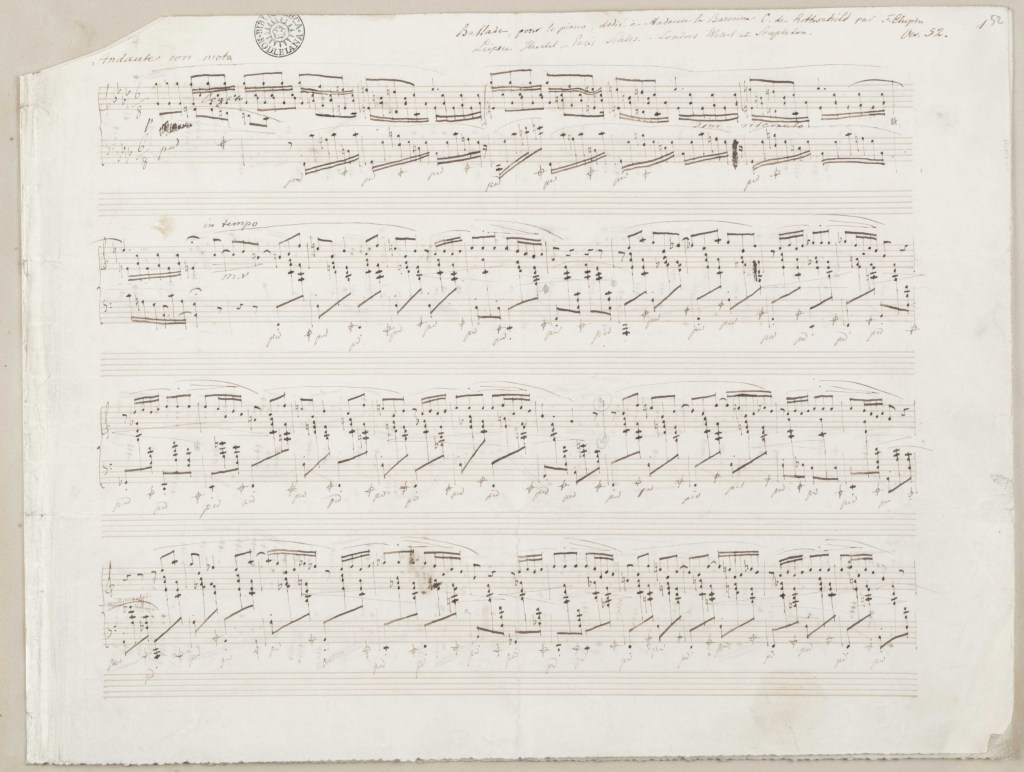
Ballade n. 4 in fa min. op. 52

The term ballade was used by Chopin in the sense of a balletic interlude or dance-piece, equivalent to the old Italian ballata, but the term may also have connotations of the medieval heroic ballad, a narrative minstrel-song, often of a fantastical character. There are dramatic and dance-like elements in Chopin’s use of the genre, and he may be said to be a pioneer of the ballade as an abstract musical form. The four ballades are said to have been inspired by a friend of Chopin’s, poet Adam Mickiewicz.The exact inspiration for each individual ballade, however, is unclear and disputed.Though the ballades do not conform exactly to sonata form the “ballade form” created by Chopin for his four ballades is a variant of sonata form with specific discrepancies, such as the mirror reprise (presenting the two expositional themes in reverse order during the recapitulation The ballades have directly influenced composers such as Liszt and Brahms who, after Chopin, wrote ballades of their own.Besides sharing the title, the four ballades are entities distinct from each other. Each one differs entirely from the others, and they have but one thing in common – their romantic working out and the nobility of their motifs.

The magnificent Siena Cathedral

The Ballade No. 1 in G minor, Op. 23, was completed in 1835 in Paris.In 1836, Schumann wrote: “I have a new Ballade by Chopin. It seems to me to be the work closest to his genius (though not the most brilliant). I even told him that it is my favourite of all of all his works. After a long, reflective pause he told me emphatically: ‘I am glad, because I too like it the best, it is my dearest work.’”

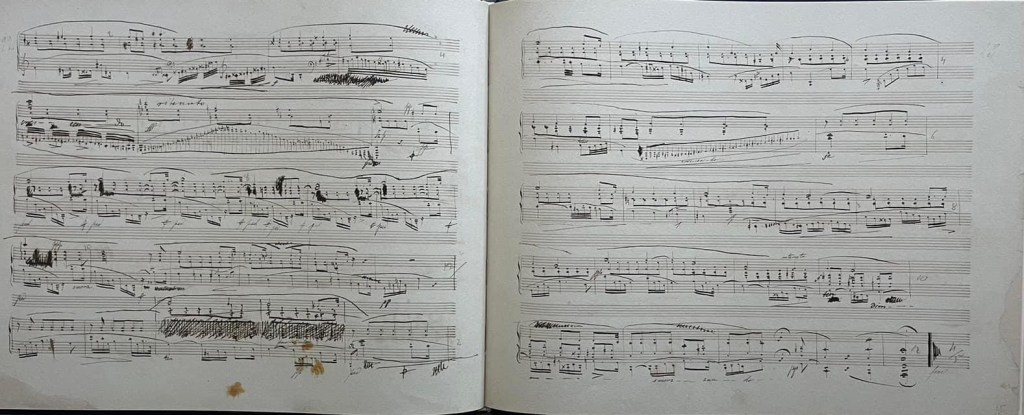
Manuscript of the opening of the G minor Ballade

The Ballade No. 2 in F major, Op. 38, was composed from 1836 to 1839 in Nohant and on the Spanish island of Mallorca .Schumann who had dedicated his Kreiseleriana op.16 to Chopin, received the dedication of this ballade in return.Schumann found it a less ingenious work than the first.It was supposedly inspired by Mickiewicz’s poem :Świtezianka, the lake of Willis,

The Ballade No. 3 in A♭ major, Op. 47, was composed in 1841 in Nohant .It was first mentioned by Chopin in a letter to Julian Fontana on 18 October 1841 and was likely composed in the summer of 1841 in, Nohant where he had also finished the Nocturnes op 48 and the Fantasie in F minor.It is dedicated to his pupil Pauline de Noailles (1823–1844).

Manuscript of the opening of the F minor Ballade

The Ballade No. 4 in F minor, Op. 52, was composed in 1842 in Paris and Nohant and revised in 1843.It is considered one of Chopin’s masterpieces, and one of the masterpieces of 19th-century piano music.According to John Ogdon it is “the most exalted, intense and sublimely powerful of all Chopin’s compositions… It is unbelievable that it lasts only twelve minutes, for it contains the experience of a lifetime.” It is dedicated to Baroness Rothschild ,wife of Nathaniel de Rothschild,who had invited Chopin to play in her Parisian residence , where she introduced him to the aristocracy and nobility.In the preface to his edition of Chopin’s ballades, Alfred Cortot claims that the inspiration for this ballade is Mickiewicz’s poem The Three Budrys, which tells of three brothers sent away by their father to seek treasures, and the story of their return with three Polish brides.

Gabriele Strata in the Green Room after the concert in Siena

Hailed as “a brilliant talent with extraordinary sensitivity and superb technique”, Gabriele Strata (1999) has established himself as one of the leading Italian pianists of his generation. In 2018 Gabriele won First Prize at the XXXV Premio Venezia, the most prestigious Italian piano competition where he was awarded the Plaque of the President of the Italian Republic and the Medal of the Italian Senate. The Italian government previously recognized his artistic achievements in 2016 when he was awarded the Medal of the Italian Parliament. Gabriele regularly performs in Italy, Europe and the US. His 2021-2022 includes debut concerto appearances in the Berlin Philharmonie with the Berlin Symphony Orchestra; in Barbican Centre (London) with the Guildhall Symphony Orchestra, in Beijing, Shanghai and Shenzhen (China) with the Young Musician European Orchestra, and in Venice with the Orchestra del Teatro la Fenice. He has given recitals in prominent concert halls including Royal Concertgebouw in Amsterdam, Teatro La Fenice in Venice, Philharmonic Hall in Bratislava and Fazioli Concert Hall in Sacile, as well as venues in Brussels, Florence, Rotterdam, Portland (OR), Verona, Bologna, Treviso, Padova. An avid chamber musician, he has played at Wigmore Hall and Milton Court Concert Hall in London, and has premiered chamber music works by Academy Award nominee Thomas Newman and Pulitzer Prize finalist Kate Soper. Gabriele received his Master of Music (M.M) degree from Yale University in 2019 at age 19, and a Master of Musical Arts (M.M.A) degree at Yale University in 2020 under the guidance of Professor Boris Berman. At Yale, he was awarded for two consecutive years the Charles R. Miller and the Elizabeth Parisot Prize as “most outstanding pianist in the School of Music”. He is currently pursing two Artist Diploma degrees, at the Guildhall School of Music and Drama in London and at the Accademia Nazionale di Santa Cecilia in Rome. In 2017, he graduated summa cum laude from the Conservatory of Music in Vicenza, Italy.

Teatro dei Rozzi waiting for the audience

Ivan Krpan Busoni 2017 in Florence Mastery and simplicity at the service of music

Harold Acton Library of the British Institute 2nd March at 18:30

Ivan Krpan in rehearsal

At the age of twenty, Ivan Krpan won the Ferruccio Busoni International Piano Competition 2017, one of the world’s most prestigious piano competitions. Since then he has been in demand for concerts in venues throughout Europe and Asia and has released  several recordings

Ivan Krpan was the first in this special series of concerts by three Busoni winners presented by the Keyboard Trust in partnership with the British Institute .Emanuil Ivanov (in the photo at La Scala) on the 30th March and 2015 winner Chloe (Jiyeong)Mun on the 9th June.

Franz SchubertSonata in C major, D 840 (Reliquie)

Frédéric Chopin: Four Ballades.

Sensational success as Ivan went British in Florence today.
The winner of Busoni in 2017 just proves that a jury with musical principles held high can choose a young artist of talent that matures into the great artist that we had before us today.The transcendental control of sound in Schubert’s ‘Reliquie Sonata’ was quite extraordinary.A Sonata that even Schubert had realised that after a first movement of such heavenly length to continue further would not be possible in this world.It was written three years before his untimely death and was paired with the large scale A minor Sonata.It preceded the last great trilogy of Sonatas that Schubert miraculously penned knowing that his time on this earth was coming to an end .There was real weight and authority from the very first notes with a rich orchestral tone palette never hard but rich and full.It contrasted so well with the magical second subject that was played with such delicacy over a gently murmuring bass.This was a true ‘tour de force’of technical control of sound on a not easy piano.The fluidity of the melodic line with it ravishing heartrending outpouring of mellifluous poetic murmurings was something to marvel at indeed.There were extraordinary contrasts that he brought to this monumental first movement.It was played with an aristocratic architectural sense of line that made one realise that even Schubert could not have continued.Lasting over twenty minutes it contrasted with the relatively short Andante that was simple and playful where again Ivan found simple beauty in Schubert’s unending outpouring of melodic invention.


The Chopin Ballades were so freshly minted that they left us breathless with anticipation from music that we have lived with for a lifetime.
A musicianship that looked at the score with the uncontaminated eyes of a virgin but with the mastery of someone who listens to what he is creating with an innocence that made Chopin’s miraculous creations spring to life as though freshly minted.

There was the utmost delicacy at the opening of the first Ballade where even the opening Largo introduction was merely a way of arriving to the simple outpouring of melody.The moderato was played with subtle balance allowing the melodic line to sing so delicately above the chordal accompaniment.An opening I have heard innumerable times but rarely have I heard it played with such disarming simplicity .It was this inevitability that each episode was merely a link in a chain united by a sound where the more demonstrative virtuosistic passages grew so naturally as a climax of what had come before. The beautiful ‘meno mosso’ second subject just floated on the waves of sound that had been created in the previous bars.The great romantic climaxes were played without any rhetoric but with fervent youthful conviction.The presto con fuoco was played with transcendental control but it was above all the music that we followed and not the astonishing technical mastery that Ivan was to demonstrate in all four codas of the Ballades.

The four Ballades were played without a break as a whole and so it was that the gentle lilting second Ballade grew so naturally our of the majestic final chords of the first.Interrupted by the tempestuous ‘Presto con fuoco’ but subsiding so naturally to the questioning return of the ‘Andantino’.His remarkably intelligent musicianship gave such a clear line and direction to Chopin’s contrapuntal ‘knotty twine’ that I have never heard so clearly defined as this before.Another coda with passionate flashes of sumptuous sounds before the final climactic flourish out of which Ivan with simplicity and ravishing beauty brought this remarkable work to a poignant close.The beautiful third Ballade was just one long outpouring of song .Magical washes of colour just embellished the musical line without ever interrupting the continual flow.Even the gradual build up to the final glorious outpouring were just layers of ever more exciting washes of sound bringing this most luminous of Ballades to an exciting conclusion.The fourth Ballade I have rarely heard the theme played with such luminosity and sensitivity and without indulging in unnatural rubati or personal interjections.Even the first variation was just a wash of sound that gradually built to the first passionate climax.The return of the introduction was played exactly as Perlemuter had written in my score – the poetic words of his teacher Alfred Cortot :’avec un sentiment de regret’.The slight pressure on the thumb notes created a magic aura that I have only ever heard once before from a young french pianist Jean Rodolphe Kars who after being noted in the first Leeds piano competition became a Trappist Monk!

Ivan enjoying a relaxing drink with his delightful pianist and violinist companion

I am not suggesting for a moment that our Ivan ,who is destined for an illustrious career in music,should follow suit!The elaborate embellishing of the theme in the final variation was played with a precision and forward movement that is of the very few and the build up to the final great climax was indeed a monumental end for these four Ballades.The pianissimi chords just before the tumultuous final coda were played with a luminosity and sense of line that made the final great interruption even more unexpected.

A Chopin Mazurka was played as an encore by great demand from a public that had been astonished ,moved and excited by this young poet of the piano.


The first of three Busoni winners in the Harold Acton Library that injects these musty books with the very life that had so inspired them .

A full house for the first of this trilogy of Busoni winners in partnership with the Keyboard Trust.It awards a career development prize to the winners of the competition that its founder Noretta Conci has frequented since the very first edition in 1949.No prize was awarded that year but a fourth prize was offered to Alfred Brendel!

Franz Schubert Piano Sonata in C major,840, nicknamed “Reliquie” upon its first publication in 1861 in the mistaken belief that it had been Schubert’s last work,was written in April 1825,whilst the composer was also working on the A minor D.845 in tandem. Schubert abandoned the C major sonata and only the first two movements were fully completed, with the trio section of the third movement also written in full. The minuet section of the third movement is incomplete and contains unusual harmonic changes, which suggests it was there Schubert had become disillusioned and abandoned the movement and later the sonata. The final fourth movement is also incomplete, ending abruptly after 272 measures.The fragments of the sonata survived in Schubert’s manuscripts, and later the work was collected and published in its incomplete form in 1861.

Sublime inspiration with simple musicianship of such integrity and mastery

The term ballade was used by Chopin in the sense of a balletic interlude or dance-piece, equivalent to the old Italian ballata, but the term may also have connotations of the medieval heroic ballad, a narrative minstrel-song, often of a fantastical character. There are dramatic and dance-like elements in Chopin’s use of the genre, and he may be said to be a pioneer of the ballade as an abstract musical form. The four ballades are said to have been inspired by a friend of Chopin’s, poet Adam Mickiewicz.The exact inspiration for each individual ballade, however, is unclear and disputed.Though the ballades do not conform exactly to sonata form the “ballade form” created by Chopin for his four ballades is a variant of sonata form with specific discrepancies, such as the mirror reprise (presenting the two expositional themes in reverse order during the recapitulation The ballades have directly influenced composers such as Liszt and Brahms who, after Chopin, wrote ballades of their own.Besides sharing the title, the four ballades are entities distinct from each other. Each one differs entirely from the others, and they have but one thing in common – their romantic working out and the nobility of their motifs.

The Ballade No. 1 in G minor, Op. 23, was completed in 1835 in Paris.In 1836, Schumann wrote: “I have a new Ballade by Chopin. It seems to me to be the work closest to his genius (though not the most brilliant). I even told him that it is my favourite of all of all his works. After a long, reflective pause he told me emphatically: ‘I am glad, because I too like it the best, it is my dearest work.'”

Manuscript of the opening of the First Ballade op 23

The Ballade No. 2 in F major, Op. 38, was composed from 1836 to 1839 in Nohant and on the Spanish island of Mallorca .Schumann who had dedicated his Kreiseleriana op.16 to Chopin, received the dedication of this ballade in return.Schumann found it a less ingenious work than the first.It was supposedly inspired by Mickiewicz’s poem :Świtezianka, the lake of Willis,

The Ballade No. 3 in A♭ major, Op. 47, was composed in 1841 in Nohant .It was first mentioned by Chopin in a letter to Julian Fontana on 18 October 1841 and was likely composed in the summer of 1841 in, Nohant where he had also finished the Nocturnes op 48 and the Fantasie in F minor.It is dedicated to his pupil Pauline de Noailles (1823–1844).

The Ballade No. 4 in F minor, Op. 52, was composed in 1842 in Paris and Nohant and revised in 1843.It is considered one of Chopin’s masterpieces, and one of the masterpieces of 19th-century piano music.According to John Ogdon it is “the most exalted, intense and sublimely powerful of all Chopin’s compositions… It is unbelievable that it lasts only twelve minutes, for it contains the experience of a lifetime.” It is dedicated to Baroness Rothschild ,wife of Nathaniel de Rothschild,who had invited Chopin to play in her Parisian residence , where she introduced him to the aristocracy and nobility.

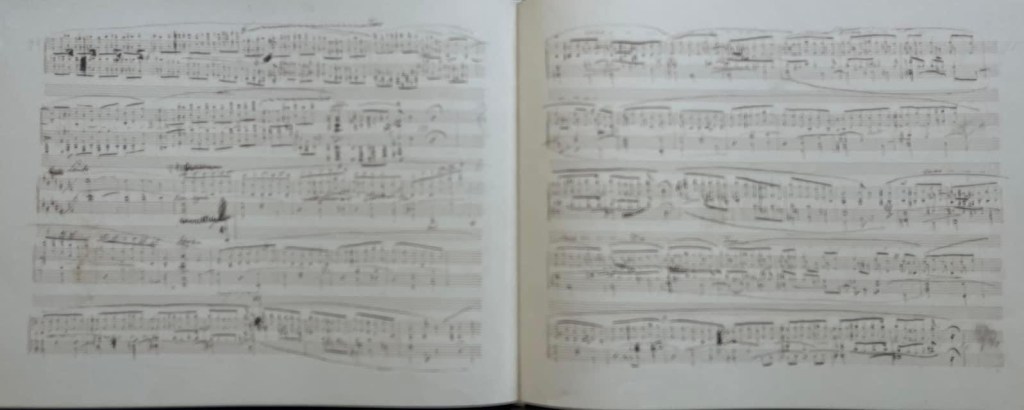
Manuscript of the fourth Ballade house in the Bodleian Museum in Oxford.

In the preface to his edition of Chopin’s ballades, Alfred Cortot claims that the inspiration for this ballade is Mickiewicz’s poem The Three Budrys, which tells of three brothers sent away by their father to seek treasures, and the story of their return with three Polish brides.

Ivan Krpan was born in Zagreb in 1997 into a musical family and began studying the piano at the age of six at the Blagoje Bersa Music School in Zagreb, under the tutelage of Renata Strojin Richter.
He studied piano with Ruben Dalibaltayan at the Music Academy in Zagreb where he obtained his master’s degree in 2019. In 2021 he started postgraduate study Konzertexamen at the Hochschule für Musik und Tanz Köln in the class of prof. Claudio Martinez Mehner. He has won several first prizes in national and international piano competitions; prize wins of note include first prizes at the 12th Piano Competition “Les Rencontres Internationales des Jeunes Pianistes” Grez Doiceau in Belgium in 2014, the International Piano Competition Young Virtuosi in Zagreb in 2014, the International Piano Competition for Young Musicians in Enschede (Netherlands) and the Ettlingen International Competition for Young Pianists. He achieved 2nd prize in the International Danube Piano Competition in Ulm in 2014 and same year he won a special prize awarded by the Dean of the Zagreb Music Academy and the 4th prize at the 1st International Zhuhai Mozart Competition in Zhuhai, China. He also won the annual Ivo Vuljević prize awarded by the Jeunesses Musicales Croatia for the best young musician in Croatia in 2015. In 2016 he won the 3rd prize at the 10th Moscow International Frederick Chopin Competition for Young Pianists and the Zagreb Philharmonic Orchestra has granted him the Young Musician of the Year Award.
At the age of twenty, Ivan Krpan has won the Ferruccio Busoni International Piano Competition 2017, one of the world’s most prestigious piano competitions. 2018/2019 season saw him performing in important Italian cities as Venice, Rome, Milano, Turin, in major music centers as London, Vienna and Hong Kong as well as a tour in South Korea in collaboration with the World Culture Networks Foundation and Steinway & Sons. He also had an important tour in Germany (Munich, Hamburg, Leipzig, Dusseldorf, Dresden, Hanover), and an extensive tour in Japan.
For the first time the Ferruccio Busoni International Piano Competition Foundation has produced a studio album, which it has made available exclusively on IDAGIO, a leading streaming service for classical music. In May 2018 Mr. Krpan took to the Emil Berliner Studios in Berlin to record Chopin’s 24 Préludes and Schumann’s Fantasie op. 17 and Arabeske op. 18.

https://christopheraxworthymusiccommentary.com/2020/11/15/ivan-krpan-in-zagreb-croatian-national-archive-hall-pridepassion-and-joy/

Sir David Scholey with his son who had flown in from his home on Majorca (where Chopin and George Sand were so rudely ejected by the natives frightened of catching the disease that was to claim Chopin’s life just a few years later!)
Ivan with his companion Marie Carrière talking with enthusiastic members of the audience

https://christopheraxworthymusiccommentary.com/2021/02/11/ivan-krapan-premio-busoni-2017-presents-liszt-harmonies-poetiques-et-religieuses/

One of the important things about these concerts is the discussions between artist and public with a sumptuous glass of wine in hand provided by local sponsors.It is all overseen with great approval by the director Simon Gammell (centre) who with his wife Jennifer has created a unique cultural meeting place in Florence

https://christopheraxworthymusiccommentary.com/2021/03/26/ivan-krpan-plays-mozart/

Discussions continued with members of the public until it was time to shut up shop.

https://christopheraxworthymusiccommentary.com/2020/12/27/ivan-krpan-at-home-for-le-salon-de-la-musique/

Sir David Scholey ever generously hosting a sumptuous after concert supper in the restaurant downstairs

Josef Mossali Young Artists Piano Solo Series Youthful virtuosity and refined musicianship exult and excite Roma 3

Josef Mossali lo scorso anno nell’Aula Magna della Scuola di Lettere, Filosofia e Lingue dell’Università Roma Tre, in uno scatto di Diana Montini

Josef Mossali for the Young Artists Piano Solo series gave an astonishing recital beginning with the Schumann Fantasy the first note surprisingly played with the right hand deep in the bass .The recital finishing with a dance from Pletnev’s ingenious reworking of Tchaikowsky’s Nutcracker.Including two preludes by Rachmaninov played with the insinuating rubato of op 23 n 6 and the mellifluous fluidity of op 23 n.8.But it was the Debussy late studies that suddenly liberated the true interpreter in Josef as he brought the quixotic changes in the arpeggio study vividly to life identifying totally with the quick fire changes of mood interspersed with ravishing washes of sound .The octave study was a tour de force not only because of his extraordinary technical control but because of the character he gave to this remarkable work.
It was the same technical ease and sense of character that he gave to Masques before the passionate outpourings of L’isle joyeuse.
Played with passionate conviction and technical prowess for a piece inspired in Eastbourne by the island of Jersey!
Josef had given a remarkably mature account of the first movement of the Fantasy .Giving it a true architectural shape with its dramatic contrasts of passionate outbursts and serene longing.In the other two movements he was a little too involved and lost the simplicity that had been such a hallmark of the opening.
The March was played with enviable control and drive but he gave too much of himself too soon so the final explosion did not come as an inevitable conclusion but rather just another repeat.Some ravishing sounds in the last movement that is a great outpouring of song for his beloved Clara .But his youthful passion did not allow him to sit back and wallow in the sublime beauty of the melodic line and he lost his head or in this case sense of balance as the accompaniment became too involved in this intimate discourse.
Starting with Schumann and ending with a Couperin encore we could appreciate the remarkable qualities of this young artist still being guided by Massimiliano Motterle in Bergamo and Boris Petrushansky in Imola

The Fantasie in C, op.17, was written in 1836. It was revised prior to publication in 1839, when it was dedicated to Franz Liszt .It is generally described as one of Schumann’s greatest works for solo piano and is one of the central works of the early Romantic period.The piece has its origin in early 1836, when Schumann composed a piece entitled Ruines expressing his distress at being parted from his beloved Clara Wieck (later to become his wife). This later became the first movement of the Fantasy.Later that year, he wrote two more movements to create a work intended as a contribution to the appeal by Liszt for funds to erect a monument to Beethoven in his birthplace, Bonn.Schumann offered the work to the publisher Kirstner, suggesting that 100 presentation copies could be sold to raise money for the monument. Other contributions to the Beethoven monument fund included Mendelssohn’s Variations sérieuses.It was dedicated to Franz Liszt who replied in a letter dated June 5, 1839: “The Fantaisie dedicated to me is a work of the highest kind – and I am really proud of the honour you have done me in dedicating to me so grand a composition. I mean, therefore, to work at it and penetrate it through and through, so as to make the utmost possible effect with it.”Liszt returned the honour by dedicating his own Sonata in B minor to Schumann in 1853. Clara Schumann did not start to perform the Fantasie in her concerts until 1866, ten years after the composer died.The original title of Schumann’s work was “Obolen auf Beethovens Monument: Ruinen, Trophaen, Palmen, Grosse Sonate f.d. Piano f. Für Beethovens Denkmal”. Kirstner refused, and Schumann tried offering the piece to Haslinger in January 1837. When Haslinger also refused, he offered it to Btreitkopf & Hartel in May 1837. The movements’ subtitles (Ruins, Trophies, Palms) became Ruins, Triumphal Arch, and Constellation, and were then removed altogether before Breitkopf & Härtel eventually issued the Fantasie in May.

Schumann prefaced the work with a quote from Friedrich Schlegel:Durch alle Töne tönetIm bunten ErdentraumEin leiser Ton gezogenFür den, der heimlich lauschet.(“Resounding through all the notesIn the earth’s colorful dreamThere sounds a faint long-drawn noteFor the one who listens in secret.”)The musical quotation of a phrase from Beethoven’s song cycle An die ferne Geliebte in the coda of the first movement was not acknowledged by Schumann, and apparently was not spotted until 1910.The text of the passage quoted is: Accept then these songs beloved, which I sang for you alone]. Schumann wrote to Clara: The first movement may well be the most passionate I have ever composed – a deep lament for you. They still had many tribulations to suffer before they finally married four years later.

Achille) Claude Debussy22 August 1862 – 25 March 1918) was a French composer. He is sometimes seen as the first Impressionist composer, although he vigorously rejected the term. He was among the most influential composers of the late 19th and early 20th centuries.

Masques, L. 105, was composed in July 1904,and premiered on 18 February 1905 by Ricardo Vines at the Salle Pleyel in Paris. Its sombre character reflects Debussy’s difficult separation from Lilly Texier, his first wife. The title refers to the commedia dell’arte although Debussy confided to Marguerite Long that the piece was “not Italian comedy, but an expression of the tragedy of existence” – (“ce n’est pas la comédie italienne, mais l’expression tragique de l’existence.”)In the early summer of 1903 Debussy considered writing a series of three piano pieces; the first was to be entitled L’isle joyeuse , the second to be Masques and the third was to be a piece based on a sarabande rhythm ; , due to the slow rhythm in ternary time, this last piece could have been what would later become D’un cashier d’esquisses which was also published separately in 1904. The pianist Ricardo Vines wrote in his diary that the composer had made him listen in June 1903 to what was supposed to be the first version of the piece entitled L’isle joyeuse .

Watteau, Pèlerinage à l’île de Cythère

It seems that the piece was inspired by Debussy from a 1717 painting by Antoine Watteau .The happy island was also very probably that of Jersey , where the musician spent important moments with his new partner Emma Bardac in the summer of 1904; it was during this period that Debussy revised and prepared for printing L’isle joyeuse . The work was published on the following 10 October by the publisher Durand, to whom the musician had sold it, together with Masques, for the sum of one thousand francs

Études L.136 are a set of 12 piano études composed in 1915. Debussy described them as “a warning to pianists not to take up the musical profession unless they have remarkable hands”.They are broadly considered to be his late masterpieces.

Nato nel 2001, inizia lo studio del pianoforte con il M° Massimiliano Motterle e si forma con il M° Marco Giovanetti al Conservatorio “G. Donizetti” di Bergamo, dove, dopo aver terminato il Triennio Accademico, sta attualmente frequentando il Biennio Ordinamentale sotto la guida del M° M. Motterle. Inoltre prosegue gli studi all’Accademia di Imola con il M° Boris Petrushansky. Ha vinto il Primo premio in diversi concorsi tra cui il 27° concorso “J.S. Bach” di Sestri Levante; il “XX International Music Competition” di Cortemilia; il XII concorso “Città di Riccione”; il 19°concorso “Città di Giussano”; il concorso “D. Scarlatti” di Carpenedolo; il 10° concorso “Città di Piove di Sacco”; il 17° Concorso “Marco Bramanti” di Forte dei Marmi; il 1° concorso “Lombardia è musica” tra i conservatori lombardi, istituito dal Consiglio Regionale della Lombardia; la XVa edizione del Premio Nazionale delle Arti. Ha suonato per la Società dei concerti di Milano nella Sala Verdi del Conservatorio di Milano, per la Società del Quartetto di Milano, per gli Amici della musica di Firenze, per l’Accademia Nazionale di Santa Cecilia presso l’Auditorium Parco della Musica, per la Camerata Ducale di Vercelli, per l’associazione GIA a Brescia, per il Teatro Coccia di Novara, per Rai Radio 3 e per Rai 1, per il Festival Pianistico Internazionale di Brescia e Bergamo, debuttando al Teatro Donizetti nel 2022. Ha suonato sotto la direzione del M° Pier Carlo Orizio, del M° Fabrizio Maria Carminati, collaborando con diverse orchestre tra le quali la Filarmonica del Festival Pianistico Internazionale di Brescia e Bergamo, l’Orchestra dei Virtuosi Italiani e l’Orchestra del Conservatorio G. Donizetti di Bergamo.

With artistic director of Roma 3 Valerio Vicari

Viv Mc Lean goes to town Hollywood Style Ravishes and seduces Big Band Style

Thursday 23 February 3.00 pm

Viv McLean

There was magic in the air with Viv McLean in contemplative mood.
Two Scarlatti Sonatas in D minor were played very slowly and contemplatively with ravishing colours and sensitive phrasing that made them shine like the gems we sometimes take too much for granted.
It was Fou Ts’ong who fell in love with Scarlatti and played some of them so slowly too with ravishing beauty always in style with none of this Tausig business but scrupulous authenticity.
We forget with the fingerfertigkeit jeux perlé high jinx that are so often paraded before us that the genius of Scarlatti lay in his fantasy and mellifluous outpouring of melodic invention.
The human voice -the most expressive instrument of all – and of course like Bach ,Scarlatti’s inspiration is based on the song and the dance with a clarity and simplicity that with the arrival of the pedal was to add more soul of smoke and mystery.
The very things that Viv McLean was to reveal so beautifully with the arrival of Gershwin with its insinuating colours and ravishing heartfelt outpourings of hollywoodian sounds .
The beguiling horn call of the E major sonata was worthy of a part in ‘A Midsummer nights dream’ where the elves and fairies make light and fun of any pomposity.


And it was this in Viv McLean’s playing that was so refreshing with its simplicity which did not exclude real delicacy and feeling but encapsulated within the notes themselves and never externally added.
His Mozart too was beautifully fresh and simple with a clarity and purity of sound but I found him a little inhibited by his meaningful adherence to a non legato style.
Instead of the live operatic characters that abound in all of Mozart’s works there were porcelain doll like characters that seemed artificial and not the full blooded stage actors of Mozart’s real life theatrical personalities.
It was played with a purity of sound of clarity and elegance but somehow it did not penetrate the heart as Scarlatti had.The Andante was expansive and expressive with some very delicate changes of colour.The Allegretto was played with great dynamic contrasts and brilliance but just missed the elegance of a past epoque.


Then the curtain rose and the party began.We were treated to the nightclub elegance of the ‘30’s with an insinuating performance of subtle intensity and ravishing colours .Viv McLean had opened his heart strings creating a magic atmosphere of smokey intimacy before letting rip Hollywood style with the full big band of Rhapsody in Blue.
This was the real thing as we were transported back to an age of elegance and easy showmanship and an original light that illuminated Broadway for decades.’The man I love’ was the insinuating opening number.


It was the original talent that when Gershwin asked to study with the greatest guru of her age,Nadia Boulanger,she turned him away as she did not want to ruin such an original voice.
Viv McLean ignited his large audience as the house favourite charmed,astonished and excited them with a scintillating display of refined virtuosity.A truly dazzling ,fizzing you might say,performance of Rhapsody in Blue with the sumptuous orchestral sounds of the big band with amazing solo spots of such clarity and brilliance.As Hugh rightly said there are very few pianists who can play Scarlatti and Mozart with such beauty and intelligence and then switch to the improvisational style of Hollywood.A wonderful sense of balance allowed him to play the Gershwin with full sounds that were never hard but bathed on a glorious carpet of sumptuous rich velvet sonorities.His performance of ‘Summertime’ offered as an encore was beguiling with it’s subtle sense of colour and a fluidity of recreation that was quite simply sublime.

Since winning First Prize at the Maria Canals International Piano Competition in Barcelona, British pianist Viv McLean has performed in all the major venues in the UK, as well as throughout Europe, Japan, Australia and the USA. He has performed concertos with orchestras such as the RPO, Philharmonia Orchestra, LPO, English Chamber Orchestra, Halle, BBC Concert Orchestra & the National Symphony Orchestra under the baton of such conductors as Daniel Harding, Wayne Marshall, Christopher Warren-Green, Owain Arwell Hughes, Carl Davis, Rebecca Miller and Marvin Hamlisch. Viv has collaborated with groups such as the Leopold String Trio, Ensemble 360, the Ysaye Quartet, the Sacconi String Quartet, members of the Elias, Allegri, Carducci and Tippett Quartets, and artists such as Natalie Clein, Daniel Hope, Lawrence Power, David Le Page, Adrian Brendel and Mary Bevan. Viv has appeared at many festivals including the International Beethoven Festival in Bonn, the Festival des Saintes in France, Vinterfestspill i Bergstaden in Norway and the Cheltenham International Festival in the UK. He has recorded for Sony, Naxos, Nimbus, Stone Records, RPO Records and ICSM Records. Viv has also recorded regularly for BBC Radio 3 as well as for radio in Germany, France, Australia, Norway and Poland.

https://christopheraxworthymusiccommentary.com/2022/08/28/viv-mclean-at-st-annes-kew-a-lesson-in-classical-authority-and-sensual-colour/

Thomas Kelly at St Mary’s Masterly playing from the Golden Age

Tuesday 28 February 3.00 pm 

Masterly playing from Thomas Kelly not only for his unique sense of colour and style but for his musicianship that guided us through everything he played with an architectural shape and aristocratic sense of style that marks him out as one of the most exciting young musicians of his generation .
He and Benjamin Grosvenor are magicians of the keyboard as the great pianists were in the golden age of piano playing.The era of Rachmaninov,Lhevine,Rosenthal Godowsky or Moiseiwitch and in our day Stephen Hough.A piano that is no longer a percussion instrument but a kaleidoscope of magical sounds that are created by the greatest of illusionists.Subtle use of the pedals and above all a sense of touch that can find infinite gradations in every note.The famous Matthay touch but also the pedal of Anton Rubinstein that he described as the soul of the piano.
A magnificent recital that was a lesson in musicianship and phenomenal technical control.The sounds he brought to Respighi’s Notturno played as an encore were the stuff that dreams are made of.

There was a fluidity to his sound from the very first Bagatelle with the driving rhythmic urgency of the second even if he was rather impatient with the rests as I expect Beethoven was too.A beautiful cadenza ‘grazioso’ in the first was a gentle relief from Beethoven’s most concisely profound outpouring.It was the same celestial harp that interrupted the third bagatelle.An expansive melodic line of quartet richness similar to the aria of his Sonata op 109.The final sparse notes bathed in pedal but with Thomas’s keen ear was given a subtle cleansing but never taking away from the overall effect.He had indeed digested Beethoven’s meaning and transmitted it to us with integrity and honesty.There was a rhythmic surge to the fourth played with drive and passion which contrasted so well with the bagpipe drone on which floated Beethoven’s disarmingly simple melodic line.The contrasting simplicity of the ‘quasi allegretto’ was a gentle oasis even though the legato contrasts could have been even more fluidly expressed.It was rudely interrupted by the Beethovenian explosion of the last Bagatelle and the contrasting long held pedal note on which Beethoven floated the magical simple mellifluous lines that were to characterise the serenity that he had at last found at the end of tumultuous life

Beethoven’s Bagatelles Op. 126 were published late in his career, in the year 1825 and dedicated to his brother Nikolaus Johann ( 1776–1848).Beethoven wrote to his publisher, Schott Music that the Opus 126 Bagatelles “are probably the best I’ve written”.In prefatory remarks to his edition of the works, Otto von Irmer notes that Beethoven intended the six bagatelles be played in order as a single work, at least insofar as this can be inferred from a marginal annotation Beethoven made in the manuscript: “Ciclus von Kleinigkeiten” (cycle of little pieces).Another reason to regard the work as a unity rather than a collection: starting with the second Bagatelle, the keys of the pieces fall in a regular succession of descending major thirds a pattern used in Beethoven’s ‘Eroica’Symphony and the String Quartet op 127

There was ravishing beauty to the full rich sound that he found for Baron von Fricken’s theme contrasting with the subtle rhythmic precision of the first variation .There was a shimmering beauty to the second that was also a passionate grandiose outpouring of timeless wonder.There followed the butterfly fluttering that accompanied the beauty of the tenor line and the lightweight precision of the chordal variations that follow .It was here that Thomas inserted the five beautifully lyrical posthumous studies .It made a superb contrast with the magical swirling sounds of the first and the subtle beauty of the duet between the treble and bass of the second.The contrasting rhythmic outpouring of the third and the sublime simple chiselled beauty of the fourth and fifth with mature masterly playing of great subtlety and colour.Returning to the passionate outpouring of the fifth of the original variations that was played with superb technical control and passionate simplicity.There was the hard driven rhythm of the sixth and the aristocratically architectural shape of the austere seventh likened by Agosti to the solidity of a Gothic Cathedral.Mendelssohnian lightness followed of true transcendental virtuosity.The solidity of the eighth contrasting with the magical bel canto of the ninth.The shimmering beauty of the accompaniment to the duet between the two glorious Belcanto voices enchanting with passion and exquisite delicacy.The Finale was played with great authority and architectural shape,the slight rallentando and drop in tension,before the final startling change of key was a masterly touch and led even more impact to the excitement and exhilaration of the final dynamic outpouring .

The first edition in 1837 carried an annotation that the tune was “the composition of an amateur”: this referred to the origin of the theme, which had been sent to Schumann by Baron von Fricken, guardian of Ernestine von Fricken, the Estrella of his Carnaval op. 9. The baron, an amateur musician, had used the melody in a Theme with Variations for flute. Schumann had been engaged to Ernestine in 1834, only to break abruptly with her the year after. An autobiographical element is thus interwoven in the genesis of the Études symphoniques (as in that of many other works of Schumann’s).Of the sixteen variations Schumann composed on Fricken’s theme, only eleven were published by him. (An early version, completed between 1834 and January 1835, contained twelve movements). The final, twelfth, published étude was a variation on the theme from the Romance Du stolzes England freue dich (Proud England, rejoice!), from Heinrich Marschner’s opera Der Templer und die Judin based on Sir Walter Scott’s Ivanhoe (as a tribute to Schumann’s English friend, William Sterndale Bennett to whom it is dedicated )The earlier Fricken theme occasionally appears briefly during this étude. The work was first published in 1837 as XII Études Symphoniques. Only nine of the twelve études were specifically designated as variations. The entire work was dedicated to Schumann’s English friend, the pianist and composer, and Bennett played the piece frequently in England to great acclaim, but Schumann thought it was unsuitable for public performance and advised his wife Clara not to play it.The highly virtuosic demands of the piano writing are frequently aimed not merely at effect but at clarification of the polyphonic complexity and at delving more deeply into keyboard experimentation. The Etudes are considered to be one of the most difficult works for piano by Schumann (together with his Fantasy in C and Toccata) and in Romantic literature as a whole.

Thomas Kelly was born in 1998. He passed Grade 8 with Distinction in 2006 and performed Mozart Piano Concerto No. 24 in Canterbury’s Marlowe Theatre two years later. After moving to Cheshire, he regularly played in festivals, winning prizes including in the Birmingham Festival, 3rd prize in Young Pianist of The North 2012, and 1st prize in the 2014 Warrington Competition for Young Musicians. Since 2015, Thomas has studied with Andrew Ball, initially at the Purcell School for Young Musicians and now at Royal College of Music, where he is a third-year undergraduate. Thomas has won first prizes including Pianale International Piano Competition 2017, Kharkiv Assemblies 2018, Lucca Virtuoso e Bel Canto festival 2018, RCM Joan Chissell Schumann competition 2019, Kendall Taylor Beethoven Competition 2019 and BPSE Intercollegiate Beethoven Competition 2019. He has also performed in venues including the Wigmore Hall, Cadogan Hall, Holy Trinity Sloane Square, St James’ Piccadilly, Oxford Town Hall, St Mary’s Perivale, St Paul’s Bedford, Poole Lighthouse Arts Centre, Stoller Hall, Paris Conservatoire, the StreingreaberHaus in Bayreuth, the Teatro del Sale in Florence, in Vilnius and Palanga. Thomas’ studies at RCM are generously supported by Pat Kendall-Taylor, Ms Daunt and Ms Stevenson and C. Bechstein pianos. He recently won 5th prize at the 2021 Leeds International Piano Competition, and was the first British pianist to reach the finals of this prestigious competition for 18 years

https://christopheraxworthymusiccommentary.com/2023/02/14/a-celebration-of-the-life-of-andrew-ball-the-thinker-pianist-at-the-r-c-m-london/

https://christopheraxworthymusiccommentary.com/2023/02/12/hhh-concerts-and-the-keyboard-trust-a-winning-combination-of-youthful-dedication-to-art/

https://christopheraxworthymusiccommentary.com/2023/01/08/thomas-kelly-reaching-for-the-stars-a-voyage-of-discovery-at-leighton-house/

https://christopheraxworthymusiccommentary.com/2022/10/14/thomas-kelly-plays-beethoven-4-at-the-rcm-cat-and-mouse-with-sakari-oramo/

https://christopheraxworthymusiccommentary.com/2022/04/18/thomas-kelly-takes-florence-by-storm-music-al-british/

Gala Chistiakova and Diego Benocci in Viterbo A duo that plays as one with beauty and style.

Gala Chistiakova e Diego Benocci  


https://youtube.com/live/KWbXeIxzrwM?feature=share


Duo Degas in Viterbo as winners of the International Rome competition founded by Marcella Crudeli.
The indomitable Marcella at 82 had given a moving duo recital in Rome with her young protégée Emanuele Savron three times her younger.
All 21 Hungarian dances by Brahms and two repeated made for 24 https://christopheraxworthymusiccommentary.com/2023/02/23/ballando-con-le-stelle-marcella-crudeli-ed-emanuele-savron-could-have-danced-all-nightfor-roma-3-orchestra-concert-season/

Franz Liszt was strongly influenced by the music heard in his youth, particularly Hungarian folk music, with its unique gypsy scale rhythmic spontaneity and direct, seductive expression. These elements would eventually play a significant role in Liszt’s compositions. Although this prolific composer’s works are highly varied in style, a relatively large part of his output is nationalistic in character, the Hungarian Rhapsodies being an ideal example.
Composed in 1847 and dedicated to Count Laszlo Teleki Hungarian Rhapsody No. 2 was first published as a piano solo in 1851 by Senff and Ricordi. Its immediate success and popularity on the concert stage led to an orchestrated version, arranged (together with five other rhapsodies) in 1857–1860 by the composer in collaboration with Franz Doppler and published by Schuberth in 1874–1875. In addition to the orchestral version, the composer arranged a piano duet version in 1874, published by Schuberth the following year.the version that was played today was of Richard Kleinmichel/Franz Bendel.


It was Gala Chistiakova and her partner on stage and in life Diego Benocci who chose two of the better known dances as an encore today.
It followed an extraordinary performance of Liszt’s 2nd Hungarian Rhapsody where Gala’s refined tones were complemented by Diego’s dynamic theatricality in a performance of scintillatingly stylish playing that seduced and excited all the senses.

In the 1760s, when Wolfgang & his sister Nannerl were touring Europe as child prodigies, the keyboard duet was a popular novelty item on their programs, one that offered a fuller range of sound from a single instrument while still allowing each performer the opportunity for individual display.
When the Mozart children were touring, though, they would most likely have been playing the harpsichord, since the hammered fortepiano (progenitor of the modern pianoforte) did not replace in popularity its string-plucking keyboard cousin until the following decade. While the Sonata in D major K. 381 was composed in 1772, the lack of dynamic markings in the manuscript probably indicates that it was still written for harpsichord, not the fortepiano.


From the opening work on the recital for Tuscia University season with the very first notes of Mozart’s much loved D major Sonata we were treated to a refined performance of elegance and rhythmic energy.Gala’s pure golden sounds in the Andante were matched by Diego’s sensitive accompaniment.
A sense of balance where they played as one such was the overall architectural shape so clearly moulded together.

Grieg’s incidental music for Henrik Ibsen’s drama “Peer Gynt” contains some of his best-known compositions, such as “Morning mood” and “In the hall of the Mountain King”. Grieg later extracted the most beautiful pieces to form two orchestral suites and arranged himself these versions for piano solo and piano four-hands. Peer Gynt Suite no. 2 includes Solvejg’s Song op. 55,4. The decisive role that Norwegian folk music played for Edvard Grieg can be felt in almost all of his works. For his Norwegian Dances op. 35,Grieg took old folk tunes from a collection published by the musician and researcher Ludvig Mathias Lindeman and arranged them for piano four hands in 1880. Peer Gynt Suite no. 1 op. 46 Morning Mood op. 46,1
The Death of Ase op. 46,2
Anitra’s Dance op. 46,3
In the Hall of the Mountain King op. 46,4


There were moments of ravishing beauty as Grieg’s beautiful lyrical pieces unwound with such ease and natural charm.Solvejg’s song was allowed to pour from their sensitive fingers with a warmth that enveloped us all.Their encores of two Hungarian Dances by Brahms just underlined their elegance and style which had been the hallmark of such an enjoyable recital.

Il duo pianistico a 4 mani Gala Chistiakova e Diego Benocci si è formato nel 2014, quando i due pianisti si perfezionavano presso l’Accademia Pianistica Internazionale di Imola. 

Diego Benocci è nato a Grosseto, ha iniziato gli studi musicali presso l’Istituto Musicale della sua città con il M° Giuliano Schiano. Si è diplomato presso il Conservatorio “G. Frescobaldi” di Ferrara e ha concluso il corso di laurea presso il Conservatorio di Stato “L. Cherubini” di Firenze nella classe della Prof.ssa Maria Teresa Carunchio e l’Accademia Pianistica Internazionale “Incontri col Maestro” di Imola sotto la guida del M° Enrico Pace e del M° Igor Roma. Tiene regolarmente concerti in tutta Europa e in Asia come solista, musicista da camera e suona con orchestre in importanti festival. 

Gala Chistiakova è nata a Mosca in una famiglia di musicisti. Ha iniziato i suoi studi di pianoforte a 3 anni con sua madre Liubov Chistiakova. Dal 1993 al 2005 ha studiato alla Scuola Centrale del Conservatorio di Mosca intitolato a Pëtr Il’ič Čajkovskij con i professori Helena Khoven e Anatoly Ryabov. Nel 2014 Gala ha terminato il Conservatorio di Mosca e un corso post-laurea in una classe del professor Mikhail Voskresensky. Nel 2011 ha iniziato i suoi studi presso l’Accademia Pianistica Internazionale “Incontri col Maestro” (classe del Prof. Boris BorisPetrušanskij) in Italia. 

Vincitrice di oltre 30 concorsi internazionali, vive oggi con il marito Diego Benocci a Grosseto dove dirigono insieme il Festival Musicale Internazionale “Recondite Armonie” e il Progetto di Scambio Culturale “Giovani Musicisti del Mondo”. Nel 2022 sono stati nominati codirettori artistici e docenti del festival IMOC a Grosseto. Il duo ha un vasto repertorio e ha tenuto concerti in Russia, Italia, Francia, Portogallo, Germania, Regno Unito, per numerose stagioni musicali internazionali riscuotendo ovunque grande successo di pubblico e di critica. Nel 2021 in duo hanno vinto la borsa di studio all’Accademia Chigiana nella classe della prof.ssa Lilya Zilberstein. Hanno collaborato come duo con orchestre sinfoniche e da Camera e recentemente si sono esibiti al Conservatorio Čajkovskij di Mosca, alla Weston Recital Hall di Oxford, al Festival International de Musique de Chambre Est Ouest in Belgio, al Madeira Piano Festin Portogallo e in un concerto straordinario per G. Armani a Londra.

Il loro primo CD con musiche di Čajkovskij è stato pubblicato nel 2021 dall’etichetta italiana OnClassical e le loro registrazioni sono state trasmesse in più occasioni su Rai Radio 3. Di recente il duo è risultato vincitore del primo premio assoluto e del premio “Marche Musica” al XXXI Concorso Pianistico Internazionale “Roma”

In their festival in Grosseto ‘Recondite Armonie ‘ many young talents are generously given a platform https://christopheraxworthymusiccommentary.com/2021/08/05/elia-cecino-in-grosseto-the-birth-of-an-artist/

Michelle Candotti a Lioness let loose in Velletri ignites Liszt’s piano

Extraordinary opening concert in Velletri ’Suono di Liszt a Villa D’Este ‘ with Michelle Candotti and the Orchestra of CDM conducted by Federico Biscione.


The eleventh series of concerts all centred around a very special piano.An Erard of 1879 similar to the one that Liszt would have played in the Villa D’Este.


Infact a series of concerts initiated 11 years ago in 2011 for the bicentenary of the birth of Franz Liszt .
The series has now found a permanent home in the ex Convento del Carmine in Velletri.


Today a happy combination with an orchestra from the youthful formation in Tivoli directed by Federico Biscione joining Michelle Candotti in a performance of Chopin’s Concerto in E minor op 11.


An aristocratic performance of great weight and authority from this young pianist from the school of Dmitri Alexeev and Carlo Palese.
Living every moment of the concerto with intensity and extraordinary sensitivity she created a rapport immediately with her young companions .The cello in particular I had never been aware of this intimate relationship until today.
The sublime simplicity of the larghetto was something to cherish as was her intelligence in keeping the rhythm until the final bar a master stroke from a masterly musician.A rondo full of character and ‘joie de vivre’ with a command of the keyboard that was breathtaking .It was the real weight of her playing that was astonishing as she delved deep into the keys of a piano that had become her friend in the days she had been the guest of Ing.Tammaro and wife Celeste.Whose birthday was celebrated after today’s performance

It was a Chopin of great temperament and also sublime delicacy.Whether dramatic or lyrical.Poetic or passionate it was all played with aristocratic good taste and style.It was the weight that gives every note a meaning like the human voice.Digging deep into the notes extracting the velvet sounds that are the true voice of a piano destined for private salons for a select group of aristocrats and not the concert hall of today for a public of thousands.In this beautifully restored Casa della cultura e della Musica this piano was allowed to sing under Michelle’s very sensitive hands and the string orchestra of only eleven elements.It was the ideal group that just exulted the exquisite sounds in a performance of chamber music proportions that surely must have been how Chopin had intended it.

Michelle Candotti with Federico Biscione

Michelle and Federico Biscione were both aware of this and it gave them a freedom to shape and mould the magic streams of notes with ravishing results.I have never heard the Romanza played with such shimmering beauty or the belcanto of Chopin’s melodic outpouring so beautifully sustained.Playing of great passion too as her hands and whole body streamed up and down the keyboard with glittering displays of notes accompanying the orchestra and driving them on with Michelle’s same infectious sacred flame.A group of musicians created and trained with patience and remarkable musicianship by Federico Biscione who I had so admired last Christmas in Frascati.An orchestra giving these young musicians a passion and professional training and above all a love for music .They are from the CDM school based in Tivoli directed with dedication by Antonella Zampaglioni and Giancarlo Gregori

Antonella Zampaglioni of CDM di Tivoli who like Giancarlo Tamarro is a tireless promoter of young talent .Thanks to them and their colleagues the hills of Rome a truly ringing to the sound of music.

https://christopheraxworthymusiccommentary.com/2022/12/19/christmas-comes-to-frascati-the-gift-of-music-illuminates-the-city/

Getting to know this 1879 Erard which has been so lovingly restored by Giancarlo Tamarro and given pride of place in his home when it is not being used for public performances.A series of concerts run by the indomitable Tamarro gives a platform to so many talented young musicians for a series based on the original instrument of Villa D’Este.A series inaugurated to celebrate the 200th anniversary of Liszt’s birth.The original instrument which had been given to Liszt by the Casa Ducci in Florence had been completely lost until in 1991 when it was discovered in a Convent in Rome.It was completely restored and found a temporary home in the Metropolitan Museum in New York and is now in Vienna.Filippo Guglielmi who was a composition student of Liszt and visited him frequently on Liszt’s last visits to the Villa D’Este left this testimony :”one day in the music room Liszt awaited a brilliant young student who he thought very highly of ,Moritz Rosenthal.He was accompanied by his father of israelite Hungarian extraction and his eyes lit up when he saw the magnificent Erard that had been given to Liszt by Casa Ducci in florence”


After her astonishing performance of Chopin Michelle let rip with performances of the Liszt ‘Ernani’ paraphrase and the ‘Dante Sonata’.They were even more astonishing than her Chopin for her total self identification with the theatrical world that Liszt depicts so vividly in music.
She threw herself into this world with terrifying abandon but always with a total command and understanding of the story that Liszt depicts so vividly.
Sumptuous sounds and ravishing beauty went hand in hand with scintillating virtuosity and awesome octaves that could make this 1879 Erard roar as it surely has never done before.
A true lioness of the keyboard that with her sublime inspiration kept us all spellbound and on the edge of our seats with performances that will long be remembered.

A grandiose opening to the ‘Ernani’ paraphrase dissolved into magical flourishes as the heroic declamation of the theme in octaves took centre stage.There was sumptuous sound too as the tenor melody was accompanied by arabesques over the entire keyboard .Both Liszt and Thalberg were accused of having three hands such was the magic effect they could create and which Michelle today played with supreme mastery and passionate participation.There were scintillating birdlike cadenza’s of great delicacy but above all there was a grandiloquence and aristocratic control allied to an astonishing technical command that seemed to know no limit.Michelle had created on this Erard a past world where the greatest composer pianists were above all magicians who could create the illusion of a full orchestra from a box of strings and hammers.But it was above all the pedals that as Liszt’s illustrious student Anton Rubinstein said are ‘the soul of the piano.’Today Michelle revealed her soul as she uncovered the secrets that have been hidden away for too long in this antique instrument.

I can do no better that quote Leslie Howard the undisputed authority on Liszt who had chosen this as a set work for the Liszt Competition in Utrecht of which he is president.It is where Michelle was noted and much admired in 2016.”The standard Ernani paraphrase was issued with the paraphrases on Il trovatore and Rigoletto. It was based, in part, on an earlier, unpublished work, which is performed here: the later paraphrase confines itself to the finale of Act III – the King of Spain’s aria and chorus at Charlemagne’s tomb – and is an elaboration, transposed from A flat minor to F minor, of the second part of the earlier work (Verdi’s key is F minor). In the earlier piece the A flat minor section is preceded by an exceedingly florid transcription in E flat major (Verdi’s key) of a chorus from the finale of Act I: Elvira’s would-be lover is revealed to be Don Carlo, the King.”Leslie Howard will perform in this series with Ludovico Troncanetti on the 14th May.

Michelle’s performance of the ‘Dante’ Sonata where she immediately set the scene from the very first opening flourishes played with total conviction with a reenactment of the scene that was about to unfold.There was a demonic look in her eyes as she attacked the piano with fearless conviction and towering virtuosity.There was radiant beauty and the serene benediction of the central episode played with whispered delicacy and luminosity as the delicate web of sounds unfolded to ignite the piano with Recitativi of overpowering conviction.The final treacherous leaps passed unnoticed such was her musical involvement where technical difficulty just was not an option.But above all it was the silences that were even more menacing than the streams of notes that poured from her infallible fingers.These were fingers at the service of a heart that could beat with overpowering conviction and communication.

Après une lecture du Dante: Fantasia quasi Sonata also known as the Dante Sonata) is a sonata in one movement completed in 1849 and first published in 1856 as part of the second volume of Liszt’s of Années de pèlerinage (Years of Pilgrimage).It was inspired by the reading of Victor Hugo’s poem “Après un lecture du Dante” (1836)

Unbelievably this seeming waif of a young lady could still offer Chopin’s Octave Study op 25 n.10 as an encore.Played with astonishing power and dynamism but also with the central episode unfolded so naturally with real legato as it was an integral part of an overall architectural whole.A musician at the service of music that she enacted with towering virtuosity and dynamism.

https://christopheraxworthymusiccommentary.com/2022/04/18/michelle-candotti-ravishes-and-seduces-the-piano-for-rome-tre-young-artists-piano-solo-spring-series-in-aula-magna/

https://christopheraxworthymusiccommentary.com/2022/12/19/christmas-comes-to-frascati-the-gift-of-music-illuminates-the-city/
Celebrations of a birthday and opening concert of a season that will finish in June