Mariam Batsashvili gave two concerts in Germany on the 26th April at Steinway Hall Cologne and the 27th April at the magnificent Orangery at Castle Rheda this is what Moritz von Bredow wrote:
“please allow me to send you my report on Mariam Batsashvili‘s two very outstanding piano recitals last week in Cologne and Rheda-Wiedenbrück. The latter one was followed by two most amazing reviews in local newspapers.The audience in Cologne was small but enthusiastic and very attentive, and the hall in Rheda-Wiedenbrück was completely sold out.The programme consisted of:
Bach/Busoni – Chaconne D Minor
Mozart – Rondo A Minor K511
Schubert – Impromptu F Minor op. 142/1
Liszt – Hungarian Rhapsody no. 12
INTERVAL
Chopin – Andante Spianato et Grande Polonaise Brillante op. 22
Mozart/Liszt – Fantasy on themes from Figaro and Don Giovanni (completed by Leslie Howard)
Mariam started the evening with the Chaconne, a work that most pianists would use to end a programme. The opening chords were placed in a grand and solemn mood , and it was these first notes that already made everybody listen with deepest attention. What followed was a unique demonstration of wonderfully understood Bach as well as meticulously prepared Busoni. Never forgetting the intimate and figurative playing of the violin, Mariam Batsashvili exposed the grandeur of Busoni’s orchestral use of the piano in unparalleled ways. Her sense of rhythm as well as her demonstration of each of the various themes’ architecture and counterpoint were breathtaking. She never got lost in small pieces, but saw the entity of this one work, going through the most difficult fugal developments in a seemingly easy way. Mariam’s highly intelligent understanding of the difficult structure of this work made it possible that the listener could hear lines and inner melodies that before may never have been shown that clearly. La forza of La Batsashvili was never left to chance – she controls the piano whenever she wants, and this her orchestral sound is huge, but always transparent and never hard. Thus, La Chacona was something that could not have started this evening in a better manner.
What followed was equally beautiful: concise and unsentimental, yet flowing and absolutely rhythmical interpretation of Mozart’s Rondo in A minor. This work, written only a few years before Mozart died, is very difficult in that one may easily fall into overromantic expression. Mariam had prepared this piece meticulously and never left the path of idiomatic Mozartism. The lightness of her playing, her sheer understanding and deep love for Mozart’s music, made this one of the the most moving works of the evening.
It fitted well to hear Schubert’s first of four Impromptus op. 142 in F minor. Schubert wrote this cycle the year before he died, already ill and pensive. There was a relentless pulse going through the opening bars, and this continued throughout the peace with the exception of the more lyrical parts. Also in this piece, as before and after, it was clear that Mariam was able to connect with the Epoque of the composer’s time, with its spirit which she brought to life so beautifully. Her sound was always clear, her use of both pedals admirable – her technical mastery of all works is without any doubt one of the best that I have heard in recent years.
Before the interval, Liszt’s Hungarian Rhapsody no. 12 was interpreted in a rendition that reminded me of Geza Anda’s or Lazar Berman’s great interpretations. The mystical opening developed soon into a rhythmic firework and the mystic depth in the manifold beauty of Liszt’s music. I am sure Leslie would have enjoyed this performance so very, very much. BRAVISSISSIMA, MARIAM!!
After the well-deserved interval, Mariam Batsashvili played Chopin’s Andante Spianato and Grande Polonaise op 22 -again, and idiomatic expression of Chopin’s tonal language that left nothing open. Rubinstein would have loved her here. It is that mood of solemn and pensive meditation that Mariam can contrast so perfectly with melodic and happy dancing as well as heavy orchestral developments. She can do it all, no question, out of her most natural talent.
This evening ended with Liszt’s Fantasy on themes from two operas by Mozart, completed by Leslie. What an honour to hear Mariam perform this work, immensely difficult and yet it sounded so light, so cheerful, with these incredibly difficult scales, jumps and mystical roaring in the left hand challenges that left everybody startled.
The encore consisted of a Menuet by Ignacy Paderewski from his Humoresques de Concert. Everybody would have loved to dance with Mariam at that moment!
Had I dared, I would have kneeled down before Mariam after these ever so beautiful recitals.
Mariam Batsashvili really is one of the best pianists the KT has ever supported. Her understanding of the music comes from an indescribable inner connection to each epoch, to each era’s spirit from which the composers have given us their music. It seems as if Mariam comes from the Baroque era, having jumped into the romantic period, then back to Salzburg and Vienna in the late 18th century – it is clear to me that she feels deeply connected when she plays. Mariam is an amazing pianist who controls everything, she is perfectly prepared, highly professional and at the same time highly sensitive, kind and modest, without giving up her inner strength. Mariam is a great, musical and ideal classical pianist, and I feel honoured and am very grateful that I could look after her during these days.
Our conversations were at all times profound, and her spirit as well as her intelligence make Mariam Batsashvili a most wonderful person to be with. As a pianist and as a person, she has moved me deeply. It is from her inner personality, her ability to observe and listen where her art of playing the piano comes from. I believe that her future will be bright, and I’m wishing her this. All doors should be open for her, and any consider recital that might be a special acknowledgement of her position in the musical world should be given to her at any time.
I will not forget these days and am enormously looking forward to July, 5th when MariamBatsashvili will return to play Bach’s Goldberg Variations for The Keyboard Trust in Hamburg, at Steinway Hall and at my home. I guess I should kneel down then.
Adrian Brendle at Steinway Hall for the Keyboard Charitable Trust.
Some very fine playing of Beethoven op 57 “Appassionata” Sonata in F minor and the complete Rachmaninoff Preludes op 32.
Showing off all his superb technical and intellectual skills.
Very taut rhythms in the Beethoven and nice to see that the complicated arpeggios in the first movement were played with one hand as Beethoven wrote it and as Arrau insisted it should be played.
The second subject rhythm could have been even more marked as the motif of the sonata is based exactly on that insistent rhythm in all its forms .
The Andante played con moto as Beethoven indicates.
A real corteo as Agosti used to describe it .
Some unusual pointing of the left hand in the second variation but played with such authority it was totally convincing
Never sentimental as is so often the case but with noble sentiment.
The astonishing link to the last movement was just that!
The Allegro maybe not quite non troppo as Beethoven indicates but played with an enviable precision and authority.
It would have allowed even more of a surprise with the coda Presto and the off beat “sfp” syncopation. There was no question of not playing the repeat with this thinking musician and it led inexorably to a Presto of quite extraordinary rhythmic power. Beethoven’s pedal marks were scrupulously noted and in a more resonant hall would have been even more startling.
Elias Corrinth
But it was the piece especially written for him that brought out all the fantasy and colour that had been difficult to find in such a small hall.
Fou Ts’ong always used to say that it was easier to be intimate in a very big rather than a small one .
A very interesting piece dedicated to him and having its UK premiere:”Invocation,Intermezzo” by Elias Corrinth.
The composer an old school friend was also present
The Rachmaninoff complete Preludes op 32 had a colossal performance of great brilliance and subtlety.
From the opening in C major to the monumental last Prelude in D flat major.
The wonderful “return” as Moisewitch described n 10 in B minor and the mellifluous B major could have had more tenderness and nostalgia but the last study was breathtaking in its monumental power and authority.
I was not at all surprised to see Ian Fountain in the audience as he is Adrian Brendle’s teacher at the Royal Academy .
He is the only British pianist to have won the Rubinstein Competition in Israel and glad to share his knowledge with such a talented young colleague.
The last of the Gesange der Fruhe op 133 as a rarely played encore.One of the last pieces that Schumann wrote and that my old teacher Guido Agosti loved so much
“Leeds leads “…..Vitaly Pisarenko at the Chopin Society UK
Vitaly Pisarenko at The Chopin Society Westminster Cathedral Hall for their series of Leeds top prize winners .
“Leeds leads” as one might say in this period as we approach the next Leeds International Piano Competition in September.
And Lady Rose Cholmondeley with her faithful staff and followers has added to the excitement with a series of concerts of past illustrious top prize winners. on her splendid new Steinway piano in the Westminster Hall .
It was to have begun with the greatest of them all Murray Perahia(1972),Honorary President of the Chopin Society and also Honorary Patron of the Leeds.
Unfortunately he had to cancel at the last minute due to a hand injury that since has led to the cancellation of his much awaited recitals worldwide.
But many other top prize winners have been adding great lustre to the series that Lady Rose Cholmondeley and Gillian Newman have been championing with such success for the Chopin Society UK .
In February Ian Hobson winner of the 1981 Competition , in March Gulyak Sofya ( 2009); in April Anna Tsybuleva (2015) and in September Sunwook Kim (2006).
Now it was the turn of Vitaly Pisarenko (2015) with a programme of Schubert,Prokofiev,Chopin and Liszt.
I have heard Vitaly many times also in this very programme but never have I heard such authority and overwhelming sense of technical and musical control as today.
Since becoming a top prize winner he has matured and he made the piano sound today like a very “grand” piano indeed as only the greatest hands can do.
It was not the funabulistics of the Liszt Ballade , the beauty of the sound in the Schubert Klavierstucke or the sheer rhythmic energy and self identification with the sound world of Prokofiev but in the little piece offered as an encore that showed a staggering control of dynamic nuance that I doubt even Gilels could have matched.
The Prelude in B minor attributed to Bach in the Siloti arrangement played with a disarming simplicity much as Myra Hess would do with her famous arrangement of Jesu Joy of Mans desiring.
At a certain point the melodic choral in the left hand middle register of the piano returns with the same filigree accompaniment in the right hand and it was here that magic filled the hall.
The beauty of the sound and with perfect balance as he shared his whispered secret to each and every one of us.
Yes projection too a staggering technical control indeed.
Any pianist will know that it is relatively easy to play loud and fast but to play quiet and with perfect control where the percussive piano can reveal its secret legato and be allowed to sing without any hardness is the realm of a Kempff , Richter or Lupu.
Most of this programme I have spoken about in his recent performances but the Prokofiev was a new addition.
Played with a great sense of style and brittle humoristic character that is so much part of the Russian school in that period.
A style that can some times be a bit tiresome and seem somewhat militaristic and detached.
This was certainly not the case today where every one of the 10 Pieces that make up this early work op 12 was imbued with a character and colour that was quite enthralling.
Westminster Hall audience
The sheen of sound in the famous Harp Prelude that is n.7 had a wonderful sense of forward movement together with a brilliance and delicacy of sound .
The great opening Marche full of the brilliance of the early Prokofiev of the first concerto with that brittle brilliant sound and full sumptuous bass ending in a whisper that led into the old world charm of the Gavotte.
Almost the charm of the encores offered by the great virtuosi of the past .
A little bauble played with such teasing rubato that led us again into the brilliance of the Rigaudon.
The wonderful full cantabile of the Legende with that Russian nostalgia beautifully portrayed and showed off the same intense understanding that our pianist obviously feels for his roots.
The grotesque humour of the Allemande and the Scherzo humoristique blended so well into the brilliance of the final breathtaking virtuosity of the final Scherzo.
A fascinating journey that our pianist shared with us allowing us to marvel at his chameleon sense of changing colour always with a brilliance and the virtuosity that is so much part of Prokofiev’s music.
The sheen of the “harp ” prelude was the same sheen that he brought to the first scherzo of Chopin.
Where the astonishing brilliance was used to share with us the shifting harmonies and subtle melodic line that so often in lesser hands can sound like an etude.
The beautiful Polish folk song in the middle section played with a subtle rubato and sense of colour that one was reminded of the sublime middle section of Chopin’s famous funeral march.
It was another colour from that of the great Schubert Klavierstucke with which he had opened this fascinating programme.
The brilliance of the coda’s of the two Scherzi was astonishing and just as exciting as the Liszt Ballade n.2 and Hungarian Rhapsody n.10 that had Lady Rose exclaiming that now she understood how Liszt must have played.
What more can one say coming from the President of the Chopin Society and herself a distinguished pianist?
The founders of the Keyboard Charitable Trust that has been a family for Vitaly Pisarenko in his student days in London after winning the Utrecht International Liszt Competition when he was only 20.
Noted on that occasion by that other great Liszt authority,Artistic director and founder member of the Trust Leslie Howard .
John Leech and Noretta founders of the Keyboard Charitable Trust
They can all be so proud ten years on listening to this great artist on the crest of a wave and at the start of what will be a remarkable career.
Enough to say that John Leech at 93 turned to his wife at home later and exclaimed “Wasn’t that wonderful!”
“It certainly was” she replied “one of the very best of all the wonderful young artists that we have befriended and been privileged to help over the years.
A full house for a Wigmore favourite Prof.Peter Hill
An elderly gentleman appeared on stage to introduce us to the Goldberg.Variations.
Playing from, but hardly glancing at, the score it was refreshingly obvious from the very first note his love and respect for Bach`s monumental score shone through like a blazing light that held the discerning Wigmore audience under his spell.
Some of the more virtuosistic variations were a bit woolley but it was of no importance as this elderly gentleman showed us how the score could come to vivid life without all the barnstorming that we are often treated to.
If a gentle snore from behind me accompanied this gentle performance the humble acceptance of the ovation he was awarded was indeed a tribute to the devotion that Peter Hill has dedicated his life to.
Played without the repeats except strangely the Quodlibet which caught the Wigmore staff unawares with our coffee morning delights still in preparation.
They are more used to the great performances of Angela Hewitt or Rosalyn Tureck who would never dream of abbreviating the variations but when true love and professorial respect for time takes over an hour is always an hour.
If one or two of the public dozed off it is after all rumoured that Bach wrote his variations for the insomniac count who repaid him with a purse of golden florins.
Ana Gogava with an impassioned and intelligent op 109.
It was nice to see Martino Tirimo listening to his student Iyad I. Sughayer and to hear his loving words for our much missed maestro Gordon Green -” the greatest teacher of the century” in Martino’s words” each of his many illustrious students all different…………”.he should know because Gordon entrusted his students to him on many an occasion. I would also add a wonderfully warm and affectionate human being who with his wife always by his side shaped the pianists of an era.
Much in the way of Tobias Matthay.
Sidney Harrison said that of all his colleagues at the RAM Gordon was the one he agreed with always.
How could you not resist his warm northern common sense and bonomie- nice to know that we have never forgotten and are forever grateful!
Leeds comes to London with three Wigmore lunchtime concerts of past winners of the Leeds International Piano Competition :Lars Vogt (1990), Sunwook Kim(2006) and Alessio Bax(2000)
A refreshing air of change for the Leeds International Piano Competition.
Dame Fanny Waterman that fearless and intrepid doctors wife who decided over 50 years ago that her home city of Leeds should be put on the musical map.
Together with Marion Stein the Countess of Harewood they instigated and ran almost single-handedly the very first competition in 1963.
Benjamin Britten provided the set piece: a wonderfully evocative Notturno.
Musical values were to be upheld and were the very core of this competition .
As Dame Fanny would say in her very down to earth manner: “People do not mould any more”- and how right she is!
Dame Fanny Waterman with Menahem Pressler
With the chairman Sir Arthur Bliss and his jury of great musicians who were happy to join Dame Fanny in her adventure. Hans Keller,Geza Anda,Badura Skoda,Jacob Flier,Yvonne Lefebure ,Nikita Magaloff,John Pritchard were some of the prestigious names that voted Michael Roll,a student of Dame Fanny,the winner. Vladimir Krainiev came in second.
Ileana Ghione with Dmitri Alexeev Craig Sheppard with Murray Perahia
A competition is only as good as its competitors as Dame Fanny would famously say and her dream has come true and the competition has gone from strength to strength thanks to Rafael Orozco,Radu Lupu,Murray Perahia ,Dmitri Alexeev going on to win the first competitions with world famous names like Mitsuko Uchida ,Victoria Postnikova and Andras Schiff gaining their first International recognition.
Sunwook Kim at the Wigmore Hall
Now Dame Fanny in her 97th year has become Life President Founder and Director Emeritus and leaves the day to day running to Paul Lewis and Adam Gatehouse.
With Paul Lewis ,one of the finest musicians this country has produced, and the organisational and administrative skills of Adam Gatehouse by his side they will be ensuring that the values on which it was born will endure .
Values that have made of the Leeds one of the most highly esteemed competitions in a market that is now saturated by competitions of all sorts!
And so it was refreshing with this announced wind of change to see that the first round of the competition was given in three different countries with heats in Berlin,Singapore and New York .
Giving the opportunity to many more applicants to be heard before arriving in Leeds for the actual competition in September.
Twenty four pianists have been selected and will arrive in Dame Fanny’s beloved Leeds in September.
The whole competition will be streamed this time and broadcast live.
An innovation for the competition that will give us all an opportunity to hear every performer and not just the few top prize winners.
I believe the heats too will be available from late August in an attempt to give a platform to many of the enormously talented young musicians,more than at any previous time I would imagine.
If some of the individual talents do not have yet all the facets necessary to start an international career, which is what the few top prizes would imply, it will allow their talent and potential to be spotted and helped from an early stage.
And now the Leeds has come home in preparation for the Festival in September.
A piano Festival in London and Leeds with three of the previous prize winners .
A beautiful new brochure and concerts alternating between the Howard Assembly Room in Leeds and the Wigmore Hall in London.
Lars Vogt (1990),Sunwook Kim (2006) and Alessio Bax(2000) and also three young scholars from the Lang Lang International Music Foundation .
Lang Lang who calls Dame Fanny his piano “mummy” and like Dame Fanny has done so much to promote and help young talent .
He is in fact described as the Global Ambassador for the Leeds.
In his own words:”She shares my passion for nurturing young talent and reaching out to encourage kids to engage in music”.
The Honorary Patron Murray Perahia was one of the first winners of the Leeds and one of the most distinguished musicians of our time .
In his own words:” Leeds gave me undreamt of opportunities that I am forever grateful for,not only important concerts but also the chance of meeting leading musicians and people I much admired”.
Alessio Bax at the Wigmore Hall
And so I was very pleased this week to be in London able to hear two of these concerts with Alessio Bax and Sunwook Kim.
Of course there are teething problems and the problem with marketing is that essential information is sometimes left out at the expense of selling a super product.
This magnificent programme is a case in point with many inaccuracies and essential details missing about where and with whom these artist have received their first education.
Of course there are lists of their engagements past and present in the most prestigious world venues with famous orchestras and conductors.
What really interests us on the threshold of such a prestigious competition is where did they receive their own early training that was obviously so crucial for their future development.
Some silly mistakes that never would have passed the eagle eye of Dame Fanny had concerts listed in the Wigmore that in fact will take place in Leeds.
However some really enlightened programme notes by Katy Hamilton more than made up for these silly errors.
Sunwook Kim the youngest winner of the Leeds in 2006 and the only Asian to have won it too.
Now only 30 having received his early training from that magician Daejin Kim at the University of Seoul in South Korea.(I had heard about him and his remarkable students at the Busoni Competition where his student Chloe Mun was the winner in 2015)
I learn (from Google n.b.) that he has lived in London and after his success in Leeds and at the Clara Haskil Competition he studied for an MA in conducting at the Royal Academy in London in 2013.
Sunwook Kim at the Wigmore Hall
Many recordings and prestigious concerts to his name and still only 30 this year.
A programme of the three “B’s” Bach,Beethoven and Beethoven very much in line with Dame Fanny’s ideals of starting with the classics.
I remember a few year ago in Oxford at Marios Papadopoulos’s Piano Festival introducing tongue in cheek to Dame Fanny the future winner of the Leeds Competition. She was immediately intrigued and whisked this young Russian pianist off to a room. “Play me something classical” she said .
He played the Beethoven Pathetique to her.
She listened to every note more intently than anyone I know with the sole exception of Menahem Pressler.
The young man did in fact become a top prize winner in the competition the following year!
So it was very interesting to find the Pathetique in the programme for this first Leeds Festival.
Sunwook Kim at the Wigmore Hall
Some exemplary playing of course but also a lack of rhythmic tension in the opening Grave that I am sure Dame Fanny would have put right.
It made for some rather fragmented playing in which the contrasts between forte,fortissimo and piano were rather exaggerated and did not allow for the natural flow.
Some rather individual liberties with the tempo too whilst giving a refreshing youthful feel to this well known classic lost some of the power that this work should have.
It was apparent from the first passionately played notes of the great Busoni transcription of Bach’s Toccata,Adagio and Fugue in C major BWV 564.
Unfairly it immediately came to mind that this is a typical youthful winner on the competition circuit.
Overpowering forte opening statement came like an electric shock as it had also in certain of the Brahms Handel Variations.
Some beautiful playing in the Adagio made one realise that here was a real master.
But again it seemed as though they were fragments not entirely envisaged as a whole.
Superbly assured playing of the Fugue with some really transcendentally accomplished feats of piano playing and also wonderful layers of colour.
One just wished that it could have been envisaged more as a whole as obviously Bach and Busoni had intended.
The Brahms Handel Variations showed off some wonderful colouring and trascendental piano playing but I found that the search for something new in the repeat of every variation was rather irritating because it did not allow for the continual forward movement of the whole work to its inexorable climax and mighty fugue.
This was a young man’s Brahms lacking in the grandeur of Arrau or the introspection of a Lupu or the supreme intelligence of a Perahia .
It reminded me of the superb youthful passion of Rafael Orozco and his playing of Brahms op 5 Sonata or his prizewinning performance of the D minor Concerto.
He swept the board with his youthful passion and brilliance much as this young man obviously did 12 years ago in Leeds.
Annie Fischer who was on that second jury asked me about him when she came to Rome where he lived. She had never forgotten the excitement and the battle between him and Victoria Postnikova in Leeds.
He died much too early and is much missed.
Sunwook Kim is obviously gaining in maturity and experience and his onward musical journey is a very exciting prospect. His beautiful encore of a passionately played Intermezzo in A major was a gentle reminder of what we have in store from this young man.
Alessio Bax with John Leech and Noretta Conci- Leech
Alessio Bax I have only heard in a remarkable recital on the radio recently.
It was Alessio who the Keyboard Trust befriended and helped before going on to be recognised in Leeds.
Noretta had told me about his mentor Joaquin Achucarro ( the first person I heard play at the RFH when I was a child in Rachmaninov 2nd Piano Concerto with Charles Mackerras ) whom he met in Siena and in 1994 transferred to Texas to study with him .
Alessio Bax at the Wigmore Hall
Referring again to Google I learn that Alessio was the youngest person to graduate with honours from his home Conservatory in Bari at only 14.
Studying with Angela Montemurro and later with Francois Joel Thiollier in France.
At only 19 he won the Hamamatsu International Piano Competition .
In 2000 he won the Leeds and now lives in New York with his wife Lucille Chung with whom he has a piano duo.
He also has a blog “Have piano,will travel” talking about music and food!
He is now also artistic director of Antonio Lysy’s Festival in Tonino’s grandmothers’ house in the Val D’Orcia :”In Terra di Siena”.
Dame Iris Origo writes famously about La Foce in her book “The War in Val D’Orcia.”
Tonino was a schoolboy in Rome,the son of Alberto Lysy the violinist,and we played together many times in my theatre and also in Villa Volkonsky for the newly wed Prince Charles and Diana.
Charles had been a cellist and many composers had written pieces for his studies which the enlightened arts officer of the British Council,Jack Buckley, thought would be nice to hear on that occasion!
Rehearsing in Tonino’s family home in the centre of Rome I parked my car in the drive only to find a rather irate note from Dame Iris saying my tyres would be punctured if I did that again!
I had no idea at the time that his grandmother was the woman whom I had admired from a distance for so long via her memorable books.
To find that note was indeed an honour!
Noretta Conci-Leech and John Leech in the audience
The same beautiful playing that I had heard on the radio .
The Adagio from the Oboe Concerto by Marcello in Bach’s transcription was memorable for the beauty of the melody and the perfect sense of balance.
The outer movements had the same liquid sound and maybe in the over resonant Wigmore Hall could have had some of Sunwook Kims clean crisp clarity.
A musicianly sense of style and shape that made one understand where Busoni got his inspiration for transcriptions from .
As Katy Hamilton quotes in her excellent programme notes:” by cleansing them of the dust of tradition…attempt to make them young,the way they were at the moment when they emerged from the head and pen of the composer”.
In fact in Alessio’s hands the spirit and joie de vivre allowed this music to bubble over and was indeed an infectious opening work.
Alessio Bax at the Wigmore Hall
By the time of the Rachmaninov Corelli Variations Alessio had judged perfectly the complex acoustic that Pletnev describes as “playing unter ze vater”.
Again quoting Katy Hamilton who informs us that this work was not on a theme by Corelli at all but on a Portuguese dance melody known simply as La Folia .
Rachmaninov had been recording with Fritz Kreisler in 1928 Corelli’s own variations on this theme – hence the confusion.
Rachmaninov’s work is dedicated to Kreisler.
Some truly magical sounds and sense of character . A sumptuous full piano sound and a superb use of the pedals allowed us to appreciate this work put together by Rachmaninov in only three weeks whilst on holiday in France.
The simple theme returning after such transformations as if in a dream on a cloud of sound that in Alessio’s magical hands was opium for the ears.
The Quaderno musicale di Annalibera by his compatriot Luigi Dallapiccola allowed us to appreciate his enormous range of sound as he picked his way through this prickly complex score.
The Dante Sonata by Liszt was given a truly monumentally fearless performance showing off both his supreme virtuosity combined with a poetic sensitivity that made one realise why he had won the Leeds in 2000.
A Prelude for the Left Hand by Scriabin was his way of thanking the small but very appreciative audience at the Wigmore Hall this lunchtime.
On a balmy Summers evening after a visit to the new Temperate House in Kew and a guided tour of the newly housed Brentford Piano Museum.
What better way to finish the day than the “Hammerklavier” played by the distinguished German/Swiss pianist Andreas Haefliger.
Dearly missed today both Frank Holland and Sidney Harrison the founders of the original museum that was housed for many years in the leaky,cold church just down the road.
Frank lived in the presbytery – the pianos were his life. Now the church is transformed into luxury flats at astronomical prices……….
Not sure Frank would approve as he refused to have his “babies” housed under the more secure roof of the V&A as suggested by Sidney Harrison.
He did not want to be separated from them for a second.
The mighty Wurlitzer in its new home
This remarkable collection is now securely housed in a brand new building complete with concert hall where the mighty Wurlitzer can be seen emerging from the depths with all its lights flashing as it would have done in numerous cinemas throughout the world.
On such a wonderfully warm evening it was a pleasure to prolong the day with music of Mozart and Beethoven in the warm surroundings of the Wigmore Hall.
Andreas Haefliger,son of the renowned swiss tenor Ernst Haefliger was Julliard trained and since his Wigmore Hall debut in 1993 has played throughout the world .
His renowned” Perspectives” CD series based around Beethoven is in its 7th volume.
Just a glance at the programme and one could see that we were in the presence of a real thinking musician.
Beethoven’s late sonatas op 101 and 106 introduced by Mozart Fantasia in C minor and his Adagio in B minor.
It was immediately apparent from the opening Mozart Fantasie and the Adagio in B minor that opened the second half the attention to detail and balance and a very luminous legato somewhat reminiscent of Wilhelm Kempf.
This was most apparent in the opening of the Beethoven Sonata op 101 beautifully shaped and dissolving into nothing.
The second movement march very securely played as was the Fugue from the Hammerklavier but in both cases it seemed like another pianist and seemed to exit from the fantasie world that had been created.
Almost like a Floristan and Eusebius whereas the extreme contrasts in Beethoven are one and the same person.
The Adagio of the Sonata op101 as with that of op106 extremely beautifully played with great feeling but always with a view of the great architectural line .
The opening of the Hammerklavier played with great control and clarity as with the finale of op 101 the contrasts in this case admirably held within Beethoven’s own framework.
The mighty Fugue from the Hammerklavier was a true tour de force and although feeling slightly divorced from the rest of the Sonata brought this recital to a magnificent conclusion.
Of course no encore was possible as the very appreciative Wigmore audience were fully aware.
A beautiful recital on a Steinway of 1864 in the truly magnificent setting of Hatchlands in East Clandon in Surrey for the Cobbe Collection Trust in collaboration with the Keyboard Charitable Trust.
The second concert for the KCT with the remarkable Mr Alec Cobbe and his collection of unique historic instruments.
A collaboration welded together by Dr Elena Vorotko Honorary Research Fellow of historic instruments at the Royal Academy and one of the artistic directors and trustees of the Keyboard Charitable Trust.
After the remarkable recital by Jean Rondeau of the Goldberg Variations on an historic english harpsichord of 1787,today it was the turn of a star pianist of the Keyboard Charitable Trust,Vitaly Pisarenko.
Winner of the Liszt International Competition in Utrecht at the age of twenty and recently a top prize winner in the Leeds International Piano Competition.
He has already performed at the Wigmore Hall as KCT Prize Winner and recently gave a showcase recital in the Parliament Chamber in the prestigious Inner Temple in London. He has also performed for the KCT Rachmaninov 2nd and 3rd piano concertos in the series of Rachmaninov’s complete works for piano and orchestra for the Amici della Musica di Ancona with the Orchestra Marchigiana performing in Ancona Fabriano and the Teatro Rossini di Pesaro.
Performing today on the most modern instrument in this historic collection- A New York Steinway of 1864.
A programme similar to the recent performance in the Inner Temple but with the inclusion of Schubert Drei Klavierstucke D.946 and two Scherzi by Chopin :n.1 in B minor and n.2 in B flat minor.
It was immediately apparent that although this piano did not have the strength and brilliance of the modern day Steinway it did have a very mellow sound ideally suited to the more sublime melodic invention of which Schubert was master.
Starting with the 12 German Dances D.790 as already outlined below he included in Hatchlands the 3 Klavierstucke that can sometimes be so problematical in the concert hall.
Here the mellow piano sound in a smaller and more refined space was the ideal location for these three late pieces.
Probably a similar place where Schubert and his contemporaries were used to sharing their music in an intimate setting amongst friends.
The long songlike Allegretto that makes up the second piece in this trilogy sang in a way that is rare to find on a modern day piano.
A sound both rich and yet melodic.
Limited and delicate but at the same time a robust sound that did not allow for sentimentality such was the directness of the sound produced by this historic instrument.
Beautifully shaped where even the tempestuous middle section that is marked fortissimo with bass sforzandi was in the same sound world.
It was interesting to note that the limitations of the instrument were in fact to the advantage of the music that on modern instruments can sound too Beethovenian in the sense of symphonic instead of purely instrumental.
The sublime A flat minor episode was given a completely different meaning.
The melodic invention allowed to sing out so naturally and poignantly as never before and the passionate outbursts always interrupting in a seemingly more reserved gentlemanly way than we are normally accustomed.
No histrionics but emotions kept under perfect control.
The return of the Allegretto came like a beam of light that disintegrated before our very eyes with the final five chords played with an amazing control in an ever more expressive pianissimo.
Great rhythmic control in the opening Allegro assai contrasting with the beautiful cantabile of the middle Andante.
The pianissimo flourishes thrown off like a delicate breeze embellishing the melodic line.
Alec Cobbe was interested to know that Vitaly played the second section that Schubert had in fact crossed out in the later autograph edition.
That great Schubertian Alfred Brendel does not include it in his performances but here it was included as the simple landler of great contrast before the urgency of the final return of the Allegro assai.
Vitaly Pisarenko in discussion with Alec Cobbe
The technical challenges in the final Allegro were thrown off with great aplomb and brilliance showing that even a piano with limited sound can in the right hands achieve great rhythmic urgency.
The beautiful D flat section was allowed to pulsate with an onward momentum and sense of colour that gave great contrast to the brilliance of the great virtuosity expected in the final exciting pages.
After the interval we were introduced to the world of Chopin and Liszt.
The Ballade n.2 and the Hungarian Rhapsody n.10 displaying great feats of virtuosity.
The famous glissandi in the Rhapsody were thrown off with great charm and ease as befits this famous showpiece.
The Ballade n.2 displayed all the virtuosity that one would expect from the winner of the International Liszt Competition and although the piano did not have the reserves of sound that a modern day piano could provide it did give an overall sense of line and structure in a work that can so often sound fragmented.
The transformation of the delicate opening melody into a tumultuous passionate outpouring sounded a more natural evolution that one normally expects on the modern instrument in the hands of barn storming virtuosi.
Of course Vitaly although a remarkable virtuoso is also a remarkable musician as was no more clearly demonstrated than in the two Chopin Scherzi.
The opening declamation in the first scherzo was of the same sound as the great virtuosistic flourishes that evolve from it.
The beautiful Polish Folk Song that makes up the central section was beautifully and simply shaped and the tumultuous coda was truly breathtaking.
The opening triplet of the B flat minor Scherzo was so clear and when at the repeat it is held it became really quite startling as never before.
The great virtuoso demands were thrown off with great passion and elan and the coda was a remarkable tour de force and showed that once entering into this limited tone world a true musician and virtuoso can shape and in many ways make the musical line more apparent.
A long programme on a balmy summers evening with the smell of the lilacs wafting into the room from the magnificent surrounds of this unique stately home the residence of the remarkable Cobbe Collection housing more than 50 unique instruments.
Ashley Fripp‘s first Emperor in Chiswick with the West London Sinfonia and Philip Hesketh conducting.
Singing in the rain indeed !
One of our first really typical summer days !
A little church just around the corner from my old Alma Marta in Chiswick and a stones throw from Sidney Harrison’s house on the river where I used to spend my teens in wonder at the marvels of music revealed to me under the magical guide of that extraordinary man.
Today in St Michael’s Church in Elmwood Road just around the corner from Radu Lupu’s old abode.
Handel used to have soirees in the little house that Lord Burlington in his Chiswick Grounds had copied from a villa that he rather liked in Vicenza:La Rotonda.
And now the “Emperor” had come to Chiswick.
Philip Hesketh and Ashley Fripp
The West London Sinfonia led by Iwona Boesche and conducted by Philip Hesketh turned an orchestra of amateur musicians into a body of people gathered together for the joy of making music together .
It was this passion and joy that combined to give a fine if not note perfect performance of the Beethoven Egmont Overture and the Concerto n.5 for piano and orchestra “Emperor”.
I have heard Ashley Fripp many times and followed his career from winner of the Gold Medal at the Guildhall to playing in the masterclasses of Elisso Virsaladze in Sermoneta near to my home town in Italy.
He is greatly esteemed by this great russian pianist and pedagogue.
Ashley Fripp arrived to play the Emperor today with his suitcase packed to rush off to Florence to play it for her the next day and to receive her invaluable suggestions in his search to delve ever more deeply into the score before his next performance in Germany.
A small Yamaha piano donated to the church with funds from a generous benefactor and local parishioner Ida Dodderidge to whom the concert was dedicated.
In Ashley’s hands it was truly an Emperors’ gift and sang out beautifully above the orchestra but also blended in so well with them when Beethoven deems it necessary.
The development section for example at bar 292 was played with the same rhythmic impulse as the opening flourish but gave such urgency and nobility leading to the great chordal interchange between piano and orchestra and the mighty imperial octaves that follow.
Played with superb command and clarity never allowing the sound to become hard but a full almost symphonic sound where each note was given its true weight.
Disolving into the espressivo interchange between piano and orchestra with some really beautiful cantabile playing which anticipates the sublime slow movement that is to follow.
These great contrasts between the nobility and the sublime were beautifully realised by Ashley Fripp and even inspired these musicians to heights they surely had not expected to reach.
The sheer beauty and stillness of the pianissimo leggiermente at bar 151 was quite magical and Ashleys way of caressing the keys so noticeable as it was also in the Adagio.
It was of true Matthay proportions.
So rare these days to see the beauty of the hand movement translated into sound.
It has been most noticeable in Andrea Gallo’s playing for the KCT recently in Tuscany.
As it was also with Sasha Grynyuk for the KCT at Steinway Hall this week.
It reminds me of Myra Hess or Moura Lympany who Uncle Tobbs had encouraged to listen and to feel the sound in the keys almost like squeezing the sound out of each key. With a loose and flexible wrist and arm movement just like a great artist painting or conductor shaping the sounds in the air- Giulini was perhaps the most beautiful to behold .
It is no coincidence that both Sasha and Ashley have been students of Ronan O’Hora,a disciple of Vlado Perlemuter, at the Guildhall where both had also been awarded the prestigious Gold Medal.
The very difficult triplets in double thirds were played with absolute authority and the marcato triplets in the left hand were played with exemplary clarity.
The pianissimo leggiermente chromatic scales beautifully shaped and leading to the final triumphant exchange between piano and full orchestra where the rhythm thanks to the understanding between pianist and conductor did not flag for a moment and swept us on to the triumphant coda.
A wrong turning taken by Ashley was concealed with the sang froid of a real professional and brought back into line with only those who really knew the score aware of what could have been a major mishap in lesser hands.
The Adagio played un poco mosso and allowed to sing even though pianissimo with a projection of sound that drew the audience into the magic world that Ashley was able to convey.
A magical transition to the Rondo where Beethoven’s scales and arpeggios took on a new meaning with a rhythmic drive and joy in the interchange between soloist and orchestra The poco ritard and staccato octaves most telling before the explosion and the joyous melody on the piano bustling into the most powerful broken octaves before the return of the rondo.
Some beautiful exchanges between piano and orchestra and some real magic at bar 189.
The final chords kept alive between conductor and pianist and not allowed to flag until the final cadence marked Adagio.
It made the explosion and piu allegro even more startling and brought this Emperor to a noble and exciting end that had the audience on their feet.
Sasha Grynyuk and the Grunebaum Foundation,Cottbus.
Sasha Grynyuk with John Leech
A very special celebration as John Leech the founder of the Keyboard Trust outlined in his welcoming speech to the Trustees of the Max Grunbaum Foundation Cottbus.
“The Keyboard Trust in London owes as much of its existence to the hard work and generosity of Marion and Ellen Frank,as the creation of the magnificent Theatre in Cottbus, that you help to sustain, did to their grandfather Max Grunebaum.”
John Gumbel of the Max Grunebaum Foundation
Their son John Gumbel explained that the family Foundation was established with restitution funds in 1997 to celebrate and nurture young talent in both theatre and technical university by awarding annual prizes and travel bursaries to outstanding students.
Also to foster close cultural links between the City of Cottbus and the United Kingdom.
Sasha Grynyuk with Noretta Conci- Leech
Hence the first collective visit of the Foundation Trustees to London for a concert likewise showcasing exceptional young talent,supported and nurtured by a UK charity.
What better way to cement a consolidated friendship than with music.
And what music!
In John Gumbel’s own words: “May it herald a bright future of collaboration.
Noretta Conci- Leech with Bryce Morrison and Lisa Peacock
A magnificent recital by an established Keyboard Trust Artist Sasha Grynyuk already winner a few years ago of the KCT Annual Prizewinner Wigmore Recital and whose mentor is the founder of the Keyboard Trust Noretta Conci-Leech
Now in her late eighties she was excited and delighted to discuss afterwards about Sasha’s artistry in the concert we had just heard.
An extraordinary sense of colour in this small hall with a magnificent but what can so often seem an overpowering Steinway “D”.
We have heard many recitals in this hall which is a true trial for the many very talented musicians who are invited to give recitals here for the KCT.
It takes a true musician who really listens intently to be able to adapt this concert instrument to such a confined space.
Not only was Sasha able to adapt but the layers of sound that he produced were quite remarkable.
Fervid discussions about the recital
“Layers” thats it exclaimed Noretta .
I wonder if anyone else had noticed!
We were both so excited by what we had heard that the magnificent reception offered was put to one side in an explosion of enthusiasm and of the excitement of discovery to describe something so beautiful.
We not only noticed but he held our attention playing with a clarity where every note spoke with extraordinary musicality.
Occasionally one could see in a gesture or the facial expression of the story that he was telling but in a very refined a restrained way not at all the exhibitionism that we are sometimes used to seeing on the concert platform these days.
Sasha with John Gumbel at the end of the recital
It was all in the music.
A very careful use of the pedal which of course Noretta Conci had passed on from her master Benedetti Michelangeli of whom she was not only a disciple but also assistant for many years.
She had just told me that the soft pedal should rarely be used in the classics and the gradations of sound should all be found by a subtle control and digital sensitivity which requires a truly virtuoso technique and it does not hurt to also have a magnificent instrument.
How many times I had queued to hear Michelangeli in London who would cancel his concerts because the piano had suffered too much humidity and would not allow him to even strive for his keyboard perfection!
Sasha Grynyuk with the distinguished authoress Claire Packenham
Sasha Grynyuk was born in Kiev and after his early studies he moved to London to study with Ronan O’Hora at the Guildhall where he graduated with the prestigious Gold Medal
He has since been helped by the KCT and has gone on to win many International prizes and awards.
His CD of Gould and Gulda was chosen as record of the month by Piano News.
His recent performance of the original piano score by Shostakovich for the 1929 silent film The New Babylon by Kozintsev and Trauberg was hailed as a tour de force by the critics.
Today’s works included Bach ,Mozart,Beethoven ,Prokoviev and Gulda.
A short lunchtime programme that nevertheless showed off many of the remarkable facets of his considerable artistry.
Sasha with Bryce Morrison and Noretta Conci -Leech
I have heard Sasha many times and much admired his Mozart K 331 at his Wigmore Prizewinners concert.
A programme that was notable for how it had been conceived as a whole.
Starting and finishing with an atmospheric piece by Arvo Part.
It was as though he was preparing the listener and trying to draw them into his own very particular sound world.
I was even on stage with him for the marathon Shostakovich but nothing had prepared me for the musical and technical perfection that was in store today.
The same framework though this time of Bach.
Starting and ending with two very evocative transcriptions .
Not the usual bombastic ones we are used to hearing in the concert hall but a very subtle Siciliano from a flute sonata transcribed by that other pianistic magician/musician Wilhelm Kempff.
Finishing his programme with the magical Prelude in B minor in the transcription by Alexander Siloti that framed so perfectly the whole picture on display.
From the very outset the liquidity of the melody in the Siciliano was complimented by a very subtle staccato accompaniment and also very deep bass notes that gave a sumptuousness that Bach could only have imagined .
It was Idil Biret,a student of Kempff that used to play it as an encore for us on her many visits to Rome.
My wife remembered it and incorporated it into her performance in the last heartrending moments of “Whose afraid of Virginia Wolff”.
Idil never knew this as my wife died shortly after and when I told her recently at a recital in London for the Chopin Society she played it as an encore in memory of a dear friend. We were both in tears …only we knew why!
Both the Mozart little D major Sonata K331 and Beethoven’s unjustly neglected partner to the so called “Moonlight” Sonata from op 27,were played with exemplary intelligence and respect for the score.
A true sense of layers of colours and sounds joined inexorably together.
Sudden pianos and legato and staccato phrasing interpreted as he brought exactly what he saw in the score to vivid life.
Truly recreating these works as is rarely heard these days in our thirst to either ignore completely what the composer wrote in the style of the so called “Golden Age” of piano playing or to reproduce dryly without imagination or colour.
To interpret exactly the intentions of what the composer wrote and bring the notes to life is the realm of a true artist of the calibre of Annie Fischer,Artur Schnabel ,Murray Perahia or Krystian Zimmerman .
The sense of balance too was notable and gave a wonderful singing sound to the Andante con espressione of Mozart and the Adagio con espressione of Beethoven.
Some things had me searching in the score afterwards to see if the sometimes revolutionary phrasing was actually there.
For example in the Allegro molto e vivace of the Beethoven.
Rarely have I heard the phrasing in three so tellingly interpreted.
Or Beethoven’s pianissimo indications in the first movement especially in the coda.
The sudden piano after the forte outbursts was especially surprising.
This precise attention to the minutest detail allowed us to appreciate the layers of sound almost as if for the first time.
A magical orchestra in the hands of a Kleiber.
John Leech ,Sasha Grynyuk and German colleague
Six of the Visions Fugitives by Prokofiev ,not quite the ones that Rubinstein plays from Carnegie Hall where each one as today was made to speak and shine like the true gems they are.
The 3rd and 11th deliciously playful with just that sense of charm that even Prokofiev was capable of once all the barnstorming virtuosity was out of the way.
Could n.11 have been ever more ridiculous – ridicolosamente the composer truly asks for?
The beautiful sense of line and cantabile of n.8 was contrasted with the full blooded Dolente of n.16.
So much pedal and played with a really heavy legato touch brought the pathos of this remarkable piece to life as I have never before been aware.
Choosing the same final as Rubinstein n.14 played with all the ferocity and rhythmic energy of that young man that Rubinstein always was.
Leading without a break into the jazz idioms of Friedrich Gulda.
Played with all that nonchalant charm and chameleon type rubber rubato that is so much part of this idiom .
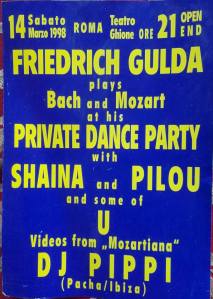
I well remember the last recital of Friedrich Gulda in my theatre.
A Mozart recital announced that in fact was a rock show with Mozart personified in a wig and playing a synthesizer.
Not much Mozart but when all the public had left in dismay he sat down and played one of his Play piano so beautifully I just wished he had done that earlier.
He left way after midnight and I took him to the Alexanderplatz jazz club where he stayed all night.
A remarkable man whose only student was Martha Argerich both known not only as the greatest of pianists but also two of the most individual and seemingly capricious people that refuse to be labelled and marketed.
Much to talk about then with our distinguished guests over the canapes and drinks that were offered to celebrate this collaboration.
Bryce Morrison and Lisa Peacock two beacons on the London concert scene were celebrating with us together with the founders of the Keyboard Charitable Trust and our German friends of the Grunebaum Foundation.
Elena Vorotko one of the artistic directors and trustee of the KCT







 ChristopherAxworthy-MusicCommentary