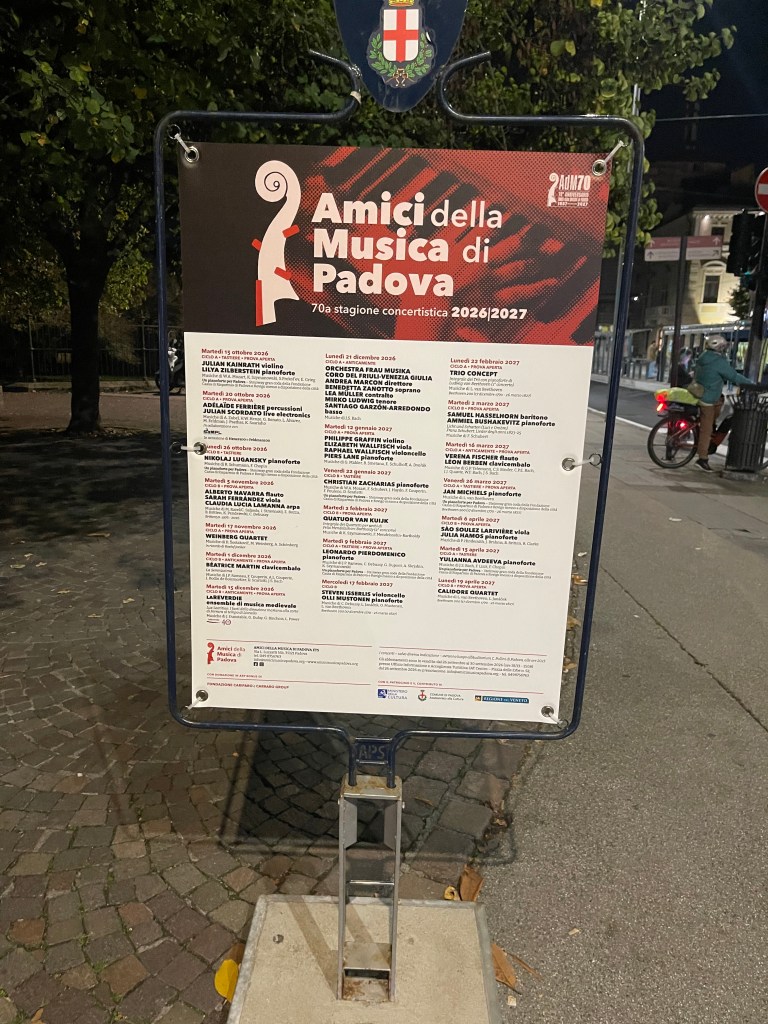
A m i c i d e l l a M u s i c a d i Pa d ov a
PROGRAMMA
Robert Schumann (1810 – 1856)
Drei Fantasiestücke op. 111
Sehr rasch, mit leidenschaftlichen Vortrag
Ziemlich langsam, Etwas bewegter, Tempo I
Kräftig und sehr markiert
Faschingsschwank aus Wien, 5 Fantasiebilder op. 26
Allegro (Seher lebhaft)
Romanze (Ziemlich langsam)
Scherzino
Intermezzo (Mit grösster Energie)
Finale (Höchst lebhaft)
* * * * * *
Frédéric Chopin (1810 – 1849)
Barcarole op. 60
Tre Impromptus
n. 1 in la bemolle maggiore op. 29 (Allegro assai quasi Presto)
n. 2 in fa diesis maggiore op. 36 (Andantino)
n. 3 in sol bemolle maggiore op. 51 (Tempo giusto)
Scherzo n. 4 in mi maggiore op. 54
Lugansky opened the season for Filippo Juvarra’s Amici della Musica in Padua . A hall rarely been so full with added seats on the platform for one of the finest pianists of the day.
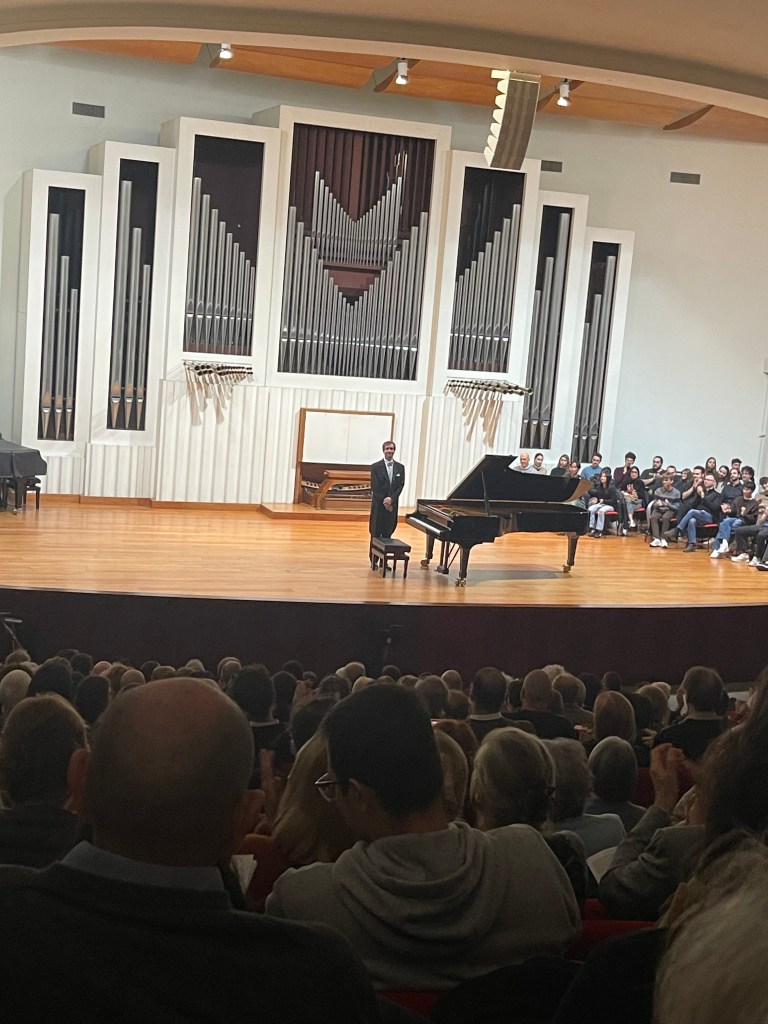
From the first notes of Schumann’s Fantasiestücke, music just poured from his fingers with intelligence and poetic beauty. Like his teacher Tatiana Nikolaeva there was a dynamic drive where the harmonic progressions and overall architectural shape were paramount. But Lugansky has a romantic soul too, that was allowed to shine though with penetrating radiance as suddenly he would underline one of Schumann’s wondrous flights of fancy with streaks of gold thrown into this passionate outpouring of romantic effusions. The second of these three much neglected pieces was played with the disarming simplicity of Schubert. A sumptuous chiselled cantabile with a busy central episode of shifting harmonies of velvet richness, almost orchestral, as he underlined many of the voices that make up the whole. He immediately brought a robust nobility and generosity of sprit to the third and last piece of this op 111 with its infectious folksong melodic outpouring .
A work that Lugansky showed us is a miniature masterpiece that is rarely heard in the concert hall . The last time I heard it was when Shura Cherkassky played it in my Euromusica season in Rome as preface to the Liszt Sonata . It was in 1986 when Guido Agosti had come to hear Shuras debut in Rome when they were both well into their Indian summer.
I had come to Padua to hear the recital that I missed in London where one very discerning musician had described his encores as ‘jewels on a velvet cushion ‘ . How could I miss that ? After a six hour journey I had no regrets only thanks to be able to enjoy such magnificence. The four encores of London were repeated here, only substituting Lilacs, Lugansky told me afterwards, with the first of Grieg’s rarely heard Lyric pieces: the ‘Arietta ‘ that closed this casket of jewels.
Filippo Juvarra I have known since he rang me in 1984 when he heard that my teacher and friend Vlado Perlemuter was alive and well and at 81 ready to take Italy by storm with Chopin Studies op 25, the Fourth Ballade and the B minor Sonata .
Filippo and I took it in turns to accompany Vlado with his inseparable companion Joan around Italy, until I was backstage with Joan as we pushed Vlado on stage at the Wigmore Hall for the last time at the age of 90!
Vlado always complained that the walk from the Green room to the piano was like going to the guillotine !
Filippo, an eclectic musician with a capital ‘M’ , shared Annie Fischer too in her final concerts when she was already suffering the fate of chain smokers !
The second work in this first half was dedicated to Schumann too, with the Carnaval Jest from Vienna which opened with a seemingly much more subdued orchestral sound. A melodic line in certain parts of chiselled jewel like beauty emerging from the impetuous passionate drive that reminded me of Richter on his first visits to the west. A great wave of sounds overtaking the emotions with dynamic drive and passionate intensity .Sometimes verging on being almost out of control but then this great artist would hold back or underline some detail that like Caballe was breathtaking and unforgettable. A mastery of pedal too of a true lesson in the art of using (and not using) that it became another instrument in its own right. The march like insistence without pedal when suddenly the Marseillese was revealed with generous lashings of pedal giving the triumphant impression of a full orchestra. A clouded pedal too towards the end when sounds were floated in this wondrous landscape. that Lugansky had created. And what breathtaking impetuosity in the final bars of this opening movement leaving only the total surprise of the plaintive simplicity of the Romanze that followed .A glowing luminosity of sounds with again the use of the pedal to create layers of different colour, like registers on the harpsichord. The clarity and quixotic good nature of the Scherzino just underlined Schumann’s use of the word Scherzo to depict an innocent moment of playful innocence. There was ,though, the contrasting burst of energy in the central episode before the return of the Scherzo where in the capricious ending one could almost hear Schumann laughing. No time for laughter though with Lugansky who immediately launched into the passionate outpouring of the Intermezzo. A torrent of notes that were just like the moving harmonies in Chopin’s prelude op 28 n. 8 . It was here that the flights of poetic fantasy were given an architectural shape that Lugansky with rubber in his hands could stretch and relax with subtle rubati and rallentandi that never disturbed the continuous forward surge of passion but just filled it with moments of sublime jewel like beauty. Just as I remember Richter ,Lugansky plunged into the Finale with a dramatic outburst which signalled that the race was on. A wonderful flowing tempo that was constant even in the beautiful mellifluous passages, where the melodic line just floated, soaring on high on wings of song . A wave of sounds that were a continual push and pull of a poet of the keyboard with a passionate and generous heart .
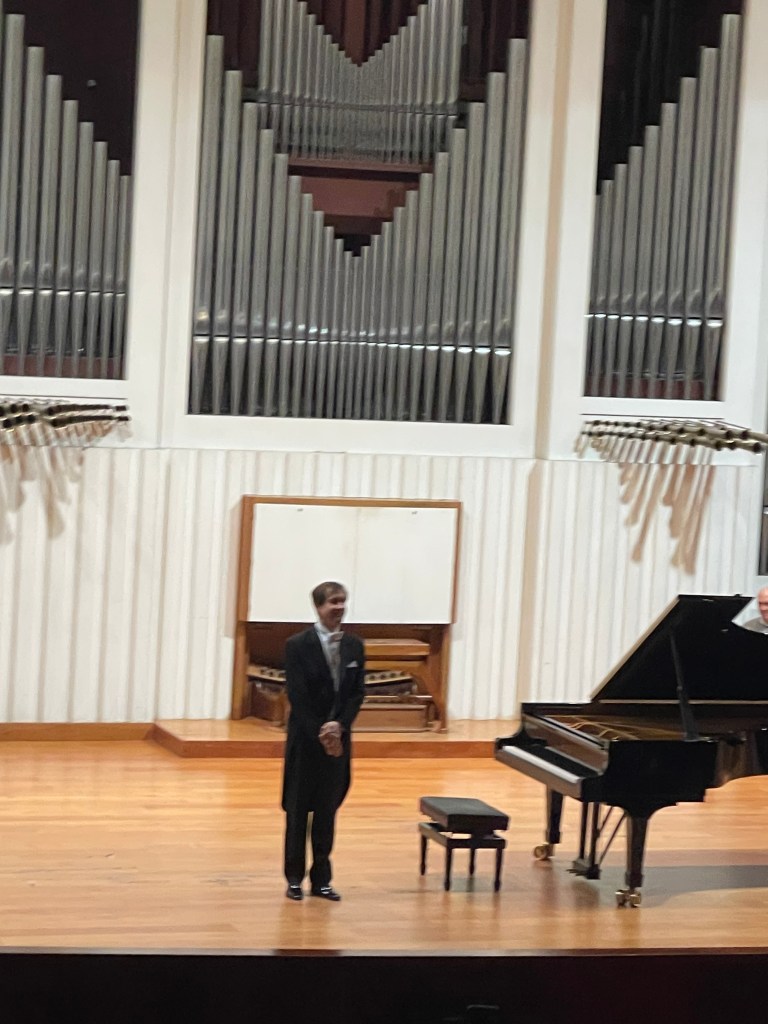
The first half of Schumann was followed by a second half of Chopin. Chopin’s Barcarolle, one of Chopin’s greatest works, written near the end of his life where he imagined the waves of the lagoon in Venice as he allowed every note to sing with aristocratic poetic beauty. The lapping of the water, though, is a constant and the anchor that Chopin was to describe to his pupils , of a tree with the roots firmly planted in the ground allowing the branches complete freedom above to move naturally in the breeze. There were many beautiful moments in Lugansky’s performance notably the opening C sharp played quite gently as this wondrous story was about to unfold. The beautiful Nocturne central episode in D flat was played with glorious luminosity as he opened up the sounds in the upper register by resonating with the deep bass notes. But it was for me too free and not anchored, a boat allowed to float on the lagoon with too much stopping to look and stare which is something he did not risk with Schumann. The first Impromptu was played with a wonderful jeux perlé of insinuating brilliance and beguiling insistence but the long slow central episode was again lacking the anchor and it seemed to be following the old Chopin tradition where Rubinstein and Pollini had shown us a new way of actually playing what the composer wrote and meant, communing directly with the composer and not with his disciples ! The second Impromptu was measured and with a very aristocratic sense of rubato where the anchor that had been missing was here provided by Chopin and it left Lugansky’s poetic imagination to turn this impromptu into a wondrous tone poem. Streams of golden sounds were thrown off with masterly ease but it was the subtle inflection of the melody beneath this wondrous shield that truly showed Lugansky’s poetic mastery. The beautiful G flat Impromptu has always been Rubinstein’s for me, with that aristocratic strength wrapped in poetic beauty which was the wonder of his playing of the French repertoire too. Chopin of course had his homeland always in his heart ( which now resides in Warsaw) but he had been brought up in the elegant Parisian salons of the aristocracy. All this to say that Lugansky found that same voice with a very measured beautiful restraint and an aristocratic rubato with some beautiful pedal effects that just enhanced the beauty. A central episode where the tenor melody seemed to appear so miraculously and with the refined beauty that Lugansky gave of architectural shape, bringing it to a passionate climax of strength and emotional power before dissolving into the salon like charm and beauty of the opening.
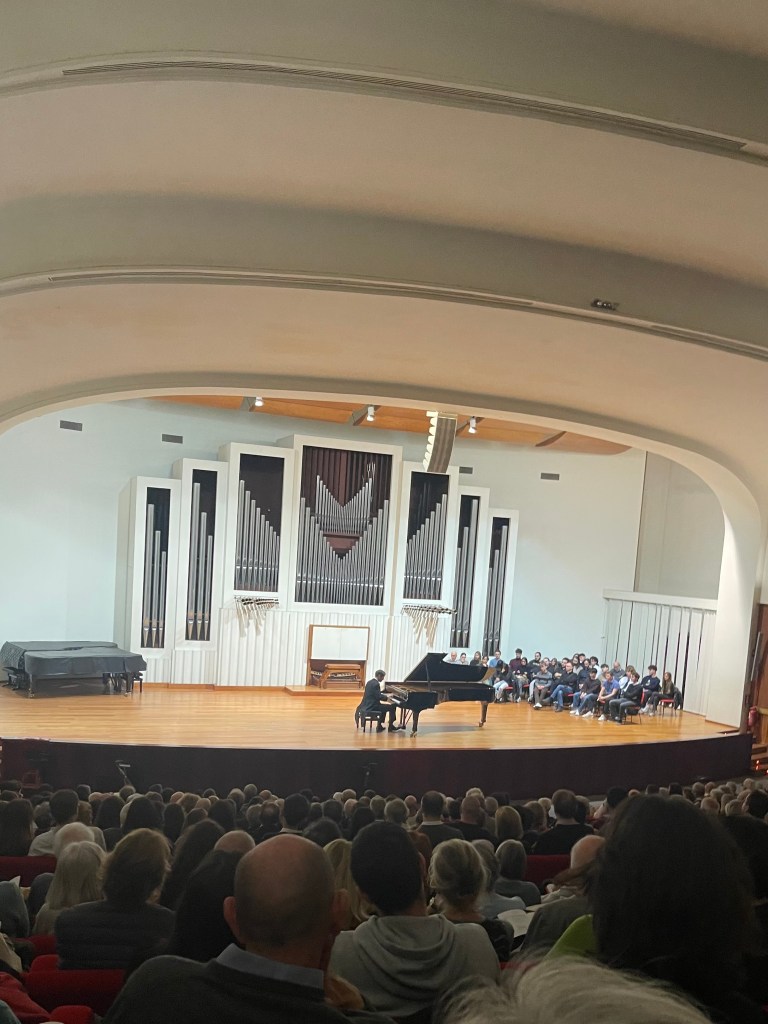
It was one of Chopin’s most elusive works that really suited Lugansky’s poetic style of brilliance and beauty. The Fourth Scherzo ignited his fantasy and chameleonic range of character. The impish bass note barely touched but so telling before the flight of impish chords and a jeux perlé which was transformed into the wondrous mellifluous outpourings of an innovative genius of the piano. A central episode that was played with a limpid disarming simplicity with a glorious outpouring of refined good taste and aristocratic beauty. The silver trail of sounds leading back to the Scherzo was breathtaking in its audacity and whispered intensity and the final few bars were played with the heroism of breathtaking exhilaration with the sumptuous full sounds of a great virtuoso.This performance I will cherish for a long time and made this an even greater raison d’être of my long trip to Eldorado !
Four encores followed, as in London, and they were indeed jewels in the crown of this Prince of the Keyboard.
Chopin’s ‘Polonaise Héroique’ op 53 was indeed just that, where strength , beauty and showmanship could live happily together. Schumann’s ‘Widmung’ in the hands of this poet was quite sublime, with the freedom and beauty of improvisation, as if the ink was still wet on the page, with the tears of longing in Schumann’s eyes just bathing the score in whispered intimacies and passionate longing. The missing Impromptu was now added with a performance where scintillating brilliance was concealed in poetic fantasy with the ending rising to the passionate outpourings of a man possessed.
Of course after such exhilaration and passionate excitement it was left to the whispered innocence of Grieg to calm the torrid air of such passion and poetic intensity. Just a simple page of a barely whispered ‘Arietta’ to console and calm us from the gentle hands of this Poet of the Keyboard.
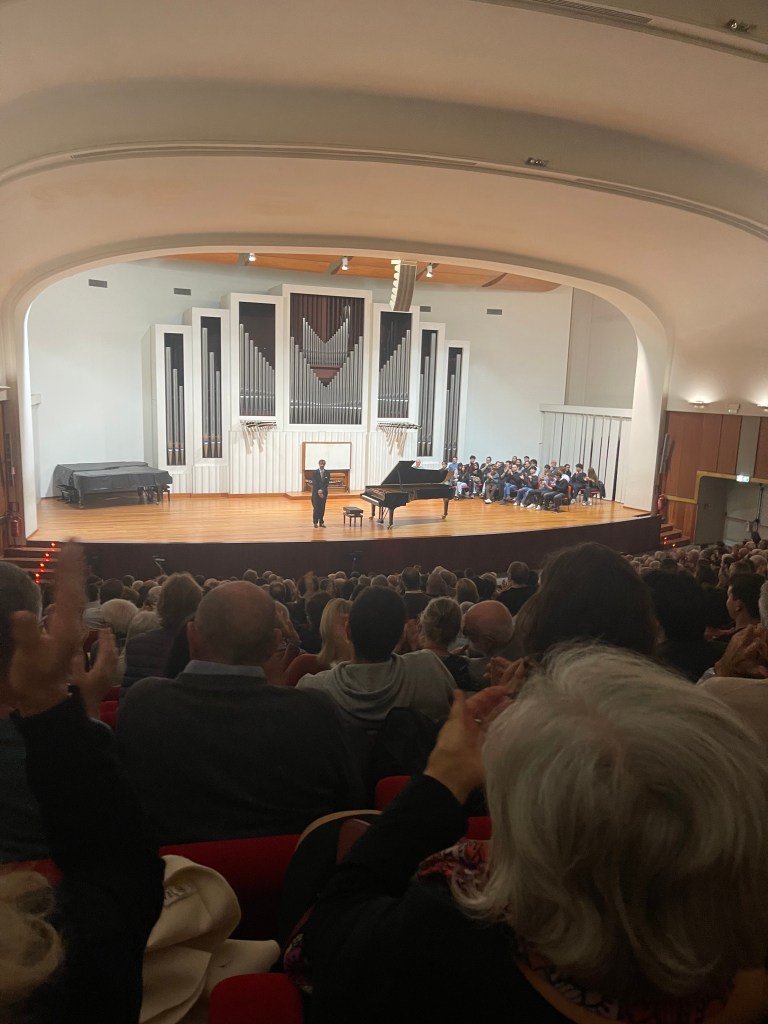
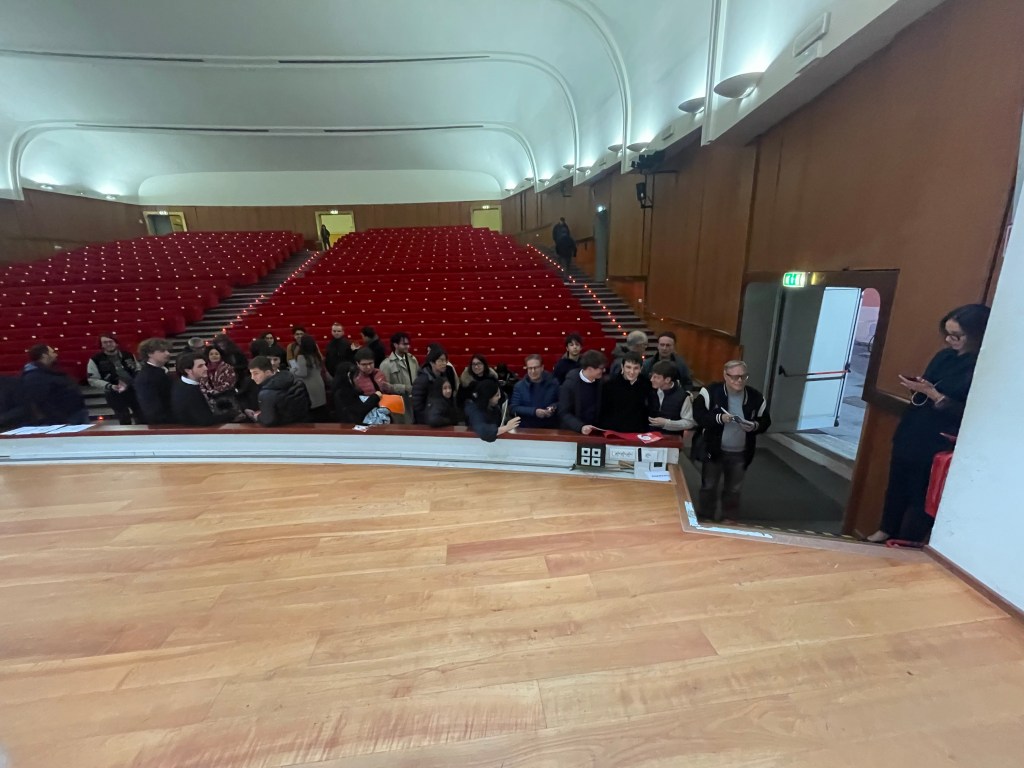
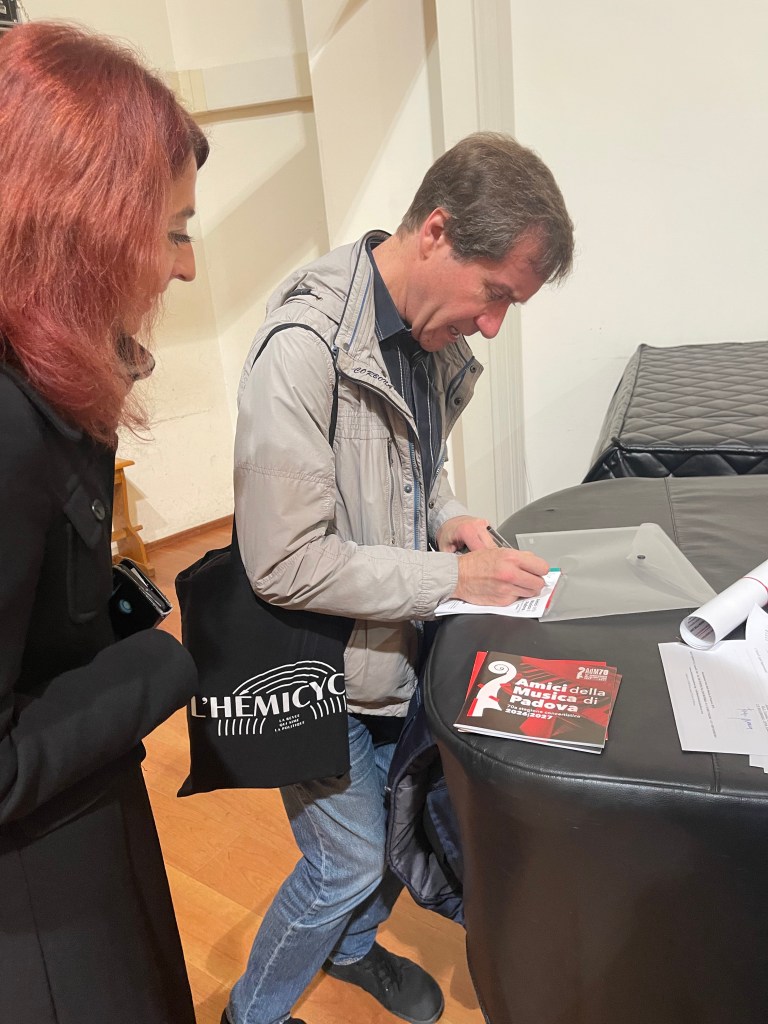
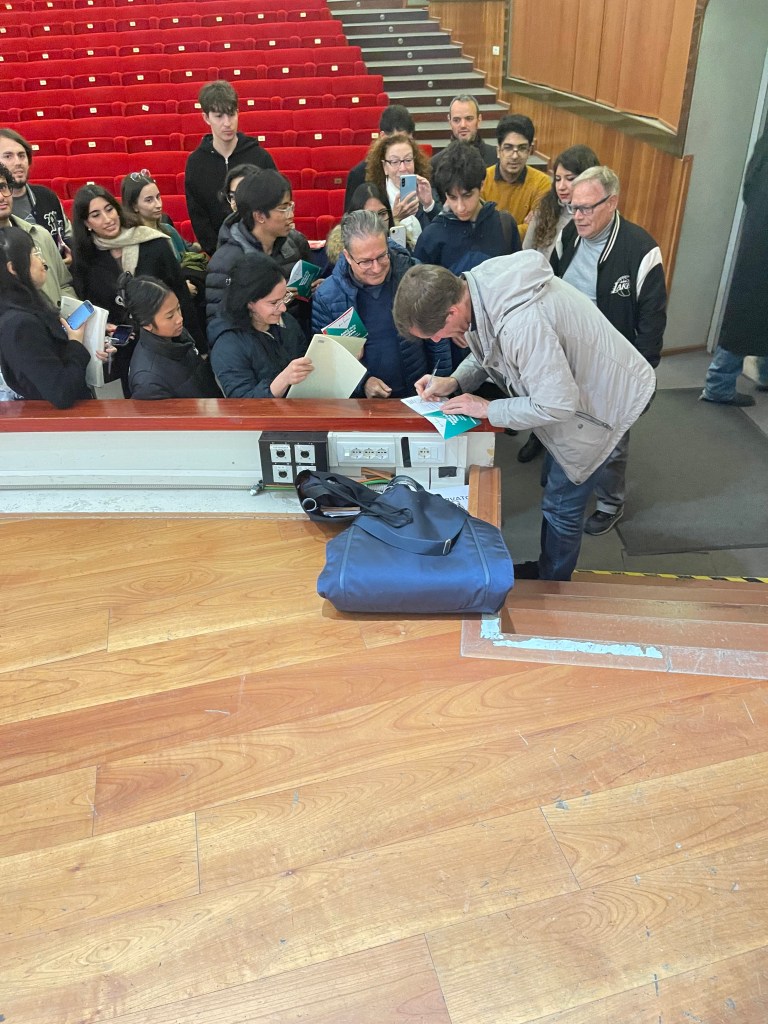
After such a tour de force I was reminded of the simplicity of his teacher Nikolaeva, and the genuine love for their audience . A shared experience as he signed the programmes of a long line of young musicians who had helped to fill this hall, many of them spilling over onto the stage but no-one was turned away.
“Lugansky is not simply the most wonderful Russian pianist of modern times; he is one of the most outstanding artists of our epoch …” – Le Monde
Pianist Nikolai Lugansky is renowned for his interpretations of Rachmaninov, Prokofiev, Chopin and Debussy. He has received numerous awards for recordings and artistic merit.
He collaborates regularly with conductors of the calibre of K. Nagano, Y. Temirkanov, M. Honeck, G. Noseda, S. Kochanovsky, V. Petrenko, L. Shani and he is invited by leading international orchestras, including the Berliner Philharmoniker, the London Symphony Orchestra, the Netherlands Philharmonic Orchestra, the Swedish Radio Symphony Orchestra and the Orquestra Nacional de España.
Described by Gramophone as “the most trailblazing and meteoric performer of all”, Nikolai Lugansky is a pianist of extraordinary depth and versatility. He is invited by some of the world’s most distinguished festivals, including the Aspen, Tanglewood, Ravinia and Verbier festivals. Chamber music collaborators include Vadim Repin, Alexander Kniazev, Mischa Maisky and Leonidas Kavakos.
In 2023, he celebrated the 150th anniversary of Rachmaninov’s birth by performing cycles of monographic programs at the Théâtre des Champs-Élysées in Paris and the Wigmore Hall in London, along with other performances throughout Europe, including at the Konzerthaus in Vienna and Berlin, the Bozar in Brussels, the Rudolfinum in Prague and the Royal Concertgebouw in Amsterdam.
“Lugansky’s mastery of the piano is outstanding: over the years, his sonority has broadened and become denser, his palette of sounds even more diverse as his stature as a musician has asserted itself. […] He is in the moment and in the projection of that moment into the greater whole of a work that he makes accessible: he hears everything and lets us hear it without explaining it, letting the music happen without interfering.”(Bachtrack).

This past season’s highlights included orchestras such as the NHK Symphony Orchestra in Tokyo (Dutoit), the St. Louis Symphony Orchestra (Denève), the NDR Radiophilharmonie Hannover (Kochanovsky), the Brussels Philharmonic (Ono), the Orchestre Philharmonique de Radio France (Peltokovsky), the Berlin Konzerthaus Orchester (Valčuha), the Philharmonia London (Rouvali), the Orquestra Sinfônica do Estado de São Paulo (Alsop) and recitals at the Teatro alla Scala, Théâtre des Champs-Élysées, Wiener Konzerthaus, Wigmore Hall, Seoul Arts Center, Zurich Tonhalle, Oxford Piano Festival, Piano à Lyon, among many others.

Highlights of the 2025/26 season include collaborations with the Deutsche Kammerphilharmonie Bremen (Rhorer), the Orchestre National de Lille for the Ravel anniversary (Weilerstein), the Oslo Philharmonic (Stutzmann), the Bern Sinfonieorchester (Petrenko), the Basque National Orchestra (Valčuha), the Berlin DSO (Denève), and the NDR ElbPhilharmonie Hamburg (Kochanovsky). The season also features tours around the world, including with La Filarmonica della Scala (Chung) in Korea, with the Lucerne Symphony (Sanderling) in Italy and a recital tour in China and Italy.
Among recital and festival appearances are engagements at the Tsinandali Festival (Noseda), the Esprit du Piano in Bordeaux, the Boulez Saal in Berlin, the Théâtre des Champs-Élysées, the Auditorio Nacional in Madrid, the Palau de la Música Catalana in Barcelona, the Wigmore Hall, the Verbier Festival and the Festival International de Piano de la Roque d’Anthéron.
Lugansky is Harmonia Mundi’s exclusive artist.
His latest album dedicated to Robert Schumann was released in February 2026; the recording “Richard Wagner” was Editor’s Choice for May 2024, included in The Best Classical Albums of the Year by Gramophone and won the Premio Abbiati del Disco 2024 for solo repertoire.
His album “Rachmaninov: Études-Tableaux; 3 Pièces”, was awarded with Choc de l’Année 2023 (Classica) and Gramophone Editor’s Choice (March 2023).
His “Rachmaninov: 24 Preludes” (2018) received rave reviews, while “César Franck, Préludes, Fugues & Chorals” CD (2020) won the Diapason d’Or.
Among the other awards for his many previous recordings: Diapason d’Or (Rachmaninov’s Piano Sonatas) and Gramophone Editor’s Choice (Grieg and Prokofiev with Kent Nagano and the Deutsches Symphonie-Orchester Berlin).
https://christopheraxworthymusiccommentary.com/2023/12/05/ileana-and-joan-3rd-december-2023/

