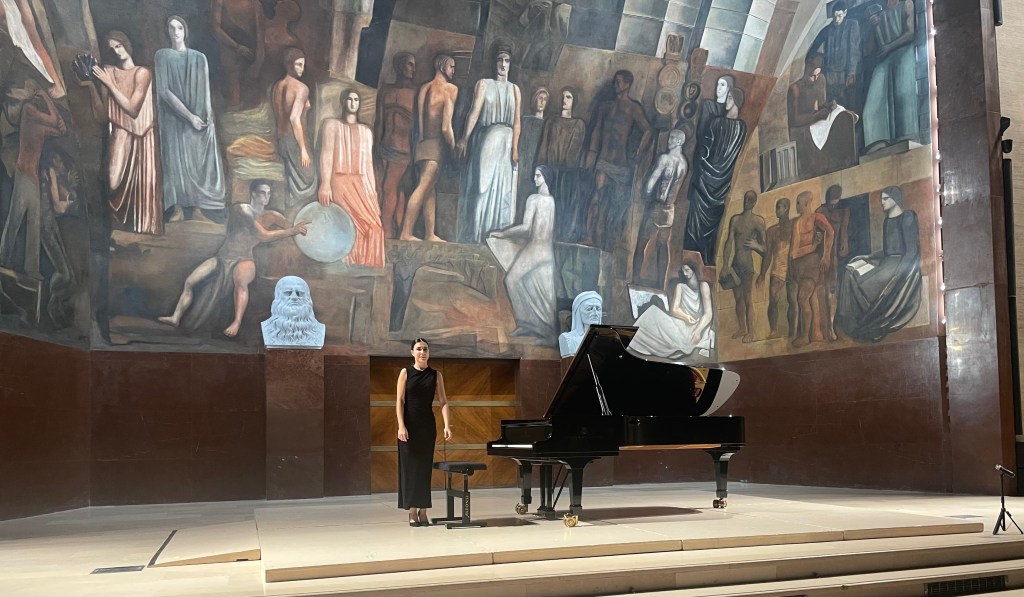
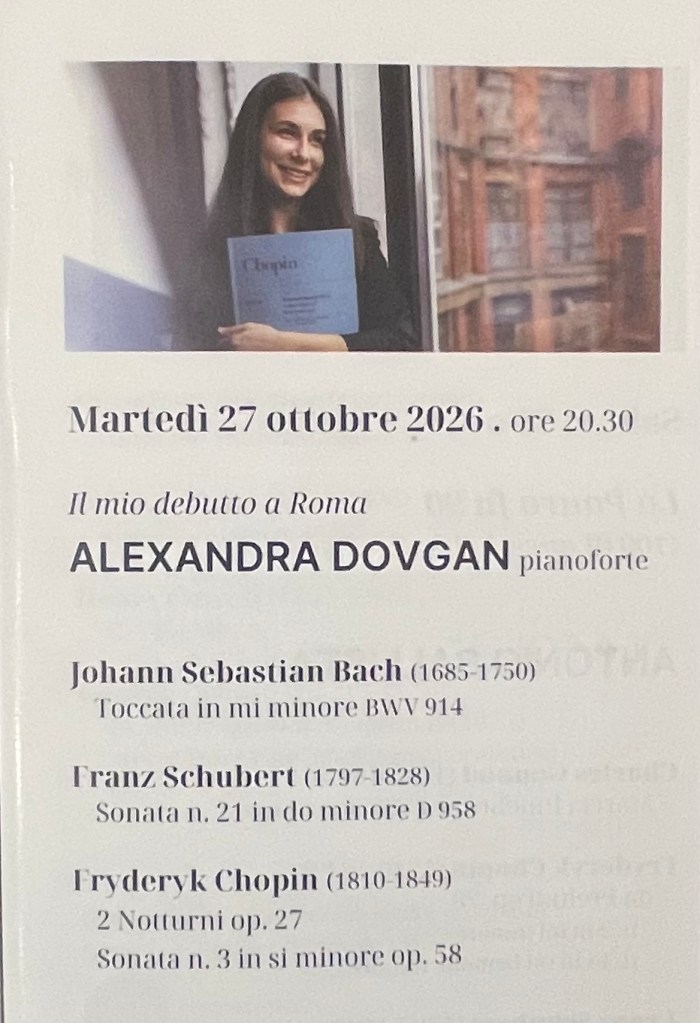
The 19 year old Alexandra Dovgan is making a mark on the International concert scene having been noticed by Grigory Sokolov since an early age. Now perfecting her studies with Rena Shereshevskaya she presented her remarkable musical credentials to the Rome audience with a programme of just three composers: Bach, Schubert and Chopin. Three great composers that showed her remarkable musical perfection and beauty of sound, drawing the audience into her magic world of crystalline clarity with the simplicity, like Sokolov her mentor, of an artist who thinks more of the composer than themselves.
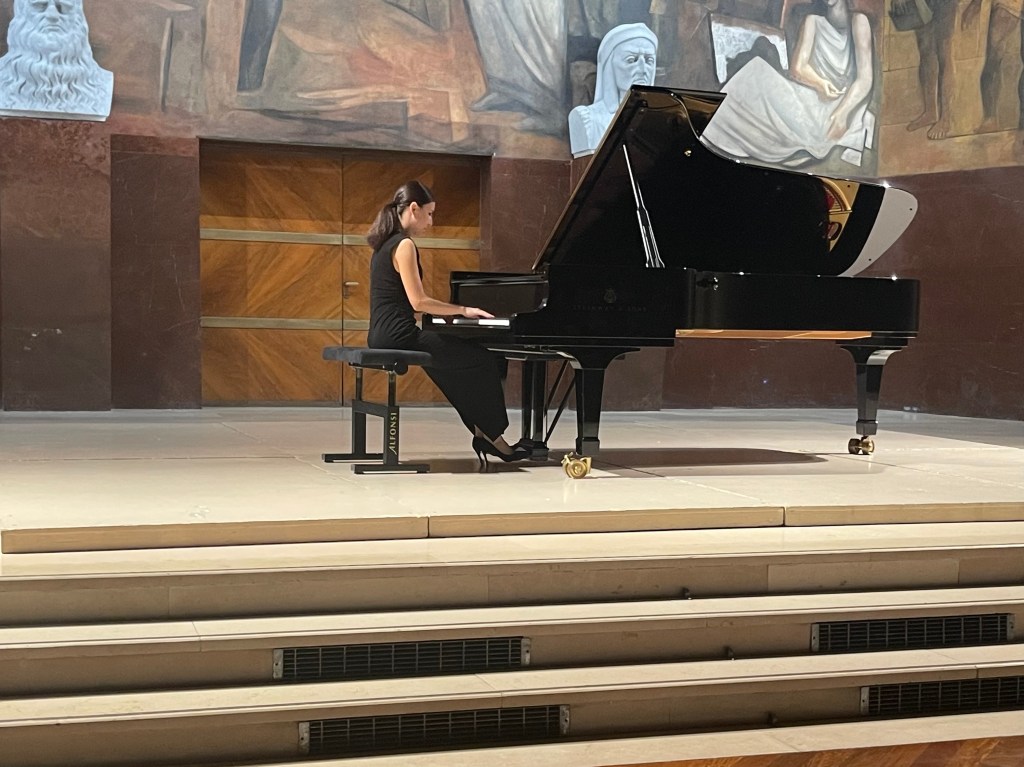
Opening with the Bach Toccata in E minor to which she immediately entered the world of these seven early Toccatas written, or should I say improvised, with great fantasy and character. There was a delicacy and clarity from the very first notes with a remarkable palette of colour as to this voyage of discovery she brought a whispered beauty and great sense of fluidity. Constantly moving with discreet circular movements that could catch every moment without any hard edges or ungrateful vertical sounds. A musical authority that reminded me of Sokolov, where freedom and freshness is allied to a deep study and an extraordinary musical intelligence. The music flowed so naturally from her hands as the Toccata entered with lightweight brilliance, building in intensity with very discreet ornamentation just adding extra character to her dynamic rhythmic drive.
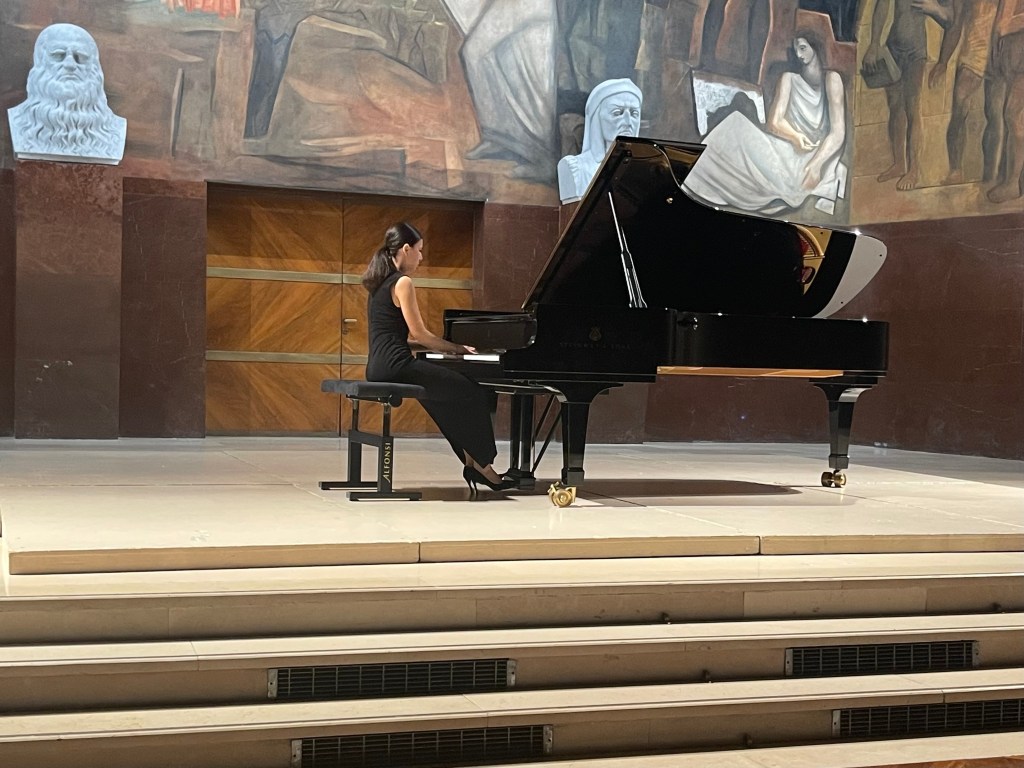
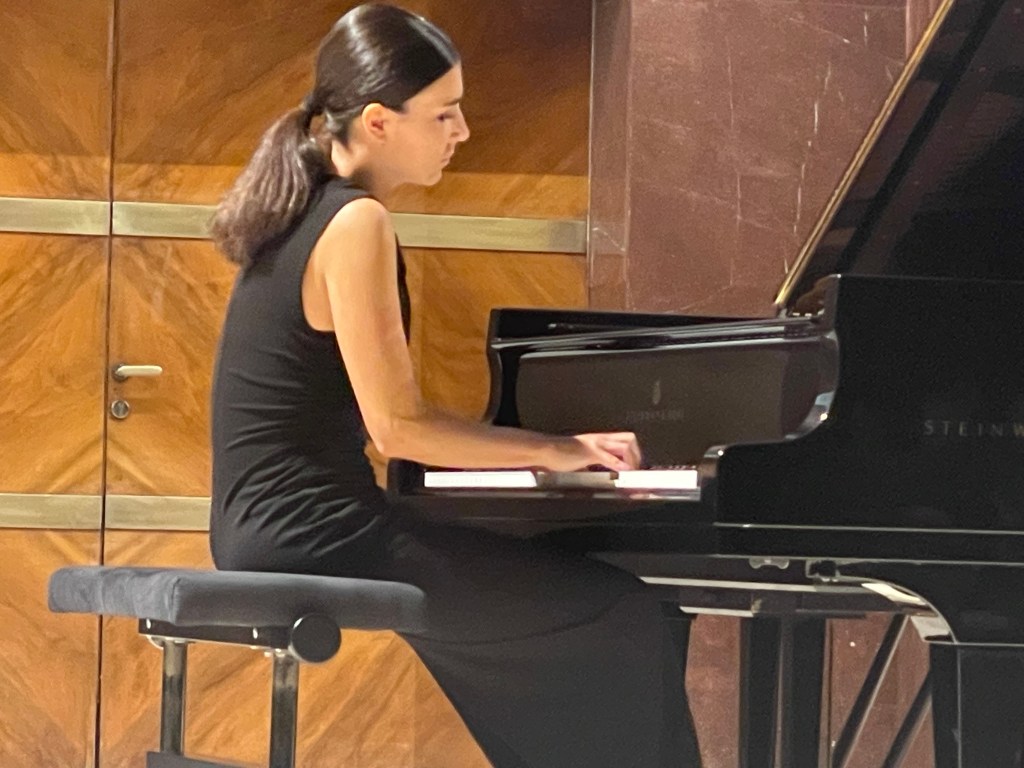
The C minor Sonata by Schubert is the most Beethovenian of Schuberts output and the one favoured by many Russian pianists. Usually played with Beethovenian vehemence, it was refreshing to hear Alexandra play it with lightweight fantasy and jewel like perfection of detail. She brought an architectural shape and sense of line to the opening ‘Allegro’, with radiance and crystalline beauty rather than with force and tumultuous energy. This was playing that drew us in to discover the secrets that are in the score and that became a much more powerful statement for the fantasy and colour that she brought to Schubert’s mellifluous outpourings. It was a sound world where all four movements were united as one under a cloud of beauty and refined poetic inspiration that did not deny character and contrast but all under a roof of the same sound world. The beauty and delicacy of the ‘Adagio’ was a perfect jewel inbetween the power of the opening ‘Allegro’ and the grace of the ‘Minuet’ and the whispered meanderings of the ‘Trio.’ The final tarantella was played with a luminosity and rhythmic drive with streams of sounds that were allowed to undulate with beguiling intensity. A performance that with time will grow in weight as she digs deeper into the keys as she will discover from her work with Rena Shereshevskaya. But this was a remarkable performance of poetic perfection which for me sitting as near to piano as possible came across with extraordinary directness and powerful significance as it would have done on the pianos and salons of Schubert’s day. With the advent of the modern day piano and in halls that seat an audience of hundreds if not thousands a public performer must, like an actor, have a diaphragm where the words must reach the front row and the last with the same intensity.
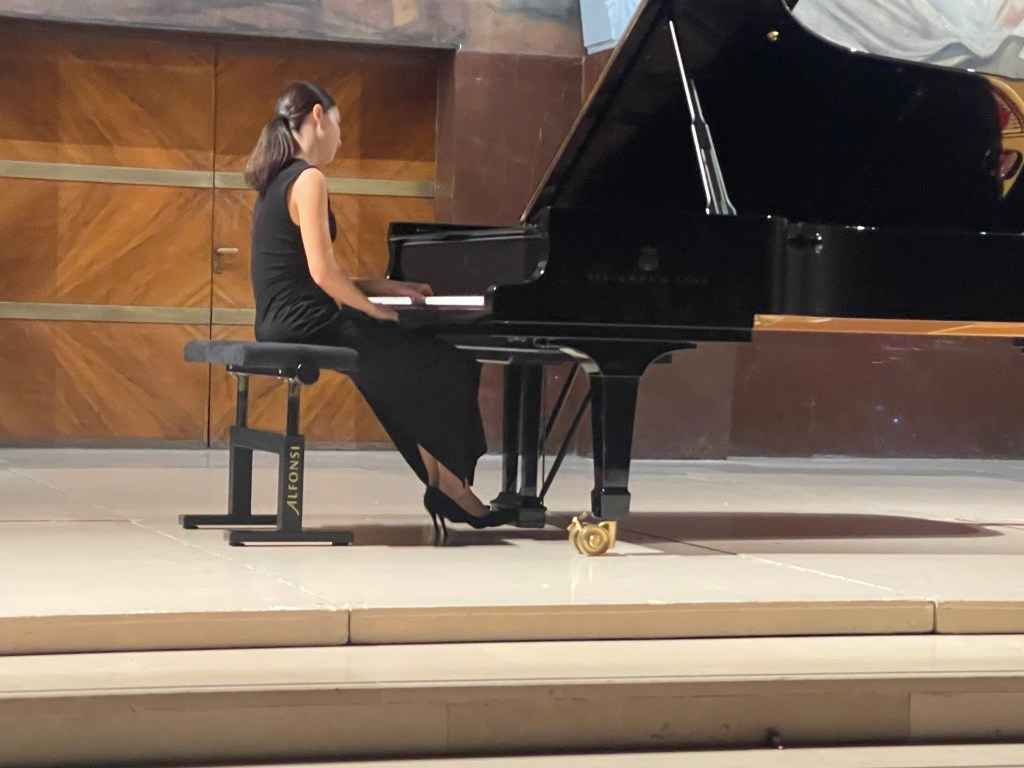
The second half of the programme was dedicated to Chopin: the two nocturnes op 27 and the mazurka op 17 n.4 played as an encore. These are the most intimate of works with the whispered beauty of the C sharp minor Nocturne that was barely audible but with a control of sound that demonstrated a transcendental mastery. I remember the first appearance of Richter in the west, where it was more the control of whispered sounds that astonished than his cyclonic temperament. We were used to the rounded beauty of the Matthay concert cantabile and he opened up a whole new world for us. So much so that a critic in the vast Royal Festival Hall in London complained that the slow movement of Beethoven’s op 22 Sonata had been inexistent! Alexandra played with exquisite finesse and wondrous sounds and even the octave cadenza she chose to play with two hands so as to limit the percussive quality of the sound. The D flat Nocturne was a little too fast and in places sounded even rushed but there were other moments of such exquisite refinement that were breathtaking in their whispered perfection. Her encore too was of Chopin’s most intimate Mazurka op 17 n. 4 that she played with extraordinary control and ravishing beauty with the opening returning at the end with poignant significance and meaningful perfection. She had also included by great demand another encore the Prelude in G op 32 by Rachmaninov , that inhabits the same sound world of mellifluous outpourings of radiance and whispered beauty.
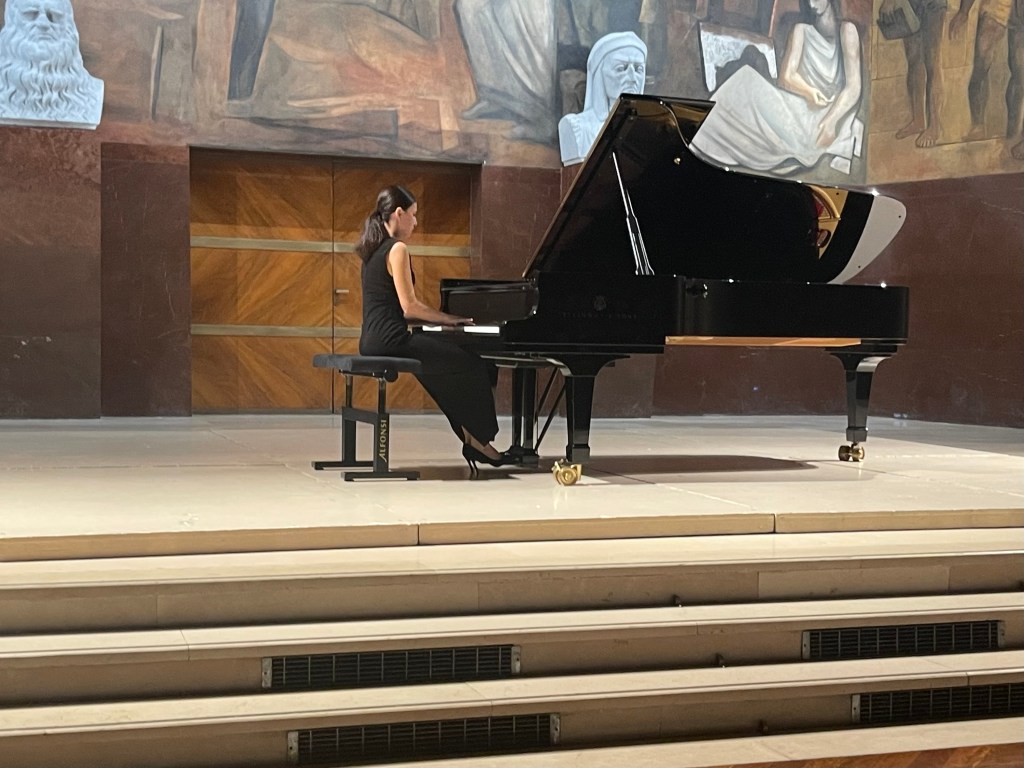
The Chopin B minor sonata was played with great rhythmic drive and if the opening chords were rather lacking in weight it was her architectural understanding and poetic fantasy that kept us captivated.Adhering to the repeat of the first movement she strangely added even more freedom to the second subject that she had played with refined good taste and flowing beauty without altering the overall tempo. In the recapitulation the second subject should be more full of strength as Chopin does not add a diminuendo and obviously intends the strength to be added with a poignant beauty and strength that is without sentimentality. The ‘Scherzo’ was played with jeux perlé brilliance with the slow episode of turbulent emotional impact with Chopin’s meandering counterpoints given a remarkable musical shape and meaning. The final chords of the ‘Scherzo’ were immediately answered by the opening call of the ‘Largo’ and it was here that we heard the loudest sounds of the whole recital. The beautiful bel canto that followed was played with glowing beauty and chiselled clarity with the meandering arpeggios that followed given a sense of line and shape of rare poetic significance. The opening chords of the presto were played with great shape and were the opening of a whispered insinuating rondo that made one think of Schubert’s Tarantella that we had heard in the first half. Playing of brilliance and dynamic drive building up the sound each time the rondo returned not with force but with highlighting inner harmonies until the final explosion of the coda which Alexandra played with remarkable technical perfection. The final declamation in the left hand with brilliant figurations in the right I have never heard with such glorious exhilarating significance.
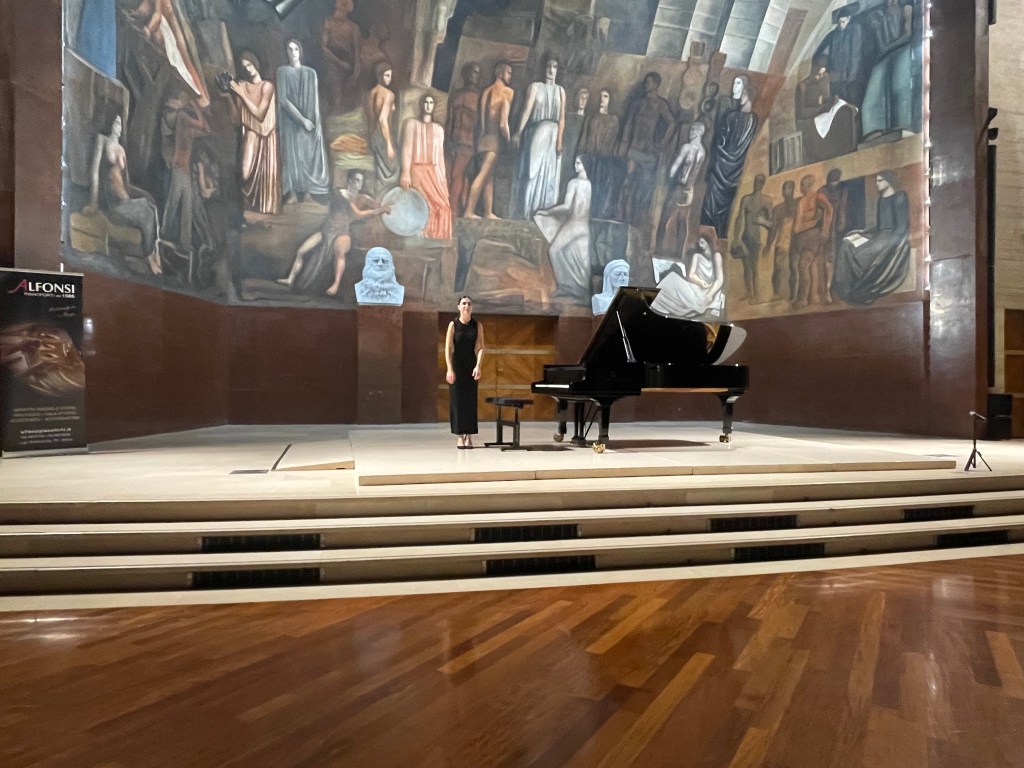
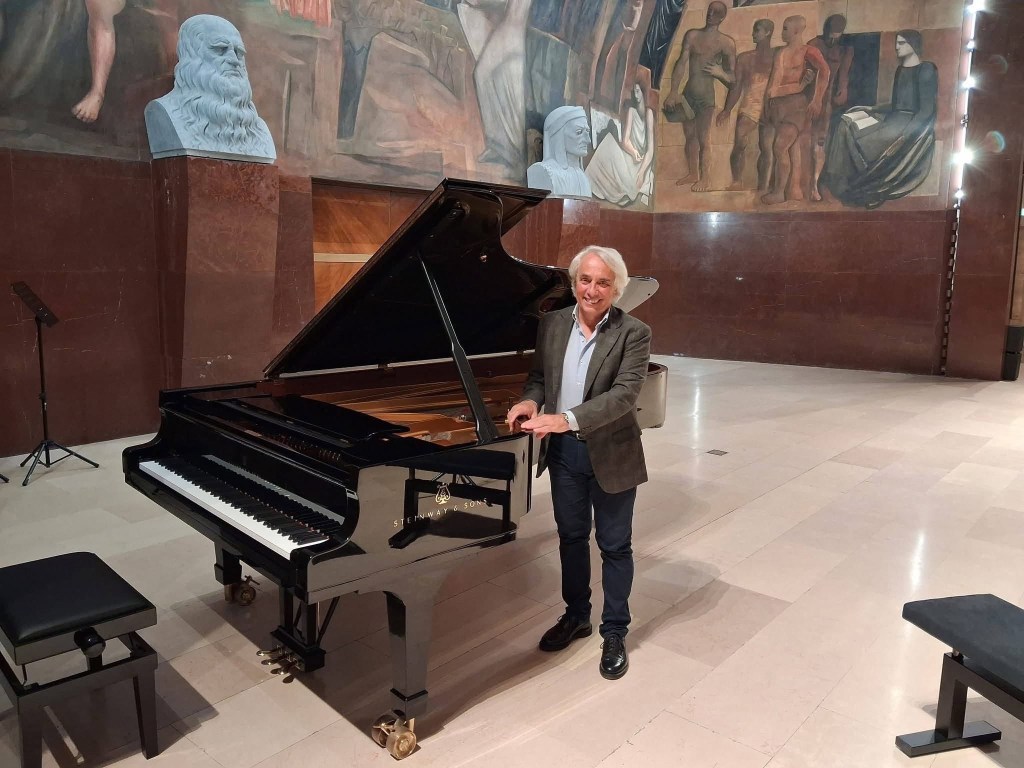
Alexandra Dovgan
Alexandra Dovgan was born in 2007 into a family of musicians and began her piano studies at the age of four and a half. At the age of five, her talent emerged when she passed the highly competitive selection process to join the Academic Central Music School of the Moscow State Conservatory, where she studied under the renowned teacher Mira Marchenko. Having completed her course at the Ateneo de Música in Málaga, she is now continuing her studies at the École Normale de Musique de Paris under Rena Shereshevskaya. Alexandra’s musical development has been profoundly influenced by her artistic dialogue with one of the most outstanding pianists of our time, Grigory Sokolov.
Alexandra is a prize-winner at international competitions, including the Moscow International Vladimir Krainev Piano Competition, the International Young Pianists Competition “Astana Piano Passion,” and the International Television Contest for Young Musicians “The Nutcracker.” She was only ten when she won the Grand Prix at the II° International “Grand Piano Competition” in Moscow. Recordings of this event have travelled the world on Medici.TV and YouTube, moving musicians and piano lovers globally.
Despite her young age, Alexandra Dovgan has already achieved remarkable success in some of the world’s most prestigious concert halls, including Carnegie Hall in New York, the Philharmonie and Konzerthaus Berlin, the Musikverein and Konzerthaus Vienna, the Teatro Colón in Buenos Aires, the Théâtre des Champs-Élysées in Paris, the Tonhalle Zurich, the Auditorio Nacional de Música in Madrid, the Kioi Hall in Tokyo and many others.
Following her acclaimed appearance at the Salzburg Festival, Alexandra continued to impress audiences and critics alike with a series of major international debuts. She performed with Gustavo Dudamel and the Mahler Chamber Orchestra, with the Kioi Sinfonietta and Trevor Pinnock in Japan, and with the Tonhalle Orchestra Zurich under Paavo Järvi. Other notable engagements included appearances with the Royal Stockholm Philharmonic Orchestra and Ton Koopman, the Barcelona Symphony Orchestra and Kazushi Ono, the Bergen Philharmonic Orchestra and Pietari Inkinen, the Orchestre Philharmonique de Monte-Carlo under Kazuki Yamada, and the Lucerne Symphony Orchestra conducted by Robin Ticciati.
Among the highlights of the 2026-27 season will be her debuts with the Vienna Symphony Orchestra and the Chamber Orchestra of Europe under Robin Ticciati, the Prague Symphony Orchestra conducted by Andrey Boreyko, the Orchestra del Maggio Musicale Fiorentino under Aziz Shokhakimov, the National Symphony Orchestra in Washington conducted by Gustavo Gimeno, the Orquesta Filarmónica de Gran Canaria under Trevor Pinnock, and the Montreal Symphony Orchestra under Bernard Labadie.
Alexandra will also serve as Artist in Residence with the Orchestra Sinfonica di Milano, appearing in three concerts conducted by Emmanuel Tjeknavorian between October 2026 and May 2027.
Her concert schedule will further include recitals at the Elbphilharmonie in Hamburg, the Théâtre des Champs-Élysées in Paris, the Prinzregententheater in Munich, the Tonhalle Zurich, the Palau de la Música Catalana in Barcelona, the Liszt Academy in Budapest, and the Teatro Colón in Buenos Aires, as well as return appearances in New York, Brussels, Rome, Bordeaux, Verbier, and many other international musical centres.
The distinguishing characteristics of Alexandra’s pianism are her spontaneous depth and consciousness, along with a sound of incredible beauty and precision. You will not find any element of showboating or mere technical demonstration in her playing; rather, there is an impressive concentration combined with purity of expression and creative imagination. She possesses a charismatic presence on stage and a distinct personality.
In June 2024, Alexandra Dovgan received the prestigious Prix Serdang from Rudolf Buchbinder and Adrian Flury in recognition of her achievements and her already significant career.
November 2026
«Alexandra Dovgan finds a natural affinity with the compositions she plays imbuing the music with stillness, brilliance and breath. It is a joy to accompany this young master of music.» (2021)
TREVOR PINNOCK