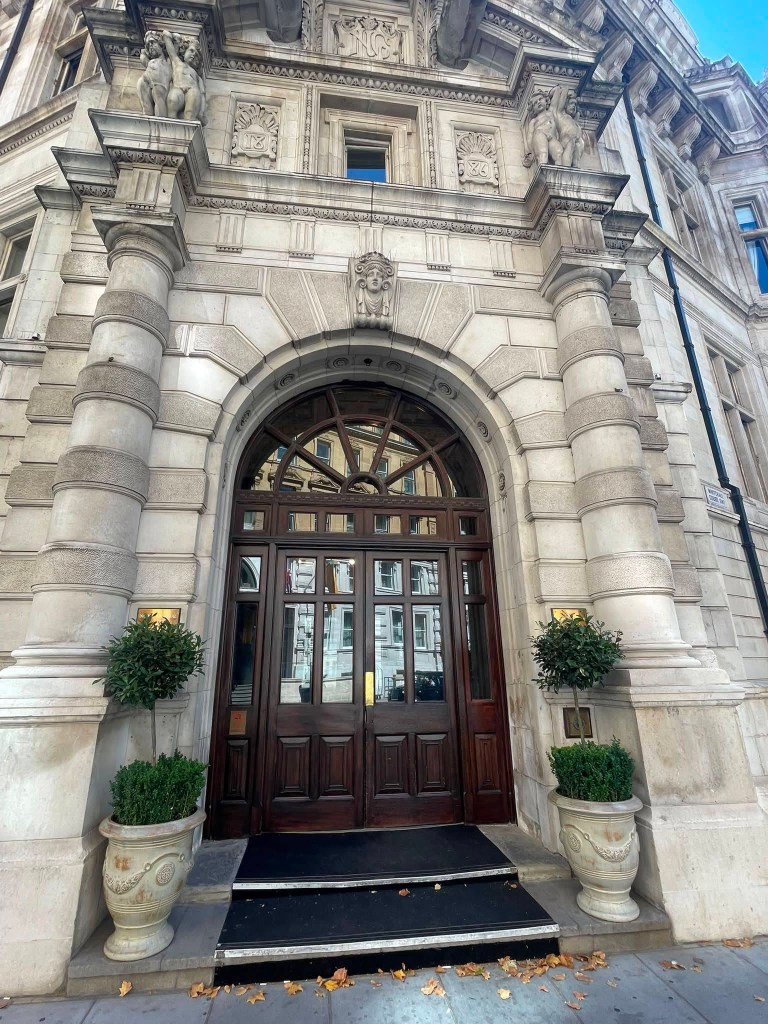
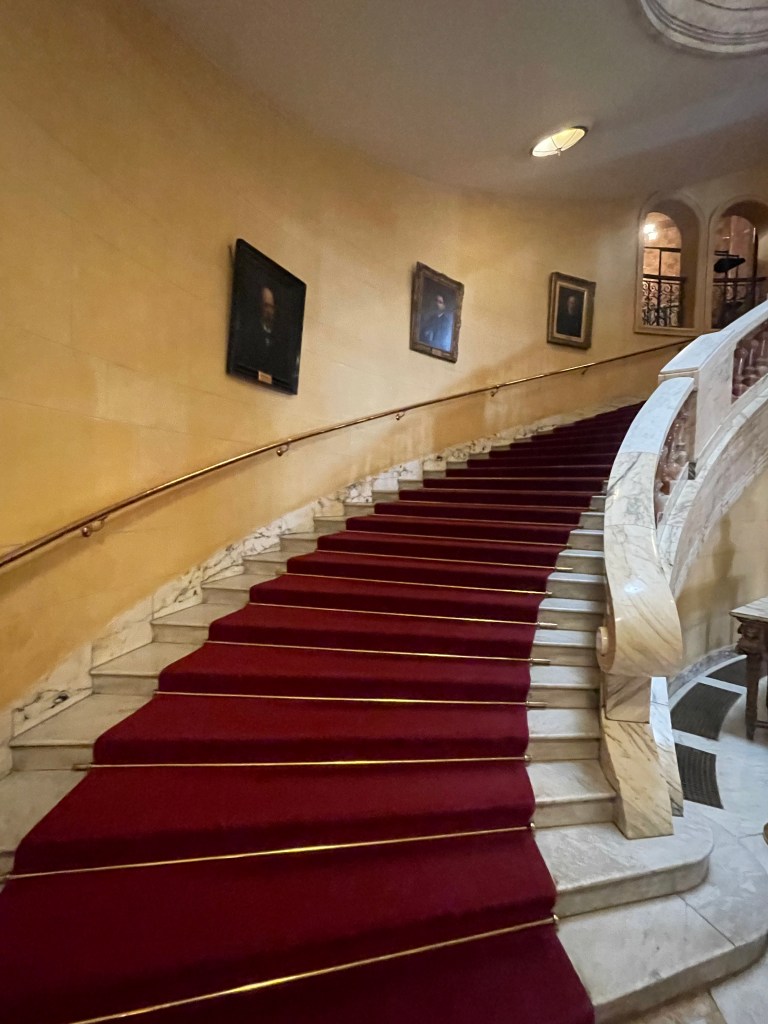
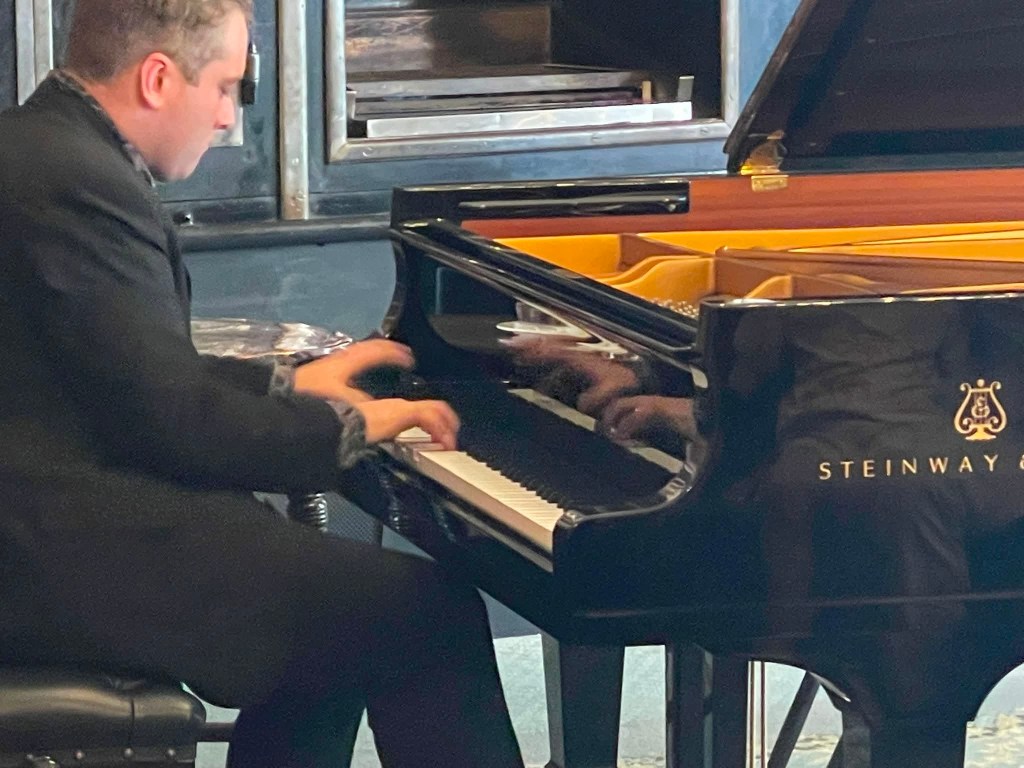
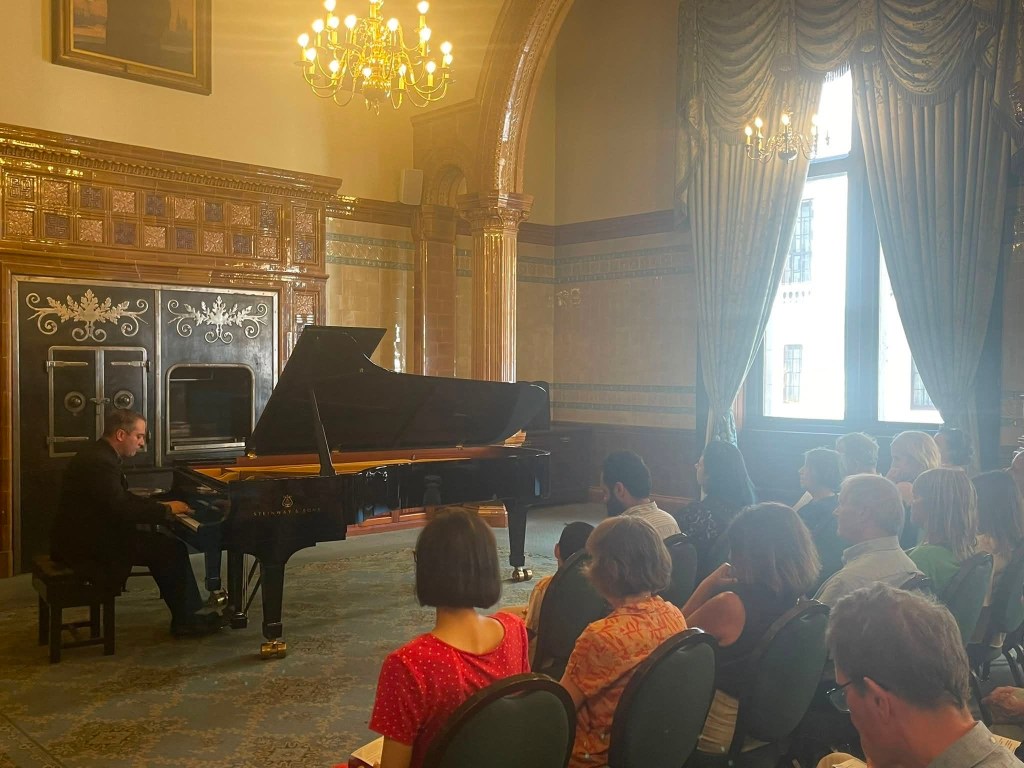
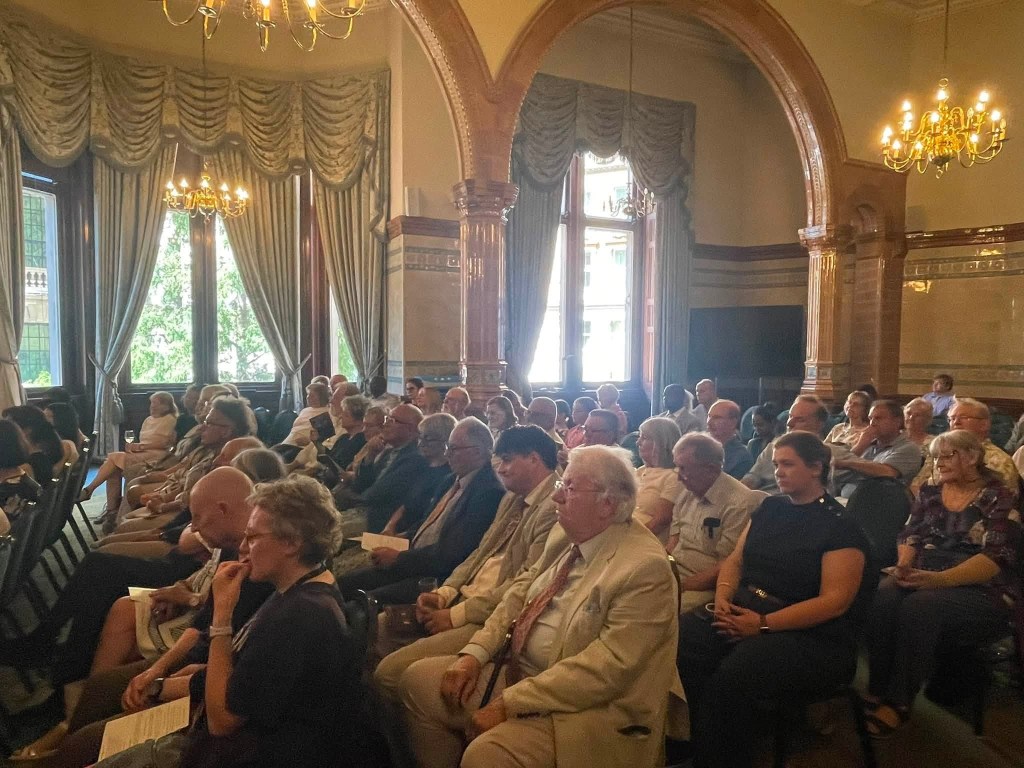
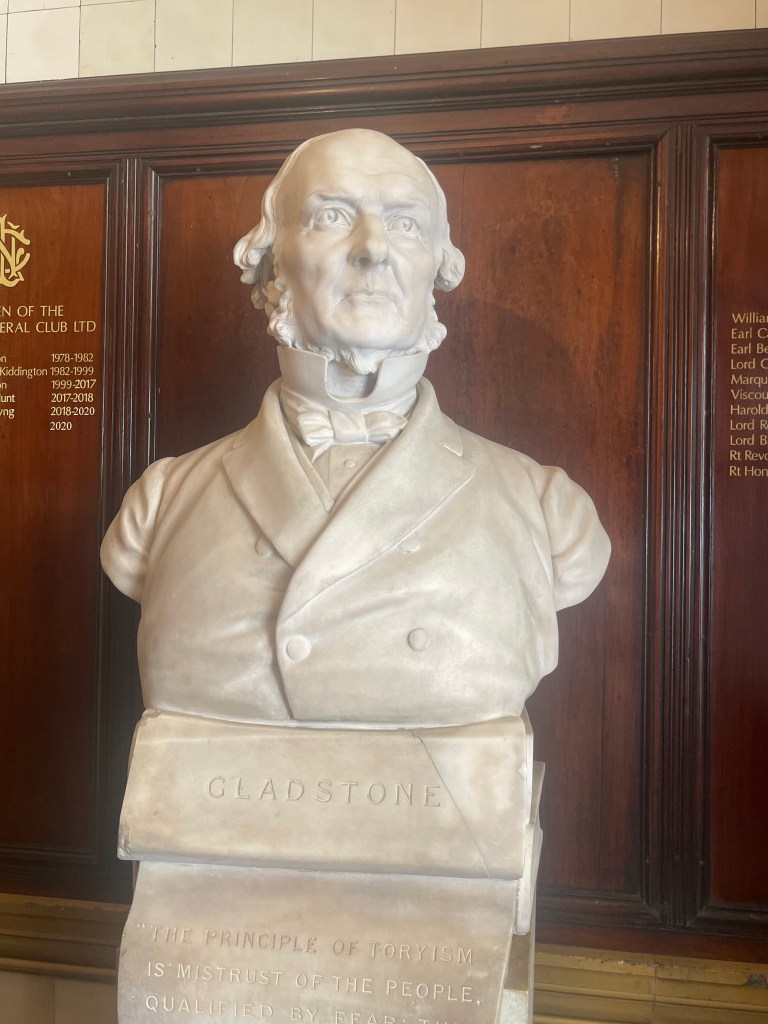
A lunchtime recital by Tyler Hay at the National Liberal Club in a tropical London enjoying a climate change temperature of 35 degrees. It was the scene of Tyler’s first outing with the monumental Sonata in B minor by Liszt .
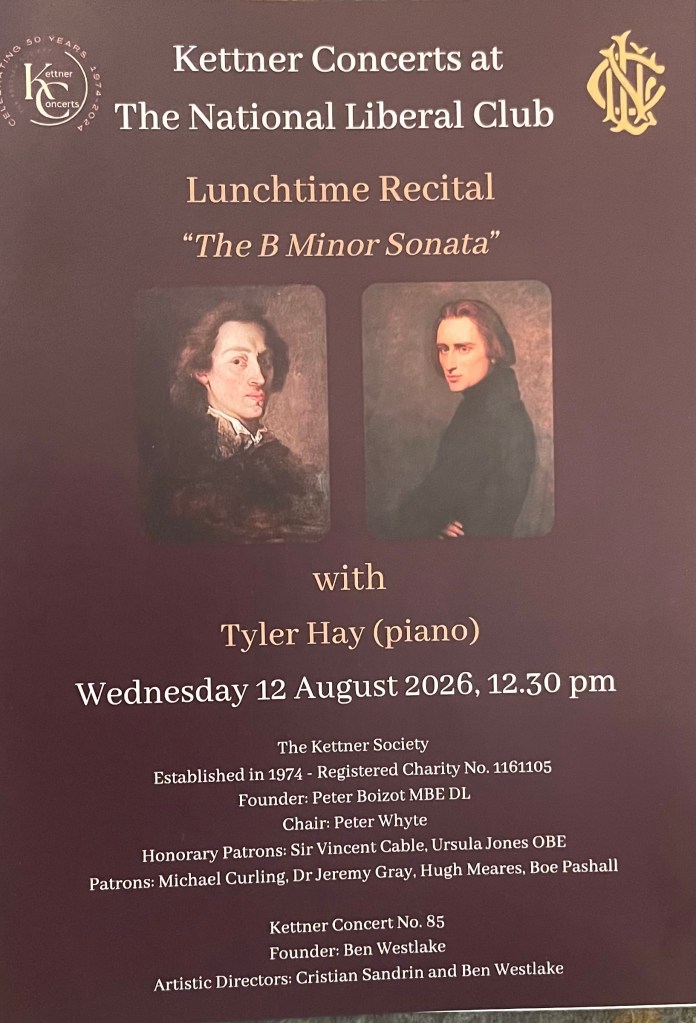
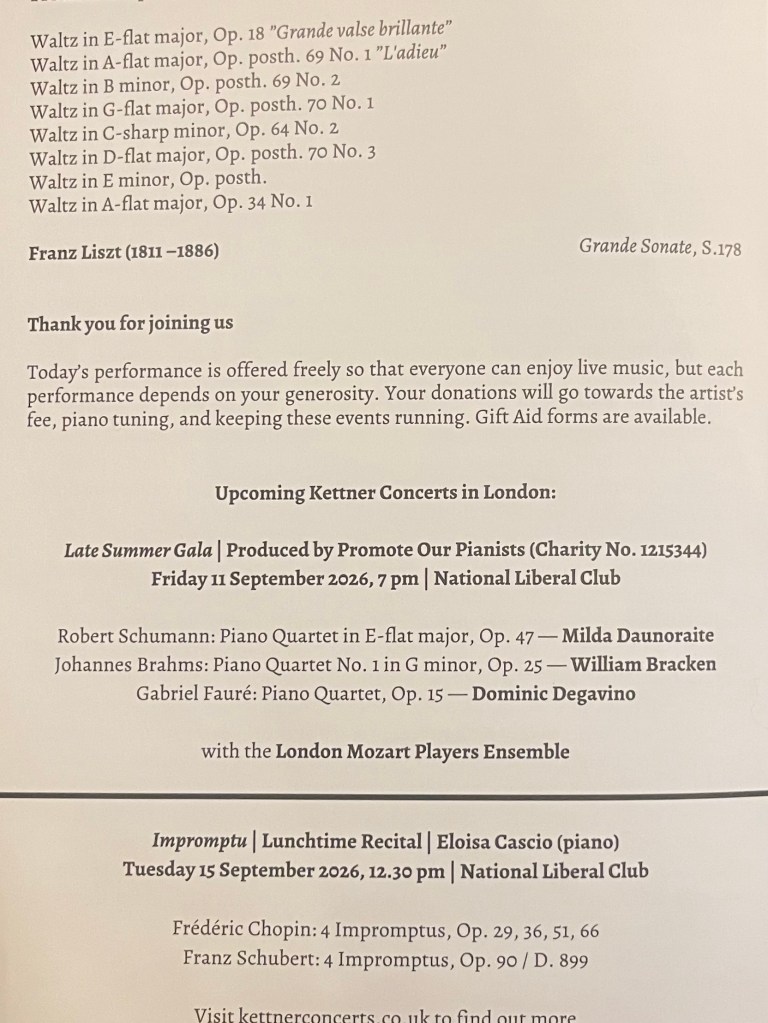
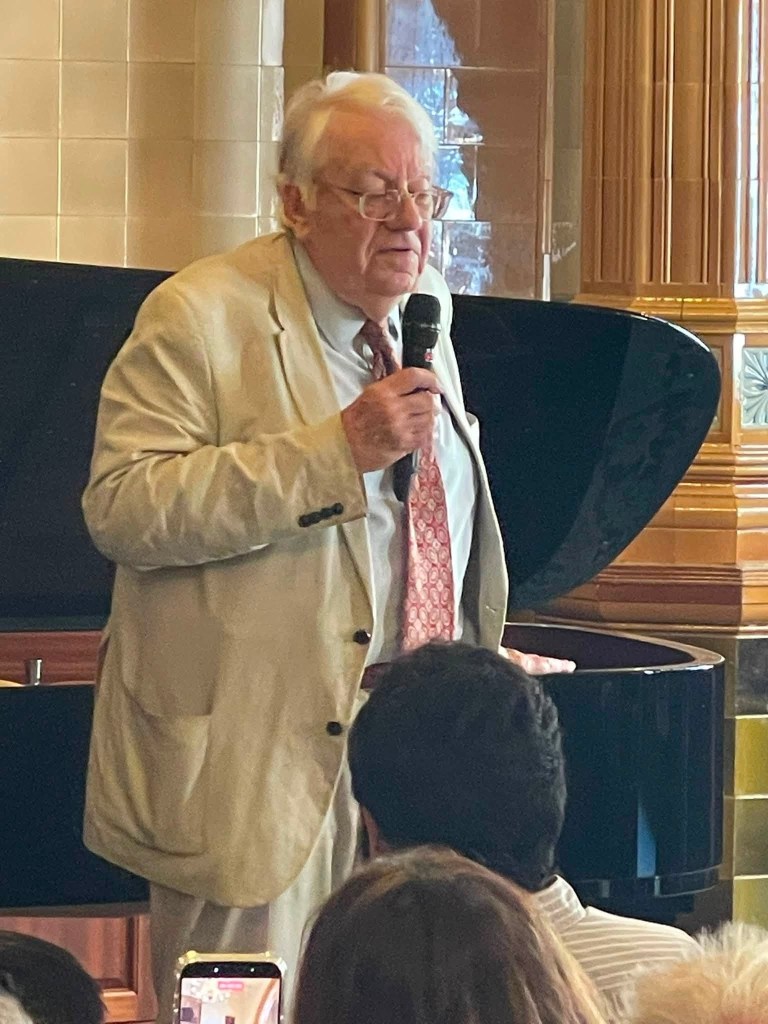
He chose to preface the work with eight waltzes by Chopin declaring it impossible or at the very least improper to play an encore after the Liszt Sonata as there can be nothing left to add after such a monumental work …….especially on what surely must be the hottest day of the year.
Likening the Chopin waltzes to a ‘bouquet of flowers’ many of which were never intended for publication. As Tyler said there could have been as many as 37 waltzes but at least seven were lost and many others were never intended for posterity. They are in fact among the most charming and melodious miniatures in the entire piano repertoire.
Many were given by Chopin to admirers or pupils and many variants abound as he added to these precious gifts with the generosity of the ‘Poet of the Piano ‘. Chopin wanted many of the manuscripts burnt after his death and little would he have approved of the fact that in October 2024, the curator Robinson McClellan discovered a previously unknown Frédéric Chopin waltz in the Morgan Library and Museum vault in New York. Written on a postcard-sized manuscript in A minor, the 48-measure piece dates back to 1830–1835 and was authenticated by scholars using paper, ink, and handwriting analysis. Of the presumed 37 piano waltzes, only nineteen (along with one unauthenticated waltz) are numbered and only eight were published ( as Op. 18, 34, 42 and 64) before he died. His desire was that any unpublished works should be burned, but his sister Ludwika and Julian Fontana proceeded anyway to publish Waltzes 9–13 (as Op. 69 and 70). Six waltzes composed 1826–1831 and present in Frédéric’s Paris home were at first preserved but then lost in fire in a 1863 in Ludwika’s house. Another six were eventually published as Waltzes 14–19. These Chopin had given to people without keeping a copy of the manuscripts. Waltz 18 was untitled; it is in 3/4 time and bears some characteristics of a waltz but is marked ‘Sostenuto’. Waltz 17 is not accepted as authentic by the Fryderyk Chopin Institute; to the other five in this group it has assigned WN numbers (29, 18, 28, 53 and 63). Waltz 20 is likewise unauthenticated . Separately, the last variation of Chopin’s Variations on a German National Air (Der Schweizerbub), WN 6, is in the form of a waltz.
Infact only the first, fifth and eighth waltzes of the 8 that Tyler chose to play today had been published. It was the ‘Grande valse brillante’ op 18 that opened the concert and I immediately noticed some very discrete embellishments added to the well known score that had also been included as one of the popular pieces of Chopin that made up the ballet by Glazunov: ‘Les Sylphides’. Applause after the first waltz allowed Tyler to explain that in many of the waltzes he would add some of the embellishments that abound and are published in the new Ekier edition of authenticated Chopin pieces . As an urtext, the Chopin National Edition aims to produce a musical text that adheres to the original notation and the composer’s intentions. All extant sources were analyzed and verified for authenticity, mainly autographs, first editions with Chopin’s corrections and pupils’ copies with Chopin’s annotations. Necessary editorial decisions are documented in each volume’s source commentary. Additionally, a separate performance commentary documents cases where Chopin’s notation may be misunderstood by contemporary pianists, such as realizations of ornaments and pedaling.The edition was completed in 2010, in time for the bicentenary of Chopin’s birth.
The Chopin National Edition consists of 36 volumes in two series, for works published during Chopin’s lifetime (Series A), and for works published posthumously (Series B). A 37th volume (titled Supplement) consists of compositions partly by Chopin, for instance his contribution to ‘Hexaméron’.The “WN” numbers in Frédéric Chopin’s catalogue stand for ‘Wydanie Narodowe’ (the Polish National Edition of the Works of Fryderyk Chopin). Edited primarily by Jan Ekier, this system catalogues all of Chopin’s authentic works—including posthumous and early pieces—in strict chronological order of composition, running from WN 1 to WN 65.
Tyler is building quite a reputation for his ‘ virtuosic programmes and for his witty audience interactions ‘ . But there is a Tyler who pays scrupulous attention to the composers markings delving deeply into the world in which the works he plays were created and it marks him out as a remarkable musician who can be trusted and not just a juggler of notes! This was to become even more apparent with his monumental performance of the Liszt Sonata after this unexpected foray into the world of Chopin’s waltzes.
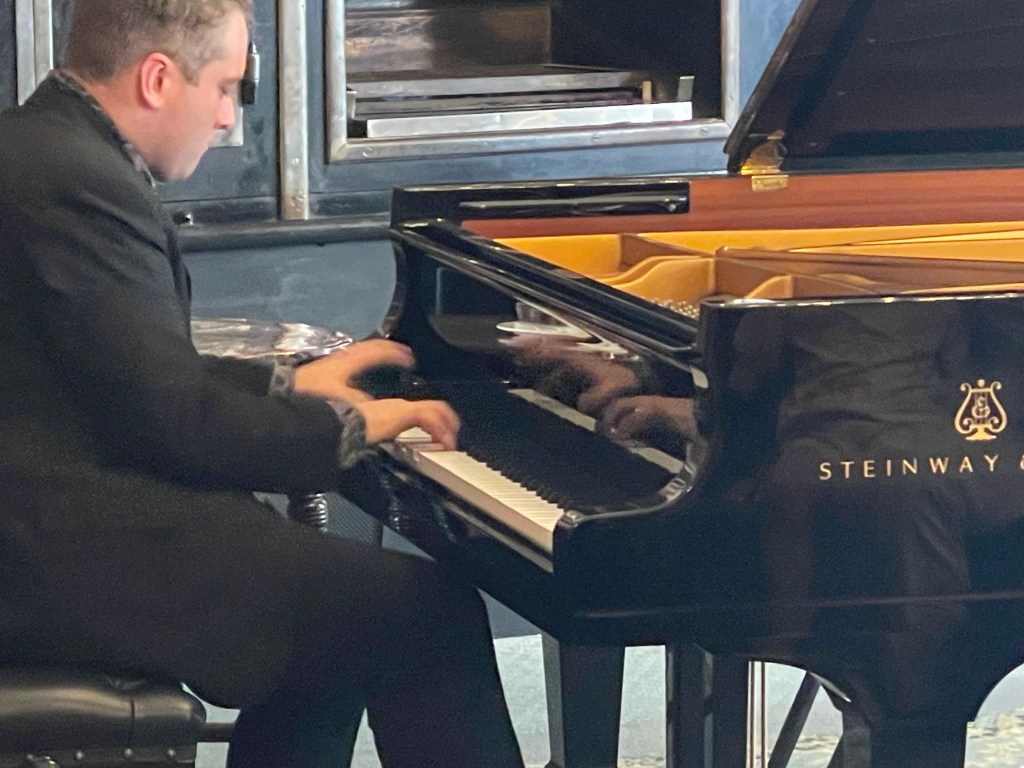
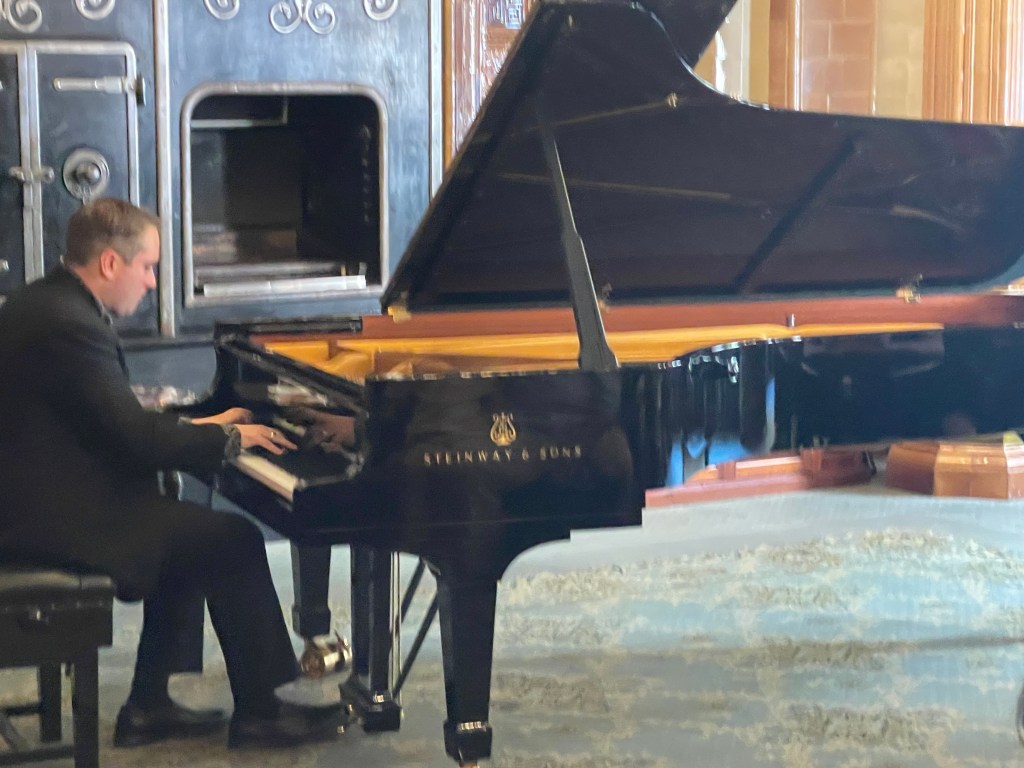
The waltz op 18 was ornamented towards the end with double notes and added embellishments that were done with such stylistic discretion that I began to doubt my ears even though I have known these waltzes for a lifetime. The waltz de ‘L’adieu’ was played with quasi improvised freedom and again with some unexpected harmonies . The waltz in B minor op 69 n. 2 flowed with beguiling insinuation and where it risked becoming repetitive Tyler added double notes and instead of the usual dotted rhythm the top notes were played quite evenly. The G flat waltz op 70 n. 1 was really an uncontaminated Ecossaises of glowing radiance. The famous waltz in C sharp minor op 64 was played with passionate involvement and with some inner counterpoints that I have never been aware of in quite Tyler’s way . Many artists slightly weigh into the inner notes whilst there is a jeu perlé outpouring above but Tyler seemed to find a different solution which will have me looking at the Ekier edition more closely. The D flat waltz op 70 n. 3 had a flowing beauty of nonchalance and ease. And the last two in E minor op posth and in A flat op 34 n. 1 are well known in the concert hall and Tyler played them with refreshing simplicity and sumptuous ease. The E minor in particular was played with very little pedal towards the end which added to the freshness and vigour of this brilliant waltz, and the jeu perlé at the end of the A flat waltz was played with the anchor in the bass which gave a harmonic richness to the sound. I loved the added bass note too at the sumptuous D flat climax of one of the most exhilarating of the waltzes.
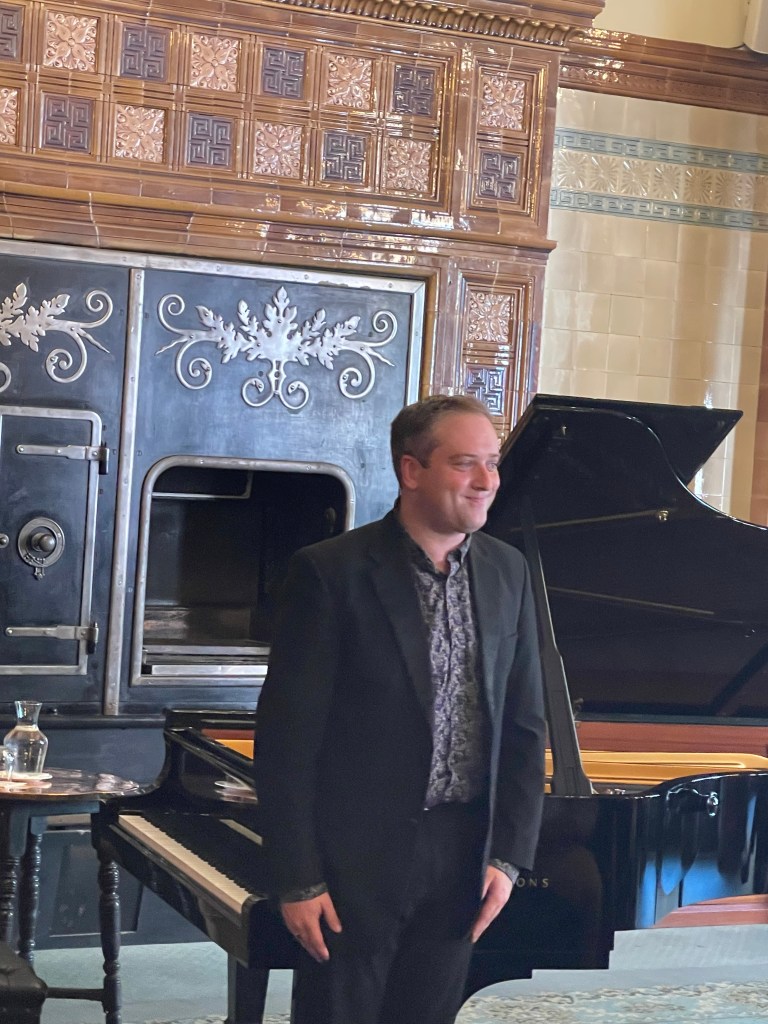
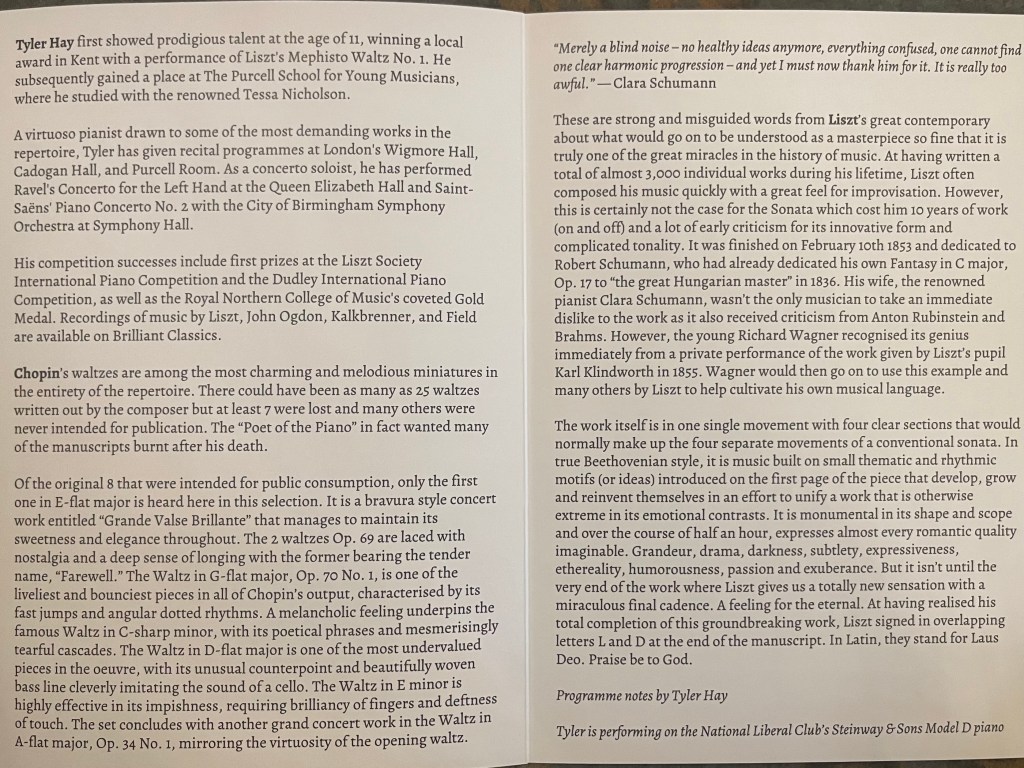
The main work on the programme which gave the title to today’s concert was ‘The B Minor Sonata’. The pinnacle of the Romantic Piano Repertoire that like Chopin’s B flat minor sonata, was of such originality that Liszt’s colleagues criticised it. Schumann had described the Chopin Sonata, one of the composers greatest works , as ‘ four of his maddest children under the same roof’ and the last movement ‘ more like a mockery than any sort of music.’ Schumann had dedicated his Fantaisie op 17 to Liszt who contributed the rights to the Beethoven Monument Fund in Bonn. Liszt in return dedicated this B minor Sonata to Schumann and it was delivered to the house after the composer had been committed to an asylum in Eisenach. Clara Schumann received it and described what she found as ‘ Merely a blind noise- no healthy ideas anymore, everything confused, one cannot find one clear harmonic progression- and yet I must thank him for it. It is really too awful.’
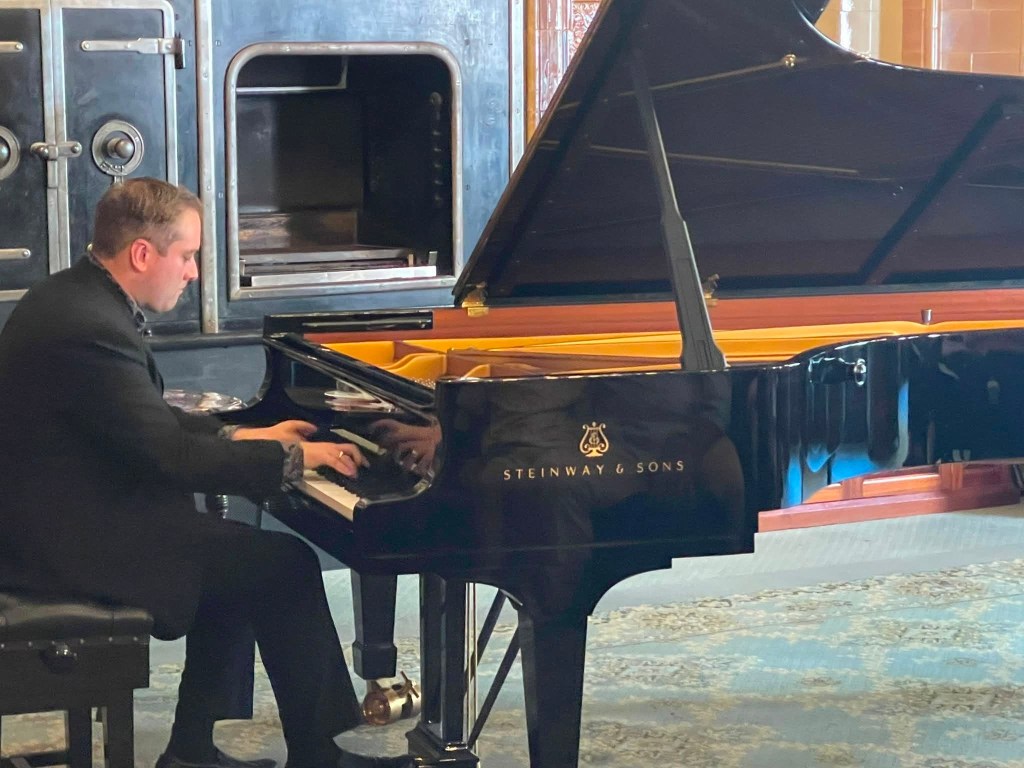
However it was Liszt’s son in law Richard Wagner who recognised the genius of a work where the transformation of themes is combined with the rough outline of Sonata form. Liszt had been inspired by Schubert’s Wanderer Fantasy where a new form was forged, transforming the opening themes and creating what was to become Wagner’s leit motif, the very anchor on which his music dramas were created. As Tyler told us it is a work in which grandeur, drama, passion, exuberance and exhilaration are shared with etherial beauty of ravishing appeasement. Tyler from the very opening page immediately showed us his musical credentials realising that the three opening motifs are but an introduction to the real beginning of the Sonata and a declaration of intent to be played only piano and forte with the grandeur of fortissimo only appearing as we enter the real beginning on the second page. Tyler brought great clarity and simple honest musicianship to a work that is so often played with rhetoric and showmanship. He brought a beauty to the melodic line full of glowing fluidity which contrasted with the rather dry orchestral sounds that preceded the ‘Margherita’ theme. Astonishing technical mastery followed, but always very measured and controlled never forgetting the larger architectural shape of this extraordinarily united work. Very interesting inner counterpoints gave great depth to the sound as he approached the ‘Andante sostenuto’ slow movement incorporating a ‘Quasi adagio’ of poignant beauty and simplicity as it built into a vibrating being of passionate intensity. Tyler played with the aristocratic control of Arrau, never allowing the music to command with empty rhetoric , but it was the inner intensity he gave the music that was of profound nobility and naked passion. There was a stillness and beauty to the simple scales played ‘pianississimo’ with vibrant glowing beauty and if he slightly indulged and lost for a moment the architectural line it prepared us for the extraordinary recapitulation and fugato that appears at the end of this trail of wondrous gold and silver coloured sounds. It now became apparent why in the opening motif Tyler had made such a contrast between staccato and legato, because the whispered staccato at this point linked so well with the ‘Allegro energico’ of the fugato. Building in intensity as the whispered chattering of the counterpoints led to the quasi orchestral outpouring that was of enticing exhilaration.It was at this point that Tyler allowed himself full reign, opening the flood gates to the sumptuous rich sounds that were to signal the return of the opening. A technical mastery of exhilaration and excitement with the notorious double octaves played with a musical intent where Tyler’s mastery was always at the service of the music. The final two pages Liszt had originally conceived as finishing in glory but were substituted by the composer with one of the most poignant and original endings in all music. The genius of Liszt had taken precedence over the showman as these final bars summarise the entire sonata and were played with extraordinary beauty and control by Tyler. The final three chords played with whispered perfection and beautifully shaped before the final B deep in the bass brought this remarkable performance to a moving conclusion.
Moments of collective silence were the sign that Tyler had been able to convey the message of the composer with the grandeur, drama, passion, exuberance , exhilaration and etherial beauty of ravishing appeasement that had been promised.
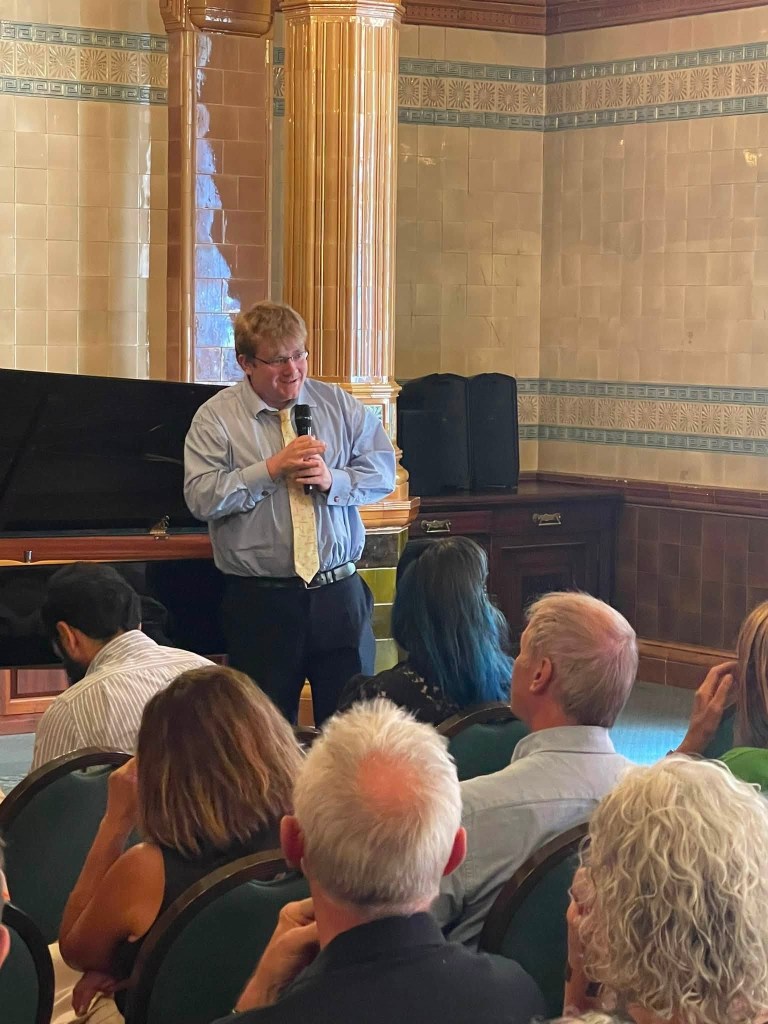
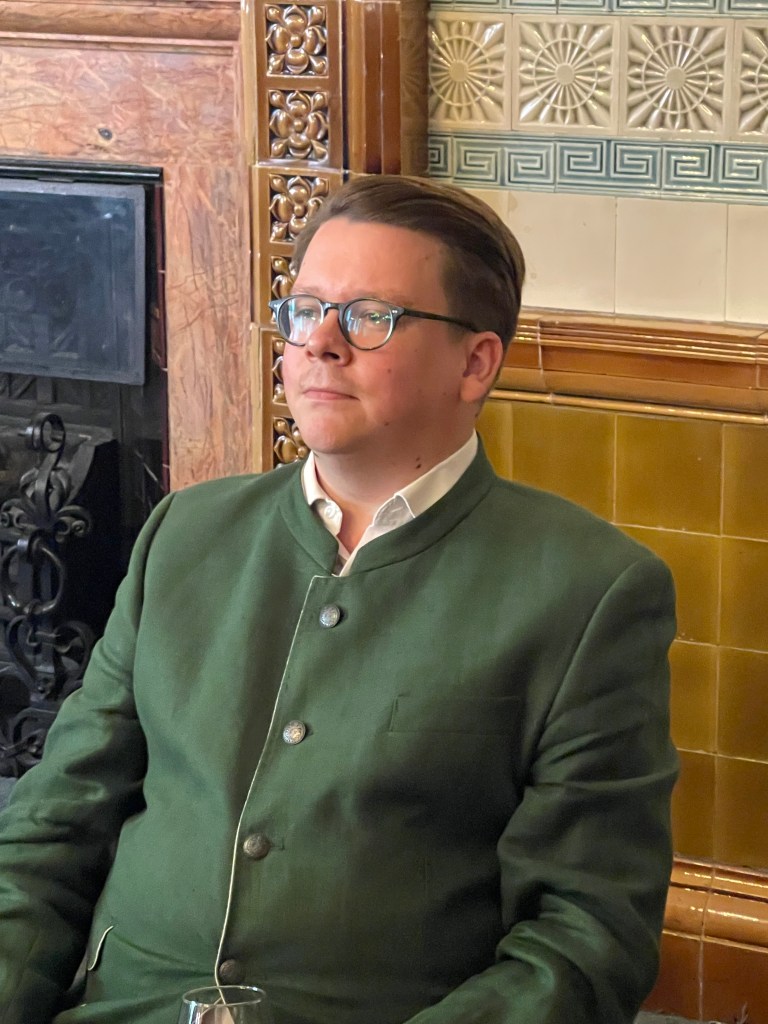
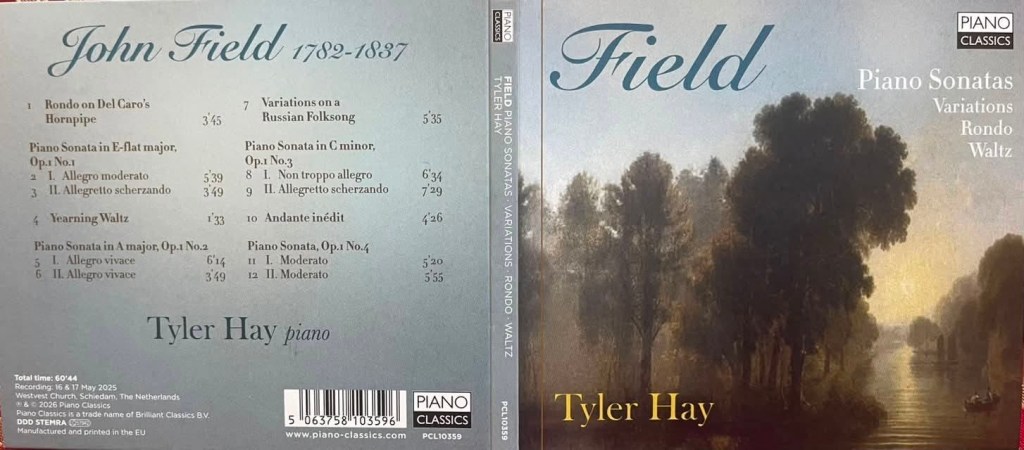
Tyler’s latest CD of works by John Field has just been released .Field born in Dublin is best known as the inventor of the Nocturne, transforming the expressive possibilities of the piano, and opening a door for composers such as Chopin,Liszt and Schumann
https://christopheraxworthymusiccommentary.com/2024/03/20/christopher-axworthy-dip-ram-aram/