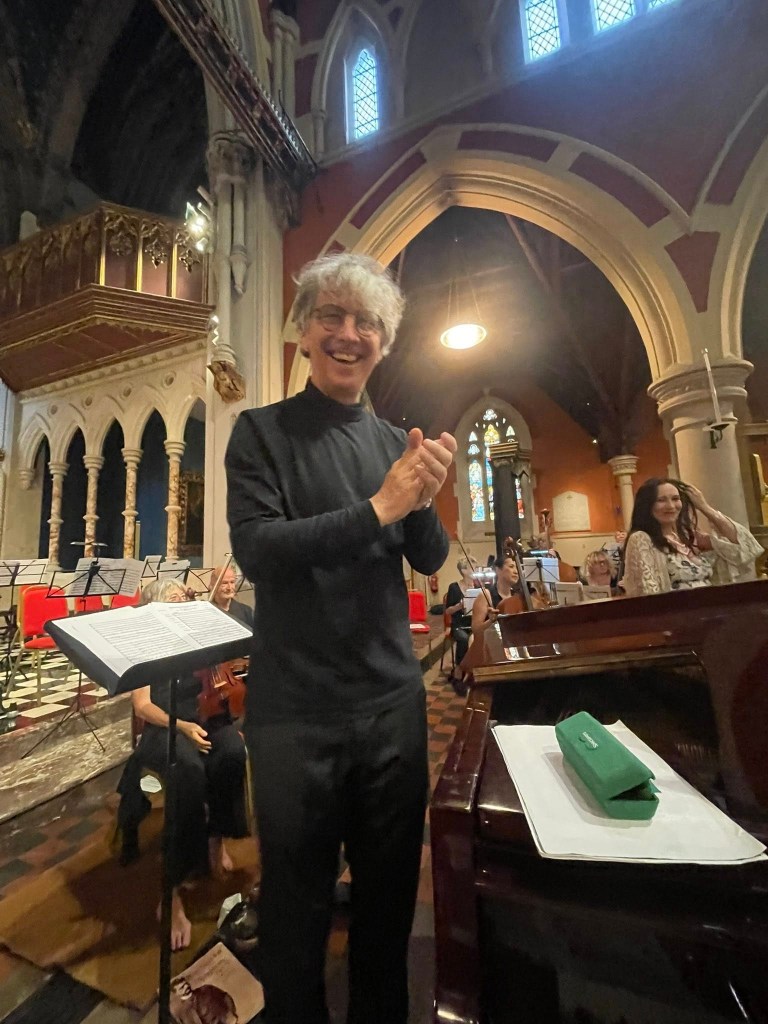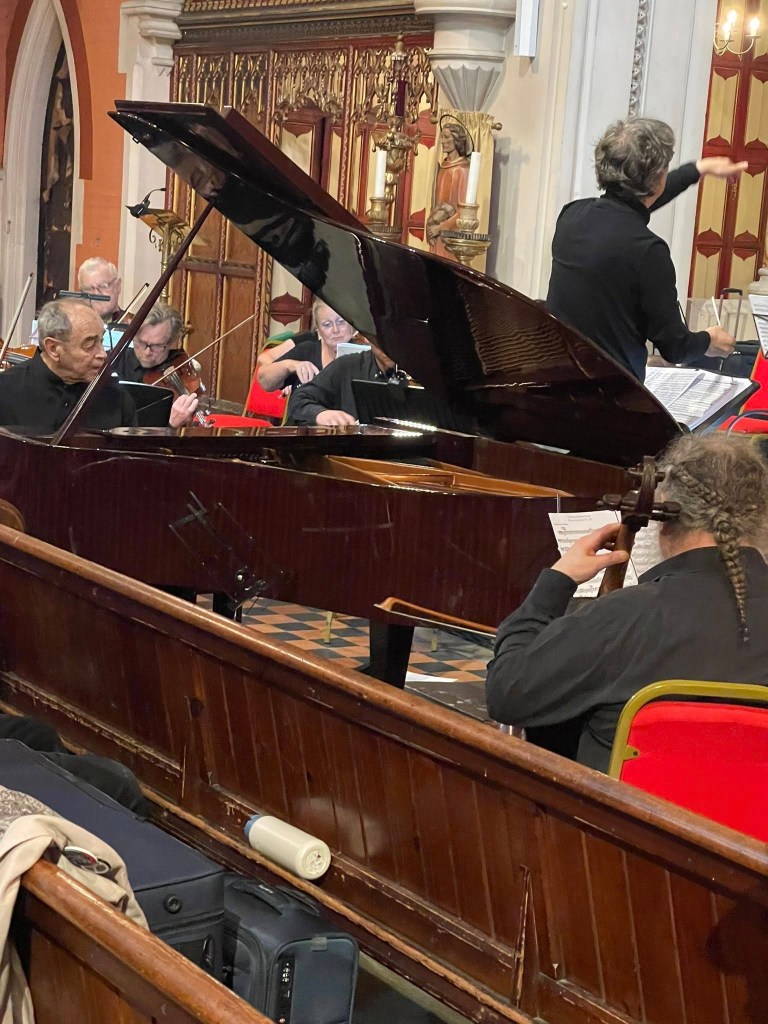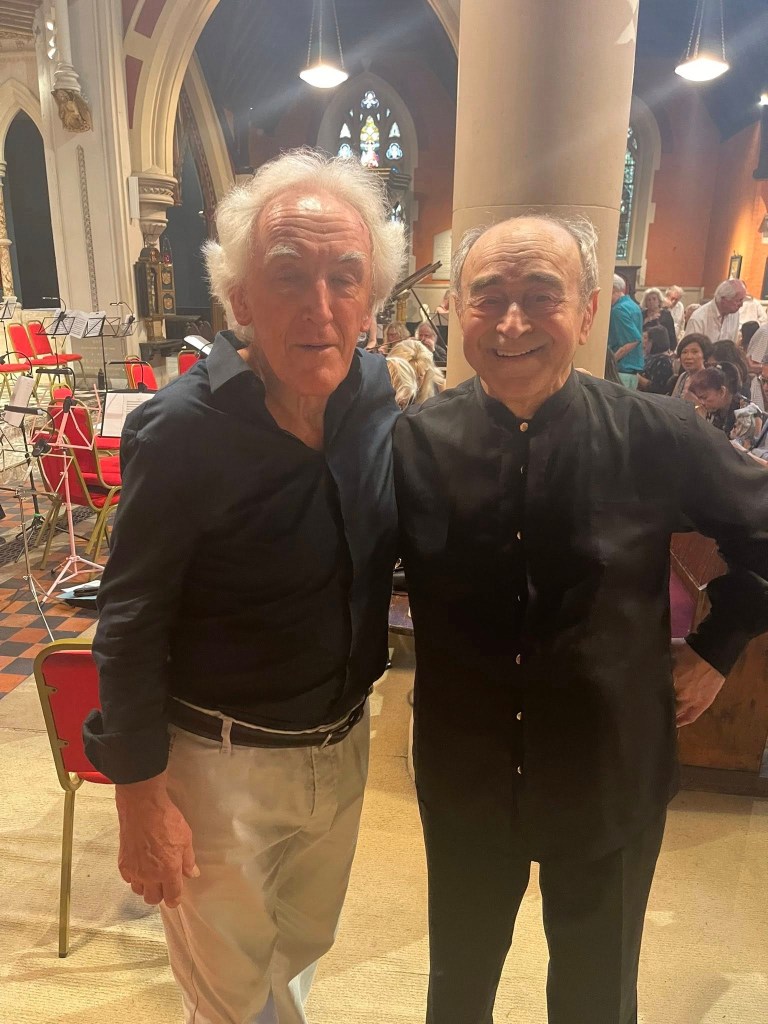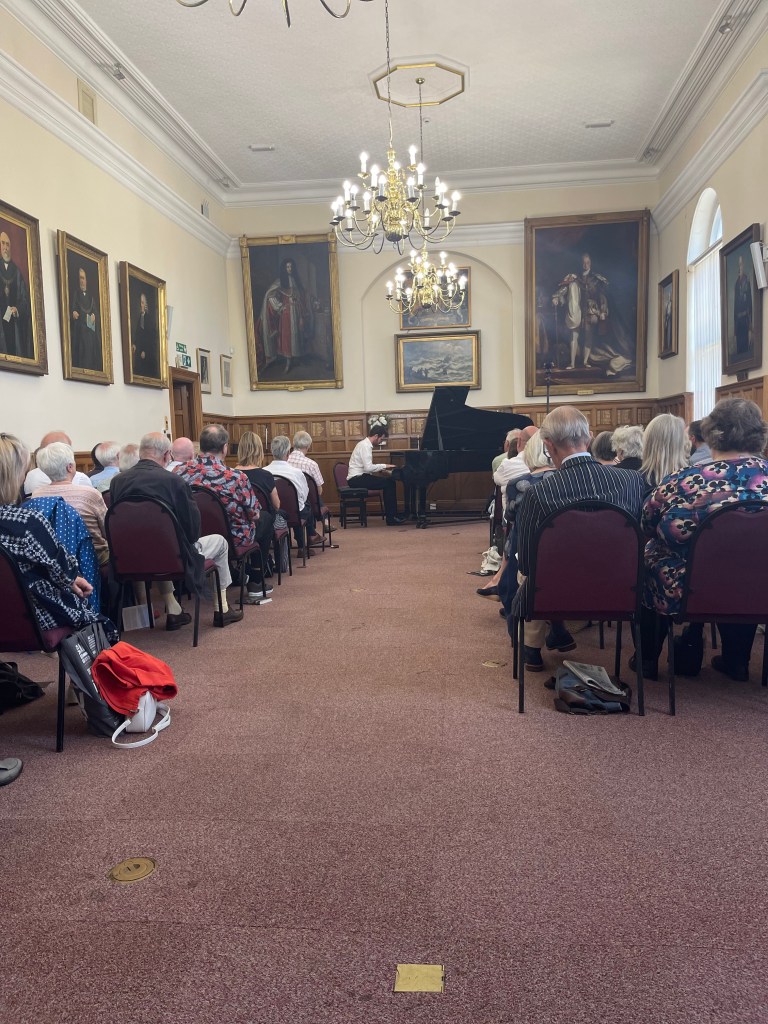
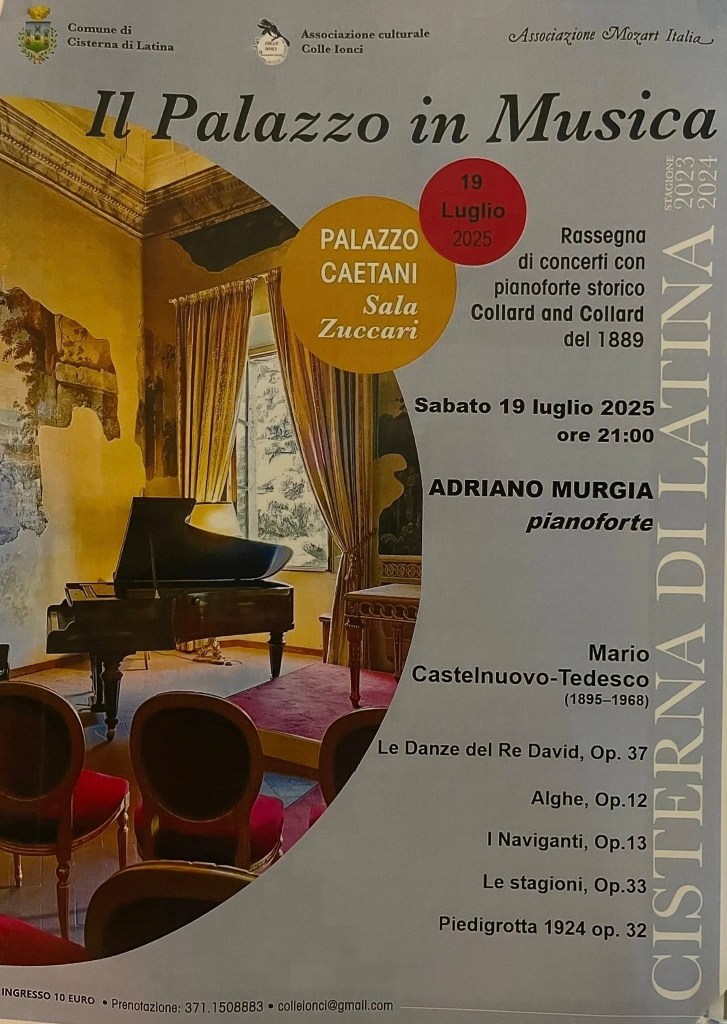
Hollywood comes to Cisterna di Latina Adriano Murgia plays Castelnuovo-Tedesco

More superb music making from the class of Roberto Prosseda, born in Latina although brought up in the shadow of the Ghione theatre in Rome, with the Cafaro’s next door, and the genial inspiration of Fou Ts’ong there too, and later in the International Piano Academy, Lake Como. Now arrived at his half century he is an established, much respected musician on the world stage, with his own class at the Rovigo Conservatory, and his own school and recording studio ‘happily’ (sic) established with his wife and three children in Prato.
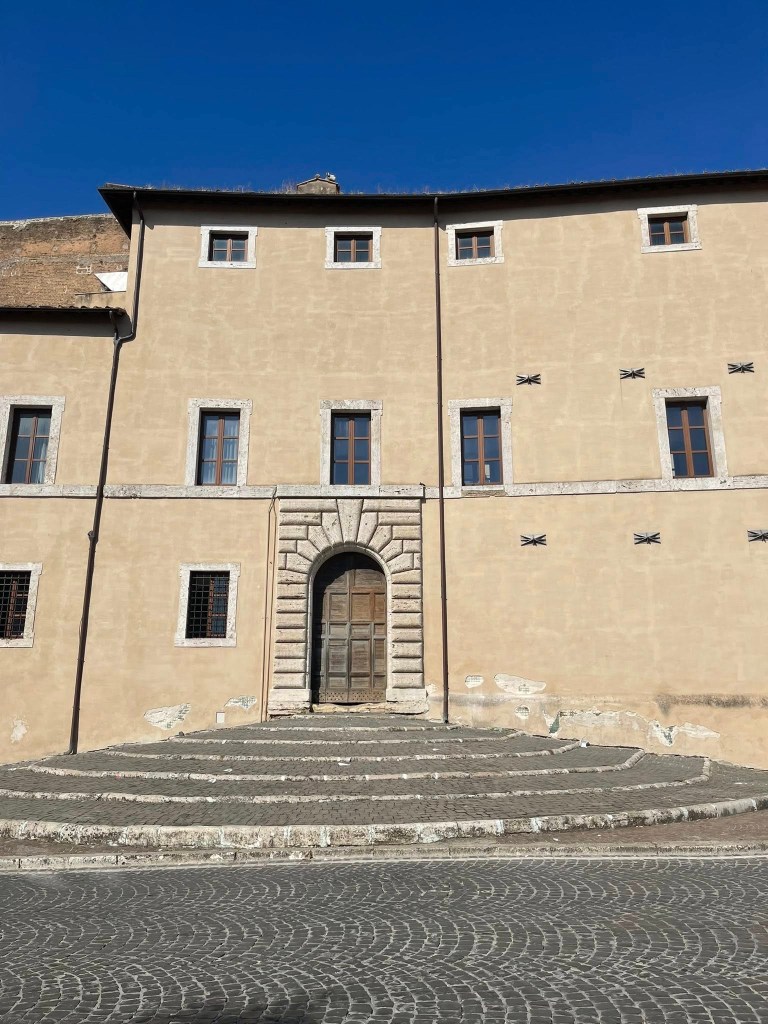
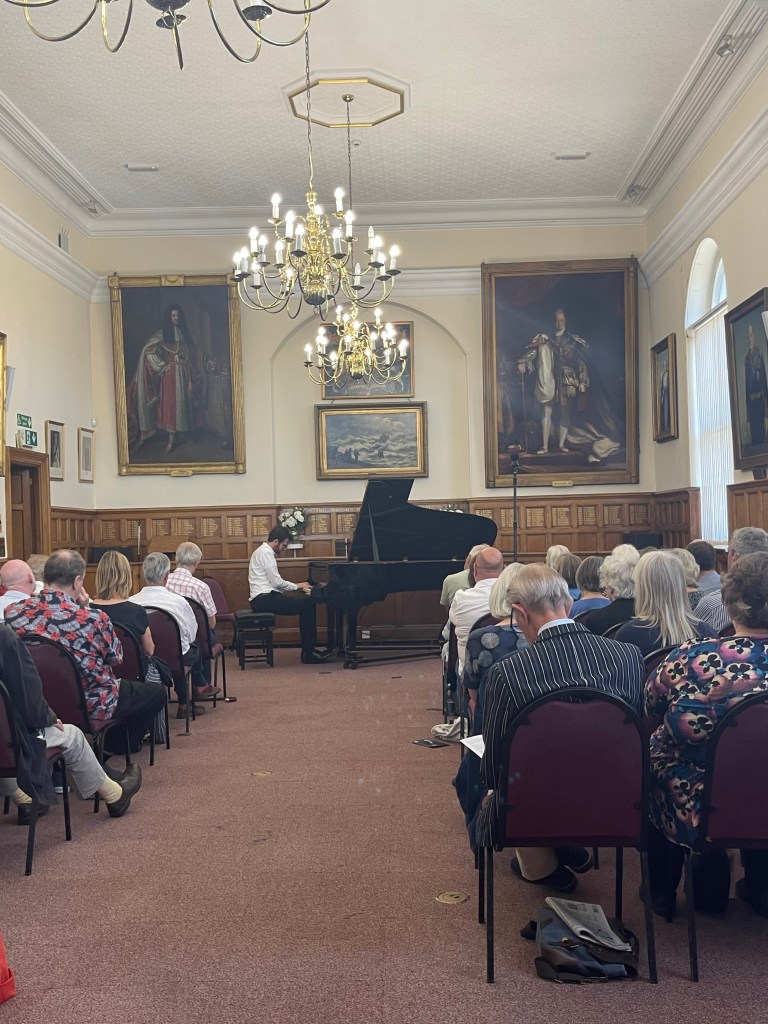
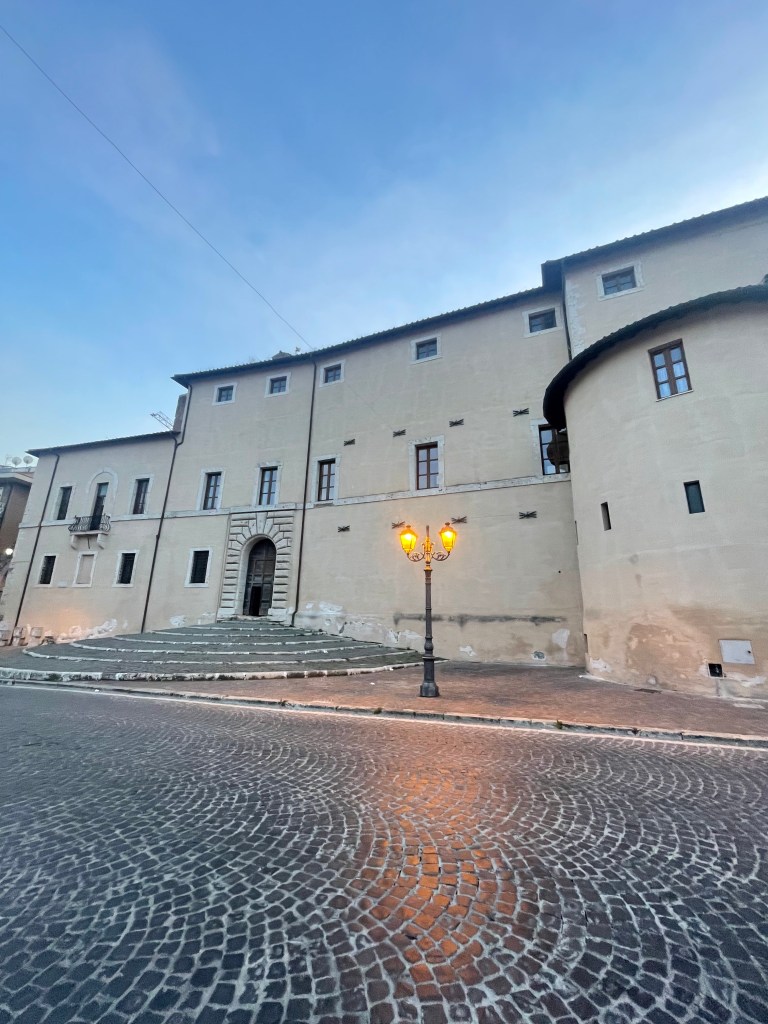
His roots though have never left him, and unknown to many he had discovered this wondrous Caetani Palace in a small town next to Latina.
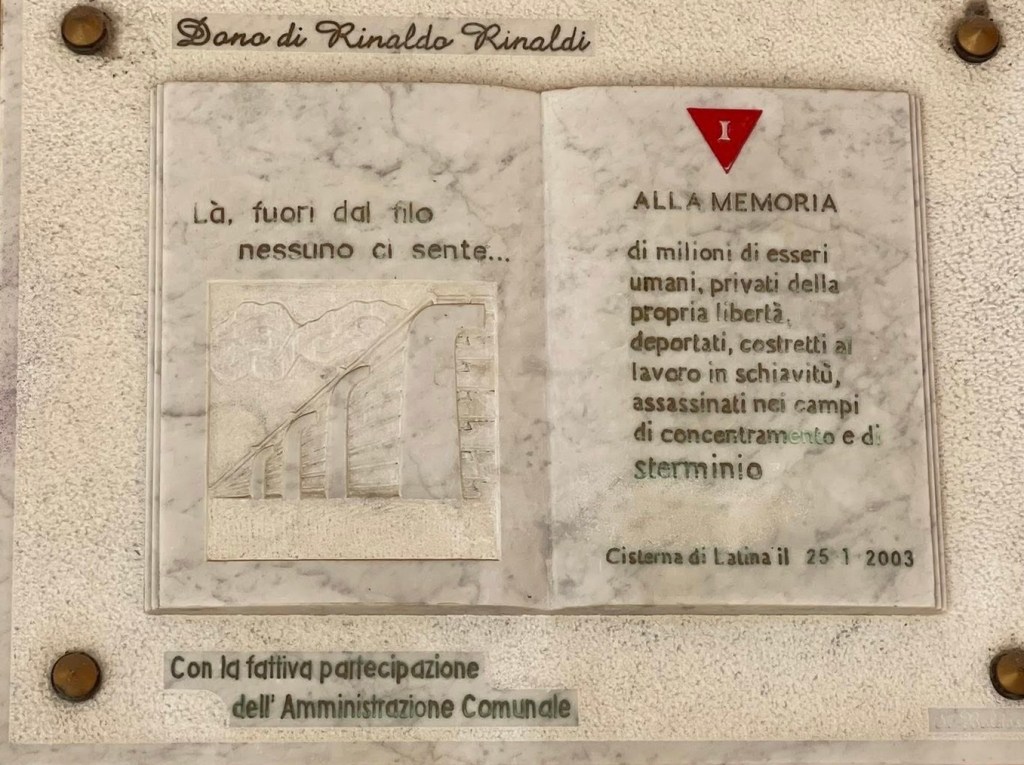
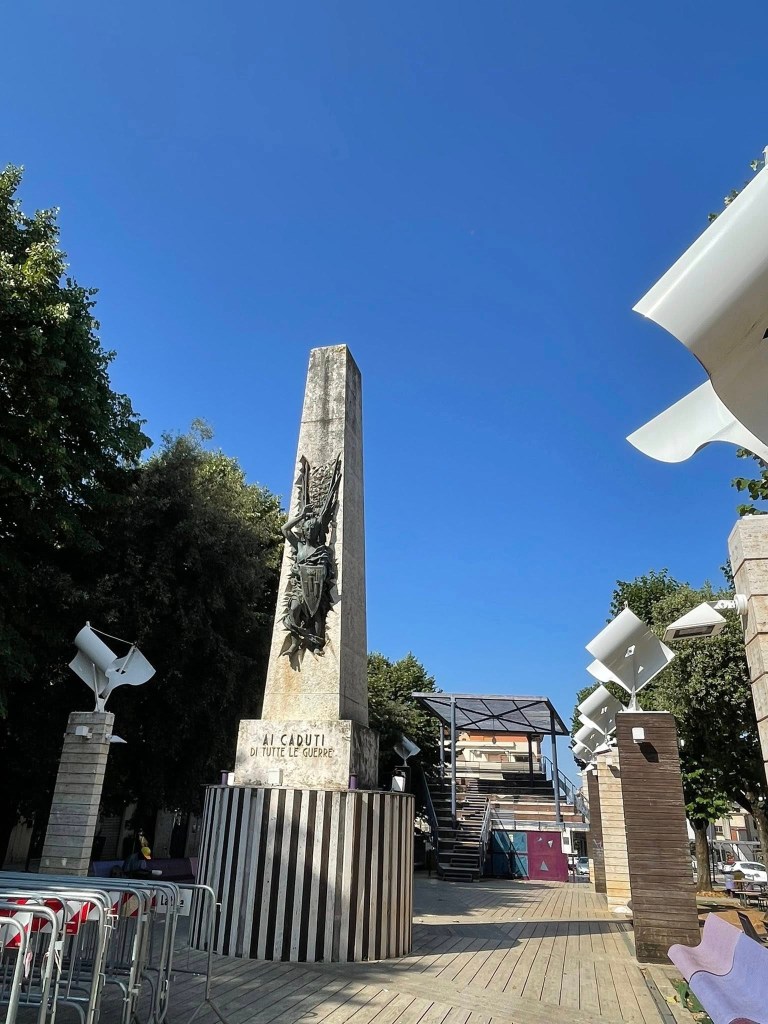
A town that has suffered as it lay in the malerial swamps around Rome that Mussolini drained and turned into the most arable land around the Eternal City. Until war struck and this area saw the landings of the troops as the war came to it’s tragic end.
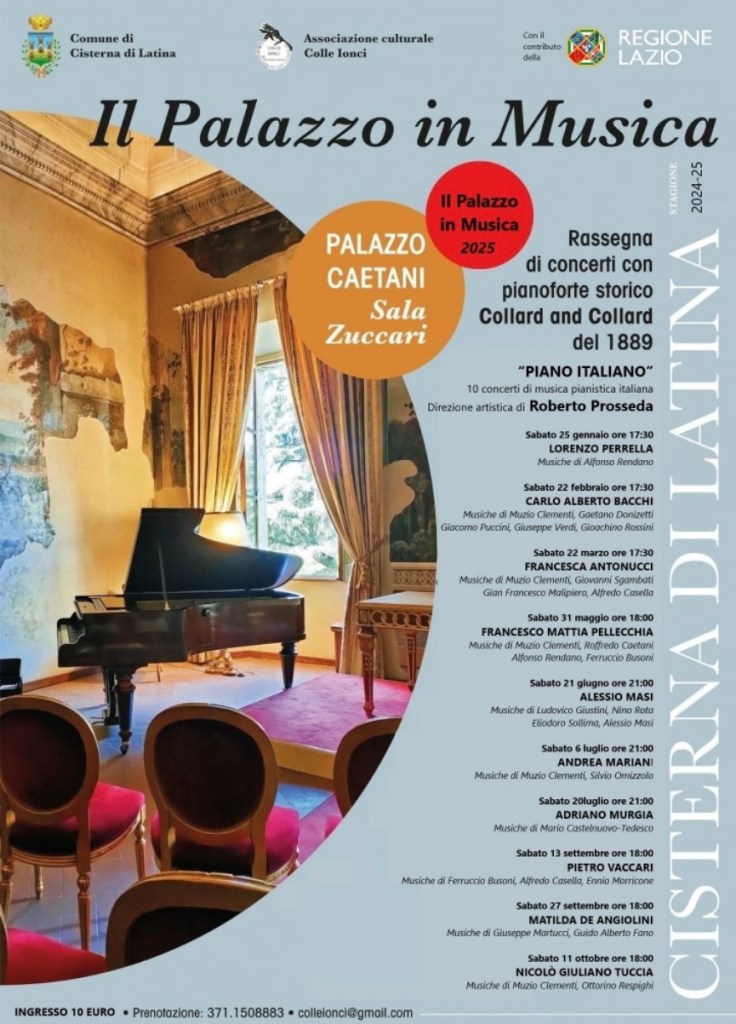
Not only had Roberto Prosseda found it but he has a mission to dedicate a series of concerts to launch superb but unjustly neglected Italian music, played and video recorded by his very accomplished master students.
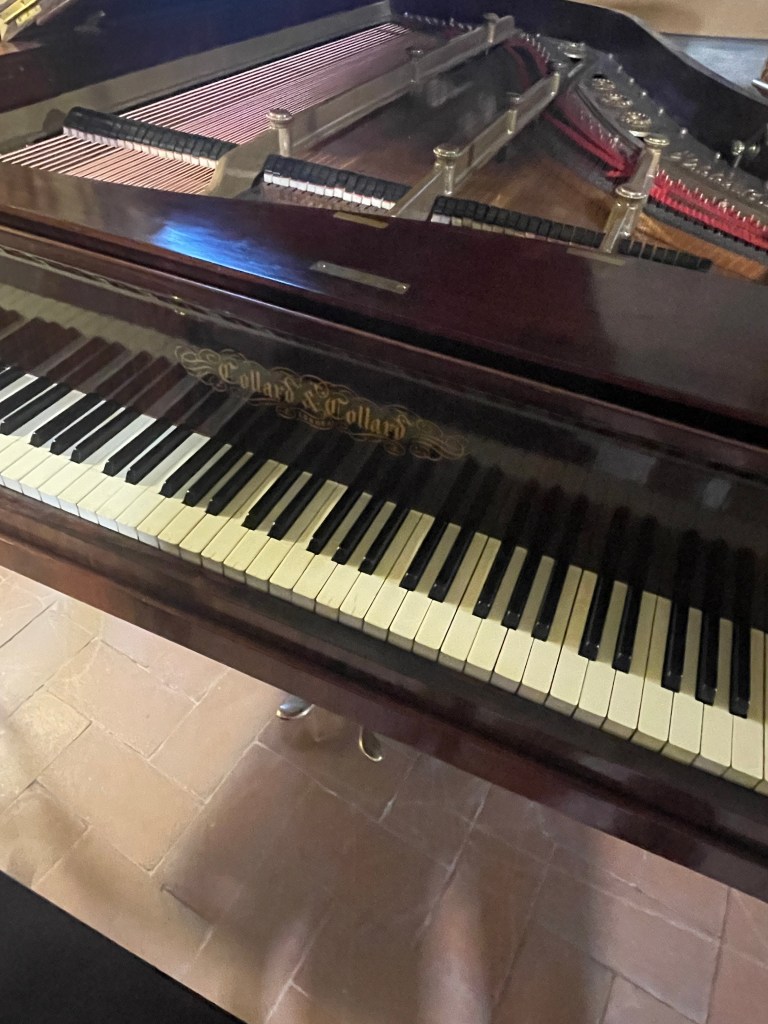
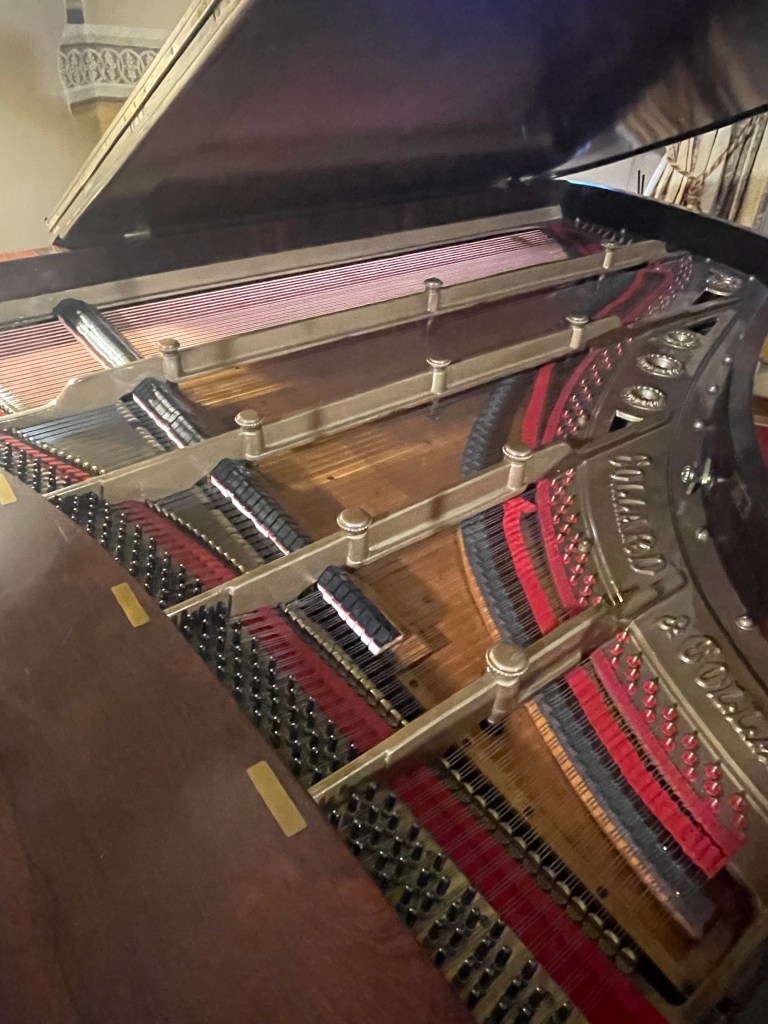
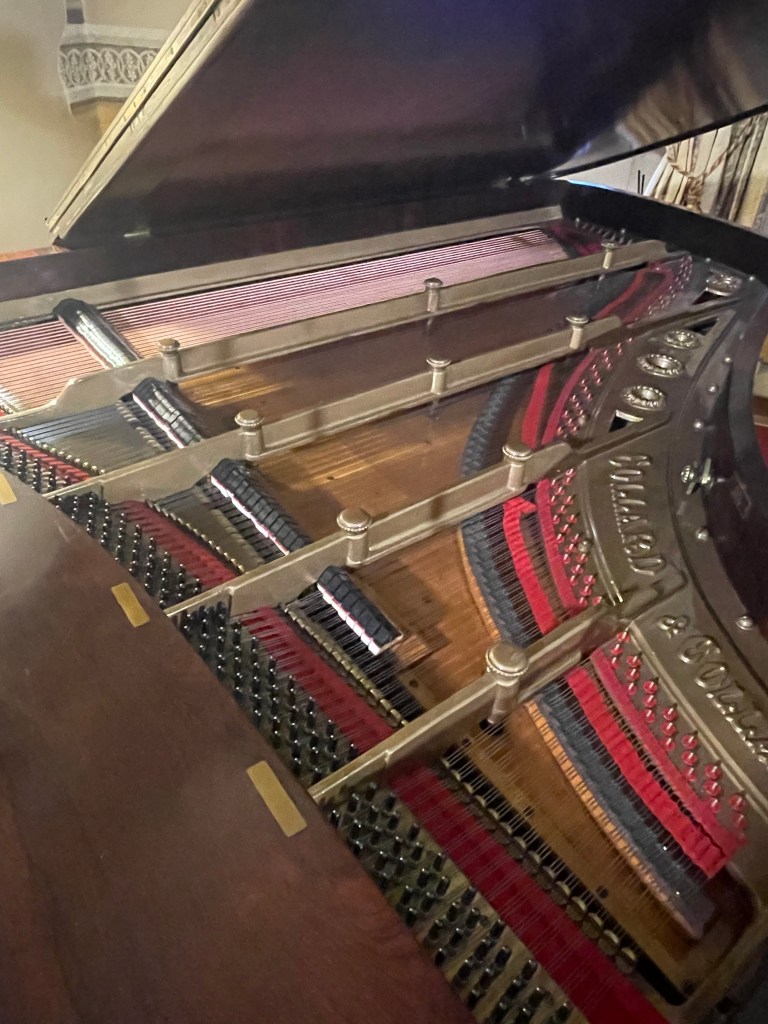
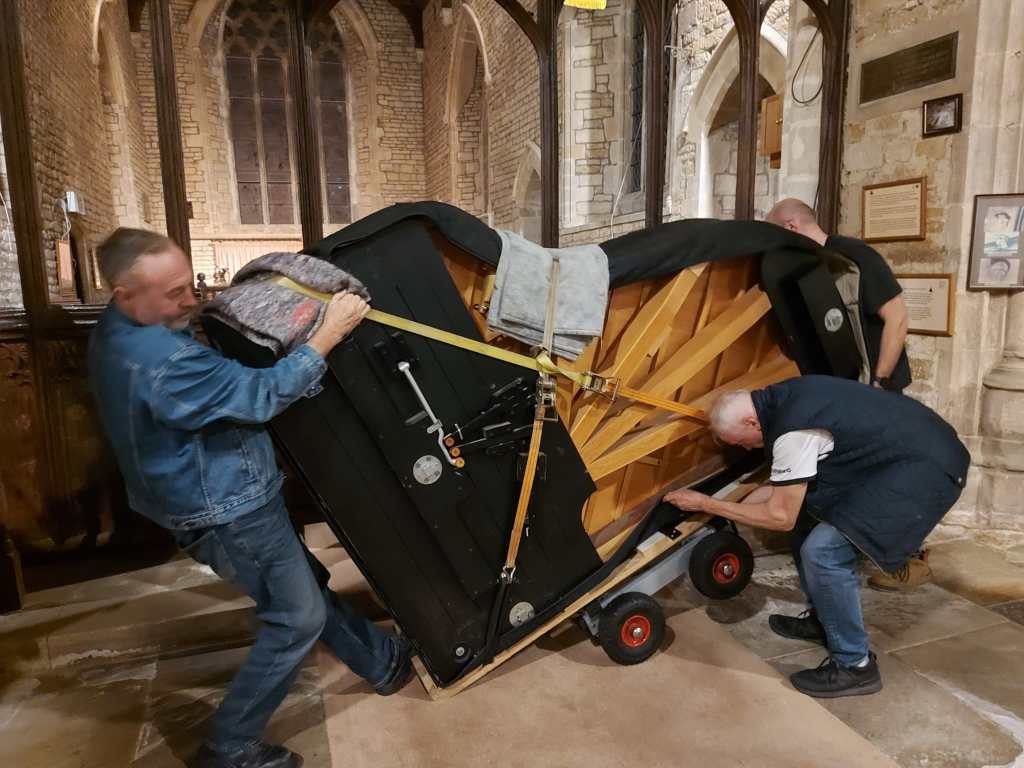
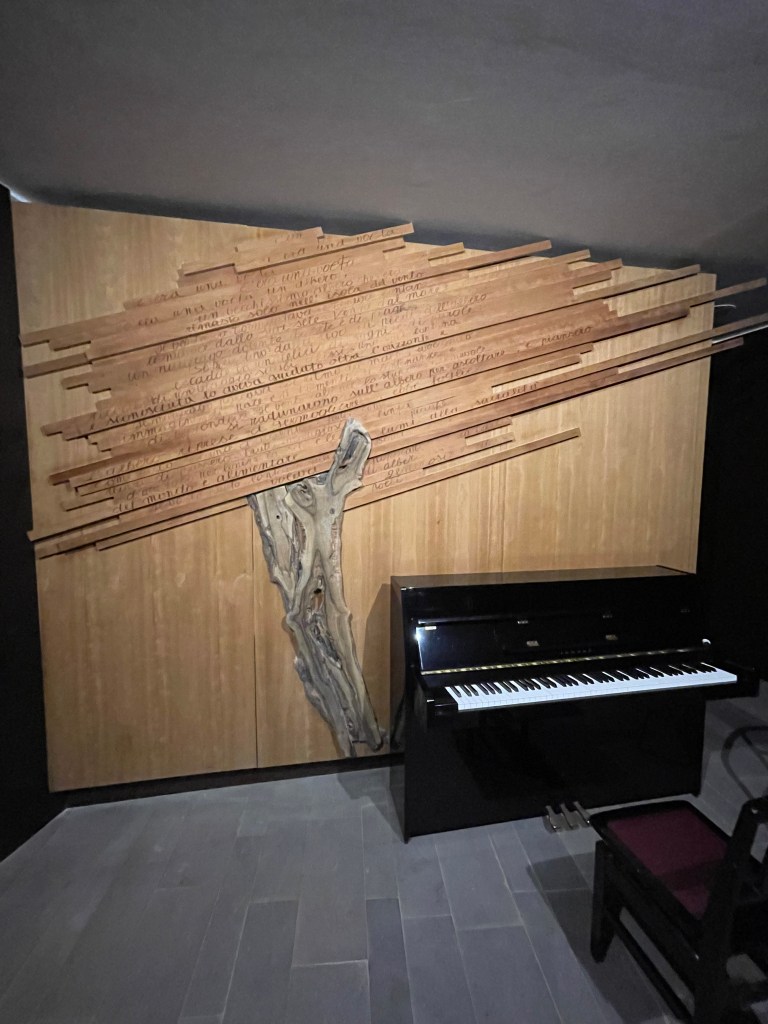
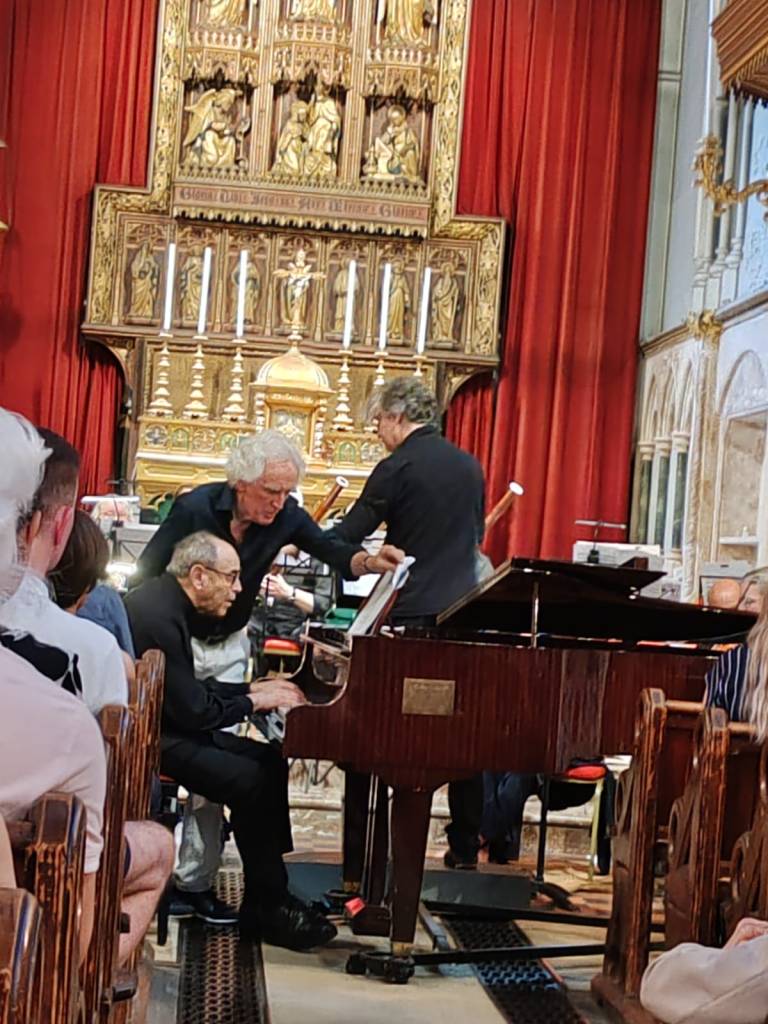
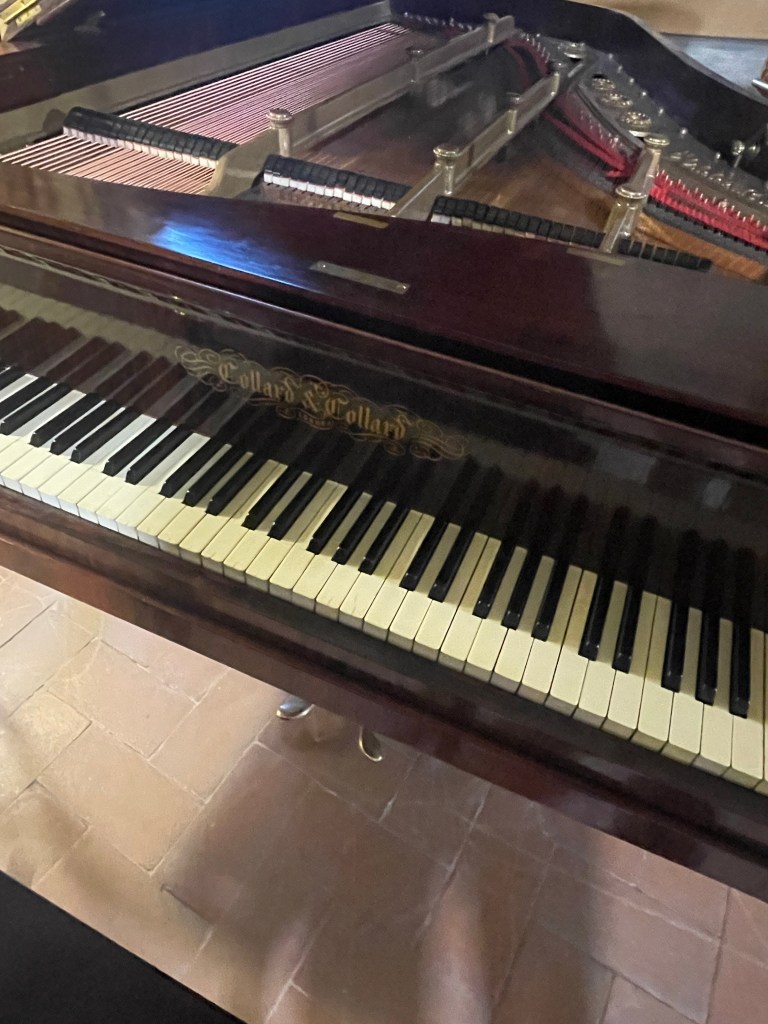
He even managed to find an antique 1890 Collard and Collard piano that had lain in disuse in the Savoy Hotel in London until an extravagant story brought it to Rome. It is now in the hands of experts passionately able to restore this and an antique Erard back to its former glory.
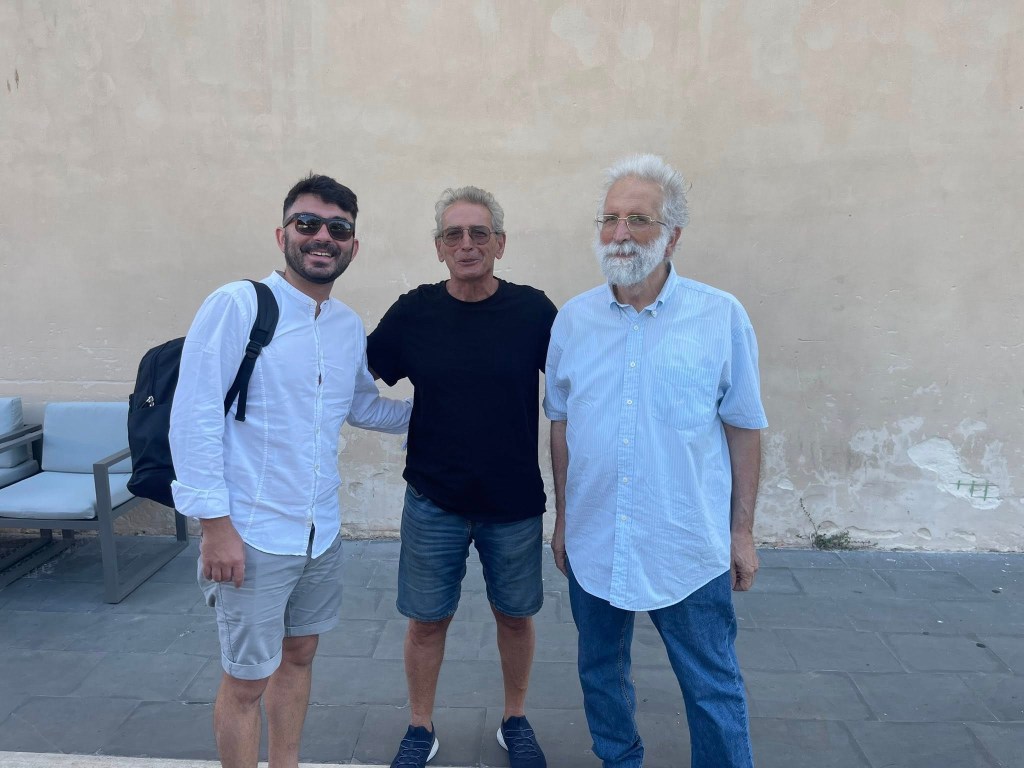
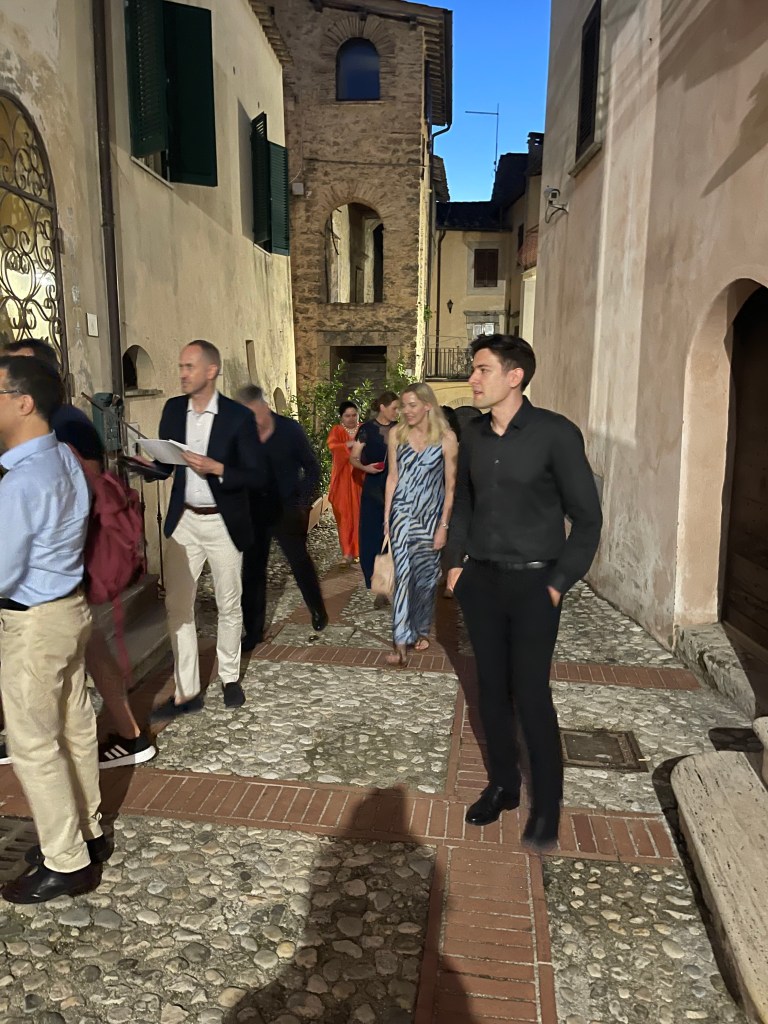
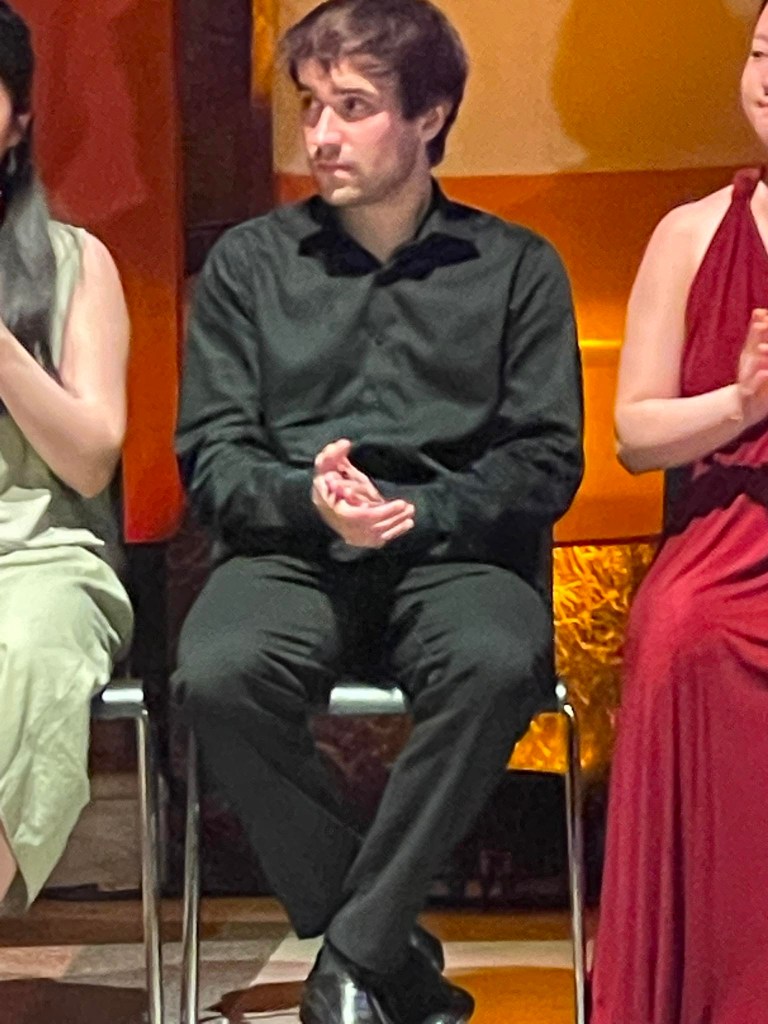
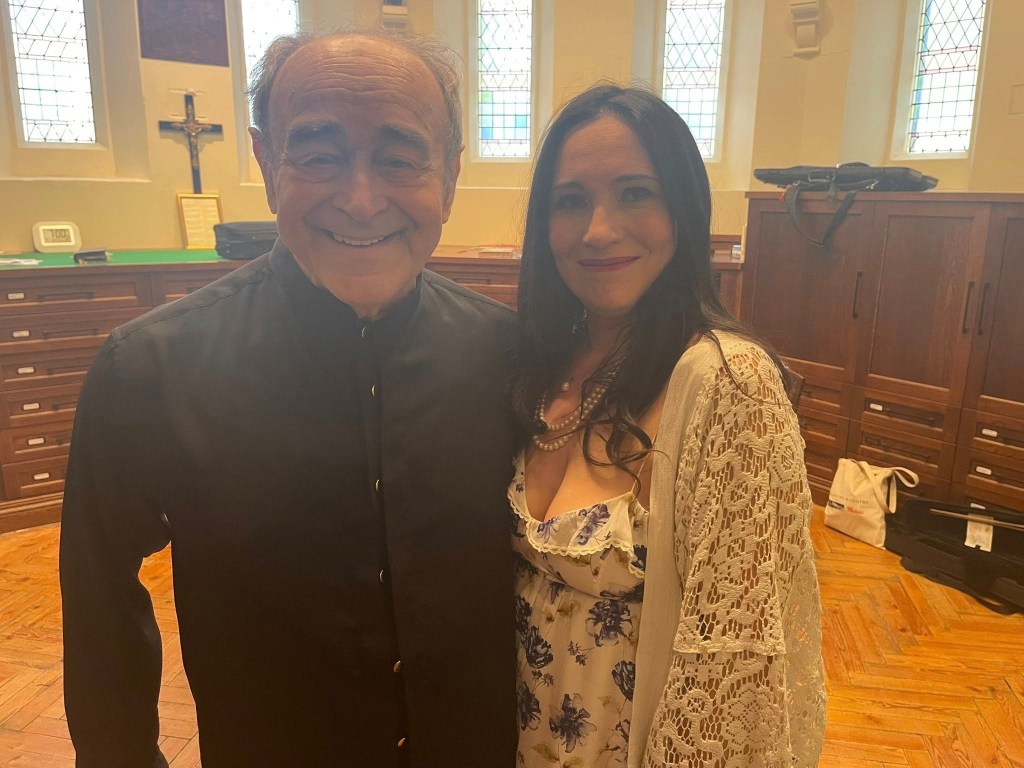
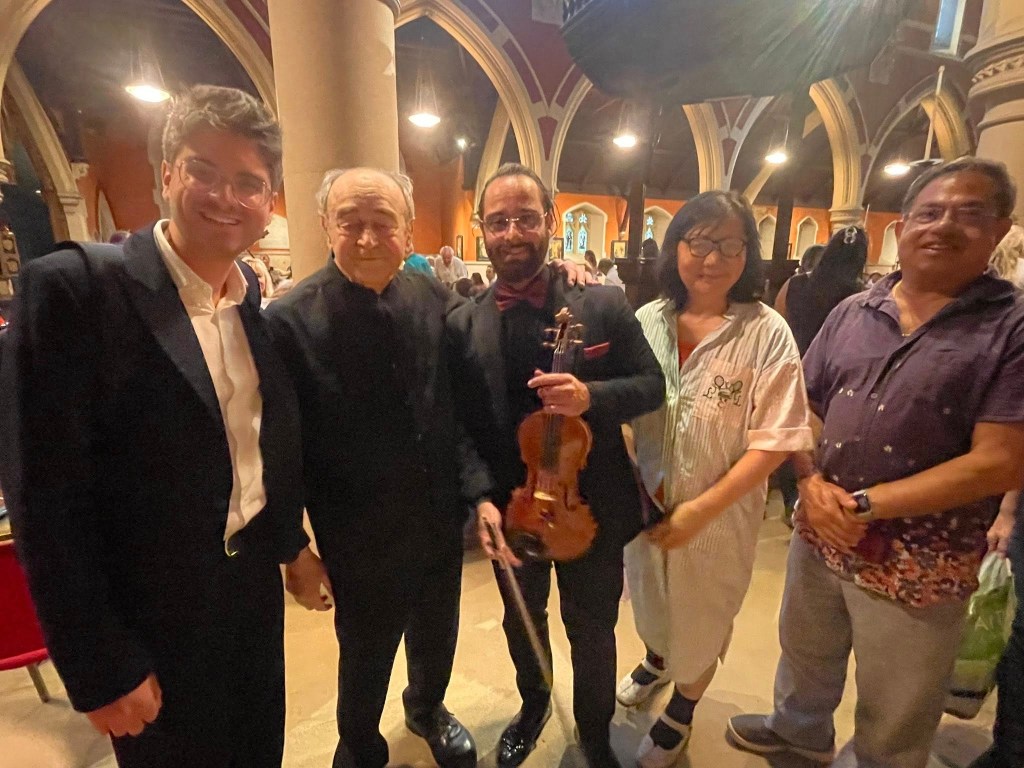
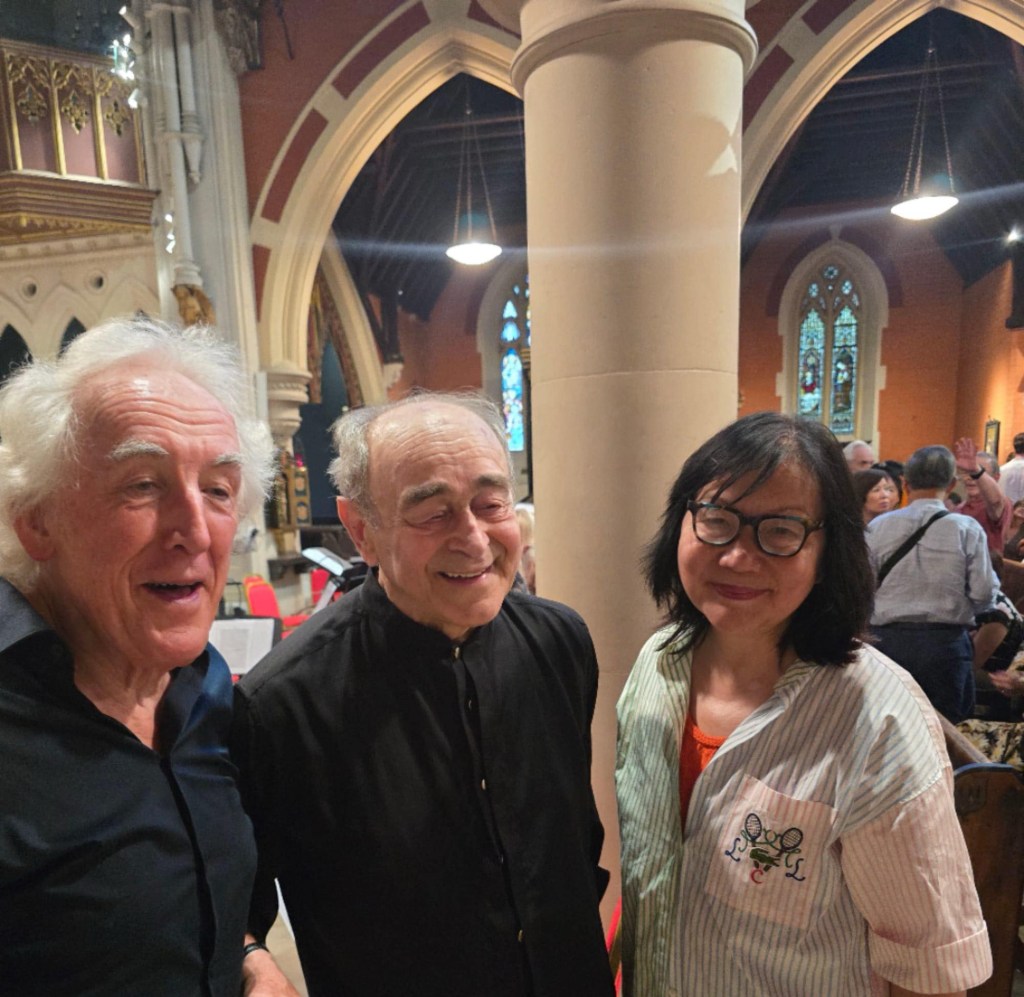
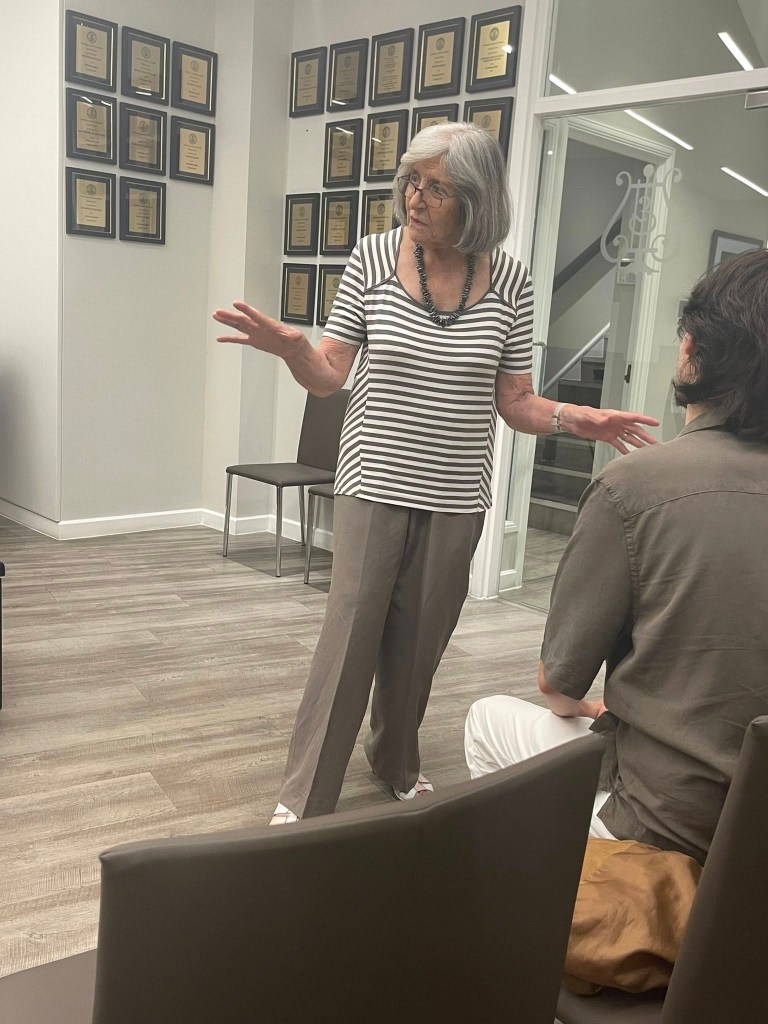
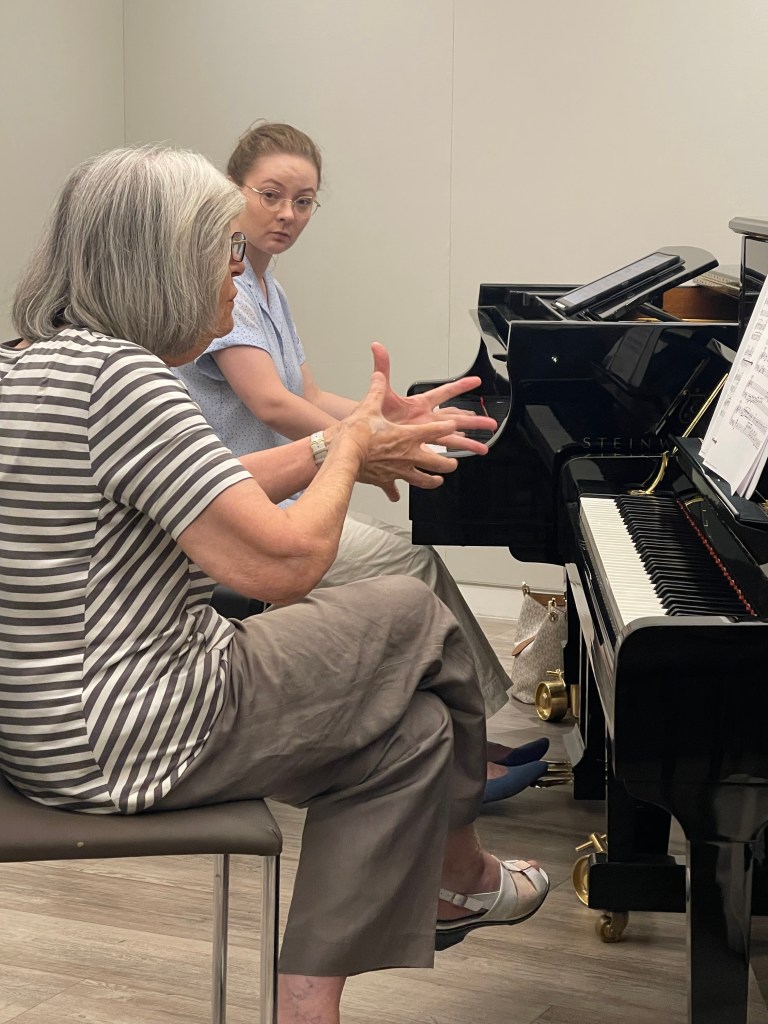
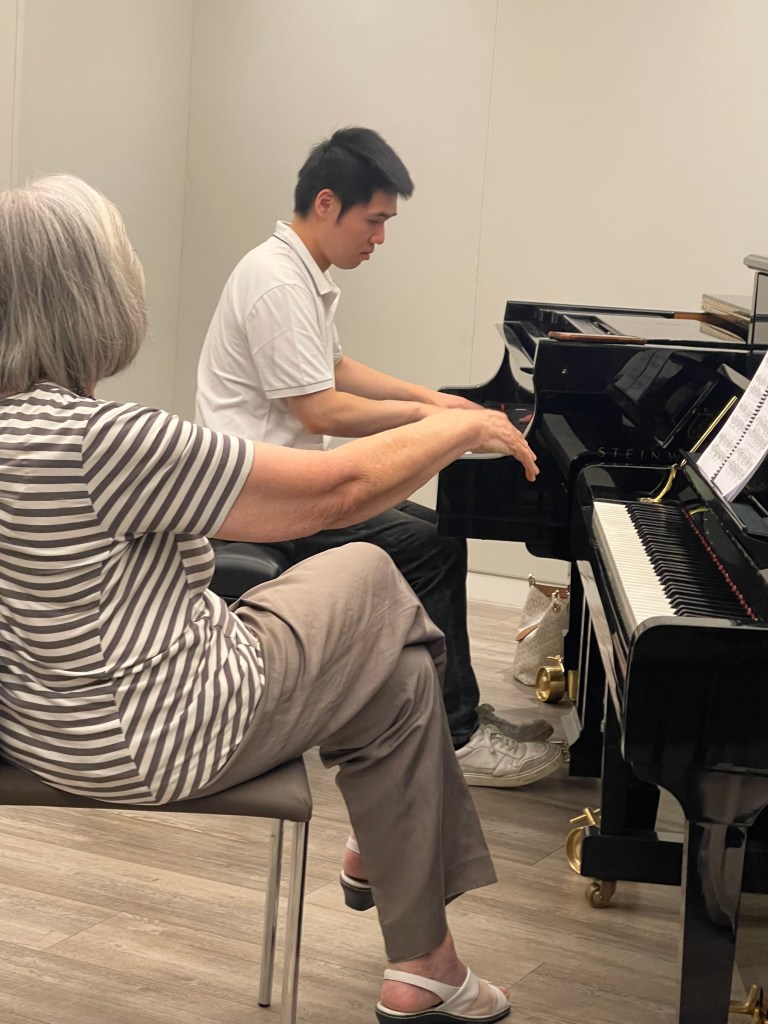
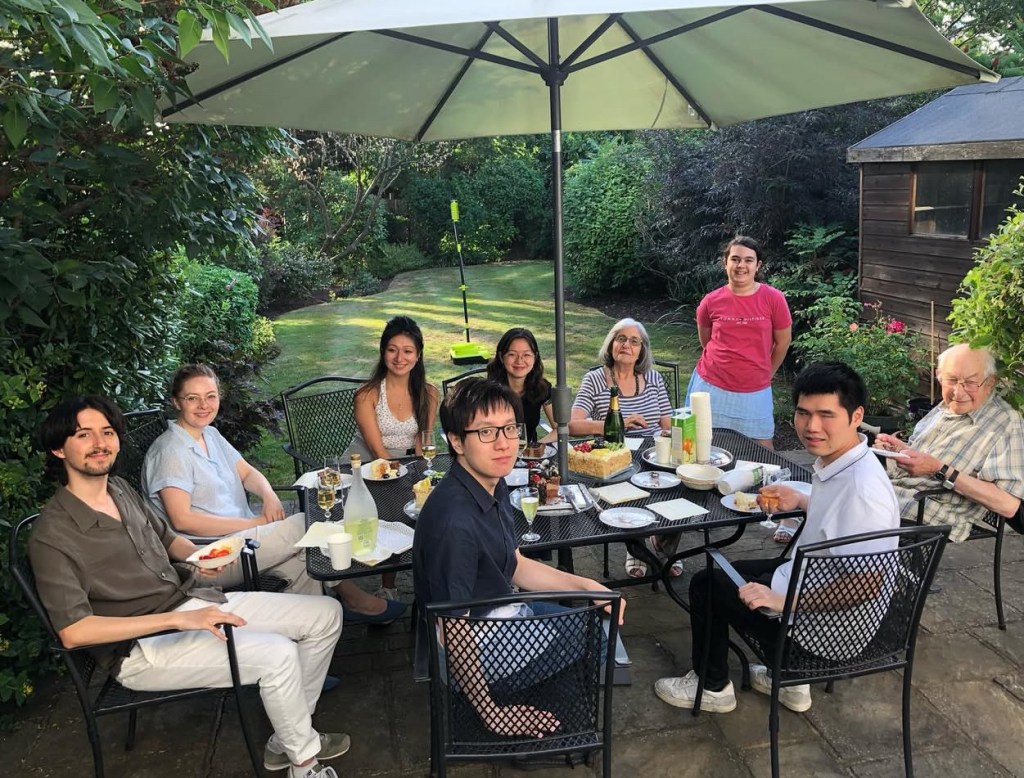
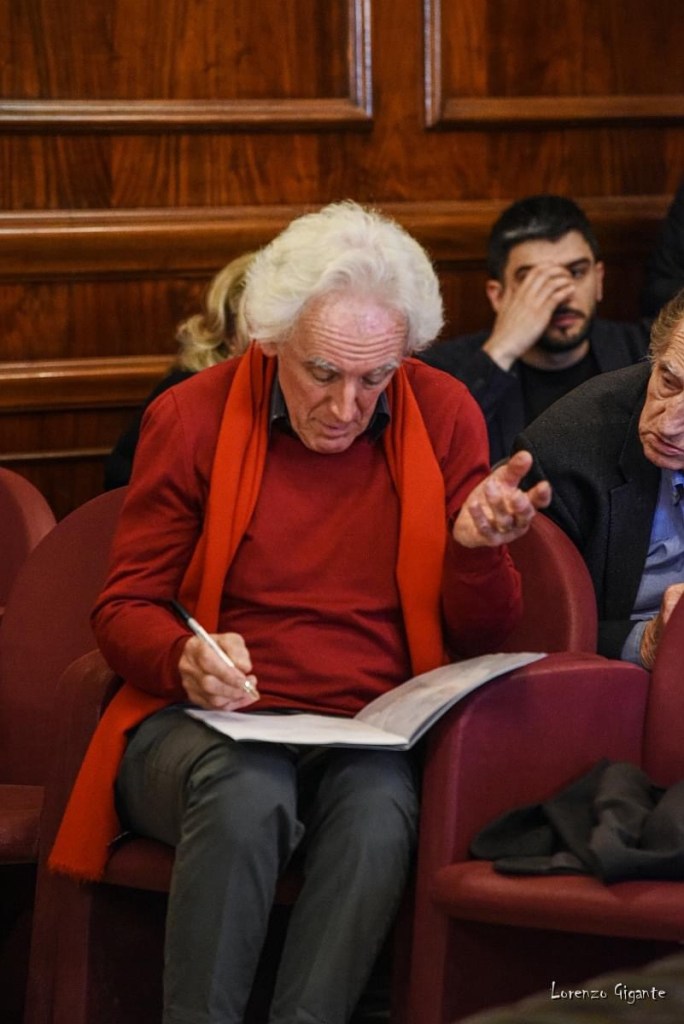
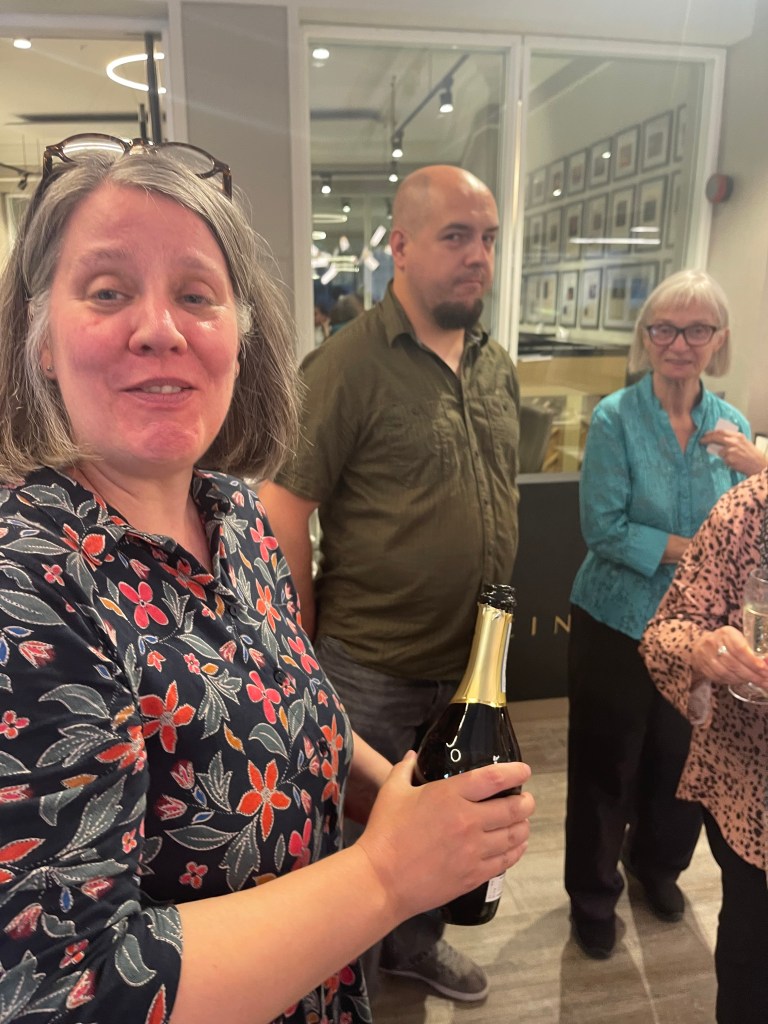
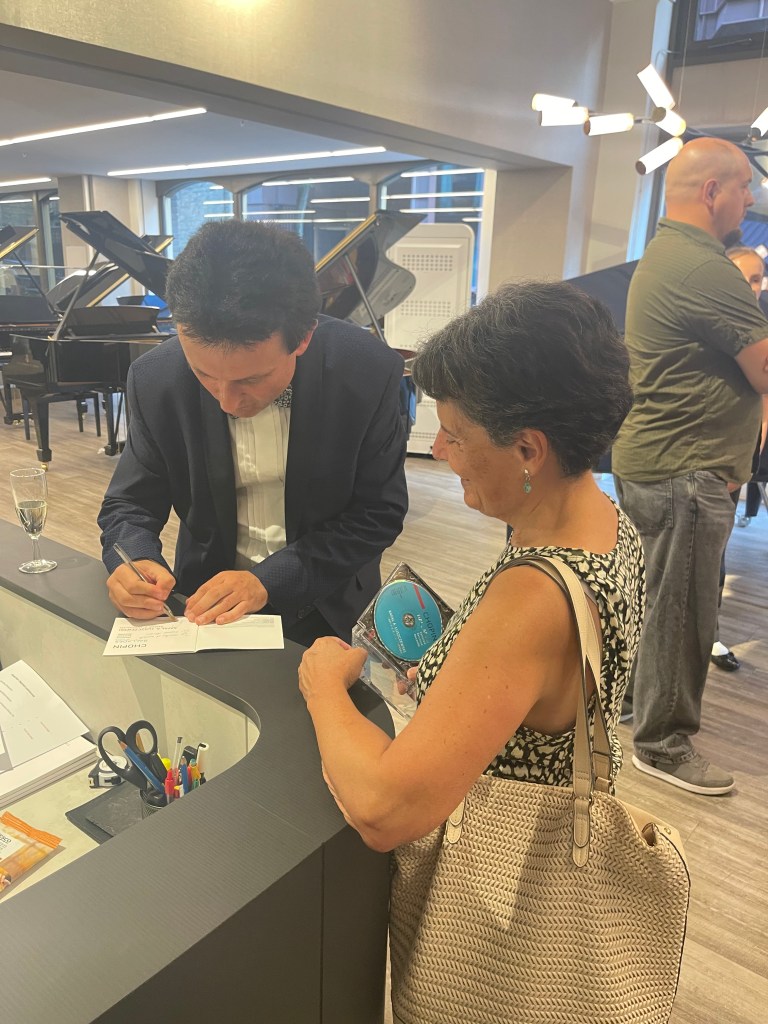
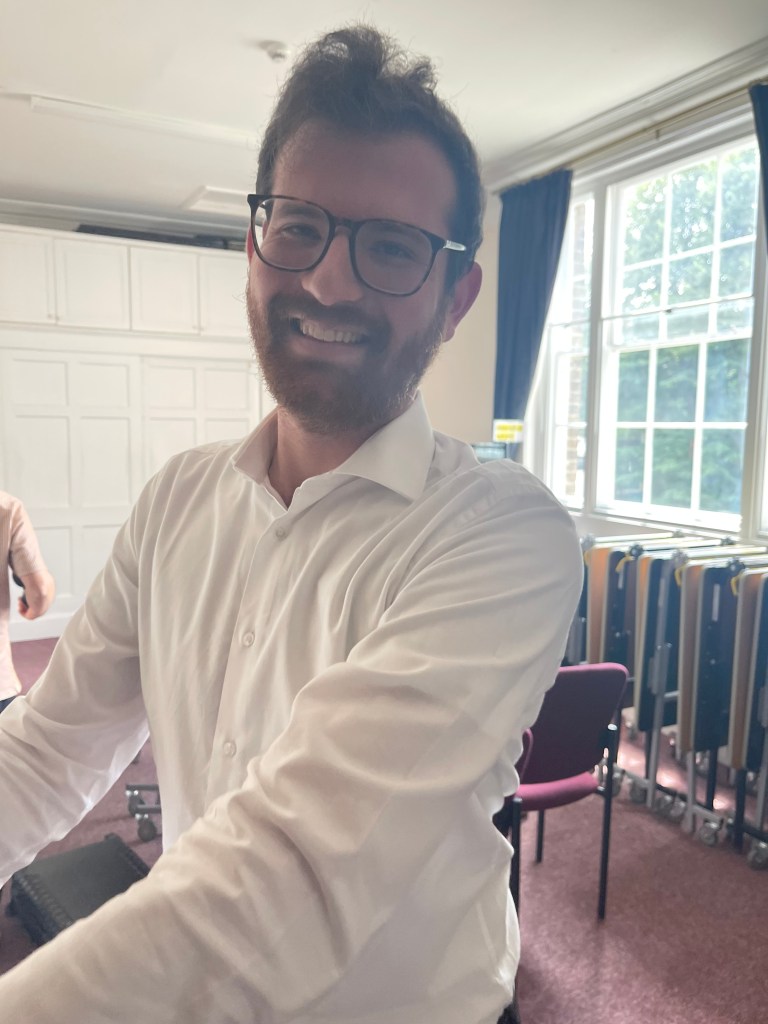
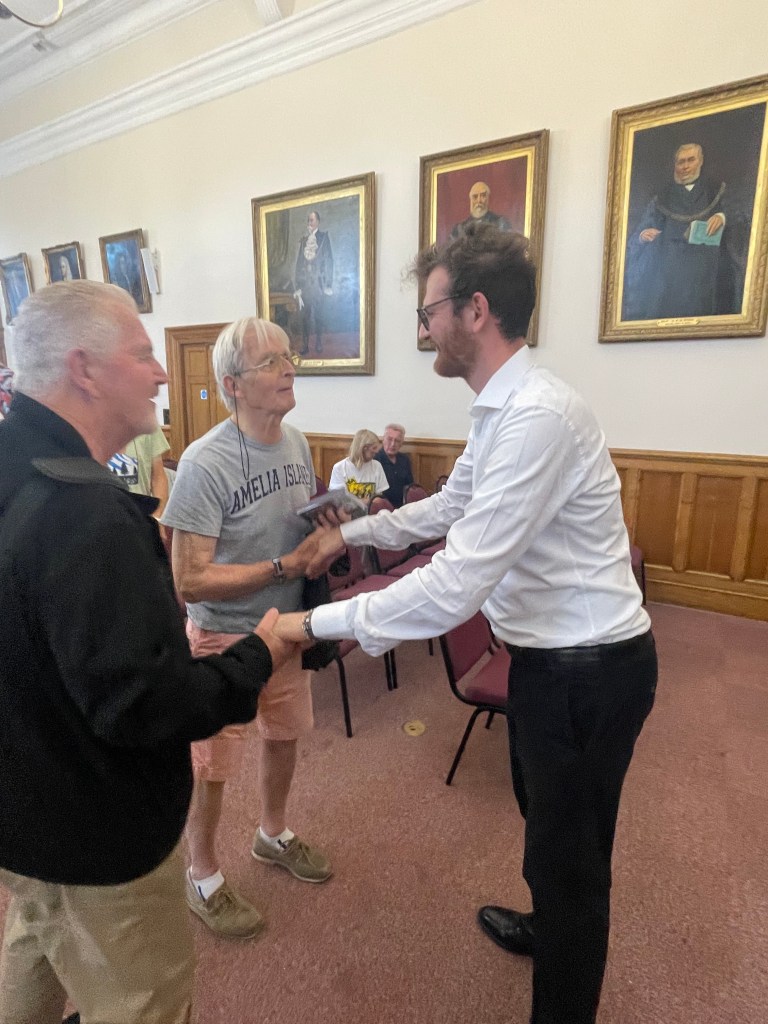
Prof Valeriano Bottini and his trusted piano technician with Adriano Murgia ( far left)

Just a month ago I had discovered the very talented Alessio Masi from Sicily with hands submerged in the music of Nino Rota ,Eliodoro Sollima , Ludovico Giustini and his own compositions .https://christopheraxworthymusiccommentary.com/2025/06/22/alessio-masi-at-palazzo-caetani-cisterna-di-latina-latin-blood-ignites-and-illuminates-his-musical-heritage/

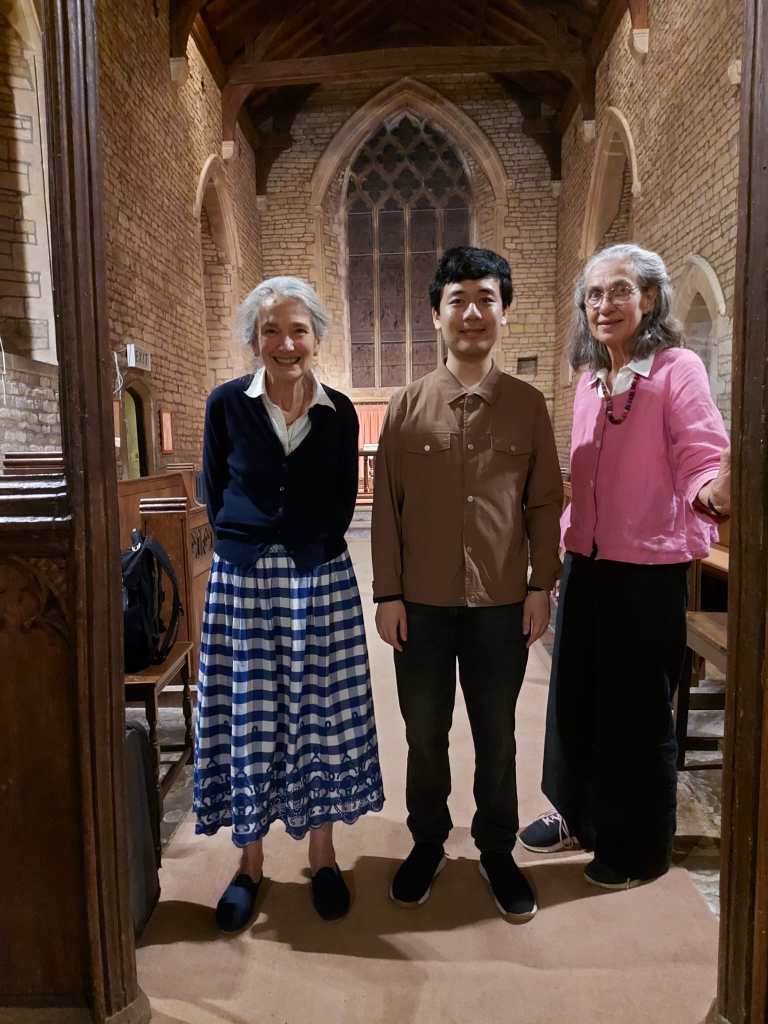
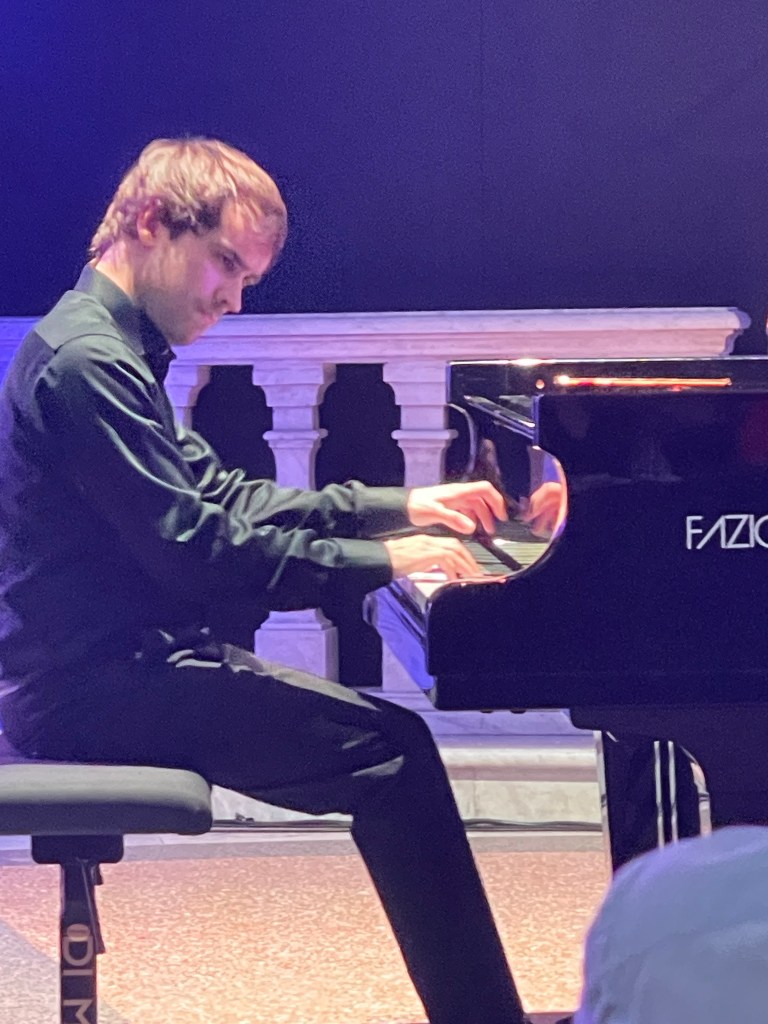
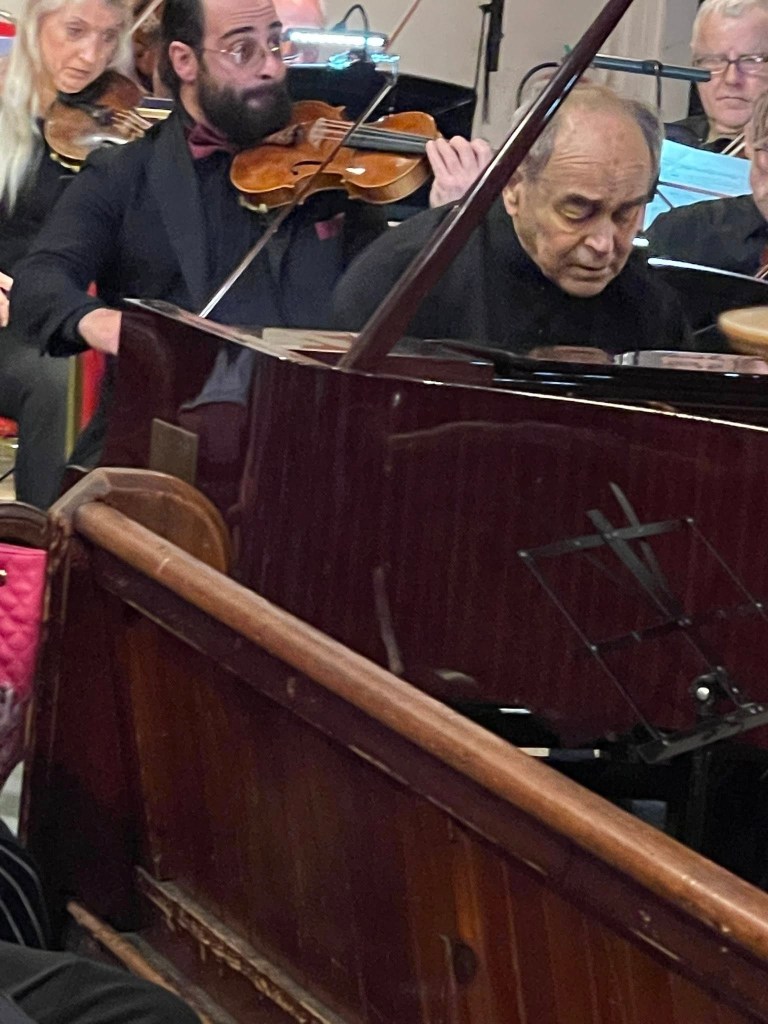
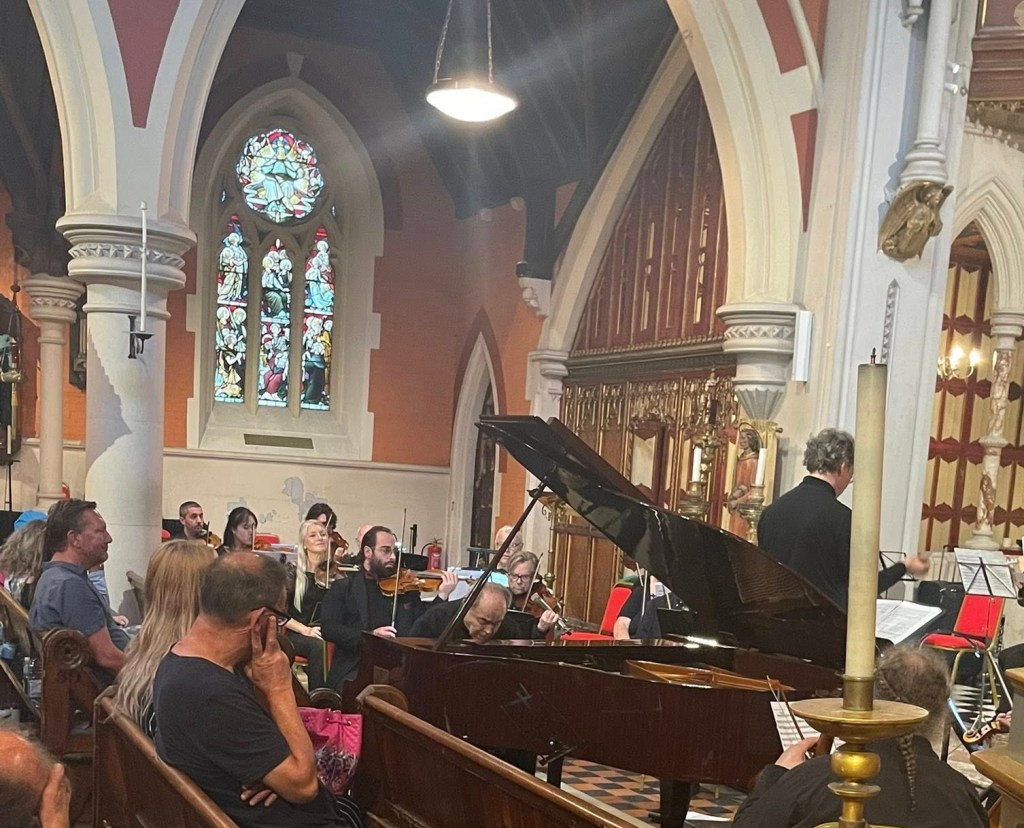
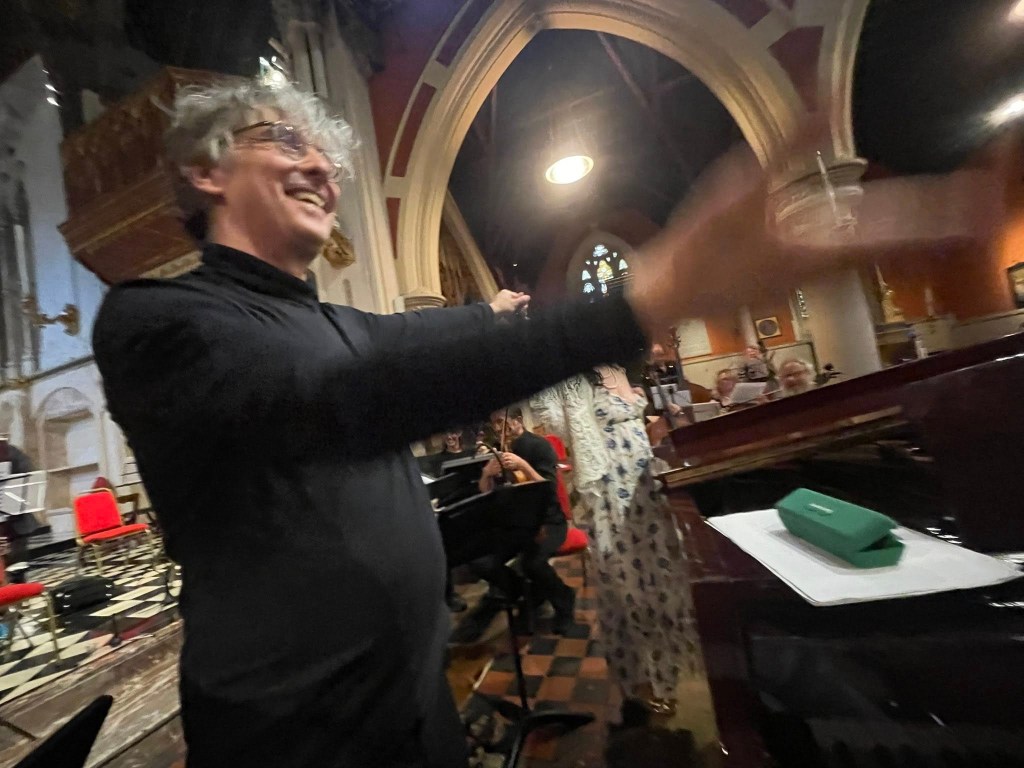
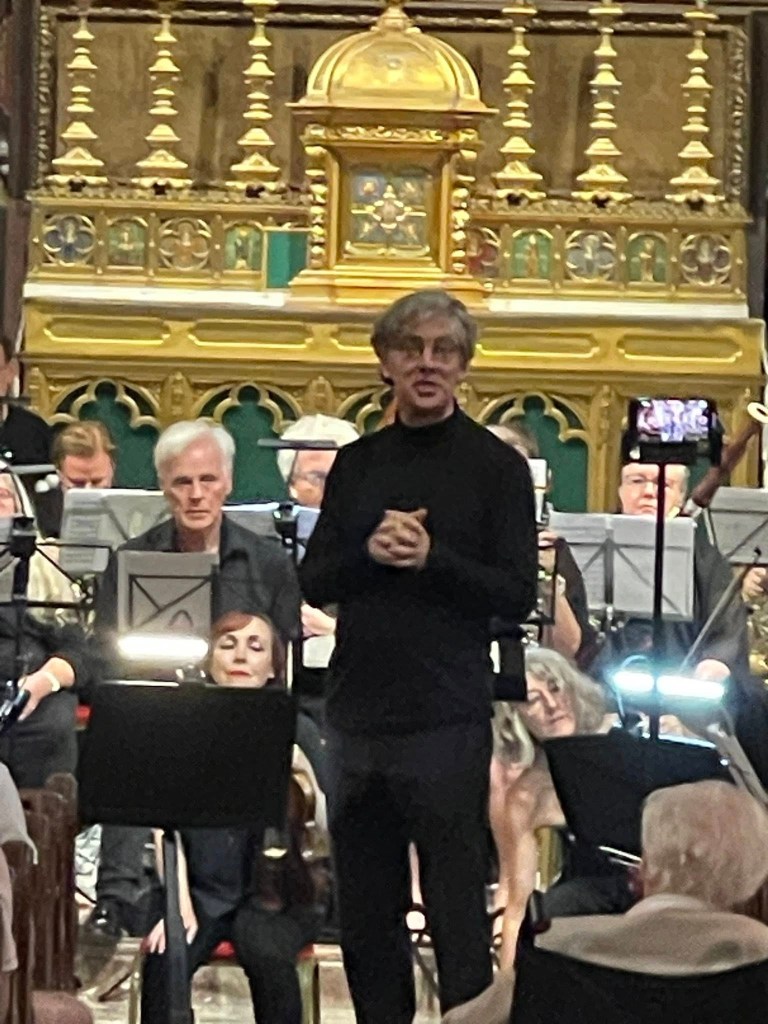
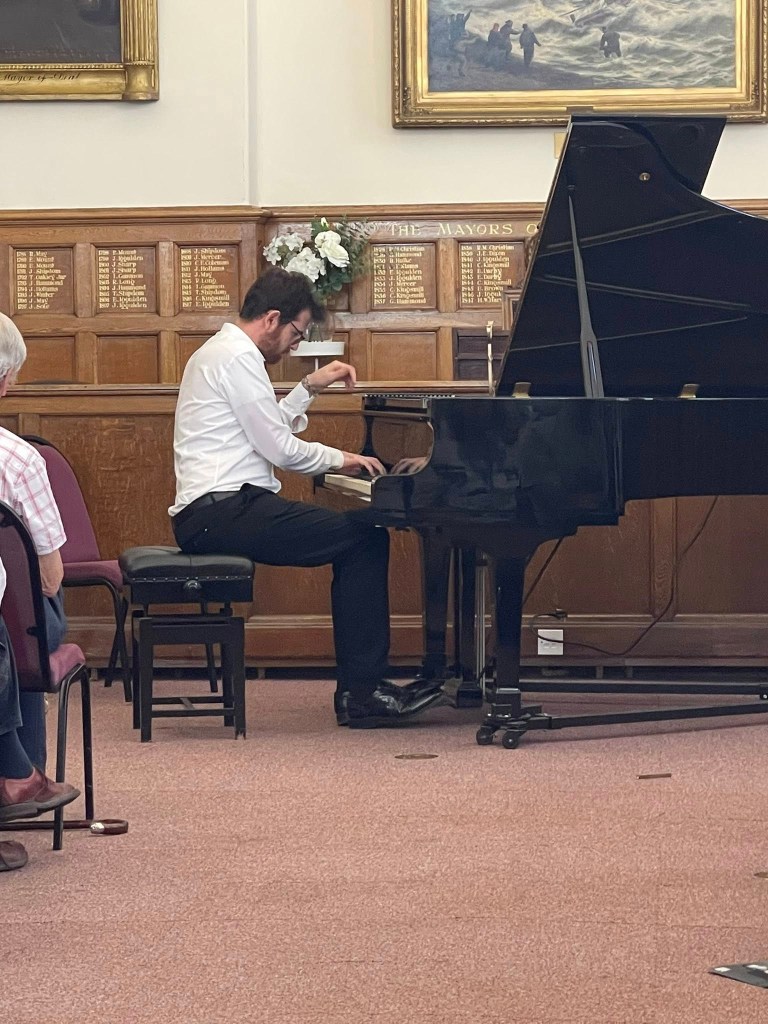
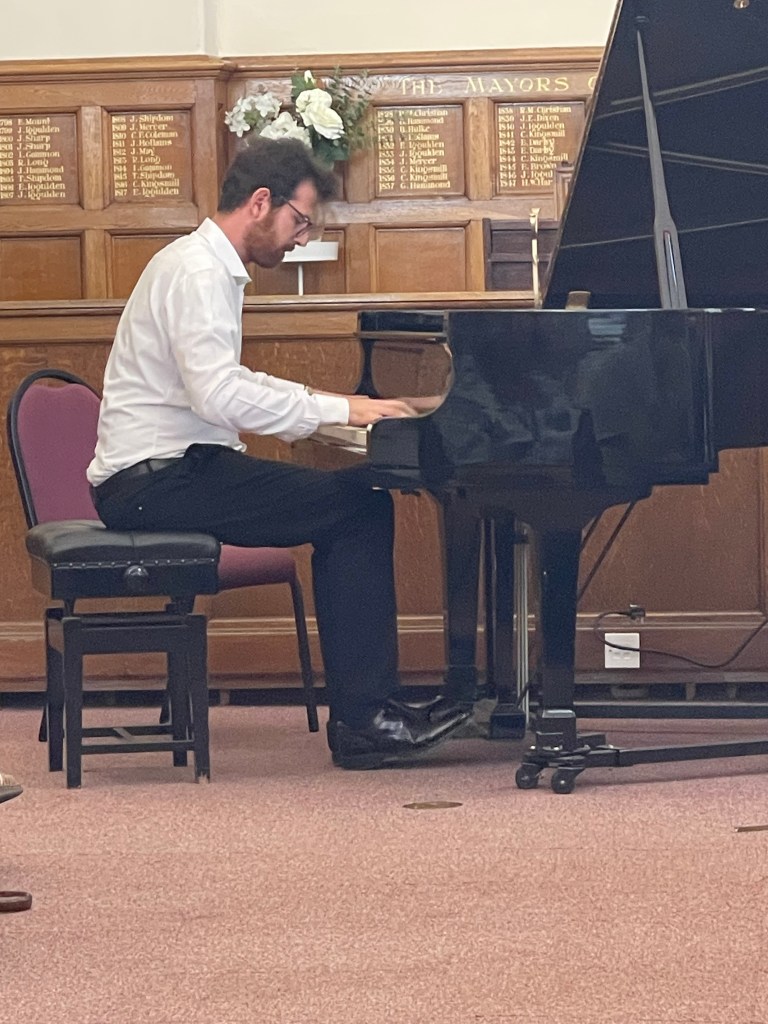
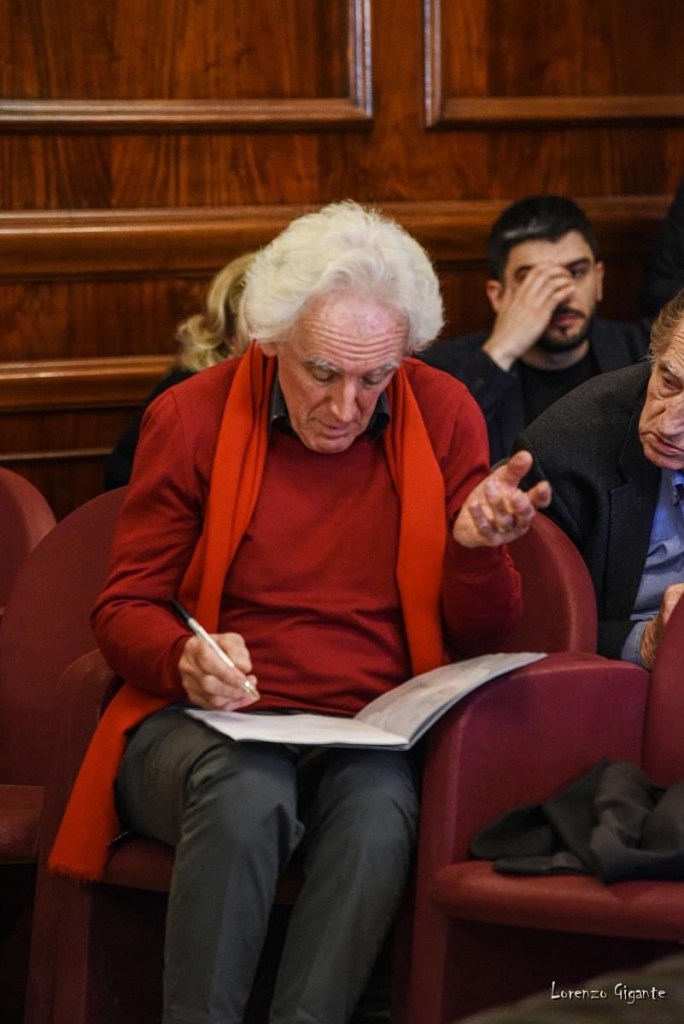
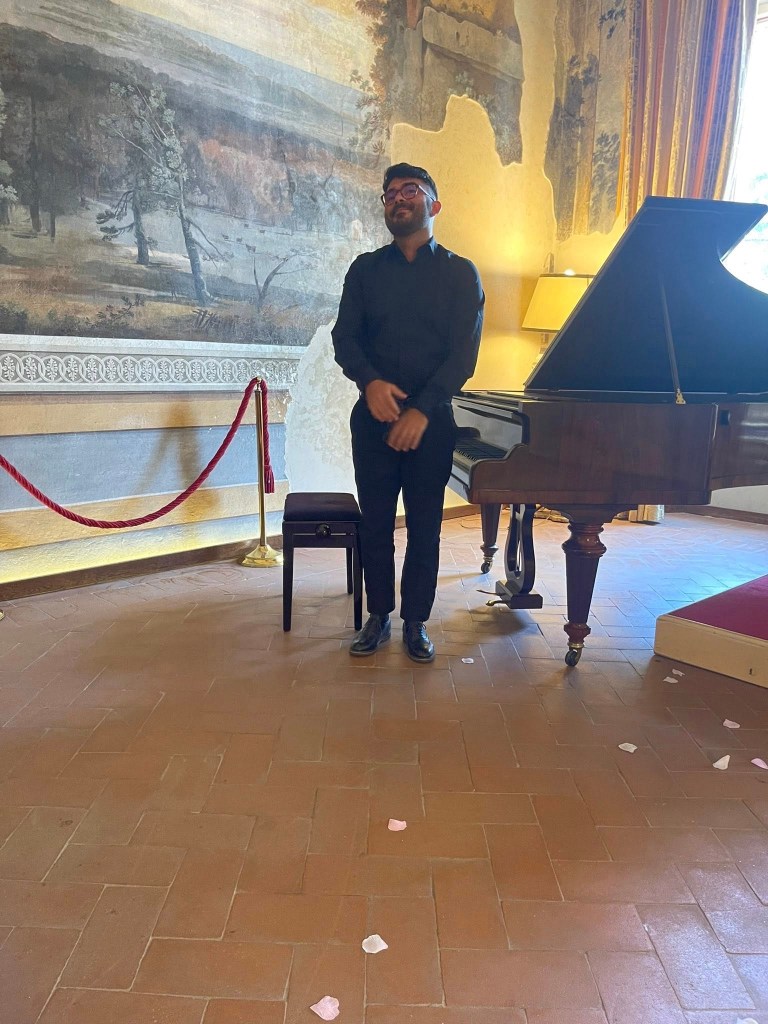
Today was the turn of the Sardinian pianist Adriano Murgia who dedicated an unexpected Sunday morning concert to Castelnuovo -Tedesco. By a cruel turn of fate Castelnuovo -Tedesco had fled Italy with the beginning of Fascism and was helped by Toscanini and Heifetz to flee persecution. He was invited like so many refugee musicians to Hollywood where his scores like those of Rota and others became an integral part of the glory that was Hollywood.
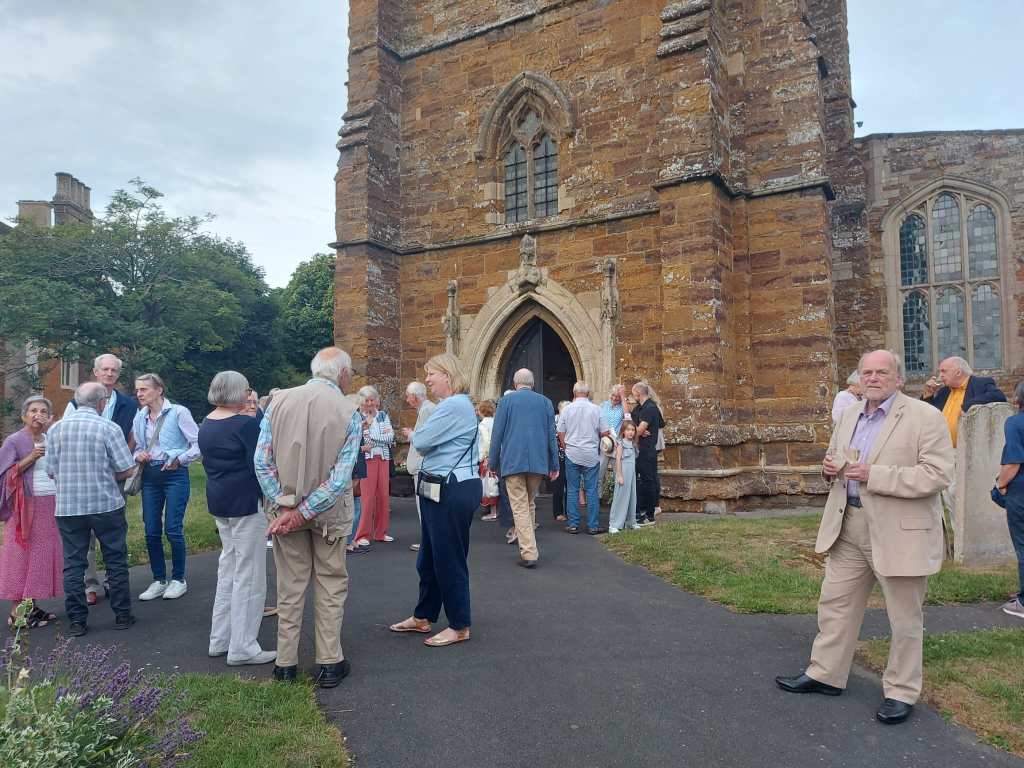
The concert was supposed to be Saturday evening but the town hall had give two permits for public performances on the same day. One in the antique Palace on a period instrument and the other in the square under the window of the concert hall. A celebration of Cinema amplified as only the locals know how to ruin the atmosphere of their historic heritage and the eardrums of their inhabitants.
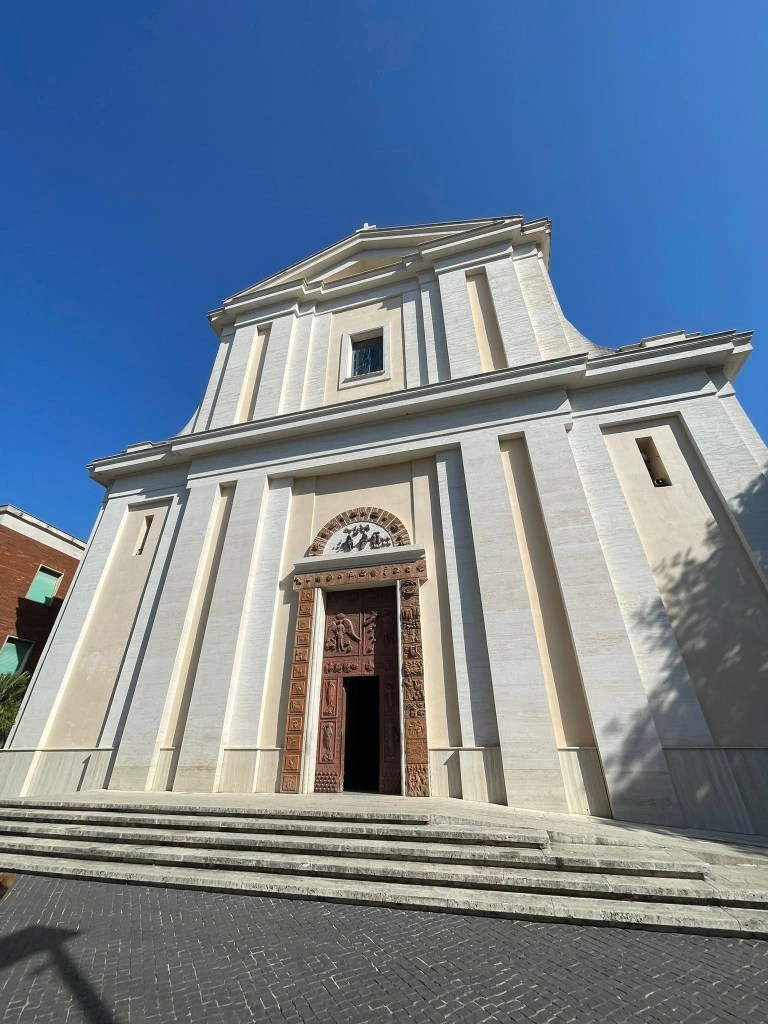
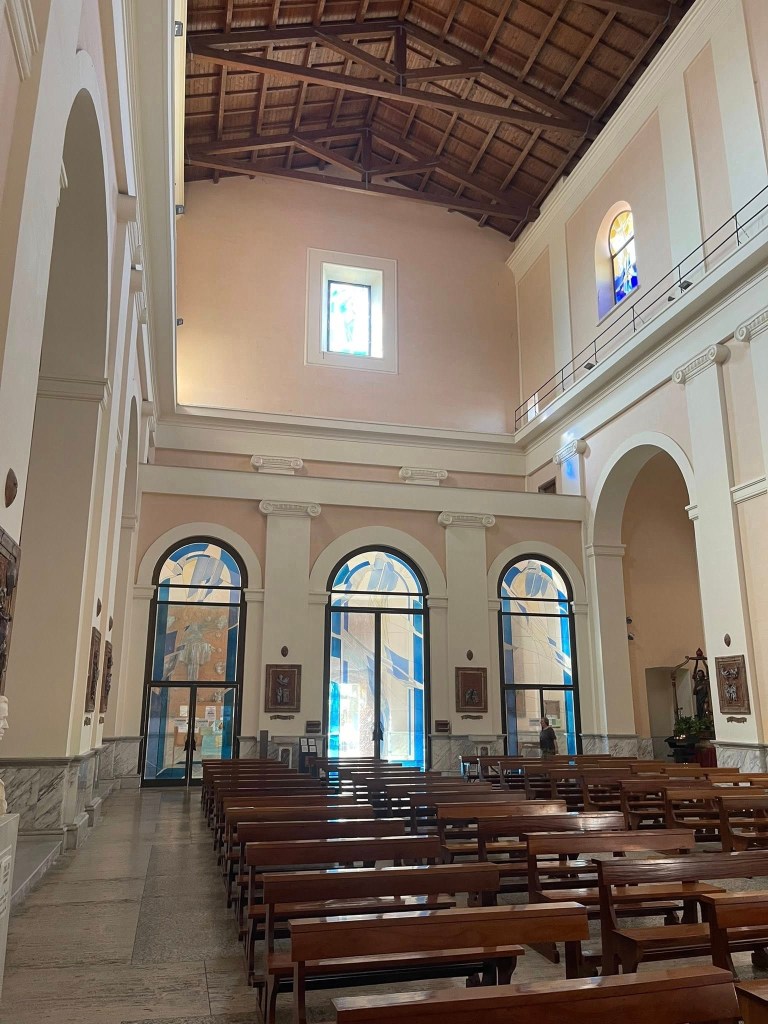
A blissfully peaceful Sunday morning with cars jammed bumper to bumper on the roads nearby that lead to the wonderful beaches, but the road to cultural enlightenment was completely empty !

A programme of original piano music by Castelnuovo – Tedesco from his early period spanning from 1919 to 1925.
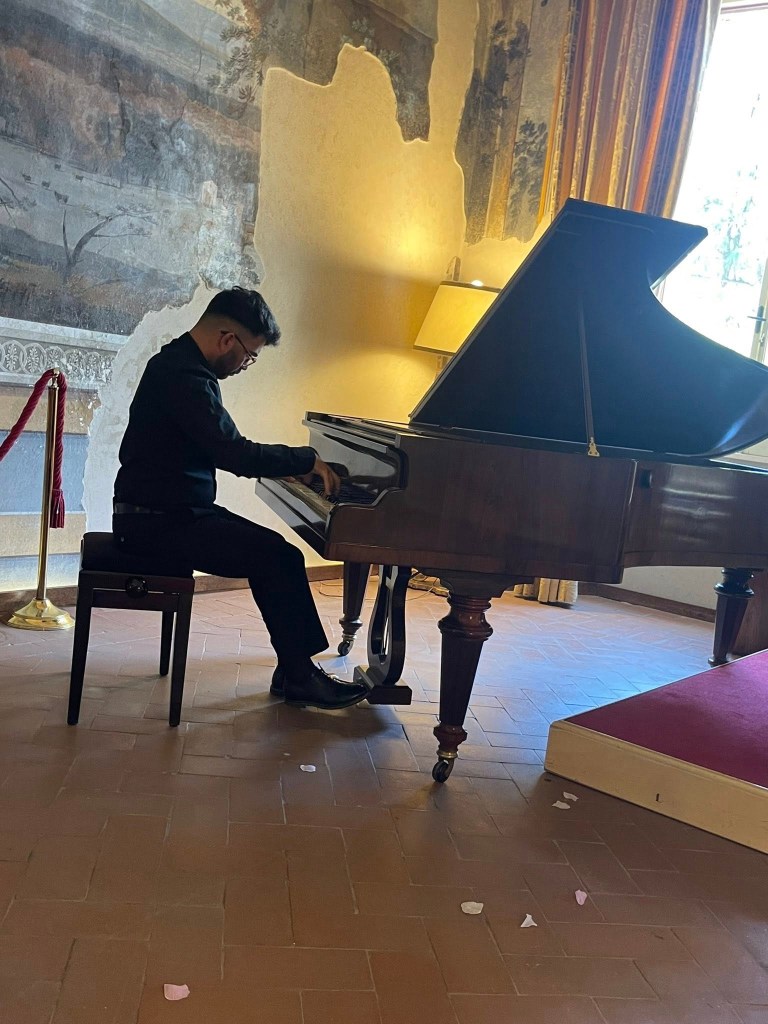
Played with remarkable authority but also a musicianship that could give an architectural shape and sense of line to all he played. The 7 pieces that make up ‘Le Danze del Re David’ were given a vivid characterisation from the opening dynamic drive and declamation, dissolving to a bass melody with gently accompanying arabesques stretched over the upper part of the keyboard. Very expressive with the voice of a complete believer coming through with a poignant clarity. There was a luminosity and resonance on this very subdued Collard and Collard, with a very particular voice, almost like looking at a faded postcard. A melodic line doubled at the octave with poignant innocence was very moving. Soon awoken with a rhythmic dance of violent interruptions, played with commanding authority almost Bartókian in its vehemence, dissolving into a whispered deeply felt mellifluous outpouring. There followed a march of sublime indifference, where Prokofiev springs to mind, before the bold chordal ending played with commanding energy and drive.
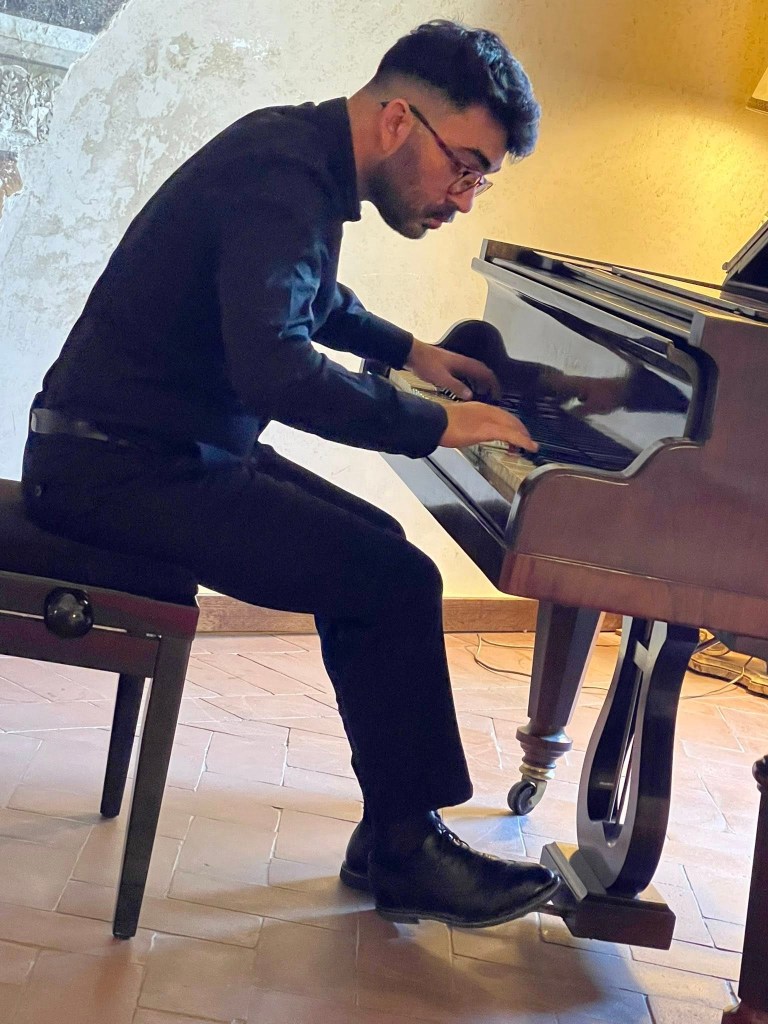
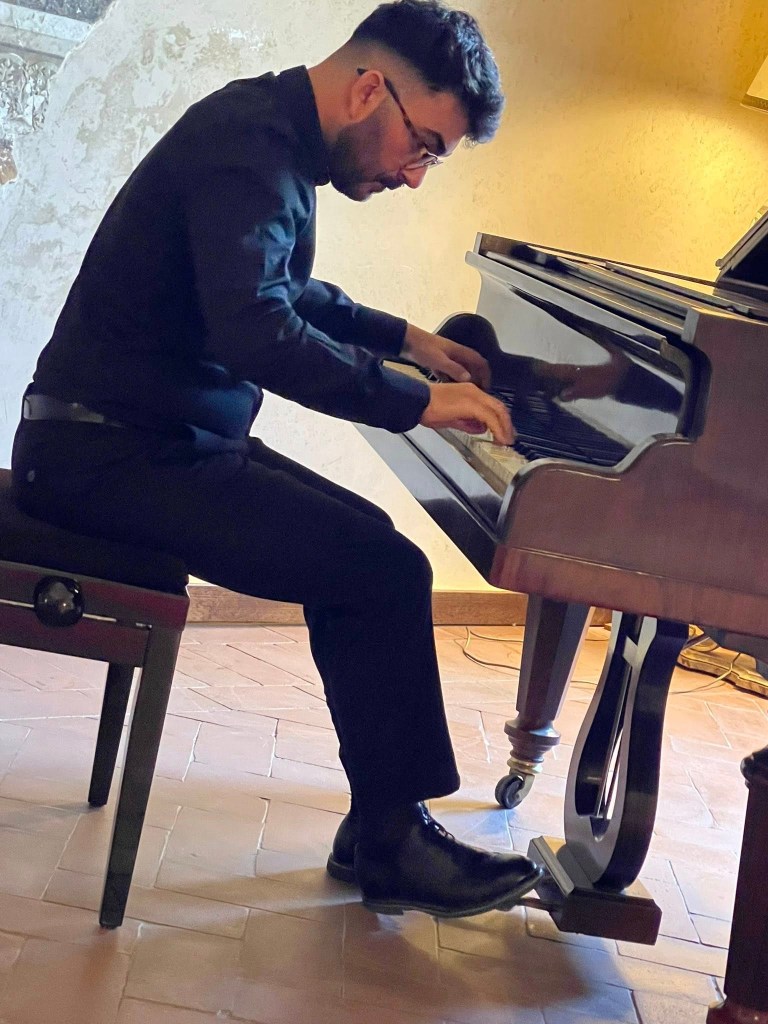
‘Alghe’ and ‘Naviganti’ were two short works of a mellifluous outpouring of luminosity and were simple fantasy pieces of a somewhat difficult musical personality which on first hearing can seem more intellectual than instantly communicative.
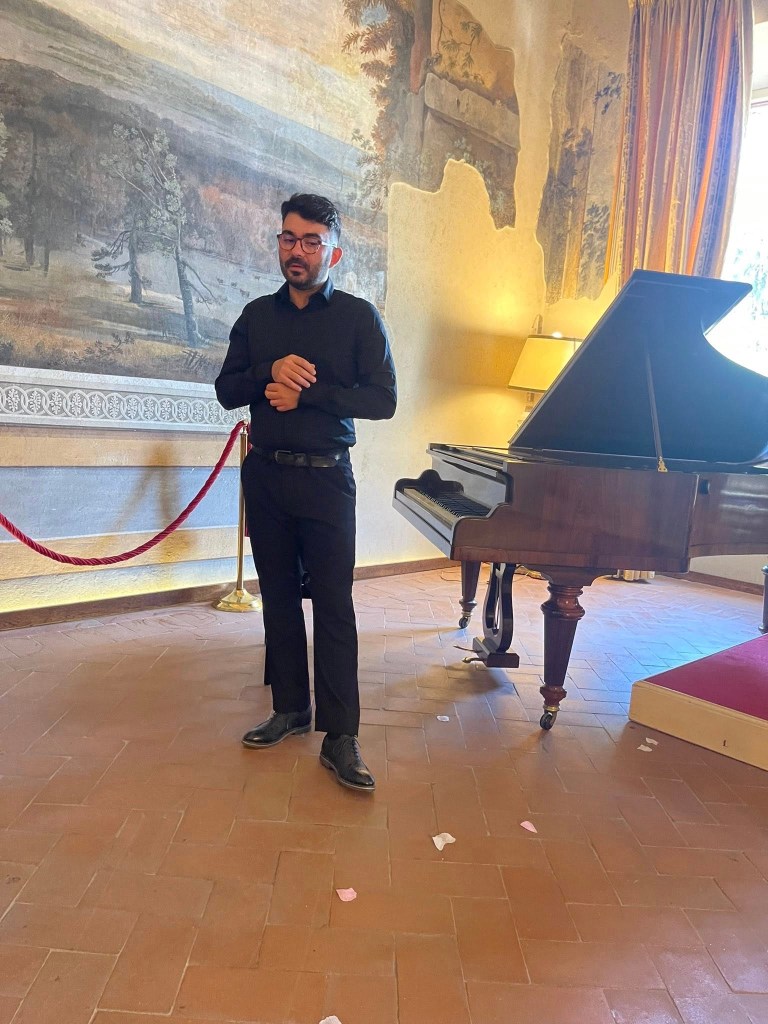
The Seasons too with its open intervals was interrupted by an enticing perpetuum mobile and bells tolling, with a gentle duet between tenor and soprano voices that Adriano played with bold sentiment and searing intensity.
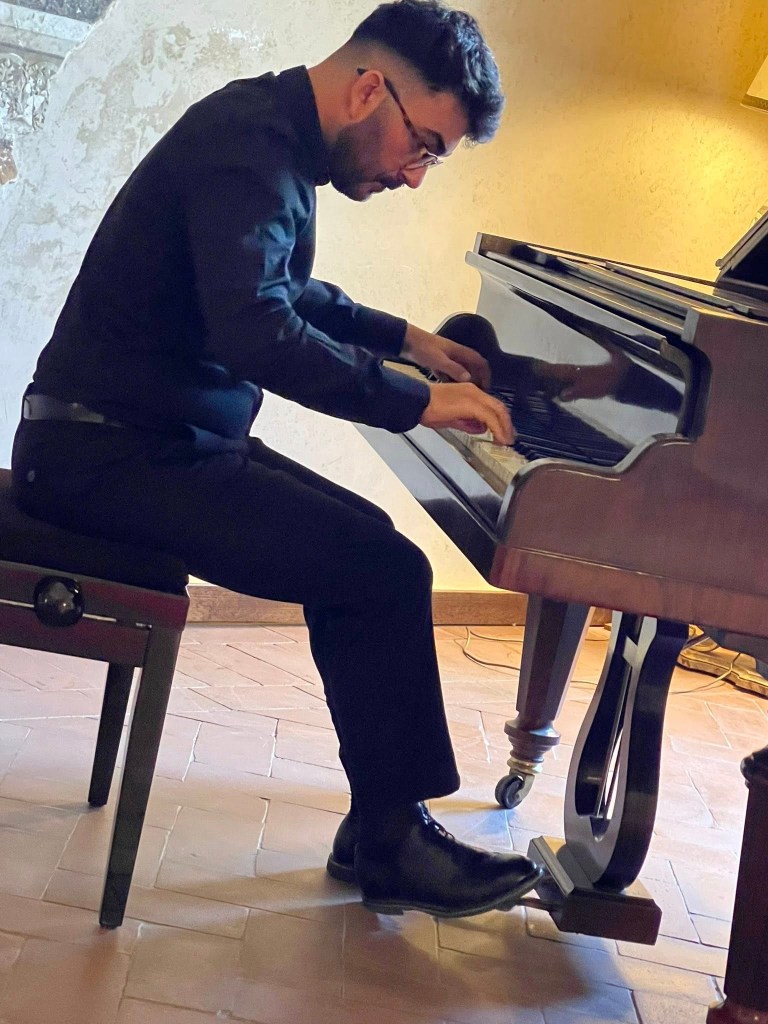
Of course the ‘Piedigrotta Rhapsody’ burst onto the scene with all the exhilaration and excitement of Naples. A chiselled melodic line floated above a gently flowing accompaniment . Enticing gaiety to a ‘Dolls dance’ of great character and with the bells tolling outside at midday adding to the Neapolitan folk flavour that Adriano was describing so well.
A Chopin Mazurka just highlighted Castelnuovo-Tedesco’s refusal in this period to adhere to Bel Canto, preferring to search for his own musical language as many in that period were struggling to do. Of course the commissions from Heifetz, Piatigorsky and Segovia in a later period were to crown Castelnuovo -Tedesco as one of the finest composers of his day.

After his move to the USA he became known as the ‘Maestro dei Maestri’ , such was the success of his students who included : Henry Mancini, André Previn, Nelson Riddle, John Williams etc etc.
Adriano Murgia was born in Alghero in 1996. He began his piano studies under the guidance of Maria Giovanna Piras, and then continued his training with Genny Basso, assistant to Aldo Ciccolini. In 2022 he graduated with highest honors and honorable mention in piano at the “L. Canepa” Conservatory of Music in Sassari, studying with Maestro Andrea Ivaldi. Today he attends the “Academia Internacional de Musica Aquiles Delle Vigne” in Coimbra, Portugal.In 2023 he completed a second level master’s degree at Rovigo Conservatory, under the guidance of Maestro Roberto Prosseda.He has participated in piano masterclasses with internationally renowned artists such as G. Basso, A. Ciccolini, M. Baglini, E. Stellini, A. Ivaldi, M. Baek, M. Araujo, R. Andres S. Coombs, P. Iannone, A. Pizarro, B. Petrushansky, J. Rink, W.G Naboré, B. Berman and R. Prosseda.In the 2020/2021 academic year he was accepted into the Hochschule fur Musik “Carl Maria von Weber” in Dresden, Germany. He has performed concerts both as a soloist and with chamber ensembles in various Italian and European cities, including Alghero, Sassari, Cagliari, Chianciano, Funchal (PT), Nuoro, Dresden (DE), Rovigo, Asolo, Sardoal (PT), Coimbra (PT), Dulken (DE), Madrid (ES), Vienna (AT), New York (USA), Castanheira de Pêra (PT), Vila Nova de Gaia (PT) and Lisbon (PT). In 2019 he performed Franz Liszt’s Totentanz as a soloist with the symphony orchestra of the Sassari Conservatory, first at the Teatro Comunale in Sassari and then at the Teatro Eliseo in Nuoro. In 2024 he opened the concert season of the Sardoal International Piano Meeting in Portugal, performing J.S. Bach’s BWV 1060 with the professional orchestra Filarmonica das Beiras. In 2025 he performed the Concerto for Piano and Orchestra by A. Salieri with the Filarmonica das Beiras Orchestra in Coimbra in the Sala S. Tomás. He has distinguished himself in various national and international competitions, obtaining a second prize in the “Monte Acuto” regional competition, the third prize in the “Prime note” competition, the third prize in the Vittorio Nannarelli international competition and the first prize in the 10th edition of the Villa Las Tronas competition. In 2024 he won the award as Best Resident Artist and third Absolute Prize at the “Sardoal International Piano Competition”, the third prize at the “Coimbra World Piano Competition” and the first Prize in the “Prof. Dichler” competition at the Wiener Musikseminar of the University of Vienna. Between 2022 and 2025, he held the position of head of the piano department at the “Imbas International School of Music & Arts” in Cascais, Portugal. He recorded an episode about Italian piano music for “Dentro le note,” a series by Roberto Prosseda on the Italian national television channel Rai 5. He is involved in the Lux Fidelis project, which promotes Portuguese music worldwide. After completing his Master’s in Piano Performance at the Venezze Conservatory of Rovigo with Roberto Prosseda, Adriano is currently beginning his PhD program at the Venezze Conservatory, focusing on the piano music of Mario Castelnuovo-Tedesco. His first CD, dedicated to Castelnuovo-Tedesco, will be released by Piano-Classics in 2025 and has already been presented in New York at Barge Music on November 3, 2024.
Mario Castelnuovo-Tedesco (3 April 1895 – 16 March 1968)

Born in Florence , he was descended from a prominent banking family that had lived in Tuscany, specifically in Siena, until the latter half of the 19th century. His father was Amedeo and his elder brothers Ugo (born in 1890, lawyer) and Guido (born in 1891, engineer). Castelnuovo-Tedesco was first introduced to the piano by his mother, Noemi Senigaglia, and he composed his first pieces when he was just nine years old. After completing a degree in piano in 1914 under Edgardo Del Valle de Paz (1861-1820), well-known composer and pianist pupil of Beniamino Cesi, he began studying composition under renowned Italian composer Ildebrando Pizzetti , and received a diploma in composition in 1918. He soon came to the attention of composer and pianist Alfredo Casella , who included the young Castelnuovo-Tedesco’s work in his repertoire. Casella also ensured that Castelnuovo’s works would be included in the repertoires of the Società Italiana di Musica Modern  (later the Corporazione delle Nuove Musiche ), granting him exposure throughout Europe as one of Italy’s up-and-coming young composers. Works by him were included in the first festival of the International Society of Contemporary Music , held in Salzburg,Austria , in 1922. In 1926, Castelnuovo-Tedesco premiered his first opera La Mandragola, based on a play by Niccolò Machiavelli . It was the first of his many works inspired by great literature. Another major source of inspiration for him was his Jewish heritage, most notably the Bible and Jewish liturgy. His Violin Concerto No. 2 (1931), written at the request of Jascha Heifetz, was also an expression of his pride in his Jewish origins, or as he described it, the “splendor of past days”, in the face of rising anti-Semitism  that was sweeping across much of Europe. At the 1932 festival of the International Society of Contemporary Music, held in Venice, Castelnuovo-Tedesco first met the Spanish guitarist Andrés Segovia. The meeting inspired Castelnuovo-Tedesco to write for the guitar, beginning with his Variazioni attraverso i secoli (Variations à travers les siècles)(Variations through the ages), Op. 71 (1932), and later his Guitar Concerto No. 1 (1939). All in all, he wrote almost one hundred compositions for this instrument, which earned him a reputation as one of the foremost composers for the guitar in the twentieth century. Some of them were written and dedicated to Segovia, who was an enthusiast of his style (Segovia called him an “incorruptible servant of artistic truth”). Even before the Italian government promulgated the Italian racial laws in late 1938, Castelnuovo-Tedesco was banned from the radio  and performances of his work were cancelled. The new racial laws, however, convinced him that he should leave Italy. He wrote to Arturo Toscanini , the former musical director of La Scala , and violinist Jascha Heifetz, explaining his plight, and both responded with support. As an American citizen, Heifetz began paperwork to sponsor Castelnuovo-Tedesco as an immigrant in the United States . Castelnuovo-Tedesco left Italy in 1939, shortly before the outbreak of World War II, and settled in Larchmont ,Westchester County,New York (state). He wrote his Cello Concerto in G minor, Op. 72, for Gregor Piatigorsky . It was premiered with the dedicatee under Arturo Toscanini  in New York in 1935. For Piatigorsky he also wrote a Toccata (1935), and a piece called Greeting Card, Op. 170/3, based on the spelling of Piatigorsky’s name. Like many artists who fled fascism, Castelnuovo-Tedesco ended up in Hollywood , where, with the help of Jascha Heifetz, he landed a contract with Metro- Goldwyn- Meyer as a film composer. Over the next fifteen years, he worked on scores for some 200 films there and at the other major film studios. Rita Hayworth hired him to write the music for The Loves of Carmen (1948), produced by Hayworth for her Beckworth Productions and released by Columbia Pictures . As a teacher, Castelnuovo-Tedesco had a significant influence on other major film composers, including Henry Mancini ,Nelson Riddle,Herman Stein and André Previn. Jerry Goldsmith,Marty Paich, and John Williams  were all his pupils, as was Scott Bradley, who studied privately with him while both were on staff at MGM. He also maintained close contact with composer Robert Strassburg. His relationship to Hollywood was ambiguous: later in life he downplayed the influence that it had on his own work, but he also believed that it was an essentially American artform, much as opera was European. In 1946 he became a U.S. citizen, but he remained very close to Italy, which he frequently visited. In 1958 he won the Concorso Campari with the opera The Merchant of Venice, which was first performed in 1961 at the Maggio Musicale Fiorentino under the baton of Gianandrea Gavazzeni. In 1962 he wrote Les Guitares bien tempérées (“The Well-Tempered Guitars”) for two guitars, a set of 24 preludes and fugues in all 24 major and minor keys, for the duo-guitarists Alexandre Lagoya and Ida Presti . This was inspired by The Well – Tempered Clavier by Johann Sebastian Bach  , a composer Castelnuovo-Tedesco revered. In the United States, Castelnuovo-Tedesco also composed new operas and works based on American poetry, Jewish liturgy, and the Bible. He died in Beverley Hills,California , in 1968 at the age of 72. He is buried at Westwood Village Memorial Park Cemetery. The Library of Congress in Washington, DC, hosts the Mario Castelnuovo-Tedesco Collection, a collection of the composer’s manuscripts donated by his family in 2000. The catalogue is accessible online. His oldest son was the psychiatrist Pietro Castelnuovo-m Tedesco. His younger son was the architect Lorenzo Castelnuovo-Tedesco of Los Angeles.

Works for Piano

  • Cielo di Settembre, Op. 1 (1910)
  • Questo fu il carro della morte, Op. 2 (1913)
  • Il raggio verde, Op. 9 (1916)
  • Alghe, Op. 12 (1919)
  • I Naviganti, Op. 13 (1919)
  • Cipressi, Op. 17 (1920)
  • La sirenetta e il pesce turchino. Fiaba marina, Op. 18 (1920), also for two pianos (1935)
  • Cantico (per una statuetta di San Bernardino di Niccolò dell’Arca), Op. 19 (1920)
  • Vitalba e Biancospino, Fiaba Silvana, Op. 21 (1921)
  • Epigrafe (per la tomba di Madonna Ilaria del Carretto, scolpita da Jacopo della Quercia, che è in Lucca), Op. 25 (1922)
  • Alt Wien. Rapsodia Viennese, Op. 30 (1923), also for two pianos (1923)
  • Piedigrotta 1924: Rapsodia napoletana, Op. 32 (1924), also for two pianos (1940)
  • Le Stagioni, Op. 33 (1924)
  • Le danze del Re David: Rapsodia ebraica su temi tradizionali, Op. 37 (1925)
  • Tre Corali su melodie ebraiche, Op. 43 (1926)
  • Tre poemi campestri, Op. 44 (1926)
  • Piano Sonata, Op. 51 (1928)
  • Passatempi, Op. 54 (1928)
  • B-A-BA: Variazioni sopra un tema infantile, Op. 57 (1929)
  • Crinoline, Op. 59 (1929)
  • Fantasia e Fuga sul nome di Ildebrando Pizzetti, Op. 63 (1930)
  • Media difficoltà: Quattro pezzi, Op. 65 (1931)
  • 2 Film Studies, Op. 67 (1931)
  • Tre preludi alpestri, Op.. 84 (1935)
  • Onde: 2 studi, Op. 86 (1935)
  • Stars, 4 sketches, Op. 104 (1940)
  • Candide: Six Illustrations from the Novel by Voltaire, Op. 123 (1944)
  • Suite nello stile italiano, Op. 138 (1947)
  • Evangèlion: The story of Jesus, narrated to the children in 28 little piano pieces, Op. 141 (1949)
  • Six Canons, Op. 142 (1950)
  • Six Pieces in Form of Canons, Op. 156 (1952)
  • El encanto. Three California Sketches, Op. 165 (1953)
  • From the set of Greeting Cards, Op. 170[1]
    • Tango for Piano on the Name of André Previn, Op. 170/1 (1953)
    • Mirages for Piano on the Name of Gieseking, Op. 170/4
    • Fandango for Piano on the Name of Amparo Iturbi , Op. 170/9 (1954)
    • Lullaby on the name of Claudia, Op. 170/9a (1954)
    • Etude on the name of Jacob Gimpel, Op. 170/11 (1955)
    • “Für Erna” (instead of “für Elise”) Albumblatt für Klavier von Mario (instead of “Ludwig van …”), Op. 170/12 (1956)
    • A Canon for Robin, Op. 170/13 (1956)
    • A Fandango for Escovado, Op. 170/16 (1958)
    • Ricercare sul nome di Luigi Dallapiccola, Op. 170/17 (1958)
    • Little March on the name of Scott Harrison, Op. 170/20 (1960)
    • Slow, with variations on the name of Nicolas Slonimsky, Op. 170/22 (1960)
    • Leggenda per pianoforte sul nome di Gisella Selden – Goth , Op. 170/26 (1960)
    • Angelus sul nome di Nino Rota-Rinaldi, Op. 170/27 (1960)
    • Melodia sul nome di Claudio Sartori, Op. 170/30 (1961)
    • Prelude and Fugue on the name of Gerhard Albersheim, Op. 170/31 (1962)
    • Prelude, Aria and Fugue on the name of Hugh Mullins, Op. 170/32 (1962)
    • Canzonetta on the name of Nick Rossi, Op. 170/35 (1964)
  • The Stories of Joseph, Op. 178 (1955)
  • Sonata zoologica, Op. 187 (1960)
  • Works for piano without Opus
    • Arie Antiche (1905)
    • Notturno (1905)
    • Ninna Nanna (Bérceuse) [aka “Piccola bérceuse”] (1905)
    • English Suite for harpsichord or piano. Homage to Dr. Thomas Augustine Arne(1710-1778) (1909)
    • Calma (a Giramonte) (1910)
    • Primavera fiorentina: Le nozze di Lisa Ricasoli e di Bocaccio Adimari (da un cassone muriale custodito nel Museo dell’Accademia); Scene musicali (1911)
    • 6 Novellette (1913)
    • Lucertolina (1916) – became third movement of Sonatina zoologica (Op. 187)
    • Mi-La (1931)
    • Preludio su L’Annunciazione di Andrea della Robbia , che è alla Verna (1934)
    • Terrazze (1936)
    • Nocturne in Hollywood (1941)
    • Homage to Paderewski  (1941)
    • Toccata (based on a theme by Harold Gelman) (1941)
    • Prelude (1948) (also as “Preludio e Fanfara: 2 études in 12-tone”)
    • Ninna-Nanna del dopoguerra, sul nome di Guglielmo Sangiorgi (1952)
  • Transcriptions for piano
    • “La Pisanella” di Ildebrando Pizzetti : 4 trascrizioni da concerto (1916–17) for piano
    • Valse, from “Serenade for Strings, Op. 48”, by Tchaikowsky  (1943) for one piano, four hands
    • Works for Two Pianos
  • La sirenetta e il pesce turchino. Fiaba marina Op. 18 (1920), arranged for two pianos(1935)
  • Alt Wien. Rapsodia viennese, Op. 30 (1923) for two pianos
  • Notturno e tarantella da Piedigrotta 1924: Rapsodia napoletana, Op. 32a (1940) for two pianos
  • From the set of Greeting Cards, Op. 170
    • Duo-Pianism:impromptu for two pianos on the names of Hans and Rosaleen Moldenhauer, Op170/19 (1959)
  • 2 Balladen von Schiller. Melodrama für einen Sprecher, zwei Klaviere und Schlagzeug, Op. 193 (1961)
  • The Importance of Being Earnest . Three Acts after the comedy of Oscar Wilde , Op. 198 (1962), Chamber opera for 8 soloists: 2 soprano, mezzo, contralto, 2 tenor, baritone, bass, two pianos, percussion
  • Works for two pianos without Opus
    • Napolitana on the theme of the song “Funiculi, Funicula” (1945) for two pianos
  • Transcriptions
    • Valse, from “Serenade for Strings, Op. 48”, by Tchaikovsky (1943) for two pianos
    • “Pavane pour une Infanta défunte” by Ravel  (1944) for two pianos
    • “Minuet”, from L’Arlesienne suite by Bizet  (1944) for two pianos
    • “Waltz”, from Masquerade Suite by Khachaturian  (1950) for two pianos
    • “Cinderella’s Waltz”, from “Cinderella” (Op. 87) by Prokofiev   for two pianos
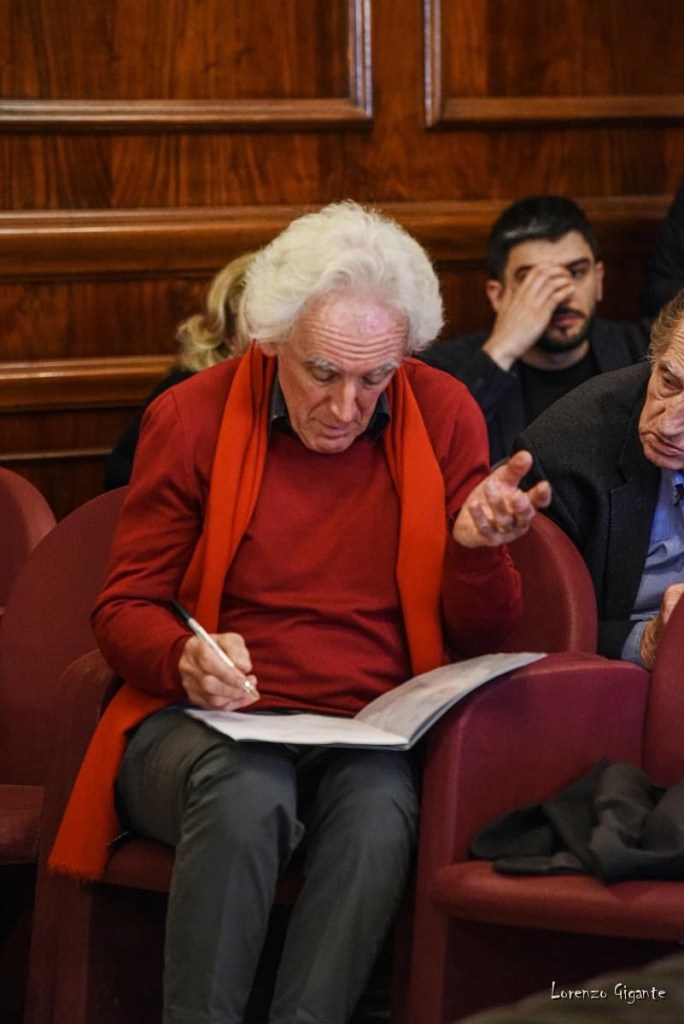
https://christopheraxworthymusiccommentary.com/2024/03/20/christopher-axworthy-dip-ram-aram/

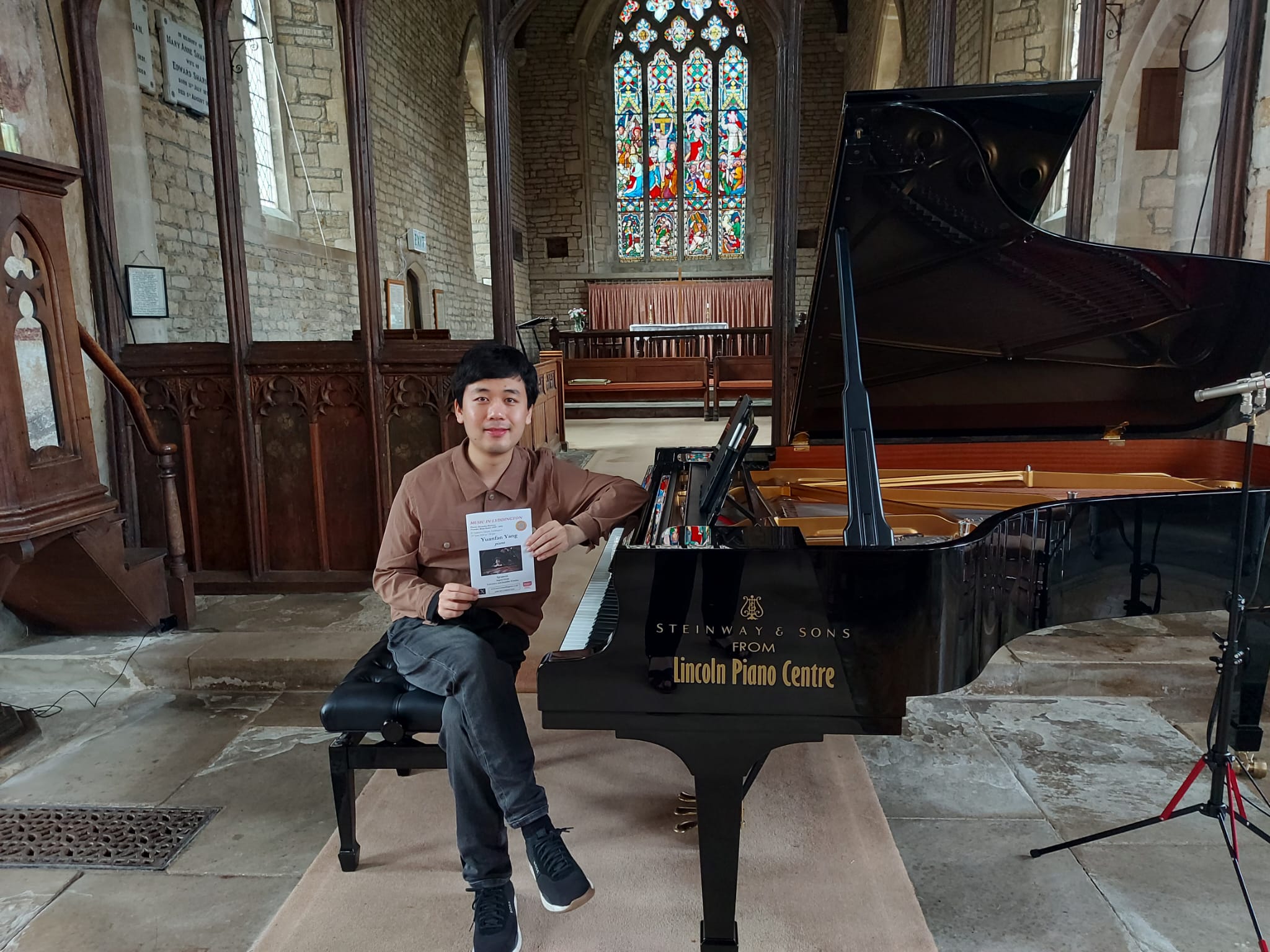
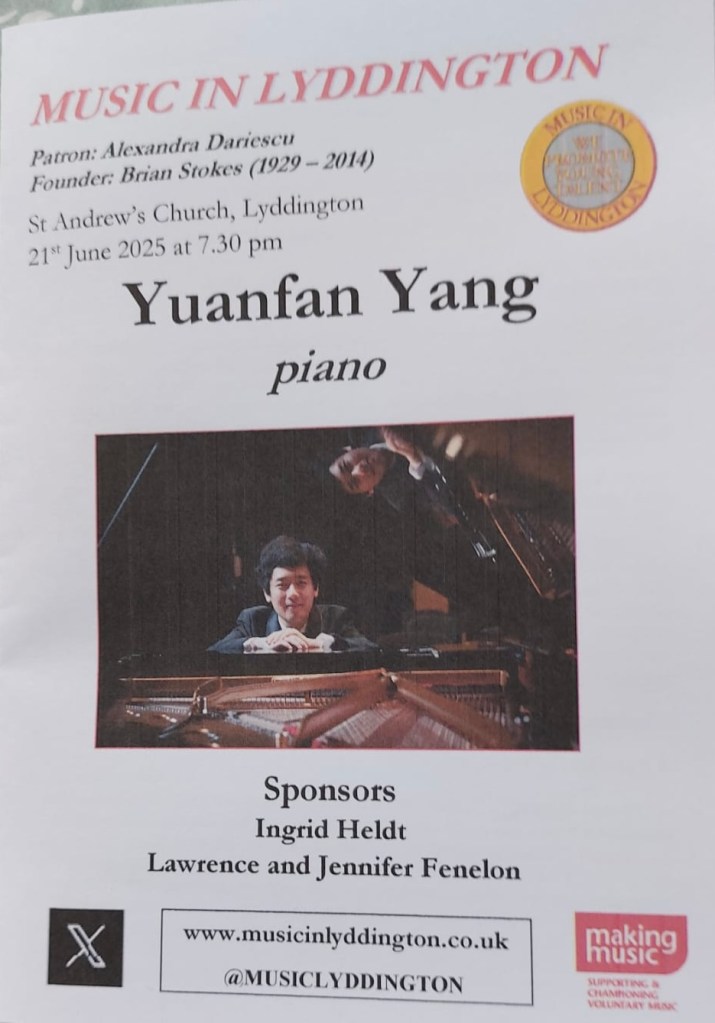
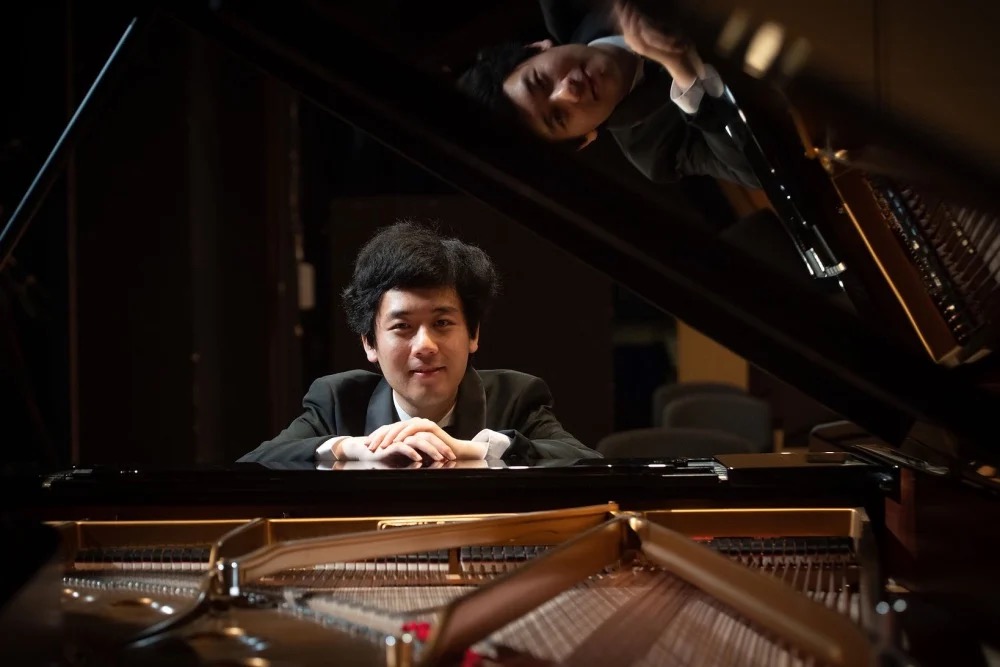
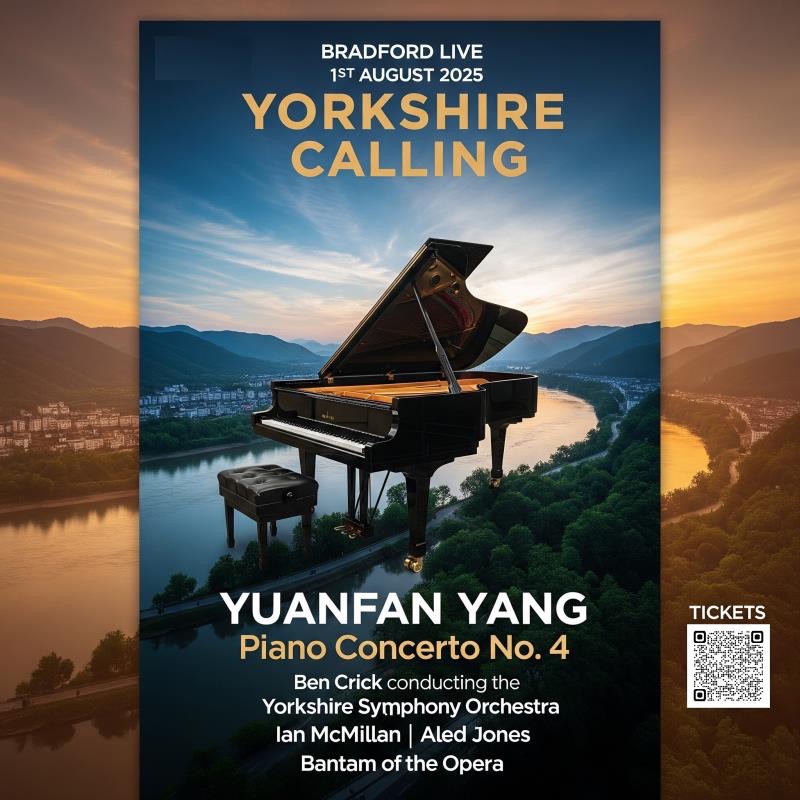
Yuanfan Yang takes Lyddington by storm ‘Hats off, Gentlemen, a Genius!’

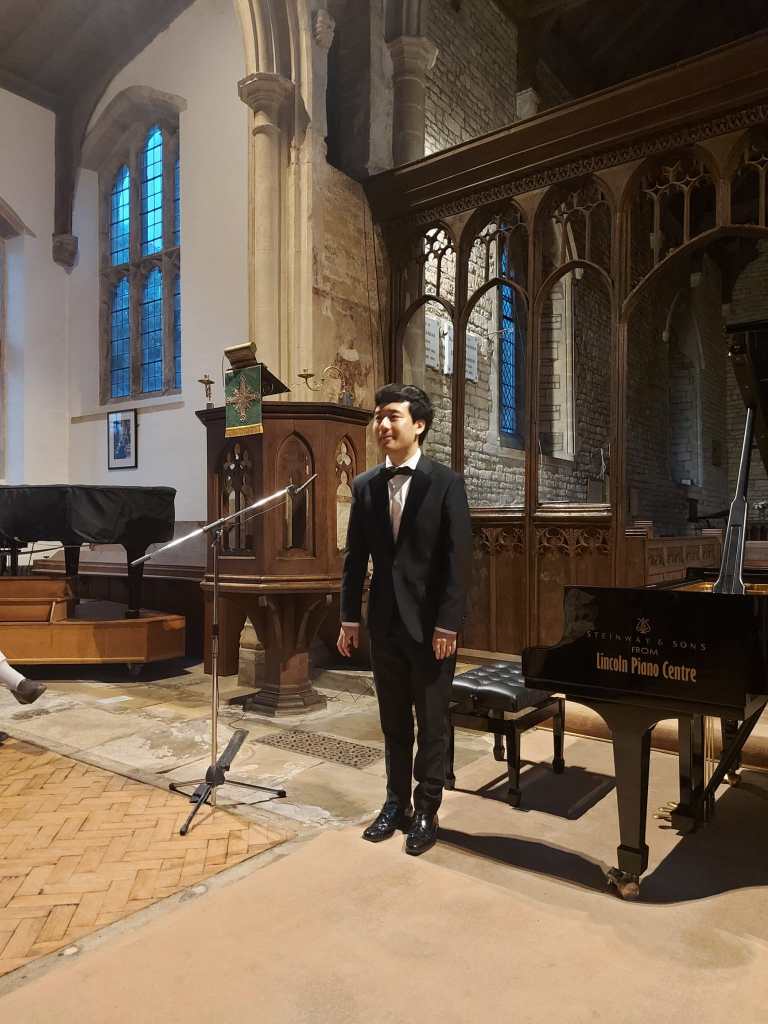
Yuanfan Yang takes Lyddington by storm with superb playing of Chopin, but also improvisations on Summertime ,Twinkle Twinkle Little Star in the style of Beethoven , Satie and even Boogie Woogie.

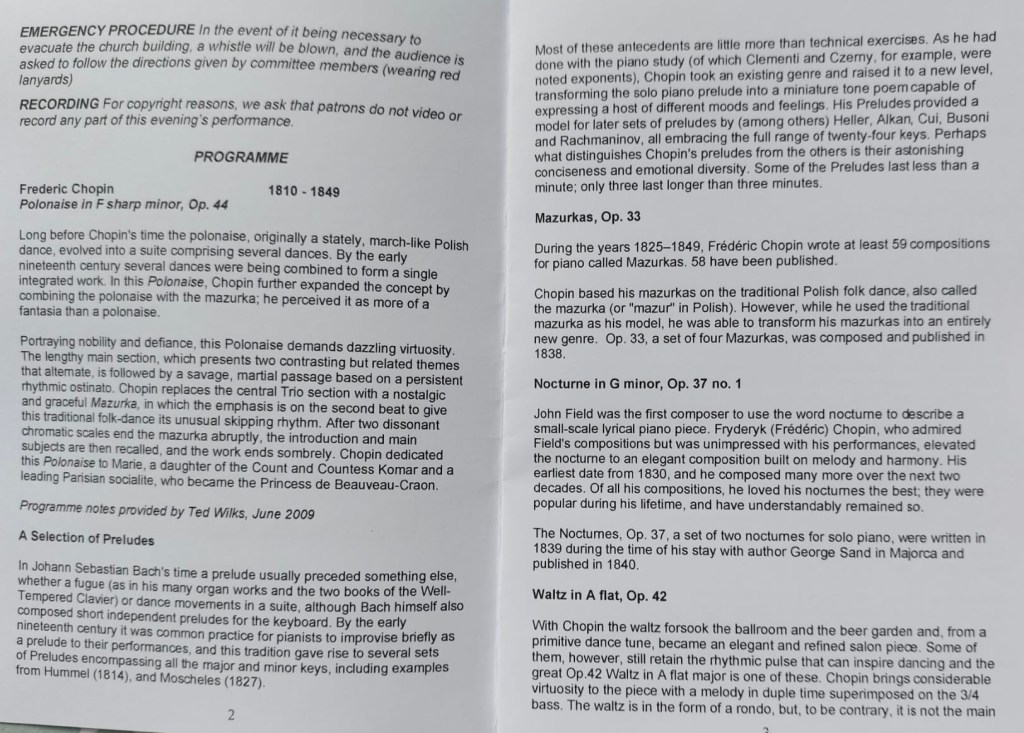
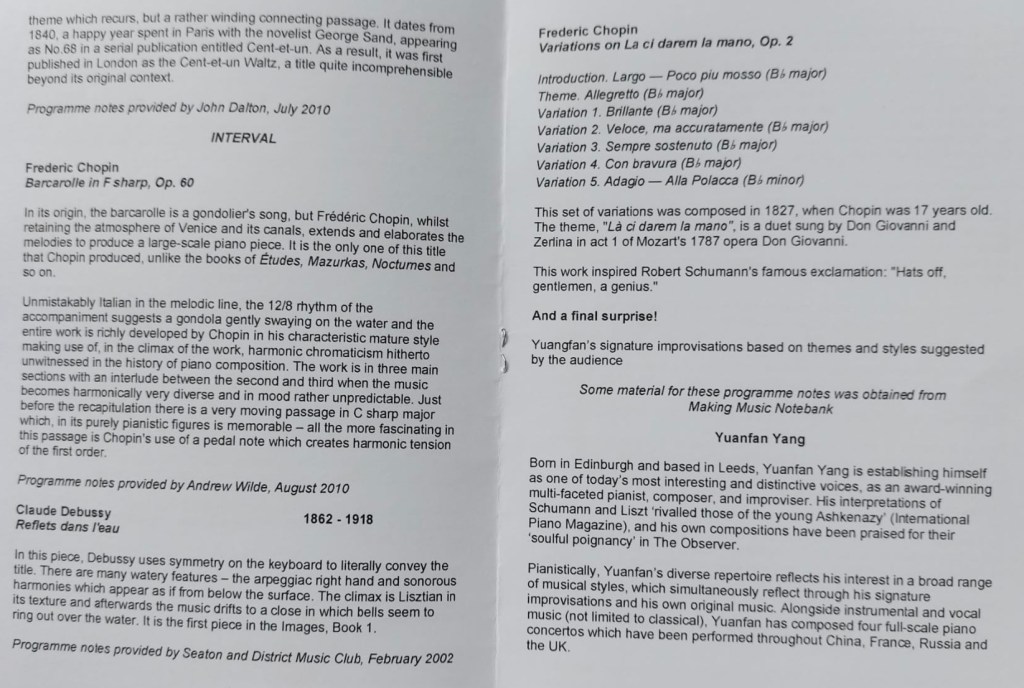
An audience that after such superb playing of some of the most famous masterworks of Chopin, from the Polonaise Fantaisie op 61 , Polonaise ‘Tragic’ op 44, Barcarolle op 60 and the Mazurkas op 33 ,Preludes 13/18 op 28 , and even the Nocturne op 37 n. 1 and Waltz op 42. Not quite sure why Debussy crept in except that Debussy adored and was much influenced by Chopin.He even edited all his piano works . Finishing with the youthful variations on ‘La ci darem la mano.’ Op 2 which was Chopin’s visiting card on his arrival as a teenager in Paris. It was Schumann on listening to this pianistic genius declared ‘ Hats off, Gentlmen, a Genius !’ And to quote the comments after Yuanfan’s astonishing performance it can still have the same effect in the hands of a master. Just some of the comments heard resounding around this magnificent edifice : …. ‘Just brilliant’, ‘Absolutely astonishing’, ‘The best concert I have ever been to’, ‘Genius’, ‘How does he do it?’ ‘ Wow’, ‘Amazing’, ‘Quite extraordinary’… etc etc.

This was followed by some improvisations from a ‘kapellmeister’ who could demonstrate a lost art in this era of the printed page, and not when composers were also great virtuosi like Beethoven or his pupil Czerny or his pupil Franz Liszt. It reminded us that Yuanfan is not only a wonderful pianist ( has the Chopin Prelude in B flat minor ever been played in public with such extraordinary assurance ) but he is also a quite considerable composer with five piano Concertos already to his name. As John Humphrey’s says ‘ A very fine pianist….absolutely! And composer it seems – went to Moscow after Russia’s illegal invasion of the Ukraine and won first prize for composition at the Rachmaninov Competition. Quite an achievement.’

Yuanfan , at this point asked his enthusiastic public to suggest what they would like him to play and in what style too !

A party atmosphere as rarely seen In the hallowed beauty of this church , as the audience delighted in composing with Yuanfan their own, do it yourself,musical choices.

A troupe from Poland had been sent to film the ‘goings on’ of this remarkable young man headed for Warsaw and the International Piano Competition. Tonight the troupe are in Catania in Sicily with Ruben Micieli, who plays in Comito, Ragusa tomorrow and later in the week in Menton, France. https://christopheraxworthymusiccommentary.com/2025/03/05/ruben-micieli-triumphs-with-chopin-in-florence-with-music-al-british-in-the-harold-acton-library/

I doubt Lyddington will ever forget the ‘goings on’ today in the usually peaceful atmosphere of their magnificent church, seated in the unique English countryside .

Yuanfan with Sarah Biggs CEO of the Keyboard Trust,the Polish recording engineer,Marek, and the parents of Yuanfan.
His father is a lecturer at Leeds University. Star students from Bejing University were on a brain exchange in the Thatcher period between the Universities in China and the UK . Yuanfan’s parents met each other in Edinburgh in that period, and were married and had a son born in Scotland .They decide not to return to China ( an expensive decision) and have made their home in the uK ever since.
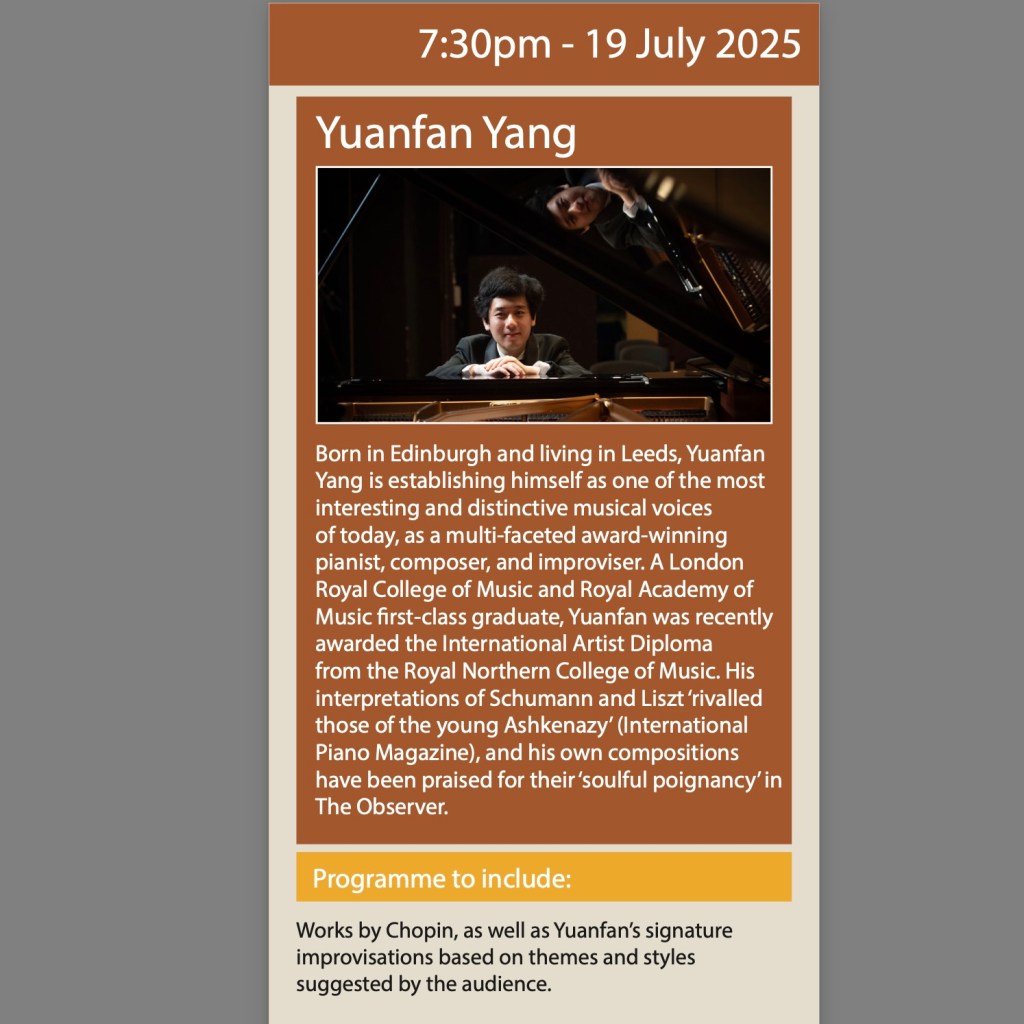
Yuanfan YangBorn in Edinburgh and based in Leeds, Yuanfan Yang is establishing himself as one of today’s most interesting and distinctive voices, as an award-winning multi-faceted pianist, composer, and improviser. His interpretations of Schumann and Liszt ‘rivalled those of the young Ashkenazy’ (International Piano Magazine), and his own compositions have been praised for their ‘soulful poignancy’ in The Observer.Yuanfan’s diverse repertoire reflects his interest in a broad range of musical styles, which simultaneously reflect through his signature improvisations and his own original music. Alongside instrumental and vocal music (not limited to classical), Yuanfan has composed four full-scale piano concertos which have been performed throughout China, France, Russia and the UK.Highlights from the past seasons include concerto debuts with the BBC Philharmonic (Ye’s Concerto of Life – recorded for BBC Radio 3), Armenian State Symphony Orchestra (Rachmaninoff Piano Concerto No. 3 – live-streamed on Medici.tv), and the Orchestra of Opera North, the latter of which he appeared as concerto soloist for the premiere of his own Piano Concerto No. 4 ‘Ode to the Jing River’. He also performed his concerto with Manchester Camerata at Manchester’s Stoller Hall in October 2024. The previous season saw Yuanfan make debuts at Sydney Opera House, Brighton Festival, Beaminster Festival, St George’s Bristol, and Milano Auditorium.Yuanfan’s improvisational craft features regularly as concert encores, where audiences are invited to suggest any theme/tune (e.g., famous film/tv themes, folk songs, pop, opera or other classical themes) and a style (e.g., Beethoven, jazz, musical, rock, waltz) and Yuanfan would create an original piece of music on the spot based on those suggestions. 2025 saw the debut of his first ever fully improvised concert in London, featuring an hour of improvisations, was livestreamed on YouTube.Yuanfan’s numerous accolades in performance include 1st Prize and Audience Prize of the Casagrande International Piano Competition in Italy (September 2022), 2nd Prize plus Special Prizes for Best Classical Sonata, Best Romantic Work and Best Work by Chopin in the First Ljubljana Festival International Piano Competition in Slovenia (March 2023) and 1st Prize at the UK International Piano Open Competition (June 2023). In July 2023, Yuanfan became the first British laureate of the Sydney International Piano Competition in more than 40 years since David Owen Norris and Martin Roscoe in 1981.​As a composer, Yuanfan draws inspiration from his fascination with allegories and cultures, thus his music is often narratively driven, portraying imagery to varying degrees of vividness. His work has been broadcast on BBC 2, BBC 4 and BBC Radio 3. Earlier works were winners in the BBC Proms Young Composers’ Competition, the Golden Key International Composition Competition, the EPTA UK Composers Competition, the National Centre for Early Music Composers’ Award 2013, and the Royal Academy’s Alan Bush Composition Competition 2016. Yuanfan’s Piano Concerto No. 1 ‘The Wilderness’, written for piano and full orchestra at 17 years old, premiered in Qianjiang, China. A musical depiction of the synonymously titled stage drama by the renowned Chinese dramatist Cao Yu, this concerto was chosen for substantial funding in 2017 by the China National Arts Fund, enabling eight public performances with the China National Orchestra of Theatre & Dance throughout several Chinese cities between 2017-2019. In 2022, his ‘Piano Concerto No. 3 in Five Movements’ won 1st Prize & Gold Medal in the composition category of the Rachmaninoff International Music Competition, and was premiered with the State Symphony Orchestra ‘Novaya Rossiya’ at the Philharmonia-2 in Rachmaninoff Concert Hall and the Great Hall of Tchaikovsky Conservatory.Yuanfan’s debut album Watercolour featuring an eclectic range of piano music alongside own compositions was released on Orchid Classics to critical acclaim, including 4* from International Piano Magazine. Recently awarded the International Artist Diploma from the Royal Northern College of Music, Yuanfan previously graduated first-class from London’s Royal College of Music, and Royal Academy of Music.​
https://christopheraxworthymusiccommentary.com/2023/06/02/the-gift-of-music-the-keyboard-trust-at-30/
https://christopheraxworthymusiccommentary.com/2024/12/25/point-and-counterpoint-2024-a-personal-view-by-christopher-axworthy/
https://christopheraxworthymusiccommentary.com/2024/03/20/christopher-axworthy-dip-ram-aram/

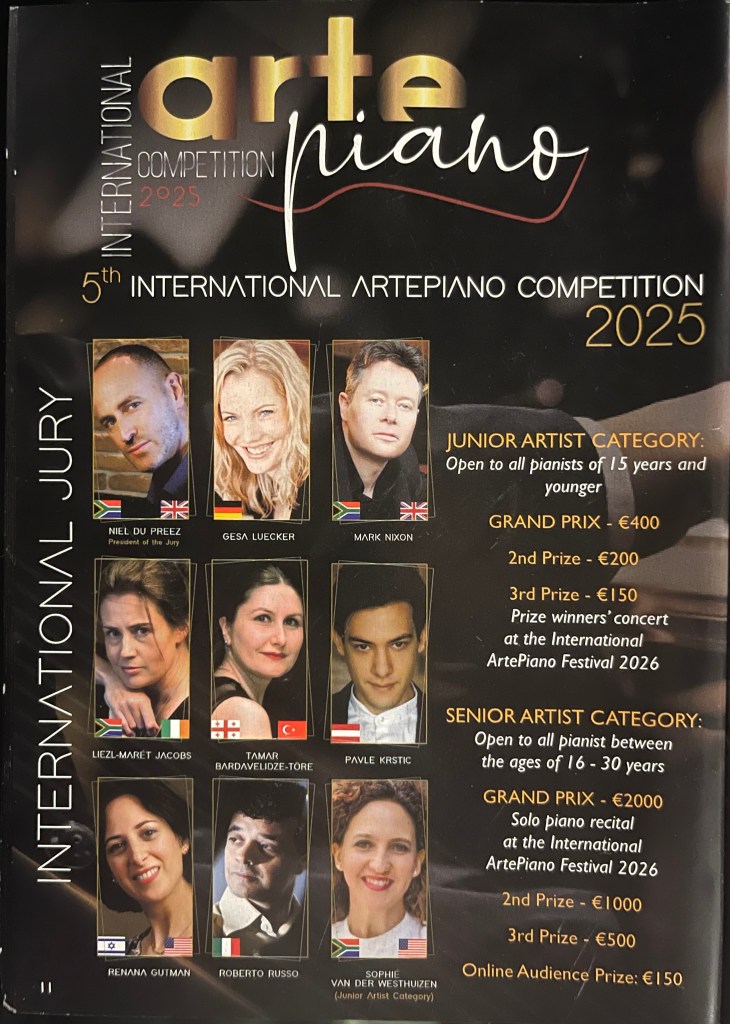
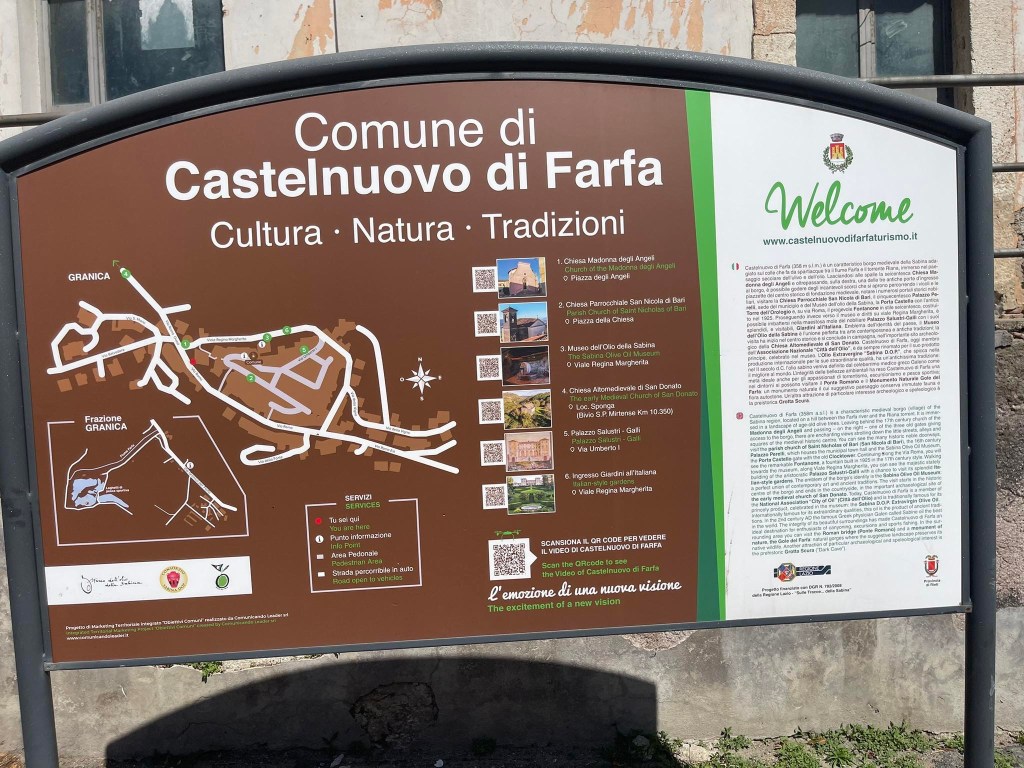
Castelnuovo di Farfa ‘The Land of Dreams’ The 5th International ArtePiano competition of Niel du Preez

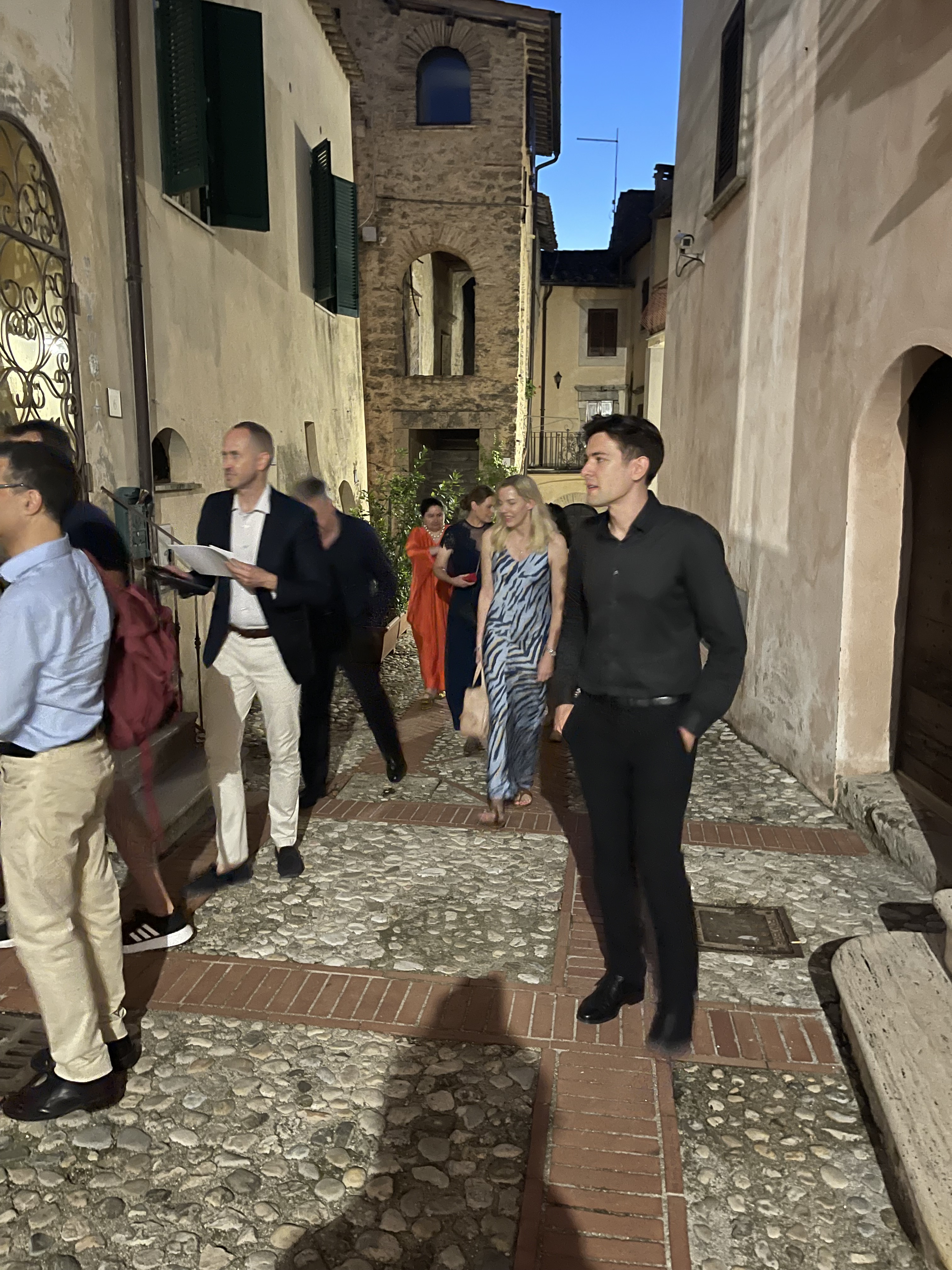
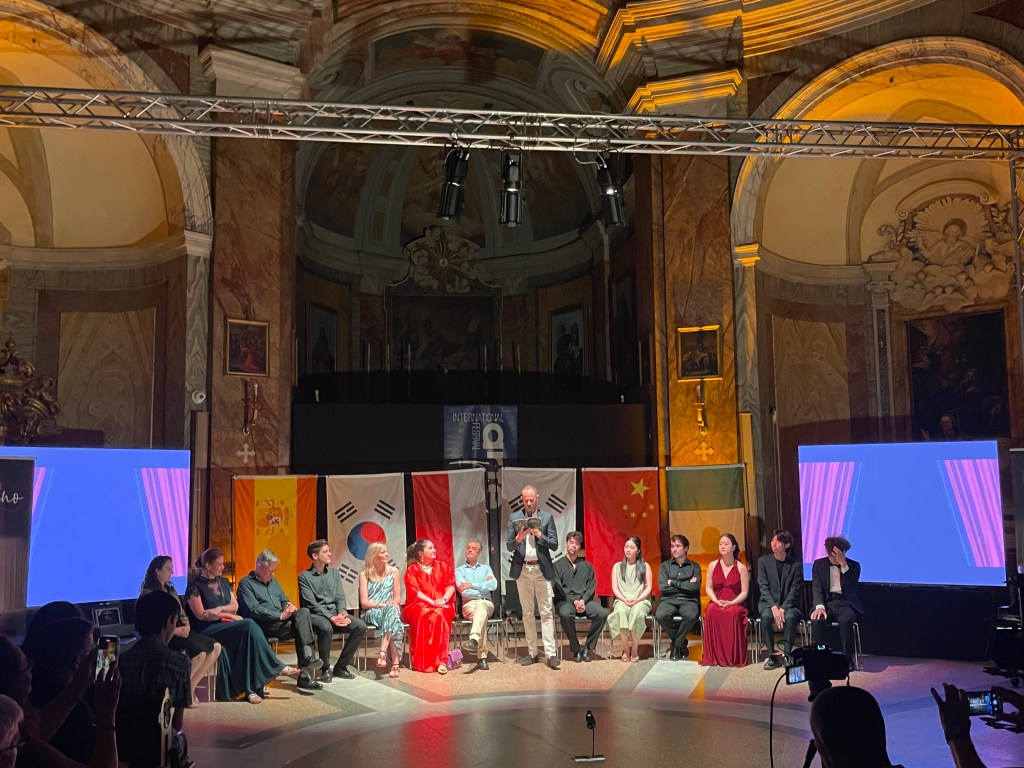
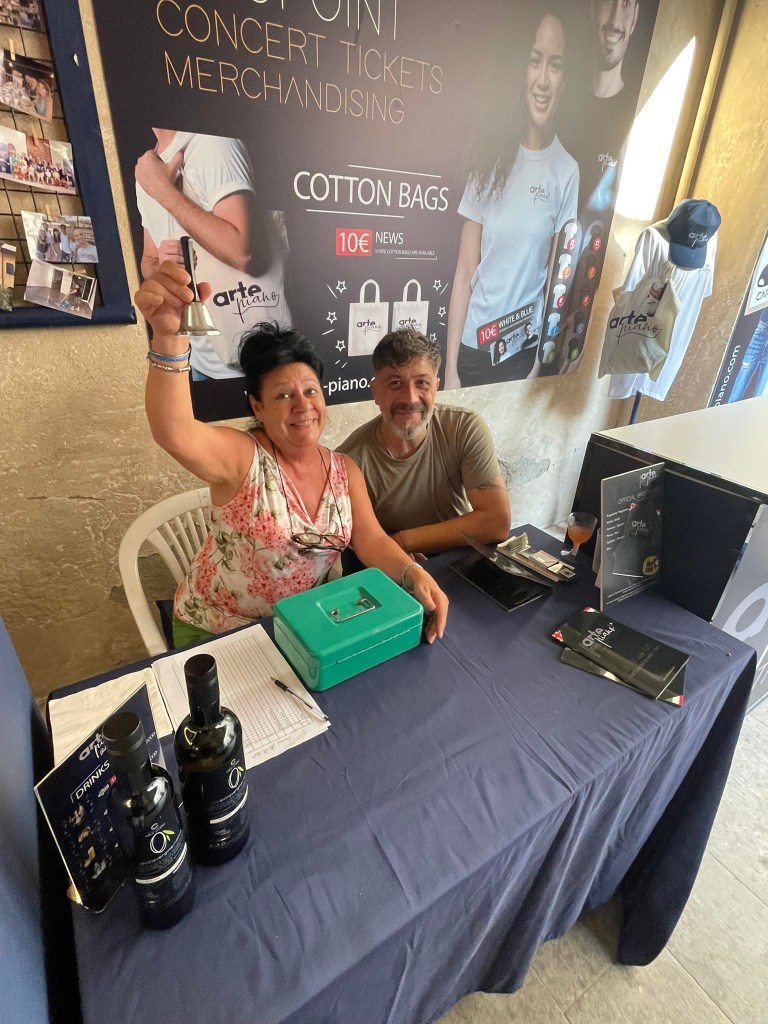
The final of the 5th International Artepiano competition in the magical town of Castelnuovo di Farfa

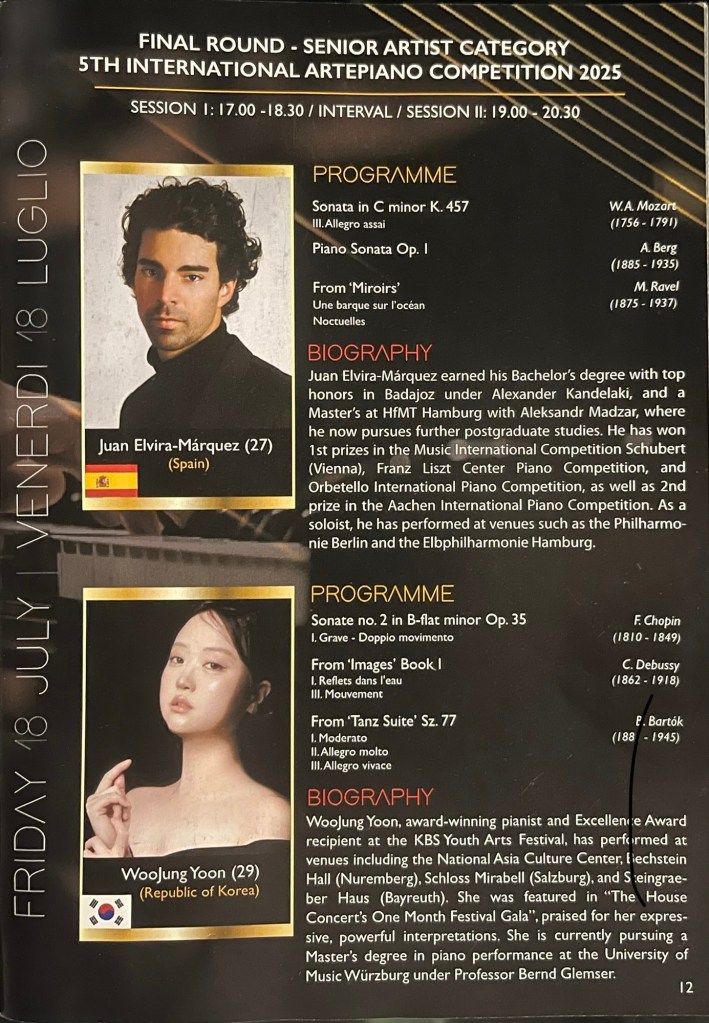
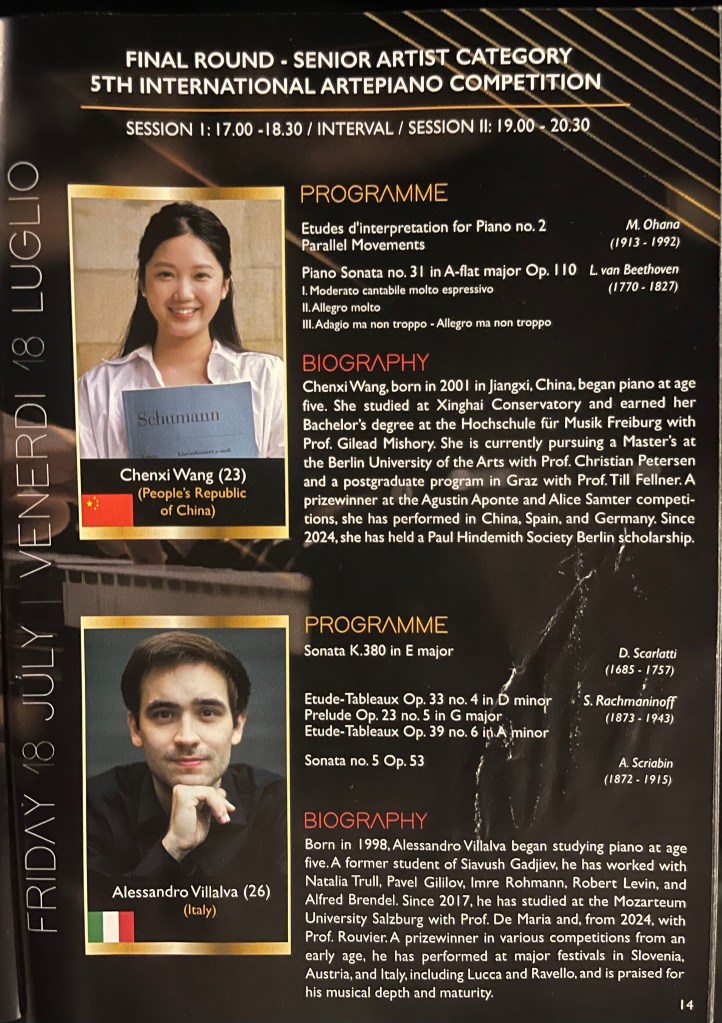
Six pianists invited to perform, who had been chosen from over fifty who had submitted videos. They had been selected by a distinguished jury headed by the founder and artistic director Niel du Preez.

Pianists from Spain,Korea,Poland,China and Italy invited to Farfa to give twenty five minute recitals each.

Some fine playing on a superb Fazioli concert grand but there was no doubt about the finest performance, which was infact the last of the evening.

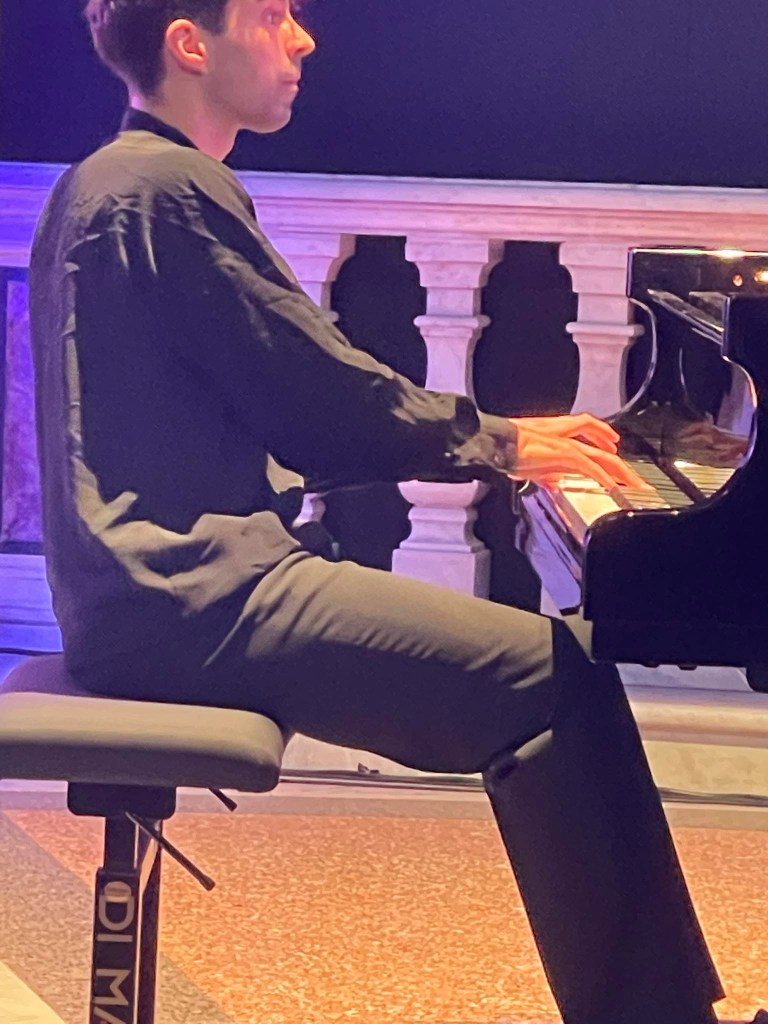
26 year old Alessandro Villalva from Italy took us all by storm ( there was actually a storm in progress outside too). An all or nothing Scriabin Fifth Sonata of overwhelming physicality with a kaleidoscope of colours and a dynamic drive that was breathtaking .

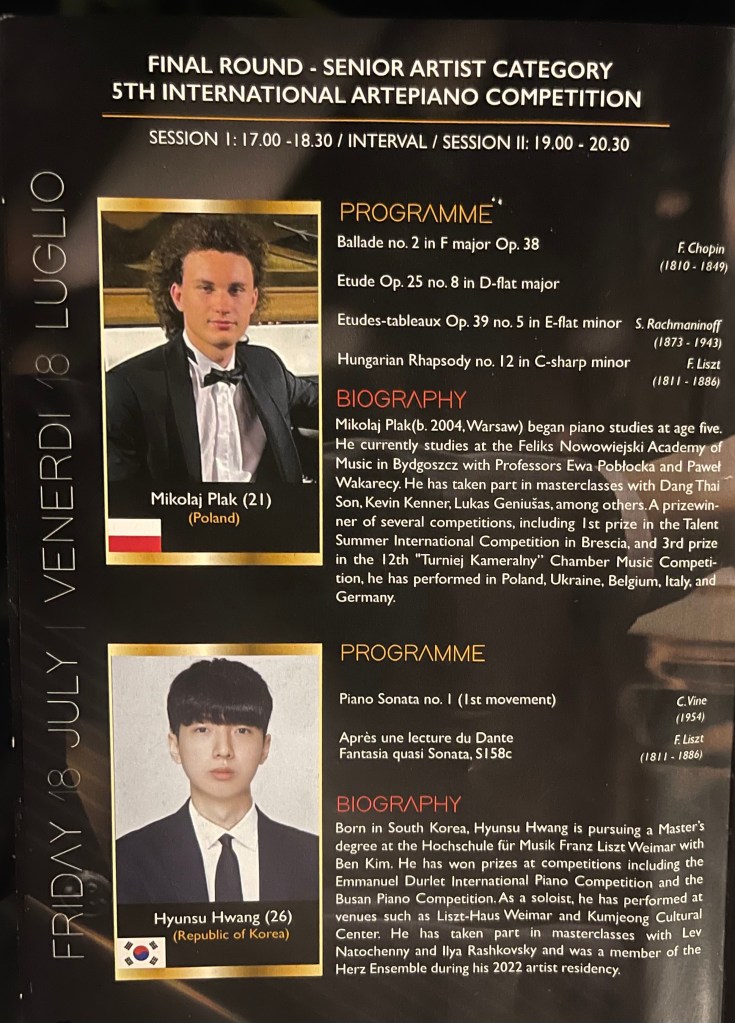
The second prize was awarded to 26 year old Hyunsu Hwang , with an extraordinarily dramatic Dante Sonata played with fearless abandon, but also masterly control.

The third prize ,and audience prize, went to 27 year old Juan Elvira -Márquez, from Spain , who was able to unravel Berg’s knotty twine with extraordinary intelligence and sense of line but the same sense of balance just eluded him on Ravel’s magical Boat ride or trying to swat his mischievous Moths .

There were some fine performances from the other three finalists too .

29 year old WooJung Yoon had substituted Chopin for Mozart which she played with an extraordinary sense of style and self identification . The same that she brought to three dances Sz77 by Bartók.

Mikolaj Plak ,at 21, the youngest contestant gave some youthfully exhilarating performances of Romantic abandon . A remarkable talent but missed the control and schooling of his older and wiser colleagues. .

Chenxi Wang only 23 , gave a very mature account of Beethoven’s penultimate Sonata. Just missing the solidity and weight which will surely come to her as she gains more experience . Her Parallel Movements by Ohana already showed signs of mastery and extraordinary musical intelligence.

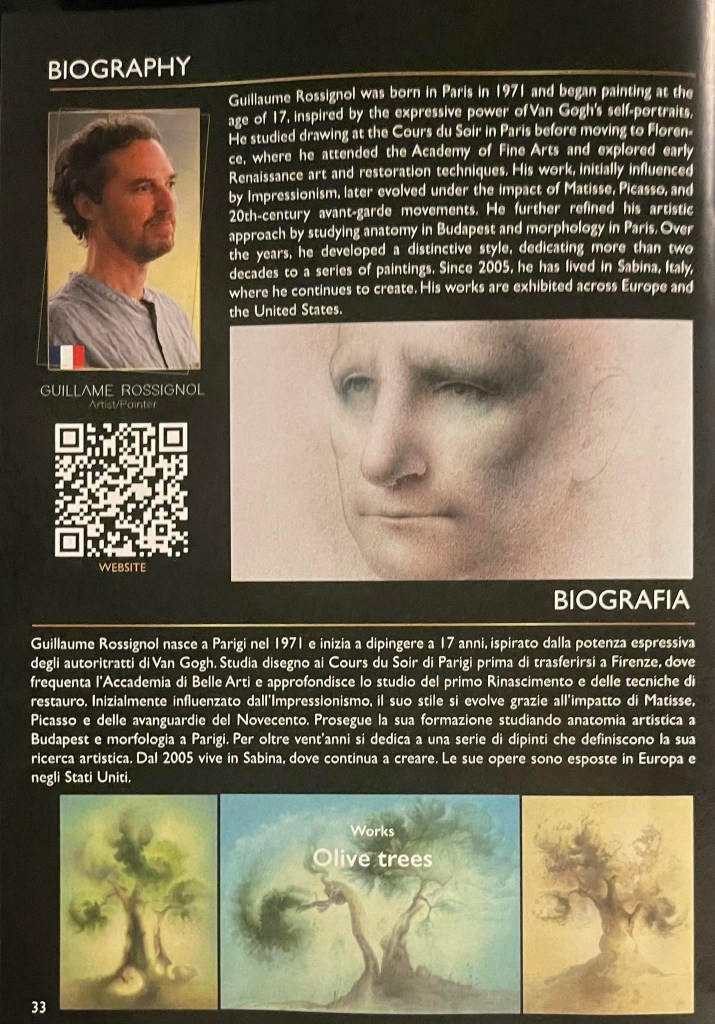
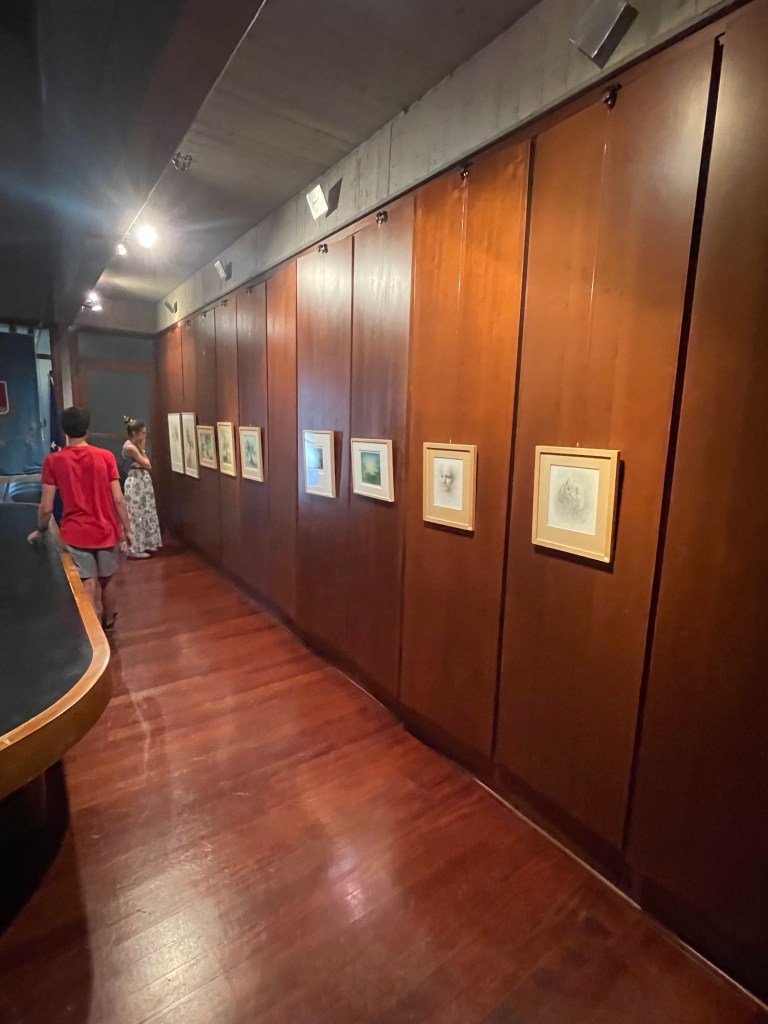
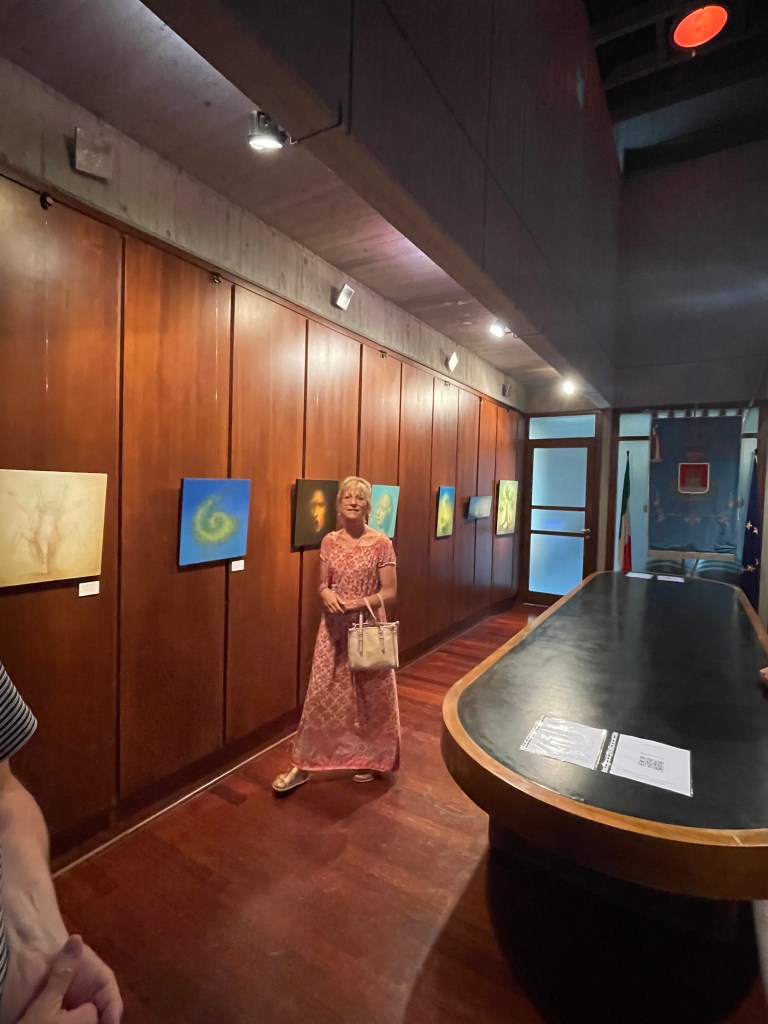
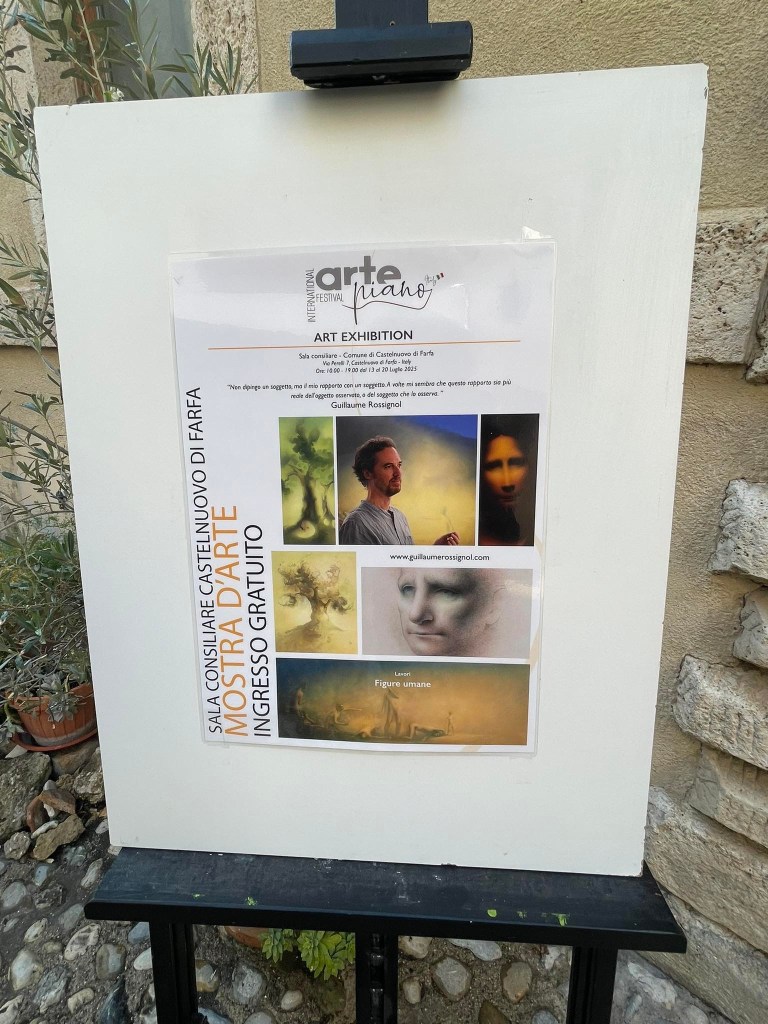
All this and an art exhibition by Guillaume Rossignol based on Book one of Debussy’s Preludes.

This is fresh from live performances ,too, of the ‘Goldberg’ on antique instruments with projections of images inspired by the greatest variations ever written.

Nightingales in Berkeley Square watch out ! https://music.youtube.com/watch?v=jRLAstUfIBA&si=zGTiz2Oh0BHK2DHz&feature=xapp_share

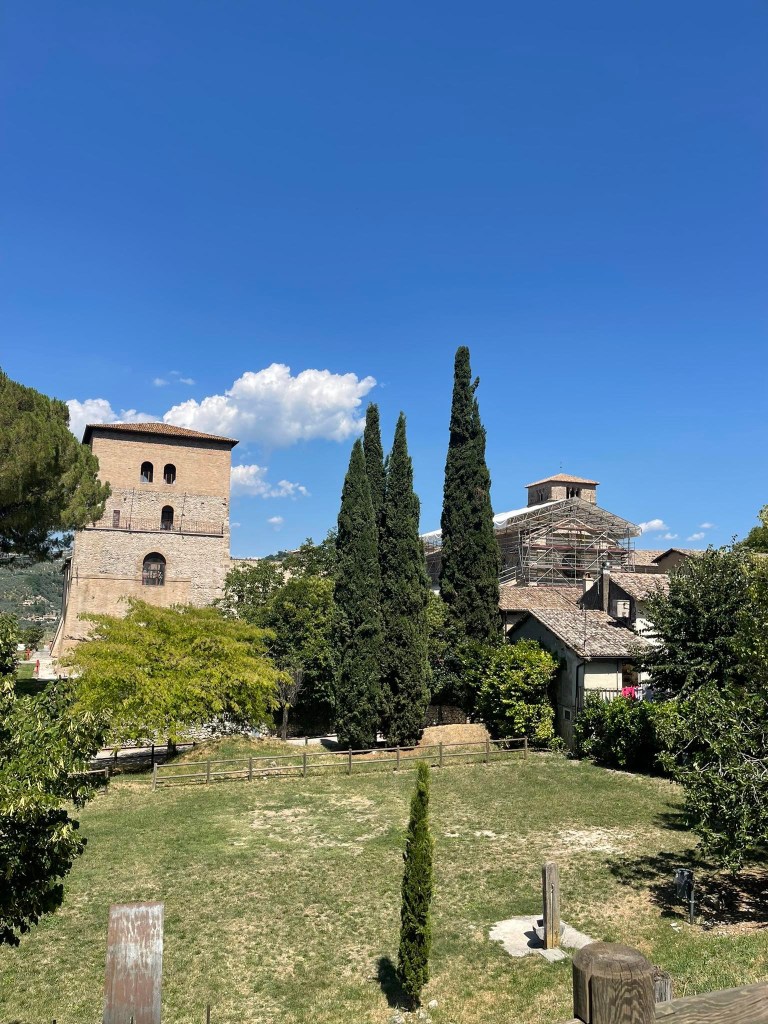
Just an hour from Rome , in the most beautiful unspoilt countryside of the Sabine hills .

This is an area untouched by the ‘Chiantishires’ of nearby neighbours and is an oasis of cultural activity.Like it’s nearby neighbour, Spoleto, but much smaller in dimension, and as yet uncontaminated by marketing and mass tourism. It is quality not quantity that sits most comfortably in Castelnuovo di Farfa.

What a discovery ……., but please keep it under your hat, it is too good to be true !

Alessandro Villalva winner of the 2025 ArtePiano International Competition .
The last two days before spreading its wings…………..
://christopheraxworthymusiccommentary.com/2020/12/30/emanuele-stracchi-recital-white-christmas-with-bells-jingling-for-roma-3-swan-song-2020/
I was introduced to this remarkable festival in Castelnuovo di Farfa by Pavle Krstić ,when on tour for the Keyboard Trust recently. He had been winner of the first edition and is now a distinguished jury member.
https://christopheraxworthymusiccommentary.com/2023/06/02/the-gift-of-music-the-keyboard-trust-at-30/
https://christopheraxworthymusiccommentary.com/2024/12/25/point-and-counterpoint-2024-a-personal-view-by-christopher-axworthy/
https://christopheraxworthymusiccommentary.com/2024/03/20/christopher-axworthy-dip-ram-aram/

Sandro Russo in Perivale ‘Mastery and Poetry combine with style and beauty’

https://www.youtube.com/live/OJkSe5EXC9Q?si=ycH7YGorXdVQ3Pyz

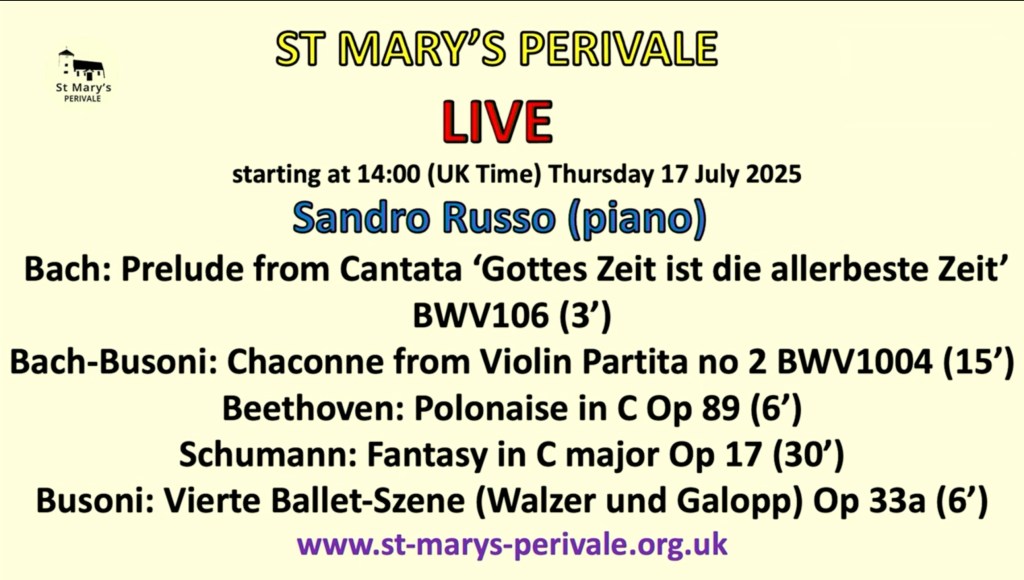
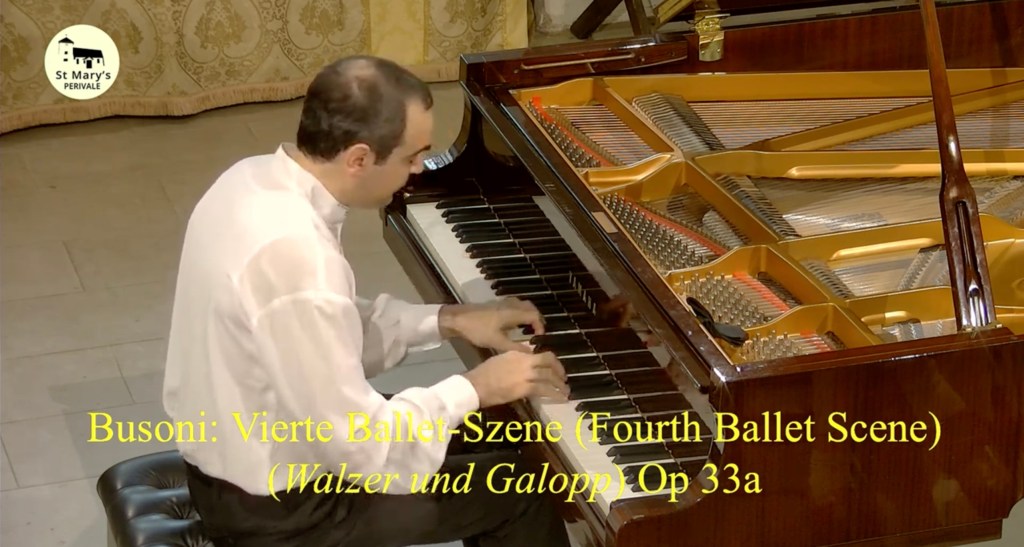
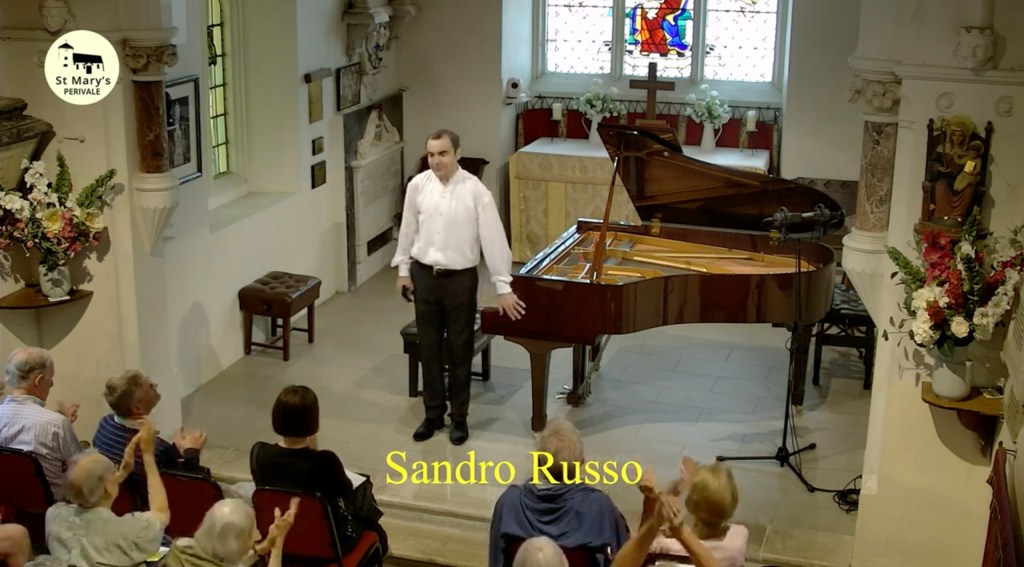
Sandro Russo a pianist who I heard some years ago in my Euromusica concert season in Rome and who I was very pleased to be able to hear again this side of the Atlantic. A very interesting programme of two master works surrounded by some unjustly neglected pieces by Beethoven, Busoni and even Bach. Throughout the recital there was an aristocratic sense of style and a very clear sense of line of masterly musicianship allied to a poetic beauty of sumptuous sound.

A delicacy and poignant beauty from the very opening of the Prelude from the Bach Cantata BWV 106 in the arrangement of the 98 year old America pianist ,teacher and composer Seymour Bernstein. A ravishingly subtle beauty to this arrangement of Bach as you would expect from the Leschetitsky school and a student of Brailowsky, Curzon, Boulanger and Enescu. There were counterpoints of flowing radiance and a melodic line of simple glowing beauty. Sandro played it with a subtle beguiling flexibility of pulse that was of respectful dignity combined with poetic poignancy.

The Busoni reworking of the Bach Chaconne is a recreation of Bach’s genial masterpiece. Not only is there a piano roll performance of Busoni himself playing it, but I first fell in love with it when, as a teenager, I heard the recording of Arturo Benedetti Michelangeli. It ignited a passion in me and despite my teacher ,Sidney Harrison, trying to discourage me I learnt it in a week, and it was the work that earned me a place at The Royal Academy !

Sandro Russo played it with a chiselled beauty of nobility and aristocratic restraint.There were some moments of very expressive almost romantic playing, but always in style and with the continual forward movement of the undercurrent that carries us from the opening Chaconne theme to the triumphantly exhilarating final declamation. Playing of great precision and rhythmic drive with a very clear sense of line and an overall architectural shape. There was a radiant beauty to the tenor line that is given the spotlight after great feats of pianistic arpeggiandi spread over the entire keyboard. This was a remarkable performance of absolute clarity and simplicity but above all of mastery and nobility.

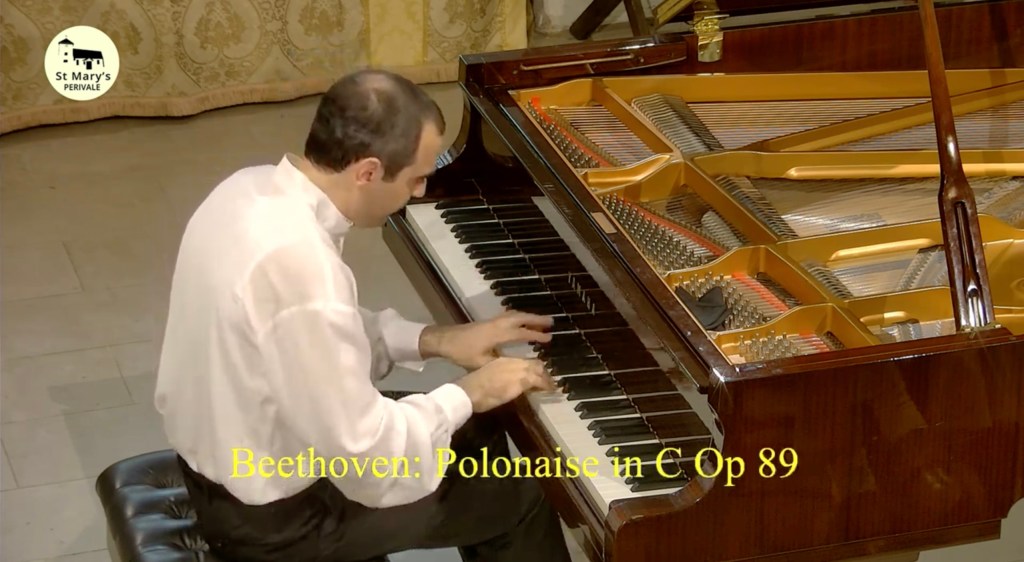
The Beethoven Polonaise, I do not think I have ever heard in concert before, and it is a charming work full of ‘joie de vivre’ and refined good taste. It was played with authority and a Beethovenian charm more allied to the world of Haydn than to the romantic school. It is interesting to note that it was written at the time of the Eighth symphony and the reworking of the opera Fidelio. It also precedes the equally beautifully simple Sonata op 90 and would seem to be a refreshing oasis for Beethoven before plunging into the depths of his final sonatas and Ninth symphony. Sandro played it with great style , knowing how to end with the flourish that the Polonaise demands even from Beethoven!

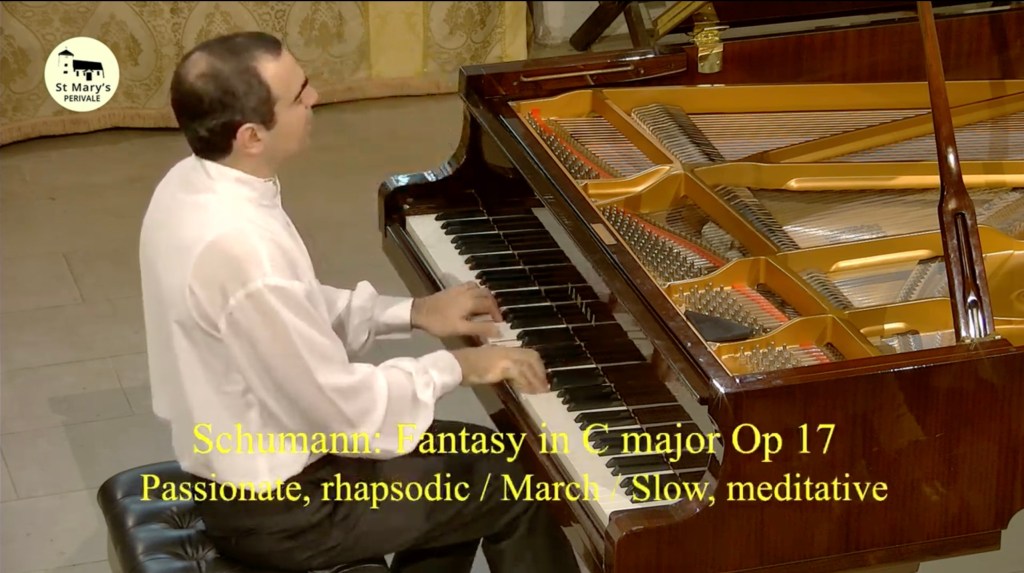
Schumann Fantasy was the second masterwork on the programme and is together with the Liszt Sonata the pinnacle of the romantic repertoire with Schumann and Liszt dedicating these works to each other. The opening was played with passion but also a mature control and a sense of line that was so clearly defined throughout. The ending ,a quote from Beethoven ,’To the distant beloved’, was played with disarming simplicity and remarkable tonal control. A beauty also in the central episode where the melodic line was allowed to float so magically over the hovering ever changing harmonies. The second movement was allowed to flow so naturally and Schumann’s dotted rhythms were shaped with poetic understanding where counterpoints glistened and glowed within this bubbling outpouring of radiance and beauty. There were some very interesting harmonies in the central melodic episode of great originality that Sandro highlighted with subtle poetic understanding. A beautiful transition from the virtuosity ending of this movement, where not only did Sandro play with enviable clarity but also giving a great sense of shape to a notoriously difficult coda. Timing the opening of the final movement to perfection and creating an atmosphere of the love and beauty that the composer wanted to share with his beloved Clara. A sense of fantasy and improvisation but also keeping a flowing tempo sustained by deep bass notes . A glorious luminosity to the two declamations of romantic fervour, never sacrificing absolute rhythmic precision as is rarely the case. Ravishing beauty to the final mellifluous outpouring as it built to a gentle climax only to die away to three magically placed final chords.

Another work that I have never heard in concert before was the final showpiece of a Busoni more of the Belle Epoque than the intellectual futuristic heir to late Liszt. A work written more in the style of Tausig with its unashamedly pianistic showmanship and that Sandro could play with the style of the pianists of the Golden Age .

An encore with one of the most famous pieces from the piano repertoire but strangely rarely heard in the concert hall these days. Liszt Liebestraum n. 3 was played with sumptuous poetic beauty and just adding the occasional bass note at moments of great Romantic intensity with a sense of style of a bygone age. An age when pianists had a voice of their own and were in love with the magic sounds that could be conjured out of this box of hammers and strings and made to sing as beautifully as the human voice.

Sandro Russo‘s playing has often been referred to as a throwback to the grand tradition of elegant pianism and beautiful sound. Composer Lowell Liebermann wrote of him, “Sandro Russo is a musician’s musician and a pianist’s pianist. There is no technical challenge too great for him, but it is his musicianship that ultimately makes the greatest impression. His interpretations reveal a unique and profound artist at work.” 

Born in San Giovanni Gemini, Italy, Mr. Russo displayed exceptional musical talent from an early age. He later entered the V. Bellini Conservatory, from which he graduated summa cum laude. He also earned the Pianoforte Performing Diploma from the Royal College of Music in London with honours. After moving to the United States in 2000, he won the Bergen Philharmonic Orchestra Concerto Competition and has since performed in prestigious concert halls, including the Concertgebouw in Amsterdam, Weill and Zankel halls at Carnegie Hall, Kilbourn Hall (Eastman Theatre), Salle Cortot in Paris, Teatro Politeama in Palermo, Konzerthaus Berlin, and Stoller Hall in Manchester (UK). 

His recitals include performances for The Rachmaninoff Society, the Dame Myra Hess series in Chicago, the American Liszt Society, the Houston International Piano Festival, the Husum Festival of Piano Rarities in Germany, the Chetham’s International Piano Festival in Manchester (UK), and the Fernando Laires series at the Eastman Theatre. Mr. Russo has appeared as a soloist with the Slovak Philharmonic in Bratislava, the Jacksonville Symphony in Florida, and the Brussels Chamber Orchestra, among others. 

Mr. Russo’s performances have aired on major radio stations in the US and abroad, with recordings earning rave reviews from magazines such as Italy’s Classic Voice and Gramophone . On May 3, 2024, the Steinway & Sons label released his latest recording of Liszt’s 12 Transcendental Etudes .

https://christopheraxworthymusiccommentary.com/2024/03/20/christopher-axworthy-dip-ram-aram/

‘Caro Sandro, congratulations!! While I haven’t been able to access the concert’s recording as yet, I have carefully read every word of Mr. Christopher Axworthy’s review; it brought tears to my eyes. What an acknowledgement of your extraordinary talent — your jaw-dropping technique and musicianship, and the breathtaking poetry of your interpretations. He even captured that magical touch of yours! As Jesus Garcia and I always say, you should be on the world’s stage!! Thank you, Mr. Axworthy, for writing a magnificent and well-deserved review of this extraordinary talent.’

‘Thank you, Mallory, for such heartfelt remarks. I’m truly touched by what you wrote. You may have noticed I didn’t use the word “review” when sharing this, as reviews are typically written by journalists, rather than musicians searching for music. Regardless of the praise in Mr. Axworthy’s reflections, it’s always incredibly meaningful when someone captures something that lies at the very core of our artistic language and expression. Sending hugs to you and Jesus!’

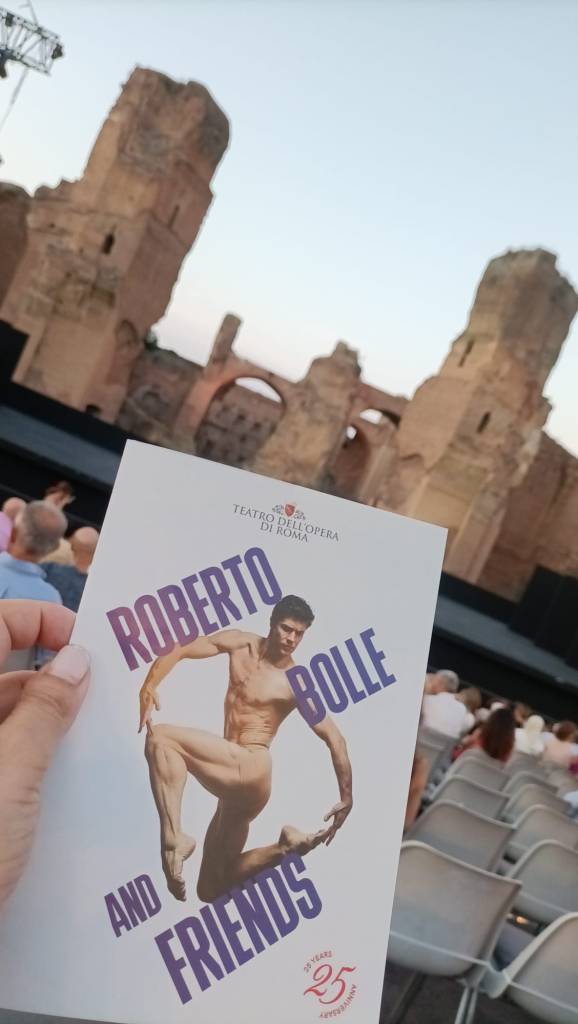
Marcos Madrigal with Roberto Bolle and Friends ‘I could have danced all night ‘

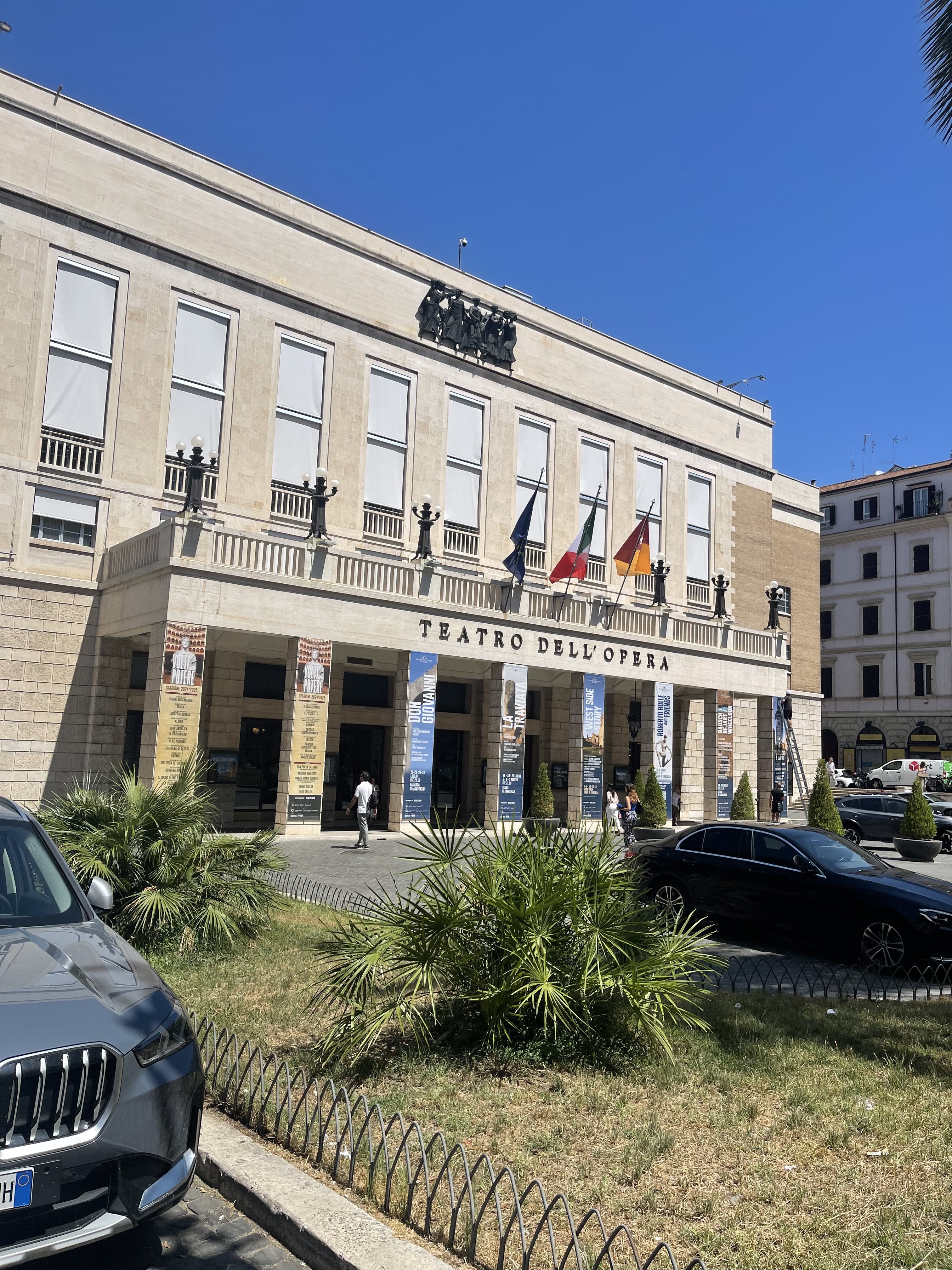
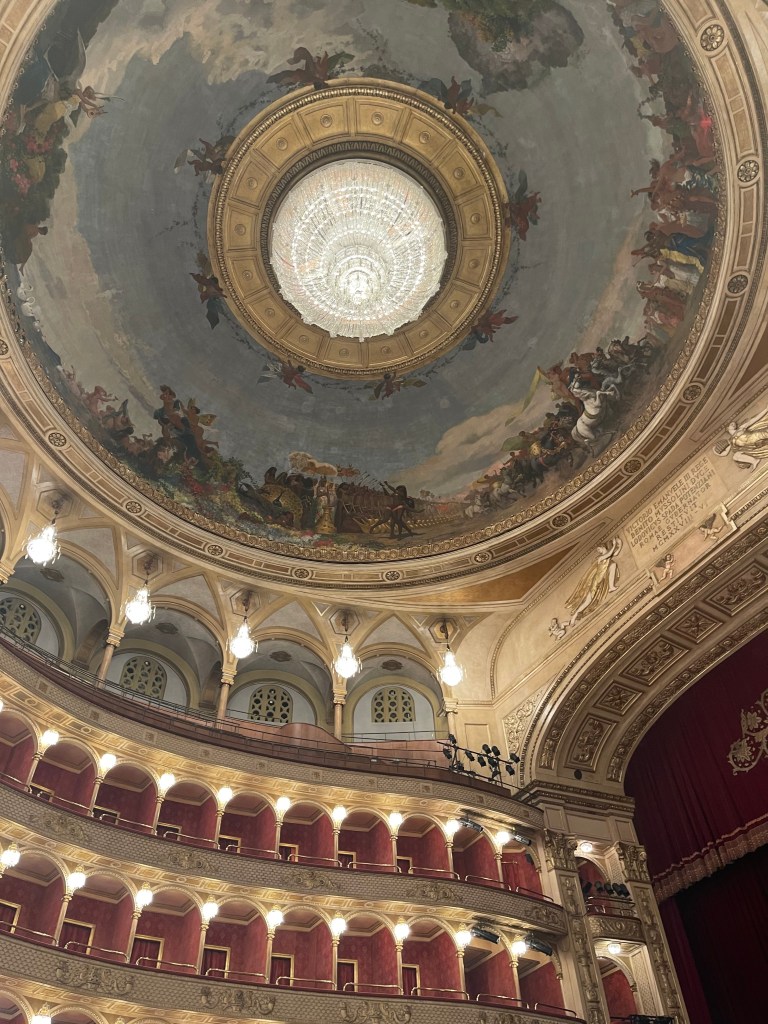
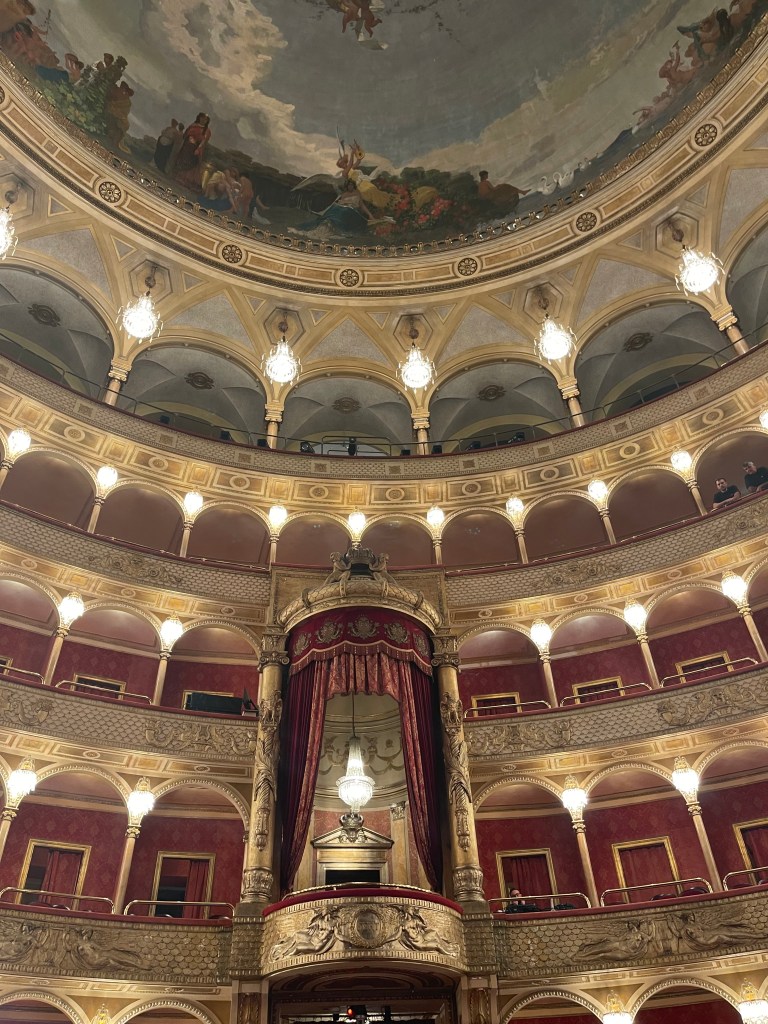
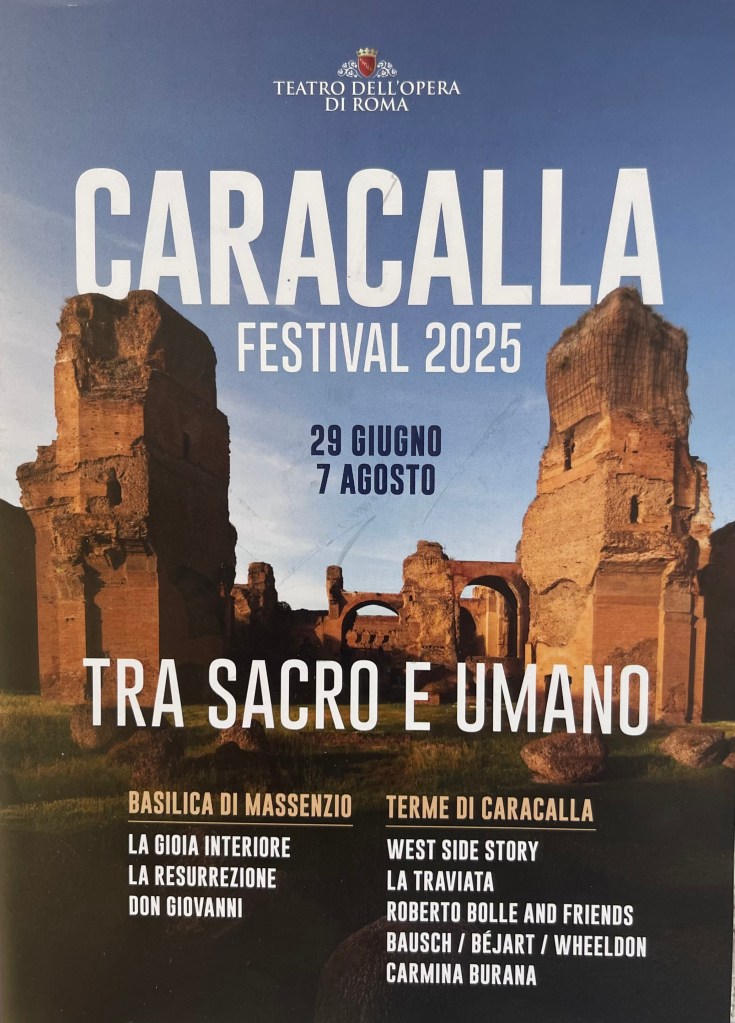
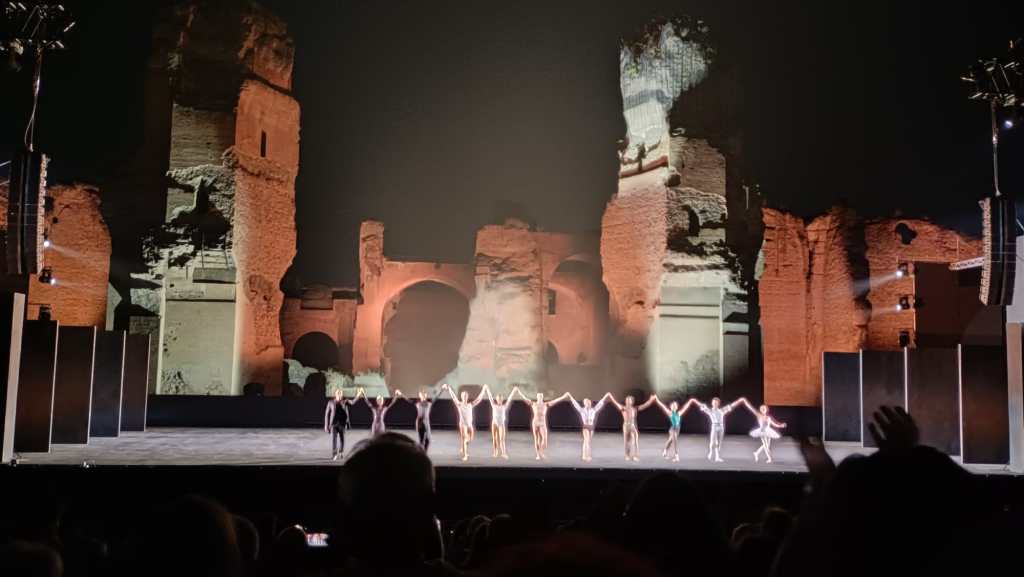
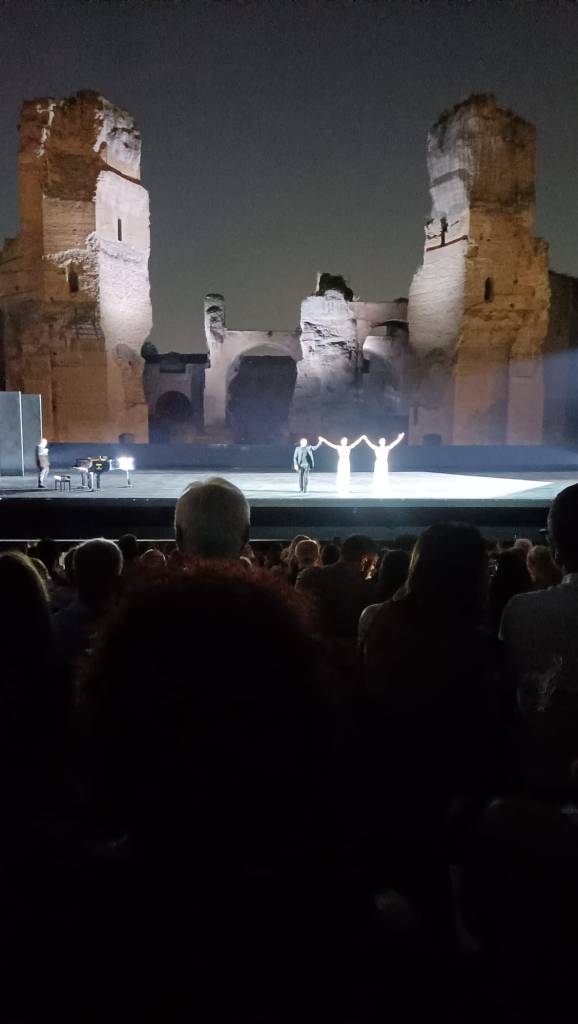
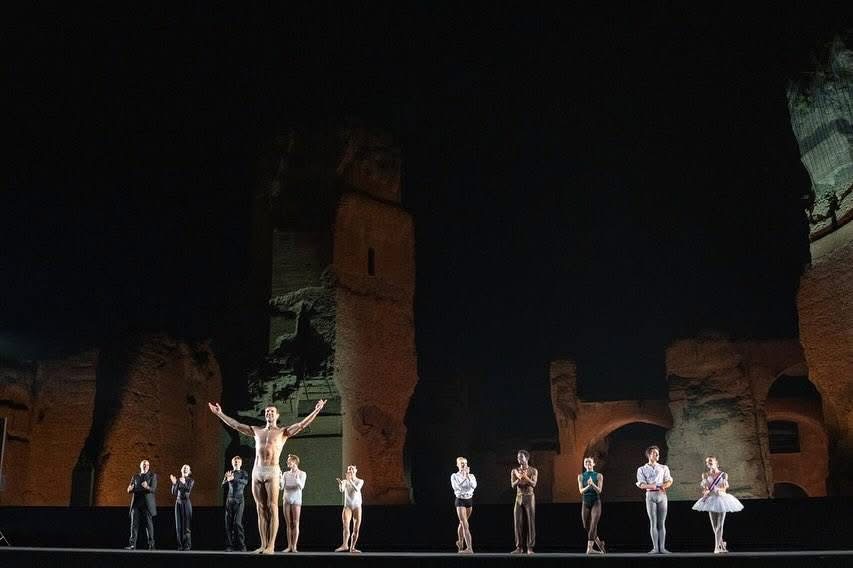
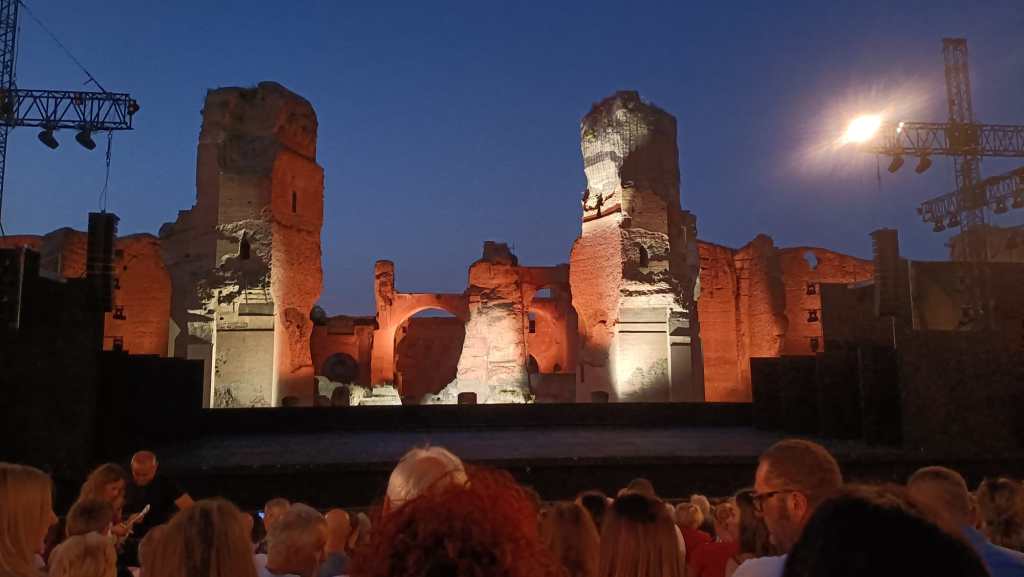
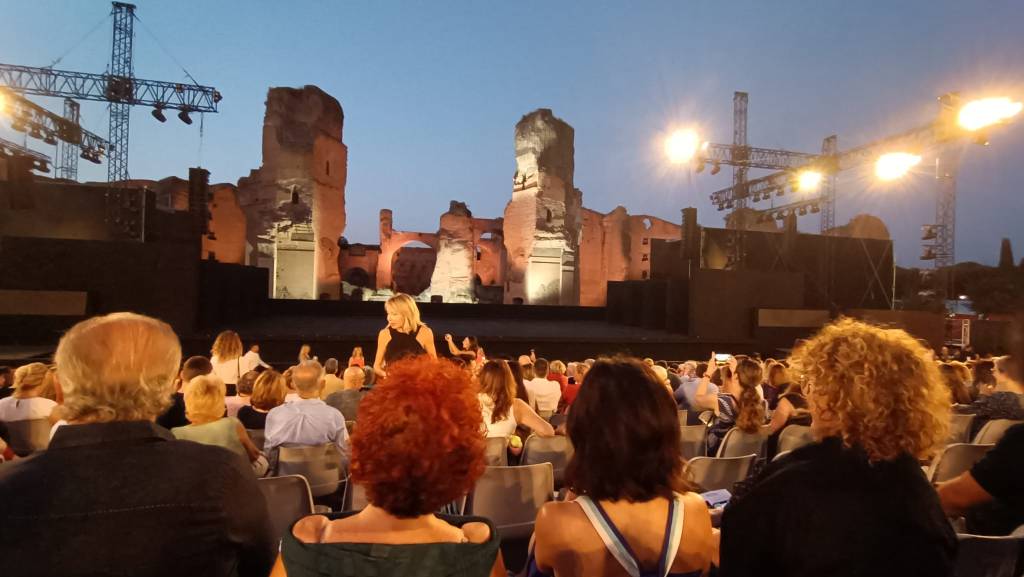
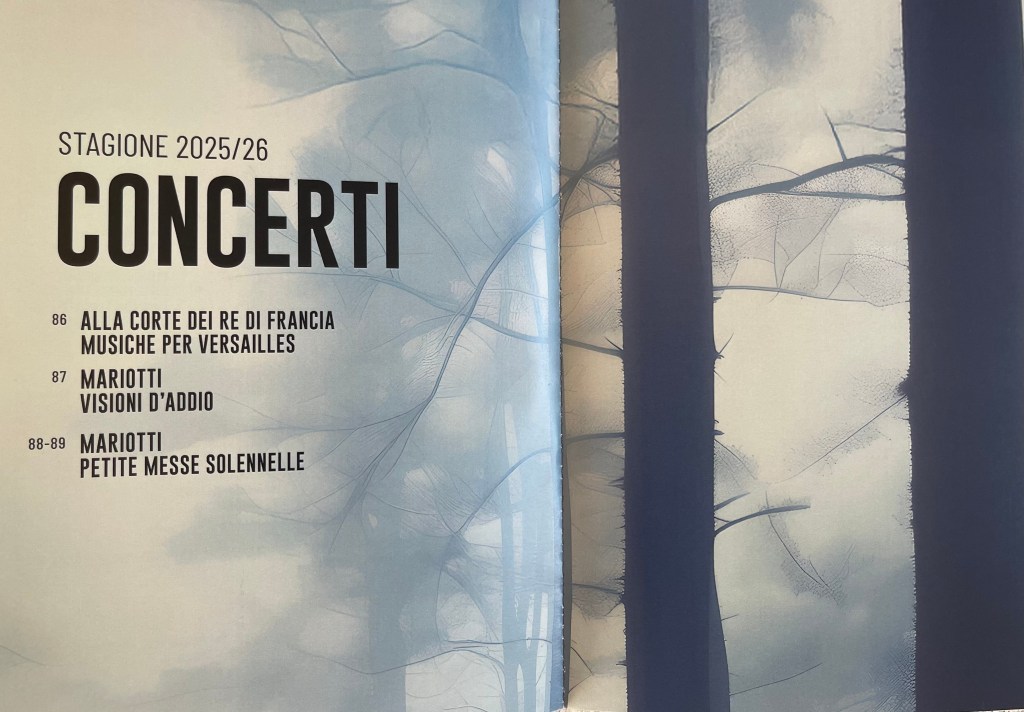
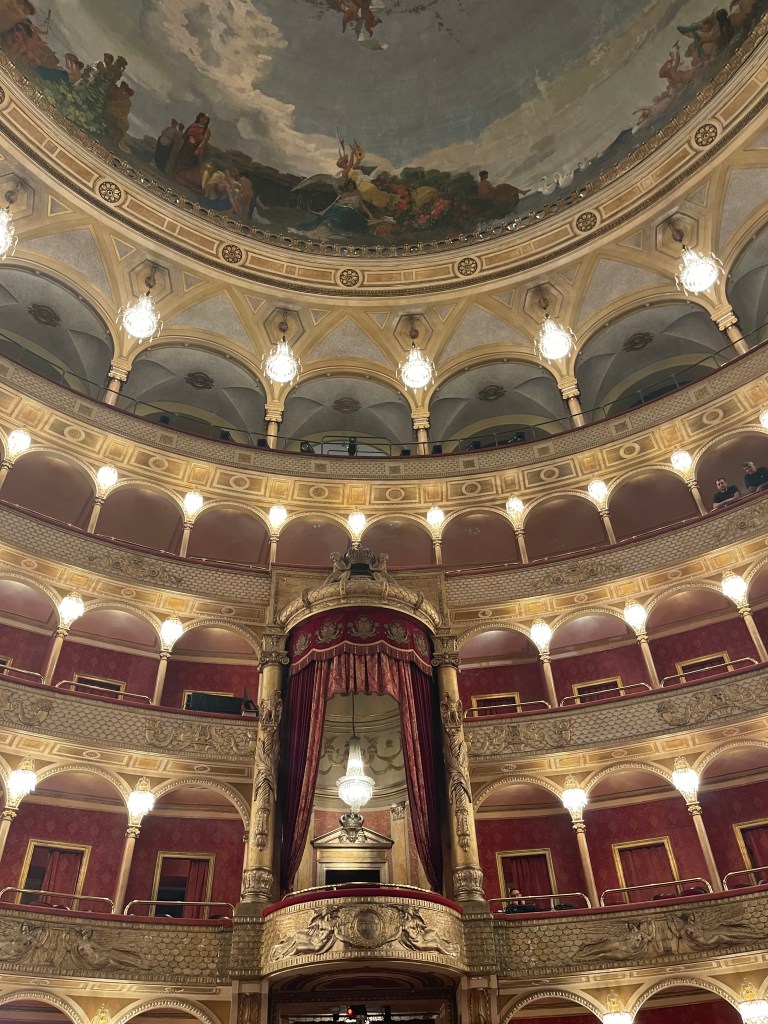
Rome Opera maybe the coolest and calmest place today in an Infernal City with temperatures well into their thirties .But even here it will be hotting up this autumn with a programme announced of 14 Operas, 8 Ballets and 3 Concerts for the 25/26 season.With another 8 titles this month in the historic open air Baths of Caracalla and Massenzio Basilica under the title from the Sacred to the Human.

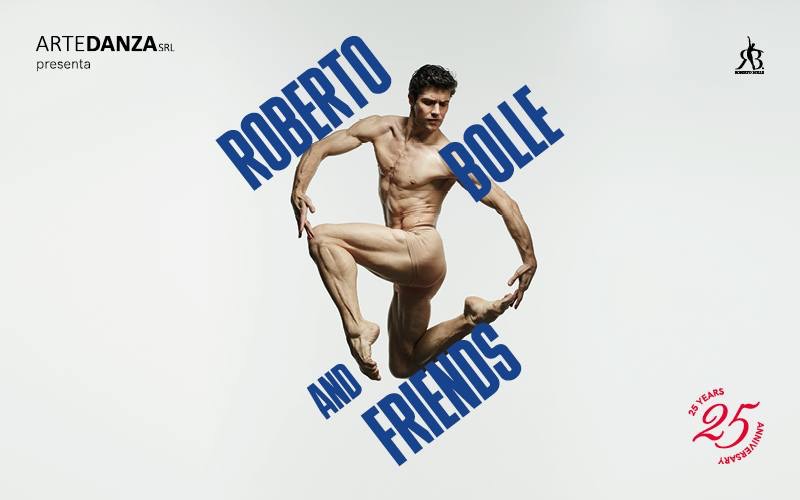
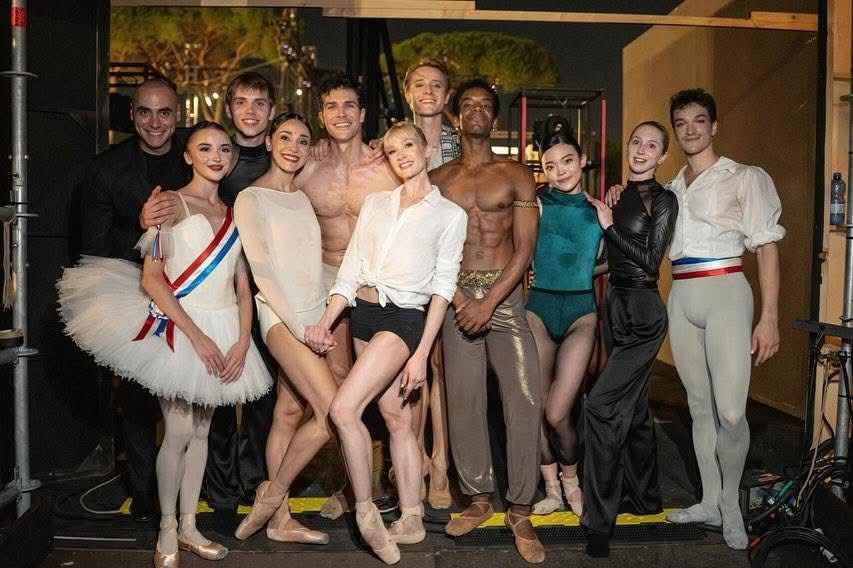
The superb Roberto Bolle and friends on stage tonight, but not sure what category that falls under, as with West Side Story or Carmina Burana too .

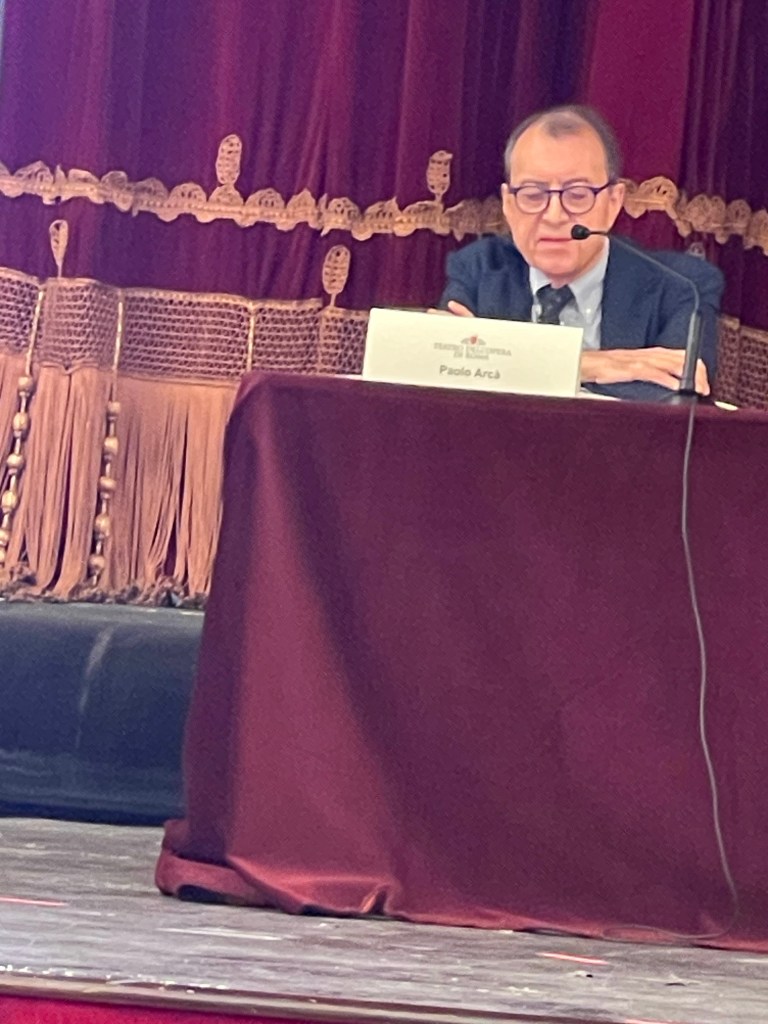
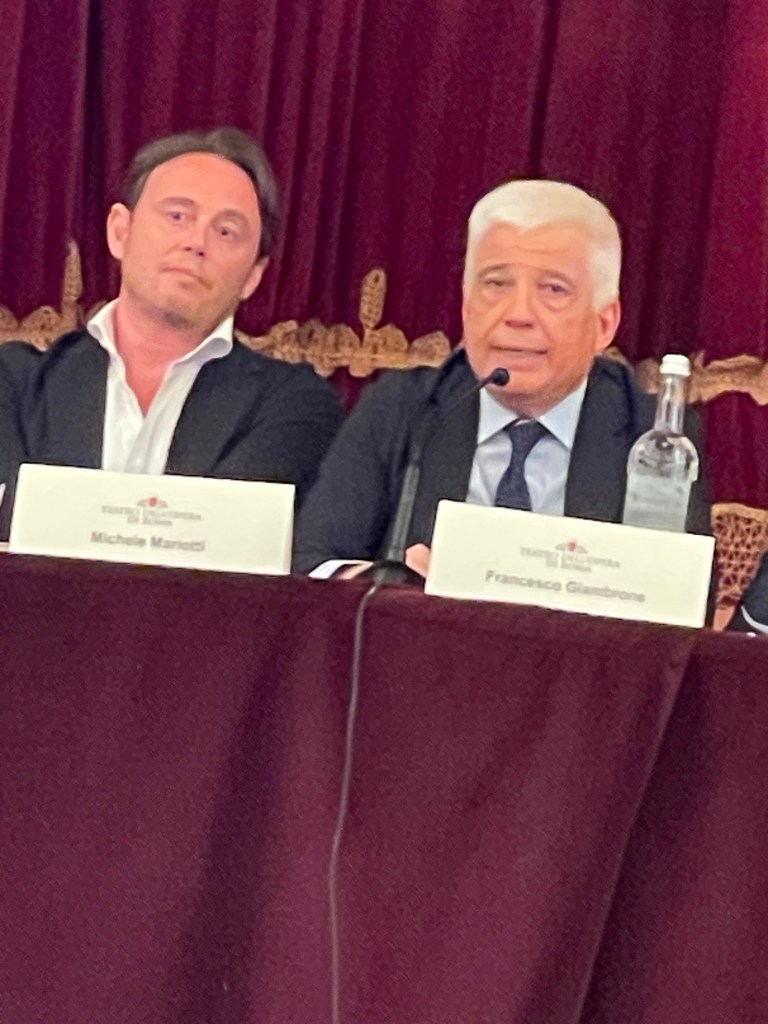
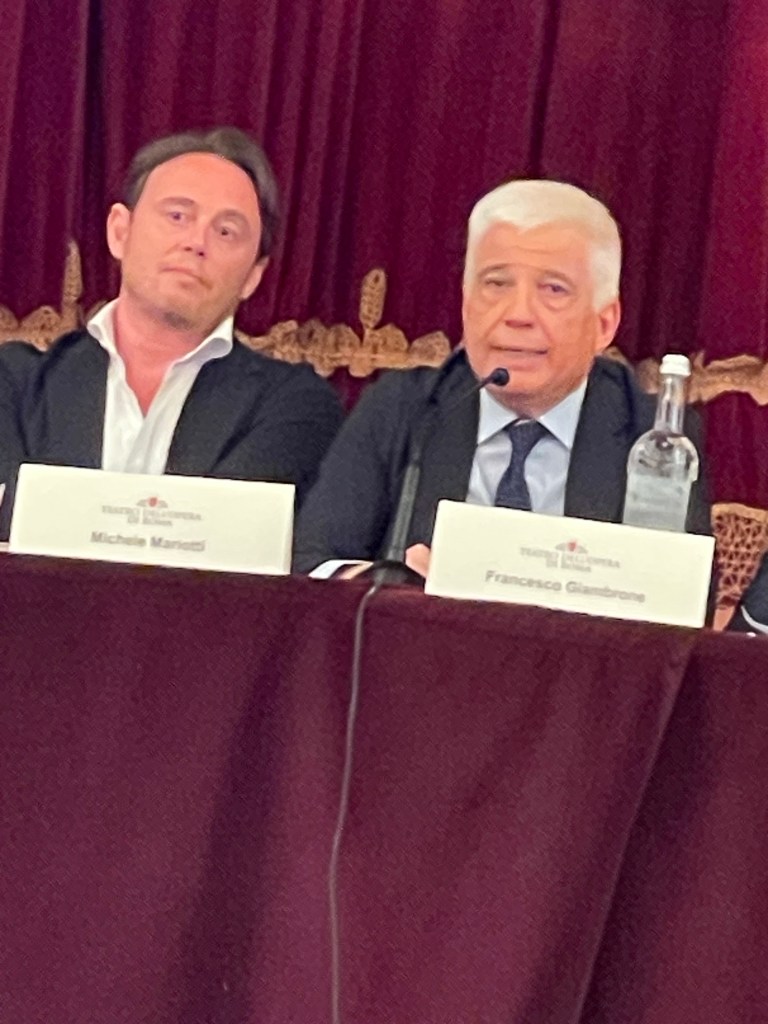
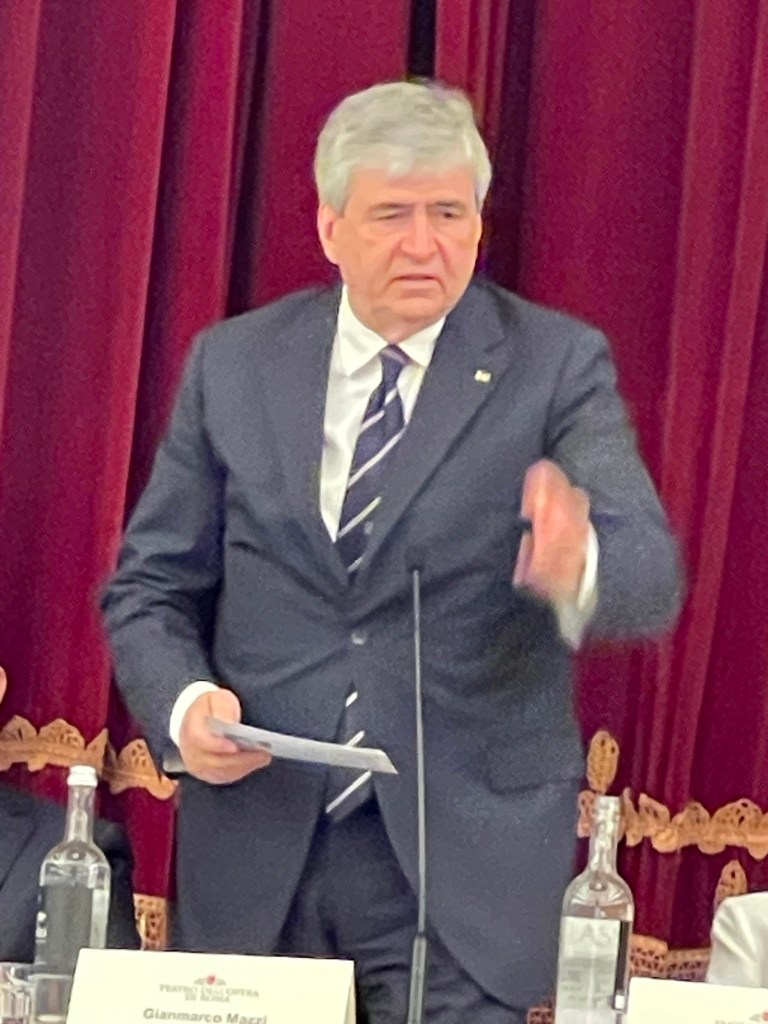
They make enticing titles ,though , for the Rome Opera that over the past few seasons has known how to reinvented itself thanks to the genial presence of Paolo Arcá and Michele Mariotti under the eagle eye of Francesco Giambrone.

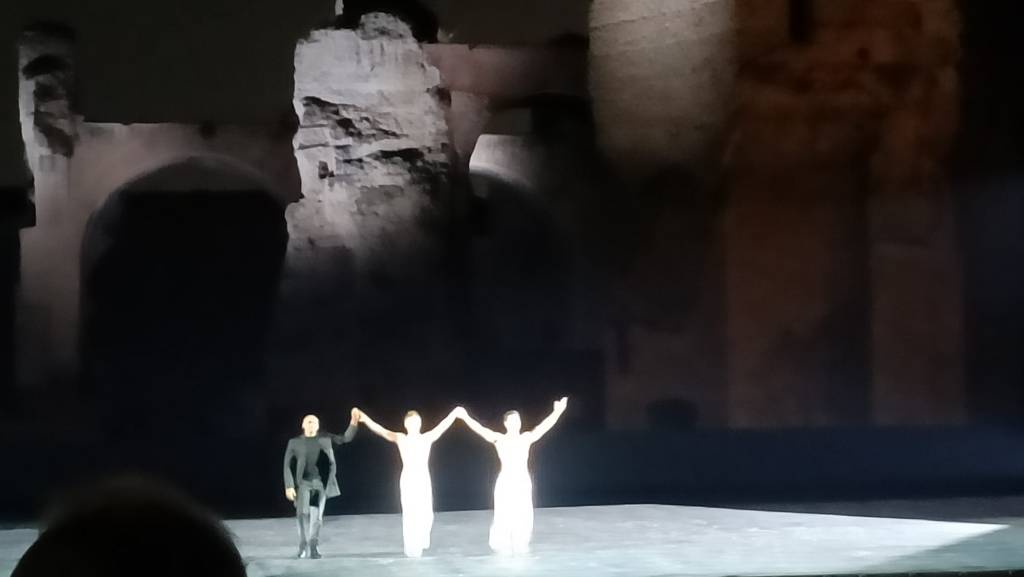
Simonetta Allder the renowned Ballet critic based in Rome writes ; “Before Clair de lune, Marcos Madrigal played a short solo, Rachmaninov’s Spring Waters which the many dance lovers in the audience immediately recognised as being one of the most challenging pas de deux for ballet dancers: choreographed by Asaf Messerer in 1959, it epitomises the athletic Soviet style of ballet. On this occasion, however, the thrills were entirely up to the virtuoso playing of Madrigal, as the whirlwind speed of the piece is understandably a little too-challenging for the now 50-year-old Roberto Bolle.

The ballet divo appeared onstage shortly afterwards, with his male partner Toon Lobach, for the much gentler Debussy. The choreography, by Julian Nunes, although not virtosistic, demanded the precision and grace that only great dancers like Bolle (and friends) can provide. No moon was visible in the sky above the stage last night, so it was indeed up to Bolle and Lobach, both in white, to remind the enthralled spectators of the ever-changing motions of the moon – in contrast to the nocturnal black of Marcos and his piano. Together, the four could not have shone more brightly, bringing the house – or rather, the Baths – down!”

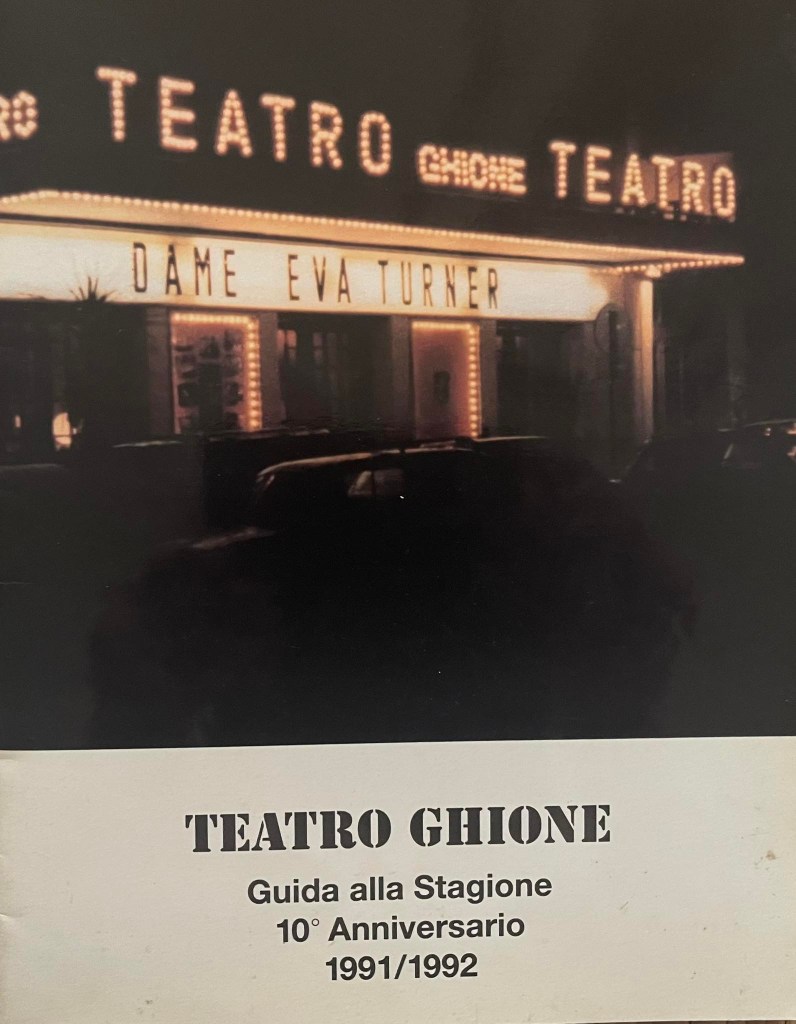
Simonetta Allder with Lorenzo Tozzi of Il Tempo. Two critics in Rome that I have known since they were the first to discover Teatro Ghione as a refreshing cultural centre of excellence in the 1980’s and 90’s.
https://christopheraxworthymusiccommentary.com/2024/03/20/christopher-axworthy-dip-ram-aram/

Alberto Portugheis plays Mozart ‘A man for all seasons ravishes and astonishes’

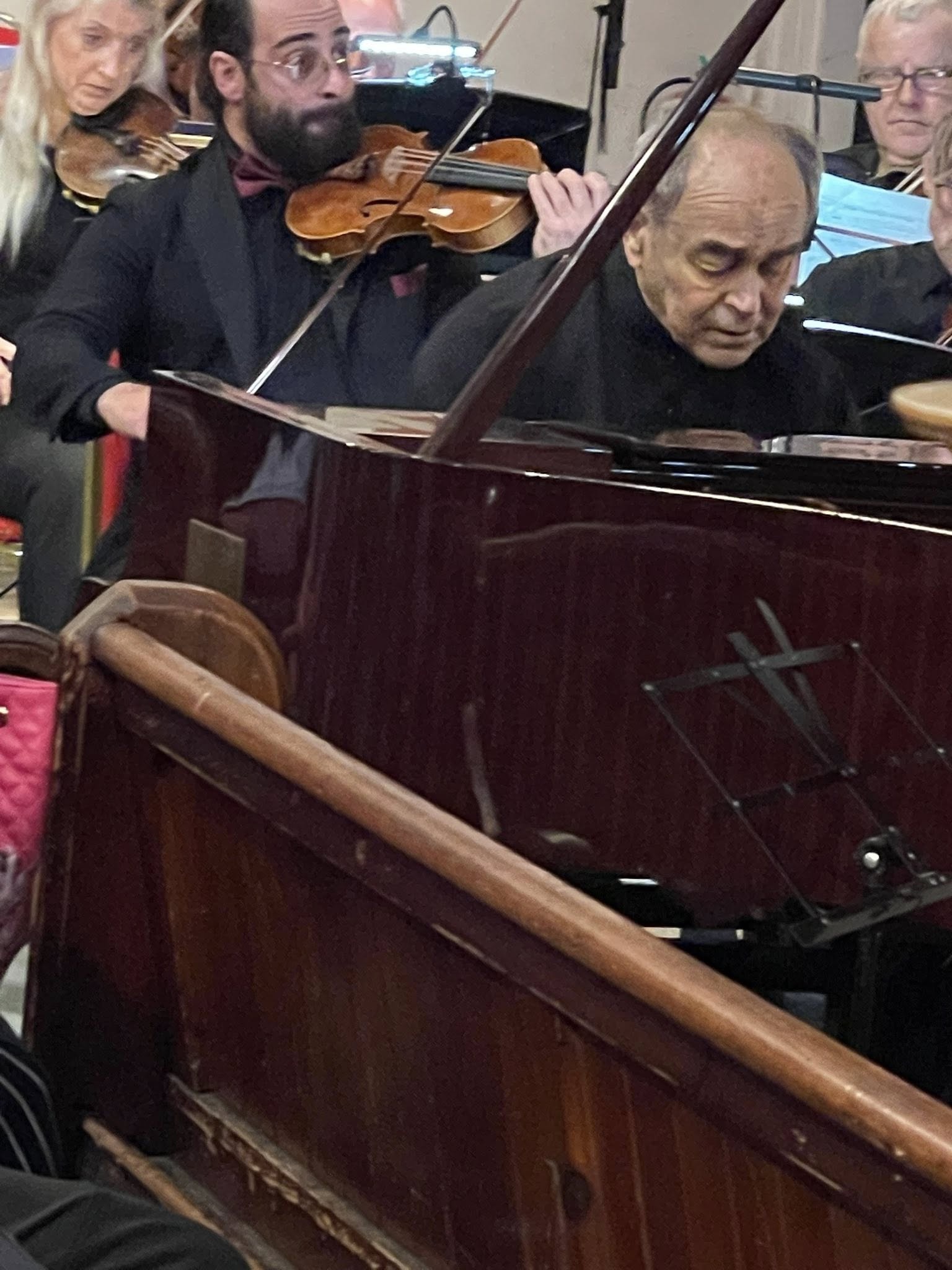
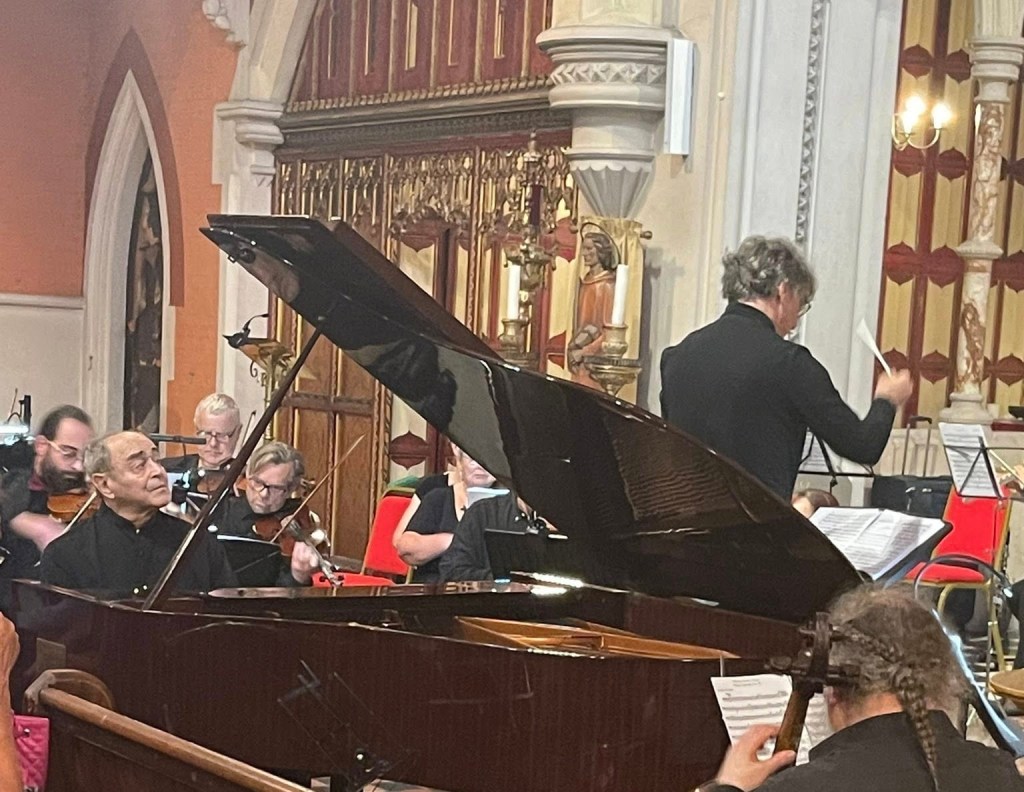
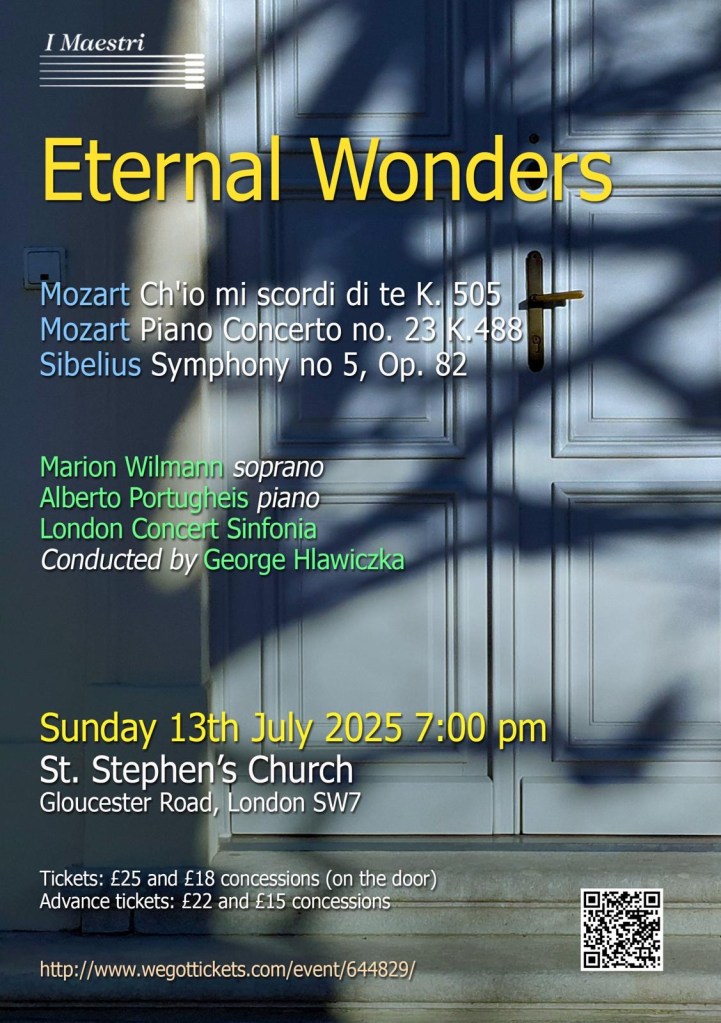
Eternal wonders exclaims the poster and indeed there were wonders from the 84 year old veteran pianist Alberto Portugheis that after a performance of Mozart’s sublimely mellifluous Concerto K488 and the concert aria ‘Ch’io mi scordo di te’ ,with a superb Marion Wilmann.

With the superb Irish soprano Marion Wilmann

He could still sit down at the end and rattle off the Turkish March in a subtle refined way that would have shamed a pianist a third his age.

It seems like only yesterday that I turned pages, as I did today for the Concert Aria, for his 75th birthday concert with his close childhood friend Martha Argerich. That was nine years ago and both Alberto and Martha are still astonishing the world with their eternally youthful Indian Summer .

The sublime slow movement of the concerto was played with the passion of a mature artist still with a heart of gold beating vibrantly. A cadenza in the first movement played with great poetic significance and the last movement just sprung from his agile fingers with youthful mastery but mature insightful meaning. Mozart may be too easy for children and too difficult for adults but Schnabel obviously did not contemplate an 84 year old in his Indian Summer playing with such intelligence and ‘joie de vivre’ .

An orchestra miraculously bonded together by George Hlawiczka …..Eternal wonders were indeed in evidence tonight.

Sinners night indeed ! ( for those not tennis fans, during the performance of Mozart, Jannik Sinner beat Carlos Alcaraz in the men’s final at Wimbledon ).

with the superb Neapolitan first violin, Yisha Xue and Roger Pillai from the Asia circle of the National Liberal Club, and Antonio Morabito
C.A , Alberto Portugheis and Yisha Xue
Alberto with the superb Neapolitan first violin
https://christopheraxworthymusiccommentary.com/2024/03/20/christopher-axworthy-dip-ram-aram/

Norma Fisher The making of a legend

After almost 40 years at the helm Norma and her husband are happy to pass the Artistic Direction to Matthew Huber – Norma fisher remains the Founder and Chairman
with Yitan Ma

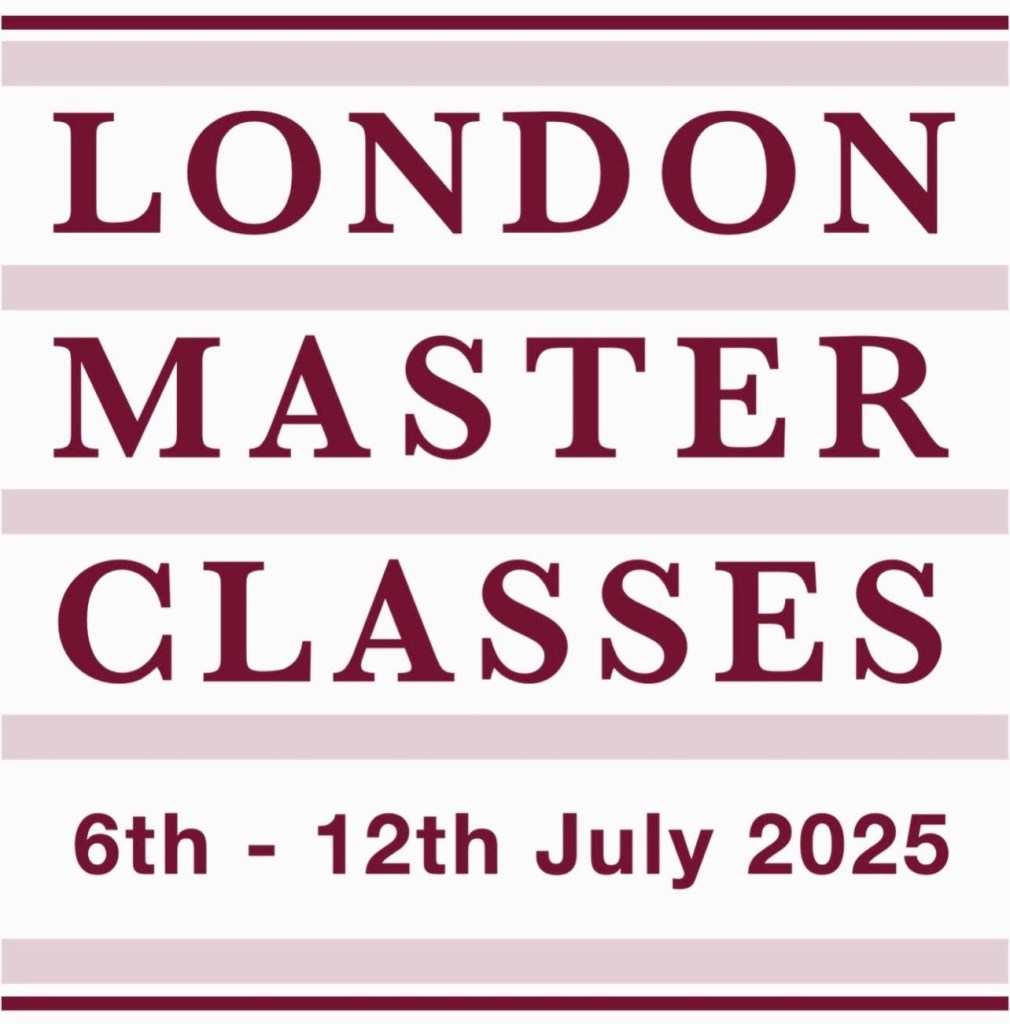
The indomitable Norma Fisher with the last day of her London Master Classes.

Lesson in artistry of how to shape the music like a ballet dancer with grace and horizontal movements .Allow the arms and hands to shape the music with the same shapes as on the printed page like a painter before his canvas.

The Class today with the new Artistic Director Matthew Huber on the far left

Debussy, Mozart, Chopin, Granados and Liszt from the very accomplished hands of Milosz Sroczynski, Anna Lotte Smith, Xizang Chen, Yifan Ma and Pasqual Encamacion Garrido

Norma wishes her students well. Aware of the sacrifice they are making for Art, but also the unique rewards they receive.

Norma after six hours still had words of admiration and encouragement for the young artists who had spent a valuable week in the company of a very remarkable lady.

with Pasqual Encamacion Garrido
https://christopheraxworthymusiccommentary.com/2024/03/20/christopher-axworthy-dip-ram-aram/

Beatrice Rana bringing Classiche Forme from Lecce to London.’ Music making at it’s finest with burning intensity and mastery’

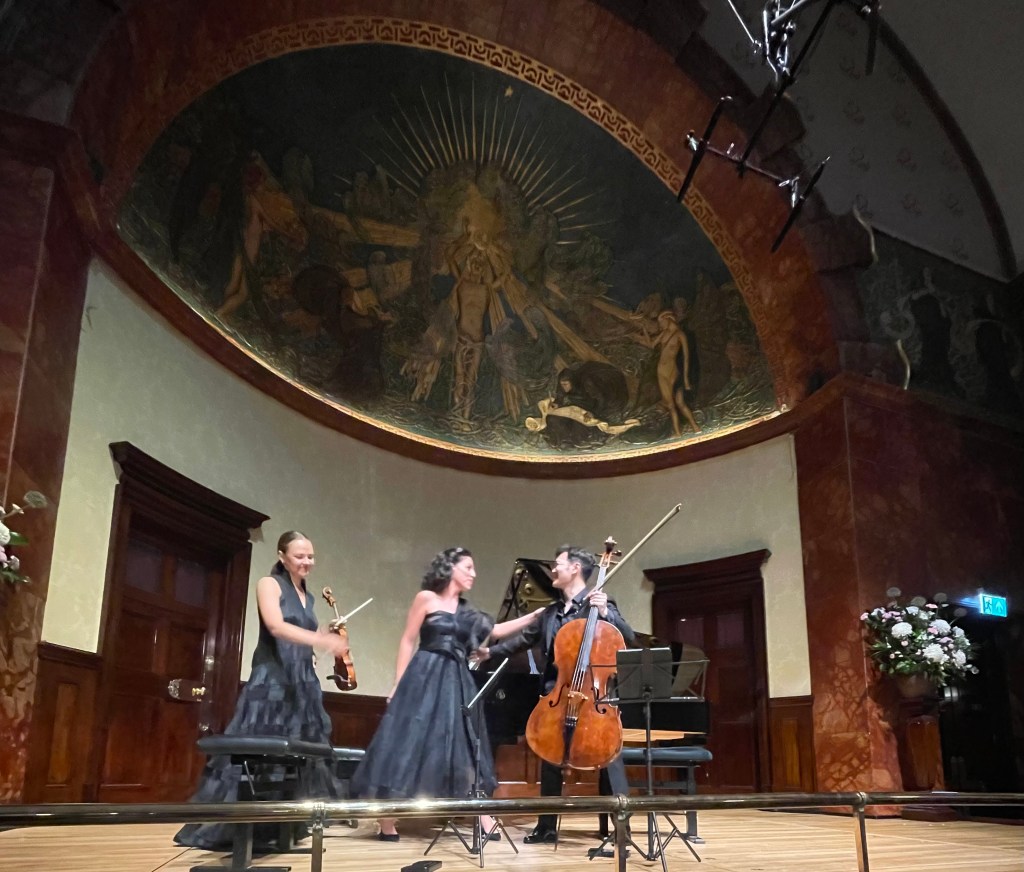
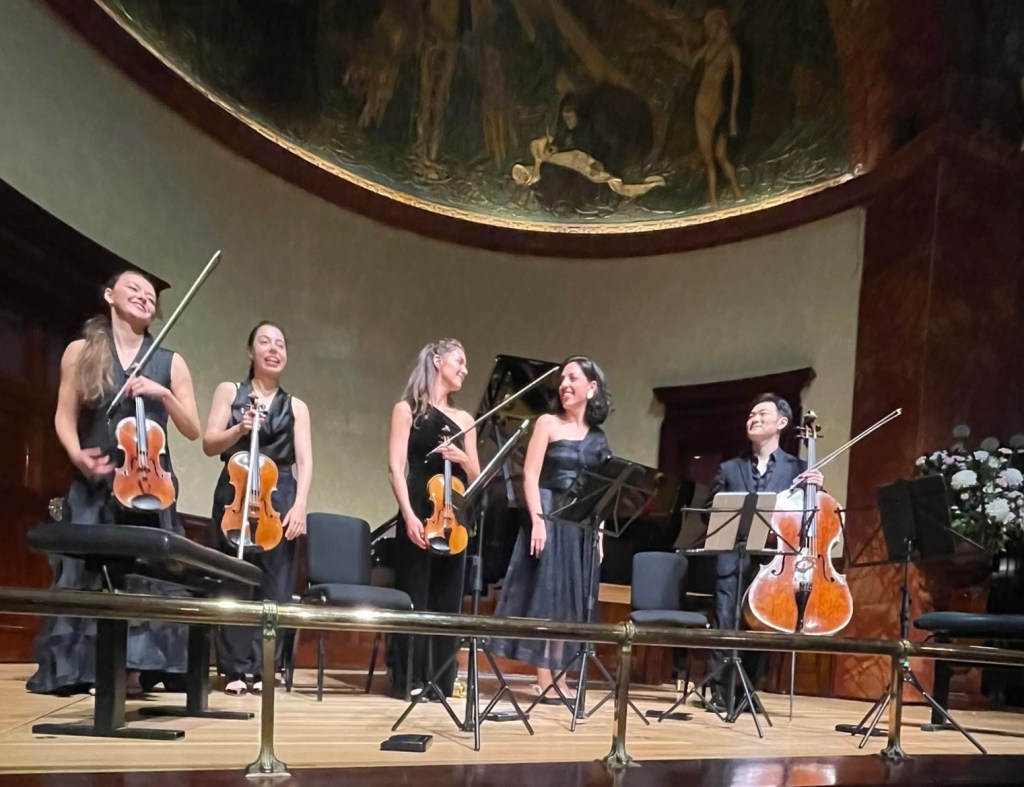
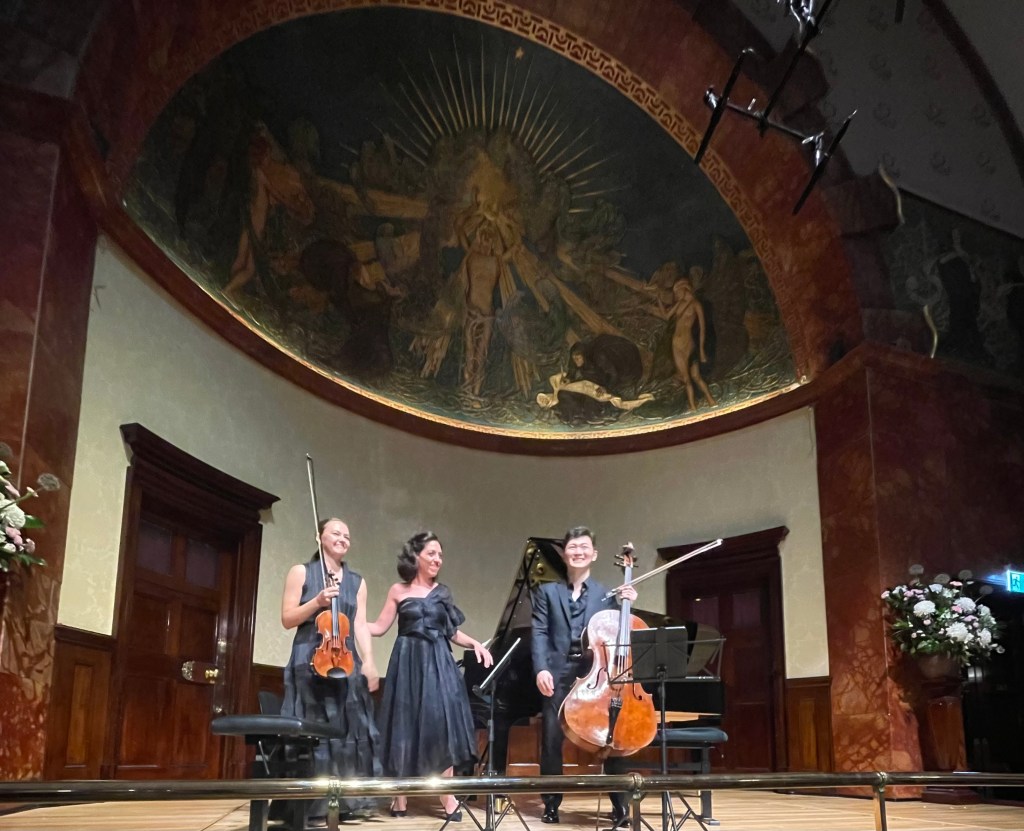
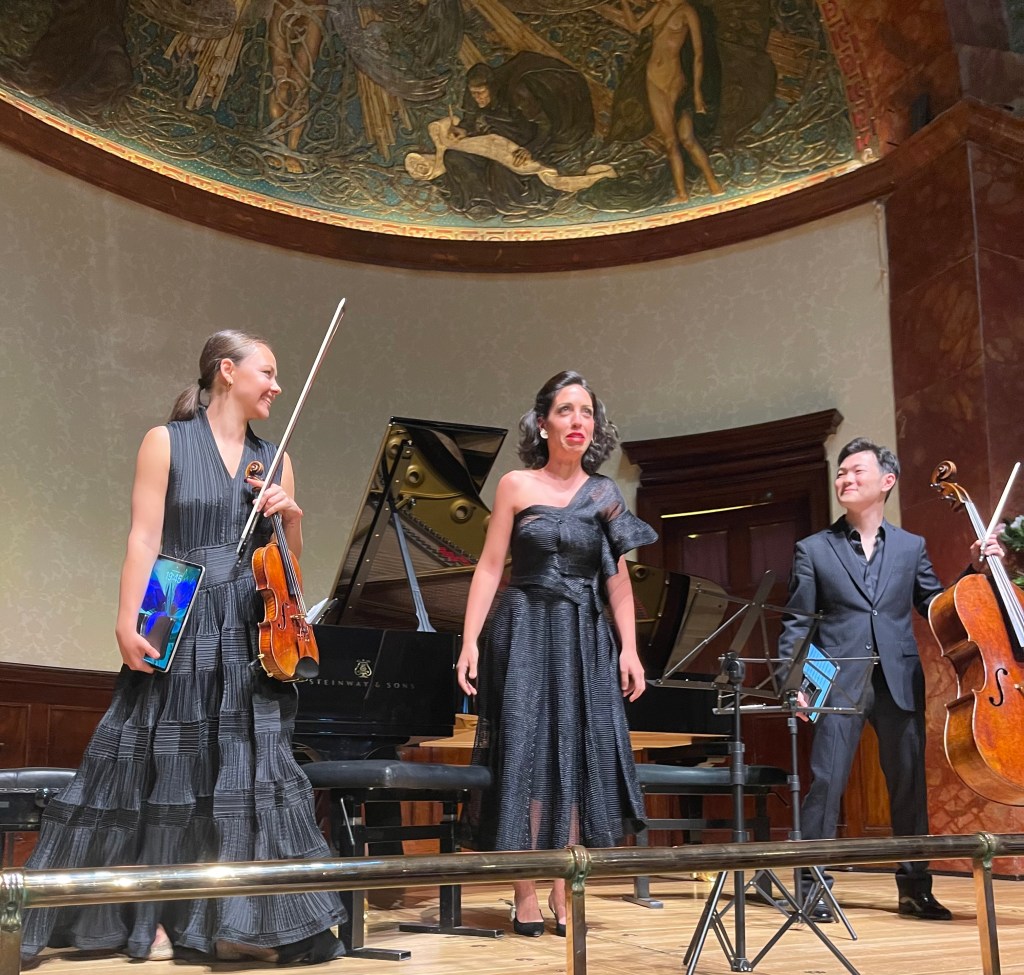
What a treat to find the same temperature in London as in Lecce. But it was Beatrice Rana who brought the sun, together with her quite extraordinary companions who could ignite and illuminate the music not only of Robert but also of Clara Schumann.

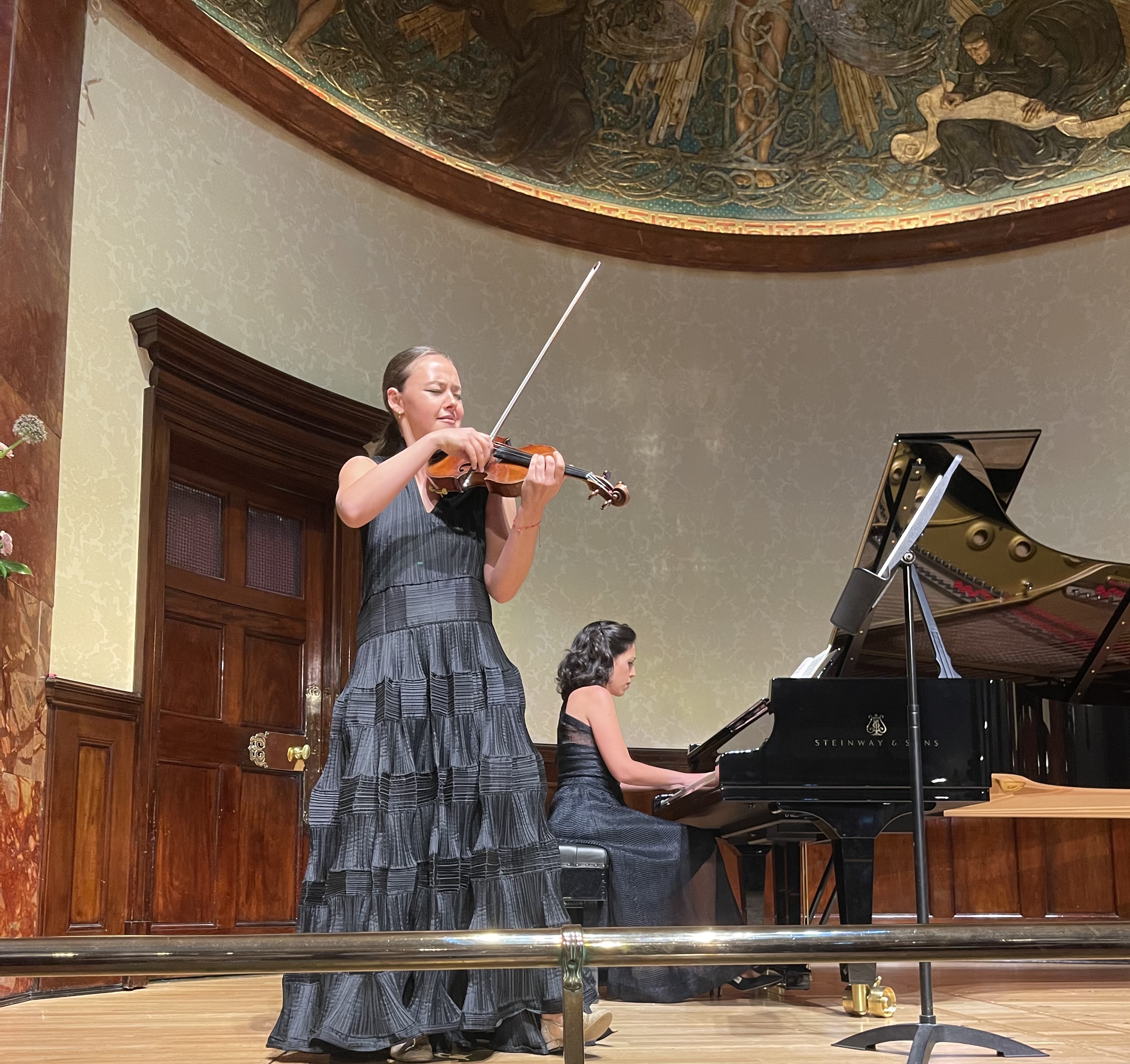
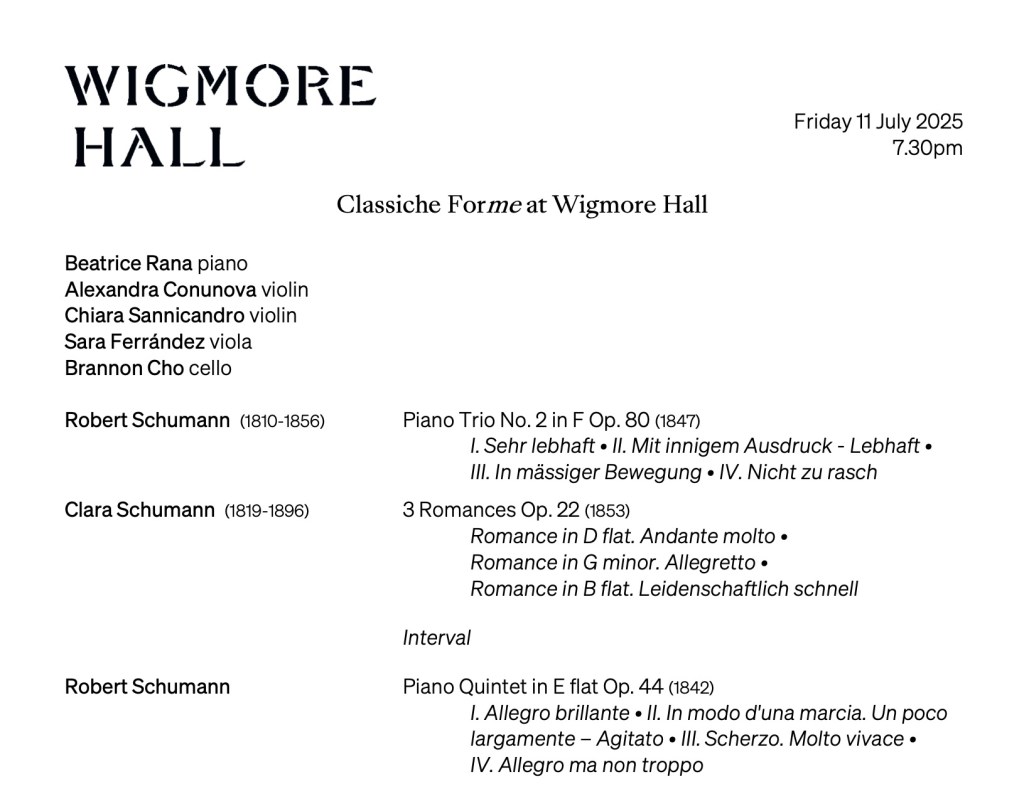
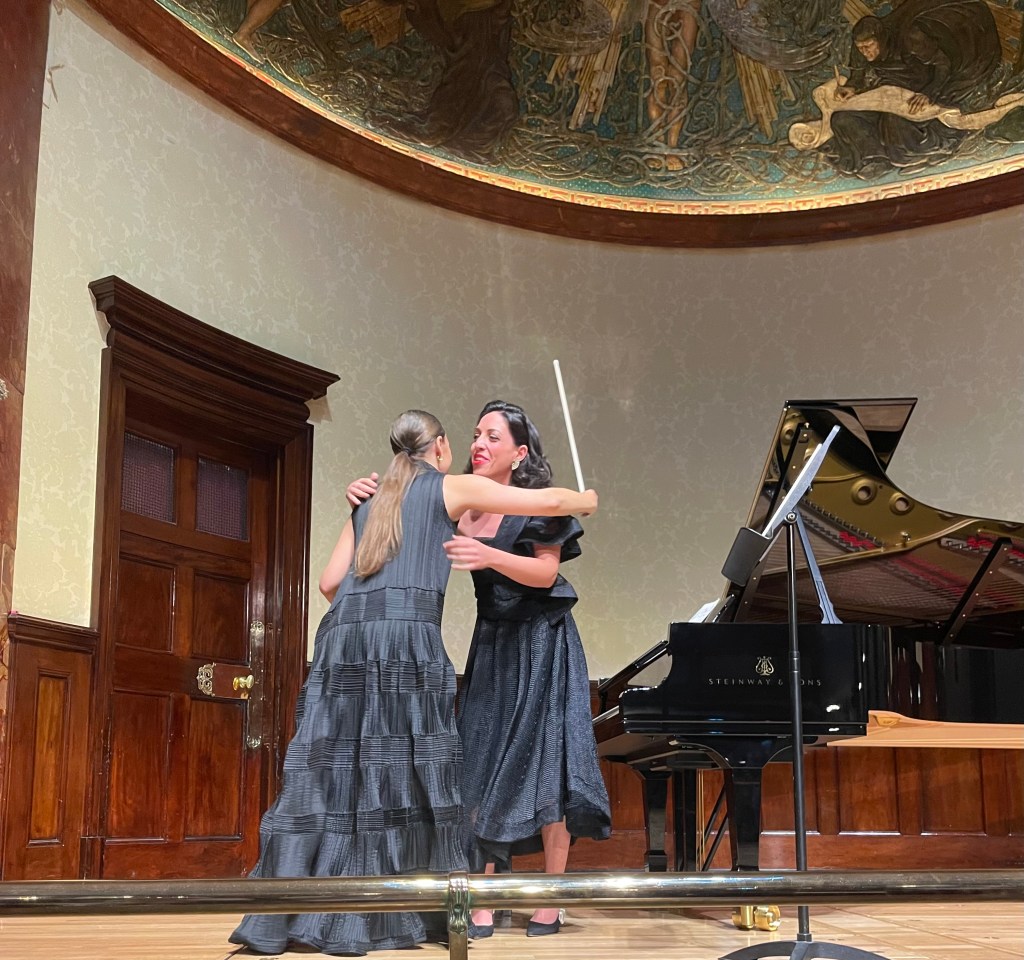
Three Romances by Clara Schumann played by the extraordinary Alexandra Conunova with a burning intensity and insinuating beauty as our two ‘gals’, Beatrice and Alessandra, looked at each other with knowing glances of a complicity that was quite spellbinding. Hardly glancing at the score but more into each other’s eyes,bringing radiance and beauty. to all they did . A mellifluous outpouring, where the Romance in B flat could have been penned by Mendelssohn such was the lightness and refined style of florid beauty that swept across the stage and into our hearts.

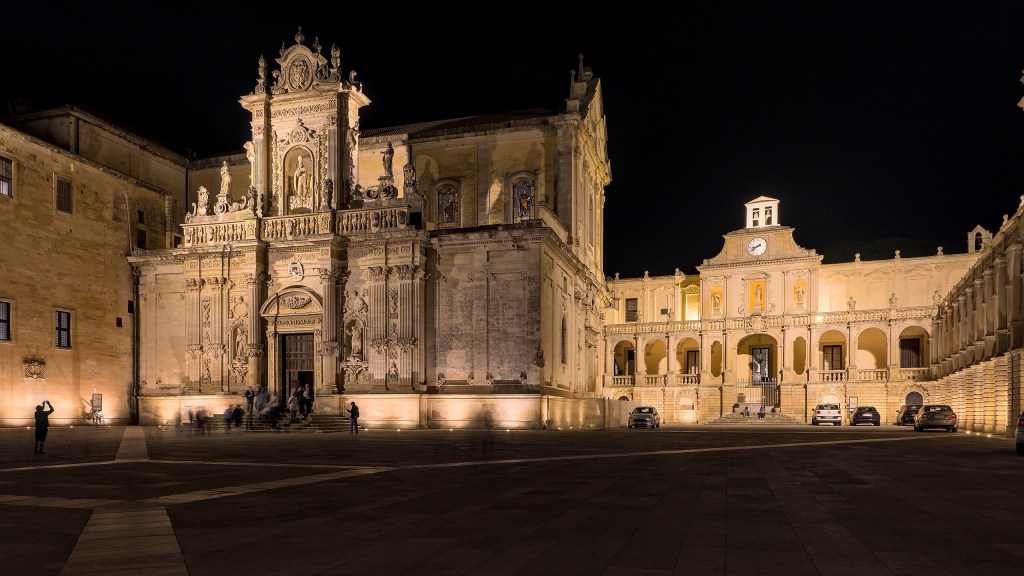
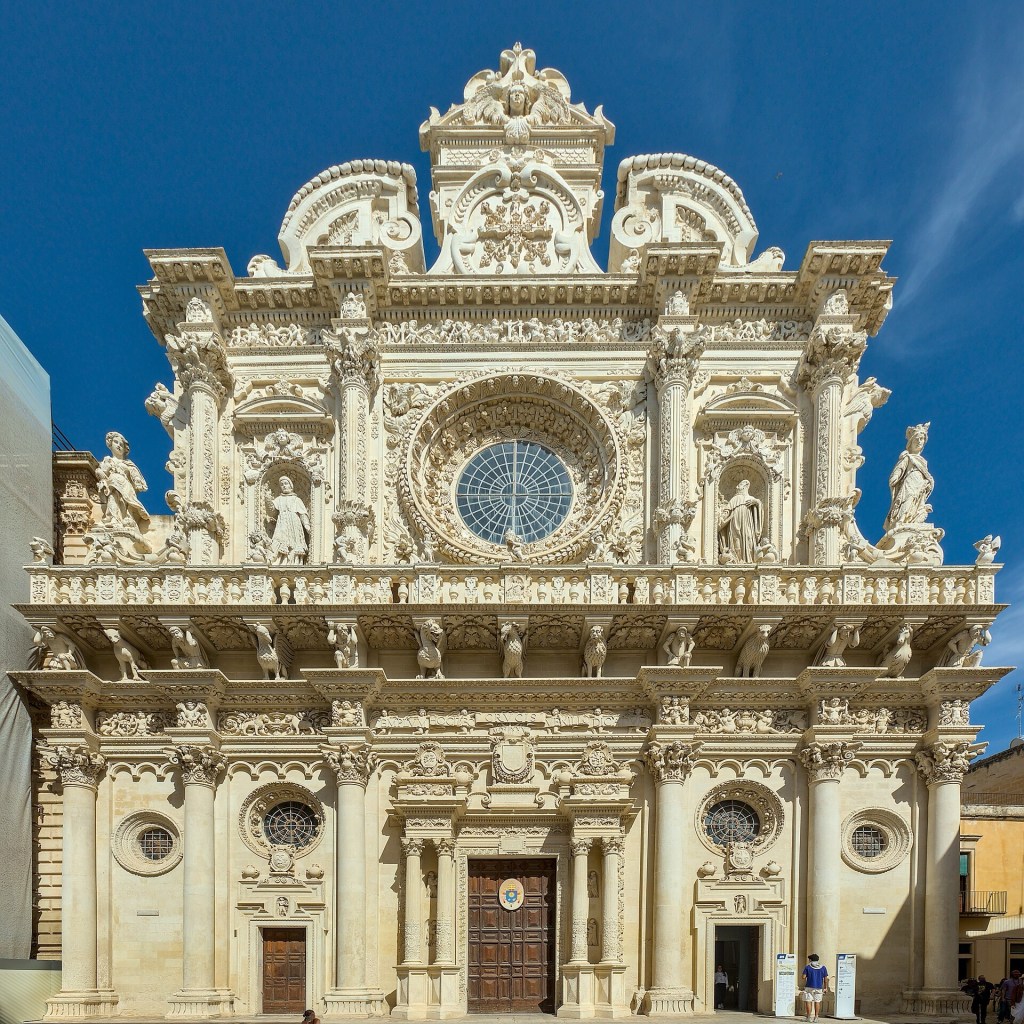
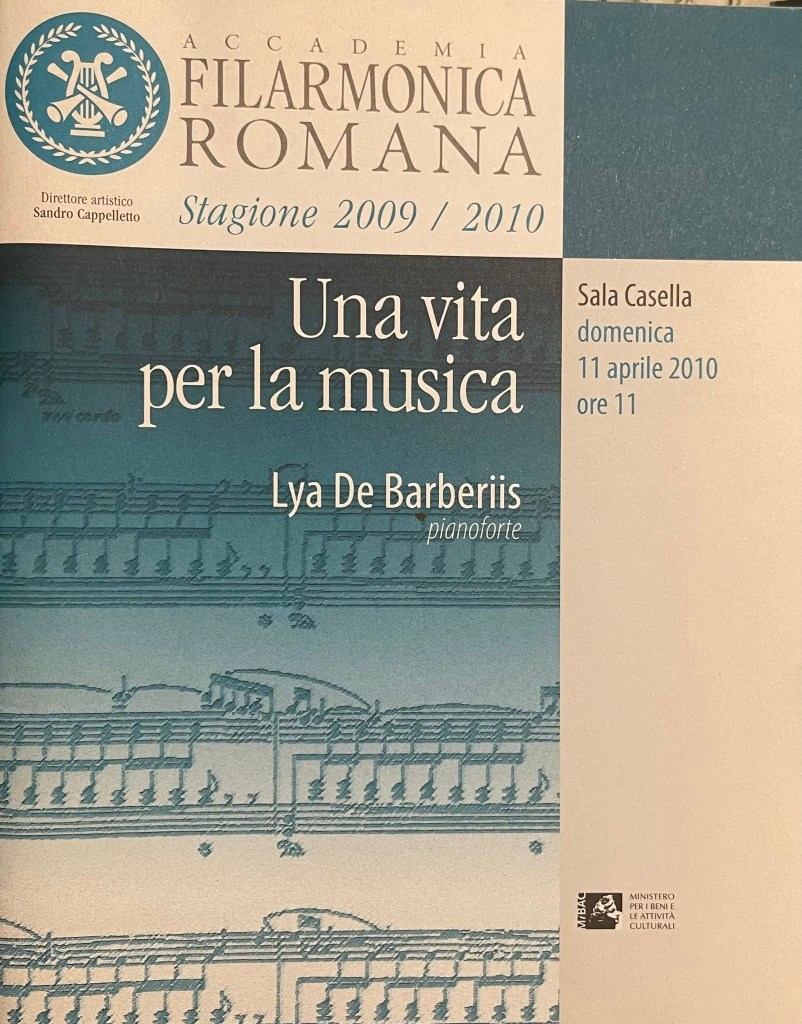
Beatrice has brought her chamber festival to London, that she has created in the Florence of the south that is Lecce.Tomorrow she opens her festival in her homeland in Italy but today she shared with us the radiance and beauty of what is, in many ways, the cultural centre of Italy. The homeland of Riccardo Muti ,Benedetto Lupo, Giaconda de Vito, Lya de Barberiis, Francesco Libetta, Paolo Grassi and with the Festival of the Valle d’Itria ,now in its fiftieth year, in beautiful Martina Franca bringing unknown operas to the fore every summer, in this land ‘Kissed by the Gods’.

Clara Schumann was played with sumptuous sounds of insinuating seductive beauty and a late Trio by her husband, shortly to be in an asylum, was played with exhilaration and exuberance. Roberts,by now knotty counterpoints, creating an amalgam of sounds where the passion and mastery of these three players was quite breathtaking.Their inspired musicianship combined creating a breath of fresh air in the torrid heat that has hit London, and created a wave of communication where we the audience were not mere spectators, but participants in a voyage of discovery together. It was quite extraordinary how we became one as their music making enveloped us in a poetic outpouring of such immediacy.

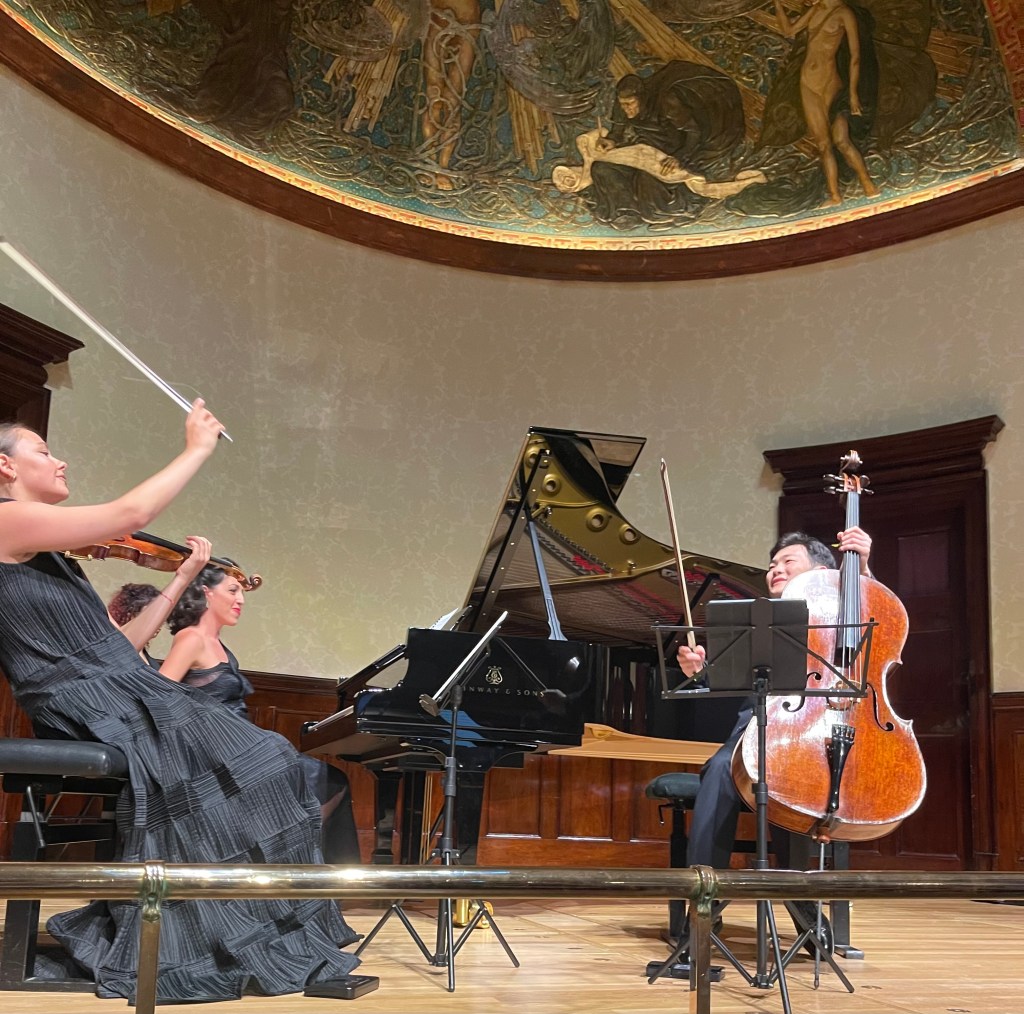
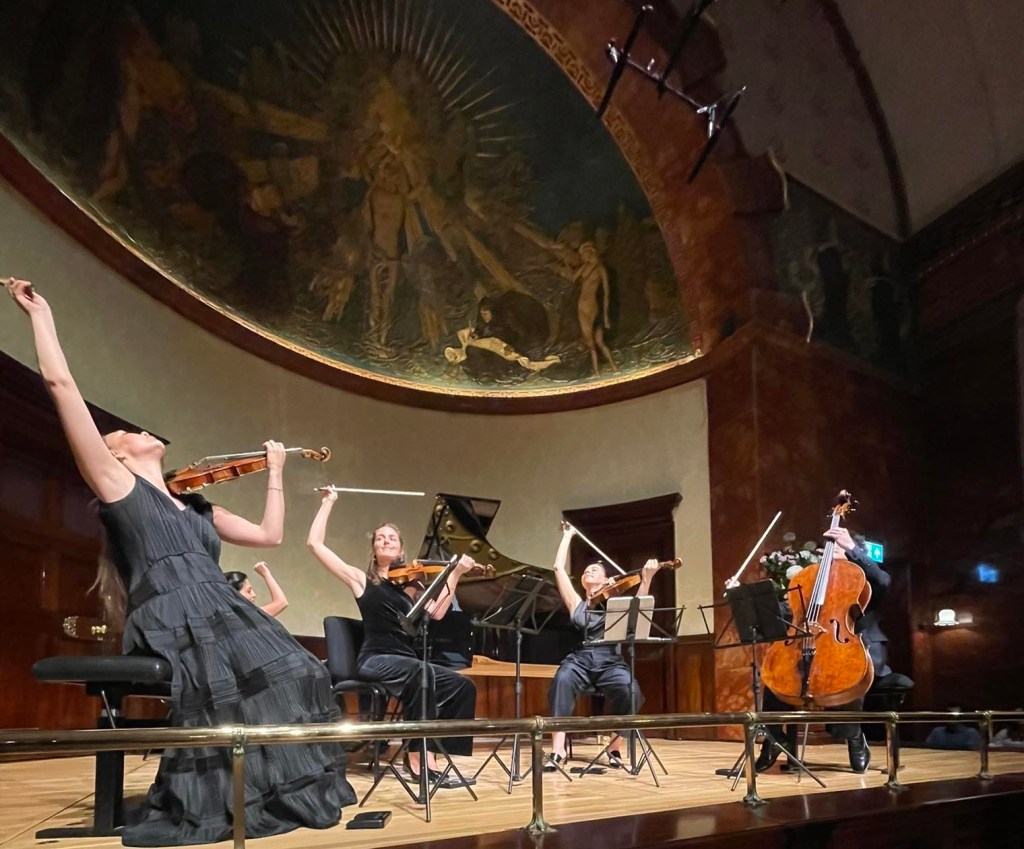
But it was the monumental performance of Schumann’s quintet that truly showed us what chamber music is all about. Passion and poetry combined, with each of the five masterly musicians looking at each other as they travelled on a wondrous voyage together. Each waiting to pounce as the musical conversation reached a burning intensity combined with moments of sublime beauty. The cello and viola communing with each other as the violins added poignant comments of extraordinary intensity. Beatrice of course at the helm but listening so intently to her colleagues, and even with the piano lid fully open she never became a soloist but a fellow traveller in a wonderland of sumptuous music making. I remember Rubinstein at 85 running onto the stage in London and not even waiting for the Guarneri Quartet to begin, such was his joy at the idea of making music with his colleagues. It was the same today, although Beatrice a third of his age was less impetuous and was surveying all around her, creating moments of magic with her whispered meanderings just adding to the beauty of her surroundings. A Scherzo that was played with daring exuberance and exhilaration. Almost dancing in their seats as the Brahmsian dance rhythms took hold of them. Sharing smiles of recognition as they discovered even more secrets revealed to players prepared to risk all with the ‘joie de vivre’ participation of trusted friends.The barely whispered final chord of the second movement had something truly celestial about it after a gentle march of poignant significance. Such dynamic drive but also moments when the sun came out, as in Schubert, where wondrous melodies were allowed to sing with touching simplicity . Beatrice understating rather than projecting the music drawing us all into a world of wondrous music making.

All the colours of Classiche Forme 2025

To remove barriers between stage and audience, to combine popular Salento traditions with classical music, to present artists with established careers alongside emerging young artists, to commission new works, to discuss current musical issues, to invest in the renovation of the audience: these are the founding prerogatives of Classiche Forme. My desire is to bring to my Salento all the emotions that I experience playing around the world, creating a strong connection among the territory, the artists, the audience and music.

BEATRICE RANA
Artistic director

The baroque of Lecce with its range of colours from white to golden, the masseria dotted with the green-grey of the olive trees and the brown of the soil, the deep blue of the Salento sea: from July 13th to 20th2025, the colours of Apulia will light up the ninth edition of Classiche Forme, the international chamber music festival founded and directed since 2017 by pianist Beatrice Rana, promoted by the Associazione Musicale Opera Prima, with the support of the MIC – Ministry of Culture, the Apulia Region and SIAE as part of the “Per chi Crea” project, in collaboration with the Province of Lecce, the City of Lecce, the University of Salento, Terre del Capo di Leuca and the Lecce Biblio-museum Pole.

Eight concerts and three conversations in iconic locations in the Salento (normally not used for chamber music) to form an unprecedented ‘sound postcard’ thanks to programmes devised by Beatrice Rana for her ‘friends’: internationally renowned artists who will gather to make music together in the ever-popular cloisters of Lecce, in the farms of Supersano and Casamassella and, for the first time, in Santa Maria di Leuca, where the easternmost tip of Italy faces the sea.

‘Organising a festival like Classiche Forme, dipping into and involving the public in a week of concerts, encounters and great performers,’ says Beatrice Rana, ‘is my way of creating new connections between music and current events every year. Our art has always had a strong identity power: this is why I am committed to making Salento, for a week, the heart of the international chamber music scene, not without an open reflection on social issues and, in particular in 2025, on the power of listening, which is so mistreated today.
The backbone of this year’s programming is held by composers who have drawn inspiration from this theme. From Mozart to Weill, from Messiaen to Weinberg: their pages have often made themselves interpreters of their era, just as today’s pages by Verunelli, Sollima and Panfili – who has written a new Quartet especially for us – do of contemporaneity. Space will also be given to the music of Ravel, an indispensable 20th century composer, whose 150th anniversary of his birth falls in 2025′.

Also in 2025 Classiche Forme will be preceded, on July 12th, by the Concert for the City in the Belloluogo Park in Lecce, where the Classiche Forme Oasis was born in 2022.

This year, moreover, the festival will inaugurate a series of initiatives dedicated to young people, an OFF section, to broaden the possibilities of participation in the concerts and also opportunities for knowledge and training.

P.S. On a more personal note I have always had strong links with Puglia – the heel of Italy. With our theatre company we toured many of the theatres and cinemas and in the Valle d’Itria in particular there was always as public that was not just made up of the usual season ticket holders but also the shop keepers and petrol pump attendants who would lap up the culture as rarely seen elsewhere.

Teatro Paisiello Lecce

We opened the restored Teatro Paiseillo with Pirandello ‘La Vita Che Ti Diedi’ and at the Teatro Politeama Greco ‘The Importance of being Ernest ‘ that much to my wife’s dismay and delight sold out for twenty one years all over Italy. Peter Hall had persuaded Judy Dench to play Lady Bracknell who had thought it too early for a leading actors career to start playing character parts.I had persuaded my wife to follow suit.

In the wings of the Teatro Politeama we found a plaque hidden away on the back wall of the stage dedicated to Tito Schipa who had made his debut in the theatre with Conchiata Supervia in 1911!

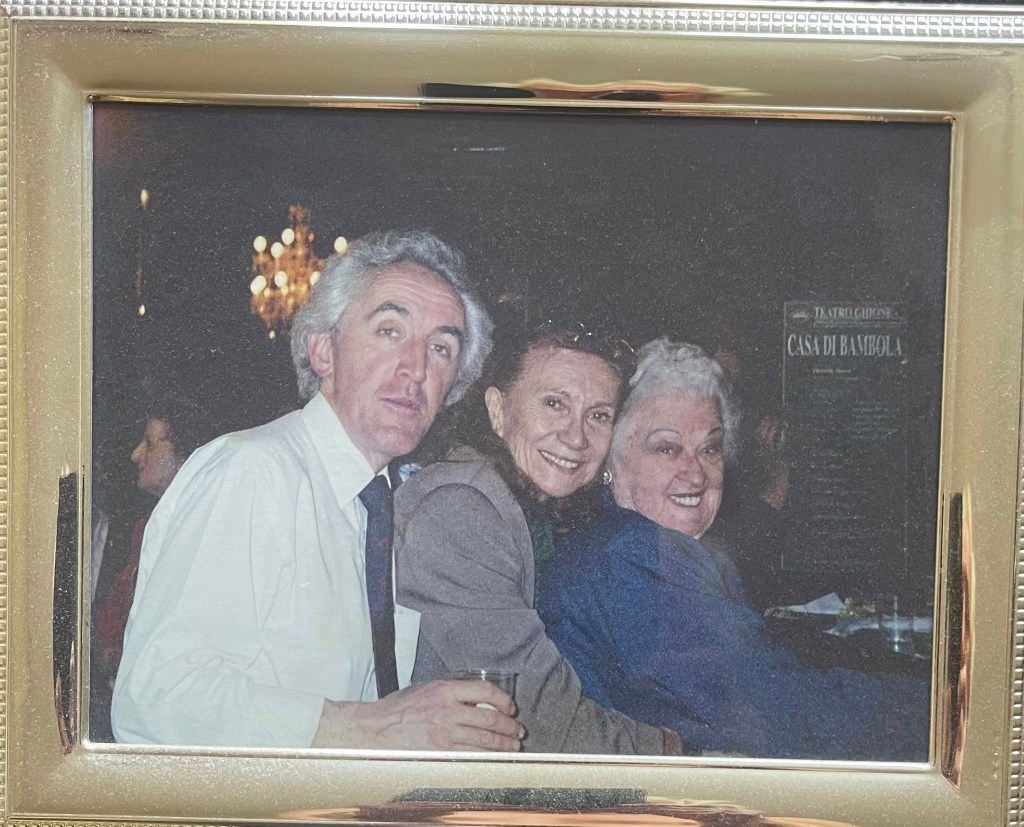
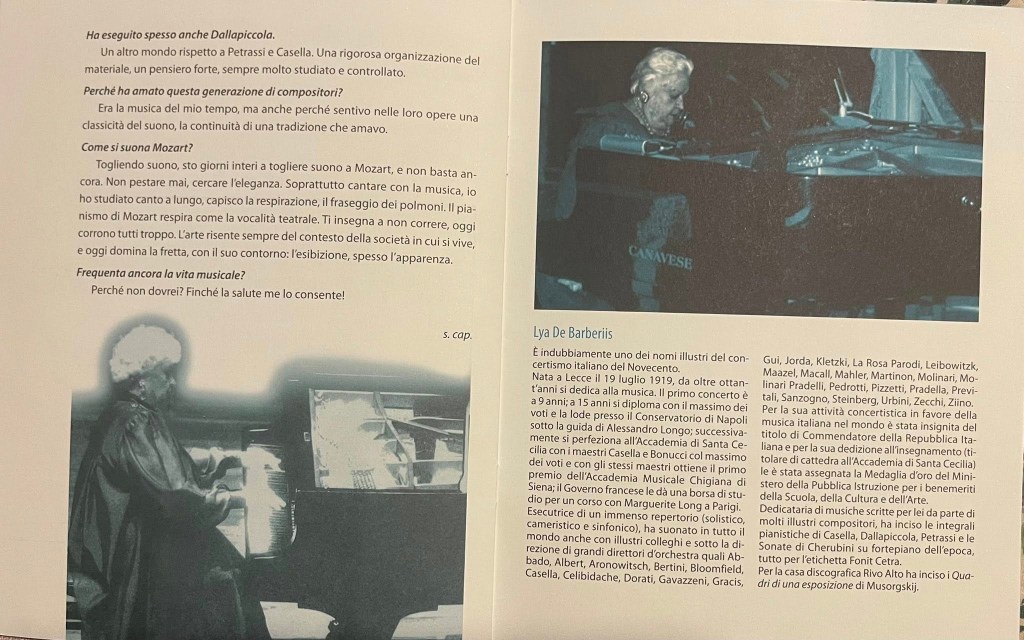
We also played in the Teatro Comunale in nearby Nardò the birth place of our dear friend and distinguished pianist Lya de Barberiis. In her later years we formed a piano duo and gave many concerts all over Italy. My wife would come too and was relieved to push me on stage instead of the other way around.

C.A with my wife Ileana Ghione and Lya De Barberiis

On one occasion in Racconigi I remember Lya and I giving a very successful Sunday morning concert and being flabbergasted when the mayor thanked us but gave a special prize to our driver, Ileana Ghione ( who was a hero in her native Piedmonte) !

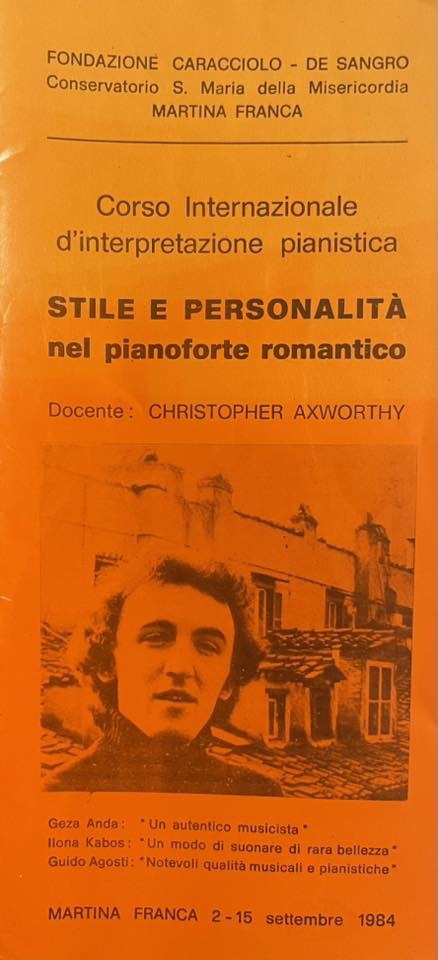
As a student of Agosti in Rome I was helped by the British council who allowed me to practice in their hall in Palazzo Del Drago in the centre of Rome . They had also accompanied a choir from Cambridge University to Martina Franca in the Valle d’Itria for the first festival in the early 70’s. It was run by Avv. Archangelo and his assistant was Dott. Messiah! Grace Bumbry was to sing the leading role of Norma for the first time in her career ( she always sang Adalgisa) .It was to be a try out for her performances with Monserrato Caballé at Covent Garden, where they would alternate roles. Bumbry of course got to London and found that Caballé had no intention of alternating roles! We in Martina Franca were treated to Bumbry’s memorable Norma

Via the British council a call for help for a pianist who could substitute a famous Italian pianist who was to give masterclasses in Martina Franca but had been killed in a car crash. I was sent and in a convent in the centre of this most beautiful town of Spanish baroque, where the streets looked as though they had been polished, I gave classes for the students of Sigra Messiah. A wonderful dedicated local teacher where music making was social as well as practical and the classes took place with they eyes of the Nuns looking down on us from grills high in the ceiling.This was a closed convent which the nuns never left even after death

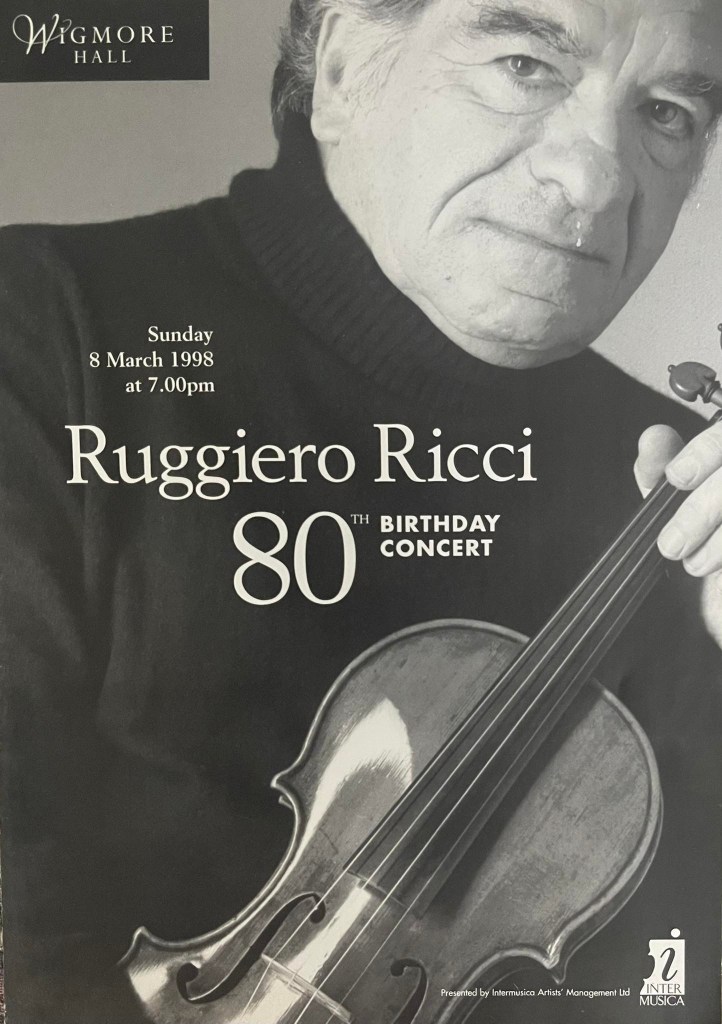
Much later Ruggiero Ricci was giving one of his many recitals and master classes for us in Rome when Jack Rothstein our dear friend and distinguished violinist appeared on a surprise visit .He could not get over how beautiful the Huberman Strad was that Ruggiero played . Giaconda de Vito had recently died and I don’t know what me say I wonder what happened to her violin? I had no idea that Jack was on a secret mission to Rome to evaluate her violin . It turned out that she had sold her priceless Strad years before when she retired to the English countryside with her husband who had been head of EMI .

https://christopheraxworthymusiccommentary.com/2024/03/20/christopher-axworthy-dip-ram-aram/

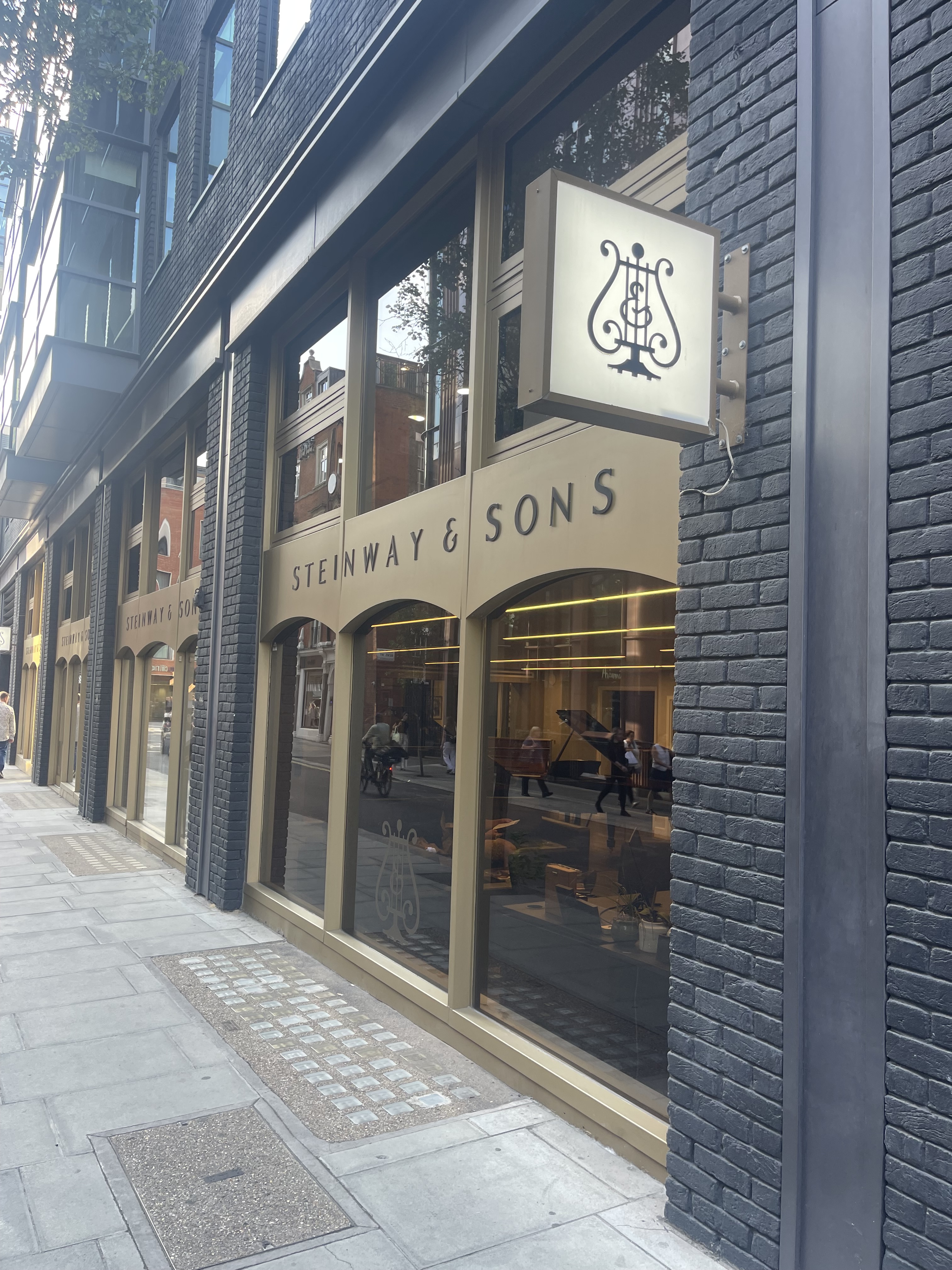
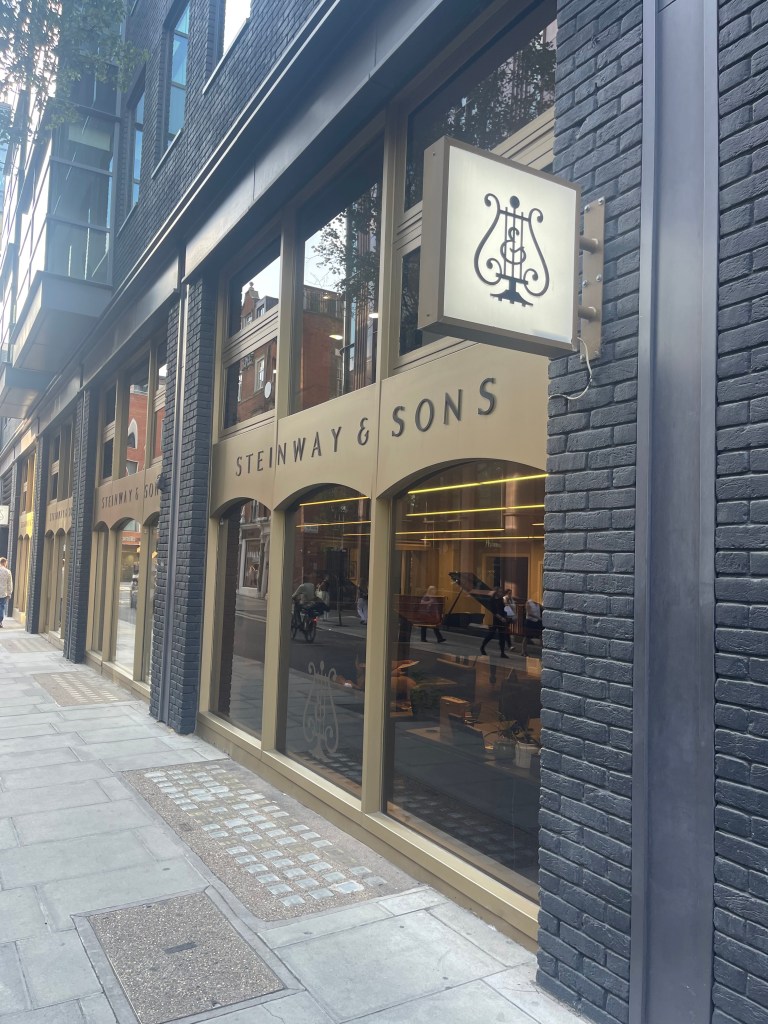
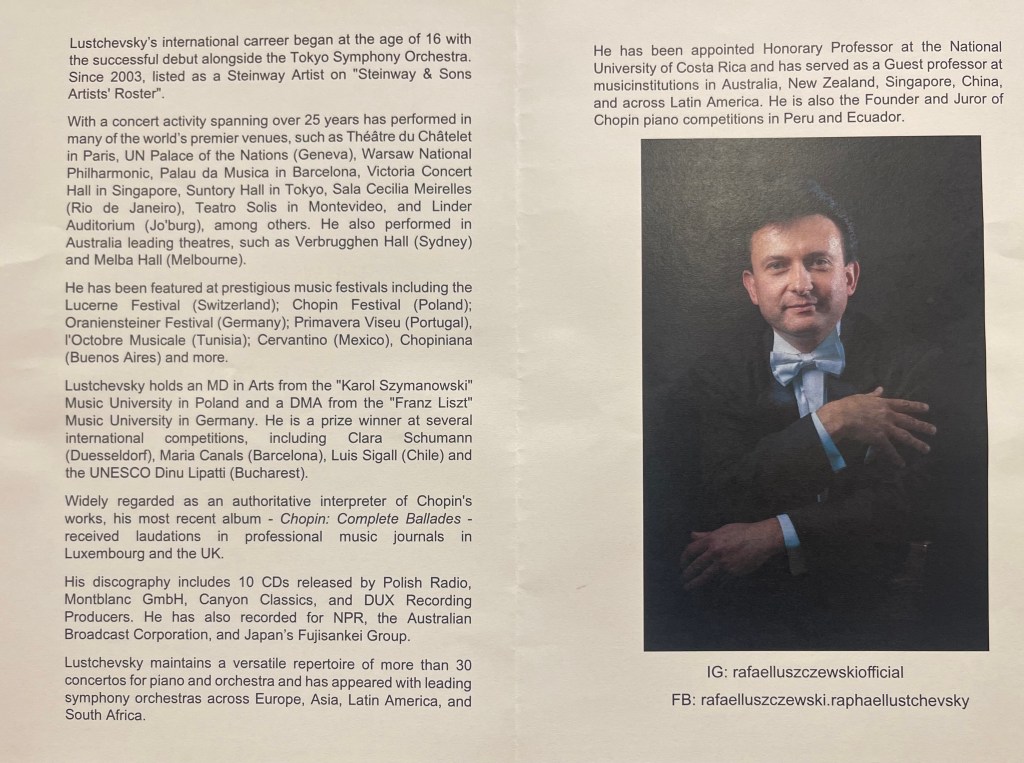
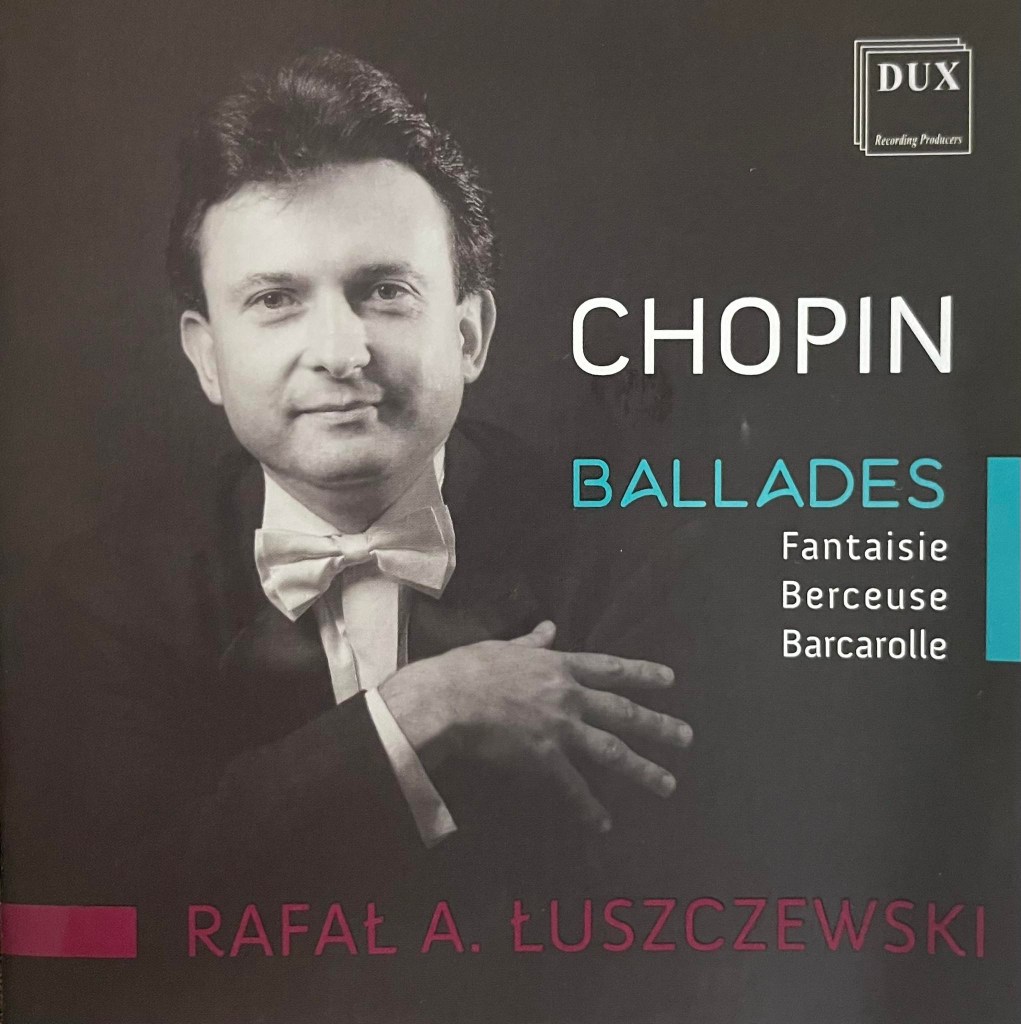
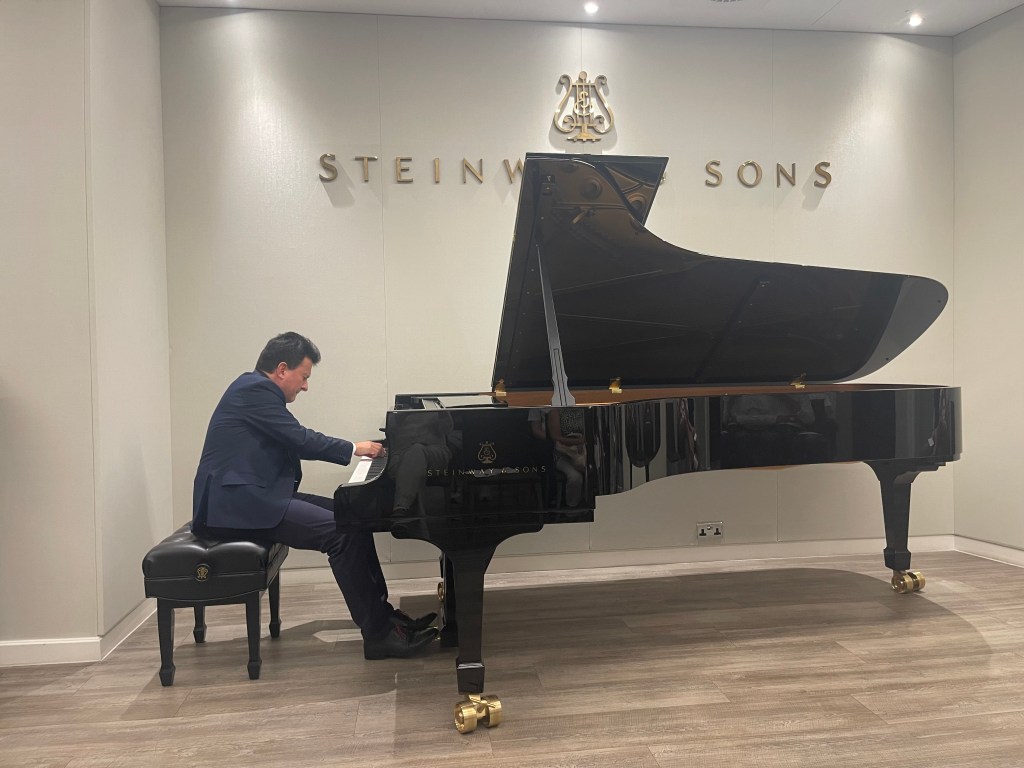
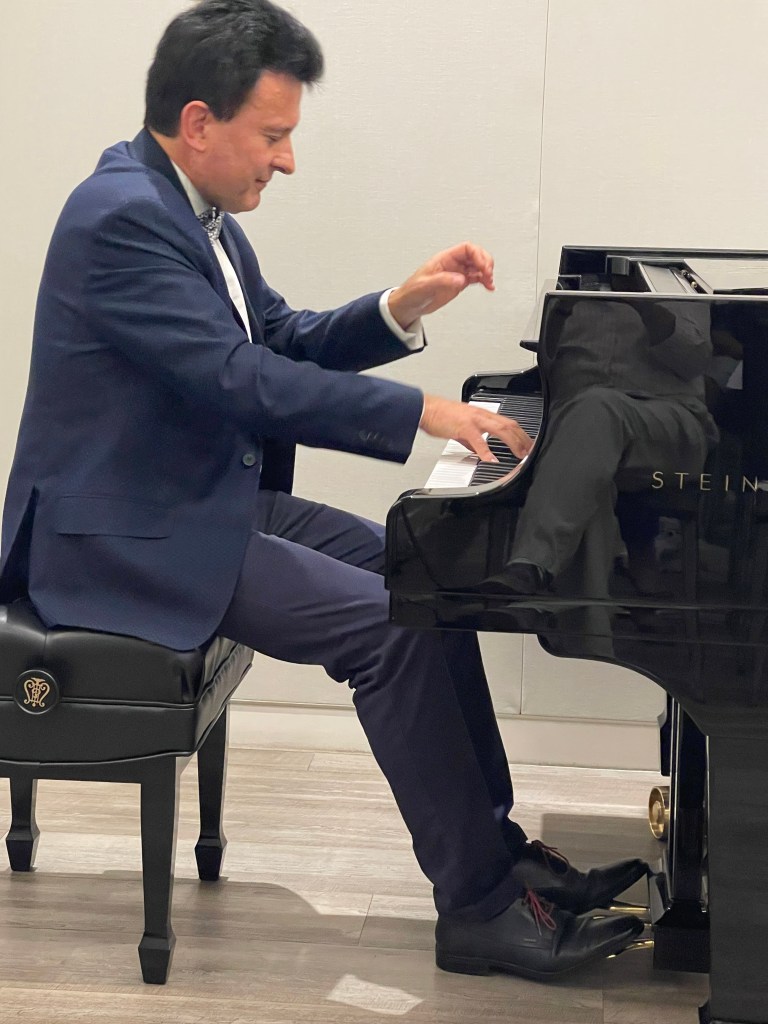
Raphael Lustchevsky ‘The Warsaw Concerto’ ‘Mastery and Mystery of a great Polish Pianist and Steinway Artist ‘

Pierre Boulez  was, in his youth, house pianist at the Folies Bergère Club in Paris “playing the Warsaw Concerto, engulfed in kitsch and lit by pinkish light – and that was while he was writing his second sonata”

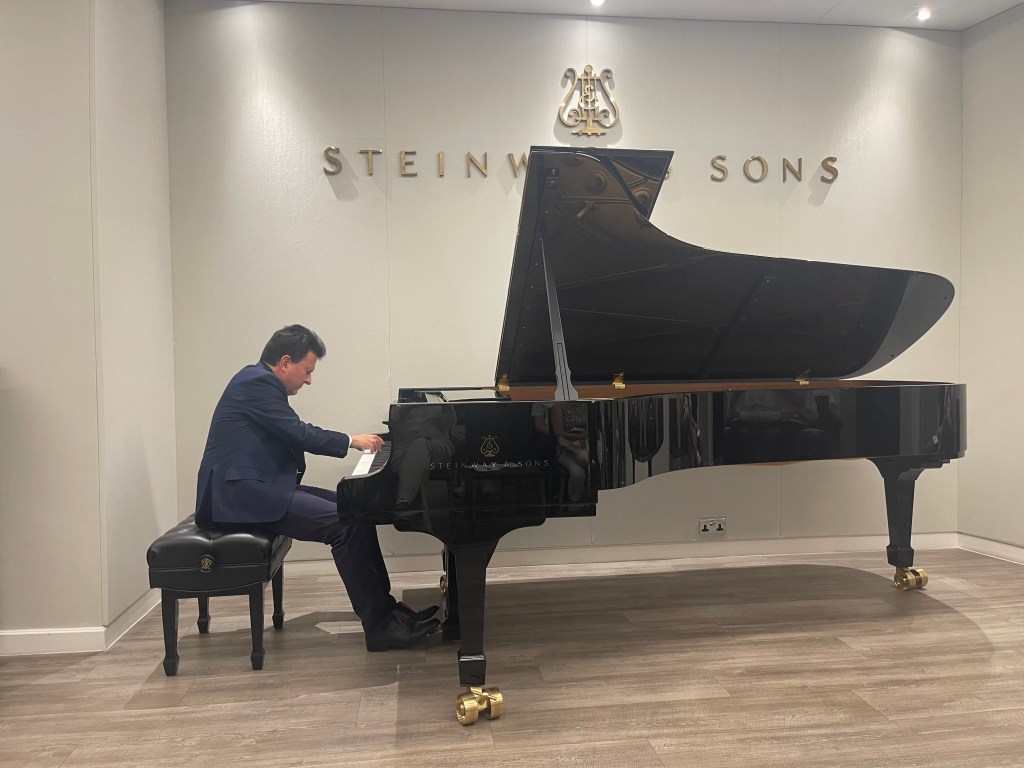
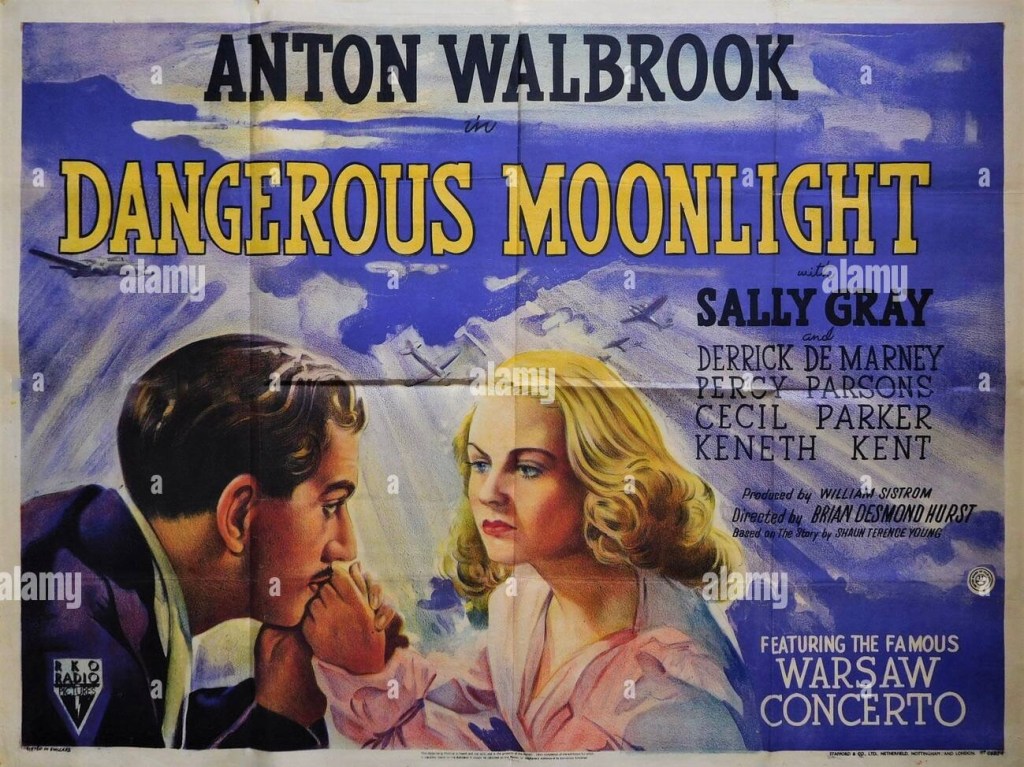
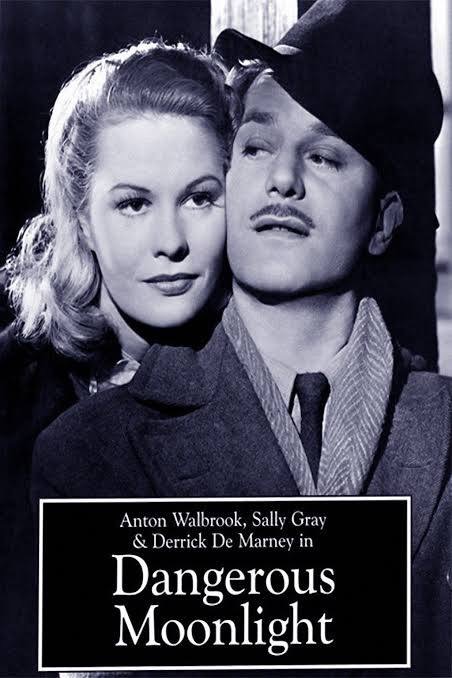
Dangerous Moonlight strikes at Steinways with Raphael Lustchevsky taking the role of Louis Kentner with the same mastery and astonishing style that the Warsaw Concerto by Addinsell was to have defined our two countries in 1941 as In the midst of World War II, Polish musician Stefan (Anton Walbrook) meets American journalist Carole (Sally Gray) as the Nazis are marching into Poland. Though both are forced to flee the Germans, they fall in love and, after leaving Eastern Europe, get married. Although marriage and a life as a musician bring Stefan joy, he is unable to forget his commitment to his country, and is compelled to return to the fighting, despite Carole’s fears and concerns.

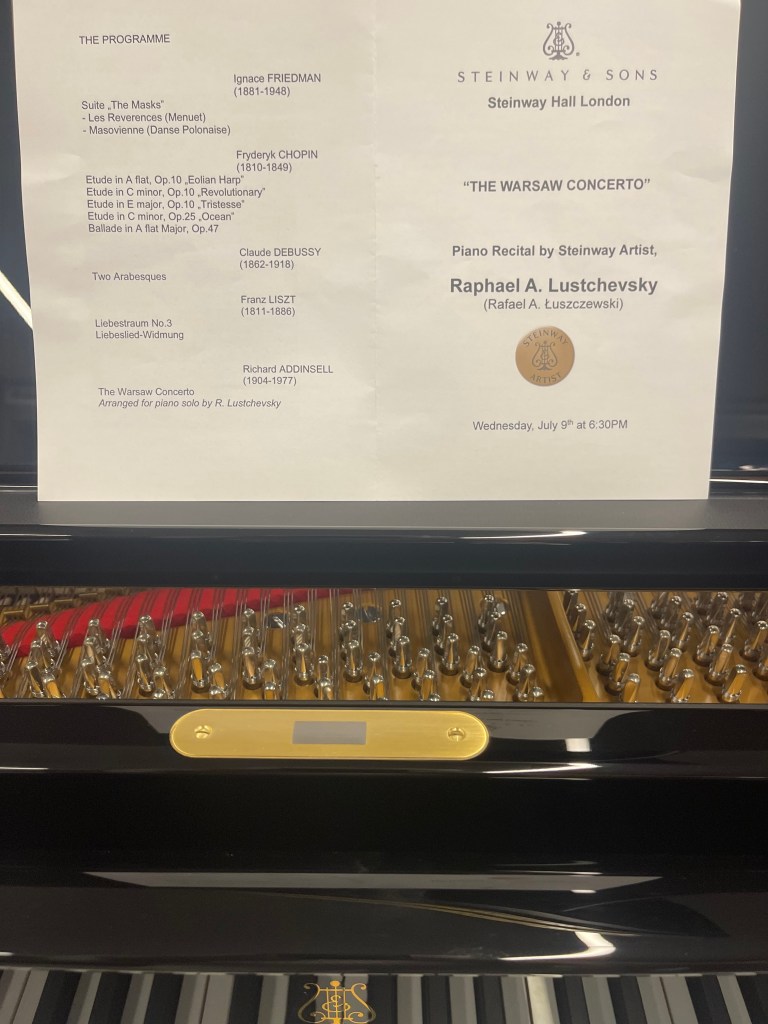
A master pianist with a programme of works that were once standard fare in every front parlour, but now the parlour no longer exists and they are all too rarely heard in the concert hall. Interesting to note that Friedman, a disciple of Leschetitzky, had fled to Australia during the war which explains the wonderful Russian school of piano playing in Australia with the likes of Eileen Joyce. Friedman died in Australia but was buried in Geneva in the 1950’s ! ?

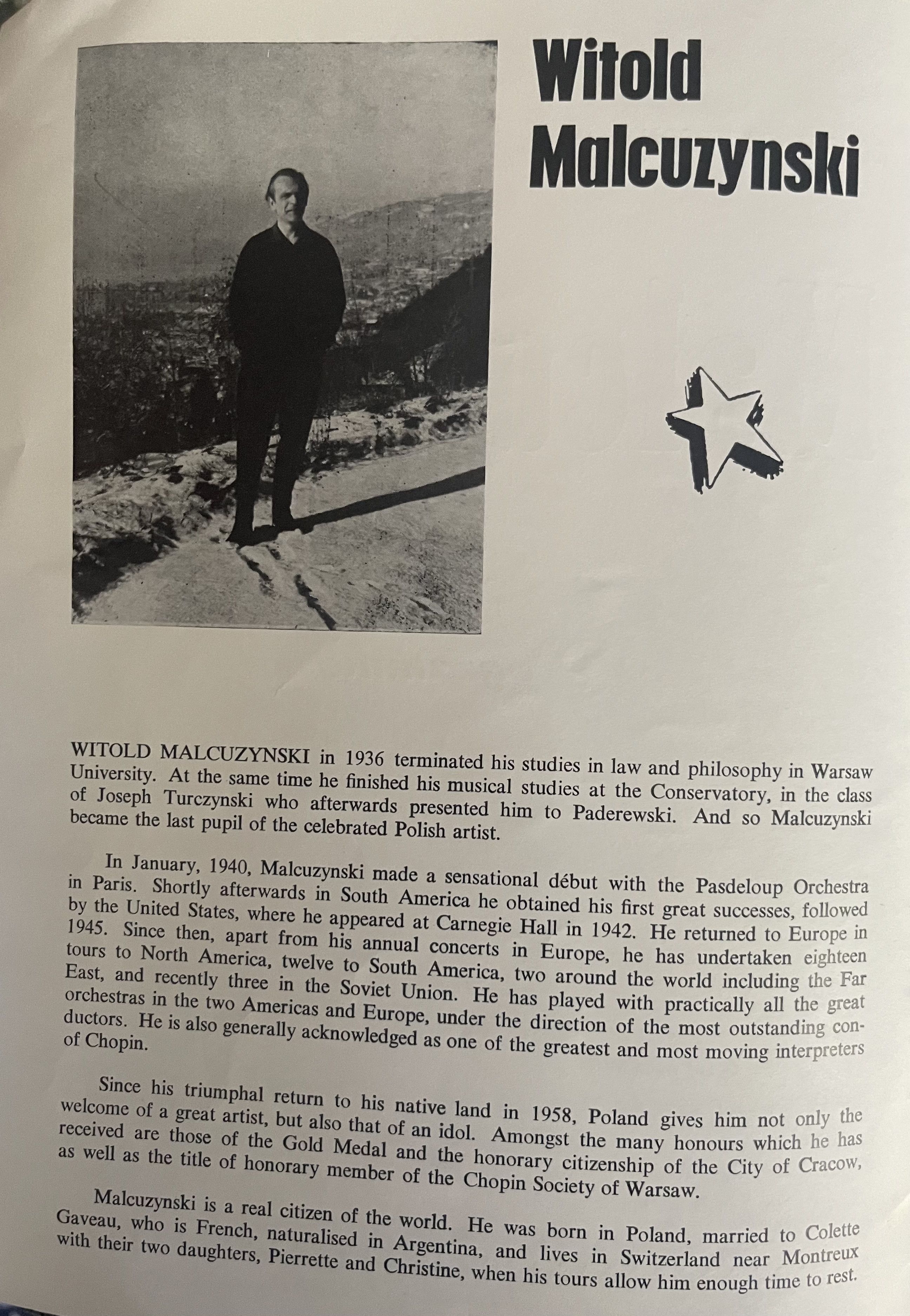
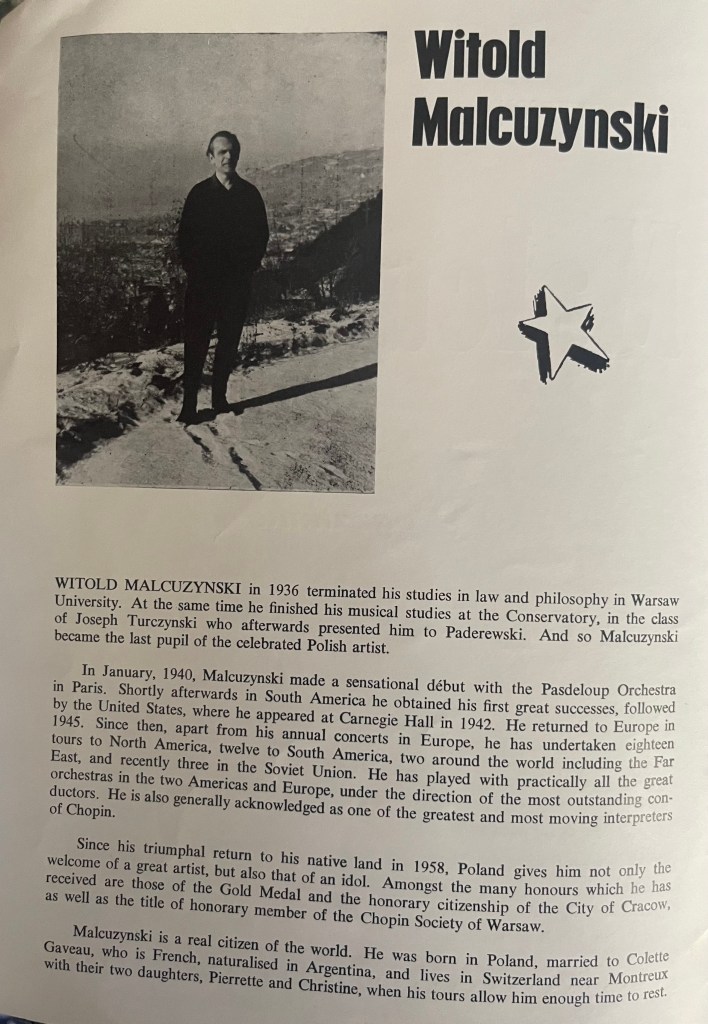
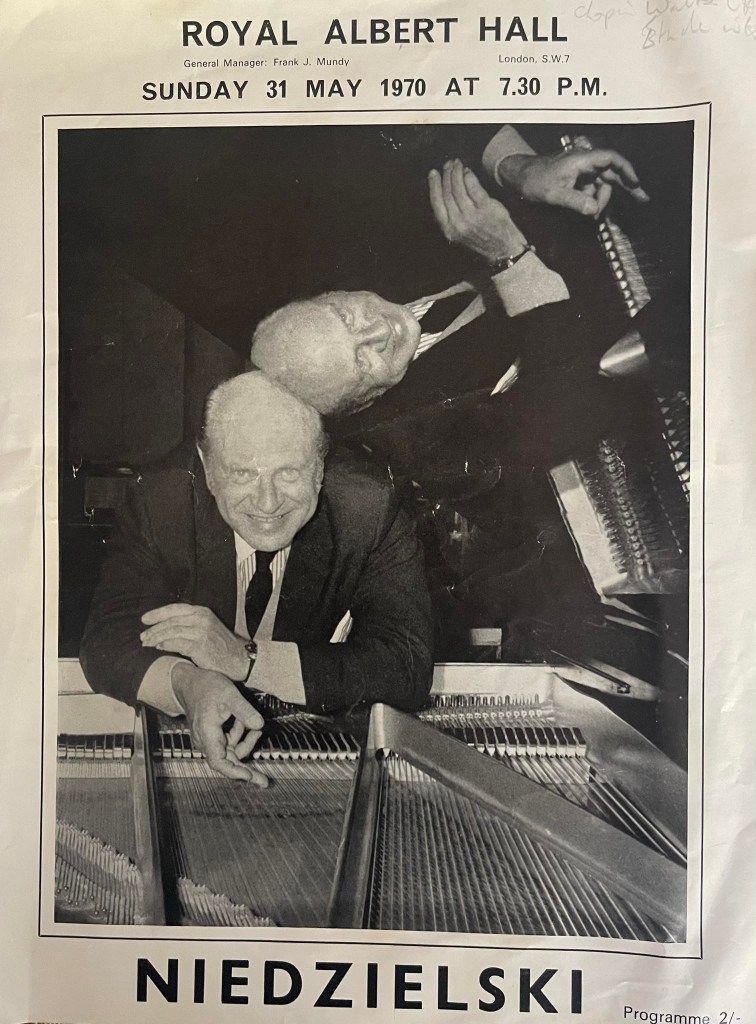
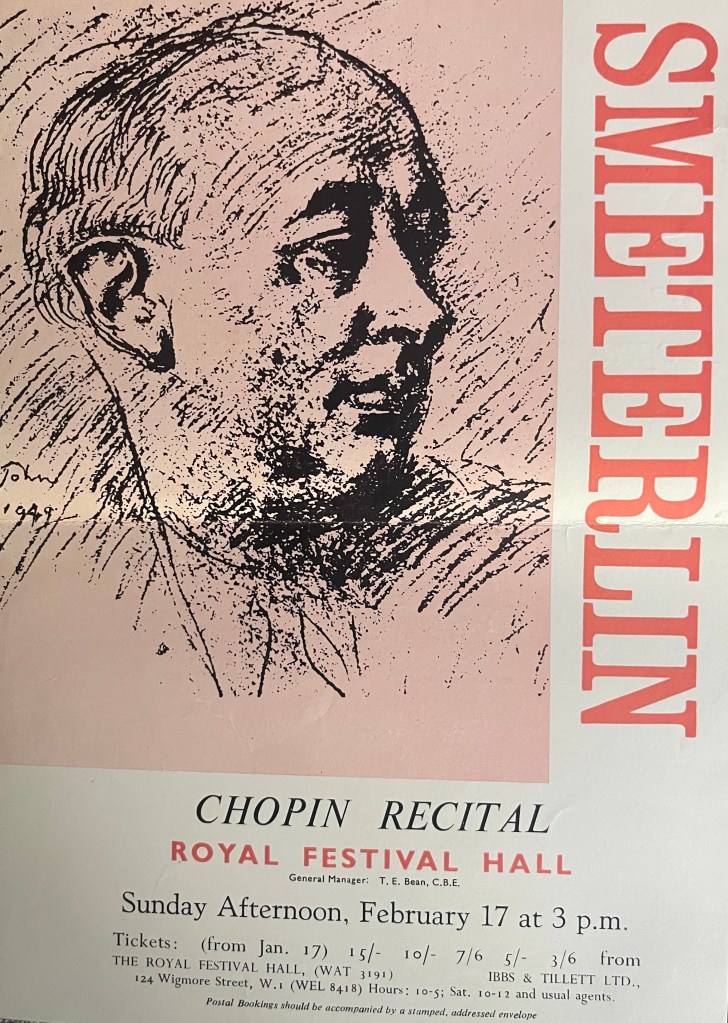
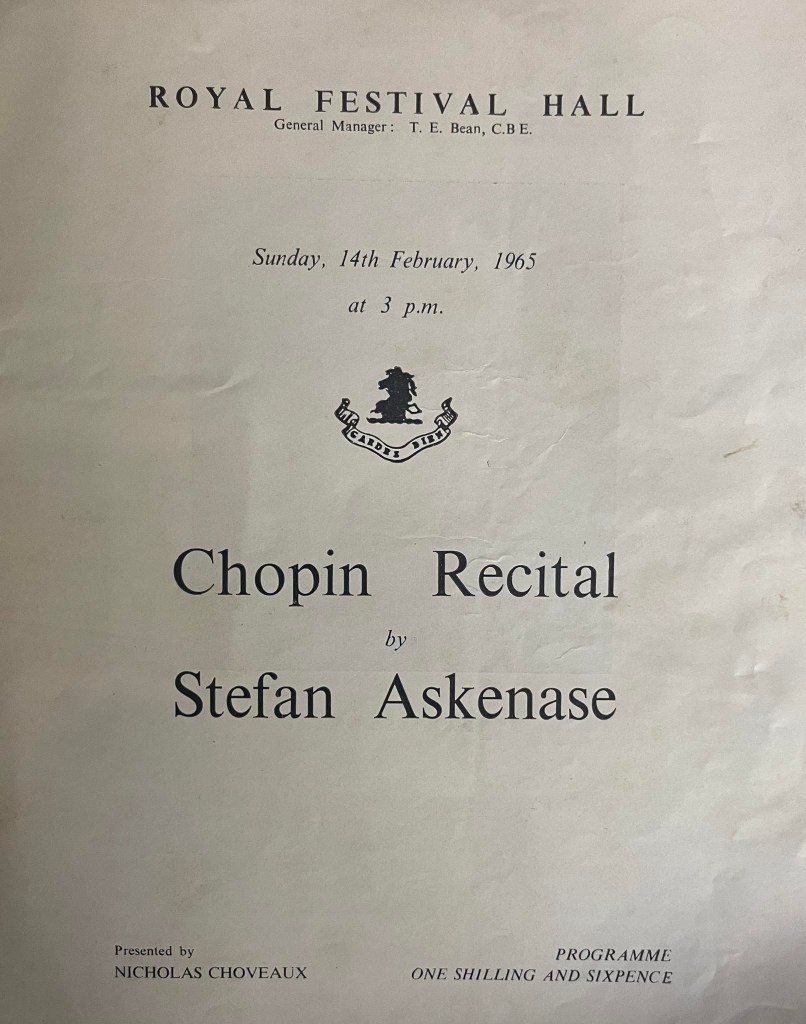
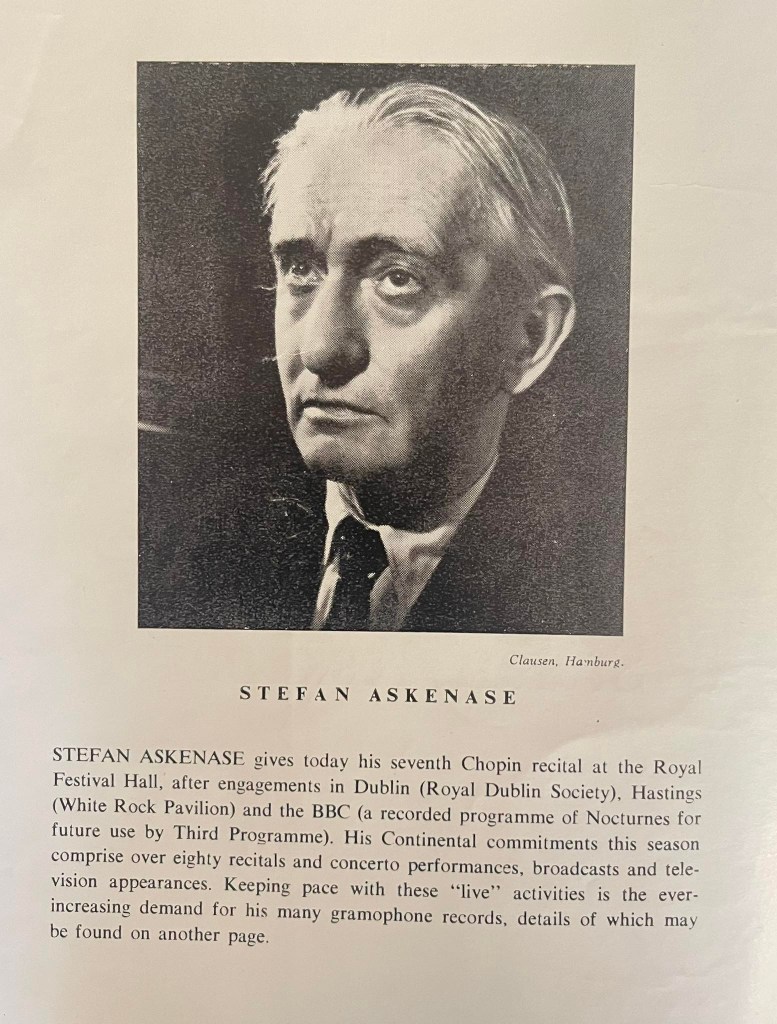
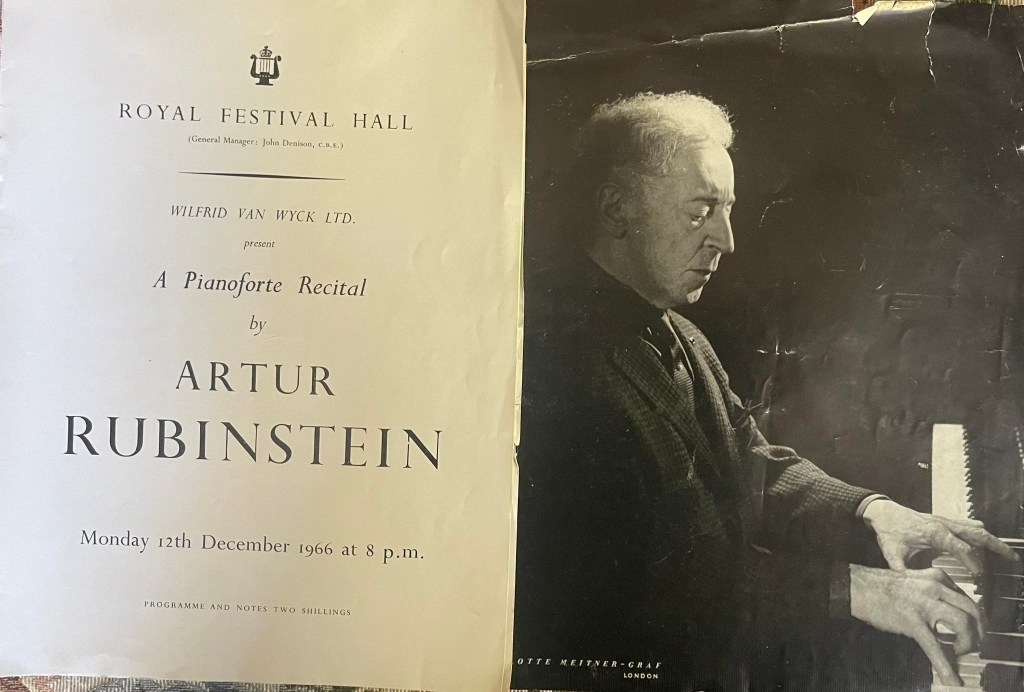
Played with great style and limpet like fingers of such authority as we used to hear from that great Polish school with post war pianists such as Malcuzinski, Niedzielski, Smeterlin, Askenase and of course the greatest of them all Artur Rubinstein. And from a later generation Zimmerman who like Raphael had studied with Jasinski .

Liebestraum , Widmung, the two Debussy Arabesques , four Chopin etudes :The Aeolian Harp, Tristesse, Revolutionary and Ocean together with the beautifully simple and elegant third Ballade. A superb sense of balance but also of solidity.

The two works by Friedman were played with a charming flowing beauty and it was wonderful to see his hands belonging to each key, finding warm rich sounds as he played with a beguiling style that brought these salon pieces vividly to life .The ‘Masovienne’ ,a dance from a lost period of charm mixed with nostalgia, was played with masterly understanding.

There was a beautiful sense of line to the study op 25 n. 1 by Chopin, that was played with extraordinary clarity and an ending of exquisite beauty, as the left hand trill was just allowed to vibrate as it arrived so delicately on the final chord. There was passion and poetry in the study op 10 n. 12 ‘Revolutionary’, with a dynamic drive that was breathtaking and a technical control of enviable assurance. The study op 10 n. 3 ‘Tristesse’ was played with aristocratic good taste of poignant beauty. The change of tempo for the central episode became in effect a mazurka ( as Chopin does in his Polonaise op 44) that contrasted so well with the radiant beauty of one of Chopin’s most memorable melodies. The study op 25 n 12 ‘Ocean’ was truly overpowering with its exuberance and exhilaration, it may have seemed slightly too much for such a small room but when played by a musician who is listening and judging the sound it was totally convincing.

Raphael had a strange way of pointing to the first note in the third ballade, almost like pointing the way for a performance that was to be played with great authority. An architectural shape ,with great poetic understanding and a sense of style that was never allowed to become sentimental but had, as in all his playing, a strength and personality that swept all before it. A natural flexibility that allowed the phrases to be shaped with the great bel canto line always in mind . As he had started with a straight finger I cannot help but comment on his alternating hands for the final flourish which took me by surprise!

The two Debussy ‘Arabesques’ were played with a beautiful fluidity and chiselled beauty with a sense of improvised freedom. A refreshing quixotic shape to the second was played with a capricious sense of style alla ‘Golliwog ‘ but with a beautifully atmospheric ending.

Drama, passion and heroic beauty, with sumptuous rich harmonies gave new life to Liszt’s Liebestraum and showed what true love is really about. With fearless abandon he scaled the emotional heights in ‘Widmung’ the work that Schumann had dedicated to Clara and given to her as a birthday present as proof of his undying love. Liszt had elaborated this song with sumptuous beauty and cascades of notes of overwhelming intensity. Played with extraordinary mastery and passion, we were now ready for the Warsaw Concerto!

A programme that put these miniature masterpieces once more on the map when played with such mastery as today. Culminating in an overwhelming performance of passion and heart on sleeve radiance of the Warsaw concerto. Addinsell had been asked to write a concerto like Rachmaninov who had turned down the film commission . Well Addinsell certainly succeeded and came up with a concerto in many ways much better because it is so unashamedly theatrical and everyone’s idea of what a piano concerto should be .A.I. eat your heart out !

http://www.michael-moran.com/2025/07/raphael-lustchevsky-to-perform-warsaw.html

The Warsaw Concerto is a short work for piano and orchestra by Richard Addinsell , written for the 1941 British film Dangerous Moonlight , which is about the Polish struggle against the 1939 invasion by Nazi Germany . In performance it normally lasts just under ten minutes and is an example of programme music , representing both the struggle for Warsaw and the romance of the leading characters in the film. It became very popular in Britain during World War II.

The concerto is written in imitation of the style of Rachmaninov and initiated a trend for similar short piano concertos in the Romantic style, which have been dubbed “tabloid concertos”, or “Denham concertos” (the latter term coined by Steve Race )

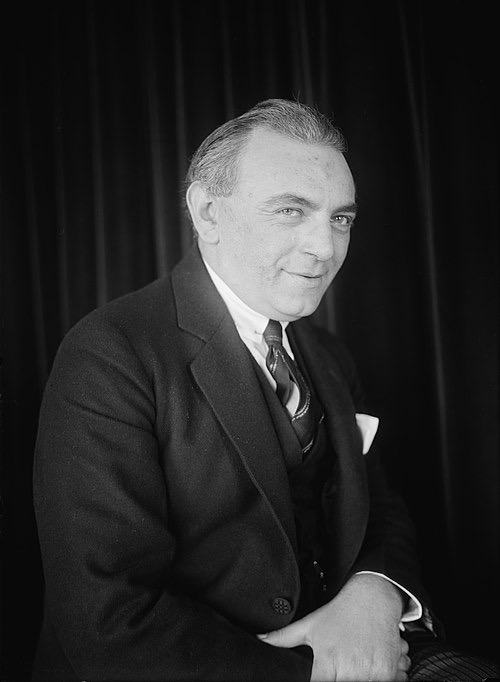
The composer, Richard Addinsell , was born in London and initially studied law before turning to a career in music. His time at the Royal College of Music was brief, as he was soon drawn to musical theatre, and he also wrote for radio, but his most memorable contributions are to a series of film scores beginning in 1936. He wrote the music for the 1939 film Goodbye ,Mr Chips, the original Gaslight  (released in 1940, not to be confused with the later Hollywood version), Scrooge, and Dangerous Moonlight (1941, also released in the US as Suicide Squadron).  

  • Percy Grainger transcribed and recomposed the work for two pianos in the 1940s.
  • Pierre Boulez  was, in his youth, house pianist at the Folies Bergère Club in Paris “playing the Warsaw Concerto, engulfed in kitsch and lit by pinkish light – and that was while he was writing his second sonata”

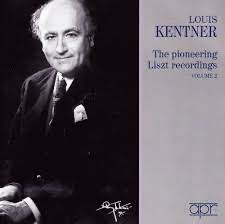
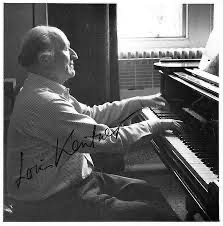
The success of the film led to an immediate demand for the work, and a recording was dutifully supplied from the film’s soundtrack (at nine minutes, it fit perfectly on two sides of a 12-inch disk playing at 78 rpm) along with sheet music for a piano solo version.Such unexpected success had another consequence. The off-screen piano part was played by Louis Kentner, a fine British/Hungarian musician known for his performances of Franz Liszt , but he had insisted that there be no on-screen credit, for fear that his participation in a popular entertainment would harm his classical reputation.He lost his qualms when the recording sold in the millions, and Douglas notes that he even asked for royalties (they were granted). Ultimately the Warsaw Concerto was such a hit that it made the then unusual journey from movie screen to concert hall.

The concerto was not part of the original plan. According to Roy Douglas, at that time orchestrator for all of Addinsell’s scores: “The film’s director had originally wanted to use Rachmaninov’s Second Piano Concero, but this idea was either forbidden by the copyright owners or was far too expensive”.Thus Addinsell wanted the piece to sound as much like Rachmaninov as possible, and Douglas remembers, “while I was orchestrating the Warsaw Concerto I had around me the miniature scores of the Second and Third Piano Concertos, as well as the Rhapsody on a Theme of Pagnini “Although it is at the heart of Dangerous Moonlight, the Concerto is never performed complete but rather revealed piecemeal. The opening of the work is heard when the two protagonists meet, and it is further developed when they are on their honeymoon. Finally, in the only extended concert sequence, we are given the closing section but its use is not restricted to scenes with the “composer” at the piano. The themes are found as underscoring throughout the film, and in this way a brief concert piece gains a dramatic resonance that belies its small scale.

Dangerous Moonlight takes place at the start of World War II and tells the story of a Polish concert pianist and composer, Stefan Radecki (Anton Walbrook ) who defends his country by becoming a fighter pilot. After an air raid in Warsaw by German Luftwaffe , he is discovered by an American reporter, Carol Peters (Sally Gray), practising the piano in a bombed-out building. It is the opening of his Warsaw Concerto, at this point a work in progress, and the first line he says to her is, “It is not safe to be out alone when the moon is so bright” (referring to the moonlight bombing raids). Gazing intently at Carol and disclosing “something lovely you’ve just given me”, he introduces the lyrical second theme of the Concerto. And, indeed, this melody is always associated with Carol. Like Rachmaninoff, Addinsell introduces it almost as a nocturne. Stefan speaks of the piece later in the film: “This music is you and me. It’s the story of the two of us in Warsaw, of us in America, of us in … where else I don’t know. That’s why I can’t finish it”. But finish it he does. Similar to the way that Rachmaninoff returns to his second theme in his Second Piano Concerto, the “Carol” melody is used, not only to bind together the emotional strands of the drama, but to bring the Concerto to a triumphant conclusion. Throughout the film, the unfinished piece is defined in a relationship with Chopin’s “Military ” Polonaise , symbolising Polish patriotism.It is “completed” when the Polonaise elements are integrated with the Romantic theme, implying the fusion of romantic and patriotic love.

Within the context of its story, Dangerous Moonlight is also effective in creating the impression of a larger work written and performed by the film’s fictional composer and pianist. When snatches of the Concerto are first played, one character tells another, “I’ve got the records”, and when the “premiere” is shown, we are provided with a close-up of the program, Warsaw Concerto, with three movements listed. Only one movement was actually written by Addinsell.


Richard Addinsell 13 January 1904 London- 14 November 1977 (aged 73) Brighton
Educated at Hertford College, Oxford. Royal College of Music ( two terms) , London.

Louis Philip Kentner CBE (19 July 1905 – 23 September 1987)He was born  in Karwin,Austrian Silesia (present-day  Czech Republic), to Hungarian parents. He studied at the Royal Academy in Budapest from 1911 to 1922, studying with Arnold Székely , Hans Koessler,Zoltan Kopdály and Leó Weiner. While a student, he first became acquainted with Béla Bartók, who remained a lifelong friend.In 1935 he moved to England  permanently with his wife, the fellow Hungarian pianist Ilona Kabos, and they made their home in London. Kentner gave radio broadcasts of the complete sonatas of Beethoven and Schubert , the complete ’48’ by Bach, and the complete Années de pèlerinage of Liszt . At the composer’s request, he was the soloist at the Hungarian premiere of Bartók’s Piano Concerto n. 2, in Budapest in 1933, under Otto Klemperer In November 1942, Kabos and Kentner gave the world premiere of Bartók’s Concerto fro two Pianos ,Percussion and Orchestra in London .He also gave the first European performance of the Concerto n. 3 in London with Sir Adrian Boult on 27th November 1946. He and Yehudi Menuhin (his second wife’s brother-in-law) gave the first performance of Walton’s Violin Sonata, in Zürich  on 30 September 1949.He was President of the British Liszt Society for many years, until his death. In 1975

Salomon Izaak Freudmann February 13, 1882 Kraków – January 26, 1948 (age 65)
Sydney Australia

 Ignaz Friedman was a child prodigy and studied with Hugo Reimann in Leipzig  and Theodor Leschetizky in Vienna and participated in Busoni’s master classes.His official début in Vienna  in 1904 featured a program of three piano concertos, rivaling the similar programs of established titans like Busoni  and Godowsky , and he remained a titan throughout his career. His style was quiet and effortless, imbued with a sense of rhythm and color, grounded in a sovereign technique, and much has been written about his peerless interpretations of Chopin in particular. As with his compatriot and contemporary Moritz Rosenthal , Friedman’s Chopin interpretations, particularly those of the mazurkas , are considered by many to be unsurpassed. Despite having given 2,800 concerts during his career, he sometimes received lukewarm reviews in America in later years, as younger critics were becoming accustomed to modernist playing .Rachmaninov   admired Friedman’s playing very much and considered him as a great virtuoso in a style more romantic than his own. Friedman was never successful in an America that had adopted a much more modern and straightforward presentation with recording technology that prompted a different sensibility. Therefore, Friedman remains as one of the last representatives of the bygone era even during the life of Rachmaninov.At the outbreak of the Second World War, Friedman was in Europe, but managed to escape when a concert tour in Australia  was offered at the last moment. He settled in Sydney  and remained there until his death (which occurred on Australia Day , 1948). His last concert was in Sydney on July 24, 1943, after which neuritis in his left hand forced him to retire from the concert platform.

He composed more than 90 works, mainly piano miniatures, as well as pieces for cello and a piano quintet , but his compositions have not found a niche in the standard repertory. The complete vocal output (37 songs) was issued as a recording in 2022. Friedman arranged many works, especially those of J.S. Bach  and Domenico Scarlatti . He also edited an almost complete edition of the piano works of Chopin and produced editions of Schumann and Liszt.

https://youtu.be/2qLVvfqYP4g?si=L6mR5OtEdyDg5nyK

https://christopheraxworthymusiccommentary.com/2024/03/20/christopher-axworthy-dip-ram-aram/

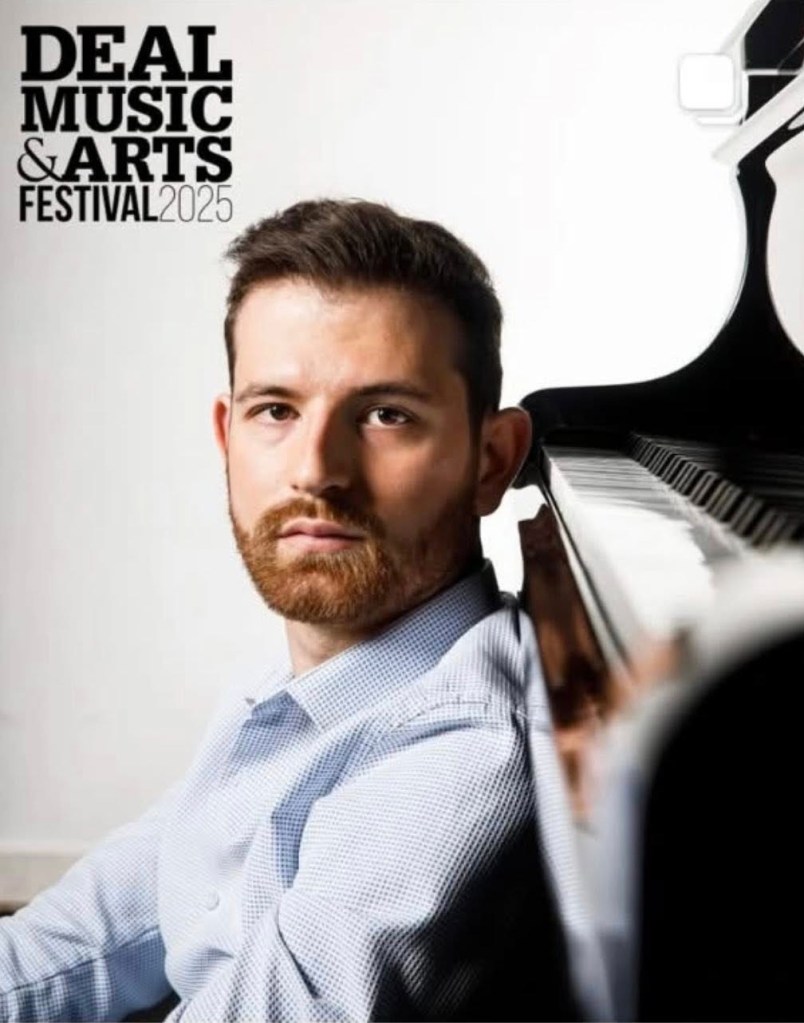
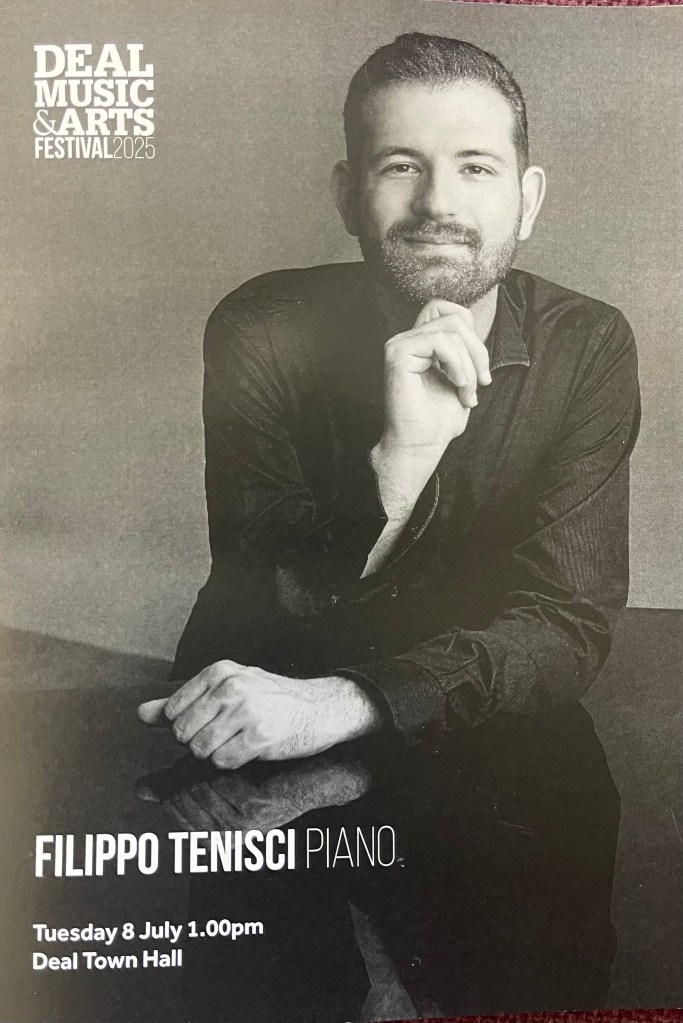
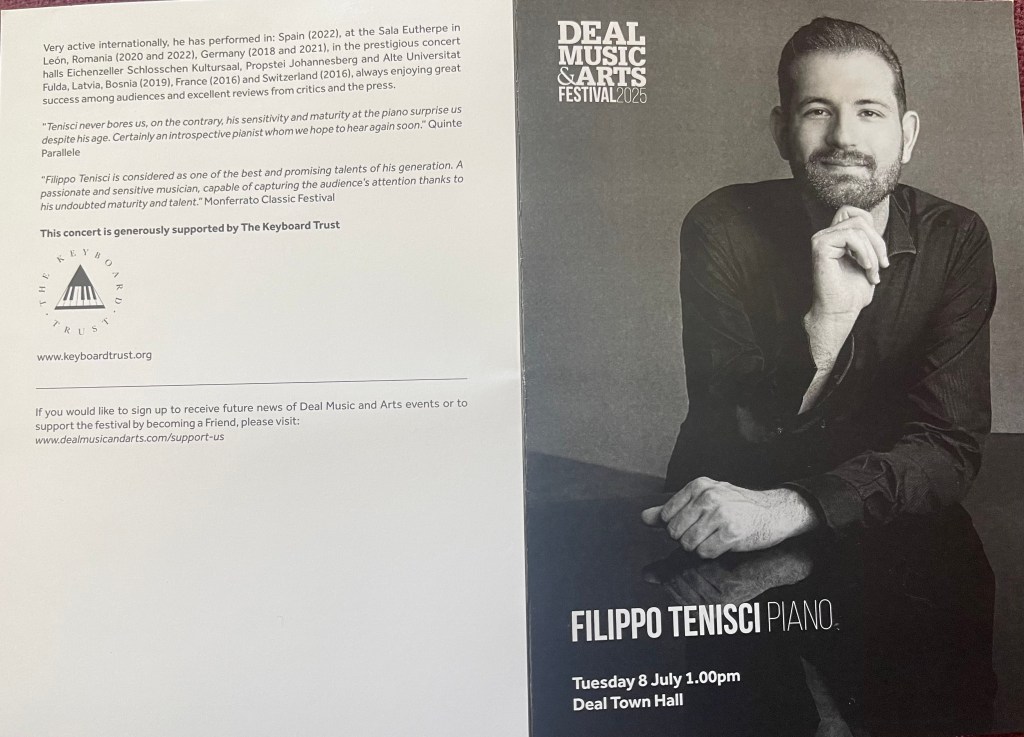
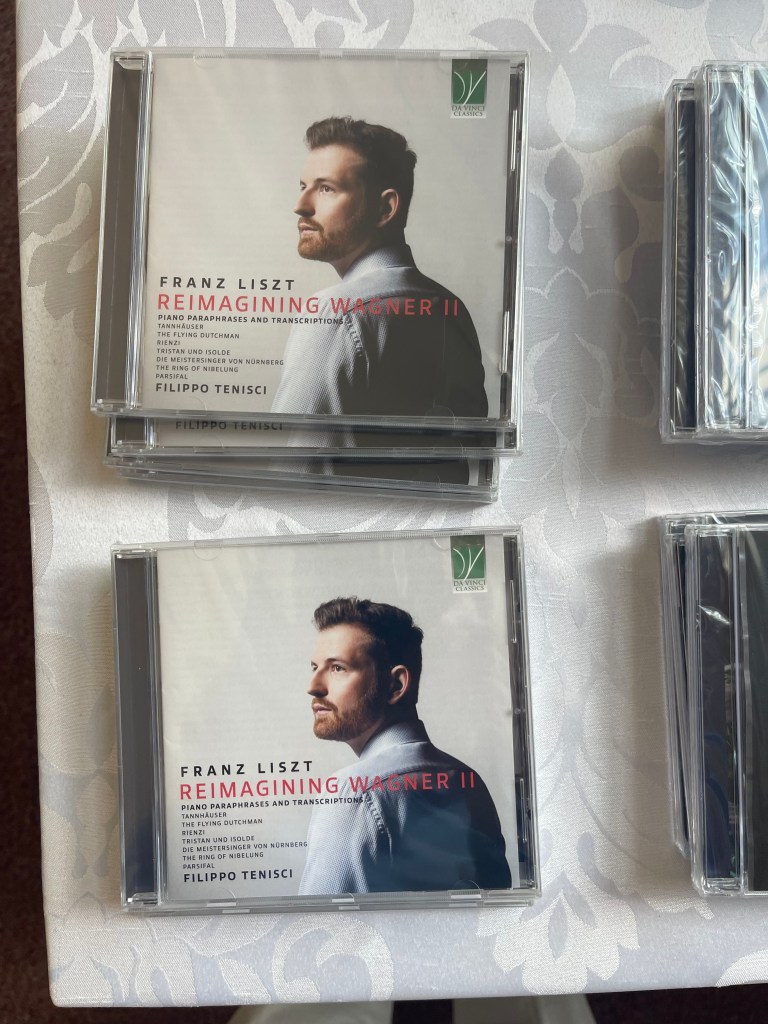
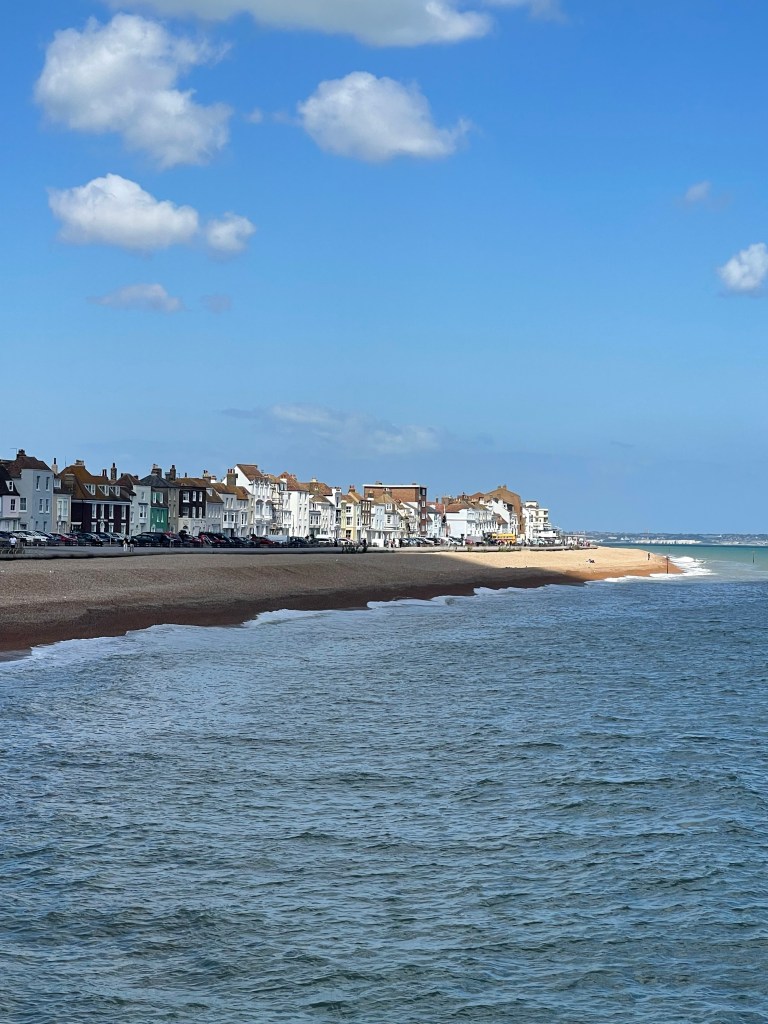
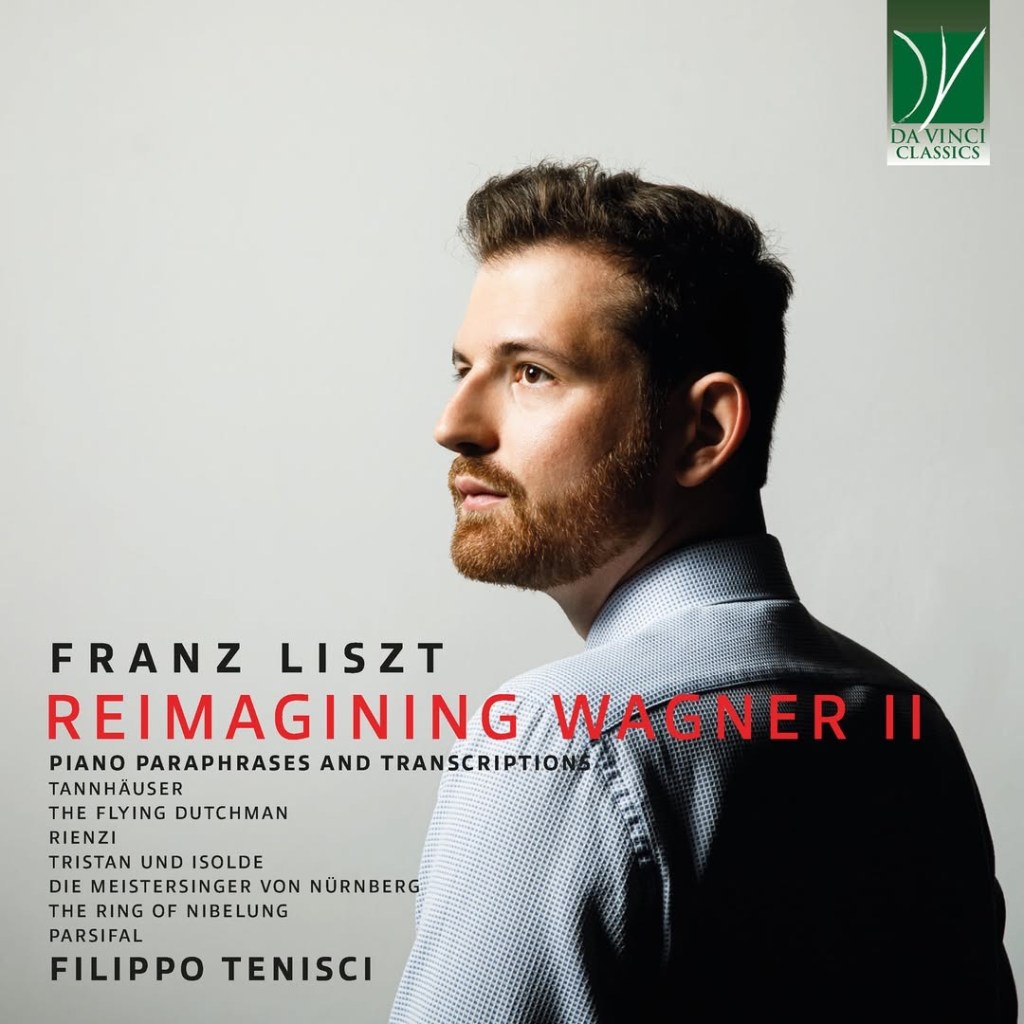
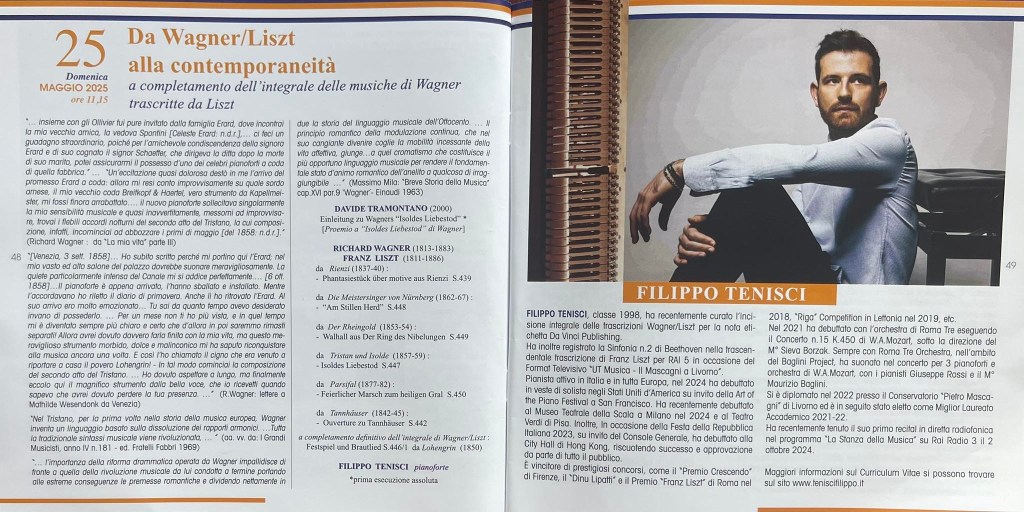
Wagner & Liszt embark in Deal with Filippo Tenisci at the helm.

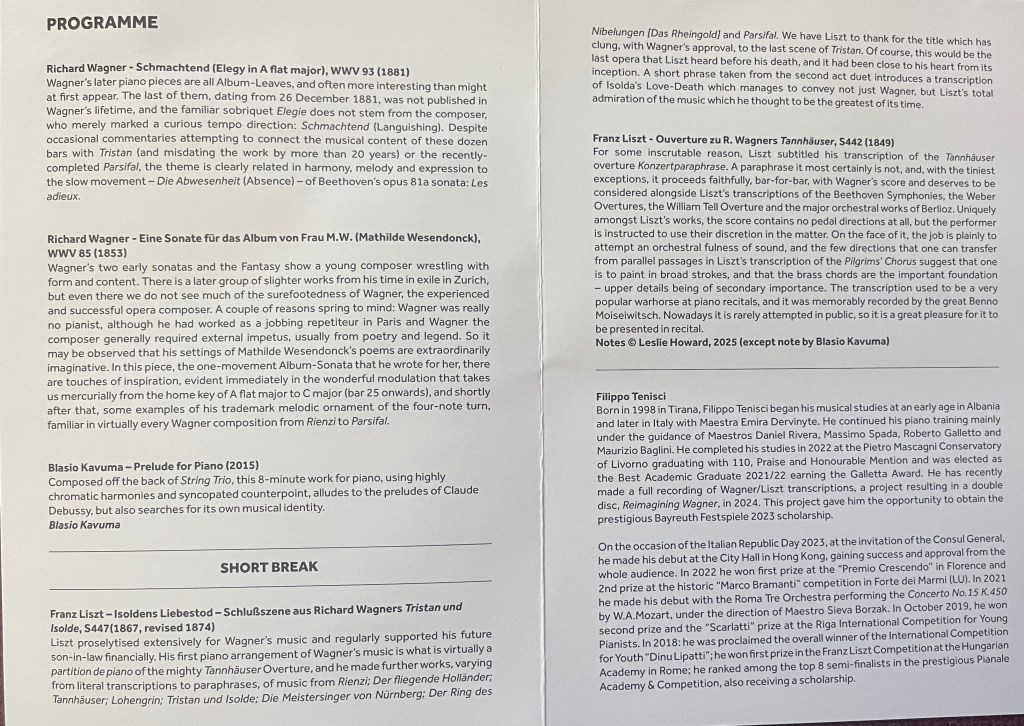
RICHARD WAGNER (1813-1883) 

Schmachtend (Elegy in A flat major), WWV 93 (1881)

Eine Sonate für das Album von Frau M.W. (Mathilde Wesendonck), WWV 85 (1853)

Blasio Kavuma 
Prelude for Piano (commissione del Deal Music & Arts Festival)

FERENC LISZT (1811-1886)

​Isoldens Liebestod – Schlußszene aus Richard Wagners Tristan und Isolde, S447 

(1867, revised 1874)

Ouverture zu R. Wagners Tannhäuser, S442 (1849)Wagner and Liszt embark in Deal today with Filippo Tenisci at the helm

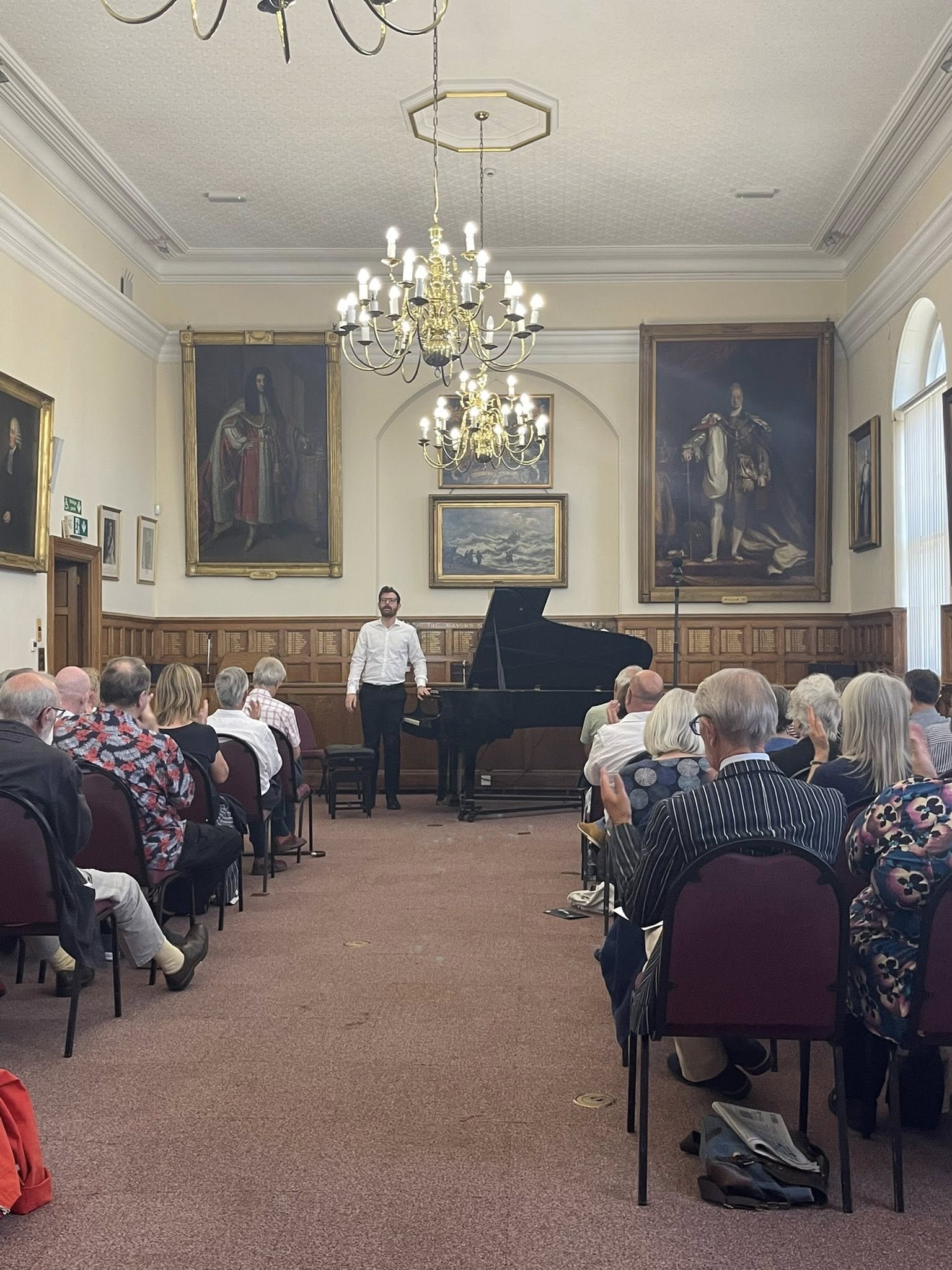
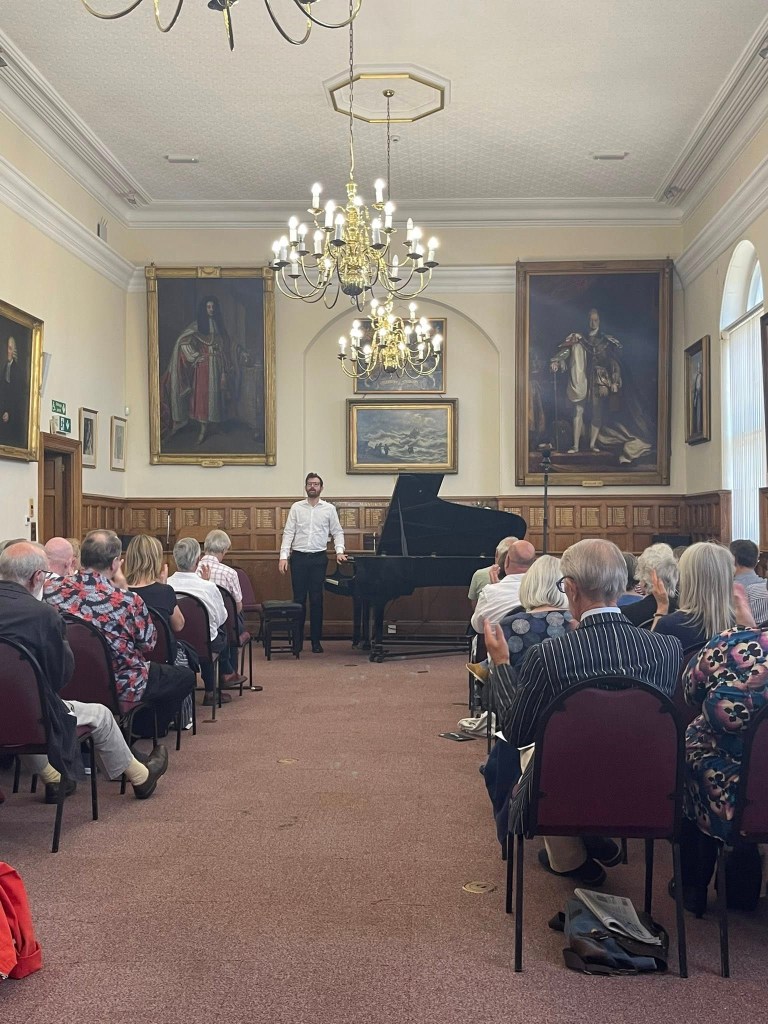
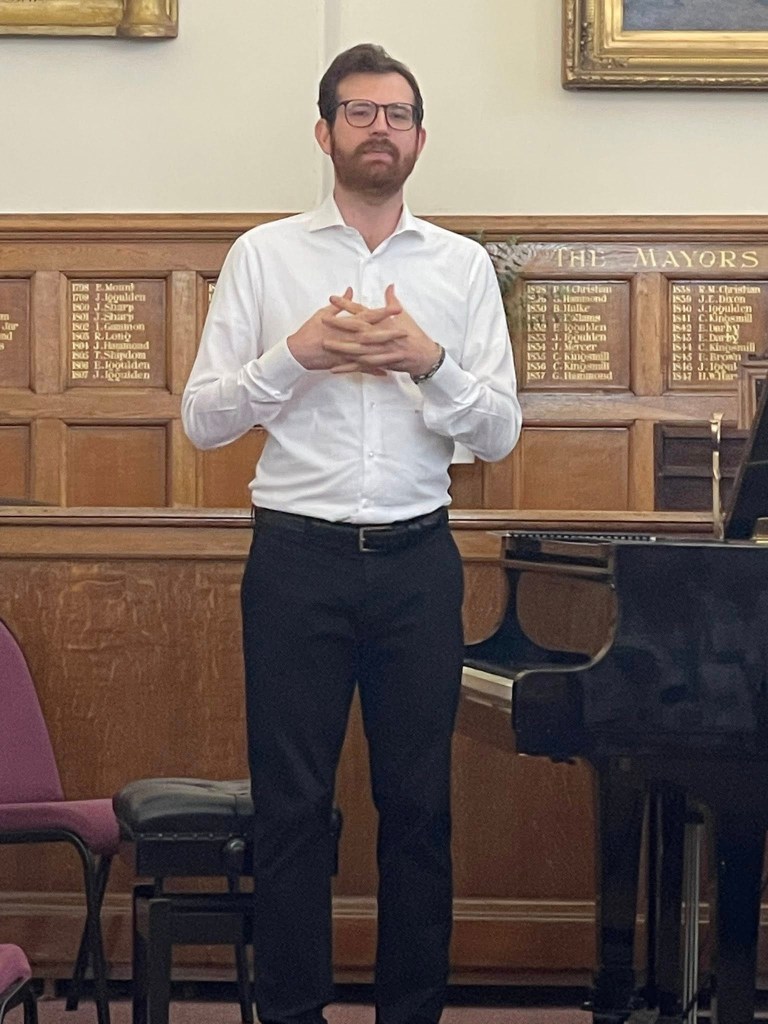
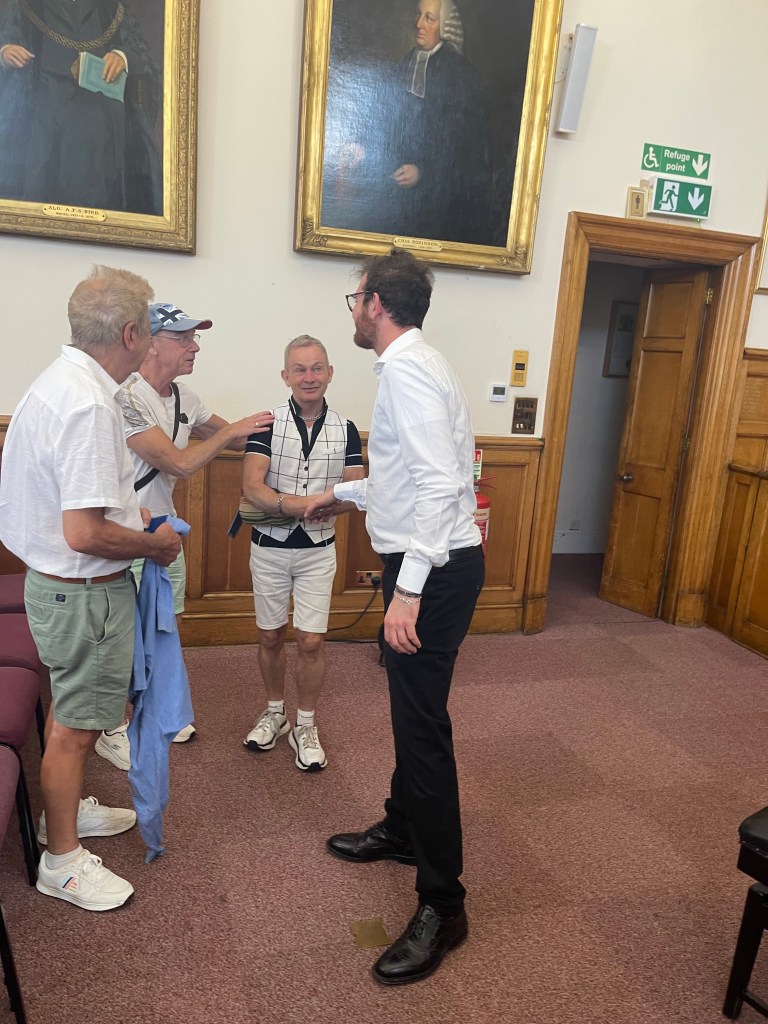
A standing ovation and a taste of mushy peas were the just reward for a remarkably dedicated young artist who could transmit Wagner’s genius with a kaleidoscopic palette of colours. Adding Wagners son -in- law’s demonic pianistic genius too, as Liszt brought Wagner’s orchestra into the elite salons of the day with a heroic transcendental pianism that was exhilarating and overwhelming.

Two early original pieces by Wagner showed already his search for colour and insinuating counterpoints. Commissioned especially by the Festival to play a work from 2015 by the composer in residence and also to pair it with Wagner’s much neglected ‘Wesendonck’ Sonata. In fact the whole of this first half of the programme was played with barely whispered tones of great beauty. Filippo caressing the keys with gentle stroking movements gave a radiance and beauty to this fine Yamaha piano donated some years ago to Deal and that sits so proudly in their Town Hall.

The Elegie written just two year before the composers death is a page of etherial musings where the personality of the composer of the Ring cycle is apparent from the insinuating counterpoints of gently woven intricacy. This was followed by the Sonata, somewhat in the same mood of deep introspection and whispered beauty, even though written when the composer was only in his forties. It did, however, have a moment in its twelve minute life when it burst into life but not with the Lisztian histrionics that were to come later in the programme. It was a work of very subdued deeply felt expression of dark passion. Filippo had learnt it especially for the Festival and as he remarked afterwards it deserves to be heard more often in the concert hall. He played it with great authority and passionate conviction finding a refined palette of colours with a sense of touch that was like someone swimming and creating gentle waves where Wagner’s knotty counterpoints could mingle within Wagners unmistakable architectural sense of direction.

The other work that Filippo had learnt especially for the festival was by the composer in residence Blasio Kavuma.To quote the composer : ‘it was composer off the back of the String Trio and in it’s eight minutes of life uses highly chromatic harmonies and syncopated counterpoints, alluding to the preludes of Debussy, but also searching for its own identity’. It was an interesting work and one could see why the festival wanted it to be linked to the Wagner, because it uses very much the same delicate palette of colour. A continual outpouring of sounds in a mist of Debussian harmonies .A long slow meandering of great beauty that has a life of it’s own without any particular architectural shape.

Adding Liszt’s pianistic genius in a potent mix of two giants joined by marriage not only of Liszt’s daughter but also by their prophetic genius.The two Liszt re- workings of Wagner are both pianistic show pieces.

The ‘Liebestod’ is a piece often played in the concert hall and is a marvellous work for piano where Liszt’s admiration and love for the work of his son-in-law shines through with quite remarkable pianistic colours. An extraordinary ability to convey the very essence of the last opera that Liszt was to hear before his death and that Filippo played with ravishing colours. A passionate involvement with sumptuous rich sounds alternating with barely whispered secrets of refined glowing beauty.

The Tannhäuser overture was played in the uncut version and used to be the war horse of many notable virtuosi – Moisiewitch in particular.

https://youtu.be/XKDYla5C5cA?si=TymnVxQTbeeEBrDz

It was good to hear it in the concert hall again and it was a rousing ending to this very interesting concert. Fearlessly played with brilliance and a technical mastery that allowed Filippo to negotiate the transcendental difficulties that Liszt adds to his first transcription of a work by Wagner. Scintillating interludes with streams of notes thrown off with knowing ease as the ‘brass band’ climaxes built up to to the final might theme. Elaborated by Liszt with alternating octaves whilst at the same time maintaining the full sumptuous Tannhäuser theme in the centre of the keyboard. A ‘tour de force’ of ‘three handed pianism’ that brought a standing ovation from this very full hall, intent of buying this young pianist’s CD’s dedicated to Wagner/Liszt to take home with them to prolong the enjoyment they had found today.

‘Nobody needs to make too fulsome a claim for Wagner’s pianoforte music: His two early sonatas and the Fantasy show a young composer wrestling with form and content, but with only the most imitative of character. There is a later group of slighter works from his time in exile in Zurich, but even there we do not see much of the surefootedness of Wagner the experienced and successful opera composer. A couple of reasons spring to mind: Wagner was really no pianist, although he had worked as a jobbing repetiteur in Paris; Wagner the composer generally required external impetus, usually from poetry and legend. So it may be observed that hissettings of Mathilde Wesendonck poems are extraordinarily imaginative, whilst the one-movement Album-Sonata that he wrote for her is more of a curate’s egg. That said, there are touches of inspiration, evident immediately in the wonderful modulation that takes us mercurially from the home key of A flat major to C major (bar 25 onwards), and shortly after that, some examples of his trademark melodic ornament of the four-note turn, familiar in virtually every Wagner compositionfrom Rienzi to Parsifal. For these features we must therefore be forgiving of the comparatively unimaginative development section! 

Wagner’s later piano pieces are all Album-Leaves, and often more interesting than might at first appear. The last of them, dating from 26th December 1881, was not published in Wagner’s lifetime, and the familiar sobriquet Elegie does not stem from the composer, who merely marked a curious tempo direction: Schmachtend (Languishing). Despite occasional commentaries attempting to connect the musical content of these dozen bars with Tristan (and misdating the work by more than 20 years) or the recently-completed Parsifal, the theme is clearly related in harmony, melody and expression to the slow movement – Die Abwesenheit (Absence) – of Beethoven’s opus 81a sonata: Les adieux.

Liszt proselytised extensively for Wagner’s music, and regularly supported his future son-in-law financially. His first piano arrangement of Wagner’s music is what is virtually a partition de piano of the mighty Tannhäuser Overture, and he made further works, varying from literal transcriptions to paraphrases, of music from Rienzi; Der fliegende Holländer; Tannhäuser; Lohengrin; Tristan und Isolde; Die Meistersinger von Nürnberg; Der Ring des Nibelungen [Das Rheingold] and Parsifal. We have Liszt to thank for the title which has clung, with Wagner’s approval, to the last scene of Tristan. Of course, this would be the last opera that Liszt heard before his death, and it had been close to his heart from its inception. A short phrase taken from the second act duet introduces a transcription of Isolda’s Love-Death which manages to convey not just Wagner, but Liszt’s total admiration of the music which he thought to be the greatest of its time.

For some inscrutable reason, Liszt subtitled his transcription of the Tannhäuser overture Konzertparaphrase. A paraphrase it most certainly is not, and, with the tiniest exceptions, it proceeds faithfully, bar-for-bar, with Wagner’s score and deserves to be considered alongside Liszt’s transcriptions of the Beethoven Symphonies, the Weber Overtures, the William Tell Overture and the major orchestral works of Berlioz. Uniquely amongst Liszt’s works, the score contains no pedal directions at all, but the performer is instructed to use his discretion in the matter. On the face of it, the job is plainly to attempt an orchestral fulness of sound, and the few directions that one can transfer from parallel passages in Liszt’stranscription of the Pilgrims’ Chorus suggest that one is to paint is broad strokes, and that the brass chords are the important foundation – upper details being of secondary importance. The transcription used to be a very popular warhorse at piano recitals, and it was memorably recorded by the great Benno Moiseiwitsch. Nowadays it is rarely attempted in public, so it is a great pleasure to present it in recital.’

https://youtu.be/wU0lEOJP2z8?si=b4OnYBhZCzL1BLoO

Notes © Leslie Howard, 2025

Beautiful Deal with the unique coastline taken from Deal Pier
https://youtu.be/wU0lEOJP2z8?si=b4OnYBhZCzL1BLoO
https://youtu.be/kYgObl8cVyU?si=oZMPKAKY35-r83mY
https://christopheraxworthymusiccommentary.com/2023/06/02/the-gift-of-music-the-keyboard-trust-at-30/

https://christopheraxworthymusiccommentary.com/2024/12/25/point-and-counterpoint-2024-a-personal-view-by-christopher-axworthy/ https://www.johnleechvr.com/
https://christopheraxworthymusiccommentary.com/2024/03/20/christopher-axworthy-dip-ram-aram/
An obligatory visit to Kew Gardens where the planes overhead , later in the day, would take Filippo back home to Rome