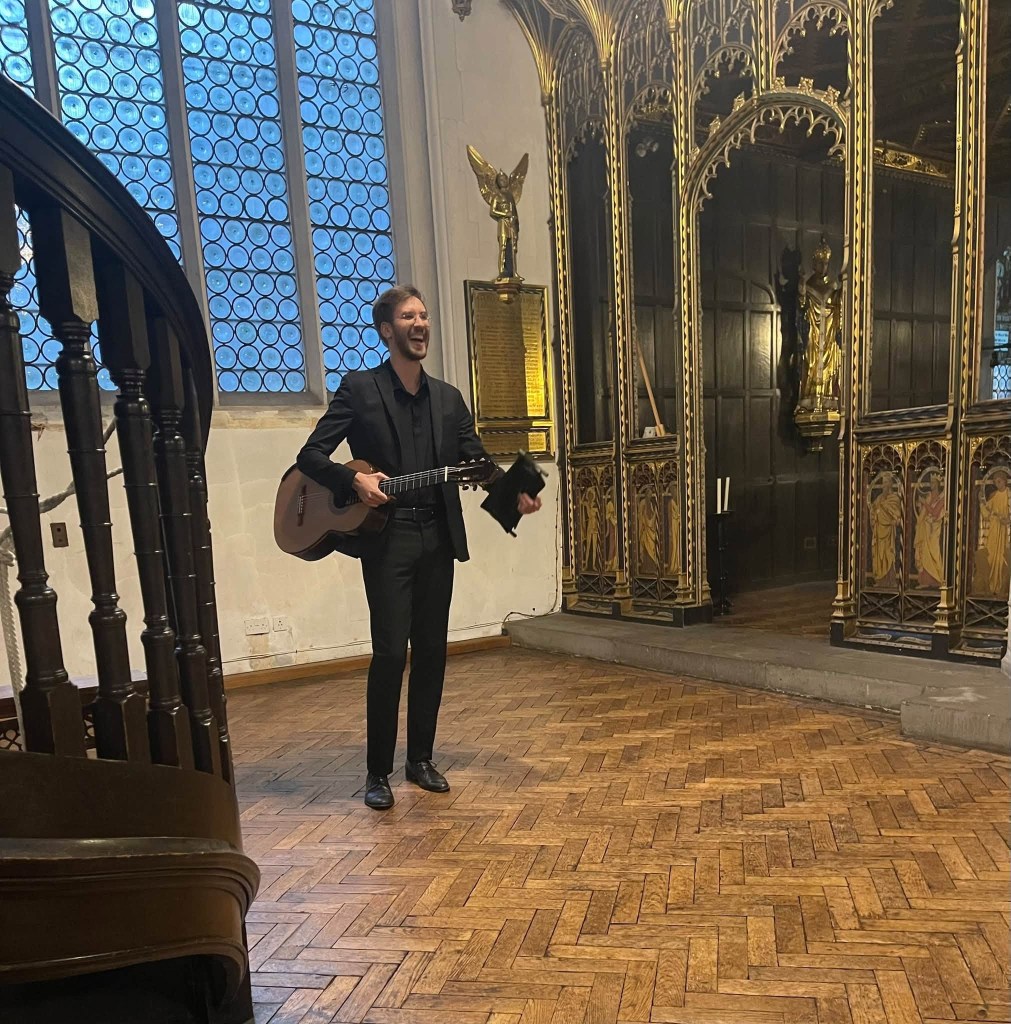
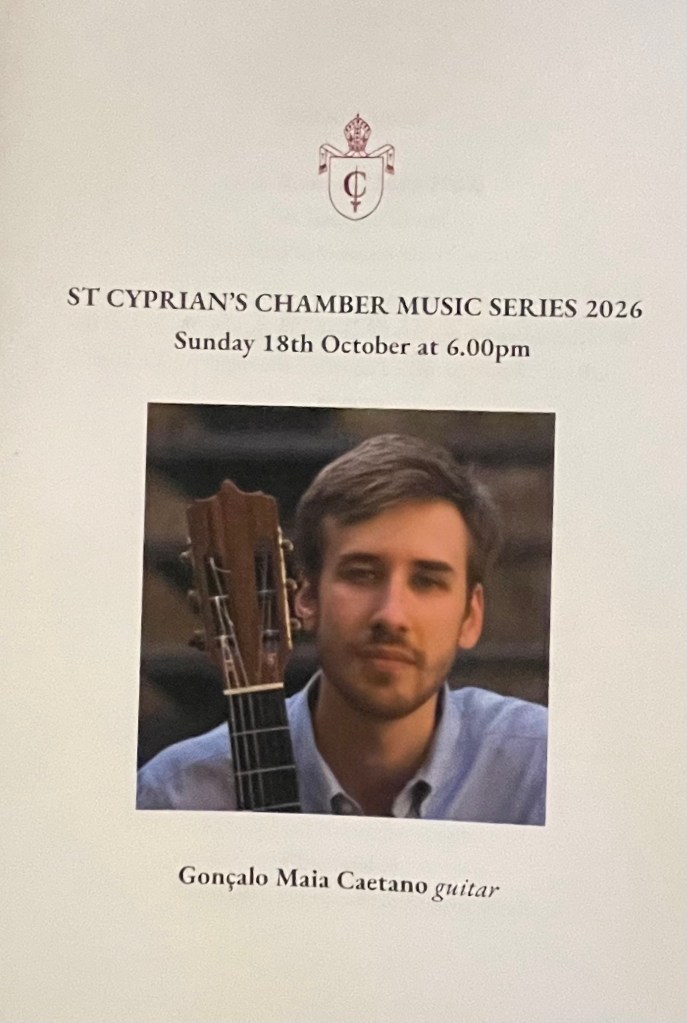
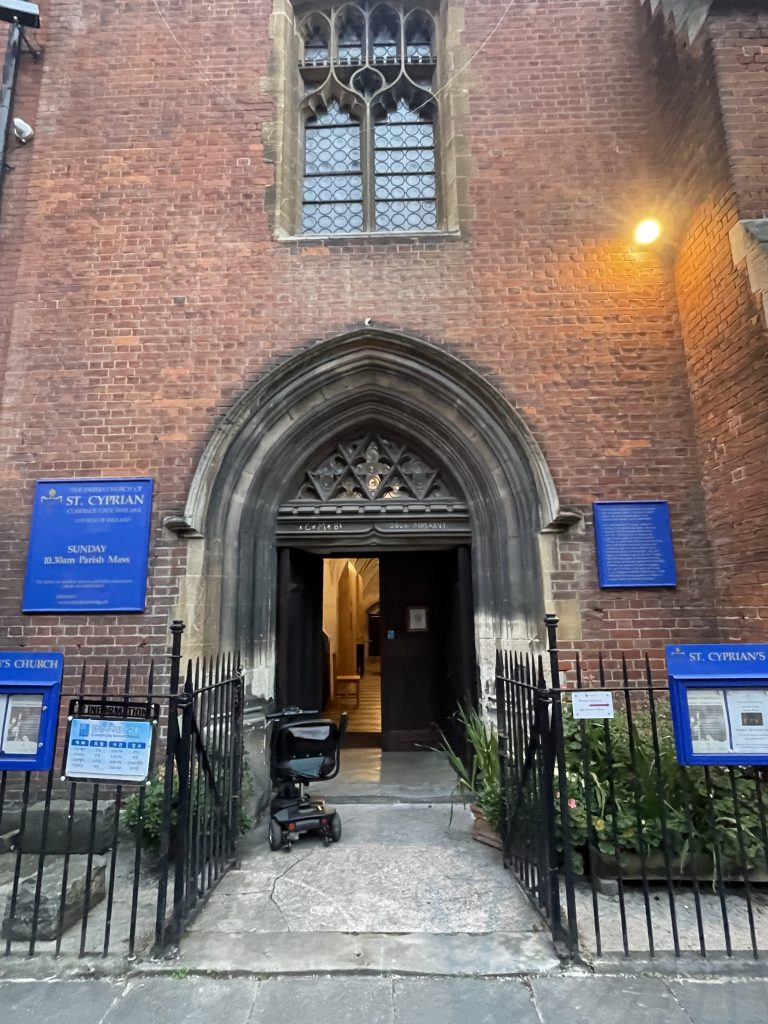
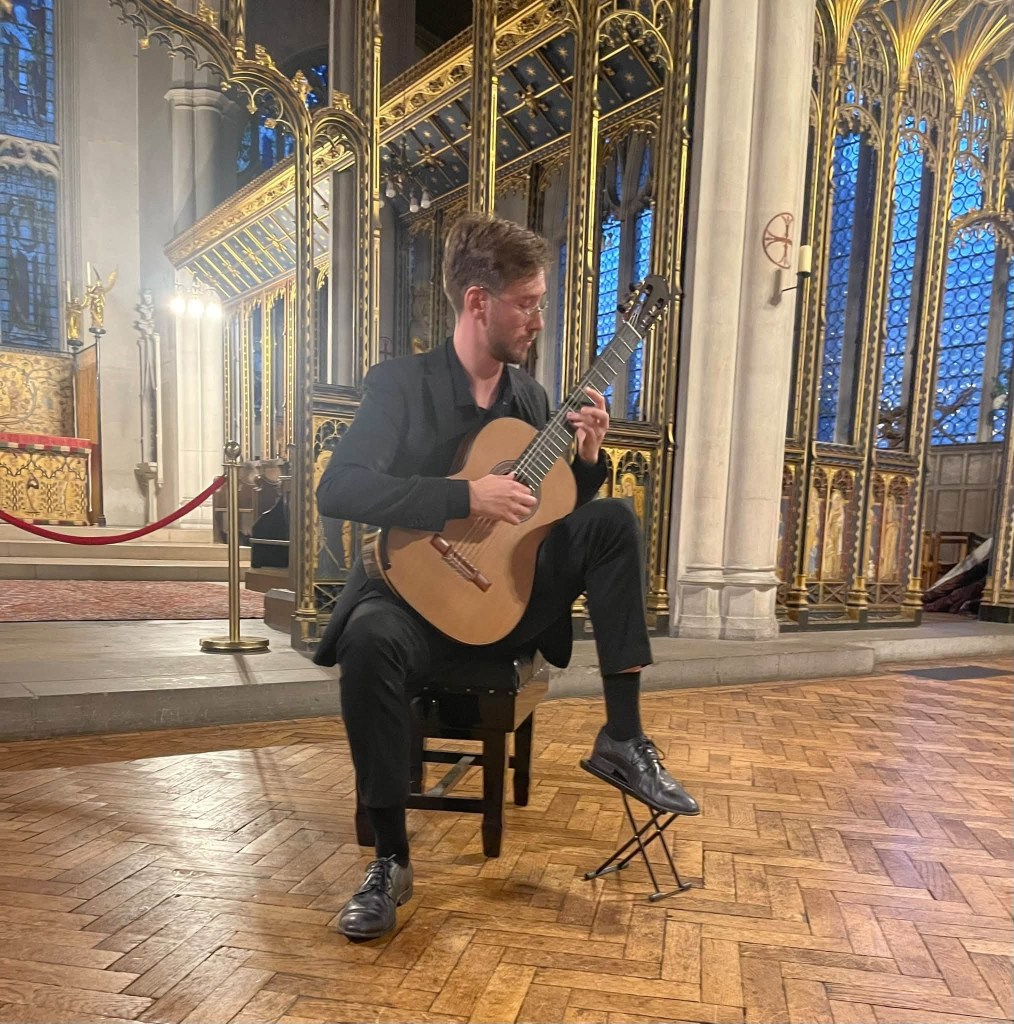
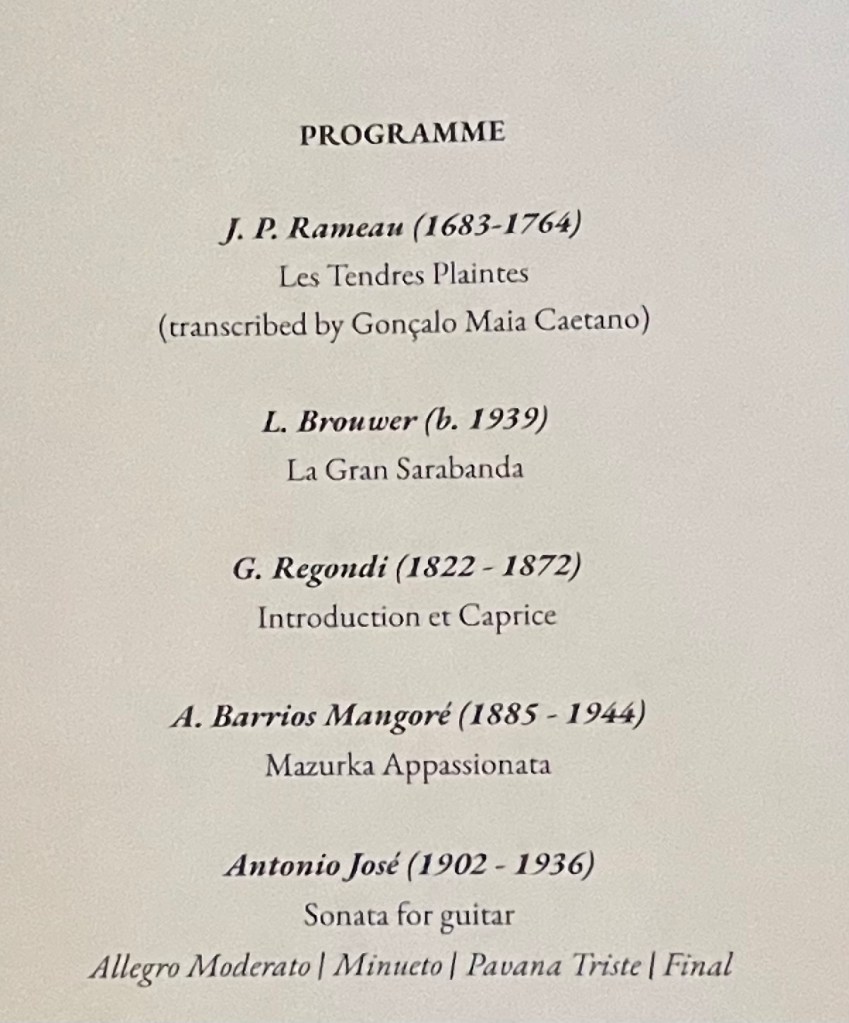
Gonçalo Maia Caetano at St Cyprian’s Chamber Music Series just a stone’s throw from the Royal Academy where he and his girlfriend Gabrielé Sutkuté have both recently graduated with honours. It was in fact a work from Gabrielé’s recent repertoire that opened Gonçalo ‘s recital with his own transcription for guitar of Rameau’s ‘Les Tendres Plaintes.’
Like Segovia on the guitar or Casals on the cello discovering repertoire and inventing technique to allow such masterpiece to grow and glow in their hands .
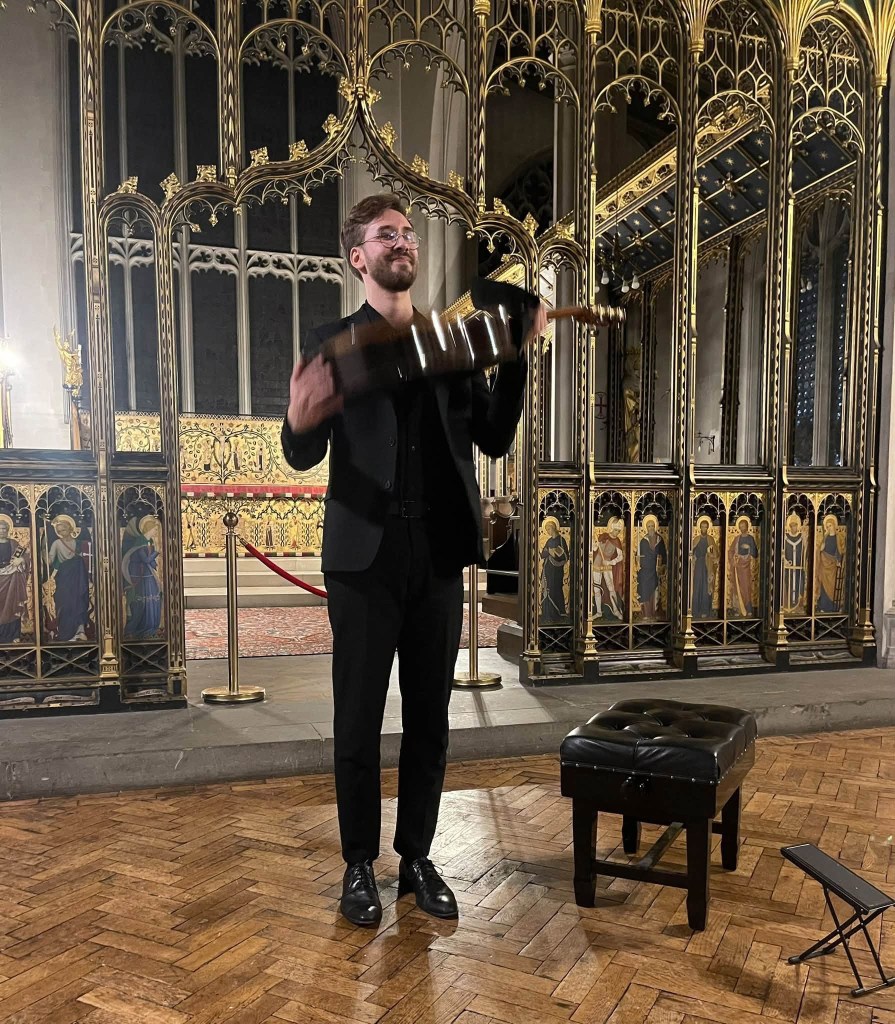
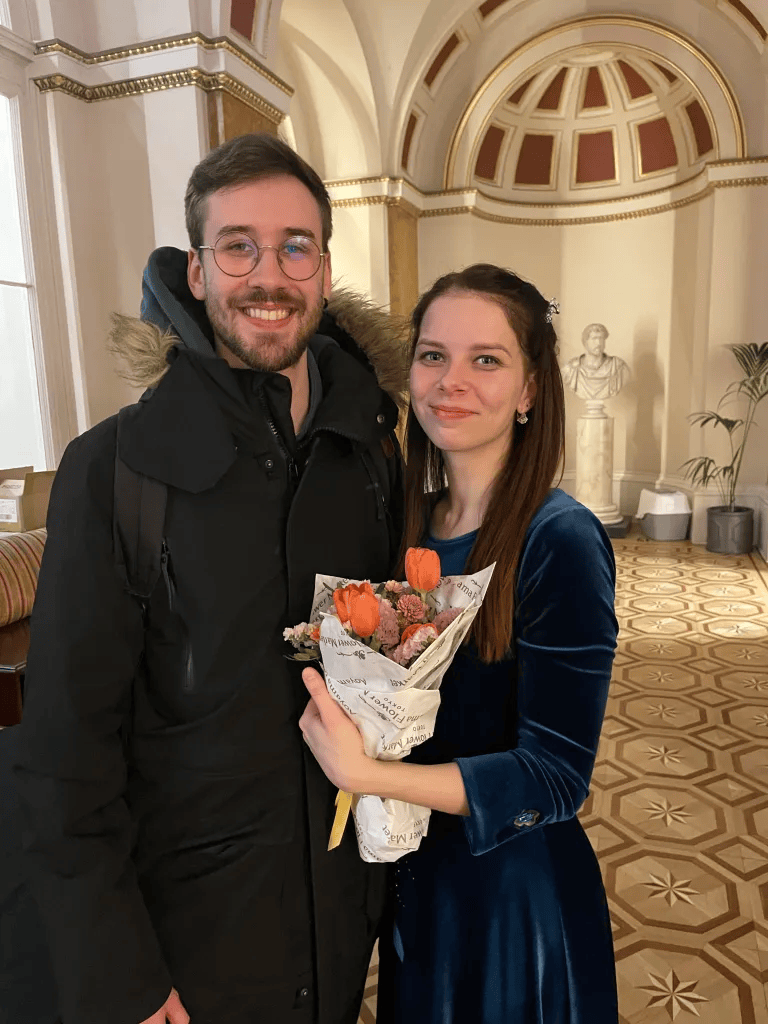
Gonçalo and Gabrielé sharing their life in music together was a touching way to open his recital today. A golden couple indeed.
Exquisite ornamentation in the Rameau that was even more suited to the guitar than the piano. The piano of course with its luxuriant legato of subtle beauty and colouring but on the guitar it took on a different character of a more detached beauty of a refined aristocratic sound world of its time. However both were able to transmit the extraordinary sentiment that Rameau hides in these miniature tone poems. ‘La Gran Sarabanda’ by Leo Brouwer was played with extraordinary technical brilliance which contrasted with the charm and beguiling rubato of Giulio Regondi’s Introduction that he played with great weight before embracing the style of the Caprice . It was the same charm and style that he brought to Barrios Mangoré’s ‘Mazurka Appassionata’ and the formidable mastery that he brought to Antonio José’s only work for guitar his sonata .
I have been unwittingly exposed to many of the great guitarists of our time. A group of young guitarists in Rome brought David Russell to play and give Masterclasses for some years in my Euromusica season in the theatre I had created with my actress wife in Rome. Others brought Julian Bream, John Williams, Manuel Barrueco and the fabulous Duo Assad. The one that impressed me the most, though, for his extraordinary musicality was Oscar Ghiglia. Yamashita came one year and played the Mussorgsky Pictures at an Exhibition on the guitar ! A mechanic of manic proportions but when he returned some years later it was with his wife and three little children all of whom played the guitar. Father and family played like angels this time, and when my wife died they wrote to me that they would like to give a performance in her memory. I was very grateful but explained that to arrange a concert would take time and organisation. I had not understood because they explained they just wanted to play to me, privately, in the theatre that my wife and I had created together, to share their love via their music and to fill my heart not with sadness but with joy. So you see the guitar has a very special place in my heart and I was very pleased to attend Conçalo’s guitar recital after so many years which brought back so many poignant memories.
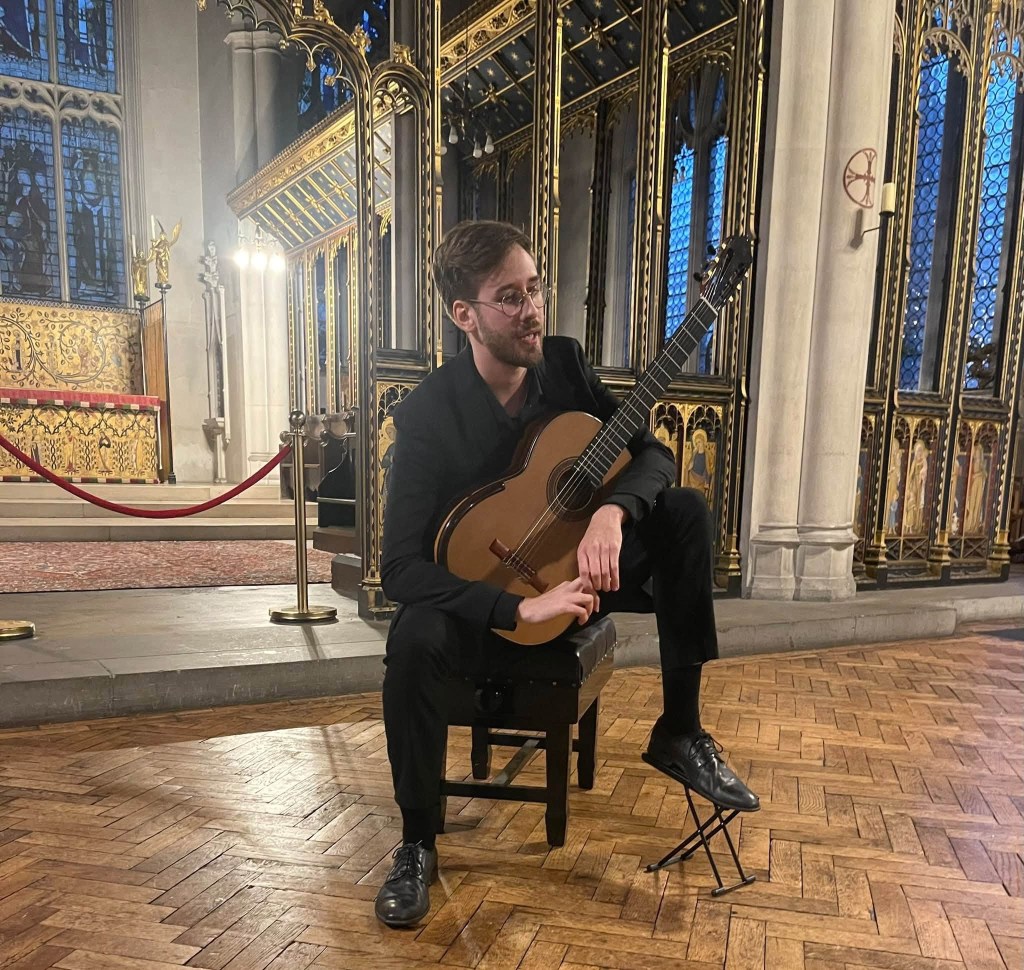
Gonçalo Maia Caetano is a classical guitarist from Portugal who has concluded his Advanced Diploma course at the Royal Academy of Music with professor Michael Lewin. The guitarist also got a Bachelor of Music Degree (with First Class Honours) and a Master of Arts’ Degree (with DipRAM) there.
Gonçalo has performed in many concerts throughout Portugal, Spain, Italy, Germany, Austria and United Kingdom. He has performed in renowned venues such as The King’s Place in London, Wiener Saal in Salzburg, Austria, among others.
In 2016 Gonçalo won the 2nd prize Ex-Aequo in Valencia’s International Guitar Competition and later in the year he was awarded the 3rd prize in Guimarães International Guitar Competition. In the following year, he was the winner in the competition “Grand Prize Virtuoso” and consequently was invited to give a concert in Wiener Saal, Mozarteum in Salzburg, Austria. In 2021, Gonçalo was the Winner of the Blyth Watson Guitar Concerto Prize at the Royal Academy of Music. In 2023 Gonçalo received 1st Prize at the prestigious “The Prince’s Prize” competition, the 2nd prize at the Ivor Mairants Guitar Competition and the 2nd prize in Pleven Guitar Competition. In 2024 he was awarded the 2nd prize in the Gallery of Guitars Competition in Scotland and this year he won the 2nd prize in Lagoa Guitar Festival in the chamber music category with his duo “Volt Duo” with Gus Mcquade.
Gonçalo has had Masterclasses with distinguished guitarists such as David Russell, Fabio Zanon, Aniello Desiderio, Lukasz Kuropaczewski, Roland Dyens, Laura Young, Graham Devine, Michel Sadanowsky, Carlo Marchione and many more acclaimed musicians.
Apart from his classical guitar studies, he is very interested in Jazz. In the end of his first year at the Royal Academy of Music, Gonçalo started his second study in Jazz Guitar. He also has his own Jazz project “Maia” with which he released the single “Yellow”. In 2020, Gonçalo joined the “Phemo Quartet” as a Bass player and in 2022 the quartet performed in the Vortex Jazz Club. Later this year, the quartet will release their debut album “Anti-Revelation”.
Gonçalo is currently being supported by the Musicians’ Company, Help Musicians UK, IGF and Talent Unlimited
https://www. concalomaiacaetano.com
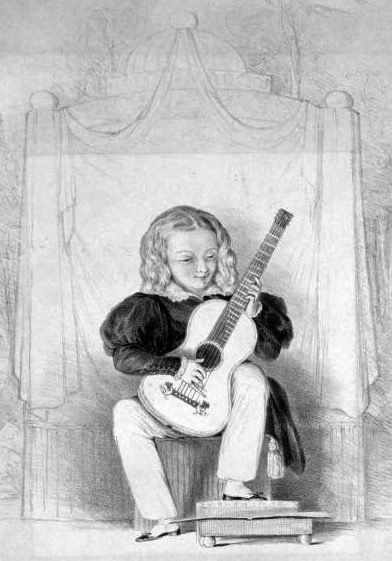
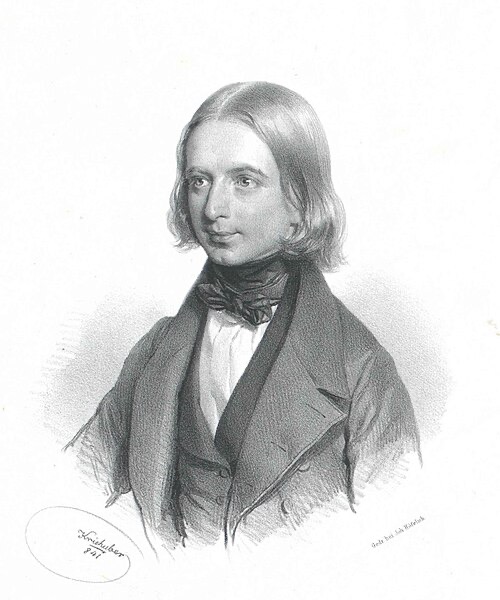
Giulio Regondi (1822 – 6 May 1872) was a Swiss-born classical guitarist, concertinist and composer active in France and (mainly) the United Kingdom.
Regondi was born of a German mother and an Italian father in Geneva Switzerland. In 1831 Fernando Sor dedicated his Souvenir d’amitié op. 46 to Regondi, a child prodigy when the boy was just nine.
There is a reference to his appearing in London in 1831, presented as a child prodigy of the guitar.All of Regondi’s concertina music was written for the English system, at which he was a virtuoso though his guitar music is now better known. Regondi’s works for solo guitar comprise a set of etudes, variations on a theme by Bellini and five larger works.
Regondi died in London and is buried in Kensal Rise Cemetery.
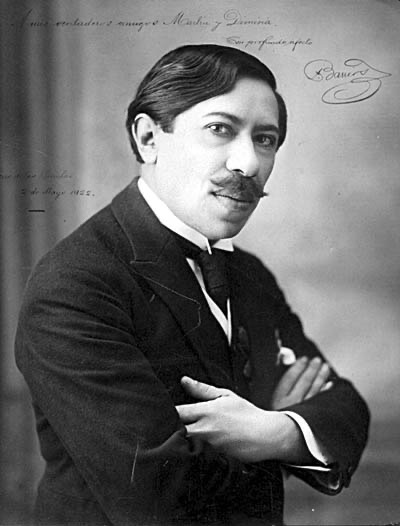
Agustín Pío Barrios Ferreira May 5, 1885 San Juan Bautista Paraquay
August 7, 1944 (aged 59). San Salvador El Salvador
Agustín Pío Barrios (also known as Agustín Barrios Mangoré and Nitsuga—Agustín spelled backwards—Mangoré; May 5, 1885 – August 7, 1944) was a Paraguayan virtuoso classical guitarist and composer, regarded by some as one of the greatest performers and arguably the most prolific composer for the classical guitar Barrios was famed for his phenomenal performances, both live and on gramophone recordings. Eye-witness testimony from Lope Texera in Caracas Venezuela on April 18, 1932, declared that Barrios was “superior to Segovia whom I saw in London last year”. Barrios has been credited as the first classical guitarist to make recordings, in 1909/10. Barrios sometimes performed in concert in traditional Paraguayan dress (he was partly of Guarani origin), beginning in 1932 using the pseudonym of Nitsuga Mangoré (‘Nitsuga’ being Agustín spelled backwards, and ‘Mangoré’ being the name of a cacique of the South American indigenous group Timbú).During his performing years, Barrios only informally shared bits of his musical knowledge with his patrons Luis Pasquet, Martin Borda Pagola, Dionisio Basualdo, Bautista and Lalyta Almiron, and Raul Borges.
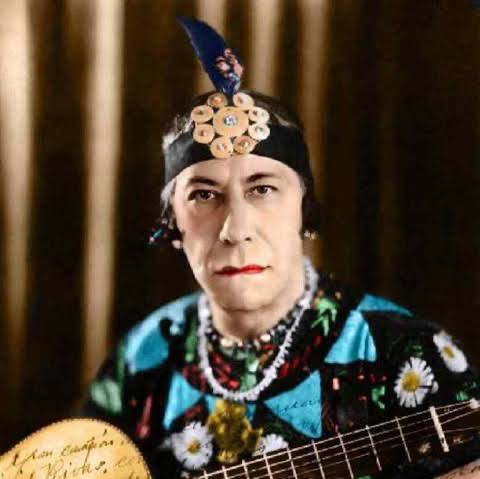
Barrios vehemently rejected the idea of devoting time to the formal instruction of students, as he saw it detrimental to the flourishing of the artist, often responding to persuasive attempts “cuando nace el maestro, muere el artista”(the artist dies with the birth of the teacher). Given his masterful command of the instrument and compositional prolificity, the stance was then perceived as tragic eccentricityThe J.S.Bach -inspired La Catedral, from 1921, is widely considered to be Barrios’ magnum opus, winning the approval of Segovia who said “In 1921 in Buenos Aires, I played at the hall La Argentina noted for its good acoustics for guitar, where Barrios had concertized just weeks before me. He was presented to me by his secretary Elbio Trapani. At my invitation, Barrios visited me at the hotel and played for me upon my very own guitar several of his compositions, among which the one that really impressed me was a magnificent concert piece The Cathedral whose first movement is an andante, like an introduction and prelude, and a second very virtuosic piece which is ideal for the repertory of any concert guitarist. Barrios had promised to send me immediately a copy of the work (I had ten days remaining before continuing my journey) but I never received a copy.”However, it is possible that Segovia did receive the score and chose not to play it, either out of distaste for Barrios’ folk-based music or professional jealousy (because Barrios was more of a composer than he was).
Antonio José Martínez Palacios (12 December 1902 –11 October 1936), professionally known as Antonio José, was a Spanish composer . Maurice Ravel apparently said of Antonio José: “He will become the Spanish composer of our century”, however, his music lay forgotten until the 1980s.
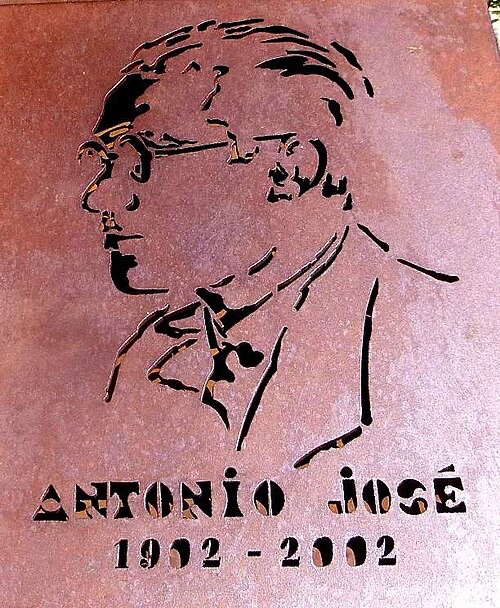
Born in Burgos ,Castile and León, Antonio José became a music teacher at a Jesuit school and conducted the city choir in Burgos. The sheer volume of his work (he died at 33) was prodigious. He penned his first composition when he was 14. He was hired as a director of a musical review in Burgos at the age of 18. He wrote extensively for voice in his quest to present the melodies of his native Burgos to the world. His compositions, especially the Sinfonía castellana and Suite Ingenua, put his orchestration on a par with anything at the time in the twentieth century. His most famous work is a sonata for guitar.
His harmonic understanding put him in the forefront of post-impressionist composers, and though a disciple of Ravel, his particular voice and choice of medium set him distinctly apart. His chief biographer, Miguel Ángel Palacios Garoz, points out that Antonio José was not only a prolific composer but a writer with an intellectually facile mind that was open to influences from all fronts of contemporary music.
Falangists had success in the July 18 1936 coup , and he was arrested on August 6 and detained in Burgos.
Antonio José was executed by a Falangist firing squad at Estépar. His body was thrown into one of the Mass graves. Like poet and playwright Federico Garcia Lorca , who met a similar fate in the province of Granada his remains have yet to be identified.
https://christopheraxworthymusiccommentary.com/2023/12/05/ileana-and-joan-3rd-december-2023/

