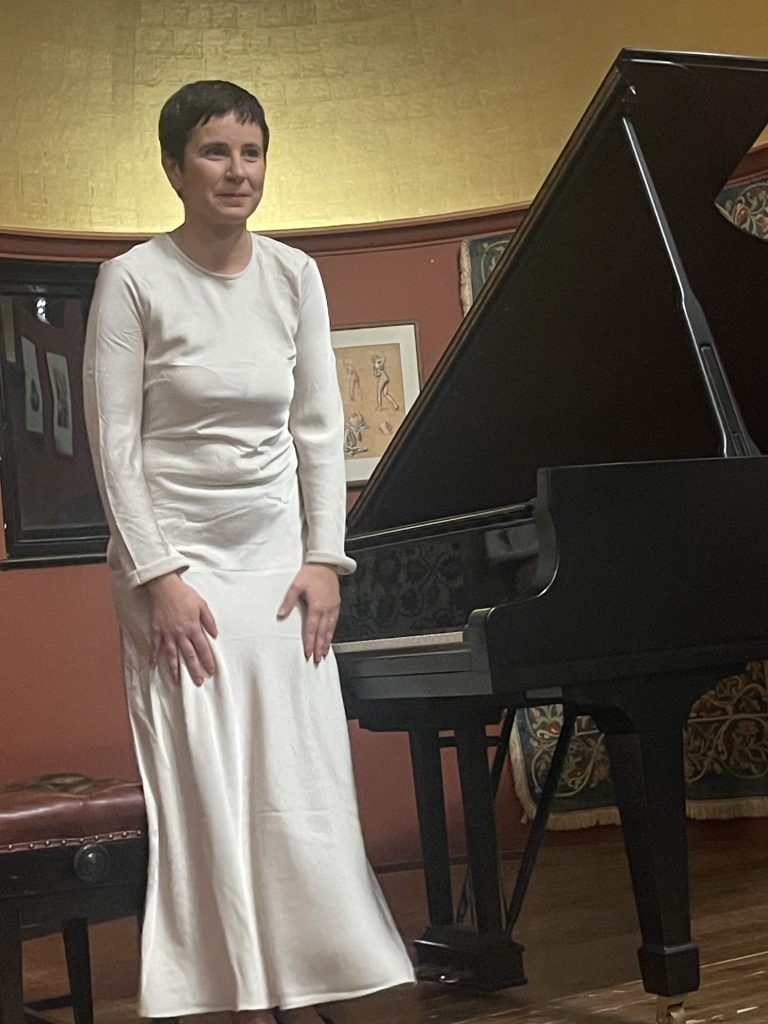
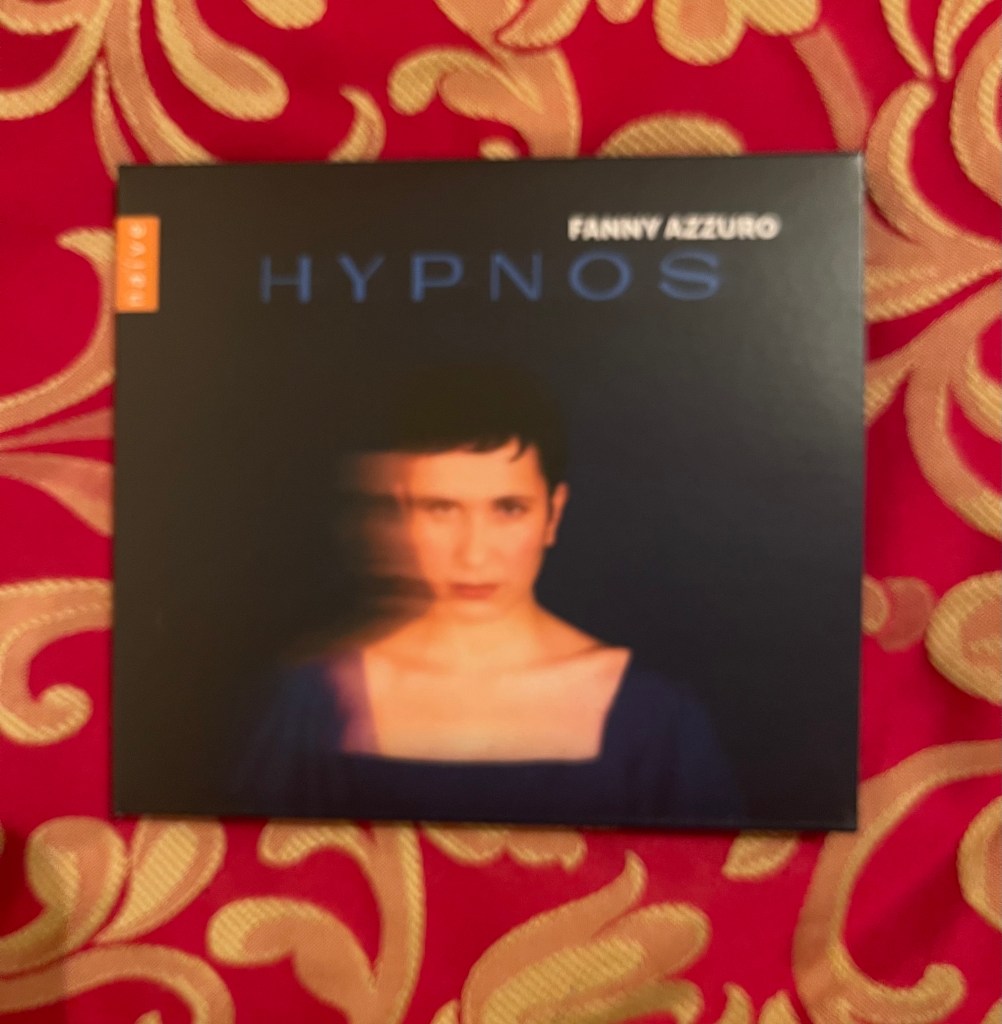
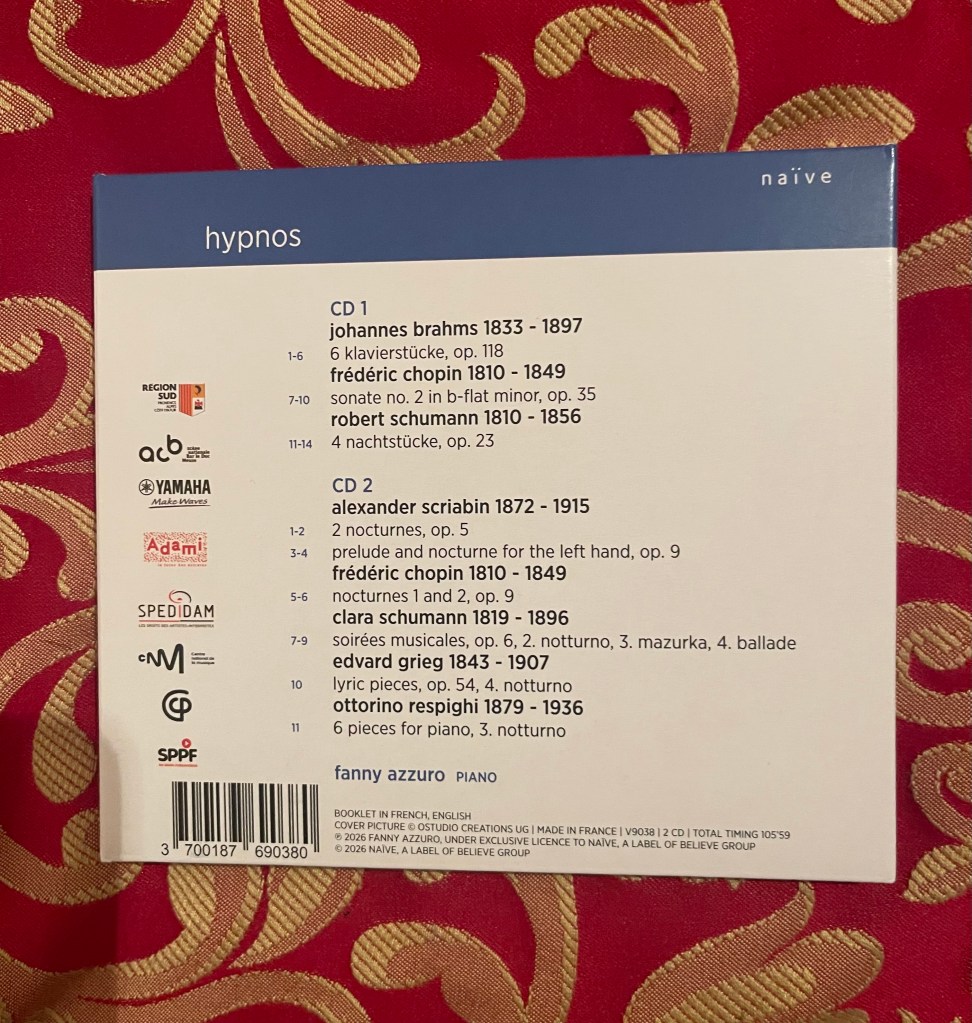
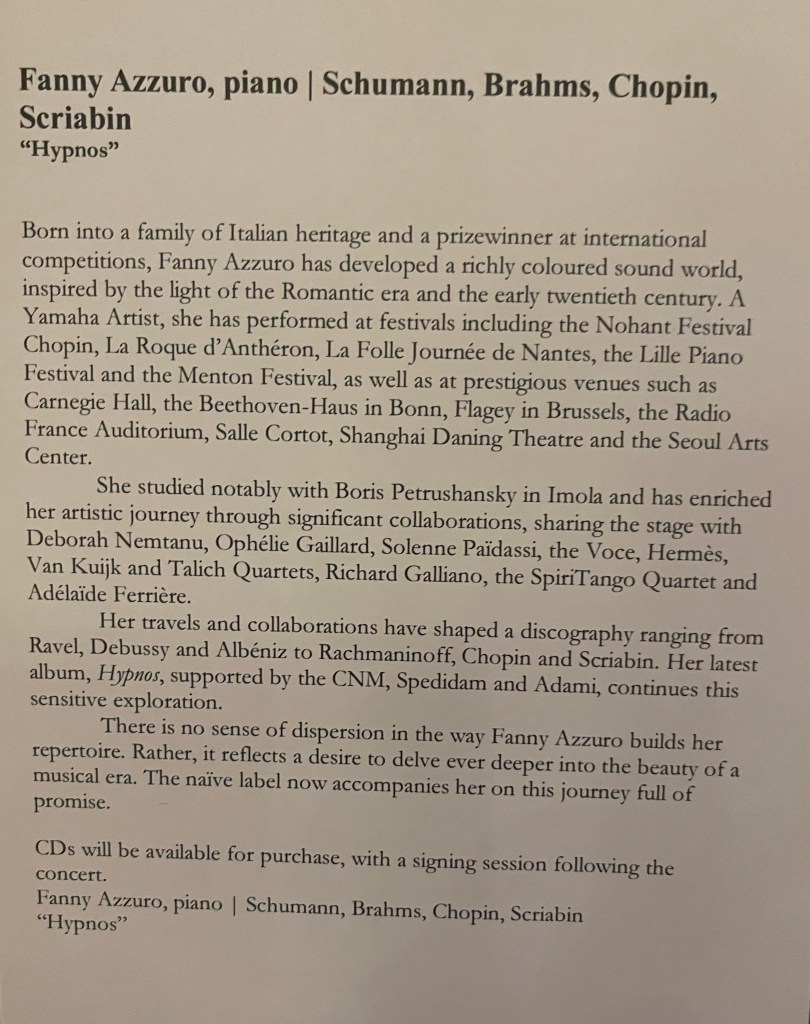
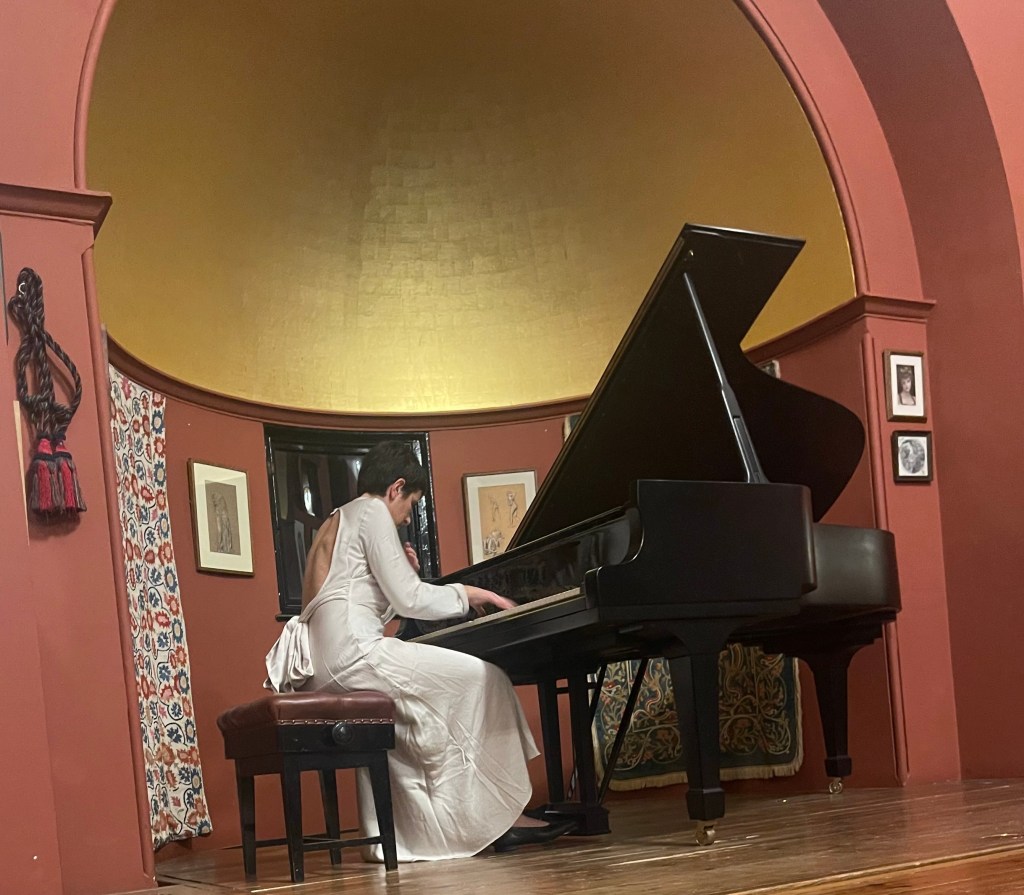
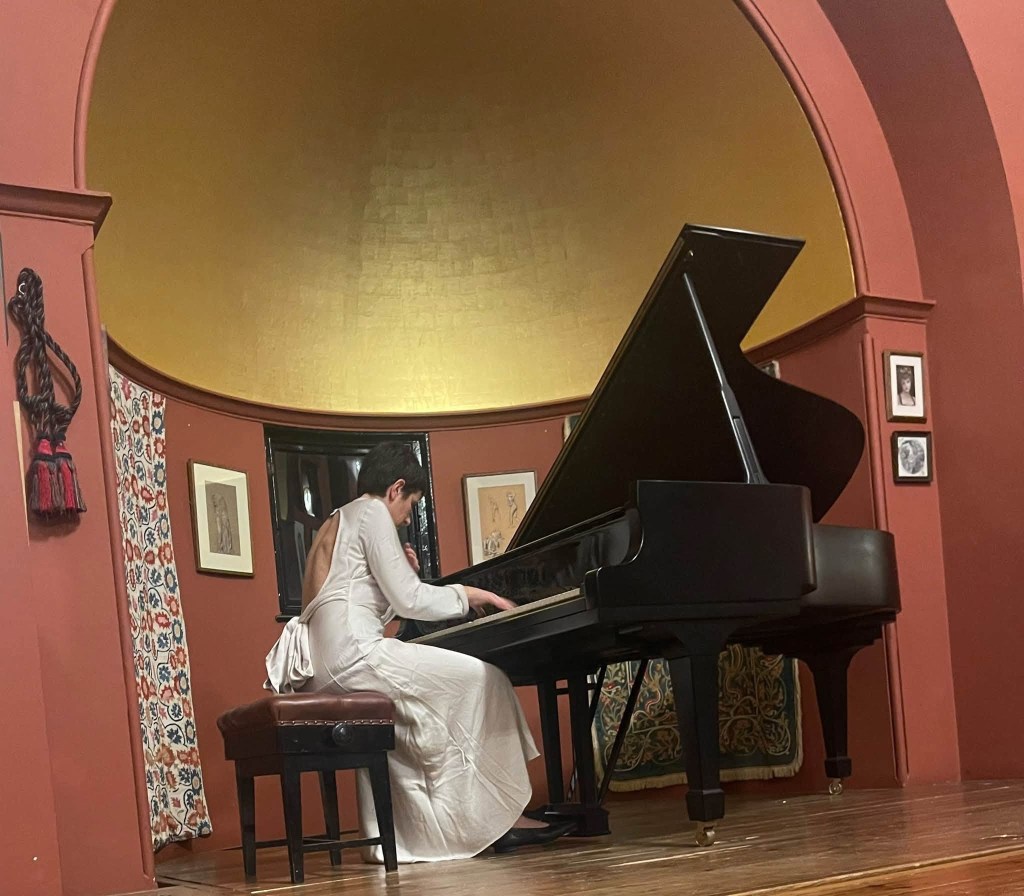
Fanny Azzuro presented her new CD ‘Hypnos ‘ in Leighton House with a beautiful programme that truly suited the sumptuous surrounds where Lisa Peacock, whose birthday it was yesterday, regularly presents her Discovery Series aided artistically by the Alexeev’s.
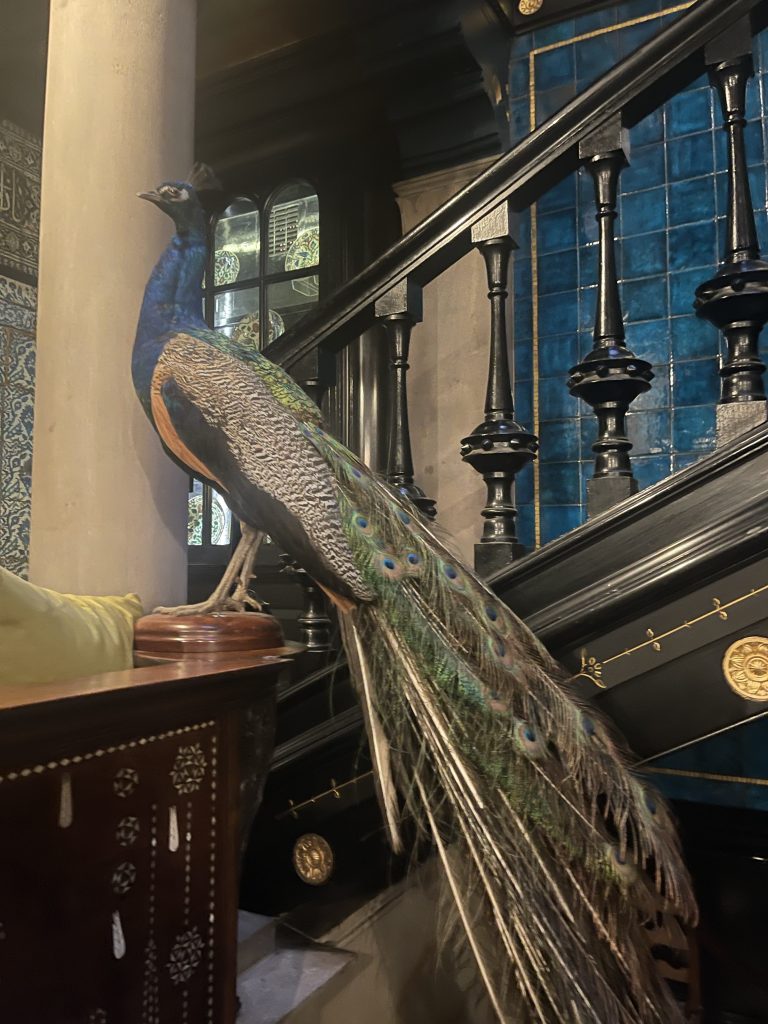
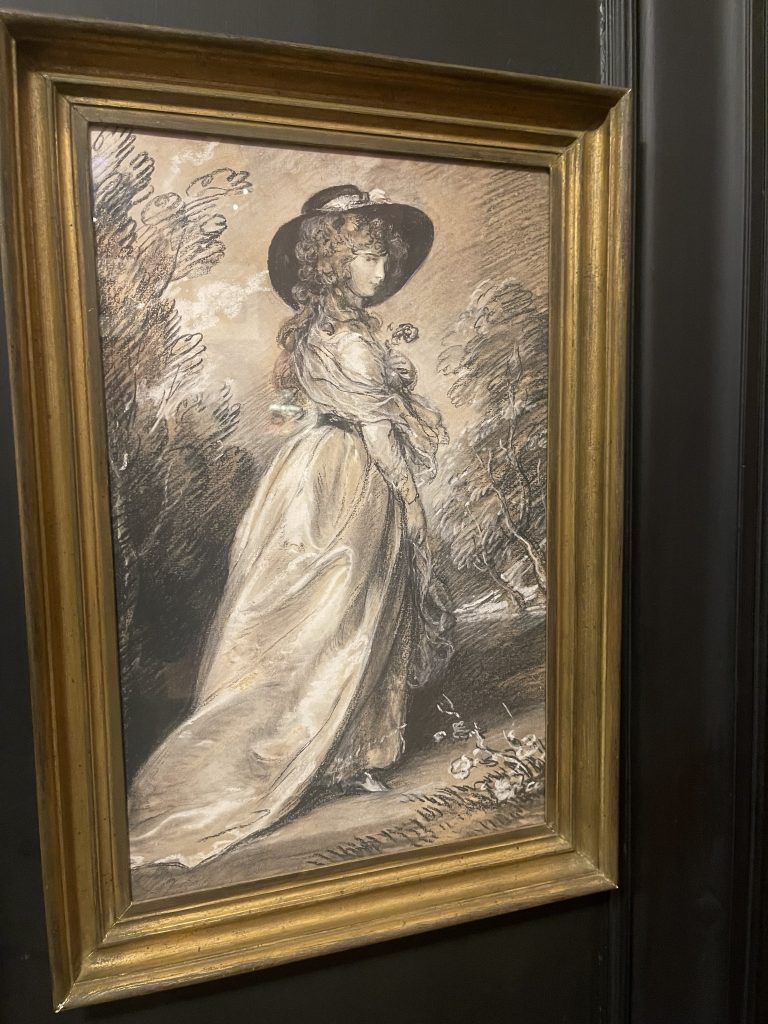
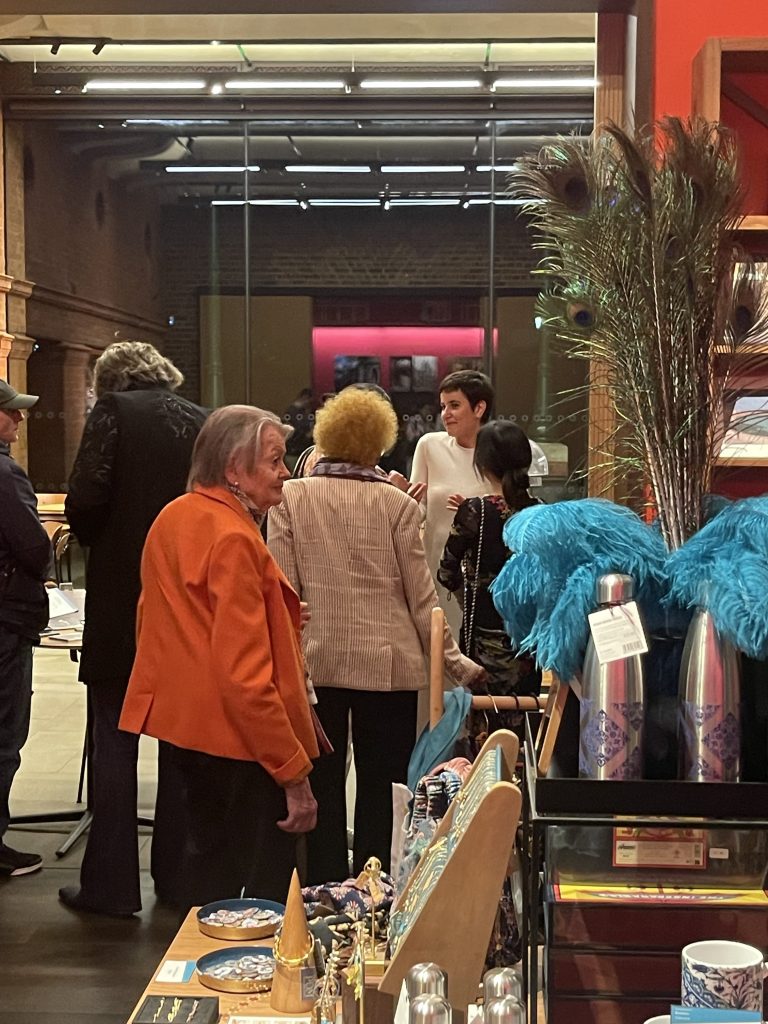
Peacocks truly abound in this oasis of Pre-Raphaelite decadence that the aesthete painter Lord Leighton dedicated his life, creating the ideal surrounds for an artist.
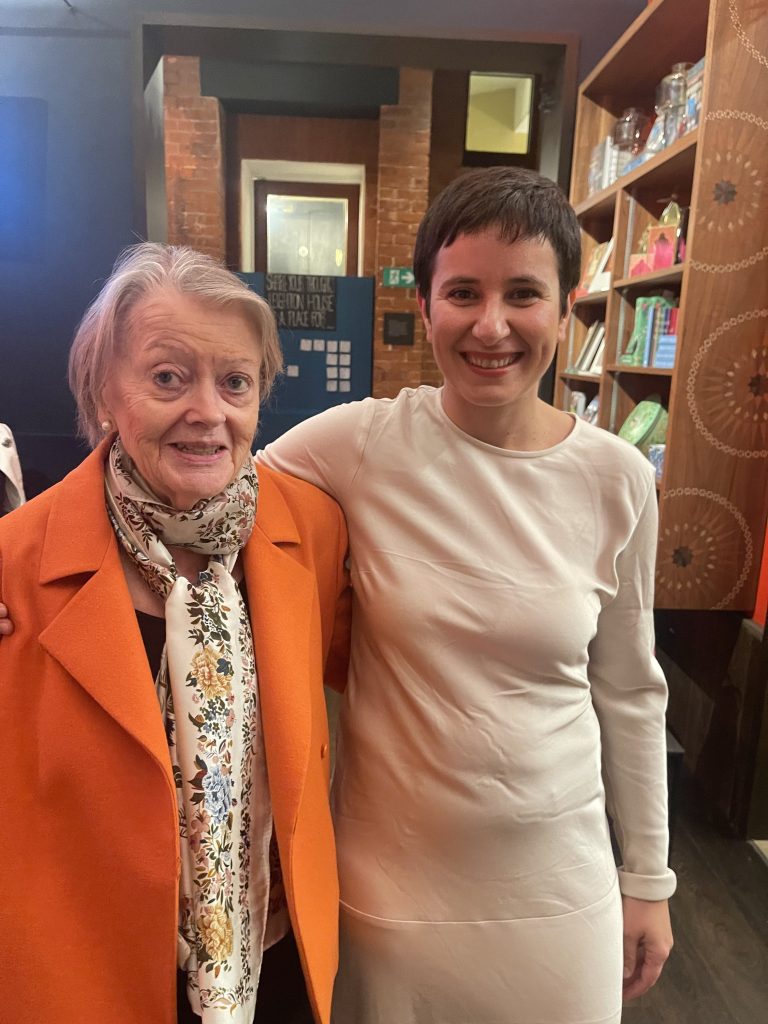
Fanny of Italian Heritage received guidance from Boris Petrushansky at the Academy in Imola near Bologna, the culinary capital of Italy, a country that Rostropovich was to describe as the Museum of the World.
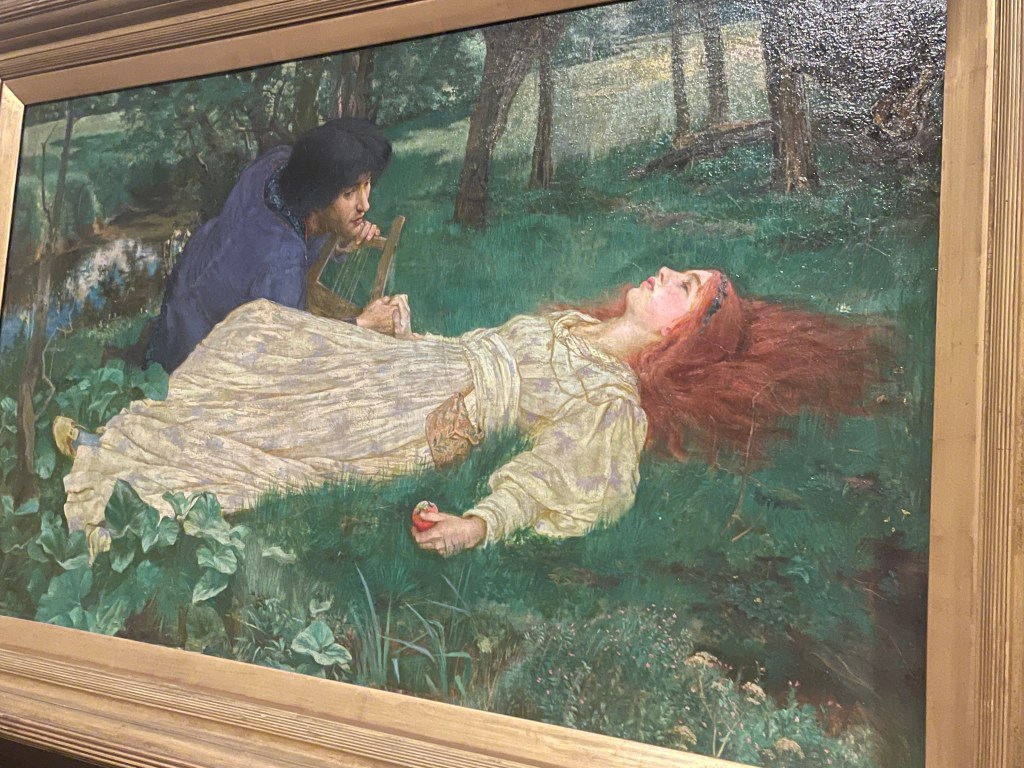
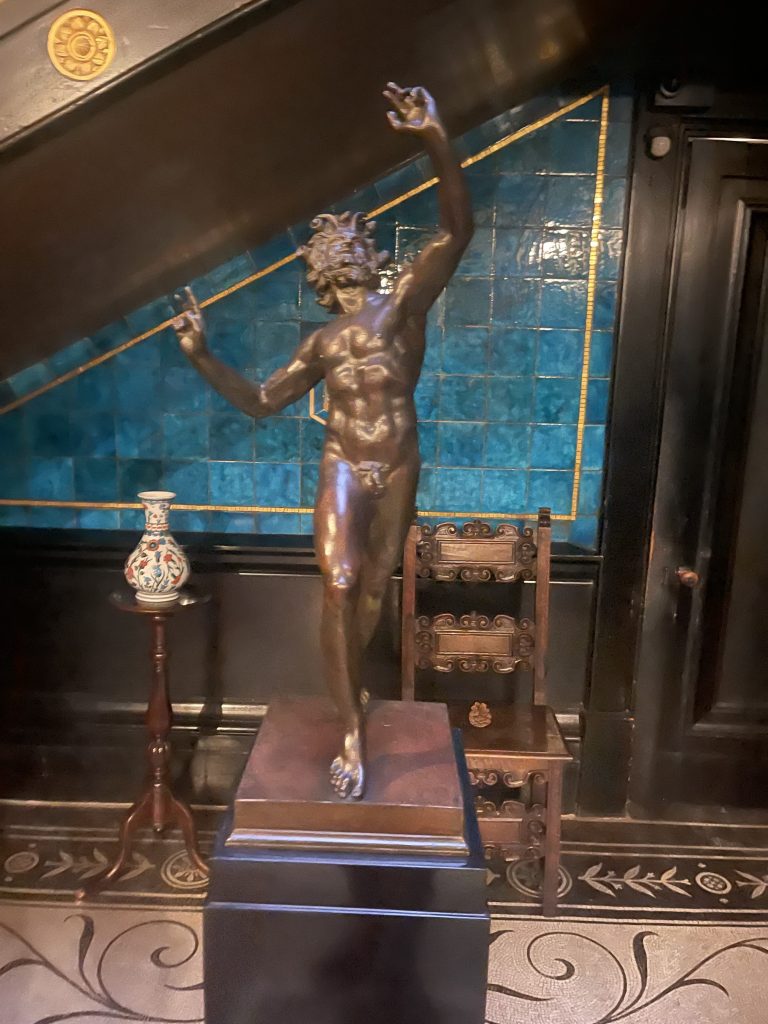
Beauty everywhere with the touch of Italian, Russian and Pre- Raphaelite influences very much in the intoxicating air of the music room sited between the Arab Hall and the Oriental rooms.
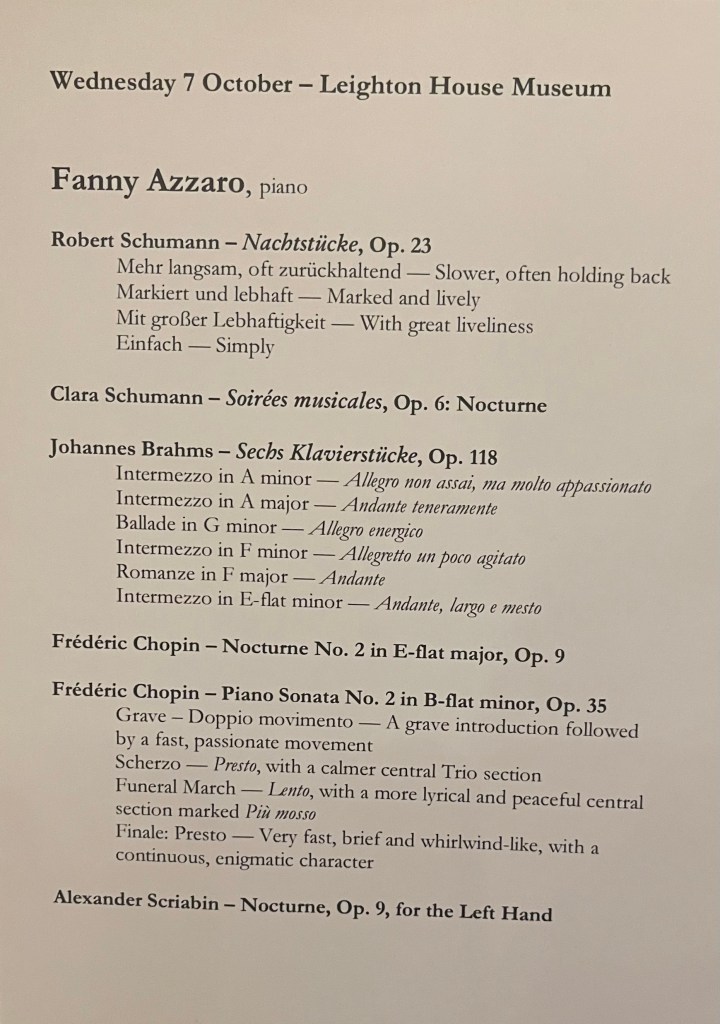
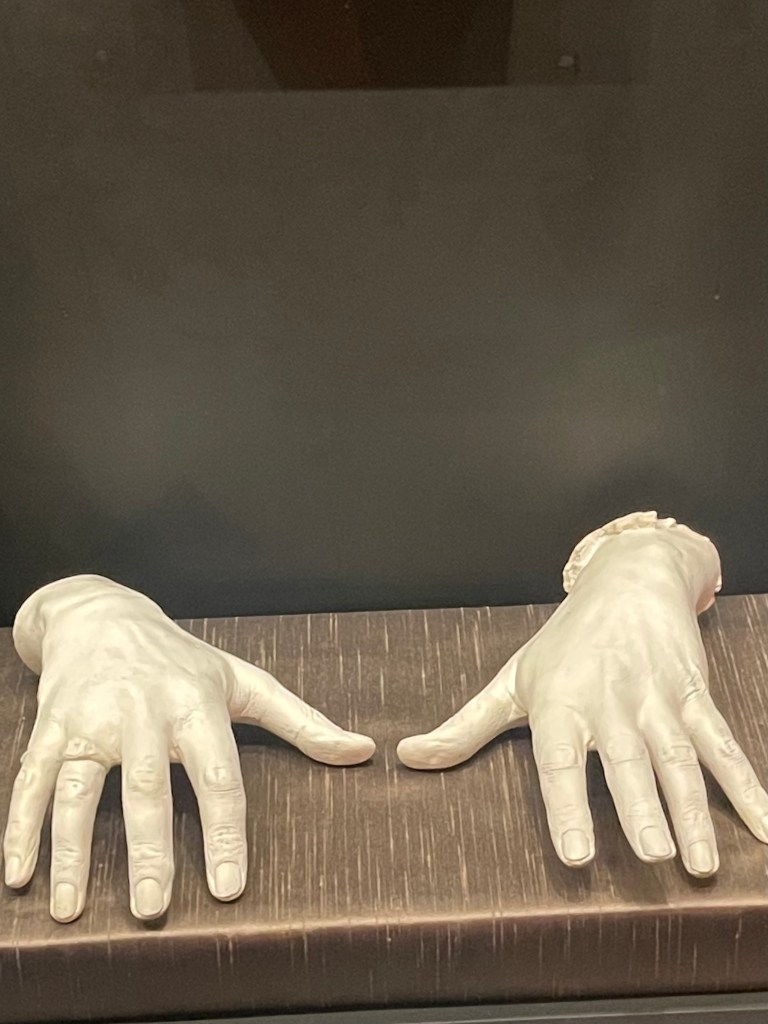
Beauty too from the elegant French hands of Fanny Azzuro with a selection of gems from her new CD .
Schumann, Robert and Clara were contrasted with Brahms‘s ‘lullabies of my grief’, as this genial trio was joined by Chopin, who Robert Schumann had discovered when a teenage Polish refugee appeared in the refined salons of the day. Welcoming his arrival with ‘Hats off gentlemen a genius !’
It takes one to notice one as they say, and it was with the Schumann’s that Fanny chose to open her programme today.
Choosing one of Schumann’s lesser known piano works from a period when one piano masterpiece after another slipped from Robert’s hand as he entered the Wieck household . Professor Wieck must have been a tyrannical trainer but he also had a daughter, a star prodigy herself, revealing a heart that beat with the same pulse as Robert’s!
It is one of the last works in this wondrous output from op 1 to op 26 and is a rarity in the concert hall . So it was a courageous choice to open with the four Nachtstücke op 23 that in lesser hands can seem rather pedantic and uninspired. I have heard it only from the hands of Gilels and Arrau and it was refreshing to hear the work brought to life tonight with poetic intensity and intelligent musicianly integrity. With its very deliberate precise March like opening leading to moments of vibrant exultation followed by a teasingly featherlight stream of chords bursting into moments of Romantic fervour. Fanny played with poetic poise and an architectural shape that gave great strength to these seemingly capriciously fragmented movements with Florestan and Eusebius becoming strangely muddled together. But suddenly a ray of true inspiration with romantic effusions of the third piece with the dynamic drive of an outpouring of intensity and beauty played with great authority. The last, just two pages long , with a beautifully shaped melodic line of great poise and simplicity to which Fanny brought poetic poignancy. The Nocturne op 6 by Clara Schumann was like a breath of fresh air especially in this beautiful haven of Lord Leighton’s Salon. A work of disarming simplicity played with the beauty and style of its time where ornaments floated into the intoxicating air with beguiling beauty.
Brahms, a family friend of the Schumann household, who ‘befriended ‘ Clara when Robert was placed in an asylum after throwing himself in the Rhine. Towards the end of his life Brahms wrote four collection of pieces that are miniature tone poems of poignant significance and sublime beauty . The second set op 117 Brahms described to Clara as ‘lullabies of my grief ‘ and the other sets were of the same deep introspection and poetic fantasy .
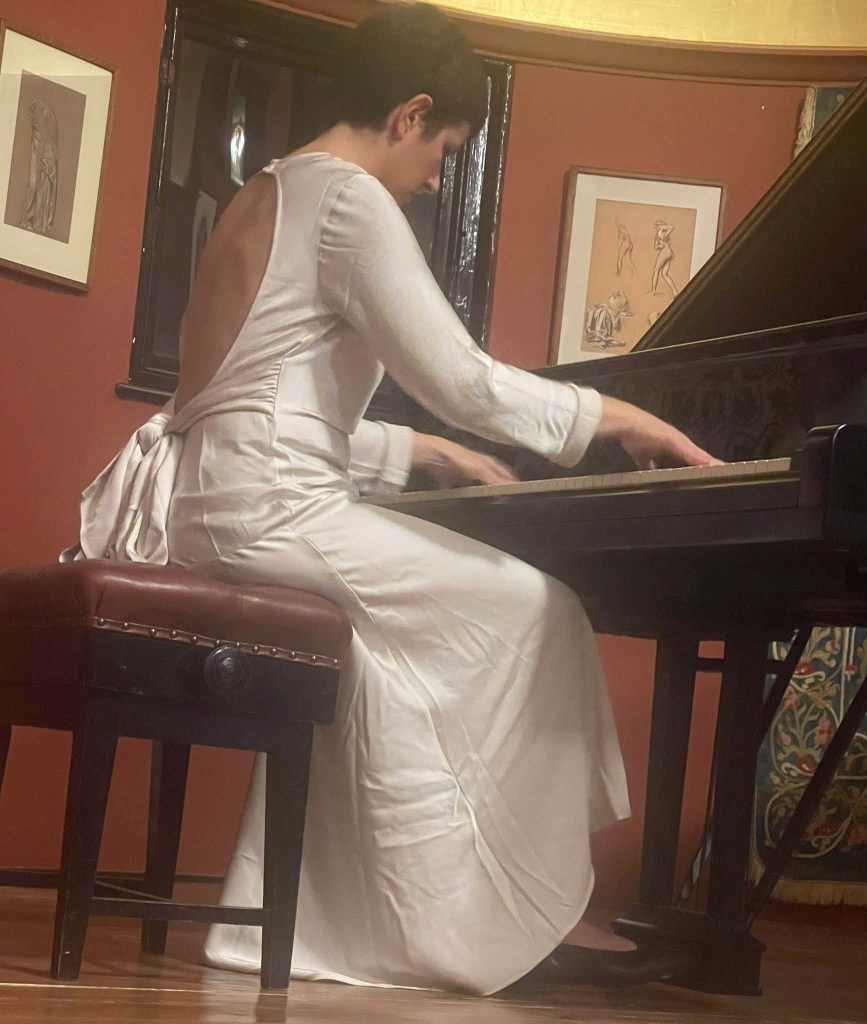
Fanny chose the seven ‘Fantasien ‘ that make up the third set of op 118 . A passionate outpouring with playing of sumptuous rich sounds of aristocratic authority and remarkable technical mastery. The A major Intermezzo that follows was played with disarming simplicity and a sense of improvised freedom with sounds of a string quartet where every strand was given weight and meaning. She brought a dynamic drive of burning intensity to the ‘Capriccio’ that makes up the third piece bringing a beautiful architectural line that dissolved into the magical central episode that she allowed to flow so mellifluously. A meandering searching beauty to the fourth was followed by the inquisitive fifth before the quasi religious outpouring of desolation of the sixth. The seventh just burst from her fingers with burning intensity as this remarkable tone poem was allowed to unwind with aristocratic nobility.
Continuing with her selection from her new CD Fanny played the most famous of Chopin’s Nocturnes op 9 n. 2 with both beauty and strength. The Chopin tradition was not for her as she looked deeply into the score with the eyes of a musician and the heart of a poet and allowed Chopin’s own voice to carry us forward to his greatest masterpiece : the Sonata in B flat minor op 35.
A fearless performance from a musician with the technical possibility to bring clarity and dynamic drive to a work that was described by Schumann as ‘four of his maddest children under the same roof ‘, even describing the last movement as ‘more of a mockery than any music’. The first movement was played with a dynamic drive of rhythmic pulsation and nobility with the second subject of aristocratic radiance and beauty. If she decided to repeat the introduction at the repeat sign it was because the opening bass interval she really underlined with extraordinary vehemence and burning intensity in the development. A hotly debated repeat that some go back to the introduction and others only to the doppio movement. Many great pianists,though, believe it to be only a conventional repeat and ignore it altogether! Fanny showed us the way of a real independent thinking musician who could sculpture the music with intelligence and poetic meaning.
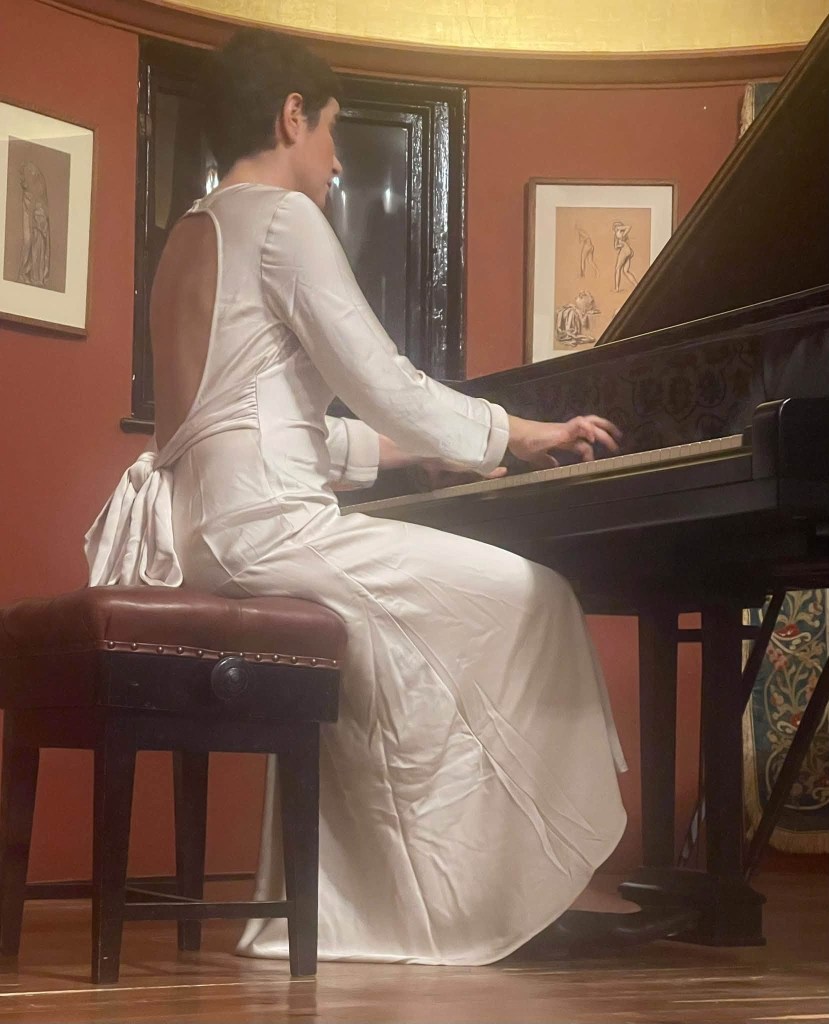
There was a fearless drive to the Scherzo and a nobility to the disarming beauty of the Trio. The Funeral March was played quite simply where Chopin’s own voice spoke for itself with the poignant beauty of the Trio that was allowed to flow with unaffected beauty. Washes of notes in the last movement, where the wind has been described as ‘blowing over the graves’ showed Fanny’s extraordinary mastery with the final chord coming as a full stop to a wind that is probably still blowing over Chopin’s own grave in Paris, even if his heart is now where it always belonged in his homeland of Poland.
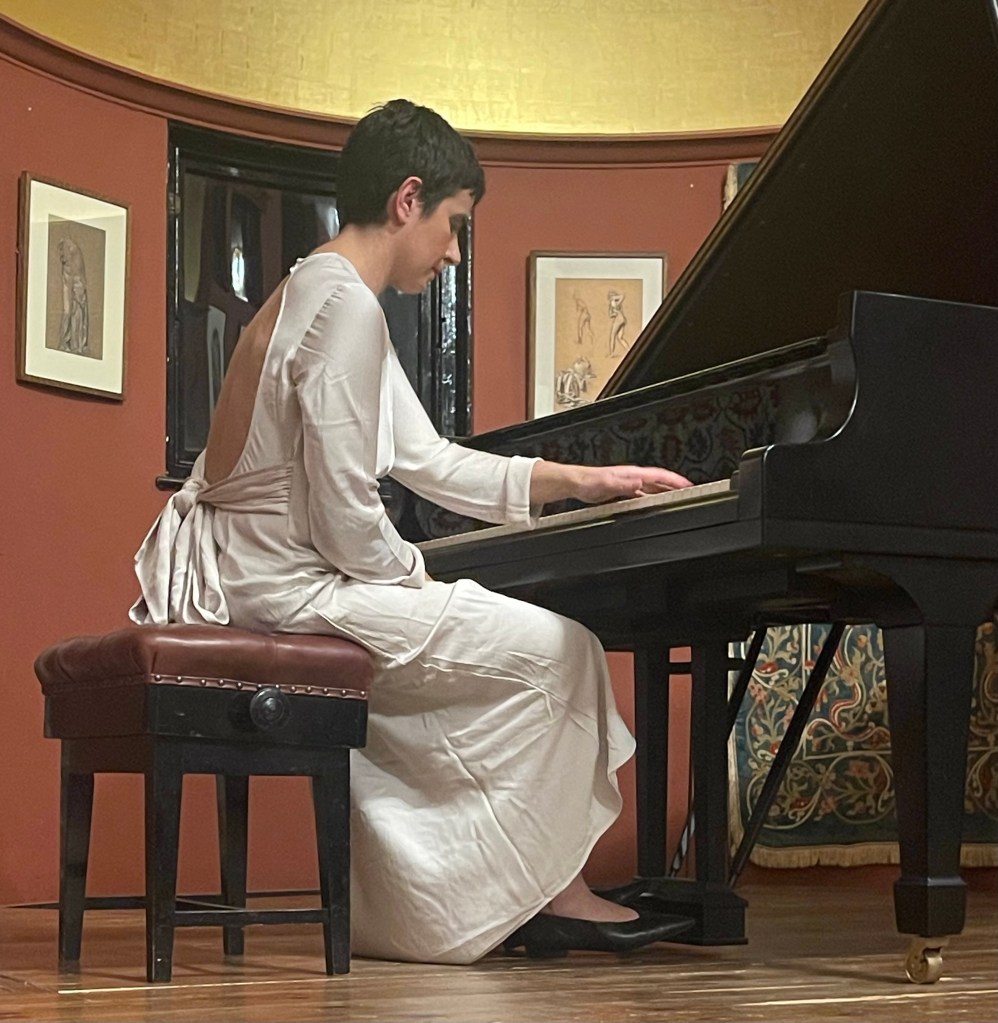
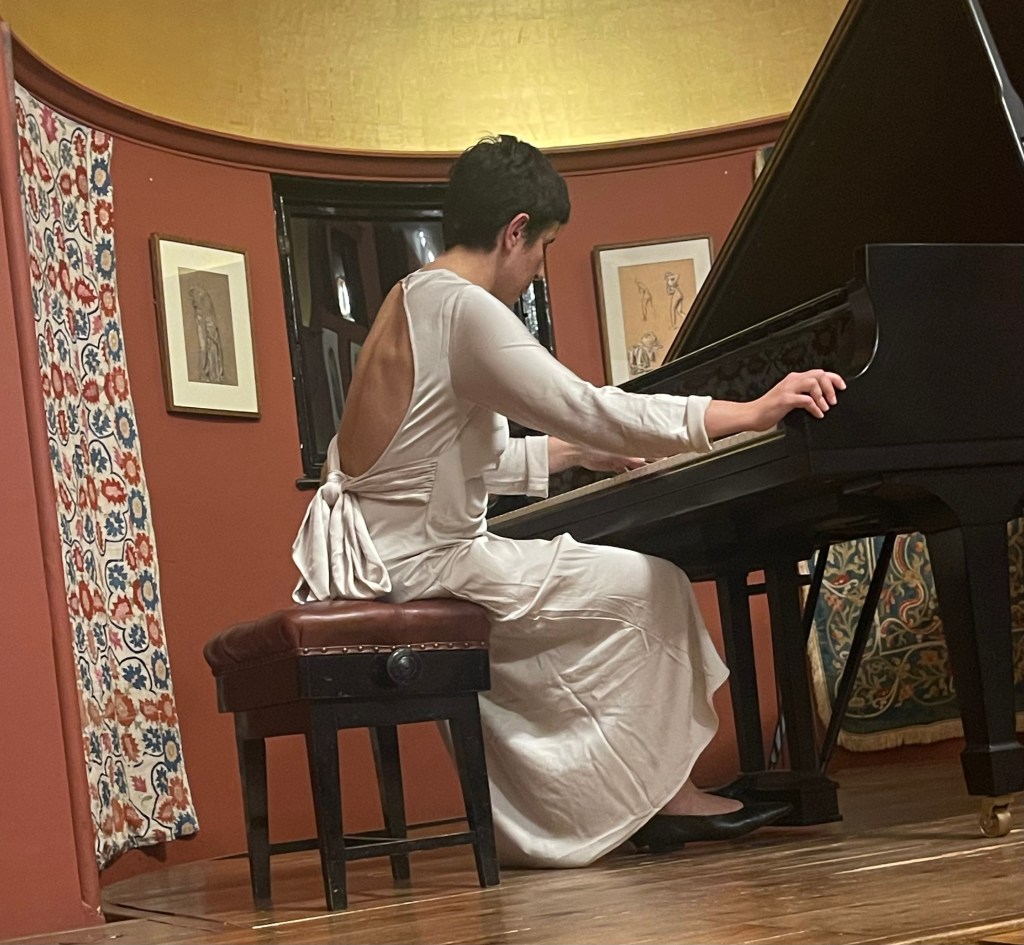
Fanny chose the Scriabin Nocturne for the left hand to close her programme which she played with beauty but rather manipulating her rubato to accommodate the awkward writing for two hands played by one!
I was hoping she might offer an encore the beautiful Respighi Notturno or the Grieg lyric piece ops 54 n. 4 but I will have to listen at home to her new CD as the concert had to draw to a close.
https://christopheraxworthymusiccommentary.com/2024/03/20/christopher-axworthy-dip-ram-aram/

