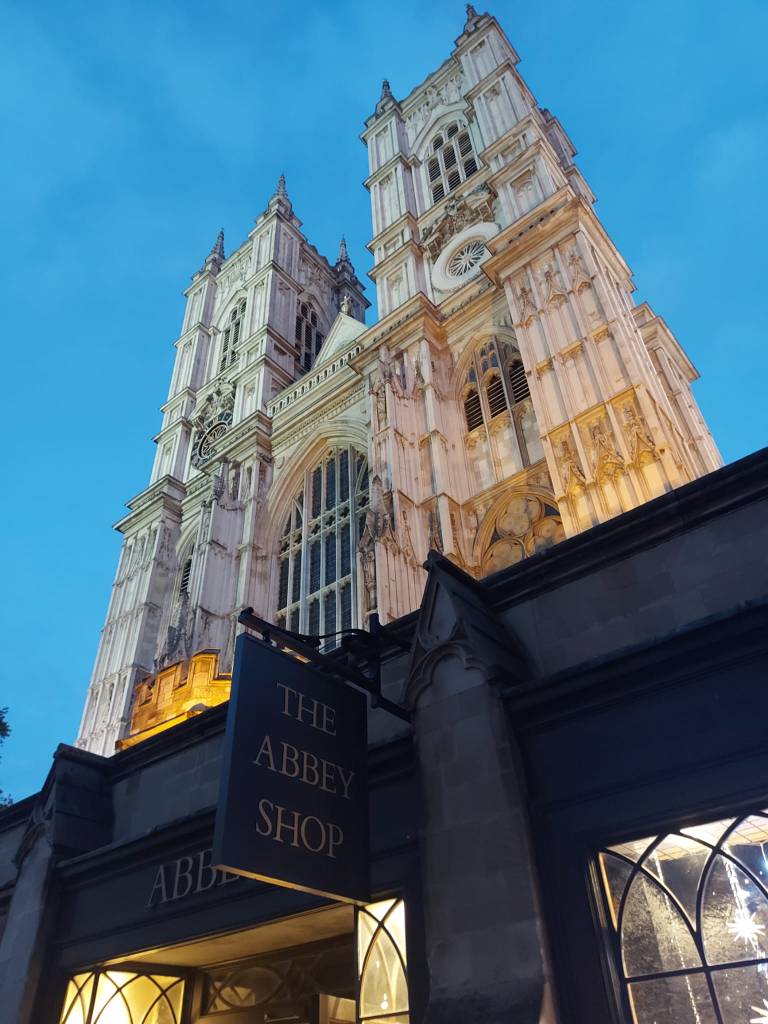
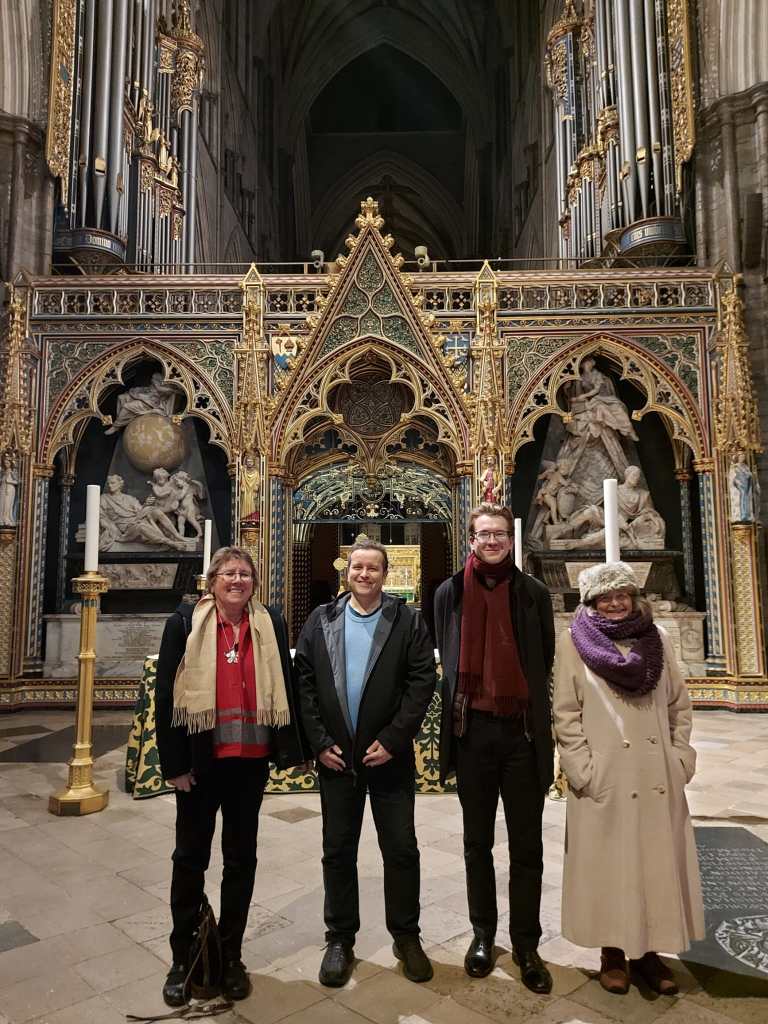
ARTISTRY AND TECHNIQUE AT WESTMINSTER ABBEY
review by Angela Ransley
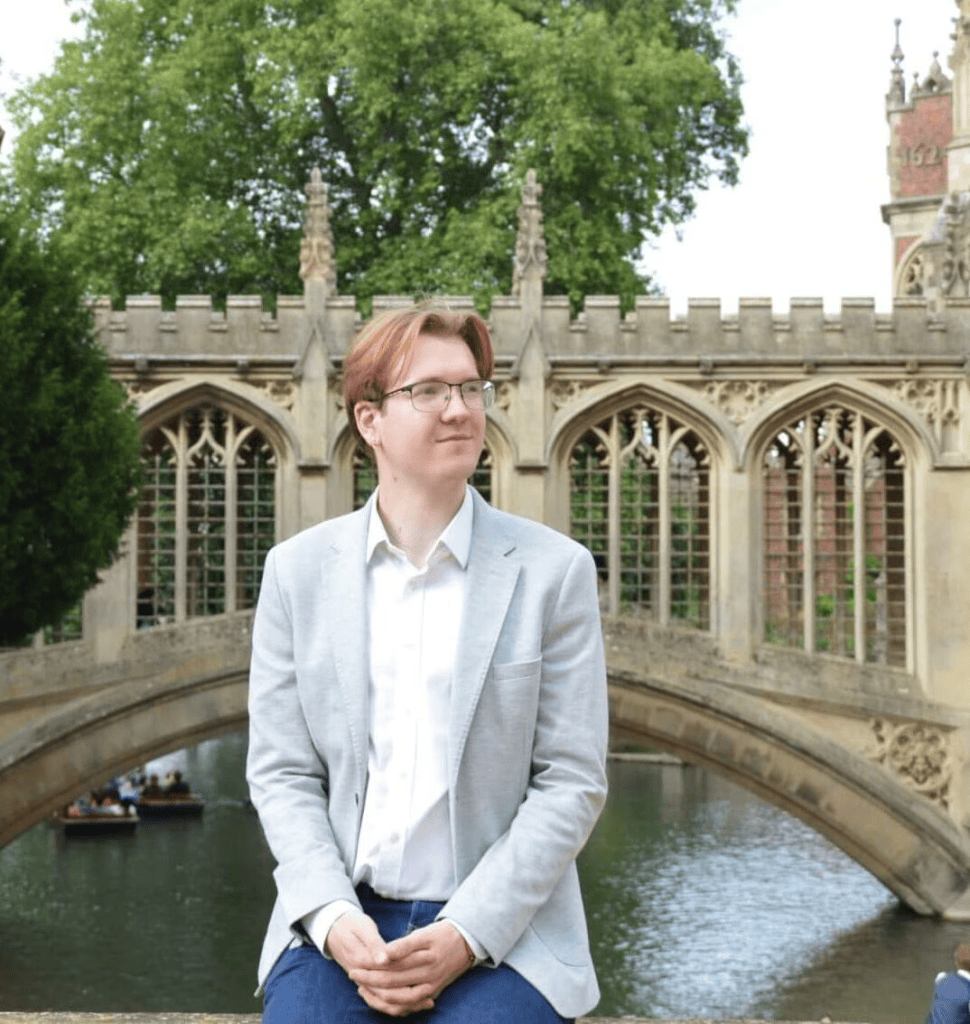
ALEX TRIGG – organ
CHARLES FRANCIS – registrant
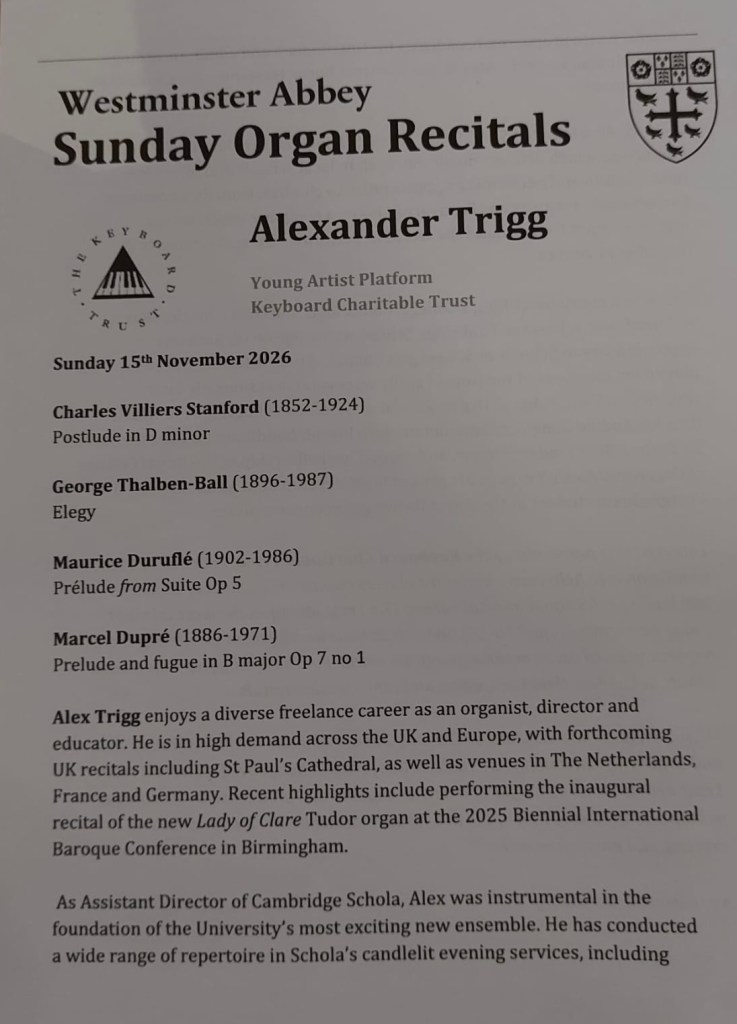
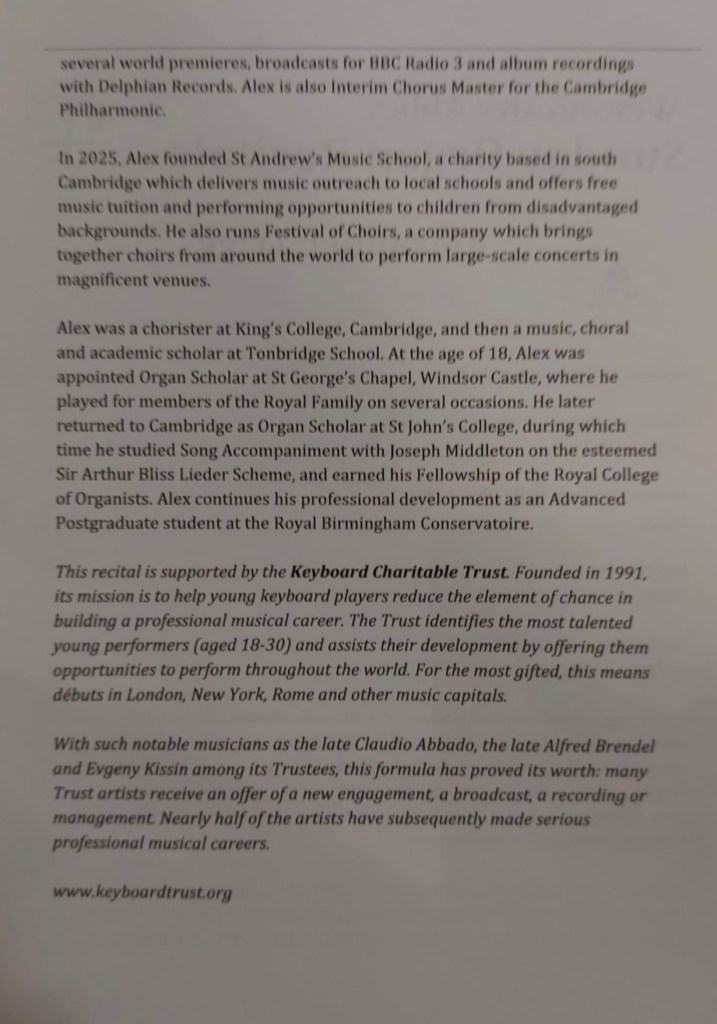
ALEX comes to Westminster Abbey with around 15 years of professional music experience, firstly as a chorister at Kings College, Cambridge and after Tonbridge School as Organ Scholar at St George’s Chapel, Windsor. He participated in royal engagements before taking up the Organ Scholarship at St Johns College, Cambridge. He was involved in founding the elite Cambridge University choir, CAMBRIDGE SCHOLA and the St Andrews Music School which offers free tuition to disadvantaged children. He is currently pursuing postgraduate organ studies at the Royal Birmingham Conservatoire.
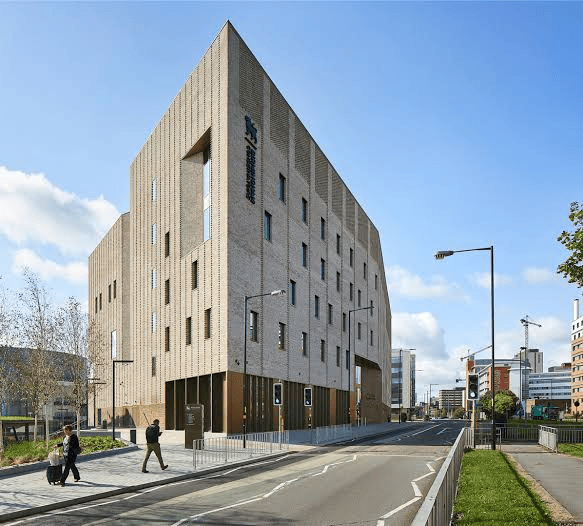
Royal Birmingham Conservatoire
POSTLUDE IN D MINOR Stanford
ELEGY Thalben-Ball
PRELUDE SUITE NO 5 Durufle
PRELUDE AND FUGUE IN B MAJOR Dupre
The Westminster Abbey organ is a majestic instrument of five manuals and 94 stops offering a complex range of solo and combined registration. It is a daunting task for an organist to create a compelling recital on such an instrument with just one three-hour practice session. Alex showed himself more than equal to the challenge, bringing a recital of emotional weight and technical prowess.
Sir Charles Villiers Stanford (1852–1924) held a leading position in British music as an organist, conductor, composer and teacher. He was appointed Professor of Composition at the new Royal College of Music at just 29 in 1892 and later added Professor of Music at Cambridge University, Conductor of the Bach Choir and Leeds Triennial Festival to his titles. His rigorous teaching would often leave the talent in his care deflated with the regular comment ‘It’s damned ugly, my boy’ but nonetheless his prodigious knowledge enabled their talent, including that of Vaughan Williams and Holst, to flourish and eventually outshine his own.
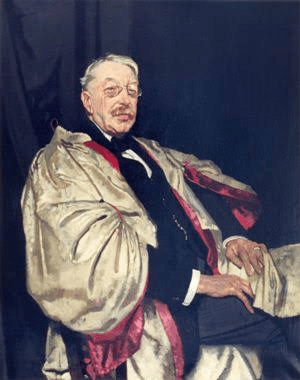
Sir Charles Villiers Stanford
The Postlude in D minor is from 6 Short Preludes and Postludes Op 105 and was written in 1908. Its pervading siciliano rhythm is underpinned by robust chords and offset crotchets, and develops a flow with added quavers. It alternates easily between major and minor before a spirited reprise of the opening. Some performances can sound formal, but Alex’s interpretation danced for joy with a lively tempo which fitted the Abbey’s capacious acoustic. Carefully articulated staccati added lightness of touch and the different sections were clearly defined by well-judged combined registration.
Elegy by George Thalben-Ball (1896 -1987) owes its origin to the unexpected ‘play something’ moment that occurred during a BBC broadcast of Choral Evensong from Temple Church towards the end of World War 2. Thalben-Ball was born in Australia to British parents and he began studies at the Royal College of Music in London aged just 14. On leaving, he was invited to deputise at Temple and took up the post of Director of Music in 1923. He held the post for 60 years during which he established a towering reputation for choral direction: He recorded Hear My Prayer from Mendelssohn’s Elijah which sold millions of copies worldwide and brought international fame to the treble, Master Ernest Lough, TB and the Temple Choir.
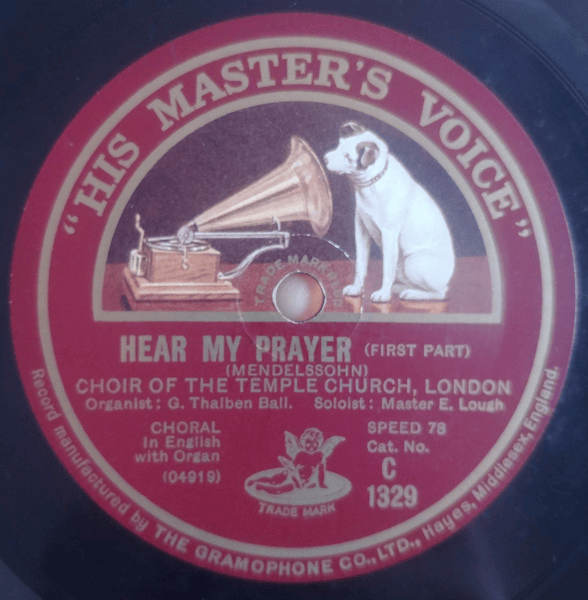
HMV record label 1927
The service finished a few minutes early and the producer shouted: ‘Play something!’. TB had to improvise – live! So many people contacted the BBC to ask what it was that he wrote down as much as he could remember and it remains his best known piece to this day – it marked the conclusion of Princess Diana’s funeral in 1997. The BBC needn’t have worried. TB’s musical skills in sight reading, transposition and improvisation were legendary and whether it was a theme he kept up his cassock or a moment of genius, the graceful arching line of the main melody wins hearts instantly.
Something remarkable happened as Alex drew the performance to a close. After the main theme was heard on the Bombarde and later the
Swell reeds, two solo repeats became ever softer. Alex took full advantage of the fermati, releasing the music into infinity… Caught up in the organ’s quiet power, the audience burst into the spontaneous applause usually reserved for the end of the programme.
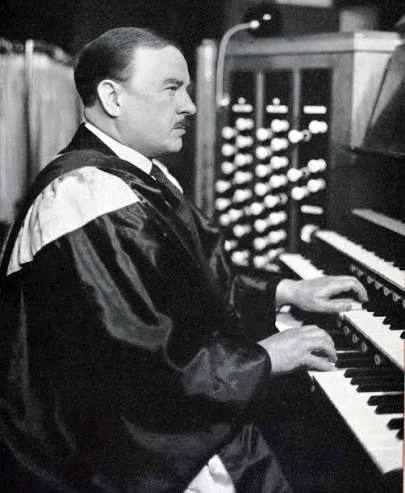
George Thalben Ball at Temple Church
Both these pieces belong in the mainstream Anglican tradition but Alex’s next choice Prelude from Suite for Organ by French organist Maurice Durufle (1902-1986) tells a very different story. Paris was a melting pot of new ideas and invention, having hosted the Exposition Universelle of 1889 and been shocked by Stravinsky’s Rite of Spring in 1912. On completing his studies at the Paris Conservatoire, he was invited by Louis Vierne to Notre Dame and later became titular organist at St Etienne-du-Mont, a position he held for the rest of his life. The church houses one of the most historic organs in the French capital and was modernised by the famous organ builder Aristide Cavaille-Coll in 1863.
.
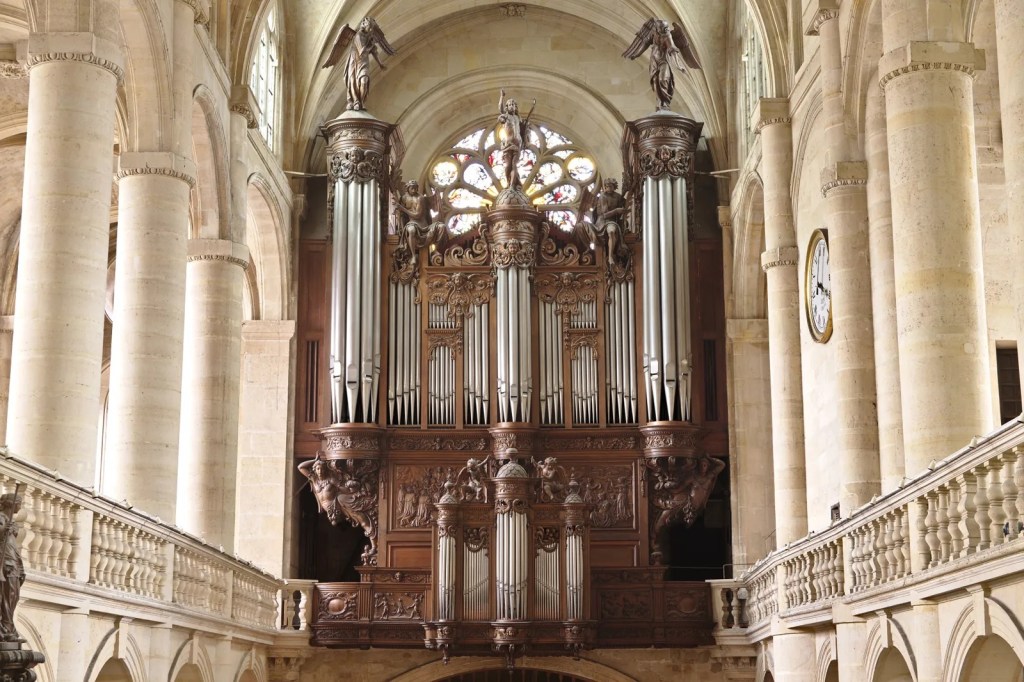
The organ at St Etieene-du-Mont, Paris
The Suite for Organ was written at the age of 21 and dedicated to his teacher, Paul Dukas. Durufle was intensely self-crItical, reminding one of Chopin, and was never happy with the set. However the opening bars – a long Bb held against furtive quavers in the pedal and the gloriously dark Eb minor key – immediately create an atmosphere of foreboding which pervades the first part. Then follows a more benign descending melody which dispels the tristamente as the opening returns. There was added tension in the use of the 32ft pedal and the uneasy 5/4 rhythm. Well-paced crescendi added real drama as Alex built the climax employing a thrilling palette of organ colour. In the final return of the opening, the Abbey was filled with a deep sense of loss…
These three pieces set the scene for the final work Prelude and Fugue in B major by organ superstar Marcel Dupre (1886-1971). He acquired the title ‘The Paganini Of The Organ’ on account of his unrivalled virtuosity: a child prodigy surrounded by music professionals, he went on to write works that only he could play! As a touring concert organist, he gave over 2000 recitals across Europe, America and Australia. It is the first of three Preludes and Fugues in Opus 7 and was written in his mid-twenties. It draws on everything that thrills the listener about the organ: astonishing passage work, volume, complexity, scrunchy chords..
Alex showed us the full voice of the ‘King of Instruments’ while at the same time revealing impressive technical virtuosity, especially in pedal technique. In just half an hour, he took the audience on an emotional journey encompassing joy, serenity, loss and finally, breathtaking bravura. Although the audience did not know him or see him beforehand, Alex achieved a lasting connection through the warmth, immediacy and technical clarity of his playing, and somehow this vast ancient building became a place of intimacy.
The choice of pieces was intriguing and gave rise to these questions:
ANGELA: WHAT PROMPTED THE CHOICE OF PIECES?
ALEX: For what could have been a very nerve-wracking recital (although actually I was remarkably cool last night!), I wanted to play pieces I knew inside out and have performed multiple times before. So that was the first factor. Then I wanted to make use of both the enormous Abbey acoustic and the huge range of colour available from the instrument. The Stanford would provide an arresting opener, I thought, and it was nice to acknowledge the composer buried in the North Transept. The Thalben-Ball was the most straightforward item on the programme, but one which sings into every corner, side chapel and triforium in the vast building, and has a huge sense of space. I absolutely love the Duruflé, and the way it builds relentlessly from Stygian depths to a cataclysmic climax. After the spacious luxury of the Elegy I thought this would contrast in quite an exciting way. And finally the Dupré, to fill the building with peeling bells and bright reeds!
ANGELA: HOW DID YOU PREPARE FOR A PERFORMANCE AT WESTMINSTER ABBEY?
ALEX: I was given a 3-hour practice slot late on the Friday night. Having the entire Abbey building to myself (and just being asked to ‘let myself out’ when finished) was quite an experience! But three hours isn’t long to register and prepare such a programme, so I had to be incredibly efficient with my time. I’m enormously grateful to my page-turner/registrant Charlie Francis (another Royal Birmingham Conservatoire and Keyboard Trust alumnus!) for helping with this process and for being a valuable second pair of ears downstairs in the nave.
ANGELA: DO YOU HAVE A SPECIAL AFFINITY WITH ANY OF THESE COMPOSERS?
I feel quite attached to some of these pieces having played them for so long. The Dupré was actually my Cambridge Organ Trials audition piece, so there are several memories attached to it (of successful auditions, and stressful practice sessions!). The Duruflé might be my favourite French organ work – it’s just such a visceral and raw emotional ride from start to finish.
ANGELA: WHAT ADVICE WOULD YOU GIVE TO AN ORGANIST PREPARING TO PLAY HERE?
Bring a second pair of ears for your practice slot (again, thank you Charlie!), and be careful not to programme too many pieces with complex registrations. Also, in the Abbey organ loft, the instrument sounds incredibly present (most of it speaks directly behind you) so it’s easy to forget you’re playing to a huge acoustic; remember to keep the building in mind when thinking about articulation, pacing and architecture.
It is well known that organists remain in post for decades and gives rise to the question of there being some special glue that achieves this:
Thalben Ball 59 years; Durufle 66 years; Dupre 60 years. It may have something to do with every organ being different, designed for the building it inhabits and an advanced organist will gravitate to one design over another. Over time it also becomes a love affair… As Westminster Abbey generously enables Alex to embark on this journey, we can only hope that both the organ – and the best glue – are waiting for him.
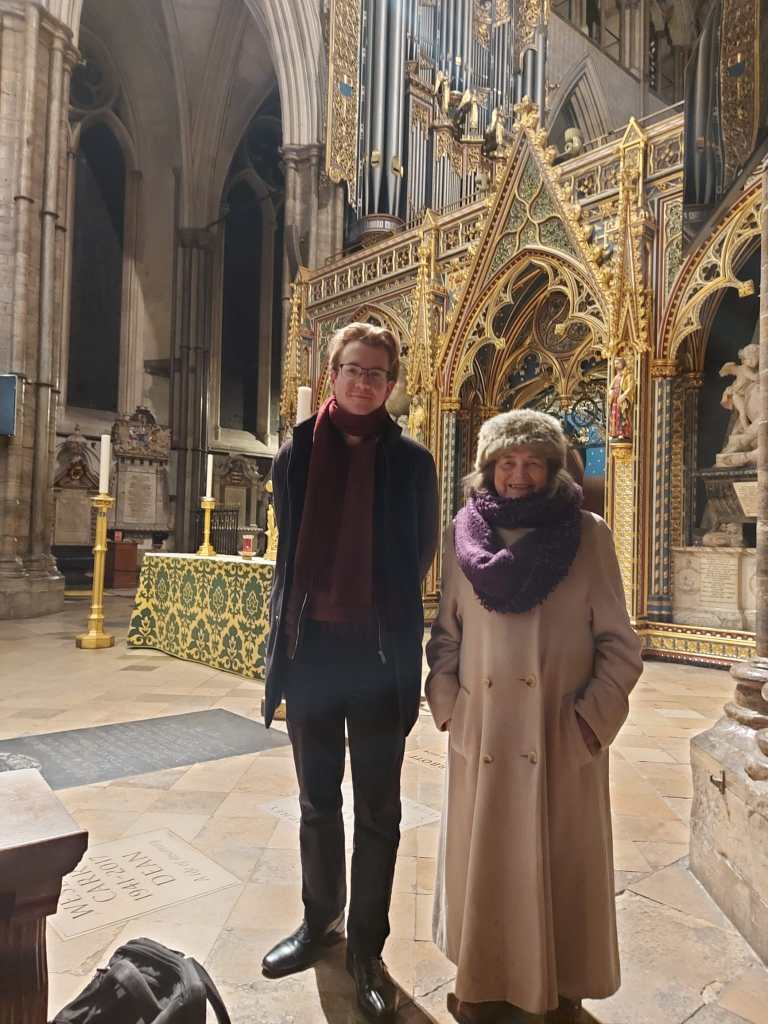
ANGELA RANSLEY is Director of the Harmony School of Pianoforte and is also a writer on musical subjects. She holds an organ post in Surrey