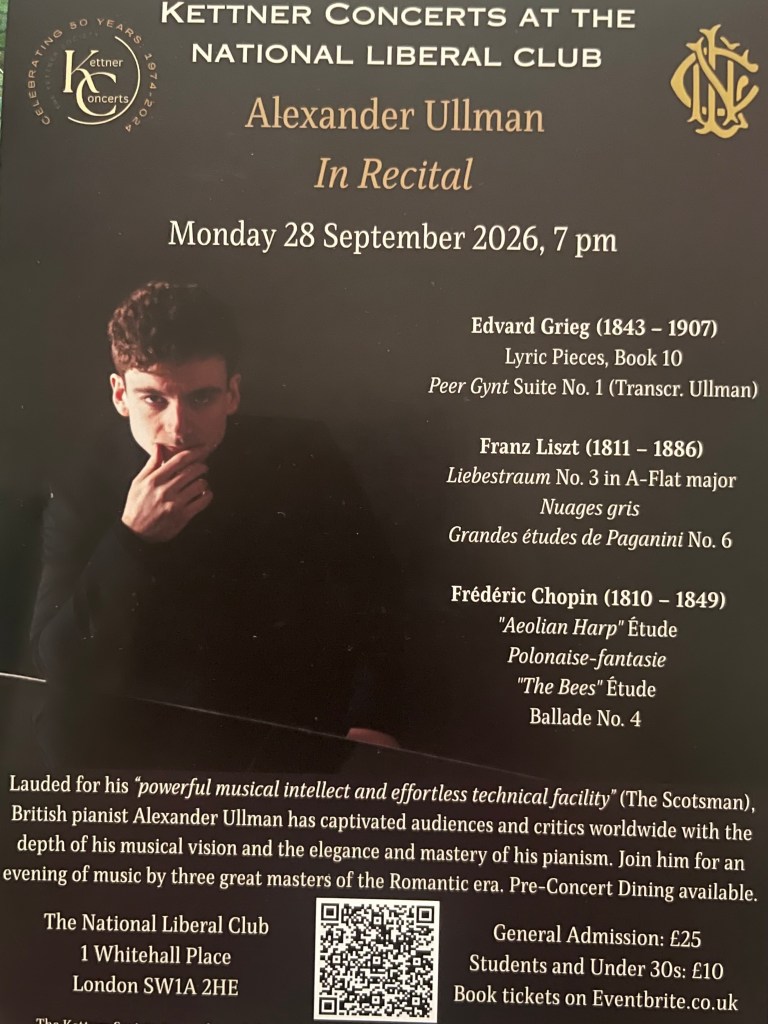
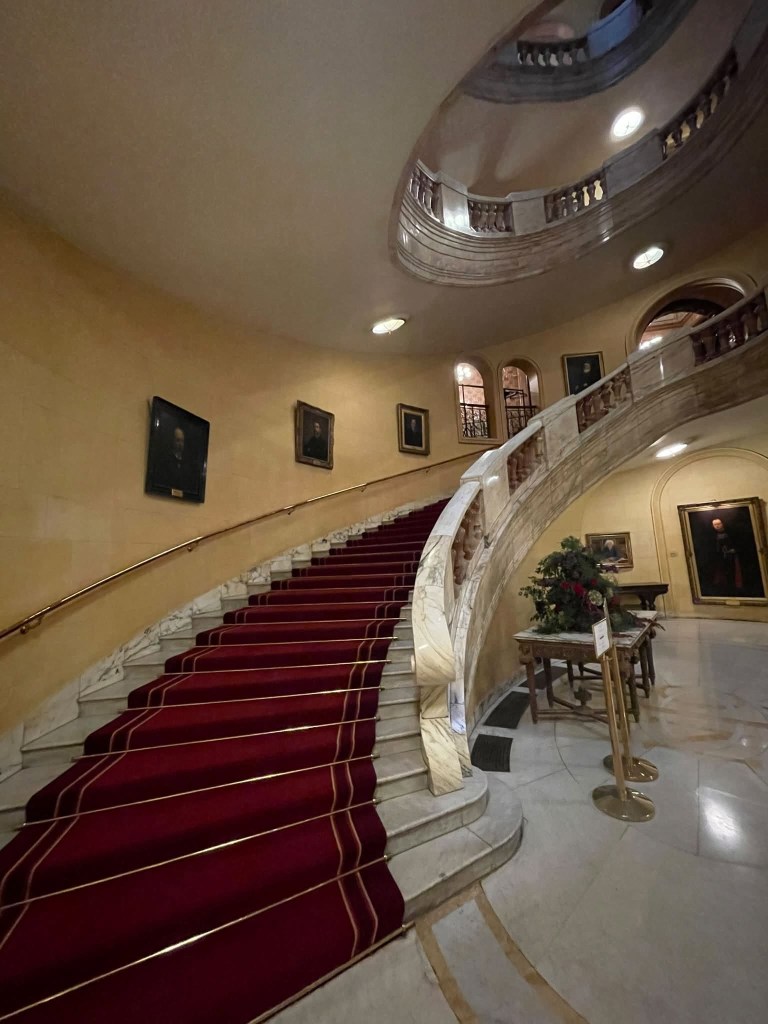
Alexander Ullman the supreme stylist at the National Liberal Club. The only pianist to have won the International Liszt Competitions in Budapest aged 20 and Utrecht aged 25 .Now in his early thirties making an all to rare appearance in London with works by Liszt and Chopin but also the works of Grieg from his latest CD.
An eclectic programme for Alex’s long awaited return to London . An unexpected telephone call from his friend and fellow student at Curtis Institute in Philadelphia, Ben Westlake, with an invitation to play for the Kettner society of which he is co artistic director with Cristian Sandrin. Alex cruising around Greece was able to catch a plane and arrive in the morning of the concert to please his friend and judging from the packed hall not only him!
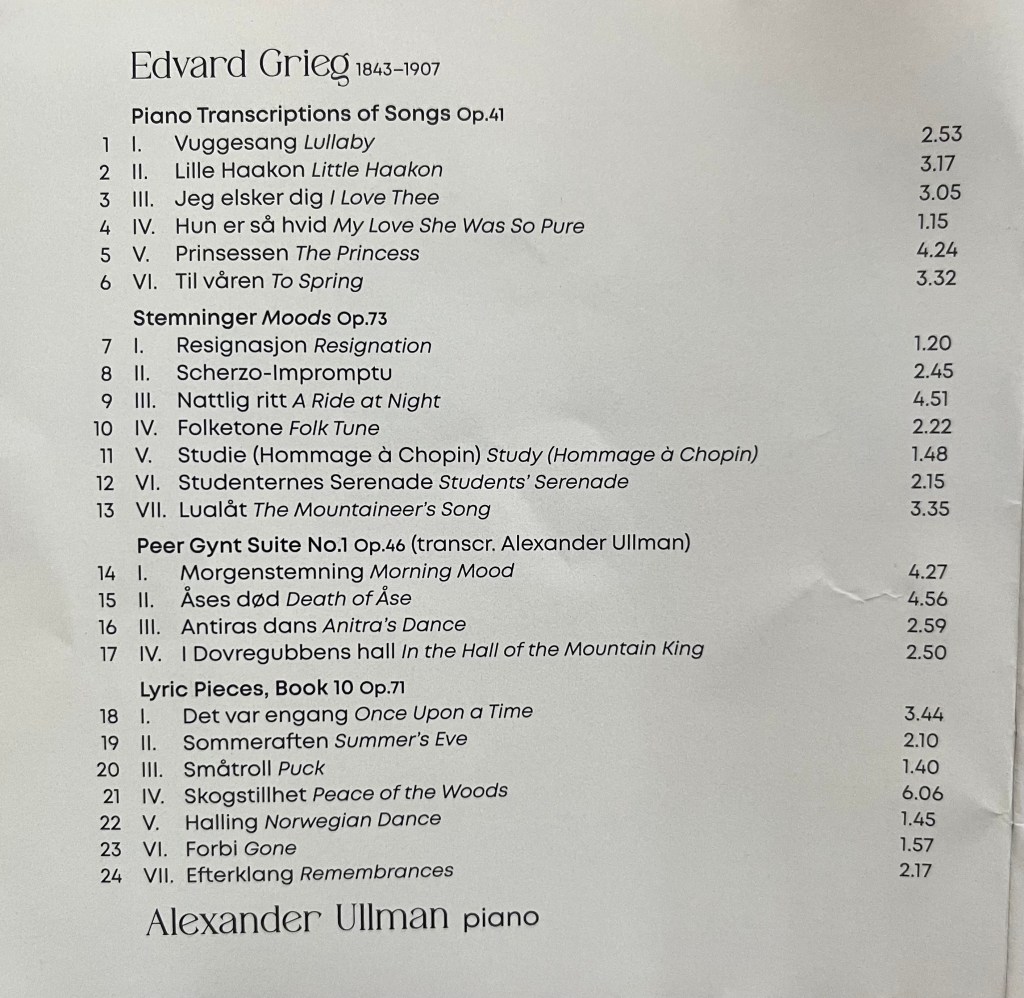
A chance to hear the last book – the 10th – of Grieg’s much neglected Lyric Pieces. Rarely heard in concert since Gilels programmed a handfull of the 66 miniature tone poems in his concerts.
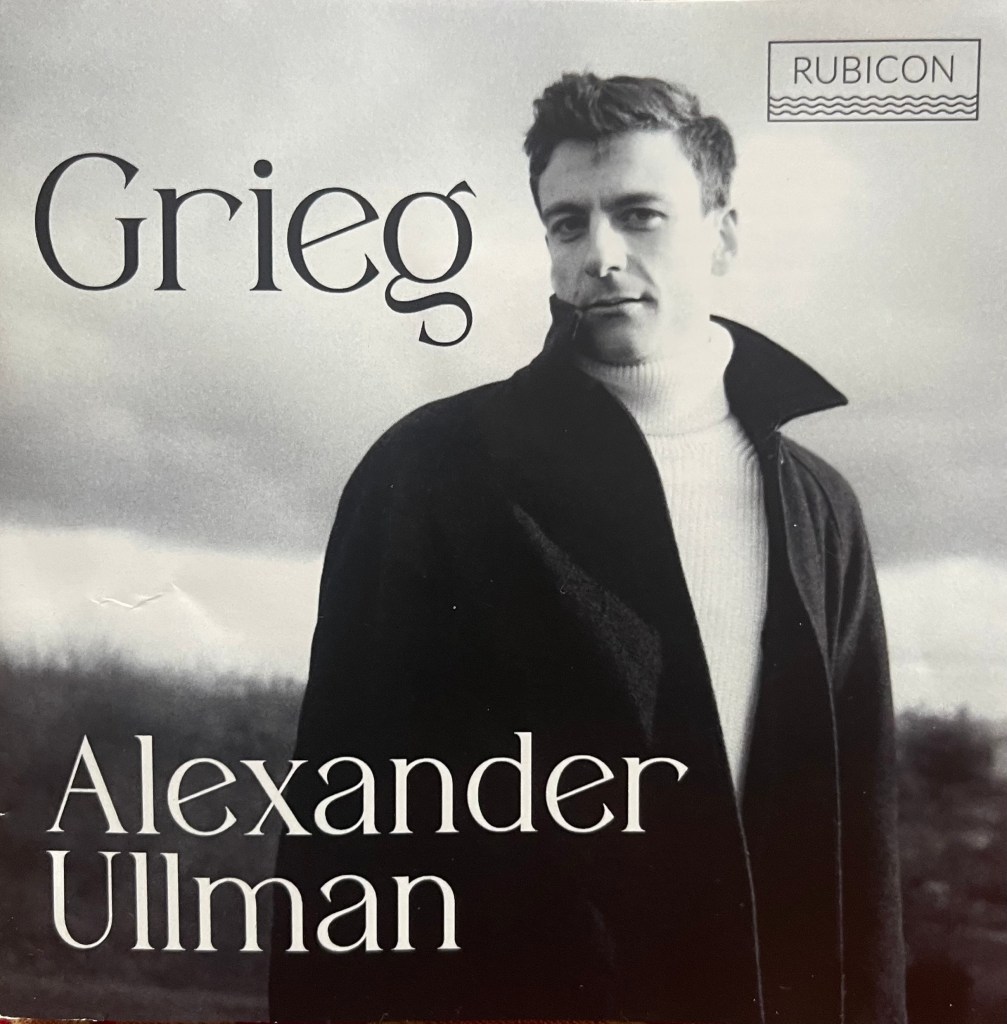
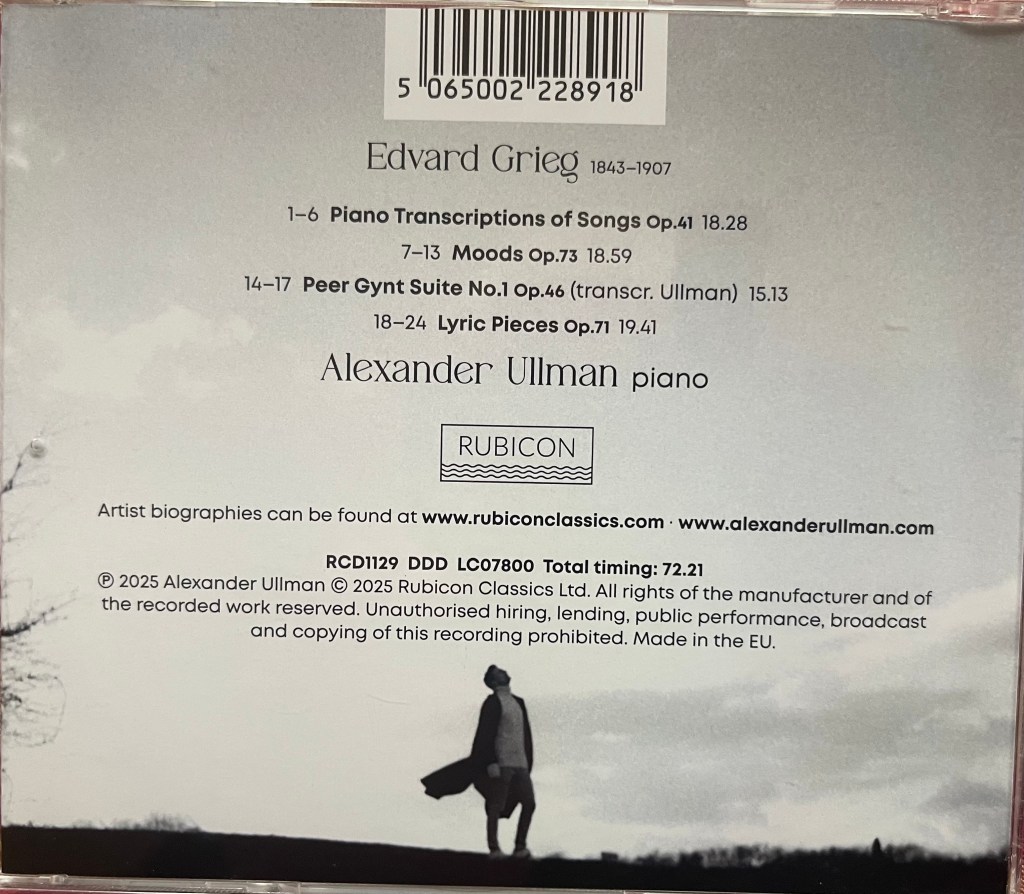
Hans von Bülow had described Grieg as ‘The Chopin of the North’ because like Chopin’s Mazurkas he could capture the spirit of his homeland with just a few strokes of his brush, creating miniature tone poems of extraordinary poetic evocation. Is it a coincidence that Grieg penned 66 Lyric pieces as Chopin too penned almost the same number of Mazurkas? Schumann described them as ‘canons covered in flowers’. I know from Janina Fialkowska that Rubinstein loved the lyric pieces, which she too programmes regularly, and of course Rubinstein’s performances of the concerto reached sublime heights of poetic beauty. Alex too has played the Grieg concerto in BRNO with great success recently, where he substituted an indisposed Elisabeth Leonskaja .
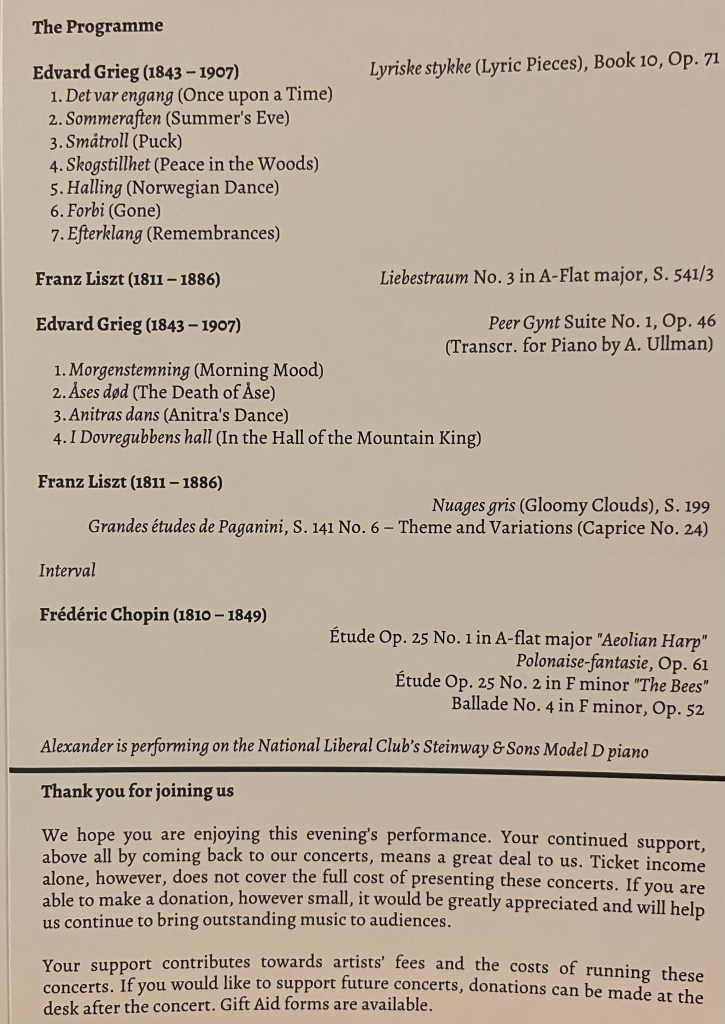
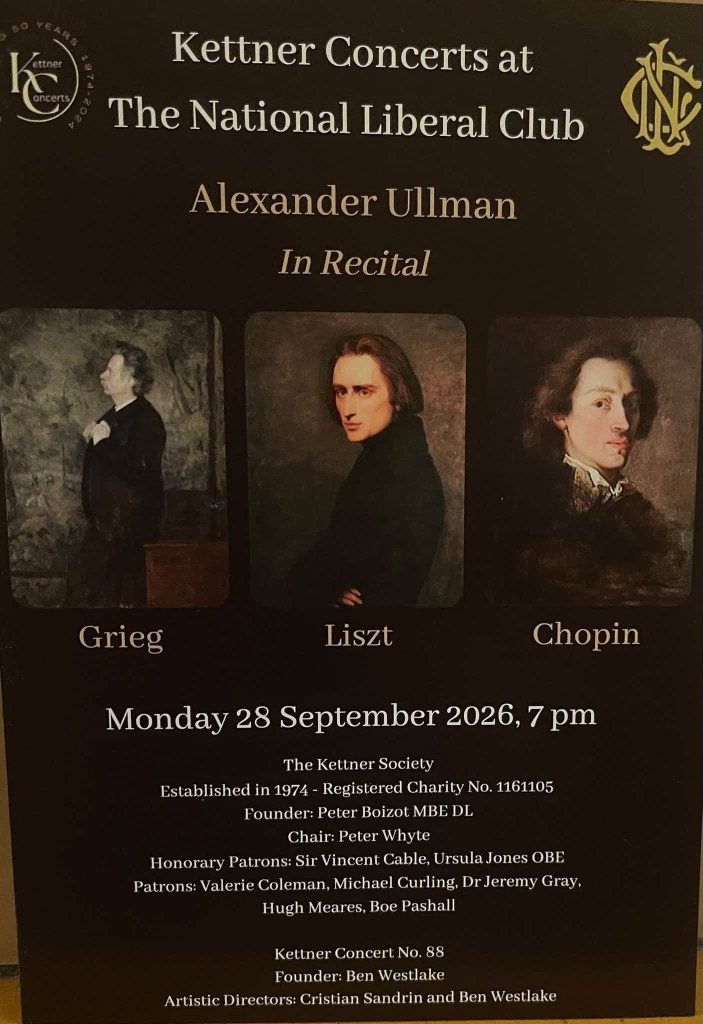
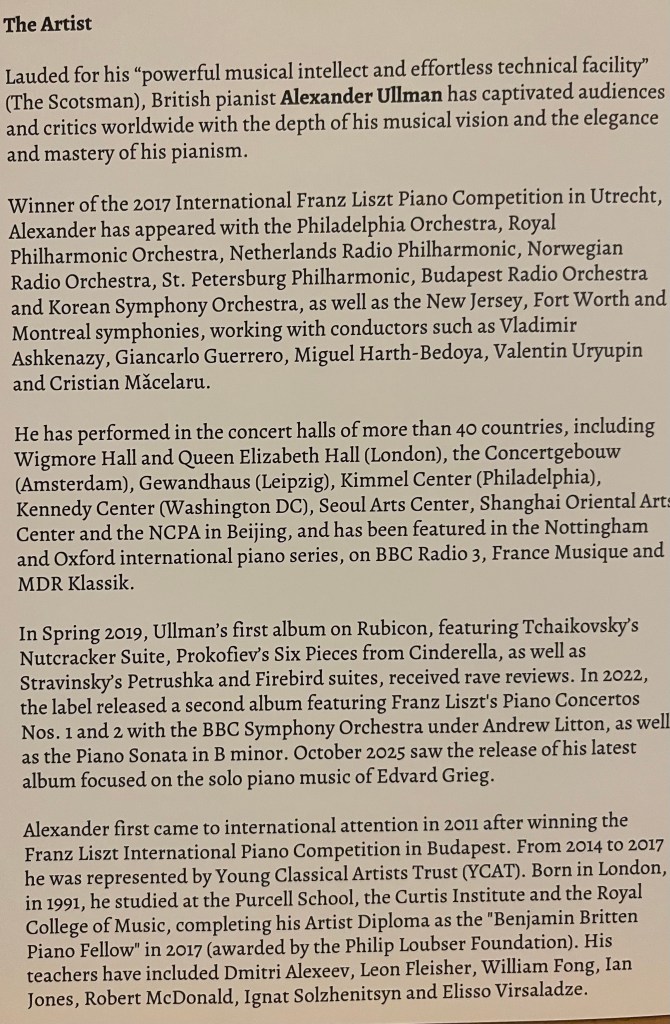
Today he arrived in London happy to share with his friend a programme of unashamed romanticism showing us what it means to be naturally gifted, as he had spent the last two weeks almost without a piano! Alex after his youthful studies at the Purcell School with William Fong won a scholarship to go to Curtis in Philadelphia to study for four years with Leon Fleisher, only returning afterwards to the Royal College in London to complete his studies with Dmitri Alexeev. In the meantime he had won the Liszt competition in Budapest at the age of only 20. I heard him for the first time in Sermoneta in Italy when he played in Eliso Virsaladze’s class, and I was so bowled over by the very Paganini Study he played today, that I dared ask Madame Virsaladze what nationality he was. English like you , she barked ! Alex had been prepared for Fleisher’s precious lessons by Robert Mc Donald and it was he, through hours of grilling with all the Chopin Studies and works like the Hammerklavier Sonata that gave him the technical preparation that allows for such freedom of expression now!
The seven Lyric Pieces were played with extraordinary sensitivity and a palette of sounds from the nostalgia of ‘ Once upon a time’ , ‘Peace in the Woods’, ‘Gone’ with ‘Summer’s Eve’ that despite busy passages could be a picture of the aging Grieg and his wife looking at the sun setting on the fjord of Troldhaugen. There was the mischievous ‘Puck’ and the lively ‘Norwegian Dance’, finishing with the exquisite ‘Remembrances’ that recalls the sublime ‘Arietta’ that opens the very first Lyric Piece of book one, written almost forty years earlier.
As a contrast Alex offered one of the most loved pieces by Liszt. His Liebestraum n 3 in A flat, played with an improvised beauty as though discovering this well known work for the first time. Subtle rubato and the flexibility of a singer, as the music flowed with whispered beauty bursting into a passionate outpouring of heartrending intensity. Cadenza’s that in Alex’s hands became washes of golden sounds like a halo glowing with radiance and glistening beauty. Alex has the gift of making the music sound freshly minted, as there is no rhetoric but just the music that is allowed to unfold, in the hands of this poet of the keyboard, with refreshing simplicity and mastery.
From the Grieg of concentrated whispered emotions to Alex’s own transcription of the orchestral Peer Gynt Suite n. 1 op 46. Here Alex was able to produce the sounds of a complete orchestra with a sense of balance and use of the pedal with the beauty of the ‘Morning Mood’ spread over the entire keyboard, followed by the intense depth of sound of ‘The Death of Ǎse’ and the spirited ‘Anitra’s Dance’ leading to the transcendental antics ‘In the Hall of the Mountain King ‘.
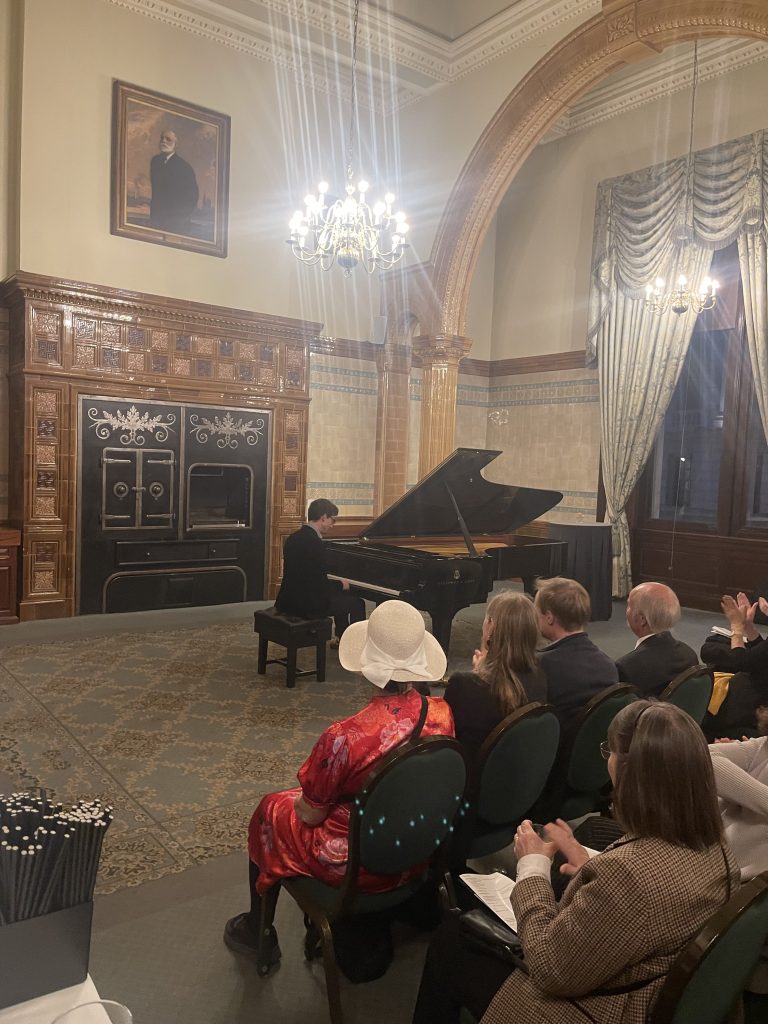
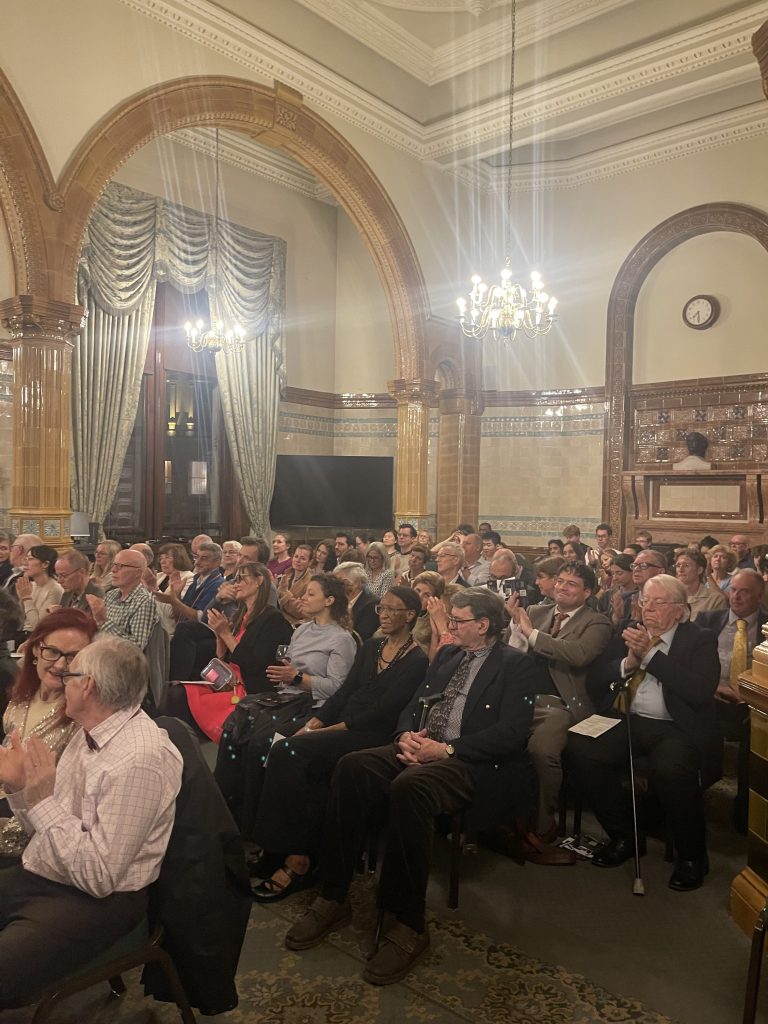
Contrasting now with Liszt’s Paganini Study n. 6 with the famous theme that Rachmaninov and many others were to use for a basis for their variations. It was the first piece I had heard Alex play fifteen years ago in Italy and it just highlighted his poetic invention, transcendental command and innate sense of showmanship. The opening theme was, even here, beautifully phrased as it was allowed to breathe and not just be played like a mechanical study. A palette of colours from variations that were mere whispers of glowing beauty and others of spritely fingerfertigkeit tantalisingly played with impish good humour. But it was the grandeur and breathtaking daring that he imbued in the final variation with a sumptuous sound born deep in the bass that allowed the whole piano to vibrate with passionate intensity.
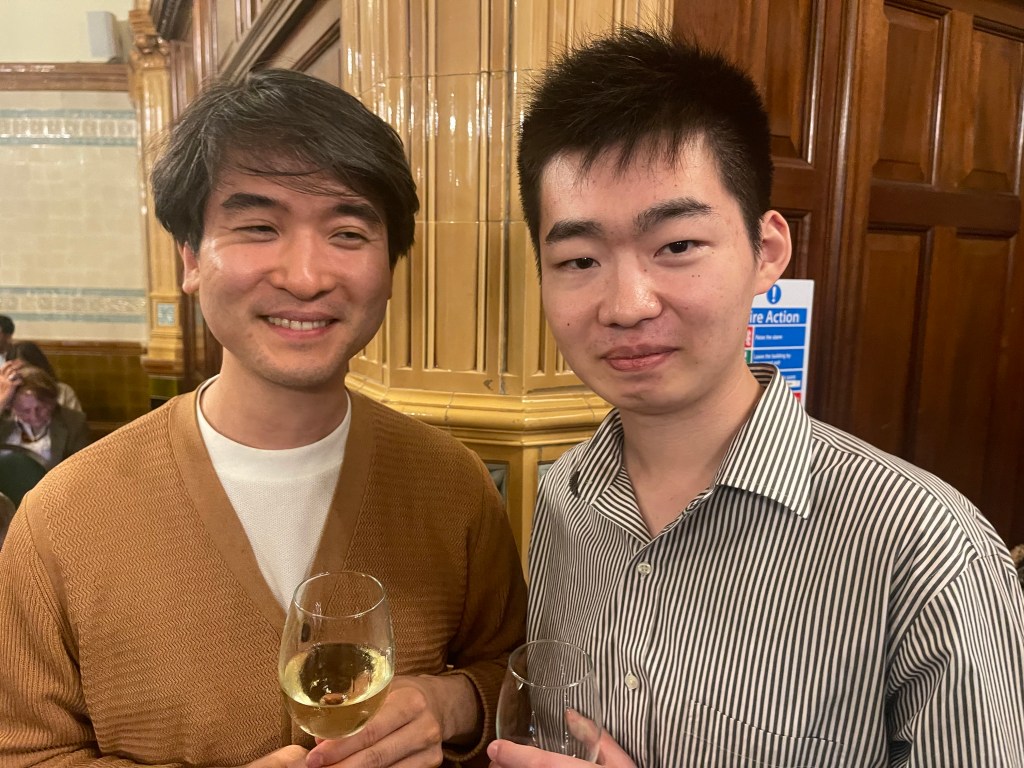
and Hastings winner Shunta Morimoto who gave a memorable recital in this hall last year https://christopheraxworthymusiccommentary.com/2025/11/01/shunta-morimoto-at-the-national-liberal-club-a-musical-genius-comes-of-age/ Both have been perfecting their studies at the International Piano Academy Lake Como together with co artistic director Cristian Sandrin
This had been preceded by Liszt’s ‘Nuages gris’ where the genius of Liszt was looking to the future and was ‘A master of freedom’ according to his disciple Busoni. Arguably, Liszt was the first composer to establish the augmented triad as a truly independent sonority, to consider its implications for modern dissonance treatment and to ponder its meaning for the future course of tonality. The restless, unresolved dissonances of Nuages gris, the isolated figures, the sense of alienation—these have a clear affinity with the somewhat later expressionism of the Viennese composers Mahler and Schoenberg that indicated what was happening and what would happen in European music. Sound, with the assistance of symmetry, would take over, harmony would be absorbed into colour and lose its cadential function. A very short piece of whispered sounds played with remarkable control and extraordinary range of subtle colouring. It is interesting to note that a scene at the morgue in Kubrick’s last film ‘Eyes wide shut’ is accompanied by ‘Nuages gris‘!
It was Liszt who had encouraged Grieg to write a concerto and when Grieg presented it to him Liszt famously sightread the entire score. Rachmaninov had used the Grieg Concerto as a model for his own First Concerto and the Grieg concerto like the Tchaikovsky B flat minor concerto are the evergreen concertos even for people who do not usually listen to classical music. Of course it was made even more famous by Morecambe and Wise with Andre Previn. https://youtu.be/uMPEUcVyJsc?si=97GQOFaBN7N7XQA
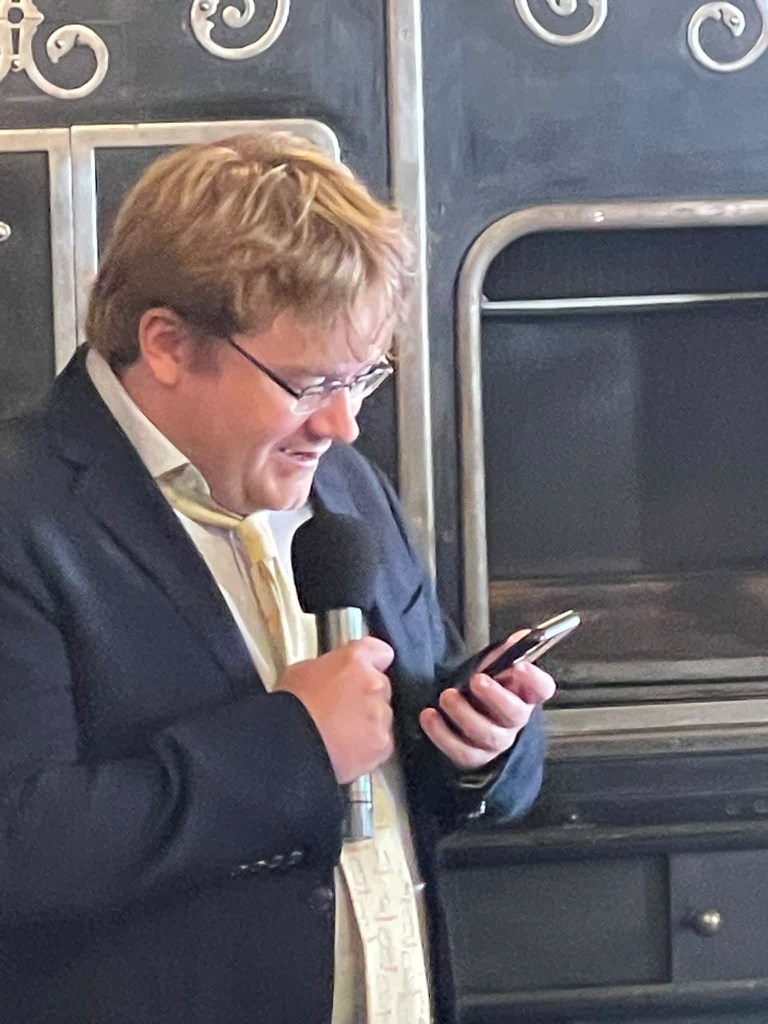
After the interval Alex offered us Chopin, with two late masterworks :the Fourth Ballade op 52 and the Polonaise- Fantaise op 61 together with two Études from op 25 .The study op 25 n. 1 is known as the ‘Aeolian Harp’ study after Sir Charles Hallé’s description of Chopin playing it in Manchester. Alex played it as washes of sound over which he placed the melody with glowing subtle beauty. Phrasing as a singer with a timelessness that allowed the music to flow with a natural undulation. The study op 25 n. 2 apparently is known as ‘The Bees’, neither Alex or I were never aware of that, but we bow to the superior knowledge of the clarinetist and co -artistic director Ben Westlake. A stream of notes that Alex allowed to breathe as he took all the time needed to shape the phrases with help from the bass, turning a ‘Busy Bee’ into an intoxicating one!
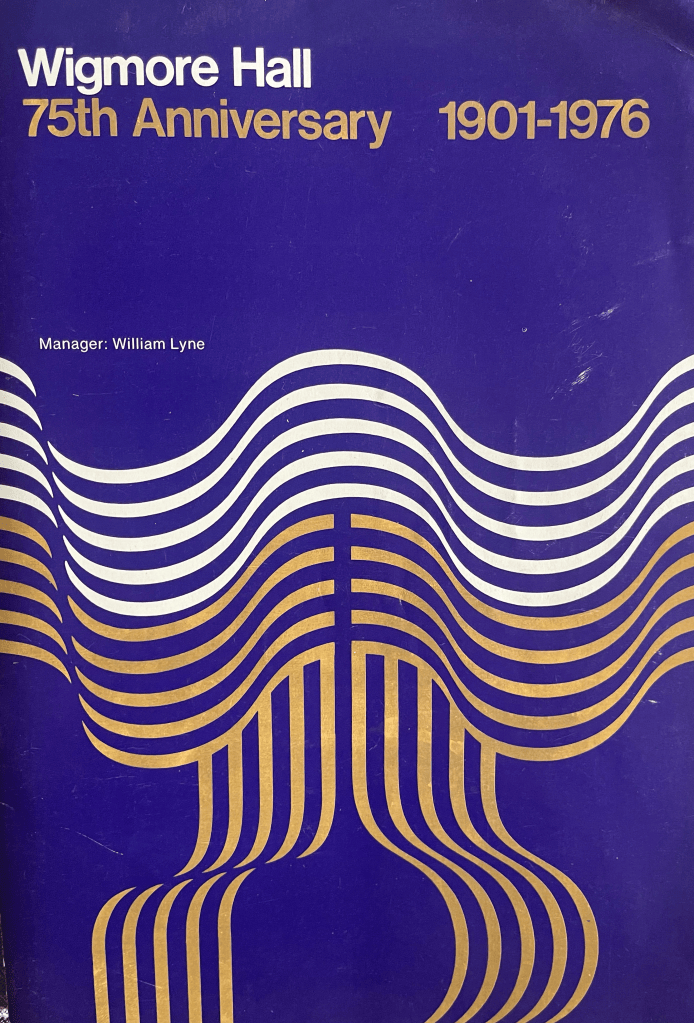
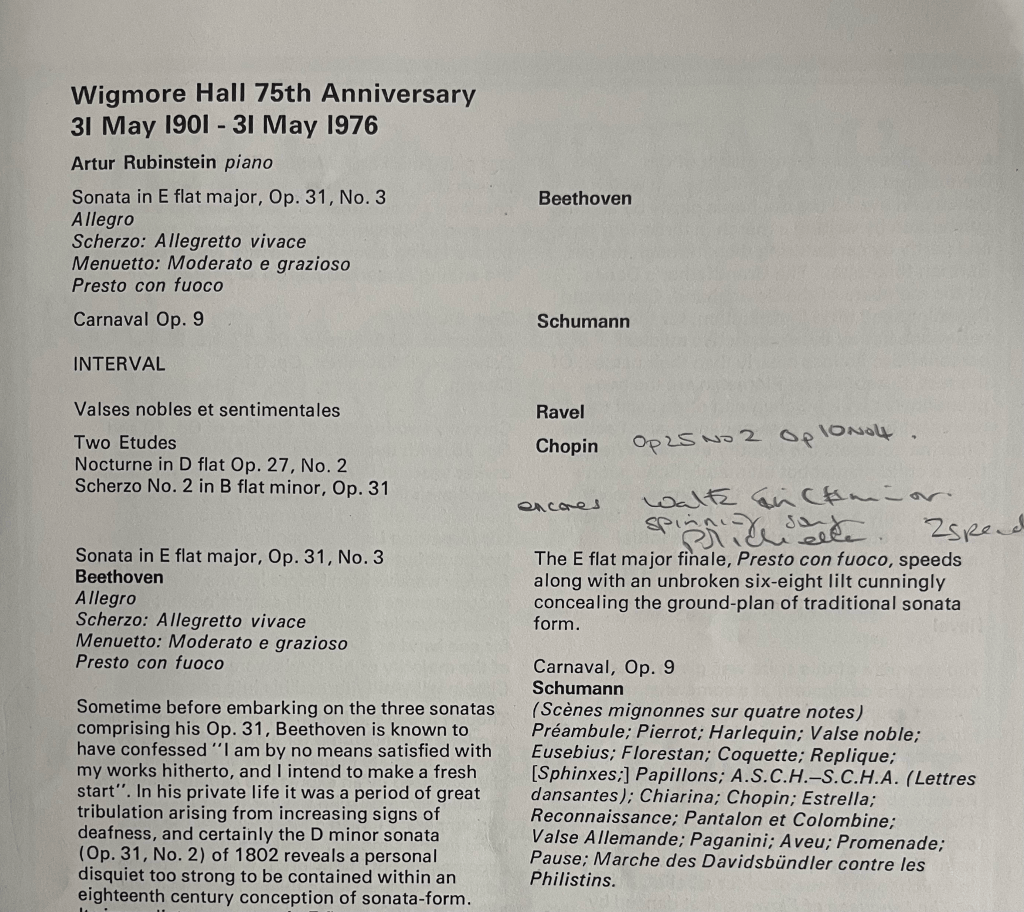
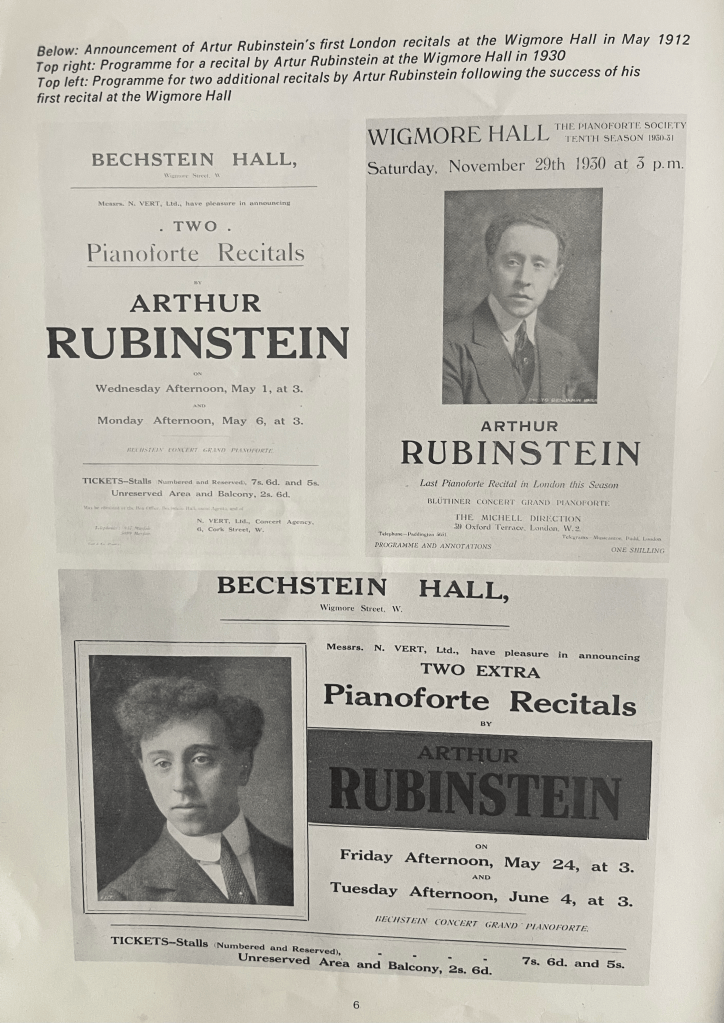
It was this study that Rubinstein was to surprise his audience with at his very last performance at the Wigmore Hall in 1976. He was partially blind and could not see out of the corners of his eyes but had agreed to accept William Lyne’s invitation to play, in order to try to stop the developers from moving in. His last piece was Chopin’s B flat minor Scherzo that he had played all his life, but now the treacherous leaps were not possible. He stopped and proceded to play a series of Chopin Studies that we had never heard him play before. ‘The Bees’ was the first followed by op 10 n. 4. and at the end of the concert he made a speech saying he had started his career in the Wigmore Hall in May 1912 and was happy to finish it here in May 1976, but please do not let them demolish this beautiful temple of music Afterwards the public were invited to go back stage, and suddenly Rubinstein asked for silence: ‘ I may be blind, but not too blind to know a beautiful lady when she is standing next to me’. It was Lauren Bacall!
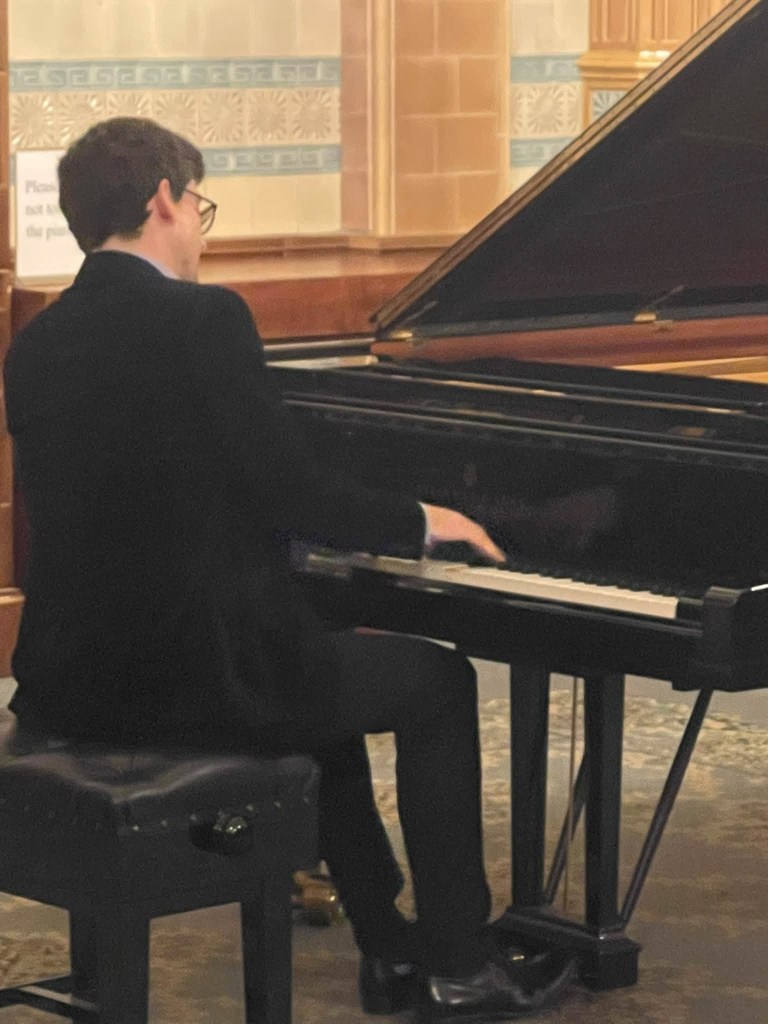
Alex played the Fourth Ballade with a masterly architectural understanding allowing the music to unfold on the wave of a series of variations of ever more passionate intensity.The climax was played with undulating waves of sound in the left hand and a melodic line of intoxicating exhilaration. Chords thrown off with fearless abandon as he plunged into the coda with a technical mastery that was breathtaking in its fearless burning drive. Whatever the difficulties Alex shaped the music with masterly control and sumptuous chameleonic sounds bringing this ‘pinnacle of the romantic piano repertoire’ to a sumptuous close. The Polonaise – Fantaise is one of Chopin’s last works where his mastery of form could combine the Polonaise with a free form of poetic beauty. Alex played the opening chords with imperious authority allowing them to vibrate with one circular movement of the arm as the reverberations were visible as well as audible, and where he was revealed as a true painter in sound. There was a whispered intensity of the Polonaise after the opening and the heartrending outpouring of mellifluous beauty of the central episode. An aristocratic control of the build up to the final climax, played with passion and fearless abandon as it dissolved with dying gasps to the final glowing A flat shining on high, the true undying symbol of a Genius.
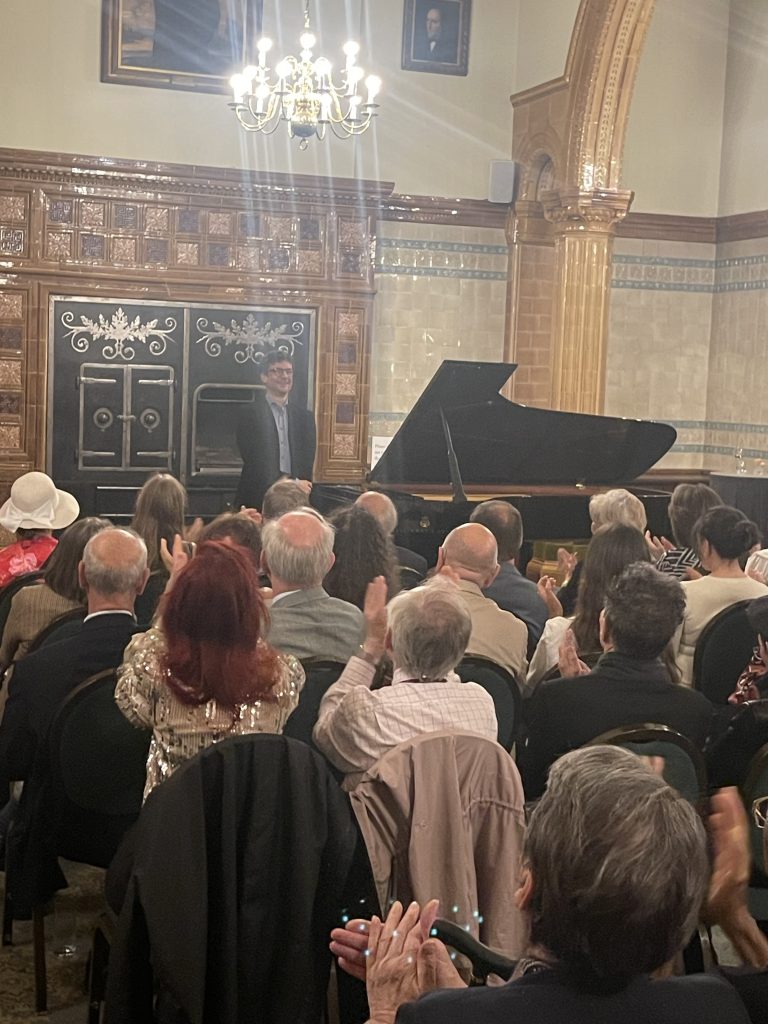
Just one encore, of course by Grieg. What more appropriate than Grieg’s song ‘I love you’ especially as Alex had seduced every one of us with a mastery and style that will long be remembered. A hall that had seen the last concert of Rachmaninov, brought by his great friend and club member Benno Moiseiwitch, before leaving Europe for the very last time in 1939.
https://christopheraxworthymusiccommentary.com/2024/03/20/christopher-axworthy-dip-ram-aram/

