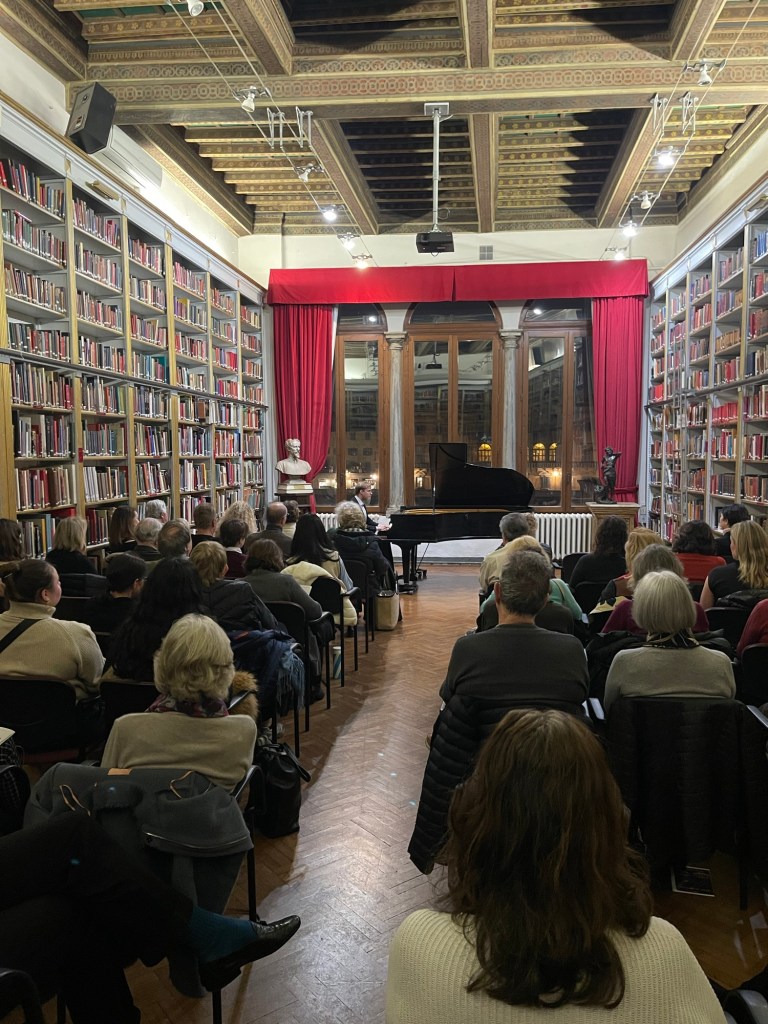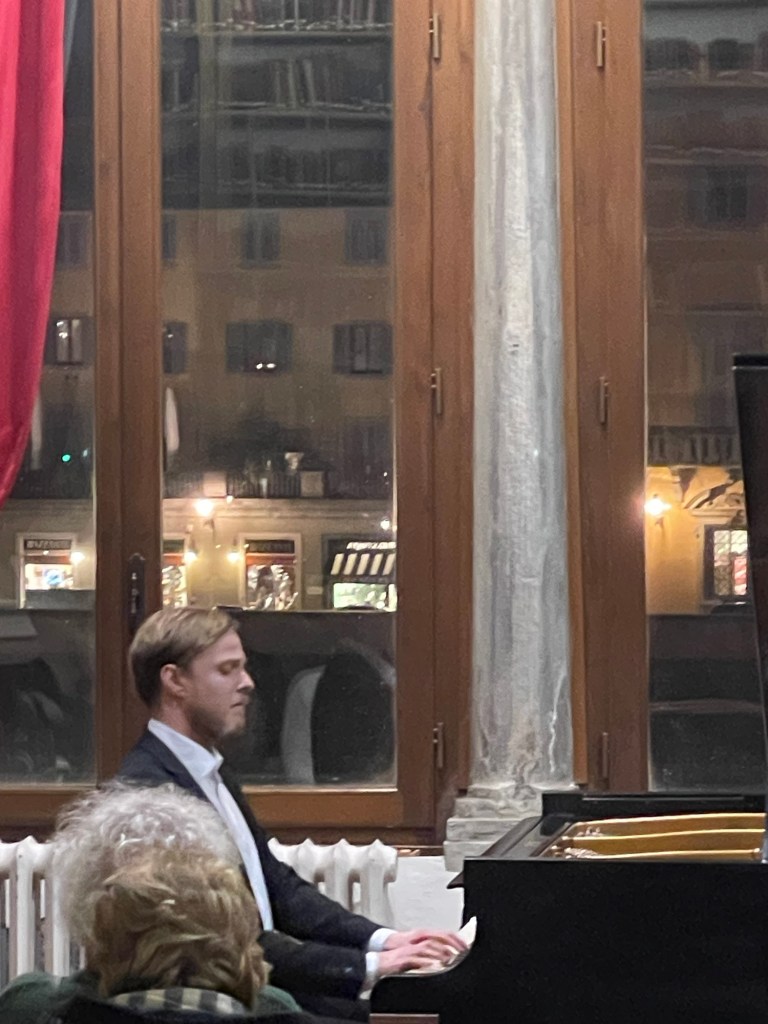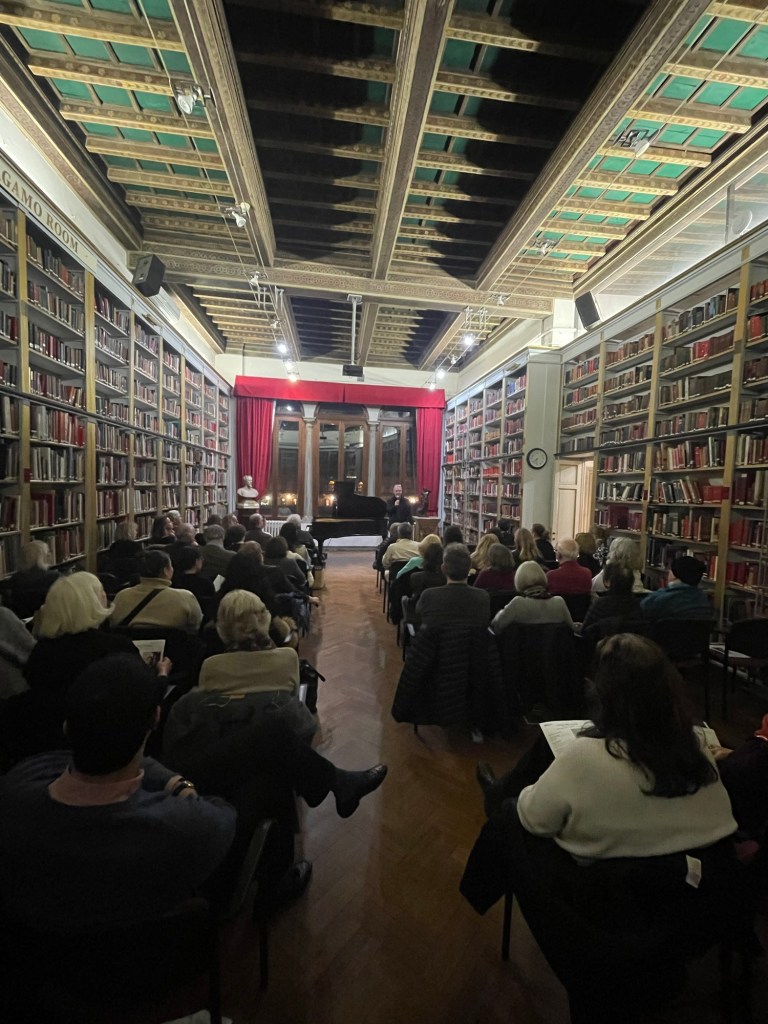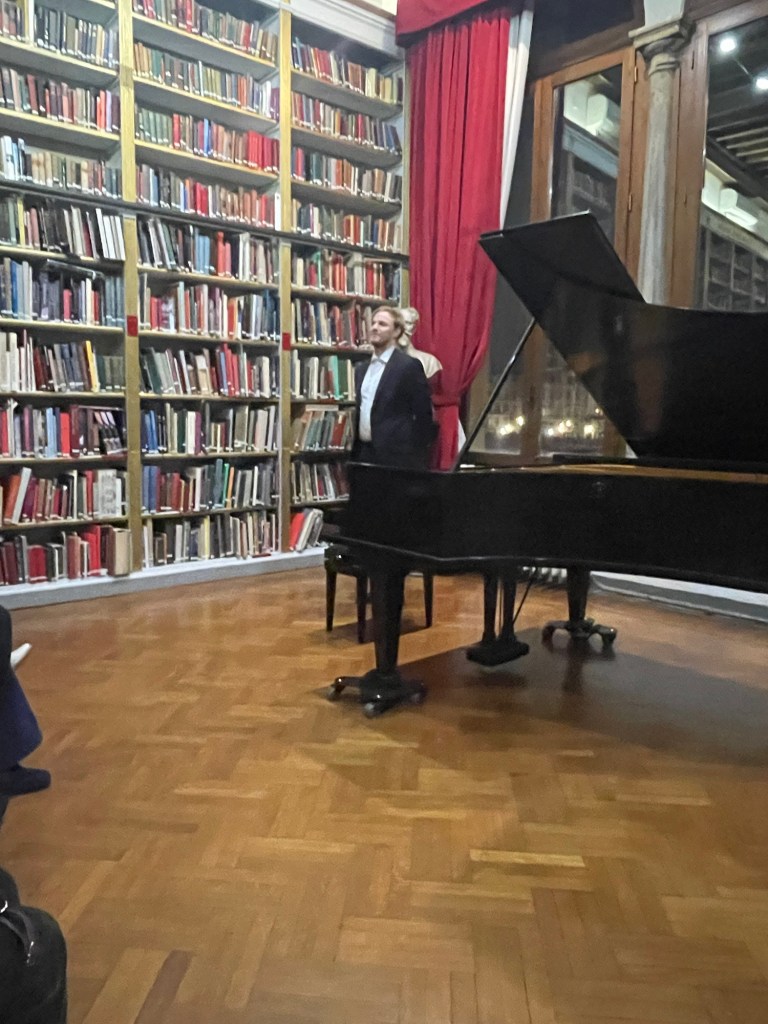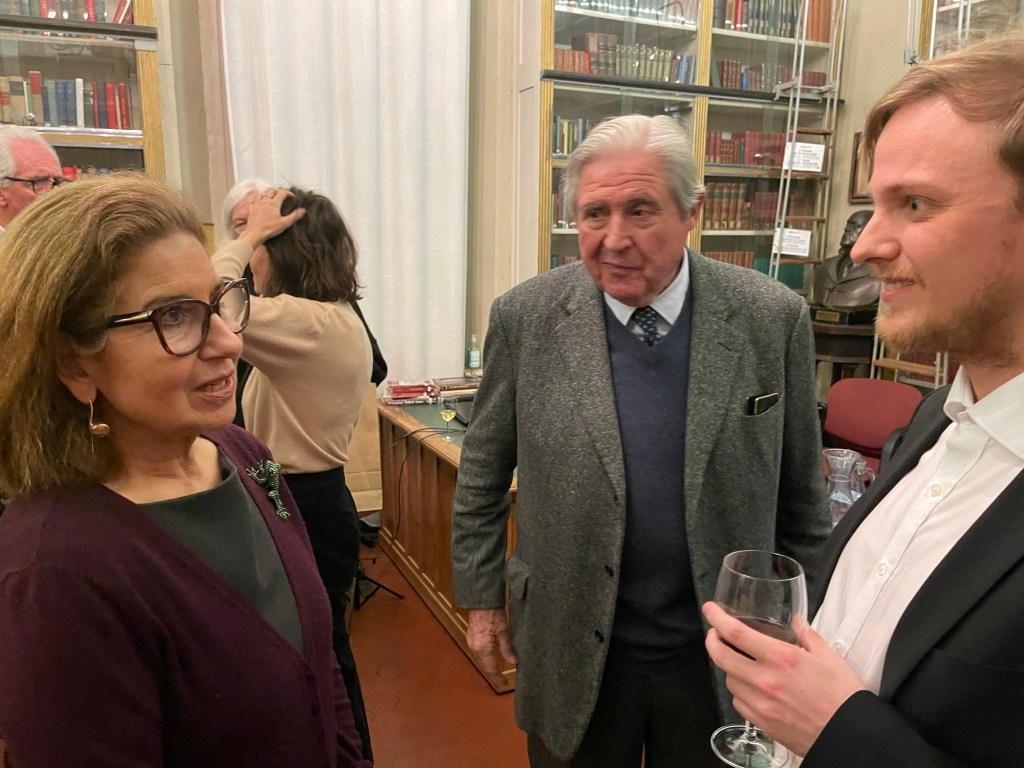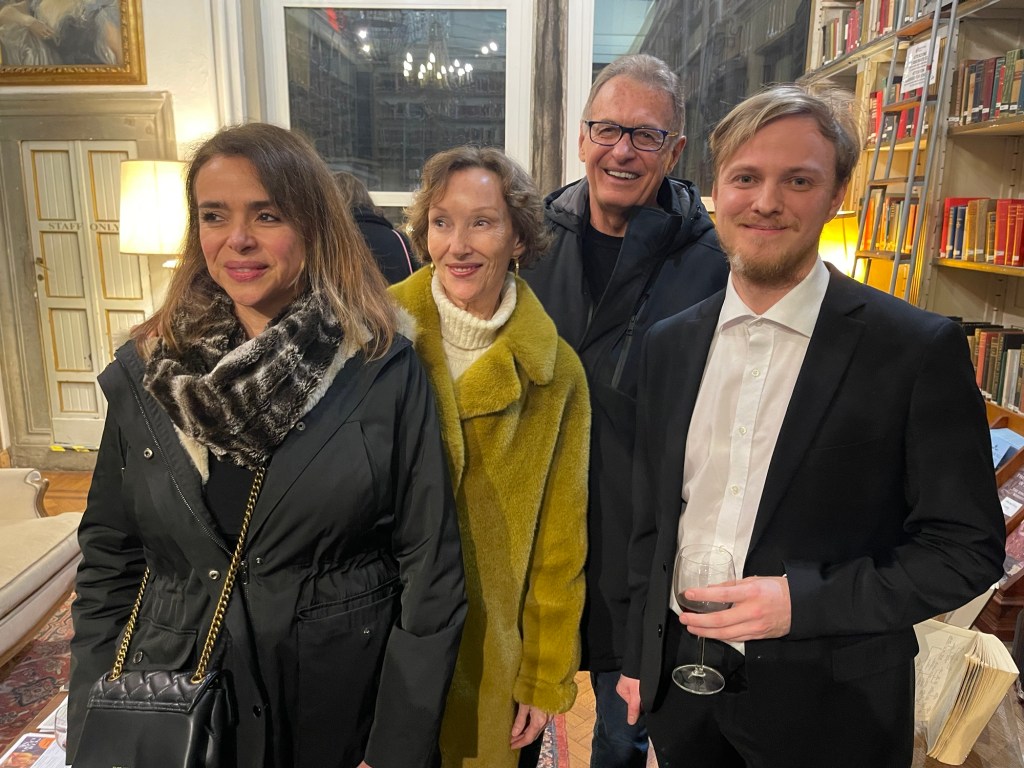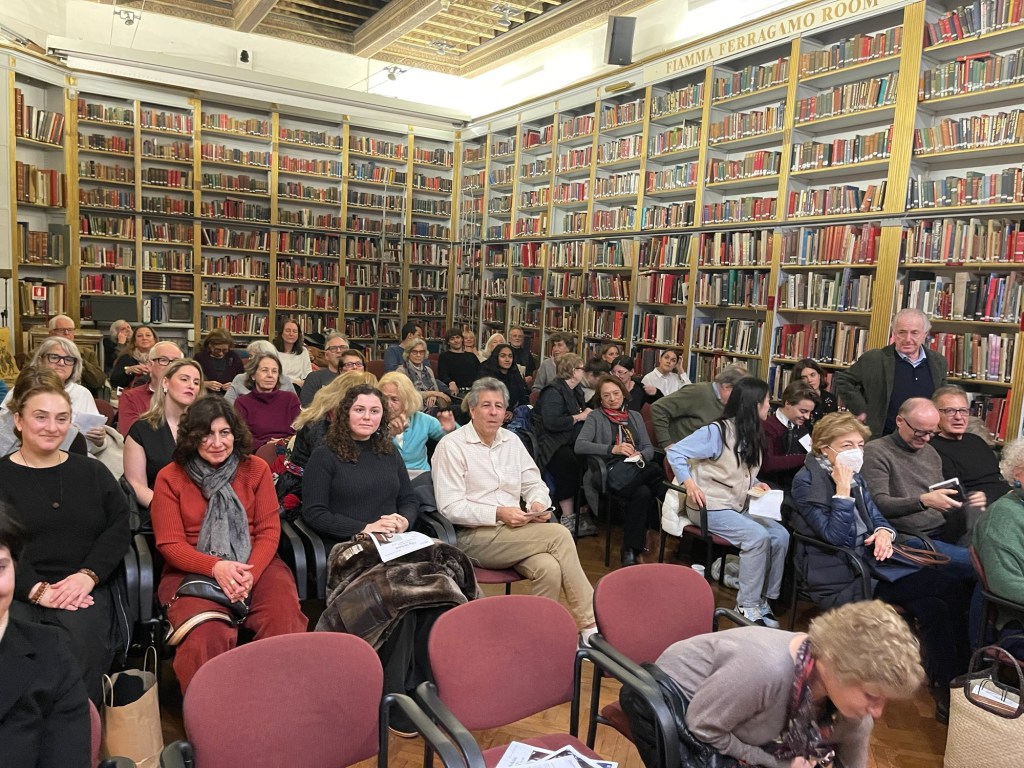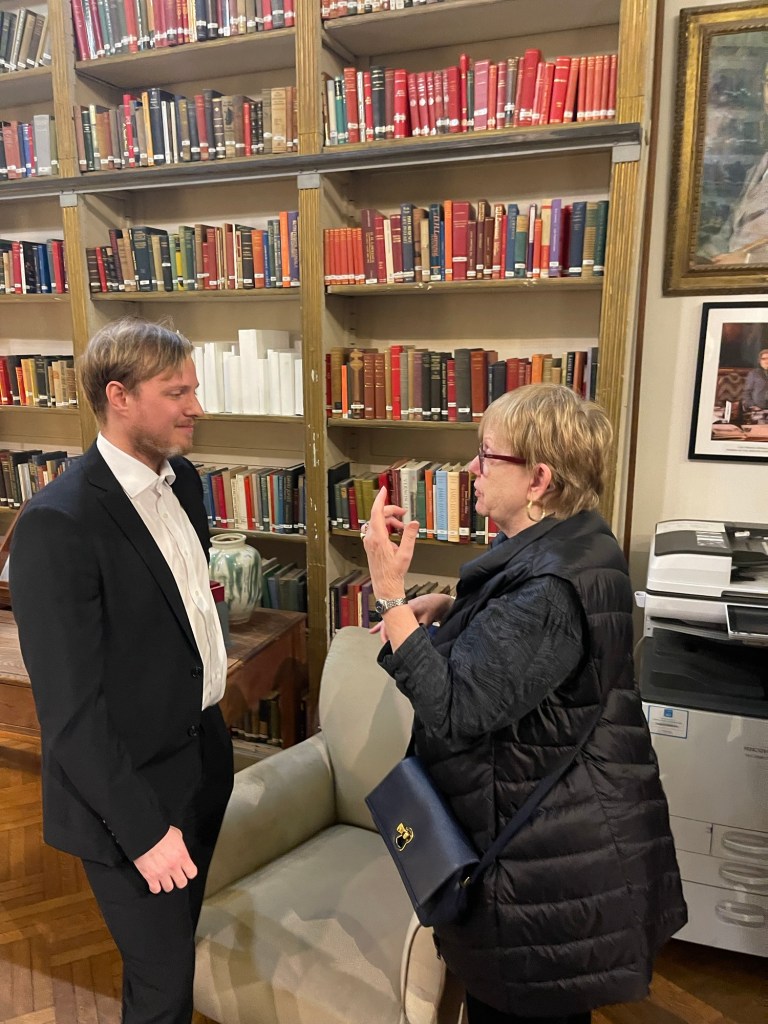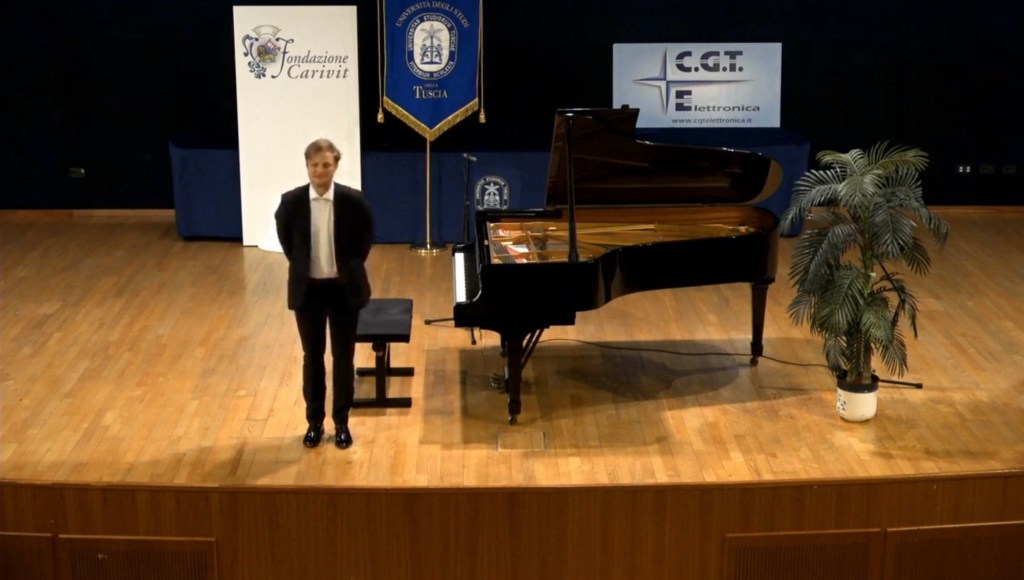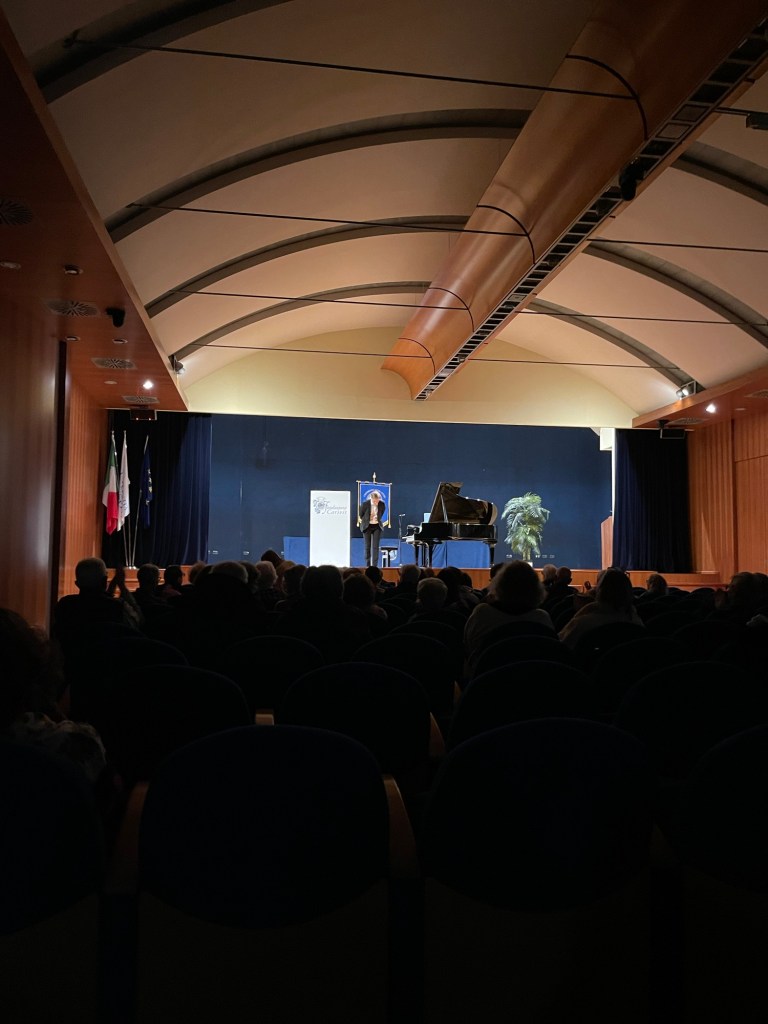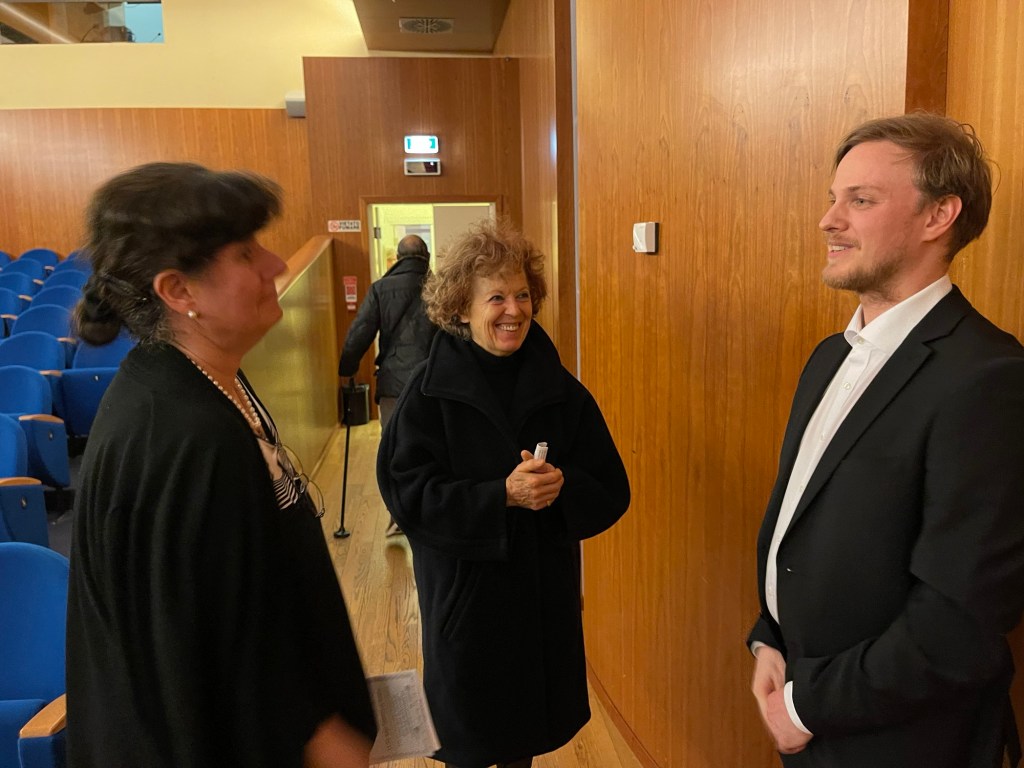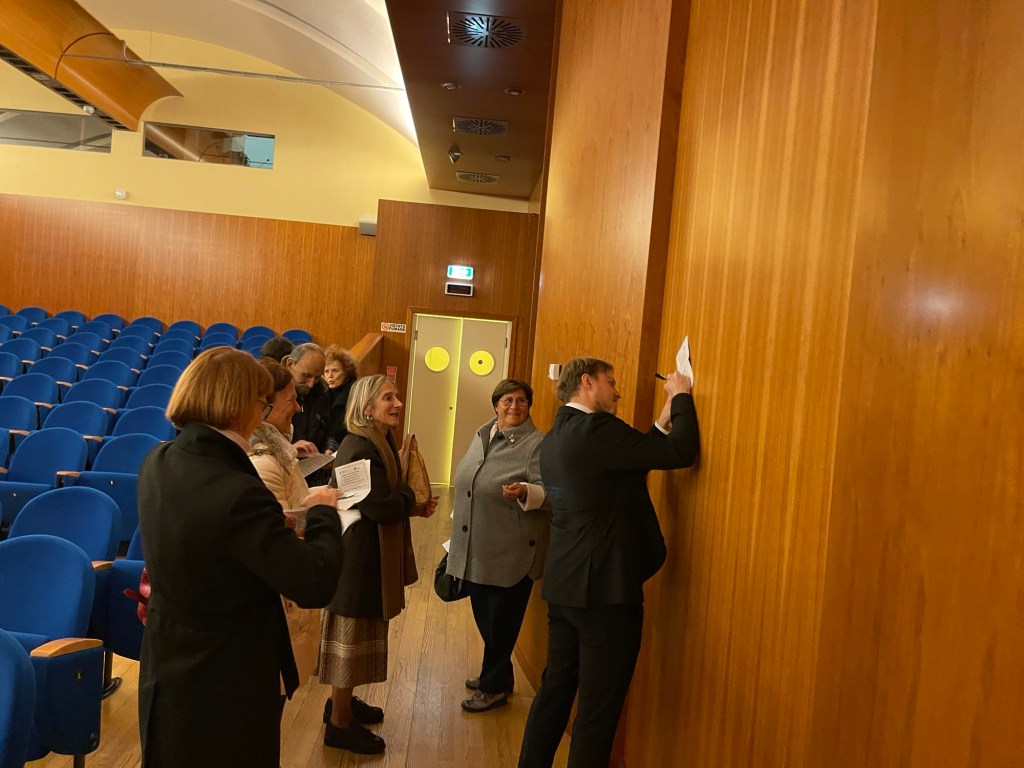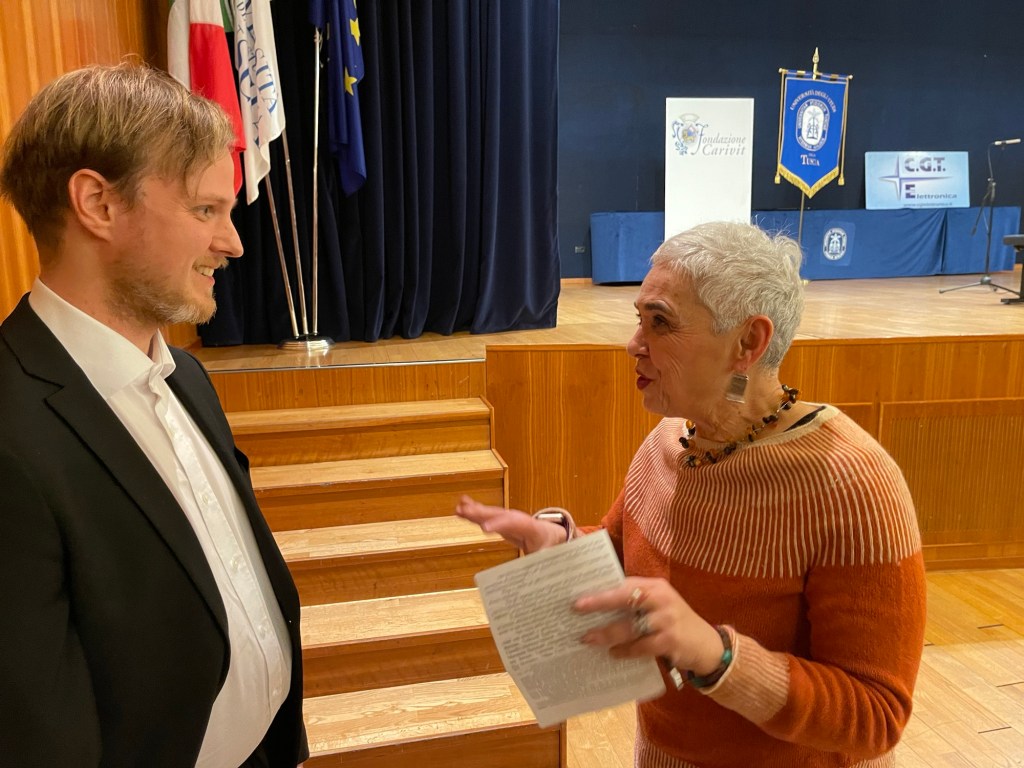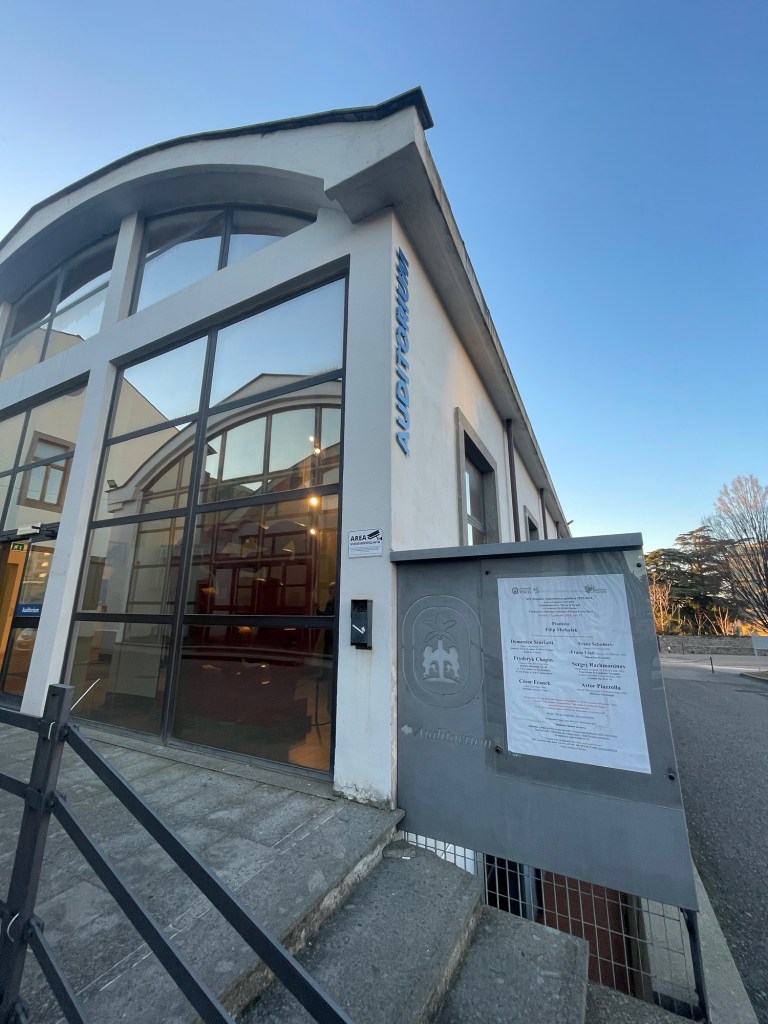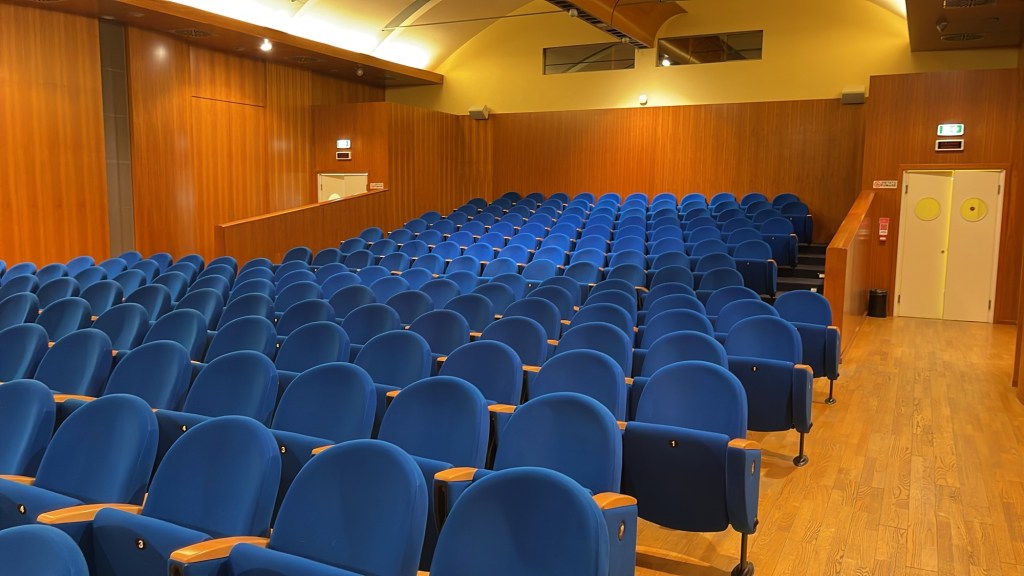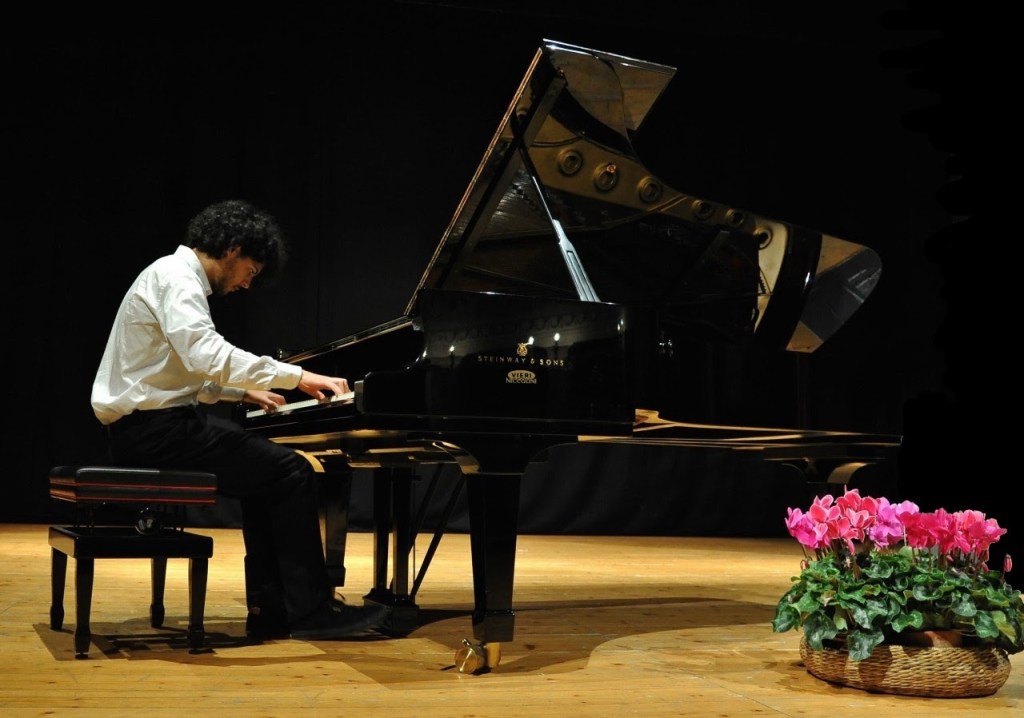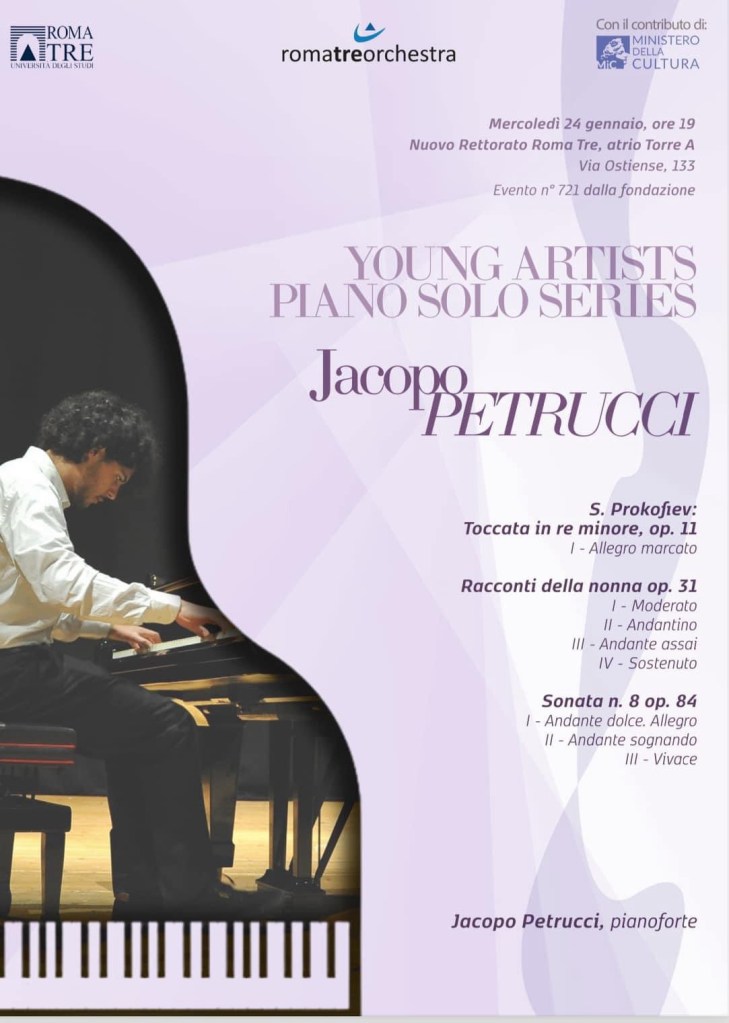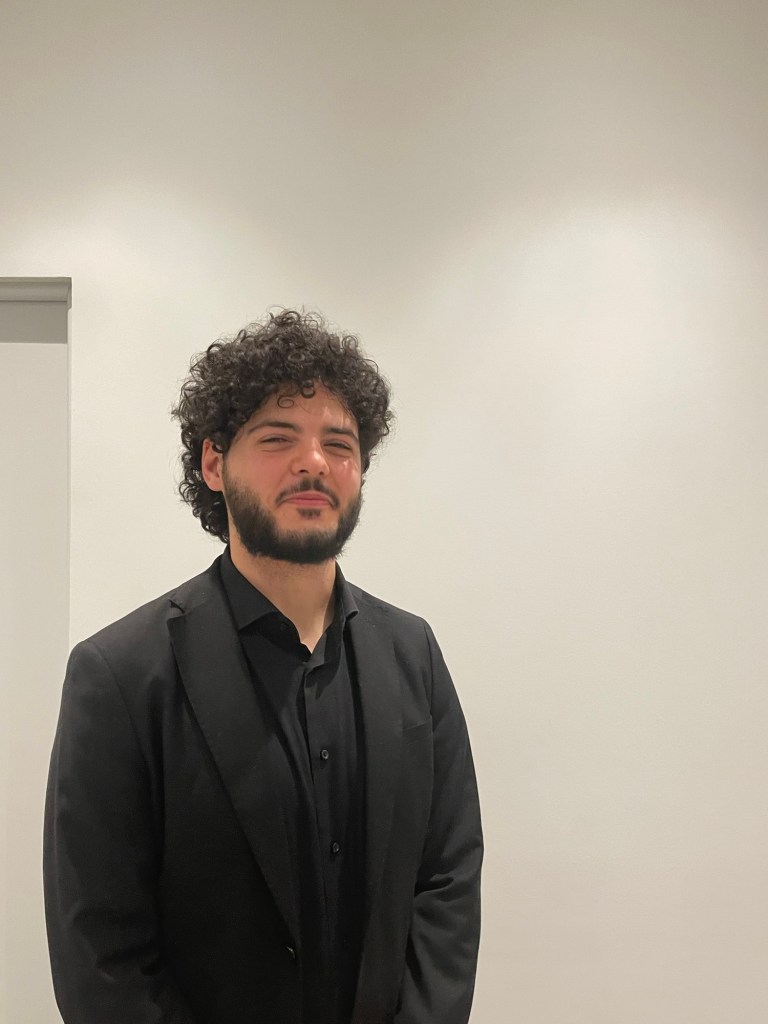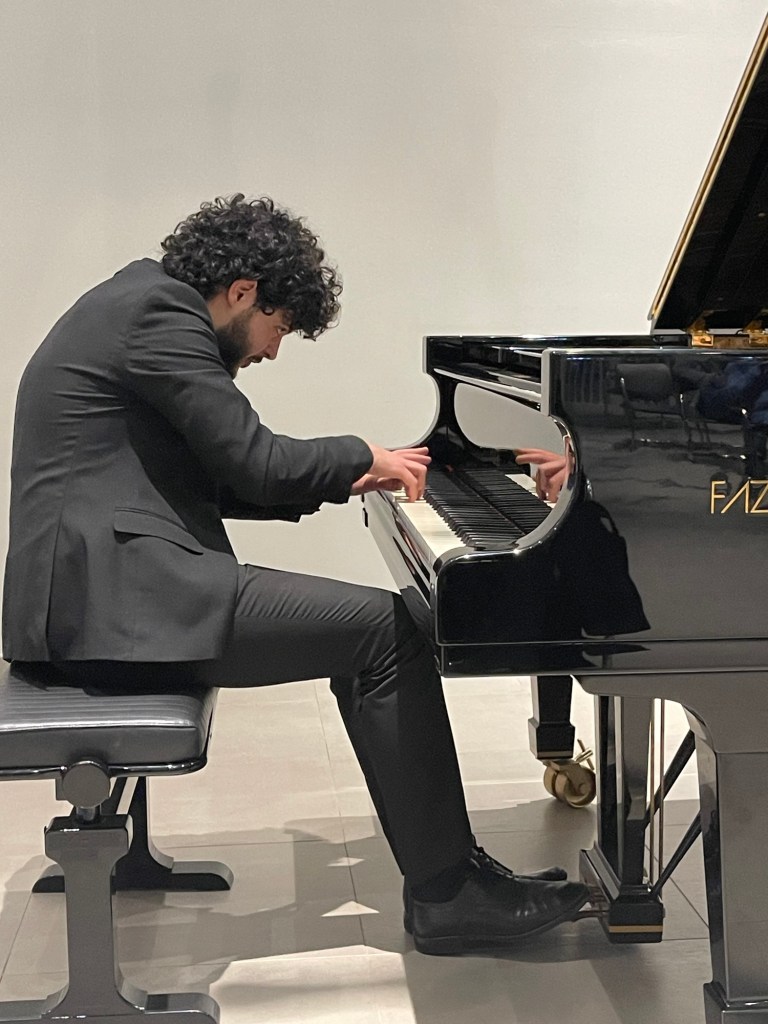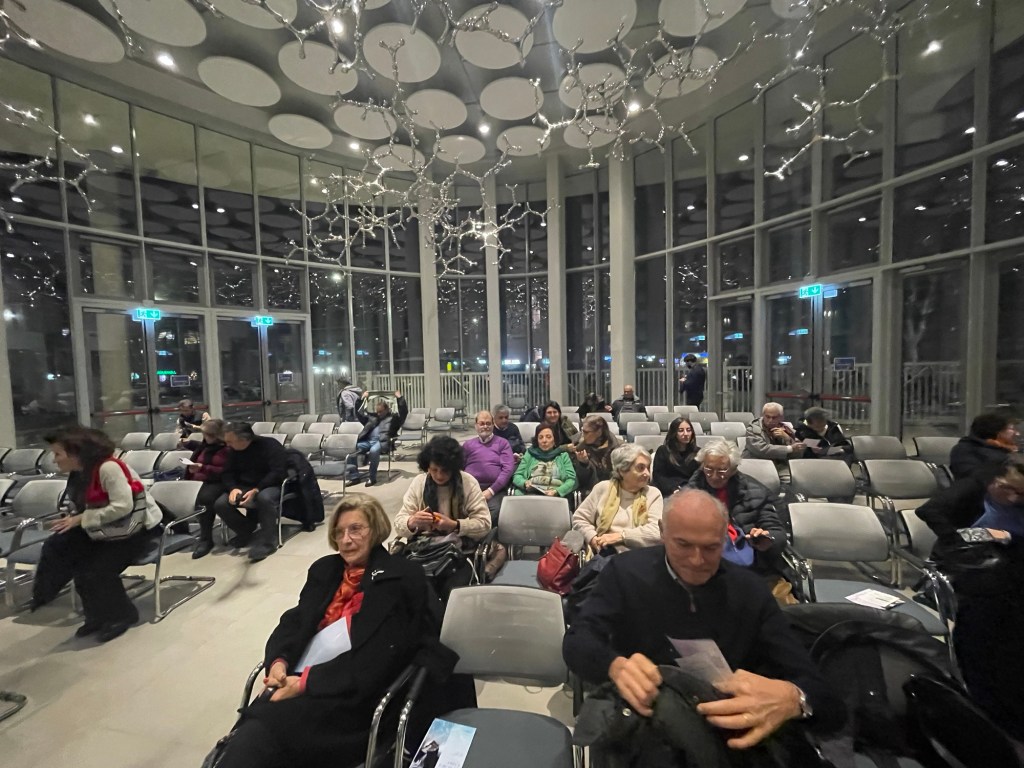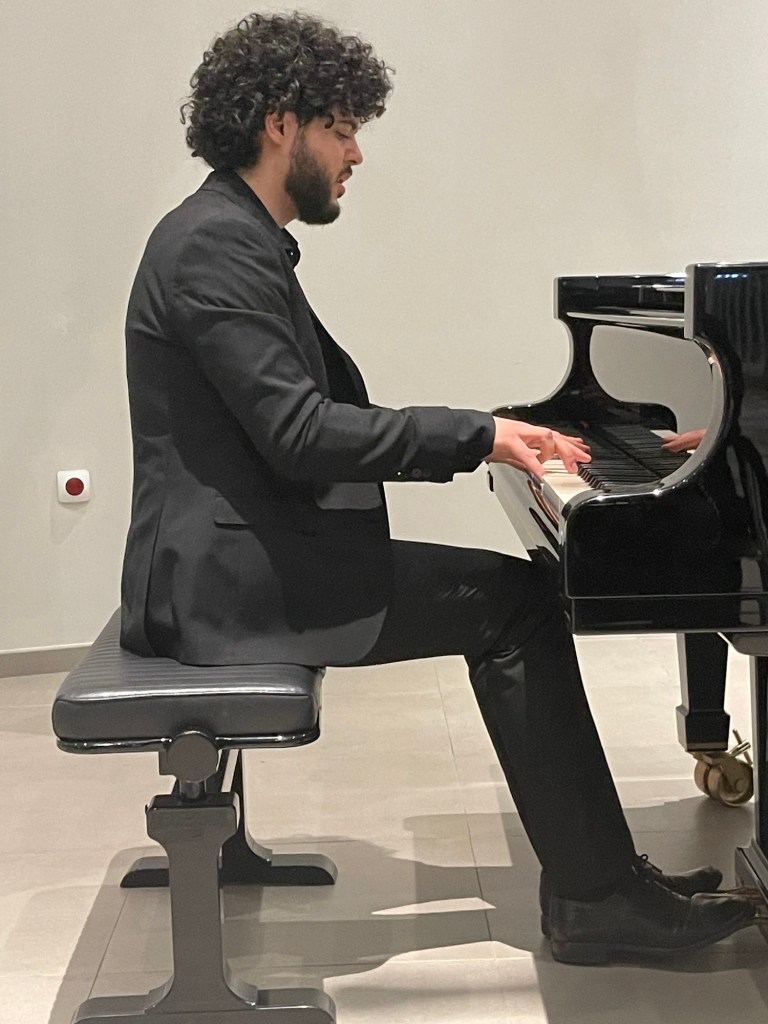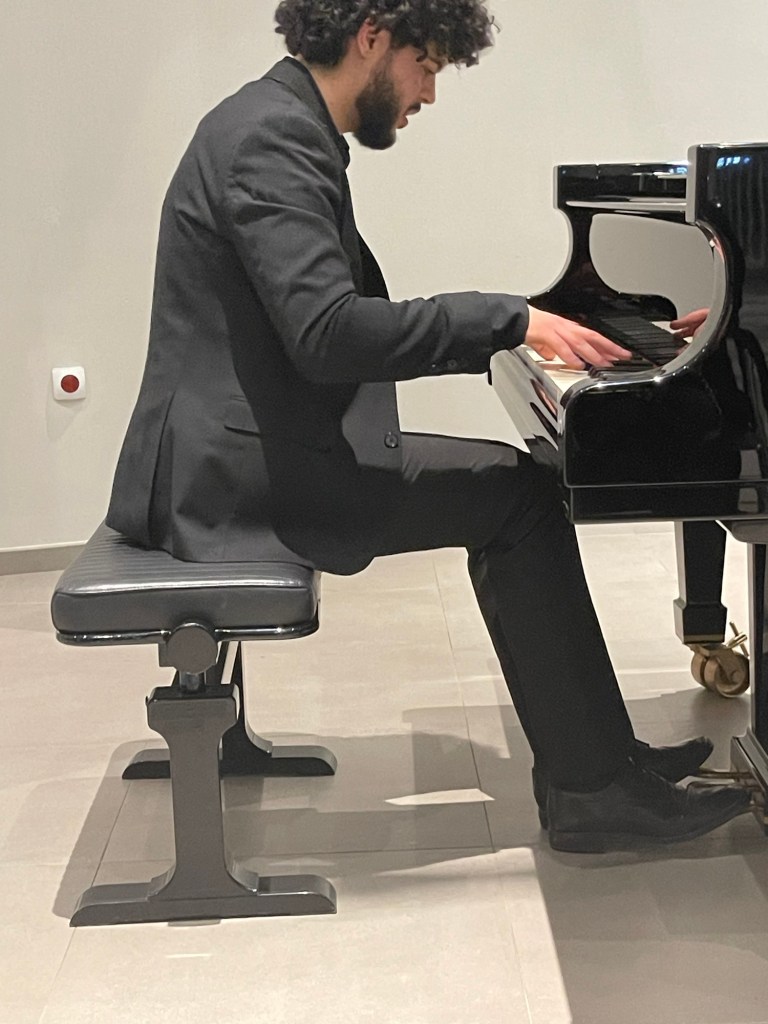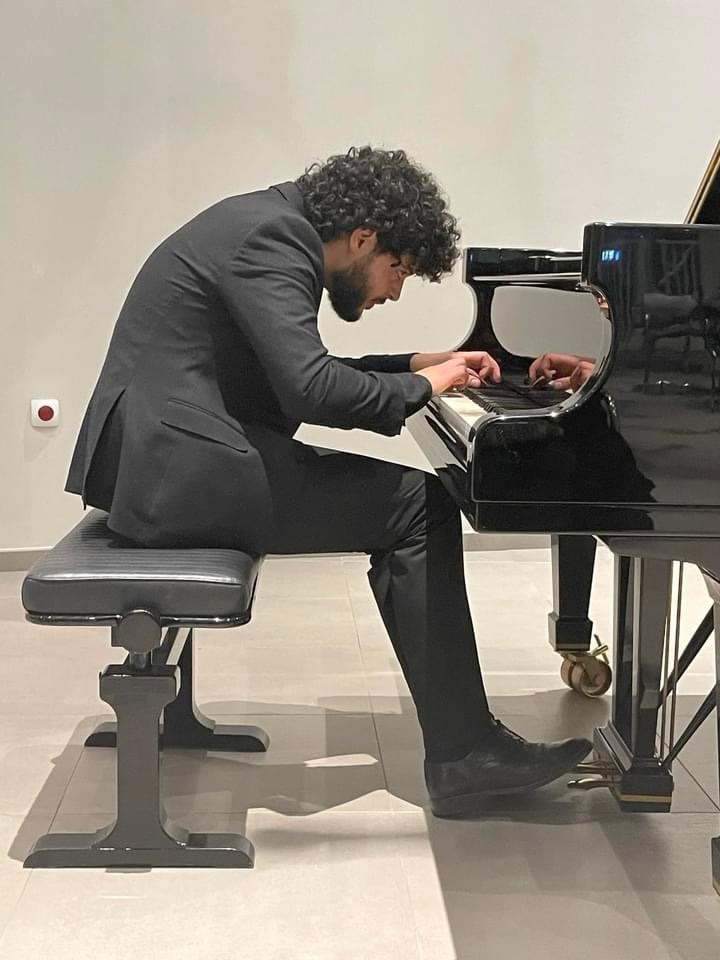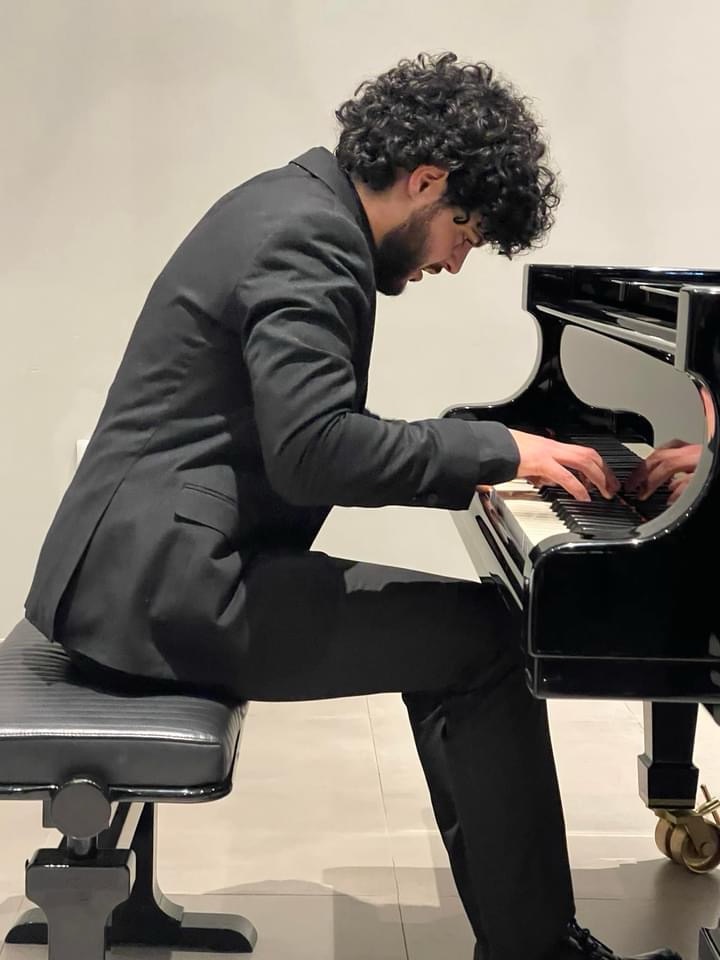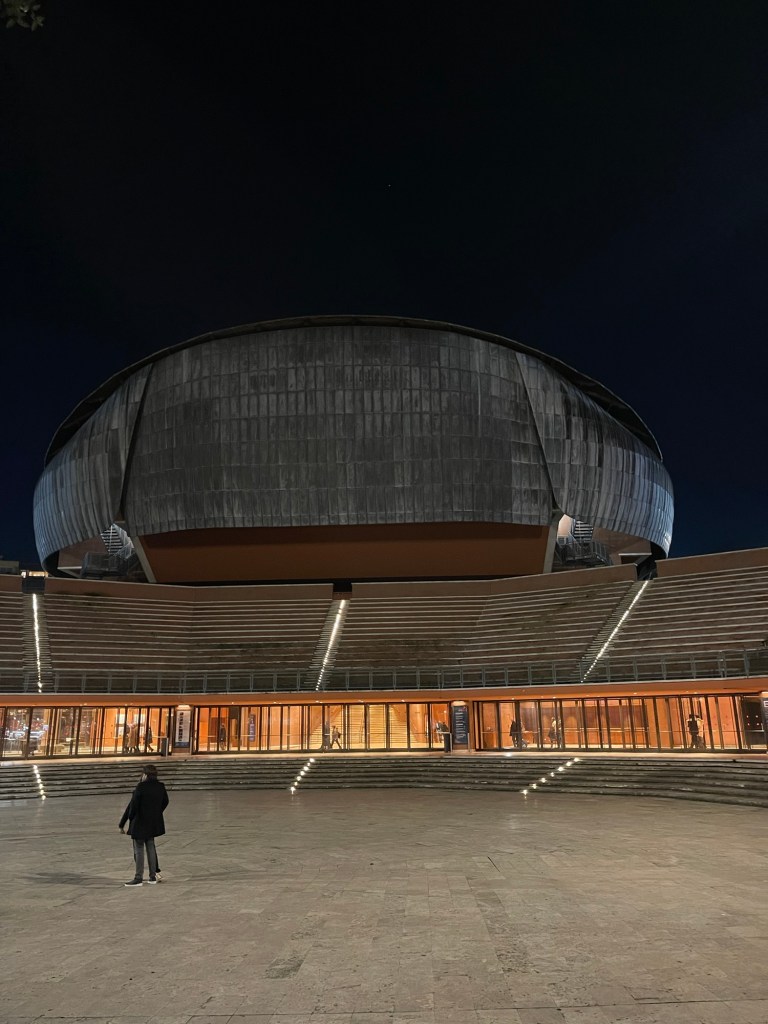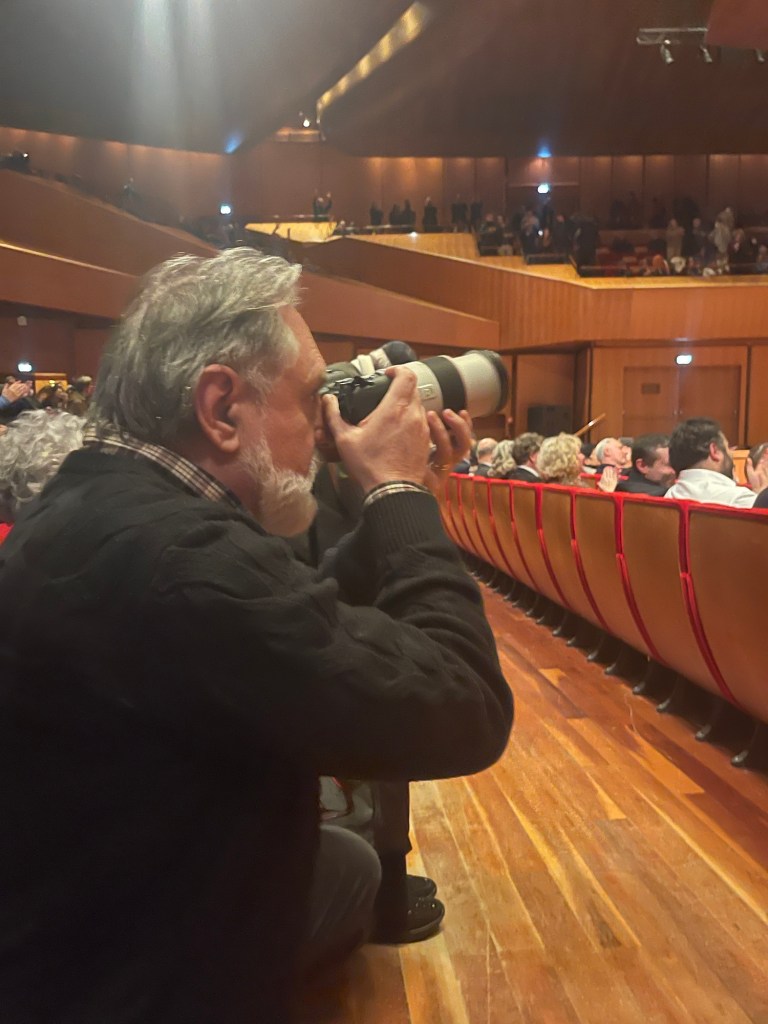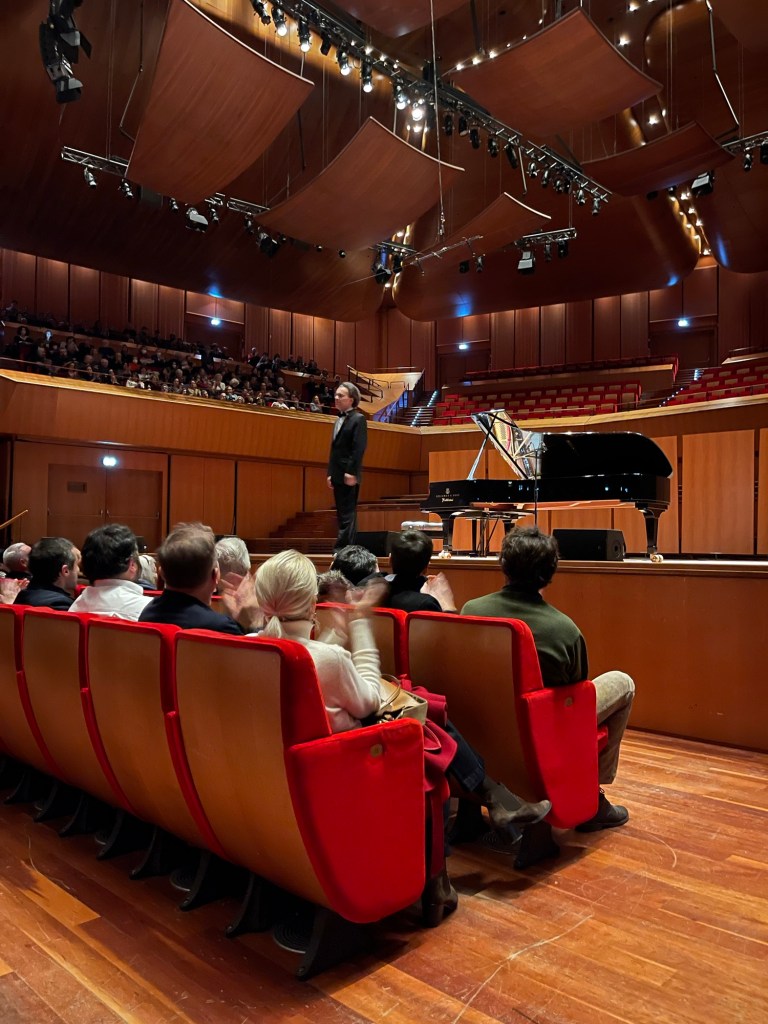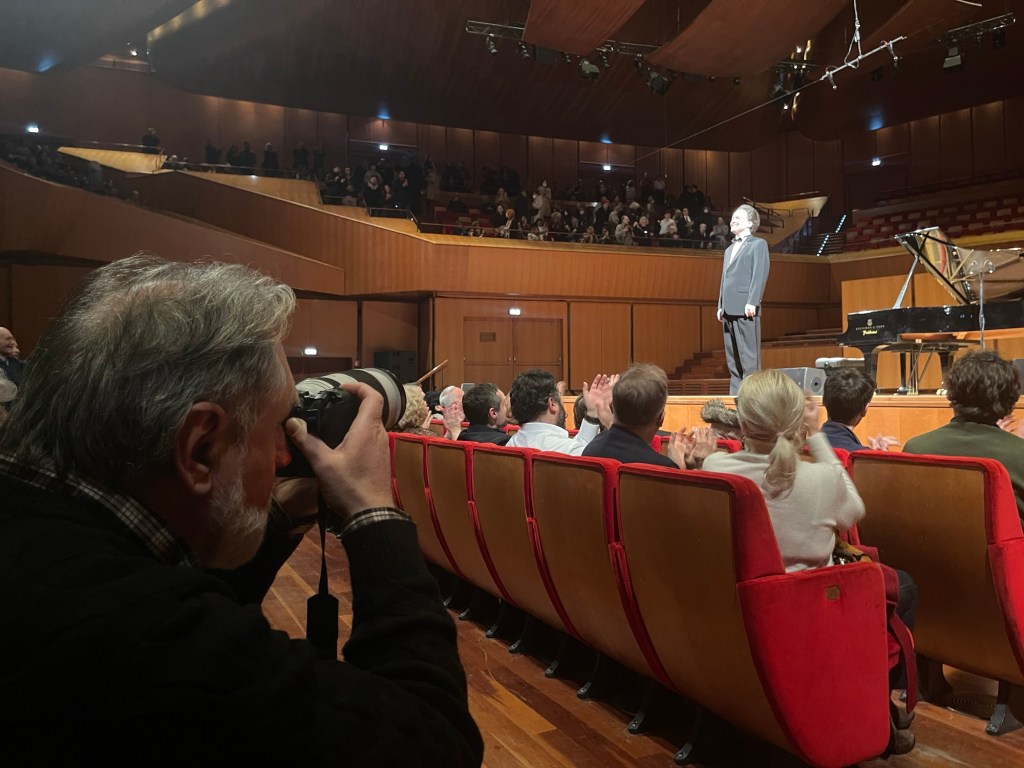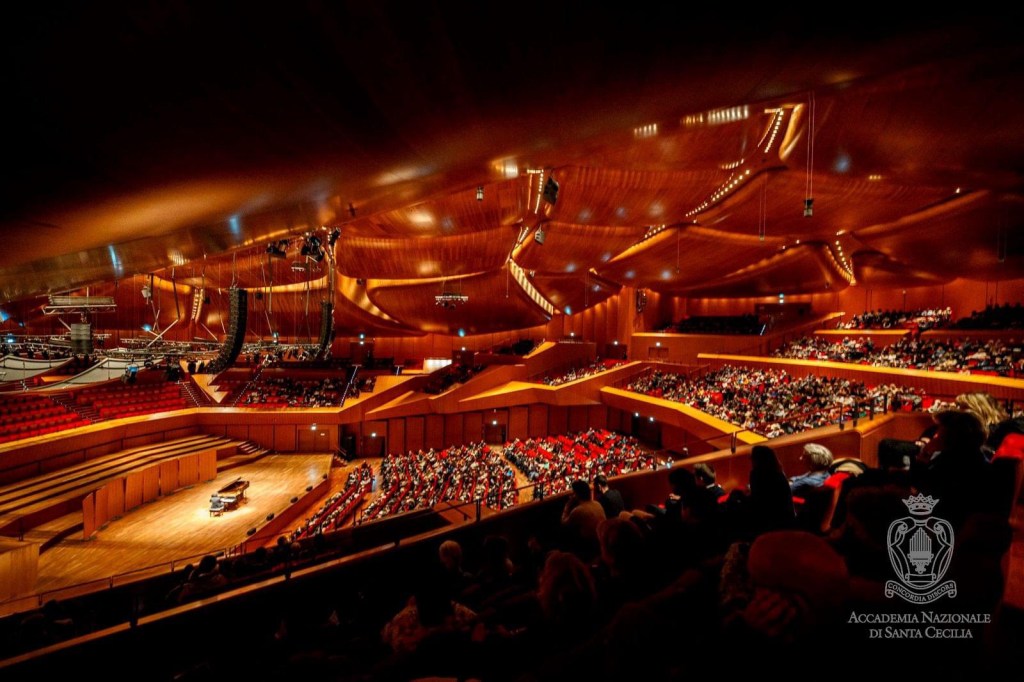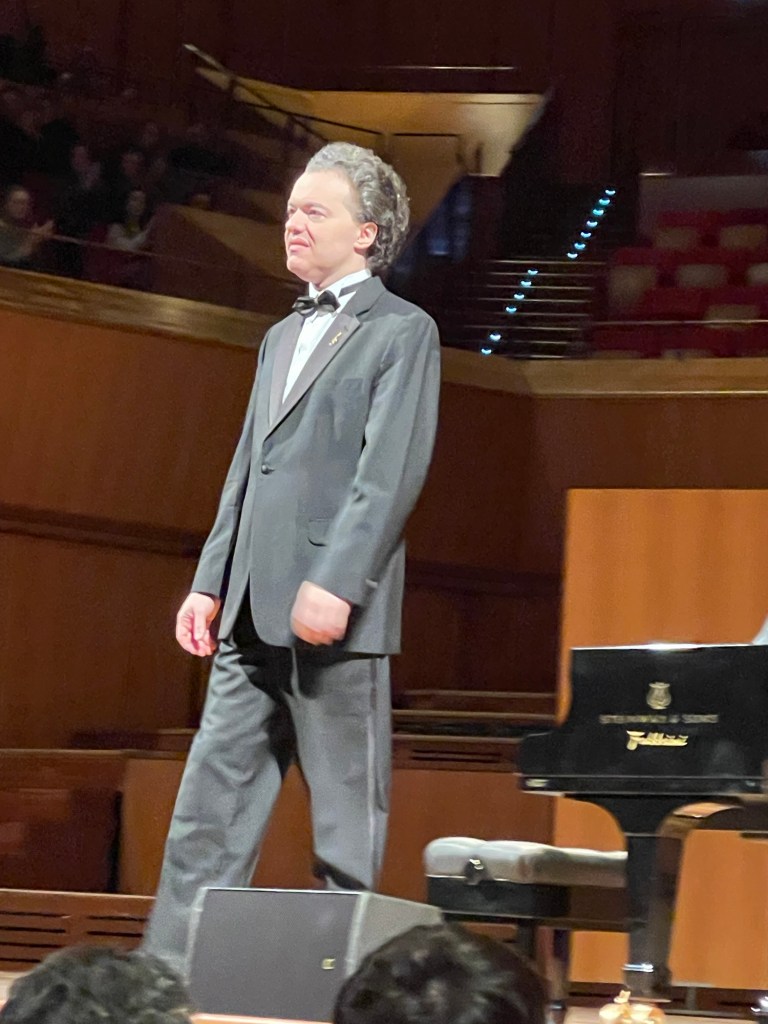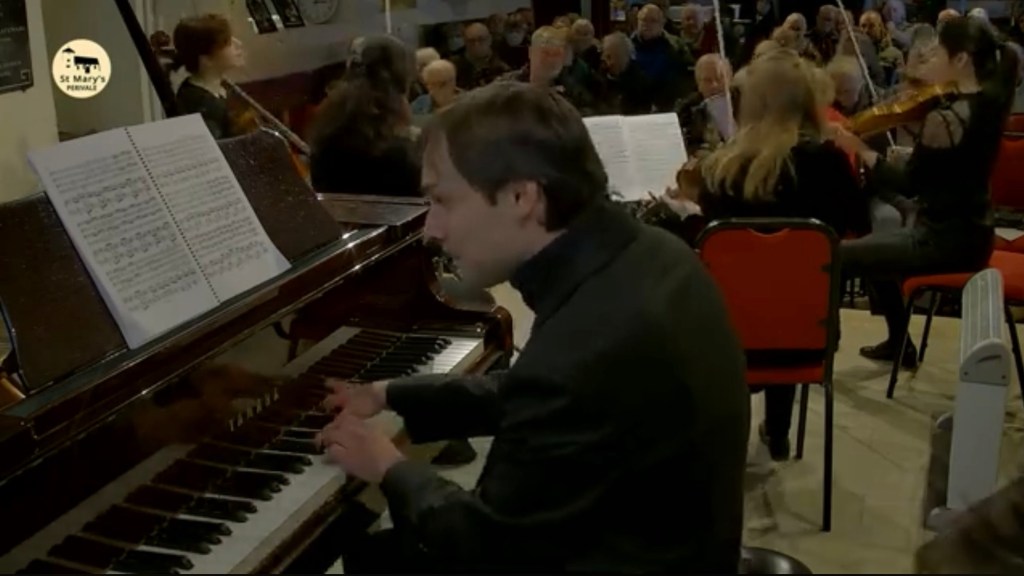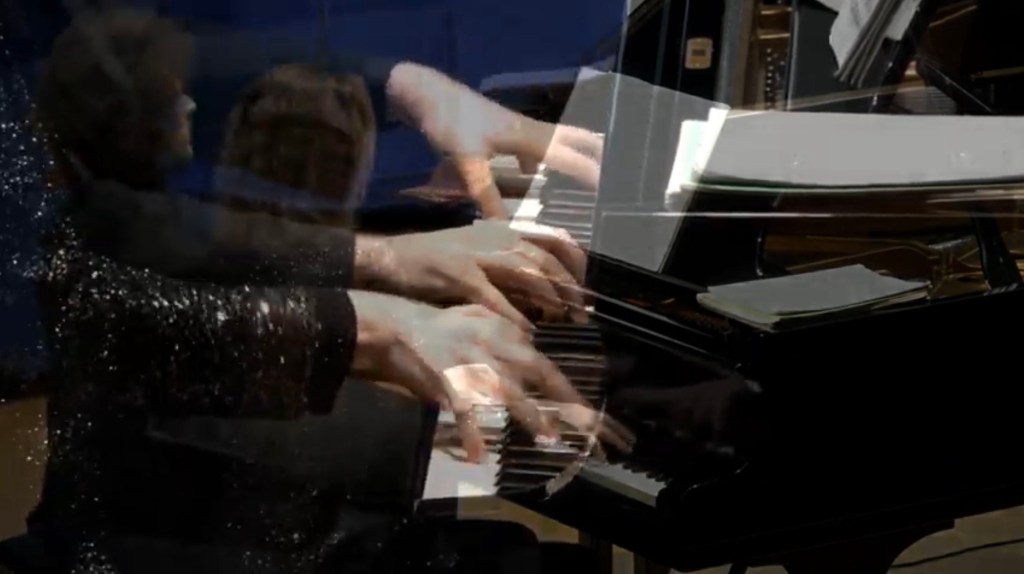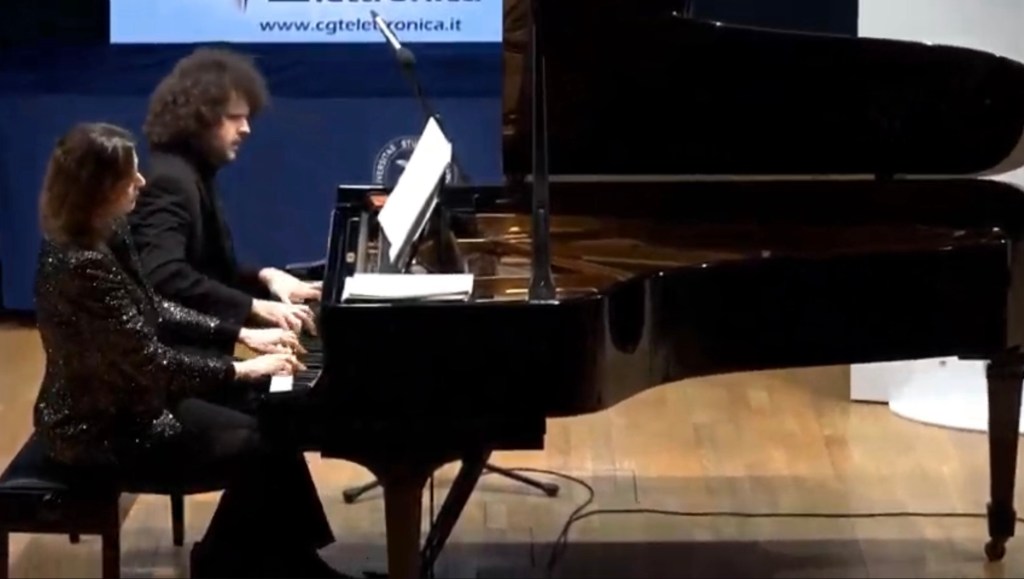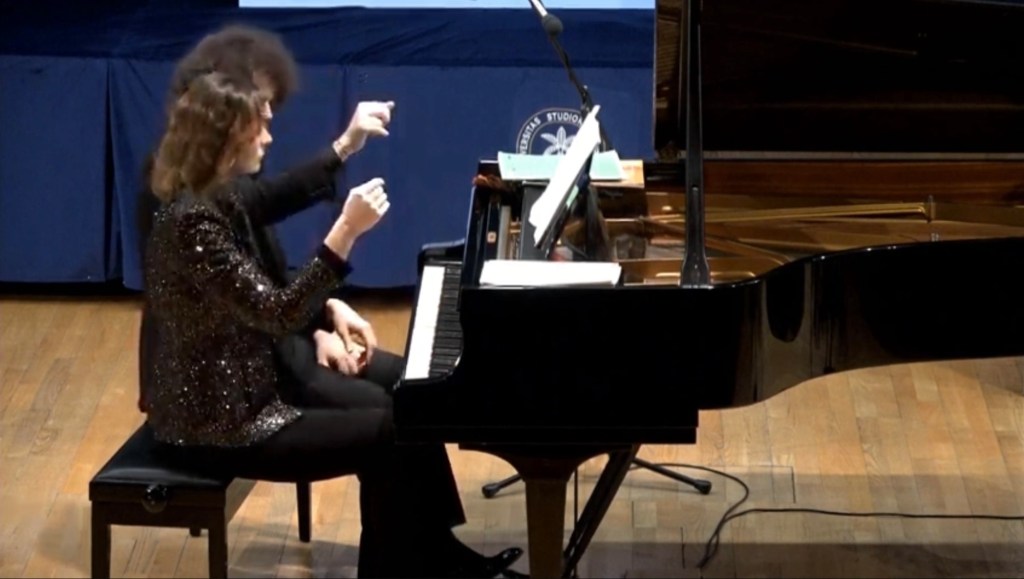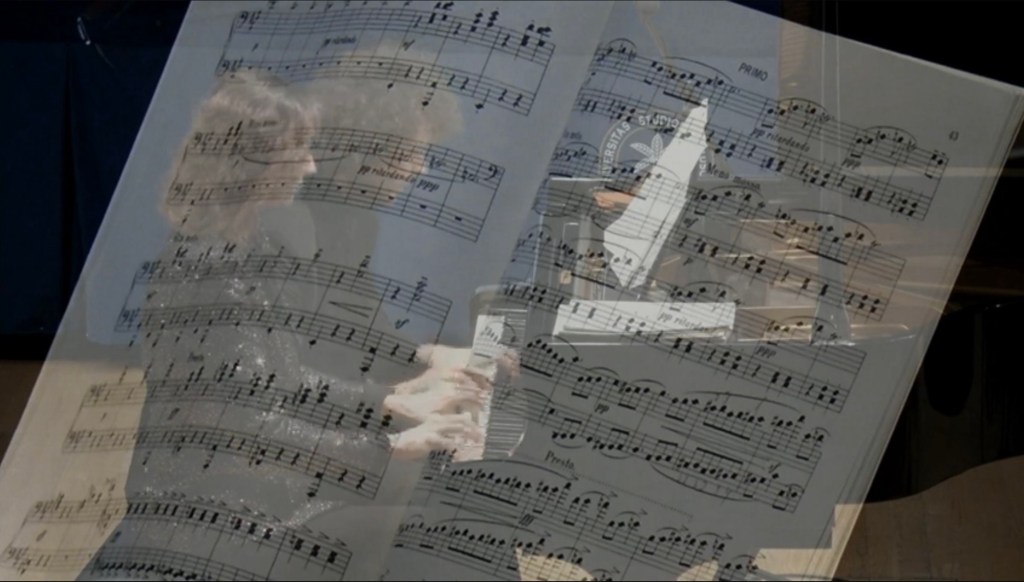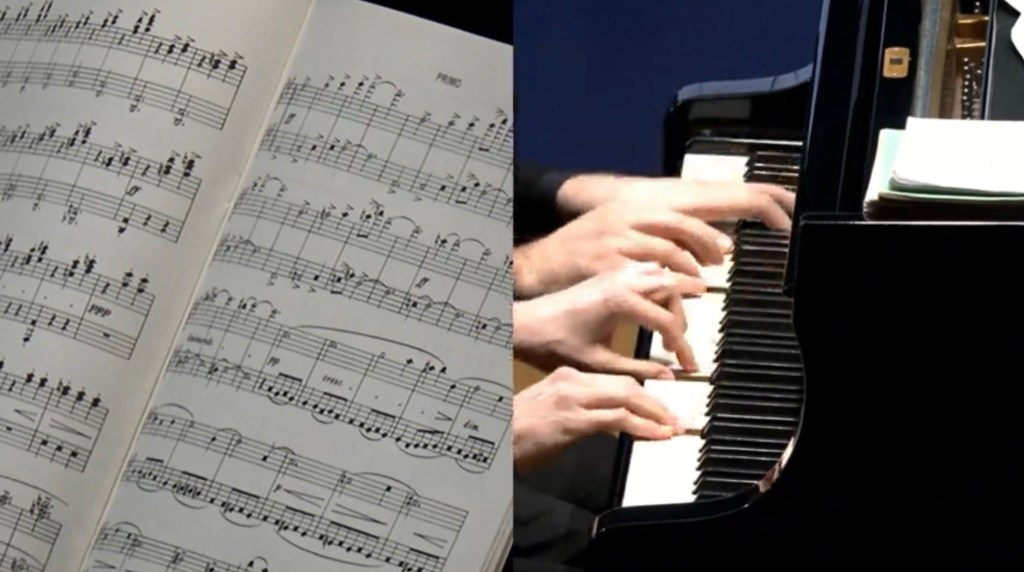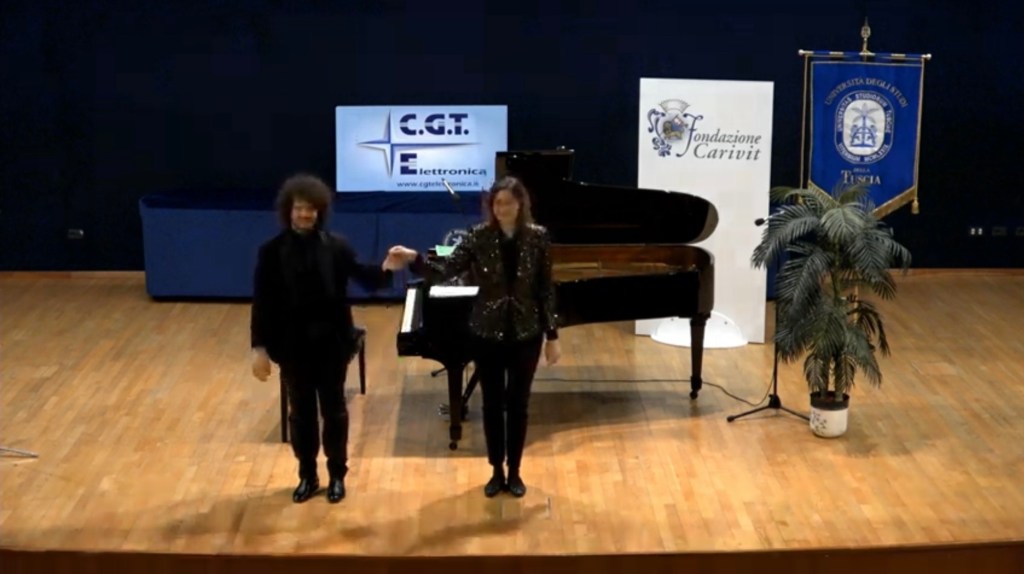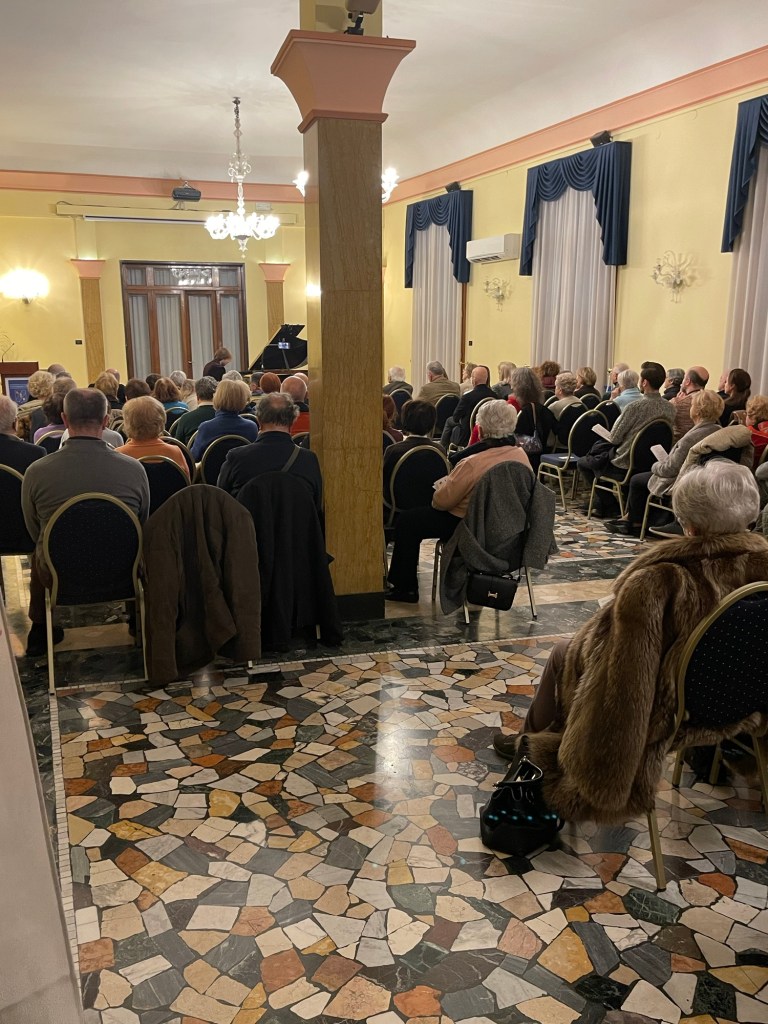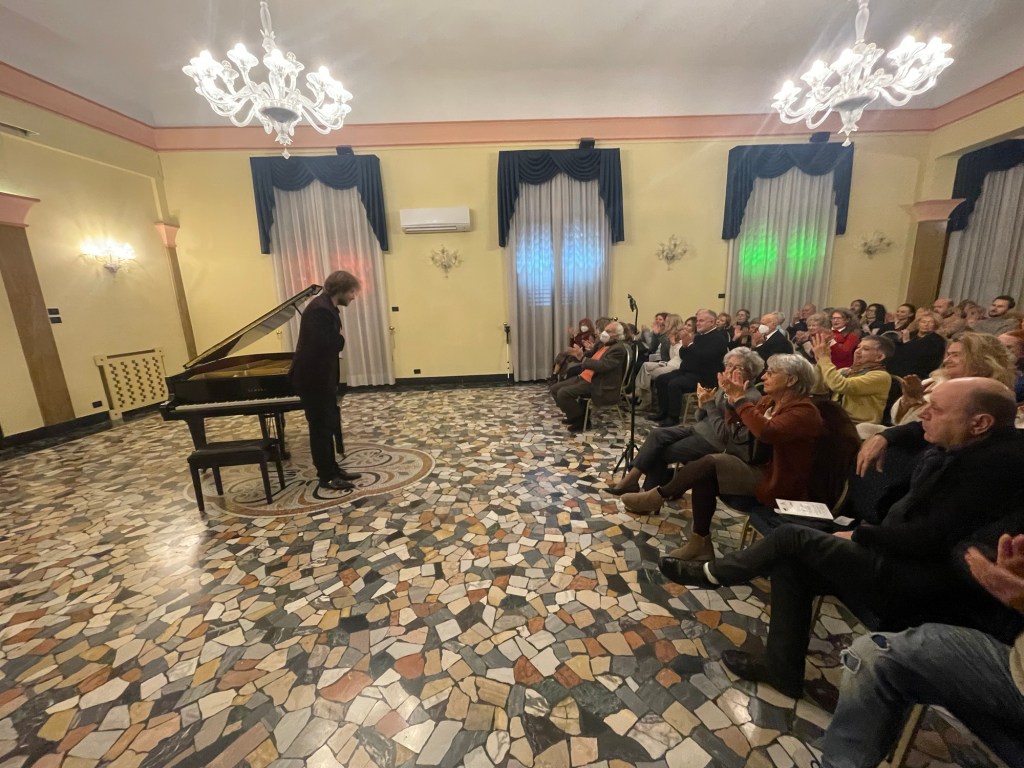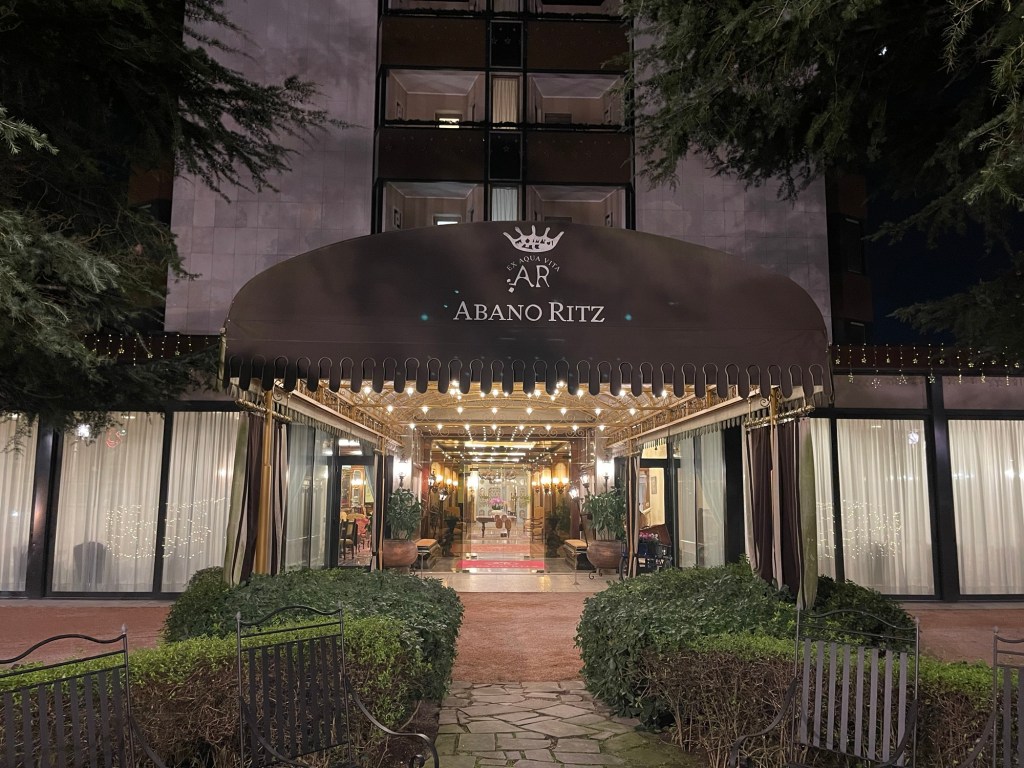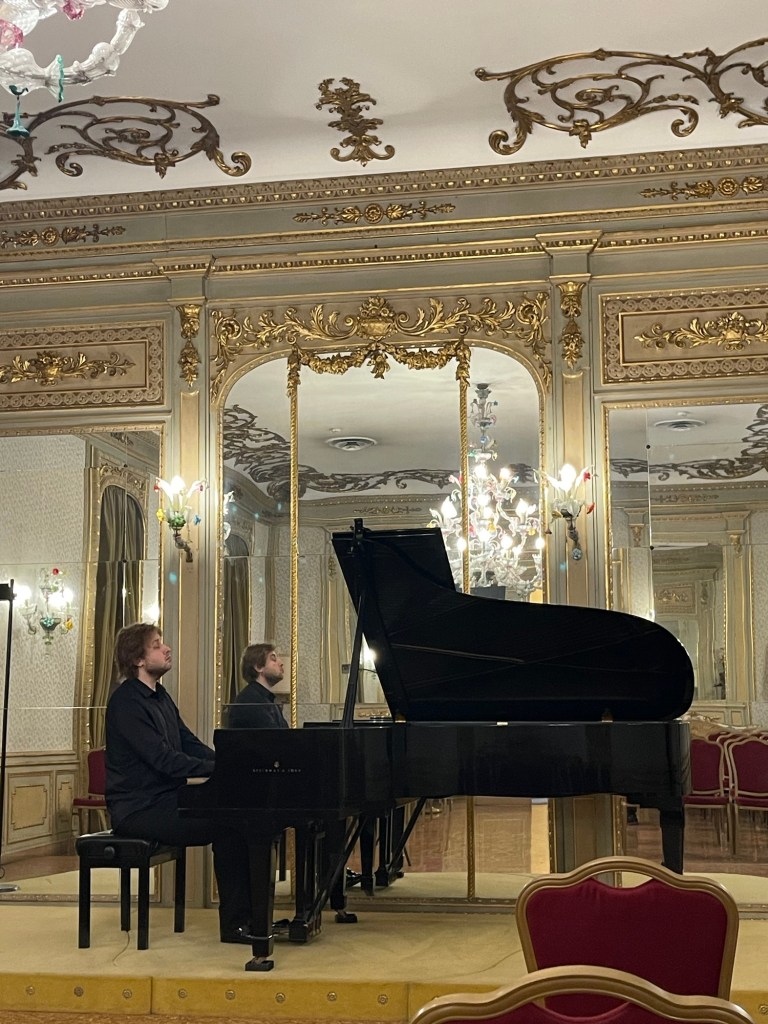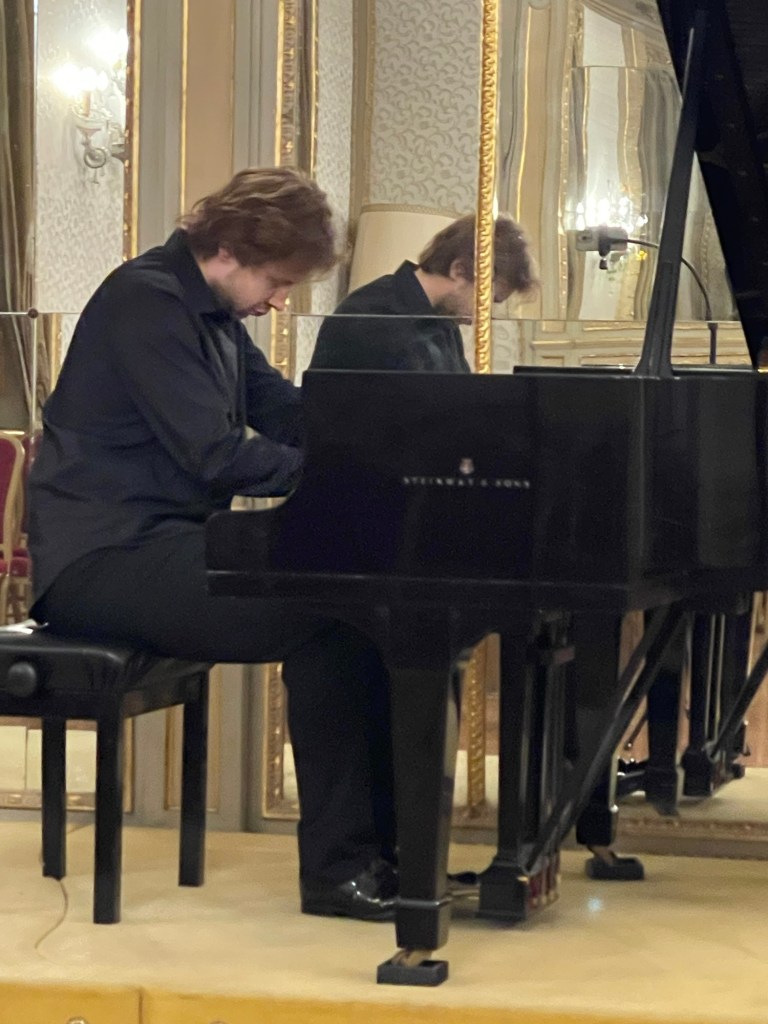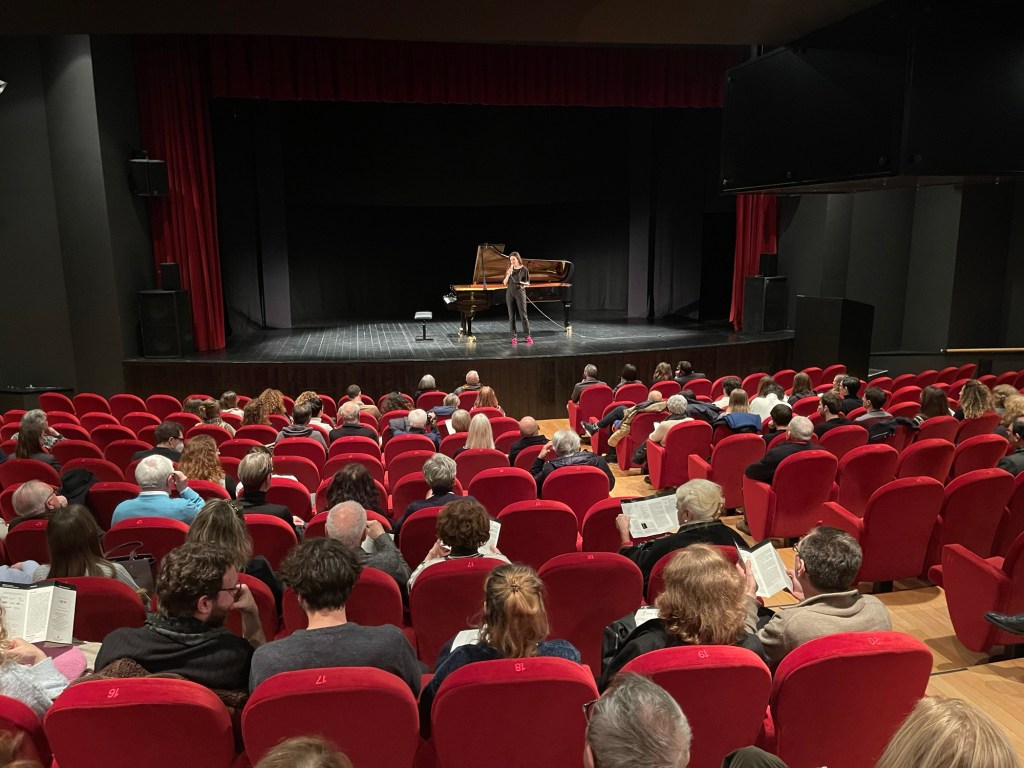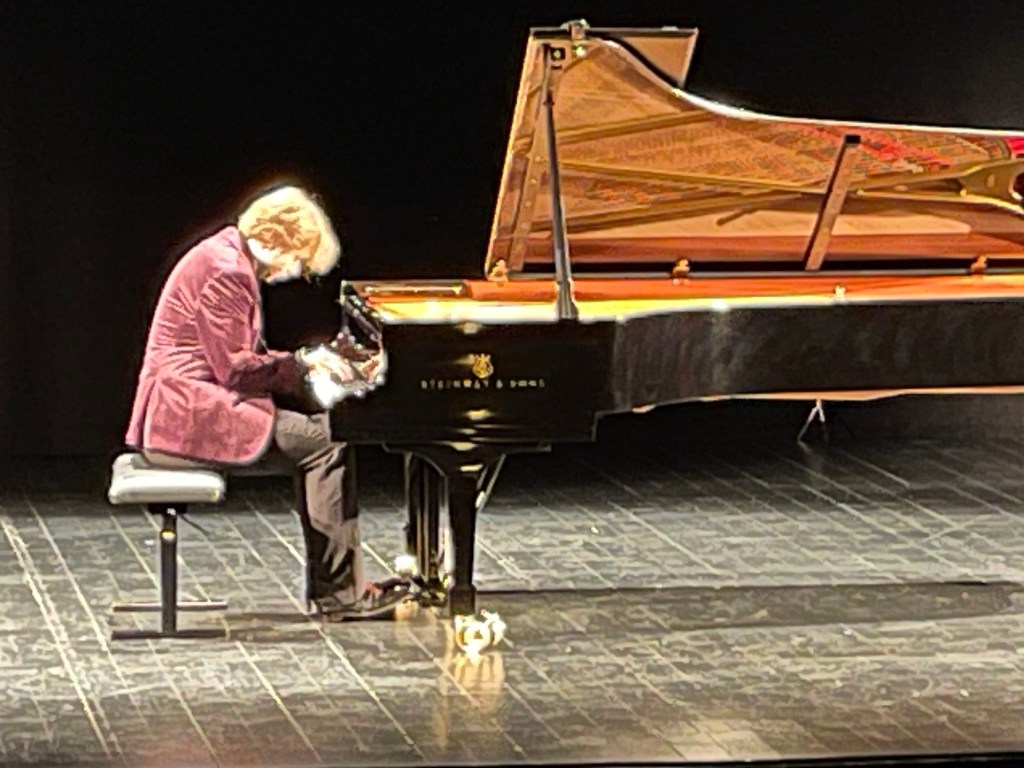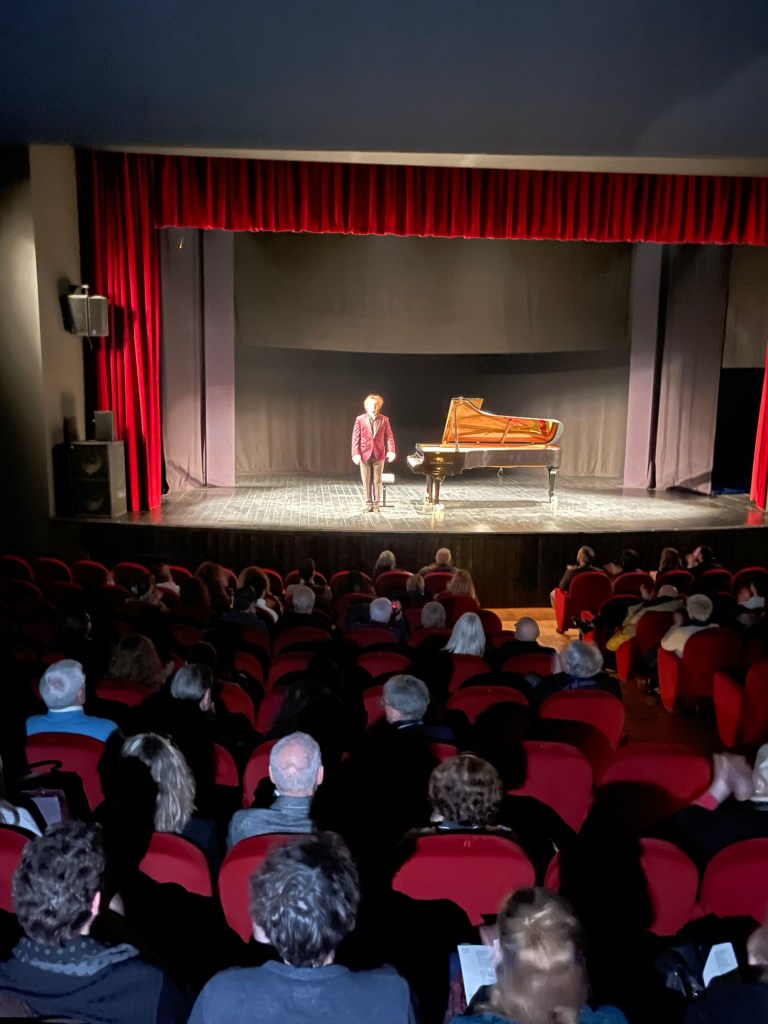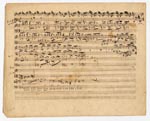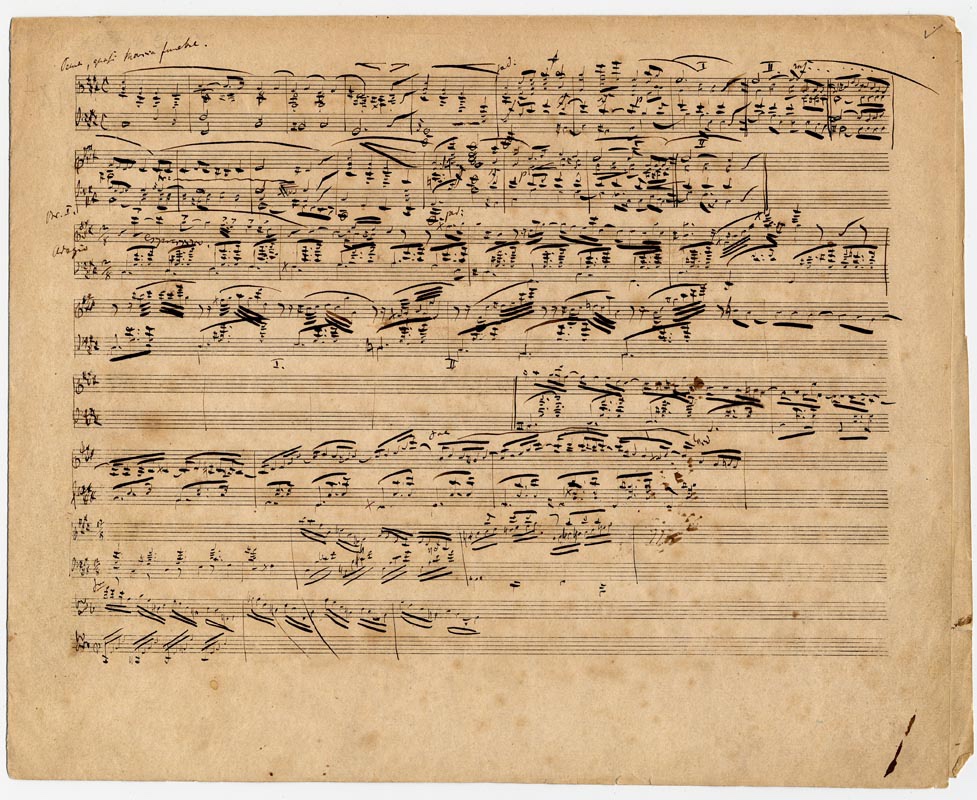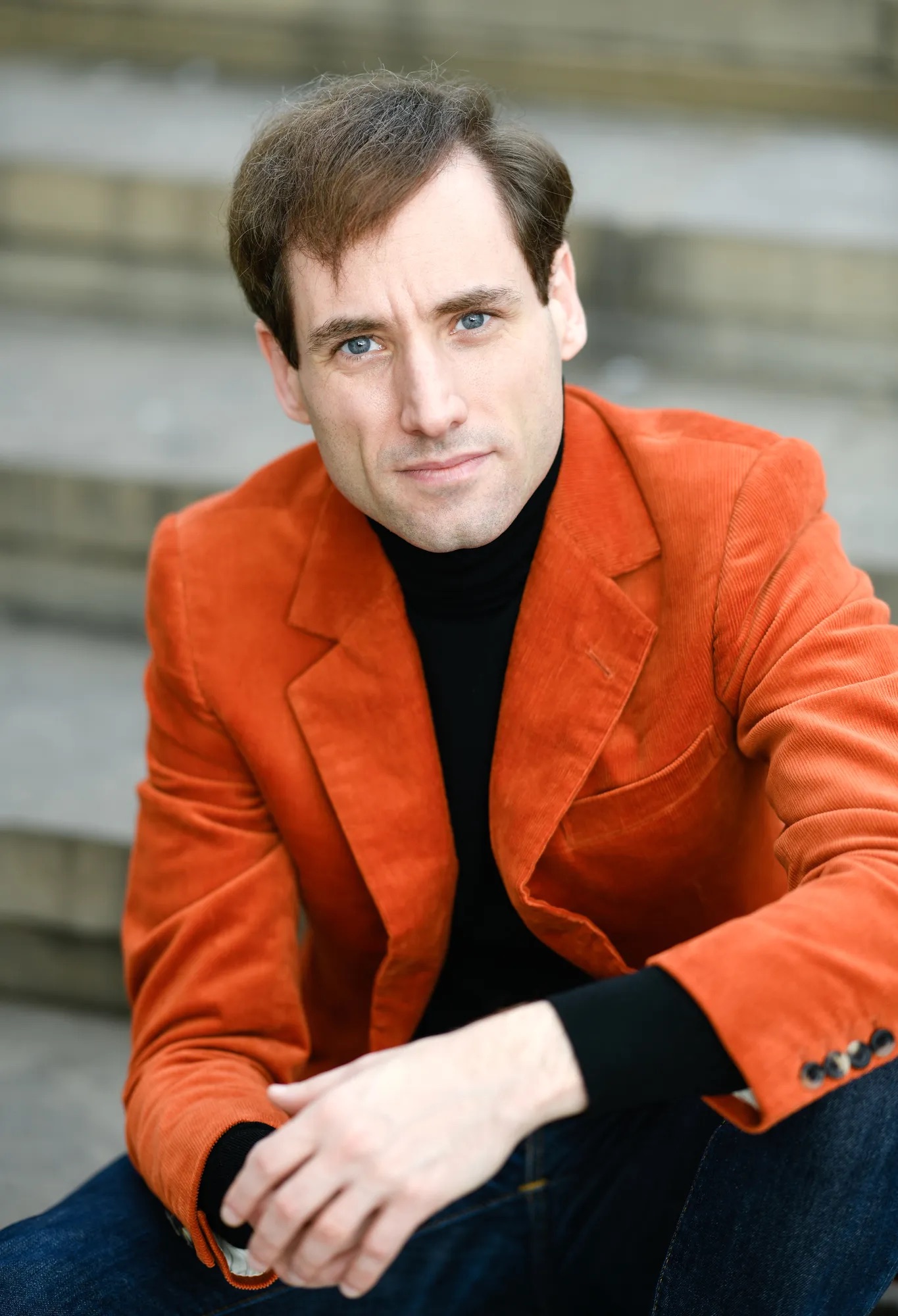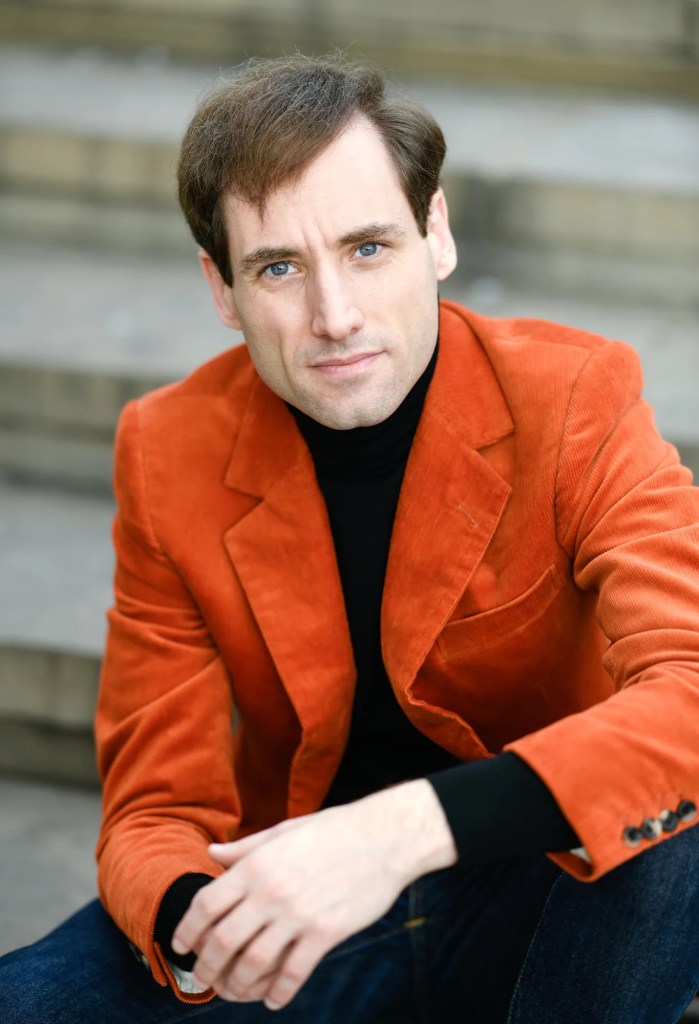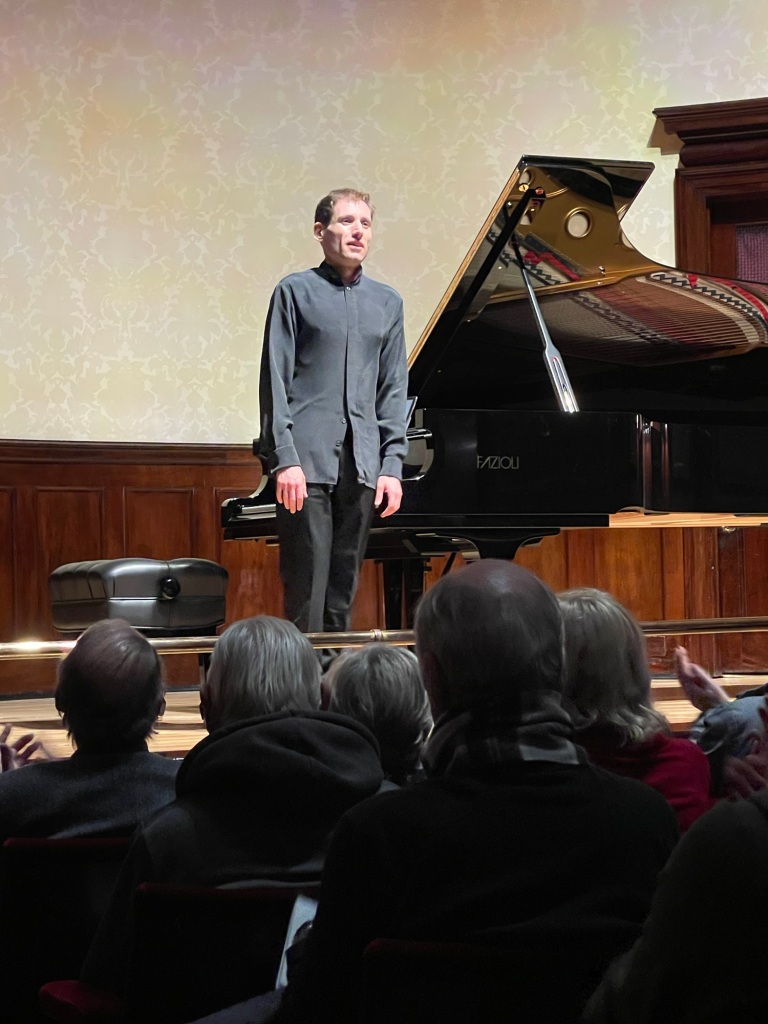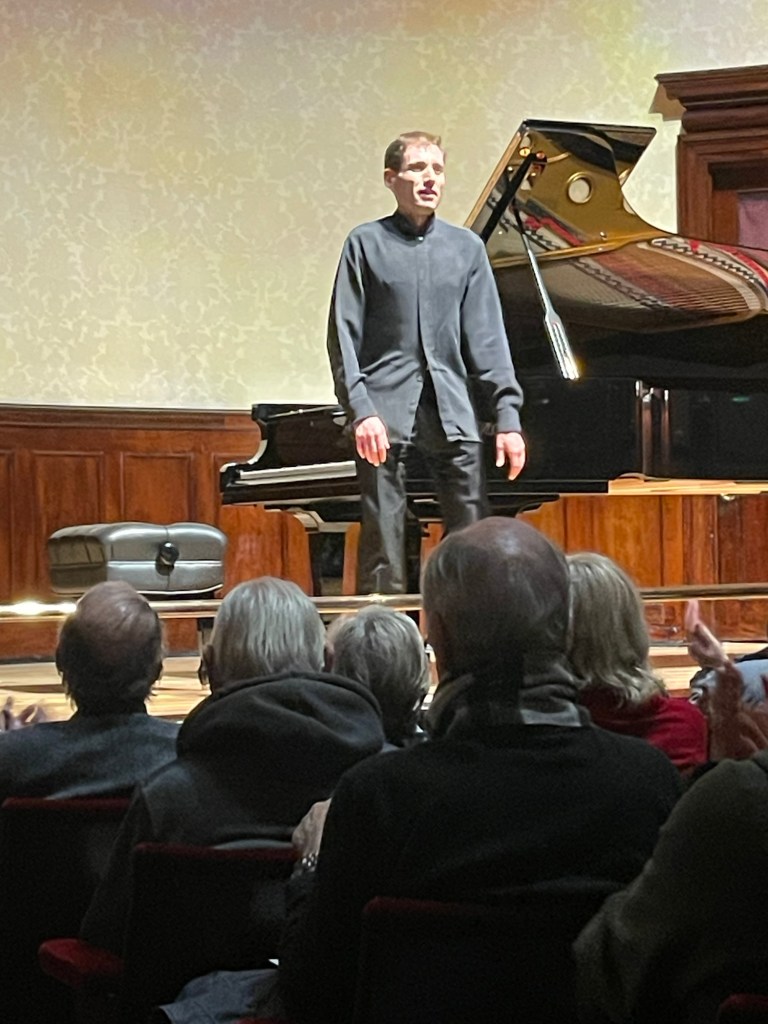
An eclectic Sienese pianist bringing intellectual curiosity and mastery to Roma 3. Ludovico Troncanetti playing to the manner born rarities of Saint -Saens ,Halevy/Liszt and Rubinstein. Totally dedicated to discoveries from the vast piano repertoire often overlooked by less curious musicians. It is hardly surprising to learn that he has been under the wing of Leslie Howard ,that master of eclectic musicians, since his teens.
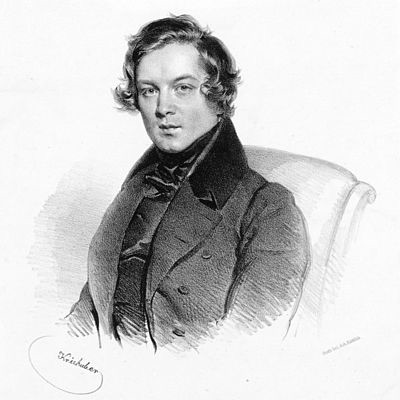
The Saint-Saens ‘Souvenir d’Italie’ was written when the master was visiting Florence and Siena in 1887.It is based on popular Italian songs and is a salon piece of great effect especially when played with the beauty and shape with which Ludovico endowed it.Cascades of embellishments thrown off with an ease and sense of style but one remained a little perplexed that the recital should start with an encore! It was immediately apparent why as he struck up the imposing opening of Liszt’s early paraphrase of Halevy’s ‘La Juive’.Two much more substantial works where the pill was sugared with the genial Saint-Saens.This Liszt paraphrase is a remarkable work for the amount of notes that Ludovico consumed with ease but one could not be totally involved or convinced as one is with Liszt’s later masterly paraphrases of Norma and Don Giovanni.However it was courageous to present such an unknown paraphrase and to prepare it in such a convincing professional way. The Fourth Sonata of Rubinstein left me even more perplexed as I could not seem to find a musical line to follow for the enormous amount of notes involved and tempestuous virtuosity that seemed to get in the way of real musical thought.I cannot see yet the wood for the trees like I found with Rachmaninov’s First Sonata.That also seemed to lack form until I heard revelatory accounts by Kantarow and Kelly where the form had been hidden in a leit motiv that pervades the whole Sonata.Even Rachmaninov had sought help with the form of his first sonata.I had found the same with Thomas Kelly’s remarkable performance of the Reubke Sonata for piano – a much admired student of Liszt who died at only 24 leaving only two Sonatas – one very well known for organ and the other completely neglected for piano.It is the second or third time I have tried to get to grips with this work that by many is considered Rubinstein’s masterpiece and I will try again until I am able to break the code.For now I can’t help thinking of Clara Schumann’s words :”I was furious, for he no longer plays. Either there is a perfectly wild noise or else a whisper with the soft pedal down. And a would-be cultured audience puts up with a performance like that!” But she also called the masterpiece that is Liszt’s Sonata (dedicated to her husband) a cacophonous noise when presented with it at home,her husband was already in an asylum. Vieuxtemps,violinist and composer,on the other hand said:”His power over the piano is something undreamt of; he transports you into another world; all that is mechanical in the instrument is forgotten”.It was Anton Rubinstein who said that the pedal was the ‘soul’ of the piano.Ludovico certainly played with remarkable authority and mastery where there was not a moment’s doubt of his total belief in all that he was doing.A master on a crusade – Hats off !
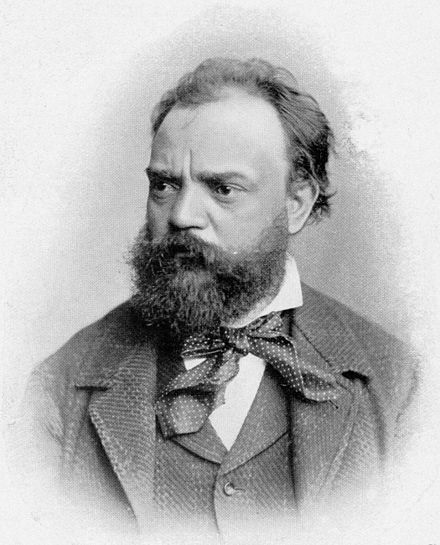
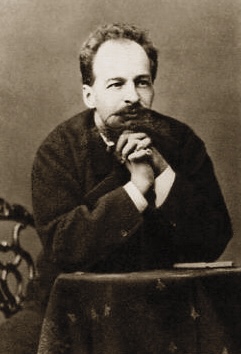
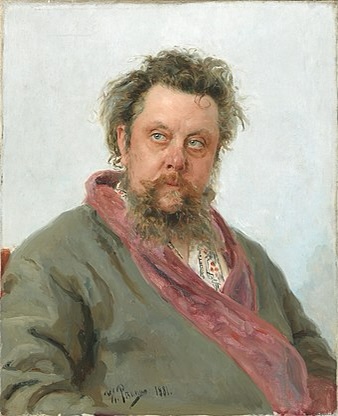
28 November [o.s.16 November] 1829 Vikhvatinets,Baltsky Uyezd,Podolia Governorate, Russian Empire Died 20 November [o.s 8 November] 1894 (aged 64) Petergof ,Saint Petersburg , Russian Empire
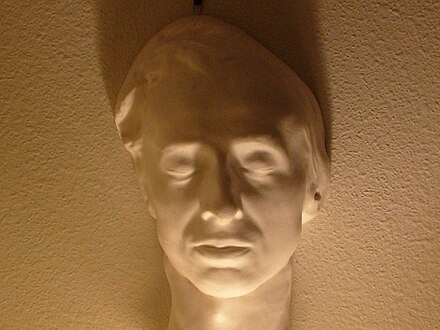
“Rubinstein’s features and short, irrepressible hair remind me of Beethoven.” Liszt referred to Rubinstein as “Van II.” This resemblance was also felt to be in Rubinstein’s keyboard playing. Under his hands, it was said, the piano erupted volcanically. Audience members wrote of going home limp after one of his recitals, knowing they had witnessed a force of nature.
Brothers Rubinstein: Nicolai (left) and Anton, 1862
Anton Grigoryevich Rubinstein was a Russian pianist, composer and conductor who became a pivotal figure in Russian culture when he founded the Saint Petersburg Conservatory. He was the elder brother of Nikolai Rubinstein, who founded the Moscow Conservatory.
As a pianist, Rubinstein ranks among the great 19th-century keyboard virtuosos. He became most famous for his series of historical recitals, seven enormous, consecutive concerts covering the history of piano music. Rubinstein played this series throughout Russia and Eastern Europe and in the United States when he toured there.
Although best remembered as a pianist and educator (most notably as the composition teacher of Tchaikovsky), Rubinstein was also a prolific composer; he wrote 20 operas , the best known of which is the Demon. He composed many other works, including five piano concertos, six symphonies and many solo piano works along with a substantial output of works for chamber ensemble.
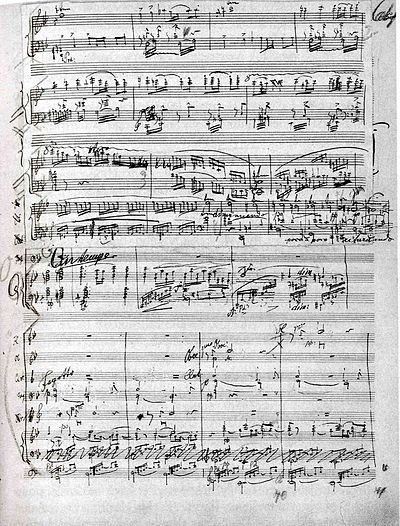
LESLIE HOWARD WRITES :In the more than a quarter of a century which separates the third from the fourth of the Rubinstein sonatas (the fourth appeared in 1880) lie only two of his major works for piano—the Fantasy, Opus 77, and the Theme and Variations, Opus 88, both of which are larger than any of the earlier sonatas and show a very different weight of thought from the dozens of character pieces which otherwise fill the Rubinstein piano œuvre. The fourth sonata turns out to be in this grand mould, on a much broader scale than the others, and is almost leisurely in its expansiveness.
Camille Saint- Saens
Once described as the French Mendelssohn, Camille Saint-Saëns was talented and precocious as a child, with interests by no means confined to music. He made an early impression as a pianist. Following established French tradition, he was for nearly 20 years organist at the Madeleine in Paris and taught briefly at the École Niedermeyer, where he befriended his pupil Gabriel Fauré. He was a co-founder of the important Société Nationale de Musique with the patriotic aim of promoting contemporary French music in the aftermath of the Franco-Prussian war of 1870-01, in which he had served in the Garde Nationale de la Seine. Prolific and versatile as a composer, he contributed to most genres of music, but by the time of his death in 1921 his popularity in France had diminished considerably, as fashions in music had changed.
LESLEY HOWARD WRITES :’As he did so often in the early fantasies, Liszt composed his piano work within the year of the first performance of Halévy’s most celebrated work La juive. Using motifs from Acts 3 and 5, Liszt produced a work of much originality; the shape of the opening Molto allegro feroce is entirely his, even if the thematic fragments are Halévy’s, and it is not until the recognizable martial chorus (Marziale molto animato, from bar 131) that he uses a whole theme. The succeeding Boléro is only loosely based on Halévy, but is the theme for two variations. The Finale (Presto agitato assai) begins as if it were a third variation but gives way to frenetically foreshortened recollections of the march and the introductory material. The ferocious opening foreshadows the ‘infernal’ music of Liszt’s Weimar period, but also shows immediate kinship with the Valse infernale from Meyerbeer’s Robert le diable, with which the La juive fantasy was reissued—along with the Huguenots fantasy and the Don Giovanni fantasy—in about 1842.’
Ludovico Troncanetti, senese, si diploma al Conservatorio di Milano, dove studia anche Composizione con il M°Gianni Possio. Segue corsi di perfezionamento con i M° Pier Narciso Masi, Andrea Lucchesini ed Henri Sigfridsson. Nel 2009 l’incontro a Londra con il M°Leslie Howard, pianista di fama mondiale noto anche peressere l’unico ad avere inciso l’integrale dell’opera pianistica d Franz Liszt in più 100 CD, con cui si forma e successivamente creerà, nel 2016, un duo stabile (2 pianoforti e 4 mani). Collabora anche con il pianista portoghese Artur Pizarro.Come solista ha suonato in varie importanti realtà concertistiche sia in Italia (Società del Quartetto Milano, Orchestra Sinfonia Città di Milano, Amici della Musica Trapani e Mazara del Vallo, Camerata Musicale Sulmonese, Società Filarmonica Messina, Roma Tre Orchestra, Palermo Classica, Monteverdi Tuscany, Pienza International Music Festival etc) che soprattutto all’estero (Germania, Spagna, Inghilterra, Bulgaria,Portogallo, Russia, Uzbekistan, India, UAE etc) ed ha suonato con prestigiose orchestre tra cui la St Petersburg Northern Sinfonia, Elbland Philharmonie Sachsen, Filarmonica Arturo Toscanini, Gyumri State Symphony Orchestra, National Symphony Orchestra of Uzbekistan.Il suo ampio repertorio spazia da J. S. Bach ai grandi compositori dei primi del ‘900 con particolare focus sul periodo romantico. In autunno 2019 esce sulla rivista AMADEUS il suo primo disco per l’etichetta Movimento Classical sulle 4 Sonate per pianoforte di Anton Rubinstein, compositore e pianista russo dell’800 per cui si adopera nel revival musicale pianistico anche con il M°Howard; sempre dello stesso compositore ad agosto 2023 pubblica il secondo disco, per la rivista SUONARE, con le ciclopiche Tema e Variazioni opus 88
The refined musicianship and solid artistic pedigree of Krystyna was immediately apparent from this 18 year old pianist’s opening with the four last Impromptus by Franz Schubert.Much longer and more complex than the earlier four that make up op 90,they are a challenge that only great musicians can attempt.Those who can allow the simplicity and mellifluous outpouring of Schubert in his final years to speak for itself without any superficial or superfluous intervention from the interpreter.That is not to say that within the notes there is not a lifetime experience of colour and inflections that as with speech allow the message of the musical conversation to be transmitted directly to the listener.
Annie Fischer and Rudolf Serkin are two whose performances are indelibly imprinted on my memory .The four Impromptus played together last as long as any of Schubert’s later Sonatas and seem as though they may have been written with that architectural shape in mind.It was just this mature musicianship allied to a technical mastery of beauty and infallible security that made her fingers seem like limpets that were sucking the life out of every key.A beauty of rich sound but also a sense of balance that allowed the musical line to ring out with a purity and simplicity that was of authoritative tenderness.It was the same sense of line and style that she gave to the beautifully evocative work by Amy Beach.
Liszt’s Spanish Rhapsody I have not heard played with such authority and sterling intelligent musicianship since Gilels’ monumental performance in London in the ‘70’s.She gave a remarkable performance where all of Liszt’s quite considerable demands were turned into poetry and music with a sense of style and artistry that was of a mature artist.Lacking only that driving rhythm of Gilels and passionate aristocratic bearing that made him appear like Arrau as though he was born to be seated in front of this box of ivory keys just as Liszt obviously was.That is a very exciting development that her musicianship will take as her personality develops and her experience of life widens.But this was quite extraordinary playing from someone who has just come of age.
There was a depth of sound and remarkable sense of colour and character .Tenderness and delicacy with the beautiful question and answer between the tenor and soprano voices ,the continual stream of gently flowing accompaniment like water flowing in a pastoral stream.There was a depth of feeling that was deeply moving because it was so real and completely without rhetoric or sentimentality. The second Impromptu showed off the luminosity of sound as the top notes shone with a radiance and purity like jewels glistening above the murmured chordal progression.A wonderful sense of legato and weight of deeply felt sentiment.There was a gentle lyricism to the B flat impromptu with the variations played with scintillating characterisation.Streams of notes flowed from her well oiled fingers with a jeux perlé of gold and silver.The clarity and scintillating virtuosity she brought to the last Impromptu brought this dance movement to life with beguiling simplicity and great excitement.A piece that I have not heard before but was played with great style and sense of colour .The melodic line was allowed to sing so beautifully due to her superb artistry and infallible sense of balance An imperious opening of sumptuous sounds leading to the appearance of the deep brooding bass melody which is gradually transformed into a scintillating whirlwind of notes of exhilaration and excitement.Technically impeccable as was her musicianship as she restored this old warhorse to its noble aristocratic origins.
Khrystyna Mykhailichenko is an 18 year old Ukrainian pianist who was born in Crimea. She began to play the piano when she was only four and her parents quickly realised that their little child was extraordinarily gifted. Within six years, she was winning international piano competitions and was performing in concerts throughout Europe and in the USA. The venues include Salle Cortot in Paris, Bozar Hall in Brussels, the Music Academies of Bruges, Antwerp, Krakow, Bremen, Gariunu concert hall in Vilnius, the University of Miami and Broward Centre for the Performing Arts, the World Bank in Washington DC, the UN residence in New York and all the National Philharmonics of Ukraine. In 2014, when the Russians occupied Crimea, Khrystyna moved to the capital of Ukraine – Kyiv. In March 2016, Khrystyna met the international concert pianist Professor Alexei Grynyuk who became her teacher and mentor. He said “Khrystyna’s gift is stronger and more powerful than anyone I have ever been able to work with before. This is a performer of the highest level.” At the outbreak of war in February 2022, she fled to Poland with her mother and sister before settling in Corbridge in June. As well as continuing to travel extensively for performances, she studied at the Junior RNCM under Graham Scott. She won a full scholarship from the Royal Academy of Music in London and has started her undergraduate course there in September 2023.she now lives in Ealing.
Schubert 31 January 1797 – 19 November 1828 a portrait by Anton Depauly
The second set was also like the first composed in 1827 but published posthumously as Op. 142 in 1839 (with a dedication added by the publisher to Franz Liszt )
The first Impromptu in F minor follows the form of a sonata exposition The second Impromptu in A-flat major is written in the standard minuet form. The third Impromptu in B-flat major is a theme with variations. Finally, the fourth Impromptu in F minor is highly virtuosic and the most technically demanding of the set. Due to their structural and thematic links, some envisioned the four Impromptus as parts of a multi-movement sonata, a conjecture which is subject of debate among musicologists and scholars.
Franz Liszt 22 October 1811 – 31 July 1886)
Rhapsodie espagnole (Spanish Rhapsody), S.254 R.90, was written in 1858 and is very suggestive of traditional Spanish music,that was inspired by Liszt’s tour in Spain and Portugal in 1845.The Spanish Rhapsody has become one of Liszt’s best-known compositions, although it took some while to establish itself in the repertoire. Liszt told Lina Ramann that he had written the piece in recollection of his Spanish tour whilst in Rome in about 1863.
The work was published in 1867—subtitled Folies d’Espagne et Jota aragonesa.Rhapsodie espagnole, folies d’espagne et Jota aragonesa (Spanish Rhapsody, Spanish leaves and Jota Aragonesa), S. 254, was based on his earlier Grosse Konzertfantasie über spanische Weisen, S. 253. It was composed in 1858 and published in 1867 in Leipzig by C.F.W. Siegel, dedicated to Eugénie, Empress of France (1826–1920).
Born Amy Marcy Cheney
September 5, 1867 Henniker,New Hampshire United States Died December 27, 1944 (aged 77) New York City, U.S.
Amy Marcy Cheney Beach (September 5, 1867 – December 27, 1944) was an American composer and pianist. She was the first successful American female composer of large-scale art music .Her “Gaelic” Symphony , premiered by the Boston Symphony Orchestra in 1896, was the first symphony composed and published by an American woman. She was one of the first American composers to succeed without the benefit of European training, and one of the most respected and acclaimed American composers of her era. As a pianist, she was acclaimed for concerts she gave featuring her own music in the United States and in Germany.
Il pianista Marco Scolastra illustra così il programma che ha scelto di eseguire:
“Inizio questo recital con alcune pagine danzanti e spiritose di Muzio Clementi, “padre” del pianoforte moderno. Di Mozart ho scelto due Fantasie, pagine intense, a tratti drammatiche. Di Beethoven una delicata Sonata giovanile e il celeberrimo “foglio d’album” Für Elise. In chiusura una selezione dei Peccati di vecchiaia di Rossini, la sua ultima e geniale produzione. Con sfacciata libertà qui convivono gioco, irriverenza, divertissement totale.” Marco Scolastra
PROGRAMMA
Muzio Clementi Tre Valzer dall’op. 38
Wolfgang Amadeus Mozart Fantasia in re minore KV 397 Fantasia in do minore KV 475
Ludwig Van Beethoven Sonata in do maggiore WoO 51 1. Allegro 2. Adagio
Für Elise WoO 59
Gioachino Rossini Quattro pezzi da Péchés de vieillesse: 1. Barcarolle 2. Une caresse à ma femme 3. Memento homo 4. Assez de memento: dansons
An illustrious audience at the Goethe Institute in the IUC Concert Season for the genial Marco Scolastra Remembering his teacher Aldo Ciccolini and the discovery of the fourteen volumes of the Péchés de Vieillesse that Rossini penned in his retirement from the Opera Stage that had brought him fame and a considerable fortune. Remembering too Maria Tipo who had done so much to promote the 110 Sonatas by Clementi of which it is rare to hear any in the concert hall. Marco’s concert set out to show us what we are missing with a programme starting and finishing with Clementi and including five pieces by Rossini.
A voyage of discovery indeed as he played a little known Sonata in two movements by the 21 year old Beethoven. Two Fantasies by Mozart in D and C minor completed this short panorama. Playing from the score with the chiselled precision of serious musicianship.It was in Beethoven’s Fur Elise and Rossini’s ‘Caresse a ma femme ‘ that Marco allowed us to see that he also had a soul and could allow himself to delve into these intimate portraits of ladies obviously close to the composers.
Tied to the score he could not quite find the charm and colour or the evident freedom and joie de vivre of the composers but instead played with the clarity and rhythmic drive that is so much part of the great Neapolitan school of piano playing
Ha compiuto gli studi musicali presso il Conservatorio di Perugia diplomandosi con il massimo dei voti e la lode con il M° Franco Fabiani. Ha studiato successivamente con Aldo Ciccolini e Ennio Pastorino e ha frequentato corsi di perfezionamento con Lya De Barberiis, Paul Badura-Skoda e – all’Accademia Chigiana – con Joaquin Achúcarro e Katia Labèque.
Ha suonato per importanti istituzioni musicali: Teatro Valli di Reggio Emilia; Sagra Musicale Umbra; Teatro Lirico di Cagliari; Accademia Filarmonica Romana, IUC, Teatro Eliseo, Oratorio del Gonfalone, Auditorium Parco della Musica e Teatro dell’Opera di Roma; Teatro Regio di Parma; Auditorium dell’Orchestra “G. Verdi” di Milano; Teatro Comunale di Bologna; Festival dei Due Mondi di Spoleto; Ravello Festival; Teatro La Fenice di Venezia; “I concerti del Quirinale” in diretta RAI Radio3; Teatro di San Carlo e Associazione “A. Scarlatti” di Napoli; Associazione “B. Barattelli” di L’Aquila; Musei Vaticani; Teatro Massimo di Palermo; Serate Musicali di Milano; “Museo Rossini” di Pesaro; Conservatorio “P. I. Čajkovskij” di Mosca; Tonhalle di Zurigo; Konzerthaus di Berna; Istituto “F. Chopin” di Varsavia; Orchestre National du Capitole di Tolosa; Festival van Vlaanderen in Belgio; Parlamento Europeo a Bruxelles; Musikverein di Vienna.
Come solista ha suonato sotto la guida di molti importanti direttori d’orchestra: Yuri Bashmet (I Solisti di Mosca); Andrew Constantine (Nordwestdeutsche Philharmonie); Romano Gandolfi (Orchestra Sinfonica “G. Verdi” di Milano); Howard Griffits (Orchestra da Camera di Zurigo); Richard Hickox; Claudio Scimone (I Solisti Veneti); Lior Shambadal (Berliner Symphoniker); Luigi Piovano (Roma Tre Orchestra); Giedrė Šlekytė (Wiener Concert-Verein). Per molti anni ha suonato in duo con il pianista Sebastiano Brusco. Ha collaborato con grandi artisti quali Vadim Brodski, Renato Bruson, Alessandro Carbonare, Max René Cosotti, Roberto Fabbriciani, Cinzia Forte, Fejes Quartet, Corrado Giuffredi, Sumi Jo, Raina Kabaivanska, Daniela Mazzucato, Quartetto d’Archi del Teatro di San Carlo, Quartetto Kodály, Desirée Rancatore, Charlie Siem. Intensa la collaborazione con il drammaturgo Sandro Cappelletto del quale ha partecipato più volte al programma Inventare il tempo in onda su RAI5. È in scena con illustri attori: Sonia Bergamasco, Arnoldo Foà, Elio Pandolfi, Ugo Pagliai, Lucia Poli, Jerzy Radziwilowicz, Pamela Villoresi.
Da sempre appassionato della musica del Novecento e dei nostri giorni, ha eseguito molti lavori in prima esecuzione assoluta o in prima italiana, alcuni dei quali a lui dedicati: Concerto per due pianoforti e percussioni di Darius Milhaud (2004); Concerto della demenza di Vieri Tosatti (Spoleto Festival 2005); Dance Variations per due pianoforti e orchestra di Morton Gould (2005); Verdi contro Wagner di Matteo D’Amico (2013); Tirol Concerto di Philipp Glass (2017); Aria da concertodi Silvia Colasanti (2019); Quattro canti popolari ciociari di Marcello Panni (2020); Il tempo non esiste di Lucio Gregoretti (2023).
Registrazioni:
Colours and Virtuosity of the 20th Century in Italy – Phoenix Classics (2000)
Wagner Lieder – Brilliant Classics (2013)
The Song of a Life: Tosti Romances – Brilliant Classics (2015-2020)
Ritratti e impressioni. Per un pianoforte francescano – CMSF (2018)
Bach: Concerti per 2, 3, 4 pianoforti e archi, DECCA (2019)
Poulenc: La voix humaine & Histoire de Babar – Brilliant Classics (2019)
Britten: Folk Songs (con Mark Milhofer) – Brilliant Classics (2021)
Venite a intender (con Mirco Palazzi) – Urania Records (2022)
Enrico Caruso. His Songs (con Mark Milhofer) – Urania Records (2023)
Haydn Sonata No. 31 in A flat major, Hob XVI:46 Debussy Images Book 1, L. 110 Debussy Images Book 2, L. 111 Chaminade Sonata Op. 21 in C minor Steinway Hall 44 Marylebone Lane, London W1U 2DB
Wednesday 18 October 2023 at 6.30pm
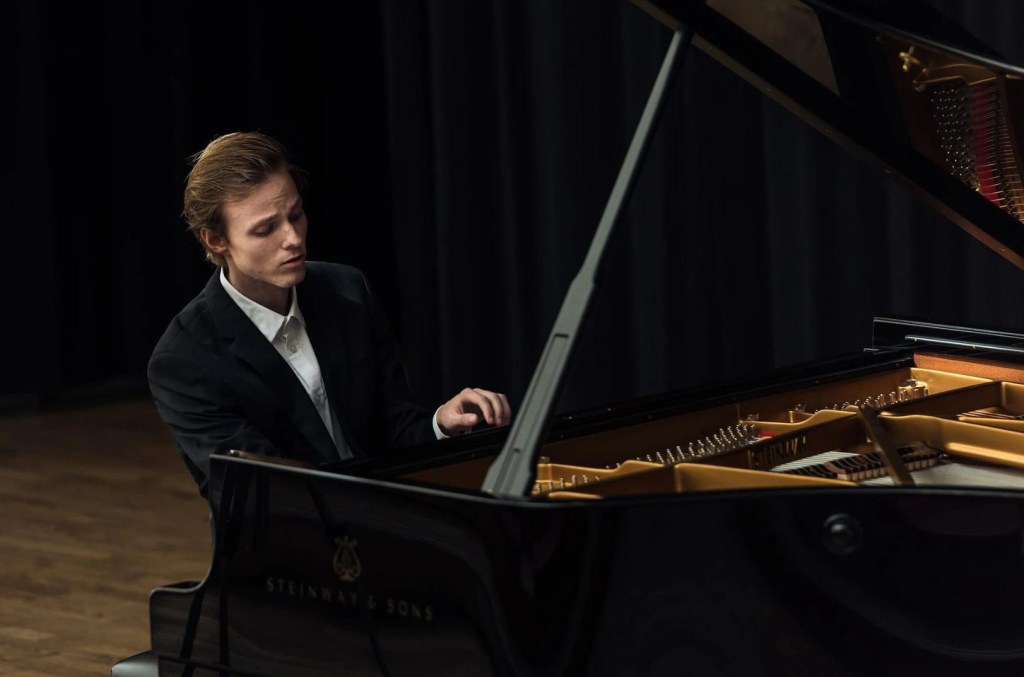
Born in France, Louis-Victor Bak is a solo and chamber music pianist. He began piano lessons at the age of fourteen, following seven years of flute studies. In 2017, he moved to Berlin to study with Laurent Boullet; and in 2019, he came to London to study at the Royal College of Music with Edna Stern. In 2023, he graduated from the RCM and is currently studying for a Master of Performance with Edna Stern and Vanessa Latarche, as an Ilona Eibenschutz Award Holder.
Louis-Victor has recently performed as a soloist at St James’s Piccadilly, St James’s Paddington and at the Amaryllis Fleming Hall at the RCM. He has also performed at St Bride’s, St John’s Waterloo, St Paul’s Bedford, the Russia Culture House of London, the Routh Hall Bromsgrove and in France (Salle Witkowski, Palais St Jean, Musée des Tissus et des Arts Décoratifs de Lyon, Salle Debussy), Sardinia and Switzerland. He was invited to perform in the Second Prokofiev Festival in London and in the Festival Musique et Or in 2021.
In 2021, he won First Prize at the North International Music Competition, Third Prize at the Windsor International Piano Competition, Second Prize at the Franz Liszt Centre International Piano Competition, Second Prize at the International Music Competition Opus 2021 and the special Prize ‘Debut in Transylvania Recital Award’ at the Youth of Music International Competition. In 2022, he was also selected to take part in the prestigious Maria Canals Competition in Barcelona.
Louis-Victor was a 2022 recipient of the Royal Philharmonic Society Julius Isserlis Scholarship.
Villa Ephrussi de Rothschild in Cap Ferrat The Mosaic Festival with Master and student series that included Edna Stern with Louis- Victor Bak and Elisabeth Leonskaja with Evelyne Beresowsky
Dear Edna Stern,
It was nice to meet you today in the Royal College of Music together with William Naboré and to listen again to your very fine student before you go to perform together in the Mosaic festival in Cap Ferrat.(Edna ,now a Professor at the RCM had studied with William Naboré at the International Piano Academy Lake Como https://christopheraxworthymusiccommentary.com/2023/10/03/william-grant-nabore-bestrides-the-rcm-like-a-colossus/) ‘Louis-Victor’s Chaminade was like the sun suddenly coming out .Images sounded so woolly and tired and indifferent like an old love . He almost started to move in Chaminade as the new love of his life ignited his playing. He needs to play chamber music and like Peter Frankl a cat looking in all directions ready to pounce Movements should be like on a knife edge not like on a cosy velvet cushion.Relets needed more icy sounds to contrast with the beauty that was too evident throughout infact submerged with beauty .Homage needed that aristocratic Rubinstein French sound before opening the gate to paradise at the end. Chaminade left me exhilarated and excited instead of bored and indifferent Why not Images Book 2 and get a quick divorce from Book 1
You know indifference and boredom can kill even the greatest of loves’(Note Leslie Howard’s comment below of Book 2 n.2!)
Dear Christopher, I will pass on to Edna ; but thank you for coming and for your kind words ! This was truly inspirational for me, and I am sure this will help me to give these Debussy’s a fresh eye – I am looking forward to experimenting new things and give back all the magic in this music
Louis – Victor Bak with Leslie Howard
‘I know you’ll be able to listen online, but just want to report that Louis-Victor Bak did us proud at SH last night..A really lovely programme with a stylishly authentic account of Haydn’s 31st Sonata (perfect ornaments!), marvellously characterised Debussy Images (Et la lune descend was deeply moving) and a cracking account of the neglected but fascinating sonata by Chaminade.He is a first-rate musician!’Leslie Howard
What a pleasure it was to play Haydn, Debussy and Chaminade at Steinway & Sons UK yesterday evening ! Thank you so much to The Keyboard Charitable Trust for inviting me
THE FRENCH CONNECTION review by Angela Ransley
The Keyboard Trust was delighted to welcome French pianist LOUIS-VICTOR BAK to Steinway Hall on Wednesday 18 October 2023 where we heard an imaginative programme, followed by a conversation with Artistic Director Leslie Howard in which he outlined his musical journey and hopes for the future. He is no stranger to London audiences, having been an undergraduate at the Royal College of Music where he is now completing his Masters Degree in Piano Performance under Edna Stern and Vanessa Latarche. In addition to London recitals, for example at St James Piccadilly, he has performed in France, Switzerland and Sardinia. He has also won prizes in a number of international competitions.
Franz Josef Haydn
The recital began with the Sonata in Ab Hob XVI/46 by Joseph Haydn. It has a late entry in the catalogue because it was not published until 1786, although being written about twenty years earlier. The vitality and musical invention here speak of a particular point in Haydn’s long life, when he could at last assume control as Director of Music at the Esterhazy Palace in Eisenstadt. This post involved isolation from his fellow musicians and Haydn himself remarked: ‚I was forced to become original‘ Expect the unexpected in sudden turns of harmony, densely woven lines, little figures that tickle the ear, and of course the long toccata-like passages unique to Haydn’s keyboard writing. Is it possible that the diversity found in a single movement has led these sonatas to become less popular than those of Mozart? How to hold all these ideas together? Louis-Victor seems to have found the answer by listening intently to the inner narrative and then giving each passage its time and place.The first movement alternates highly-decorated melodies that reflect in sound the intricate stucco of the palace with nimble finger work. Each were played with meticulous accuracy and the passages always sparkled. The middle movement is an oasis of calm in the remote key of Db – daring for its time.The final Presto gallops home in a whirl of semiquavers performed by Louis-Victor with unerring pulse and precision.
Esterhazy Palace, Eisenstadt Claude Debussy
We were fortunate to hear all six of Debussy’s extraordinary Images, the first three being written in 1905 and the last three over the next two years. What a wealth of imagination, colour, textures and sonority when they are all heard together! Three of Debussy’s major preoccupations are in evidence: the beauty of the natural world (Reflets dans l’eau, Cloches parmi les feuilles); the past and its timeless quality (Hommage a Rameau, La lune descend sur the temple qui fut); exuberant vitality (Mouvement, Poissons d’Or). In Reflets and Cloches Debussy shares with us nature’s moments of pure magic: reflections in water and the moon shining on an ancient temple.
‚There is nothing more musical than a sunset. He who feels what he sees will find no more beautiful example of development in all that book which, alas,musicians read but too little – the book of Nature.‘ (Claude Debussy)
Louis-Victor showed his native understanding of Debussy here by bringing specifically French qualities to his interpretation: intelligent control and fastidious attention to detail in these gentle, reflective scenes.
Debussy wrote, first performed and recorded many of his solo piano works in his fifties and they are the fruit of his mature style and global interests, which, although still employing key signatures, venture far beyond tonality with whole-tone scales and passages with no tonal focus at all. In his book The Art of French Piano Music, Dr Roy Howat proposes that it was Debussy’s deep engagement with the gamelan music of the Far East that changed for ever his approach to writing for the piano. In his Cloches and La lune, the layering of the gamelan orchestra and piano equivalents of the high gongs are clearly heard.
In Mouvement and Poissons d’Or, we hear Debussy the virtuoso pianist. He is known to have said: ‚the century of airplanes has a right to its own music‘: the driven toccata that is Mouvement suggest to me the arrival of the machine that shattered the peace of so many at the turn of the century.Poissons d’Or are likely to be the fish found near Asian temples connected to the symbol of the dragon, not goldfish. (French for goldfish is ‚Poisson rouge‘, not ‚Poissons d‘Or’). Debussy’s pianism was held in the highest regard by his contemporaries: simple, unaffected, rhythmically precise. A number of recordings of Debussy performing his own music are available – see link below. Louis-Victor performed these different character pieces with full knowledge of their tradition with many revelatory moments.
Cecile Chaminade
Louis-Victor closed his recital with a French rarity: the Sonata in C minor by Cecile Chaminade (1857 -1944). Cecile was prevented by her father from attending the Paris Conservatoire but studied privately with its teachers instead. Her compositions began early and with time she emerged as pianist and composer, only performing her own works. Her career developed beyond France in the UK and North America and her published music had financial success. Her English contemporary, Ethel Smyth one remarked: ‚I fear that when I die, my music will die with me’. This is exactly what happened. Cecile was totally ignored in the second half of the 20th century and it is thanks to champions such as Louis-Victor that her music is now being revived.
‚I am essentially of the Romantic School, as all of my work shows‘ Chaminade wrote. All the hallmarks of that School are present in this sonata: C minor, the key of passionate outpouring favoured by Beethoven and Chopin, dazzling octaves, certain tonality, the ability to build and deliver exciting climaxes. What Cecile adds is her own individual voice: the unexpected fugal exposition in the first movement, the wonderful use of a short rhythmic motif to structure the second movement and the ability to unleash elemental fury in the left hand of the final Allegrowhich may well have led Ambroise Thomas to say ‚This is not a woman who composes but a composer who happens to be a woman‘. With over 6000 neglected composers ‚who happen to be women‘ now listed, it is time for Cecile Chaminade to be granted her proper place by posterity.
All of Louis-Victor’s musical and technical strengths – the intellectual insight, sensitivity, colour – were required and employed to deliver both the poetic and the passionate sides of this demanding sonata and its rousing climax drew impressive applause from an impressed audience.
It is a feature of the Steinway Hall evenings that, following the recital, the soloist is heard in conversation with one of the Artistic Directors, on this occasion Dr Leslie Howard. Louis-Victorshared with us how he studied the flute for seven years before taking up the piano seriously at the late age of 14. When asked about his future, he revealed that his heart lies in the French tradition and he wishes to bring lesser known French composers including Chaminade to public knowledge. We wish him joy and every success in this venture and look forward eagerly to the delight of fresh pianistic treasures.
Post concert reception
References:
The Art of French Piano Music Roy Howat (Yale University Press, 2009)
A very special day in Florence for the final concert of the Montecatini International Piano competition with 7 very fine pianists playing to an International jury including Sofya Gulyak and many other illustrious colleagues from the world of music.
All assembled around the indomitable Aisa Ijiri.But the real star of the occasion was the wonderful 200th piano of Angelo Fabbrini. Maestro Fabbrini has long been the indispensable friend to most of the greatest pianists of our time.This piano was specially made to celebrate a very special marriage between Steinway and Fabbrini.Signed by many of the pianists that have been fathifully served by a technician who is above all a magician.
And so it was with the very first pianist of the day Alessio Ciprietti that the sumptuous sounds of this instrument wrapped themselves so warmly around us like the sumptuous decor of what is the oldest theatre in Florence.Built in 1648 and has reopened in 2016 after a 20 year restoration project to bring it back to its original splendour.
The director of the theatre Antonio Pagliai with the Jury in his beautiful Teatro Niccolini Nima Keshavarzi,conductor of La Filharmonie with Director of the theatre Antonio Pagliai
The director of the theatre had told us that in 1707 an opera of the young Handel ‘Vincer se stesso è la maggior vittoria’ received its first performance in this theatre that is just a stones throw from Florence Cathedral.
Ryan Wang 16 year old winner of first prize with 13 year old brother cellist and their mother .Ryan is from West Vancouver where he began playing piano at age four.In 2013, at the age of five, he performed at Carnegie Hall and in September 2014, he began studying piano with professor Lee Kum-Sing at the Vancouver Academy of Music.Currently, he is studying on a music scholarship with Mr. Gareth Owen at Eton College and is also in the Artist Diploma program with Prof. Marian Rybicki at the Ecole Normale in Paris .
A young Chinese Canadian Ryan Wang at only 16 played like a real artist with a disarming simplicity and beauty and won first prize.
Anisa Dazhaeva, 20 years old ,had won first place in the Verona International Piano competition on the 8th October 2023.She studied in Moscow Special Music school of Gnessin and is winner and laureate of many International and Russian competitions.
Anisa Dazhaeva at the ripe old age of 20 came a close second untangling the knotty twine of Rachmaninov’s first sonata with real mastery.
Alessio Ciprietti ,the first to play this superb instrument that he played with delicacy and ravishing fluid sounds.Demonstrating his virtuosity with a very individual performance of Debussy ‘s ‘Feux d’artifice’ full of colour and brilliance if rather disjointed.But it was the Corelli Variations by Rachmaninov that showed his true musicianship where he shaped these remarkable variations with sumptuous colour,brilliance and an architectural understanding that made the return of ‘La Follia’ an arrival in paradise after so many extraordinary transformations. Alessio was awarded a Special Prize of a concerto performance with the Orchestra Filharmonie of Florence.Anisa Dazhaeva. A single work but one that had also been a problematic one even for Rachmaninov.The First Sonata that Anisa was able to shape with beauty and the sense of architectural shape that was so original for its day. A brooding mysterious leit motif that pervades the thirty five minutes with an enormous amount of notes.Notes that in Anisa’s hands were just streams of golden sounds.A slow movement with a ravishing sense of balance with flights of fantasy in Anisa’s magic world of sounds.The last movement was played with real technical mastery and changing temperament until the clouds cleared and the opening melody was revealed in all its disarming simplicity.One might say from the sublime to the ridiculous! A real artist who I would like to hear in a more varied repertoire too. A very close second prize to a real artist.Teppei Kuroda showed his beautiful sense of colour and sensitivity in Debussy’s magical second book of Images.It was very refreshing to see how his hands just caressed this beautiful instrument as he delved deep into it’s soul to extract some truly magical sonorities. Scriabin studies were played with great clarity if just missing the fluidity that he had revealed in Debussy. Bartok’s demonic sonata was played with real musicianship revealing a kaleidoscope of sounds and rhythmic drive.Beautiful sonorities in the slow movement before the dynamic drive of the last.Crisp and clear with the architectural shape of a true musician but just missing the red hot Hungarian passion. It was good to see that he tied third with Ekaterina and was awarded the Special Prize ,generously offered by Steinway Artist and jury member Congyu Wang, of a concert in his Piano Island Festival in Indonesia . Ekaterina Bonyushkina .A varied programme of Beethoven Waldstein Sonata ,Prokofiev 3rd and a scintillating study by Kapustin that showed off her sensitivity and quite considerable technical mastery.Slightly missing in weight in Beethoven where the beauty of her playing needed a steadier pulse that this above all Beethoven Sonatas demands.A real stylist ready to shape with beauty and sensitivity each phrase sometime sacrificing the overall architectural line. The Prokofiev Sonata was played with unusual sensitivity of a sonata that so often is played like a bull in a china shop.There was dynamic drive and real beauty that was so refreshing to hear. But it was the Kapustin Study that ignited her true brilliance and superb jeux perlé as she relished this jazz oriented virtuoso world of Kapustin. It was no doubt this above all that decided the jury to award her joint third prize with Teppei Kuroda.Ryan Wang – a real artist from the very first notes of the second half of Chopin’s 24 Preludes op 28.A simplicity and beauty of sound,a delicacy of phrasing but also a sense of rubato that cannot be taught but is of real artistry.He played the magical phrases of the ‘Raindrop’ Prelude with subtle colours and the sense of breathing of a great bel canto singer.The B flat minor Prelude n.16 was played with transcendental control and fire with never a moment of doubt that we were in the hands of a master as he climbed to the top of the peak .A fluidity to the the penultimate prelude that was of such disarming simplicity as the final D minor prelude erupted with passion and transcendental mastery.The final three D’s like a great stab in the heart deep in the depths of this beautiful instrument never hard or ungrateful but each note full of poignant meaning. La Valse in Ravel’s own demonic transciption showed off his astonishing technical mastery but also a clarity that could allow him ,no matter what challenges he faced,to keep the shadow of the waltz ever present.Double glissando shot from his agile fingers like rays of light over the keys in a remarkable display of musicianship and technical mastery. At only 16 it is no surprise that the Jury awarded him first prize. He was also awarded two special prizes of a recording for KNS classical and a Concert in the Faro Festival in Portugal offered by the ever generous Congyu Wang.Helen Meng. Some beautifully crafted playing of great intelligence.Her Mozart was simple and beautiful with sparkling playing of great weight.Playing of great poise in the slow movement of aristocratic beauty.The last movement sprang from her agile fingers with a ‘joie de vivre’ that was of great rhythmic energy and finesse. The Chopin Variations op 2 are the ones that Schumann on hearing Chopin play them in Paris was to remark ‘Hats off a genius’.A very well prepared performance of great musicality and intelligence where the technical difficulties were incorporated into a musical shape of beguiling style.A jeux perlé that flowed with teasing ease from her agile fingers.A fine performance that just missed the charm and grace of a show piece written especially as a visiting card for the young Chopin as he played in the Salons of the aristocratic Parisian families of his day.Sofya Kornoukhova presented a single work – the Liszt Sonata in B minor. It is a work that is the pinnacle of the Romantic piano repertoire and can present interpretative problems that for a competition can easily lead to discussions also amongst the jury members themselves! Sofya courageously presented the Sonata with her own personal interpretation from the so called ‘Liszt Tradition’ rather than looking deep into what Liszt had actually written in the score.Her impulsive rhetoric sometimes took her into deep and muddy waters but there were also some moments of great beauty especially in the Andante and the final visionary page. Liszt had originally conceived a final in great Romantic style with all the guns being fired but he then cancelled it and wrote one of the most visionary pages in all music.There were many beautiful things but from the very first page Sofya had shown us her Romantic intent.The three main germs of the music are exposed piano/mezzo forte and forte with the fortissimo only on the second page before the real beginning of the Sonata where these three themes are in continual evolution in Liszt’s genial recreation of the Sonata form.A very talented young pianist that now needs to realise that classical music can sometimes benefit from a certain Romantic freedom whereas Romantic music needs to be kept more in a classical frame otherwise one looses the sense of architectural whole.However interpretation should always start with scrupulous attention to the composers markings and Liszt wrote detailed indications of the notes but also the pedal in his scores that are too often ignored at the peril of the performer and detriment of the composer!The competitors The jury The prizewinning ceremony Maura Romano, cherished friend of all pianists ,country manager for Steinway and Sons in Italy with her splendid new flagship showroom in MilanTeatro Niccolini
As if this was not enough the indefatigable Aisa had organised as director of the Montecatini Competition a short concert to give a platform for three Young Talents of the Junior Montecatini Competition :Anju Nogiwa,Jelena Niksic and Dusan Dakic.
Anju Nogiwa played Liszt’s famous Liebestraum n.3 with great fluidity and beauty shaping this famous but now rarely heard work into a tone poem of subtle colour and finesse.Even the passionate outpourings were incorporated into a magic world of ravishing poetry.The Chopin Nocturne op 27 n.1 the partner of its more famous twin n.2 was played with subtle colouring and remarkable control of sound.Helped a little by splitting the hands at the opening her sense of balance was of extraordinary sensitivity and poise with the gradual build up to a climax of sumptuous sound.A beautifully stylish performance of the rarely heard Granados Allegro de Concert op 46 that was bathed in sumptuous colours full of the radiance of the beguiling style of Spain.Jelena Niksic played the Scriabin Sonata n. 2 known as the ‘Fantasy’ Sonata. It was exactly this sense of fantasy and improvisation that she brought to the first movement with a subtle kaleidoscope of sounds.The last movement was played with great technical assurance and passionate commitment.Dusan Dakic played his own piano suite in four movements.The first using deep bass sonorities on which sharp penetrating sounds were added in the treble.Clusters of tranquil chords in the second brought great peace and contrast whereas the third was more melodic with embellishments of great character with sounds floating on long held pedal.The last movement was a toccata played with great rhythmic energy. An interesting suite played by a real thinking musician.Jelena and Dusan united in a performance of Dvorak’s Slavonic Dance n.1 op 46 .Full of spirit and a dynamic range of colour and impeccable sense of ensemble and style.It was an exhilarating way to conclude today’s music making before the final Award Ceremony .Jelena Niksic and Dusan Dakic two fine young musicians sharing some superb music making with us before the Award Ceremony The Wang brothers with CA Even the café of the Teatro Niccolini is playing our tune Some of the illustrious pianist that have signed the Fabbrini 200th Steinway The Prize Winners and jury
Artists are born not made .They can be nurtured and even destroyed but that magic thing that some may call soul is something that grows within by a personality that chooses what to take and what to leave .It was Curzon,though,who wisely said that to be a great pianist is 90% work and 10% God given talent. It was just the right setting then with Marcus Aurelius bestriding his stallion in the capital of Rome for a young man that Marcella Crudeli had realised his talent since his teens and was happy to introduce him to her public at the presentation of her International Piano Competition next month. Now only just 24 and obviously realising what a responsibility his talent is,he has finally dedicated all the hours needed to allow his talent to flourish and take wing . And take wing it certainly did today! An unbelievable transformation as we saw before us the birth of a great artist with an artistic personality and temperament that left me bewitched ,bothered and bewildered .
A performance of Beethoven’s Moonlight sonata that was like hearing it with the ink still wet on the page .All Beethoven’s indications were there but there was a personality of such daring artistry that it was quite breathtaking in its beauty,dynamic drive and simple originality. Chopin playing where he breathed in a way that the greatest Bel canto singers could only dream to be able to imitate. Liszt’s Venezia e Napoli was played like the greatest opera performance ever.
Showmanship too with the Tarantella but it was the sublime melodic line in the central episode that will remain in my memory to cherish. A Campanella of incredible finesse and artistry followed by the disarming beauty of Chopin’s posthumous C sharp minor nocturne Of course the C minor nocturne op 48 earlier had been monumental just as the first Ballade had been so romantically original and full of ravishing beauty and fire but never neglecting the composers indications.
Dear Marcella you were right Emanuele Savron has become a great artist. Thanks must also go to Leonid Magarius in Imola who has obviously been cracking his Russian whip just in time to allow his talent to flourish and flower as we all saw today and that you had seen already some years ago.
https://christopheraxworthymusiccommentary.com/2021/07/31/sorrento-crowns-marcella-crudeli-a-lifetime-in-music/There was nobility and beauty in the Adagio sostenuto of Beethoven’s ‘Moonlight’Sonata .A continuous flowing tempo as the two voices replied to each other with aristocratic nobility and delicacy.Some very beautiful phrasing of elegance and beauty and an ending of great poise .The Allegretto was graceful and delicately phrased with a Trio that was beautifully shaped with a kaleidoscope of colours.The Presto agitato was very stylishly played as here was a great personality with playing of great excitement and effect but also of ravishing timeless beauty.Never ignoring Beethoven’s precise indications but interpreting them with great individuality and style.The cadenza like scale to the final chords was played as a recitativo with every note given great weight and meaning.A ravishing sense of balance was immediately apparent in Chopin’s C minor Nocturne op 48 n.2.Nobility and beauty combined with a superb technical command and a masterly use of the pedals.There was a wonderful build up to the passionate and overwhelming climax with octaves fearlessly turned into streams of sounds.Sounds on which was balanced the melodic line with sumptuous beauty and the final trail of notes was played with the simplicity of someone who had something important to say. The study op. 25 n.1 was allowed to sing so beautifully – often referred to as the ‘Aeolian harp’ study the reason for which was so apparent in Emanuele’s very sensitive hands.There was a bel canto sense of breathing with very stylish phrasing of timeless beauty allowing the music all the time necessary to unfold with disarming simplicity and beauty. The study op 25 n.12 known as the ‘Ocean’ study because of its continual waves of sound over the entire keyboard.I had heard Emanuele play this very study two years ago and was astonished and overwhelmed by his performance today that was of such overwhelming authority and passion with never a moment of doubt as the great bass melodic line was allowed to seduce us with ravishingly sumptuous sounds. There was great beauty as the Ballade in G minor was allowed to unfold at the start of a great journey.A tone poem of beauty,excitement and passion.Some say that the Ballades were inspired by the poems of Mickiewicz but it was the poetry that flowed from this young mans hands that was so beguiling and overwhelmingly convincing.The opening fiortiora was allowed to unfold with consummate ease and with such personality as he drew out the melodic line with a rubato that was so eloquent allowing the music to speak with disarming poignancy. Passion and virtuosity united to ignite this Ballade with the same youthful passion with which it had been born.The coda was played with extraordinary musicianship but also showmanship as the final scales shot to the top of the keyboard like rockets only to be greeted by the calming balm of gently vibrating chords before the final tumultuous cascade of octaves that were played with aristocratic nobility and passionate commitment.The final chords played quite gently as this young poet of the piano was listening so sensitively to the great story that was being told.Liszt’s Venezia e Napoli suite drifted onto the keys as the waves would gently lap the sides of the lagoon creating the magic atmosphere for the canzone del Cavaliere Peruchini :”La Biondina in Gondoletta’ .Moulded with stylish phrasing and great freedom with the delicate shimmering accompaniment played with superb control and gossamer lightness.The left hand dolcissimo almost without pedal as the melodic line was allowed to sing with ravishing beauty above.An ending of almost improvised freedom as the piece died away so gradually to a mere whisper.On this whisper entered the strident operatic ‘Lento doloroso’ as Liszt asks ‘ accentuato assai ‘.A scene of pure operatic recitativo was played out with wonderful assurance and sumptuous phrasing .’Nessun maggior dolore’ canzone del Gondoliere nel Otello di Rossini as Liszt writes in the score and Emanuele played with the authority of a Caruso striding the stage .There was ravishing beauty and clarity of the left hand arabesques as this Canzone came to a gradual end with the angels on high responding to the tenor’s imploring insistence.And out of the final mist come creeping in on a wave of pedal ( as Liszt asks and rarely gets!) the menacing frenzy of the Tarantella.Wonderful characterisation and rhythmic drive and an enviable ‘fingerfertigkeit’ lead to the ravishing beauty of the ‘Canzona Napolitana’.This for me was the highlight of the recital with the melodic line played with the beguiling ,teasing artistry of a different age Played with a freedom and personality that is so rare these days where artists do not dare to climb the high wire for fear of falling off. No fear for this young man as the music became more and more beautiful and elegant building up to the transcendental frenzy and vibrant virtuosity that Liszt the greatest showman on earth could pull out of his hat.Like Paganini he was able shock and excite his audiences turning the sedate ladies of the salons of the day into screaming ,frenzied animals! Liszt’s Paganini Study n.3 in G sharp minor better known as ‘La Campanella’ was to follow. A tone poem from the hands of this young virtuoso that was full of scintillating jeux perlé with cascades of notes played with the ease of a Magaloff.But there was also the exhilaration and passion of a young man who has the means to allow his poetic soul to seep into his superbly trained fingers.The famous trill out of which emerges the Campanella was played with dynamic showmanship and astonishing daring as the transcendental difficulties of the final pages were thrown off with an ease and drive that had us all on our feet cheering at the end.Congratulations were certainly in order now
Veni ,vidi vici ……………..Bravo Emanuele you have done your God given talent proud and tonight truly come of age !……It was about time !!
Filippo Tenisci nell’Aula Magna di Lettere per Roma Tre Orchestra. Foto di Diana Montini
Mercoledì 18 ottobre ore 19 Rettorato, Atrio Torre A, via Ostiense 133 Filippo Tenisci, Young Artists Piano Solo Series 2023 – 2024 J. Haydn: Sonata n. 55 Hob. XVI/41 L. v. Beethoven: Bagatelle op.126 R. Wagner/F. Liszt: Feierlicher Marsch zum heiligen Gral aus Parsifal S.450; Walhall aus Der Ring des Nibelungen, S.449; Ouverture zu Tannhäuser S.442 Filippo Tenisci, pianoforte
Today saw the opening of the new piano recital series for Roma 3 University in their new home in the University buildings.
The beautiful atrium – concert hall of Roma 3 University
It was nice to see one of the last of the great critics,Dino Villatico,joining us today too especially as Filippo had dedicated the recital to that great musicologist and pianofile Prof Piero Rattalino whose heart had been with the beginnings of great music at Roma 3 University.
Dino Villatico for many years the esteemed music critic of la Repubblica
Filippo Tenisci was playing an unusually interesting Haydn sonata in two movements but of astonishing intricacy and invention and it was the ideal partner to Beethoven’s last work for piano :The Bagatelles op 126 .Coming close on the heels of the monumental Diabelli Variations and just after the 9th symphony Beethoven had returned to the simplicity of a child.A simplicity that hides a lifetime of strife and struggles and now finds an outlet with a refined series of baubles within which treasures are embedded with visionary poignancy.
A Haydn Sonata of courtly elegance and style full of beautiful colour and an architectural shape that could contain Haydn’s remarkable fantasy and invention.There was a rhythmic drive to the Allegro di molto but just missing that ‘joie de vivre’ that Haydn mischievously sprinkles in his scintillating final movements.Untangling Haydn’s knotty twine with clarity and intelligence if lacking the ultimate sense of wit. Beethoven’s Six Bagatelles were six stories told with remarkable intelligence and sumptuous attention to Beethoven’s very precise indications.It is one of the marvels of the genius of Beethoven that he could write down for posterity the precise indications for a score that only he could visualise in his inner ear. The first three Bagatelles were played very beautifully but slightly missed the weight of Beethoven’s simple poignancy.Some rather literal staccatos and unnecessary highlighting of counterpoints in the first Bagatelle were compensated for by the gently martellato irascibility of the second.Typical Beethoven violent changes of mood were superbly characterised by Filippo but the third Andante cantabile was rather too ponderous for the sting in the tail of ‘grazioso’ indication.Some strange highlighting of the final chords but then a masterly control of the pedal for the final etherial notes that Beethoven asks to be floated timelessly in space. The last three Bagatelles were magnificently played because Filippo just let the music speak for itself with out ‘ doing things’- to quote Alfred Brendel.There was the dynamic drive of the fourth with its marcato outpouring transformed to the sublime beauty of legatissimo strands of melody just floating over the keys.Beauty of delicacy and intelligence combined to recreate one of Beethoven’s most poignant outpourings in the Quasi Allegretto.The shock wave of the last Bagatelle was visibly felt by the very large mainly young audience in the hall who were then ready to be transported into the secret world of Beethoven with fragments of melody magically floated in the thin rarified air of Beethoven’s final years ,with a feeling for the freedom that at last Beethoven had found. His definitive performances of Wagner in Liszt’s hands I have written about before but enough to say that it was a wonderful way to open a season dedicated to inspired young musicians at the start of their careers.Artistic Director Valerio Vicari and his Professor Roberto Pujia ,President of Roma Tre Orchestra dedicated to helping young musicians at the start of their illustrious careers
Liszt’s noble transcriptions of his son in law’s masterpieces have long been a speciality of Filippo who is in the process of recording the complete works .I had heard some of them in a recital by Filippo in Velletri on an 1876 Erard piano similar to the one that Liszt would have played at the Villa D’Este.
Tonight on the magnificent Fazioli concert grand that sits in the Roma 3 Concert Hall he played just two short paraphrases with a moving performance of the Pilgrims March and the multicoloured Walhalla S.449 .But it was the almost literal transcription of the Tannhauser Overture that ignited this rarified atmosphere.
This is the recording of the concert Filippo gave for the Keyboard Trust in London including an interview and streamed live on the 1st October 2023 https://youtu.be/T_Yv6hZ9k4w
Here were pianistic gymnastics and overwhelming sonorities combined with a transcendental display of piano virtuosity. But it was the serious musicianship and scholarly study that shone through all he did.A pianist who is also a musicologist who can delve into the archives and bring such gems vividly to life. After the funambulistic antics of the Tannhauser Overture ,long a vehicle for virtuosi of the past like Moiseiwitch or Bolet, it was a sign of serious intent that Filippo should end his recital with the simple beauty of the melody that Schumann said had been sent to him by the Angels. A refined recital by a real thinking musician who just happens to be a virtuoso pianist too – a rare combination indeed. I just wish he would appear to enjoy it as much we did.Music is a serious business but it can also be fun when played with such obvious mastery .
Joseph Haydn was born in the village of Rohrau in 1732, the son of a wheelwright. Trained at the choir-school of St Stephen’s Cathedral in Vienna, he spent some years earning a living as best he could from teaching and playing the violin or keyboard, and was able to learn from the old musician Porpora, whose assistant he became. Haydn’s first appointment was in 1759 as Kapellmeister to a Bohemian nobleman, Count von Morzin. This was followed in 1761 by employment as Vice-Kapellmeister to one of the richest men in the Empire, Prince Paul Anton Esterházy, succeeded on his death in 1762 by his brother Prince Nikolaus. On the death in 1766 of the elderly and somewhat obstructive Kapellmeister, Gregor Werner, Haydn succeeded to his position, to remain in the same employment, nominally at least, for the rest of his life.On the completion of the magnificent palace at Esterháza, in the Hungarian plains under the new Prince, Haydn assumed command of an increased musical establishment. Here he had responsibility for the musical activities of the palace, which included the provision and direction of instrumental music, opera and theatre music, and music for the church. For his patron he provided a quantity of chamber music of all kinds, particularly for the Prince’s own peculiar instrument, the baryton, a bowed string instrument with sympathetic strings that could also be plucked.On the death of Prince Nikolaus in 1790, Haydn was able to accept an invitation to visit London, where he provided music for the concert season organized by the violinist-impresario Salomon. A second successful visit to London in 1794 and 1795 was followed by a return to duty with the Esterházy family, the new head of which had settled principally at the family property in Eisenstadt, where Haydn had started his career. Much of the year, however, was to be spent in Vienna, where Haydn passed his final years, dying in 1809, as the French armies of Napoleon approached the city yet again.
The classical keyboard sonata developed during the 18th century, the changes in its form and content taking place during Haydn’s lifetime. This formal development took place during a period when keyboard instruments themselves were changing, with the harpsichord and clavichord gradually replaced by the new hammer-action fortepiano. There are some 14 early harpsichord sonatas attributed to Haydn. Of his 47 later keyboard sonatas, dating from about 1765, the first 30 were designed for harpsichord and the next nine for harpsichord or piano. The remaining eight sonatas include seven specifically intended for piano and one for piano or harpsichord. The principal musical difference between music for harpsichord and that for the piano lies in the possibilities for gradual dynamic change, indications of which appear in Haydn’s later sonatas.
The boldly assertive opening Allegro of No 41 is the only movement in the three Marie Esterházy sonatas in full sonata form.It is a far cry from these delectable lightweight works composed for amateur domestic performance to the large-scale sonatas written during Haydn’s second London visit of 1794–5 for the professional pianist Therese Jansen (c1770–1843). Born in Aachen, Jansen became a star pupil of Clementi’s after her move to England. Haydn warmly admired her playing, composing for her not only the sonatas Nos 50 and 52 (possibly, too, the slighter D major, No 51) but also three of his greatest piano trios, Nos 27–29. In May 1795 he was a witness at her wedding, in St James’s Piccadilly, to the picture dealer Gaetano Bartolozzi, son of the famous engraver Francesco Bartolozzi.The three sonatas Hob.XVI:40–42 appeared in 1784 and were dedicated to Princess Marie Esterházy, who had married the grandson of Haydn’s patron Prince Nicolaus in the early autumn of 1783. It has been suggested that the set was in the nature of a wedding present to the wife of Haydn’s future patron, the younger Prince Nicolaus. Each of the sonatas is in two movements.The second sonata, in B flat major, has a principal theme in dotted rhythm, while a triplet accompaniment predominates in the subsidiary theme. Interesting twists of harmony, even in the second bar, are carried further in the central development, which opens in D flat major. Much use is made of answering figures between right and left hands in the lively second movement. Again the two sections of the principal theme are each repeated, before a B flat minor version of the material, leading to a more decorated version of the first theme in the tonic major key.
The monument erected in Beethovens birthplace ,Bonn,with funds collected by Liszt from amongst other Mendelssohn and Schumann The Beethoven Monument is a large bronze statue that stands on the Münsterplatz in Bonn ,Beethoven’s birthplace. It was unveiled on 12 August 1845,in honour of the 75th anniversary of the composer’s birth.Liszt involved himself in the project in October 1839 when it became clear it was in danger of foundering through lack of financial support and returned to the concert stage for this purpose; he had earlier retired to compose and spend time with his family. He also wrote a special work for occasion of the unveiling, Festival Cantata for the Inauguration of the Beethoven Monument in Bonn, S.67 (Festkantate zur Enthüllung des Beethoven-Denkmals in Bonn).
Beethoven’s Bagatelles, Op. 126 were published late in his career, in the year 1825 and dedicated to his brother Nikolaus (1776–1848),and wrote to his publisher that the Opus 126 Bagatelles “are probably the best I’ve written”Beethoven intended the six bagatelles to be played in order as a single work, at least insofar as this can be inferred from a marginal annotation Beethoven made in the manuscript: “Ciclus von Kleinigkeiten” (cycle of little pieces).Another reason to regard the work as a unity rather than a collection: starting with the second Bagatelle, the keys of the pieces fall in a regular succession of descending major thirds.
After Liszt’s retirement from the concert stage in 1847, his attention turned increasingly to composition. His admiration for the music of Richard Wagner,his son in law ,led him to promote Wagner’s operas as well as to compose piano transcriptions from many of them. The present volume presents all fifteen of these compositions, dating from 1848 to 1882. Full of familiar melody and brilliant pianism, they are masterful transformations of Wagner’s great opera themes into unforgettable music for the piano. The compositions included Fantasy on Themes from Rienzi; Spinning Chorus from The Flying Dutchman; Overture to Tannhauser; Recitative and Romance “Evening Star” from Tannhauser; three more pieces from Tannhauser and Lohengrin; Pilgrim’s Chorus from Tannhauser; Isolde’s Liebestod from Tristan and Isolde; “Am Stillen Herd” from Die Meistersinger; Valhalla from Der Ring des Nibelungren; and Solemn March to the Holy Grail from Parsifal. This Dover edition, published under the auspices of The American Liszt Society, reproduces the pieces from a rare Russian critical edition of Liszt’s work. Russian text on the music page has been translated into English especially for this edition, while Liszt scholar Charles Suttoni has provided a perceptive introduction discussing Liszt’s transcription in general and those of Wagner’s music in particular. These scores are not readily available in any other one-volume series. This Dover edition brings them together in a convenient low-cost format for students, pianists, music lovers — all who delight in brilliant, idiomatic translations of orchestral language into that of the piano.
Schumann believed that he was surrounded by spirits who played him music, both “wonderful” and “hideous”. They offered him “most magnificent revelations”, but also threatened to send him to Hell. On the 17 or 18 February 1854, Schumann wrote down a theme he said was dictated to him by voices like those of angels. He did not recognize that it was actually a theme which he had composed previously.It is this theme from Bunte Blatter op 99 .N 4 – Ziemlich Langsam – that Filippo chose to close his very interesting recital today.(Several days later, he wrote a set of variations on this theme. While he was still working on the composition, on 27 February he suddenly threw himself half clothed into the freezing Rhine river, from which he was rescued .After surviving the suicide attempt, he continued to work on these Geister Variations completing them next day and sent the manuscript to his wife, who had left him the night before, on the advice of a doctor).
Nato nel 1998 a Tirana, Filippo Tenisci ha iniziato i suoi studi musicali in età infantile in Albania e successivamente in Italia con la M^ Emira Dervinyte. Ha continuato la sua formazione pianistica principalmente sotto la guida dei Maestri Daniel Rivera, Massimo Spada, Roberto Galletto e Maurizio Baglini. Ha concluso i suoi studi nel 2022 presso il Conservatorio Pietro Mascagni di Livorno laureandosi con 110, Lode e Menzione d’Onore ed è stato eletto come Miglior Laureato Accademico 2021/22 ottenendo il Premio Galletta.
In occasione della Festa della Repubblica Italiana 2023, su invito del Console Generale, ha debuttato alla City Hall di Hong Kong. È vincitore assoluto del Concorso Armonie della Sera 2023 e nello stesso anno vincitore del 2° premio al Premio Giannoni. Nel 2022 ha ottenuto il primo premio al “Premio Crescendo” di Firenze e il 2° premio allo storico concorso “Marco Bramanti” di Forte dei Marmi (LU).
Nel 2021 ha debuttato con Roma Tre Orchestra eseguendo il Concerto n.15 K.450 di W.A.Mozart, sotto la direzione del M° Sieva Borzak. Sempre con Roma Tre Orchestra, nell’ambito del Baglini Project, ha suonato nel concerto per 3 pianoforti e orchestra di W.A.Mozart, con i pianisti Giuseppe Rossi ed il M° Maurizio Baglini, che ha anche curato la direzione e concertazione. Nello stesso anno ha registrato la 2^ Sinfonia Op. 36 di Beethoven nella virtuosa trascrizione pianistica di Liszt per RAI 5, nel format “Ut Musica – Il Mascagni a Livorno”. Nell’ottobre 2019 ha vinto il secondo premio e il premio “Scarlatti” al Riga International Competition for Young Pianists. Nel 2018: è stato proclamato vincitore assoluto dell’International Competition for Youth “Dinu Lipatti”; ha vinto il primo premio al concorso Franz Liszt presso l’Accademia di Ungheria a Roma; si è classificato tra i primi 8 semifinalisti del prestigioso Pianale Academy & Competition, ricevendo anche una borsa di studio. Nel 2016 ha vinto il terzo premio al Concorso Internazionale “Resonances” di Parigi e il premio come miglior esecutore della musica ucraina.
Ha frequentato diverse masterclass e con i rinomati maestri Beatrice Rana, Elisso Virsaladze, Boris Petrushansky, Andrea Lucchesini, Ewa Pobłocka, Justas Dvarionas, Uta Weyand, Jun Kanno, Ralf Nattkemper e Elisabetta Guglielmin.
Attualmente è impegnato nell’incisione integrale delle trascrizioni Wagner/Liszt, progetto che prevede la realizzazione di un doppio disco entro il 2024. Questo progetto gli ha dato la possibilità di ottenere la prestigiosa borsa di studio del Bayreuth Festspiele del 2023. Una stagione ricca di luoghi, eventi, protagonisti, affermati musicisti del panorama nazionale e internazionale e tanti giovani talenti.
Two of Valerio’s most faithful companions dedicated to helping Roma Tre orchestra President and Artistic director greeting the large mostly young public in their splendid new venue for the Young Artists Piano Solo Series
Giovanni Bertolazzi ,in my opinion the finest pianist of his generation,on tour in the USA for the Keyboard Trust ………starting in the beautiful theatre that Lorin Maazel create on his estate in Virginia on my birthday 15th October and proceeding to Washington 17th ;Philadelphia 18th;Delaware. 20th ;New York 21st.
October 15 – The Castleton Festival welcomes Italian pianist, Giovanni Bertolazzi, to its 2023-24 season, as it continues its partnership with the Keyboard Charitable Trust Foundation.
‘Giovanni is absolutely phenomenal!!!
He is not only technically ‘ridiculous’ (as my grandson called it), but he takes you on a journey as a narrator, he means every phrase he puts out. This is what Lorin used to call “conversational playing”.
If I was a fancy reviewer for the NYTimes, I would call Giovanni a combination of Emanuel Ax, Svatoslav Richter, and Alexis Weissenberg…
And what a sweet personality – no vanity, just super focused on what he is doing, otherwise completely unassuming (but so bright and informed about the world, etc!).
I could ramble/rave on and on …
We had a nice, nearly full house, composed of mostly connoisseurs or new converts, and they were blown away!
Thank you and John and Noretta for sending him to us!
What a treat for us and our audience!’
Dietlinde Maazel-Wood
Giovanni in the beautiful Maazel Theatre in Castleton Virginia
Comment from Marja about Giovanni’s recital today in Philadelphia: “I was so excited about his playing and selling his CDs afterwards that I forgot to take pics! His playing was superb, always with rich tone, amazing clarity and gorgeous voicing. The standing ovation at the end was well deserved!”
Philadelphia hosts
And from Gloria in DC: “The repeated comment I’m hearing is that they’ve never heard a better pianist! It’s breaking my heart to have missed him! All said though I’m ecstatic it went so well and was so well received.”
Washington Arts Club Giovanni in Delaware
Private live stream recording of the concert in Delaware on the 20th october that I am happy to leave the moving introduction by Helen Foss about the founders of the Keyboard Trust .https:https://youtu.be/Sv5KJMerqTE?si=uS-VHSKtJsgWQUBx
Celebrating its 32nd Anniversary, the Keyboard Trust identifies today’s most promising young keyboard talent and enables them to perform in many of the most important music centres in Europe and the Americas.
Giovanni Bertolazzi won the 2nd Prize at the “Franz Liszt” International Piano Competition in Budapest (2021), along with five other special awards.
Born in Verona in 1998, Giovanni earned his Bachelor’s Degree from “B. Marcello” Conservatory of Music in Venice and then decided to continue his piano studies with Epifanio Comis at “V. Bellini” State Institute of Music in Catania, where he obtained his Master’s Degree in Piano Performance and in Chamber Music with top honours.
During his studies, he also attended several piano masterclasses held by distinguished pianists and pedagogues such as Lily Dorfman, Joaquín Achúcarro, Matti Raekallio, Boris Berezovsky, Stephen Kovacevich and Jean-Efflam Bavouzet.
In New York on 21st October 2023
With the distinguished pianist and critic Jed Distler
‘He’s playing now and it’s perhaps the best Liszt I’ve heard in concert since Arrau
Amazing polyphony and bass lines, huge sound without ever banging , no dead spots whatsoever!!!! Wow!!!!’ Jed Distler New York
With Caroline von Reitzenstein in New York https://www.facebook.com/luca.ciammarughi/videos/1360781881204045/ Complimenti a Giovanni Bertolazzi e ad Enrico Bronzi che ieri sera, 26 Ottobre con un programma interamente dedicato a Rachmaninov, hanno conquistato le Sale Apollinee Sold Out al Teatro La Fenice! Per Giovanni, che nel 2023 è al centro di un progetto di Patronage Artistico pensato appositamente per la sua crescita professionale, questo è stato un altro importante successo nella Stagione insieme a Musica con le Ali! Grazie quindi a Giovanni per l’importante percorso fatto insieme quest’anno e…ci vediamo nel 2024! CARLO HRUBY ‘Musica con le Ali’https://www.facebook.com/luca.ciammarughi/videos/6706448439390714/Time to say goodbye USA 👋🏻🇺🇸 An exciting concert tour thanks to The Keyboard Charitable Trust Already looking forward to my next concert with cellist Enrico Bronzi at Teatro La Fenice on 26th Oct (in 2 days!)
Dear lovely Keyboard Trust Friends
Renewed thanks for ALL your hard work and amazing organisation in making Giovanni’s tour in October such a huge success! He loved every moment and has just written about his trip:
I always feel privileged when I’m able to express myself surrounded by wonderful people, so I’m immensely grateful for who I met and for their warm hospitality. A true pleasure to share the universal language of music with this new audience. I also found it particularly inspiring to perform in different cities and learn more about various aspects of the American culture. It has been an honour to tour the US in the name of the Keyboard Charitable Trust. I send you my warmest regards, Giovanni Bertolazzi. +39 3775329329. www.giovannibertolazzi.com
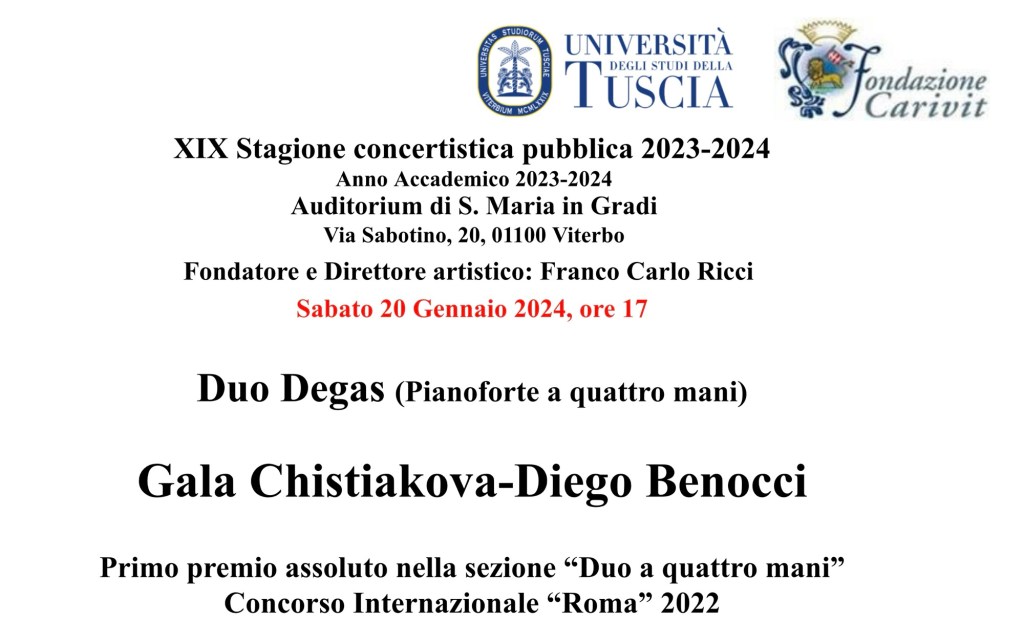
dell’Università degli Studi della Tuscia riprende l’attività inaugurando la XIX Edizione 2023-2024 sabato 14 ottobre 2023, alle 17. Come sempre i concerti si terranno nell’Auditorium di S. Maria in Gradi.
Il Concerto d’inaugurazione della Stagione concertistica dell’Università della Tuscia al quale, in considerazione dell’importanza dell’evento, hanno assicurato la presenza il Rettore dell’Ateneo, Prof. Stefano Ubertini, e il Direttore generale, Dott.ssa Alessandra Moscatelli.
Sarà un evento di particolare importanza perché ne saranno protagonisti Lorenzo Porzio, alla guida dell’Orchestra delle Cento Città e la pianista Cristiana Pegoraro. Il programma, di grande interesse e godibilità prevede di Wolfgang Amadeus Mozart (Salisburgo, 1756-Vienna, 1791) il
Concerto per pianoforte e orchestra K. 488e la Sinfonia K 550 n. 40.
L’evento, in collaborazione con il Centro Musicale Internazionale (Ce.m.i.), è
dedicato alla cara memoria di Mario Moscatelli, che
recentemente ci ha lasciato.
Già Prefetto di Viterbo, Torino e Trieste, il Dott. Moscatelli era Socio onorario del Centro Musicale Internazionale e Convinto Sostenitore della Stagione concertistica dell’Università della Tuscia.
Nella sala antistante l’Auditorium, dopo il concerto, la nota Casa vinicola Casale del Giglio sarà presente con il “Banco di Assaggio ” per far conoscere varie etichette dei propri vini bianchi, rosati e rossi.
Some fine playing from the Orchestra delle Cento Città under Lorenzo Porzio with a programme dedicated to the genius of Mozart.A programme announced as the G minor Symphony and the A major piano concerto K.488 but there were surprises too.The first was the inclusion of the Overture to La Nozze di Figaro that opened the programme.An exhilarating performance full of rhythmic nervous energy beautifully shaped and its four minutes brought vividly to life.I remember my wife,Ileana Ghione asking a family friend, the great conductor and pedagogue,Franco Ferrara what was the secret of conducting?He just opened his arms in a gesture like entering water with a naturalness and continual flowing movement.Of course in the hands of a genius like Franco Ferrara it was so simple but in other hands it can seem like stabbing at the orchestral players with disjointed movements that can often lead to ragged ensemble and an overall lack of fluidity and cohesion .
It was refreshing to watch the beauty and fluidity of the arms of Lorenzo Porzio as he waded in to the musical sea with his excellent companions.The opening Molto Allegro of the G minor Symphony with a beautifully flowing tempo and superb phrasing contrasted both the lyrical and rhythmic but never loosing the underlying drive and sense of architectural shape.There was great drama too in the development where he found a clarity of line of intelligent musicianship with the question and answer between instruments.There was a Pastoral feel to the Andante with the wind players magical accompaniment to the sublime string melodic line .A real duet of almost chamber music proportions with the players listening attentively to their musical colleagues in a real musical conversation .Overseen but never interrupted by such a sensitive conductor who realised that this remarkable Andante is the very heart of this Symphony.The Menuetto was played with a nobility of driving dance rhythms .There was a beautiful contrasting lyricism to the trio as the strings were answered by the wind with great lyricism and charm.A buoyancy to the Allegro assai with its dynamic rhythmic contrasts of question and answer between the strings and the wind all superbly directed and never loosing the overall shape of this masterpiece, much admired by Beethoven and Schubert ,which is Mozart’s final Symphonic trilogy of which this could be considered the wonderfully lyrical central movement.
There was a beautiful fluidity too to the opening of the A major Piano Concerto K.488 which created the ideal opening for the crystalline playing of Cristiana Pegoraro.There was beautifully sensitive playing too in the second subject with great delicacy but never loosing the simplicity and clarity that is the Mozart that can be too difficult for adults but too easy for children.There is a sublime simplicity which Cristiana showed us with disarming elegance and ease with the evident joy of discovery.Nowhere more so than in Mozart’s own cadenza played with the same freedom and sense of improvisation that the composer himself must have discovered on the spur of the moment.
The ‘Adagio’ reached moments of sublime beauty with the piano and orchestra playing with equal sensitivity.A real duet in which the simple unadorned notes of the piano shone like jewels as the strings merely plucked their instruments with the wind providing the warmth of the harmonic invention.Cristiana happy to play Mozart’s notes without any of the ornamentation that we are plagued with these days in the name of authenticity.What a relief it was to hear this truly sublime simplicity!There was an infectious ‘joie de vivre’ to the ‘Allegro assai’ with virtuoso bassoon playing too replying to the pianists left hand with great technical skill and artistry.Cristiana with Lorenzo managed to purvey their obvious enjoyment at making music together in a continual joyous conversation between the piano and orchestra.An ovation from the audience at this opening concert of the season and it was now time to share one of Cristiana’s own compositions with an audience demanding more.’
Sail Away’ is a piece that Cristiana has played in her recitals throughout the world and is a moving voyage of life .Life that is such a wondrous gift to us all.And what a joyous atmosphere she was able to create with her superb playing spilling over into an even more unexpected encore.
The ‘Turkish March’ by Mozart not only the last movement of his Piano Sonata but on this occasion turned into a joyous march in which her companion Lorenzo joined her at the keyboard as he also conducted the orchestra in the ‘chorus’.What a wonderfully joyous start to a glorious season of great music making .
The opening page of the autograph manuscript The Piano Concerto No. 23 K.488 was finished, according to Mozart’s own catalogue, on March 2, 1786, two months prior to the premiere of his opera, Le nozze di Figaro ,and some three weeks prior to the completion of his concert in C minor K 491.It was one of three subscription concerts given that spring and was probably played by Mozart himself at one of these. Mozart c. 1788 Symphony No. 40 in g minor K.550 was written in 1788 and is sometimes referred to as the “Great G minor symphony”, to distinguish it from the “Little G minor symphony”, n.25. The date of completion of this symphony is known exactly, since Mozart in his mature years kept a full catalogue of his completed works; he entered the 40th Symphony into it on 25 July 1788.Work on the symphony occupied an exceptionally productive period of just a few weeks during which time he also completed the 39th and 41 st (Jupiter ) Symphonies (26 June and 10 August, respectively)..It has been suggested that Mozart composed the three symphonies as a unified work, pointing, among other things, to the fact that the Symphony No. 40, as the middle work, has no introduction (unlike No. 39) and does not have a finale of the scale of No. 41’s.Schumann regarded it as possessing “Grecian lightness and grace”.Charles Rosen called the symphony “a work of passion, violence, and grief.”Beethoven knew the symphony well, copying out 29 bars from the score in one of his sketchbooks.Schubert likewise copied down the music of Mozart’s minuet.Of his last three symphonies, Symhony No.40 is the most influential and visionary in its technical detail and emotional effect. Throughout the nineteenth century, its darker tone was hailed as a rare advance from the presumed superficiality of Mozart’s other work. Opinion among conductors varies as to which version, the first or second (the one with the addition of two clarinets, perhaps made for a specific performance), is the most powerful. The autograph scores, now in the possession of Gesellschaft der Musikfreunde in Vienna were once proudly owned by Johannes Brahms—he received them as a gift from Princess Anne of Hesse to whom the composer had dedicated his Piano Quintet in F Minor, op.34.
The symphony is scored (in its revised version) for flute , 2 oboes , 2 clarinets,, 2 bassoons , 2 horns , and strings .
The work is in four movements :Molto allegro ,Andante ,Menuetto,Allegretto-Trio.finale.Allegro assai .
Mozart revised his symphony and this “demonstrates that it was in fact performed, for Mozart would hardly have gone to the trouble of adding the clarinets and rewriting the flutes and oboes to accommodate them, had he not had a specific performance in view.”The orchestra for the 1791 Vienna concert included the clarinetist brothers Anton and Johann Nepomuk Stadler ; which, as Zaslaw points out, limits the possibilities to just the 39 th and 40th symphonies.
“The version without clarinets must also have been performed, for the reorchestrated version of two passages in the slow movement, which exists in Mozart’s hand, must have resulted from his having heard the work and discovered an aspect needing improvement.”
In 1782, the French playwright, Beaumarchais, offered private readings to King Louis XIV of his comedy of manners, The Marriage of Figaro. Instead of being pleased, the monarch decided the story was “detestable and must never be produced.” The irreverence was simply too much. As “forbidden fruit,” the play became the rage of the aristocracy, and it surfaced repeatedly in secret productions (one even including the King’s wife.) Like the King, Napoleon also sniffed danger in the plot, and he declared that the play was “the revolution already in action.” The Austrian government echoed the danger and banned the play from its borders. In 1784, the play was presented publicly in Paris to great acclaim, and within a year, Germany had twelve translations on hand. The Marriage of Figaro was unquenchable.
After searching through hundreds of plays for an opera buffa, Mozart decided this was just the ticket. With the librettist Lorenzo da Ponte, the pair produced the opera Marriage of Figaro in only six weeks. The Overture was completed only two days before the opening on May 1, 1786.
The overture to the opera Le nozze di Figaro, the first of Mozart’s three collaborations with librettist Lorenzo Da Ponte (the other two are Don Giovanni and Così fan tutte), begins with a busy whispering and buzzing that develops quickly into a short-breathed little theme that might just slip by the less than alert listener. Then, bang!, comes a tutti with trumpets and drums, the music subsequently driven by scampering violins, flutes, and oboes in a succession of hectically upbeat figurations, the whole accomplished in four minutes. The piece is self-contained, which is to say that it does not quote themes from the opera proper nor does its ending fade into the opening measures of the opera, both also characteristic of the overtures to Mozart’s Abduction from the Seraglio, Così fan tutte, and The Magic Flute. The Figaro overture does, however, give us a delectable foretaste of the mood of its opera: fleet, witty, often acerbic in its humor.The overture, it might be noted, originally contained a slow middle section with a melancholy oboe solo. But contrast be damned, Mozart wisely decided, and maintained the swirling, manically jolly mood throughout. Figaro was first presented on the stage of Vienna’s Burgtheater in May of 1786. The composer conducted from the keyboard.Written for 2 flutes, 2 oboes, 2 clarinets, 2 bassoons, 2 trumpets, 2 horns, timpani, and strings
Stagione concertistica pubblica
Auditorium di S. Maria in Gradi
Via Sabotino, 20, 01100 Viterbo
Fondatore e Direttore artistico: Franco Carlo Ricci
XIX Stagione concertistica 2023-2024
Ottobre 2023
Sabato 14, ore 17
In collaborazione con il
Centro Musicale Internazionale (Ce.M.I.)
Concerto dedicato alla cara memoria di
Mario Moscatelli
Già Prefetto di Viterbo, Torino e Trieste
Socio onorario del Centro Musicale Internazionale
Convinto Sostenitore della Stagione concertistica dell’Università della Tuscia
Orchestra delle Cento Città
Lorenzo Porzio, direttore
Cristiana Pegoraro, pianoforte
Wolfgang Amadeus Mozart (Salisburgo, 1756-Vienna, 1791)
Concerto per pianoforte n. 23 in la maggiore, K 488
(Allegro; Adagio; Allegro assai)
Sinfonia n. 40 in sol minore, K 550
(Molto allegro; Andante; Minuetto e trio. Allegretto; Allegro assai )
Sabato 21, ore 17
In collaborazione con il
Club Rotary Roma-ovest e il
Centro Musicale Internazionale
Orchestra “I concerti del Tempio”
Direttore
Daniele Camiz
Talenti emergenti del Magisterium pianistico di Marcella Crudeli
Wolfgang Amadeus Mozart (Salisburgo, 1756-Vienna, 1791) Idomeneo Re di Creta K 366
Ouverture
Wolfgang Amadeus Mozart (Salisburgo, 1756-Vienna, 1791) Dal Concerto in La Maggiore KW 414
(Primo movimento – Allegro)
Pianista
Giuseppe Manes
Ludwig van Beethoven (Bonn, 770-Vienna, 1827) Dal Concerto N. 2 in Si Bemolle Maggiore op. 19
(Primo movimento – Allegro con brio)
Pianista
Marianna Ruggiero
Ludwig van Beethoven (Bonn, 770-Vienna, 1827) Concerto N. 1 in Do Maggiore op. 15
(Allegro con brio; Largo Rondò-Allegro)
Pianista
Vera Cecino
Sabato 28 ore 17
Pianista
Riccardo Natale
Georg Friedrich Händel (Halle, 1685-Londra, 1759)
Suite HWV 427 in Fa maggiore
Fryderyk Chopin (Żelazowa Wola, 1810-Parigi, 1849)
Quattro Mazurke op. 30
Polonaise op. 44
*
Robert Schumann (Zwickau, 1810-Endenich, 1856) Davidsbundlertänze op. 6
Feat. Mario Marzi, sax soprano, contralto e baritono
Paolo Innarella, flauto, bansuri, sax soprano e tenore
Rohan Dasgupta, sitar
Marco de Tilla, contrabbasso
Sanjay Kansa Banik, tabla
Programma
Composizioni e arrangiamenti di Giuliana Soscia
Samsara, Indian Blues, Arabesque, Gange, Alpha Indi, Bloodshed
In collaborazione con
ISMEO-Associazione Internazionale di Studi sul Mediterraneo e l’Oriente
Progetto MUR CUP B85F21002660001
Sabato 18, ore 17
Gianluca Giganti, violoncello
Anna Lisa Bellini, pianoforte
In ricordo di Sergio Viterbini a 80 anni dalla morte
Fryderyk Chopin (Żelazowa Wola, 1810-Parigi, 1849)
Introduction et Polonaise, op. 3
Giuseppe Martucci (Capua, 1856-Napoli, 1909)
Due Romanze op. 72
Francesco Cilea (Palmi, 1866-Varazze, 1950)
Romanza dalla Sonata op. 38
Sergio Viterbini (Viterbo1890-1943)
Sogno
Canto d’amore
Il Kuku
Fryderyk Chopin (Żelazowa Wola, 1810-Parigi, 1849)
Sonata in sol minore op. 65
(Allegro moderato; Scherzo: Allegro con brio (re minore);
Largo (si bemolle maggiore); Finale: Allegro)
Sabato 25, ore 17
Pianista
Arturo Stalteri
MUSICA DALLA TERRA DI MEZZO
Prima Parte
Arturo Stàlteri
Le ultime luci di Brea
Verso Lòrien
Un viaggio inaspettato
Èowyn
Gandalf the white
The grey havens’ lullaby
Cavalieri neri
Seconda Parte
Howard Shore (Toronto, 1946)
Hobbit theme
Leonard Rosenman (New York, 1924-Los Angeles, 2008)
Theme from The Lord of the Rings
Mithrandir
Annbjørg Lien (Ålesund, Norvegia, 1971)
Galadriel
Enya (Gaoth Dobhair, Irlanda, 1961)
Lothlòrien
May it be
Bo Hansson (Göteborg, Svezia, 1943-2010, Stoccolma)
Homeward bound
The old forest
Dicembre 2023
Sabato 2, ore 17
Matteo Bonaccorso, flauto
Marco Nucci, flauto
Jacopo Petrucci, pianoforte
Jacques Ibert (Parigi, 1890-1962)
Deux Interludes per due flauti e pianoforte.
Claude Debussy (Saint-Germain-en-Laye, 1862-Parigi, 1918) Images I per pianoforte solo
(Reflets dans l’eau; Hommage à Rameau; Mouvement)
Petite suite per due flauti e pianoforte
(En bateau; Cortège; Menuet; Ballet)
Maurice Ravel (Ciboure, 1875-Parigi, 1937) Suite da Ma Mère l’Oye per due flauti e pianoforte
(Pavane de la Belle au bois dormant; Petit Poucet; Laideronnette, impératrice des pagodes; Les entretiens de la belle et de la bête; Le jardin féerique)
A standing ovation for playing that was just made for paradise. The paradise that Susana created to turn her husband’s dreams into reality. Sir William and Susana resting now overlooking their child that was born of the love of beauty that they shared together for over fifty years . Ogdon ,Richter ,Bream,Tortelier and many others all used to rent Lady Walton’s cottages that surrounded the estate of La Mortella.The cottages have now been sacrificed to set up a trust fund so the Walton Foundation can live on forever as was Sir William’s wish. I doubt that La Mortella has ever heard such sounds as Thomas Kelly conjured from the piano tonight. A refined palette of golden sounds allied to superb musicianship but above all the magic of an occasion that allowed us to wallow in sumptuous sounds with an impassioned demonic technical mastery that was both exhilaration, exciting and most definitely X certificate. Looking like Rachmaninov as though he had swallowed a knife but then producing ,like Vlado Perlemuter use to tell me,the most romantic sumptuous sounds from the piano. Horowitz too,head down just a twitch of his lips but some of the most obscenely decadent sounds that are only to be found by those who have truly made a pact with the devil. There was the most extraordinary display of Thalberg’s one upmanship on Liszt with his Don Pasquale Grande Fantaisie.Followed by the demonic throbbing of Mephisto that was heard in the distance as it came closer and closer and ever more insistent.The additions of Busoni and Horowitz added even more hair raising virtuosity and brilliance in a breathtaking display of playing that we have only heard recounted of the long past generation of a Golden era.
A standing ovation from an audience who had come to admire the botanical gardens but found themselves almost devoured by the devil. Pushed on stage by Lina Tufano , the artistic director of the Incontri Musicali, demanding an encore. Reluctantly and visibly exhausted Tom pulled out of his top hat a Campanella by Liszt and Busoni that was so astonishing the cheering at end was probably heard in Naples . Little could they have known that the evening before Tom had played a completely different programme including a monumental performance of Rachmaninov’s first sonata -up until now the poor relation of the second. This was just a break from Brahms 2 a week ago and Schumann A minor next week. Of course I forgot to mention that he plays here in Ischia on Monday Cesar Franck’s notoriously complex Piano Quintet . All this and Tom tells me he too will have a birthday soon. My 75th is tomorrow and what better way to celebrate than the birth of one of the greatest talents I have known.Amazingly Tom celebrates his 25th at the end of the month too .I am Libra but of course he is Scorpio!Fifty years may separate us but it is his music that unites us all in the end.
The Maxwell Quartet with Simon Rowland-Jones
To say we are in the hands of a piano genius is to put it mildly! The perfect balm after such decadence was to eavesdrop on a private performance of Mozart’s C major Quintet . The Maxwell Quartet giving an intimate performance as might have been when it was first penned. There was a complicity between musicians with the same souls playing with charm,elegance and grace but with a beguiling musicianship that allowed the superb cellist,Duncan Strachan,to be visibly encouraging his colleagues to indulge and enjoy even more the genius that is Mozart. Simon Rowland-Jones was the fifth partner in crime and it is he who for nineteen years has been bringing the Kirker Music Festival to La Mortella under the very discerning eye of Susana Lady Walton ….if music be the food of love ….play on ……with the Walton’s united again and looking on admiringly from their resting places next to each other on high.
The resting place of Sir William and in the shadow of the big rock that contain his ashes ,that of his wife Susana .Lady Walton died in 2010 almost 25 years after her beloved husband and who,in his memory,their wishes she was so magnificently able to fulfill.Susana ever vigilant One of Clementi’s 110 Sonatas op 24 n.2 the one that was to inspire Mozart in his last opera ‘The Magic Flute’. It was played not only with the rhythmic brilliance of Clementi’s seemingly endless stream of notes but above all there was the elegance and sense of style of an inquisitive musical mind,with the same kaleidoscopic change of colour of looking through a prism.A grandiose opening of the ‘Andante’ that was indeed quasi ‘Allegretto’ with cascades of notes that were jewels glistening as they were shaped with a beguiling sense of elegance and style.The tongue in cheek after thought of the coda was thrown off with disarming nonchalance There was a remarkable ease with which notes became just streams of brilliant sounds in the Rondo ‘Assai Allegro’ ‘They could not be called jeux perlé because they were imbued with a driving energy that brought this much neglected sonata to a brilliant conclusion.There was a subdued opening to Chopin’s much abused First Ballade.Bathed in a long held pedal that had me searching the score to see if it was Chopin’s own very precise indication.The pedalling in Chopin,so often overlooked,gives us a precious insight into the sounds and shapes that Chopin wanted from his long Bel canto outpourings.Not sure if it was Chopin or Tom’s great sensitivity to sound that immediately turned this opening into a magic wand opening the flood gates to Chopin’s ravishingly beautiful long cantilenas.A subtle melodic line that was allowed to take flight with a ravishing sense of balance and delicacy.Leading to the first passionate outpouring that was shaped with sumptuous beauty and subtle phrasing that put this much maligned Ballade back where it belongs as one of the most original and beautiful early works of an innovative poetic genius of the piano.The jeux perlé that followed produced gleaming sounds rising and falling with a remarkable control that never lost sight of the music or allowed it to veer out of control as it so often does in the hands of so called ‘virtuosi’. A coda shaped like the true musician that Tom is but also played with the excitement and exhilaration of a Horowitz who like Liszt was also the greatest showman on earth too. Floristan and Eusebius are nothing compared to this ‘Devil and the deep blue sea’ approach from artists of such diabolical temperament.There was beauty and fluidity that Tom brought to Ravel’s ‘Jeux d’eau’ with an etherial sound of gossamer finesse and refined virtuosity.The curtain had now risen on Thalberg’s remarkable Grande Fantaisie on Donizetti’s Don Pasquale. Great drama and fantastic contrasts between legato and staccato with Thalberg – Liszt’s only true rival – showing us that the piano was also the greatest orchestra on earth capable of all the colours and sounds of the grandest of ensembles .Beguiling sounds seemingly appearing in every corner of the keyboard via a transcendental display of piano trickery of a different age.An age when technical mastery meant a chameleonic sense of colour each note containing a hundred gradations of sound and not just breaking the speed limit! Unbelievable the tumbling octave accompaniment over the entire keyboard whilst the melodic line was so perfectly shaped in the central most beautiful register of the piano. No wonder people of the day thought that Thalberg like Liszt and Paganini had made a pact with the devil to be given another couple of arms and hands.An amazing display of virtuosity in the true meaning of the word ,that of a complete mastery. It is Art that conceals Art as sumptuous sounds were allowed to erupt from this box of mere hammers and strings. Of course as Anton Rubinstein pointed out the pedal,a relatively new invention in their day ,is the real soul of the piano, and it is this that allows the illusion that a percussive instrument of hammers that hit the strings can appear to sing better than any Bel Canto nightingale of the day.There was a slow very deliberate opening to Liszt’s demonic Mephistophelian Waltz n.1 where even the opening octaves were played in a subdued melodic way with each one made up of four notes of different weight.This of course just opened the flood gates to a display of astonishing bravura of noble style and excitement. Horowitz,described on his first appearance in Paris,as the greatest pianist alive or dead,just added more colour and hysteria with the occasional added bass notes and padding out of chords.A filling out of embellishments too and adding double notes to Liszt’s already impossible antics. Bursting into red hot flames at the end where the showman Horowitz added octaves and all sorts of trickery that I am sure Liszt himself might have done given the evolution of the Steinway as opposed to its predecessor the Erard that was Liszt’s preferred instrument of the day. A spontaneous standing ovation reminded me of the stories in history books of aristocratic ladies in the Paris salons turning into hysterical animals trying to get as near as they dare to their conquering hero. A much more refined audience at La Mortella but they did manage to persuade Tom to play just one little piece before retiring. La Campanella by Liszt and his pupil Busoni produced even more phenomenal feats of subtle virtuosity that were breathtaking in their daring and refined beauty.Turning a pianistic showpiece into the tone poem that the Poet Liszt had intended with the same funabulistic virtuosity of Paganini translated by a Genius into a ravishingly beguiling show piece that like Paganini was only fit for a King.Alessandra Vinciguerra, Susana’s dedicated second in command and now Director of La Mortella .Fulfilling the Walton’s every wish to bring live music to the Gardens and especially to help young musicians at the beginning of their long climb up what can often be a very slippery ladder.Lina Tufano,artistic director of Incontri Musicali with Alessandra Vinciguerra ,director of La Mortella A second performance with the indomitable Lina Fortuna enjoying every minute of Tom’s extraordinary performances The extraordinary soprano Laura Lolita Perersivana provided the equally scintillating second evening recital And the equally extraordinary accompaniment and much more besides from William Van Three Sitwell songs by William Walton demonstrated what a wonderful but neglected composer he is .These three poems set to music with such flair and character that just illuminated Edith Sitwell’s amusing tantalising lines.Walton set three selections from Façade as art-songs for soprano and piano (1932),to be sung with full voice rather than spoken rhythmically. These are: Daphne Through Gilded Trellises Old Sir FaulkDame Edith looking on not amused The famous backcloth by John Piper for the first performance of Facade with Edith Sitwell reciting behind the screen with a megaphone in the mouth of the statue .The first performance was in the Aeolian Hall 100 years ago caused a scandal Portrait by Thomas Hardy (1794) Born Muzio Filippo Vincenzo Francesco Saverio Clementi 23 January 1752 Rome
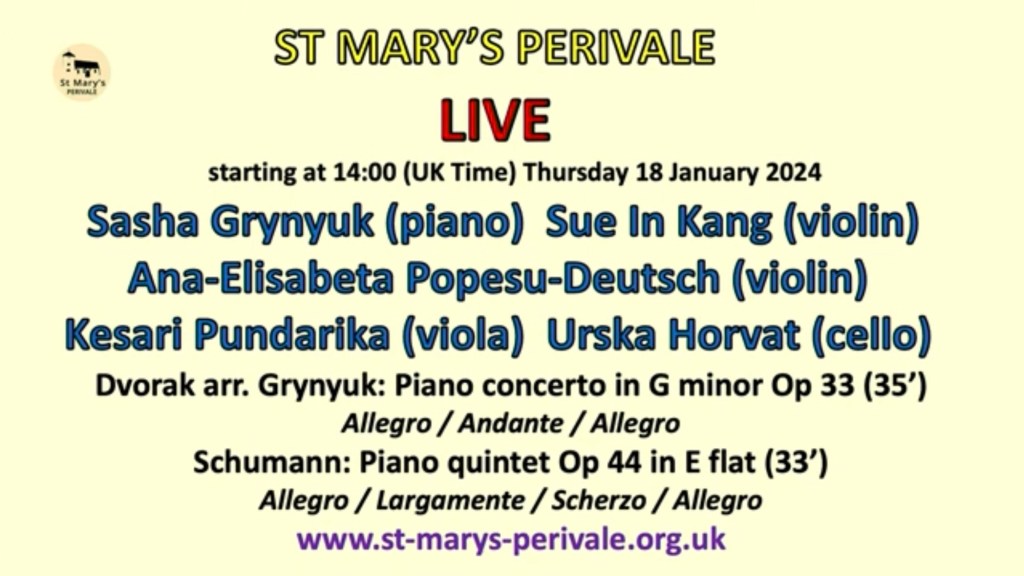
Died 10 March 1832 (aged 80)Evesham United Kingdom
Muzio Filippo Vincenzo Francesco Saverio Clementi (23 January 1752 – 10 March 1832) was an Italian-British composer,virtuoso pianist, pedagogue,conductor , music publisher, editor, and piano manufacturer, who was mostly active in England.
Encouraged to study music by his father, he was sponsored as a young composer by Sir Peter Beckford who took him to England to advance his studies. Later, he toured Europe numerous times from his long-standing base in London. It was on one of these occasions, in 1781, that he engaged in a piano competition with Mozart.Clementi also produced and promoted his own brand of pianos and was a notable music publisher.Because of this activity many compositions by Clementi’s contemporaries and earlier artists have stayed in the repertoire. Though the reputation of Clementi was exceeded only by Haydn, Mozart, Beethoven, and Rossini in his day, his popularity languished for much of the 19th and 20th centuries.
As a composer of classical piano sonatas, Clementi was among the first to create keyboard works expressly for the capabilities of the piano. He has been called “Father of the Piano”.Clementi composed almost 110 piano sonatas ,some of the earlier and easier ones were later classified as sonatinas after the success of his Sonatinas Op. 36. Satie would later parody these sonatinas (specifically the Sonatina Op. 36, No. 1) in his Sonatine bureaucratique. However, most of Clementi’s sonatas are more difficult to play than those of Mozart, who wrote in a letter to his sister that he would prefer her not to play Clementi’s sonatas due to their jumped runs, and wide stretches and chords, which he thought might ruin the natural lightness of her hand.
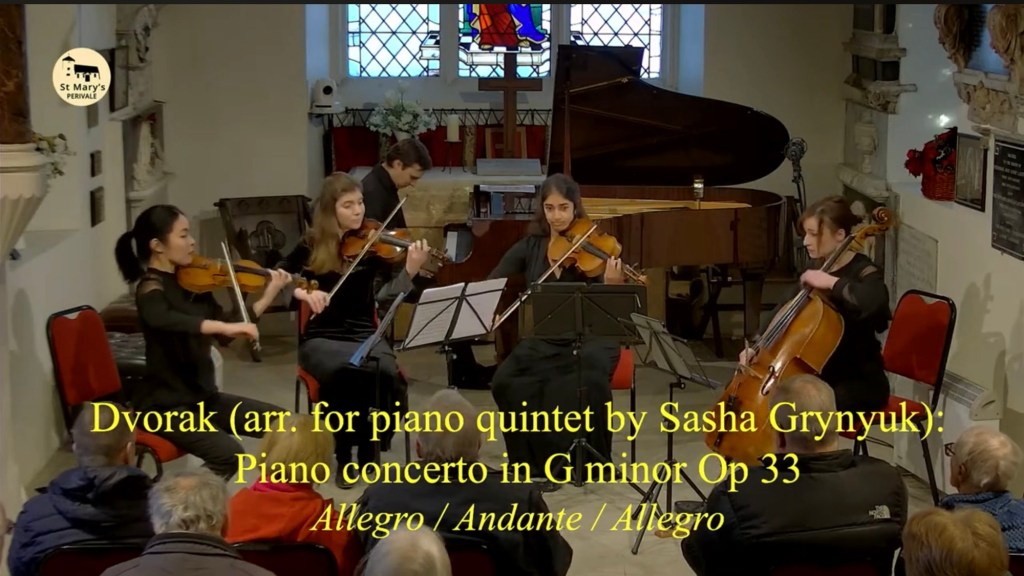
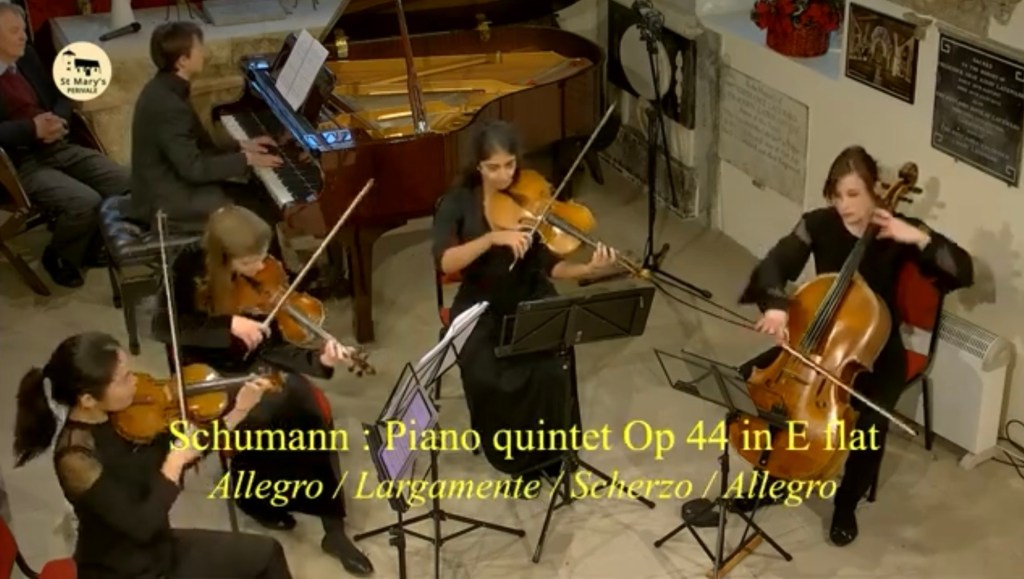
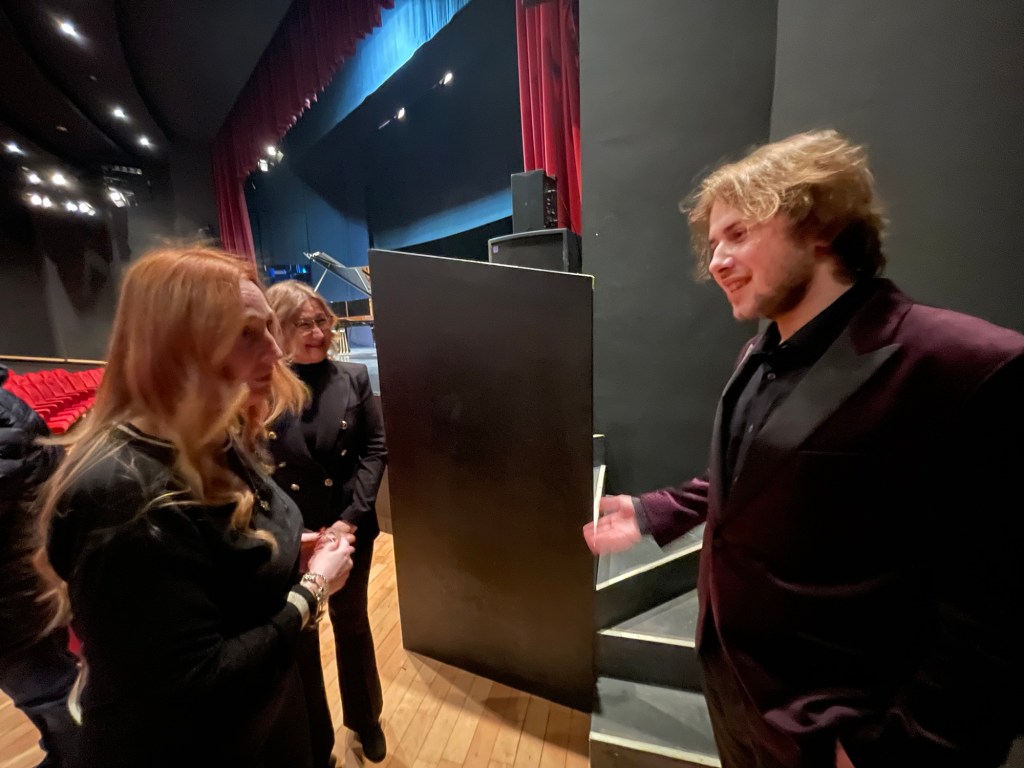
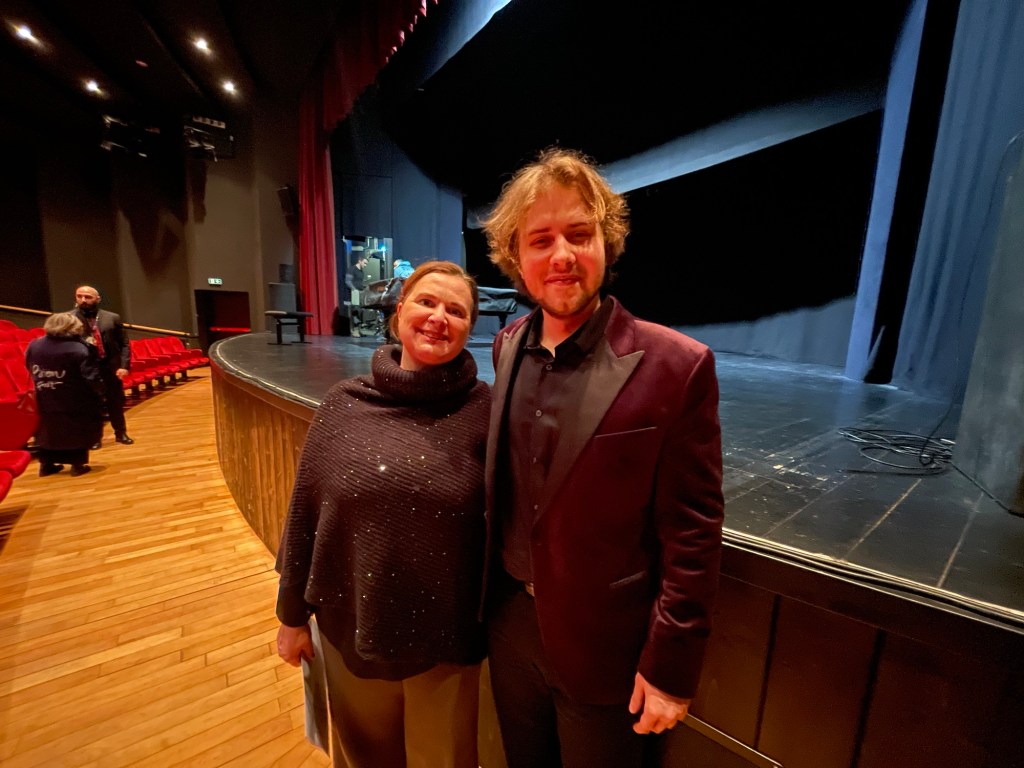
Of Clementi’s playing in his youth, Moscheles wrote that it was “marked by a most beautiful legato, a supple touch in lively passages, and a most unfailing technique.” Domenico Scarlatti may be said to have closed the old and Clementi to have founded the newer school of technique on the piano.
Clementi visited Vienna in December 1781, playing the B flat Sonata from Op 24 before an audience that included Joseph II and Mozart. He ‘plays well, so far as execution with the right hand goes’, Mozart reported to his father (12 January 1782). ‘His greatest strength lies in his passages in thirds. Apart from this, he has not a pennyworth of taste or feeling—in short he is simply a mechanicus.’ (Clementi was more generous to his famous rival, publicly acknowledging his ‘singing touch and exquisite taste’.) Comprising a terse sonata Allegro (launched by an idea Mozart was to recollect/steal years later for his Magic Flute Overture), an expressive slow movement in the dominant, and a brilliantly ‘running’ Rondo finale, the B flat Sonata was first published by Storace of Howland Street, Rathbone Place, London, as part of a ‘Collection of Original Harpsichord Music’ (entered Stationers’ Hall, 23 July 1788).
Chopin at 28, from Delacroix’s joint portrait of Chopin and Sand. Born Fryderyk Franciszek Chopin 1 March 1810 Zelazowa Wola ,Poland Died 17 October 1849 (aged 39) Paris, France
The Ballade No. 1 in G minor, Op. 23, was completed in 1835 in Paris.In 1836, Schumann wrote: “I have a new Ballade by Chopin. It seems to me to be the work closest to his genius (though not the most brilliant). I even told him that it is my favourite of all of all his works. After a long, reflective pause he told me emphatically: ‘I am glad, because I too like it the best, it is my dearest work.’”
The term ballade was used by Chopin in the sense of a balletic interlude or dance-piece, equivalent to the old Italian ballata, but the term may also have connotations of the medieval heroic ballad, a narrative minstrel-song, often of a fantastical character. There are dramatic and dance-like elements in Chopin’s use of the genre, and he may be said to be a pioneer of the ballade as an abstract musical form. The four ballades are said to have been inspired by a friend of Chopin’s, poet Adam Mickiewicz.The exact inspiration for each individual ballade, however, is unclear and disputed.Though the ballades do not conform exactly to sonata form the “ballade form” created by Chopin for his four ballades is a variant of sonata form with specific discrepancies, such as the mirror reprise (presenting the two expositional themes in reverse order during the recapitulation The ballades have directly influenced composers such as Liszt and Brahms who, after Chopin, wrote ballades of their own.Besides sharing the title, the four ballades are entities distinct from each other. Each one differs entirely from the others, and they have but one thing in common – their romantic working out and the nobility of their motifs.
Maurice Ravel 1875 – 1937
Jeux d’eau was composed in 1901 , at the age of 19 and is dedicated to his teacher Gabriel Fauré and premiered on April 5th 1902 by Ricardo Vines. The score bears as an epigraph a quote from Henri de Règnier : “Fluvial God laughing at the water which tickles him
Les Jeux d’eau, published in 1901, are at the origin of all the new pianistic innovations that people have wanted to notice in my work. This piece, inspired by the sound of water and the musical sounds of jets of water, waterfalls and streams, is based on two motifs in the style of the first part of a sonata, without however being subject to on a classic tonal level. » (Maurice Ravel, autobiographical sketch , 1928)
Fauré held the Jeux d’eau in great esteem, but Saint-Saens only saw this avant-garde piece as a “cacophony”. However, the work quickly enjoyed great success, definitively affirmed Ravel’s musical personality and had an influence on several of his contemporaries including Debussy ( Préludes , Études ). Its brevity and sweetness make it a popular page for concerts.Although Ravel’s reputation as a Debussyist and Impressionist dates from the Jeux d’eau , it was with Liszt ( Au bord d’une source , 1855 and Jeux d’Eau à la villa d’Este ,1883 ) that you have to look for the composer’s sources.
The Mephisto Waltzes (German: Mephisto-Walzer) are four waltzes composed from 1859 to 1862, from 1880 to 1881, and in 1883 and 1885. Nos. 1 and 2 were composed for orchestra, and later arranged for piano, piano duet and two pianos, whereas nos. 3 and 4 were written for piano only. Of the four, the first is the most popular and has been frequently performed in concert and recorded.
The first Mephisto Waltz is a typical example of programme music taking for its programme an episode from Nikolaus Lenau’s 1836 verse drama Faust ,not from Goethe. The following programme note, which Liszt took from Lenau, appears in the printed score:
There is a wedding feast in progress in the village inn, with music, dancing, carousing. Mephistopheles and Faust pass by, and Mephistopheles induces Faust to enter and take part in the festivities. Mephistopheles snatches the fiddle from the hands of a lethargic fiddler and draws from it indescribably seductive and intoxicating strains. The amorous Faust whirls about with a full-blooded village beauty in a wild dance; they waltz in mad abandon out of the room, into the open, away into the woods. The sounds of the fiddle grow softer and softer, and the nightingale warbles his love-laden song.
Lithograph by Josef Kriehuber , 1841 Born 8 January 1812 Pâquis, Switzerland Died 27 April 1871 Naples Italy
In 1843 Thalberg had married in Paris the daughter of the famous bass Luigi Lablache, widow of the painter Boucher. Attempts at operatic composition proved unsuccessful, with Florinda, staged in London in 1851 and Cristina di Suezia in Vienna four years later. His career as a virtuoso continued until 1863, when he retired to Posilippo, near Naples, to occupy himself for his remaining years with his vineyards. He died in Posilippo in 1871.
Some mystery surrounds the birth and parentage of the virtuoso pianist Sigismond Thalberg, popularly supposed to have been the illegitimate son of Count Moritz Dietrichstein and the Baroness von Wetzlar, born at Pâquis near Geneva in 1812. His birth certificate, however, provides him with different and relatively legitimate parentage, the son of a citizen of Frankfurt, Joseph Thalberg. There seems no particular reason, therefore, to suppose the name Thalberg an invention. Legend, however, provides the story of the Baroness proclaiming him a valley (“Thal”) that would one day rise to the heights of a mountain (“Berg”). Thalberg’s schooling took him to Vienna, where his fellow-pupil the Duke of Reichstadt, the son of Napoleon, almost persuaded him to a military career. Musical interests triumphed and he was able to study with Simon Sechler and with Mozart’s pupil Hummel. In Vienna he performed at private parties, making a particular impression when, as a fourteen-year-old, he played at the house of Prince Metternich. By 1828 he had started the series of compositions that were to prove important and necessary to his career as a virtuoso. In 1830 he undertook his first concert tour abroad, to England, where he had lessons from Moscheles. In 1834 he was appointed Kammervirtuos to the Emperor in Vienna and the following year appeared in Paris, where he had lessons from Kalkbrenner and Pixis.
Paris in the 1830s was a city of pianists. The Conservatoire was full of them, while salons and the showrooms of the chief piano-manufacturers Erard and Pleyel resounded with the virtuosity of Kalkbrenner, Pixis, Herz, and, of course, Liszt. The rivalry between Thalberg and Liszt was largely fomented by the press. Berlioz became the champion of the latter, while Fétis trumpeted the achievements of Thalberg. Liszt, at the time of Thalberg’s arrival in Paris, was in Switzerland, where he had retired with his mistress, the Comtesse Marie d’Agoult. It was she who wrote, under Liszt’s name, a disparaging attack on Thalberg, to which Fétis replied in equally offensive terms. The so-called “revolutionary princess”, Princess Belgiojoso, achieved a remarkable social coup when she persuaded the two virtuosi to play at her salon, in a concert in aid of Italian refugees. As in other such contests victory was tactfully shared between the two. Thalberg played his Moses fantasy, and Liszt answered with his new paraphrase from Pacini’s opera Niobe. The Princess declared Thalberg the first pianist in the world, while Liszt was unique. She went on to commission a series of variations on a patriotic theme from Bellini’s I Puritani from the six leading pianists in Paris, to which Liszt, Thalberg, Chopin, Pixis, Herz and Czerny contributed. This composite work, Hexaméron, remained in Liszt’s concert repertoire.The first of these operas of Donizetti was written in the winter of 1842 and performed early in January the following year in Paris. The elderly Don Pasquale attempts late marriage, with the purpose of siring children and thus disinheriting his nephew Ernesto. He is induced to see reason by what he supposes to be a real marriage to his nephew’s betrothed, disguised and behaving as an untamed shrew. All ends happily, when Don Pasquale agrees, with relief, to allow his nephew to marry the girl. Thalberg’s fantasy captures something of the spirit, humour and romance of its source
Mark Viner another great English virtuoso dedicated to bringing a forgotten world back to life with mastery and artistry .A swashbuckling extravaganza of nineteenth century pianism and a veritable contribution to Romantic Revivalism. This, Mark Viner’s début recording, presents the operatic paraphrases of the neglected pianist‐composer Sigismond Thalberg, aristocratic rival of Liszt and innovator of the so‐called ‘three‐hand effect’. Here are some of the very finest of his works – a music of opulent grandeur which draws upon all the heady romantic rhetoric and dramatic narrative of the opera house whilst being sumptuously conceived for the piano. A tour de force of virtuosity and an evocation of an era. Mark Viner is one of the most exciting young British pianists of his generation. 1st prize winner of the 2012 Alkan‐Zimmerman Competition in Athens, he is also the Chairman of the Alkan Society and is steadily gaining a reputation for his bold championing of unfamiliar pianistic terrain.Another pianist from the Keyboard Trust.
Tom with Simon R-j With Simon Roland-Jones , viola and Music Director of Kirker Music, who had invited Tom to play in their annual festival in Ischia Tom with the birthday boy