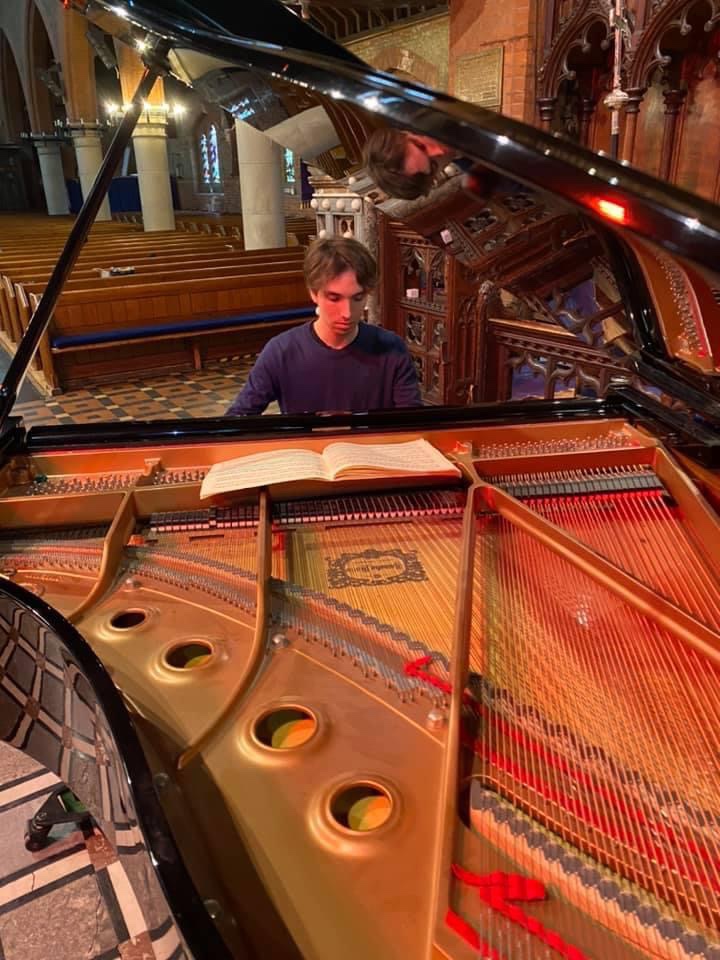
Kings Place Monday 11th March 2024 at 8 pm Jonathan Ferrucci plays the Goldberg Variations for the Kirckman Concert Society A standing ovation at the end of the 80 minutes of The Goldbergs – still only the start of a lifetimes’ journey. One that in four years has reached a peak of perfection that kept a rapturous full house in complete silence for the entire duration. Playing with all the repeats except in the final Aria he was justly greeted by a standing ovation with cat calls and whistles worthy of a football stadium at the end of this extraordinary marathon.
This is the fascinating pod cast for the Keyboard Trust with Jonathan Ferrucci ……some inspired and inspiring comments that were recorded in an improvised encounter as he prepared for his first performances of the Goldberg variations in 2021 .It culminated last night in London with a performance in 2024 where all the strands seemed to come miraculously together.Knotty twine or jigsaw puzzle it is without doubt the work of a Universal Genius.
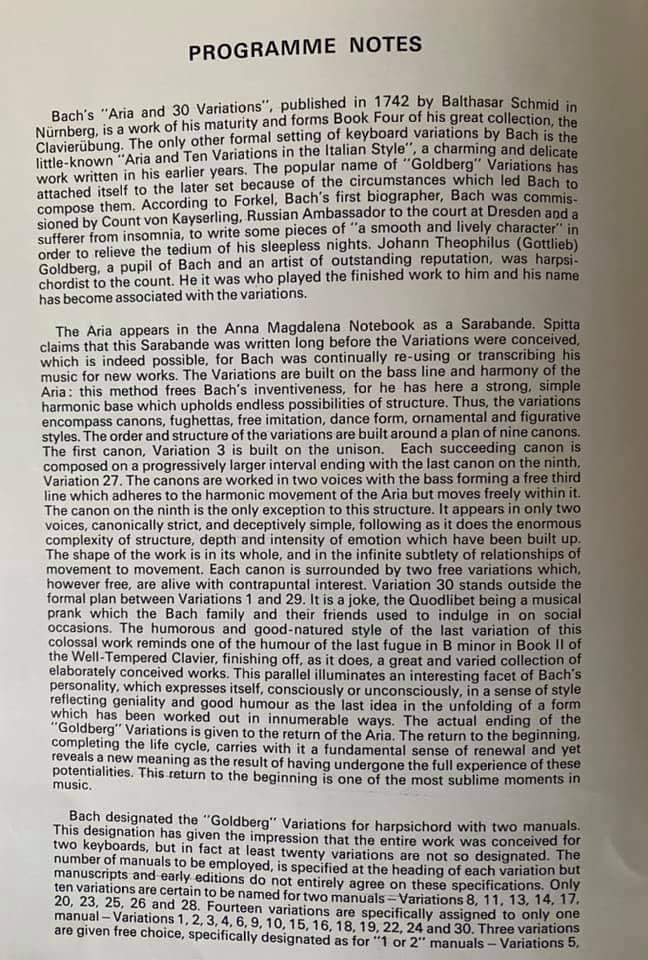
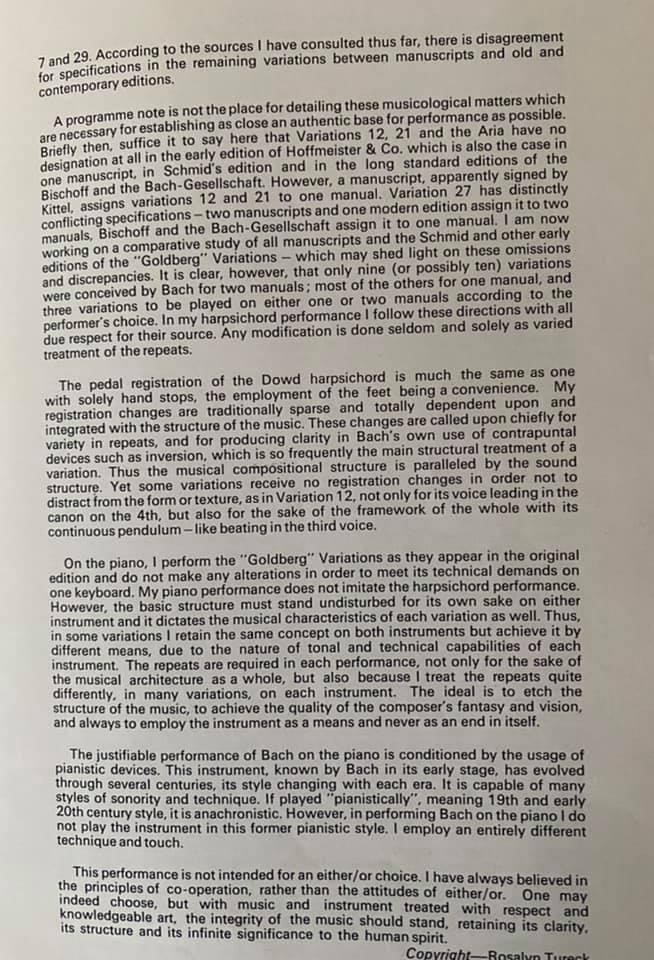
There was lots to discuss all centred around Florence…….and Bach! It was there that I first heard Rosalyn Tureck giving a lecture on Bach in the Cristofori museum of Stefano Fiuzzi.I could not believe that she had not been invited to give a recital so I invited her to play in Rome.A performance of the Goldberg Variations ,one that I had never forgotten from my student days in London.( see programme below)
It created a sensation after 25 years absence from the stage when she had stopped performing in order to dedicate herself to the study of Bach in Oxford.Creating her own Bach research institute of which I was eventually invited to be a trustee.
Florence immediately woke up and invited her to La Pergola theatre and she became the diva of this centre of European culture,playing sometimes twice a season.
That mantle has now passed to Angela Hewitt and it is she who had noted in 2014 a young florentine boy of quite exceptional human and pianistic gifts with whom she has been sharing her unique ideas from a life immersed in the world of the Universal Genius of J.S.Bach. Rosalyn’s performance was like a rock to be revered and honoured from a distance whereas Angela’s is based on the song and the dance to be enjoyed and moved ,touched as it is by the human spirit. Angela had trained as a dancer which one can admire in all that she does. Jonathan practises Ashtanga yoga and considers it an integral part of his work ,and essential in his life.In fact he stands on his head for a few minutes before starting the day. Jonathan’s teacher for 10 years ,Giovanni Carmassi,inspired him to pursue music in life but did warn him that music is a “dangerous disease” .The book of conversations with Carmassi is the New Testament as Neuhaus the Old.Both are a pianist’s bible . This pod cast discussion includes some magnificent examples from Jonathan’s first performance in 2021.It was to be a performance to cherish but work in progress always.
Angela Hewitt had recently played them in the church where Bach is laid to rest in Leipzig.
If music be the food of love …..play on ……… We certainly need it in these unexpected times. “I have not been with you for so long” “Cabbages and turnips have driven me away”………”If my mother had cooked meat ,I would have stayed longer!” What can this last variation mean ………Jonathan reveals what he has discovered in his lockdown study of the greatest set of variations ever written.
Here are the various stops so far from the start of a lifetimes’ journey delving into the workings of a Universal Genius
Pianistic perfection of Elisabeth Brauss .A kaleidoscope of colours with an enviable clarity and precision allied to an impeccable musical pedegree . Nowhere more evident than in the encore with the second movement of Beethoven’s seemingly innocuous sonata op 14.n.2 I have heard many great pianists play the jewels that are to be found in the two sonatas op 14 .Richter played them both in his first appearances in London but another woman pianist Annie Fischer was unforgettable. I have never heard this movement played with such Swiss precision allied to the ravishing beauty and sense of character that this young lady shared with us today with such ‘joie de vivre’ and innocent freshness .She has earned a reputation for her playing of the Viennese classics to which she brings a clarity and exhilarating freshness with impeccable good taste and intelligent musicianship.So I was surprised to see a large part of her programme dedicated to Prokofiev and Albéniz.The BBC announcer,Martin Handley ,asked us to feel free to applaud after the Prokofiev but Elisabeth wanted the Albeniz to link up to the Beethoven ‘Hunt’ Sonata without any intrusive interruption!
What wonders she brought to eight of Prokofiev’s early pieces op.12. Like the ‘Visions Fugitives’ this is pre war Prokofiev where his sense of fantasy and colour were of an artist untainted by the trials and tribulations that were so much part of his later works .This was the lyrical poetic Prokofiev who with a few strokes of his pen could create characters and atmospheres that later were to become of more dynamic rhythmic assertions.The beautiful aeolian harp of the Prelude could almost be by Grieg or Sinding such was it’s easy undisturbed flow of beauty more of pastoral charm than military exertions! In Elisabeth’s hands it was of a ravishing beauty worthy of the refined pianism of the Golden age of piano playing.
Omitting the Mazurka and Capriccio she chose those eight that made up a fascinating and satisfying twenty minute suite.From the delicacy of the fairy tale Tchaikowsky style march with the chiselled sounds and pungent harmonies that were already stamped into Prokofiev’s musical personality.A surprise coquettish ending was played with beguiling style by Elisabeth and lead into the gentle Gavotte.Here was a story being told of such innocence with a beautiful turn to the major before the Gavotte returning in crazy celebratory style.There was a burst of refined energy within the Rigaudon of surprising elegance but with a joyous finale.Subtle story telling from the a refined tone palette in the Legende with wistful etherial sounds of questioning – the unanswered question indeed – and ever more unearthly as it drew to an exquisite end.What subtle beauty she brought to the harp like sounds of the Prelude where even the opening left hand arpeggio was allowed all the time to open like a beautiful flower just sharing the subtle perfumed sounds with us. Soon awoken by Prokofiev with his typical Russian dance poking fun with spiky brilliance but after all the fuss just disappearing into the distance no doubt up to his mischief in another town!Things that go bump in the night with a perpetuum mobile of explosive vehemence but a contrasting Trio almost too serious in the Scherzo humoristique .Finally Elisabeth treated us to a jeux perlé of sparkling brilliance and insistence with a Scherzo of remarkable control and virtuosity before the final race to an ending that Prokofiev just underlined for good measure !Elisabeth brought these little gems to life with sparkling wit,virtuosity and heart on sleeve sentiment .It brought to mind Rubinstein who had played a selection of Prokofiev Vision Fugitives in his legendary ten Carnegie Hall recitals that he gave to thank America for offering him a home when Europe was being set on fire.Rubinstein made the simple melodic invention of Prokofiev speak in the same way that Elisabeth did so unexpectedly today.
There were ravishing whispered sounds and colours where one could almost smell the exotic perfumed air in Albeniz’s Evocacion .It was played by Elisabeth with the same clarity and ravishing luminous beauty that I well remember from Rafael Orozco many years ago when he won the second Leeds Piano Competition .Whatever happened to that dashing young Spanish pianist Annie Fischer asked as she had been on the jury and had not forgotten such magical sounds.He lived in Rome and died a sad death like many young artists in the plagued 80’s and 90’s.Nice to be reminded of such artistry as I was today.
Strangely the wistful magical sounds of Spanish somnabulance were joined by the opening questioning sounds of Beethoven op 31 n. 3.Usually played in a more assertive way, but looking closely at the score as Elisabeth had obviously done it is marked to be played in piano only bursting into life after this equally meditative opening .Burst into life it certainly did in Elisabeth’s hands with her well oiled fingers of extraordinary sensitivity and clarity and the first movement ending just thrown off with such nonchalant ease as the Scherzo burst into life.Beethoven’s fortissimi and sforzando were like calls to attention in between the chattering bucolic energy that they commanded.The minuetto was played with beautiful operatic expansiveness and the Trio with such character that one can understand why these seemingly innocuous chord were taken by Saint Saens for the theme of his variations .The Presto con fuoco was played at whirlwind speed with overwhelming brilliance and character .A furious hunt to the final exhilaration of the closing chords.
Isaac Albéniz (1860-1909) From Iberia (Book 1) (1905-6) Evocación Ludwig van Beethoven (1770-1827) Piano Sonata No. 18 in E flat Op. 31 No. 3 ‘Hunt’ (1802) I. Allegro • II. Scherzo. Allegretto vivace • III. Menuetto. Moderato e grazioso • IV. Presto con fuoco The concert was broadcast live on BBC Radio 3 https://www.bbc.co.uk/programmes/m001wyr7
Sergei Sergeyevich Prokofiev. 27 April – 5 March 1953) Born in Sontsivka Ukraine – Died aged 61 in Moscow
10 Pieces for Piano, Op.12, composed by Sergei Prokofiev, is a captivating and evocative collection of piano compositions. Each piece in this opus showcases Prokofiev’s iconic style, characterized by its daring harmonies and rhythmic complexities. From the delicate, introspective melodies of the first piece to the powerful and exhilarating chords of the last, the set captures a wide range of emotions and moods. Prokofiev seamlessly fuses the classical traditions with modernistic elements, creating a distinctive sound that is both vibrant and intellectually stimulating. The music oscillates between moments of tranquility and moments of intense passion, displaying Prokofiev’s mastery of musical tension. The contrasting dynamics and tempos add a sense of drama to the overall composition, making it an engaging listening experience. 10 Pieces for Piano, Op.12, provides a remarkable insight into Prokofiev’s creative genius. Through its intricate melodies and harmonies, the collection highlights the composer’s ability to push boundaries while maintaining an emotional connection with the listener. It is a testament to Prokofiev’s profound influence on 20th-century music and solidifies his place as one of the most innovative and important composers of his time.
Tomorrow at the Wigmore Hall a recital by Steven Osborne . But today this remarkable artist shares his extraordinary musicianship with young musicians at the Guildhall with the simplicity and humility that only great and dedicated artists possess
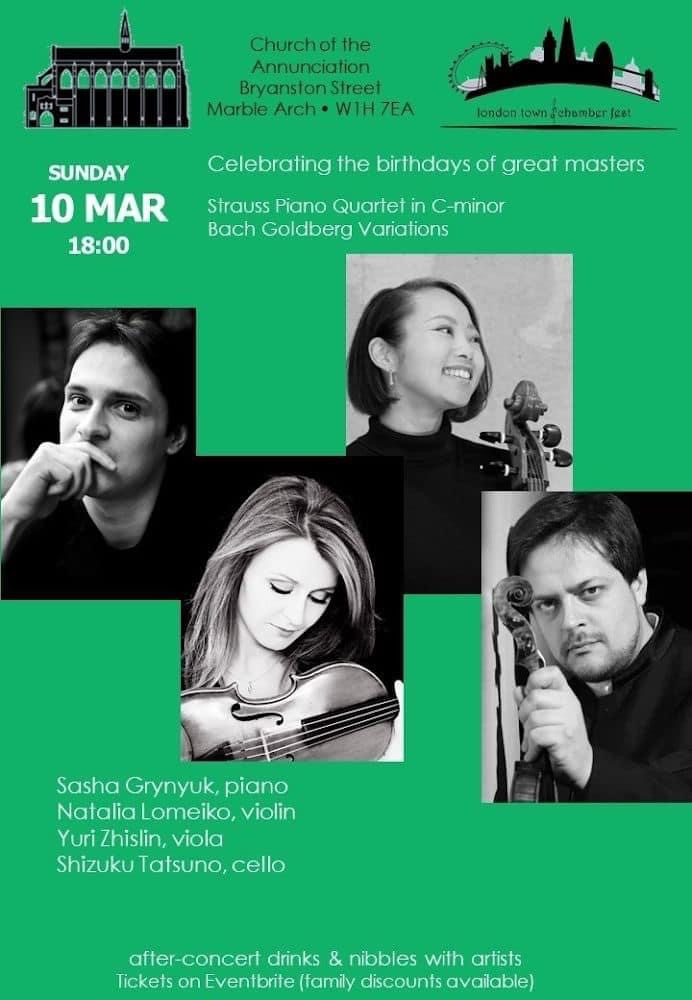
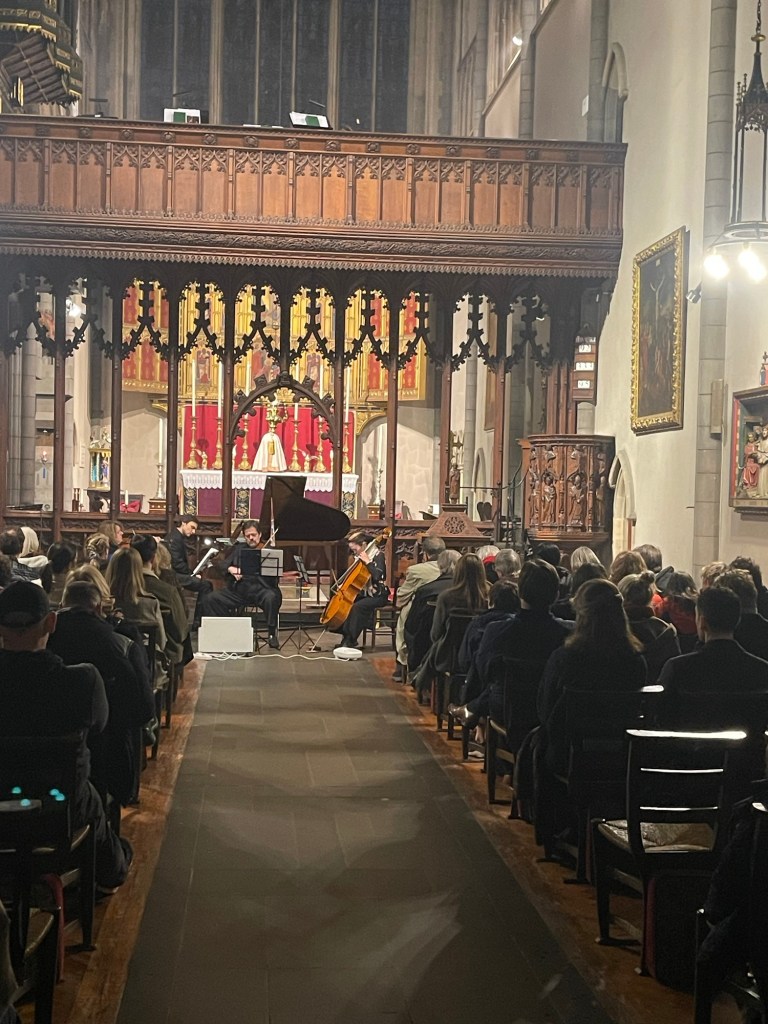
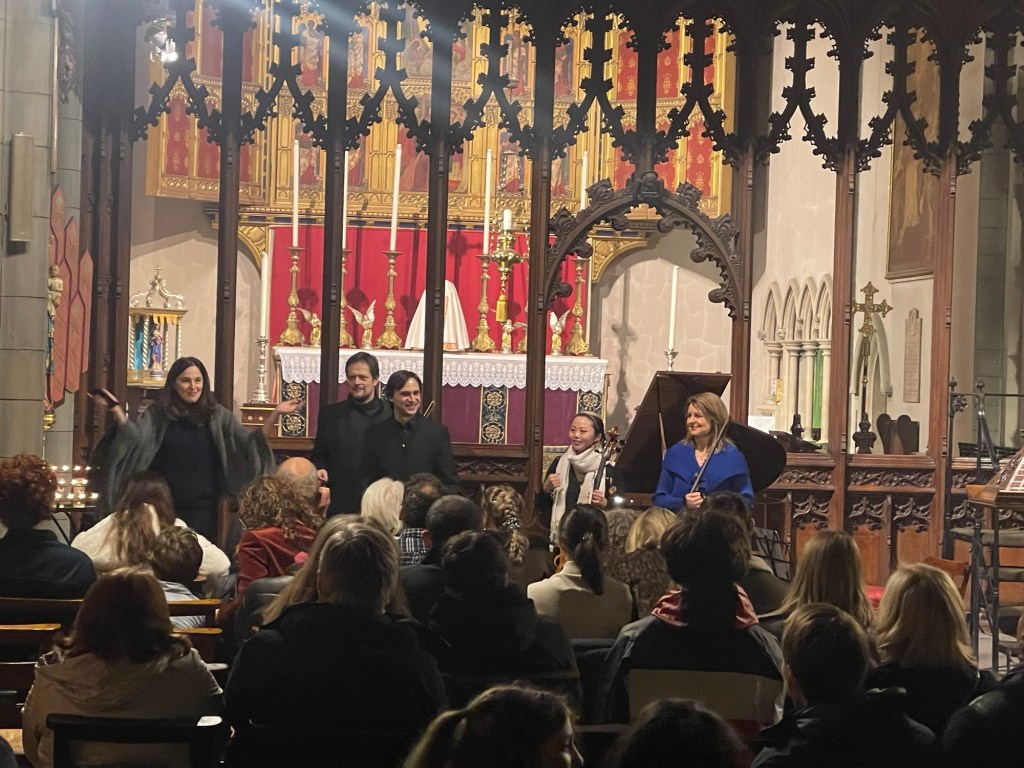
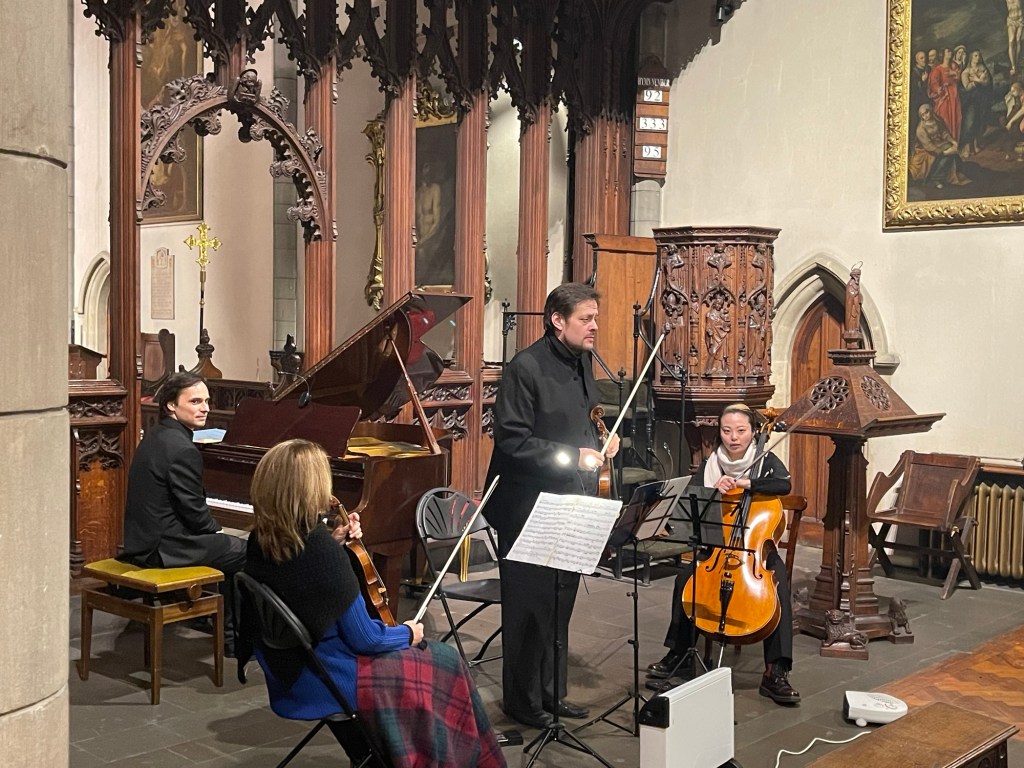
In the majesty of the Church of the Annunciation just a stone’s throw from the Wigmore Hall Sasha Grynyuk and his colleagues have formed a music group to share with us their musical discoveries from a repertoire where there are still so many master works to discover.
Not only was there the discovery of a rarely performed Quartet by Richard Strauss but it was also prefaced by an all too brief excerpt from Bach’s mighty Goldberg Variations.The Aria and first variation for piano solo with the addition of three variations for string trio.An excerpt to whet our appetite for the main work on the programme and to get us used to this beautiful but rather austere edifice that strangely enough ( with a nave six storeys high) is blessed with an excellent acoustic for chamber music.The church was indeed the discovery of Sasha and Katya looking for a church to take eternal vows to each other during the Pandemic four years ago.
Now with a newly acquired piano they have adopted this space to share their love for music with others.Many of Sasha’s illustrious colleagues have joined them in making music together much to the delight of a very large audience who had gathered on a rather bleak Sunday evening to enjoy the fruits of such a warm and noble venture into the unknown.
Sasha gave an impeccabile performance of the Aria from the Goldbergs which is no mean feat as the sublime simplicity of this Aria can sometimes be overzealously ornamented.The first variation too was played quite simply and if I am used to Rosalyn Tureck’s more non legato rhythmic assertion here Sasha convinced with his rather more legato touch as it melded so well with the strings as he passed the chair to the trio just waiting to join in the fun.The ninth and fifteenth variations beautifully played with noble style as was the Quodlibet but surely this brief excursion into paradise needed as Bach himself realised a reappearance of the Aria on high.We needed to be reminded that after all the knotty twine and elaborations the sublime beauty of the Aria cleansed the air with more than a touch of genius!
There followed a superb performance of Strauss’s Brahmsian Quartet that was new to me.A work in four movements lasting over 30 minutes.It was played with a kaleidoscope of sounds from the whispered to the ravishing and from the quixotic silvery beauty of the Scherzo to the full romantic sweep of the outer movements.There were moments of touching beauty in the Andante with four players listening and watching each other to see and feel which way their musical trail was to take.This was chamber music at it’s best with four master players combining in a musical conversation of surprise and discovery.
An aperitif after such a feast was indeed another good reason not to miss this musical treat on store every month in this noble edifice blessed with peace and tranquility just off Oxford Street where even on a Sunday chaos reigns even in the rain!
An aperitif fit for a King And indeed the Boas had left their sumptuous home where music abounds to come to enjoy even more music making just around the corner
Richard Strauss 11 June 1864 Munich – 8 September 1949 (aged 85) Garmisch Partenkirchen,Bavaria
The Piano Quartet in C minor was written in the fall and winter of 1884–85, bearing an autograph date of 1 January 1885. This early chamber music work, written when Strauss was 20 years old, shows considerable influence from Brahms.A few weeks after the work’s completion, the Berliner Tonkünstlerverein, a Berlin-based professional association for musicians, held a competition for “the best piano quartet received”,
Strauss submitted his Piano Quartet and was awarded the first prize out of 24 submissions, receiving a prize of 300 marks
The premiere of the Piano Quartet took place in Weimar on 8 December 1885, with the composer playing the piano part.The work bears a dedication to Georg II Duke of Saxe-Meiningen;as Court Kapellmeister in Meiningen, Strauss was eager to win the trust of the duke. After Strauss resigned to take up a position in Munich, the duke afforded his thanks to the dedication in a letter to Strauss: “The dedication of your inventive, beautiful quartet will afford me great pleasure. On this occasion, I would like to tell you that I am very sad to see you leave and confess that through your achievements I am thoroughly cured of my earlier misapprehension that you, due to your youth, were not yet qualified to be the sole director of an orchestra.” In December 1885, Bülow unexpectedly resigned from his post, and Strauss was left to lead the Meiningen Court Orchestra as interim principal conductor for the remainder of the artistic season through April 1886.He notably helped prepare the orchestra for the world premiere performance of Brahms’s Fourth Symphony which Brahms himself conducted. He also conducted his Second Symphony for Brahms, who advised Strauss: “Your symphony contains too much playing about with themes. This piling up of many themes based on a triad, which differ from one another only in rhythm, has no value.”Brahms’ music, like Wagner’s, also left a tremendous impression upon Strauss, and he often referred to this time of his life as his ‘Brahmsschwärmerei’ (‘Brahms adoration’) during which several his compositions clearly show Brahms’ influence, including the Piano Quartet in C minor op.13 Op. 13 (1883–84), Wandrers Sturmlied (1884) and Burleske (1885–86).”
Allegro
Scherzo: Presto
Andante
Finale: Vivace
Following a performance in Berlin on 22 May 1886 at a soiree of the Tonkunstlerverein ,the Vossische Zeitung wrote:
‘Richard Strauss’] new work testifies to aesthetic sense, inventiveness and technical skill. Just as the composer keeps within the bounds of a healthy sensibility here, he also develops his themes in a clear and mostly lively, as well as artistic manner. Only the first Allegro and the Scherzo of the quartet seem to be the most peculiar in substance, the latter especially with its rhythms. The Andante initially captivates with its soft and full swelling cantilena, but becomes tiring in the course due to the lack of a more lively contrast. The finale is fresh and brisk; in keeping with the basic character of the work, we would have liked a grander conception of this movement. The arrangement of the instruments, especially the strings, is as melodious as it is often characteristically charming.’ Music critic Arthur Johnstone wrote in 1904 that Strauss “shows himself a better Brahmsian than Brahms, avoiding all his model’s worst faults” and that the quartet “might rank as the mature work of anyone but Strauss” The work was performed in Cologne in 1887 and the critic Richard Pohl wrote :’Richard Strauss has an unusual talent for composition – he has his own thoughts, imaginative ideas, great formal dexterity and a ‘long breath’, a proof of proficient skill. The Quartet lasts three quarters of an hour and yet kept us in suspense until the end. The last movement, however, is the weakest – but that happens to most composers, as it is much harder to satisfactorily conclude than to begin. Dramatists usually do not fare any better with their final acts. The first movement is large in scale and broad in development; the Scherzo has real humor, but is so exceptionally difficult rhythmically that, as one kind artist told me, “you must be able to keep time very well just to listen to it”. The Andante is noble and flows beautifully.’
Strauss villa at Garmisch – Partenkirchen Built 1906.
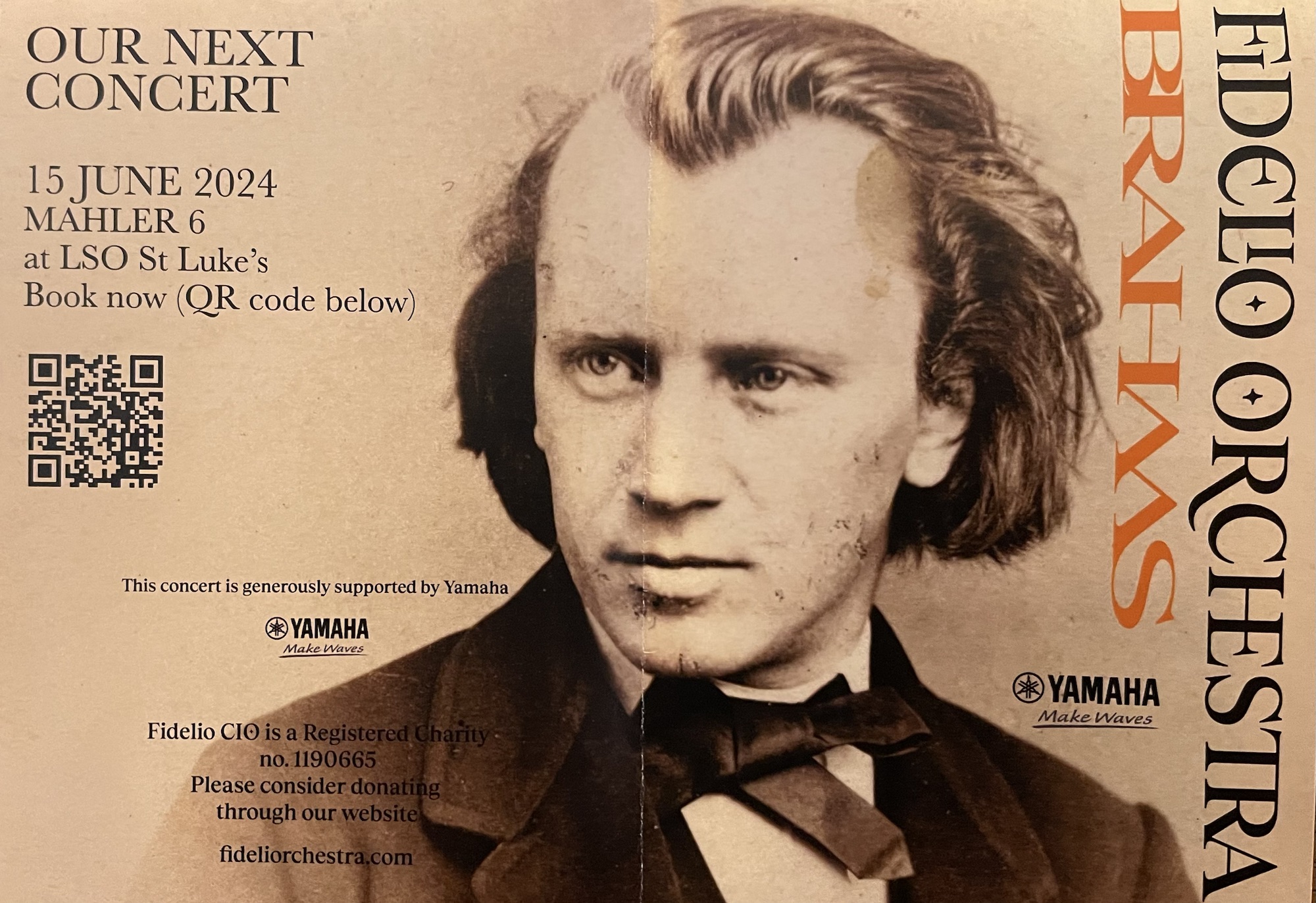
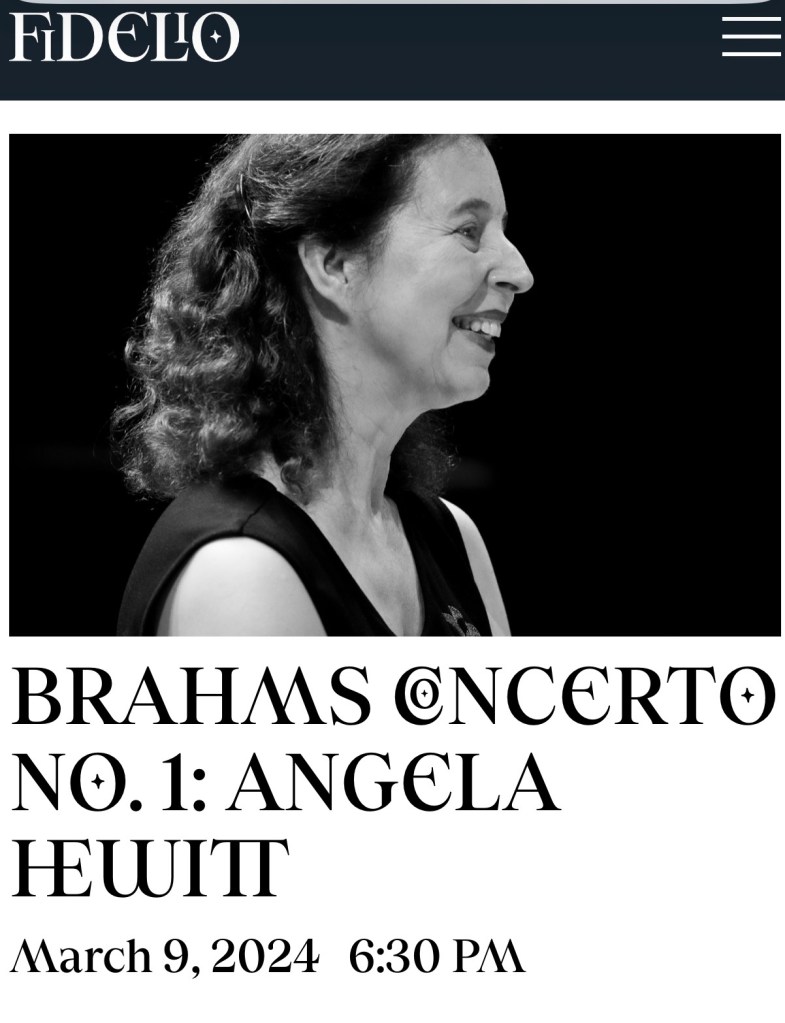
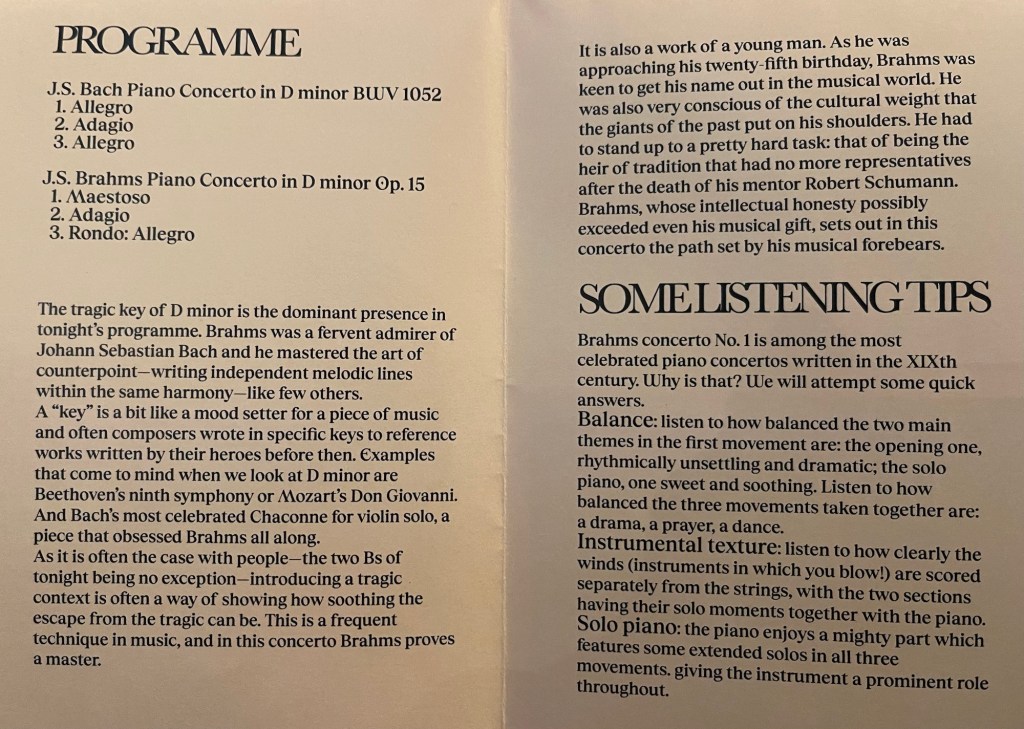
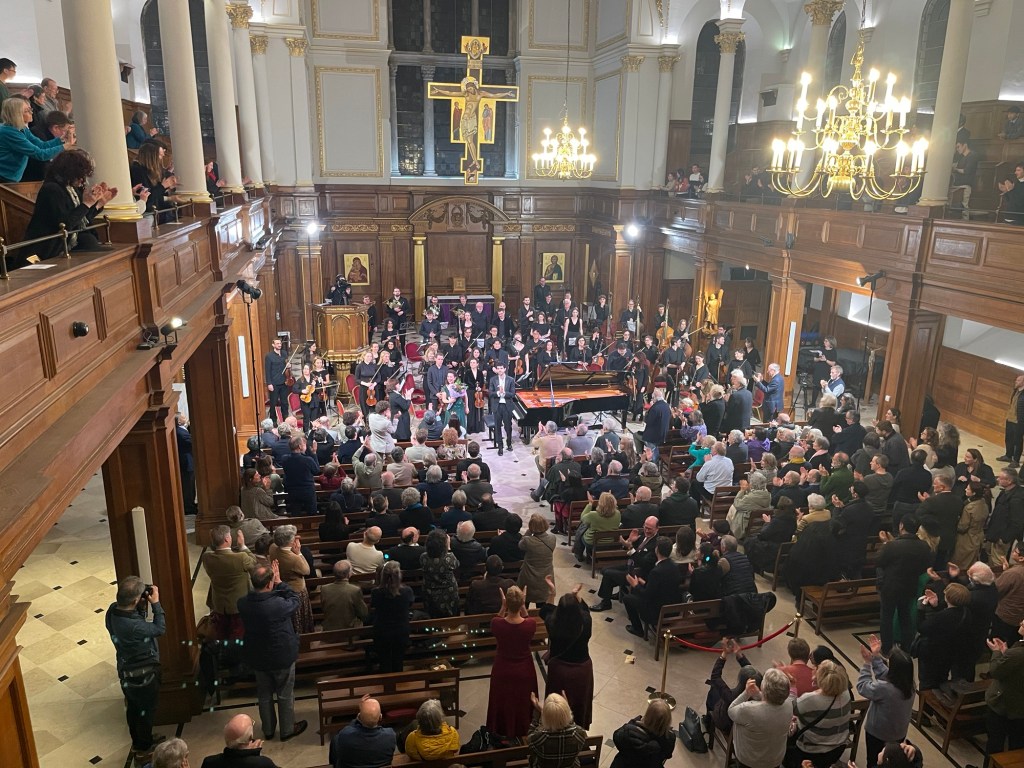
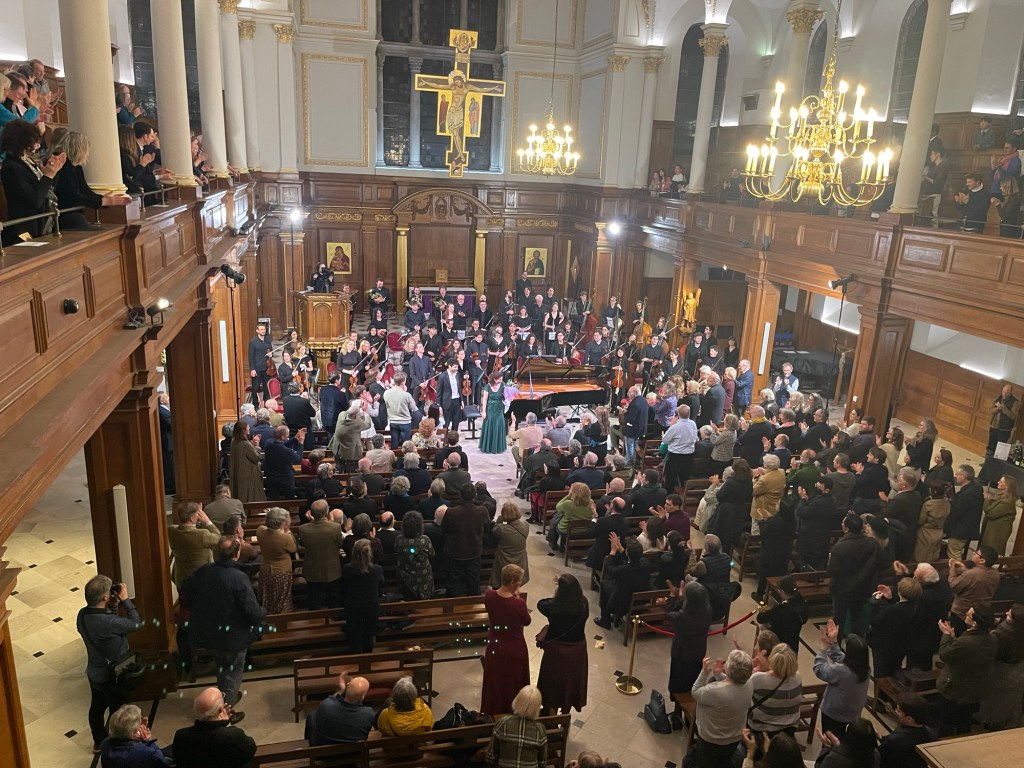
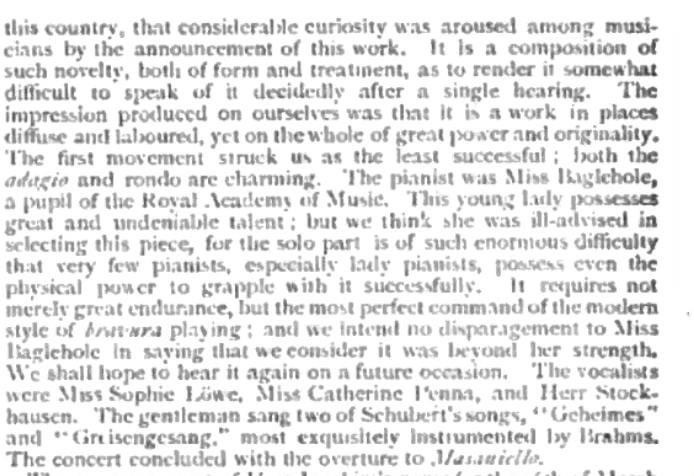
Angela Hewitt’s triumph with Bach and Brahms on the 152nd anniversary of the first performance of Brahms D minor Concerto op 15 in England on 9 March 1872 at the Crystal Palace .A certain Miss Baglehole was the soloist who was obviously not up to the job being criticised for not having the strength to play such a modern work where the piano is pitched against the orchestra .
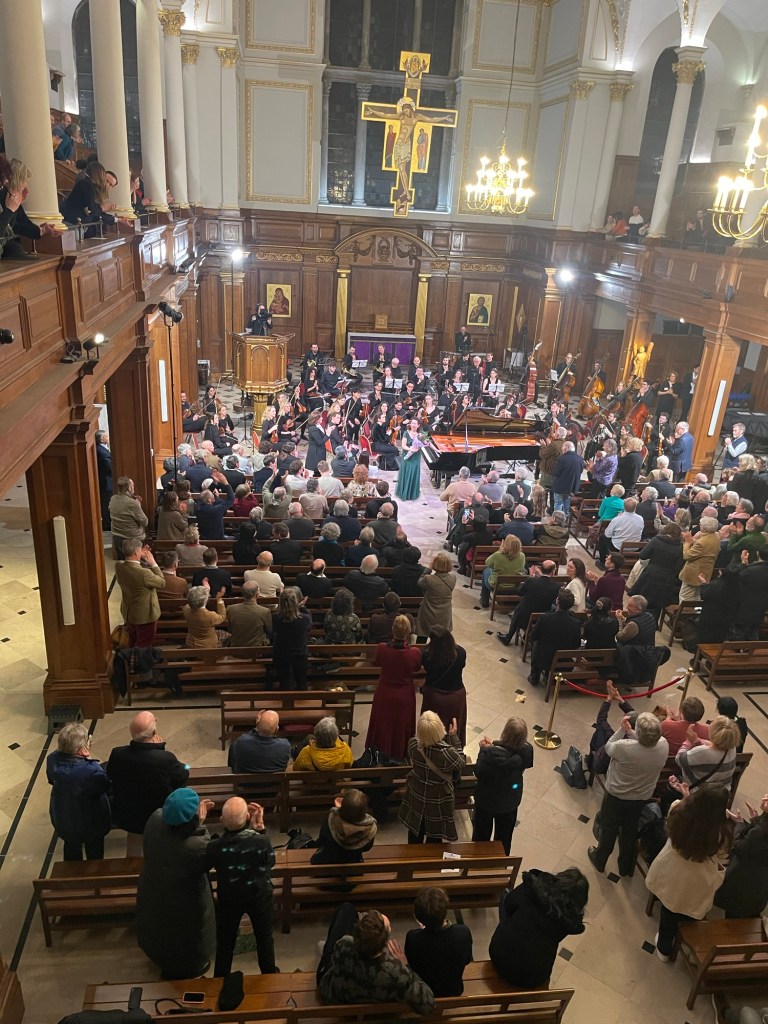
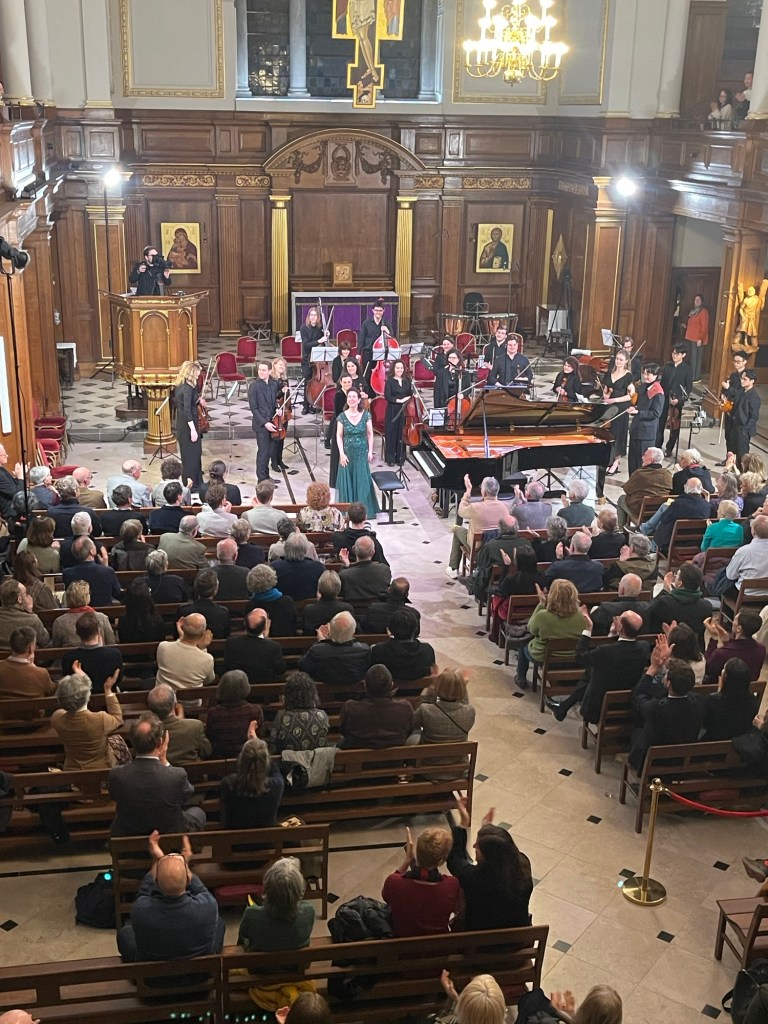
Angela promised that would not be the case today and the power she gave to the great black beast before her shook the beautiful St Andrew Holborn to the rafters.There was lyrical radiance and searing intensity too as Angela was like an animal unleashed at last able to show us that not only Arrau could stand his own against the orchestra.
This was after another D minor concerto ,that of Bach, where Angela conducting from the keyboard showed us what a High Priestess can really do by turning Bach’s sublime knotty twine into moments of ravishing beauty and dynamic drive with breathtaking contrasts in dynamics and a rhythmic buoyancy that was hypnotic with its subtle refined insistence .
Angela’s generosity towards helping young musicians is well known and culminates in Masterclasses wherever she may be performing or living :
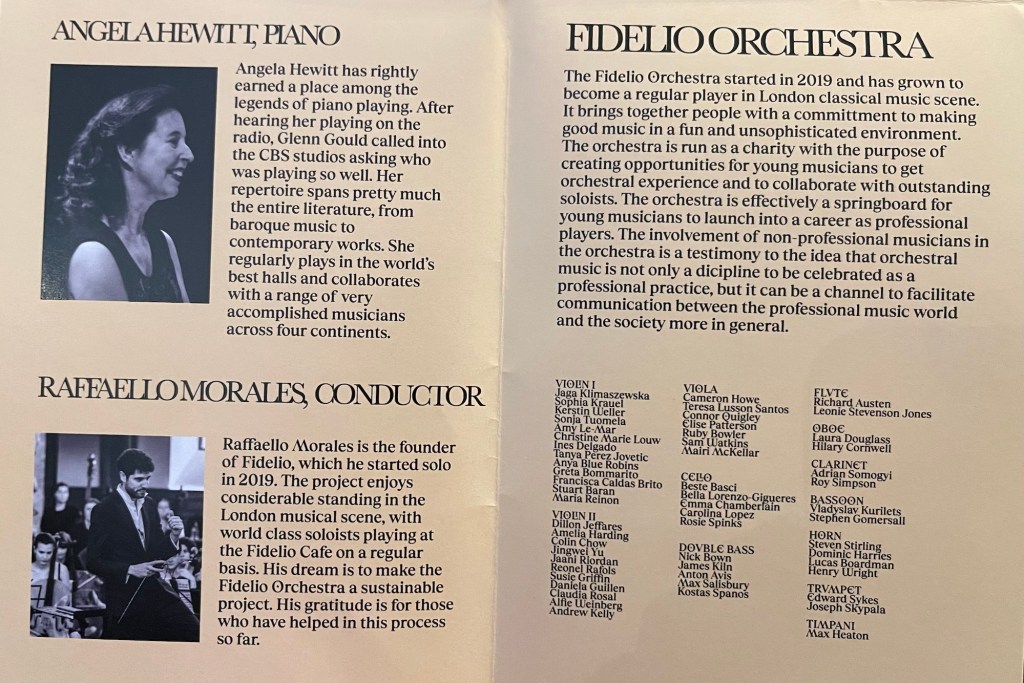
Tonight she was supporting the Fidelio Orchestra that has been created by Raffaello Morales with ‘the purpose of creating opportunities for young musicians to get orchestral experience and to collaborate with outstanding soloists’.Similar to the Southbank Sinfonia in London and the Roma Tre Orchestra in Rome and to some extent the Oxford Philharmonic of Marios Papadopoulos.
I expect and hope that there are also many other ensembles created to give this invaluable experience to graduate musicians, often superb young soloists hoping for a career, but just lacking the experience of working together and learning to listen and breathe with others in a chamber music environment.
Angela has also played solo recitals in the nearby Fidelio Cafe as have many of her illustrious colleagues ,which is a fun and unsophisticated environment with a commitment to bringing people together offering superb music combined with cordon bleu cuisine!
No ‘cuisine’ tonight but two master works by Bach and Brahms.One conducted by Angela who has played and conducted the Klavier Concerti of Bach with many of the major ensembles worldwide .Her experience and musicianship will be of lasting benefit to these young musicians as making music with a ‘High Priestess’ will remain with them as an informed and unforgettable experience for the rest of their professional careers.Brahms of course requires much larger forces and whilst the strings produced a luscious sometimes ravishing sound the winds and brass will have learnt to listen more closely to the overall line that Raffaello was depicting with his beautifully fluid gestures.It gave us the public,though, a chance to hear a pianist ,who is world renowned for her Bach and classical playing, in a different more Romantic repertoire .We should not forget that her programmes this season have included the Brahms F minor Sonata and Schumann Sonata op. 11 as well as completing her Bach Odyssey in many parts of the globe and final recordings of Beethoven 32 Sonatas and Variations as well as complete Mozart Sonatas .I well remember her performance of the Liszt B minor and Dante Sonatas in Rome ,as well as the Goldberg Variations,of course ,shortly after winning the one and only Glenn Gould Competition in Canada in the 80’s.She has also recorded much of the French repertoire including complete Ravel and also major works by Fauré, Chabrier and Messiaen.
Angela writes : I miss my friend the late Michael Steinberg who was Artistic Advisor to both the San Francisco Symphony and Minnesota Orchestra back in the 80s/90s. He wrote the most wonderful programme notes (many published by OUP) and he was the person who got me to start talking and writing about music. The dearest of friends. Well, I was reading his wonderful note on Brahms’ First Piano Concerto this morning and he mentions that the first performance in England was on March 9, 1872 at Crystal Palace, London, and the pianist was a Miss Baglehole (no joke). I’ve found a review of the concert, an extract of which is below. It’s the usual thing: how a lady can’t play Brahms. So in celebration of International Women’s Day which is tomorrow, I’m posting this and saying that I shall play the Brahms D minor with more balls than a lot of men–believe me!!! And I see we’re performing it on Saturday on the 152nd anniversary of its first performance in England.
Hugo Philipp Jacob Wolf 13 March 1860 – 22 February 1903 was born in Windischgratz in the Duchy of Styria (now Sloveni Gradec,Slovenia ), then a part of the Austrian Empire . Herbert von Karajan was related to him on his maternal side.He spent most of his life in Vienna , becoming a representative of a “New German” trend in Lieder , a trend which followed from the expressive, chromatic and dramatic musical innovations of Richard Wagner .Though he had several bursts of extraordinary productivity, particularly in 1888 and 1889, depression frequently interrupted his creative periods, and his last composition was written in 1898, before he suffered a mental collapse caused by syphilis.
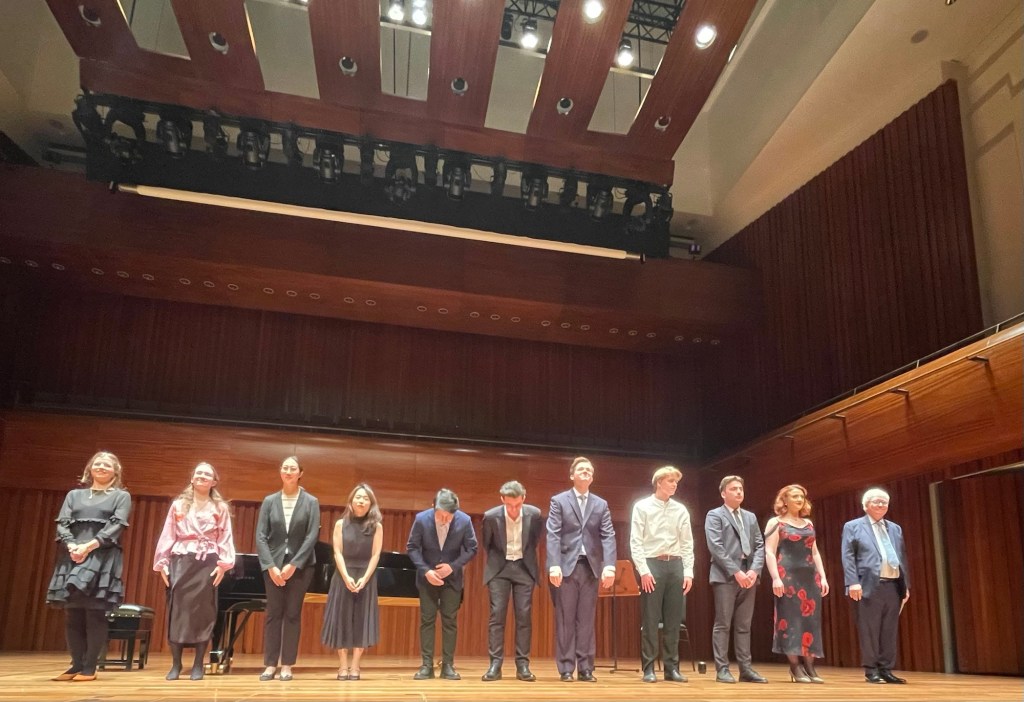
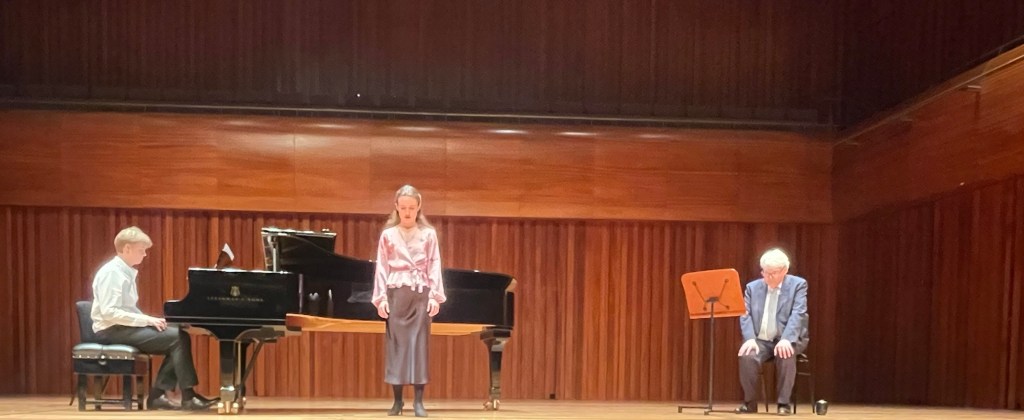
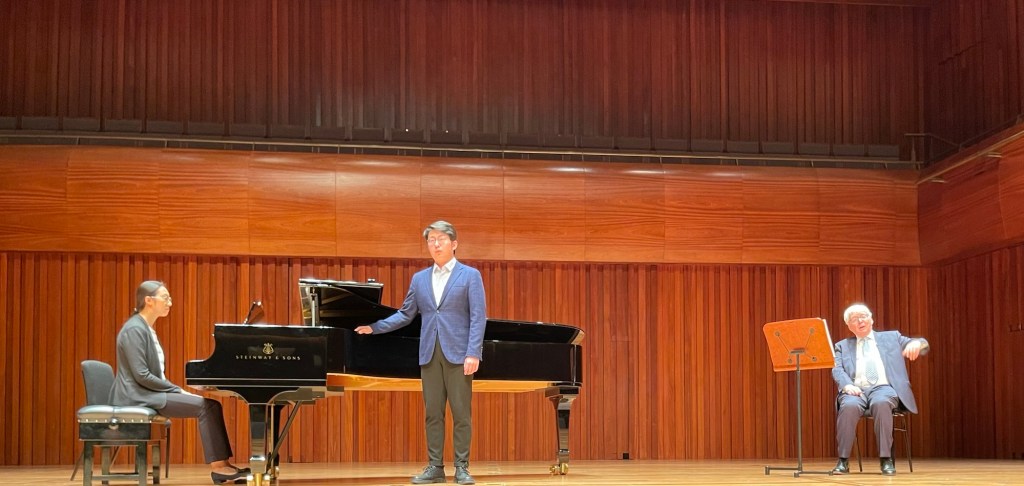
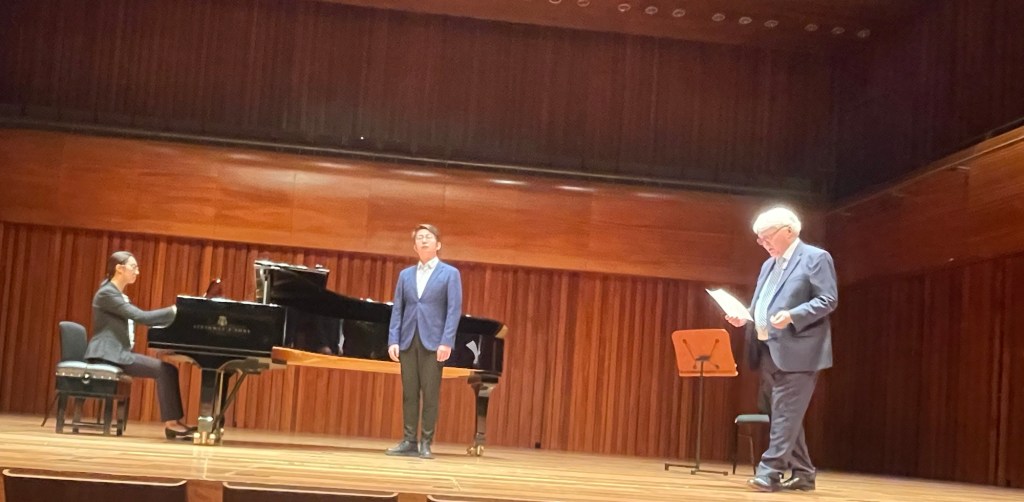
A wonderful voyage of discovery into the world of Hugo Wolf Graham Johnson recounting in his inimitable way the many phases of a genius who was to produce such wonders in the span of only 13 years
Friday 8 March 2024 6pm Milton Court Concert Hall Graham Johnson Song Guild Graham Johnson director
Harriet Cameron soprano Manon Ogwen Parry soprano Gabriella Noble mezzo-soprano Sebastian Hill tenor Jacob Cole tenor Zheng Tu baritone Sooyeon Baik piano Toby Stanford piano Valentina Wang piano Charlie Woof-Byrne piano
The Paul Hamburger Prize presented by his son on the 20th Anniversary of his death .The prize awarded annually is for Voice and Piano and was awarded to Manon Ogwen Parry and Charlie Woof-Byrne
Paul Hamburger 3 September 1920, Vienna – 11 April 2004, London ) was born in Vienna in 1920, and studied at the Vienna State Academy before emigrating to England in 1939. In 1941, he received a scholarship to attend the Royal College of Music , London, studying with Frank Merrick,Gordon Jacob and Vaughan Williams . From 1945, he started on a career as an accompanist, chamber musician and teacher, and was associated in concerts and on disc with many distinguished singers and instrumentalists, including Dame Janet Baker,Elisabeth Söderström,Max Postal and Pierre Fournier. He performed both in Britain and abroad, including Germany, Austria, Switzerland, the Netherlands, France and Belgium. Malcom Arnold dedicated his Concerto for Piano Duet and Strings, op. 32 of 1951 to Hamburger and his piano duet partner, the composer pianist Helen Pyke . He taught singers and accompanists at the Guildhall School of Music and Drama, London, and gave masterclasses and annual seminars in England, Scotland, Ireland, Germany, Austria, Sweden and Finland. His literary works include an edition of Mozart Lieder (Oxford University Press), contributions to books on Mozart songs, Mahler’s Wunderhorn songs, Chopin and Britten, and translations, notably of bruno Walter and Alfred Brendel . He was a Fellow of the Guildhall School of Music and Drama, an Honorary Member of the Royal Academy , London, and was awarded the Austrian Cross of Honour for Science and Art in 1991 ,upgraded to 1st class in 2000.
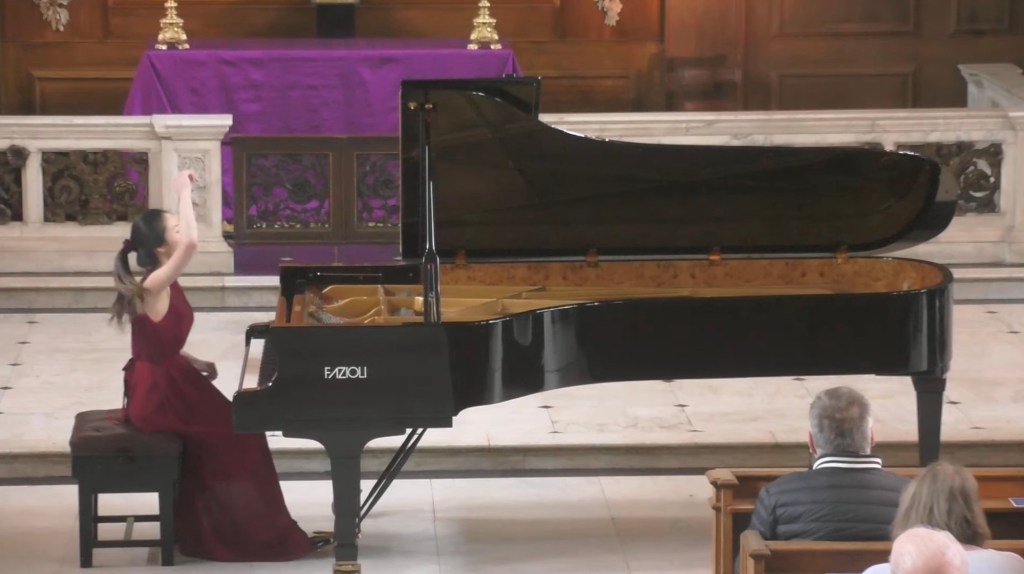
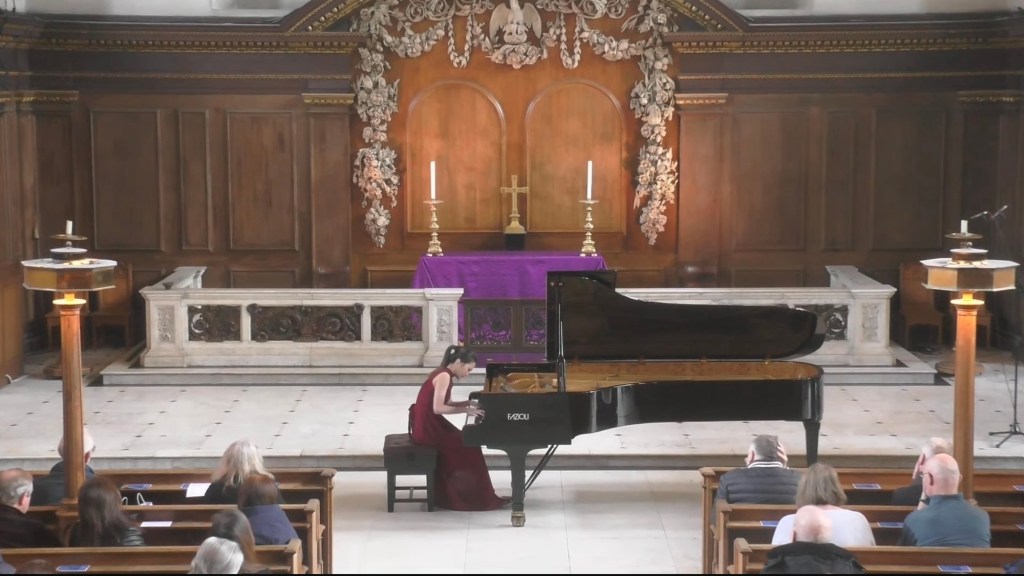
The four books of Iberia by Albeniz are considered his masterpiece and Rondeña that Hao Zi played today is from the second book .A famous New York critic writing about Alicia de Larrocha’s performance simply said : “There is really nothing in Isaac Albeniz’s Iberia that a good three-handed pianist could not master, given unlimited years of practice and permission to play at half tempo. But there are few pianists thus endowed.” Hao Zi has no need for three hands because she has a sense of style and colour allied to excitement and passion that brought this beautiful piece vividly to life.A technical command that allowed the music to flow so naturally with a subtle sense of rubato and beguiling sense of character.The beautiful ending suddenly capriciously springing to life with a typical Spanish click of the heels and stamp of the feet.
I have heard her play the Scriabin early Fantasy Sonata many times but today she played with an authority and sense of colour that can only come from a long association with a work that is loved and deeply felt.There was from the very first notes a sumptuous sense of colour and a beguiling rubato of insinuating delicacy.A melodic line in the tenor register of rich beauty as it was embellished by beautiful sounds that just glowed with wonderfully subtle colours as it gradually built to a climax .The opening gentle chords suddenly became imperious and noble only to dissolve into a world of ravishingly beautiful waves of sound.The second movement was breathtaking with its dynamic rhythmic drive bursting into melodic life with passionate ecstasy.A technical command and fluidity of sound and movement that allowed the music to weave its way with simplicity and brilliance.
The Corelli Variations by Rachmaninov I have not heard her play before as she had decided to change her programme a year ago due to some muscular problems.She now tells me that these problems have been resolved simply by ensuring that her hands are kept warm before playing.These Rachmaninov variations are based on a popular traditional melody called La Follia (a madness) incorrectly attributed to Corelli .It was written in 1931 in Rachmaninov’s country home in Switzerland and was dedicated to his friend, the violinist Fritz Kreisler. Rachmaninov wrote to the composer Nikolai Medtner , on 21 December 1931: ‘I’ve played the Variations about fifteen times, but of these fifteen performances only one was good. The others were sloppy. I can’t play my own compositions! And it’s so boring! Not once have I played these all in continuity. I was guided by the coughing of the audience. Whenever the coughing would increase, I would skip the next variation. Whenever there was no coughing, I would play them in proper order. In one concert, I don’t remember where – some small town – the coughing was so violent that I played only ten variations (out of 20). My best record was set in New York, where I played 18 variations. However, I hope that you will play all of them, and won’t “cough”.
The theme was played by Hao Zi with delicacy gently coming to life with the first variations.The delicate legato and staccato of the second was answered by the almost too serious third and fourth only to contrast with the dynamic rhythmic energy of the fifth and sixth .An outpouring of continuous movement over the long held pedal note of D was brought to a conclusion with thunderous cascades of notes .A beautifully inquisitive Adagio misterioso was played with exquisite delicacy as it expanded with a sumptuous build up of delicate arabesques only to explode into three variation of dynamic rhythmic energy and technical finesse.The agitato before the half way cadenza that leads from minor to major was played with unusual grace.What poignant beauty Hao Zi brought to the major key of D flat with the exquisite luminosity of the fifteenth variation leading to a tumultuous build up to the twentieth variation of triumphant octaves spread over the entire keyboard.Over the long held pedal note of D suddenly the clouds cleared and the beautifully expansive coda was revealed with real artistry as Hao Zi allowed the music to unfold with beautiful enticing counterpoints before the final beautifully placed two chords in the home key.
Alborada del gracioso I have heard Hao Zi play many times and it always astonishes me her superb technical control and how she manages to play the double glissandi with such sumptuous ease and mastery.She even manages to convey the hot boiling passion that is concealed in the recitativi.
I very much look forward to her major London debut for the prestigious Kirckman Concert Society at Kings Place on the first of July.
Hao Zi Yoh is a Malaysian pianist based in London. She is a top prize winner in many international piano competitions including Rome International Piano Competition. She has performed around Europe, USA, China, Japan and Malaysia both as a soloist and chamber musician, in venues such as Wigmore Hall, Southbank Royal Festival Hall, Salle Cortot,Steinway Hall London, St. Martin-in-the-Fields, Dewan Filharmonik Petronas and Teatro Quirino. She also performed with the Royal Liverpool Philharmonic, Nova Amadeus and Baleares Symphony Orchestra. Most recently, she has given concert tour in Northern Italy organised by the Keyboard Charitable Trust, and has been selected as an Artist for the Kirckman Concert Society 2023/24. Hao Zi also participated in creative outreach projects led by the Open Academy for children and elderly with Dementia, where she performed in Music for Moment Concerts at the Wigmore Hall. She collaborated with author-illustrator David Litchfield and improvised to his award-winning book “The Bear and the Piano”. Hao Zi remains in close contact with the music scene in Malaysia. She has given talks, performances and masterclasses to the students of University of Malaya, Bentley Music and Persatuan Chopin in hope to share her experiences and help the younger generation. Hao Zi continues to develop her performing career in addition to tutoring at King’s College, London. Apart from giving masterclasses, Hao Zi also organised livestreams and charity fundraisers during the London-lockdown 2021.Currently she is studying with Martino Tirimo, after being awarded full scholarship to pursue an Artist Diploma at Trinity Laban Conservatoire of Music and Dance, generously supported by the Bagri Foundation, Gladys Bratton and TCL Scholarship. Her previous teachers include Elza Kolodin at Music University of Freiburg, Germany and later at Royal Academy of Music under Christopher Elton.
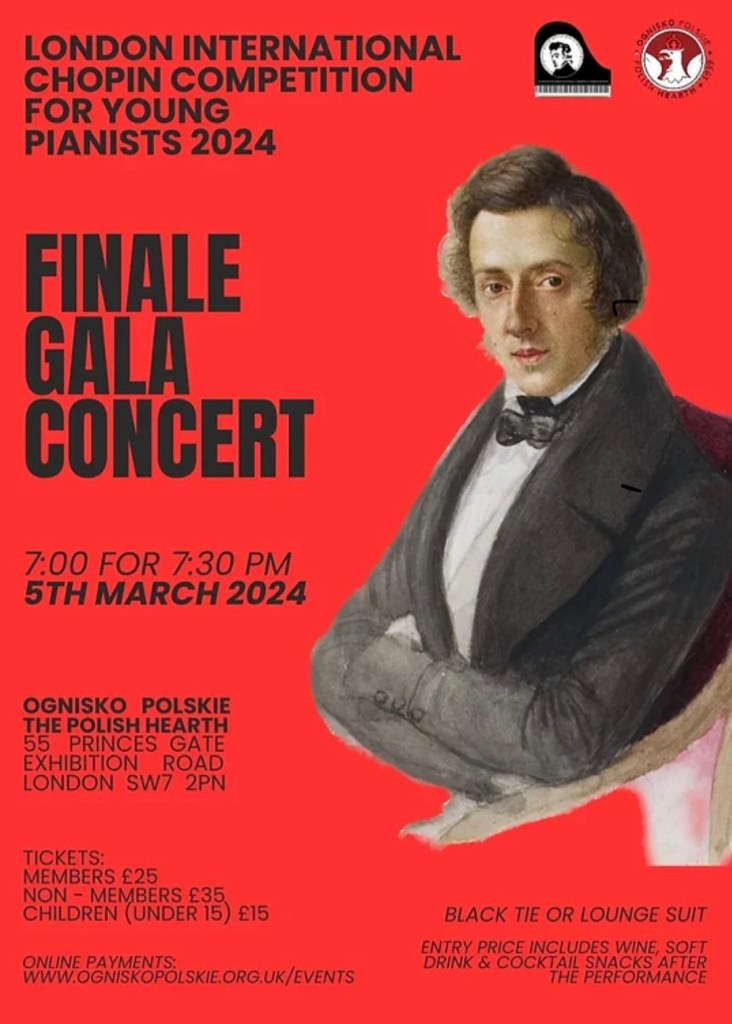
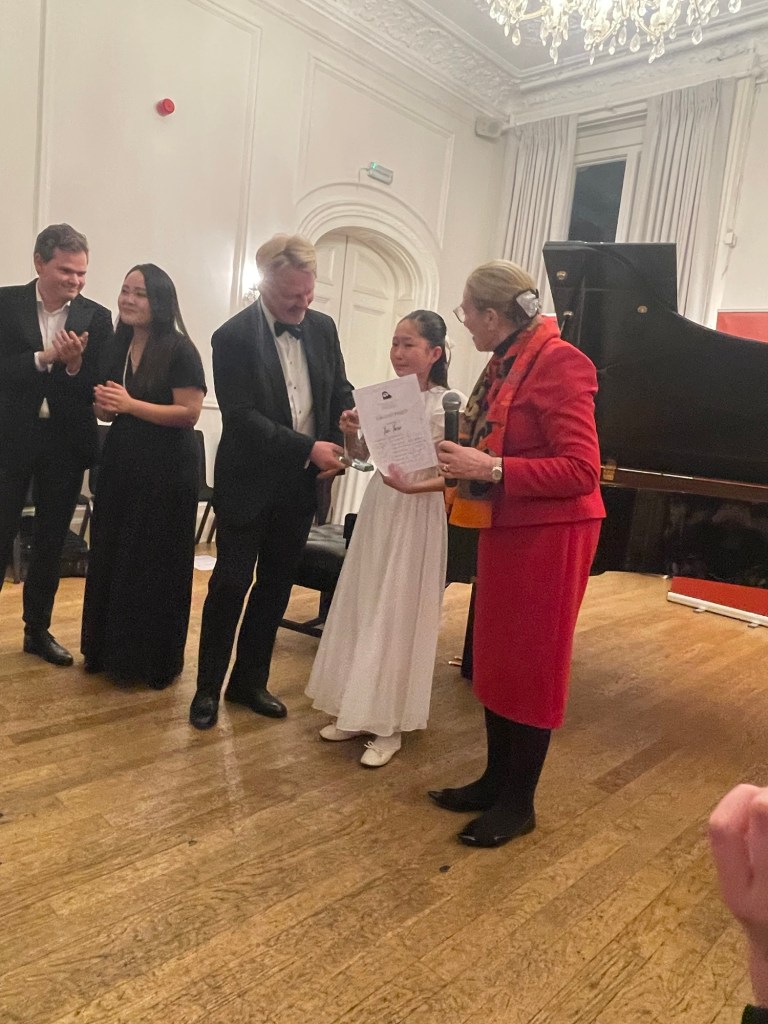
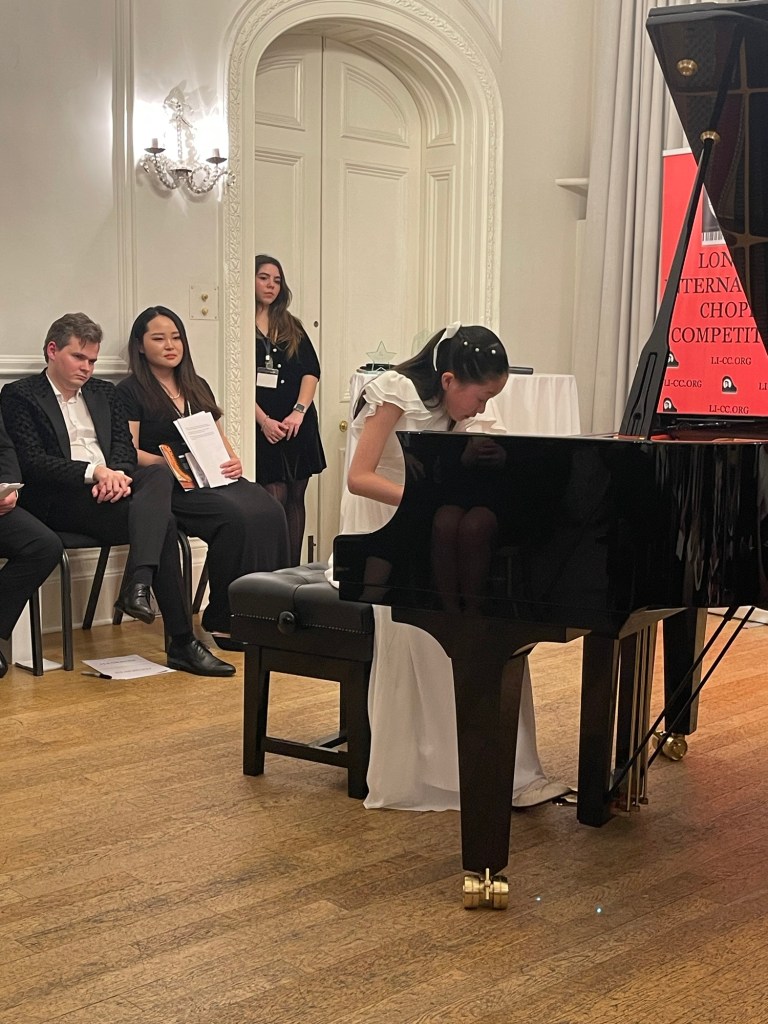
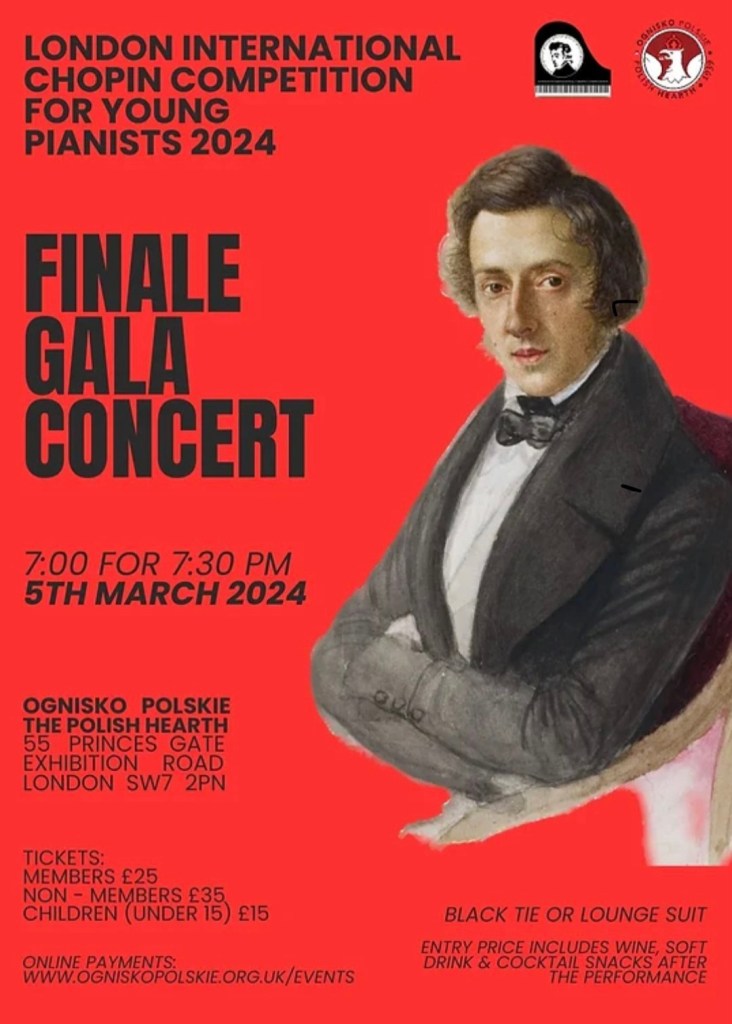
Some things just cannot be taught .When music becomes your life blood and you live every moment with joyous abandon ……just such a girl Yuri Yasui has been blessed by the Gods and the very distinguished jury had no doubt in awarding her the special Grand Prize for a scintillating performance of Rondo a la Mazur op 5
Yuri Yaqui with Artur Haftman and Jenny Lee looking closely on
A wonderfully trained student of Dinara Klinton Deva Mira Sperandio was awarded the audience prize for a very professional performance of the Andante Spianato and Grande Polonaise op 22.
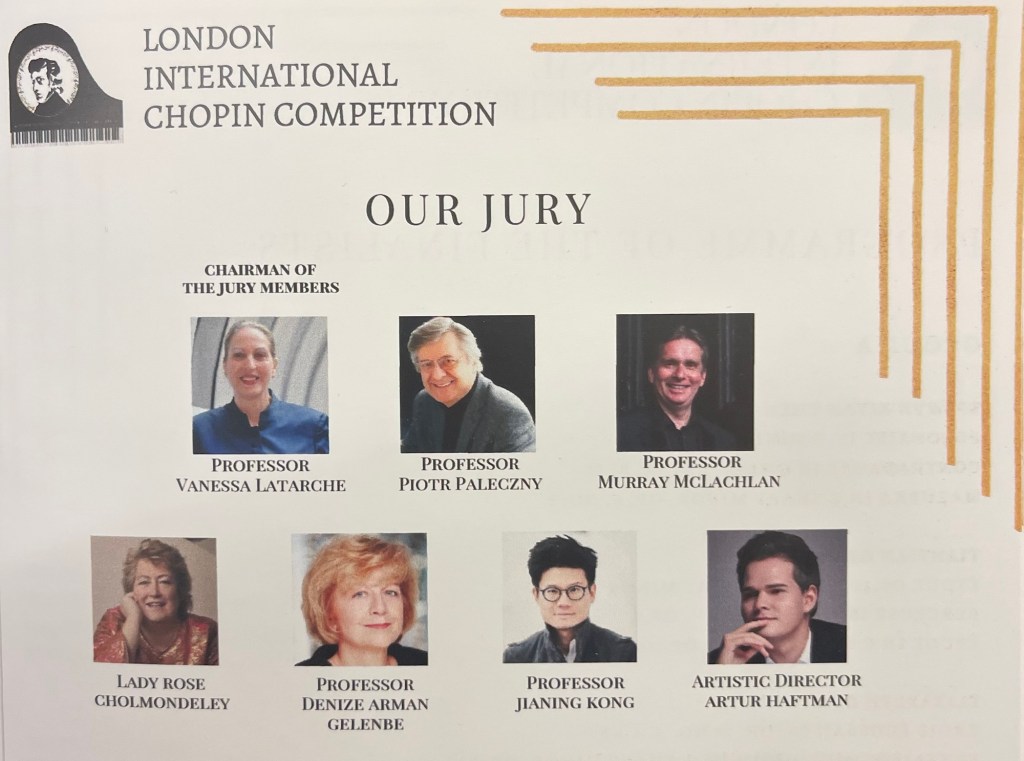
Dinara Klinton writes :Cannot be more proud to be called their teacher… Deva Mira Sperandio , student of The Yehudi Menuhin School, has just won the 1st prize in the highest category, as well as the Audience prize of the London International Chopin Competition for Young Pianists. Here with one of the highly esteemed jury members, Piotr Paleczny.
I have been privileged this week to assist at performances by two other musical geniuses that makes one wonder where does this total dedication to music come from …………….it is very rare but when you are in their presence it is immediately instinctively apparent .
No words or comments are necessary as they fill the air with their mystical genius.A timelessness where the only thing that matters is their hypnotic music making.
It may well be that some children at a very early age are attracted by the sounds that appeal to their senses and this starts a process of recreation- the birth of genius? Each child absorbs unconsciously what surrounds them long before they can actually express themselves in words or actions.I remember Yuanfan Yang’s parents with their young son who was at a friends sixth birthday party and one of the other parents asked for the name of their child’s piano teacher because he had played so wonderfully on the piano that he found at his friends birthday party. ‘ But he does not play the piano….we do not have a piano at home!’ exclaimed his mother .
This is one of the many mysteries of life !A musical paradise indeed !
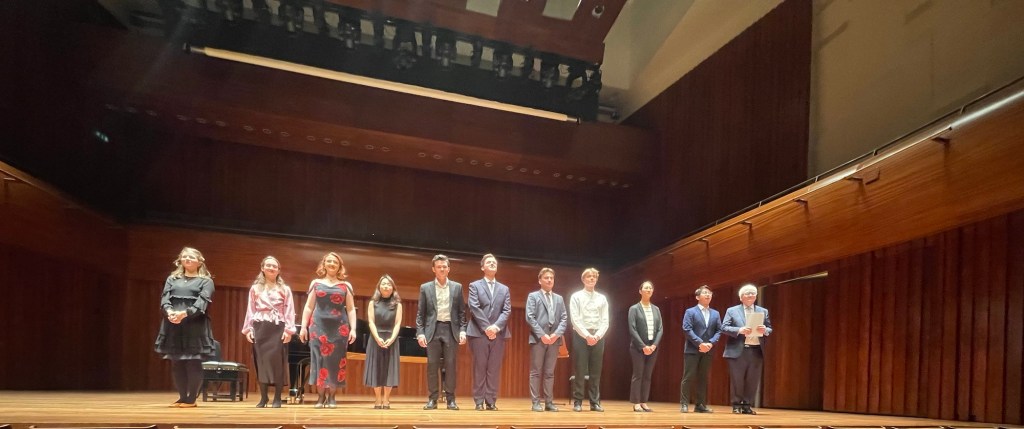
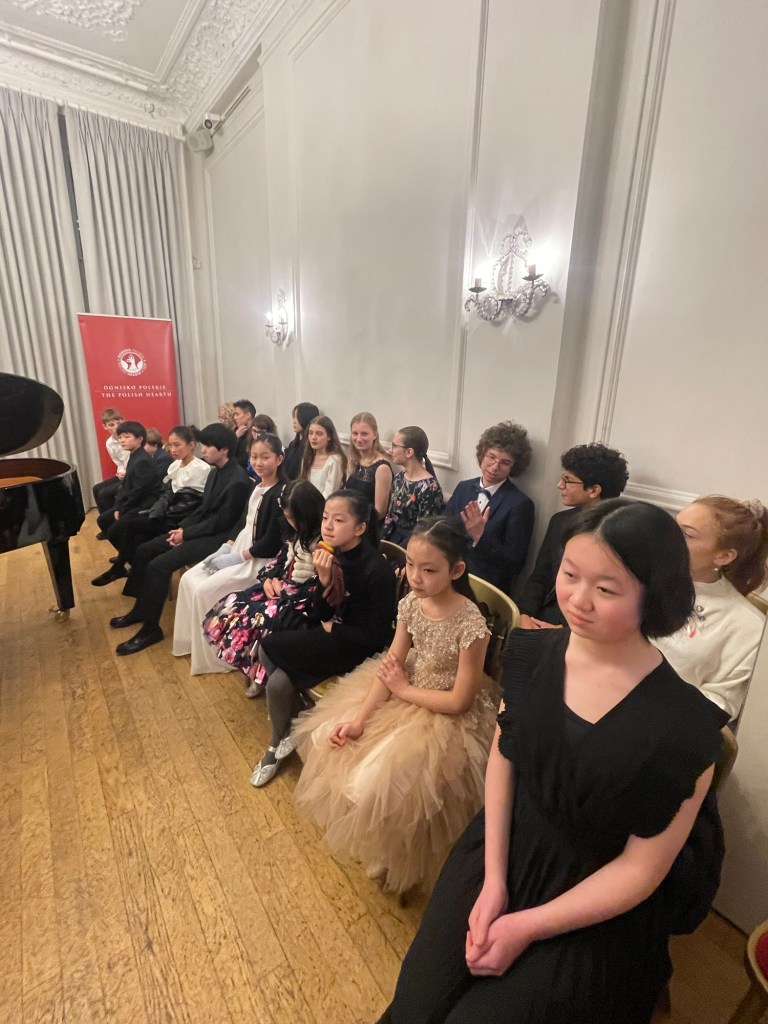
The contestants selected for the final round
Listening to this junior piano competition everyone played well – they were all well trained and dressed in their ‘Sunday best’ but then suddenly one of them shines brighter than all the others.
Artur Haftman with Taige Wang and Christopher Axworthy
I also remember Vanessa Latarche as the prize pupil of Miss Rowe in Ealing who has now grown up and promotes young musicians in such a caring and professional way via the RCM and the Lang Lang foundation not to mention the Hastings International and much else besides.
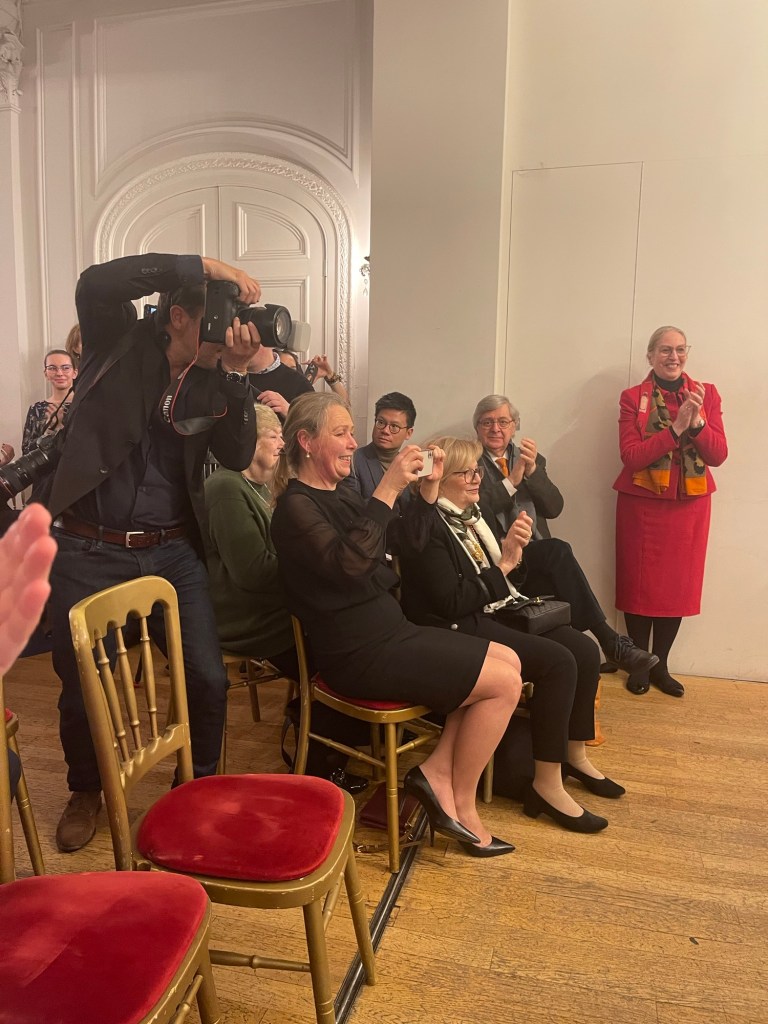
She quite rightly praised all the competitors for their performances knowing what courage is needed to play in the ‘Circus arena’ of competitions ……….a necessary evil which can give the much needed experience to young musicians who may decide when they grow up to take the very arduous path towards a career in music.
It was Artur Rubinstein at his first competition in Tel Aviv who told the contestants that they should be like the bees creating their own unique honey from the choice of flowers that attracted them.Musicians listening to music good,bad and indifferent and making their own choice of what pleases them and thus creating a thing called taste! Taste and style,imagination and intelligence are just some of the ingredients that can help and even sometimes contaminate great natural talent.
Teachers have a great responsibility to nurture and encourage natural talent and not to destroy it with general rules and regulations because each child has very specific needs that must be helped and nurtured with infinite care.
I saw Vitaly Pisarenko and Dinara Klinton in the audience to encourage the young musicians in their care.Both had themselves been child prodigies at the Gnessin school in Moscow where now we in the UK have the Menuhin and Purcell schools which can nurture and encourage great natural talent from a very early age – is it ever early enough though! Vitaly and Dinara are both now great pianists with International careers but they still find time to help these young musicians progress through their youthful journey of ‘Gradus ad Parnassum’ knowing from their own experience what hurdles may lay ahead.
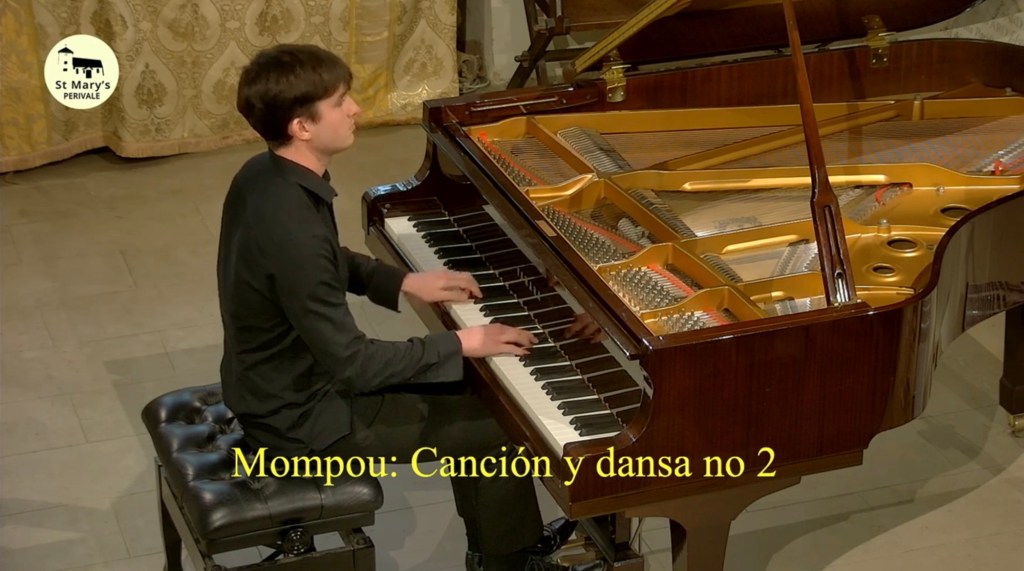
Playing of simplicity and chiselled beauty from Matthew Mc Lachlan one of the three young siblings of Murray McLachlan .A family of remarkable musicians who have all performed many times at St Mary’s.Matthew had surprised even himself when only in his second year at the Royal College of Music in London he was awarded the coveted Chappell Gold Medal for an extraordinarily beautiful performance of Scriabin’s elusive twenty four preludes op 11.Today it was in particular his beautifully lyrical and committed performance of Prokofiev’s somewhat neglected fifth sonata that captured his imagination .A performance of such simplicity as Prokofiev in lyrical mood could show us that there is a side to his compositions that is not always hard driven with canons being fired.The beautiful second movement in particular showed off Matthews control as he allowed the melodic line to shine above a relentless pizzicato left hand .A refined kaleidoscope of sounds that Prokofiev had revealed so poetically in his Visions Fugitives .It had followed performances of Bach where there was a pastoral calm as the voices were allowed to converse with each other creating a knotty twine of tranquility and peace.He had chosen too the two movement Sonata by Beethoven ‘A Thérèse ‘ where the gentle lyricism of the first beautiful phrases opened onto a fluidity and playfulness of beguiling charm and character.The hauntingly beautiful Etude Tableau by Rachmaninov was shaped with rubato and ease just as the beautiful little piece by Alicia de Larrocha was played with simple mellifluous style.Mompou’s beautifully atmospheric Cancion was an ideal partner for such delectable flowing sounds full of radiance and colour.The Butterfly Dream by Petar Dimov was indeed the ideal introduction ,as Matthew had explained ,for the beautiful lyricism of the opening of the Prokofiev Sonata .This was a pianist in poetically lyrical vein today with playing beauty and radiance.
Chetham’s School of Music alumnus Matthew McLachlan was awarded the C. Bechstein scholarship to continue his studies at the Royal College of Music with professor Dina Parakhina. Recipient of numerous awards, Matthew has performed as concerto soloist and recitalist in Poland, Serbia, Italy, Spain, Germany, France and throughout the UK. In July of 2021 Matthew was awarded 1st prize in the Royal College of Music Chappell Medal piano competition and the Esther Fisher prize for best undergraduate performance. Last year, Matthew was a finalist in the Isidor Bajic International Piano Competition and awarded 1st prize in the Bromsgrove International Musicians Competition
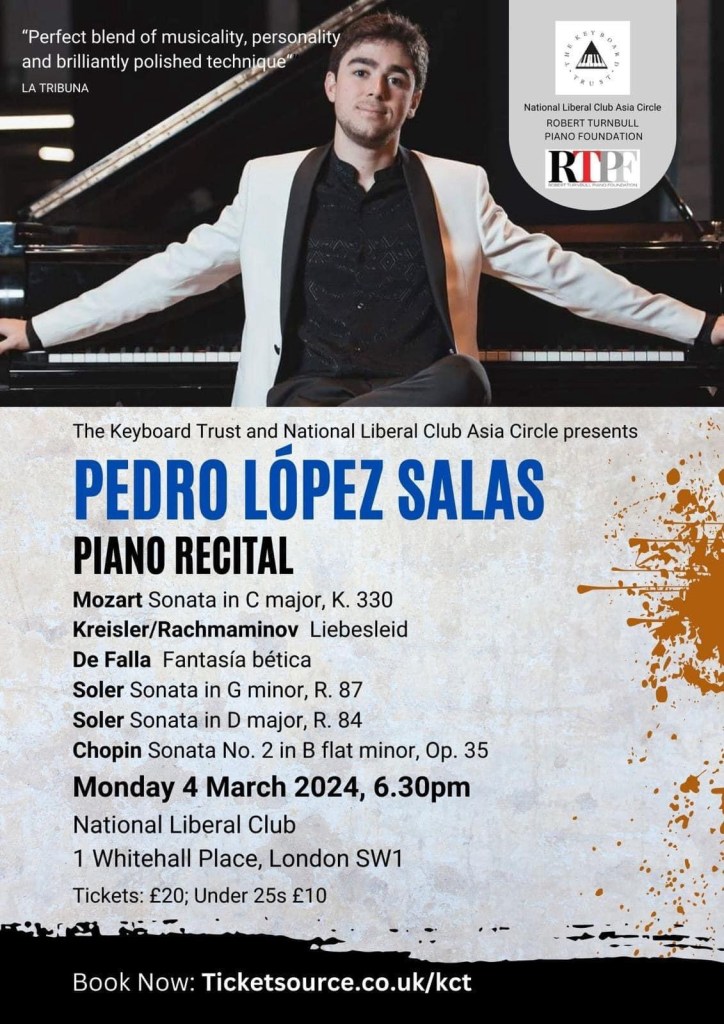
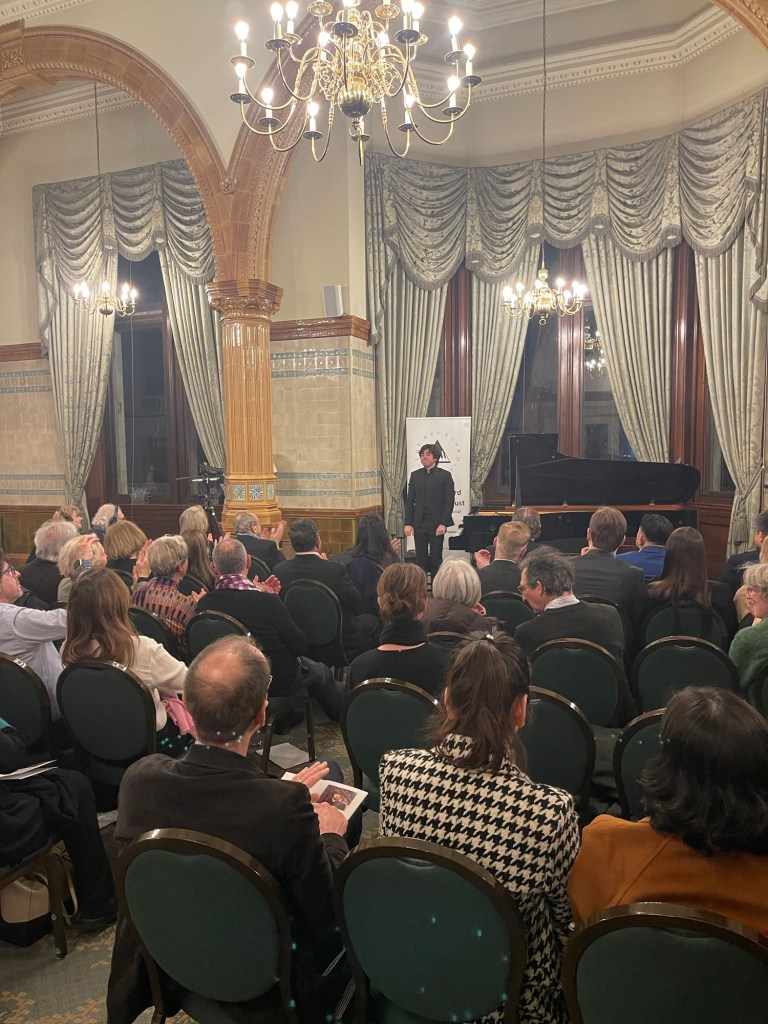
It was clear from the very first notes of this early Mozart Sonata that we were in the hands of a real artist.A refined tone palette of clarity and style with ornaments that sparkled like jewels with delicate precision.But this was no clock work precision because every note spoke so eloquently with a subtle sense of rubato that was both enticing and ravishingly beautiful.Rests and pauses that were as eloquent as the notes that came before and after in a musical conversation that brought this sonata vividly to life .An exquisite Andante cantabile with a kaleidoscopic range of sounds like the human voice where the ending was pure whispered magic.The brilliance of the Allegretto was tempered with elegance and style where everything was given the just time to breathe with delicate and delectable ornaments that just added to the civilised dance of its age.
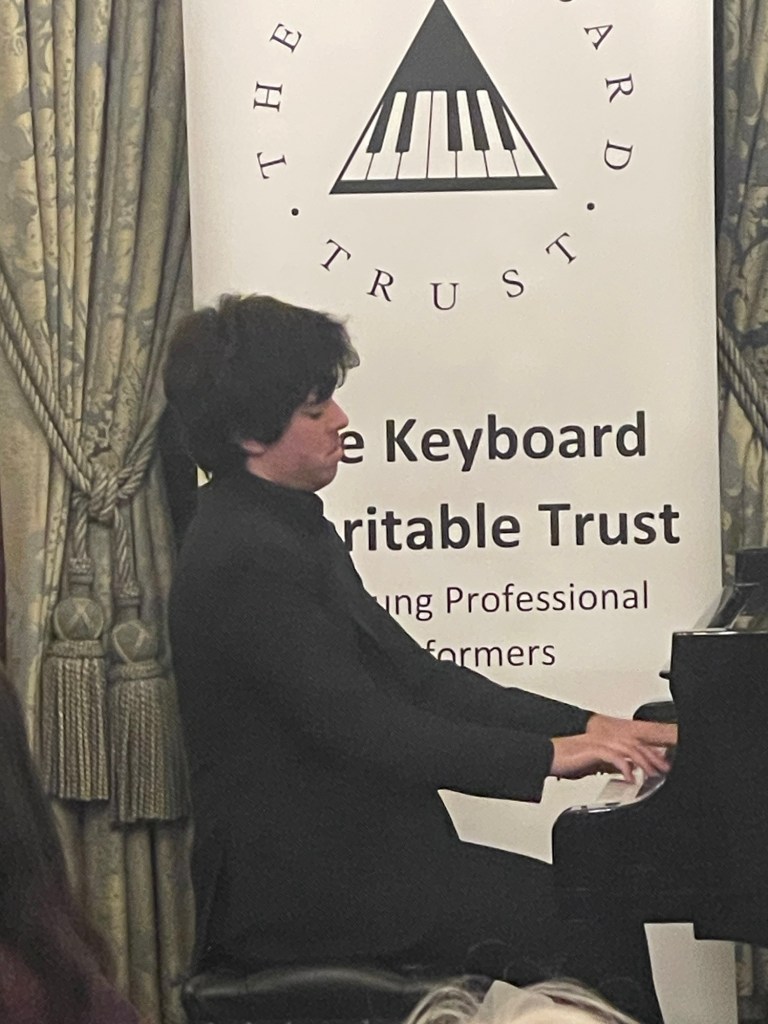
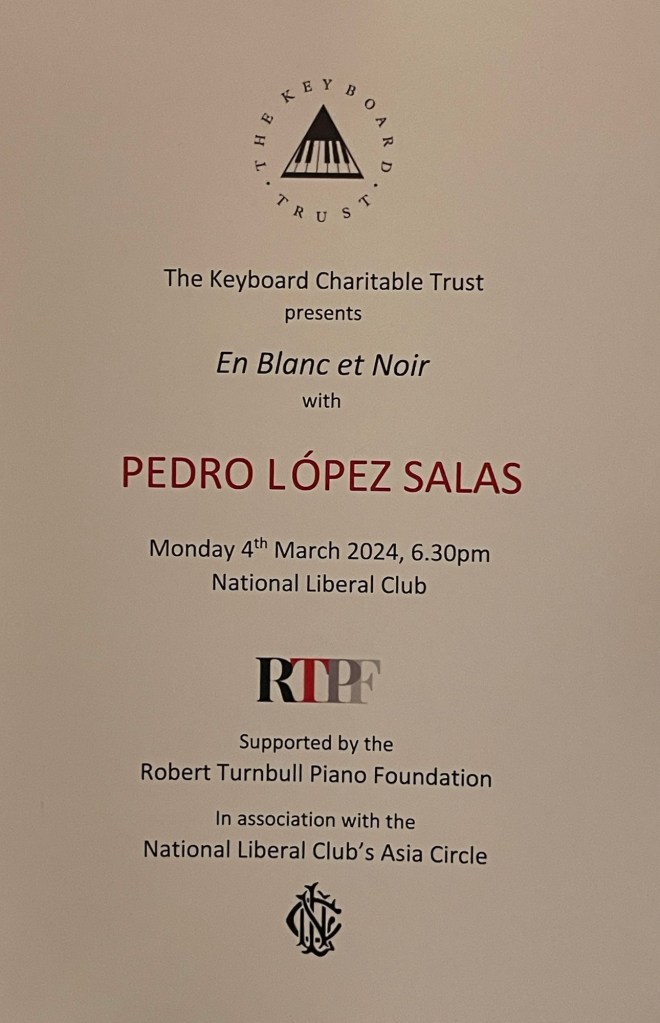
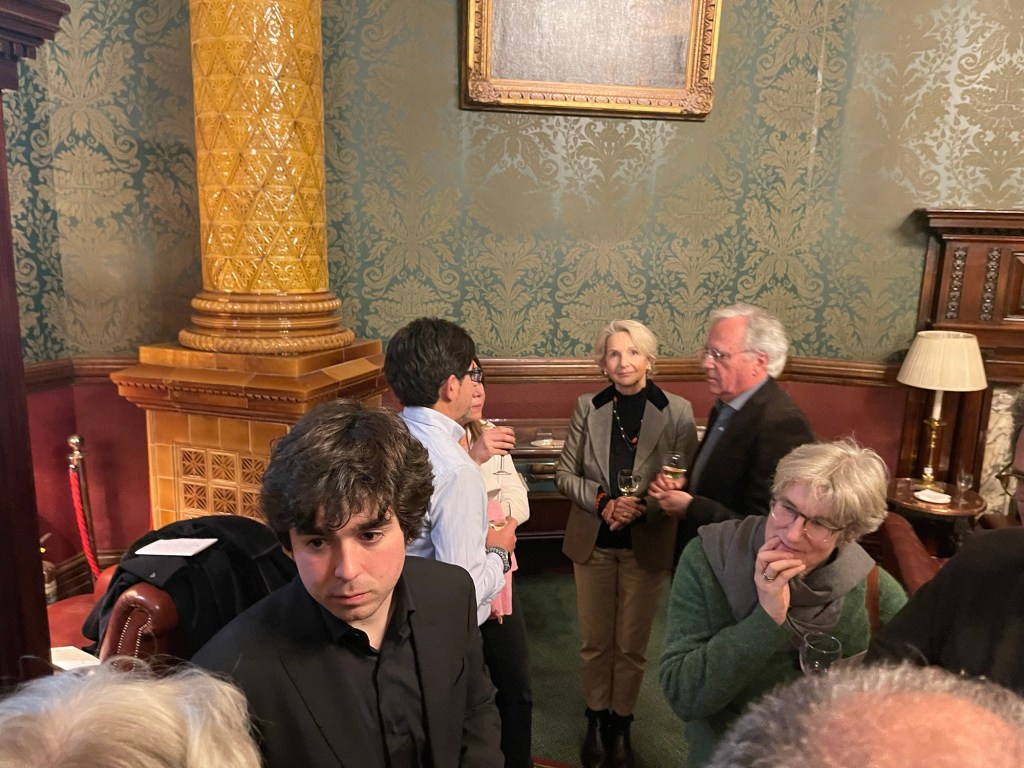
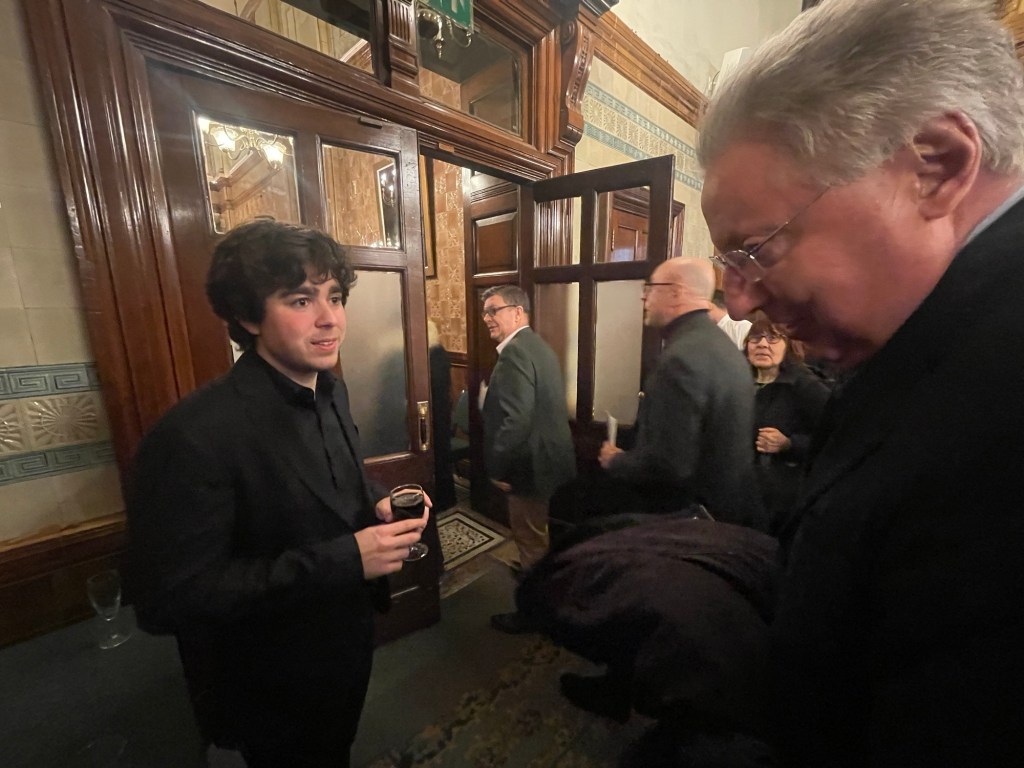
And style there certainly was in Kreisler’s Liebesleid in the beguiling transcription by Rachmaninov.We just held our breath as Pedro placed the notes with daring timelessness.It was as though he was improvising such was the spontaneity of invention as we followed hypnotically his every move.Scales and ornaments that were like streams of gold and silver just adding a glow to the delectable old style Viennese waltz that Kreisler had invented with such charm and grace.It was the same charm and grace as Kreisler’s golden toned violin but with the unmistakeable harmonies of his friend Rachmaninov.Two great artists but there is a saying that there are never two without three and the third was sharing with us tonight his refined artistry and bringing us again the magic of this old world bonbon.
We were immediately taken into a different world with the dynamic drive of De Fallas’s Fantasia Bética.The savage excitement of Andalusia with it’s constant changing of character.Glissandi and swirls of notes gave way to an almost inaudible murmuring of atmospheric sounds.Pointing his finger to a note that shone like a jewel in the mists of sound.A note that then became an anguished cry as Pedro knew how to illuminate the piano with ravishing vehemence.The final notes placed deep in the piano with an downturned left hand thumb pummelling with savagery a note that was to be joined by the right hand in a stand up fight as Pedro brought this fantasy to its ultimate exciting close.
Peace was restored with the charm of Soler’s G minor Sonata that like with Mozart,Pedro played with elegance and style with an exquisite range of colours.Even the scintillating brilliance of it’s twin in D major was shaped with the beauty that only a true musician could find in seemless scales and arpeggios.
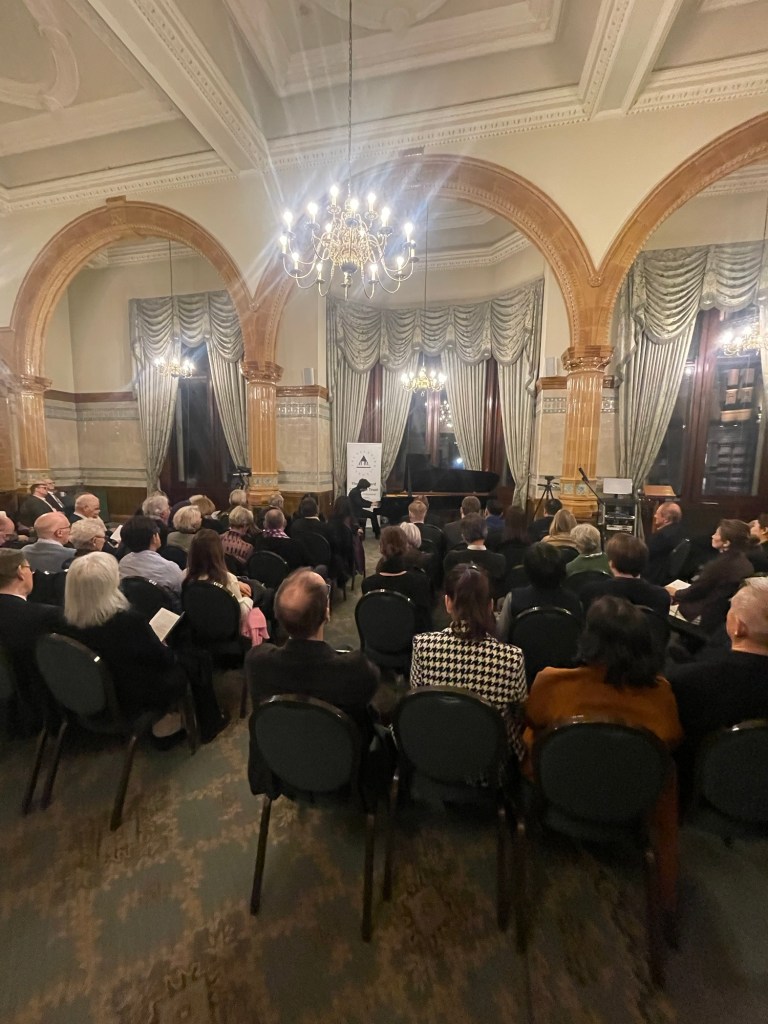
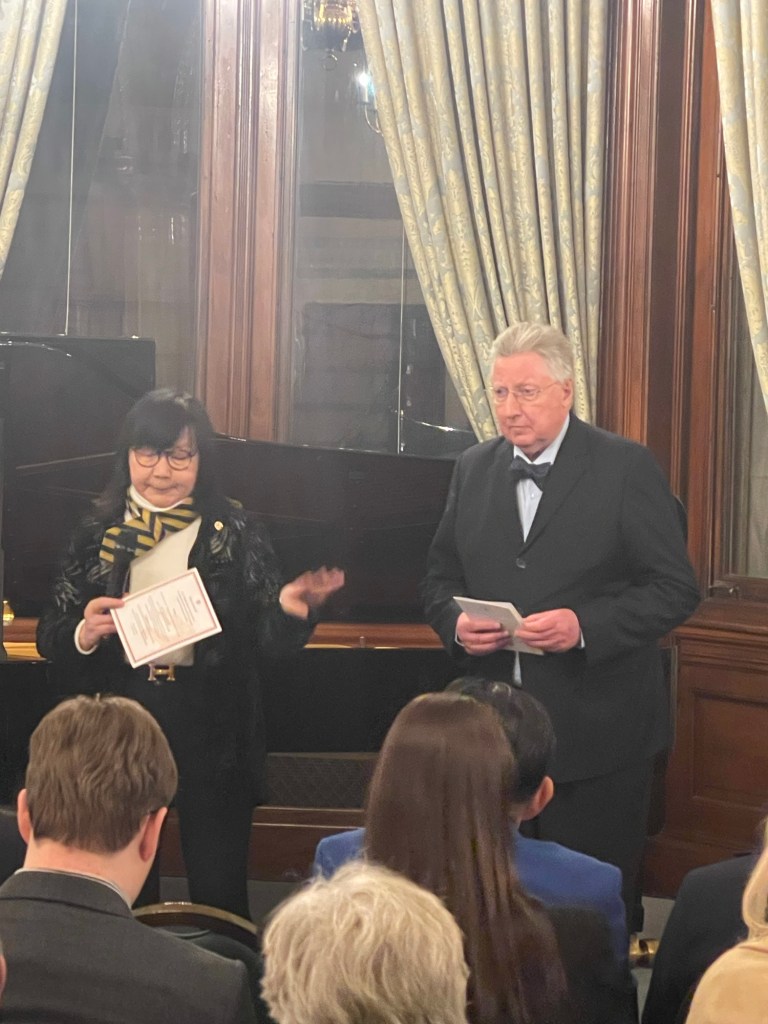
Yisha Xue of the Asia Circle at the National Liberal Club welcoming Leslie Howard co artistic director of the Keyboard Trust
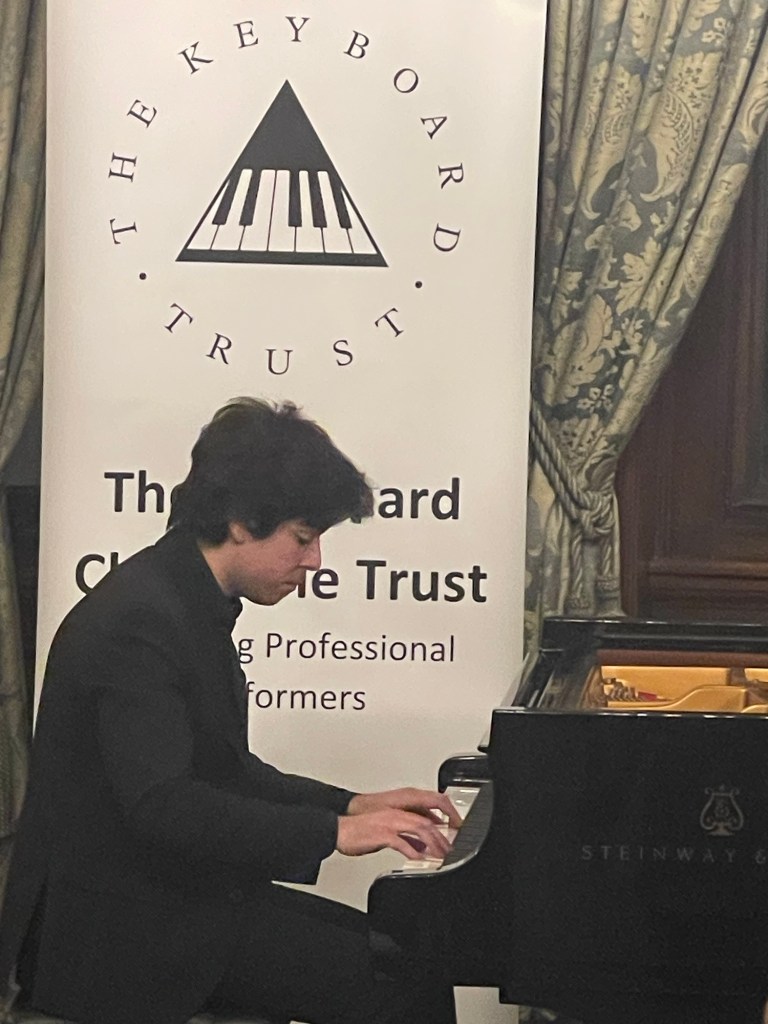
It was in Chopin’s Sonata op 35 that Pedro showed us what real artistry can mean. It transformed Chopin’s well worn masterpiece into a living thing as though the ink was still wet on the page.Such was his musicianship and sensitivity that the monumental opening was quite overwhelming as the opening chords immediately became a whispered living wave on which Chopin places his gasping fragmented melody that will be transformed with menace and grandeur in the development.This was a performance of aristocratic musicianship where there was a rubato that was so imperceptible and with such refined good taste that even the second subject was allowed to breath and speak so naturally.I was missing the weight of a Rubinstein or Perlemuter but Pedro’s ravishingly beautiful playing allowed the counterpoints to be an integral part of this beautiful melody in a way that was totally new to be and so convincing.Like many great pianists Pedro ignored the much debated repeat and entered the mysteriously menacing world of the development.Chopin’s genius allowing the opening Grave to combine with the doppio movimento in an outpouring of aristocratic grandiloquence .In Pedro’s hands it was breathtaking for its passionate sweep but above all for the sumptuous beauty and fullness without any hardness that he coaxed out of this magnificent Steinway concert grand.I have never heard the ending of this movement played with such passionate control. Chopin marks accelerando on the final bars but Pedro realised that this was more an inner intensity than a helter skelter race to the finish! The scherzo that follows was played with fantasy and again scales that became washes of sound played with enviable precision.It was Rosalyn Tureck who once said that she did not play wrong notes- meaning that every note has a significance and is an essential link in a chain.A sentence where every word has it just weight and meaning – an artist who paints a picture in sound.In Pedro’s hands today I heard the Trio as if for the first time such was the wondrous artistry of counterpoints that were whispered with magical golden clarity and with an improvised freedom.In lesser hands this would have broken the overall architectural shape but Pedro managed to hold us in his spell as I have rarely heard before.The final two drops in the ocean at the end were followed by a silence that held us all with baited breath as he took his time before playing the relentless left hand march with unusual pointed colour.The Funeral March was allowed to float on these constant and unflinching steps.A trio that was whispered and drew us in to eavesdrop on such intimacy.An extraordinary control of sound where every note was a perfect gem and even the hint of passion before the end just made the entry of the Funeral march even more poignant than before.A last movement that was indeed like a wind blowing over the graves .But within this perpetuum mobile of washes of sounds there was a heartbeat that was revealed through the mist with devastating effect and searing intensity as the wind howled all around before the final triumphant flame that brings this masterpiece to it’s conclusion.
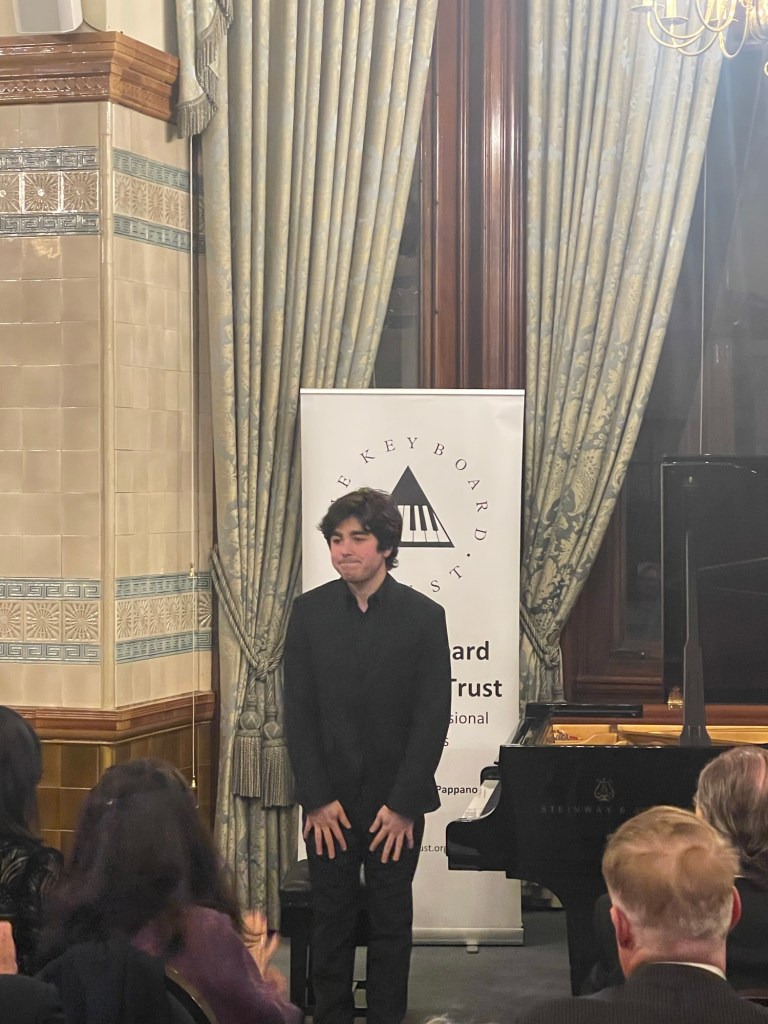
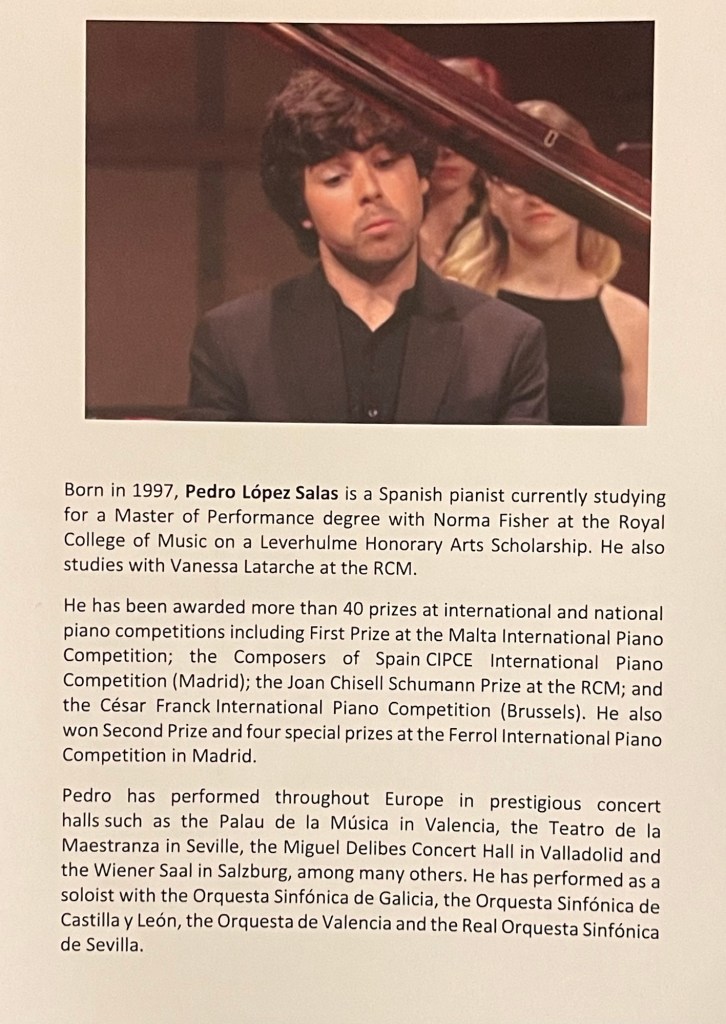
After such a monumental performance our young Spanish prince offered us a scintillating performance of Lecuona’s Malagueña where his style ,colour and even showmanship all came together in an exhilarating outpouring of this famous Cuban showpiece.
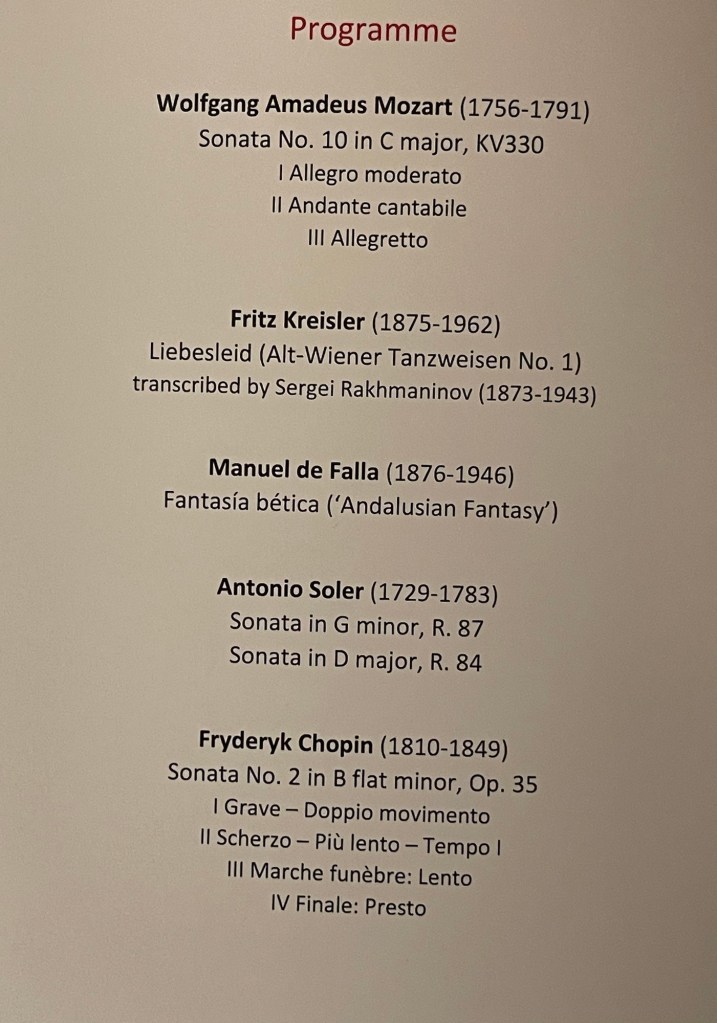
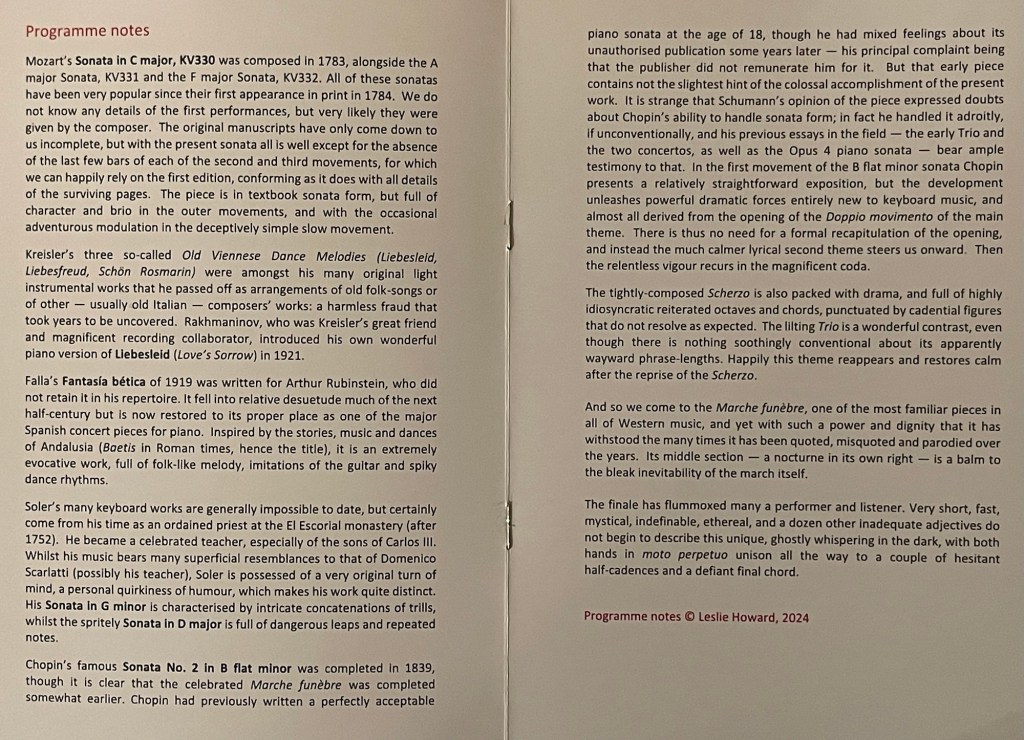
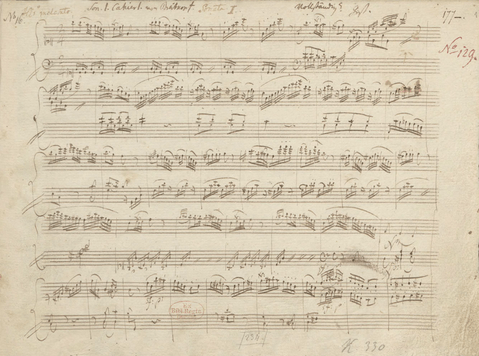
Mozart’s Piano Sonata No. 10 K.330 / 300h, is one of the three works in the cycle of sonatas K.330-331 – 332. The sonata was composed in 1783 when Mozart was 27 years old and was published, with the other two sonatas by Artaria in 1784. There are three movements :
Allegro moderato
Andante cantabile in F major
Allegretto
It was probably written in 1783, either in Vienna, or during the course of Mozart’s first visit home to Salzburg, bringing with him a wife of whom his fatherstrongly disapproved. It is clearly one of the sonatas mentioned by the composer in a letter to his father written in June 1784, identified with K. 330, K. 331 and K. 332, and now sent for publication to Artaria, but already known to his sister.Mozart repeatedly mentioned piano sonatas in his correspondence of the years 1778–1783, but he most likely never alluded to the three Sonatas K. 330 – 332. It is not until June 1784 that we find an unequivocal mention of these three works. It is Mozart’s communication to his father that he had “given Artaria, to engrave, the three sonatas for clavier only, which I once sent to my sister, the first in C, the second in A, and the third in f.” The printing progressed quickly, and on 25 August of that year the WIENER ZEITUNG advertised the pieces with the words: “The following new publications can be purchased from the art dealers Artaria Comp. …: “Three clavier sonatas, Opus 6, by Herr Kapellmeister Mozart, 2 fl. 30 kr.” The three sonatas are indeed designated as “Op. VI” in the title of the first edition. As occurs frequently in prints by Artaria, this edition contains a considerable amount of inaccuracies and errors in all three sonatas; nevertheless, it remains an important source as it features a number of dynamic markings that are not found in the surviving autograph but which had most likely been added by Mozart in the lost engraver’s master.
Sergei Rachmaninov and Fritz Kreisler
Alt-Wiener Tanzweisen (Old Viennese Melodies ) is a set of three short pieces for violin and piano composed by Austrian-American violinist Fritz Kreisler .The three pieces are titled Liebesfreud (Love’s Joy), Liebesleid (Love’s Sorrow), and Schön Rosmarin (Lovely Rosemary).
The legendary violinist Fritz Kreisler and Sergei Rachmaninov performed frequently together. On one occasion, as the story goes, Kreisler had a memory slip during a performance. Fumbling around the fingerboard and attempting to improvise his way out of the predicament, he inched his way towards the piano, whispering helplessly, “Where are we?” Rachmaninov answered, “In Carnegie Hall.”
As a tribute to their friendship, Rachmaninov created piano arrangements of three of Kreisler’s violin miniatures, including Liebesleid (“Love’s Sorrow”), and Liebesfreud (“Love’s Joy”). Kreisler’s original compositions are charming slices of pre-war Vienna. In Rachmaninov’s hands they become thrilling new music…variations on the original themes, infused with Rachmaninov’s distinct sound and spirit.
It is not known when the pieces are written, but they were published in 1905, deliberately misattributed to Joseph LannerKreisler often played these pieces as encores at his concerts, though the pieces are usually performed separately. In 1911, he published solo piano arrangements of the pieces as Alt-Wiener Tanzweisen and they have since appeared in numerous settings for other instruments, or orchestrated.
Two of the pieces, Liebesfreud and Liebesleid, were the subject of virtuoso transcriptions for solo piano by Kreisler’s friend Sergei Rachmaninov (1931),who also recorded these transcriptions.
Someone said to Rachmaninov that this transcription seemed difficult. Rachmaninoff replied, “Difficult! It is impossible!”
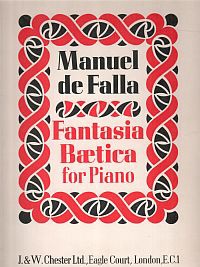
Fantasía bética, or Andalusian Fantasy, was written by in 1919 evoking the old Roman province of Baetis in southern Spain, today’s Andalusia. It was commissioned by Artur Rubinstein ,who planned to perform it in Barcelona that year but did not learn it in time and so wound up giving the premiere in New York on 20 February 1920; as it turned out, he would play it only a few times before dropping it from his repertory without recording it and years later he explained to the composer that he found it too long … It was Falla’s last major piano work and the only one that belongs to the virtuoso tradition in which Falla the pianist had been trained. ‘Guitar figurations transformed into pianistic terms abound … other passages evoke the harpsichord, Scarlatti as it were, rewritten by Bartók.’ Beyond that are the smoky, heavily ornamented lines of flamenco singers and the tightly controlled gestures of Andalusian dancing, the whole work adding up to a marvellously varied and vigorous portrait of Spain. From the structural point of view Falla’s ‘internal rhythm’, which he explained as ‘the harmony in the deepest sense of the word born of the dynamic equilibrium between the sections’. Any attempt to shorten the work would have blunted its impact.
The abstract, large-scale work is a celebration of Andalusian culture and history, but not an historical evocation. Its influences draw from Falla’s knowledge and experience of the the flamenco culture that evolved in Andalusia.
Provinicia Baetica was the old Roman name for Andalusia and so a translation of the title might be “Andalusian Fantasy.” Although the materials used are original with Falla, they strongly evoke the folk music of southern Spain: the strident, sombre cante jondo sung in oriental-sounding scales, chords derived from guitar tunings, and a harsh percussive quality reminiscent of castanets and heel stamping.
The tonal originality of the Baetica is a result of Gypsy, ‘Middle Eastern’, Sephardic, Indian and subtle French influences woven into the harmonic language.
Manuel de Falla was born in 1876 into a reasonably affluent family in Cádiz, where music was confined to annual performances of Haydn’s The Seven Last Words, occasional visits by grand opera companies, and folk songs—not as museum pieces, but as living elements of Spanish life. By 1896 the family fortunes had diminished and they moved to Madrid, where Falla entered the conservatoire and began to compose zarzuelas, the Spanish form of operetta. But his eyes were set on Paris and in 1907 he began a seven-year stay, making friends with Debussy, Ravel and Dukas. He had already begun the Cuatro piezas españolas in Madrid, but they were brought out in 1909 by the Parisian publisher Durand on the recommendation of the three above-named composers. Despite the obvious debt to Albéniz, also in Paris at the time and the dedicatee of the pieces, Falla’s mixture of harmonic invention and elegant counterpoint is unfailingly captivating, banishing any hint of the boredom that might otherwise accrue from the insistent Spanish dance rhythms. His tunes too recall Spanish folk music with its repeated notes and small intervals, but his textures are in general more economical than those of Albéniz.
The opera La vida breve was written in 1904–5 but not performed until 1913. It includes two Spanish dances which have subsequently achieved a life of their own. The first, which opens the second act, was published in a variety of settings, including transcriptions for piano solo and four-hand duet by the composer, and with the music from the end of the scene as Interludio y Danza for orchestra. It was also arranged by Fritz Kreisler for solo violin and piano (as Danza española) in 1926.
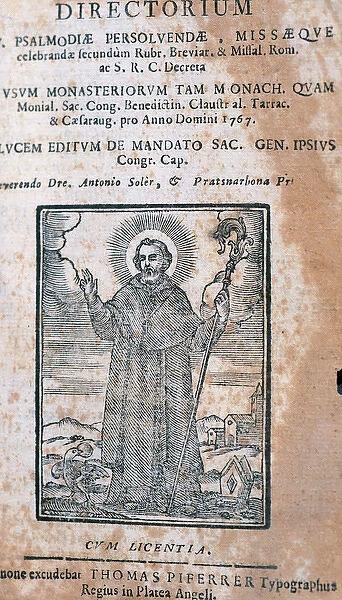
Antonio Francisco Javier José Soler Ramos, usually known as Padre Antonio Soler, known in Catalan as Antoni Soler i Ramos baptized 3 December 1729 – died 20 December 1783 He is best known for his many mostly one-movement keyboard Sonatas although he composed more than 500 sacred choral musical pieces in his native Spain. Today, though, it is his 200-or-so keyboard sonatas that are arousing the curiosity of performers . In 1761 Soler wrote a music-theory treatise in which he sketched out methods of quickly modulating to remote keys; these techniques are also found in his keyboard sonatas with the subtlety and speed of modulation between keys, and a brilliant lightness occasionally darkened by moments of pathos.Padre Soler’s most celebrated works,the keyboard sonatas, are comparable to those composed by Domenico Scarlatti (with whom he may have studied) but are more varied in form than those of Scarlatti, with some pieces in three or four movements; Scarlatti’s pieces are in one (mostly) or two movements. Soler’s sonatas were cataloged in the early twentieth century by Fr. Samuel Rubio and so all have ‘R’ numbers assigned.His appointment in 1757 as maestro di capilla and organist at the Escorial, the royal palace established by Philip II of Spain, allowed Antonio Soler to mix with fellow court musicians, among whom was Domenico Scarlatti, whose influence was to remain profound. Soler wrote some 200 sonatas, his greatest compositional memorial, most for the young prince, Don Gabriel.
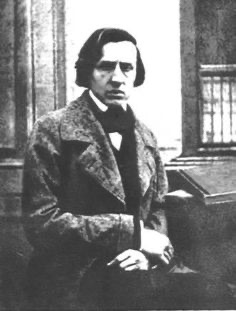
Fryderyk Franciszek Chopin 1 March 1810 Zelazowa Wola, Poland
17 October 1849 (aged 39). Paris, France
Some time after writing the Marche funèbre,(1837) Chopin composed the other movements of the Sonata op 35 ,completing the entire sonata by 1839. In a letter on 8 August 1839, addressed to Fontana, Chopin wrote:
I am writing here a Sonata in B flat minor which will contain my March which you already know. There is an Allegro, then a Scherzo in E flat minor, the March and a short Finale about three pages of my manuscript-paper. The left hand and the right hand gossip in unison after the March. … My father has written to say that my old sonata [in C minor, Op. 4] has been published by Haslinger and that the German critics praise it. Including the ones in your hands I now have six manuscripts. I’ll see the publishers damned before they get them for nothing.
Haslinger’s unauthorised dissemination of Chopin’s early C minor sonata (he had gone as far as engraving the work and allowing it to circulate, against the composer’s wishes) may have increased the pressure Chopin had to publish a piano sonata, which may explain why Chopin added the other movements to the Marche funèbre to produce a sonata.It was finished in the summer of 1839 in Nohant in France and published in May 1840 in London,Leipzig and Paris.
The sonata comprises four movements:
Grave – Doppio movimento
Scherzo
Marche funèbre: Lento
Finale: Presto
The first major criticism, by Schumann , appeared in 1841. He described the sonata as “four of [his] maddest children under the same roof” and found the title “Sonata” capricious and slightly presumptuous.He also remarked that the Marche funèbre “has something repulsive” about it, and that “an adagio in its place, perhaps in D-flat, would have had a far more beautiful effect”.In addition, the finale caused a stir among Schumann and other musicians. Schumann said that the movement “seems more like a mockery than any [sort of] music”,and when Felix Mendelssohn was asked for an opinion of it, he commented, “Oh, I abhor it”. Franz Liszt, a friend of Chopin’s, remarked that the Marche funèbre is “of such penetrating sweetness that we can scarcely deem it of this earth”.It was Anton Rubinstein who said that the fourth movement is the “wind howling around the gravestones”.When the sonata was published in 1840 the London and Paris editions indicated the repeat of the exposition as starting at the very beginning of the movement (at the Grave section). However, the Leipzig edition designed the repeat as beginning at the Doppio movimento section. Although the critical edition published by Breitkopf & Hartel (that was edited, among others, by Franz Liszt, Carl Reinecke , and Johannes Brahms ) indicate the repeat similarly to the London and Paris first editions, almost all 20th-century editions are similar to the Leipzig edition in this regard with the repeat to the Doppio movimento ,Charles Rosen argues that the repeat of the exposition in the manner perpetrated by the Leipzig edition is a serious error, saying it is “musically impossible” as it interrupts the D♭ major cadence (which ends the exposition) with the B♭ minor accompanimental figure.Karol Mikuli’s 1880 complete edition of Chopin contained a repeat sign after the Grave in the first movement of the Piano Sonata No. 2. Mikuli was a student of Chopin from 1844 to 1848 and also observed lessons Chopin gave to other students – including those where this sonata was taught – and took extensive notes.Many great artists including Barenboim,Horowitz,Rachmaninoff,Rubinstein,Ohlssohn,Kissin and Pedro tonight exclude the repetition altogether!
Malagueña” is a song by Cuban composer Ernesto Lecuona. It was originally the sixth movement of Lecuona’s Suite Andalucía (1933), to which he added lyrics in Spanish. In general terms, malagueña’s are flamenco dance styles from Málaga, in the southeast of Spain.The melody that forms the basis of “Malagueña” was not of Lecuona’s invention. It can be heard in 19th-century American composer Louis Moreau Gottschalk’s solo piano composition Souvenirs d’Andalousie Based on Gottschalk’s international renown, it is reasonable to assume Lecuona heard it and either wittingly or unwittingly co-opted it in composing his most famous piece.











































 ChristopherAxworthy-MusicCommentary