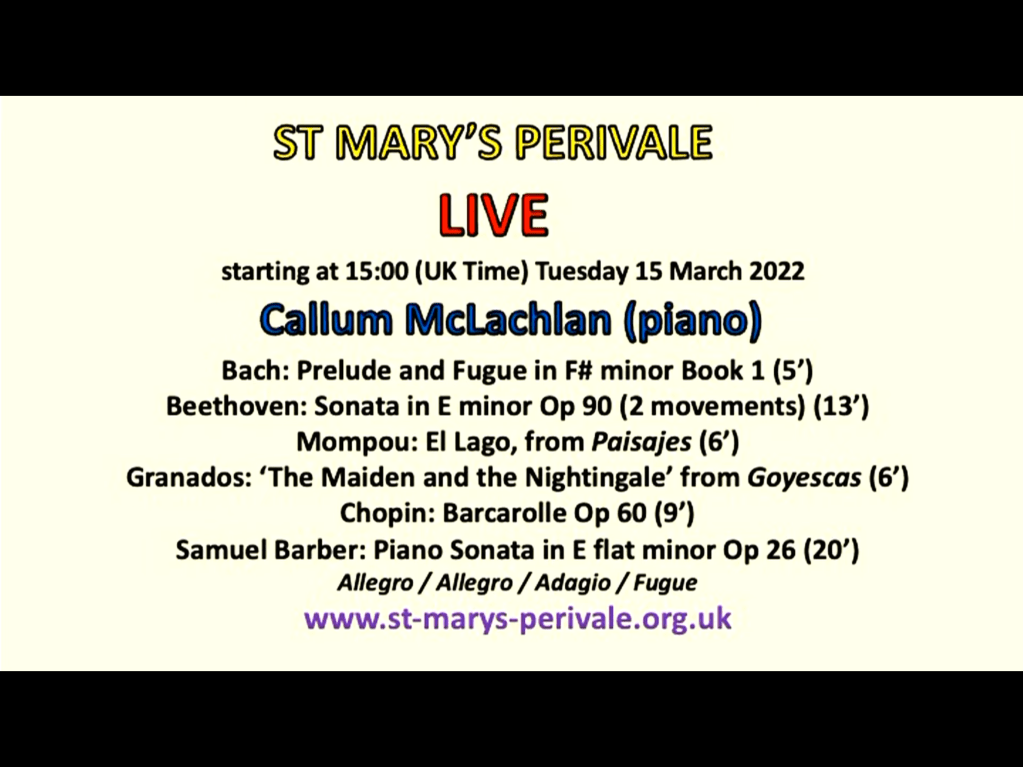
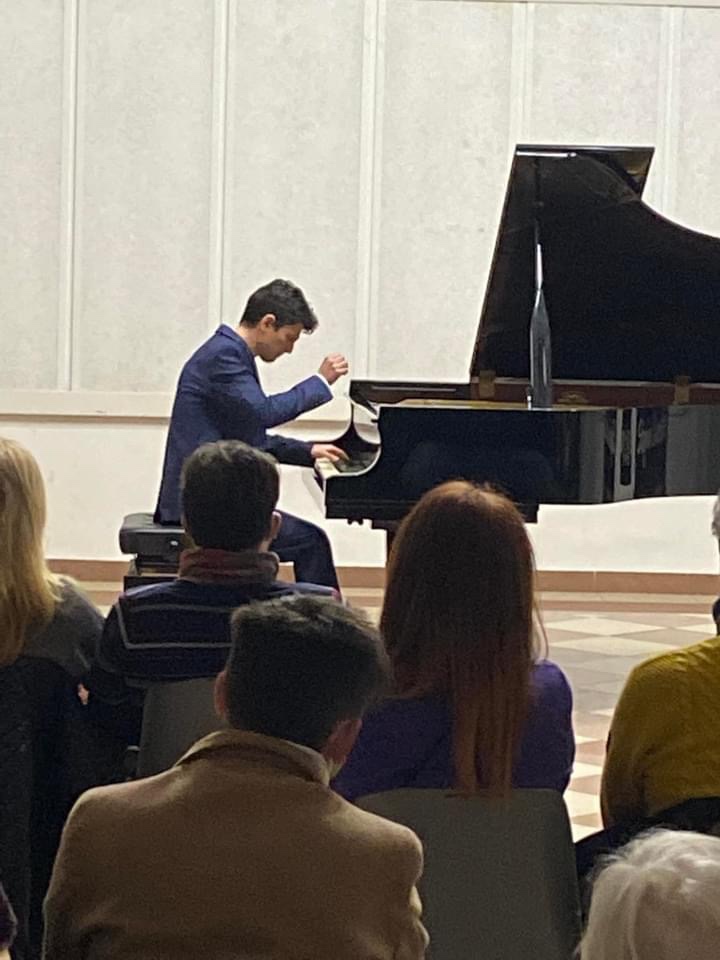
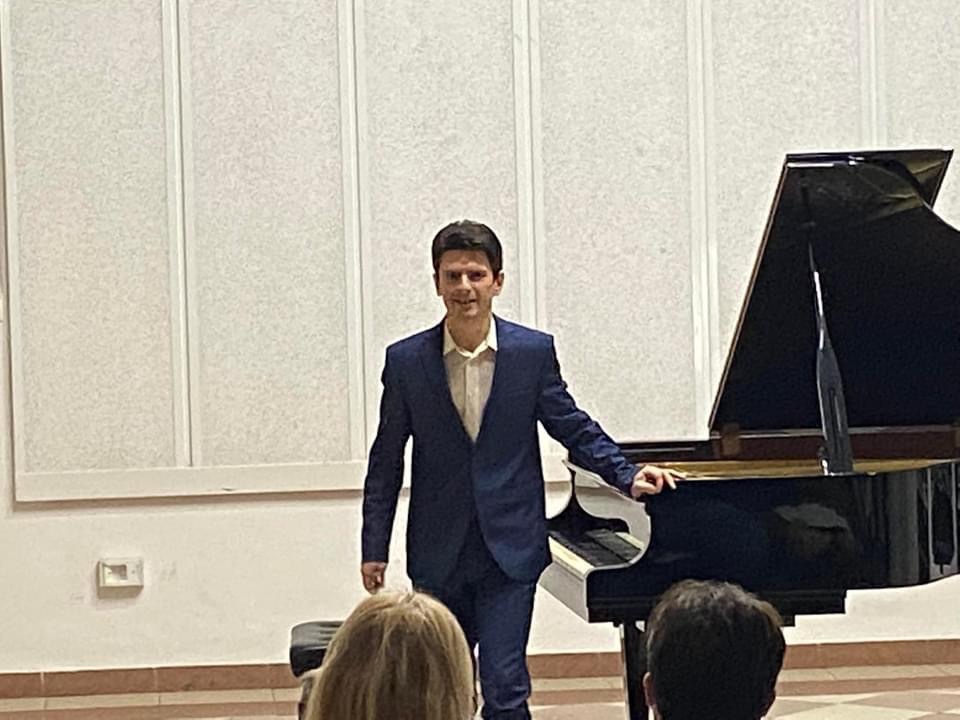
Granados: ‘The Maiden and the Nightingale’ from Goyescas
Chopin: Barcarolle Op 60
Samuel Barber: Piano Sonata in Eb Minor op 26 Allegro / Allegro / Adagio / Fugue
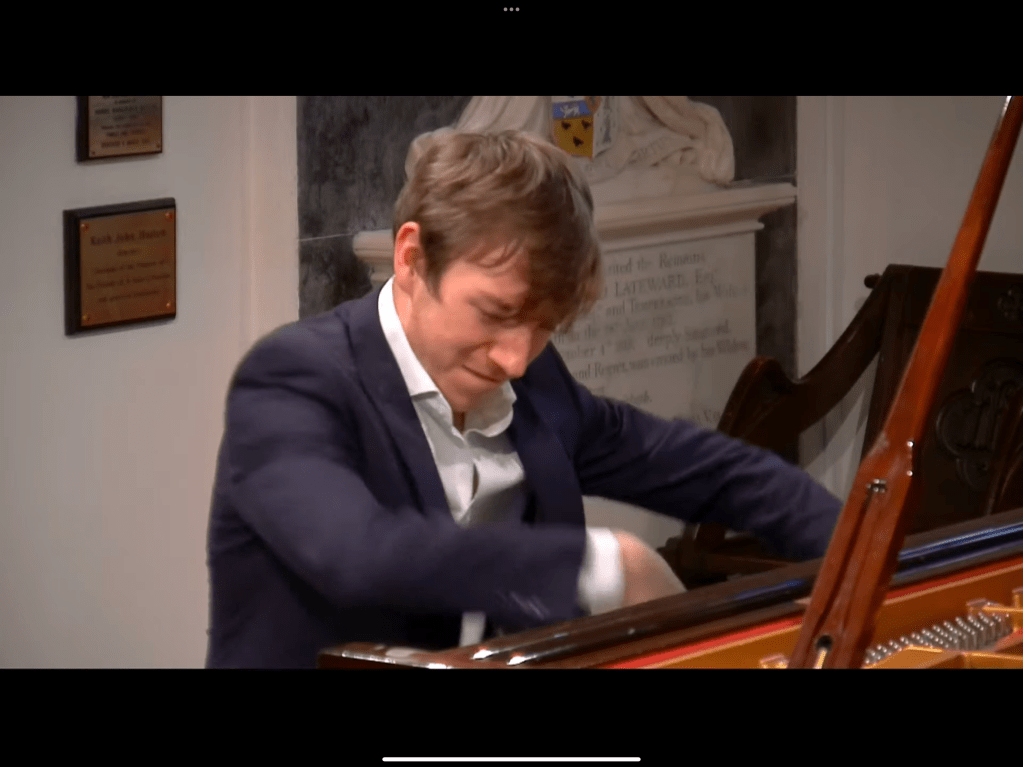
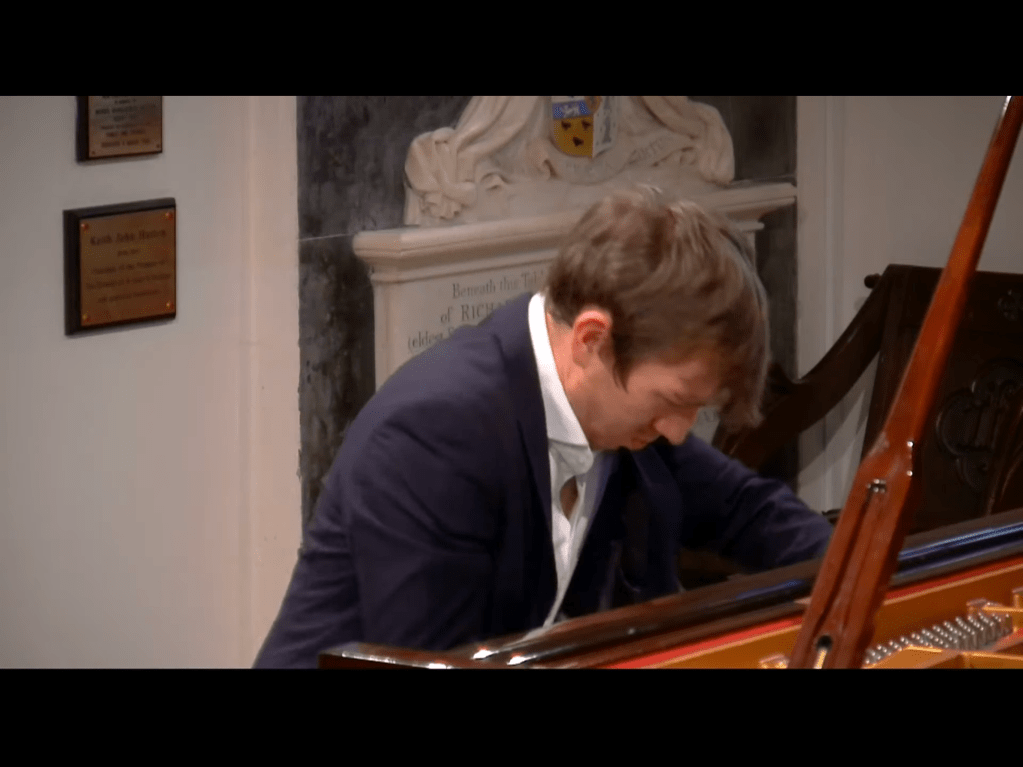
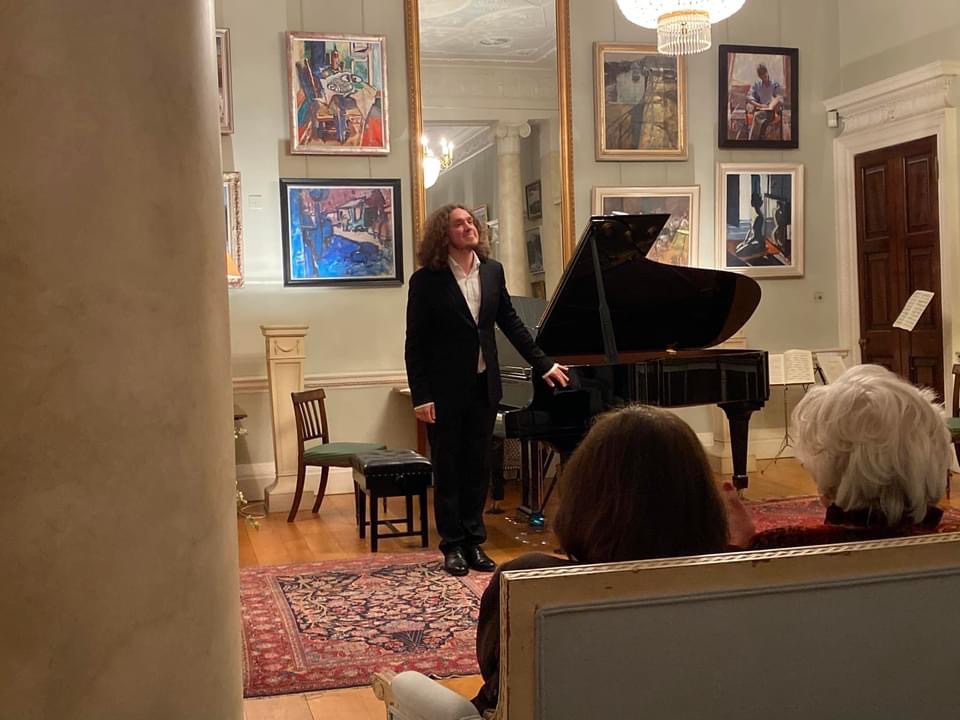
A tour de force of playing from this the eldest member of the illustrious McLachlan clan.Now in his final year at the Mozarteum in Salzburg with Claus Tansky he has matured into an artist of stature with something important to say. A simple honest musicianship that allows the music to speak so naturally and with such impeccable good taste.Above all he has learnt the secret of how to make the piano sing whether it be from the mellifluous almost religious Bach F sharp minor fugue or the astonishing pyrotechnics of Barber written for the wizardry of Horowitz. Sang it did too in the most Schubertian of Beethovens sonatas op 90,the gateway to the final paradise that the totally deaf composer could envisage with such wonder and mystery. There were etherial sounds too in Mompou’s depiction of the serenity of the Lake or the sublime beauty of Granados’Maiden and the Nightingale.
But it was from the very first deep bass note of Chopin’s Barcarolle that we were aware that we were in the hands of a real artist. A continuous stream of beauty from the tranquil lapping of the water and simplicity of the gondoliers song leading so gently to the aristocratic passionate outbursts contained in Chopin’s most sublime creation. Of course Barber’s stark world was given with the drive and obsessive insistence more associated with Scriabin than Chopin.Played with astonishing athleticism and technical control but also a kaleidoscope of sounds that made the climax of the austere slow movement quite overwhelming in its intensity.The scherzo was a tour de force of dexterity and resilience but it was the gigantic fugue that saw Callum conquering all the notorious challenges that Barber had lain at the feet of the greatest virtuoso of all time,Vladimir Horowitz.
Callum Mclachlan was born into a family of musicians, and started lessons with his father at the age of 7, and entered Chetham’s School of Music at age 11, where he studied with Dina Parakhina. He currently studies at the Universität Mozarteum in Salzburg. He has performed at many prestigious concert venues in the UK, Europe and USA, including performing Beethoven’s 3rd Piano Concerto at the Edinburgh Fringe Festival, works of Benjamin Britten in Steinway Hall London and Liszt’s 2nd Piano Concerto at RNCM Concert Hall and at the Turner Sims Concert Hall in Southampton. In 2019, he made his New York recital debut, performing works of Beethoven, Brahms and Percy Grainger. Most recently, he made a recording of Beethoven’s Pathetique Sonata in Salzburg, in collaboration with G. Henle Verlag. He has won 1st prizes in the Welsh International Piano Competition, The Youth Scottish International Piano Competition, the RNCM Chopin Competition as well as reaching the final of the EPTA Piano Competiton. He is a prize-winner of the Musical Odyssey Talent Unlimited Prize. He also receives funding from the Royal Philharmonic Society, who generously support his studies abroad.
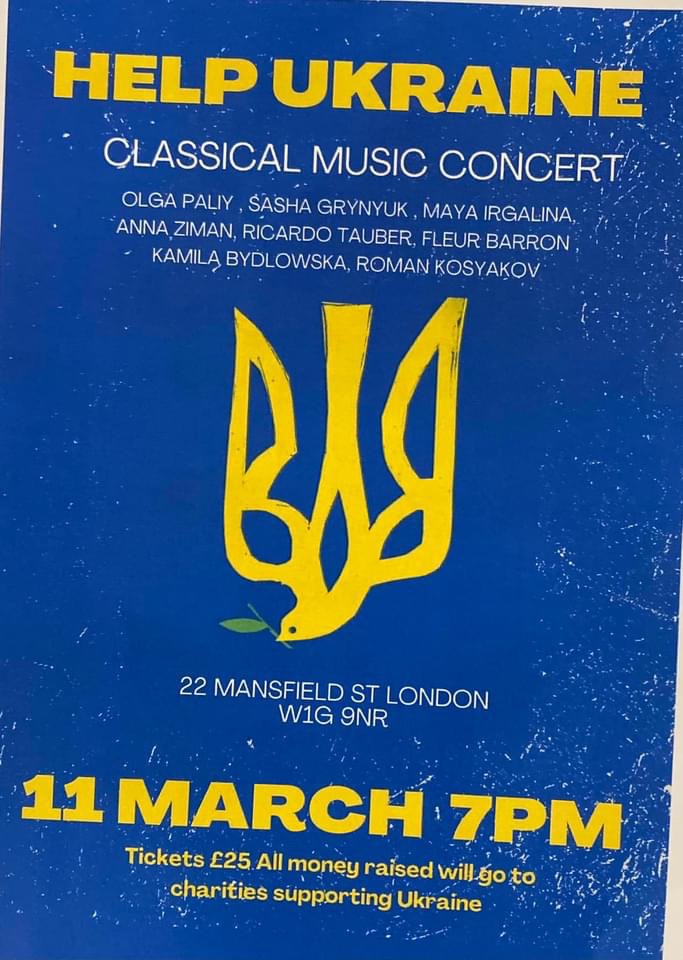
Help Ukraine – Classical Music Concert sold out ……..uplifted and moved by music of the soul – the only remedy to help live through a world tragedy of such useless greedy devastation and suffering in the name of …………democracy!!!!!!
Russian,Belarusian and Ukrainian musicians took part in a fund raising concert for the victims of the war raging unexpectedly as it is inexplicably in the Ukraine.
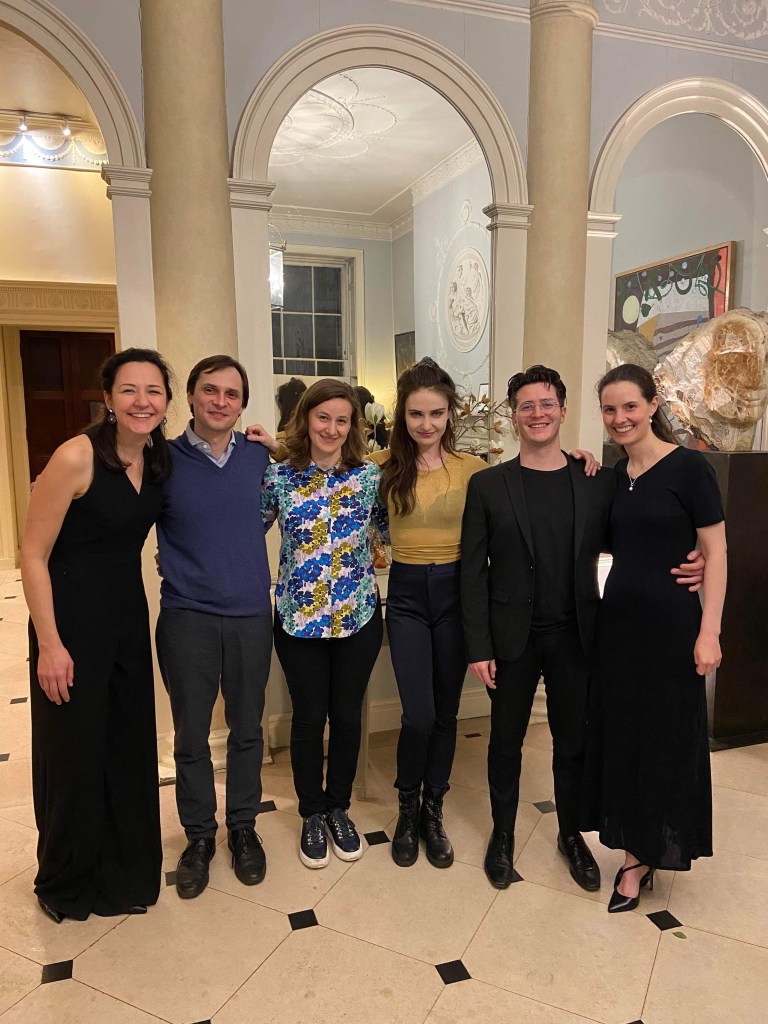
Maya Irgalina-Sasha Grynyuk-Olga Paliy-Kamila Bydlowska-Ricardo Tauber-Anna Ziman
A moving occasion not only of superb music making but for the testimony of artists whose families find themselves on the front line of a vicious attack by a dictator and his thugs. The concert in the Boas beautiful private concert salon sold out immediately it was announced with people wanting in some small way to show their solidarity.
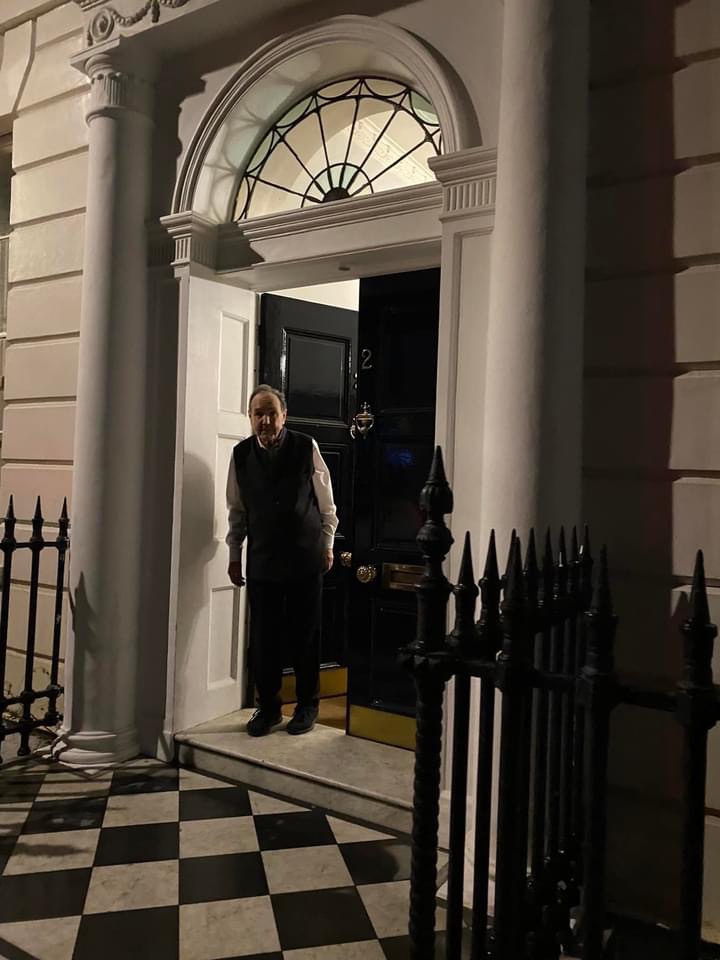
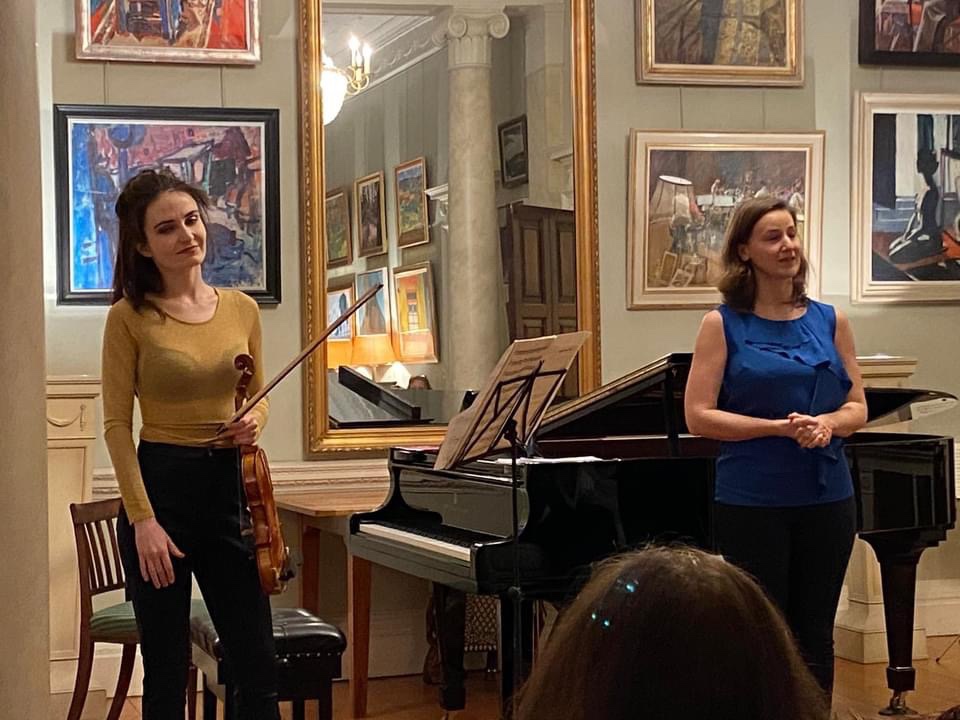
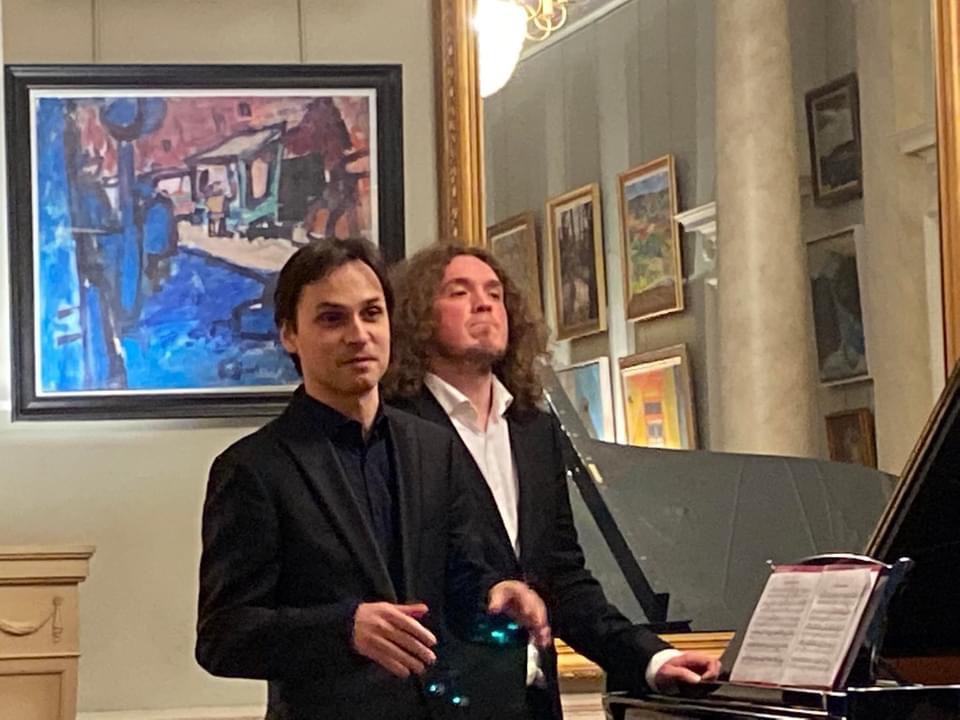
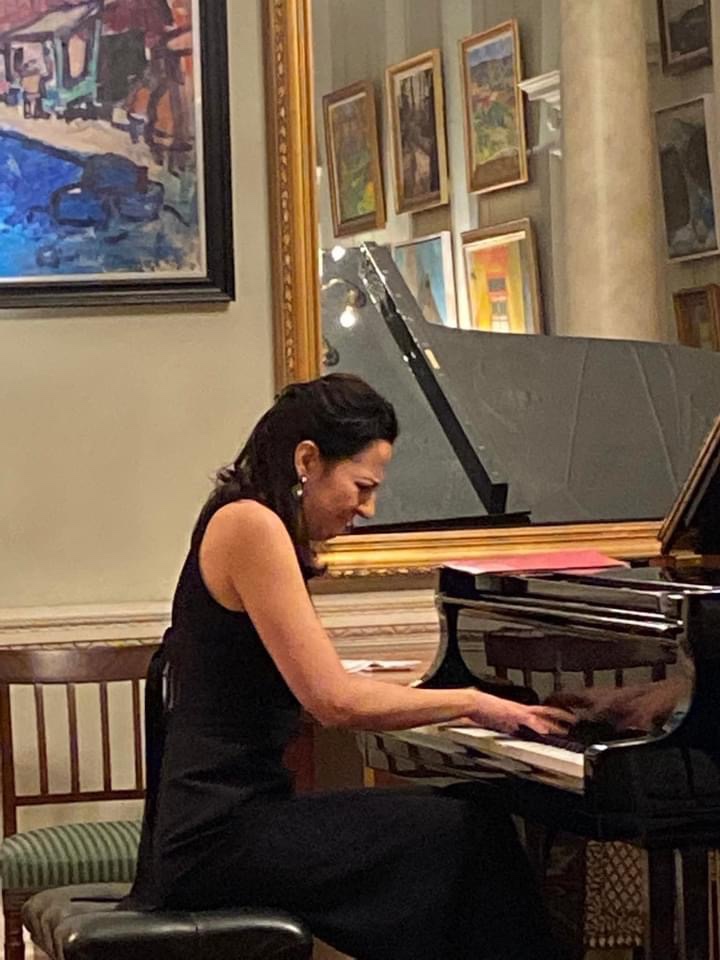
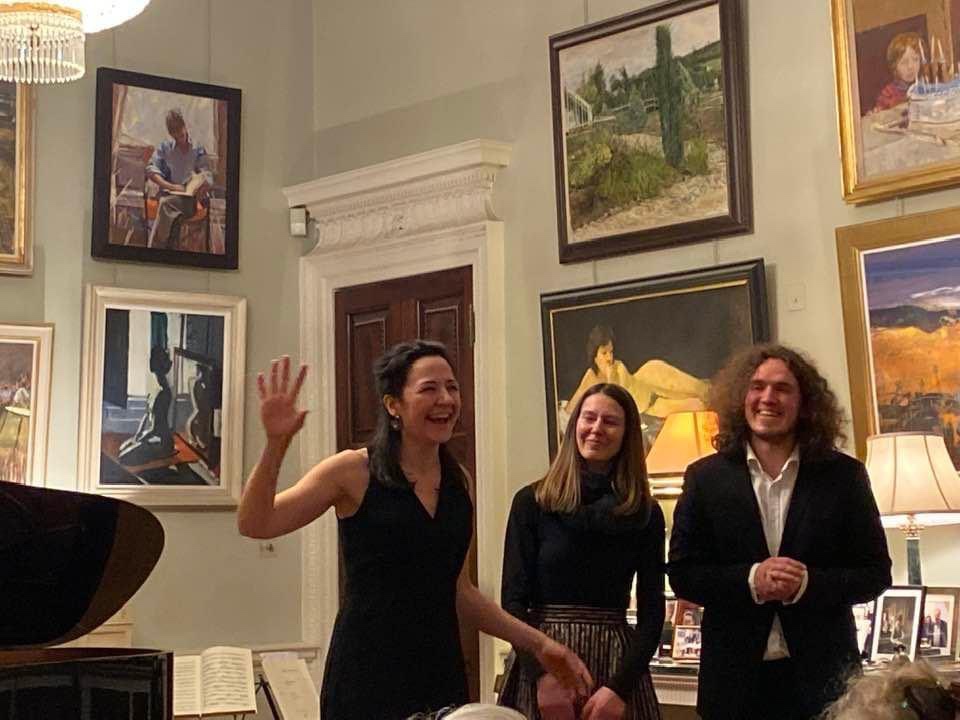
The indomitable Bob Boas welcoming guests to his beautiful home,an oasis of culture ,ready to share their message in music
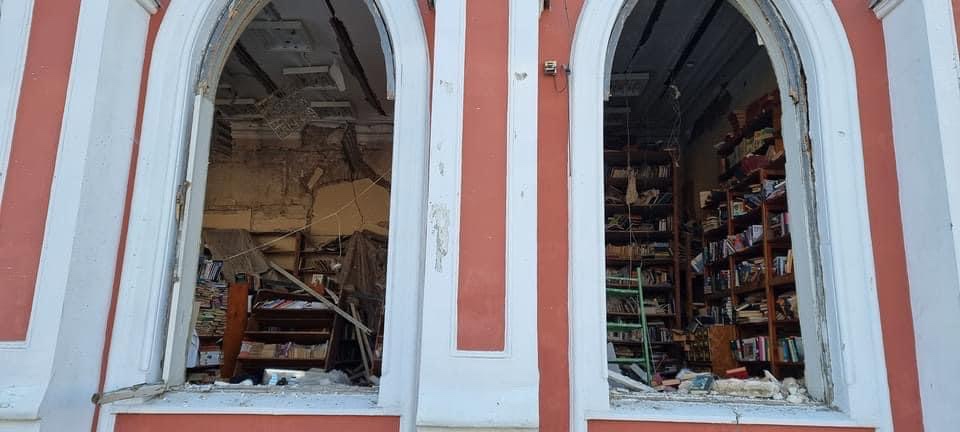
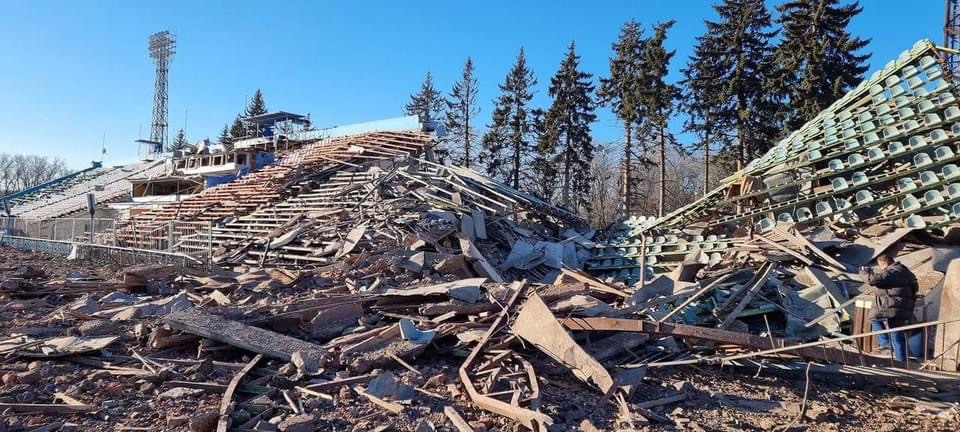
Olga Paliy had posted on social media,that very morning,a photo of the stadium and library in her home city lying in ruins. She told us with such emotional relief that her parents had been able to flee and had just arrived in safety as refugees in the UK.
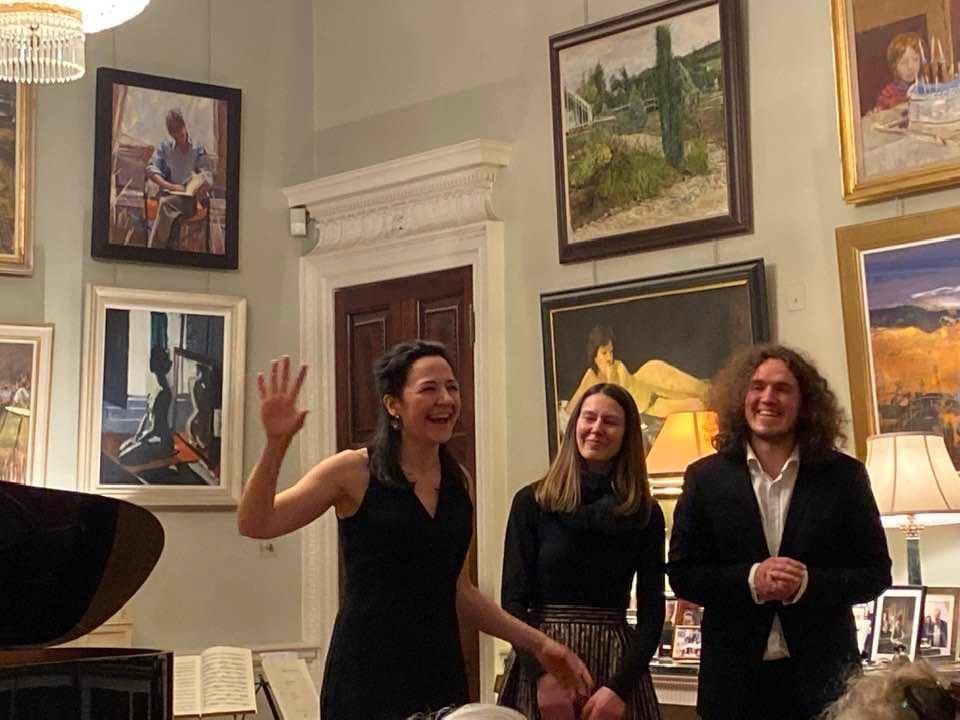
It was Olga who opened the concert that included two works by Ukrainian composers.A Gavotte for solo piano by Viktor Kosenko that she knew from her childhood studies in the Ukraine.She was joined in the Melody by Miroslav Skoryk with the searing passionate outpouring from Kamila Bydlowska’s violin……..
Back in the summer we cheered at this stadium in Chernihiv for our Desna football team, the whole family, happy and full of hope and plans! And the library next to us, we visited when I was a schoolgirl. Destroyed everything tonight… tears to breath …
It was they that closed the evening too with the Brahms scherzo from the FAE sonata – ‘Frei Aber Einsam ’ based on the notes of a musical cryptogram ‘Free but lonely’.
Kamila Bydlowska and Olga Paliy whose superb performance of two movements from Saint-Saens Sonata n.1 in D minor op 75 opened the concert
It is a four-movement work by three composers: Schumann,the young Brahms and Schumann’s pupil Dietrich.It was Schumann’s idea as a gift and tribute to the violinist Joseph Joachim whom the three composers had recently befriended. Joachim had adopted the phrase “Frei aber einsam” (“free but lonely”) as his personal motto.Schumann assigned each movement to one of the composers. Dietrich wrote the substantial first movement .Schumann followed with a short Intermezzo as the second movement. The Scherzo was by Brahms and Schumann provided the finale.
Sasha Grynyuk with Roman Korsyakov in a refined performance between friends of Mozart Variations.K.501 The words quoted by Sasha of Rzewsky’s Variations in mind:’People United Will Never Be Defeated
But as the world has shown us in these past few weeks of conflict the people of Ukraine are not alone. Music and culture will help heal and to support the suffering while this monstrous war game takes it’s course. ‘An eye for an eye when will it ever finish’ exclaims Euripides in his tragedy Hecuba. As Ghandi added centuries later :’if we continue along this path before long the world will be inhabited by blind people’.Only culture and history will help us to understand ,learn and live together in peace ‘If Music be there food of love …..play on.’ So said the Bard That is all we can do as movingly shown last night.
But it was the words of a young Russian pianist that surprised and moved me by his soulful plea against the hatred that this conflict has unleashed in us all. ‘All we can do is pray and cry’. If a twenty year old Russian mascot virtuoso can reveal his soul in such a way there is hope ahead for a better world of peace and harmony. Let’s hope it is sooner rather than later!
Maya Irgalina’s superb playing of two Liszt transcriptions of Schubert Lieder-Erlkonig and Ave Maria
All magnificently organised by the Belarusian pianist Maya Irgalina .It was her childhood friend from the Belarusian Academy of Music,Tanya Avchinnikova who donated two of her pastels for auction last night and which reached over one thousand pounds .
Maya Irgalina with Roman Korsyakov and his wife Tanya Avchinnikova
Tanya is the wife of Roman Korsyakov who played Mozart variations together with Sasha Grynyuk – a Russian and Ukrainian making music together whilst the bombs are flying ………a great lesson indeed from two great pianists ………..
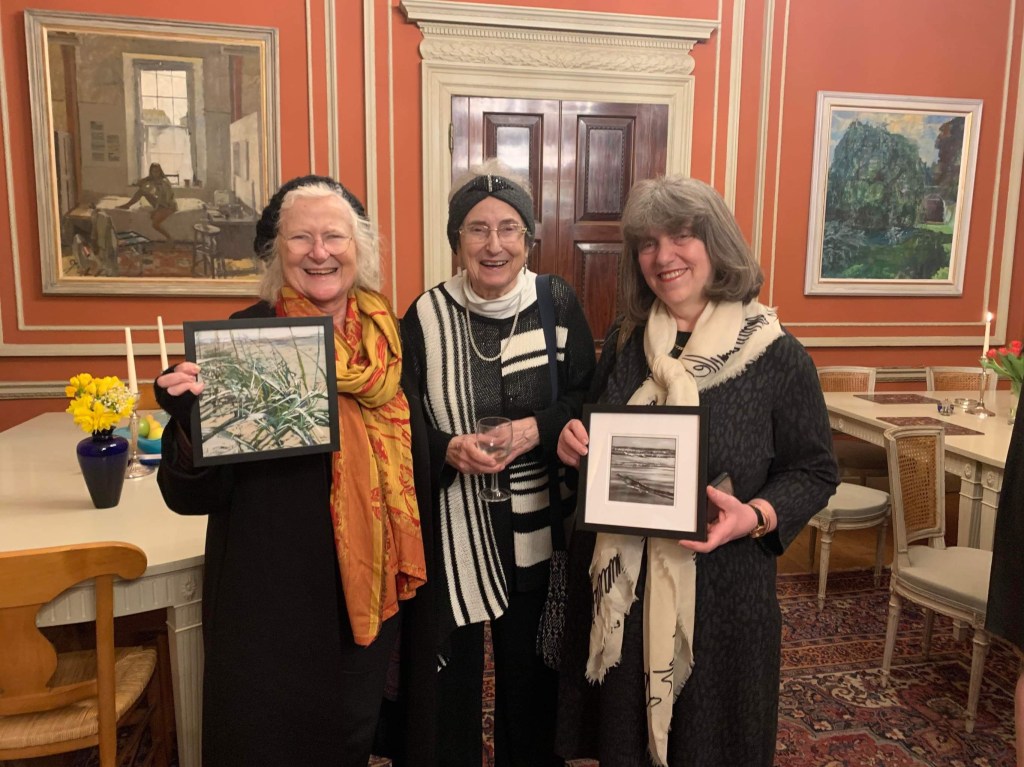
Dr Annie Coxon Annette Morreau Jessie Harrington with the auctioned pictures that raised over one thousand pounds for the Help Ukraine FundFleur Barron singing works by Ives and Montsalvatge- her superb mezzo soprano voice ringing around this beautiful salon as it will with Alice Coote and Graham Johnson in the Wigmore Hall tribute to Mahler in the near future A touching performance of the Andante Cantabile from Beethoven’s Archduke Trio played by the Limàni Trio formed by Maya Irgalina with her neighbours Anna Ziman and Ricardo Tauber during the second lock down-they live in Docklands hence the Greek title meaning ‘dock’Sasha Grynyuk’s moving performance of Brahms’Four Ballades op 10 …a kaleidoscope of magical sounds that only a disciple of Arturo Benedetti Michelangeli could have matched .Sasha’s mentor is Noretta Conci, founder of the Keyboard Trust ,who has transmitted to him the same magic from the master’s legendary performances of yesteryear .She was Michelangeli’s assistant for over fifteen years.Roman Korsyakov chose four of the most poignantly intimate preludes that make up Scriabin’s op 22.Ravishing playing of heartfelt intensity
Four thousand pounds was raised last night and the proceeds will go entirely to the Ukraine Humanitarian Appeal of The DEC,which brings together 15 leading UK aid charities to raise funds quickly and efficiently at times of crisis overseas .Anyone wishing to contribute to the Help Ukraine Fund can do so via :PayPal paypal.me/mayairgalina — please choose “Family and Friends” option,or via bank transfer: Miss M. Irgalina – Account No. 29466478 – Sort Code: 15-10-00
A STATEMENT FROM SEMYON BYCHKOV Semyon Bychkov has issued the below statement in light of the news this morning from Ukraine: “Silence in the face of evil becomes its accomplice and ends up becoming its equal. Russian aggression in Ukraine brings us to what my generation hoped would never happen again: War. Russia still mourns some 27 million citizens who perished at the hands of the Nazis in World War II, when Hitler delivered what he promised years earlier in Mein Kampf. How ironic that, while celebrating its victory over Nazi Germany in 1945, Russia chooses to forget its non-aggression pact with Hitler. Signed in 1939, the pact made Russia one of the co-authors of World War II; becoming one of the winners when the war ended in 1945 doesn’t acquit those who made it possible. The post-war Nüremberg Trials of leading Nazis brought atonement in German society for crimes committed against humanity, which continues to this day. What about Russia’s atonement for the genuine genocide of tens of millions of citizens killed by its own communist regime in the two decades preceding war with Germany? That was a physical genocide. And, what about the mental genocide that continued for decades after the war? The methods of the murderers and their hunger to destroy anything and anyone who refuses to obey have passed to their successors. Today they rule the country again. Born after the war, they have no concern and no interest in understanding what war brings. After all it won’t be their children who are sent to the front lines Their knowledge of history extends only to abstract geopolitical ideas of the instruments needed to acquire and keep power, whatever the cost to human life and, whatever destruction it brings. One has to be demented to refer to the collapse of the Soviet Union as the greatest tragedy of the 20th century, which is how Putin defined it, rather than rejoice at the fact that it happened without bloodshed and brought an end to the kidnapping of many nations in addition to Russia itself. If only the end of Russia being held hostage by its ruling elite weren’t temporary! One of many signs and symbols that the country has returned to pre-Perestroika times is the dissolution of the Memorial Society founded by Nobel Peace Prize winner Andrei Sakharov in 1989. Its mission was to research every single victim of repression and keep the memory of the dead alive. Through the dissolution of the Memorial on 29 December 2021 victims of repression were killed once again. This too is a form of genocide. Not in the Russian-occupied Donbas of Ukraine as Putin claims. The Russian regime wants to obliterate the memory of its victims. If we forget them we will betray them. They may no longer care about being betrayed, but we should if we don’t wish to suffer their fate. History always repeats itself if and when it is forgotten. I was born in St. Petersburg in 1952 and lived there for 22 years before emigrating to the United States. My paternal grandfather went to war and never came back. My maternal grandfather’s family members were exterminated by the Nazis in Odessa. My father fought in the war and was twice wounded. My mother survived the 900-day siege in Leningrad. Russian culture, its language, its noble traditions are in my blood. They always have been and always will be. Having gifted the world with extraordinary artistic creations and scientific discoveries realized by its sons and daughters, it pains me to see how Russia is unable or maybe unwilling to escape its dark past. Russians are capable of endless sacrifice and endurance, and truly know the meaning of friendship, generosity and compassion, some of the best qualities present in human nature. Yet those qualities are systematically destroyed by the regime that governs their life on all levels, unable to escape it for lack of mechanisms that allow for change without resorting to violence. I don’t know if Russia will discover how to live in peace with itself and the world in my lifetime. What I do know is an ancient Russian saying: ‘Words are silver, and silence is gold’. Yes. but there are moments in life when silence in the face of evil becomes its accomplice and ends up becoming its equal. To remain silent today is to betray our conscience and our values, and ultimately what defines the nobility of human nature.”
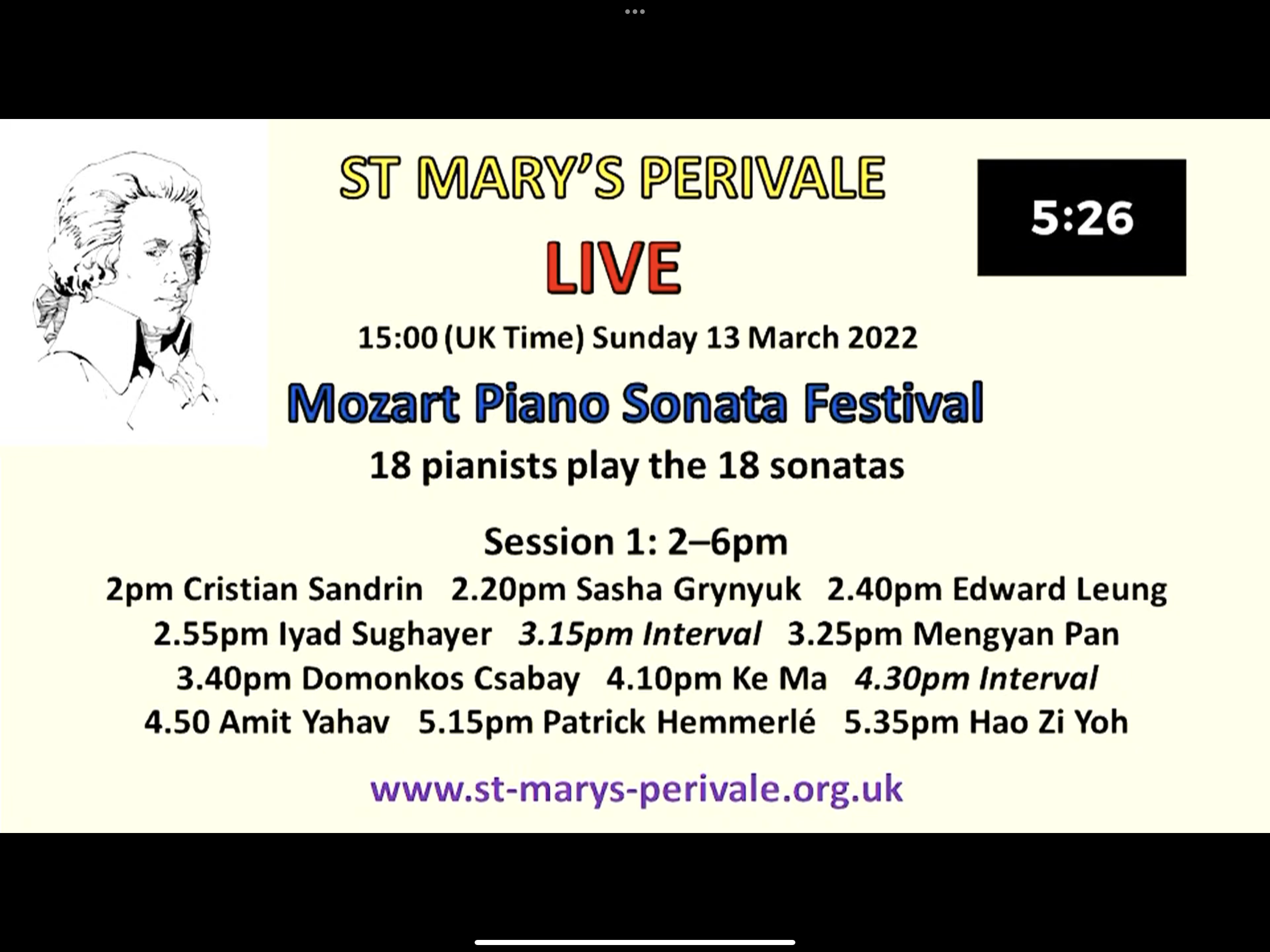
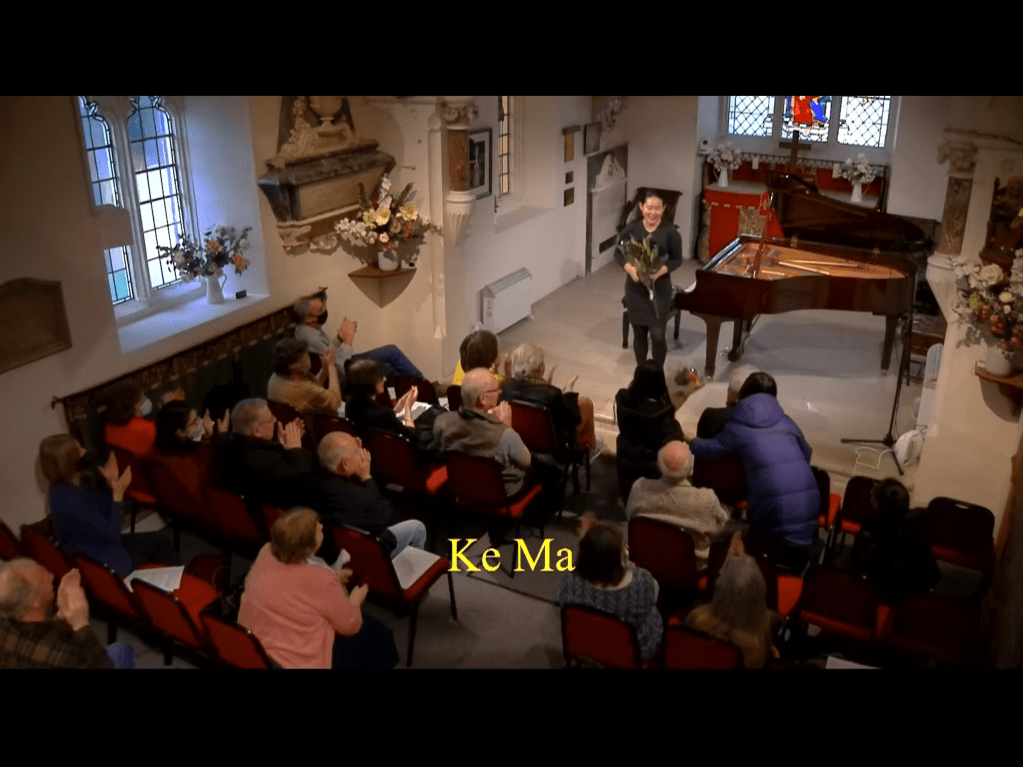
It was interesting to note the style and simplicity that all the pianists showed today.It was Schnabel who famously said that Mozart is too easy for children but too difficult for adults.His teacher Theodor Leschetizky told him:’You will never be a pianist;you are a musician’. Schnabel later boasted that:’he would only play music which is better than it could be performed!’While on a tour of Spain,he wrote to his wife saying that during a performance of Beethoven’s Diabelli Variations he had begun to feel sorry for the audience. “I am the only person here who is enjoying this, and I get the money; they pay and have to suffer.”All this to say that Mozart requires the knowledge of style but also a superlative technique to be able to interpret this genial music with clarity and precision but also a subtle sense of character and colour so similar to the purity of Mozart’s world of opera.It was strange -maybe even refreshing – that there was very little added ornamentation which has become the norm these days.Scholars such as Robert Levin have indicated that ornamentation and improvisation would have been an essential part of a musicians baggage in the nineteenth century.I noticed only Amit Yahav and Pavis Hajazi added some very discreet ornamentation.We live in an age when it is difficult to hear a performance of a Mozart or even Beethoven concerto without some ornaments filling out certain passages as were the performing practice of the day and so I found it refreshing to hear Mozart’s bare outline etched with such purity and clarity by all the pianists.The ornamentation kept much to what is the bare outline in the score (I pricked up my ears only at the opening of K.310! which I must ask Amit about one day).This is not the place to make a detailed analysis of each performance all of which were to admire above all for the fact that there was no I Pad to be seen from eighteen pianists who had risen to the challenge with great professionality.Each pianist presenting their allotted sonata with such character and personality.From the impish good humour or Cristian Sandrin in the very first sonata or the simplicity and velvet sound of Sasha Grynyuk.Both Cristian and Sasha look and sound as though they belong to the piano or the piano belongs to them – there is a strange alchemy that makes for a perfect match indeed.There was the great rhythmic drive and characterisation of Edward Leung and the sublime beauty of the Adagio opening of K 282 in the hands of that born Mozartian Iyad Sughayer.The crystalline sounds that Menyang Pan found in K .283 where her slow tempo for the Andante managed to seduce and convince as her superb musicianship always does.Domonkos Czabay showed us the serious Hungarian style of a musician I have admired for some time.Ke Ma was given bouquets of flowers from her charming little students for her superb performance of K 309 played with great intensity and commitment.After a welcome tea break Amit Yahav played the great A minor sonata with all the depth and weight of a serious thinking musician who had delved deep into this Sonata understanding only too well what the death of Mozart’s mother could mean to a sensitive artist.Patrick Hemmerlé amazed as always by his understanding, involvement and the just weight he gave to every scintillating note.Patrick could play at the drop of a hat the entire piano repertoire and has amazed us at St Mary’s for many a year.Hao Zi Yoh standing in at two days notice for a Covid victim amazed for the freshness and subtle sounds she produced especially in the sublime Andante cantabile .Above all the opening trills that unwound with enviable precision and musical meaning took my breath away.She above all exemplifies Mozart:simple,beautiful and fresh.
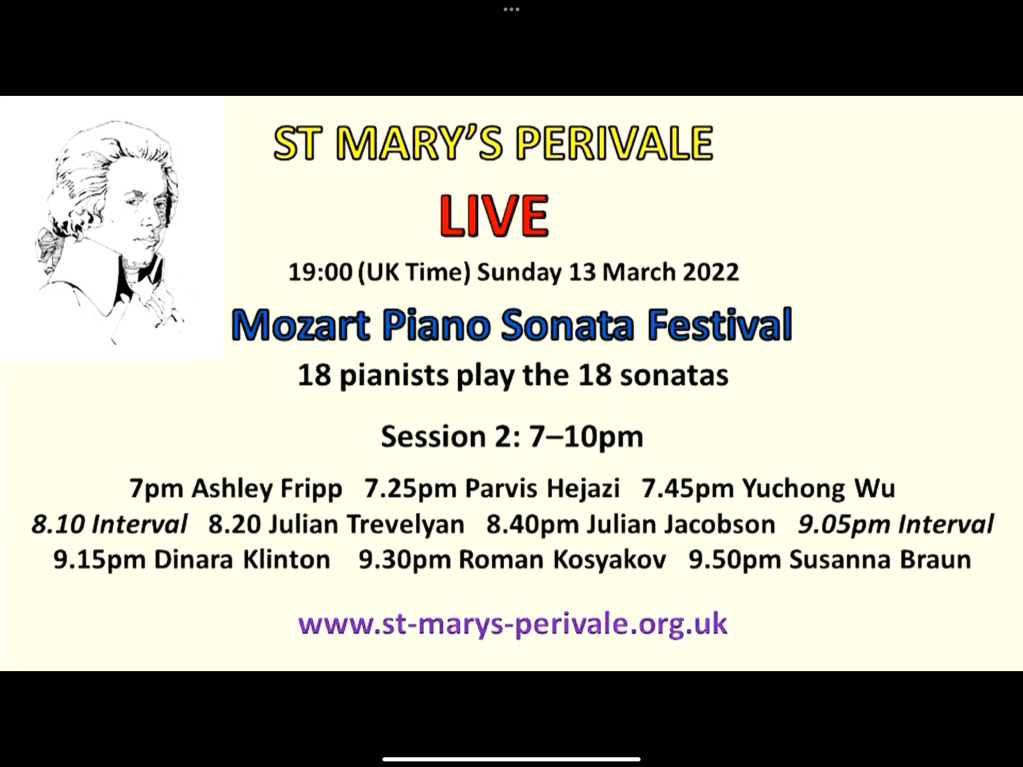
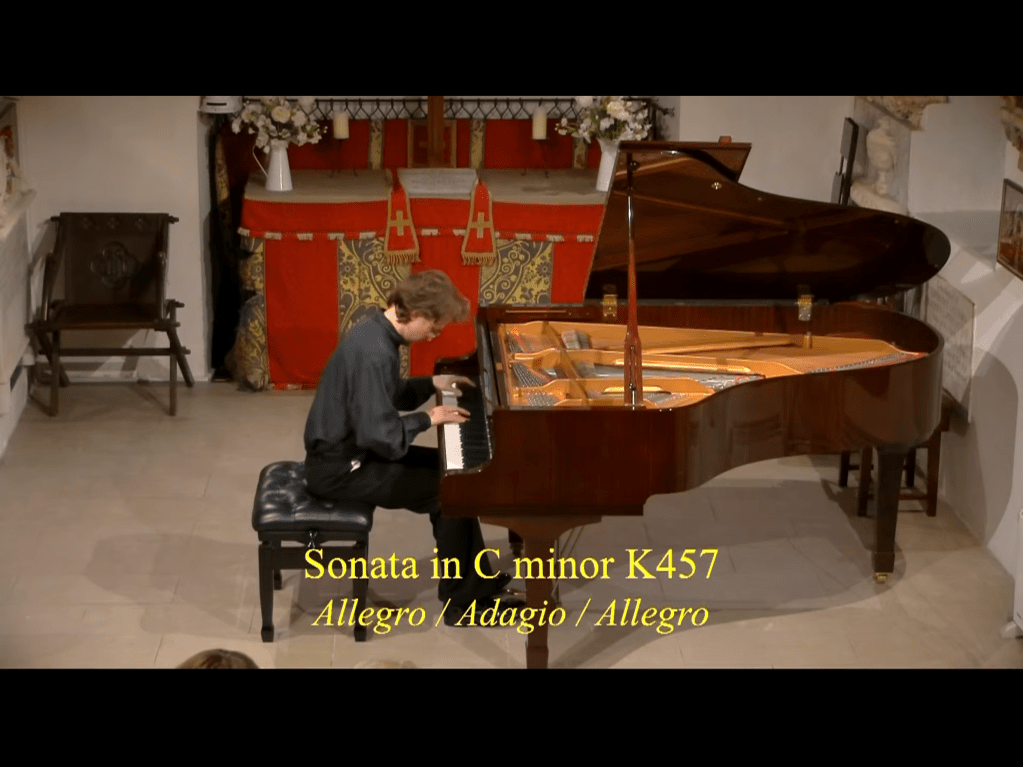
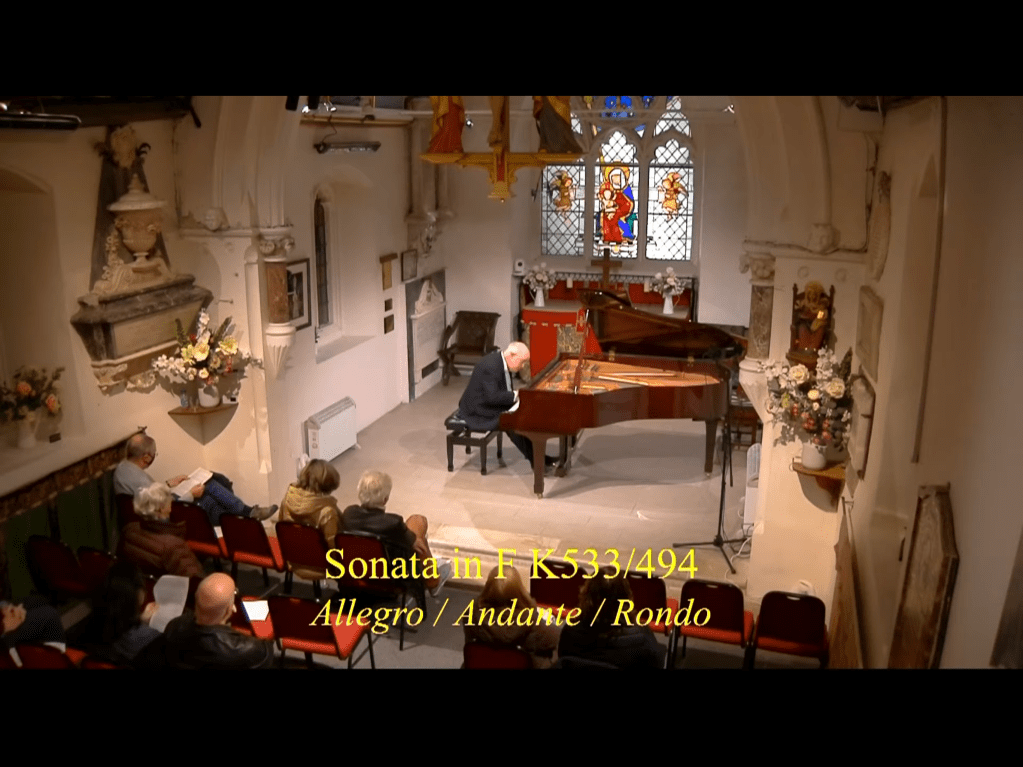
Listening to the evening session on line I immediately heard Ashley Fripp’s K 331 playing with great weight and nobility.The famous Allegretto Alla Turca played with irresistible control and passion.It was the first time I had heard Parvis Hejazi and everything his teacher Norma Fisher had told me was brought vividly to life with such beautifully fluid playing of great intelligence.Yuchong Wu ,another name new to me and standing in for another casualty of Covid,gave a very assured sensitive account of K 333 as you might expect from a graduate of Juilliard and I look forward to hearing him again in recital at St Mary’s.Julian Trevelyan gave a very personal account of the great C minor where his searching for colour with an unusual sense of balance brought new life to a well worn masterpiece.Julian Jacobson a senior member of this elite group of pianists showed us his complete understanding of Mozart’s style with playing of such simplicity and elegance from the only pianist I know who at the drop of a hat could play all thirty two Beethoven sonatas at one sitting as well as most of the piano repertoire.(Quality and quantity go together in Julian’s knowledgeable hands).Dinara Klinton’s unique technical command of the keyboard was put to the test with Mozart’s Sonata Facile where she imbued this little work with such subtle colour and meaning expressing with simplicity and beauty what we have all been sharing with her in the past weeks.Roman Korsyakov earlier in the week had played with Sasha Grynyuk the Andante and variations K.501 showing how a Russian and Ukrainian could live and create beauty together. https://christopheraxworthymusiccommentary.wordpress.com/2022/03/12/war-or-peace-the-help-ukraine-concert/. The penultimate Sonata he played with all the delicacy and scintillating sparkle of the true artist he is on and off stage.The last Sonata in D was played with great rhythmic energy and subtlety by a pianist new to me but to watch out for Susanna Braun.
2.0 pm Cristian Sandrin : Sonata in C major K279 Allegro – Andante – Allegro
Mozart wrote this first real sonata when he was 19 years old during his concert tour to Italy, while he was working on the composition of the opera ‘La Finta Giardiniera’. The style of the sonata draws elements from different musical sources. The first movement is strongly rooted in the classical style with baroque elements, the slow movement has a singing Italianate character, and Haydn is peeping around the corner in the witty finale. All three moments are in sonata form. The piano writing is very ‘pianistic’ and demands great dexterity and even virtuosity from the player. In the recapitulation of the first movement Mozart does not simply repeat the exposition but is constantly inventing surprising turns of melody and harmony in an almost improvisatory way. The second movement is unique with its aria-like melody and free flow of ideas, evoking a sweet ‘dolce’ mood. The finale brims with vitality and good humour, spiced with almost burlesque elements.
Born to a family of musicians from Bucharest, Romania, Cristian Sandrin made his solo debut at prestigious Romanian Atheneum Hall at the age of 13. After graduating the “Dinu Lipatti” Art College in Bucharest, Cristian moved to London where he studied at the Royal Academy of Music. Having graduated with First Class Honours in 2016, he is currently pursuing a postgraduate degree at the same institution. He is currently a receiver of the Piano Fellowship of the Philharmonia Orchestra’s Martin Musical Scholarship Fund 2017/2018, benefiting also from a scholarship of the Imogen Cooper Music Trust. Cristian Sandrin won numerous prizes and awards at international and national competitions. A Second Prize Winner of the Windsor International Piano Competition (2018) and Third Prize Winner of the Sheepdrove Intercollegiate Piano Competition (2018). He had his solo debut recital at the Wigmore Hall in London in September 2017. In Romania, Cristian Sandrin is a regular guest artist of the Filarmonica “Mihail Jora” Bacau, the Sibiu Sibiu Philharmonic, Ramnicu-Valcea National Philharmonic and Bucharest Symphony Orchestra. Other international engagements include performances at “La Fenice” Theatre in Venice, Theatre de la Montjoie, Salla Manuel de Falla in Madrid, Palazzo Ricci in Montepulciano, the Romanian Atheneum in Bucharest, and “Bulgaria Philharmonic Hall” in Sophia. https://christopheraxworthymusiccommentary.wordpress.com/2022/02/25/cristian-sandrin-a-message-of-hope-and-peace-in-florence-the-cradle-of-our-culture/. https://christopheraxworthymusiccommentary.wordpress.com/2021/06/06/sandrin-plays-mozart-simplicity-and-purity-in-bucharest/
2.20 pm Sasha Grynyuk : Sonata in F major K280 Allegro – Adagio – Presto
This sonata is modelled on a sonata of Haydn in the same key, which had appeared some time earlier. Both slow movements of the sonatas are in F minor and are marked ‘Adagio’, and both are in the Siciliano rhythm. The principal theme, consisting of several contrasting motives, is followed by a subject in triplets containing some interesting chromatic episodes. The movement abounds in playful scales and runs, giving the player ample opportunity to exhibit his virtuosity. The slow movement is a miracle of concentration and expression of feeling. The profundity, the expression of pain and anguish foreshadows the later Mozart in his great dramatic minor key works. The Finale clears all dark clouds and is a feast of surprises, jokes and joy.
Winner of over ten international competitions, prizes and awards, Sasha was chosen as a ‘Rising Star’ for BBC Music Magazine and International Piano Magazine . His successes also include First Prizes in the Grieg International Piano Competition and the BNDES International Piano Competition, in addition to winning the Guildhall School of Music’s most prestigious award – the Gold Medal – previously won by such artists as Jacqueline Du Pré and Bryn Terfel.Sasha has performed in many major venues including Wigmore Hall, Barbican Hall, Royal Festival Hall, Queen Elizabeth Hall, Bridgewater Hall (Manchester), Wiener Konzerthaus, Weil Recital Hall (Carnegie Hall, New York), Teatro Real (Rio de Janeiro) and Salle Cortot (Paris). He has performed with such orchestras as the Royal Philharmonic, Bergen Philharmonic and Orchestra Sinfonica Brasiliera. His recording of music by Glenn Gould and Friedrich Gulda for Piano Classics was chosen as the record of the month for the German magazine Piano News and shortlisted for the New York Classical Radio Award. Among Sa sha’s ongoing projects are performances of Shostakovich’s original piano score for the 1929 silent film The New Babylon , which he premièred at LSO St. Luke’s and later performed at Leif Ove Andsnes’ Rosendal Festival, Norway. Born in Ukraine, Sasha studied at the Guildhall School in London. Sasha is a Keyboard Trust artist and currently benefits from the artistic guidance of its founder Noretta Conci-Leech.https://christopheraxworthymusiccommentary.wordpress.com/2021/04/05/sasha-grynyuk-at-st-marys-for-the-glorification-of-love-and-passion/
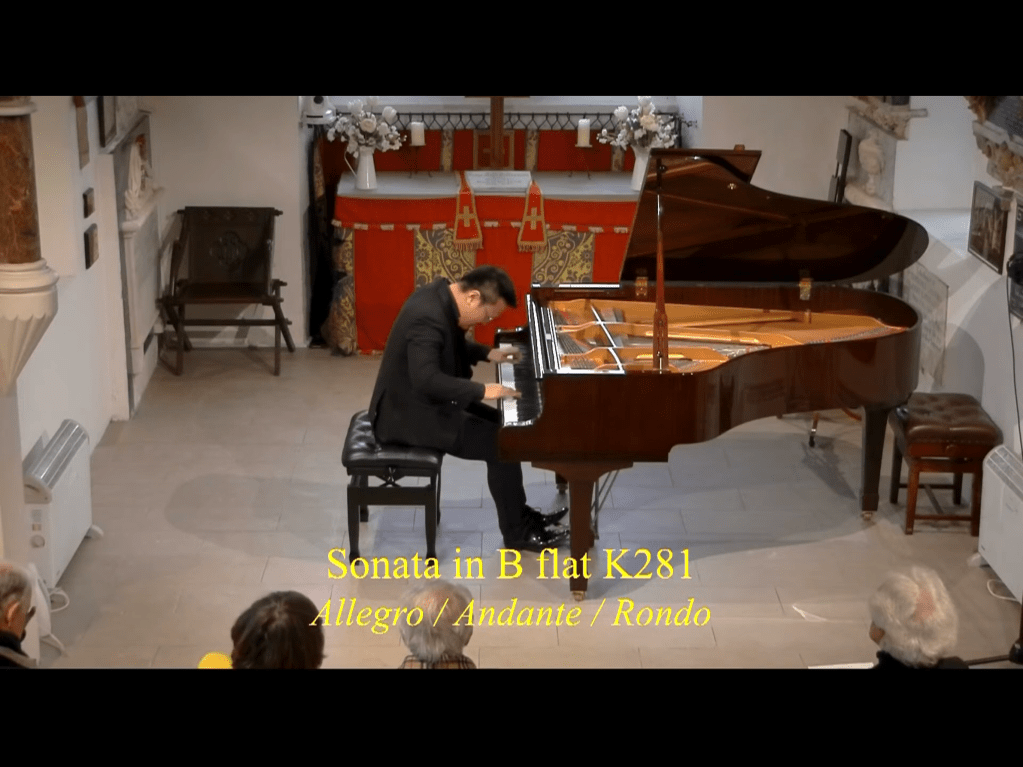
2.40 pm Edward Leung : Sonata in B flat K281 Allegro – Andante – Rondo
In the first movement Mozart fully explores the tonal resources of the instrument, letting it sound in rich chords and vibrating accompaniments. The movement abounds in free improvisatory development and rich variation of the lyrical main theme. The slow movement is a perfect example of the ‘gallant style’. The amoroso character of the music demands a graceful execution, never yielding to explicit sentimentality. The third movement is call Rondo and is based on a them in gavotte style. The music, although refined after the French style, also contains unexpected dramatic passages in minor keys.
Lauded as one of ’16 Incredibly Impressive Students at Princeton University’ by Business Insider , American pianist Edward Leung has performed in concert halls across North America, Europe, and Asia. Highlights of the current season include concerto performances with the Atlanta Symphony Orchestra and Orchestra of the Swan; debuts at the Wigmore Hall and Laieszhalle in Hamburg; recitals in London, Winchester, Wiltshire, Ulverston, and Wye Valley, and a debut commercial recording with violinist Usha Kapoor for Resonus Classics. A 2019 – 2020 Live Music Now artist, he has swept all the major prizes at the Royal Birmingham Conservatoire, including the Piano Prize, Donohoe Gold Medal, Andrew Downes Performance Prize, Delia Hall Accompaniment Prize, Herbert Lumby Prize, and Sheila and Colina Hodge Memorial Prize. After receiving a Master of Music from the Royal Birmingham Conservatoire, he continues his studies in the Advanced Postgraduate Diploma programme with Pascal Nemirovski. He is gratefully supported by the Keyboard Charitable Trust.https://christopheraxworthymusiccommentary.wordpress.com/2021/05/18/edward-leung-beauty-and-introspection-at-st-marys/
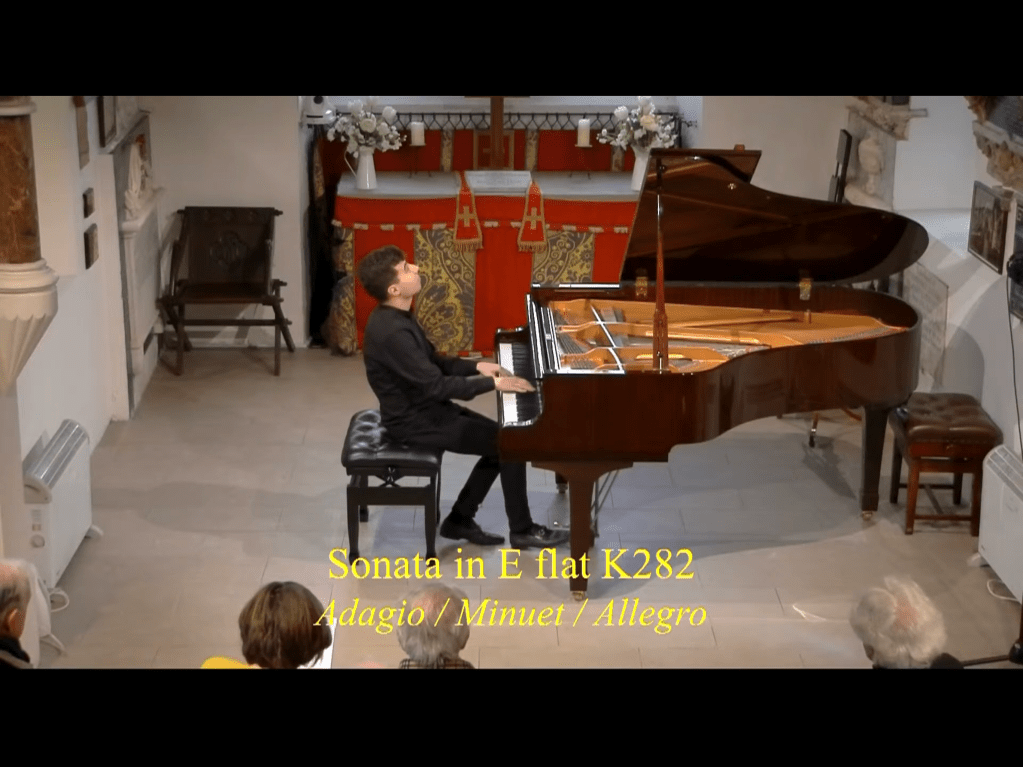
2.55 pm Iyad Sughayer Sonata in E flat K282 Adagio – Minuet – Allegro
This sonata unexpectedly begins with a slow movement followed by a minuet, and ends with an allegro movement. The extraordinary Adagio is full of lyricism and quietly flowing cantilenas. The second movement consists of two minuets, both in simple folk-like language. The last movement is reminiscent of Haydn and concludes the sonata in a gay and carefree mood.
Chosen as ‘One to Watch’ by International Piano Magazine, Iyad’s debut album – Khachaturian Piano Works for BIS Records was released in November 2019 to critical acclaim. The album was described by Gramophone as ‘exhilarating and delivered with perfect clarity’ and ‘an outstanding debut’ by BBC Music Magazine. In 2021 Iyad was a prize-winner at the Young Classical Artists Trust (YCAT) International Auditions. This autumn he records his second CD for BIS with the BBC National Orchestra of Wales conducted by Andrew Litton including Khachaturian’s Piano Concerto and Masquerade. As soloist Iyad has appeared with leading orchestras including the BBC Philharmonic Orchestra, Manchester Camerata, European Union Chamber Orchestra, the Cairo and Amman Symphony Orchestras. He has given recitals at Wigmore Hall, Bridgewater Hall & Stoller Hall in Manchester (broadcast by BBC Radio 3), the Laeiszhalle (Hamburg), Festival Musique D’Abord (France), Steinway Hall (New York), Castleton Festival (Virginia) and Kings Place in London, among many others. Recent highlights include an invitation to contribute to the BBC Arabic documentary ‘London Lockdown’, in which he took part as a character and recorded the soundtrack for the music. Born in Amman, the Jordanian-Palestinian pianist, Iyad studied at Chetham’s School of Music, the Royal Northern College of Music and Trinity Laban Conservatoire of Music and Dance where he won the College’s prestigious Gold Medal. He completed his International Artist Diploma at the RNCM in 2019 with Murray McLachlan, Martino Tirimo and Graham Scott and in 2019 became a City Music Foundation Artist. https://christopheraxworthymusiccommentary.wordpress.com/2021/03/19/iyad-sughayer-coming-of-age-at-cranleigh-arts-centre/
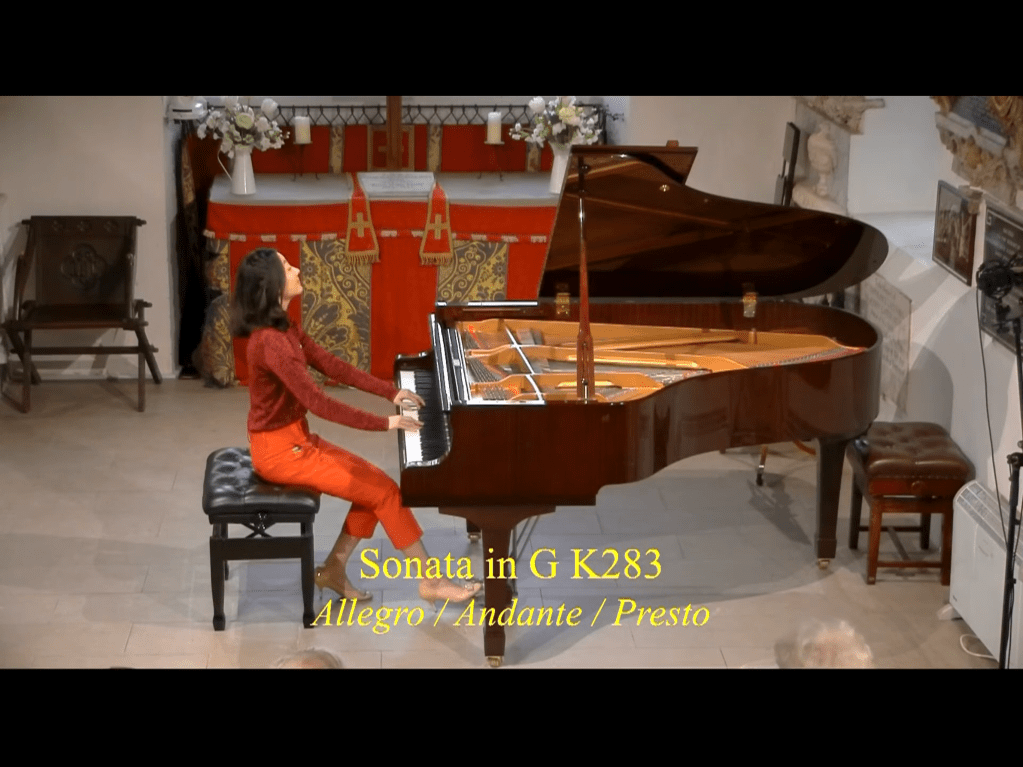
3.25 pm Mengyang Pan Sonata in G major K283 Allegro – Andante – Presto
This sonata in G (the only one in this key) is full of light, gaiety and song-like phrases, and reminds one of the sonatas of Johann Christian Bach, who was an important model for the young Mozart. The ‘Italian’ character of the music is clearly shown already in the first movement, where even in the development section, usually of dramatic character, there is not a trace of struggle, all minor key feelings being avoided. The slow movement brings an innocent feeling of happiness, which is clouded over in the middle section where the theme appears in A minor. The recapitulation brings relief and flows on in radiant cantilenas. The last movement is a sparkling presto, bearing a close resemblance to the finale of the piano sonata no 2, also in 3/8 measure and breathing the spirit of the Opera Buffa.
Mengyang Pan was born in China and has been living in the UK since 2000. She began her piano study at the age of three before becoming a junior student at the Central Conservatory of Music in Beijing. At the age of 14, she left China to study at the Purcell School in the UK with professor Tessa Nicholson. Upon graduating with high honours, she went on to complete her musical education at the Royal College of Music training under professor Gordon Fergus-Thompson and Professor Vanessa Latarche.The prize winner of many competitions including Rina Sala Gallo International Piano competition, Bromsgrove International Young Musician’s Platform, Dudley International Piano Competition, Norah Sands Award, MBF Educational Award, Mengyang has performed in many prestigious venues such as the Royal Festival Hall, Wigmore Hall, Cadogan Hall, Bridgewater Hall and Birmingham Symphony Hall amongst many others. As soloist, Mengyang has appeared with many orchestras and her collaboration with conductors such as Maestro Vladimir Ashkenazy, John Wilson and Mikk Murdvee has gained the highest acclaim. Mengyang also finds much joy in teaching. In 2019, Mengyang was appointed piano professor at the Royal College of Music in London, she also teaches at Imperial College.https://christopheraxworthymusiccommentary.wordpress.com/2020/12/19/mengyang-pan-at-cranleigh-arts-centrebeethoven-birthday-concert/
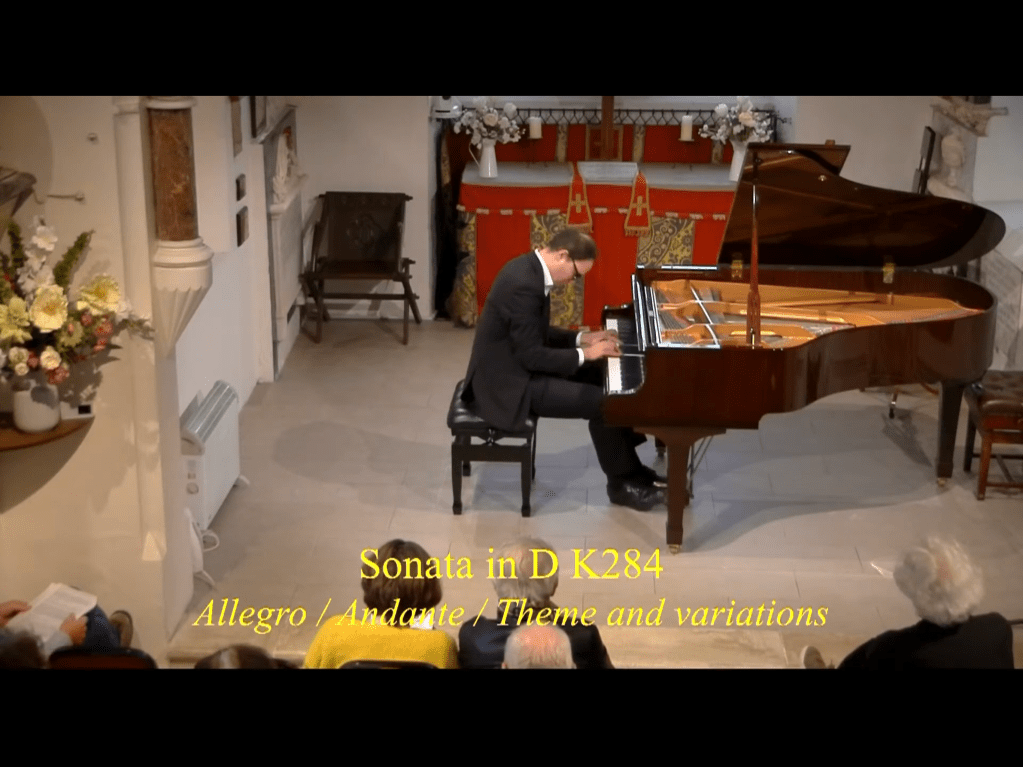
3.40 pm Domonkos Csabay Sonata in D major K284 Allegro – Andante – Theme and variations
Mozart wrote this sonata in 1775 when it was commissioned by Baron Thaddaus von Durnitz. The style of the first movement is bold, daring and spectacular, brilliantly written for the piano, using pianistic effects like hand crossing and tremolo. It contains influences from the Mannheim style, whereas the rich singing lines have an Italian character. The second movement is a Rondo en Polonaise, a wonderfully ‘orchestrated’ dance-like piece, where Mozart gives his imagination and fancy full reign. The third movement is a set of variations on a theme with a gavotte character. The beautiful set of variations not merely offers an embellished version of the original them, but is constantly changing the character of the theme, from peacefully dreaming to joyfully galloping. Mozart skilfully explores all the pianistic resources of the time using passages in parallel thirds, octaves, hand-crossing and trills.
Domonkos Csabay is a Hungarian pianist who was born in Budapest and studied at the Liszt Academy. He has been based in the UK since 2015. He has given solo performances in many countries, while also performing widely as a chamber musician and accompanist. He has played at many important concert venues such as Town Hall and Symphony Hall in Birmingham or Queen Elizabeth Hall and Milton Court in London, and collaborated with renowned artists and companies such as the CBSO, Orchestra of the Swan or Longborough Festival Opera. He won the Birmingham International Piano Competition in 2016. After finishing his piano studies with Pascal Nemirovski and John Thwaites at the Royal Birmingham Conservatoire, he obtainedr an Advanced Postgraduate Diploma in répétiteurship, and was selected to become an accompanist at Samling Institute for Young Artists. He made his debut on BBC Radio 3 playing Beethoven. His debut CD is recorded and to be issued by the label Naxos in 2021. Domonkos is currently based in London, where he holds a position as accompanist fellow at the Royal College of Music.https://christopheraxworthymusiccommentary.wordpress.com/2021/02/02/domonkos-csabay-at-st-marys-a-refined-recital-from-a-true-musician/
4.10 pm Ke Ma Sonata in C major K309 Allegro – Andante – Rondo
Mozart composed this sonata for Rosa Cannabich, daughter of the well-known composer of that time, who was an admirable player. The first movement opens with a powerful unison theme, followed by a graceful melody, bringing immediate contrast in the first subject. The second theme appears further on, and provides a charming and delightful ease. The slow movement gives a musical picture of Rosa Cannabich, of whom Mozart had a high opinion – he describes her as highly intelligent, kind and amiable. The music is a series of variations on a theme of great intimacy, evoking a sense of simplicity and lightness. Noteworthy are the many detailed performance marks, which should be strictly observed, according to Mozart. In the final Rondo, Mozart introduces orchestral effects reminiscent of the Mannheim school. The writing is of virtuoso and brilliant standard. The piece ends surprisingly with a pianissimo coda.
Ke Ma presented with flowers from her young student
Born in 1994 in China, Ke studied at the Royal Academy of Music in London, graduating with a Masters with distinction (DipRAM) in 2017. She is currently pursuing her Doctoral study at Guildhall School of Music and Drama. She has won top prizes at international competitions including 1st Prize at the 2016 Concours International de la vie de Maisons-Laffitte and Karoly Mocsari Special Prize (France), 1st Prize at the 2014 Shenzhen Competition (China) and 3rd Prize at the 2012 Ettlingen Competition (Germany. In 2017 Ke made her debut at Wigmore Hall under the auspices of the Kirckman Concert Society. She has given concerts across the UK, in France, Germany, Poland, the US and Canada. Recent engagements include recitals at the Purcell Room, Kings Place, the Saintonge Festival, Maison Laffitte and Salle Molière Lyon in France and the Chopin Festival at the Fisher Center in Bard College, New York.A committed chamber musician, Ke has undertaken a Tunnell Trust Award tour of Scotland, given a recital at Wigmore Hall and recorded music by Vieuxtemps for Champs Hill Records with violist Timothy Ridout. Ke is grateful for support from the Ian Fleming Award from Help Musicians UK; prizes from the Worshipful Company of Musicians, the Maisie Lewis Young Artist Fund and the Prince’s Award. She recently performed the Tchaikovsky Piano Concerto No.1 under the baton of Adrian Leaper at the Barbican Hall, as one of the finalists at the Gold Medal competition at Guildhall School of Music and Drama. https://christopheraxworthymusiccommentary.wordpress.com/2022/02/15/ke-ma-at-st-marys-a-seduction-of-luminosity-and-musicianship/
4.50 pm Amit Yahav Sonata in A minor K310 Allegro – Andante – Presto
The background to this tragic minor key sonata is the unexpected death of Mozart’s mother, while he was giving concerts in Paris in 1778. The work is of an unusual dramatic character, and is the expression of deep personal feelings. The first movement’s principal theme, marked Maestoso, begins with a dissonant appoggiatura. The dotted rhythm of the theme dominates the whole movement with an almost obsessive pressure. The second theme is in C major, but the underlying tension also casts a shadow on this episode, especially when it resolves into minor in the recapitulation. In the development section the dotted rhythm rages furiously in both fortissimo and pianissimo, and creates an almost unbearable tension. The second movement is an Andante, marked ‘Cantabile con espressione’. The many execution marks relating to phrasing, articulation and dynamics give a good insight in Mozart’s performance practice. The aria-like first section is interrupted by a dramatic middle section in the minor key, where the bass is making bold gestures under a frantically leaping accompaniment in the right hand. The third movement brings no consolation or smiling faces. It is a restless Presto, in which the music breathlessly chases a phantom. The middle section in the character of a musette, gives a glimpse of a better world, but immediately the first them takes its course again, and comes to a violent end in the minor key.
Multi-award-winning pianist Amit Yahav is much in demand as a recitalist, chamber musician and concerto soloist, having earned his reputation for interpretations that grip and move audiences with passion and intellectual insight. His interpretations of the music of Chopin and Schumann in particular have received high praise. In 2018, he earned a Doctor of Music degree from the Royal College of Music for his thesis investigating interpretation in the music of Chopin. Amongst Amit’s success are the Anthony Lindsay Piano Prize and the György Solti Award for Professional Development. Amit also won the 1st International Israeli Music Competition in London and consequently performed Israeli composer Zvi Avni’s On the Verge of Time in London’s Southbank Centre in the presence of the composer. In 2014, Amit attracted much positive attention with his CD “Amit Yahav Plays Chopin“, containing the four Ballades. This release followed Amit’s tour showcasing the four Ballades in an explained recital, which was also selected by the Royal College of Music as part of their Insight Series of soirees offered to their donors. Most recently, his newest disc featuring Romantic piano fantasies by Mendelssohn, Schumann and Chopin appeared on the GENUIN label.https://christopheraxworthymusiccommentary.wordpress.com/2020/06/10/amit-yahav-live-at-st-marys/
5.15 pm Patrick Hemmerle Sonata in D major K311 Allegro – Andantino – Rondo
From 1777 to 1778 Mozart made a Mannheim-Paris journey, which played an important role in his career. During the journey three piano sonatas were composed, one of which is this sonata in D major. He wrote the sonata for Josepha, the pretty daughter of Court Councillor Freysinger, a former school friend of Mozart’s father Leopold. The music is filled with a light and playful spirit, and still shows influences for the Mannheim School. One example of this is found in the closing rondo, where a cadenza is inserted before the main them appears again – a technique only used in a piano concerto. This proves that Mozart wanted to enlarge the structure of the ‘simple’ piano sonata, introducing concerto-like elements. The first movement is an allegro con spirito. The gentle second subject is enriched by beautiful counterpoint in the left hand. The development makes clever use of the Mannheim ‘sigh’ motive, a descending second, which was introduced as a little coda to the exposition. The song-like second movement contains some moving melodic episodes, and ends with a richly accompanied code, evoking a feeling of sweet nostalgia. The Rondo is a real concert piece with flourishing cascades of scales, its 6/8 time playfully dancing towards an effective end.
Acclaimed for the originality of his concert programmes and the depth of his interpretations, Patrick Hemmerlé is a French pianist living in England. He can often be heard performing such works as the 24 Chopin Etudes, the 48 Bach Prelude and Fugues, or lesser-known composers. Recent engagements have taken him to New York, Los Angeles, Berlin, Paris, Vienna, and Prague, as well as many festivals and music society in England. Patrick has published 3 CDs, which have been well received by the international press. His latest recording project, to be issued in 2020 is a pairing of Bach’s Well Tempered Clavier and Fischer’s Ariadne Musica. He is in demand as a lecturer. He has given talks for the Cambridge University, as well as a cycle of concert-lectures on French music, presenting composers little known to the general public,. This led to the recordings of the piano music of Jean Roger-Ducasse and Maurice Emmanuel. Patrick is laureate of the international competition of Valencia, Toledo, Epinal, Grossetto, and more recently the CFRPM, in Paris, where his interpretation of Villa-Lobos’s Rudepoema, raised a great deal of interest. He was trained in Paris at the Conservatoire (CNR), under the tuition of Billy Eidi.https://christopheraxworthymusiccommentary.wordpress.com/2022/01/17/patrick-hemmerle-ravishes-and-seduces-the-senses-at-st-marys/
5.35 pm Hao Zi Yoh Sonata in C major K330 Allegro – Andante – Allegretto
The enchanting simplicity of the opening them is the starting point of a wonderful movement in which simple scales and broken chords turn into pure music of sublime beauty. In the development Mozart applies rich and manifold thematic material expressing emotion and unrest by using frequent syncopation and ‘sigh’ motives. Mozart’s marking ‘dolce’ is significant in the execution of the slow movement, which is in ternary form. The gentle flowing atmosphere of the beginning is clouded over by the darker mood of the middle section in the minor key. The reappearance of the first melody comes then as a ray of sunlight. The joyful rondo is in rondo-sonata form. The music brims over the witty themes and brilliant virtuosity, reminding one of a gay scene from one of his operas.
Hao Zi Yoh was born in 1995 in Malaysia. By the age of 12, she already performed at Carnegie Hall as a gold medallist of the Bradshaw and Buono International Piano Competition. In Malaysia, Hao Zi studied under Chong Lim Ng, who showed her the path into the classical music world. At the age of 14, she moved to Germany to study at the Hochschule für Musik Freiburg. She won top prizes in many international competitions including EPTA Belgium, Enschede, RNCM James Mottram (Manchester, 2012) and Concurso internacional de piano Rotary Club Palma Ramon LLull, Mallorca (Spain 2013). In 2014, she came to study with Christopher Elton at the Royal Academy of Music, London. She received 3rdPrize at Roma International Piano Competition, the Phillip Crawshaw Memorial Prize for an Outstanding Musician from Overseas at the Royal Overseas League Competition. She was also recipient of prestigious Martin Musical Scholarship Trust Philharmonia Piano Fellowships on the Emerging Artists Programme 2017/18. A Young Steinway Artist, Hao Zi is currently based in London and has performed in venues such as Wigmore Hall, Southbank Royal Festival Hall, Salle Cortot, Steinway Hall London, St. Martin-in-the-Fields, Dewan Filharmonik Petronas (Malaysia) and Teatro Quirino (Italy). She is further developing her performing career being part of the Keyboard Trust London, Talent Unlimited. Hao Zi is also a piano tutor at King’s College London and gives masterclasses at Imperial College London. https://christopheraxworthymusiccommentary.wordpress.com/2021/03/09/hao-zi-yoh-at-st-marys-a-universal-soul-at-the-service-of-music/
7.00 pm Ashley Fripp : Sonata in A K331 Theme and variations / Minuet / Allegretto
This piano sonata is one of the most frequently performed sonatas of Mozart. It is probable that it was created around 1783 when Mozart was working on his opera ‘The Seraglio’. Supporting this reason is the appearance of Turkish elements in both the opera and the sonata. Mozart did not miss the popularity of exotic Turkish music in Vienna those days, and introduced such elements not only in his opera but also in his piano music, hoping for better sales of his music. The Turkish march is not the only unique feature of the sonata. Unusual is also the first movement, being a set of variations, and the Minuet in place of the slow movement. In fact none of the movements is in sonata form. The sonata does not require bravura technique to play, and it seems that Mozart composed this work bearing Viennese amateur pianists in mind. The first movement, Andante grazioso, is a set of variations on a beautiful theme in A Major. The gently rocking melody develops into six variations of different character – playful, dark, peaceful and bristling. The second movement is a minuet. The writing and structure of the piece is a far cry from the simple minuets used in other works. There is complex counterpoint and audacious harmony employed which, combined with the irregularity of phrase construction, makes this one of the most original minuets Mozart wrote. The third movement is the well-known Marcia alla Turca, in A-B-C-B-A-B- Coda form. The B=part shows the Turkish effects : festive drums and cymbals sound on the piano evoking a joyful march parade.
British pianist Ashley Fripp has performed extensively as recitalist, chamber musician and concerto soloist throughout Europe, Asia, North America, Africa and Australia in many of the world’s most prestigious concert halls. Highlights include the Carnegie Hall (New York), Musikverein (Vienna), Concertgebouw (Amsterdam), the Philharmonie halls of Cologne, Paris, Luxembourg and Warsaw, the Bozar (Brussels), the Royal Festival, Barbican and Wigmore Halls (London). He has won prizes at more than a dozen national and international competitions, including at the Hamamatsu (Japan), Birmingham and Leeds International Piano Competitions, the Royal Over-Seas League Competition, the Concours Européen de Piano (France) and the coveted Gold Medal from the Guildhall School of Music & Drama. In 2013, Ashley won the Worshipful Company of Musicians’ highest award, The Prince’s Prize, and was chosen as a ‘Rising Star’ by the European Concert Hall Organisation (ECHO). He has also performed in the Chipping Campden, Edinburgh, Brighton, Bath, City of London and St. Magnus International Festivals as well as the Oxford International Piano Festival and the Festival Pontino di Musica (Italy). A frequent guest on broadcasting networks, Ashley has appeared on BBC television and radio, Euroclassical, EurovisionTV and the national radio stations of Hungary, Spain, Luxembourg, the Netherlands, Poland, Belgium and Portugal.Ashley Fripp studied at the Guildhall School of Music & Drama with Ronan O’Hora and at the Scuola di Musica di Fiesole (Italy) with Eliso Virsaladze. In 2022 he was awarded a doctorate for his research into the music of Thomas Adès. https://christopheraxworthymusiccommentary.wordpress.com/2021/12/11/ashley-fripp-at-st-marys-penetrating-the-soul-of-mozart-and-schubert/
7.25 pm Parvis Hejazi : Sonata in F K332 Allegro / Adagio / Allegro
In 1781 Mozart, at the age of 25, moved from Salzburg to Vienna and started his mature creative activities. This is one of his sonatas which are presumed to have been composed between 1781 and 1783, his first years in Vienna. The pleasant first subject, a graceful melody in ¾ time, is followed by sudden ‘Mannheim rockets’, upwardly surging figurations. The innocent second subject in C major seems to try to calm down the disturbance. The development does no offer dramatic struggles, but gently introduces the second subject again, and after a building up a tension, the soothing first melody renders everything peaceful. The beautiful slow movement with its tender aria-like melody , lacks a more dramatic middle section, so as not to disturb the atmosphere of peaceful quietness and unclouded beauty of sound. The finale presents a whirlwind of sixteenth notes in 6/8 time. It presents a fine display of virtuosity, and its exhilarating momentum never fails to make a deep impression on the audience.
Being a pianist and composer, Parvis Hejazi is known as a “rising star on the piano sky” (ARD television), interested in a variety of performance activities from solo recital and concerto programmes to chamber music performances and from composing to conducting his own works. He holds the Gerd Bucerius award of the Deutsche Stiftung Musikleben for being “a highly promising young artist”. Parvis recently won the Grand Prix of the 3rd International PianoArt Competition in Kiev. He furthermore was awarded the first prize and special prize of the International Piano Competition Gagny in 2017 and was also awarded first prizes in various national and international competitions in Germany. His performance activities led Parvis to prestigious venues, including the Laeiszhalle Hamburg, Die Glocke Bremen, the Robert Bosch Foundation in Berlin, the SWR Sendesaal Stuttgart, the Wiener Saal and Solitaire at the Mozarteum Salzburg and to France, Belgium, the Netherlands, Italy, the Czech Republic and Israel. Born in 1999, Parvis studied piano and composition at the Junior Department of the University of the Arts Bremen. He received crucial influence from working with world leading pianists such as Norma Fisher, Jerome Lowenthal, Vanessa Latarche, Anatol Ugorski, Igor Levit and Lars Vogt. He is currently studying with Norma Fisher at the Royal College of Music in London with a Music Talks Scholarship, as well as grants from the prestigious Evangelisches Studienwerk (Villigst), the Hollweg Foundation and the Deutsche Stiftung Musikleben. Parvis is a Member of the Keyboard Charitable Trust as well as of Talent Unlimited UK.
7.45 pm Yuchong Wu: Sonata in B flat K333 Allegro / Andante / Allegretto
Mozart wrote this sonata in the summer of 1778, during his stay in Paris. Its close resemblance to the sonatas of Johann Christian Bach is further explained by the fact that he was also staying in Paris at that time. Both composers had frequent contact and had great respect for each other. In the first movement the music flows smoothly with an amiable smile and an Italian grace. Yet the part writing and the darker shadows sometimes cast on the sunny landscape unmistakably bear stamp of Mozart’s genius. The slow movement reveals intimate and deep feelings, as often heard in Mozart’s works in E flat major. In the development the fragmented first subject is loaded with a brooding, even menacing tension, which keeps hanging as a cloud over the movement until the very end. The third movement, Allegretto, is rondo which has evident concerto-like episodes, notable the alternations of ‘solo’ and ‘tutti’, and the full-scale cadenza at the end, concluding this delightful sonata.
Yuchong Wu was born into a musical family in China in 1995. He began playing the piano at the age of four and made his debut recital at the age of nine. In 2010 he entered The Juilliard School with a full scholarship, and continued his study toward a bachelor’s degree. During his time at Juilliard, he has been guided by Veda Kaplinsky, Matti Raekallio and Robert McDonald. Yuchong has also worked privately with Paul Badura Skoda, Leon Fleisher, Menahem Pressler, Robert Levin, and Murray Perahia. More recently he has been studying at the Royal Academy of Music. He is a laureate of numerous international competitions such as the Sixth Tchaikovsky International Youth Music Competition (2009, second prize), the Sendai International Piano Competition (2013, the special jury award and the audience prize), the Warsaw Chopin International Piano Competition (2015), the Leeds International Piano Competition (2018) and many others.
8.20 pm Julian Trevelyan : Sonata in C minor K457 Allegro / Adagio / Allegro
This sonata was written in 1784, the only sonata in the minor key, together with the A minor K310. The work is one of Mozart’s darkest and gloomiest creations, full of anguish, drama and grief. The piano writing is of high calibre, calling for virtuoso powers, and already foreshadows the piano works of Beethoven. A bold subject in parallel octaves in the minor key sets the tone and atmosphere. No smiling and flowing Italianate melodies here, but tight, grim structures, moving on in inexorable pace. The second subject is in E flat major, which is transformed into C minor in the recapitulation, the minor version having a totally new strength and tension. The development rages towards a climax, and the recapitulation brings no relief, the coda ending into a dark abyss of C minor. The slow movement is a richly embellished cantilena, wandering off in distant keys. It gives the player the opportunity to give his own imagination free reign, a practice which is customary in the piano concertos. The last movement presents a syncopated first subject of restless and breathless character, followed by a violent outcry of repeated octaves and leaps, which mercilessly recurs several times. The tight and concise character of the music makes it all the more dramatic and effective. The code introduces still a new element which brings this extraordinary sonata to a violent close.
Julian Trevelyan is a British musician. In 2021 he won the Second, Audience and Mozart prizes at the Concours Géza Anda. In 2015 at the age of 16, he was the top prize winner, and youngest ever laureate at the Concours Marguerite Long. He has also won laureates at the CFRPM, Ile de France, Dudley, Dumortier and Kissinger competitions. He has studied at the École Normale Alfred Cortot with Rena Shereshevskaya, sponsored by Patrick Masure. From 2021 he is Rena’s assistant, and replaces her in lessons. He also studied composition there, and is composer in residence with Ensemble Dynamique. He is an Alumnus of the Lieven International Piano Foundation. He has also studied with Christopher Elton, Elizabeth Altman and Rita Wagner. He studied musicology at Oxford University, and has a degree in Geology. He leads a string quartet, plays historical instruments and is part of a mandarin a capella choir. In his spare time, he enjoys reading, cooking and sports. He currently lives in Paris and speaks four languages. https://christopheraxworthymusiccommentary.wordpress.com/2021/11/29/julian-trevelyan-at-st-marys-liszt-restored-to-the-pinnacle-of-the-romantic-repertoire/
8.40 pm Julian Jacobson : Sonata in F K533/494 Allegro /Andante / Rondo
The movements of this sonata were composed separately, and were later combined into what is now regarded as one sonata. The writing of the first movement is daring, using many contrapuntal devices and extensive harmonic digressions into far away minor keys. It recalls the works of Bach and Handel, whose compositions Mozart had studied closely. The coda shows some extraordinary chromatic shifts, before closing with flourishing triplet runs. The slow movement is in sonata form. It presents some of the most original music of Mozart, showing in the asymmetrical phrase structures and the strange harmonic development, which must have sound oddly dissonant to contemporary ears. The third movement, marked Allegretto, eases the tension of the two preceding movements, and is a pleasant Rondo, in which the theme is differently ornamented each time it reappears. The minor episode again shows clever counterpoint. A skilful, cadenza-like piling up of the theme is followed by the recurrence of the theme in the bass, and the movement ends peacefully.
Julian Jacobson enjoys a distinguished career as pianist, composer, writer, teacher and conductor. Trained classically at the Royal College of Music London (where he now teaches, as well as at the Royal Birmingham Conservatoire) and Oxford University, he was also the inaugural pianist of the National Youth Jazz Orchestra of Great Britain. Julian has performed in more than forty countries on five continents. Frequently apppearing in China, he is Guest Professor at Xiamen University, and gives masterclasses internationally. A large and varied discography includes rarities such as the four sonatas of Carl Maria von Weber and the Violin Sonatas of Georges Enesco. He is Chairman of the Beethoven Piano Society of Europe and is in the process of recording the 32 sonatas. In 2003 he made history by performing all the sonatas from memory in a single day, repeating this in 2004 and 2013; he his planning one final “marathon” for 2022. He has composed several film and TV scores including To The Lighthouse and We Think The World Of You, as well as instrumental pieces and songs. His virtuoso transcriptions for piano duet of Gershwin’s An American in Paris and Second Rhapsody, published by Schott/Bardic Edition, have received rave reviews; Julian recorded them in August 2020 for the SOMM label with his duo partner Mariko Brown.https://christopheraxworthymusiccommentary.wordpress.com/2021/12/03/julian-jacobson-boogie-woogie-and-beamish-at-city-university-of-london/
9.15 pm Dinara Klinton : Sonata in C K545 Allegro / Andante / Rondo
This sonata, composed in 1788, bears the subtitle ‘Little Sonata for beginners’. Today it is known as ‘Sonate facile’ and is popular with piano amateurs, often being the first music of Mozart to digest. The structure of the first movement is of notebook discipline. It starts with a singing principal these, followed by a running scales. The recapitulation is the standard repeat of the exposision. The slow movement is touching in its simplicity and through very modest means is still able to build up a moving climax. The theme of the short Rondo is reminiscent of the cuckoo’s call.
Dinara Klinton is an active concert performer and prize-winner of over 15 international competitions. Dinara has performed at many major concert venues including the Royal Festival Hall and Wigmore Hall, and worked with such orchestras as The Philharmonia Orchestra and St. Petersburg Philharmonic Orchestra. She has also appeared on BBC2 and on Radio 3. As a recording artist, Dinara has received widespread critical acclaim for her interpretations. Among many dazzling reviews, her album Liszt: Études d’exécution transcendante, S. 139, released by the German label GENUIN classics, was selected by BBC Music Magazine as Recording of the Month. Dinara’s debut album Music of Chopin and Liszt was made at the age of 16 with an American label DELOS, and the most recent CD is a part of renowned recording series Chopin. Complete Works on contemporary instruments, released by The Fryderyk Chopin Institute. Dinara graduated from the Moscow State Conservatory, has a Master of Performance degree with distinction from the Royal College of Music where she studied under Dina Parakhina and where she now holds a position of Assistant Professor of Piano https://christopheraxworthymusiccommentary.wordpress.com/2021/06/04/dinara-klinton-in-perivale-and-washington-dancesongtalesflowers-and-romance/
9.30 pm : Roman Kosyakov : Sonata in B flat K570 Allegro / Adagio / Allegretto
It was not until after this sonata was written in Vienna in 1789 that the style known as that of Mozart’s last years became apparent in his piano sonatas. There is no trace of splendour and richly singing cantilenas, as in the B flat major K333, or the tragic and overtly dramatic tensions of the C minor K457 sonatas. The language of this sonata is simple and clear with a deep inner meaning, nothing is superfluous or brilliant for its own sake. The music is not composed for the concert hall to dazzle the audience. The first movement begins with a calm theme in unison triads, followed by some conventional musical patterns. Two sudden chords introduce the singing second theme in E flat major. The recapitulation is almost identical to the exposition. The Adagio is reminiscent of an ensemble of wind instruments, notably the first bar’s ‘horn call’. The profound, almost processional development of the music is interrupted by an episode in C minor, introducing gentle ‘sigh’ motives in the middle a new theme appears, singing innocently in A flat major. The cheerful and lilting them of the rondo appears only twice, the middle section introducing a gay episode in staccato repeating notes, which could have walked straight out of the Magic Flute.
Roman Kosyakov is a Russian concert pianist, and Ambassador for Hastings International Piano Concerto Competition. He is a laureate of many nationals and international competitions: 2 nd prize in UK Piano Open International Piano Competition (London, 2020), 1 st prize in the 14th Hastings International Piano Concerto Competition (2018), Gold Prize of the 3 rd Manhattan International Music Competition (2018); 1 st prize and the audience prize in the 10th Sheepdrove Piano Competition (2018). He studied at the Central Music School in Moscow and at the Tchaikovsky Moscow Conservatoire. Since 2017, he has studied at the Royal Birmingham Conservatoire with Pascal Nemirovski. Roman’s performance career includes engagements in prestigious venues and festivals across the UK, US and Europe. He is regularly invited to perform with the Hastings Philharmonic Orchestra, the English Symphony Orchestra and The Royal Philharmonic Orchestra. In January 2019 Roman received “The Royal Birmingham Conservatoire – Silver Medal” by the Musician’s Company in the UK, became a member of Musician’s Company Yeomen Young Artists’ Programme. Roman is a winner of The Denis Matthews Memorial Trust award, Kirckman Concert Society Artist Prize and is a scholar of the Drake Calleja Trust. He has recorded a debut CD for “Naxos” with works by Liszt which was released in late 2020. https://christopheraxworthymusiccommentary.wordpress.com/2021/11/12/roman-kosyakov-hastings-prize-winners-concert-with-the-rpo-at-cadogan-hall-under-kevin-john-edusei/
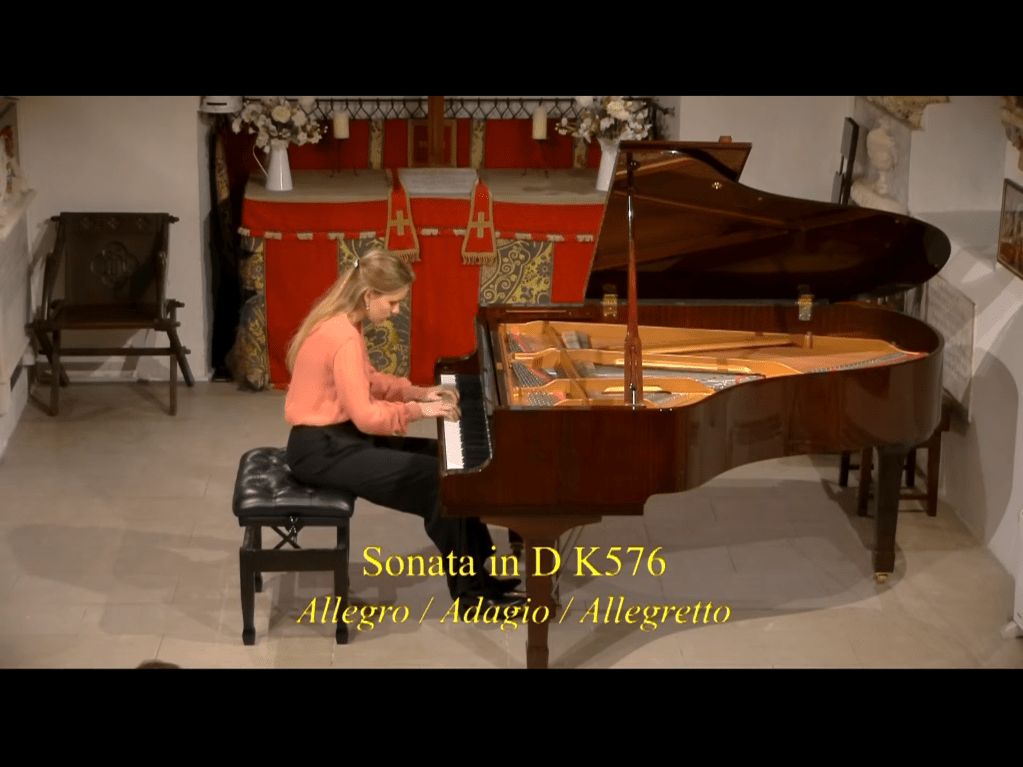
9.50 pm Susanna Braun : Sonata in D K576 Allegro / Adagio / Allegretto
Mozart played this sonata, which proved to be his last one, in Berlin before the King of Prussia Frederick William II, in 1789. The King commissioned him to write some string quartets and piano sonatas of a ‘light’ character. Mozart only completed 3 string quartets and one piano sonata, this sonata in D major. It is far from being ‘light’, indeed the baroque-like counterpoint makes this one of the most difficult sonatas to perform. The ‘Hunt’ fanfare of the theme is used in the development in fugato-like episodes. The Adagio in A major exudes intimacy. The richly ornamented flow of melody and the strong underlying tensions of the music are characteristic of the late Mozart. The last movement, marked Allegretto, is a fine specimen of Mozart’s sonata-rondo. The skilful contrapuntal devices and the virtuosic finger-work make it a worthy conclusion to this ambitious sonata. Susanna Braun, born in The Hague (June 1999) to Swiss parents, studied with Helen Krizos first at Chetham’s School of Music from 2012 to 2017 and then at the Royal Northern College of Music, where she completed her bachelor’s degree with “First Class Honours”. Besides, from 2016 to 2017 she attended the ‘Schola Cantorum de Paris’, class of Maurizio Moretti, where she was awarded the “Diplôme Supérieur” with unanimous highest mention and congratulations of the jury. Presently she is studying at the renowned International Academy in Imola ‘Incontri con il Maestro’ in the class of Boris Petrushansky and at the Conservatorio della Svizzera Italiana, with Anna Kravtchenko. Susanna is the winner of the 10th International Piano Competition for Young Musicians (Enschede 2018), received the NOB-Förderpreis (Encouragement prize from Neues Orchester Basel) in 2019 and among others won prizes at the Andrea Baldi International Piano Competition in Bologna, International Anton Rubinstein Competition in Düsseldorf, International Rosario-Marciano Competition in Vienna, Mazovia International Chopin Festival in Warsaw, International Competition Piano Talents in Milan, International Cesar Franck Piano Competition in Brussels. In May 2022, she will perform with the Philharmonic Orchestra “Mihail Jora” of Bacau, Romania, as part of the Città di Cantù 30th International Piano Competition. Susanna is the founder and artistic director of the International Chamber Music “Blenio Festival”, which was realized with great success for the first time in July of 2021 in Ticino, Switzerland. Susanna is grateful for the support of Talent Unlimited in London.
Hats off to Dr Mather for allowing us to hear a survey of the complete Mozart Sonatas played by some of the finest young pianists of the day.This followed on from the complete Beethoven cycle of 32 Sonatas last October.
Thank you Christopher for this superb write-up of yesterday’s festival. The performances will remain available on Youtube and Vimeo for 3 weeks. On our Vimeo showcase you can find the start of each sonata – have a look ! https://vimeo.com/showcase/6757898
Apologies – the long Youtube recording of last night’s Mozart Sonata festival at Perivale, with the last 8 pianists, has been completely blocked for ‘copyright reasons’. We are fed up with this madness which implies that someone playing Mozart at Perivale (Yuchong Wu playing K333) is miming another recording (Kim Taehyung) ! While we sort this out, the evening can still be viewed via our Vimeo showcase. https://vimeo.com/showcase/6757898 . Have a look – some remarkable performances.
It had been Jed Distler the distinguished American critic who had suddenly pricked up his ears as he covered the entire Chopin Competition for the ‘Gramophone’ magazine.He sent me a message asking me to listen to a young Chinese Canadian pianist who had played the early Rondo op 2 with the scintillating subtlety of another age.(In fact Bruce said that his teacher Dang Thai Son had told him that he played old style.He had replied that he must play as he feels).Suddenly all eyes were on Bruce where the hot favourite had been the recent winner of both the Hamamatsu and Australian International Competitions.Now the spotlight was on him and has remained firmly there long after his unexpected triumph in Warsaw.It is enough to say that the recital he gave on the 1st March for Chopin’s 212th birthday sold out in four minutes and a second concert had to be arranged the day after!This is what I wrote on listening to the live stream from Warsaw on that occasion:
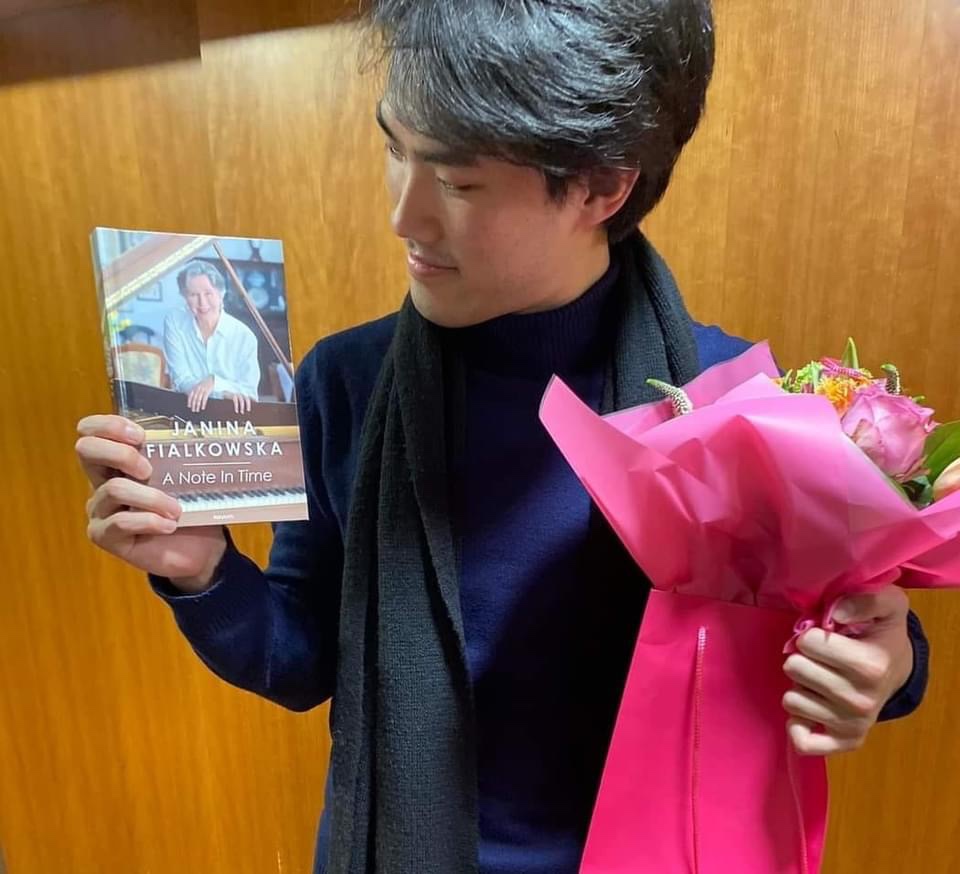
Janina Fialkowska became the protégé of Artur Rubinstein when he had heard her in the very first competition in his name in Israel.Now it was Janina who had heard Bruce in the Rubinstein competition years later and invited him to her home in Bavaria to encourage and help him.She had noticed his great talent and knew that with the right encouragement the world would be quick to follow.How right she was!
Bruce Xiaoyu Liu glad to have Janina’s wonderful book after his magnificent performance of Tchaikovsky 2 in London tonight.
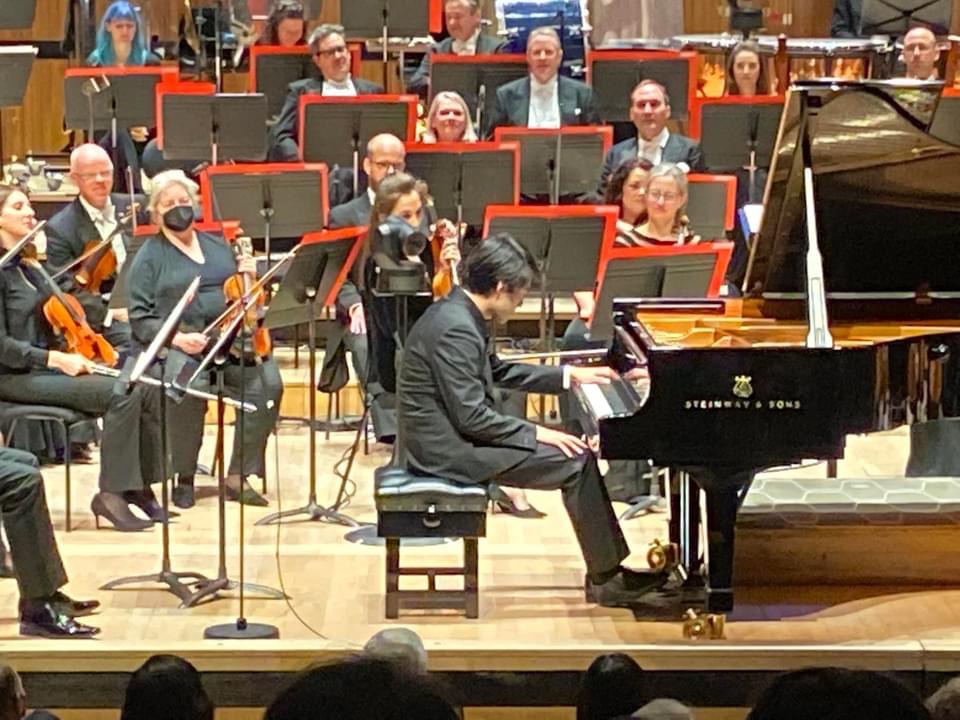
An unexpected indisposition of the blind pianist Nobuyuki Tsujii gave London the chance to hear Bruce not in the First Concerto by Tchaikowsky as planned but in the much lesser known Second.A work almost as long as Brahms Second concerto sharing with it the chamber music quality of the slow movement.It is by a strange coincidence that the cancellation by Shura Cherkassky many years previously with this concerto had launched the career of Nelson Freire who had stood in at a week’s notice and became famous over night!
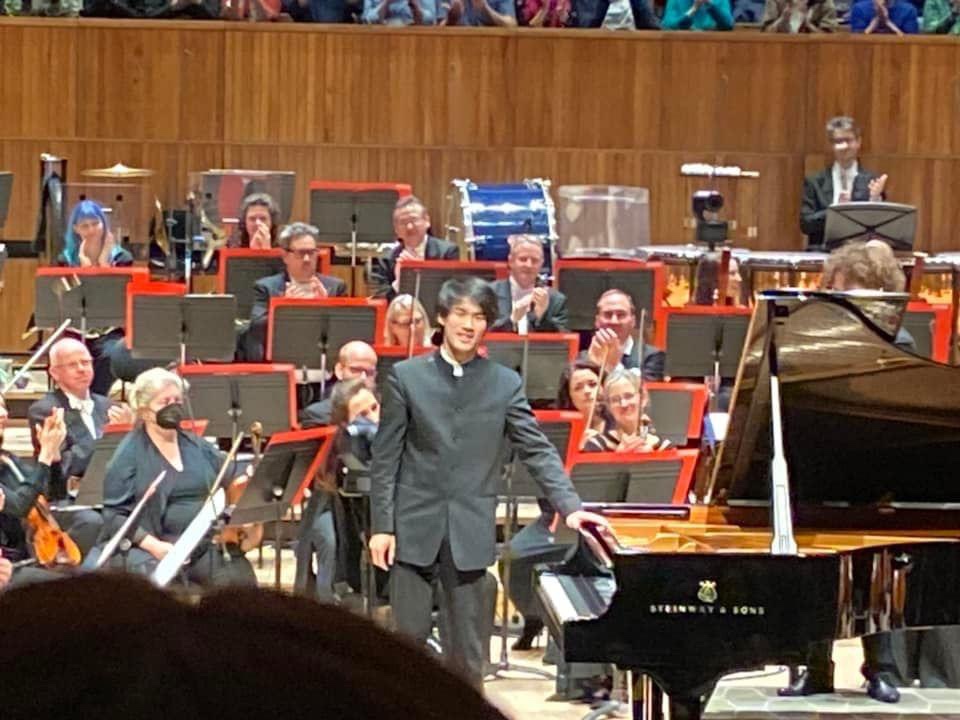
And so it was with Bruce tonight with a scintillating performance in which his crystalline sound wove in and out in a continual musicianly interplay with the superb players of the Philharmonia.The slow movement,in particular,is like a concerto for trio and orchestra in which Zsolt-Tihamér Visontay and Karen Stephenson were his sensitive accomplices.There was grandeur too of course in the first movement and with a technical prowess that was at times breathtaking in its audacity and sweep.The last movement sprang out of the sumptuous slow movement with like an unwinding spring such scintillating playing of energy and style.It was the subtle colour and shape though that he gave to all that he played that was so remarkable.A sound that although not with the same weight as Gilels or Arrau had the clarity and rhythmic drive of a Serkin.I remember that when Jorge Bolet died Horowitz told Cherkassky that they were the only ones left from the Golden Age of Piano Playing.I think they can rest in peace now with the arrival of this young man,a true star, who has joined their ranks with their same subtle personality and jewel like colours that are made to sparkle with such a beguiling sense of rhythmic urgency.It is hardly surprising that he received an ovation not only from the audience but also from his colleagues on stage.An encore of a transcription from Tchaikowsky’s Swan Lake was played with even more subtlety than Earl Wild who had written it for himself to play!
The Philharmonia conducted by Santtu and the entire audience were on their feet at the beginning for the Ukrainian national Anthem before their all Tchaikovsky programme.
Bruce was persuaded to played an encore.A transcription by Earl Wild -Tchaikovsky: Swan Lake Dance of the four swans …….a sublime performance of glittering playing,old style worthy of the legendary pianists of the Golden age . A star has truly arrived and is shining brightly
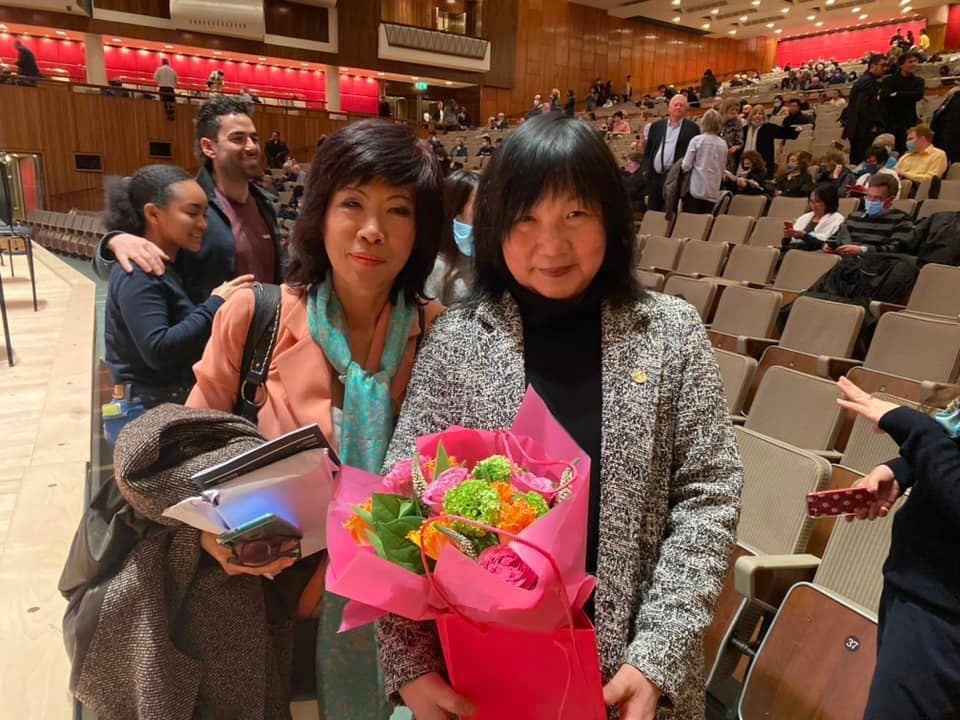
Flowers from Yisha Xue with Bruce’s mother flown in especially from her home in ParisLunch in Yisha’s club : ‘National Liberal’ in a pre rehearsal lunch to meet Bruce the day before his triumphant arrival on the concert scene in London’s Royal Festival Hall Bruce Liu with Santtu-Matias Rovelli ,Principal conductor of the PhilharmoniaAfter concerto discussion and enjoyment in the interval before returning to conduct a gloriously original performance of Tchaikowsky’s 6th Symphony,Pathétique.
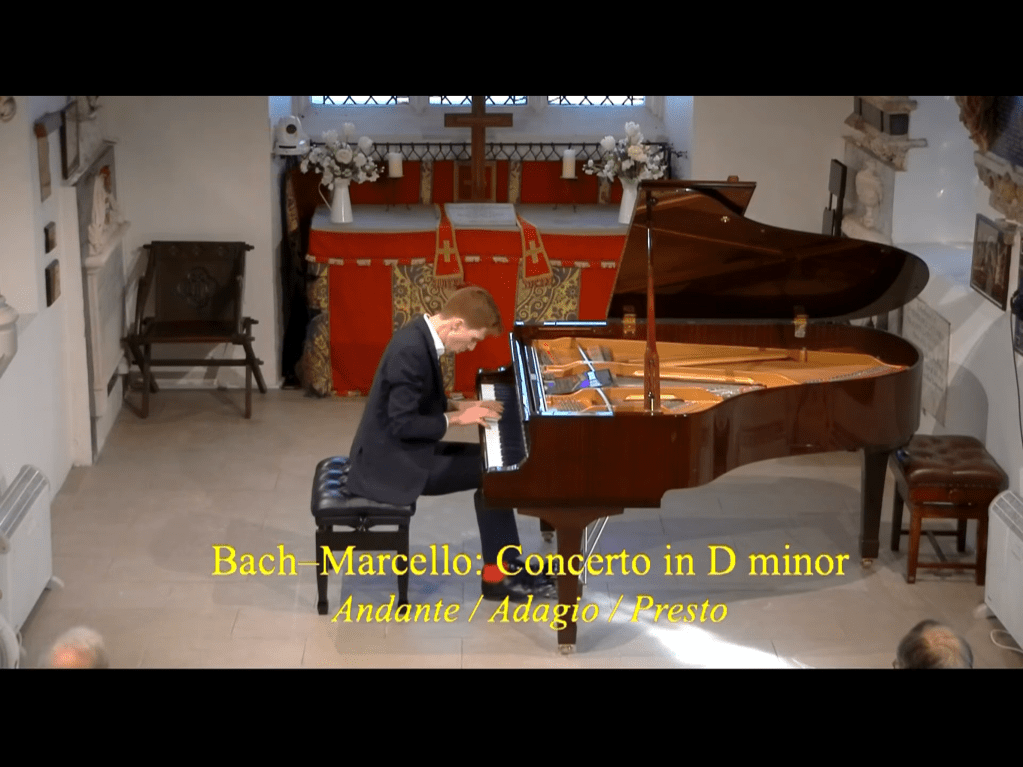
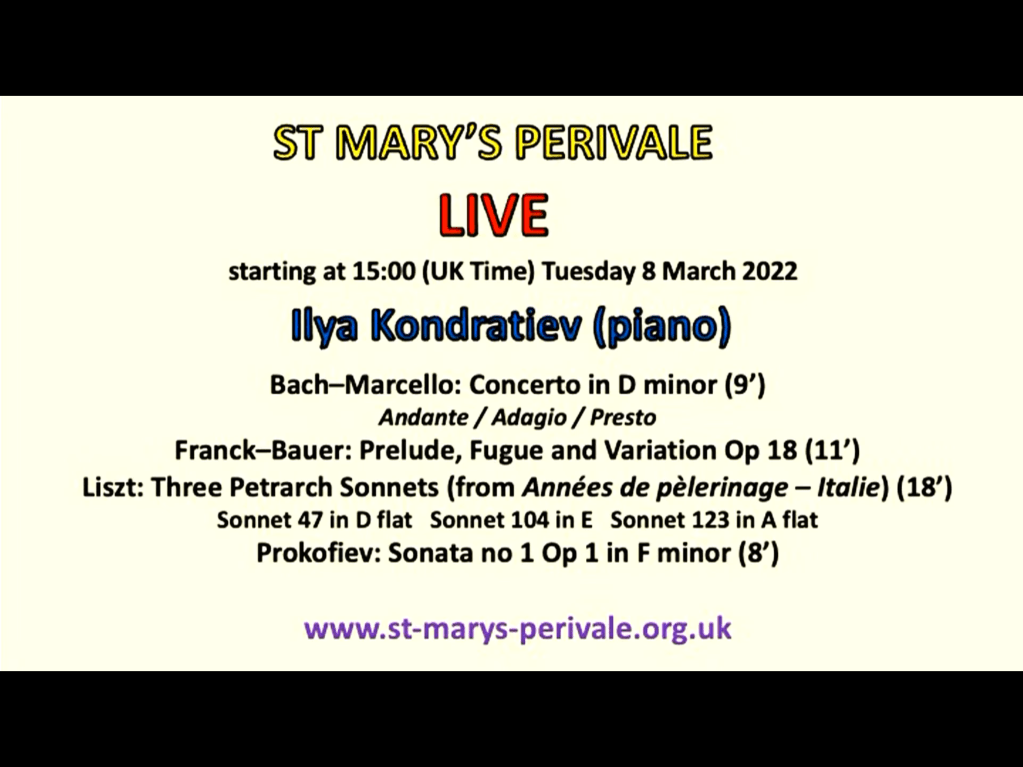
Bach-Marcello: Concerto in D minor Andante / Adagio / Presto
Franck-Bauer: Prelude, Fugue and Variation Op 18
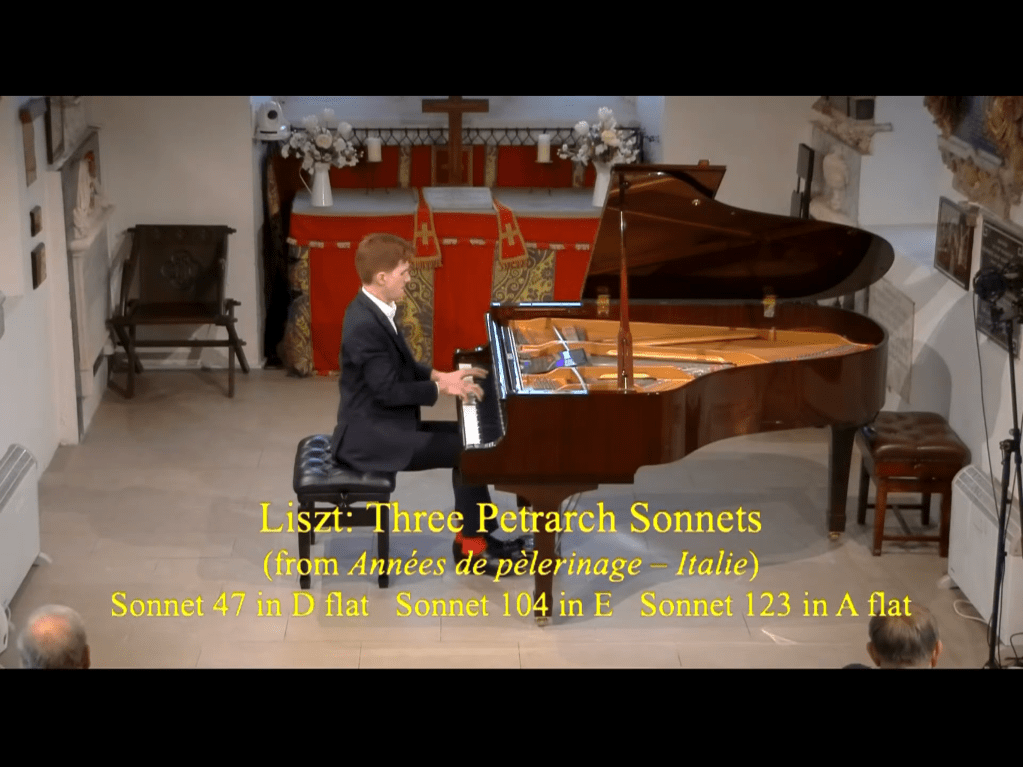
Liszt: Three Petrarch Sonnets (from Années de pèlerinage- Italie) Sonnet 47 in D flat Sonnet 104 in E Sonnet 123 in A flat
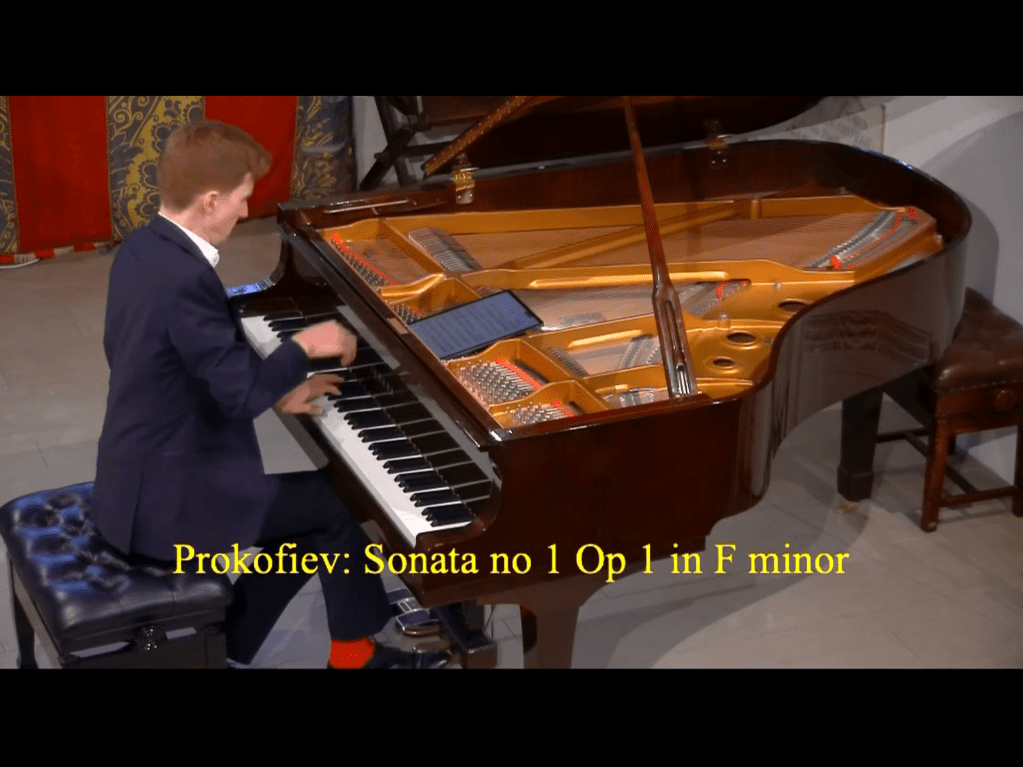
Prokofiev: Sonata no 1 Op 1 in F minor
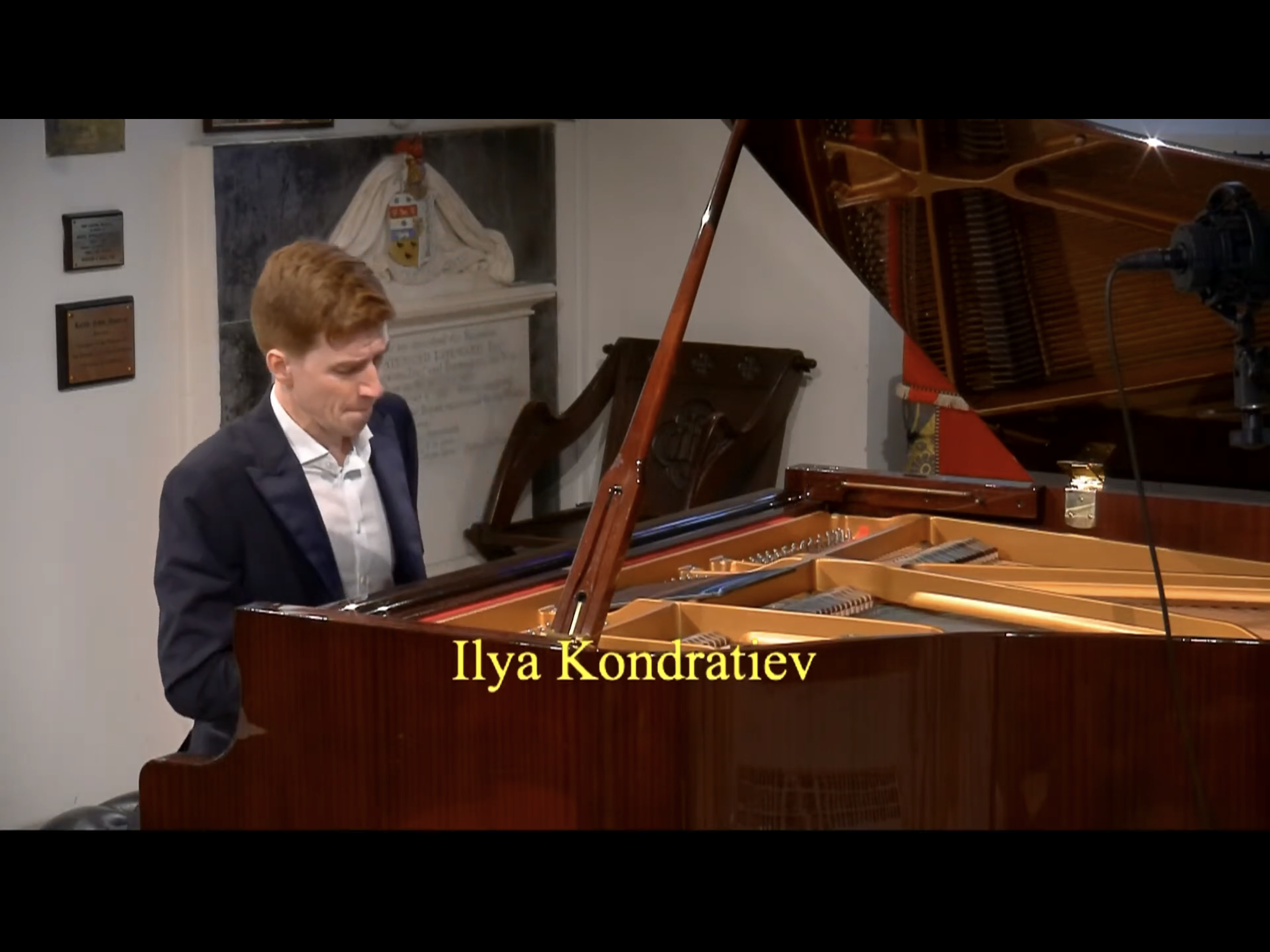
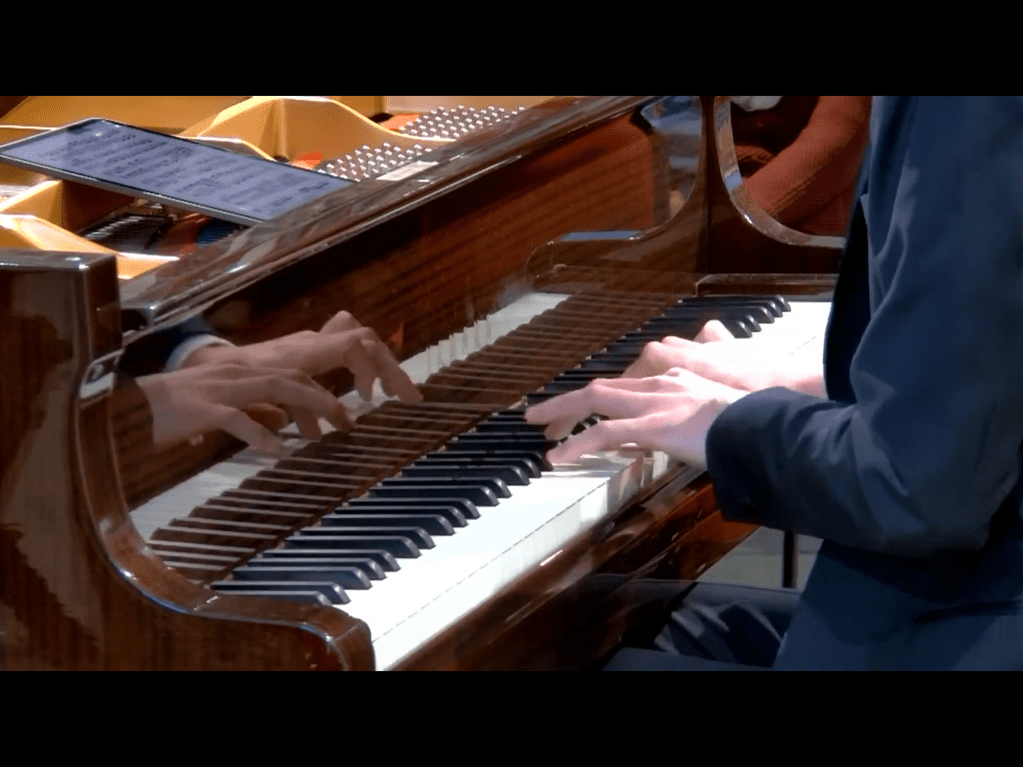
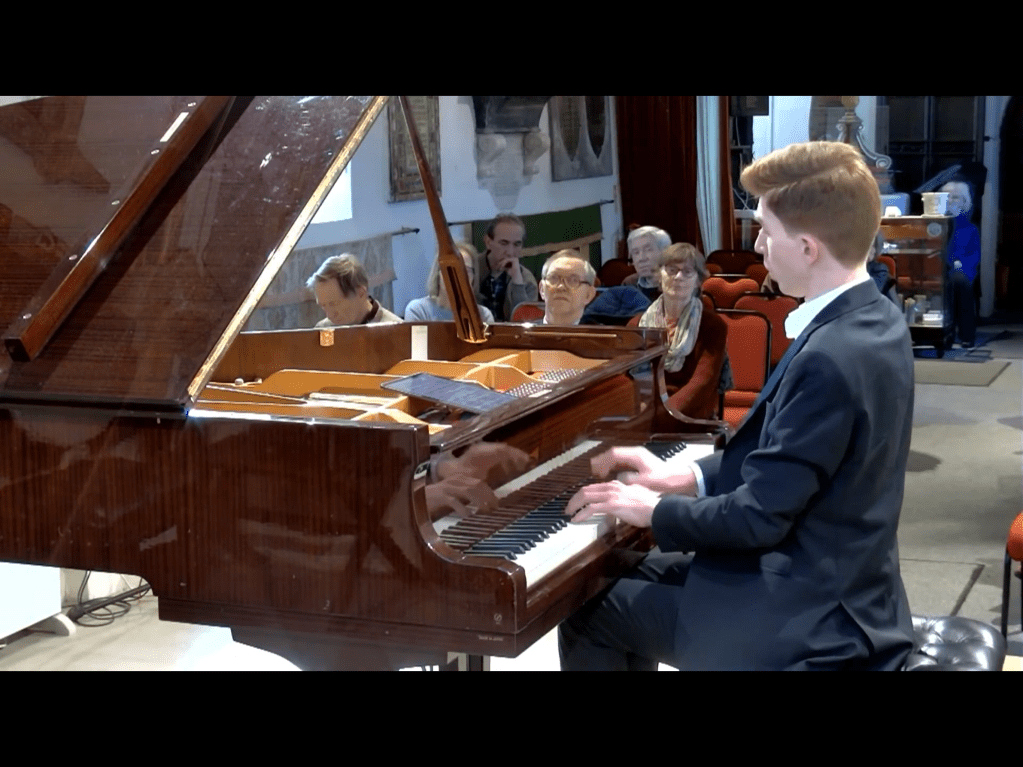
Ilya Kondratiev at St Mary’s with a continuous outpouring of mellifluous sounds.From the clarity of the Bach-Marcello Concerto in D minor where the famous Adagio was played with a luminosity and purity of sound that was the hallmark of the entire recital. The haunting melody of the Franck – Bauer Prelude,Fugue and Variation pervaded the whole work like a yearning lament – the very sentiment that I know Ilya has been suffering so far away from the horror that is being played out in his homeland. Liszt’s three Petrarch Sonnets were played with sumptuous ravishing sounds and a subtle rubato of great artistry. Prokofiev’s youthful first Sonata was full of romantic fervour that he was to distill in his later works leading up to his great trilogy of the War sonatas before finding peace in the last of his nine Sonatas for piano. It was played with all the technical prowess and romantic fervour that we have come to expect from this artist who has recently been appointed Professor at the Royal College of Music.
A critically acclaimed pianist, Ilya Kondratiev is the prize-winner of several renowned international music competitions, including Franz Liszt Budapest 2011, Franz Liszt Weimar 2011, the Fifth Tbilisi 2013, Brant Birmingham 2015 and Chappell Gold Medal in 2016. Born in Russia, he studied from the age of seven in Samara with the distinguished teacher Victoria Soifer and, from the age of 16, at the Moscow State Tchaikovsky Conservatory with the People’s Artist of Russia Zinaida Ignatieva. In 2014 he moved to London in order to further his studies at the Royal College of Music under Vanessa Latarche and Sofia Gulyak, graduating with a Master of Performance and an Artist Diploma. Ilya performs extensively as a soloist and chamber music player at venues such as the Great Hall of Moscow Tchaikovsky Conservatory, Gasteig Munich, Weimarhalle, Palacio de Festivales de Santander, the Palaceof Arts in Budapest and the Great Hall of the Tbilisi Conservatoire. In 2011 Ilya was invited to work with Elisabeth Leonskaya at the Franz Liszt Piano Academy in Schilllingfurst, Germany and with Pavel Gililov at the Eppan Piano Academy in Italy. He has also performed in the masterclasses of Dina Yoffe, Konstantin Shcherbakov, Willem Brons, Dmitry Bashkirov, Jerome Rose, Leslie Howard, Lang Lang and Arie Vardi. In 2015 and 2017 Ilya was invited to the ‘Encuentro’ Festival in Santander and in 2016 appeared as a guest artist in the Gumusluk Festival in Turkey, and the Beethoven Music Festival and Academy in Altaussee in Austria. He is now a piano professor at the Royal College of Music.
Thank you Christopher as always. A very moving recital by a wonderful pianist, in difficult circumstances. Here is the link. We had our new camera from the left of the piano, giving a new view but I will have to be careful not to nod off in future recitals ! https://youtu.be/s54H4sn_d9A
A fascinating programme for the very interesting season of Prof. Franco Ricci at the Tuscia University. Playing without the score Walter Fischetti held his audience enthralled as he introduced this eclectic programme of Italian operatic composers in their unusual guise as composers for the piano. Producing also sumptuous sounds always of great beauty from the hands of this distinguished Professor of Aquila Conservatory. From the ravishing beauty of Galuppi through the dance like piece of Cimarosa and the pure opera of Donizetti.There was the simple beauty of Mascagni ‘s Cavalleria arranged for piano solo by the composer.Grea\t humour too in the charming pieces that Rossini wrote in his early retirement from the opera scene. Walter included too a Ukrainian Folk tune and dedicated to all those suffering in the Ukraine
Walter Fischetti, nato a Genova, ha studiato con Remo Remoli e si è diplomato al Conservatorio “Giuseppe Verdi” di Torino con il massimo dei voti, lode e menzione d’onore. Si è perfezionato con Renzo Silvestri, Carlo Zecchi ed Arturo Benedetti Michelangeli.Come solista, ha suonato in Italia, Svizzera, Spagna, Canada, Stati Uniti d’America e Giappone. Ha registrato per la RAI – Radio Televisione Italiana, per la Radio Vaticana, per Tokyo Suntory Hall e per K-Calgary TV. Ha inciso per Saam, MTB e per FAZIOLI (nella prestigiosa Fazioli Concert Hall).Attivo nella musica da camera, in organico al Max Bruch Trio ha inciso un LP per Titania ed è stato premiato al Concorso Internazionale di Stresa. Professore emerito di Pianoforte Principale presso il Conservatorio “A. Casella” dell’Aquila, è titolare di Perfezionamento pianistico all’AIDM di Roma. Ha tenuto numerose masterclass in Italia (Amatrice, Bolzano, Cava de’ Tirreni, Piediluco, Terni) e all’estero (Burgos, Gerusalemme, Hiroshima, Tokyo). È fondatore e docente del CORSO NAZIONALE DI DIDATTICA PIANISTICA (Corso riconosciuto dal Ministero dell’Università e della Ricerca) presso la Scuola Donna Olimpia di Roma. Ha pubblicato musiche pianistiche per OSI-Orff Schulwerke Italiano, e diversi articoli per Musica+ e per Auditorium.Di lui il noto critico Erasmo Valente ha scritto tra l’altro: “Qual è la novità di questo solista? La indicheremmo in quel modo di suonare asciutto, chiuso in una esclusiva convinzione, nel cui ambito la musica trova un massimo di espansione, di respiro, di intensità vitale. Una meraviglia.”
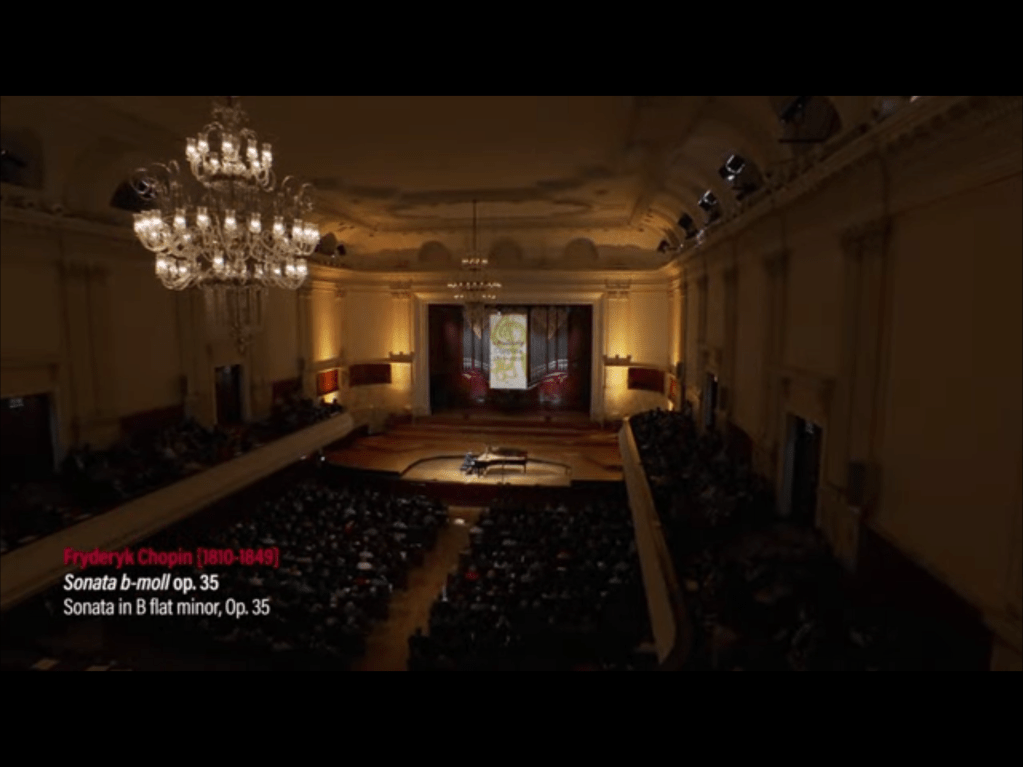
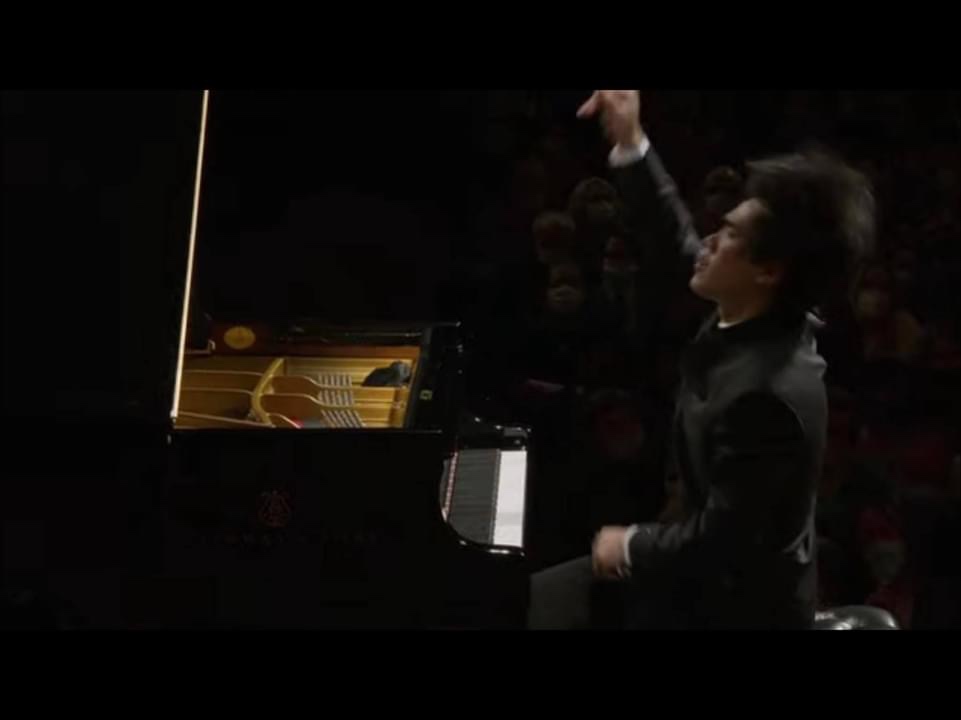
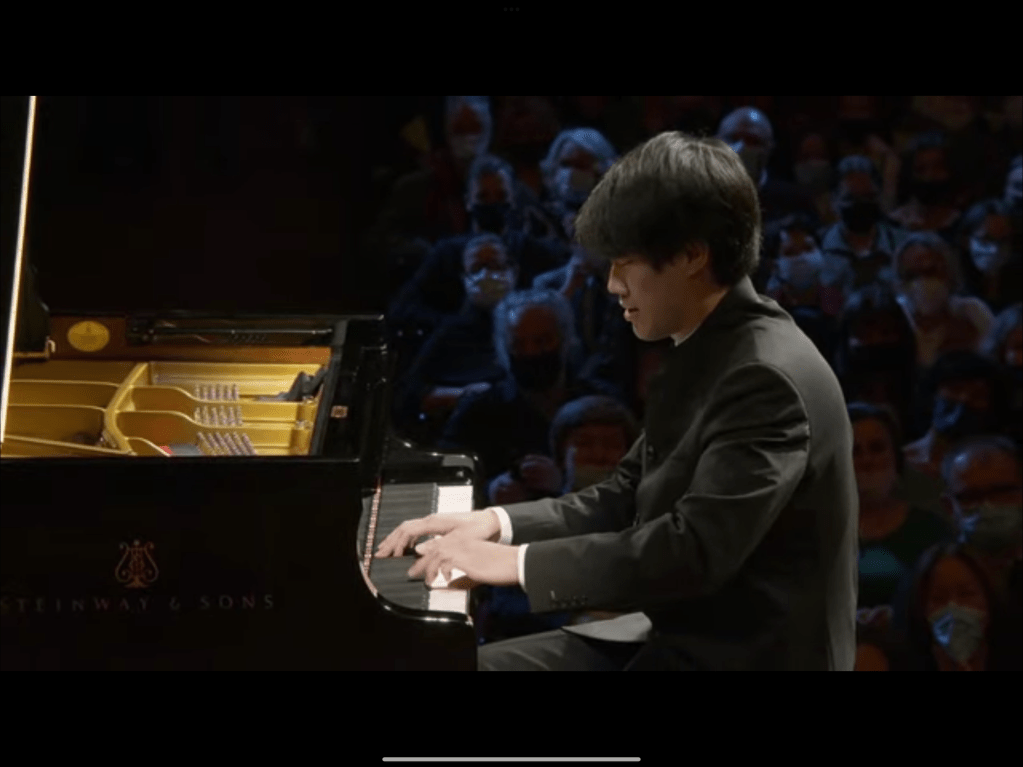
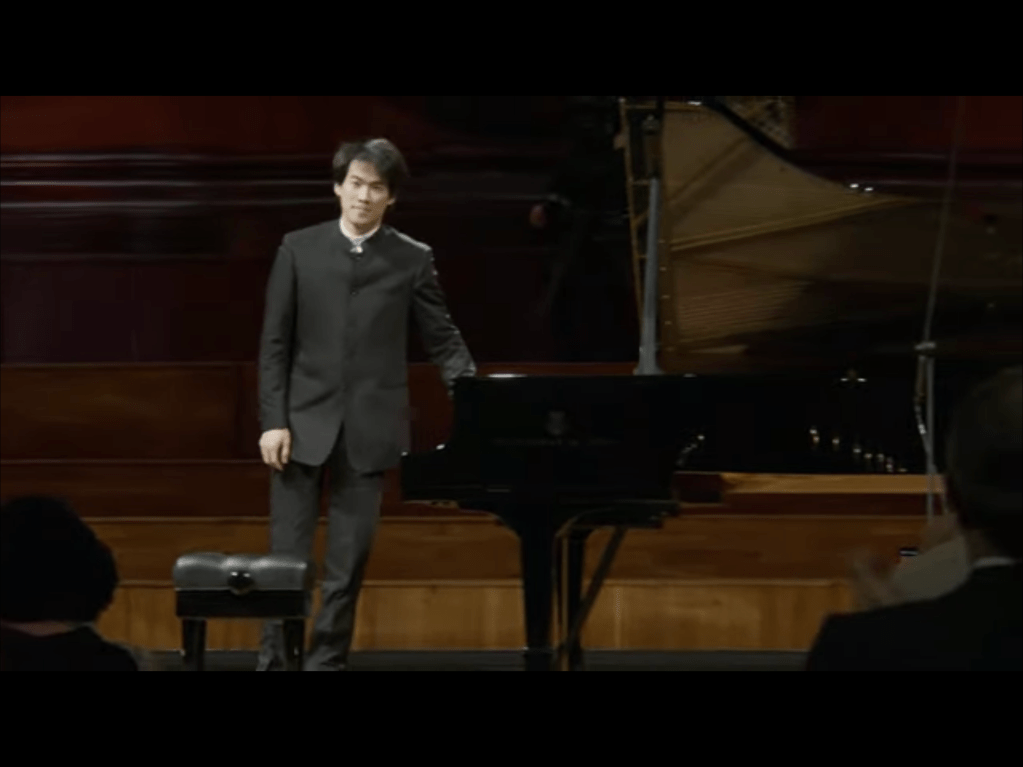
Chopin is alive and well when played like this by Bruce Xiaoyu Liu ,winner of the Chopin International Piano Competition. A concert live from Warsaw for Chopin’s 212th birthday and dedicated to victims of the war in Ukraine. A sense of style from another age as he allowed the music to stream from his crystalline fingers with the charm and ease of a De Pachmann but the intelligence and scholarship of a Pollini.
He managed to stay on the high wire as he completely seduced us from the first notes of the impressionistic nocturne in C sharp minor leading into the charm and the delicious jeux perle of the early Rondo op 5.
A majestically whispered B flat minor Sonata so intelligently repeating only from the doppio movimento despite modern scholarly reports. A scintillating scherzo and deeply felt Funeral March disappearing in a gust of wind where Chopin’s genial invention was quite enough from this young star without any additions from lesser mortals. Two Ballades n 2 and 3 that like Zimerman before him were reborn in his beautifully supple hands.
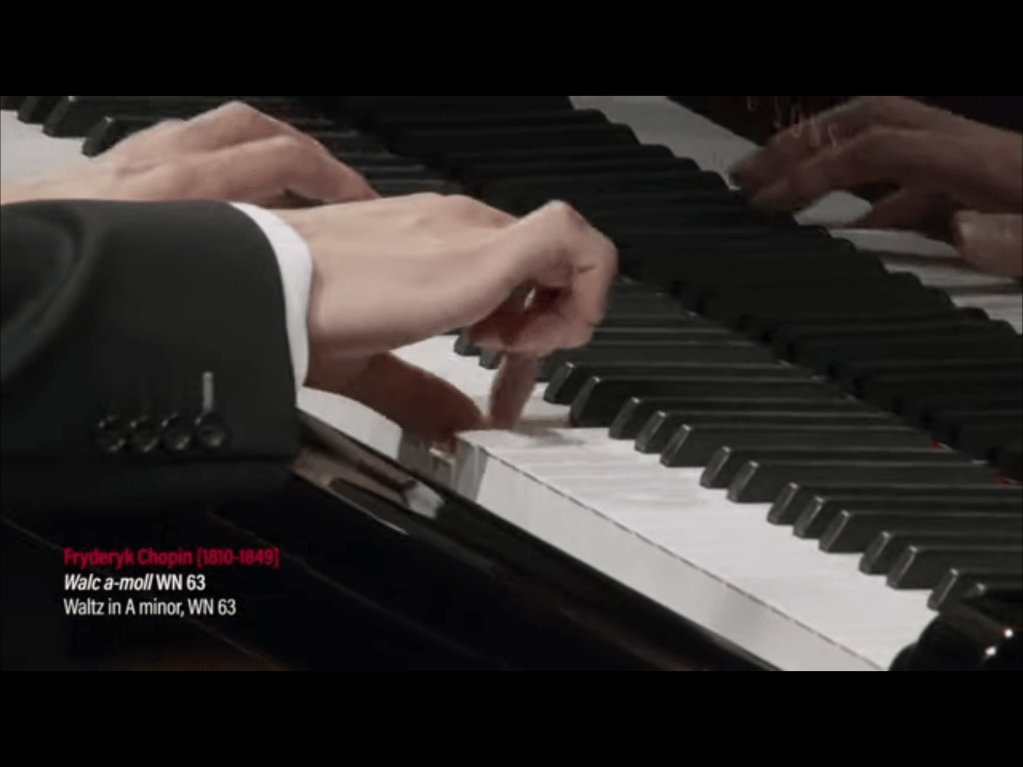
To watch his hands mould the notes was in itself an experience of beauty as he shaped the sounds with such artistry. Three eccossaises were played with the same infectious rhythmic verve of a young Magaloff (who was one of the very few that would include them in his programmes together with the rondos).He plunged into their rustic simplicity with all the vitality of these Scottish cameos.
Dedicating the little waltz in A minor to all the children suffering in conflict as he said it was the first piece by Chopin that he had played at the age of ten.The simplicity and flexibility of a bel canto singer just summed up the supreme artistry of this young artist. He and Alexandre Kantarow are two that I would travel a long way to hear as they give hope for a future world where love and beauty without conflict is our aspired Eutopia. Gilels used to compare live performance to recorded as fresh food or tinned but the streaming from Fryderyk Concert Hall Warsaw last night or the Philharmonie de Paris last winter transcended that .Such was the magic of these two young artists that they could bewitch and seduce even long distance via the superb streaming that has come of age during the pandemic.
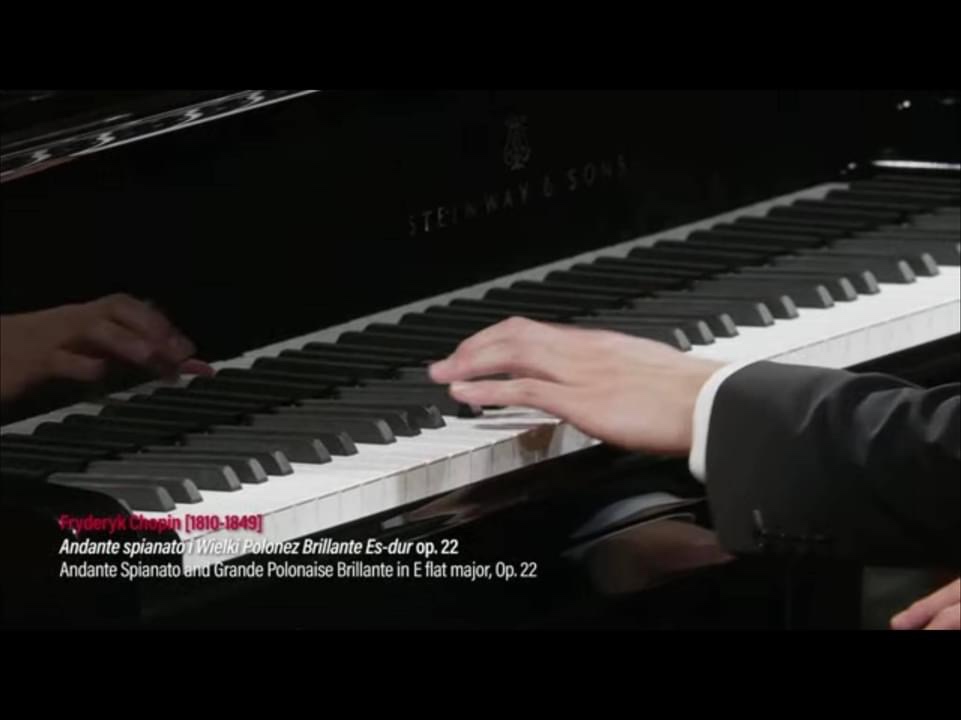
How could I forget the magic of the Andante spianato or the scintillating grandeur and subtle virtuosity of the Polonaise where there was no doubt of the meaning of ‘grande’ with a work that Chopin himself would have conquered the noble salons with on his arrival in Paris. I had never forgotten the very first time I heard this work and how I was bewitched as a child by a recording of Valentin Giorgiou’s playing of Chopin. It was Alexander Brailowsky though that I first heard in a live performance followed shortly after by Jan Smeterlin.But the performance of this young artist today relived this golden memory that has haunted me since my childhood. https://youtu.be/UnF-wbvRG68
Bruce (Xiaoyu) Liu Recital of the Chopin Competition winner On 1 March, on Fryderyk Chopin’s 212th birthday at 7:00 p.m. CET in the National Philharmonic Concert is dedicated to victims of the war in Ukraine. Programme: Fryderyk Chopin: Nocturne in C sharp minor, Op. 27 No. 1 Rondo à la Mazur in F major, Op. 5 Ballade in F major, Op. 38 Ballade in A flat major, Op. 47 Sonata in B flat minor, Op. 35 Andante spianato and Grande Polonaise Brillante in E flat major, Op. 22
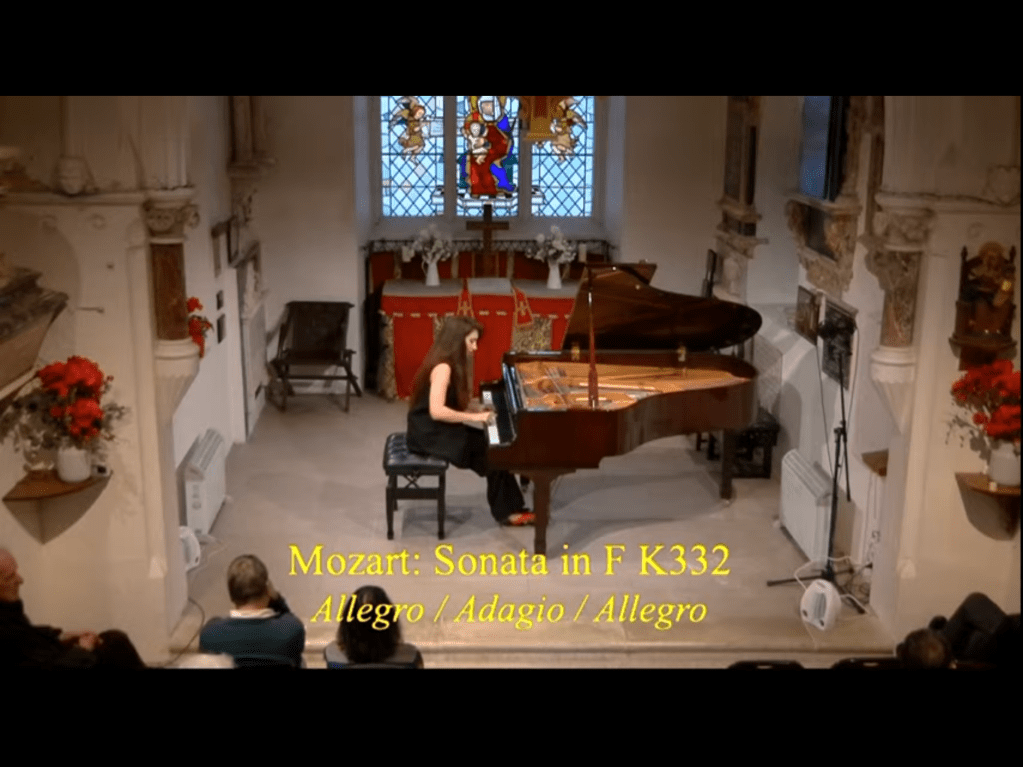
Mozart: Sonata in F K332 Allegro / Adagio / Allegro
Liszt: ‘Funérailles’ S173
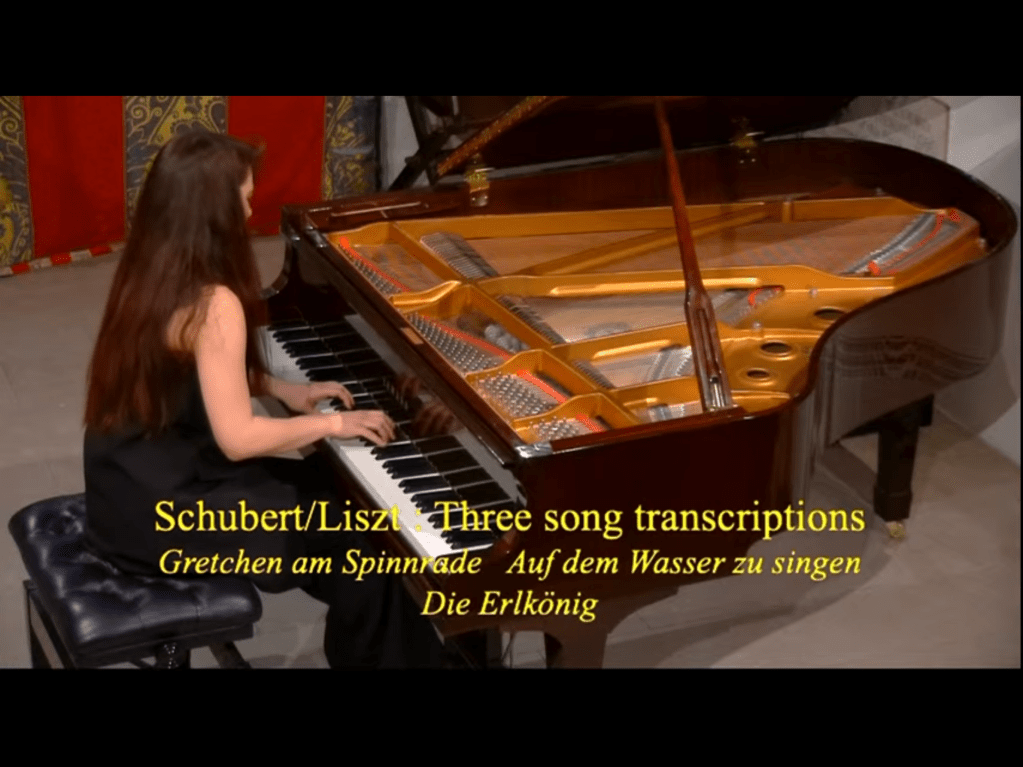
Schubert/Liszt : Three song transcriptions Gretchen am Spinnrade Auf dem Wasser zu singen Die Erlkönig
Lili Boulanger: Prélude Lili Boulanger: Trois morceaux
Debussy: L’Isle Joyeuse
An intriguingly interesting programme played by Elisabeth Pion at St Mary’s this afternoon. The clarity and technical assurance of her well oiled playing allied to a natural musicality allowed her to traverse a vast span in time from Mozart through the virtually unknown de Montgeroult ,Schubert,Liszt and to the final jewel of the recital that was the French music which maybe is hardly surprising for a French Canadian. Four miniatures by Lili Boulanger that owe much to Chabrier and Debussy and a final sumptuous performance of Debussy’s L’Isle joyeuse.
Two studies from a composer born just a few years after Mozart’s birth Helene de Montgeroult’s mellifluous outpouring of Mendelssohnian grace and charm that seem to lie so well under the hand.From a collection of studies for the piano that Elisabeth shaped with such beauty and subtle colouring while the accompaniment wove it’s continuous magic web undisturbed.The second study so similar to the typical scherzo type song without words that I wonder whether she was influenced by Mendelssohn or vice versa.They showed an understanding of the keyboard and a natural simplistic technical command that was of great effect.
Mozart’s Sonata in F K.332 was played with a refreshing clarity and the ornaments that she added in the repeat just allowed her to breathe and shape with more ease having chosen rather fast tempi for the outer movements.A very espressive Adagio that could have been even simpler where the discreet ornamentation was all that was needed to allow Mozart’s sublime music to speak for itself.
There was great drama in Liszt’s tone poem Funerailles that was played with great assurance and passion.The 7th of Liszt’s 12 Harmonies poétiques et religieuses ,an elegy written in October 1849 in response to the crushing of the Hungarian Revolution of 1848 by the Habsburgs.There was disarming beauty too in the ‘lagrimoso’and the treacherous left hand octaves of the military chase were played with great technical command and control.
The three Schubert songs in the masterly transcription by Liszt were played with crystalline clarity.Gretchen’s spinning wheel not faulting for a moment as it built to a tumultuous climax to disappear to a mere whisper.And the water was allowed to flow with such delicacy in Auf dem Wasser zu singen. But it was the control and real sense of drama in Die Erlkonig that took our breath away.
Lili Boulanger,the younger sister of Nadia Boulanger the great French pedagogue ,who died so tragically young in her twenties but left many compositions that her sister promoted with such dedication and genuine admiration. These particular little pieces owe much to Debussy and the last piece has all the grace of Chabrier and was played with great charm and conviction by Elisabeth Pion.
The clarity and passion together with her sense of atmosphere and drama brought Debussy’s sumptuous joyous island vividly to life bringing to an end a very interesting varied recital played with great artistry and technical command.
A curious and innovative artist, pianist Élisabeth Pion, born in 1996 in Quebec, Canada, is internationally active as a soloist, chamber musician, and artistic collaborator. Based in London, UK, Élisabeth is currently finishing the Artist Diploma program with Ronan O’Hora at the Guildhall School of Music & Drama, where she is a full scholarship holder since 2018. She has previously worked in Canada with Francine Lacroix, Suzanne Goyette and André Laplante. Élisabeth was selected by Dame Imogen Cooper to take part in the Imogen Cooper Music Trust for 2021. In 2019, she was chosen to work with Christian Blackshaw during the Hellensmusic Festival . She has also played in masterclasses for, notably, Till Fellner, Stephen Hough, Boris Berman, Bernd Goetske, Claudio Martinez Mehner, Richard Goode, Paul Lewis and Robert Levin. Élisabeth has been successful in many competitions: she has notably won the 1st prize of the Thousand Islands International Piano Competition, the Prix Banque Nationale of the Prix d’Europe, the 1st prize of the Shean Piano Competition, the Silver Medal of the Musician’s Company of London and the Guildhall Wigmore Recital Prize . Élisabeth was named in the CBC Palmares 30 Hot Canadian Classical Musicians under 30 , and was also selected as one of the 15 Rising Stars of 2018 from the magazine La Scena Musicale. She made her BBC Radio 3 broadcast debut in 2019 in the BBC Total Immersion day celebrating Nadia and Lili Boulanger. In July 2021, she made her Wigmore Hall solo recital debut. Her upcoming performances include her debut with the Victoria Symphony, the Orchestre symphonique de Laval and the Orchestre classique de Montréal. She has previously been invited as a soloist with the Ensemble Sinfonia de Montréal, the Orchestre symphonique du Conservatoire de musique de Montréal, the Ensemble Volte, the Orchestre symphonique de Longueuil and Arion Orchestre Baroque. Élisabeth is scheduled to make her debut in China in the near future. Élisabeth places great value on approaching music from a holistic perspective. Her deep interests in literature, writing and Tai Chi nurture her musical practice. She has had considerable experience of interdisciplinary collaboration with artists from different backgrounds: in 2015, with the Sanchez Brothers, photographers, for a project titled The Lesson ; in 2016, with visual artist Patrick Bernatchez, as part of the exhibition Goldberg Experienced at the Musée d’art contemporain de Montréal; in 2018, with Le Théâtre Indépendant, as musical director of the Quartett Solo production (Heiner Müller). She is also the Co-Director of the Festival Unisson in Canada, which centres on creating an immersive experience between a single listener and a musician. She is grateful for the support of the Guildhall School of Music and Drama, the Sylva Gelber Music Foundation, The Musicians’ Company Carnwath Scholarship, Help Musicians UK, the Jeunesses Musicales du Canada and Talent Unlimited UK.
A recital by Ivan Donchev tonight in the Cancelleria in Rome. Chopin and Scriabin showed his stylish elegance and strong personality that carved a clear line of ravishing sounds as he braved the high wire between tradition and scholarship just as his mentor Aldo Ciccolini had shown us for so many years.
Nowhere was it more evident than in the Chopin minute waltz thrown off with such elegant ease even the slight hesitation at the end of the first phrase was worthy of Ciccolini or even Rubinstein in its twin op 64 n 2. Ivan allowed himself such freedom at the end that Ciccolini would have approved of but Rubinstein might have lifted an eye brow as it tended more to the old tradition of De Pachmann than the scrupulous adherence to the score.
The nocturne in D flat op 27 was played with such beauty and aristocratic control that one could forgive his rather slow tempo.Such was his sense of balance that there was a radiance to the melodic line that was played with disarming simplicity with great sentiment but never sentimental.It was a vision of beauty rather than Chopin’s miniature tone poem that is every bit as expressive as the Ballades but in a much shorter space. In the nocturnes Chopin manages to say so much in such a short span as he does in the mazurkas.I did not entirely share his view of this nocturne but the magic spell he cast was of a great artist convinced as he was convincing.
The Cancelleria between Piazza Navona and Campo dei Fiori in the heart of Rome
Opening with the third scherzo Ivan immediately demonstrated his supremity as a stylist.A performance of such power and ravishing beauty but also an awareness of the overall architectural shape that I have rarely heard in the concert hall.The great chorale melody was illuminated by the streams of golden sounds that descended from on high where so often in lesser hands the delicate filigree accompaniment interrupt rather than illuminate the overall musical line.An overpoweringly convincing performance.There was room for freedom and playing of such poignancy too but never disturbing the overall architectural line of such aristocratic nobility.
I was not so convinced by the first movement of the B flat minor sonata that I found rather too dramatic and tempestuous.Surely the doppio movimento is the same whispered wind that pervades the extraordinary last movement as it pervades the whole of this masterpiece.His much less dramatic return to the opening flourish seemed more in tune with the atmosphere than his rather overstated majestic beginning.It is hinted at in the lightness of the scherzo too that I found rather too serious in Ivan’s hands.Of course the lyrical second subject of the first movement or the central episode of the scherzo was played with great beauty and a freedom of aristocratic good taste.There were some rather strange counterpoints in the Funeral March and even more so at the end of the last movement but played with such conviction that made it easily acceptable as Ivan’s personal musicianly vision.The trio of the Funeral March was played with unusually robust tone that I found very convincing in the way it created a whole rather than fragmented picture of this desolate scene.The hands ‘conversing together’ in the last movement as they create a perpetuum mobile of sounds that in Chopin’s time must have seemed quite revolutionary.Ivan tried to find some melodic line too but was a little too explicit for a movement of whispered suggested sounds of quite extraordinary genius.
Of course Scriabin found the ideal interpreter in Ivan.Ravishing sounds and a kaleidoscopic sense of colour allied to technical prowess and passionate involvement . Three studies played with sumptuous sounds and astonishing technical command.The extraordinary difficulties just disappeared as we were led through this world of wondrous sounds where the musical line was always so clear amidst the enormous technical difficulties that we were never openly made aware of. Scriabin’s Fantasie was played with demonic streams of golden sounds as we reached the sumptuous ecstasy of the ‘star’ shining with such passion and beauty in Ivan’s masterly hands.
The beauty and stillness of the Prelude in B minor by Bach- Siloti was a moving tribute that Ivan wanted to share with us in this particularly disturbing moment that we are sharing with a world frustrated by its impotence in the face of such prepotence!
The Great Gate of KievThe Cancelleria in the centre of Rome Ivan Donchev after the concert
Evie seduces Rome with a programme of scintillating Mozart,the shimmering demonic ecstasy of Scriabin and the frenzied indecent ravishment of Ravel’s La Valse. But it was the simple beauty of Grieg that charmed and seduced as only a great artist could do. The Arietta played with disarming simplicity and a Butterfly of a fleeting jeux perle of another age.
All this to help her great friend Alex Ullman who at the last minute could not be in Rome and so sent Evie to ravish and seduce us with love indeed!
Valerio Vicari with Evie
Thanks to Valerio Vicari and Roma 3 for enticing such extraordinary artists to the Eternal City where they truly belong.
After concert festivities Da Michele Pizzeria with Valerio and EvieWilliam Grant Naboré director of the International Piano Academy Lake Como – President Martha Argerich at the Danish Academy last night