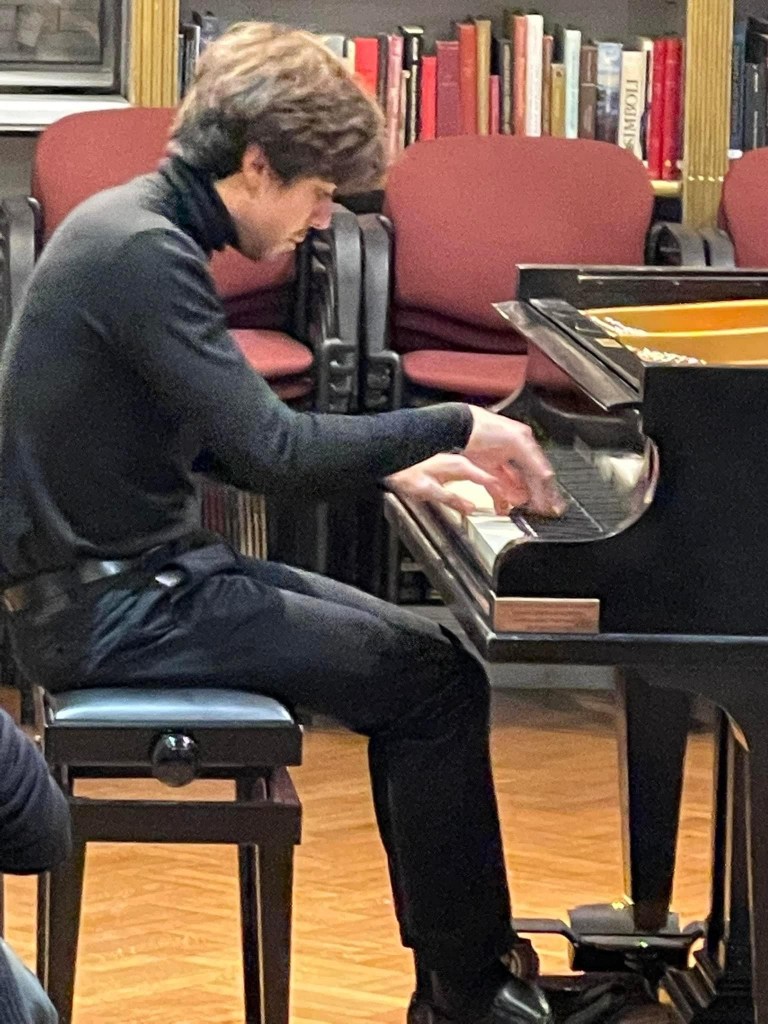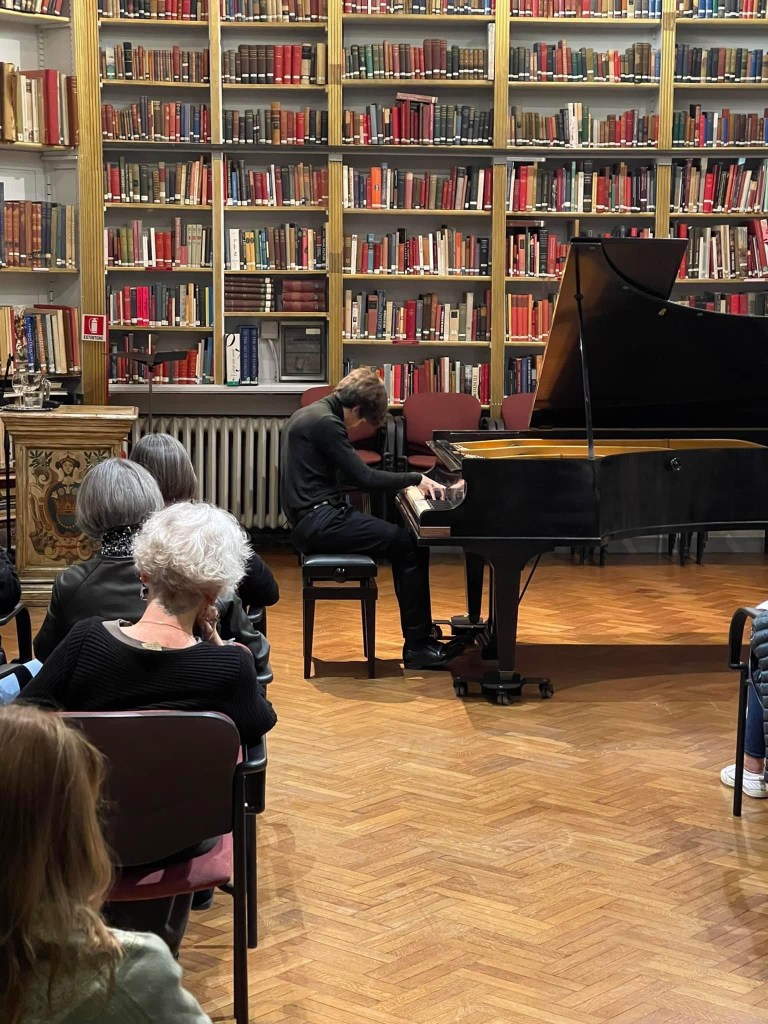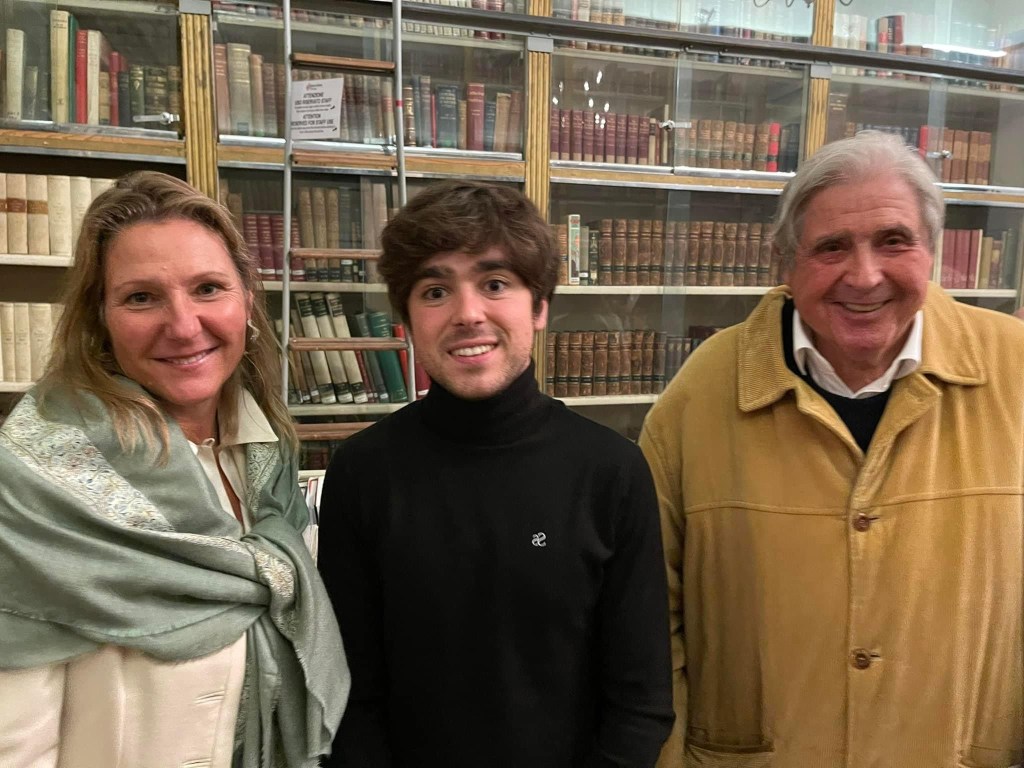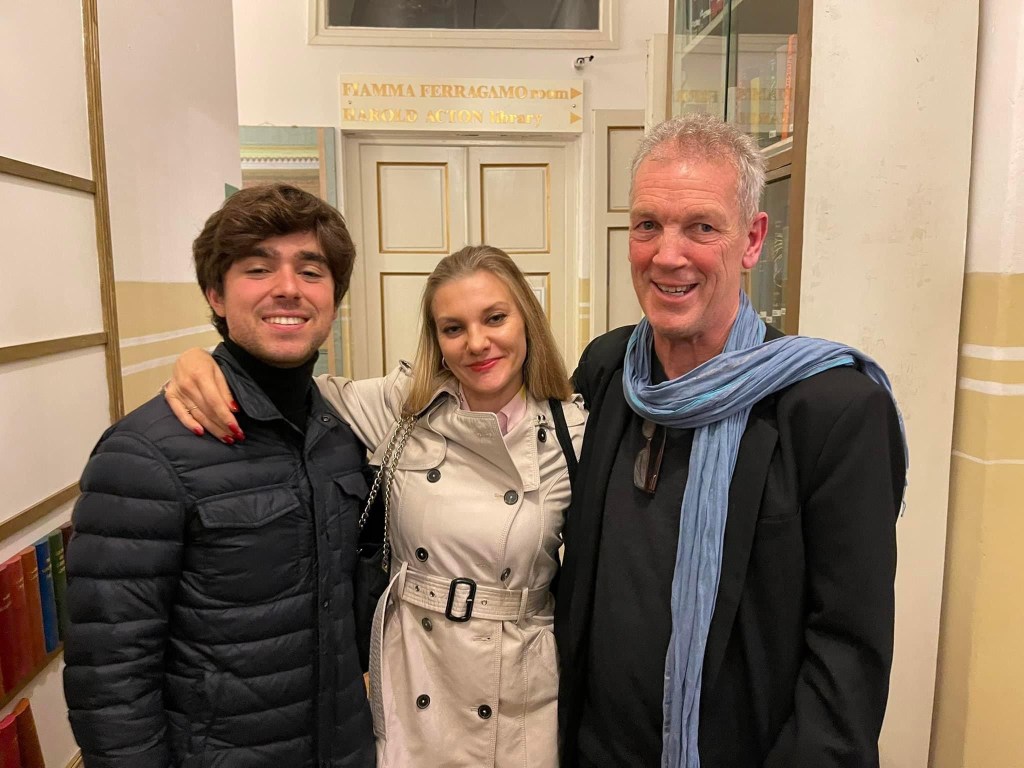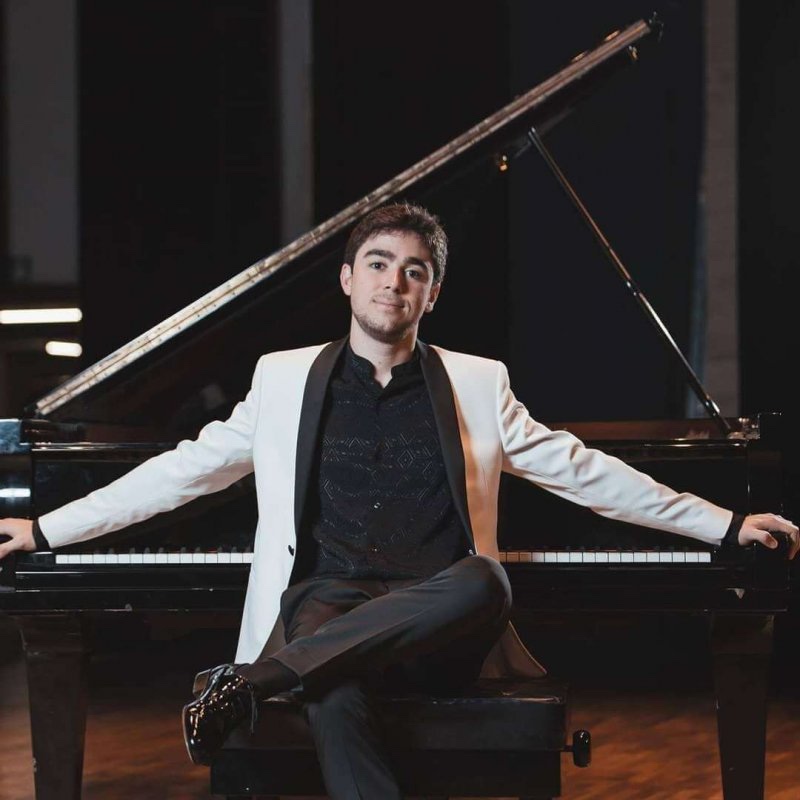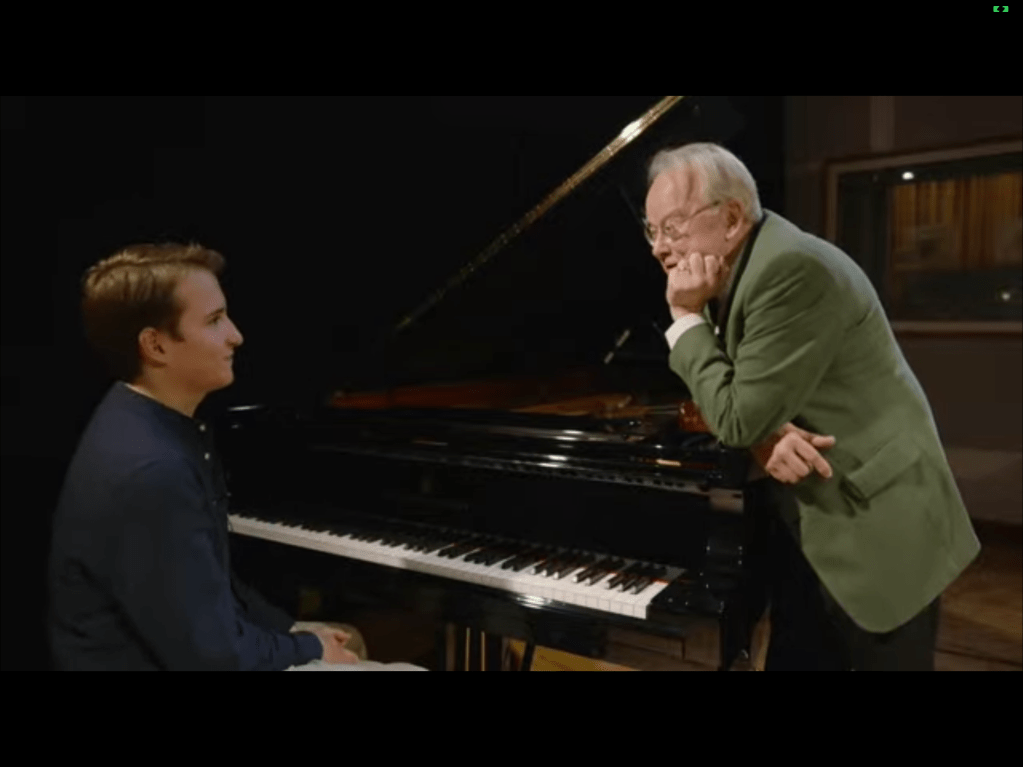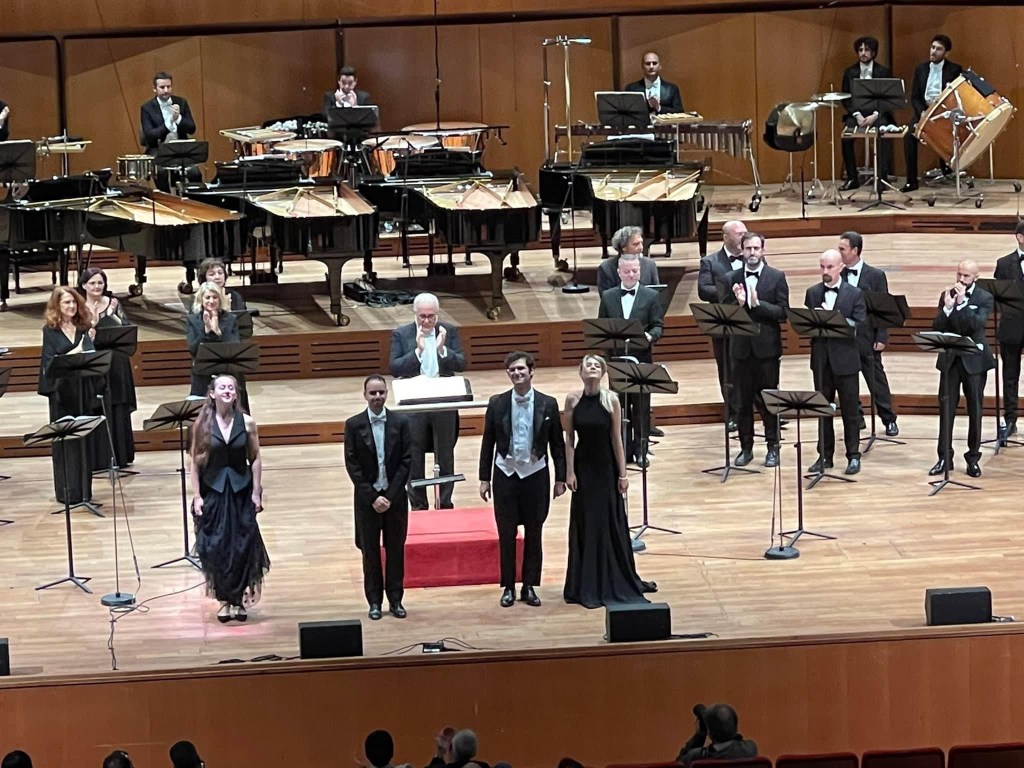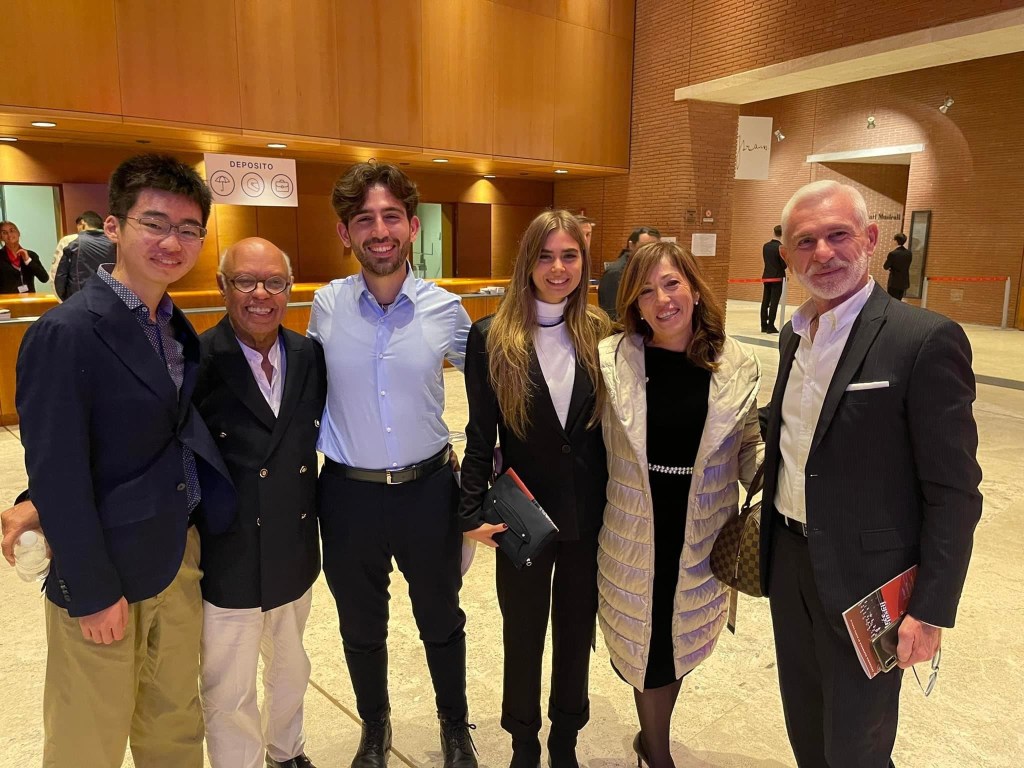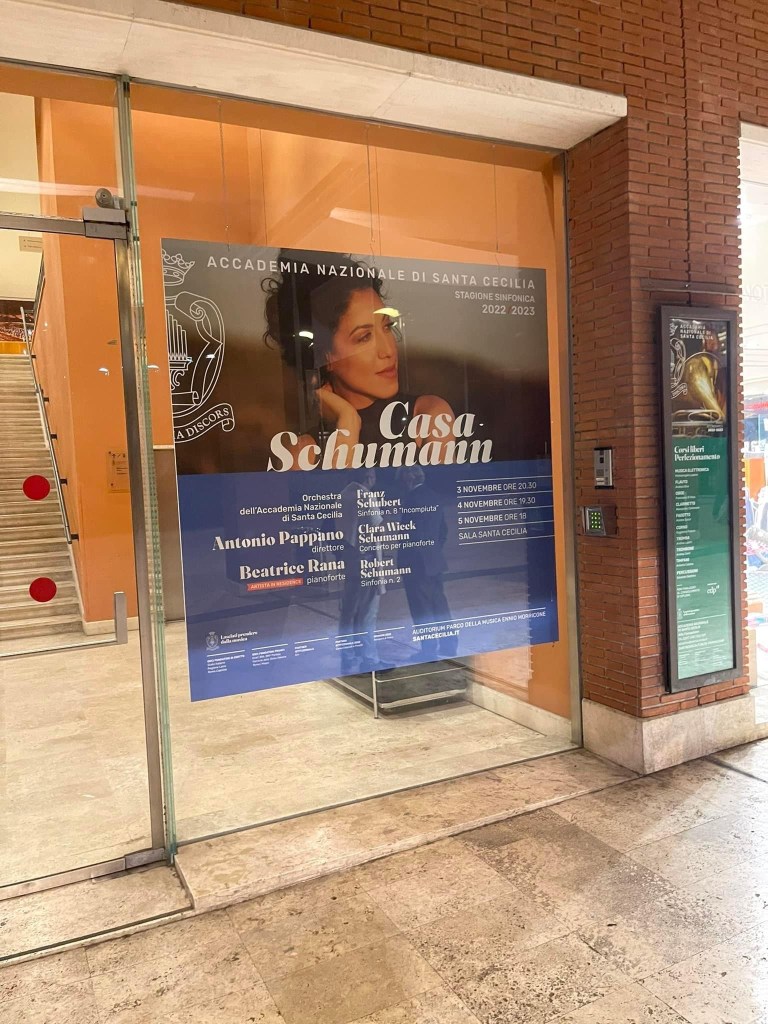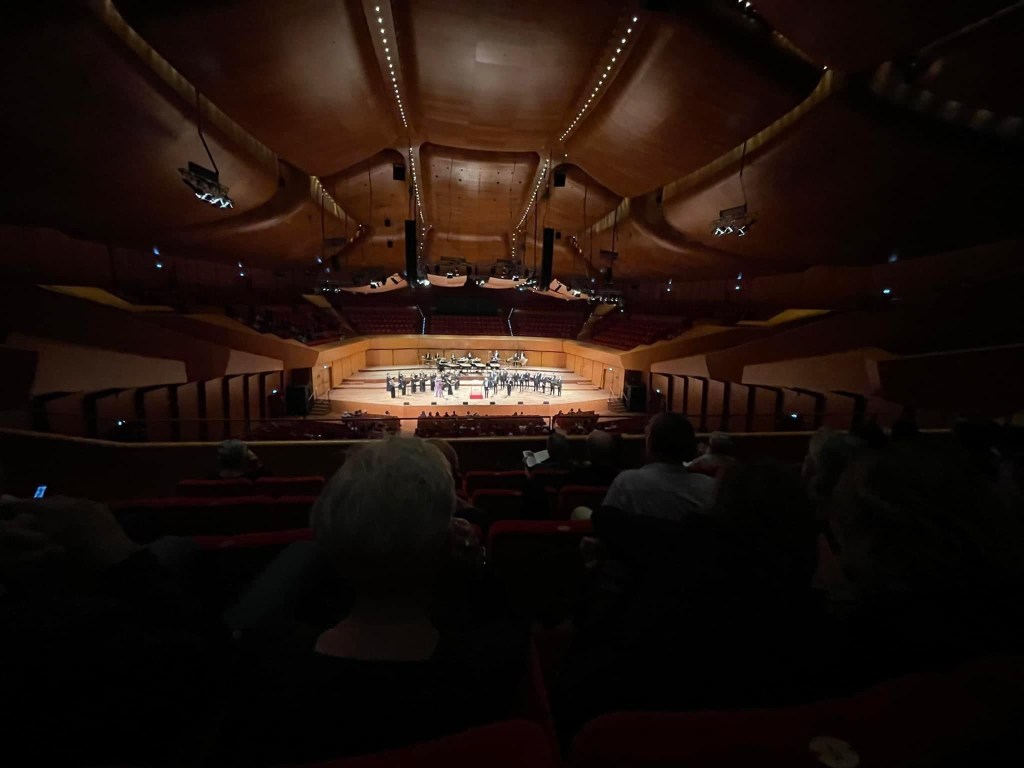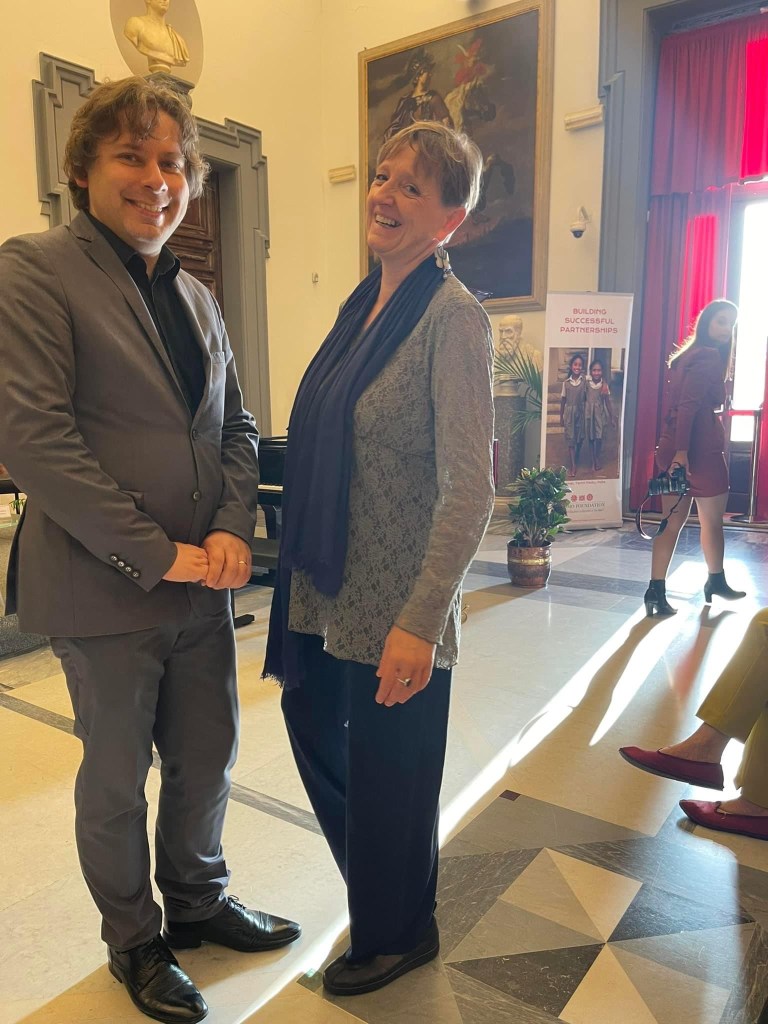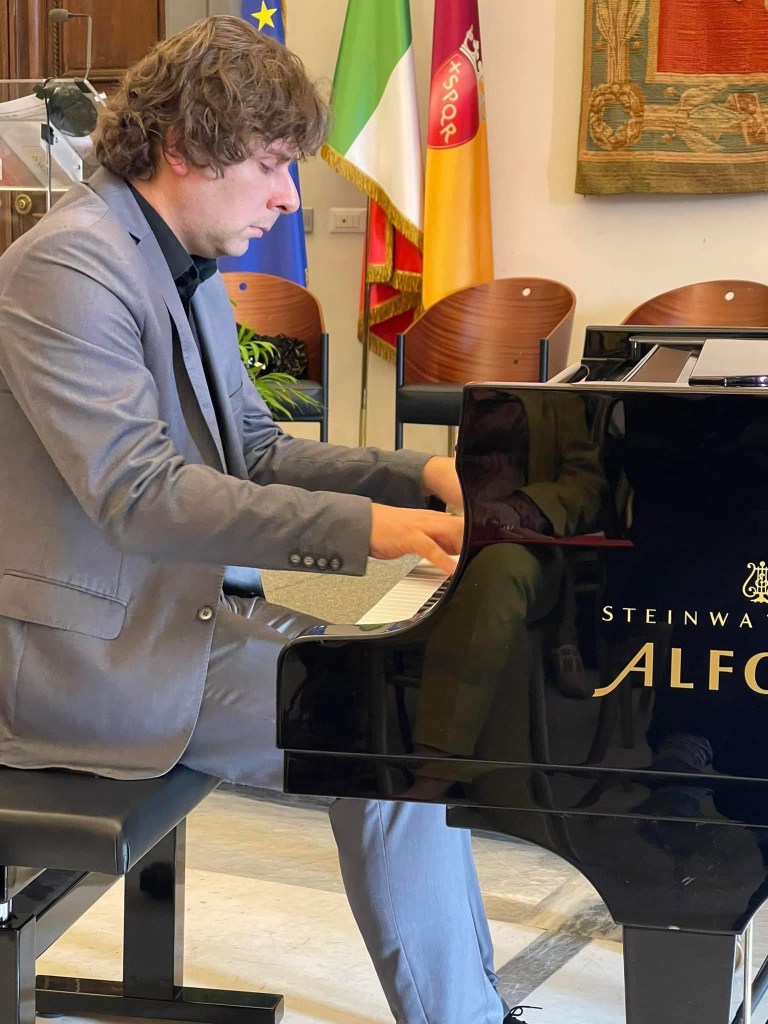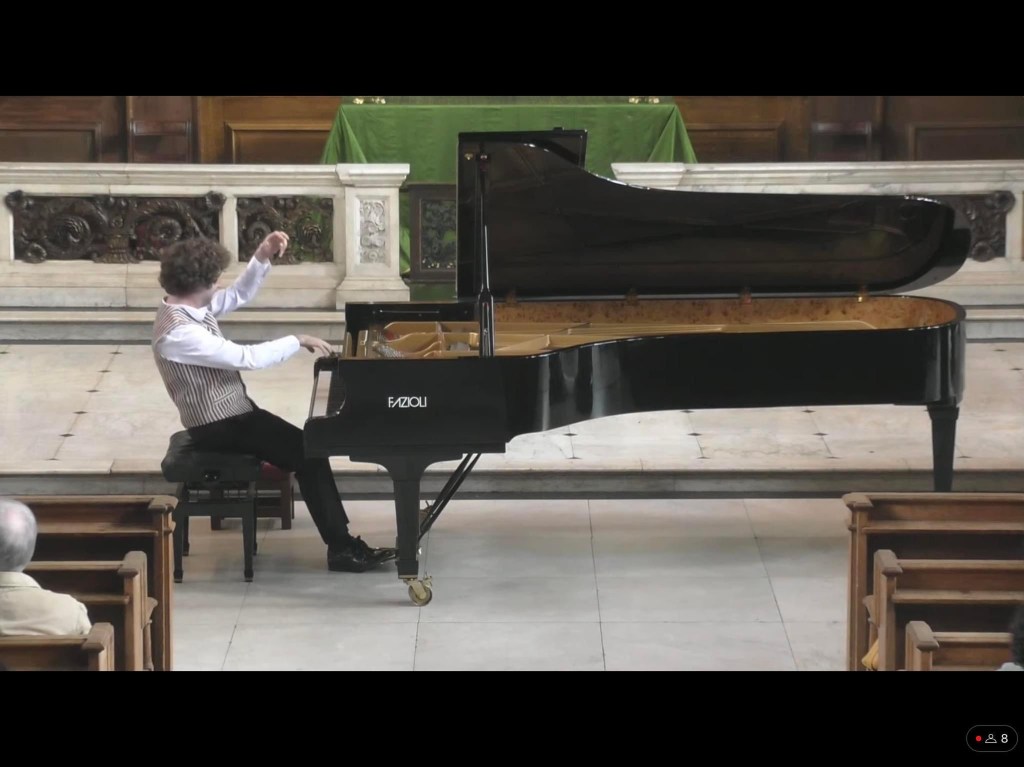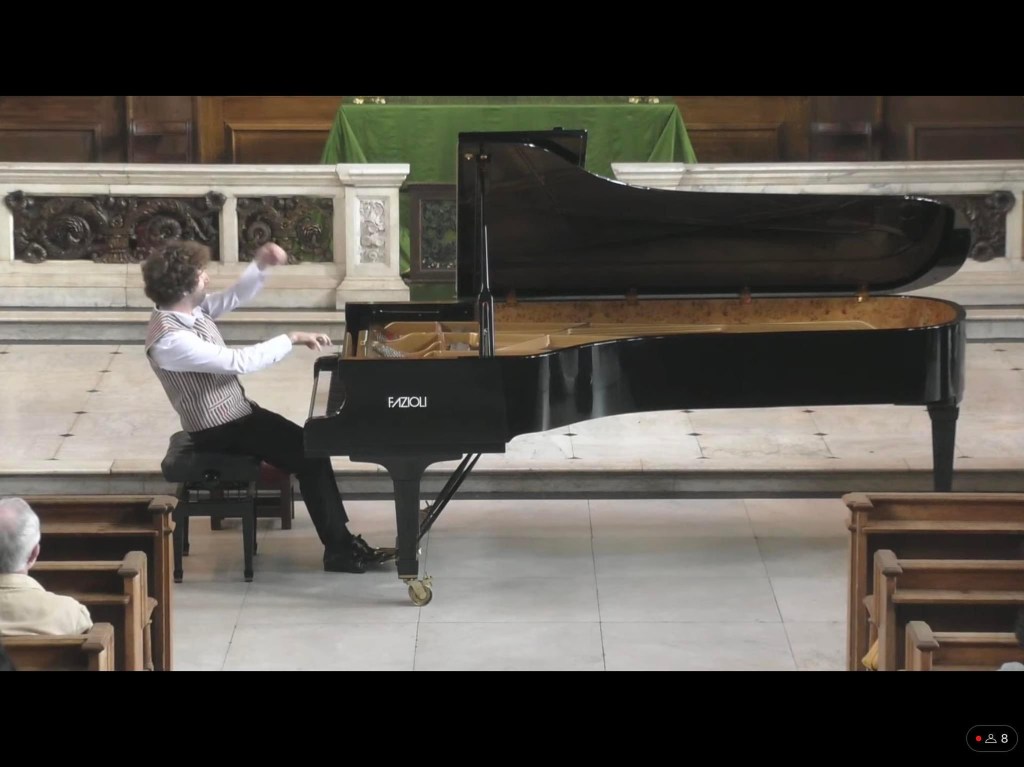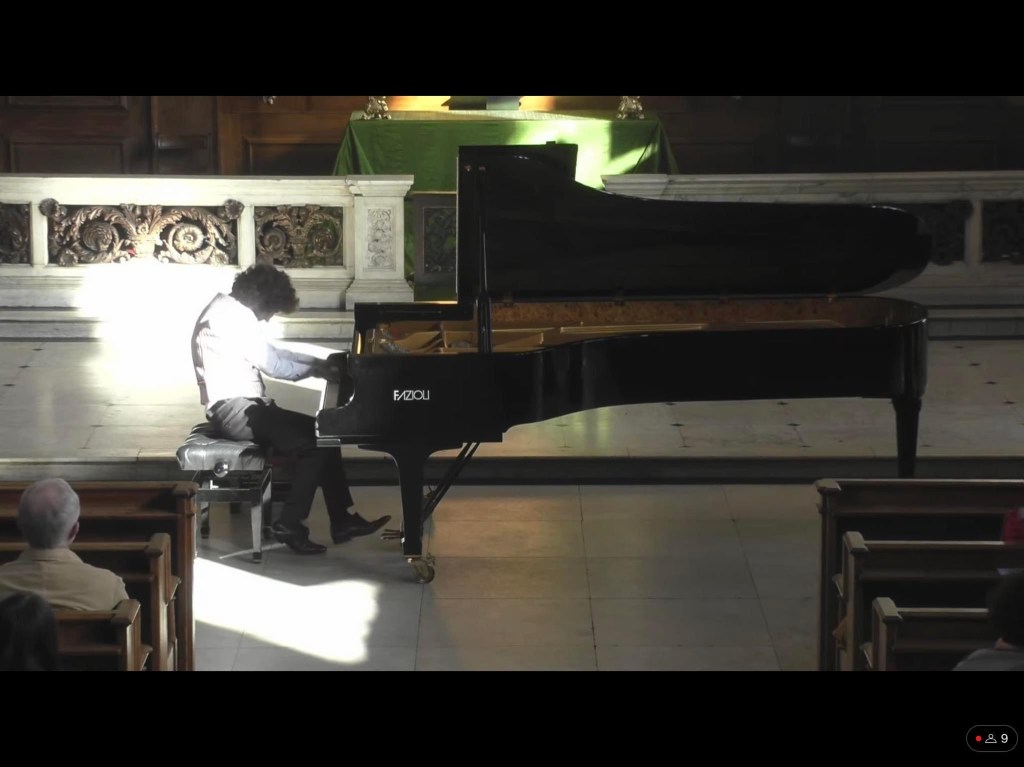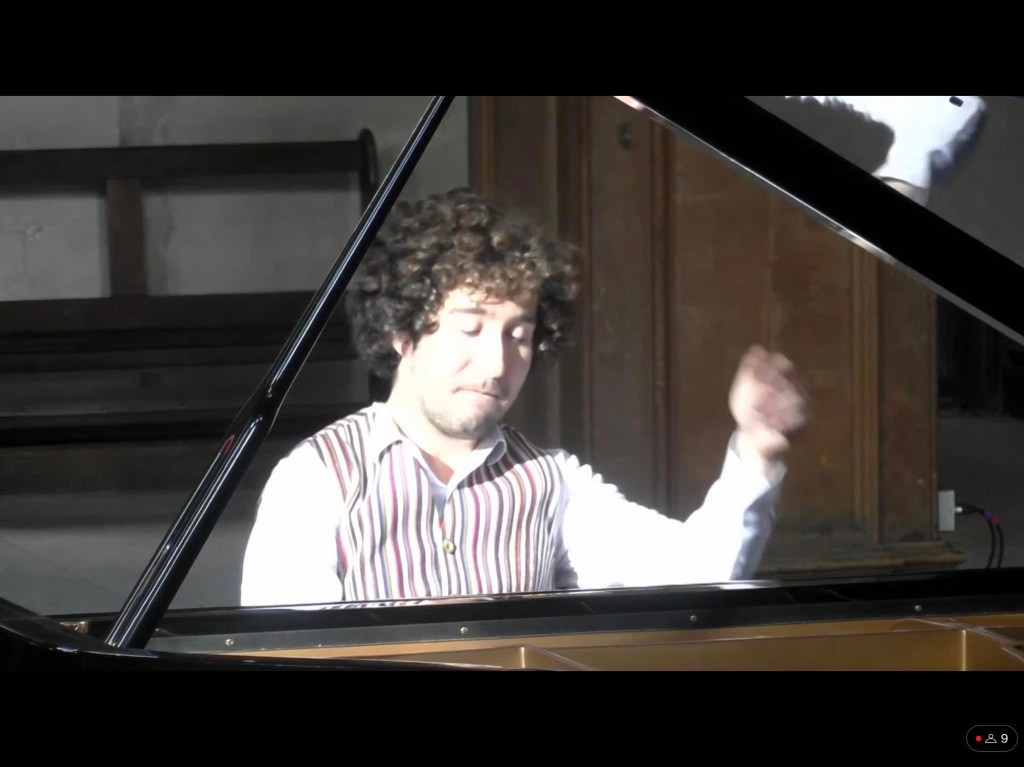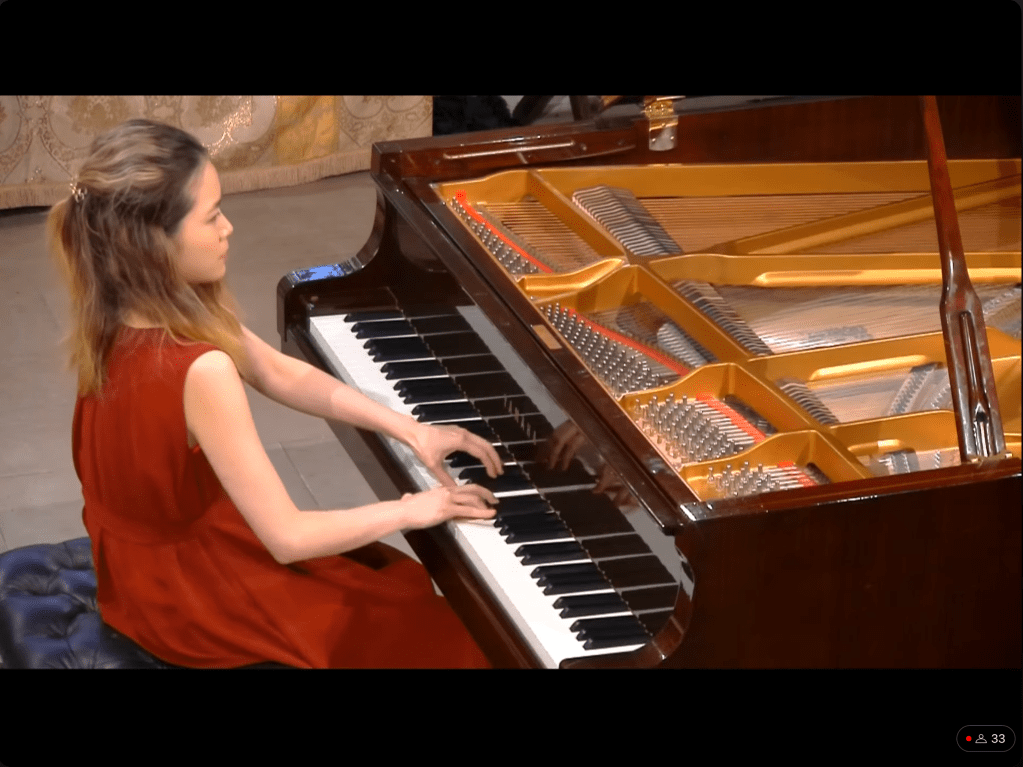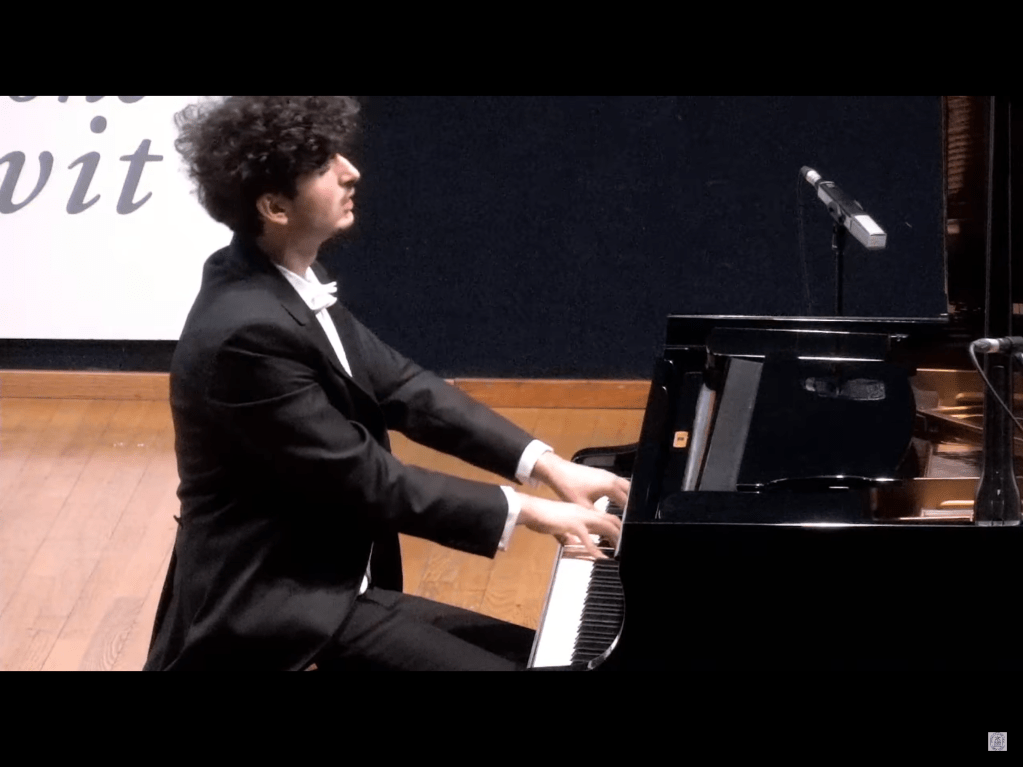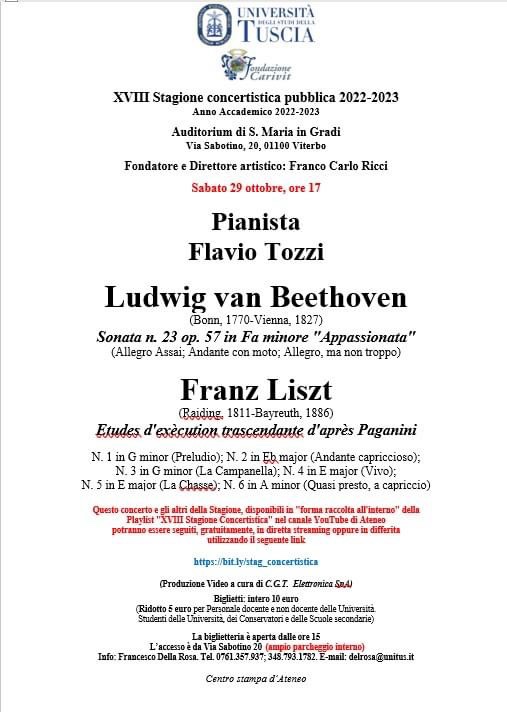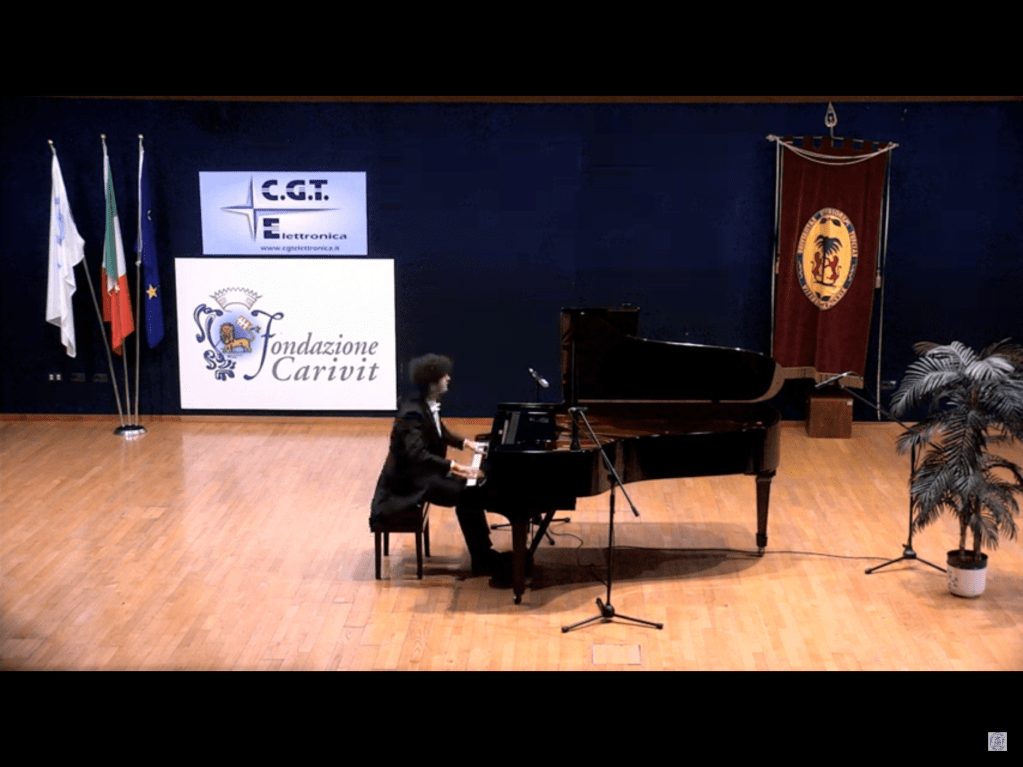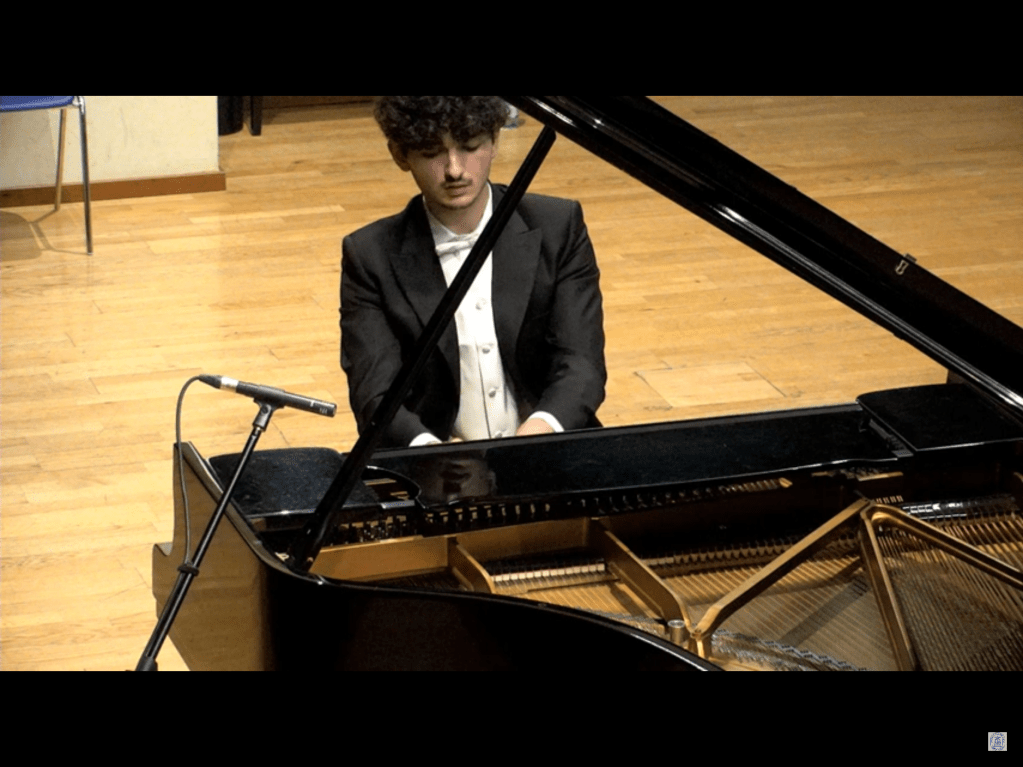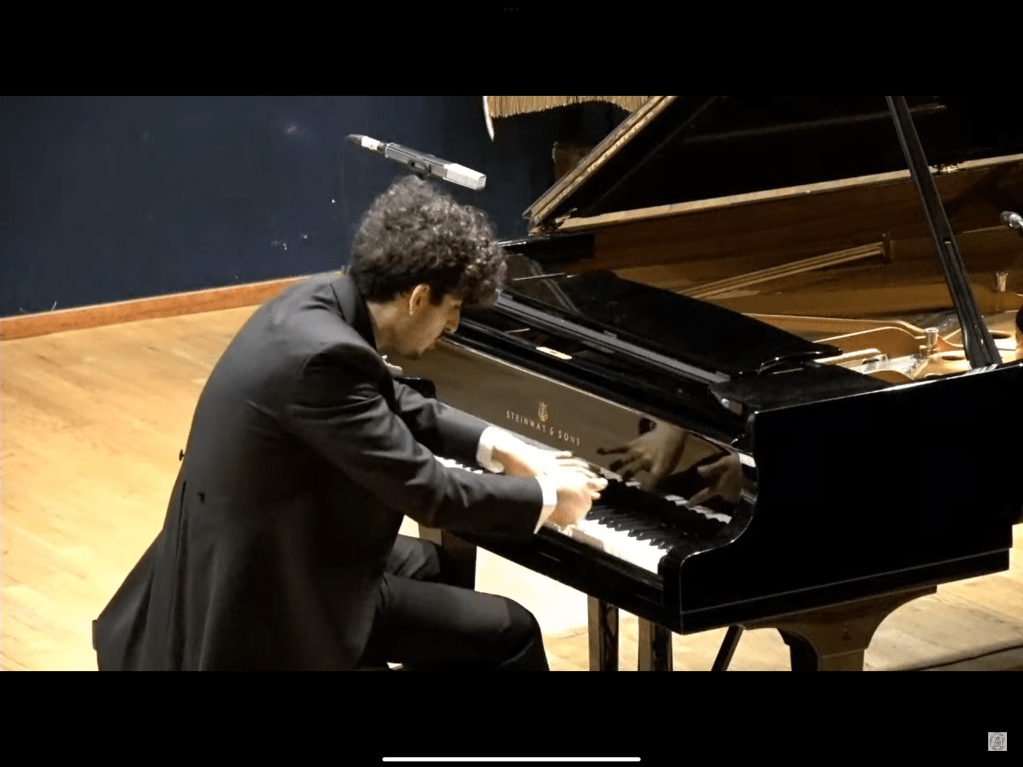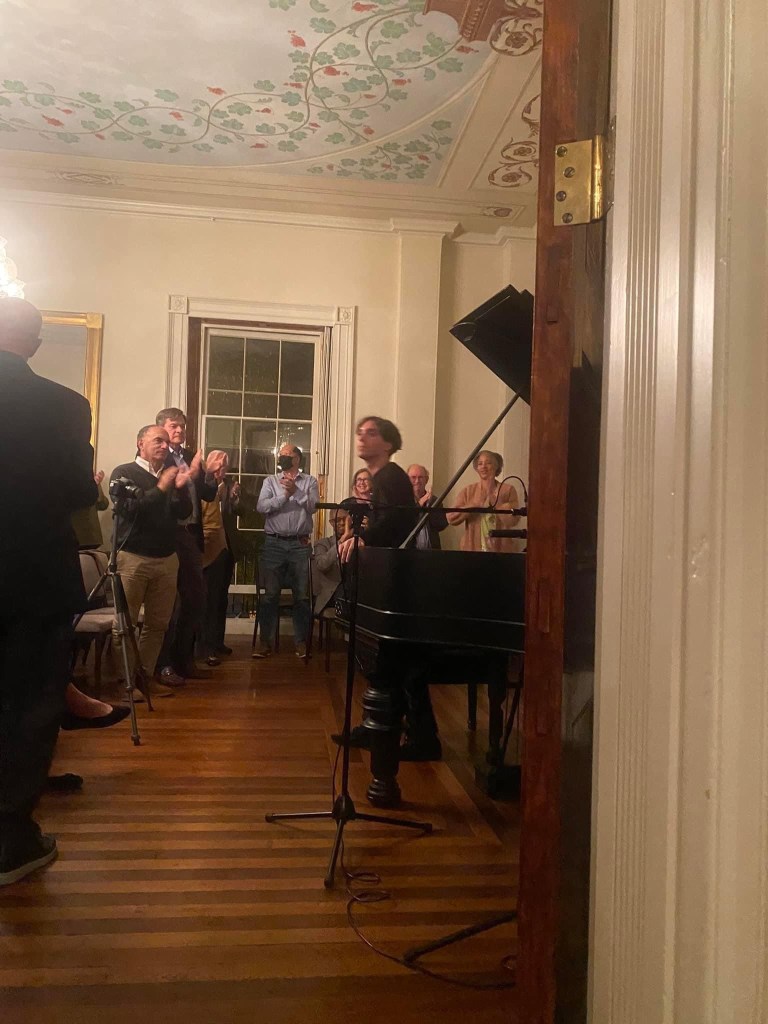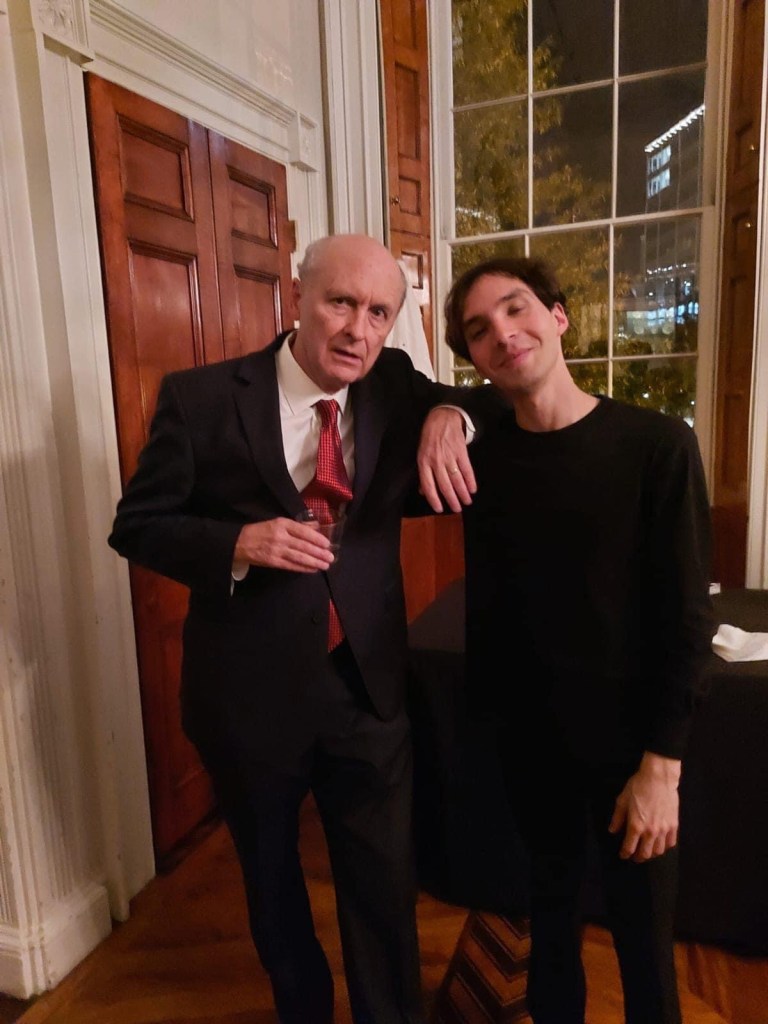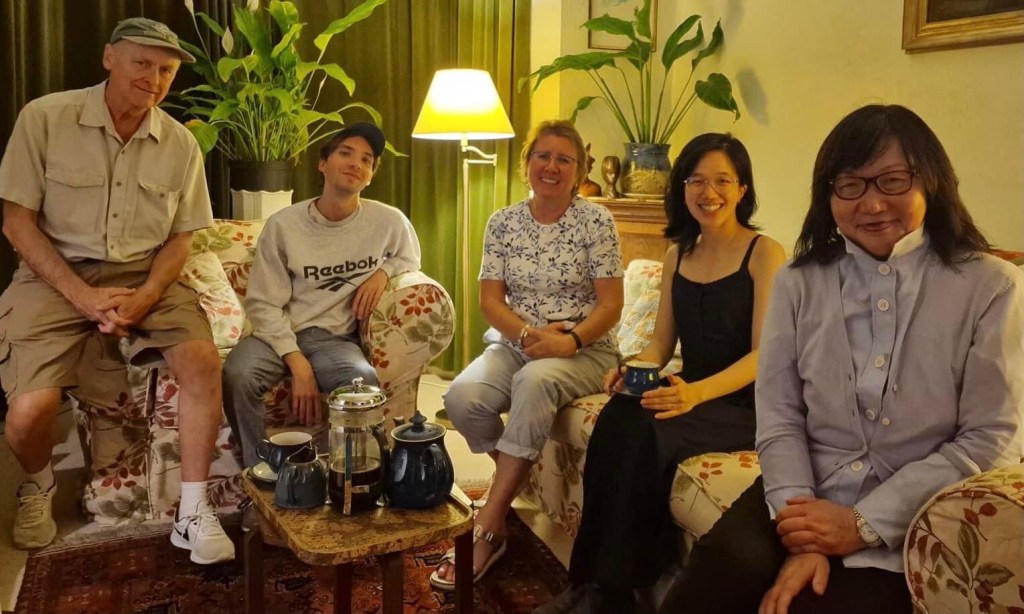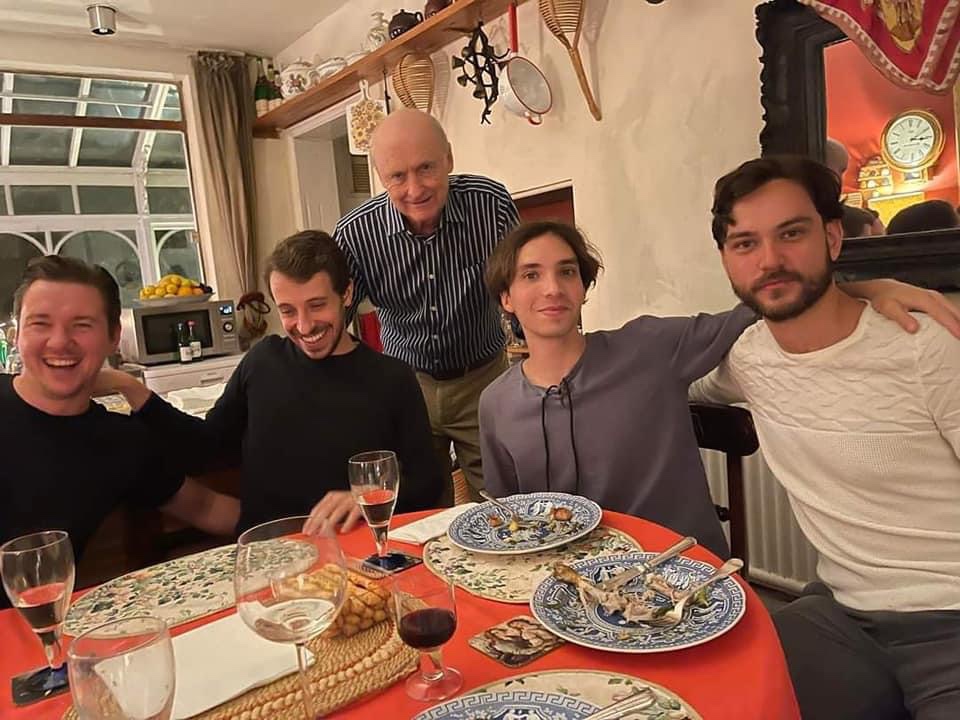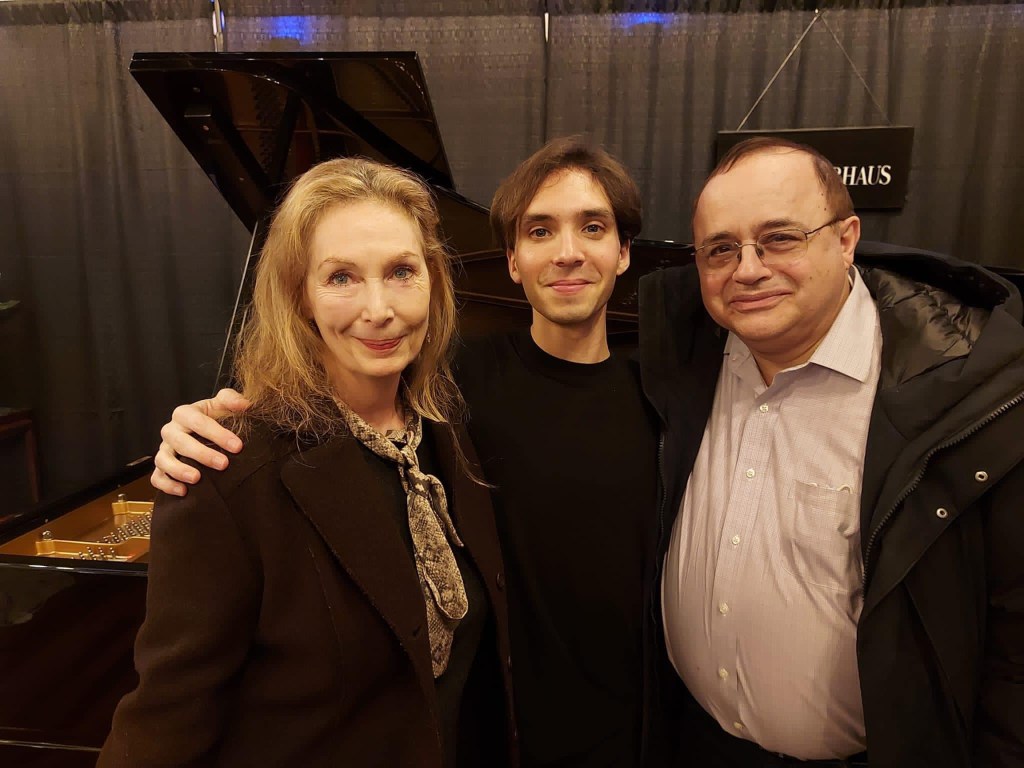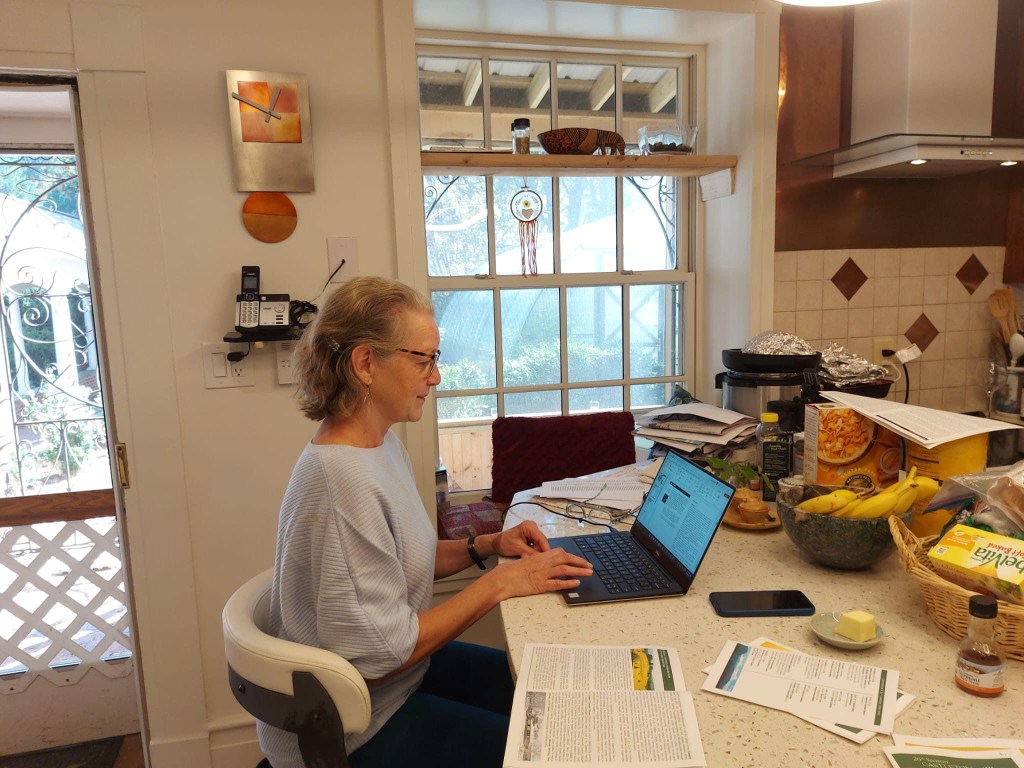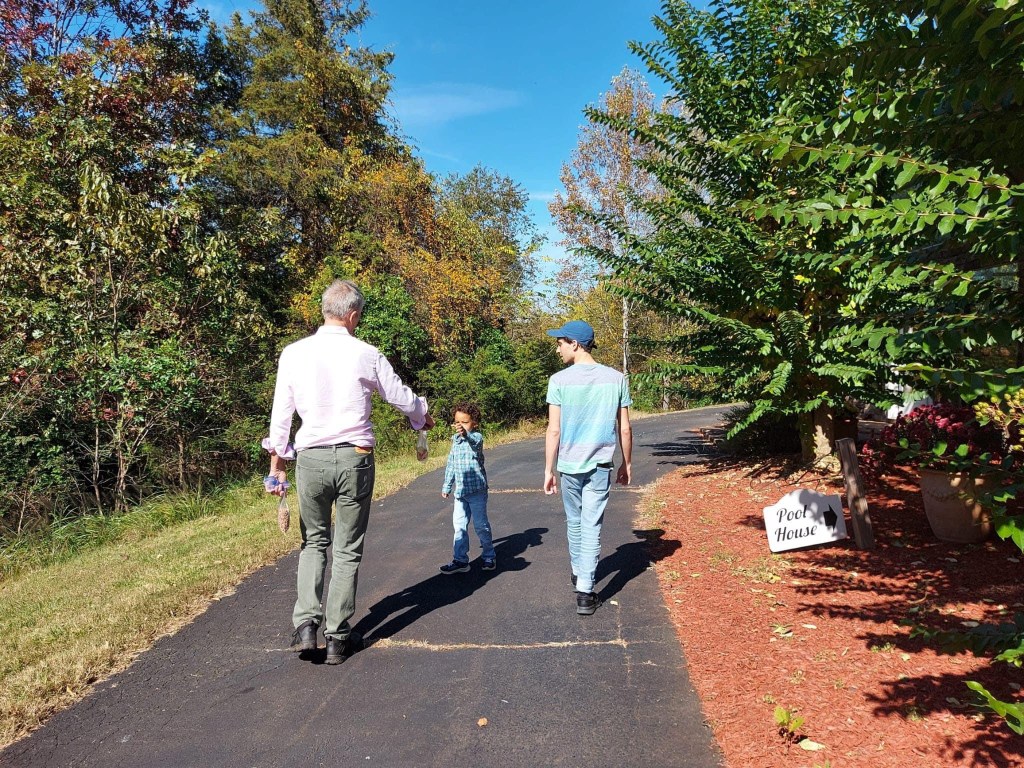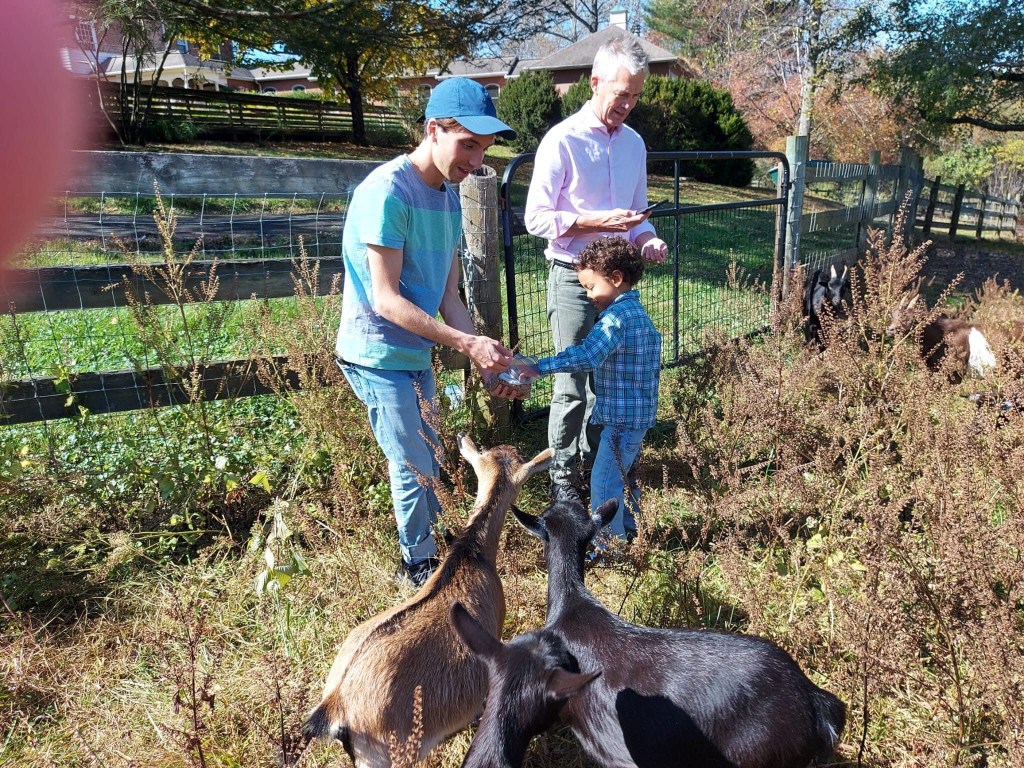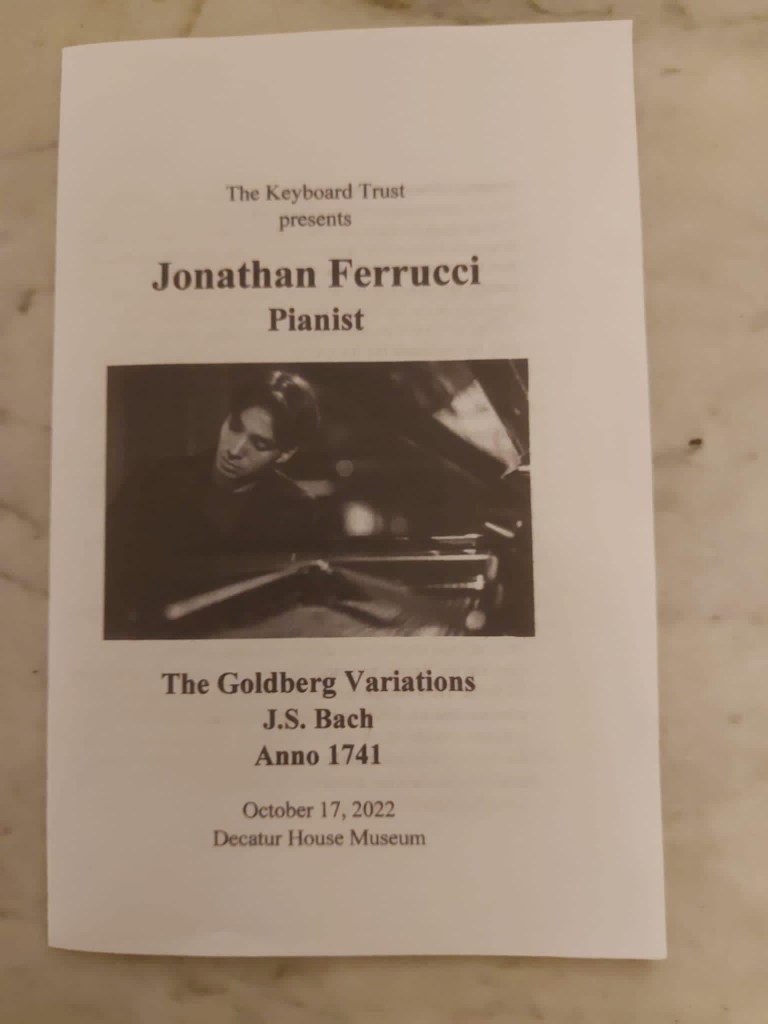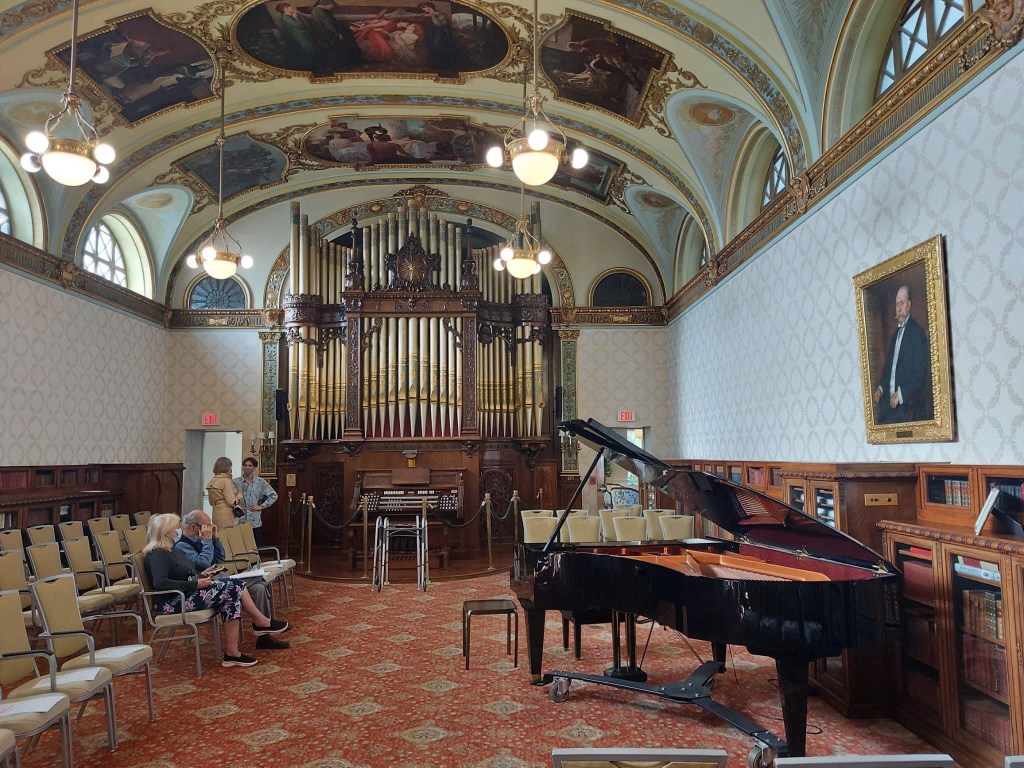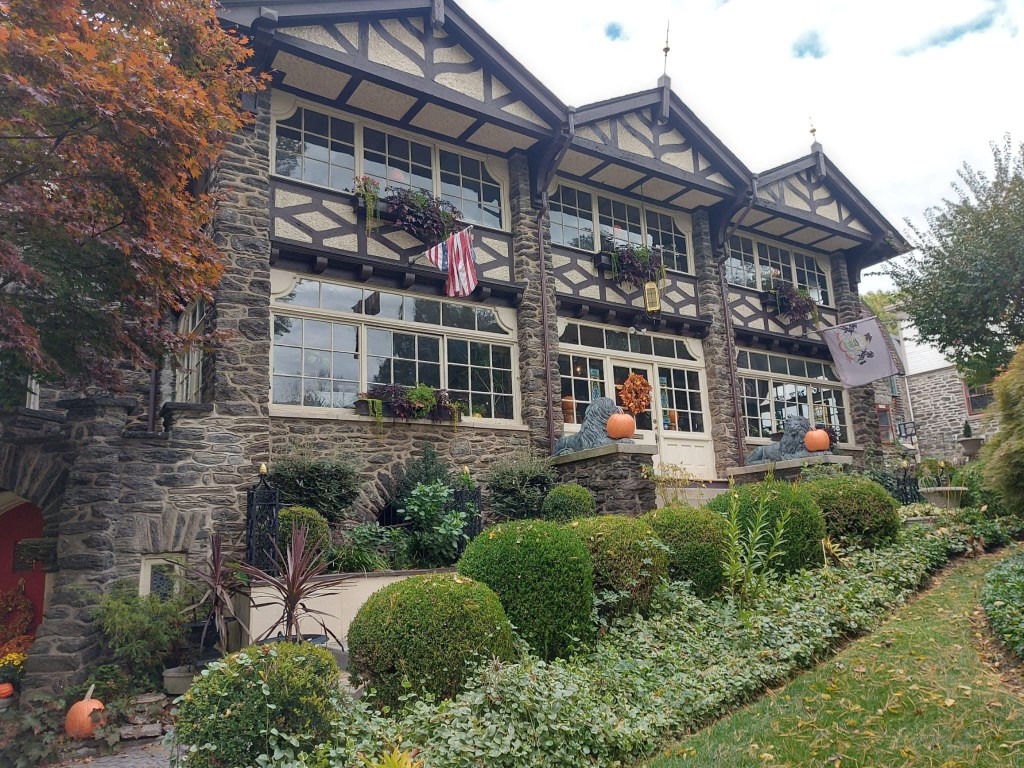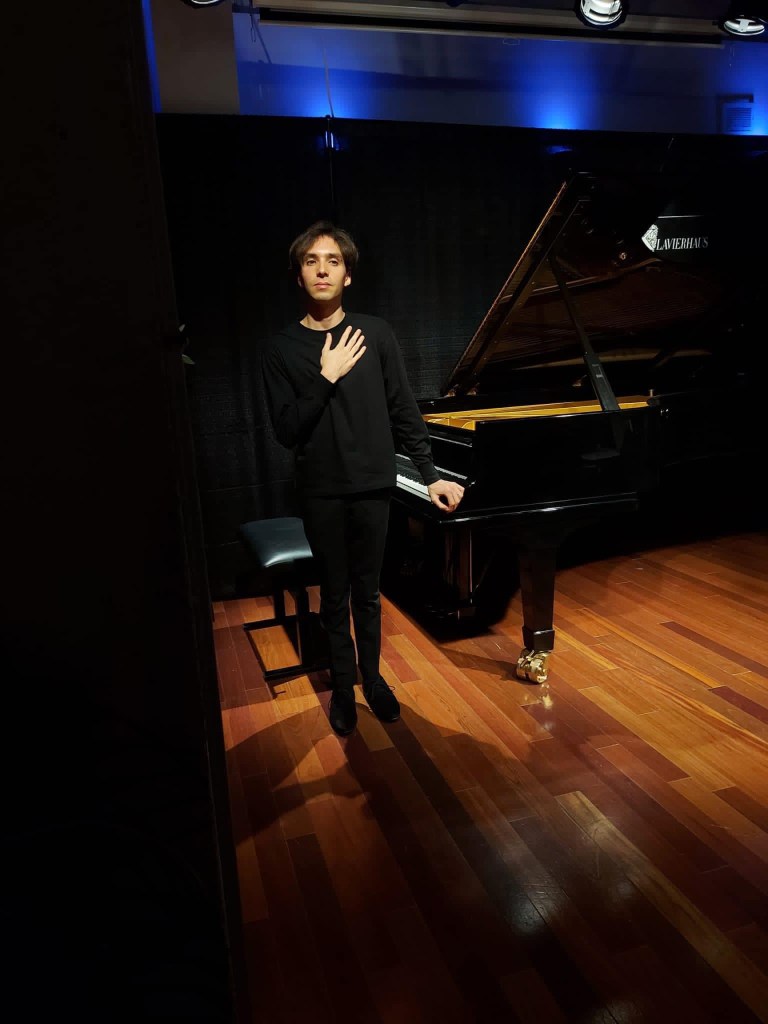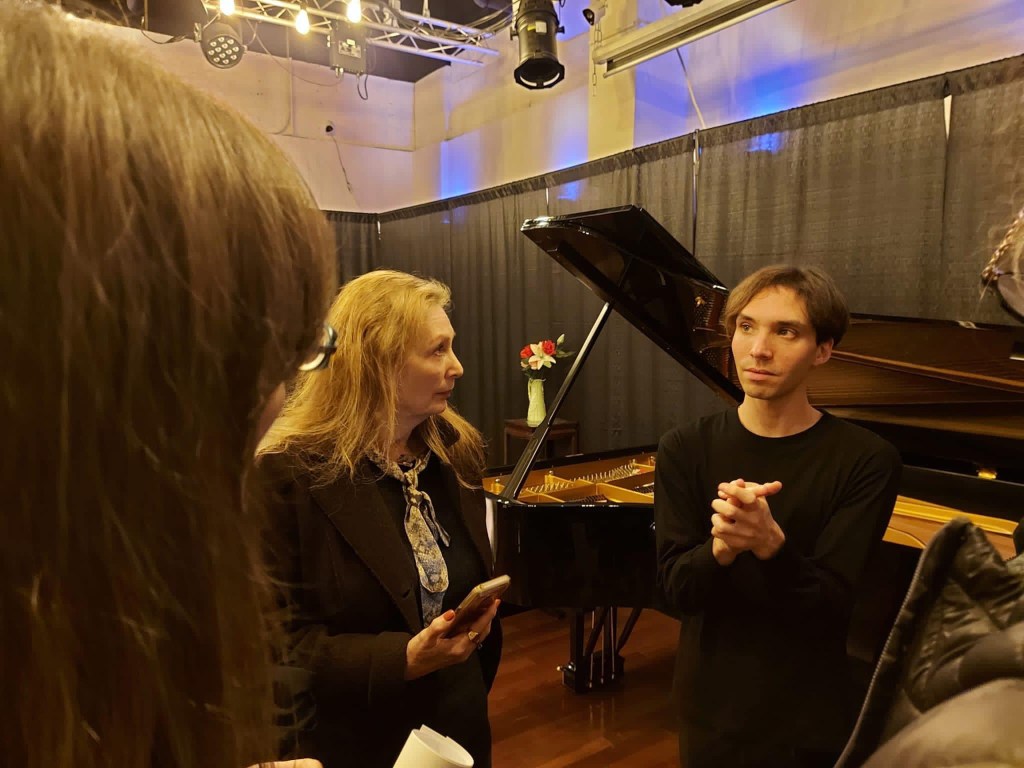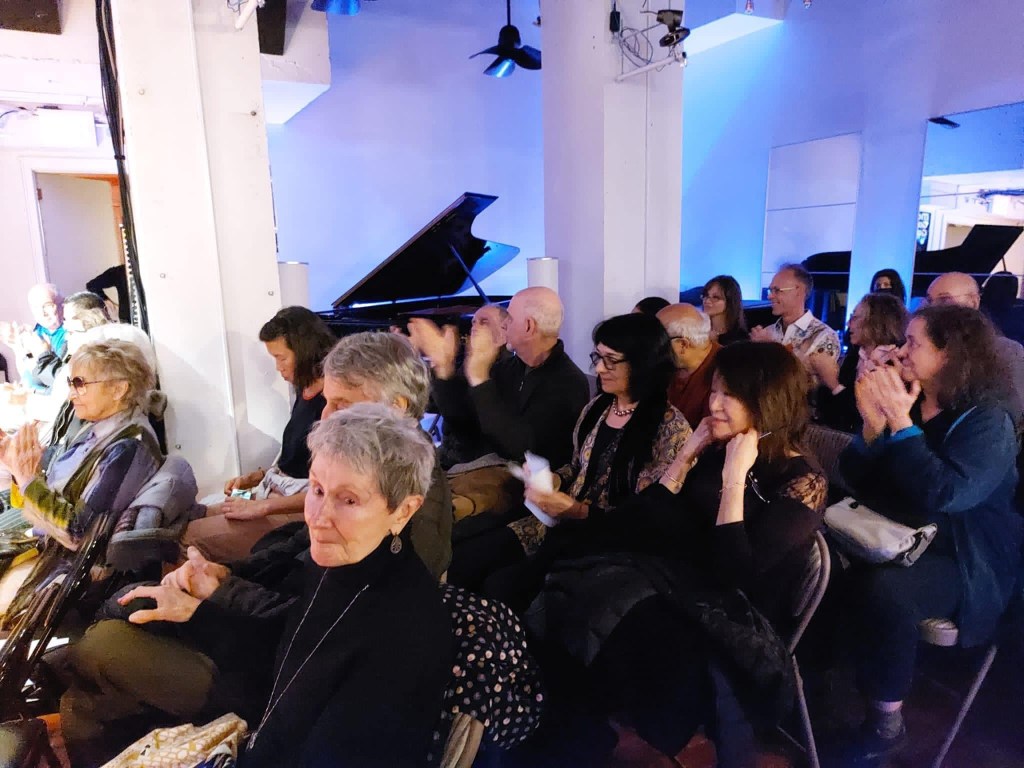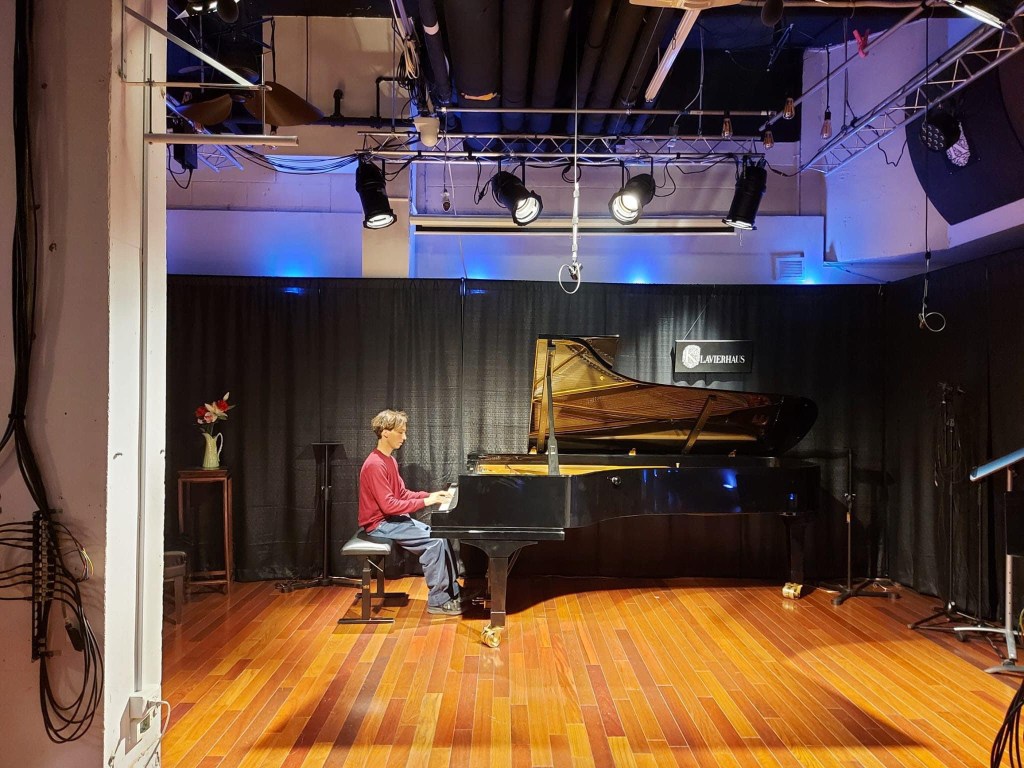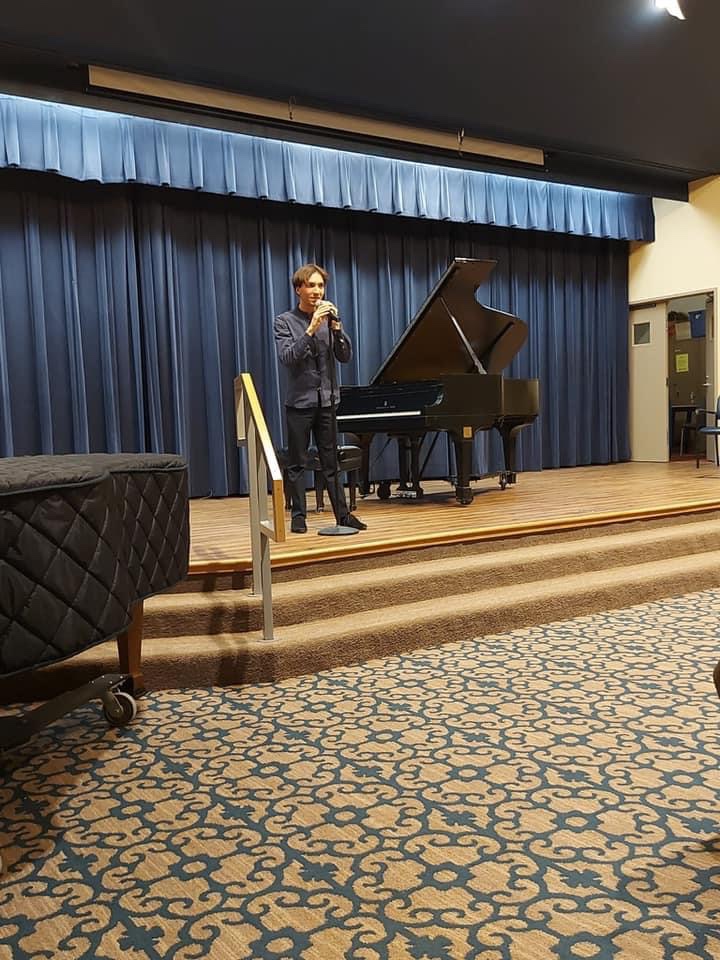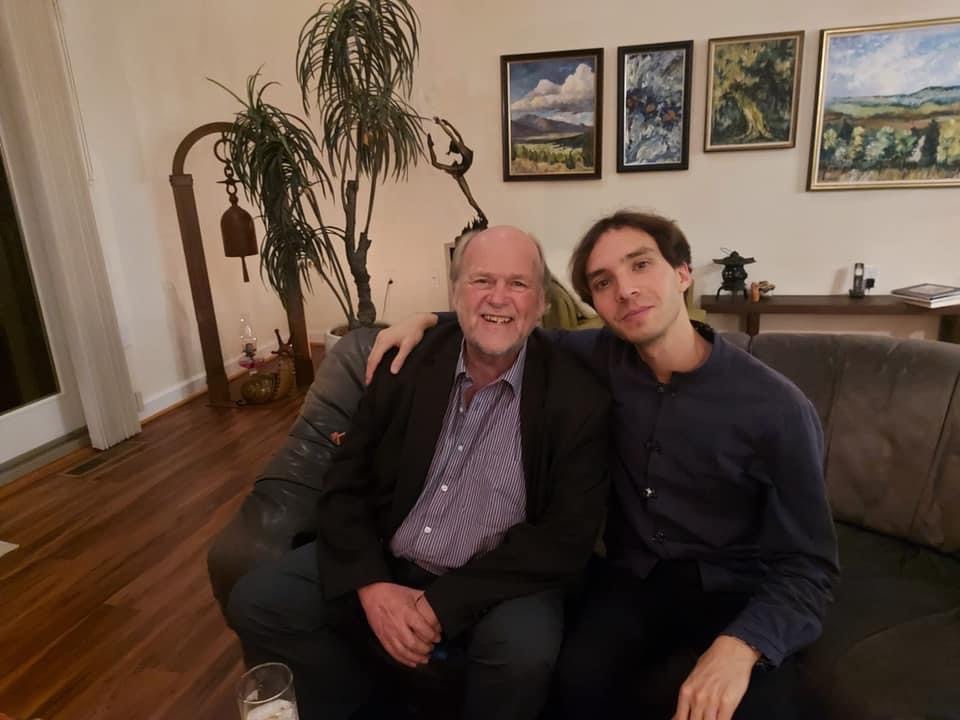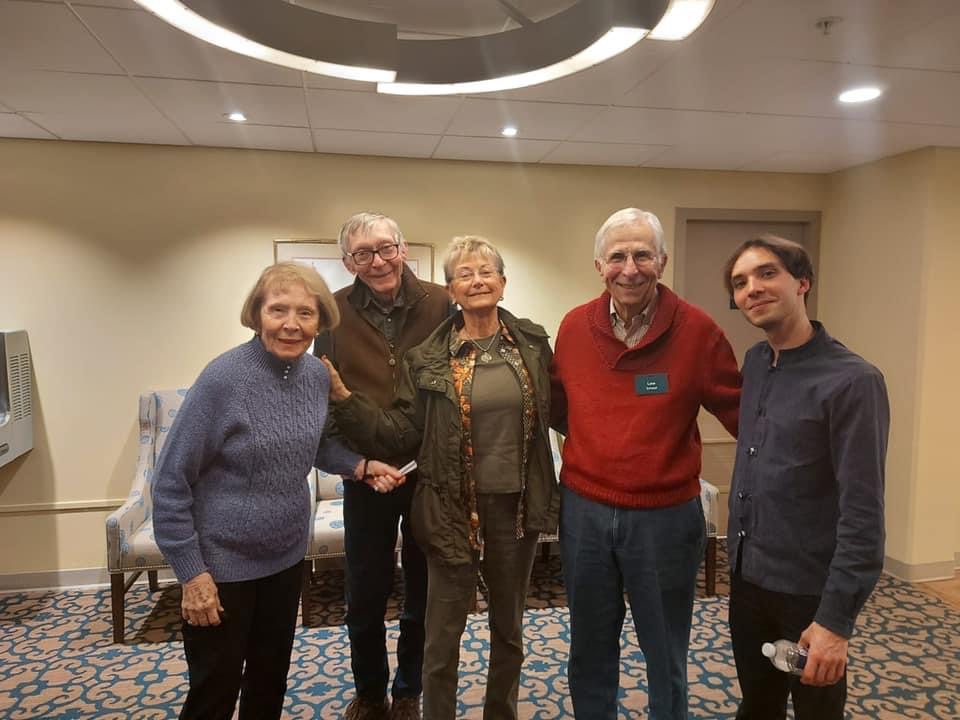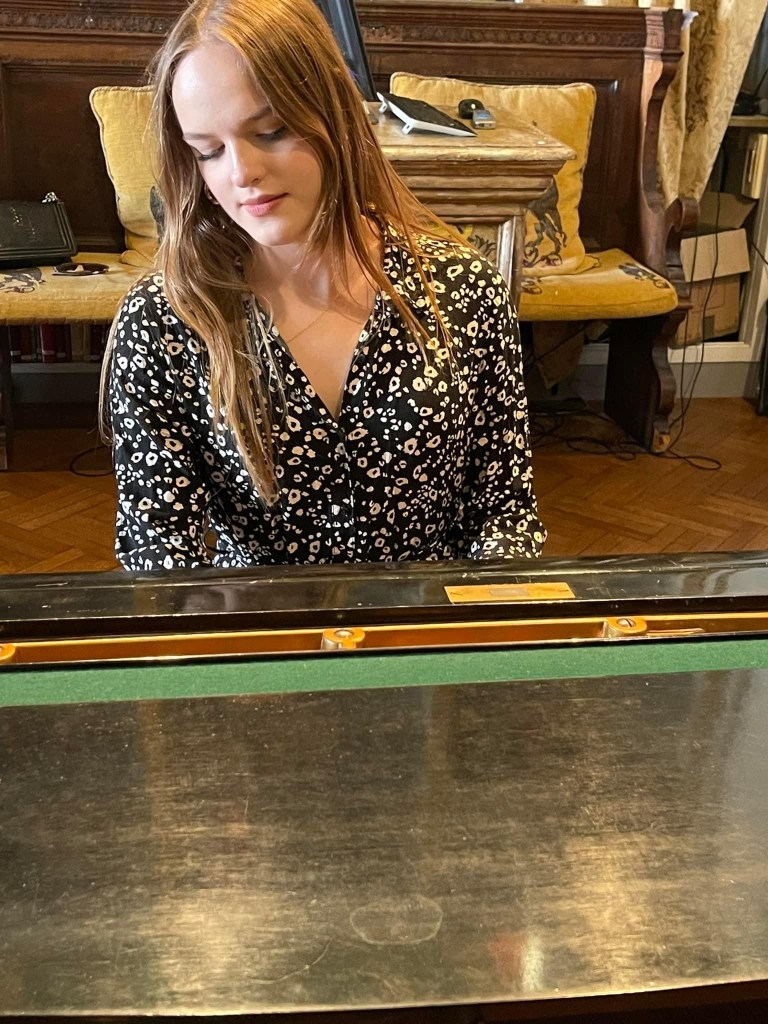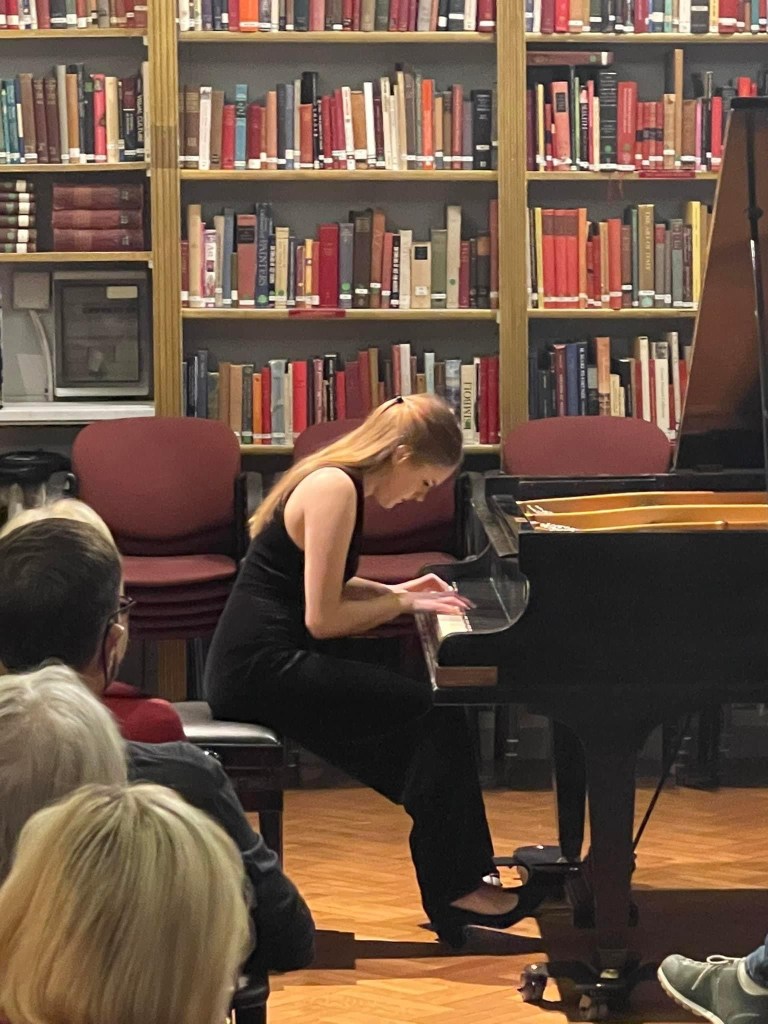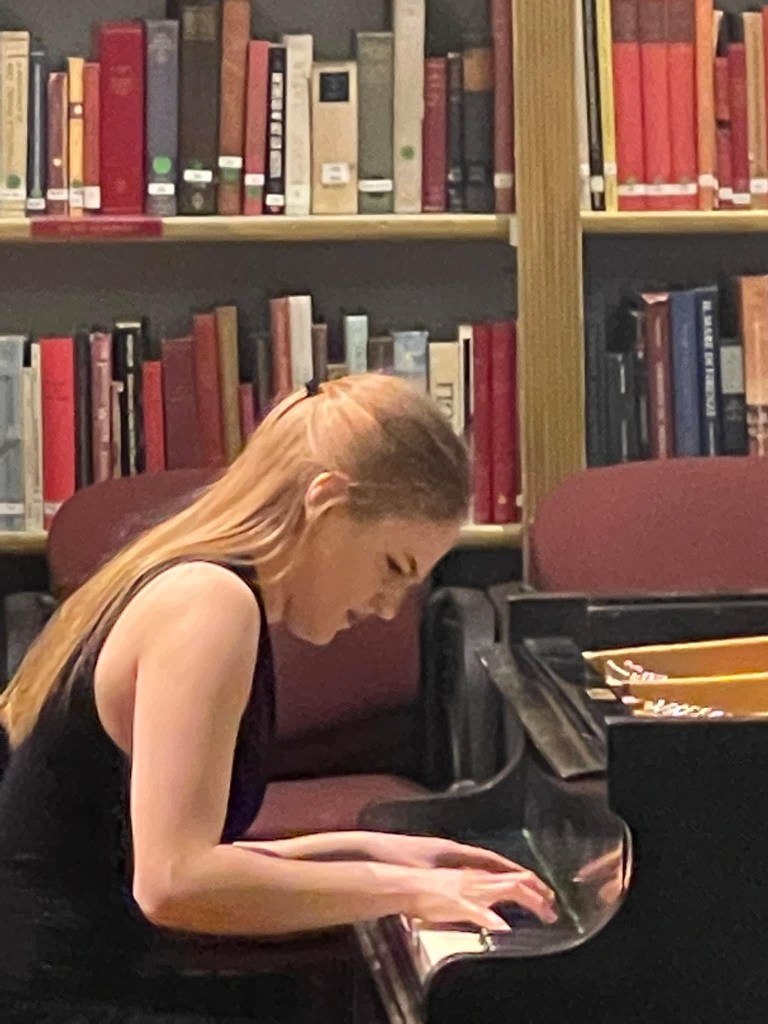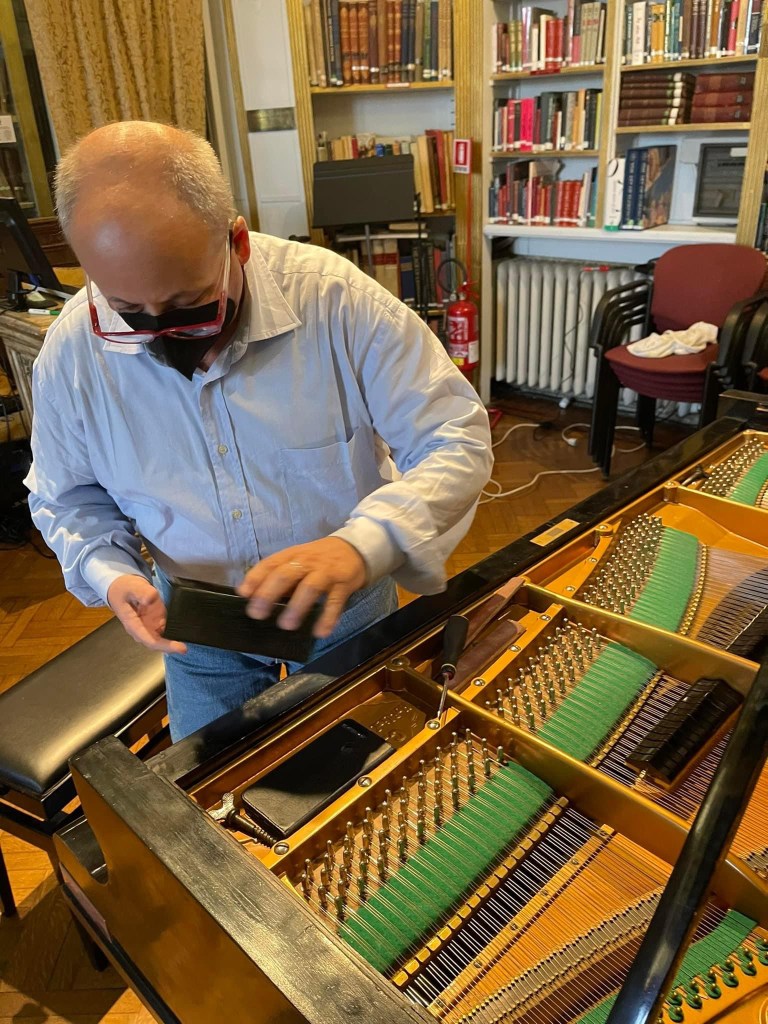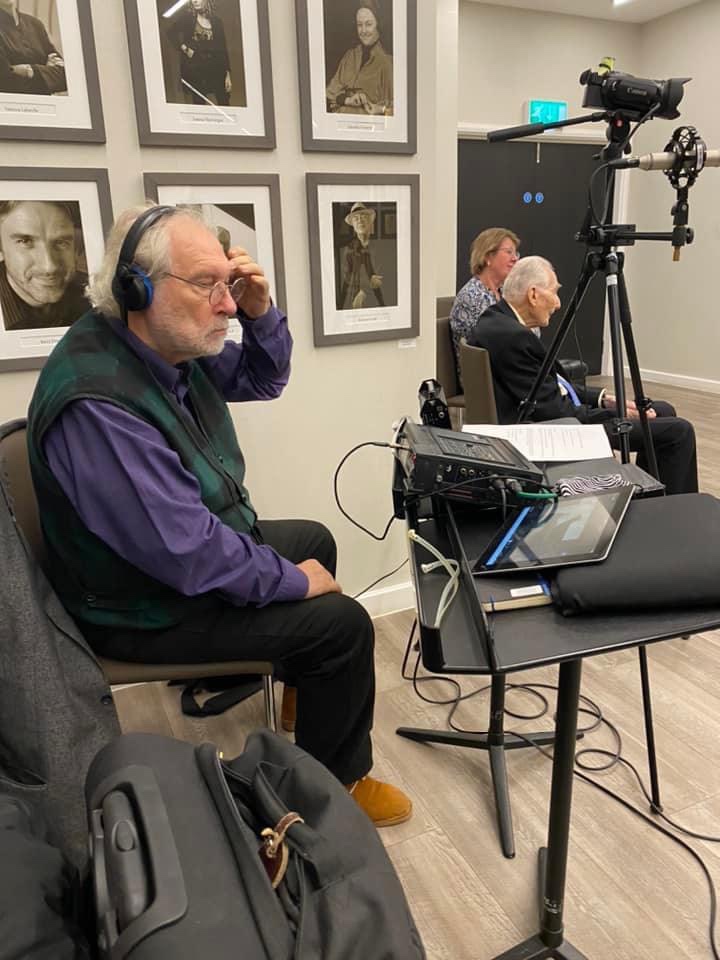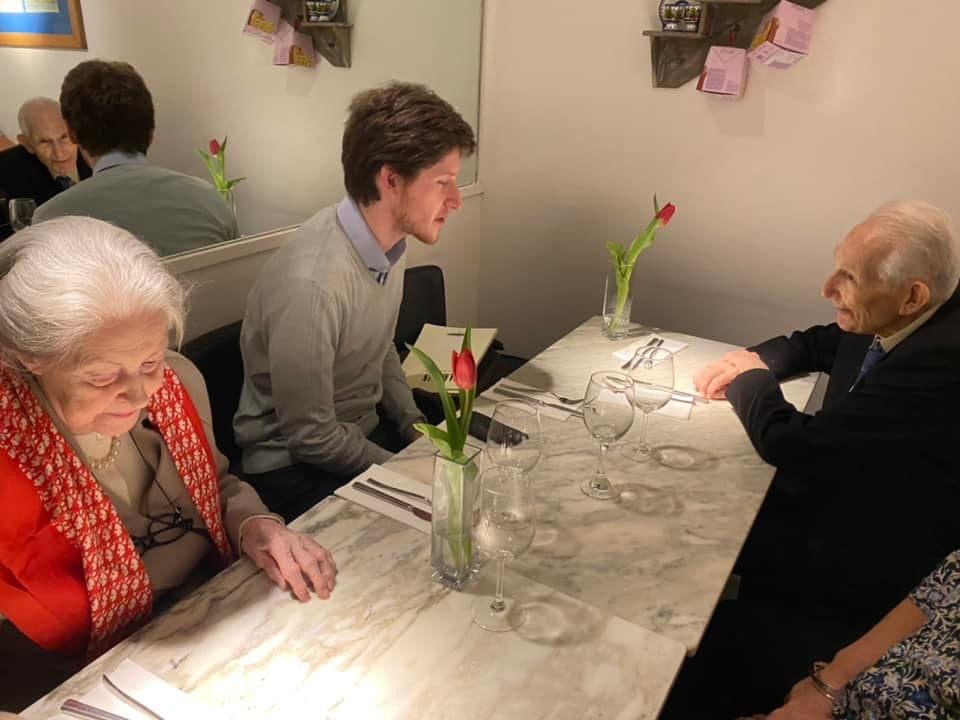
Just had a lovely weekend with Nikita Lukinov in my home talking of many similar matters. I cannot understand how someone so dedicated and talented doesn’t win every competition he enters. He has phenomenal technique, beautiful interpretation and a kind soul. The Steinway sang like a canary under his fingers. He clearly loves the music he plays and communicates this to his audience. Our local music critic, who is old enough to have heard many of the classical piano greats, said he may run out of superlatives to describe his Schumann Symphonic Etudes and the Liszt Sonata. Somehow, what competition judges admire and what the listening public wants seem slightly at odds. I spent my life teaching medical students and young doctors and used to say that a good doctor is never satisfied with his work. Surgeons would say that they were only as good as their last operation. I think this also applies to brilliant artists. There is a modesty about them, and a ceaseless desire to improve their next performance.
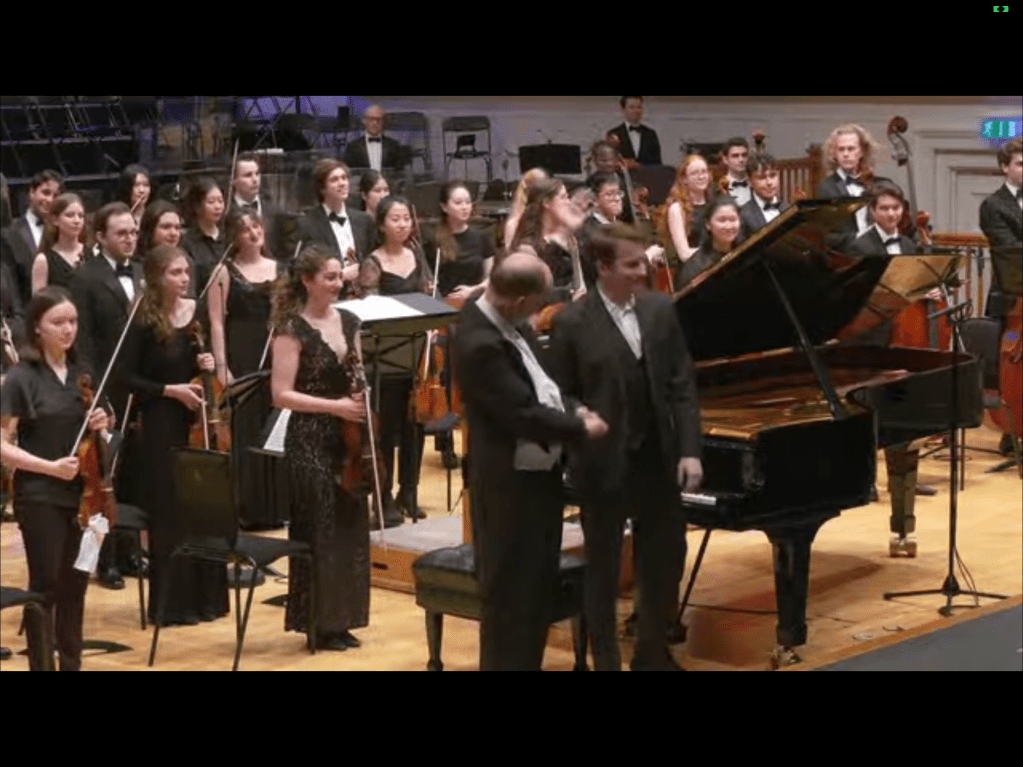
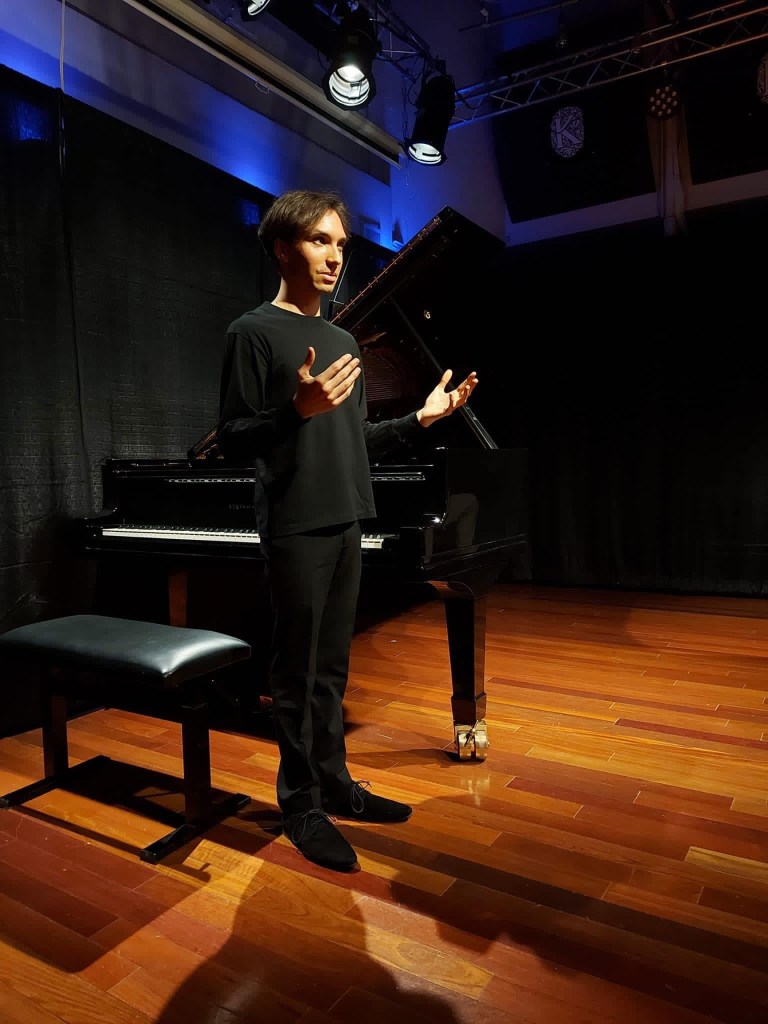
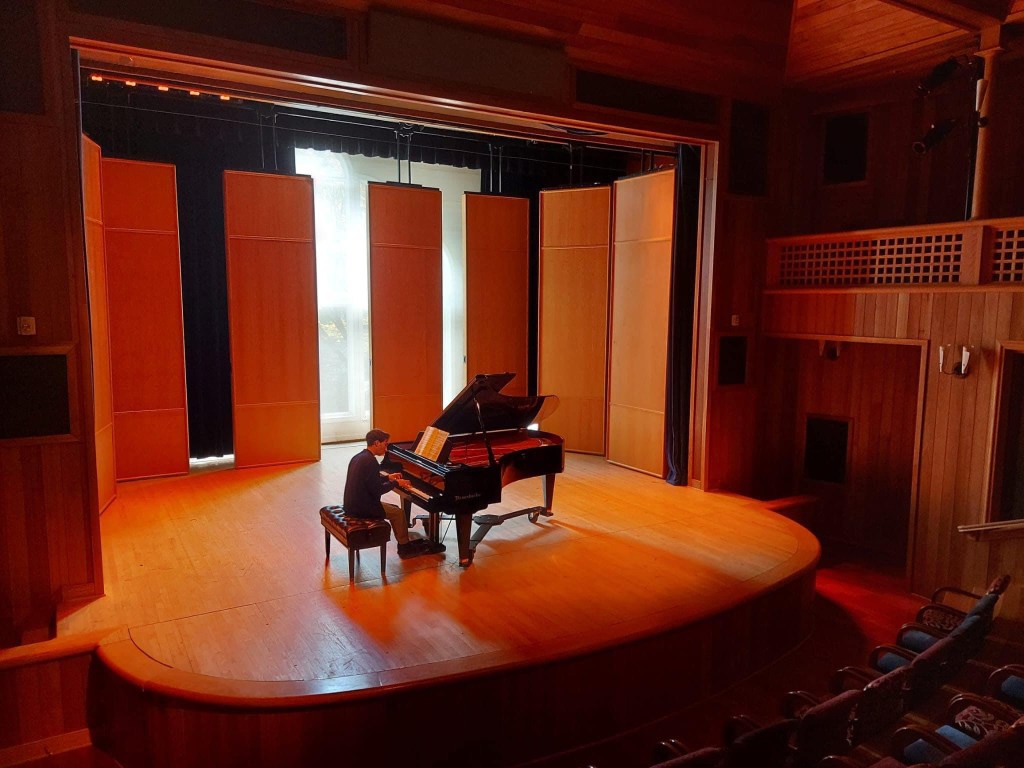
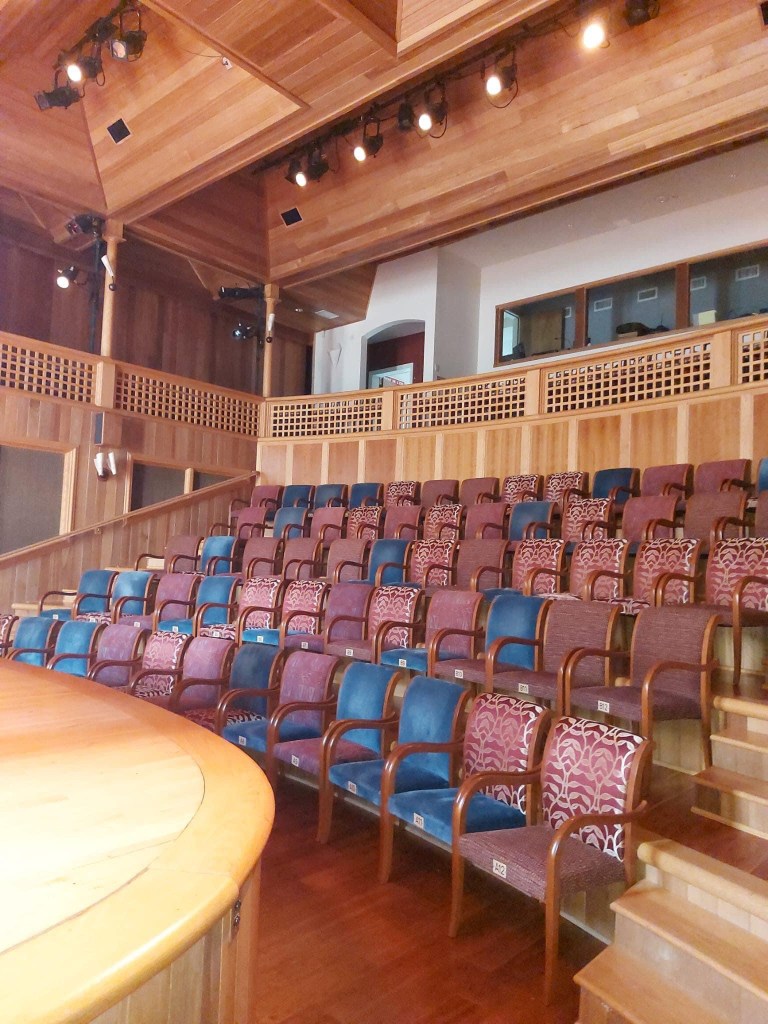
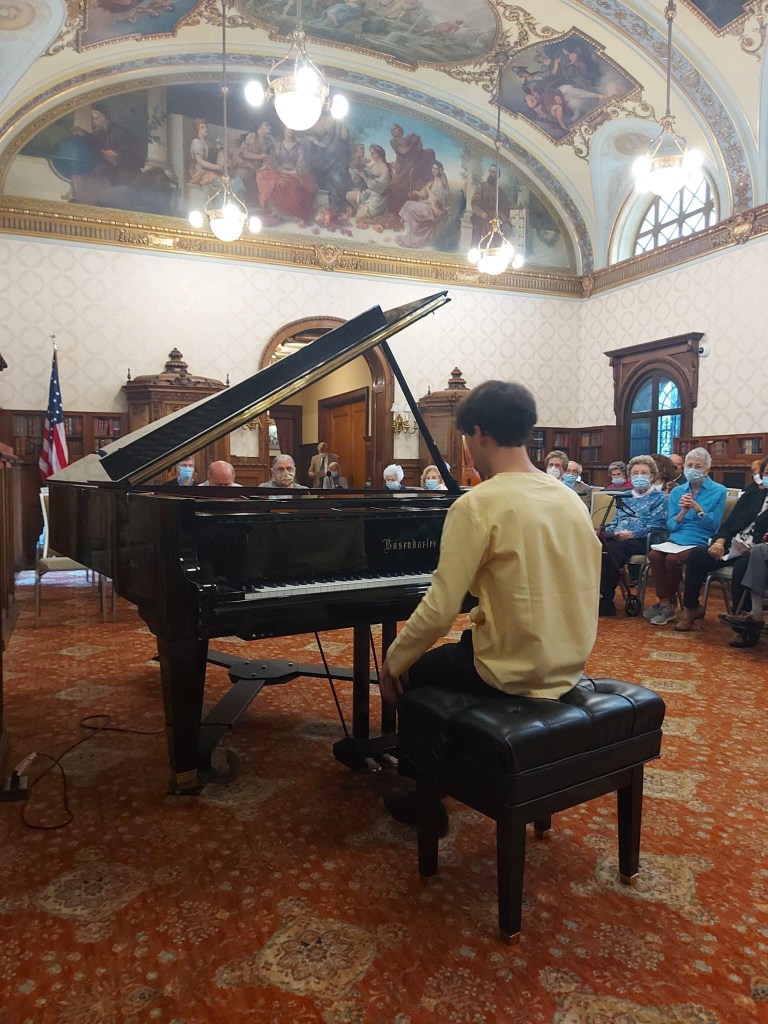
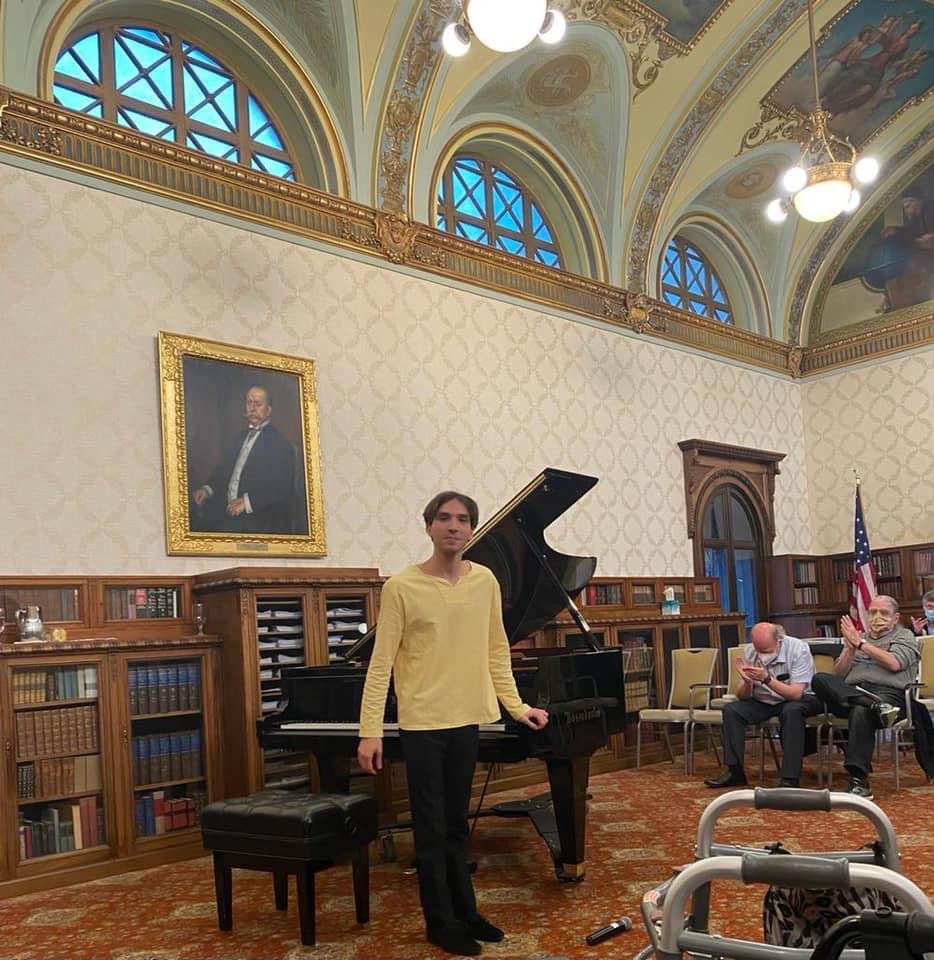
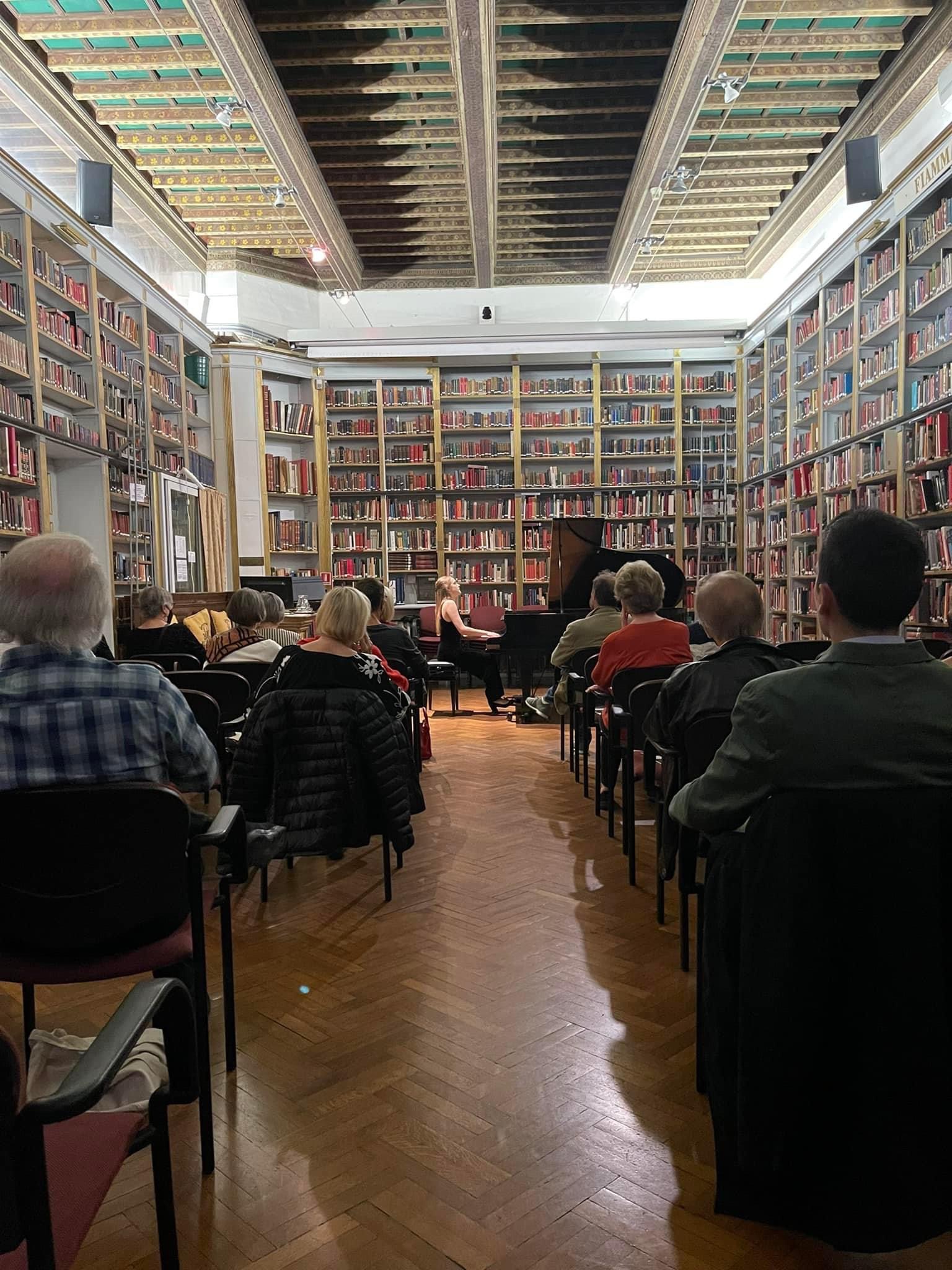
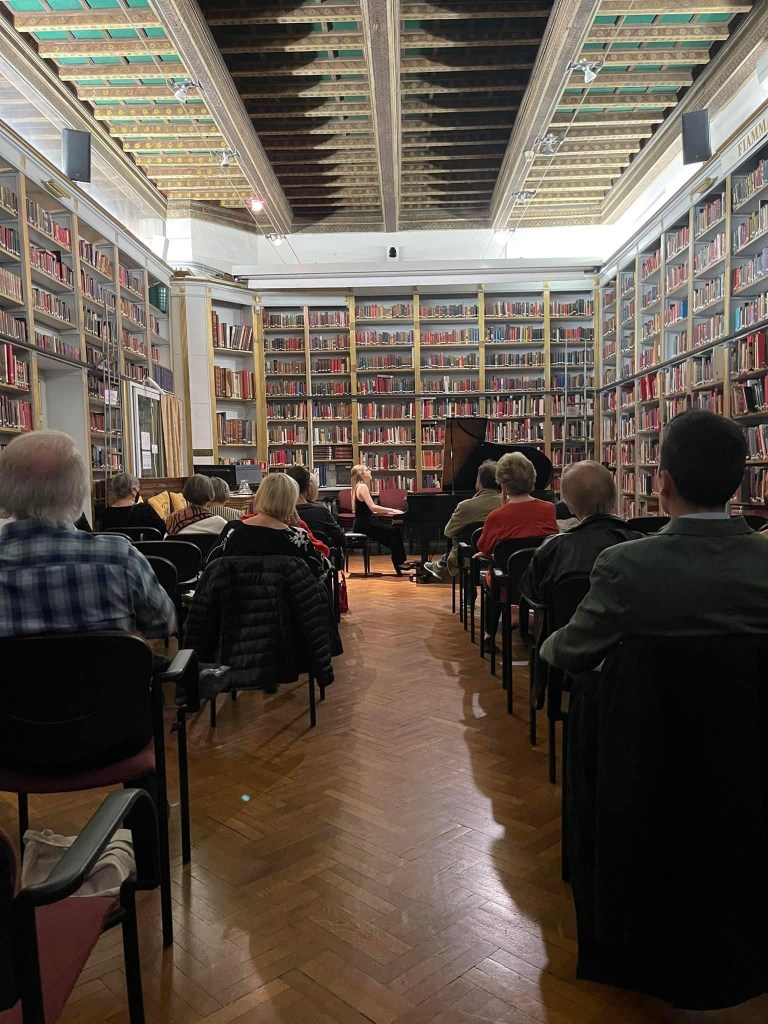
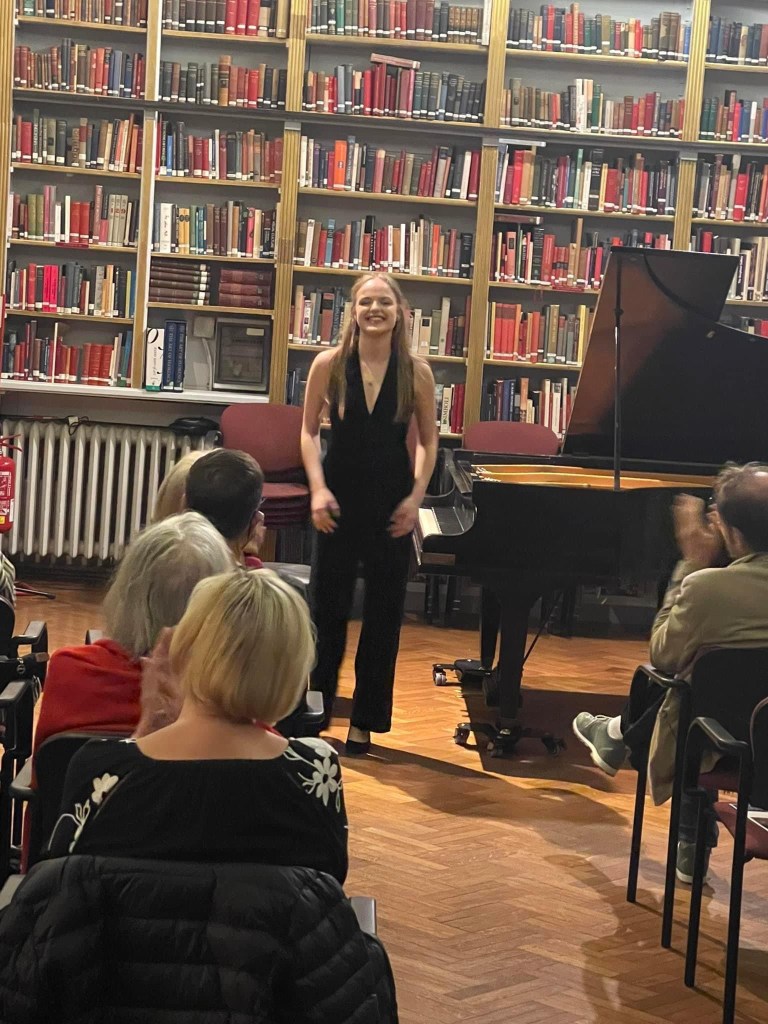
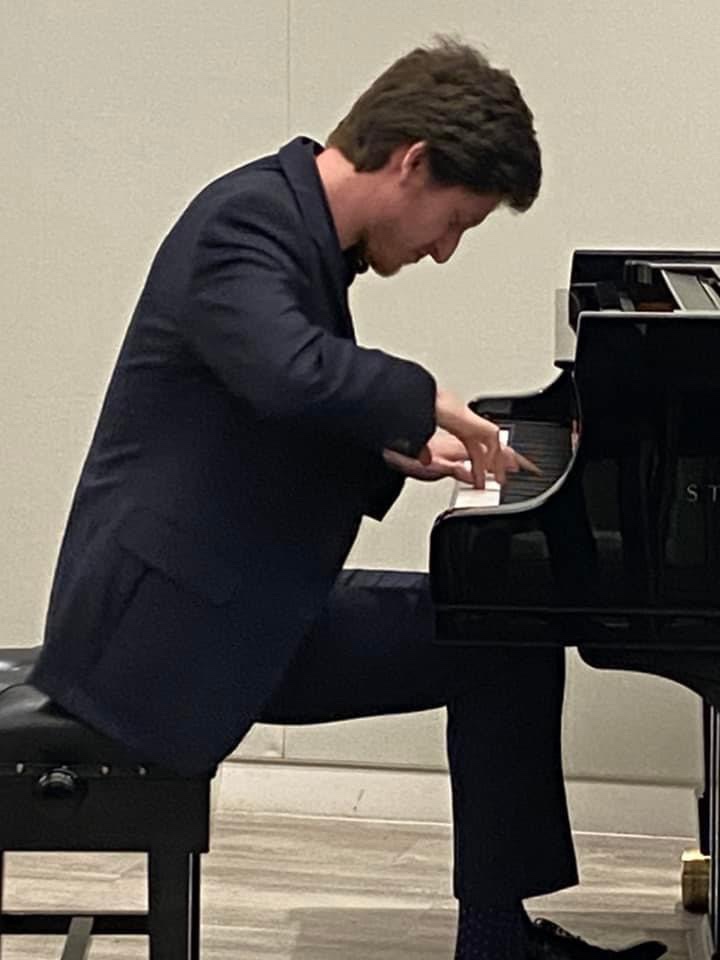
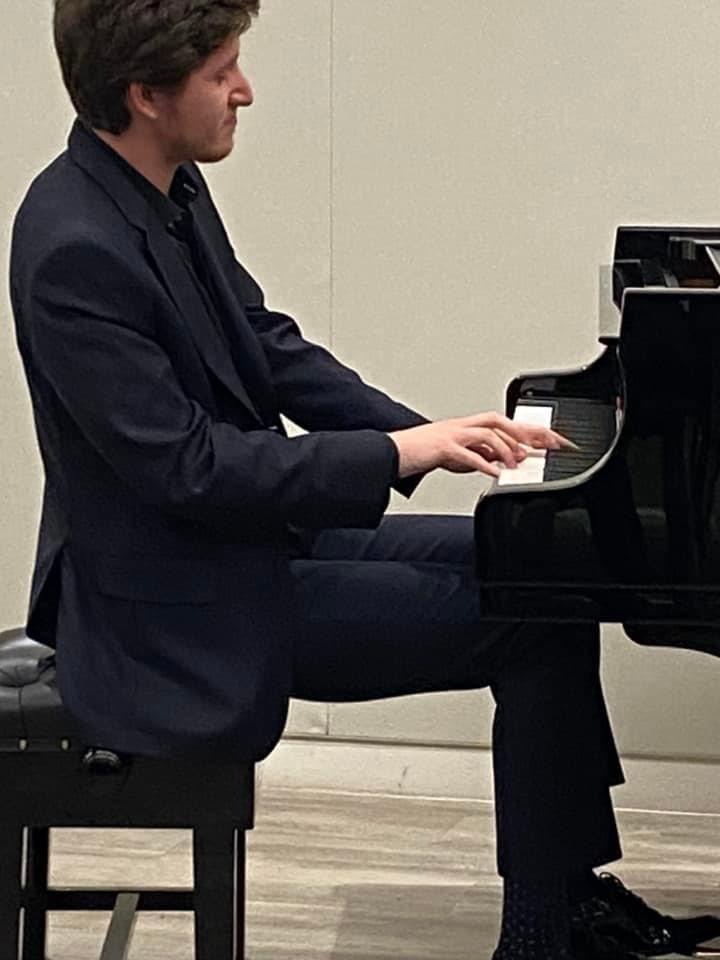
A review and photos from 25/09/2022 Shrewsbury recital where I played Schumann Symphonic Etudes and Liszt B Minor Sonata. A special gratitude to Dr Peter Barritt for making my profile more picturesque than usual!
Went to hear Nikita Lukinov playing in Market Drayton Festival Hall last Sunday. Here is the review from John Hargreaves…
Nikita Lukinov Market Drayton Festival Centre
Twenty-four-year-old pianist Nikita Lukinov brought star quality to the Festival Centre stage and gave a performance which was both a technical and emotional triumph.
It began with an unusual introduction, as Lukinov explained that his opening piece was described by Clara Schumann as ‘nothing but blind noise’. Lukinov looked nonplussed then added, “A top critic at the time said whoever has heard it and finds it beautiful is beyond help.” He held his palms out in entreaty and shrugged his shoulders. Then he sat down in front of the keys and played Liszt’s B minor Sonata, which has become one of the most popular works for the piano.
The sonata opened, as it ended, with a profoundly restful deep bass note. Lukinov commanded the audience’s attention and held it captive for the thirty minutes of compelling, impassioned, and yes, beautiful, music which filled the space between them.
His playing of this technically very challenging piece was riveting. He brought to it an overarching grace that subsumed the sense of wonder at how it was being achieved. He was there to take his audience on an emotional journey via a magnificent piece of music, and he did just that. It was thrilling and deeply affecting.
And that was by way of a warm-up, Lukinov half-joked as he introduced the second half of his programme. This was Robert Schumann’s series of Symphonic Etudes, played with no significant breaks, which were dedicated to Liszt and are widely considered to be one of the most difficult works for the piano.
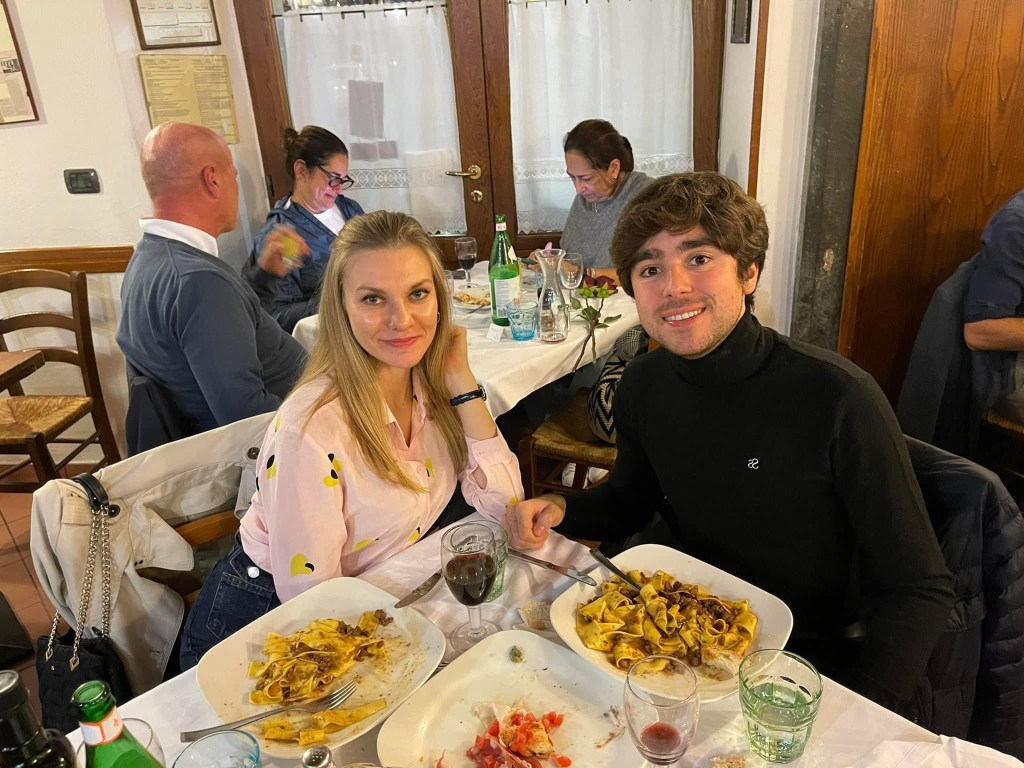
Schumann was bipolar and described these ‘piano poems’ as reflecting opposite and complementary sides of his personality: one extrovert and excitable, the other more introverted, lyrical and melancholic. Lukinov called the five etudes apparently discarded by the composer initially “arguably the finest romantic music ever written.” Nikita Lukinov with his partner, prize-winning novelist Anastasiia Sopikova
The more ‘introverted’ etudes evoked the richest feelings and thoughts, but seemed magnified by their juxtaposition with the dynamic outbursts. Lukinov made a beautiful whole of the differing passions, seeming transported by them as he played. His obvious love of the music was infectious.
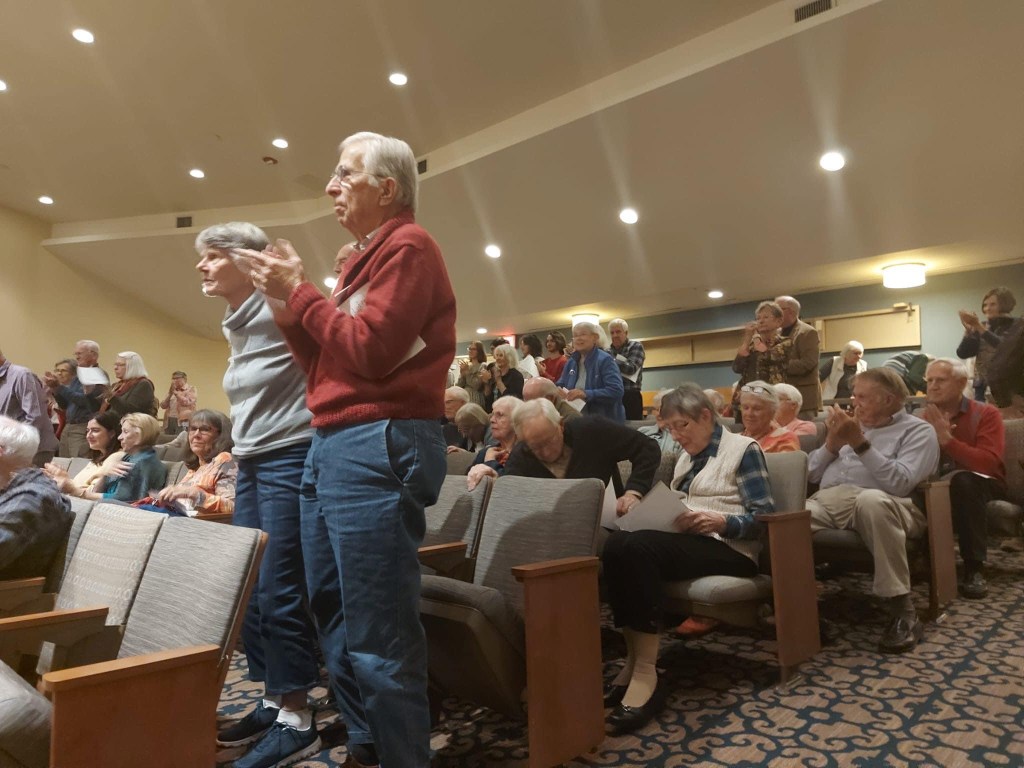
It is rare for a classical music audience at the Festival Centre to show its appreciation by augmenting applause with the stomping of feet on the sounding-board-floor of the raked seating. Lukinov responded with a perfectly chosen encore: Tchaikovsky’s Meditation.
Great also to meet Anastasia, his girlfriend in the UK for two months.
Joint concert with the Beethoven Piano Society of Europe
`An already accomplished young musician.’ Leslie Howard Playing `so impressive in its dignity than one almost failed to observe that this young performer had negotiated celebrated technical problems with grace and ease.’ Leslie Howard. `Extraordinary talent – do not stop playing’…`born to play piano’. Hilary Coates, Trinity Laban Conservatoire.
From the very opening notes there was a luminosity to Clara Sherratt’s sound and an infectious rhythmic energy with crystal clear ornaments.It was beautifully phrased with very subtle dynamic contrast and was a scintillating opening of enviable precision and clarity where she could now add a little more grace and charm to Haydn’s ‘Divertimento’The Adagio was gently flowing and contrasted so well with the exuberance and radiance of the exhilarating finale
No Haydn sonata is more indebted to Emanuel Bach’s brand of Empfindsamkeit—the language of heightened sensibility that had its literary roots in the works of Jean-Jacques Rousseau and the German poet Klopstock—than the Sonata in A flat, No 46, composed around 1767–8,like nearly all of Haydn’s other sonatas, bears the alternate title of “Divertimento.” Interestingly, each of the three movements is written in some variant of sonata form. Beyond any specific influence, this beautiful work reflects the striking intensification of Haydn’s musical idiom in the years immediately following his elevation to full Kapellmeister at the Esterházy court in 1766. Opening with a typically empfindsamer theme, irregularly phrased and characterized by delicate ornaments and sighing appoggiaturas, the first movement surpasses all its predecessors in scale, expressive richness and variety of rhythm and texture. For the Adagio, Haydn moves to the subdominant, D flat major, an outré key in the eighteenth century and one never used by Mozart. With the extreme tonality goes a peculiar intimacy of expression: from the delicate contrapuntal opening, with the bass descending passacaglia-style, this is one of the most subtle and poetic of all Haydn’s slow movements. With its catchy, quicksilver main theme, the compact sonata-form finale provides a glorious physical release. The darting semiquaver figuration always has a strong sense of direction, above all in the powerful chromatic sequences just before the recapitulation.
Some remarkably mature playing from this seventeen year old artist.A technical and musical control way above her years that allowed her to play one of the greatest works for piano with astonishing mastery and understanding.The Schumann Fantasy an outpouring of love for his beloved Clara is dedicated to Liszt and was Schumann’s contribution to the fund that Liszt had taken in hand to build a monument to his master Beethoven in Bonn.It is a very demanding work not least for the many musical problems that need to be resolved with simplicity and beauty.The first movement is prefaced by a verse from Friedrich Schlegel:Durch alle Töne tönetIm bunten ErdentraumEin leiser Ton gezogenFür den, der heimlich lauschet. – ‘Resounding through all the notes In the earth’s colorful dream There sounds a faint long-drawn note For the one who listens in secret.’There is also a quotation from Beethoven’s song cycle An die ferne Geliebte in the coda of the first movement:Accept then these songs [beloved, which I sang for you alone]. Schumann wrote to Clara: The first movement may well be the most passionate I have ever composed – a deep lament for you. They still had much suffering before they finally married four years later.
Clara for Clara you might say as this young lady played with great passion but also great intelligence.A true passionate outpouring with a luminous sound and an sense of balance that allowed always for a great clarity of line. It gave an overall architectural shape in a movement where Schumann is forever asking us to take more time without actually specifying where the join should start again .In the legendenton her very correct reading of staccato was rather too literal for my taste – there are many gradations of staccato – here it is a great outpouring of song and more of a weighty emotional staccato – but this is all a matter of taste from an artist who plays with remarkable maturity and scrupulous care of the composers markings.Her care of dynamics in the massig second movement gave great shape to a movement that can sound so disjointed if Schumann’s dotted rhythms are not shaped with real musicianship.Again her rather literal interpretation of Schumann’s ‘etwas langsamer’ robbed the music of its natural forward flow.But it was in the treacherous coda that she showed her true mastery with playing of such musical authority and as Schumann remarked of Chopin with ‘canons covered in flowers’.The sumptuous sounds and aristocratic rubato she brought to the ‘langsam getragen’ was ravishingly beautiful.Helped by her attention to the bass notes that gave great depth of sound to this sublime outpouring of love for Schumann’s Clara.Agosti (a pupil of Busoni) had written in my score over the opening A and G ‘Cla…….ra’.To Clara from Clara listening to each other in intimate secret which she shared so eloquently with us today.
An encore by great request was Rachmaninov’s own transcription of his song Lilacs from his 12 Romances op 21.A kaleidoscope of magic sounds spun from her fingers with such ease and style and confirmed what true artistry there is to her extraordinary mastery of the keyboard.
Clara Sherratt was awarded first prize in the prestigious Beethoven Piano Society of Europe Intercollegiate competition at age 16 – the youngest participant. She was already a prize-winning pianist, being at age 11 one of the youngest ever winners of the prestigious Two Moors Festival competition and Bristol Festival of Music. She has performed as a soloist at national and international events including Colston Hall, Bristol; Powderham Castle, Devon; The Royal College of Music; Bath Abbey; Bristol Music Club; Dulverton Church, Devon; Audley End, English Heritage; Pembroke College, Cambridge; Music Fest Perugia, Italy and the Festival Internacional de Piano Torre de Canyamel, Mallorca. Clara’s many recitals include concertos with local and international orchestras, Charity galas, festivals and she even played for the President of the Supreme Court, Baroness Hale of Richmond. Clara, now 17, is a pupil at the Royal College of Music Junior Department, where her teacher is Dina Parakhina. Previously she was a pupil of Pascal Nemirovski.
My artistic ideal has always been the great English actors who can play the king as well as the servant or the prostitute as well as the saint! This is a school that teaches the artist to lose themselves in the roles they play. The same should be for the musicians who should totally immerse themselves in the music they play or sing. It’s not about the personality of the musician but about the music itself! We have to acquire the tools and the craft to do this. I am always concerned about the craft as well as the artistry and musicianship.
KNOW YOUR INSTRUMENT The modern piano is one of the most complete and far ranging musical instruments ever created, the control of which is one of the most complex, subtle and challenging! To acquire the skills to make music with this instrument is daunting! Unfortunately, today many young pianists seem only acquire the more flashy of these skills (craft): speed and force! But there is so much else in between!
In the great Romantic Generation of piano players, Tone (Sound Quality) was the first consideration of all pianists. It was the very DNA of every pianist. Any description of a great pianist at the time was preceded by a discussion of his sound quality. Sound production is the most elusive matter for a pianist to teach another pianist. They use to say that the famous English pedagogue, Tobias Matthey, use to nudge, cajole, and badger the student until he was able to obtain the sound he wanted yet he had already written volumes on Piano Technique! Very often it is a question relaxation and arm weight. Most of the students that come to me usually have well developed basic piano technique but not always a beautiful sound quality. Sometimes I have to work with these students quite a long time before obtaining the quality of sound of a distinctive concert pianist! Next comes a scientific study of hand, finger and arm choreography in order to obtain the diverse articulations required in the music.
Reading a score for the first time with the intent of learning the work is one of the most exalting experiences for a musician. It is thrilling! I often compare this experience like seeing the legendary mystical Springs of Clitumnus near Spoleto in Italy. They are situated in backyard of a farmer and look like a little pond out of nowhere. The surface quivers every 15 seconds with a tiny explosion of water. In the middle of nowhere a clear fluid is coming from the earth in a parched land! However, if we keeping on looking into the pond we see marvels of delicate water plants, ferns tender bright moss, long elegant leaves. The bottom sinks away where seconds we saw nothing, a subterranean miracle! Tiny fish flit in and out of the foliage, like birds of the water. The same in reading a score. At first, we see only notes but if we keep looking we find a plethora of detail we missed at first view. We have to train to see, if only gradually, the complete picture of the score: phrasing, articulation, dynamic markings, pedaling accentuations, not to to mention tempo indications and suggestions of interpretation! To this we have to bring our own imagination and creativity!
Shunta Morimoto, CA,William Naboré ,Valentina Lo Surdo,Roberto Prosseda in the front row a student of Stanislav Ioudenitch
The young concert artist has a challenging route to follow to obtain a quality education today. The sheer costs involved can be staggering unless scholarships can be won. But this is just the beginning… A serious musical education in many parts of the world is just not available at a young age and when available is oftentimes spotty and inadequate. As the young musician has to acquire serious tools to express his/her musical gifts, this process has to be initiated as soon as possible with highly qualified teachers. Find the teacher? If one is very lucky, the right teacher for the right student can found early but surely not always! And here the problems often begin! It is obvious that not one sole teacher is good for every student. Question of temperament and affinity. But more and more frequently, that excellent teacher is just not available (enough) because he IS excellent! This is today’s dilemma in the classical music world. Many times those excellent teachers spread themselves thin accepting too many students sometimes even in many parts of the world. This cannot give probing results.Teaching is a difficult art that has to be done with dedication and empathy. Teaching a classical musician is a long process requiring great patience on both sides. This can be joyful but sometimes painful as well.
The first consideration I give to a new student is how to read music and how to read a score. There are many parameters to this question which must figure into the actual act of teaching, for we don’t teach on only one level but, in fact, on many levels.
In my own teaching, I will here discuss the basic level of sight reading or the first approach to the score which , unfortunately, in many teaching methods is fragmented. The score has a visual impact which is always the most important introductory element to a new work. It’s like love at first sight! You are already tingling with a notion what is contained within the score but you still know this is only the beginning of an adventure! Being able to discern as rapidly as possible all that is written there on that page is a gift, that, if not natural, can be acquired. Most teachers allow the student just to play what they can see at first sight no matter how approximative, however, I try to train the student to observe immediately the greater complexity of what he actually sees and render it there as precisely possible on the spot. This is not an easy training and usually takes some for the student to be able to really SEE ALL THAT IS WRITTEN! However, it is a fascinating exercise that will have longstanding consequences! On this first approach, I am quite inflexible, because, over the years, I have come to realize how important this is. It will help the student very much in learning a new work quickly.
The very first thing to consider in practicing are the editions of music we are using in our study. This is a very crucial consideration for every serious piano student. In recent times there has spouted a very profitable industry in providing
“Urtext” editions, that are authoritative and authentic to the letter of the composer’s intentions. Just in Beethoven Piano Sonatas there are more than 32 editions, all different, of course. Meaning that many of these Urtext are not seriously researched or even accurate. Then there is the very controversial subject of famous interpreters’ vision of the composer’s music.
To be brief, I will concentrate on some the most important composers for pianists, notably, Beethoven, Chopin, Bach, Schumann, Schubert, Mozart and Liszt.
Beethoven and his Piano Sonatas have been the most frequent victim of poor editions. Fortunately recently, we have two excellent modern editions: Associated Board of Royal Schools of Music (ABRSM) by Barry Cooper and the Barenreiter edition. For Chopin, the Jan Ekier edition of the National Chopin Institute of Warsaw. For Bach, the old and the new Bach Gesellschaft. for Schubert the Wiener Urtext edition of Martino Tirimo and the Barenreiter edition. For Mozart, the Mozarteum edition that you can find on the Internet. For Liszt, the Editio Musica of Budapest and for Schumann the new edition of Schott.
I must warn you again several unreliable editions that are still popular: the Chopin edition of Paderewski, the Urtext edition of Henle of Beethoven’s Piano Sonatas and the Clara Schumann edition of her husband’s music.
The Cortot edition of Chopin is interesting for Cortot’s commentary and some musical ideas. The same can be said of Schnabel’s edition of Beethoven’s Piano Sonatas.
Notes for a paper read during masterclasses in Bari in November 2023
Some superb musicianly playing from Ashley Fripp who I have heard on many occasions and even in the masterclasses of Elisso Virsaladze in Sermoneta and Fiesole.I remember very well a magical performance of the Chopin nocturne in D flat op 27 n.2 relayed live from Warsaw playing a Shegeru Kwai piano that I have never forgotten.Today just confirmed his artistic stature. Great intelligence but also passionate involvement.It is not an extrovert passion but it is within the notes themselves distilled into each sound he makes without any distracting histrionics.Ashley Fripp is what one might describe as a ‘dark horse’!It is only with this deep concentration and true listening to oneself that an artist can arrive at the simplicity of real maturity.Artur Rubinstein was the supreme example of that.And so it was today a Mozart of such clarity with sounds etched out ,detached and sculptured which allowed the simplicity of Mozart to speak for itself without any extraneous effects.The clarity almost chiselled sound of the theme came as a surprise but once entering into this sound world it gave great emotional strength to the essential notes of Mozart’s genius.The variations too unfolded in such a natural way that each one grew out of the other.The call to attention of the Minuet was in perfect style as was the sublime legato of the trio.The sedate civilised pace of the ‘Turkish March’ was even more formidable for the unrelenting insistent control that added strength to this often abused movement ……there are those that liken it to a Tom and Gerry chase and rattle it off at breakneck speed!
Sir Thomas Beecham exclaimed that people only go to hear Wagner operas for the intervals !But who would not sit through four hours to find relief in the sublime beauty of this final ‘transfiguration’ .Ashley ‘s passionate involvement together with his ravishing sense of colour and technical control opened a whole new world.Fluidity of sound and a sumptuous sense of balance with a climax of earth shattering tension dissolving into the extreme delicacy of the ending.It was a magic world that only a true artist could have conjured up in just a few minutes.Liebestraum rarely heard these days in the concert hall was played with subtle bel canto rubato together with sounds of profound aristocratic delicacy.
The same simplicity of Mozart but one hundred years later with Chopin.His favourite composers were Bach and Mozart where simplicity and contrapuntal writing are added to artistocratic nobility and innovative technical demands.The Barcarolle written only three years before the composers untimely death is surely the greatest of all his masterpieces.An outpouring of song from the opening bass C sharp that just opens up the sonority in this magic box of hammers and strings as the gentle sound of the laguna start to ripple ( it always reminds me of the opening of Visconti’s Death in Venice).The radiance of the melody that floats on these waves was played by Ashley with a beauty of sound that built so naturally into controlled passionate climaxes.The magical episode before the final bars with a web of golden sounds that Perlemuter would exclaim ‘this is heaven’. He would also tell us that the final string of right hand notes with the left hand melody just suggested underneath was what Ravel so admired and had influenced his own compositions.The Berceuse as the Andante spianato was played with a superb sense of balance that allowed the melodic line to sing unimpeded with subtle inflections of great beauty.The Polonaise was played with true technical command and a jeux perlé that was what Chopin himself must have astonished even his peers with,of such refined pianism .
As Ashley pointed out none of the movements of this Sonata are in sonata form and they are all in the key of A major or minor .The opening movement is a theme and variations where Mozart defies the convention of beginning a sonata with an allegro movement in sonata form He himself titled the rondo “ Alla turca” and it imitates the sound of Turkish Janissary bands, the music of which was much in vogue at that time.The second movement is a standard minuet and trio It was only in 2014 that four pages of the autograph score were found in Budapest in the Hungarian librarian Balázs Mikusi.Until then, only the last page of the autograph had been known to have survived. The paper and handwriting of the four pages matched that of the final page of the score, held in Salzburg. The original score is close to the first edition, published in 1784.In September 2014, Zoltan Kocsis gave the first performance of the rediscovered score.
Liszt’s transcription (written in 1867, S. 447) of the closing piece of Wagner’s opera “Tristan und Isolde” (WWV 90)which was itself composed in 1859. It is the climactic end of the opera, as Isolde sings over Tristan’s dead body.The transcription is of Isolde’s act 3 aria “Mild Und Leise wie Er Lächelt” (mild and quiet as he smiles) which Wagner himself titled the “Verklärung” (Transfiguration). Liszt gave this transcription the title “Liebestod” . Liszt’s transcription became well known throughout Europe well before Wagner’s opera reached most audiences.The transcription is a near verbatim adaptation of the orchestral piece for solo piano. Liszt translates Wagner’s shimmering strings and Isolde’s aria into quiet tremolandi for piano accompanying the soprano’s line. The music gradually builds in a series of ever-impassioned sequences until a shattering, ecstatic climax as Liszt strains to represent full orchestral force. Slowly and gradually the music subsides into blissful exaltation as Isolde slips away to join her lover in death.
Liebesträume ( Dreams of Love) is a set of three solo piano works (S.541/R.211) by Liszt, published in 1850.Originally the three Liebesträume were conceived as lieder after poems by Ludwig Uhland and Ferdinand Freiligrath. Two versions appeared simultaneously as a set of songs for high voice and piano, and as transcriptions for piano two-hands.The two poems by Uhland and the one by Freiligrath depict three different forms of love.Uhland’s “Hohe Liebe” (exalted love) is saintly or religious love: the “martyr” renounces worldly love and “heaven has opened its gates”. The second song “Seliger Tod” (blessed death) is often known by its first line (“Gestorben war ich”, “I had died”), and evokes erotic love; (“I was dead from love’s bliss; I lay buried in her arms; I was wakened by her kisses; I saw heaven in her eyes”). Freiligrath’s poem for the third nocturne is about unconditional mature love (“Love as long as you can!”, “O lieb,so Lang du lieben Kanst”.)
Chopin began the composition in the summer of 1843 at Nohant, where he stayed with George Sand.The theme of the Berceuse echos a song that Chopin may have heard in his childhood, “Już miesiąć zeszedł, psy się uśpily” (The moon now has risen, the dogs are asleep). Chopin completed the Berceuse in 1844, shortly before his Sonata in B minor and is a series of 16 variations on an ostinato ground bass.In an early sketch of the composition, the “variantes” were even assigned numbers the work began with the theme but Chopin added two bars of introduction later.
British pianist Ashley Fripp has performed extensively as recitalist, chamber musician and concerto soloist throughout Europe, Asia, North America, Africa and Australia in many of the world’s most prestigious concert halls. Highlights include the Carnegie Hall (New York), Musikverein (Vienna), Concertgebouw (Amsterdam), the Philharmonie halls of Cologne, Paris, Luxembourg and Warsaw, the Bozar (Brussels), the Royal Festival, Barbican and Wigmore Halls (London). He has won prizes at more than a dozen national and international competitions, including at the Hamamatsu (Japan), Birmingham and Leeds International Piano Competitions, the Royal Over-Seas League Competition, the Concours Européen de Piano (France) and the coveted Gold Medal from the Guildhall School of Music & Drama. In 2013, Ashley won the Worshipful Company of Musicians’ highest award, The Prince’s Prize, and was chosen as a ‘Rising Star’ by the European Concert Hall Organisation (ECHO). He has also performed in the Chipping Campden, Edinburgh, Brighton, Bath, City of London and St. Magnus International Festivals as well as the Oxford International Piano Festival and the Festival Pontino di Musica (Italy). A frequent guest on broadcasting networks, Ashley has appeared on BBC television and radio, Euroclassical, Eurovision TV and the national radio stations of Hungary, Spain, Luxembourg, the Netherlands, Poland, Belgium and Portugal. Ashley Fripp studied at the Guildhall School of Music & Drama with Ronan O’Hora and at the Scuola di Musica di Fiesole (Italy) with Eliso Virsaladze. In 2022 he was awarded a doctorate for his research into the music of Thomas Adès.
Playing of beauty and intelligence but also passionate intensity and delicacy.A continual outpouring of contrasts of crystalline playing of great clarity and precision.I had first heard Menyang in the Rina Sala Gallo competition in Monza in 2012 and it was her top prize winning performance of the Emperor Concerto that I remember so well.It was Beethoven that opened her programme today – the first of the final trilogy that Beethoven wrote towards the end of his life .Here was the same crystalline purity of her playing .Notable was her scrupulous attention to the composers markings and the intensity that lies behind the notes at the moment of creation.This sense of improvisation or discovery gave a freshness to all that she did.From the mellifluous opening of op 109 where even the moments of grandiloquence were merely momentary interruptions of a continuous flow of golden sounds.There was great contrast with the rhythmic energy of the Prestissimo but there was also a clarity that allowed the music to continually evolve as it moved relentlessly to the final chords.There was rich beauty and depth of sound to the theme on which Beethoven’s variations develope.The simplicity and beauty of the first variation and the subtle lightness of the second was contrasted by the rhythmic precision and dexterity of the third and the gradual languid unwinding of the theme in the fourth.The call to arms of the fifth was played with precision and energy before its total disintegration as the theme points ever more on high.Passionate outbursts reveal a celestial serenity where the theme emerges chiselled with bell like clarity over a rumbling bass.Some superb playing of control and technical assurance that allowed the genial vision of Beethoven’s last thoughts to shine through with disarming simplicity and beauty.The final reappearance of the theme was played with the same intensity as his last great quartets.
There were enormous sonorities at the opening of Liszt’s Funerailles .It is the 7th of Liszt’s Harmonies poétiques et Religieuses (Poetic and Religious Harmonies).It was an elegy written in October 1849 in response to the crushing of the Hungarian Revolution of 1848 by the Habsburgs.It is subtitled “October 1849” and has often been interpreted as a sort of funeral speech for Liszt’s friend Chopin,who died on 17 October 1849, and also due to the fact that the piece’s left-hand octaves are closely related to the central section of Chopin’s “Heroic” Polonaise op 53 written seven years earlier.However, Liszt said that it was not written with Chopin in mind, but was instead meant as a tribute to three of his friends who suffered in the failed Hungarian uprising against Habsburg rule in 1848.The sonorities that Mengyang found were in startling contrast to the late Beethoven that had preceded it.The deep resonance of the bass funeral March contrasted with the beauty and delicacy of the melodic line as it moved into the treble leading to a passionate climax of sumptuous sounds.There was quite astonishing power and virtuosity as the cavalry moved in and Mengyang brought the work to a truly tumultuous climax before allowing it to dissolve to a mere whisper.An extraordinary performance of power and beauty,delicacy and control but above all a poetic vision of remarkable communication.
The Fantasies, Op. 116 for solo piano were composed by Johannes Brahms in the Austrian town of Bad Ischl during the summer of 1892 and consists of seven pieces entitled Capriccio or Intermezzo, though Brahms originally considered using “Notturno” for No. 4 and “Intermezzo” for No. 7. The last number, like the first, is a stormy D minor capriccio; while at the centre of the collection stand three intermezzos in E major and minor which together may be construed as a form of slow movement.There was grandeur and sumptuous full sounds that contrasted with the contemplative and luminous sounds of a deeply heartfelt lament.A passionate outpouring of notes in the Capriccio in G minor with a sumptuous middle section of almost orchestral proportions.The few poignant notes of the Intermezzo in E were of searing beauty and introspection until a sudden ray of sunlight unexpectedly shines through.There was the questioning of the intermezzo in E minor and the languid chorale of the Intermezzo in E with the ravishing beauty of the melodic middle section .Finishing with the passion and explosive emotions of the Capriccio in D minor.
Mengyang Pan was born in China and has been living in the UK since 2000. She began her piano study at the age of three before becoming a junior student at the Central Conservatory of Music in Beijing. At the age of 14, she left China to study at the Purcell School in the UK with professor Tessa Nicholson. Upon graduating with high honours, she went on to complete her musical education at the Royal College of Music training under professor Gordon Fergus-Thompson and Professor Vanessa Latarche.The prize winner of many competitions including Rina Sala Gallo International Piano competition, Bromsgrove International Young Musician’s Platform, Dudley International Piano Competition, Norah Sands Award, MBF Educational Award, Mengyang has performed in many prestigious venues such as the Royal Festival Hall, Wigmore Hall, Cadogan Hall, Bridgewater Hall and Birmingham Symphony Hall amongst many others. As soloist, Mengyang has appeared with many orchestras and her collaboration with conductors such as Maestro Vladimir Ashkenazy, John Wilson and Mikk Murdvee has gained the highest acclaim. Mengyang also finds much joy in teaching. In 2019, Mengyang was appointed piano professor at the Royal College of Music in London, she also teaches at Imperial College.
‘Phenomenal’ was how Dr Hugh Mather described Luke Jones recital as he arrived at the 30 anniversary celebrations of the Keyboard Trust at the National Liberal Club a few hours later. https://christopheraxworthymusiccommentary.com/2022/09/14/the-gift-of-life-the-keyboard-trust-at-30/. By coincidence Luke Jones had been invited by the Keyboard Trust to play on Ischia for the Walton Foundation.Two recitals with just one day to get from the island off Naples to Perivale.All this whilst Luke was setting up a new home in Bath with many household problems still to resolve.I had heard from Ischia of the enthusiastic audiences in his two afternoon recitals there and hearing such enthusiasm from Perivale I was very anxious to be able to enjoy the recital myself.Luckily Perivale have superb recording facilities and often I have even preferred listening in the comfort of my home in Italy.A deeply felt dedication to our beloved Queen with a minute’s silence before the concert was so delicately offered – the Queen just a few hours later would be passing by Perivale on her final journey back to London.
A transcription by Rachmaninov of three movements from Bach’s violin Partita n. 3 opened the programme with an astonishing luminosity of sound and range of colour allied to an irresistible driving energy.There was grandeur mixed with joy in the Prelude followed by a Gavotte of delicacy and beguiling charm.A subtle flexibility that one might call rubato which was part of a long architectural line with beautiful rich counterpoints and sense of fantasy.It was followed by the busy weaving of the Gigue in a performance of mastery and style.
Ravel’s Sonatine was hauntingly beautiful as it floated on a stream of liquid sounds of ravishing beauty.A moderato of languid refined cantabile of great weight with notes sparkling like stars of such subtle brilliance.A Menuet of aristocratic poise with a nostalgic atmosphere full of magic colours with a beautiful ending of infinite sensitivity .An Animé that was a torrent of golden sounds with a superb build up to the final outburst and the mellifluous final bars.A performance of style and refined taste with a kaleidoscopic sense of colour that just added to the overall shape of this masterpiece of concision and perfection.
The first set of Etudes op 10 by Chopin are usually considered more brilliant and less poetic that the second op 25 .That was certainly not the case in the hands of the poet of the piano that we heard today.With the transcendental difficulties of the studies that Luke played so fearlessly it was the poetry and style he gave to the studies that made each one a jewel not only of precision but of shape and colour .Taking all the time needed to shape a phrase with loving care whilst throwing off the hair raising difficulties with an apparent ease where musical and poetic considerations were his only concern.The slow third and sixth studies were played with real aristocratic style where the music was allowed to sing out with seeming simplicity.
The third that even Chopin exclaimed :”Never in my life have I been able to find again so beautiful a melody,”was played with such good taste and style with the middle episode just growing so naturally out of the opening melodic line.There was subtle beauty to the Scriabinesque sixth study of which even Godowsky had made a magical transcription for the left hand alone of this hauntingly nostalgic melody that he added continuous arabesques to.But with Chopin’s own notes alone Luke had us hanging on to each note as he shaped the melodic line with poetic vision where there was no room for any embellishments.The simplicity and poetic beauty spoke so much more eloquently.It was the great bass melody in the first study that Luke shaped like a true musician with the cascades of notes in the right hand just accompanying the majestic outpouring of the melodic line.If the second could have had a little more charm – I remember Smeterlin’s unforgettable performance years ago in the Festival Hall – the silk like legato and jewel like perfection Luke gave to this study was remarkable,especially considering that like Liszt’s Feux Follets this is a study for the chosen few!
There was a rude awakening with the fourth.Rubinstein even in his 90th year would astonish us with his passionate drive,even standing up towards the end as the excitement mounted to fever pitch.Luke is a long way from Rubinstein’s veteran years but he brought the same excitement and drive with astonishing brilliance and control.There followed the so called ‘Black Key’ study (Myra Hess would astonish and amuse her audiences as she came on with an orange and two carrots to play it ).Luke with just ten fingers gave beautiful shape to the cascades of notes with a scintillating display of jeux perlé.The final octave flourish thrown off with nonchalant ease and a final note that was just the end of a long phrase not the usual triumphant bang!What a sensitive musician this young man is!There was fleeting agility in the seventh like a butterfly hovering over the keys with the beauty of the tenor melody just hinted at with such delicacy.The reams of sparkling right hand notes in the eighth were just accompanying the left hand melodic line with real artistry.The ninth study was played with a subtle rubato of great beauty where the melodic line was allowed to speak with a powerful timeless effect.Chopin’s very complicated phrasing in the tenth was translated into an outpouring of mellifluous sounds – virtuosity at the service of poetry.The arpeggio study of number eleven was almost too slow as the melodic line was allowed to sing as it unwound with such legato and fluidity with a cheeky ending just thrown off with ease before the final torrential gates were opened .The ‘Revolutionary’ study op 10 n.12 was played with passion and fire but always with a perfect sense of balance where the melodic line was shaped with an architectural shape in mind and Chopin’s contrasts were nobly presented with breathtaking audacity.Rarely have I heard a performance of these studies of such noble musicianship and poetry.It was indeed ‘phenomenal’ to quote Dr Mather and extraordinarily uplifting to hear this fine student be transformed into an artist of such poetic vision.
There was a clarity of line amidst the torrent of notes that Prokofiev fires at us from the very opening of this single movement sonata.A crack if the whip and with great athleticism but also startling character the sonata unfolds with rhythmic drive.Playful and lyrical but also demonic and dynamic.There were moments of great delicacy but always with this undercurrent of energy like water about to boil over at a hundred degrees.A remarkable display of scintillating excitement with a kaleidoscopic range of sound.Boiling point reached with breathtaking exhilaration.
Quoting Gustav Mahler :’Tradition is not the worship of ashes but the preservation of fire’ it describes so precisely the exhilaration and recreation that were the hallmark of Luke’s performances today
Luke Jones is a Welsh pianist. Originally from Wrexham in North Wales, he started playing the piano at the age of 5 and made his debut recital at Oriel Wrecsam aged 10. Since then he has performed all over Britain in venues such as Bridgewater Hall – Manchester, Eaton Square – London, St. David’s Hall – Cardiff, Bradshaw Hall – Birmingham, Pump Room – Bath, St. George’s – Bristol etc. He has also performed in France (Salle Cortot – Paris), Italy, Luxembourg (Philharmonie de Luxembourg), Austria (Wienersaal – Salzburg), Spain (Palau de la Musica Catalana – Barcelona), Majorca and Slovenia and has won prizes in competitions around Europe notably 2nd Prize and Mompou Prize at the prestigious Maria Canals International Piano Competition, 1st Prize at the Bromsgrove International Musicians Competition, 1st Prize in “Aci Bertoncelj” International Piano Competition, Slovenia. 1st Prize in “Section A” Chopin-Roma International Piano Competition, Italy, and 3rd Prize in the Manchester International Concerto Competition, UK. Luke was also awarded the RNCM Gold Medal, the college’s highest award for Performance. Furthermore, he has had broadcasts of his performances on BBC Wales Radio, S4C Television, Radio Vaticana and Telepace in Italy.
He has performed with orchestras such as BBC National Orchestra of Wales, Manchester Camerata, Orchestra of the Swan and Jove Orquestra Nacional de Catalunya. At the age of 5 he studied with Eva Warren, and then at the age of 8 began studying with concert pianist Andrew Wilde. Subsequently at the age of 11 he was awarded a place at Chetham’s School of Music where he studied under the Head of Keyboard, Murray McLachlan from 2006-2013. Between 2013-2015 he studied at Conservatorio di Musica ‘Lorenzo Perosi’ Campobasso under the guidance of Mº Carlo Grante. Since 2015, he has studied under the tutelage of Prof. Dina Parakhina at the RNCM, where he completed his Bachelor’s Degree with First Class Honours and Master’s Degree with Distinction. Luke has been fortunate to have had masterclasses/lessons with notable pianists such as Kathryn Stott, Leslie Howard, Vladimir Tropp, Jean-Efflam Bavouzet, Bernard Roberts, Hamish Milne, Peter Donohoe, Stephen Hough, Llyr Williams, David Wilde and Philippe Cassard.
‘If musik be the food of love………play on ‘ as Dr Moritz von Bredow reminded us in his brief words of thanks to Noretta and John Leech.For it is their great love not only for each other but of music that with vision and determination they have shared with innumerable young artists.Sharing with them a sense of duty,humility and integrity that gives weight and meaning to their artistry.A maturity that is born ‘on wings of song ‘ as Maestro Pappano so eloquently pointed out.
Sir Antonio with ‘Bach before the mast’
But it was the reverential minute of silence at 7 o’clock broken only by the magic strains of the Aria from the ‘Goldberg Variations’ that spoke louder than any words.Sir Antonio Pappano playing with exquisite luminous sound,the repeats allowed to whisper as he just seemed to dust the keys allowing the genius of Bach to cast a spell on this distinguished gathering.As Maestro Pappano was to say in his short speech after listening to six of the finest young musicians from the Keyboard Trust:the variety of sounds that can be produced from this black box of hammers and strings is remarkable.Technical proficiency and mastery aside it is the difference of sound and character that each one brought to the same instrument that is remarkable.
To quote from the ‘little red book’ masterminded by the indomitable John Leech is a message from Sir Antonio Pappano the honorary Patron and opens this ‘bible’ and sets the scene for all that lies within.
John Leech in his 98th year still very much at the helm
“‘The Gift of Music’ is a love story in the best operatic tradition:Love of music above all.Love and determination to create a unique gift to hand to those you hold dear.Love and compassion for those born to make music but unable to find their proper role.How well I know the plot of this book,having been captured by it myself years ago.Even on the threshold of the Trust’s fourth decade the story remains compelling,strong enough and relevant to be carried forward to create a brighter future for us all.Guidance,patience,vision and opportunity have come together so that an astonishing number of musicians have been able to flourish under the wing of The Keyboard Trust.Long May it endure!”
Professor Dr Leslie Howard
Never more so than this evening where the crystalline sounds and mastery of style of Leslie Howard were immediately in evidence.What better title could there be than ‘Mes joies’,as an enticing web of golden sounds were spun by a true master.Hardly moving but with concentration focused on every note ,so reminiscent of Rubinstein in his later years where all the flamboyance and showmanship of his ‘youthful years’ had been condensed into the very notes themselves .Seated as in a favourite armchair allowing us to share the wonder of discovery as every note had a significance and meaning.Rosalyn Tureck once said to me when one of her friends commented that at the age of 78 she had given a note perfect performance of the Goldberg variations:’But,darling I don’t play wrong notes ‘.Of course the meaning was far from that of note picking proficiency but that every note belonged to a chain that created the whole architectural shape dedicated to Bach’s genius .Moura Lympany too,from the Matthay school,spoke of thinking of chains that she linked together.https://christopheraxworthymusiccommentary.com/2022/02/16/leslie-howard-masterclass-at-the-r-c-m-scholarship-and-mastery-shared/.
Jayson Gillham and Chloe Jiyeong Mun with Sir Antonio
They were mirrored by the rich velvet sonorities of great intensity of Jayson Gilham with Medtner’s ‘Stimmungsbilder op 1 n.1’.A sumptuous performance on this magnificent Steinway ‘D’ which allowed the winner of the Montreal International Competition to show the subtle strands and hidden melodic lines of a still neglected composer who is buried in Hendon Cemetery.Before his success in Montreal Jayson had played in our series of all the Rachmaninov works for piano and orchestra that the KT was invited to give in Rossini’s home town of Pesaro.He gave a remarkable performance of the fourth concerto in the uncut original version on the recommendation of Leslie Howard.He learnt it especially for the occasion and was able to give three impeccable performances in Ancona,Pesaro and Fabriano. https://christopheraxworthymusiccommentary.com/2015/05/26/rachmaninoff-festival-ancona-2015/
Oscar Collier was awarded the Weir Trust Scholarship in 2021 for advanced studies as organ scholar at Cambridge University.The Executors of the will of the the late Dr Kenneth Ross Weir appointed the Keyboard Charitable Trust to implement one of his key bequests :’an annual award to support the musical education of a promising young keyboard player between the ages of 12 and 20.Oscar is the third artist to be granted an award,under this new scheme,covering his studies from 2021-24
Leslie Howard was proud to present the winner of the 2021 Weir Trust,Oscar Colliar,who is in his second year as Organ Scholar in Cambridge.He gave a very musicianly account of great clarity and shape of June and November from Tchaikovsky’s ‘The Seasons’.
Pablo or Pablito as Noretta affectionately calls him
This was followed by all the passion and fire of Pablo Rossi with a performance of ‘Widmung’ of burning intensity and Villa Lobos’s scintillating ‘0 Polichinelle’ .A work that Artur Rubinstein would often play and it was with his same sense of communication that he enflamed his audience.Joan Chissell had said ‘Mr Rubinstein turned baubles into gems ‘ Pablo was the first pianist I had heard in 2005 when Noretta seeking to console and distract me with music after the dramatic events of my life,invited me in to Steinway Hall to hear this young boy from Brazil.He was the first of many artists that I was able to invite to play in Rome and from then on the concert activity in our theatre in Rome became ever more entwined with the activity of the Keyboard Trust.(This is all explained more fully in the ‘red book’). Sixteen years on,after his studies in Moscow with Eliso Virsaladze (on the advice of Noretta ) and with Jerome Rose in New York we can now hear how this young Rubinstein look alike ‘could mature in music ‘ – to use Pappano’s own very eloquent words – and not only look like the great master but have the same power of communication allied to a professional training that will carry him into the great concert halls of the world https://christopheraxworthymusiccommentary.com/2022/07/30/pablo-rossi-a-star-shining-brightly-for-brazil-200/
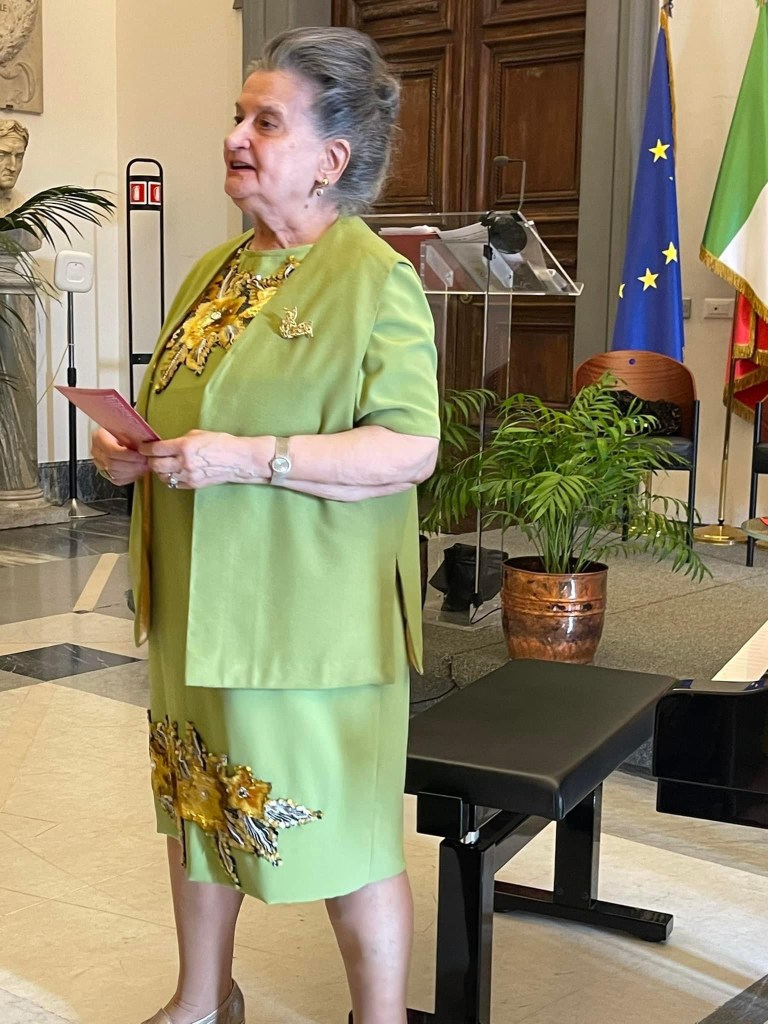
Michail Lifits on his knees with adoration in his eyes as Noretta complimented him on his magnificent performance
Michail Lifits,winner of the 57th Busoni Competition ( a competition that Noretta has frequented every year since the very first edition in 1949 when her great friend and now trustee of the KCT,Alfred Brendel was awarded 4th Prize!) Mischa was also recipient of the KCT Annual prize winners concert at the Wigmore Hall in 2011 having completed KCT tours in USA,Italy and even Mexico.I heard him in 2013 in the beautiful Auditorium in Foligno and was immediately struck not only by the beauty of sound but the kaleidoscopic colours he found in the Rachmaninov Corelli Variations.Now with a flourishing career and newly appointed Professor at the Franz Liszt University in Weimar he flew in especially to pay homage to two people that he is much indebted to in so many ways.His performance of the much overplayed Chopin First Ballade was a revelation on how such a work can come alive as new in the hands of a true artist.The authority and clarity of thought ,the aristocratic architectural vision was masterly and had me wanting to check the score once again to relive the magic that had allowed him to bring new life to such a masterpiece.
Our distinguished Chairman Geoffrey Shindler OBE (centre) together with Sir Antonio Pappano and Prince Dr Donatus Von Hohenzollern
There would have been many encores had we heard a performance of that stature in the concert hall but tonight we were called to order by our Chairman Geoffrey Shindler and our indefatigable Chief executive Sarah Biggs.Stop watch in hand it is thanks to them that the evening in The National Liberal Club ran so smoothly with caos all around as London was about to welcome our beloved Queen back home on her last great journey.
Ever present in our thoughts as Dr Moritz von Bredow so beautifully expressed in a private letter of thanks to Noretta and John :The beautiful, serene and dignified evening at the Liberal Club will remain forever in my memories, and I am utterly delighted that both of you who are at the very centre of the Keyboard Charitable Trust, were able to attend, sharing the beauty of the evening during which the hearse, bearing The Queen’s coffin, was passing by at that very time. So it is: happiness and sadness united in gratitude.’Dr Moritz von Bredow Chloe Jiyeong Mun with John Leech
Chloe,teenage winner of both the Geneva and Busoni International competitions (the only other pianist to do that was Martha Argerich) ,flew in especially for this celebration from her adopted home in Salzburg.The rarified perfection and fluidity of her playing created an enormous effect in her all to short appearance playing only ‘Reflets dans l’eau’.Only! It was a true jewel of ravishing voluptuous sounds from extreme delicacy to passionate abandon.I accompanied Chloe on the American tour where I could witness the bond with her audiences of a true artist as she looked with dagger like concentration at the notes but then wafting on with the same genial simplicity of Martha Argerich.Elena Vorotko,our co artistic director,was in tears after her performance of Beethoven’s penultimate sonata op 110 at her prize winner’s Wigmore recital in June 2017.I implored her to play the 14th of Schumann’s Davidsbundler but there was a complicity between her and Sarah that I could not budge.It is here in this link to the performance she gave in Poland this summer: https://christopheraxworthymusiccommentary.com/2022/08/12/chloe-mun-at-the-duszniki-chopin-festival-refined-perfection-and-aristocratic-simplicity/
Vitaly Pisarenko with Garo Keheyan ( creator of the Pharos Arts Foundation in Nicosia,Cyprus ) where Vitaly and other of our star performers have given memorable performances.
Vitaly Pisarenko,winner of the Utrecht Liszt Competition at the age of 20 and a top prize winner at Leeds in 2015.With a worldwide career opening up and now a much sought after teacher at the Purcell School for highly gifted young performers and as assistant Professor to his much admired mentor Dmitri Alexeev at the Royal College of Music.I am glad to see that there is a poster in the ‘red book’ in which the KCT were invited to Aquila in Italy in 2013 to spend a weekend sharing youthful enthusiasm and bringing much needed distraction and relief to a community that had been so cruelly struck down by an earthquake.Noretta’s dear friend Claudio Abbado gave the first concert in a hall that had be newly donated by the people of Trento and constructed by the walls of a city that lay in ruins.Mey Yi Foo,Pablo Rossi and Vitaly Pisarenko were chosen to represent three different nations by Noretta and John following in Abbado’s footsteps in bring the Gift of Music to an oppressed community.Bringing all the youthful spirit of hope and enthusiasm that these three young artists had in abundance.Fabbrini ( Pollini’s piano technician had donated the piano -Pollini too a close friend of Noretta).
Yisha Xue,our hostess at the NLC with Sarah Biggs (Chief Executive of the KCT) and Vitaly Pisarenko
It was when this young Ukrainian pianist touched the piano in a ravishing performance of Siloti’s Prelude in B minor that Noretta and I looked at each other and it was love at first hearing.A pianist of such simplicity but of such refined playing of sounds that rarely others can reach.Playing of an intelligence and the aristocratic sense of style of another age -The Golden Age of piano playing.This was ten years ago in which time Vitaly has played every tour and venue of the KCT including the Wigmore Hall.The great accompanist Graham Johnson insisted on going back stage in the interval to meet the man who could turn a piano that he knew only too well into a magic box or rarified sounds with Ravel’s Miroirs.It had Graham running to Cadogan Hall a few months later to hear his Ravel G major Concerto.’Gretchen am Spinnrade’ was played with such subtlety and rarified sounds from the barely audible to the most enormous sonorities of refined passion ……and then back again.Gretchen at her wheel still whispering in the distance with playing of incredible precision at a level of pianissimo that I have only ever heard from Richter.
Sir Geoffrey Nice QC trustee and longtime friend of John and Noretta
The great pianists are not those that play the fastest and loudest but it is those dedicated few that can play the quietest with total control.A mastery that requires total dedication.Vitaly’s unique artistry is gradually being discovered by a public who realise that it is quality not quantity that reaches the soul.A very classical performance of Liszt’s capricious play on Schubert’s Soirées de Vienne was admirable for its pianistic perfection but it was Gretchen that will haunt me for a long time to come!https://christopheraxworthymusiccommentary.com/2021/09/13/bewitched-and-amazed-by-vitaly-pisarenko-in-colombia/
Sasha Grynyuk
Sasha Grynyuk was born in Kyiv and now lives in London where he won the Gold Medal at the Guildhall and went on to win a considerable number of International Competitions including the Grieg in Bergen.Every Friday will see him at the mews of Noretta and John,a new score in hand.John waiting until the end of their musical session to be instructed on computer literacy or whatever other hi jinks are the latest fashion.They have befriended him in his hour of need as his parents fled the Ukraine only able to fill a car with belongings knowing full well they may never see their homeland again.Sasha flew to Cracow to meet them and drive them back to the Oxfordshire countryside where they have found refuge.Sasha recently found happiness too ,much to the delight of Noretta and John, in the arms of the extraordinary Katya Gorbatiouk.
Sasha Grynyuk and Katya Gorbatiouk
All this to say that Sasha is like a son to John and Noretta and a rock on which they can rely in moments of uncertainty.He is not only a wonderful human being but also a remarkable pianist who leaves Noretta astonished every week with his mastery of all the Beethoven sonatas and Concertos and many other things besides.One of these being one of the most transcendentally difficult show pieces for piano by Balakirev .His famous Islamey op 18 that strikes terror into all those that dare to trespass.Ravel even tried to out do him in writing Scarbo – the last of his suite Gaspard de La Nuit.A work that Noretta’s own mentor Arturo Benedetti Michelangeli has left his own indelible mark in historic recordings.
Our guardian Angels from Steinways
To sit down from cold and burst into Islamey is a feat in itself.It would normally come as the icing on the cake after a long recital programme.However orders were orders and if Islamey exceeds the allotted five minutes it certainly could not be preceded by even the shortest of pieces.Little did we know that whilst Sasha was conquering his Everest her majesty the Queen was passing by below.A scintillating performance that just missed the wild abandon and depth of sound that Sasha would normally regale us with.Sasha’s prize winner’s Wigmore in 2013 opened and closed with a magical piece by Arvo Part that gave an overall shape to a container of Mozart,Beethoven and Gulda and made me aware of what an extraordinary artist he was.Bryce Morrison,the distinguished critic and pianophile, played me a while back a recording and asked me to guess who it was.A scintillating display of classical music in jazz idiom that was quite breathtaking in its audacity – it was Play Gulda with Sasha Grynyuk!Sasha has dedicated himself tirelessly to helping his co nationals by arranging and giving benefit concerts for the Ukrainian relief fund.https://christopheraxworthymusiccommentary.com/2022/06/10/sasha-grynyuk-at-cranleigh-arts-for-ukraine-joint-fundraiser-for-the-disasters-emergency-committee-and-cranleigh-arts/
And so we were coming to the end of this extraordinary evening that was described as a book launch but I think we were all aware that it was much more than that.
Elena Vorotko Bridges with her husband Richard Bridges who had generously sponsored two memorable recitals in the Reform Club one of which was in the presence of our Patron Sir Antonio Pappano
Elena spoke of the formation of the Historical Instrument Section of the KCT which she has been responsible for creating and has already helped reach recognition artists such as Jean Rondeau.This activity is progressing with extraordinary rapidity as there was obviously the same need of creating a bridge between young artists and their potential public.The KCT could not have been more poetically described than by Moritz von Bredow or so clearly expressed by Geoffrey Shindler.Our chairman looking to the future as John and Noretta have always done saluting our loyal and indispensable donors and thanking them all and delighted in seeing them honoured in the pages of the book.
Pablo Gala and Eliane de Castro a special thanks for their generous sponsorship of The Gift of Music – pictured here with friends. Roger Rosen was a co sponsor who could not be present but sent a message as Chairman of the Rosen Publishing Group in New York :’ Most heartfelt congratulations to John and Noretta and The Keyboard Trust for their thirty-years of dedication to music and emerging artists.Their enthusiasm,discernment and generosity of spirit is an inspiration to all of us who hope to follow in their footsteps as the next generation of philanthropists’Lady Weidenfeld with Menahem Pressler and Anna Fedorova.A special special meeting at home after the memorable Ukrainian Promenade Concert organised by Anna where she also performed Chopin’s 2nd Piano Concerto John Leech with Anna Fedorova after her Steinway Hall Young Artist’s concert in 2013
It is to the book we return for the final comment from one of the greatest musicians of our time now in his 100th year.Menahem Pressler was moved to write an introduction that could have not been clearer or more to the point :’The young artists entering the orbit of Noretta and John,having been carefully selected ,are nurtured and advised according to their individual needs,repertoire is chosen with great care and they become part of a big family.This is truly a love affair,and the story of its birth and development so beautifully told by John Leech in ‘The Gift of Music’ is a wonderful read.
Sir Antonio and Lady Pappano One of the great conductors of our time applauding our young artists.
P.S.The last words most go to John and Noretta who write :
‘Last night was an overwhelming display of musical ability, colour – and affection: a moving review of what our labours with the Keyboard Trust have meant to young lives – as well as our own.
But as the night wore on, other qualities were called into play by the momentous events that were changing the structure of the city around us. Noretta and I had to wait for a solicitous police vehicle to escort us out of the forest of barricades. Sarah, Richard, Pablo, Moritz and Sasha nobly deployed to the compass points more likely to bear a stray cab, even under by then streaming rain.
Lovely Chloe like Cinderella helping John and Noretta flee the party before midnight struck
When eventually one was found, the heavy police presence had to approve access and clear the way. By this time most of the barricades were already in place, and the final leg of the mercy mission had to be negotiated on a heavily laden police transport. Effusive thanks are due to all those involved in this midnighht mission. It was the kind of effort that friends might well make; last night, against the background of royal mourning and teeming rain it acquired an almost symbolic significance.
The degrees of sadness and selflessness shown by all our friends and company were certainly worthy both of the occasion and its profoundly historic background. All of us were conscious of the passage of great events, modestly accompanied by our small event of personal significance.
With our glowing thanks to all our friends, for last night’s acts of heroism as well as over the last 30 years,
Noretta and John, with love.’
The last word must be from the master himself penned just before midnight last night …….no pumpkins for John or Noretta!
Perfection fired by genius! Completeness beautifully etched, the whole story rounded, the affection clearly displayed on its sleeve. What a remarkable story, most expertly recounted – without an ending, but measuring its beating pulse!Viva! Viva! Vivat the Spirit of Music!!!
Thank you, Chris, for showing us how vigorous that Spirit is still becoming!
Great celebrations at the end of a recital of ravishing sounds . Has the piano ever shimmered and glistened today in an outpouring of luminous sounds as in the hands of the French Canadian Elisabeth Pion? An eclectic programme of works rarely if ever heard in concert.
A shimmering ‘Song for the piano’ by Fanny Mendelssohn. Certainly not like her brother’s’ without words ‘ but a beautifully flowing work of eloquence,passion and charm .It was played with a sumptuous sense of balance and was a prelude to Beethoven’s own favourite amongst his sonatas -the little ‘A Thérèse’ op. 78 -Beethoven’s calm before the storm!And if it could have been played with more respectful solidity the jeux perlé in her hands flowed so naturally from Mendelssohn to Beethoven with such intelligence and real musicianship that I began to wonder that perhaps Beethoven had more charm and colour than I had previously been aware of. A technical assurance that made her colleagues blush as they only just about made this early start to support a much admired friend.
An embrace from star pianist Gabrielle Stratta
Amazing atmospheric ‘Berceuse ‘ by Adès with its quite extraordinary final explosion and disappearance to oblivion amongst the remains of wondrous vibrations after an almost Messiaenic opening . An extraordinary work that with Stevenson’s Grimes is a real addition to the piano repertoire . Gretchen was spinning her web long before Elisabeth opened the magic door so we could overhear her haunting voice.The water too flowed so mellifluously from this artists hands that it came as a shock the sudden attack of the Erlkonig. A technical command of the keyboard with a kaleidoscope of sounds where music was allowed to pour out of her hands with such authority and delicacy. It made me think about the remarkable Canadian school of playing of Lortie,Hammelin,Hewitt,Fialkowska,Kimura Parker,Liu or Chen taking over the realm of Gould . Elisabeth too belongs to this quite extraordinary school that is rarely mentioned but is gradually dominating the musical scene.
What to say of the beauty of the studies of De Montgeroult . Of course we all bow to Chopin op 25 where the technical problems of the studies are disguised by the poetic content.Almost ‘canons covered in flowers’ here too as Schumann described the Mazurkas. Of course the last utterances of Debussy,the Etudes his final masterpiece for piano,were inherited from a composer whose works he had edited with such love and dedication. Today this young Canadian pointed us in the direction of the composer,De Montgeroult,I have hardly ever come across before except in her own recital in Perivale a year ago.Studies covered with flowers indeed.
Or Bonis’s ‘Women of legend’ . Seven portraits from Mélisande to Omphale all played with ravishing ease and character. Or Dutilleux’s ‘Au gré des ondes’ where the French charm and purity of sound were so reminiscent of Poulenc. It was though the passionate abandon of Debussy’s portrait of an Island in ‘L’isle Joyeuse’ that made me want to revisit Eastbourne and Jersey that were his inspiration .Maybe I did not look hard enough,as a child,and certainly not with the poetic vision of a genius. A memorable morning of discovery and seduction in Milton Court with her mentor Ronan o’Hora and all the friends she has made over the past few years.
Undisguised pleasure to see a friend triumph
Present to cheer her on as she reaches the peak of Gradus ad Parnassum on a long journey of discovery that she will share with a waiting world. Realms of Gold indeed ! Bon voyage !
Mélanie Hélène Bonis, known as Mel Bonis (21 January 1858 – 18 March 1937), was a prolific French late-Romantic composer. She wrote more than 300 pieces, including works for piano solo and four hands, organ pieces, chamber music, mélodies, choral music, a mass, and works for orchestra. She attended the Paris Conservatoire,where her teachers included Cesar Franck.In 1874, at the age of sixteen, she began her studies at the Conservatoire, and attended classes in accompaniment, harmony, and composition, where she shared the benches with Debussy and Pierné.
Mel Bonis
She met and fell in love with Amédée Landély Hettich (5 February 1856 – 5 April 1937),a student, poet, and singer, setting some of his poems to music. Her parents disapproved of the match and withdrew her from the Conservatoire.In 1883, when she was twenty-five, they arranged for her to marry the businessman Albert Domange.After settling into domestic life and having three children she met Hettich again who persuaded her to return to composition.She wrote more than 300 pieces, including works for piano solo and four hands, organ pieces, chamber music, mélodies, choral music, a mass, and works for orchestra.
Hélène de Nervo de Montgeroult (2 March 1764 – 20 May 1836) was a French pianist and composer.
She was born into an aristocratic family in Lyon and studied piano with Hullmandel and Dussek.She married the Marquis de Montgeroult who died as an Austrian prisoner in 1793.Reportedly it was respect for her compositions that allowed her to survive the French Reign of Terror.A set of improvisations on La Marseillaise , performed for the Committee of Public Safety, earned de Montgeroult her freedom after she was imprisoned in the Revolution due to her aristocratic background.After her husband’s death, Montgeroult took a position at the new Paris Conservatoire in 1795, the first female professor ever to be appointed there and taught for two years. Afterwards she published two volumes of music.She died in Florence, Italy.
CHARLES FRANCIS has already established his talent in the organ world while still an undergraduate at the Royal Birmingham Conservatoire, studying under Daniel Moult and Nicholas Wierne. He is Organ Scholar at St Philip’s, Birmingham and also deputises at other English cathedrals. His adoption by the Keyboard Trust will open further opportunities in the UK and abroad, such as this recital in the Summer Organ Festival Young Artist Platform at Westminster Abbey on Sunday August 7 2022.
Westminster Abbey is a .’Royal Peculiar’, meaning that it is under the direct jurisdiction of the monarch. It dates from AD 960 and the current building was in place by the end of the 14th century; ‘a pair of organs’ was recorded as early as 1304. The current organ was installed for the Coronation of George VI in 1937 using the pipes and case from an earlier instrument by William Hill. Further development in the late 20th century added a fifth manual and a Bombarde to give extra support to congregational singing. The organ today matches this ancient foundation in power and stature.
Cavaille-Coll organ at St Sulpice
Charles chose to open his recital by unleashing the full power of the instrument in the first movement of Widor’s Symphony no 5 in F minor, Op 42 no 1. The name ‘Symphony’ comes as a result of his lifelong association with the Romantic organ builder Aristide Cavaille-Coll who built the magnificent organ at St Sulpice in Paris where Widor was organist for 63 years. The Andante Vivace is a set of variations in which Charles demonstrated a highly developed sense of timbre and carefully graded dynamics.
Manuscript of the Organ Concerto BWV 595
We then heard the Organ Concerto in C BWV 595 by Johann Sebastian Bach which comes from the period of Bach’s transcriptions early in his career before taking up his post at the Thomaskirche in Leipzig. This single movement concerto is a transcription of a work by Bach’s then employer, Prince Johann Ernst of Saxe-Weimar. Charles chose a tempo that allowed the audience to appreciate the clarity of the concerto form with strong ritornelli and bold colours in the solo sections.
A pedal piano
Charles returned to the 19th century for Innig, the fourth of Six Studies in Canonic Form Op 56 by Schumann, written in 1845. Robert and Clara had purchased a pedal piano for their home to enable organ practice to take place there. This coincided with Schumann’s Fugenpassion… a period when he explored counterpoint. Far from being earthbound and academic, this piece is light and airborne: an unhurried tempo took us into the world of Schumann’s love songs, where instead of the canons marching stiffly one behind the other, they played together…
The recital closed with Hubert Parry’s dramatic Fantasia and Fugue in G Op 188 bringing full-blown Romanticism full circle. Parry dedicated it to ‘my dear friend Walter Parratt’. Not known today, Parratt was a child prodigy who played Bach’s 48 Preludes and Fugues from memory at the age of ten! He rose to become Master of the Queen’s Musick to Queen Victoria, Edward VII and George V. The musical language of Parry’s famous ceremonial pieces – the Coronation Anthem ‘I Was Glad’ and ‘Jerusalem’ – is not typical of his vast output, which draws on his many influences: the English oratorio tradition, and his great love of German music from Bach through to Mendelssohn and Wagner. Writing for the leading virtuoso organist of his day challenged Parry to musical brilliance, heard in the flourishes that sweep the full range of the instrument in the Fantasia; the Fugue subject, always clearly heard throughout the contrapuntal working, explodes into the final cadence, prompting applause and shouts from the large and appreciative audience.
What a musical journey we had in a 30-minute recital! Technical brilliance is plentiful today but other qualities set Charles Francis apart. He has a clear, uncompromising concept of what the music has to say and how to communicate it. Spacious tempi and rubati may approach the audacious but always serve the music. He reaches out to the audience with great clarity of line which allows the organ to sing. As his youthful figure appeared above the Westminster Abbey screen to receive the delighted applause, my mind travelled back to 1679 when the 20-year-old Henry Purcell took over as Organist. Britain has a proud history of organ brilliance and in Charles Francis the future is in safe hands.
Photo of the founders of the KCT seated with Angela Ransley
REVIEW BY:
ANGELA RANSLEY, Director of the Harmony School of Pianoforte. Angela works closely with the Keyboard Trust and also as a freelance organist..
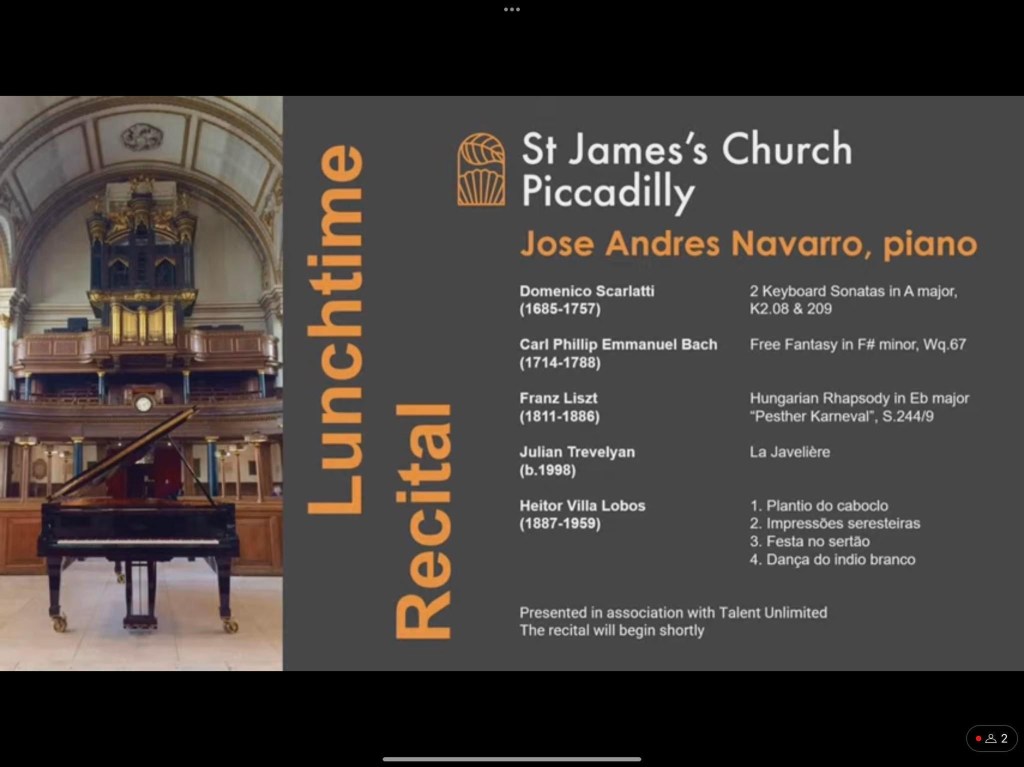
What better way to spend lunchtime than in the company of Beethoven in such intelligent and artistic hands. With all the office workers scrambling for some street food in the market that surrounds St James’s Piccadilly.Little could they guess what real nourishment lay inside one of the most atmospheric churches in London. The scene is set for a Hitchcock film but instead we got two of Beethoven’s most intense chamber works. A pianist who spun a magic web on which the clarinet and cello were happy to wallow and converse The clarinet trio played with a buoyancy and joie de vivre of the young Beethoven.The clarinet giving a living sheen to the sumptuous golden sounds from the piano and cello. What a contrast with the late Beethoven cello sonata where the weight and dark introspection contrasted with the knotty twine of the final fugato.
The Piano Trio in B flat op 11 is in three movements :Allegro con brio – Adagio – Tema con variazioni:Allegretto. It was composed by Beethoven in 1797 and published in Vienna the next year It is one of a series of early chamber works , many involving woodwind instruments because of their popularity and novelty at the time. The trio is scored for piano,clarinet (or violin ) and cello (sometimes replaced by bassoon ).
The key of B flat was probably chosen to facilitate fast passages in the B-flat clarinet, which had not yet benefited from the development of modern key systems.The work is also sometimes known by the nickname “Gassenhauer Trio”. This arose from its third movement which contains nine variations on a theme from the then popular dramma giocoso L’amor marinaro ossia Il corsaro (15 October 1797, Wiener Hoftheater )by Joseph Weigl. This particular melody, “Pria ch’io l’impegno” (“Before I go to work”), was so popular it could be heard in many of Vienna’s lanes (“Gasse” in German). A “Gassenhauer” usually denotes a (normally simple) tune that many people (in the Gassen) have taken up and sing or whistle for themselves, the tune as such having become rather independent from its compositional origins.
There was such scintillating charm in the first movement with the clarinet and cello answering the piano with a superb sense of balance .The piano lid full up but with such a good driver Damir never overpowered his two colleagues.The clarinet sung out with such refined musicianship following the streams of golden notes that just flowed from pianists hands with a liquidity and shape that was ravishing.The clarinet never outdone met every challenge with the same shape and colour with the cello following every move so attentively.The cello taking centre stage with the Adagio playing with real beauty and grace.The middle episode was so beautiful with the piano lightly playing chords from the top to the bottom of the keyboard with the cello and clarinet conversing above this gently lapping accompaniment.The ending was of great beauty with all three playing as one as Beethoven whispers his final few notes.There was such joy in the finale where the players competed with each other in a series of stimulating variations.A virtuoso pianistic variation followed by solo cello,and clarinet.A syncopated variation where they had such fun trying to catch each other out before the tongue in cheek final pages where they came together with impish abandon.A trio that plays as one is a rare treat with music making created by players looking and listening to each other rather than being tied to the score.
L.van Beethoven Sonata for Cello and Piano No.5 in D-major, Op.102 No.2 Allegro con brio – Adagio con molto sentimento d’affetto -Attacca – Allegro – Allegro Fugato
The two sonatas op.102 were composed between May and December 1815 During the period 1812 to 1817 Beethoven, ailing and overcome by all sorts of difficulties, experienced a period of literal and figurative silence as his deafness became overwhelmingly profound and his productivity diminished.Following seven years after the A Major Sonata n.3 ,the complexity of their composition and their visionary character marks (which they share with the subsequently completed piano sonata op 101 ) the start of Beethoven’s ‘third period’A critic of the time said:’They elicit the most unexpected and unusual reactions, not only by their form but by the use of the piano as well…We have never been able to warm up to the two sonatas; but these compositions are perhaps a necessary link in the chain of Beethoven’s works in order to lead us there where the steady hand of the maestro wanted to lead us.’
Beethoven’s last cello sonata was played as equal partners with the cello and piano in furious exchanges of great rhythmic drive followed by contrasting melodic passages of searing beauty.There was great clarity from the piano contrasting with the sumptuous velvety sounds from the cello.The Adagio was a continuous flow of great depth and vision played as the composer himself asks:con molto sentimento d’affetto.Leading to the gentle suggestion of the fugue from the cello taken up immediately by the piano in a musical puzzle that Beethoven like Bach was to bring to a climax towards the end of his life .Beethoven of course with the mighty fugue of the Hammerklavier or Diabelli and Bach with the genial mathematics of the Art of fugue.A mastery that was to be shared towards the end of their lives and makes one wonder where it might have led them in an after life?Bach just got so far and stopped.Beethoven toyed with the fugue and the variation right to the end.In this final cello sonata the knotty twine of the fugue was played by both players with a clarity and intensity that was remarkable not only for its precision but for its inner energy and architectural shape
Hariet Wu obtained her Bachelor’s and Master’s Degree from Royal Birmingham Conservatoire. Hariet was privileged to be under the tutelage of Anthony Pay, Michael Harris, and Mark O’brien during her time studying at RBC. Born in Taipei, Taiwan. Hariet was invited to join Steven Barta’s clarinet workshop (professor of Peabody Conservatory & principal clarinet at Baltimore Symphony orchestra) and was awarded a full scholarship by Wayland University (TX, USA) to study music in clarinet performance prior to her studies in the UK. Hariet was invited to perform as a guest performer at the 2005 Birmingham Chamber Music Festival. She has been playing in the Moment Musical Chamber Orchestra (Taiwan) since 2006. Hariet has been an active music festival and concert organiser during her time in Taiwan. She is also an experienced music educator and researcher. Her Master’s research topic focused on the correlations between instrumental practice and the enhancement of neurophysiological, mental, and social enhancement. She is currently researching the topic of music psychology: the behavioural changes induced by musical training.
Melody Lin (Cello) is dedicated to the insightful, sensitive and enthusiastic performance of both solo and chamber music. She was awarded a fully-funded scholarship to attend Trinity Laban Conservatoire for an MA degree and has completed a funded Bachelor’s degree from the Royal College of Music. She has studied under internationally recognised musicians including Richard Lester, Michael Reynolds, and Ling-Yi Ouyang. Melody’s recent solo recitals include the Royal Society of Musicians, St-Martin-in-the-fields, Wolfson College of Cambridge University, St James’s Piccadilly and the London Cello Society “Go Cello!” opening concert. Melody has been awarded a joint winner at the Vera Kantrovich Competition. She was the winner of the Leonard Smith & Felicity Young Duo Competition in 2018. Her chamber projects include the Mellanie Piano Trio, supported by the Concordia Foundation and the Melart Duo, with pianist Artur Haftman, supported by the Polish Music Society and toured Poland in 2016.Melody was a member of the 2019 Southbank Sinfonia, and currently freelancing amongst professional orchestras, including Bournemouth Symphony and a trial position with The Hallé. She plays on a cello by the Klotz family from the late 18th century, generously supported by professor Derek Aviss.
Damir Durmanovic (Piano).As an internationally sought-after performer, Damir Durmanovic has performed in venues and festivals including the Wigmore Hall, Champs Hill Studios, YPF Festival Amsterdam, Wimbledon Music Festival, Renia Sofia Audotorium Madrid, Gstaad Menuhin Festival, Derby Multifaith Center, Flusserei Flums, ‘Ballenlager’ Vaduz. He has won prizes in numerous international competitions including The Beethoven Intercollegiate Junior Competition in London, Adilia Alieva International Piano Competition in Geneva and Isidor Bajic International Piano Competition in Novi Sad.He has performed in masterclasses with Claudio Martinez-Mehner, Dmitri Bashkirov, Pascal Devoyon, Jacques Rouvier, Robert Levin, Jean-Bernard Pommier, Tatyana Sarkisova, and chamber ensembles such as the Emerson Quartet. Damir is also a scholar at the ‘Musikakademie Liechtestein’ and regularly participates in the courses organised by the academy.Damir began his studies at age of eight in his home country, Bosnia and Herzegovina, with Maja Azabagic before continuing his studies at the Yehudi Menuhin School where he studied with professor Marcel Baudet. In 2021 he released an album with the Ulysses Arts label.Damir is supported by the Keyboard Charitable Trust as well as the Talent Unlimited Scheme. He is a graduate from the Royal College of Music where he studied with Dmitri Alexeev.