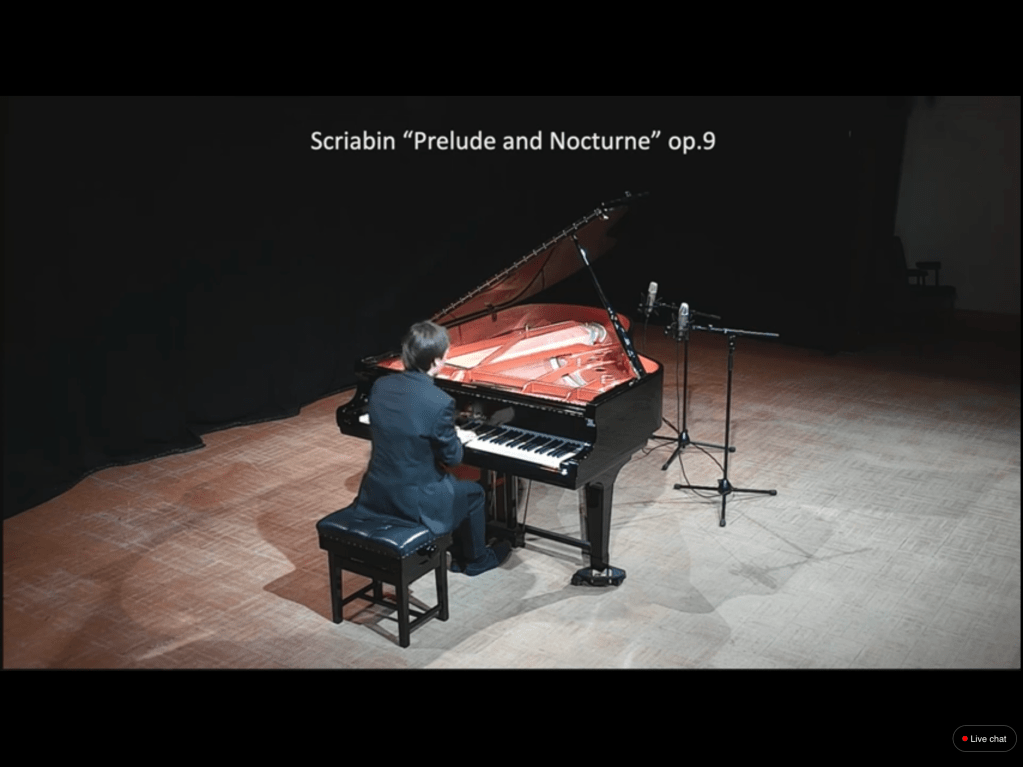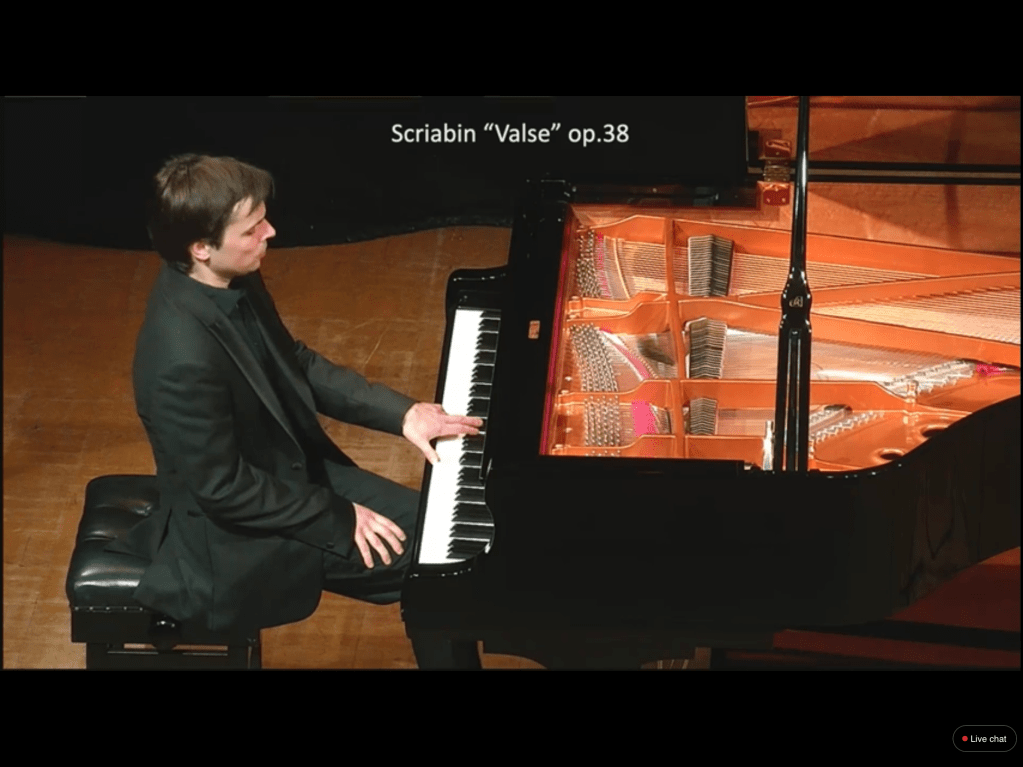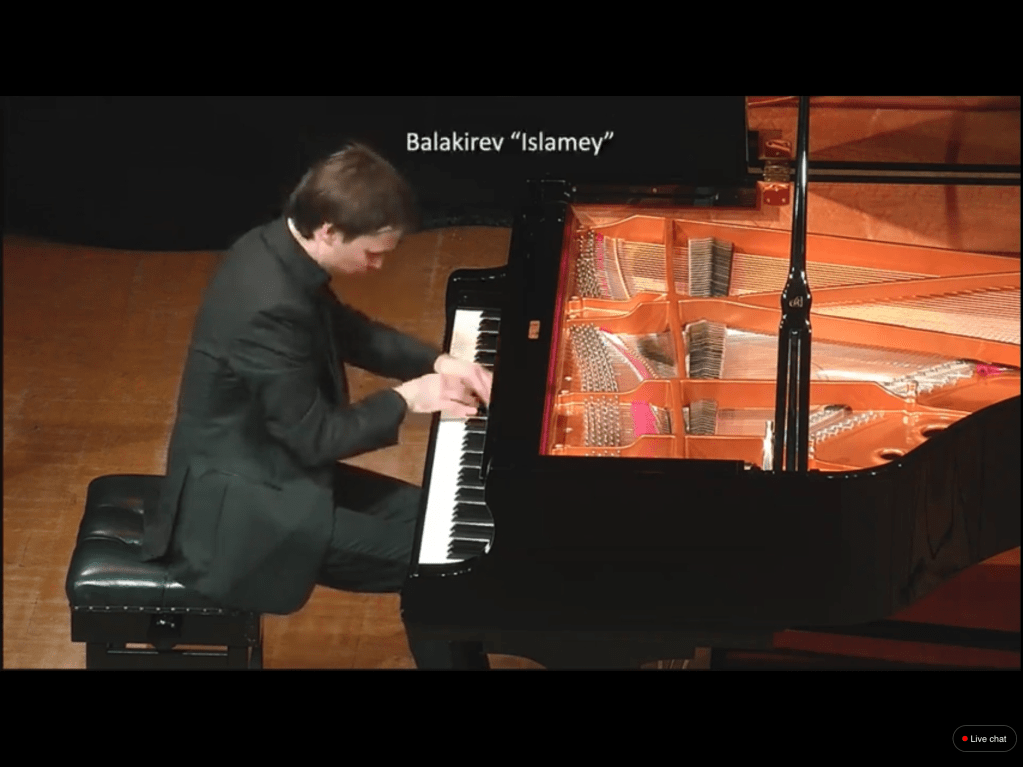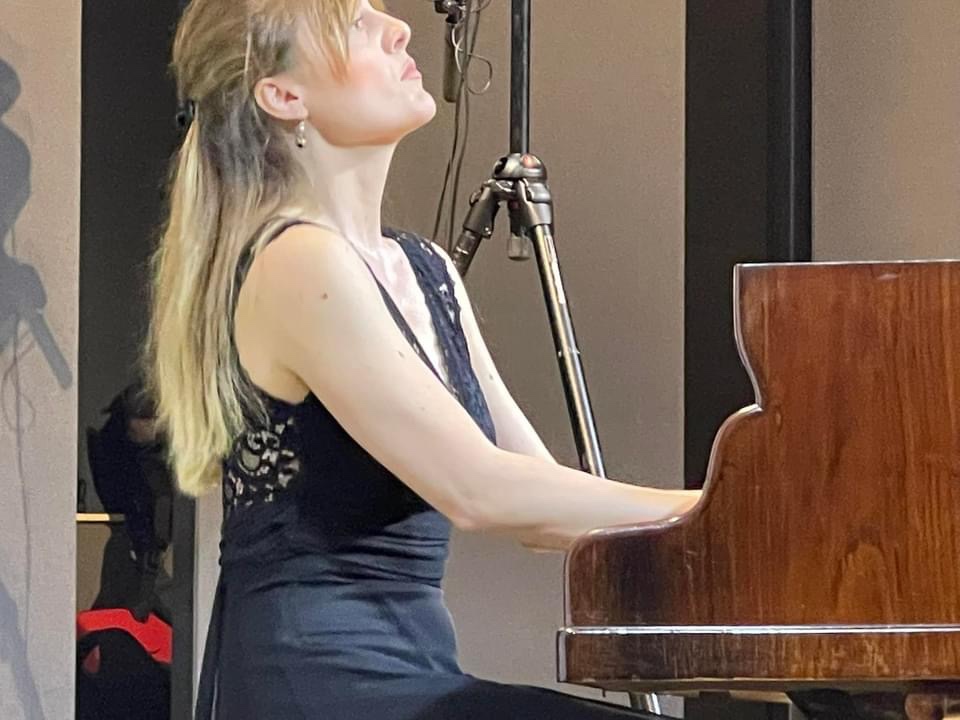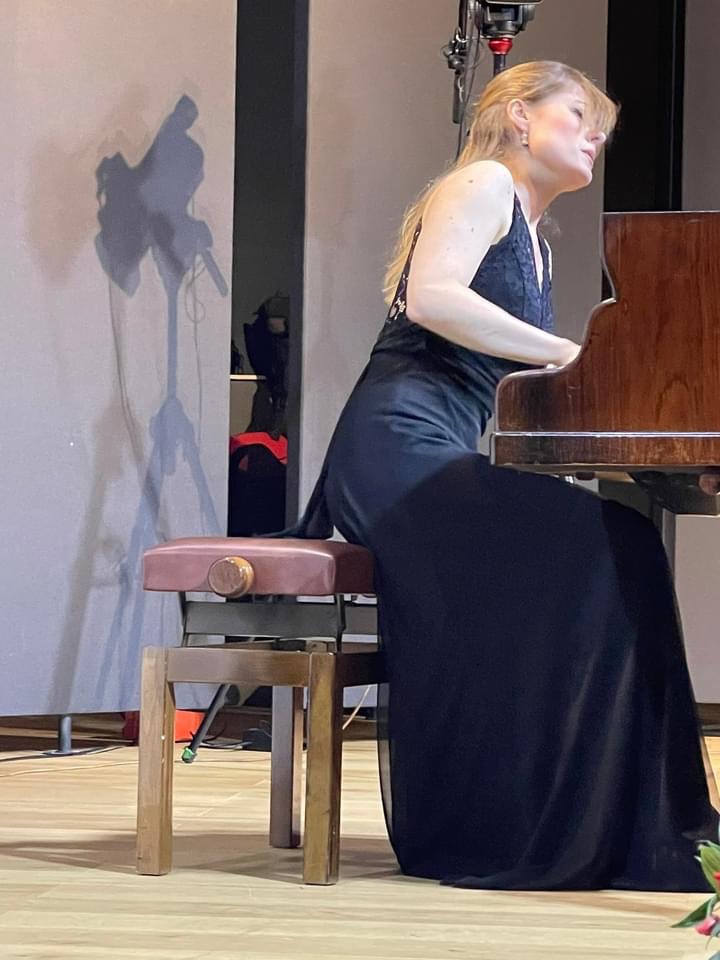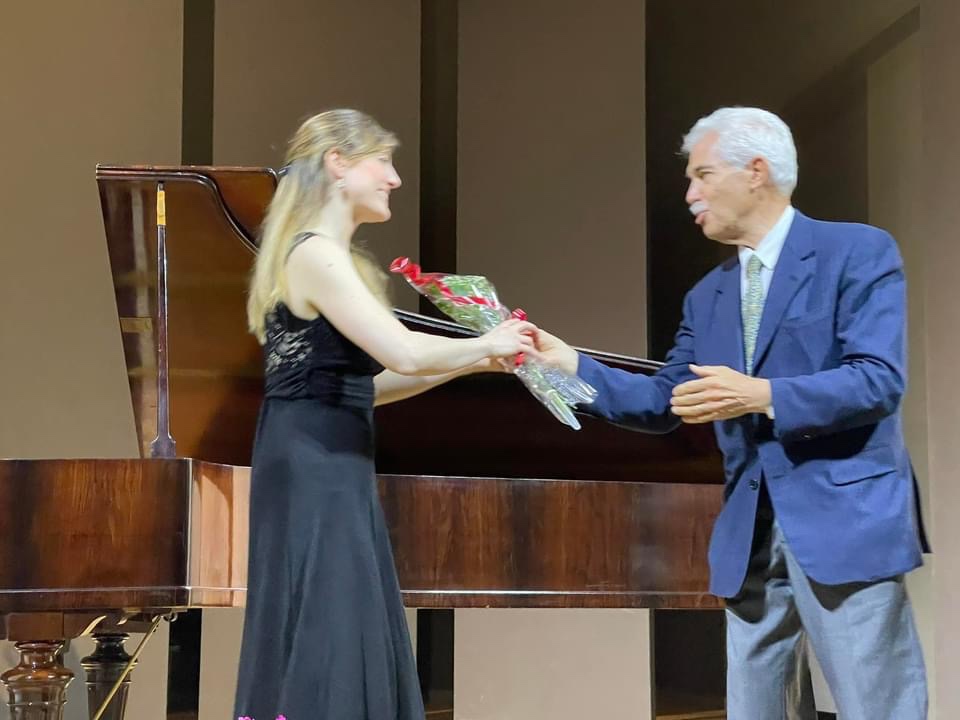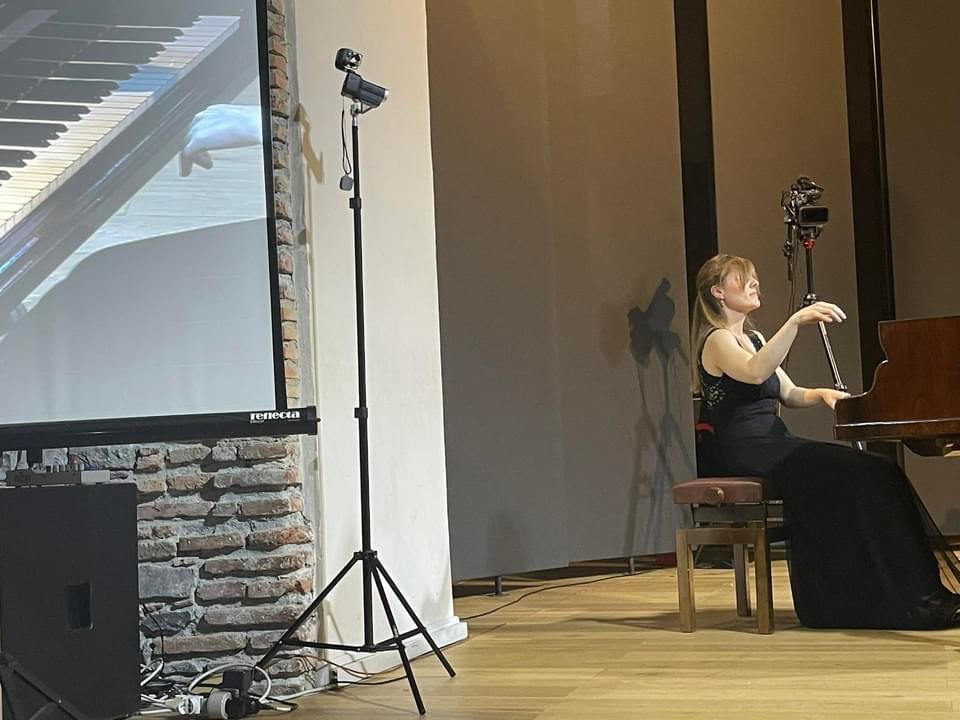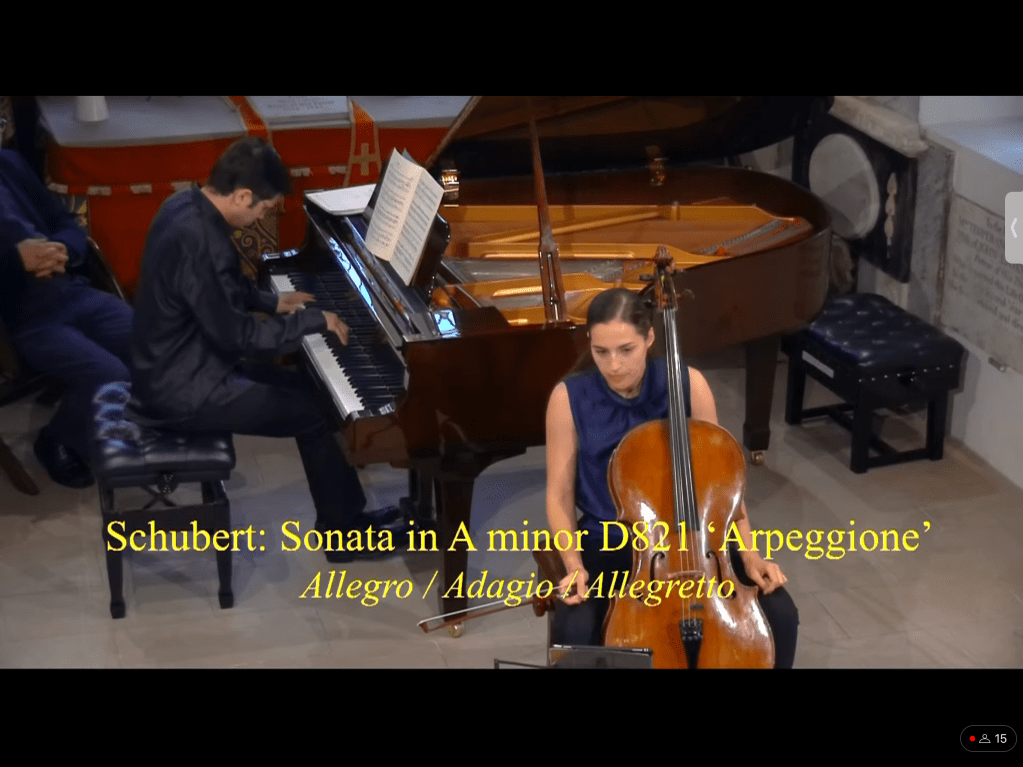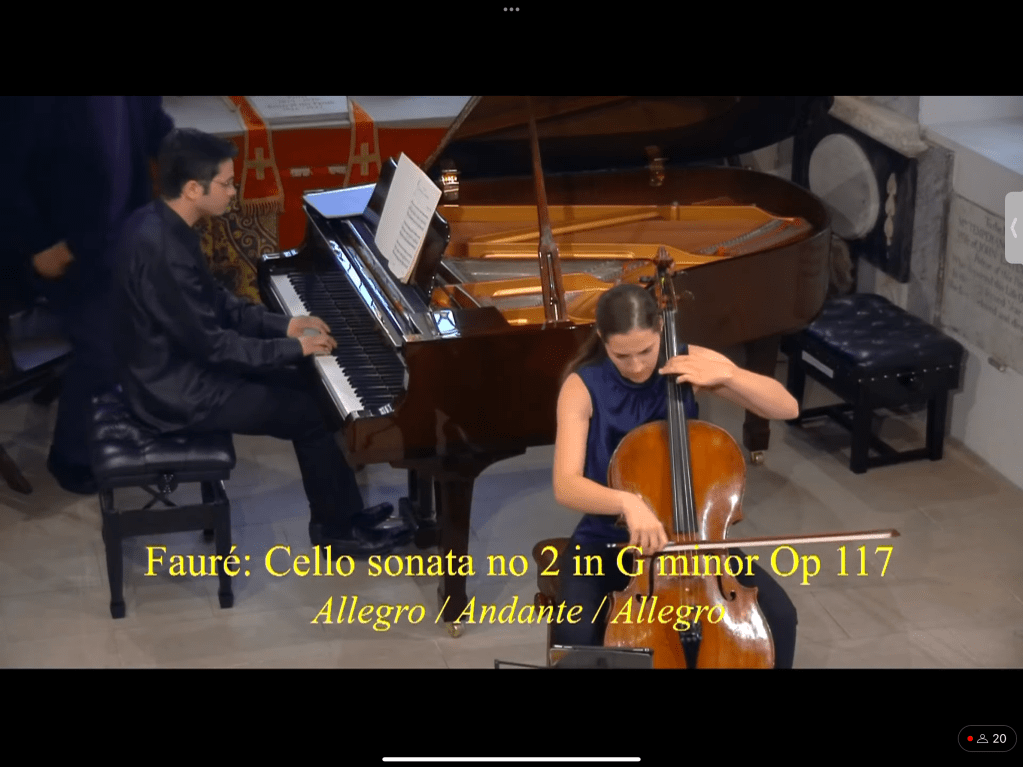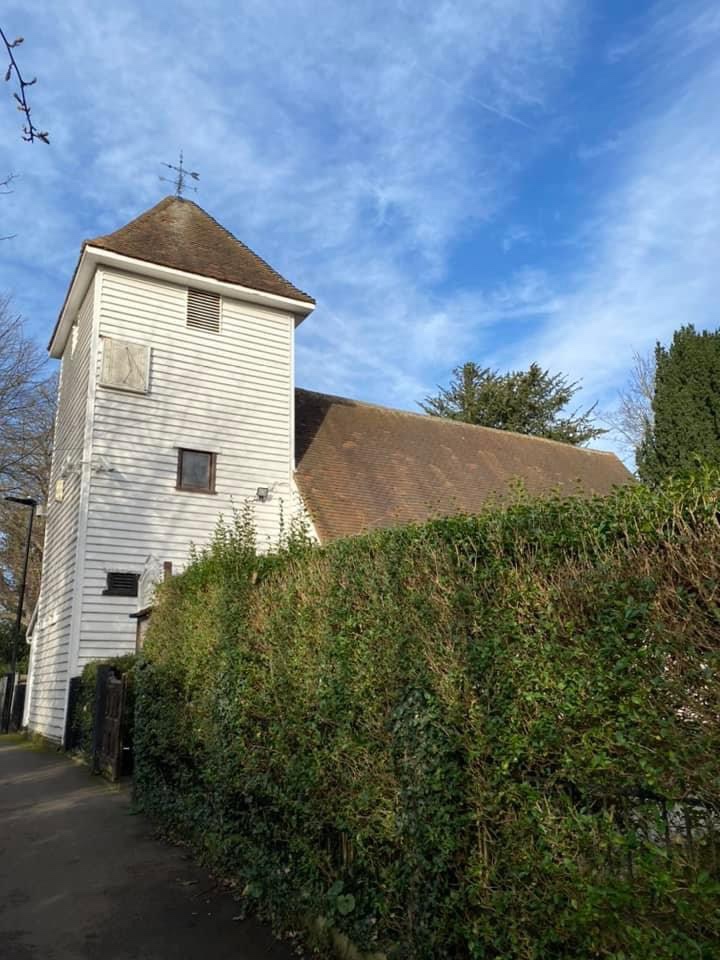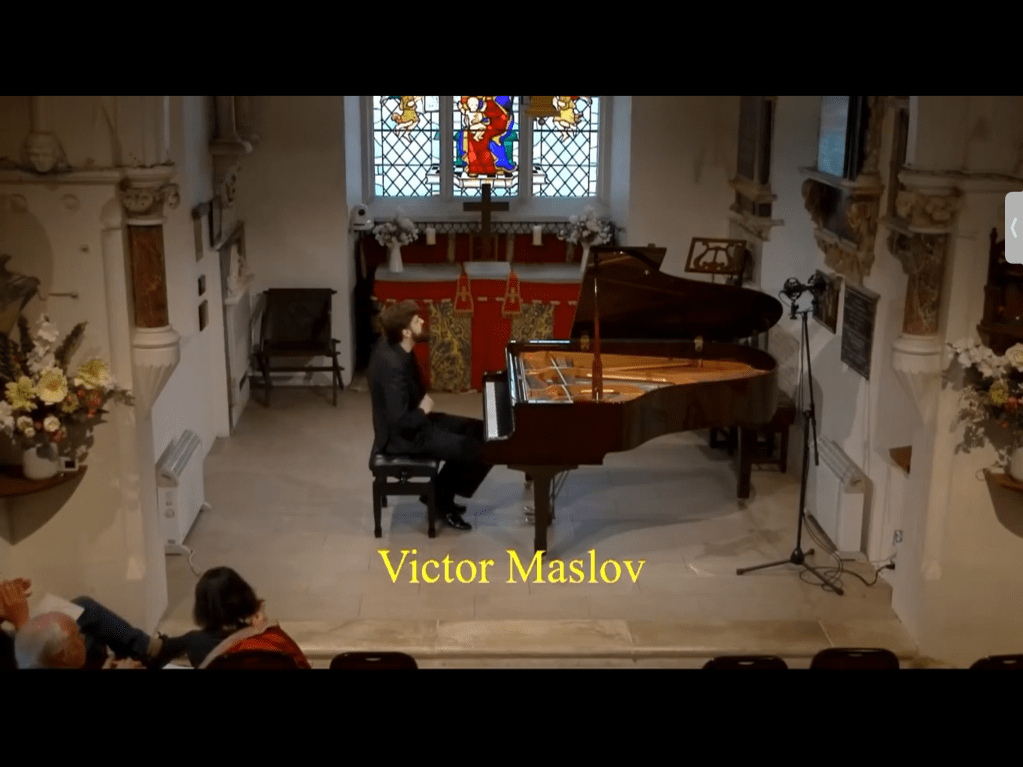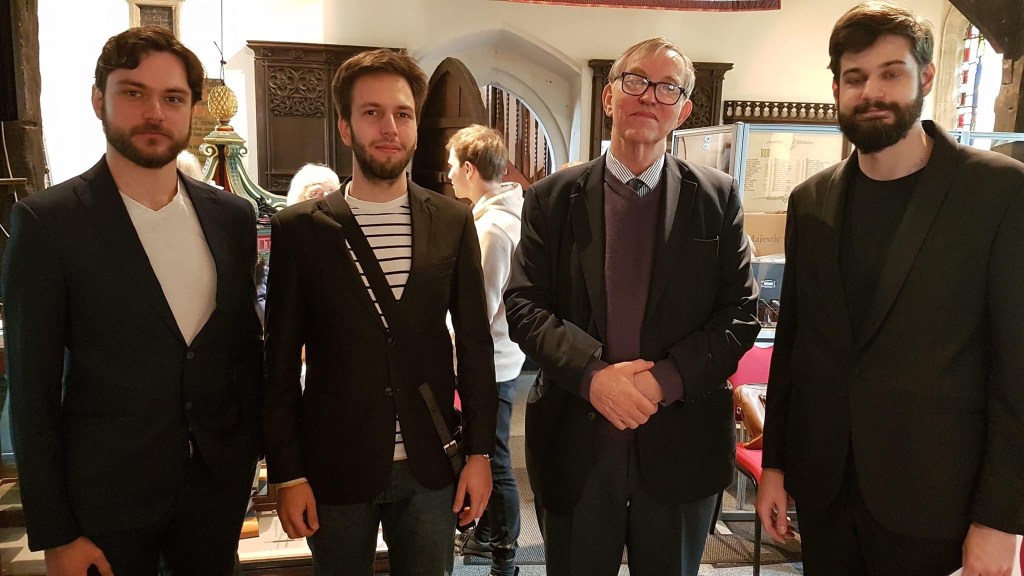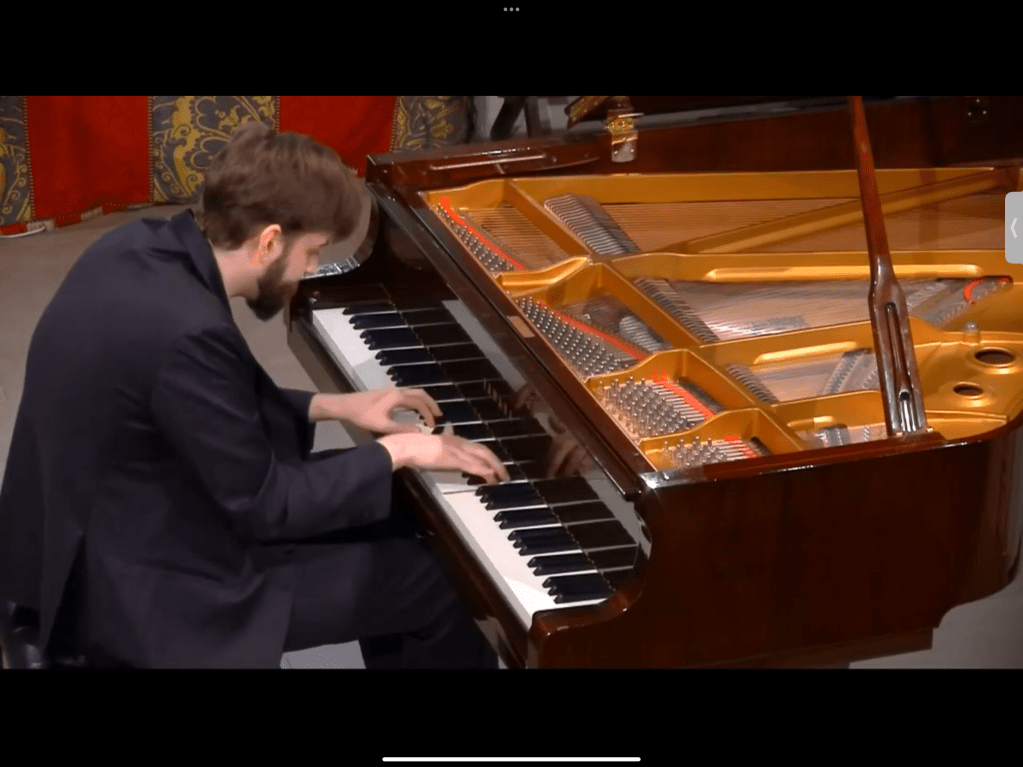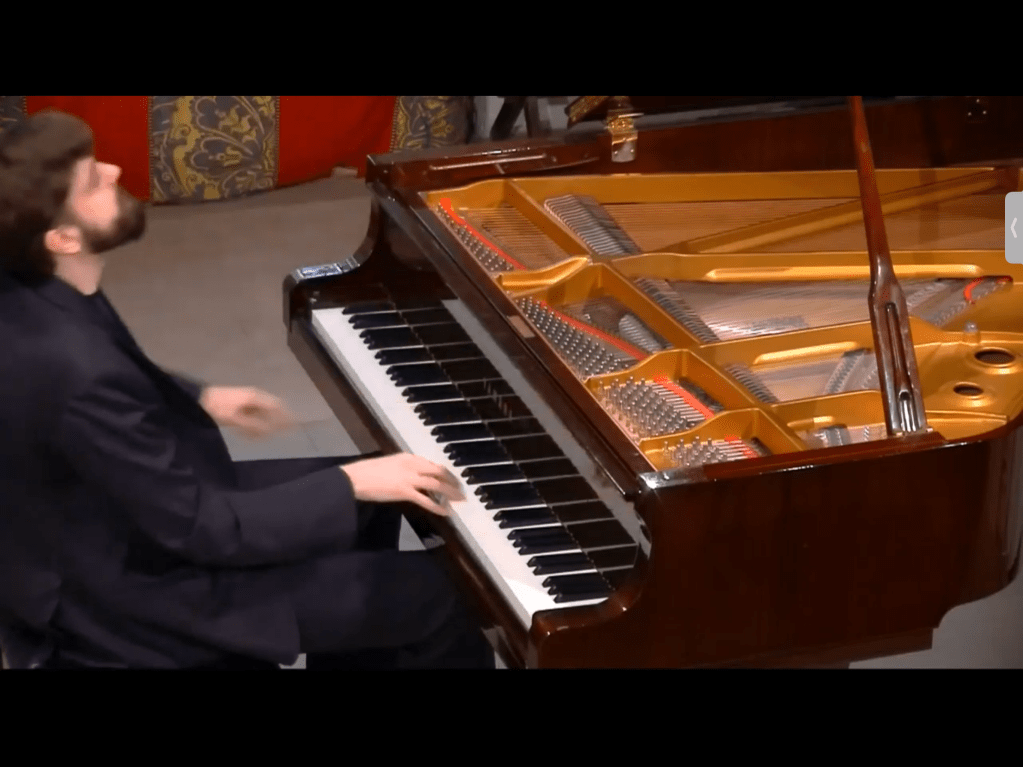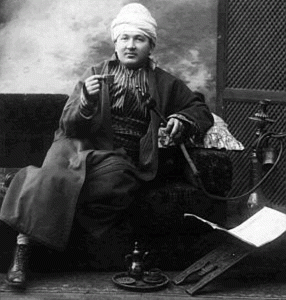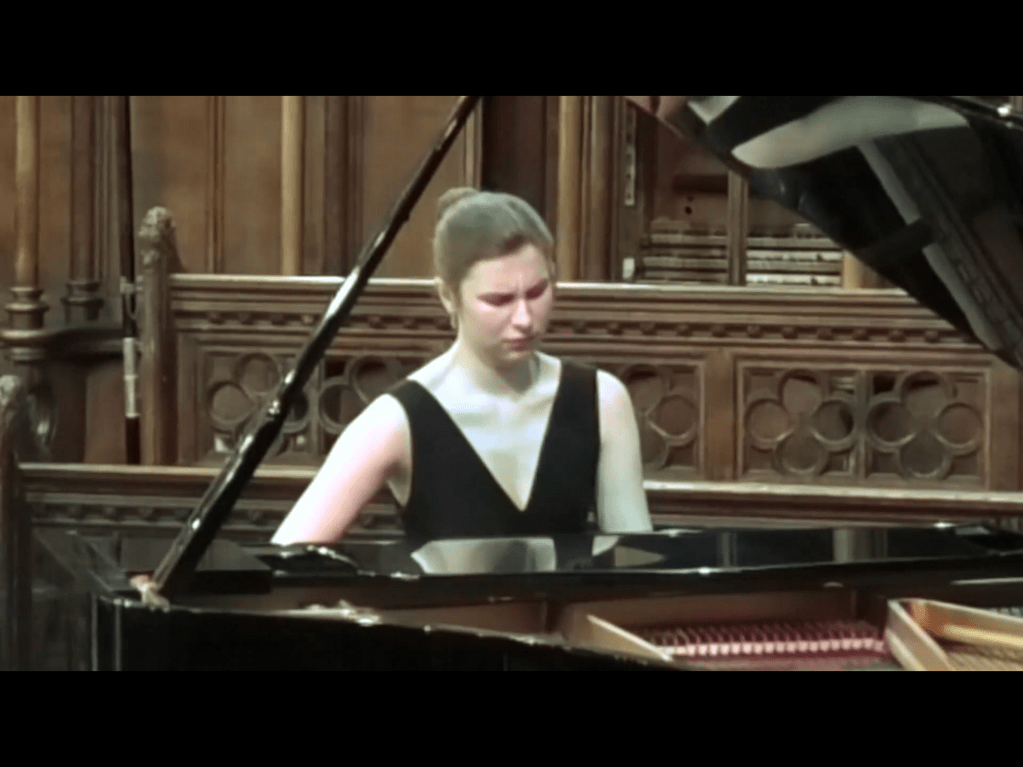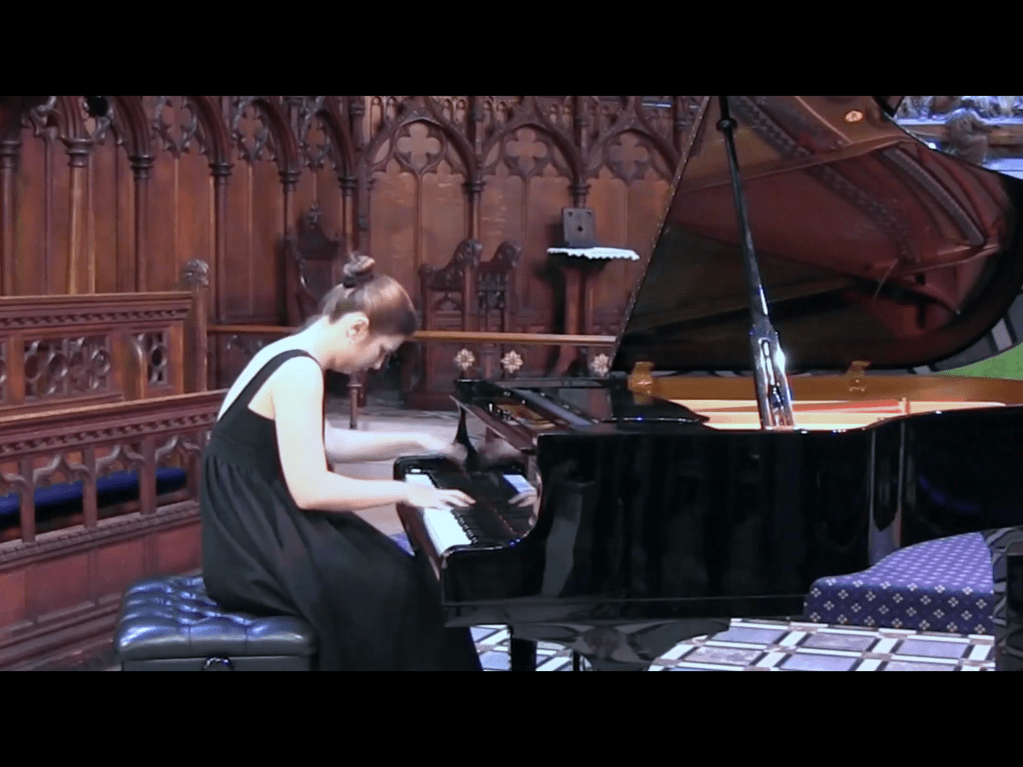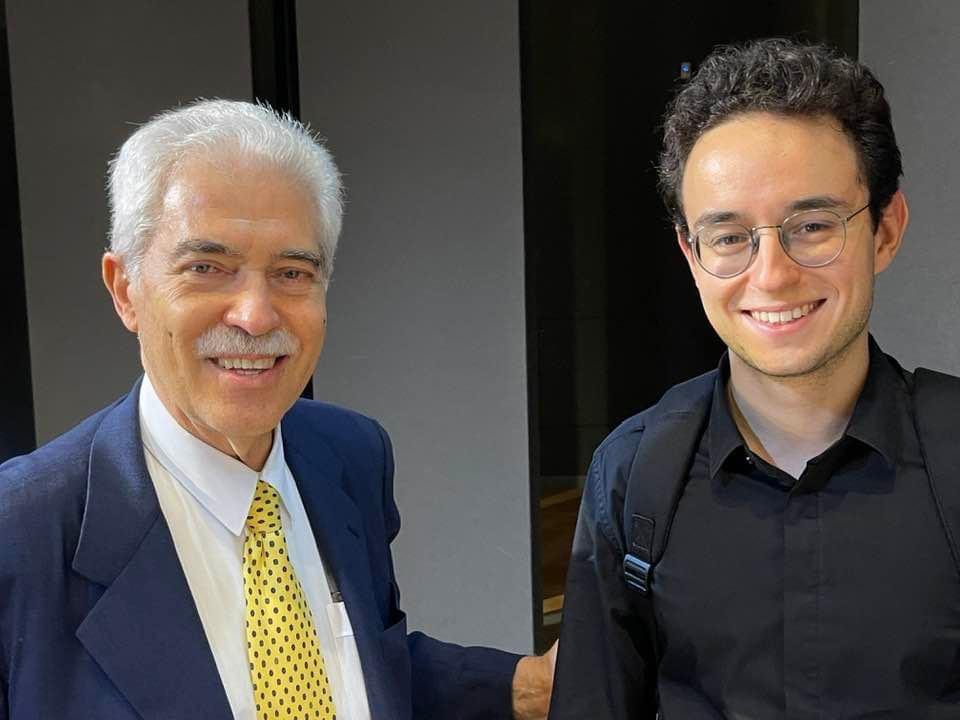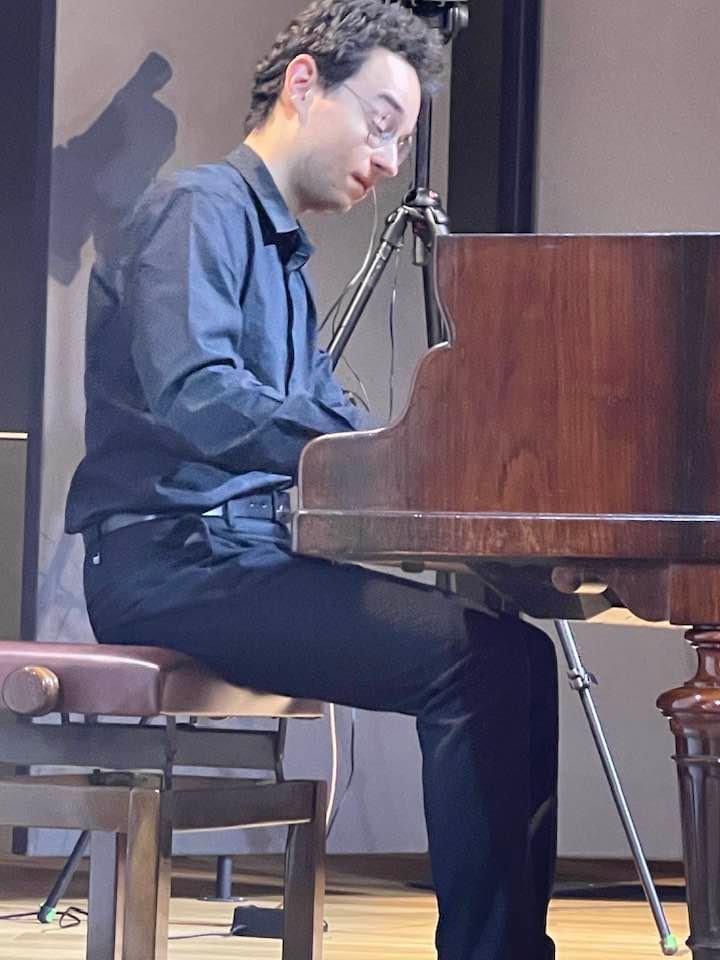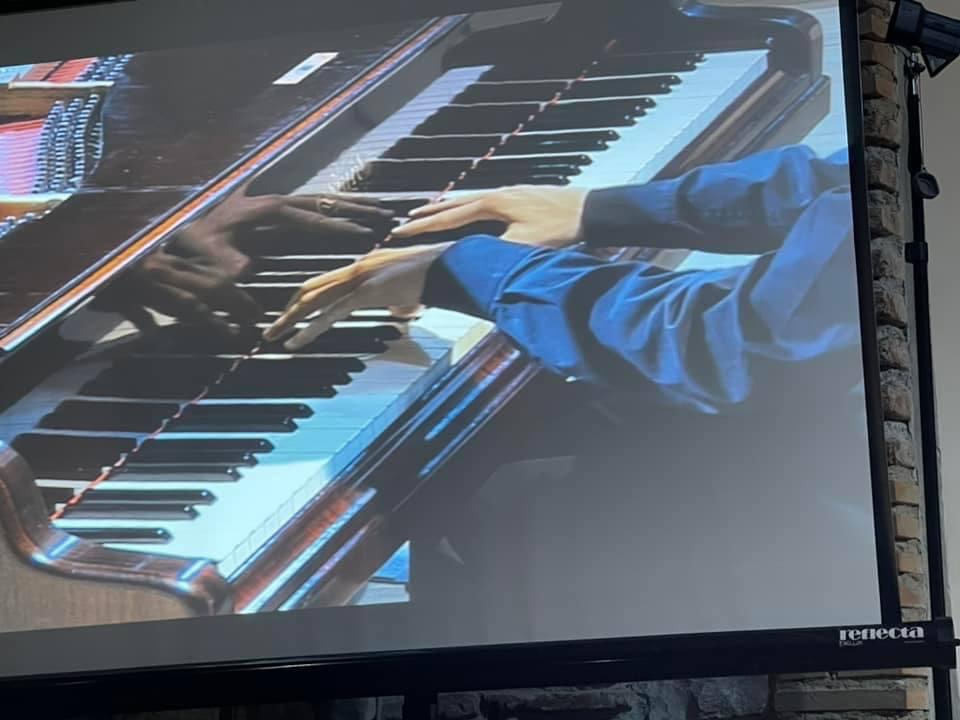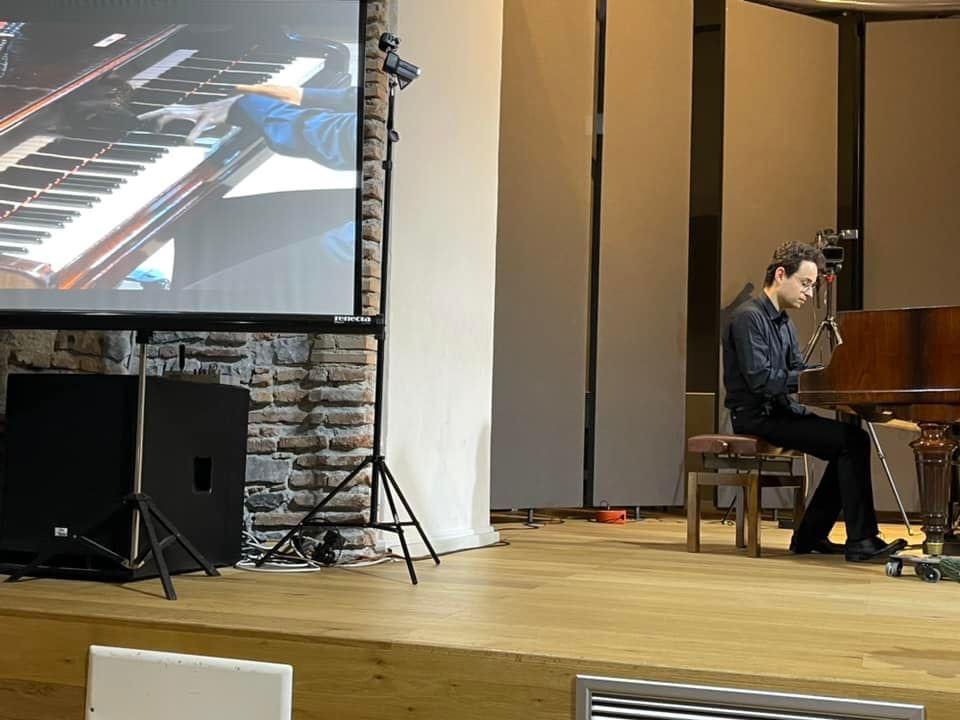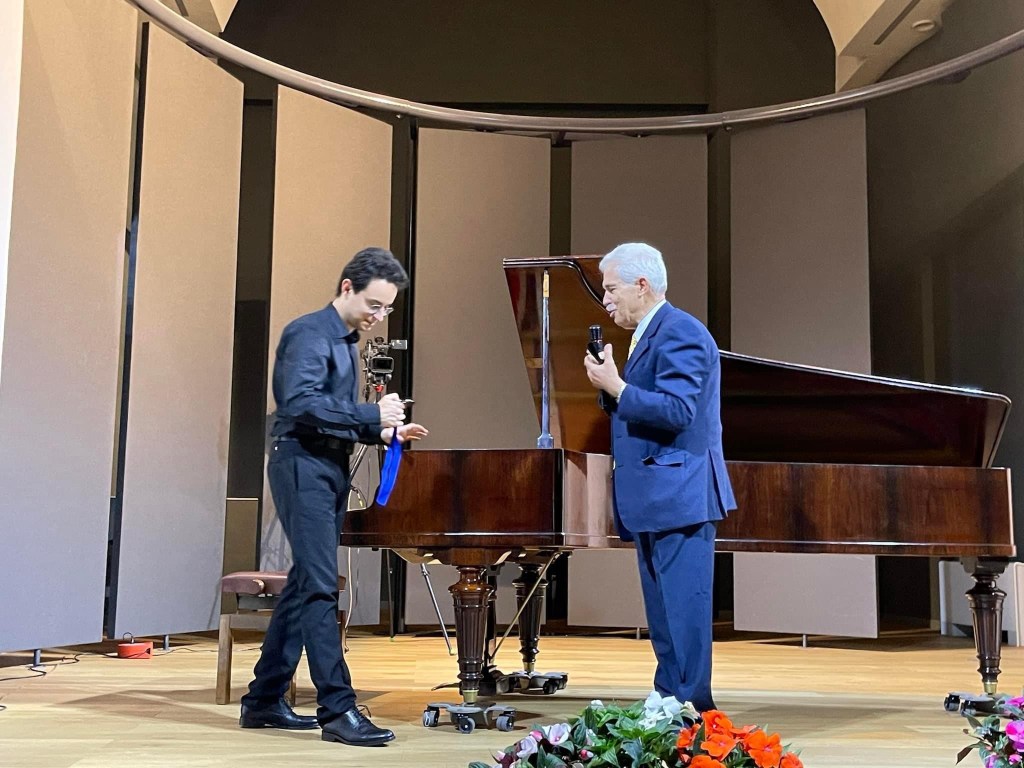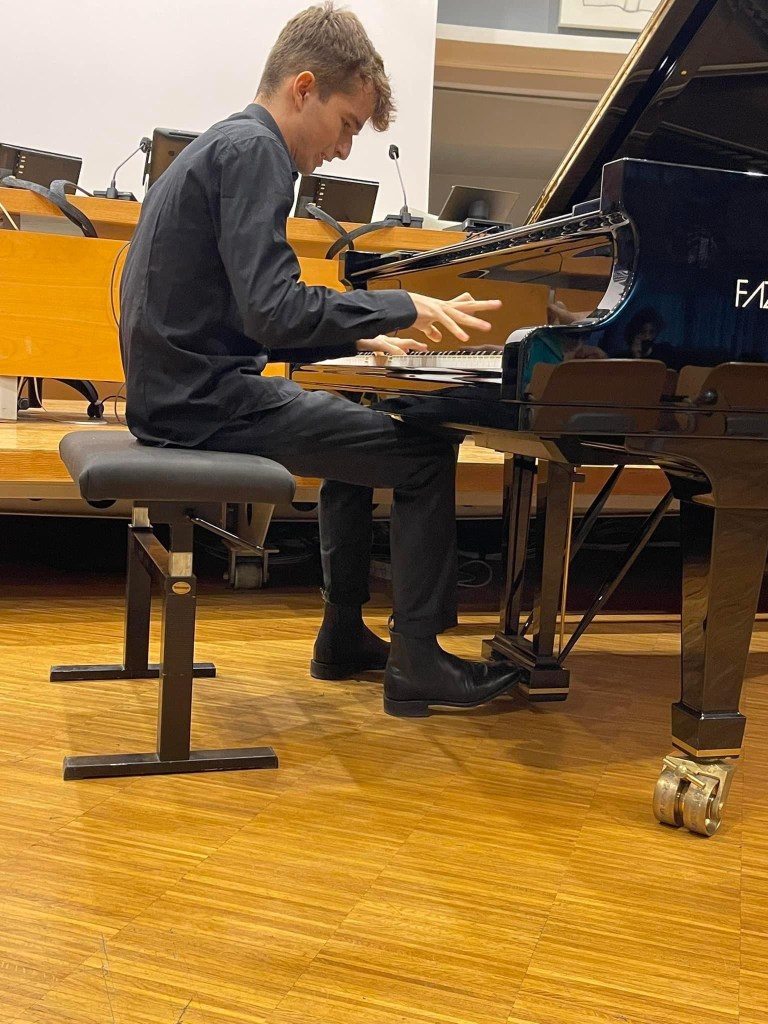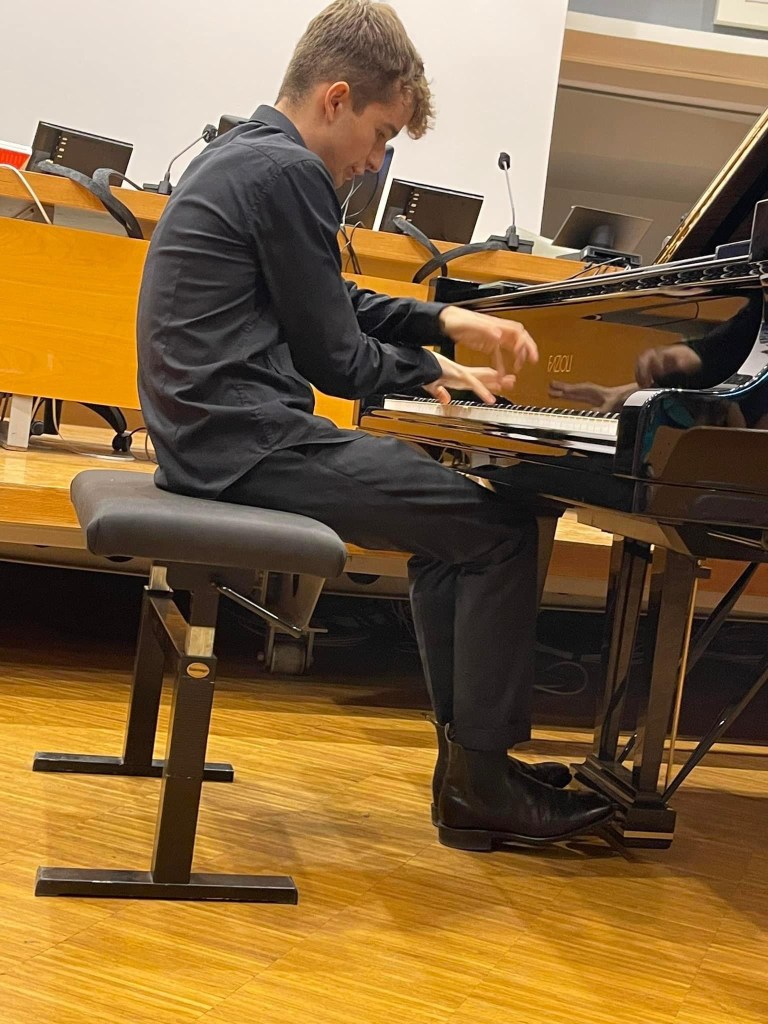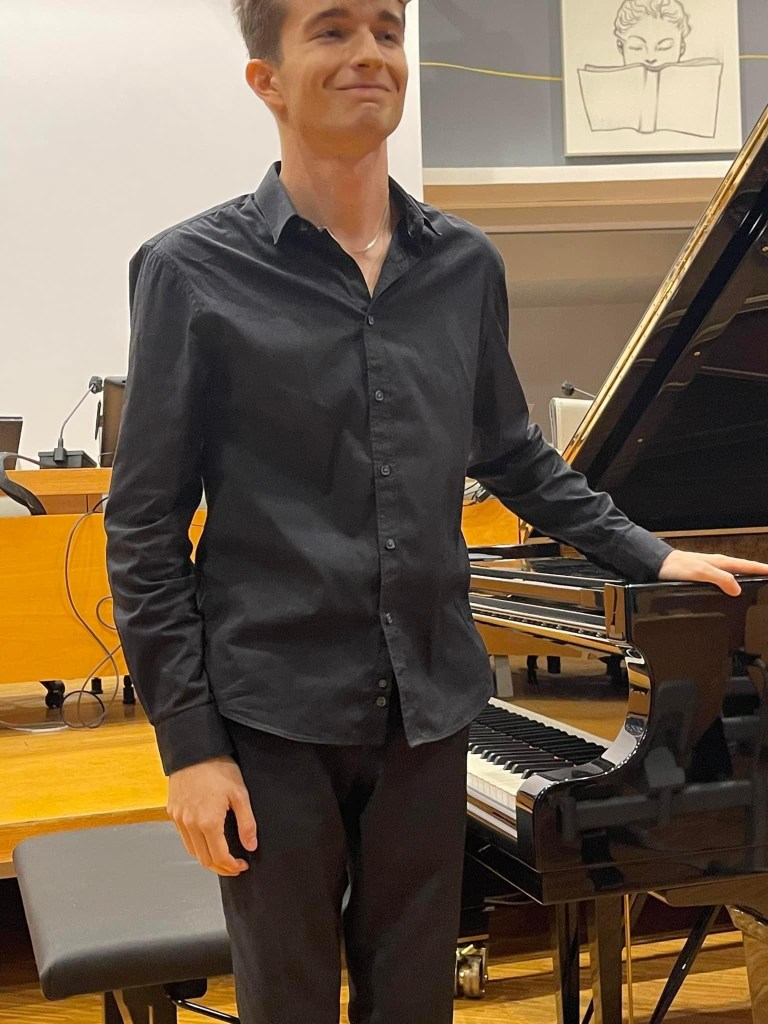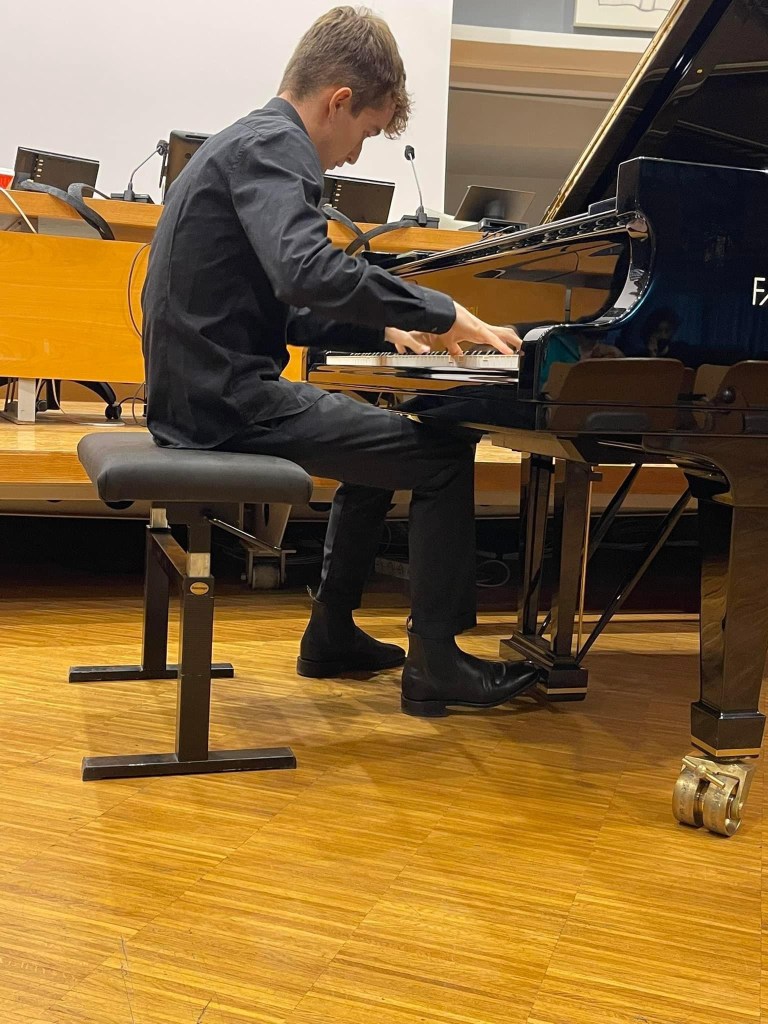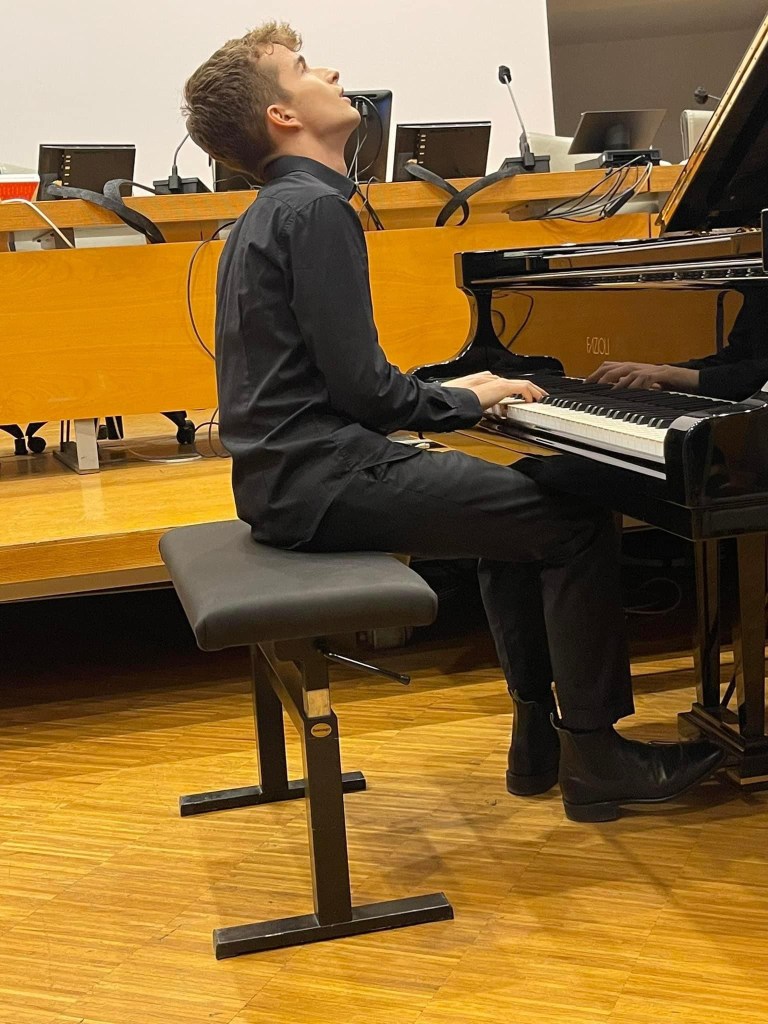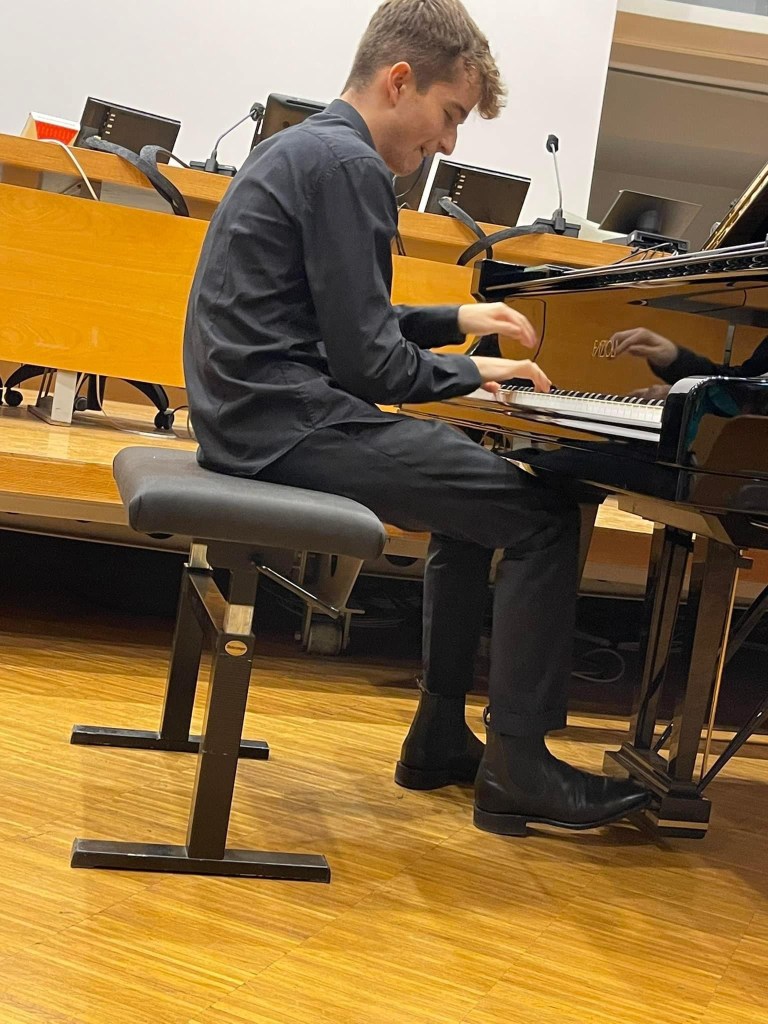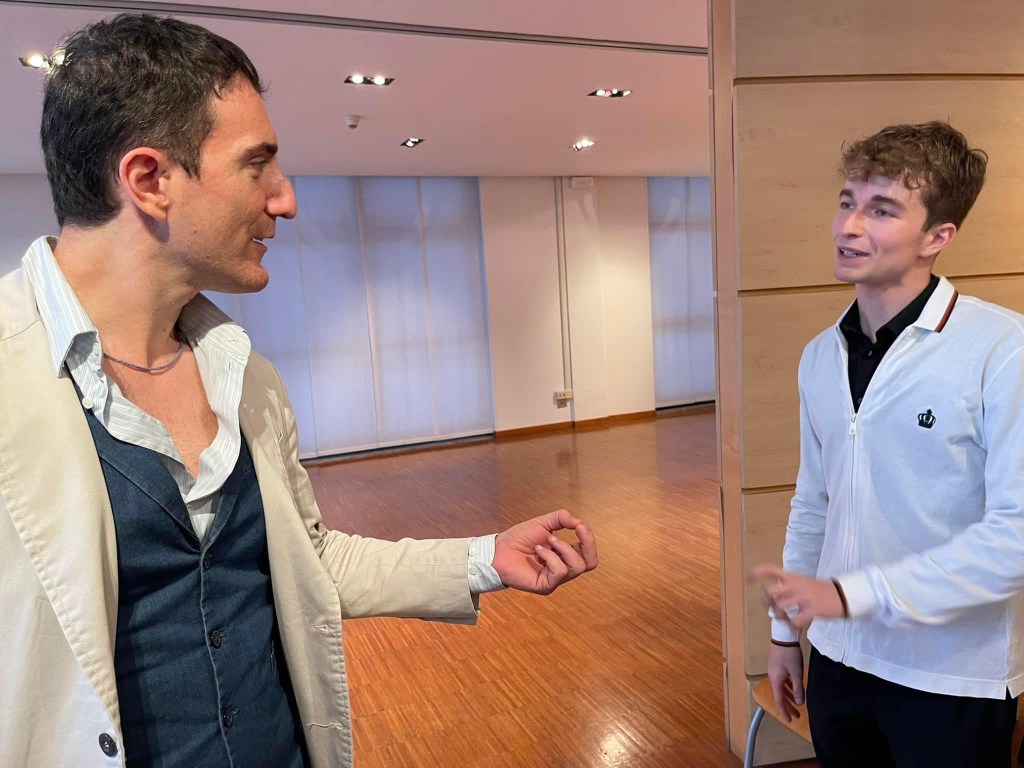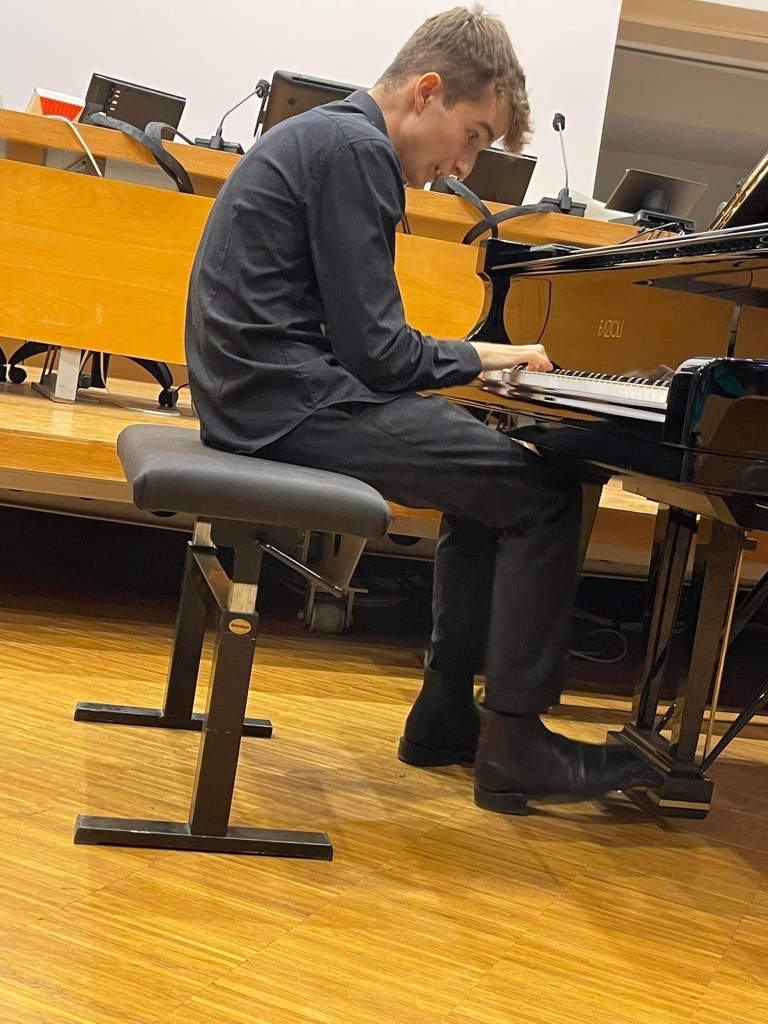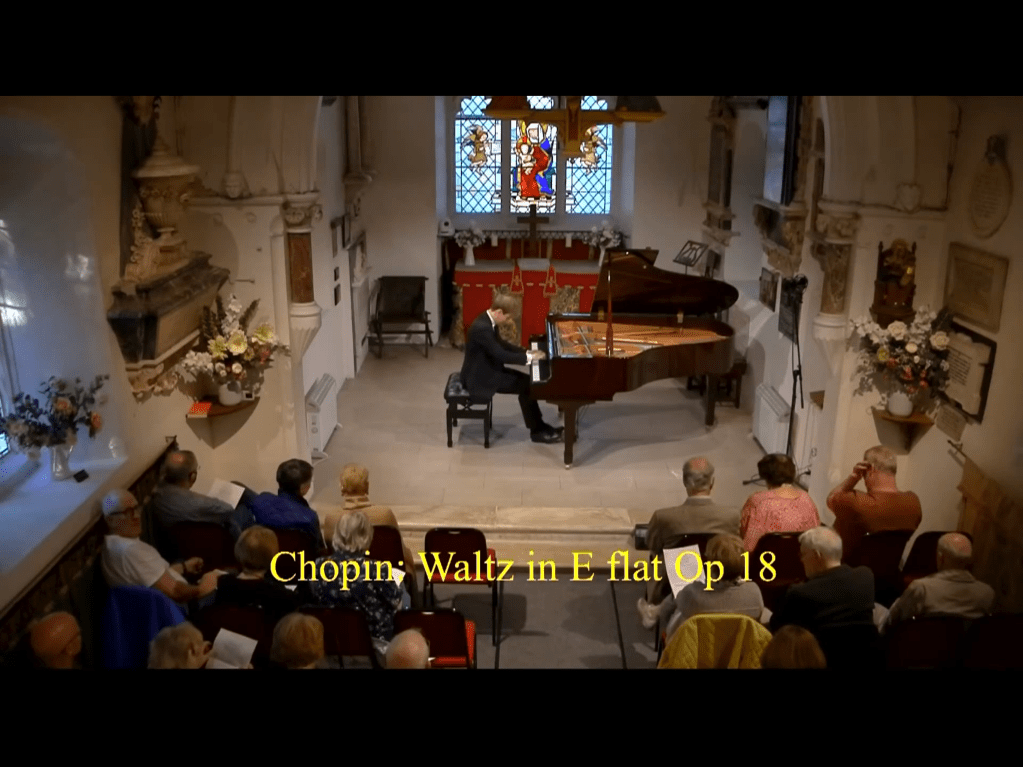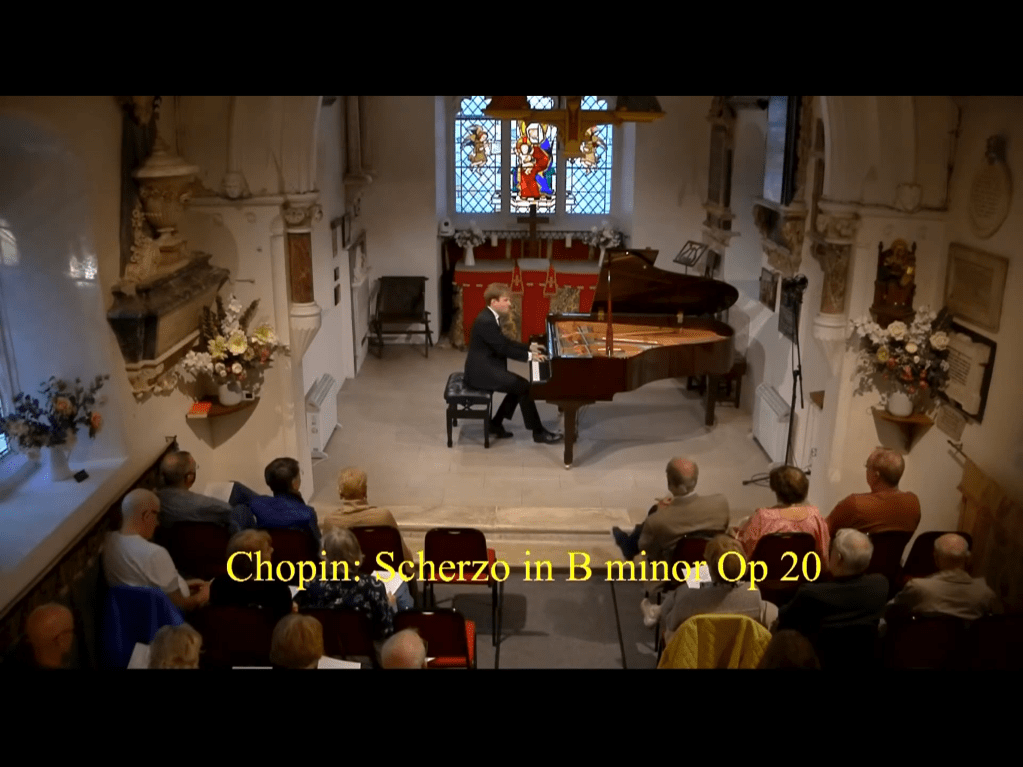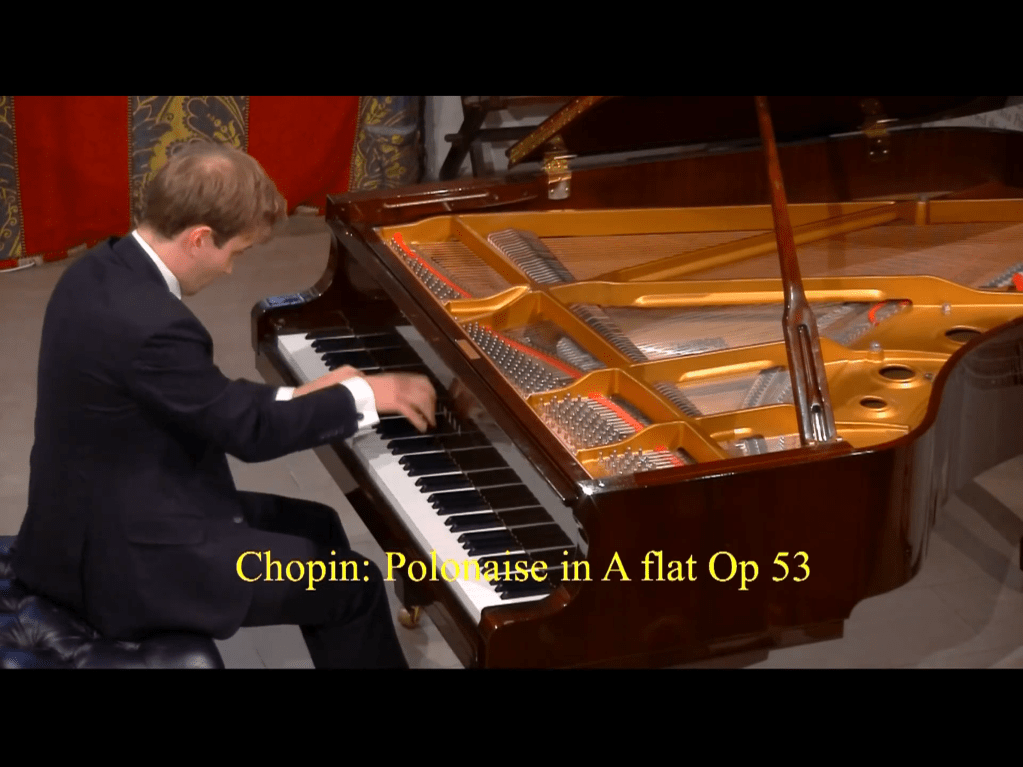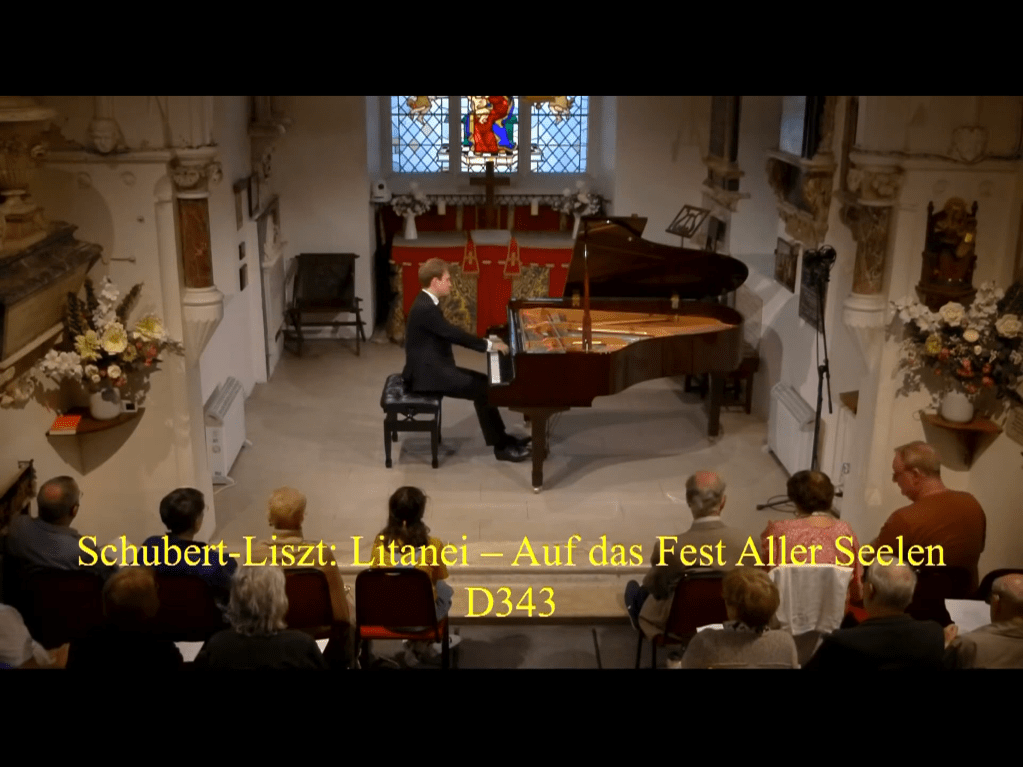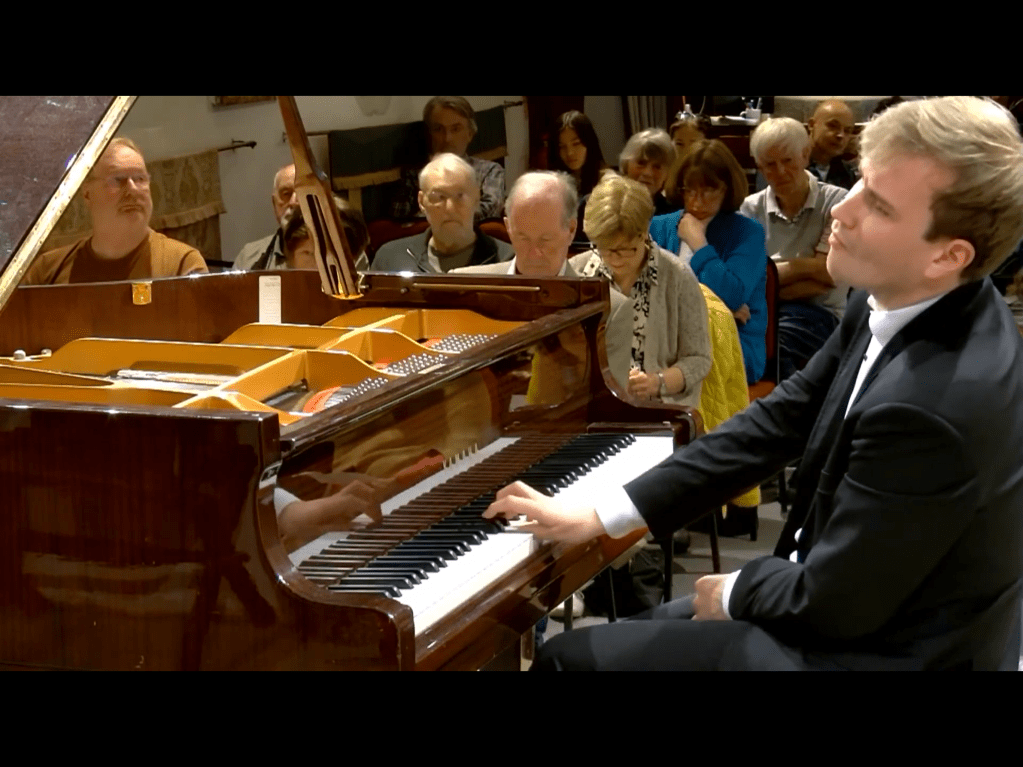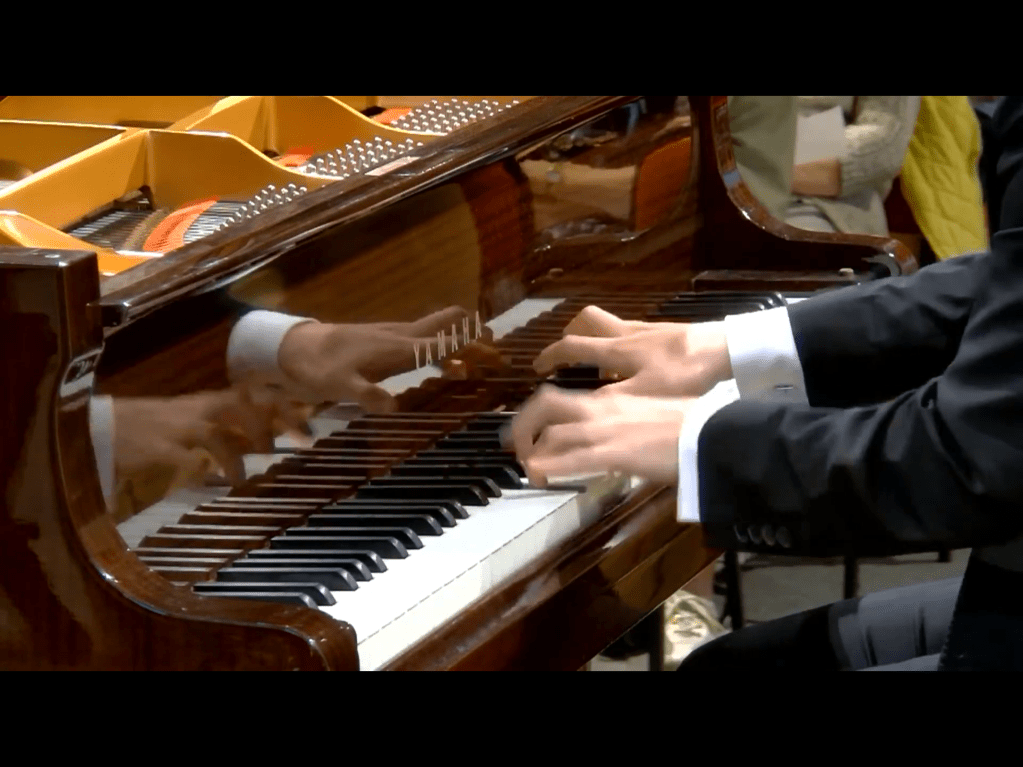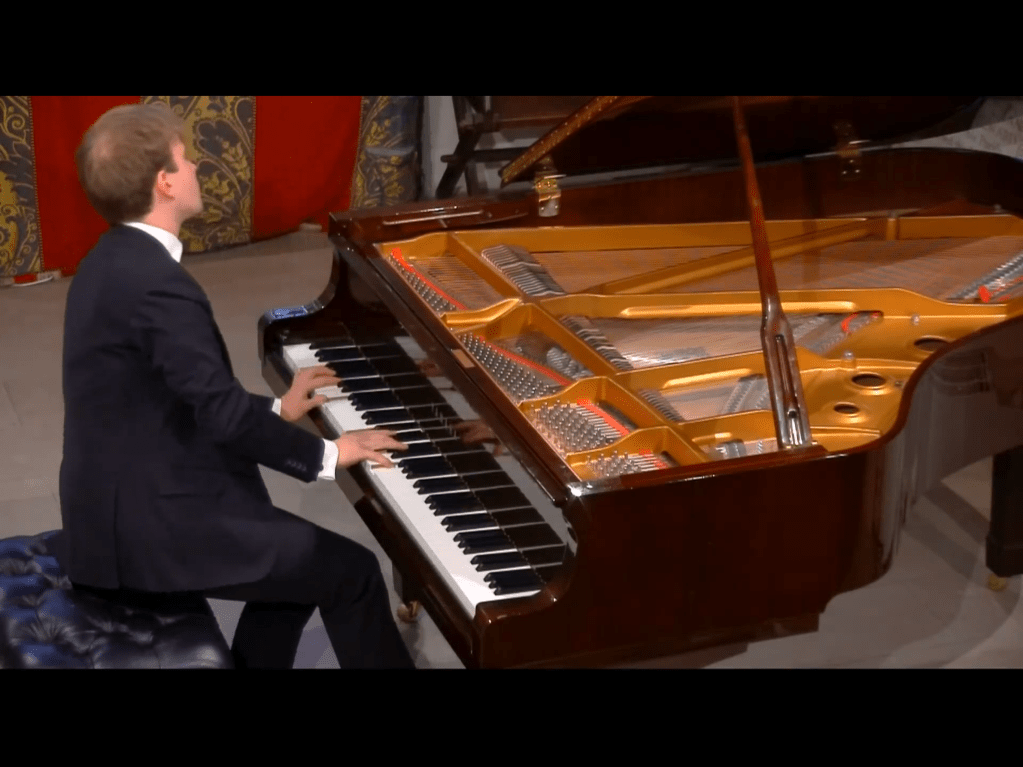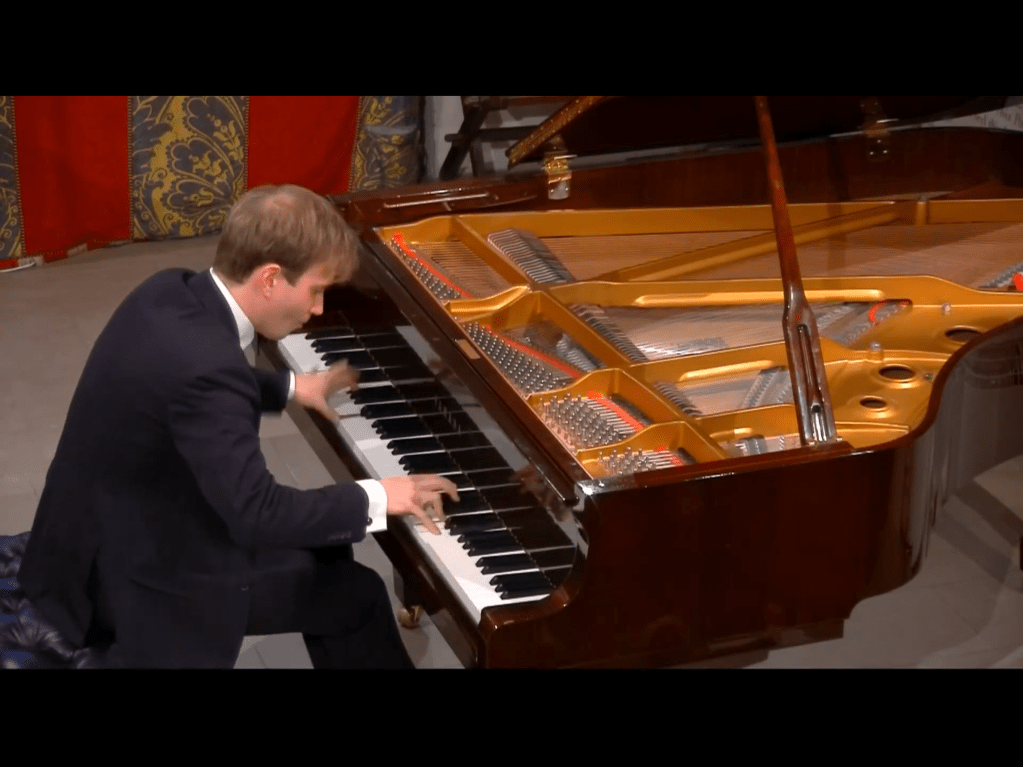
Sasha Grynyuk at Cranleigh Arts for Ukraine. https://www.withukraine.org/

The relief fund that Sasha refers to is the following https://www.withukraine.org/
https://youtube.com/watch?v=TYWIJbf-Dd4&feature=share
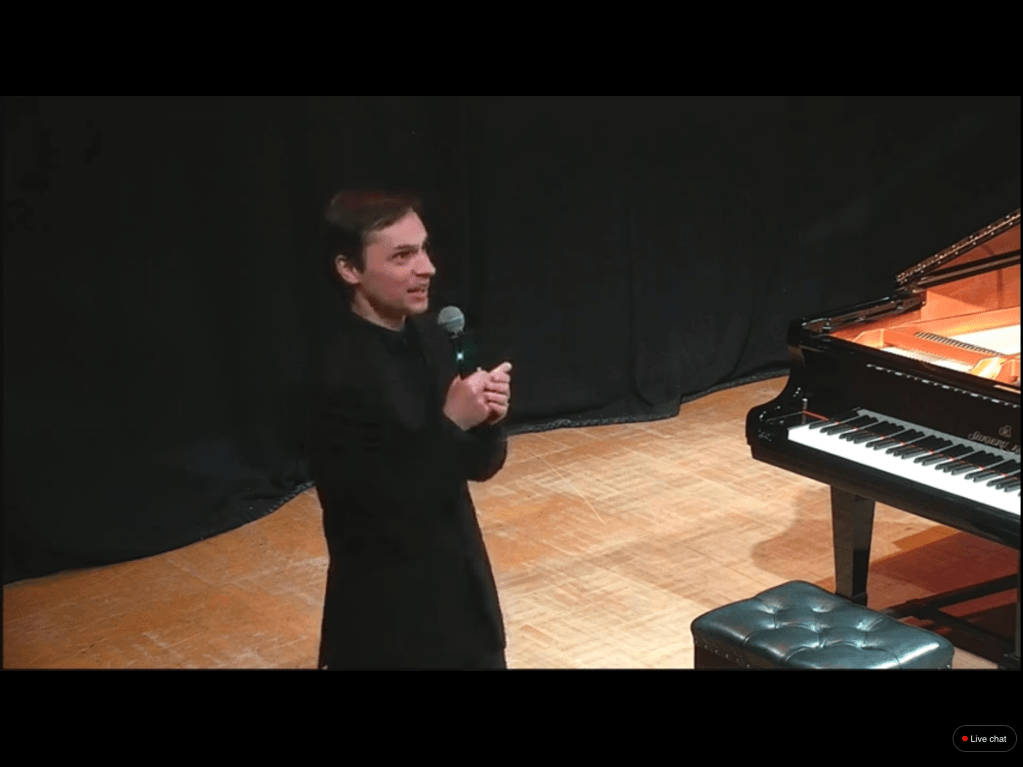
Sasha is not well known for his loquaciousness so it was surprising to see him take the microphone and talk to the public in Cranleigh and indirectly to the world via their excellent streaming .A public that had flocked to support the appeal for his fellow countrymen in the Ukraine who have suffered so unjustly from the zealous greed of a despot.
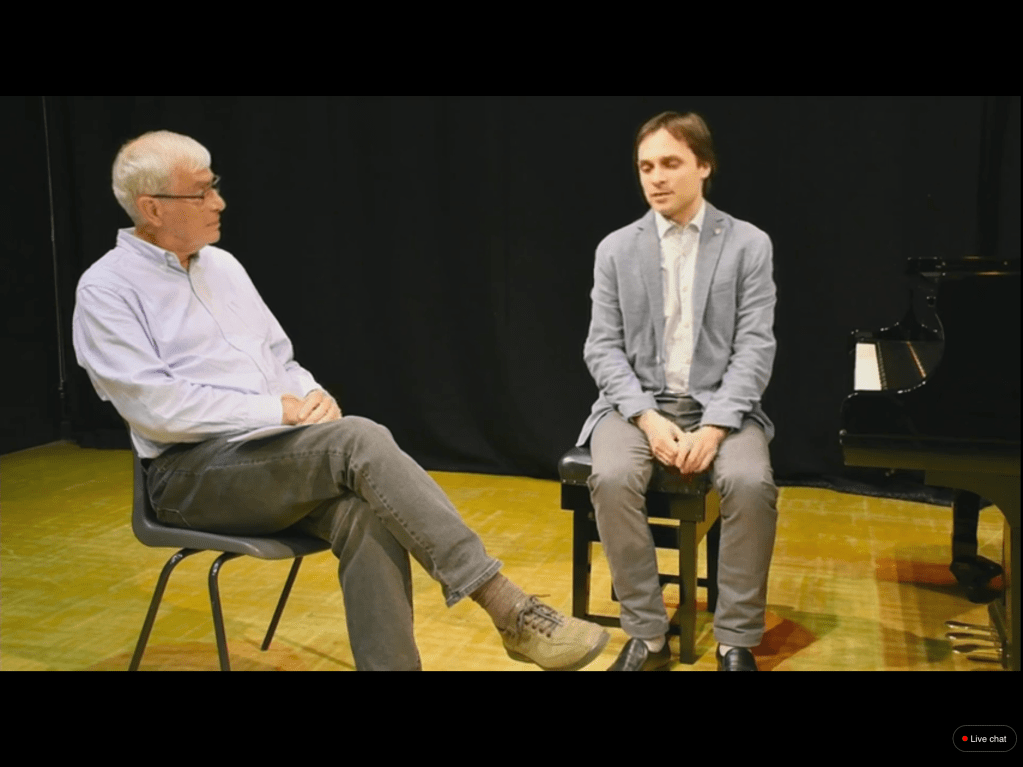
Stephen Dennison in an interval discussion with Sasha Grynyuk

Stephen Dennison and his colleagues at Cranleigh Arts were only too happy to be able show their support for one of their favourite musicians in his crusade for his homeland.
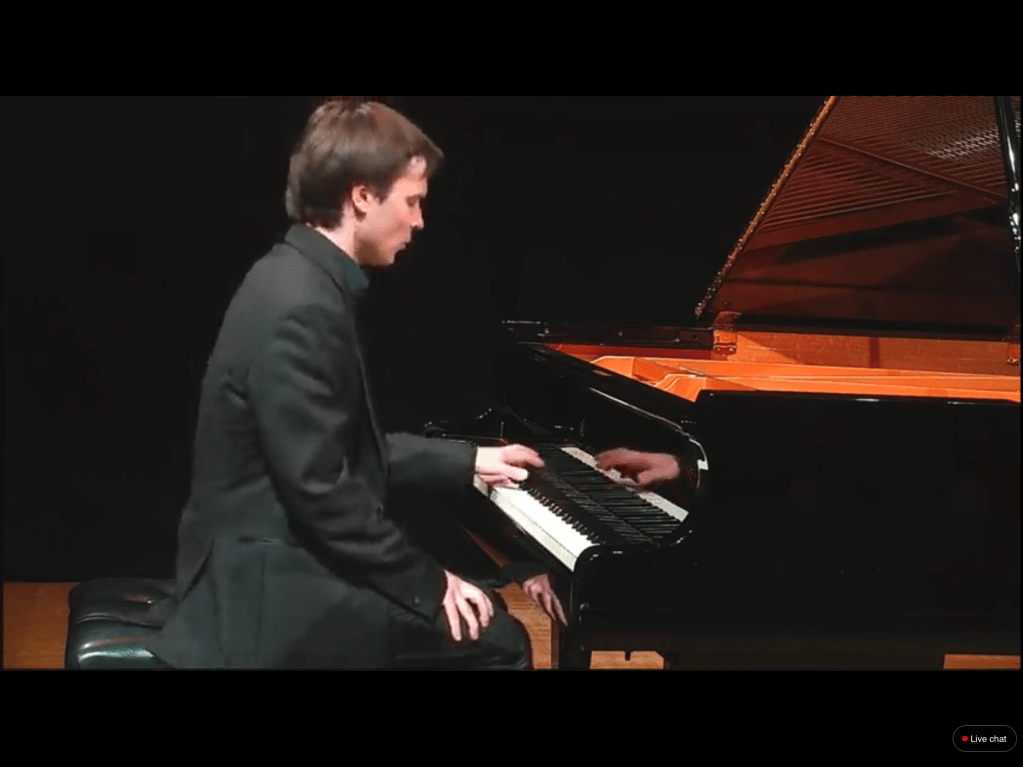
Music is the world that Sasha inhabits as all those that have followed his illustrious career know.Within that rather timid exterior there is an internal fire that ignites the moment he sits at the piano.Now his offence at the unjust occupation of his homeland and I expect encouraged by his recent marriage to Katya Gorbatiouk have opened a door where he feels that his music together with a few carefully placed words can help create funds to alleviate the physical suffering of the people in the Ukraine.Sasha was one of the first to dedicate himself to the Ukraine relief fund in a concert organised by his friends at the immensely welcoming home of Bob Boas and his wife.
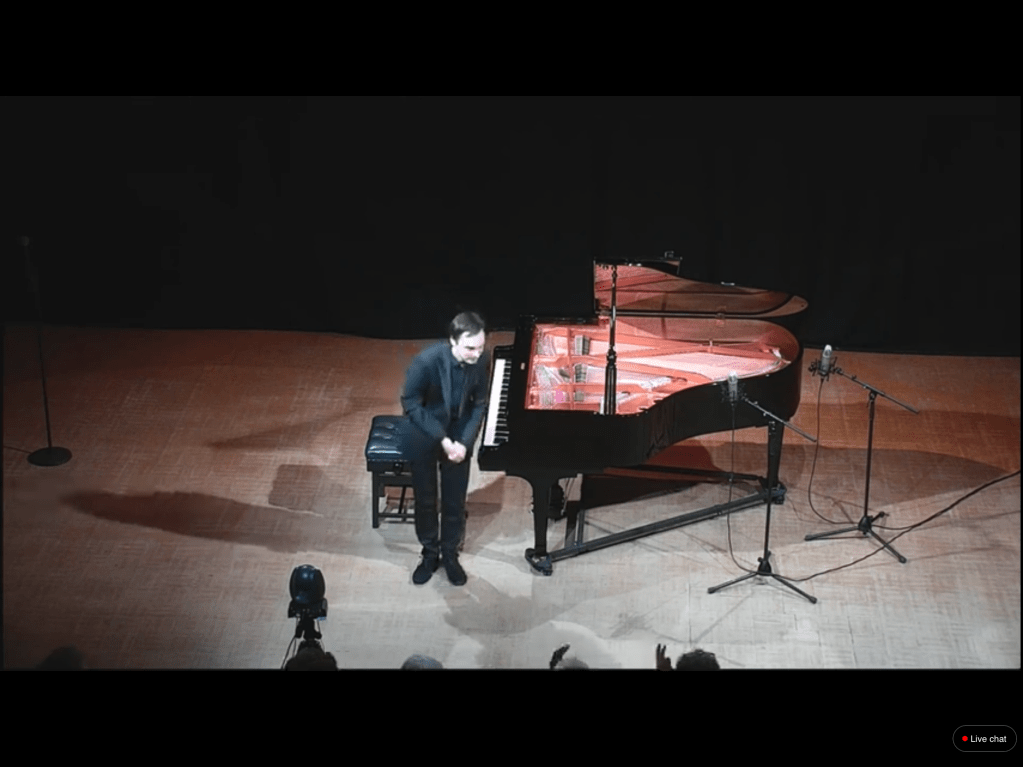
https://christopheraxworthymusiccommentary.com/2022/03/12/war-or-peace-the-help-ukraine-concert/

A concert that took even Sasha by surprise for the support that it had inspired.He has since dedicated his performances to the Ukraine Relief Fund via the Ukrainian Embassy where he explained every penny of the help offered was used to alleviate some of the immediate suffering.https://www.withukraine.org/

Little did we know,except for close friends,that Sasha’s parents had fled the bombs of Kiev putting whatever they could in their car as they sought refuge in Poland.Sasha flew to Cracow to meet them and drive them in a long and difficult journey to refuge in the UK.Many days passed without any news until we discovered that they had been given refuge in a community in the English countryside!It reminds me of a similar journey that Rosalyn Tureck undertook as she boarded the luxurious Queen Elisabeth II from Spain back to her home in New York.She knew her Indian Summer in Europe had come to an end after many years,as her cancer that had lain dormant suddenly sprang to life.She arrived back in New York on 9/11!There was no way of communicating with a city that had been so viciously raped by terrorists and we feared the worst for our beloved Rosalyn.Of course it would have taken more than a few terrorists to keep Rosalyn down and when at last communications were open we learnt that she had arrived in her final abode in Riverdale overlooking the Hudson where she was shortly able to join the sublime world of her adored J.S.B.Not necessarily the same thing but the war of terrorism and the siege of the Ukraine are they not acts of war – unjustifiable as all war must be!

It was interesting to hear that the opening work by Liszt had been dedicated to Anton Rubinstein and that the closing work by Balakirev had been dedicated to Nikolai Rubinstein,his younger brother .Scriabin in trying to master the monstrous difficulties of Islamey had been forced into a period of retirement from the concert platform.I well remember Sasha’s intelligent way of programming works into a unified whole.His Wigmore Hall recital too some years ago he opened and closed with a very atmospheric piece by Arvo Part that opened our ears and taste buds as it drew us in to a programme in which we could overhear works by Mozart and Gulda.
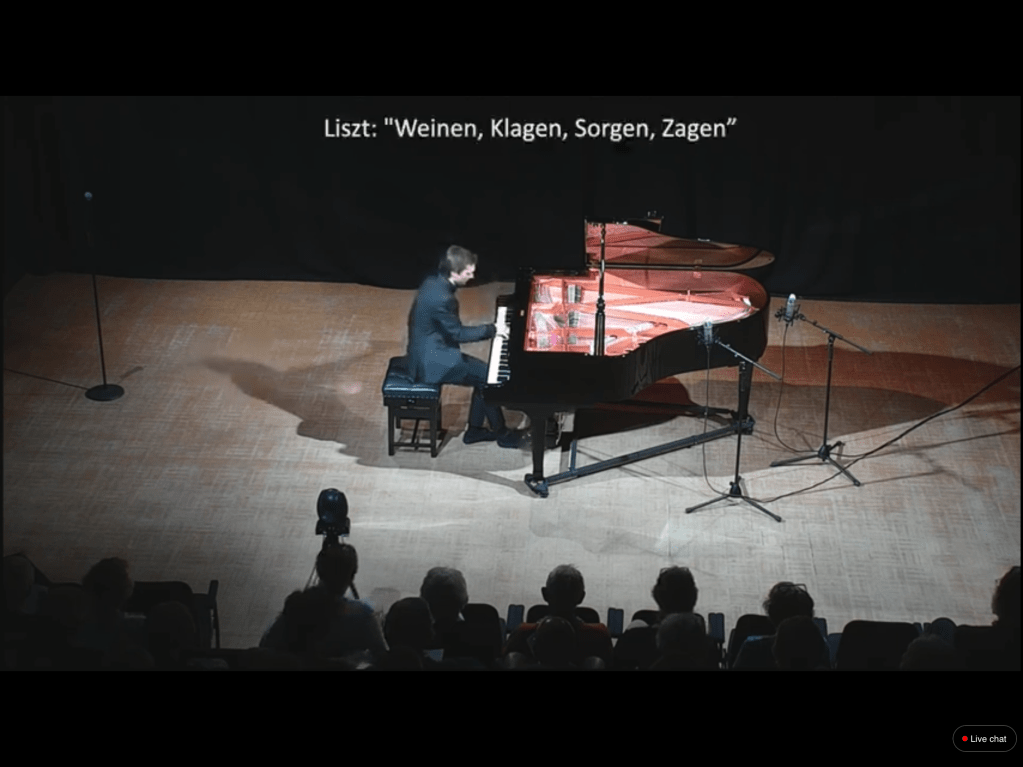
A very persuasive performance of one of Liszt’s unjustly neglected late works.I remember Vlado Perlemuter well into his eighties with this score on his music stand.Very expressive recitativi with delicate chordal interruptions always with the yearning or leaning of the duplets.There was such stillness as Bach’s ‘Was Got tut,das ist wohlgetan’ led to the final grandiloquent fervour of a true believer.

Variations on “Weinen, Klagen, Sorgen, Zagen,” S. 180 is one of Franz Liszt’s most significant but understudied piano works. Written after Liszt joined the Third Order of Saint Francis and during a time of deep personal tragedy, this composition reflects both Liszt’s religious journey and his coping with suffering and shows daring explorations of chromaticism that pushed the limits of tonality. It was arranged for organ one year after the piano version was composed and became one of his best-known compositions for organ.The Variations on “Weinen, Klagen, Sorgen, Zagen,” S.180 was written in 1862 when Liszt settled in Rome.It was published by Schlesinger in Berlin two years later. Liszt dedicated it to Anton Rubinstein who unfortunately never performed it in public.Liszt performed it in a festival at Hanover in April of 1875 and is the first record of the public performance of this music. Liszt performed it again in May of 1876.Both performances have no recorded reaction from audiences, but based on Liszt’s self- mockery in his master class of 1885, it could be speculated that the piece was not well- received: In the master class, after August Stradal played the Variations on “Weinen, Klagen, Sorgen, Zagen,” S.180, Liszt said: “If you want a bad criticism, you must play this. It will then be said: ‘the young artist is not lacking in talent —- it remains only to regret that he made such a poor choice of piece.’The organ version appeared in 1863 .”Weinen, Klagen, Sorgen, Zagen,” S.180 is probably Liszt’s most important set of variations. He composed a prelude on the theme three years earlier which could be seen as a preparation for this work.The chromatic theme of the variations was taken from Bach’s Cantata No. 12 and also used for the Crucifixus of Bach’s mass in B minor. Liszt also used the final chorale “Was Gott tut, das ist wohlgetan” as the ending section. It is one of the most masterly and ambitious works of Liszt’s third compositional period.While it is an outstanding work, it was not accepted or admired by the musicians of Liszt’s time because of its innovativeness.
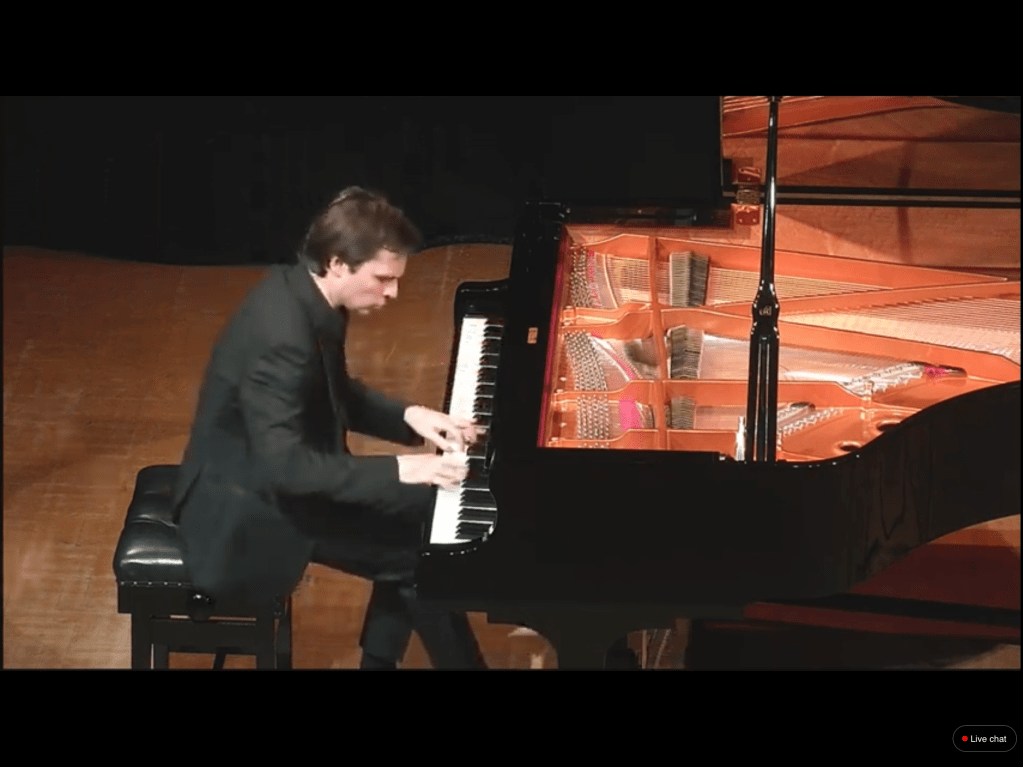
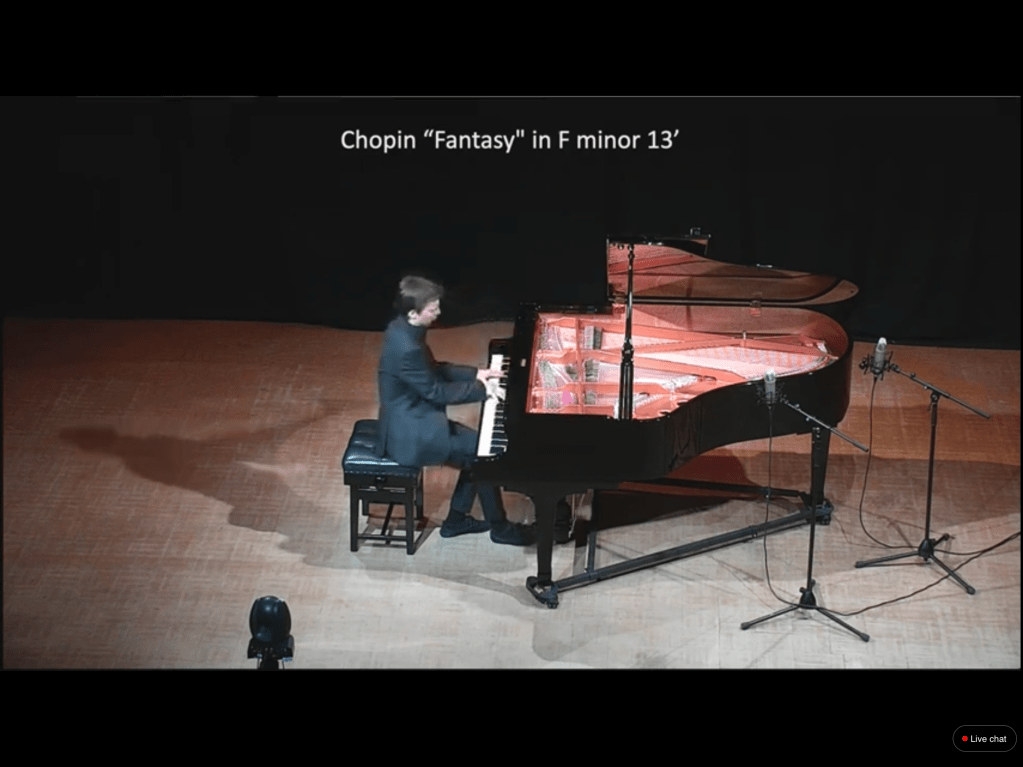
Beethoven’s final sonata op 111 was given a masterly performance.From the opening Maestoso chords played as Beethoven implores,where the struggle is implied in the physical risk involved.But played with a sense of architectural shape that led so inevitably to C major and the real struggle of water boiling over at 100 degrees (to quote Schnabel according to Perlemuter).The contrast between extreme energy and moments of peace in the recitativi all leading to the long final peace that heralds the opening of the sublime Arietta and variations.Beethoven’s last word on the Sonatas that were a lifetime’s journey.From his early exuberance through the struggles and hurdles that life threw in his path to the sublime peace that only Beethoven could hear in his inner ear.It was this peace and feeling of constant flow that was such a part of Sasha’s performance.Taking us to the explosion of the third variation and it’s murmured resolution reaching ecstasy and finally sublime peace with streams of sound on which the Arietta was allowed to float as it wove its way ever more upwards to paradise.
I had never thought of the opening of Chopin’s Fantasie as being a funeral March until Sasha mentioned it in his introductory talk even though it is marked Tempo di Marcia.It was played with a real flowing tempo with the poco a poco doppio movimento in an improvised search for the passionate outpouring of the ‘agitato’.A ravishing close to this first half took us magically to the sublime simplicity of the Lento sostenuto.The sudden eruption of the agitato taking us to the passionate outpourings of Chopin’s aristocratic bel canto world.A momentary respite in an improvised recitativo, played with heart rending simplicity and control of the sustaining pedal,before the magical sweep of whispered sounds and the two final majestic chords.
A juxtaposition of Scriabin led to a technical confusion with the subtitles but certainly not with the music!Scriabin’s Prelude and Nocturne op 9 for the left hand alone was pure magic.Sasha showed his sense of balance and technical control,resting his right hand whilst his one hand sang with all the eloquence of two!Wondrous colours in the Nocturne where his use of the sustaining pedal created a ‘halo’ of sound on which the melodic line could float.
A fascinating ‘Valse de salon’ that until a few months ago was completely unknown to me or Sasha’s mentor Noretta Conci.We had heard a young Russian pianist Nikita Lukinov play it in a recital for Noretta’s Keyboard Trust – together with a memorable performance of the usually much maligned Liszt Sonata.This young man had brought this deliciously delicate virtuoso valse to our attention as well as a scrupulous faithfulness to the Liszt Sonata . https://christopheraxworthymusiccommentary.com/2021/06/15/nikita-lukinov-at-bluthner-piano-centre-for-the-keyboard-trust-liszt-restored-to-greatness/Sasha has since added it to his repertoire where Noretta would like him to programme it in a recital of waltzes by Brahms,Chopin and Ravel.Sasha, today gave a sumptuous performance of style and elegance and real jeux perlé playing of a different age.The age when virtuosity was not how fast and loud one could play but how delicately and quietly one could ravish the keyboard.Sasha revealed himself to be a master of this elusive almost forgotten art !
Suddenly Sasha unleashed his quite considerable technical mastery in a performance of such overwhelming sweep and authority.Sumptuous sounds too with the sublime beauty of the central tenor melody.A hypnotic sense of rhythm allied to a kaleidoscopic range of colour all played with such passion and considerable virtuosity that was as dazzling as it was breathtaking.
An encore of Galuppi’s most magical movement from one of his many neglected sonatas .The one made famous by Arturo Benedetti Michelangeli and obviously suggested to Sasha by Noretta Conci who was Michelangeli’s assistant for over 15 years

Islamey: Oriental Fantasy Op. 18, by Mily Balakirov was written in 1869 The great New York critic Harold Schonberg said it was “at one time…considered the most difficult of all piano pieces and is still one of the knucklebusters.”It has had a lasting influence on piano solo music; Ravel once remarked to a friend that his goal in writing Gaspard de la nuit was to compose a piece that was “more difficult than Balakirev’s Islamey.” This turned out to be Scarbo, the third piece in the suite.Balakirev, a committed nationalist whose music was influenced by Russian traditions, was inspired to write the piece after a trip to the Caucasus ,as he relates in a letter: :…the majestic beauty of luxuriant nature there and the beauty of the inhabitants that harmonises with it – all these things together made a deep impression on me… Since I interested myself in the vocal music there, I made the acquaintance of a Circassian prince, who frequently came to me and played folk tunes on his instrument, that was something like a violin. One of them, called Islamey, a dance-tune, pleased me extraordinarily and with a view to the work I had in mind on Tamara I began to arrange it for the piano. The second theme was communicated to me in Moscow by an Armenian actor, who came from the Crimea and is, as he assured me, well known among the Crimean Tatars. (Letter to Eduard Reiss (1851–1911), 1892) .Balakirev, considered a virtuoso pianist in his time, once admitted that there were passages in the piece that he “couldn’t manage.” In fact it was Nikolai Rubinstein who premiered the work .In addition, Scriabin seriously damaged his right hand fanatically practicing the piece along with Liszt’s Don Juan Fantasie.
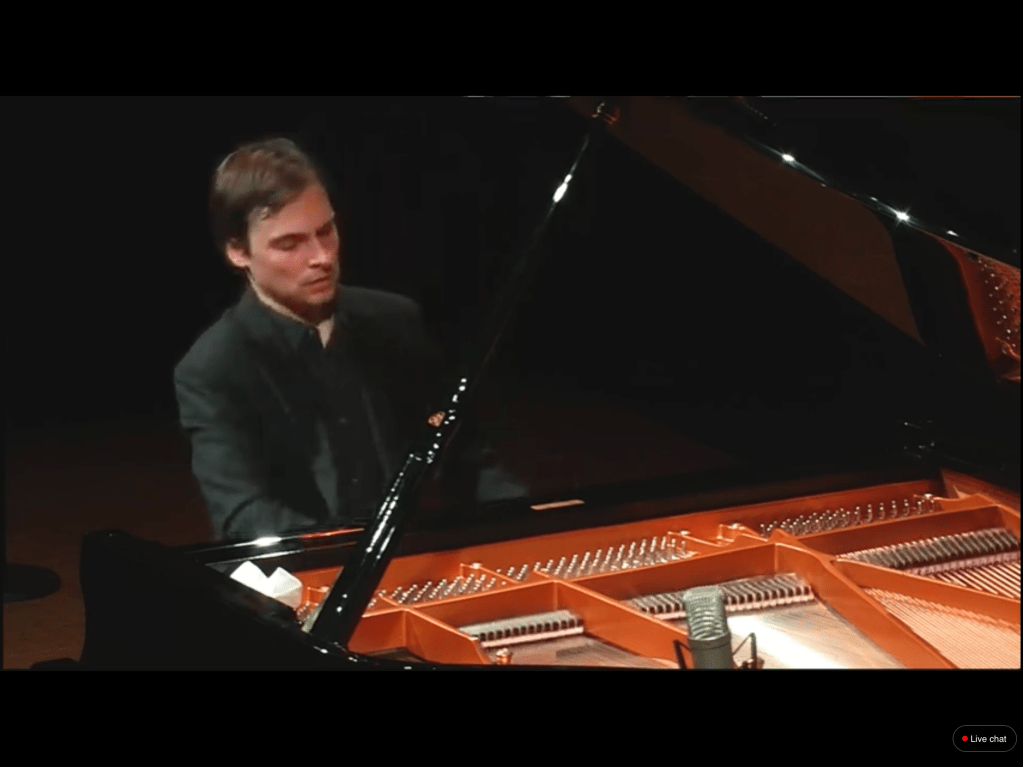
Born in Kiev, Ukraine, Sasha Grynyuk was awarded a scholarship to continue his music studies at the Guildhall School of Music in London. There he was awarded the Gold Medal – the school’s most prestigious award. He currently benefits from the artistic guidance of Noretta Conci-Leech, the founder of the Keyboard Trust. Sasha has performed around the world in many major venues including Barbican Hall, Royal Festival Hall, Wigmore Hall, Wiener Konzerthaus, Weill Recital Hall (Carnegie Hall) and Teatro Real. With orchestras including: Bergen Philharmonic, Royal Philharmonic, Brazil National Orchestra, Ukraine National Symphony.Sasha has won many awards, such as first prizes at the Grieg International Piano Competition in Norway and the BNDES International Piano Competition in Brazil. His recording of music by Gould and Gulda for Piano Classics was chosen as the record of the month for the Piano News magazine and shortlisted for the New York Classical Radio.

https://christopheraxworthymusiccommentary.com/2021/04/05/sasha-grynyuk-at-st-marys-for-the-glorification-of-love-and-passion/

https://christopheraxworthymusiccommentary.com/2020/11/11/sasha-grynyuk-for-cranleigh-arts-online/
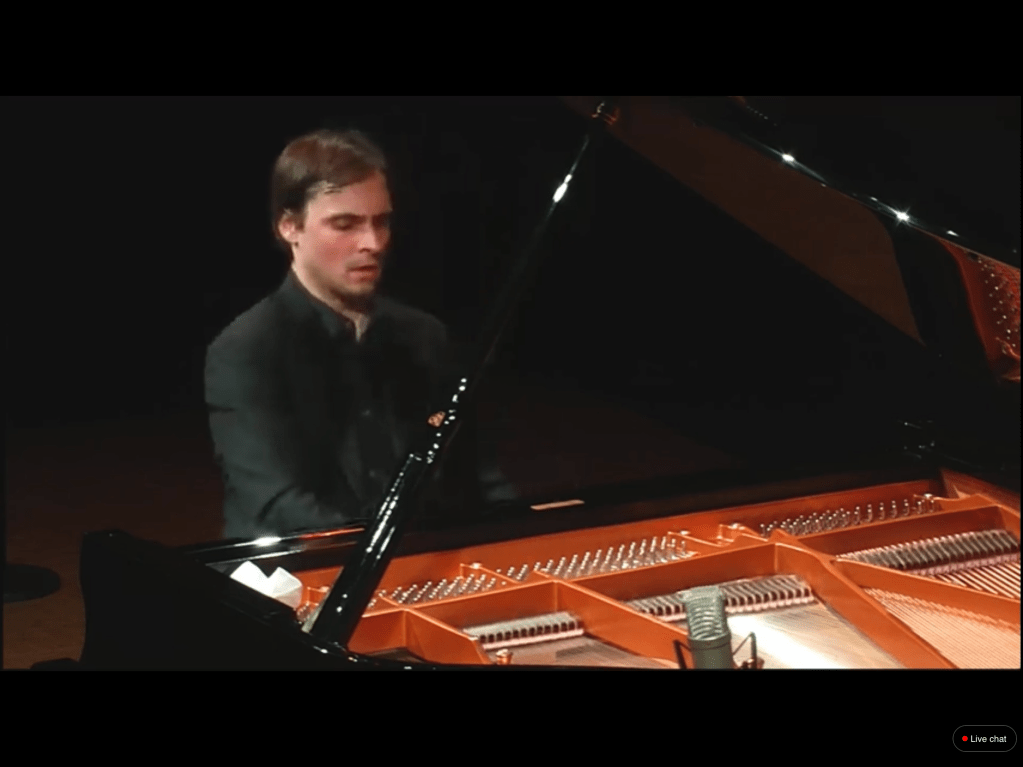
https://christopheraxworthymusiccommentary.com/2022/03/16/the-czech-philharmonic-with-semyon-bychkov-and-yuga-wang-illuminate-and-inspire-in-a-moment-of-crisis-and-suffering/

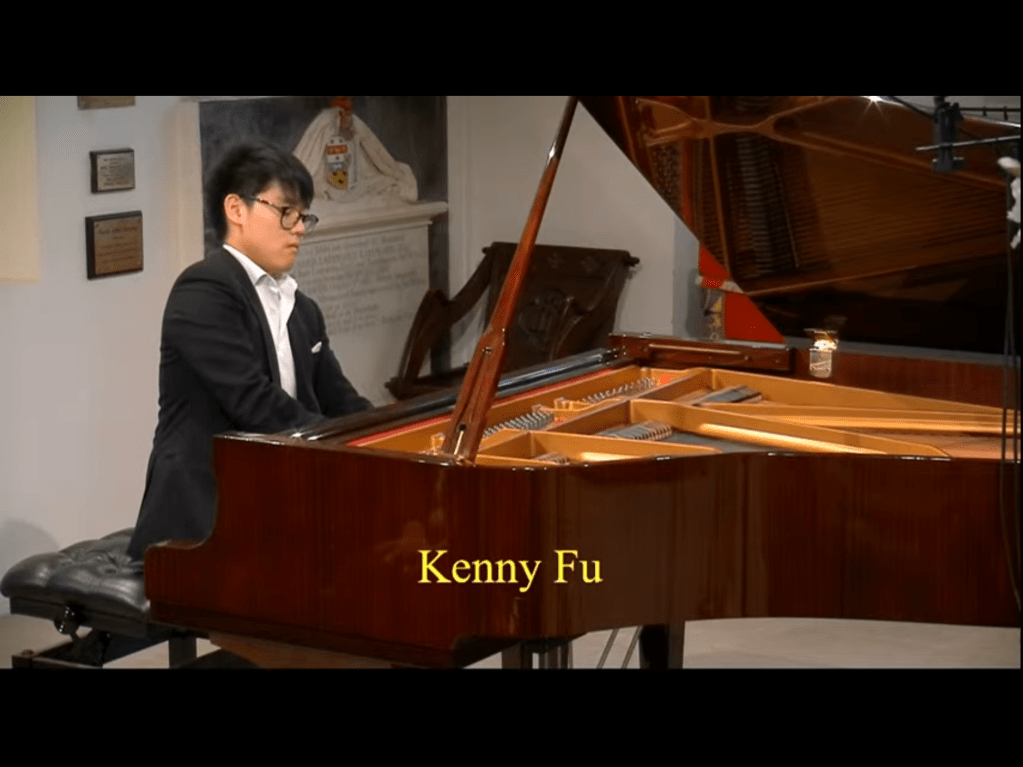
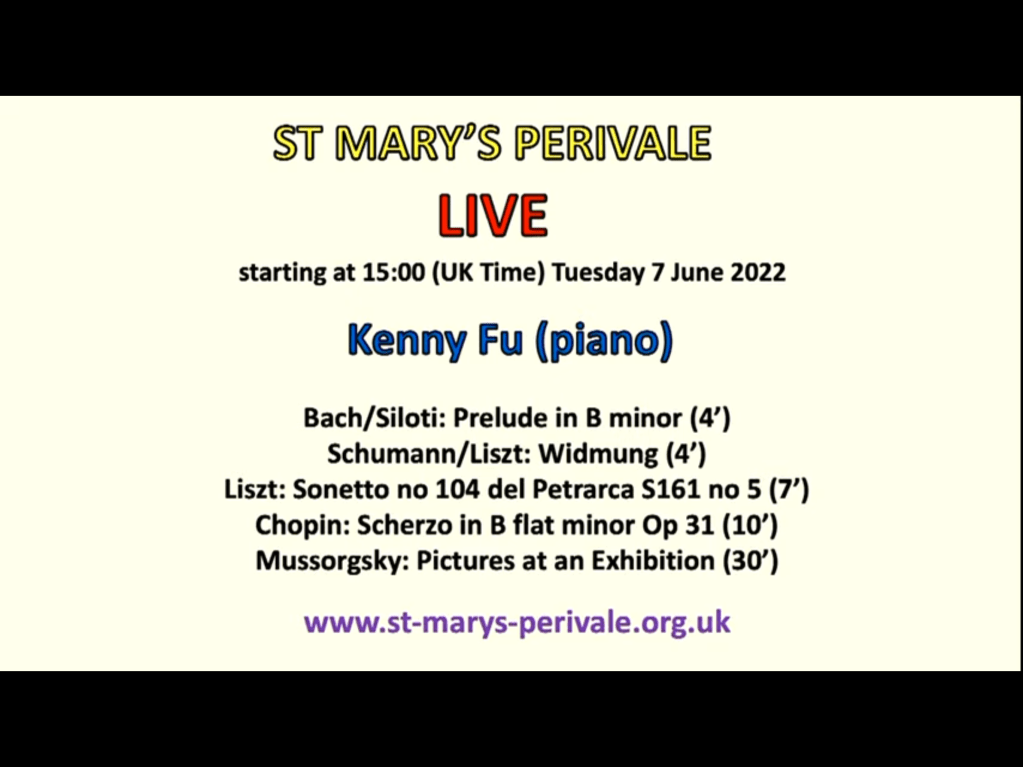
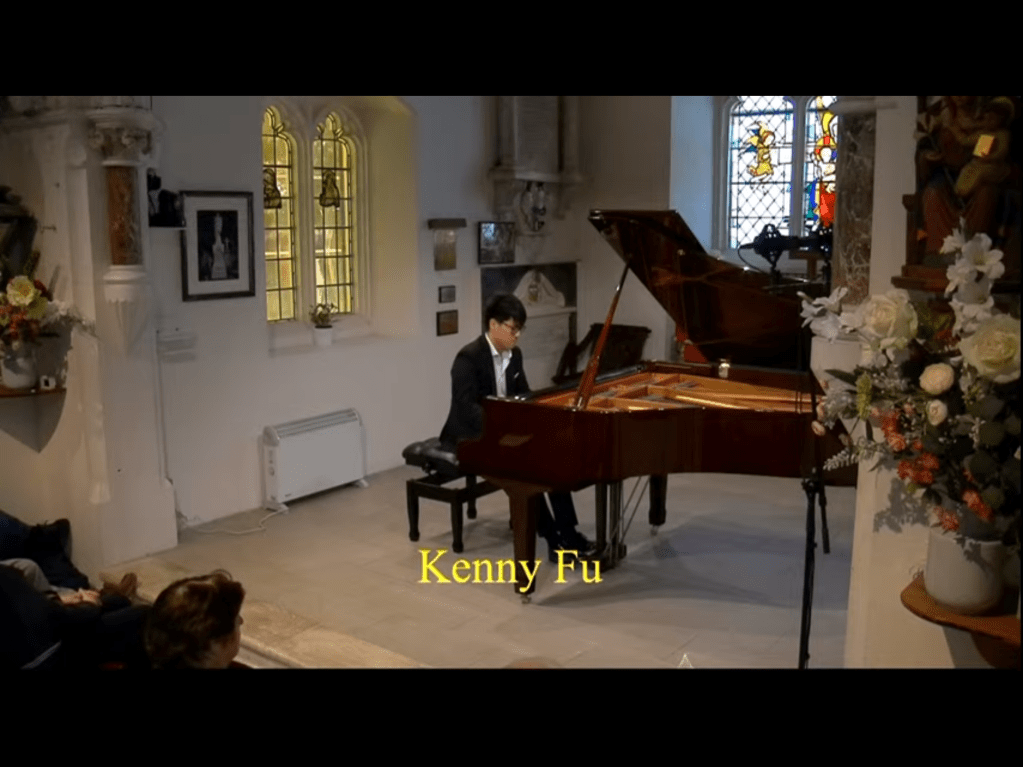
Kenny Fu the making of an artist with poetry and intelligence at St Mary’s

Tuesday 7 June 3.00 pm

https://youtube.com/watch?v=W7i_lhftmOw&feature=share

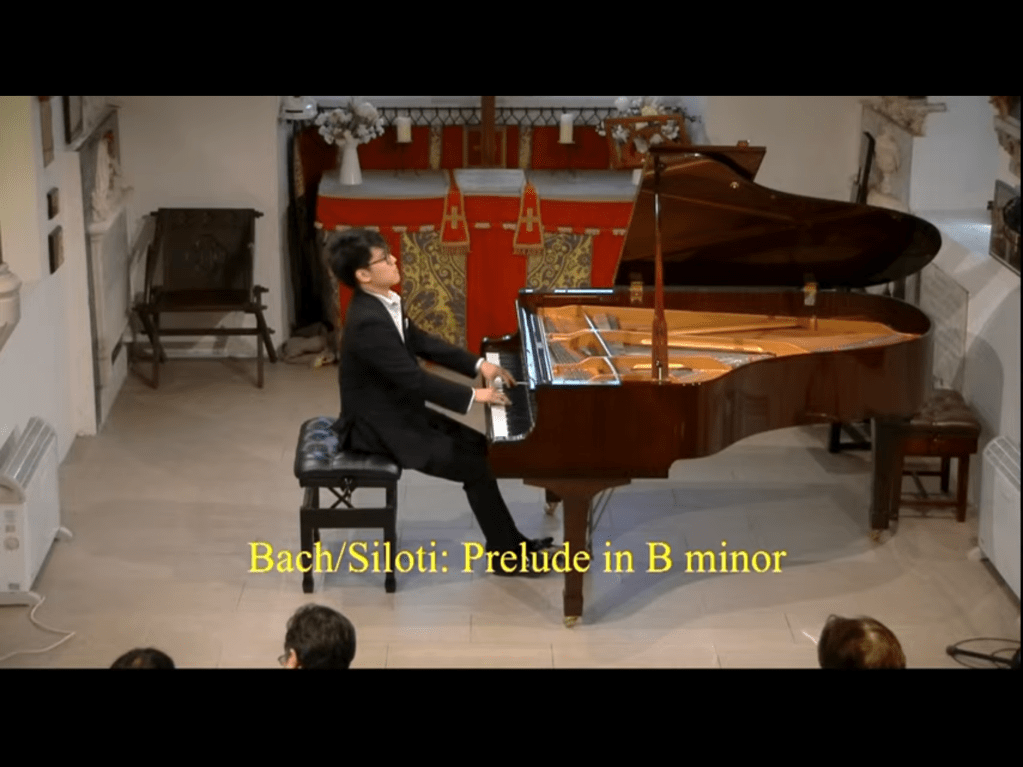
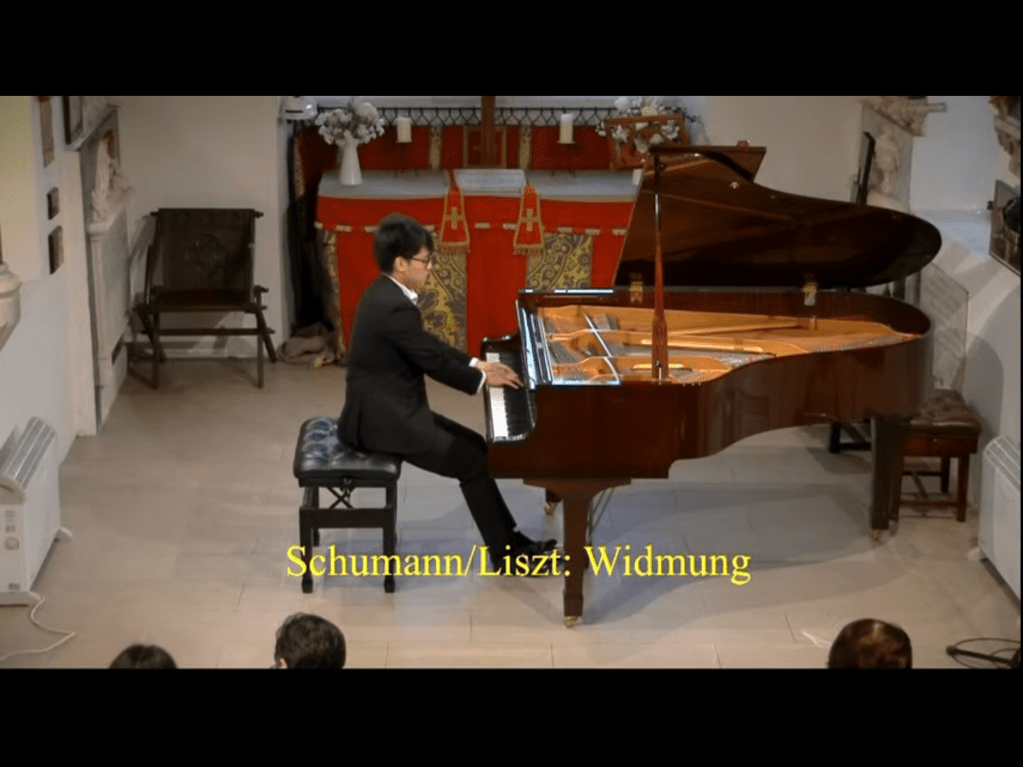
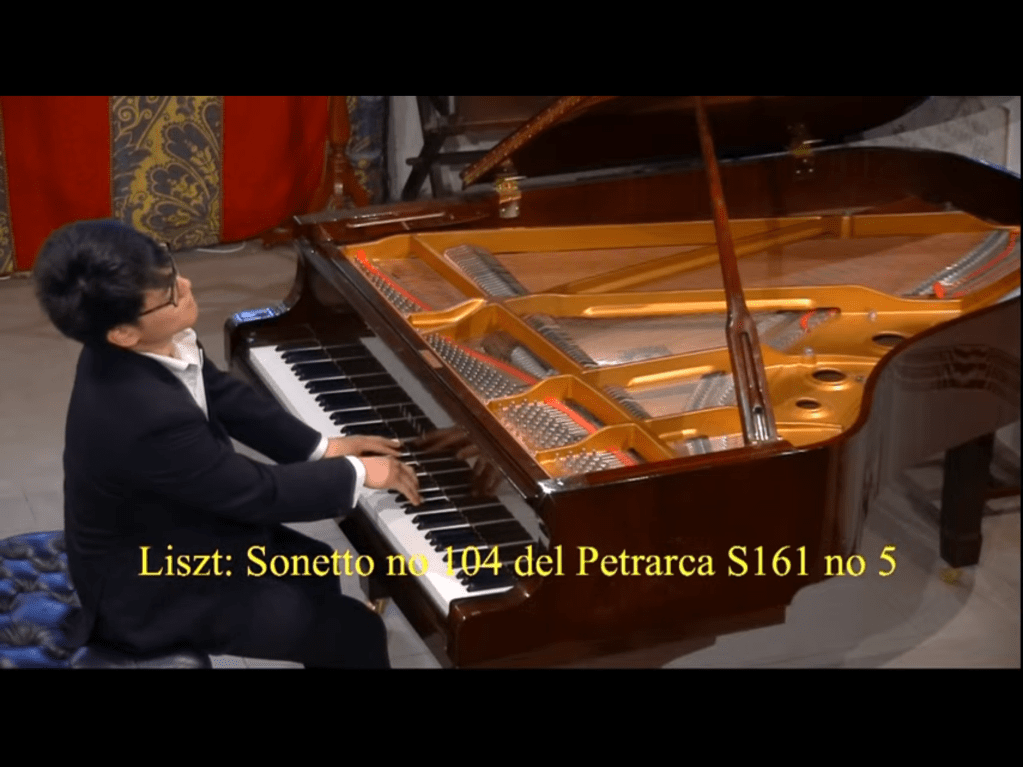
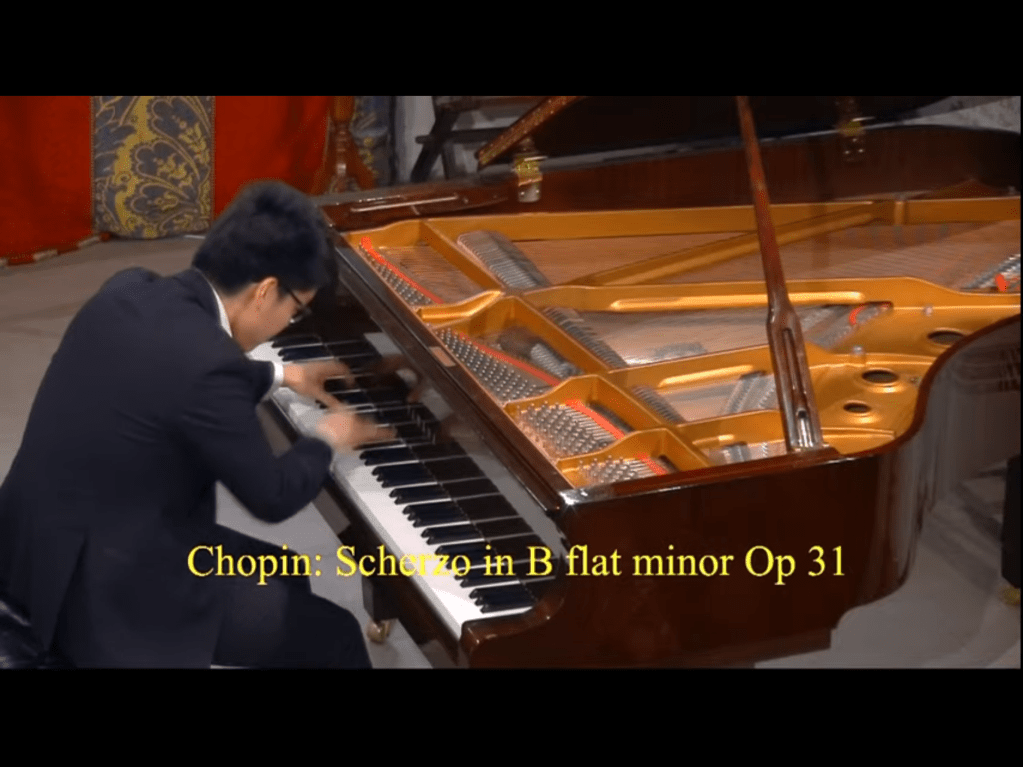
Some magnificent playing not only the ravishing beauty of a continuous outpouring of song with Liszt’s poetical transcription of Widmung and the Petrarch Sonnet 104 but there was from the very first notes the mystical magic of Siloti’s B minor Prelude and a Chopin Scherzo of aristocratic authority and excitement.
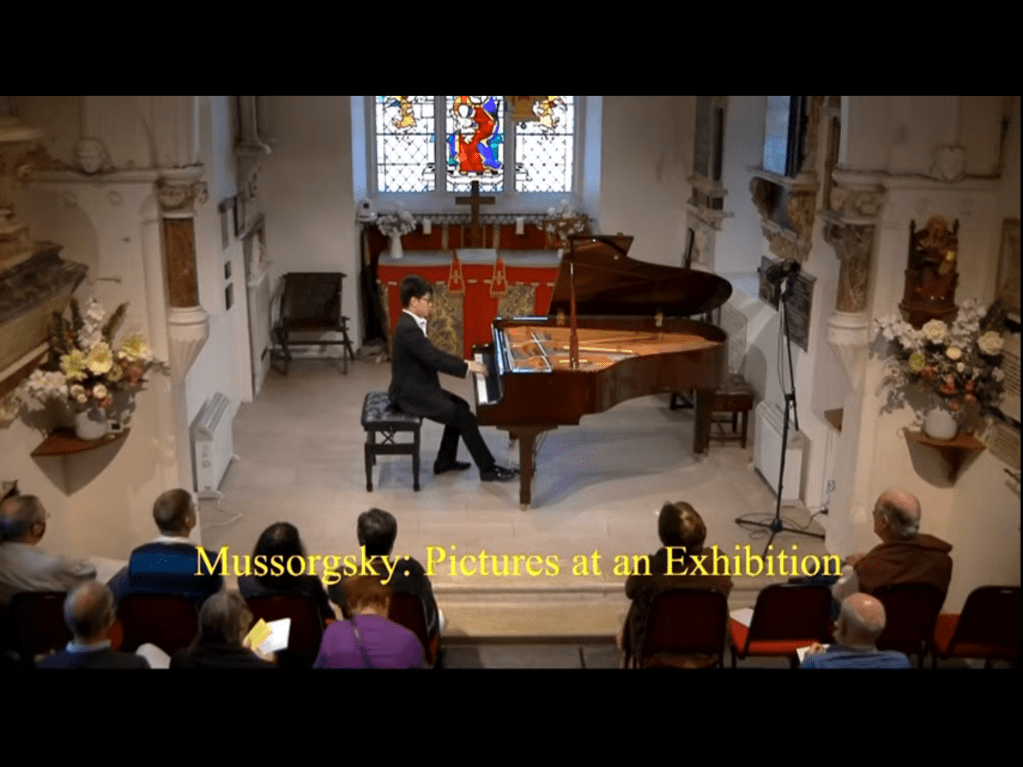
It was,though,the grandeur allied to a sense of character and architectural shape that he brought to Mussorgsky’s ‘Pictures’ that was so overwhelming .
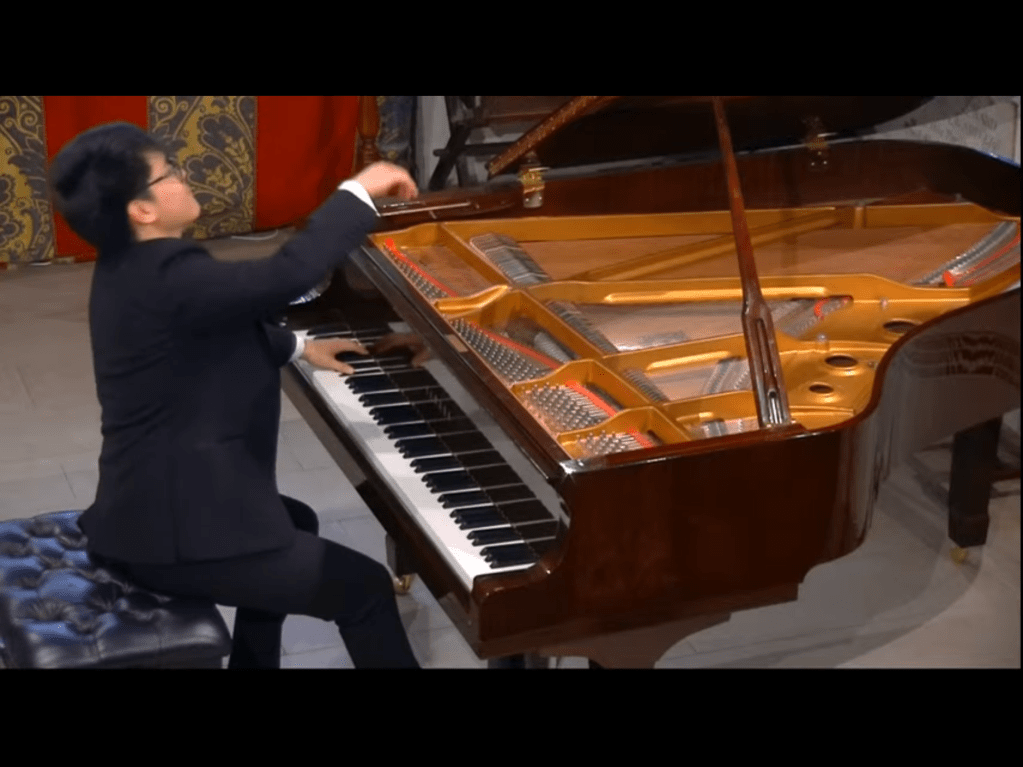
To see this teenager touch and caress the keys as only a true artist could do brought to mind what Schnabel said of Mozart …too easy for the young and too difficult for adults.
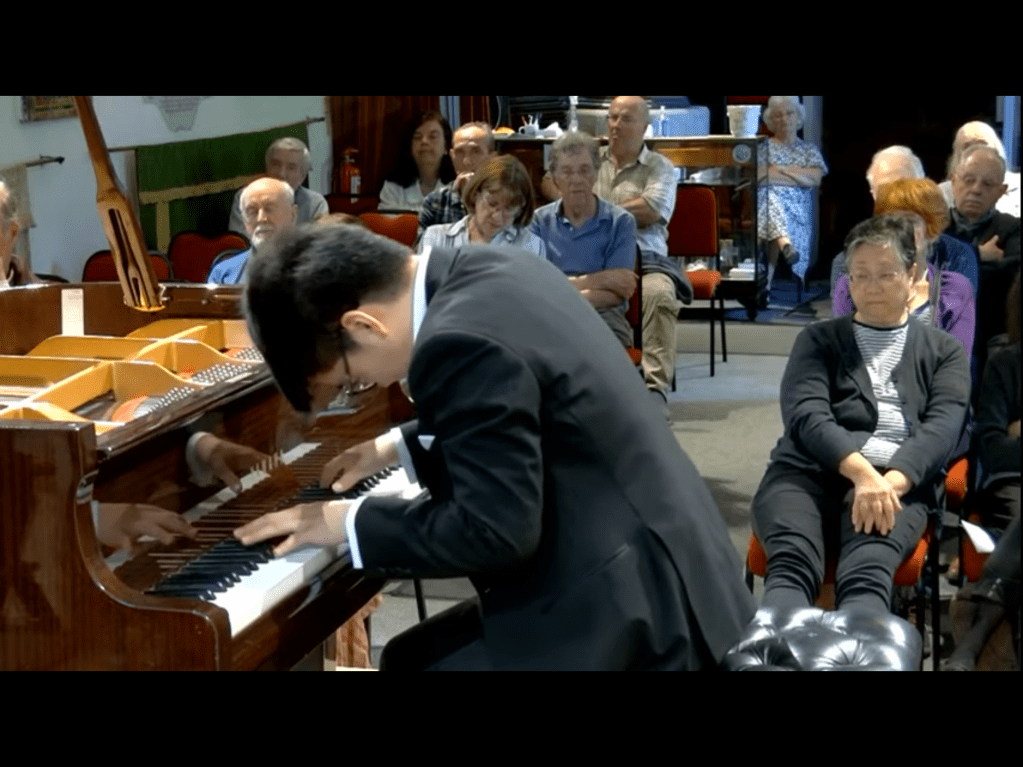
Here was a young man with an orchestra in his ten fingers but it was his natural way of using his arms and body and the way he would withdraw his hands as though out of water that was of a born artist.
Of course being helped and nurtured by the Alexeev’s means his natural gifts will be transformed into great artistry of which Ealing can again be very proud.

It was the simplicity and luminosity of sound that was immediately apparent as this young man caressed the keys with such natural flowing movements.The entry of the chorale melody was of unforced beauty as his sense of balance and colour was of a rare sensitivity.Although he did not have the creamy rich sound of Gilels or the whispered concentration of Pisarenko he had a personality of unmistakeable authority in someone still so young.
A real tone poem and a continual outpouring of love of Robert for Clara who at last in 1840 could marry dedicating this beautiful song op 25 n.1 to her as a wedding present.Kenny found all the subtle poetry in a continual outpouring of beautiful sounds.His sense of balance in the central episode where the melodic line floats of a bed of romantic chords was of a pianist who listens carefully to the sounds he is making and is able to follow the musical line without it ever being submerged by an ever more passionate accompaniment.Freedom and control .Passion and intelligence.Remarkable sensitivity for a young man where life is only just beginning to open up.
Such improvised freedom to the opening with the beautiful melodic line passing from soprano to tenor with just barely suggested harmonies.Bursting into a great outpouring of song played with passion and a natural flexibility where the embellishments were thrown off with the same ease and shape of a bel canto singer.Some ravishing colours with a liquid purity in the coda of luminosity and mystery.
A performance of this well worn masterpiece restored by this young man to the pinnacle of the romantic repertoire.An aristocratic control and sense of style where Chopin’s often disregarded indications were restored to their rightful place.The beauty of the tenor line in the central section was answered by the crystalline delicacy of the soprano embellishments as it gradually built in excitement and technical difficulty.An ease of playing even in the most challenging passages gave an overall architectural line from the first to the last notes.And what excitement and power there was in the final exhilarating pages played by this young thinking virtuoso.
A extraordinary performance where this young man had been able to show us each of the pictures full of character and colour but at the same time had seen a greater picture,that of a monumental gallery.From the sudden dramatic appearance of the ‘Gnome’ to the subtle mystery and colour of the ‘Old Castle’.The clarity of the children quarrelling in the Tuileries with it’s quixotic central episode.The great authority he gave to ‘Bydlo’ moving forward like on a great wave.The rhythmic energy and precision he gave to the ‘Ballet of the unhatched chicks’ was contrasted with the great booming voice of Samuel Goldenberg with the beseeching luminosity of Schmuyle.There was amazing technical control in the ‘Market of Limoges with its exciting climax ending in the desolate emptiness of the Catacombs with the magic sounds of the ‘dead in a dead language’.’Baba Yaga’ bursting on the scene with such power and technical assurance with some magical orchestral colours in the mysterious central section.The Great Gate of Kiev that has taken on great significance in these last 100 days was given a remarkable performance .The gradual tolling of bells are those that we are all longing to hear as this young man built up the sounds with a transcendental sense of balance allowing the final great declaration to ring out with such sumptuous full rich sounds.It was the same beauty of sound that had been a hallmark of the entire recital by this young aspiring poet of the piano.

From his early solo debut at the Wigmore Hall to his attainment of the prestigious Sir Elton John Scholarship, Kenny Fu holds much potential and promise for a bright future. Kenny is currently completing his undergraduate studies at the Royal Academy of Music under the tutelage of Professor Tatiana Sarkissova. He has also received guidance from numerous esteemed musicians such as Dimitri Alexeev, Pascal Devoyon, Imogen Cooper, Bernard d’Ascoli and Angela Hewitt. His repertoire choices gravitate toward the late Classical and Romantic Eras where he brings an intense and captivating temperament to the works of Beethoven, Brahms and Rachmaninov. Kenny has found success throughout the UK and was recently a semi-finalist at the Sussex International Piano competition. During his earlier years he was the winner of the Solihull Young Musician of the Year and a Quarter Finalist at the BBC Young Musician of the Year. His reputation as a musician has also extended internationally where he was a silver medalist at the Cyprus International Piano Competition and a semifinalist in the Brescia International Piano Competition. Kenny has performed in distinguished halls such as the Fazioli Concert Hall in Italy, the Wigmore Hall in London, Kings Place, St Martin-in-the-Fields, and gives several charity concerts at local venues. He has also had the opportunity to give concerts in Germany, Italy and Canada.
Kenny is looking forward to his Postgraduate studies at the Royal Academy of Music where he has been accepted with a substantial scholarship.

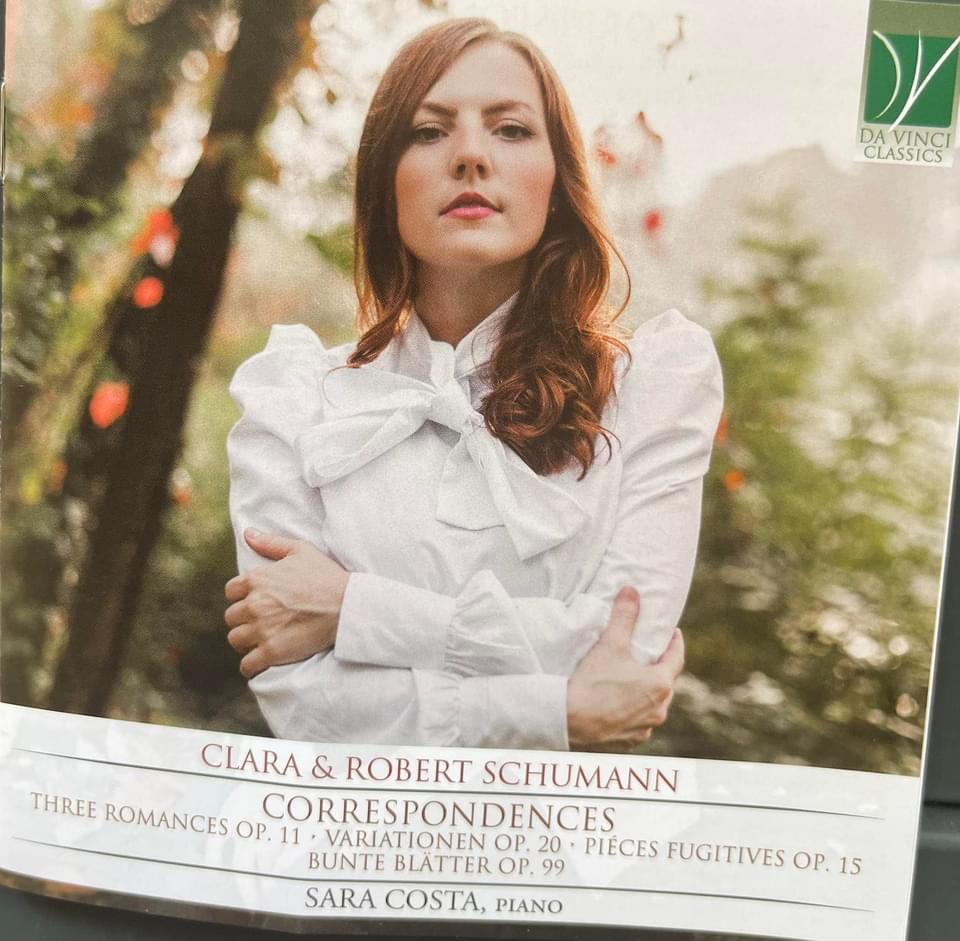
Sara Costa’s spellbinding story of Clara Wieck- Robert Schumann-Johannes Brahms – the eternal triangle

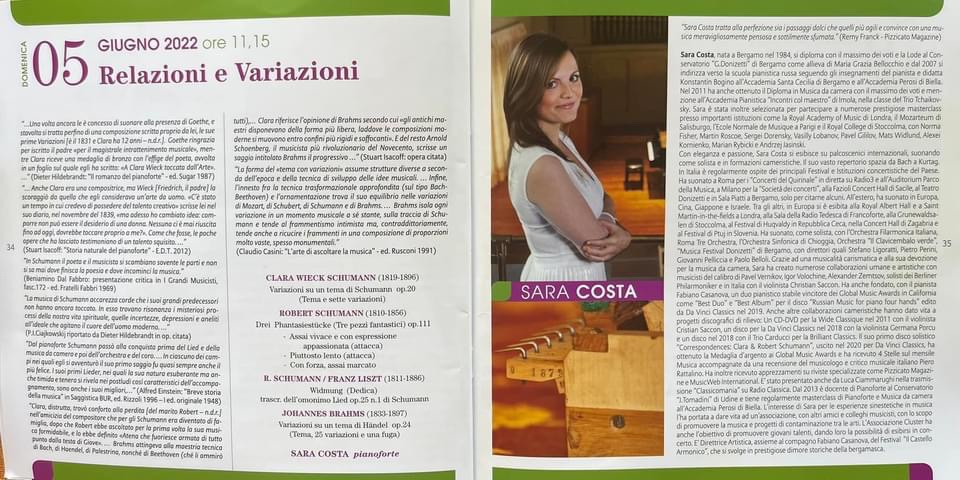
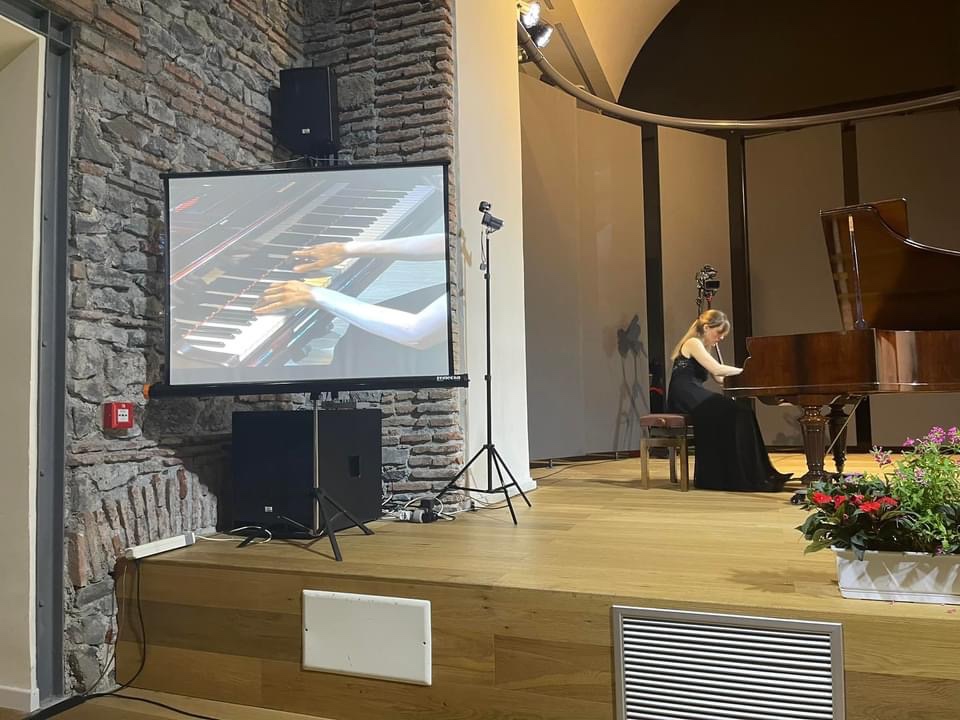
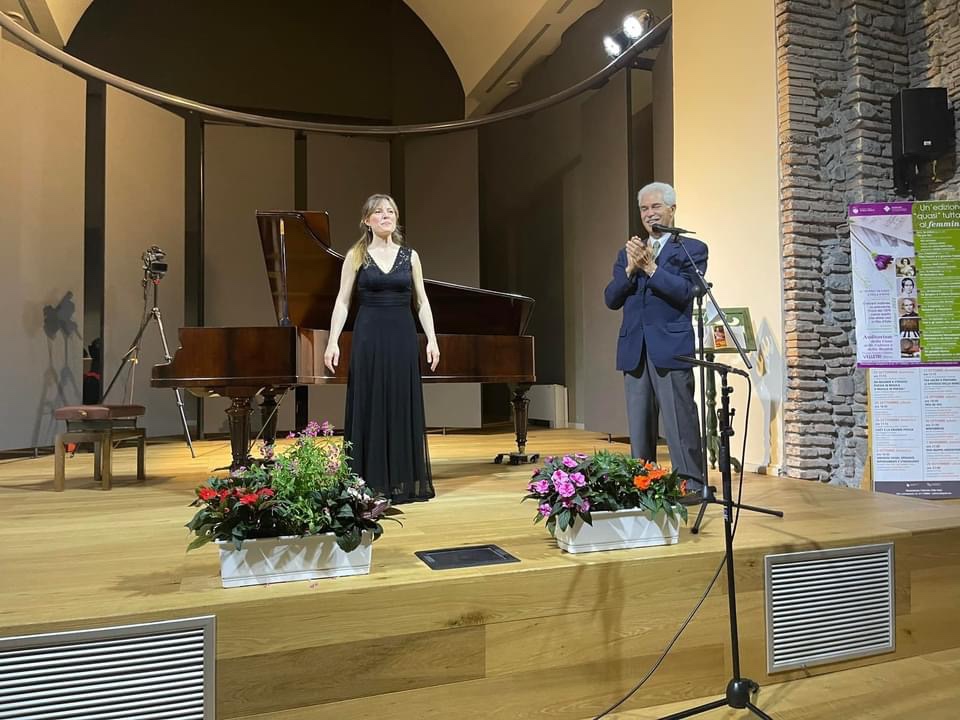
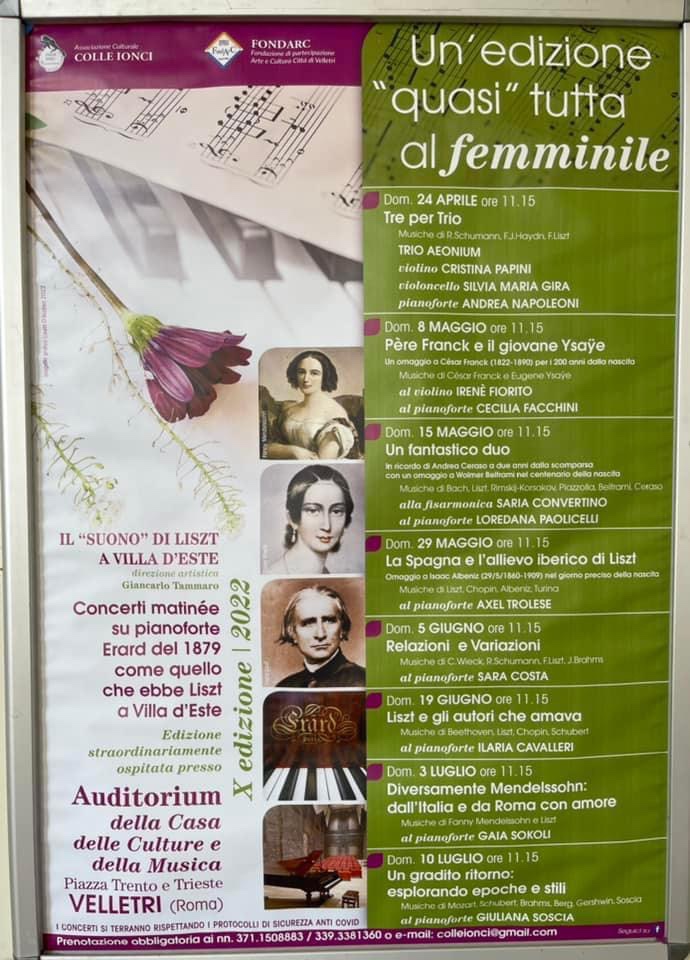
The fifth in a series of eight concerts that Giancarlo Tammaro has organised with such loving care.A recital by Sara Costa with the genial title of ‘Relations and Variations ‘ promoting her recent CD of piano works by Clara and Robert Schumann.A very clever mixture of compositions from the love triangle of Clara,Robert and Johannes.

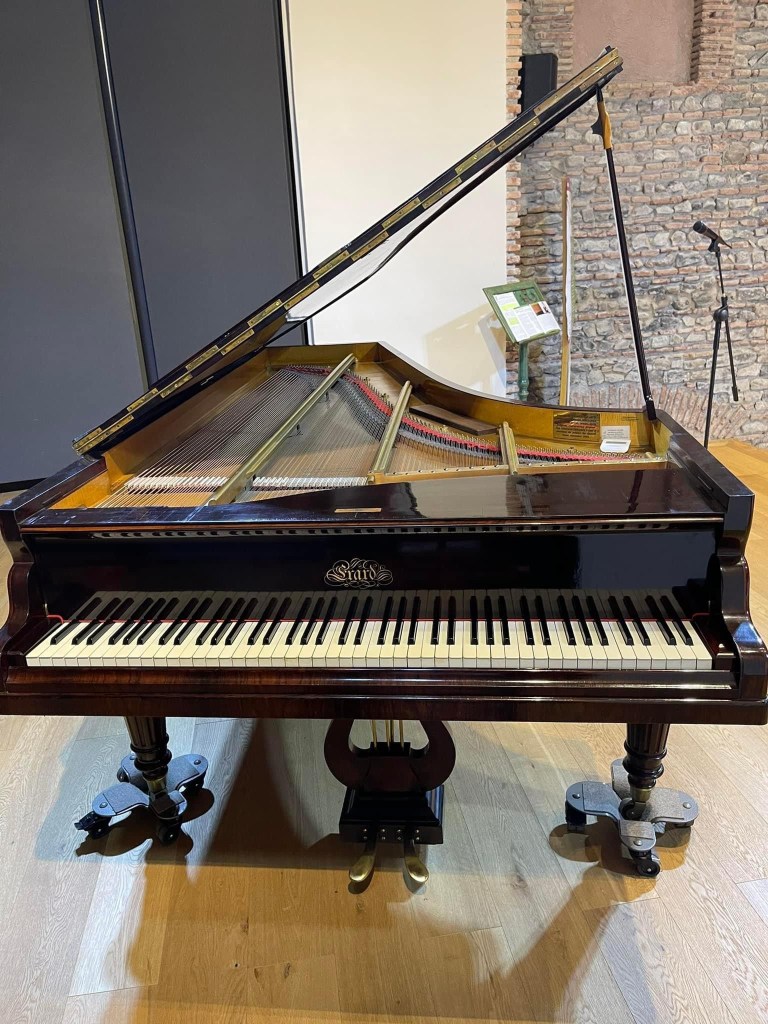
This is the tenth edition of an annual series of concerts that were born in the Villa d Este in Tivoli for the 200th Anniversary of the birth of Franz Liszt.The star of these concerts is the 1879 Erard piano lovingly restored,allowing the extraordinary sound of this preferred piano of Liszt to be heard once again in the hills overlooking Rome where Liszt was a regular visitor whilst on the ‘Grand tour’ or taking holy orders in Rome.

Every year Ing.Tammaro produces a comprehensive programme full of fascinating information about the composers and the soloists not to mention their link with the hills around Rome.

Now in the last few years the concerts have taken place in the restored sixteenth century Carmelite Convent in Velletri.And what an oasis of culture it is!A haven of peace,beautifully restored,and the ideal place to house Ing Tammaro’s much loved Erard piano.

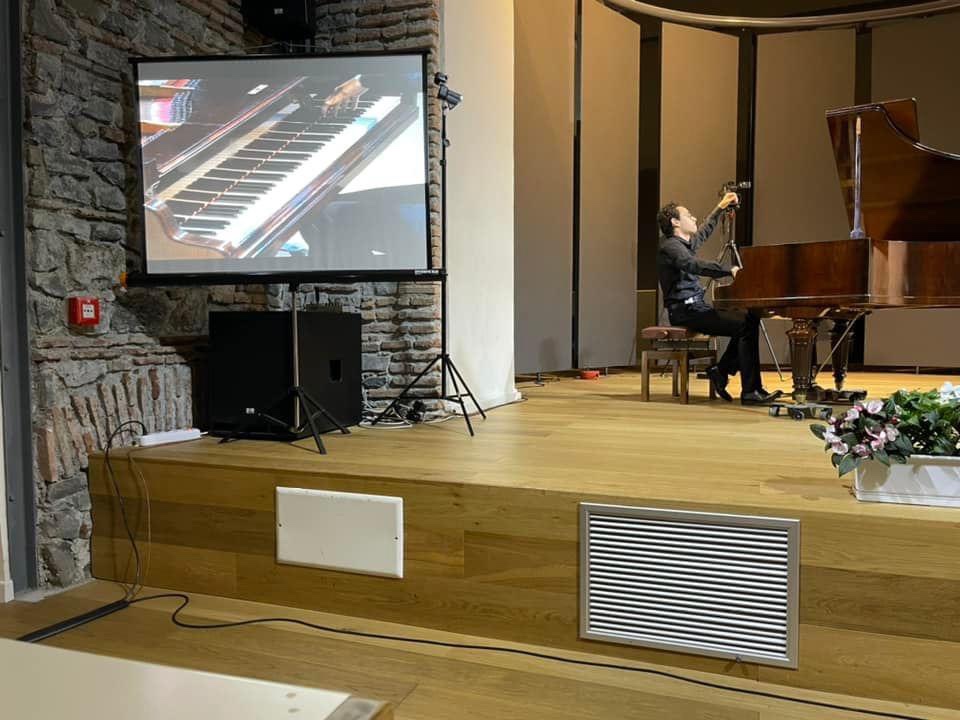
Whilst all around on the plains below the beaches are full of holidaymakers enjoying the sun,we are able to listen on Sunday mornings from April to July to some remarkable young performers.An eclectic choice of programmes not only on a historic instrument but with sophisticated video cameras that allow us to appreciate -up close- the artistry of the artists as they bring the instrument back to life.This year the ‘theme’ is dedicated to ‘nearly all’ female performers to compensate for their unintentional exclusion from many of the previous editions.So not only some very fine female artists but also a revaluation of two female composers in particular :Clara Wieck Schumann and Fanny Mendelssohn.

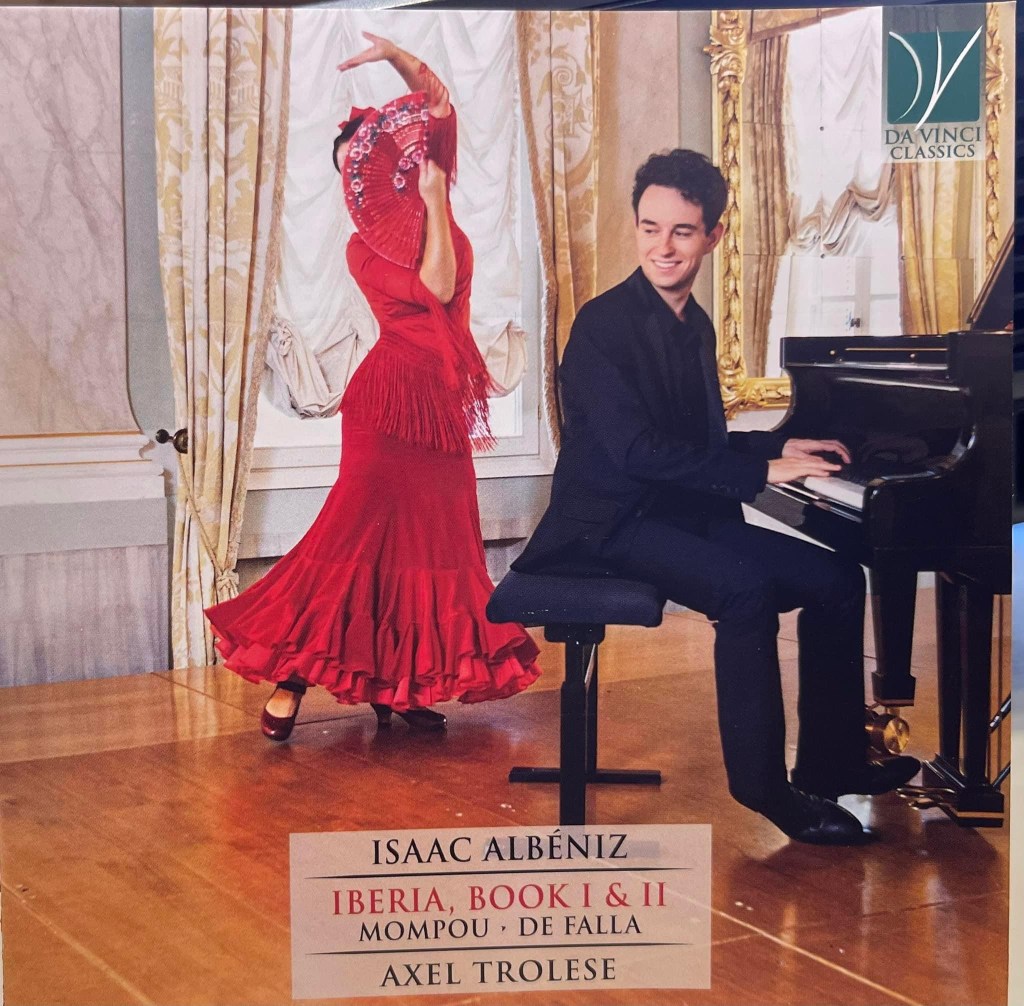
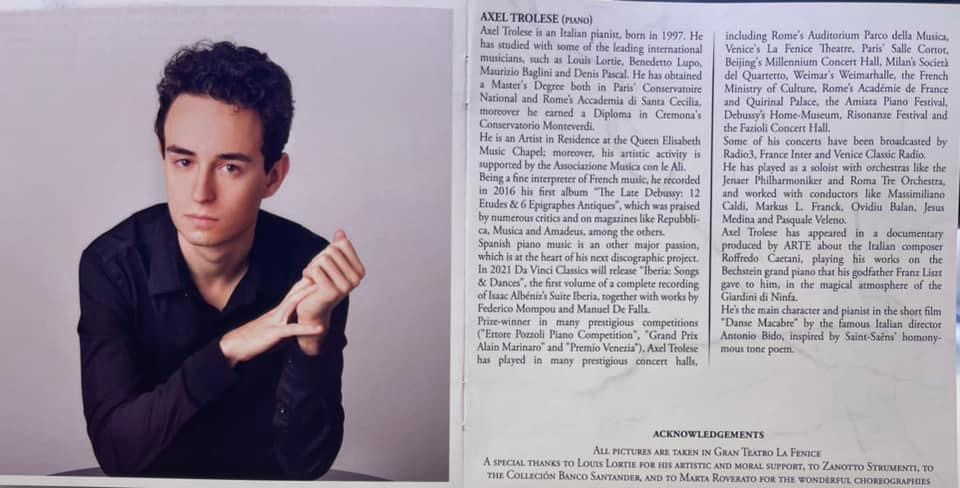
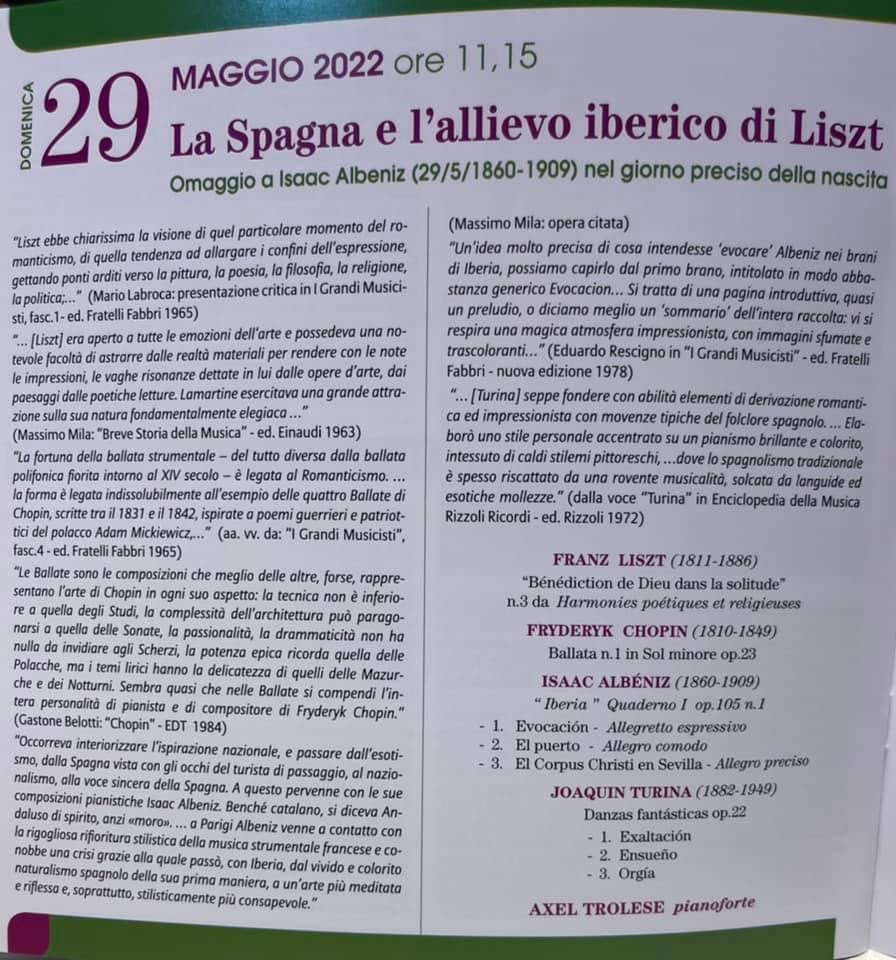
Axel Trolese was the only exception this year as Ing Tammaro wanted to help launch his new CD dedicated to Albeniz and his concert coincided with the exact birthday of the composer on the 29th May.Axel is also a local ‘lad’ from the nearby town of Genzano who after his studies with many great masters is ready himself for international recognition.
https://christopheraxworthymusiccommentary.com/2022/05/29/axel-trolese-illuminates-liszts-erard-with-supreme-artistry-and-passion-in-velletris-convento-del-carmine/

The Variations on a theme of Schumann op 20 is one of the last Clara composed for piano and opened this fascinating programme today.Clara had presented the variations to Robert for his 43rd birthday in 1853,the last he was to spend at home with his family.He died in a mental institution only three years later.Clara having written many works before her marriage since when her family and concertising took up all her time.She had born Robert eight children!So it was with hesitation that she dedicated this work to Robert based on one of his ‘Bunte Blatter’ op 99 n. 4 (Inspired by this example, Brahms composed his own Variations on a Theme by Robert Schumann Op.9 and dedicated them to Clara).The Theme and seven variations immediately showed off not only the artistry of Sara but also her musicianship as she built up the variations whether they be in great octaves ,ravishing jeux perlé embellishments or the beauty of harp like arpeggios spread over the entire keyboard.Always there was the harmonic structure born on the bass that gave her such freedom and at the same time a sense of architectural line where each variation grew out of the previous.There was a coda of rare atmosphere and subtle beauty of refined playing where the mellow tones of this piano just added to the overall melancholy voice of this final gift of Clara to her beloved Robert.

Following Schumann’s move to the Rhine, where he had become the musical director of the Düsseldorf Music Society, times became hard for him. Despite several initial successes, he increasingly encountered resistance from notabilities, musicians and the public. He thus worked all the more intensively at home on his new works. “R. has composed three piano pieces of a very serious, passionate character, which greatly please me”, Clara Schumann wrote in her diary in September 1851. Three contrasting pieces op 111 are gradually making their way more often into the concert hall .I had first heard them when Cherkassky played them in my series in Rome as a prelude to the Liszt Sonata.The ‘assai vivace’ is a whirlwind of continuous outpouring of romantic sounds played with great rhythmic energy and sweep.Contrasting with the ‘piuttosto lento’ of Schubertian character played with a very subtle sense of line of mellifluous sensitivity.Her sense of balance allowed the melodic line to be shaped with ravishing care and beauty.The bucolic Con forza was played with rhythmic energy but always with a sense of melodic line with its boisterous tenor melody passing to the soprano with Schubertian elegance.

Widmung is much more than a mere showpiece – containing the most passionate music full of heartfelt feelings. Written by Robert Schumann in 1840 ,it is the first from a set of Lieder called Myrthen, Op.25 dedicated to Clara Wieck as a wedding gift when finally he married her in September 1840,despite the opposition from Clara’s father (who was also Robert’s piano teacher). It was later arranged for piano solo by Franz Liszt. It starts with a flowing sense of pulse, while the first phrase (“Du meine Seele, du mein Herz”) already captures Schumann’s love for Clara and devotion to the relationship. Here, Schumann sincerely confesses to Clara, declaring how important she is to him. For him, Clara is his angel, his spiritual support, and his entire world. Nevertheless, there is still a sense of fear and insecurity in the music, due to separation and uncertainty about their future. This complex mixture of feelings, as a true and full-bodied representation of love, certainly strengthens the emotional power of the music.Liszt lengthened the first section by repeating the first theme, but with the melodic line mostly embedded in left hand (with some intertwining) and accompaniment in higher register. Then, the music moves on to the chordal section in E major, which is unchanged in Liszt’s arrangement. The repeated chords convey warmth, tenderness and peace, especially when the text here is associated with death and heaven. Here, the love has changed into everlasting, eternal one – love that transcends space and time.Schumann’s love for Clara becomes so dramatic and uncontrollable, and eventually erupts – a perfect combination of rapture, passion, commitment and sense of elevation. With ecstatic joy, the music transforms into a declaration, as if Schumann is announcing that he is determined to spend the rest of his lifetime with Clara and willing to make sacrifices in the face of adversity, for Clara is an indescribable miracle of his life.

Sara played it with a gentle fluidity with sensitivity and forward movement like a a great wave as her circular movements became ever more agitated the passionate outpourings of great virtuosity spread over the entire keyboard.The great climax dissolving to a mere whisper as this miniature tone poem had run it’s loving course and there was left only the refined gentle caresses of Sara Costa’s true artistry.

Flowers from Ing Tammaro and by great request a repeat of Widmung for an enthusiastic public at the end of her concert which she played as a second encore.

The Handel Variations were written in September 1861 after Brahms, aged 28, abandoned the work he had been doing as director of the Hamburg women’s choir (Frauenchor) and moved out of his family’s cramped and shabby apartments in Hamburg to his own apartment in the quiet suburb of Hamm, initiating a highly productive period that produced “a series of early masterworks”.Written in a single stretch in September 1861,the work is dedicated to a “beloved friend”, Clara Schumann, widow of Robert Schumann.It was presented to her on her 42nd birthday, September 13 1861.Barely two months later, in November 1861, he produced his second set of Schumann Variations, Op. 23, for piano four hands.

A performance of great power and architectural shape where the sound was always built up from the bass leaving such freedom but at the same time an anchor of such solidity.It had been the hallmark of a fellow student of my old piano teacher Sidney Harrison at the Royal Academy in London.Norma Fisher was already a very highly esteemed pianist when I was taken to hear her play this very work at the Wigmore Hall and was presented to her afterwards in the Green Room.Our mutual father figure was proud to present her the newly awarded Liszt Scholar!Sara Costa in the Green Room today greeted me with the name of our mutual friend Norma Fisher! Small world,our old teacher would have exclaimed!Sara had studied this very work with her during her studies at the Royal College of Music where she is now a highly sought after pedagogue. https://christopheraxworthymusiccommentary.com/2022/05/12/norma-fisher-at-steinway-hall-the-bbc-recordings-on-wings-of-song-the-story-continues/. There was the same solidity to her playing and a sumptuous rich orchestral sound where the minutest details whilst being played with great sensitivity never took away from the overall shape with the underlying wave giving a sense of direction.I slightly missed the mechanical statement of the Aria where the ornaments should unwind like clockwork springs as this is the theme that Brahms will elaborate in so many different ways.Maybe it was the mellow sound of the piano that here did not have the radiant brilliance that we are used to hearing .It was immediately put to rights though with the very crisp and clear first variation contrasting with the legato forward flow of the second.The shaking of hands in the third was done as Brahms indicates -scherzando and dolce and led to the technical prowess of the ‘risoluto’ octaves played with great drive but being orchestral I would have made them more marcato than staccato.There was great sweep to the fifth variation that led to the delicacy of the legato octaves of the seventh.She brought great nervous energy to the staccato drive of the seventh and eighth leading to the imperious gasps of sustained octaves.The chase from the top to the bottom of the keyboard was done with great brilliance in the tenth variation with the gently expressive eleventh and twelfth before the grandiloquence of the ‘ Largamente ma non troppo ‘ of the thirteenth.Startling technical feats abound in the following variations played with a real sense of character and shape gently arriving at the lilting Scottish dance rhythm of the nineteenth.There was beautiful luminosity of sound in the music box variation before the scintillating drive to the triumphant outpouring of the theme in all its glory.Some extraordinary playing of infectious drive and fearless virtuosity.The clarity of the fugue played almost without pedal at the beginning as it gradually built to a tumultuous climax of quite transcendental difficulty.The extraordinary thing is that we were never aware of the hurdles she was tackling such was the overall sweep and excitement that she was able to generate.An ovation from a very enthusiastic audience was rewarded by another great outpouring of song of great beauty and sensitivity,choosing another from one of Schumann’s last collection of pieces ‘Coloured leaves’- Bunte Blatter

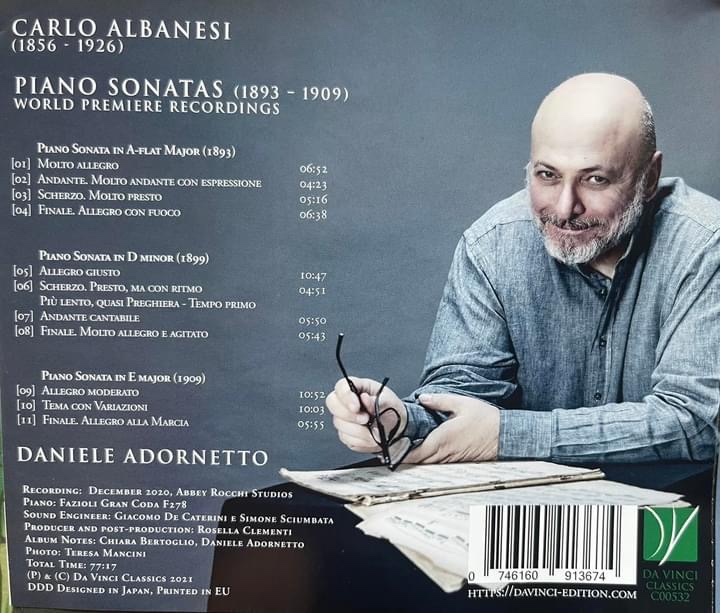
Sara Costa with Daniele Adornetto who has recently made a world premiere recording of Sonatas by the Neapolitan Composer/pianist Carlo Albanesi (1856-1926) who became in 1893 a much respected Professor at the Royal Academy of Music in London much sought after by the nobility for piano lessons.

Fai clic per accedere a ITA-articolo-2022.06.05.B.pdf

David and Diego Romano inspire and ignite Roma 3 Orchestra Ensemble.Michelle Candotti inspires her audience in the Young Artists Piano solo series

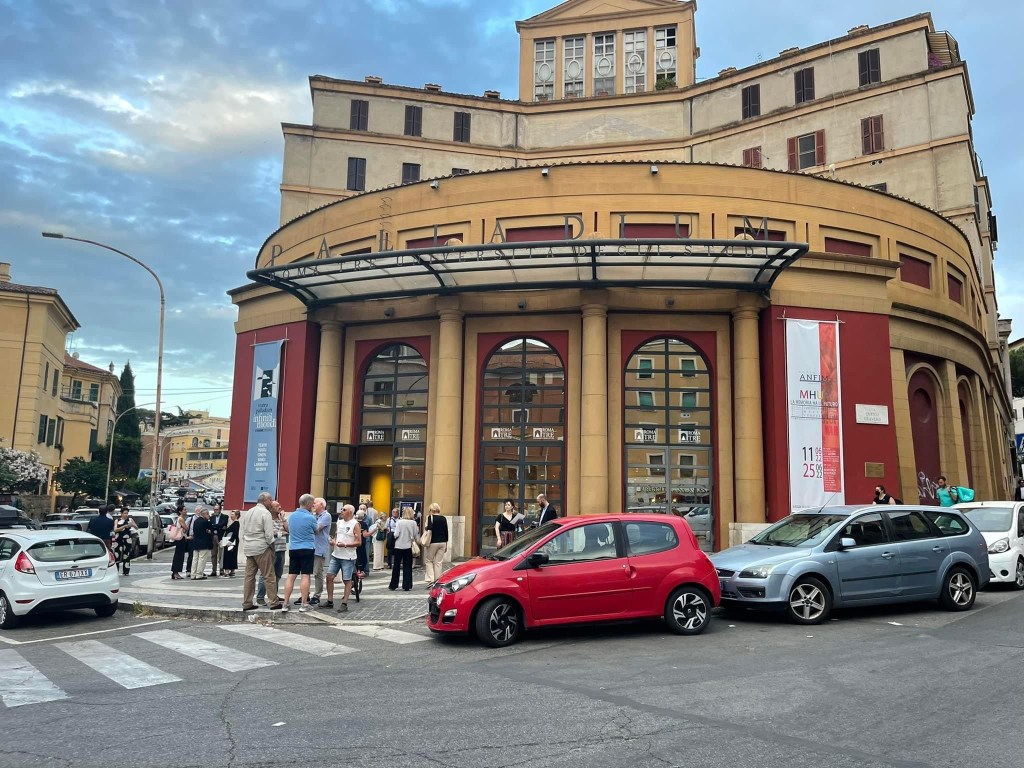
Venerdì 3 giugno Teatro Palladium ore 20.30
Le piace Brahms?
J. Brahms: Serenata n. 1 in re maggiore op. 11 (versione originale per 9 strumenti)
Roma Tre Orchestra Ensemble
David Romano, violino
Diego Romano, violoncello

The final concert in the Spring Season for Roma 3 with even more surprises from Roberto Pujia and Valerio Vicari in their quest to help young talented musicians find a home to share their remarkable talents with a discerning audience in the Eternal City.Not happy with just a series of concerts,they had created sixteen years ago an orchestra made up of musicians who have graduated from their advanced studies and need experience of playing in an ensemble.The Orchestra has gone from strength to strength thanks to the expert musicians that have been invited to share the platform with them.Enrico Bronzi helped form an ensemble that actually listens to itself. https://christopheraxworthymusiccommentary.com/2020/12/18/roma-3-orchestra-comes-of-age-at-teatro-palladium-in-rome/
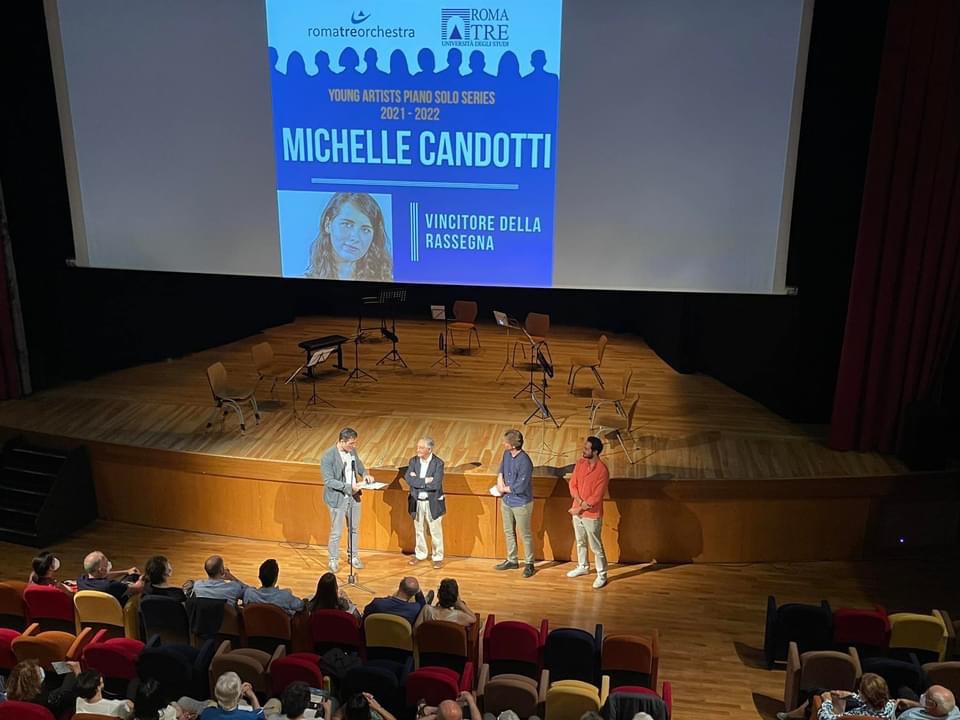
And tonight in the quest to learn and perfect their ensemble,the remarkable Romano brothers had been invited to work together on the rarely performed original version of Brahms Serenade op 11.I had heard David Romano last summer in a chamber music festival held on the beautiful Spada estate in Sutri.

https://christopheraxworthymusiccommentary.com/2021/06/28/rana-and-spada-the-crossing-of-swords-with-sublime-music-making-in-viterbo/
I had not heard him before but his overwhelming participation and music personality ignited the Souvenir de Florence after an equally overpowering performance of the Rite of Spring played by the indomitable Beatrice Rana and her partner Massimo Spada.

This year’s eagerly awaited Festival later in the month

Per la prima volta ospiti della stagione di Roma Tre Orchestra insieme, i fratelli Romano sono due fuoriclasse del violino e del violoncello e ricoprono ruoli di prime parti presso l’Orchestra Nazionale dell’Accademia di Santa Cecilia.

Teatro Palladium seat of the Roma 3 Orchestra

In questo progetto guidano un ensemble di nostri giovani musicisti nella Serenata n. 1 in re maggiore op. 11 di J. Brahms. Questo brano fu inizialmente concepito nell’estate 1858 per nove strumenti (flauto, due clarinetti, corno, fagotto e quartetto d’archi) durante delle vacanze a Göttingen trascorse con Clara Schumann e alcuni amici. Dopo un primo ascolto in occasione di un concerto privato ad Amburgo il 28 marzo 1859 Brahms si convinse che fosse opportuno elaborare anche una versione orchestrale del brano. Si tratta della prima composizione sinfonica pubblicata dal giovane Brahms ed è caratterizzata da un clima sereno e una scrittura contrappuntistica che colpì positivamente i suoi contemporanei. Emerge chiaramente uno sguardo attento al passato: alla forma della fuga così come era stata elaborata da Bach, alla musica da camera di Haydn e Mozart nonché a precedenti formazioni cameristiche originali quali il settimino di Beethoven e l’ottetto di Schubert. Non mancano tuttavia i tratti distintivi di quello che sarebbe stato il personale stile compositivo di Brahms, nella musica da camera come in quella sinfonica.

The two Serenades, Op.11 and 16, represent early efforts by Brahms to write orchestralnmmusic. They both date from after the 1856 death of Schumann when Brahms was residing in Detmold and had access to an orchestra. Brahms had a goal of reaching Beethoven’s level in writing symphonies,and worked long and hard on his first symphony completing it only in 1876 when he was 43 years old. As preliminary steps in composing for orchestra, he chose early on to write some lighter orchestral pieces, these Serenades.

The first serenade was completed in 1858. At that time, Brahms was also working on his first Piano Concerto.Originally scored for wind and string nonet and then expended into a longer work for chamber orchestra ,the serenade was later adapted for orchestra;Brahms completed the final version for large orchestra ?in December 1859.In the orchestration of the Concerto Brahms had solicited and got a great deal of advice from his good friend Joseph Joachim.For this Serenade Joachim also gave advice, although to a lesser extent.The first performance of the Serenade, in Hanover on 3 March 1860, “did not go very well” in Brahms’s opinion,but evidently the unusually large audience of 1,200 did not notice any mistake during the performance. At the end, applause “persisted until I came out and down in front.” After every piece in the concert “the audience was shouting.”This was a vastly better reception than the Piano Concerto had in either of its first two performances. But at its third performance, 24 March, also in Hamburg, it had been a success, perhaps not to the same degree as the Serenade.

The Serenade is in six movements:Allegro molto ,Scherzo,Allegro non troppo – Trio. Poco più moto,Adagio non troppo,Menuetto 1– Menuetto 2 ,Scherzo. Allegro – Trio Rondo,Allegro

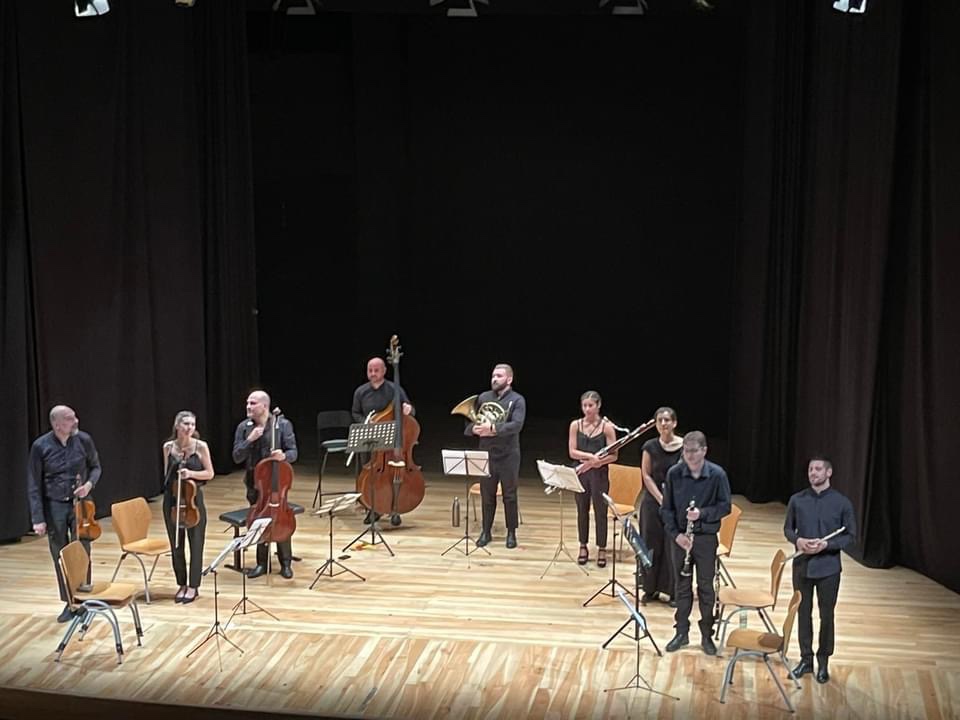
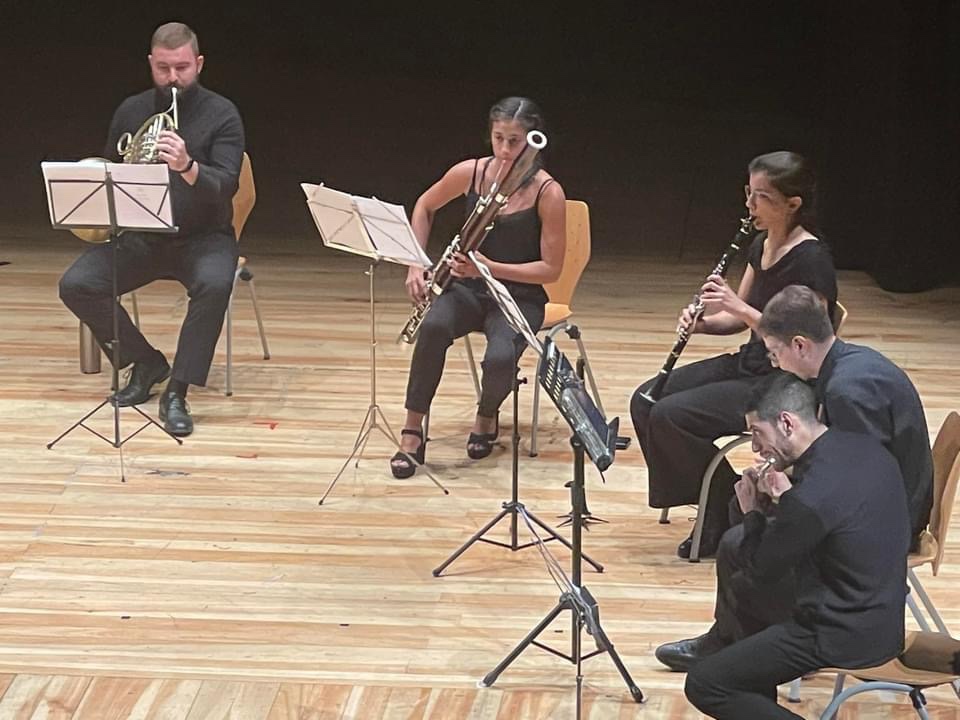
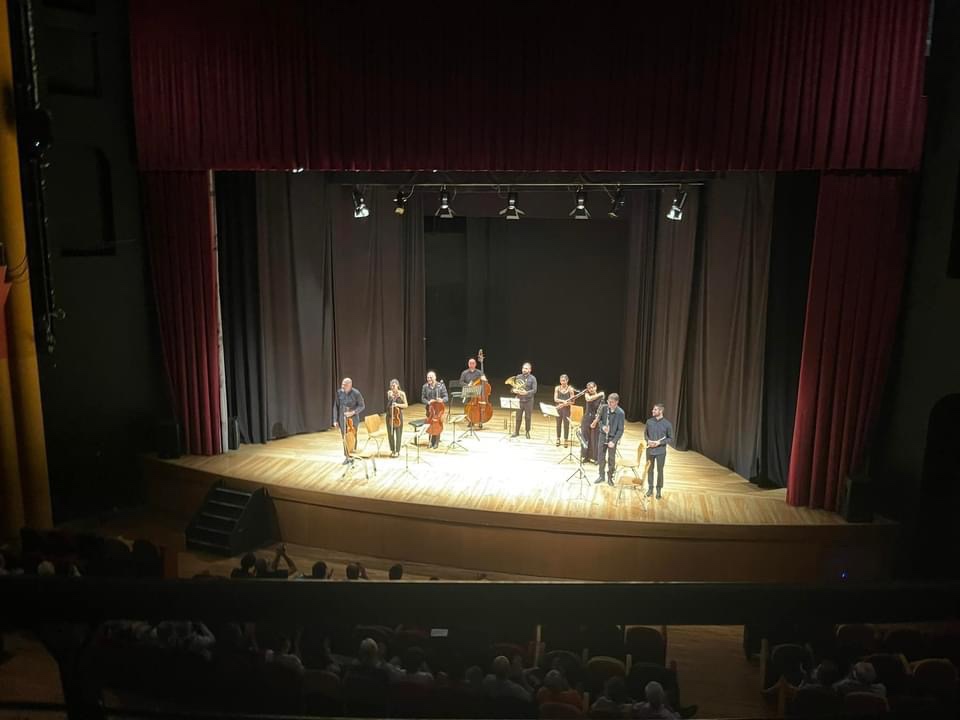
A superb ensemble and as David Romano had said in his introductory talk – whilst the votes were being counted for the audience prize – the horn takes on a pivotal role and is thus seated between the strings in one side and the wind on the other.There was some remarkably authoritative playing from the horn of Gabriele Gregori.And with David and Diego Romano seated between Carlotta Libonati,viola and Daniele De Angelis double bass how could,they not play with the same passion and searing intensity of these remarkable brothers.Valerio Iannini,flute,the two clarinets of Alessandro Crescimbeni and Giuliana Nicotra and the bassoon of Carolina Santana all inspired to bring such mellifluous shape to this early work in progress of Brahms.

The beautiful pastoral of the Allegro molto or the mystery of the Scherzo.The extraordinary opening of the Adagio for just viola,cello and doublebass.The pure charm of the Menuetti and the almost call to arms of the second Scherzo followed by the exhilaration of the hunt in the Rondo.A remarkable performance by an ensemble that played as one thanks to the inspired participation of the Romano brothers who knew how to ignite and encourage with such humility their younger colleagues,allowing them all to reach even greater heights together.

Fascinating too the idea of audience participation for their Young artists piano series during the season at the Teatro Palladium,Teatro Torlonia and the Aula Magna of Roma 3.I had heard a lot of the concerts and know the five finalists well although I had not been able to listen to all their performances in this season.All remarkable young musicians who just need a platform and a discerning audience to share their music with.Hats off to Roma 3 who are gradually building up a following and faithful public who know and appreciate the quality of the performances from these young musicians .And hats off too to an audience who could pin point the remarkable artistry of Michelle Candotti a student of Dmitri Alexeev at the RCM in London.When we met after this concert she was on her way to play to him at his country home near Rieti – small world! https://christopheraxworthymusiccommentary.com/2021/11/13/dmitri-alexeev-mastery-and-communication-beyond-all-boundaries/

https://christopheraxworthymusiccommentary.com/2022/04/18/michelle-candotti-ravishes-and-seduces-the-piano-for-rome-tre-young-artists-piano-solo-spring-series-in-aula-magna/
https://christopheraxworthymusiccommentary.com/2021/09/30/the-rebirth-of-a-global-network-in-cremona-if-music-be-the-food-of-love-please-please-play-on/
https://christopheraxworthymusiccommentary.com/2021/10/23/magisterium-of-marcella-crudeli-takes-viterbo-and-rome-by-storm/
https://christopheraxworthymusiccommentary.com/2022/04/18/michelle-candotti-ravishes-and-seduces-the-piano-for-rome-tre-young-artists-piano-solo-spring-series-in-aula-magna/
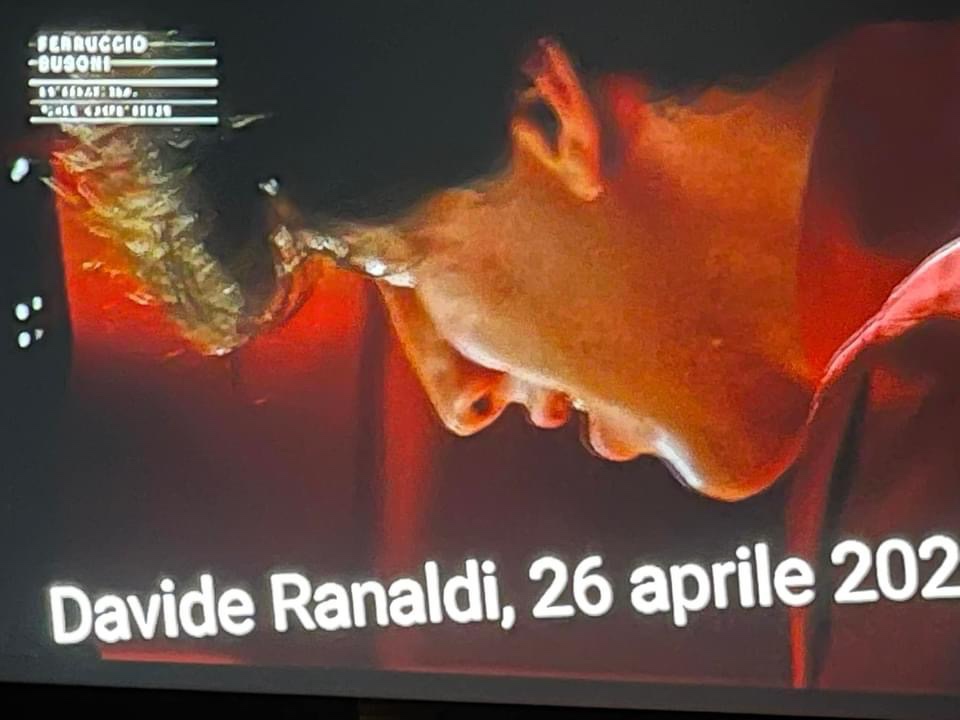
https://christopheraxworthymusiccommentary.com/2022/04/27/davide-ranaldi-astonishes-and-seduces-at-roma-3/
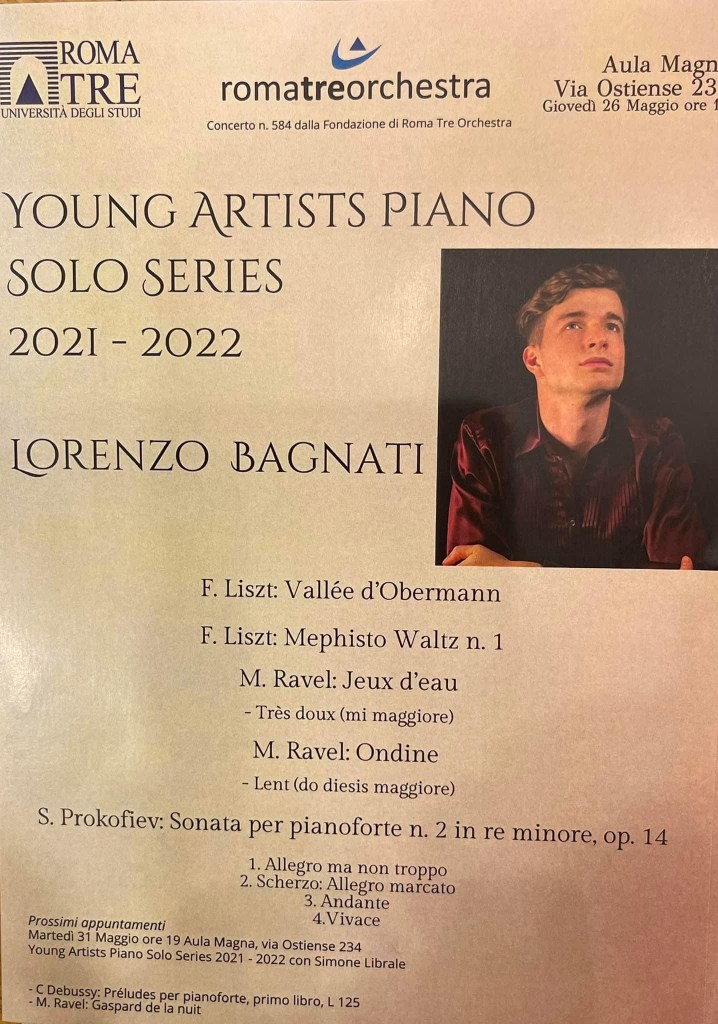
https://christopheraxworthymusiccommentary.com/2022/05/27/lorenzo-bagnati-a-romantic-virtuoso-at-roma-3/
The newly announced summer season

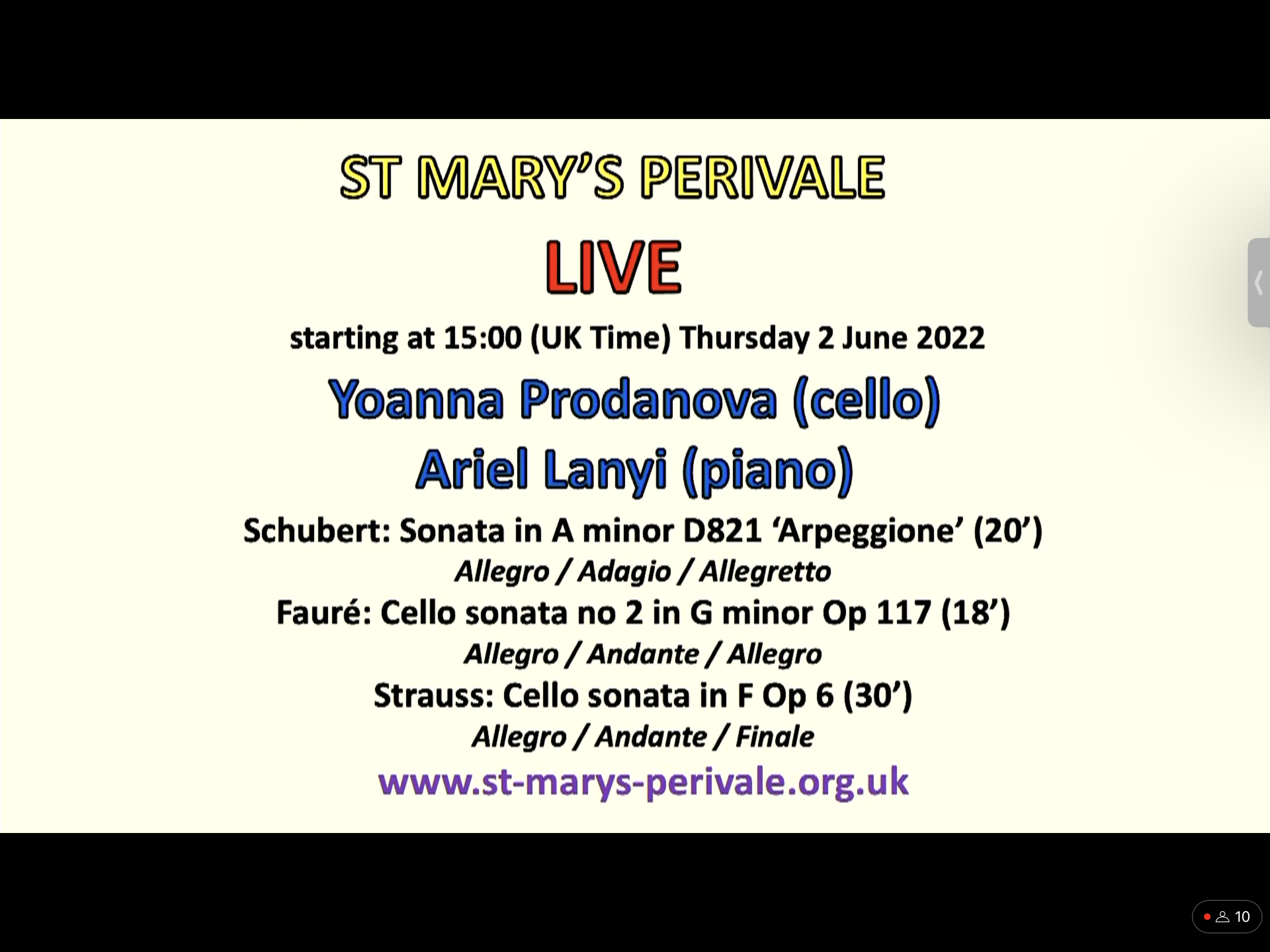
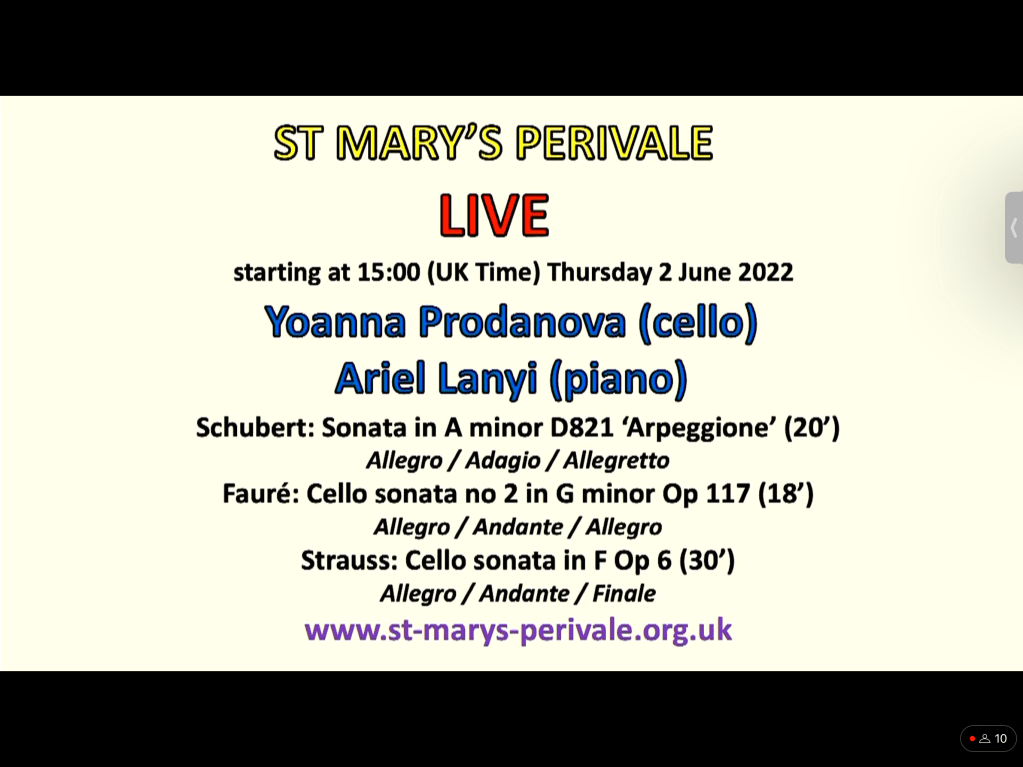
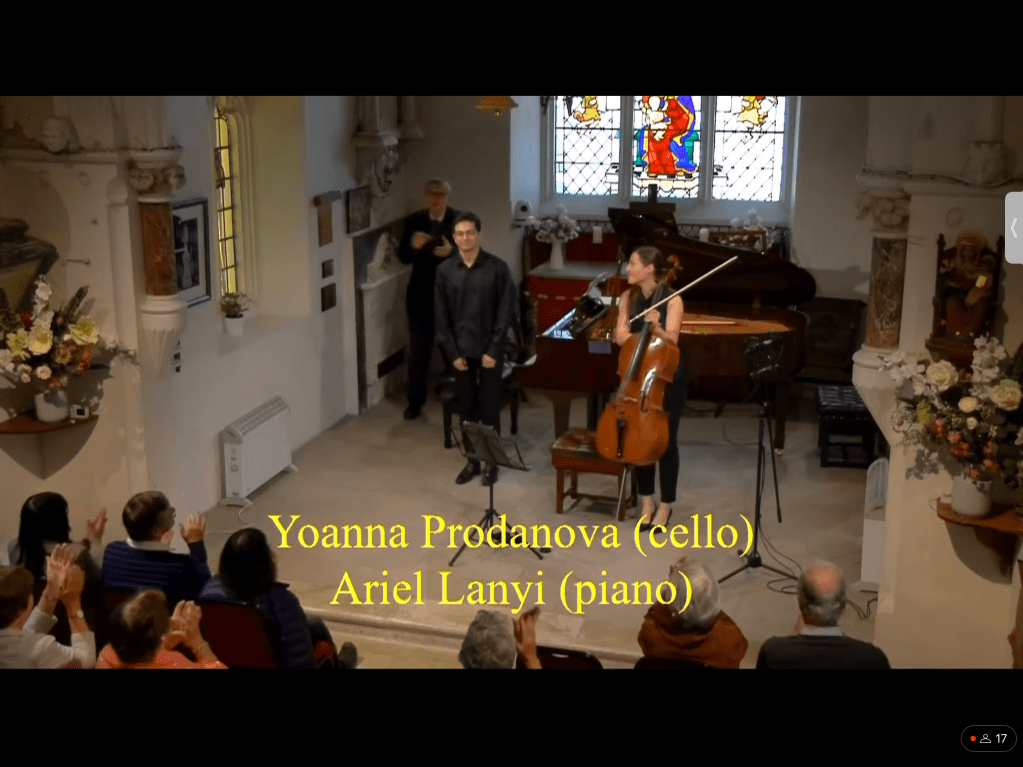
Prodanova – Lanyi A golden duo of sumptuous music making at St Mary’s

Thursday 2 June 3.00 pm

https://youtube.com/watch?v=kmbsyLYYw28&feature=share

I had heard these remarkable musicians at the Razumovsky Academy of Oleg Kogan last April when they were playing in trio with the equally remarkable Lovell-Jones.

https://christopheraxworthymusiccommentary.com/2022/03/24/razumovsky-academy-flying-high-with-the-birth-of-the-lanyi-lovell-jones-prodanova-trio/

I had even heard Ariel recently in a solo recital

https://christopheraxworthymusiccommentary.com/2022/05/02/ariel-lanyi-the-simplicity-and-poetry-of-a-great-musician-at-st-marys/

and Yoanna two years ago with her regular duo partner Mihai Ritivoiu.

https://christopheraxworthymusiccommentary.com/2020/09/04/yoanna-prodanova-and-mihai-ritivoiu-at-st-marys/

I was tempted this afternoon to listen to Ariel and Yoanna in duo this time and to appreciate once again their superb musicianship in three sonatas for ‘cello and piano.I can only add my admiration and appreciation for the simplicity of the Schubert followed by the streams of mellifluous sounds in Fauré and ending with the scintillating early Sonata by Strauss.A wonderful afternoon of music making at its best and I was glad to have chosen to be bewitched by their playing rather than being roasted on the beach from where I was listening in Italy.Today is a bank holiday for the 66th Anniversary of the foundation of the Republic whilst celebrations for the Queen’s Jubilee are well under way I hear in the UK.

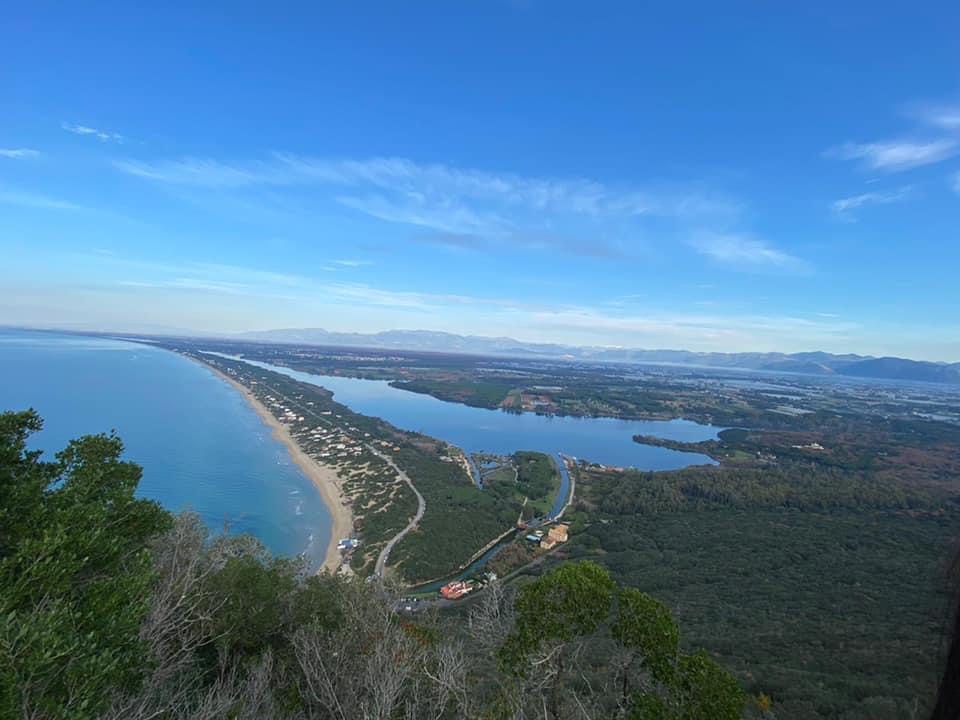
San Felice Circeo – Sabaudia 100km from Rome or Naples

Cellist Yoanna Prodanova was born in 1992 in Varna, Bulgaria. She completed her studies in 2019 at the Royal Academy of Music in London where she was a Bicentenary Scholar on the prestigious Advanced Diploma course, already having obtained her Bachelor and Master’s degrees at the Guildhall School of Music and Drama. Previously she studied in Varna and in Montreal where her family immigrated in 2006. He has performed concertos with the Royal Academy of Music Orchestra, the Amati Orchestra, the Surrey Philharmonic and the Guildford Symphony Orchestra among others. She regularly performs as a recitalist in the UK and Europe. Her debut album including works by Janacek, Fauré and Chopin with Mihai Ritiviu was released in 2020 on the Linn Records label. She has also recorded the Brahms clarinet trio with Joseph Shiner and Somi Kim for Orchid Records. Yoanna’s awards include The Philip and Dorothy Green Award for Young Artists (2016), the Sylva Gelber Award (2017, 2018), Tunnell Trust Award (2019) and the First prize at the International Joachim Competition in Weimar with her string quartet, the Barbican Quartet.She is extremely grateful to the Canimex Group for the loan of a beautiful cello made by Giuseppe Gagliano in 1788. 

In 2021, Ariel Lanyi won third prize at the Leeds International Piano Competition, and was a prize winner in the inaugural Young Classical Artists Trust (London) and Concert Artists Guild (New York) International Auditions. Over the last year Ariel has made his debut at Wigmore Hall and participated in the Marlboro Music Festival in Vermont,. As soloist he performed Brahms Concerto No.2 with the Israel Philharmonic Orchestra and the Royal Liverpool Philharmonic Orchestra, and Beethoven’s Concerto No.2 at the Royal Academy of Music. This season Ariel returns to give performances in the Miami Piano Festival and at Wigmore Hall, as well as recitals in Rome kand across the UK, and performances with orchestras in Israel and in the US, playing concerti by Mozart and Brahms. Born in Jerusalem in 1997, in 2021 Ariel completed his studies at the Royal Academy of Music in London after studying at the High School and Conservatory of the Jerusalem Academy of Music. Awards include 1st Prize at the 2018 Grand Prix Animato Competition in Paris and 1st Prize in the Dudley International Piano Competition, as well as a finalist award at the Rubinstein Competition. Ariel is a Countess of Munster Recital Scheme Artist

Hats off again to Dr Hugh Mather and his team that allowed me and many more world wide to appreciate the wonders that are a regular occurrence in the beautiful little redundant church of St Mary’s in Perivale.

Bank Holiday Celebrations in Italy

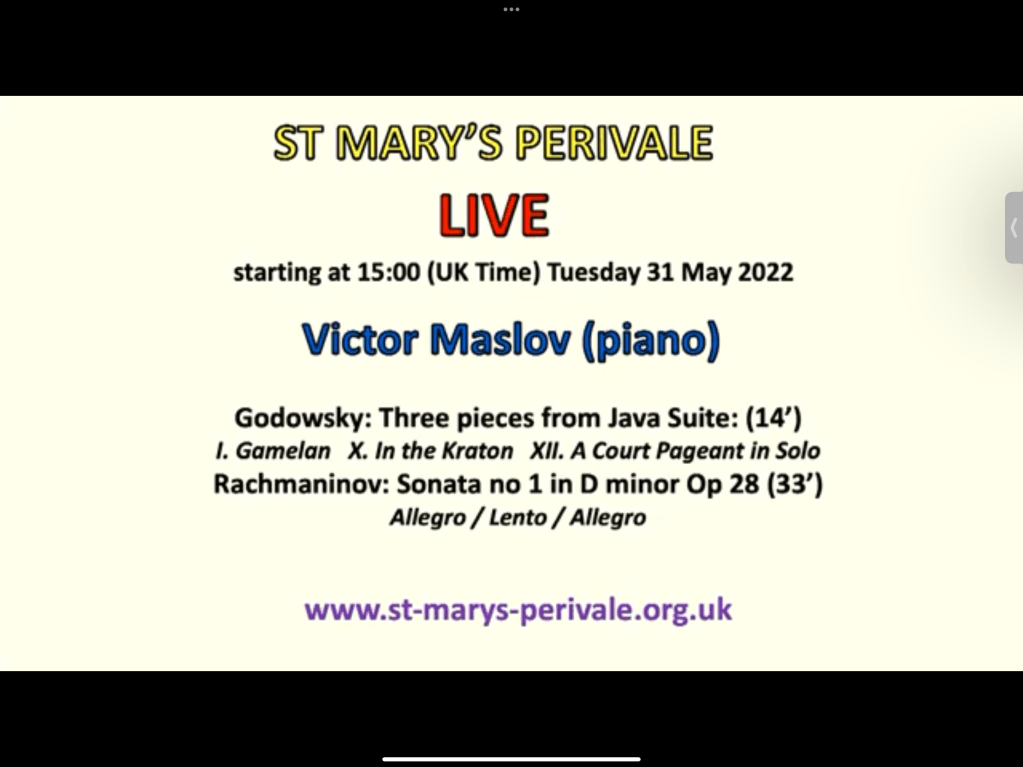
Victor Maslov at St Mary’s the return of a great artist;

Tuesday 31 May 3.00 pm

Victor Maslov (piano)

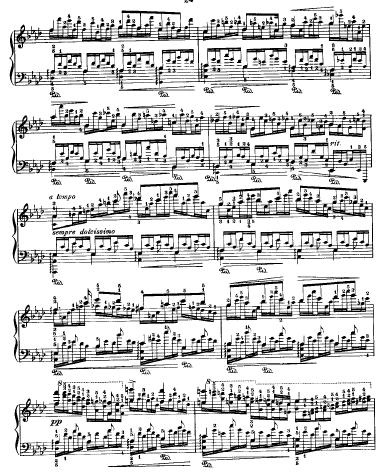
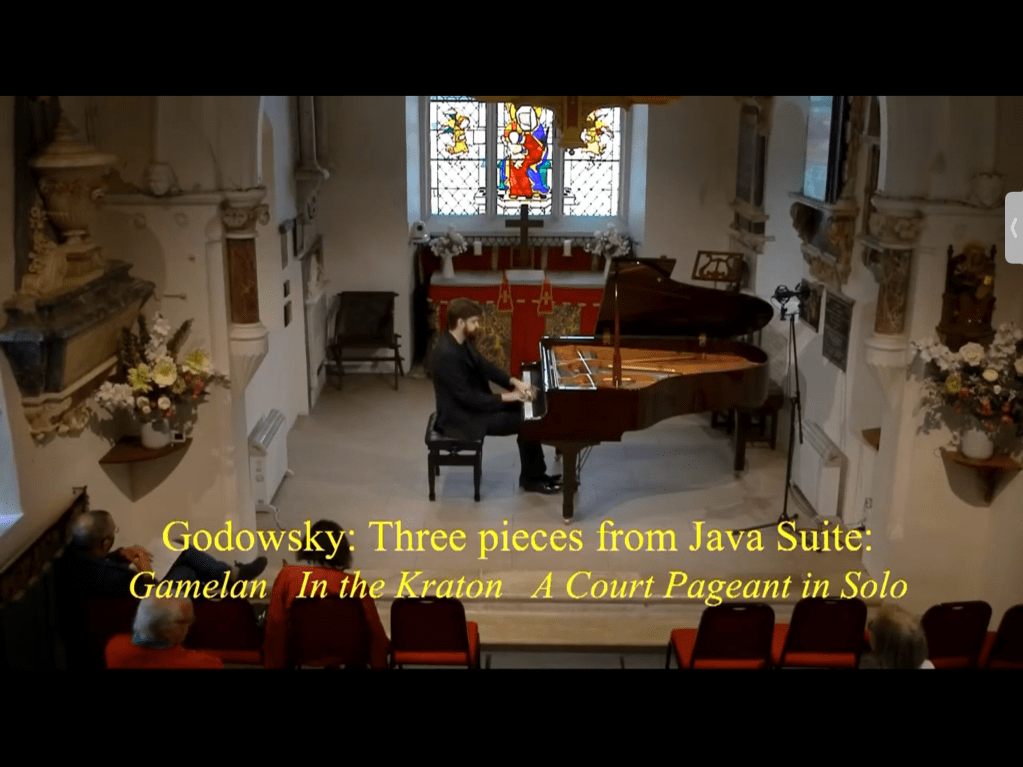
Godowsky: Three pieces from Java Suite:
I. Gamelan, X. In the Kraton, XII. A Court Pageant in Solo,

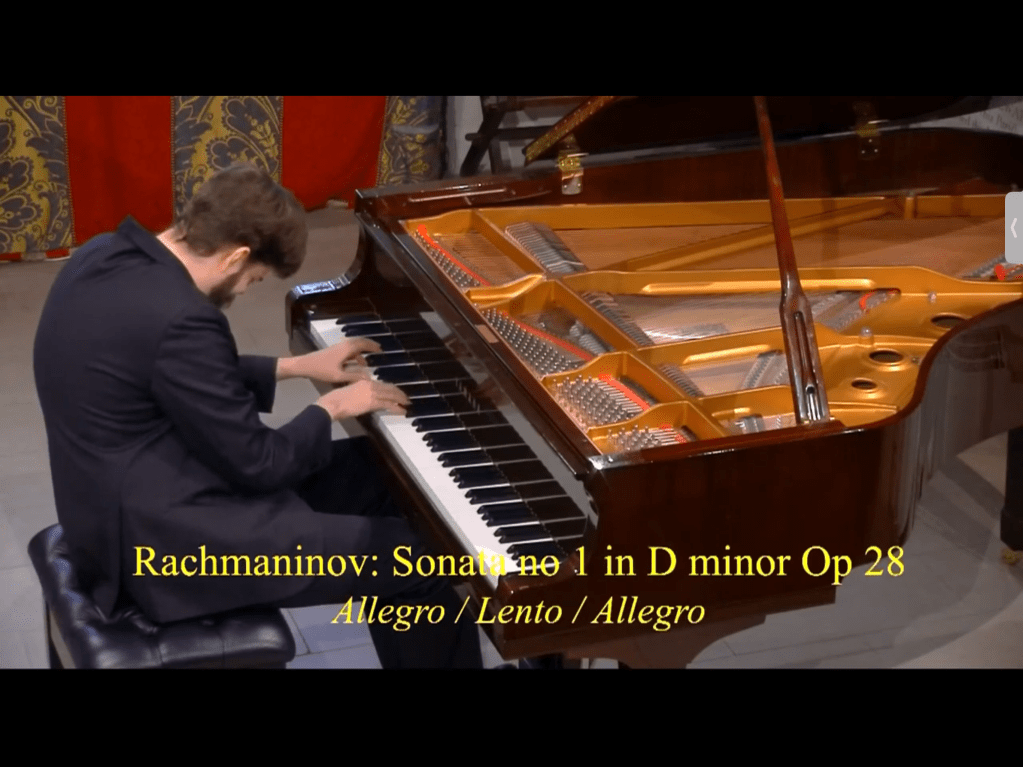
Rachmaninov: Sonata no 1 in D minor Op 28
Allegro / Lento / Allegro

Victor Maslov the birth of a great artist

https://youtube.com/watch?v=4Pt55QNMaOo&feature=share

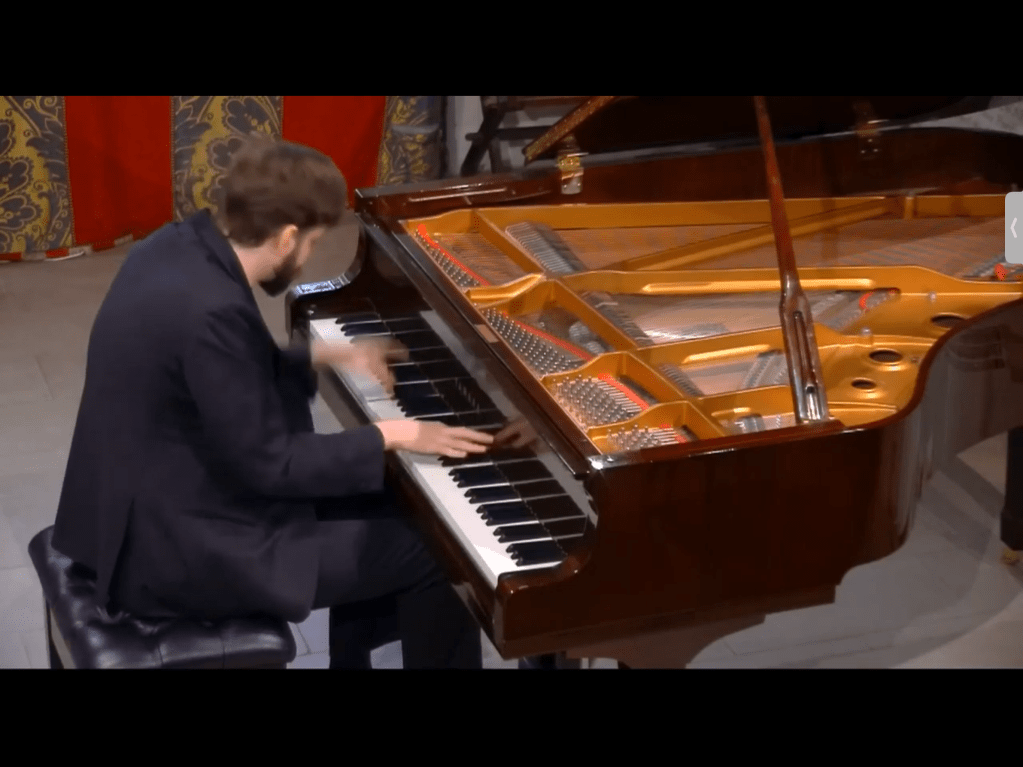
It was a strange turn of events that allowed me to listen to Victor Maslov’s live stream recital from St Mary’s in Perivale.I had heard Victor recently give a magnificent account of the elusive first Sonata of Rachmaninov and today I had decided that I would listen to Maurizio Baglini’s star pupil Simone Librale play Debussy Preludes Book 1 and Ravel’s Gaspard de la nuit.A young pianist who I had not yet heard and had the chance to hear as he was closing the Roma 3 Orchestra series in which it’s enlightened artistic director Valerio Vicari gives a platform to many of the most talented young musicians of their generation.

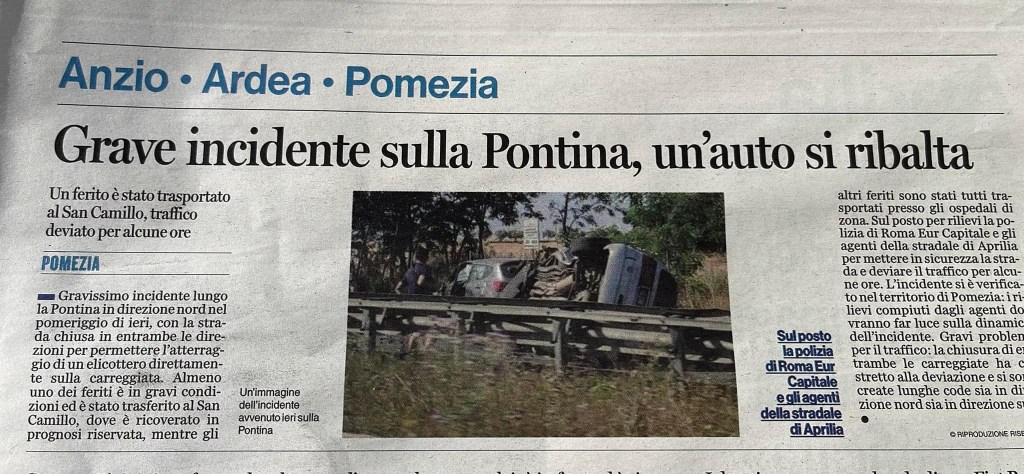
Unfortunately a car crash on the notorious blood bath of a motorway that links my house to Rome caused an eight mile queue and instead of enjoying the concert I had to turn back home.Out of curiosity I thought I would listen again to Victor’s superb Rachmaninov but I was mostly stimulated by the fact that I could hear a composition by one of my youthful idols:Leopold Godowsky.My first teacher Sidney Harrison had discovered an old church in Brentford where an engineer Frank Holland despite a leaking roof and rising damp had found a home for his ever expanding collection of mechanical instruments.Sidney Harrison, the first person to give piano lessons when you would look into the television for the few hours of transmission each day.There was no choice of programme and people would tune in to see how Peter Croser or Norma Fisher were progressing.He was also a regular broadcaster on the BBC World service and had suggested Frank create a Piano Museum in Brentford open to the public.The idea of housing his collection in the Victoria and Albert Museum was not even considered as he had no intention of loosing his beloved instruments to a public institution.The BBC got wind of the collection of piano rolls that the leggendary pianists had made on the reproducing pianos of the day.Now these instruments lovingly restored by an enthusiastic and some might add eccentric engineer meant we could listen to some of the greatest names in the history of piano playing.Busoni,Lhevine,Rosenthal,Saint Saens,Rachmaninov and Leopold Godowsky.The absolute perfection of these performances were something we were not to hear until the arrival of Sviatoslav Richter in the west.It was not how loud and fast they could play but quite the contrary a supreme control that allowed them to play fast and quietly!Godowsky’s performance of Liszt’s La Leggierezza was absolutely unbelievable for its subtle whispered perfection.Later I was to hear Cherkassky live playing as an encore a Godowsky arrangement of Chopin’s study op 10 n.6 for the left hand alone.His performance of the Albeniz Tango arranged by Godowsky opened up a kaleidoscope of sounds that I never knew existed.I hunted in the London University Library for the old out of print edition of Godowsky’s 53 Studies on Chopin Etudes to try to know more about this pianistic genius.Things have changed now and there are complete recordings of these studies by Hamelin,Libetta and Grante but in the late sixties anyone who could play Rach 3 or Prok 2 was considered a piano genius at the UK music colleges.We had our nose put out of joint when Ashkenazy made his London debut playing both in the same programme!Now hands up if there is serious student who does not play them with ease?!The world of Godowsky is a subtle world of kaleidoscopic colour and I believe Moiseiwitch with his multi coloured tonal palette used to play some of the pieces from this suite .Victor played three of them:n.1 with a fluidity spread across the entire keyboard that dissolved to a curiously suggestive whisper that had produced these strangely evocative sounds.N.10 was a continuous outpouring of mellifluous sounds and the final n. 12 was played with a robust scintillating virtuosity that simply glistened.Sounds,sounds, sounds.Multi coloured,evocative and breathtaking and it was exactly this that was so remarkable about Victors playing today as though a world had been suddenly revealed adding a new dimension to his already extraordinary technical mastery.

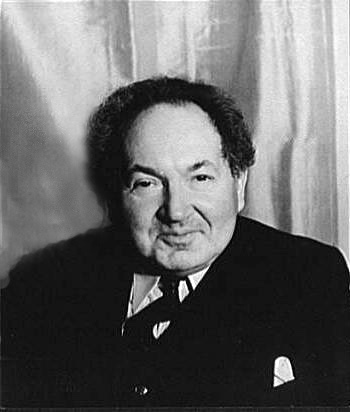
Leopold Mordkhelovich Godowsky Sr. (13 February 1870 – 21 November 1938) was a Polish-born American virtuoso pianist, composer and teacher. He was one of the most highly regarded performers of his time,known for his theories concerning the application of relaxed weight and economy of motion within pianistic technique – principles later propagated by Godowsky’s pupils, such as Heinrich Neuhaus. In 1914 the outbreak of World War 1 drove him away from Europe and he went back to the United States, where he lived in New York (1914–16), Los Angeles (1916–19), and Seattle (1919–22), before returning to New York. Much of the 1920s was spent touring around the world; apart from concert appearances in Europe and the United States, Godowsky also gave extensive tours of South America and East Asia.However, while Godowsky’s career prospered, his personal life slowly started falling apart. His wife Frieda fell seriously ill in 1924 and her health continued deteriorating ever since. In 1928 Godowsky’s son Gordon abandoned his studies and married a vaudeville dancer, causing his father to disown him.

After the Wall Street Crash of 1929 Godowsky’s financial situation worsened. A string of recordings the pianist began in London in 1928, as well as public concerts, would have remedied the problem; however, both activities were cut short by an unexpected disaster: during a recording session on 17 June 1930, just after completing Chopin’s E major Scherzo he suffered a severe stroke which left him partially paralysed. Godowsky’s remaining years were overshadowed by the event, leaving him deeply depressed.In December 1932 Gordon Godowsky committed suicide, and a year later Godowsky’s wife died of a heart attack. The pianist eventually moved to another apartment in New York together with his daughter Dagmar; he continued playing the piano for friends and admirers, but never gave public performances.

Leopold Godowsky

He was heralded among musical giants as the “Buddha of the Piano”.Busoni claimed that he and Godowsky were “the only composers to have added anything of significance to keyboard writing since Liszt”

As a composer, Godowsky is best known for his Java Suite ,Triakontameron,Passacaglia and Walzermasken, alongside his transcriptions of works by other composers: best known work in the field is 53 Studies on Chopin Etudes (1894-1914)

Chopin /Godowsky Etude op 25 n.1

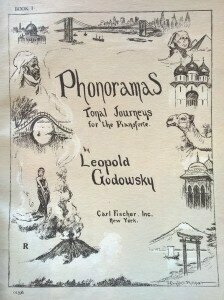
The Java Suite (originally published as Phonoramas. Tonal journeys for the pianoforte) is a suite of twelve movements for solo piano by Leopold Godowsky, composed between 1924 and 1925.It is greatly influenced by the gamelan music of Java,extensively utilizing pentatonic harmonies throughout.”Having travelled extensively in many lands, some near and familiar, others remote and strange, it occurred to me that a musical portrayal of some of the interesting things I had been privileged to see, a tonal description of the impressions and emotions they had awakened, would interest those who are attracted by adventure and picturesqueness and inspired by their poetic reactions.Who is not at heart a globe-trotter? Are we not all fascinated by distant countries and strange people? And so the thought gradually matured in me to recreate my roaming experiences. This cycle of musical travelogues-tonal journeys-which i have name collectively “Phonoramas”, begins with a series of twelve descriptive scenes in java.

Part One
1. Gamelan
2. Wayang-Purwa, Puppet Shadow Plays
3. Hari Besaar, The Great Day

Part Two
4. Chattering Monkeys at the Sacred Lake of Wendit
5. Boro Budur in Moonlight
6. The Bromo Volcano and the Sand Sea at Daybreak

Part Three
7. Three Dances
8. The Gardens of Buitenzorg
9. In the Streets of Old Batavia

Part Four
10. In the Kraton
11. The Ruined Water Castle at Djokja
12. A Court Pageant in Solo

Victor’s performance I have written about recently that he gave at St James’s Piccadilly.

Victor Maslov the virtuous virtuoso virtually at St James’s Piccadilly 4th June 2021

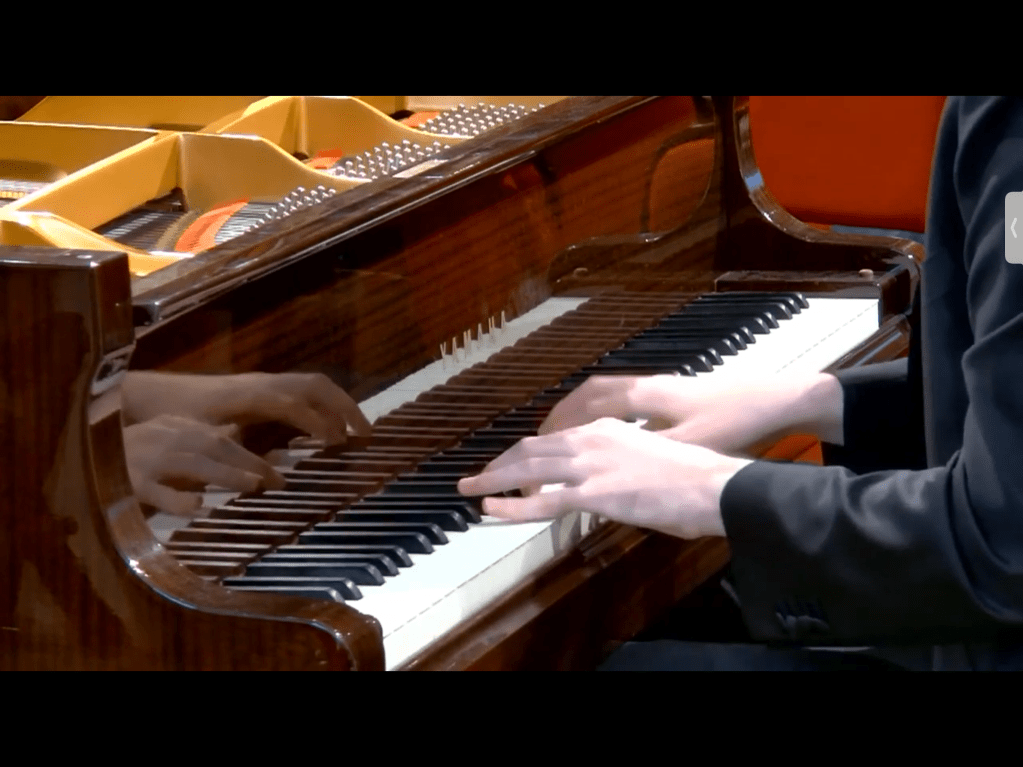
Of course like all artists of Victors stature it has become even more full of subtle colour and meaning.From the hauntingly beautiful first movement and the glistening delicacy of the Lento to the overwhelming grandeur of the Allegro molto.All held together with an overall understanding of the architectural shape that made this performance as persuasive as one of the very first recordings:that of John Ogdon,or the very recent performance by Alexandre Kantarow.Both winners of the Tchaikowsky competition in Moscow but with a distance of fifty years between them.Now Victor Maslow has come onto the scene with this superb performance.A recent top prize winner in the Dubai/Malta International Piano Competition,together with the winner of the Tchaikowsky Competition,he is in many ways a local’ lad’.

Dmitri Alexeev into a New Golden World with Jianing Kong – Victor Maslov. Caterina Grewe-Vitaly Pisarenko at St John’s

His studies with a long term resident of Ealing ,Dmitri Alexeev and a recipient of an award from the Eileen Rowe Musical Trust,together with his many performances here at St Mary’s are surely proof enough of authenticity.Ealing can be justly proud!

In November 1906, Rachmaninov,with his wife and daughter, moved to Dresden primarily to compose a second symphony to diffuse the critical failure of his first symphony,but also to escape the distractions of Moscow. There they lived a quiet life, as he wrote in a letter, “We live here like hermits: we see nobody, we know nobody, and we go nowhere. I work a great deal,”but even without distraction he had considerable difficulty in composing his first piano sonata, especially concerning its form.The original idea for it was to be a sonata based on the main characters of Goethe’s Faust.Faust , Gretchen, and Mephistopheles and indeed it nearly parallels Liszt’s own Faust Symphony which is made of three movements which reflect those characters.However, the idea was abandoned shortly after composition began, although the theme is still clear in the final version.After numerous revisions and substantial cuts made at the advice of his colleagues, he completed it on April 11, 1908. Konstantin Igumnov gave the premiere in Moscow on October 17, 1908. It received a lukewarm response there, and remains one of the least performed of Rachmaninoff’s works.

Russian pianist Victor Maslov graduated in 2021 from the Royal College of Music, London, having completed his Artist Diploma, and was the recipient of the Queen Elizabeth the Queen Mother Rose Bowl for his outstanding achievements at the RCM. Throughout his studies, Victor has been grateful for the support of the Ruth West Scholarship, the Eileen Rowe Musical Trust Award, the Future of Russia Scholarship, the Munster Trust Award, and the Talent Unlimited. He previously studied at the Gnessin Moscow Special School of Music, where he was taught by his mother Olga Maslova. He has been a prizewinner in several international competitions. After winning the AntwerPiano International Competition in 2020, he was invited to take part in the 2021 Classic Piano International Competition in Dubai and received the Second Prize. Further successes include winning the First Prize at the 2nd International Rachmaninoff Piano Competition (Moscow 2020), being Overall Prize Winner of the 47th Concertino Praga International Radio Competition for Young Musicians (2013), two-time winner of Concerto Competition (Royal College of Music, 2015, 2018), winning the First Prize at the Musicale dell’Adriatico piano competition (Ancona 2007), and the First Prize at the Nikolai Rubinstein International Piano Competition (Paris 2004). He gave his concerto debut at the age of nine with the State Symphony Orchestra of Moscow and has since performed with orchestras such as RCM Symphony, RCM Philharmonic and given solo performances at international music festivals across the UK, Europe and the USA.

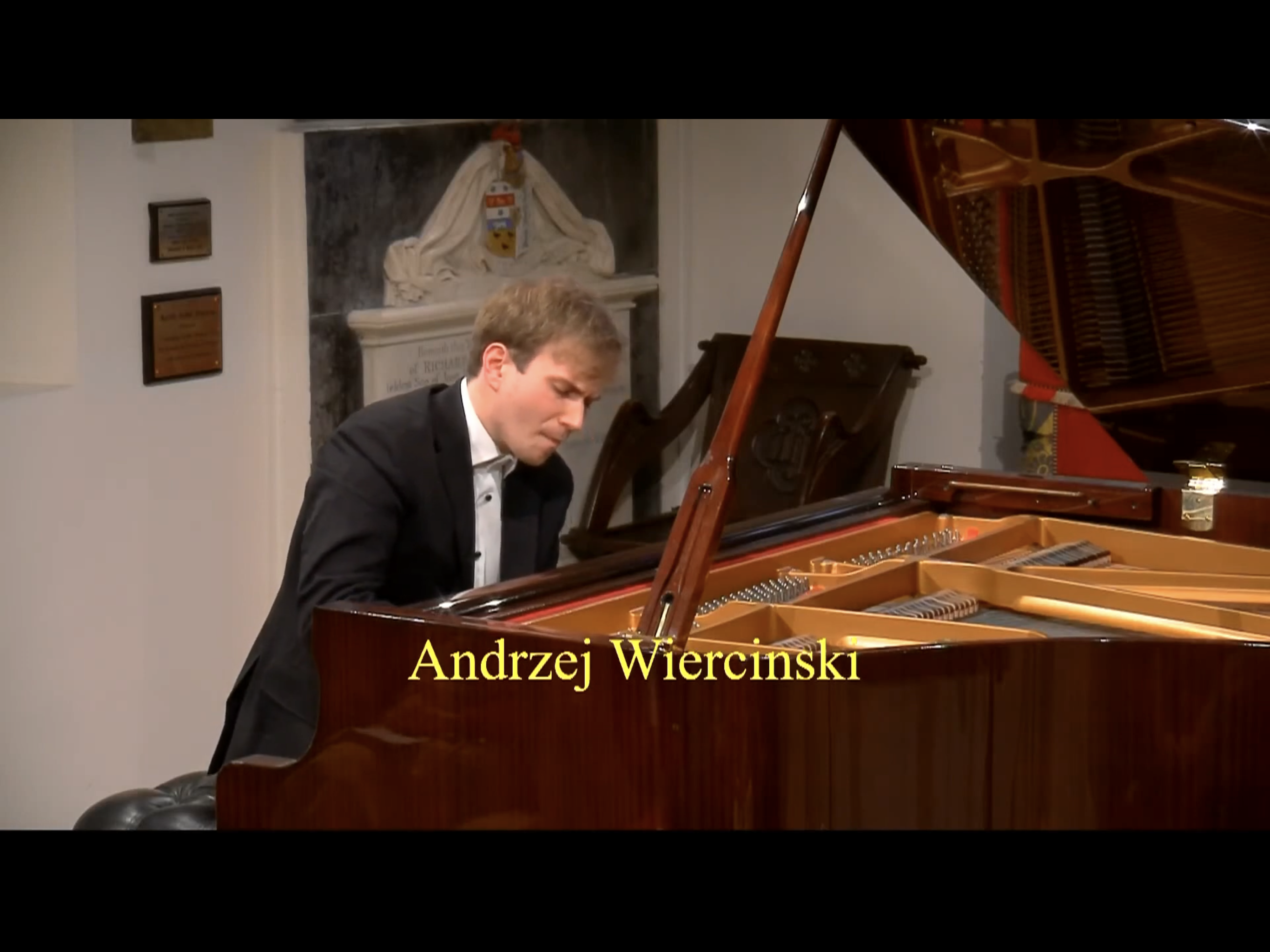
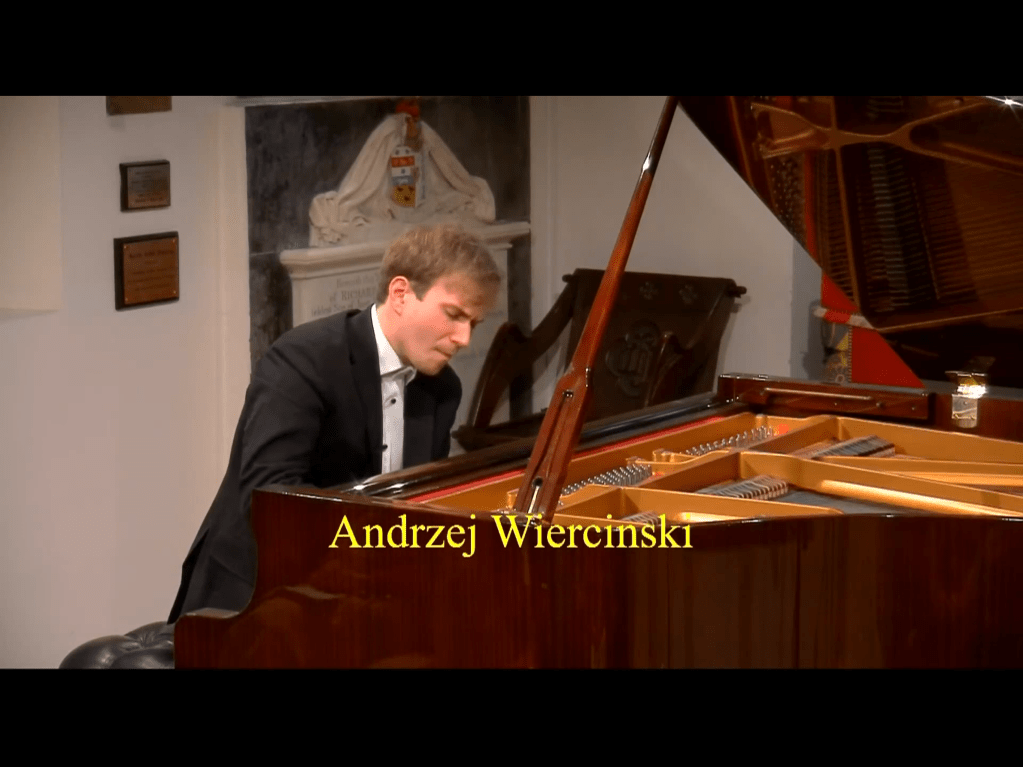
fellow concert pianists Petar Dimov,Damir Duramovic,Andrzej Wiercinski all braving the elements to be present for these remarkable performances by a friend and esteemed colleague :https://christopheraxworthymusiccommentary.com/2020/10/27/petar-dimov-at-st-marys-a-musician-speaks/https://christopheraxworthymusiccommentary.com/2022/05/26/andrzej-wiercinski-at-st-marys-the-making-of-a-great-artist/https://christopheraxworthymusiccommentary.com/2022/04/18/damir-duramovic-at-cranleigh-arts-a-musician-speaks-with-simplicity-and-poetry/

Godowsky: Java Suite

by Georg Predota  August 8th, 2018 

Java Suite
Phonoramas
Godowsky

Leopold Godowsky

The legendary pianist, composer, and pedagogue Leopold Godowsky was a world traveller. He considered “travel not only a way of lifting the creative intellect, but also a philosophical, spiritual enterprise, a way of advancing one’s journey of self-discovery.” Drawing inspiration from his exotic encounters, “it occurred to me,” he writes, “that a musical portrayal of some of the interesting things I had been privileged to see, a tonal description of the impressions and emotions they had awakened, would interest those who are attracted by adventure and picturesqueness and inspired by their poetic reactions.” After Godowsky returned from a 2-month tour of South America in 1922, he quickly sailed for the Far East. Departing Vancouver on 13 October 1922, he left for Yokohama and described his impressions of Japan, “The people here love music and are making great progress in the appreciation and understanding of good music; in a short time this country will be a Mecca for artists. Japanese are quick to grasp and understand. By February 1823, Godowsky had reached China and writes, “Guangzhou is the most unusual place I have ever seen in the Orient…Beijing is the most interesting city in China, a city of marvels… Hong Kong the most beautiful.” But it was the island of Java that fascinated him the most.

The Java Suite
Godowsky stayed in Java for the better part of 4 weeks and gave at least twenty recitals. Despite his heavy performing schedule he eagerly explored local culture, music, and people. And he visited various places and landmarks that would become the basis for the Java Suite. Initially, Godowsky intended to compose “finishing selections for piano recital programs that consist of themes and tunes of different races and parts of the world. My plan is,” he writes, “to make picturesque, characteristic and fanciful works based on folk tunes and dances of exotic countries: Java, Japan, China, India, Turkey and perhaps one Jewish and one Negro piece.” However, the scenic beauty and rich cultural atmosphere of Java soon focused his creative efforts and “the thought gradually matured in me to recreate my roaming experiences in a cycle of musical travelogues—tonal journeys—which I have named collectively “Phonoramas,” beginning with a series of twelve descriptive scenes in Java.”

Godowsky published his Java Suite in 1925, and in the preface he describes his inspirations. “The Island of Java, called ‘The Garden of the East,’ with a population of close to forty million, is the most densely inhabited island in the world. It has a tropical, luxuriant vegetation; marvelous scenery and picturesque inhabitants; huge volcanoes, active and extinct; majestic ruins and imposing monuments of many centuries past…It was, however, the native music of the Javanese, in the heart of Java, at Djokja and Solo that made the most profound impression on me.” Eight of the twelve pieces are associated with a specific city, place, monument or landmark (Sacred lake of Wendit, Boro Buudur, the Bromo Volcano, gardens of Buitenzorg, streets in Old Batavia, in the Kraton, the ruined water castle at Djokja and the city of Solo). The remaining four pieces (Gamelan, Wayng Purwa, Hari Bessar and Three Dances) relate more generally to his musical and cultural impressions during his journey. 

Mount Bromo

Mount Bromo 

A substantial number of composers in the early 20th century were influenced by the sound of gamelan music, but it was Godowsky who actually experienced it first hand. “The sonority of the Gamelan is so weird, spectral, fantastic and bewitching, the native music so elusive, vague, shimmering and singular, that on listening to this new world of sound I lost my sense of reality, imagining myself in a realm of enchantment.” Godowsky aimed to express his impressions “in the native music-idiom as I understood it, I have neither borrowed nor imitated actual Javanese tunes, designs or harmonies in any of the movement excepting the third, where I use two fragments of authentic Javanese melodies.” By fusing Javanese elements with Western compositional procedures Godowsky created a unique and highly personal tonal journey.

Ivelina Krasteva for the Keyboard Trust Simplicity and beauty of a thinking artist

Sir Anthonio Pappano

The Keyboard Charitable Trust presents
IVELINA KRASTEVA Recorded at St Matthew’s Church, Ealing
and now available to view on our YouTube channel https://youtu.be/KCYW_nt4Z40

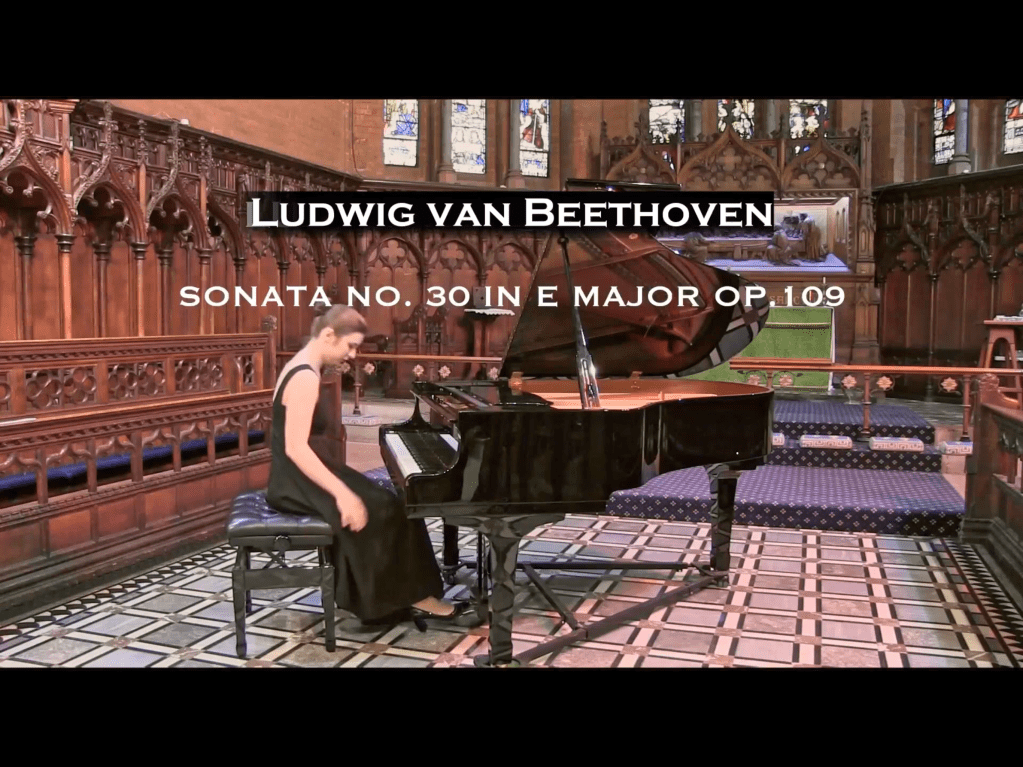
Beethoven Sonata No. 30, Op. 109
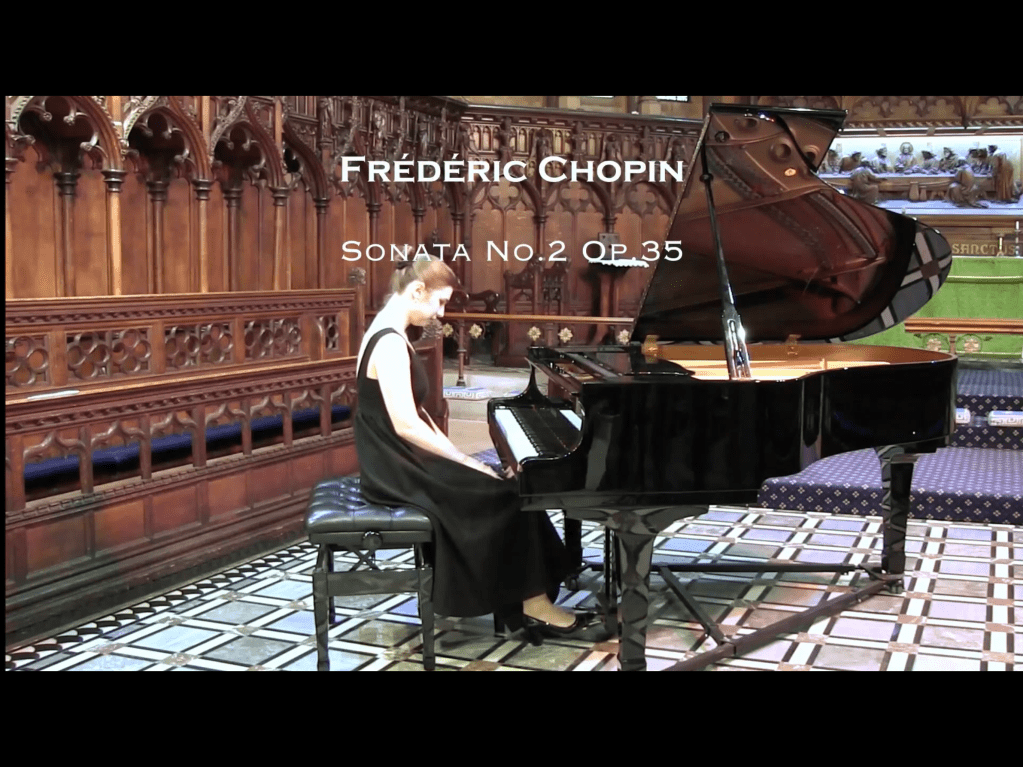
Chopin Sonata No. 2, Op. 35
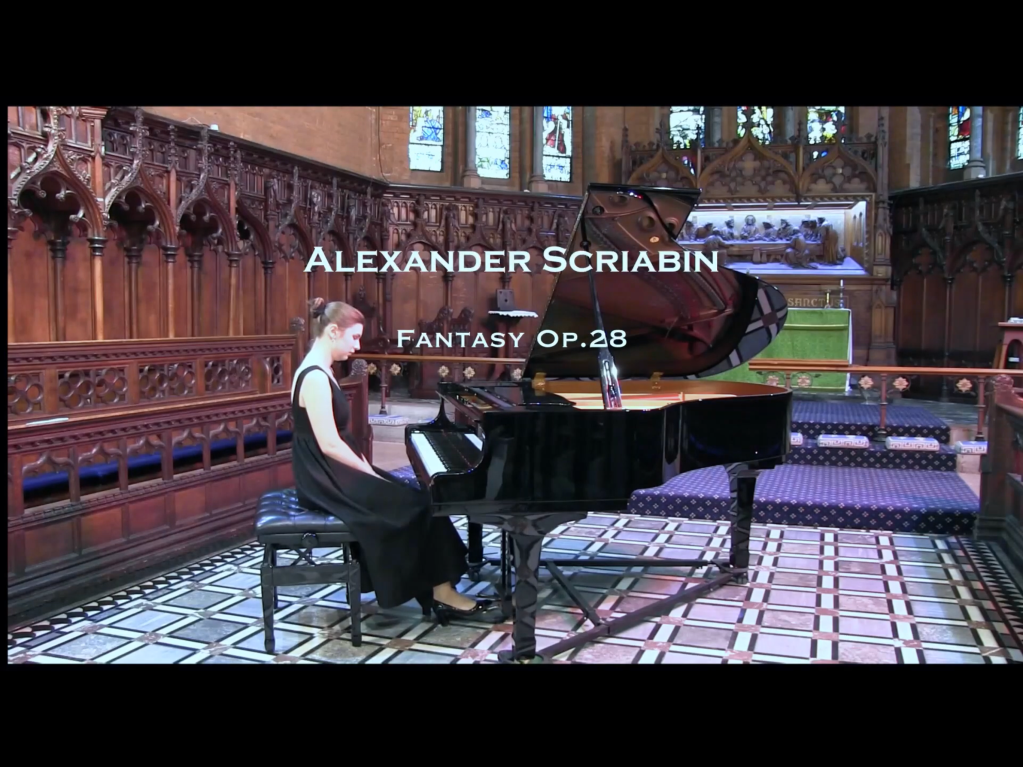
Scriabin Fantasy Op. 28

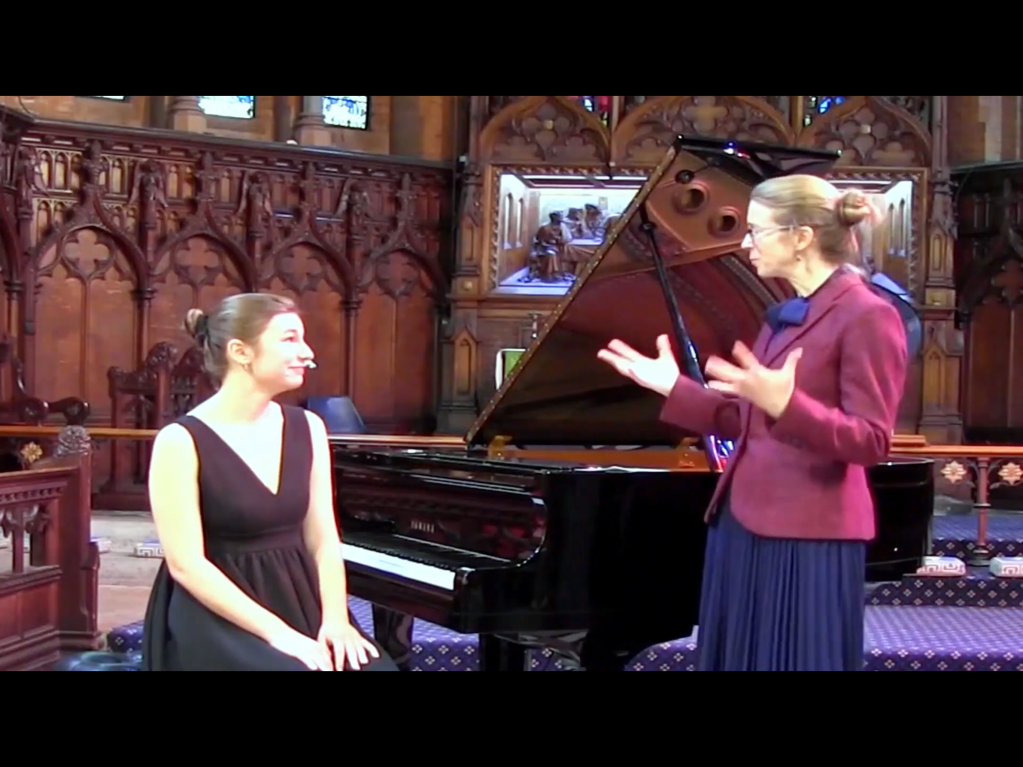
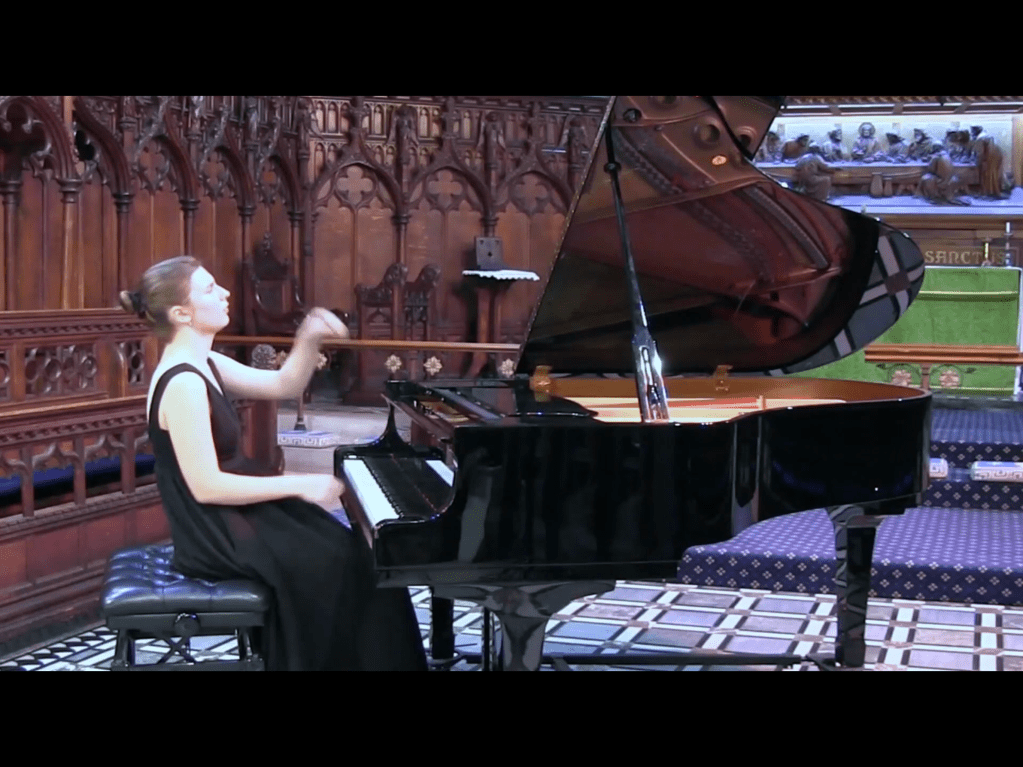
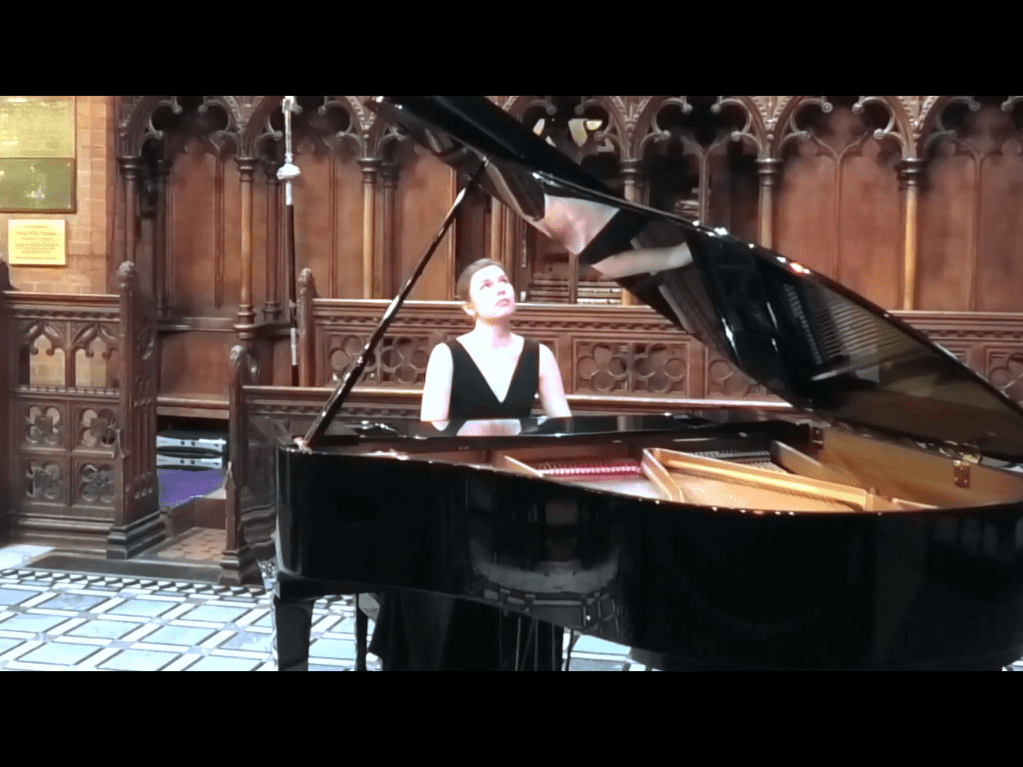
Some remarkable performances of three masterworks for the piano.Not only musicianly as you would expect from her studies with Ronan O’Hora and Katya Apekisheva.There was also the beauty of sound and her total concentration of passionate involvement.I had heard her impeccable Beethoven op 109 in a recital last year streamed live from that mecca for aspiring young musicians in Ealing.There must be something about the air in Ealing where musicians flock so readily.Until recently Murray Perahia was resident as is actually Dmitri Alexeev.When I was a student there used to be the indomitable Eileen Rowe in Ealing who dedicated her life to helping young musicians.Filling every room in her house with pianos where she would teach children getting remarkable results in the Associated Board Graded exams as she imbued them with her selfless passion with her superb teaching skills.We struggling students used to help her one day a week and be rewarded with a wonderful roast lunch with vegetables grown from her own garden!Katherine Stott ,Daniel Salamon,Tessa Nicholson,Vanessa Latarche were all part of this musical oasis.Sidney Harrison and Christopher Elton would readily judge her festivals.Her house was eventually sold when she died but the proceeds have gone to create a Trust for young Ealing based musicians.It is run by her star pupil Vanessa Latarche,Head of Piano at the Royal College of Music,and Dr Hugh Mather whose own children all fell under the spell of Eileen Rowe.Dr Mather has over the past years created a Mecca and oasis for young aspiring musicians .A redundant church ,St Mary’s Perivale/Ealing, where he and his colleagues,retired experts from the BBC,have added superb recording equipment to allow streaming world wide of their concerts.In the pandemic the Keyboard Trust too has had to invent an incentive both financial and spiritual for the young musicians it has under its wing.The KCT for thirty years has helped young musicians to bridge the gap between finishing their advanced studies and starting a career in music.Without any public performances streamed concerts was a solution that helped bridge the gap whilst the pandemic ran its terrible course.Thanks to the generosity of St Matthews church music director Richard Thomas we were able to add some more streamed concerts to our yearly limit of six that are generously offered by Steinway Hall in London.Public concerts are gradually returning and we are all thirsty for live performances and we hope that the tours that the KCT offer will shortly start again as the world slowly recovers from this dramatic period.Ivelina in her interesting post recital discussion with one of the artistic directors of the KCT explains what a special thing it is to be able to feel a live audience that is living the music with you and creating a two way give and take that is the very raison d’etre of live performances.

Beautiful fluidity and scrupulous attention to Beethoven’s very precise indications were the hallmarks of her musicianly interpretation.Her continuous gentle rounded movements were an ever present undercurrent that made all her sounds so natural and without any exaggeration.Even the rhetorical ‘Adagio espressivo ‘ interruptions were played with authority where the markings that abound of ‘f’ ‘p’ ‘crescendo’’espressivo’’ritardando ‘all had their just place as they took us to the mellifluous fluidity of Beethoven’s ‘vivace ,ma non troppo.The prestissimo of the second movement burst onto the scene with great rhythmic drive where even the most intricate contrapuntal passages were played with clarity and technical assurance like a great wind that was to take us from one oasis to another ,The Andante molto cantabile ed espressivo was given the enviable weight of a string quartet where without hardness each strand unites to create a miraculous whole.Even the first variation was give the same importance where in lesser hands it can seem like a slow waltz instead of a most profound enrichment of the theme.The contrast with the ‘leggiermente’ of the second variation was exhilarating like a gentle breeze blowing into this almost too serious scene.The contrasting legato episodes were played with sumptuous sounds and great control as the counterpoints seem to overlap with trills that were like gentle vibrations pointing the way.There was startling technical assurance in the burst of energy in the Allegro vivace of the third variation which made it’s dissolving into a variation of moving sands both intense and of ravishing beauty.There was absolute clarity in the authority she gave to the fifth variation as it wend its contrapuntal way to the pure magic of the sixth.Here the beauty and passionate outpourings were floated on a continuous stream of sounds with extraordinary control and sense of poetry A magic world that had opened up in Beethoven’s head and had taken us to this imaginary place where the peace and beauty he had been looking for he had finally found in this trilogy.The statement of the theme at the end was played with ravishing sound and great sensibility as it drew to the final moments of silence and peace.
The Sonata in B flat minor is one of the great works of Chopin.A real pinnacle amongst his compositions where he was able to unite the classical sonata form with all the freedom of his poetic soul.The first movement needs a great artist to be able to hold the architectural shape whilst not sacrificing the beauty of Chopin’s invention.The opening Grave was like a opening flourish before the real beginning at the ‘ doppio movimento’.It is true that Chopin’s compositional mastery was later to use this opening flourish in the bass in the development section but I am glad to see that the conjecture about whether to repeat the ‘grave’ in the ritornello was so simply and convincingly resolved by Ivelina today.Some very fine playing of this agitato with Chopin’s accents just given the weight intended to push the music forward towards the beautiful second subject.Here is marked ‘ sostenuto’ and so often this is a signal to change the tempo which undermines the very structure of this movement.Ivelina played it with great sensitivity and beauty with just a very slight easing of tension rather than changing the tempo.There was extraordinary technical control as the passion was allowed to rise but it was this continual forward movement that allowed her to give great architectural shape to this extraordinary movement .The Scherzo was played with remarkable technical prowess and control together with aristocratic grandeur as after the final octave statement the movement dissolves into a ‘più lento’of great beauty which Ivelina played with sentiment but never sentimentally where the beauty of sound was in startling contrast with the outer sections.The Marche Funèbre was played with exemplary weight and control and the stillness and ravishing beauty of the trio was memorable.The finale has been likened to the wind blowing over the graves and it was indeed a magnificent gust of notes that Ivelina shaped maybe a little too discreetly.There are no indications of a melodic thread to this movement but I feel there could be a a slight hint to give it more shape and form.It was magnificently played and mine is only a personal view.Ivelina’s was the view that Chopin had left on the page and like the scrupulous musician she is it was the composers indications that were her ultimate guiding light.
The Scriabin Fantasy is so often a barn storming show piece.In Ivelina’s hands it became a passionate outpouring but also a very intimate confession of sumptuously beautiful sounds of such fluidity and purity.There was delicacy and passion.An outpouring of romantic sounds in this early work where Scriabin’s mastery of the piano and its texture were to be transformed in his later years into something much more mystical.

https://christopheraxworthymusiccommentary.com/2021/04/26/ivelina-krasteva-beauty-and-simplicity-at-st-marys-all-the-worlds-a-stage/
Ivelina Krasteva was born in 1998 in Plovdiv, Bulgaria. She started to play the piano at the age of 4. Two years later she got accepted in the National School of Music and Dance in Plovdiv, where she studied with Elena Velcheva until her graduation with distinction in 2017. Currently, Ivelina is acquiring her undergraduate degree studying as a HWE and WL Tovery Scholar with Ronan O’Hora and Katya Apekisheva at the Guildhall School of Music and Drama in London.
Ivelina has received numerous awards from international competitions such as first prize and a livestreamed recital on Radio Plovdiv from the International Piano Competition “Schumann-Brahms” in Plovdiv, Bulgaria; third prize at the Pera Piano Competition in Istanbul, Turkey; second prize at The Golden Keys Piano Competition; third prize at International competition “Wiener Pianisten”, Vienna, Austria; and others. In addition to her studies, she has worked with internationally acclaimed musicians, such as Itamar Golan, Boris Petrushansky, Paul Roberts, Charles Owen, Noriko Ogawa, Stephan Moeller among others.
As a dedicated chamber musician, Ivelina has worked in various ensembles and has been a prize winner in numerous competitions such as the First prize at the International Music Competition in Belgrade, Serbia, category “Chamber music”, as a part of a piano trio, 2016. She has received tuition from the Endellion Quartet, the Gould Piano Trio, Carole Presland, Caroline Palmer, Adrian Brendel, Ralf Gothoni, Levon Chilingirian.
Ivelina has given concerts both as a solo pianist and with orchestra. She has performed in several countries – Bulgaria, Turkey, Austria, Romania, Italy and the UK. Highlights include a performance of Prokofiev’s First Piano Concerto with the Plovdiv Philharmonic Orchestra and Mozart’s 24th Piano Concerto with the Vratsa State Orchestra. Days before the UK lockdown Ivelina won the Coulsdon and Purley Concerto Competition, which will result in her concerto debut in the UK in the next season, performing Prokofiev’s Piano Concerto no.3 with the Worthing Philharmonic Orchestra under Dominic Grier.
Throughout her education, she has been supported with scholarships from the Bulgarian Ministry of Culture, the “Prof. Lyuba Encheva” Foundation and the Henry Wood Accommodation Trust.

Please help us to continue supporting young artists like Ivelina by considering to make a donation to the Keyboard Trust. Every penny will be used to help these outstanding musicians.Here is the link should you wish to make a donation.

https://keyboardtrust.us20.list-manage.com/track/click?u=951e4d39ba7155e9a3d751c94&id=f58377bd75&e=1f34431f30

Keyboard Charitable Trust for Young Professional Performers
30th Anniversary Year
Patron: Sir Antonio Pappano

Axel Trolese illuminates Liszt’s Erard with supreme artistry and passion in Velletri’s Convento del Carmine

Giancarlo Tammaro with Axel Trolese

On Sunday mornings in the beautiful sixteenth century Del Carmine convent in Velletri we are treated to a series of concerts by superb young musicians who have been selected by Ing Giancarlo Tammaro to bring life to the Erard of 1879 that Liszt would have played whilst on his many visits to the Villa d’Este and the Castelli Romani.

Lovingly restored to its original splendour and heard in a series that was initiated in 2011 in the Villa d’Este for the two hundredth anniversary of the birth of Franz Liszt.The series is now in its tenth year and is housed in the magnificent concert hall created within this historic monument.

I had first come across it in the seventh edition in 2019 in the Villa Mondragone in Frascati when Ivan Donchev had given a remarkable performance of the Liszt transcription of the Symphonie Fantastique by Berlioz.https://christopheraxworthymusiccommentary.com/2019/04/29/ivan-donchev-in-search-of-liszt/
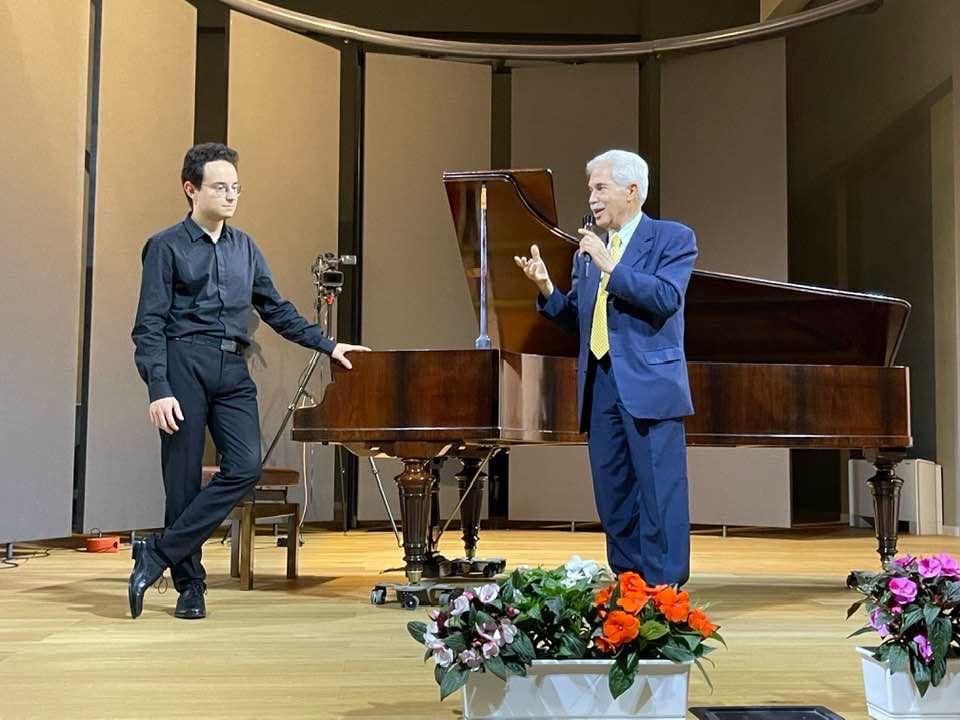
Today I was curious to hear a young pianist who I have heard many times over the last few years ,Axel Trolese,in a concert announced as a celebration of Liszt’s Spanish student Isaac Albeniz .Born on the 29th May 1860 today would have been his 162nd birthday.There is no direct evidence that Albeniz studied with Liszt but Ing.Tammaro put forward a very persuasive case for it even without any direct evidence.

Two books from the four that make up the suite Iberia are on Axel’s new CD which has already received high critical acclaim.Axel a local’ lad’ from the nearby town of Genzano ‘the city of flowers’,brings his quite considerable artistry home after his studies with Louis Lortie,Benedetto Lupo,Maurizio Baglini have taken him from Rome,Paris,Belgium and Cremona to where he now resides near Padua.So it was a double celebration for his friends and family to be able to appreciate his great artistry after years of study.Still only 25 he has a good part of a century before him!

It was obvious that a work by Liszt was ‘de rigueur’ and Axel had chosen one of the most beautiful but sadly much neglected works ,a miniature tone poem from his series of ten works under the title ‘Harmonies Poétiques et Religieuses’. ‘Benediction de Dieu dans La solitude ‘ is prefaced by a poem of Alphonse de Lamartine : ‘D’où me vient,o mon Dieu,cette paix qui m’inonde?D’où me vient cette foi dont mon coeur surabonde,A moi qui tout à l’heure,incertain,agité,Et sur les flots du doute à tout vent ballotté,Cherchais le bien,le vrai,dans les reves des sages’.It is a deeply expressive work and needs a great artist to bring it to life.I have never forgotten the early Turnabout recordings of Beethoven and Liszt by a young Alfred Brendel – just 50 pence for landmark interpretations that we students used to devour played by an almost unknown Brendel .His Liszt Sonata,Norma Fantasie and this Benediction have remained as a major influence on my taste buds as has the historic recording of Wilhelm Kempff playing the Two Legends.This was not the barn storming Liszt ,a vehicle for shallow virtuosity,but was playing of a real interpreter who could delve much deeper into the score and find so much more than a superficial glitter.

Axel has recently been accepted to be part of the Keyboard Charitable Trust https://christopheraxworthymusiccommentary.com/2022/03/24/axel-trolese-in-london/.It is another of their members,Ivan Krpan,that during the long period of silence ,imposed by the pandemic,had made a specific study of the ten Harmonies poétiques et Religieuses that I am happy to include here :https://christopheraxworthymusiccommentary.com/2021/02/11/ivan-krapan-premio-busoni-2017-presents-liszt-harmonies-poetiques-et-religieuses/

A very mellow sound was the first impression of this very handsome looking instrument.It was a world where there was an overall limit to the sound within which the music evolved.I was not immediately convinced as I have been used to a luminosity of sound and a sense of balance between the hands that makes a great differentiation between the deeply expressive opening with is tenor melody of such simple beauty that Liszt marks ‘ cantando sempre’ and the gentle fluidity of the accompaniment ‘sempre piano ed armonioso’.But after the initial surprise there was a sense of harmonic well being especially when the melody was played with the beauty and subtle phrasing that this young man seduced us with.I found myself imagining the same effect as with Liszt’s other great tone poem the Vallée d’Obermann.Gradually as the melodic line passed to the treble things became much clearer and the piercing luminosity of the melodic line over a richly harmonic background was quite a revelation.The gradual build up in intensity too was so clear as the line was never allowed to be overwhelmed by the brute force that so often modern pianos can accommodate.Here there was an upper and lower limit to the sound within which the music was allowed to evolve.

So often these days especially with the Russian school of playing we get infinite gradations of tone between pianissimo and mezzo forte and then a big gap to the forte and fortissimo.The great sense of line is sacrificed for a research of refined sounds on one side and a overpowering exhibition of force on the other.This was the great lesson today in that these inexplicable differences of the spectrum are just not possible on a single strung instrument of this period.Axel is a very fine musician and the sense of line that he was able to follow was so clear as he passed from a whispered opening of ravishing beauty to a glorious exultation of liquid mellifluous sounds.Liszt’s notation of a long alto melody shadowed by arpeggiated chords immediately became so apparent and Axel with his poetic soul was able to take us to a world of sublime beauty that one would not be aware of just looking at the printed score.The gentle return of the opening melody too immediately took on another aspect as it finished pianississimo -perdendo -disappearing into the heights.The Andante second episode was played with religious fervour and simple exhilaration but with a tone that was of a purity and clarity but at the same time could never be hard or ungrateful.The cascades of shimmering notes created sounds of seamless beauty and the final page – like in his great B minor Sonata was a culmination of all that had gone before.These final thoughts are only brought to life by an artist who has the sensibility and supreme technical command of sound to be able to interprete Liszt’s many,many minute indications. Axel created a rarified atmosphere to the final benediction commented on by the simple exhilaration of the Andante that in turn was to be answered by organ like chords of deeply felt meaning.They were played with the great weight that only a true artist can find – a simplicity pregnant with meaning placed on the page by a true believer.

A revelation too was the much maligned first Ballade op 23 by Chopin.Marked Largo and pesante how many times we have heard this noble opening played like the 1812 overture?The mellowness of Chopin’s ‘pesante’ immediately made sense as it dissolved into the beauty of the melodic line of the ‘moderato’ that it prepares us for,calling us to attention as it’s great tale unfolds.It was indeed the sound or magic of this instrument in Axel’s sensitive hands that opened a fantasy world of great poetic meaning and Chopin’s outpouring of emotions became immediately apparent.Even the ‘ sempre più mosso’ were just cascades of notes and a culmination of the intensity of the melodic line.There was ravishing beauty in the ‘meno mosso’ where the B flat on high was like a magic bell chiming above the beauty that had been created by the gentle weaving of Chopin’s melodic line.The fortissimo climax was a culmination of the gradual build up that had preceded it and led in turn to the unwinding of tension and the scintillating playful jeux perlé that Axel played with such technical brilliance and mastery.And mastery there was too in a coda of overwhelming technical control and exhilaration.Axel unleashed an avalanche of exhilarating sounds where two great final waves of sound were answered by quiet chords and dramatic statements ( here I would question the rather literal marcato on the final note even though it appears on the page which sound like a hiccup! ) .Cascades of octaves always kept in line by the limit of the instrument that gave such a clear sense of line to the final two chords place with the authority and care of a master after such an overwhelming exhibition of transcendental virtuosity.

What can I say of the Spanish music in the programme.Alicia de Larrocha used to play Iberia in my concert series with a simplicity and beauty of sound.A ravishing sense of colour and the same care of minute details in the score as meticulously observed as with Beethoven,Mozart or Haydn.Axel has approached these scores with the same humility and intelligence and gave performances of the first three pieces of Iberia where each one was a tone poem of overwhelming character and atmosphere.Evocacion in particular took on another meaning on this piano with its mellow ‘Cinema Paradiso’ sound of such wistful nostalgia and sultry desolance.There was piercing sunlight in El Puerto with the rhythmic energy and excitement from the very first notes.He even appeared to be clicking his heels at one point.We would often come out of a de Larrocha recital clicking out heels and stamping our feet such was the infections rhythmic elan that Axel too imbued in this extraordinarily evocative music.Fete Dieu a Seville is the best known of these three and I will never forget a young Spaniard Rafael Orozco running off with first prize at Leeds with his unforgettable performances where his Spanish blood was allowed full reign.He would often take Alicia de Larrocha out for a spin after her performances in Rome .Annie Fischer used to ask me what happened to that young hot blooded Spaniard who had so impressed her when she was a jury member in Leeds.Sir William Glock had a much more measured approach as head of the British Broadcasting Corporation and chairman of the jury and cast his vote to a wonderful sultry looking Russian,Victoria Postnikova.Rafael died much too young and should today be remembered for his extraordinary recorded legacy.If Axel did not quite have that amazing flair that is in the Spanish genes he has a unique sense of colour and fearless technical prowess that could allow him to play the great melody in the ‘El Corpus Christi en Sevilla’ whilst all the bells were ringing out with joyous sounds of transcendental technical difficulty.

The three Danzas fantàsticas op 22 by Turina were played with the same sense of colour and exhilaration.The pungent sounds and rhythmic drive of Exaltaciòn were answered by the questioning opening of Ensueno and the dynamic energy of Orgia.Much less interesting than Albeniz and I see on his CD of both books of Iberia he has added works by two other Spanish composers De Falla and Mompou.A fascinating panorama of Spanish music from this young artist of great intellectual curiosity with a choice of repertoire that is indeed refreshing to hear.

Axel receiving a gold medal from Ing Tammaro

It was back to Albeniz though for the encore ‘Granada’ where he had poured forth his emotions in works from the Romantic repertoire, and concluded with improvisations that might well have contained the thematic seeds that later sprouted into his Granada.It is the opening piece from his 1886 work Suite Española No. 1 premiered by the composer on 24 January 1886,since transcribed for guitar by Miguel Llobet.It has become one of most important works of the classical guitar repertoire and I well remember a very old Segovia playing it in what was to be his last recital in London.Axel gave a ravishing performance full of colour and nostalgia and it prolonged the magic for a few minutes more, that he had created during his morning recital a stones throw from where Axel was born!

The distinguished pianist Marylene Mouquet congratulating Axel
On stage congratulations and discussions around the magnificent Erard 1879

https://christopheraxworthymusiccommentary.com/2021/01/11/axel-troleses-refined-musicianship-for-roma-3-university-streamed-live-from-teatro-palladium-in-rome/

https://christopheraxworthymusiccommentary.com/2019/06/19/benedetto-lupos-final-diploma-recitals-for-the-accademia-di-s-cecilia-in-rome/

On the seat outside the Convent ….. beware all ‘pianists’that trespass

Lorenzo Bagnati a romantic virtuoso at Roma 3

Another fine pianist to add to the remarkable series in which Valerio Vicari is giving an important stage in Rome.A space for young musicians where they can demonstrate their remarkable talent with a series of recitals in the Aula Magna of Roma 3 or in the historic Teatro di Villa Torlonia.
There is a school of piano playing in Italy that is revealing itself to be quite unique.Roma 3 is underlining this thanks to Roberto Pujia ,President and his ex student Valerio Vicari ,Artistic director.Also to the Vice President Piero Rattalino,who has spent a lifetime dedicated to the study of pianos and pianists past and present .A formidable team indeed!Pianists in Italy now with the essential early training that we used to think they could only receive in the East.

Valerio Vicari with Lorenzo Bagnati


I was very interested to hear Lorenzo Bagnati today especially as he is studying with the remarkable Epifanio Comis in Catania.
We had already heard another of his remarkable students this season: Giovanni Bertolazzi who with his performance of the two Liszt Sonatas in Villa Torlonia revealed himself to be a great artist on the crest of an important career.
https://christopheraxworthymusiccommentary.com/2022/01/17/giovanni-bertolazzi-in-rome-liszt-is-alive-and-well-at-teatro-di-villa-torlonia/
So I was enticed by an unusually interesting programme today to the Aula Magna of Roma 3 orchestra.


Starting with the beautiful Vallée d’Obermann that since Horowitz’s performances in the 70s has been accepted more readily into the piano repertoire (together with the Rachmaninov second sonata that since that astonishing Horowitz performance in his same Indian summer has now become even over exposed!)
There was great beauty from the very first notes of the haunting opening of this remarkable tone poem from Liszt’s years of pilgrimage.
Vallée d’Obermann is a large-scale character piece of Années de Pèlerinage : Suisse.It was published in 1842 and inspired by the landscape and literary works that Liszt and Countess Marie d’Agoult read whilst travelling to Switzerland. Its musical content is closely related to the novel Obermann by French writer Étienne Pivert de Senancour. Liszt quoted the Letter 63 from the novel as the preface of Vallée d’Obermann.
A letter with the great question of the romantic era :’What do I want?what am I?what may I demand of nature ?All cause is invisible ,all effect misleading ;every form changes ,all time runs it’s course ….I feel ,I exist only to exhaust myself in untameable desires,to drink deep of the allurement of a fantastic world,only to be finally vanquished by its sensuous illusion ‘

From the beauty of the tenor melody Lorenzo passed to the haunting reply in the treble of subtle crystalline purity.The great recitativo that follows showed off all the technical command of this young virtuoso but soon dissolved into the heart rending ‘Lento’ that Liszt develops via a crescendo of ever more transcendentally demanding outpourings of romantic fervour.
Octaves thrown off with astonishing ease by this young poet but not always with the sumptuous full sound of Philadelphian richness and grandeur that is the culmination of this passionate fervour as he brought this great tone poem to an exhilarating end with its rhetorical final gasping statement.


Lorenzo’s passionate romantic soul must now try to shape the sounds like a sculptor rather than a pianist.The shape of the hand and arm should be in harmony with the music he is passionately extolling.A young man with a fearless technical command who needs now to sit back and listen to the great canvas he is so passionately depicting – a hard lesson that will come as his interpretations gain in maturity.
His performance of the Mephisto waltz n.1 was programmed remarkably at the beginning of his recital and again showed off his passionate romantic temperament and fearless technical command but sacrificing the sumptuously rich sonority of a really ‘Grand’ piano.
Of course the magnificent Fazioli that had been especially hired for this series of concerts is well known for its bright clear sounds that suit so well the baroque keyboard works and the subtle counterpoints of Chopin.
But as Louis Lortie publically exclaimed,after performances of the Brahms F minor and Schubert G major Sonatas on a Bosendorfer piano in London.The great Romantic works of Brahms,Schubert or Liszt one can only really find their rich velvet soul on a German piano of great pedigree rather than on the too honest Fazioli sound.That was very sincerely expressed in the programme in London explaining why a Fazioli artist played Brahms snd Schubert on a Bosendorfer piano in the first half and Chopin on Fazioli in the second !
Giovanni Bertolazzi with his immovable artistic integrity insisted on a Steinway D for his remarkably beautiful Liszt performances even offering to pay for the piano himself but like Lortie could not compromise his artistic integrity.
Richter on the other hand used to enjoy the voyage of discovery into the heart of any piano that was placed before him!
But Richter was indeed an Enigma as he toured the world in his last years with a Yamaha piano!

The choice of two works by Ravel opened up another world of sounds.Jeux d’eau and Ondine from Gaspard de La Nuit are full of the liquid sounds of water that Lorenzo allowed to flow from his fingers with such ease.The luminous beauty of Jeux d’eau led to final magical sounds where the melodic line floats on cascades of delicate filigree notes .They were the same sounds that the water nymph ‘Ondine’ was to find as she weaved her way so magically in and out of the sprays of water in the delicate springs.Building to a climax of transcendental technical difficulty where Lorenzo even allowed the melodic line to resound clearly but still with overwhelming passion.Dying away to a mere whisper as the nymph says her delicate farewell that Ravel marks to be bathed in pedal.It was interesting to note how Lorenzo held the deeps bass D whilst he allowed Ondine her final delicate farewell without being submerged.Suddenly overwhelmed by an avalanche of water in a cadenza of astonishing bravura and as the waters calmed Ravel indicates the now ‘pianississimo’ waves are to be played ‘bien égal de sonorité’ and ‘sans ralentir’.The water continues disappearing on high like at the end of ‘Jeux d’eau’ just waiting for an artist like Lorenzo to bring Ravels magic water world into focus again.

Prokofiev’s early second sonata is rarely heard these days in the concert hall replaced as these early works are by the later ‘War’ sonatas.It was refreshing to hear the energy and rhythmic elan this young man brought to the four movements.There was a kaleidoscope of ravishing colours too and if his temperament sometimes overwhelmed the sound it was his fearless youthful exuberance that brought this work vividly to life.In his enthusiasm he sometimes exchanged clarity for a more overall excitement and a little less pedal would have shown us the remarkable technical assurance of Prokofiev the young virtuoso.

However it brought the concert to an exhilarating end with my neighbour ready to give him full marks on the voting card that the season ticket public are encouraged to complete.The audience winner will be rewarded with a chance to play with Roma 3’s splendid Orchestra that Valerio has insisted on for the past 16 years.The Orchestra of Roma 3 give young music graduates a chance to have orchestral experience for their future careers in music.

By great request Lorenzo gave us two eclectic encores that had me baffled until I did a bit of research.A sumptuous performance of a piece from Ravel’s early suite of four short pieces ‘a la manière de….’.In the manner of Chabrier is subtitled “ paraphrase on an air of Gounod”. It is indeed a paraphrase of a paraphrase , the pastiche of a Chabrier who himself would pastiche Gounod ,the aria being the romance of Siébel, from the second act of Faust.Written in 1913 and first performed in Paris at the Salle Pleyel by Alfredo Casella.It was Casella who had persuaded Ravel to follow in the footsteps of his own 1911 suite of six pieces .Casella had chosen:Wagner,Fauré,Brahms,Debussy,Strauss and Franck.Ravel on the other hand had chosen:Chabrier,Borodin,D’Indy and Ravel!A performance by Lorenzo of ravishing colours and subtle embellishments where his great romantic temperament had been held at bay as he listened so attentively to the beauty that was pouring from his delicate fingers.

Discussing the encore that Valerio had recognised as being from Gounod’s Faust

The second encore was ‘Notturno’ the third piece from Sei pezzi per pianoforte (“Six pieces for piano”)written by Ottorino Respighi between 1903 and 1905. It is the most popular of the set and represents one of Respighi’s finest piano compositions.It is an eclectic work that has been described as “an exercise in musical moonlight and shadow”,and as having a distinctly Rachmaninovian style.Again some beautifully sensitive playing this time with the help of an ‘I pad’ which he only barely glanced at as he listened so carefully to the ravishing sounds.

A fascinating finish to a real voyage of discovery from this young romantic thinking musician .

Andrzej Wiercinski at St Mary’s the making of a great artist

Friday 27 May 7.30 pm

https://youtube.com/watch?v=EnmF7klNEw8&feature=share

With this special evening concert I was unable to watch live but I was able to hear enough of the fourth ballade on my phone to realise that the young pianist I have heard many times in Perivale, also streamed from Poland has matured into an artist of quite considerable stature.I even confused him with his look alike brother ,Krzysztof,also a very talented pianist streamed from Warsaw :https://christopheraxworthymusiccommentary.com/2021/04/21/krzysztof-wiercinski-in-warsaw/. Unfortunately in Italy we are an hour ahead of the UK so an 8.30 start coincides with so many other family activities but I had heard enough to whet my appetite to be able to listen just a few hours later.

There was a great sense of style and ravishing colours in Paderewski’s much neglected Nocturne from his set of pieces op 16.It was immediately apparent his authority and personality as he shaped this simple piece with such flexibility and a ravishing sense of colour and style.It was this that was to be the hallmark of all he did during the recital as he imbued each work with such character finding subtle colours within the counterpoints that he just allowed to glow for a moment without disturbing the overall flow of the music.It is interesting to note that Paderewski was born to Polish parents in the village of Kuryłówka that is now part of the Khmilnyk raion of Vinnytsia Oblast in Ukraine.After three years of study with Leschetizky Paderewski made his concert debut in Vienna in 1887 and soon gained great popularity in Paris in 1889 and in London in 1890.Audiences responded to his brilliant playing with almost extravagant displays of admiration, and Paderewski also gained access to the halls of power.In 1891, Paderewski repeated his triumphs on an American tour where he toured more than 30 times for the next five decades, and it would become his second home.In 1919, in the newly independent Poland, Paderewski was appointed Prime Minister of Poland and the Minister of Foreign Affairs of Poland (January 1919 – December 1919). He and Dmowski represented Poland at the 1919 Paris Peace Conference and dealt with issues regarding territorial claims and minority rights.He signed the Treaty of Versailles which recognized Polish independence won after World War I.This beautiful piece is the fourth in his set of seven pieces op 16 that he would obviously have used on his concert tours.It was published in 1892 in New York.

The fourth Ballade by Chopin, together with the Schumann Fantasie and Liszt B minor Sonata, is considered to be the pinnacle of the Romantic repertoire.Andrzej from the very opening with his sense of freedom and style illuminated the introduction with some magical colouring.It was this flexibility and great personality that illuminated this work as only a great artist can do.A personality that allows the music to speak without interrupting or disturbing what the composer had actually written on the page.It was a true lesson of how a work can be brought to life and bring such new meaning to a well worn classic.Today Andrzej brought this work vividly to life as he allowed the music to flow with such ease and naturalness.There was great power too as he brought the music to its climax adding just a very subtle bass D flat at the beginning of the tumultuous build up.The coda too was given great shape with a technical authority that allowed him to mould this often maltreated coda into the exciting culmination of one of Chopin’s greatest journeys.There was great beauty in the first variation where the melodic line can so often be submerged by the ever more insistent counterpoints as it builds up to the first full climax.It was a climax though that was but a short stop on the long journey that Andrzej could see so clearly.It was but a bridge to the second subject that was played with beauty and a ravishing sense of balance as it brought us to the return of the opening introduction ‘avec un sentiment de regret’ according to Cortot.It was the same vision that Andrzej showed us with the magical cadenza before the almost Bachian counterpoints that Chopin adds to his simple theme before the beautiful embellishments decorating the theme on its way to the lead up to the final explosion of romantic fervour.

The late nocturne op 62 n.1 was full of ravishing sounds with his superb sense of balance that allowed the melodic line to sing with such luminosity unimpeded by the intricate countermelodies which just added colour to the overall musical line.There were cascades of notes that seemed to flow so naturally from his hands and the trills that were just vibrations of sound as they wove their way around the melodic line.There was also a great sense of nostalgia as the nocturne gently weaved its way to the final bars with such exquisite sensibility .A deep added bass note just gave a final glow to this ravishing performance.

One had been aware too of Andrzej’s gentle circular movements almost as though swimming in water where there were no splashes but a constant movement out of which the music flowed so naturally.It was so refreshing to see how the beauty of sound was linked to the beauty of his movements as a painter might brush strokes to a canvas.

The first of Chopin’s waltzes is one of the most scintillating and technically demanding.Op 18 was also used for the ballet Les Sylphides a collection of Chopin’s most famous pieces.Grande Valse Brillante is just that ,with its irresistible sense of dance played with a clarity and sense of subtle rubato that I have not heard played with such style since the Sunday afternoon Chopin recitals by Jan Smeterlin and Stefan Askenase .The great sense of character that he brought to this waltz was of a born Chopin player.With impeccable good taste and a technical mastery whether it be the jeux perlé repeated notes,lines of acciaccaturas or the streams of seemless scales that poured from his hands like silver.The energy and exhilaration that he brought to the end I have only heard from his compatriot Artur Rubinstein.An aristocratic sense of style with the just amount of showmanship with pieces that the composer himself would have ravished and excited his audiences with,in the Parisian salons of the day.

The Scherzo in B minor op 20 and the Polonaise op 53 are two of Chopin’s best known works.They both received remarkable performances free of any rhetoric but full of invention and colour allied to a transcendental control of the keyboard that allowed him to plunge into the opening flourishes of notes in the scherzo or attack at full speed the demonic octaves at the centre of the Polonaise.He gave such shape to the intricate web of notes in the scherzo and the Christmas song that Chopin quotes in the central section was played with enviably rich mellow sound.There was beauty in the Polonaise too as he allowed a respite to the galloping horses in the magical build up to the final heroic climax.Passion and control – authority and character were the outstanding features of these very fine performances

The beautiful Litanei by Schubert was given a ravishing performance in Liszt’s transcription ,where in just two pages he could create a religious stillness with a sense of balance and beauty of sound that was breathtaking.


Rachmaninov Corelli Variations Op 42

Rachmaninov’s Corelli variations were a ‘tour de force’ of technical brilliance and masterly control of sound.From the luminosity of the simple theme he was able to give such character to each of the variations.Even the sparkling cadenzas were shaped in such a musicianly way giving meaning to the notes that were just musical shapes of exquisite beauty and excitement.The tumultuous final octaves at the end were allowed to vibrate as the theme magically reappeared on a cloud of sound much as Bach’s Aria in the Goldberg variations returns after a momentous voyage of discovery.

A remarkable recital from a pianist that over these few years has matured into a artist of great stature.The little Mazurka op 24 n.2 was the perfect way of thanking his faithful public after his fifth performance at St Mary’s.We look forward to many more occasions of appreciating the great artistry of this young musician.

Andrzej Wierciński is a semi finalist of the XVIII International Fryderyk Chopin Piano Competition in Warsaw in 2021. Over the last decade Andrzej has earned an impressive string of awards at prestigious Polish and international piano competitions – most notably winning 1st Prizes at: the International F. Chopin Competition “Golden Ring” in Slovenia (2014), the International F. Chopin Competition in Budapest (2014), the International Neapolitan Masters Competition in Naples (2018), the First ViennaInternational Music Competition (2019), the International Piano Competition in Saint-Priest in France (2019) and the 46th Polish F. Chopin Competition in Warsaw. Those prizes have included many concert engagements abroad, golden medals and cooperation with recording labels in Europe and the Far East, as well as gaining for Andrzej an expanded following of listeners to his music. For example, during the visit to Japan in 2015 of the President of Poland (H. E. Bronisław Komorowski), Andrzej played a Chopin recital in Tokyo in the presence of Princess Masako Owada. In 2015 the KAWAI company invited him to play in Asia whilst in 2019 Andrzej performed a special recital for the Cobbe Collection Trust of historic instruments at Hatchlands Park in the UK, then playing on the 1845 Erard used by Thalberg. He has played concerts in most European countries – including several in the UK – as well as in Canada, Japan and Indonesia. He has performed at significant venues throughout Holland – Het Concertgebouw, and in Slovak Philharmonic and in Warsaw at the Łazienki Królewskie (Chopin’s statue). Andrzej has also collaborated with the best orchestras in the country, such as the National Philharmonic Orchestra and the Polish National Radio Symphony Orchestra.
In developing his music career Andrzej has taken part in international master courses conducted by eminent pedagogues such as Michel Beroff, Dmitri Alexeev, Akiko Ebi, Andrzej Jasiński, Lee Kum-Sing, Anna Malikova, Dang Thai Son. He has also benefited from invaluable advice and encouragement from Daniil Trifonov. Andrzej Wierciński holds Artistic Scholarships from the Sinfonia Varsovia Foundation, the Krystian Zimerman Scholarship and the YAMAHA Foundation. In 2016 he released his first CD (of works by Chopin, Schumann and Scarlatti).

Andrzej Wiercinski in Warsaw Sfera Sacrum Easter Festival

Andrzej Wiercinski in Poland from the ridiculous to the sublime

https://christopheraxworthymusiccommentary.com/2019/04/11/andrzej-wiercinski-at-st-marys-perivale-and-streamed-worldwide/