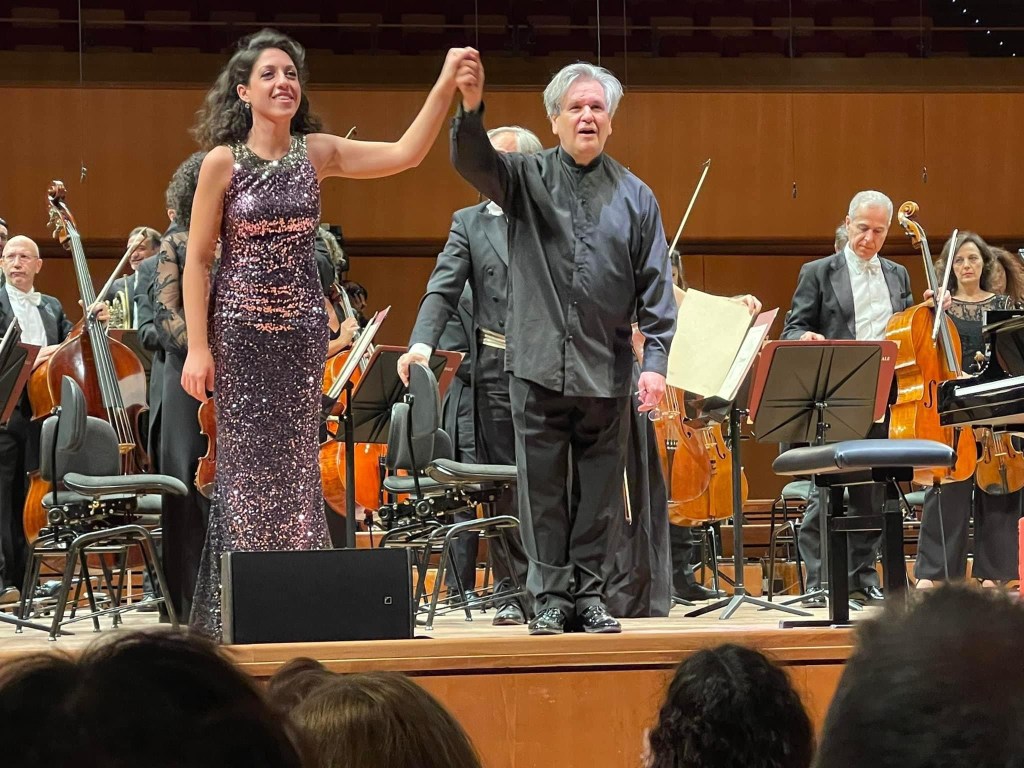
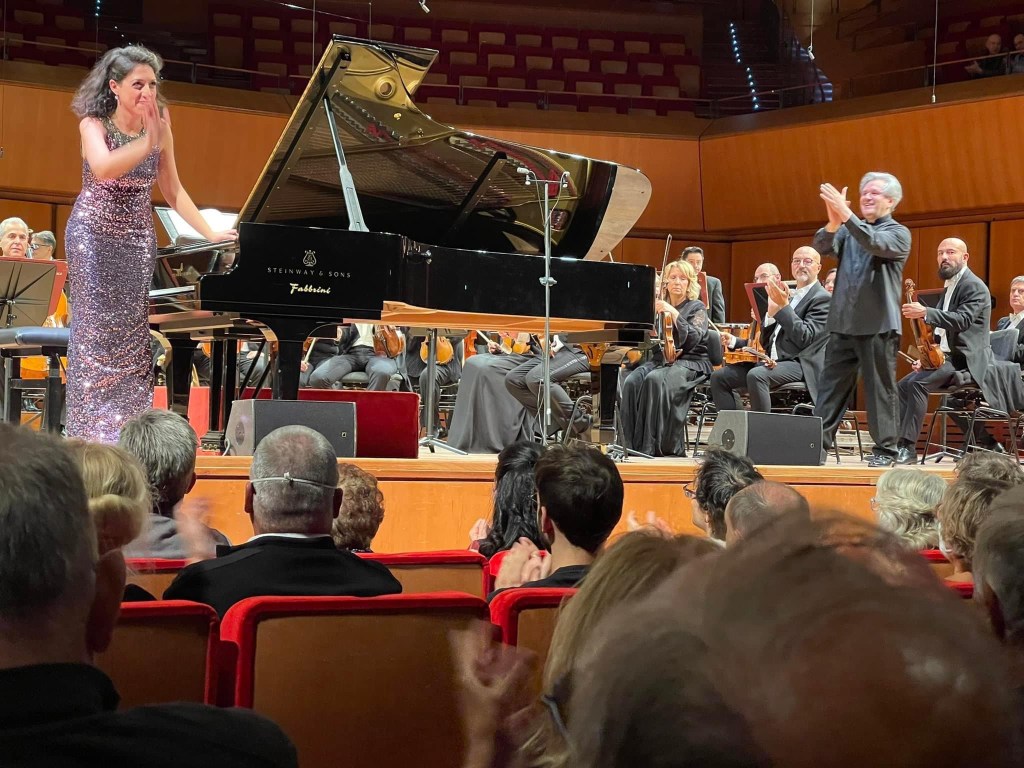
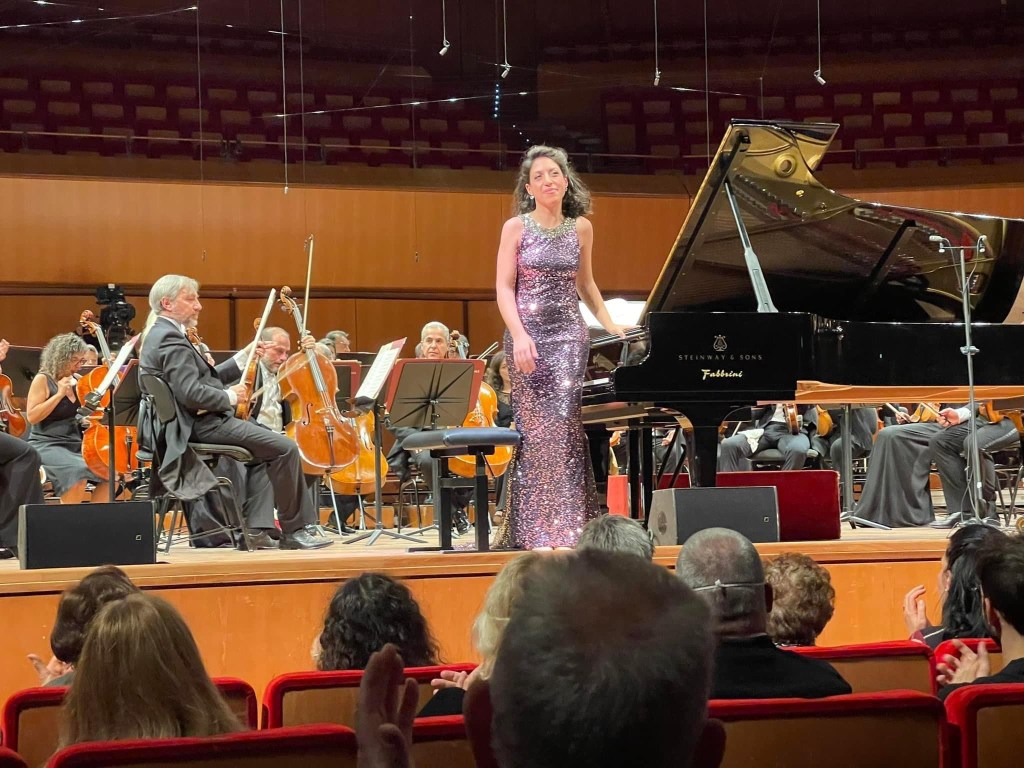
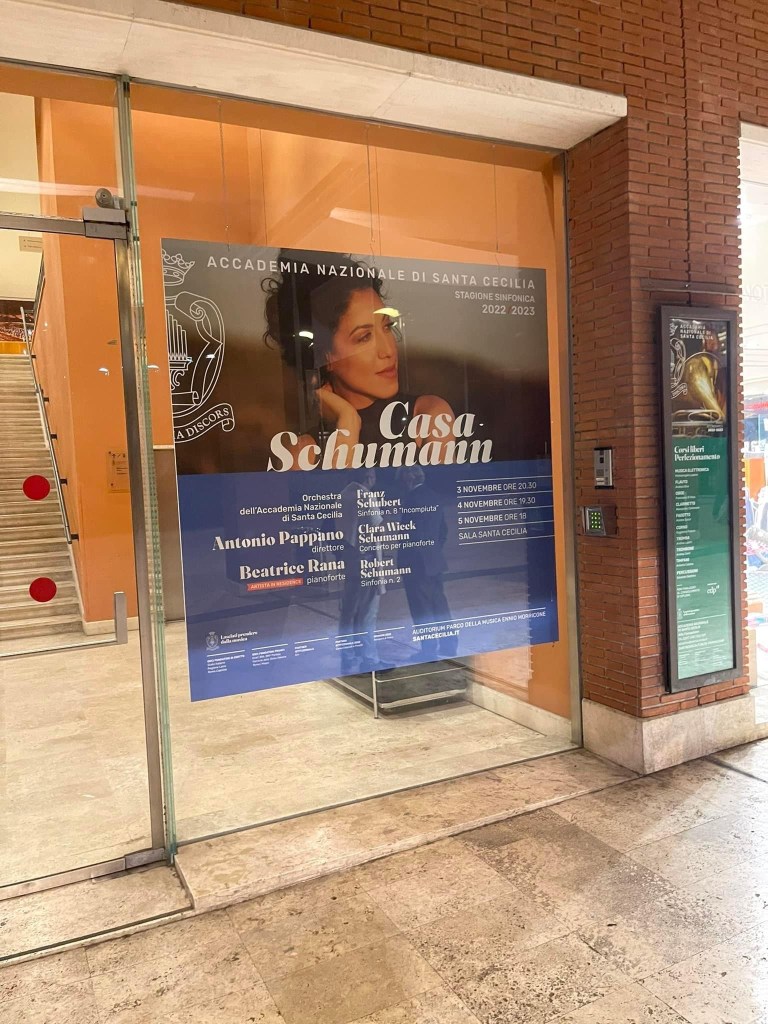
It was in the little Romance in F sharp op 28 by Robert Schumann played as an encore by Beatrice Rana that shone a light on a genius.Such exquisite playing of whispered beauty,not playing out to the audience but drawing them in to her secret world of ravishing beauty. Clara Schumann’s A minor piano concerto paled into the distance as try as she could Beatrice Rana could not turn a mere bauble into a gem.Some exquisite playing of rather empty uninspired music that seemed to be without any architectural shape or even a memorable melodic line. Some beautiful chamber music passages when she communed with the superb cello of Diego Romano or the filigree accompaniment of delicious delicacy as Pappano drew his forces to play with consumate style and passion.A finale to say bland would be too little but injected with the lifeblood of great artists Pappano and Beatrice did their best to inject some life into an empty vessel.Historically interesting,of course,to be reminded of the first woman virtuoso pianist writing her own concerto at only 16 .To discover an international performing career of over 61 years while breeding eight children.Amazing but do we really think we have struck gold?………..the only gold and silver streamed from the hands of one of the finest young pianists of her generation.
It is the first performance for the Accademy of the concerto whereas there is a list of almost three pages for the performances of the Unfinished Symphony since 1900.I think that says it all !
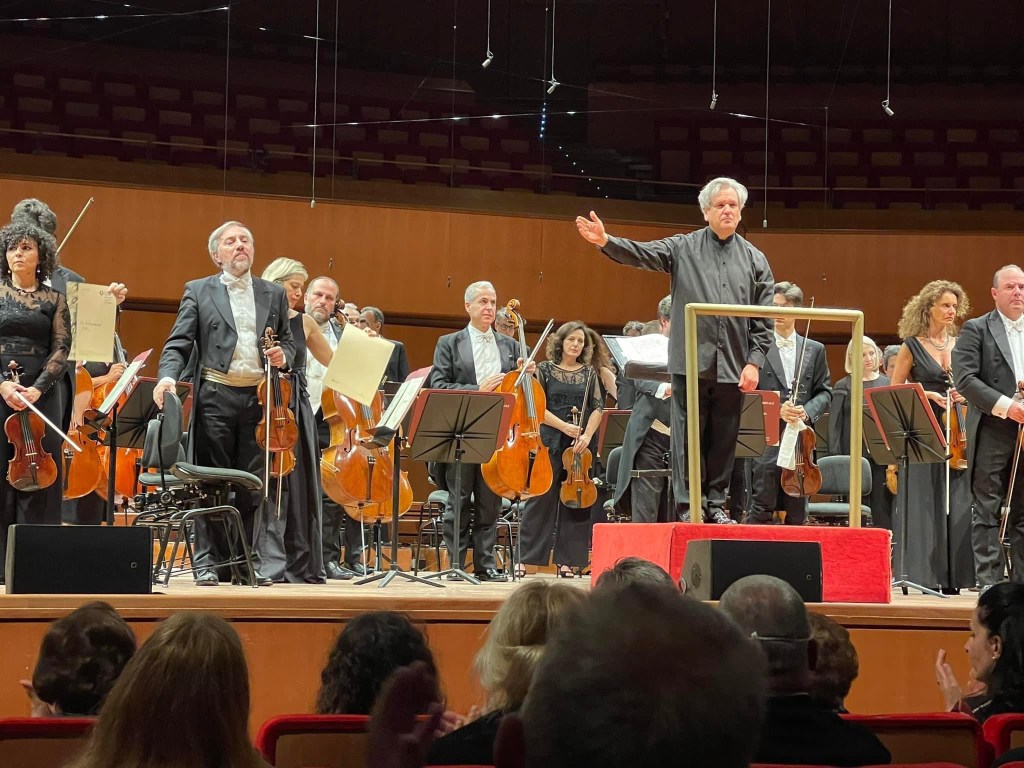
Wonderful sensitivity of an orchestra who have learnt in the past 20 years under Pappano to listen to each other.An orchestra that listens to itself is a force to be reckoned with as the superb performances of Schubert Unfinished and Schumann Second Symphony demonstrated. Pappano will be much missed when after almost 20 years he moves permanently to London next year to guide the LSO following in the footsteps of Abbado.
Clara power 🔥💕 Souvenir of a memorable week with The Philadelphia Orchestra and Yannick Nezet-Seguin! 📸 @jennifertaylorphotographyClara power 🔥💕 Souvenir of a memorable week with The Philadelphia Orchestra and Yannick Nezet-Seguin! 📸 @jennifertaylorphotographyClara power 🔥💕 Souvenir of a memorable week in New York and Philadelphia with The Philadelphia Orchestra and Yannick Nezet-Seguin! 📸 @jennifertaylorphotographyPortrait by Franz von Lenbach, 1838 Born Clara Josephine Wieck
13 September 1819 Leipzig Died 20 May 1896 (aged 76) Frankfurt Occupation Pianist Composer Piano teacher Organization Dr Hoch’s Konservatorium Spouse Robert Schumann
(m. 1840; died 1856) Children 8, including Eugenie Parents Friedrich Wieck (father) Mariane Bargiel (mother)
The Piano Concerto in A minor op.7, was composed by Clara Wieck, better known as Clara Schumann after her marriage to Robert Schumann. She completed her only finished piano concerto in 1835, and played it first that year with the Leipzig Gewandhaus Orchestra conducted by Felix Mendelssohn.
Clara Wieck was an accomplished concert pianist, trained by her father Friedrich Wieck.She was already making international tours at age eleven and composed piano pieces for her recitals.Regarded as one of the most distinguished pianists of the Romantic era, she exerted her influence over the course of a 61-year concert career, changing the format and repertoire of the piano recital by lessening the importance of purely virtuosic works She started receiving basic piano instruction from her mother at the age of four but after her mother moved out, she began taking daily one-hour lessons from her father. They included subjects such as piano, violin, singing, theory, harmony, composition, and counterpoint.She then had to practice for two hours every day. Her father followed the methods in his own book, Wiecks pianistische Erziehung zum schönen Anschlag und zum singenden Ton (“Wieck’s Piano Education for a Delicate Touch and a Singing Sound.”)Clara Wieck made her official debut on 28 October 1828 at the Gewandhaus in Leipzig, aged nine.The same year, she performed at the Leipzig home of Ernst Carus, director of the mental hospital at Colditz Castle.There, she met another gifted young pianist who had been invited to the musical evening, Robert Schumann , who was nine years older. Schumann admired Clara’s playing so much that he asked permission from his mother to stop studying law, which had never interested him much, and take music lessons with Clara’s father. While taking lessons, he rented a room in the Wieck household and stayed about a year.From December 1837 to April 1838, at the age of 18, Wieck performed a series of recitals in Vienna She performed to sell-out crowds to great critical acclaim; Chopin described her playing to Franz Liszt and a music critic, describing her Vienna recitals, said: “The appearance of this artist can be regarded as epoch-making… In her creative hands, the most ordinary passage, the most routine motive acquires a significant meaning, a colour, which only those with the most consummate artistry can give.”Clara Schumann first toured England in April 1856, while her husband was still living but unable to travel. She was invited to play in a London Philharmonic Society concert by conductor William Sterndale Bennett, a good friend of Robert’s to whom he had dedicated the Etudes Symphoniques op 13.In May 1856, she played Schumann’s Piano Concerto with the New Philharmonic Society conducted by Dr Wylde, who as she said had “led a dreadful rehearsal” and “could not grasp the rhythm of the last movement”.Still, she returned to London the following year and continued to perform in Britain for the next 15 years.
It was in January 1833, at age 13, she began composing a Piano Concerto in , completing it in November a single-movement Konzertsatz that she orchestrated herself. In February 1834, her future husband Robert revised the orchestration,and the 14-year-old prodigy then performed it in several concerts.She then expanded the work by adding two more movements, using the Konzertsatz as the finale. The new first movement was completed in June 1834, and the slow second movement “Romance” with its extended cello solo was finished the following year. She again orchestrated the work herself, including undoing Robert’s revisions of the original Konzertsatz, completing her new three-movement Piano Concerto on 1 September 1835, twelve days before her 16th birthday.Clara premiered the full concerto on 9 November 1835 as soloist with the Leipzig Gewandhaus Orchestra, conducted by Mendelssohn
Her life was punctuated by tragedy Not only did her husband predecease her, but so did four of their children.Their first son, Emil, died in 1847, aged only 1.Their daughter Julie died in 1872, leaving two small children aged only 2 and 7, then raised by their grandmother.In 1879, their son Felix died aged 24.In 1891, their son Ferdinand died at the age of 41, leaving his children to her care.In 1878, she was appointed the first piano teacher of the new Dr Hoch’s Knservatorium in Frankfurt.Among her 68 known students who made a musical career were Natalia Janotha, Fanny Davies, Nanette Falk, Amina Goodwin, Carl Friedberg, Leonard Borwick, Ilona Eibenschütz, Adelina de Lara, Marie Olson and Mary Wurm.She played her last public concert in Frankfurt on 12 March 1891. The last work she played was Brahms’s Haydn Variations , in a version for two pianos, with James Kwast.
Clara and Robert Schumann had eight children:
Marie (1841–1929)
Elise (1843–1928)
Julie (1845–1872)
Emil (1846–1847)
Ludwig (1848–1899)
Ferdinand (1849–1891)
Eugenie (1851–1938)
Felix (1854–1879).
Robert and Clara Schumann’s children (photo taken in 1853 or 1854); from left to right: Ludwig, Marie, Felix, Elise, Ferdinand and Eugenie
The Haydn Sonata XV1 n.12 in A first appeared as a Divertimento in A and was written around 1767.It is thought the first movement may have been by C.P.E Bach.According to Grove Music, this is in the list of “early harpsichord sonatas attributed to Haydn”, but has the comment ‘I doubtful’ which may mean that the 1st movement is considered doubtful.
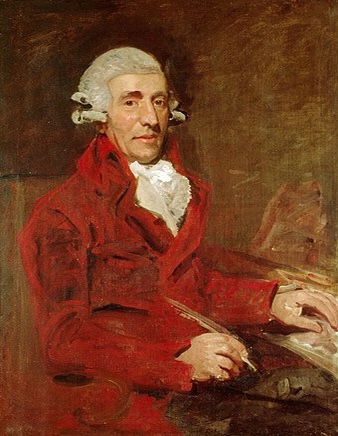
Portrait of Haydn in London 1791 by John Hoppner
Franz Joseph Haydn,31st March 1732 – 31st May 1809,was one of the most prolific and prominent composers of the Classical period. He is often called the “Father of the Symphony” and “Father of the String Quartet” because of his important contributions to these forms. He was also instrumental in the development of the piano trio and in the evolution of sonata form. A lifelong resident of Austria, Haydn spent much of his career as a court musician for the wealthy Esterházy family on their remote estate. Isolated from other composers and trends in music until the later part of his long life, he was, as he put it, “forced to become original”. At the time of his death, he was one of the most celebrated composers in Europe.
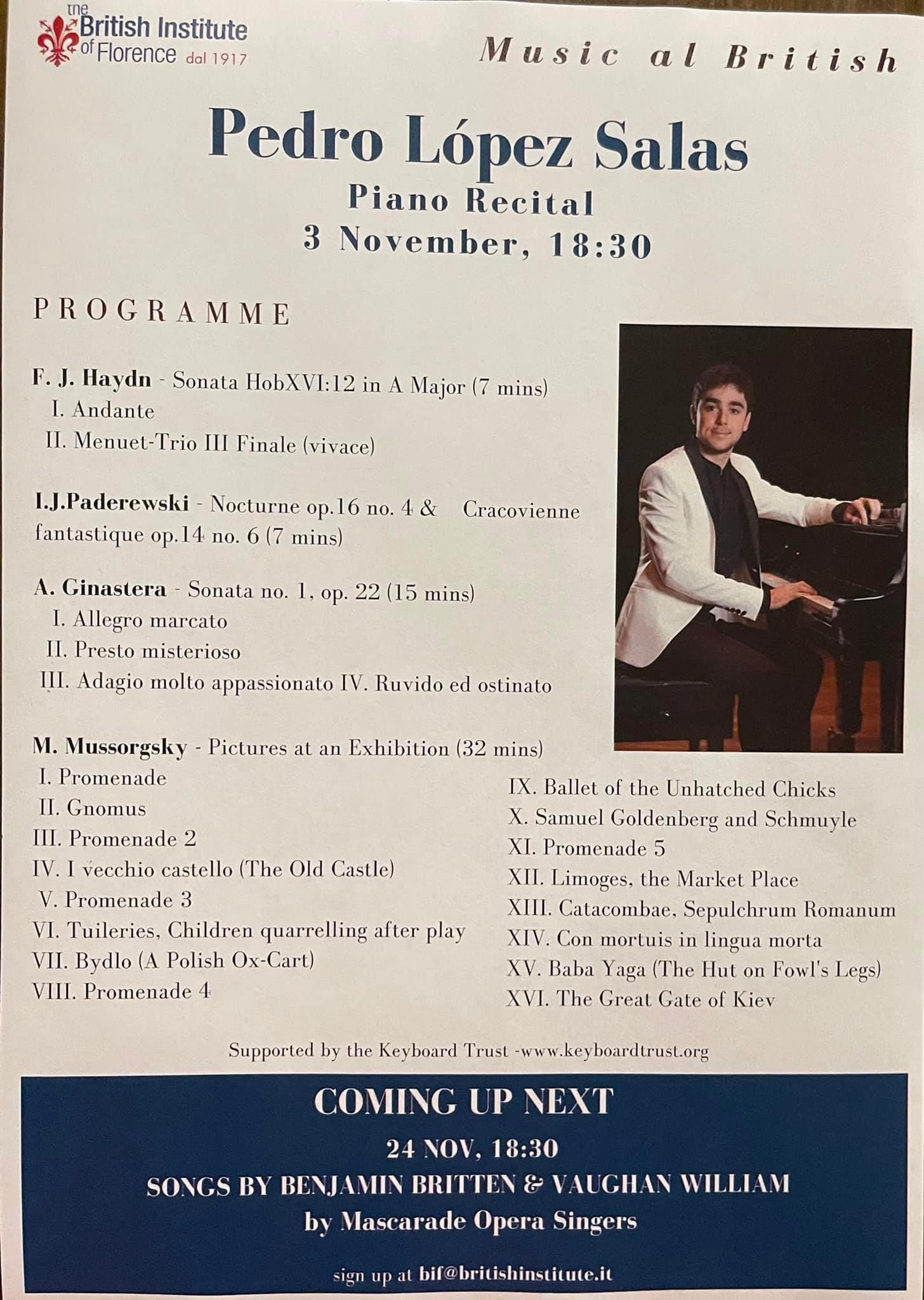
From the very first notes Pedro showed us that we were in for something very special tonight as everything he played was brought to life with such musicianship.Every phrase,every passage was given a life of its own in a musical conversation that is rare indeed.There was such delicacy in the opening Andante with jewel like ornaments that just sprang from his fingers with spring like brilliance.Sparkling and glowing with ever more meaning as he shaped the phrases with beauty and rhythmic drive.The Menuet was very simple and beautifully shaped contrasting with the music box sounds of the Trio played on the surface of the keys with long held pedals as Haydn himself had indicated.A similar effect to the later C major Sonata Hob XV1:50 written more that 30 years later in 1795/5 and one of Haydn’s four famous London Sonatas which are the distillation of the composer’s entire sonata-writing output .They were,though,written for an instrument of greater tonal range than the Viennese instruments of the day, with a wider palette of specified dynamic possibilities and pedal effects.The return of the simple black and white elegance of the Menuet was like reopening a window, having been taken on a magic dream world of make believe.The Finale was scintillating and exhilarating bursting with youthful energy but in Pedro’s masterly hands always given such shape and character .
Ignacy Jan Paderewski (18 November 1860 – 29 June 1941) was a Polish pianist and composer who became a spokesman for Polish independence. In 1919, he was the new nation’s Prime Minister and foreign minister during which he signed the Treaty of Versailles, which ended World War 1.A favorite of concert audiences around the world, his musical fame opened access to diplomacy and the media.During World War I, Paderewski advocated an independent Poland, including touring the United States, where he met with President Woodrow Wilson who came to support the creation of an independent Poland at the Paris Peace Conference in 1919, which led to the Treaty of Versailles.
His piano miniatures became especially popular; the Minuet in G Op. 14 No. 1, written in the style of Mozart, became one of the most recognized piano tunes of all time. Despite his relentless touring schedule and his political and charitable engagements, Paderewski left a legacy of over 70 orchestral, instrumental, and vocal works.All of his works evoke a romantic image of Poland. They incorporate references to Polish dances (polonaise, krakowiak, and mazurka) and highlander music (Tatra album [Album tatrzańskie], op. 12, Polish Dances [Tańce polskie], op. 5.
The two short pieces that Pedro chose were beautifully played and although they were obviously salon pieces written for Paderewski’s own tours he almost turned ‘baubles into gems’.His extraordinary sense of balance allowed the touching ‘bitter sweet’ melody to sing in an enchanting way that was of great effect.The Cracovienne fantastique on the other hand where the Gopak type dance was played with great energy and character.There was also scintillating jeux perlé effects that were ravishing and would have obviously thrilled the thousands of fans that flocked to hear the ‘greatest virtuoso of all time’.Pedro’s fingerfertigkeit was extraordinary in the way the notes just seemed to flow from his fingers with such charm and ease.Let us not forget that Paderewski was the first pianist to give a solo recital in the newly opened 3000 seat Carnegie Hall and 20000 people flocked to hear him in Madison Square Garden.A modern day Lang Lang one might say who like Paderewski has also put his quite considerable fortune amassed from his concert career to philanthropical use.
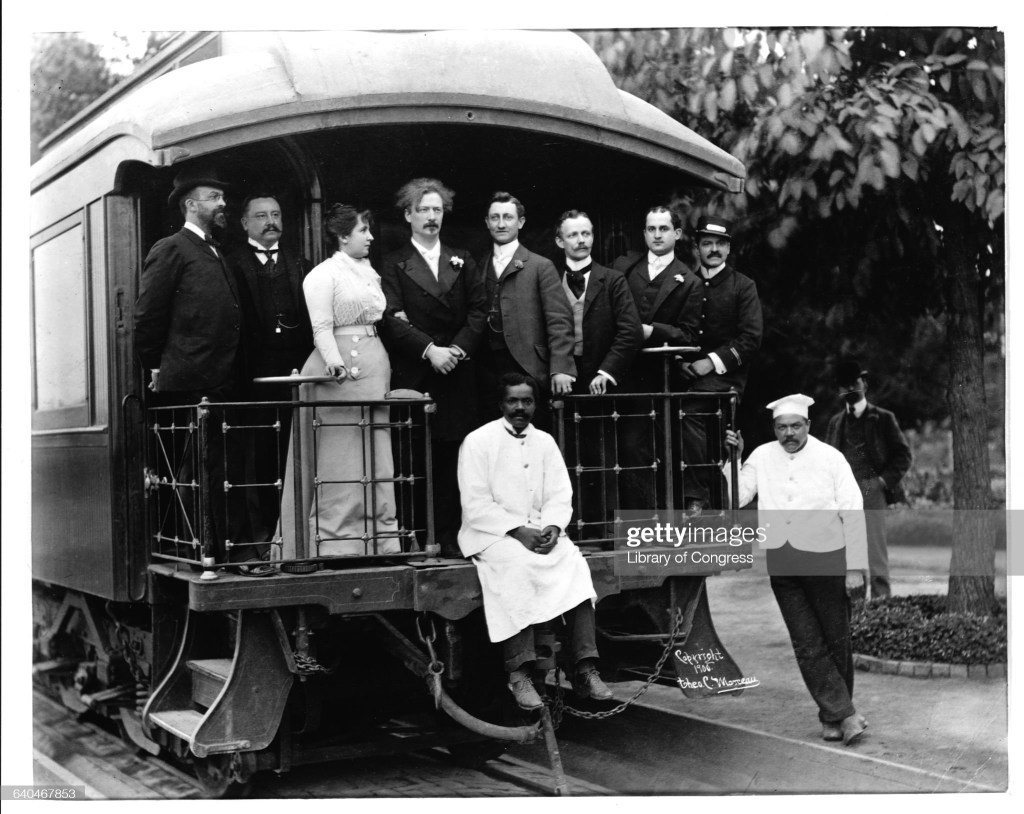
Paderewski’s private touring coach
After the invasion of Poland in 1939, Paderewski returned to public life. In 1940, he became the head of the National Council of Poland , a Polish sejm (parliament) in exile in London. He again turned to America for help and his broadcast was carried by over 100 radio stations in the United States and Canada. He advocated in person for European aid and to defeat Nazism. In 1941, Paderewski witnessed a touching tribute to his artistry and humanitarianism as US cities celebrated the 50th anniversary of his first American tour by putting on a Paderewski Week, with over 6000 concerts in his honour. In 1992, after the end of communism in Poland, his remains were transferred to Warsaw and placed in St.John’s Archcathedral. His heart is encased in a bronze sculpture in the National Shrine of Our Lady of Częstochowa near Doylestown,Pennsylvania.
Piano Sonata No. 1, Op. 22 by Ginastera is in four movements.It was commissioned by the Carnegie Institute and the Pennsylvania College for Women writing a piano sonata for the Pittsburgh International Contemporary Music Festival. The first performance in 1952 was given by pianist Johana Harris, wife of American composer Roy Harris, and Ginastera’s intention for the piece was to capture the spirit of Argentine folk music without relying on explicit quotations from existing folk songs.Ginastera was born in Buenos Aires (April 11, 1916 – June 25, 1983) and is considered to be one of the most important 20th century classical composers of the Americas.He studied at the Williams Conservatory in Buenos Aires, graduating in 1938 and as a young professor, he taught at the Liceo Militar General San Martín. After a visit to the United States in 1945–47, where he studied with Aaron Copland at Tanglewood, he returned to Buenos Aires. Ginastera grouped his music into three periods: “Objective Nationalism” (1934–1948), “Subjective Nationalism” (1948–1958), and “Neo-Expressionism” (1958–1983). Among other distinguishing features, these periods vary in their use of traditional Argentine musical elements. His Objective Nationalistic works often integrate Argentine folk themes in a straightforward fashion, while works in the later periods incorporate traditional elements in increasingly abstracted forms.
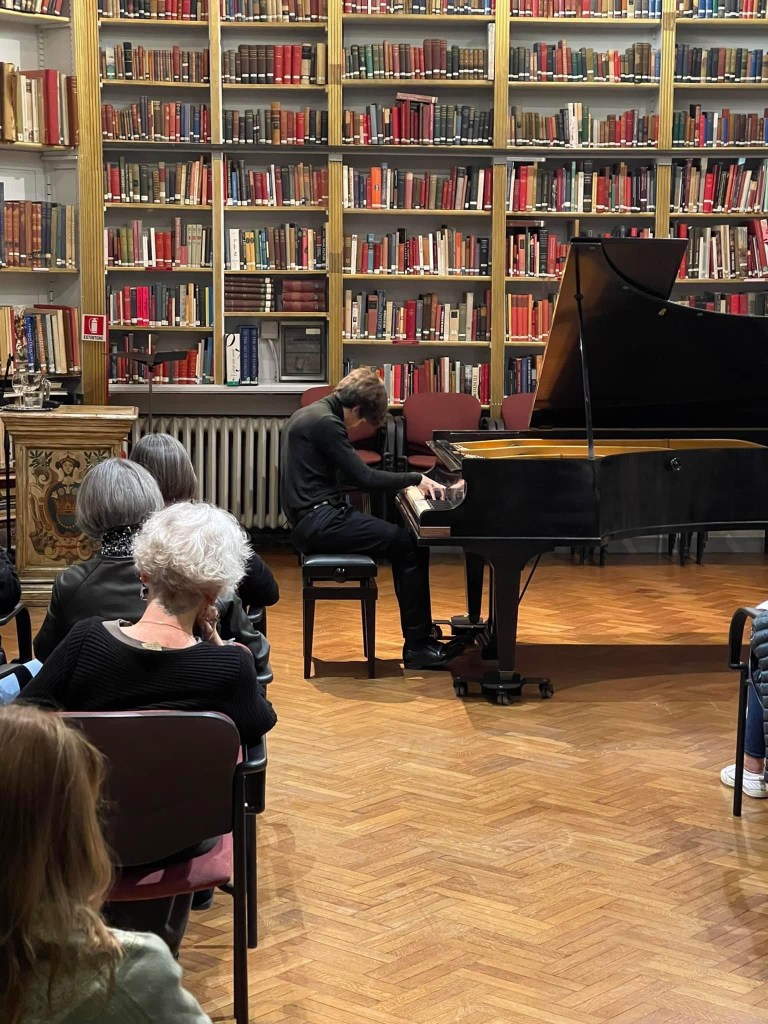
There was playing of rhythmic precision and driving Latin fever mixed with episodes of ravishing colour.The legato meanderings of the second movement were of Chopinesque whispered mystery until sudden ferocious outbursts erupted before dissolving back to its atmospheric beginnings.There was startling intensity in the Adagio with its calm and crystalline melodic interruptions over exotic luxuriant arpeggiando chords.The final toccata was played with a ferocious outpouring of savage rhythms that were of great effect and brought this showcase work to a brilliant conclusion.Much to the relief of the director Simon Gammell who feared that his 1898 instrument might have collapsed in a heap at his feet!But Pedro is an artist who can feel the limits and possibilities of the instrument he is playing and can gage his passion with extraordinary sensitivity.
Pictures at an Exhibition is based on pictures by the artist, architect, and designer Viktor Hartmann. It was probably in 1868 that Mussorgsky first met Hartmann, not long after the latter’s return to Russia from abroad. Both men were devoted to the cause of an intrinsically Russian art and quickly became friends. They met in the home of the influential critic Vladimir Stasov, who followed both of their careers with interest. According to Stasov’s testimony, in 1868, Hartmann gave Mussorgsky two of the pictures that later formed the basis of Pictures at an Exhibition.
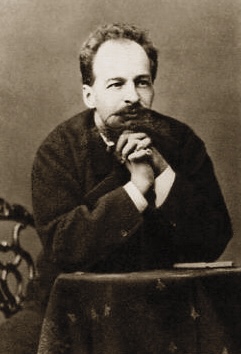
Viktor Hartmann
Hartmann’s sudden death on 4 August 1873 from an aneurysm shook Mussorgsky along with others in Russia’s art world. The loss of the artist, aged only 39, plunged the composer into deep despair. Stasov helped to organize a memorial exhibition of over 400 Hartmann works in the Imperial Academy of Arts in Saint Petersburg in February and March 1874. Mussorgsky lent the exhibition the two pictures Hartmann had given him, and viewed the show in person, inspired to compose Pictures at an Exhibition, quickly completing the score in three weeks (2–22 June 1874).Five days after finishing the composition, he wrote on the title page of the manuscript a tribute to Vladimir Stasov, to whom the work is dedicated.The music depicts his tour of the exhibition, with each of the ten numbers of the suite serving as a musical illustration of an individual work by Hartmann.Although composed very rapidly, during June 1874, the work did not appear in print until 1886, five years after the composer’s death, when a not very accurate edition by the composer’s friend and colleague Nikolai Rimsky-Korsakov was published.
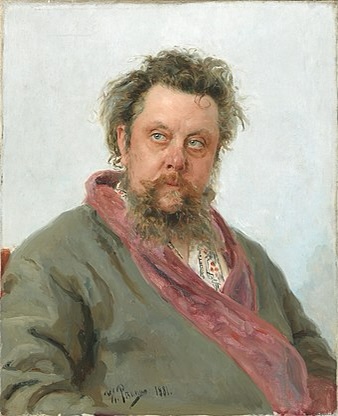
A portrait painted by Ilya Repin a few days before the death of Mussorgsky in 1881
Mussorgsky suffered personally from alcoholism, it was also a behavior pattern considered typical for those of Mussorgsky’s generation who wanted to oppose the establishment and protest through extreme forms of behavior.One contemporary notes, “an intense worship of Bacchus was considered to be almost obligatory for a writer of that period.”Mussorgsky spent day and night in a Saint Petersburg tavern of low repute, the Maly Yaroslavets, accompanied by other bohemian dropouts. He and his fellow drinkers idealized their alcoholism, perhaps seeing it as ethical and aesthetic opposition. This bravado, however, led to little more than isolation and eventual self-destruction.
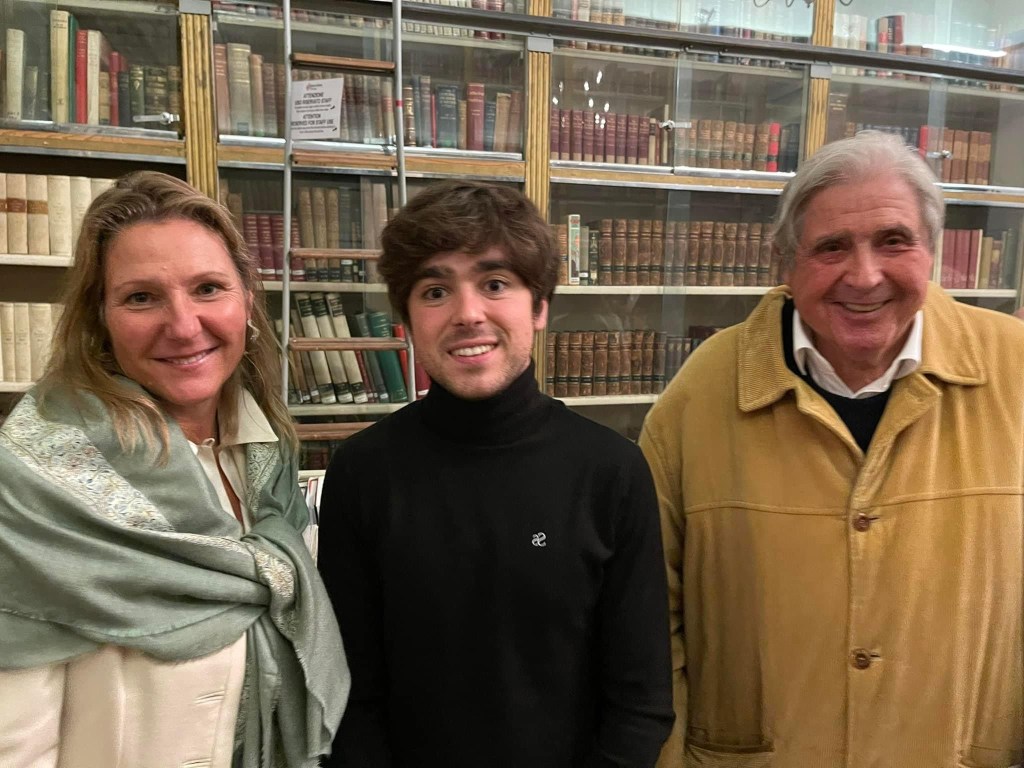
Pedro with a very enthusiastic Sir David Scholey and daughter who had also heard this week in Florence Martha Argerich in the Schumann Concerto with Charles Dutoit and Maurizio Pollini with Zubin Mehta in Mozart K.595 !
I have heard Pedro before,encouraged to listen to a very talented student by his teacher at the RCM Norma Fisher. https://christopheraxworthymusiccommentary.com/2022/05/12/norma-fisher-at-steinway-hall-the-bbc-recordings-on-wings-of-song-the-story-continues/. I could never have imagined that he would mature into an artist of such stature .Such weight and sensitivity where every note had a meaning in an overall architectural structure of remarkable maturity.Could it have been the times we are living as Semyon Bychkov said introducing Ma Vlast – My fatherland with the Czech Philharmonic?Maybe we listen in these terrible times to the music we have known for a life time in a different way.The Great Gate of Kiev we certainly listened in a different way today not only because of the terrible news from the Ukraine but also because this young man played it with such a sense of style and colour with real physical elan.An old much abused war horse was truly reborn as we hope a miracle might occur in real life to curb the zealous evil of a despot.
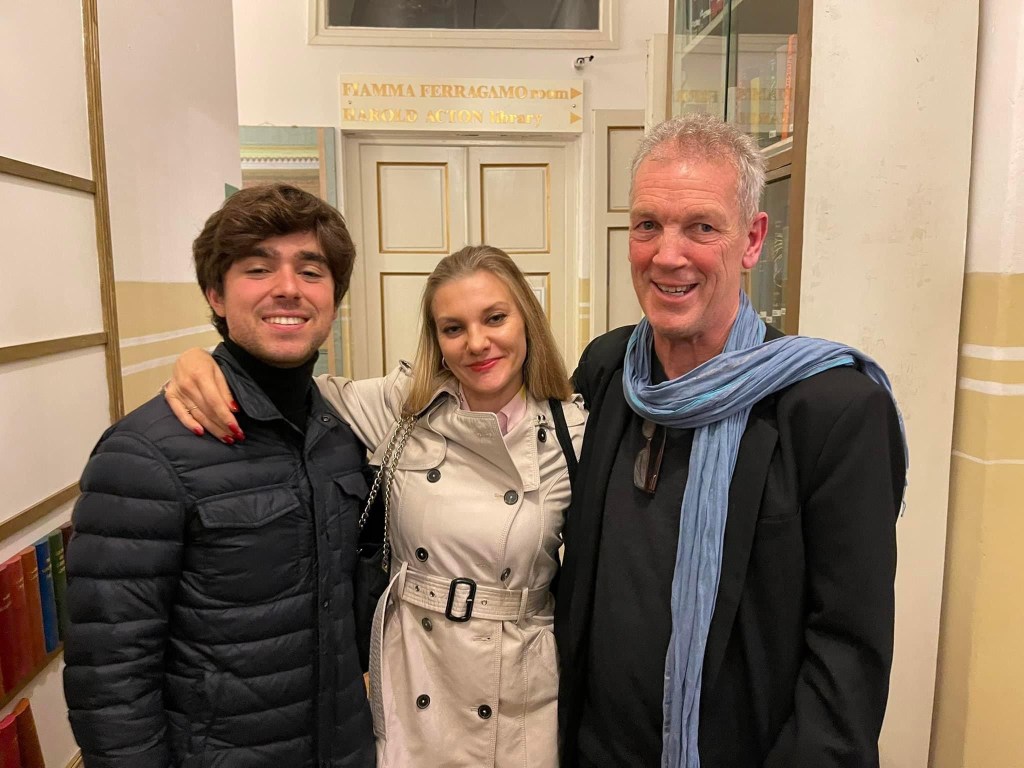
Pedro and Margarita with Simon Gammell O.B.E director of the British Institute
It had been from the very first luminous notes of the Promenade of Mussorgsky’s Pictures that our attention was immediately caught and we were held very much under the spell of the authority and extraordinary musicianship of this young artist.The character he brought to Gnomus was captivating as was the sublime beauty of the promenade 2 before the gentle flow of the Old Castle .It was played with such subtle colouring and a sumptuous sense of balance of utmost sensitivity.A promenade 3 of weight and determination led to the irresistible insistence of children quarrelling in the Tuileries only to be interrupted by the grandeur of Bydlo.Such delicacy and luminosity in the promenade 4 was followed by the rhythmic pointing and delight of the unhatched chicks pleasantly surprised to find such fingerfertigkeit!Has Samuel Goldenberg ever sounded so pompous and serious and Schmuyle so beseechingly humble?The dexterity in the market place was astonishing for the breath control at such a pace.His sense of colour in catacombae was truly kaleidoscopic where every note of every chord had such meaning.The sheer physical urgency of Baba Yaga was overpowering with an absolutely hypnotic energy that swept all before it.The contrast with the whispered terror of the central section sent a scriver down our backs and to any pianists present a lesson of control in pianissimo!
The Great Gate of Kiev
There was such grandeur in the opening statement of the Great Gate and a serenity and complete change of colour that was deeply moving for the two chorale episodes.The gradual tolling of the bells showed a quite extraordinary sense of balance and control without ever loosing the inner tension and energy.It demonstrated the total immersion of this young artist in his magic sound world that he was able to share so magnificently with us today.
A spontaneous standing ovation and insistence brought Pedro back with his castanets ,clicking his heels in an an absolutely scintillating performance of El Pelele by Granados .I never expected to hear it played with such charm and style again since Alicia de Larrocha used to seduce us with it in Rome.He could have played all night but with three quarters of a century still before him this is just the beginning of a long and illustrious career.What better after such a concert than a wine tasting organised by Simon and Jennifer Gammell of an excellent IGT merlot “Le Redini” from their partners Tenuta degli Dei.
“Perfect blend of musicality, personality, and brilliantly polished technique” (La Tribuna).
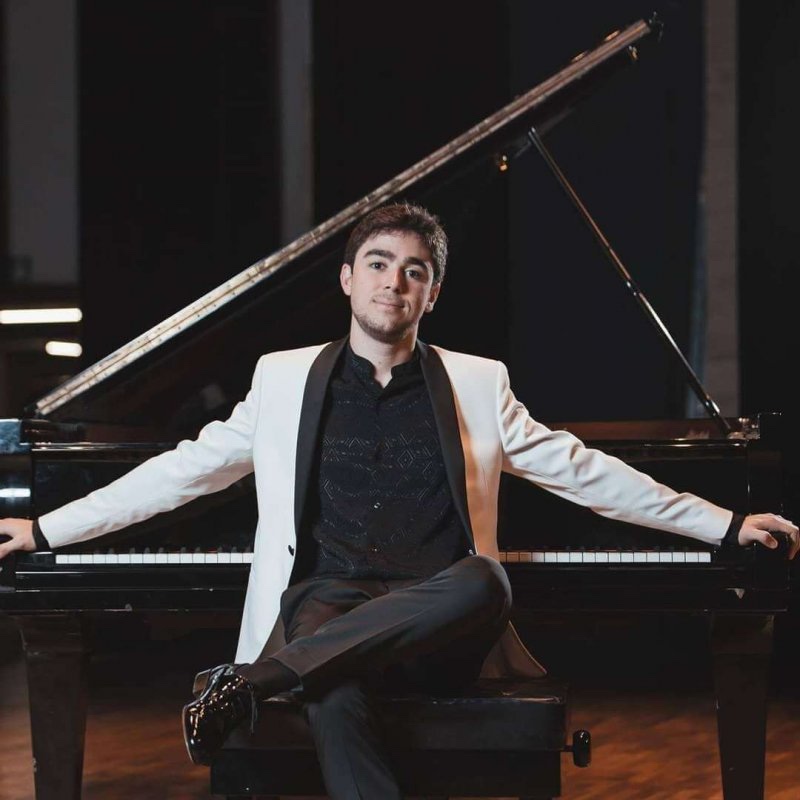
Born in 1997, Pedro is a Spanish pianist who is currently studying the Master of Performance Degree with Prof. Norma Fisher at the “Royal College of Music” of London (RCM), awarded with full scholarship and the title of the “Leverhulme Honorary Arts Scholarships”. He is a “Keyboard Trust” artist, as well as a “Talent Unlimited” artist, both from the UK.He has been awarded with more than 40 prizes at International and National piano competitions, among them, the First Prizes at the Malta International Piano Competition; “Composers of Spain” CIPCE International Piano Competition (Las Rozas, Madrid); “Joan Chisell” Schumann Prize of the RCM (London); César Franck” International Piano Competition (Bruxelles), Second Prize and four special Prizes at the Ferrol International Piano Competition, etc.He has also received crucial inspiration from internationally renowned masters such as Dmitri Baskirov, Dmitri Alexeev, Alexander Kobrin, Pavel Nerssesian, Pascal Nemirovsky, Pavel Gililov, Marianna Aivazova, Mariana Gurkova and Ludmil Angelov.He has performed throughout Spain and Europe in prestigious concert halls, such as the “Palau de la Música” of Valencia, “Teatro de la Maestranza” of Seville, “Miguel Delibes” Concert Hall of Valladolid, Ferrol Concert Hall, “Manuel de Falla” of Granada, “Teatro Circo” of Albacete, Theater of Aachen, “Wiener Saal” of Salzburg, among many others. He has performed as a soloist with the highest quality spanish orchestras, as the “Orquesta Sinfónica de Galicia”, “Orquesta Sinfónica de Castilla y León”, “Orquesta de Valencia”, “Real Orquesta Sinfónica de Sevilla”, etc.He has offered numerous interviews for international and national press, radio and television. “Three encores, standing audience and a long line of spectators lined up to congratulate the young Spanish pianist. Pedro López Salas brightened up the evening in Milan” (Cultura di Milano). “More than an excellent pianist, he is a soloist and almost a conductor, judging by his scenic development” (Ritmo magazine). “Enormous security and great capacity of the young pianist to endow Liszt’s concerto number 2 with expressiveness and poetry” (El correo de Sevilla).
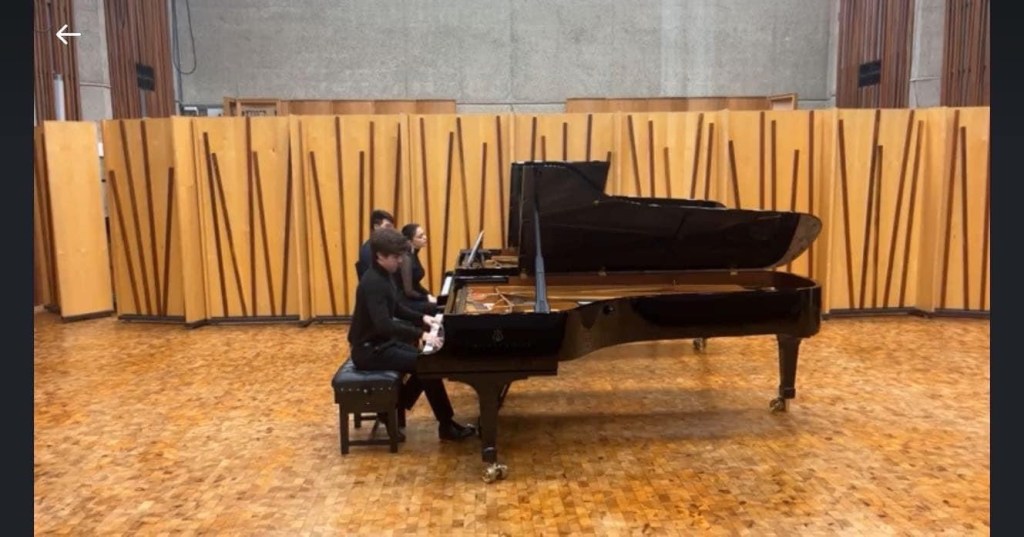
Pedro writes: ‘A lovely afternoon last Saturday performing a livestream concert, playing Mozart 21 and Liszt 1 piano concerti accompanied by great friends Yu-Chieh Lin and Vusala Babayeva. Thanks so much to Tchaikovsky International Piano Competition Online – TIPCO for organising it and to Aidan Chan for the technical matters!’You can still watch it here https://fb.watch/guPDpKhB5V/Enthusiastic audience member thanking Pedro And a well deserved post concert dinner at Del Carmine just around the corner.I remember it from my student days in Florence – some things never change!And a well deserved after dinner drink too for our piano technician/composer Michele PadovanoA room with a view indeed
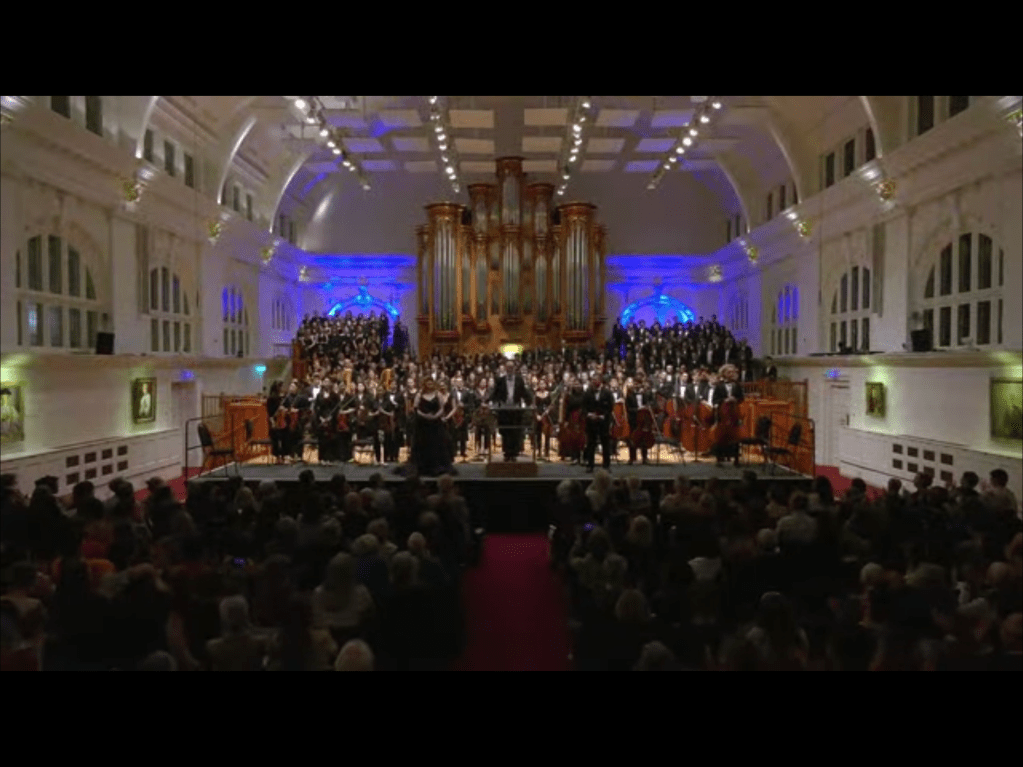
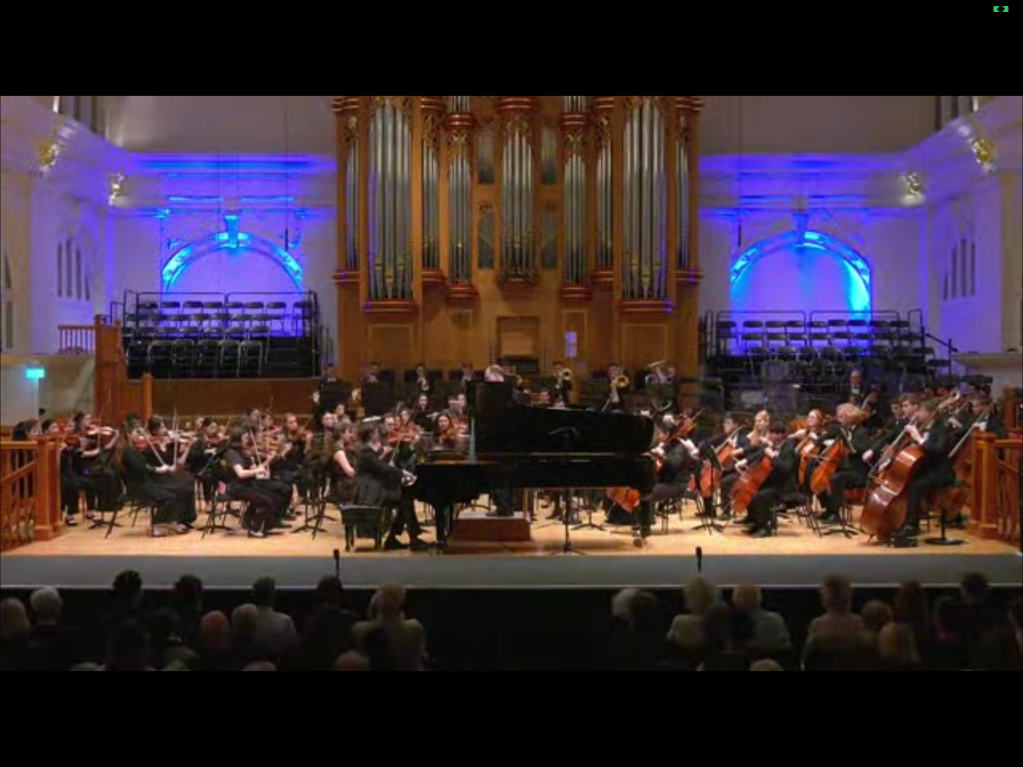
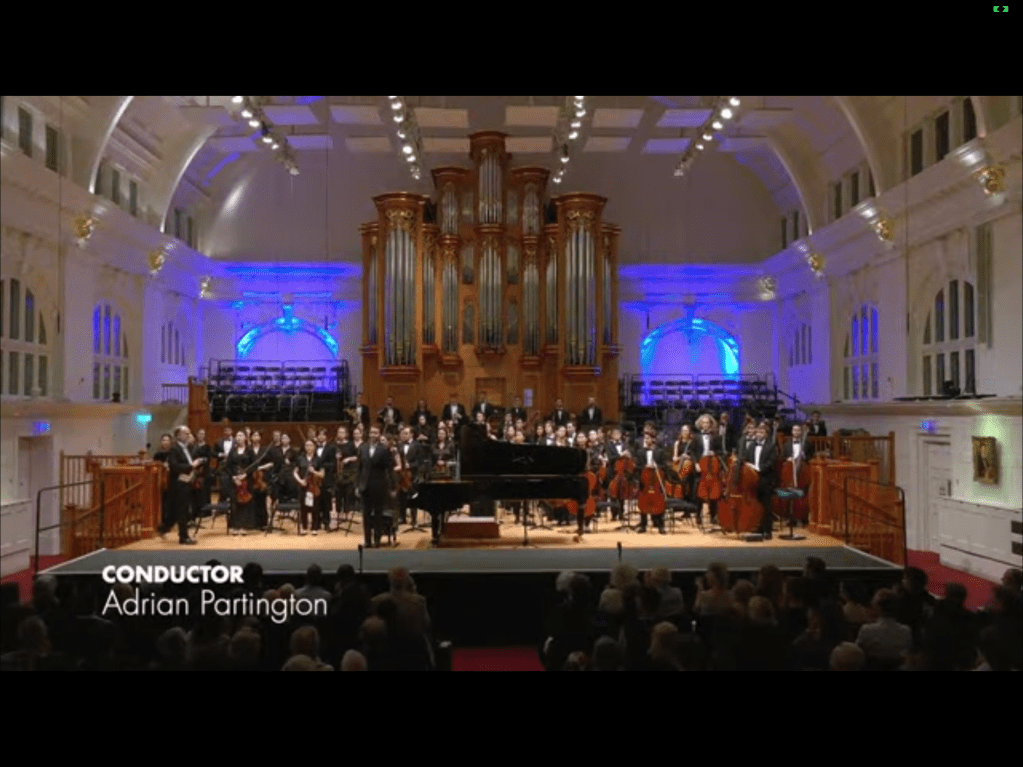
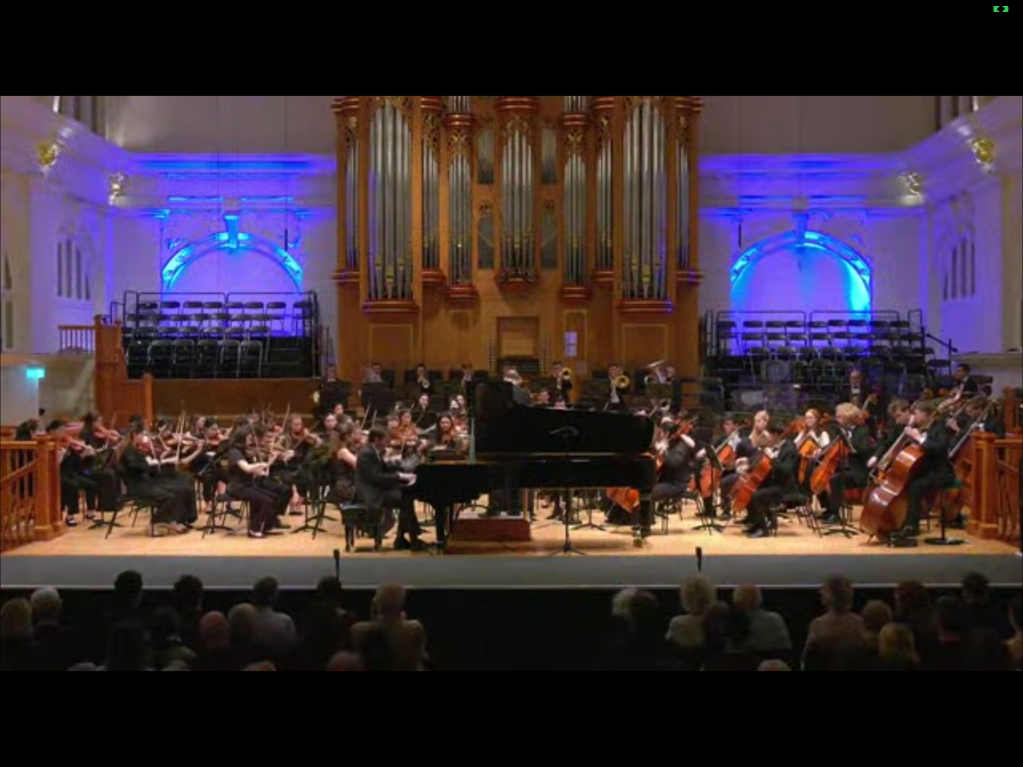
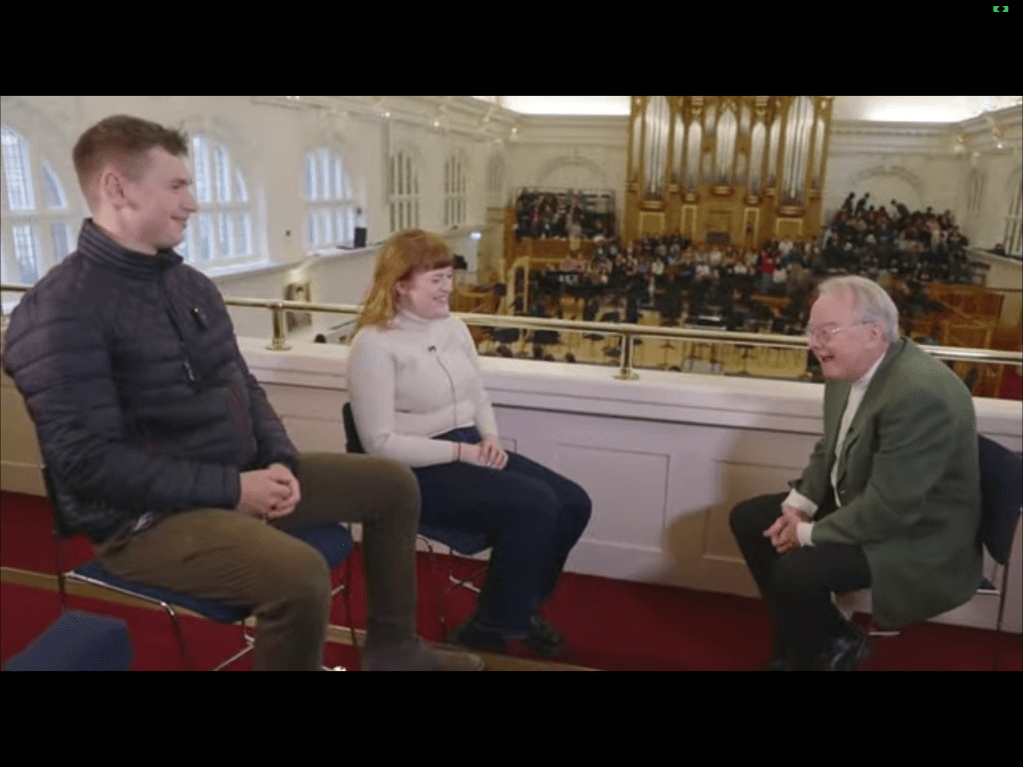
Adrian Partington – conductor Misha Kaploukhii – piano Madeleine Boreham – soprano Redmond Sanders – baritone RCM Symphony Orchestra and Chorus Mark Biggins – chorus director Liszt Piano Concerto no 2 in A major S 125 Vaughan Williams A Sea Symphony Continuing our celebrations for Vaughan Williams’ 150th anniversary, renowned choral conductor and RCM alumnus Adrian Partington leads the monumental work that firmly put the composer on the map. Alongside, RCM Concerto Competition Winner Misha Kaploukhii performs Liszt’s second and final piano concerto – an unconventional work in one single, sweeping movement, where piano and orchestra are woven together in expansive symphonic textures.
A Sea Symphony and much more at the RCM last night https://youtu.be/x4L8MaAOga0 To see and hear all that youthful passion and energy in the Sea Symphony with a chorus and orchestra brought back such memories.All the concerts I had heard in this hall when as a schoolboy I discovered the wonders of music that were being offered to me by Sir Adrian Boult,Yehudi Menuhin,the debut of John Lill with Rachmaninov 3rd,George Barber,Dennis Lee ,Enloc Wu , Gwyneth Prior and many more. All there for a schoolboy to enjoy and acquire a taste for music of great quality that together with my lessons with Sidney Harrison were to be the basis for a lifetime in music.
Misha Kaploukhii
Today there was to marvel again at the 19 year old Misha Kaploukhii who opened the concert,an hors d’oevre you might say,with Liszt’s 2nd Piano Concerto. Another performance of authority and class just as I had heard a few weeks ago when he played Rachmaninov First Piano Concerto at Cadogan Hall.Today was the prizewinners concert of the Concerto competition which he had won. Under the scrupulous eyes and ears of his mentor Ian Jones he is revealing a potential that seems to have no limits.
The second concerto is much less of a showpiece than the first and it takes not only a virtuoso technique to do it justice but also a sense of architecture and musicianship that rarely go hand in hand.
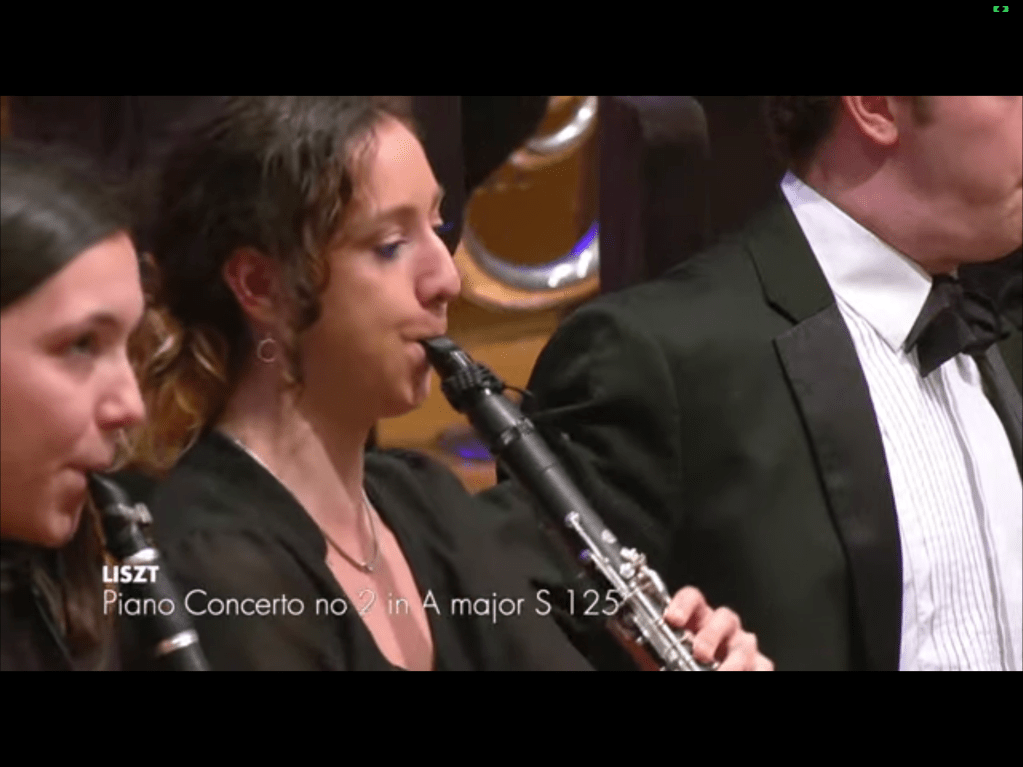
It was from the opening flourishes in Mischa hands that you could feel his chamber music approach as he listened so sensitively to the opening clarinet and wind solo. They were of course much too slow but Misha accepted the challenge and turned every phrase into a golden thread of beauty and style.
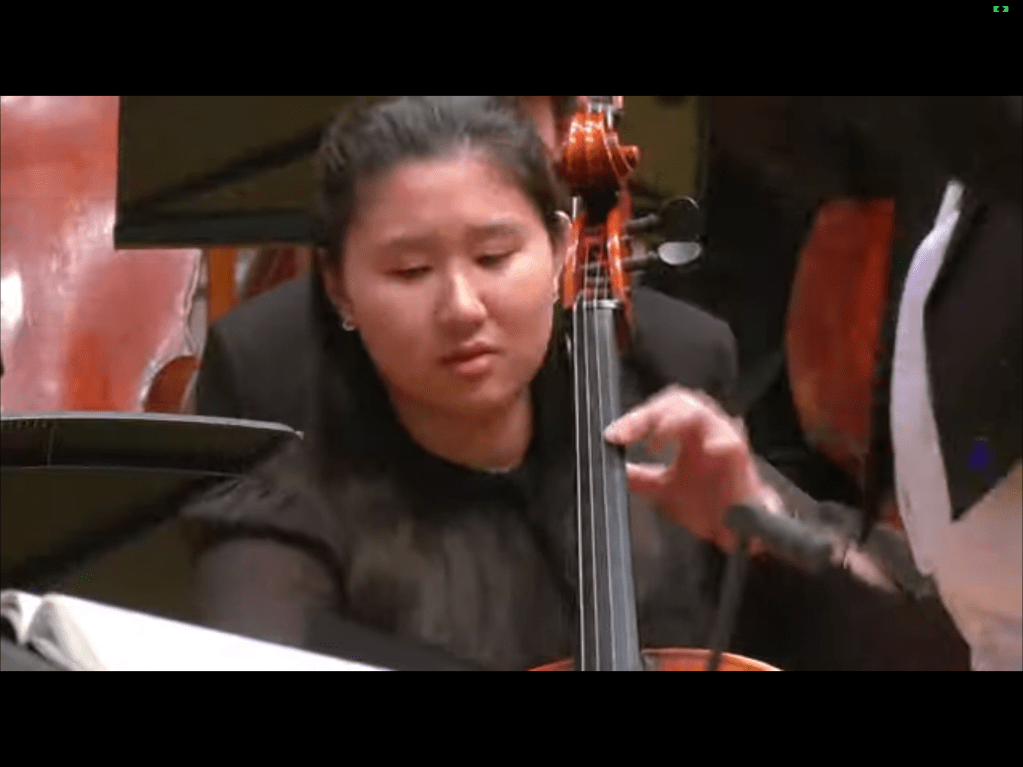
First cello of the RCM Symphony Orchestra
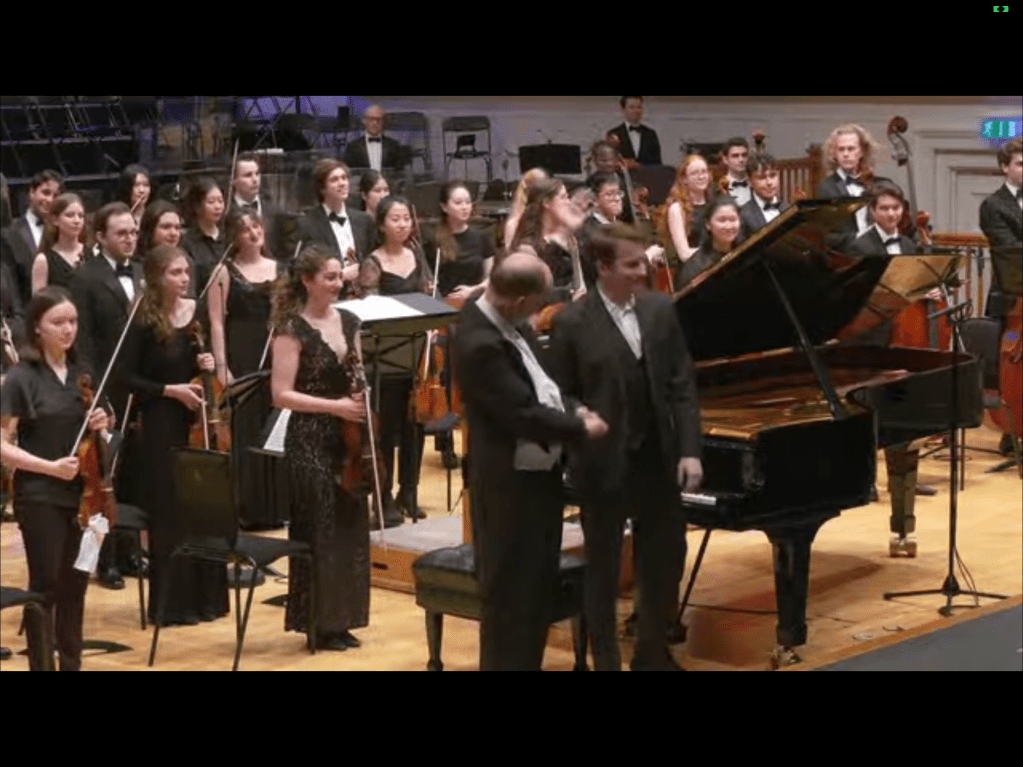
He continued with the superb cello solo in duet with the piano reaching a passionate conversation of red hot eloquence as the concerto gradually built in intensity.It was in the final part where Misha’s virtuosity was quite breathtaking as he let leash a series of octaves and glissandi as the concerto grew in pomp and circumstance with it’s rather military style brass band ending.Misha now at one with the conductor Adrian Partington and orchestra gave great style to this rather bombastic ending and together they brought an architectural arch to rest without any vulgarity or demonstrative virtuosity.There was excitement,intensity but above all an aristocratic style that gave great cohesion and class to what can so often turn into a showman’s warhorse.
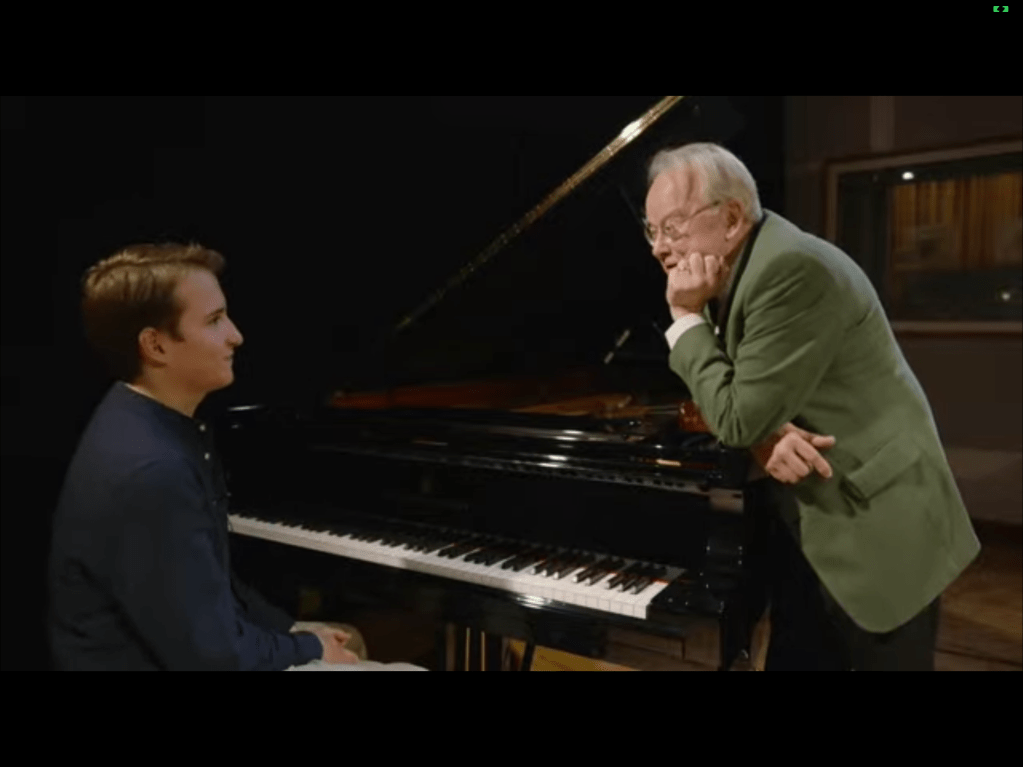
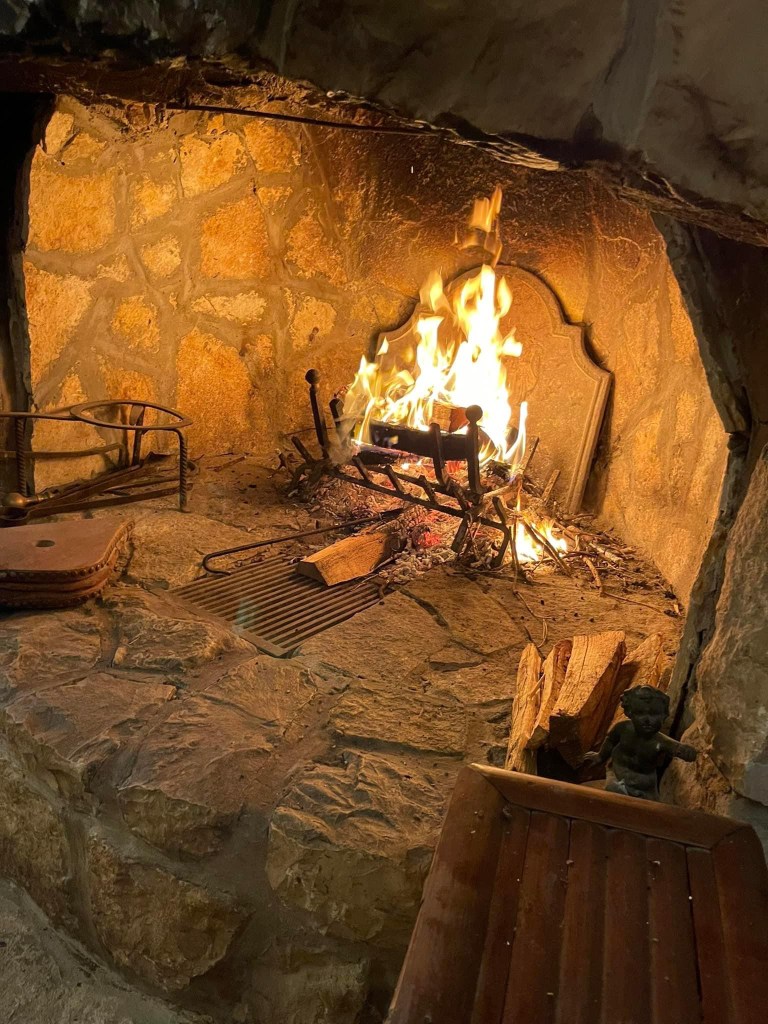
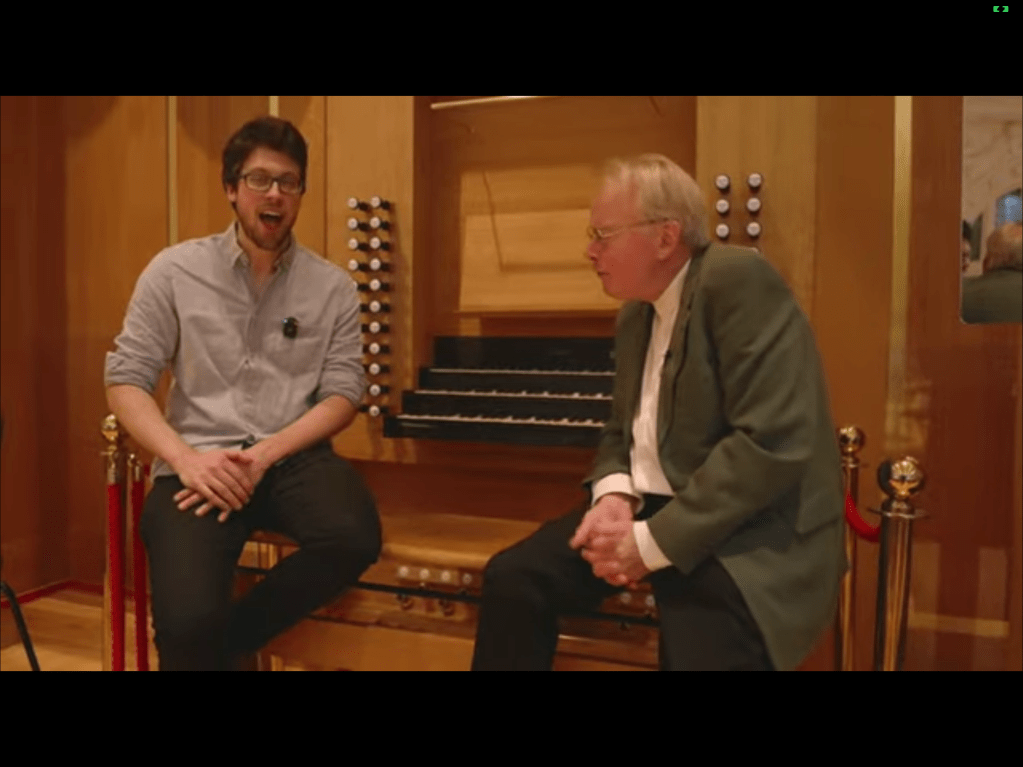
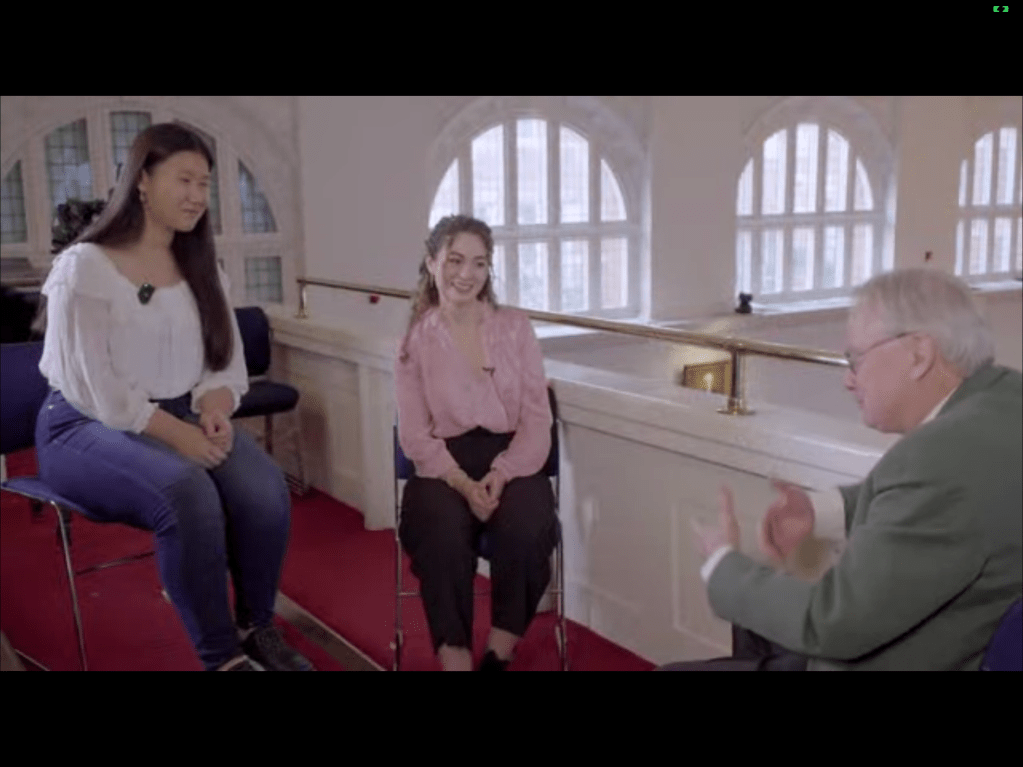
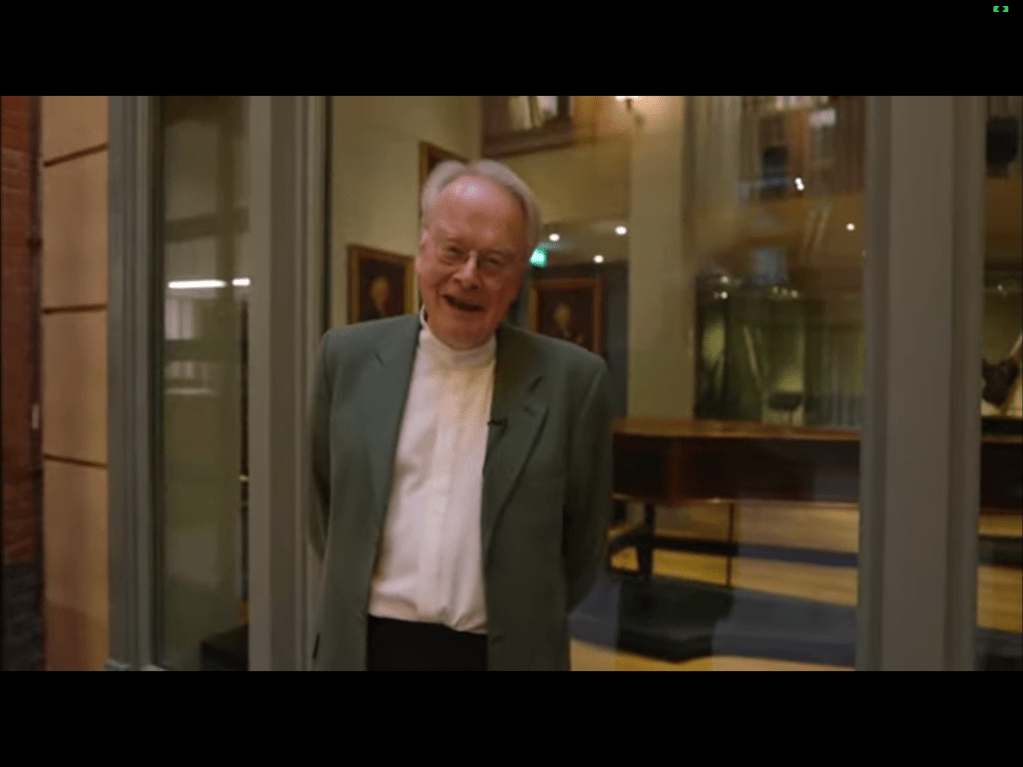
The informal discussions and introduction by David Owen Norris were absolutely fascinating and an added plus to this live stream that I could listen to in the comfort of my own home by the sea in Italy with the log fire ablaze!
The Sea Symphony brought back memories of ‘A’levels where it was the set work in 1967! What an impressive opening especially with a youthful chorus of 200 voices !And all through the superb style and authority they brought to this extraordinary work was a true revelation.The youthful chorus director Mark Biggins certainly had been hard at work with passion and intelligence as he explained to David Owen Norris.
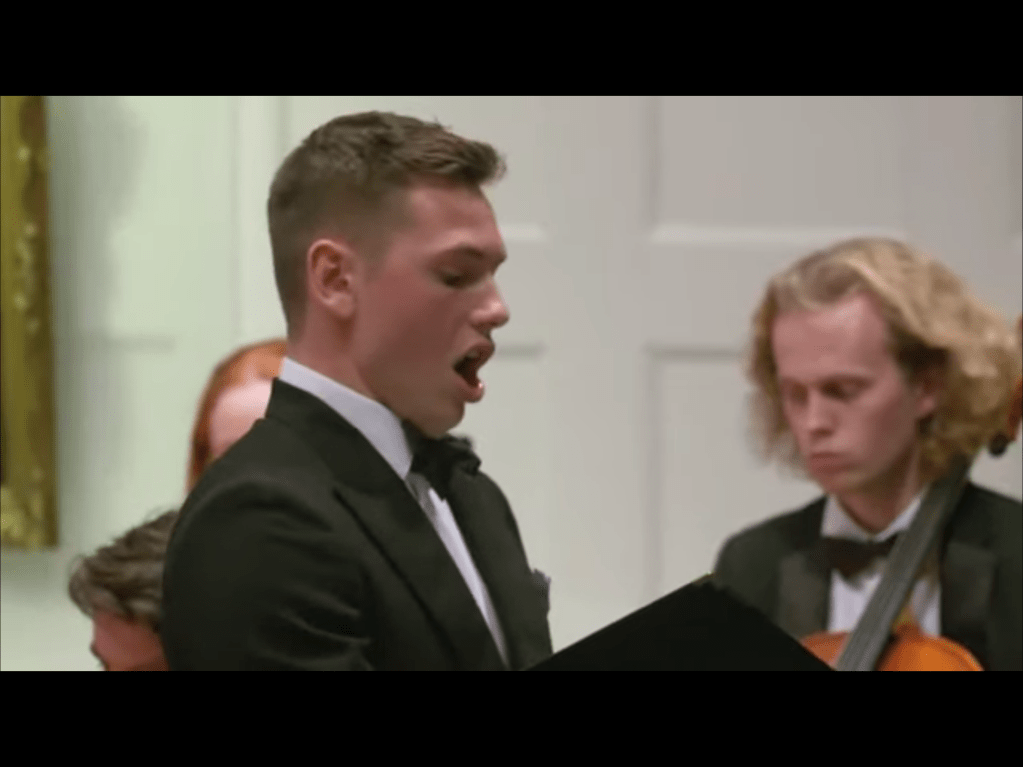
Redmond Sanders ,baritone
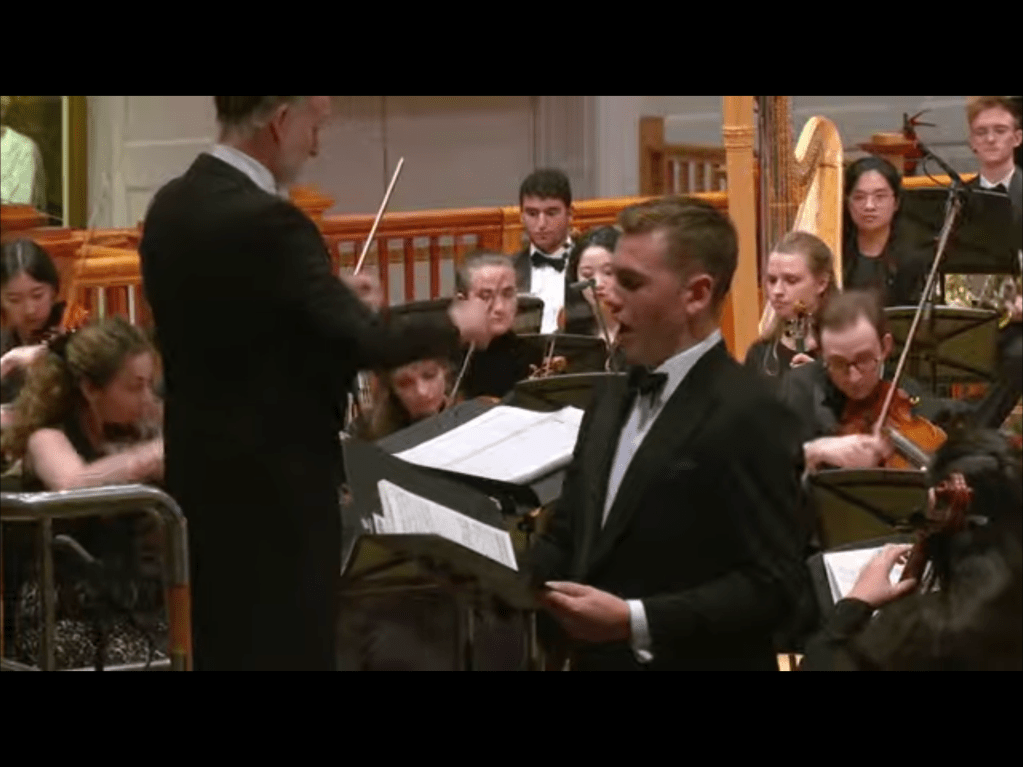
It was though the extraordinary stage presence and overwhelming intensity of the baritone Redmond Sanders that took ones breath away.
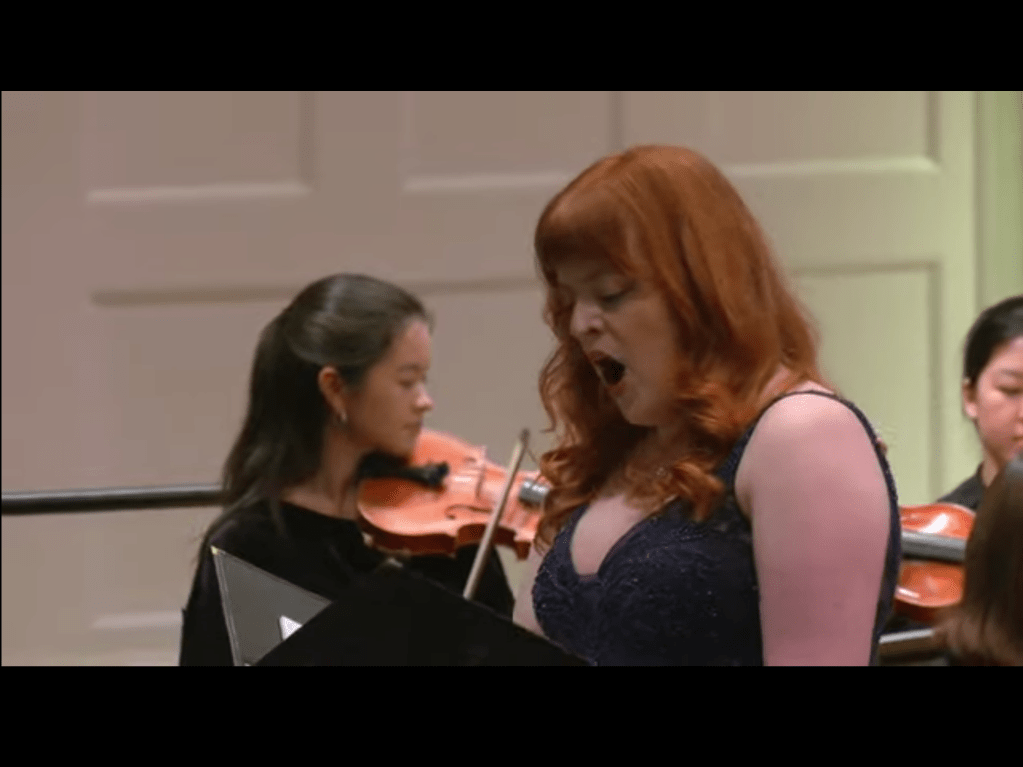
Madeleine Boreham,soprano
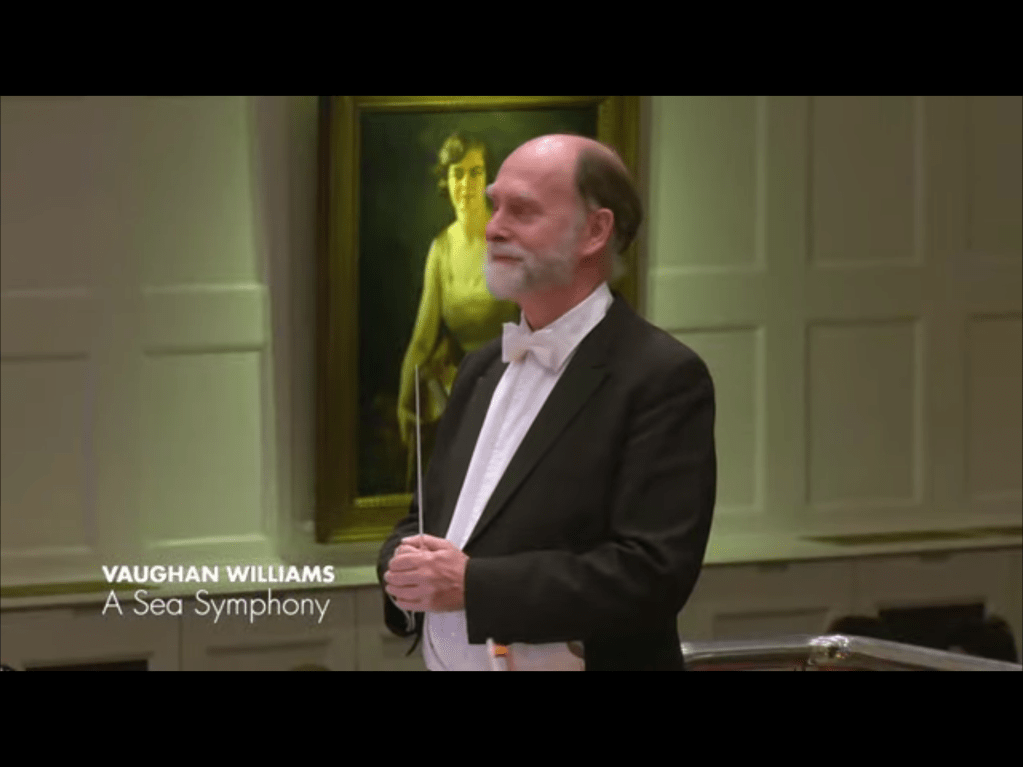
Madeleine Boreham was the superb soprano soloist but with a much smaller role.It was fascinating to see them so simply in conversation and then to see what presence they had on stage under the authoritative baton of Adrian Partington.
A superb evening of music making of the highest order what a wonder that the world can hear via the superb streaming and direction from the RCM.
Adrian Partington
Liszt wrote drafts for his Concerto for Piano and Orchestra No. 2 in A major, S.125,during his virtuoso period, in 1839 to 1840. He then put away the manuscript for a decade. When he returned to the concerto, he revised and scrutinized it repeatedly. The fourth and final period of revision ended in 1861. Liszt dedicated the work to his student Hans von Bronsart, who gave the first performance, with Liszt conducting, in Weimar on January 7, 1857.Liszt called this work Concerto symphonique while in manuscript. This title was borrowed from the Concertos symphoniquesof Henry Litolff. Liszt liked not only Litolff’s title but also the idea for which it stood. This concept was one of thematic metamorphosis — drawing together highly diverse themes from a single melodic source .With his Second Piano Concerto, Liszt took the practice of creating a large-scale compositional structure from metamorphosis alone to an extreme level. Its opening lyrical melody becomes the march-theme of the finale. That theme, in turn, morphs into an impassioned theme near the end of the concerto. The theme which begins the scherzo reappears at that sections end disguised as a totally different melody in another key. This last transformation is so complete that it is easy to not recognize the connection. Key, mode, time signature, pace and tonal color have all been transformed. For Liszt to so radically alter the music’s notation while remaining true to the essential idea behind it shows a tremendous amount of ingenuity on his part.
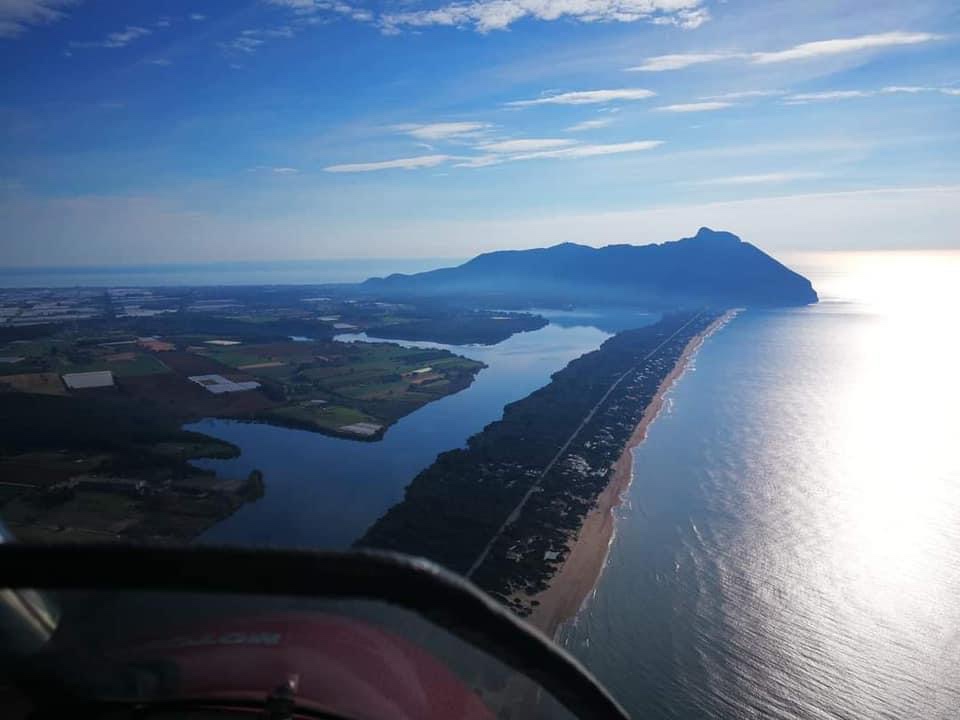
Mark Biggins chorus master First cello and first violin in interval discussion Redmond Saunders and Madeleine Boreham in interval discussion Superb Redmond Sanders baritone Magnificent presentation of David Owen Norris The street where I live ….Monte Circeo 100km from Rome and Naples
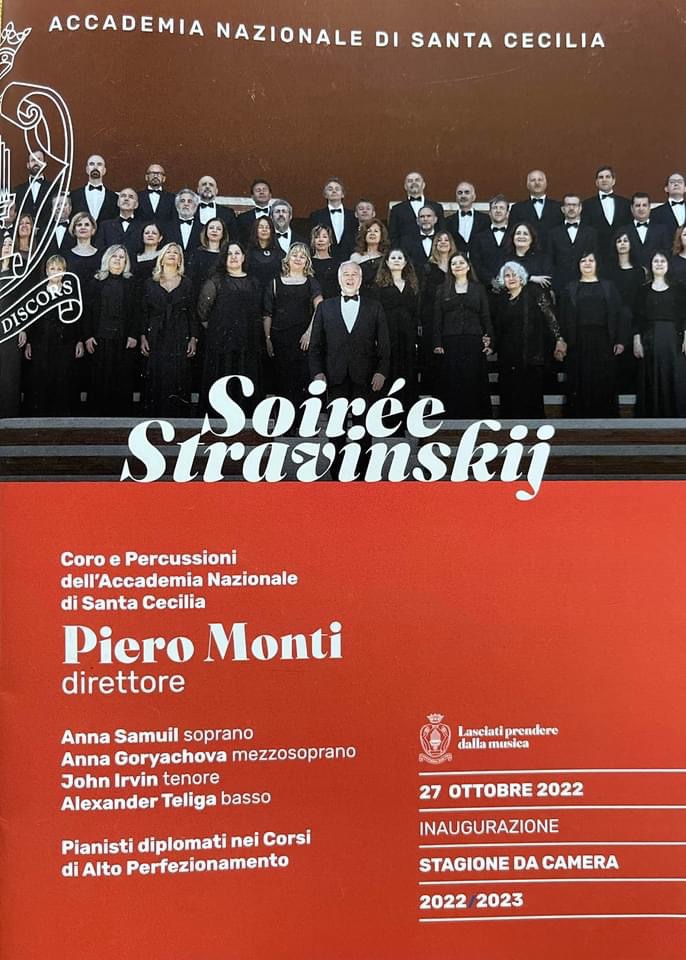
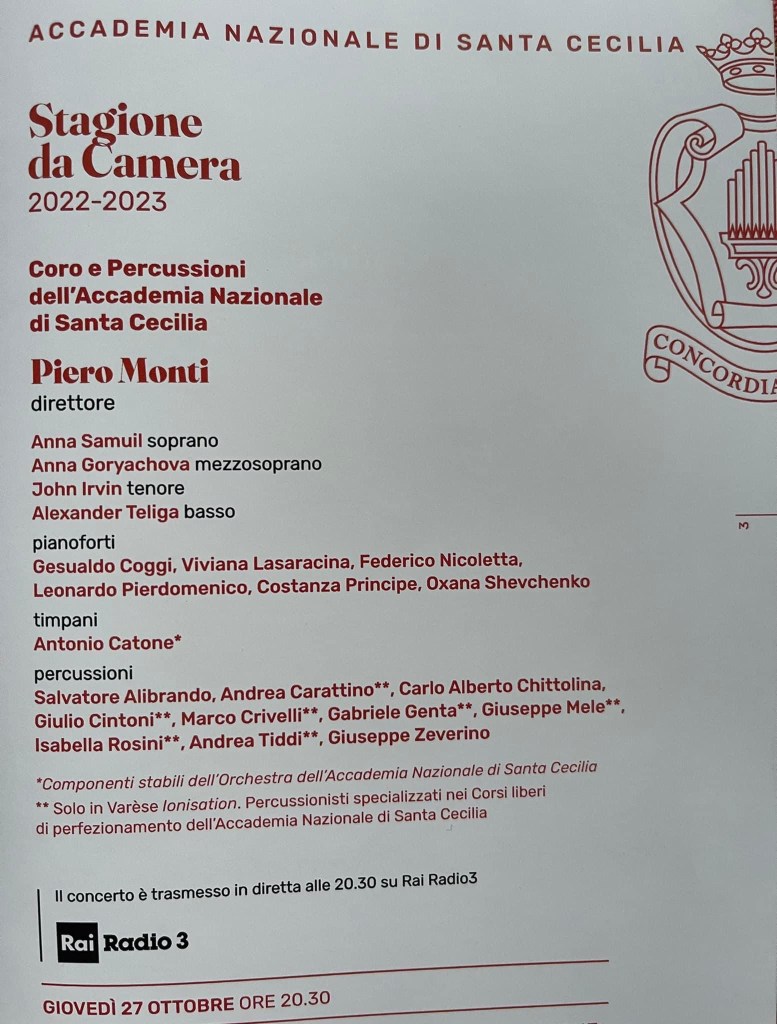
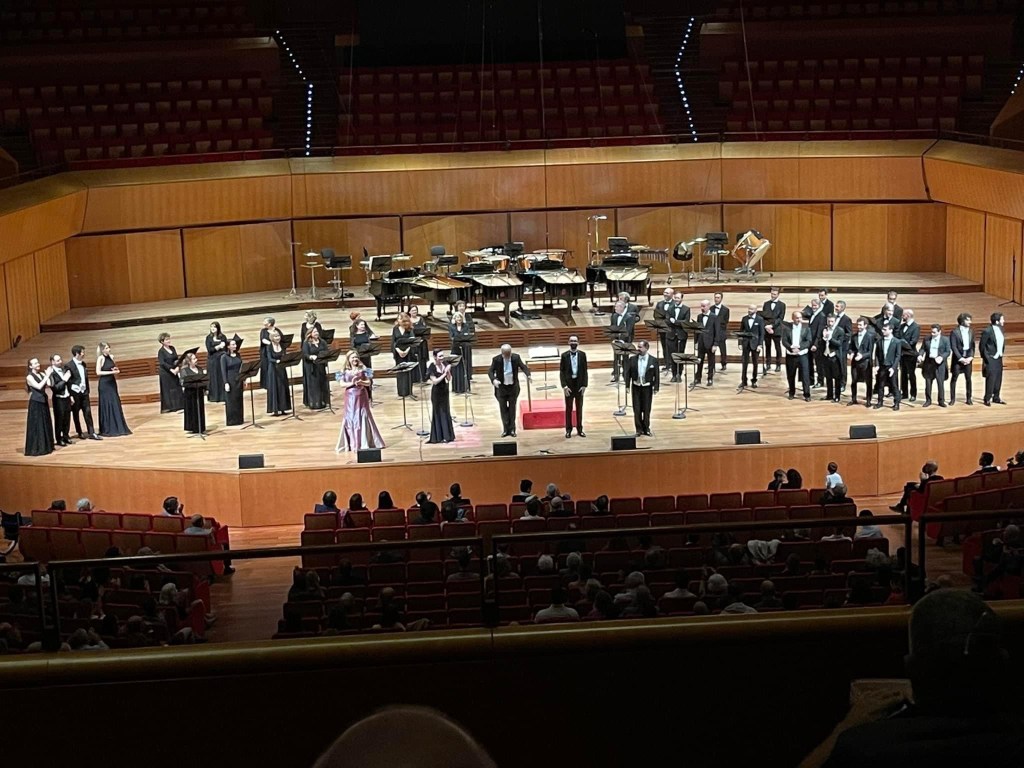
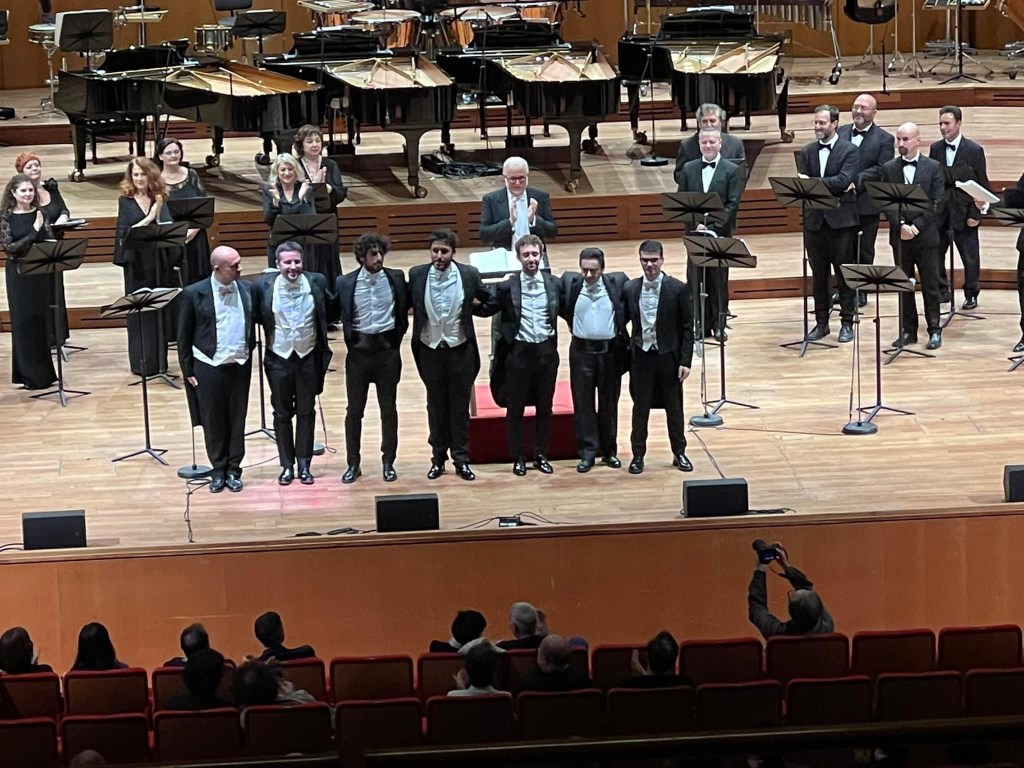
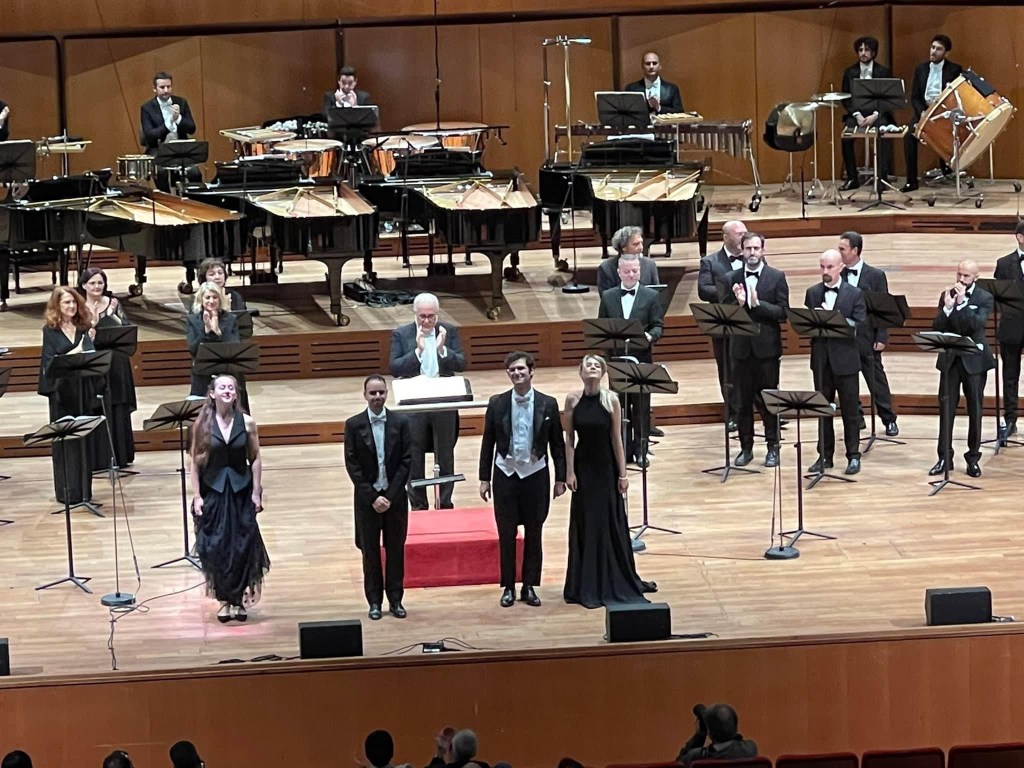
Soirée Stravinsky opens the S.Cecilia Chamber Music Season in Rome with six graduates from Benedetto Lupo’s class
Leonardo Pierdomenico and Viviana Lasaracina
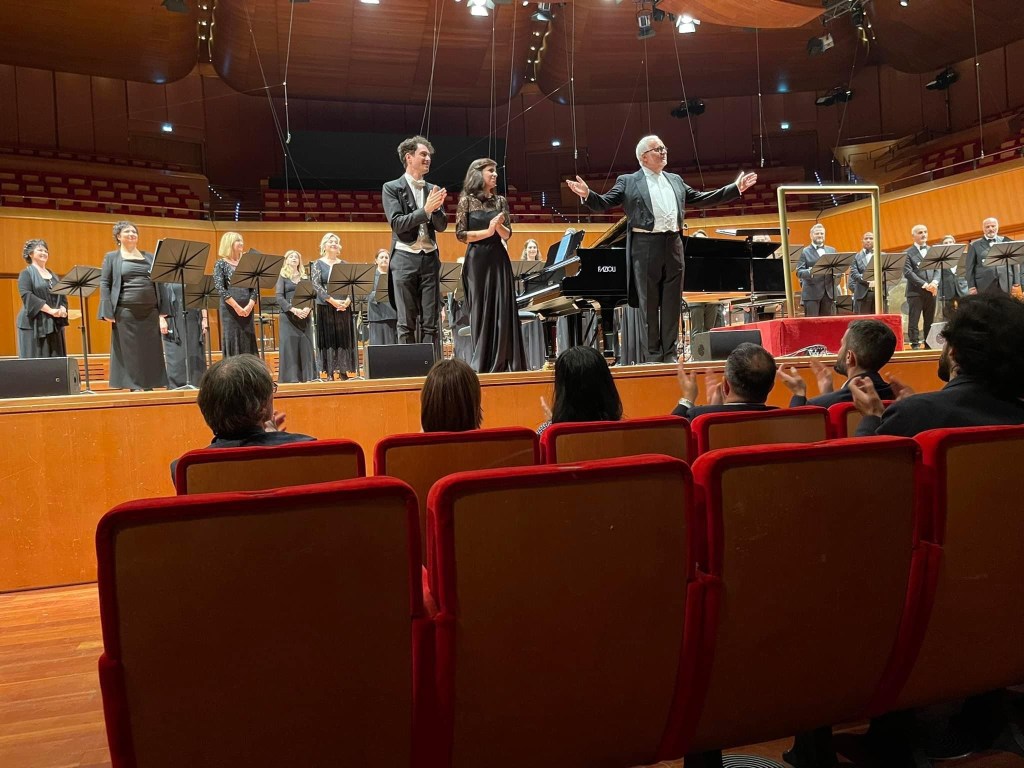
Leonardo Pierdomenico and Viviana Lasaracina moving with cat like virtuosity in Shostakovich’s youthful transcription of the much admired Symphony of Psalms.The pungent sounds played with such conviction as they weaved their way entwined through this transcendental transcription. A mastery of clarity in which Piero Monti could allow his magnificent chorus to breathe and allow every strand to be heard for the ‘glory of God’.
Costanza Principe,Gesualdo Coggi,Oxana Shevshenko and Federico Nicoletta were the four pianists in Le Noces.All graduates from the class of Benedetto Lupo at the Academy of S.Cecilia.They knew each other well having been together through Lupo’s musicianly rigorous training and as such played as one. The moving story of a country wedding was vividly brought to life by the four solists .
The soloists + a soloist from the chorus
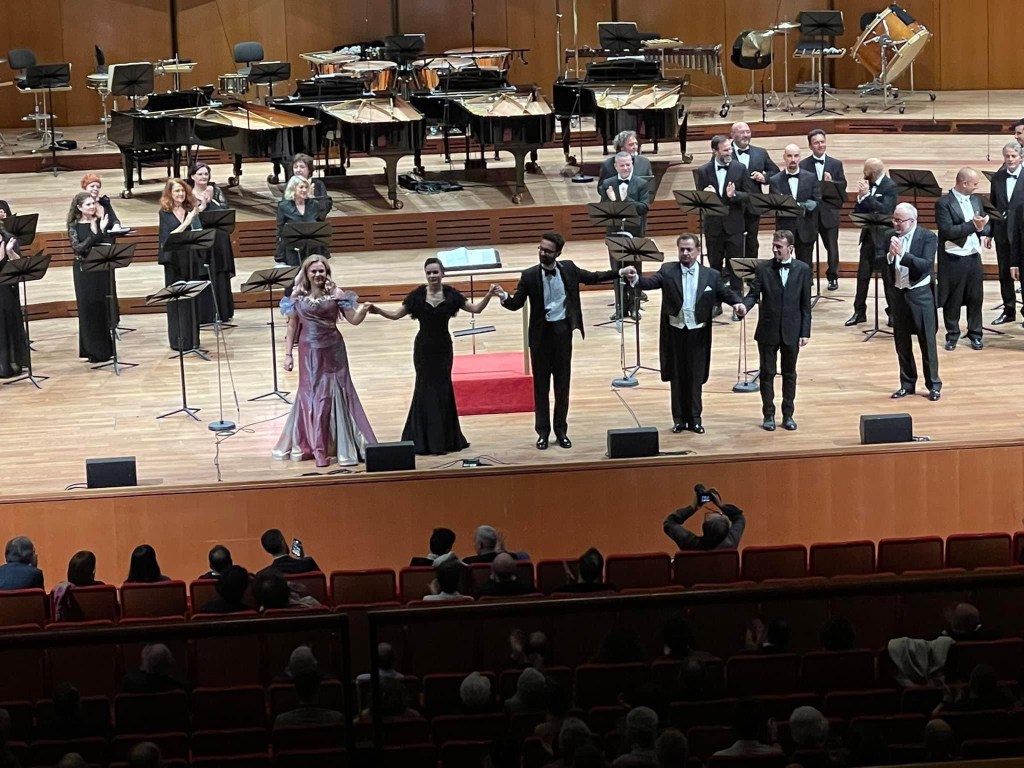
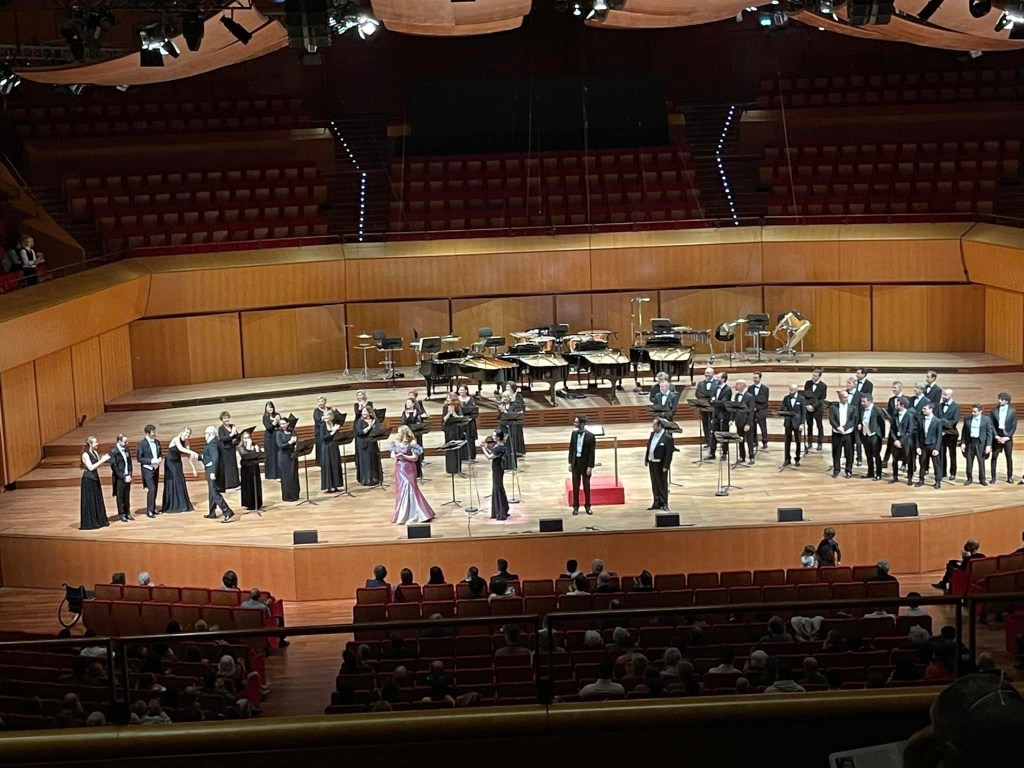
Anna Samuil (a magnificent evening gown -hardly a country wedding dress ) but what a magnificent voice of enormous proportions and equally imposing Anna Goryachova ,John Irvin and Alexander Teliga.A chorus of great precision under the magnificent guiding light of Piero Monti.Who was equally at home conducting the 13 percussionists on 38 different instruments in the still outlandish score from 1933 of Varese :’Ionisation’
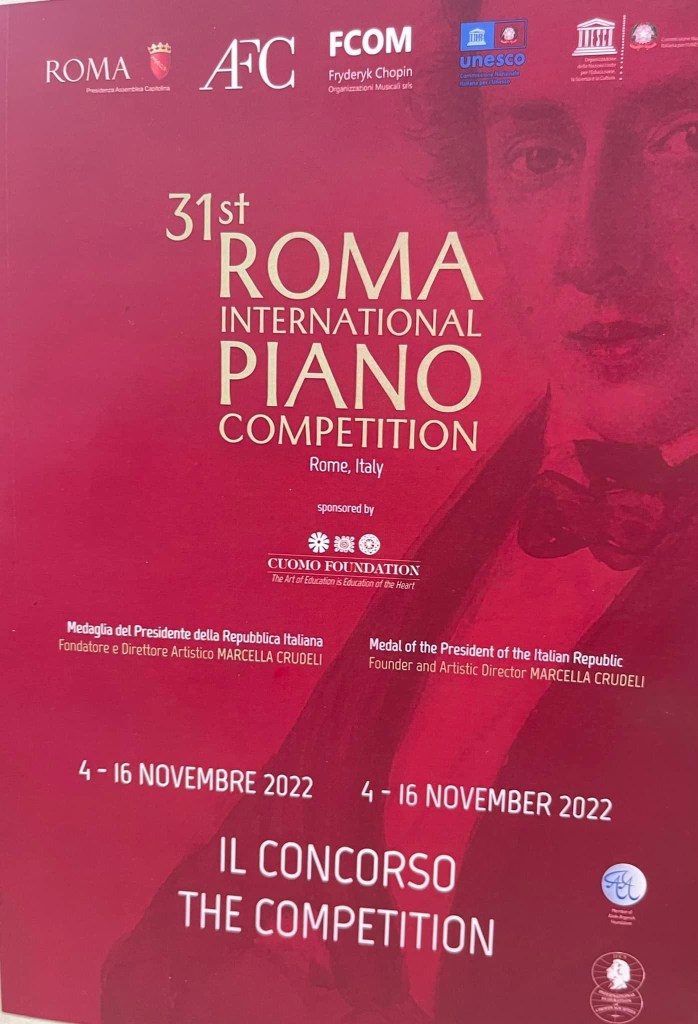
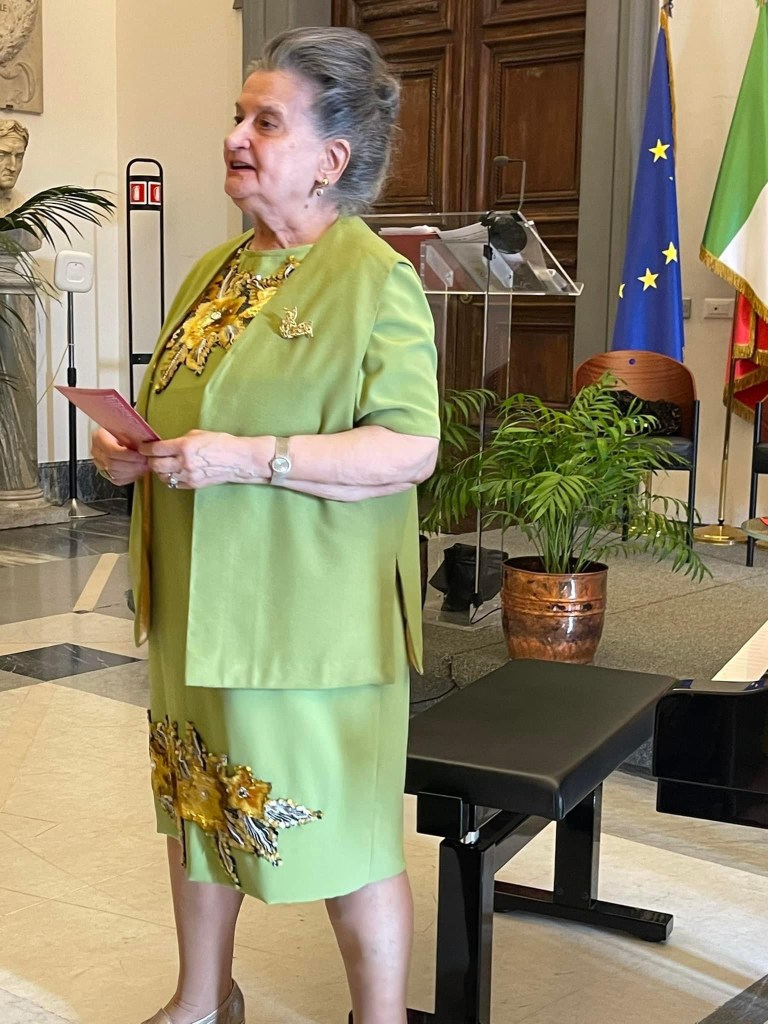
The launch of the 31st edition of the Roma International Piano Competition known affectionately as the Marcella Crudeli Competition took place in Rome’s town hall. It is her force and determination that has seen not only the birth of a competition but with the same energy year after year she has placed it firmly on the circuit of International piano competitions.
In the 31st edition from 4-16 November will we find a new Rubinstein or Horowitz I wonder? But as Marcella pointed out it is the voyage of discovery that is so stimulating and to discover how many young pianists are dedicating their youth to art and are just in need of a platform from which to share the thing they love with such dedication.
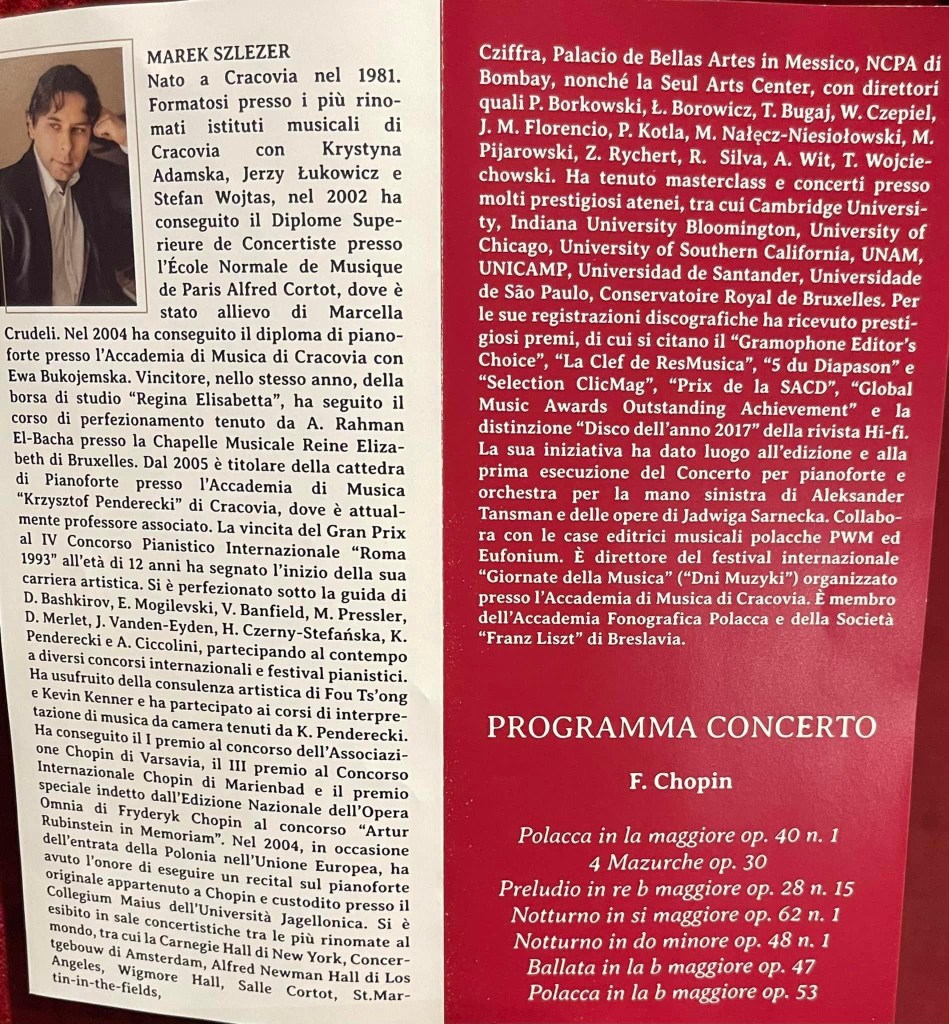
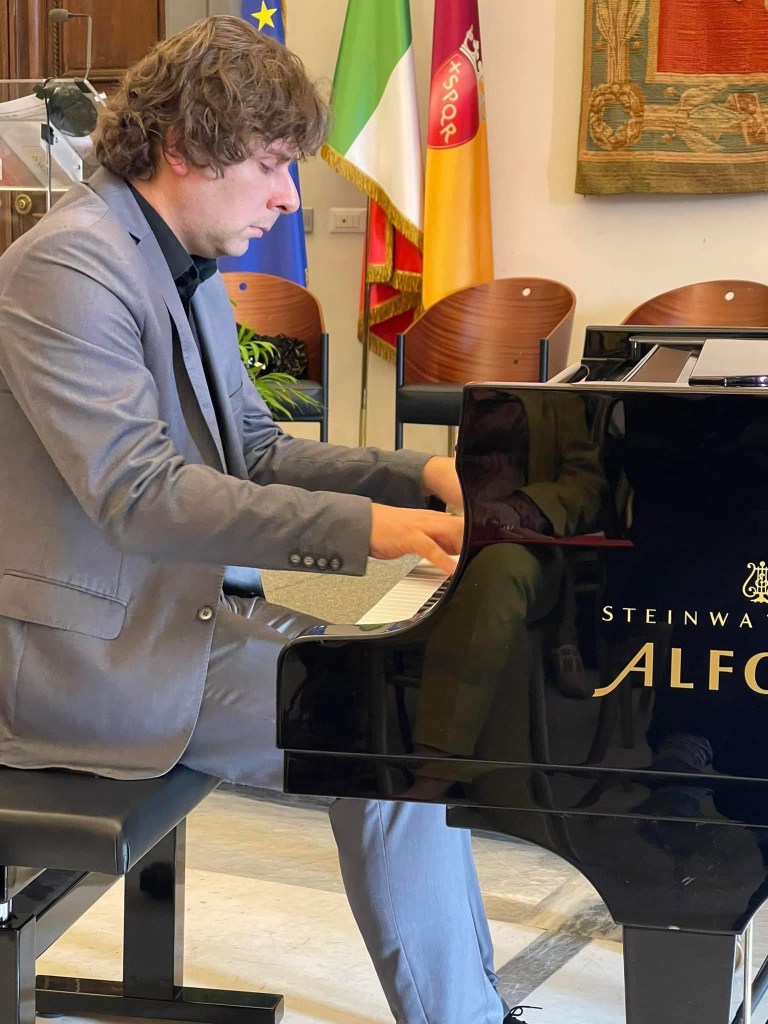
A concert by Marek Szlezer winner of the 1993 Youth Competition at the age of only 12! Now a Professor of Cracow Conservatory he gave distinguished performances of some of Chopin’s best loved works.
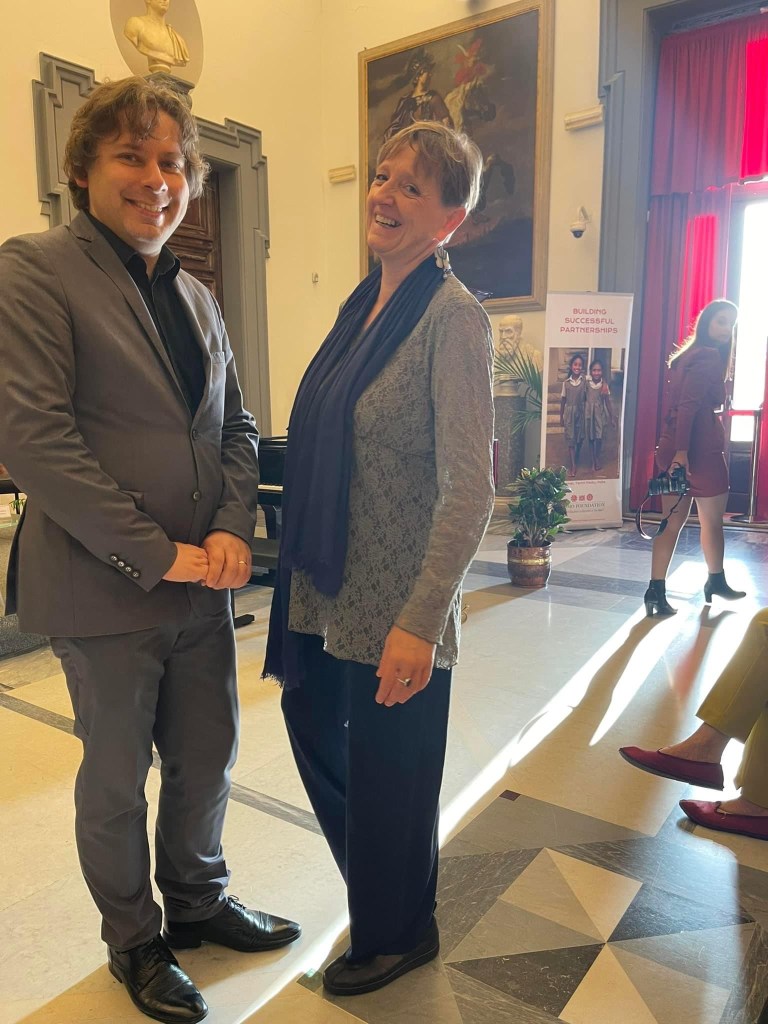
Marek Szlezer with Signora Magda from the Polish Institute in Rome
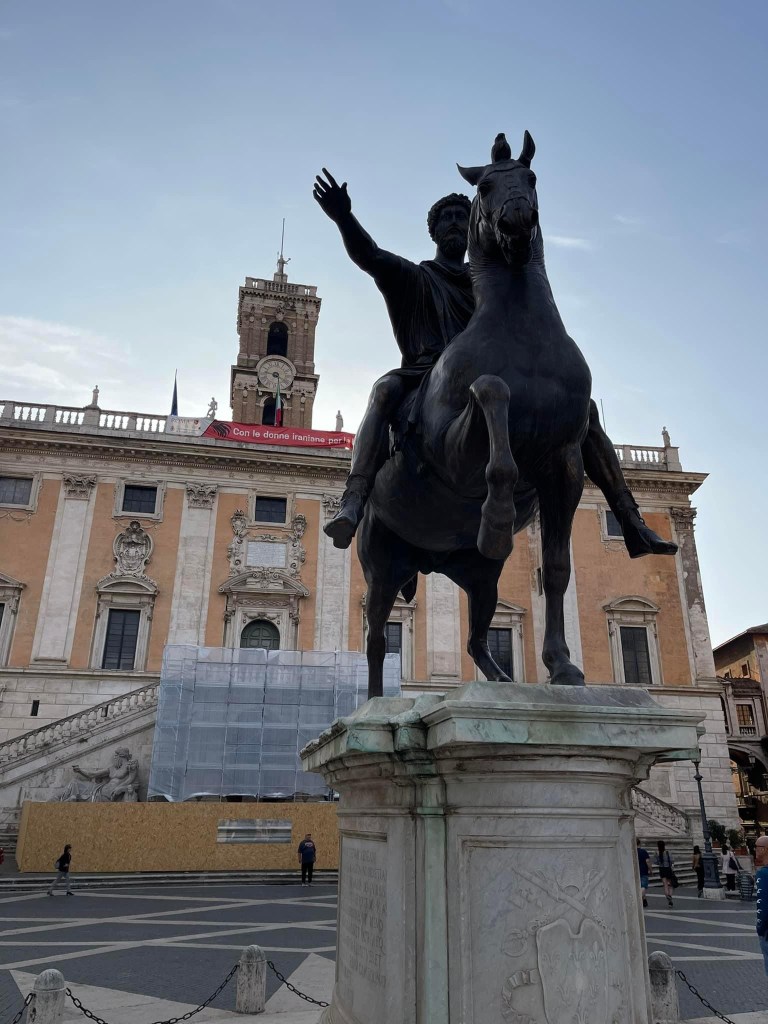
The very resonant acoustic suited the more lyrical side of Chopin with his ‘Raindrop’prelude and Nocturnes op.62 n.1 and op 48 n.1. I swear that with the arrival of the cavalry in the Polonaise Héroique I could see the shadow of Marcos Aurelius passing through the hall!
Marek SzlezerProf Franco Ricci author and musicologist founder of the Tuscia University Concert Series in Viterbo The distinguished audience with Maria Murmura Folino left ex student of Guido Agosti Marcella Crudeli with a representative of the Cuomo Foundation
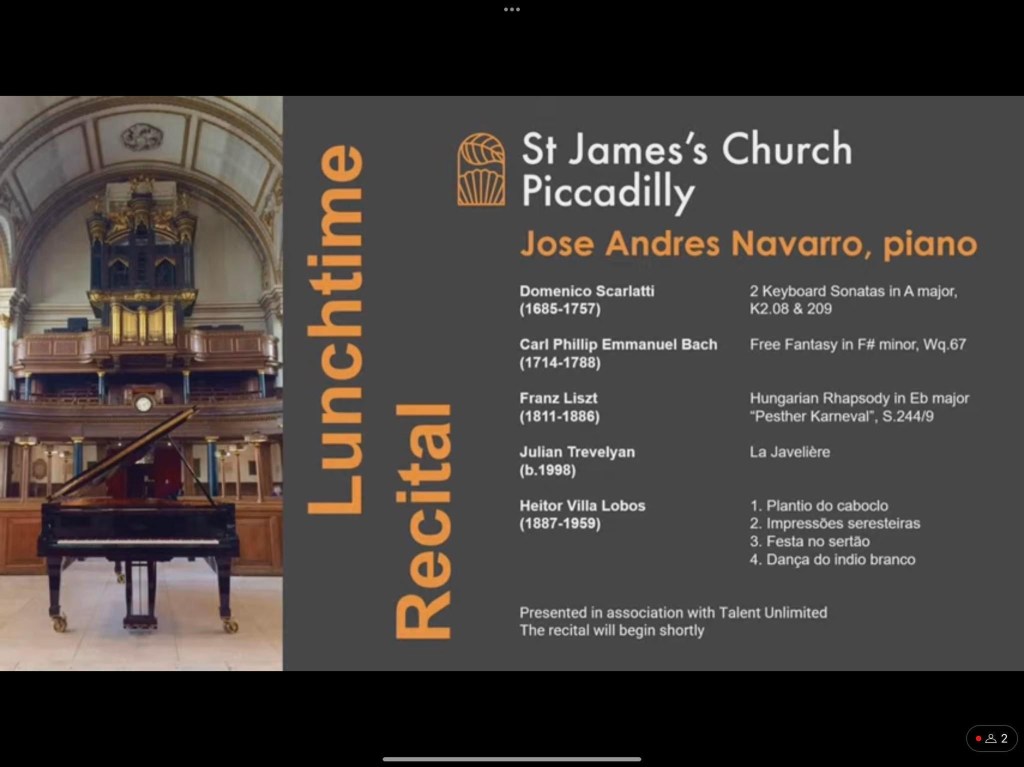
An unexpected but much welcome visitor to St James’s today . Jose Navarro standing in at the last minute for a Covid stricken friend Julian Trevelyan. Making his London debut this young Bolivian pianist who made many waves in the final rounds of the Tbilisi Competition just ten days ago we could finally hear live in London. A just tribute and thank you to his sick colleague in the form of a performance of a very suggestive piece which José had learnt over night ‘La Javelière ‘. A piece which suddenly awakened all the subtle colours and unexpected shapes ready for the scintillating intensity of Villa Lobos. What ravishing colours he brought to the red hot vibrant throbbing rhythms and the deeply felt murmurings that are obviously embedded in José ‘s DNA . The sensitivity and shape he had brought to the opening Scarlatti K 208 was contrasted with the lightweight brilliance and infectious vitality of it’s twin K 209. What nobility with improvised changes of colour and mood he brought to C.P.E. Bach’s Fantasy in F sharp minor that was a lesson in keyboard skill and real academic study that could allow him such freedom. Liszt’s rather overlong Pesther Karneval Hungarian rhapsody must have surely been improvised too by Liszt and its was a scintillating display of piano playing of another era.
Domenico Scarlatti (1685-1757) – 2 Keyboard Sonatas in A major, K.208 & 209
Carl Philipp Emanuel Bach (1714-1788) – Free Fantasy in F-sharp minor, Wq. 67
Franz Liszt (1811-1886) – Hungarian Rhapsody in E-Flat major “Pesther Karneval”, S. 244/9
Julian Trevelyan (*1998) – La javelière
Heitor Villa-Lobos (1887-1959) 1. Plantio do caboclo 2. Impressões seresteiras 3. Festa no sertão 4. Dança do índio branco
The young Bolivian pianist has performed in different countries in venues and festivals in Europe, USA, and South America. Halls include the Teatro Municipal “Alberto Saavedra Pérez” in his hometown La Paz till the Musikverein in Vienna. As a soloist, he has performed with the Jena Philharmonic Orchestra, Norddeutsche Philharmonie Rostock, Georgian Philarmonic Orchestra, La Paz Symphony Orchestra, Orquesta de Jóvenes Musicos Bolivianos and Orquesta Sinfónica Juvenil de Santa Cruz de la Sierra under the baton of Timothy Redmond, Markus L. Frank, Wojciech Rajski, Andreas Penninger among others. He is a prize winner at the Anton Rubinstein Piano Competition in Düsseldorf, 5th International Competition “Young Academy Award” in Rome, Tbilisi International Piano Competition in Georgia and Claudio Arrau International Piano Competition in Chile. In Bolivia he gave masterclasses in La Paz Conservatory, Sucre Conservatory Santa Cruz Fine Arts College and Laredo School in Cochabamba. He served as a jury member in national music competitions. He was mentored by Paul Badura Skoda, from whom he became a particular interest for period instruments. He studied with Balasz Szokolay at the Franz Liszt University in Weimar and with Claudio Martínez Mehner at the University of Music and Dance in Cologne. At the moment he is at the Artist Diploma programme at the Royal College of Music in London under the guidance of Norma Fisher and Ian Jones. He recives scholarships from RCM, Theo and Petra Lieven Foundation of Hamburg and the Herrmann Foundaiton Liechtenstein-Bolivia.
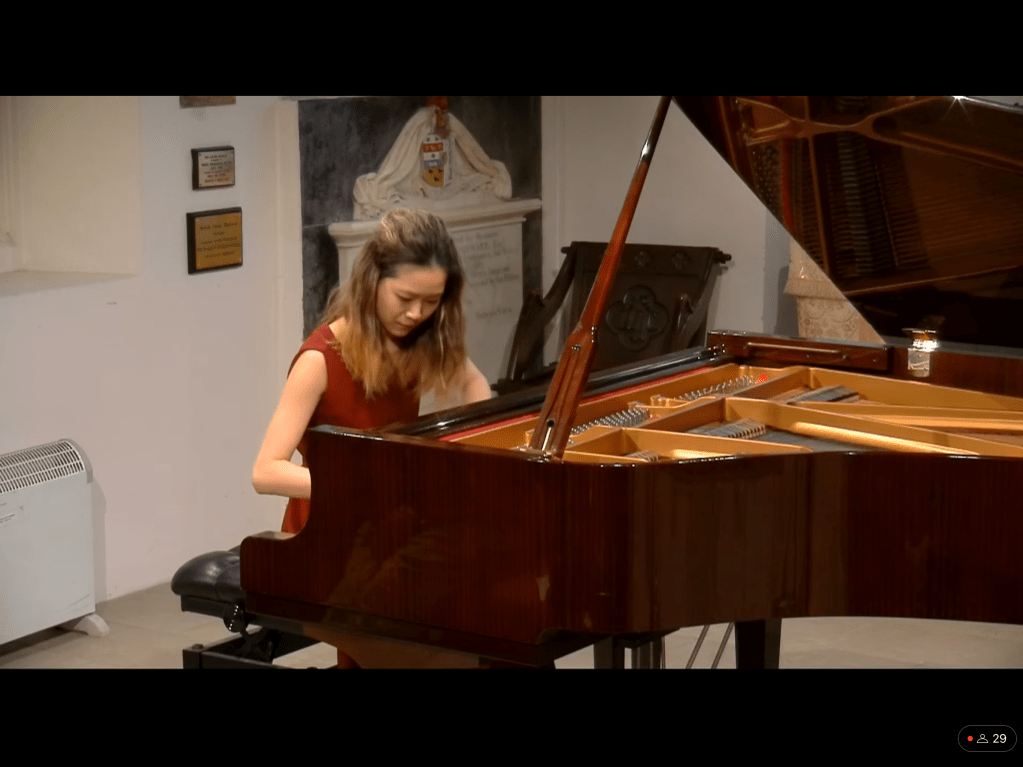
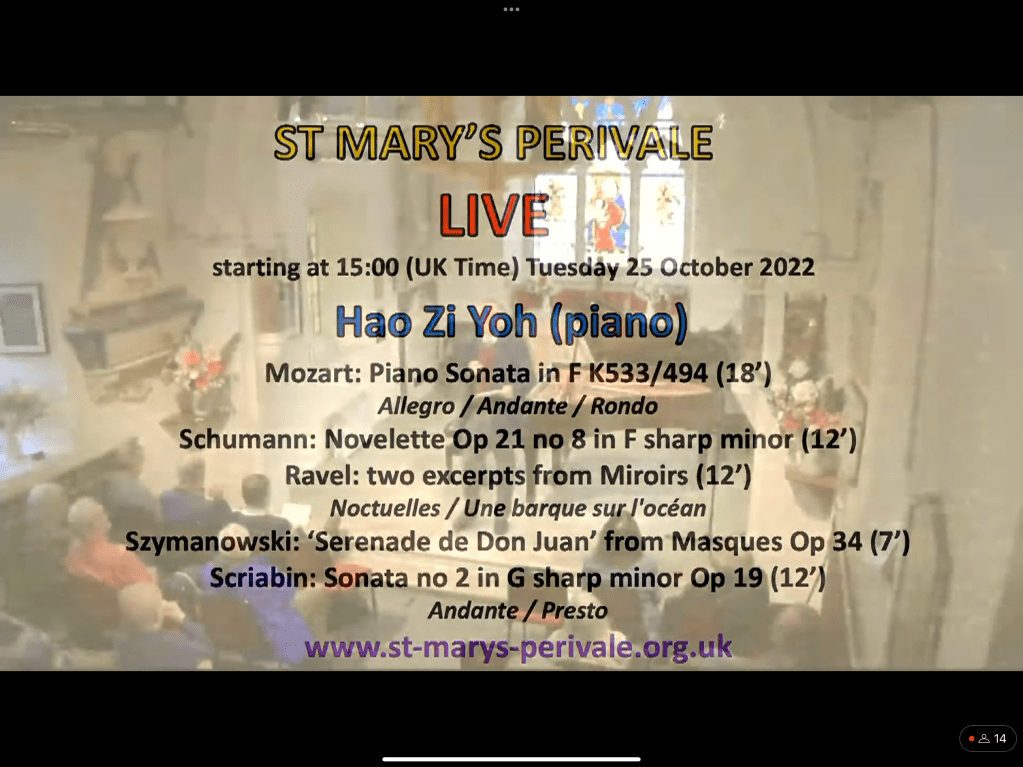
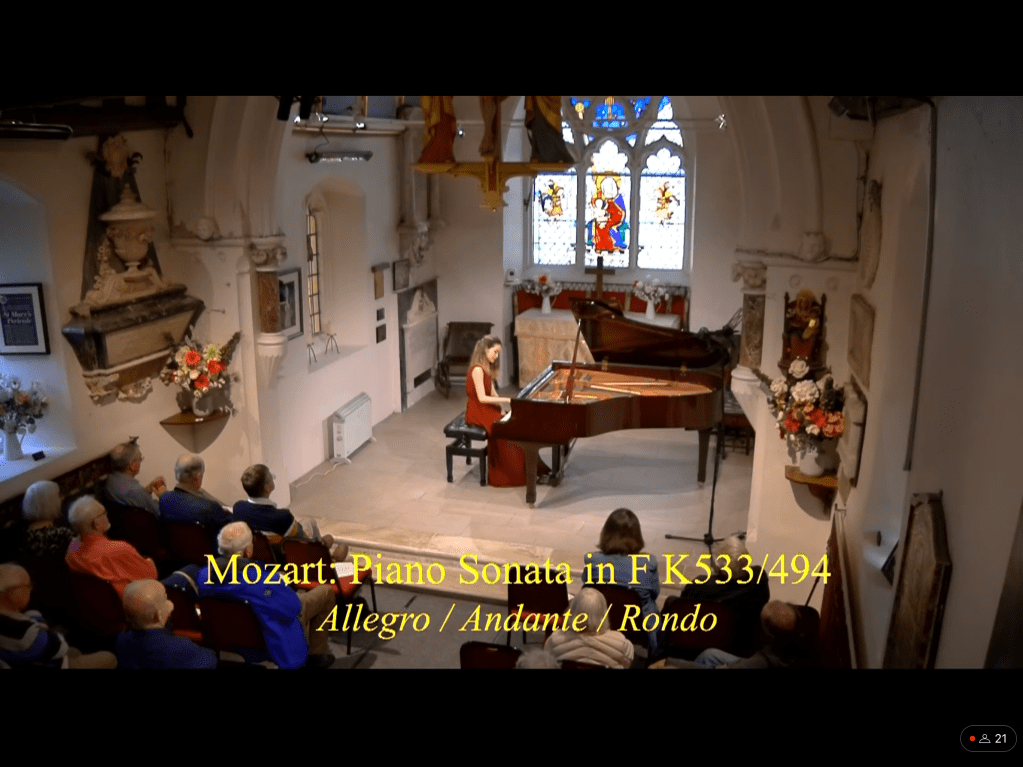
Mozart’s Piano Sonata No. 15 in F major K. 533/494 (finished 3 January 1788)is in three movements :Allegro – Andante – Rondo: Allegretto.The Rondo was originally a stand-alone piece composed by Mozart in 1786 (Rondo No. 2, K. 494 ).In 1788, Mozart wrote the first two movements of K. 533 and incorporated a revised version of K. 494 as the finale, having lengthened it in order to provide a more substantial counterpart to the other two movements.There was clarity and a disarming simplicity to Hao Zi’s playing with crystal clear articulation and a rhythmic drive that was spellbinding from the first notes.Great elegance in the beautifully shaped Andante was played with an aristocratic sense of style.There was drama too but always within the confines of the overall shape of the movement that unlike Beethoven was just a passing cloud until returning to the serenity of the opening melodic line.The cascading arpeggios replying one to the other at the end were played with a refined delicacy that was absolutely ravishing.The purity of sound and child like simplicity gave such charm to her playing of the rondo.The ever more vivacious ornamentation just added to the rhythmic impetus with her sparkling jewel box full of kaleidoscopic colours.A coda deep in the bass in such reflective mood as the rondo theme just dissolved before our eyes with the magic that Hao Zi had recreated.
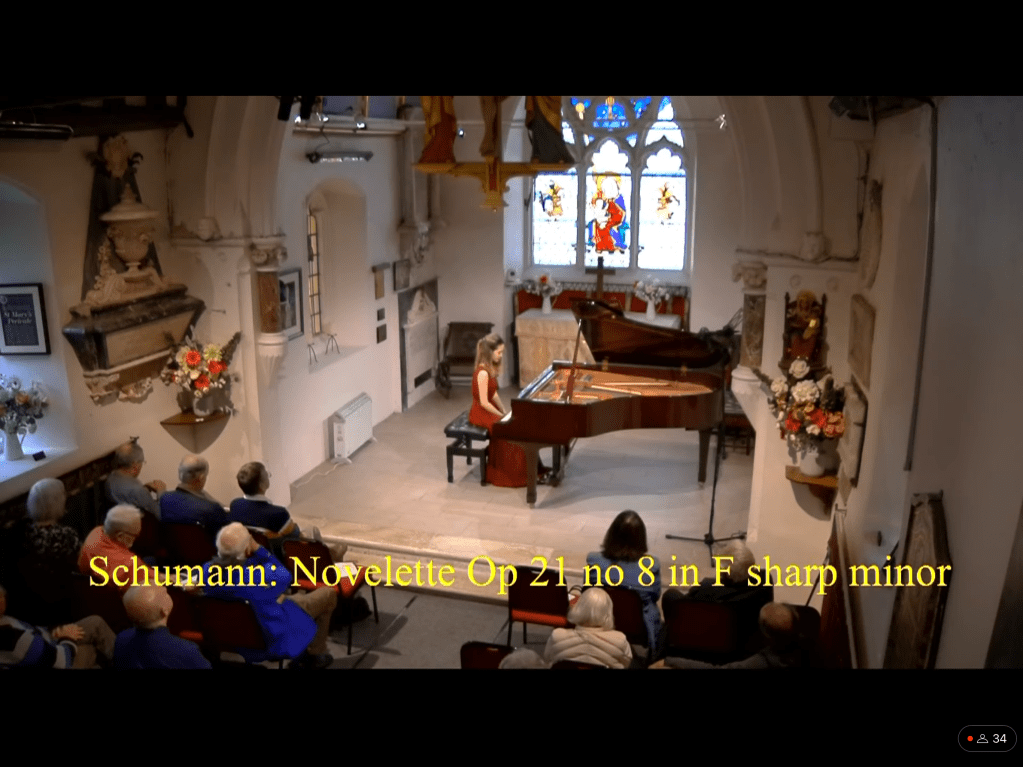
The Novelletten, op 21, is a set of eight pieces written by Schumann in 1838 and is dedicated to Adolf von Henselt.February 1838 was a period of great struggle for Schumann who originally intended the eight pieces to be performed together as a group, though they are often performed separately.The concluding piece of the set that Hao Zi played is actually two pieces in one. The first part is a passionate etude in 2/4, the second has the nature of a march ending in D major, the principal key of the cycle.There was a romantic outpouring of sumptuous beauty with some pungent harmonies within the alternating legato and staccato.She brought such clarity as she pin pointed the melodic line in the first episode made up of the dotted rhythms that Schumann was so fond of.She brought an equally infectious rhythmic drive to the second where the gradual diminuendo created a magical base on which floated one of Schumann’s most heavenly melodies.Nobility and passion marked the final episode of the best known of these eight novelettes.It was the one together with the fourth that I have never forgotten from the hands of Sviatoslav Richter on one of his first visits to London in the 70’s.If Hao Zi did not quite have the animal like rampage of Richter she made up for it with her sumptuous sounds and an architectural shape that makes one wonder why it is not more often played these days.
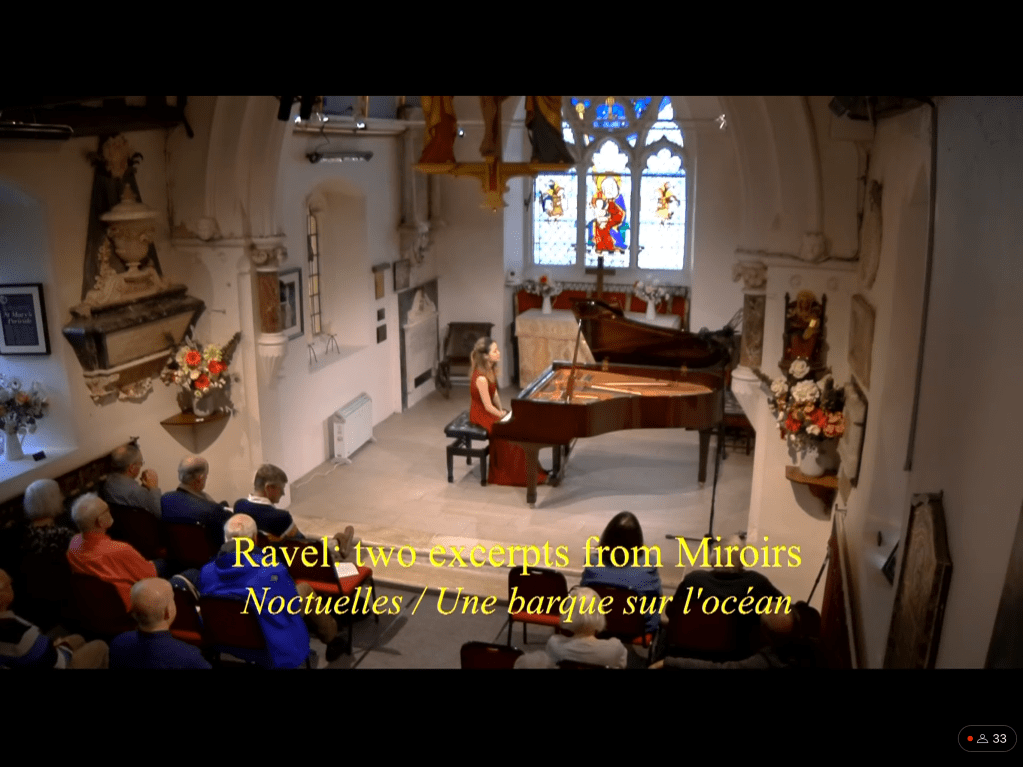
Miroirs has five movements, each dedicated to a member of Les Apaches.Around 1900, Maurice Ravel joined a group of innovative young artists, poets, critics, and musicians referred to as Les Apaches or “hooligans”, a term coined by Ricardo Vines to refer to his band of “artistic outcasts”.To pay tribute to his fellow artists, Ravel began composing Miroirs in 1904 and finished it the following year
“Noctuelles” (“Night Moths”). D♭ major. Dedicated to Léon-Paul Fargue and is a highly chromatic work, maintaining a dark, nocturnal mood throughout. The middle section is calm with rich, chordal melodies, and the recapitulation takes place a fifth below the first entry.”Une barque sur l’océan” (in English “A Boat on the Ocean”). F♯minor. Written for Paul Sordes , the piece recounts a boat as it sails upon the waves of the ocean. Arpeggiated sections and sweeping melodies imitate the flow of ocean currents. It is the longest piece of the set.There was a fluidity of sound together with the fleeting lightness of Noctuelles.A deeply brooding atmospheric middle section with a completely different sound colour from the Schumann that one could only describe as unmistakably French.These moths flittered around the keyboard with kaleidoscopic colours that just seemed to flow so naturally from Hao Zi’s hands.The final flourish as they disappeared into the night air was of quite ravishing beauty.One could almost see the waves splashing about in ‘Une barque’with an astonishing fluidity out of which emerged a gentle melody that gradually became ever more turbulent.Storm clouds of mysterious sounds were played with astonishing technical prowess with streams of wonderful sounds just cascading from her fingers with such ease.What beauty she brought to the left hand melodic line as the waves weaved their delicate way in the right and calm was restored as rays of sunlight seemed to appear between the clouds with such subtle radiance.
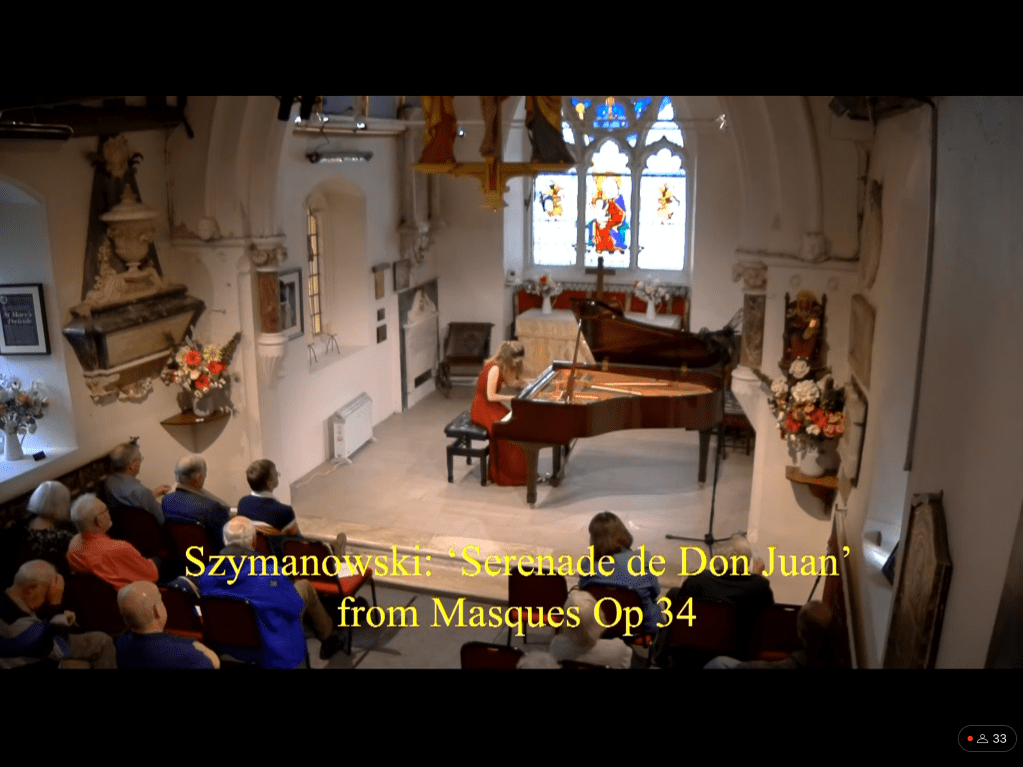
The Masques op. 34 by Szymanowski was written from 1915 to 1916.In 1914, the composer took refuge in his home village in Ukraine and remained there until the Russian Revolution. He had returned from a long stay in Europe, Sicily and North Africa, where he drew his inspiration for these years’ works. Here his style approached the Impressionism of Debussy.The Masques were written in a different chronological order than that of their publication, with Scheherazade initially completing the cycle. Tantris is a corruption of Tristan, taken from the myth of Tristan and Iseult and retold in a piece by Ernst Hardt where Tristan masquerades as a jester to meet his sweetheart.A fascinating glimpse of this still elusive composer.There were the capricious sounds of the jester alternating with passionate outpourings and a spectacular final flourish.of transcendental difficulty.Hao Zi seemed to delight in bringing such character to this very evocative piece.
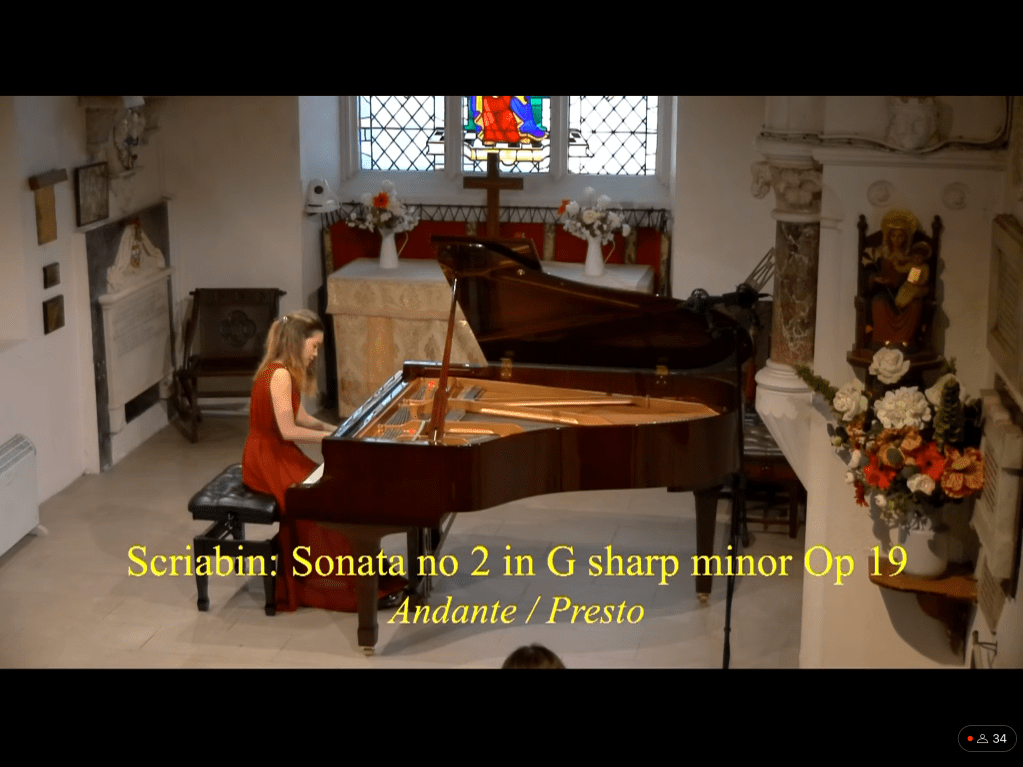
Scriabin’s Piano Sonata No. 2 in G-sharp minor op.19, also titled Sonata-Fantasy) took five years for him to write. “The first section represents the quiet of a southern night on the seashore; the development is the dark agitation of the deep, deep sea. The E major middle section shows caressing moonlight coming up after the first darkness of night. The second movement represents the vast expanse of ocean in stormy agitation.”There was sumptuous beauty of the opening statement with gentle meanderings of ravishing sounds and delicacy.A melodic line embroidered in Hao Zi’s hands with streams of gold and silver.The second movement with its cascades of notes was played with such ease as they slowly shape themselves into a sumptuous melody of romantic sweep.A tumultuous climax was allowed to die away to a mere whisper before the final triumphant chord.Bringing this extraordinary recital to an exciting conclusion.
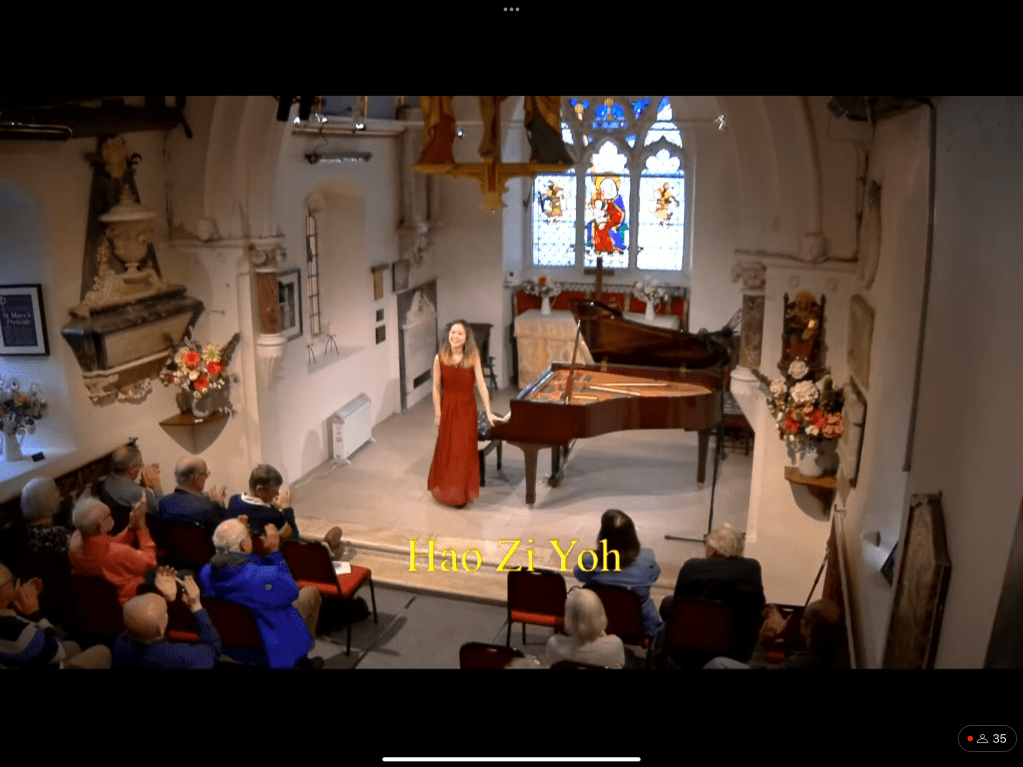
Malaysian pianist Hao Zi Yoh was born in 1995 and began her music studies at the age of 3. By the age of 12, she already performed at Carnegie Hall as a gold medallist of the Bradshaw and Buono International Piano Competition. Most recently, Hao Zi is selected as participant in the Preliminary Round of Chopin Piano Competition in Warsaw 2021. In Malaysia, Hao Zi studied under Chong Lim Ng, who showed her the path into the classical music world. She explored composing and her composition “Bustling City and Peaceful Suburb” was selected to represent Malaysia at the Yamaha APJOC concert 2007. At the age of 14, she moved to Germany to study with Prof. Elza Kolodin at the Hochschule für Musik Freiburg. It was then she won top prizes in many international competitions including EPTA Belgium, Enschede, RNCM James Mottram (Manchester, 2012) and Concurso internacional de piano Rotary Club Palma Ramon LLull, Mallorca (Spain 2013). This led her to performing as soloist in festivals around Europe, USA, China, Japan and Malaysia. Besides, she also performed with the Royal Liverpool Philharmonic, Nova Amadeus and Baleares Symphony Orchestra. In 2014, she came under the tutelage of Prof. Christopher Elton at the Royal Academy of Music, London, generously supported by Lynn Foundation, Leverhulme Trust, Countess of Munster and Craxton Memorial Trust. She received 3rdPrize at Roma International Piano Competition, the Phillip Crawshaw Memorial Prize for an Outstanding Musician from Overseas at the Royal Overseas League Competition. She was also recipient of prestigious Martin Musical Scholarship Trust Philharmonia Piano Fellowships on the Emerging Artists Programme 2017/18. During her studies, she explored her relationship with music and her interest in creating sound colours: her MMus Project 2016 involved collaborating with percussionist Daniel Gonzalez to create a version of Ravel’s Gaspard de la nuit for Piano and Percussion. In her interpretation of “A Distant Voice of the Rainforest” by Chong Lim Ng, she included improvised extended piano techniques as well as improvised singing to draw the audience into the soundworld of a rainforest. Apart from this, Hao Zi also participated in creative outreach projects led by the Open Academy for children and elderly with Dementia, where she performed in Music for Moment Concerts at the Wigmore Hall. She collaborated with author-illustrator David Litchfield and improvised to his storytelling of award-winning book “The Bear and the Piano”. Hao Zi remains in close contact with the music scene in Malaysia. She has given talks, performances and masterclasses to the students of University of Malaya, Bentley Music and Persatuan Chopin in hope to share her experiences and help the younger generation. During the Covid-19 lockdown, Hao Zi held online livestream and fundraiser for St. Nicholas’ Home for the Blind, Penang, Malaysia. A Young Steinway Artist, Hao Zi is currently based in London and has performed in venues such as Wigmore Hall, Southbank Royal Festival Hall, Salle Cortot, Steinway Hall London, St. Martin-in-the-Fields, Dewan Filharmonik Petronas (Malaysia) and Teatro Quirino (Italy). She is further developing her performing career being part of the Keyboard Trust London, Talent Unlimited. Hao Zi is also a piano tutor at King’s College London and gives masterclasses at Imperial College London. Currently she is studying with Martino Tirimo, after being awarded full scholarship to pursue an Artist Diploma at Trinity Laban Conservatoire of Music and Dance, generously supported by the Bagri Foundation and Gladys Bratton Scholarship .
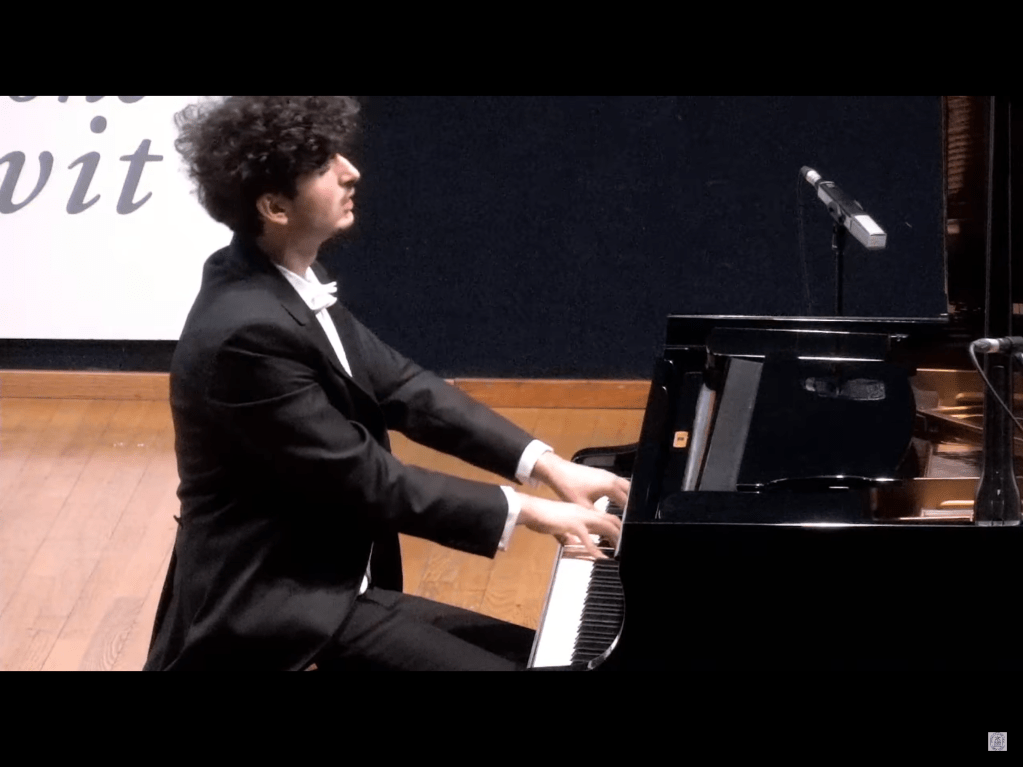
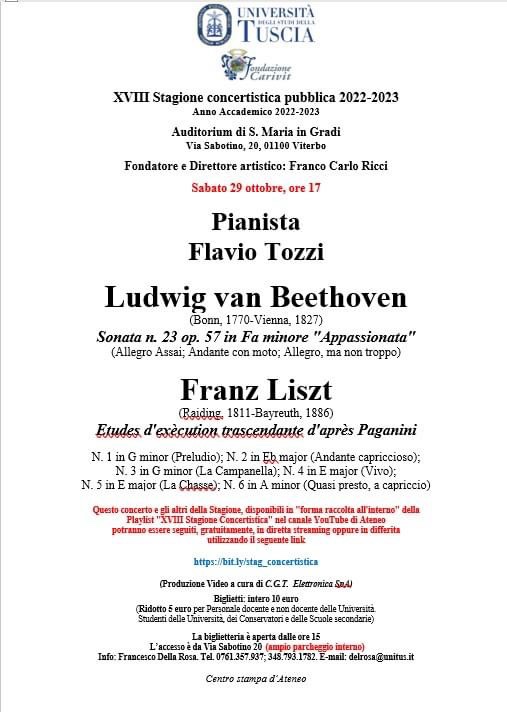
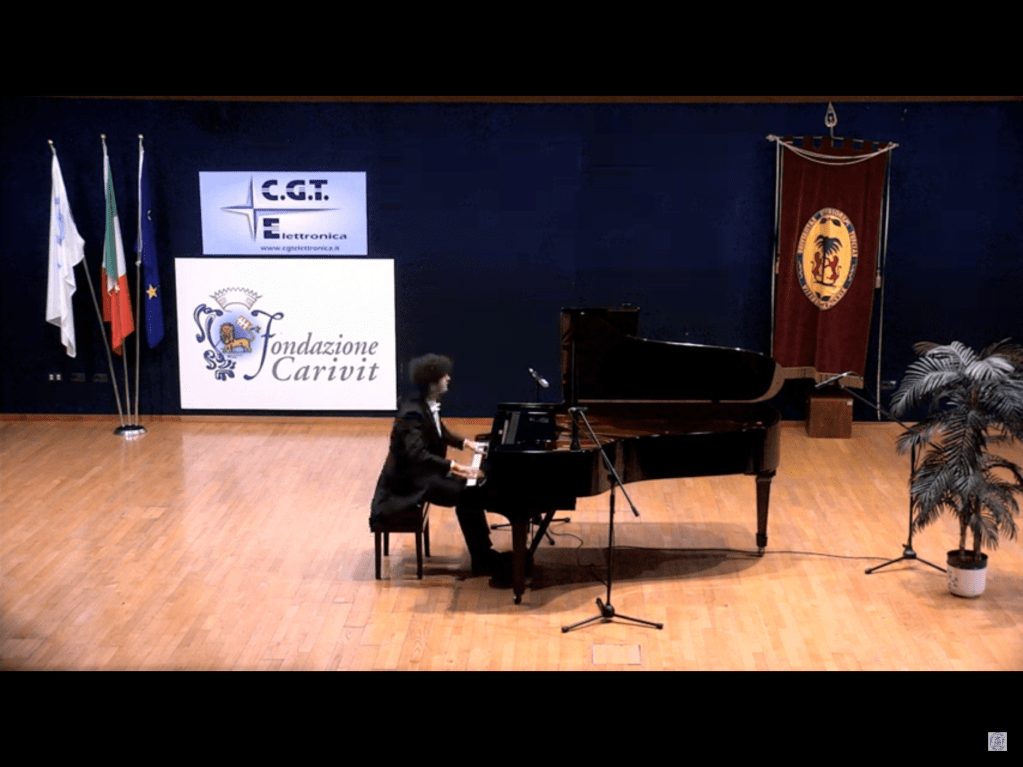
A seventeen year old pianist who can play the Appassionata with such intelligence and control followed by Liszt’s Paganini Studies is a pianist to be reckoned with.Especially when Flavio Tozzi also plays Liszt’s Mazeppa as an encore! Long spindly fingers play with great clarity but in Beethoven you need also intelligence and to know how to delve into the score and find all Beethoven’s very precise indications of fingering,pedalling and phrasing. There was no rearranging of the rapid arpeggiandi passages in the first movement of the Appassionata where he played them as written by the master himself.It is there to imply the struggle that is so much part of this first movement.Flavio Tozzi is a good actor as he understood the struggle even though there were no technical fears for his well oiled fingers.There was beauty too in the Andante con moto where he allowed the variations to evolve so naturally leading to the shock of the two chords that herald the last movement.Many pianists do not heed Beethoven’s Allegro ma non troppo marking as they tear away at breakneck speed.Flavio took it at a very even pace which gave him time to allow the more melodic episodes to evolve without any tempo changes.The only tempo change he allowed himself was that indicated by the composer where the sempre piu allegro to the presto coda created great excitement as did the long final pedal where Beethoven builds the sonority to the final two calamitous chords.
Liszt’s Paganini Studies held no fear for our young virtuoso which allowed him to concentrate on the musical values of these six miniature tone poems. There was great beauty in the first study that after the opening flourishes entered the baritone with a beautiful melody played with the left hand which Flavio shaped with real artistry.A great Neapolitan song that gradually builds up to a demonic climax with both hands greatly involved in the continuous tremolando accompaniment before the return of the opening flourishes that close this first picture postcard.What charm he brought to the second study before the entry of the transcendental octaves that Liszt adds as contrast.The famous La Campanella was played with great delicacy and refined artistry as he shaped the technically difficult phrases with such beauty.There was great power and passion too in the triumphant final pages of these very well known ‘bells’.His long fingers brought remarkable clarity to the violinistic writing of the fourth study.Even here amongst all the difficulties he could shape the phrases with such delicacy and subtle rubato.There was great beauty in La Chasse with the delicate flute being answered by the horn.The strident middle episode with its demonic technical surprises of agility and ability with glissandi thrown off with lightness and ease.The famous variations of the last study in A minor were played with great character and style.From the teasing first variation to the energetic second.The nobility of the third and fleeting lightness of the fourth.The flow of the fifth over the entire keyboard and the ‘con brio’ of both hands almost on a collision course.Etherial beauty of the seventh was contrasted with the driving rhythms of the eighth and ninth.A momentary release of tension with the music box of the tenth led to the grandiloquence of the eleventh and final variation.All played with extraordinary control and musicality. One would have thought that an encore of a nocturne or consolation might have been on the cards but not for our young virtuoso. Nicely warmed up on the Paganini studies he jumped in with the fourth and most athletic of the set of twelve transcendental studies by Liszt. Mazeppa was played with great rhythmic energy and control and the beauty he brought to the mellifluous central section demonstrated once again that his quite considerable technical prowess was at the service of the music. As Flavio matures he will find more weight and solidity thinking up from the bass always which will give much more architectural shape to all that he does.However as he demonstrated today he has a remarkable technique allied to a musical intelligence that will be his guiding light for a successful future.
Flavio Domenico Tozzi nasce a Taranto nel 2005.Si avvicina alle discipline musicali e al pianoforte all’età di otto anni. Nel 2015 è ammesso all’I.M.G. Paisiello ove completa con votazione massima il percorso pre-accademico già nel 2021, sotto la guida della professoressa Alba Noti. Ha partecipato a concorsi importanti quali, nel 2015, Concorso Nazionale G. Paisiello, Primo premio, poi al “First International Musical Competition” D. Savino (primo premio 2017 e 2018) ed al “Pietro Argento Competition” (2017).È vincitore del Primo premio assoluto sia al Concorso internazionale “Musica Mundi” sia alConcorso internazionale “Mediterraneo” nelle edizioni del 2018 e 2019.Nel 2019 è Primo premio al “19° Concorso Internazionale per giovani musicisti – LAMS Matera” ed è Primo premio all’“11° Concorso musicale internazionale A.GI.MUS – Francavilla Fontana” nel 2019 e nel 2020. Nel 2021 consegue il 1° Premio nel concorso internazionale SilkWay di Artnet Russia (Russia-Cina-Italia). Dal 2021 è pianista in organico della “Orchestra giovanile della Magna Grecia” a Taranto. Ha partecipato con profitto a Masterclass di alto livello coi maestri R. Cappello (2018) e O.Sciortino (2019), K. Lifschitz (2020) e F. Libetta (2021) ottenendo ottimi apprezzamenti da parte dei maestri come promessa nell’ambito concertistico. Flavio Tozzi nell’attività concertistica propone gli autori preferiti: Chopin, Listz, Beethoven, Rachmaninov.Ha partecipato a Pianolab 2018 (Martina Franca), al Francavilla Classica Lab 2018, alla 4° edizione “Sinfonie d’autunno” (Laterza 2018), al concerto premio “Mediterraneo” (Teatro Petruzzelli Bari 2019), al concerto “Orchestra Giovanile Magna Grecia” (Teatro Fusco – Taranto 2021), alla stagione concertistica Amici della Musica – Arcangelo Speranza (concerto solisti sezione Young – Teatro Fusco – Taranto 2021).
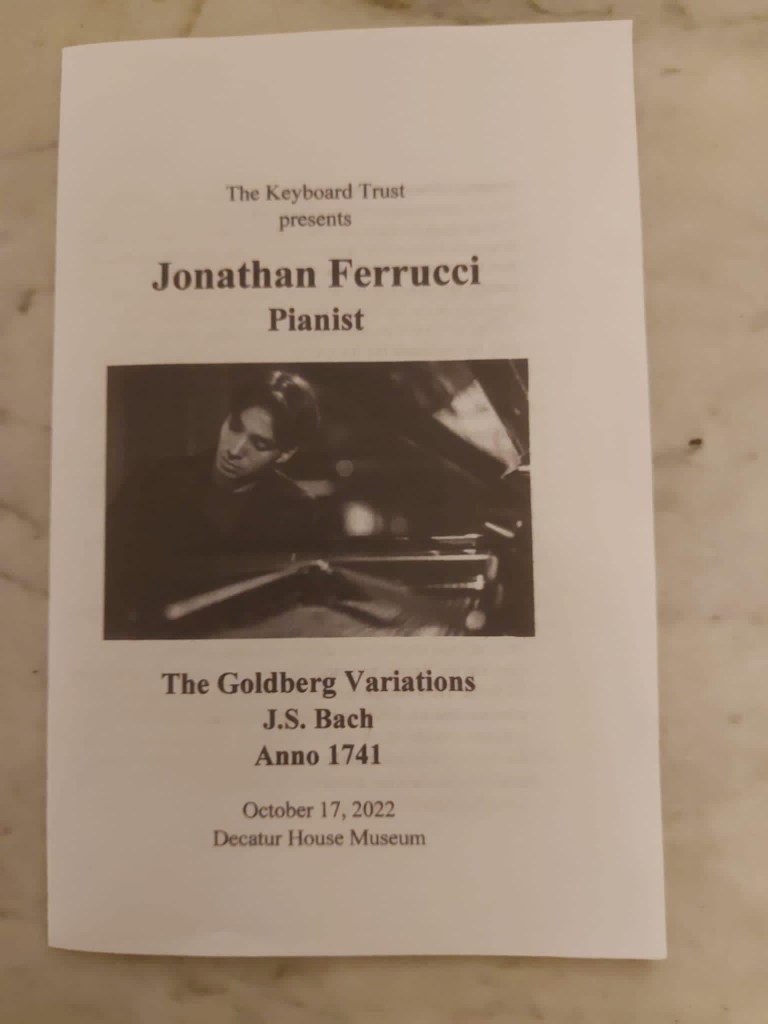
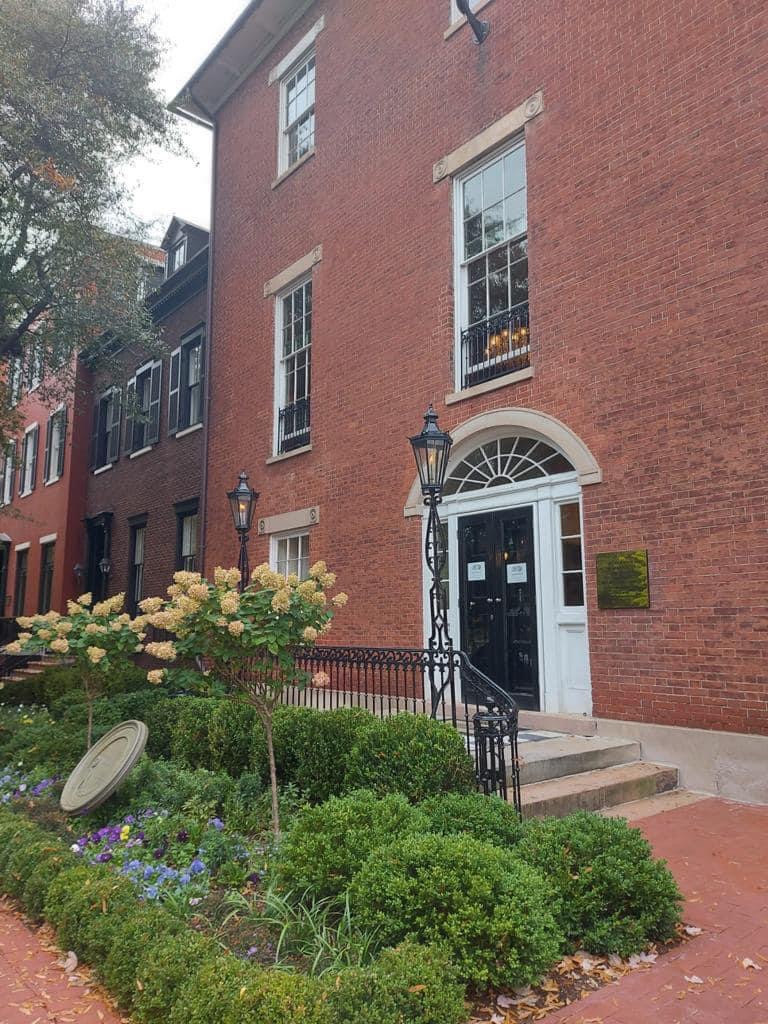
Decatur House the concert “Thanks to our friend Sarah Biggs we got to see a sublime concert in a beautiful location. Jonathan Ferrucci , a magical Italian pianist sponsored by UKs Keyboard Trust played the full sequence of Bach’s Goldberg variations (nearly 90 minutes straight by memory) in Decatur House home of White House Historical Society. And such a charming and modest person, the opposite of the stereotypical artistic diva.” David AtkinsWith Burnett Thompson at Decatur House Washington “Fresh off the heels of Afro-Cuban Jazz is the immersive piano artistry of Jonathan Ferrucci, whose interpretation of JS Bach’s The Goldberg Variations captivated the audience. Fascinating discussion ensued with Rusty Hassan and the pianist himself on the correlation between classical (in this case, late Baroque ) and jazz. Hats off to Burnett Thompson’s Piano: Bach to Bebop series. And huge thanks to The Keyboard Charitable Trust!”Darika Chanachote“I was fortunate to meet Yisha Xue 薛忆沙, who not only hosted my London visit at her home, but has been of invaluable assistance to The Keyboard Charitable Trust. Left to right moi, Jonathan Ferrucci, Trust Exec. Dir. Sarah Biggs, Yi Yun Soo and Yi Sha Xue.” Burnett Thompson Burnett Thompson ,standing,visits the Kew Academy in London Jonathan Ferrucci centre,Peter Dimov right,Pablo Rossi and Rokas Valuntonis left
The Keyboard Trust is proud to present in its 30th anniversary year
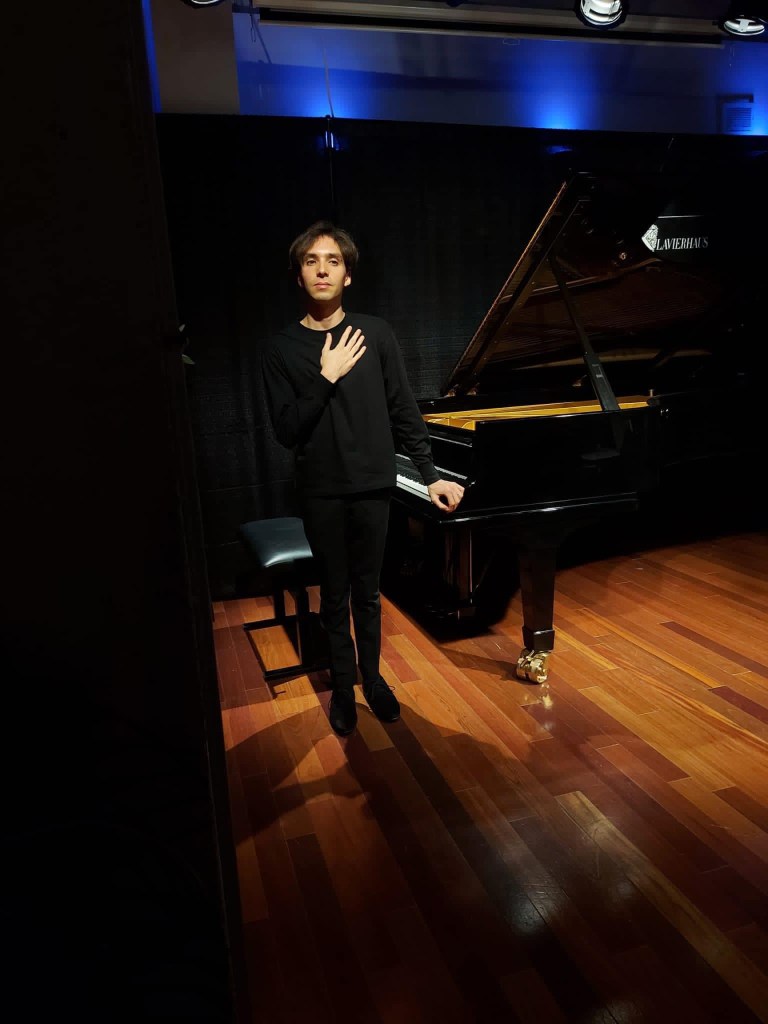
Jonathan Ferrucci – Goldberg Variations: a Voyage of Discovery New York debut of a remarkable young musician Thursday 20th October at 7 pm Klavierhaus,790 11th Avenue corner West 54th street
“A spiritual journey of awakening, an inquiry into humanity and the nature of time, a round-trip Odyssey. This masterpiece is a search for freedom that will lead us back to our true self, back home.” Jonathan Ferrucci
Klavierhaus New York
As Jonathan Ferrucci says a lifetime may not be enough to enter completely into the genial mind of J.S.Bach. One can but try and this is the start of a remarkable voyage of discovery. On his fifth public performance in Florence last winter I think that from the spell that he created it was evidence enough that he is on the right trail. Seventy-five minutes of total silence from an elite audience surrounded by the books of that remarkable aesthete Harold Acton. Jonathan like Acton was born in Florence both bringing back their experiences from abroad to the cradle of culture in what Rostropovich described as the Museum of the World. Jonathan is now being mentored by Angela Hewitt who has indeed inherited the mantle of Rosalyn Tureck as the High Priestess of Bach. Rosalyn Tureck came to Florence in the 1990s when she was 78 to play these very variations at La Pergola and she became immediately the ‘Diva’ of Florence’. This mantle has now passed to Angela Hewitt whose approach to Bach is more human and less monumental than Tureck’s but their total dedication allows them to get as close as is possible to the core of the genius of J.S.Bach. Jonathan is being mentored by Angela Hewitt and is fast on this trail too as the minutes of aching silence that greeted the end of the Goldbergs in Florence was proof enough. His performance has the authority of someone who is living with the music and it is gradually but surely entering his being as it directs his spirit to the glory of the soul of Bach which is of course To the Glory of God!
With Caroline von Reitzenstein and Dan Danieli
In celebration of the Keyboard Trust’s 30th Anniversary and the launch of a new history of the Trust written by co-founder John Leech and artistic director Christopher Axworthy, https://christopheraxworthymusiccommentary.com/2022/09/14/the-gift-of-life-the-keyboard-trust-at-30/ We are proud to present Jonathan Ferrucci in a full performance of Bach’s Goldberg Variations. The concert will take place on Thursday, October 20th at 7pm at Klavierhaus, 790 11th Avenue at the corner of West 54th Street. Please note that the program will run approximately 75 minutes with no intermission.
Free entrance but reservations necessary from the Keyboard Trust – Caroline von Reitzensteinmailto:cvonnyc@gmail.com donations to the trust are recommended
Friday 14th October Dvorak American Heritage Associazione Bohemian National Hall 321E 73rd Street NY
Sunday 16th October Castletown Theatre House Maazel Estate Virginia
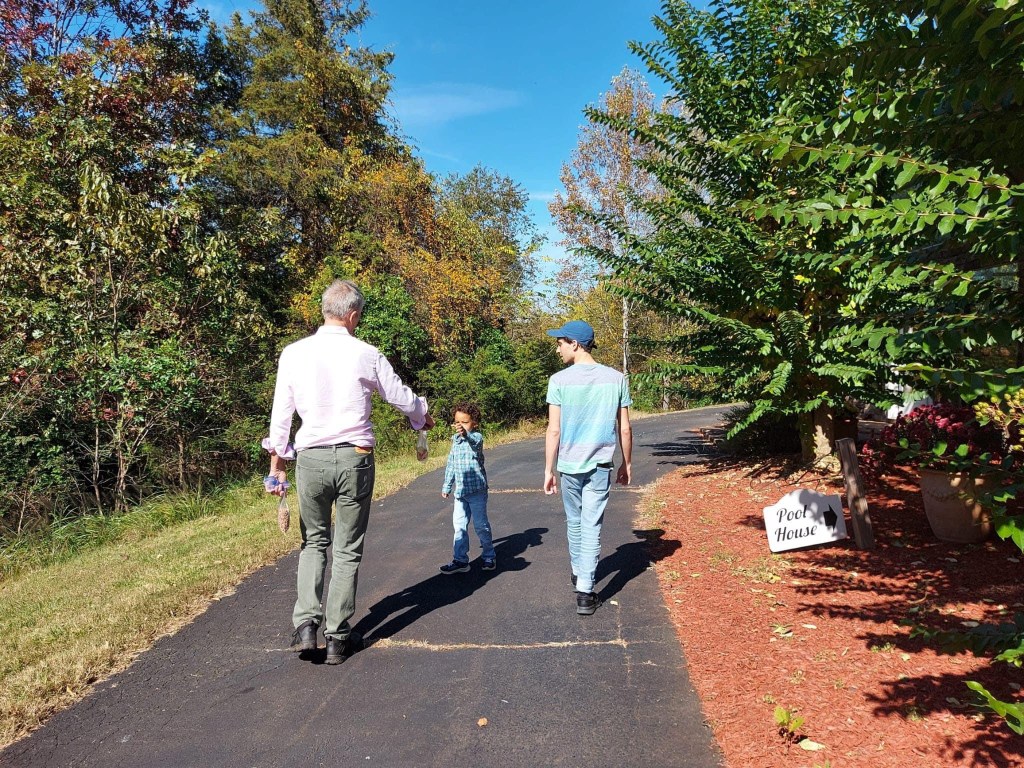
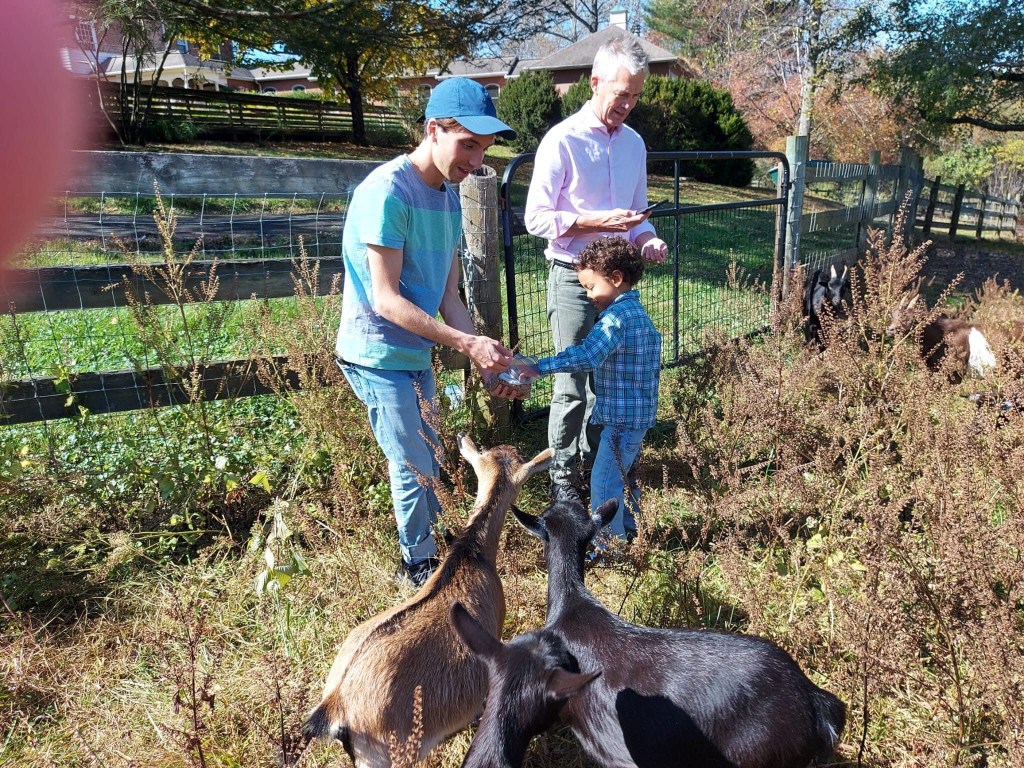
In rehearsal at the Maazel Estate Theatre in Castletown Join us October 16 for a Jonathan Ferrucci piano recital, in collaboration with the Keyboard Charitable Trust, London. Ferrucci will perform and explain the complete J. S. Bach Goldberg Variations in “Bach Golderg Variations: A Voyage of Discovery” – an enormous undertaking and rarely experienced live! Italian-Australian pianist Jonathan Ferrucci has given concerts throughout Europe, Australia, the US, and Japan. Multiple award-winner and rising star in the piano world he is also co-founder of Made in Music, a non-profit with the mission to unite people from different cultures and backgrounds through the universal language of music. Tickets are available at https://www.simpletix.com/e/jonathan-ferrucci-piano-recital-tickets-107337Dietlinde Maazel WoodJonathan with Tony Wood and grandchildFeeding the animals on Castletown Farm
Monday 17th Decatur House Museum Washington
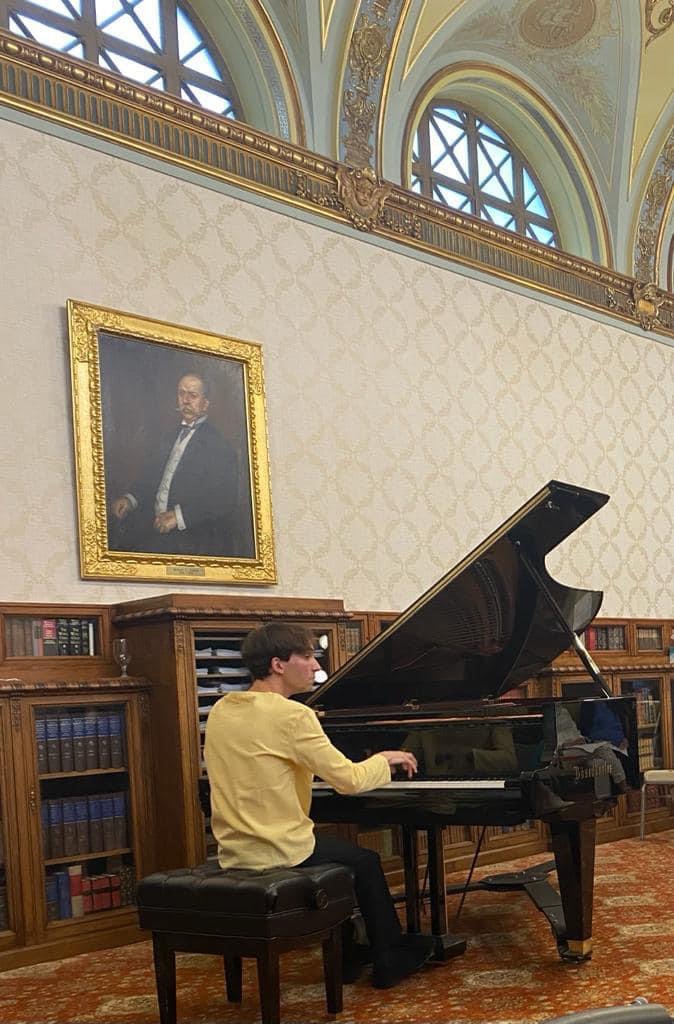
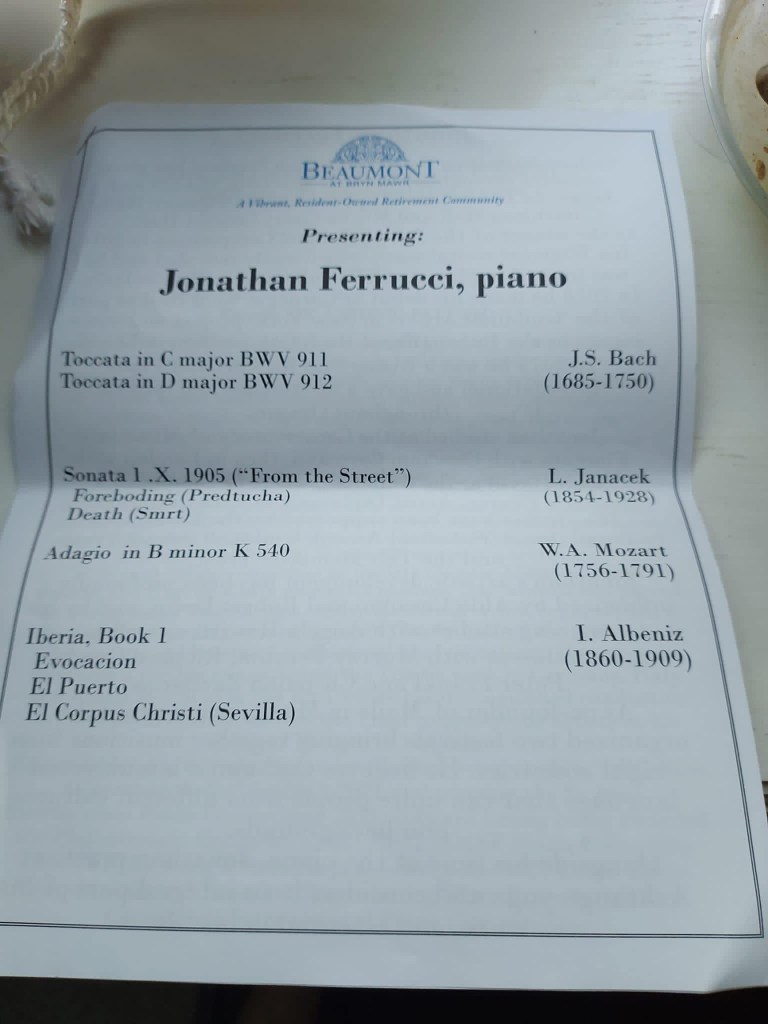
Tuesday 18th October Beaumont Bryn Mawr Philadelphia
Rehearsals
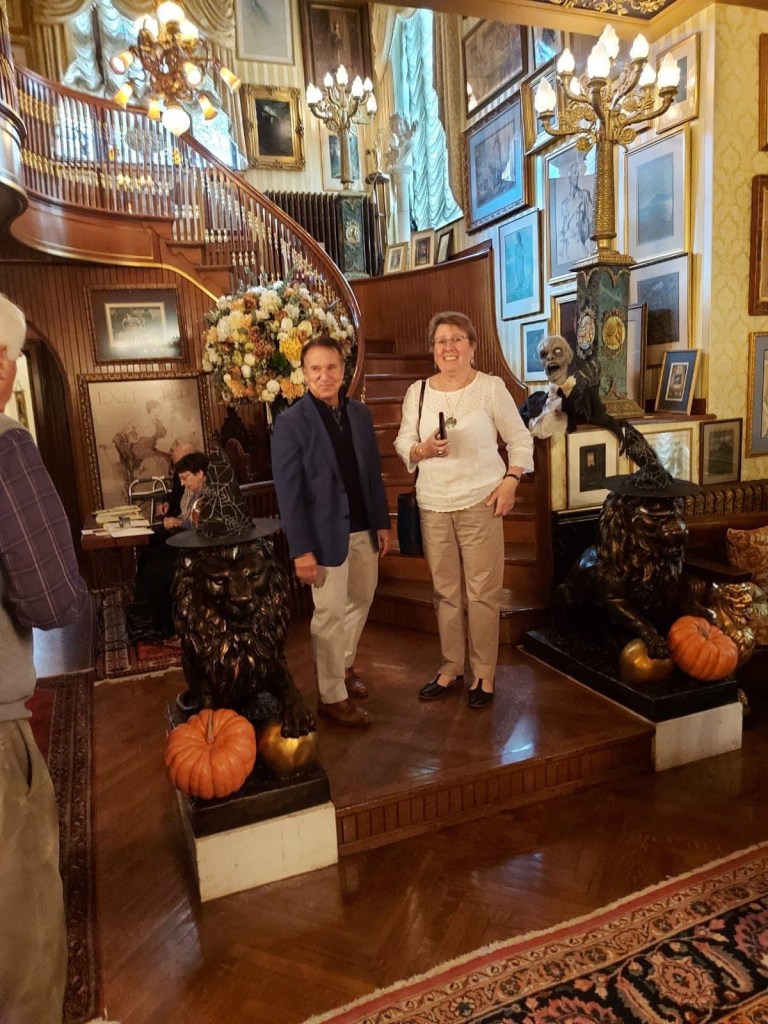
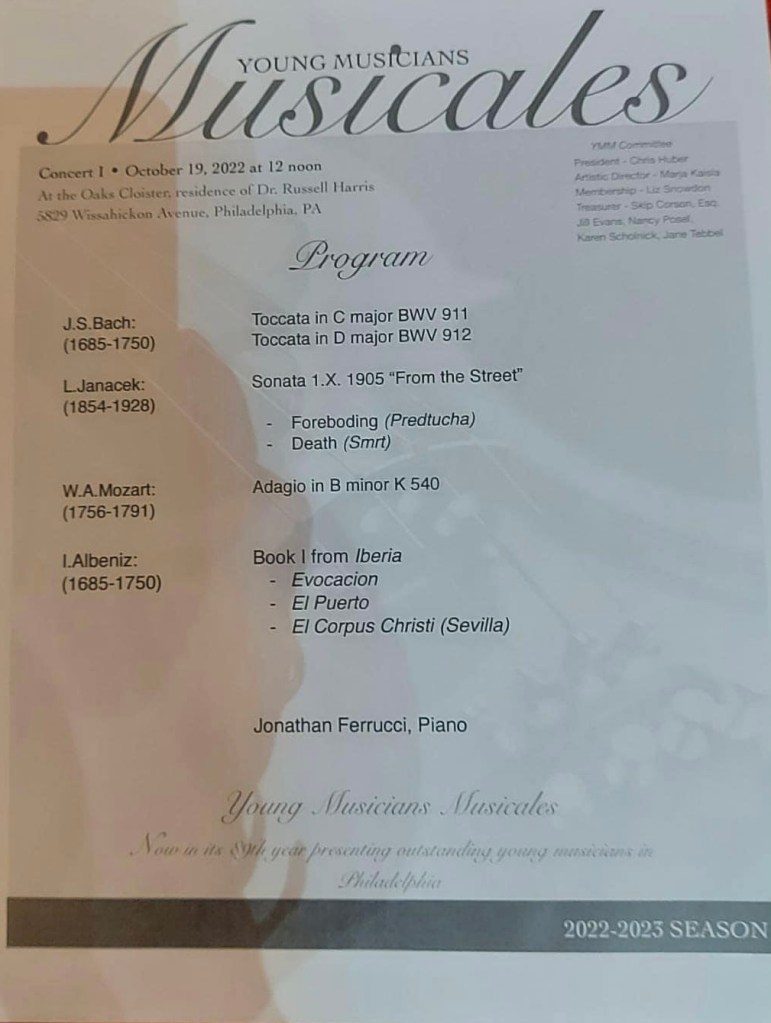
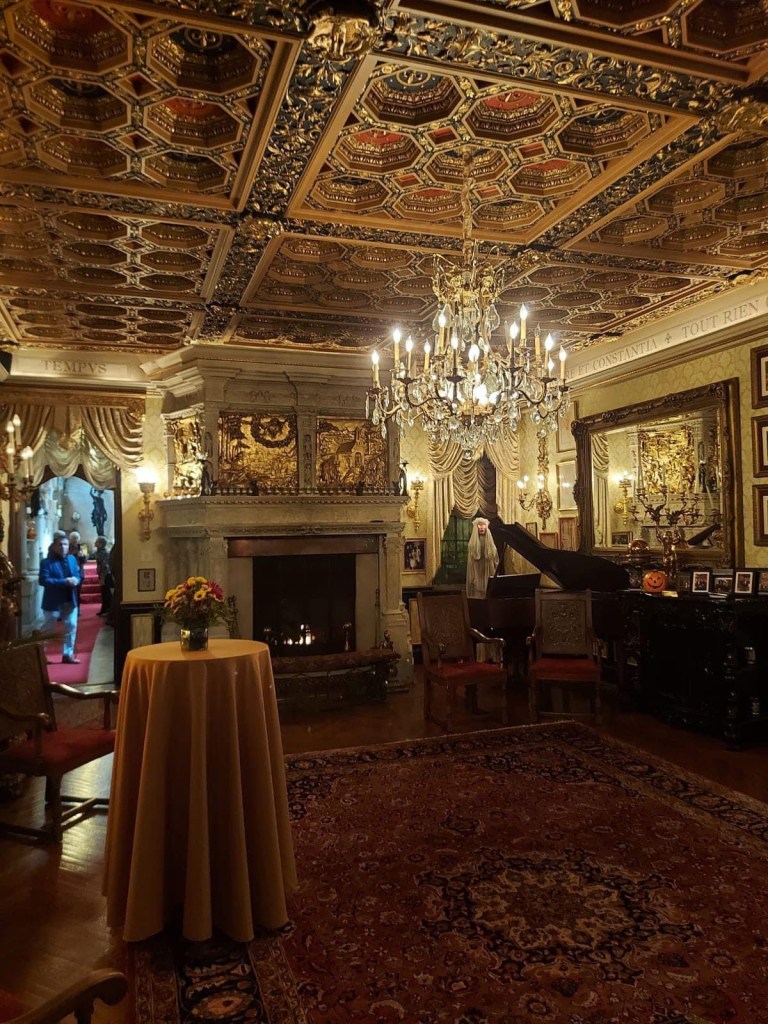
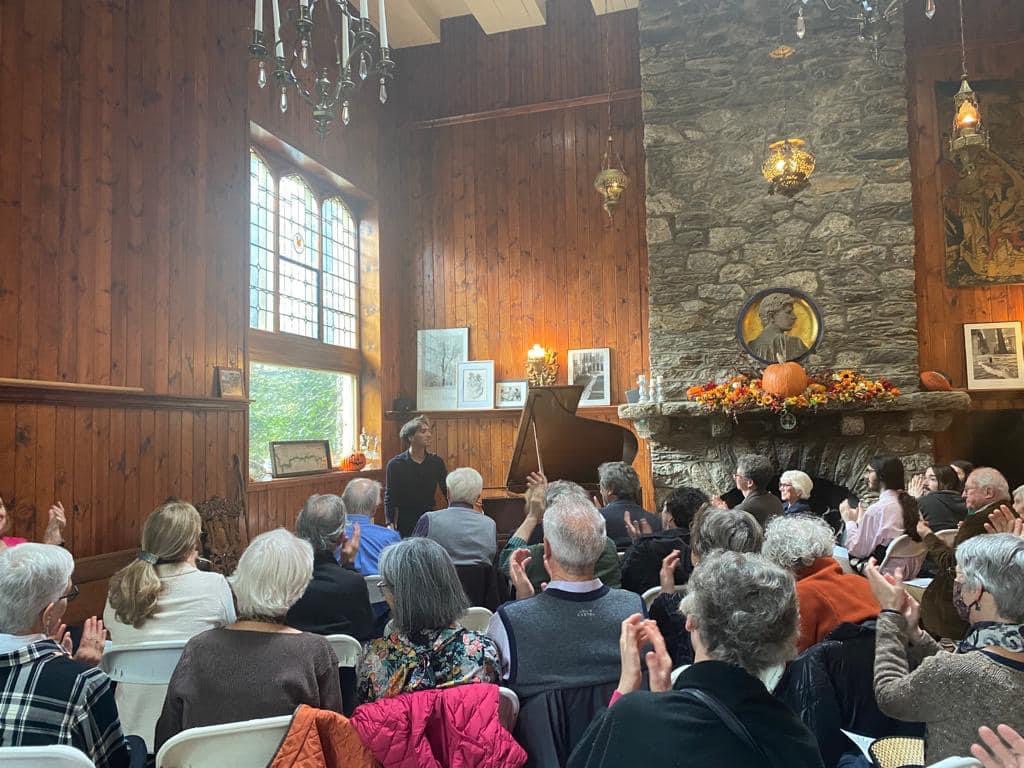
Wednesday 19th Oaks Cloister Philadelphia
Sarah Biggs with our host Dr Russell Harris
Thursday 20th October Klavierhaus New York
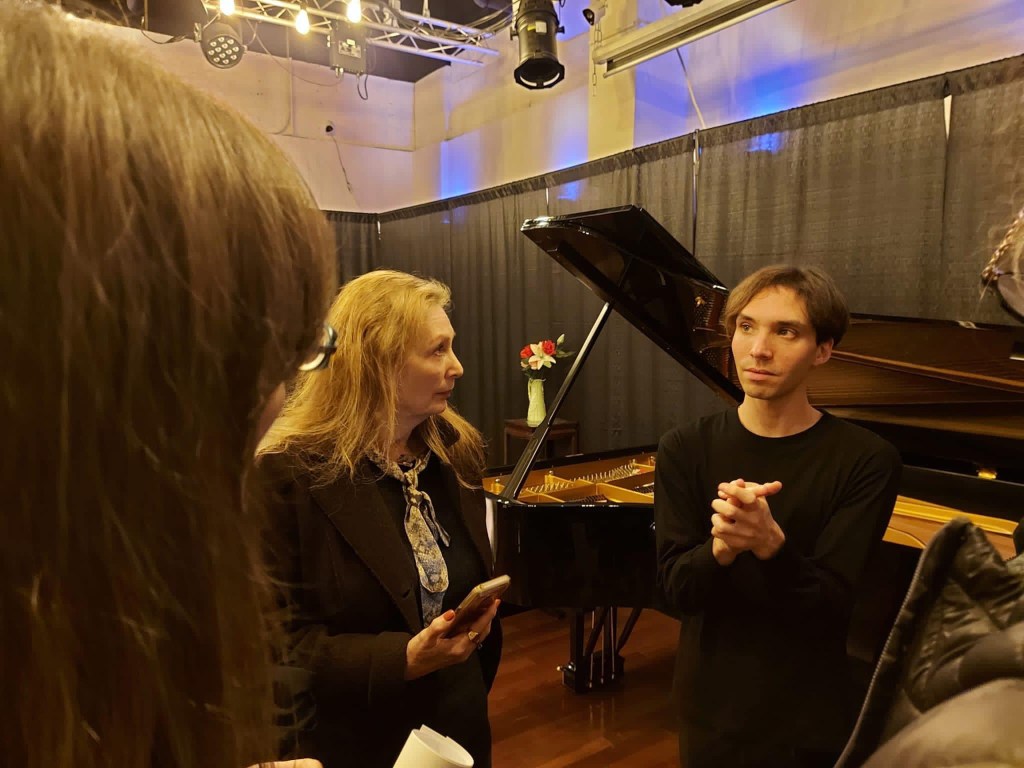
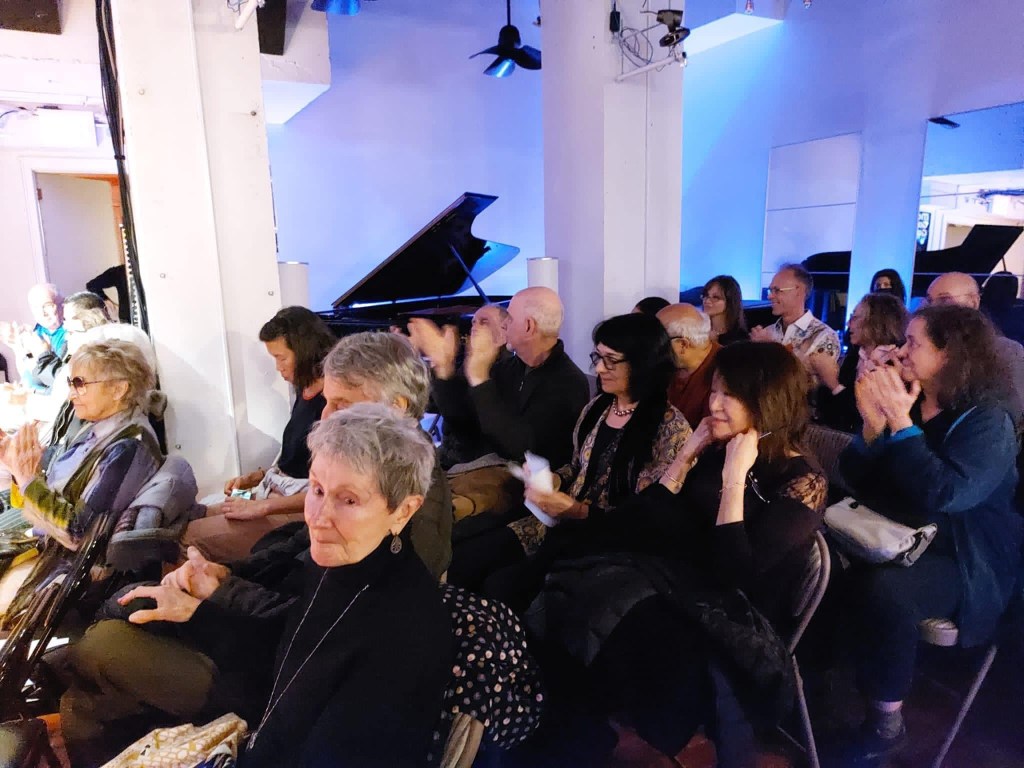
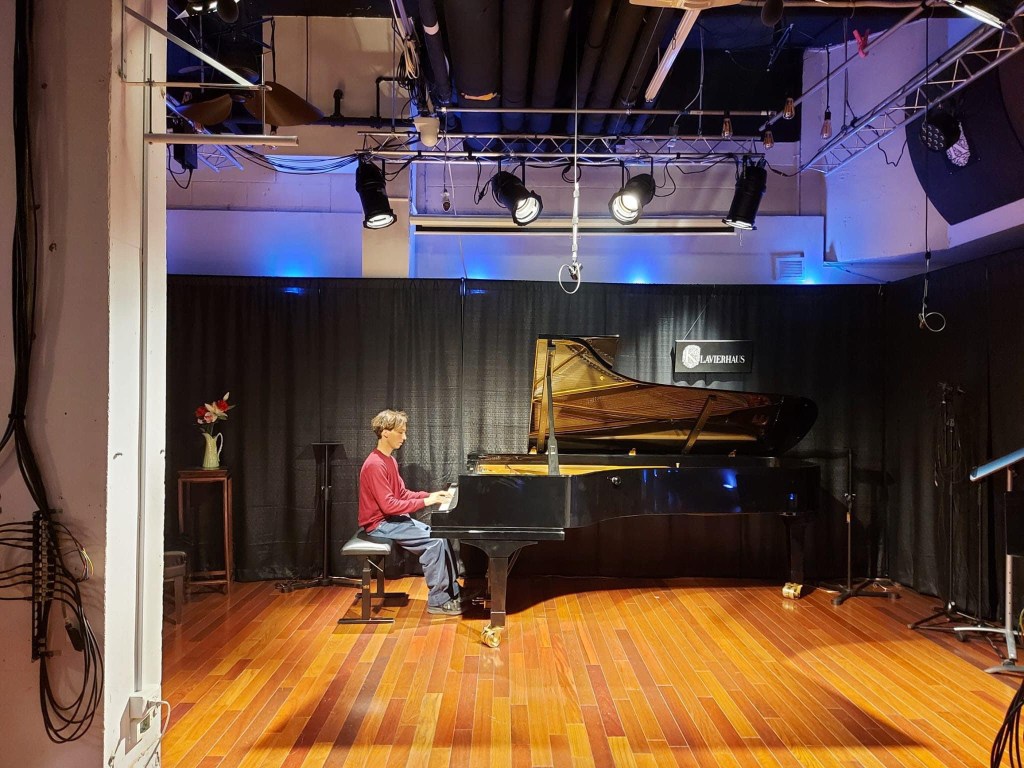
With Caroline after the concert : Goldberg Variations Full house in the Klavierhaus In rehearsal
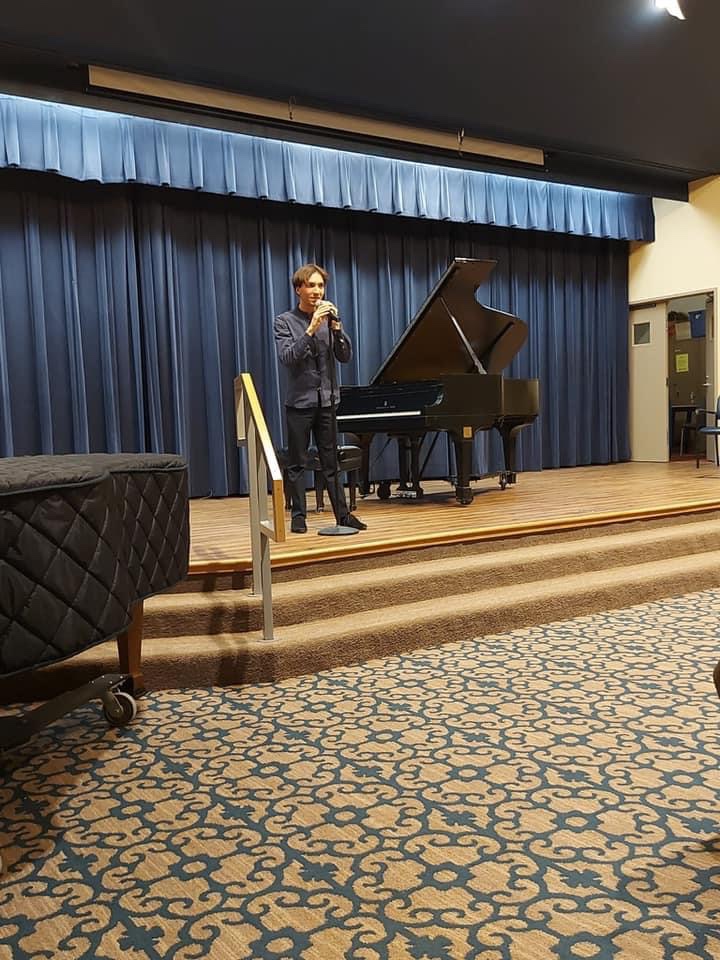
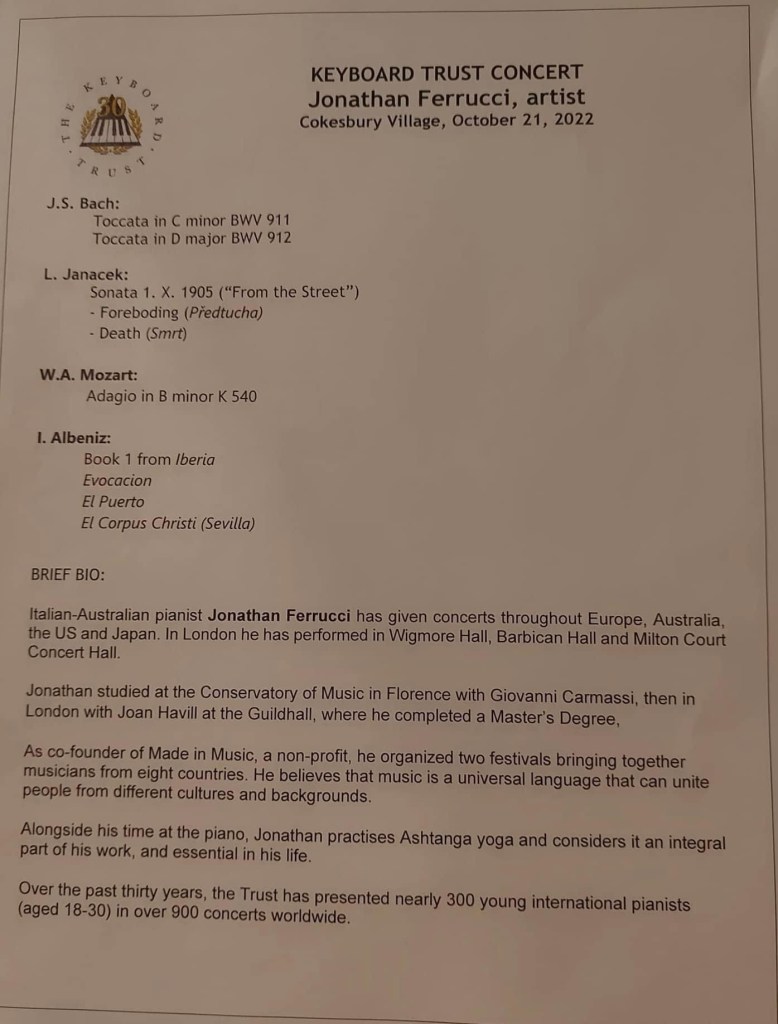
Friday 21st October Cokesbury Village Wilmington Delaware
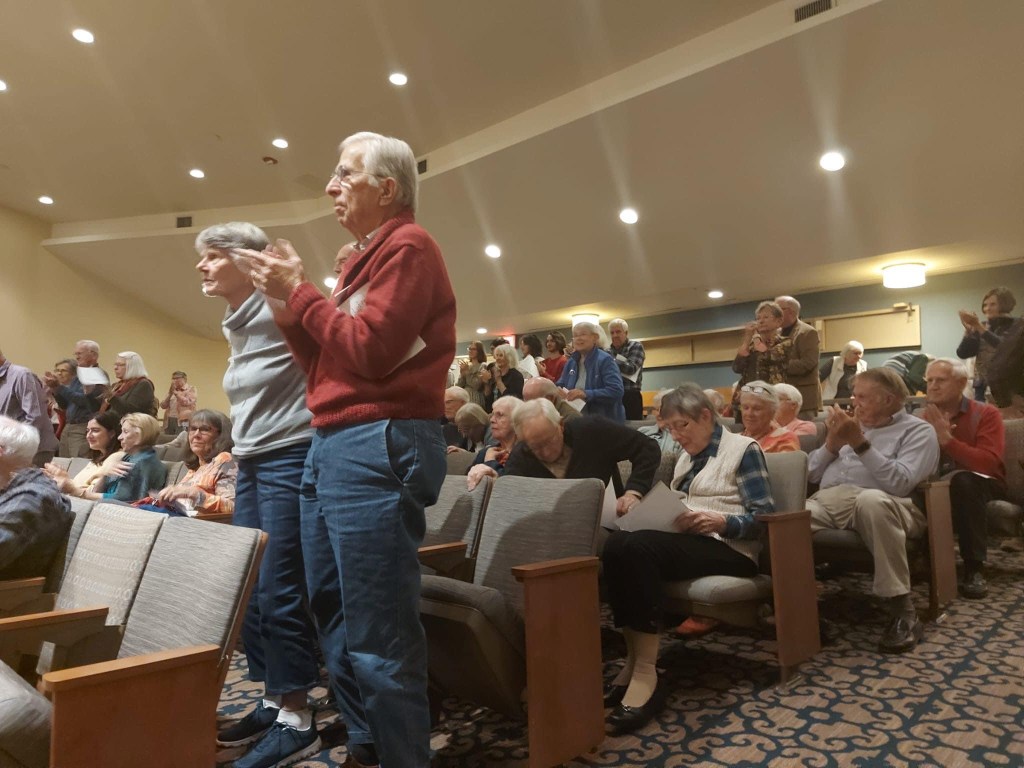
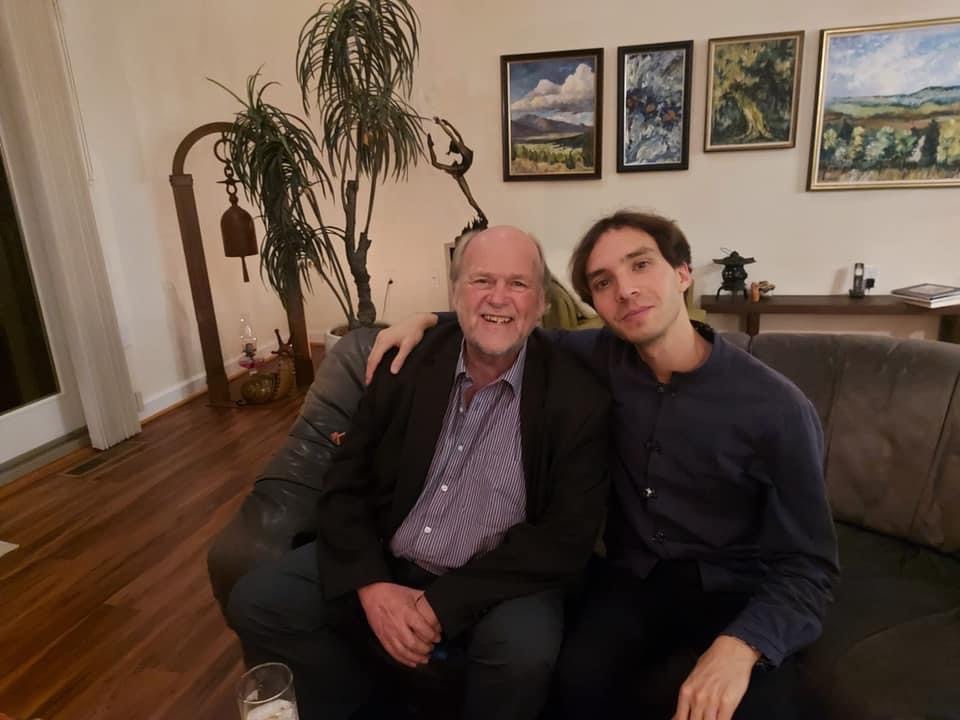
Another standing ovation on last day of the tourPhil Davies with JFFriends of Cokesbury Village Cokesbury Village theatre before the concert
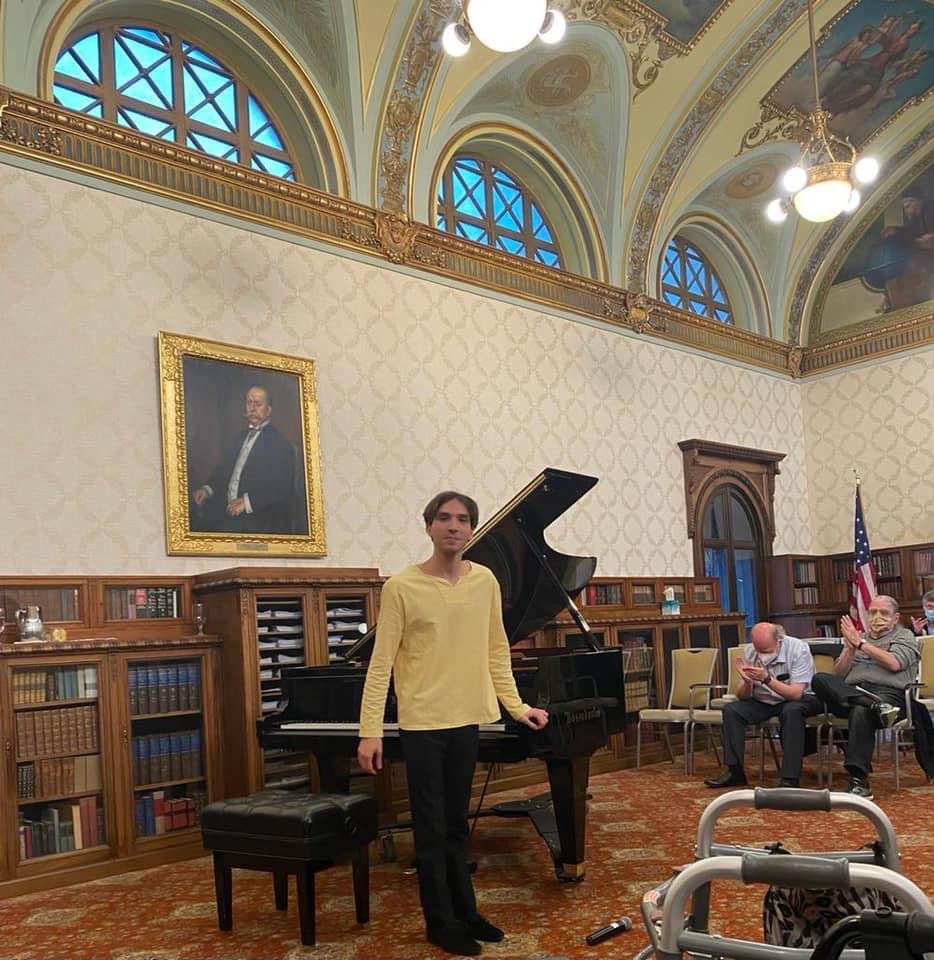
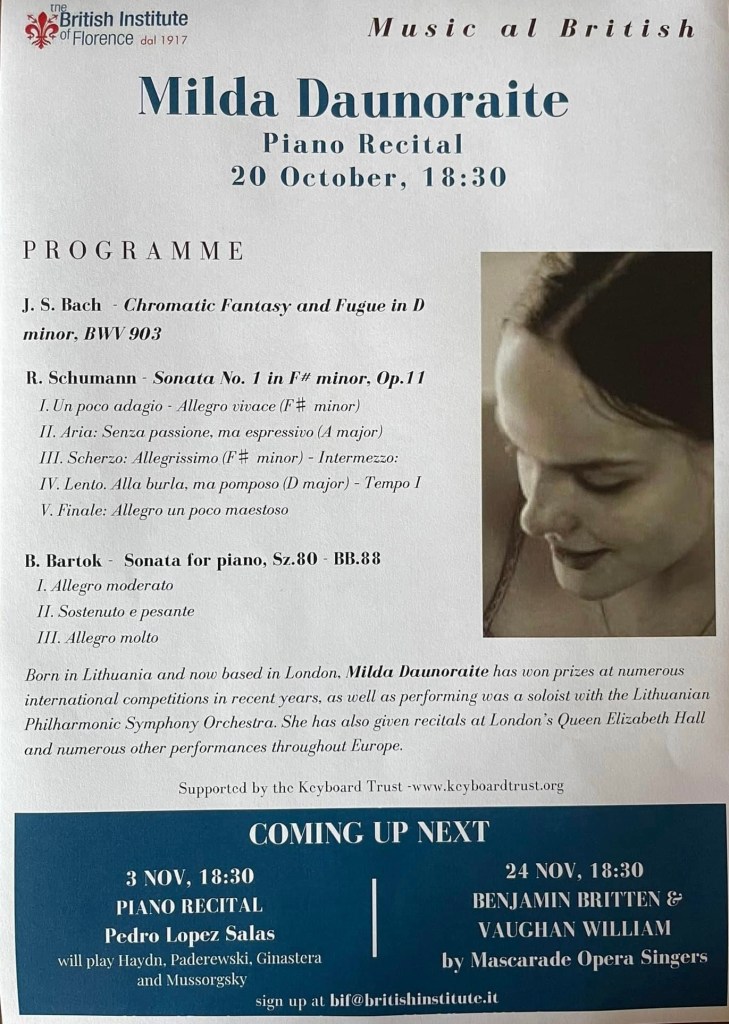
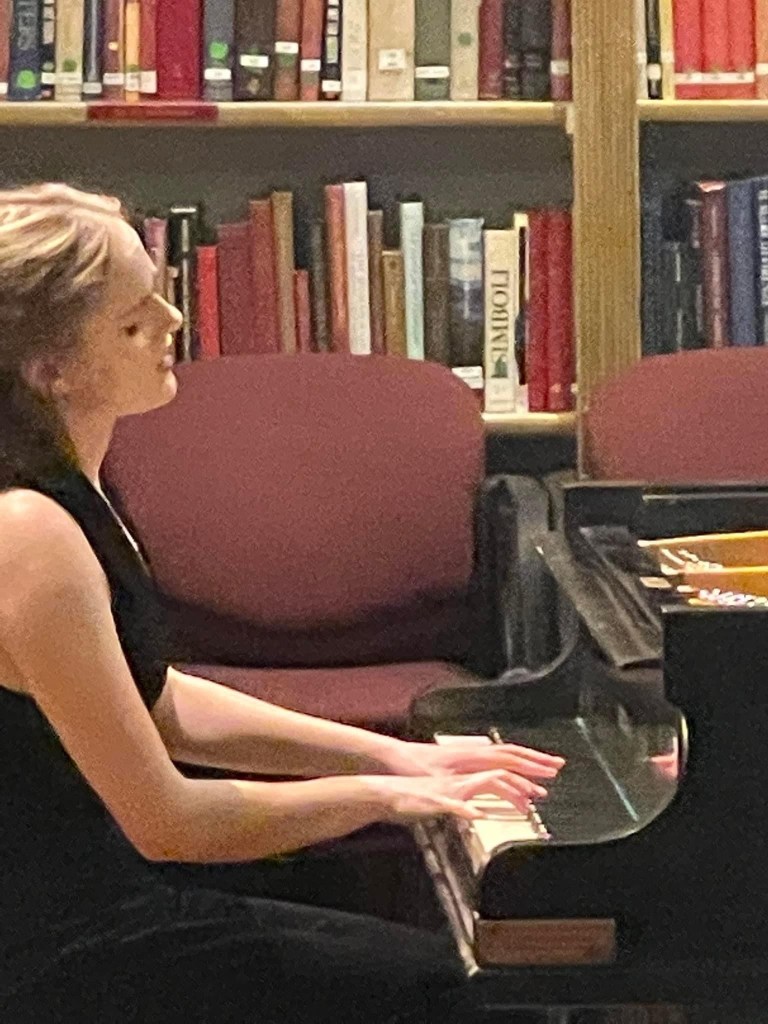
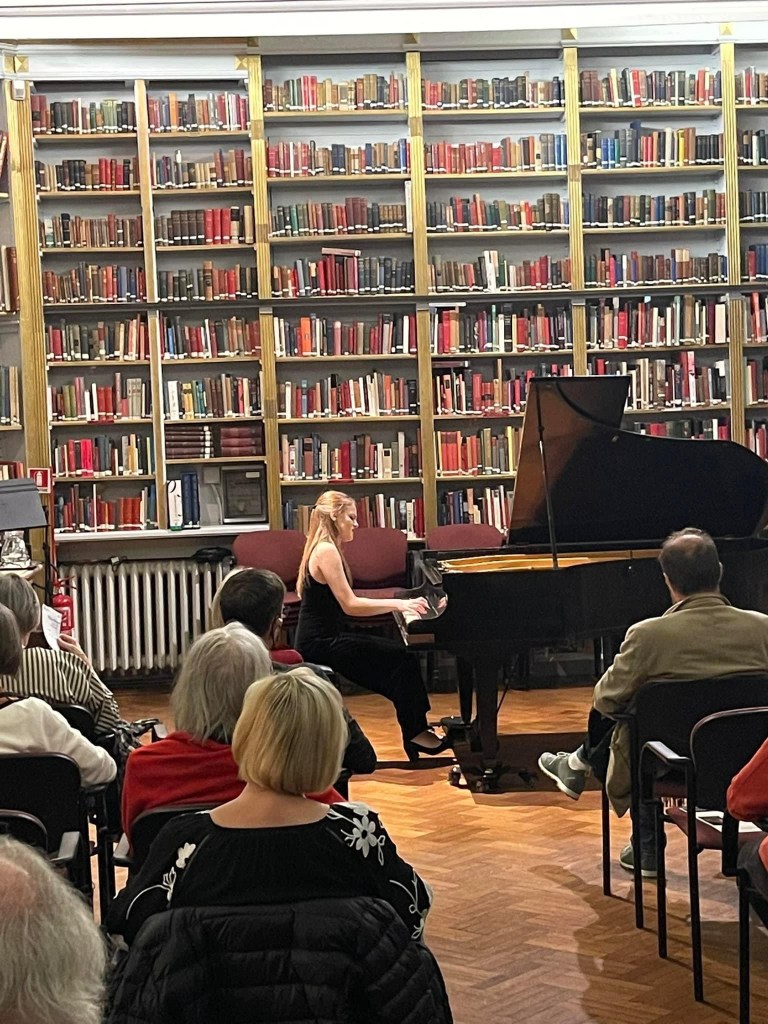
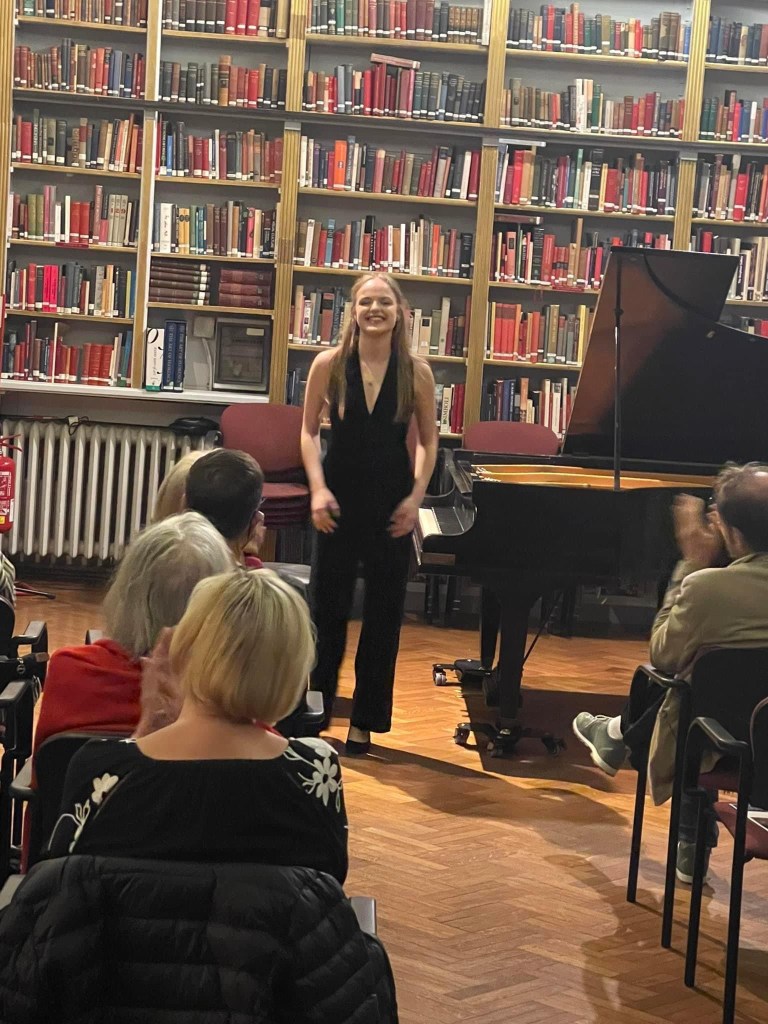
For her concert in the beautiful Harold Acton Library, she played Bach, Bartok and Schumann.
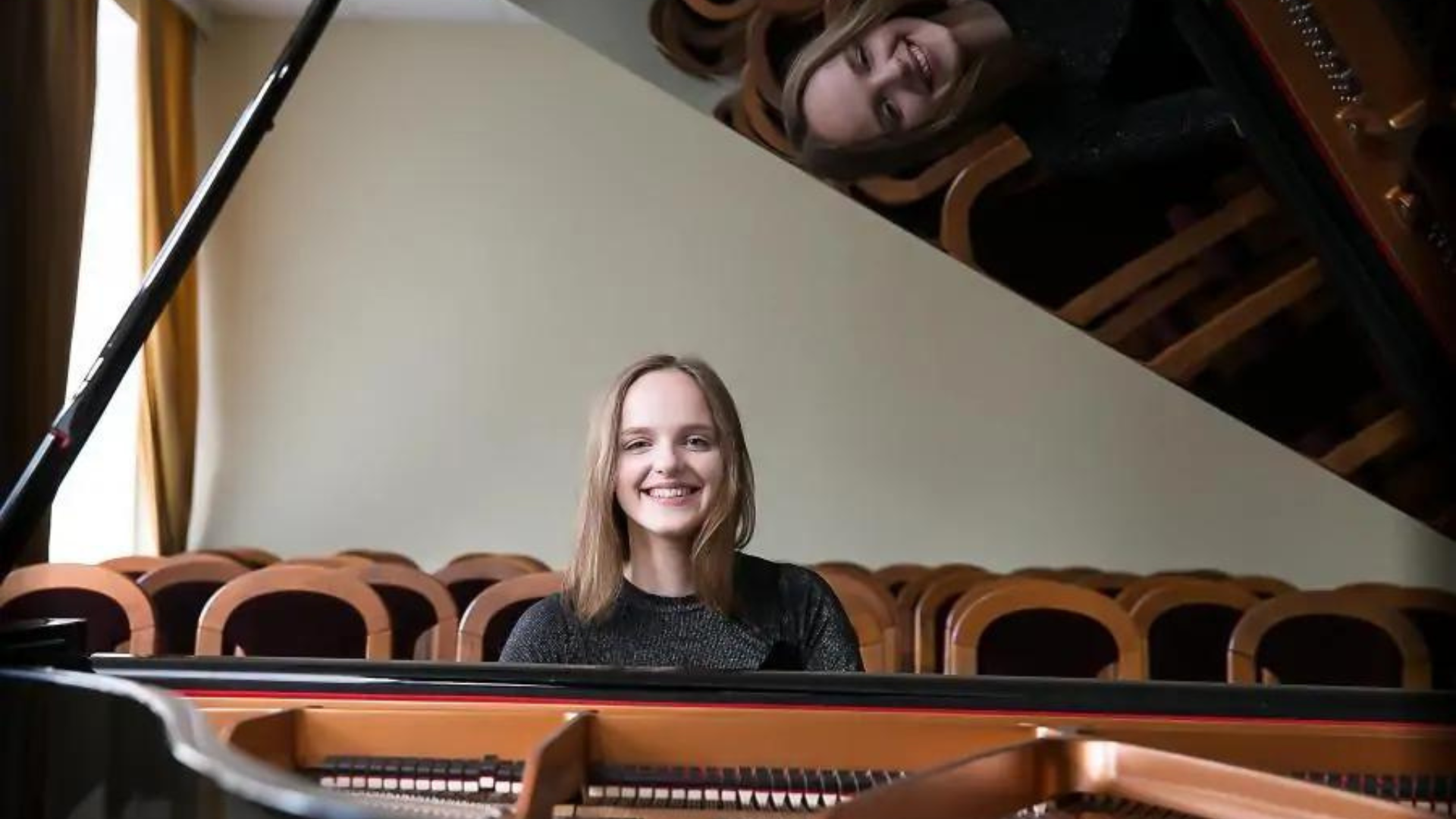
Born in Lithuania and now based in London, Milda Daunoraite has won prizes at numerous international competitions in recent years, as well as performing was a soloist with the Lithuanian Philharmonic Symphony Orchestra. She has also given recitals at London’s Queen Elizabeth Hall and numerous other performances throughout Europe.
Programme:
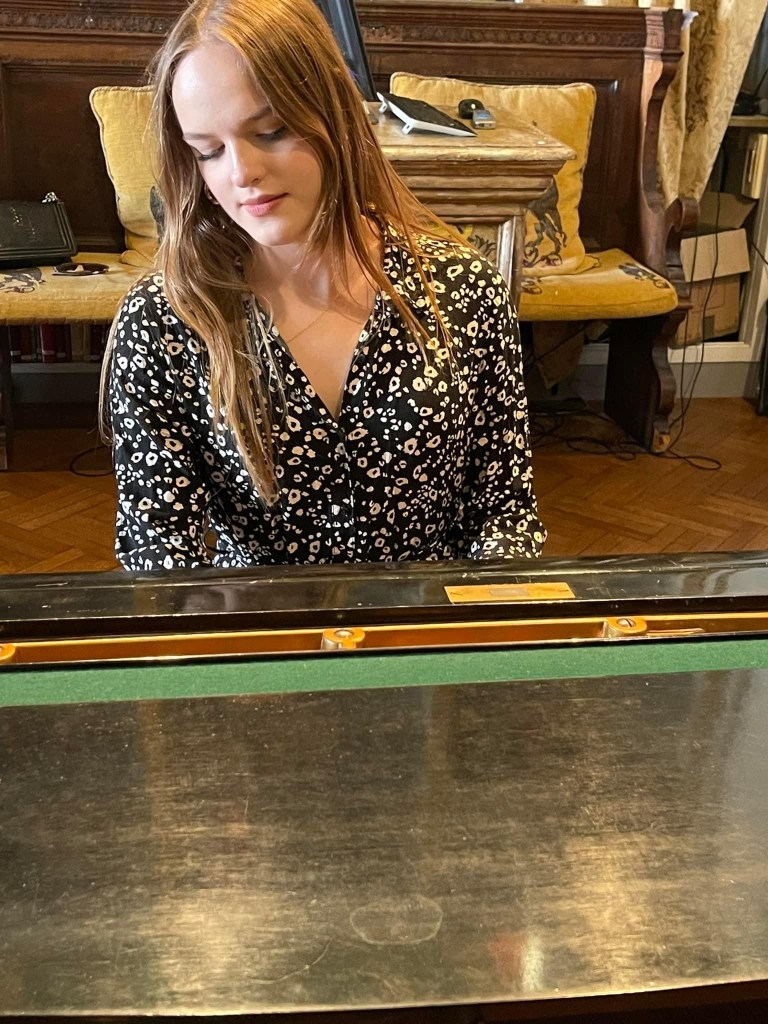
Milda Daunoraite is a remarkable Lithuania born pianist and one of three that I have met in London where they have come to perfect their studies.Milda,Gabrielé Sutkuté and Rokas Valutuonis all have one thing in common a fluidity of sound and an ease in performance that is very similar to the remarkable Hungarian school of Geza Anda.
Why should that be,I have no idea except all three have a very open easy going spontaneity that may be to do with their early upbringing and studies in their native country.Milda at the age of 16 was brought by her then Lithuanian teacher to the Purcell School in England where he had taken up a teaching post.It was there that she met that remarkable trainer of young musicians Tessa Nicholson with whom she continued her studies and continues with her at the Royal Academy of Music where she was awarded a full scholarship.Milda still only in her 2nd year of a 4 year programme has already been singled out by the Keyboard Trust to give concerts on their various tours worldwide offered to exceptionally talented young artists at the beginning of their careers.
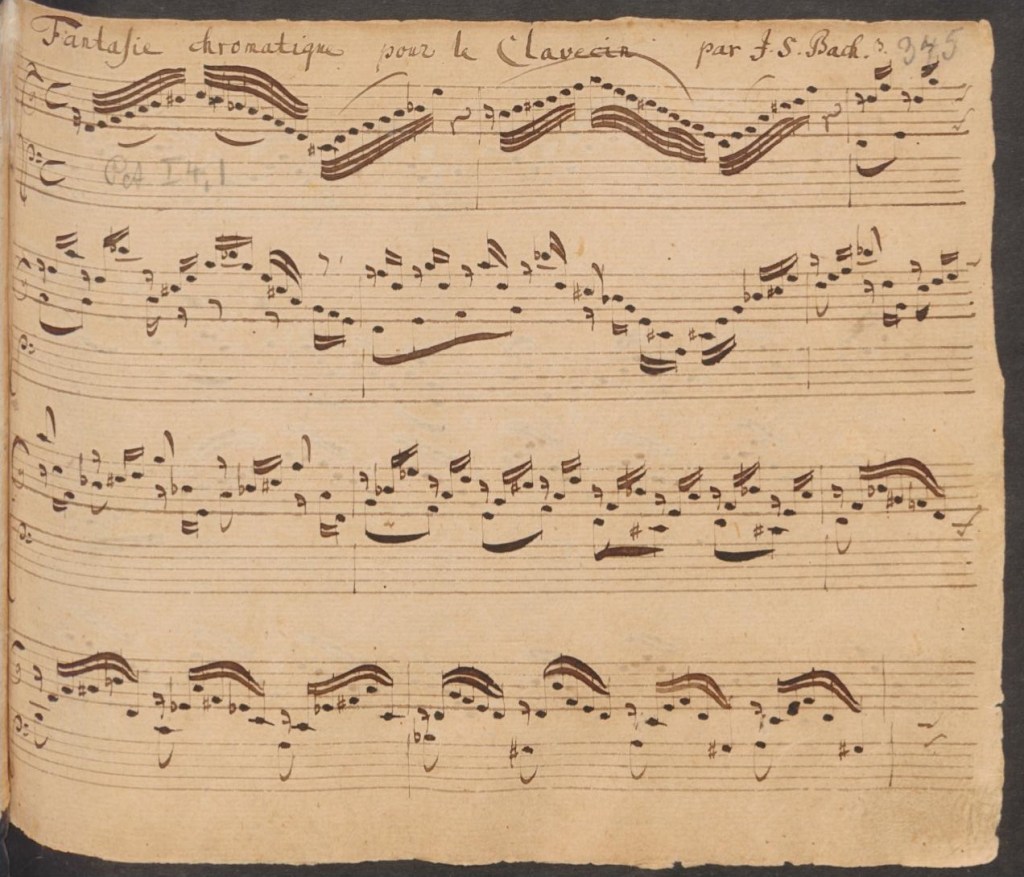
Schoenberg the master of the Second Viennese School, called J.S.Bach the first 12-tone composer. It was his treatment of chromatic themes that prompted that statement. One of the works that prompted that label was his Chromatic Fantasy and Fugue, BWV 903, which begins with not one but two ascents up different parts of the chromatic scale.
A contemporary manuscript copy by the hand of Johann Tobias Krebs
It was probably composed between 1717 and 1723 while Bach was in Köthen and it is its chromatic nature, which explores all keys, that causes scholars to link it with his experiments while in Köthen. Although Bach’s original manuscript is lost, the extraordinary nature of the work has caused it to survive in 16 different copies, five of which date from Bach’s lifetime. Not all of the versions are the same and it is assumed that Bach was the source of the various versions.The Fantasia is in three parts: the first is a prelude, filled with arpeggios; the second part is more recitative-like, and the third a combination of the two.The Fugue, on the other hand, is strict by its very nature but then relaxes, seemingly in response to the freedom of the Fantasy section.The work as a whole is remarkable – it has an harmonic boldness unexpected in the music at the time, but, on the other hand, may be very representative of what Bach normally achieved in free improvisation at the keyboard.The first biographer of Bach, Johann Nikolaus Forkel , wrote: “I have given much effort to find another piece of this type by Bach. But it was in vain. This fantasy is unique and has never been second to none.”
In rehearsal
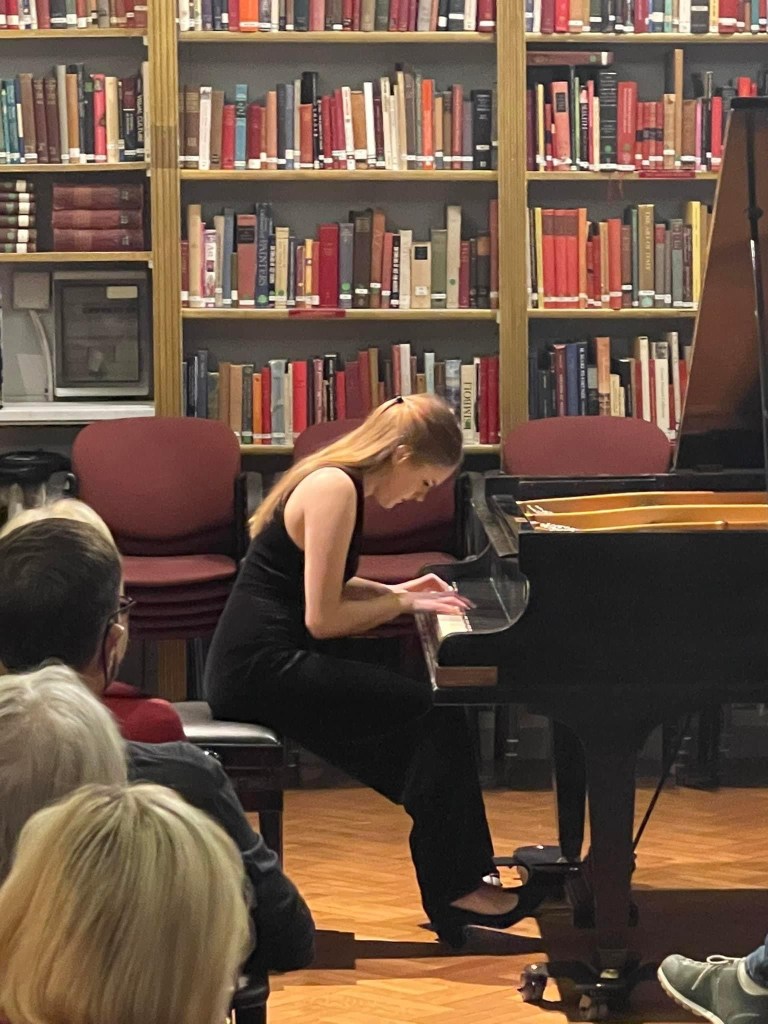
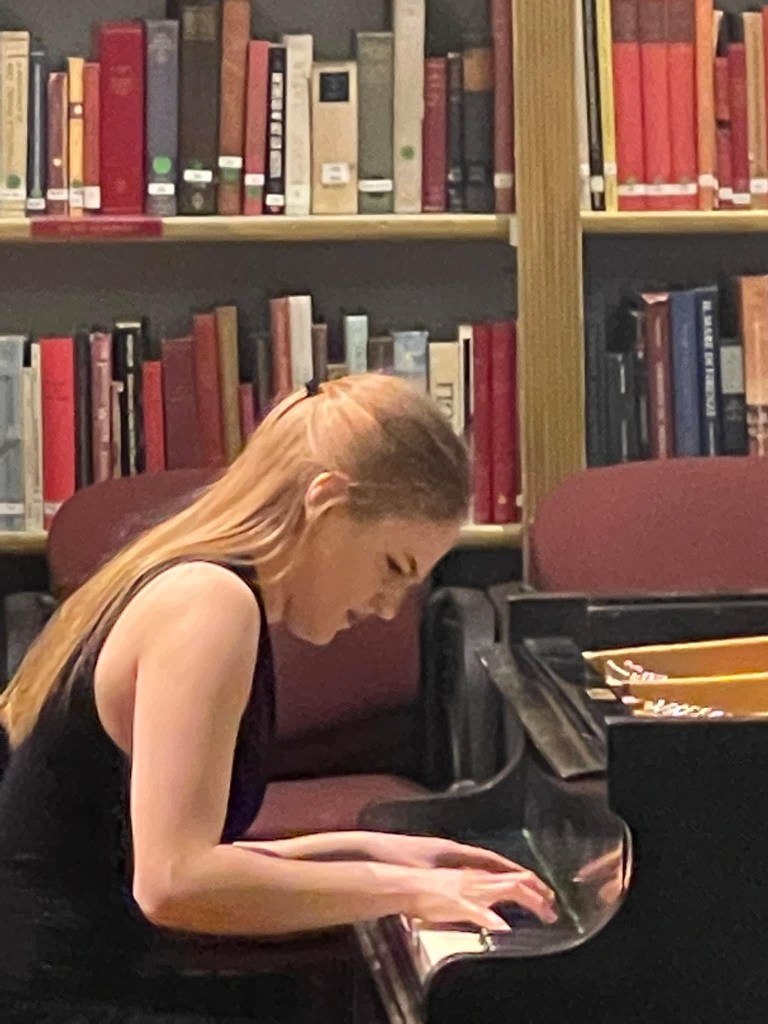
Milda gave a performance of virtuosity and expression playing with clarity and fluidity but at the same time giving such shape and meaning to all she did.The ending of the fantasy was so poignant as it gradually lost its vital energy and with it’s dying breath emerged the new life of the fugue.The energy and architectural shape she gave to the fugue was remarkable for its clarity and control as it gradually built up to it’s final burst of glory.
The Piano Sonata No. 1 in F♯ minor, Op. 11, was composed by Schumann between 1833 to 1835 and he published it anonymously as “Pianoforte Sonata, dedicated to Clara by Florestan and Eusebius”.It has been described as ‘the most unconventional and the most intriguing’ of Schumann’s piano sonatas due to its unusual structure.The Aria is based on his earlier Lied setting, “An Anna” or “Nicht im Thale”.Schumann later told his wife, Clara, that the sonata was “a solitary out cry for you from my heart … in which your theme appears in every possible shape”.
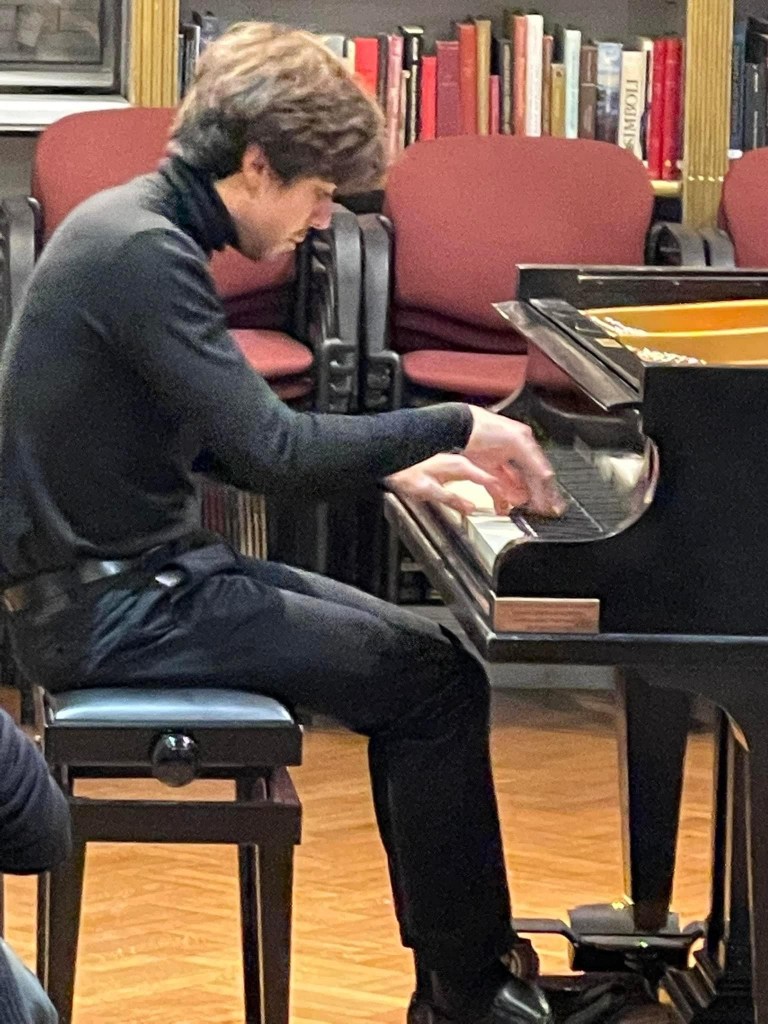
It is in four movements the Scherzo having an intermezzo central episode of complete contrast before the return of the Scherzo allegrissimo.It is a very complicated work with its continual fleeting contrasts that need to be given an overall shape and form.Milda confided that this was the first time she had performed the work in public and it was the work that had brought her finally close to the world of Schumann with his dual personality of Floristan and Eusebius very much in conflict with each other.She brought great passion to the opening introduction with the theme that permeates the entire sonata.There was subtle virtuosity to the fleeting changes as she entered the Allegro vivace start of the first movement .The Aria was played with a ravishing sense of balance,fluidity and purity of sound that allowed this all too short lied to create a magic oasis before the rumbustuous rhythmic energy of the Scherzo and the rhetorical almost operatic Intermezzo that interrupts it’s mischievous journey.The last movement was played with great nobility and a quite remarkable control as this long movement unfolds with continuous changes of character and colour.Even Schumann seems to loose his way but finally takes an almost unexpected leap from what seemed a dead end but infact becomes a coda of great excitement and transcendental difficulty which Milda played with passionate commitment.
The Piano Sonata, BB 88, Sz. 80, is a by Bela Bartok was composed in June 1926. 1926 is known to musicologists as Bartók’s “piano year”, when he underwent a creative shift in part from Beethovenian intensity to a more Bachian craftsmanship.
In three movements :
Allegro moderato
Sostenuto e pesante
Allegro molto
It is tonal but highly dissonant (and has no key signature ), using the piano in a percussive fashion with erratic time signatures Underneath clusters of repeated notes, the melody is folklike. Each movement has a classical structure overall, in character with Bartók’s frequent use of classical forms as vehicles for his most advanced thinking.Dedicated to his second wife. A performance generally lasts around 15 minutes although Bartók wrote the duration as around 12 minutes and 30 seconds on the score.He wrote it with an Imperial Bosendorfer in mind, which has extra keys in the bass (97 keys in total instead of the usual 88)The second movement calls for these keys to be used (to play G sharp and F)
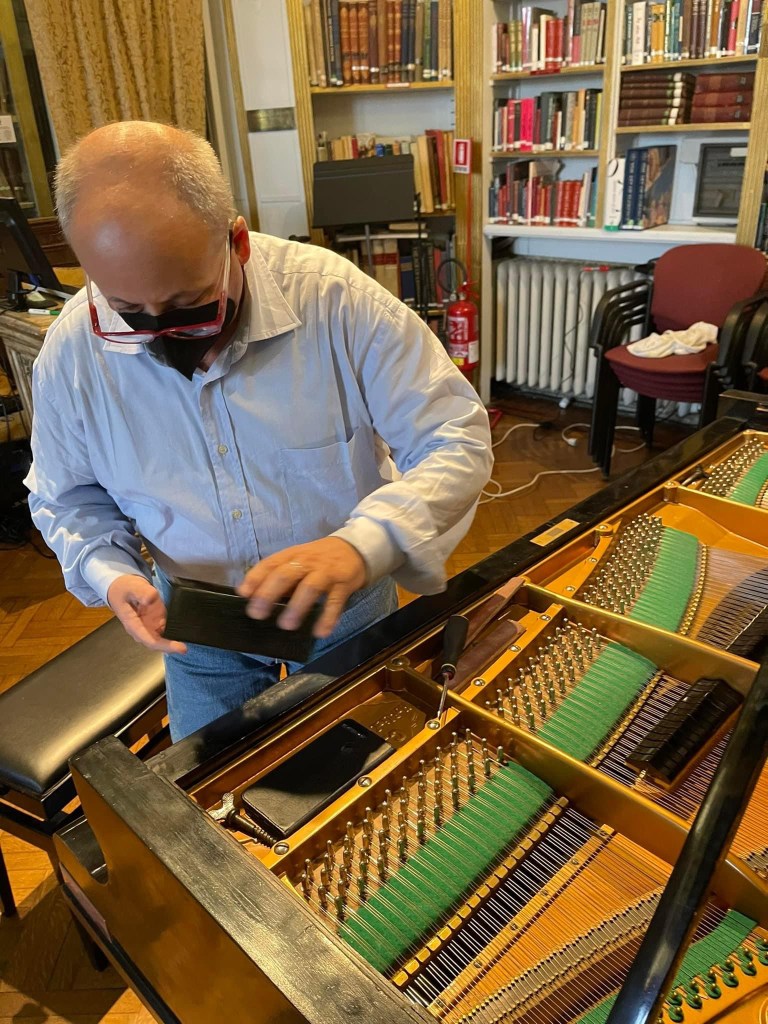
Michele Padovano master piano technician and composer
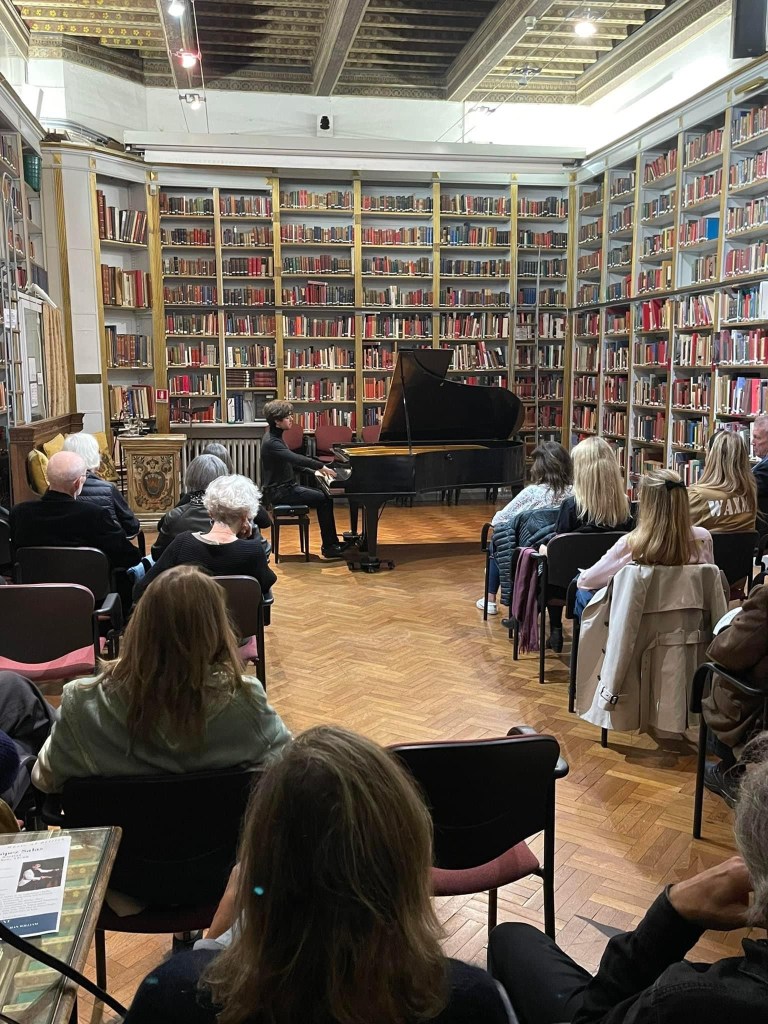
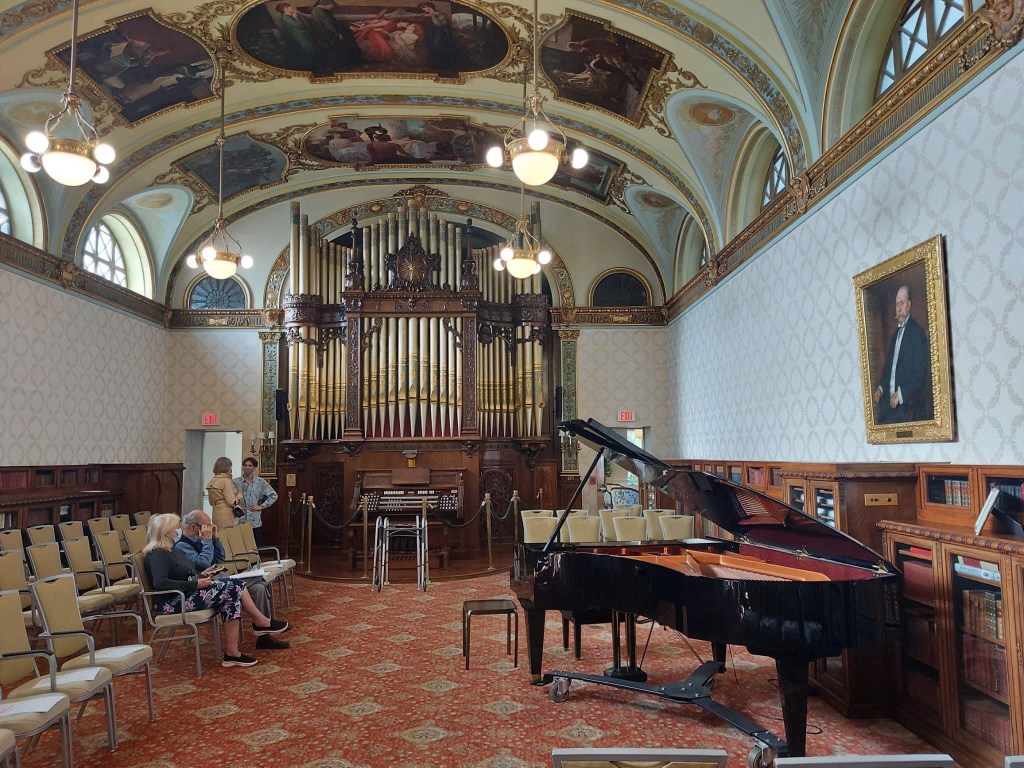
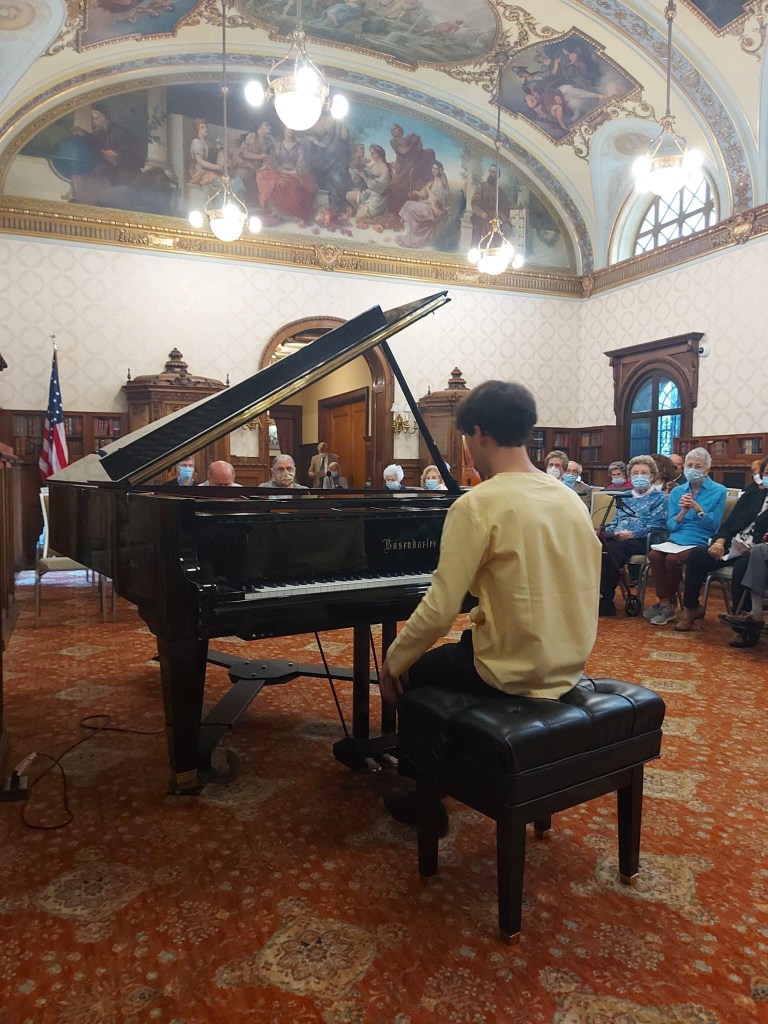
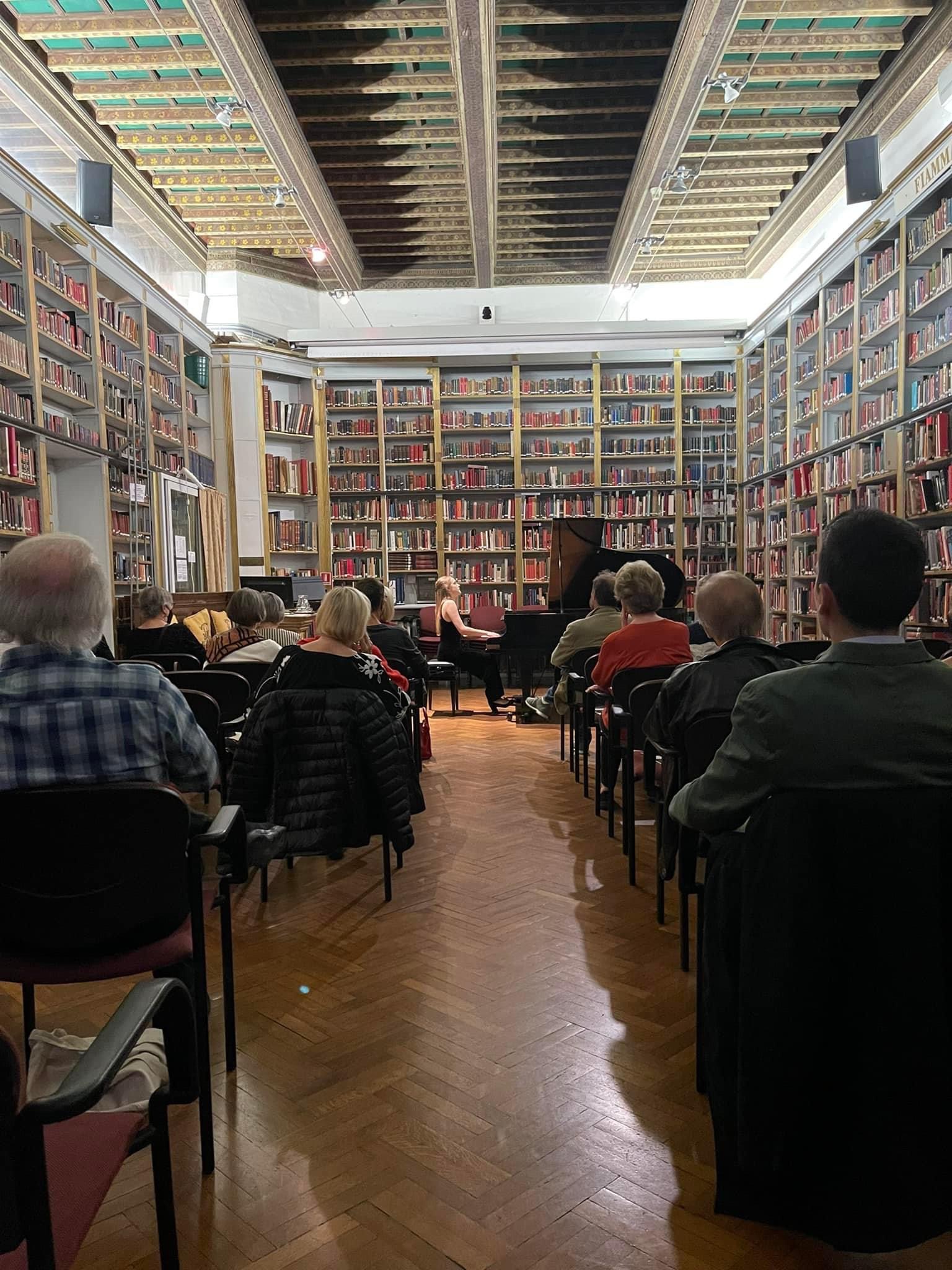
It was Leslie Howard who had pointed this out to Milda in her recital for the KCT a few months ago.I was hoping that Michele Padovano the piano technician /composer might have the two extra notes in his pocket!Michele has performed miracles with this fine old Bechstein piano but I think this was expecting too much even from such a genial musician!The piano under his hands and ours is fast turning into the noble instrument that it was born to be .It is admired by all the young musicians who are now being invited by Simon Gammell to fill this extraordinary library with the sounds of music.Milda after the sumptuous sounds of Schumann let forth with a savage attack on the piano with its insistent Hungarian folk rhythms.The sostenuto e pesante second movement was just that, but it had a line where Milda was able to guide us through this maze of strangely oblique sounds.The energy and attack of the Allegro molto took even Milda by surprise but the driving rhythms and insistent virtuosistic octaves never let up in a fearless journey to the final tumultuous ending.
What exhilaration and fun she was having but it was the subtle beauty of Chopin’s mazurka in F minor op 63 n.2 that calmed the red hot atmosphere.A few notes of whispered beauty with subtle rubato reminded us of the poetry and singing qualities that can be found in this box of hammers and strings by a true artist. https://youtube.com/watch?v=W6poGmGiBQM&feature=share
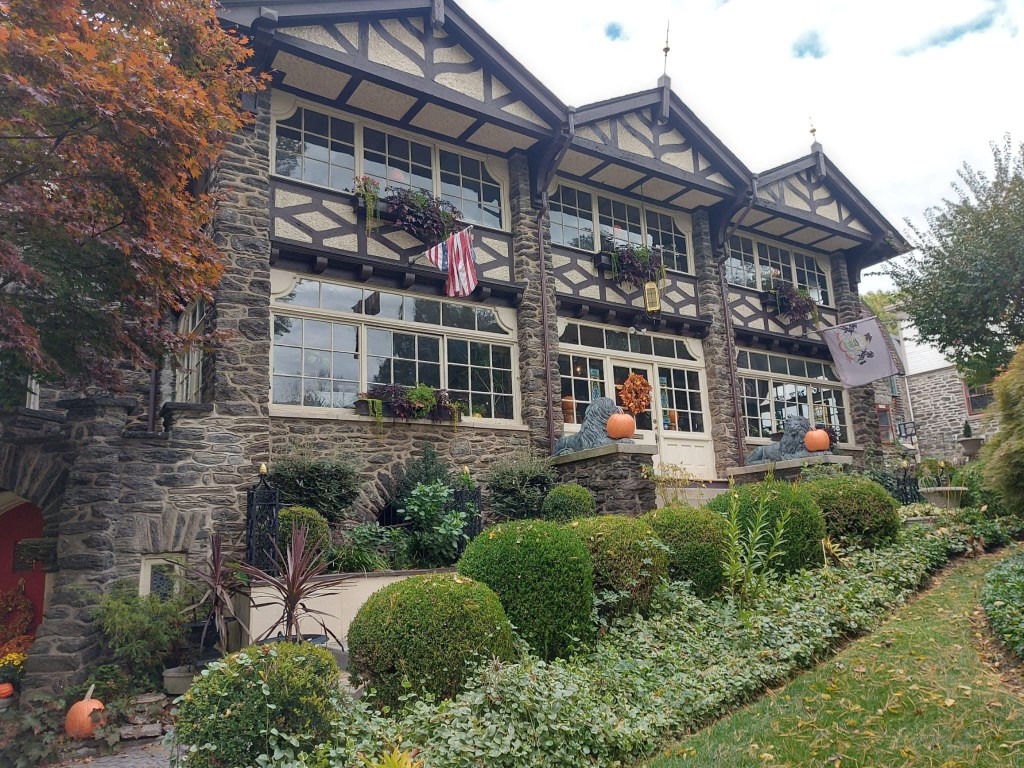
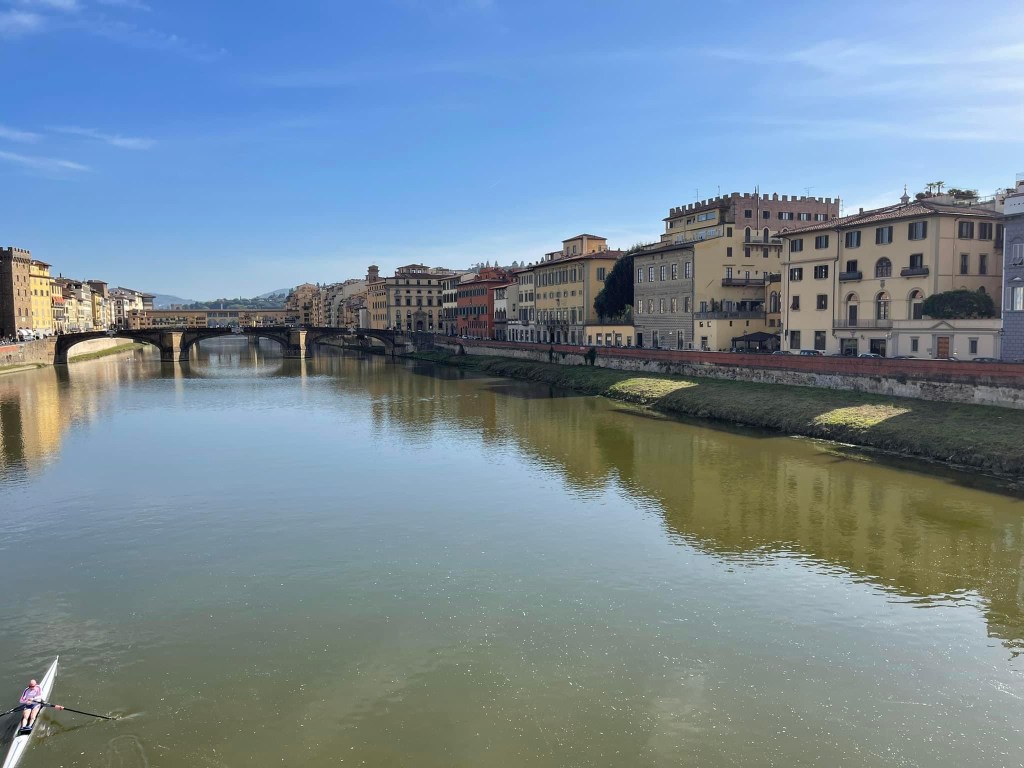
Almost there for rehearsal The British Institute on the left (with the turret on the rooftop)
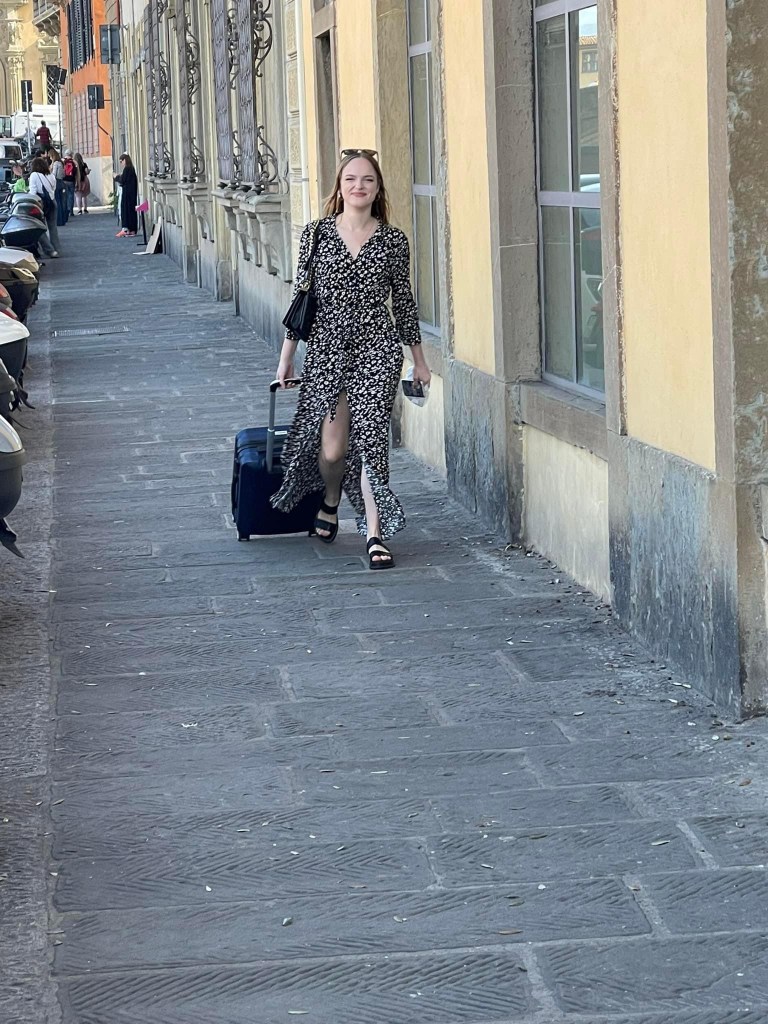
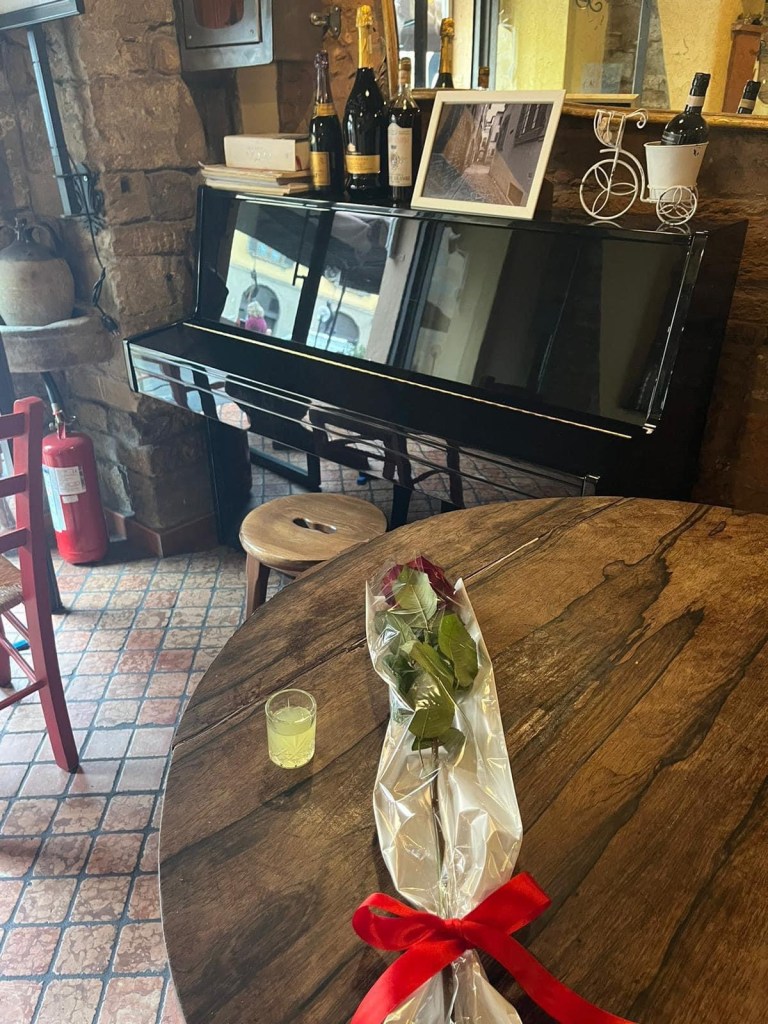
P.S. Lovely to know that Milda sightseeing in Florence the day after the concert got talking the following lunchtime to the staff of a bistro who turned out to be Lithuanian .She explained that she was a pianist who was in town for a concert and they persuaded her to tickle the keys of the piano that was is the shop.She had such an overwhelming success that they offered her a roast lunch,a red rose and an enormous glass of limoncello!On the house ….cheering indeed !
























 ChristopherAxworthy-MusicCommentary
