Surrounded by friends and admirers for a try out recital before her performances at the Leeds International Piano Competition .
Tamila was one of the 24 selected from the auditions held worldwide who will compete from the 6th September in Leeds.
(Tamila Salimdjanova plays on the 8th at 16.20 all streamed on the LPC website)
Thanks to the generosity and enthusiasm of Hugh Mather, Roger Nellist and their splendid team at St Mary’s, Tamila was able to play to a sold out hall yesterday afternoon.
Vanessa Latarche following intently with the score
Under the eagle eye of her mentor Vanessa Latarche ,head of piano studies at the RCM and herself a former star pupil of our much missed Eileen Rowe of Ealing , showing the same passionate concern for her star pupil today.
Aleksandar Pavlovic with Tamila
A surprise visit from her great pianist friend Aleksandar Pavlović completed an afternoon of magnificent music making.
From the sublime colours of her Debussy Estampes ,a scintillating account of the 7th Sonata by Prokofiev with a slow movement of sublime beauty.
Schubert impromptus op 90 n.1/3 and the monumental Sonata by Liszt showed off all her intelligent musicality and sensitivity to every nuance.
All best wishes for the success in Leeds that she truly deserves
Seong-Jin Cho signing his CD after his performance of Chopin 2nd Piano Concerto
Nice to see the winner of the 2015 Chopin Competition at the Sunday morning Prom with the European Union Youth Orchestra under Gianandrea Noseda .
A few yards away in the afternoon the Chopin Society UK were honoured to present at the Polish Hearth Club an illustrated talk by that world authority on all things to do with the piano Bryce Morrison .
”In Search of Chopin :a singular genius” was the title of the talk that could not have described better this summer Sunday in London.
A very interesting and amusing talk by Bryce Morrison in which he spoke about the various approaches through time to the performance of Chopin.
Starting with an early Polonaise played by Garrick Ohlsson winner of the Chopin competition in 1970 at 22 just one year older than Seong- Jin who won it in 2015.
Chopin was criticised for not having written operas, symphonies or quartets.
But he did!
Exclaimed Bryce but all on the piano !
A fascinating line up of performances that included Horowitz,Cortot,Cherkassky,Ousset ,Argerich,Katsaris,Tiempo ,Bolet and of course Rubinstein.
Finishing with the Polonaise op 53 from the historic return to Moscow in 1964 of Artur Rubinstein.
Could it have been
a coincidence that this very Polonaise had been offered to a very insistent public after a magical account of Chopin’s 2nd Piano Concerto at the concert earlier in the day.
Seong-Jin Cho was making his debut at the Albert Hall having won the Chopin Competition in Warsaw in 2015.
The youngest pianist to have won the Hamamatsu competition at the age of 15 and at the age of 17 taking third prize at the Tchaikowsky Competition in Moscow.
From the remarkable school in South Korea that is producing so many extraordinary pianists known not only for their technical prowess but above all for their deep musical understanding.
Seong – Jin Cho in 2012 at the age of 18 went on to study in Paris with Michel Beroff where he graduated from the Paris Conservatoire in 2015.
Now playing worldwide he also plays regularly with the renowned violinist Kyung- Wha Chung .
A performance in which the piano was allowed to sing with an unforced voice that allowed the music to unfold so naturally .
A rubato of great elegance finding great support from his attention to the left hand detail.
The last movement seemed to be and extention of the slow movement in the way it seemed to float in so naturally.
Taking all the time needed to allow Chopin’s magical figurations to speak .
Time seemed to stand still which was quite a feat in a hall of 6000 people.
It was Fou Ts’ong who said to me that it is easier to be more intimate in a big hall rather than a small one.
An encore of a very passionate and firey performance of the Polonaise Heroique just missing that nobility and control that was so much part of Rubinstein’s performances in this very hall.
A concert by the European Union Youth Orchestra founded by Joy and Lionel Bryer many years ago has been a Cultural Ambassador for the European union for over 40 years.
The founding music director was Claudio Abbado and it has since been conducted by the most eminent conductors of the day including Bernstein,Haitink,Karajan,Ashkenazy amongst many others .
Tonight it was Gianandrea Noseda who gave a brilliant account of the UK preniere of a work by Agata Zubel :Fireworks that showed off all the virtuosity of in particular the percussion section of this very fine orchestra.
The sumptuous beauty of the strings was to be revealed in
Gianandrea Noseda with Agata Zubel
a red hot performance of Tchaikowsky’s Fifth Symphony tightly held together with a great sense of line and direction together with great sentiment and feeling .
Noseda sharing all his great musicianship and experience with these young players .
An encore of the Radesky March brought the official concert to a rousing end.
But for all those leaving the hall the orchestra suddenly came alive with some jazz instigated by the brass section and taken up by the rest of the orchestra dancing around the stage whilst they were playing .
The orchestra having fun
Obviously letting their hair down after a long tournee together and just having fun that they were only to pleased to share with this enormous proms audience gathered together on a Sunday morning .
Alfonso Alberti in the Parco di Pantanello/Oasi di Ninfa with his recital “e la luna scende sul tempio che fu”
THE HILLS OF ROME ARE RESOUNDING TO THE SOUND OF MUSIC
One of Italy’s best kept secrets is to be found in the mediaeval town of Sermoneta, just 50 kilometres from Rome.
Whilst the coastal towns Sabaudia, S. Felice Circeo, Terracina, Sperlonga have long been attracting crowds to their wonderful beaches, Sermoneta has been quietly attracting the greatest musicians of our time to the fairy tale Caetani Castle.
Here, in fact, is to be found one of the most important festivals of classical music.
On a level only with Festivals like Tanglewood, Marlboro, Dartington or Salzburg.
Once, whilst Count Chigi was still alive, only the Accademia Chigiana in Siena could boast a line up of the greatest artists of the day: Cortot, Casals, Ferrara, Agosti, Casella, Milstein, Gulli, Giulini, ready not only to play, but also to pass on their experience in master classes to talented young musicians.
Since 1963 the Caetani family, like Count Chigi before in Siena, have been inviting musicians of the calibre of Menuhin, Szigeti, Magaloff, Kempff, Navarra, Ciccolini, Sandor Vegh, to their Castle just south of Rome, and it is this year that we celebrate the 54th anniversary.
Lelia Caetani, the last living member of the family, who died in 1977, had created a Foundation to perpetuate the name of her composer father Roffredo Caetani.
Franz Liszt, godfather to Roffredo, attended his baptism in 1871 and in fact Liszt’s piano is still to be found in Ninfa, the wonderful gardens created by Lelia, surrounding Sermoneta.
These are the gardens that the great composer Sir William Walton and his wife Susanna so admired and often visited, before opening their own famous gardens of La Mortella on Ischia.
In fact there is so much history linked to this town, but there is also a wonderful future ahead too, if we look at how the musical activities have progressed since the death of Lelia Caetani and Hubert Howard, her husband, descendant of the noble English family of that name.
Goffredo Petrassi embracing Mount Circeo foto taken by Ileana Ghione
Riccardo Cerocchi, architect, has since the 70’s carried forward, in an elightened way, the initial start of the Caetani’s, creating the Campus Musicale with the great composer Goffredo Petrassi, president for many years until his death. Bruno Canino, Franco Petracchi, Bruno Giuranna, Rocco Filippini and some of the finest Italian musicians were on the advisory board, ready to ensure the integrity and continuing importance of the concerts, master classes and conferences.
Riccardo Cerocchi after a long illness passed away this winter but not before passing the reigns to his daughter Elisa Cerocchi .
Despite all the difficulties in the art and education world Elisa is carrying on her fathers great wish to inspire,create and promote great young talent with his same determination.
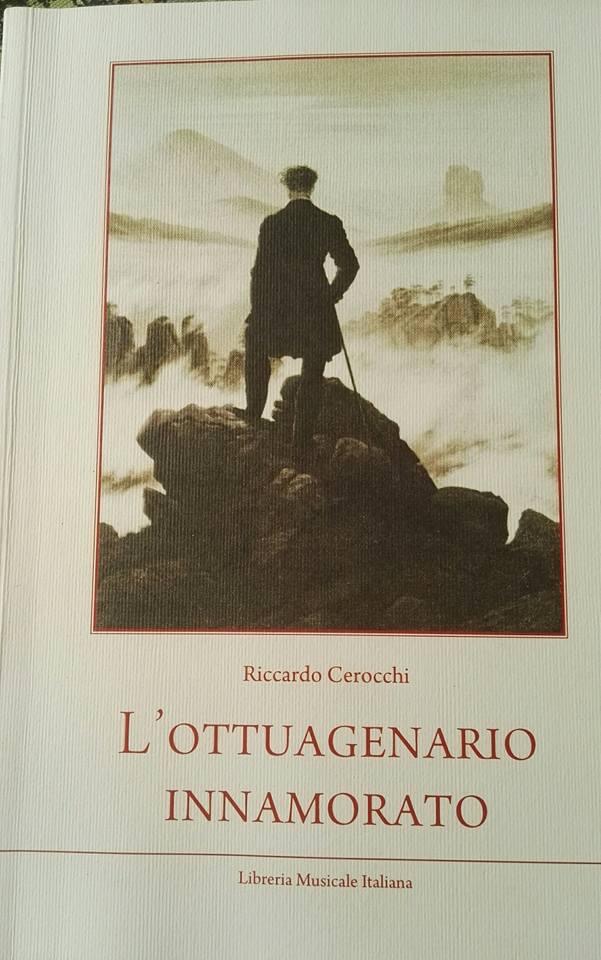
The autobiography of Riccardo Cerocchi “L’Ottuagenario Innamorato” was presented to the public just a few months before his death.
From these pages we are able to see what a pioneer he was in his determination to bring music and culture to his God blessed homeland.
Playing at his funeral in Latina was a great friend Santi Interdonato who had played such an important part in music in Latina .He too passed away this year and so it was Fabrizio von Arx ,a real son of the Campus, visibly moved ,dedicated his recital to them both.
His encore Liebeslied by Kreisler though he dedicated to Elisa Cerocchi,Tiziana Cherubini and all their loyal helpers for keeping Architect Cerocchi’s dream alive in this Paradise on earth.
Fabrizio von Arx warming up his magnificent Stradivari “Il Madrileno” 1720 before the concert with Finghin Collins
Tiziana remembers very well a very young boy with his parents coming to study with Corrado Romano in Sermoneta .
One of the superb violinists including also Alberto Lysy,Yehudi Menuhin,Joseph Szigeti,Sandor Vegh to name but a few of the artists that have passed into history.
Fabrizio had played some years ago in Rome in the Ghione Theatre that shared the same spirit of Sermoneta of promoting and helping young talent.
Present of course were the Cerocchi’s to witness two of their star prodigies Fabrizio von Arx with Roberto Prosseda playing professionally together for the first time.
Both now have very important careers that takes them away from Sermoneta.
It was especially moving to be able to hear Fabrizio in this first year without the presence of the founder father.
Playing on a magnificent Stradivari “Il Madrileno” of 1720 he was playing in duo with a very fine Irish pianist ,winner in 1999 of the Clara Haskil International Piano Competition
U
Finghin Collins
Finghin an ex student of John O’Conor who had been protegee of the great pianist Wilhelm Kempff, who used to frequent Sermoneta in the early Menuhin years.
John O’Conor not only director of the Dublin International Piano Competition but also very much involved with the Kempff Foundation in Positano.
Finghin too has his own New Ross Piano festival, is curator of the annual Dublin Song Series and artistic director of Music for Galway since 2013.
A very busy life on the International concert circuit like Fabrizio von Arx.
We were indeed very lucky that they could take time off to breathe with us the magic air in this very special place
It was very refreshing to see the real enjoyment they comunicated in a programme that included some solo works as well as two important works for violin and piano.
The solo works for violin were played with a rhythmic energy and sound that defied the extreme humidity that left the scores dripping as were the artists too.
A handkerchief and clothes pegs were an indispensable help for some remarkable playing.
The Preludio from the Partita n.3 was played with such drive and precision.Fabrizio almost dancing as he used his whole body much like I remember Sandor Vegh many years ago.
The violin and body become one in a true artist and it was this that was so overwhelming .
The magnificent creamy rich sound from the Stradivari too.
Fabrizio had described the innovation and far sightedness of Stradivari in augmenting slightly the size of the baroque violin to anticipate the needs of music of the future from composers such as Brahms,Beethoven,Tchaikowsky etc.
The 24th Caprice by Paganini was played with transcendental virtuosity.
It came as a great surprise when after the concert Fabrizio confided that Paganini cannot be played in such humidity!
Perhaps it was Finghins handkerchief loaned so mischievously to Fabrizio to wipe down his violin every so often that made us completely unaware of the struggle that was being so splendidly won.
The four Pieces that make up Brahms op 119 showed just what a fine musician Finghin is. It is not easy to interpret all the detail that Brahms marks in the score and to allow the music to breathe and live so naturally.
The Adagio of the first Intermezzo was realised with a stillness and sense of balance but always with a sense of shape and line disolving into nothing in what must be one of Brahms’ most intimate confessions.
The second Intermezzo was beautifully judged and he made the transformation from poco agitato to the grazioso middle section sound so natural and inevitable .
The joyfully playful 3rd Intermezzo was played with just that charm and minimum of pedal that I remember made Curzon’s performances so magical.
The final Rhapsodie was played as a true musician who can bring a sense of nobility and grandeur to a piece that can so often sound so thick and heavy handed.
Horizontal not vertical indeed with some wonderful details somewhat reminiscent of Chopin’s 3rd scherzo in the choral and shimmering comments and with a lilting charm in the middle section’s grazioso .
The coda was made ever more exciting for the sudden fortepiano and minimum of pedal before the final rhythmic built up.
In the two works played together there was all the complicity and enjoyment of two musicians sharing in a conversation.
The Suite Italienne by Stravinsky.
Made up of six pieces I believe each one to fit on the side of a 78rpm record.
In the scherzino a slight mishap with the page due to a wind that had suddenly blown down on us had Fabrizio reading over the shoulder of his partner Never missing for a second the conversation that they were sharing with a public thrilled and mesmerised by these two such talented “lads”.
A truly monumental,performance of the Cesar Franck Sonata ended the evening .
The excitement and passionate involvement was combined with moments of calm and ravishing beauty.
The understatement of the opening was immediately contrasted with the most passionate outpourings.
And the virtuosity in the second movement generated an electricity to an audience following every second with baited breath.
Francesca Benedetti the famous actress applauding with her sister the eminent art expert Maria Teresa Benedetti
Noticeable was the total involvement both of pianist and violinist that seemed to be riding a wave together.
The beautifully simple question and answer of the last movement led to the final passionate outburst where Finghin allowed himself full reign with the sumptuous sounds of the “Madrilena” shining aloft so potently.Two stars shining brightly tonight indeed.
Three Romanian dances by Bartok was an encore by public demand.
Now totally warmed up and more than ready to give a savage and devil may care performance that had the audience on the edge of their seats.
The second encore as I have said was a love song by Kreisler dedicated by them both to the warmth and welcome they had received from Elisa’s magnificent team.
Of course everyone that crosses the draw bridge in these parts is a true musician and it is this humility that was noticeable tonight.
Alfonso Alberti,the pianist who had given a splendid recital the night before ,ready to turn pages for his colleagues who had been applauding him the night before.
Alfonso Alberti introducing each piece in his programme based this year on Ruins
After the discovery two years of this natural “cathedral” of trees in Ninfa ,Alfonso Alberti had devised a programme around the theme of Ruins .
In the previous two years it had been based on nature and birds and this year the title given was that of the very first piece in his programme from Debussy’s Images “Et la lune descend sur le temple qui fut.”
A special programme devised and introduced so eloquently by this pianist whose real passion is for contemporary music.
It should be remembered that an important part of the Campus has always been its seminaries and concerts of contemporary music that preceeds the festival.
Including visionary works by Liszt of the four Valse oubliee.It was his remarkable performance of works by Stefano Bulfon and Harrison Birtwistle that stand out.
A sense of line and colour and a self indentification with this sound world that I had immediately noticed a few years ago when he was asked to stand in at 24 hours notice and produced a programme entirely from memory of the most complicated scores of Messiaen .
Oasi di Ninfa La Cattedrale
The concert this year which included the title of the moon was by coincidence (?)on the very evening when a total eclipse was announced.
A single encore of a visionary piece by Alkan, a contemporary of Liszt and Chopin.
This long and complicated programme came to an end but the enthusiasm radiated by this remarkable eclectic musician had completely won over a very numerous audience.
The marvels of this enchanted cathedral were just as astonishing as the red moon that followed us on our way home through the beautiful Italian countryside
Alfonso Alberti eclectic artist with Elisa Cerocchi after helping his colleagues on stage
Great to be back in this very fine concert venue in the courtyard of the Town Hall in Sabaudia.
A great success here of Vitaly Pisarenko three years ago and a cry for more concerts after the discovery by the Pontine Festival of this secluded courtyard in the centre of the Sabaudia .
A seaside town that Mussolini had built in the Pontine Marshes.
This model town was in the style of the Rationalist Architecture of the time,often associated with fascism, as Mussolini brought the workers from the Venetian area of Italy to drain what were malerial swamps and transform this unfortunate area into the most fertile land ready to produce fresh produce for nearby Rome
Torre Paola Sabaudia
Being at the centre of a breathtakingly beautiful stretch of beach 25km long and surrounded by the National Park of Circeo it is full of people wanting to enjoy themselves on the beach and in the restaurants in holiday mood.
But the people that frequent this magical spot also want more.
They want to feed their soul as well.
Now for the second time the announcement of a classical music concert had filled this courtyard with a discerning and appreciative audience.
Shutting the courtyard doors cuts out the noise of those happy to revel in the delights of the town and allow the others to have an hour or so of peace and beautiful music
A real oasis indeed.
M°Francesco Belli with the Mayor of Sabaudia
A mini festival of three concerts under the artistic direction of Maestro Francesco Belli who was the conductor of the first concert that included Mozart’s Coronation Mass.
Introducing Sandro De Palma to the public he exclaimed how happy he was to have a great pianist in his opening series.
Looking in the eye at the charming Mayor of Sabaudia in the hope that we may have more music in the future.
The Pontine Festival had brought a Steinway Concert Grand from their base in Latina but tonight there was a more modest Yamaha that Sandro had confided to me afterwards had not been at all easy to play!
It was Richter who liked to rise to the challenge of conquering a new piano hunting out its secrets and seducing his public with the most ravishing sounds.
And so it was with Sandro tonight beginning his recital “Dreaming of Moonlight” with a charmingly crisp and clear Sonata by Cimarosa.
The ornaments played with the same clarity that Sokolov has become renowned for in the works of Rameau.
There was absolutely no indication of the effort that was needed to produce sounds of such character that one wondered why these Sonatas were not as well known as those of Scarlatti.
Ravishing beauty of the Sonata in A minor,Largo with whispered sounds of a luminosity that was projected to the vast audience assembled.
The final Sonata Allegro in B flat major played with all the rhythmic energy and colour that immediatley demanded attention.
The Sonata op 25 n.5 by Clementi followed .
One of 113 Sonatas which Sandro is in the process of recording for Naxos
As Mozart warned his sister about the transcendental difficulty of the Clementi Sonatas and it was this rhythmic energy and precision that did not waver for a second tonight.
This was ,after all, a pianist who had carried away first prize at the Casella Competition in Naples at the tender age of 19.
From the Neapolitan School of Vincenzo Vitali well known for the meticulous preparation and almost clockwork precision of a school that spread into Argentina via Vincenza Scaramuzza of which Martha Argerich is the greatest living example in our time.
The famous “Moonlight “Sonata op 27 n.2 by Beethoven was the centre piece of this short recital.
I remember a masterclass a while ago with Andras Schiff who opened with :”Now let us forget about this Moonlight thing.”
It was an invention of Beethoven’s publisher and can lead to a mistakenly dreamy opening Adagio sostenuto.
In fact as tonight it has a very definite forward movement when played in two and a nobility of sentiment that is far off from the moonlit scene that Beethoven’s publisher obviously envisaged .
The Allegretto with its contrast of legato and staccato beautifully realised as was the contrasting almost operatic Trio.
The Presto Agitato finale was played with the same rhythmic energy that had been the hallmark of the Cimarosa Sonata earlier.
Some beautiful things of great dramatic contrast,not least the final Adagio leading to a hauntingly nostalgic coda exploding into a typical final Beethovenian burst of energy.
The last part of the recital was dedicated to Chopin.
Sandro has long been noted for his performances of the complete Chopin Studies and it was the first three from op 25 that created the bridge between the two nocturnes op 27 and the Ballade n.1 op 23 .
The so called “Aeolian” harp study op 25 n.1 ,the name given after a description by Charles Halle of Chopin’s own performance on his final visit to England just before his death.
In Sandro’s hands it was indeed an Aeolian harp but full of passion and colour.
The final A flat arpeggios made one think immediately of Ravel’s Ondine from his suite Gaspard de la Nuit written a100 years later.
The studies op 25 n.2 and 3 played with the charm of consummate artistry of who has loved peforming these works for a lifetime
A wonderful sense of colour and balance in the two nocturnes
Particularly striking was the build up in the piu mosso section of the first in C sharp minor.
The famous nocturne in D flat was played with a nobility and great sense of line,
The final ascending scale perfectly judged with the final two chords played with a touching simplicity .As if Chopin was saying :What more could I say.
The great Ballade in G minor was given a very noble performance from the very opening arresting scale to the transcendental coda played with a total command.
The drammatic comments between the ascending scales or in this case washes of sound had us sitting on the edge of our seats as we relived this story together.
Sandro De Palma
Visibly exhausted after his efforts to pull out the sounds that were in his ears from an instrument that demanded constant and total concentration.
The ovation that he recieved was greeted with a simple thank you of Satie’s first Gymnopedie.
Played with a such disarming simplicity and was the demostration of the art that conceals art that we had witnessed all evening.
Fingers crossed that we will not have to wait another three years for more music in this enchanted land .
Sandro De Palma with guitarist Luca Villani after the concert.Luca who had played many time in the Ghione theatre and is shortly to play in the Edinburgh Festival
Sandro e Cecilia De Palma before the concert due to lack of a Green room for the artist
They say that out of bad comes good but no one expected the miracle that was about to be revealed by pure chance in Hamburg.
Mariam Batsashvili had had to withdraw from her two performances of the Goldberg Variations for the Keyboard Charitable Trust in Hamburg.
This magnificent young Georgian pianist,a BBC new generation artists ,who just a week ago recorded the Mozart A major Piano Concerto K.488 with the BBC Symphony Orchestra and had told me how grateful she was for the chance to play the Goldberg Variations in public for the first time.
She was also very excited about receiving an invitation via the KCT to play in a special wedding celebration on Lorin Maazel’s estate in Castleton in Virginia just a few days before.
Little did anyone suspect that the long trans atlantic return journey would create such physical problems that without a period of complete rest she could not even attempt to play for the 75 minutes or so that the Goldberg demand.
Programme for the Hauskonzert
Just three days before the performances the near impossible search was on for a KCT artist who could play them at such short notice.
Luckily our founding fathers remembered a remarkable performance that Stefano Greco had given in 2003 in the Steinway Factory in Hamburg.
It was one of the first concerts ever to be given there and is remembered to this day not only for the fine performance but also that all the various sound boards and piano frames scattered around the walls started to vibrate in sympathy with the performance
It created an aura and atmosphere that those present have never forgotten.
Would he be free and consider to come as an “Emeritus” KCT to fill the breach?
”Give me half an hour” was the reply to a message sent at 7 am .
In fact he had not played them for three years.
The coincidence was that the last time he played them was at the commemoration for Lorin Maazel,who had passed away and left a wish that the Goldberg Variations should be played at his memorial concert on his estate in Castleton Virginia!
I had heard Stefano play in Rome to a sold out hall for S.Cecilia.
A magnificent performance of the Art of Fugue very learnedly introduced by him too.
I had also heard him in a live broadcast on the radio from the President’s Palace il Quirinale in Rome and had commented on how crisp and clean the ornaments were and that it was obviously a Fazioli piano.
Only Sokolov could play them like that on a Steinway.
I was right but Stefano commented that he could also play them as well on a Steinway!(They all do!!!)
Another great coincidence was that suddenly on the social media a picture appeared of Rosalyn Tureck who had played the Goldberg Variations at the Ghione Theatre in Rome after a 20 year break from the concert platform to study in depth the works of Bach in Oxford.
She had become a great friend and ever grateful that from that Goldberg in 1990 started a marvellous Indian Summer in Italy where she proved yet again that she was still the “ High Priestess of Bach”(Harold Schonberg).
She even created a Rosalyn Tureck Oxford Bach Institute of which I was honoured to be a trustee.
My old upstairs neighbour too, Simon Watterton, had just given the day before this sad news a very fine performance at St Mary’s Perivale.
He had not played them since winning the Chapel Gold Medal at the RCM 15 years ago and had decided to add them again to his repertoire.
It seemed as if the Ghost of Goldberg was indeed following me all week!
Stefano agreed to play the two concerts but not having played them for three years he might need to have the score on his I Pad as an aide memoire just in case.
Dr Von Bredow- Moritz awaiting the artist in Hamburg
The two concerts were in Steinway Hall in Hamburg and in the house of one of our founder trustees Dr Moritz von Bredow.
A real renaissance man who was singing this week in two performances of the Creation in Berlin as well as organising all the KCT tours and concerts in Germany.
Organising tours of a lecture recital with Florian Heinesch called the “Unplayed Recital”.
It is the programme that one of Arrau’s favourite pupils would have played had he not been assassinated by the Nazis for being overheard speaking badly about the regime.
Moritz has also written learned tomes about the great pianist Grete Sultan who passed away in 2005 aged 99.
He has almost 200 patients as well!
He too had been present 15 years earlier when Stefano had played in Hamburg and was overjoyed when he agreed to make this unexpected return.
CD of the Goldberg Variations recorded in 2003
We had read his learned programme notes for the CD and knew that Bach was in his DNA.
John Leech suggested that he probably slept with the scores of Bach under his pillow!
I missed the Steinway performance but made it in time to share the Goldberg experience with the 50 guests invited to the HausKonzert in Dr von Bredows house in a street lined with beautiful lime trees .
Stefano Greco chez von Bredow
Rosalyn Tureck was also a very severe task master and would regularly practice 8 hours a day with a metronome as she believed that at the core of Bach was rhythm.
She warmed up with Liszt La Campanella and I told her that no one would believe me if I told them her little secret!
She was also super sensitive to touch and would regularly smile if she saw the piano lid open when she came on the platform and would brush off tiny particles of dust that may have accumulated that could interfere with her caressing of the keys.
“…an attitude of utmost humility,the readiness to submerge one’s own theoretical and aesthetic convictions to make room for the will that is the origin of the masterpieces of Bach themselves” I quote from the sleeve notes of Stefano’s CD and it could have been the very same words of Madam Tureck.
Fascinating to listen to the same passion/obsession from Stefano that I well remember from Madam Tureck.
She had tried as Stefano today to explain to me the mathematical mind of Bach’s genius:
” All the variations that have numbers which are multiples of 3 are canons born of the division of their number by the number 3.Variation 18 will thus be a canon at the sixth(18/3=6),the variation 21 a canon at the seventh (21/3= 7) .
The exception being the 30th final variation that instead of being a canon at the tenth is the Quod libet – That which pleases.
A free variation in which Bach combines two popular tunes “Cabbage and beets have driven me away” and “ I’ve been so long away from you”,arranging them in a solid four part setting over what is the clearest statement of the fundamental bass-line in the entire work.”
The aria ,”so long away” returns immediately after on a magical cloud of G (Andre Tchaikowsky was absolutely memorable here)….It is one of the most moving moments in all music where this little aria changes from being a greeting to a farewell after almost 75 minutes of uninterrupted music.
It was rumoured that it was to be played by Johann Gottlieb Goldberg for the insomniac Count Hermann Carl von Keyserlingk who had commissioned it.
Fascinating too to read just as Rosalyn had tried to explain the way Bach uses the number 14 – the number obtained by adding the sequence of the letters of his last name (B+A+C+H = 2+ 1 +3+8 = 14).
The number 14 recurs regularly in Bach’s works almost as if he wanted to sign his masterpiece once again in secret:
1) Aria+14+1 variation 2) 1+14 variations+ Aria.
Very stimulating to talk to Stefano too about his use of the pedal which is often a difficult point for the purists on the modern day piano.
It was interesting to know that it is Lupu and Kempff who are absolute models for Stefano in their search for the most complete finger legato.
One in which the piano becomes by some magical alchemy a singing instrument and the unreliance on the pedal leads to a very great sense of weight and inner strength to the actual notes produced.
Over use of the pedal would be totally out of place.Over-loading a music designed to remain light,in the highest sense of the word.
(As Stefano light heartedly points out ,it would be like applying cosmetics to a statue of Michelangelo!)
What he tries to do is to bring out all the tiny details written by Bach – often Bach gave no indication at all of instrumental destination.
As he says “ I have sought to play the piano as if I were endowed with two manuals and at times also a pedal-board,to obtain differing levels of sound,with the voices mutually interweaving themselves.Very often I have used the repeats to bring out first one voice and then another,or to execute the same voice a first time stripped of embellishments,and therefore a purer rendering,and the second time ,enriching it with mordents,trills or passing notes to convey a greater gaiety.”
Bach was a great Latinist and quoting Quintillian “docti rationem componendo intelligunt,etiam indocti voluptas….” ..the learned understand the principles of artistic composition,yet the ignorant receive only pleasure!
Dr Von Bredow thanking Stefano at the end of a memorable performance
And so it was that we were all gathered to listen to this monument in absolute silence on a very fine Bechstein piano that sits proudly in the music room in Dr Von Bredows house.
The I pad was placed on the piano as so many great artists do these days as an aide memoire so as not to interrupt the music for any personal frailties that can disturb a live performances of such masterpieces.
Strangely enough he did use the piano pedals very slightly for the Loure from the 5th French suite that was offered as an encore to a very insistent audience who after 75 minutes wanted even more!
It added a different dimension after the rigour and relentless rhythmic drive that had held us all so spellbound for over 75 minutes.
It was indeed like opening a window to let in the wonderful smells of the limes that surrounded this beautiful room.
Of course Stefano had told me that it was one of the 8(sic) French Suites as there were two early ones that Bach had discarded that Stefano always adds to his complete programmes!
After the final emotional notes of the Aria.
A continual voyage of discovery as was his performance from the very first to the last note 75 or even 80 minutes later – Who was counting!
What a sense of colour he was able to find on his journey from the supreme delicacy of the final repeat of the aria to the enormously imposing trills of the Fughetta Variation n.10 and 14.
The heartrending lament of the 15th variation Andante that brings the first half to a close that seems to disappear into the infinite before the explosion of the opening French Overture that signals the second half.
Very telling the repeat of the 16th played almost sotto voce that took me completely by surprise as did so many other things in this remarkable performance.
There were one or two mishaps that had absolutely no importance when the architectural and rhythmic elements were of prime importance always.
I remember Tureck in Florence stopping for a second in the 23rd variation and immediately allowing her intellect to take over and continuing without any personal agitation as she and we knew that there were bigger things at stake than just note picking.
The wonderful lilt he gave to the 19th was contrasted with the great virtuosity of the 20th.
It led to the most beautiful for me of all the variations: the slow awakening (dare I say it: like the Rite of Spring) like the sun slowly rising of the 22nd variation – the dawn that takes us into unknown territory.
It carries us to the very heart of the work with the final variations as Beethoven was to do in his last Sonata op 111.
The Adagio of n.25 was indeed very moving the repeats finding each time new meaning to what we thought was already so profound.
The trill variation of 28 was played with all the rigour and rhythmic impulse that had been the hallmark of this performance.
The 29th bursting over with pyrotechnic playing always kept in strict control and led so inevitably to the almost joyous Quodlibet that dissolved onto a desolate G ready for the angels to remind us of the aria that had opened this monumental work.
Great celebrations for a great occasion .Bach too was addicted to coffee consuming over 30 cups a day.Not only but Stefano tells me his beer bill in Halle in 1713 amounted to eight gallons of beer
Interesting to note in Rosalyn Tureck’s performance that the second note of the aria was played so deliberately quieter than the first it gave an imposing poise to such an innocent aria.
It was the only personal touch that she permitted herself to add as like Stefano today they are only interested in transmitting with great humility and intelligence the word of “God”.
Tureck too had come to Rome to play for the umpteenth time and to continue with her now annual tour that always included Florence.
She was well into her 80’s and not well and cancelled the performances rather than risk not being at her sharpest.
She heard however that the head of Deutsche Grammophon was going to be present in Florence so not to be beaten she not only played but discarded the little cards that she kept inside the piano.
She performed the Goldberg for a last time and was invited to make her last recording for Deutsche Grammophon .
We kept her locked away in the International Piano Academy in Como and Bill Nabore and I made sure that she was fully recovered to leave this last great document to posterity.
Of course other great performances all have a slightly different approach.
Law student and music lover Lukas Kellermeier with Stefano Greco and Moritz von Bredow
Angela Hewitt (who will performing them for her 60th Birthday celebrations at the Wigmore Hall on the 26th July) similar to Tatyana Nikolaeva in their belief that the song and the dance elements take precedence over any stale intellectual approach.
Both of whom have given magnificent performances in Rome too.
Barenboim ,when his then new CD was issued,announced to the horror of Tureck that he considered them to be orchestral!
The most important element in any performance is humility and integrity the two ingredients that we were reminded of in Hamburg the other evening.
Listening intently to the Goldberg in his own music room.
Magic was indeed in the air and the minutes of total silence that greeted the final note when no one dared even breath was a sign that the miracle of Goldberg had woven its trick so unexpectedly in Hamburg.
A beautiful final touch in the programme in thanking Stefano for standing in at such short notice but also a wish for Mariam Batsashvili to make a full recovery and to be able to share with us her Goldberg and Hammerklavier that she is including in her new programmes.
Although playing in Cheltenham Festival finishing with the Liszt Sonata she was still not up to the scaling the great Goldberg mountain at the Rheingau Musik Festival.
Her boyfriend Daniel Villanyi took over at the last minute.
True love indeed and a lovely story.
Guests arriving
Rosalyn Tureck with great friend Ileana Ghione in her house that she loved to visit so much in Mount Circeo
I have written a lot about Vitaly Pisarenko since that first time six years ago that I heard him in L’Aquila.
The Keyboard Trust had been asked to bring three young pianists from three different nations to perform in a new concert hall that had been donated by the city of Trento to the city of L’Aquila savaged so recently by an earthquake.
The great architect Renzo Piano has designed a concert hall that was erected outside the city walls of this noble city so brutally ravaged by an earthquake.
Claudio Abbado had offered to give the inaugural concert.
It was Guido Barbieri, critic,radio broadcaster and artistic director of the Amici della Musica who approached Noretta Conci-Leech and John Leech with the idea of bringing three young pianists to share their experiences of music and enthusiasm with the people of this noble city where music had been of such importance.
The Amici della Musica is one of the oldest institutions in Italy.
Artur Rubinstein was an honorary citizen and many great artists would regularly perform in L’Aquila,Siena ,Perugia and Rome which were long established philanthropic institutions.
A long weekend in which three pianists would play ,talk and share their enthusiasm with the people of L’Aquila that had suffered so much and needed an injection of music, youthful enthusiasm and hope.
Mei Yi Fou,Pablo Rossi and Vitaly Pisarenko were chosen to play a series of concerts in three days on the wonderful Steinway piano donated by Angelo Fabbrini from his renowned Steinway showrooms on the seashore in nearby Pescara.
Some wonderful music making and a great following from these highly cultured people who had been so cut off by this tragedy that had hit them so unexpectedly.
It was when Vitaly Pisarenko played the Bach/Siloti Prelude in B minor that Noretta Conci-Leech and I looked at each other in disbelief at the beauty of the sounds when the choral melody is accompanied by the most intricate arabesques .
A unique sense of balance as his hands caressed the keys with transcendental sensitivity.
In 2015 Vitaly was a top prize winner in the Leeds International Piano Competition where he played Rachmaninoff n.3 under Mark Elder.
Playing worldwide he still has time to complete a doctorate at the RCM where he completed his Masters Degree with distinction in 2014.
His mentors have been Dmitri Alexeev,himself top prize winner at the Leeds many years before.Sharing all his experience with his younger colleague as has Boris Petrushansky too at the Piano Academy in Imola.
But today I have rarely heard Vitaly play with such a subtle sense of colour and intelligence in a programme where many of the works I had never heard before in my sixty years of concert going!
Brahms Theme and Variations op 18b I have never before seen or heard in a recital until today.
I know about Brahms’ “a’s” and “b’s” as in the famous Quintet op 34 .
Op 18 is from 1860 and is the second movement of the Sextet transcribed for piano for his beloved Clara Schumann.
This fine Yamaha piano that I have heard so many times under so many different hands was today transformed in this piece into a magnificent sounding Bosendorfer .
From the mellow singing middle register to the sumptuous full chords there was a chameleon type attention to colour that gave such a sonorous rich sound to this unjustly neglected work.
It was in fact Richter who was quite happy to play on any piano because he wanted to hunt and search out the secrets that were hidden in this wooden box of strings and hammers.
It does indeed take a truly transcendental command to be able to enter into this contest.
So it was today with the second work of Brahms the slightly better known Scherzo op 4.
The partner of the great Sonata in F minor op 5.
An almost orchestral work in which the driving rhythms and unrelenting energy were contrasted with lyrical passages of a sumptuous rich string like sound.
Unrelenting to the abrupt insistent final chords .
It reminds me many years ago in 1970 being in the class of Andre Tchaikowsky in Dartington Summer School in Devon.
Andre had been asked by the Hungarian authorities to look out for one of their prodigies who was to study with him and George Malcom.
Katy Kennedy a fellow student of mine from the RAM had prepared the Brahms Scherzo for the masterclass.
Andre declared that he did not know it and a voice from the back seemed very surprised .Andre with his usual impish humour said why do you not teach it to her then.
Greatly embarrassed the fourteen year old Andras Schiff proceeded with his task!
The same ravishing beauty we heard all those years ago in L’Aquila was the hallmark of the beautiful song Im Herbste of the second movement of the Sonata op 22 by Schumann.It was played with such a hushed subtle cantabile in which the accompaniment was played with a truly transcendental control in that very dangerous area of “piano” and “ pianissimo” that sorts out the boys from the true masters.
As fast as possible Schumann implores in the first movement and then faster and still faster and it was this sense of urgency and unrelenting youthful forward movement that was so involving.
The wonderful shape too to the cantabile contrasts.
The Scherzo played with crisp clear acciaccturas without for a minute loosing the urgency.
The great sounds in the last movement made the piano sound like a very grand piano indeed.
A work that used to be played a lot but has been neglected for too long .
Of course in the hands of a master it is indeed the great outpouring that Schumann obviously intended.
Images oubliees by Debussy a work I have only once heard in concert.
An early working for the Estampes and Pour Le Piano very much influenced by his Pelleas e Melisande from the same early period of 1894.
Lent ,doux et melancolique was the almost Lisztian opening Images but with the unmistakable stamp of Debussy’s later sound world already present.
Played with subtle technical mastery ,never notes but washes of colour spread across the entire keyboard.
Sarabande is the first working of the second movement of Pour Le Piano beautifully shaped with some wonderful full noble sounds.
Nous n’irons plus au bois is the last Image and it is a well known children’s song.
A cross between Jardins sous la pluie from Estampes and the Prelude of Pour Le Piano.
Played with a clarity and rhythmic impulse that brought this virtually unknown work to a thrilling conclusion.
The two well known arabesques by Debussy were a link between Debussy and the two Chopin Scherzi that closed this exhausting programme on such a hot day.
The subtle colours of the first arabesque played with such refined rubato contrasted so well with the crystal clear sparkling second one.
The two scherzi I have written about many times but on this occasion I was entranced and pleasantly surprised by the subtle way that the middle melodic section of the first scherzo was played.
In the true fashion of the great interpreters of the past where in order to give a true liquid cantabile the hands are very subtly out of sinc with each other.
It is a magic trick that Cherkassky was a master of.
Persuading us that the piano could sing.
We were persuaded by Cherkassky on many an occasion as we were today.
Breathtaking the grandiose sense of style,colour and true virtuosity of these two well worn warhorses.
No encore offered as we were all equally exhausted by this commanding performance from this demanding young virtuoso.
Miracles at the Guildhall Ming Xie and Jonathan Ferrucci
Some magnificent playing and a remarkable performance of Chopin 24 Preludes ……………two exhilarating encores of a Liszt transcription of a Schubert Lied and Rachmaninov’s transcription of the Scherzo from a Midsummer Nights Dream. An important debut of which Ronan and Hannah O’Hora were justly proud ……………
Ming Xie studied from an early age in China before going on to Julliard where he studied with Sergei Babayan and Emanuel Ax. He is now completing his studies with Ronan O’Hora at the Guildhall .
Starting the day at my old Alma Mater of the RAM with the Piano Festival that started at 10 am with Haydn Sonatas and continued with Mozart Concertos,Haydn Trios,Multimedia two handed Card Games culminating in a performance of Ligeti’s Piano Concerto 8 hours later.
Little was I expecting what awaited at the Wigmore Hall at the end of the day.
” Phenomenal” as described by Martha Argerich and she should know!
It was from the very first note the most phenomenal natural talent that spread itself across the piano like liquid gold.
A cross between Trifonov and Mustonnen where everything is possible ,with a total command of the keyboard and keyboard sonorities that is of the very few.
Under the eagle eye of Ronan O’Hora the programme consisted of Ravel Gaspard de la Nuit and Chopin 24 Preludes both pillars of the piano repertoire but also of great technical difficulty .
Enough to say that Fou Ts’ong calls the Preludes 24 problems!
Ronan a student of Vlado Perlemuter was able to control and give a very definite shape to this talent that can very easily get out of control in the sheer almost animal like euphoria of playing in front of an audience.
Bounding on stage with his gold bow tie glistening in the lights and commencing the concert with two of Granados’s Goyescas that immediately allowed us to enter into this extraordinary sound world.
El Amor y la muerte Bk 2 and El Fandango de Candil.
A wonderful world full of colour and excitement played with the same natural almost improvisatory virtuosity of the composer himself.
It was at the specific request of President Woodrow Wilson for Granados to perform at the White House after the enormous success of his opera Goyescas ( based on melodies from his piano suite) at the Met that lead to he and his wife boarding the later boat back to Spain that was torpedoed in the Channel on 24 March 1916 by a German U boat.
No Haydn Sonata but we were plunged immediately into this world of Ming Xie.
Steering well clear of the classical repertoire we entered a magic multi coloured world where anything is possible very similar to his teachers other famous pupil Danil Trifonov.
A real voyage of discovery .
Of course the greatest interpreter of Spanish music in our time was Alicia De Larrocha and it was she that showed us the nobility and kaleidoscopic colours allied to a strictly classical approach in a music that can so easily slip into salon music.She was too one of the great interpreters of Mozart and Beethoven .
We amazed at the sounds and flexibility she could produce with such a small hand.
From the Frank Marshall school of which she later became Principal.
I am sure she would have been amazed by Ming Xie’s performance just as that other great lady pianist Martha Argerich was, judging from the publicity.
Gaspard de la Nuit ,that evocative suite by Ravel, was an ideal choice for tonights pianist.
Ondine was full of magic sounds kept firmly under control allowing the music to speak for itself with a sense of balance that allowed the melody to emerge accompanied by the most florid and perfectly executed arabesques.
The tolling bell in Le Gibet was indeed tolling for Ming Xie .
Scarbo that Ravel had written with the intent of writing one of the most difficult pieces for the piano since Liszt or Balakirev was played with amazing agility and sense of colour that was quite breathtaking.
Changing to a more sober bow tie for the second half we were treated to the 24 Preludes of Chopin.
Each of the Preludes was treated as a miniature tone poem .
The sombre Lento in A minor n.2 was menacing as the Vivace that followed was refreshingly simple like a fresh breeze .The Largo in E minor was played with a very subtle sense of balance that allowed this simple melody to sing out so poignantly.
N.12 in G sharp minor was overwhelming in its’ euphoric technical command and lead to the most poetic lento in F sharp minor .
The “Raindrop” prelude was not quite a dramatic as Sokolov but was simply played before his truly phenomenal display of virtuosity in the B flat minor Presto con Fuoco .
The deep tolling bells and the shimmering melodic line that was allowed to emerge in n.17 in A flat made one aware of the similarity between Ravel and Chopin’s bell ringing. The vivace in E flat where the treacherous leaps were played with an ease that allowed the melodic line to be so clearly shaped.
The great C minor Largo played with all the nobility dissolving into almost nothing.
The charming little F major was indeed “delicatissimo”.
The calm before the storm one might say.
And what a storm!
In the final Allegro Appassionato that I have rarely heard played with such power and infallible accuracy.
For Ming Xie these were certainly not twenty four problems but jewels allowed to shimmer and shine in his hands. All that was missing was a feeling of a whole cycle where a more constant less dramatically changing sound world would have had the effect of unifying the Preludes into a more cohesive whole.
The publicity talks quite rightly of “ phenomenal” fast establishing himself as a rising star in Classical music.I hope that now he has established his credentials we can appreciate his amazing talent in the Classical repertoire.
A classical Repertoire that was certainly on show the next day in Milton Court in an Artist Diploma Final Recital performance by a young Italo Australian pianist Jonathan Ferrucci.
Very few people in the audience but when that includes such musicians as Joan Havill,Martin Roscoe and Ronan O’Hora I was glad to catch the first part of this recital dedicated to Bach.
Two Preludes and Fugues in G major bk 2 and C sharp minor bk 1 and completing the sandwich was the English Suite in G minor.
All beautifully played with great sense of style and unwavering rhythmic pulse that is the very core of Bach.
I remember every time that Rosalyn Tureck came to Rome she would ask me for a metronome to create this rhythm pulse in which the Bachian miracles could appear.
Her English Suite was much slower and more deliberate than Jonathans lacking slightly in the grandiosita that I well remember from Wilhelm Kempff.
But when this young man started the great C sharp minor five part fugue the miracle occurred .
One might have thought it was a Busoni transciption such were the colours and architectural shape he was able to give to Bach’s sparse notes.
It was quite overwhelming and one of the finest performances of a Bach Fugue that I have ever heard.
How I would have liked to stay for his Chopin 24 Preludes too but the Gurrelieder and Esa-Pekka Salonen’s 60th birthday awaited.
I could not help thinking that with all the thousands of people on stage for the Gurrelieder that included choirs from the four major music Academies too that the young man alone with his big black Steinway had created the same overwhelming impression for me.
I have a sneaking feeling that Schoenberg would have thought so too!
Happy Birthday to Esa-Pekka Salonen after a magnificent GurreIieder at the RFH
Tessa Uys at St Lawrence Jewry and with Ben Schoeman in Beethoven 5th and 9th Symphonies
Tessa Uys at St Lawrence Jewry
As Tessa said after her superb performance of Beethoven’s Appassionata she still had the score with our old teacher Gordon Green’s markings from 50 years ago….she said it not me!
We met in the early seventies when we were both in the class our adorable never forgotten mentor Gordon Green at the Royal Academy in London. Playing in his Friday afternoon masterclass were Philip Fowke,Ann Shasby,Richard McMahon,John Blakley,Simon Rattle,Peter Bithell and Tessa Uys. Tessa was already playing regularly in her home country of South Africa where she had an established career and would often play through her programmes to us on Friday afternoon.
I remember very well her exquisite performances of Mozart concertos in particular K.291 ,the Schumann Humoresque and indeed the Appassionata that we were to hear today.
I also accompanied her and Josef Frohlich to Harry Blech ( founder of the London Mozart Players ) to play the Cesar Franck Sonata to him.
About fifteen years ago she came to play for us in Rome and what fun we had together with my wife and our entourage of animals that we kept at home. She gave a memorable recital in our theatre and met up with an old school friend of hers from SA and now our neighbour in Rome.She reminded me too of the rabbits and host of animals that we had in our house and even after all these years gave me some foto mementos that she had she had kept
Since then I have not heard from Tessa who I presumed must have a big career in her home country that took her away from us. It is very often the case that many musicians that live in London do not actually perform there. That is until I saw four recitals announced in St Lawrence Jewry in the centre of London and also a performance of Beethoven’s Fourth Piano Concerto with organ instead of the orchestra. I was very curious to hear her after all these years and managed to catch one of these recitals last Monday.
It was very refreshing to see that all her impeccable musicianship and technical command were still intact. A very particular musicianship that like Imogen Cooper is very rare in these times of bombastic virtuosity in the place of simple intelligent musicianship.
Myra Hess and Moura Lympany raised by “Uncle Tobbs” – Tobias Matthay even though never lacking in technical ability could make the piano sing with a sense of balance and a seeming simplicity that today can seem so rare.
It is a great lesson when one can hear the music speak and tell a the story that the great composers had imparted to us via their world of sound.
The beautiful Menuett in G minor by Handel in the arrangement of Wilhelm Kempff was allowed to speak with such simplicity. Anyone who heard Kempff in his later years were made immediately aware of his ability to convince us that the piano could actually sing when in the hands of a true magician and poet. Radu Lupu is the prime example now of course.
Sir Thomas Beecham’s piano from 1920’s previously housed in St Martin in the Fields
It was this very piece that my wife had chosen in the moving closing moments of “Who’s afraid of Virginia Wolff ” when the wife breaks down as she realised that her child had died. We used the performance of Idil Biret recorded in one of her recitals in our theatre but we could just as well have used the beautiful performance that Tessa offered us today.
The 15 Hungarian Peasant Songs by Bartok were dispatched with an amazing range of colour and the drone created in the final song was so reminiscent of the peasant bagpipes that fill the street of Rome as the Shepherds come down from the hills at Christmas Time. So many evocative moments played with a true understanding and fantasy that was quite riveting.
The mighty Appassionata was seen as one whole. From the very opening to the tumultuous final there was a rhythmic propulsion that swept the music on in its inevitability. Not sure purists would agree with her splitting the hands in the opening semiquaver passages but it did give a strength and assurance that is rarely heard.Strangely enough the final arpeggiandi in the first movement were played almost as Beethoven had written them and were very assured indeed.
Peter Bithell Yoko Li Guido Agosti Tessa Uys Ursula Oppens
There was not a moment in the whole sonata that did not hold your attention . Even the Andante con moto was kept very much with a forward looking movement that made the amazing interruption before the Allegro ma non troppo even more astonishing. I had forgotten that Tessa too had studied in Siena with that great musician Guido Agosti and I could in fact feel his influence in the sonata today. Tessa had sent me later a foto of her at the final concert in Siena with Agosti and other colleagues Peter Bithell , Ursula Oppens and Yoko Li. She even told me that Lydia Agosti had lent her a concert dress to wear as she had not thought she would be chosen for the final concert of Agosti’s prestigious class. Agosti was a great musician and could certainly recognise first and foremost the real musicians…..and not!…. in his midst.
Nice to remember her brother the famous political satirist Peter Dirk Uys whose character of Lady Evita Bezuidenhout took London by storm a few years ago at the Tricycle Theatre.
Tessa Uys and Ben Schoeman receive a standing ovation for a superlative performance of Beethoven`s Fifth Symphony in Scharwenka`s transcription for piano duet. Superb sense of balance and great urgency from Ben`s bass added to the clarity of Tessa`s treble united in a passionate performance that swept all away before it. Lebenssturme by Schubert was played with equal passion and delicacy but the question of balance was not fully resolved .
Tessa Uys and Ben Schoeman Beethoven 5 at St Lawrence Jewry
Schubert`s dense writing can lead to such murky waters where the simplicity of Schubert’s unending melodic invention was somewhat submerged. Swopping seats for the Beethoven the problem was miraculously resolved…….and how!
On Saturday 30th at St Michael’s Church in Highgate they will perform an even rarer 9th Symphony always in the transcription of Franz Xaver Scharwenka.
And what a performance it was ……………Superb playing televised for TV.
The tension from the first to the last note was electric Tessa discovered the transcriptions by Scharwenka of the Beethoven Symphonies amongst her mothers scores.
An encore by great demand with Ben at the top in Brahms Hungarian Dance n.1 brought the house down……….what an evening!
Tessa Uys and Ben Schoeman in Beethoven’s 9th in St Michael’s Church Highgate
Helga Bassel ,Tessa’s mother was her first teacher in Cape town before winning an Associated Board Scholarship at the age of 16 coming to study with Gordon Green.
She won all the top prizes and was elected Associate of the RAM in 1994.
Sorry to miss our dear friend Shura Cherkassky in Highgate Cemetery but lovely to see everyone enjoying themselves on Hampstead Heath on this wonderful golden Summers day
My wife Ileana Ghione visits great friend Shura Cherkassky resting next to Karl Marx
Tessa Uys with Bryce Morrison
Ben Schoeman and Tessa Uys at St Michael’s Highgate
Adrian Brendle at St Giles’ Cripplegate The Myra Hess National Gallery Concert
The National Gallery Myra Hess Lunchtime Piano Recital with Adrian Brendle.
It was Ian Maclay and Jenny Robinson of Kestrel Music Promotions that approached the Keyboard Charitable Trust to recommend two pianists from their star roster for two entirely different Summer Concerts in London.
Ian Maclay co Artistic Director Kestrel Music
One was the Parisian Summer Nights in Cadogan Hall with the London Mozart Players in a programme that included the Faure Pavane and Requiem with the City of London Choir under its resident conductor Hilary Davan Wetton.
The Ravel G major piano concerto was also in the programme and a pianist of refined ,aristocratic taste was needed.
Who better than Vitaly Pisarenko who had given a magical account of Ravel’s Miroirs at his Wigmore Hall debut a year ago which was much admired by Graham Johnson who was present at this exquisite performance of the Piano Concerto a month ago.
The hunt was also on for a pianist who could perform the same programme that Myra Hess had performed in 1939.
A pianist with the same musical pedigree and pianistic sensibility for the classical repertoire.
“A festival of beautiful music and words in stunning historic churches,marking one hundred years since the end of the Great War.” under the title ” Swords and Ploughshares”.
It just so happened that a young German pianist had just been publicly auditioned for the KCT and had given a remarkably fine performance of Beethoven’s Appassionata Sonata.
Here was a true musician that could indeed pay homage to Dame Myra Hess and justify Kenneth Clark’s remark on that first recital in a National Gallery at the beginning of the Second World War.
“The moment when she played the opening bars of the Appassionata” Clark reflected,” will always remain for me one of the great experiences of my life”.
“Every picture had been taken away” he later reflected,” but the frames remained and multiplied the general emptiness with a series of smaller emptinesses”.
When he returned to the Gallery,after the first all absorbing task of evacuation, he walked around those large ,dirty,ill-proportioned rooms,in deep depression.
It was out of this overwhelming sense of despair that grew a deep conviction that the Gallery had to find alternative ways of staying “alive” and of being of service to the people.
St Giles Cripplegate
And so it was on the 10th October 1939 that Myra Hess had volunteered to give the inaugural concert thinking only a few family and friends would show up.
In the morning of this lunchtime concert queues started to form and it was only the lucky first thousand that could enter what was to become the first of many memorable war concerts.
Myra Hess had been a pupil of Uncle Tobbs (Tobias Matthay) at the Royal Academy and had become a celebrated artist in England and in America.
Her fee in America was the same as Jasha Heifetz such was the demand for this much loved British pianist.
It is no coincidence,I learn after,that in Ian Fountain’s studio in the RAM is a large portrait of Myra Hess.
I too used to have lessons in Room 28 next to the Tobias Matthay room that still had the famous triangle on show.
Matthay was renowned for his method of extreme flexibility of the hand and sensibility to touch and sounds produced and for his attention to musical values.
Two busts of his two most famous students Dame Myra Hess and Dame Moura Lympany sit proudly in the vestibule of the RAM.
Adrian Brendle with Adrian Brendel at the RAM Haydn Trio day
A Brendle too has certain serious ring to it !
Alfred Brendel was indeed amused a few years ago to see an A.Brendle listed alongside his in a concert calendar in Vienna .
Adrian Brendle the pianist not to be confused with Adrian Brendel ,Alfred’s cellist son, is studying with Ian Fountain at the Royal Academy in London.Having graduated from the University of Karlsruhe under the guidance of that renowned pianist and pedagogue Sontraud Speidel (also the teacher of another KCT artist Florian Heinisch).
He has only ever had two teachers but both with impeccable credentials .
Ian Fountain listening intently to his young colleague
Ian Fountain the only British pianist to have won the Rubinstein Competition tells me he is now editing the Diabelli variations for the Henle Edition.
A true thinking musician following and monitoring his young colleague.
Listening intently to the concert it was indeed refreshing and rare to see a Master following and encouraging his young disciple .
A Bechstein Concert Grand was especially on loan from Jaques Samuel Pianos Ltd and it is to be remembered that Bechstein at one stage was the preferred instrument of so many famous musicians.
Enough to say that the original name of the Wigmore Hall was Bechstein Hall .
I remember Rosalyn Tureck confiding that her preferred piano was the old mellow sounding Bechstein.
I like to think that the Bechstein was also a very touching tribute to Dame Myra Hess today.
The main work on the programme was the Appassionata Sonata played as only a true musician can.
With the eagle eye of Ian Fountain making sure that Beethoven’s every intention was scrupulously followed.
No splitting of the hands in the great arpeggios as many ” pianists” see fit to do to give more power and assurance .
But the sweeping lines that Beethoven draws were played with just the assurance but with a sense of struggle that is also an integral part of the music.
The contrasts in the first movement can be so startling with Beethoven’s personality already verging on the schizophrenic that was to become so apparent in his later works as his struggle against physical problems became ever more unrelenting.
Here the contrasts were even more apparent for the very subtle silences that were added by a pianist who was actually listening so attentively to the sounds that he was producing and the effect that they were having on the whole.
Very impressive were the enormous washes of sound before the final explosion of the coda and the dying away to almost nothing without any rallentando but with a scrupulous attention to the ” meaning” of Beethoven’s pedal indications.
A second movement con moto and not an inch of sentimentality that can so easily enter in lesser hands.
The last movement played at just the right tempo that allowed the Presto and arpeggios to be so full of excitement and inevitably final.
The great C sharp minor five part fugue is one of the great miracles of music and was given a fine if rather too carefully respectful performance.
This is Bach- Busoni but without Busoni and there can be a whole world in this Fugue of which I am sure Dame Myra would have been well aware.
The three Intermezzi by Brahms from op 119 were exquisitely played .This Bechstein piano allowing a noble but cream rich cantabile that was so right for Brahms’s such intimate utterings .
The great F sharp Nocturne op 15 was played with aristocratic good taste and if the Waltz in E flat op 18 was a little too fast it was because this young man was enjoying himself and allowing himself a little fun too.
“Jesu Joy of Man’s Desiring” ,the piece that Myra Hess will always be known for was played with great respect and sense of balance that allowed the melody from Bach’s Cantata n.147 to sing encircled by the most subtle harmonic counterpoint.
A fitting end for this concert in St Giles’ Cripplegate ,the church that had survived two wars and sits the other side of the Barbican lake in the centre of London.
A true ovation from an enthusiastic public was rewarded with a quite beautiful performance of the Prelude in G sharp minor op 32 n.12 by Rachmaninov .
Not sure that Dame Myra would have approved but we certainly did!
It is by strange coincidence that I am going to the National Gallery Lunchtime Piano recital for the festival Swords and Ploughshares where Dame Myra Hess will be remembered for her memorable wartime recitals.
A coincidence because it is Myra Hess that springs to mind when one listens to Imogen Cooper.
All the same values of integrity and musicianship allied to a simplicity that allows the music to speak so naturally.
In this era where virtuosity or fingerfertigkeit seems to draw in the crowds it is refreshing to hear two great English pianists Imogen Cooper and Paul Lewis where their virtuosity is hidden,steeped in musical understanding.
A virtuosity that by searching for a real musical meaning they have found sounds that very rarely we hear in the more bombastic recitals that today are prevalent.
Mishka,Pavel and Samson
Both from the school of Alfred Brendel and in the case of Imogen also Clifford Curzon.
I remember a young student playing in Vlado Perlemuter’s class in Dartington in 1968.Where most of us in the class were concerned with playing the more technically difficult works of Chopin and Ravel this young girl played Valses Nobles e Sentimentales with such mature poise and musicianship that Perlemuter himself declared that he had nothing to add.
She was the daughter of that great critic Martin Cooper whose book on French Music together with the Classical Style of Rosen have become a standard work for students.
She was studying in Paris with Yvonne Lefebure and much to Perlemuter’s surprise spoke perfect french.
No Chopin studies for her but a mazuka played with such intelligence and musicianship that I remember Perlemuter being amazed not only by her musicianship but by her perfect french accent.
Not following the usual competition circuit but instead seeking out help for a better musical understanding from the greatest musicians of our time.
As she herself says she is indebted to Alfred Brendel,Arthur Rubinstein,The Amadeus Quartet and Clifford Curzon who have helped her to understand the very meaning of music.
Now fifty years on and with a great devoted following she has created a Trust to help other young musicians to give them the very things that she realises were so important to her formation.
As she says :”they must possess only three things :talent,potential and a deep thirst for improvement”.
Her sincere wish:”is to help them in their aspirations”
I see from the first information sheet of her Trust the fotos of Mishka MomenRushdie,Samson Tsoy and Pavel Kolesnikov.
Three young pianists well known for their musical ideals.
Pavel Kolesnikov
It was refreshing too to see Pavel ,a Young Generation Artist and student of Norma Fisher, in the audience tonight standing at the back no doubt determined not to miss the extraordinary performance of Beethoven’s mammoth Diabelli Variations.
It was her mentor Alfred Brendel that remains in my memory together with Rudolf Serkin of the Diabelli variations many years ago at the RFH in London.
One of Beethoven’s last great works for piano and a real tour de force not only of stamina and a true command of the keyboard but above all of musicianship.
Richter was announced to play it in London but changed the programme at the last minute obviously realising that there could be no half measures with a work of such stature.
We were lucky all those that travelled down to Brighton to hear his extraordinary interpretation.
He realised that it is not the sort of work that can be played on tour day after day but can only be played on very special occasions.
And so it was tonight with a performance that even Imogen’s great poise gave way to great flamboyance and much more physical participation than usual.
Playing with the score though did not allow the frenzy and almost animal like attack of Serkin that caught you by the throat.
It was an unforgettable experience where he and all the audience came out dripping and totally exhausted at the end.
Brendel’s nervous energy allied to a great musical intellect too was just as memorable.
Tonight we were treated to a less frenetic performance but one of great rhythmic drive. The great trills being thrown around the piano like a great tennis star would hit the ball over the net.
Even Imogen had to let her hair down for the great fugato and although it lost something of its dance character and became rather too martellato it was a great contrast to the sublime colours and buoyancy that she had found in the previous variations.
The final so reminiscent of op 111 was played with such magic that the final chord was greeted by minutes of silence before erupting in an ovation from this very appreciative audience.
From the very first notes the little waltz by Diabelli was given such character that was later dissected and put under Beethoven’s genial microscope.
Scrupulous attention to detail and a sense of orchestral colour were the hallmarks of this remarkable performance.
Courage is now needed to throw away the score and allow a more total animal like commitment.
It is indeed a savage work from a composer angry that he could no longer hear his work.
The concert had opened with the Beethoven Bagatelles op 119 .
Eleven jewels made to sparkle and shine in a way that brought laughter and tears to these miniature tone poems.
A wondrous sense of colour and real understanding of their character with an immediately apparent luminosity of sound.
From the music box sonorities to the absolute legato and sense of balance that I have only heard from Kempff.
Great Beethovenian energy allied to the charming scherzando of n.6 that brought a smile to our cheeks.
The final was almost Schumanesque in its sumptuousness.
Each one spoke with such an expressive voice it was so refreshing to hear the variety of sounds that she was able to conjure up in her effort to allow Beethoven to converse with his audience.
It was the same conversation that she treated us too with Schoenbergs 6 little pieces op 11 that followed.
The sheer desolation of the first followed by the complete isolation of the second was complimented by the massive sonorities of the third .The final dissolving into nothing that left the door open for the more down to earth Mr Haydn.
Without a break we were brought back into the real world again with a Haydn of great contrasts.
The rather mundane opening made the magical music box sounds even more startling.
The slow movement was laid before us like a great opera singer arriving on the platform with the the melodic line so operatic in its very refined way.
The impish good humour of the finale was shaped with such tonal finesse and brought the first half to a very good humoured close.
A concert in which we had been treated to a real music journey where the little bagatelles op 119 had been so integrated almost as a continuation into the sound world of Schoenberg.
The Haydn sonata preparing us for the great journey in C that we were about to embark on after the interval.
So refreshing to be reminded of the great musical values of the school of Matthay where the infinite gradations of tone can be found by those that seek it .
From this box of hammers and strings a true magician can allow the music to speak as well as any orchestra or singer.
A real lesson and “Hats off “to Imogen that via her Trust will share her secret with talented young musicians in search of a voice of their own.


 Alfonso Alberti in the Parco di Pantanello/Oasi di Ninfa with his recital “e la luna scende sul tempio che fu”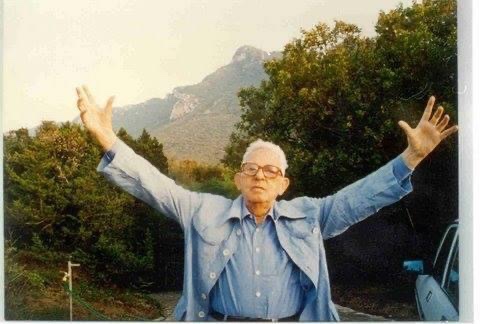
 Fabrizio von Arx warming up his magnificent Stradivari “Il Madrileno” 1720 before the concert with Finghin Collins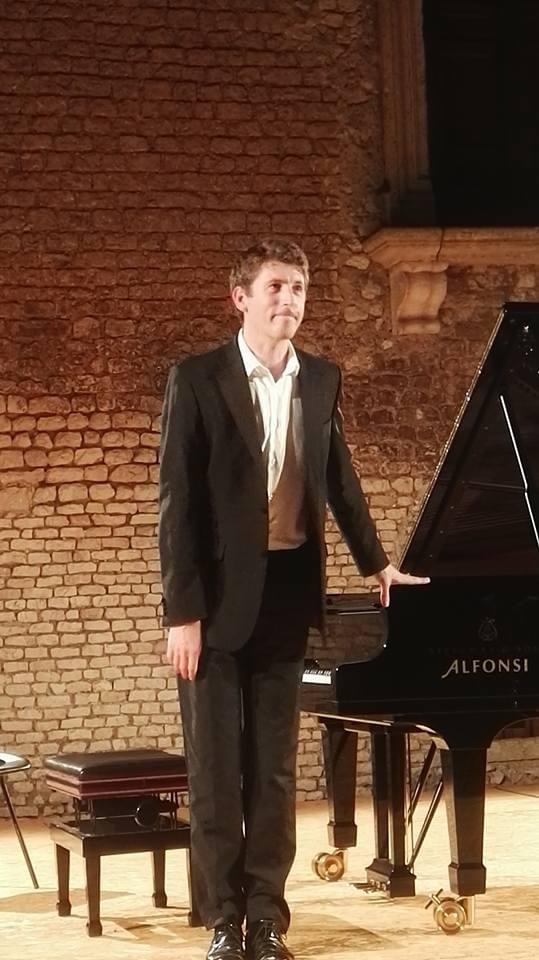
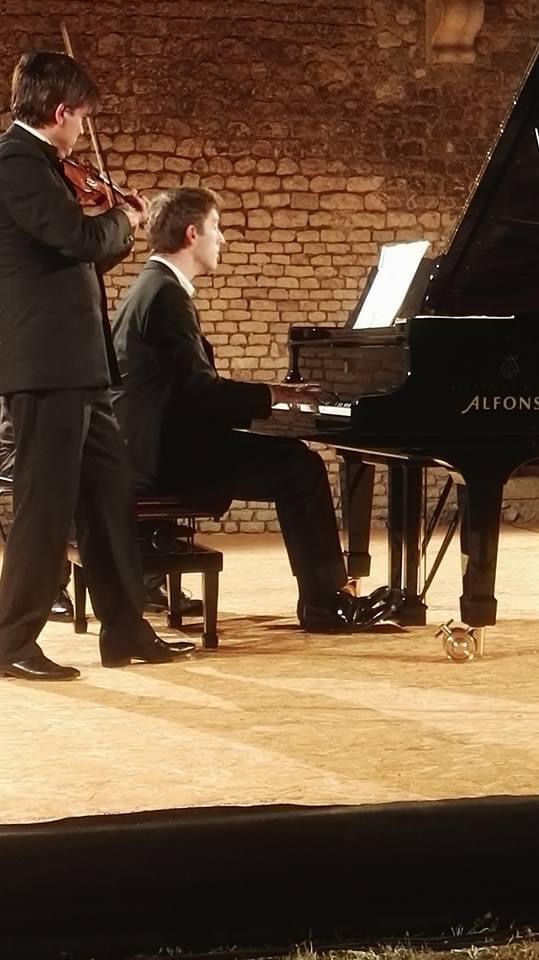
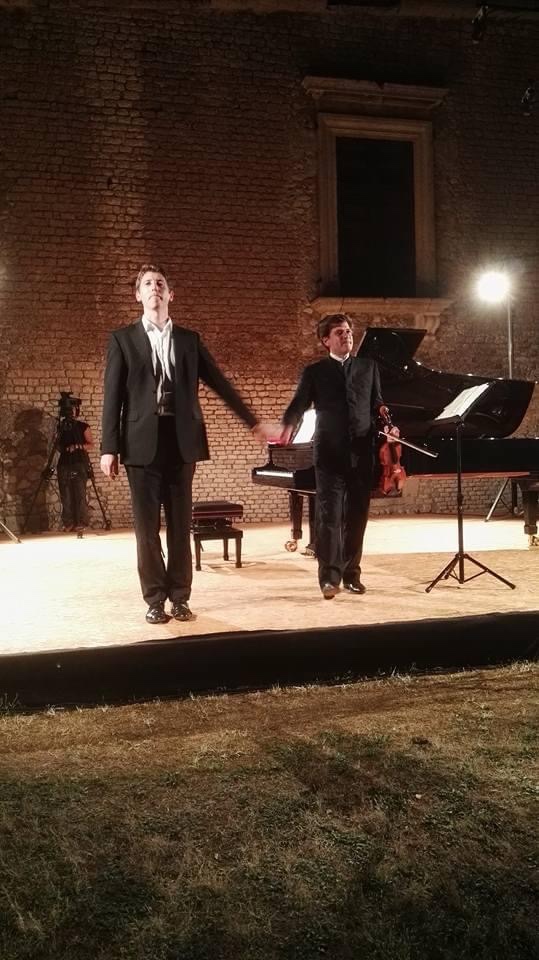
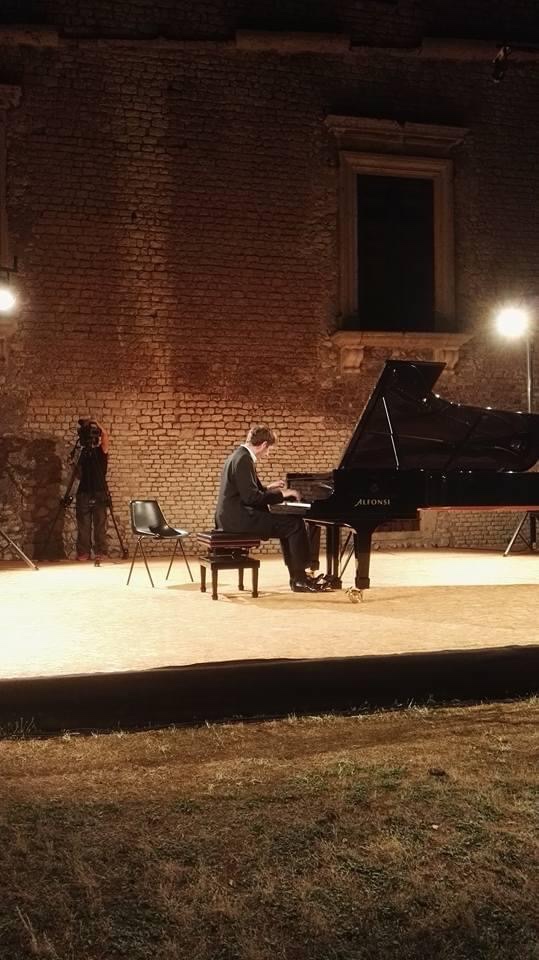 The joyfully playful 3rd Intermezzo was played with just that charm and minimum of pedal that I remember made Curzon’s performances so magical.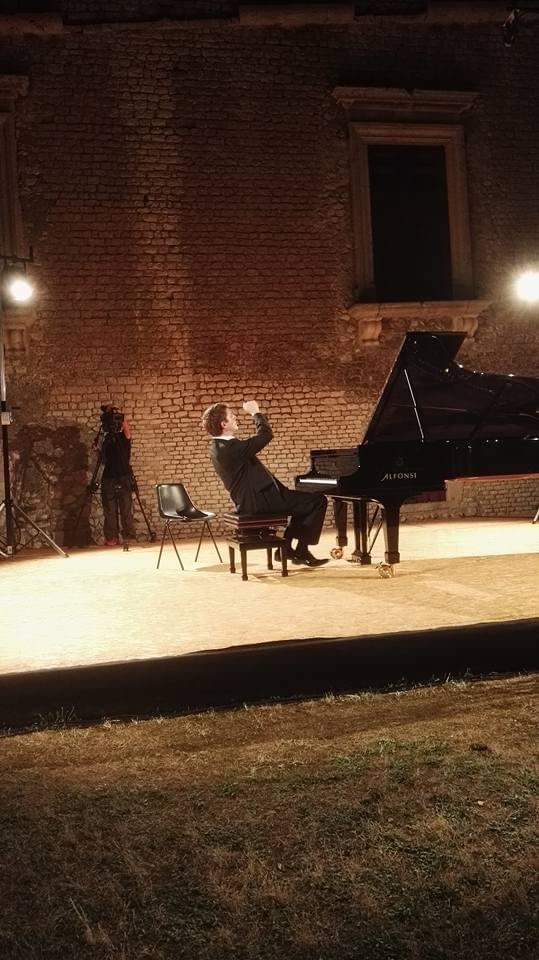
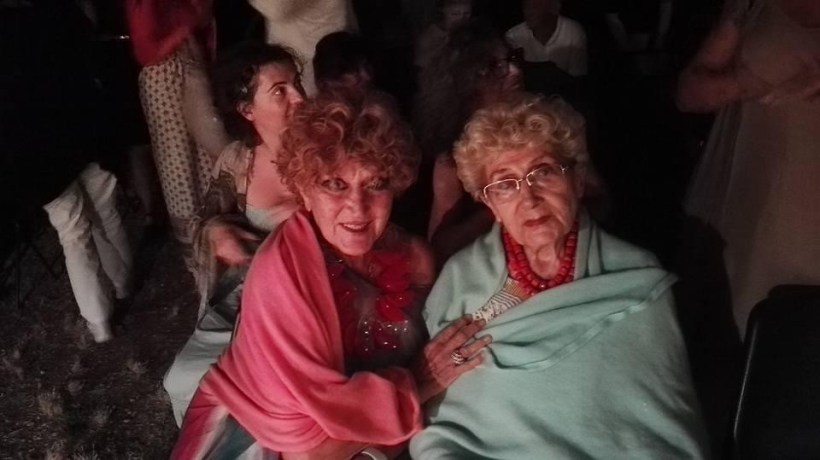
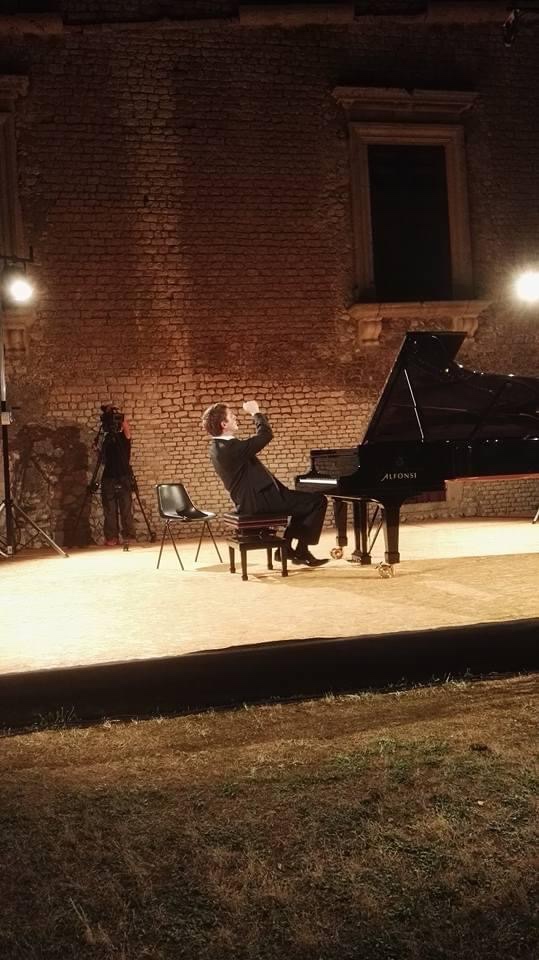
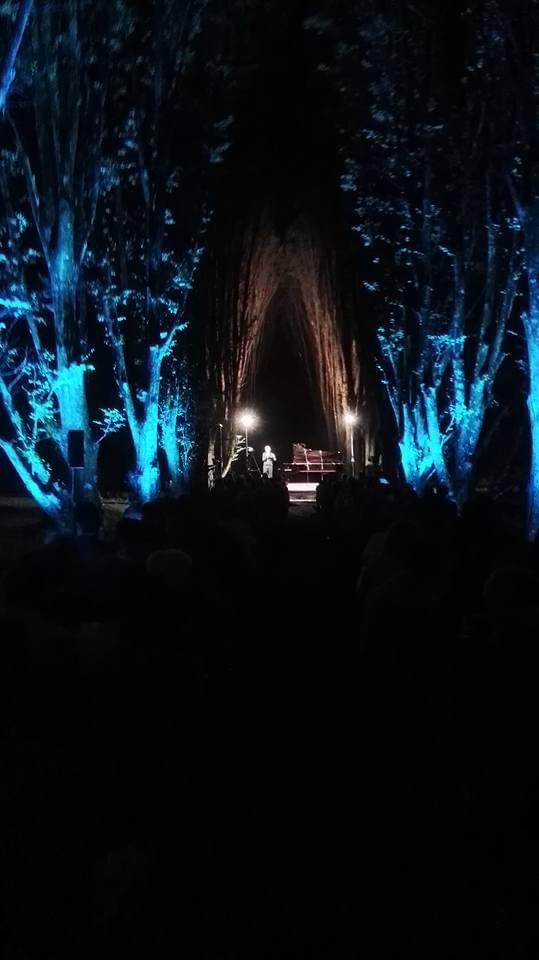
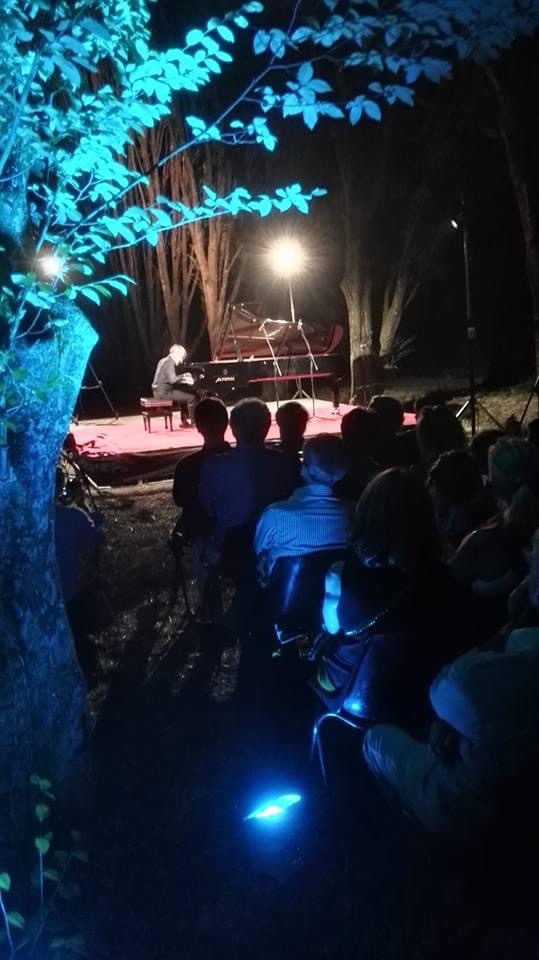
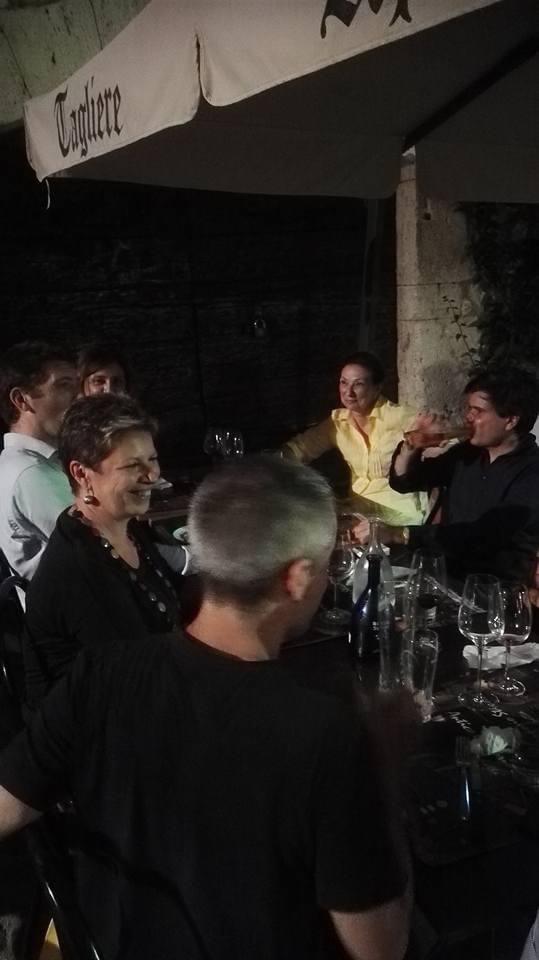
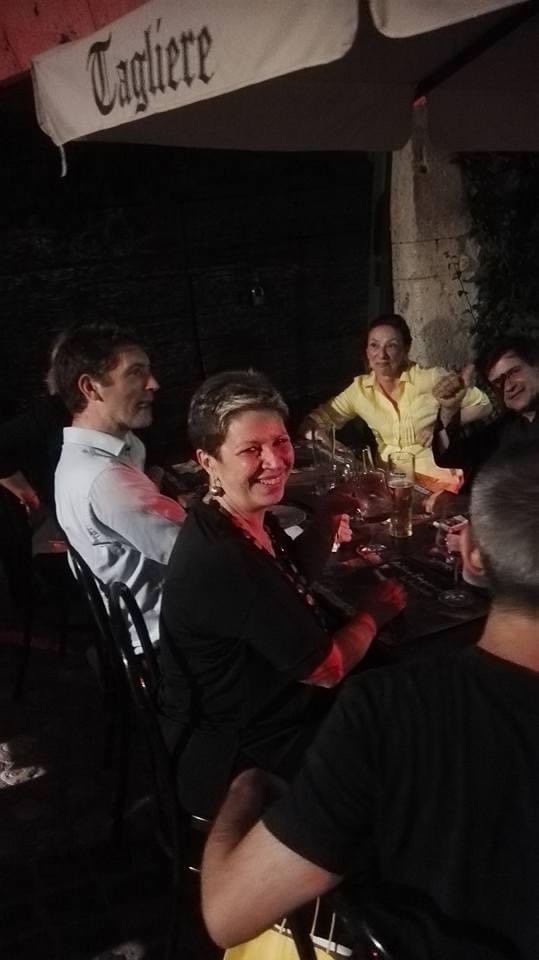




 ChristopherAxworthy-MusicCommentary