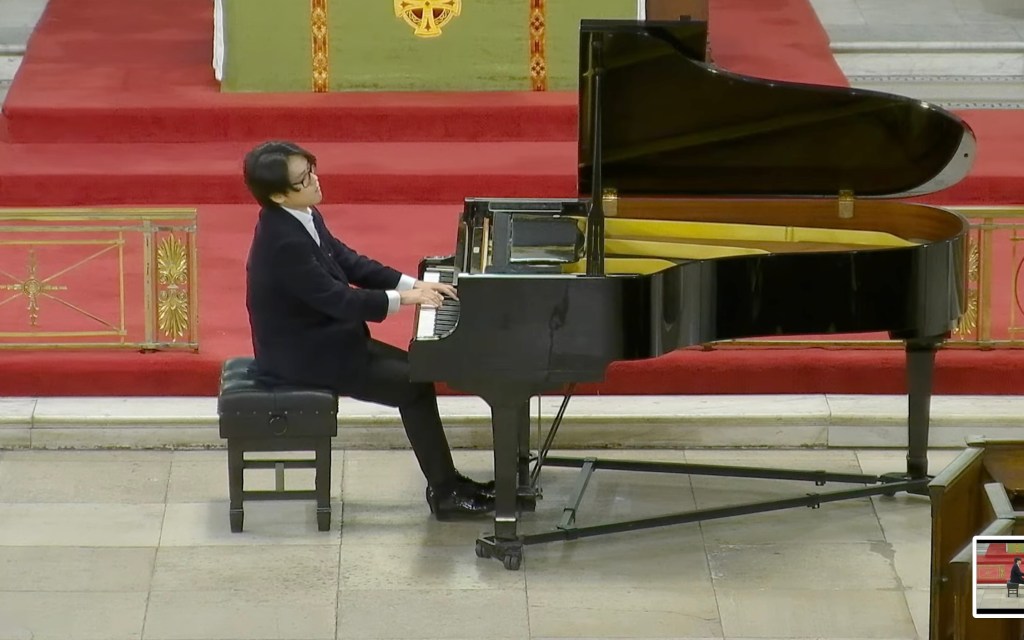
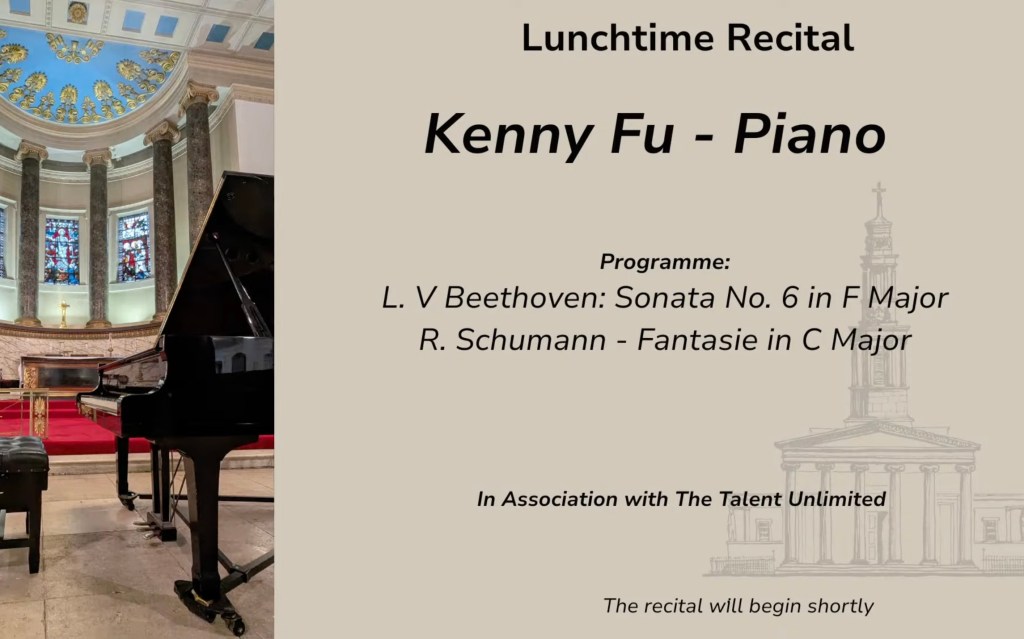
Just two works on Kenny Fu’s programme by Beethoven and Schumann that were enough to demonstrate the mastery and intelligence of this young musician. An early Sonata by Beethoven in three movements that was championed by Glenn Gould and was one of three op 10 where Beethoven is breaking away from his mentor Haydn and taking the sonata model to new heights. The Fantasie op 17 by Schumann is one of the pinnacles of the romantic piano repertoire and was dedicated by the composer to Liszt, where the rights were his contribution to Liszt’s efforts to build a monument to Beethoven in his birthplace of Bonn.
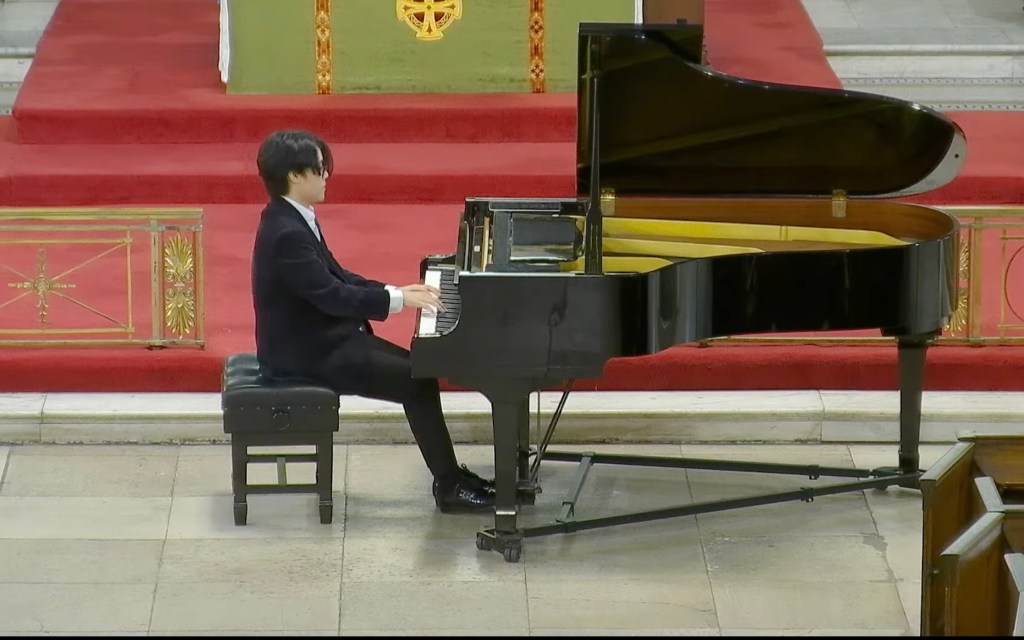
Beethoven op 10 n. 2 in three movements, the second an Allegretto and Trio where one would normally expect a slow movement like in op 10 n. 1. The following Sonata op 10 n. 3 already has four movements of which the slow movement becomes of unusually poignant significance and intensity.This Sonata op 10. n. 2 is full of vitality and drive where Beethoven’s contrast in dynamics are of such fundamental importance. Kenny playing with remarkable clarity tended to play down these indications of Beethoven as he started the sonata ‘forte’ where it is marked ‘piano’ and ended ‘mezzo forte’ where it is marked ‘fortissimo!’ Although playing of brilliance and beauty it was this even out of dynamics that robbed the music of its Beethovenian irascibility. The ‘Allegretto’ was played with grace but would have flowed more in one rather than three.It was the Trio that Kenny played in one that flowed so magically with the comments that Beethoven adds to this lilting dance. It was in the ‘Presto’ finale that Kenny played with dynamic drive and a sense of bucolic character even playing both repeats as he was swept on by the brilliance of his playing. Some musicianly playing of intelligence and style but a better look at Beethoven’s very precise instructions would add even more character to the clarity and brilliance of his playing.
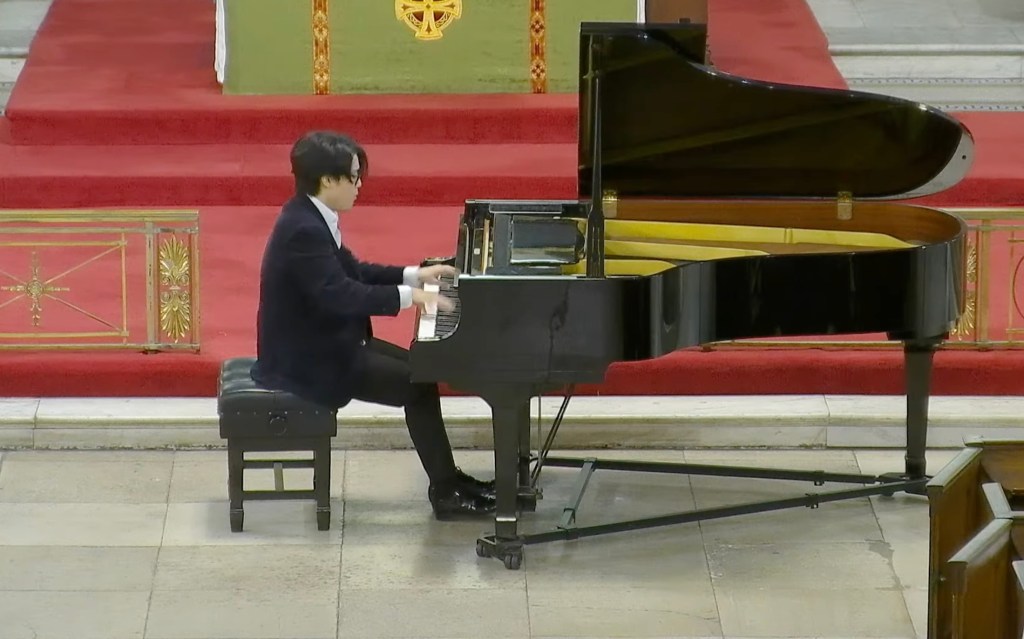
The Schumann Fantasie op 17 is an outpouring of love for his future wife and mother of their eight children : ‘The first movement may well be the most passionate I have ever composed – a deep lament for you.’ They still had many tribulations to suffer before they finally married four years later. The first movement is also prefaced by a quote from the poet Schlegel ‘Resounding through all the notes, In the earth’s colourful dream , There sounds a faint long-drawn note ,For the one who listens in secret.’ The end of this first movement has a direct quote from Beethoven’s ‘An die ferne Geliebte’ – ‘To the distant beloved -‘ Accept then these songs beloved, which I sang for you alone‘. A work in three movements with originally the titles of ‘Ruins, Triumphal Arch, and Constellation’ which were removed altogether before Breitkopf & Härtel eventually issued the Fantasie in May 1839. It was here that Kenny’s scrupulous attention to Schumann’s instructions allied to his technical mastery and intelligent musicianship gave an architectural shape to a work that in lesser hands can sound very fragmented. Opening with playing of great sweep and of passionate intensity but also of intimate beauty. An alternation of character that Kenny played with sumptuous full sounds contrasting with whispered glowing beauty. A superb sense of balance that could allow the melodic line to be revealed floating over a sumptuous harmonic accompaniment. The central episode of the first movement :’Im Legendenton’ was played with expansive beauty allied to a passionate intensity . Always scrupulously controlled there was an aristocratic weight to his playing of extraordinary maturity. The ending of the first movement was played with great beauty and subtlety but never loosing sight of the overall musical line. There was a dynamic drive to the second movement played with control and shape and sense of musical line. Always moving forward even in the ‘etwas langsamer’ with the ‘scherzando’ passage played with gossamer lightness . The coda was a tour de force of mastery and control as he shaped the music with precision and nobility. A beautiful flowing tempo to the last movement allowed the music to flow with beauty combined with strength. Some playing of ravishing beauty as he played with an inner sentiment but never sentimentally, allowing the music to unfold so naturally. A very fine performance of a very complex work to hold together as one unified whole.
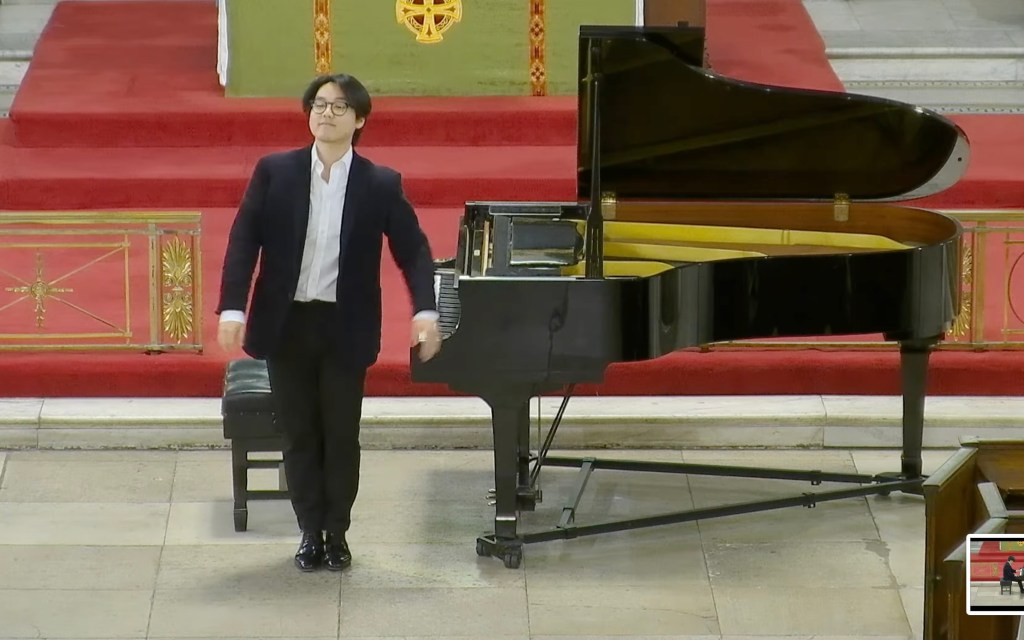
From his early solo debut at the Wigmore Hall to his attainment of the prestigious Sir Elton John Scholarship, Kenny Fu holds much potential and promise for a bright future. He has given concerts on three continents and has already performed extensively throughout UK’s distinguished halls including St Martin-in-the-Fields, Kings Place, Worthing’s Assembly Hall, St James’s Sussex Gardens. He regularly appears in London, Oxford, Brighton and the South of England for more private concert engagements.
His repertoire choices gravitate toward the late Classical and Romantic Eras where he brings an intense and captivating temperament to the works of Beethoven, Brahms and Rachmaninov.
Recently, Kenny has been awarded First Prize at the Norah Sande International Awards, Second Prize in the Croatian Piano Loop Competition and Third prize at the Fifth Vigo International Piano Competition where Martha Argerich, Nelson Freire and Cyprien Katsaris were on the panel of judges. During his earlier years, he was the winner of the Solihull Young Musician of the Year, Silver medalist at the Cyprus International Piano Competition, semi finalist at the Sussex International Piano competition and a quarter finalist at the BBC young musician of the year.
He has received guidance from numerous esteemed musicians such as Dimitri Alexeev, Evgeny Sudbin, Natalia Trull, Pascal Devoyon, Richard Goode, Tim Horton, Imogen Cooper and Angela Hewitt during his studies at the Purcell School of Music and the Royal Academy of Music.
Kenny was born in Leamington Spa and is currently in the Advanced Diploma program at the Royal Academy of Music under the tutelage of Prof. Tatiana Sarkissova and Ian Fountain. He is generously sponsored by the Countess of Munster Trust, Warwick Arts Fund ,Keyboard Trust and Talent Unlimited.