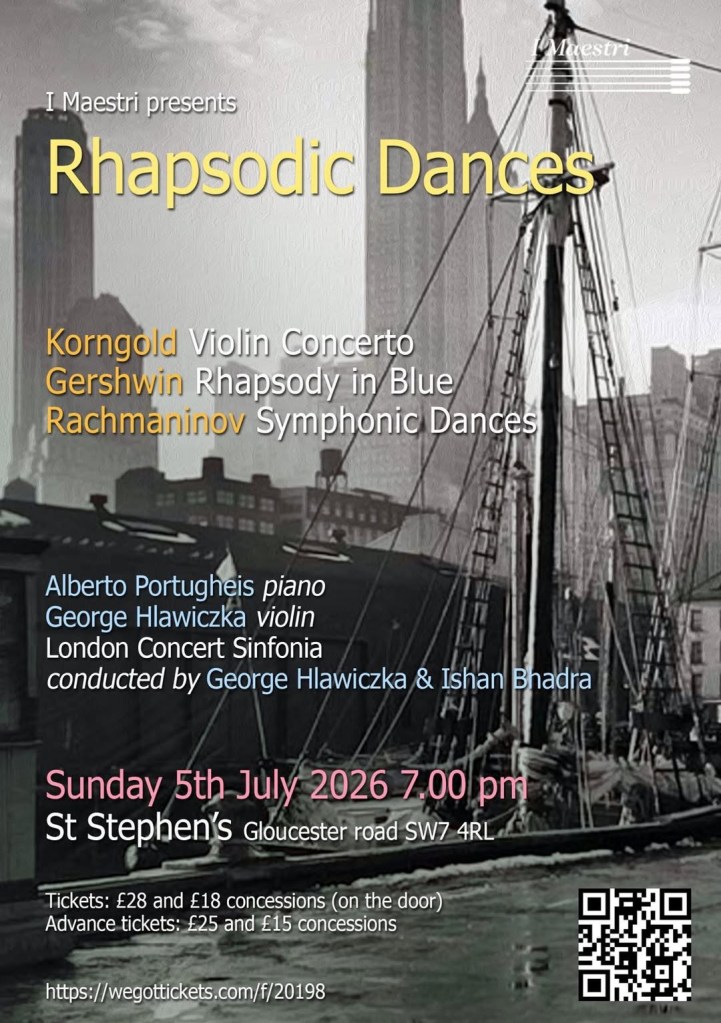
An extraordinary concert in London last night with a violinist who became a conductor and a pianist of 85 years who could jazz it up better than most a quarter of his age.
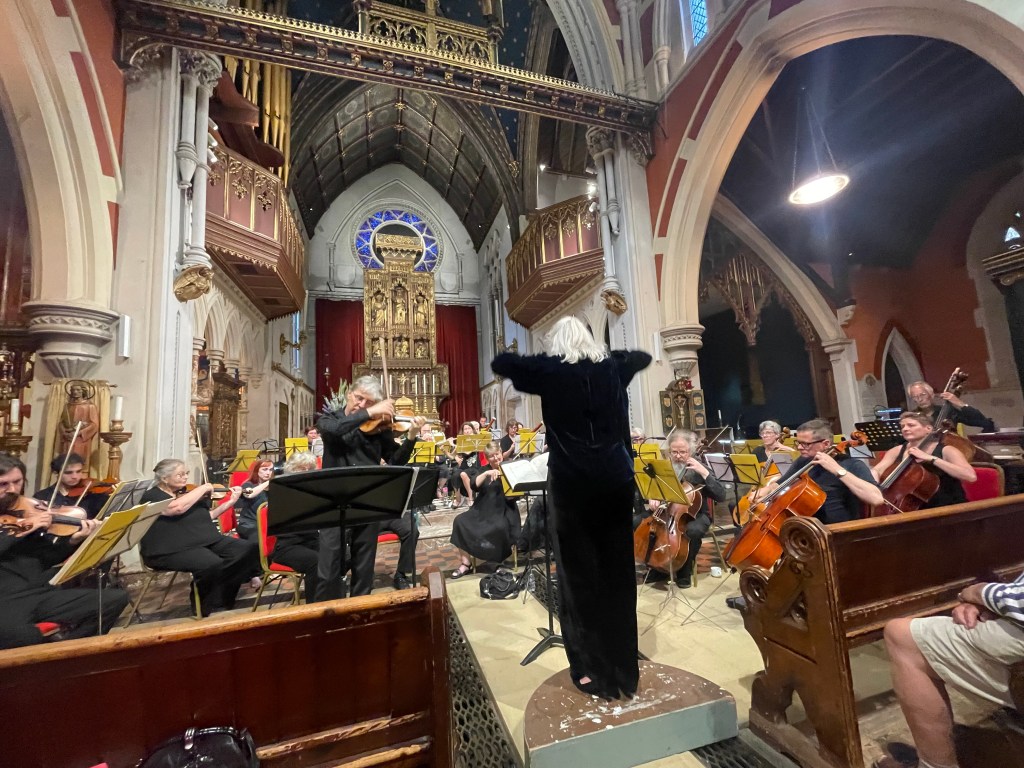
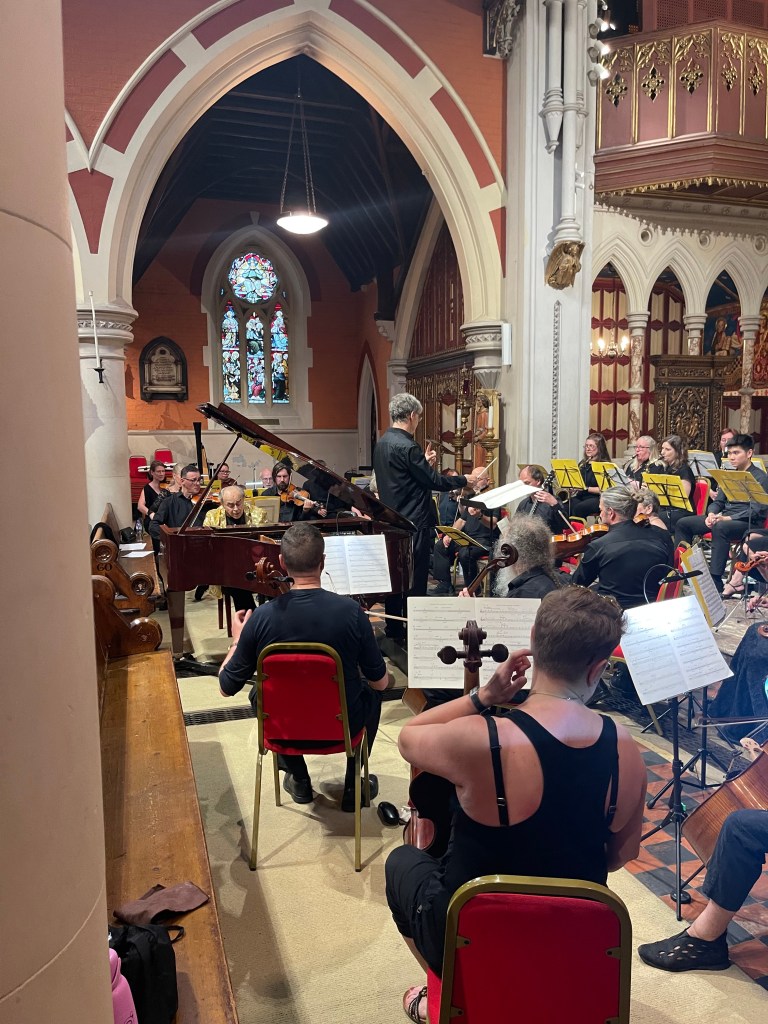
The mellifluous concerto by Korngold was not only played but also partly conducted by the remarkable George Hlawiczka. There were moments in this complicated Hollywoodian score where two conductors were better than one and George came to the assistance of the valiant Rachael Montesino Young . Completed by Korngold in 1945 who vowed he would not compose any ‘serious’ music until the war was over. Heifetz had put it firmly on the map with his sensational first performance in 1947. George Hlawiczka not only played the solo part but also oversaw the orchestra during his very fine performance.
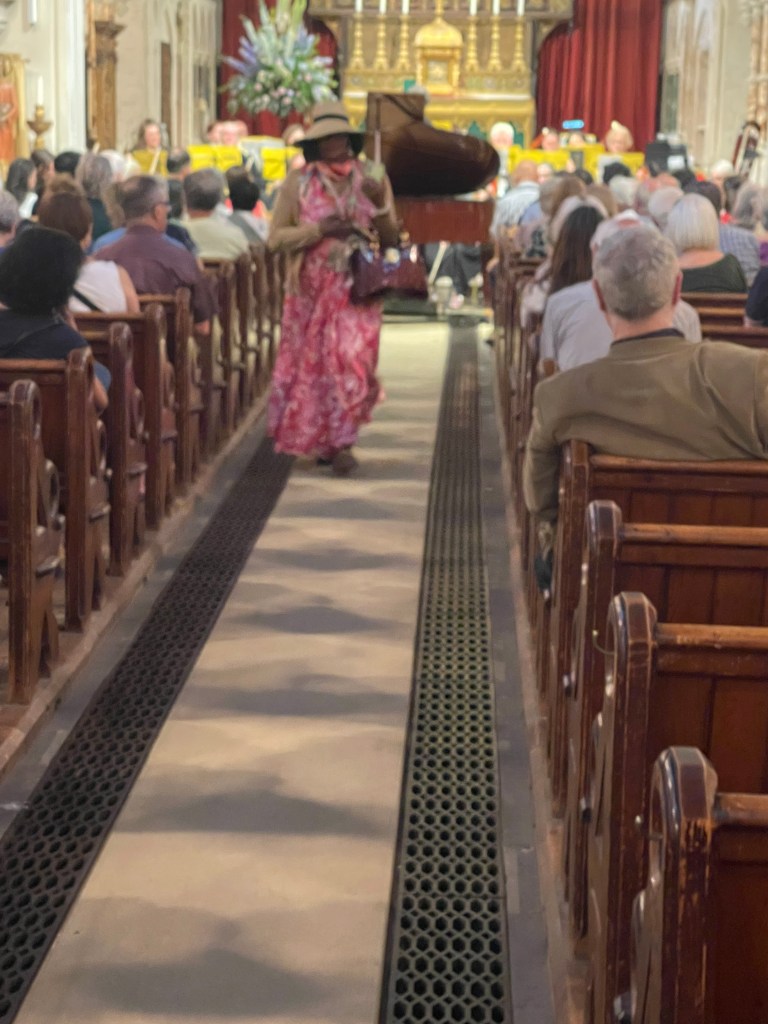
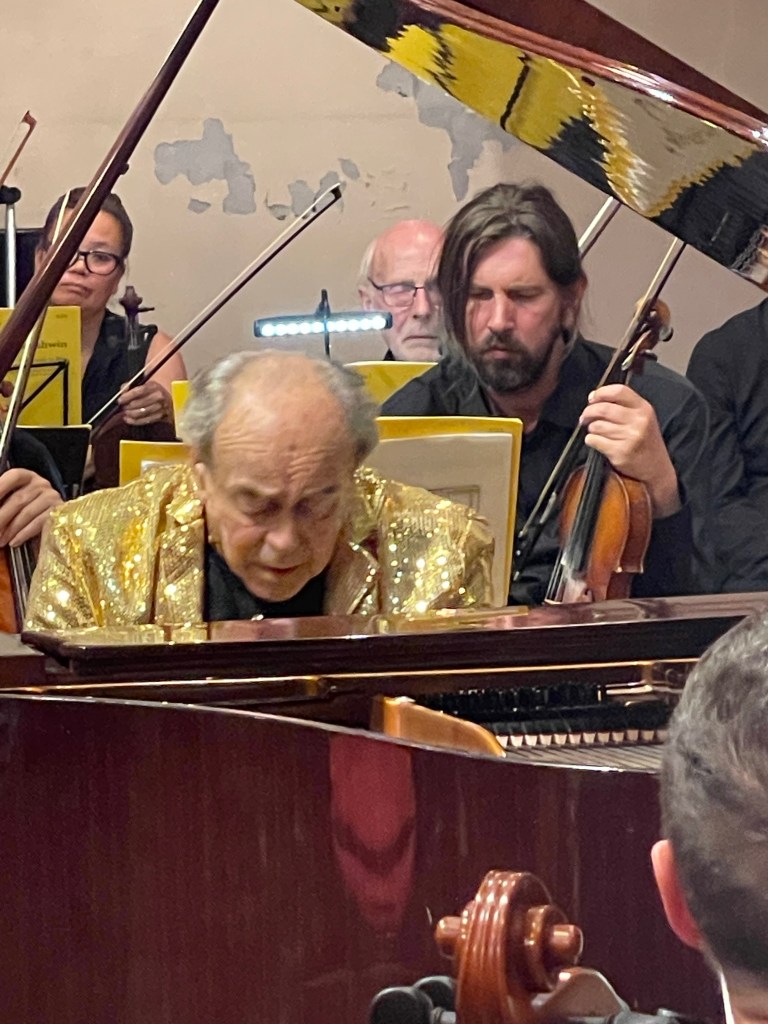
a mysterious audience member who walked up to the pianist during the perfomance to get a better close up photo A Man for all Seasons George Hlawiczka
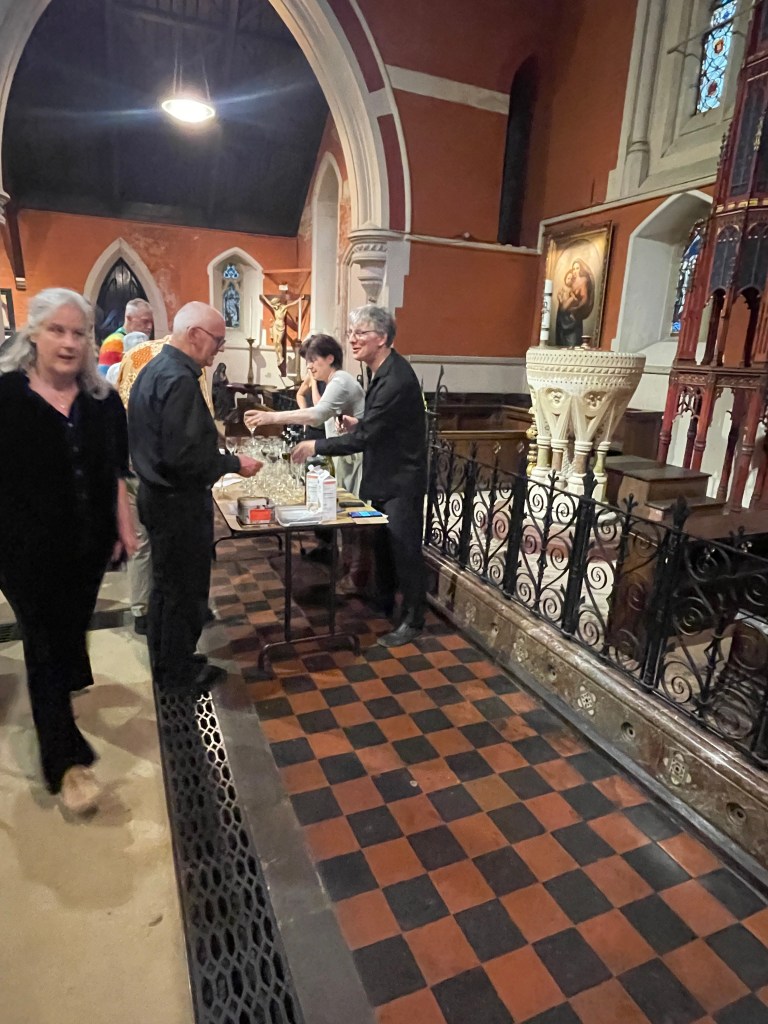
And was seen supervising the wine in the interval – A man for all seasons indeed!
Rachael Montesino Young at the helm for Korngold Violin Concerto
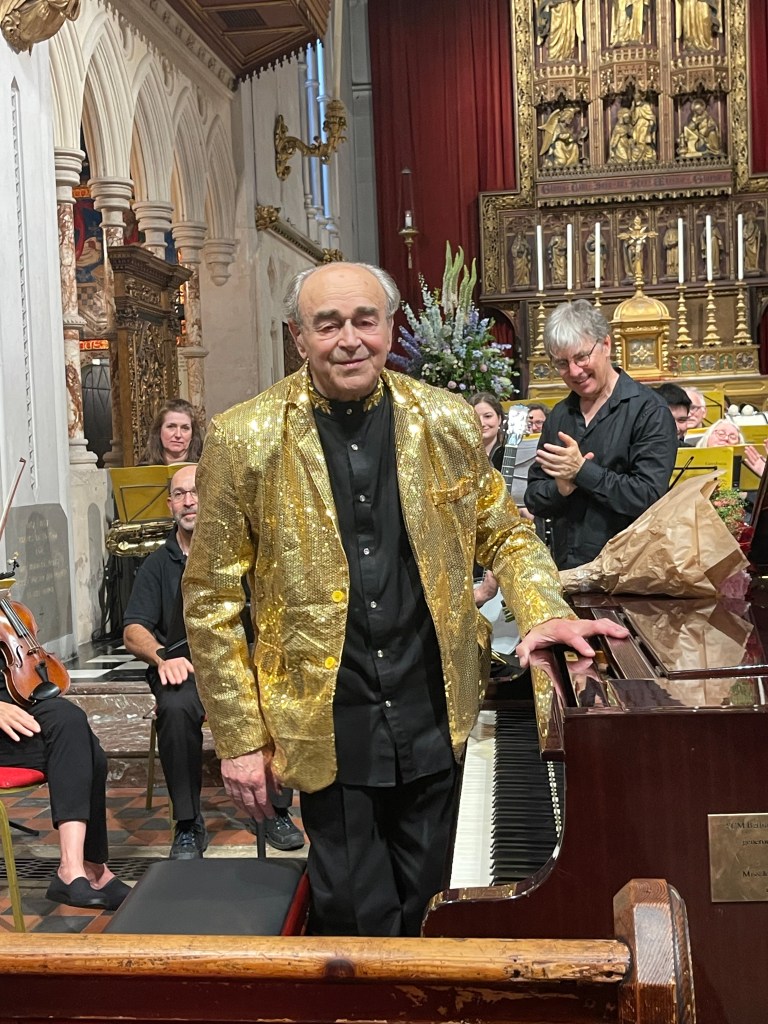
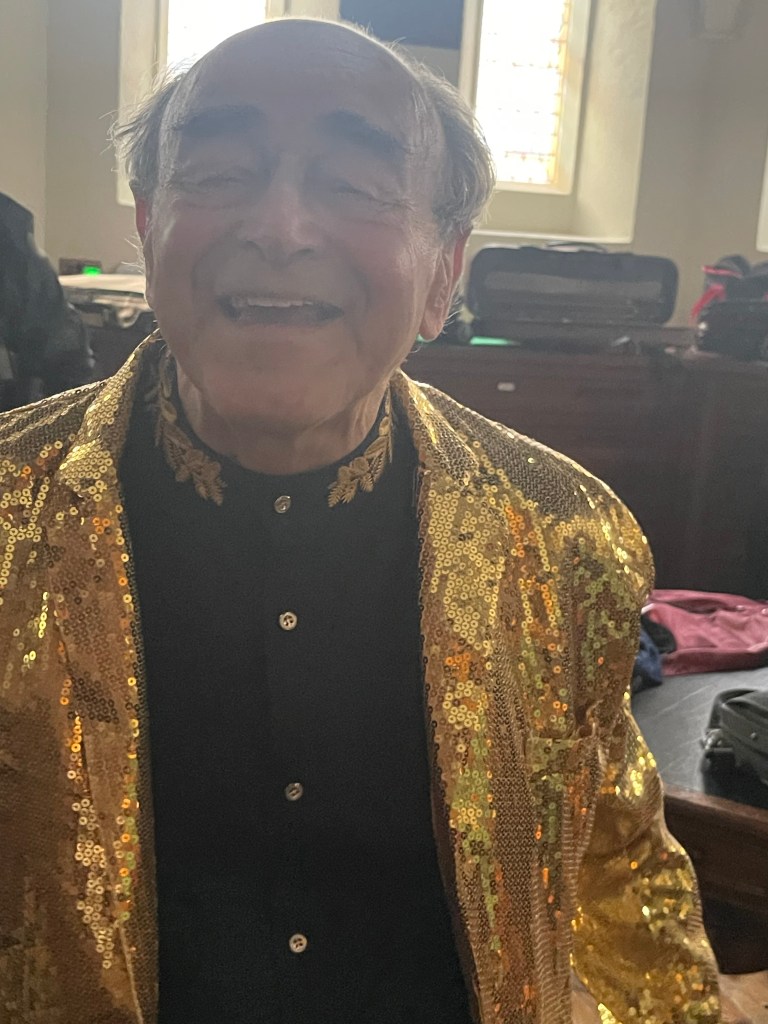
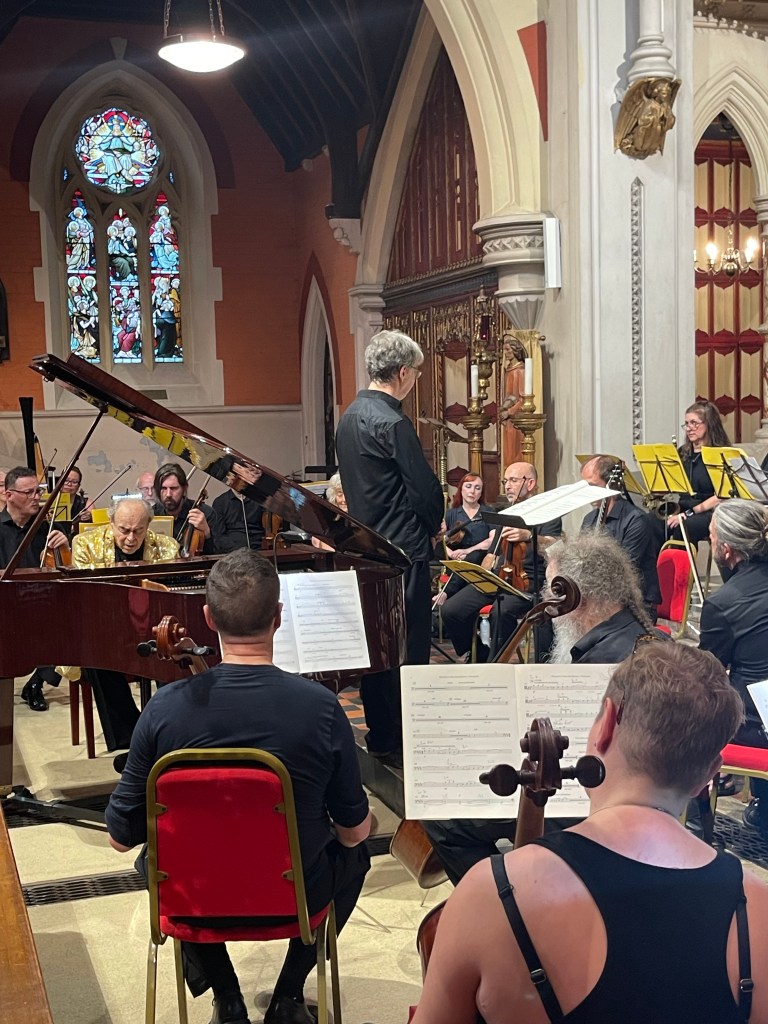
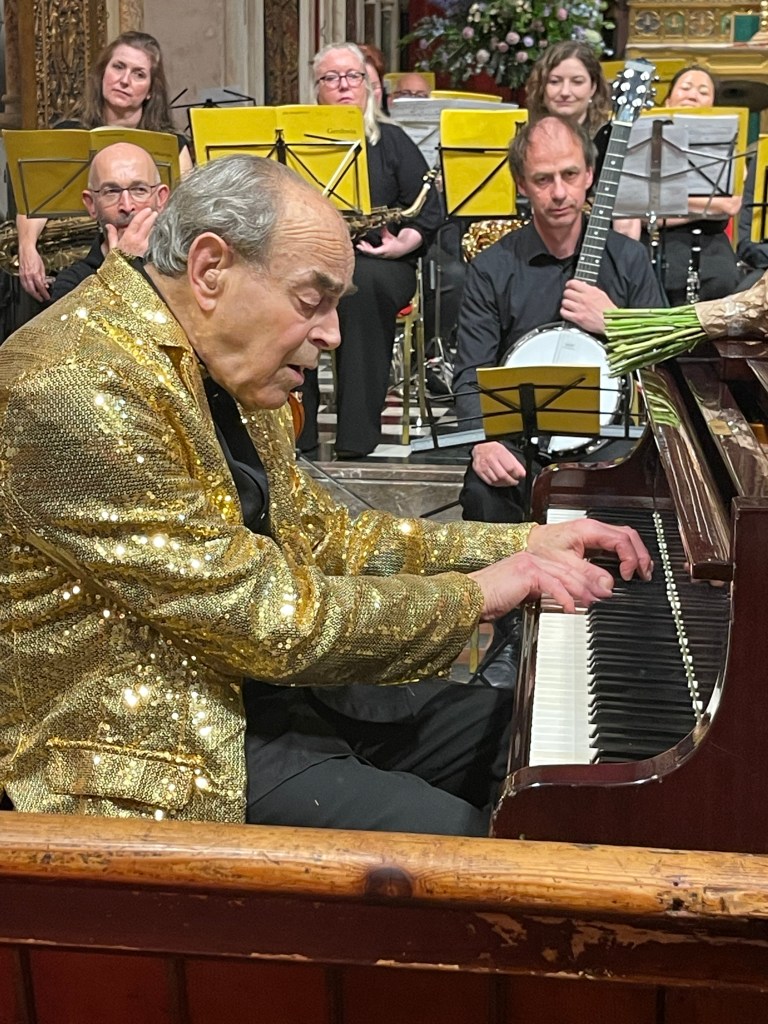
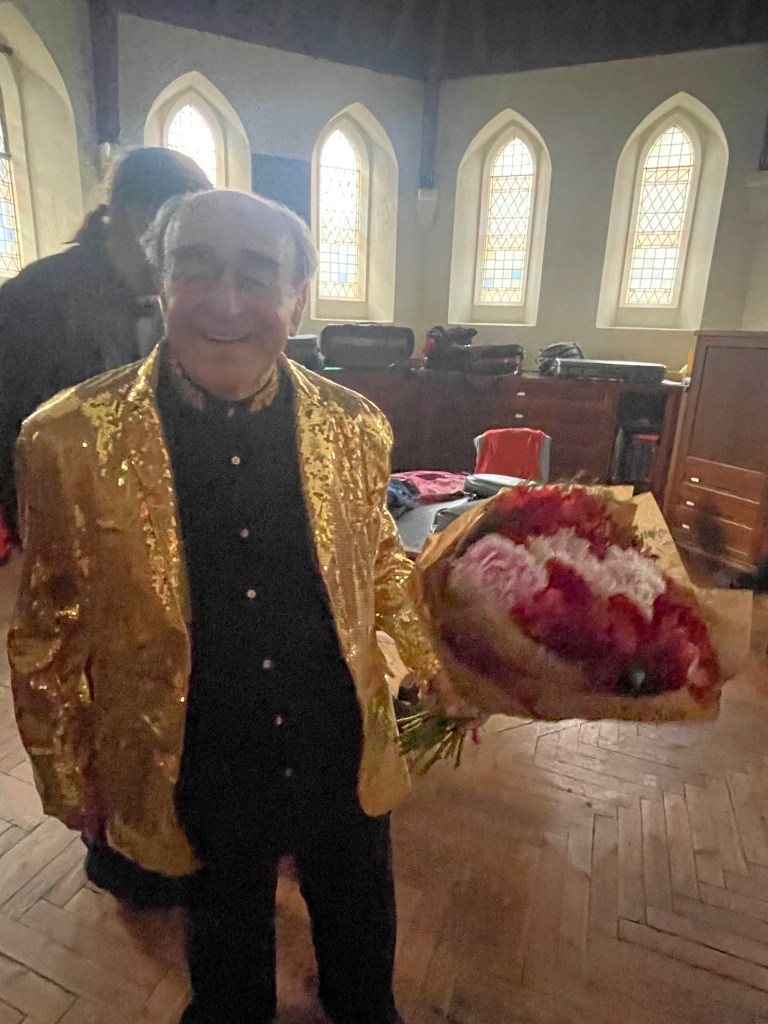
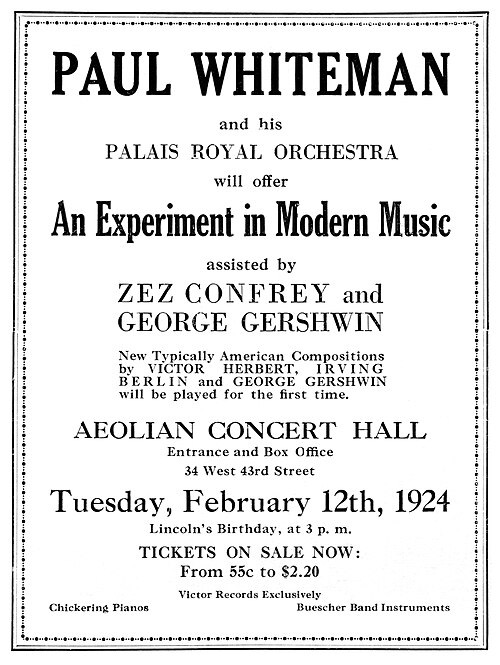
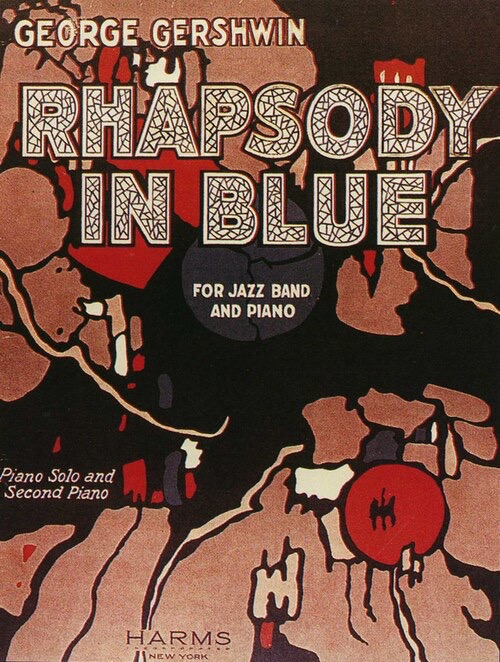
But it was the veteran pianist Alberto Portugheis who stole the show tonight with another work also written in America but ten year earlier. Dressed for the part in a Gold Lamé jacket as both he and the orchestra, directed by George Hlaziczka took the place of Paul Whiteman and George Gershwin with evident joy at being able to let their hair down and intone the most famous melodies of ‘Rhapsody in Blue’.
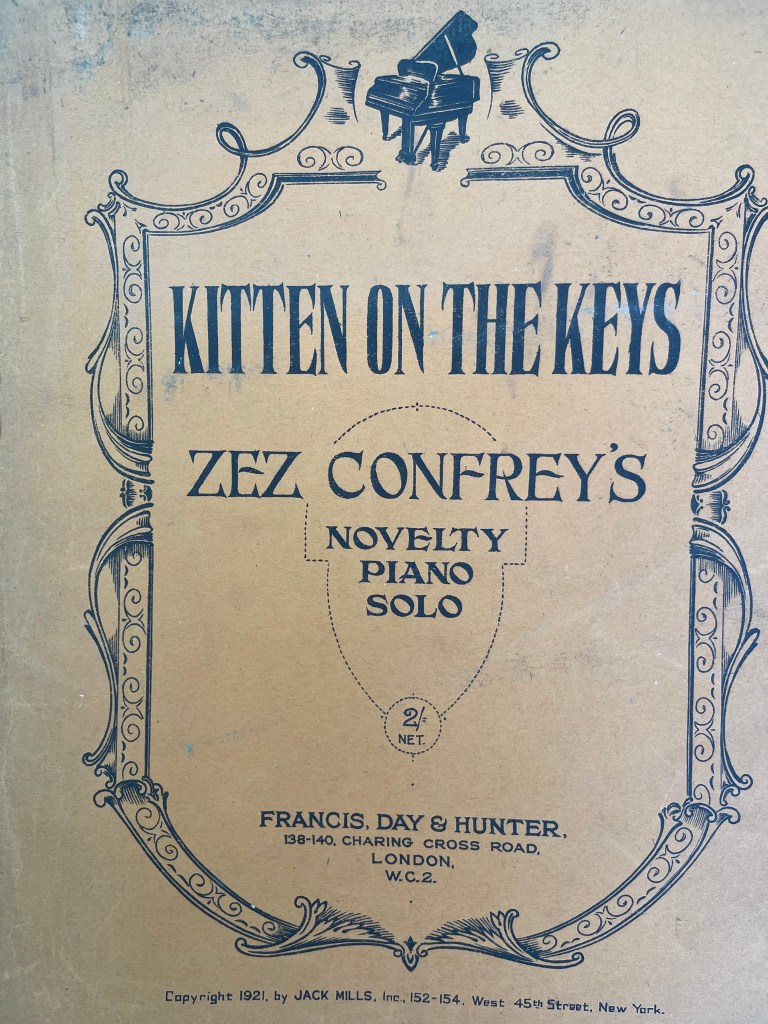
A kitten on the keys indeed as Alberto let rip with passionate intensity and playing without the score as it was obviously so much part of his being that for this evening was a sumptuous feast clad in Gold.
Ravishing sounds of gold indeed from fingers of extraordinary steely pedigree with an arch of the hand that allows veteran pianists to play with such mastery. Alberto, like his life long friend Martha Argerich, has been endowed with superb childhood training in Buenos Aires from the Neapolitan School of Scaramuzza. Both have the same rock solid hand with ten fingers that are just waiting to receive their instruction from mature masterly musicians, ready to go into action with an orchestra in their fingertips.
At the end of a sumptuous all or nothing performance of ‘Rhapsody in Blue’, our valiant pianist was warmed up and ready to play on his own the second of Gershwin’s three preludes. With chiselled beauty he was able to carve out the most jazzy of Preludes with the improvised abandon of a true ‘Kitten on the Keys’.
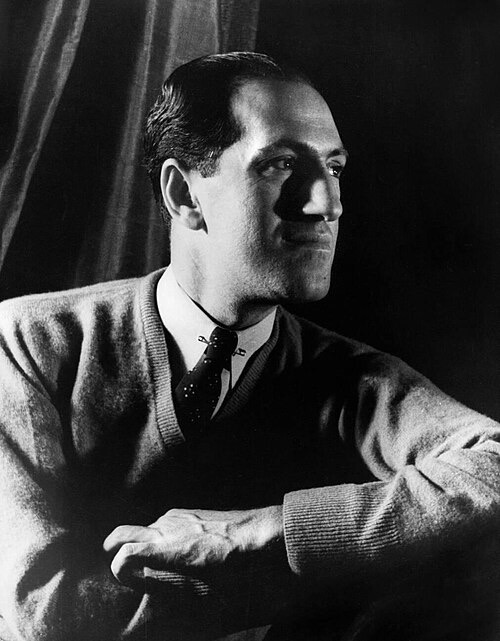
George Gershwin born Jacob Gershwine; September 26, 1898 – July 11, 1937 was an American composer and pianist whose compositions spanned jazz, popular and classical music . Among his best-known works are the songs “Swanee” (1919) and “Fascinating Rhythm ” (1924), the orchestral compositions “Rhapsody in Blue “(1924) and “An American in Paris” (1928), “Embraceable You ” (1928) and “I Got Rhythm‘”1930) and the opera “Porgy and Bess”(1935), which included the hit ‘”Summertime'”.
With only five weeks remaining until the premiere, Gershwin hurriedly set about composing the work. He later claimed that while on a train journey to Boston , the thematic seeds for Rhapsody in Blue began to germinate in his mind. He told biographer Isaac Goldberg in 1931:
It was on the train, with its steely rhythms, its rattle-ty bang, that is so often so stimulating to a composer … I frequently hear music in the very heart of the noise. And there I suddenly heard—and even saw on paper—the complete construction of the rhapsody, from beginning to end. No new themes came to me, but I worked on the thematic material already in my mind and tried to conceive the composition as a whole. I heard it as a sort of musical kaleidoscope of America, of our vast melting pot , of our unduplicated national pep, of our metropolitan madness. By the time I reached Boston, I had a definite plot of the piece, as distinguished from its actual substance.
Gershwin began composing on January 7 as dated on the original manuscript for two pianos. He tentatively entitled the piece as American Rhapsody during its composition. Ira Gershwin suggested the revised title of Rhapsody in Blue after his visit to a gallery exhibition of James Mc Neil Whistler paintings. After a few weeks, Gershwin finished his composition and passed the score, titled A Rhapsody in Blue, to Ferde Grofé, Whiteman’s arranger. Grofé finished orchestrating the piece on February 4—a mere eight days before the premiere.
“This composition shows extraordinary talent, as it shows a young composer with aims that go far beyond those of his ilk, struggling with a form of which he is far from being master … In spite of all this, he has expressed himself in a significant and, on the whole, highly original form … His first theme … is no mere dance-tune … it is an idea, or several ideas, correlated and combined in varying and contrasting rhythms that immediately intrigue the listener. The second theme is more after the manner of some of Mr. Gershwin’s colleagues. Tuttis are too long, cadenzas are too long, the peroration at the end loses a large measure of the wildness and magnificence it could easily have had if it were more broadly prepared, and, for all that, the audience was stirred and many a hardened concertgoer excited with the sensation of a new talent finding its voice.”
— Olin Downes ,The New York Times February 1924
Gershwin asked to study with Ravel. When Ravel heard how much Gershwin earned, Ravel replied with words to the effect of, ‘You should give me lessons.’ He also asked Schoenberg for composition lessons. Schoenberg refused, saying ‘I would only make you a bad Schoenberg, and you’re such a good Gershwin already.’ (This quote is similar to one credited to Ravel during Gershwin’s 1928 visit to France – ‘Why be a second-rate Ravel, when you are a first-rate Gershwin?’ He also visited Boulanger in 1927, asking for lessons in composition. They spoke for half an hour after which Boulanger announced, ‘ I can teach you nothing.’ Taking this as a compliment, Gershwin repeated the story many times
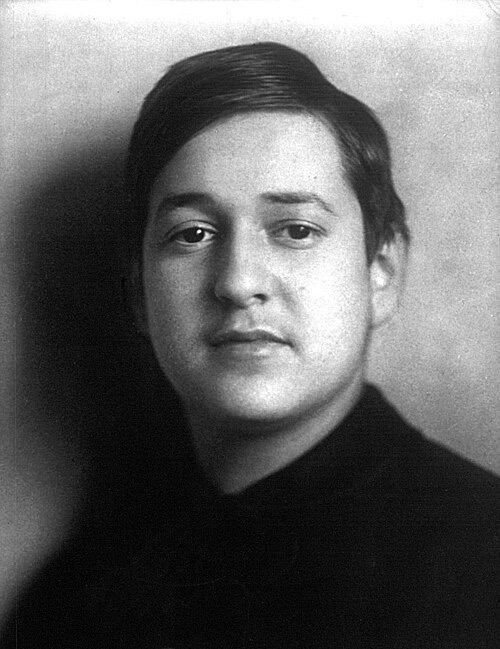
Erich Wolfgang Korngold (May 29, 1897 – November 29, 1957) was an Austrian composer and conductor, who left Europe in the mid-1930s and later adopted US nationality. A child prodigy , he became one of the most important and influential composers in Hollywood history.
Korngold had vowed to give up composing anything other than film music, with which he supported himself and his family, until Hitler had been defeated. With the end of World War II, he retired from films to concentrate on music for the concert hall. The Violin Concerto was the first such work that Korngold wrote, following some initial persuasion from the violinist and fellow émifré Bronislaw Huberman . Korngold had been hurt by the assumption that a successful film composer was one who had sold his integrity to Hollywood, just as earlier he had been hurt by many critics’ assumptions that his works were performed only because he was the son of music critic Julius Korngold. He was thus determined to prove himself with a work that combined vitality and superb craftsmanship.
The concerto was dedicated to Alma Mahler , the widow of Korngold’s childhood mentor Gustav Mahler. It was premiered on 15 February 1947 by Jasha Heifetz and the St. Louis Symphony under conductor Vladimir Golschmann. It received the most enthusiastic ovation in St. Louis concert history. On 30 March 1947, Heifetz played the concerto in Carnegie Hall with the New York Philharmonic conducted by Efrem Kurtz; the broadcast performance was recorded on transcription discs. The composer wrote about Heifetz’s playing of the work:
In spite of the demand for virtuosity in the finale, the work with its many melodic and lyric episodes was contemplated more for a Caruso than for a Paganini . It is needless to say how delighted I am to have my concerto performed by Caruso and Paganini in one person: Jascha Heifetz.
Sergei Vasilyevich Rachmaninov (1 April 1873 Semyonov, Russia – 28 March 1943 Beverly Hills, California ) was a Russian composer, virtuoso pianist , and conductor. Rachmaninov is widely considered one of the finest pianists of his day and, as a composer, one of the last great representatives of Romanticism in Russian classical music
Symphonic Dances, op 45 in three movements was completed in October 1940 . The composer also published a version for two pianos. It is his final major composition, and his only piece written in its entirety while living in the United States.
The work allowed him to indulge in a nostalgia for the Russia he had known, as much as he had done in the Symphony n. 3, as well as to effectively sum up his lifelong fascination with ecclesiastical chants. In the first dance, he quotes the opening theme of his Symphony n. 1, itself derived from motifs characteristic of Russian church music. In the finale he quotes both the Dies irae and the chant “Blessed art thou, Lord” (“Blagosloven yesi, Gospodi”) from his All-Night- Vigil
Rachmaninov composed the Symphonic Dances four years after his third symphony , mostly at the Honeyman estate, “Orchard Point”, in Centerport New York, which overlooked Long Island Sound. Its original name was Fantastic Dances, with movement titles of “Noon”, “Twilight”, and “Midnight”. While the composer had written to conductor Eugene Ormandy in late August 1940 that the piece was finished and needed only to be orchestrated, the manuscript for the full score bears completion dates of September and October 1940. It was premiered by Ormandy and the Philadelphia Orchestra , to whom it is dedicated, on January 3, 1941.





Una risposta a "Alberto Portugheis and all that Jazz At 85 the veteran pianist shows us he is still a Kitten on the Keys"