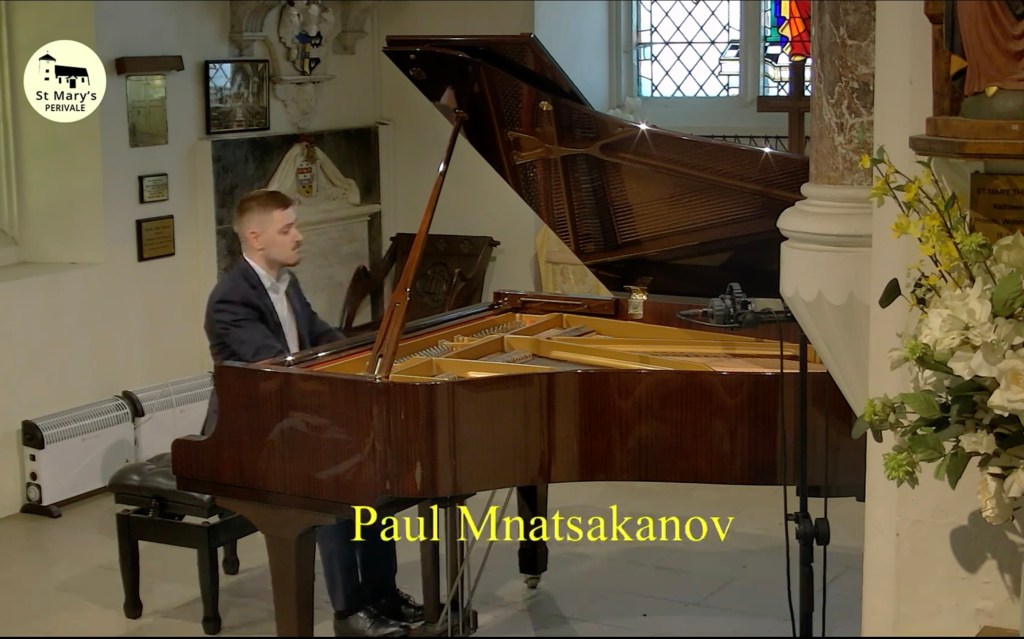
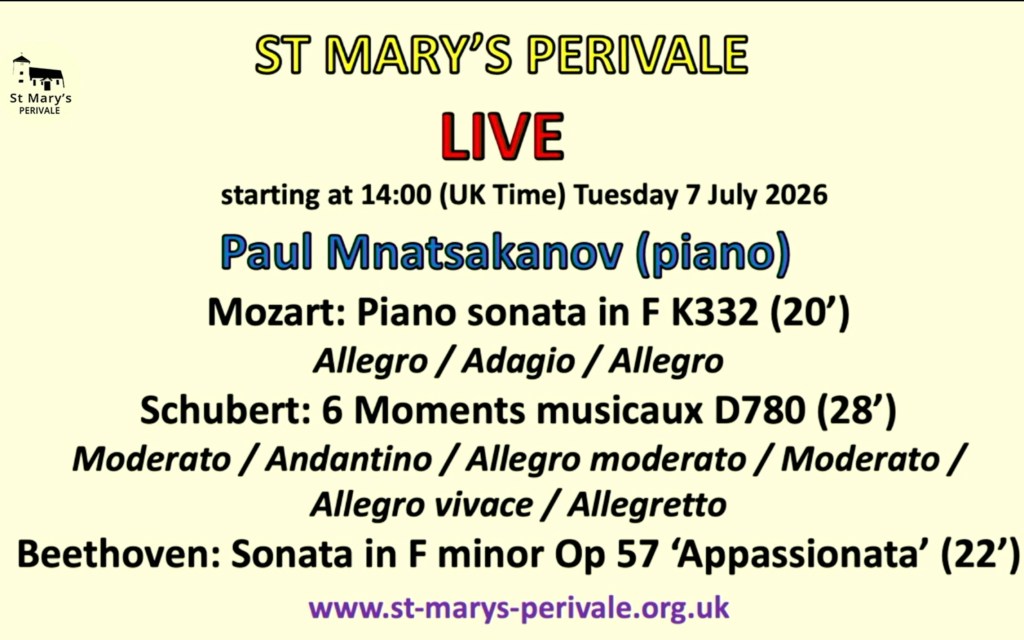
I have heard Paul Mnatsakanov many times over the past few years as he reached for the heights at the Royal College of Music. A complete musician who could fill a vast auditorium with the orchestral sounds of Mussorgsky as he could draw the audience in to overhear the barely audible sounds of the clavichord. Conducting and working with singers has given his playing a sense of architectural shape but above all bringing a sense of character to all he does.
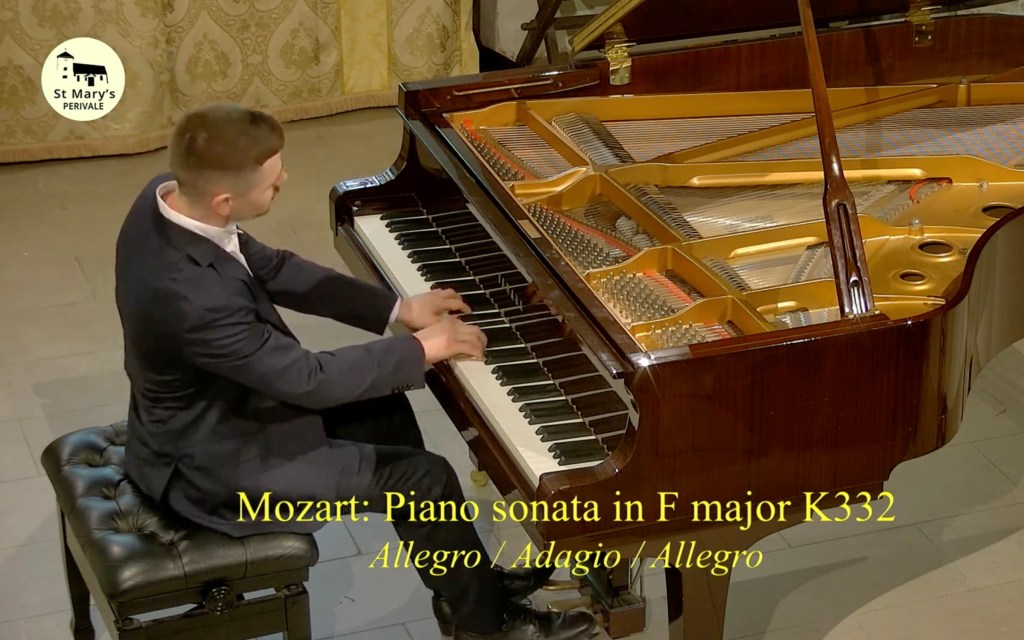
The music is made to speak with the same inflections as the human voice and nowhere is this more evident than in his playing of Mozart. Today he chose to open with the Sonata K 332 which he had played at his graduation recital last year …………..’A Mozart sonata in F K 332 of impeccable style and discreet ornamentation that just highlighted the beauty of the ‘Allegro’ played with refined good taste and character. Not the colours of Horowitz but much more restrained and classically orientated that nevertheless spoke with the same operatic voice. Ravishing beauty of the ‘Adagio’ where his superb sense of balance allowed the bel canto to sing but also the audacious accompaniment to be an equal partner. An ‘Allegro assai’ that just burst onto the scene with scintillating energy and high spirits and where Mozart’s surprise ending was judged to perfection without ever giving the game away.’ A performance that has grown in depth and simplicity where his self identification with the operatic characters as they enter and exit the scene is quite remarkable. The inflections of a human voice that do not disturb the style and absolute clarity of the performance. Playing with controlled passion as he allowed the final ‘Allegro’ to erupt with a burning drive having played the ‘Adagio’ with exquisite radiance. Ornaments in the ‘Adagio’ as in the ritornello of the opening movement just added to the character, not disturbing but enhancing the simplicity and beauty of Mozart’s genial creation.
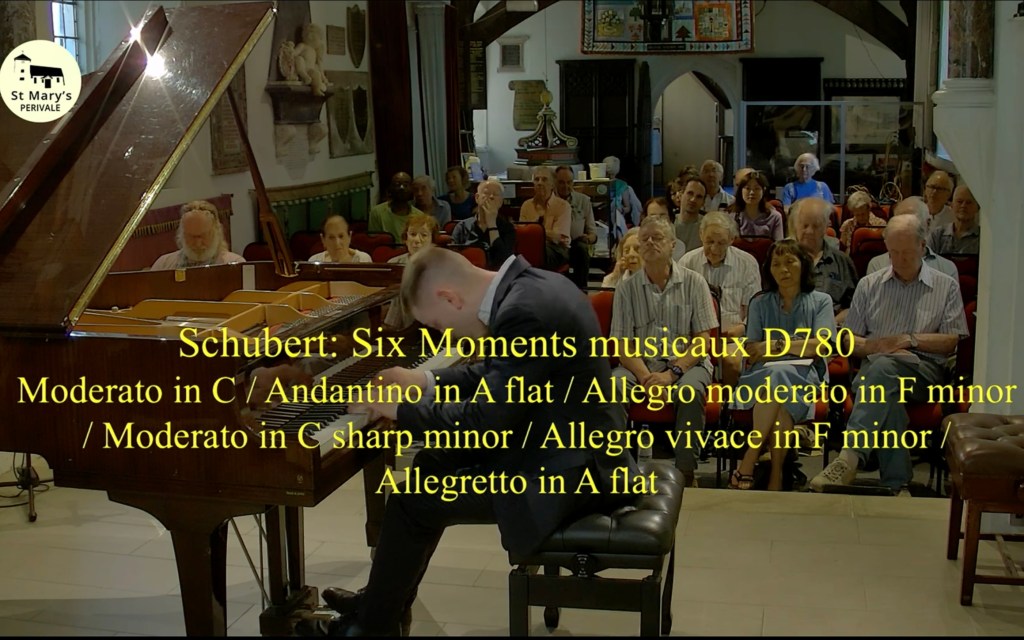
The Schubert Moments Musicaux I have not heard from Paul before, and it was here that he managed to imbue these miniature masterpieces with a sense of recreation that was as spontaneous as it was convincing. Slight inflections, a gentle underlining or underplaying certain passages allowed the music to speak with the same directness as the human voice. The first played with the simplicity of a ‘ländler ‘ of impish good spirts with a beautifully flowing central episode of a question and answer over a gently moving bass. The ‘Andantino’ was played very sensitively where every note spoke with poignant significance. A whispered central episode played with an extraordinary palette of colours of radiant beauty and eloquence. The third in F minor was played like a march of the fairies with refined charm and simplicity and a beguiling sense of character. No one can compare with Curzon here but Paul came pretty close to that controlled elegance mixed with charm. The whispered meanderings of the fourth were played with sublime clarity and the central episode of beautiful self effacing elegance. The return of the meanderings disappearing into the distance that he played with remarkable control of sound. Bursting into the ‘Allegro vivace’ with a burning intensity and remarkable technical mastery. The ‘Allegretto’ was the calm after the storm, played with the same sublime simplicity as all that Paul did ,but here was with a sumptuous full harmonic sound. A sedate central episode was with radiance but tinged with a religious fervour floating on a glorious wave of sound. This was one of the finest performances of these elusive Moments that I have heard from a young musician where selfless musicianship is combined with a unique sensitivity of eloquence and character.

The ‘Appassionata’ was given a performance from a musician who could see the whole architectural shape of this tempestuous outpouring. From the very opening there was a scrupulous attention to detail where the silences are so important and throughout the work there was a continuous flow like being engulfed by a great wave. If there were some rough corners it was of no importance for a musician who could imbue this work with the very temperament that had inspired such an audacious outpouring. Scrupulous attention to Beethovens’ pedalling was at times too literal and became muddled rather than mysterious. Big sweeps of arpeggios that Beethoven marks to be played with one gesture were divided between the hands to avoid mishaps or in Paul’s case to save on practice time in the life of an eclectic musician who has so much to fit in within a short space of time. The important thing was that the intention was so firmly embedded in the interpretation that these technical details became of lesser importance for a musician who could see the vast landscape that Beethoven had set before him. The coda of the first movement, as with the last, was played with passionate intensity and the Beethovenian temperament of irascible impatience. The ‘Andante’ was indeed ‘con moto’ and was a procession of religious intensity. A set of four variations in D flat on a theme remarkable for its melodic simplicity combined with the use of unusually thick voicing and a peculiar counter-melody in the bass. Its sixteen bars (repeated) consist of nothing but common chords, set in a series of four- and two-bar phrases that all end on the tonic that Paul allowed to unwind with well oiled simplicity. The final variation ending with a deceptive cadence containing the dominant 7th chord instead of the tonic that resolves to a soft diminished seventh on B♭ marked pp (pianissimo), followed by a much louder diminished seventh, marked ff (fortissimo), at an octave higher that serves as a transition (without pause) to the finale.A shock wave indeed! The final Allegro was played with controlled drive bursting into moments of inflamed passages that Paul played with technical mastery. Keeping a reserve for the final coda that he played with fearless abandon and driving rhythmic dynamism.
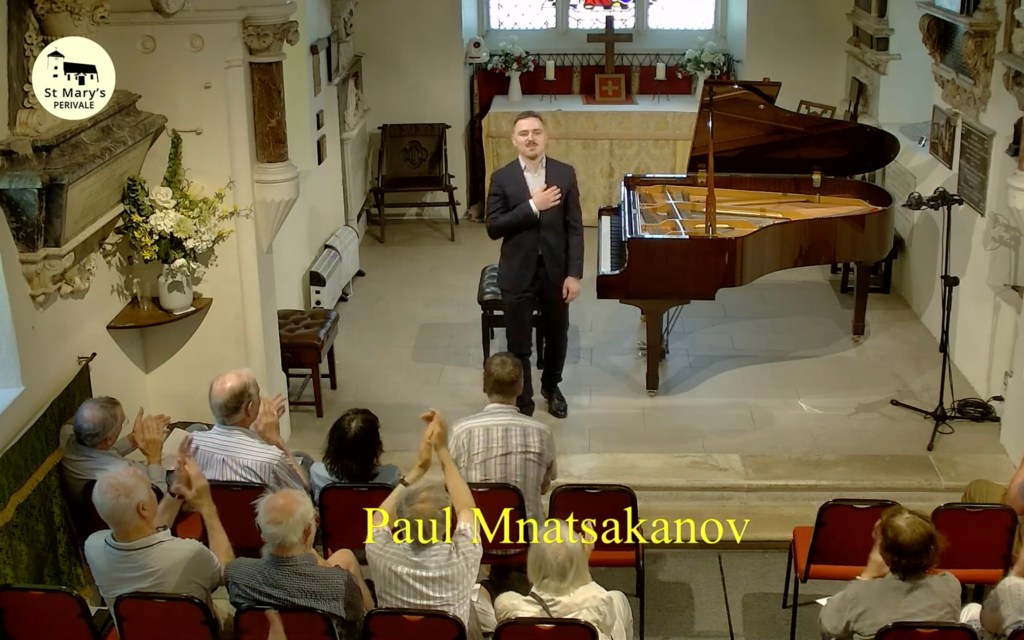
Paul Mnatsakanov is an emerging young American-Russian-Armenian pianist, collaborative pianist/répétiteur, historical keyboardist and conductor. His artistic vision is that music, as a universal language of sound, conveys thoughts, stories, experiences and emotions. Every piece, whether instrumental or vocal, is an expression of what it means to live and be a part of the universe. He attained a first-class degree in his undergraduate studies at the Royal College of Music in London as an RCM scholar and as a Joint Principal Study student with the Head of Piano, Prof. Vanessa Latarche, fortepiano professor, Dr. Geoffrey Govier, and Chair of Historical Keyboard Instruments, Prof. Terence Charlston. Currently, he is in the second year of his postgraduate studies as a collaborative pianist with Prof. Vanessa Latarche, Seb Wybrew and Caroline Dowdle, as well as organ with Charlie Andrews and conducting with Peter Stark. He also studies piano with Philippe Raskin at the Gulda School of Music in Vienna, Austria, and historical keyboards (harpsichord, clavichord and fortepiano) privately with Carole Cerasi.
Paul is a laureate of multiple international competitions including “Kendall Taylor Beethoven Piano Competition” (London, 2024, 1st prize), “Valsesia Musica International Competition” (Varallo, Italy, 2023, 1st prize), “Città di Cantù International Piano and Orchestra Competition” (Cantù, Italy, 2022, 1st prize and special prize for the best performance of a Beethoven piano concerto) amongst others. He has performed in Wigmore Hall, the Elgar Room at the Royal Albert Hall, St George’s Hanover Square, and many other concert venues in England, Wales and abroad. For the 2026-2027 season, he has been offered a place on the National Opera Studio Young Artist course in London.