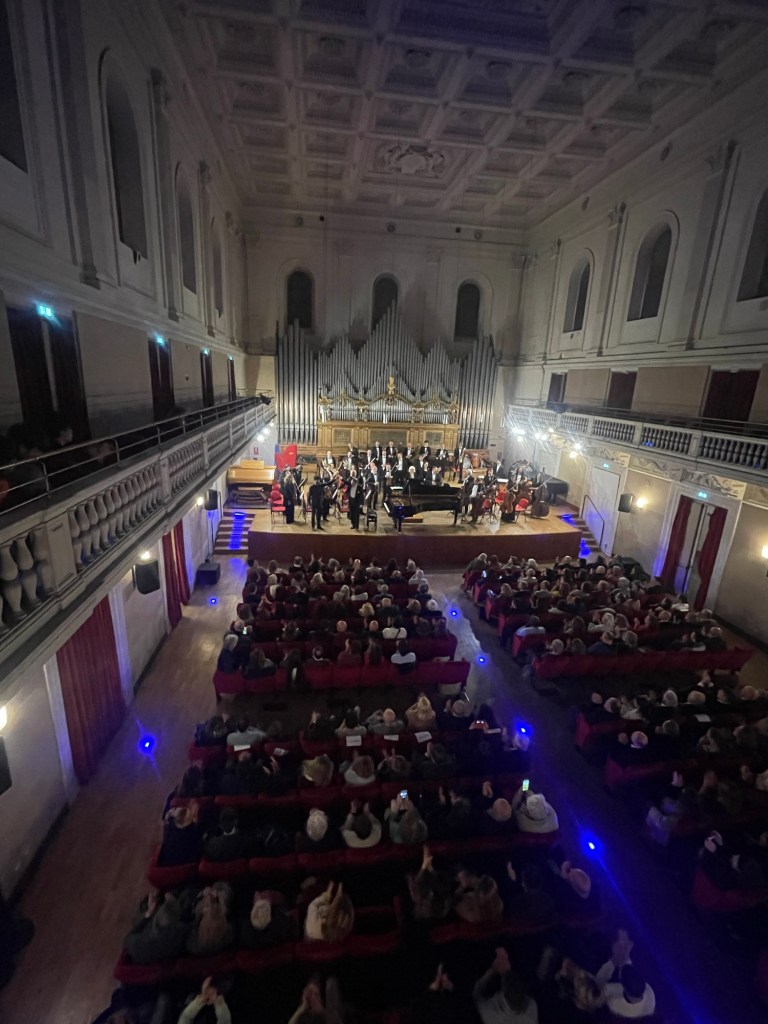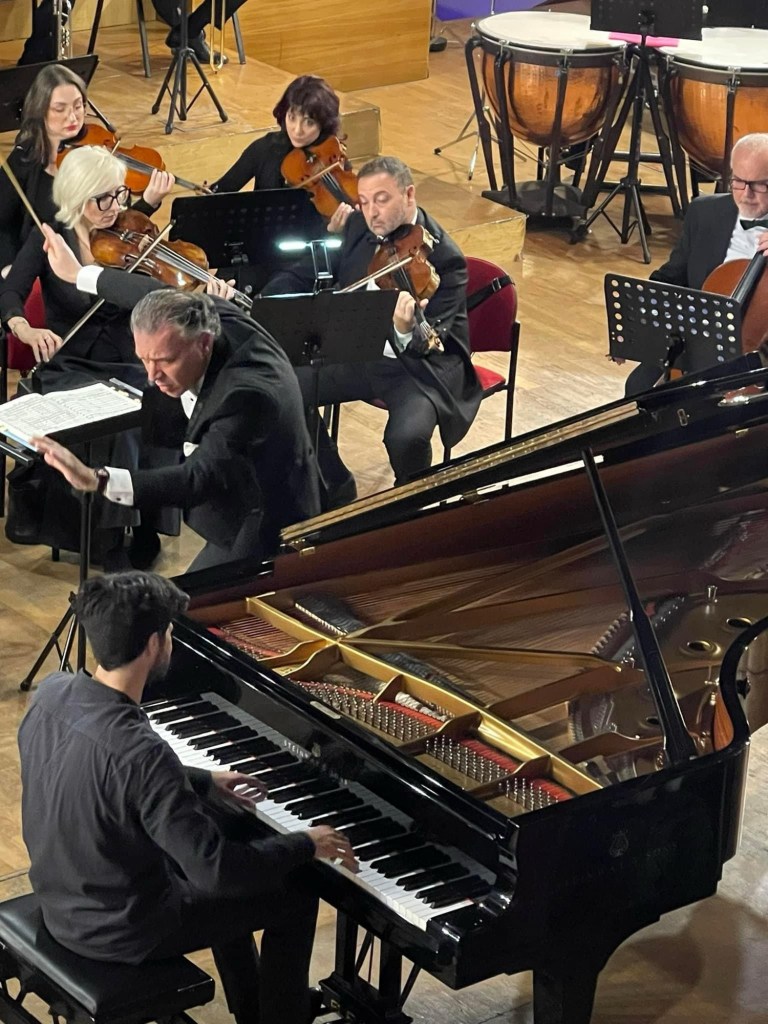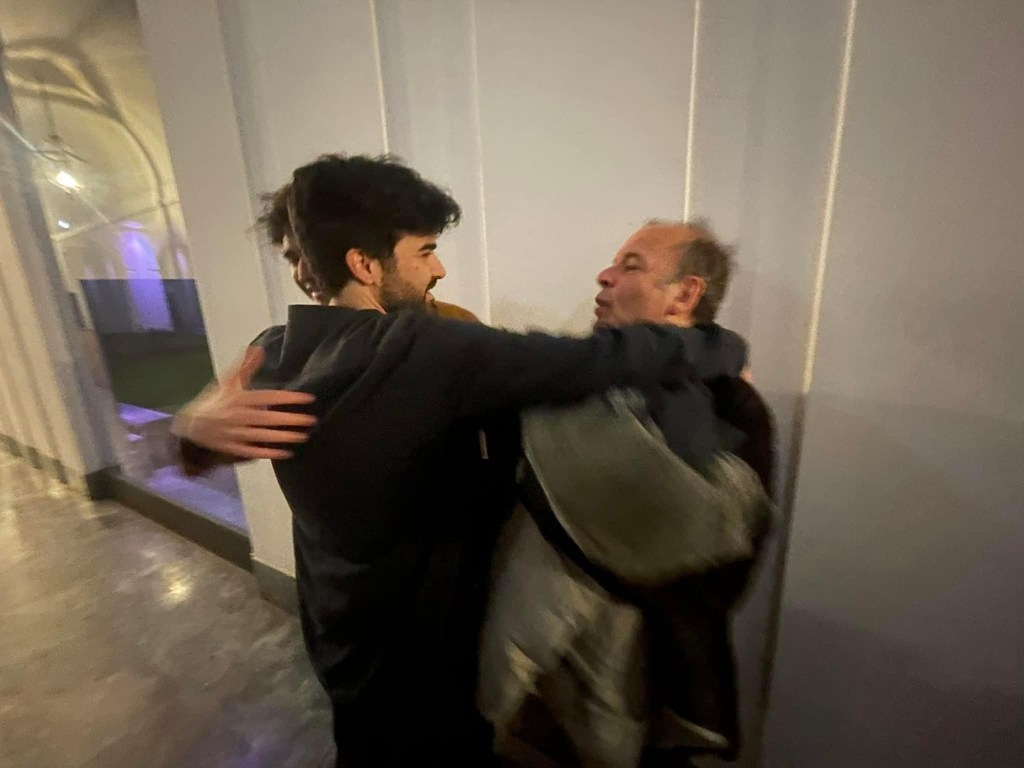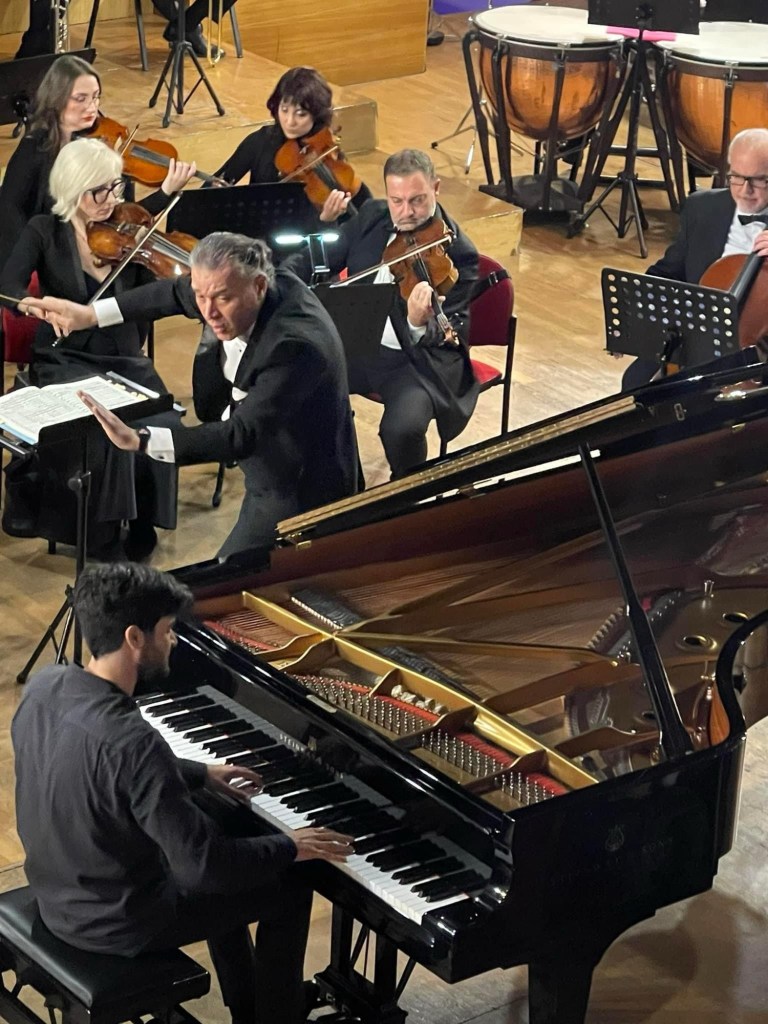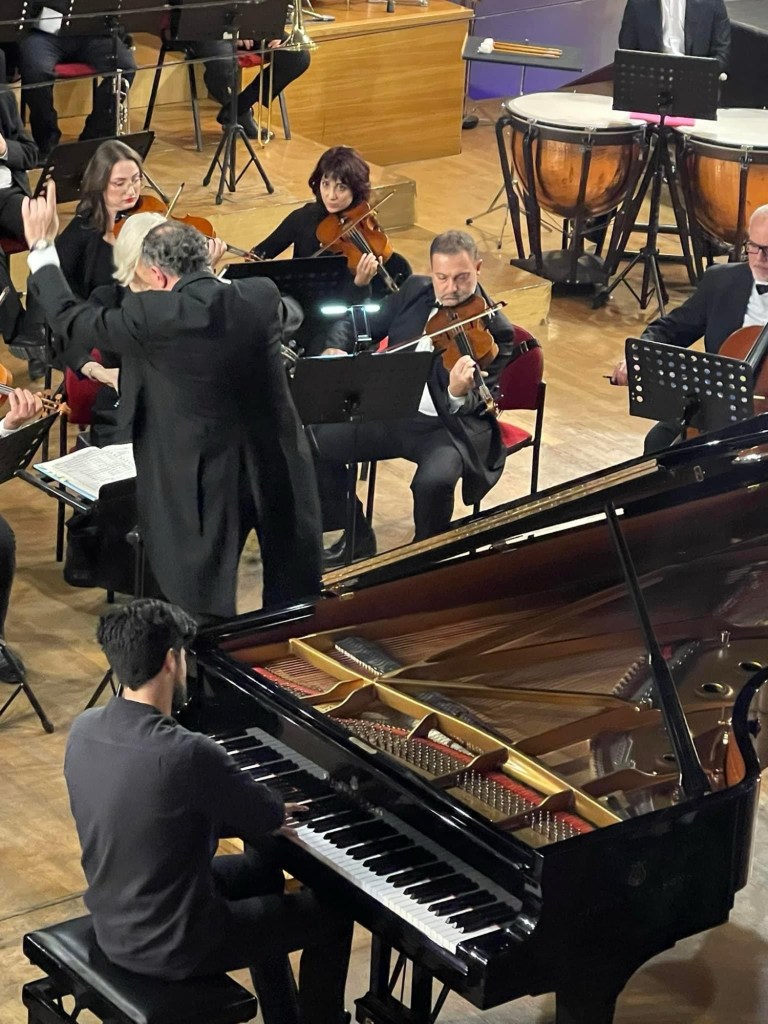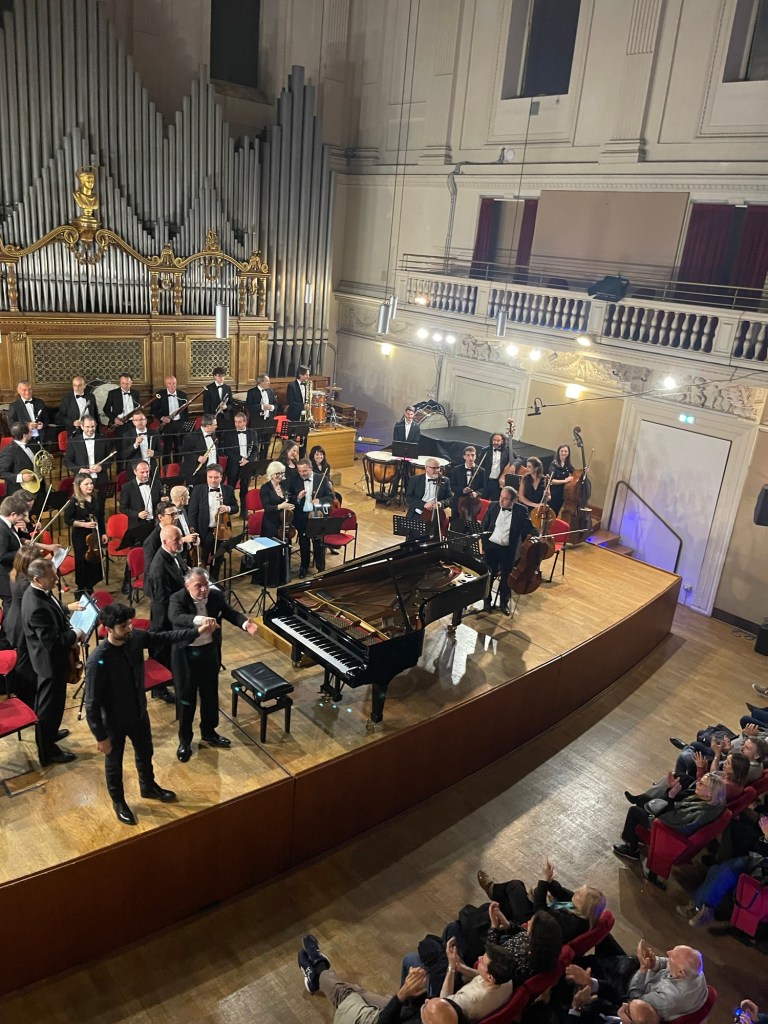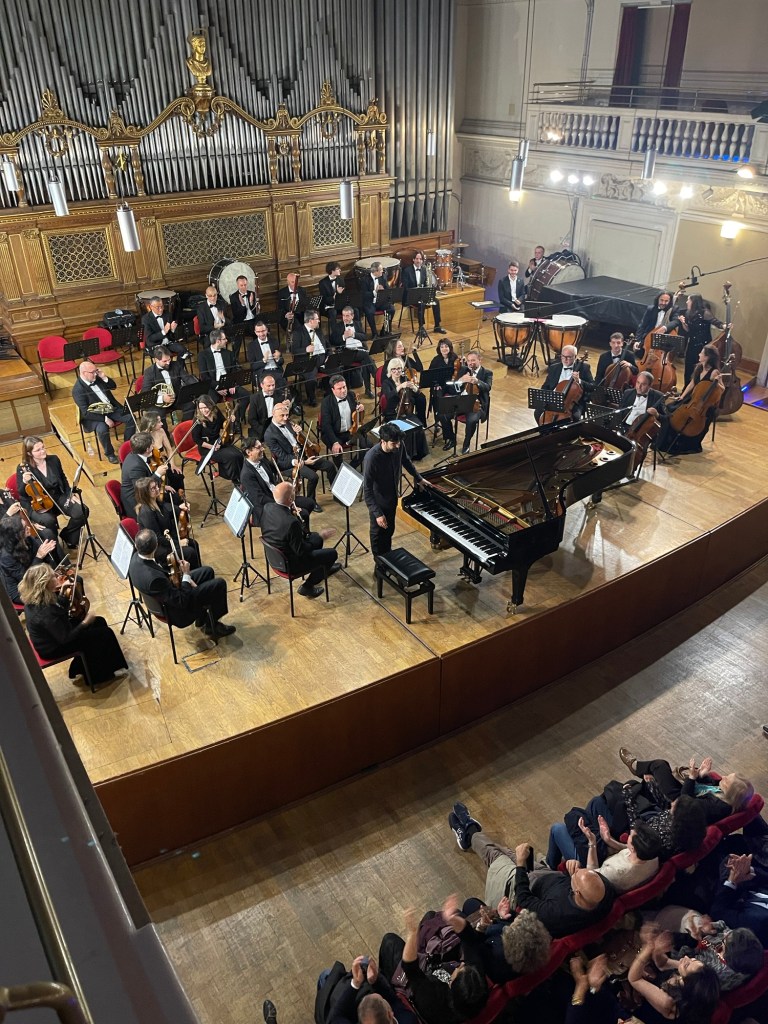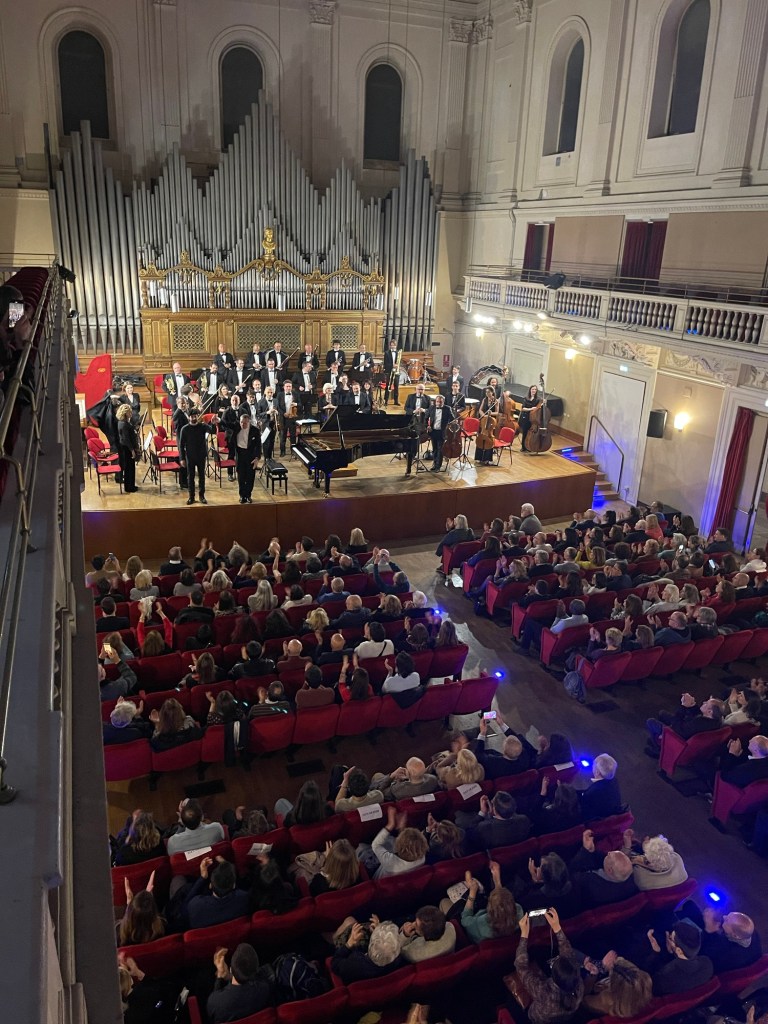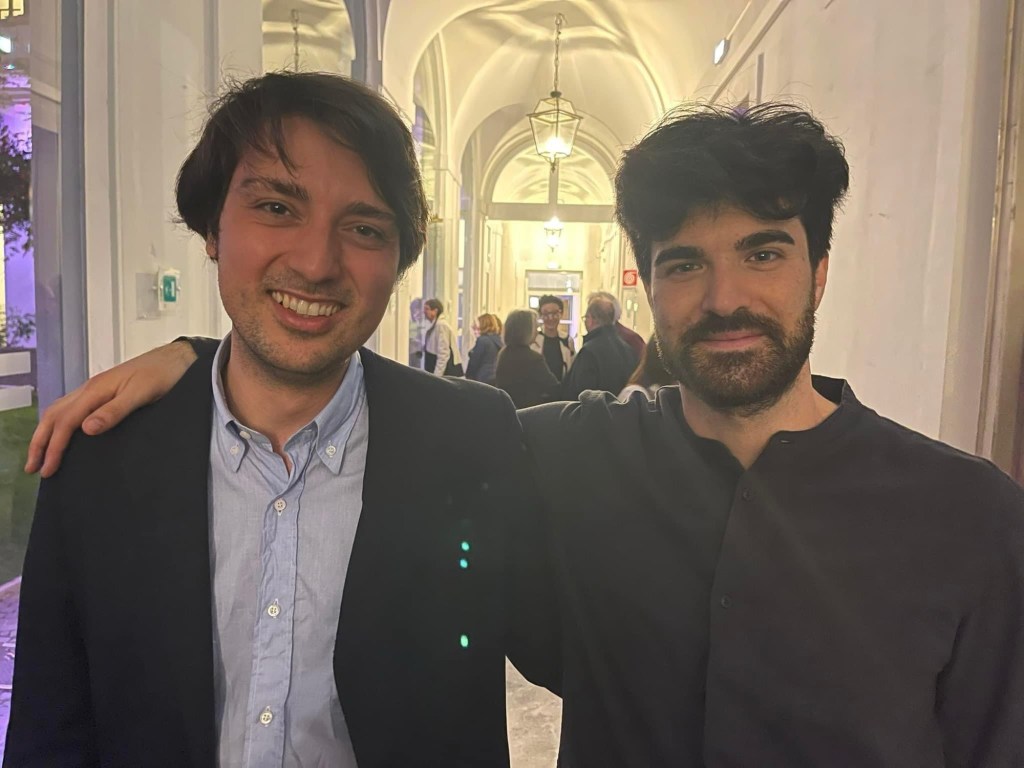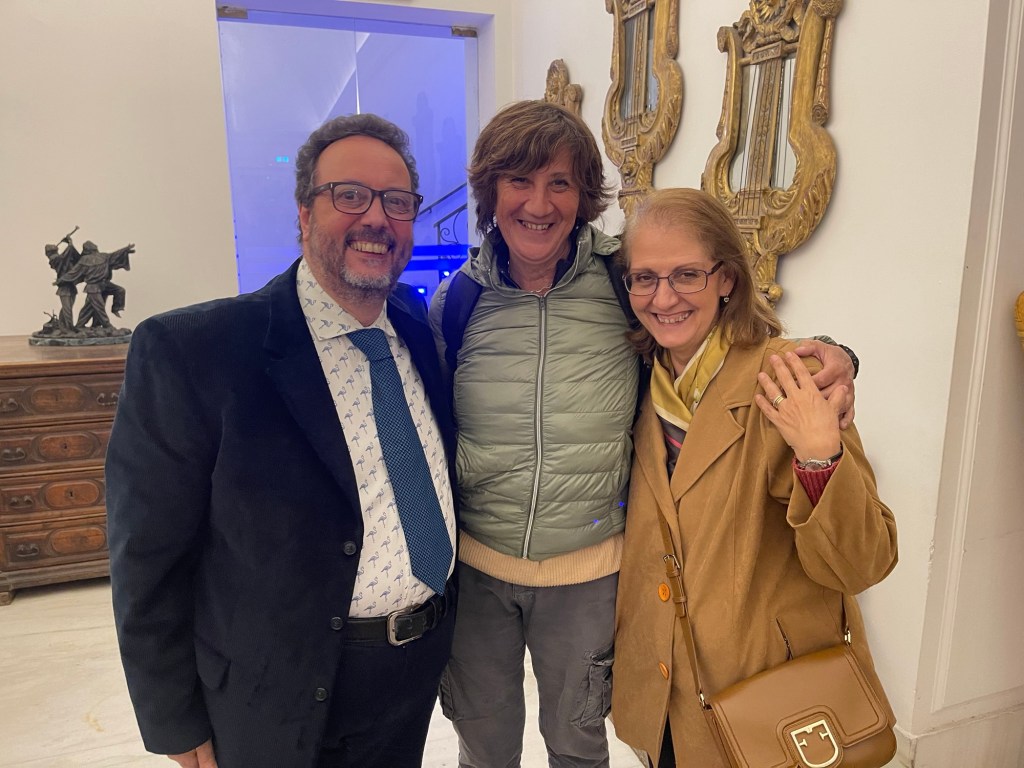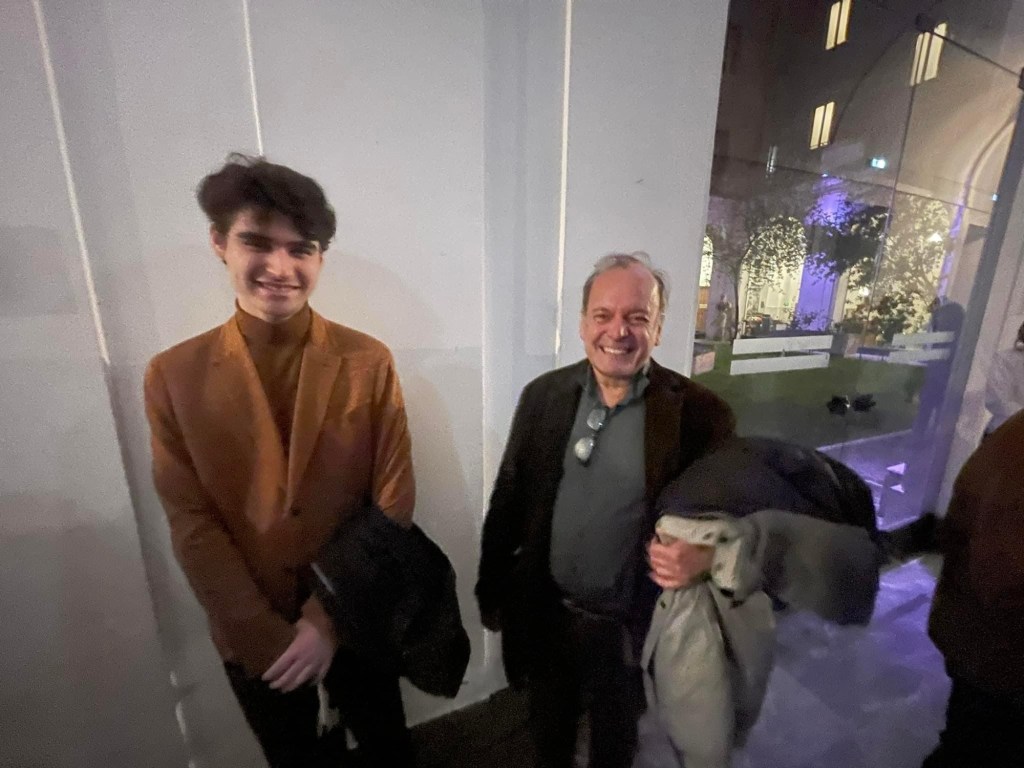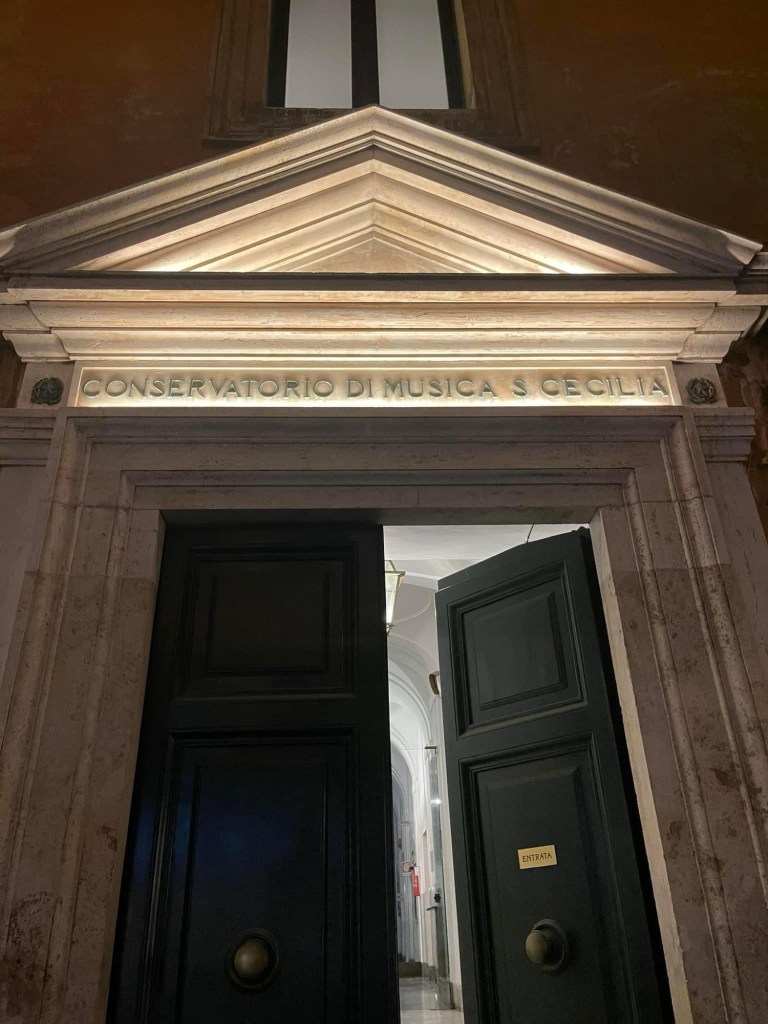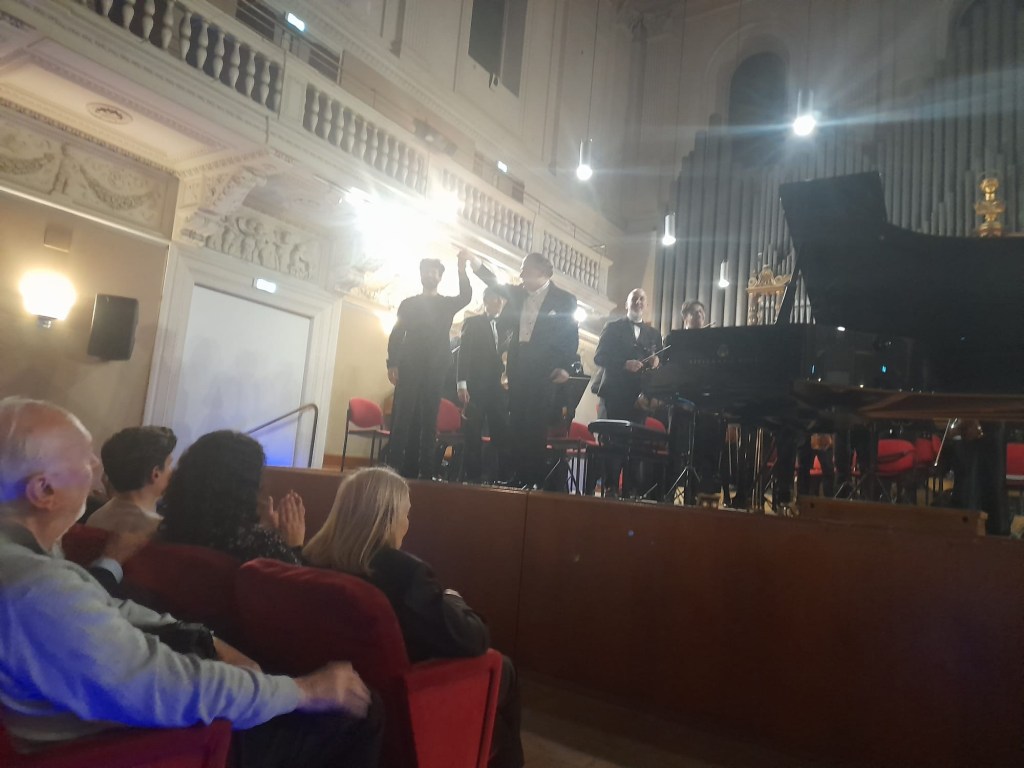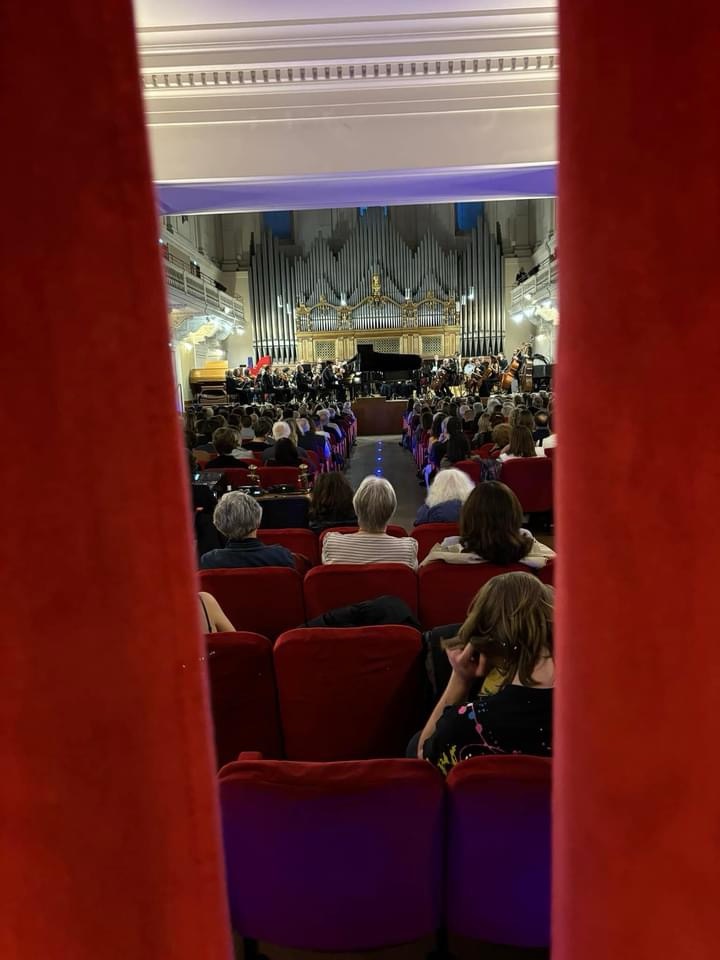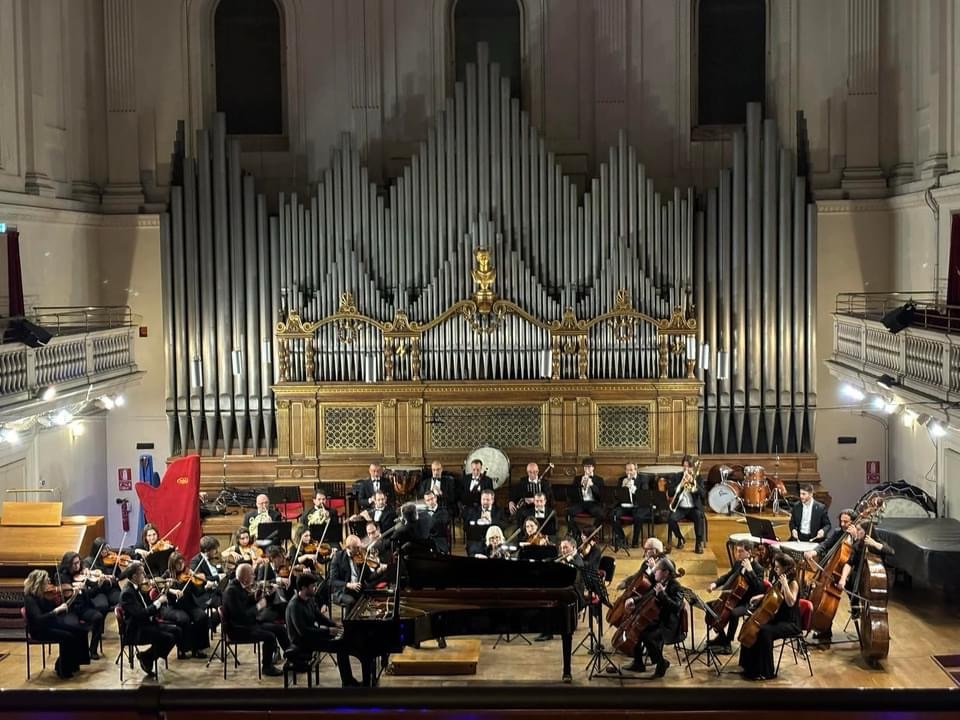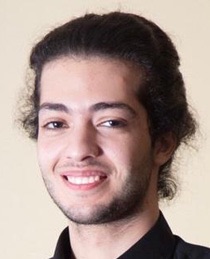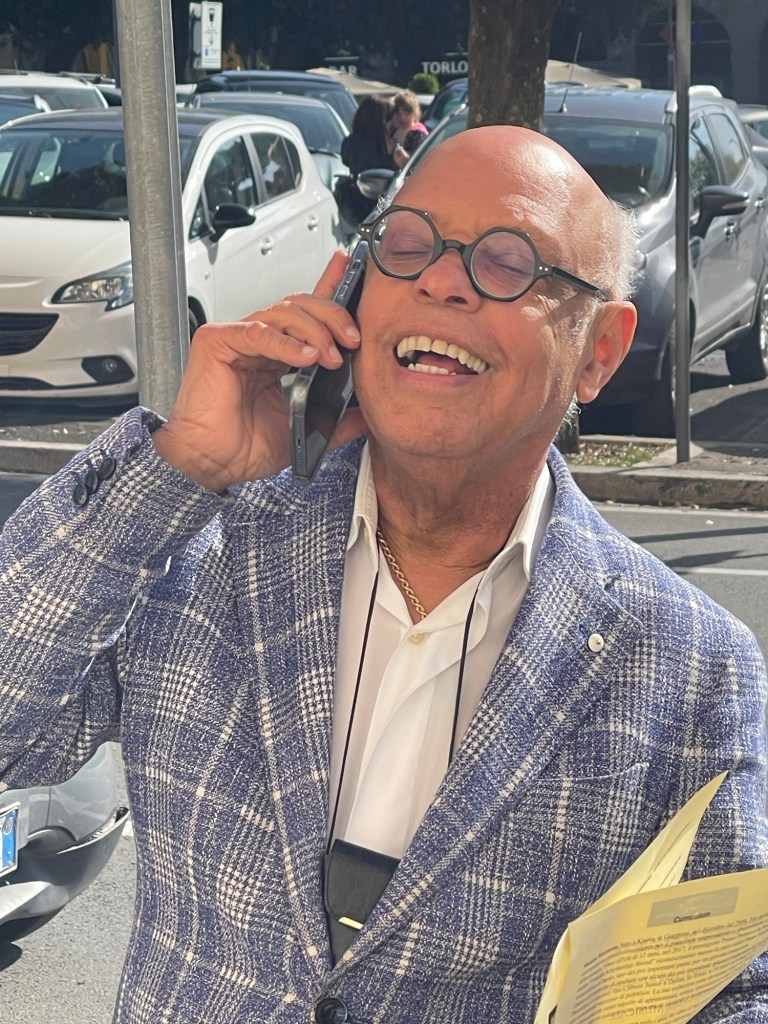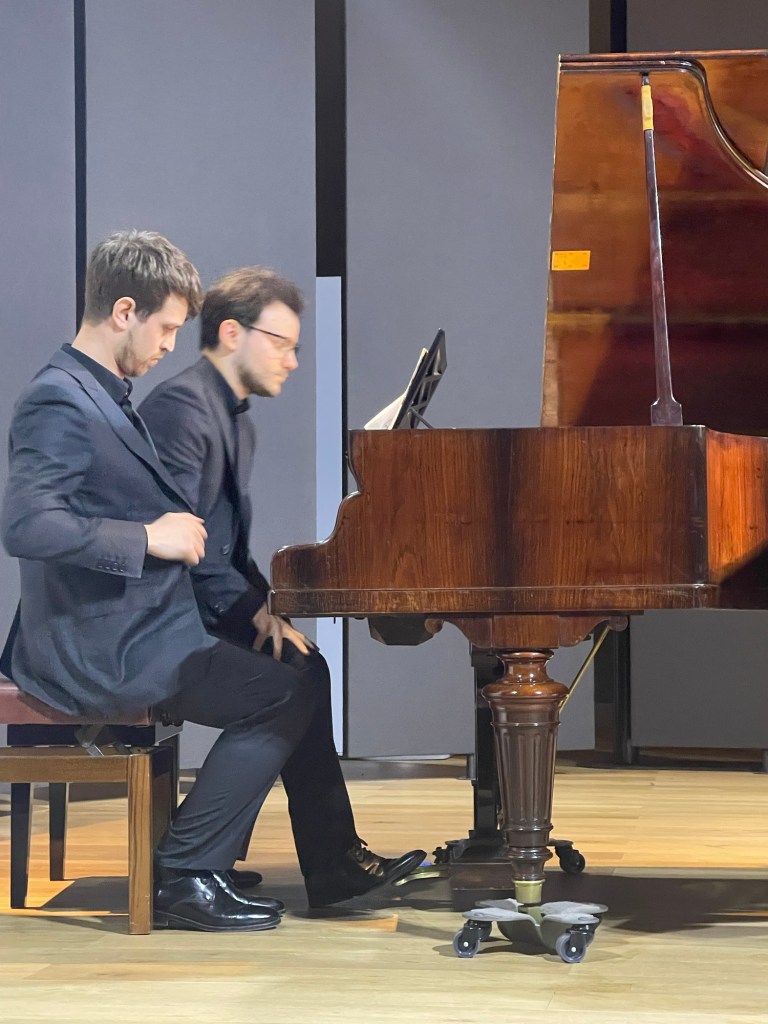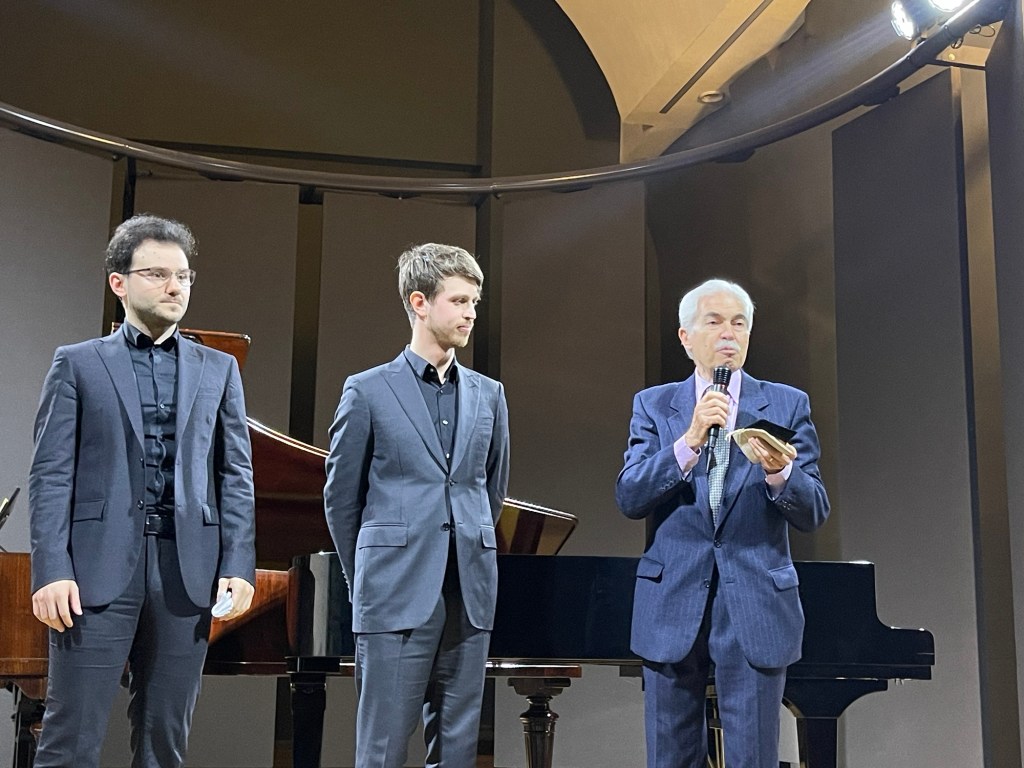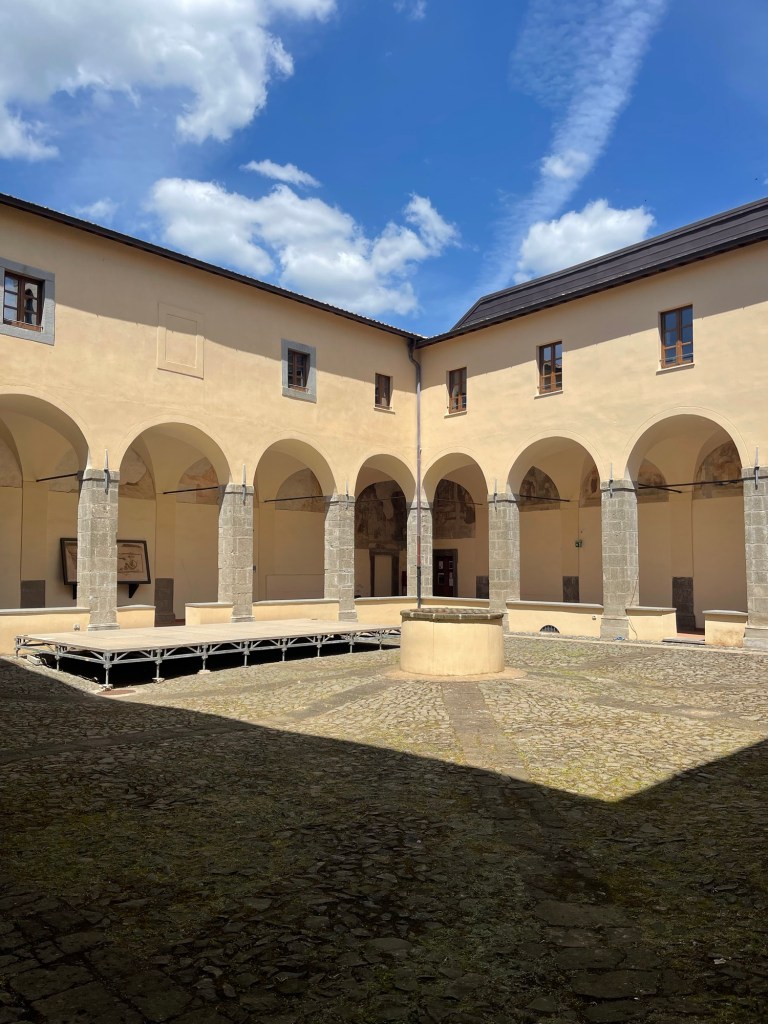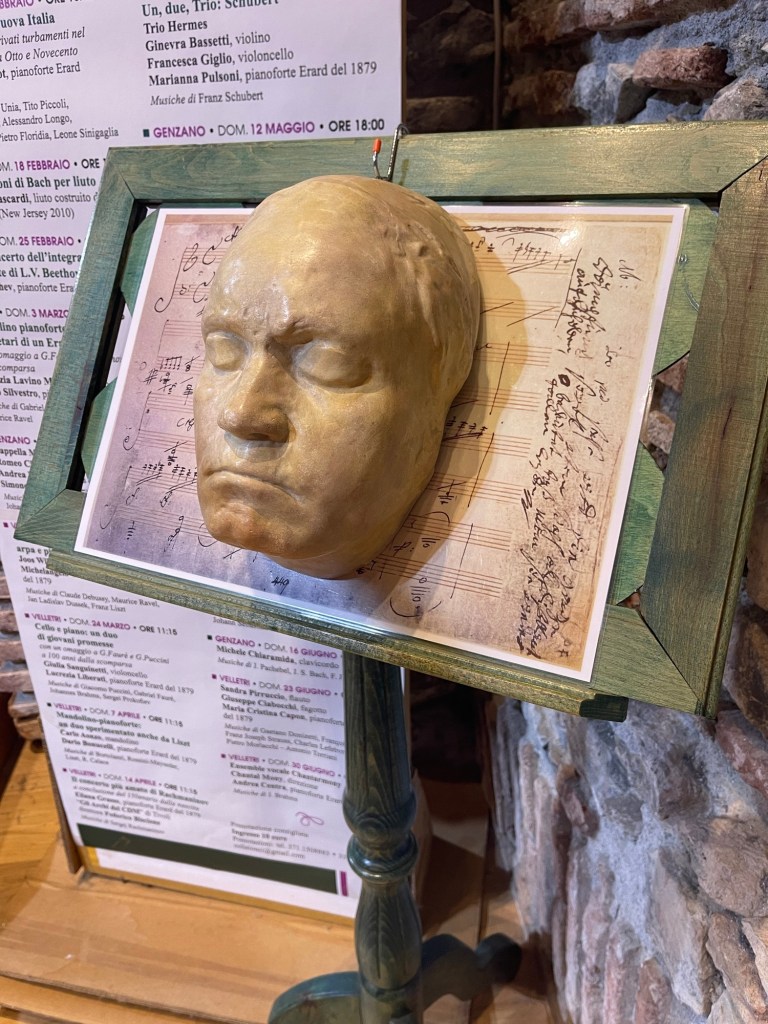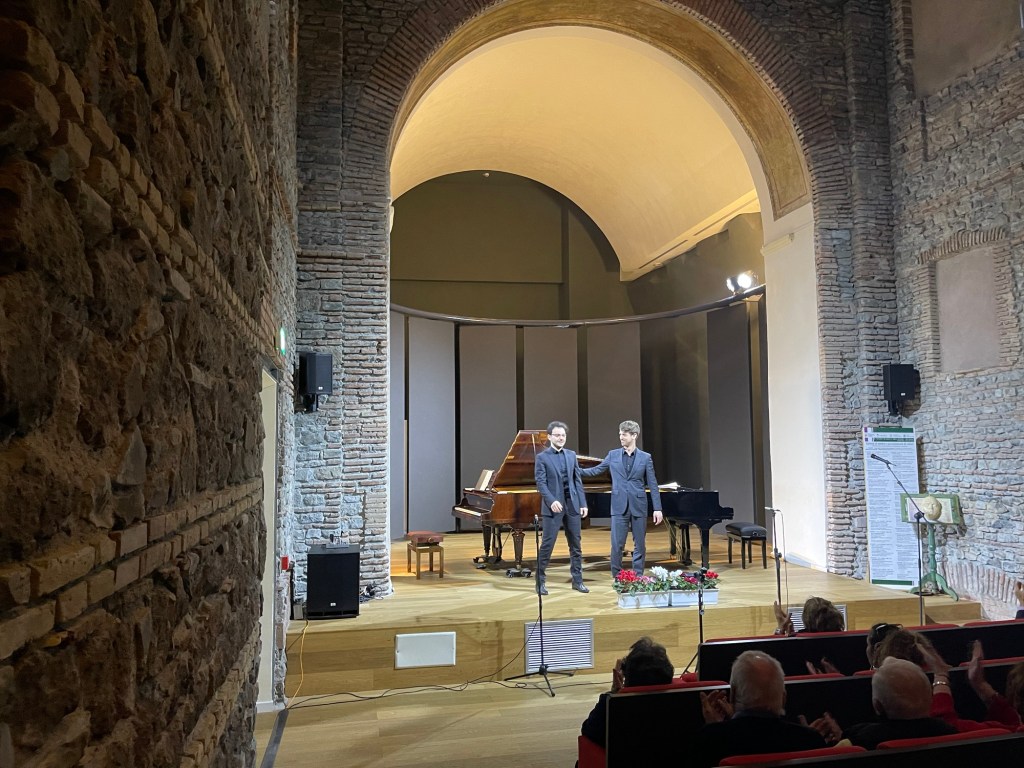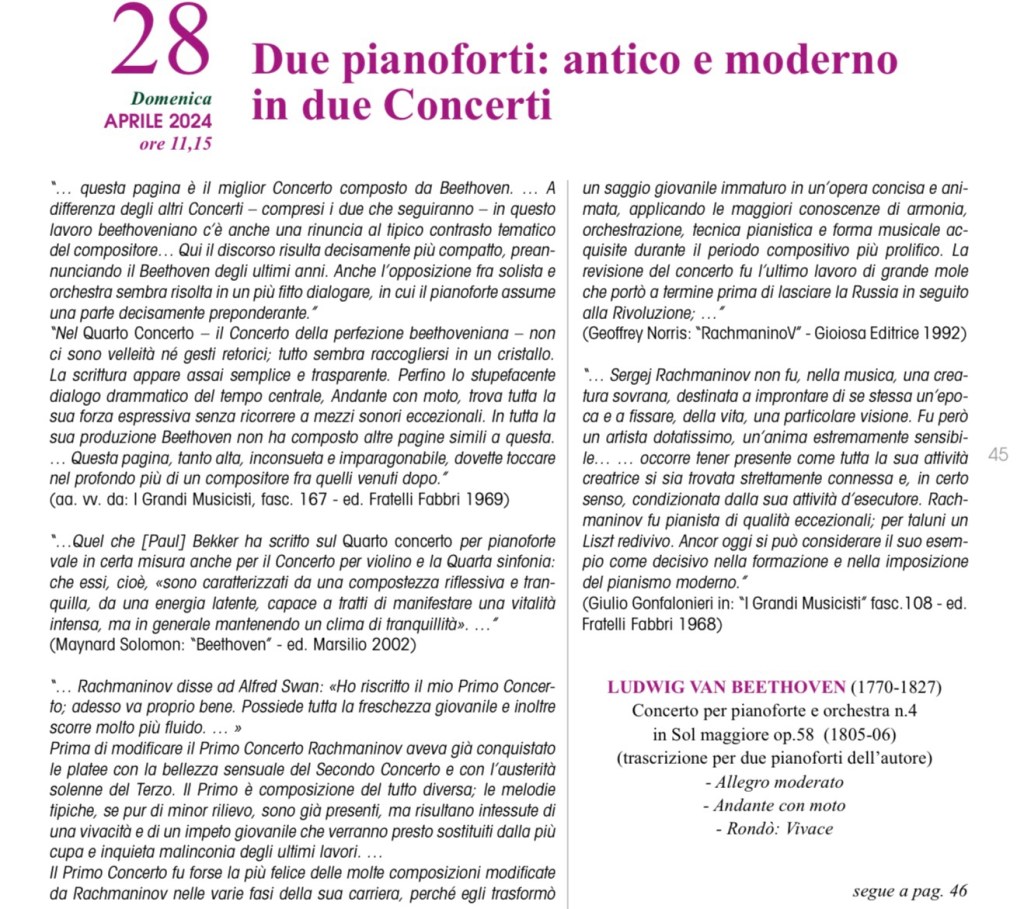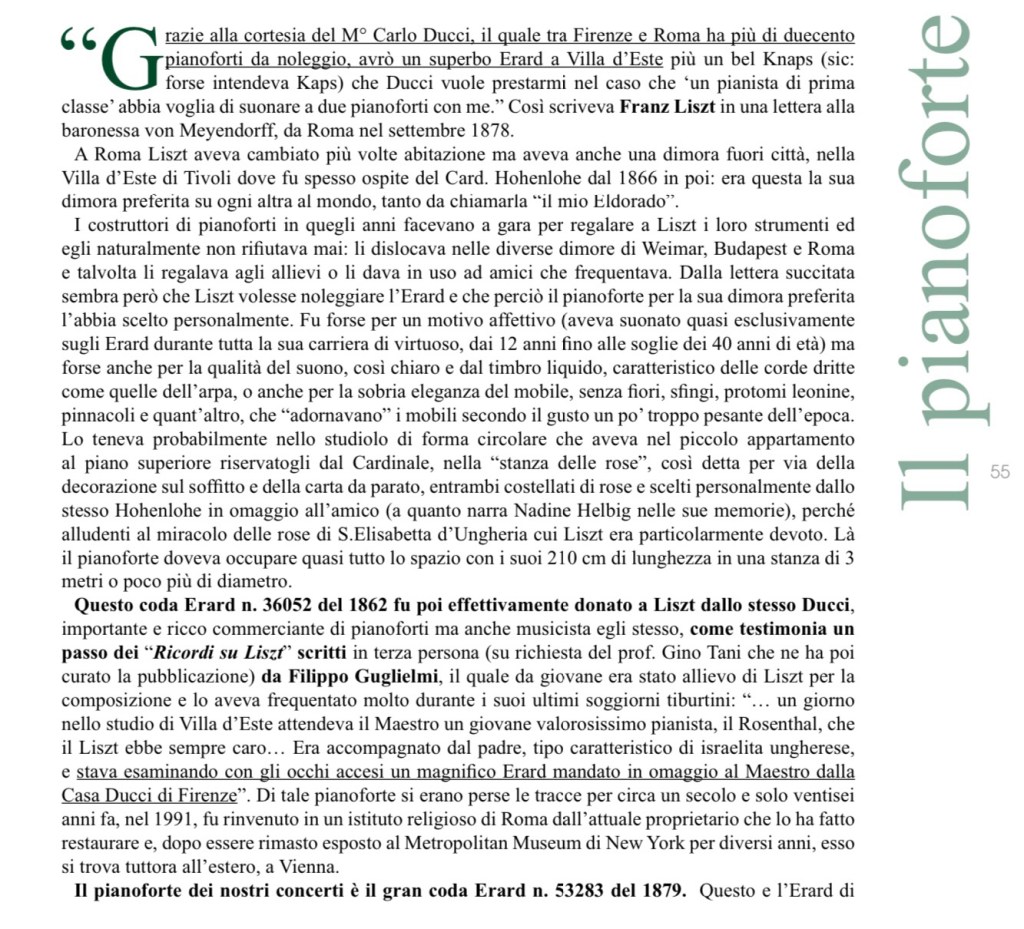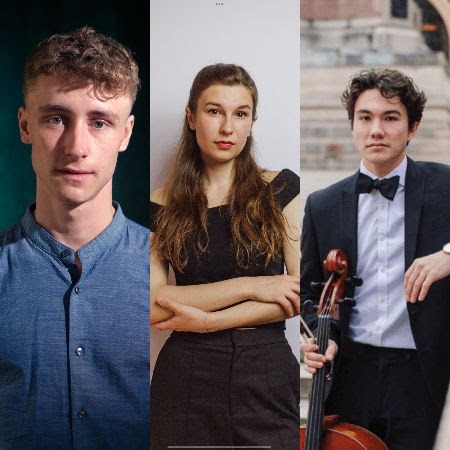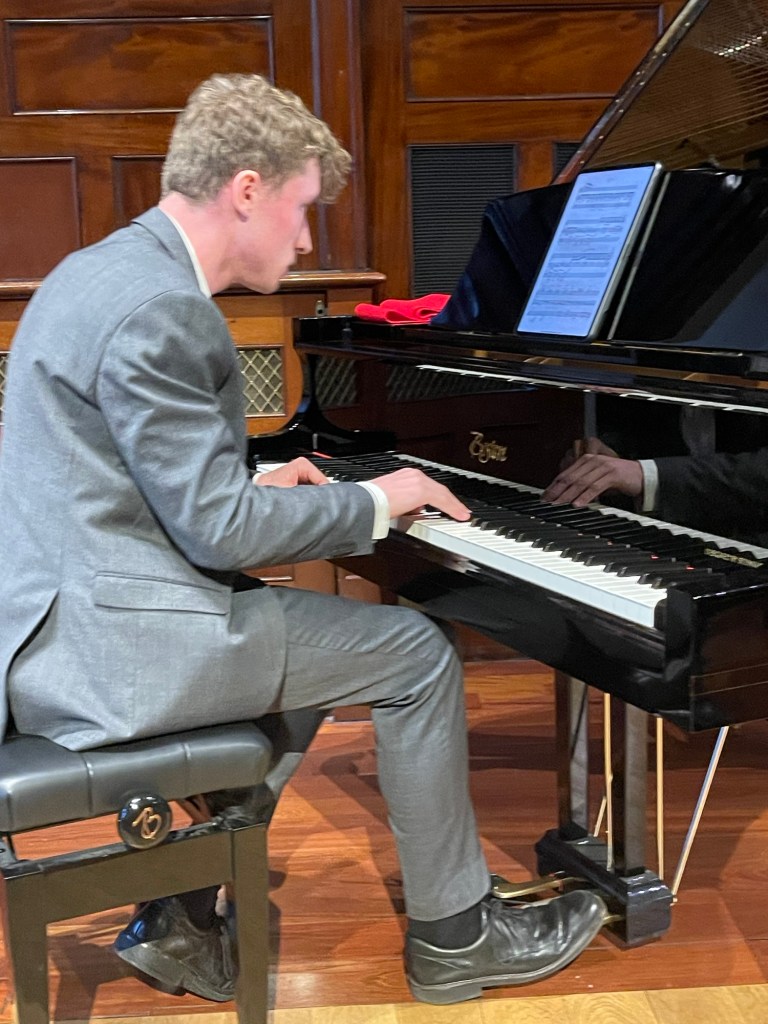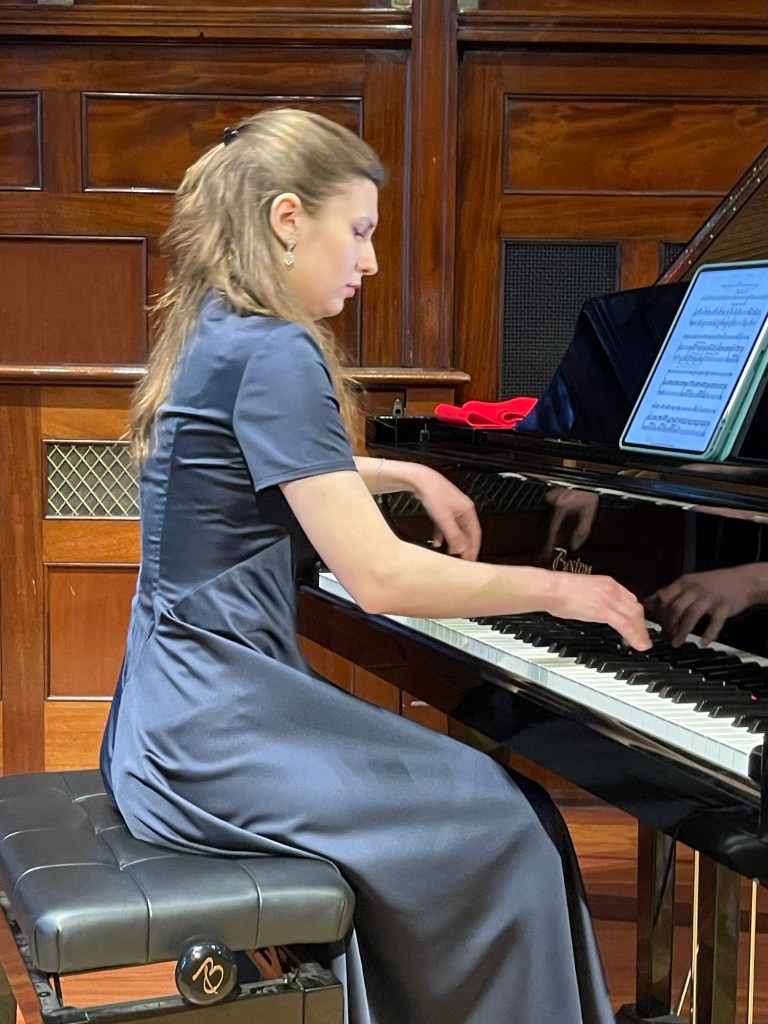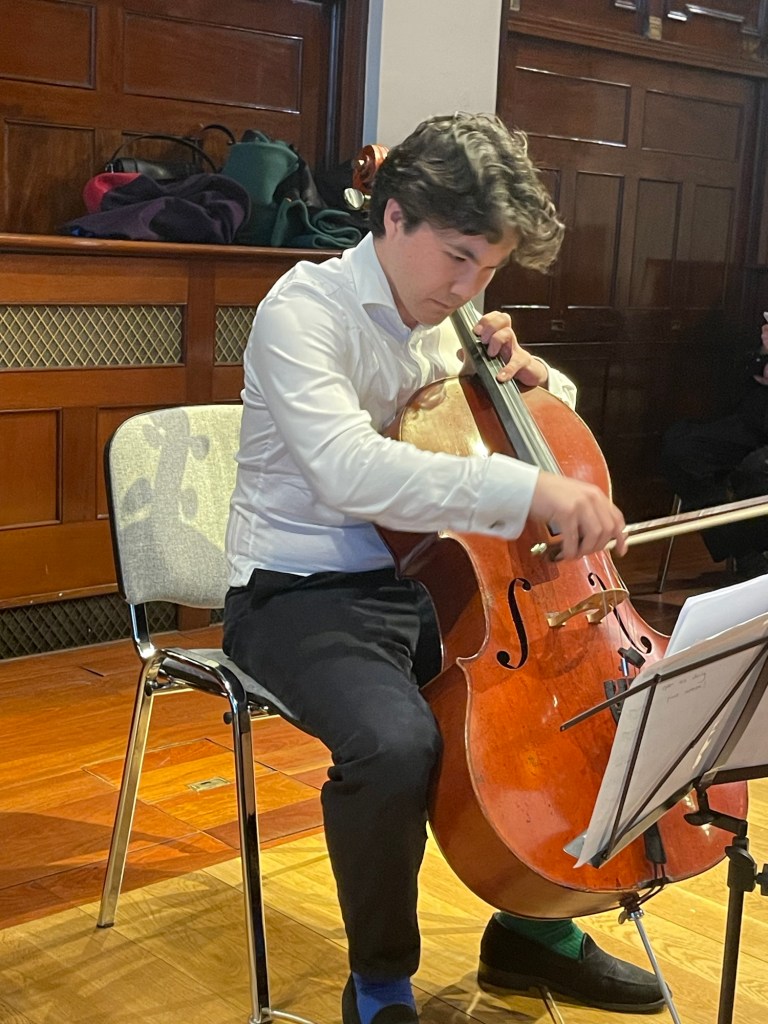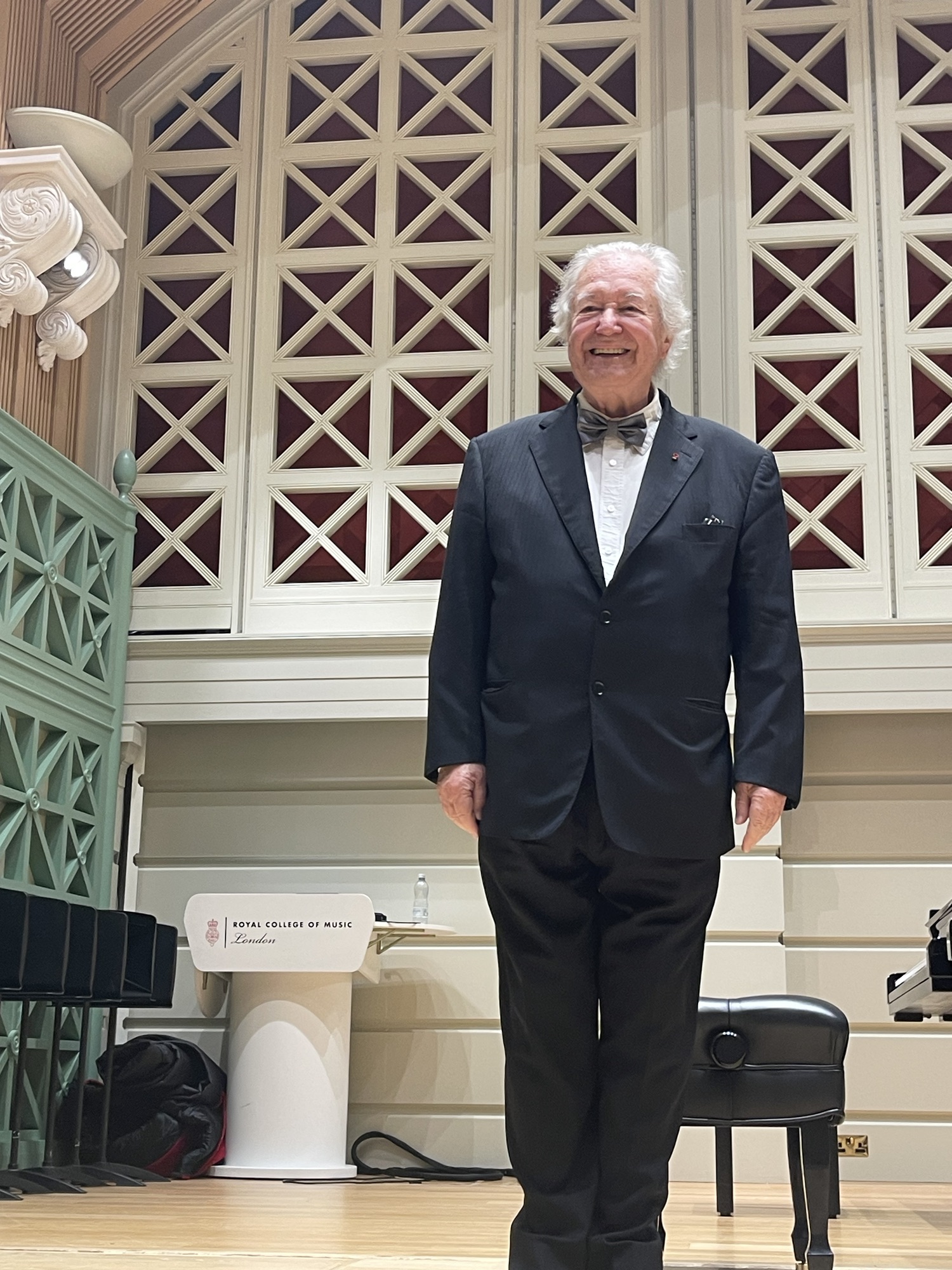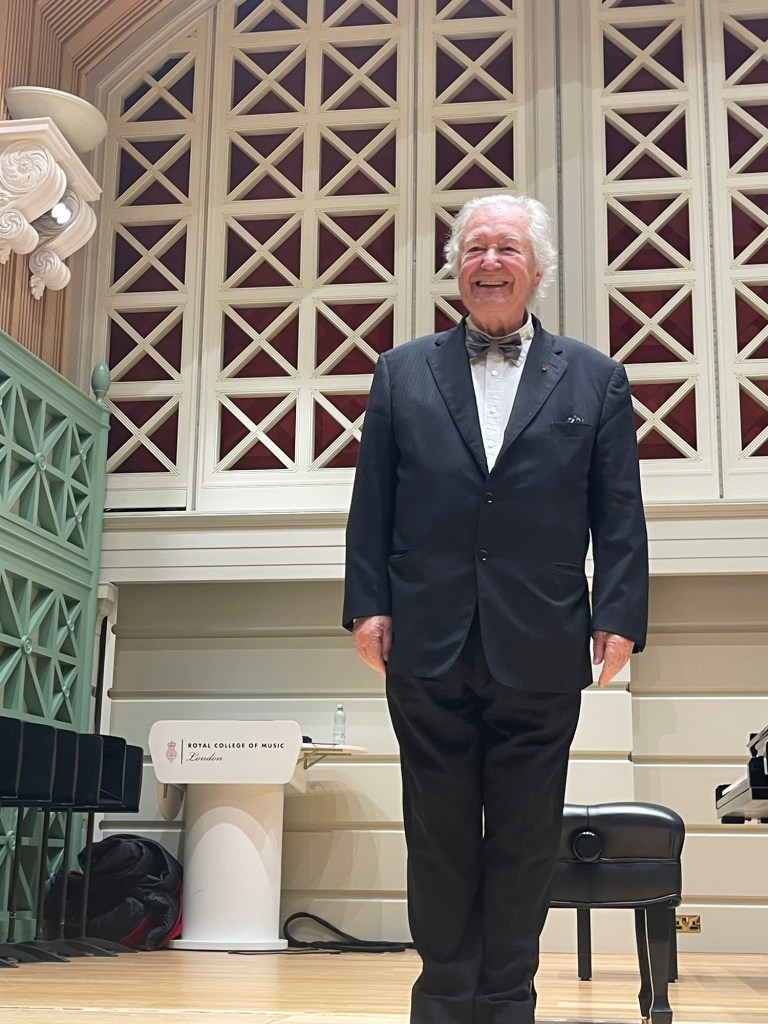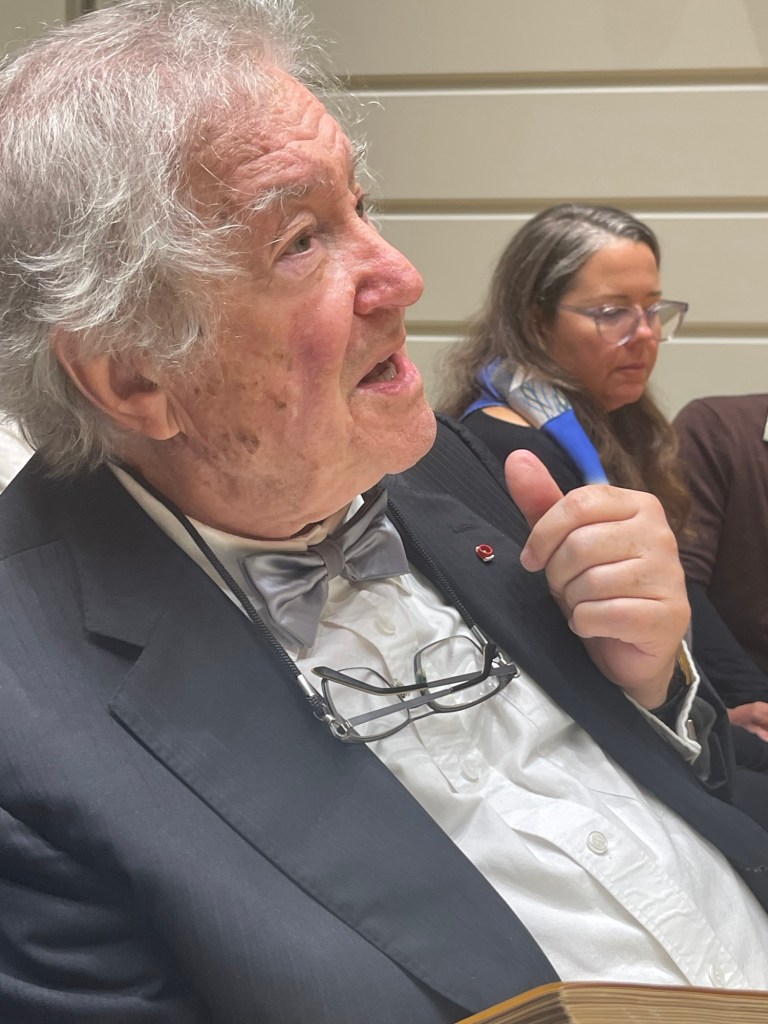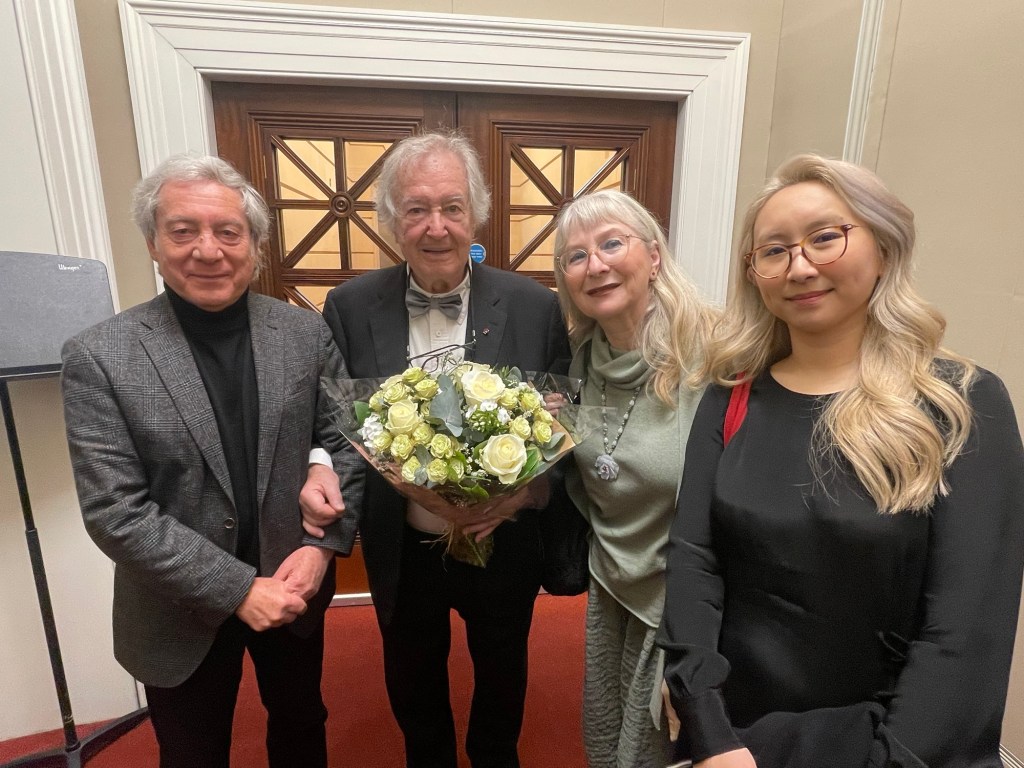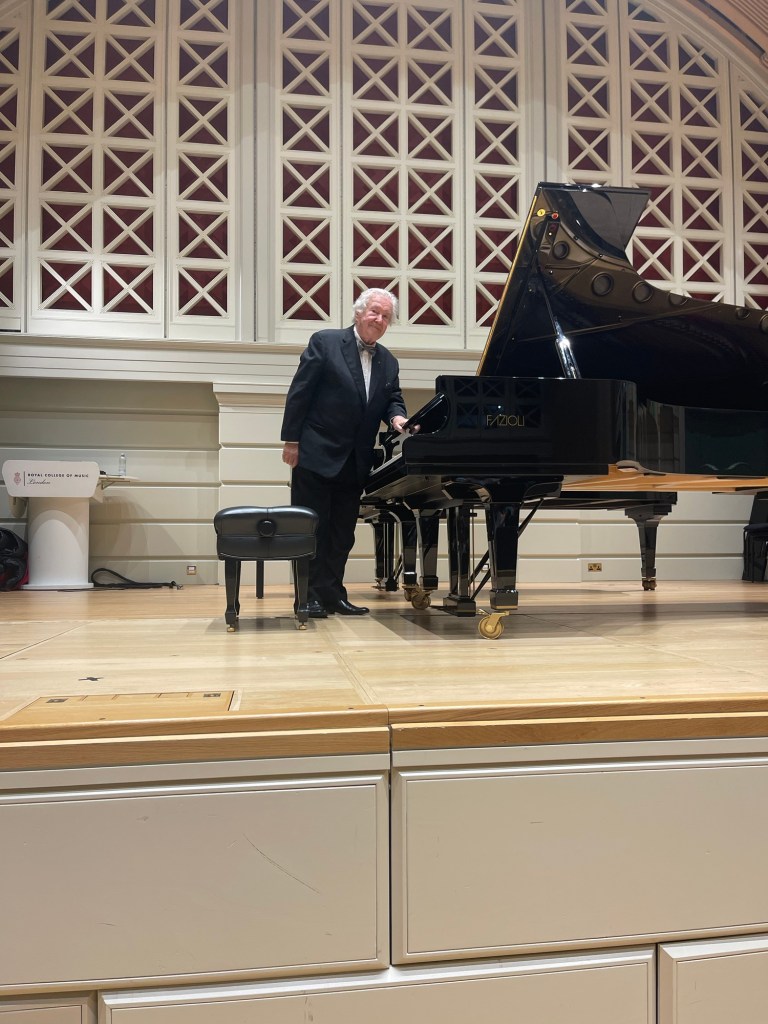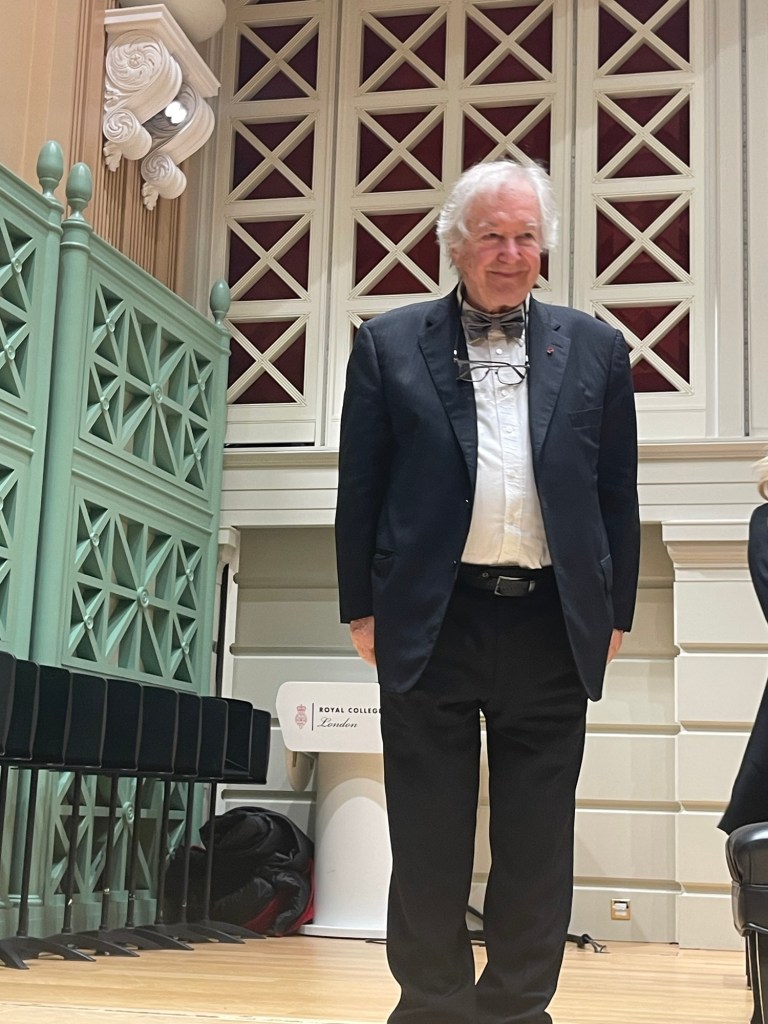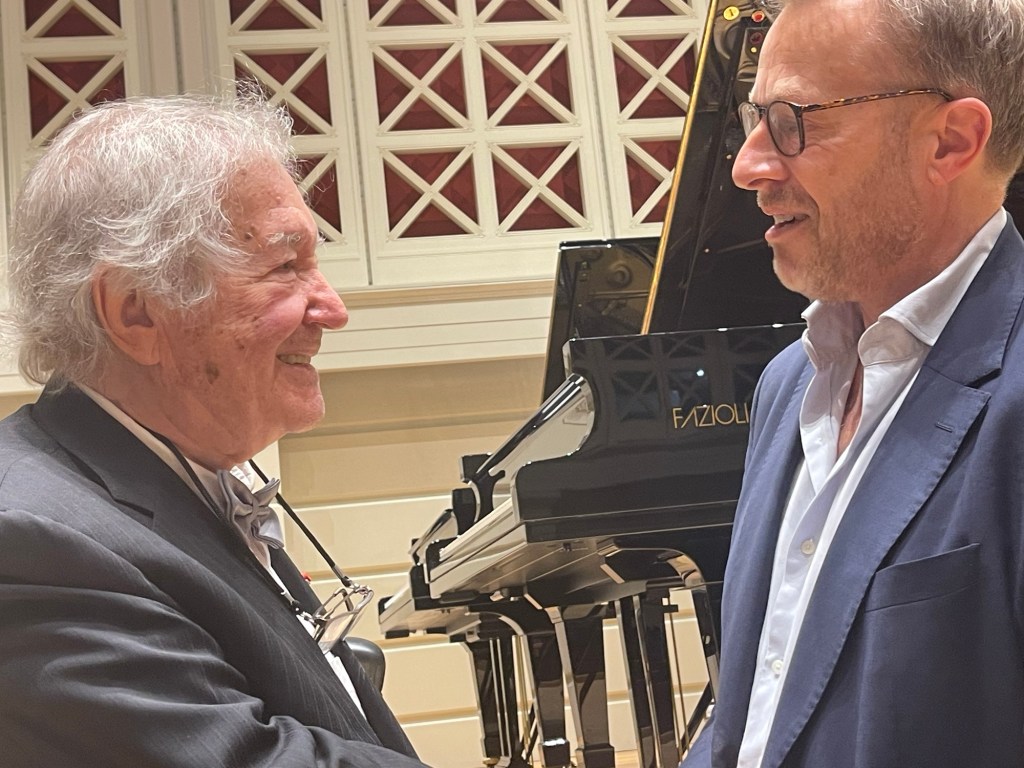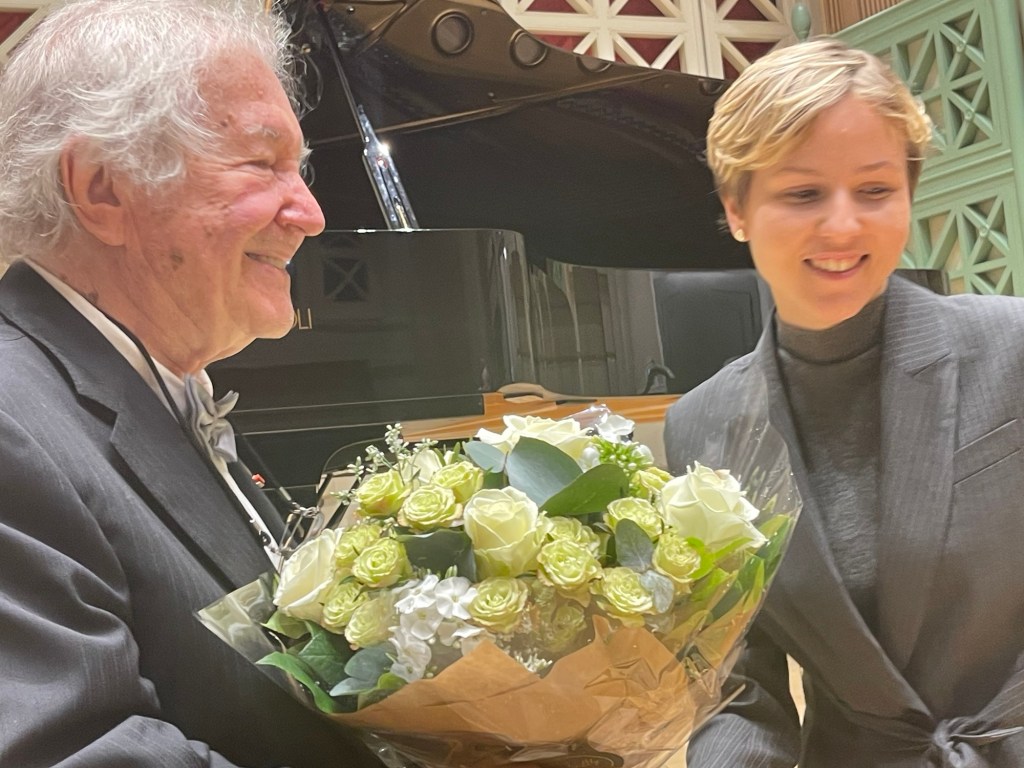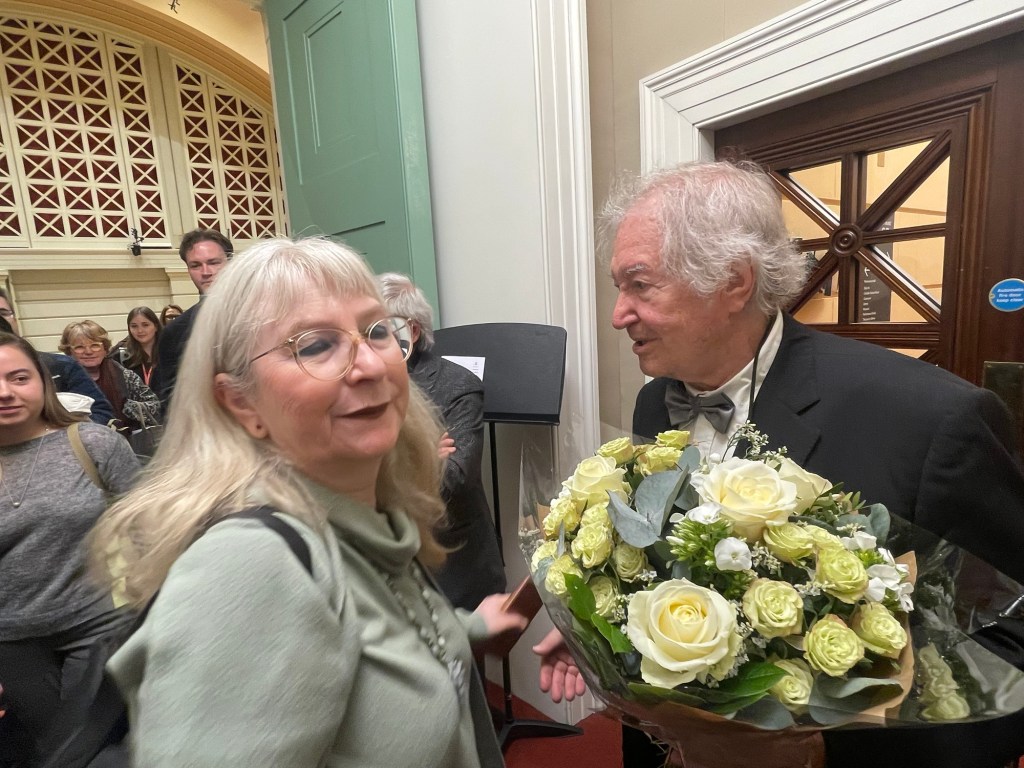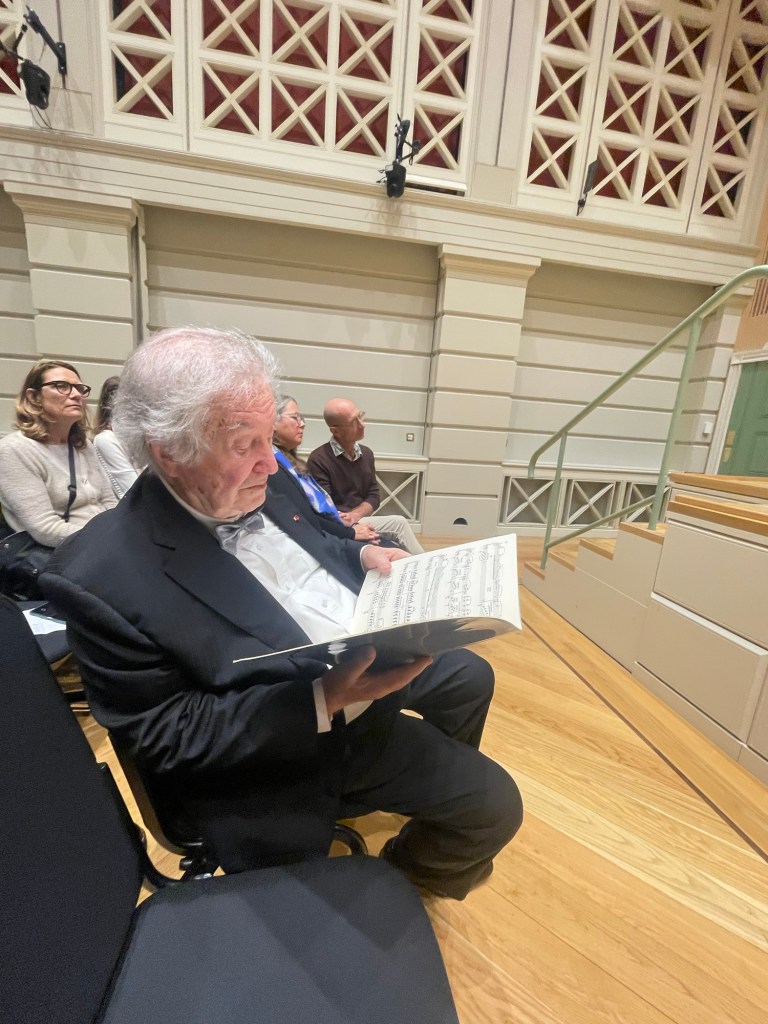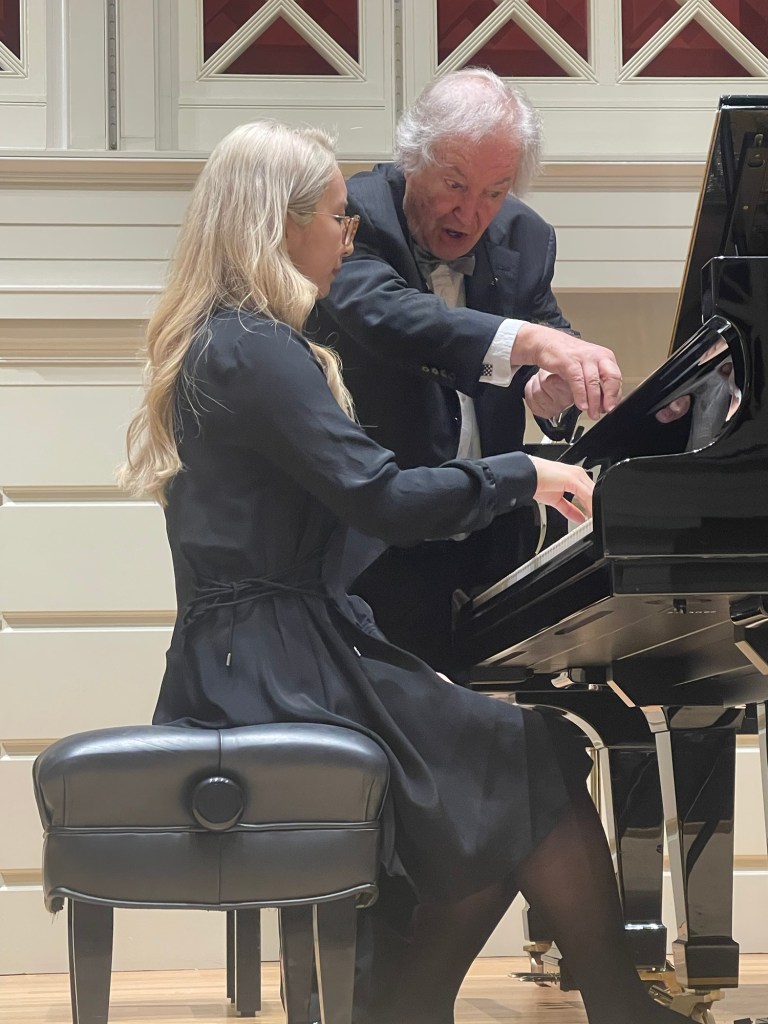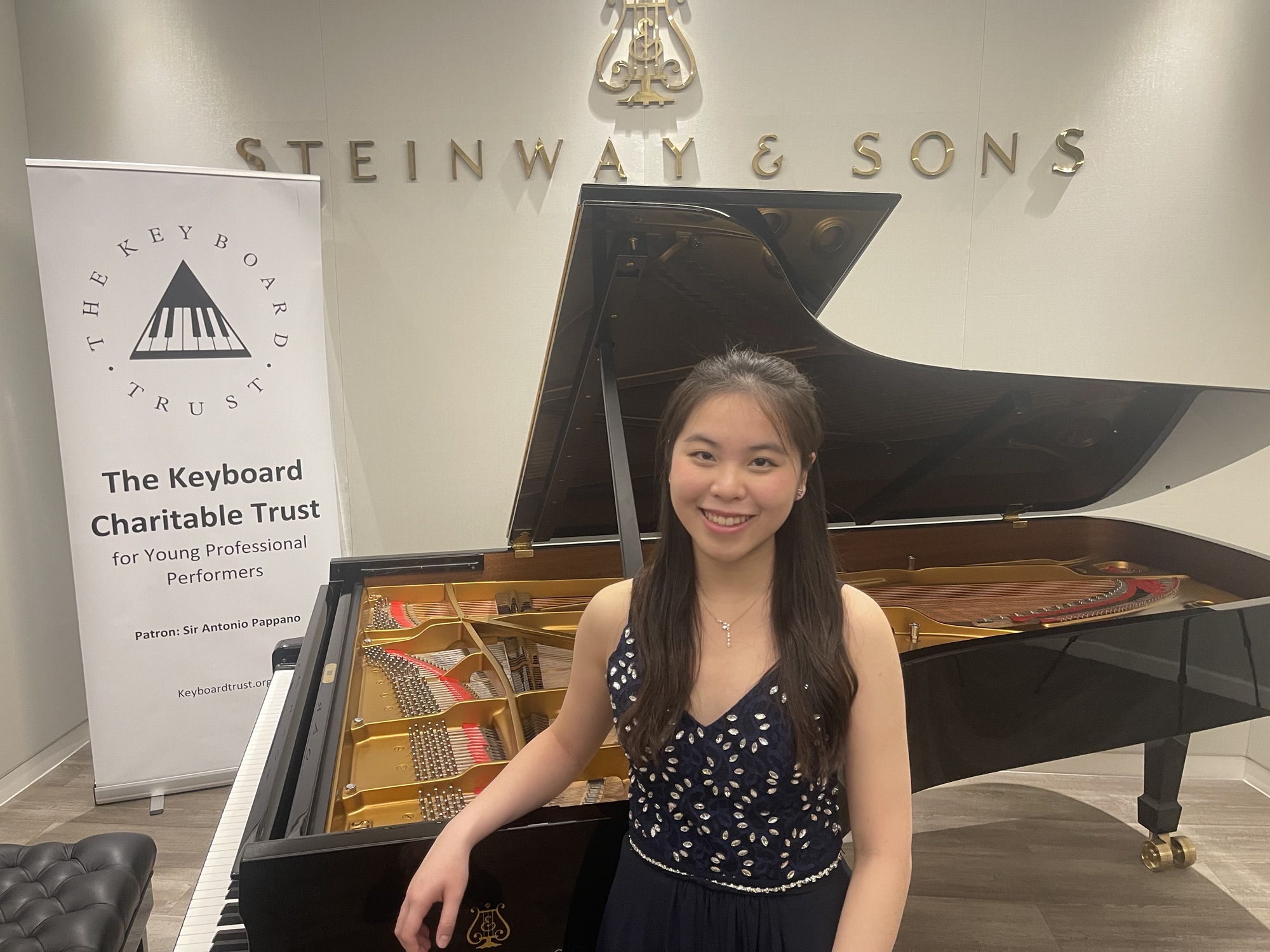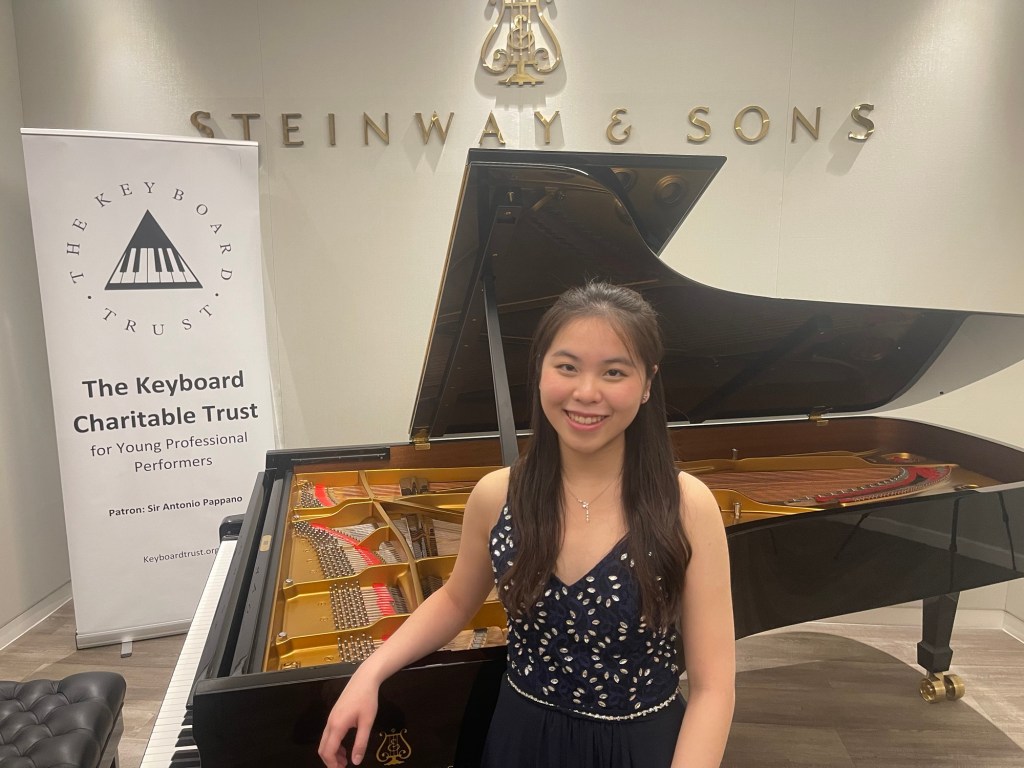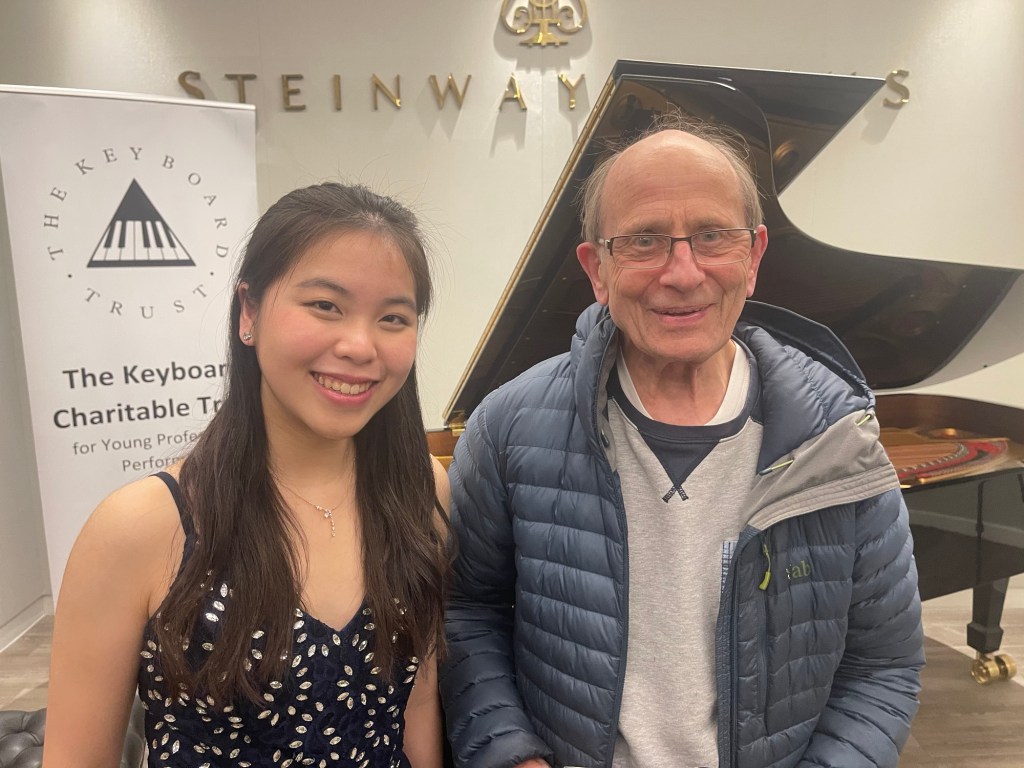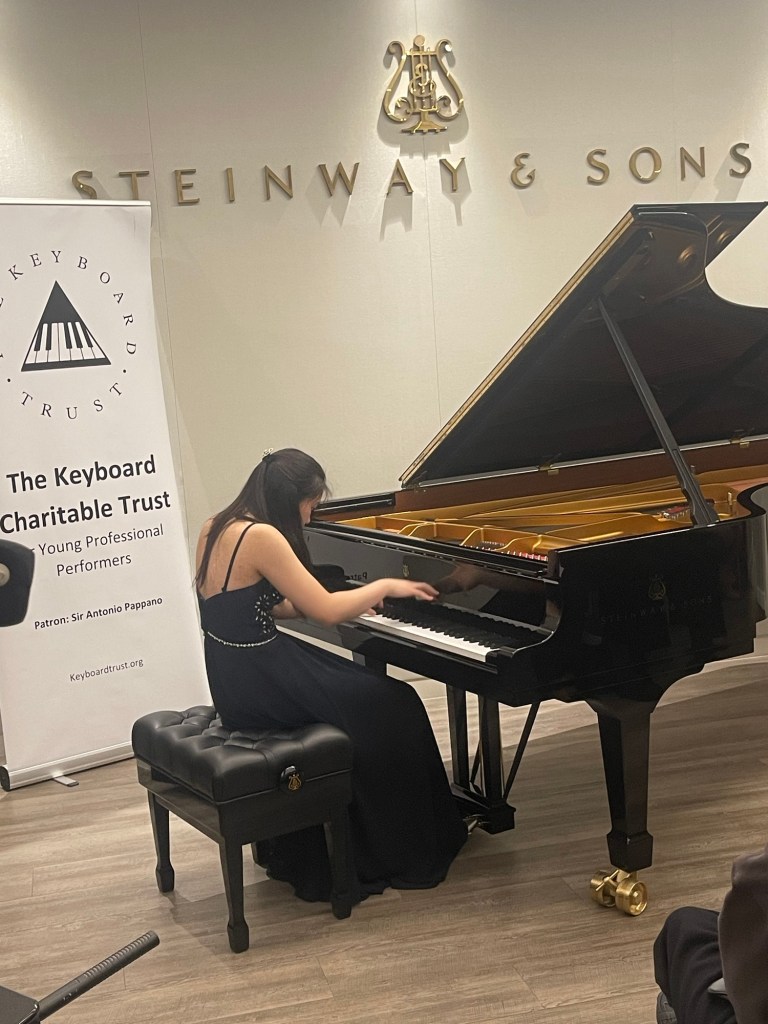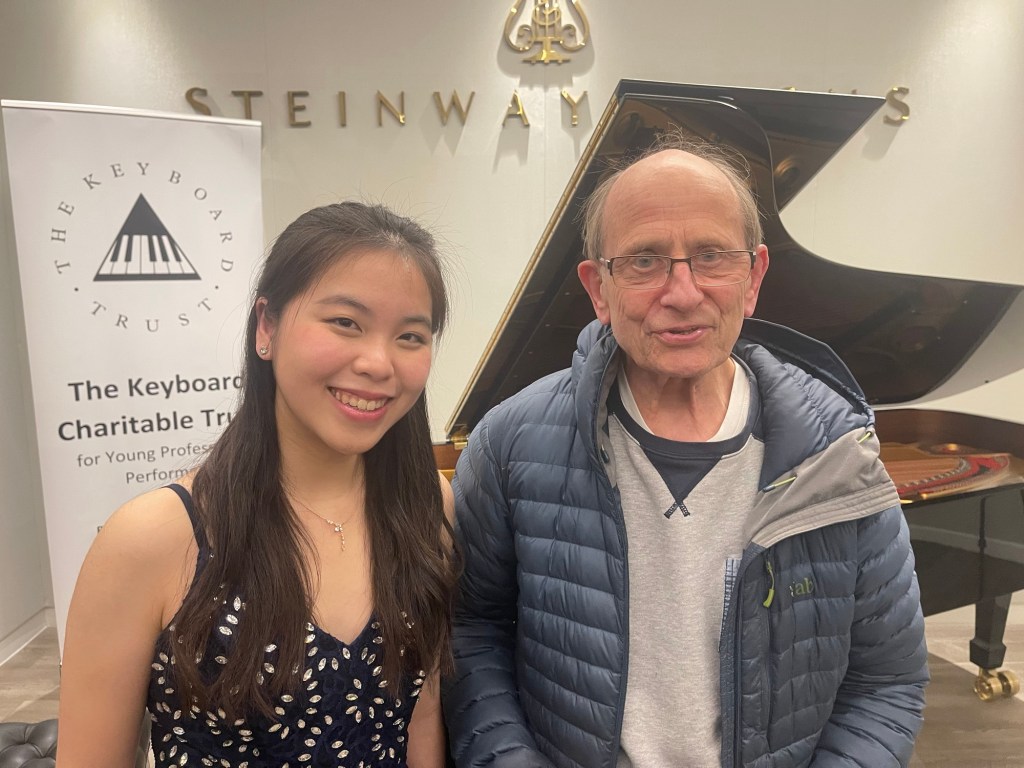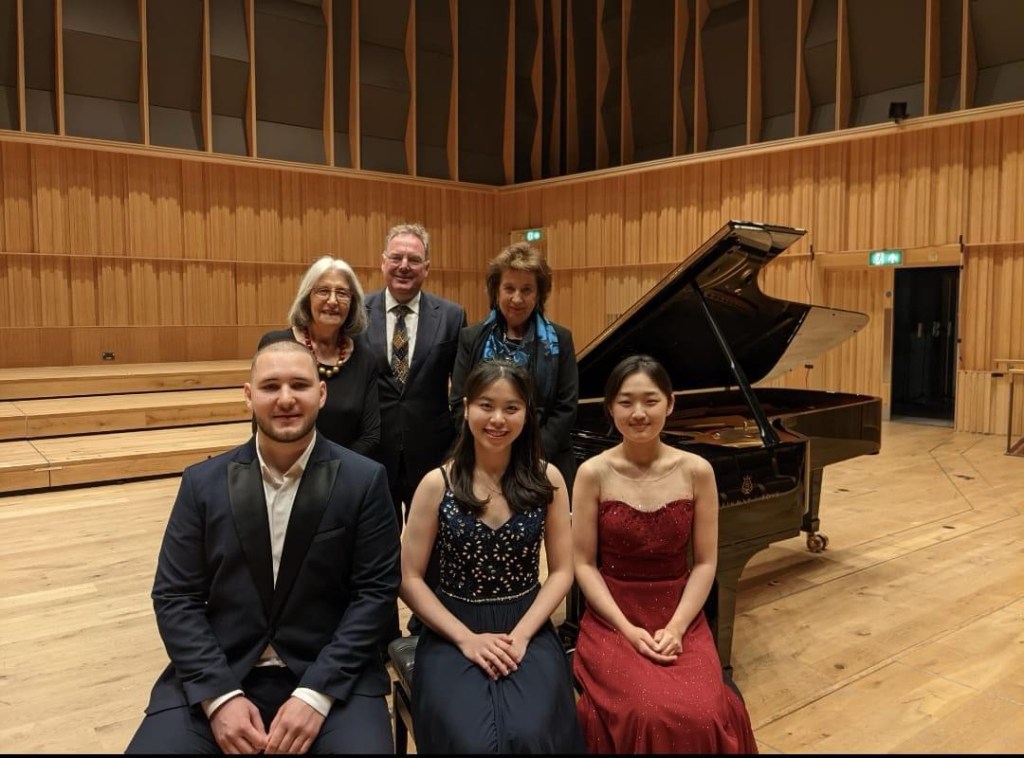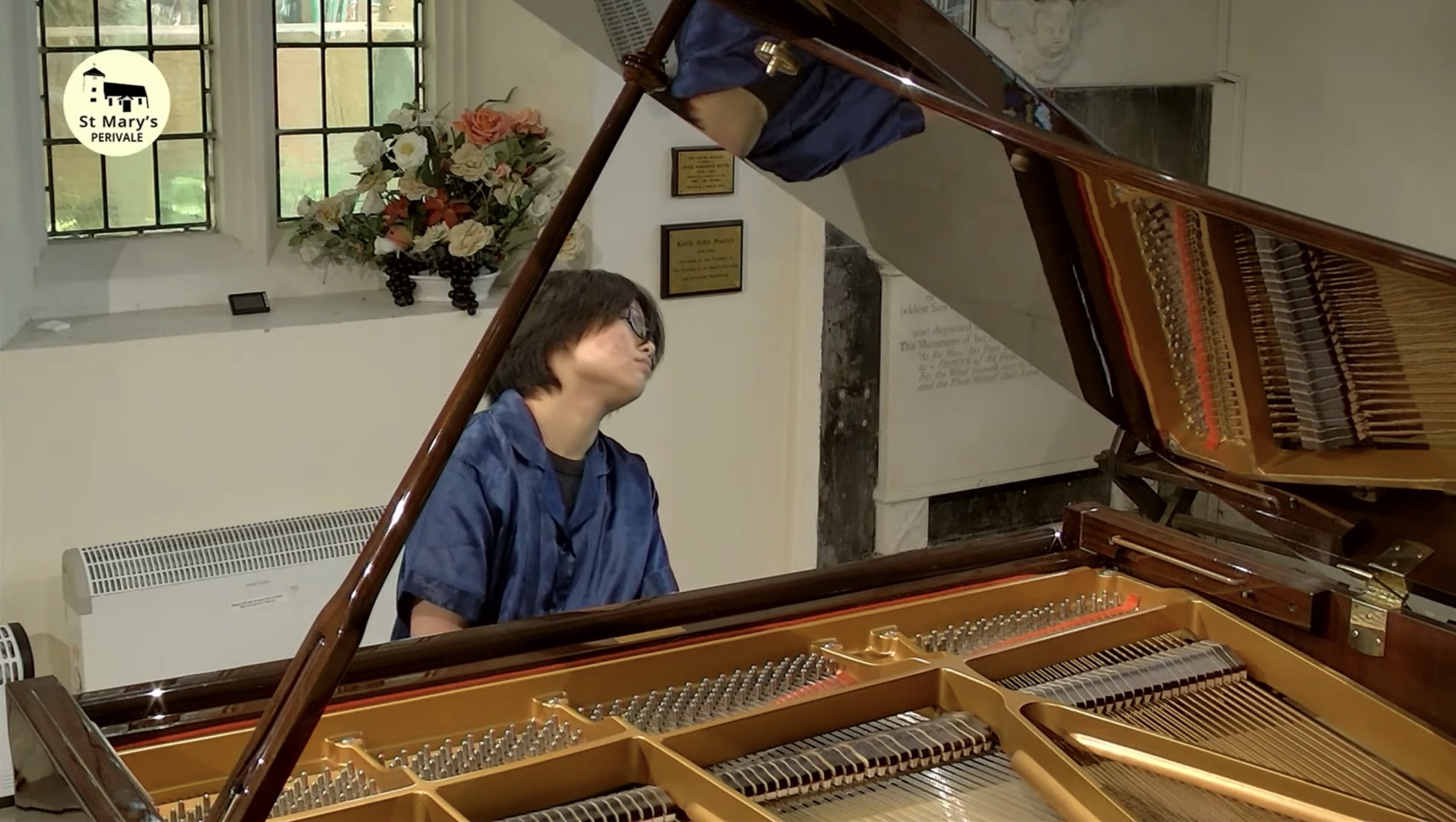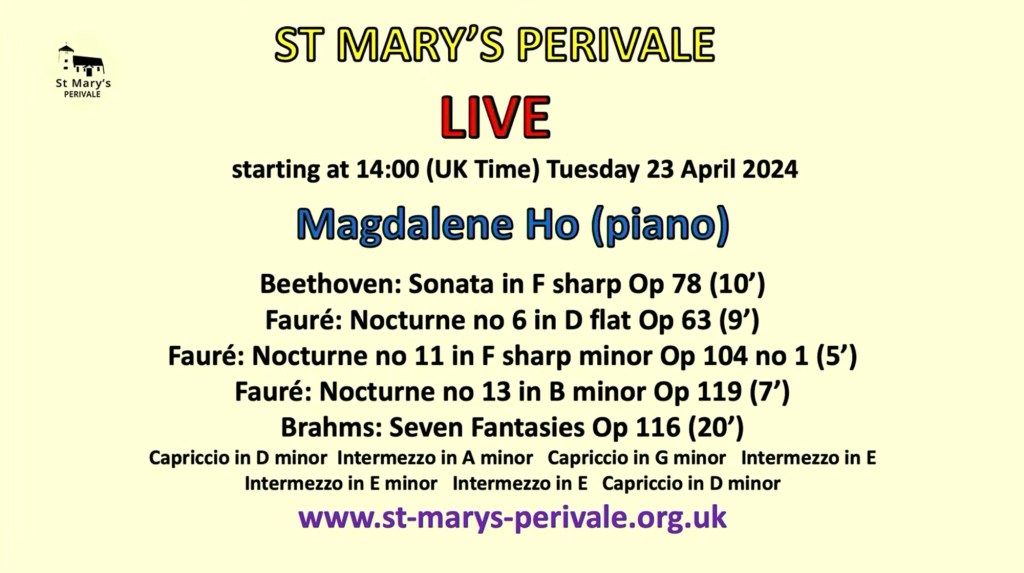
Cristian Sandrin triumphs last night in Berlin with the ‘Goldberg Variations’ dedicated to his father the distinguished pianist and pedagogue Sandu Sandrin who would have been 77 years old this day.A commemoration for him a year on took place in Bucharest on the 5th November (the actual day is the 15th )
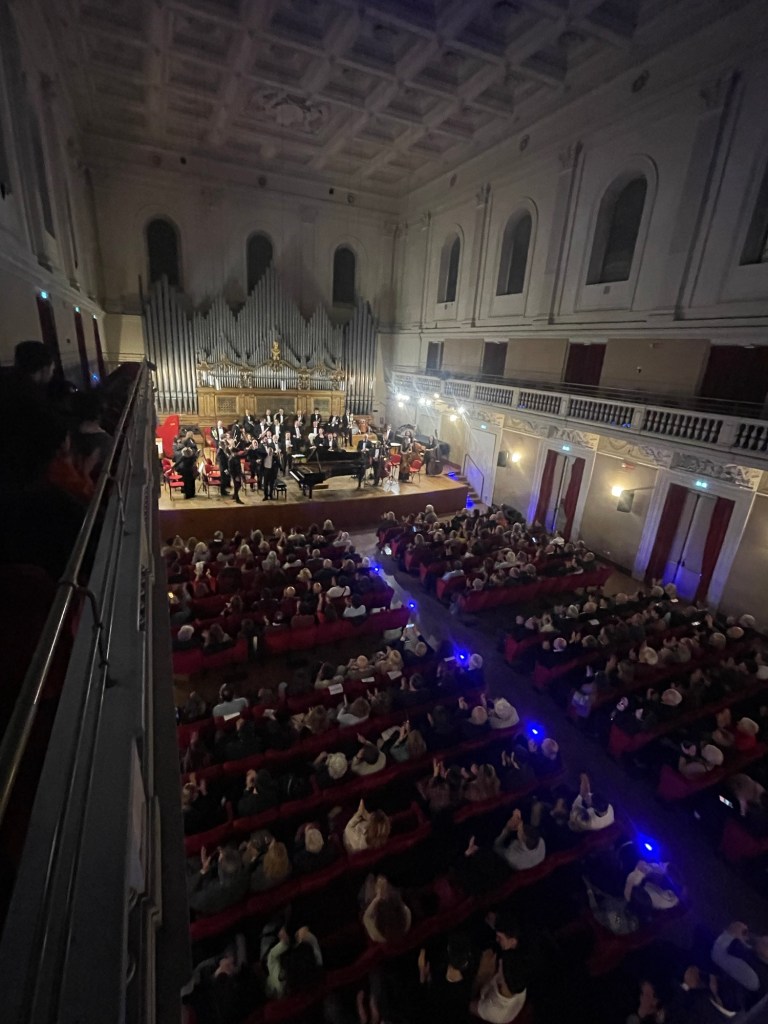
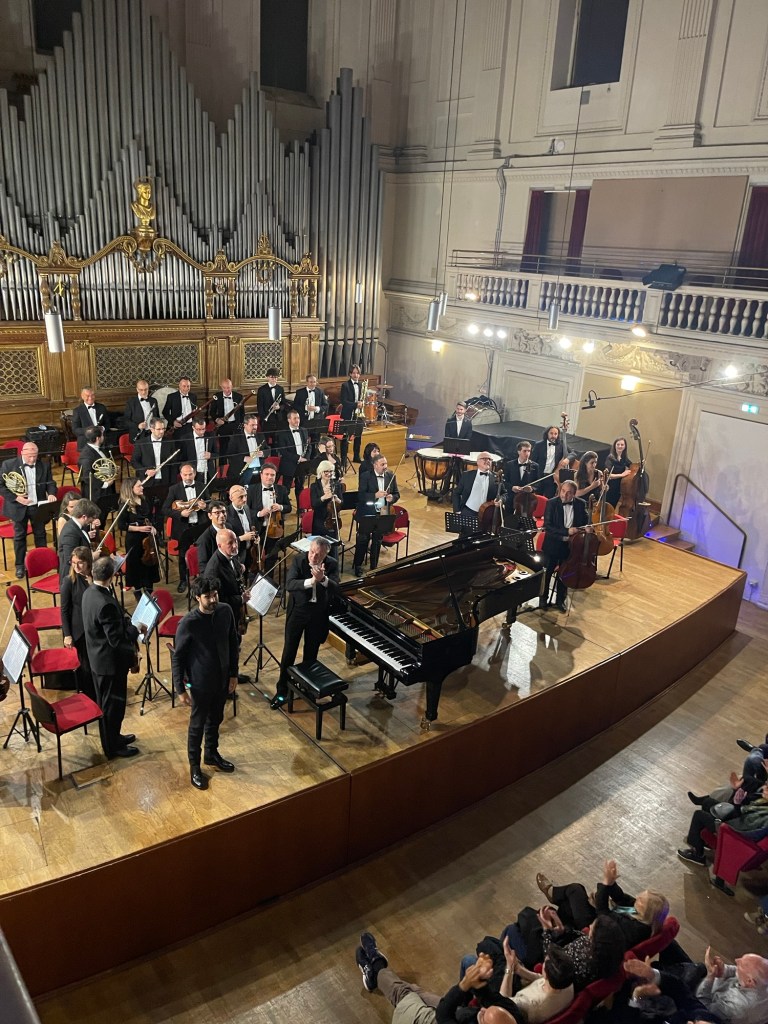
Designed by the famous Prussian architect Karl Friedrich Schinkel, who oversaw the rebuilding of Berlin after Napoleon’s comprehensive defeat at Leipzig and Waterloo. The concert hall is in restrained and elegant Noclassical style, the perfect setting for the music of the period. It was ceremoniously opened in 1821 with a prologue specially written by Goethe and saw the premiere of Carl Maria von Weber’s opera Der Freischütz. Prussia was determined that Berlin would vie with Vienna and Prague as the cultural centre of Europe. The building was completely destroyed by fire in the last weeks of World War 2 and Berliners were torn with whether to faithfully rebuild Schinkel’s masterpiece or build a modern concert hall. We can only be grateful that they chose the former option that recaptures the moment when the Age of Enlightenment meets the spirit of Romanticism.
Cristian’s rendering of the Goldberg Variations could not have taken place at a more fitting venue. The packed audience was hypnotised by the performance. After Cristian had soaked up the rapturous applause and the shouts of bravo, bravo he said it had been the best moment in all his life.
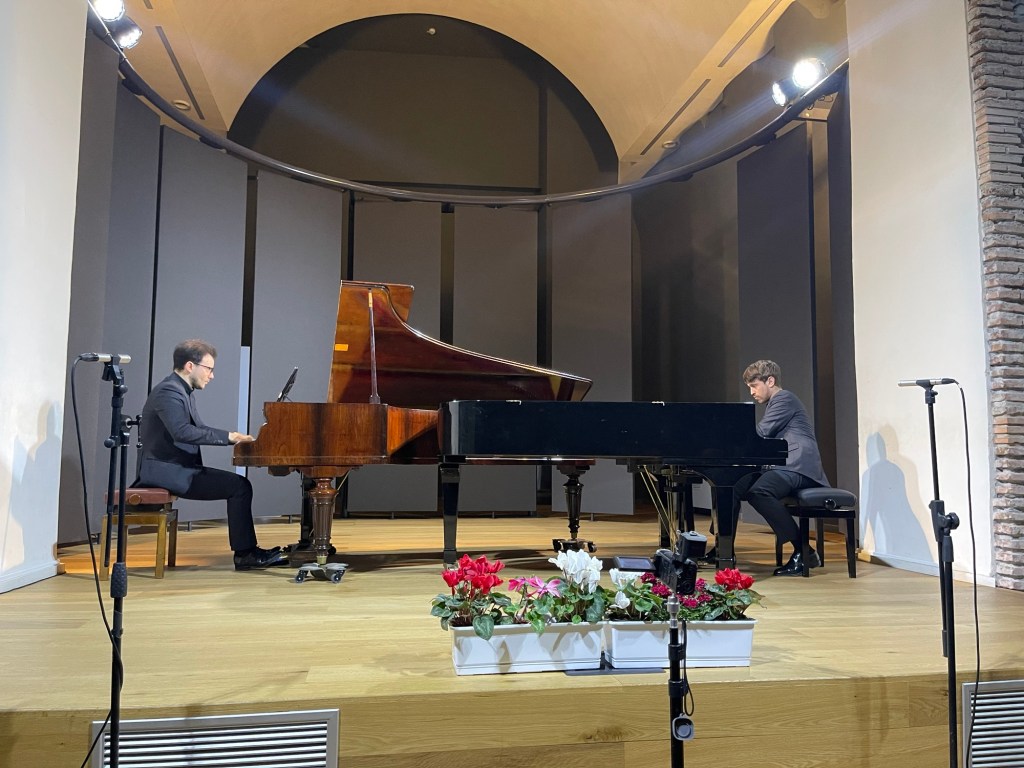
Photos show the Kleinersalle, the Bechstein concert grand – which had been tuned to perfection – the bells rang and the keys sang. Cristian loved the piano.
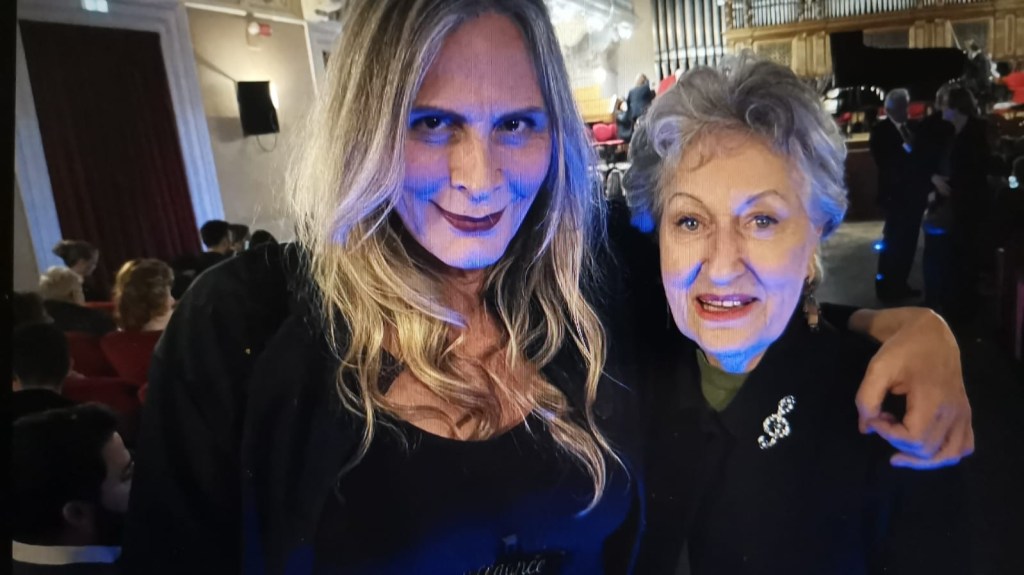
Photos of Dr. Rainer Braunschweig with Gerlinde Otto, Professor at the University of Music Franz Liszt in Weimar since 1992 and now emeritus lecturer.
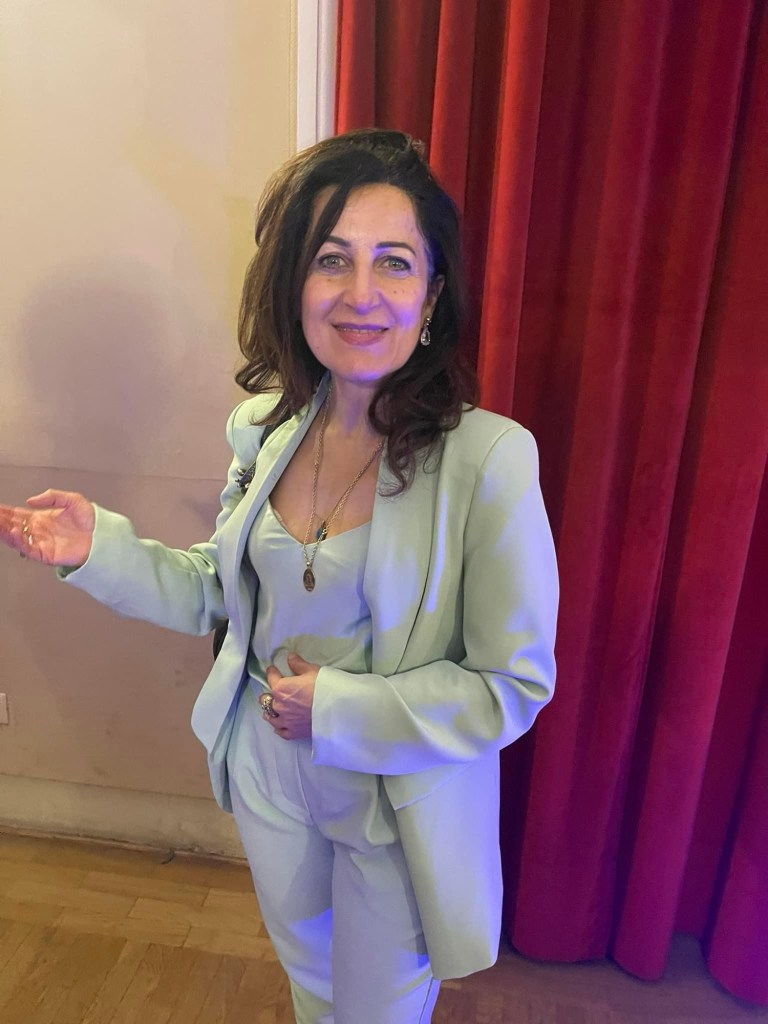
Mary Orr of the Matthiesen Foundation and a mentor of Cristian since her days organising the Imogen Cooper Music Trust in Berlin for his debut
The ‘Spotlight’ was certainly on St John’s Waterloo tonight with a superb concert by Hyeoon Park and Benjamin Grosvenor Superb chamber music playing each listening to the other as they played with cat and mouse like attention.
A continuous stream of music making that was like circus entertainers on the high wire who with superb balance and control manage to stay on high without ever even the thought that they might fall off. Ravishing sumptuous sounds from the piano were matched by the searing intensity of the violin. From the piano’s very first sombre chords of quiet brooding intensity in the Vaughan Williams the violin just soared into the heights.A magic spell was cast from the Lark allowed to ascend into truly celestial regions on high. Passing through Takemitsu’s evocative ‘Distance de fée’ we were treated to an astonishingly insinuating performance of the Debussy Sonata that was a very welcome addition to the programme .It was remarkable for its ravishing colour and passionate intensity. Even Grieg’s C minor Sonata was played with the care,burning intensity and intelligent musicianship usually reserved only for the ‘Kreutzer’. A monumental performance where the piano’s heart rending delicacy in the second movement was matched by the ravishing intensity of the violin. A magnificent performance of a much neglected work that tonight was restored to all it’s glory by these two great artists that was eagerly devoured by all those lucky to be present.
But the best was still to come with a heart rending performance of Elgar’s ‘Salut D’Amour’ that will remain in my memory for long to come.
And outside …what surprises there are still to be had in London (Achille) Claude Debussy. 22 August 1862 – 25 March 1918
The Debussy sonata for violin and piano in G minor, L.140, was written in 1917. It was the composer’s last major composition.The premiere took place on 5 May 1917, the violin part played by Gaston Poulet , with Debussy himself at the piano. It was his last public performance.
The work has three movements:
Allegro vivo
Intermède: Fantasque et léger
Finale: Très animé
The unfinished sonatas
Six sonatas for various instruments (French: Six sonates pour divers instruments) was a projected cycle of sonatas that was interrupted by the composer’s death in 1918, after he had composed only half of the projected sonatas. He left behind his sonatas for cello and piano 1915), flute, viola and harp (1915), and violin and piano (1916–1917).Debussy wrote in the manuscript of his violin sonata that the fourth sonata should be written for oboe, horn,and harpsichord and the fifth for trumpet, clarinet, bassoon and piano.
From 1914, the composer, encouraged by the music publisher Jacques Durand intended to write a set of six sonatas for various instruments, in homage to the French composers of the 18th century. The effects of the First World War and an interest in baroque composers Couperin and Rameau inspired Debussy as he was writing the sonatas.
Durand, in his memoirs entitled Quelques souvenirs d’un éditeur de musique, wrote the following about the sonatas’ origin:
‘After his famous String Quartet, Debussy had not written any more chamber music. Then, at the Concerts Durand, he heard again the Septet with trumpet by Saint-Saëns and his sympathy for this means of musical expression was reawoken. He admitted the fact to me and I warmly encouraged him to follow his inclination. And that is how the idea of the six sonatas for various instruments came about.’
In a letter to the conductor Bernard Molinari, Debussy explained that the set should include “different combinations, with the last sonata combining the previously used instruments”. His death on 25 March 1918 prevented him from carrying out his plan, and only three of the six sonatas were completed and published by Durand, with a dedication to his second wife, Emma Bardac.
For the final and sixth sonata, Debussy envisioned a concerto where the sonorities of the “various instruments” combine, with the gracious assistance of the double bass.
Edvard Hagerup Grieg 15 June 1843 – 4 September 1907
Grieg began composing his third and final violin sonata in the autumn of 1886. Whereas the first two sonatas were written in a matter of weeks, this sonata took him several months to complete.Although there were only two years between the first two violin sonatas, the Violin Sonata No 3 in C minor, Op 45, was not to follow for almost two decades: the last piece of chamber music Grieg completed, it was composed—at Grieg’s home, Troldhaugen, outside Bergen—in the second half of 1886, just spilling into the first days of 1887.The sonata is in three movements The second movement opens with a serene piano solo in E major with a lyrical melodic line. In the middle section, Grieg uses a playful dance tune. It also exists in a version for cello and piano that Grieg composed during the same time as the violin version and given to his brother as a birthday gift in May 1887, but appeared in print only in 2005 (by Henle).
Allegro molto ed appassionato – Allegretto espressivo alla Romanza – Allegro animato – Prestissimo
The sonata remains the most popular of the three works, and has established itself in the standard repertoire. The work was also a personal favorite of Grieg’s. Grieg played the piano part in the premiere, in the Leipzig Gewandhaus on 10 December 1887; the violinist was the eminent Adolph Brodsky, who had given the first performance of the Tchaikovsky Concerto six years earlier (and was later head of the Royal Manchester School of Music)To a certain extent, Grieg built on Norwegian folk melodies and rhythms in this three-movement sonata. However, Grieg considered the second sonata as the “Norwegian” sonata, while the third sonata was “the one with the broader horizon.” This was the last piece Grieg composed using sonata form.
Ralph Vaughan Williams October 1872 – 26 August 1958)
The Lark Ascending was inspired by the 1881 poem by the English writer George Meredith . It was originally for violin and piano, completed in 1914, but not performed until 1920. The composer reworked it for solo violin and orchestra after the First World War and it is this version, in which the work is chiefly known, was first performed in 1921.
The composer’s second wife, Ursula wrote that in The Lark Ascending Vaughan Williams had “taken a literary idea on which to build his musical thought … and had made the violin become both the bird’s song and its flight, being, rather than illustrating the poem from which the title was taken”.At the head of the score, Vaughan Williams wrote out twelve lines from Meredith’s 122-line poem:
He rises and begins to round, He drops the silver chain of sound, Of many links without a break, In chirrup, whistle, slur and shake.
For singing till his heaven fills, ‘Tis love of earth that he instils, And ever winging up and up, Our valley is his golden cup And he the wine which overflows to lift us with him as he goes.
Till lost on his aerial rings In light, and then the fancy sings.
The soloist for whom the work was written and to whom it is dedicated was Marie Hall ,a leading British violinist of the time, a former pupil of Edward Elgar and celebrated for her interpretation of that composer’s violin concerto .She gave the first performance with the pianist Geoffrey Mendham (1899–1984) at the Shirehampton Hall on 15 December 1920 and was again the soloist in the first performance of the orchestral version, in the Queen’s Hall , London, on 14 June 1921, at a concert presented by the British Music Society. The british Symphony Orchestra was conducted by Adrian Boult
Tōru Takemitsu (8 October 1930 – 20 February 1996) was a Japanese composer and writer on aesthetics and music theory .Largely self-taught, Takemitsu was admired for the subtle manipulation of instrumental and orchestral timbre. He is known for combining elements of oriental and occidental philosophy and for fusing sound with silence and tradition with innovation
“Distance de fée” created in 1951, one of the best pieces of Takemitsu’s early period. The spirit of Debussy and Messiaen are fully felt in this work of approximately 7 and 1/2 minutes duration. Messiaen’s octatonic scale is used in the tonal language. The opening lyrical theme is repeated several times, and finds a new pathway upon each return – this is a version of variation as well as rondo form, two of Takemitsu’s favorite compositional procedures. This piece, like many others by Takemitsu, was inspired by poetry, in this case, a poem of the same title by Shuzo Takiguchi (1903-1979). This work describes, with lightly mythological imagery, an elusive, transparent creature living in “air’s labyrinth … it lives in the spring breeze That barely resembled the balance of a small bird”
Elgar’s Salut d’Amour (Liebesgruß), Op. 12 was written in July 1888, when he was romantically involved with Caroline Alice Roberts and he called it “Liebesgruss” (‘Love’s Greeting’) because of Miss Roberts’ fluency in German. On their engagement she had already presented him with a poem “The Wind at Dawn ” which he set to music and, when he returned home to London on 22 September from a holiday he gave her Salut d’Amour as an engagement present.The dedication was in French: “à Carice”. “Carice” was a combination of his wife’s names Caroline Alice, and was the name to be given to their daughter born two years later.Salut d’amour” is one of Elgar’s best-known works and has inspired numerous arrangements for widely varying instrumental combinations. There are also versions with lyrics in different languages, for example the song “Woo thou, Sweet Music” with words by A. C. Bunten,[5] and “Violer” (Pansies) in Swedish.
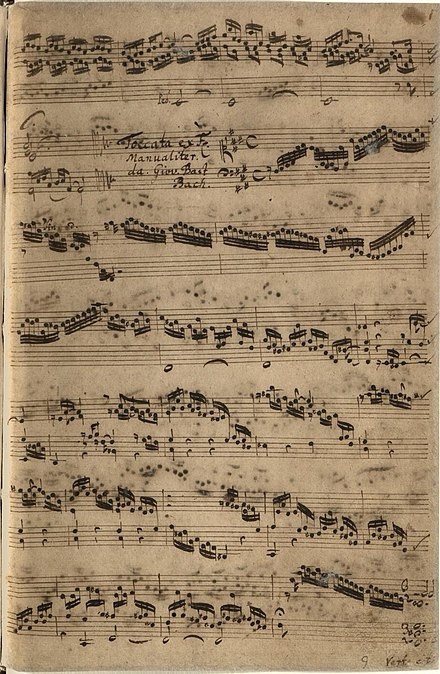
Johann Sebastian Bach Partita No 6 in E minor 1. Toccata 2. Allemande 3. Corrente 4. Air 5. Sarabande 6. Tempo di Gavotta 7. Gigue Karol Szymanowski Mazurkas, Op 50 No 3 Moderato No 7 Poco vivace No 8 Moderato No 5 Moderato No 4 Allegramente, risoluto
Anton Webern Variations, Op 27 Ludwig van Beethoven Piano Sonata No 31 1. Moderato cantabile, molto espressivo 2. Allegro molto 3. Adagio, ma non troppo – Arioso dolente – Fuga: Allegro, ma non troppo – L’istesso tempo di Arioso – L’inversione della Fuga
Performances of ravishing beauty with a kaleidoscope of sounds.An extraordinary palette of colours that gave new life to Bach’s monumental 6th Partita.There was delicacy and poise but nobility and clarity always with refined good taste and with very little use of the pedal.His fingers seemed instinctively to search out sounds and colours without ever disturbing the overall pulse or architectural shape. A whispered luminosity he brought to Szymanowski’s extraordinary Mazurkas op 50.A subtle world of insinuating sounds and dance rhythms. This was the ideal world for Webern’s variations too where the delicacy and multicoloured sounds drew these seemingly isolated notes into shapes of eloquence giving meaning to such a seemingly abstract art.There were pungent sounds too but rarely called upon as Anderewski inhabited a secret world that he chose to allow us to eavesdrop on. A change of piano during the interval but the palette of sounds and whispered secrets were still the same . Beethoven too slipped in on the final ethereal wave of the Webern variations. But by now we had experienced his secret world of refined multicoloured sounds and in some way I found in need of something with more backbone and contrast. This was Beethoven as seen from afar.A world of ravishing beauty and refined whispered sounds but was it the real Beethoven if we moved in closer? An audience that sat in awed silence as he drew us in to a secret world that even the three encores inhabited.(Bach and Bartok) The only chiselled sounds above mezzo forte were momentarily in the Beethoven Scherzo but with hard ungrateful sounds that had no place in the world he inhabited. A final note of the evening hammered into the bass which reminded me of his Schumann Piano Concerto that he had played with Pappano with such chiselled ungrateful sounds that I turned to a friend and said I thought he must hate it.It was obviously not part of the world that he inhabits. A master pianist and a cult figure with a great following of admirers but who lives on a cloud of his own of extremes of sound that somehow do not always seem to connect. A concert inhabited by Eusebius ………but Florestan where were you! A concert full of wondrous things and a unique world that is wonderful to visit occasionally but a world where it would be hard to take up permanent residence. A standing ovation for a unique artist and I too found myself on my feet. Chapeau Maestro!
The Barbican presents Piotr Anderszewski:
From Bach to Webern, pianist Piotr Anderszewski finds fascinating connections between composers whose visionary ideas would change keyboard music forever.
Anderszewski is renowned for his interpretations of Bach and brings that special affinity to the monumental Partita No 6 which, in the words of musicologist David Schulenberg, is ‘the crowning work of the set and Bach’s greatest suite’. Rooted in traditional European dance styles, this is music that reveals Bach’s awe-inspiring ability to weave whole worlds of sound from the simplest ideas. Fast forward 200 years, and Szymanowski – from Anderszewski’s homeland of Poland – infuses his mazurkas with the mind-bending rhythms and melodies of Polish folk dance. With his Variations, Webern takes an historical form and places it firmly in the 20th century, and Beethoven brings us full circle in his emotional penultimate piano sonata – a piece with echoes of Bach but that’s peppered with Romantic innovations.
Piotr Anderszewski is an artist who has long embraced the unexpected, whether in his repertoire choices or his interpretations. Bach has long been central to his art, but always with a fresh slant – as in his most recent recording of the composer’s music, where he boldly took selected preludes and fugues from the Second Book of the 48 and presented them in his own re-ordering.
Bach’s E minor Partita, BWV830 – the final one in a set of six that the composer proudly published as his ‘opus 1’ in 1731. Although it’s actually one of the earlier partitas to have been written, it’s easy to see why Bach placed it last, with its striking combination of sweeping brilliance and profundity.
For one of the greatest colourists of the 20th century, Karol Szymanowski the piano functioned as both inspiration and musical laboratory throughout his composing life. The 20 Mazurkas of Op 50 (1924–5), from which we hear Nos 3, 7, 8, 5 and 4, are from the final phase of Szymanowski’s style, one in which his own musical language became inextricably suffused with Polish nationalism.
A decade later Anton Webern was taking piano writing to a new level of concision in his Variations, Op 27 (1936). Webern was a member of the Second Viennese School, the movement founded by Arnold Schoenberg whose founding principle was that of ‘serialism’ (in which, unlike in time-honoured system of traditional tonality, all 12 notes of the chromatic scale are used to create a ‘row’ or ‘series’, determining not only the melodic lines of a piece but also its harmonies).
Webern’s three brief movements are all built from the same tone row.The yearning opening phrases of the first movement, via the capricious spikely energetic second, to the contrasts within the last, from introspection to buoyancy.
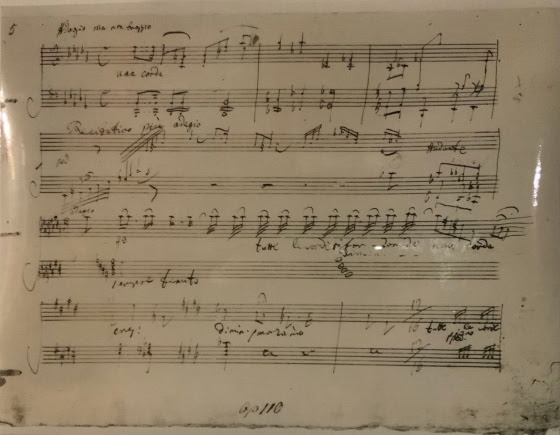
Beethoven’s A flat major Sonata, Op 110, was his penultimate sonata, written in 1821,
The outward gentleness of the opening movement belies its tautness of form, and the contrast with the brief second, a scherzo marked Allegro molto – capricious, gruffly humorous, even violent – is extreme. Beethoven subversively sneaks in references to two street songs popular at the time: Unsa Kätz häd Katzln ghabt (‘Our cat has had kittens’) and Ich bin lüderlich, du bist lüderlich (‘I’m dissolute, you’re dissolute’)!
But it’s in the finale that the weight of the sonata lies, and it begins with a declamatory, recitative-like passage that starts in the minor, moving to an emotionally pained aria-like section.Beethoven introduces a quietly authoritative fugue, based on a theme reminiscent of the one that opened the sonata. Its progress interrupted by the aria once more, its line now disjunct and almost sobbing for breath. The way in which the composer moves into the major via a sequence of G major chords is a passage of pure radiance, that Edwin Fischer described as ‘like a reawakening heartbeat’. This leads to a second appearance of the fugue in inversion culminating in a magnificently triumphant conclusion.
Piotr Anderszewski is regarded as one of the outstanding musicians of his generation.
He appears regularly in recital at such concert halls as the Vienna Konzerthaus, Berlin Philharmonie, Wigmore Hall, Carnegie Hall, Théâtre des Champs-Élysées and Concertgebouw Amsterdam. His collaborations with orchestra have included appearances with the Berlin Philharmonic, Berlin Staatskapelle, London and NHK Symphony orchestras and Philharmonia Orchestra. He has also placed a special emphasis on playing and directing, working with Scottish Chamber Orchestra, Chamber Orchestra of Europe and Camerata Salzburg, among others.
He has been an exclusive artist with Warner Classics/Erato (previously Virgin Classics) since 2000. His first recording for the label was Beethoven’s Diabelli Variations, which went on to receive a number of prizes. He has also recorded Grammy-nominated discs of Bach’s Partitas Nos 1, 3 and 6 and Szymanowski’s solo piano works, the latter receiving a Gramophone Award in 2006. His recording devoted to works by Robert Schumann received BBC Music Magazine’s Record of the Year Award in 2012. His disc of Bach’s English Suites Nos 1, 3 and 5, released in 2014, went on to win Gramophone and ECHO Klassik awards in 2015. His most recent release, featuring a selection of Preludes and Fugues from Bach’s Well-Tempered Clavier Book 2, won a Gramophone Award in 2021.
The intensity and originality of his interpretations have been recognised with the Gilmore Award, the Szymanowski Prize and a Royal Philharmonic Society Award.
He has also been the subject of several documentaries by the film maker Bruno Monsaingeon. Piotr Anderszewski plays Diabelli Variations (2001) explores his particular relationship with Beethoven’s iconic work, while Unquiet Traveller (2008) is an unusual artist portrait, capturing Piotr Anderszewski’s reflections on music, performance and his Polish-Hungarian roots.
In 2016 he got behind the camera himself to explore his relationship with his native Warsaw, creating a film entitled Je m’appelle Varsovie.
Last season he gave a new recital programme at the Philharmonie de Paris, Vienna Musikverein, Alte Oper Frankfurt and other major concert halls in Europe and Asia. He also performed with leading orchestras including the Leipzig Gewandhausorchester, Kammerakademie Potsdam, Finnish Radio and NHK Symphony orchestras and Orchestre Philharmonique de Radio France.
This season includes solo recitals throughout Europe at prestigious venues including the Muziekgebouw Amsterdam, Konserthuset Stockholm, Gulbenkian Portugal and Philharmonie Cologne, as well as on tour in Japan and Singapore. Concerto highlights include concerts with the Zurich Tonhalle, NDR Hamburg, Taiwan Symphony Orchestra and a tour with Sinfonia Varsovia.
Ashley Fripp’s 37th appearance at St Mary’s since 2005 was marked quite rightly by an unusually full and appreciative audience.Ashley is one of the finest most serious musicians I know who I had first encountered in the village of Sermoneta in Italy where every year during the summer months the Pontine Festival brings some of the greatest musicians to the hills near to Rome to give concerts and masterclasses.A festival that had started in the ‘60’s with Yehudi Menuhin and Josef Szigeti and every year since brings great music to where I luckily have a holiday home on the seashore.He had come to study with Eliso Virsaladze,the great Russian pianist and pedagogue much admired by Sviatoslav Richter.It was she who pointed out to me a young very talented British boy who had joined her class and she was very impressed by his pianistic and musical artistry.I later found Ashley in Fiesole overlooking Florence where Eliso was holding her masterclasses five times a year.Ashley was already on the threshold of a career in music in London ,having won the Gold medal at the Guildhall School of Music ,but was still keen to perfect his skills with one of the greatest musicians of our time.
While he was there he also gave a recital in the Harold Acton Library,part of the British Institute ,where he gave a truly memorable performance of Chopin’s B minor Sonata.It was he who introduced me to this beautiful venue and the director and thanks to him we now hold a series of concerts there every year for the Keyboard Trust.
Today Ashley presented two major works and his eloquent introductions illuminated the journey we were about to take together with simple clarity and intelligence.It was the same qualities that he brought to his performances with superb technical control and artistry.An architectural shape to all he did and an impeccable sense of style that made for a great contrast from the non legato world of Bach where the song and the dance reign to the sumptuous romantic sounds of Rachmaninov. But even in Rachmaninov he was able to link the ten miniature tone poems or preludes into one emotional whole.As he pointed out there was a link between the first prelude in the minor and last in the major with the first prelude in F sharp minor and the last in G flat ( F sharp) major.The same sense of unity and form that Bach had brought to his Partita Ashley’s superb musicianship could see in Rachmaninov too.Superbly played throughout without any showmanship but with simplicity and an attention to the composers wishes that gave great strength and authority to all he did .
Nobility and rhythmic drive but also surprising tenderness to the opening Sinfonia with the lyricism of the Andante and the impulsive rhythmic energy of the (Allegro).The Allemande just seemed to drift in with a flowing pastoral outpouring interrupted only by the energetic Courante.A beautifully poised Sarabande where I felt he could almost wallow more in the sounds of the modern piano that Bach of course would not have known but that can imitate so well the human voice.However Ashley is a very serious musician with an impeccable sense of style and the delicacy of the Sarabande did contrast so well with the scintillating brilliance of the Rondeaux and the imperious final Capriccio.The honesty of a great artist saw Ashley admitting what a technically ungrateful piece the last Capriccio is .Any slight sins committed were totally unnoticed as we followed with rapt attention the driving overall line that he was creating.
There was a beautiful unfolding to the first Prelude like the beginning of a great story that was yet to be told.The question and answer between the hands becoming ever more anguished until deflating back to the disarming simplicity with which it had opened.The passionate explosion of the second prelude was played with sumptuous full sounds and technical mastery.I have never heard the tenor melody played so beautifully or with such a simple sense of line as it belied the technical difficulty of all the notes that embroider it.What character Ashley brought to the rumbustuous left hand that continually interrupted the delightfully capricious third prelude.A beautiful ending that was just thrown into the wind with great nonchalance.The D major Prelude is one of the most beautiful things that Rachmaninov has written.A disarming simplicity accompanied by a continual flow of delicate sounds.The melodic line appearing in the tenor register with delicate notes caressing it with such fluidity and beauty with ravishing playing of aristocratic emotional poise.A dynamic relentless drive to the well known G minor Prelude dying to a whisper to allow the central episode to bewitch and enchant with sumptuous sounds in a duet of ravishing beauty.The gradual return to the march was played with dynamic drive and passion only to disappear into thin air at the end with consummate featherlight ease and charm.The long romantic outpouring of the sixth prelude was played with a luminosity of sound with undulating emotions before dying to a mere whisper on a magic trail of golden notes.The seventh was a spinning web of continuous motion on which the nobility of the melodic line is allowed to float with grandeur and nobility contrasting with the scintillating jeux perlé of the coda.The eighth was a sumptuous wave of moving harmonies of great subtlety and beauty but it was the beguiling charm of the double notes of the ninth that was quite astonishing.The transcendental difficulty of the notes was hidden by a musical shape that was both beguiling and tantalising.An extraordinary tour de force where technical mastery is at the total service of the music.Nostalgic beauty of the tenth brought us full circle with the beauty of the tenor melodic line accompanied so delicately as it began to duet with the soprano line with a kaleidoscope of glistening sounds of great beauty.
British pianist Ashley Fripp has performed extensively as recitalist, concerto soloist and chamber musician throughout Europe, Asia, North America, Africa and Australia in many of the world’s most prestigious concert halls. Highlights include the Carnegie Hall (New York), Musikverein (Vienna), Concertgebouw (Amsterdam), the Philharmonie halls of Cologne, Paris, Luxembourg and Warsaw, the Bozar (Brussels), the Royal Festival, Barbican and Wigmore Halls (London), the Laeiszhalle (Hamburg), Palace of Arts (Budapest), the Megaron (Athens), Konzerthaus Dortmund, the Gulbenkian Auditorium (Lisbon) and the Konserthus (Stockholm).
He has won prizes at more than a dozen national and international competitions, including at the Hamamatsu (Japan), Birmingham and Leeds International Piano Competitions, the Royal Over-Seas League Competition, the Concours Européen de Piano (France) and the coveted Gold Medal from the Guildhall School of Music & Drama. Ashley was awarded the Worshipful Company of Musicians’ highest award, The Prince’s Prize, and was chosen as a ‘Rising Star’ by the European Concert Hall Organisation (ECHO). He has also performed in the Chipping Campden, Edinburgh, Brighton, Bath, Buxton, City of London, and St. Magnus International Festivals as well as the Oxford International Piano Festival, the Festival Pontino di Musica (Italy) and the Powsin International Piano Festival (Poland). Ashley also gave an open-air Chopin recital beside the world-famous Chopin monument in Warsaw’s Royal Lazienki Park to an audience of 2,500 people.
Ashley Fripp studied at the Guildhall School of Music & Drama with Ronan O’Hora and with Eliso Virsaladze at the Scuola di Musica di Fiesole (Italy). In 2021 he was awarded a doctorate for his research into the piano music of British composer Thomas Adès. Future engagements include his debut at the Mecklenburg-Vorpommern Festival (Germany) and a commercial film production of Rachmaninoff Piano Concertos Nos. 1 & 2 with accompanying concert tours in Germany and the Czech Republic with the Prague International Youth Orchestra.
The Partita for keyboard No. 2 in C minor, BWV.826, is a suite of six movements written for the .It was announced in 1727,issued individually, and then published as Bach’s Clavier-Ubung in 1731.
Born 1 April [O.S.20 March] 1873 Semyonovo, Staraya Russa,Novgorod Russa ,Novgorod Governorate ,Russian Empire Died 28 March 1943 (aged 69) Beverly Hills California, U.S.ACover of the first edition (A. Gutheil, 1904)
Ten Preludes, op 23, was composed in 1901 and 1903. Together with the Prelude in C sharp minor op 3/2 and the 13 Preludes op 32 this set is part of a full suite of 24 preludes in all the major and minor keys.Rachmaninoff completed Prelude No. 5 in 1901. The remaining preludes were completed after Rachmaninoff’s marriage to his cousin Natalia Satina: Nos. 1, 4, and 10 premiered in Moscow on February 10, 1903, and the remaining seven were completed soon thereafter.The years 1900–1903 were difficult for Rachmaninoff and his motivation for writing the Preludes was predominantly financial.He composed the works in the Hotel America, financially dependent on his cousin Alexander Siloti , to whom the Preludes are dedicated.Of the comparative popularity of his Ten Preludes and his early Prelude op.3 n.2 ,a favourite of audiences, Rachmaninoff remarked: “…I think the Preludes of Op. 23 are far better music than my first Prelude, but the public has shown no disposition to share in my belief….”The composer never played all of the Preludes in one sitting, instead performing selections of them, consisting of preludes from both his Op. 23 and Op. 32 sets which were of contrasting character
Transformation on Gigue from Bach’s Violin Partita No. 2
Matthew Aucoin b. 1990
The tracks have vanished (world première)Commissioned by the Irving S. Gilmore Piano Festival for Kirill Gerstein
Claude Debussy 1862-1918
Etudes Book I:
–Pour les cinq doigts
–Pour les tierces
Etudes Book II:
–Pour les agréments
–Pour les sonorités opposées
–Pour les arpèges composés
Etudes Book I:
–Pour les octaves
–Pour les huit doigts
Etudes are an endless source of fascination, inviting composers to push both physical and musical possibilities – from the ethereal to the virtuosic. George Xiaoyuan Fu presents Debussy’s Etudes alongside three works by pianist-composers that discover possibilities through transcriptions for solo piano.
Promoted by the Royal Academy of Music
The amazing Mr Fu must be amongst these Fra Angelico Ognissanti as after all it is All Saints today. Lent to the Wigmore Hall by the Royal Academy for a lunchtime concert where he astonished and amazed us with his superhuman feats of musical trickery and mastery. The centre piece an absolutely mind boggling world premiere of a ‘friend ‘ Matthew Aucoin.Just a years’difference united them and it would need a year for any mortal to master a work of such diabolical intricacy. George only early thirties with degrees from Harvard,Curtis ,a Fellowship from the Royal Academy and recently married amazes and delights us all with his simple open intelligence and complete mastery of music matters. He is also one of the nicest people I know and I am proud to call a friend. The only defect is his applauding with hands raised high, so be sure to never sit behind him in a concert !
From the very first notes of Rachmaninov’s genial transcription of Bach’s famous Gavotte it was obvious that we were in the presence of a supreme stylist and master pianist.Charm,authority and colour were mixed up in a whirl of sumptuous sounds that are unmistakably those of Rachmaninov with just a hint of J.S. B.The same inspiration of J.S.Bach solo violin inspired George to make a ‘transformation’ of the Gigue from his 2nd violin Partita .A transcendental transformation with astonishing pianistic trickery and an ingenious use of the entire range of the keyboard.There were continuous meanderings and things that go ‘ bump in the night ‘ , glissandi that swept everything before it .Cascades of ingenious counterpoints that would have turned J.S.B green with envy.The main piece in this short recital was undoubtedly the world premiere of a work commissioned by the Irving S Gilmore piano Festival for Kirill Gernstein.A work by Matthew Aucoin based on ‘The Demons’ by Dostoevsky also known as ‘The Possessed’ or ‘The Devils’. It is an allegory of the potentially catastrophic consequences of the political and moral nihilism that were becoming prevalent in Russia in the 1860s. In two movements and lasting about 20 minutes it is a work of transcendental technical difficulty with a massive number of notes that must outdo even Messiaen’s Vingt Regards .Chiselled sounds play over ponderous bass chords with the first movement gradually growing in searing intensity with a diabolical technical tour de force of extraordinary difficulty. No matter the complexity George managed to convey a line and architectural sense that made a coherent whole and an extraordinarily intese experience. The second movement was of more tender melodic outpourings and with a whispered luminosity of echoing reverberations growing in intensity. There had also been a cohesion of sound between Rachmaninov,Fu and Aucoin ,that was to open up into the extraordinarily visionary sound world of the last work for piano of Debussy.The seven Debussy Studies were played with a kaleidoscopic sense of colour and a transcendental control of sound .I doubt Monsieur Czerny could ever have imagined five finger exercises as these.Astonishing clarity and shape to this extraordinarily modern work .Streams of sound on which were revealed fragments of melody of towering importance.Have double thirds ever sounded so beautiful or so legato as they became just a maze of sounds that were a living and breathing stream?Extreme delicacy of the agréments with evocative mysterious sounds .Sumptuous moulded sounds in ‘les sonorités opposé’and a magical luminosity of ‘les arpèges’ with sounds moving like quicksilver sand.Phenomenal technical prowess of ‘les octaves’ lead straight into the tongue in cheek eight finger exercise – three more than at the beginning! This was indeed Art that conceals Art as this is Debussy’s greatest work for piano but as the composer himself said they were ‘a warning to pianists not to take up the musical profession unless they have remarkable hands’.And I would add a super sensitive palette of sounds and a musical intelligence that can weave its way through a seeming maze of notes. And what better way to finish than with the insinuating sounds of the fourth of Debussy’s Preludes :’Les sons et les perfumes tournent dans l’air du soir’.With Joanna MacGregor Head of Keyboard Studies RAMMatthew Aucoin (born April 4, 1990) is an American composer, conductor, pianist, and writer best known for his operas. Aucoin has received commissions from the Metropolitan Opera,Carnegie Hall,Lyric Opera of Chicago,the American Repertory Theatre ,the Peabody Essex Museum,Harvard University .He was appointed as Los Angeles Opera’s first-ever Artist-in-Residence in 2016.He is a 2018 MacArthur Fellow. “Mr. Aucoin demonstrated his piano virtuosity in his own parts, from rumblings in the bass register to right-hand minor key trills that set the teeth on edge.” – Superconductor
Claude Debussy’s Études ( L 136) are a set of 12 études composed in 1915. Debussy described them as “a warning to pianists not to take up the musical profession unless they have remarkable hands”.They are broadly considered his late masterpieces.
Beautiful music surrounded by magnificent paintings and played by a beautiful young pianist .
Mary Orr welcoming the distinguished audience and thanking the Imogen Cooper Music Trust for allowing their magnificent piano to be used for this new series
Thank you Mary Orr for arranging such a treat for Halloween. In the sumptuous Matthiesen Gallery in Mayfair Varvara Tarasova started her programme with the shortest but most mellifluous Sonata by Schubert of pure innocent beauty. Schumann’s monumental Carnaval filled this rarified atmosphere with a parade of mignons aided and abetted by Schumann’s duel characters of Florestan and Eusebius. Scintillating charm and exquisite playing of two of Liszt’s most beguiling miniatures:.Liszt’s irresistible elaboration of Schubert with his Soirées de Vienne n.6 and one of his three concert studies ,La Leggerezza,completed this oasis of peace and beauty on La notte delle streghe (The witches sabbath) Rain and confusion all around but reinforced by such beauty after only an hour we are ready to go into battle in the big city outside.
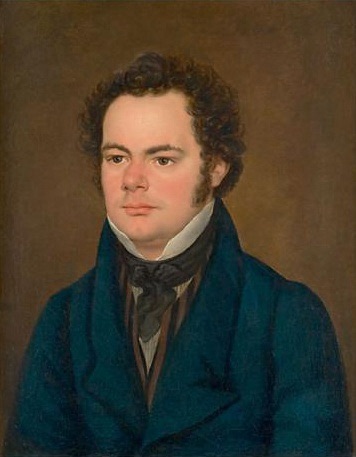
Her flowing tempo in Schubert’s early A major Sonata was played with simple beauty where the music was allowed to unfold so naturally in these sumptuous surrounds. There was dynamic playing too when called for but always with the architectural line and mellifluous style to the fore. She shared beautifully whispered secrets in the Andante with us,the pulsating melodic line played so sensitively.The final apparition of the theme was shadowed so miraculously as it drew this sumptuous oasis to an exquisite close.The Allegro just sprang from her well oiled fingers with innocent charm and playfulness.Sweeping harmonies were spread over the entire keyboard with consummate ease reaching to an almost passionate climax.But it was the innocent charm of the Rondo theme that stole our hearts .The majestic opening to the Liszt ‘Soirées de Vienne’ belied the beguiling charm and glittering jeux perlé that Liszt endowed to this simple Schubert waltz.’All that glitters is not gold’ but in this case Liszt had turned a beautiful Viennese bauble into a glittering gem.It was played with the ease and teasing naturalness of a true artist.Schumann Carnaval was played with great character with each one of the 21 mignons shaped with musicianship and artistry. The arresting opening of ‘Préamble’ was immediately answered by the weary antics of ‘Pierrot’ gently being given a shove by Florestan.’Arlequin’flew in from this window with quixotic charm and vivacity.The ‘Valse Noble’ played with passion and ravishing colour.There was a whispered gentleness to her playing of ‘Eusebius’ which was immediately encountered by the hi-jinx again of ‘Florestan’ with Varvara’s agile fingers able to keep his leaping around and sudden nostalgic memories of forgotten butterflies ( op.2) under control.The insinuating charm of ‘Coquette’ was simply commented on by ‘Réplique’ before these fleeting ‘Papillons’ a few years on fluttered with ease over the keyboard.What fun Varvara had too with the ‘Lettres dansantes’ leaping so freely around the keyboard.’Chiarina’ was played with slow deliberate passion and lead to the delicately embroidered bel canto outpouring of a seemingly sickly ‘Chopin’ of tradition.Rudely interrupted by ‘Estrella’ (Schumann’s former flame)as ‘Reconnaissance’ just bounced from Varvara’s agile fingers with its beautifully sung central duet.’Pantalon et Colombine’ managing to converse with such disarming legato in between their agitated quarrelling.’Paganini’ was presented as a musician rather than the greatest show man on earth and was shaped with beautiful care leaving a mere echo on which the ‘Valse Allemande’ could continue it charming journey after such an interruption.’Aveu’ was played really delicately with some beautifully highlighted inner counterpoints as it glided so naturally into the ‘Promenade’.A stimulating ‘Pause’ lead into the great ‘March against the Philistines’.There was grandeur and eloquence but also great charm as Schumann looks back with a potpourri of reminiscences. A beautiful performance from a very beautiful young pianist. A treat indeed for the eyes and the ears on this bleak,dark Halloween in every worldly sense!Varvara had introduced the programme in an inimitable way. She appeared as though she had just stepped out of one of those magnificent paintings that adorn this Gallery in the heart of Mayfair. Although she admitted that the virtuoso showman Liszt was not for her she did however manage to find ,from the vast repertoire of his genius, two gems that suited her refined artistic palette. ‘Soirées de Vienne n.6’ and finally an encore of ‘La Leggerezza’.A refined performance a true stylist with a technical ease that could allow her to shape the meandering embellishments with the grace and charm that I am sure Liszt intended.She recreated a miniature tone poem that made us question her words.But then music speaks louder than any words!Q.E.D.Franz Schubert Portrait of the composer in 1819
The Piano Sonata in A major D.664, op posth 120 was written in the summer of 1819.The manuscript, completed in July 1819, was dedicated to Josephine von Koller of Steyr in Upper Austria, whom he considered to be “very pretty” and “a good pianist”. The lyrical, buoyant, in spots typically poignant nature of this sonata fits the image of a young Schubert in love, living in a summery Austrian countryside, which he also considered to be “unimaginably lovely”.
Franz Liszt Born 22 October 1811 Doborjan,Kingdom of Hungary,Austrian Empire Died 31 July 1886 (aged 74) Bayreuth,Kingdom of Bavaria ,German Empire
Liszt was very fond of the Soirées and they featured in many of his performances in the mid-19th century. His Soirée No. 6 in A minor was based on themes from Schubert’s 12 Valses nobles, D.969, and Valses sentimentales, D.779, and was revised at least twice. The final revision, done in 1869, was said to be part of the last recital he gave in Luxembourg, in July 1886. The 1869 revision was made for his pupil, Sophie Menter, who, after the death of Liszt was ‘regarded by some as the incarnation of Liszt’. Liszt himself proclaimed Menter as his successor (on the other hand, she wasn’t the only one of his pupils that he so declared).In the Liszt cycle Soirées de Vienne, composed between 1846 and 1852, Liszt looked at Schubert’s dances for his inspiration. He chose Schubert’s Waltzes, Ländler, Ecossaisen, and German dances, all of which were Viennese dances in ¾ time. For the nine parts of the Soirées, Liszt chose themes from Schubert’s 38 Waltzes, Ländler, and Ecossaises, D.145 (composed 1815–1821); 36 Originaltänze, D.365; Wiener Damen-Ländler und Ecossaisen, D.734 (1816–1821); Valses sentimentales, D.779 (ca 1823); 18 German Dances and Ecossaises, D.783 (1823-1824); and 12 Valses nobles, D.969 (1826).
Three Concert Études (Trois études de concert), S 144,were composed between 1845–49 and published in Paris as Trois caprices poétiques with the three individual titles as they are known today.
As the title indicates, they are intended not only for the acquisition of a better technique, but also for concert performance. Liszt was himself a virtuoso pianist and was able to easily play many complex patterns generally considered difficult. The Italian subtitles now associated with the études—Il lamento (“The Lament”), La leggierezza (“Lightness”), and Un sospiro (“A sigh”)—first appeared in the French edition.
Robert Schumann, lithograph by Josef Kriehuber (1839) Born 8 June 1810 Zwickau ,Kingdom of Saxony Died 29 July 1856 (aged 46) Bonn, Rhine Province, Prussia
Carnaval. Scènes mignonnes sur quatre notes Robert Schumann
Carnaval had its origin in a set of variations on a Sehnsuchtswalzer by Franz Schubert , whose music Schumann had discovered only in 1827. The catalyst for writing the variations may have been a work for piano and orchestra by Schumann’s close friend Ludwig Schuncke,a set of variations on the same Schubert theme. Schumann felt that Schuncke’s heroic treatment was an inappropriate reflection of the tender nature of the Schubert piece, so he set out to approach his variations in a more intimate way, working on them in 1833 and 1834.
Schumann’s work was never completed, however, and Schuncke died in December 1834, but he did re-use the opening 24 measures for the opening of Carnaval.
The 21 pieces are connected by a recurring motif . The four notes are encoded puzzles, and Schumann predicted that “deciphering my masked ball will be a real game for you.”
Both Schumann and his wife Clara considered his solo piano works too difficult for the general public. ( Chopin is reported to have said that Carnaval was not music at all.Chopin did not warm to Schumann on the two occasions they met briefly and had a generally low opinion of his music.) Consequently, the works for solo piano were rarely performed in public during Schumann’s lifetime, although Liszt performed selections from Carnaval in Leipzig in March 1840, omitting certain movements with Schumann’s consent. Six months after Schumann’s death, Liszt later wrote that Carnaval was a work “that will assume its natural place in the public eye alongside Beethoven’s Diabelli Variations, which in my opinion it even surpasses in melodic invention and conciseness”.
Sphinxs consists of three sections, each consisting of one bar on a single staff in bass (F) clef, with no key, tempo, or dynamic indications. The notes are written as breves . The pitches given are the notes E♭C B A (SCHA) and A♭C B (AsCH) and A E♭C B (ASCH). Many pianists and editors, including Clara Schumann, advocate for omitting the Sphinxs in performance.
These are musical cryptograms , as follows:
A, E♭, C, B – German: A–Es–C–H (the Es is pronounced as a word for the letter S)
A♭, C, B – German: As–C–H
E♭, C, B, A – German: as Es–C–H–A
The first two spell the German name for the town of Asch (now As in the Czech Republic), in which Schumann’s then fiancée, Ernestine von Fricken, was born.The sequence of letters also appears in the German word Fasching, meaning carnival. In addition, Asch is German for “Ash”, as in Ash Wednesday , the first day of Lent. Lastly, it encodes a version of the composer’s name, Robert Alexander Schumann. The third series, S–C–H–A, encodes the composer’s name again with the musical letters appearing in Schumann, in their correct order.
The indomitable Mary Orr leaving no stone unturned in her quest to help young artists reach their goal.In fact she is flying to Berlin to hear Cristian Sandrin make his debut in the Konzerthaus where he will play the Goldberg Variations dedicated to his father’s memory the distinguished pianist Sandu Sandrin a year from his passing. https://christopheraxworthymusiccommentary.com/2023/04/26/cristian-sandrin-visions-of-life-dedicated-to-his-father-sandu-sandrin/https://christopheraxworthymusiccommentary.com/2023/09/20/trio-cristian-sandrin-enyuan-khong-charlotte-kaslin-a-feast-of-exhilaration-and-seduction-for-mary-orr-for-the-matthiesen-foundation-at-the-matthiesen-gallery/https:/Russian pianist Varvara Tarasova was born in St Petersburg. In 2014 she won a scholarship from London’s Royal College of Music as a postgraduate student in Master of Performance under the tutelage of Professor Dina Parakhina. At the Royal College of Music she is a Soiree d’Or Scholar. Varvara.A former Artistic Diploma student at the Royal College of Music assisted by Sir Roger and Lady Carr Soiree d’Or Scholar, supported by the David Young Prize and the Olive Rees Prize. In 2016 she received her Master of Performance from the Royal College of Music under Dina Parakhina, and in 2015 Varvara received a postgraduate degree with honours under the supervision of Professor Elena Kuznetsova at the Moscow State Conservatory, also winning the Award of the President of Russian Federation. In 2014, she was awarded first prize at the 21 Concorso International De Piano Rotary Club Palma Ramon Llull (Palma de Mallorca, Spain) and triumphed at the 17th Grand Prix International Piano et Recontres “Jeunes Talents” (Montrond-les-Bains, France). In 2015 in Varvara won the 3rd Sussex International Piano Competition (Worthing), audience prize and best performance of the compulsory piece; she also received the Hopkinson Gold Medal at the Chappell Medal Competition (London). In 2016 Varvara won “Sonderpries Kunststation Kleinsassen”, “Sonderpreis Bridgewater Sinfonia” and “Steingraeber and Sohne Sonderpreis” at the PIANALE International Academy and Competition (Fulda, Germany); and the “Peppino e Elsa Orlando” prize at the 54th International Piano Competition A.Speranza (Taranto, Italy). Varvara has performed concertos with a number of orchestras and conductors, including the Kremlin Chamber Orchestra under Misha Rakhlevkiy, the St. Petersburg State Capella Symphony Orchestra with Alexander Chernushenko, the Russian Chamber Orchestra under Konstantin Orbelian and the Worthing Symphony and Northampton Symphony Orchestras with John Gibbons. Varvara currently collaborates with the Yamaha Artistic Centre and St. Petersburg International Performing Arts Centre. Varvara has performed in the UK, France, Italy, Spain, Germany, Austria, Finland, Sweden and Portugal, as well as in the USA, Brazil and, of course, Russia. She participated in the ‘Torre de Canyamel’ Piano Festival (Mallorca), Rheingay Music Festival (Germany),‘Creative Youth’ Music Festival (Moscow) and Medtnerfest (London). This Champs Hill recording is Varvara Tasarova’s first CD release and part of her prize as the winner of the Sussex International Piano Competition in 2015.A native of St Petersburg, Varvara Tarasova studied at the Moscow Conservatory and, more recently, at London’s Royal College. She took first prize at the 2015 Sussex International Piano Competition and this new Champs Hill release of Brahms and Schumann is her debut recording. Tarasova’s bona fides as a Brahms player are quickly established in her traversal of Op 76. Her beguiling cantabile is a given and she foregrounds inner voices in the thickest textures with confidence. If more robust cross rhythms could enhance the interest of the Capriccio (No 5), the Intermezzo (No 3) comes off with an enchanting music-box precision, while the famous Capriccio (No 2) maintains just the right balance of whimsy and melancholy. The strong sense of musical architecture evidenced throughout the Klavierstücke is somewhat less pronounced in the more interpretatively challenging Schumann Variations. Here Tarasova’s eagerness to imbue each variation with a distinct character tends to diminish the narrative flow of the whole set. However, fragmentation can be a virtue in the ‘scènes mignonnes’ of Carnaval. Schumann’s most popular piano cycle has become so encrusted with the received wisdom of innumerable performances and recordings that developing an original point of view poses challenges. Tarasova happily meets them, and with a minimum of fuss or eccentricity, in a persuasive performance distinguished by bright colours, resilient rhythmicality and considerable charm. In a day when colossal technique is de rigueur for young pianists, it is Tarasova’s imagination that will set her apart from the pack. I look forward to watching her artistic growth which, from all indications, will be inevitable. GRAMOPHONE MAGAZINE ,Awards Issue 2017Aquelarre – Spanish Witches’ Sabbath; circa 1797-1798 by Francesco GoyaFascinating Saatchi Gallery next door Beauty and the beast?
Elisabeth Brauss at the Wigmore Hall with Schubert,Ravel and Schumann with playing of intelligence and artistry.Superb technical mastery allowed her to delve fearlessly into the depths of three master works and extract their very essence with an innocent ‘joie de vivre’ that brought everything she played vividly to life.
Franz Schubert (1797-1828)
Piano Sonata in A D664 (?1819) I. Allegro moderato • II. Andante • III. Allegro
Maurice Ravel (1875-1937)Le tombeau de Couperin (1914-7) I. Prélude • II. Fugue • III. Forlane • IV. Rigaudon • V. Menuet • VI. Toccata
Delicately subdued sounds of Schubert created just the intimate atmosphere of the simple beauty of the shortest of Schubert’s Sonatas.A mellifluous outpouring of pastoral beauty where the simplicity of the melodic line was beautifully sustained by the harmonic structure that Elisabeth had so intelligently understood and it gave great weight to this seemingly innocent opening. There were interruptions of Beethovenian proportions too with the dynamic conversation of octaves,the bass alternating with the treble.But these were immediately quelled by the sublime pastoral musings that Elisabeth played with heartrending simplicity and luminosity. There was an overall sense of harmonic structure to the Andante but with such control of sound that her exquisitely beautiful playing was of whispered wonder as the melodic line became the vibrations of a heart that beat with delicacy.Springing back to life with the Allegro of scintillating sparkling ‘joie de vivre’ with an exhilarating sense of rhythmic energy.Streams of notes just poured from Elisabeth’s well oiled fingers with fluidity and ease in one of the most simply joyous movements that Schubert ever wrote.‘Vif’ Ravel writes and it exactly this that was how Elisabeth played .A living spiral of crystalline sounds of great purity.Fleeting and insinuating streams of sound like a gentle breeze blowing over a serene landscape.Strands of melody would be etched with spikey clarity and ravishing beauty as ornaments glistened in this gentle breeze that was blowing with such simplicity. The elusive fugue was played with absolute clarity and beauty of sound as each strand was beautifully shaped with its yearning insistence.Lovely to read in the programme notes Alfred Cortot describing the fugue as ‘timid voices of nuns at prayer,the gentle atmosphere of the cloister,resigned peace of the spirit’ A beautiful flowing lilt to the Forlane was followed by the rude interruption of the Rigaudon only to be interrupted by the trio where the melodic line just seemed to float suspended on a gently beating rhythmic background.There was a serenity and simplicity to the Menuet with the chorale central episode played with reverence and a wondrous sense of line where even the final whispered vibrations of the Menuet were interrupted only by the seemingly gentle patter of the Toccata.A transcendental control and sense of rhythmic drive of extraordinary clarity but clouded only by the wondrous melodic lines that Ravel miraculously incorporates into this unforgiving tour de force of piano playing.Elisabeth played these episodes with a sudden mellifluous outpouring that was like a cloud opening and momentarily rays of sunshine were allowed to reign.The final pages were a truly amazing ‘tour de force’ with no rallentando from this great virtuoso but playing of brilliance , rhythmic drive and incredible sense of line that is only for the blessed few.Schumann Carnaval was played with refreshing clarity and superb technical control.It was in a way a Beethovenian performance starting with the imperious opening declaration of ‘Hammerklavier’proportions. It was exactly this uncontaminated approach that made for such an exhilarating journey and a very satisfying second half to her recital. An artist is known by their programmes and Elisabeth presented like Arrau would always do,three great blocks without any frills or fillers but just allowing the composer to speak for themselves with playing of a faithful interpreter of intelligence and great artistry. After the opening declaration of intent ‘Pierrot’ tiptoed in but with rather over violent interruptions from Florestan though.There was subtle colouring in ‘Arlequin’and a beautiful shape to the ‘Valse Noble’ with its central episode of tender beauty.’Eusebius’ entered with a timeless hushed whisper of ravishing beauty before the quixotic charm of ‘Florestan’ burst onto the scene.There was subtle colouring and charm to ‘Coquette’ but I would not have taken Schumann’s sforzandi quite so out of context! Elisabeth like most pianists chose not to include the ‘Sphinxes’ which are really just a secret code that pervade all 22 of these mignons.Rachmaninov is the only pianist I remember playing them on his famous recording which I suppose being a composer he saw as a reason to include them though disguised in Mussorgskian robes! Scintillating busy ‘Papillons’ buzzed over the keys with streams of beautifully shaped sounds and the ‘Letttres dansantes’ literally bounced off the keys.’Chiarina’ was strangely Beethovenian in its vehemence but with some very clearly etched inner melodic lines.’Chopin’ then entered on the same whirlwind of sounds inspired by ‘Chiarina’ which made the unwinding of such a passionate outpouring an oasis of ravishing luminosity and whispered beauty.’Estrella’ was very rhythmically played and contrasted with the superb agility and shape of ‘Reconnaisance’.The sublime beauty of the central episode made the return of an old friend feel like a breath of fresh air blowing over the keys.There was fleeting lightness to ‘Pantalon et Colombine’ usually played by lesser artists with machine gun like precision but where in Elisabeth’s sensitive hands the final bars of a sweet afterthought was the ideal preparation for the coquettish charm of the ‘Valse allemande’. ‘Paganini’, the inspiration for Liszt, was played with superb technical control and impeccable phrasing all amazingly at breakneck speed.Laying exhausted ‘Aveu’ was played with whispered delicacy.’Promenade’ drifting in like a dream fantasy full of capricious freedom.An exhilarating virtuosistic pause lead to the ‘March against the Philistines.’Non Allegro asks Schumann but Elisabeth was on the crest of a wave that swept all before her,including us the audience,as she opened up all the stops in her kaleidoscopic technique to carry us with her in this final collection of flashing past episodes leading to the excitement and race to the finish. All the fun of the Circus where even Elisabeth was visibly exhausted from the exhilarating journey she had taken us on. A Schumann encore too with the first of his Kinderszenen ‘Of foreign lands and peoples’ which was played with such whispered tones of beauty that the minutes of aching silence at the end were one of those occasions where we were all united as one in a cloud of celestial beauty.“The maturity and sophistication of her thoughtful interpretations would be the pride of any pianist twice her age.” GRAMOPHONE
The pianist Elisabeth Brauß has been praised by Gramophone Magazine for “the maturity and sophistication of her thoughtful interpretations” which “would be the pride of any pianist twice her age”. Born in Hannover in 1995, Elisabeth is quickly establishing herself as one of the most exciting and versatile musicians of her generation.
As a former member of the BBC New Generation Artist Scheme, Elisabeth continues to appear regularly with solo, chamber and concerto engagements across the UK. In 2021 she made her debut at the BBC Proms, performing Mozart Piano Concerto No.23 with the BBC Philharmonic Orchestra. In a new partnership between this scheme and the Hallé Orchestra, she was awarded the Terence Judd-Hallé Award, given to a NGA graduate considered to be on the cusp of a major international career.
This season, Elisabeth returns to Staatsorchester Stuttgart and makes debuts with Royal Liverpool Philharmonic, London Chamber Orchestra and Staatstheater Meiningen. She will also tour Germany with Wurttemberg Chamber Orchestra and trumpeter Simon Höfele, and will tour Australia with her recital partner, the violinist Noa Wildschut. A renowned chamber musician, Elisabeth will have a three-day residency at Belfast Arts Festival comprising of a solo recital and chamber collaborations. She appears regularly at Wigmore Hall and this season also appears in recital at St George’s Bristol, St John’s International Piano Series Oxford and Royal Welsh College of Music.
Further recent highlights include Finnish Radio Symphony, The Hallé, BBC Symphony, BBC Scottish Symphony and Ulster Orchestras, in addition to dates with Deutsche Kammerphilharmonie Bremen, NDR Radiophilharmonie Hannover, Frankfurt Radio Symphony Orchestra and Staatsphilharmonie Nürnberg in her native Germany. During the 2022/23 season, Elisabeth was Artist in Residence at Edesche Concertzaal, performing both solo and chamber concerts. Elisabeth also collaborates with the composer Max Richter, and has appeared in his Reflektor Festival at the Elbphilharmonie Hamburg.
In May 2017, Elisabeth’s debut CD featuring works by Beethoven, Prokofiev, Chopin and Denhoff, was released by OehmsClassics. It received critical acclaim and was named ‘Editor’s Choice’ by Gramophone Magazine. Since then, she has gone on to release three more albums, collaborating with Valentino Worlitzsch, Simon Höfele, and the Beethoven Orchester Bonn featuring compositions by Max Richter to commemorate Beethoven’s 250th anniversary. Elisabeth’s most recent recording of the Bacewicz Double Concerto with Finnish Radio Symphony, Nicholas Collon & Peter Jablonski was awarded 5* and Concerto of the Month by BBC Music Magazine.
In addition to winning first prize at the International Steinway Competition in Hamburg, and the International Grotrian Steinweg Piano Competition in Braunschweig, Elisabeth was awarded the Prätorius Musikpreis Lower Saxony Prize in 2012. Further accolades include the main and audience awards at the TONALi Grand Prix in Hamburg (2013) and first prize at the Kissinger KlavierOlymp (October 2016).
Le Tombeau de Couperin (The Grave of Couperin) was composed between 1914 and 1917. The piece is in six movements, based on those of a traditional Baroque suite. Each movement is dedicated to the memory of a friend of the composer (or in one case, two brothers) who had died fighting in world War 1.Ravel also produced an orchestral version of the work in 1919, although this omitted two of the original movements.
The house in Lyons -la-Foret where Ravel composed Le Tombeau de Couperin
Written after the death of Ravel’s mother in 1917 and of friends in the First World War, Le Tombeau de Couperin is a light-hearted, and sometimes reflective work rather than a sombre one which Ravel explained in response to criticism saying: “The dead are sad enough, in their eternal silence.”
The first performance of the original piano version was given on 11 April 1919 by Marguerite Long , in the Salle Gaveau in Paris . Long was the widow of Joseph de Marliave, to whom the last movement of the piece, the Toccata, is dedicated.
Prelude in memory of First Lieutenant Jacques Charlot (transcriber of Ma mère l’oye for piano solo)
Fugue in memory of Second Lieutenant Jean Crupp
Forlane. in memory of First Lieutenant Gabriel Deluc (a Basque painter from Saint-Jean-de-Luz)
Rigaudon in memory of Pierre and Pascal Gaudin (two brothers and childhood friends of Ravel, killed by the same shell in November 1914)
Menuet in memory of Jean Dreyfus (at whose home Ravel recuperated after he was demobilized)
Toccata. in memory of Captain Joseph de Marliave (musicologist and husband of Marguerite Long)
Robert Schumann, lithograph by Josef Kriehuber (1839) Born 8 June 1810 Zwickau ,Kingdom of Saxony Died 29 July 1856 (aged 46) Bonn, Rhine Province, Prussia
Carnaval. Scènes mignonnes sur quatre notes Robert Schumann
Carnaval had its origin in a set of variations on a Sehnsuchtswalzer by Franz Schubert , whose music Schumann had discovered only in 1827. The catalyst for writing the variations may have been a work for piano and orchestra by Schumann’s close friend Ludwig Schuncke,a set of variations on the same Schubert theme. Schumann felt that Schuncke’s heroic treatment was an inappropriate reflection of the tender nature of the Schubert piece, so he set out to approach his variations in a more intimate way, working on them in 1833 and 1834.
Schumann’s work was never completed, however, and Schuncke died in December 1834, but he did re-use the opening 24 measures for the opening of Carnaval.
The 21 pieces are connected by a recurring motif . The four notes are encoded puzzles, and Schumann predicted that “deciphering my masked ball will be a real game for you.”
Both Schumann and his wife Clara considered his solo piano works too difficult for the general public. ( Chopin is reported to have said that Carnaval was not music at all.Chopin did not warm to Schumann on the two occasions they met briefly and had a generally low opinion of his music.) Consequently, the works for solo piano were rarely performed in public during Schumann’s lifetime, although Liszt performed selections from Carnaval in Leipzig in March 1840, omitting certain movements with Schumann’s consent. Six months after Schumann’s death, Liszt later wrote that Carnaval was a work “that will assume its natural place in the public eye alongside Beethoven’s Diabelli Variations, which in my opinion it even surpasses in melodic invention and conciseness”.
Sphinxs consists of three sections, each consisting of one bar on a single staff in bass (F) clef, with no key, tempo, or dynamic indications. The notes are written as breves . The pitches given are the notes E♭C B A (SCHA) and A♭C B (AsCH) and A E♭C B (ASCH). Many pianists and editors, including Clara Schumann, advocate for omitting the Sphinxs in performance.
These are musical cryptograms , as follows:
A, E♭, C, B – German: A–Es–C–H (the Es is pronounced as a word for the letter S)
A♭, C, B – German: As–C–H
E♭, C, B, A – German: as Es–C–H–A
The first two spell the German name for the town of Asch (now As in the Czech Republic), in which Schumann’s then fiancée, Ernestine von Fricken, was born.The sequence of letters also appears in the German word Fasching, meaning carnival. In addition, Asch is German for “Ash”, as in Ash Wednesday , the first day of Lent. Lastly, it encodes a version of the composer’s name, Robert Alexander Schumann. The third series, S–C–H–A, encodes the composer’s name again with the musical letters appearing in Schumann, in their correct order.
Franz Schubert Portrait of the composer in 1819
The Piano Sonata in A major D.664, op posth 120 was written in the summer of 1819.The manuscript, completed in July 1819, was dedicated to Josephine von Koller of Steyr in Upper Austria, whom he considered to be “very pretty” and “a good pianist”. The lyrical, buoyant, in spots typically poignant nature of this sonata fits the image of a young Schubert in love, living in a summery Austrian countryside, which he also considered to be “unimaginably lovely”.
Piers Lane the Nightingale of the piano ravishes and delights the Chopin Society in London. Has the piano ever sounded so exquisite as in the poetic hands of this great musician?A sense of balance that could make us believe that this black box of hammers and strings could sing as eloquently as that bird in Berkeley Square! Sporting a pure silk jacket one of only ten – the other nine,he tells me with tongue in cheek,Elton John got – his refined musicianship and superb technical finesse defied this rather outlandish garb (note matching socks ) that he had brought back from Sydney (where he is chairman of the International Piano Competition) to astonish and amaze us as his playing certainly did today.
A fascinating programme introduced,by this much loved pianist,with intelligence and charm.Rachmaninov for the 150th Anniversary Celebrations of the composers birth but with an eclectic twist of a discerning musician who could dare include the rarely played Chopin Variations .Chopin of course made up the whole of the second half.But another intriguing choice of many of the works of Chopin that had been arranged for the Ballet ‘Chopiniana’ by Glazunov and not just a pot pourri of well know pieces.Adding his own touch at the end with a performance of the D flat nocturne where he reached the heights that I have only heard from Rubinstein with a timeless performance that touched something of the sublime.
How could one mention Rachmaninov and not play THE prelude. Considered by the composer as a poor relation to his other 23 Preludes it was the one that his audiences demanded to hear at every recital that the great master gave. Rachmaninov,as my teacher Vlado Perlemuter was fond of recounting,was the pianist with the most voluptuously romantic sounds even though he looked as though he had just swallowed a knife. Piers certainly has not swallowed any knives but his appearance in a multi colour tuxedo with matching accessories belied the ravishing kaleidoscope of sounds that he could conjure out of the fine Steinway that is a fairly new acquisition of the Chopin Society.It is a piano that I have heard many times but I have never heard such subtle sumptuous sounds from it as today from our Nightingale’s deceptively sensitive hands. I am sure that Piers will forgive me for alluding always to that bird in Berkeley Square but a few years ago I was listening to Radio 3 and heard the most ravishing performance of ‘A Nightingale sings in Berkeley Square’. I was stopped in my tracks totally overwhelmed by the beauty that could be transmitted over the air into my garden in Italy.Hence Piers,who has since become a great friend, allows me to make reference to this surprise meeting of souls which is done with the greatest of respect for a pianist who is above all a sensitive musician who actually listens to himself.A rare ‘bird’ indeed! There was grandeur and delicacy combined in THE prelude enriched with inner colours as it gradually took flight with increasing passion.Dissolving to a magical voluptuous silence- where silence is indeed Golden following such ravishing playing. Four Preludes op 23 were four whispered gems starting with the wonderful sense of balance that he brought to the F sharp minor prelude with its multicoloured contrapuntal line and a passionate outpouring of rich sounds.Ending with a final vibration of a fast beating heart. The D major prelude I never thought I would hear more beautifully than from Richter’s famous recording.But I was wrong because today from Piers there was a luminosity of sound to the beautiful melodic line as it was covered in layers of golden arabesques. Sidney Harrison always used to call the E flat prelude the most romantic outpouring of them all as it unwinds with beguiling beauty of insinuating perfection.An outpouring of unbearable nostalgia in which Piers highlighted some beautiful inner colours with a heart that beats with delicacy and warmth.This was the subtle colouring that only a true artist can find. The final G flat Prelude of this quartet was with a tenor melody magically accompanied by the right hand until it eventually duetted with the soprano where two hearts were entwined in ecstatic paradise.Chopin variations but by Rachmaninov was a genial surprise especially as rarely heard in the concert hall because of their length and technical difficulty. As Piers explained it is a question of giving an architectural form to the 22 variations in order to shape them into three great blocks like a sonata. The opening statement of the Chopin C minor Prelude alla Rachmaninov was of grandiloquence and surprising sense of colour.There followed an astonishing display of virtuosity and a kaleidoscope of colours with chameleonic shifts of character as Chopin’s simple prelude was covered in ingenious pianistic trickery and the brooding sumptuous sounds so typical of Rachmaninov. Twenty five minutes of a breathtaking discovery that showed off every facet of Piers great artistry.Piers is a born Chopin player where his aristocratic musicianship and intelligence is allied to a sense of style and colour that gives to Chopin the strength and beauty of an aristocratic Polish emigré who had his homeland always in his heart. In fact it was the heart that was sent back to Poland on his early death at only 39 whereas his earthly remains were buried in Père Lachaise Cemetary in Paris. https://www.google.co.uk/url?sa=t&rct=j&q=&esrc=s&source=web&cd=&ved=2ahUKEwiK5due_p2CAxVvWEEAHWaOD-EQFnoECBoQAQ&url=https%3A%2F%2Fwww.thefirstnews.com%2Farticle%2Fhome-is-where-the-heart-lies-the-amazing-story-of-chopins-heart-10636&usg=AOvVaw12ievY6_oE_KLHvU2tPrK4&opi=89978449How could one dissect such wonderful playing recreated for us by such a great artist. Seated with the President of the Chopin Society I whispered in her ear that I had never heard her piano sound so beautiful – What an artist! There was the mellifluously shaped ‘Military Polonaise’ so often played like soldiers in formation but here like soldiers with a goal.A trio played with sedate beauty. Wondrous fluidity and delicacy greeted the Nocturne op 15 n.1 where even the usually tempestuous central episode was played like the entry of the cello section of the Philadelphia with no hardness but just more intensity than the bel canto melodic line that surrounds it and that was of superb breath control. The Mazurka in C sharp minor unwound as if in a dream as it gradually found its true path.There were such insinuating counterpoints leading to the final plaintive cry of anguish with which it finishes. The G flat Waltz with a jeux perlé of delicious charm. Piers at this point decided to improvise a link as pianists of the Golden age were wont to do. And here lay the Nocturne in A flat with a cantabile of timeless beauty where Chopin’s heart beat even faster in the central episode. Piers was now living the part as the Mazurka in D was in playful mood of scintillating question and answer. The Tarantelle was played with considerable virtuosity and playful ease with a finale of exhilarating excitement. The C major Mazurka was of simple beauty and there followed an astonishing performance of the shortest of all Chopin’s 24 preludes.Here was an unbelievable control of sound as this well know prelude appeared as if with the notes still wet on the page such was the disarming simplicity and beauty of Art that conceals Art. There was deliberate playfulness to the Waltz in C sharp minor played rather slowly but with the energy of someone who had lived with this piece for a lifetime and had distilled the very essence from it’s innocent beguiling charm. The Valse Brillante was played with chameleonic artistry of subtle virtuosity and brought this recital to a truly triumphant end. The nocturne in D flat played as an encore as I have stated above touched something of the sublime.(Piers absolute fidelity to Chopin’s pedal indications gave a magic sheen to the sound that I have rarely heard before)Eloquence not only virtuosity and artistry as Piers introduced the programme
Piers Lane AO, who lives in London, is one of Australia’s most renowned and engaging performers.
Always in demand worldwide as soloist and collaborative artist, highlights include a performance of Busoni’s mighty piano concerto at Carnegie Hall, premieres of Carl Vine’s second piano concerto and double piano concerto (with Kathryn Stott) Implacable Gifts, both written for him, and annual solo recitals at Wigmore Hall. His 2023 engagements include appearances in Dubai, New Zealand, Portugal, the UK, the USA and throughout Australia.
In July he chaired the jury of the 2023 Sydney International Piano Competition and has recently adjudicated the Horovitz Kyiv-Geneva Piano Competition, the Michael Hill Violin Competition in New Zealand and the Clara Haskel International Piano Competition in Vevey. He has been Artistic Director of the Sydney International Piano Competition since 2015 and is responsible for recent initiatives like the 2021 Online Piano Competition, the Piano Lovers’ amateur competition and Composing the Future.
Rachmaninoff:
Prelude in C# minor Op. 3 No. 2
Preludes Op. 23: Nos. 1 in F# minor;
4 in D major; 6 in Eb major and 10 in Gb major.
Variations on a theme of Chopin Op. 22
Chopin:
Polonaise in A Op.40 No.1
Nocturne in F Op.15 No. 1
Mazurka in C# minor Op. 50 No.3
Waltz in Gb Op. 70 No.1
Nocturne in Ab Op. 32 No. 2
Mazurka in D Op. 33 No.2
Tarantelle
Mazurka in C Op.67 No.3
Prelude in A Op. 28 No. 7
Waltz in C# minor Op. 64 No.2
Valse Brillante in Eb Op.18
Greeting to many friends in the Green Room after the concert
Born 1 April [O.S.20 March] 1873 Semyonovo, Staraya Russa,Novgorod Russa ,Novgorod Governorate ,Russian Empire Died 28 March 1943 (aged 69) Beverly Hills California, U.S.A
Variations on a Theme of Chopin op.22, is a group of 22 variations on Chopin’s Prelude in C minor op 28 n.20 composed in 1902–03. In the first edition, it is noted that 3 of the variations and the final Presto section can be omitted if the performer wishes.
Cover of the first edition (A. Gutheil, 1904)
Ten Preludes, op 23, was composed in 1901 and 1903. Together with the Prelude in C sharp minor op 3/2 and the 13 Preludes op 32 this set is part of a full suite of 24 preludes in all the major and minor keys.Rachmaninoff completed Prelude No. 5 in 1901. The remaining preludes were completed after Rachmaninoff’s marriage to his cousin Natalia Satina: Nos. 1, 4, and 10 premiered in Moscow on February 10, 1903, and the remaining seven were completed soon thereafter.The years 1900–1903 were difficult for Rachmaninoff and his motivation for writing the Preludes was predominantly financial.He composed the works in the Hotel America, financially dependent on his cousin Alexander Siloti , to whom the Preludes are dedicated.Of the comparative popularity of his Ten Preludes and his early Prelude op.3 n.2 ,a favourite of audiences, Rachmaninoff remarked: “…I think the Preludes of Op. 23 are far better music than my first Prelude, but the public has shown no disposition to share in my belief….”The composer never played all of the Preludes in one sitting, instead performing selections of them, consisting of preludes from both his Op. 23 and Op. 32 sets which were of contrasting character
Anna Pavlova in Les Sylphides, 1909 Choreographer Mikhail Fokine Music Chopin ,Glazunov Based on Chopiniana Premiere (as Chopiniana): 1907, Marinsky Theatre ,Saint Petersburg Russia (as Les Sylphides): 2 June 1909, Theatre du Châtelet , Paris Original ballet company Ballets Russes Characters the poet, sylphs Design Alexandre Benois (set) Leon Bakst (costumes) Created for Tamara Karsavina ,Vaslav Nijinsky,Anna Pavlova and Alexandra Baldina
Original production
1909 set design by Alexandre Benois
Chopiniana, staged by Fokine, had a different musical composition. Also, Chopiniana was originally a compilation of dramatic or character dances set to Chopin’s piano music. The Glazunov suite upon which this original version was based had only four Chopin pieces; Fokine wanted to use a waltz as an addition to the suite and was able to get Glazunov to orchestrate this to create his ballet, also called Chopiniana.
Polonaise in A major op 40.n.1
Nocturne in F major op.15 n.1
Mazurka in C sharp minor op.50 n.3
Waltz in C sharp minor op 64 n.2as added by Michel Fokine
Tarantella in A flat major op 43
The newly orchestrated waltz would be Fokine’s inspiration to re-choreograph the ballet into its nearly-final form, selecting different Chopin pieces to go with it and getting these orchestrated by the Maryinsky répétiteur Maurice Keller.
Ballets Russes production
When Fokine’s ballet premiered in Paris as part of Diaghilev’s “Saison Russe” in 1909, Diaghilev commissioned re-orchestrations of all the dances, except for the Glazunov-orchestrated Waltz, by Anatoly Lyadov,Sergei Taneyev,Nikolai Tcherepnin and Igor Stravinsky .This version, now titled Les Sylphides, was first staged at the Theatre du Châtelet on 2 June 1909.
A beautiful programme for Riccardo Natale who was substituting at the last minute another indisposed pianist.The Handel Suites are a rarity in the concert hall but both Richter and Gavrilov included them in their repertoire and have even made recordings together but they are always considered unjustly in the shadow of Johann Sebastian Bach .So it was refreshing to hear the second suite open the programme and played with great clarity and rhythmic energy with very discreet contrasts in dynamics. I was only able to listen to the last two movements due to a technical problem with the streaming but they showed Riccardo’s superb musicianship and understanding allied to a technical skill which certainly demonstrated that Handel was quite a virtuoso too in his early years.
The first Sonata op 109 of Beethoven’s last trilogy of 32 Sonatas was played with great understanding and temperament.It was sometimes this temperament and freedom that did not allow for the simplicity that is the very essence of this last oasis of Beethoven when he had come to terms with a turbulent and difficult life.Riccardo’s playing was always with a very solid beautiful sound but sometimes his temperament in the first movement took over from his head which disturbed the continual undercurrent that flows through these sonatas.The Prestissimo was played with real Beethovenian fire and technical assurance and was the bridge that was to lead to one of Beethoven’s most beautiful melodic outpourings.Here in the last movement Riccardo played with simplicity and beauty allowing the music to unfold so naturally.I would have actually played the ornaments in the first variation on the beat but that was a mere detail when his understanding of this movement was so complete.The Allegro vivace third variation was played at a furious pace with great technical assurance but the fourth was a little too fast for Beethoven’s indication to be played a little slower than the theme.It rather gave the game away for the fifth variation where the non legato long notes sounded rather out of place lacking the contrast with the knotty twine that follows .But it was in the last variation that all came together with a superb performance allowing Beethoven’s trills to resonate like mere vibrations on which the theme magically evolves.Dissolving so beautifully into the final simple beauty of the theme where Beethoven had at last found the peace that had long been denied him.
The Chopin Mazukas were played with great style and contrast but wonder if the phrases should be less disjointed and a more overall architectural shape should prevail.It was however in the great F sharp Minor Polonaise the Riccardo showed his true colours with a performance that was heroic,noble and passionate.The long Mazurka central episode was superbly interpreted with beauty and simplicity allowing the long lines to shape into an architectural whole.A very fine performance that showed the technical and poetic mastery of this young musician a student of Delvayan who is himself such an individual musician of great fantasy.
The fourteenth dance from Schumann’s Davidsbundler op 6 was played as an encore with ravishing sound but not allowing the utter simplicity of Schumann’s genius to speak for itself without any personal effusions.
GEORG FRIEDRICH HANDEL (1685–1759)
Suite No. 2 in F major HWV 427
from 8 Suites de Pièces pour le Clavecin, 1720
1. Adagio
2. Allegro
3. Adagio
4. Allegro [Fugue] Handel was known as a superb keyboard player, and these dance suites exploit the expressive and technical resources of his instrument with no less mastery than that of his Leipzig counterpart, and with a joie de vivre that makes listening a constant diversion and delight. Suite No 2 in F major is closer to an Italian slow–quick–slow–quick sonata than to a French suite proper. F major was traditionally a pastoral, ‘down-to-earth’ key, but Handel’s first movement, far from being a quasi-improvised keyboard exercise, is a civilized and highly ornamented quasi-operatic aria, while the bustling allegro which follows is a vigorously Italianate two-part invention, more urban than rustic in harmonic solidity and neatness of texture. The next movement, in the relative, D minor, has the pulse of a sarabande, but it is also an operatic aria in miniature, ending with a written-out, quasi-vocal cadenza. This leads back to the tonic F major and into a powerful fugue, initially in three parts but introducing a fourth after chromatic intensification.
The Sonata op 109 is dedicated to Maximiliane Brentano, the daughter of Beethoven’s long-standing friend Antonie Brentano for whom Beethoven had already composed the short Piano Trio in B flat Wo039 in 1812.There is an April entry in Beethoven’s conversation book describing a “small new piece” that is, according to William Meredith, identical to the first movement of Op. 109. In fact, the outline of the movement makes the idea of a Bagatelle interrupted by fantasia-like interludes seem very plausible.Beethoven’s secretary Franz Oliva then allegedly suggested the idea of using this “small piece” as the beginning of the sonata that Schlesinger wanted.The date of the first performance is unknown. The first pianists to undertake bringing Beethoven’s last sonatas, including Op. 109, to public attention were Franz Liszt,who regularly included them in his programs between 1830 and 1840,and Hans von Bulow, who even included several of the late sonatas in one evening.
Beethoven 1820
The three movements of this sonata are:
Vivace ma non troppo — Adagio espressivo
Prestissimo.
Gesangvoll, mit innigster Empfindung. Andante molto cantabile ed espressivo.
Work on Op. 109 can be traced back to early in 1820, even before Beethoven’s negotiations with Adolf Schlesinger , the publisher of his last three sonatas.Fryderyk Chopin
The mazurka is a Polish musical form based on stylised folk dances in triple meter , usually at a lively tempo, with character defined mostly by the prominent mazur’s “strong accents ,unsystematically placed on the second or third beat “.The mazurka, alongside the polka dance, became popular at the ballrooms and salons of Europe in the 19th century, particularly through the notable works by Frederic Chopin .The mazurka (in Polish mazur, the same word as the mazur ) and mazurek (rural dance based on the mazur) are often confused in Western literature as the same musical form.Over the years 1825–1849, Chopin wrote at least 59 Mazurkas for piano .Chopin started composing his mazurkas in 1825, and continued composing them until 1849, the year of his death. The number of mazurkas composed in each year varies, but he was steadily writing them throughout this time period.In 1852, three years after Chopin’s death, Liszt published a piece about Chopin’s mazurkas, saying that Chopin had been directly influenced by Polish national music to compose his mazurkas. Liszt also provided descriptions of specific dance scenes, which were not completely accurate, but were “a way to raise the status of these works [mazurkas].”However, in 1921, Bela Bartok published an essay in which he said that Chopin “had not known authentic Polish folk music.”He suggested that Chopin instead had been influenced by national, and not folk music.The soprano and composer Pauline Viardot was a close friend of Chopin and his lover George Sand , and she made a number of arrangements of his mazurkas as songs, with his full agreement. He gave Viardot expert advice on these arrangements, as well as on her piano playing and her other vocal compositions.The Polonaise op 44 is often considered the first of three “grand polonaises”, (the other two being the Polonaise ‘Heroic’ op 53,and the Polonaise- Fantasie op.61) in which Chopin largely abandoned the old formula derived directly from dance practice. The time had come for polonaises subjected to free fantasy, for more heroic dance poems.In fact, Chopin was known to have said to the publisher, ‘I have a manuscript for your disposal. It is a kind of fantasy in polonaise form. But I call it a Polonaise’.
The Polonaise in F-sharp minor, op.44, was written in 1841. It is often referred to as the “tragic” polonaise, due to its dark nature.The polonaise is dedicated to Princess Ludmilla de Beauveau, a prominent member of the Polish émigré community in Paris
Riccardo Natale intraprende lo studio del pianoforte all’età di 4 anni e si diploma sotto la guida di Marino Mercurio nel 2012 presso il Conservatorio “Nicola Sala” di Benevento con lode e menzione speciale. Sin da giovanissimo si è affermato in concorsi nazionali e internazionali tra cui: “Rassegna Spoltore musica”, concorso nazionale “Hyperion”, concorso nazionale “Antonello da Caserta”, concorso internazionale “Luigi Denza”, concorso internazionale “Note in Armonia”. Recentemente è risultato finalista al concorso internazionale “Arcangelo Speranza” di Taranto.
Ha frequentato le masterclass tenute da Marino Mercurio, Boris Petrushansky, Antonio Pompa-Baldi, Roberto Plano, Filippo Gamba, Ferenc Rados, Aleksandar Madzar, Benedetto Lupo, Enrico Pace, Alessandro Deljavan, Giuseppe Andaloro e da Lilya Zilberstein presso l’Accademia Chigiana di Siena.
Come vincitore del Progetto IMC, nel 2013 esordisce come solista con l’Orchestra Sinfonica Abruzzese presso il Teatro Ridotto dell’Aquila eseguendo il Concerto per pianoforte e orchestra n. 3 di Beethoven.
Si dedica anche alla musica da camera e si esibisce sia come solista che in formazioni cameristiche in tutta Italia. Si è esibito, tra l’altro, per il “Maggio dei Monumenti” di Napoli, presso l’Università “Sapienza” di Roma, presso lo showroom Fazioli di Milano, per “Polincontri classica” presso il Politecnico di Torino, a Portogruaro per il Festival internazionale di musica, per il Monferrato Classic Festival, a Spoleto per musica in casa Menotti, ad Alassio per l’Associazione Pantheon, presso la Sala Chopin di Napoli per l’Associazione Napolinova. Nel 2015 si è inoltre esibito presso il teatro Sanzio di Urbino accompagnato dall’orchestra “I cameristi del Montefeltro” ed eseguendo il Concerto per pianoforte e orchestra K. 467 di Mozart.
Ha frequentato i corsi di Direzione d’Orchestra e di Composizione presso il Conservatorio “San Pietro a Majella di Napoli” e il corso di alto perfezionamento pianistico presso l’Accademia musicale Varesina sotto la guida del M° Roberto Plano. Nel 2017 ha ottenuto una borsa di studio dall’Associazione “De Sono” di Torino e ha terminato il Master in music performance presso la Hochschule für Musik di Basilea sotto la guida del M° Filippo Gamba. Ha studiato sotto la guida del M° Enrico Pace presso l’Accademia di musica di Pinerolo.
Dal 2017 ha frequentato il corso di Pianoforte tenuto dal M° Benedetto Lupo all’Accademia Nazionale di Santa Cecilia dove si è diplomato nel 2020, contestualmente ha frequentato il Master di Musica da Camera con il M° Andrea Lucchesini. Da qui si è formato il Trio Wieck, insieme alla violinista Fjorela Asqeri e alla violoncellista Silvia Gira, con il quale si è esibito per l’Accademia Filarmonica Romana e il festival di musica camera “Classiche Forme”.
Recentemente ha inciso il disco “Poiesis” in collaborazione col violinista Rocco Roggia con musiche di autori napoletani quali Martucci, D’Ambrosio, Curci e De Felice.
Attualmente prosegue i suoi studi sotto la guida del M° Alessandro Deljavan.
Refined sounds of rarified elegance and luminosity.Whispers that drew the audience into his magic chameleonic world with a kaleidoscope of sounds. The marvel is that like Richter before him his range and control of sound between pianissimo and mezzo forte is of a quite extraordinary finesse.A sense of character and architectural shape that when needed was in his fingertips too.Forte became an astonishing revelation as it was also within his palette of sounds but used only when his superb musicianship had need of such a pivotal point.
The Sonata crept in like a whisper with a fluidity of sound of great purity.Ravishing beauty and poise of the Adagio of delicacy as he shaped and breathed each phrase like a singer with subtle inflections and exquisite finesse.The whispered tones of the Finale where there was a beguiling charm and innocence with ornaments like well oiled springs ready to decorate such simple playfulness
The sonata in E minor by Haydn crept in as it also disappeared on high at the end of the first movement but it was the rounded golden sounds of the Adagio that became the heart beat of this wonderful gem.A finale that was played with such tantalising charm and exquisite finesse with refined sounds of elegance and incredible scintillating shared secrets. Such a refined tonal palette and aristocratic control were exactly the world in which the magic of Ravel could reveal its clockwork precision and evocative perfumed sounds. A genial link to the magic of Ravel’s Miroirs was the subtle elegance of his Menuet on the name of Haydn.Followed by Miroirs where the title exactly described his performance.The fleeting insistence of moths,the sultry lament of the birds.The exquisite calm before the sweeping waves of the storm.The sweltering hi jinx of Alborada with its glittering glissandi of opulent streams of sound.But it was the absolute calm of the bells in the distance that was ultimately so moving in this young man’s poetic hands. It was the same link that he was to find between Mozart’s B minor Adagio and Liszt’s Three Petrarch Sonnets.They were in turn the link to the burning intensity of the Dante Sonata in which demonic technical mastery was suddenly exposed with devastating effect.A final chord that needed both hands to pummel the red hot intensity into the bottom of this magnificent Fabbrini Steinway.
Ravel with a kaleidoscope of sounds but also with luminosity and clarity. Have moths ever sounded so glowing like will o’ the wisp’s surrounding insinuating harmonies?A magic world of fantasy and colour with chameleonic changes of fleeting character. There was a desolate cry to the ‘sad birds’ with a luminosity and glow to the sound that was all played with seemingly superhuman control. Washes of colour as the boat is allowed to sail in waters of ravishing beauty.The calm after the storm was of transcendental mastery and one of those moments that will be cherished by all those witness to such a miraculous recreation. Spikey clarity of ‘Alborada’ with the subtle dissonances of the recitativi were answered by whispered clouds on high.I wish I knew where this ‘valley of bells’ is as I would gladly spend the rest of my life there wallowing in such a sumptuously refined atmosphere. But these are figments of the composers inspiration that were miraculously translated into sounds by this extraordinarily sensitive young virtuoso. ‘Je sens,je joue,je trasmets’ This was indeed the technical mastery that had so astonished us on the first appearances of Sviatoslav Richter in the west.We all thought Gilels was a genius but even he said ‘Wait and see who comes after me!’. Cho undoubtedly has the same poetic genius for sound that so seduced us in the late ‘60’s .
The boyish good looks of this youthful musician never seemed to become ruffled or disturbed by the wonders that were pouring from his fingers.No crowd pleasing showmanship or unnecessary moving around because the magic that he was creating came from within a soul of exquisite sensibility and intelligence. The Liszt Consolation in D flat was played as an encore for an audience who had sat in awed silence throughout the recital not even daring to clap between pieces.
There was a desolate simplicity to Mozart’s Adagio in B minor which,of course opened,the second half of the concert (not as printed).The expressive sforzandi were even more poignant and powerfully expressive in this whispered secret world .There was a controlled passion with strands of counterpoint of string quartet clarity and individuality as the voices were part of a conversation with the Gods.
An audience that erupted with pent up emotion at the end of the Dante Sonata and little could they have imagined such a miracle as his recreation of Liszt’s exquisite little tone poem as we were consoled in D flat.
No break between the Mozart and Liszt as the second half was one long enchanted dream. A wondrous world of intimate confessions and diabolical declarations!There was a pregnant silence from an audience accomplice to such extraordinarily intimate confessions. A rare sense of balance allowed the melodic line of Sonettò n. 47 to be floated on rarified sounds like puffs of celestial smoke.There was a passionate outcry at the beginning of 104 ,never hysterical, but the inner passion of a poetic soul.Notes spun from his fingers like streaks of sound that belied the technical mastery that was involved. N.123 were really whispered confessions of subtle beauty. Complete aching silence at the end of this most poetic outpouring was broken by the noble opening octaves that rang around this vast hall with the great story of Dante that was about to unfold. Luminosity,washes of colour and a technical mastery were at the complete service of a story of seduction and diabolical sedition.The final pages were played with quite extraordinary control and accuracy even in the notorious octave skips of the final great climax. I am reminded of Rosalyn Tureck telling me that she did not play wrong notes as every note has a meaning in an overall musical shape made of bricks that support the great edifice that she was describing. A standing ovation and relaxation of tension after almost two hours of seduction lead to the true miracle of the evening. Liszt’s much neglected consolations where Cho chose to play the best known one with a sumptuous melodic line with embellishments that were mere vibrations of the melodic line.A miracle of sound production with a transcendental control that had been the hallmark of a truly memorable evening with a young virtuoso prepared to share his most intimate thoughts with us all.
The annual festival of Cinema was everywhere to be seen as we entered the Sala Santa Cecilia but little could the glittered presence outside have imagined what gold lay within.