SIMON WATTERTON enchants at St Mary’s

Tuesday February 4th 2020 2.00 pm repeated on Spring Holiday 25th May 2020 for Teatime Classic Archive

Simon Watterton (piano)

Beethoven: Piano sonata in F sharp Op 78
Mozart: Adagio in B Minor K540
Schumann: Romance in F sharp Op 28 no 2
Schumann: Arabesque Op 18
Beethoven: Five Bagatelles from op 33, 119 and 126
Beethoven: Rondo Op129 ‘Rage over a lost penny’


Wirral born pianist Simon Watterton has given recitals as soloist and chamber musician all across the world. In recent years he has performed in China, Canada, the USA, Sweden and Italy as well as extensively in the UK and Republic of Ireland. He made his concerto debut at London’s Cadogan Hall and was featured as a Rising Star in International Piano Magazine at the time of a cycle he gave of all the Beethoven piano sonatas in London. He has appeared at the Wigmore Hall, St John’s, Smith Square and the Purcell Room, as well as performing live on Radio 3’s InTune and for Classic FM. As a writer on music he selected and wrote the foreword for a new edition of Frank Bridge’s piano music published by Dover Publishing of New York, which came out in October 2014.
Simon studied at the Purcell School of Music with Patsy Toh and the Royal College of Music with Yonty Solomon, where he won a range of prizes and awards, including the Hopkinson Silver Medal, the Marmaduke Barton Piano Prize and the Peter Wallfisch Prize.Recent concerts included an evening of chamber music at Cadogan Hall with the London International Players, and future projec ts include an eight recital traversal of Beethoven’s piano sonatas at Riverhouse Barn Arts Centre from September 2020, in commemoration of the 250th anniversary of the composer’s birth.He is represented by Gunnar Management.


A programme  that as Simon explained has intimacy at its core.

Beginning the programme with one of Beethoven’s favourite sonatas according to his pupil Czerny:The Piano Sonata No. 24 in F sharp major  Op. 78, nicknamed “à Thérèse”  written for Countess  Thérèse von Brunswick 1809. It consists of two movements:Adagio cantabile — Allegro ma non troppo  ;Allegro vivace.

A beautiful opening adagio that quite unexpectedly after only four bars  leads into a Schubertian melodic movement of an almost childlike simplicity .As though Beethoven after the mightly Waldstein and Appassionata is seeking like Schubert  a golden thread that will after the eruption of the Hammerklavier sonata n.29 be transformed into the etherial almost unearthly utterings of his last three sonatas. It was played with a real sense of that Beethoven sound which is never frail or sentimental but with a sense of instrumental cantabile that gives such weight and poignancy to a  seemingly innocent melodic outpouring.The second movement was played with just that same sense of playfulness that he brought to the Bagatelles op 33 later in the programme.It was played with great buoyancy , rhythmic impetus and technical assurance.This was Beethoven  at his playful best.

Well almost! As Simon pointed out that Beethoven’s so called rage over that lost penny in the Rondo op 129 was  of such infectious good humour that his invention for the innocuous theme knew no limits.Adding more upon more variations of  compulsive good humour.The same he had brought to the Bagatelle op 33 n.7 where the syncopated chords became ever more insistent building to a tumultuously good humoured endless barrage of chords. Finding the fragmentary meanderings of the melodic line in op 119  n. 6 and the startling melodic invention alternating with burst of fire in the last of his piano compositions the Bagatelles op 126 of which he offered the second.

An encore , as he told his audience, that there was no need to even tell them the title.’Fur Elise’ has been played by everyone that has tried to play the piano.Here it was  played with the simplicity and good taste of a  very fine musician and  it became a little jewel in it’s own right.A simple melodic line allied to a sense of almost improvisatory fantasy that I have not heard since Kempff used to play it as an encore in his recitals.

The Adagio in B minor by Mozart so interestingly introduced by Simon who told us that it was written for his father a year after his death in 1788.Writing to his sister, Mozart said that he hoped it would make eveything now alright.Written only three years before Mozart’s own untimely death in 1791 it is one of only two instrumental works in B minor – the other being the Flute Quartet K 285.It is a very poignant declamation for his father.The complete simplicity in which the opening almost Wagnerian notes reappear between episodes of startling contrast and melodic  simplicity.One can only marvel at the genius of Mozart who can  express so much in only 57 bars ( quite unlike Wagner here of course!)

Two pieces by Schumann made up this beautiful programme.

The first the Romance in F sharp (like the Beethoven Sonata) op 28 n.2 .An outpouring of melodic invention in the ever expressive middle register of the piano.It was written as a birthday present for his wife Clara and it was the last thing she heard as it was played to her on her death bed as was her wish.

The Arabeske op 18 was played with a simplicity and sense of line in which the duet between the voices in the first episode was beautifully marked.As Simon pointed out in a very personal point of view the final coda expressed with such simplicity what Brahms had aspired to do in his  own intermezzi later.An ending of sublime beauty that Schumann had added similarly at the end of his song cycle Liederkreis where the piano enters a world where words are just not enough.


Sasha Grynyuk plays Beethoven 250 at 360 degrees

Tuesday November 21st 2.00 pm

Teatime Classic Archive repeat on 22 May 2020

Sasha Grynyuk (piano)

Beethoven: Sonata in C minor Op 13 ‘Pathetique’
Beethoven: Sonata in E flat Op 27 no 1
Beethoven: Sonata in F minor Op 57 ‘Appassionata’

Born in Kyiv-Ukraine, Sasha Grynyuk studied at the Lysenko Music School, National Music Academy of Ukraine and later at the Guildhall School of Music and Drama in London with Ronan O’Hora.Sasha has also had lessons with many great musicians such as Alfred Brendel, Charles Rosen and Murray Perahia and is currently working with Noretta Conci-Leech.Sasha performed in the most renowned concert halls throughout Europe, South and North America and Asia including Royal Festival Hall, Salle Cortot, Wien Konzerthaus, Barbican Hall, Weil Recital Hall and Wigmore Hall.Recent engagements also included the world premier of the original piano score of Shostakovich’s music for the film New Babylon, which was screened live at the LSO St. Lukes in London.Winner of over ten International competitions, prizes and awards including 1st prizes at the Rio de Janeiro International Piano Competition, Grieg International Piano Competition and Guildhall School’s Gold medal.

Beethoven is alive and well and at St Mary’s in Sasha Grynyuk’s hands

  • Exceptional recital. What a fabulous pianist…. Wonderful playing,

 I have heard Sasha play many times and have written many comments on his extraordinary playing .He is somehow born to the piano in   the same way that  Ashkenazy was.Everything seems to be so natural and right both visibly and audiably.

Certainly Hugh Mather has hit the nail on the head in his comment that I quote and he should know as he and his team promote an average of 200 aspiring musicians a year.Tirelessly promoting and encouraging young musicians by offering not only a professional engagement but also an audience worldwide via their exceptional live and archive streaming.

Streaming is something that International Competitions are beginning to adopt so the world can judge for themselves whom they admire rather than just relying on a jury.Most often  the best winner is chosen by  distinguished musicians but  the enormous talent that is lost in the rounds  is overlooked.Pianists who do not have the luck or their talent is not yet mature or ready to do the ultimate juggling act without dropping any of the balls!


I have just made a few notes about the remarkable playing of Beethoven in Sasha Grynyuk’s programme of three Sonatas in this celebratory year.

Yes there is still something to celebrate- Beethoven is Universal – and when it is interpreted with such simplicity and intelligence it can even make us forget a world that quite unexpectedly has been turned upside down.

He has had the privilege to work on the complete works of Beethoven with Noretta Conci,the assistant for many years of Arturo Benedetti Michelangeli.She too a noted benefactor like Hugh Mather to many young talented musicians via the Keyboard Charitable Trust that her husband set up to consolidate a lifetime’s work dedicated to music and above all exceptionally talented musicians at the beginning of their careers.


The Sonata Pathétique was given such a simple performance in which the bold Grave first chord immediately established Sasha’s – and Beethoven’s of course – credentials with the imperious commanding presence that Beethoven states from the very first notes.It was however shaped so beautifully with great dynamic contrasts but always with the overall sense of line in view.Serkin would have been even more fiercely precise with the dotted rhythms of the opening chords but Sasha’s was a more lyrical view which suited so well the buoyancy and rhythmic urgency of the Allegro di molto that follows.Con Brio Beethoven even adds and one could delight in the almost rustic good humour that Sasha brought to it.Absolute fidelity to Beethoven’s markings brought a sense of clarity and simplicity to the good humoured question and answer between the hands.The interruption of the Grave was both surprising and tender as it dissolved so magically before the business like continuation of the con brio.The final four chords could not have been more final as though’ that was enough of that’ before revealing one of Beethoven’s most poignant – and unfortunately most often ‘played’- slow movements.

The Adagio cantabile often heard in four was here played as Beethoven asks in two and it allowed for a great sense of shape to the melodic line sustained as always in Beethoven by a string quartet type accompaniment in which every voice has its own sense of line adding to a sumptuous and satisfying whole.The viola could have been even more simple and less accomodating but  the beauty of Sasha’s tone allowed him some licence to shape the melody in an almost operatic way that was most touching.The delightful comments from the basson like bass figures were only an exhilarating comment on the pianissimo melodic line that had slightly more foreward movement than the opening  arioso.The Rondo was Beethoven’s way of having fun and Sasha was visibly enjoying letting his hair down.But not without some extraordinary legato cantabile interruptions leading to Beethoven’s’ joie de vivre’ bubbling over at 100 degrees.


This was Beethoven op 13 and to follow was op 27 .Not the other most famous sonata the so called ‘Moonlight’ op 27 n.2 but its brother op 27 n.1- the even more extraordinary sonata in E flat .Like it’s companion Beethoven marks ‘Sonata quasi una fantasia’ and it is  in many ways  even more remarkable than the so called ‘Moonlight ‘  Sonata.With it’s tender opening of question and answer between the hands allowed to flow in two with a lyricism that is promptly interrupted by a very busy Allegro.The lyrical passages were played with a sumptuous sense of balance that gave great depth and colour to the melodic line .The Allegro was played with  passionate vehemance of true Beethovenian character.Dissolving to a whisper where Beethoven’s meanderings  ( almost like Chopin’s 2nd Sonata ) seem to ramble on so innocently  before being interrupted by infectious syncopated rhythms.All this  before the cat and mouse game of the Allegro molto that brings us to the extraordinary Adagio con espressione.

So similar in feeling to the slow movement of the third concert written in the same period.Here the key of A flat  like that of E major of the concerto are both warm keys of a sumptuous velvet sound that Beethoven invests with one of his most poignant melodic outpourings. Simply and beautifully played and of almost unbearable beauty when the melodic line is allowed to float on a more elaborate framework.Rudely interrupted by the Allegro vivace and the good natured ramblings of the bassoon with rhythmic outbursts and contrasts that are so characteristic of Beethoven .All played with impeccable style and great sense of almost animal like urgency arriving at the final energetic outburst before the surprising and for that even more poignant return of the Adagio which Beethoven dispences with in a frenzied race to the final two chords.


Ludwig van Beethoven’s Piano Sonata No. 23 in F minor, Op 57 is among the three famous  piano sonatas of his middle period (the others being the  Waldstein op 53 and  Les Adieux op 81 a).It was composed during 1804 and  1806,a few years before the 5th Symphony, and was dedicated to Count Franz von Brunswick.Unlike the early Pathétique ,the Appassionata was not named during the composer’s lifetime, but was  labelled in 1838 by the publisher of a four hand arrangement of the work.

One of his greatest and most technically challenging piano sonatas,the Appassionata was considered by Beethoven to be his most tempestuous piano sonata until the 29th Sonata (known as the Hammerklavier).1803 was the year Beethoven came to grips with the irreversibility of his progressively deteriorating hearing.A Sonata of enormous energy and contrasts received an exemplary reading from Sasha where already at the opening the menacing four bass notes ( so like the fifth symphony and similar to the Liszt Sonata opening motif) were played with such menacing simplicity.The sudden explosive interruptions inspite of being played between the hands had just the right almost savage impatience that was oviously part of the frustration of Beethoven’s gradual lack of hearing.A beautiful warmth enveloped the rich accompanyment of the second subject and the contrasts he found in the development were quite mesmerising.Leading to a gradual build up of excitement in which the simple menacing opening motif was allowed its full savage voice.The coda and the cadenza like lead up were played with an animal excitement that only gave creedence to the publisher’s idea of  the name :Appassionata.

Image may contain: 1 person, sitting and indoor

There was a beautiful full sound to the cortège of the Andante con moto that flowed so mellifluously in Sasha’s  delicate hands.I have rarely heard the second variation played so simply but with such beauty and shape and the gradual lead up to the final variation was indeed masterly.

Taking us by the scruff of the neck ,as Beethoven asks, he threw himself into the fray of the Allegro.Always with the control of ‘ma non troppo’ as Beethovens asks but is rarely conceded.It was played with a clarity and precision that allowed for an unrelenting forward movement that was quite hypnotic.With ample reserves for the coda marked now ‘presto’ Beethoven’s great Appassionata was revealed, as all too rarely happens, as one of the great works of the piano repertoire.Passing the finishing line with an exhilarationg flourish after a frenzied chase across the keyboard. Knotty twine indeed! But in masterly hands.

Image may contain: 1 person, indoor
A remarkable recital as Hugh quite rightly says ……to add to the many others that I have heard ………..this one I had missed and was doubly grateful for this series that has allowed me to catch up on some wonderful missed performances.

Norma Fisher a Celebration in Music

                                                                                                   Norma Fisher
                                         
Thanks so much Chris……..think of me, as you pass “that address”…….we will always share special memories!!!
Thought you might like to see the birthday “special” my son thought up……….https://youtu.be/DUxOsbDho58
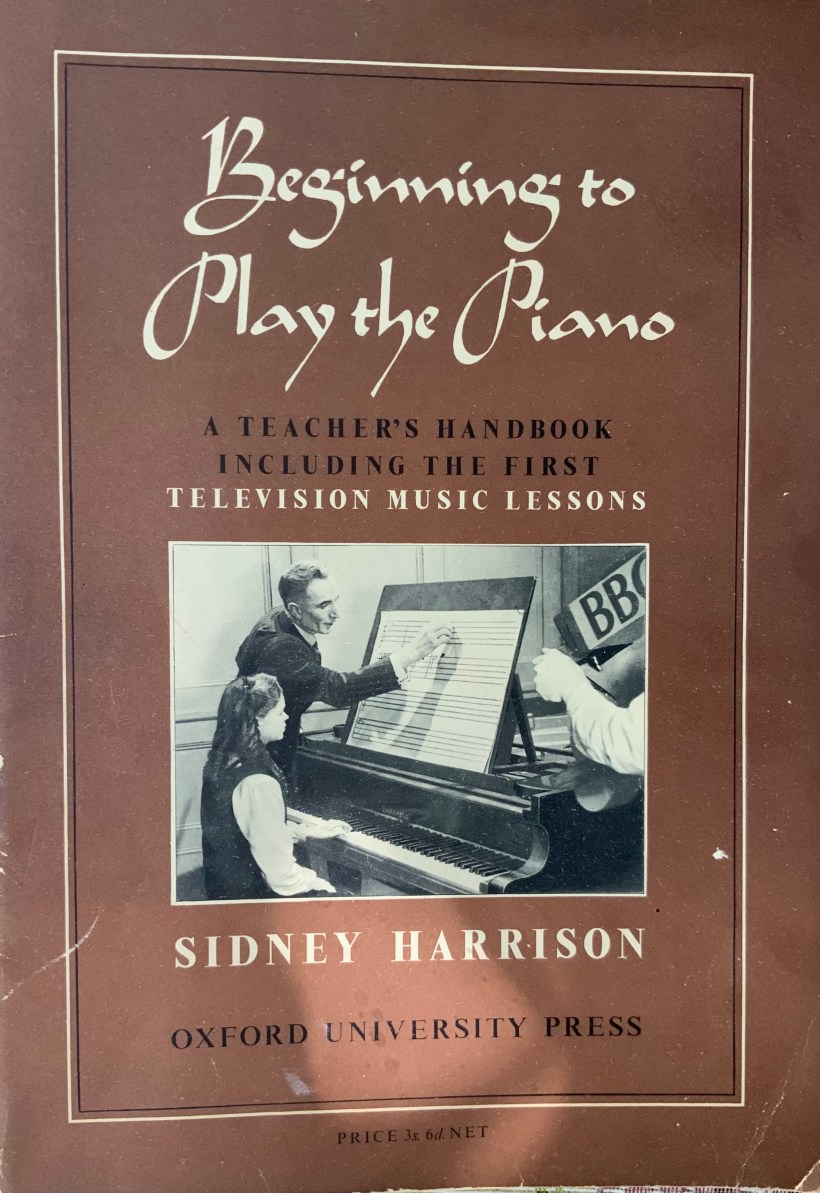
And so it was in 1968 that I was taken by “our” piano daddy,Sidney Harrison , to hear the little girl that he had imbued with the magic of  music just as he had done for me.
I was just a schoolboy at  Chiswick Boys’ Grammar School  a stones’ throw from his river fronted house.
Sidney Harrison was a household name in that period when he was the first person to give  piano lessons on the television.
A box that had only four hours of transmission a day.
One channel- the British Broadcasting Company.
We were one of the few in my street to own one and all our schoolfriends and neighbours would come over to look into this magic box that had a gigantic enlargement lense in front of a tiny pale screen that would magically light up for those few hours a day.
                                                               
Poeople would follow Peter Croser’s  lessons and others to see how they progressed.
So it was obvious that parents of talented children all wanted their offspring to study with the  man who was as famous as Eamon Andrews of This is your Life.( By coincidence he lived next door to the Sidneys in Hartington Road)
                                                                 
How many young musicians had fallen under his spell and played on his beautiful inlaid Steinway?Enjoying endless cups of coffee prepared by his wife and very much partner in crime- she too a Sydney- whilst he enthralled us with the magic sounds he could draw from the piano.
He became our friend and accomplice with his expert no nonsense common sense knowledge of the piano but above all  he shared his love for music with us .
He took me to the opera and to the Proms as I am sure he did Norma too.
I remember meeting the 15 year old Ian Hobson in the house too before he went on to win the Leeds Piano Competition.
Angela Hewitt, who although never his pupil, was befriended by him when she  too came to live in Chiswick to further her studies in Europe.She had  been  discovered by Sidney  as he had her fellow countryman Glenn Gould on his adjudication rounds of the festivals in Canada.
Norma was playing a recital at the Wigmore Hall in 1969 for the London Pianoforte Series and I was bowled over in particular by her performances of the Brahms Handel Variations and Chopin Berceuse.
Sidney took this rather shy fresher, now studying with him at the  Royal Academy, to meet her.
‘Meet the winner of the Liszt Open Scholarship’ was his way of introducing me to her!
He was always very proud and generous of his students accomplishments.
He had often talked about Norma and how he had suggested to her as a fifteen year student of his to go and listen to great women pianists like Gina Bachauer.
Passing by the Royal Albert Hall one day she saw the name on the bill board.
Bought a ticket and went backstage to meet her.
‘My teacher says I play like you’ was her opening gambit .
‘Oh’ said Miss Bachauer ‘you had better come and play me something.’
She took her Brahms second piano concerto!
Although she did not have time to  teach she introduced her to her own mentor Ilona Kabos ,the wife of Louis Kentner the great exponent of Liszt and Bartok.
Sidney with his great humility and wish for the advancement of his students  was only too happy to place Norma into such illustrious hands as he had done for me with Gordon Green a few years later.
I went to many of her concerts in the 70’s and an occasional Prom during the summer months when I could spend more time in London.
During the 80’s my music had taken me to Siena in  Italy.
A life long love affair in every sense was born!
I built and ran a  theatre in Rome  with my Italian actress wife Ileana Ghione  and so I had not realised that Norma  in the meantime had been forced to  retire from the concert platform with focal dystonia in her right arm.
She came once to Rome,of course with Barry her husband, to play Rachmaninov second piano concerto in a summer open air venue in the courtyard of one of Bernini’s most famous churches.I regret that time did not permit her to come to my home and meet my wife or see our theatre that we had created with such love and passion  in a happy life together.
                                                                                                                                                                     
The Sidney’s had come especially  to Rome to see the theatre in 1984 and to my marriage on Kew Green in the same year.(Sidney was  best man at Norma and Barry’s wedding)
I remember how proud he was to know that yet another of the promising youngsters he had helped had created such a venue and where such artists as Annie Fischer,Rosalyn Tureck,Shura Cherkassky and many many other young and old  had found a welcoming home in the Eternal city that had been denied them until we came along.
He listened to Victor San Giorgio ,a student of Noretta Conci,and was very impressed with the way we  promoted also young aspiring musicians.
                                                    n
It was a great treat  to find that in wishing Norma birthday greetings she had sent me quite unexpectedly her two new recordings from the BBC archive .
Ever generous  she added :’Hope you enjoy them,Chris they are YOUR birthday present!’
Enjoy is not the word .I have spent two days enthralled to hear the pianist that I remembered.
As Tortelier said to me once …you know what I mean by weight?
It means playing into each note not with violence or harshness but clinging onto every note like a limpet.
Giving the sound a rich  and pure  quality that is never hard (we used to describe many of the pianists making their debut in London as having the trans atlantic percussive sound .It seemed  at that time to be  so much part of the so called virtuoso bagage of a whole generation of pianists seeking glory and fortune in London).
This was long before the arrival of Richter or Gilels  in the west where we were not aware until then of how quietly and with what variety of sound the real word  virtuoso implied.
It is interesting to note that the pianists who most influenced Norma were in fact Emil Gilels and Annie Fischer.Gina Bachauer too who had that extraordinary sound as does Lilya Zilberstein and Sofya Gulyak today.
And of course Martha Argerich is a unique example to us all.
Image may contain: 3 people, including Norma Fisher, people sitting and glasses
It is exactly these qualities that I had noticed in a film that Norma’s son had prepared with such loving care for this very special occasion.
At the closing sequence  the middle section of the ‘Gondoliera’ from ‘Venezia e Napoli’ by Liszt is heard in the background.Just a few short phrases but played with a unique sound and sense of line .With the same shaping as  the human voice  but with a flexibility without ever loosing the inner energy that lies within the very notes.
It was of course Norma and wishing her greetings and thanking her for the wonderful hour I had spent with all her friends,students and admirers  but  I just wish I could have heard more of that Liszt.
Hence the surprise packet from the postman!
                                       
Straight to that Liszt.
But first a Mephisto Waltz with a twittering of bird calls that was quite sensational.I have never heard such clarity and sound allied to such precision in pianissimo since Gilels.And it followed on from such sumptuous full sounds contrasted with such delicacy and clarity too.A limpet type belonging to the keys that seems to extract such energy from each note .The build up to the climax was of sound upon sound just as I remember Gilels in the Spanish Rhapsody in a rare appearance at the RFH.The sort of playing that grips you by the scruff of the neck and does not let go .Not the usual barnstorming or tear on the sleeve Liszt but a Liszt restored to the heights where it truly belongs.
A sound that glistens like gold even on these recordings.
They have been salvaged from the few BBC archive recordings not deleted in their inexplicable blitz on an  archive of inestimable value.  Luckily Norma had some recordings taken from the broadcasts and it is thanks to Tomoyuki Sawado,the producer, that a miracle has been performed here.
A exemplary presentation by Bryce Morrison who knows more about pianists and piano playing than anyone on the planet makes this a gem indeed.
Image may contain: 1 person
And so to that ‘Venezia e Napoli’.
A ‘Gondoliera’ with the magical shimmering sound of water everywhere (the magic of Visconti in Death in Venice springs to mind) and the simplicity of the Gondoliers song with drops of water that seem to cascade from Norma’s fingers as at the Villa D’Este.
The pure opera of ‘Canzone’ in true Italian style with all the rhetoric and drama, all the more movingly powerful for that.An oh so subtle submissive duet that leads to a Tarantella of such lightweight virtuosity  belonging to another age.
No empty note-spinning but clouds of sound with a forward impulse that is so hypnotically compelling.
The extreme beauty of the embellishments adding to the sumptuous sounds of the melodic line like diamonds glittering in the crown.
A luminosity of sound and gradual build up to its ultimate goal and furious conclusion in a maze of pyrotechnics.
And pyrotechnics abounded indeed in the two transcendental studies included here.
The F minor study was played surprisingly delicately.For here was a true musician who had seen this piece not as the usual barnstorming study but as a tone poem of passionate emotions.
The accompanying figures were played with such finesse where waves of sound were created on which the most noble of melodies could float and let its heart beat so searingly.Leading to a frenzied build up played with aristocratic control before the animal like excitement of the coda.
Like an animal finally let out of the cage and  on the rampage!
Breathtaking indeed.
Mazeppa too was emersed in swirls of sound that climbed to the top of the mountain where the well known Mazeppa was revealed  in all its glory.The sumptuous cantabile of the middle section was encapsulated in magical cascades of sound.
A Danse Macabre full of infectious dance rhythms and a wonderful sound from the tenor register full of melancholy and nostalgia.The wailing of the wind in this seemingly Icelandic landscape disappearing to a mere whisper.
Leaving a simple lied by Schubert in its wake  closing this first CD dedicated to Liszt with his arrangement of Standchen.
A melodic line played with such luminosity and with a filigree accompaniment of subtle finesse becoming ever more delicate and luminous glittering like jewels in the sun.
The sumptuous final chords were of poignant artistry and a fitting end to these revelatory performances of Liszt.
No photo description available.
The G minor Sonata by Schumann opens the second CD followed by three Etudes by Debussy full of subtle colours and above all  clarity The same clarity that she  brought to her friend  André Tchaikowsky’s impishly good humoured inventions dedicated to many of their mutual friends.
A Schumann once overplayed is rarely heard in the concert hall these days.
Here it is restored to its true glory.
Both Passionate and melodic – Florestan and Eusebius  very much in evidence here.
As fast as possible Schumann writes and it is the urgency and great sense of architectural line that  is so evident in all that Norma does.Great breadth and depth with a melodic line of subtle inflections  of a natural fluidity like the human voice.Filigree passages of fleeting lightness but with tumultuous rhythmic urgency.
An Andantino of sublime simplicity with one of Schumann’s most poignant melodies played with such a sense of balance that allows it to sing with such luminosity .A velvet trail sustained with sumptuous sounds of Philadelphian proportions.
A Scherzo with a supreme sense of legato as the contrast of rhythmic and melodic is always in perfect proportion and equilibrium.
It was interesting to hear the original finale (not the one usually played).A Presto Passionato of fleeting lightness.A toybox of magic sounds with a perfect sense of line and direction.Schumann’s rather abrupt ending makes me wish she had also included the more often played final movement,requested as something easier to play by his wife Clara,that finishes more in glory.
Three Etudes by Debussy in which the technical difficulties are completely assimilated into a sound world of such subtle colours and shapes.
Has  a Czerny exercise ever sounded like this?
Or chromatic scales creating a floating wave of sounds on which the subtlest of melodies appears as though  peeping through the cracks.The greatest ‘what the butler saw’ indeed.
Arpeggios that are those of pastoral origin so beautifully and expressively shaped with such clarity and subtle colouring.
André Tchaikowsky I met at his masterclasses in Dartington and he immediately became a friend to us all.
A remarkable musician and nice man.
Tragically struck down in his 40’s he was a renaissance man who not only played the piano magnificently but also composed some very important scores yet to be discovered.
His life’s work the  opera ‘The Merchant of Venice’ was performed in Bregenz 11 years after his death  and brought to London for only a weekend where it had been turned down just months before his death in 1982.
His recital of op 109 Beethoven and the Goldberg Variations at Dartington I will never  forget.
He even persuaded Ilona Kabos to listen to his newly written string quartet for any criticism good or bad  from her hawk like ears.
He died in Oxford and his great friends Peter Frankl,Gyorgy Pauk,Ralph Kirshbaum played his trio that he had never  yet heard on his death bed.
Norma has recorded  his piano concerto that one hopes will be reissued too.
Radu Lupu,also a great friend played it in a one off concert at the Festival Hall such was the esteem and affection that his colleagues had for this man with an impish sense of humour.
He left his skull to the Royal Shakespeare Company to be used in their productions of Hamlet.
 In his will he left his body to medical research, and donated his skull to the Royal Shakespeare Company.In 2008, the skull was finally held by David Tennant in Stratford. After the use of the skull was revealed in the press, this production of Hamlet moved to the West End and the RSC announced that they would no longer use Tchaikowsky’s skull (a spokesman said that it would be “too distracting for the audience”).However, this was a deception; in fact, the skull was used throughout the production’s West End run, and in a subsequent television adaptation broadcast on BBC 2. Director Gregory Doran said, “André Tchaikowsky’s skull was a very important part of our production of Hamlet, and despite all the hype about him, he meant a great deal to the company.”

Here, actor  David Tennant uses André Tchaikowsky’s skull in a 2008 production of  Hamlet.

It is a fitting tribute to him that Norma Fisher dedicates a great part of her new CD to his Inventions op 2 from the BBC archive.
They are played with a clarity and sense of line and purpose that brings them to life probably better than the composer could have done himself.André had such a microscopic sensibility that sometimes in his own performances you would not always see the wood for the way he caressed and nurtured the trees.
Norma plays with the same sensibility but never forgetting the overall structure and architectural shape of each piece.
There could be no greater tribute to a much missed renaissance man.
It is a sign of Norma’s intellectual musicianship that her first CD should include the two sets of variations by Brahms op 21 and Scriabin’s almost unknown First Piano Sonata.
Five studies op 42 by Scriabin as an interlude show off her great  technical prowess- a true ‘Kitten on the Keys’ who has the means to an end, which is always the very meaning of the musical message that she is transmitting.
No empty showmanship but a much more subtle showmanship that illuminates so poignantly all that she touches.
A Brahms that immediately from the first notes shows the great nobility of a Symphony orchestra dissolving into the most intricate world of subtle colour.
A true aquarium of exotic sounds bathed in gold.A great orchestral climax fearlessly  thrown off descending into dark bass trills signalling the final descent with such a clear music vision and inward rhythmic impulse.
The short Hungarian Song variations that accompany op 21 is a completely different world but so clearly articulated.
I am reminded of her unforgettable performance of the Handel variation op 24 that I heard with Sidney Harrison at the Wigmore Hall 50 years ago!
Four studies op 42 by Scriabin took us into another world of ‘will 0′ the wisp’ sounds and great passionate outbursts.
The featherlight fleeting sounds of the D flat study was complimented by the serene luminous beauty of the F sharp minor n.4,full of nostalgia but with infinite delicacy and finesse.
The famous C sharp minor n.5 I have never heard played with this brooding cauldron of sounds of water boiling at a 100 degrees .The most passionate outpouring of lush romantic melody with a build up of sounds from the bass that was quite masterly and indeed breathtaking.
The gradual disintigration after that was very moving indeed.
The little study n. 8 in E flat beautifully played of course  seemed rather pointless after that  except that it allowed a subtle respite before the atomic explosion of the opening of the First Sonata.
I was at the Academy in 1972 and I remember being asked to turn pages at Maida Vale Studios for David Wilde who was performing all Scriabin too for this same series that Norma was sharing.
She had obviously pulled the short straw.
David played n. 6 .Norma the practically unknown n.1.
She may have drawn the short straw but she gave the work a performance of a lifetime.
Here captured for posterity and in Bryce Morrison’s own words: ‘  The First Sonata is a neglected masterpiece fully as ambitious as Brahms’s early examples of the genre yet already reaching far beyong precocity’
Norma plunges fearlessly into the romantic outpourings of this early work daring even to do the repeat.A masterly control of this very complex work she illuminates the way so clearly.With a brooding slow movement and an extraordinary syncopated Scherzo where streaks of lightning suddenly shoot across the horizon.A remarkable final movement that is a Funeral March!A central chorale which Scriabin asks to be played pianississimo before the final reappearance of the Funeral disappearing to a whisper with the door slammed shut with  three ‘forte’ chords.
More please dear Norma and friends.
This is too important a  lesson for anyone that cares about the Art of Interpretation.
Her many students worldwide have had the privilege to share this with her but I think it is now high time that we the public should be let into the secret too!
                                                           Happy Birthday dear Norma may there be many many more.We need you!
                                         

Alim Beisembayev on St Mary’s Teatime Classic Archive Concert Series


Alim Beisembayev (piano)

Bach: Prelude and Fugue in E-flat minor BWV 853

Liszt: Transcendental Etude no 12 “Chasse-neige”

Chopin: Etude in C major Op 10 no 7

Rachmaninov: Etude-tableau in D minor OP 39 no 9

Tchaikovsky: Nocturne in F major Op 10 no 1

Schumann: Études symphoniques Op 13

Alim Beisembayev (piano) was born in Almaty, Kazakhstan and started playing the piano at the age of 5. He is currently a student at the Royal Academy of Music where he is supported by a full scholarship and studies with Tessa Nicholson. Alim had numerous successes in international competitions: International Competition for Young Musicians “Nutcracker” in Moscow (1st prize, 2008), Franz Liszt International Junior Competition in Weimar, Germany (3rd prize, 2014), Junior Van Cliburn International Piano Competition in Fort Worth, Texas (1st prize, 2015). Alim previously attended the Central Music School in Moscow and the Purcell School for Young Musicians. He performed in halls such as the Royal Festival Hall, Purcell Room, the Great Hall of Moscow Conservatoire, Fazioli Concert Hall in Italy. In 2016, February, Alim made an appearanceon BBC’s ‘In Tune’. Alim currently studies at the Royal Academy of Music and performs chamber music as well as solo. He is also experienced in performing with orchestras such as the Evgeny Svetlanov State Symphony, Tchaikovsky State Symphony, Fort Worth Symphony.

Alim Beisembayev

at St Mary’s teatime classic archive Friday 8th May 2020

Some of the more important of the 400 concerts in the St Mary’s Archive  have been chosen by Dr Mather and his team who have devised this new series every day at teatime whilst St Mary’s is indeed ‘redundant.’Giving some glimmer of hope to young musicians (who are all offered a professional fee for the repeat performances) and  at the same time giving a great deal of pleasure to his audience.
I can watch again some of the concerts that  I was able to listen to at the time either live or by streaming to my home in Italy .But there were some  that I was not able to hear.It is a very refreshing surprise and in many ways a highlight in my present day lockdown lifestyle, that instead of catching the E 2 to perivale all I have to do is switch on my computer and enjoy the very intimate atmosphere and share in the opportunity to play  to such an eclectic audience for these superb young musicians.An opportunity that has been created by a retired but ever enthusiastic  physician in a beautiful redundant church in  West London.Musicians who are amongst the most talented in London coming to the end of their studies and  at the beginning of their careers.All they need is an attentive public to share their music with, as it is not an easy life for these young musicians that after years of dedication and sacrifice to reach their peak, they now have to struggle  in order to build a career.Apart from talent and dedication you also need resiliance and to a certain degree luck in the sense that they should always be ready to play their very best in the most trying or  even on last minute occasions.Perlemuter always used to tell me that you must always be ready and above all always play well.Cortot his teacher said exactly the same and that every time you sat at the piano you must make music as if it was for the last time and that your life depended on it.
All these consideration came to me  as I was able to listen again to Alim play a public recital five years on.
I had been invited in 2015 to the Purcell School by  Tessa Nicholson to listen to one of her students who was about to compete in the Junior Van Cliburn Competition in Texas.He had also been awarded a full scholarship to continue his studies with her at the Royal Academy in London.
I was overwhelmed by what I heard not only for the professional way he played but for the technical proficiency and  also his real  understanding and mature musicianship.Tessa Nicholson has been responsible for training some of the finest young musicians who are now emerging on the International concert stage.Mark Viner,Tyler Hay ,Menyang Pan,Kausikan Rashikumar  and now Alim are just a few that come to mind.
A programme that I imagine was a try out for another International Competition many of which have unfortunately been postponed during this corona crisis.
Image may contain: one or more people
A Bach Prelude and Fugue in E flat minor BWV 853 played with a beauty of sound and simplicity that immediately confirmed my impressions of five years ago.A musician who has a great technical bagage that can be called on to express and convey true musical values.This was even clearer in the Fugue where the clarity and  purity of the parts was conveyed through a very subtle use of finger legato and spare use of the sustaining pedal.There was also a bold contour to the fugue that gave a great architectural shape to this ‘knotty twine’ spun though as only the genius of  J.S.Bach could do.
Three studies followed by Liszt, Chopin  and Rachmaninov.
‘Chasse Neige’ the last of Liszt’s 12 Transcendental Studies may be called a study in tremolando but in fact in Alim’s hand became the tone poem that it truly is.Such delicacy at the beginning (as with Ondine by Ravel) in which the melodic line floated on shimmering waters.The great dramatic climax was played with all the passion of a young virtuoso but with a sumptuous full sound that was never allowed to overpower the general melodic contour.
The study in C major op 10 n.7 by Chopin hovered over the keys with all the lightness and will’o’ the wisp colours of Liszt’s Feux Follets or Chopin’s own ‘Butterfly’ study op 25 n.9.A beautiful sense of balance in the middle section allowed the melodic line to appear so naturally without any ‘in fighting’ that is so often the case with so called young virtuosi.
The sumptuous grandeur of the Rachmaninov Study in D minor was played with  a beautiful full golden  sound just as Rachmaninov demonstrates himself in his famous recording of his own work.
The three studies were played as a whole and made a very satisfying musical impression rather than the more usual barnstorming approach that the word study might have implied to lesser souls.
The Tchaikowsky Nocturne op 10 n.1 is a rarity and I think I have only heard it from the hands of Cherkassky in concert.I imagine the cat was let out of the bag at this point as this may have well been a set piece for the Tchaikowsky Competition in Moscow.
It was beautifully played with a rubato of aristocratic good taste and a sense of balance that allow the melodic line to sing with such touchingly nostalgic simplicity
Image may contain: 1 person, sitting
The second half of this hour long programme was dedicated to a single work by Robert Schumann.
The Etudes Symphoniques op 13.
A masterpiece in which the word study appears again as it is indeed a technical challenge for a pianist  Studies in the sense that the term had assumed in  Chopin’s op 10, that is to say, concert pieces in which the possibilities of technique and timbre  for the piano is carried out; they are ‘symphonic études’ through the wealth and complexity of the colours evoked – the keyboard becomes an “orchestra” capable of blending, contrasting or superimposing different timbres.

 The  theme had been sent to Schumann by Baron von Fricken, guardian of Ernestine von Fricken, the Estrella of his Carnaval op. 9. The baron, an amateur musician, had used the melody in a Theme with Variations for flute. Schumann had been engaged to Ernestine in 1834, only to break abruptly with her the year after.

Hardly surprising then that  Schumann thought it was unsuitable for public performance and advised his wife  Clara not to play it!The entire work was dedicated to Schumann’s English friend, the pianist and composer  William Sterndale Bennett who  played the piece frequently in England to great acclaim.

Of the sixteen variations Schumann composed on Fricken’s theme, only eleven were published by him. The final, twelfth, published étude was a variation on the theme from the Romance Du stolzes England freue dich (Proud England, rejoice!), from  Marschner’s opera based on Sir Walter Scott’s Ivanhoe (as a tribute to Schumann’s English friend and dedicatee Sterndale Bennett). The earlier Fricken theme  does occasionally appear  during this étude and the work was first published in 1837 as XII Études Symphoniques. On republishing the set in 1890, Brahms restored the five variations that had been cut by Schumann. These are now often played, but in positions within the cycle that vary somewhat with each performance; there are now twelve variations and these five so-called “posthumous” variations which exist as a supplement.

Image may contain: one or more people, people sitting, people playing musical instruments and indoor

Alim played the original 12 Etudes Symphoniques and did not incorporate, as many do, the five posthumous variations.This gave a great architectural structure to the work and through the gradual build up and with his superb musicianship he did infact make these into truly Symphonic studies.

The simplicity and beauty of the theme and gentle question mark ending led so naturally into the lightweight scamperings in which the theme emerges with a superb sense of legato and staccato.The passionate beauty of the second variation played quite simply without any false exaggerations in the repeats but allowing the music to talk and speak for itself.The lightweight flight of the third was quite remarkable  with the melodic line so beautifully shaped in the tenor register. The third chordal study played with a forward motion  as it contrasted so well with Schumann’s  lightweight flights of capricious fancy free  invention. The passionate outburst of the fifth  was played with  impetus and impeccable technical control leading into the chords of the sixth played with great rhythmic energy and  again total control especially in the trecherous final octaves.

Image may contain: 1 person, sitting and indoor

The shape and structure of a  Gothic Cathedral as Agosti described the seventh showed again Alim’s real musicianship and sense of  architectural line .Allied always to a beautiful sense of contrast and colour but never forgetting the overall direction and shape of this  musically most complex of studies.The ninth study was thrown of with a Mendelssohnian ease that belies the real technical difficulties involved.The  tenth -the calm before the storm-  was played with a beautiful left hand tremolando much as he had done in the Liszt study.It allowed the melodic line and counterpoints to sing unimpeded as they conversed amongst themselves gently leading to the great passionate  outburst before dying away so magically.The finale was played with all the rhythmic impulse and romantic aplomb where his subtle sense of colour and shaping managed to shape the dotted rhythms, that Schumann too often inflicts on us, with such nobility and aristocratic control .

An encore of a Scarlatti Sonata in G showed off the crystalline technique and sense of colour together with an infectious sense of rhythmic urgency that can turn these seemingly innocent little  sonatas into  such sparkling jewels


A Rose is always a Rose …the amazing McLachlan clan.

I  have for some time admired Murray McLachlan for his work at Chethams in teaching so many young pianists that are fast entering the profession having been formed in that very early stage by the amazing energy and enthusiasm that the McLachlan family exudes.His piano playing of course is well known having been formed at the school of Norma Fisher and Peter Katin.His wife Kathryn Page  too is a notable pianist much admired by Bryce Morrison for her performances of  York Bowen and  Lennox Berkeley  .She has given over 20 recitals at the South Bank and Wigmore Hall, both as soloist and chamber music pianist. She has toured Norway, Italy, Ireland and Australia where she gave seven recitals at the Sydney Festival and broadcast for ABC. She has performed at many of the leading music festivals and has given numerous live broadcasts for BBC Radio 3 from Broadcasting House in London, St Georges, Bristol and St Davids Hall, Cardiff.
I met her at the Rome International Piano Competition when she had been invited onto the jury by the indomitable Marcella Crudeli.A pure coincidence that Yuanfan Yang won the first prize and had been formed by Murray McLachlan at Chethams before perfecting his studies with Christopher Elton at the RAM and Dmitri Alexeev at the RCM.
https://www.facebook.com/notes/christopher-axworthy/yuanfan-yang-takes-rome-by-storm-the-xxviii-rome-international-piano-competition/10156076789642309/

Little could I have imagined that the McLachlan’s have four children three of whom are pianists and the odd one out  at 16 is a professional footballer.Callum,21 is studying with Claus Tanski in Salzburg; Mathew at 19 with Dina Parakhina at the RCM in London and Rose 17,is studying with Helen Krizos at the RNCM.

I had heard Callum playing superbly in London on several occasions and Mathew’s playing I heard  in Rome recently but Rose I had not heard until  listening to  her on a radio rebroadcast of Shostakovich’s Second Piano Concerto.It was written for his son’s 19th birthday but Rose was only 17 when she recorded  the concert for the BBC!

It was a magnificent performance not only for the professional note perfect live recording.But it was played with a beauty of sound and sense of colour  and subtle phrasing allied to the tongue in cheek rhythmic pungency that that this charming work exudes.

“Malcolm Arnold Festival 2019: Martin Handley presents a concert by the BBC Concert Orchestra and their Conductor Laureate Barry Wordsworth, with music by Arnold and a composer he greatly admired, Shostakovich. They had a number of secret meetings in Russia – ‘We’re kindred spirits in a rough and barbaric world’ Shostakovich told Arnold. It was recorded on 13th October 2019 at the Derngate Theatre, Northampton, as part of the 14th annual festival. They are joined by rising young star Rose McLachlan in Shostakovich’s Second Piano Concerto, which he wrote in 1957 for his son Maxim’s 19th birthday.”

I wanted to hear more and found a  private recording  of part of a recital she gave recently for that connoiseur of pianist Dr Hugh Mather in his series in St Barnabas in Perivale.Image may contain: 1 person, sitting and indoor

Some beautiful  performances of a real stylist.

Waldesrauschen S.145 one of the two rarely played concert etudes was here played with  a wonderful sense of balance as the melodic line passed from the right hand to the left  unnoticeably with the gently cascading embellishments of the ‘forest murmurs’ shimmering in the magical distance   A passionate climax played with all the youthful spirit and virtuosity that Liszt himself must have shown in this very refined concert study  of pure melodic invention.

Image may contain: 1 person, sitting and indoor

The Abegg Variations op 1 by Schumann  showed a a great sense of foreward movement and jeux perlé that was also so much part of a really beautiful performance of the  Schubert Impromptu op 142 n.3 D935 /3.The sonata op 109 by Beethoven was sadly lacking from this video recording but I  had heard from Dr Mather that is was a really exceptional performance for its musicianship but also for the beauty of sound that she was able to draw from this old but still very noble Bosendorfer.

It is hard to believe that her case with all her concert cloths was stolen at the station on her arrival to London from Manchester the previous evening .It was thanks to her friend who was able to lend her a concert dress for the occasion.

What a remarkable family the Mc Lachlans are  rising to the occasion no matter what the difficulty as it is  above all the the music that matters more than any other little inconvenience!  Not only talented and professional but where music is the central part of family life!

Happy Birthday Rose  on your coming of age today the 24th April 2020.

…………..and this is Callum in concert at St James’s Piccadilly for Canan Maxton’s Talent Unlimited and at St Mary’s Perivale for Dr Hugh Mather’s series
https://www.facebook.com/notes/christopher-axworthy/the-amazing-mclachlan-clan-callum-mclachlan-at-st-marys/10156615796427309/
https://www.facebook.com/notes/christopher-axworthy/callum-mclachlan-at-st-marys/10155588275697309/
https://www.facebook.com/notes/christopher-axworthy/the-joy-of-masterly-music-making-at-st-jamess-for-christmas/10157019352317309/

Rose McLachlan

Rose McLachlan was born in 2002 and began piano lessons with her father Murray in 2008. She entered Chethams School of Music in 2010 as a chorister at Manchester Cathedral.

Rose is now (2018) a pianist studying with Helen Krizos, studying organ with Chris Stokes and having singing lessons with Helen Francis. In 2012, she passed Grade 8 piano with 144/150 – distinction and in 2017 was awarded the LtCL performers diploma with distinction. Rose was the overall winner of junior and senior classes of the 2016 Scottish Youth Prize at the Royal Conservatoire of Scotland. She also won the Sir David Wilcocks Organ Scholarship 2014/15.

She has performed Beethoven’s second concerto five times as well as solo recitals in Lanzarote, Portsmouth, Wilmslow, and various lunchtime concerts at Chethams. As an overall winner of the Chetham’s concerto competition in February 2018, Rose was selected to perform the Ravel G major concerto with the Chetham’s symphony orchestra during the 2018-19 season. Also scheduled for 2019 are performances of all Chopin’s Waltzes and Nocturnes for Sir Ernest Hall in his Camel Concerts series of recitals in Lanzarote.

Dinara Klinton at St Mary’s Teatime Classics from the archive

Dinara Klinton (piano)

Chopin: Nocturne Op 27 no 2
Chopin: Barcarolle Op 60
Chopin: Prelude in D flat Op 28 no 15 ‘Raindrop’
Chopin: Grand Valse Brillante in A minor Op 34 no 2
Chopin: Valse in E minor Op posth
Tchaikovsky: Meditation Op 72 no 5
Tchaikovsky: Valse Sentimentale Op 51
Rachmaninov Elegie Op 3 no 1
Rachmaninov: Preludes Op 23 nos 4 and 5

A
dmission free with retiring collection. No tickets issued beforehand

Dinara Klinton was born in Ukraine and has recently completed the Artist Diploma in Performance course at the Royal College of Music. Dinara is the first recipient of the prestigious Benjamin Britten Fellowship, generously supported by the Philip Loubser Foundation. Prior to this she was awarded a Master of Performance degree with distinction at the RCM where she studied with Dina Parakhina and Vanessa Latarche. Upon graduating from the Moscow Central Music School, she went on her Graduate Diploma with Honors at the Moscow State Conservatory, where she worked with Eliso Virsaladze.Dinara has won many awards in prestigious international competitions, including Third prize at the Cleveland International Piano Competition in USA (2016), Third prize at the BNDES International Piano Competition in Rio de Janeiro, Brazil (2014), Second Prize at the 9th International Paderewski Competition in Bydgoszcz, Poland (2013), Second Prize at the Ferruccio Busoni International Piano Competition in Bolzano, Italy (2007), Grand Prix at the Berne Interlaken Classics International Piano Competition (2010) etc. She has also received the Diploma for the best semi-finalist at the XVII International Chopin Competition in Warsaw (2015) and Diploma of Outstanding Merit at the Hamamatsu International Piano Competition in Japan (2006).Dinara has appeared at many international music festivals including the Rheingau Music Festival, International Festival of Piano “La Roque d’Antheron”, Aldeburgh Proms, Cheltenham festival. She has performed all over the globe in such venues as Royal Festival Hall, Cadogan Hall in London, Tchaikoivsky Concert hall in Moscow, Great hall of Moscow state Conservatory, Konzerthaus Berlin, Gewandhaus zu Leipzig, Warsaw Philharmonic, Tokyo Sumida Triphony Hall. She made her debut recording at the age of sixteen, with Delos Records, and the album Music of Chopin and Liszt. Her second album Liszt: Études d’exécution transcendante, S. 139 was released in 2016 with GENUIN Classics. She is an Assistant Professor at the Royal College of Music.

Image may contain: one or more people and indoor

I have heard Dinara play many times and I even heard a masterclass with Emanuel Ax in which she played some of the Liszt Trascendental Studies.She recorded the studies to great aclaim too.

On this occasion she had chosen to play Paysage and Chasse Neige but as the next pianist for the masterclass had not arrived in time she was asked if she would like to play another study.We were all astounded when she played Feux Follets with such ease and style.It is one of the most transcendentally difficult  pieces in the piano repertoire.Emanuel Ax just grinned and  wanted to know the  secret  of  how she managed to play it so perfectly.

She became known affectionately as Miss Feux Follets at the College.

She has the most flexible hand and fingers but they are fingers of steel trained at a very early age at the Central Music School in Moscow.A technique that allows her to play not only with a sumptuous rich sound,never hard or brittle  but  also extraordinarily quiet sounds with so many different gradations of  sound from mezzo forte to pianissimo.

Image may contain: Dinara Klinton

It was this that we were aware of today in a programme of popular classics.Works that are particularly close to her heart since listening  as a little girl to the LP’s that her mother had at home. A few short early pieces of Chopin  were a framework for the Barcarolle op 60 considered by many to be one of his greatest works.

The nocturne in D flat op 27 and the Prelude op 28 n.15 were played with ravishingly beautiful sound.The Nocturne in particular was played with an exquisite sense of balance and colour where Chopin’s magical bel canto seemed to float on a layer of sumptuous sounds.The Prelude too one could appreciate why it has earned the name of Raindrop.Such was the refined beauty of the melodic line with a very subtle sense of rubato.It gave such flexibility to what in many hands can be a great tone poem with a menacing but overpowering middle section.Dinara kept the sound in strict control never letting the middle section overpower the out melodic sections from which it grows.

The two waltzes were played with all the subtle charm of someone who has lived with the music for a long time.They were played with a flexibility but also with great taste and simplicity.The melancholic waltz in A minor op 34 was paired with the brilliant waltz in E minor op posth.

It was though the Barcarolle in which Dinara’s poetic vision and sensibility was apparent from the very opening.The gentle ebb and flow of the left hand allowed the melodic line to float so magically above it.The cascading embellishments were like jewels being threaded through this magic world of sumptuous sounds.A sound both rich and yet delicate and multi coloured.It reminded me very much of the moulding that Volodos reveals  in his unique playing where sound,movement and shape seem to be one.Playing with gloves of pure velvet even in the most passionate outpourings where the piano is made to sound like a truly ‘grand’piano with a seemless outpouring of ravishing golden sounds.

Image may contain: one or more people and people sitting

The second part of the programme was given over to Russian music of Tchaikowsky and Rachmaninov.Here she truly came into her own and the piano sang with such nostaglia and melancholy.Never more so than in the Rachmaninov Elegie .Creating a magic wave of sound on which the melancholic melody could float with an aristicratic sense of nostalgia.Perlemuter  used to tell me that Rachmaninov looked as though he had swallowed a knife but that the sounds he drew from the piano were some of the most romantic he had ever heard.And so it was here with a left hand melody of such expressivness with the right hand just hovering delicately above it.It was one of those truly magical moments when a bond is created between the performer and the audience  and where you can feel that we are all listening together in hushed silence to every single nuance.

The Valse Sentimentale was thrown off with an ease and delicacy together with such a sense of yearning,The Meditation was a magical outpouring of melodic invention and the trills at the end in the right hand accompanied a left hand of such  subtle colouring.

Image may contain: one or more people and people sitting

The Prelude in D op 23 n.4 by Rachmaninov showed how much he owed Tchaikowsky with a melodic line of such ravishing beauty and accompaniments of great delicacy.The final Prelude in G major op 23 n.5 was played with an infectious rhythmic impulse and foreward drive contrasting with the central section of such romantic seduction.The  climaxes were thrown off with superb technical assurance but always within the framework of the sound world she had created.

The Tchaikowsky Humoresque was played with great charm and style .It brought this recital to an end and that was a great lesson of ravishingly beautiful playing.

On Wings of Song one could say…………

                                                                …………….and what a song she shared with us today!

Image may contain: one or more people and screen


https://christopheraxworthymusiccommentary.wordpress.com/2019/05/05/the-grand-piano-of-dinara-klinton-2/

https://www.facebook.com/notes/christopher-axworthy/the-grand-piano-of-dinara-klinton/10156465111857309/

John Leech MBE at 95 a personal Tribute

POINT and COUNTERPOINT

August 2019 — March 2020


A Personal Chronicle Of Events

by

CHRISTOPHER AXWORTHY


I dedicate this chronicle to John Leech on his 95th birthday,

one more than our gracious Queen who shares the same glorious day of 21 April.


John Leech and and Noretta Conci-Leech receiving their MBEs


The unexpected event of the coronavirus is having a devastating effect throughout the world. In the Keyboard Trust’s particular case, it has taken away the ladder we offer to some extraordinarily talented young musicians to take one more step on the very steep climb to a successful career. We hope that we can help put the ladder back in its rightful place as soon as it is possible.


In view of the extreme hardship at a very delicate moment in the lives of these young artists, our Founders and Chairman agreed that as an indication of our understanding of their plight we should pay the artists for all their cancelled concerts during this period (with a request for future reciprocity, if possible). This offer / payment has now been made to 15 artists for the 30 concerts scheduled at the outbreak of this emergency.


BUSONI INTERNATIONAL PIANO COMPETITION

The season began in Bolzano with the Busoni International Piano Competition (28 August – 6 September). As always, the competition was followed closely by our Founders — and the Keyboard Trust’s Career Development Prize was awarded to Emanuil Ivanov, a 22-year-old Bulgarian pianist perfecting his studies at the Birmingham Royal Conservatory under Pascal Nemirovski and Anthony Hewitt.


https://www.facebook.com/notes/christopher-axworthy/viva-busoni-alive-and-well-in-bolzano-part-one-two-and-three-the-final/10156743202282309/


https://christopheraxworthymusiccommentary.wordpress.com/2019/09/07/viva-busoni-the-final-parts-1-2-3-with-interlude/


BRAZILIAN EMBASSY, LONDON

On 19 September Pablo Rossi gave a recital at the Brazilian Embassy in London where it is hoped we shall be able to collaborate with the Embassy in the future to restart a series in their beautiful Cunard Hall, just off Trafalgar Square.


https://www.facebook.com/notes/christopher-axworthy/pablo-rossi-takes-london-by-storm/10156781753372309/


https://christopheraxworthymusiccommentary.wordpress.com/2019/09/21/pablo-rossi-takes-london-by-storm/


TYLER HAY

Tyler Hay gave a recital  at St James’s Piccadilly on 25 September.


https://christopheraxworthymusiccommentary.wordpress.com/2019/09/21/pablo-rossi-takes-london-by-storm/


https://christopheraxworthymusiccommentary.wordpress.com/2019/09/25/tyler-hay-kitten-on-the-keys/


His new CD  recording of Kalkbrenner is receiving great praise from the critics:

https://christopheraxworthymusiccommentary.wordpress.com/2020/03/30/making-hay-whilst-the-sun-shines-tyler-hay-plays-kalkbrenner/


MIHAI RITIVOIU

In September and October, Mihai Ritivoiu played at St John’s Smith Square and at St Mary’s Perivale:


https://www.facebook.com/notes/christopher-axworthy/mihai-ritivoiu-at-st-johns-london/10156783332152309/


https://christopheraxworthymusiccommentary.wordpress.com/2019/09/22/mihai-ritivoiu-at-st-johns-smith-square/


https://www.facebook.com/notes/christopher-axworthy/mihai-ritivoius-blazing-trail-at-st-marys/10156844368092309/


https://christopheraxworthymusiccommentary.wordpress.com/2019/10/15/mihai-ritivoius-blazing-trail-at-st-marys/


CREMONA MUSICA INTERNATIONAL EXHIBITION

From 26 – 29 September there were three very intense days of the Cremona Musica International Exhibition. The Artistic Director, Roberta Prosseda, invited both Maurizio Baglini and Ivan Krpan to give recitals in the Fazioli Hall and John Leech to talk about the Keyboard Trust.

https://www.facebook.com/notes/christopher-axworthy/a-city-in-love-cremona-music-festival-part-12-and-3-the-day-of-reckoning/10156797518442309/


https://christopheraxworthymusiccommentary.wordpress.com/2019/09/30/a-city-in-love-cremona-music-festival-parts-12-and-3-the-day-of-reckoning/


CONCERTS IN ITALY

In October, Jonathan Ferrucci played in Rome University 3’s Aula Magna Room — a recital in collaboration with the KT:


https://www.facebook.com/notes/christopher-axworthy/jonathan-ferrucci-in-rome/10156810268607309/


https://christopheraxworthymusiccommentary.wordpress.com/2019/10/03/jonathan-ferrucci-at-roma-3/


This is a very fruitful relationship with the enlightened Artistic Director, Valerio Vicari who promotes young musicians in over 60 concerts a year. His season started in September with ‘1770—2020: 250 years of Ludwig’ — The Maurizio Baglini Project. (Maurizio Baglini is a KT Emeritus Artist.)


Many other opportunities are opening up for the future. One of which last January was the recital by Yuanfan Yang in the beautiful Teatro di Villa Torlonia as part of his Italian tour.


https://www.facebook.com/notes/christopher-axworthy/yuanfan-yang-in-italy-part-2-viterbofrascati-and-rome/10157140622562309/


https://christopheraxworthymusiccommentary.wordpress.com/2020/02/01/yuanfan-yang-in-italy-part-1-vicenza-and-rai-radio-3-part-2-viterbofrascati-and-rome/


IYAD SUGHAYER IN THE USA & KHACHATURIAN RECORDING

Between 16 and 21 October, Iyad Sughayer undertook the KT tour of the USA which included recitals in New York, Philadelphia, Delaware, Castleton Virginia and at the Washington Arts Club.


Helen Foss, Concert Manager in Delaware wrote:


‘Iyad was brilliant!   Everyone at Cokesbury is still raving about his concert!  His playing was astonishing.  I cannot even imagine how all those notes even fit on a page of music and was in awe at his dynamics – from softly caressing the keys to crescendoing full force.  I took several photos for him to send to his mother and thought about how pleased the composers of his music would be to hear how he interpreted their scores.  You should have heard the remarks right after the concert – many exclaiming it was the best piano concert they had ever experienced.

All that said, Iyad was also a delight to get to know.  Charming, funny, interesting, open, warm.  In short, a magnificent representative of the Keyboard Trust.  And now a friend of ours, too!


Thank you Keyboard Trust for yet another amazing performance.  We are so very grateful.’

Iyad’s recent recording of works by Khachaturian has received five star reviews from all the major critics. You will find details and an interview with Burnett Thompson of the Washington Arts Club in the article below about his recital in March 2020 in St Mary’s, Perivale.


Iyad Sughayer with Beth Glendinning in Philadelphia


The notable critic Bryce Morrison wrote: ‘I’ve listened to your Khachaturian CD and it is utterly superb. I knew the Sonata from Gilels’ recording but you have all the outsize virtuosity for this outsize work. Everything in your playing is so richly coloured and with a born empathy for Khachaturian’s very distinctive idiom. A dazzling success, and I look forward to hearing you on further recordings and, hopefully, in London.’


https://christopheraxworthymusiccommentary.wordpress.com/2020/04/01/iyad-sughayer-at-st-marys-3rd-march-2020/


DREW STEANSON & BOCHENG WANG AT FARM STREET CHURCH, LONDON

Thanks to Bobby Chen’s intiative, the beautiful Farm Street Church in Mayfair opened its doors to us and we were invited to fill it at teatime with meaningful sounds. A beautiful piano placed in front of Pugin’s masterly altar piece in an oasis that has long been the chosen refuge for our Founders.


Drew Steanson played on 19 October and Bocheng Wang on 7 December:


https://www.facebook.com/notes/christopher-axworthy/a-knight-in-shining-armour-drew-steanson-at-farm-street-church/10156857470287309/


https://christopheraxworthymusiccommentary.wordpress.com/2019/10/20/a-knight-in-shining-armour-drew-steanson-at-farm-street-church/


https://christopheraxworthymusiccommentary.wordpress.com/2019/12/08/bocheng-wang-at-farm-street-church/


https://www.facebook.com/notes/christopher-axworthy/bocheng-wang-at-farm-street-church/10156991222992309/


LUKE JONES AT STEINWAY HALL, LONDON

On 16 October — the same day that Iyad was playing at Steinway Hall in New York — Luke Jones gave his ‘audition recital’ at Steinway Hall in London.


https://www.facebook.com/notes/christopher-axworthy/luke-jones-reaching-for-the-stars-at-steinway-hall-london-for-the-keyboard-chari/10156850786737309/


https://christopheraxworthymusiccommentary.wordpress.com/2019/10/17/luke-jones-reaching-for-the-stars/


EVELYNE BEREZOVSKY IN LONDON AND MOSCOW

In October, Evelyne Berezovsky stood in at the last minute for Lara Melda in St Mary’s, Perivale and gave ‘a sensational recital’ (Dr Mather):


https://www.facebook.com/notes/christopher-axworthy/evelyne-berezovsky-a-shining-light-illuminates-st-marys/10156839018807309/


https://christopheraxworthymusiccommentary.wordpress.com/2019/10/14/evelyne-berezovsky-a-shining-light-illuminates-st-marys/


This was just a prelude to her chamber music recital on Christmas Day in Moscow for ‘Bosendorfer Loft’, a series introduced to us by KT pianist, Emanuel Rimoldi.  (Ilya Kondratiev had represented the KT in this series at Christmas in 2018.)


Evelyne Berezovsky performed at the Bösendorfer Loft on 25 December 2019 with participants from the Tchaikovsky competition in Moscow in 2019: Leonid Zhelezny (violin) and Vasiliy Stepanov (cello). They are both studying for a Master’s Degree at the Tchaikovsky State Conservatory in Moscow. The Christmas Day programme included Tchaikovsky’s Trio for violin, cello and piano Op.50 and Rachmaninov’s Two pieces Op.6 for violin and piano (Romance and Danse hongroise).


Evie wrote: ‘The whole Loft experience was wonderful — Alissa was very warm and helpful, the atmosphere of the hall on the night was relaxed yet professional (people seated on cushions lining the walls), and the audience very warm and appreciative. It was a cool venue and I felt like I could relax in what often can be a very stressful situation. The Yamaha was great, too. All in all, a very happy experience!’


And Alisa Kupriyova, promoter of the concert, said:


‘I’m very glad to have Evelyne here for the project’s Christmas Loft evening! It was very warm atmosphere and completely sold out: people sat not only on the rows but also on the pillows on the floor! There were more than 200 people that night. Trio went very well, it was a fruitful collaboration and the guys had a stunning success that evening! Many people from the audience wanted to enter backstage to speak to me and congratulate the artists. I’m very pleased and grateful that Loft Philharmonic has the opportunity to collaborate with the Keyboard Charitable Trust. Very big thanks to all the Directors for the high-level artists and good organisation at all management levels. We have a very important cultural mission and I’m very proud that we can manage it together!’


The whole video of the concert is at: https://youtu.be/MvbEymEPMtM


https://youtu.be/7bgS0rkPPkY


https://youtu.be/wmyA6DhJXlQ


ILYA KONDRATIEV IN CYPRUS

After his enormously successful concert in Cyprus last year, Ilya Kondratiev was invited for a return visit on 31 January by the Pharos Arts Foundation.  He performed at the Shoe Factory Cultural Centre with even greater success!


Ilya Kondratiev is a true force of nature — a fierce, gravity defying, almost demonic force — all wrapped up in the most refined, delicate package. His sold-out performance last night was transcendental and unanimously spectacular. We feel privileged that we witnessed such a level of virtuosity and musicianship by such a young pianist. The future is all his!!!’ – Yvonne Georgiadou, Artistic Director


JIYEONG (CHLOE) MUN AT WIGMORE HALL, LONDON


A major annual event for the KT is the Prizewinners Concert at Wigmore Hall.  On 27 October, the recital was given by Jiyeong (Chloe) Mun, a remarkable young Korean pianist:


https://www.facebook.com/notes/christopher-axworthy/the-rising-star-of-chloe-jiyeong-mun/10156880561857309/


https://christopheraxworthymusiccommentary.wordpress.com/2019/10/29/the-rising-star-of-chloe-jiyeong-mun/


This is a review from Musical Opinion:

https://mail.google.com/mail/u/0?ui=2&ik=e365e67791&attid=0.1&permmsgid=msg-f:1654978436258227834&th=16f7aa1e8c1a667a&view=att&disp=inline


Jiyeong Mun and Founder, John Leech MBE


LESLIE HOWARD AT WIGMORE HALL (AND BURNETT THOMPSON)


On Sunday,10 November there were two extraordinary concerts, luckily in the same street. There was just enough time to get from one to the other. They were Artistic Director and Trustee, Leslie Howard’s annual Wigmore Hall recital and a concert by Burnett Thompson, former Artistic Director at the Maazel Estate in Castleton, USA, and now at the Washington Arts Club.


It was Leslie’s 45th Wigmore anniversary!


Burnett I had met in Castleton but I was not expecting such an extraordinarily enjoyable performance at the piano with introductions of a dry almost Cowardian wit that had us all hanging onto every word and note!


https://www.facebook.com/notes/christopher-axworthy/tea-for-two-leslie-howard-45th-wigmore-celebration-and-burnett-thompson-the-age-/10156917413147309/


https://christopheraxworthymusiccommentary.wordpress.com/2019/11/11/tea-for-two-leslie-howard-45th-wigmore-celebrations-and-burnett-thompson-the-age-of-mayhem/


SIMONE TAVONI AT STEINWAY HALL, LONDON

On 13 November, Simone Tavoni gave his ‘audition recital’ at Steinway Hall in London:


https://www.facebook.com/notes/christopher-axworthy/simone-tavoni-at-steinway-hall/10156925234812309/


https://christopheraxworthymusiccommentary.wordpress.com/2019/11/14/simone-tavoni-at-steinway-hall-for-the-keyboard-trust/


IVAN KRPAN IN GERMANY

On the same day, in Frankfurt, Ivan Krpan played for the 25th Anniversary of the Rabuts’ concerts at the Bechstein Centrum:


‘Wow!’, sighed the lady at my side after Ivan’s encore with a prelude of Chopin, and said she couldn’t believe that at the age of 22 Ivan played in such a mature way full of tenderness. A neighbour, a piano player himself, took my hand and said ‘I am deeply grateful for this evening’ — and another piano playing lawyer said: ‘This was the very best I ever heard here.’ What an evening and after 24 wonderful concerts a real highlight as well for the programme for the lyrical and tender performance. Thanks to all of you for choosing another brillant young pianist to offer this outstanding concert to a breathless public.’ — Sibylle and Patrick Rabut


Ivan continued his short tour of Germany with performances at Steinway Hall in Hamburg and also in Berlin.


This was the report by Moritz von Bredow, Trustee and German Concert Manager:


November, 2019 – Steinway Hall, Hamburg & Representation of the City of Hamburg, Berlin


‘What a most wonderful and unusual pianist Ivan Krpan is! This was his programme:


  1. Brahms: 3 Intermezzi, op. 117
  2. Liszt: Andante lagrimoso, S. 173/9
  3. Liszt: Funérailles, S. 173/7
  4. Brahms: Variations on a Theme by Robert Schumann, Op.9
  5. Liszt: Bénédiction de Dieu dans la solitude, S. 173/3


For the Berlin recital, he omitted the Brahms intermezzi, but finally played No.2 as an encore. This was a very challenging and wonderfully interpreted programme.


The Brahms Intermezzi were played with the greatest intensity, nothing at all was left to chance, and throughout his interpretation, Ivan kept the tension, and the listener was left in awe.


It might be interesting to say that Ivan pointed towards his love for Liszt’s ‘Harmonies poétiques et religieuses’ S.173. Again, he was able to find a most convincing tonal language, and he played with the greatest inner tranquillity and strength, thus bringing to light not only the religious aspect of Liszt’s wonderfully meditative pieces, but also the depth in turmoil that can root in anyone’s soul.


Brahms’s Variations Op.9 (which he wrote when he was only 21!) on a Schumann theme, rarely played, were beautiful and sad at the same time — an Hommage, perhaps a premature eulogy on Robert Schumann, who was then already in a mental asylum. Interestingly, Clara Schumann had written variations of the same theme (from Schumann’s ‘Bunte Blätter’) one year before (in 1853, when Brahms had stayed with Liszt in Weimar and later went to visit Schumann in Düsseldorf, which gave the latter an uplifting energy during a phase that was already characterised by severe depression).


Ivan played with an incredible maturity, considering his young age of only 22, bringing out all the themes from other works by Robert Schumann, and his playing was absolutely beautiful in colour, tone, dynamics and rhythm.


Both halls were completely sold out, the smaller one in Hamburg with just under 60 people, the one in Berlin with just under 150 people. Raucous applause followed everywhere, and people were deeply moved. The Croatian General Consul attended the Hamburg recital with an entourage of four people, he was deeply impressed and considering helping Ivan in the future, too.


Ivan is a very interesting pianist, most notably also because he is far away from striving for superficial glory and far away from playing the piano only in order to show off how great a pianist or virtuoso he is. He is indeed both, but he won’t show it.


Ivan is quiet and calm, very attentive in conversation, and his piano playing is simply masterful in any respect. He has full control about anything he wants to do, and together with his amazing personality, it makes him a great artist.


Full marks, and I would strongly recommend Ivan to be given any opportunity that the Keyboard Trust is able to provide, especially our tour of the United States.’


On 23 January Ivan played with the  Zagreb Philharmonic in Rome’s S. Cecilia Hall in a special concert to celebrate the Presidency of Croatia to the Eurpoean Union. Liszt’s First Piano Concerto was listened to by Yuanfan Yang on his Italian tour. He had had hurried back from Vicenza especially to meet his colleague and fellow KT artist.


https://www.facebook.com/notes/christopher-axworthy/ivan-krpan-and-yuanfan-yang-in-rome/10157123341977309/


https://christopheraxworthymusiccommentary.wordpress.com/2020/01/26/ivan-krpan-and-yuanfan-yang-in-rome/


Yuanfan Yang and Ivan Krpan in Rome


SASHA GRYNYUK

On 20 November, KT ‘emeritus’ artist, Sasha Grynyuk filled the breach at a moment’s notice for an indisposed colleague at St Mary’s, Perivale with extraordinary results:


https://www.facebook.com/notes/christopher-axworthy/sasha-grynyuk-an-unexpected-visit-from-a-master-pianist/10156957474887309/


https://christopheraxworthymusiccommentary.wordpress.com/2019/11/26/sasha-grynyuk-an-unexpected-visit-from-a-master-pianist/


UK LISZT SOCIETY ANNUAL PIANO COMPETITION 2019

On 30 November, the UK’s Liszt Society held its annual recital and Piano Competition.  As winner of the 2018 Competition, Corbin Beisner gave the recital:


https://www.facebook.com/notes/christopher-axworthy/liszt-comes-to-perivale/10156968191772309/


https://christopheraxworthymusiccommentary.wordpress.com/2019/12/01/liszt-comes-to-perivale/


Minkyu Kim was the winner of the 2019 Competition and he went on to give a recital in Dr Mather’s series in St Mary’s, Perivale in January:


https://www.facebook.com/notes/christopher-axworthy/minkyu-kim-at-st-marys/10157109963937309/


https://christopheraxworthymusiccommentary.wordpress.com/2020/01/21/minkyu-kim-at-st-marys-viva-franz-liszt-the-poet-of-the-piano/


ITALIAN TOUR 2020 — ALBERTO CHINES & YUANFAN YANG


The Italian tour this year was divided in two due to a change of venue in Padua — which gave two KT pianists the opportunity to perform.


For the first three concerts of the tour, Alberto Chines had the chance to shine as he had done in his Steinway Hall concert. And shine he did with a superb performance of Schubert’s last Sonata and Beethoven’s Op. 27 No.2 the so-called ‘Moonlight’ Sonata.  It was played with an intellectual and spiritual control of great authority. He even designed the poster!


https://christopheraxworthymusiccommentary.wordpress.com/2020/01/13/puttin-on-the-ritz-chines-shines-in-padua-for-the-keyboard-trust/


https://www.facebook.com/notes/christopher-axworthy/chines-shines-in-padua-for-the-keyboard-trust-puttin-on-the-ritz/10157088124862309/


The second half of the tour was with Yuanfan Yang (see separate entry). He gave some quite extraordinary performances that included the RAI 3 radio producer cheering from the control room as he improvised on themes via direct phone-in from the listening public. The ‘Godfather’ in stormy mode was quite sensational.


https://www.facebook.com/notes/christopher-axworthy/italy-awaits-the-return-of-yuanfan-yang/10157072603777309/


https://www.facebook.com/notes/christopher-axworthy/yuanfan-yang-in-italy-part-1-vicenza-and-rai-radio-3-part-2-viterbofrascati-and-/10157118024482309/


https://christopheraxworthymusiccommentary.wordpress.com/2020/02/01/yuanfan-yang-in-italy-part-1-vicenza-and-rai-radio-3-part-2-viterbofrascati-and-rome/


CRANLEIGH ARTS CENTRE – EDWARD LEUNG

On 24 January, Edward Leung played at the Cranleigh Arts Centre.  These are the words of Stephen Dennison, Director:


‘You will be delighted to hear that Edward gave a star performance last night. For the first time in our 5 years of classical concerts we had an advance booking sell-out. The quality of performance is being recognised by our community.


The programme was excellent with the Chopin and Prokofiev Sonatas being loved by the audience. He is an excellent communicator and established a strong rapport with his words about what he played: our audience like that.


This was the first concert on our new hand crafted Shigeru Kawai piano. Edward hit it hard (!!) but also with great delicacy. It was a pleasure to have him stay over with us: his life story is very interesting and he was very open about the challenges facing a young professional trying to be famous.


He seems to know all the circle of his age group, some of whom have performed at Cranleigh and others who are scheduled. He has his Wigmore debut in April, accompanying violin I think he said. I do hope he succeeds. I know that the Cranleigh audience would love to hear him again in a year or so.


I spoke for a couple of minutes pre-concert about the valuable work of the Keyboard Trust as well as featured your logo on the programme. Thank you for finding Edward for us.’


INTERNATIONAL COMPETITION – PADUA

On 25 January, in Padua, the KT had a presence at the 17th annual International Competition Premio Citta’ di Padova with the prestigious Orchestra di Padova e del Veneto.


https://christopheraxworthymusiccommentary.wordpress.com/2020/01/26/17th-international-competition-premio-citta-di-padova-for-soloists-and-orchestra/


https://www.facebook.com/notes/christopher-axworthy/17th-international-competition-premio-citta-di-padova-for-soloists-and-orchestra/10157123421747309/


PONTUS CARRON – STEINWAY HALL, LONDON

On 5 February Pontus Carron gave an ‘authoritative’ and ‘remarkable’ recital at Steinway Hall in London:


https://christopheraxworthymusiccommentary.wordpress.com/2020/02/07/pontus-carron-at-steinway-hall-london/


BRITISH INSTITUTE LIBRARY, FLORENCE

A few days later, on 13 January, in Florence, a very interesting new venue opened up at the British Institute. Concerts take place in the library of that extraordinary aesthete Harold Acton. It is just a stone’s throw from the Ponte Vecchio and we hope to add it to our Italian tours in the future — whether live or virtual. We have to thank Angela Hewitt and Ashley Fripp for the introduction to the enlightened Director, Simon Gammell OBE.


https://christopheraxworthymusiccommentary.wordpress.com/2020/02/14/ashley-fripp-in-florence-a-walk-to-the-paradise-garden/


JAMIE BERGIN IN BUXTON

On 14 February, Jamie Bergin gave a recital for Buxton Festival’s AGM, Trustees and Friends:

‘I thought that I should let you know that Jamie Bergin’s recital yesterday was a huge success and received tremendous applause and congratulations from all who were there. We were pleased that his mother and aunt were there too. They must have felt very proud at the audience reaction … He really is very talented and we look forward to hearing more of him in the future. Thank you for introducing him to us.’


TEMPLE CHURCH, LONDON – ORGAN RECITAL BY WILLIAM FOX

On 19 February William Fox, sub-organist at St Paul’s Cathedral in London, gave an outstanding organ recital at Temple Church with the following thrilling selection of pieces:  ‘St Patrick’s Breastplate’ from Sonata Celtica (Op. 153) by Charles Villiers Stanford; Fantasia in A minor by William Byrd; Spring Song by Alfred Hollins and Sacred and Hallowed Fire by Cecilia McDowall.


CORONAVIRUS IN ITALY – GIOVANNI BERTOLAZZI

In February, there were already signs of coronvirus in Italy. In fact, a concert in Padua on 23 February was attended by an unusually small audience some of whom were already ‘social distancing’ and wore masks.


I attended a concert by Giovanni Bertolazzi, a finalist in the Busoni Competition, in the Sunday morning series in the Salone dei Giganti. (Giovanni Bertolazzi has yet to join the KT!)


https://christopheraxworthymusiccommentary.wordpress.com/2020/02/22/giovanni-bertolazzi-a-giant-amongst-the-giants/


After this concert all concerts in Italy were cancelled and the KT concert in this series that was due to take place on the 8 March with Nicola Losito  was one of the first casualties.

Nicola Losito


GEORGE X. FU AT STEINWAY HALL IN LONDON

Concerts continued in London for a while longer.


Our last concert at Steinway Hall was on 11 March with George Xiaoyuan Fu standing in at very short notice for Irma Giganti who had not been allowed to fly from Vienna:


https://christopheraxworthymusiccommentary.wordpress.com/2020/03/12/the-amazing-mr-fu-at-steinway-hall/


LUKA OKROS AT ST JOHN’S, SMITH SQUARE, LONDON

Luka Okros, a KT artist, gave the last concert in London for the foreseeable future on 17 March at St John’s, Smith Square:


https://christopheraxworthymusiccommentary.wordpress.com/2020/03/17/the-last-recital-luka-okros-at-st-johns-smith-square/


MARK VINER’S RECORDINGS

Mention should be made of the extraordinary reviews that Mark Viner’s remarkable severn CDs are receiving. He gave our Prizewinners Wigmore Hall recital last year.


Mark played at St Mary’s, Perivale on 10 March — and, on 13 March, presented his new CD of Alkan’s monumental Grande Sonate Op.33 at the Royal College of Music.


https://christopheraxworthymusiccommentary.wordpress.com/2020/03/12/mark-viner-at-st-marys-2/


PODCASTS

(http://keyboardtrust.org/podcasts/)


Mention should also be made of the podcasts that Sasha Grynyuk (in collaboration with my co-Artistic Directors, Elena Vorotko and Leslie Howard), have created and which can now be viewed on the KT website.


These feature interviews and short performances with Alexander Ullman, Evgeny Genchev, Martina Kazmierczak (harpsichord), Iyad Sughayer, Jean Rondeau, Mark Viner, André Gallo and Ilya Kondratiev with Dietlinde Turban Maazel Wood at Castleton, Virginia in the USA.


The Keyboard Trust is currently investigating ways to augment the website and YouTube channel with past performances of KT artists.  I am sure we shall come up with some lovely surprises before this cunning little virus leaves us with a less complacent and surely more human world where music will once again be our guiding light.


Eliane de Castro and Paulo Gala are generously supporting a Keyboard Trust Book to celebrate the 30th Anniversary of the KT in 2021.  Contributions in terms of thoughts or ideas would be gratefully received!


DR WEIR LEGACY AWARD (The Keyboard Trust Reaches Out To An Even Younger Generation)


The Executors of the will of the late Dr Kenneth Ross Weir appointed the Keyboard Charitable Trust to implement one of his key bequests: an annual award to support the musical education of a young keyboard player between the ages of twelve and twenty. Dr Weir was a frequent visitor at the Trust’s performances by its new intake of highly gifted pianists normally in their early twenties; he clearly thought of those whose circumstances deprived them of the training that might qualify them to enter the profession at this advanced level.


It is therefore natural that the Keyboard Trust’s three joint Artistic Directors – Prof. Leslie Howard, Dr Elena Vorotko and Christopher Axworthy – should be responsible for identifying the candidates for the Weir scholarships. Teaching and holding masterclasses at world-wide institutions, serving on juries of international competitions and tending links with academic exchange networks, they have far-reaching opportunities to become aware of potential beneficiaries. The scheme will therefore not be accessible by application.


This additional activity fits well with the Trust’s traditional field of intensively assisting highly promising young artists – pianists, organists and historical keyboard players – to build an international career in the short interval between ending their formal education and confronting a fully independent professional life. Those who respond well to Dr Weir’s support may find an easy continuity as they advance to maturity in their profession. Followers of the KT’s website should receive annual news of the award recipients at the beginning of each academic year.


ELIAS ACKERLEY – DR WEIR LEGACY – 2019-2020 RECIPIENT

The Keyboard Trust would like to congratulate Elias Ackerley, the first recipient of Dr Weir’s Legacy. Elias began his studies at the Curtis Institute of Music in Philadelphia, USA in September 2019.


Biography
Born in Shrewsbury in 2001, and emigrating the following year, Elias began his piano studies at the age of five in South Korea. After making rapid progress, he was taken on by Russian pianist, Oleg Shitin, under whose guidance he succeeded in a number of competitions, including winning the junior prize at the Gumi National Piano Competition in 2012.


In May 2013, at the age of eleven, Elias gave his debut recital in Chester and has since performed regularly in concerts in the UK, including as a soloist with a number of orchestras.


Between 2014 and 2019 Elias was a student at Chetham’s school of Music where he was a pupil of Dr Murray McLachlan (Head of Keyboard), under whose tutelage Elias succeeded in becoming the youngest ever winner of Chetham’s Beethoven competition in 2015.


More recently, Elias won first prize at the Scottish International Youth Piano Competition (2017), the Blue Ribbon at the National Eisteddfod (2017) and the Epta UK Piano competition (2018). He was a keyboard finalist in the BBC Young Musician of the Year in 2018.

Elias has received masterclasses from Sir Andras Schiff and Stephen Hough and lessons from Leslie Howard, Boris Berman and Robert McDonald.


Elias is currently a student of Prof. Gary Graffman at the Curtis Institute of Music.


‘Elias Ackerley is doing magnificently in that in addition to all the solo piano work – he was accepted as a piano student – he is also doing more chamber music than practically anyone else (and not just first year students!).  He came to New York to have an extra lesson with me a couple of days ago because he is playing Brahms’ Paganini Variations in a student concert next week.  It’s remarkable.  Pamela Frank in the violin faculty – she is a good friend of mine – told me independently how interesting he is to work with. You should know about Paul Bryan, the Dean who is knowledgeable about the academic stuff (non musical stuff) he is doing.  I can only be extremely complimentary, especially as he has only been here a few months.  At this moment, he would get either an A or an A+ so far as I’m concerned.

My cell phone number is enclosed.  I’d rather talk on the phone as I don’t have a computer, am 91 years old and am not learning new tricks!’ — Prof. Graffman, November 2019


Update from Elias Ackerley – April 2020

‘Hope you are well in these troublesome times. I just wanted to update you what is going on in terms of school. Currently I’m back at home but online classes and lessons have continued. I am receiving assignments and phone calls to catch up with lessons every week. I hope to be back at Curtis by September having just heard this current semester will not be resumed on site.’


Academic Year 2020-2021

A new Dr Weir beneficiary will be selected by the KT’s Artistic Directors shortly — to start studies in the next academic year.  Full details will be provided in the next Newsletter!


Happy Birthday to our Founder

On behalf of all the Trustees, Artistic Directors and Friends of the Keyboard Trust, I wish John Leech MBE, our beloved Founder, a very HAPPY 95TH BIRTHDAY on 21 April 2020!


Christopher Axworthy, April 2020

Mengyang Pan at St Mary’s Teatime Classics from the archive

Image may contain: one or more people

Chinese born British pianist Mengyang Pan began her piano studies in China, eventually becoming a junior student at the Central Conservatory of Music Beijing. Having been offered a full scholarship, she accepted an invitation to study at the Purcell School in the UK  with Tessa Nicholson before completing her musical education at the Royal College of Music with Vanessa Latarche.A brilliantly decorated star, Mengyang is the prize winner of many prestigious competitions including Rina Sala Gallo International Piano competition, Bromsgrove International Young Musician’s Platform, Dudley International Piano Competition, Norah Sands Award, MBF Educational Award, Chappell Gold Medal, Brent International Piano Competition and Ettlingen International Piano Competition. Famed for her graceful charm and wonderful communicative stage presence, Mengyang performs repeatedly in some of the best venues throughout the UK such as the Royal Festival Hall, Wigmore Hall, Cadogan Hall, Bridgewater Hall, Birmingham Symphony Hall, St. John’s Smith Square and Royal Albert Hall amongst many others.As an engaging and inspiring collaborator, Mengyang has appeared with many orchestras and her collaboration with conductors such as Maestro Vladimir Ashkenazy, John Wilson and Mikk Murdvee has gained the highest acclaim nationwide. She was presented with the Tagore Gold Medal by HRH Prince Charles in 2007 for outstanding representation of the Royal College of Music, the highest honour possible. In 2011, she was presented to HM Queen Elizabeth II and Duke of Edinburgh at Buckingham Palace for her contribution to the British music and art industry. Apart from performing, Mengyang is also passionate about teaching. She is currently a professor of piano at Royal College of Music, Imperial College Blyth Centre for Music and Visual Arts and St Paul’s School for boys. She also gives regular masterclasses at schools including the Purcell School, Imperial College, St Paul’s School and her native China, events which are greeted with considerable critical acclaim.

Mengyang Pan at St Mary’s Teatime Classics from the archive

It was in 2012 that I first heard Mengyang Pan play in Monza.She gave an impeccable performance of the Emperor Concerto that still remains in my memory for its musicianship and technical command allied to an aristocratic passion and sense of style.It is she and Julien Brocal that stand out in my memory for the outstanding performances they gave in that circus arena.She certainly got my vote and I  was sure that with an artist of such similar virtues such as Bruno Canino, the president of the jury, she must have got his too.She did infact win a top prize and has gone on to confirm those virtues that were so evident 8 years ago.

Image may contain: 3 people
This new series from the archive of St Mary’s has given me the opportunity to listen to one or two of the concerts that I have had to miss over the years.I have heard Mengyang on other occasions though at St Mary’s and even in a concerto performance in the church where I was married in 1984 on Kew Green.
Again today one could just wallow in the clarity and her absolute fidelity to the score.
She is an artist that you can trust!
There are not all that many,by the way.

Always playing with impeccable preparation and a technical command that she aquired from the school of Tessa Nicholson.At the Purcell school she was in her class that has produced Mark Viner,Tyler Hay,Alim Beisembayev and many others.

All  different but with virtuoso techniques  at the service of the music.

Image may contain: 1 person, sitting and indoor
It was clear from the opening of the Chopin G minor Ballade the respect and total understanding she has for what the composer wrote.How many times we have heard this Ballade in the so called Chopin tradition where, as Rubinstein explains to a student in a masterclass in Israel, it is pure simplicity that is needed to allow Chopins notes to ring true.
And true they did today with a simplicity and sense of melancholy that is also,I have come to learn, so much part of the chinese culture Such delicacy and musicianly playing contrasting with the great passionate outbursts   played with great technical brilliance.A scintillating coda contrasted so well with the absolute stillness of the final chords interrupted by  the passionate streaks of lightning before the final grandiose octaves.
Image may contain: one or more people
The Ballade in F major was just the calm needed after the stormy ending of the first Ballade.A melodic line of great clarity with just a hint of the counterpoints subtley allowed to emerge.The passionate outbursts were played with an aristocratic control and beautifully shaped.The startling changes in harmony in the middle lyrical section have never been more searchingly apparent.I found this coda though a little too fast to allow for a more sumptuous stormy sound that sounded rather clipped at this speed.The final reappearance of the opening melody though was pure magic.
And it was magic she gave us with Debussy’s early Suite Bergamasque.Introducing the piece to her affectionate public she said it was a piece of such complete charm and freshness.
Exactly the qualities that she brought to these four short movements.
A great sense of charm and delicacy in the Prélude but also a clarity that suited this early Debussy so well. A lightness and sense of dance in the Menuet which gradually opens up to a magical lyrical section and a final soft glissando to finish.
There was a complete change of colour for Clair de lune.
A liquid sound for this beautiful melody bathed in the rays of  moonlight .Her perfect sense of balance in the middle section allowed the melodic line to sing so gently before the reappearance on rays of moonlight of the opening melody even more liquid and delicate than before.The Passepied was thrown off with all the nonchalance that Debussy imbues in this bucolic lighthearted dance.
Suite bergamasque  was first composed by Debussy around 1890, at the age of 28, but was significantly revised just before its publication in 1905.The composer was loath to publish these relatively early piano compositions because they were not in his mature style, but in 1905 accepted the offer of a publisher who thought they would be successful given the fame Debussy had won in the intervening fifteen years. While it is not known how much of the Suite was written in 1890 and how much was written in 1905, it is clear that Debussy changed the names of at least two of the pieces. Passepied had first been composed under the name “Pavane”, while “Clair de lune” was originally titled “Promenade sentimentale”. These names also come from Verlaine’s poems. The final title of Suite bergamasque comes from Verlaine’s poem “Clair de lune”which refers to bergamasks in its opening stanza:

Votre âme est un paysage choisi
Que vont charmant masques et bergamasques
Jouant du luth et dansant et quasi
Tristes sous leurs déguisements fantasques.

Your soul is a chosen landscape
Where charming masquerades and dancers are promenading,
Playing the lute and dancing, and almost
Sad beneath their fantastic disguises.

Image may contain: one or more people

Precision,temperament and sheer enjoyment were the hallmarks of  her performance of Moszkowski’s old warhorse ” Caprice Espagnol”.It was thrown off with the ease that the great virtuosi of their day used to relish at the end of their programmes.Technically impeccable as was her complete understanding of this world of Spanish dance and pure’ joie de vivre.’

An encore of the Paraphrase  by Liszt of Verdi’s Rigoletto brought even finer playing as she seduced and ravished us with her great belcanto sound and scintillating arpeggio embellishments .The delicate repeated octaves were played with such a refined sense of style and musical understanding almost like the vibrated notes of the ‘bebung’ on the early pianos.Her passionate involvement and total fearlessness  brought just that element of showmanship that is so much part of these pieces when Liszt used to wow his aristocratic audiences with devastating effect.


Caterina Grewe at St Mary’s – A dream of Utopia

Caterina Grewe at St Mary’s
I had missed this one during the season and judging from the Christmas Tree it must have been the season of good will!

Hugh had told me it was a fine performance but he did not tell me HOW fine it was!
So it was a very pleasant surprise to have an hour of enchantment before listening to the ever more alarming bulletins from Downing Street.

‘A map of the world that does not show Utopia is not worth glancing at.’But then Oscar Wilde ‘had nothing to declare except his genius’

And enchantment it was indeed on this map today!Of a much better world than the one we are experiencing at the moment.
Caterina has a magic wand that cannot be taught or bought but immediately casts a spell over he who dares to enter into her world of sumptuous sounds and ravishing rubato as her fingers caress the keys.
A true technical mastery that allows her to discover the music as it is revealed to her in that moment.
Looking at her and listening to her simple unaffected innocent passion reminds me of Annie Fischer.I will never forget her performance of naked passion in L’Isle Joyeuse offered as an encore after a masterly performance of Brahms F minor Sonata in Rome..
Today the innocence of Schumann’s delicate Arabesque seemed to flow so naturally from her fingers as did the waters in her truly masterly account of Auf dem Wasser zu singen.
The sublime beauty of Der Aufenthalt where the outpouring of melodic effusion was played with such refined sense of style and passionate involvement .A heartrending ending led us so beautifully into the serenity of Du bist die Ruh.Time stood still as the melodic line sang so beautifully with the most delicate embellishments appearing and disappearing like magic in her sensitive hands.
A masterly performance of Liszt’s great B minor Ballade ranging from the meltingly beautiful to the grandest of passionate declamations.A magnificent tone poem and a performance that can only convince us even more that this is amongs the greatest of Liszt’s works.
The second Rhapsody (Tom and Jerry as LangLang describes it)was restored to its rightful place as one of the best known and most loved of all Romantic showpieces.
It was played with the astonishing freedom of someone who had truly got to the heart of the piece with such understanding and commitment.She brought it to life with a freshness and astonishing ‘devil may care’ freedom that Liszt himself must have displayed as the aristocratic audiences of the day were reduced to a spontaneous display of the emotions usually only associated with the masses!
Chopin’s posthumous nocturne in C sharp minor brought serenity and a subtle sense of stillness as she shaped the melodic line with a rare sense of refined Bellinian rubato.
What an oasis this teatime concert is as we prepare for news of this cunning little virus that is bringing such caos and bewildering loss into our daily lives.

No photo description available.
Image may contain: text
Image may contain: 1 person, close-up
Image may contain: one or more people and indoor
Image may contain: 1 person, close-up and indoor
Image may contain: one or more people
Image may contain: 1 person, indoor

Dr Mather’s cure – On Wings of Song

Dr Hugh Mather‘s teatime selection.
You can even see Felicity running out to get the tea and cakes.
What better way to start this lockdown series from the St Mary’s archive than Mozart.
Elvira Madigan K 467.
Played with such passion from the string ensemble. It was a joy to watch the first violin and cello in particular.
A relentless rhythmic energy that allowed Mozart’s magic to cast its spell without any personal disturbances.
Fascinating to watch Viv McLean as he almost invented the music such was the spontaneity and obvious enjoyment.
I loved watching as he found pianistic solutions between the hands so as not to interrupt the relentless tempi they had set themselves in the outer movements.
The slow movement was played as chamber music such was the atmosphere of Hausmusik that Hugh and his enthusiastic audience bring to their hallowed hall of St Marys.
An atmosphere that comes over with such a feeling of nostalgia and gratefulness into my fortress where I shall be locked in for some time as we listen to ever more alarming news of this clever little virus.
A cunning bedfellow that knows how to get in the cracks of our up to now rather complacent lives
Not too long I hope ….but Hugh has over 400 videos to keep us happy whilst we sip our own tea for now.
Dr Felicity Mather can have a well earned rest from her retirement post.
Some of these concerts I have attended live or via live streaming.
Today’s was new to me …..and hats off to Hugh for starting with one of the best.
/