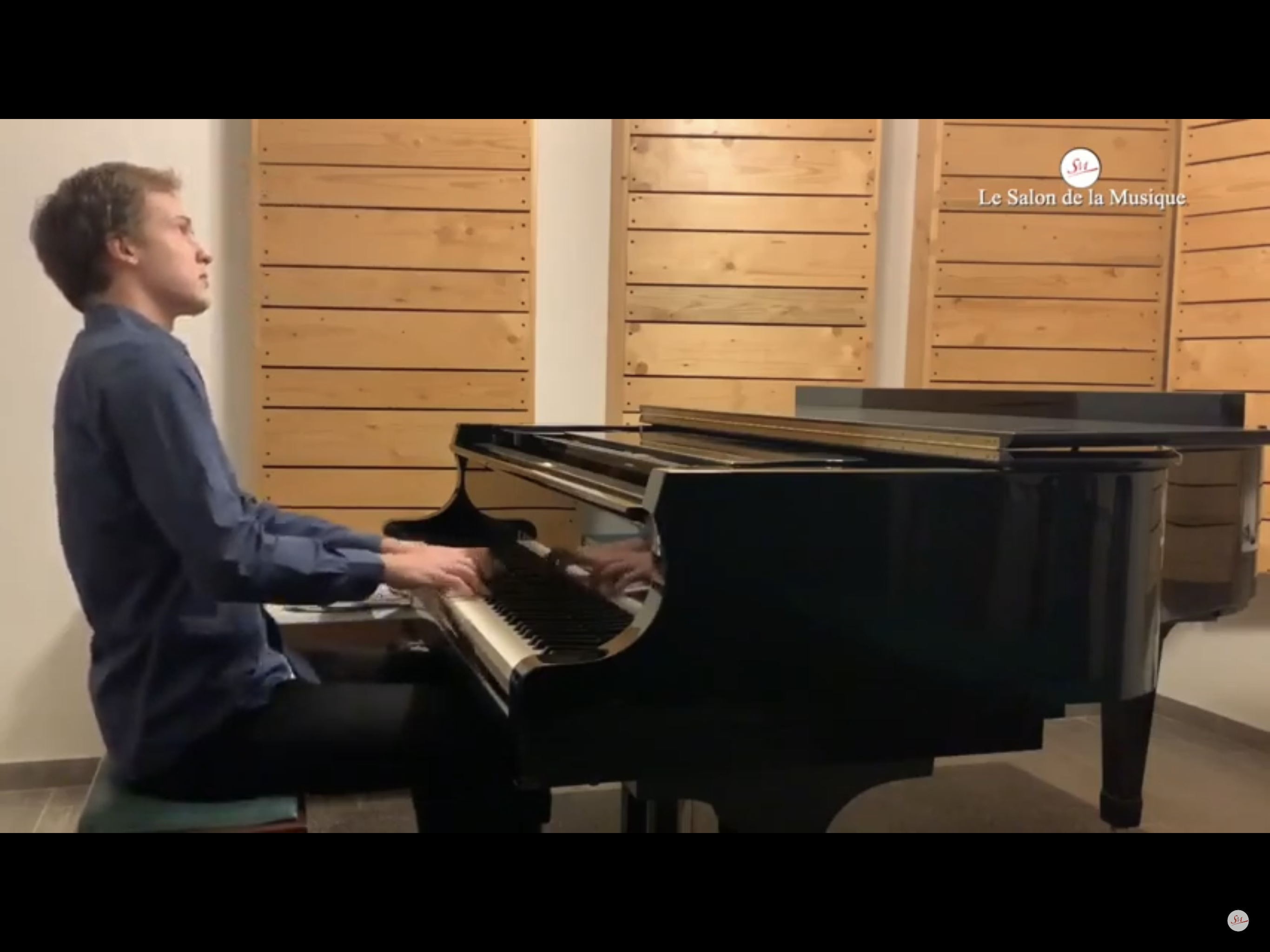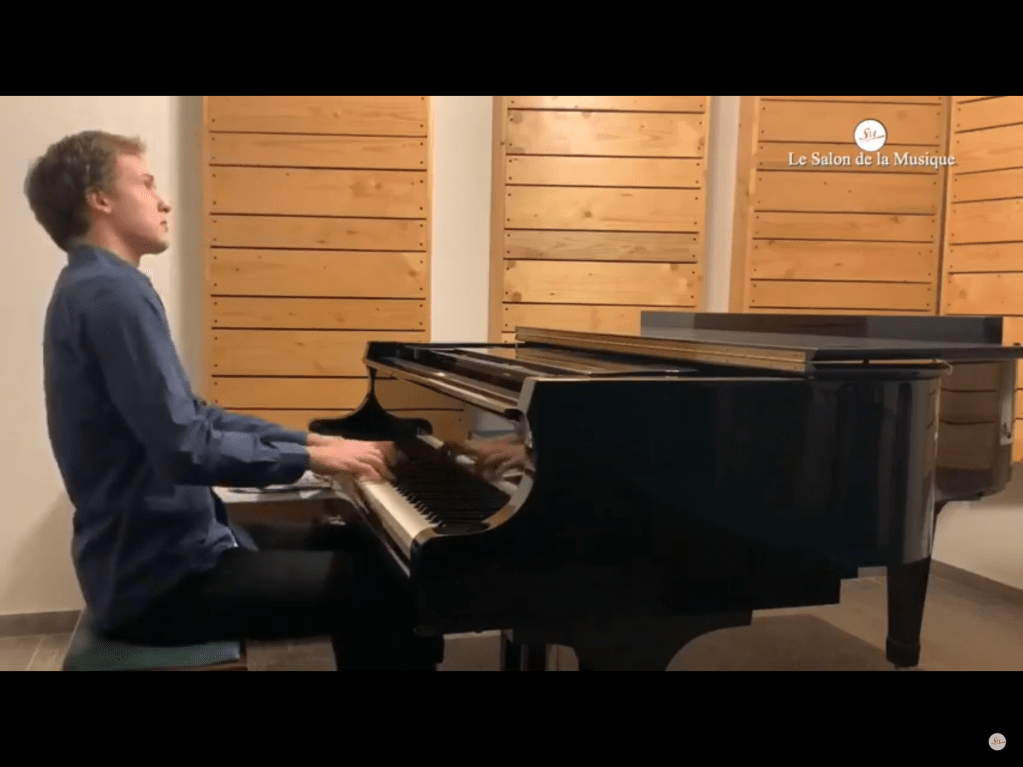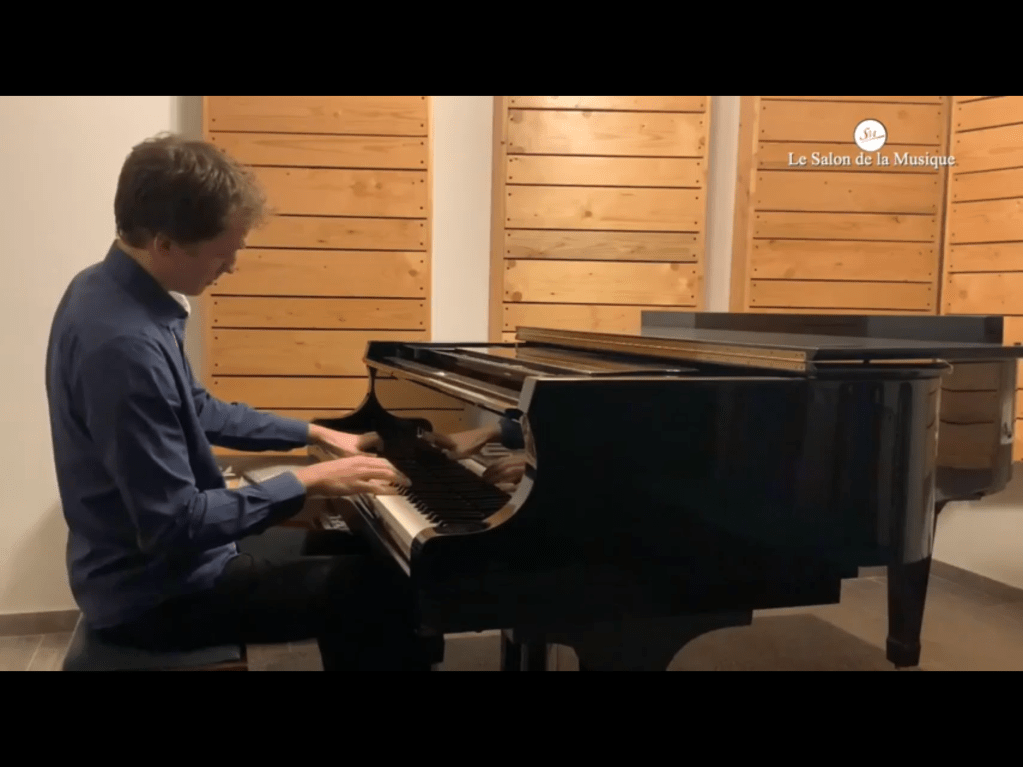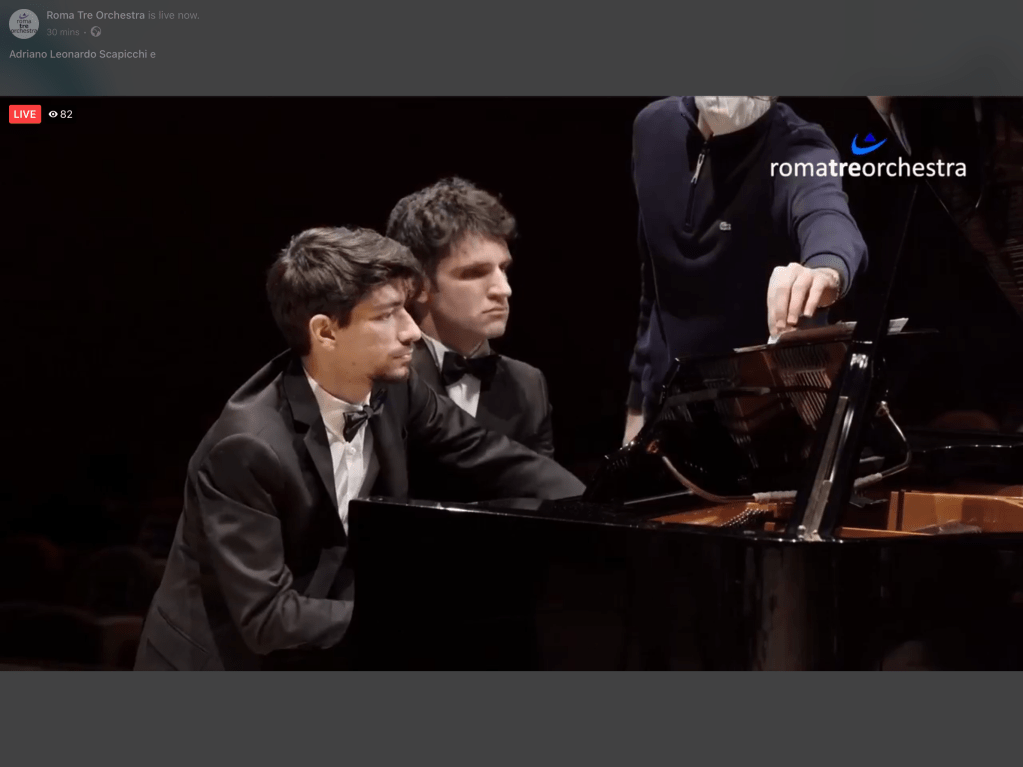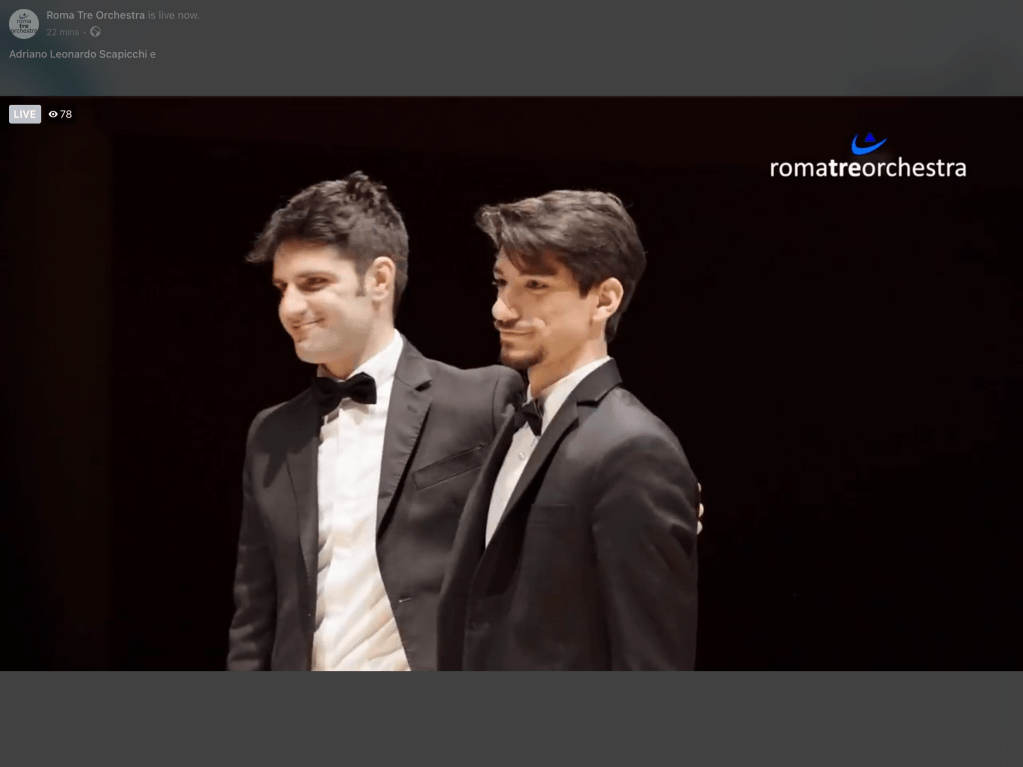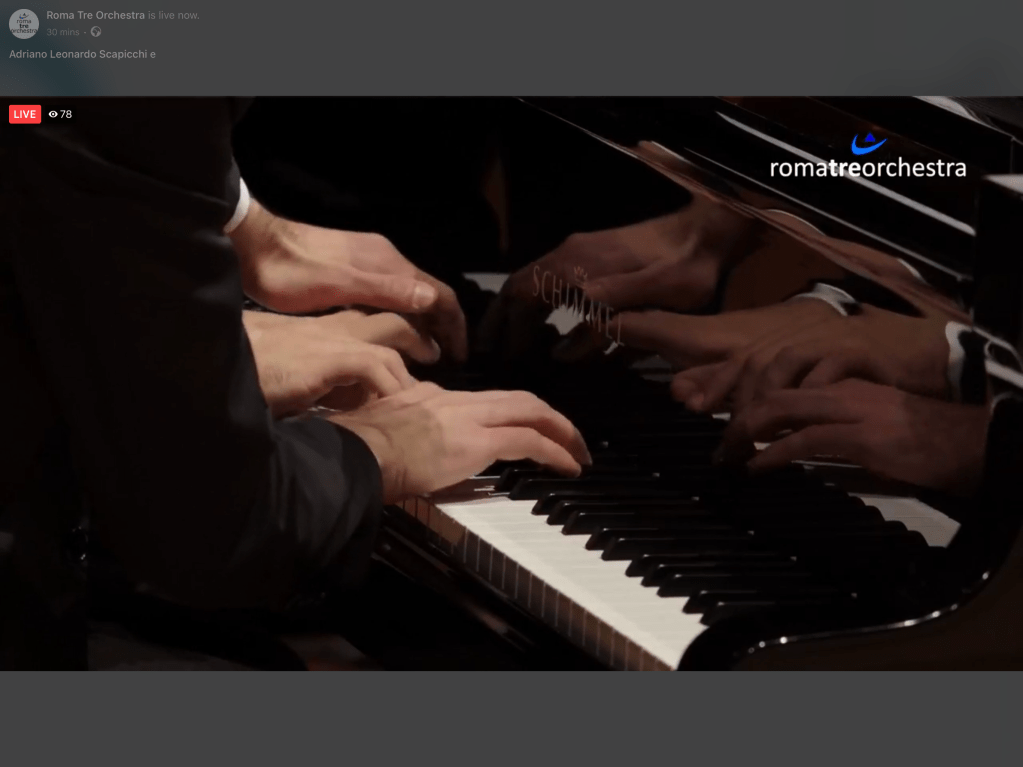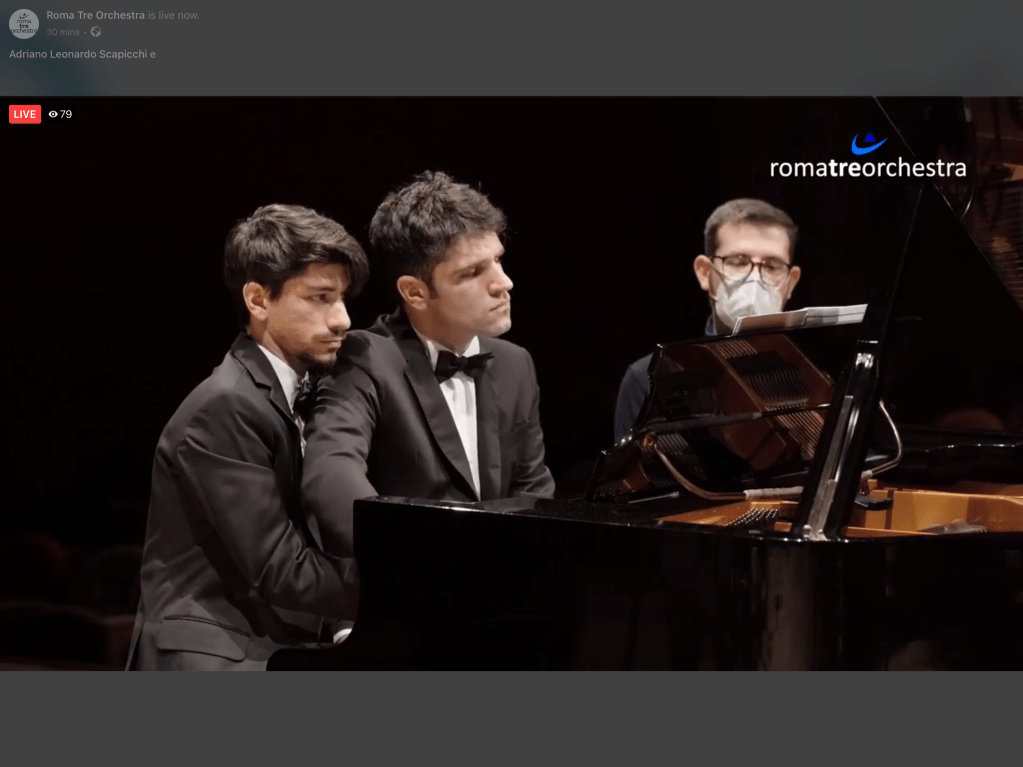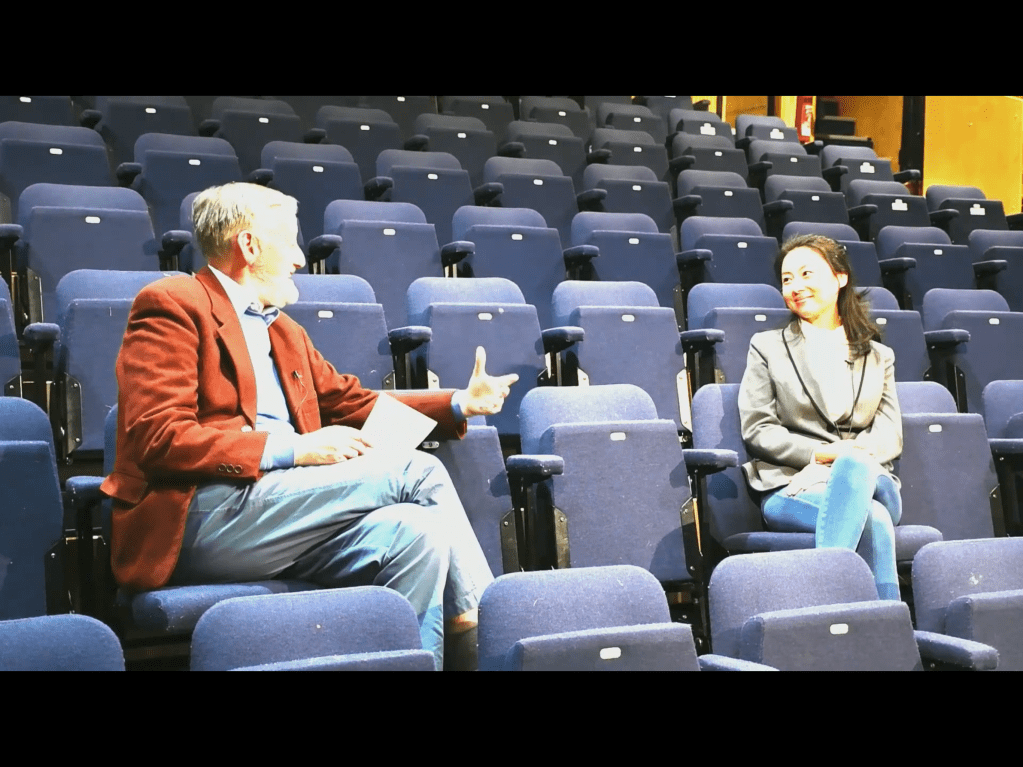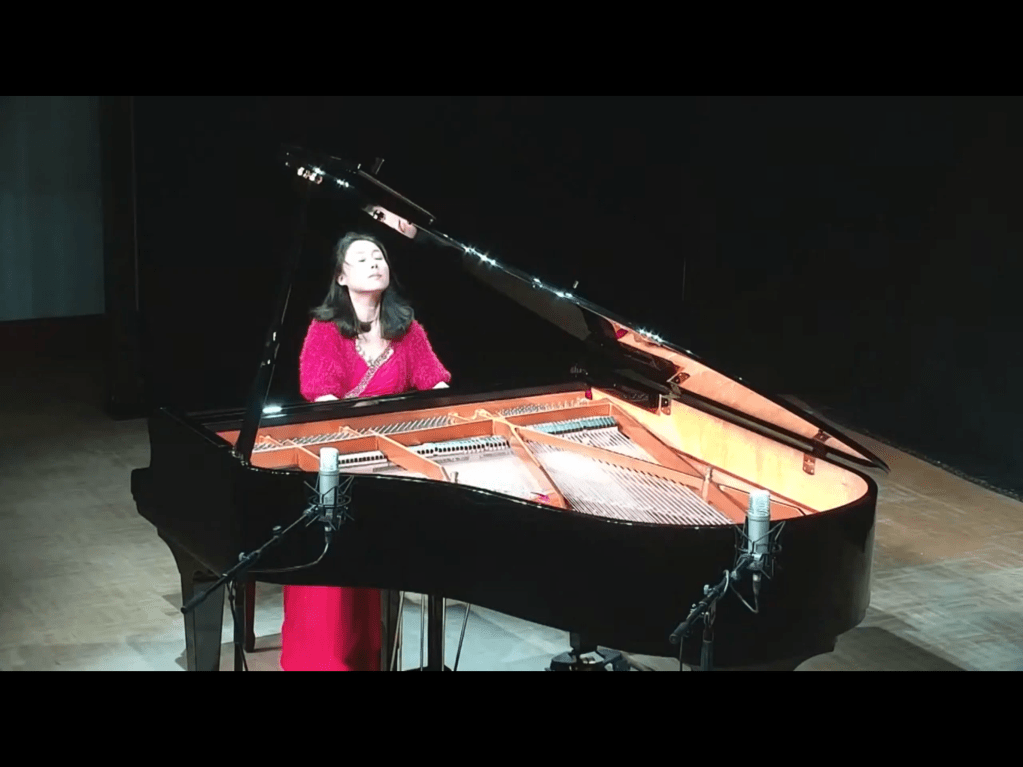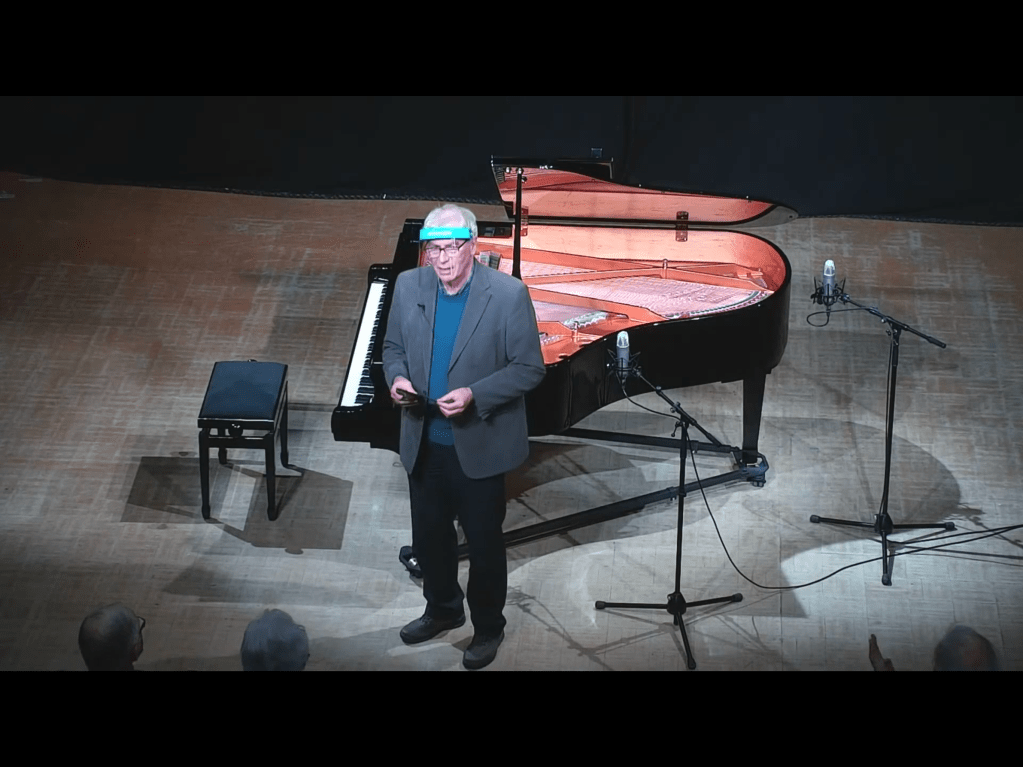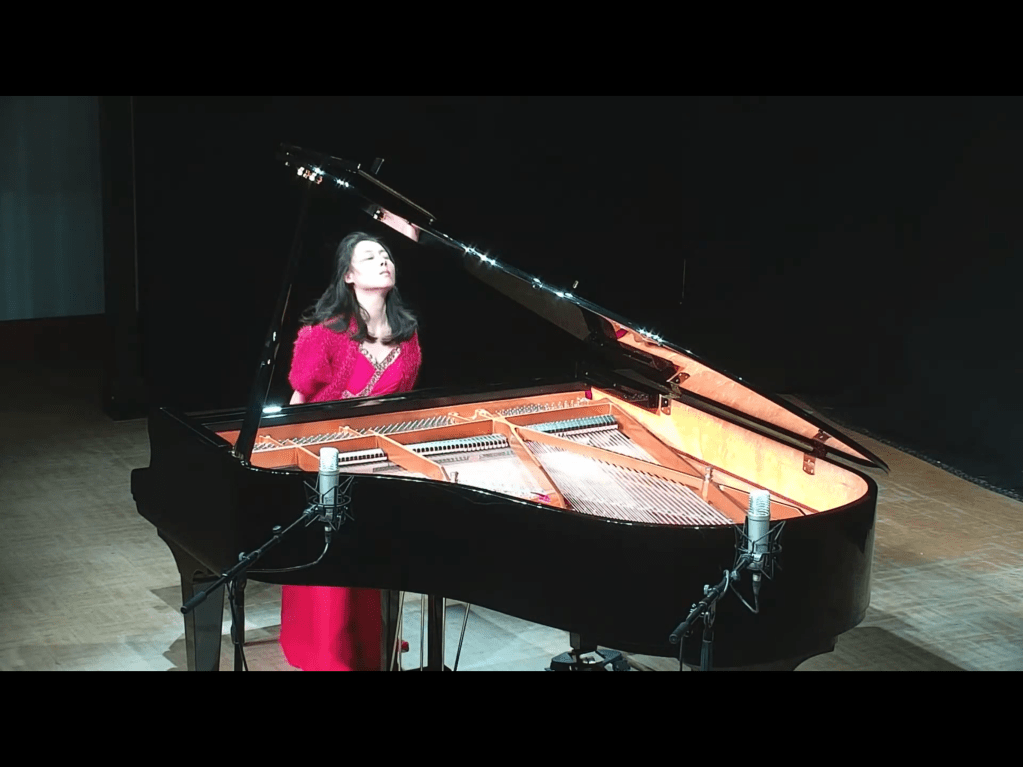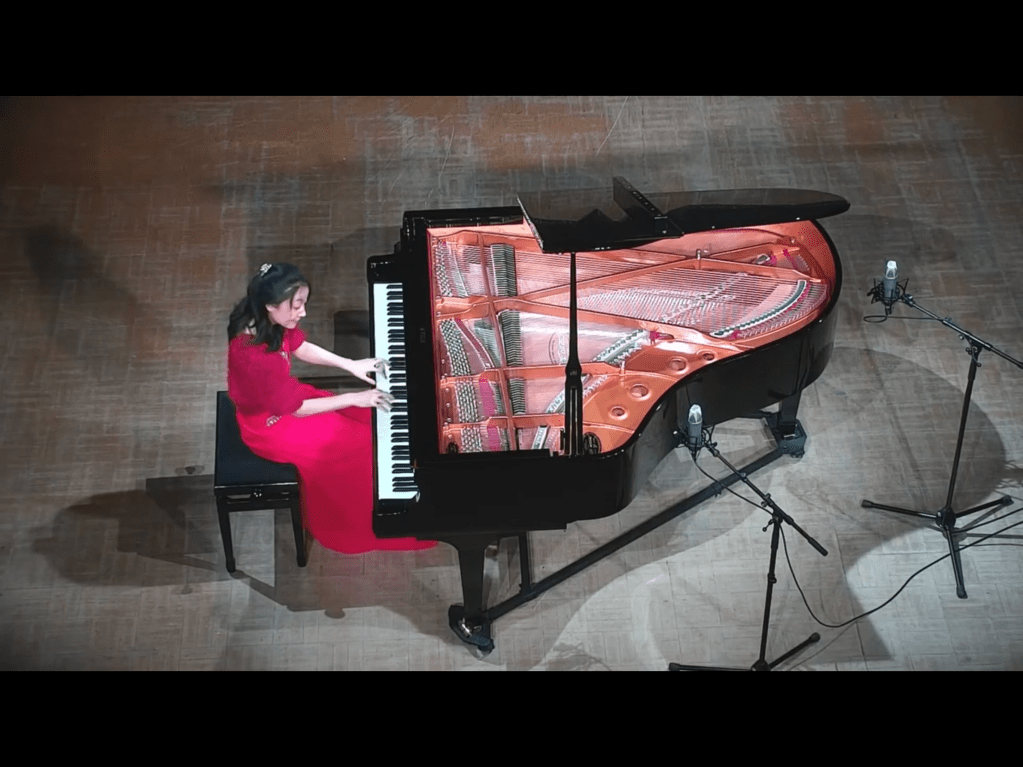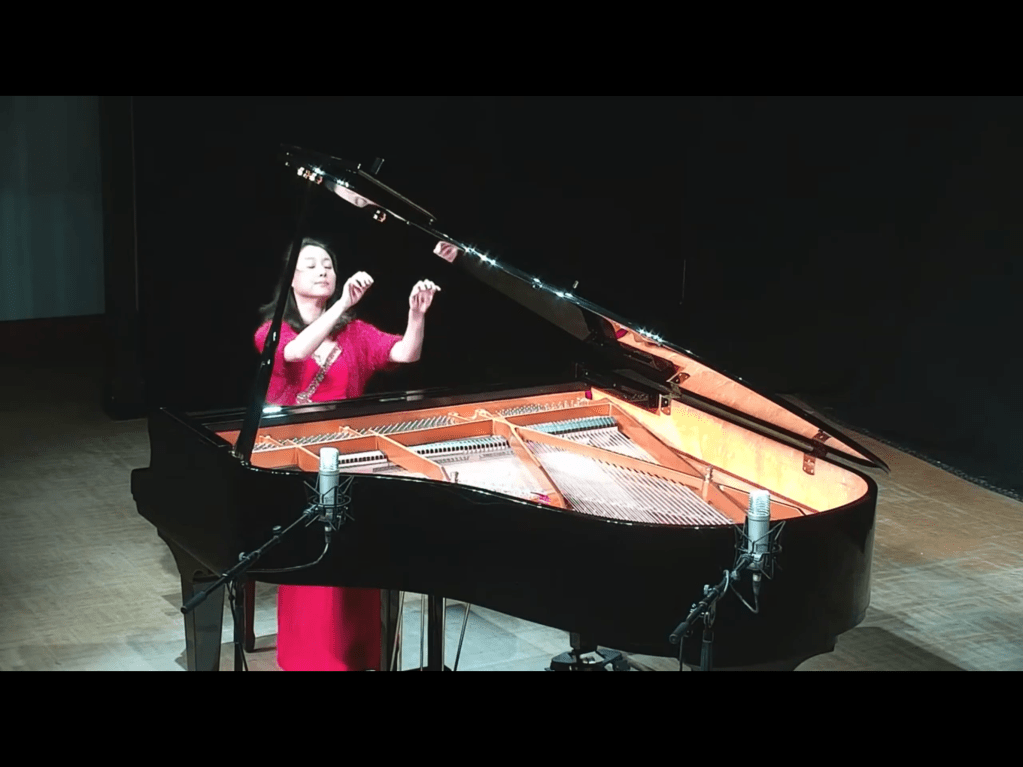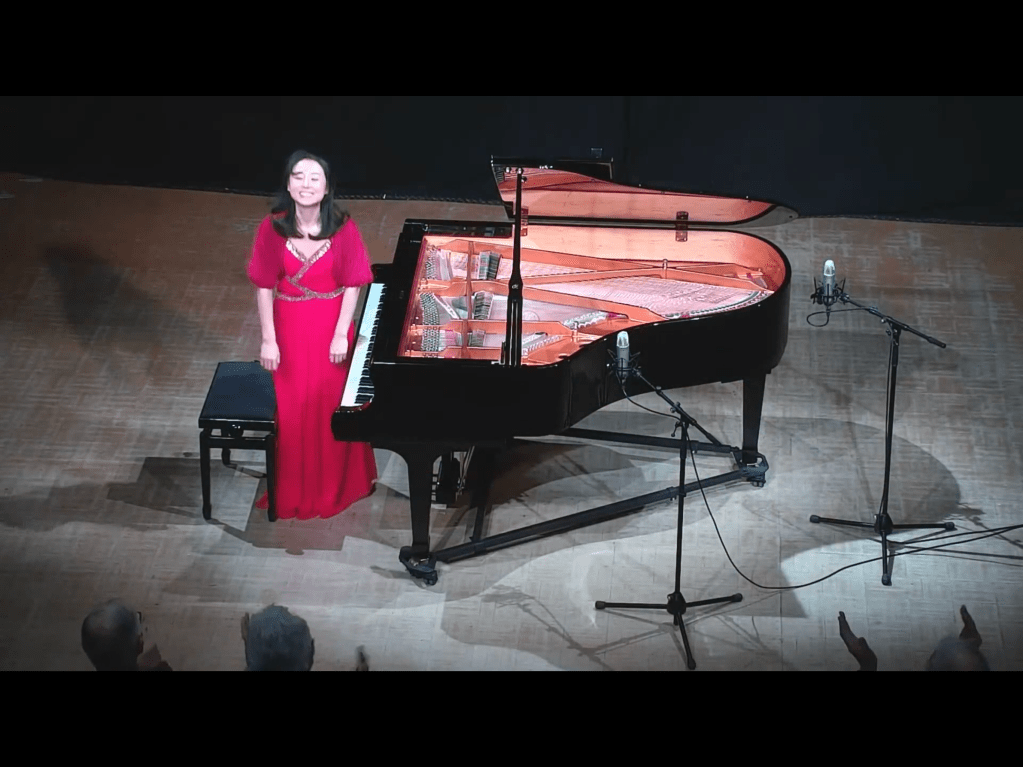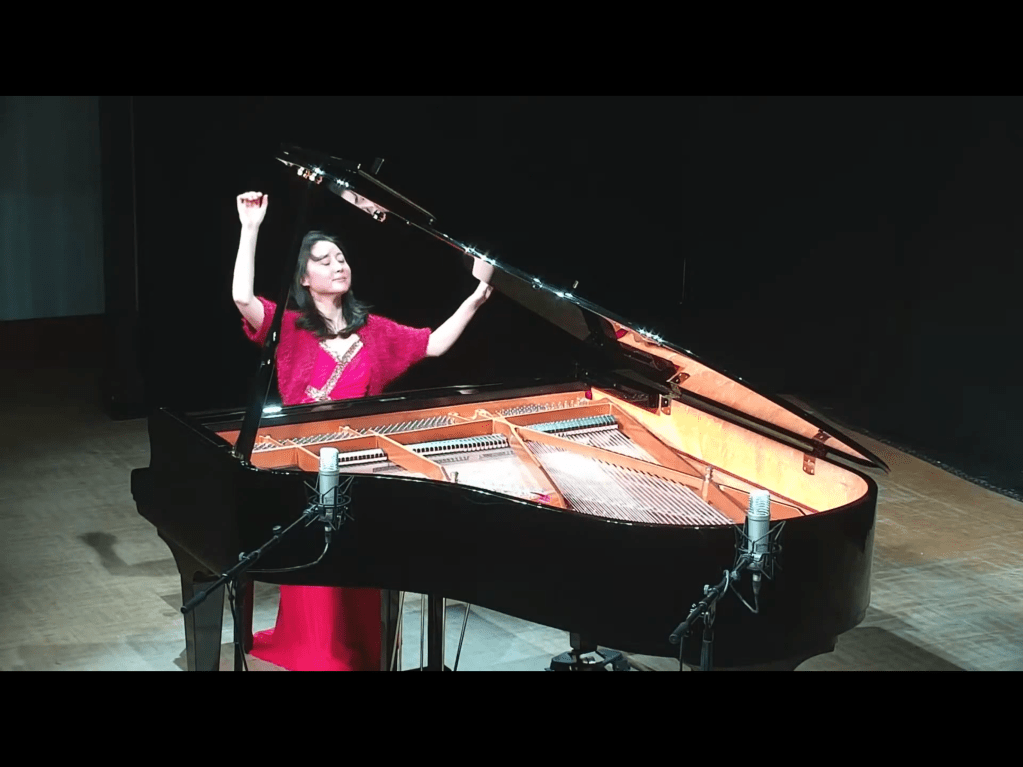
Università della Tuscia opening concert 2021

http://tiny.cc/stagione_concertistica

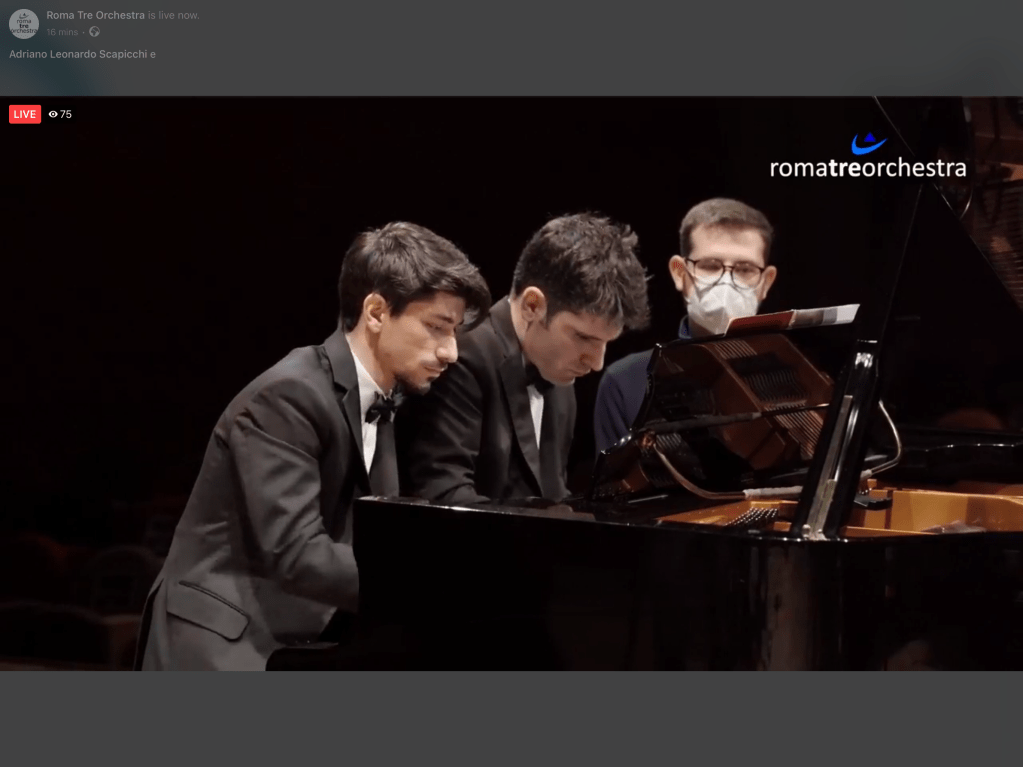
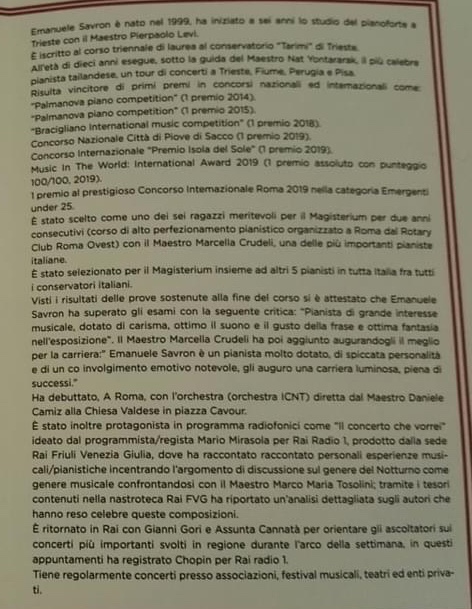
Il concerto, che propone (in collaborazione con il Club Rotary Roma-ovest)due giovanissimi e validissimi pianisti, Vincitori del Magisterium di interpretazione pianistica di Marcella Crudeli, vuole avere anche un alto valore simbolico perché in un momento cupo, come quello che stiamo vivendo, intende guardare ai giovani, luce e speranza del futuro.Emanuele Nazzareno Piovesan (quattordici anni) e Emanuele Savron (ventuno), vincitori, nonostante l’età, di numerosi concorsi nazionali ed internazionali e molto attivi nel concertismo, affronteranno un programma impegnativo e coinvolgente, dedicato a grandi e celebrati compositori.
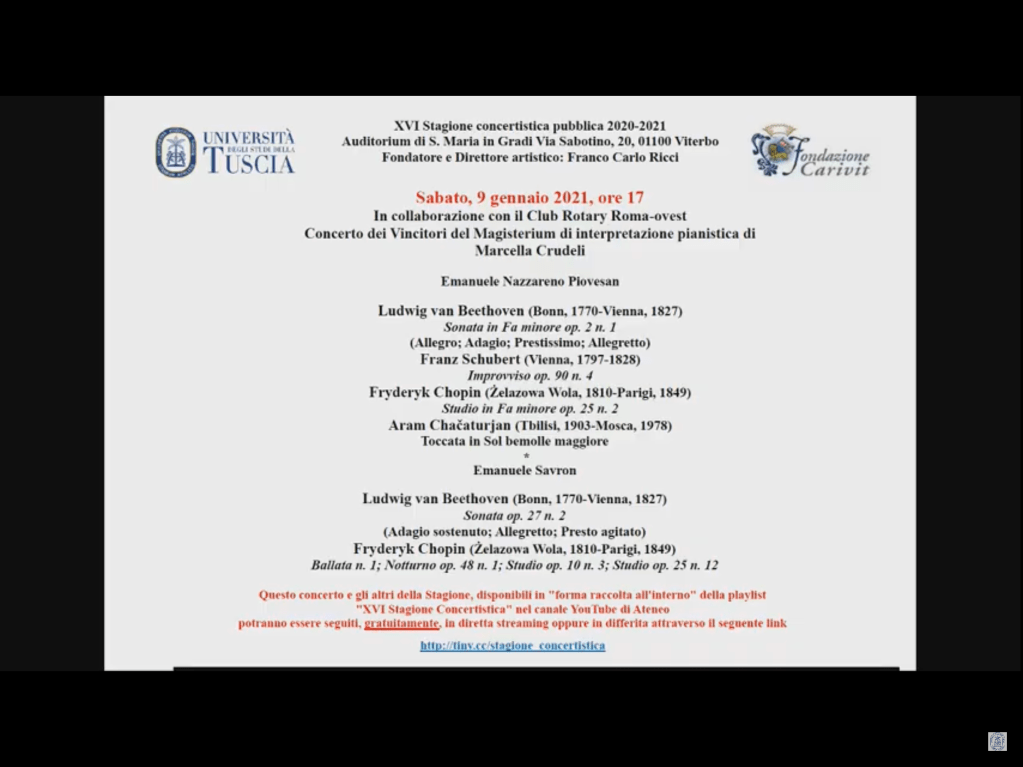
Emanuele Piovesan, infatti, suonerà di Ludwig van Beethoven (in occasione del 250° della nascita) la Sonata in Fa minore op. 2 n.1; di Franz Schubert l’Improvviso op. 90 n. 4; di Fryderyk Chopin lo Studio in Fa minore op. 25 n. 2 e di Aram Chačaturjan la Toccata in Sol bemolle maggiore.
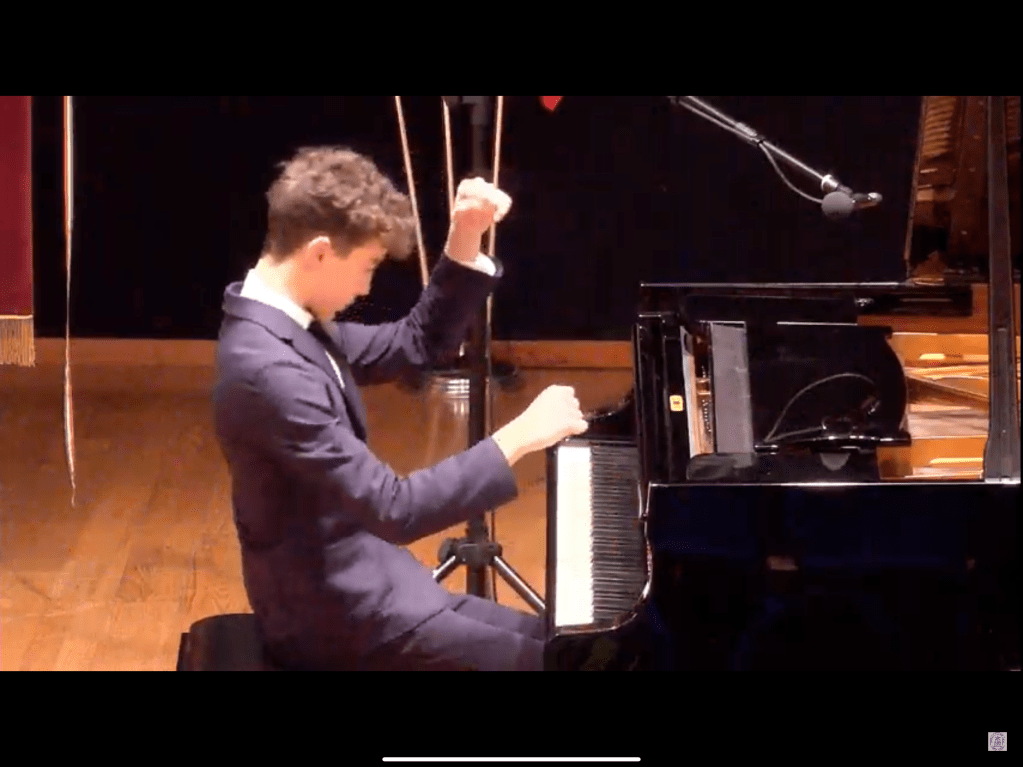
Emanuele Savron eseguirà, ancora di Beethoven la Sonata op. 27 n. 2 e di Chopin la Ballata n. 1, il Notturno op. 48 n. 1, lo Studio op. 10 n. 3, lo Studio op. 25 n. 12.
https://www.facebook.com/notes/christopher-axworthy/marcella-crudeli-rome-international-piano-competition-the-fanny-waterman-of-rome/10154141668572309/
https://www.facebook.com/notes/christopher-axworthy/yuanfan-yang-takes-rome-by-storm-the-xxviii-rome-international-piano-competition/10156076789642309/

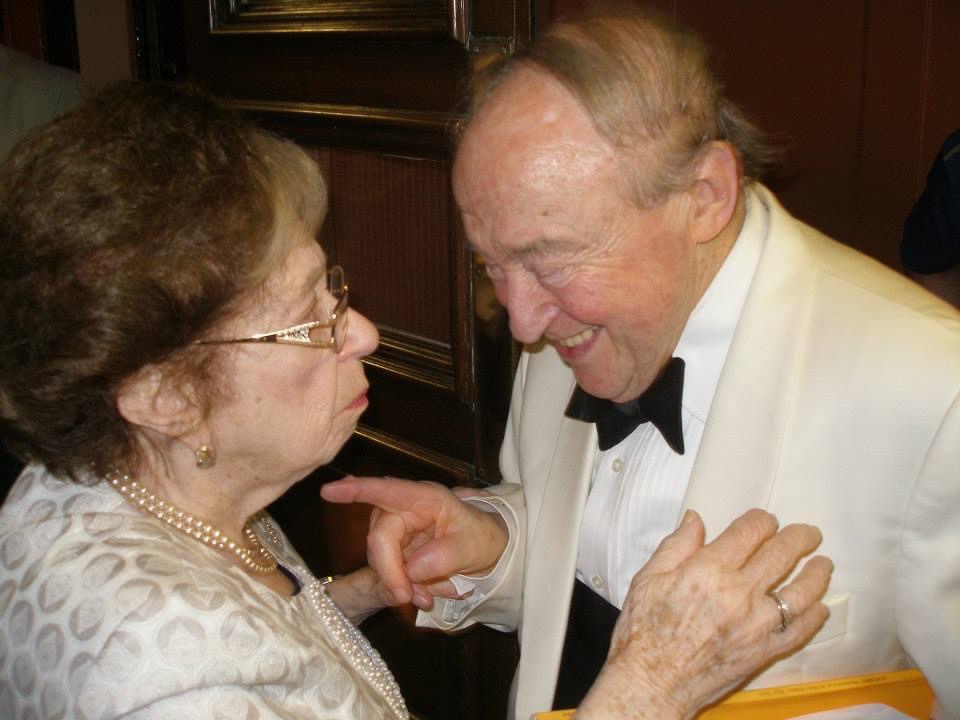
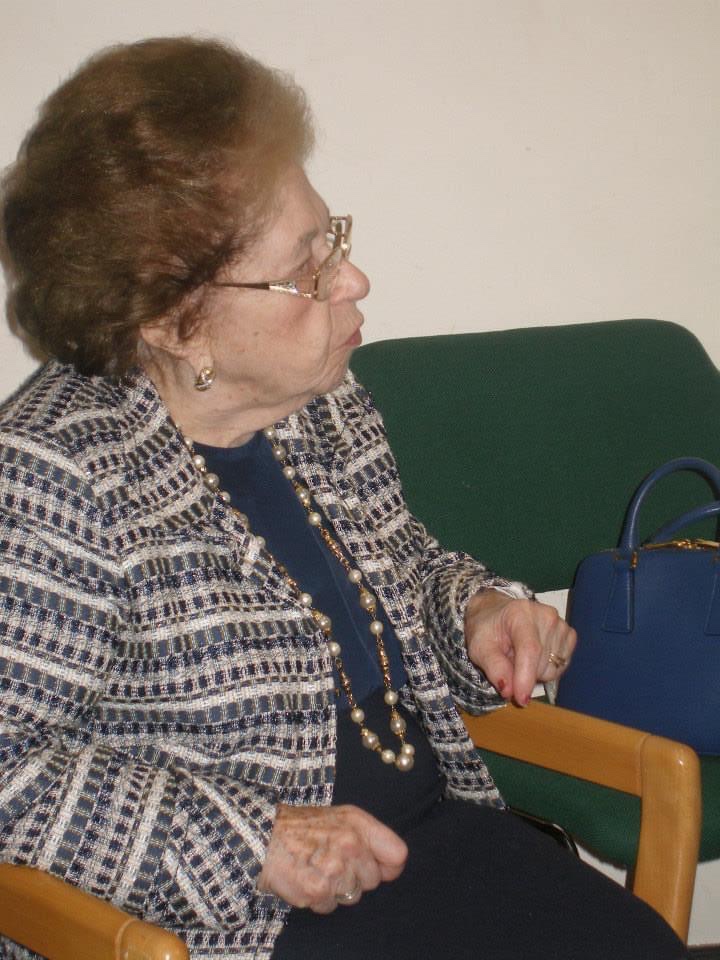
The indomitable unstoppable Marcella Crudeli in her lifelong quest to help young emerging musicians .
Her annual course sponsored by the Rotary Club gives young musicians from all over Italy the possibility to benefit from her enormous experience as a teacher,organiser and above all concert artist who herself had benefitted from encouragement of Alfred Cortot.
In a short bathroom break in this final competition concert performances between her students she confided to me that young people just do not allow the music to breathe.
All of the students greatly talented but in the end lazy.
It was Curzon who said to become a pianists it is 90% work and 10% talent.Only one of these young musicians (a prodigy of Ciccolini it turns out) demonstrated this in a very fine performance of Beethoven ‘s Sonata op 2 n.2 (the one that Glenn Gould made very much his own).
.Here at last a hall that up until that moment had been so obviously constructed for military speeches and certainly not piano recitals appeared to have an acoustic where all the details and care over Beethoven’s indications were meticulously observed .Unfortunately even this young man given a Chopin Ballade or a Russian show piece immediately stopped listening as all these greatly talented you musicians did as they sailed up and down the keyboard in a very undisciplined manner. Of course in their home towns it might seem very impressive but the work needed to tame and control this youthful passion was missing.
Marcella is doing miracles but it is in the end in the practice room that true miracles are needed. The students were from 14 to 21 and it was right that the first prize should go to the youngest who has all the time ahead of him to work, work ,work.

Cari amici, ieri si è conclusa la serie di manifestazioni al Museo delle Arti e Tradizioni Popolari, organizzate dall’Associazione Chopin in collaborazione con il Rotary Club Roma Ovest e dall’EPTA Italy.
Si sono svolti gli esami – recital del Magisterium di Approfondimento Pianistico dei sei giovani selezionati:
Michele Apollonio di 16 anni proveniente da Campobasso
Matteo Pierro di 17 anni proveniente da Potenza
Emanuele Nazzareno Piovesan di 14 anni proveniente da Gallarate
Emanuele Savron di 19 anni proveniente da Trieste
Marco Stallone di 20 anni proveniente da Avellino
Lorenzo Stasi di 17 anni proveniente da Rossano Calabro

La giuria, presieduta dal Prof. Franco Carlo Ricci, era composta da: M° Marcella Crudeli, M° Silvia Rinaldi, M° Maria Grazia Sorrentino e Amm. Giovanni Vitaloni.

Alla fine dei concerti, il Presidente del Rotary Club Roma Ovest Dott. Giovanni Grazioli, ha consegnato ai pianisti gli attestati con il giudizio.
Dopo la cerimonia di premiazione, il Rotary ha offerto un piccolo catering ai ragazzi e ai loro familiari in segno di augurio!

Si ringrazia il Municipio Roma IX EUR, il Direttore del Museo Dott. Filippo Maria Gambari e il Dott. Tagliero per l’affitto del Pianoforte.

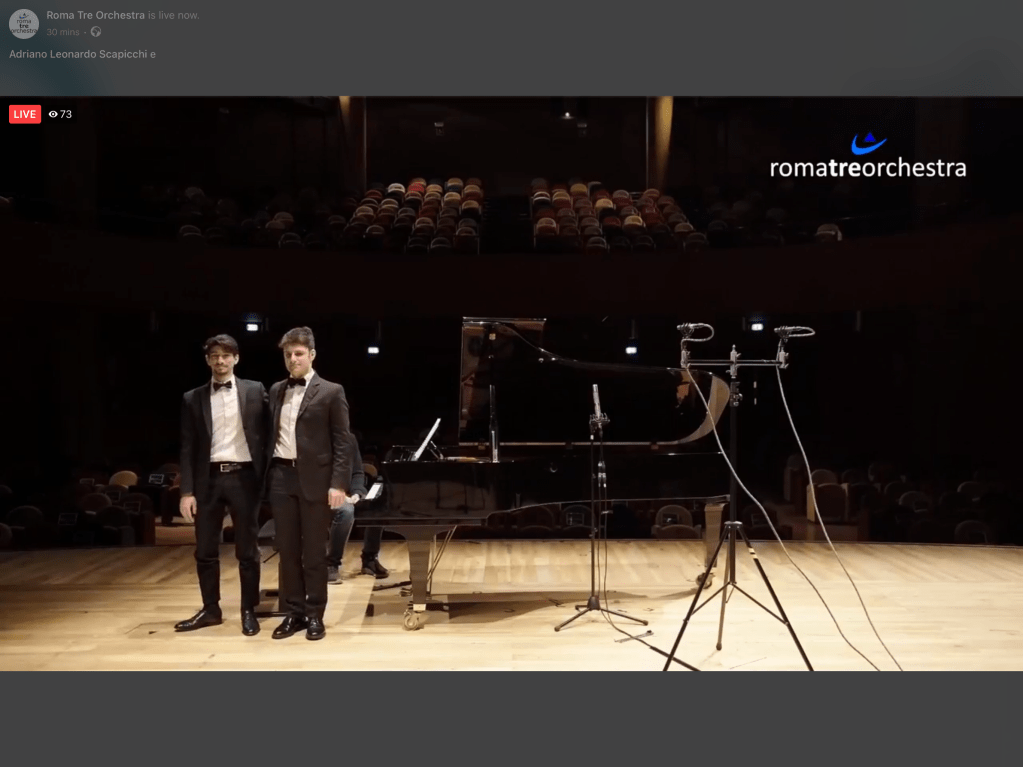
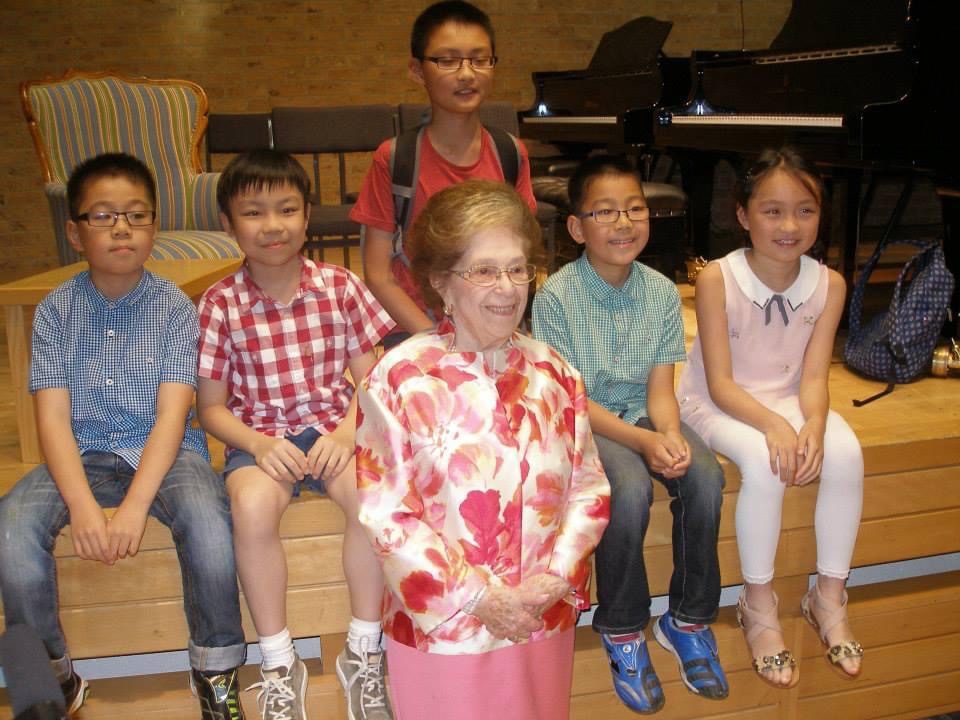
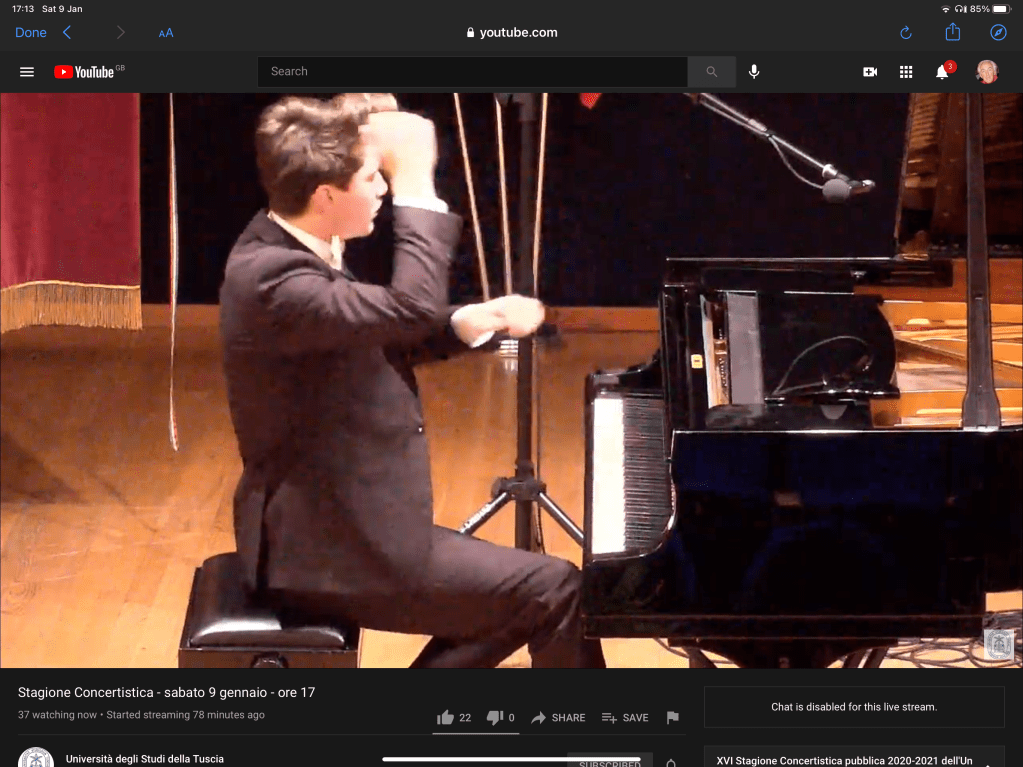
Two young pianists Emanuele Savron and Emanuele Nazzareno Piovesano opening the first concert this year from Tuscia University in Viterbo streamed live at 17h every Saturday afternoon .

http://tiny.cc/stagione_concertistica
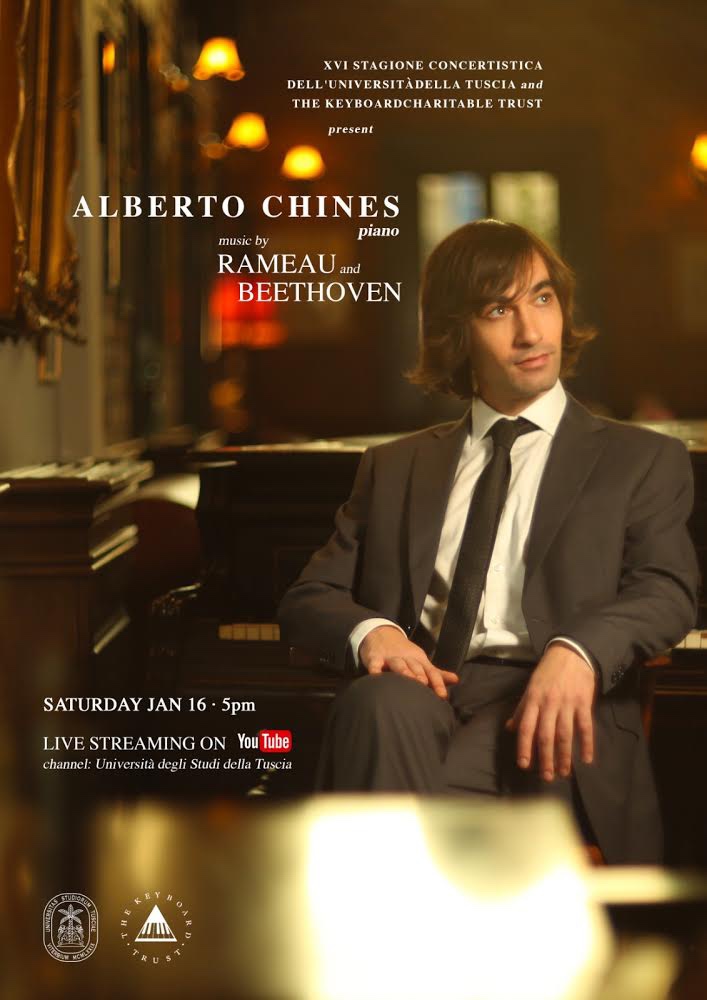
Next week the annual concert of the Keyboard Charitable Trust with Alberto Chines.
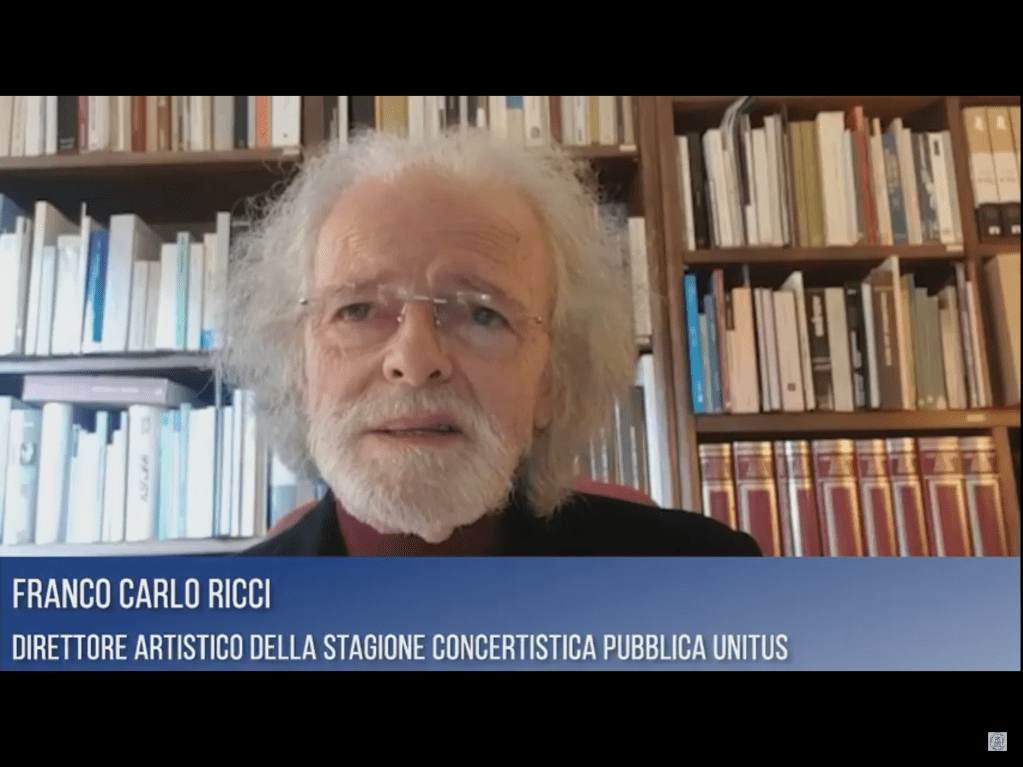
Now in it’s 16 year the season of concerts organised by the distinguished musicologist and author of many important volumes Franco Carlo Ricci aims to give a platform not only to established artists but also to young aspiring musicians.Two young pianists today of 14 and 21 years old,winners of the annual Marcella Crudeli Masterclasses held every year in Rome.

Some very fine playing from these two young students chosen from Marcella Crudeli’s Masterclasses in Rome last October to demonstrate the school of a woman who not only has been director of one of Italy’s most important conservatories but also created and watched grow ,strength by strength ,for 25 years the only International Piano Competition ever held in Rome.Not satisfied with that she has been celebrating this year her 80th birthday with a series of recitals and masterclasses from which the two young artists in today’s concert were beneficiaries.
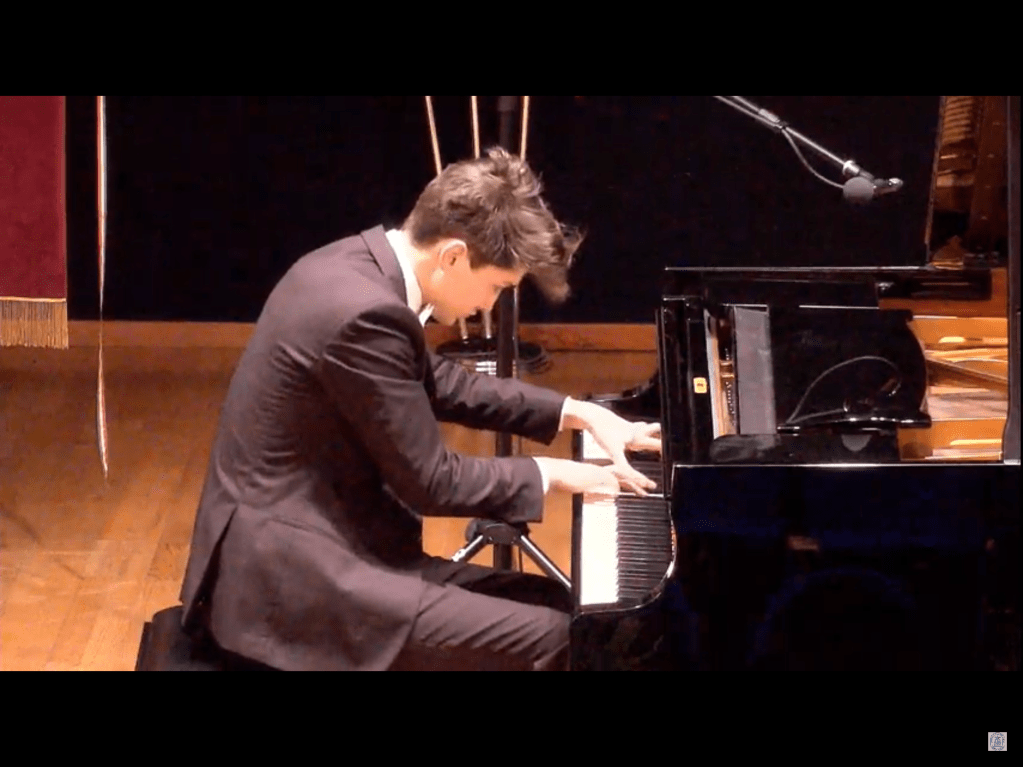
Exemplary Chopin playing as one would expect with Savron playing the overplayed first ballade with impeccable good taste and control.Both had played two early sonatas by Beethoven with scrupulous attention to detail but also an architectural sense that gave great weight to their playing.Piovesano playing op 2 n.1 with envigorating rhythmic impetus with a Prestissimo finale that was quite enthralling.The opening of the so called ‘Moonlight’Sonata was played with mature feeling by Savron with some quite sumptuous and delicate sounds.The last few pages of the Sonata op 27 n.2 showed a remarkable sense of control as he built the excitement to the final dramatic embellishments.

Piovesano’s Schubert Impromptu op 90 n.4 was exquisitely played and the passionate middle section beautifully shaped.His performance of the Khatchaturian Toccata showed off his sensitivity to colour without ever loosing the driving forward movement.The Chopin studies from them both whilst showing a great sense of style showed that there is some technical work still to be done before their studies are completed.Very professional performances to an empty hall before the video camera shows great promise for the future.
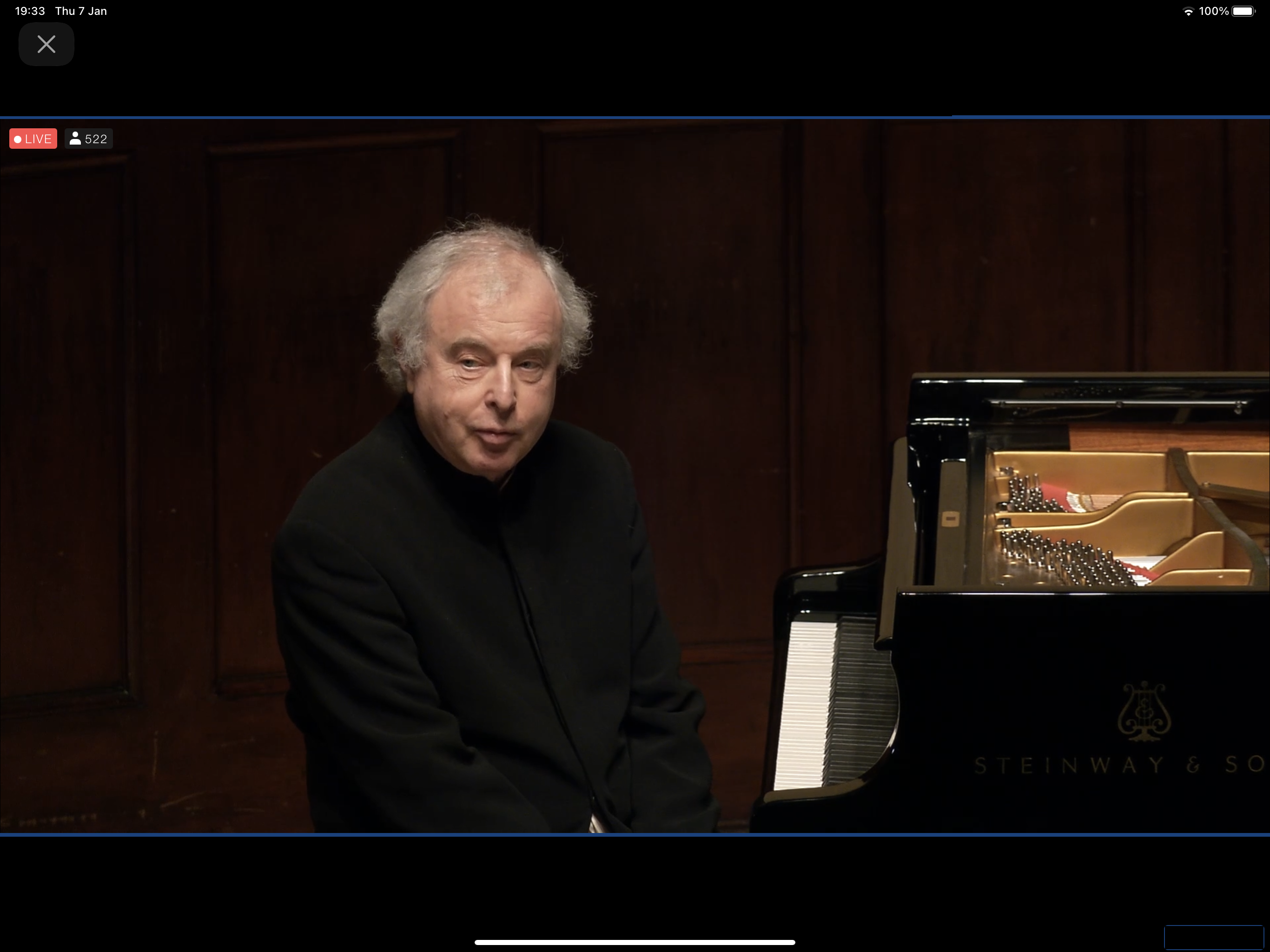
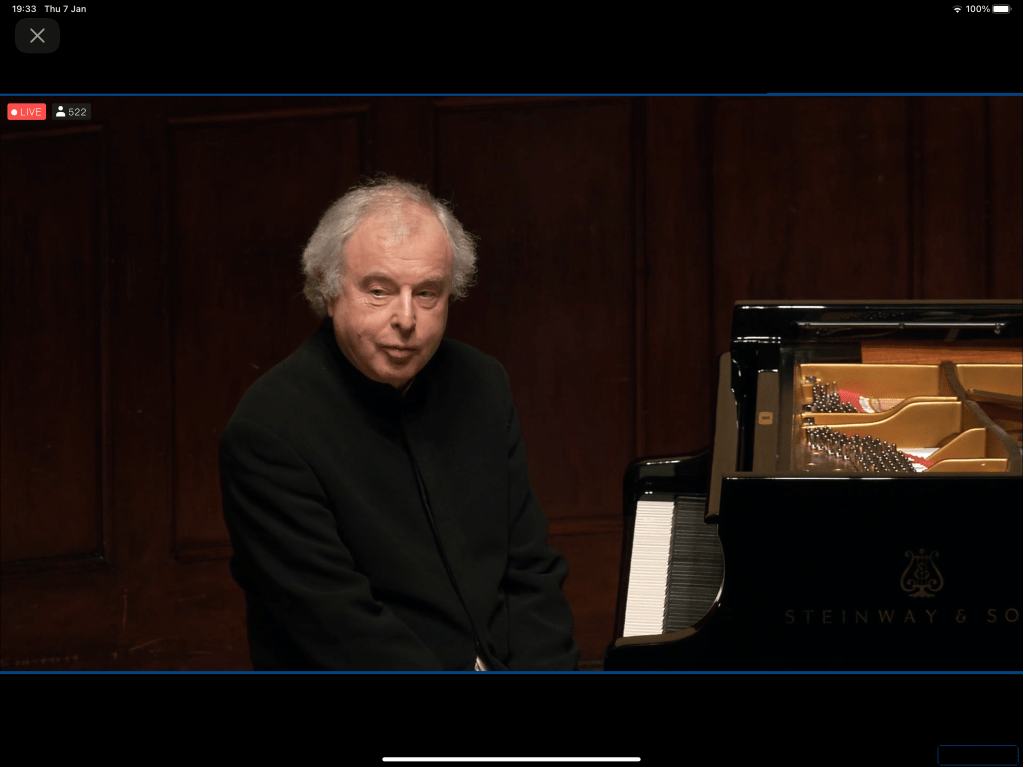
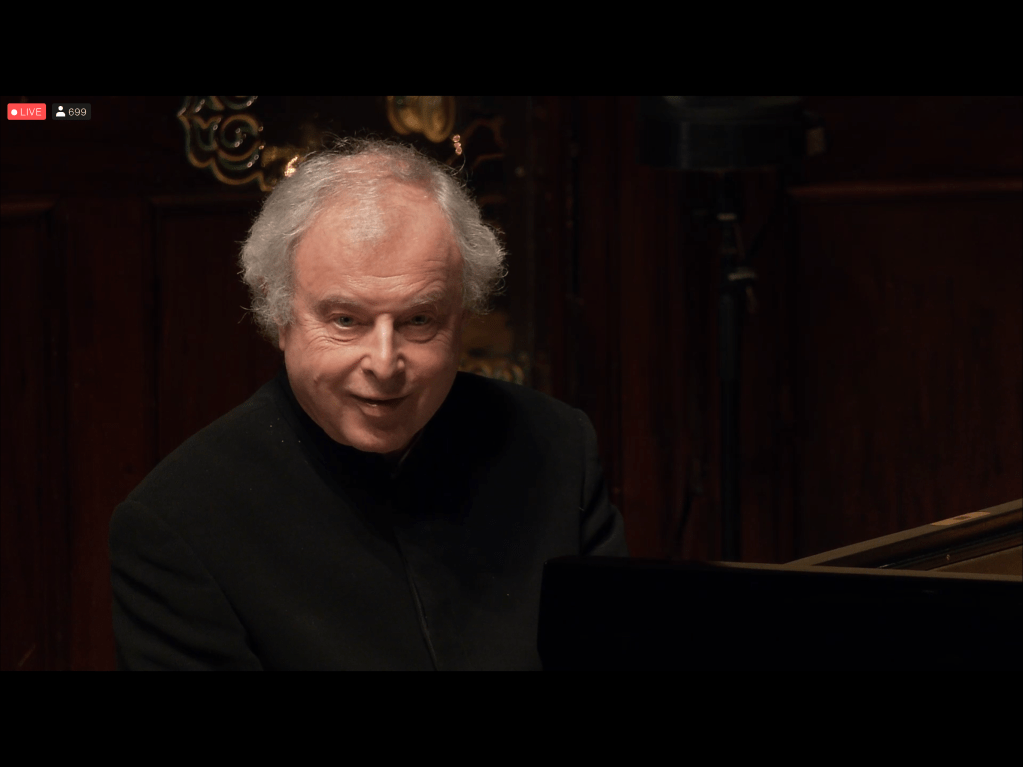
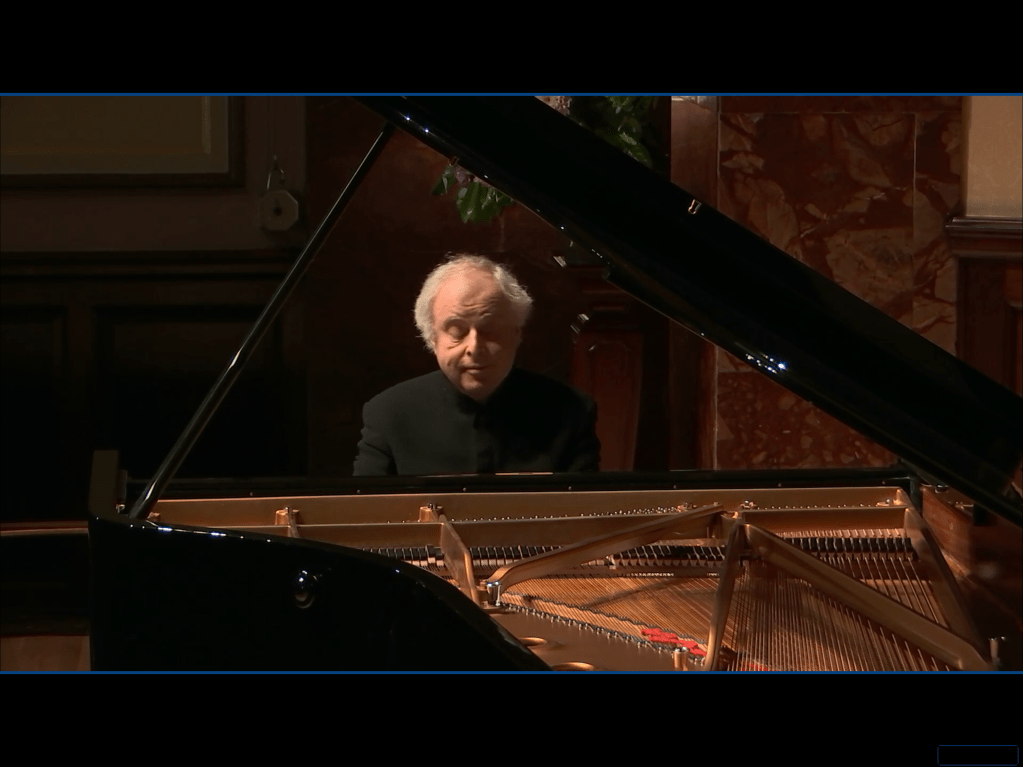
Andras Schiff. Bach before the Mast

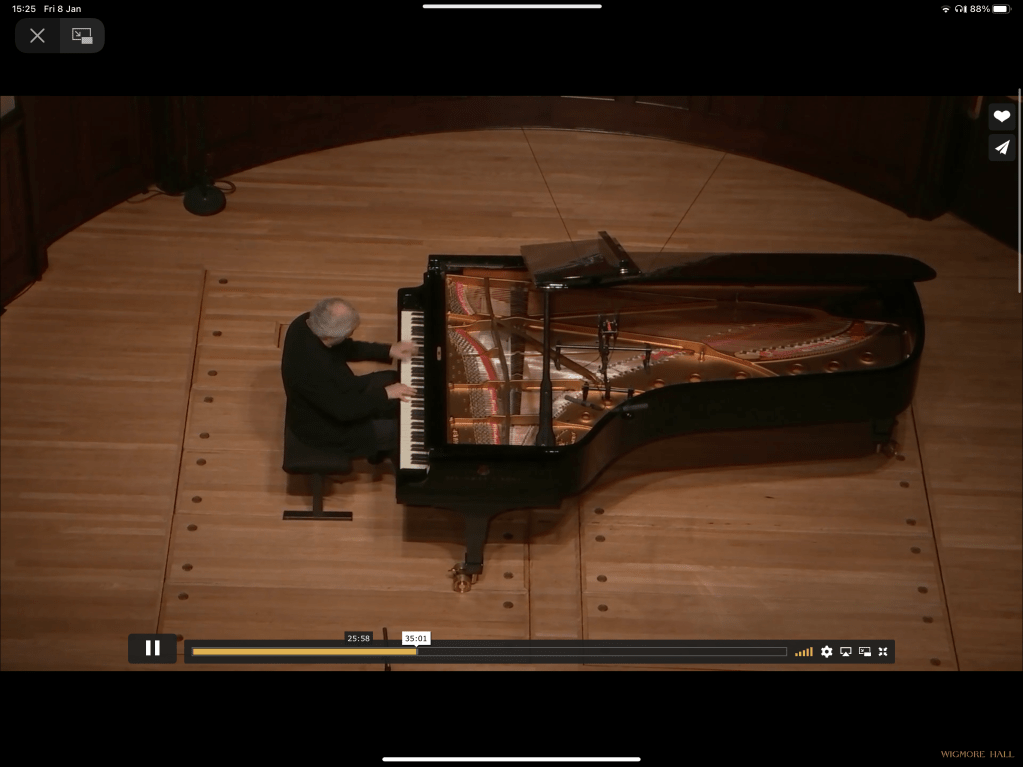
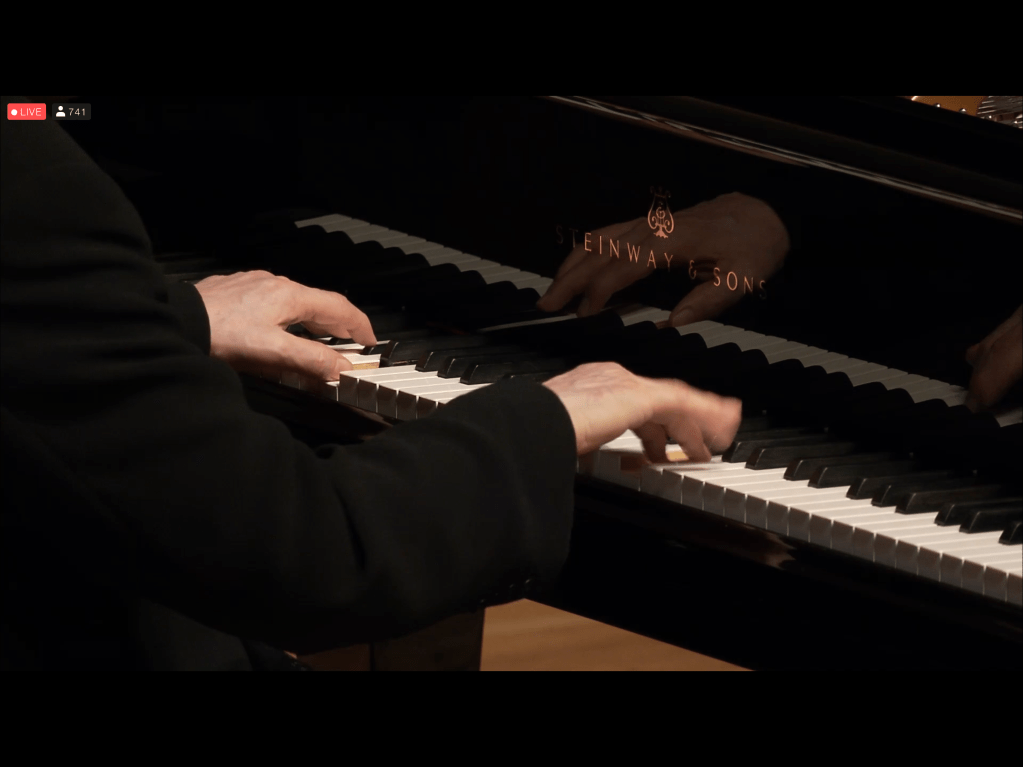
Sir András Schiff performed a programme entirely dedicated to Bach, including the composer’s Capriccio in B flat, allegedly written to bid fond farewell to his brother, and his 1735 Italian Concerto.

  • Johann Sebastian Bach (1685-1750)
      • Capriccio in B flat major (Capriccio on the Departure of his Most Beloved Brother) BWV992
      • Sinfonia No. 5 in E flat BWV791
      • Sinfonia No.9 in F minor BWV795
      • Chromatic Fantasia and Fugue in D minor BWV903
      • Italian Concerto in F BWV971
      • Ouvertüre nach französischer Art BWV831

Bach before the Mast indeed.George Malcom an almost forgotten musician but not by Andras Schiff who as a 14 year old boy came to study in London with this genial complete musician.The nearest we could have come to a Kapelmeister.It was very touching to see some years later when Andras Schiff had begun to make a mark in the music world,Master and pupil,now equals,performing Mozart G major concerto together at the Proms.It is obviously from Malcom that not only did he receive a most human and natural understanding of Baroque music but also inherited his wry,intelligent sense of humour.

I remember when we all used to flock to Dartington surrounded by the greatest musicians of the day :Vlado Perlemuter,Sandor Vegh,Ilona Kabos,George Malcom,Peter Maxwell Davis,Julian Bream,Harrison Birtwistle,André Tchaikowsky,Daniel and Enrique Barenboim,Stephen Bishop,William Pleeth,Lamar Crawson,Nell Gotkowsky,Youra Guller,Neville Marriner and his St Martin in the Fields ensemble and in residence the Amadeus Quartet.All these assembled for six weeks around the dream that had been started by William Glock at Bryanston with Schnabel and Busch just after the war.We seemingly talented students at the Colleges used to be offered scholarships to perform in masterclasses for six weeks in these blissful surrounding on the estate near Totnes in Devon that was owned by the Elmhursts.American philanthropists who believed in encouraging art and in particular local crafts and skills before they became totally commercialised and divorced from their roots.

I remember a very young boy who had been sent from Hungary to study and André Tchaikowsky was advised that he was a very special talent and to treat him accordingly.Well that was like a red rag to a bull for André especially when a very pretty Katie Kennedy arrived in the class with the Scherzo in E flat minor op 4 by Brahms with which she had recently been awarded a major prize at the Royal Academy.André with all his impish modesty admitted he did not know it.A voice from the back was heard to comment that it was a well known work.’Well you teach it to her then’he said to the now very embarrassed young Hungarian prodigy.Andras Schiff went on to play in the class concert Chopin’s third ballade that those present have never forgotten for it’s seamless legato and aristocratic control.Daniel Adni was another young prodigy in that period.A student of Barenboim’s father who went on to make his debut playing Beethoven’s fourth piano concerto with Klemperer at the Festival Hall -Geza Anda said he played like a young God.Martin Dorrié,another teenage prodigy whose mother asked André for advice as to the career that her son and star pupil of Kammerling in Germany should pursue .’Dentistry or music she asked?’’Well’,said André ‘I know about his beautiful playing but know nothing about his teeth?’Radu Lupu used to play chess with André on the lawn and sometimes wander into his class much to our trepidation.

Out of all these wonderful times the one thing that has remained constant is the artistry of Andras Schiff.The simplicity of someone where music is life and life is music.That same simple total mastery that had Wilhelm Kempff arrive at the recording studios and simply say:’What would you like me to record today?’The same total absorption with ‘Music’ of Badura Skoda or Demus.Today we appear to be obsessed with note picking perfection that is killing the very essence of the music and above all the humility wonder and daily use of mere performers.It was astonishing even for us musicians to hear Andras describe the works he was playing and without the score be able to pick out single voices,left hand,right hand passages as an architect might point out the foundations on which a monument had been constructed.The music was allowed to evolve so naturally and envelope this imaginary audience in ninety minutes of seamless streams of sounds played without any strange effects or rhetorical egoisms.

The music was allowed to speak for itself or so it seems .It is an Art that conceals Art.I was reminded of the 90 year old Artur Rubinstein on this very platform 45 years ago begging us not to allow this hallowed hall to be demolished.Sitting motionlessly as Andras Schiff today as he allowed the music to pour out of him with the directness that seems to nourish places that others do not know exist.It is not for me to describe how such an artist plays and there is an excellent summary by Jessica Duchen in her review today.But I have jotted down some of the eloquent simple words that Andras Schiff used to guide his imaginary audience through this short survey of Bach’s music.

’All Bach.Why?Because he is by far the greatest composer who ever lived.There is no need to prove it.All those that disagree do not have to listen!’The Capriccio one of the earliest known works of Bach and with a precise programme.Bon voyage indeed!Twenty years later Bach the educator wrote his two and three part inventions to educate his children to give them good taste in composition,control of independent voices .Stressing in particular the need to make the piano sing.’If you hit the piano it will hit back!’The Sinfonias n.5 and 9 played with his feet firmly on the ground and his superb finger legato demonstrated this without any fuss.Played with a simplicity and beauty.The alto melodic line in the 5th Sinfonia was astonishing in its richness and clarity.You could almost see the anguish on his face as he played the great lament of the 9th Sinfonia .As he said at the end this is one of the greatest of works that in only two minutes of music Bach is able to say so much with so little .In fact you have the whole meaning of the St Mathew passion in these few profoundly moving minutes.Introducing his performance of one of Bach’s most popular pieces according to his biographer Forkel in 1802.The Chromatic Fantasy and Fugue where the Fantasy is a free improvisation but well organised!A strict and severe fugue but with certain licences.Quoting Casals ‘Freedom but with order’The animal excitement in the fantasy before the recitativi was breathtaking as were the surprising changes of harmony played as though he too were discovering them for the first time.The utter simplicity of the fugue subject made me so aware for the first time of the similarity to the fugue of Beethoven’s op 110.Gradually gaining energy as it led to the grandiose final bass D.

Bach was born in 1685 the same year as Handel and Domenico Scarlatti it was obviously a vintage year !The final two works were from the second part of the Klavierubung consisting of the Italian Concerto and the French Overture.Bach was not only a great composer but an encyclopedist and scientist looking at each composition and taking it to perfection and beyond.These two works were written for a harpsichord with two manuals so Andras said he is playing it on the wrong instrument.Adding with his dry humour ‘I apologise’’It is music so great that it transcends limitations of the instrument.Every instrument has it’s limitations even this Steinway piano.We try to overcome that with making illusions of legato and sustaining notes.’Bach is a German composer but not nationalistic.Nowhere do we see the word Deutsch.He is a European International composer- Italian Concerto-modelled on Vivaldi,Albinoni and Corelli and the miracle of creating the illusion of an orchestra and soloists from a single instrument. The French Overture with movements that are French,German,Spanish and Scottish, we have a perfect example of Europe and we should not forget that and be proud of it as a humble Hungarian Jew performs it in London!Influenced by Lully,Couperin and Rameau each of the eleven movements is repeated and it is not for us mere performers to know better.After all it is like the second serve in tennis where you can play better and here have different articulation or ornamentation.

Andras Schiff showing us that miracles do exist as he wished us a Happy New Year from a seemingly empty Wigmore Hall .Playing the Aria from the Goldberg Variations as a thank you to the invisible audience around the globe he demonstrated their bass foundation.Foundations on which all buildings are constructed and with the hope that something beautiful will be created from these disturbing times when they are just a terrible memory

Noah Zhou at St Mary’s

Tuesday 5 January 4.00 pm

Noah Zhou (piano)

Schubert: Sonata in A D959 Allegro-Andantino-Scherzo:Allegro vivace Trio:Un poco più lento-Rondo:Allegretto/Presto

Rachmaninov: Sonata in B flat minor Op 36-_

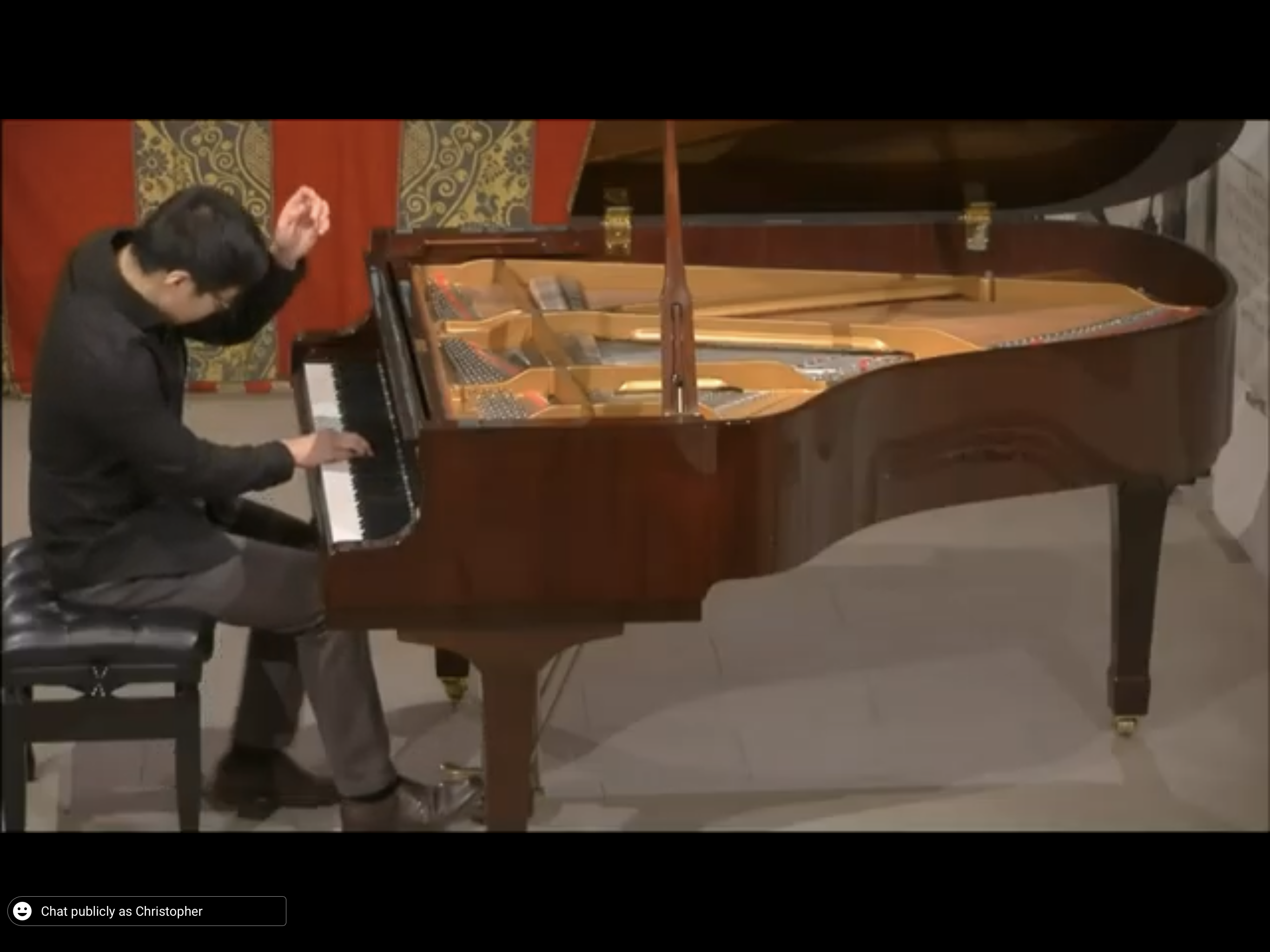
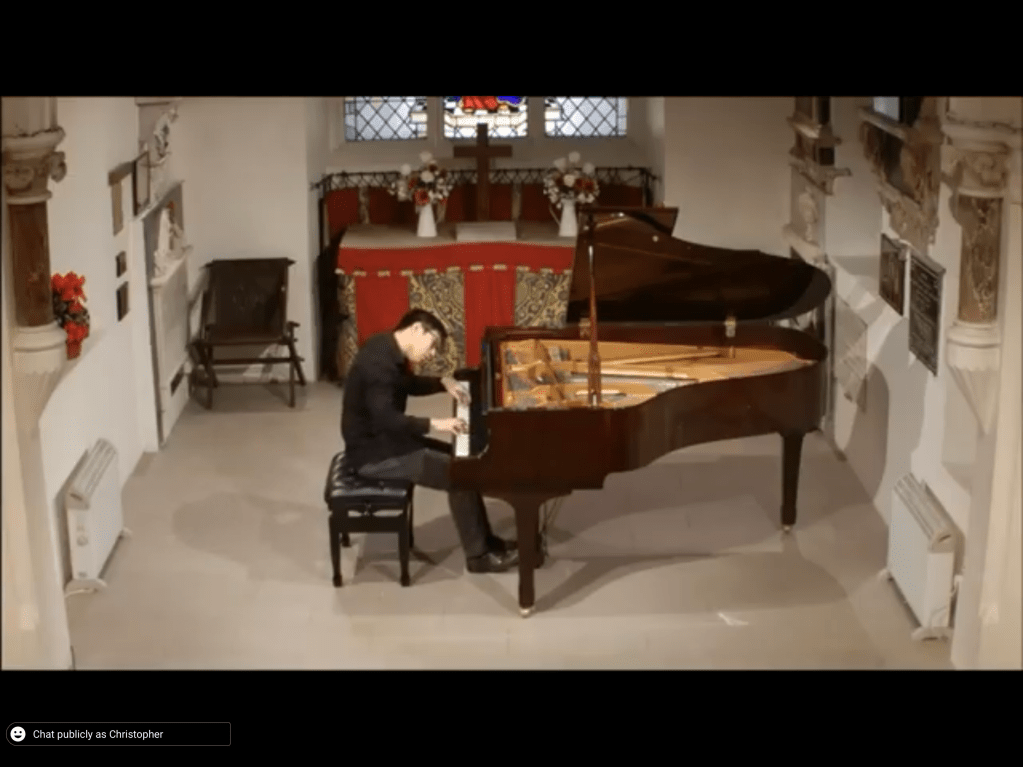
Quite extraordinary playing by Noah Zhou at St Mary’s.An Ealing lad helped by the indomitable Eileen Rowe via her trust for young musicians.
A maturity and a poetic sense of wonderment of a story that was unfolding from his wonderfully flexible hands.Like a sculptor moulding the sounds for the poetic meaning within this box of wires and hammers.Who knows where his fantasy will take us and I get the feeling that for him too it is a voyage of magical discovery.

Opening with the Schubert A major Sonata D.959 part of the great trilogy that Schubert penned in the last year of his short life

Schubert had been struggling with syphilis since 1822–23, and suffered from weakness, headaches and dizziness. However, he seems to have led a relatively normal life until September 1828,and probably began sketching the sonatas sometime around the spring months of 1828; the final versions were written in September. These months also saw the appearance of the Drei Klavierstucke D.946 ,the Mass in E flat D.950, the String Quintet D.956, and the songs published posthumously as the Schwanengesang collection (D. 957 and D. 965A), among others.The final sonata was completed on September 26, and two days later, Schubert played from the sonata trilogy at an evening gathering in Vienna.In a letter to Probst (one of his publishers), dated October 2, 1828, Schubert mentioned the sonatas amongst other works he had recently completed and wanted to publish.However, Probst was not interested in the sonatas,and by November 19, Schubert was dead.In the following year, Schubert’s brother sold the sonatas to another publisher, Anton Diabelli,who would only publish them about ten years later, in 1838 or 1839.Schubert had intended the sonatas to be dedicated to Hummel ,a pupil of Mozart, whom he greatly admired.However, by the time the sonatas were published in 1839, Hummel was dead, and Diabelli, the new publisher, decided to dedicate them instead to Schumann, who had praised many of Schubert’s works in his critical writings.

Noah immediately opened the Sonata with great nobility but also deeply expressive and his intelligent architectural understanding allowed him to hold the movement together but without sacrificing any of the ravishing details.There was a throbbing sense of yearning and wonderment with some very expressive tenor voicing and his hands almost like rubber seemed to mould the sounds with naturalness and ease.It was Dame Fanny Waterman who confided to me that pianists do not seem to mould these days as Curzon ,Solomon or pianists of the Matthay school used to.Maybe in the quest for technical perfection the searching for sounds and colours has been neglected as pianos have become ever more brilliant and resilient.

The difference between music that talks and music that just astonishes.It is strange how the Chinese pianists seem to have the need to communicate and to tell a story.It was Fou Ts’ong who used to enlighten us in Rome with his comparison between Chinese poetry and that in the works of Chopin.It is the same soul and most beautifully expressed by both a Pole and a Chinese.Ts’ong created a sensation at one of the first Chopin Competitions in Warsaw and people could not understand how he could play the Mazukas with such understanding.They are,after all, miniature masterpieces in which all the deep Polish sentiments of nostalgia and longing for the homeland are expressed.Lang Lang too before his commercial success used to play every note with such pained suffering.’You can not play every note as if someone is sticking a knife into you’ exclaimed John Streets to the sixteen year old Graham Johnson at our chamber music lessons at the RAM.’Oh yes you can and must’added the actress Janet Suzmann in an evening of poetry and song that Graham had enchanted us with at the Wigmore Hall this time last year. https://christopheraxworthymusiccommentary.wordpress.com/2019/12/23/ocome-all-ye-faithful-a-songmakers-christmas-carol/

It is just this idea of making the music speak that was so enthralling in Noah’s playing today.There was a wonderfully atmospheric coda to the first movement creating clouds of mysterious sounds.

A touching sense of desolation and bewilderment in his story telling of the Andantino with such purity in the melodic line and his great sense of balance allowing the details of the left hand to be heard so clearly and tenderly.There were startling eruptions in the middle section with the pleading recitativi answered so decisively.A whole operatic drama was envisioned evaporating and leading to the reappearance of the opening theme this time commented on with truly magical whispered comments.A remarkable sense of control of sound where every finger was an independent instrument ready to follow this young man’s poignant fantasy.The Scherzo burst in with almost ländler simplicity.The lyrical Trio with it melancholic legato horn melody commented on by such impish staccato interjections from the orchestra in Noah’s hands.A beautifully flowing Allegretto that reminded me of the nostalgic joy to be found in Brahms’ Academic Festival Overture .It was allowed to flow with such ease and with such an achingly nostalgic ending.Resolved with a Presto of a fleetness and dynamic play of lightness and the feeling that it was all only a dream as we came full circle to the majestic final chords.A fascinating journey in Noah’s hands where my imagination was simply stimulated by his.

Surely this is the real meaning of an interpreter who is just the medium between the composer and the listener.I quote from Tortelier’s marvellous book that I just picked up again ‘e voilà’as he would have said:’I feel that the instrumentalist is a kind of musical storyteller.Music speaks from the great masters to the performer,and through the process of telling a story his playing becomes inbued with life and character’

Enthralling Rachmaninov where I was made aware for the first time of the dark brooding of this rather overplayed work.Visionary indeed. Here was the same sense of discovery and wonderment with such subtle shading making the music really speak.Some sumptuous sounds and a sense of feeling for the inner colours but playing with a simplicity and directness that was quite mesmerising.Evelyne Beresowsky had bewitched us just a month ago in the same hall with this same sonata and did not think I would be easily as overwhelmed as I was again today.His overall vision and total dedication was quite remarkable as he led us to the breathtaking conclusion.All this in an empty hall where the interplay between audience and performer is usually an essential ingredient of this virtuosistic work.Horowitz had shown us the way in his Indian summer return to the concert platform when he astonished and bewitched the world with his rediscovery and demonic performances of what had been a much neglected work.Since then the sonata has been rediscovered and is understandably the goal of all aspiring young pianists.But it is a rare that young artists can bring it to life and keep us on the edge of our seats as Noah and Evelyne have demonstrate this past month at St Mary’s

https://christopheraxworthymusiccommentary.wordpress.com/2020/12/04/evelyne-berezovsky-at-st-marys-a-new-golden-age-takes-us-by-storm/

In this week when the great Fou Ts’ong was taken from us by the virus here is a young man with that same soul and sense of story telling that makes us aware of just how essential music is in these deeply disturbing times

Born in London, British-Chinese pianist Noah Zhou has since established himself as one of the leading talents of his generation. He began learning piano at age 5 with Tra Nguyen before moving on to study with Hilary Coates. Currently, he holds the full fees Margaret Kitchin Scholarship at the Royal Academy of Music where he studies with the Emeritus Head of Keyboard, Christopher Elton. He is also generously supported by the Eileen Rowe Musical Trust, a fund headed by Vanessa Latarche, Head of Keyboard at the Royal College of Music. 

In 2018, Noah was awarded the prestigious Duet Prize for Best Young Instrumentalist by the Royal Philharmonic Society of Great Britain, before going on to be awarded the top prize at the first edition of Coach House Pianos’ UK National School Piano Competition a year later. He was awarded the Third prize and Bronze medal in Kiev at the 2019 International Horowitz Piano Competition (edition XII), where he was also awarded the Jury’s Special Prize for the best interpretation of a solo Ukrainian Work. Following this, he was invited to perform live on the Ukrainian Radio Channel ‘Aristocrat’, and his performance of Rachmaninoff’s Piano Concerto no. 2 was featured on national Ukrainian Television. Later that same year he was also named as one of six finalists in the Manchester International Concerto Competition (edition VI).   

Noah frequently performs in concerts, and has appeared at many venues all over Europe, including London’s St John’s Smith Square, Southbank Royal Festival Hall, BBC Hoddinott Hall and Steinway Hall (UK), Kiev’s Philharmonia Hall (Ukraine), Gothenburg’s Operan and Konserthuset (Sweden), Budapest’s Danube Palace (Hungary) and Bayreuth’s Steingraeber Kammermusik-Saal (Germany). He was worked with many orchestras, including the National Philharmonic Orchestra of Ukraine, the Danube Symphony Orchestra and the Manchester Camerata, and similarly has performed under the batons of conductors such as Vitaliy Protasov, András Deák, Ronald Corp and Stephen Threlfall. As a growing talent, Noah has also participated in the masterclasses of many eminent figures of the musical world, including Leonel Morales, Andreas Weber, Pavel Gililov, Barbara Szczepanska, Pascal Devoyon, Craig Sheppard, Stanislav Ioudenitch, Imogen Cooper and Andreas Froehlich, to name a few.  

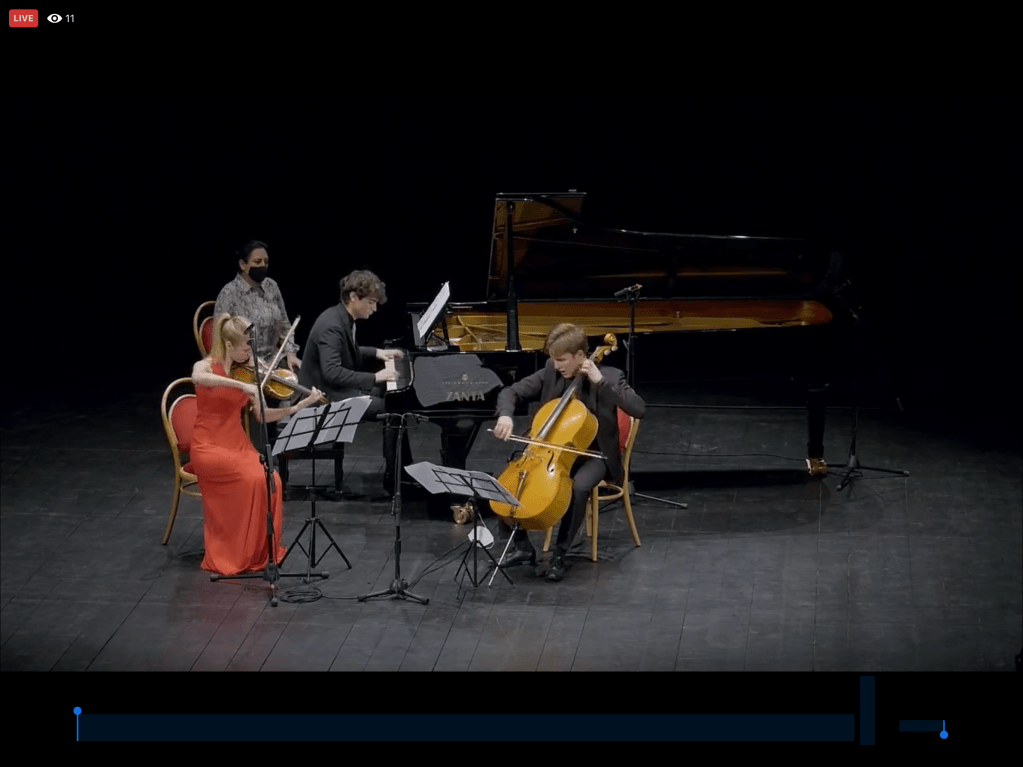
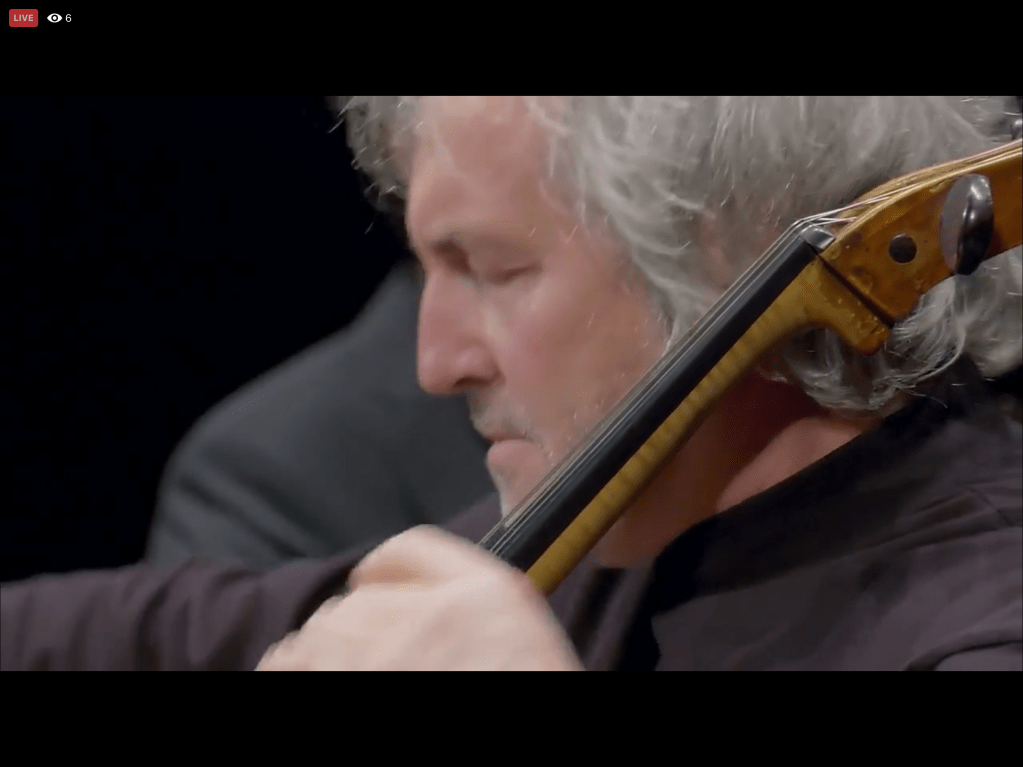
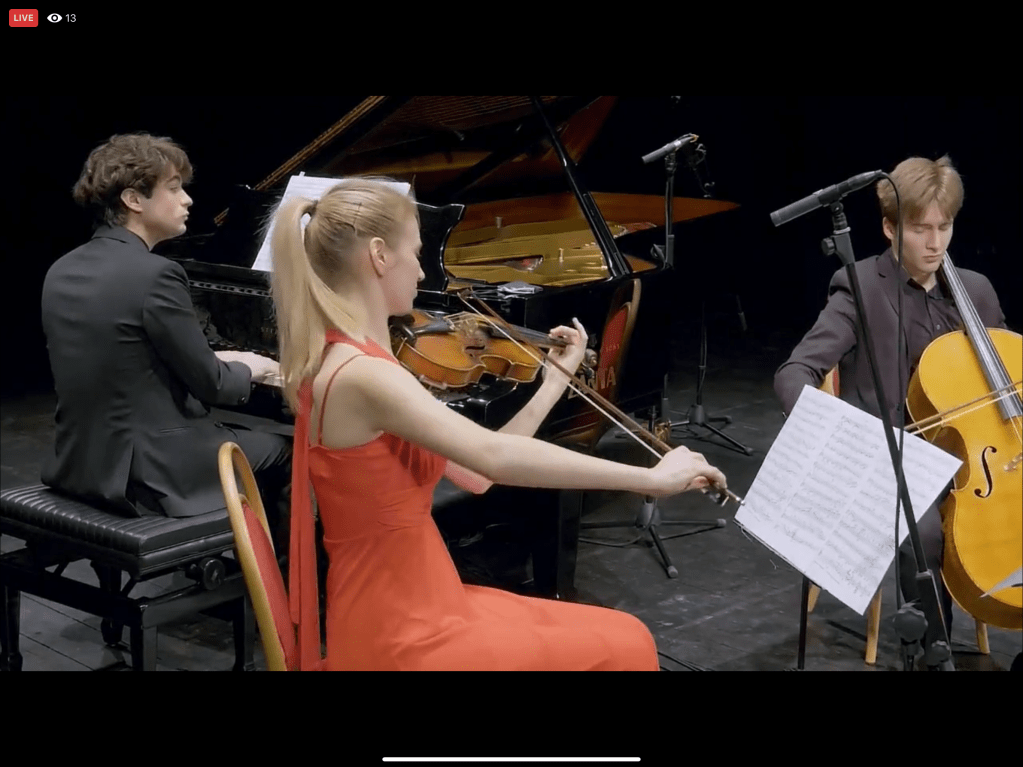
Venetian Homage to Ludwig 1770 at Teatro Toniolo Mario Brunello presents The Rimonda-Cecino- Giovannini Trio

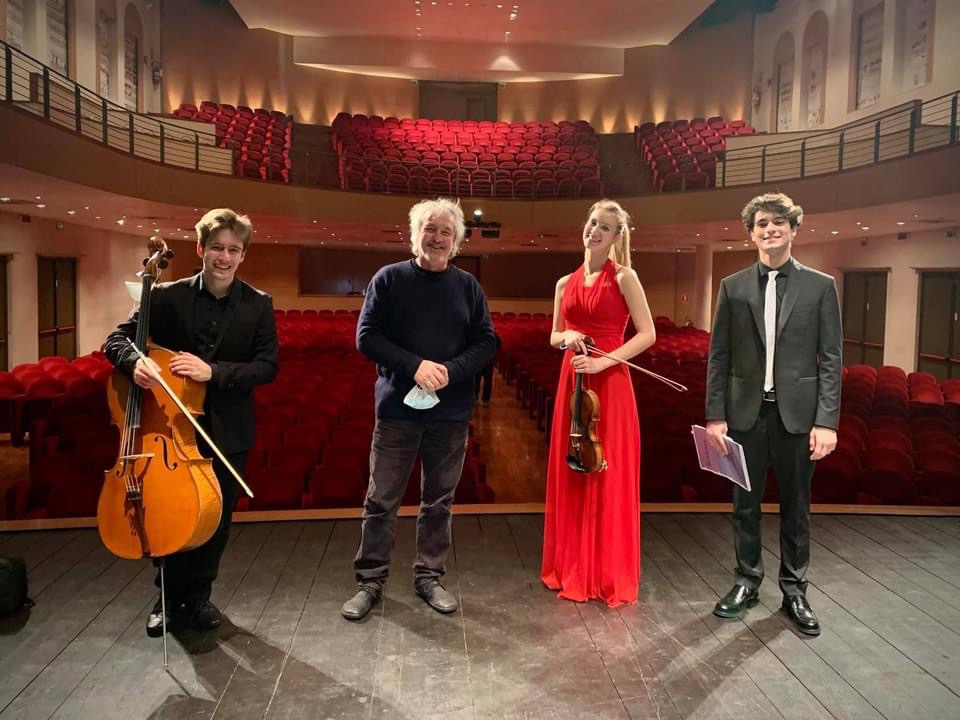
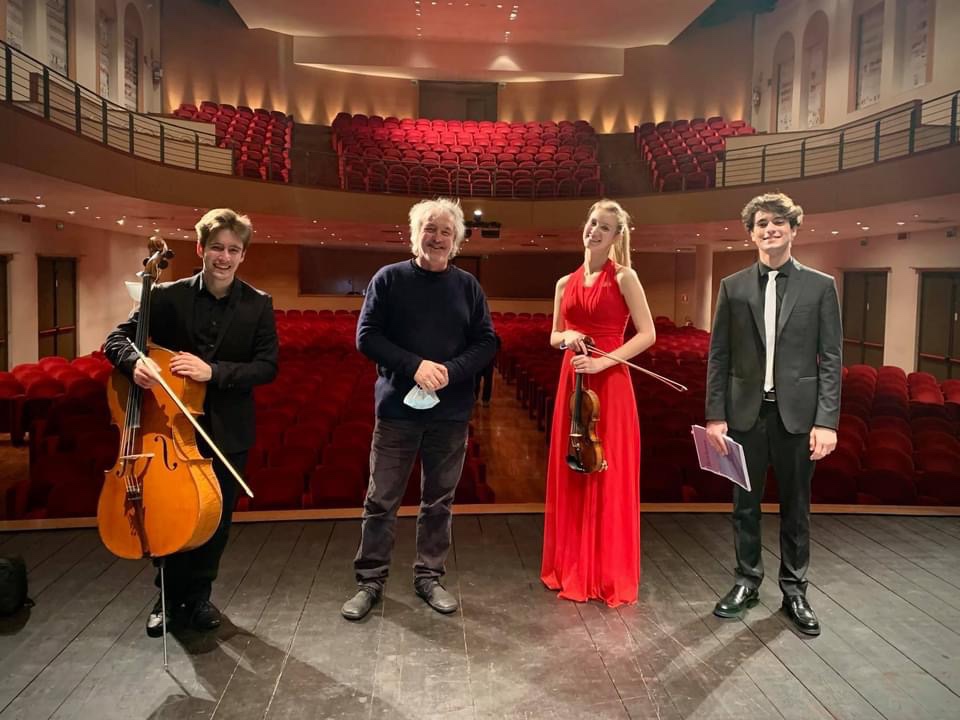
Luca Giovannini-Mario Brunello-Giulia Rimonda-Elia Cecino

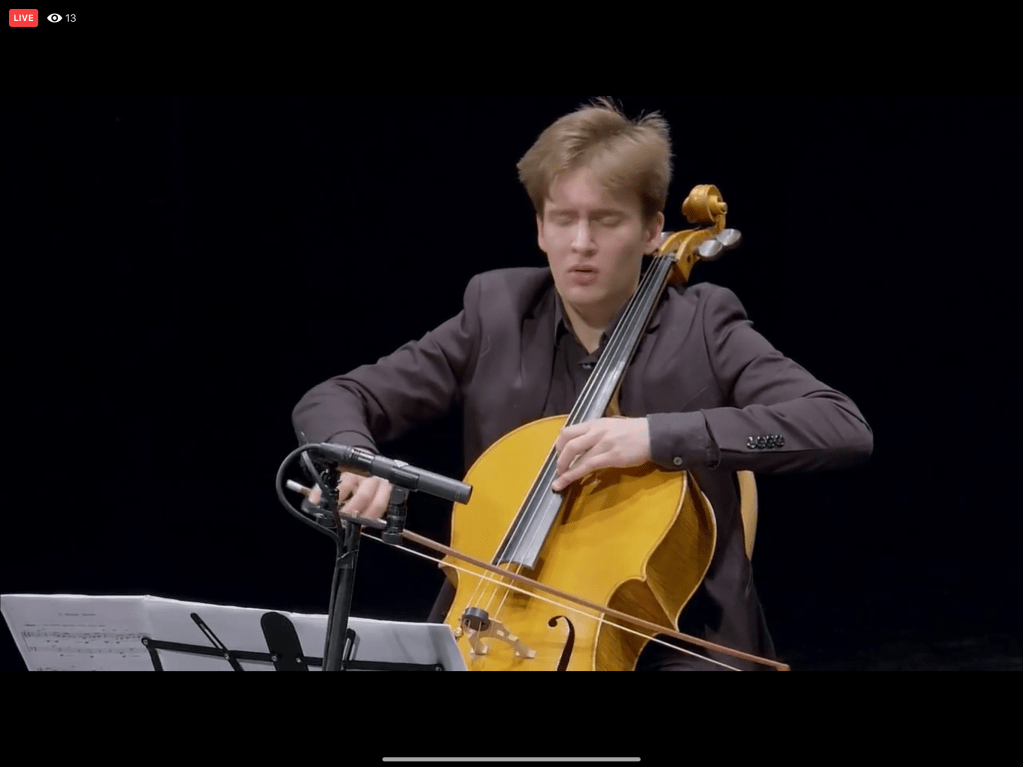
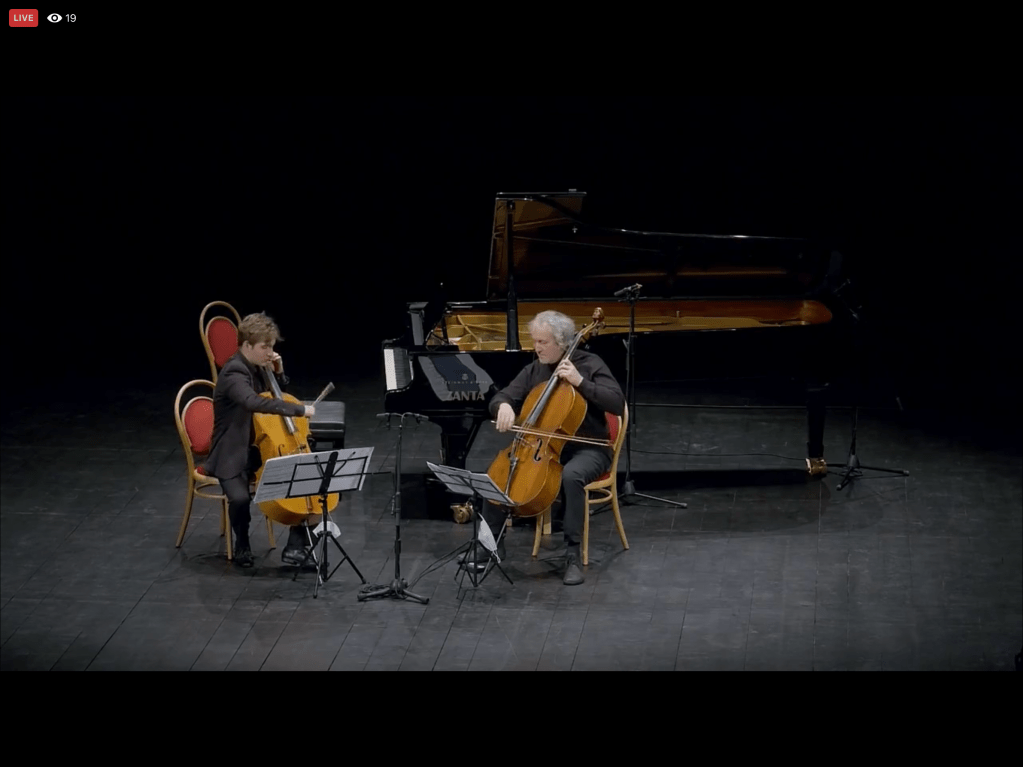
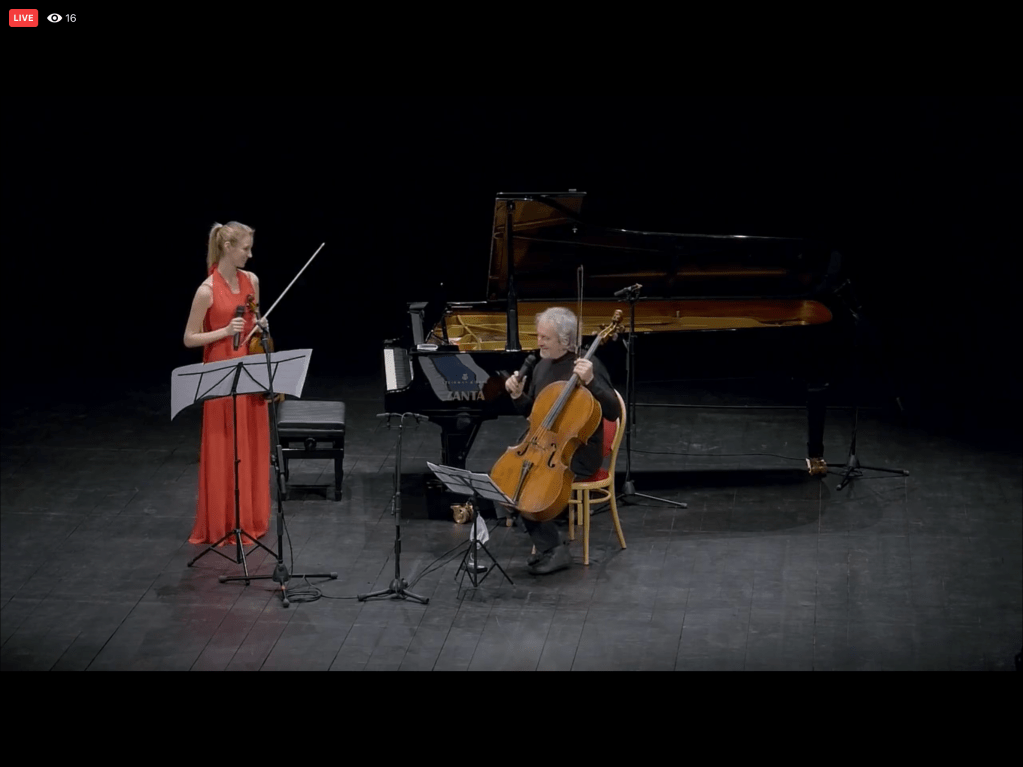
A concert under the title Homage to Ludwig 1770 and presented for the season of Mestre-Venice in Teatro Toniolo.It was streamed live on the 30th and 31st December at 20.30 , presented by Mario Brunello (winner of the Tchaikowsky International Competition in 1986).Ever generous he was giving a platform to three of the most talented artist of their generation.
Luca Giovannini (2000),Elia Cecino (2001),Giulia Rimonda(2002),in the name of Beethoven.A concert recorded just two days before Beethoven’s actual 250th birthday on the 16th December 1770.

The Trio Rimonda-Cecino-Giovannini


And what better way than with one of the best known of the Trios to unite these three young musicians in an absorbing musical conversation.
It was Barenboim who exclaimed that when musicians get together they don’t make conversation but they make music .
They get to know each other in a far greater way than they ever would with words.
And so it was today with the first dynamic notes fired at us with all their youthful passion and rhythmic drive that created a call to arms from the very first notes. Beethoven’s pupil Carl Czerny wrote in 1842 that the slow movement of the Trio in D major op.70n.1 reminded him of the ghost scene at the opening of Shakespeare’s Hamlet, and this was the origin of the nickname.It features themes found in the second movement of Beethoven’s Symphony No. 2 too.A deeply felt Largo assai ed espressivo where each of these young artist were looking at each other with searing commitment as they created such magical sounds.The Presto was played with a freshness and simplicity with a smile on Giulias face as she passed the notes to Luca who in turned shared them with Elia.
This was indeed a fine homage to Beethoven and to a youthful hope for the future!

Luca Giovannini


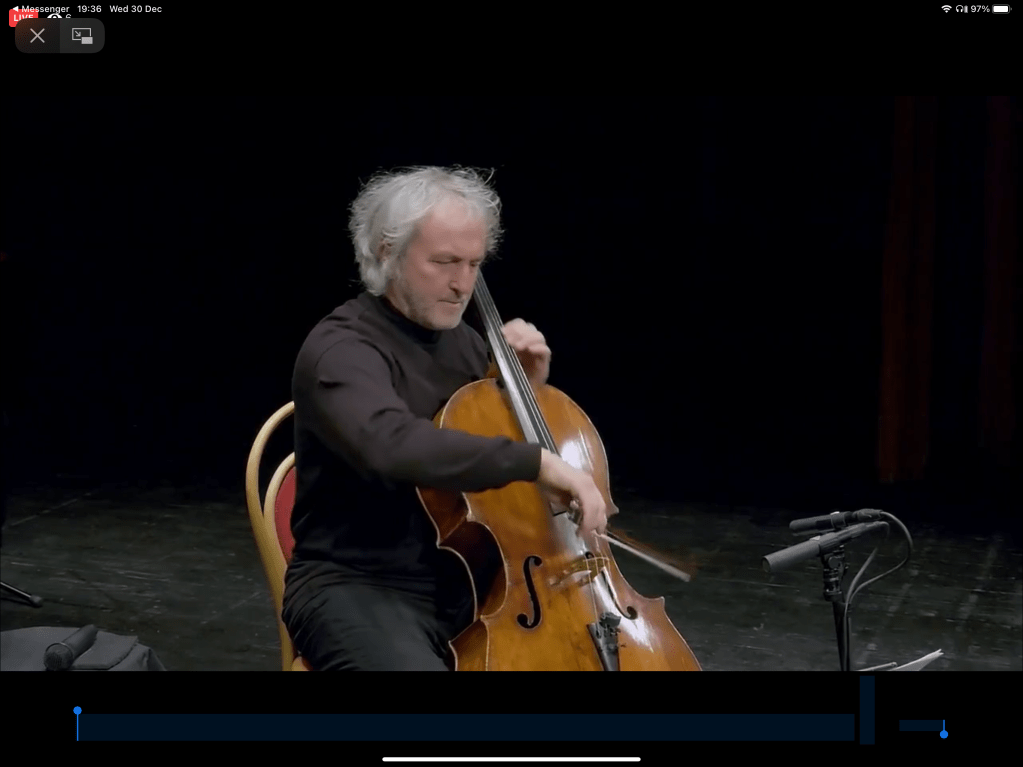
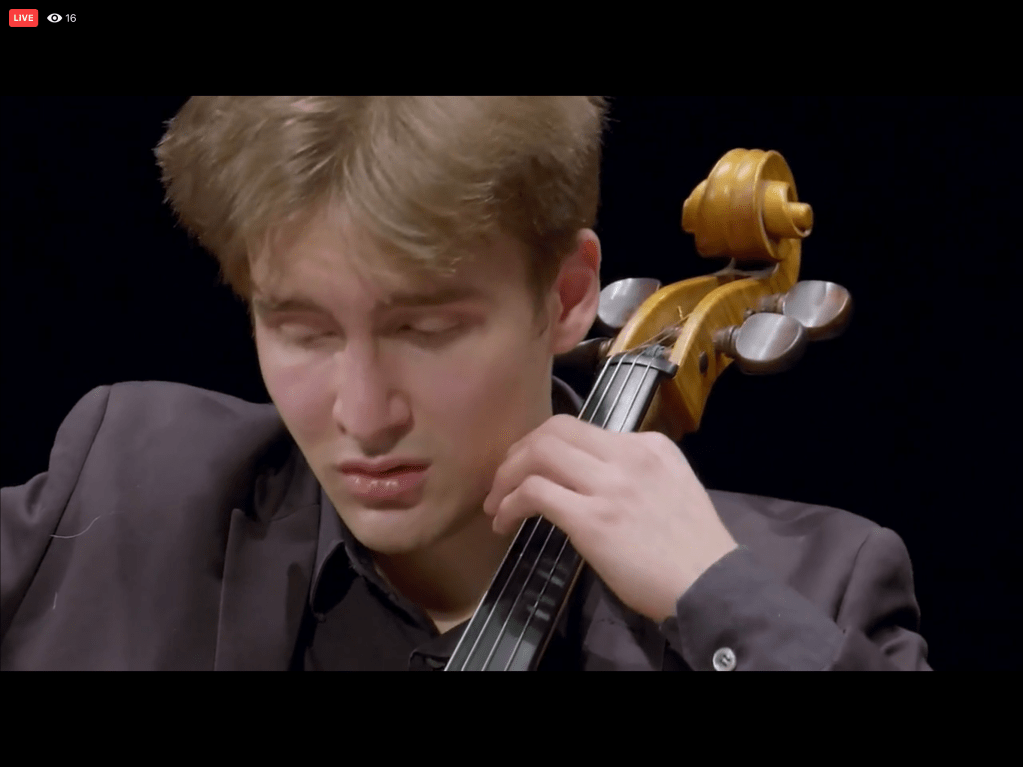
But it had been prefaced with a short piece each in which they took it in turns to talk and then play with the great Italian cellist.Luca was playing the cello that had brought Mario Brunello his triumph in Moscow in 1986.An Ansaldo Poggi of 1927 generously on loan to this aspiring young cellist.Brunello now plays a Maggini of the 1600’s.

Mario Brunello


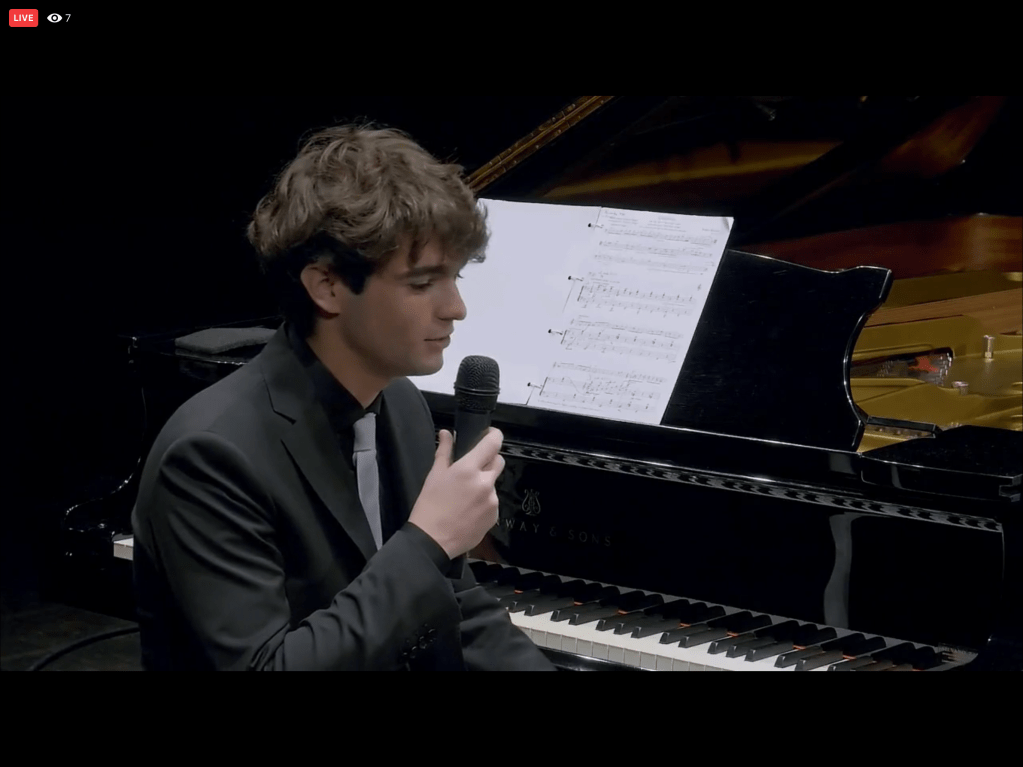
Elia had played a piece for piano and cello by the Russian Shchedrin.A spirited and stylish performance where Brunello had shown his unique sense of rubato and subtle colouring.

Elia Cecino in conversation with Mario Brunello


Not Love Alone (also translated Not for Love Alone or Not Only Love; Russian: Не только любовь ; Ne tol’ko lyubov’) is the first opera of Rodion Shchedrin (Russia 1932), written 1961, revised in 1971
A well-known piece from this opera (usually played by cello and piano) is the humorous Quadrille from the second Act (Scene 15: The arrival of Varvara Vasilyevna and quadrille).


Luca Giovannini played a work by the Ukrainian Silvestrov for two cello’s with infact Brunello’s two cellos blending so well together in the hands of his young passionate protogée.
Valentyn Silvestrov (Ukraine 1937)8.VI.1810…zum Geburtstag R. A. Schumann for two cellos (2004) realizes the composer’s goal for a “cello four-hands,” expanding the instrument’s possibilities by turning it inward. A feeling of euphoria locks flesh with shadows. Dances flit by like opportunities for melodic escape, while their after-images seek reciprocation in the listening. Lechner and Vesterman accordingly hang their spirits on easels and mark them with every brushstroke of the bow.
Giulia Rimonda with Mario Brunello


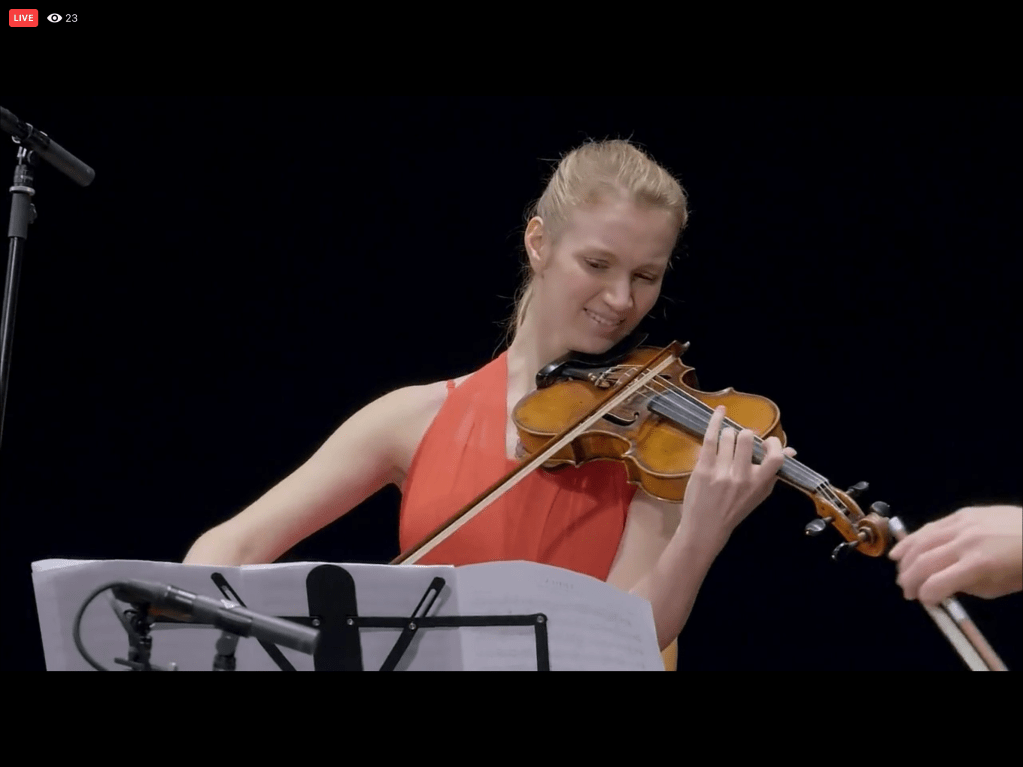
It was the beautifully elegant Giulia Rimonda who played a short piece by another Ukrainian composer with great musicianship and sense of enjoyment.
Victoria Polevà (Ukraine 1962) Gulfstream (2010) for violin and cello

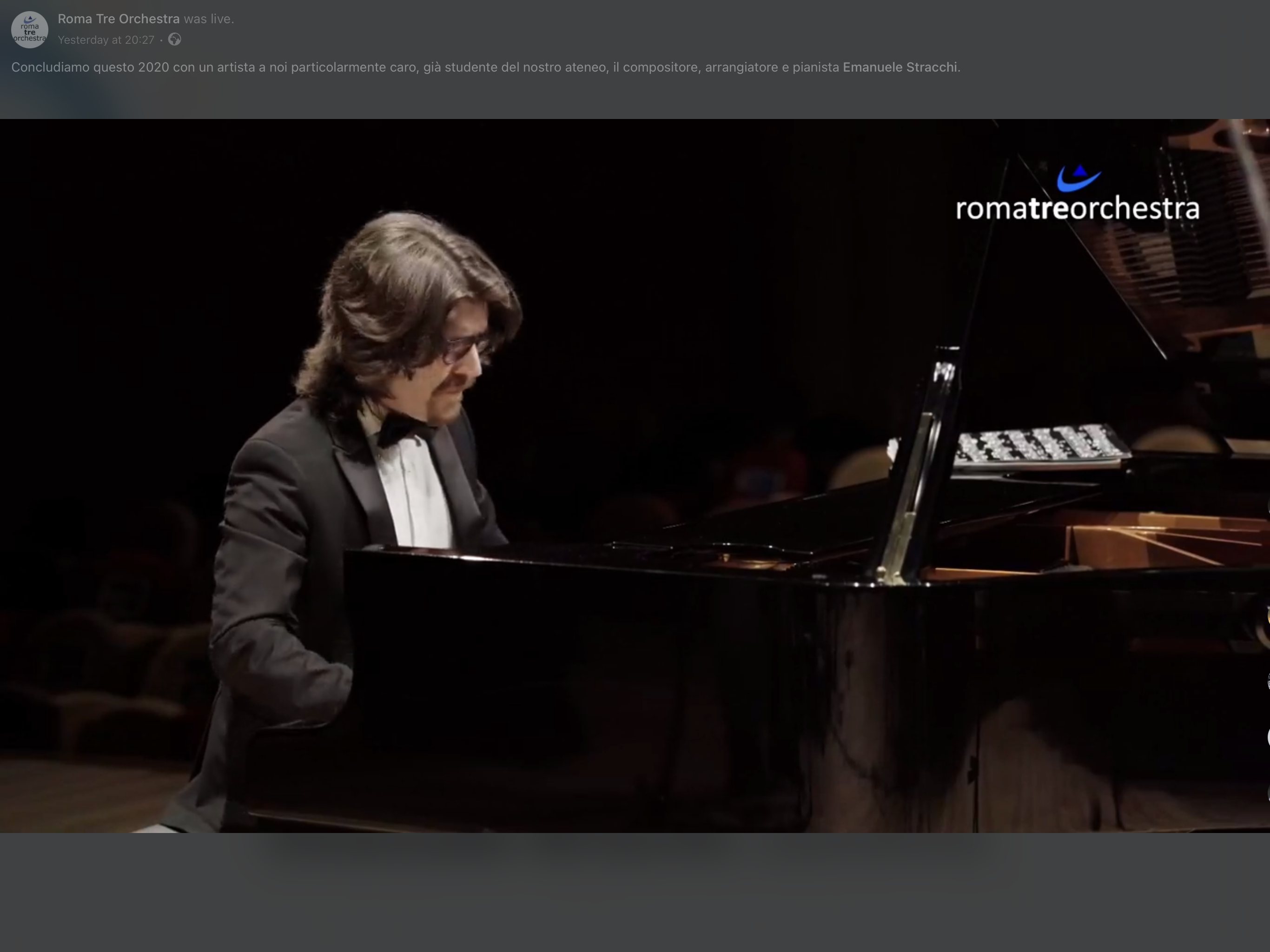
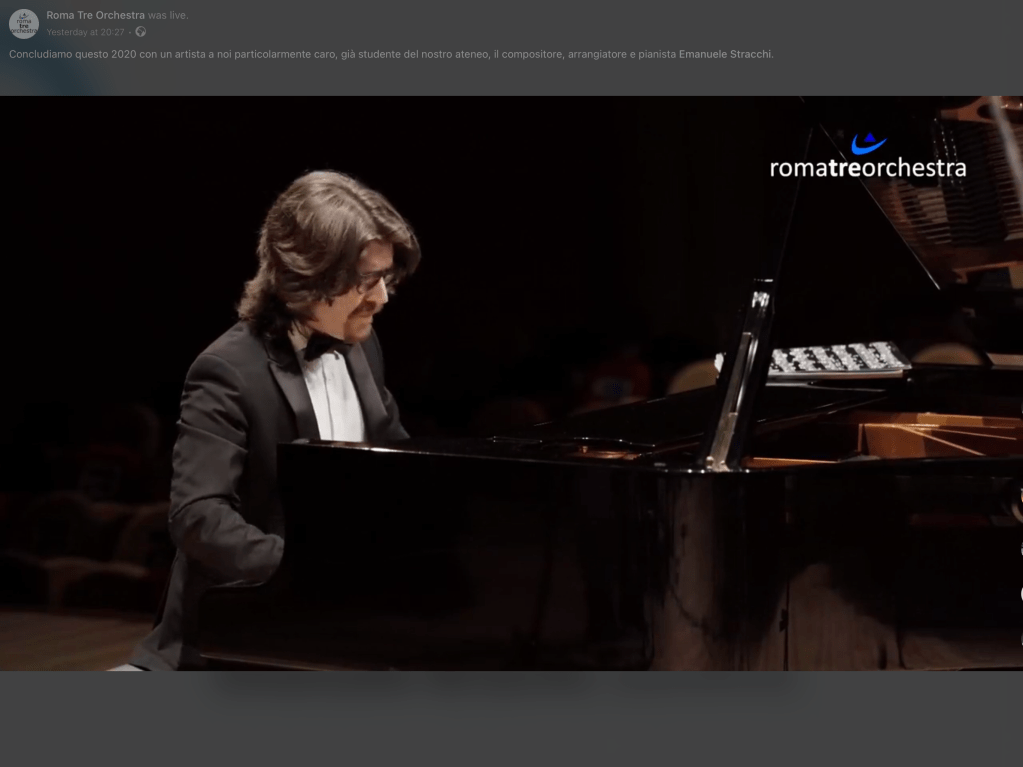
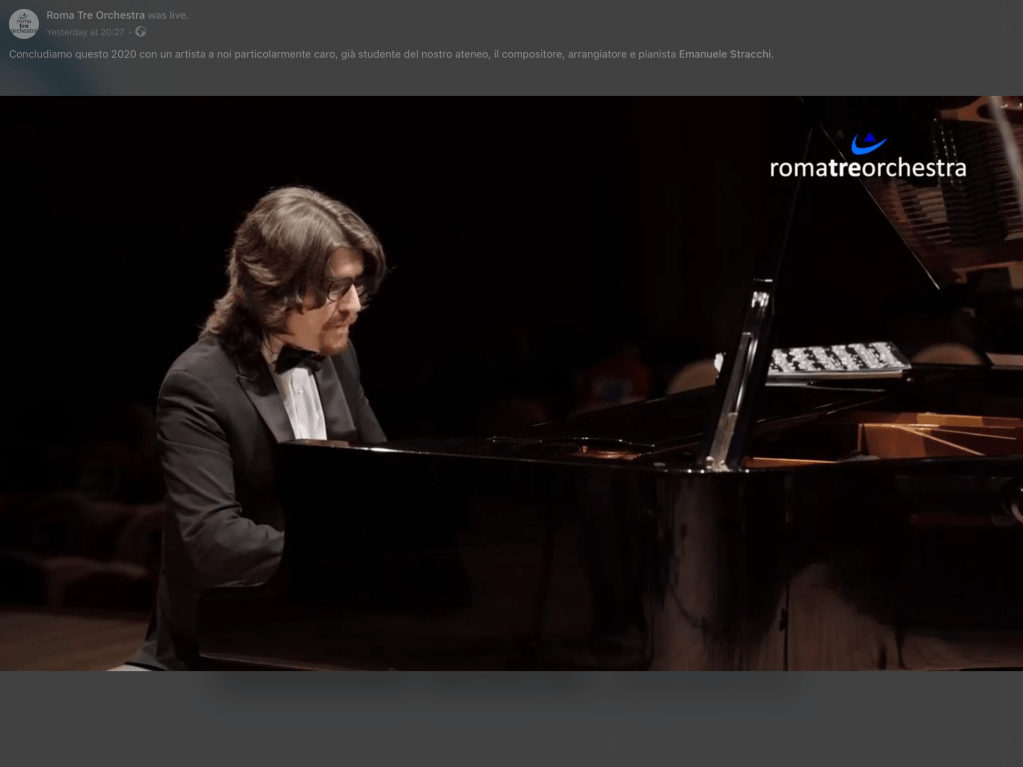
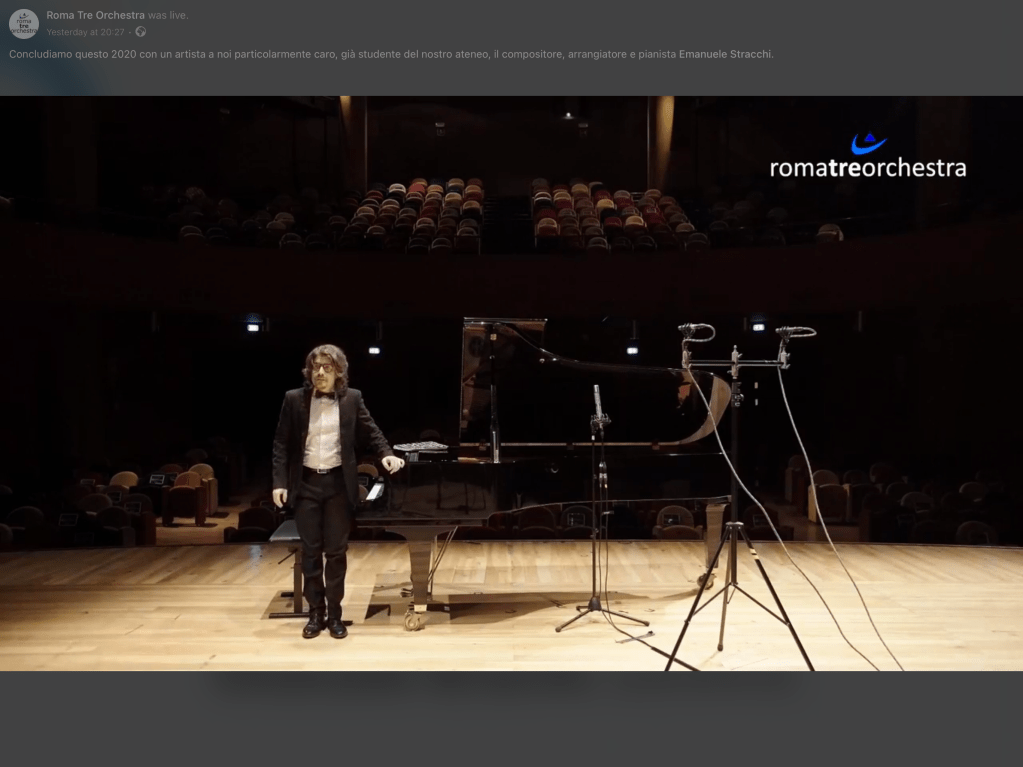
Emanuele Stracchi recital -White Christmas with bells jingling for Roma 3 – swan song 2020

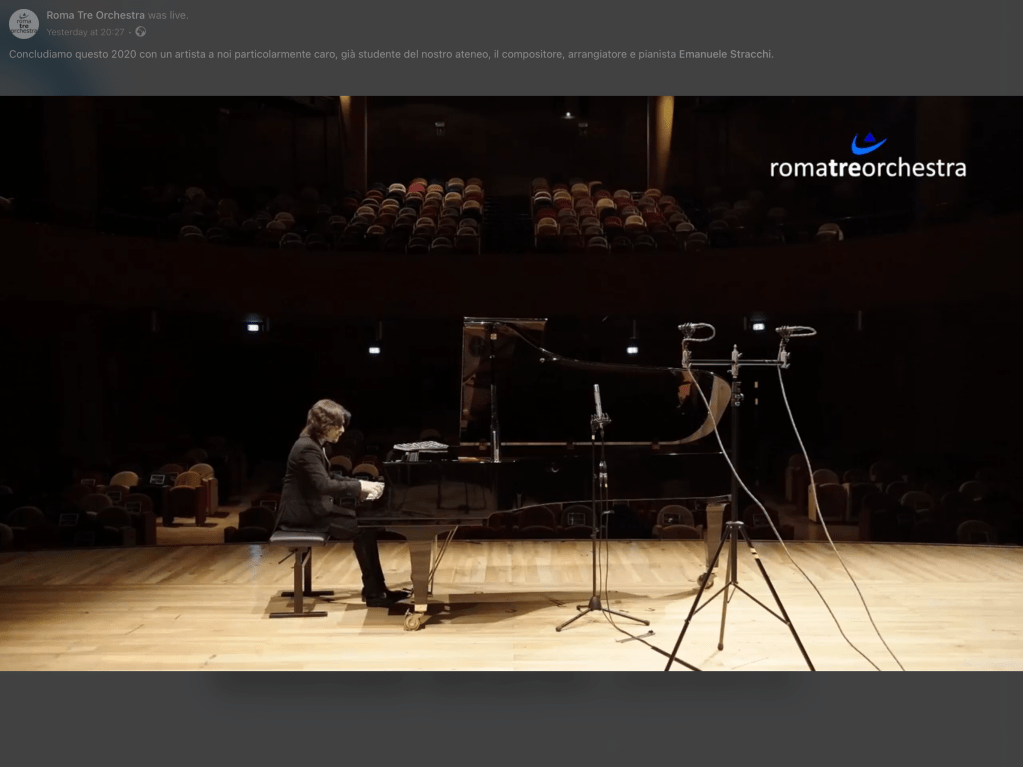
The last concert of a very difficult year was streamed live for Roma 3 Orchestra from Teatro Palladium in Rome.Emanuele Stracchi ,a very popular former student of the University showed of his versatility as a composer,arranger and pianist.


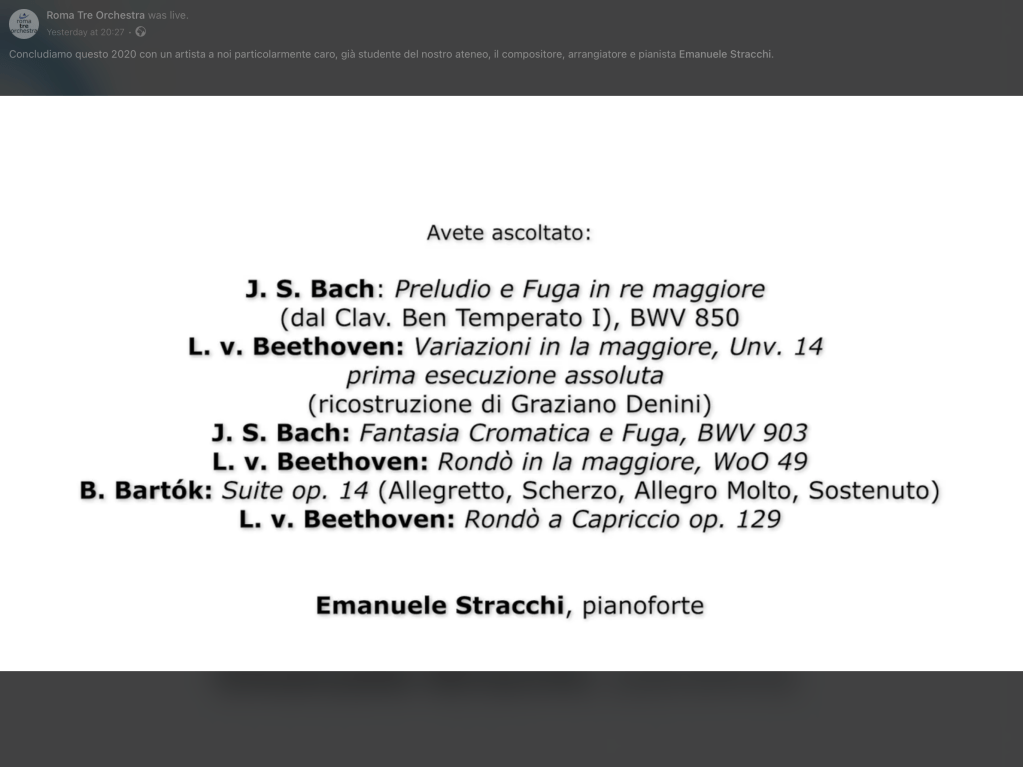
In a programme that opened with a crystal clear account of Bach’s D major Prelude and Fugue Book 1 with the same majesty in the Fugue that he was to bring to the Chromatic Fantasy and Fugue later.Not only clarity but he was obviously in his element with the chordal arpeggiated chords that led to the poignant recitativi .The fugue entering almost unnoticed grew to an ever more impressive conclusion.


Three very early works by Beethoven followed and were obviously written for his own early performances as a virtuoso.
The novelty was a first performance of the early variations in A,Unv.-14 written in 1794 and now reconstructed by Graziano Denini ,full of charm in the style of his master Haydn.
The rondò in A WoO49 written in 1783 was followed by the well known ‘Rage over a lost penny’ published as op 129 by Diabelli,after Beethoven’s death,but written in 1795-98. Robert Schumann wrote that “it would be difficult to find anything merrier than this whim… It is the most amiable, harmless anger, similar to that felt when one cannot pull a shoe from off the foot.”It’s full title is “Rondo alla ungherese quasi un capriccio” in G major, Op. 129 but is better known by the title Rage Over a Lost Penny, Vented in a Caprice (from German: Die Wut über den verlorenen Groschen, ausgetobt in einer Caprice).It is a showpiece for the likes of Evgeny Kissin and although Emanuele played with the same intelligent musicianship as his Bach he did not quite have the scintillating ‘fingerfertigkeit’that it was obviously written to show off.


The Bartòk Suite op 14 began to open a world that is Emanuele’s.
Abandoning the score he played the four short movements with a sense of wonder and improvisation.There was a clarity in the Scherzo and an unrelenting rhythmic impetus in the ostinato third movement from which emerged the magic sounds of the final sostenuto.


It was though in the unexpected encore that one could savour the true talent of this versatile young musician.
His own improvisations on Christmas themes.
Here a whole world opened up of subtle magic sounds with a freedom of expression and sense of natural rhythmic pulse.Even ending with a boogy-woogy version of White Christmas that out of the final reverberant chord appeared the bells on high,truly Jingling!
A fine pianist but when you let him free and off the lead I begin to see why he was chosen to give the final concert of the year.
Hats off indeed

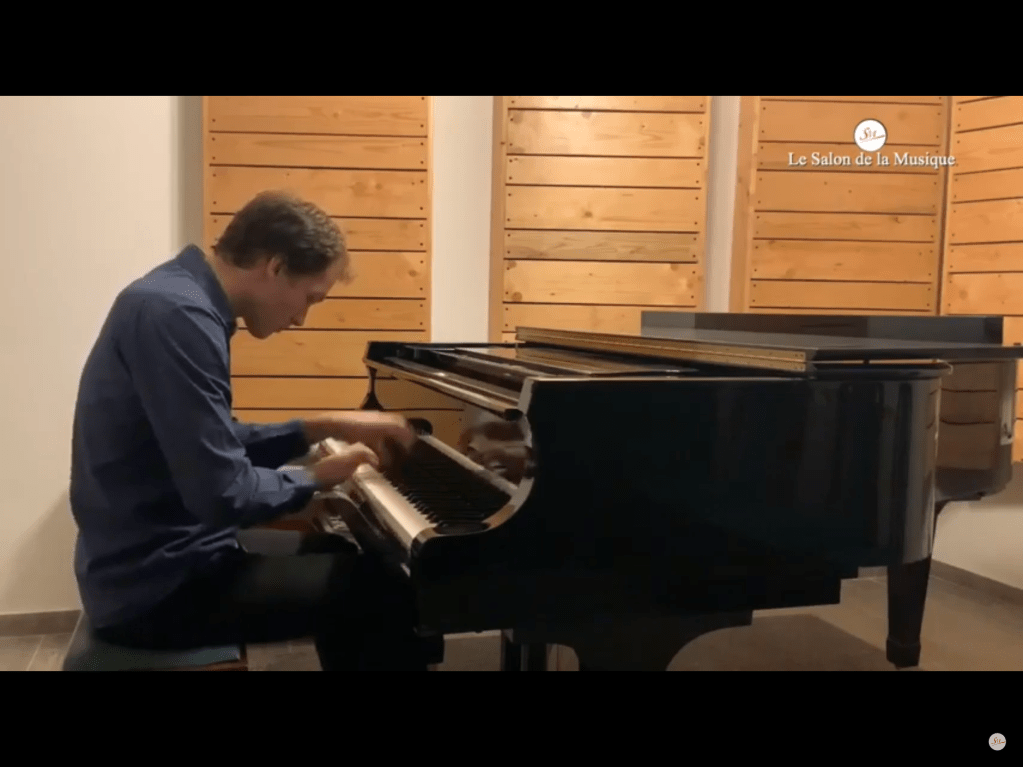
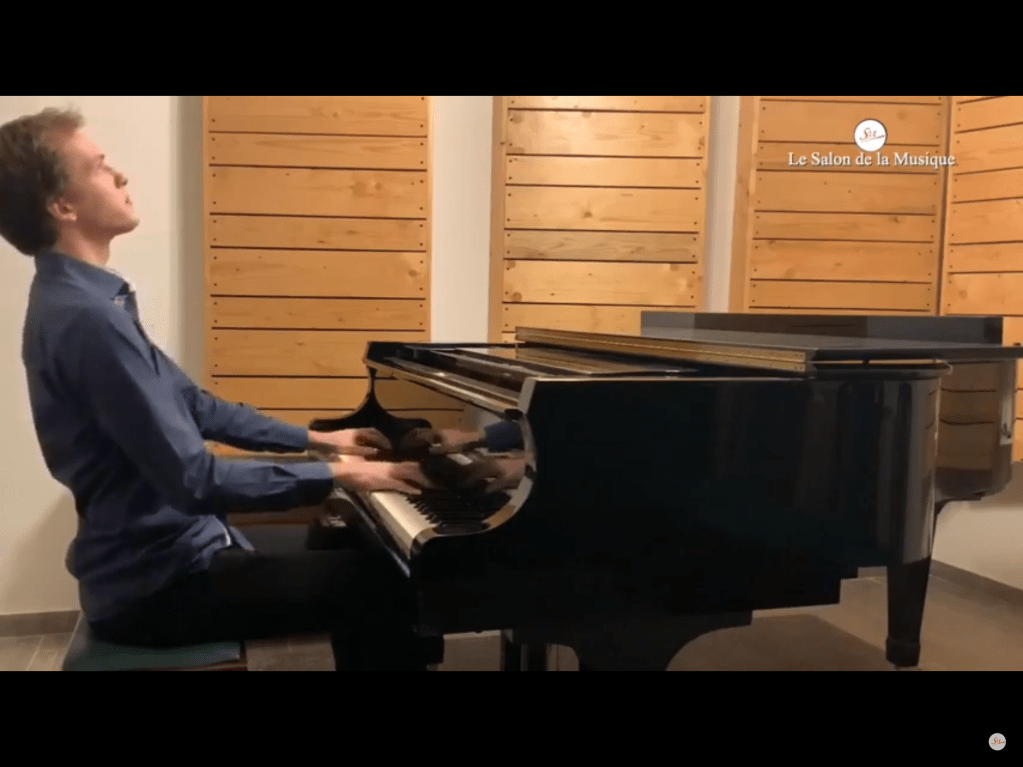
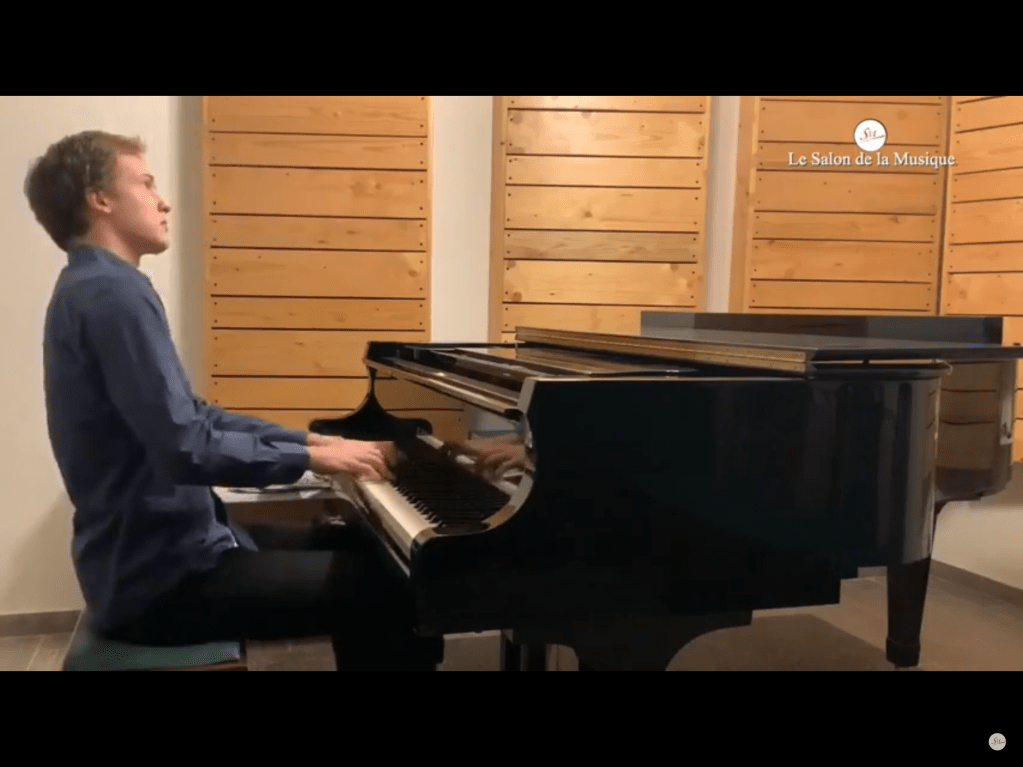
Ivan Krpan at home for Le Salon de la Musique

https://christopheraxworthymusiccommentary.wordpress.com/2020/11/15/ivan-krpan-in-zagreb-croatian-national-archive-hall-pridepassion-and-joy/

J.S.Bach Partita in B flat BWV 825 Prelude-Allemande-Courante-Sarabande-Menuetto 1-Menuett 2 Gigue; F.Chopin Nocturne op 9 n.1 in B flat minor;B.Bersa Nocturne op 38 ; F.Liszt La lugubre gondola n.1; B.Bersa Venetian Barcarolle op.58

As with his playing of the second Partita by Bach that Ivan played recently in Zagreb it is the absolute clarity,beauty of sound and crystal clear ornamentation that show off the maturity of a pianist who is still only in his early twenties.Today he chose the most calm and pastoral of the six partitas.It was with the Prelude of the first Partita that he created such a tranquil opening ,similar to the 5th French suite where Bach is leading us into a world of peace and almost Schubertian lyricism.There is a purity of line where you can almost hear the human voice which Ivan allowed to flow without any seeming interruption or unnecessary external influences.He brought the Prelude to a natural emotional climax from which poured the continuous web of streaming sounds of the Allemande.Very slightly holding the first note of the first few bars giving such poignant meaning to what is just a trickle of pure and simple sounds.His great sense of legato contrasted so well with the deliberate non legato of the Courante played with some very delicate phrasing always in perfect style.The luminosity of sound in the Sarabande was quite startling as was the almost operatic freedom of the long deeply felt singing lines.The Menuetto 1 was played with great buoyancy and a very deliberate crisp and clean non legato that contrasted with the musette of the Menuetto 2 played with much more lyrical freedom.The little glissando into the repeat of the Menuetto 1 was a deliberate and delicious addition.The Gigue was played with a well oiled precision almost without pedal except in the repeats where Ivan allowed us to treasure even more what Bach had only hinted at the first time around.

There was a complete change of scene for Chopin’s first nocturne op 9.A beautiful bel canto fully sustained by the subtle left hand harmonies.The middle section even more bathed in pedal.A wondrous melodic outpouring rising out of the water like some sunken cathedral!Rising above the mist with a passionate outburst of sumptuous colours.Only to die away to a whisper before the reappearance of our bel canto but this time with a reticence that was so touching as it moved to it’s magical ending.

It led so well to the beautiful sounds of Bersa’s Nocturne full of such subtle colouring and passionate outbursts.I have written just recently about Ivan’s performances of Liszt La lugubre gondola 1 and Bersa’s Venetian Barcarolle.Ivan’s playing of late Liszt is quite remarkable.Playing of such depth of feeling in it’s unbearable anguish and insistent longing .He makes us realise the true genius of Liszt who could portray so much with so little as his visionary search late in a very full life could lead the way for what was to come in the future.The ending was deeply moving as it was dramatic.

The Bersa Barcarolle was played with beautiful golden sounds on which floated a magical mellifluous outpouring .I have written above more fully about the almost unknown composer Blagoje Bersa much celebrated in Croazia.In fact the school where the six year old Ivan Krpan took his first steps in piano playing is named after him!

Ivan Krpan was born in Zagreb in 1997 into a musical family and began studying the piano at the age of six at the Blagoje Bersa Music School in Zagreb, under the tutelage of Renata Strojin Richter. From 2013 he has been studying piano with Ruben Dalibaltayan at the Music Academy in Zagreb where he obtained his master’s degree in 2019. He has won several first prizes in national and international piano competitions; prize wins of note include first prizes at the 12th Piano Competition “Les Rencontres Internationales des Jeunes Pianistes” Grez Doiceau in Belgium in 2014, the International Piano Competition Young Virtuosi in Zagreb in 2014, the International Piano Competition for Young Musicians in Enschede (Netherlands) and the Ettlingen International Competition for Young Pianists. He achieved 2nd prize in the International Danube Piano Competition in Ulm in 2014 and same year he won a special prize awarded by the Dean of the Zagreb Music Academy and the 4th prize at the 1st International Zhuhai Mozart Competition in Zhuhai, China. He also won the annual Ivo Vuljević prize awarded by the Jeunesses Musicales Croatia for the best young musician in Croatia in 2015. In 2016 he won the 3rd prize at the 10th Moscow International Frederick Chopin Competition for Young Pianists and the Zagreb Philharmonic Orchestra has granted him the Young Musician of the Year Award. At the age of twenty, Ivan Krpan has won the Ferruccio Busoni International Piano Competition 2017, one of the world’s most prestigious piano competitions. 2018/2019 season saw him performing in important Italian cities as Venice, Rome, Milano, Turin, in major music centers as London, Vienna and Hong Kong as well as a tour in South Korea in collaboration with the World Culture Networks Foundation and Steinway & Sons. He also had an important tour in Germany (Munich, Hamburg, Leipzig, Dusseldorf, Dresden, Hanover), and an extensive tour in Japan. For the first time the Ferruccio Busoni International Piano Competition Foundation has produced a studio album, which it has made available exclusively on IDAGIO, a leading streaming service for classical music. In May 2018 Mr. Krpan took to the legendary Emil Berliner Studios in Berlin to record Chopin’s 24 Préludes and Schumann’s Fantasie op. 17 and Arabeske op. 18. Classical music lovers around the world can hear this exceptional recording exclusively on IDAGIO.

Roma 3 Orchestra -Young Artists Series streamed live from Teatro Palladium Rome

Roma tre orchestra season streamed live from Teatro Palladium in Rome

https://christopheraxworthymusiccommentary.wordpress.com/2020/12/18/roma-3-orchestra-comes-of-age-at-teatro-palladium-in-rome/

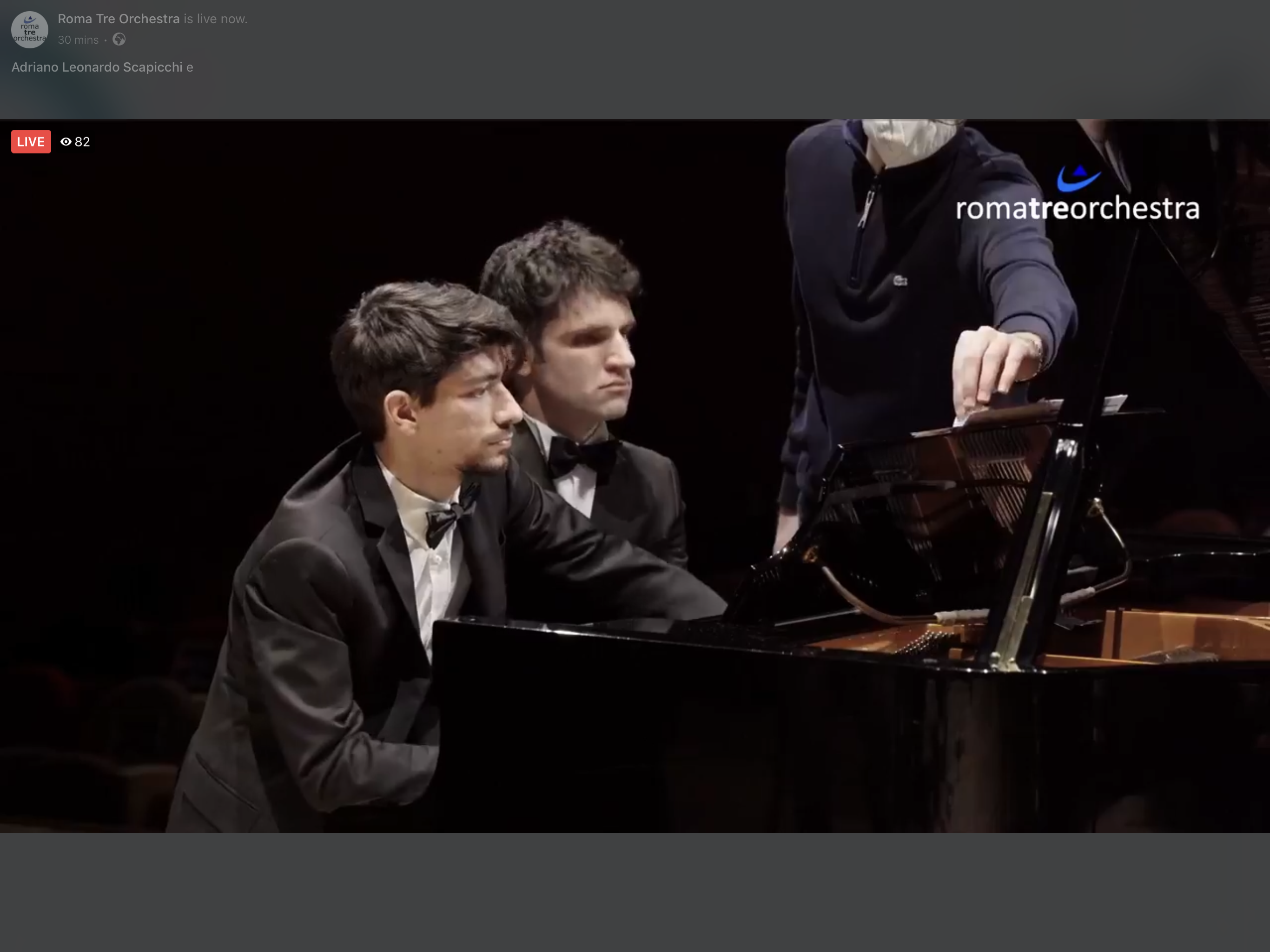
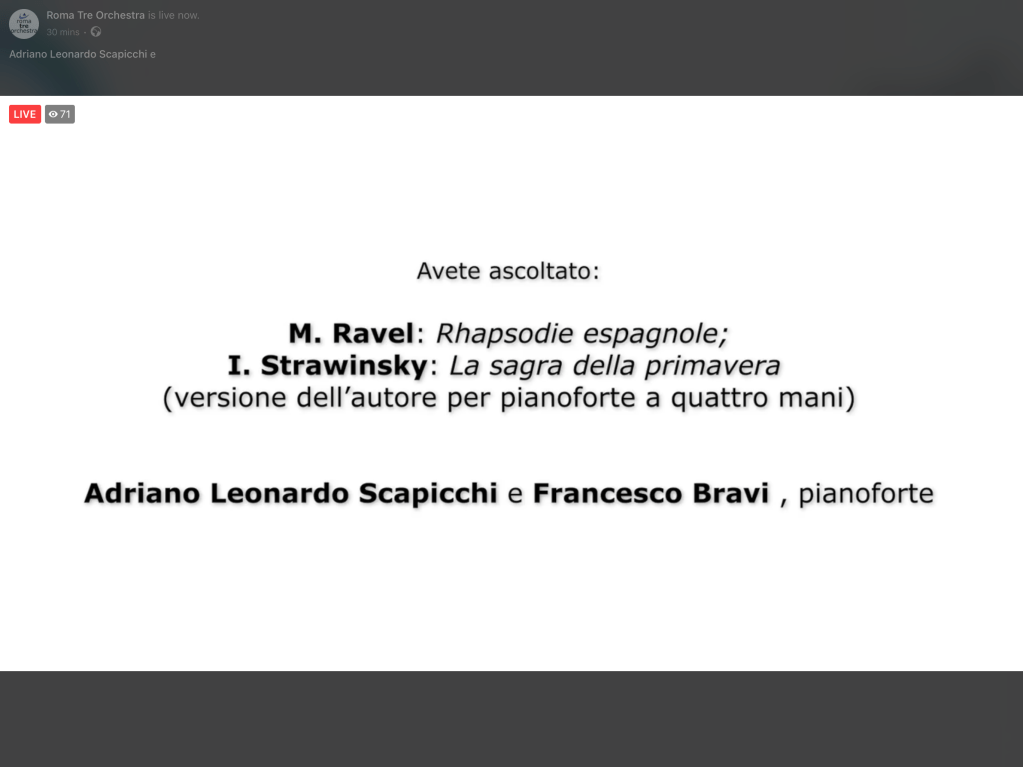
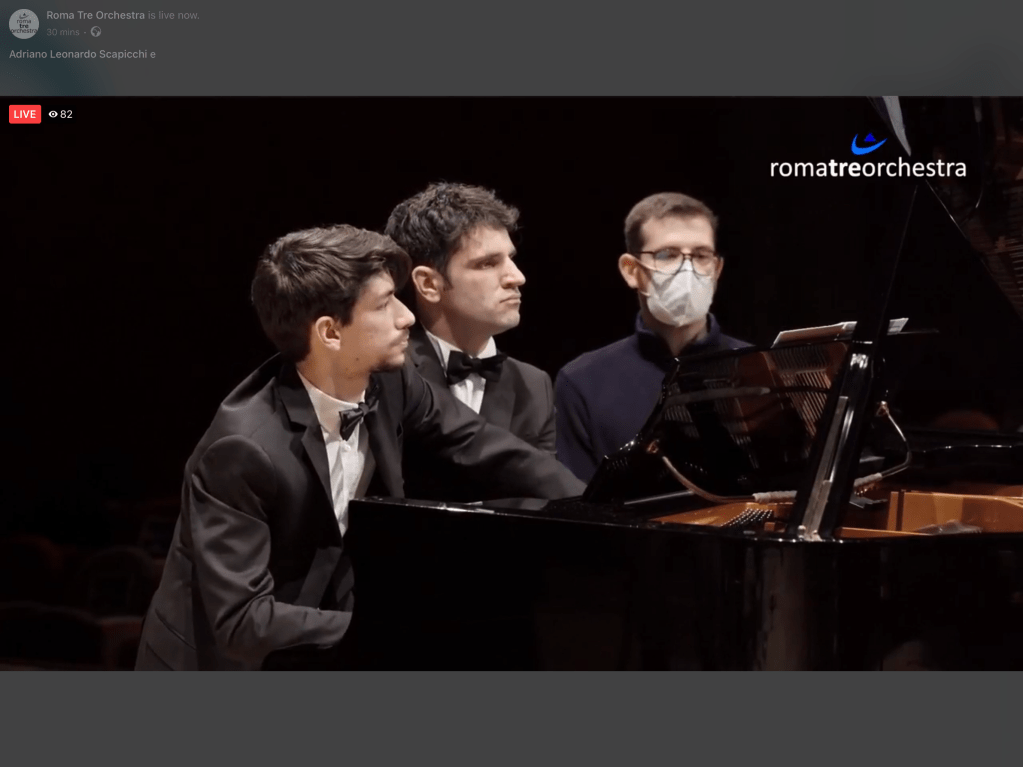
Hard to know where to look as the hands and arms of Adriano Leonardo Scapicchi and Francesco Bravi twisted and turned as they entwined in their unrelenting rhythmic journey in Stravinsky’s original four hand version of The Rite of Spring.


A formidable knotty twine of great precision and rhythmic pulse in which Stravinsky’s demonic vision of insinuated melodies and savage naked rhythms vied with each other in a tour de force that I have not witnessed since a young almost unknown Vladimir Ashkenazy fought it out with Daniel Barenboim in the first Summer Festival on the Southbank in London fifty years ago.
The same festival where that other unknown couple Martha Argerich and Nelson Freire also took the world by storm but on two pianos!
Ravel’s Rhapsodie espagnole usually played on two pianos was played today on one and showed such evocative sounds with their extraordinary control of the pedals ensuring that here is formidable duo who think and play as one …….no mean feat indeed.


A wonderful sounding Schimmel piano that sounded even more like a Bosendorfer makes me think that that magician Mauro Buccitti has waved his magic wand over the proceedings yet again.

Stravinsky in conversation at the piano with Robert Craft:
https://fb.watch/2zuUpyLrqM/

Fanny Waterman an appreciation of the ‘piano mummy‘ of our age

Dame Fanny with Menahem Pressler in Oxford

How many years have passed since meeting with this legendary figure in Oxford.Dame Fanny had always been part of my life but to meet her and get to know her,even though all too sporadically ,was a real joy.But it was the joy of music that she so generously shared with so many people.

‘My piano mummy ‘says Lang Lang.She was in reality the mother to so many pianist both big and small throughout the world.In Oxford at Mario Papadopoulos’s Philomusica Summer Festival I approached the great lady for the first time.

Interrogation of Vitaly Pisarenko

‘Dame Fanny,let me introduce you to the winner of your next competition!’Taken a little aback ,but intrigued,she immediately went into action as she took Vitaly Pisarenko to a piano and said:’play me something classical’He did:Beethoven Pathétique and went on to take her next competition by storm until in the final his colleague from Moscow,Anna Tsybuleva played such an extraordinary Brahms 2 that Vitaly’s Rachmaninov 3 was just not enough to satisfy the orchestra and jury.

Dame Fanny listening to Pisarenko’s Beethoven

At the end of the previous rounds I had been advised by a jury member friend to hurry up to Leeds for the final in which this young man was a hot favourite.He did win a top prize but Anna beat him to the ultimate winning post.Vitaly was sustained by the Keyboard Charitable Trust created by Noretta Conci and her husband John Leech,now in their nineties, they have entrusted the reigns to me,Leslie Howard and Elena Vorotko.

Dane Fanny with Pablo Rossi

A few years later I invited Dame Fanny to the first concert of the KCT in collaboration with the Brazilian Embassy at the Cunard Hall in Trafalgar Square.She was already well into her 90’s but in London for a board meeting and staying at one of the exclusive clubs nearby.She said she would try to attend and lo and behold appeared at our concert given by the young Pablo Rossi.We were all surprised and enchanted that she could be with us and I seated her in the best seat next to the piano.Luckily Pablo had never met Dame Fanny so was blissfully unaware of such a renowned presence but he did notice this distinguished lady nodding her head with every sound he made.I introduced her afterwards to Pablo Rossi.Gabrielle Baldocci and many other distinguished pianists present and also the founders of the KCT and she was overwhelmed by the attention :’What a wonderful host you are’ she said to me as I escorted her to the waiting taxi.It sealed a friendship that was indeed a great honour for me.

With the distinguished pianist and Professor at the RCM Norma Fisher in Cunard Hall.John Leech,founder of the KCT in the background.

I remember her being present in Oxford at Pressler’s memorable performance of Mozart’s K.488 concerto that she herself had played at the Proms as a young aspiring pianist long before she became a Dame.

Two of the most remarkable musicians who listen to every single note without a moment’s distraction discussing Mozart together in the green room afterwards.In fact it was Pressler who confided to me that Dame Fanny wanted him always on the jury of her competition.He remembered though the time he had accepted and Dame Fanny had insisted that he sit next to her.Well, whilst many jury members were able to occasionally nod off during many of the less sensational performances ,Dame Fanny was wide awake listening to every single note,good and bad,and poor Pressler sitting with her could not join ranks with his colleagues!

Discussing Mozart in your 90’s

Living in Italy I sent Dame Fanny a birthday Email saying that I had just heard on BBC Radio 3 a remarkable concert by Graham Johnson with his Songmaker’s Almanac.She immediately wrote back to say that she too had listened to the concert and considered Graham to be the Gerald Moore of our time.’How eloquent you are Christopher’, she exclaimed as we exchanged views for some time afterwards.I was at the RAM with Graham and I told him of this long distance correspondence about his Wigmore concert.He got in touch with Dame Fanny and a friendship was sealed on wings of song one might say.

Dame Fanny with her class in Oxford; the seed is sown for yet another generation!

The last time I saw Dame Fanny was at a prize winners recital at Leeds University of Vitaly Pisarenko .Her longtime friend Linda Wellings gave me pride of place next to Dame Fanny but she was already not well and had to leave in the interval and sadly it was the last time I saw her.

https://christopheraxworthymusiccommentary.wordpress.com/2017/04/09/leeds-land-of-hope-and-glory/

She will be much missed and our only regret was that we did not share a punt together in Oxford much to her disappointment as her car had come to take her back to work in Leeds!

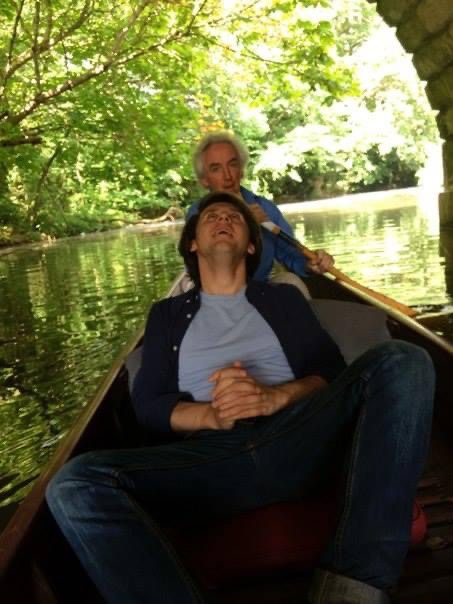
a punt made for three with Vitaly Pisarenko and regretfully without Dame Fanny although she very much wanted to come with us

https://christopheraxworthymusiccommentary.wordpress.com/2019/11/06/anna-tsybuleva-mastery-at-st-marys/

https://christopheraxworthymusiccommentary.wordpress.com/2019/09/21/pablo-rossi-takes-london-by-storm/

https://christopheraxworthymusiccommentary.wordpress.com/2018/05/19/leeds-comes-to-london/

https://christopheraxworthymusiccommentary.wordpress.com/2017/01/12/anna-tsybuleva-and-dame-fanny-waterman/

https://christopheraxworthymusiccommentary.wordpress.com/2016/05/30/louis-schwizgebel-at-the-wigmore-hall/

https://www.facebook.com/media/set/?set=a.10205157941250752&type=3

https://www.facebook.com/media/set/?set=a.10204408217308122&type=3

With her companion Linda Wellings in Oxford

Zimerman and Rattle a seamless stream of beauty and joy for Beethoven’s 250


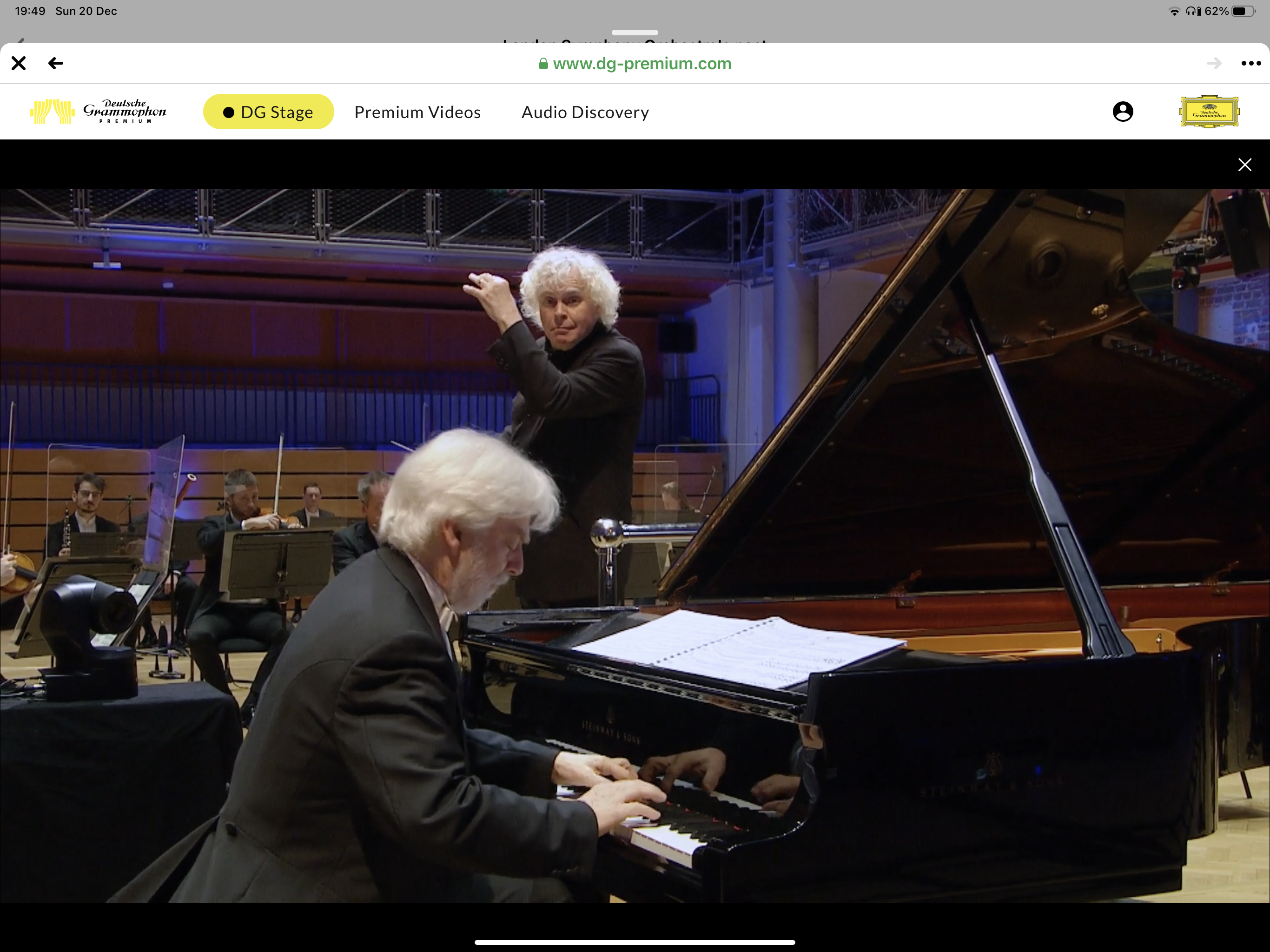
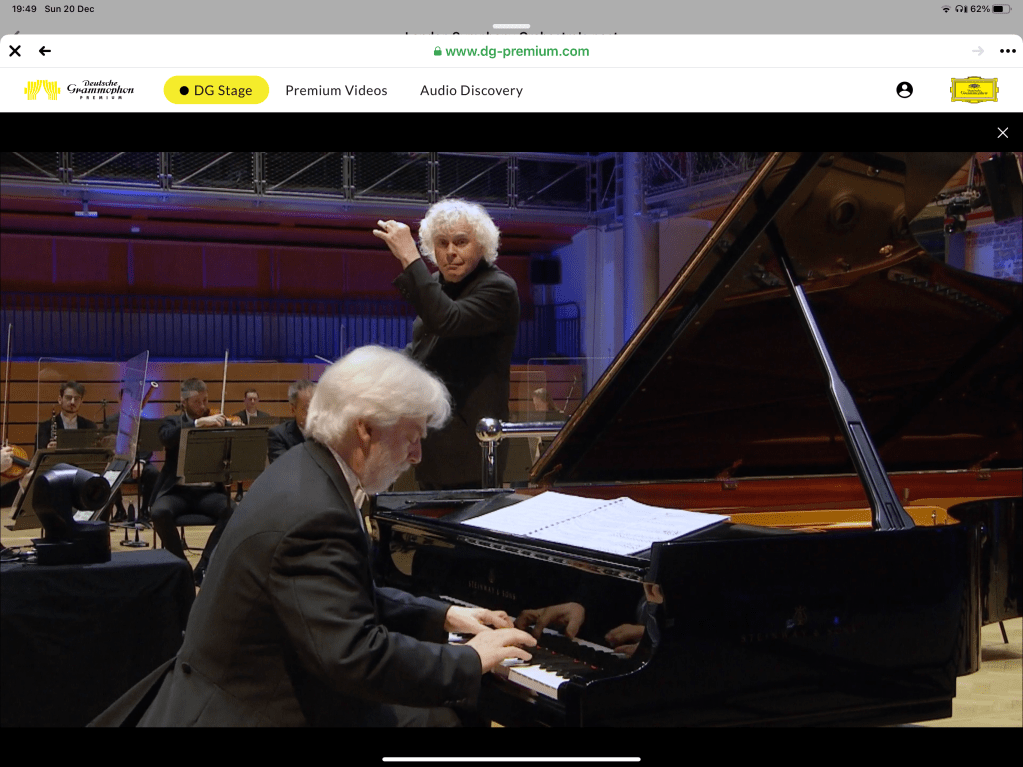
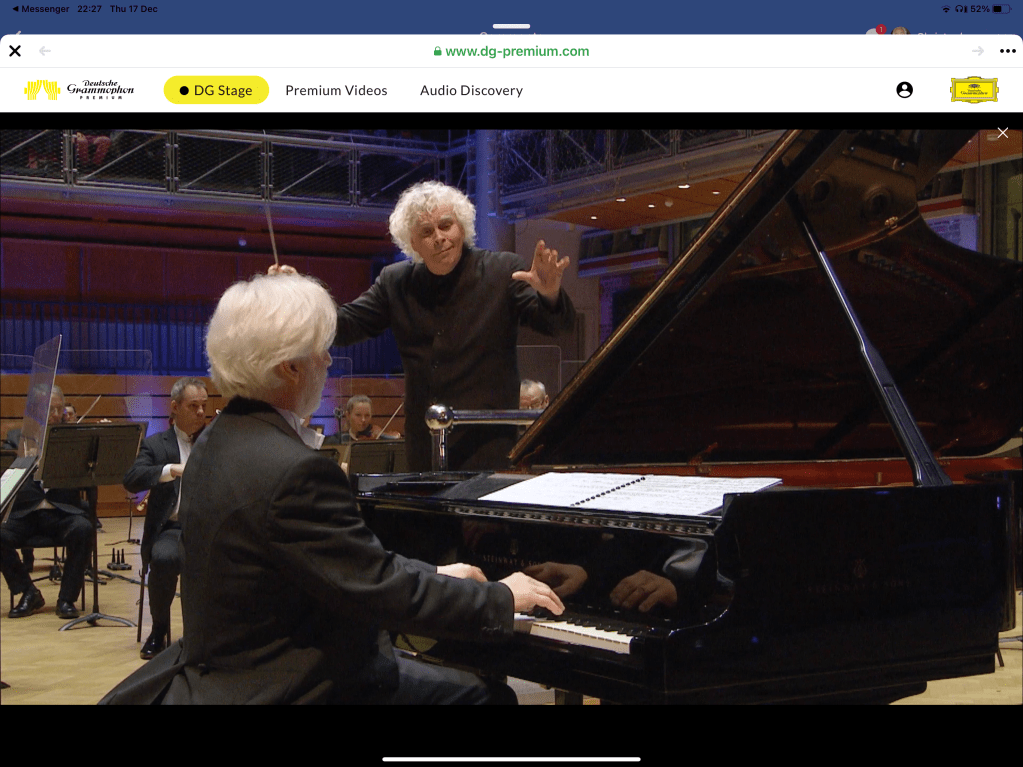
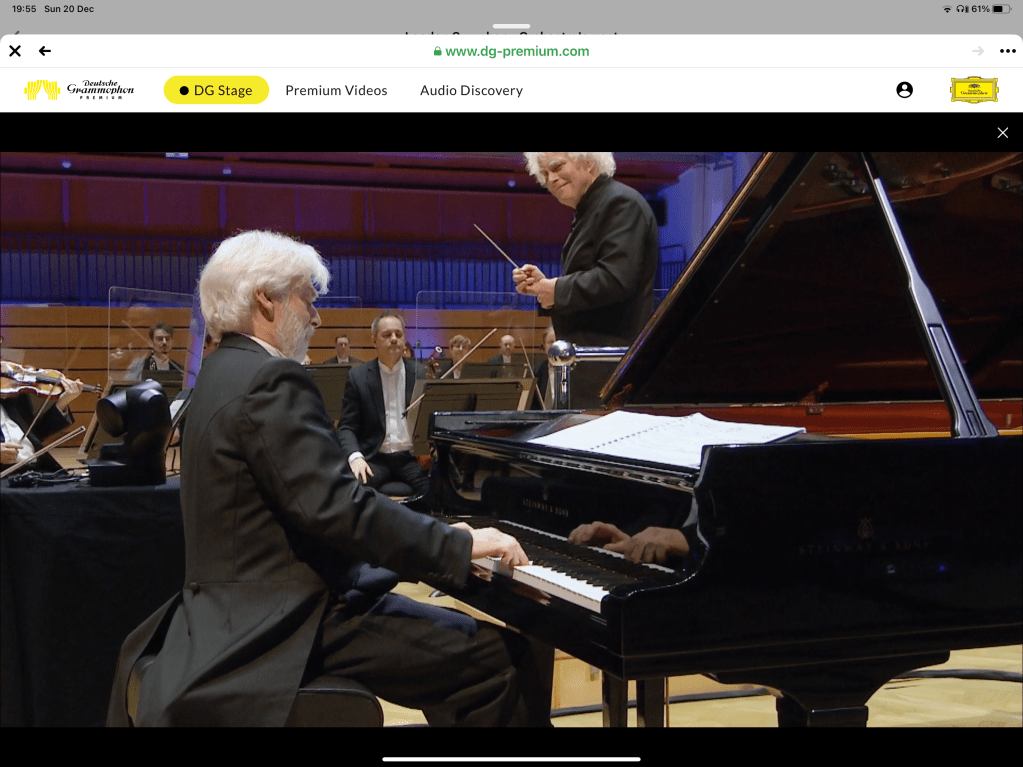
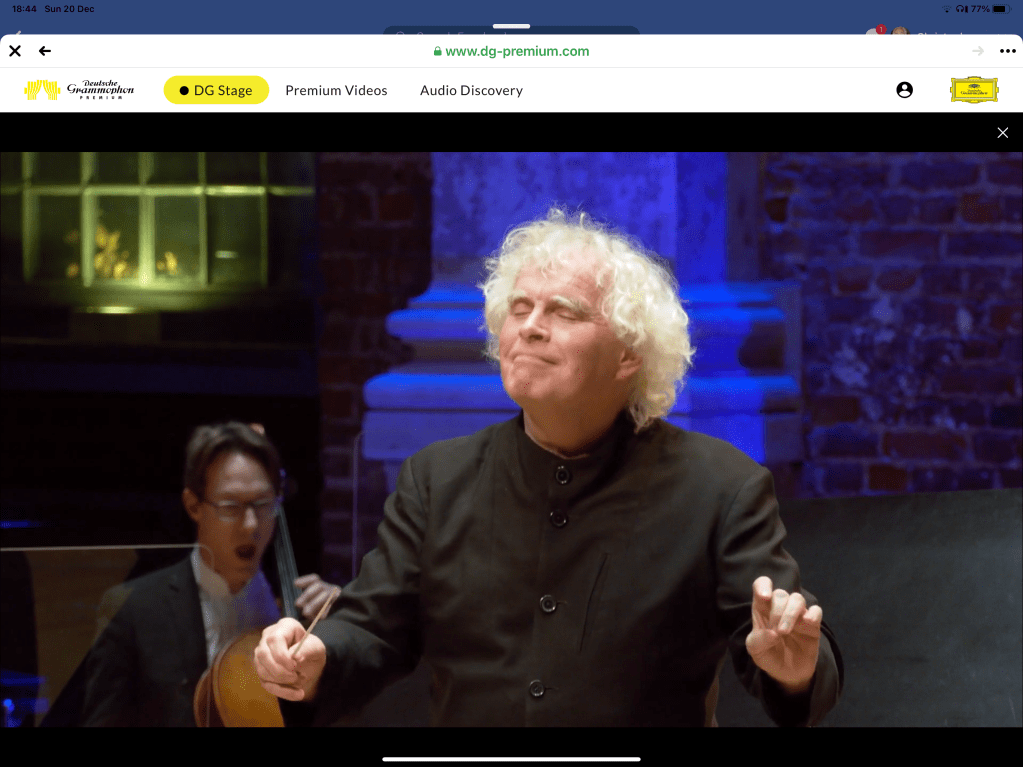
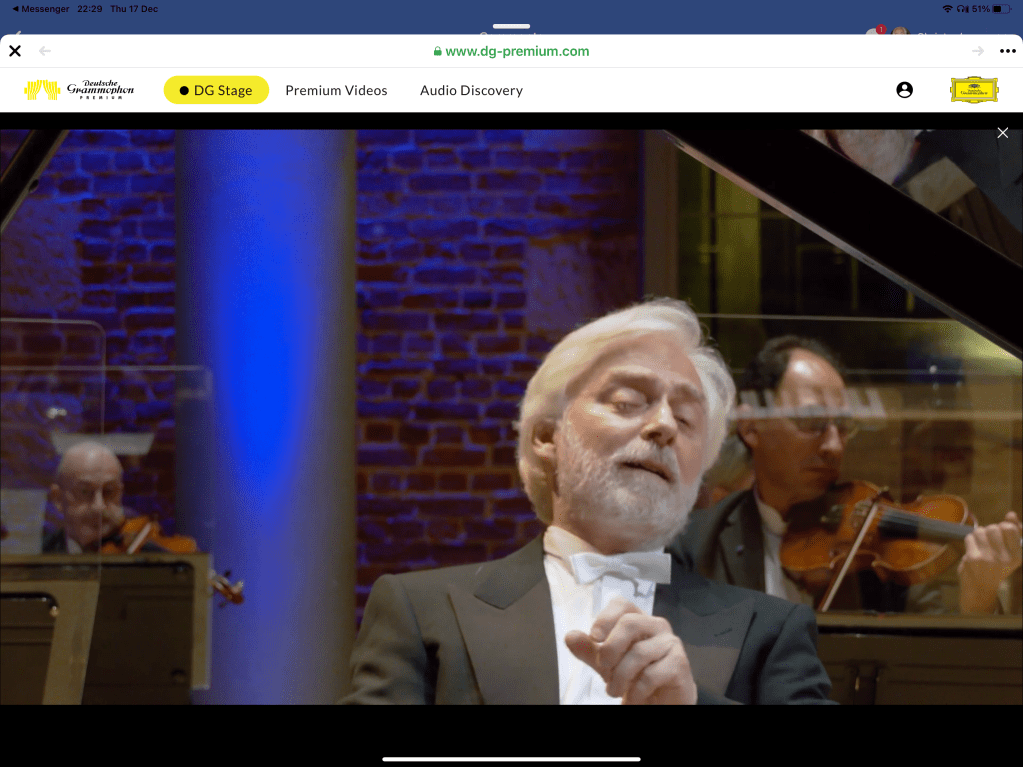
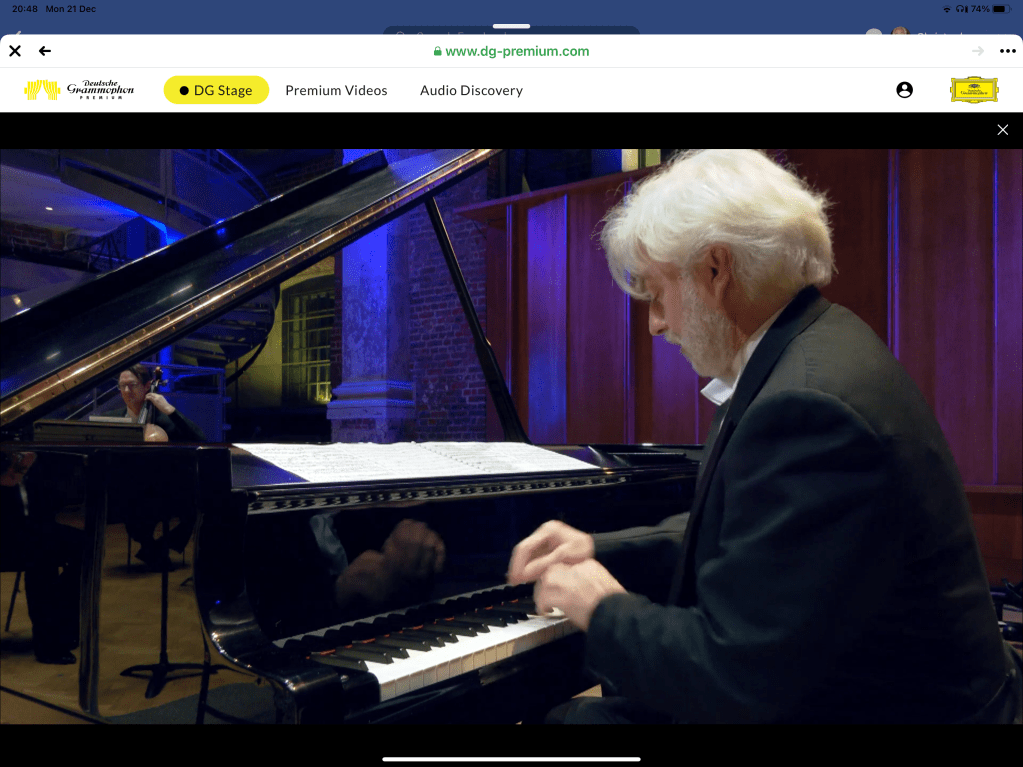
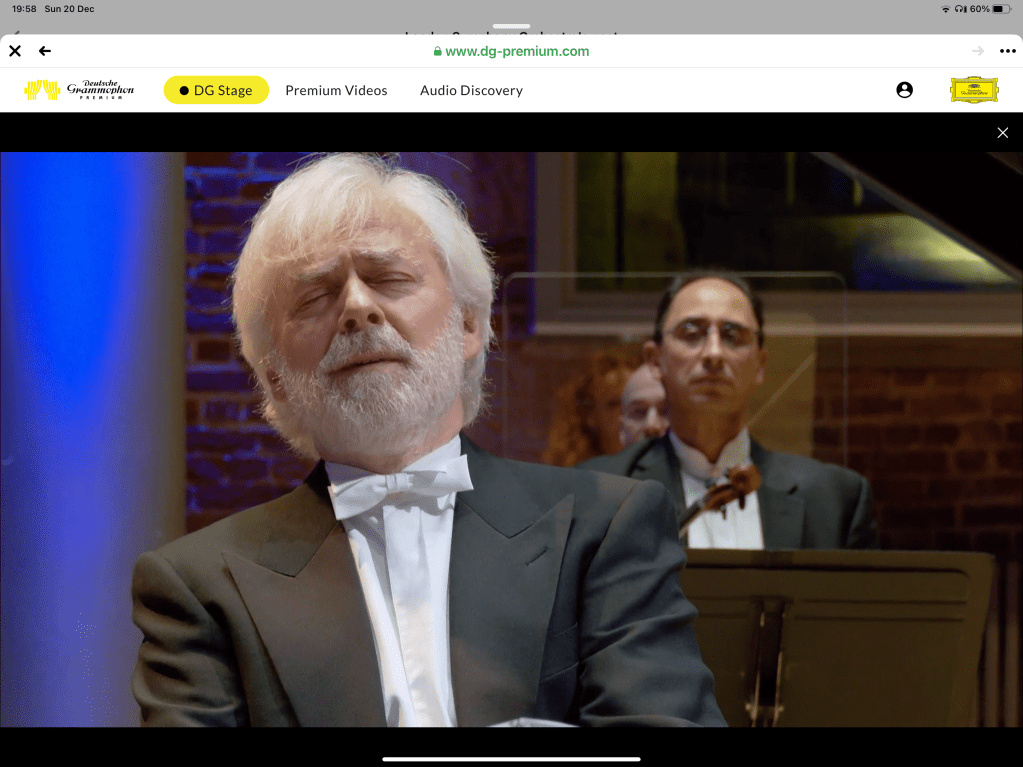
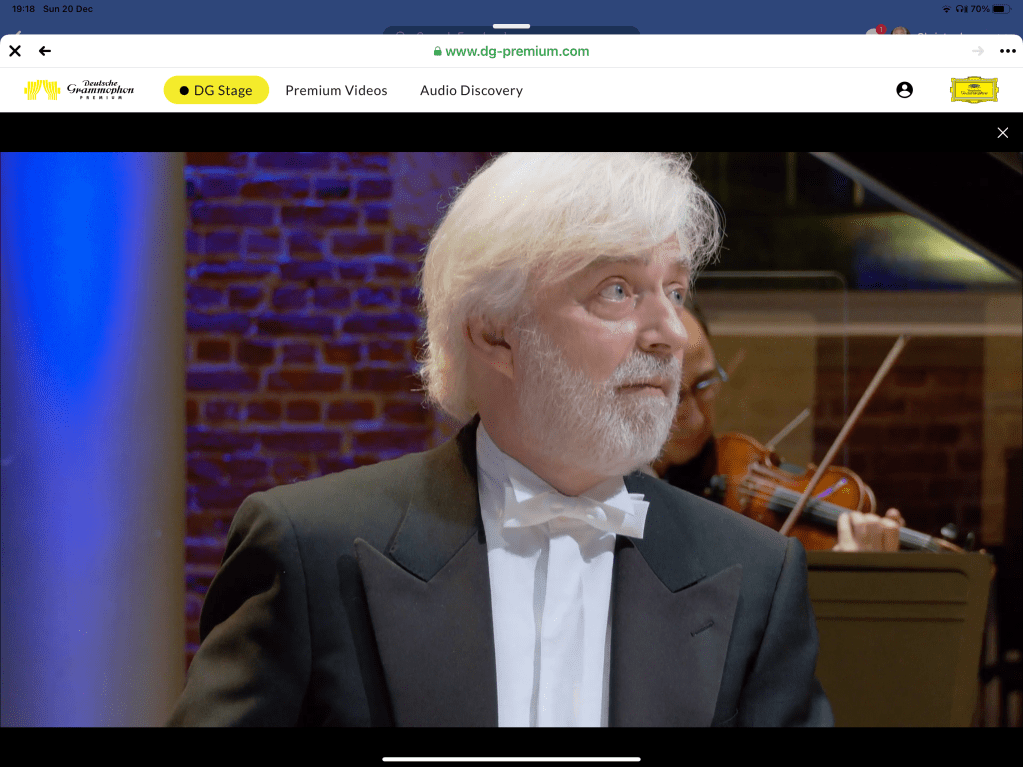
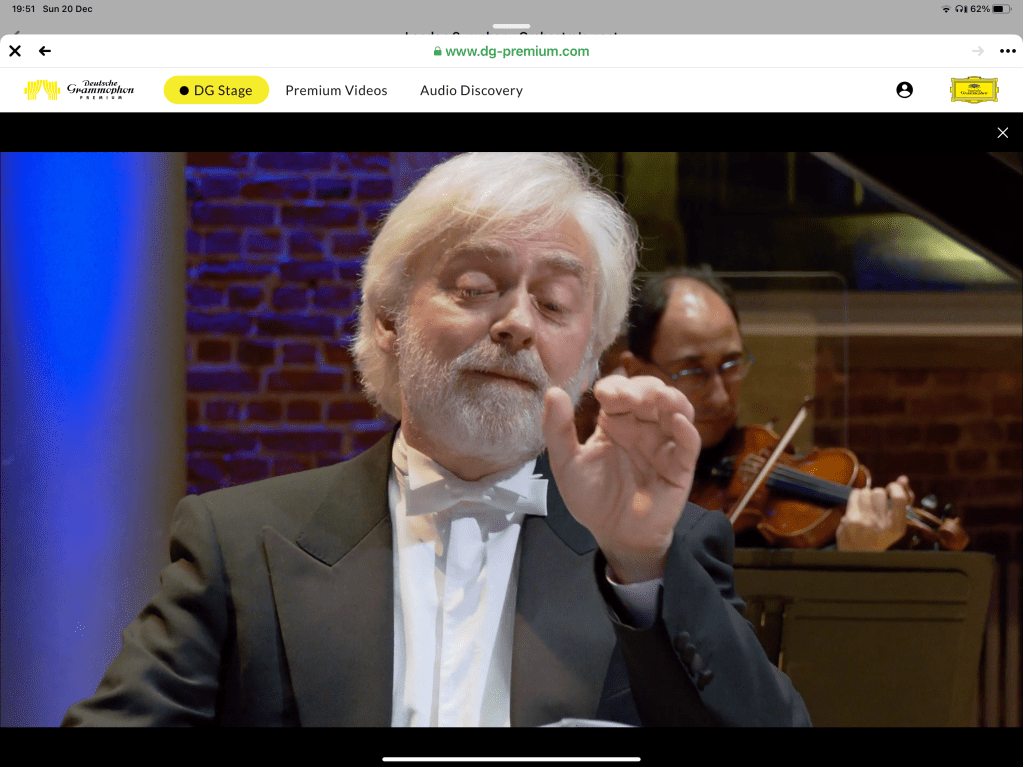
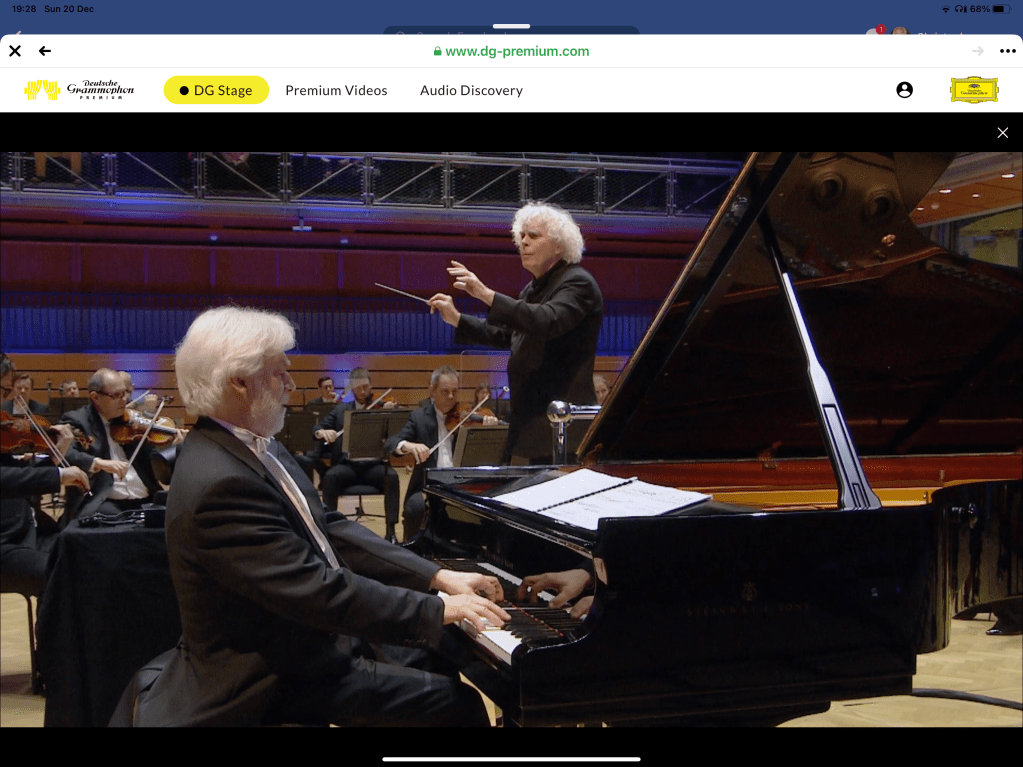
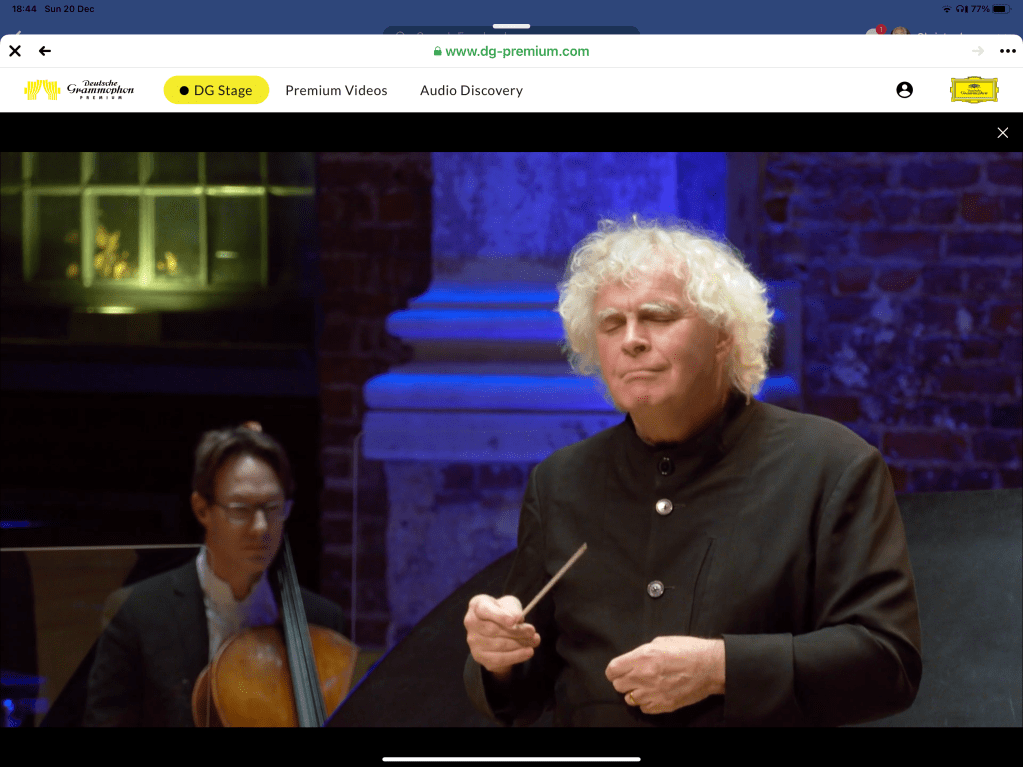
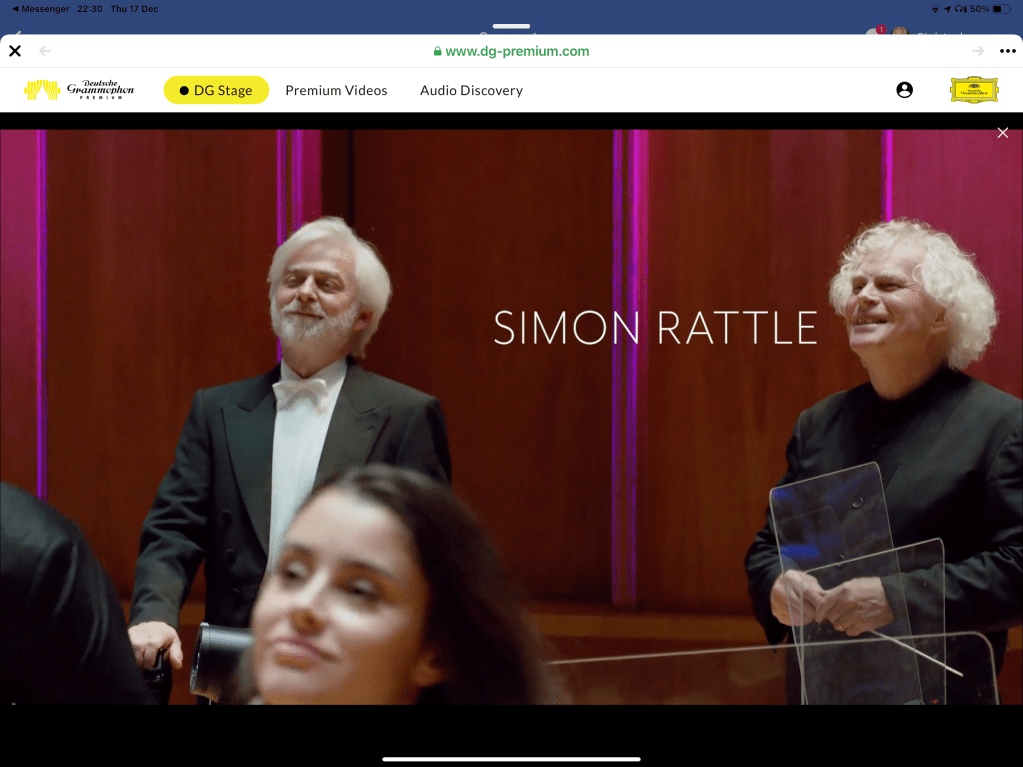
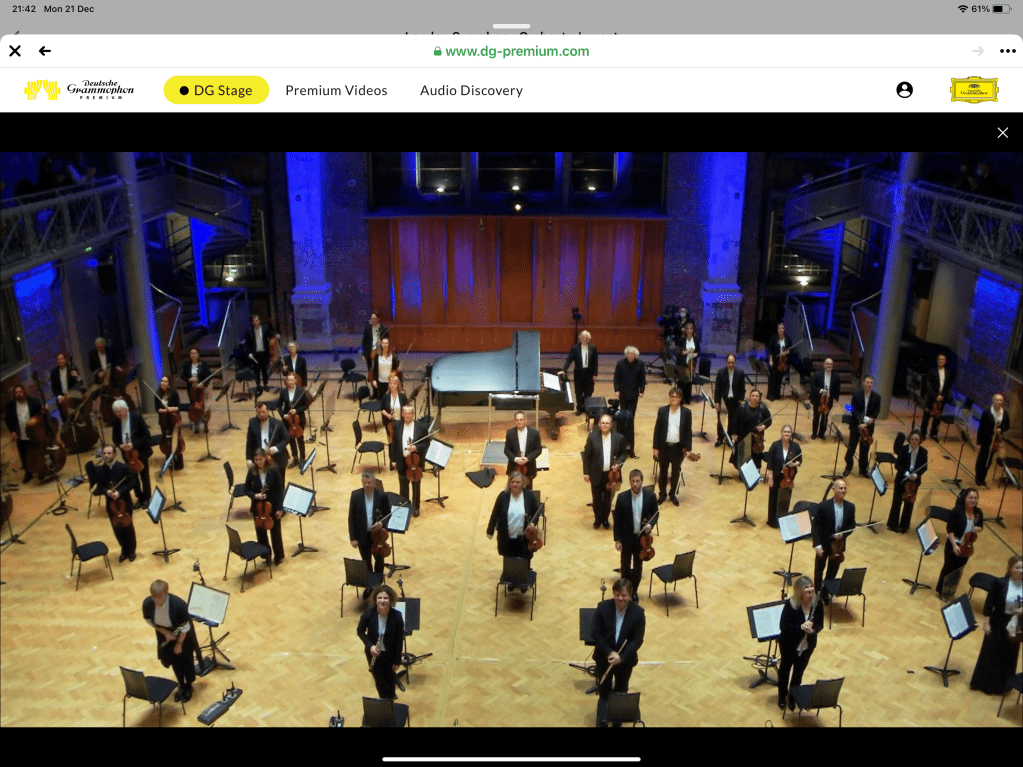
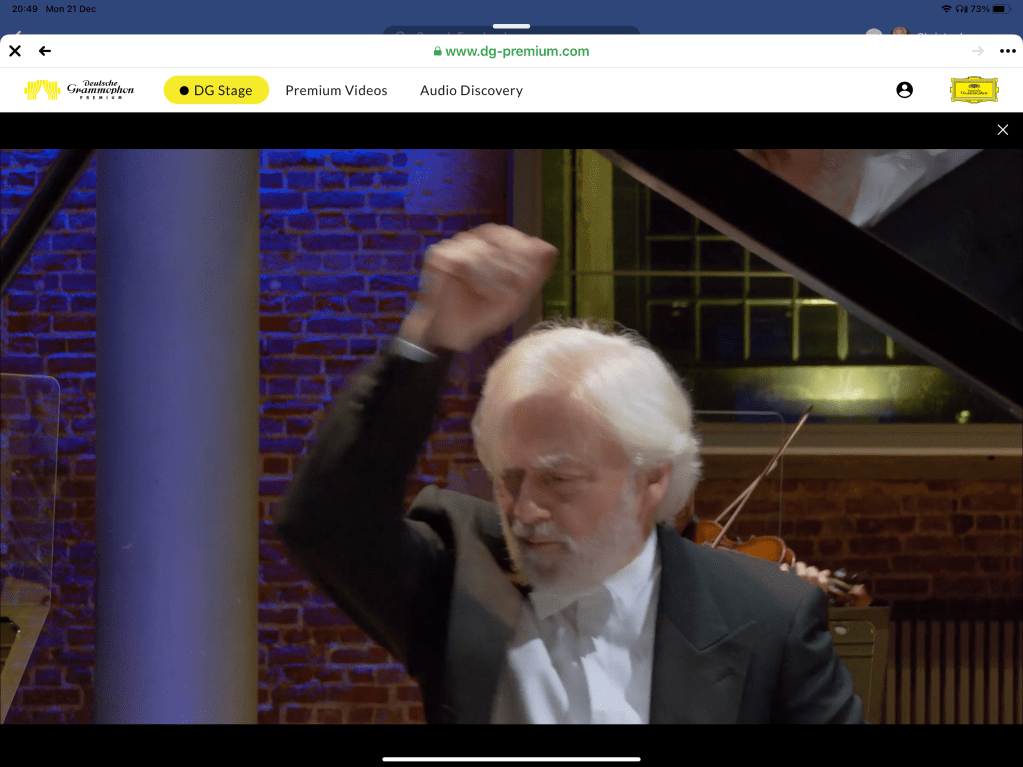
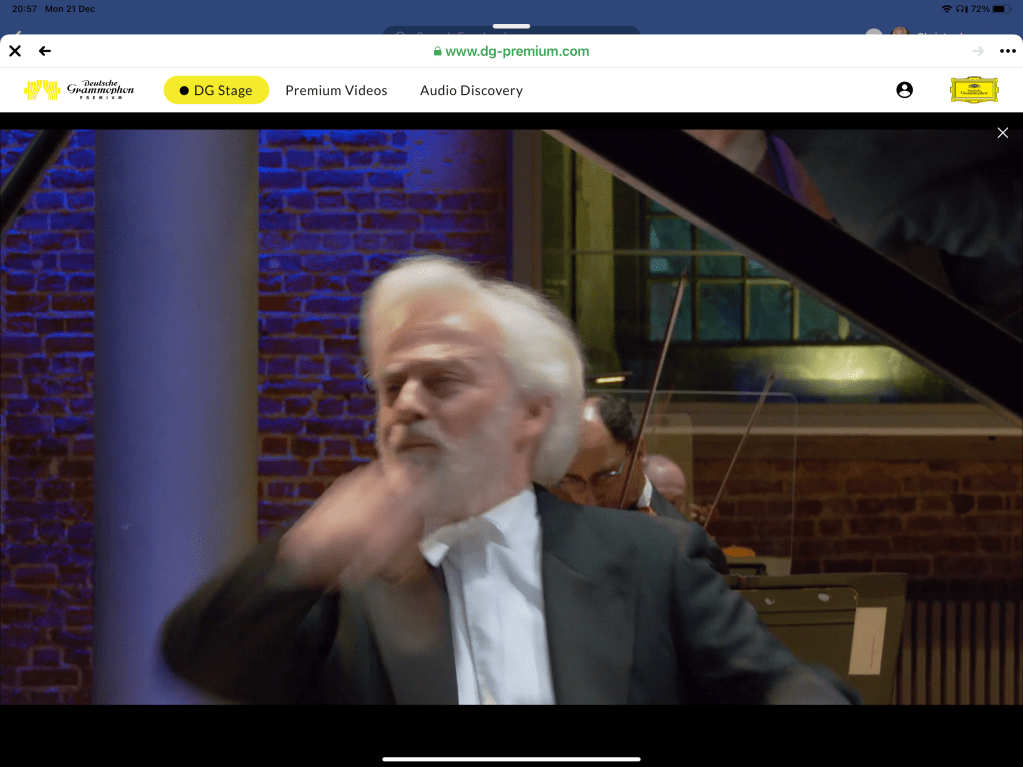
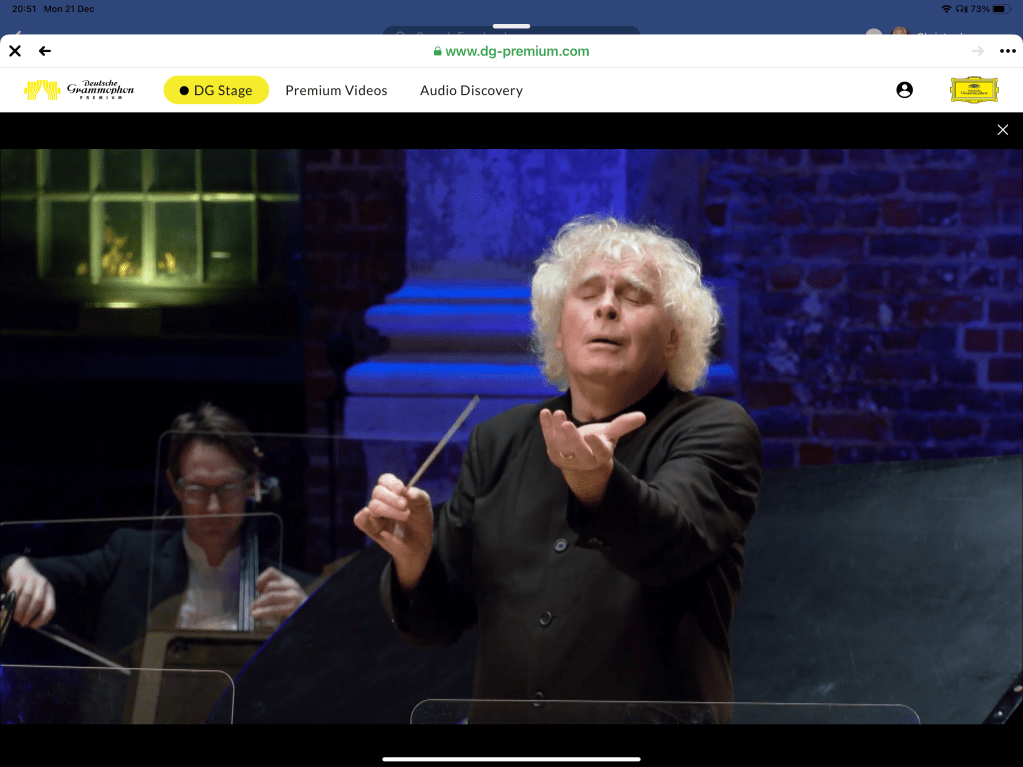
Sheer perfection from Krystian Zimerman -Simon Rattle and the LSO.
The joy these two ‘lads’ brought to the Rondo of the first concert was a marvel to behold.The little bell like acciaccaturas just before the piano’s delicate farewell and the full Beethovenian outburst from the orchestra was one of the most wondrous moments in this desolate year.
The impish humour of such joy and fun as Krystian and Simon kicked Beethoven’s old ball around from one to another was unforgettable.
Zimerman playing with the score as the composer himself would have done but with this unique artist who carries the golden sound of his mentor Rubinstein in his chubby hands it only adds to the continual voyage of discovery.Truly one of the marvels of the age and quite rightly dedicated to Beethoven on his 250th birthday.

More marvels from Zimerman and Rattle.
Beethoven 2 and 4 played with an improvisatory fantasy that was like hearing these much loved works for the first time.
Perhaps Beethoven could have imagined such wondrous sounds in his private ear but to share them with others is one of the greatest gifts that we could have in these troubled times.
The 2nd concerto with such whispered asides followed by Toscanini like injections of energy from the orchestra.An opening of the 4th concerto like angels calling from afar played with such a whispered delicacy.Trills just vibrations of magic sounds.Cadenzas of improvised inspiration.


A knowing smile on their faces as they shared the innermost secrets and schoolboy humour bouncing Beethoven’s ideas from one to the other.The simple scales in the first movement of the 2nd concerto I never imagined I could listen to them again after Gilels’s magic account with Sir Adrian Boult all those years ago.But here was the same magic golden sound that had Rubinstein exclaiming,on listening to a chubby red haired school boy in Russia,that if he ever came to the west he may as well pack up his bags and leave.
Pack up your troubles in an old kit bag indeed.
How can we ever thank them enough!

The Prince of pianist’s wears the Emperors cloak as Zimerman and Rattle together with the LSO bring their unforgettable survey of Beethoven’s five piano concertos to a glorious conclusion.Could there ever have been a better way of celebrating Beethoven 250 than this?


An Emperor starting with the right hand on that first low E flat as the cadenza unfolded on their wondrous journey.An orchestra under Rattle that played with a beauty,freedom and conviction as rarely heard in the recording studio.Such was the energy generated by the almost chamber music interplay that Zimerman and Rattle created it would have been impossible not to be wound up in this seamless stream of both ravishing and tumultuous sounds.An Adagio even more simple than Rubinstein’s unforgettable account.The descending scales allowed to whisper without any inflections but just allowed to trickle from Zimerman’s fingers with such ravishing beauty.Scrupulously sustained by the sumptuous sounds that Rattle and his colleagues so poignantly provided.The interplay and rhythmic energy of the Rondo did not exclude slight hesitations and inflections that brought a knowing smile to Simon and Krystian’s faces as they seemed to be discovering the music for the first time.
Performances that will go down in history and be the measure by which all others are compared.

Mengyang Pan at Cranleigh Arts Centre Beethoven birthday concert

Programme:Beethoven Sonata in F major op 10 no 2 – Allegro- Menuetto, Allegretto- Presto
Beethoven Sonata in D major op 10 no 3 – Presto- Largo e mesto – Menuetto; Allegro- Rondo: Allegro
–Interval–
Beethoven Sonata in E major op 109 – Vivace ma non troppo – Adagio expressivo – Prestissimo- Gesangvoll, mit innigster Empfindung. Andante molto cantabile ed espressivo
Beethoven Sonata in F minor op 57 ‘Appassionata’ – Allegro Assai- Andante con moto- Allegro ma non troppo – presto

Clive Wouters in conversation with Mengyang Pan

A recital of four Sonatas by Beethoven found the ideal interpreter in Mengyang Pan for the 250th birthday concert at Cranleigh Arts Centre on what is presumed to be the exact date of 16th December 1770.I have admired Mengyang’s playing since first hearing her in the Rina Sala Gallo International Piano Competition in Monza,Italy in 2008.I was a jury member and remember very well her prize winning performance of Beethoven’s Emperor Concerto.It was the clarity and precision together with her intelligence that struck me then as it has every time I have heard her since.Allied to a strong artistic temperament and sense of balance and colour her playing of Beethoven is in a very special class of it’s own.I have written previously about her early training in the class of Tessa Nicholson,that extraordinary trainer of young musicians at the Purcell School.Her graduation from the Royal College of Music was under the Head of Piano:Vanessa Latarche who I have known since she was the star pupil as a child of that dedicated teacher in Ealing,Eileen Rowe .Katherine Stott,Tessa Nicholson,Danielle Salamon and I used to help her with her ever growing number of pupils that she taught in her multipianoed house.She left all her worldly possession to create a Trust to help young musicians in Ealing.The Trust is administered by Vanessa and that other remarkable pupil of Miss Rowe ,Dr Hugh Mather of St Mary’s Perivale where Mengyang had recently played one of these Beethoven sonatas in a weekend dedicated to the 32 sonatas played by 32 different pianists.I was delighted to learn that recently Mengyang was invited to join the RCM faculty as a full professor.

Infact it was Stephen Dennison’s own words as artistic director that reminded me of a performance that I should not miss :’You must be overdone with Beethoven 250 concerts but may I bring to your attention one more.I am no expert but I believe MengYang’s performance at Cranleigh this week, in front of a Covid secure audience of 35, was pretty special.Not just for the performance on piano but for her overall “show” and her words about each sonata; all made a great package.’

How right he was and it was a surprise to hear myself quoted by Clive Wouters in his interval interview with the artist and to still agree wholeheartedly!Quoting from an article I wrote of a previous performance I stated:’her playing demonstrated clarity and precision going from the imperious to the most touching’ He also quoted The Times that had written about her performance of the mammoth Serenade by Helmut Lachenmann:’poised like a cat spying its prey before the pounce’

Stephen Dennison presenting the concert

The first half of her programme was dedicated to two of the three early Sonatas that make up op 10.The second in F major was a great favourite of Glenn Gould and is in only three movements ,the usual slow movement being replaced with an Allegretto almost Schubertian in it’s mellifluous lilt contrasting between the opening and the middle Trio like section.Here I felt Mengyang was trying to delve too deeply and it sounded a little too serious played in three instead of the much lighter one in a bar that the Trio obviously is.However it was played with scrupulous attention to detail and Beethoven’s sforzandi were played with just the right weight to indicate the inner counterpoint imitation In the trio she found the perfect lilt that she had missed in the outer sections and the comments in the bass alternating with the treble were most eloquent.The final two chords marcato instead of lighter staccato made me realise that she had a different vision of this movement from mine.Not so the opening Allegro that was full of the bustling fun of early Beethoven.There was a great rhythmic buoyancy to the development section and the return of the opening theme was with even more impish good humour than at the opening.The final scintillating Presto was played with all the brilliance that Czerny had described of his master’s own performance.Mengyang played it with great control with precision and relentlessness that brought this opening work to an exhilarating conclusion.

The Sonata op 10 n.3 is a work in four movements and contains a profound slow movement that begins to show what would evolve from Beethoven’s pen just a few years later.The rolled chords of the Largo e mesto -like the fourth piano concerto were arpeggiated even though not written specifically in the score.There are letters of the period that tell us of Beethoven’s performance of the fourth piano concerto with arpeggiated chords which both Angela Hewitt and Steven Kovacevich adhere to in their recordings.Of course,as Mengyang had said in her interval conversation,pianos were still evolving in that period and both touch and sound were very different from the pianos of today.It must be left to the integrity of the performer and to their informed good taste to decide.Here in Mengyang’s hands it was very discreet and totally convincing although she did not repeat it on the return of the theme.She played with an almost chiselled cantabile of great purity and the hushed change of key was most moving as it led to great outbursts with delicate comments high up in the treble.The gradual arpeggiated climax was played with great conviction and died away to a languid farewell finishing on a single note deep in the bass.There followed a Menuetto that was like a ray of light played with simple radiance.The joyous Trio bubbled along building to a climax before the gentle reappearance of the Menuetto.The rondo was played with remarkable clarity and jewel like precision.The final chromatic scales and arpeggios were played almost without pedal as the rondo came to a scintillating tranquil ending.The opening Presto was played with scrupulous attention to detail,the sforzandi played so mellifluously.The development was played with rhythmic urgency and sense of line before the return of the quiet opening octaves leading to the coda of brilliant urgency.

After the interval we were treated to a masterly performance of the Sonata op 109.The first of the final trilogy where Beethoven now completely deaf could obviously hear sounds that were both unearthly and probably not able to be reproduced on the pianos of the period.With the modern day piano we have an orchestra on which to seek out the sounds that Beethoven could only have imagined.The beautiful opening of the Sonata where everything was played with a bell like clarity and a sense of architectural shape that created a panorama of almost pastoral tranquility.It was interrupted by the Prestissimo second movement of great turbulence and continual forward movement.It prepared the path for the theme and variations of profound dignity and sublime beauty .Played with the same intensity of a string quartet where every strand of sound had a meaning.The first variation was beautifully shaped and kept in sumptuous control.There was a gentle clarity to the leggiermente second variation alternating with some beautiful legato part playing where every voice had such shape and meaning.There was superb technical control in the third variation that led to the continuous flow of sounds in the fourth.The nobly stated fifth variation had an urgent forward movement before the searching sixth and final variation where Mengyang’s sense of line and technical assurance was remarkable.The swirling arpeggios over bass trills was played with passionate conviction as the theme appeared in the heights over long trills and very busy left hand embellishments.All dissolving so magically in Mengyang’s hands as the theme reappeared out of a cloud of sound as it made its way to the profound final chords.

I have written before about Mengyang’s remarkable performance of the Appassionata Sonata op 57 with which she closed her programme at Cranleigh.It is of a remarkable clarity and technical mastery.Even the great arpeggios in the first movement were played with one hand as Beethoven indicates and is so often ignored by lesser pianists who prefer to take less risks!The slow movement too was played as a string quartet with such rich meaningful sounds.The last movement was a tour de force of technical control,resilience and excitement.The final exhilarating arpeggios of the coda brought cheers from the small but very appreciative live audience.

The Beethoven Eccosaise WoO86 was Mengyang’s way of thanking all the people that had made her performance possible in these difficult times.

https://christopheraxworthymusiccommentary.wordpress.com/2018/10/25/china-comes-to-perivale-mengyang-pan-at-st-marys/

Menyang Pan was born in China and has been living in the UK since 2000. She began her piano study at the age of three before becoming a junior student at the Central Conservatory of Music in Beijing. At the age of 14, she left her native China to study at the Purcell School in the UK with professor Tessa Nicholson. Upon graduating with high honours, she went on to complete her musical education at the Royal College of Music training under professor Gordon Fergus-Thompson and Professor Vanessa Latarche.The prize winner of many competitions including Rina Sala Gallo International Piano competition, Bromsgrove International Young Musician’s Platform, Dudley International Piano Competition, Norah Sands Award, MBF Educational Award, Mengyang has performed in many prestigious venues such as the Royal Festival Hall, Wigmore Hall, Cadogan Hall, Bridgewater Hall, Birmingham Symphony Hall, Bruckner Haus amongst many others. As soloist, Mengyang has appeared with many orchestras and her collaboration with conductors such as Maestro Vladimir Ashkenazy, John Wilson and Mikk Murdvee has gained the highest acclaim. Apart from performing, Mengyang also finds much joy in teaching. In 2019, Mengyang was appointed piano professor at the world renowned Royal College of Music in London, she also teaches at Imperial College Blyth Centre for Music and Visual Arts.

Cranleigh Arts Centre is a registered charity (no. 284186) and a company limited by guarantee. It is governed by a board of Trustees appointed by Members who represent the local community. Waverley Borough Council and Cranleigh Parish Council are also involved as observers at Board level. Originally run by volunteers, Cranleigh Arts still only employs a team of four staff with many operations still undertaken by members of the local community. Volunteers play a vital role within the arts centre and are fundamental to our success and sustainability.

Formerly the local village school (1847 – 1966), our building is steeped in history and something of a landmark on Cranleigh’s high street.The organisation was founded in 1978 when a number of local community groups – including The Photographic Society, The Film Society, The Arts Society, Cranleigh Players, Adult Education and a local pottery group – came together to lease the disused Victorian school building from Waverley Borough Council. Their founding principle “to enrich, entertain and inspire” remains our mission today.Under the Chairmanship of Jack Wagg, plans were drawn up to develop and extend the premises. This was expedited by Catherine Pike in the ’90s, culminating in major work in 1997/8 with the aid of Lottery money and other grants. Our multi-purpose auditorium was added to the premises and the rest of the building stylishly refurbished. Over the last twenty years, we have continued to enhance the facilities for our visitors and maintain our heritage building for the community.