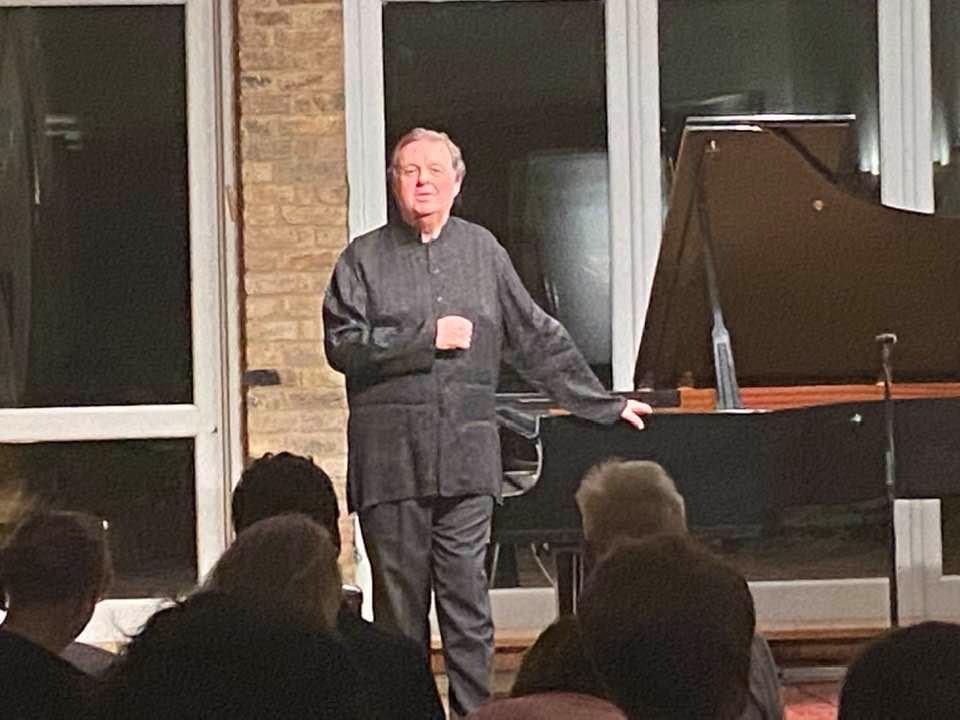
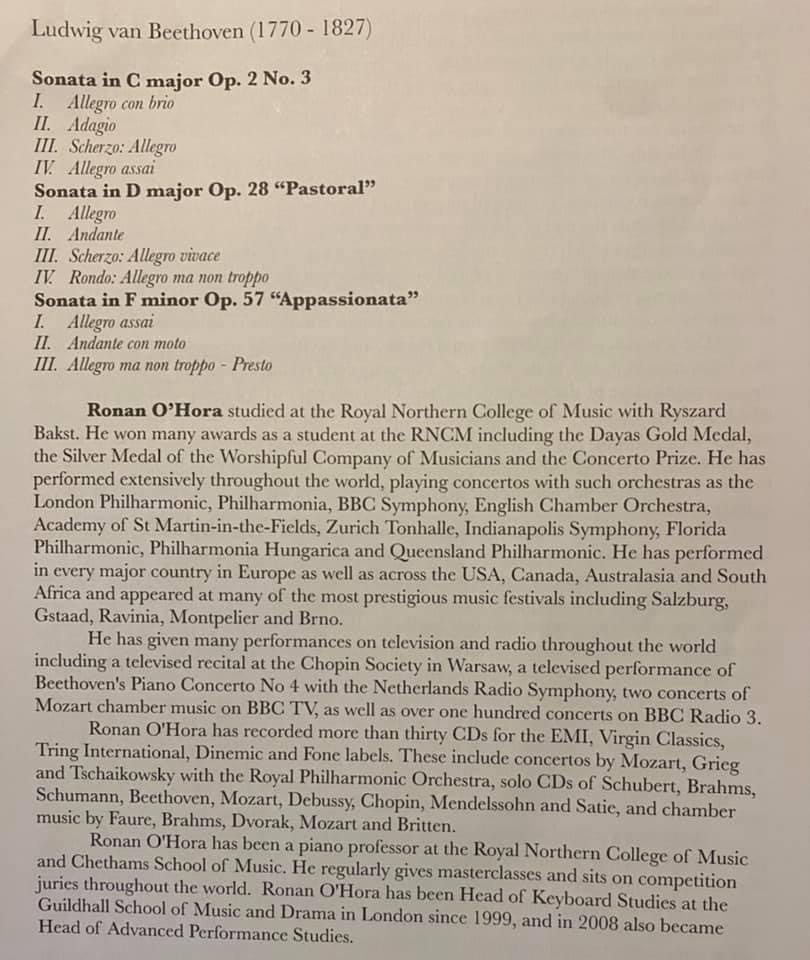
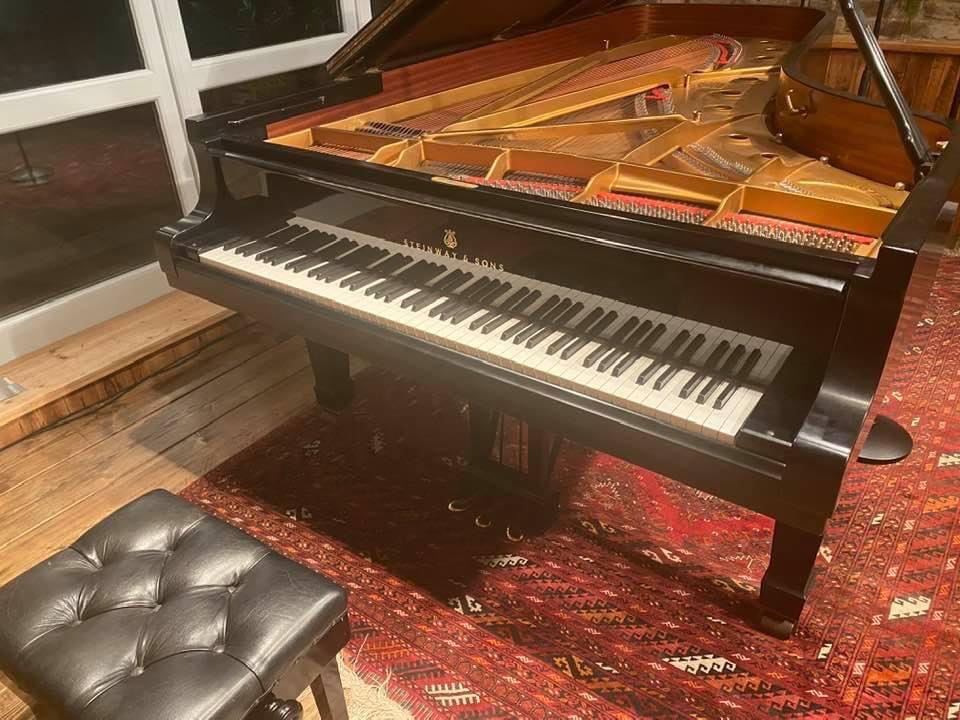
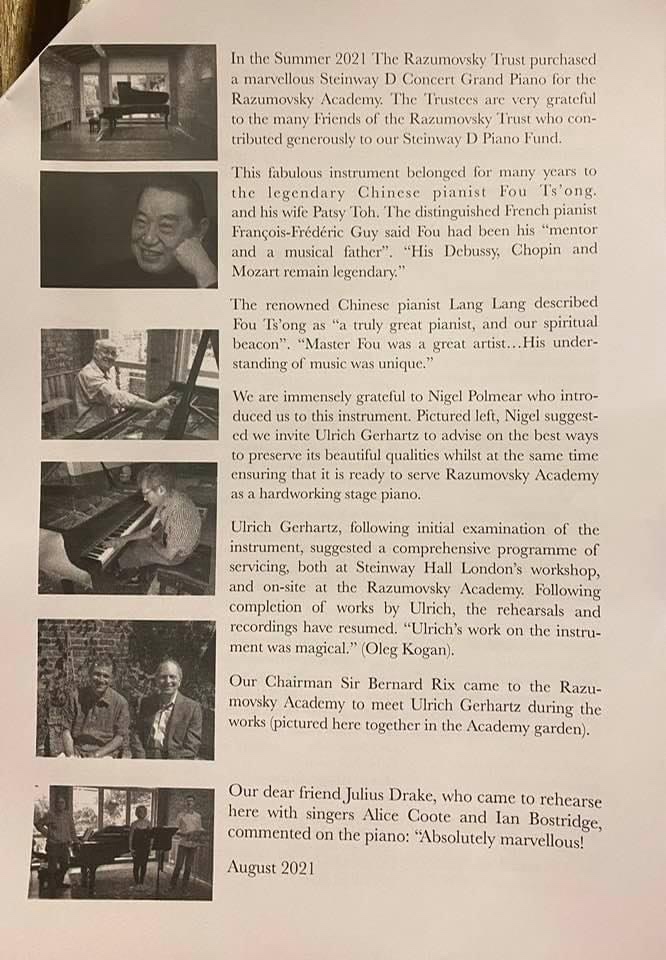
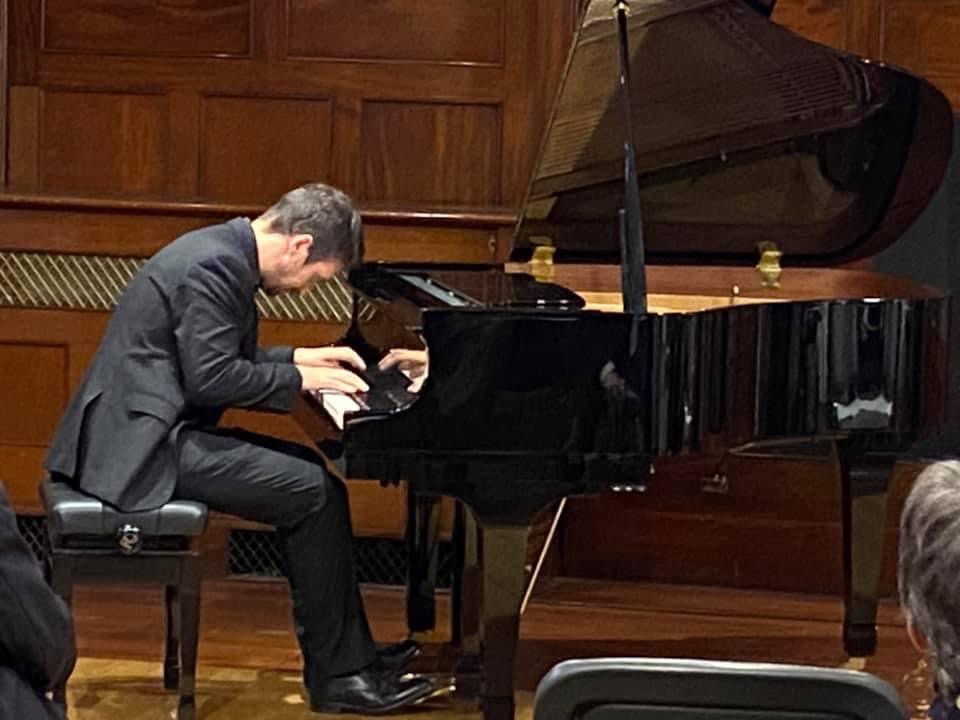
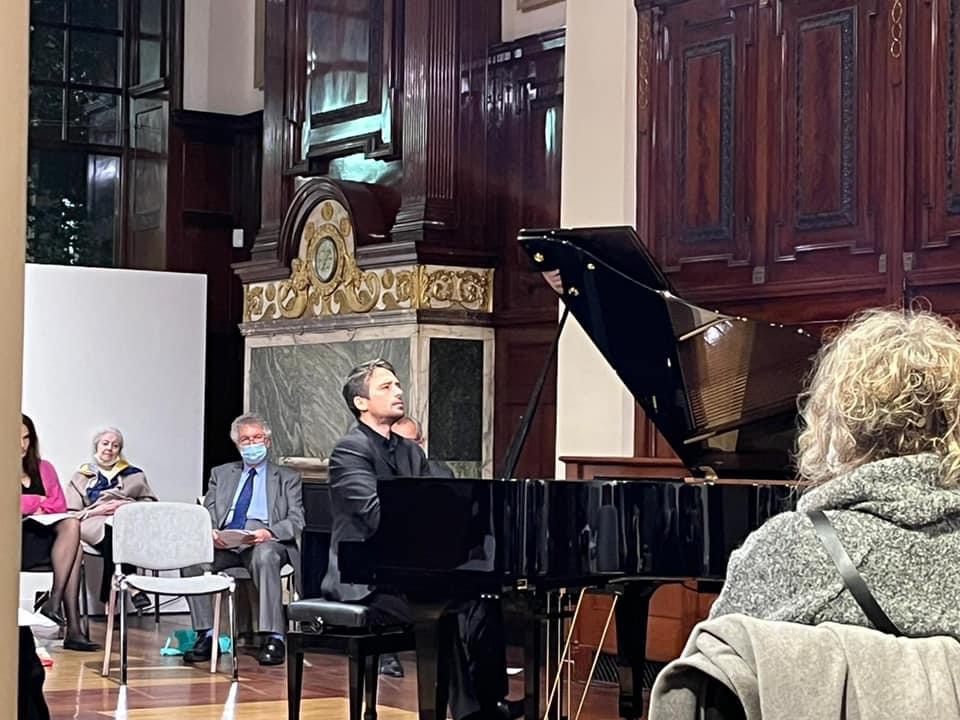
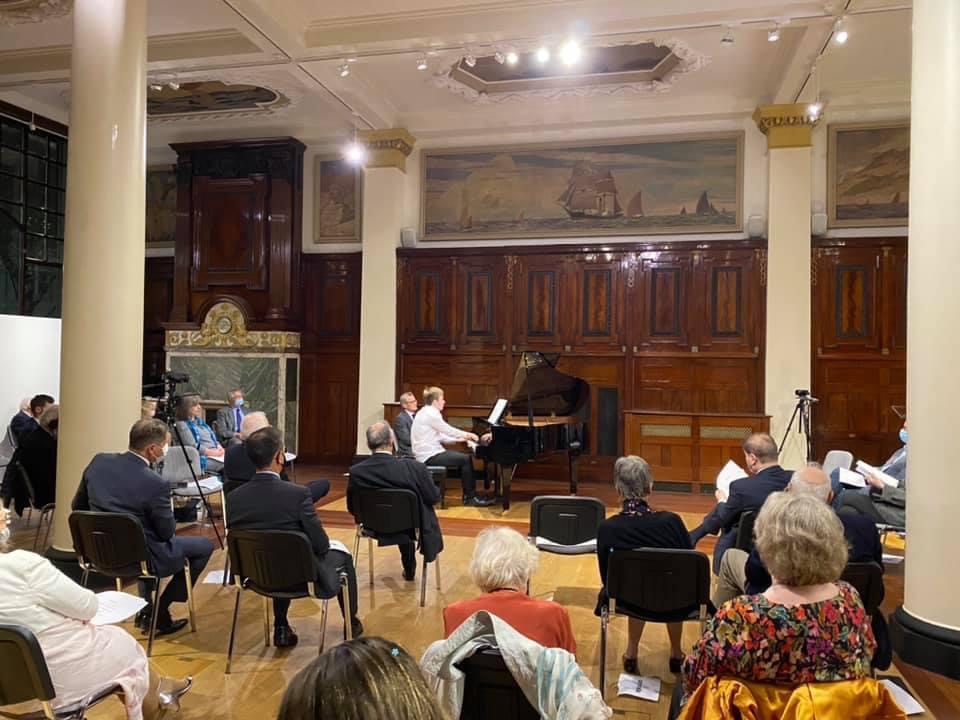
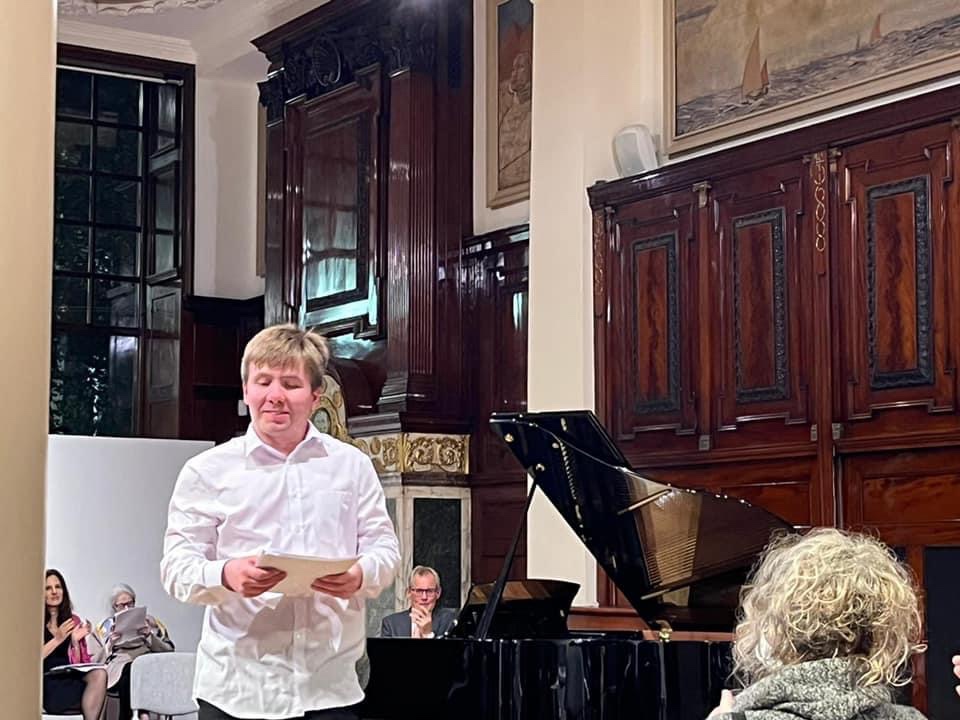
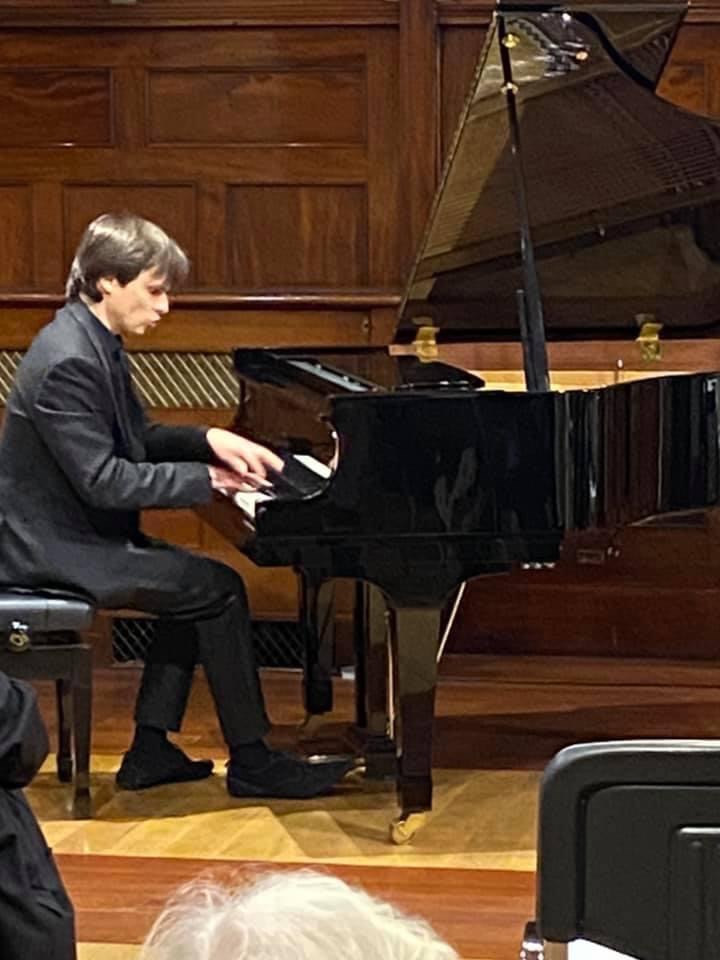
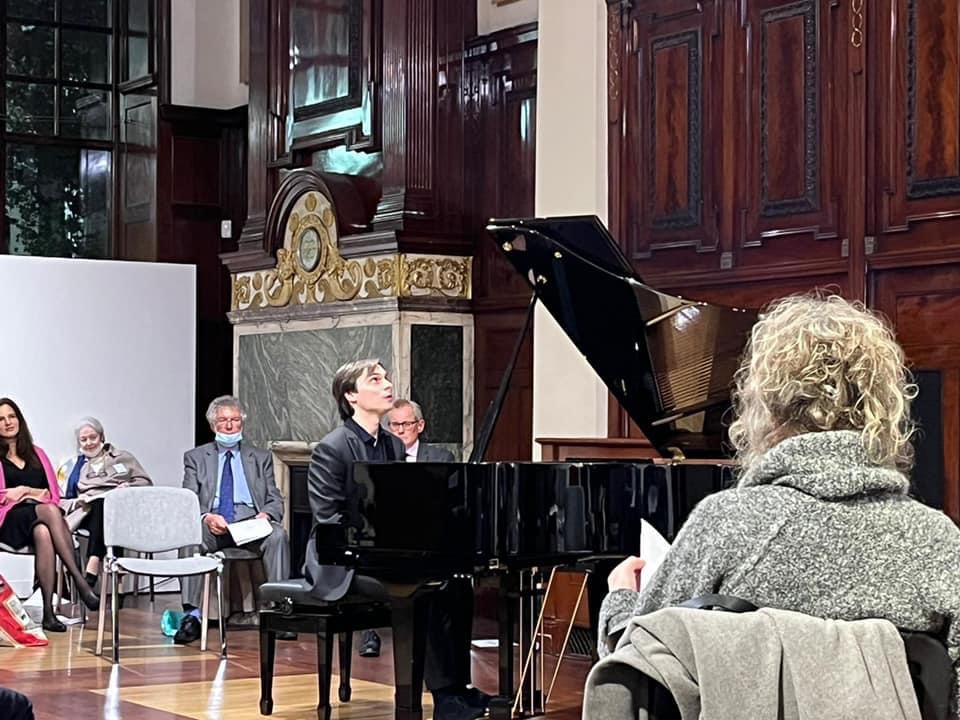
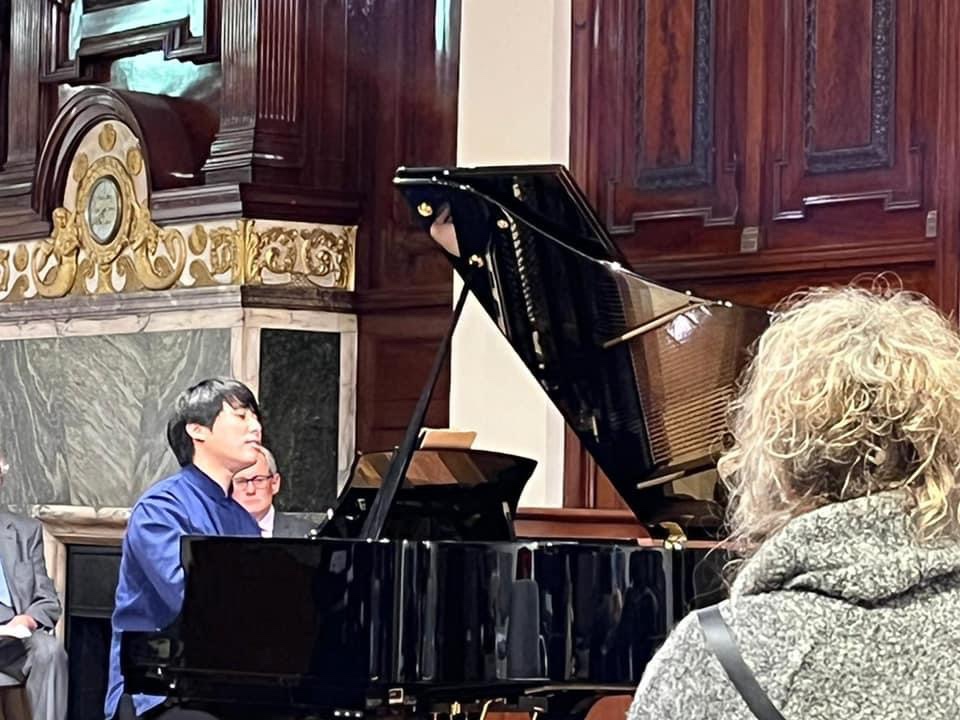
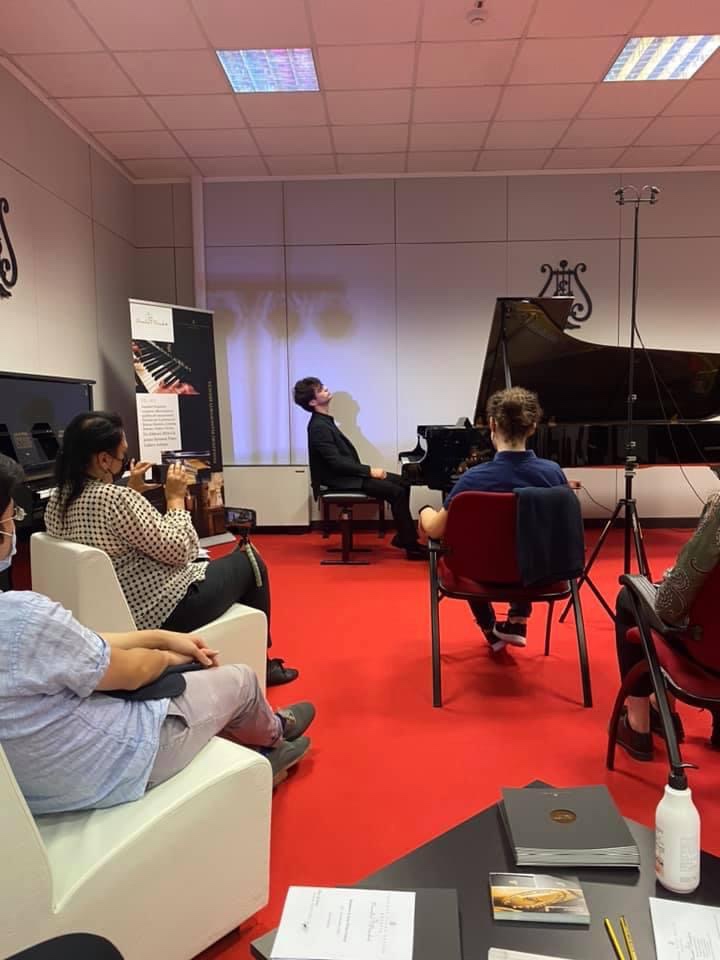
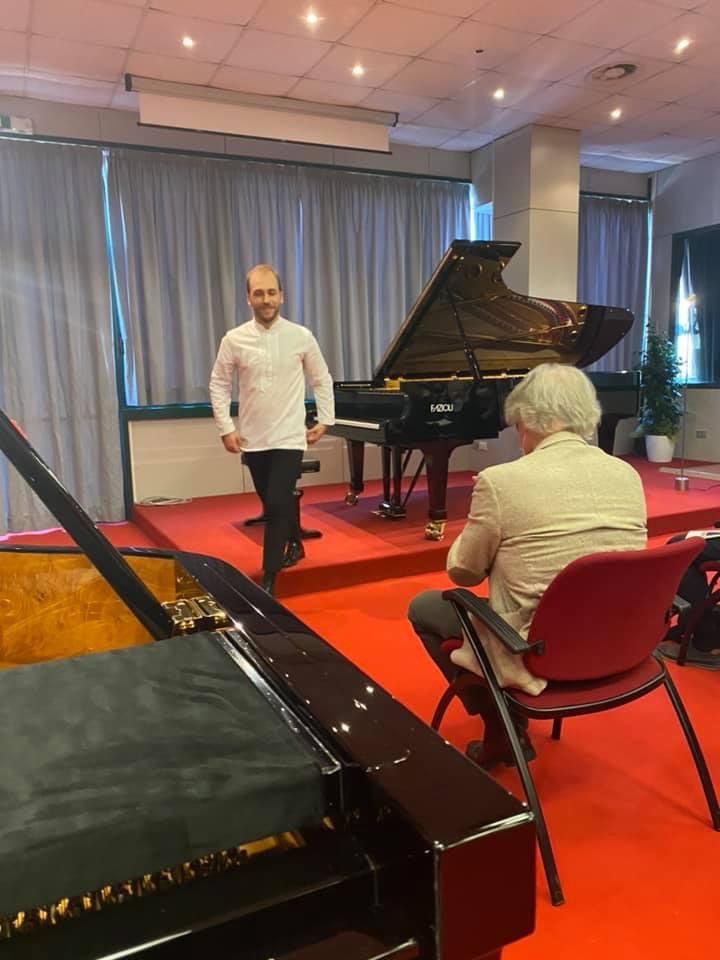
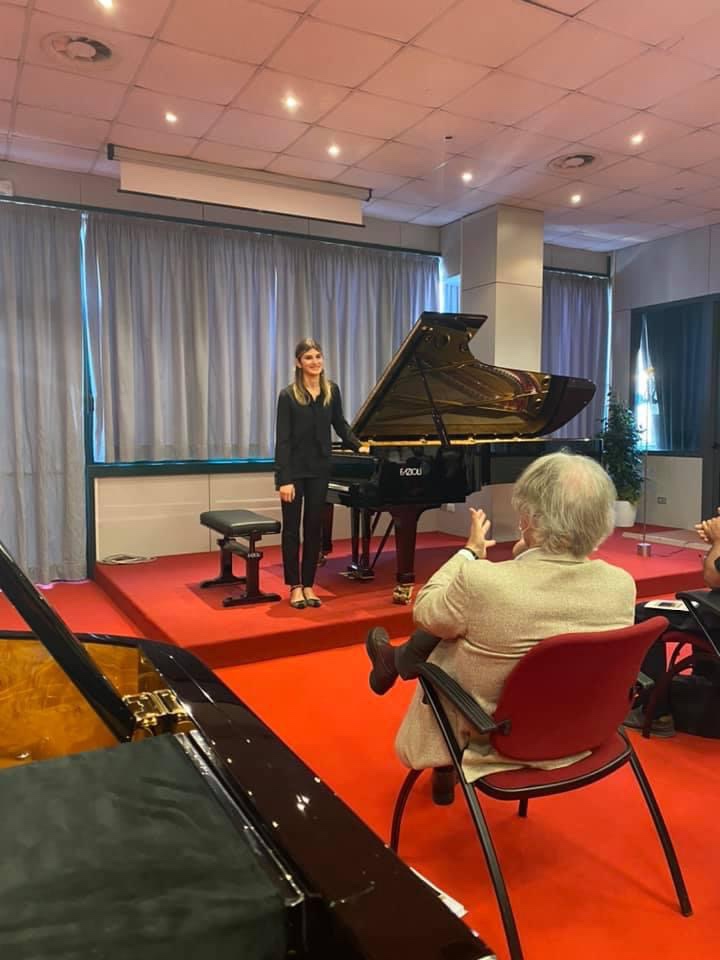
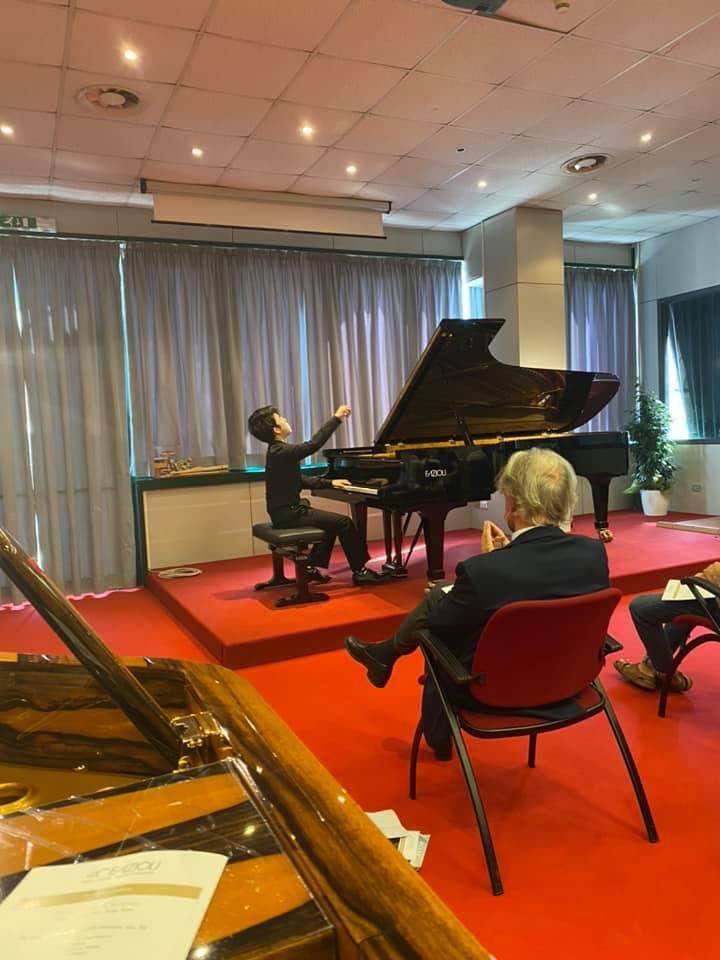
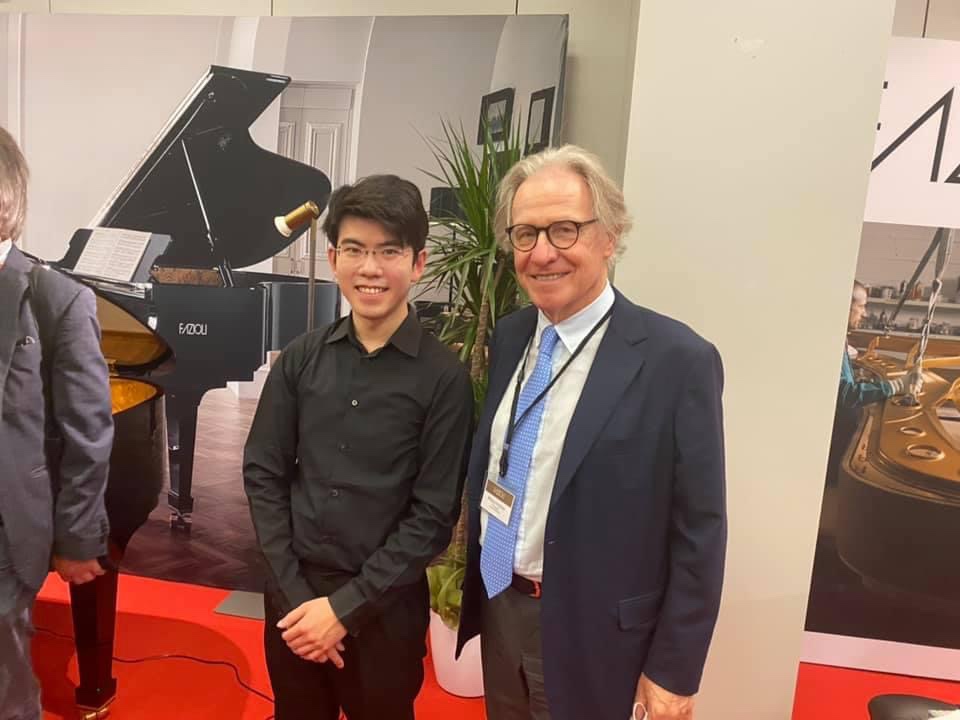
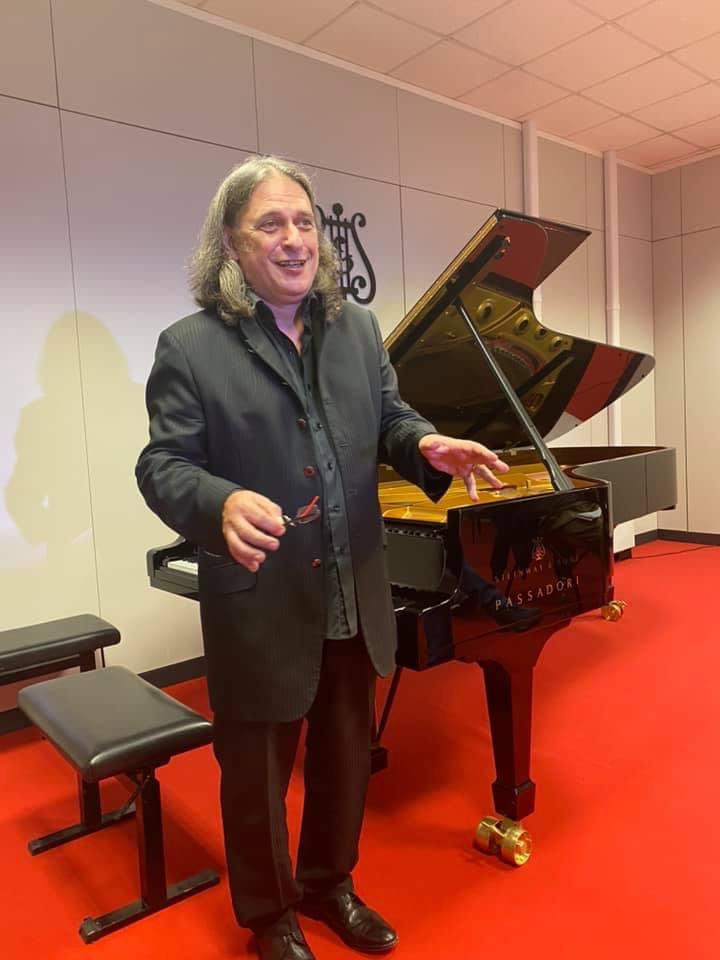
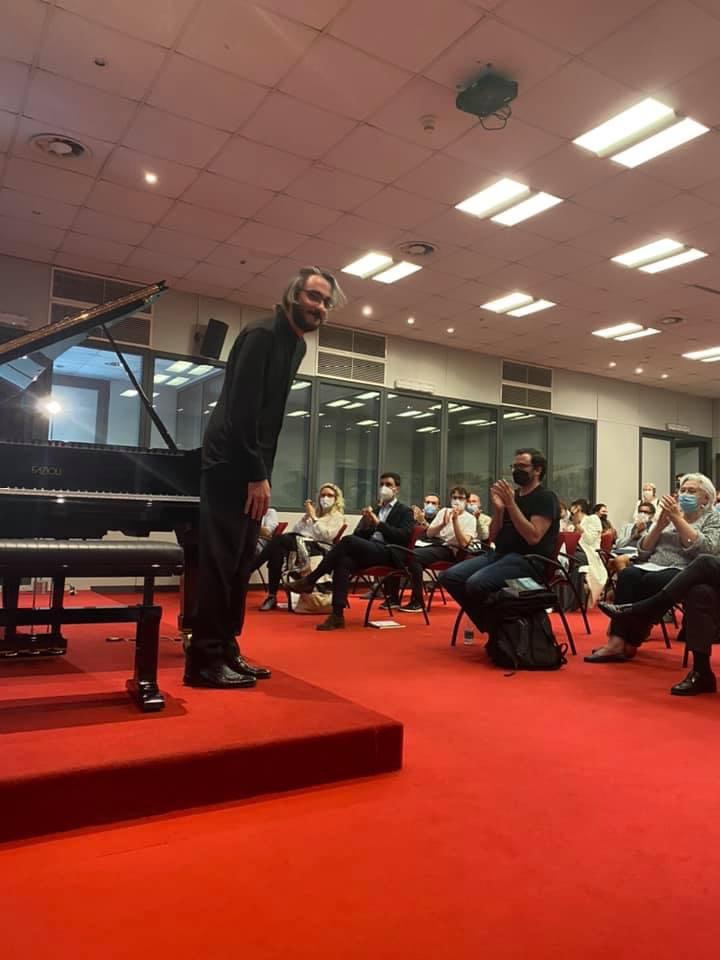
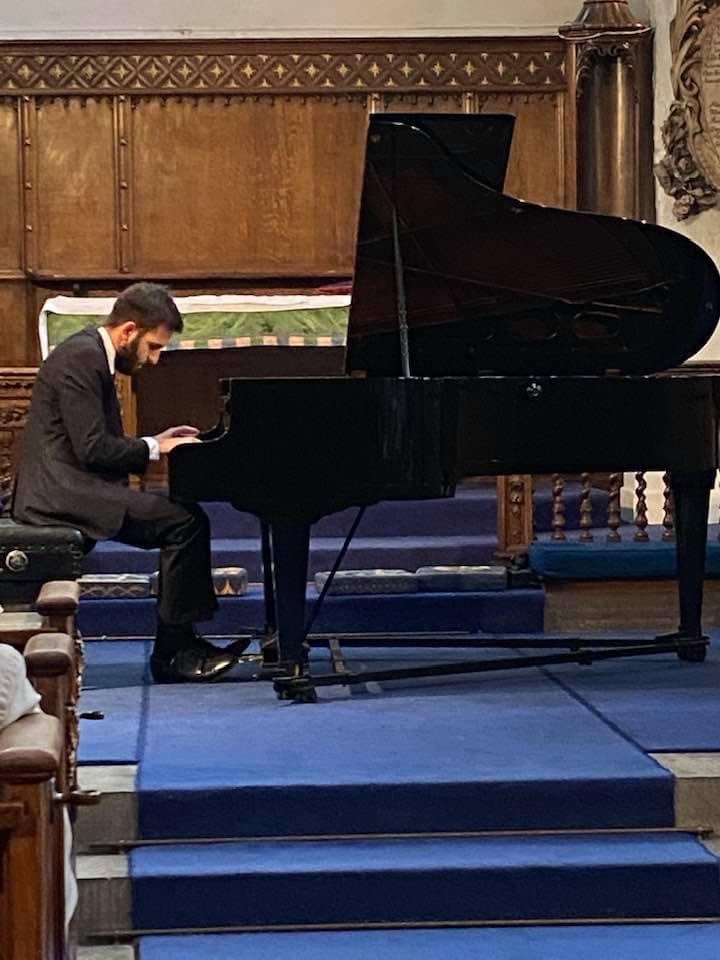
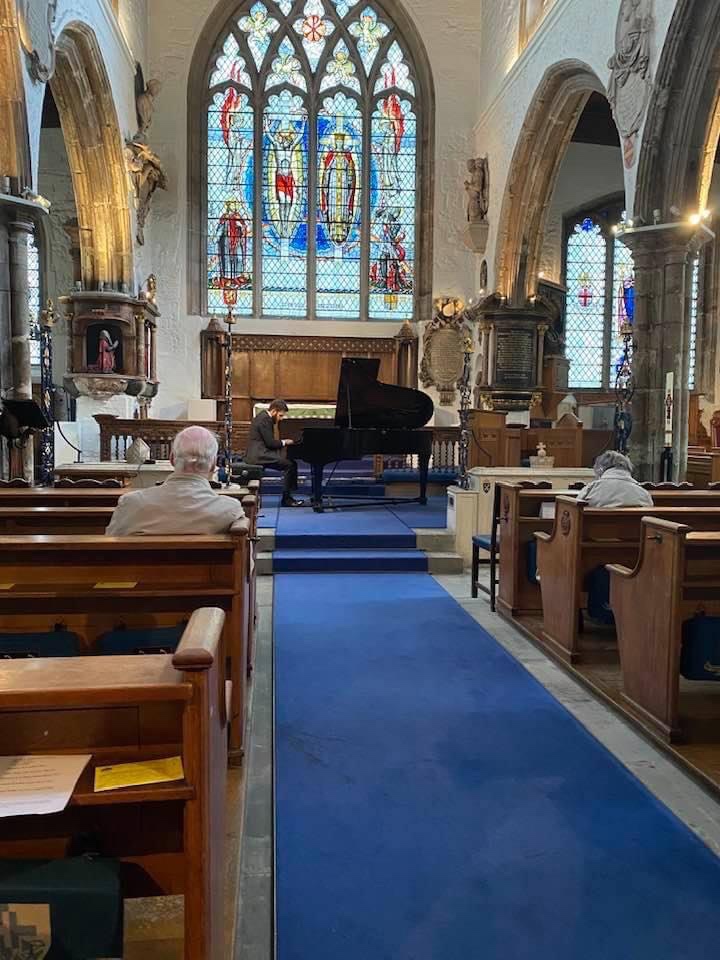
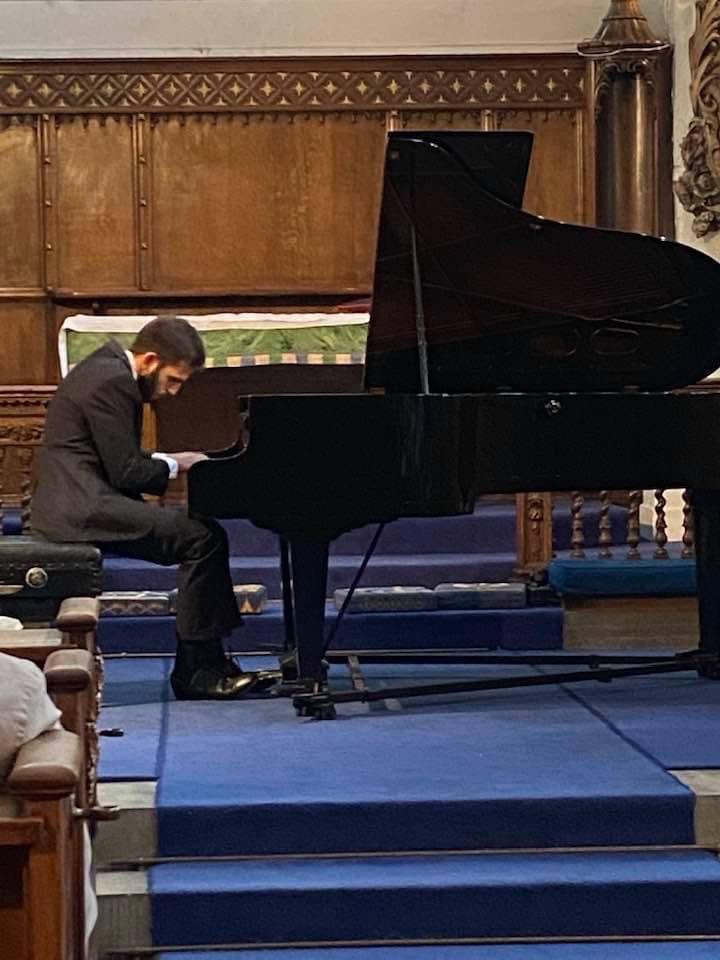
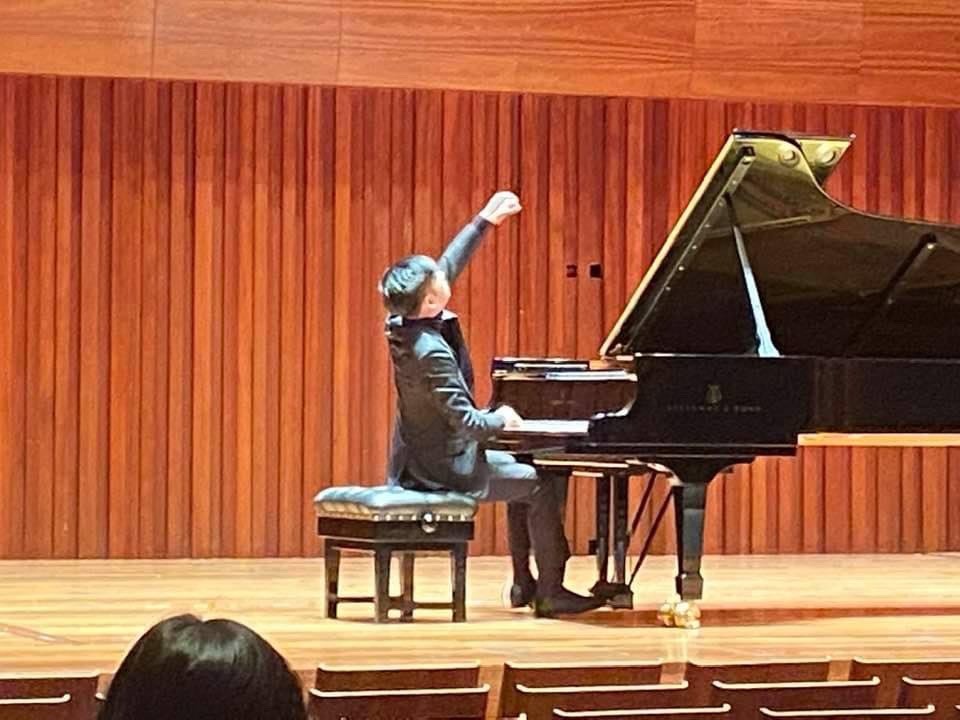
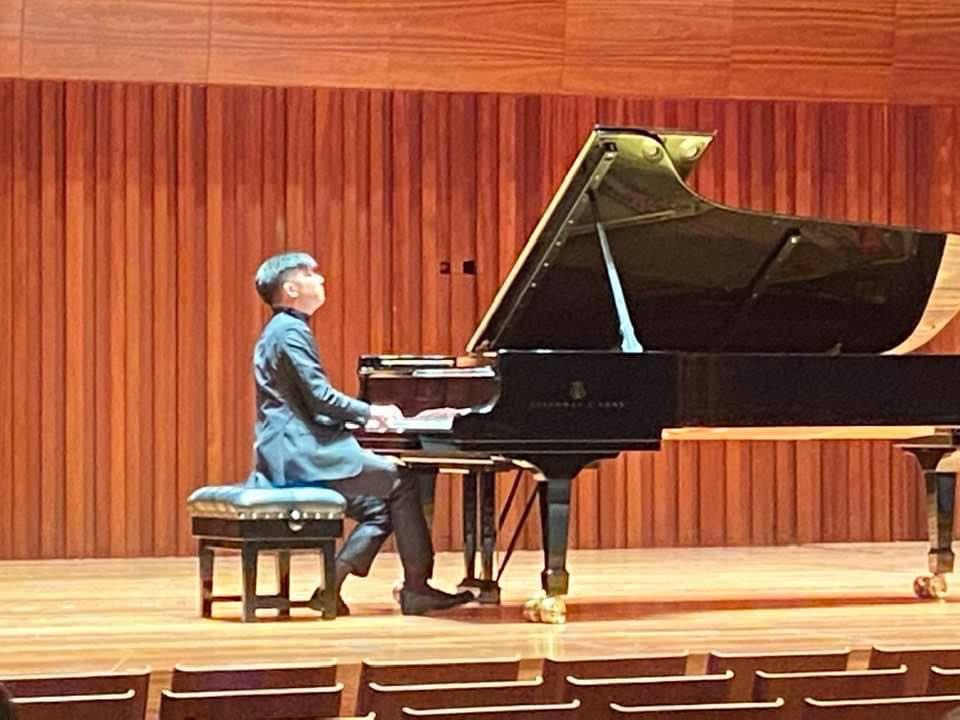
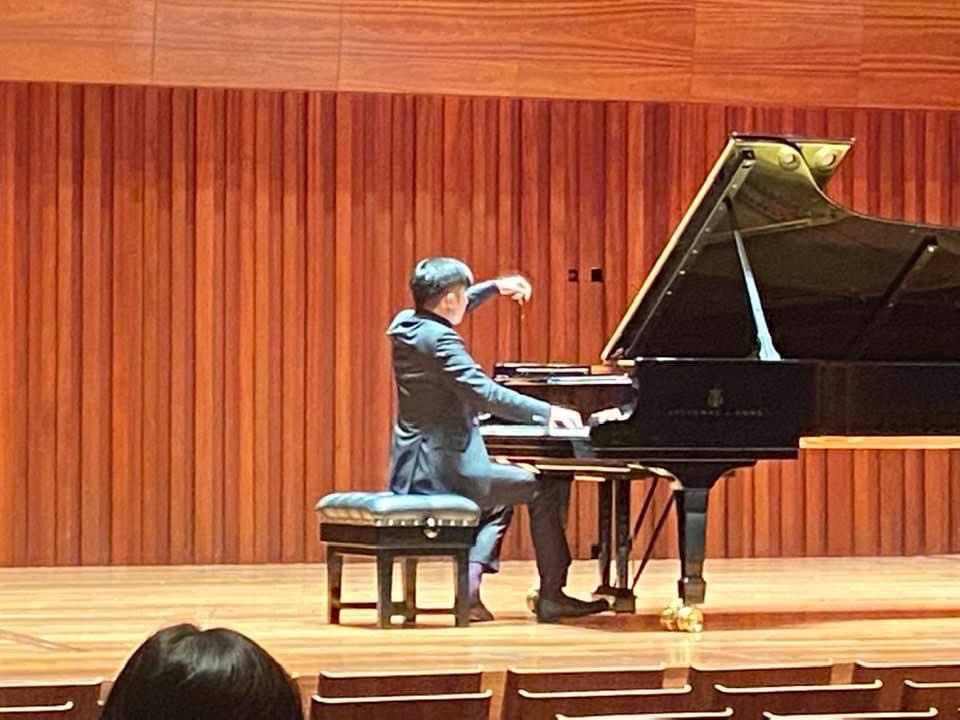
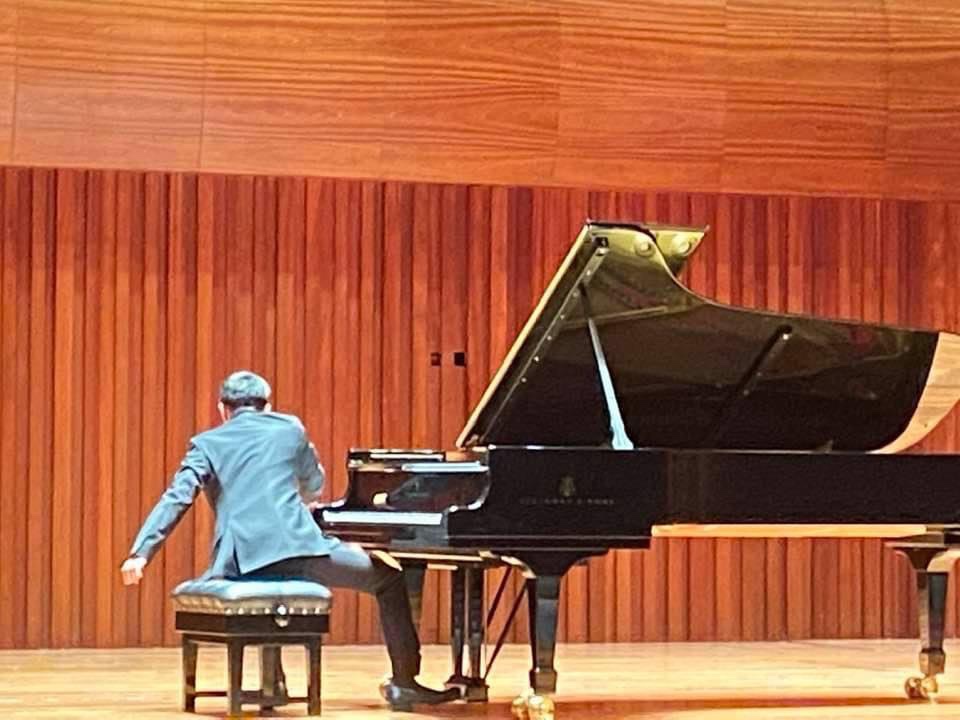
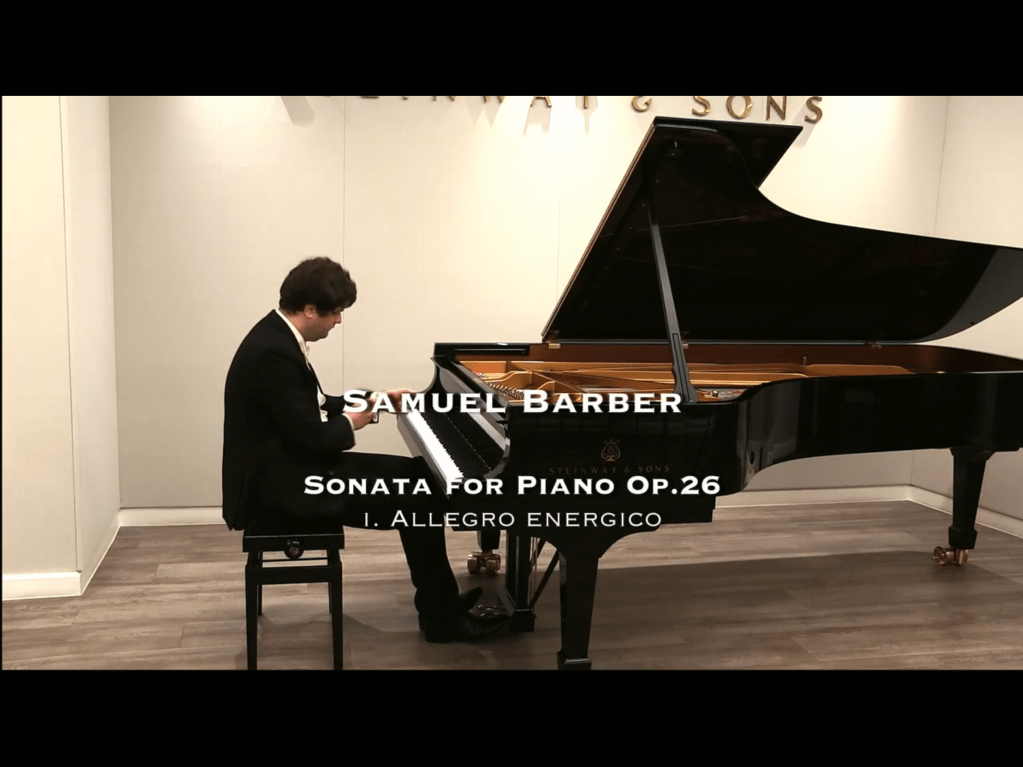
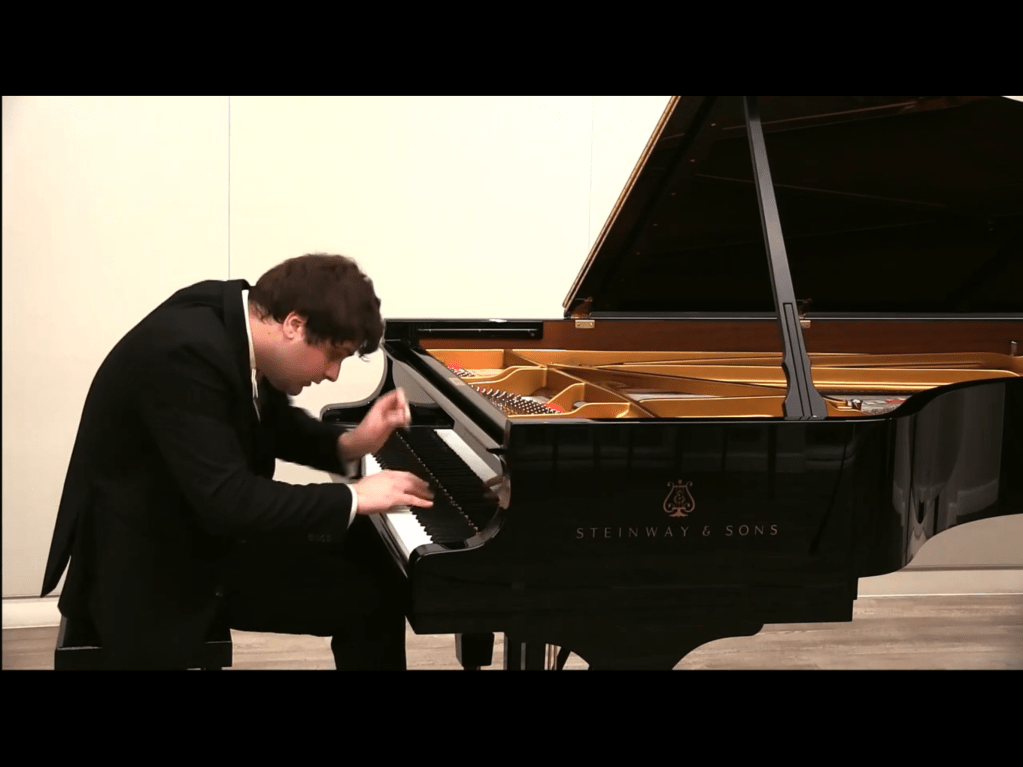
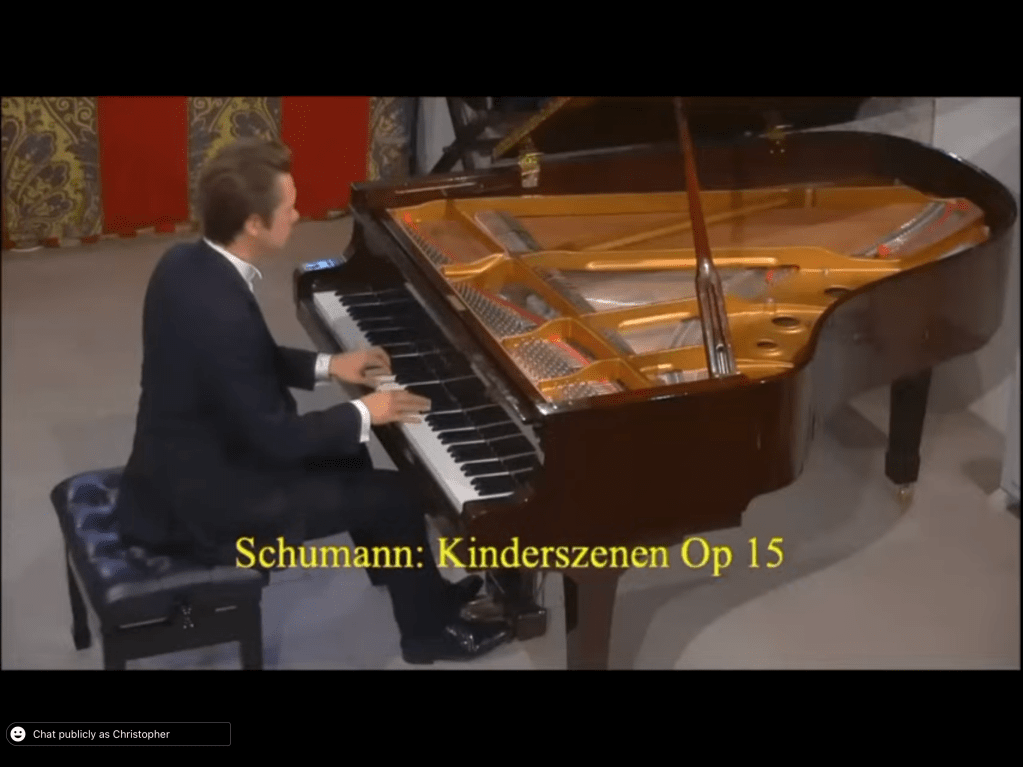
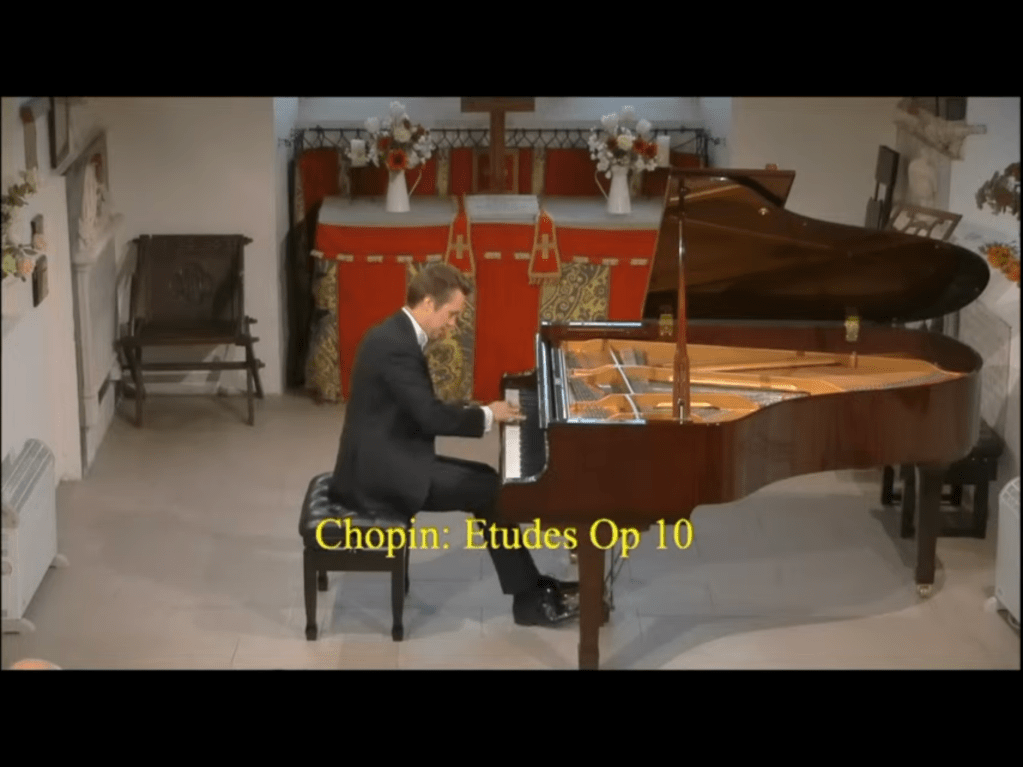
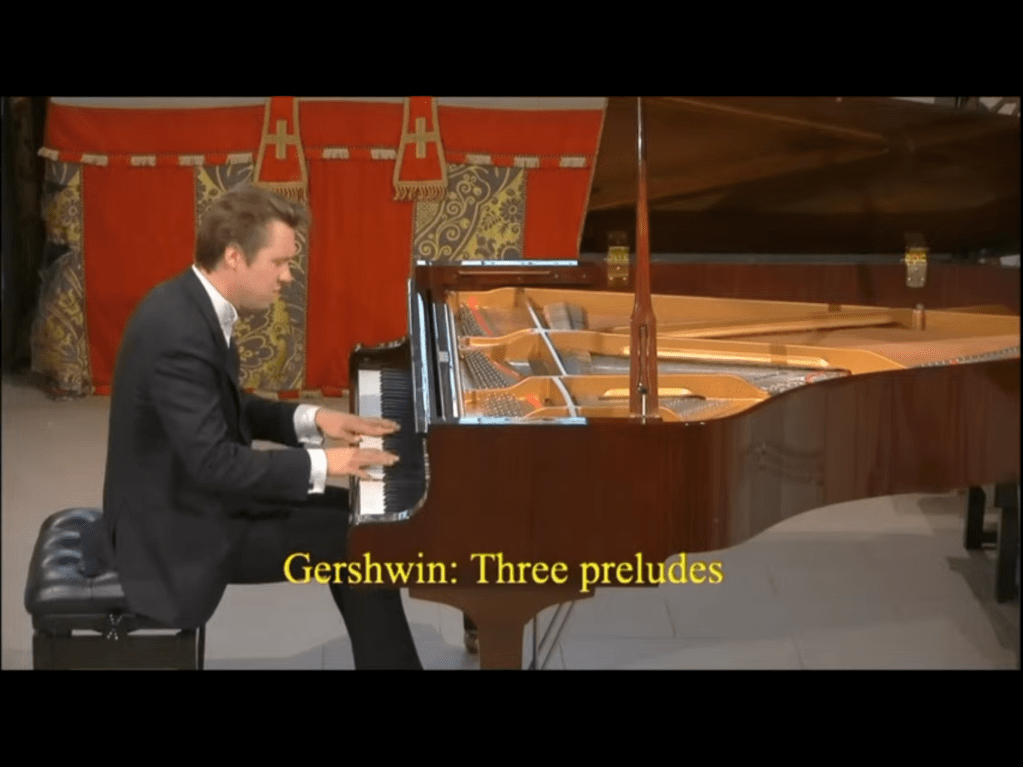
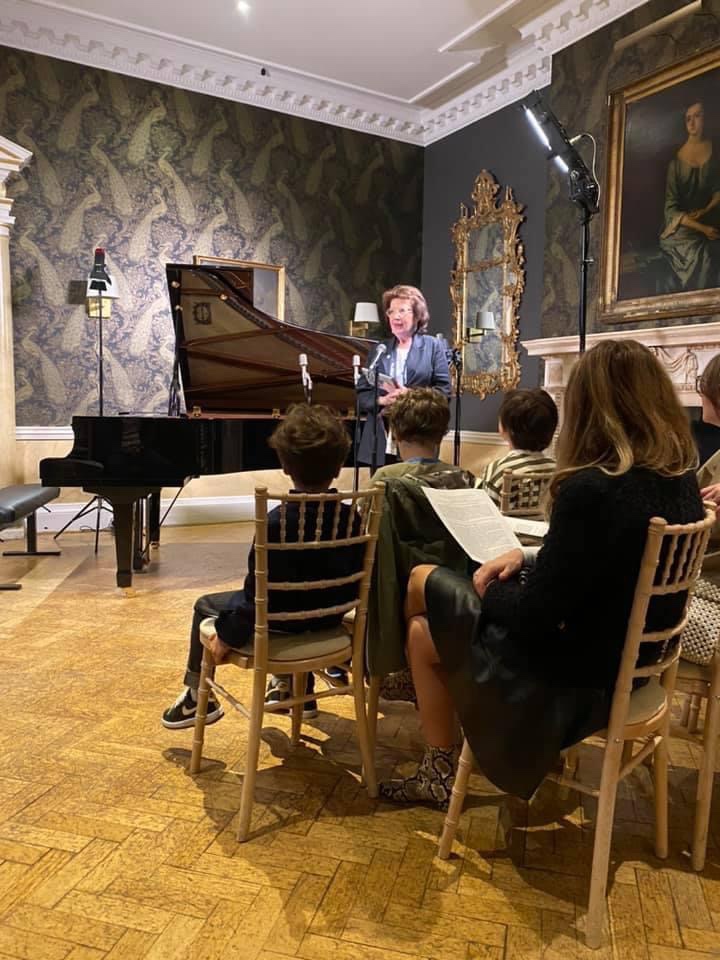
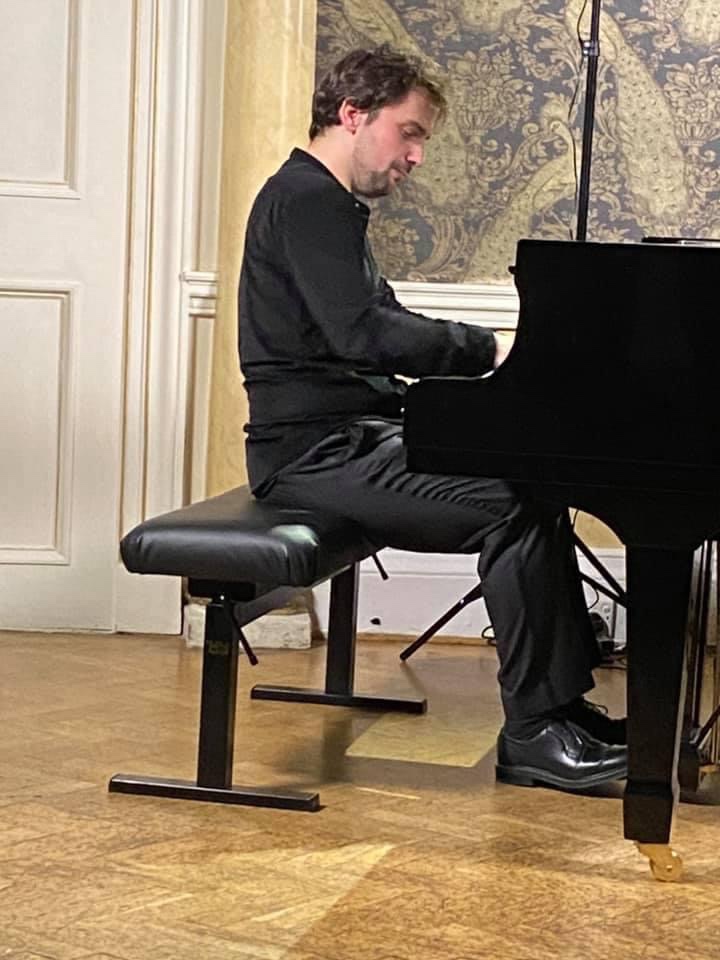
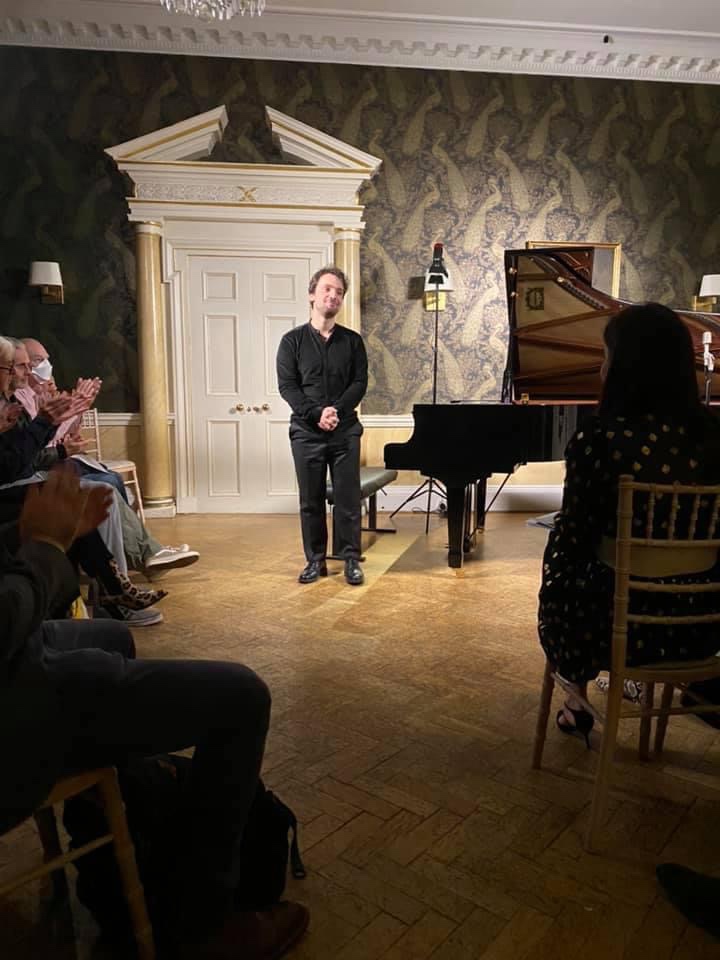
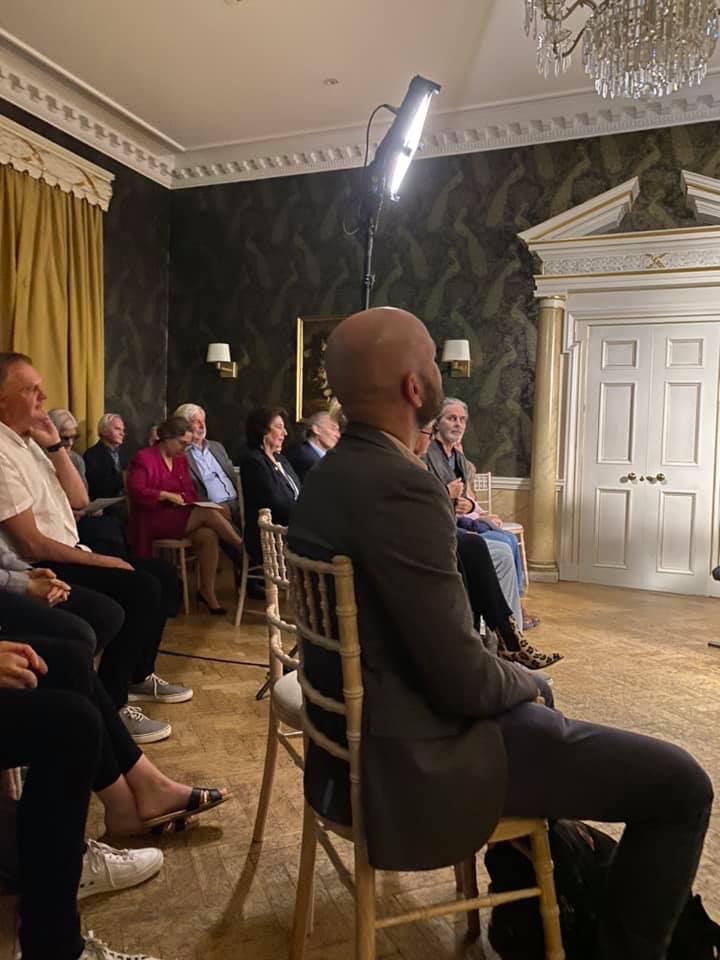
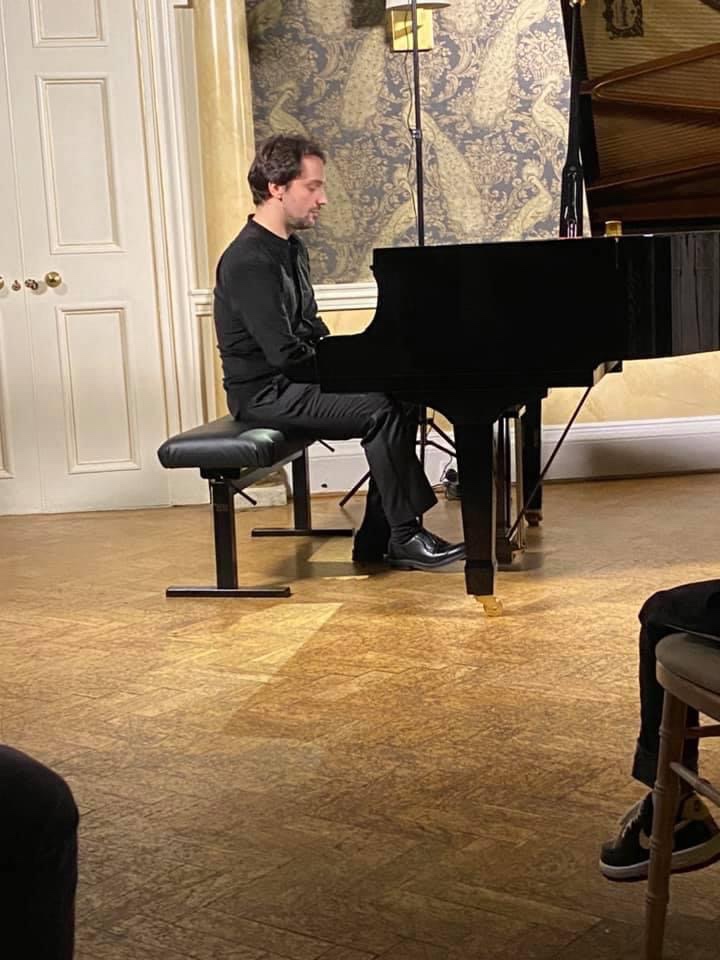
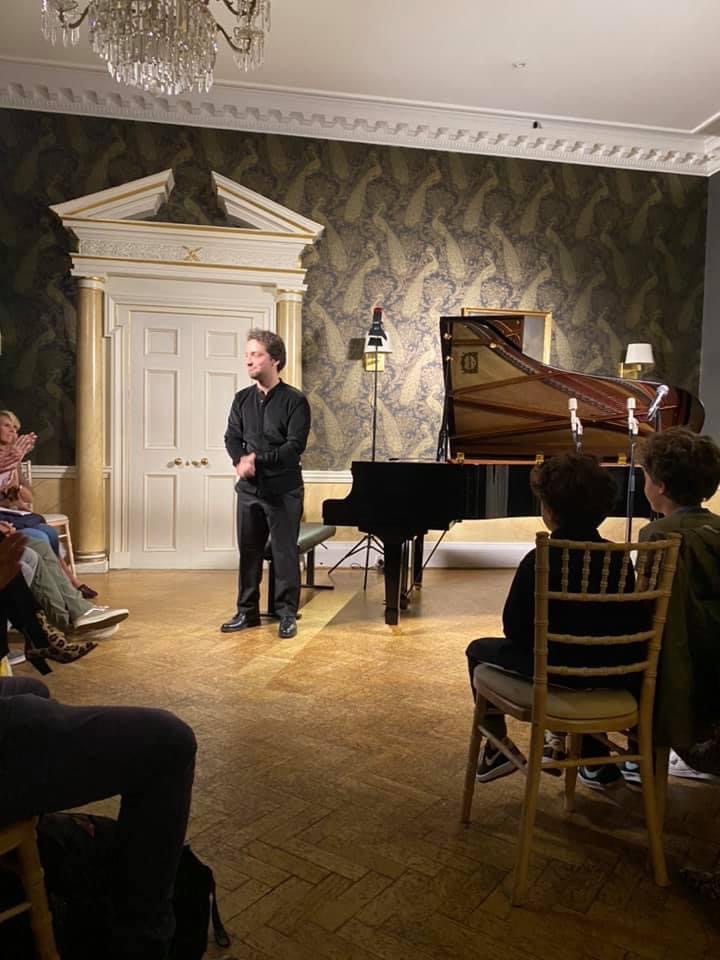
Three Beethoven Sonatas played with fearless energy and intelligence by Ronan O’Hora on Fou Ts’ong’s piano that has found such a warm and welcoming home at Oleg Kogan’s Razumovsky Academy. From the first notes of Beethoven’s early Sonata op 2 n. 3 it was obvious that this was no play safe Beethoven as the driving rhythms swept us along on a wave of energy that left no time for sentimentality.Instead there was such strength even in the luminosity of the more lyrical passages contrasting with the explosions of contrasting dynamic energy.Even the Pastoral Sonata had sinister undertones that as Ronan pointed out was written when Beethoven was contemplating suicide. These were performances of someone who has really understood the turbulent character of Beethoven,the same double character that drove Schumann into an asylum.It was with scrupulous attention to Beethoven’s markings that Ronan brought these three sonatas vividly to life.Such was the tension created by the headlong turbulence and dramatic energy of the Appassionata that the only outlet was the sumptuous outpourings of Wagner’s Liebestod in the arrangement by Liszt played as an encore .The relentless build up of tension was only released by the magical final chords.The minutes of total silence at the end was of an audience totally bewitched by Fou Ts’ong’s magnificent piano in the hands once more of a master musician.
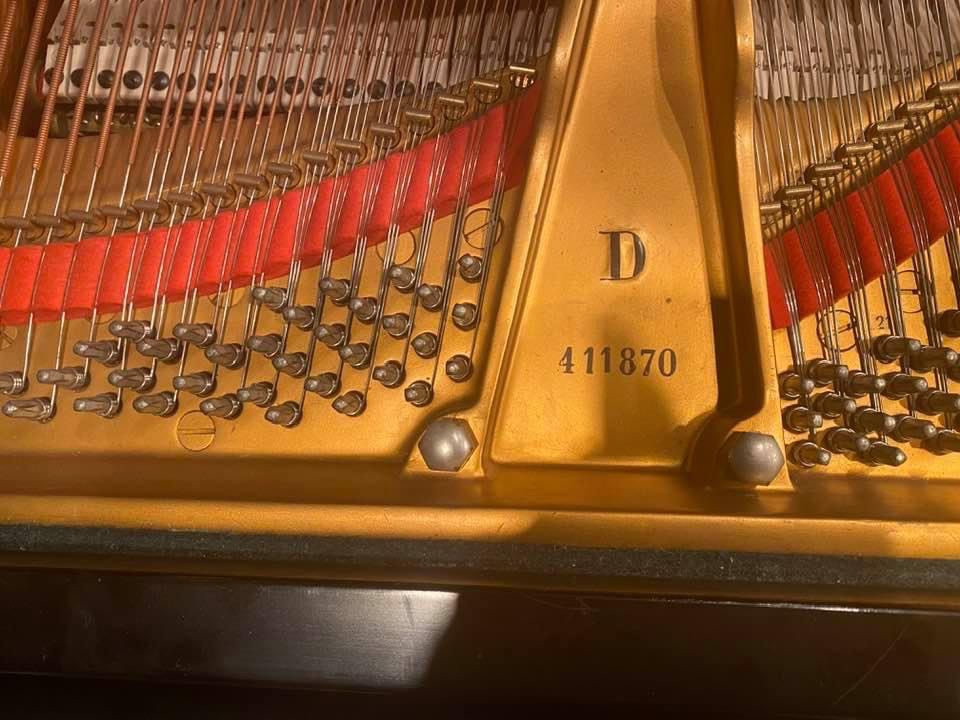
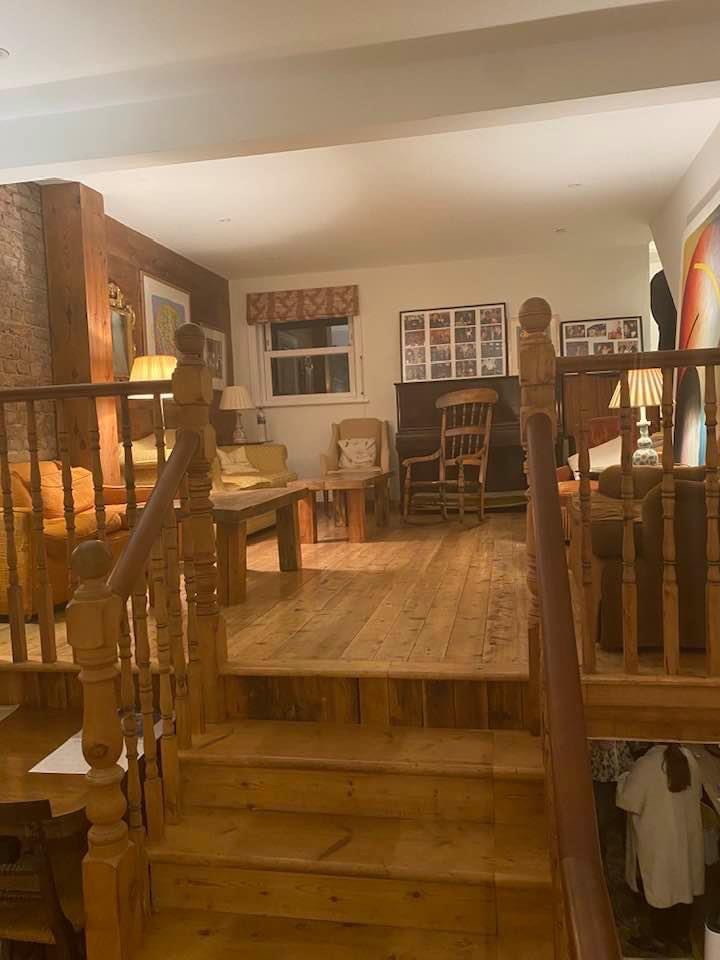
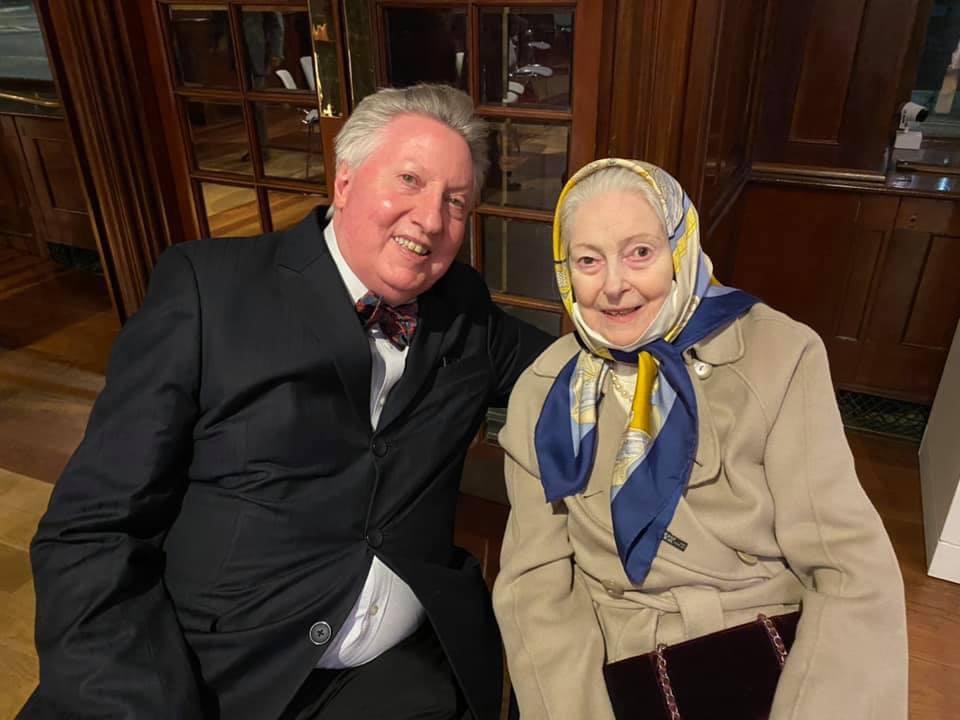
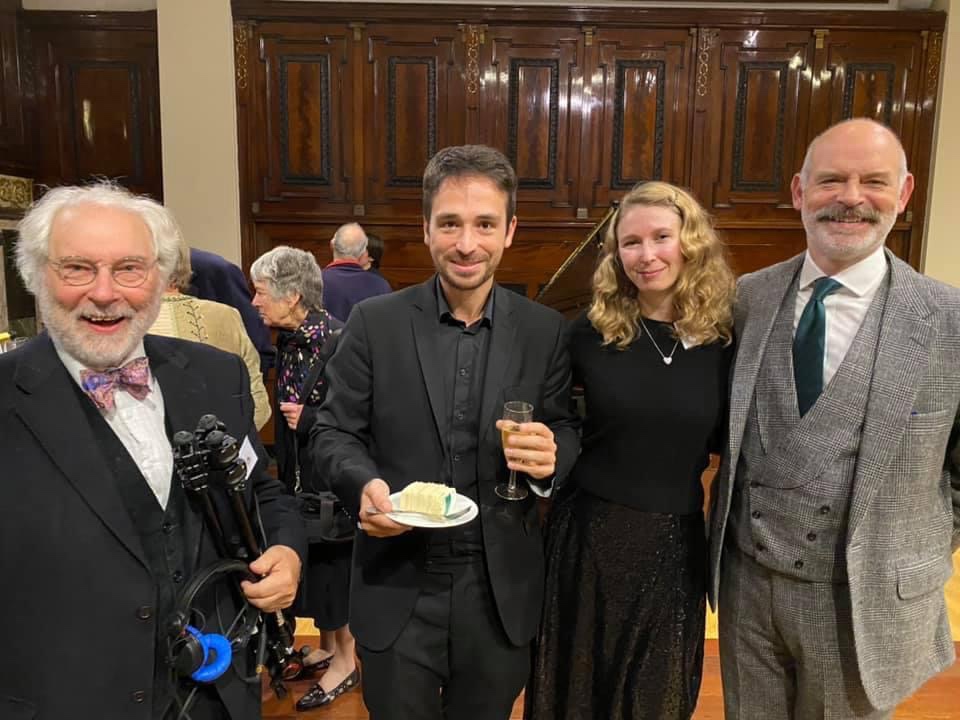
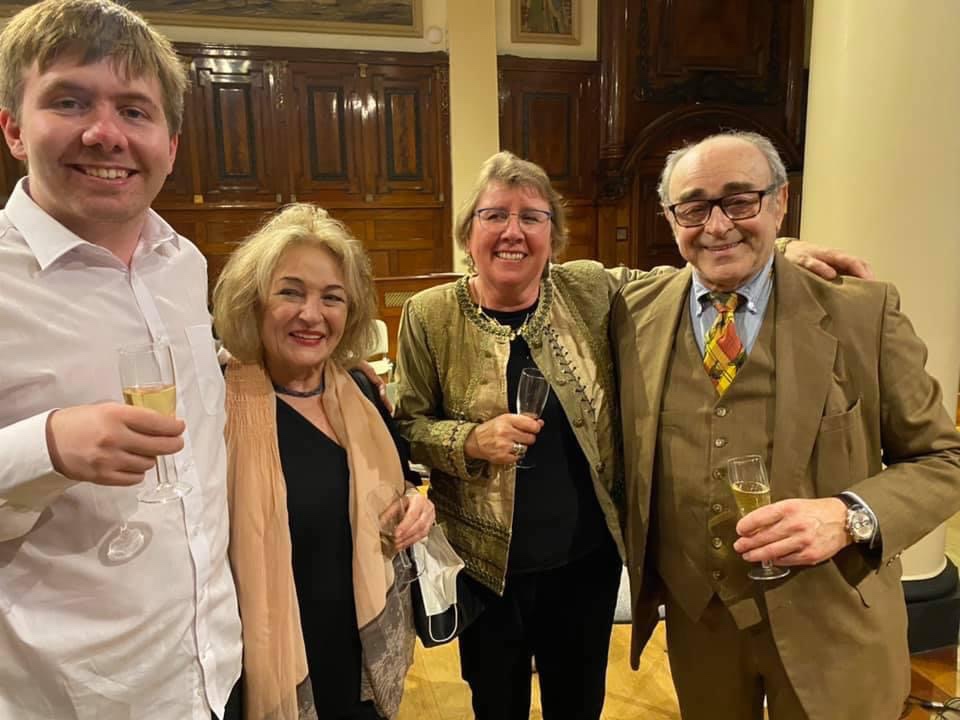
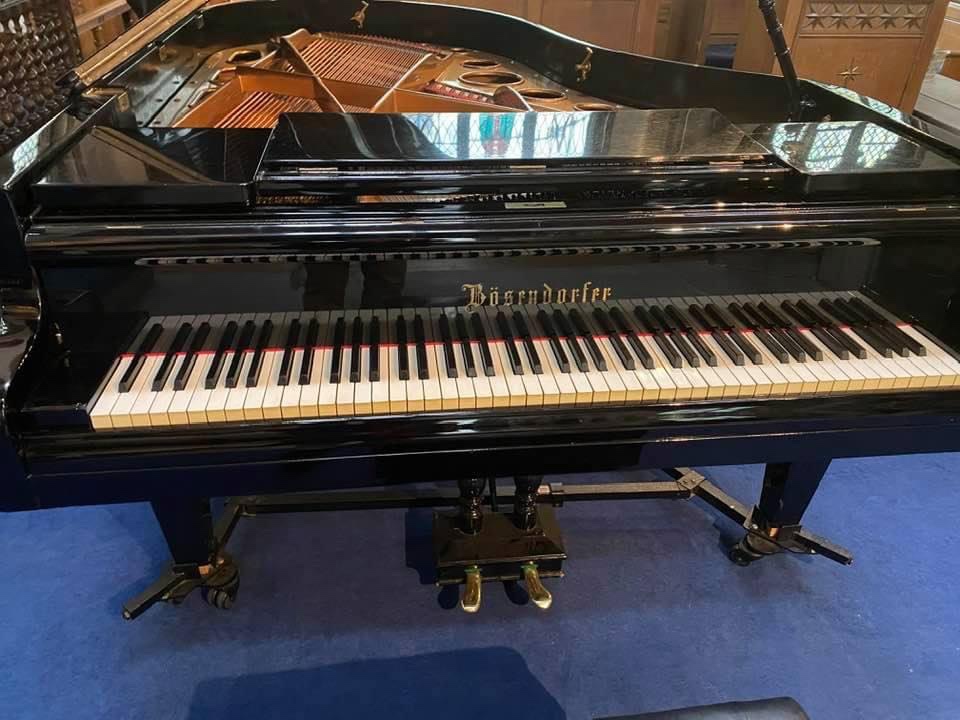
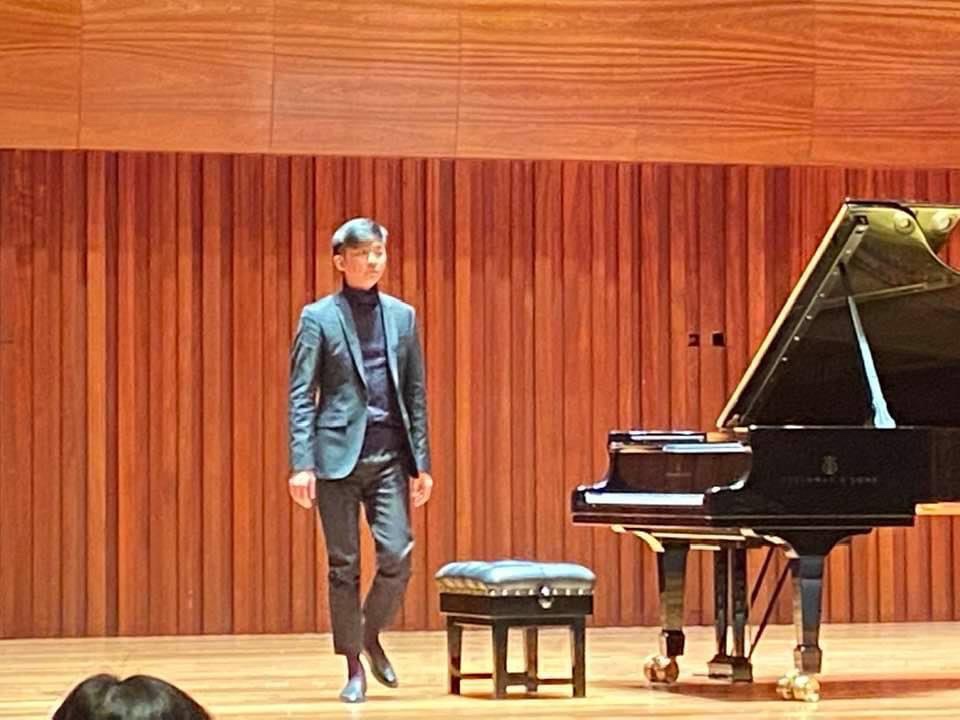
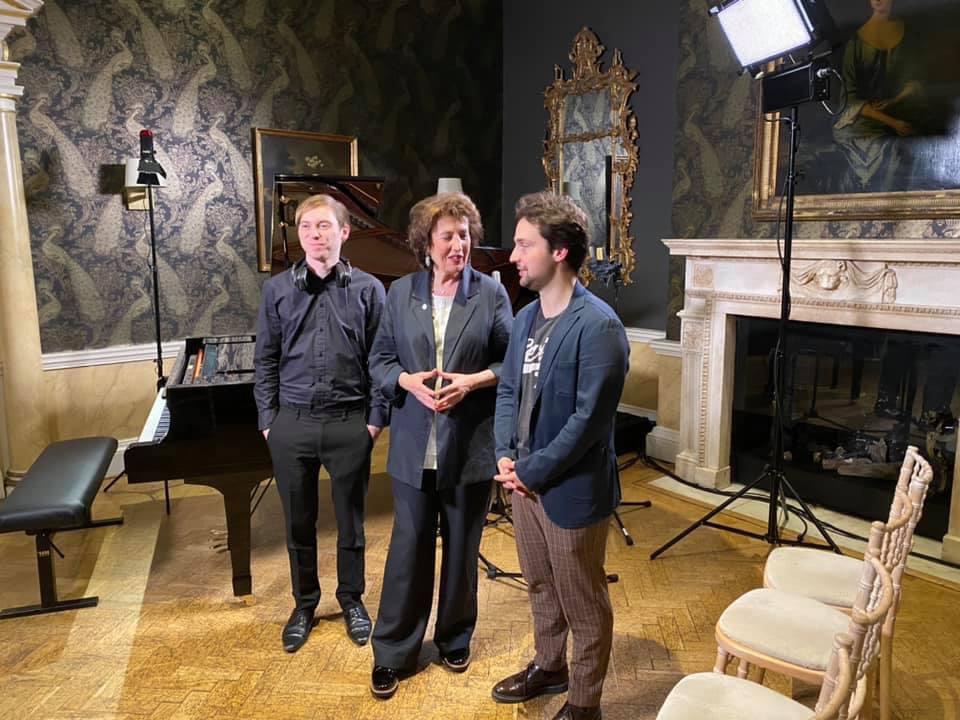
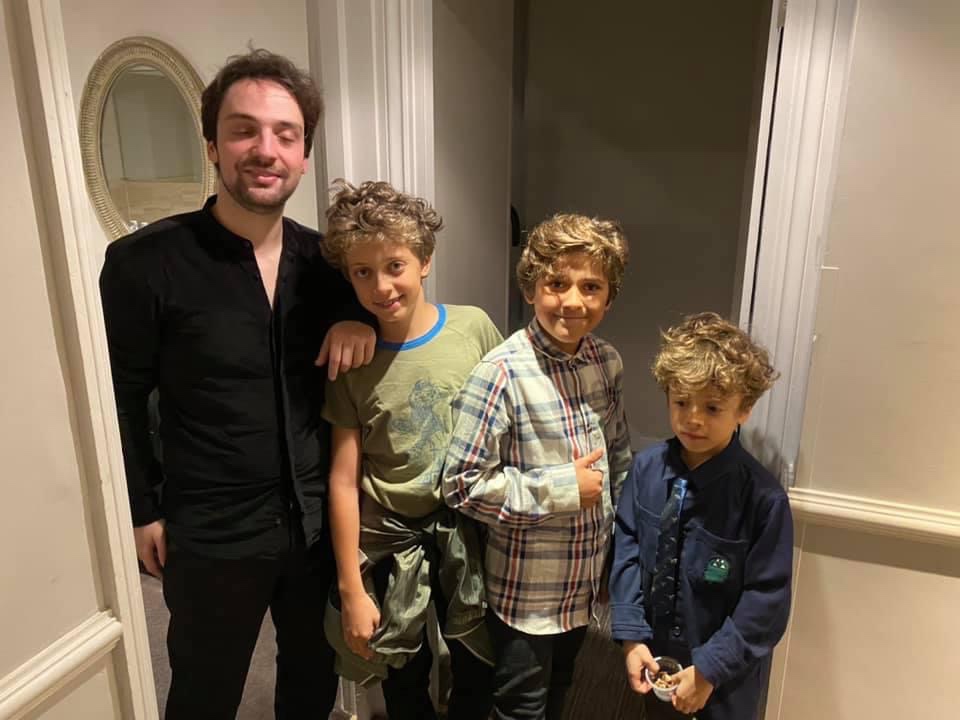
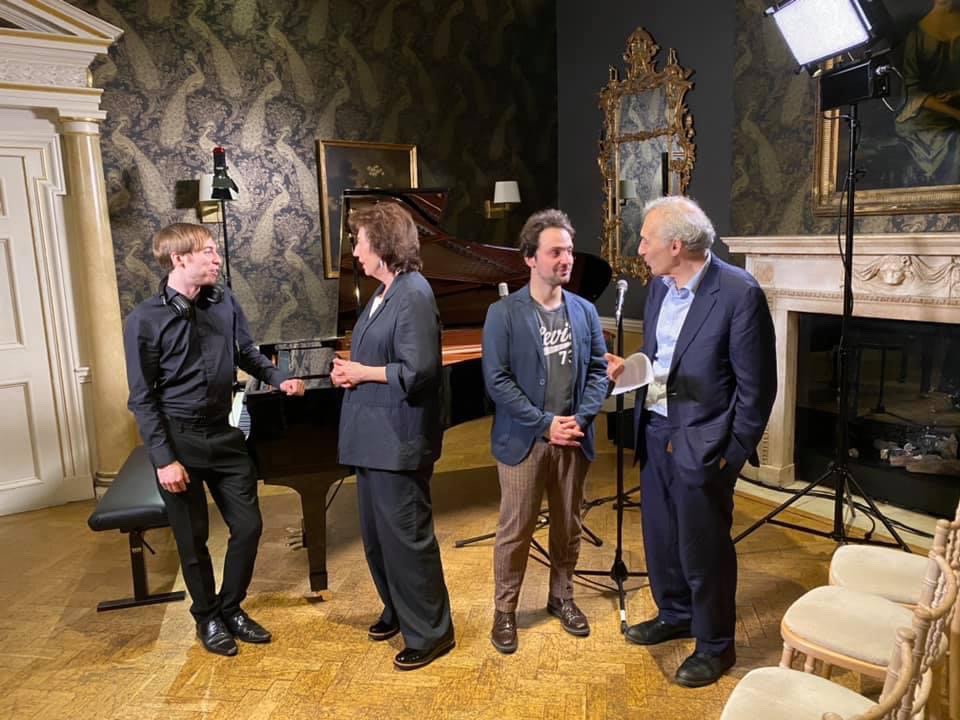
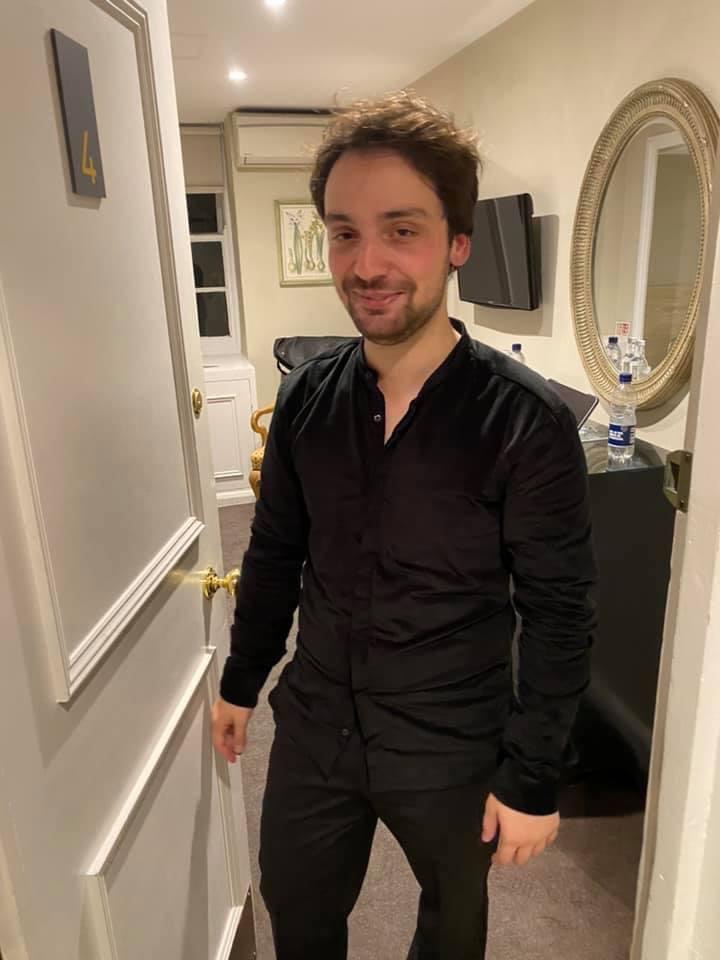
Fou Ts’ong’s magnificent Steinway DThe beautifully warm wooden interior made with loving care by Oleg’s own hands Oleg Kogan ,the distinguished cellist The hall built by Oleg with his own handsMihai Ritivoiu recording technician for his friends and colleagues from his Alma Mater of the Guildhall where he graduated from the class of Joan Havill
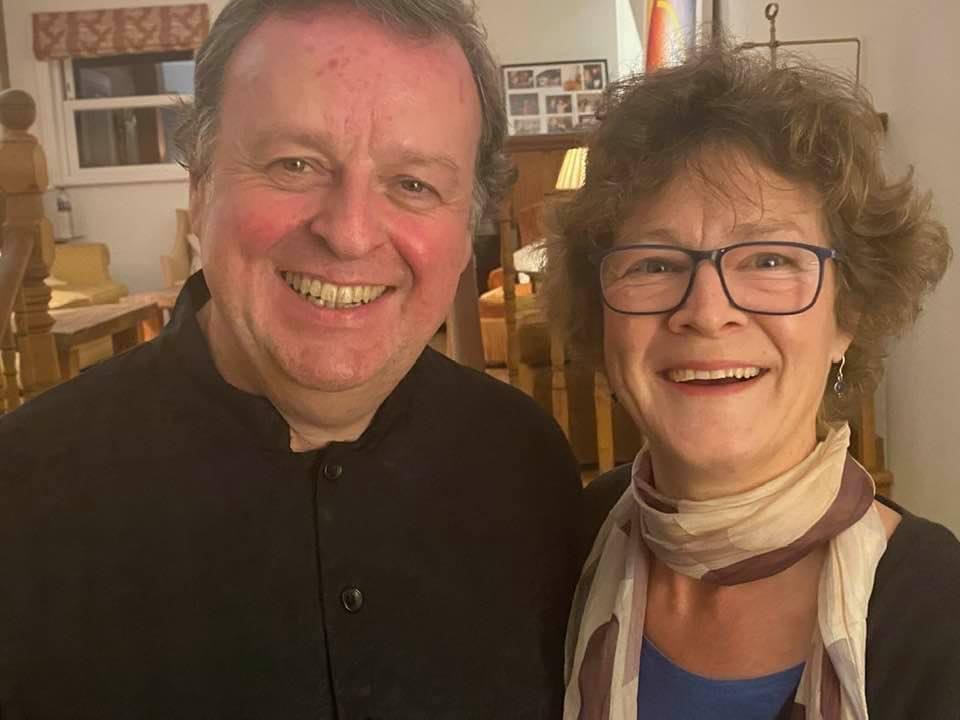
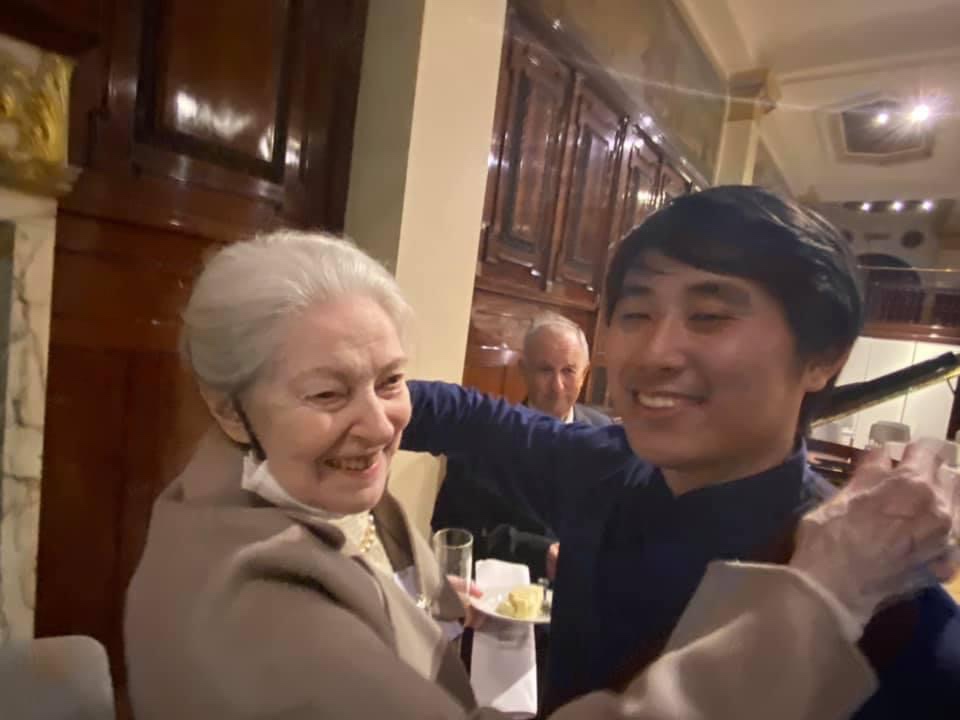
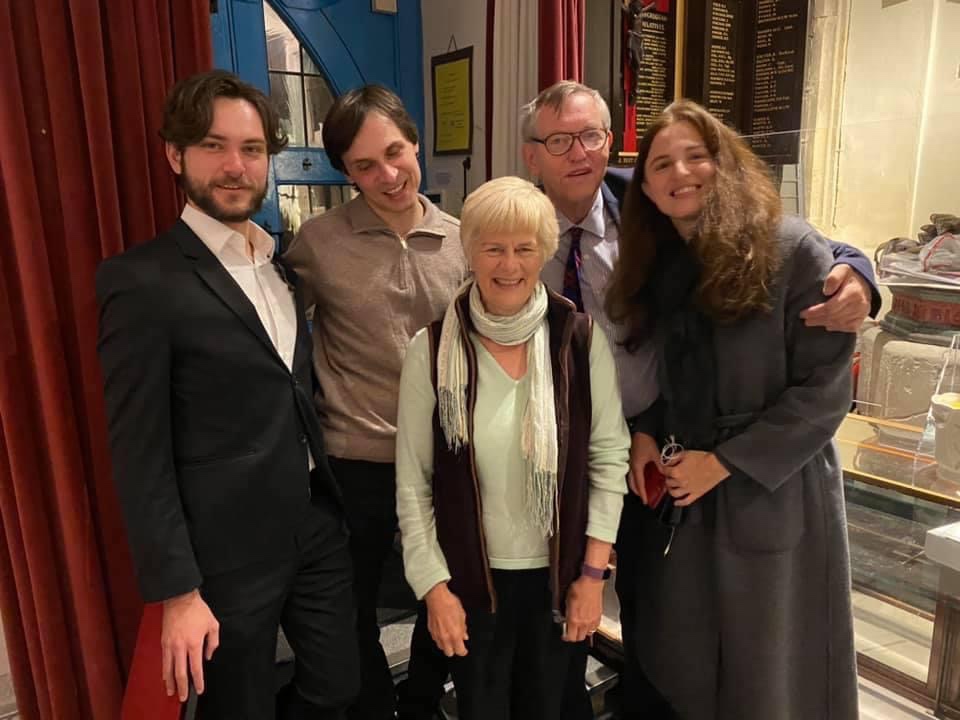
Ronan O ‘Hora with his wife who told me of Ronan’s lock down project of learning the 32 Beethoven Sonatas that he will be presenting in a complete cycle shortly
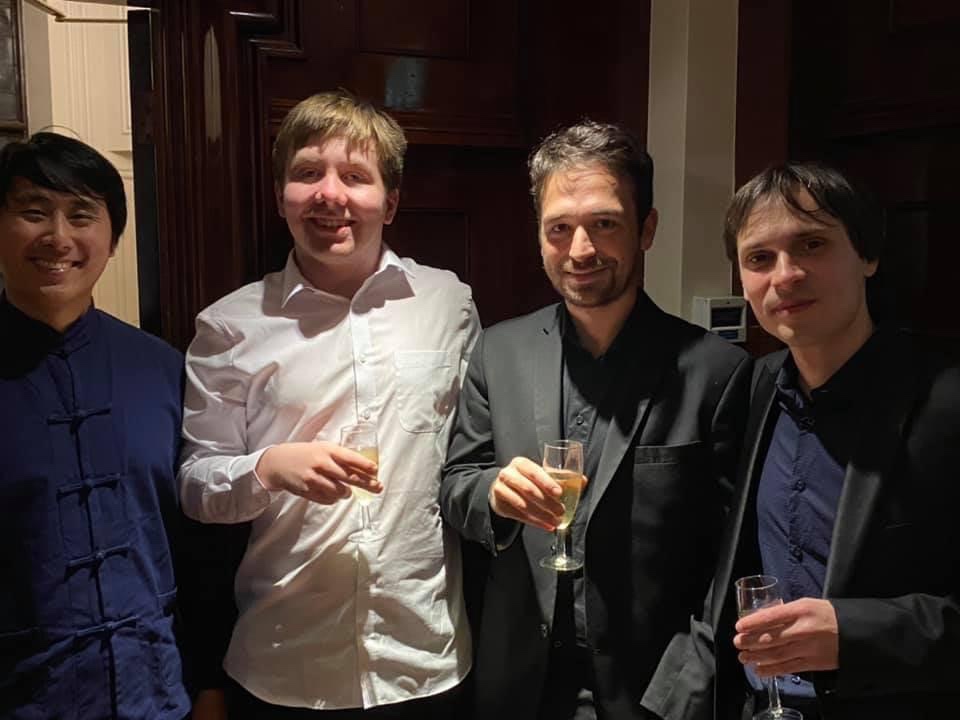
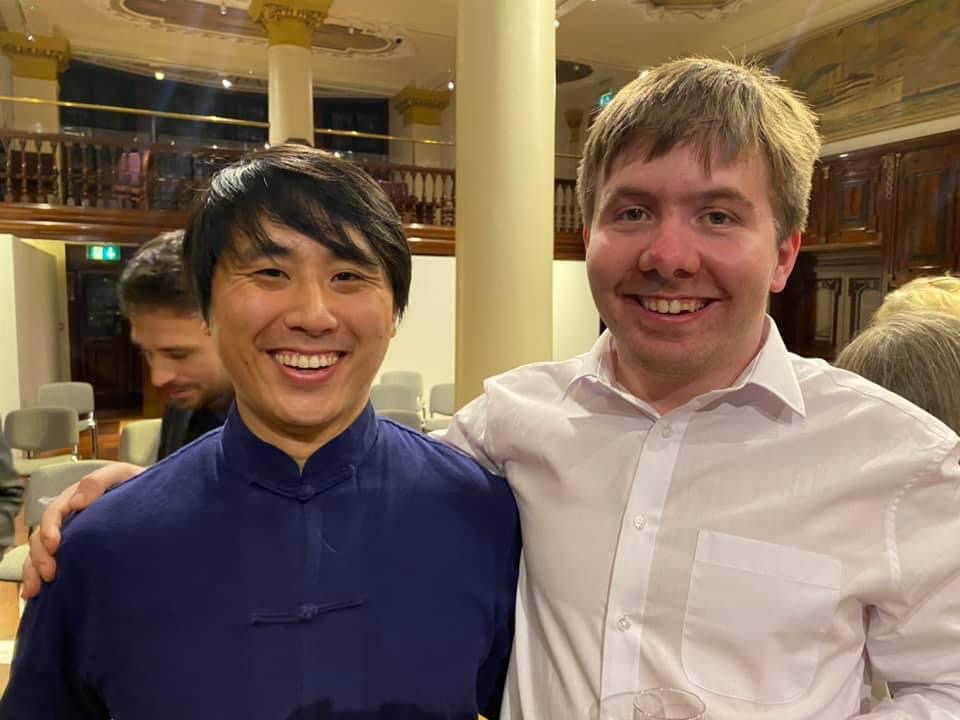
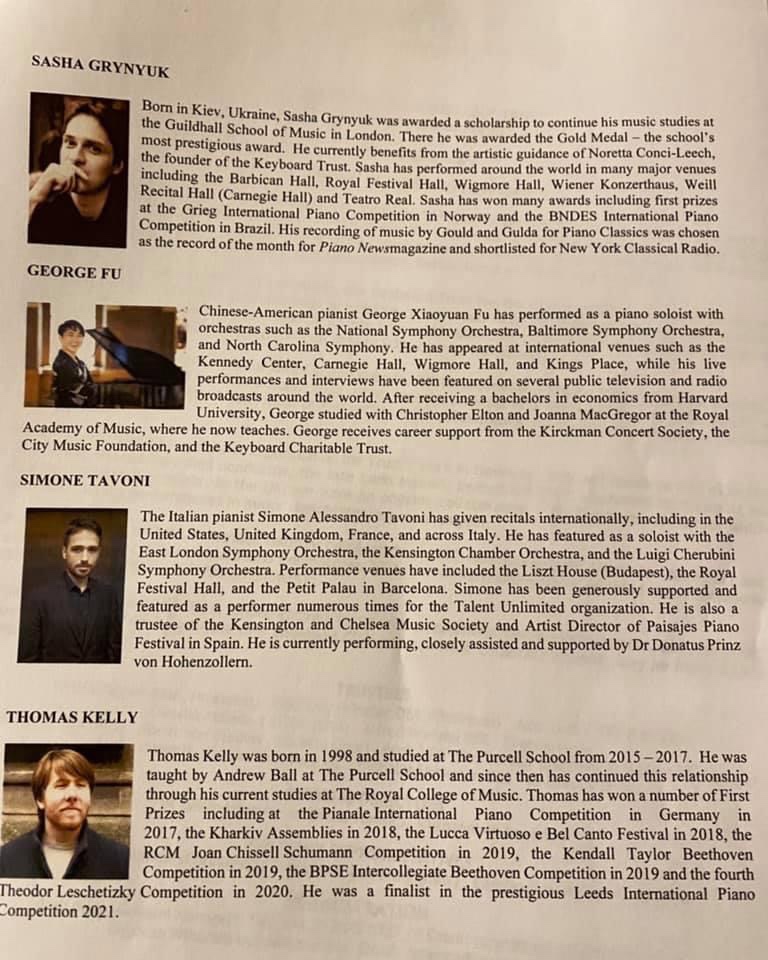
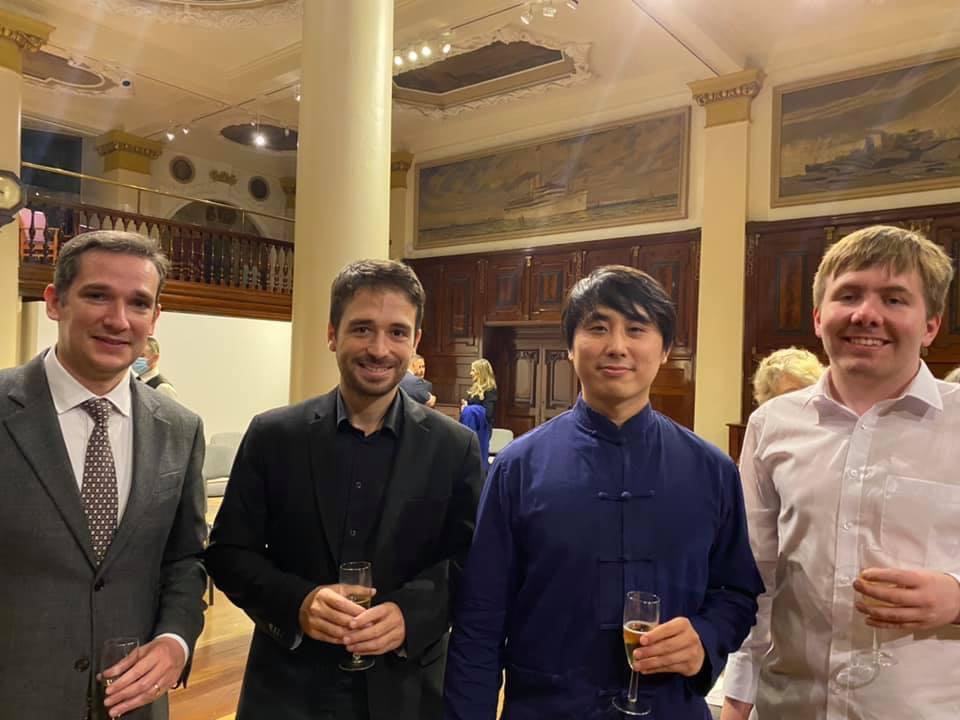
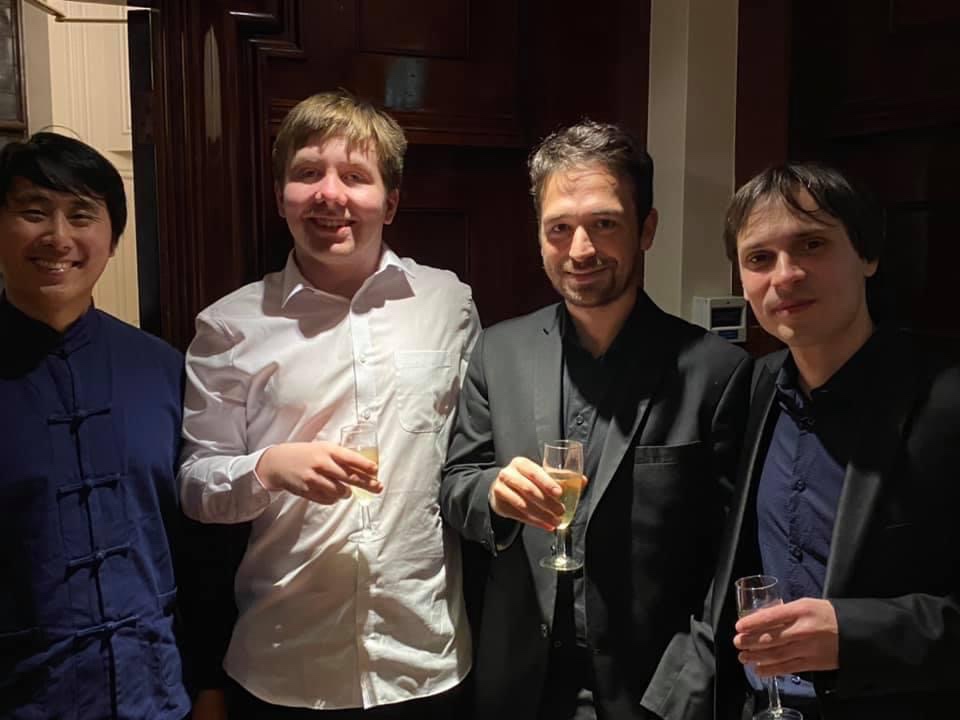
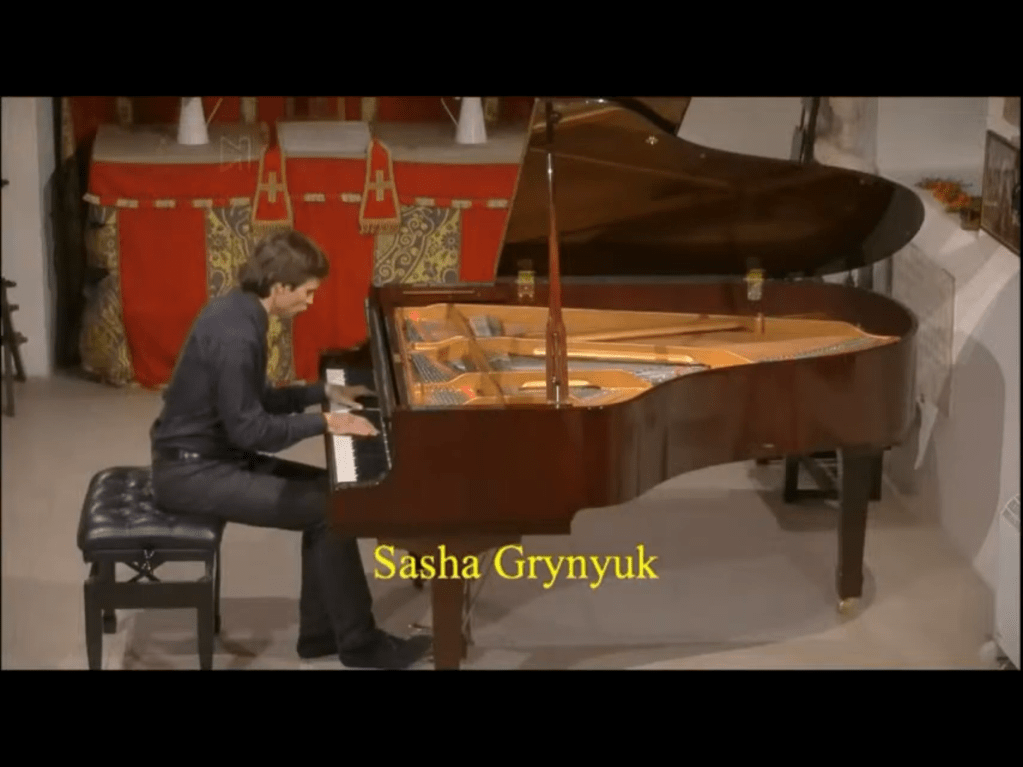
George Fu-Thomas Kelly -Simone Tavoni-Sasha Grynyuk
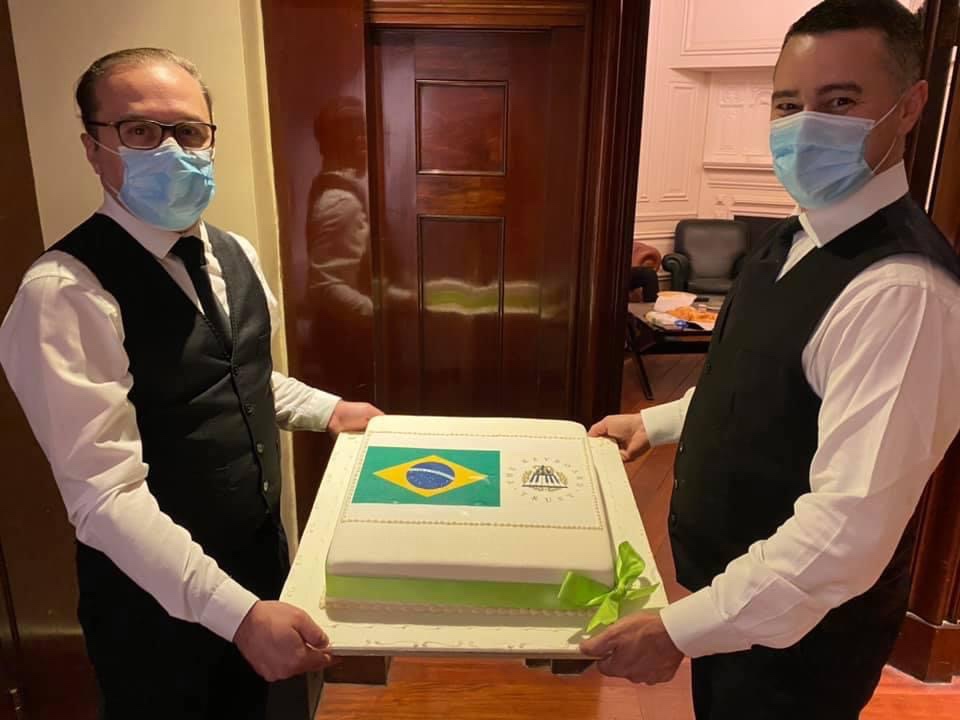
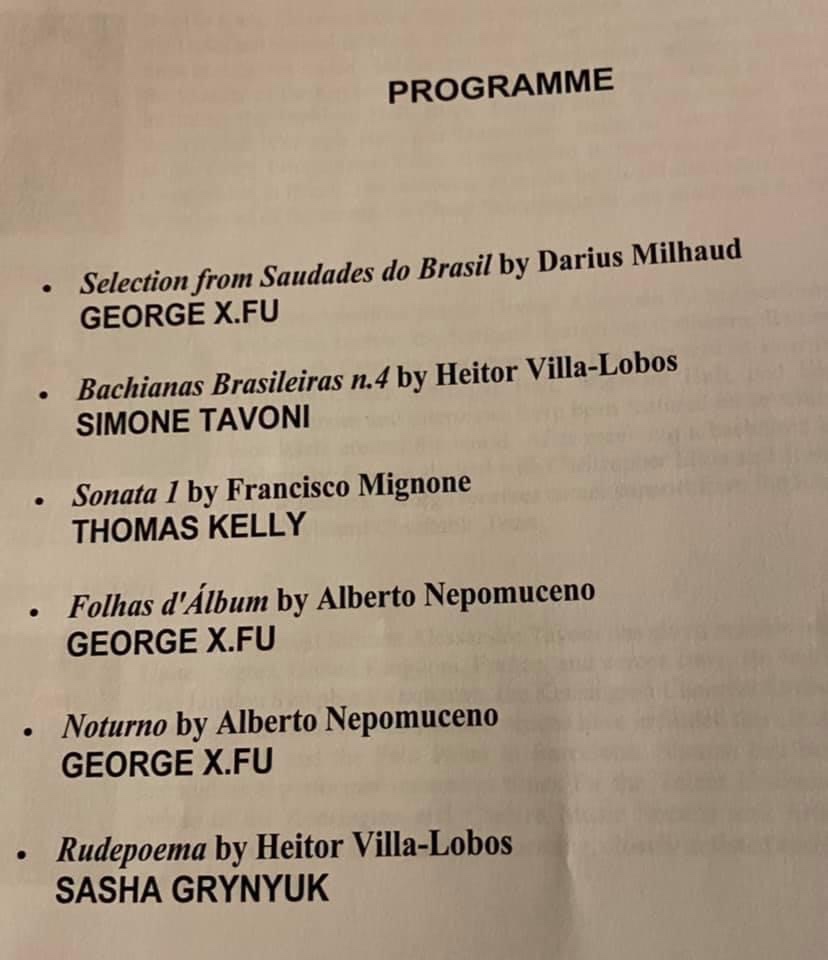
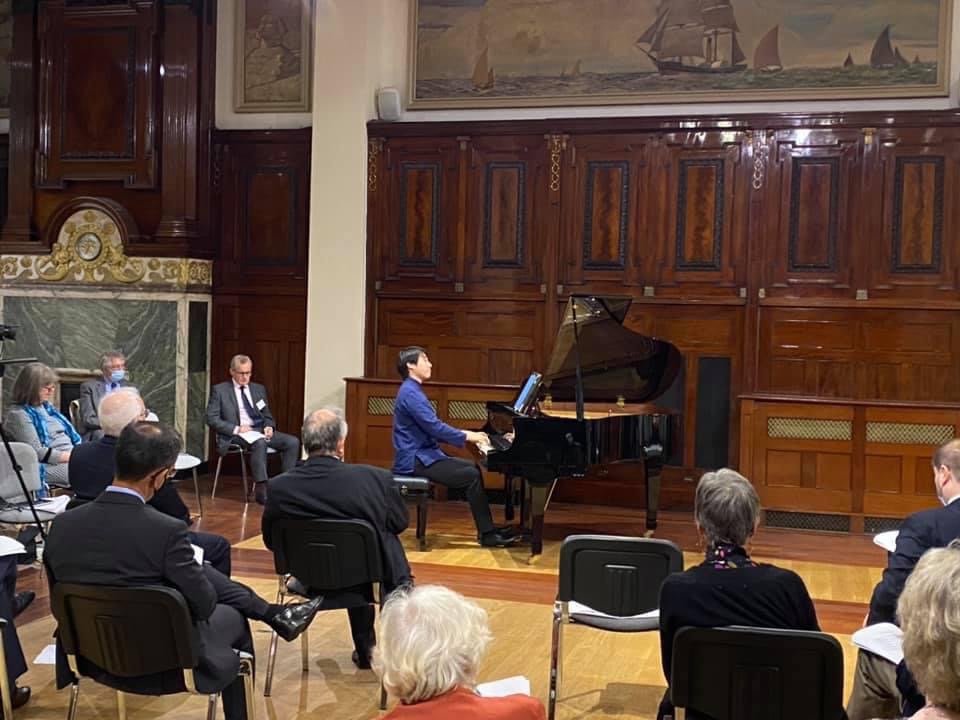
Some extraordinary performances in the Cunard Hall in Trafalgar Square now the distinguished ‘Sala Brazil’ of the Brazilian Embassy.The 200th anniversary of Brazil and the 30th of the Keyboard Trust and a celebration concert of four star pianists from the KCT stable.George Fu played music by Nepomuceno and the Saudades do Brasil by Milhaud ;Simone Tavoni played Bachianas Brasileiras n 4 by Villa Lobos ;Thomas Kelly the Sonata n.1 by Mignone and Sasha Grynyuk the monumental Rudepoema by Villa Lobos.After the wonderful celebration cake and champagne I did my homework to know more about these works .In particular the remarkably original Sonata by Mignone every bit as powerful as the better known Rudepoema .I share with you my voyage of discovery :
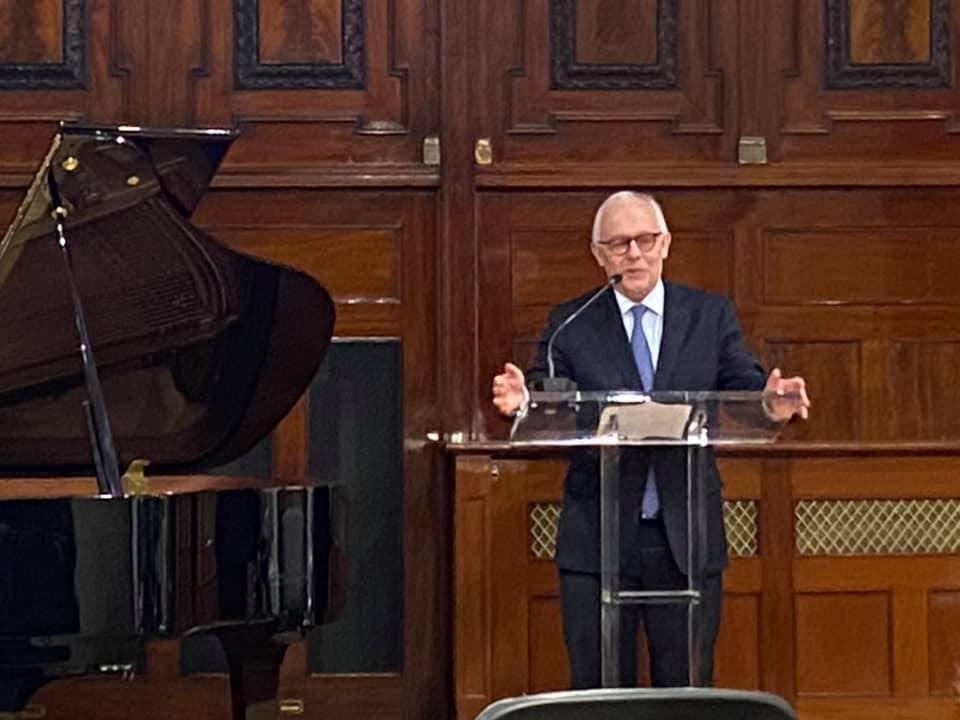
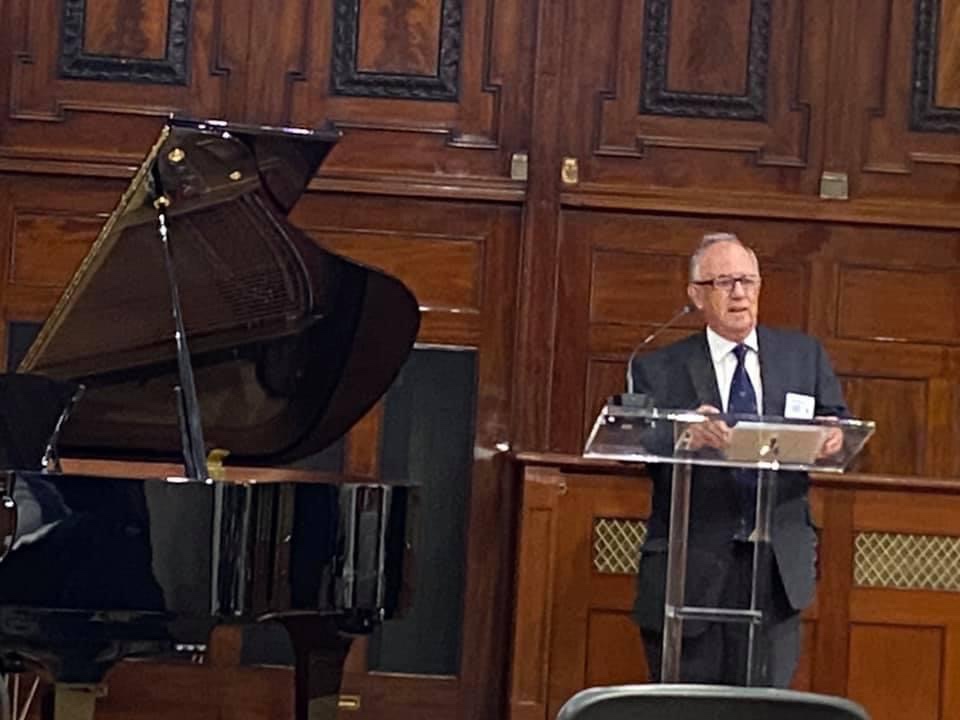
His Excellency the Brazilian Ambassador Fred ArrudaThe celebration cake Geoffrey Shindler – Chairman of the KCT.Thanking his Excellency Ambassador Arruda and also Minister – Counsellor Roberto Doring Pinho da Silva and Joao Paulo Tavares Fernandes,Head of the Cultural Section and of course Sarah Biggs General manager of the KCT- the orchestrators of this important partnership
The Saudades do Brasil (1920), Op. 67, are a suite of twelve dances for piano by Darius Milhaud.Composed after Milhaud’s visit to Brazil in 1917-1918, each dance is based on a duple tango or samba rhythm and bears the name of a place or neighbourhood in Rio de Janeiro.The title of the suite uses the Portuguese term saudade.The work is well known for its use of polytonality though sections may also be considered extended tonality or, “harmonic colour”.George Fu played 1/3/7/8/6 with insinuating rhythms, rumbustious dance,sultry melodic meanderings and a startling freedom that brought this selection vividly to life
The Bachianas Brasileiras ( an approximate English translation might be Bach-inspired Brazilian pieces) are a series of nine suites by Heitor Villa Lobos written for various combinations of instruments and voices between 1930 and 1945. They represent a fusion of Brazilian folk and popular music on the one hand and the style of J.S. Bach on the other, as an attempt to freely adapt a number of Baroque harmonic and contrapuntal procedures to Brazilian music .Most of the movements in each suite have two titles: one “Bachian” (Preludio, Fuga, etc.), the other Brazilian (Embolada, O canto da nossa terra, etc.).Simone played with crystalline sounds of great beauty and child like simplicity with an explosion of temperament with clashes of drums and a mixture of excitement and mystery.
Simone Tavoni
Number 4 scored for piano (1930–41); orchestrated in 1942 (Preludio dedicated to Tomas Terán; Coral dedicated to José Vieira Brandao Ária dedicated to Sylvio Salem’s ; Dança dedicated to Antonieta Rudge Müller).
Prelúdio (Introdução)
Coral (Canto do Sertão)
Ária (Cantiga)
Danza (Miudinho)(a type of dance, the word itself meaning “choosy”, “niggling”) as spelled on p. 45 of the orchestra score,and, twice in the piano version and once for the orchestral version.
Thomas Kelly
Francisco Mignone composed Sonata No. 1 for piano in 1941, this being his first attempt to compose a solo piano piece in great form. It is dedicated to Magda Tagliaferro.James Melo states that this is the first Brazilian sonata for piano however, Alberto Nepomuceno’s sonata preceded it by almost 50 years (1894).Francisco Paulo Mignone (September 3, 1897, São Paulo – February 19, 1986, Rio de Janeiro ) was one of the most significant figures in Brazilian classical music ,and one of the most significant Brazilian composers after Villa – Lobos .In 1968 he was chosen as Brazilian composer of the year.Thomas gave a performance of virtuosity with a kaleidoscopic range of sounds.Some astonishingly original sounds in the second movement and extraordinary virtuosity in the third.A tour de force of resilience and invention from this recent top prize winner in the Leeds International Piano Competition
Thomas Kelly
Sonata Nº1 was premiered in Rio de Janeiro by pianist Arnaldo Estrella. Mignone’s wife, Liddy, wrote about the piece: “This sonata is a kind of example of the new Brazilian musical spirit”. Luiz Hector de Azevedo pointed out that Mignone was actually expressing orchestral timbres on the piano. Eurico Nogueira France talks about a “national atmosphere and Brazilian aroma”, but does not specify passages in which these characteristics can be found.
Structured in three movements, Moderato- Andantino/quasi Allegretto – Moderato The Sonata presents two brief references to Brazilian rhythmic figurations, one in the first and the other in the last movement. Its technical demands favor the aspects of subtlety rather than vigor. The melodic contours tend to be more conventional and provide a strong melodic orientation in all three movements. These are characterized by a certain emphasis on the third interval, although the treatment receives different features. Mignone develops his melodies (themes) through repetitions, sequential treatment, occasional inversions, and even the displacement from a previously highlighted melody to an internal voice.
The harmonic tension of the piece is established through the use of bitonal sonorities, fourth chords, augmented octaves, tonal clusters , with the exception of maintaining a prevailing tonal orientation. Tension is also influenced by the recording of dissonances, dynamics and chord spacing.
The first movement has the indication of “ Moderato ” starting with an agitated figuration performed in both hands.
The figuration remains in the right hand while the left introduces the theme in octaves
The development section is brief and in the recap the themes are returned in reverse order. The key of C minor remains an important tonal center in this first movement.
The second movement is an “ Andantino, almost allegretto ” written in ABA form. The first melodic contour, as in the first movement emphasizes the third interval (S-D) and is very regular in its phraseology of sustained chords in clusters with staccato
– second movement
The sustained melody technique between staccato accompaniment is also used by Mignone in the second movement of Sonatina No. 3. The diatonic character of this theme moves into a more robust and more dramatic middle section in which bitonality and false relations add tension to the field.
The first melodic fragment of this “ Andantino, quasi allegretto ” always reappears with variations. The proximity to the melodic contour of the first movement becomes more pronounced with each reenactment. In the last bars the melodic contour of the first movement is briefly stated, consolidating an intentional relationship between the movements.
George Fu with Thomas Kelly
The third movement, again in sonata form, emphasizes the Scherzo character and uses the cross-hands feature in its first melodic contour. The second melodic contour emphasizes the samba rhythm, delineated by the upper notes played by the right hand.
The development and recap follow the traditional scheme and end with a codetta with bitonal chord sequences written in opposite motion
As in much of Mignone’s pianistic work, the figurations “fit” in the hands, allowing for fluency in the execution. The sonata principle is confirmed by a consolidated structural unit, both thematically and harmonically.
Sasha Grynyuk
Rudepoêma by Heitor Villa-Lobos,was written in Rio de Janeiro from 1921 to 1926 and is the largest and most challenging work Villa-Lobos wrote for the solo piano It has been described as “Le Sacre du printemps” meets the Brazilian jungle.The score’s dedicatee, Artur Rubinstein explained,the ‘Rude’ of the title did not have the English meaning. In Brazil it meant ‘savage’. When I asked him if he considered me a savage pianist, he said excitedly, ‘We are both savage! We don’t care much for pedantic detail. I compose and you play, off the heart, making the music live, and this is what I hope I expressed in this work'”. This is Rubinstein’s historic live recording :https://youtu.be/LW53963bf08.
Sasha played with total mastery. An impossibly ungrateful score that he devoured like a master and held us all in astonishment and admiration for the continuous outpouring of demonic sounds.
Sasha Grynyuk
The piece was intended as a tonal portrait Artur Rubinstein, who premiered the work at the Salle Gaveau in Paris on 24 October 1927, on the first of a pair of concerts devoted to Villa-Lobos’s compositions.The (Portuguese) dedication of the score to Rubinstein reads, “My true friend, I do not know if I can have fully assimilated your soul with this Rudepoema but I swear with all my heart that I have the impression in my mind of having recorded your temperament and of having mechanically transcribed it on paper, like an intimate Kodak.Therefore, if I have succeeded, you will be the true author of this work”.It is rhapsodic in style and elastic in its structure. It is filled with varied rhythms and dynamic tempo changes which are meant to portray Rubinstein’s brilliant and varied personality.
The two main themes of the work are presented at the outset, the first one in the bass register in the left hand, the second answering it in the right hand. Fragments of both themes are clearly audible throughout the composition, which reaches its climax only five bars from the end, with the right hand raining four fortissimo blows on three low notes, C, B, and A.
George Fu playing Folhas d’Album and Noturno by Alberto Nepomuceno
The son of a violinist, chapel master and music educator, Alberto Nepomuceno was born in the northeastern Brazilian city of Fortaleza in 1864. After completing his early music studies, in 1888 Nepomuceno left for Rome where he studied with Sgambati. Two years later he went to Berlin to study with Lechetizky. In 1893 he married Walborg Rendtler Bang, who had been one of Grieg’s pupils. Grieg, a proponent of musical nationalism, encouraged Nepomuceno to establish a Brazilian national school of composition. Several key works were composed during this time, including his third string quartet, which is one of the earliest works to incorporate Brazilian folklore into European musical forms. In 1894 Nepomuceno returned to Brazil where he taught at the National Institute of Music. In 1910 he gave a series of concerts in Belgium, France and Switzerland; during this trip he also became good friends with Debussy. After returning to Brazil he continued to fight for the use of Portuguese in opera and song. He also taught many students, including Villa-Lobos.Some charming salon pieces played by George Fu with all the charm and ravishing sounds of pieces by a disciple of Sgambati ( who is well known via his beautiful transcription of Orfeo by Gluck played by Rachmaninov and many others after him ).George is not only an illustrious graduate from Curtis in Philadelphia but also of our own Royal Academy in London.Not forgetting that he is an economics graduate from Harvard.Not only a marvellous brain but a heart of gold as he showed us with his great ease and charm today.
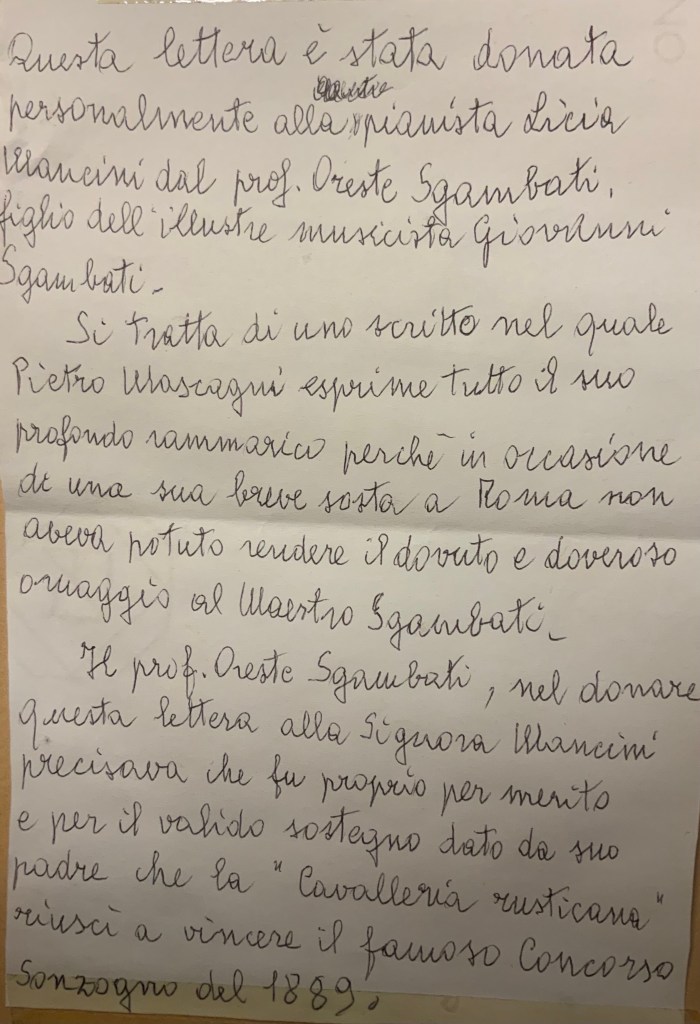
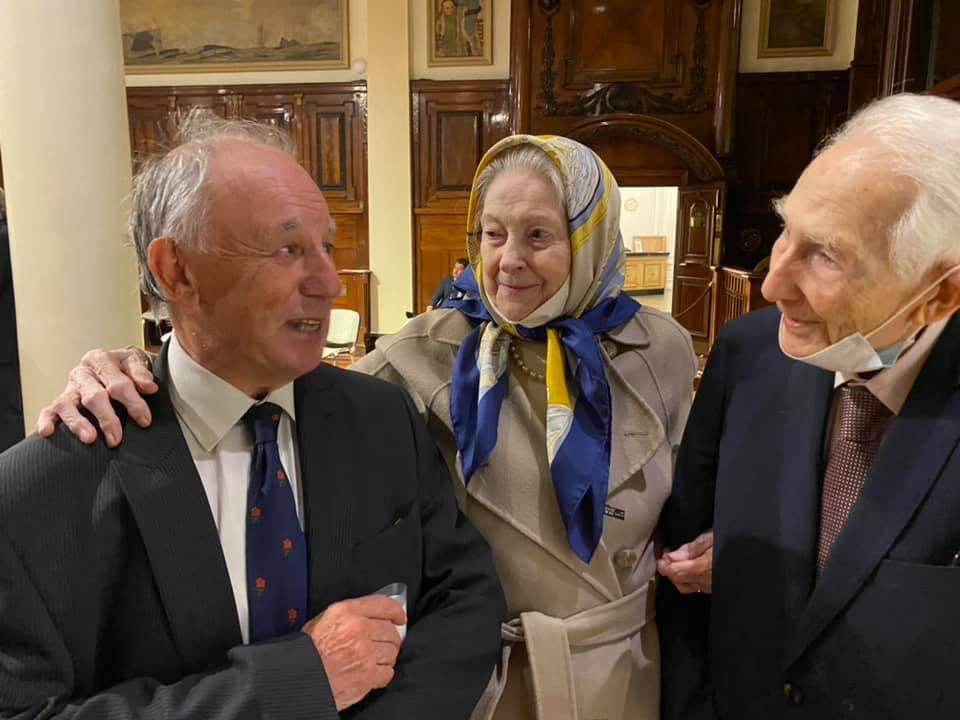
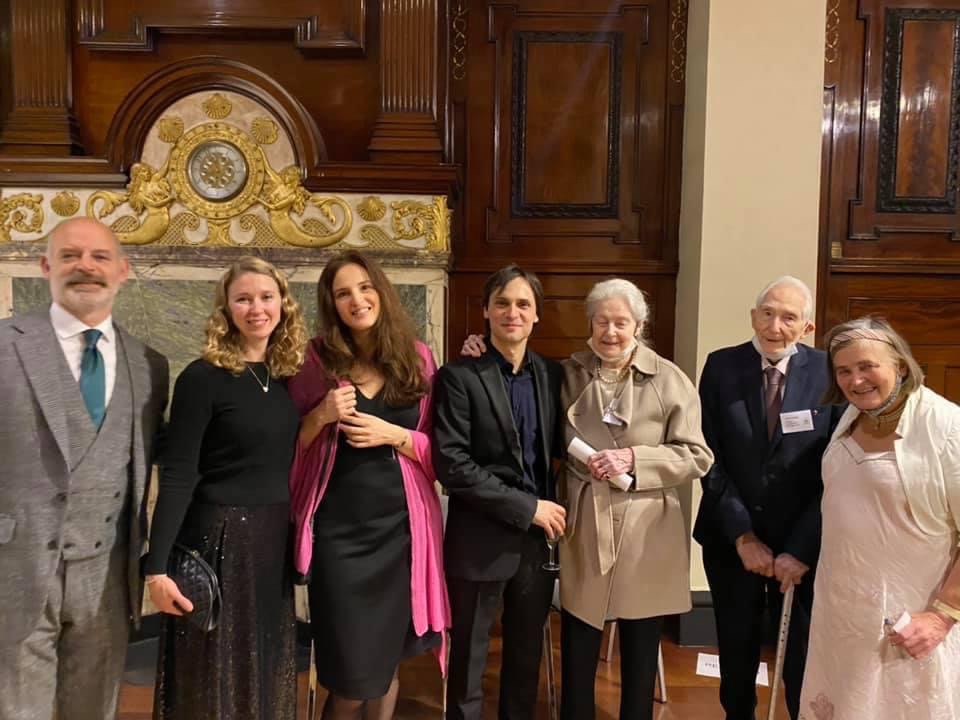
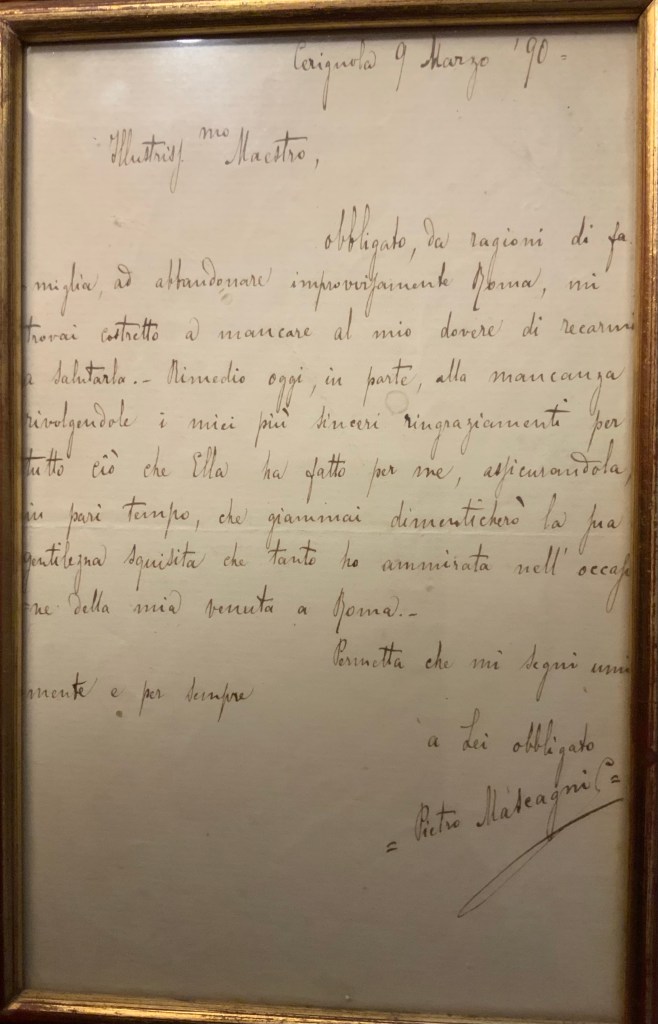
On the back of the letter of Mascagni that was given to me by our dear friend Licia Mancini,student of Guido Agosti who played many times in Siena for Giuranna and Brengola and also in the Ghione theatre in Rome.From Sgambati’s son in thanks to Licia’s father for helping his father win a competition in 1889 where Cavalleria Rusticana was born Geoffrey Schindler with Noretta and John LeechRichard and Elena Bridges – Katya and Sasha Grynyuk-Noretta and John Leech – Angela RansleyLeslie Howard with Noretta Conci LeechGeorge Fu with Noretta Roy Emerson – Simone Tavoni – Elena and Richard Bridges Thomas Kelly – Canan Maxton- Sarah Biggs – Alberto PortugheisMario S F Silva Brazilian cultural project manager with Simone,George and ThomasThe ‘boys’ from the KCTLetter from Mascagni that sits in my studio
Chopin: 4 Preludes from Op 28 nos 4,13,15,20 Chopin: Larghetto from Concerto no 2 in F minor Op 21 arr. by the composer
Chopin: Barcarolle Op 60
There were once a series of recitals in the Festival Hall with Polish pianists who would play simply and beautifully with weight and extraordinary legato.I am thinking of Malcuzinski,Niedzielski,Askenase,Smeterlin and the Prince of them all Artur Rubinstein. Since then we have been astonished by the subtle half lights of the Russian school as personified by the appearance in the 70’s of Richter and all that followed in his footsteps .But it was Richter who so admired Rubinstein for his ‘good old concert cantabile’and with whom he became a very close friend. It is a style of playing and projecting the sound that is hard to hear in the concert hall these days.Gilels was the only Russian who could project that golden sound with simplicity and beauty.
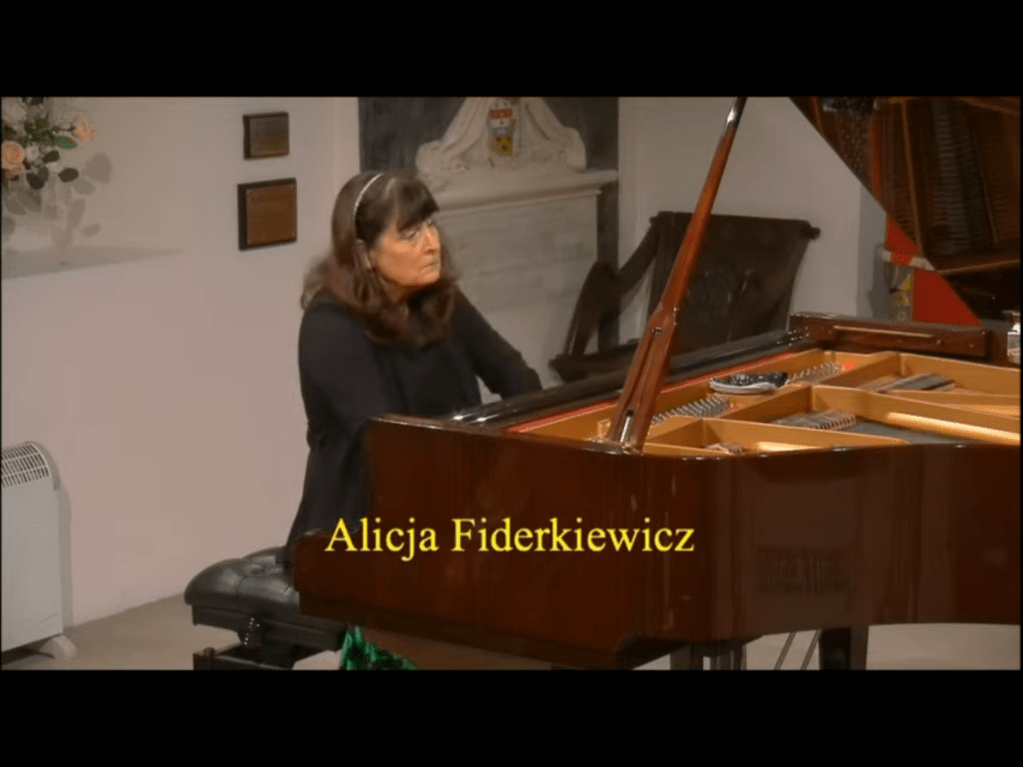
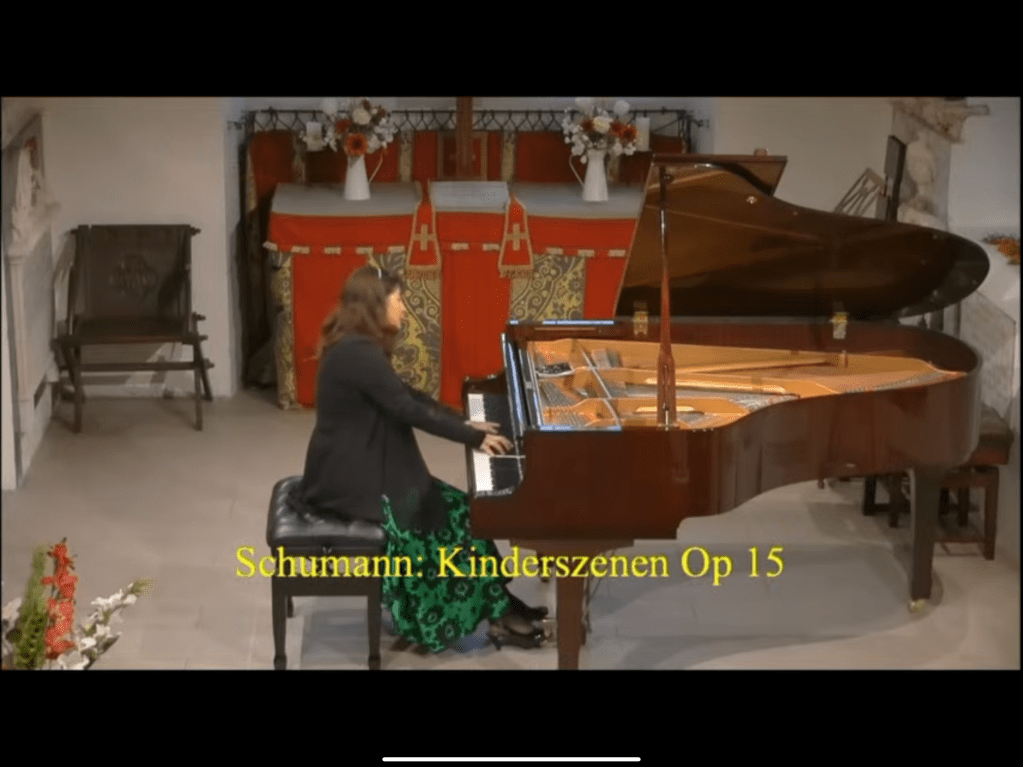
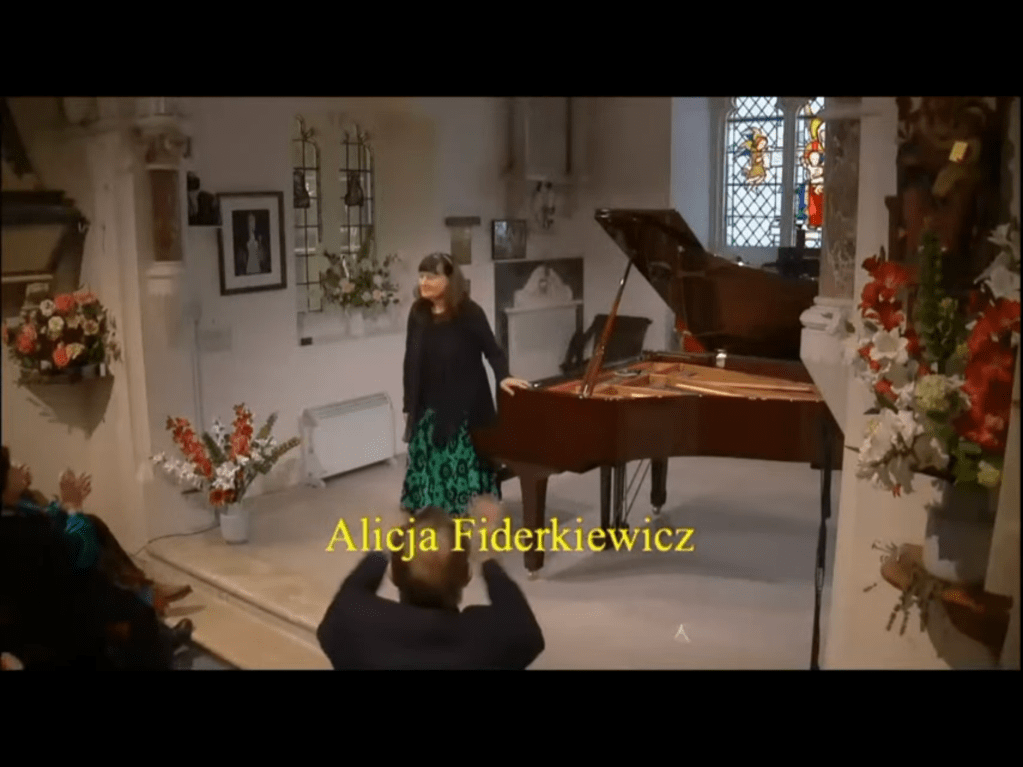
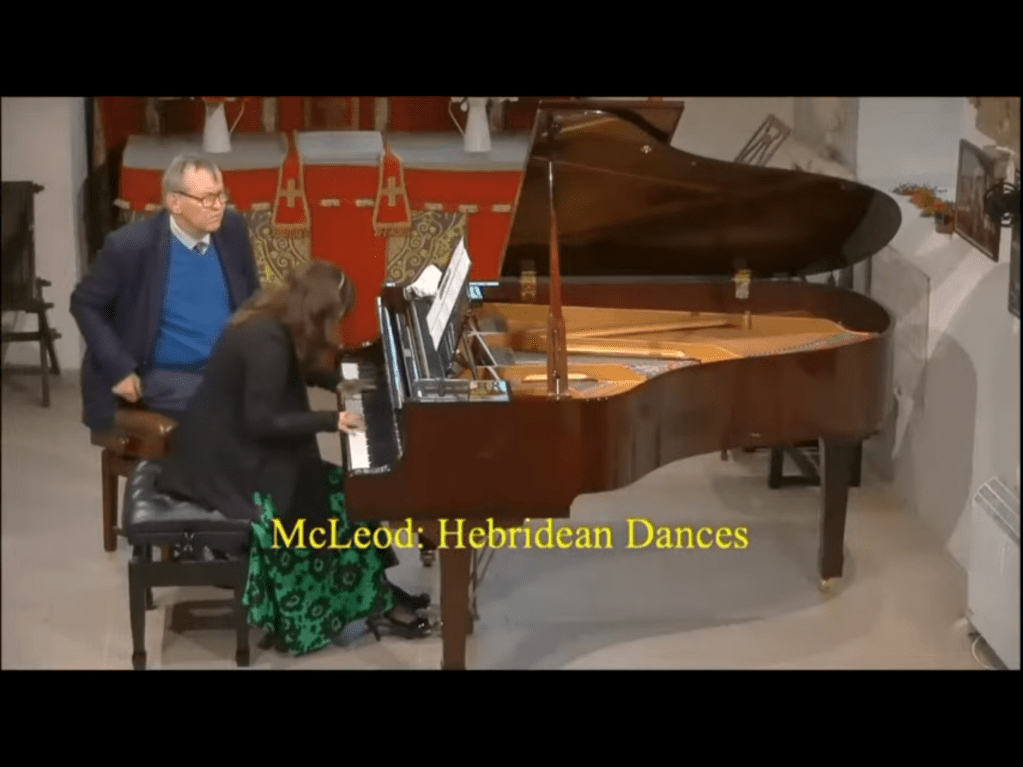
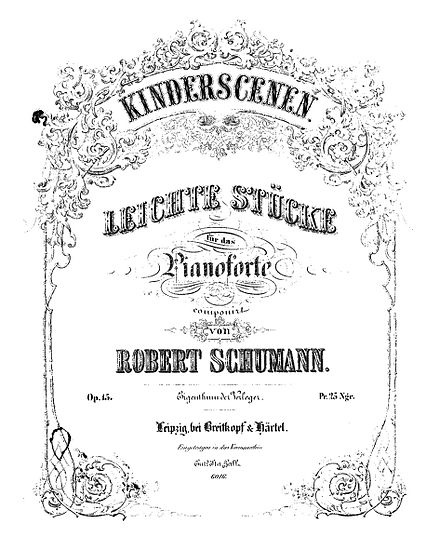
It is this sound that we were treated to today by Alicja Fiderkiewicz in a recital of such simplicity and beauty that reminded me of the concerts I once heard as a child. Kinderszenen was played in brilliant sunlight with a radiance and beauty that was touchingly direct. Even the McLeod Dances could well have been Mazurkas such was the same nationalistic nostalgia and celebration.
Four Preludes by Chopin were played with aristocratic poise with both delicacy and passion. I had no idea that Chopin had arranged the Larghetto for solo piano .I have heard the one with string quartet but this was every bit as beguiling.
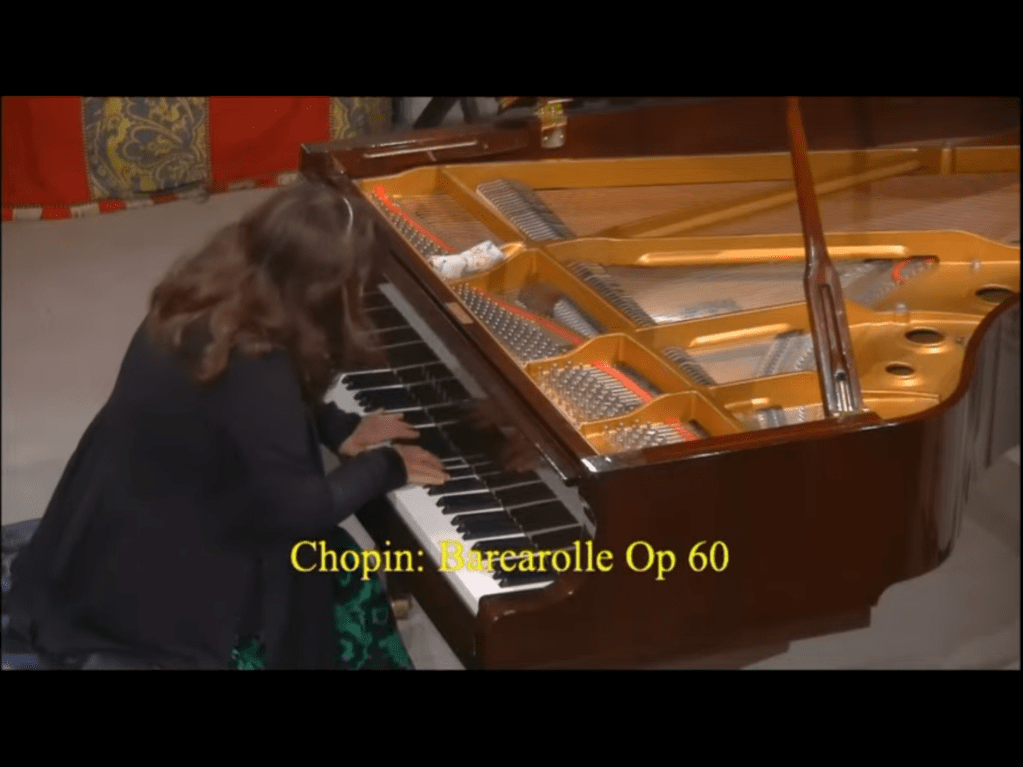
The Barcarolle is Chopin’s absolute masterpiece and together with Beethoven’s fourth concerto the greatest works for piano. An outpouring of song from beginning to end was given a memorable performance that had Dr Mather cheering from the front row as we were at home.
Performances from the great Polish school of simplicity and aristocratic beauty that was so refreshing to be reminded of.
Alicja Fiderkiewicz was born in Warsaw ,Poland and started private piano lessons at the age of six .A year later she entered Special Music School in Warsaw and two years later she was accepted into Central Music School in Moscow attached to Tchaikovsky Conservatoire .There she joined a class of Prof.Kestner and was privileged to play in front of Gilels,Richter,Nikolayeva.After returning to Warsaw six years later she continued her studies with Prof.Losakiewicz and Prof.Drzewiecki and in the next four years she won several national competitions including Chopin Scholarship for four years in succession and gave performances throughout Poland including Zelazowa Wola ,Royal Park,Warsaw Philharmonic Hall . Having graduated from Warsaw Alicja decided to continue her studies at the RNCM in Manchester with Prof.Bakst .During her studies there Alicja represented RNCM in major venues throughout the UK .She was also a winner and prize winner of several National and International Competitions and recipient of Calouste Gulbenkian Fellowship. Throughout her career Alicja appeared with number of major orchestras including Warsaw National Philharmonic,Halle ,La Scala – Milan, Camerata and worked with many world famous conductors.Apart from many engagements in this country Alicja performed in Poland,Russia,Ukraine ,Israel,Italy,Switzerland,Cyprus,Spain,Finland ,USA, Japan,Singapore ,Malaysia .She also appeared on BBC Radio and TV and recorded four highly acclaimed CD’s .Apart from performing Alicja is busy teaching ,giving Masterclasses and adjudicating in the UK and abroad and is frequent member of Piano Faculty and performer during Chethams International Piano Summer School.
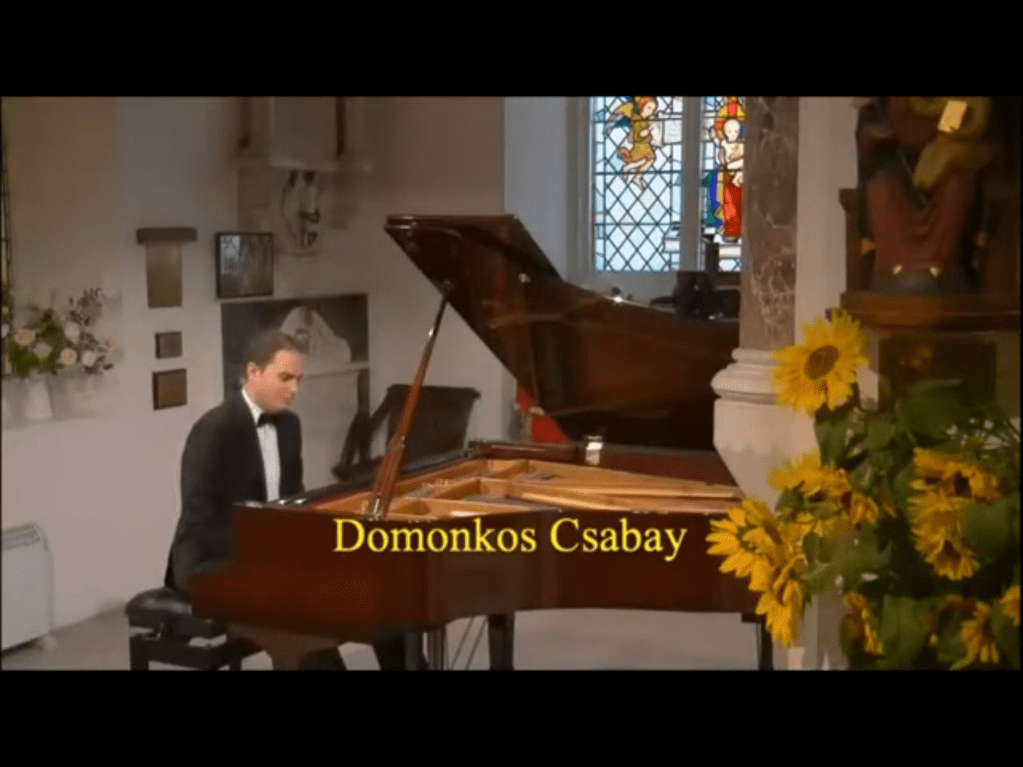
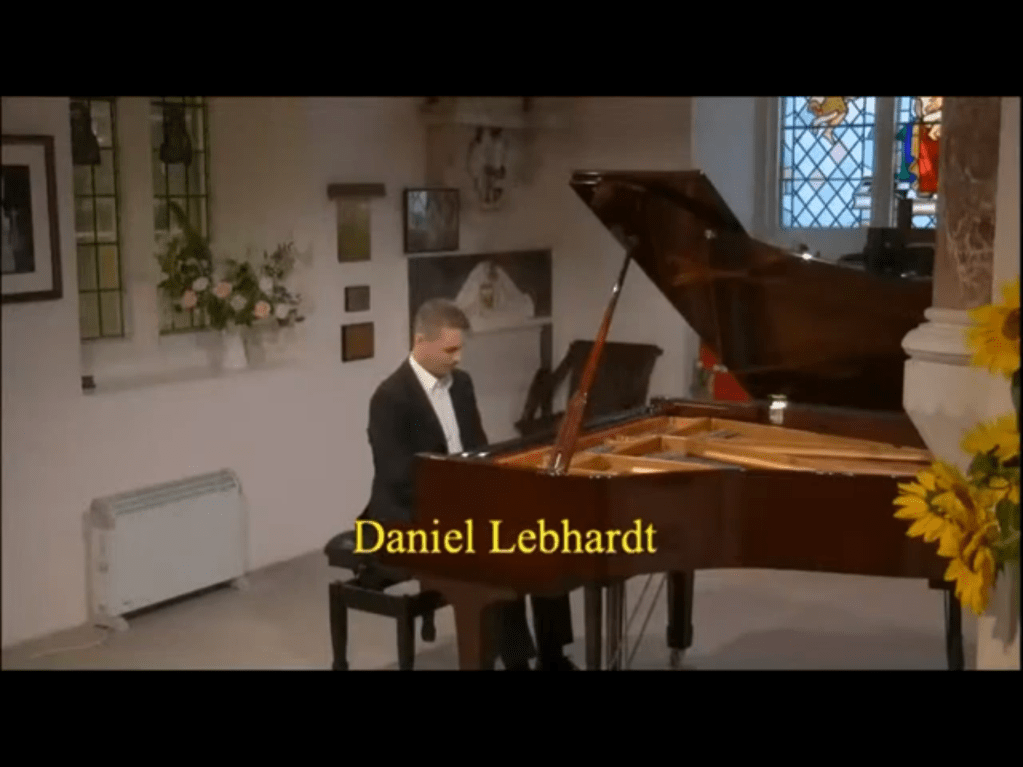
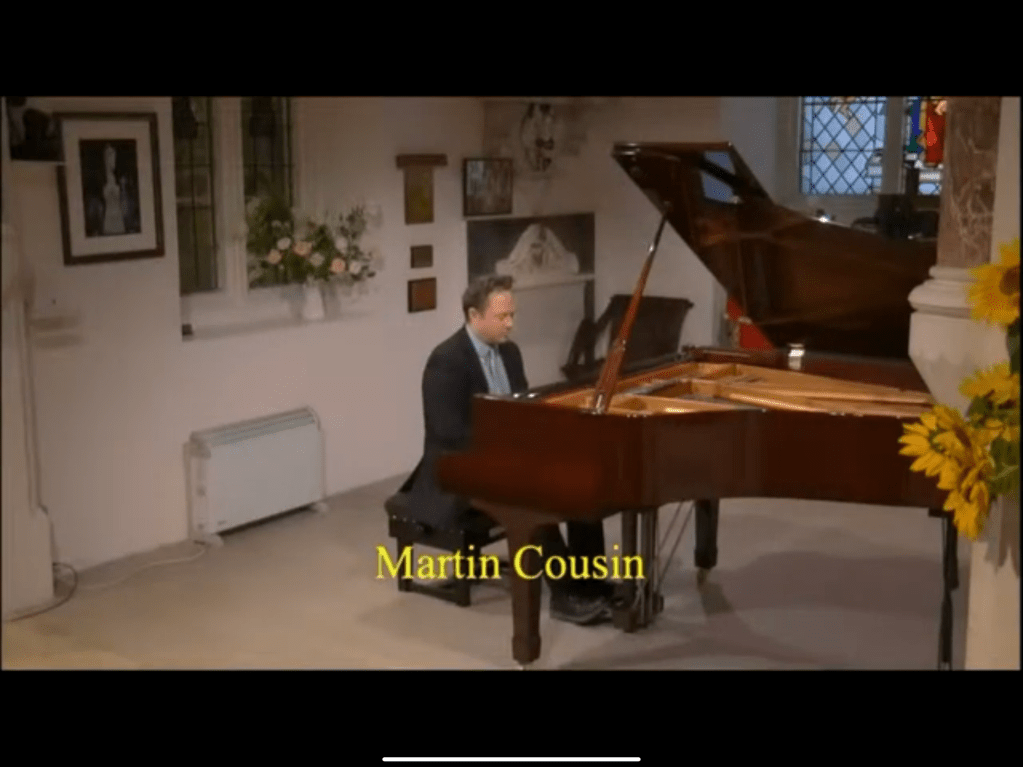
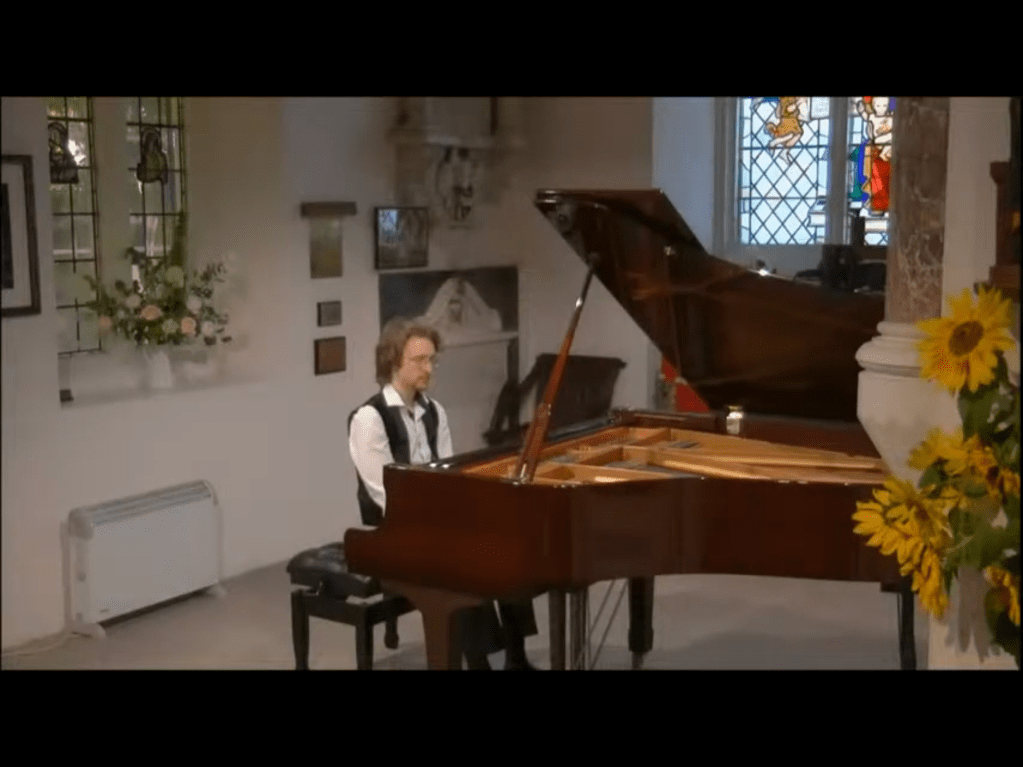
2.0 pmDomonkos Csabay Sonata in F minor Op 2 no 12.25 pm Daniel Lebhardt Sonata in A major Op 2 no 2 2.55 pm Edward Leung Sonata in C major Op 2 no 33.30 pm Martin Cousin Sonata in E flat major Op 74.05 pm Li Siqian Sonata in C minor Op 10 no 1 4.30 pm Mengyang Pan Sonata in F major Op 10 no 2 4.50 pm Roman Kosyakov Sonata in D major Op 10 no 3 5.20 pm Dinara Klinton Sonata in C minor Op 13 ‘Pathetique’ 5.45 pm Simon Watterton Sonata in E major Op 14 no 1
SESSION 2
SATURDAY EVENING
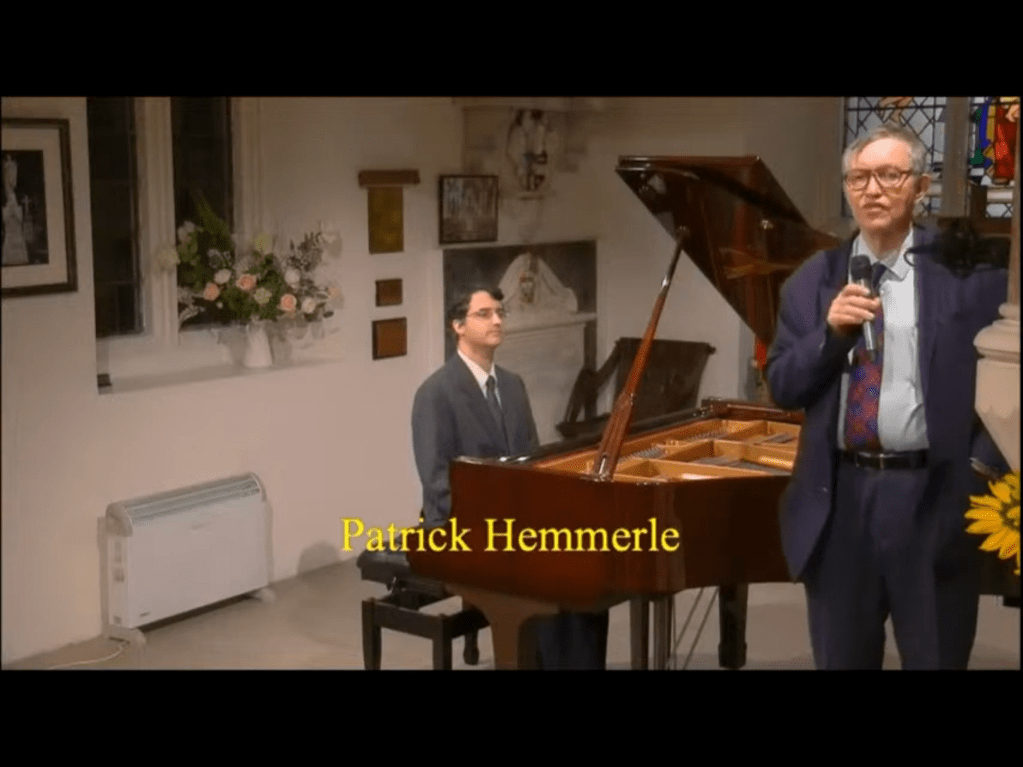
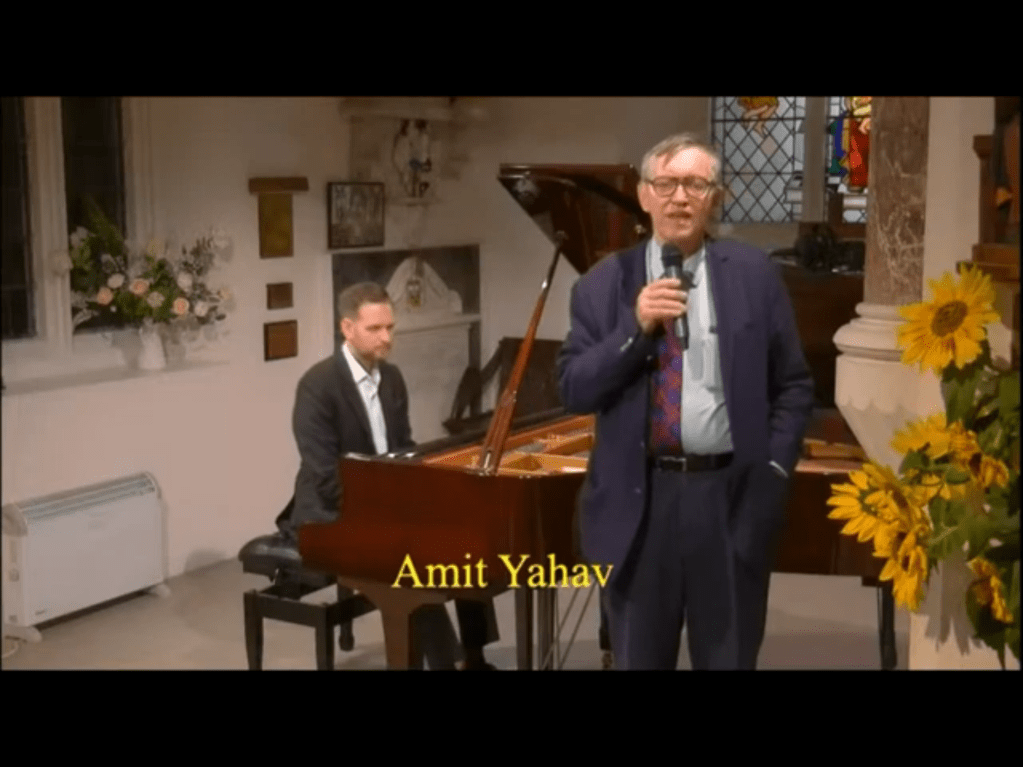
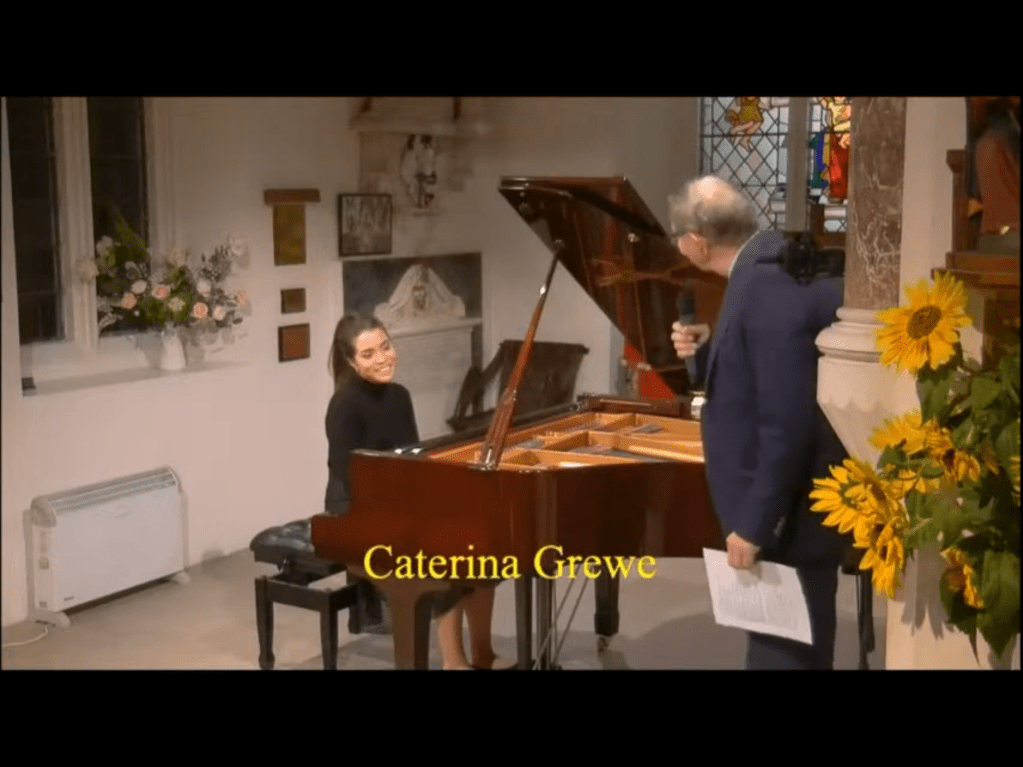
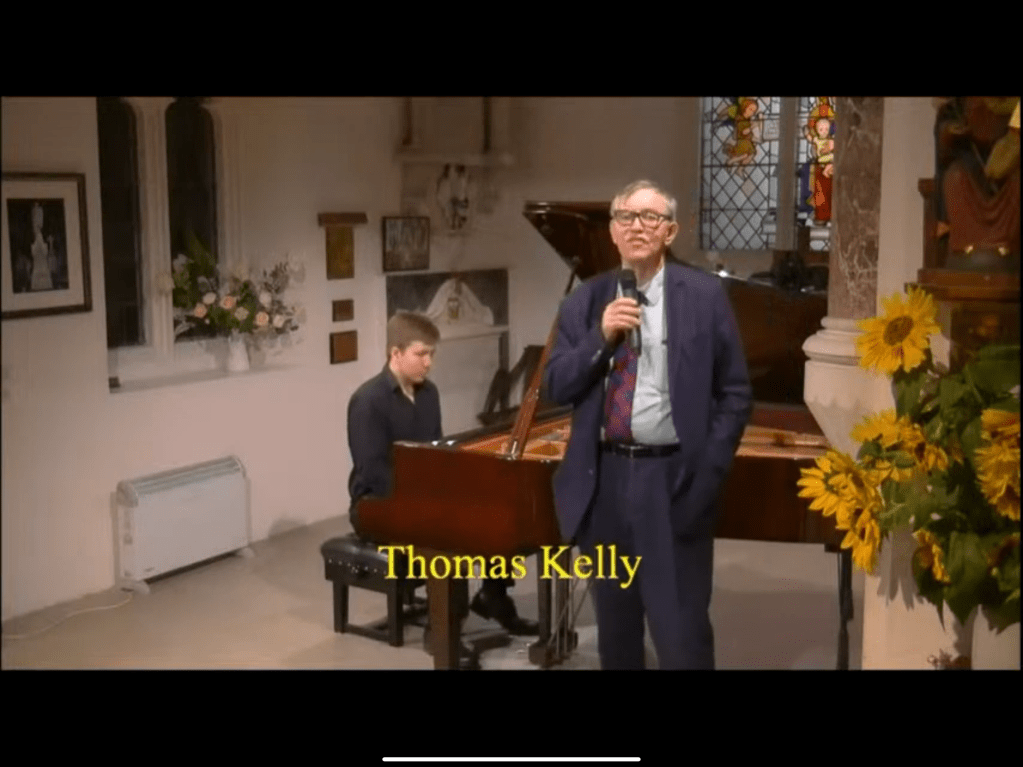
7.00 pm Konstantin Lapshin Sonata in G major Op 14 no 2 7.25 pm Patrick Hemmerle Sonata in B flat major Op 22 7.55 pm Amit Yahav Sonata in A flat major Op 26 ‘Funeral March’ 8.20 pm Leslie Howard Sonata in E flat Op 27 no 1 8.40 pm Caterina Grewe Sonata in C sharp minor Op 27 no 2 ‘Moonlight’9.05 pm Thomas Kelly Sonata in D major Op 28 ‘Pastoral’ 9.35 pm Petr Limonov Sonata in G major Op 31 no 1
SESSION 3
SUNDAY AFTERNOON
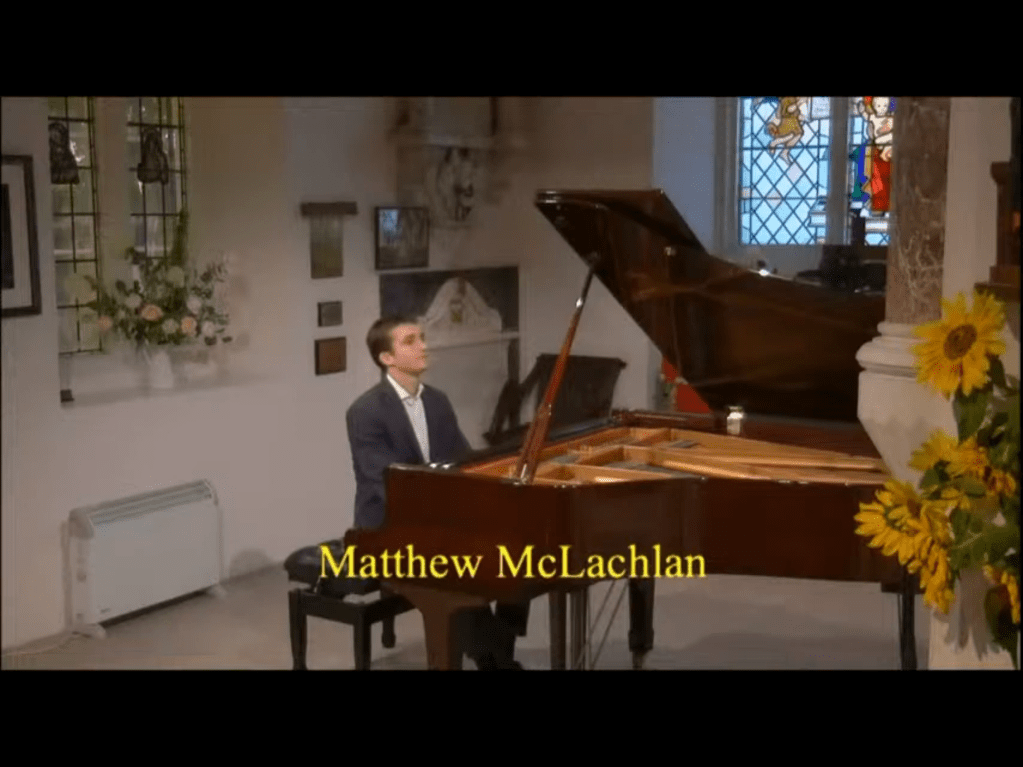
2.00 pm Ilya Kondratiev Sonata in D minor Op 31 no 2 ‘Tempest’ 2.30 pm Mark Viner Sonata in E flat major Op 31 no 3 3.00 pm Sofia Sacco Sonata in G minor Op 49 no 1 3.15 pm Gabriele SutkuteSonata in G major Op 49 no 2 3.30 pm George Todica Sonata in C major Op 53 ‘Waldstein’ 4.05 pm Andrew Yiangou Sonata in F major Op 54 4.25 pm Julian Trevelyan Sonata in F minor Op 57 ‘Appassionata’ 5.00 pm Matthew McLachlan Sonata in F sharp major Op 78 5.20 pm Olga Paliy Sonata in G major Op 79 5.35 pm Mikhail ShilyaevSonata in E flat major Op 81a ‘Les Adieux’
SESSION 4
SUNDAY EVENING
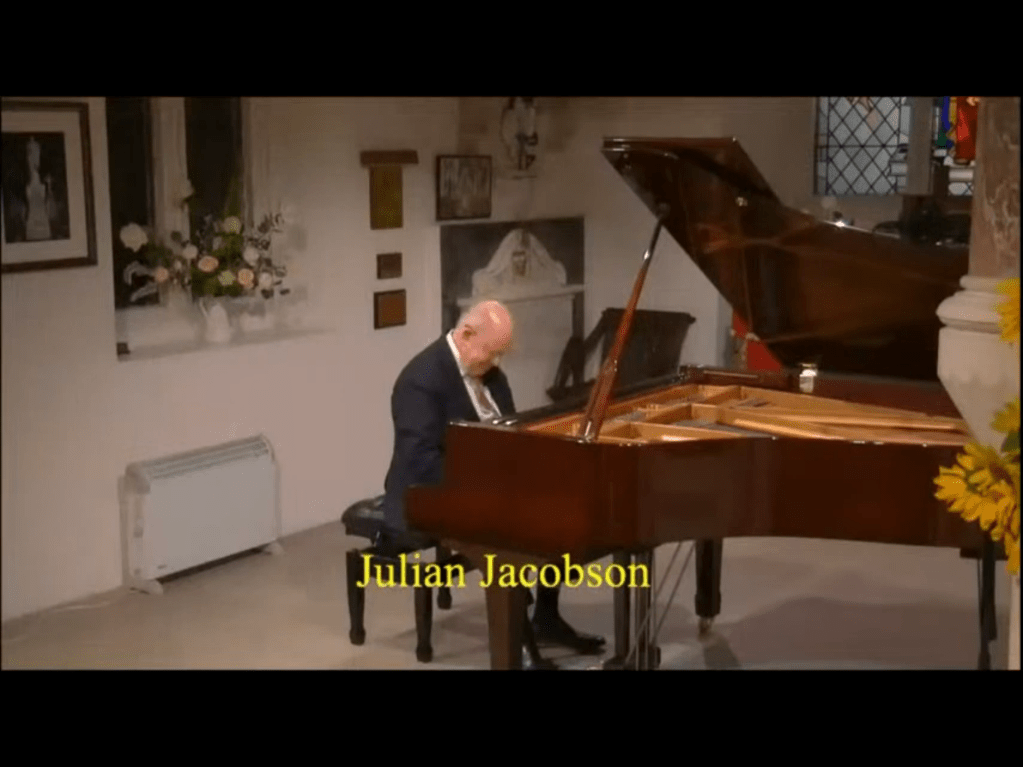
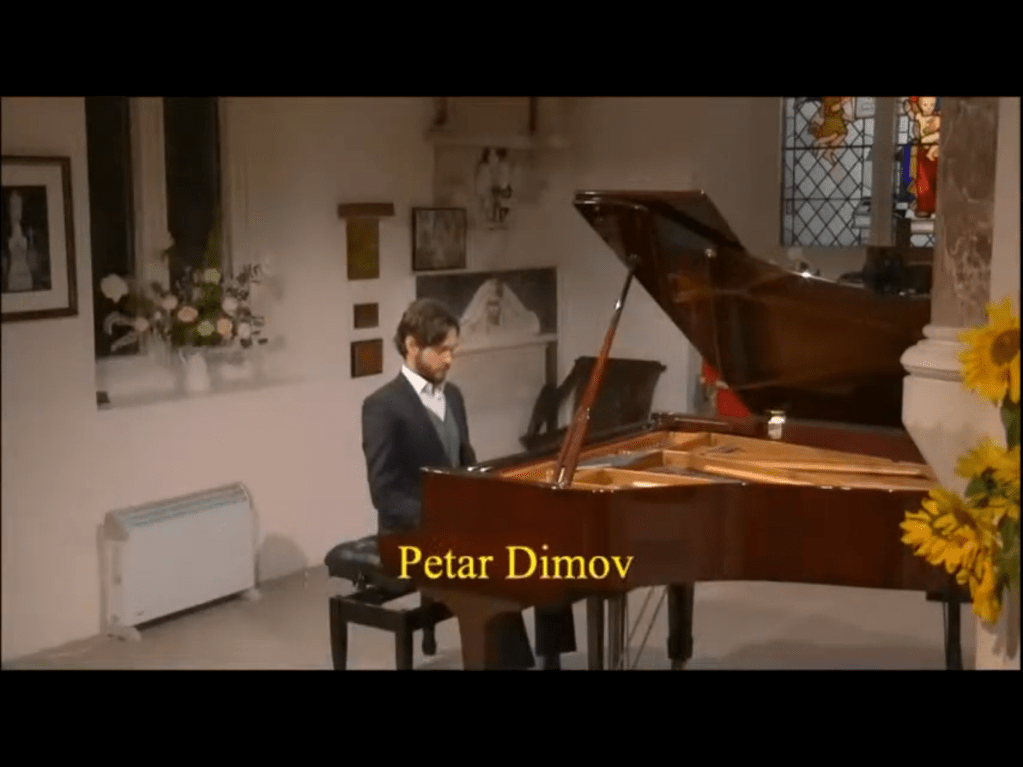
7.00 pm Callum McLachlan Sonata in E minor Op 90 7.20 pm Ben Schoeman Sonata in A major Op 101 7.50 pm Ariel Lanyi Sonata in B flat major Op 106 ‘Hammerklavier’ 8.40 pm Julian Jacobson Sonata in E major Op 109 9.05 pm Petar Dimov Sonata in A flat major Op 110 9.30 pm Sasha Grynyuk Sonata in C minor Op 111
Beethoven is alive and well and at St Mary’s Perivale this weekend thanks to Hugh Mather and his remarkable team. A wonderful array of talent celebrating the monument that is Beethoven’s moving journey from the cradle to the grave . 32 Sonatas with 32 Pianists …….or should I say musicians . It was the intelligence and beauty of music making that made this first half of the journey so absorbing. This is not the circus of a competition where there is a lottery to pick a winner. Each one of these carefully chosen pianists had something very special to say.
Starting with the first three pianists playing the op 2 set.By coincidence all students of Pascal Nemirovski at the Birmingham Conservatoire as was the pianist who played the last of the op 10 set. Domonkos Csabay and Daniel Lebhardt both received their early training at the Liszt Academy in Budapest – I was following with Liszt’s own edition of the sonatas that he orders in difficulty rather than chronologically.Both played with that youthful energy that is so much part of early Beethoven before the torments of life took root. Here are some brief notes of this fascinating journey :
Domonkos’s wondrous beauty in the trio took us by surprise as did the cloud of sound with which the Prestissimo entered in a performance of driving rhythmic energy and musicianly precision and clarity from the first to the last notes.
Daniel threw off the bel canto embellishments in op 2.n.2 with consummate ease and grace with Beethoven’s rude interruptions making such contrasts and a Largo appassionanto of orchestral proportions.
Edward Leung played the much more imposing op 2 n 3 with a sense of colour and shape that made the overall architectural shape so clear.He studied in Princeton before Birmingham and he played the Scherzo with fleeting lightness and the Allegro assai with beguiling colour and character.
Martin Cousin brought the important Sonata op 7 beautifully to life with his mature musicianship and intelligence -the Sonata that Michelangeli made his own was every bit as imposing today as in the great Master’s cool hands!This with op 2 n.3 and op 10 n.3 are Sonatas where the important world of Beethoven is beginning to open up new horizons bringing new light and sense of direction to those of Mozart and his teacher Haydn.
Op 10 n 1 was played by Li Siqian with an astonishing sense of precision and balance with an Adagio molto of wonder and beauty.
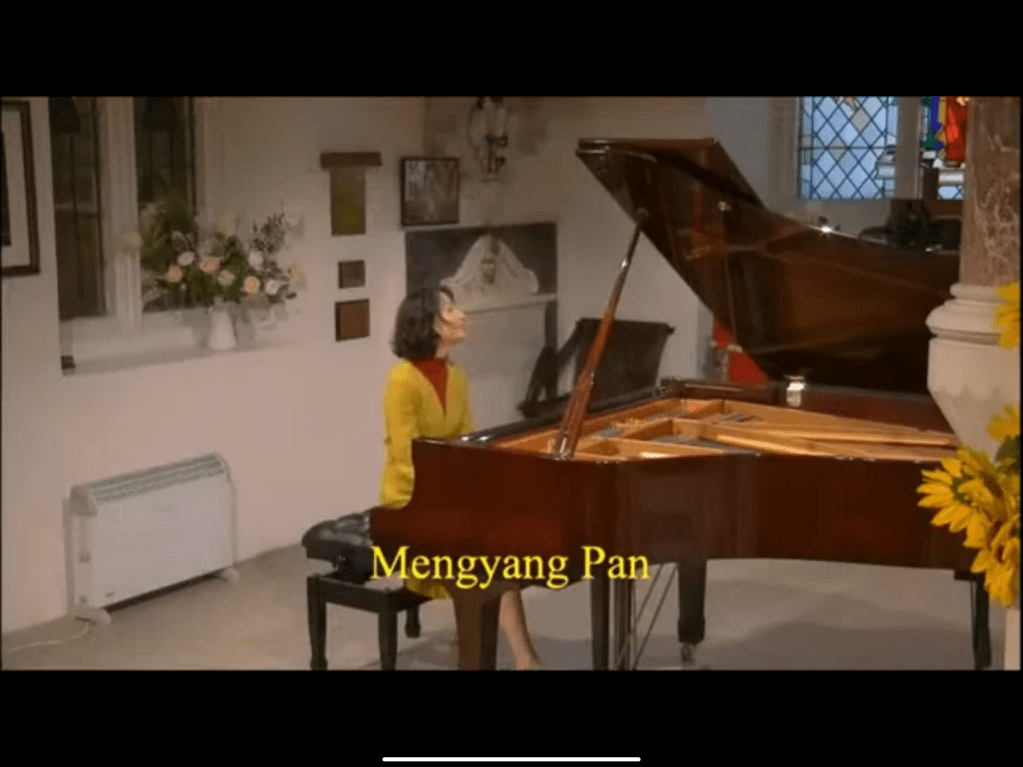
The precision and rhythmic energy that Mengyang Pan brought to op 10. n.2 were every bit as remarkable as Glenn Gould who first brought this Sonata to our particular attention.A beautifully mysterious Allegretto very individually played with the Trio section so similar to a Schubert Moment musicaux made a beautiful contrast to the astonishing unrelenting bravura of the Presto.
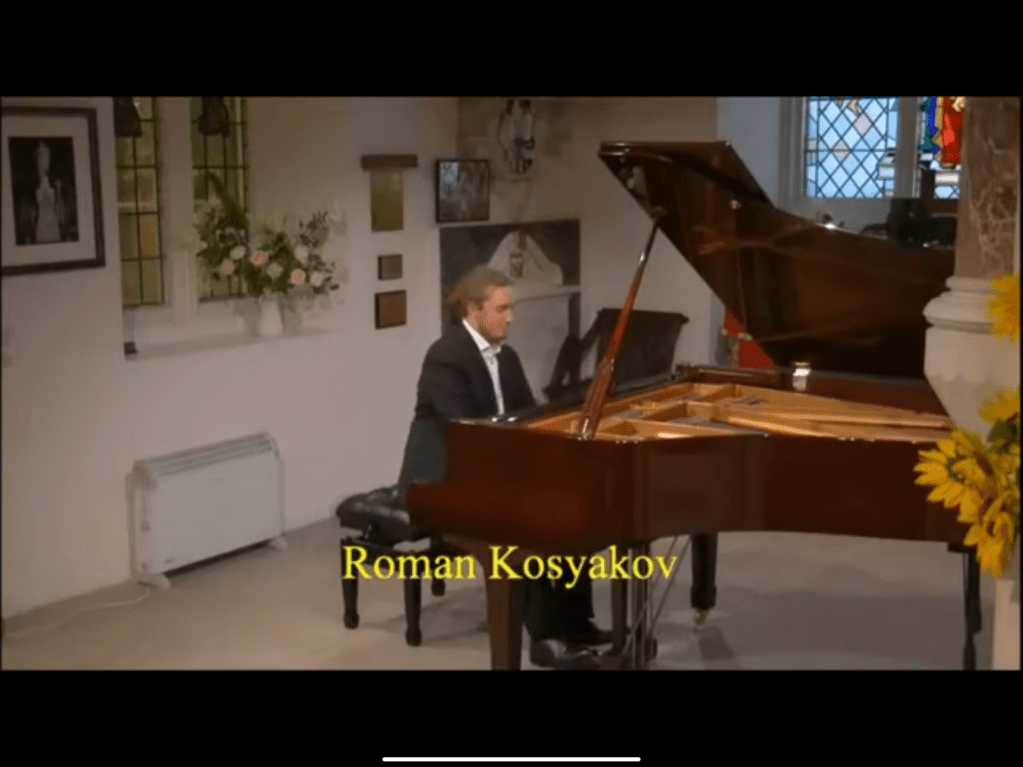
Roman Korsyakov, another student of Pascal Nemirovski,gave a masterly account of the much more imposing op 10.n.3.Interesting to see his Russian edition edited by Goldenweiser( the great teacher of Nikolaeva and Lazar Berman ) where the acciaccaturas of the first movement are played as appoggiaturas – I must consult the new Barenreiter urtext edited by Jonathan Del Mar,Leslie Howard and Julian Jacobson.( It was Julian Jacobson who wrote the fascinating programme notes to this series). Op 10.n.3 is already pointing to the direction of the great sonatas of Beethoven’s maturity.A monumental performance of the great Largo e mesto followed by the charm and grace of the Menuetto and trio before the enquiring and searching Rondo allegro played with the same precision and detail as I remember from Perahia a few years ago.
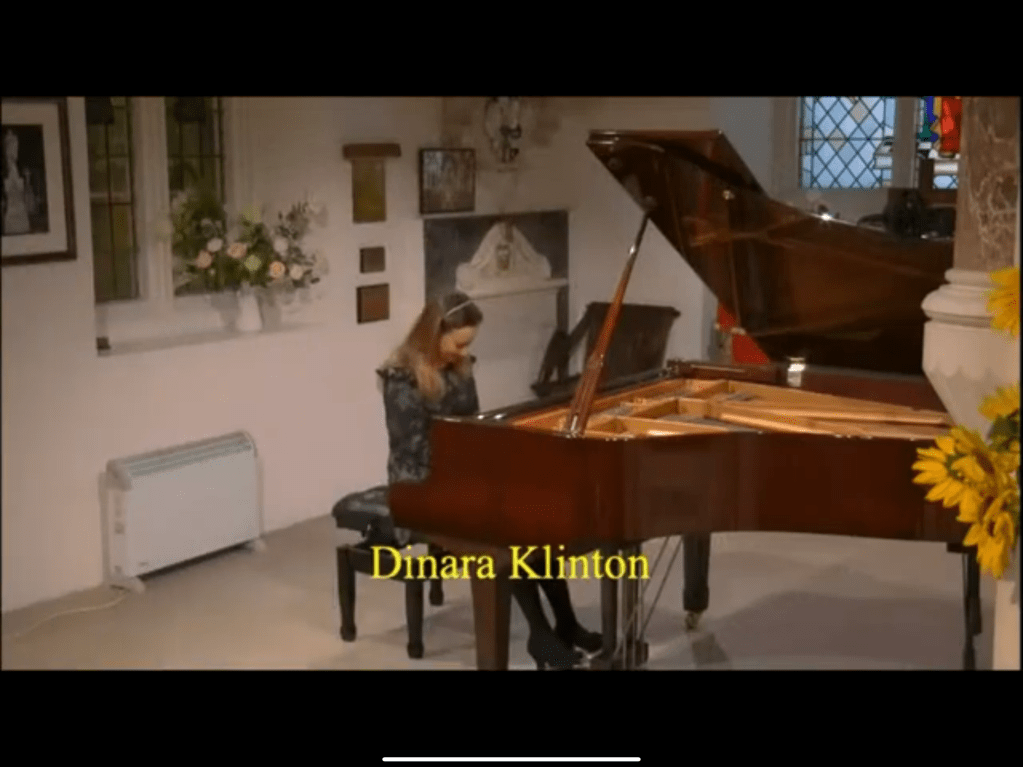
The sonata op 13 that follows is the famous ‘Pathétique’ and it was played with ravishing beauty and superlative technical control as you would expect from the hands of Dinara Klinton.Suffering from an artrosi of the neck she played with the consummate artistry of the great artist that she undoubtedly is.
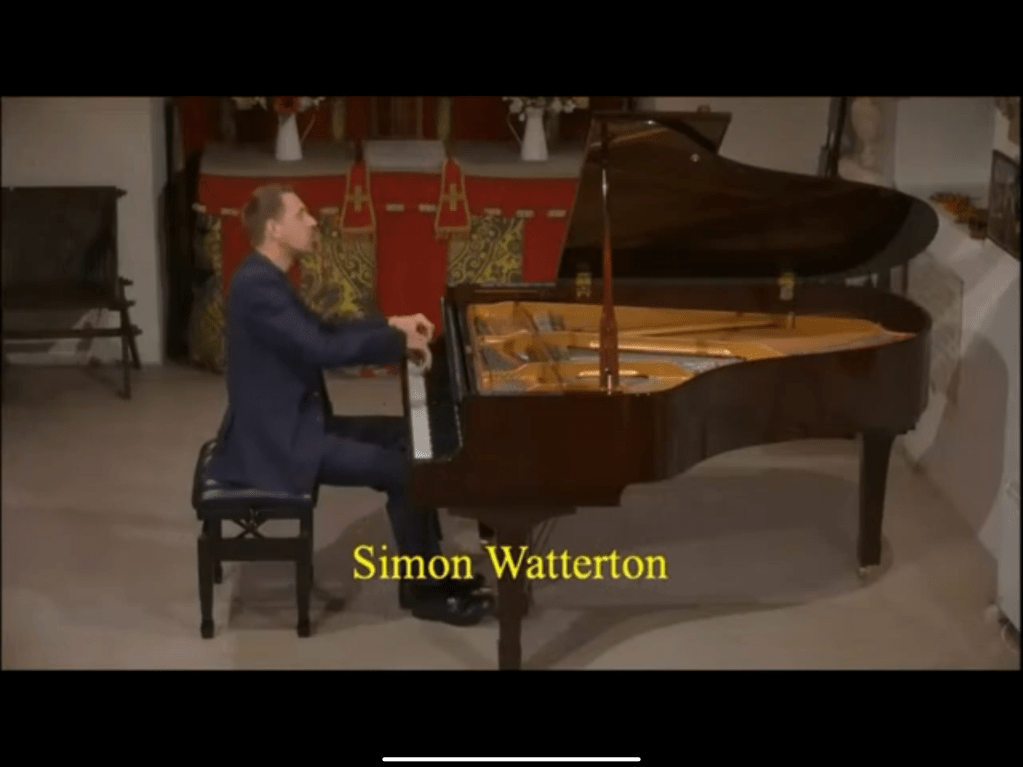
Simon Watterton a top prize winner of the Royal College a few years ago mentored by the much missed Yonty Solomon finished this first session with the first of the two sonatas op 14.They were sonatas often played by Sviatoslav Richter and Annie Fischer who realised the absolute perfection of these two unexpected jewels.Simon,with his great musicianship showed us all the charm and originality of the E major sonata and he tells me tomorrow he is playing another four sonatas in the 7th of his complete Beethoven series in Walton on Thames.
Konstantin Lapshin opened the evening session with the other op 14 Sonata in G.This even more than it’s sister is a perfect jewel that from the very first notes was played with an exquisite delicacy and sense of balance that was remarkable.The andante and variations were played with a tantalising sense of style with subtle contrasts between the plodding opening and extreme legato of the mellifluous episodes .The Allegro vivace too was played with great charm and grace where Beethoven bursts into irresistible song much as Schubert in his Sonatas. Life is still good for the young Beethoven at this point.
Patrick Hemmerlé was now to take us into the new world that was opening up for Beethoven with his Sonata op.22 .Played with the ease and mastery that we have appreciated recently with his performances of the complete Etudes by Chopin not to mention his extraordinary performance of Rudepoema written for Rubinstein by Villa Lobos (whose live recording from the Museum of modern art in New York is strangely cut off mid performance for this impossibly difficult and ungrateful piece) Patrick and Thomas Kelly ( op 28) are two of the most inquisitive musical minds that I know and have teamed up to play at Clare College in Cambridge to explore works from a vast almost unknown piano repertoire.It was exactly this sense of wonderment and discovery that they brought to the Sonatas op 22 and 28 today. Patrick brought his extraordinary musicianship,sense of balance and architectural understanding to a Sonata that I first heard from Richter.A critic said the slow movement was in existent as he played it so quietly we were not yet acclimatised to this school that delved deep into the world of half lights from mezzo forte down to pianississimo.Today Patrick played the Adagio con molto espressione with a wondrous sense of balance – multi coloured and sensuous even – as it unwound before the tempestuous Trio and mellifluous Menuetto and almost Schubertian Rondo.
Amit Yahav brought beauty and charm with an extraordinary sense of detail to the Andante and variations opening and great drama to the Funeral March from which this sonata op 26 takes its name .The Allegro floated in and out with a fluidity and enviable agility.
A message from The Ingesund Piano Academy in Sweden summed up the performance of Leslie Howard: ‘such mature masterful playing ‘. His op.27 n.1 was played by this remarkable musician with simplicity and intelligence the same that was so admired by Guido Agosti when a young man played op 101 to this legendary pupil of Busoni in Siena .Now a legendary figure in his own right ,as Hugh Mather rightly said ,he has been responsible for the new Urtext edition not only of the Beethoven Sonatas but also a long overdue Urtext of Liszt B minor Sonata (having recorded all the works of Liszt on 100 CD’s).His performance of Beethoven showed off his subtle use of pedal and scrupulous attention to phrasing that brought this masterpiece vividly to life.
Caterina Grewe had the task of playing what is Beethoven’s much loved but often totally misunderstood ‘Moonlight’Sonata.Who has not ‘had a go’ at the first movement dreaming of the moonlight that Beethoven never contemplated .Here Caterina restored it to its true astonishing originality.A first movement Adagio sostenuto!Yes but played in two not four that allowed the melodic line to shine out in all its architectural glory rather than being submerged by the triplet accompaniment .A charmingly mellifluous Allegretto and trio was interrupted by the tumultuous Presto agitato played with astonishing rhythmic impetus and authority.
Thomas Kelly fresh from his triumph at Leeds showed all his natural gifts in the ‘Pastoral’ Sonata op.28. His liquid sound world so suited to this most Schubertian of Beethoven’s Sonatas.If the repeated D’s in the bass could have been more measured it is after all Beethoven’s heart beating so happy and contentedly and only accompanying the melodic line that was so movingly shaped .The Andante,one of Beethoven own favourite works, was played with wondrous sounds and contrasting sense of character.
Petr Limonov’s astonishing natural gifts gave such shape to the first of the three sonatas op 31 which closed today’s survey.His superb natural musicianship allowed the beautiful bel canto Adagio grazioso to be shaped with such colour and wonderful detail before the superb technical brilliance of the Rondo Allegretto
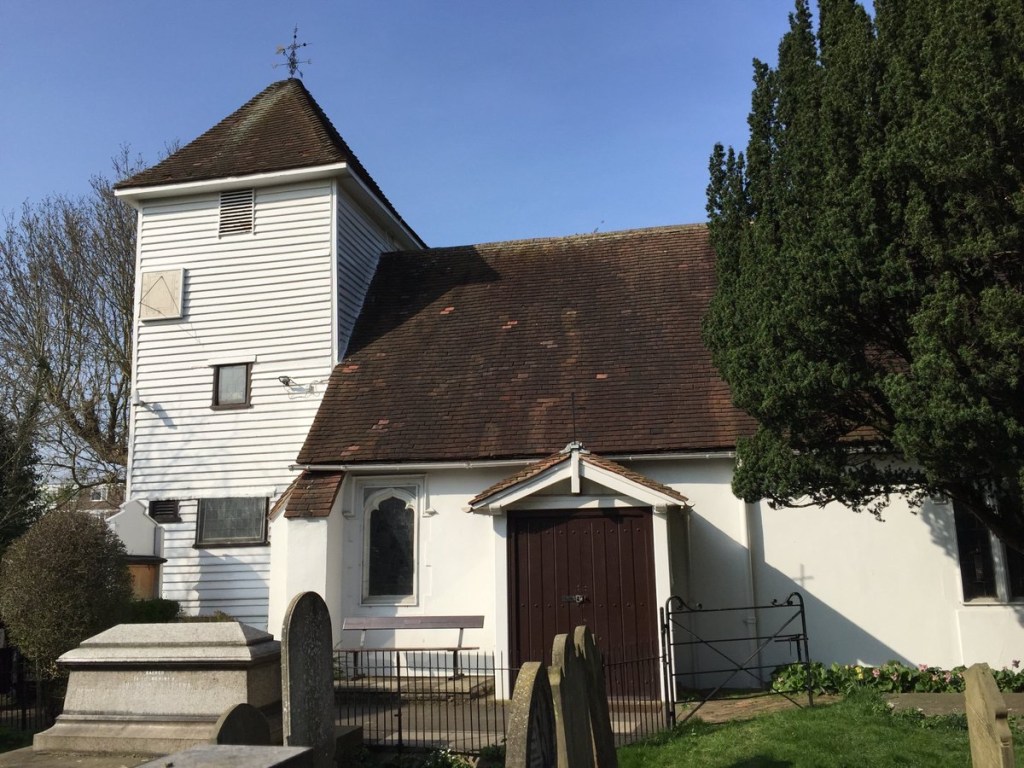
Beethoven in Perivale day 3 It was a beautiful clear day with the sun streaming in through the stained glass windows of this beautiful redundant church.Situated in an oasis of greenery just a stone’s throw from the centre of one of the busiest cities in the world.
Yesterday the first sixteen of Beethoven’s output of thirty two sonatas finished awash in one of those rainy days that London can so often boast. Strangely enough the curtain opened on this second day with the ‘Tempest’ Sonata for the second half of the Sonata cycle that has seen some of the finest young musicians partecipating with such enthusiasm and inspiration. But it was above all the superlative playing that Hugh Mathers fifth cycle series had inspired and encouraged that was so stimulating. As Dr Hugh Mather exclaimed it is so much more interesting to hear a cycle with 32 pianists than the more usual one man cycle. Nothing is taken for granted as each one of these young masters approaches a sonata with their unique personality and musicianship. It was indeed as Rubinstein had told the young musicians at his first competition in Israel: A musical personality likened to the work of a bee,each one collecting what attracts him to make their own unique honey. It was this continual change that was like looking afresh through a prism at these works that we have lived with for a lifetime. I think it should also be said that it gives a professional engagement and a worldwide streamed platform to thirty two wonderful players,most at the start of a very uncertain career in these difficult times.
Why does a retired physician take on such an enormous task with three concerts a week plus these special event cycles? I remember hearing Maria Joao Pires in Oxford playing Mozart Double Concerto with Julien Brocal a young aspiring pianist who at a competition in Monza had asked me advice about what he should do next to advance a career in music.I went backstage to thank Madame Pires for all she is doing to help these young musicians. ’What I am doing for them!’ she exclaimed ‘it is what they do for me!’ It is this spirit that hovers over St Mary’s and inspires not only the young musician but also the team of retired professionals all working to achieve excellence. And excellence there was again today with the Sonatas from op 31 n.2 to the final op 111.Each individually shaped and tailored,played with intelligence and beauty but above all a professionality that would be the envy of any of the great concert halls in the world. Here are a few notes that I hasten to point out are only my personal opinion – nothing is written in stone but my comments are made with great admiration and not a little knowledge I might modestly add! Blowing my own trumpet as indeed a basset horn used to do more than a century ago.It was Bernard Shaw who used to sign his musical criticism in that way!Could it have been to avoid a black eye?
One might very well say that the curtain opened with Ilya Kondratiev’s theatrical performance of the Sonata op 31 n.2.Every note enacted as he lived every moment of this remarkable Sonata from the mysterious opening Largo to the dramatic recitativi and sumptuous Adagio and beguiling Allegretto.The atmosphere he created using Beethoven’s own revolutionary long pedal points created a magic broken only as he unleashed the Allegro in the opening movement.A superlative technical control and ravishing sense of colour brought this great drama vividly to life.
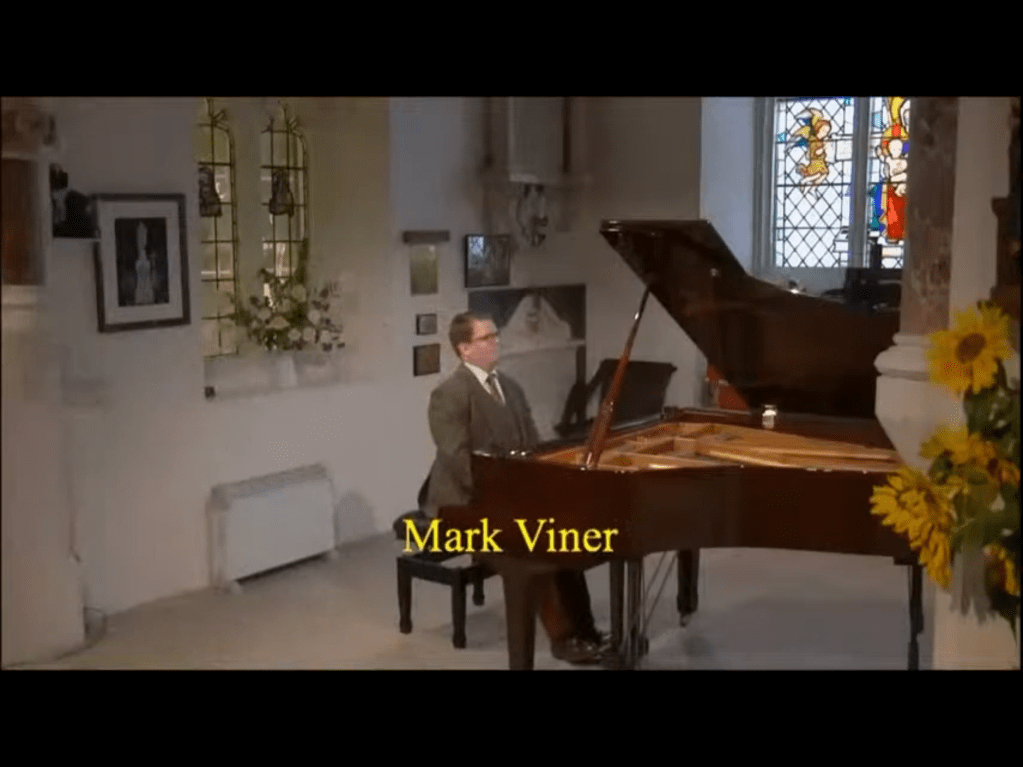
Mark Viner,fast making a great name with his recordings of Thalberg,Alkan,Blumenfeld,Chaminade and many others,tells me he has now been bitten by the Beethoven ‘bug’ which was immediately evident from his superlative performance of op 31 n.3 ‘The Hunt’.A Sonata that I remember Artur Rubinstein including in the last recital of a long career in the Wigmore Hall in 1976.Mark has a refreshing way of delving deep into the score taking nothing for granted as he bring the music vividly to life with such intelligence and superlative technical control.Had I heard his ‘Appassionata’ he asked?Unfortunately not but I certainly will seek it out after hearing his performance of ‘The Hunt’ today.Such a pastoral feel to the opening movement with a driving rhythmic energy and subtle sense of phrasing.The Scherzo was played with the same drive and irresistible lightness that I remember from Rubinstein.There was ravishing tone in the Menuetto but I am not sure about his change of tempo in the Trio ( used by Saint Saens for the theme of his variations for two pianos).The Presto con fuoco was indeed ‘The Hunt’ played with superb technical control and drive and we even discussed together with Dr Mather the fingering of some treacherously difficult passages.This sort of friendly discussion with the artist must be unique to this venue and was to lead to a heated debate later about the opening of the’Hammerklavier’ or op 111 – these are not play safe Sonatas!He who dares to venture into this territory is not for someone with health and safety regulations in mind!
A young pianist from Padua -Sofia Sacco- perfecting her studies at the Royal Academy with Rustem Hayroudinoff gave a ravishing performance of the op 49 n.1 sonatina.Played with such musicality and character.We all remember it from piano lessons but when played like this it is unjustly excluded from the concert hall.
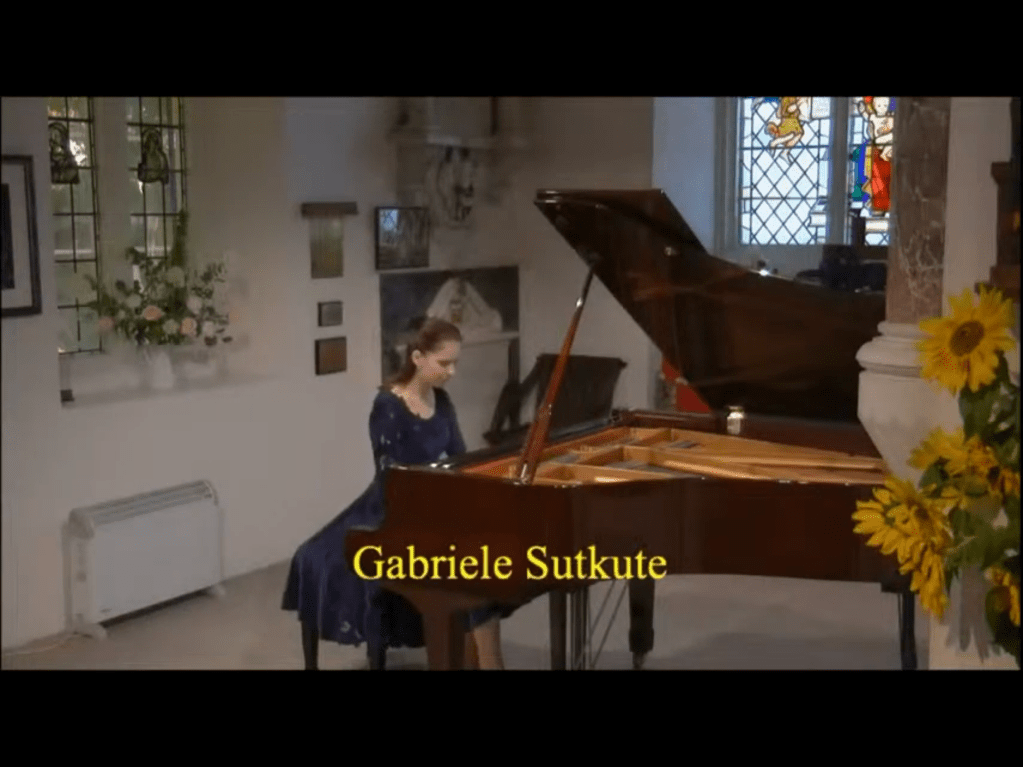
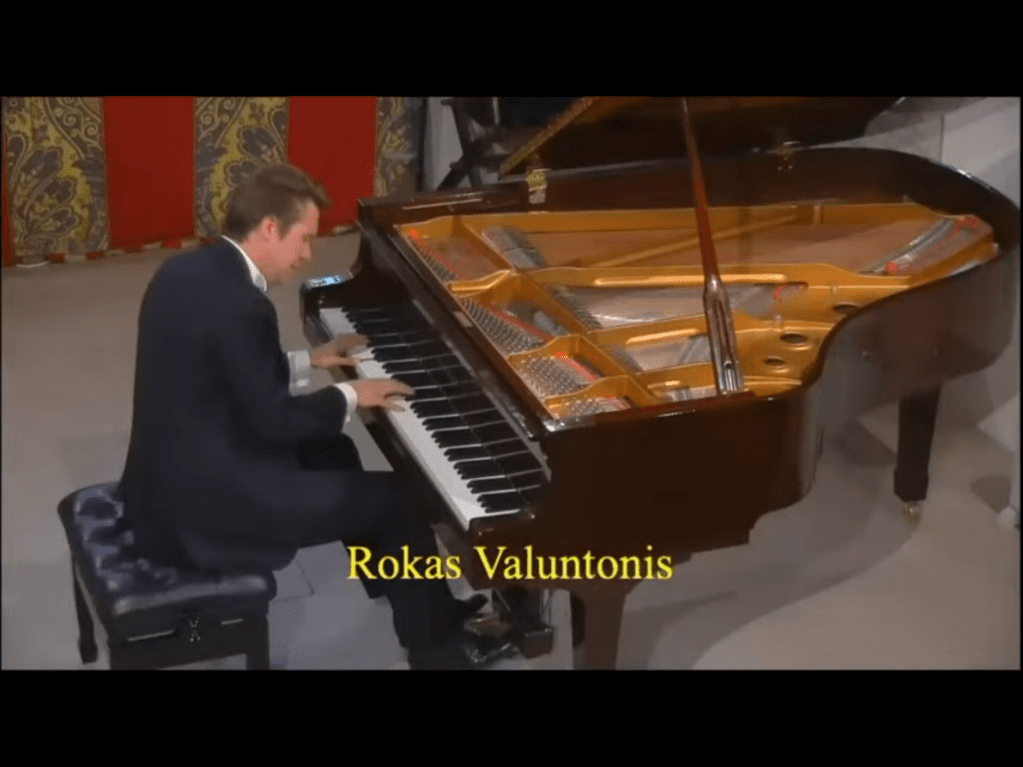
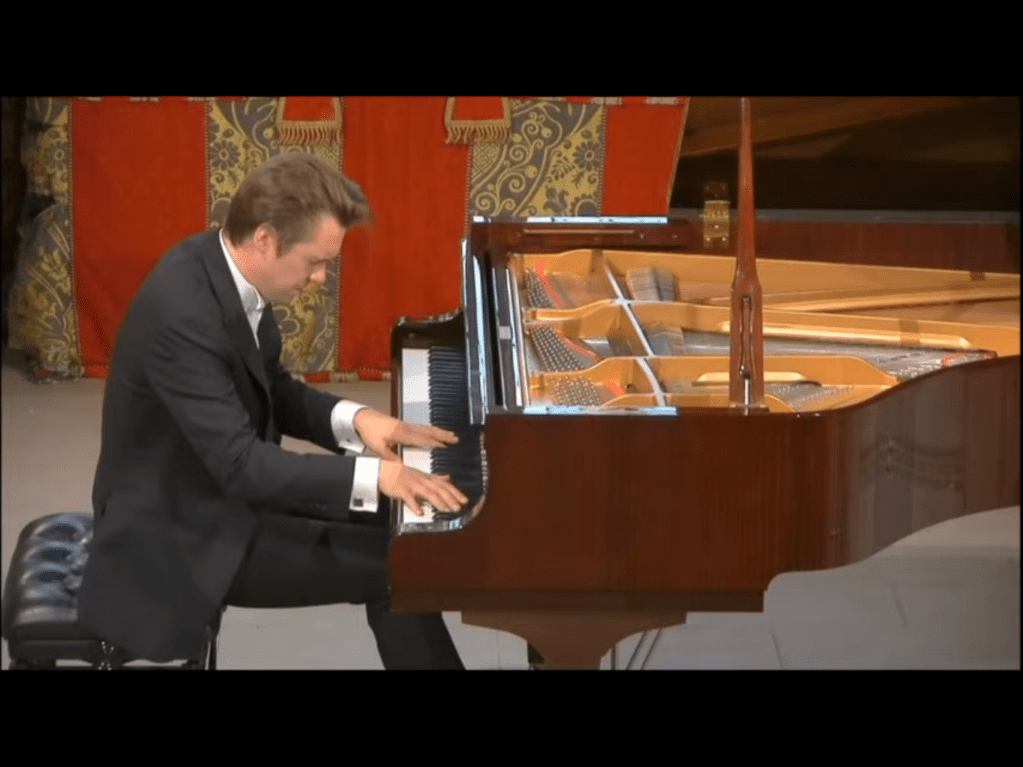
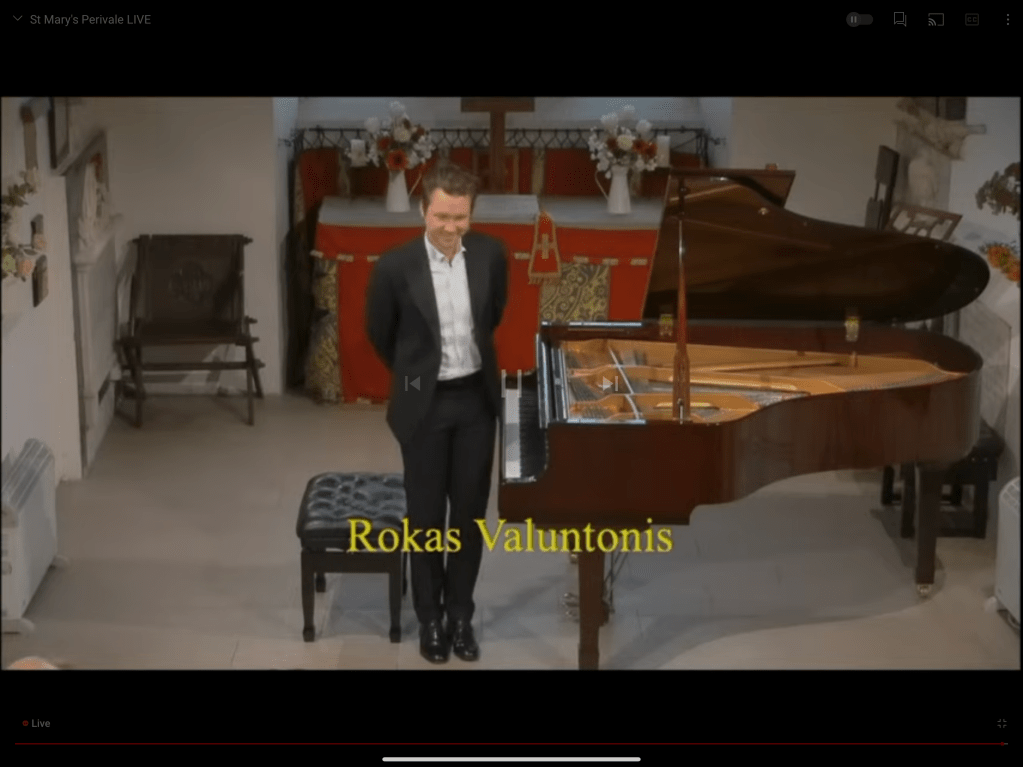
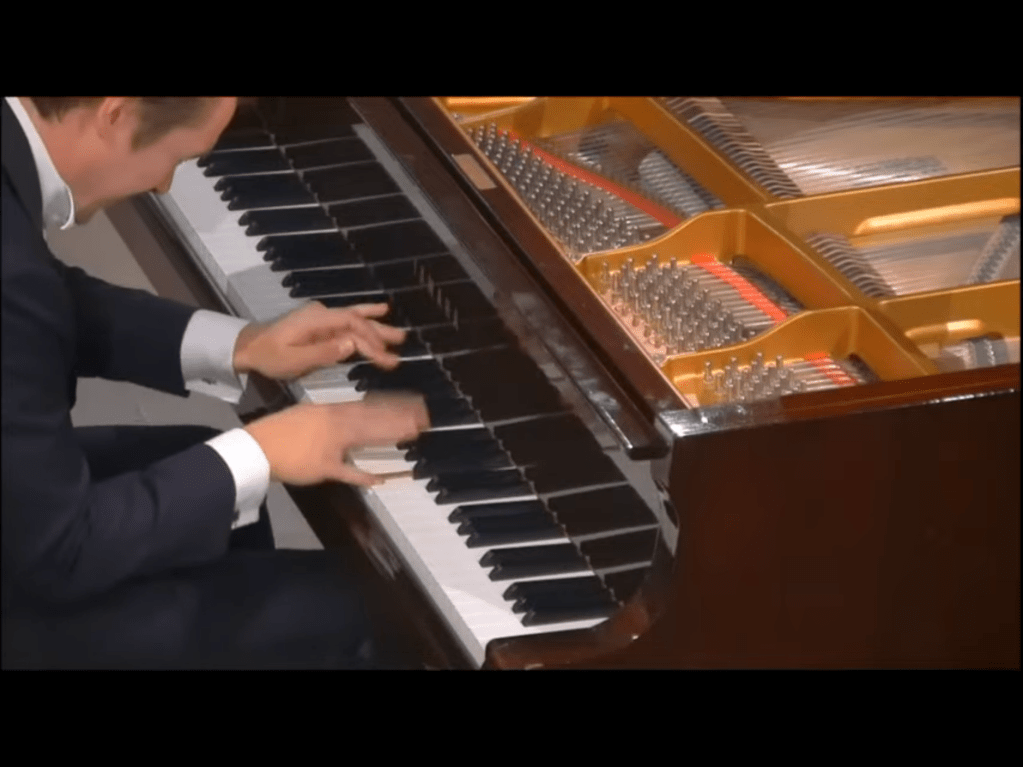
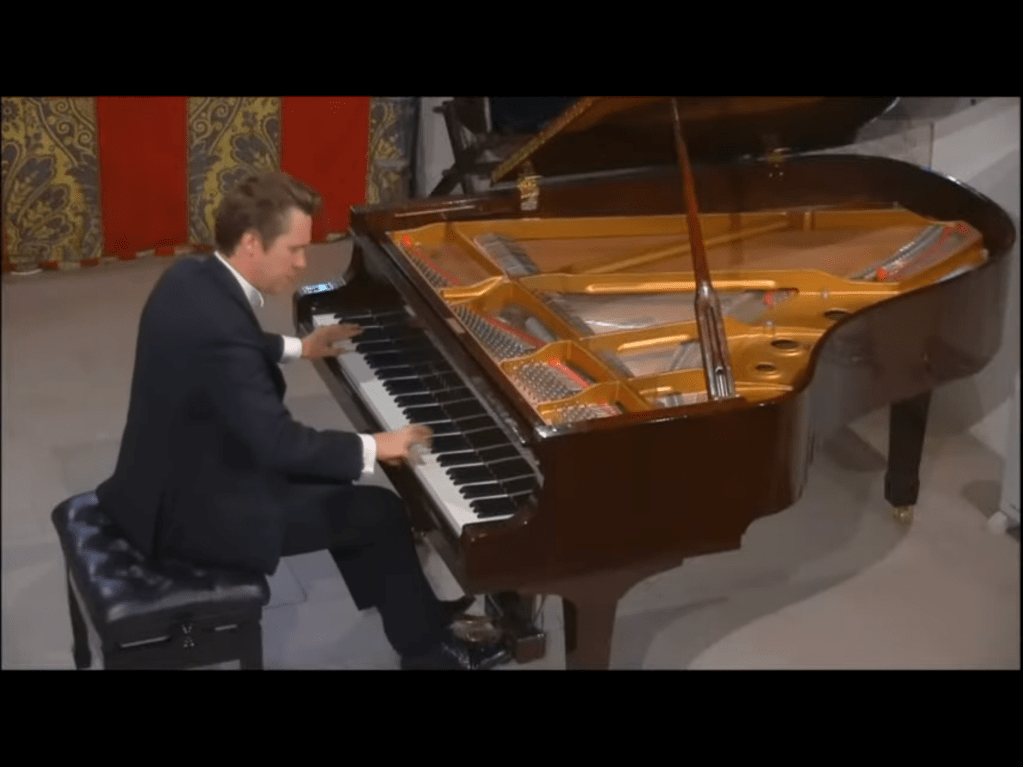
It’s sister op 49 n.2 was played by her friend and colleague Gabriele Sutkute from the RAM under Christopher Elton.She too brought this ‘practice’ piece vividly to life.From Lithuania she played with such natural musicality.She became almost part of the piano as her natural movements and enactment of the story she was telling was similar to Rokas Valuntonis (also from Lithuania) who had enthralled us recently with his story telling in Schumann’s Scenes from Childhood. https://christopheraxworthymusiccommentary.wordpress.com/2021/09/27/rokas-valuntonis-pianistic-perfection-at-st-marys/
There are no words to describe George Todica’s fantastic performance of the ‘Waldstein’ Sonata.Standing in at the last moment for (two!) indisposed pianists he gave a breathtaking performance.Risking all ,like Serkin ,as his dynamic rhythmic energy just swept everything before him.The ravishing beauty of the birth of the Rondo I have never heard so beautifully played.Beethoven’s markings all scrupulously interpreted as he threw himself headlong into the glissandi that Beethoven cruelly adds before the celestial re apparition of the Rondo theme.
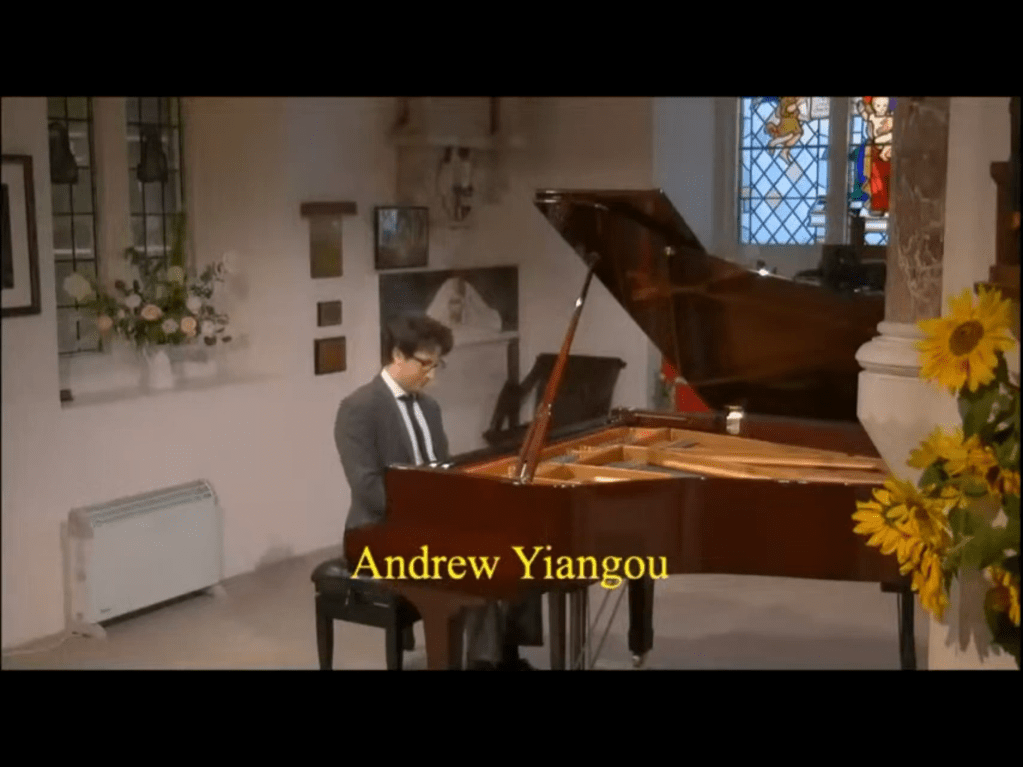
It was followed by a magnificent performance of the treacherous Sonata op 54.Only in two movements but of transcendental difficulties that Andrew Yiangou played with fearless control and intelligence .The unrelenting perpetuum mobile of the last movement took our breath away as it reached Beethoven’s unforgiving indication of Più allegro.I was not surprised to read that both Andrew and George were both formed in the class of Norma Fisher!Surpise after surprise and not a little astonishment and excitement as the temperature rose in this survey of Beethoven’s life.
Julian Trevelyan
Astonishment there was too with Julian Trevelyan’s ‘first’ Appassionata’.In the last series he had picked the short straw and given a magnificent performance of the ‘Hammerklavier’.He tells me though that he had been putting off the ‘Appassionata’ until today.I can understand the problem of approaching a much played work where tradition has often taken over from a close look at what the composer originally wrote!And it was this in Julian’s performance that was so refreshing to listen to and to watch.Yes,watch because there are many passages of transcendental difficulty that’ pianists’ simplify by sharing between the hands to alleviate any risk in performance.But it is just this struggle and risk that is part of Beethoven’s turbulent character.(His was not a play safe nine to five character!).Julian’s great musicianship and transcendental technical control allowed him to restore this much maligned work to the one that Beethoven had tried to portray on the written page.It was breathtaking as it was ravishing as the menacing opening was interrupted by explosions that never changed the overall pulse but swept us along to the sumptuous second subject.No changes of tempo but a great wave that took us from the opening to the final disintegration.So often played with an accommodating ritardando but here so rightly driven to the final note as Beethoven had indicated.An Andante con moto ‘Cortège’played with orchestral nobility that did not exclude ravishing beauty .An Allegro ma non troppo that exploded out of the Andante with its unrelenting driving rhythm kept excitingly under control.That is until the ‘sempre più Allegro’ and ‘Presto’ where all hell breaks loose as it draws to it’s devastating conclusion.I would have kept Beethoven’s long pedal here,but I think for clarity it was one of the few indications of the great master that he chose to ignore.Pity in my opinion.
Matthew McLachlan enchanted us with the subtle phrasing and scrupulous attention to detail with the beautiful two movement sonata sometimes known as ‘a Thérèse’ .As Beethoven himself said,irritated by the popularity of the so called ‘Moonlight’ Sonata he wrote:’surely I have written much better things:the F sharp major Sonata for instance- now there is really something’( quoted from the excellent notes of Julian Jacobson).The youngest member of the McLachlan clan,all five of the six members star pianists,recently surprised even himself by winning the coveted Chappell Gold Medal in only his second year at the RCM where he is studying with Dina Parakhina.
Op 79 the sister of op 78 brought exhilaration and freshness before Beethoven opened the ‘Golden Gate’ to his final thoughts.Olga Paliy also from Norma Fisher’s studio played with sumptuous clarity and rhythmic verve.Almost Mendelssohnian most certainly in the Andante that was a true song without words in Olga’s simple musicianly hands.A vivace with all the ‘joie de vivre’ that Beethoven longed for but was rarely to enjoy .Olga’s apparition was like a breath of fresh air in every sense – her dress was to die for – like a lemon sorbet before the feast.
And so to the farewell of the afternoon session with a performance of the Sonata op 81a – the only Sonata that Beethoven himself gave a name to : ‘Les Adieux’ but as Beethoven preferred ‘Das Lebewohl’.Played with an exemplary clarity and scrupulous attention to the very detailed indications of the composer.Mikhail Shilyaev brought a sense of wonder to the opening before the journey truly began with the Allegro.The treacherous chordal scales played with astonishing authority as the journey continued on it forward journey.There were sumptuous sounds in the Andante espressivo a heart rending ‘Absence’ before the thrilling ‘Return’ where the long held pedal notes alternated with the freshness of Beethoven’s mellifluous walk in the countryside.
Another of the McLachlan clan – Callum- had flown in from Salzburg where he is studying with Claudio Tanski to play the more substantial two movement Sonata op.90.Played with great energy and commitment and the same ravishingly subtle colours that reminded me of his Schumann op 13 that was so memorable a year ago.His playing is of a rare poetic subtlety which just added magic to the Schubertian outpouring of song in the last movement.
Ben Schoeman played the Sonata in A op 101 with subtle beauty and sense of architectural shape that united all the delicate fragments so intelligently.The almost Schumannesque March was played with driving rhythms and the beautiful long music box pedal created a magical oasis .A beautiful stillness to the Adagio whose magic arabesque leads to a glimpse of the opening ‘avec un sentiment de regret’ before the rude awakening of a fugue of transcendental difficulty played by Ben with all the authority of such a distinguished pianist.
The longest and in many ways the most difficult of the Sonatas is the ‘Hammerklavier’ op 106.Ariel Lanyi is fresh from his triumph at the Leeds Piano Competition where he also played Brahms 2,the longest and most difficult of concertos.A truly monumental performance where in particular the twenty minute Adagio sostenuto was played with an intensity and architectural shape ‘Appassionata e con molto sentimento’.Of course who would ever forget Serkin’s performance years ago in London when he was in his 70’s.Ariel only 23 was every bit as convincing – Serkin was strangely even more Appassionato though but the intensity and commitment were the same.Overwhelming indeed.The first movement leap of course played with one hand – Serkin insisted on that – and anyone who wants to play safe has chosen the wrong work!The Scherzo was played with a fleeting energy and the Trio created a carpet of sound on which the melodic line was contained as it passed from treble to bass.Beethoven’s tempestuous impatience was thrown at us like a slap in the face before the tongue in cheek ending of the Scherzo preparing us for the great journey before us and the explosion of energy in the treacherous fugue.A magisterial performance for a true monument.When you realise that the performer is only 23 one is left,bewitched,bothered and bewildered not to say completely breathless!
The first of the final trilogy op 109 was played by Julian Jacobson with the remarkable authority of someone who has played all the Sonatas in a one day marathon – all from memory except the Hammerklavier he tells me.His authoritative and informative programme notes for this entire series has been an indispensable guide to this great journey.I must say I was surprised to see him stealthily using the left hand for the top note of the Adagio espressivo chord on the tenth bar and I must remember to discuss that with him.Julian has been a consultant together with Leslie Howard for the definitive new Barenreiter Urtext edited by the cellist Jonathan del Mar.Some magical sounds in the opening movement were rudely interrupted by the vigour and technical assurance of the Prestissimo before the rich orchestral texture of the last movement theme and variations.Added bass notes too in the tumultuous final variation just showed that the better you know the score the more freedom you can take .The final two chords after the tempest had subsided were judged to absolute perfection.
Petar Dimov another pianist from the studio of Norma Fisher stood in at three days’ notice for an indisposed artist and gave a ravishing performance of what must surely be the most perfect of all sonatas.It is like the Barcarolle in Chopin’s output that is the jewel in the crown. An outpouring of song from the first to the last note.It was this subtle intimacy that Petar captured as he barely touched the keys allowing the notes to vibrate in this magic world that Beethoven had discovered.Beethoven’s detailed markings especially with regard to the sustaining pedal were beautifully incorporated into the magic.The Arioso dolente just floated on a magic carpet of sound as the fugue crept in and out in an embroidery of thoughts that led to a final exultation that surely must have been the inspiration for Scriabin’s own shining star.
It was left to Sasha Grynyuk to utter Beethoven’s final words.The Maestoso of the op 111 was of course taken in one hand as the three great blocks dissolved into a seething mass of sounds boiling over at a hundred degrees (to use Perlemuter’s own words).Dissolving as the ‘Appassionata’ had done but this time to C major for Beethoven’s last moving farewell.Played with absolute stillness and perfect poise as the variations unwound leading us to a paradise of trills and barely suggested sounds.We can only marvel as this world is revealed with a simplicity and total mastery by Sasha and wonder how Beethoven could transcribe for eternity the celestial sounds only he could hear in his head .Is it genius or is it a miracle – Bach,Mozart Beethoven words are not enough or even necessary……..maybe a great poet could come as near as is possible ………if music be the food of love …….. .play on.
Petar Dimov -Sasha and Katya Grynyuk – Hugh and Felicity Mather The final two Sonatas and a fond farewell to all that
P.S. From Julian Jacobson
Dear Christopher Much enjoyed and appreciated your warm and generous review of the Perivale Beethoven weekend, as well as your kind comments on my own performance. You noticed a couple of eccentricitudes (to quote Ogden Nash)! I was brought up in the purist 50s and 60s never to rearrange, add notes etc. But in adult life as I got to observe and sometimes personally know some great pianists I found that they all redistributed notes, and added or omitted some. (I also got to know Alfredo Casella’s edition of the Beethoven sonatas!) Brendel adds the bass B flat to the last chord of 106 and splits it. I once heard András Schiff obsessively practising bars 3 & 4 of op 106 1st movement with only the upper G and Fs on the chords over the barline, and that’s how he seems to play it (which I think is going a bit far!). The taking of the upper A and D in bars 9 and 58 – a brand new practice for me – was entirely in the service of tone, to separate it out from the harmony grace-notes and avoid any possibility of a thin 5th finger sound. I quickly retook the notes with the RH 5th finger.The extra bass Bs in the final variation are more contentious for sure and I might not do them again: they were just a spontaneous reaction a few days ago to the overwhelming ecstasy of the passage and I thought I’d keep them in for Sunday. I don’t add any of the usual extra notes in the Prestissimo, even if they’re printed in Henle etc, and positively dislike them. But I noticed – for instance – that Ronald Brautigam adds extra bass octaves in the 2nd movement of op 54, even though he is playing on the fortepiano and one might have expected him to be super-authentic! I guessed at his thought process: – the bass line makes little sense with the lower octave dropping out;- just a few years later Beethoven’s piano had those extra notes;- Beethoven would surely have added them at that point, or asked Czerny to add them in performance. So we have the anomalous situation of Schnabel (for example) being more authentic and purist than Ronald Brautigam. But I must remember to ask Ronald (who is our BPSE Honorary European President since Paul Badura-Skoda’s death) if that was indeed his thinking! Naturally I didn’t take your points as criticisms, on the contrary delighted that you noticed them. All good wishes
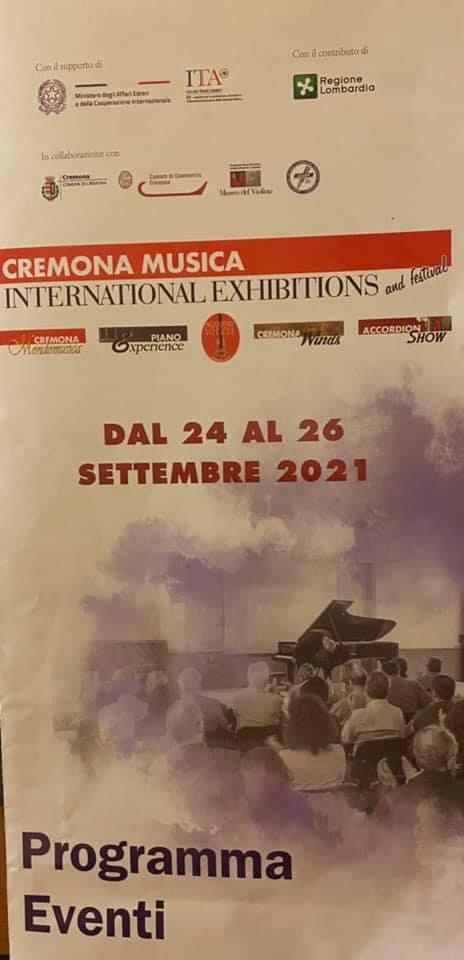
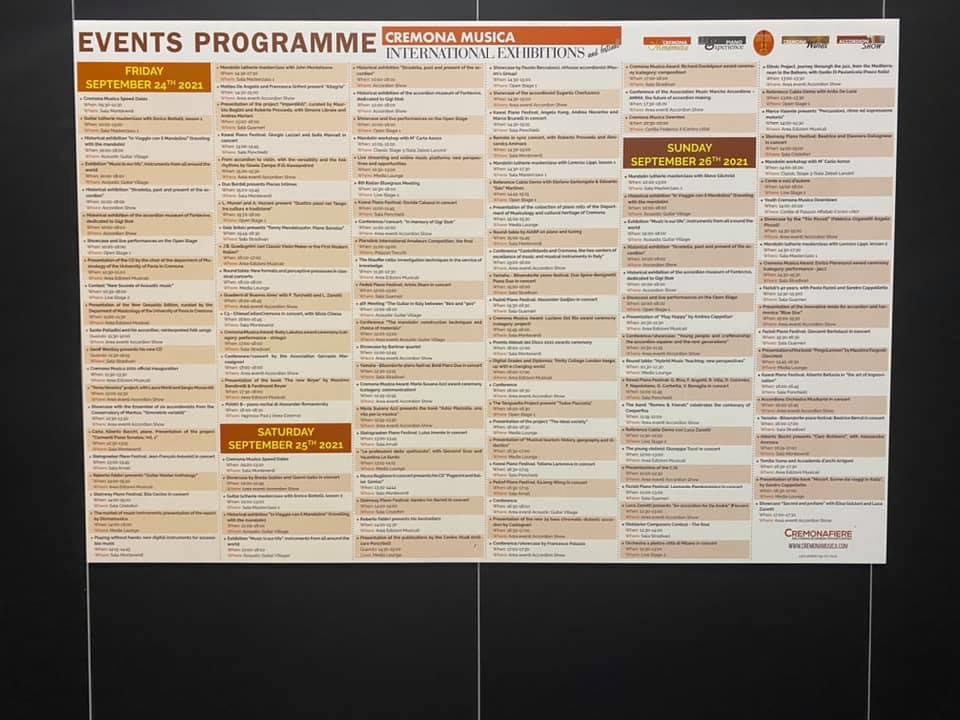
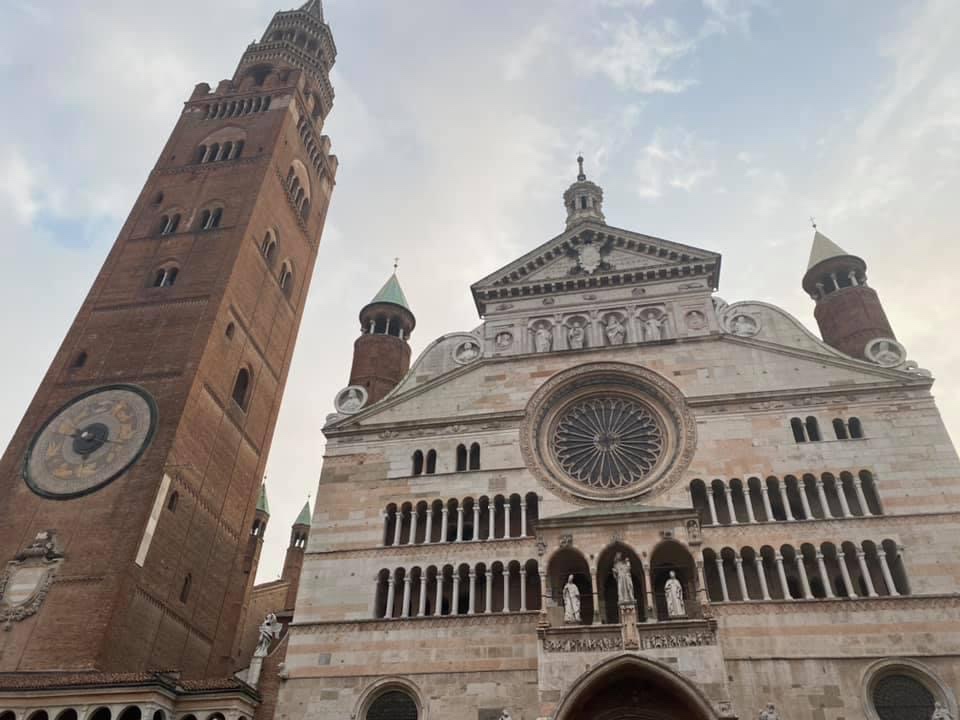
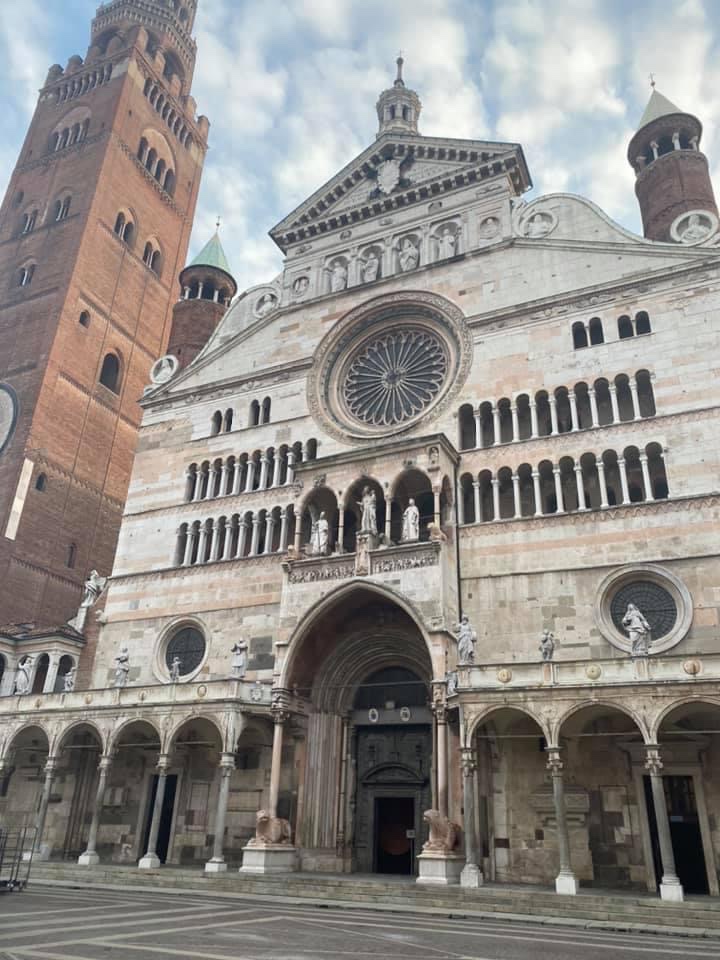
It was wonderful to be back in Cremona after only the on-line edition last year due to the pandemic.Just to look at the programme and see the hundreds of people eager to partecipate whether constructing instruments or playing them was a signal that all was well with the world.It is right that the signal should come from Cremona the city of music where even the streets are named after the violin craftsmen that have given such lustre to this beautiful city.
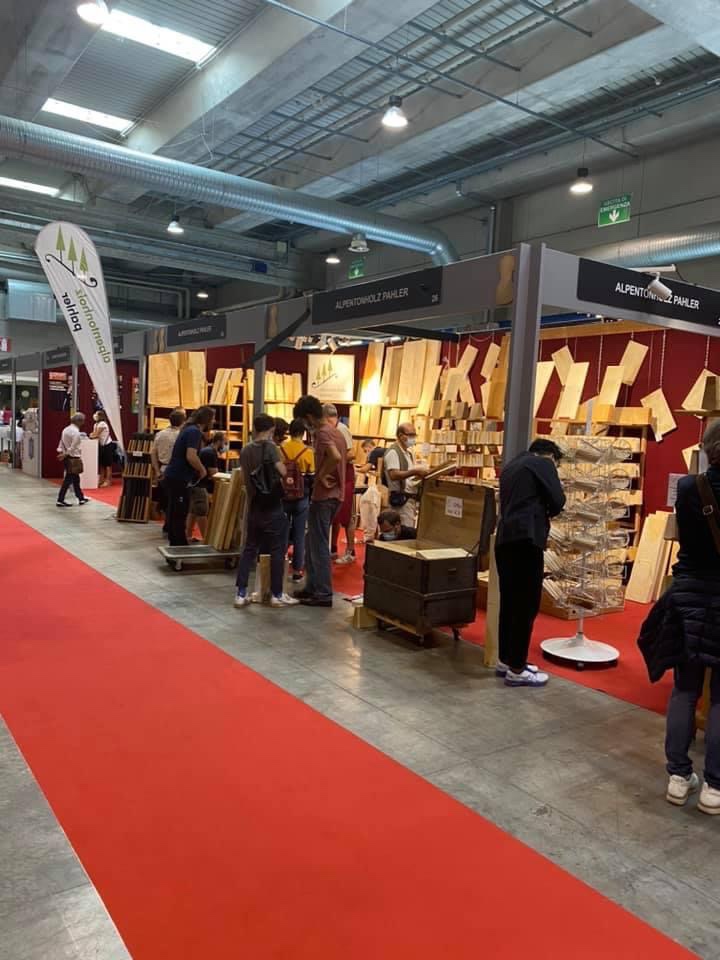
At first glance into the pavilions one could see violins,violas,cellos guitars,lutes ,accordions and even the special woods that have given life to these carefully crafted instruments.
But in one corner there is a section dedicated to the Piano and it is here under the eagle eye of Roberto Prosseda that we could appreciate not only the most important piano manufacturers but also listen to some of the most important young musicians of our time.Conferences of new ways of presenting music and the technology that we have been forced to understand during the pandemic took place in the media lounge with streaming links to a worldwide audience.
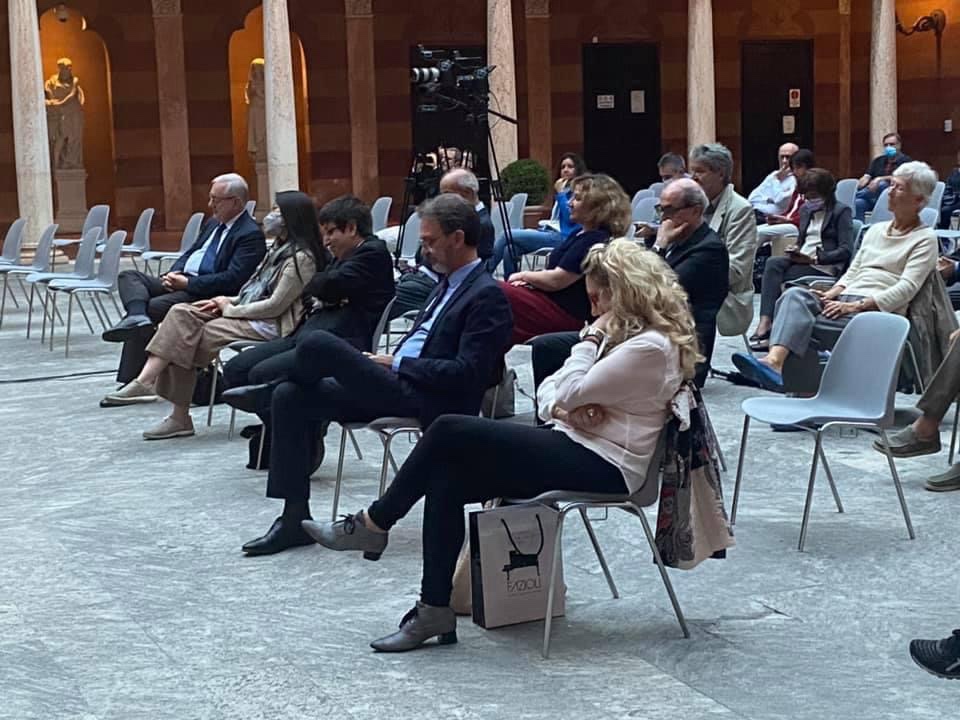
The distinguished jury of the Pianolink competition
As if this was not enough there was also the Pianolink International Amateurs’ piano competition in the beautiful courtyard of Palazzo Trecchi in the city.It may be amateur but the illustrious jury included Michele Campanella,Sofia Gulyak,Jin Ju,Ramon Bahrami and Owen Mortimer of International Piano and it was also streamed live.
Valentina Lo Surdo with Roby Lakatos and Roberto Prosseda
Cremona music awards too were given to Roby Lakatos,Richard Danielpour,Enrico Pieranunzi,Susanna Azzi and Luciano Del Rio.There was a final farewell with an unannounced jam session that included Lakatos and Pieranunzi in a restaurant in the centre of the city.The cherry on the cake one might dare to say.https://www.facebook.com/1311561820/posts/10226945433444440/
And introducing these events with such intelligence and joie de vivre was Valentina Lo Surdo,the distinguished radio and television presenter.
A happy arrivederci with Valentina ,Massimo Fargnoli legendary organiser in Naples ( presenting his autobiography PergoLennon)with deus ex macchina Roberto Prosseda
In three days I managed to hear many fine performances and listen to some very informed discussions.I may have missed a lot but I certainly came away bewitched,bothered and bewildered by the meeting of so many extraordinary people from all parts of the globe.The informed experiences in the field of music with round table discussions and meetings even socially in Cremona will continue globally thanks to the new technology that is bringing us closer together.If this is what is known as networking – long may it last. And above all thanks to Cremona.
Fascinating round table on Hybrid Music Teaching
Here are just some of the more remarkable experiences I had over three days.
Day 1.I arrived late and almost missed a concert that had been added to the original programme.A programme that was being added to almost daily in the run up to the Fiera by the unstoppable Roberto Prosseda with his insatiable appetite to include as many experts as he could.
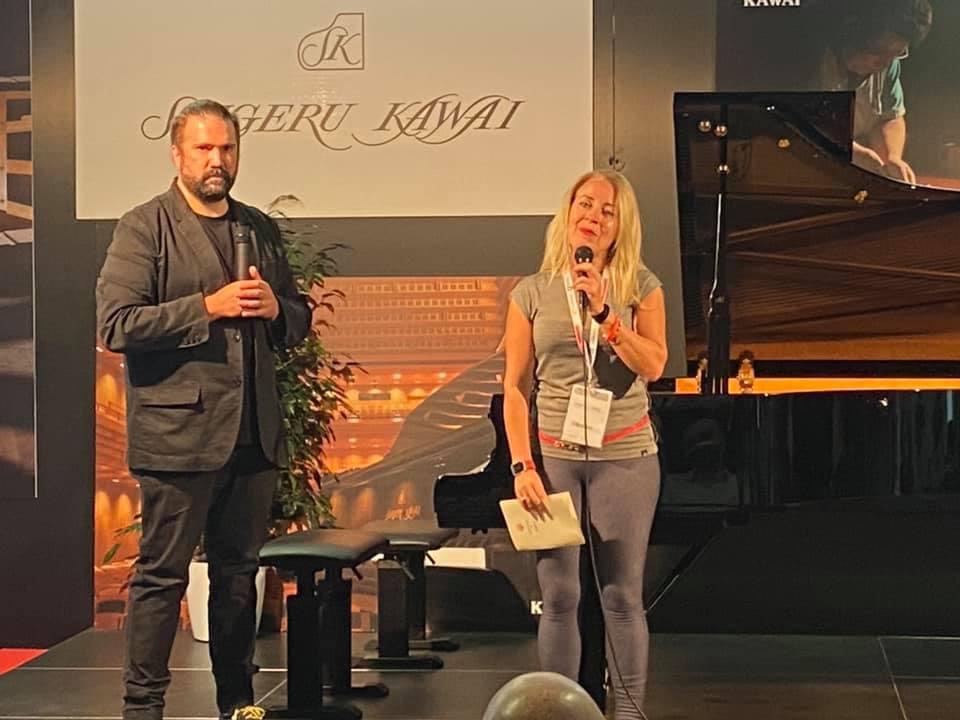
Valentina presenting Elia – un ballo in maschera indeed !
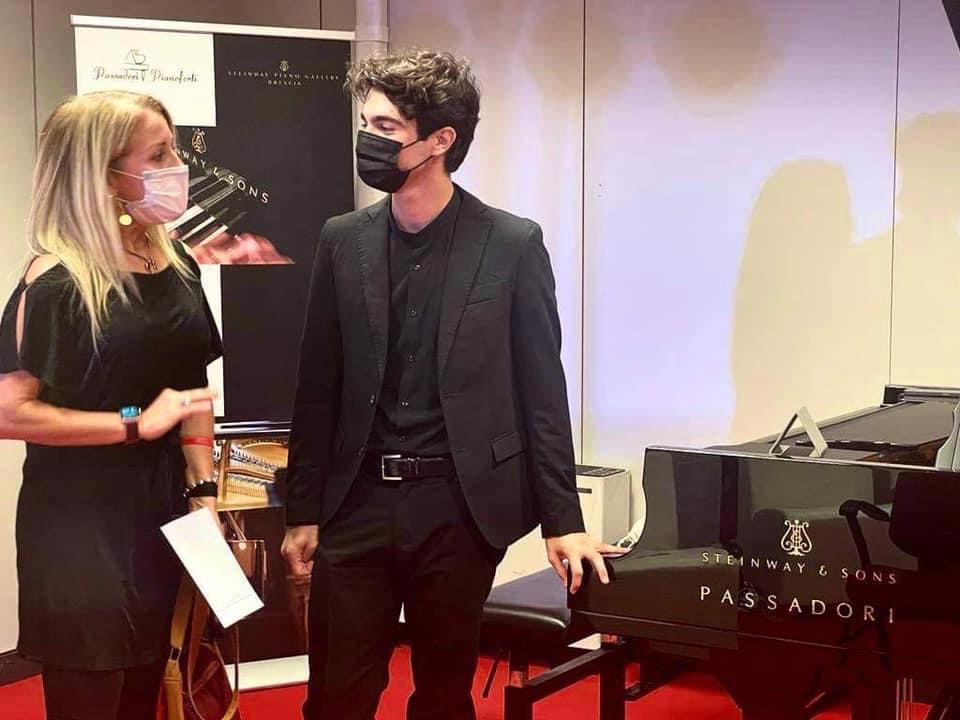
Elia Cecino with his mentor Maddalena De Facci seated on the left with Aristo Sham- another star – behind her
This was in the Sala Cristofori or Steinway/Passadori studio as part of the Steinway & Sons Piano Festival .Some remarkably mature performances of Scriabin 3rd Sonata and Prokofiev’s 7th together with Schumann op 111 which unfortunately due to the queues at Malpensa I was not able to hear.Prokofiev 7 is one of his War trilogy and quite fitting for this situation of running from one wonderful performance to another.A magnificent performance that solicited encores of Tchaikowsky and Shostakovich which of course made me late for the ‘Imperdibili’in the Sala Guarneri or Fazioli Studio!
Maurizio Baglini with Paolo Fazioli
It was with this event that I had planned to start my survey in Cremona.A joint project by Maurizio Baglini and Roberto Prosseda,two of the most extraordinary artists in Italy who with their own important careers take time to nurture and help the next generation.’ Unmissables’ indeed and thanks to the continuous inventiveness of Roberto I did almost miss it!Andrea Mariani,a student of Roberto in Rovigo Conservatory showed his remarkably fluid technique in a Study by Silvio Omizzolo (Padua 1905-1991) that sounded like Moszkowski and which solicitated an encore of his equally enticing Mazurka.This was a composer I had never heard before played by a pianist with a transcendental technique who showed his true musical credentials in a very fine performance of Chopin’s first Scherzo op 20.
Andrea Mariani receiving Paolo Fazioli’s blessing!
With Paolo Fazioli jealously surveying the scene from the front row this was no easy platform for an aspiring pianist!
Simone Librale,a student of Maurizio Baglini was not able to play so at the last minute another of his students Lucrezia Liberati stood in with an even more eclectic programme.Schumann’s op 8 ,the rarely played Allegro in B minor that was to be the first movement of a Sonata that was never realised.Together with the extraordinary ‘Night music’ from Bartok’s Suite ‘Out of doors’.Works that are as much a trial for the piano as they are for the pianist.
Lucrezia Liberati under close scrutiny of the master piano maker Paolo Fazioli
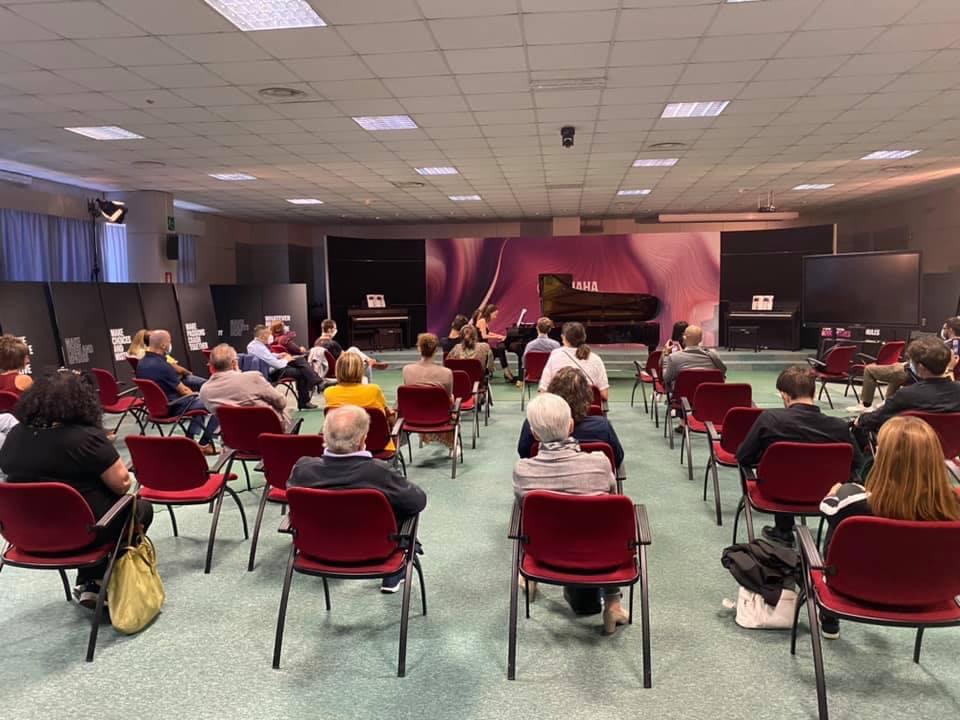
Gaia Sokoli with a full house for Fanny Mendelssohn
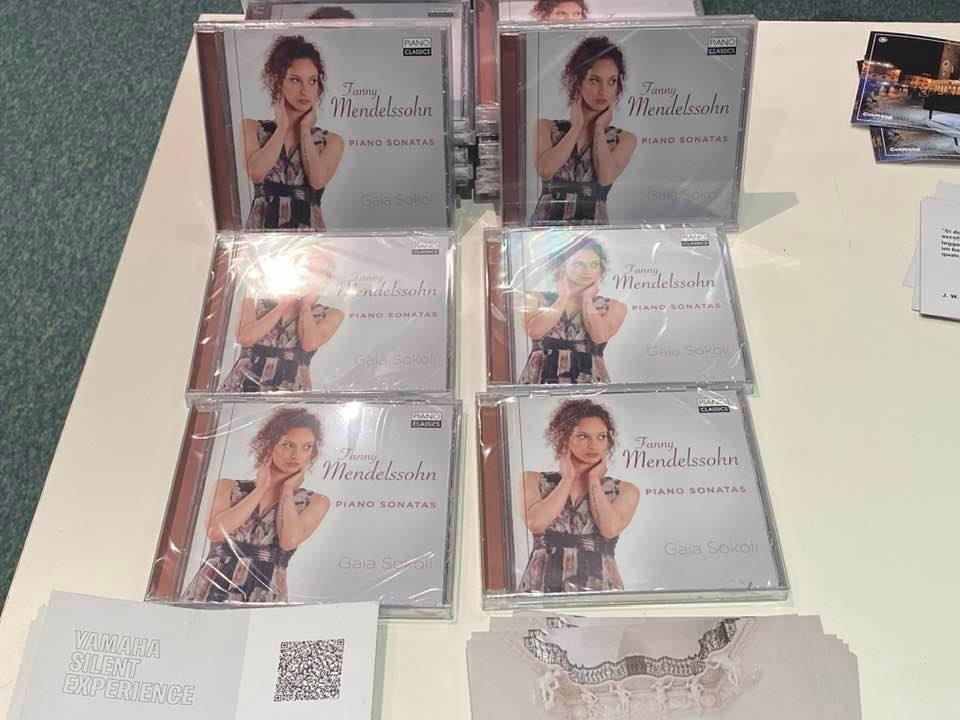
I just managed to hear part of the fascinating programme of Gaia Sokoli with a preview of her CD dedicated to the sonatas of Fanny Mendelssohn!In the Sala Stradivari on a superb Yamaha piano it was yet another fascinating discovery here in Cremona – one of many!Fanny Mendelssohn (14 November 1805 – 14 May 1847), elder sister of Felix (whose complete works have been recorded by Roberto Prosseda) was known ,after her marriage, as Fanny Henkel and was a composer and pianist .Her compositions include a piano trio and quartet ,an orchestral overture, four cantatas , more than 125 pieces for the piano, and over 250 lieder,most of which went unpublished in her lifetime. Although praised for her piano technique, she rarely gave public performances outside her family circle.
Gaia Sokoli with her beautiful playing of the almost unknown Sonatas of Fanny Mendelssohn
At this point I had to run ,still with my suitcase,sadly missing the ChiesaCellos Cremona with Maurizio’s wife the distinguished cellist Silvia Chiesa.I think even she would have forgiven me as the Cremona Music Award was being given to Roby Lakatos the violinist most revered by his colleagues for his extraordinary natural technique and his amazing Zigane improvisations.Here too he improvised with Roberto Prosseda with one of his best loved performances.
Roberto with Roby
And at last a day that started in London and finished so wonderfully in Cremona.Or at least I thought it was over until I bumped into Sofya Gulyak (winner in 2009 of the prestigious Leeds Piano Competition and invited here on the jury of the Pianolink Competition) and together with Doctor Anna Maria Cevolani ( a GP in Pieve di Cento and organiser of a concert series and the Roberta Galinari International Piano Competition that could boast Vladimir Ashkenazy as chairman of the jury)we enjoyed sharing stories over a well deserved pizza.It was infact one of the best pizzas I have ever tasted ……but how could it be otherwise in a paradise like Cremona.
Roby Lakatos with Jed Distler
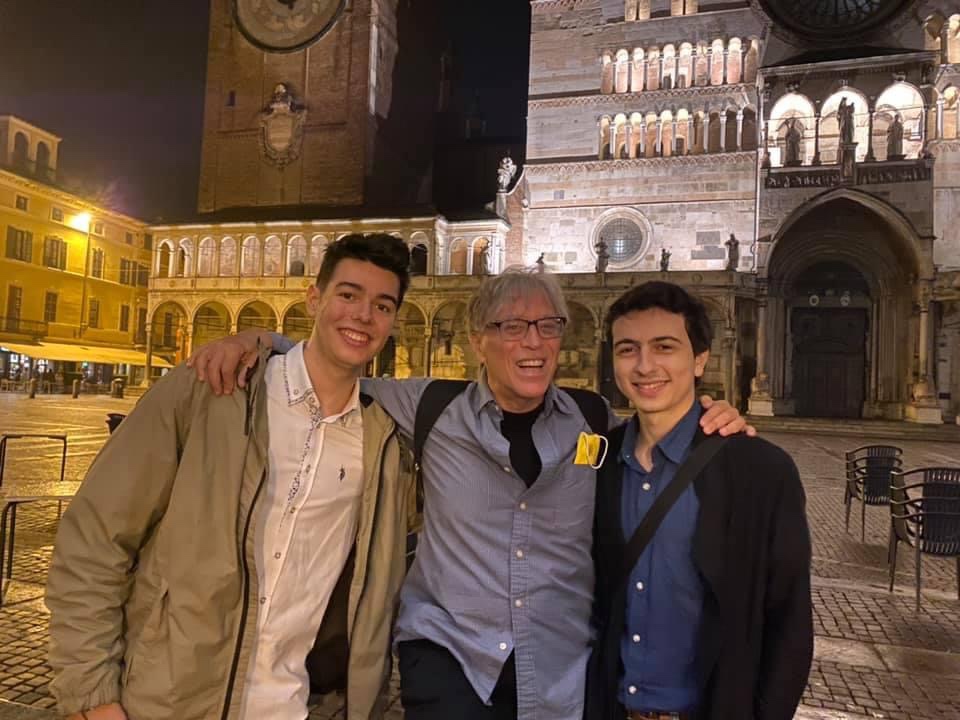
On the shuttle bus to the second day of the exhibition I heard a voice that I knew so well from his radio programmes in New York and from my visit two years ago in Cremona.Jed Distler pianist,composer and commentator knows more about pianos and pianists alive or dead (together with Bryce Morrison and Piero Rattalino).So even the journey to and fro was full of a fascinating exchange of information.We had fun at the farewell aperitivo in the Cathedral Square too.
Jed with two young Turkish musicians who report for Andante Classic Music Magazine.
Day 2
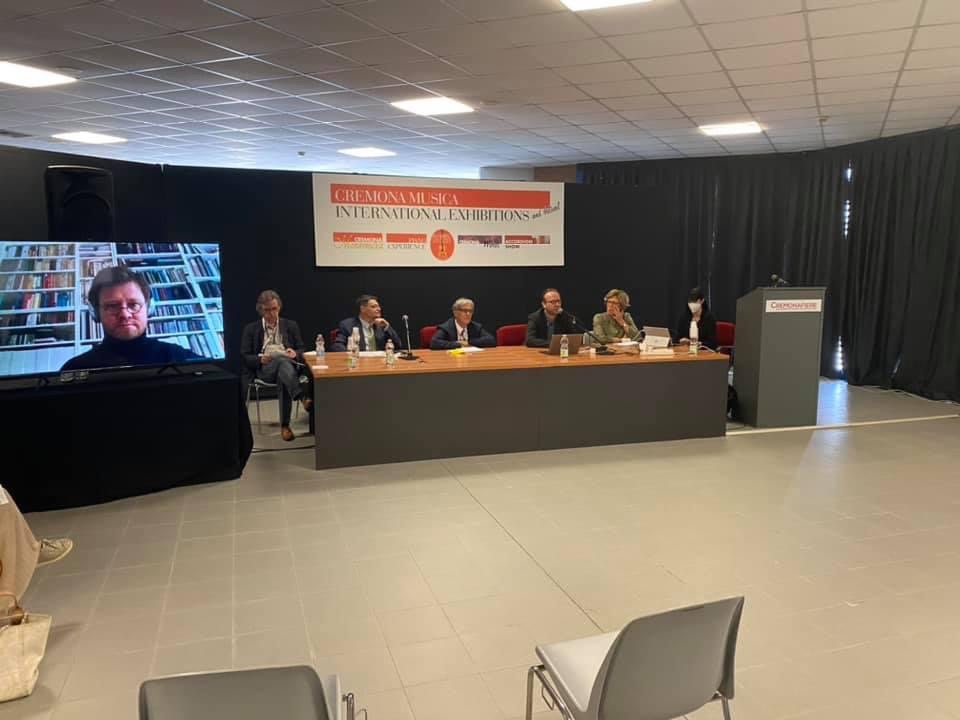
Round table discussion including live stream from Warsaw with Alexander Laskowski of the Chopin Institute and in the media lounge with Jed Distler,Cècile Prakken,Roman Berchenko,Eric Schoones and Owen Mortimer mediated by Roberto Prosseda
I would have liked to hear more of the round table discussion about streaming and on line performances that has been particularly relevant in this lockdown period.
Davide Cabassi though was giving a short recital .A top prize winner in the Van Cliburn competition in 2005 when he came to play in my theatre in Rome as part of a series organised by William Naboré and the International Piano Academy in Como.I remember vividly his wonderful warmth and humanity and of course an astonishing performance of Petroushka – a cross between Radu Lupu and Maurizio Pollini.
Davide Cabassi presented by an unmasked Valentina
We have lost touch but Cremona has united us.I have been following his remarkable career and have helped one of his students Alberto Chines via the Keyboard Trust.Davide is recording all the Beethoven Sonatas – I think he is up to his fourth CD and he played two sonatas op 27 n.2 ‘ Moonlight’ and op 31 n.2 ‘Tempest’.His amazingly wide range of sound has gained a maturity 20 years on but there is still very much the conflict between Floristan and Eusebius well suited to Beethoven’s tormented life .A standing ovation allowed him to present his wife Tatiana Larionova (who was giving a solo recital in the afternoon) and to play together Brahms’s 8th Hungarian Rhapsody …….a triumph was assured and well deserved.
Davide Cabassi and Tatiana Larionova
At midday I could not miss the recital of Aristo Sham mentored by Julia Mustonen , Artistic director of the Ingesund Piano Centre of excellence in Sweden .At 25 this young man has a degree in Economics from Harvard and a Masters degree in piano from New England conservatory.In 2019 he won the gold medal at the International Casagrande Competition in Terni .
Aristo Sham in concert under the eagle eye of Ing.Fazioli
Playing a magnificent Fazioli in the Guarneri room he gave some ravishing performances of Chopin ready to be presented in Warsaw at the Chopin competition in October.Four Mazurkas op 30 were played with a ravishing style and understanding that will surely seduce the jury as Fou Ts’ong had done fifty years ago.It was Ts’ong who told me that the sentiment or soul in Chinese poetry is very similar to the sentiment in the works of Chopin.Aristo’s performances of the Funeral March Sonata and the late Polonaise Fantasy were played with extraordinary intelligence and technical control but just missing the simplicity and intimacy that had seduced with his ‘canons covered in flowers ‘.
Aristo with Paolo Fazioli
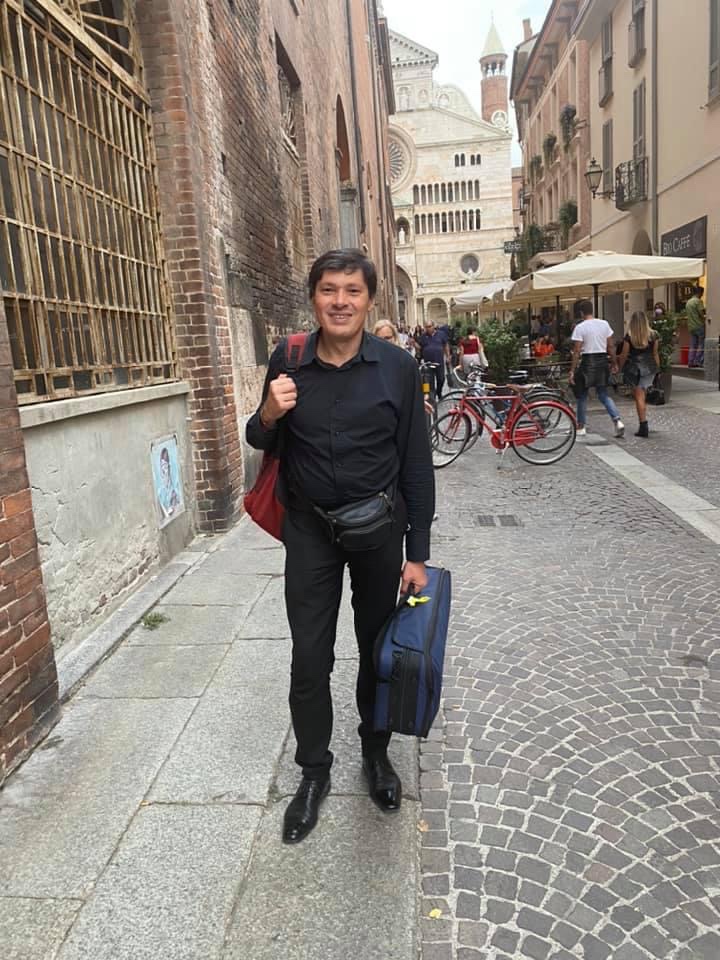
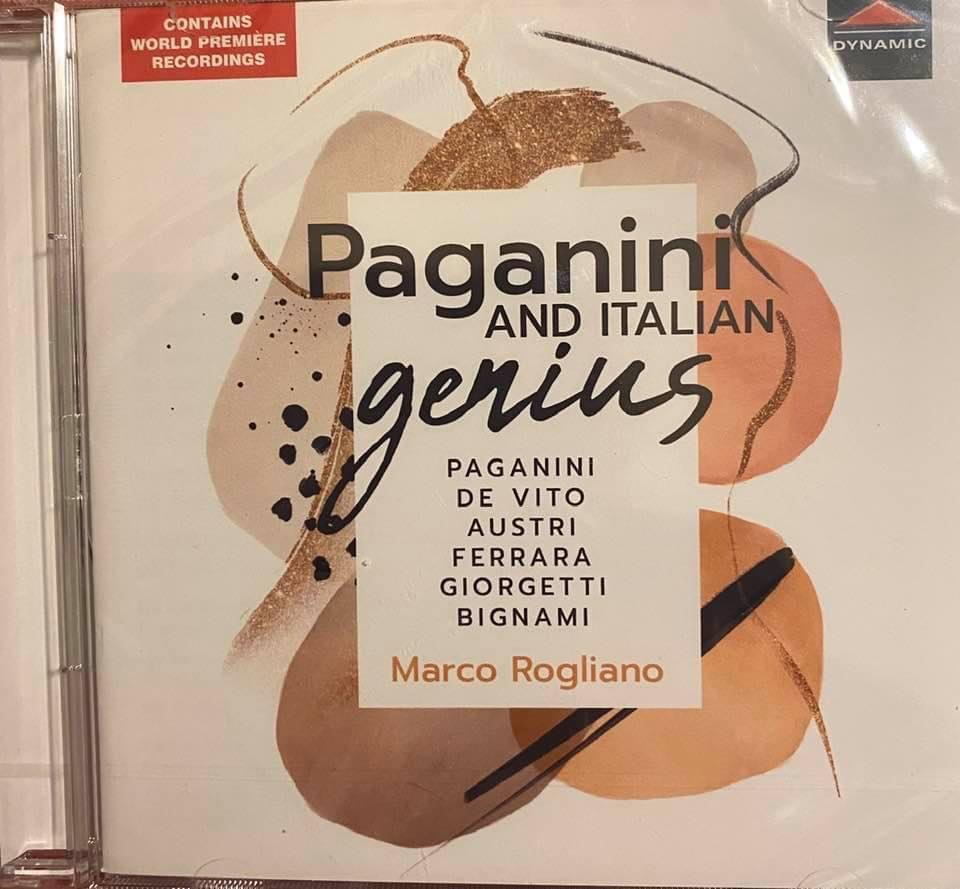
I was sorry to miss Marco Rogliano presenting his new CD .I bumped into Marco in the shuttle bus back to the hotel and had not seen him in 20 years since he used to play in the Masterclasses that Ruggiero Ricci used to give in my theatre after his annual recitals.I will look forward to listening to his fascinating new CD.
A chance meeting with Marco Rogliano but Cremona is that sort of place
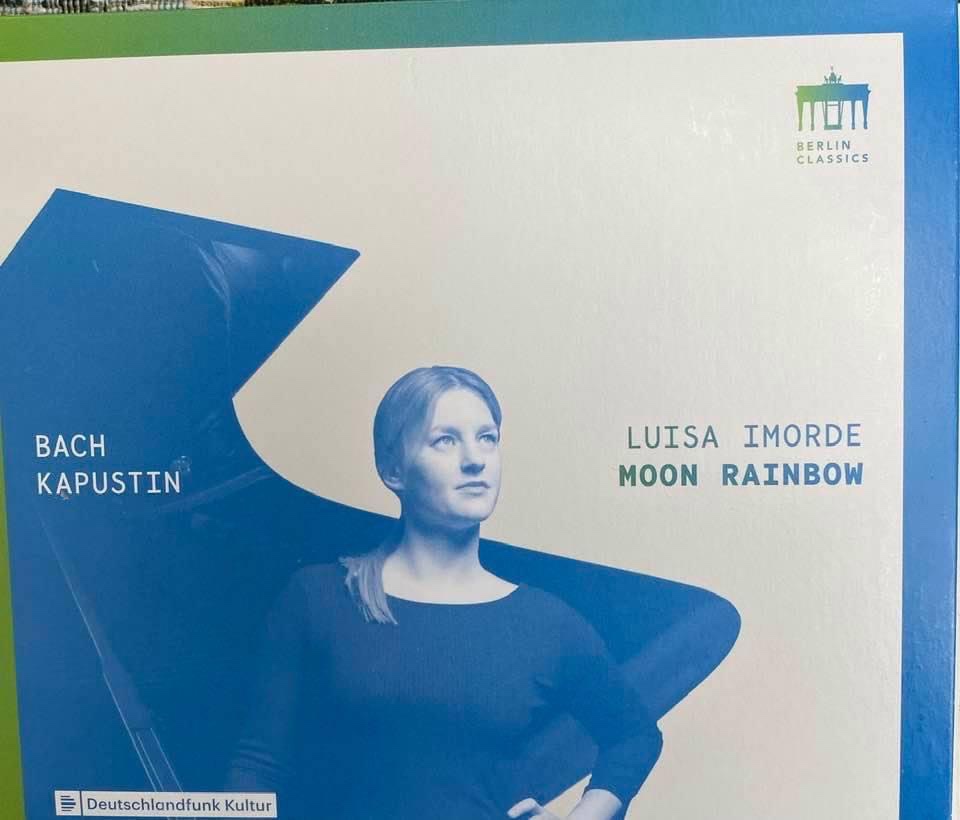
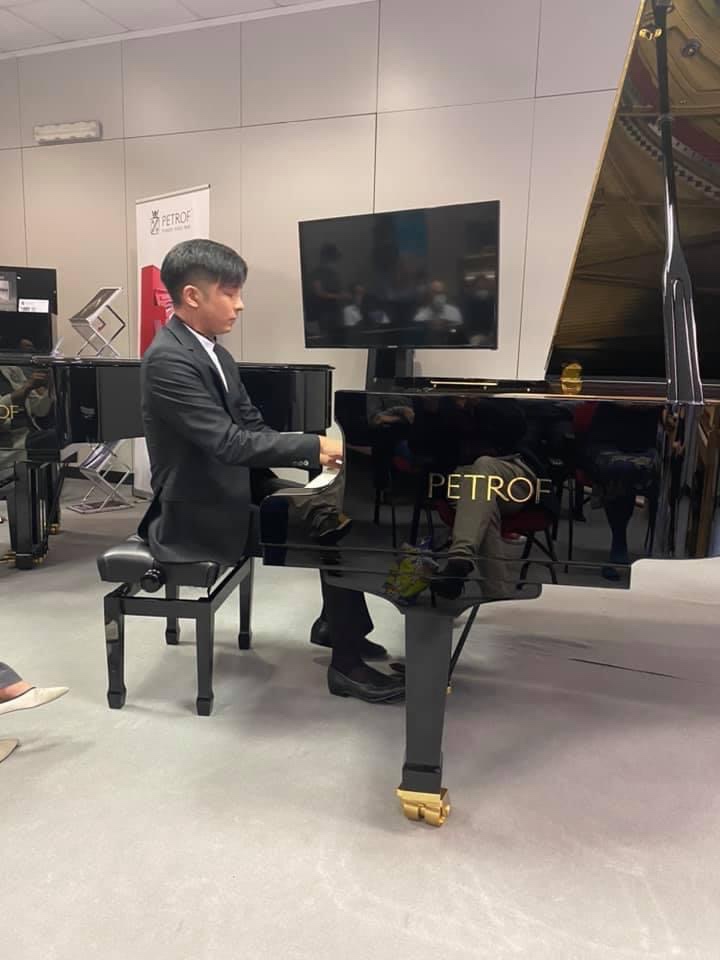
There was just time to slip into the Amati room to listen to Luisa Imode give an immaculate performance of Scriabin’s Fantasy Sonata on a magnificent Steingraeber piano.Ravishing golden sounds from a piano that has its base in Bayreuth.After musicianly performances of Beethoven op 109 and Chopin Ballade n.2 ,the Chopin Nocturne op posth was pure magic and showed off the full range of this magnificent much overlooked instrument.Her new CD ‘Moon Rainbow’I will look forward to listening to.
However Jed Distler wanted me to hear Sandro Ivo Bartoli whose recordings he admired and was intrigued by his lockdown project of recording one Scarlatti sonata a day.There are 555 and ,as he explained ,his project should draw to a close at the end of October.In the meantime this imposing figure – an Abbé Liszt look alike – presented his very individual performances of five Scarlatti Sonatas and the six Moments musicaux D 780 by Schubert with such convincing charm
Sandro Ivo Bartoli
Performances that showed off his unique personality.I had in fact met him when he was a teenager in London and we were summoned by Shura Cherkassky to listen to a young pianist ( with the same long hair) playing two chamber concertos in St James’s Piccadilly.Shura never taught but I think Sandro may have played to him occasionally in return for helping him when he was in residence in his rooms in the White House a stone’s throw from the Royal Academy where he was studying.
Elia and Sandro for Steinway.
And now I really had to run to hear Alexander Gadjiev’s magnificent Chopin recital on the Fazioli piano.I had heard him play in London a few years ago for the Keyboard Trust and he has since gone on to be chosen as a BBC Artist and won both Hamamatsu and Montecarlo Competitions and recently the Gold medal at the International Competition in Sydney.
Here are a few thought that I jotted down :’Someone who loves the piano and listens to himself.A master of ravishing playing who illuminated the Fazioli Grand Piano with sumptuous refined sounds.Masterly performances that held us spellbound .Chopin’s fourth Ballade restored to the pinnacle of the romantic repertoire -a truly ravishing Barcarole and a second Ballade that had us on the edge of our seats.’His encore of his own improvisation just showed what a unique artist he has become.All best wishes at the competition in Warsaw.
Elia and Alexander -stars shining brightly in Cremona
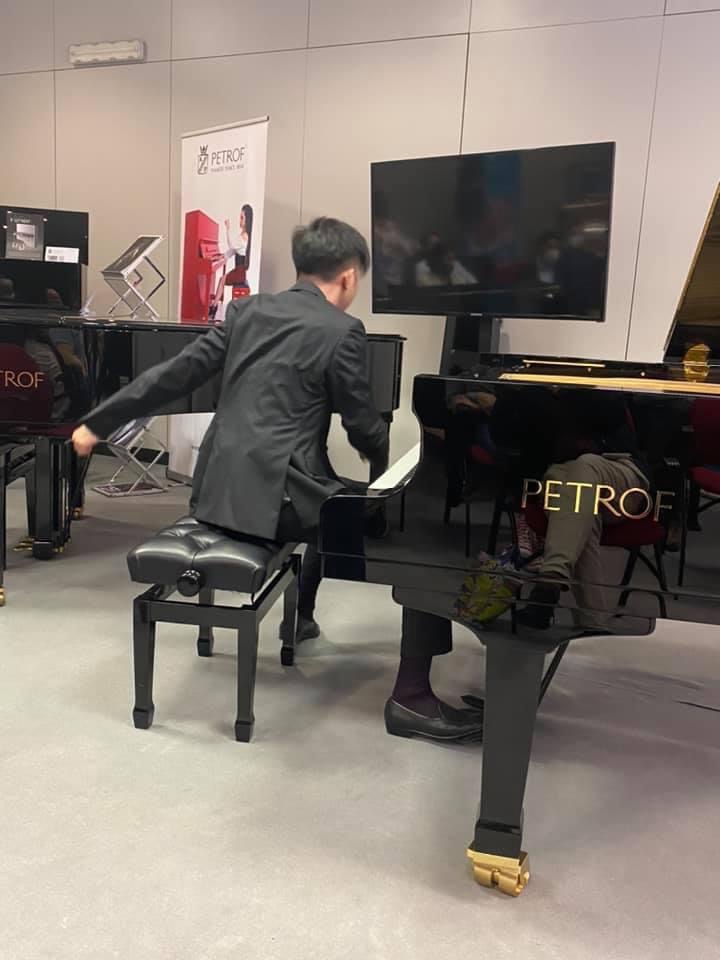
Immediately next door in the Amati room I had promised to hear another of Julia Mustonen’s students KaJeng Wong.Some quite magnificent performances of Rachmaninov on a sumptuous Petrof piano.
And finally the Cremona Music Award to Richard Danielpour with performances by Stefano Greco part of a CD that was recorded in Rome just last week.I was able to catch only the very tail end of this and was sorry not to be able to listen to more of Stefano’s magnificent playing .Richard I caught up with the next morning in the round table dedicated to Hybrid Music Teaching.His teacher was Leonard Bernstein and he has his same hypnotic charm as he explained how he had tried to help his students psychologically during the lockdown as music is about love and the connection between human beings .He had written a fifteen movement work ‘American Mosaic’that was performed on four grand pianos placed strategically in a cemetery as the performer moved from one to another.Here is his very moving story :
Richard Danielpour with Stefano Greco
Liner Notes by Richard Danielpour:
In April 2020, during the first wave of the COVID pandemic in America, I was informed by my pulmonologist that because of my asthma, my chances of surviving COVID-19 were about 30% if I were to contract the virus. I barely slept in that month. In those early hours of the morning, I managed to write the first draft of a libretto for a new opera. The only thing that was able to relax me enough to sleep (no amount of medication would do the trick) was listening to Simone Dinnerstein’s Bach recordings. Later in May, having witnessed the extraordinary heroism of so many valiant Americans who had struggled to combat this “invisible enemy”, which was the coronavirus, I thought it fitting at some point to compose a 15-movement cycle for solo piano that would be live streamed by the end of 2020. At that moment, I knew that the end of 2020 would be a challenging and terrible time in America, and my hope was that I could write a work that would somehow give comfort to those who had suffered and struggled through this unprecedented crisis. By mid-May, I was still listening to the recordings of Simone’s Bach to alleviate my anxieties, but I had also begun to think seriously about this new work that I hoped to compose for solo piano.I eventually spoke with Simone Dinnerstein, thanking her for the therapeutic effect of her playing and also mentioning my idea to her. She was enthusiastic, and a week later the Oregon Bach Festival, through the kindness and industry of their Director of Artistic Administration, Michael Anderson, commissioned the work which I titled An American Mosaic for a livestream premiere performance that would eventually take place on December 6th, 2020. I began work on An American Mosaic on June 5th, 2020 and completed the 15-movement cycle on August 6th of that summer.
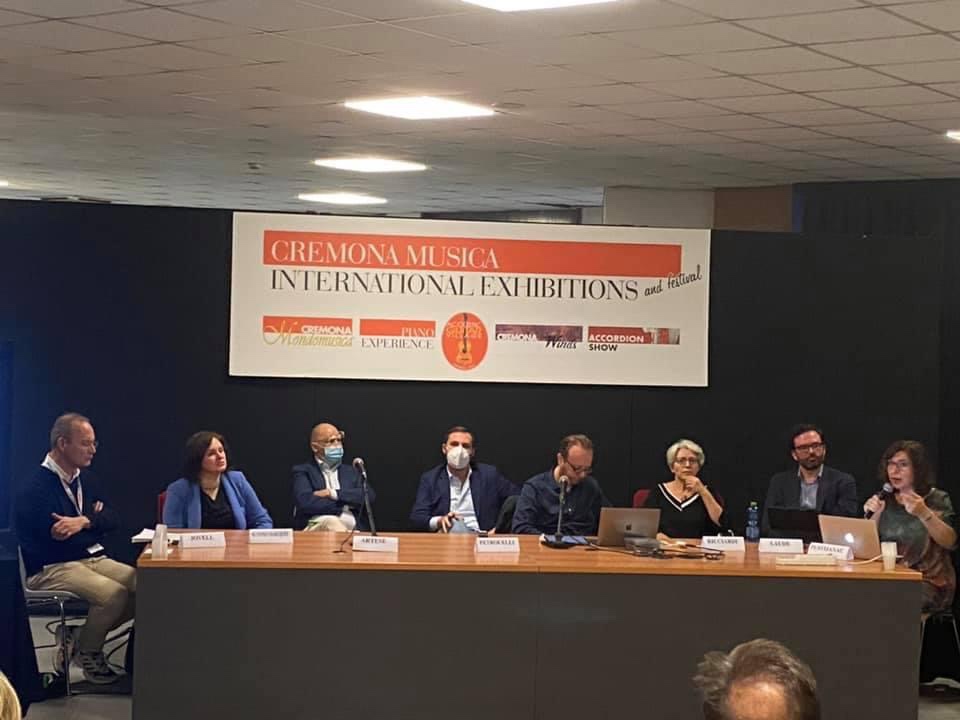
Day 3 .An interesting round table with fascinating comments from Paolo Petrocelli talking about the extraordinary Stauffer Centre in Cremona and Antonio Artese getting to grips with new technology at the historic Chigiana Academy in Siena and the participation of Richard Danielpour spoken of above.Julia Mustonen talked about her remarkable work at the Ingesund Piano Center in Sweden.
Julia Mustonen of the Ingesund Piano Center in Sweden
It was time to listen to another fine pianist on the Fazioli Piano.Leonardo Pierdomenico on his way to the Chopin Competition in Warsaw too.
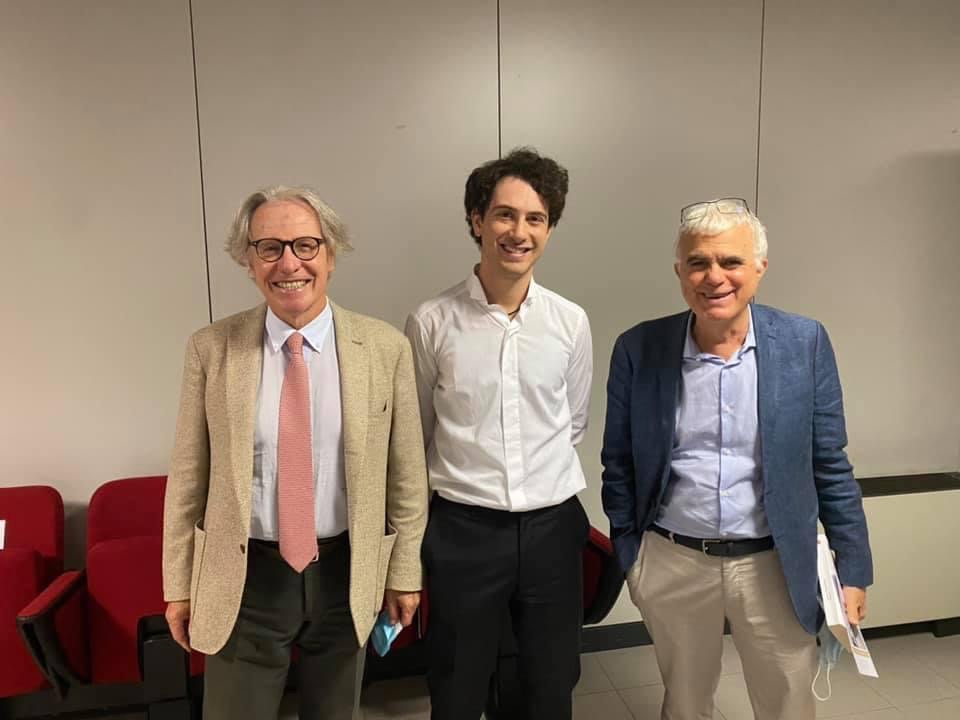
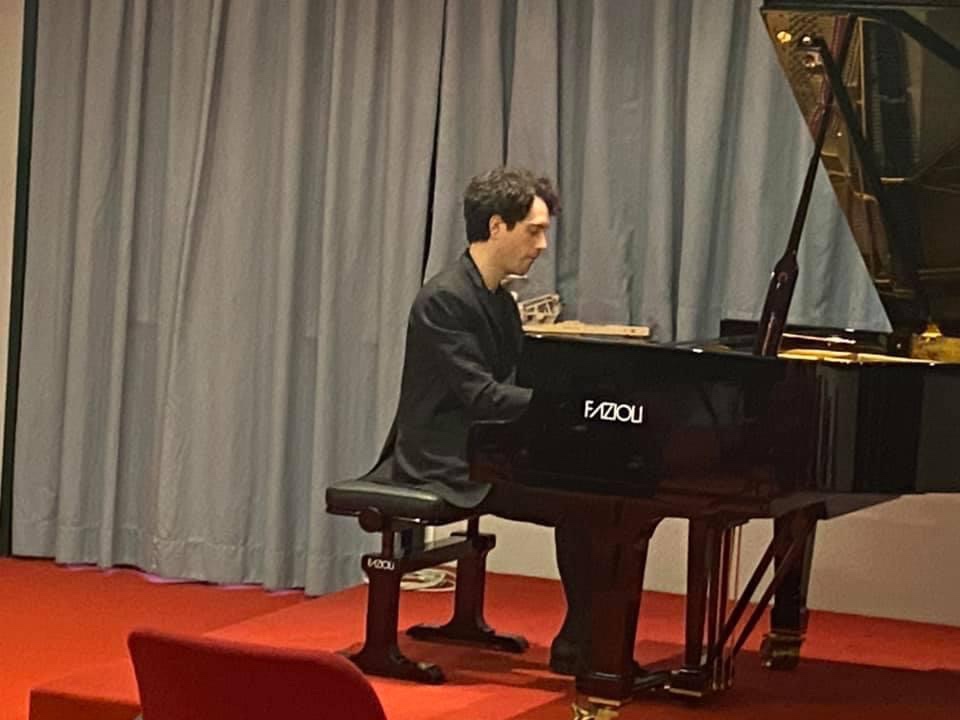
Paolo Fazioli and Sandro Cappelletto with Leonardo Pierdomenico
Some very fine performances of the First and Third Ballade were followed by a performance of the B minor Sonata that showed not only his superb clarity and intelligence ,as in the first Impromptu that had opened his programme , but in the slow movement there was an architectural line and ravishing sense of colour that was quite memorable.
By great demand after the sumptuously exciting Finale of the Sonata he played the study op 10 n.4 with remarkable brilliance contrasted with the exquisite charm of the waltz op 42.Another wonderful artist competing in the circus ring in Warsaw………..may the best man win.Career is ,after all,important for survival,but we in Cremona are just lucky to have heard three wonderful artists in these past few days giving such memorable performances without having to decide on a winner.They were all winners for us!
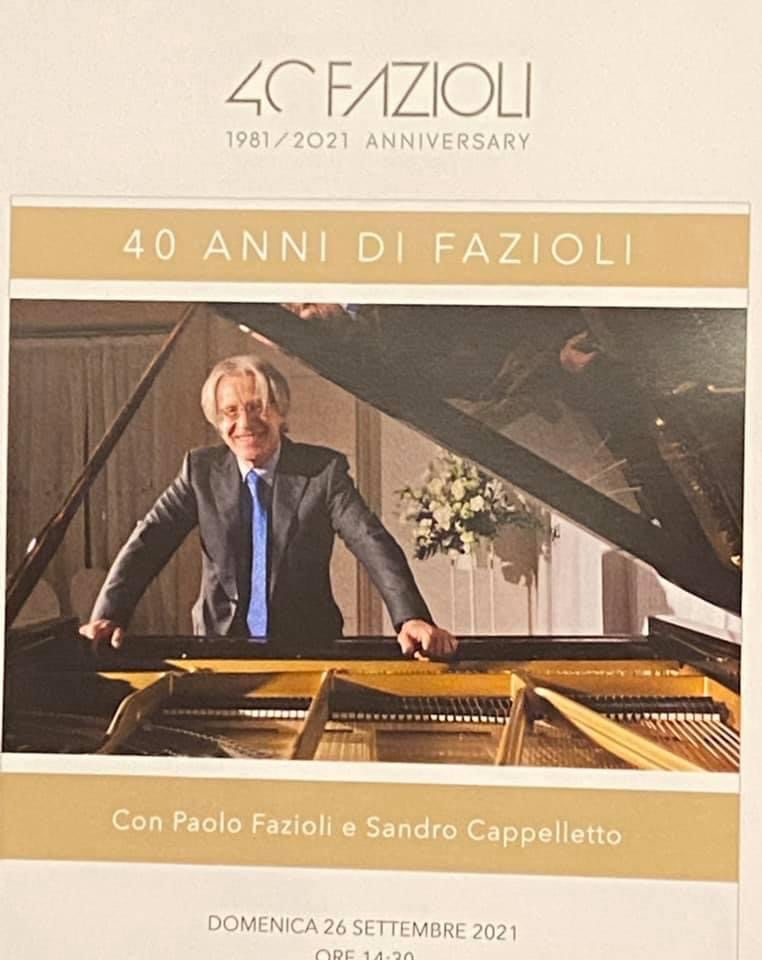
The Fazioli story told in a volume recently translated into English in which Sandro Cappelletto traces with Paolo Fazioli the rags to riches story of Fazioli pianos.
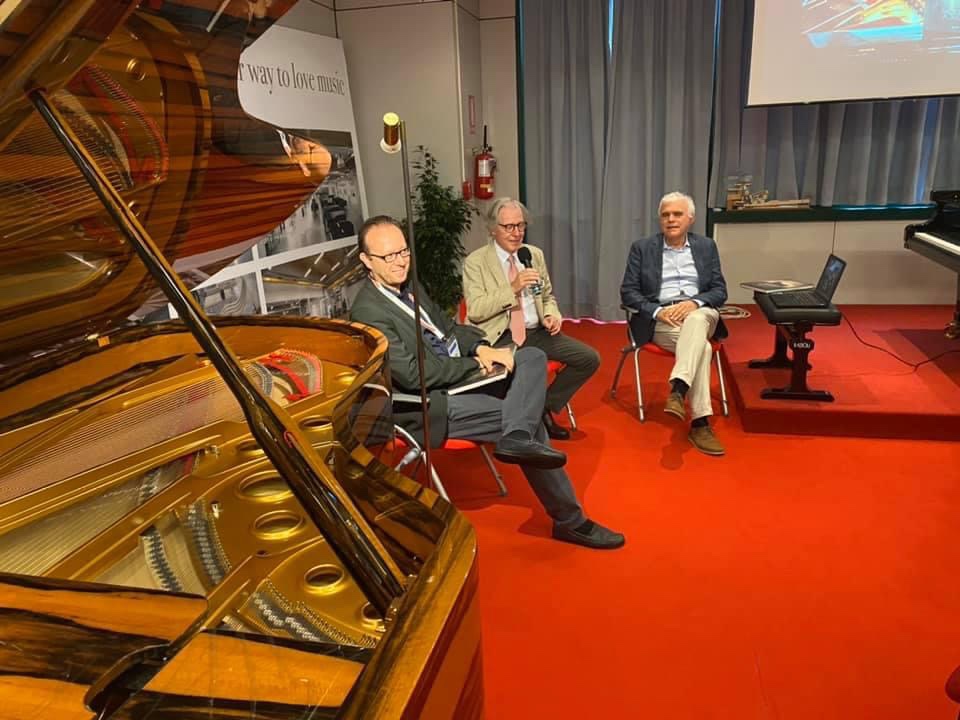
Roberto Prosseda- Paolo Fazioli – Sandro Cappelletto.
Paolo Fazioli was born in Rome in 1944, into a family of furniture makers. In 1969, he graduated from La Sapienza University in Rome with a degree in mechanical engineering, and received a diploma in piano at the G. Rossini Conservatory in Pesaro in 1971, where he studied under Sergio Cafaro. In the same period, he also earned a master’s degree in music composition at the Academy of St. Cecilia, where he studied with the composer Boris Porena.In the meantime, his older brothers took over the family business: a factory producing office furniture, using rare and exotic woods such as teak, mahogany and rosewood. Paolo Fazioli joined the company as well; however, he never gave up on pursuing his dream of building the world’s finest grand pianos. Thus, at the end of the 1970s, the Fazioli Piano Factory was realized within the furniture plant in Sacile, about 40 miles north of Venice.
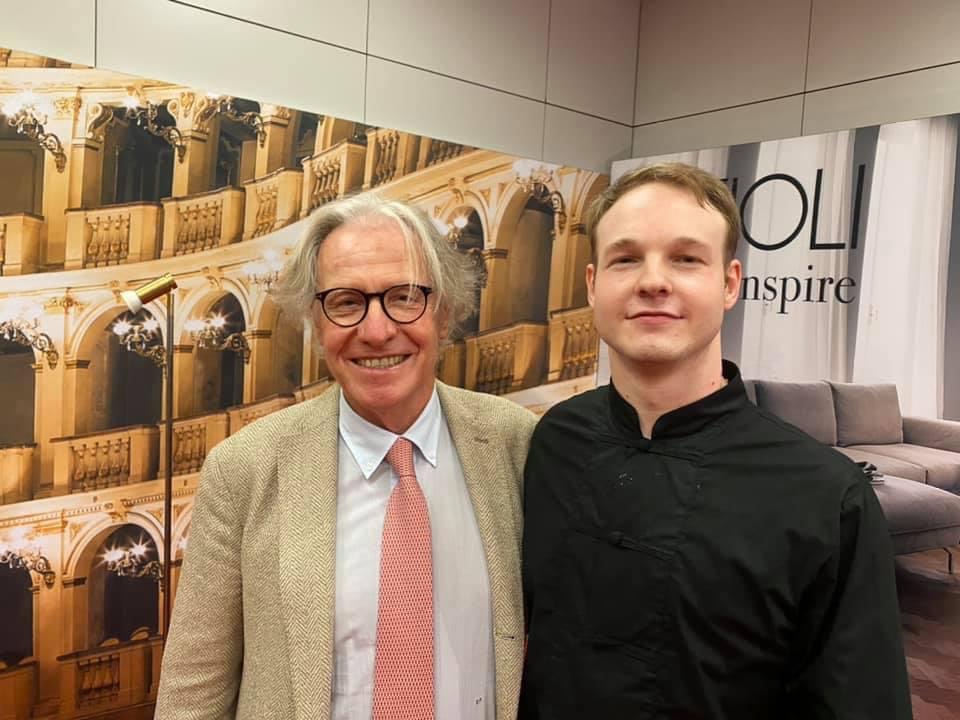
Giovanni Bertolazzi with Paolo Fazioli
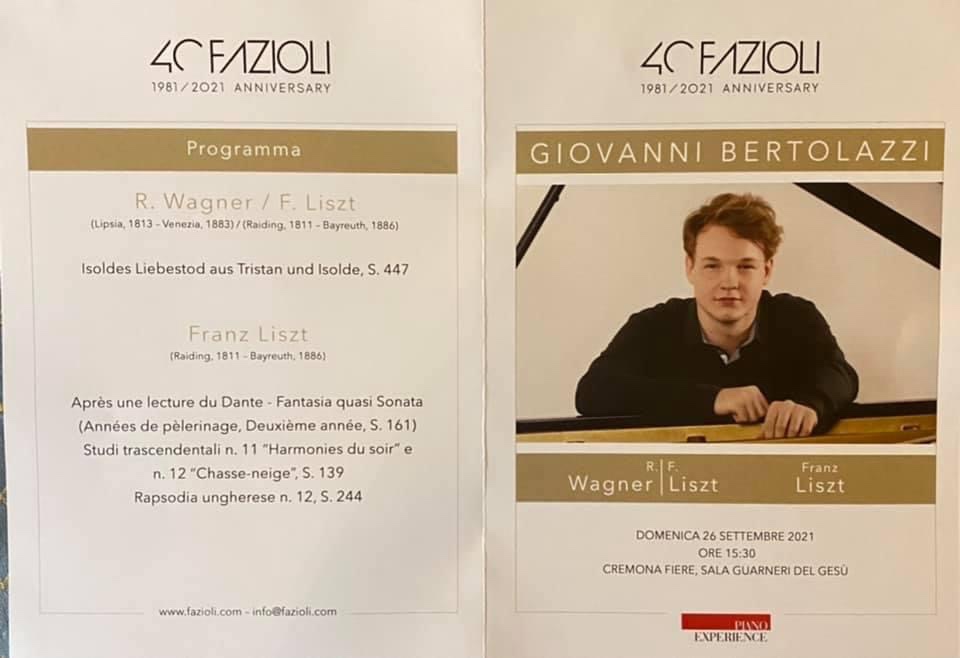
A fascinating story but one that had to be cut short as the final pianist to play today was one of the finest pianists of his generation having just been a top prize winner in the oldest of all piano competitions:the Liszt Competition in Budapest.The winner of the first piano competition in 1933 was Annie Fischer.And it was all Liszt that he offered today. Bhttps://youtu.be/IiQUTQEqv20
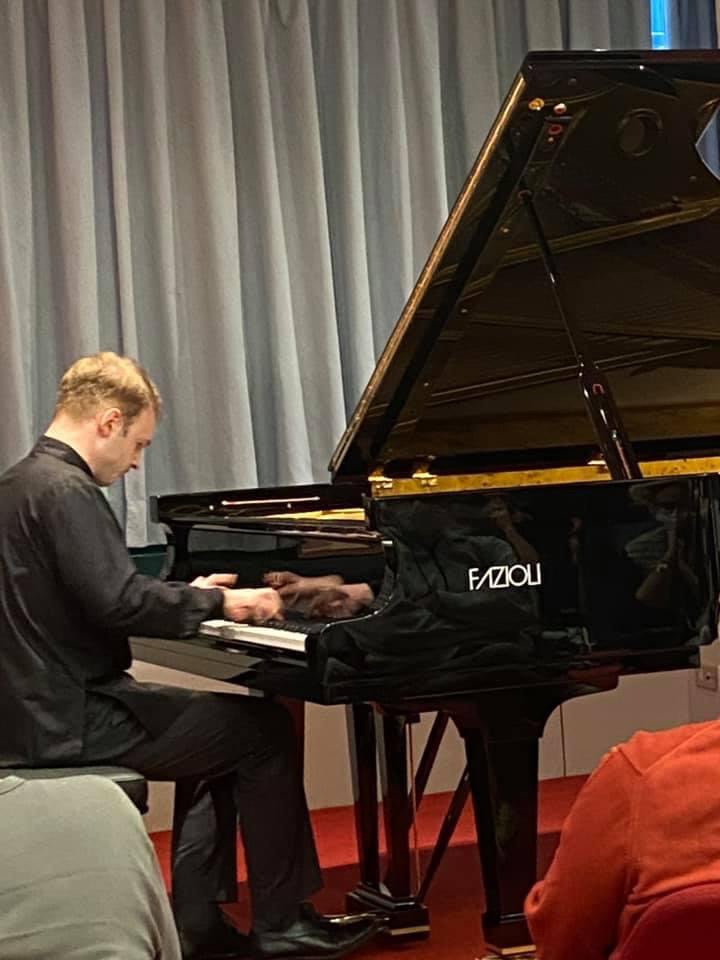
Performances in which musicianship,intelligence,showmanship and total mastery combined to keep the audience enthralled.From the passionate outpourings and ravishing colours of Tristan to the the sheer exhilaration and theatricality of the Dante Sonata.The subtle colours of Chasse Neige and finally the pure animal excitement of the 12th Rhapsody.Encores of Vecsey/Cziffra :Valse Triste (it is Cziffra’s centenary year) and Bellini/Thalberg :Casta Diva (that he had learnt especially to play in Teatro Bellini last night)brought this final recital to brilliant end.
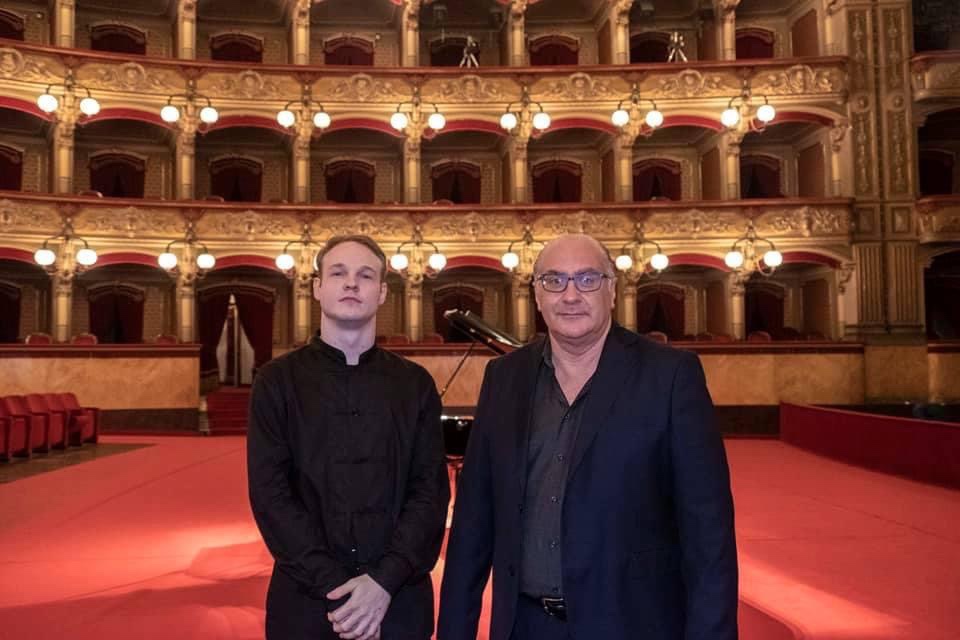
Giovanni’s remarkable teacher Epifanio Comis in Catania where he studies and where he was celebrated on Saturday with a recital in the magnificent Teatro Bellini
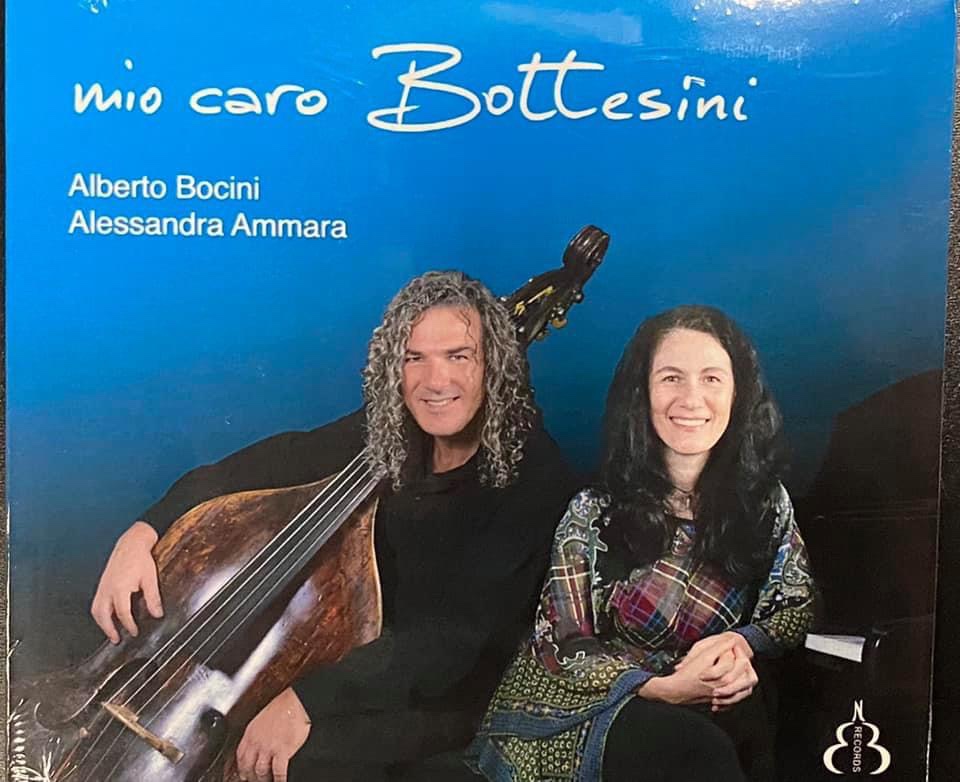
I wish I had had time to attend the Cremona Music Award to Enrico Pieranunzi or the presentation of Massimo Fargnoli’s autobiography or Sandro Cappelletto’s book of Mozart’s travels in Italy but there was only time left to hear the end of the presentation recital of the CD ‘Caro Bottesini
Some phenomenal unbelievable acrobatics and virtuosity on the double bass with Alberto Bocini.Together with Alessandra Ammara who followed every twist and turn with great artistry.They ravished excited and seduced us with all the style of the great bel canto singers of the past.Except this was just one double bass and one piano……….all the fun of the Circus but with what extraordinary artistry.A wonderful end to a weekend of pure magic.
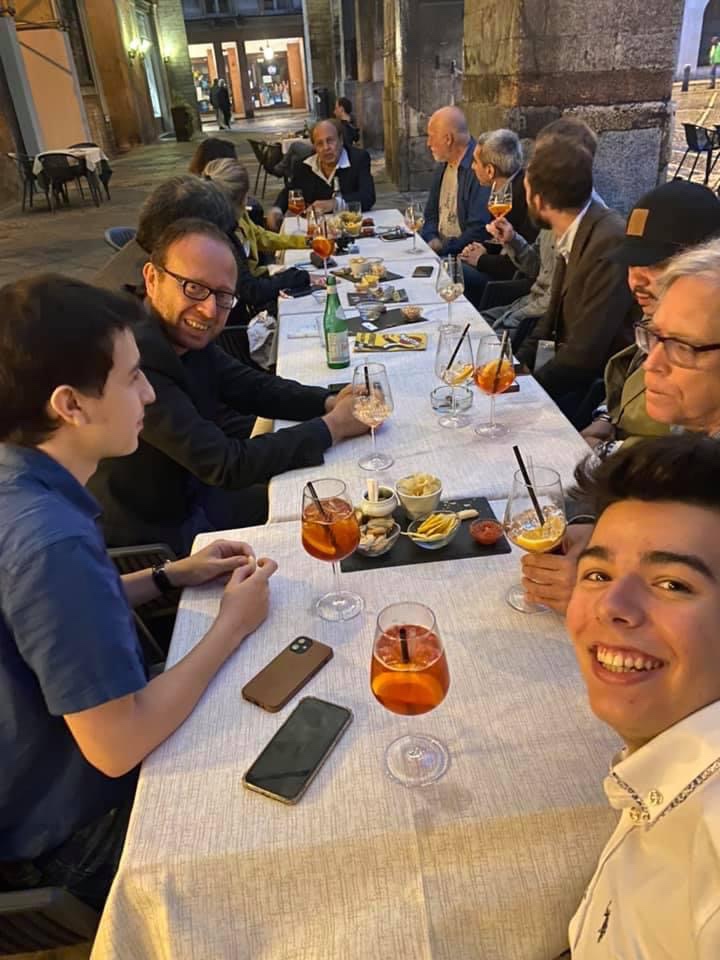
Farewell aperitivo in the cathedral square fast turned into a farewell in music thanks to Roberto Prosseda and his remarkable friends.
A final farewell with an improvised jam session in our favourite restaurant with Roby Lakatos,Enrico Pieranunzi and friends letting their hair down at the end of a memorable weekend in Cremona
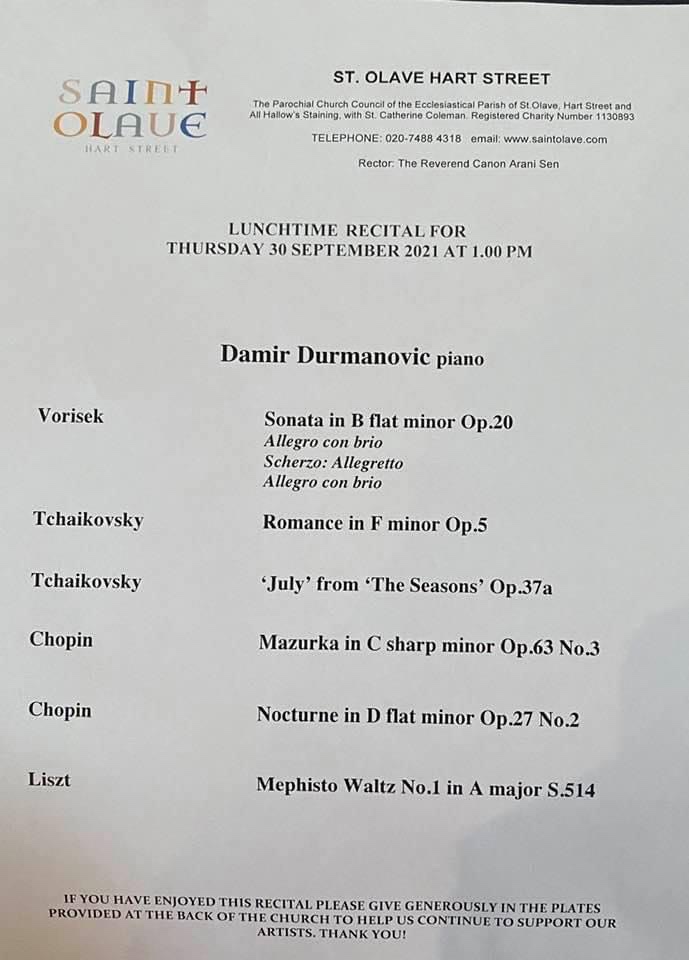
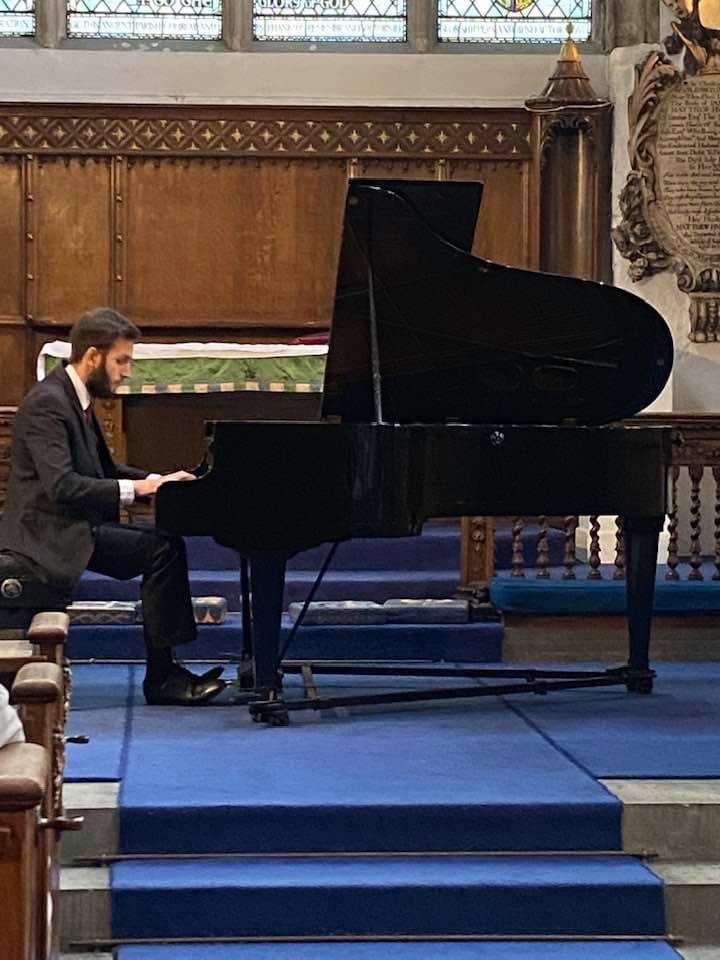
Damir Durmanovic playing at Saint Olave’s. I had forgotten what a unique musician Damir is. Anyone that can add embellishments to Chopin’s D flat nocturne and convince you is someone to reckon with. As he could even make some slight additions to Liszt’s Mephisto Waltz n.1 that like Horowitz were breathtaking. Improvising between each piece as he linked them together via key relationships into a whole. Daring to start with a twenty minute Sonata by Vorisek a pupil of Hummel and making you wonder why we have not seen it on other programmes before.
A wonderful sense of balance made this Bosendorfer happier than it has ever been in lesser hands. And what hands! Like a well oiled orchestra with sounds that poured effortlessly from his ten extraordinary fingers.A unique musical personality convinced as he is convincing -like a breath of fresh air in this rather overcrowded profession. Not at all a showman as he ran on and off the platform as fast as he could but someone who comunes and lives in a world of music sharing his secret world with us
Jan Václav Hugo Voříšek 11 May 1791, in Vamberk Bohemia– 19 November 1825, in Vienna As a child prodigy he started to perform publicly in Bohemian towns at the age of nine.His father taught him music, encouraged his playing the piano and helped him get a scholarship to attend the University if Prague ,where he studied philosophy. He found it impossible to obtain sufficient work as a musician in Prague, so in 1813 at the age of 22, Voříšek moved to Vienna to study law and in Vienna he was able to greatly improve his piano technique under Hummel but once more failed to gain full-time employment as a musician.In 1814, as he was starting to compose, he did indeed meet Beethoven in Vienna. He also met other leading musicians there, including the composers Spohr,Moscheles,Hummel, and especially Schubert with whom he became fast friends.He completed his law studies in 1821 and was appointed barrister to the Court Military Privy Councillor, for whom he mainly drafted legal documents. But in 1822, he at last found musical employment as second court organist and ended his legal career. He was appointed first organist in 1824.The first recorded use of impromptu as a musical term occurred in 1817, in the Allgemeine musikalische Zeitung, an idea of the publisher to describe a piano piece by Voříšek. His Impromptus Op. 7 were published in 1822, pieces known to his friend Schubert who subsequently used the description for several sets of music for piano, as did Chopin and numerous other composers.In 1823-24, like Schubert, he was one of the 50 composers to contribute a variation on the same waltz by Anton Diabelli for the on which Beethoven composed his 33 variations op 120.
A master at Milton Court.Ka Jeng Wong astonished this morning in London having amazed in Cremona on Saturday A Hammerklavier at 10 am to just a handful of people but he played with total concentration as the mammoth work was etched out with masterly control and sense of balance.With all his astonishing mastery I was surprised he opened with two hands but as it was 10 am all is overlooked with an understanding that Serkin would not have shared . But that is an obvious comment when the Adagio lasting almost twenty minutes was played with a stillness and range of colours that was overwhelming.It was the same sense of wonder and discovery that illuminated the B minor Prelude by Rachmaninov that followed.Amazing technical mastery but above all a musical intelligence with his youthful passion and even showmanship.It must have been what Liszt demonstrated as sedate society ladies were reduced to wild animals after such performances as today of the 12th Hungarian Rhapsody that ended his recital. Well almost ended because he saved the poetic G sharp minor Prelude to close together with the mighty D flat major Prelude by Rachmaninov We were only missing the op 3 n 2 that he had played in Cremona to show the remarkable transition that Rachmaninov had made from his first to the last prelude. Unbelievable pyrotechnics in the two moments musicaux with his youthful passion and showmanship but above all musicianship.
Thoughts from my notebook:A Hammerklavier of heroic proportions – two hands at the beginning playing safe at 10am!This is not a play safe sonata and the leap gives you the tempo of the movement despite Beethoven’s seemingly impossible metronome mark (Schnabel almost makes it and I just wonder if he risked the treacherous leap too!).There was youthful passion with extraordinary rhythmic impetus and some quite magical contrasts …….maybe forte and fortissimo contrast would give greater clarity to the musical line.Scherzo : the lighter texture created a great contrast to the monumental first movement.A trio of moving harmonic blocks creating a timelessness before the frenzied reawakening and explosion.The silences we’re projected with meaning and menace!The Adagio sostenuto had great stillness and sublime colours as it shifted continuously with passionate outbursts contrasted with wondrous introspection and moments of absolute magic whilst always moving forward carried along on a great wave.A wonderful sense of improvisation as the false start leads to an ecstatic climax and instantly sublime peace reigns with some very interesting bass counterpoints leading to an truly wondrous ending.It suddenly comes to life again with startling contrasts where Beethoven is still coming to grips with his demons before finding peace in his final great trilogy of thanksgiving.There was astonishing rhythmic energy and precision in the Allegro risoluto fugue -a full orchestra at the limit of the possibilities of a mere piano.Some much welcome moments of fleeting lightness were short lived as Beethoven turns the fugue upside down and inside out much like the mastery of Bach in the Art of fugue.It is where no conclusion is possible as it is at the limit of genius pointing to the future.A tumultuous climax before absolute peace reigns with an amazingly evocative coda on cloud of resonant bass notes.
A remarkable performance that I will long remember for its unrelenting youthful passion and energy.I well remember too Richter repeating the fugue in London as he had not been happy with his performance.Annie Fischer standing in for an indisposed Kentner played the fugue as an encore.Serkin was still kicking and spitting long after he struck the last chord.It is a monument that one tries to scale ….some get further than others and KJ is up there with them.
Rachmaninov after that reveals a completely different world with KJ’s mastery of texture and balance combined with a sense of showmanship that really was quite sensational.Astonishment,beauty and magic after the Hammerklavier at 10 am was indeed a remarkable tour de force.The few people present were treated to unforgettable performances destined to be shared in the world’s great concert halls in the future.The wizardry and volume of rich full blooded sound in the Moments musicaux n.4 and 6 could not have been bettered by the sumptuous Philadelphia as was the great final prelude op 32.There was sublime beauty and simplicity too in the ravishing op 32 n.5 and 12.But it was op 32 n.10 that will remain in my memory for a long time – The return – Rachmaninov admitted to Moiseiwitch was the inspiration.And inspired it was today with a luminosity of sound and wondrous sense of balance building up the sonorities with masterly control that evaporated in a cloud of smoke before the beseeching sounds of the final heartbreaking nostalgia of return.The Liszt 12th Hungarian Rhapsody was played with all the showmanship heart-on-sleeve ravishment and animal excitement that had us cheering Rubinstein when he was well into his 80’s.KJ has many years ahead of him but I imagine the young Rubinstein would have had much in common with this remarkable young artist.
Biography
KaJeng Wong
KJ’s career has manifested beyond his training as a professional pianist. Besides performing music, he curates innovative programme at the annual Music Lab Festival as the Artistic Director, organises oversea tours, writes prolifically for publications, as well as hosting his own music programs. Largely due to his ambition to connect with others through music, he continues to surprise his audiences with ideas and projects.KJ rose to public’s attention due to an unexpected welcoming of his documentary “KJ: Music & Life” in 2009, which won Best Documentary at Golden Horse Awards. He spent four years studying under Prof. Emile Naoumoff at the Indiana University Bloomington (IUB) after trainings with Nancy Loo and Gabriel Kwok; participated in festivals such as PianoTexas and Verbier Festival Academy; received guidance from masters such as Menahem Pressler, Yoheved Kaplinsky, Claude Frank, John O’Conor; awarded twice as the concerto competition winner at IUB; proceeded to Semi-Finals at competitions such as Gina Bachauer International Piano Competition, PianoFerrol, Hong Kong International Piano Open Competition, awarded Special Prize at the Los Angeles International Piano Competition, advanced to Finals at the Young Concert Artist Audition in New York. Recently, he was voted first prize and chamber prize at the Alaska International E-Piano Competition in 2018, as well as Third Prize and Special Student Jury Prize at Maria Canals International Piano Competition 2019.At Music Lab, he built a creative hub where he can attempt for concerts of unconventional forms and ideas. Over the years, he has already presented solo programmes exploring themes such as “Seasons of Life”, “Tribute to Death”, “Fingerman – Fast & Difficult”, “Fingerman – God or No God”; chamber programmes such as “Freedom of Shadows”, “Beloved Clara”, “So French”. In 2017, he also founded the trio SMASH with saxophonist Timothy Sun and world harmonica champion, CY LEO. As a local creative force, Music Lab has grown its own festival, celebrating artists with creative thoughts and promoting cultural talents of Hong Kong. Approaching the third edition of Music Lab Festival, Music Lab and KJ continues to develop original programme as well as ambitiously touring cities in Taiwan, Macau, Malaysia and China.
With Prof Ronan O’Hora – head of keyboard studies at the Guildhall where KJ is a fellow KJ at the Cremona Fiera with Prof Julia Mustonen-DahlkvistProf.Julia Mustonen-Dahlkvist of the Ingesund Piano Centre SwedenHis flamboyant style as Barbirolli said of Jaqueline Du Pré ….’if you don’t play with passion when you are young what do you pare off in old age…………..’with Jackie we were never to know -her career was over at 28 -KJ has the world still at his feet .
Rachmaninov – Etude-tableau No. 2 in C Major, op.33 Etude-tableau No. 3 in C minor, op.33 Etude-tableau No. 9 in C-sharp minor, op.33
Liszt Après une lecture de Dante (Fantasia quasi sonata)
Barber Sonata for Piano, op. 26 Allegro energico – Allegro vivace e leggero – Adagio mesto – Fuga Allegro con spirito
From the very first notes of Bauer’s transcription of Franck’s Prelude Fugue and Variation it was obvious that here was an artist painting in colours and sounds.A transcendental technique at the service of allowing the music to speak with such subtle beauty and colour.It was a lesson in itself to see this Sokolov type figure hovering over the keys just as the great master himself does.Imperceptible continuous circular movements like a bee hovering around the hive waiting to bring home the nectar to make their unique honey.This was just as Rubinstein had likened style and personality in trying to explain the unexplainable to the very first young musicians competing in his competition.It is a God given gift – the search for beauty and to be able to tell a story in all it’s forms from the tempest,through inferno to paradise and sublime love.And it was all here in Maxim’s extraordinary performances .A vast bare canvas that he proceeded ,without any extrovert showmanship,to fill with the most subtle ravishing sounds.The fluidity of the haunting theme of the Franck was followed by the luminous clarity and full organ like sonorities in the fugue.A sense of balance that allows the musical line to be revealed without disturbing the shape and form of the underlying counterpoints.An orchestra in his hands led by someone who is listening so attentively to every strand as the music takes on its architectural shape and form.A continuous forward movement of absolute authority as he takes us by the hand and leads us through this magical landscape.The reappearance of the haunting theme is in this Bauer transcription even more beautiful than the Prelude chorale and fugue.An ethereal apparition of pure magic that gradually builds in intensity with its obsessive almost Scriabinesque insistence that blows itself out leaving a mere whisper of the magic land we have been allowed a glimpse.The work was written by Franck for organ in 1860/62 and dedicated to Saint Saens ,although originally conceived for piano and harmonium.Both Harold Bauer and Ignaz Friedman transcribed it for solo piano.Bauer was born in Kingston upon Thames in 1873 and Paderewski persuaded him to leave the violin and take up the piano which he did very successfully.He moved to the USA after having made his debut in Brahms n.1 with the Boston Symphony Orchestra and giving the world premiere of Debussy Children’s Corner Suite in Paris in 1908. He was a very influential teacher at the Manhattan School of Music and Universities of Miami and Hartford – he died in Miami in 1951.
Maxim’s performance was indeed the sumptuous velvet sound of Ormandy’s Philadelphia but there is also a brass section to every orchestra that sometimes I felt Maxim neglected.Music is made of contrast and we had to wait until the glimpse of Dante’s inferno before Maxim chose to include the brass band too! ’Darkness to be able to perceive light ‘. It is not meant as a criticism and is obviously the choice and sensibility of the interpreter.Volodos indeed plays so beautifully that you sometime wish he would just throw himself occasionally into the piano like a sledgehammer – but can too much beauty ever be criticised ?It is a question of an introvert personality of a modesty and ultra sensitivity to sound allied to a transcendental technical mastery which is quite remarkable in a pianist still in only his 20’s .
The three Etudes Tableaux by Rachmaninov are described by the composer himself as pictures in sound – the fact that he never disclosed what the pictures were we might assume that he did not want to limit the listeners own fantasy.As he himself said:”I do not believe in the artist that discloses too much of his images. Let [the listener] paint for themselves what it most suggests.”Like Debussy where the name of each of his 24 Preludes is printed at the end not at the beginning of each one preceded by dots as though this is just a suggestion of something written in sand not stone!
Op.33 n.2 was of haunting beauty and a subtle sense of balance which gave such luminous sound to the melodic line and created an atmosphere in which the ending was simply a golden stream of sounds like smoke dissolving into thin air.An extraordinary technical feat of jeux perlé of fleeting lightness and colour not least helped by his mastery of the pedals.
There was menace in op 33 n.3 played with total concentration as the sumptuous arpeggios revealed the melodic line in their midst and was re used in the Largo of his Fourth piano concerto written fifteen years later.
Op 33 n.8 was played with turbulence and Scriabin like menace where his control of sound was quite extraordinary as he brought this miniature tone poem vividly to life.
Après une lecture du Dante: Fantasia quasi Sonata is also known as the Dante Sonata and is in one movement .It was completed in 1849 and first published in 1856 as part of the second volume of his Années de pèlerinage.It was inspired by the reading of Dante’s Divine Comedy and as Leslie Howard pointed out in his introduction it obviously depicts l’inferno with the souls of hell wailing in anguish.It received a remarkably vivid performance from Maxim with a great sense of character from the very first notes shaped with great care before the menacing scales in the base that herald the unveiling of events.There was a gradual build up of intensity shaped like a true musician with a transcendental control where technique and music are fused into one.There was utmost delicacy too in the central episode- Beatrice?-where his fingers barely touched the keys as the colours from the accompaniment we’re wondrously revealed like jewels sparkling as they caught the light.There was excitement,too,generated by an accumulation of sound that became quite overwhelming as the full orchestra – brass and all- was revealed.Octaves that were screams from hell dissolving into vibrant chords on which the melodic line was revealed as if on a magic cloud of sounds.He fearlessly plunged into the final few pages with a triumphant outpouring of sounds which knew no technical limitations.A remarkable performance in which every detail of the score had been scrupulously incorporated into a fantasy world that more than explains the composers own title of Fantasia quasi Sonata
The Piano Sonata in E flat minor Op.26 was written by Samuel Barber in 1949 for the twenty-fifth anniversary of the League of Composers aimed at promoting new American works . It was commissioned by Irving Berlin and Richard Rodgers and first performed by Vladimir Horowitz in Havana, Cuba, on December 9, 1949, followed by performances in Cleveland and Washington, DC,before presenting the work at Carnegie Hall on January 23, 1950.It was received with overwhelming critical acclaim and has been part of the piano repertoire ever since.It is a complex work in four movements and although extremely difficult technically , the sonata is much more than a virtuosic showpiece. Barber integrated many 20th century musical ideas into the sonata, including extended chromaticism and tone rows.Pungent rhythms alternate with mystery and menace in the first movement and the second, Allegro vivace a perpetuum mobile played with startling rhythmic energy to the final bars thrown off with transcendental lightness.The subtle beauty of the Adagio mesto was played with such extraordinary colouring and a sense of architectural shape constantly moving forward with great intensity .The Fugue showed all his amazing agility in a ceaselessly busy embroidery of notes of transcendental difficulty.
A New Artist recital is offered to selected young artists to introduce themselves to the Keyboard Trust and the public .A programme that is varied,imaginative and thought provoking is suggested which is exactly what Maxim so valiantly and superbly offered today.As Leslie Howard remarked in his after concert discussion with the artist it is a pity that there was no live audience to give him the standing ovation that he so obviously deserved.
Maxim Kinasov is an award-winning solo and chamber musician who performs a wide range of repertoire from Bach to Shostakovich. Born in Moscow, he began piano lessons at the age of five, making his concerto debut at the age of nine and his recital debut a year later.Awarded a scholarship, he obtained his Bachelor of Music degree with Distinction from Moscow’s Tchaikovsky Conservatoire. His teachers there included Sergei Dorensky, Nikolai Lugansky, Pavel Nersessian and Andrei Pisarev, who are his greatest musical influences.During his studies, he won several music competitions including Second Prize and Audience Prize at the 2015 International Gian Battista Viotti Piano Competition in Vercelli, Italy, Grand Prix and Special Cuomo Foundation Prize at the 2014 International Chopin Piano Competition in Rome and Grand Prix, First Prize and Special Prize ‘For the best performance of a work by Tchaikovsky’ at the 2013 International Konstantin Igumnov Piano Competition for Young Pianists in Lipetsk, Russia.In 2019 Maxim completed his Master of Music in Performance degree, also with Distinction, at the Royal Northern College of Music in the class of Ashley Wass, supported by a Leverhulme Arts Scholarship. Last year he studied on the International Artist Diploma course at the RNCM, supported by the FM Wright Piano Award. Now he is studying on the Postgraduate Diploma Advanced Studies course at the RNCM, supported by the Anderson Powell Prize, and the Helen Rachel Mackaness Charitable Trust.In 2018, Maxim won the RNCM’s most prestigious award, the Gold Medal and played in the Gold Medal Winners concert at Wigmore Hall in the Spring of 2019. He most recently won First Prize and Special Jury Mention at the Cantù International Piano and Orchestra Competition (Italy, 2019), Runner-up Prize at the Bromsgrove International Musicians Competition (2019, United Kingdom), and Second Prize and the Royal Philharmonic Orchestra Prize at the 2019 Hastings International Piano Concerto Competition.In April 2020 Maxim has been named as an Artist of the Month of the Talent Unlimited Music Charity and in May won an Ian Fleming Award at the Help Musicians Postgraduate Awards. Also, he was selected as a Kirckman Concert Society Artist for 2019-20 and played his full-length solo debut at Wigmore Hall in October 2019.Maxim has been a soloist of the St Petersburg House of Music since 2012 and has performed in prestigious venues across Russia, Italy, Spain, UK, Brazil and US, including Carnegie Hall, Wigmore Hall, Bridgewater Hall and the Great Hall of the Moscow Conservatoire. He has performed internationally with orchestras including the St Petersburg State Academic Symphony Orchestra, Orchestra of the Teatro Carlo Felice, Royal Philharmonic Orchestra and The Hallé, among others.At the invitation of Nikolai Lugansky Maxim took part in the 35th International Rachmaninov Music Festival in Tambov, Russia (2016). Other festival appearances include the ‘Gathering Friends’ International Music Festival at the Moscow Conservatory, South Downs Summer Music Festival in Alfriston, Chester Music Festival, Battle Festival and Hastings International Piano Digital Festival.As a chamber musician, Maxim won the 6th International Sergei Taneyev Chamber Ensembles Competition in Kaluga, Russia (First Prize, Special Tatiana Gaydamovich Award and Special Moscow Tchaikovsky Conservatory Prize ‘For the best performance of a work by Taneyev’, 2017) and has worked with Henk Guittart of the Schoenberg Quartet and Alexander Bonduriansky of the Moscow Trio.Maxim has broadcast on Italian TV channels TG2 RAI and TGVercelli, and on BBC Radio 3.
This is the free link to the concert please feel free to make a donation that will enable other remarkable musicians to perform in KCT venues
The Keyboard Trust is entirely dependent on donations from our friends for its work in supporting outstandingly talented young musicians and so we’d be especially grateful to you for your support of this venture.Please feel free to make a donation via this website.
Miracles do not often occur but today at St Mary’s a light was shining brightly as we were treated to such wondrous playing of total mastery that I was reduced to tears by the sheer perfection and beauty. Not since Geza Anda have I heard such luminous sound and technical mastery allied to a musical imagination that brought everything so vividly to life. I sat mesmerised listening to pieces I have known all my life as though for the first time as streams of poetical sounds flowed from his fingers with such well oiled ease. Kinderszenen was unbelievably beautiful as each of the thirteen episodes was revealed with a sheen of sound that bound them into a wondrous whole.Chopin studies,that as he said , were a collection of jewels hidden in technical difficulties.Poetry for those that can master the difficulties , full of colour and magical sounds. Gershwin played like Art Tatum in some dive in New York where all the great pianist used to go to marvel. And marvel we did today. There is only one word to describe what we heard today …sensational.
First edition title page
Schumann wrote 30 movements for this work but chose 13 for the final version of 1838.The unused movements were later published in Bunte Blatter op.99 and Albumblatter op 124.He initially intended to publish Kinderszenen together with Novelletten op 21 where the shared literary theme is suggested by the original title Kindergeschichten (Children’s Tales). He told his wife Clara that the “thirty small, droll things”, most of them less than a page in length, were inspired by her comment that he sometimes seemed “like a child”. He described them in 1840 as “more cheerful, gentler, more melodic” than his earlier works.
From the very first liquid notes we were immediately transported into a magic world of wondrous sounds and eloquence.The final piece is called the Poet Speaks but it was apparent from the very first note,and throughout the recital of short pieces,that each one was a jewel that was made to sparkle and shine,whisper and shout with loving care, as this young man delved deeply into the soul of each piece with a transcendental mastery of sound that was mesmerising.I remember Shura Cherkassky telling me that he did not think that young pianists listen to themselves – I just wish he could have been here today! https://youtu.be/QsEfoSCfJ1s
‘Of foreign lands and peoples’was played very slowly and simply with his extraordinary sense of balance that let the melody shine out above a whispered flowing accompaniment – sometimes the melodic line and accompaniment get mixed up at the end of the phrase but not for an artist who is listening like a Gerald Moore as he accompanies a Schwarzkopf or a de Los Angeles!There was charm and character as he deliberately played with the dotted rhythm in such a teasing way – ‘a curious story’ indeed as it alternated with exquisite legato comments.The feather light jeux perlé of ‘Blind man’s bluff’was not the usual explosion we so often hear but a child creeping and peeping into every corner.It led so naturally into the gentle ‘Pleading child’ who was ‘Happy enough’as the child obviously awoke amidst magic colours and sounds.A pompous ‘Important event’ but always within the context of the overall architectural shape of this fairy story.It is,after all, a dream as his exquisite sense of meaning ,full of shape and style,gave great delicacy to this most beautiful of pieces-‘Traumerei’.Creeping in to be ‘by the Fireside’ with its wondrously delicate ending before being interrupted by the ‘Knight on the hobby horse’ so deliberately careful as it rocked gently to and fro.Things we’re now getting ‘Almost too serious’ with its wondrous syncopated melodic line – as he hinted at the beautiful tenor counterpoint at the end.His mastery of balance gave such meaning to the ‘frightening’ interruptions as the melodic line passed from treble to tenor then bass as if by magic.With such sublime beauty and delicacy it is hardly surprising that the ‘Child falls asleep ‘ was dreaming of all these wonders that have appeared from the opening magic of foreign lands to paradise .There was a sublime ending before leading quite simply to the ‘Poet speaks’ played such simple beauty and subtle wisdom.A quite extraordinary performance that I have only once heard equalled by Guiomar Novaes
The first set of Études was published in 1833 (although some had been written as early as 1829). Chopin was twenty-three years old and already famous as a composer and pianist in the salons of Paris, where he made the acquaintance of Franz Liszt. Subsequently, Chopin dedicated the entire opus to him – “à mon ami Franz Liszt” .They are generally thought to be not quite as poetic as the second book op 25.Rokas today showed us just how much poetry there is in this first book hidden behind transcendental technical difficulties.The difficulties just disappeared in Rokas’s hands as he himself had said that his lockdown project had made him realise just how much poetry there is in these 12 miniature tone poems.With a circle of tonality that links them into a whole ,making the 6th study the focal point in the complete architectural conception.And it was this study above all the others that received a quite remarkably poignant performance of aching beauty.In the key of E flat minor and played with a subtle sense of shape and flexibility as it spoke so eloquently with such luminosity and intensity.It is like the 16th variation of Bach’s Goldberg -the real centre point of a great arch.The first study was a series of shifting harmonies in which neither the great anchor of the bass or the filigree accompaniment of the treble were given a priority but the shifting harmonies they produced were shaped into great arches of sound.The second study of chromatic scales in the right hand was played with such delicacy with the same irresistible lilt that I have never forgotten from the hands of Jan Smeterlin over fifty years ago.
Smeterlin had studied with Godowsky who had written fifty three studies based upon Chopin’s studies.It is interesting to note in the introduction to these studies that their aim is to develop ‘the mechanical,technical and musical possibilities of piano playing,and to expand the peculiarly adapted nature of the instrument to polyphonic,polyrhythmic and polydynamic work ,and to widen the range of it’s possibilities in tone colouring’.Anyone who has had the fortune to hear Shura Cherkassky play the sixth study for the left hand alone will realise what subtle shading and colour can be found by true masters of the instrument.It was just this mastery that was quite breathtaking today from Rokas as one sparkling jewel linked with another to be crowned by the final great added octave C at the end of the final ‘Revolutionary’ study.In the eleventh there were sounds woven in the air with the melodic line floating on a continuous harp like accompaniment.The acciaccaturas so clear were helped by the resonance he gave to the deep bass notes as it drew to a coquettishly delicate ending.Chopin’s very meticulous phrasing in the tenth study I have only heard so clearly and poetically realised from Geza Anda.This was preceded by the dark seriousness of the ninth played with a wonderful sense of balance that allowed the melodic line to float on a wave of sound.The absolute clarity of the ornaments incorporated into the return of the opening melody had me searching in the score as I had never been aware of this delicate touch before.Murray Perahia often has me searching in the score as he too illuminates details in works that I have lived with for a lifetime but have passed over unaware of their significance.Rokas showed us today that he has the great gift of illuminating details in scores as he digs deep into their poetical content.The seventh was strangely non legato but contrasted so well with the lyricism of the middle section.The eighth just sprang out of his fingers with an ease as if turning on a tap.Streams of golden sounds accompanying the delicacy of the left hand melodic line .The beautiful third study,sometimes known as ‘Tristesse’ ,was shaped with aristocratic style of such flexibility and good taste.The technically challenging middle section was incorporated into the overall shape instead of seeming like a rude interruption before the continuation of the sublime opening melody.Number four and five were played with extraordinary agility.There was passion and excitement in the fourth and irresistible sparkle in the fifth -the famous black key study that Myra Hess used to play for fun with an orange and two carrots!A quite extraordinary performance from Rokas who restored these often misunderstood ‘studies’ to their true realm of tone poems every bit as poignant as the Mazurkas that Schumann so rightly described as cannons covered in flowers.
The three preludes by George Gershwin were first performed by the composer at the Roosevelt Hotel in New York City in 1926. Each prelude is a well-known example of early-20th-century American classical music as influenced by jazz.They were dedicated to friend and musical advisor Bill Daly.He originally planned to compose 24 preludes for this group of works but the \number was reduced to seven in manuscript form, and then reduced to five in public performance, and further decreased to three when first published in 1926.
What fun Rokas gave them as he let his hair down letting rip as he brought these three charmers vividly to life in great style.There was a full orchestra in the first one with rhythmic energy and a fantastic ending like a rocket taking off as he shot up to the top of the keyboard.Sleeze and decadence in the second, Rokas even added some of his own embellishments as he dug deep into the bass producing sounds of pure magic.A truly hypnotic sense of energy in the last famous prelude brought this short jazz interlude to a truly brilliant end.
Praised for his “liquidity of sound” and “devilish performances”, Lithuanian pianist Rokas Valuntonis has drawn admiration for his imaginative interpretations and striking virtuosity. A laureate of more than 20 international competitions, Valuntonis won 1st Prize at the 2018 Campillos International Piano Competition (Spain) and previous victories include both the International Music Competition “Societa Umanitaria” (Italy) and the Nordic Piano Competition (Sweden). Valuntonis has performed all over Europe, including Denmark, Finland, France, and Portugal, in venues such as Milton Court (Barbican Centre), La Sala Verdi, The Wallace Collection, Lithuanian National Philharmonic Hall, and La Sala Casella Accademia Filarmonica Romana. He has also performed with the Lithuanian National Symphony Orchestra, Lund Symphony Orchestra, St Christopher Chamber Orchestra, Lithuanian Chamber Orchestra, and Panevežys Chamber Orchestra. Aside from traditional concerts, Valuntonis has collaborated with both actors and presenters. His most recent collaboration, with the celebrated Lithuanian actor Kostas Smoriginas, explored the characters and emotional lives of great composers like Beethoven, Chopin, and Rachmaninov. The 2020/21 season sees Valuntonis present solo recitals around Europe in venues such as Lithuanian National Philharmonic (Lithuania), Klaipeda Concert Hall (Lithuania), Harpa Concert Hall (Iceland) and festivals such as Deal Arts and Music festival (UK), Barnes Music festival (UK), Summer of Piano music in Druskininkai (Lithuania). Growing up in Lithuania, Valuntonis studied at the Lithuanian Music and Theatre Academy under Aleksandra Zvirblyte, before attending the Sibelius Academy (Finland), followed by studies with Eugen Indjic in Paris and Artist Diploma studies at Guildhall School of Music and Drama in London under Peter Bithell. Rokas joined the City Music Foundation Artist Programme in 2017. For his many achievements, Valuntonis has been honoured with the prestigious Queen Morta Award and acknowledgements by two Lithuanian Presidents. This year Rokas was awarded with “Jung Artist Grant” by Lithuanian Ministry of culture.
Cristian Sandrin in concert for the Imogen Cooper Music Trust.In the sumptuous new concert venue in Knightsbridge that can boast a magnificent piano and unique atmosphere for chamber concerts.
It is a major addition to the London concert scene with its warm friendly atmosphere and perfect acoustic . Lord Burlington would take his guests after dinner ,to a concert with Handel performing ,to the copy he had made of La Rotonda of Vicenza transplanted into the countryside of Chiswick.Mozart tells us in his letters of going for a ride in the countryside of Chelsea!
This beautiful house just behind Harrods has just such an atmosphere of rare friendly elegance . We were able to be ravished tonight by Chopin B minor Sonata and Beethoven op 111 separated by C.P.E Bach Sonata in C minor.
Dame Imogen Cooper presenting the concert
Great works that need a master musician to bring them to life and Cristian showed off his aristocratic good taste and intelligence in performances where the architectural line was of fundamental importance.
This in Chopin is no mean feat and it was enough to see how he linked the end of the Scherzo with the mighty opening of the Largo or how he opened the Finale with a crescendo to the rondo that grew ever more in intensity until it’s final ecstatic explosion and triumphant final declaration. There was sublime beauty too with the intense simplicity of the first movement second subject or the ravishing nobility of the Largo. The scintillating jeux perlé of the Scherzo was contrasted with the clarity of line in the trio.
Beethoven’s last Sonata was played with great clarity.The opening three mighty declarations played with such weight only to dissolve into magical vibrations before the startling arrival home to C. There were arresting contrasts between water at boiling point finding refuge in moments of sublime repose.The Arietta was played with a luminosity and simplicity out of which the variations evolved so naturally before exploding into rhythmic turmoil and disintegrating before our very eyes .It wound its way ever more on high in its ethereal journey lost in a magic stream of trills above which the angels had the last word.Beethoven after a tormented life had finally found peace.No ritardando at the end of either movement showed his remarkable intelligence as he followed the great architectural line to its inevitable conclusion.
Some of the distinguished audience
C.P.E Bach is a well constructed sonata for keyboard by a craftsman but not the genius of his father.It was played with a innocent simplicity.The seeming solo and tutti in the Andantino gave great character to an otherwise rather uninspired work.The rondo had grace and energy and all the character that Cristian was able to portray.A nice interlude between two master works just made us appreciate the genius of Chopin and Beethoven even more. An encore of une barque sur l’océan from Ravel’s miraculous Miroirs allowed this magnificent piano to illuminate the room with scintillating colour and ravishing virtuosistic washes of sound.
In the whole recital one was aware of the natural way that Cristian could play with such clarity and simplicity.A technical mastery that knows no difficulties but gives him the possibility to conduct like a great maestro with his ten marvellous fingers replacing the magnificence of a full symphony orchestra.It was refreshing to see the way he sat at the piano and the way that his hands,arms and whole body would carve the great curves of sound out of the piano as a master sculptor would create such wonders out of a block of marble. The next concert on the 14th October is another great young musician Ariel Lanyi who will be playing Beethoven’s mighty Hammerklavier Sonata op.106.
Dame Imogen after the concert with Cristian Sandrin
Master musicians playing master works is only to be expected with Dame Imogen Cooper at the helm!
Some young admirers after the concertCelebrations in the sumptuous Stone HallDame Imogen with Oliver Bowring the sound producer and Cristian with Sir Nicholas Stadlen chairman of the Trustees of the Imogen Cooper Music TrustMary the deus ex machina of the Imogen Cooper TrustThat after concert feeling