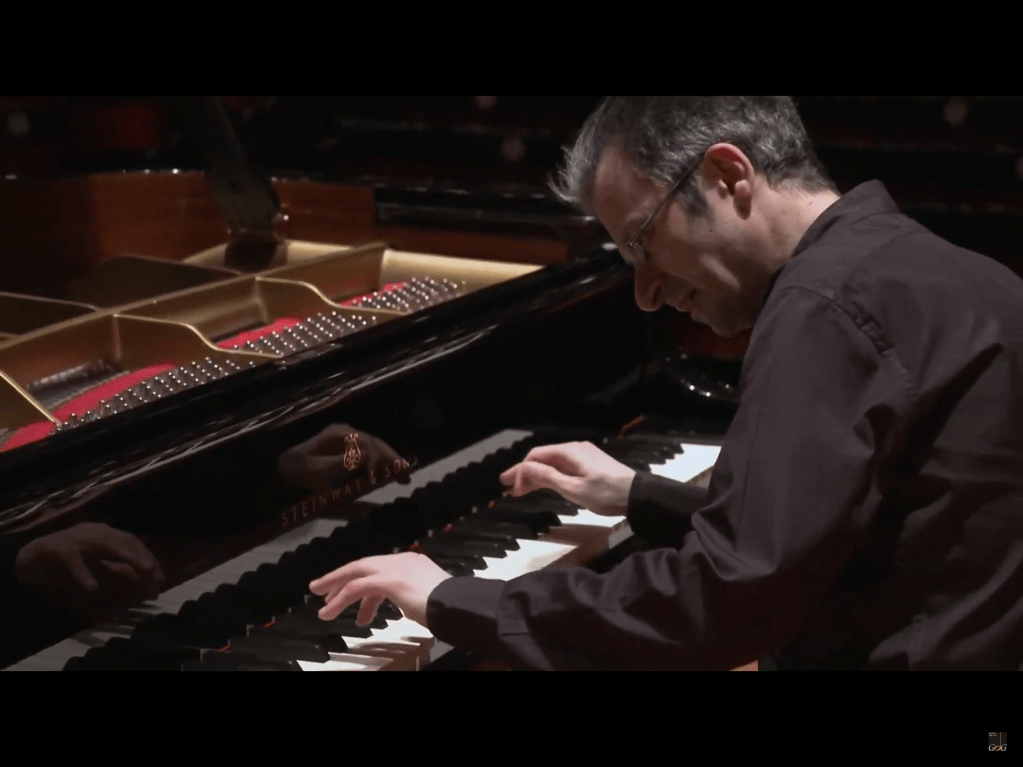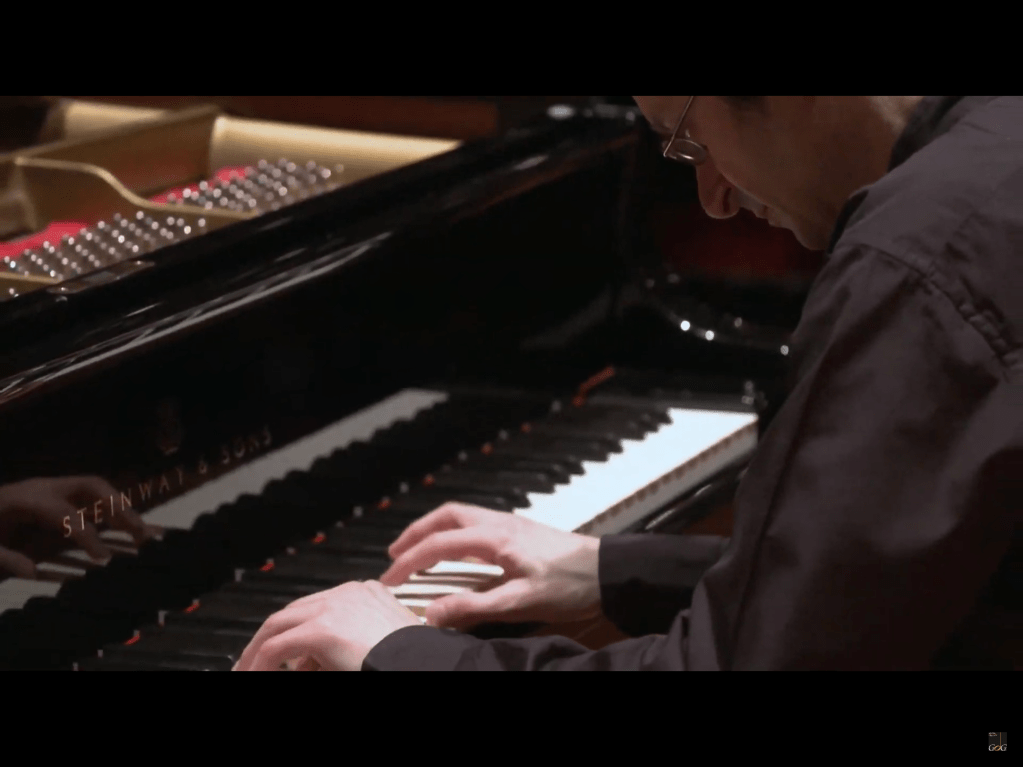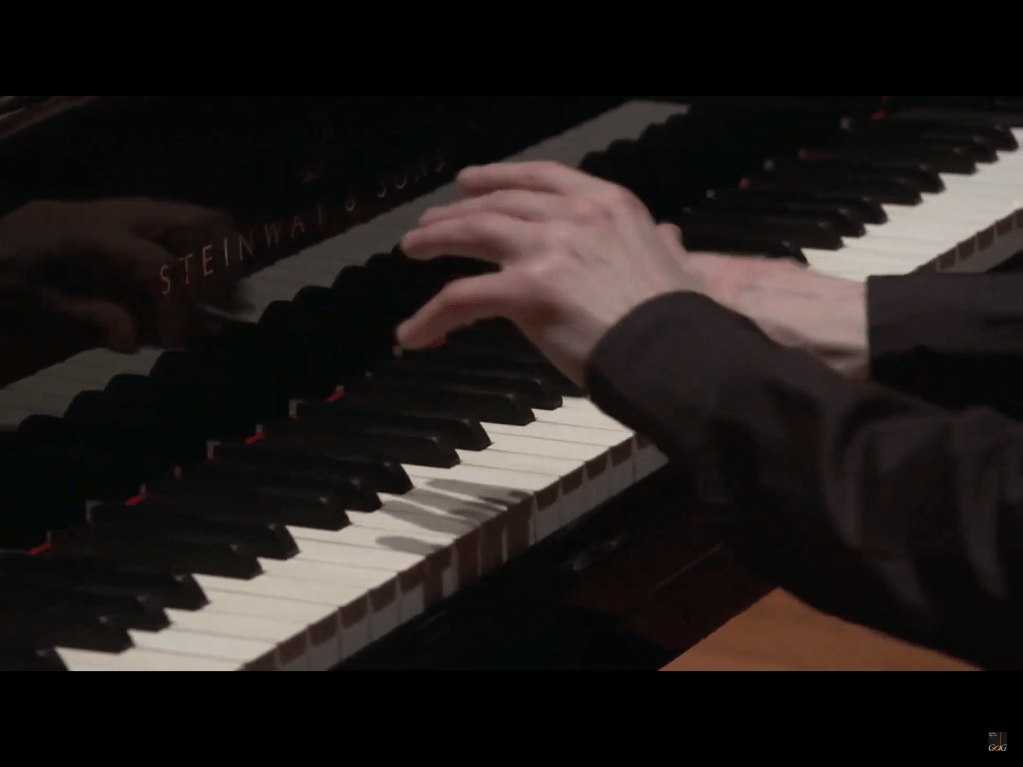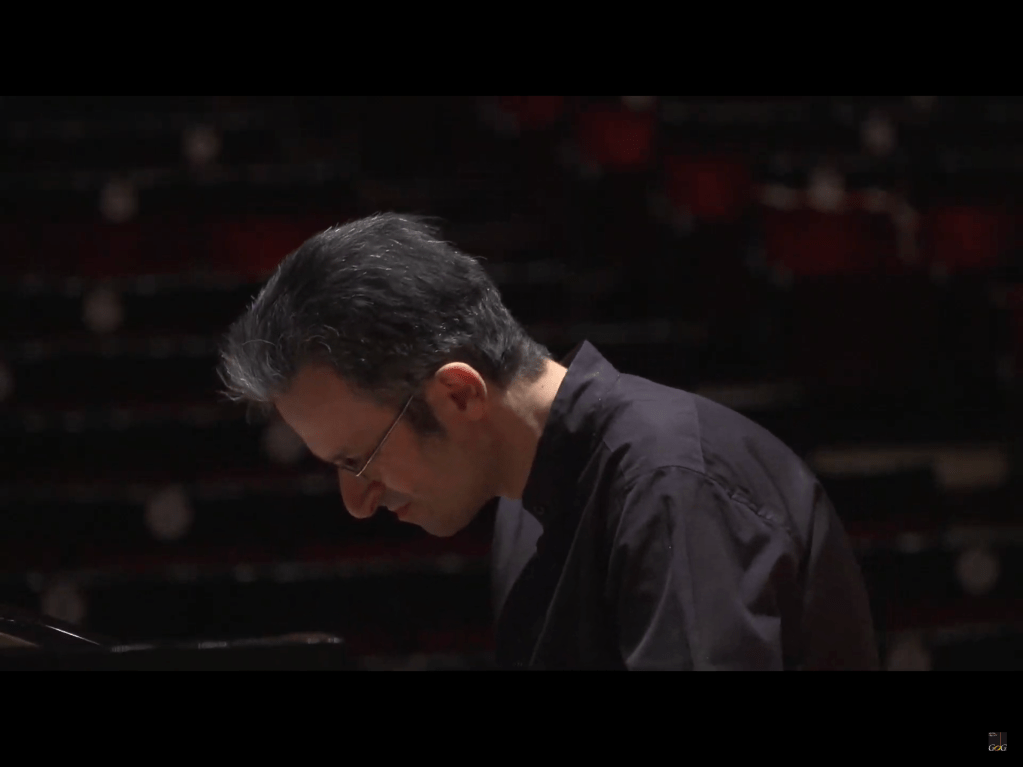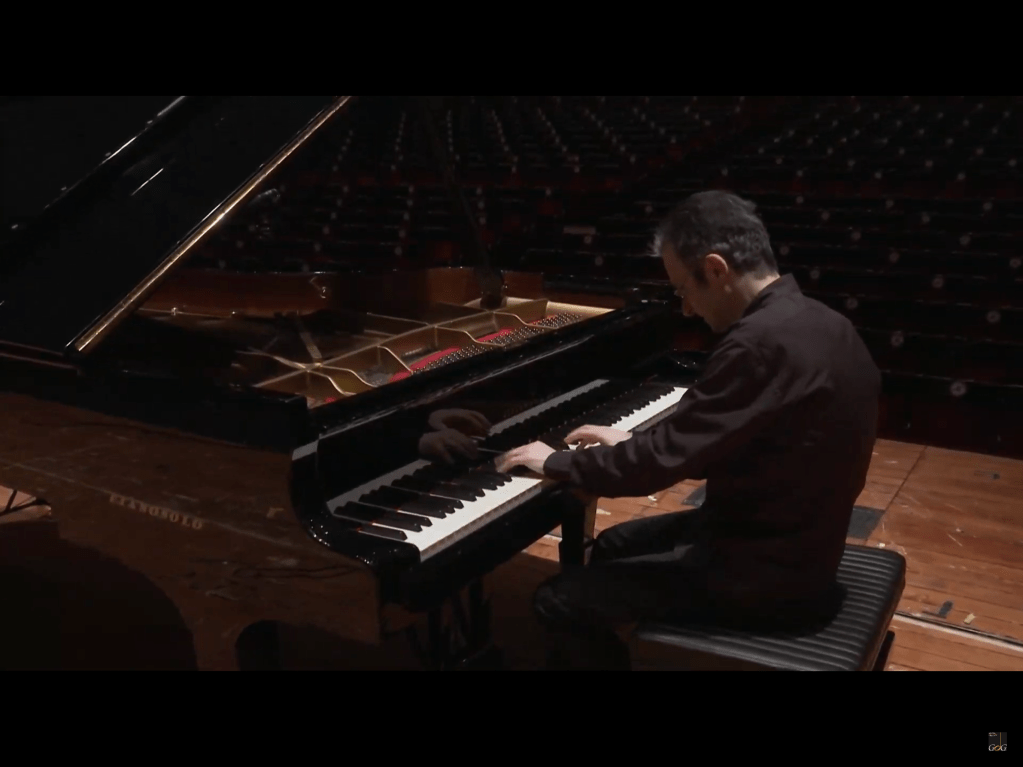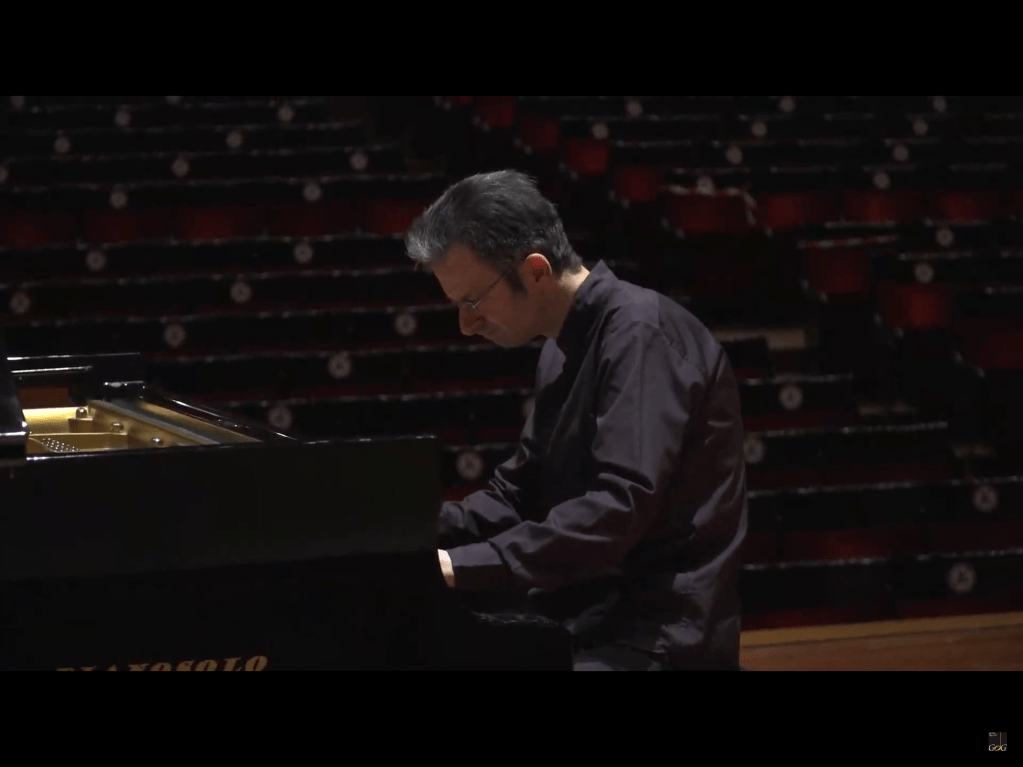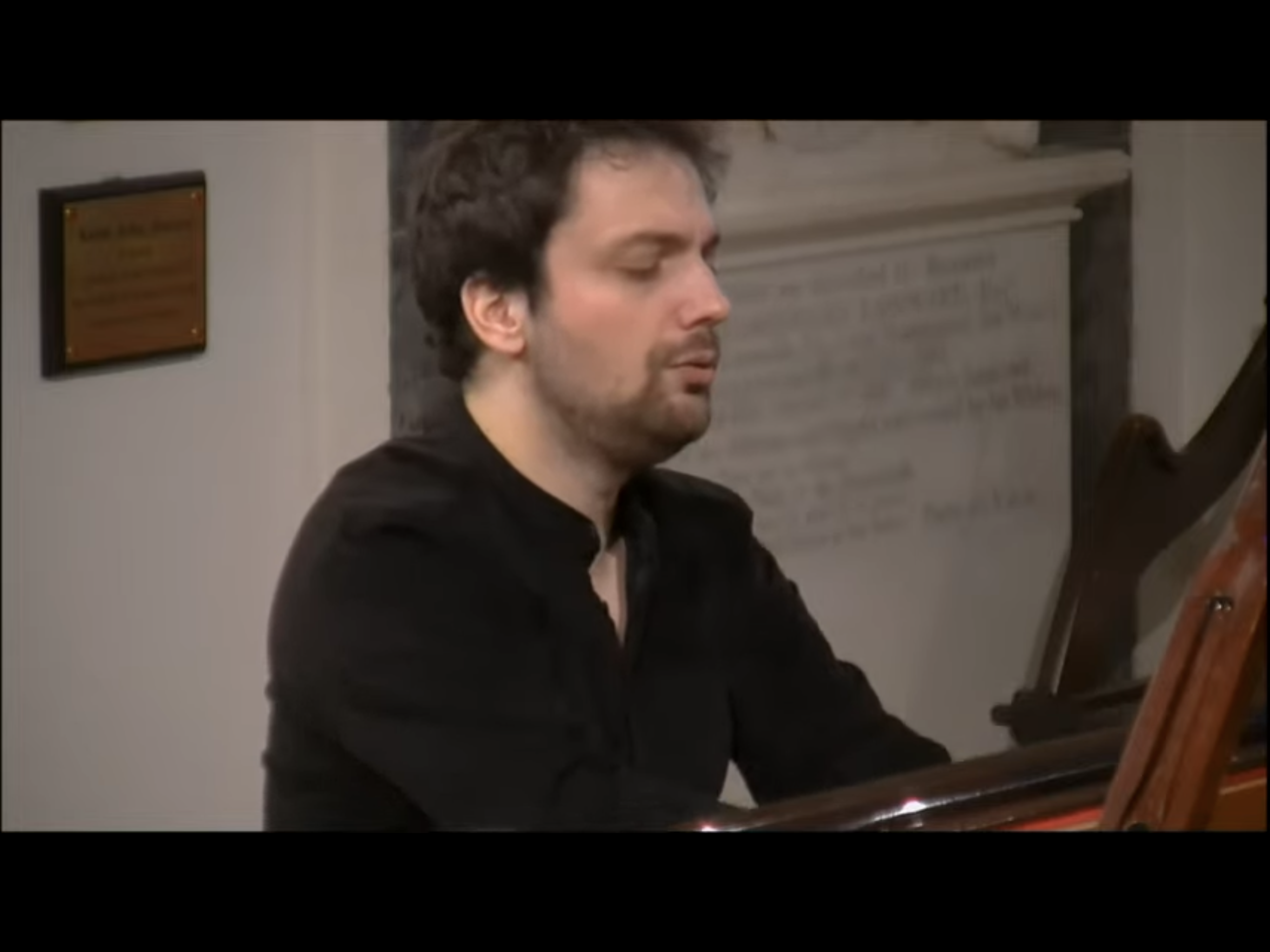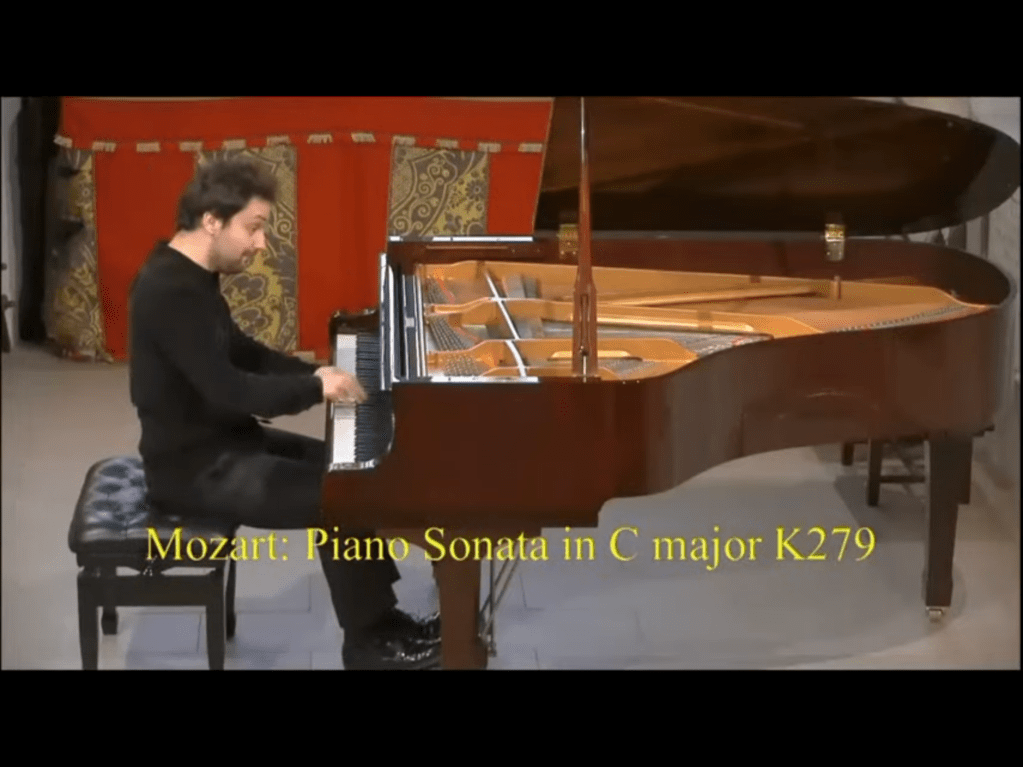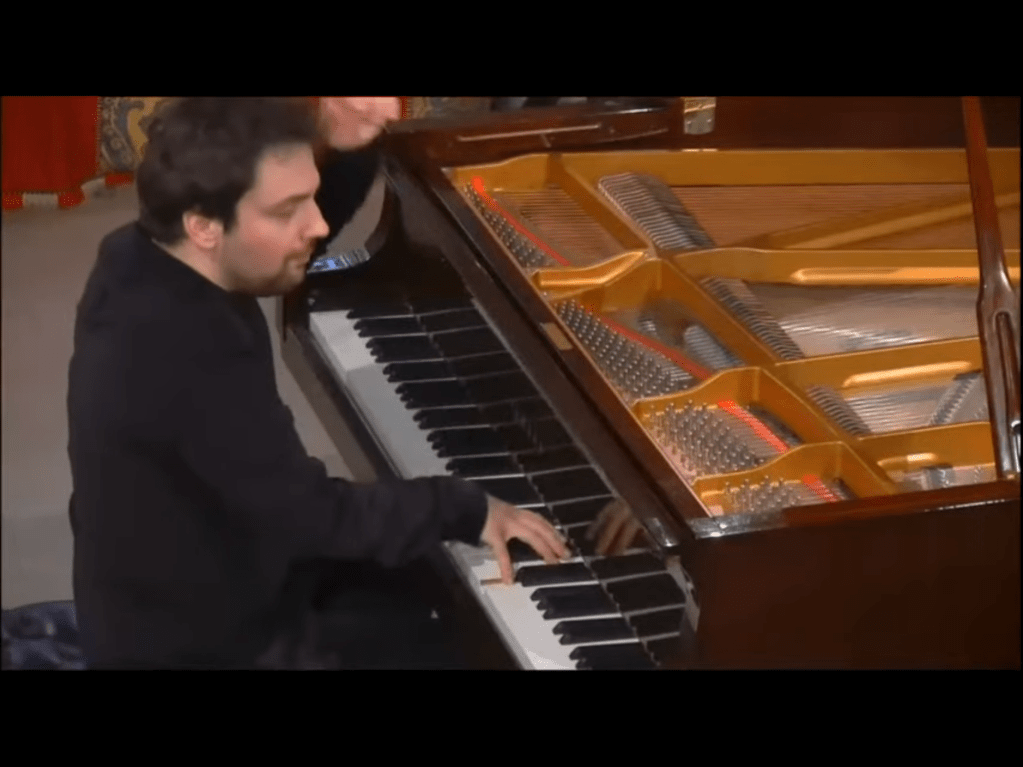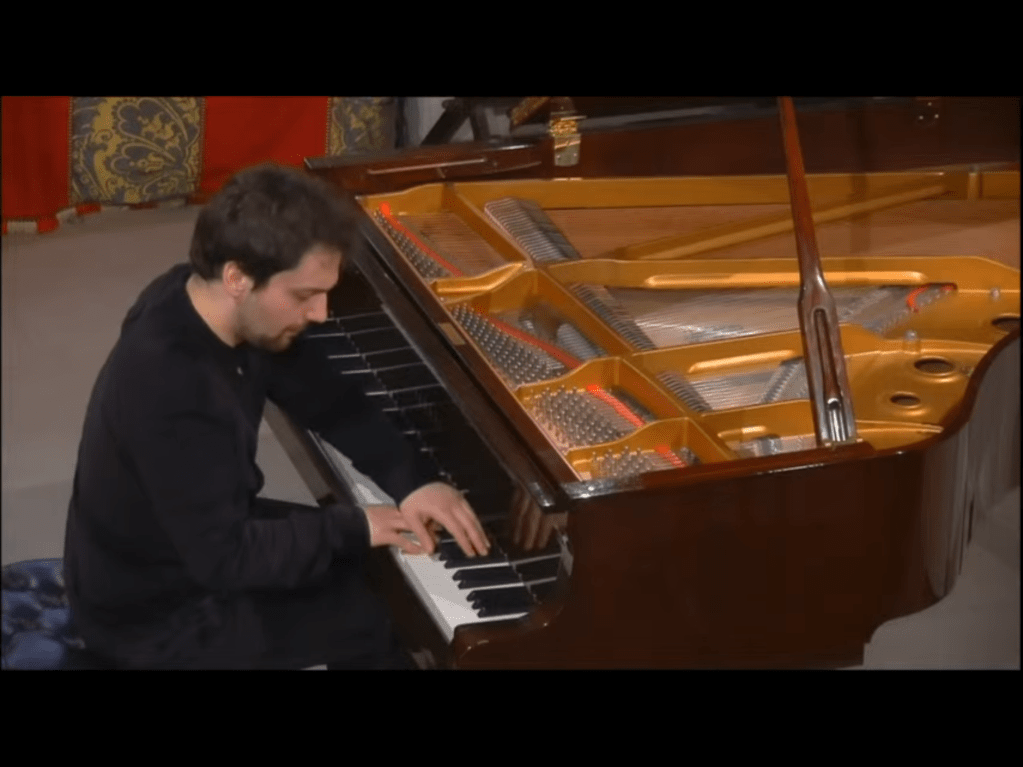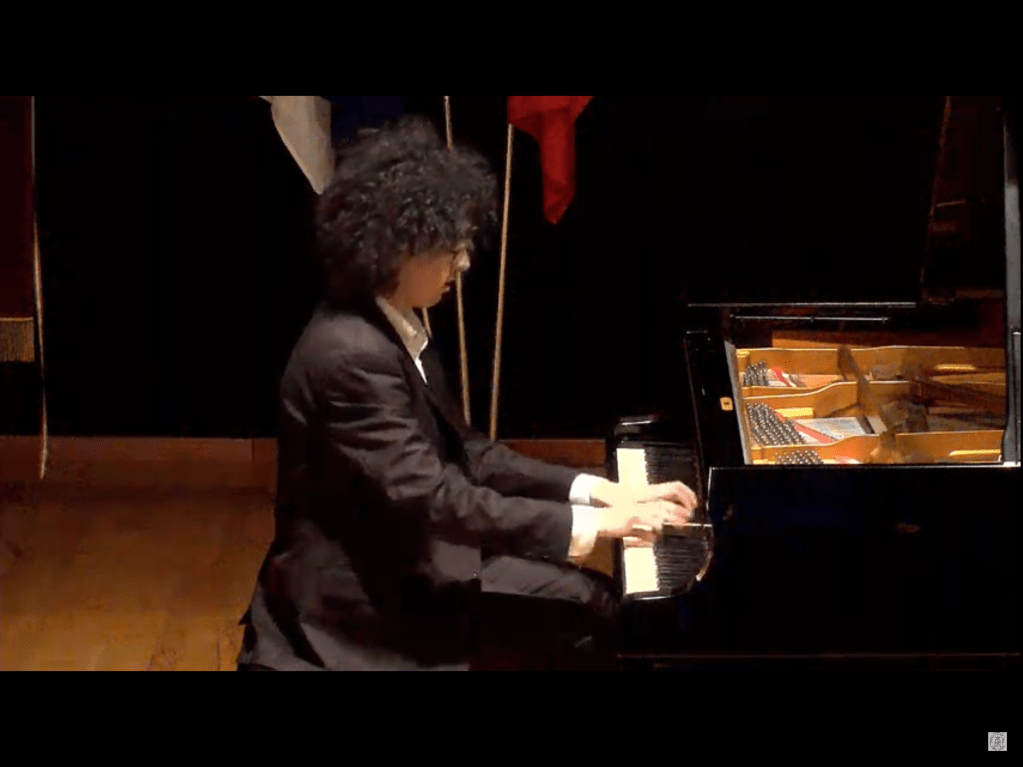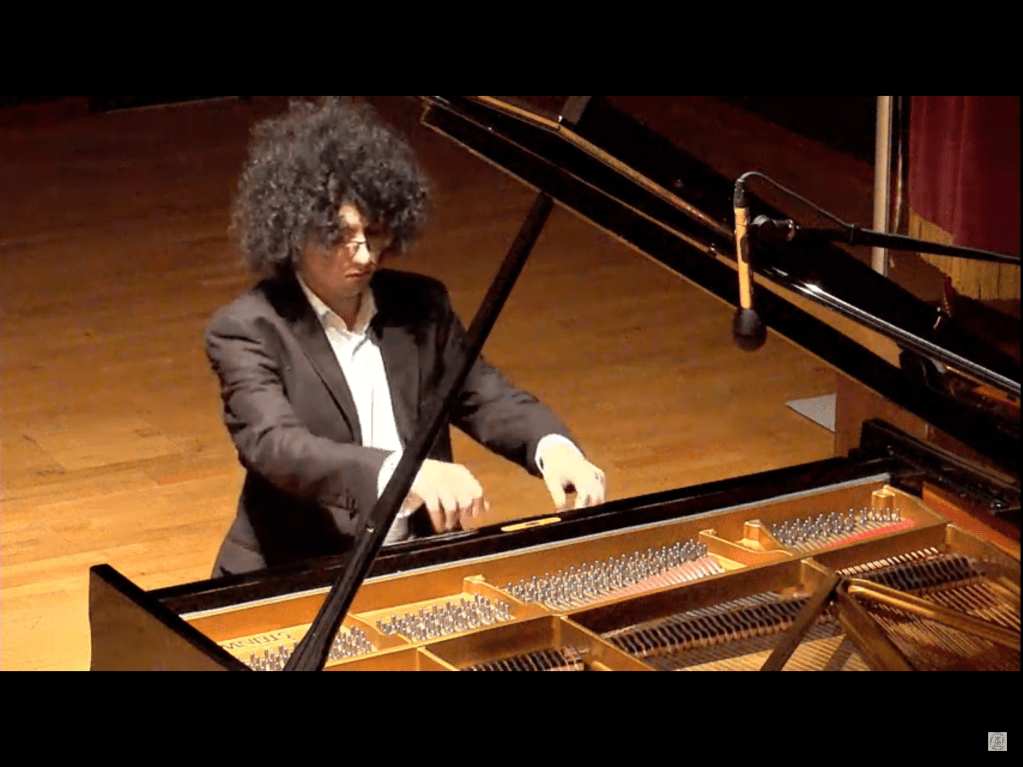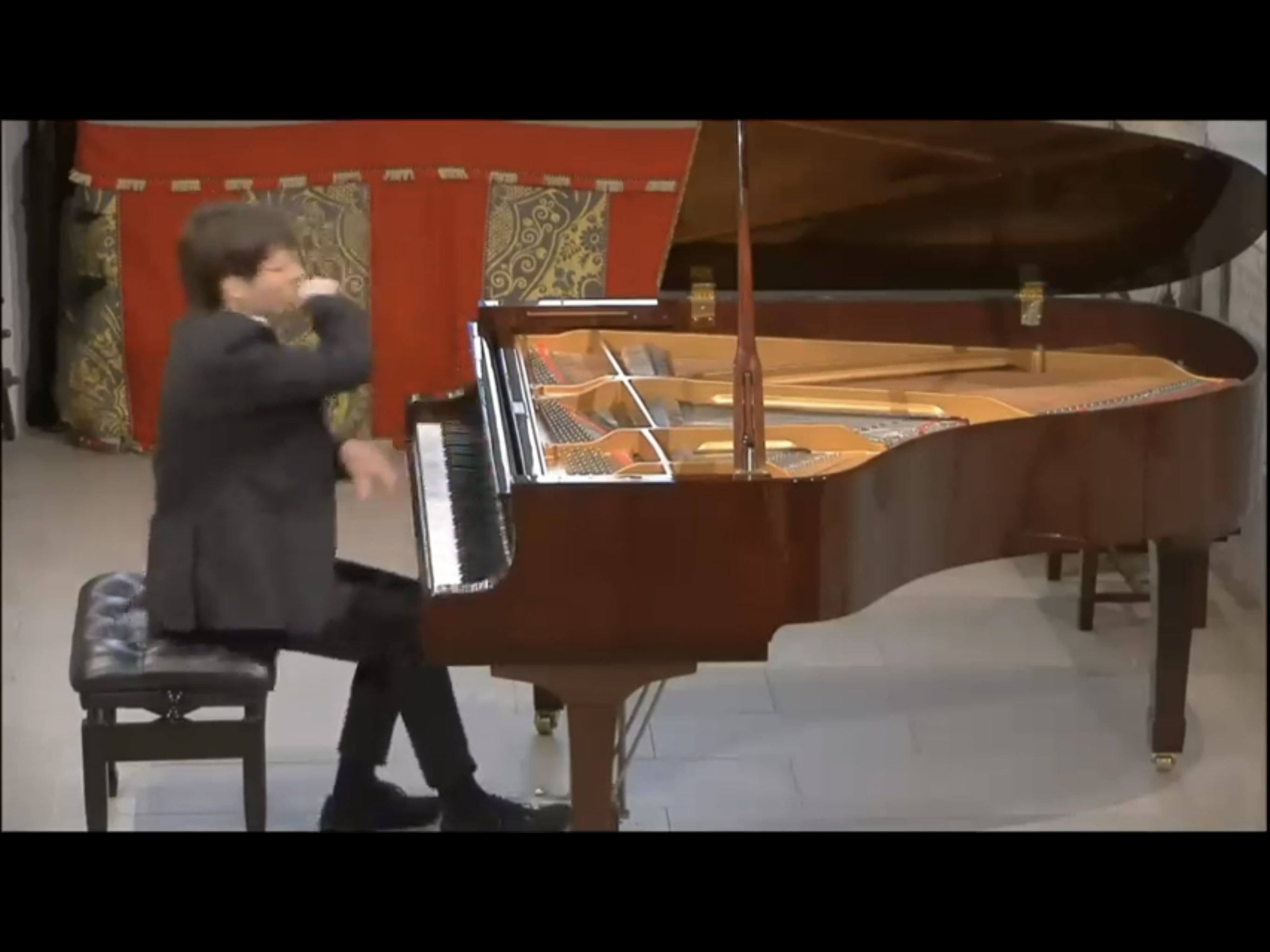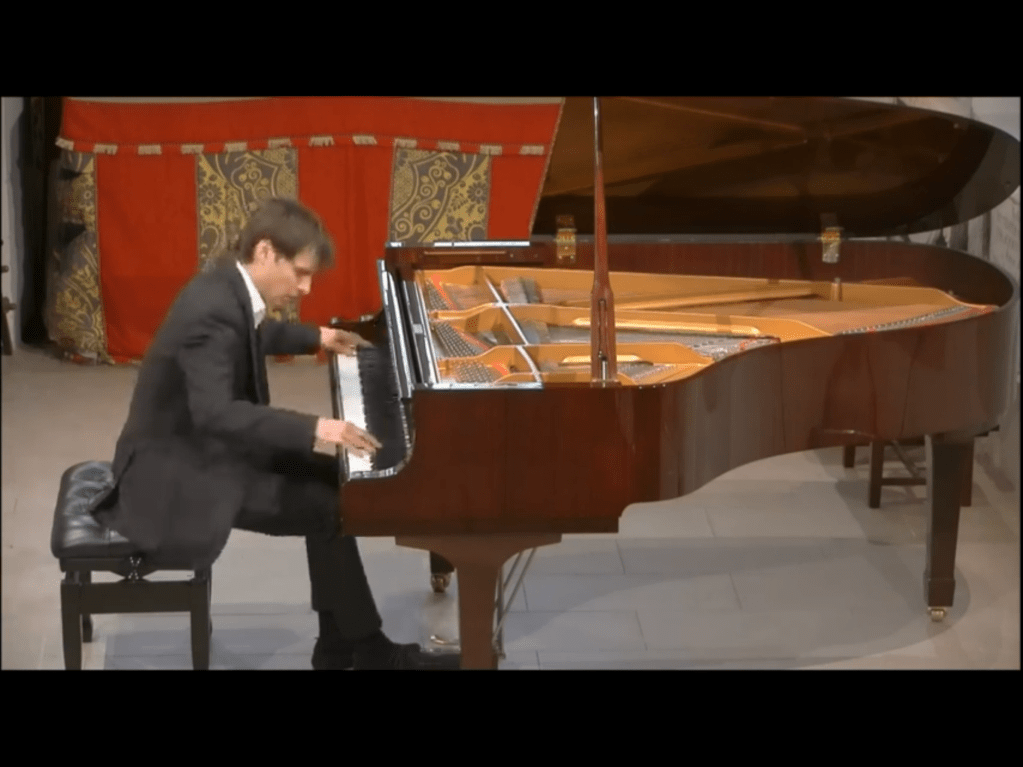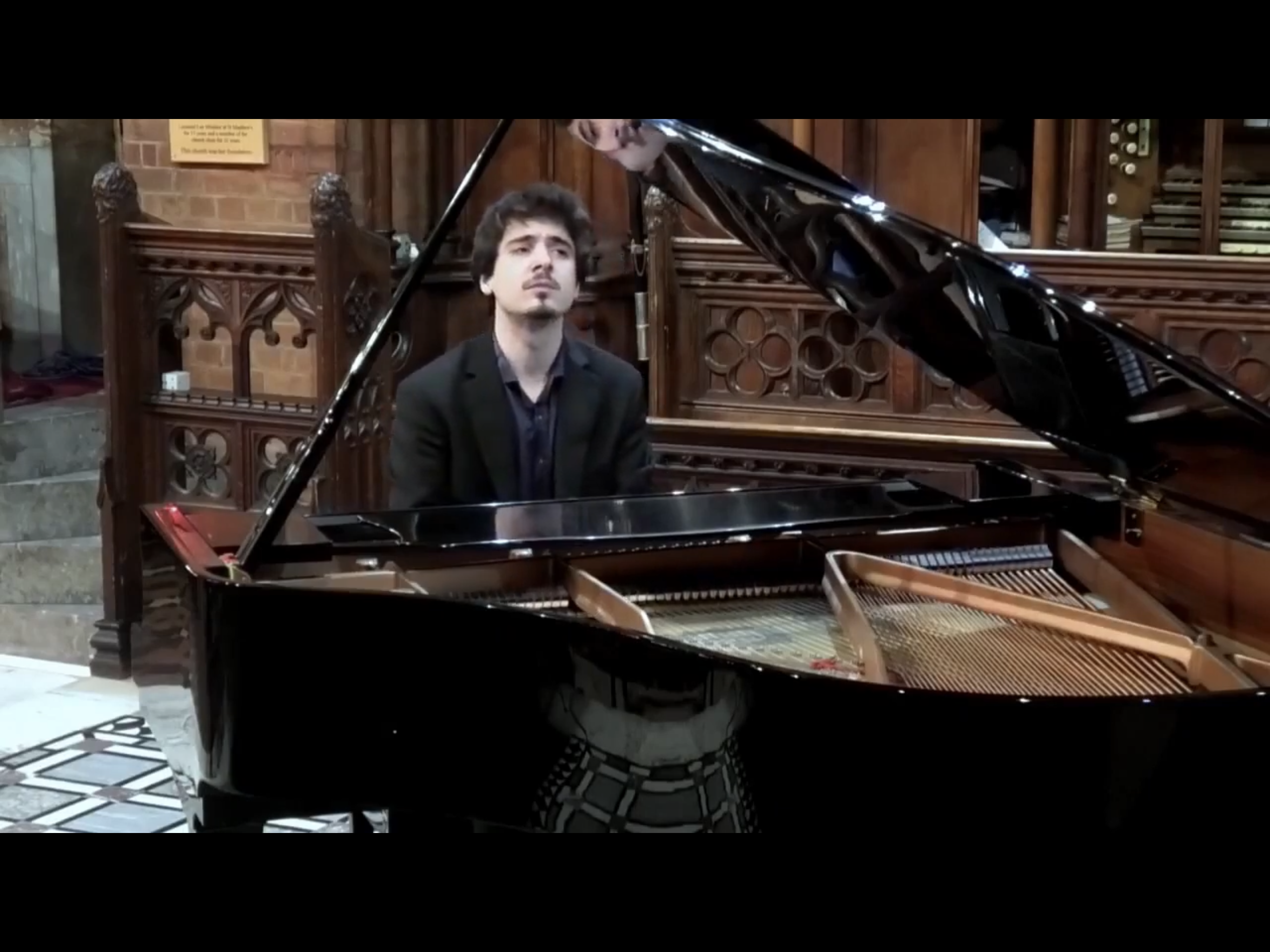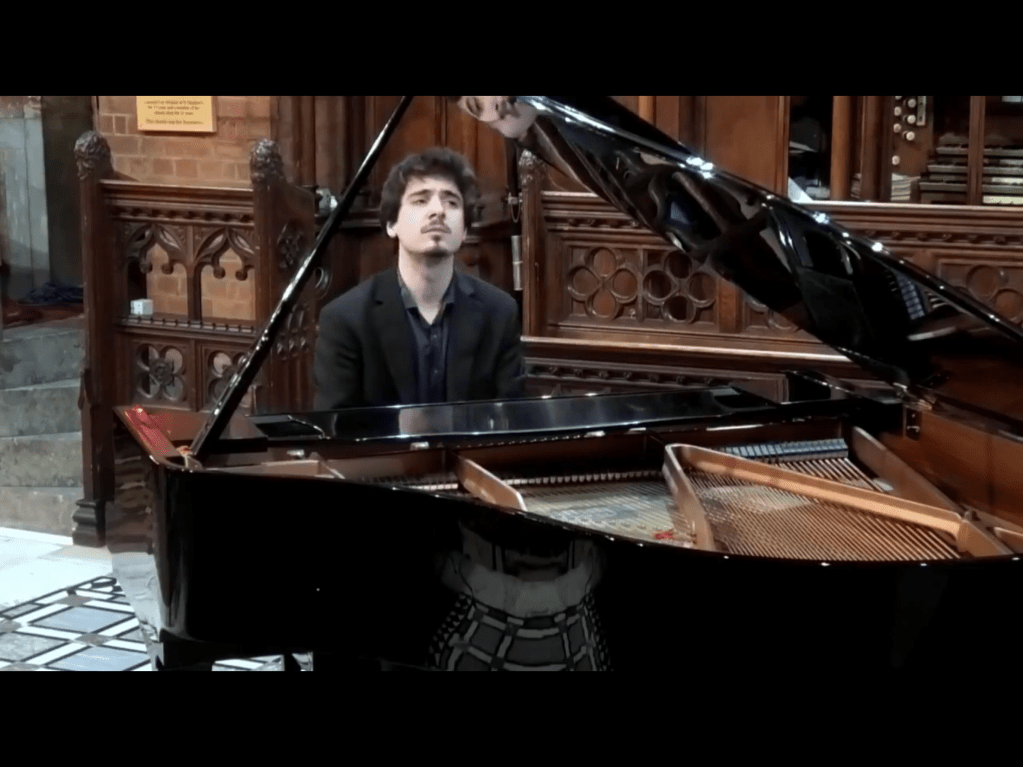
Kasparas Mikuzis the outsider takes St Mary’s by storm

Tuesday April 20 4.0 pm 
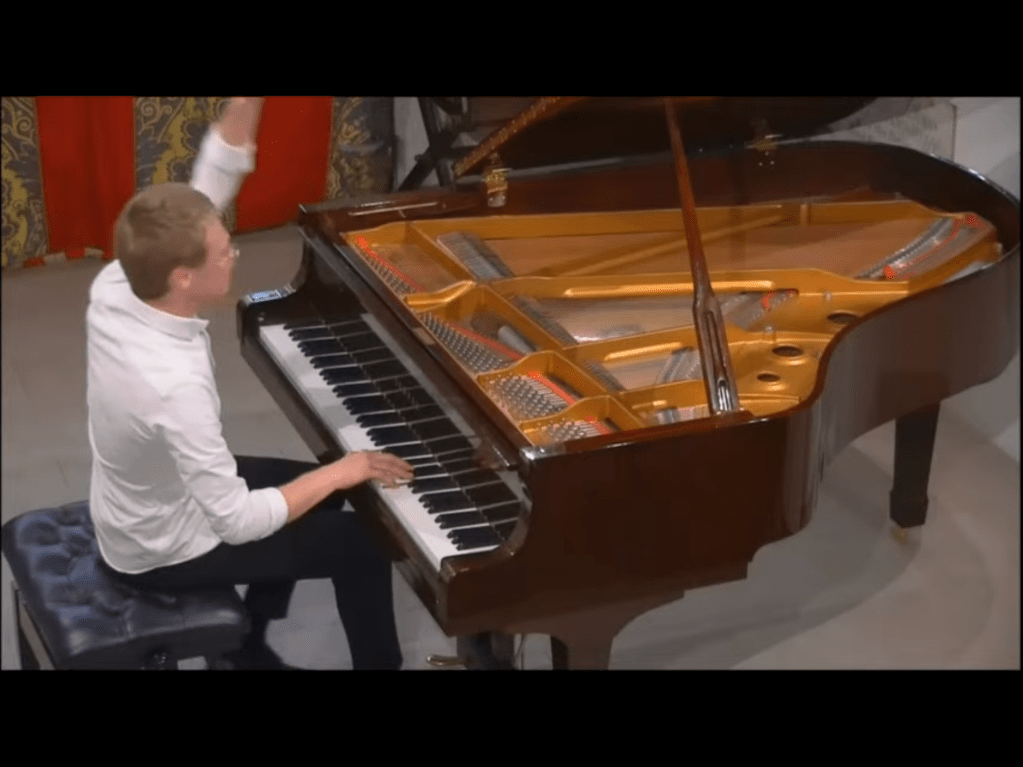
Kasparas Mikuzis (piano) 

Bach: Prelude and Fugue C major BWV 846

Ciurlionis: Little sonata VL269-271

Schumann: Carnaval Op 9

Schumann: Arabesque Op 18

Liszt: Hungarian Rhapsody no 12 in C sharp minor

A memorable recital from a true outsider.
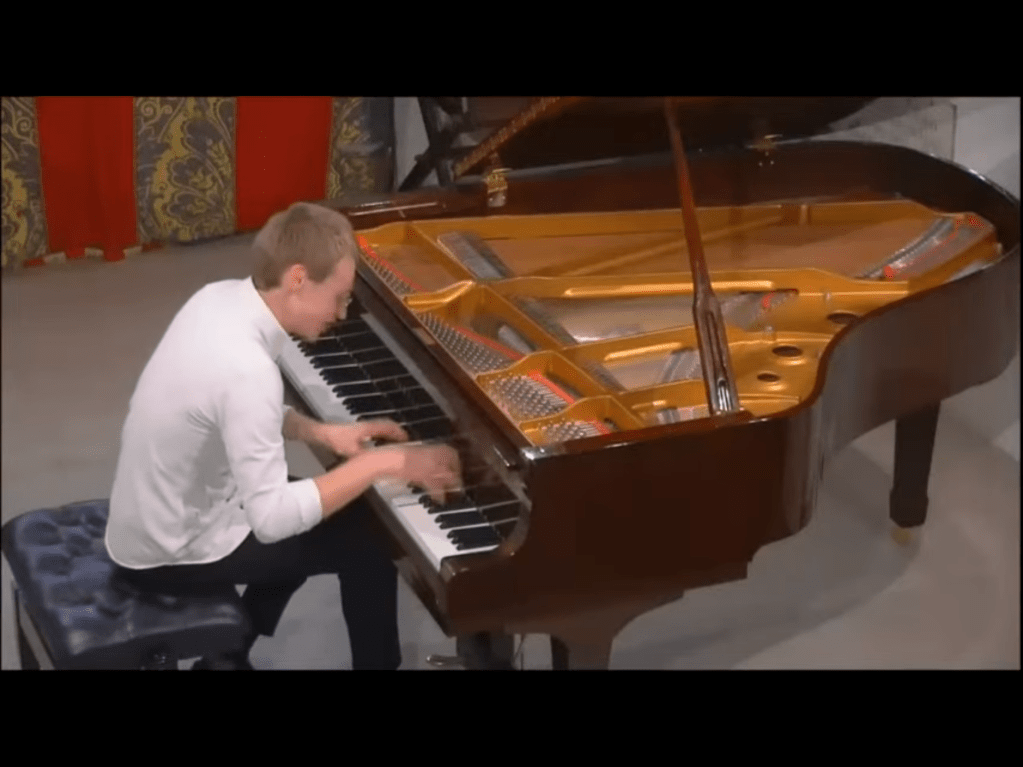
A twenty year old student at the Royal Academy who bravely volunteered to stand in at barely a weeks notice for an indisposed colleague and took St Mary’s by storm today.
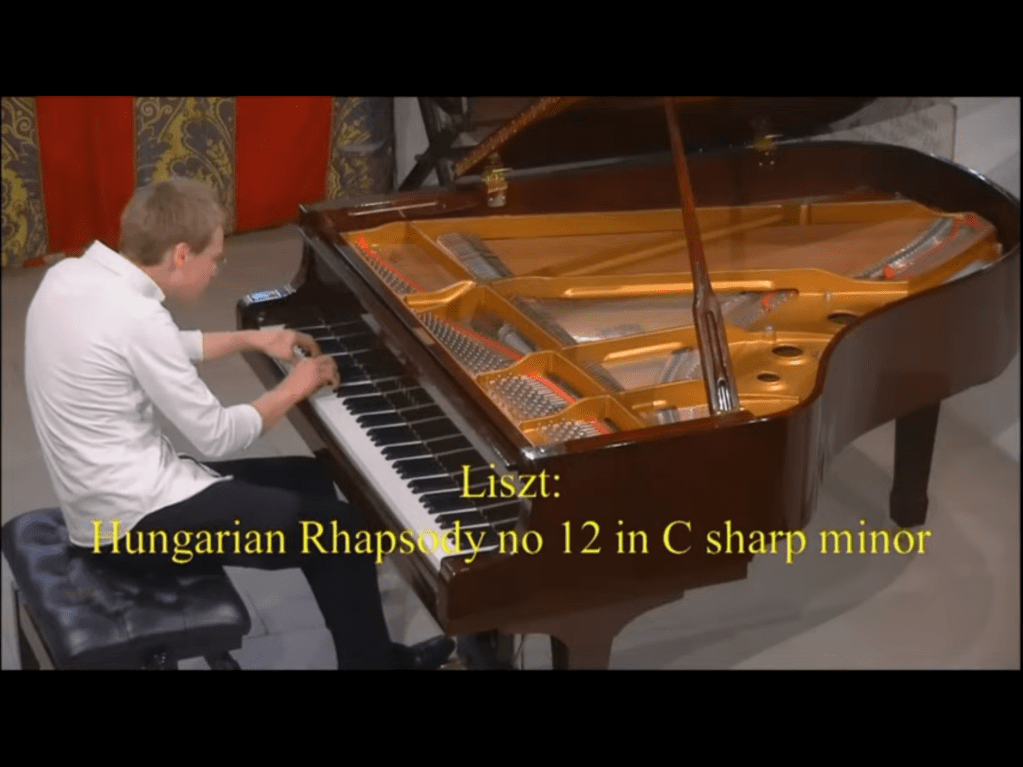

The final tumultuous pages of Liszt’s 12th Hungarian Rhapsody where his total abandon allied to an infallible technical command had all the excitement that had us on our seats cheering Rubinstein all those years ago.But there was the great sense of character from the thunderous tremolandi at the beginning and the sumptuous seductive melody the flows out of it.There was a wonderful gypsy sense of excitement but with such clarity allied to such sensual colours.A real stylist with a natural sense of rubato that comes from an inner feeling that cannot be taught.A real sense of heroism as he played with such overpowering command.Great flourishes ending in such precisely clipped chords opening the gates to a truly heart melting outpouring of melody with such a subtle sense of rubato.Crazy ending played with the real panache that the great virtuosi of the past would treat us to as they whipped themselves and the audience into a frenzy.I have mentioned Rubinstein’s memorable performances but who could ever forget Gilels with the Spanish Rhapsody that had us screaming for more like a football mob on scoring the winning goal.
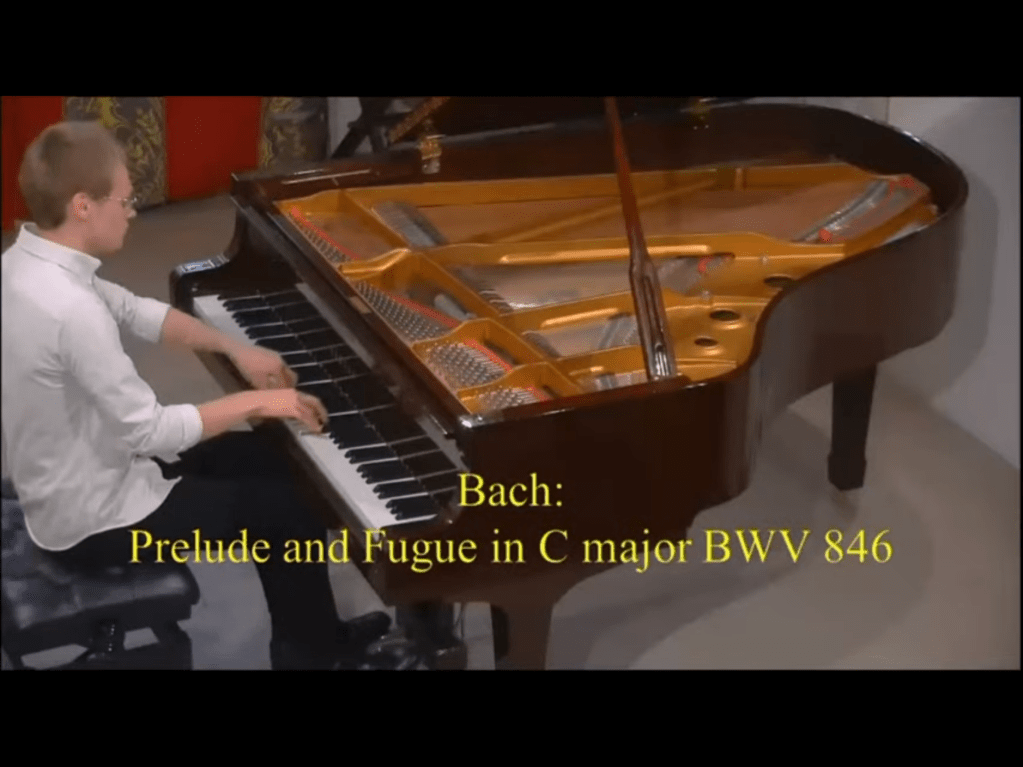
But it was from the very first notes of Bach that one could feel there was something special in the air.As Dr Mather said at the end:we have all had a go at the first prelude in C but the subtle colouring and aristocratic control revealed such interpretative skills that were so natural that music seemed pour out of this young man’s subtle refined fingers.A calm flowing fugue where everything was so clear but also bathed in an atmosphere of absolute smoothness.
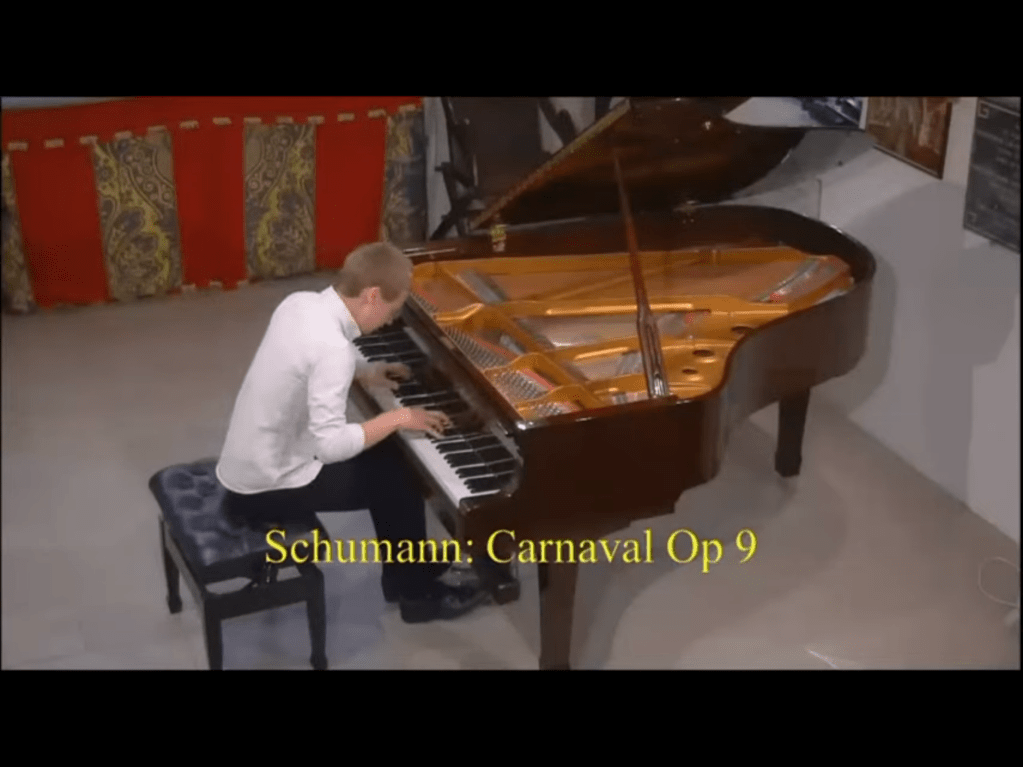

Fingers that later in Schumann Carnaval were to take us on a memorable journey from the commanding opening to the subtle capriciousness of Arlequin.The true nobility of the Valse Noble with the same subtle counterpoints that I have never forgotten from Cortot’s memorable recording.
There was absolute stillness in Eusebius with such ravishing sounds where each note spoke so movingly to the next in a self communing of such eloquent nostalgia.Florestan bursting in,carefully looking over his shoulder and Coquette beautifully flowing with such sly looks.Papillons fluttering so cleverly over the keyboard as the Lettres dansantes were suitably fleet and evasive.The passionate outpourings of Chiarina led to the most ravishing beautifully poised Chopin.There was such subtle delicacy in Reconnaissance where the duet between the voices in the central section contrasted so well with the opening repeated notes.The frantic squabbling of Pantalon et Colombine finished in such a beautifully capricious way too.Has Paganini ever got up to his diabolic antics with such precision and rhythmic drive and after all that ,Schumann’s subtle chordal apparition almost worked as the Valse Allemande retraced her steps as if the great violin virtuoso had not been so invasive!
Aveu was so beautifully played with such delicate tone and subtle sense of balance.If the gentle asides in Promenade seemed a bit too thrown away,the continual forward movement was mesmerising as was the pianissimo at the end before the final burst of energy in the Promenade and the youthful conviction of the Dance of David against the Philistines (food for thought today where only football seems to take the headlines!).A remarkable performance of a work that can often fall into rhetoric when in a lesser musician’s hands.
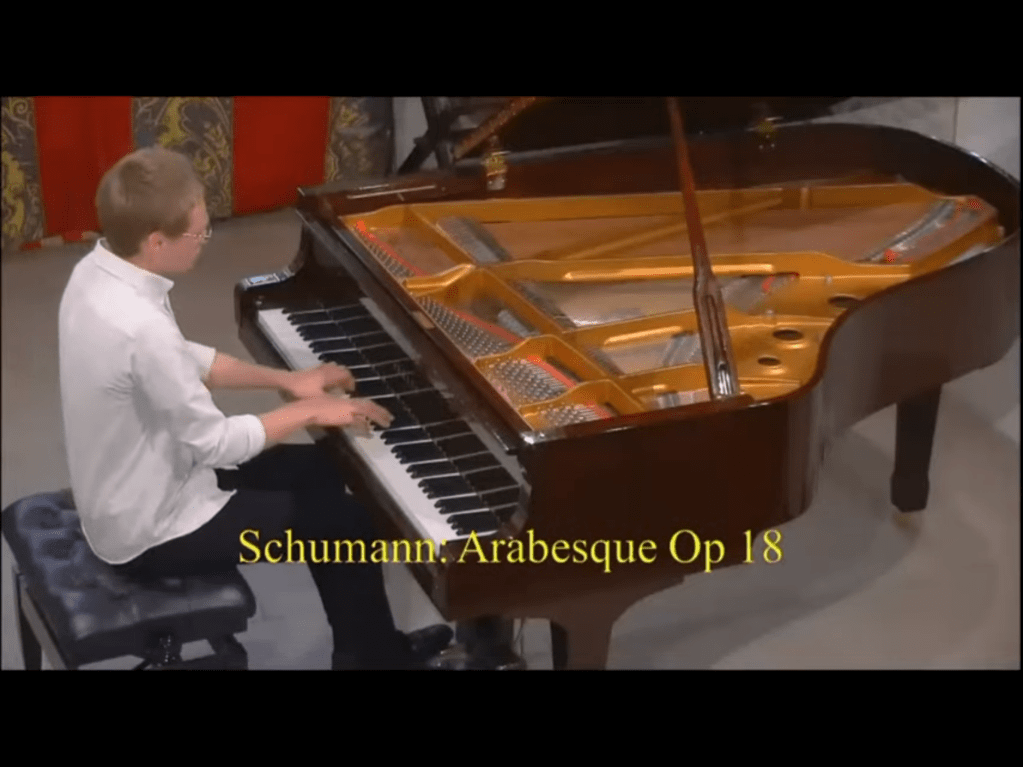

The Arabesque that preceded Carnaval was played with a sense of wonderment and beauty that just whet our appetite for more.
We were certainly not disappointed!
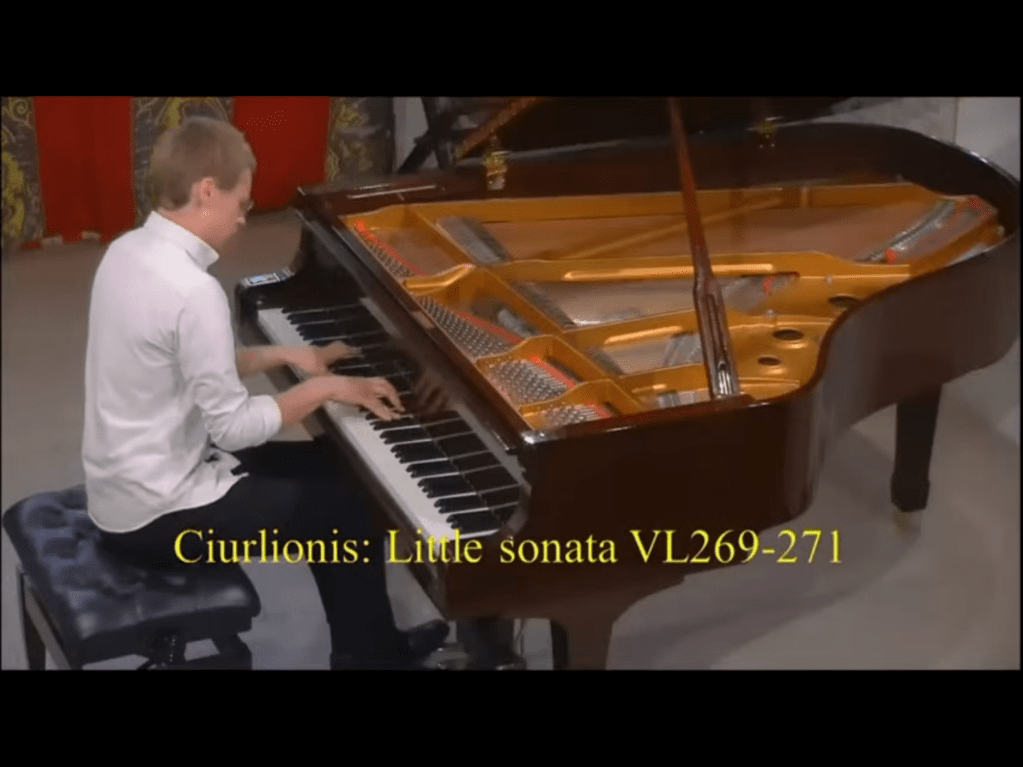

The little sonata by fellow Lithuanian Ciurlionis just showed us how many works we still have to discover.With it’s shadowed octaves in the first movement passionately shaped.The subtle duet between the hands in the second and the Pastoral finale.

Mikalojus Konstantinas Čiurlionis (1875 –1911) was a Lithuanian painter, composer and writer.He contributed to symbolism and art nouveau, and was representative of the fin de siècle epoch and is considered one of the pioneers of abstract art in Europe.During his short life, he composed about 400 pieces of music and created about 300 paintings, as well as many literary works and poems. The majority of his paintings are housed in the Ciurlionis National Art Museum in Kaunas,Lithuania and his works have had a profound influence on modern Lithuanian culture.( Vlado Perlemuter was born in Kaunas)


It was his voyage of discovery and wonderment that was so captivating in a recital that was refreshing as it was illuminating.
His great natural musicality being helped by his remarkable teacher Diana Ketler ( the much admired Cristian Sandrin was a student of hers too).Wonderful to see what musicianship these very talented young musicians can experience from three remarkable ladies : Madam Ketler at the RAM,Madam Havill at the Guildhall and Madam Fisher at the RCM.
What wonders are going on behinds the scenes.
How grateful we all should be to them with a lifetime dedicated to helping these greatly talented young artists.
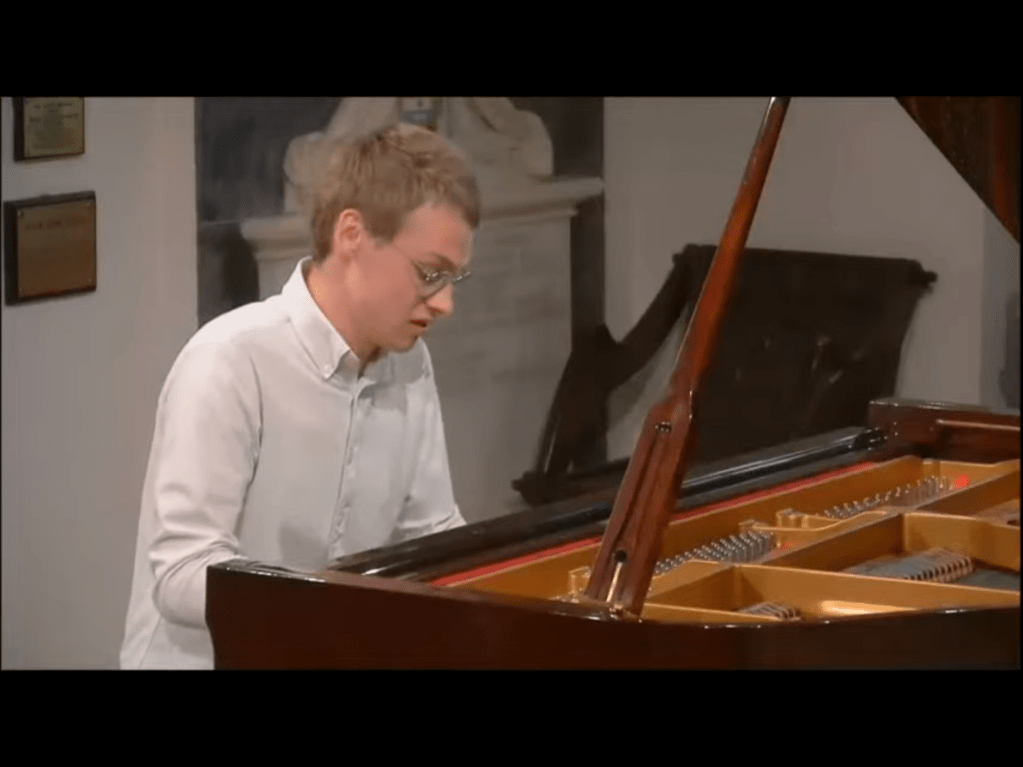
Born in Šilute, Lithuania, Kasparas Mikužis started playing the piano at the age of 6. At the early age he was taught piano by Liudmila Kašetiene. Later, he studied at the National M.K. Ciurlionis School of Arts and The Purcell School with Justas Dvarionas. Since 2019, Kasparas is studying at the Royal Academy of Music with the pianist Diana Ketler. Kasparas’ distinctive piano playing was acknowledged when he became a scholar of ‘SOS Talents’ foundation at the age of 9. Since then, Kasparas regularly performs across Europe. From 2011 Kasparas has performed in the yearly Christmas concerts held on the Champs Elysées in Paris organised by ‘SOS Talents’. In 2012 he was given the opportunity to appear in a concert in Batumi, Georgia, which was televised by Mezzo TV and watched by both the Lithuanian and Georgian Presidents. Kasparas’ playing was also broadcasted on Radio Classique in France twice. Moreover, he has performed in the United Nations Headquarters in Geneva on four occasions and at the EMMA World Summit of Nobel Prize Peace Laureates in Warsaw, Poland. In 2018, Kasparas was invited to the opening concert of V. Krainev competition for young pianists in Kharkiv, Ukraine, where he performed S. Prokofiev’s 3rd piano concerto. In 2019 he opened 91st season of newly refurbished Kharkiv Philharmonic hall, playing together with Kharkiv Philharmonic orchestra and conductor Yuri Yanko. In addition, Kasparas has appeared on stages of Lithuanian National Philharmonic hall, Concertgebouw Hall, ‘Fazioli’ factory hall, Steinway hall in Barcelona, St Martin-in-the-fields church, Purcell room at Southbank, Wigmore hall and others. Kasparas is a laureate of 22 international competitions. In 2015 Kasparas won 1st prize at the piano academy and competition “Pianale Junior” in Fulda, Germany. Later, in 2016, Kasparas triumphed in Vlinius, winning Grand Prix at the 10th international B. Dvarionas competition for young pianists. In 2018, he won 1st prize at the Scottish International Youth Piano Competition in Glasgow, Scotland. Later this year he became two times 1st prize winner at the XXVIII Roma International Piano Competition by achieving 1st prizes in categories up to 19 and 25 years. In 2017 the Mstislav Rostropovich’s charity & support foundation ‘Pagalba Lietuvos Vaikams’ awarded Kasparas with their support and later in the year he received a letter of gratitude from the president of Lithuania for his role in representing Lithuania on an international stage. In 2018 Kasparas released his first CD album together with the “KNS Classical”, which is now being streamed on the major music platforms. Kasparas became a scholar of Drake Calleja Trust in 2019 and he is also supported by the ‘Talent Unlimited’ foundation.
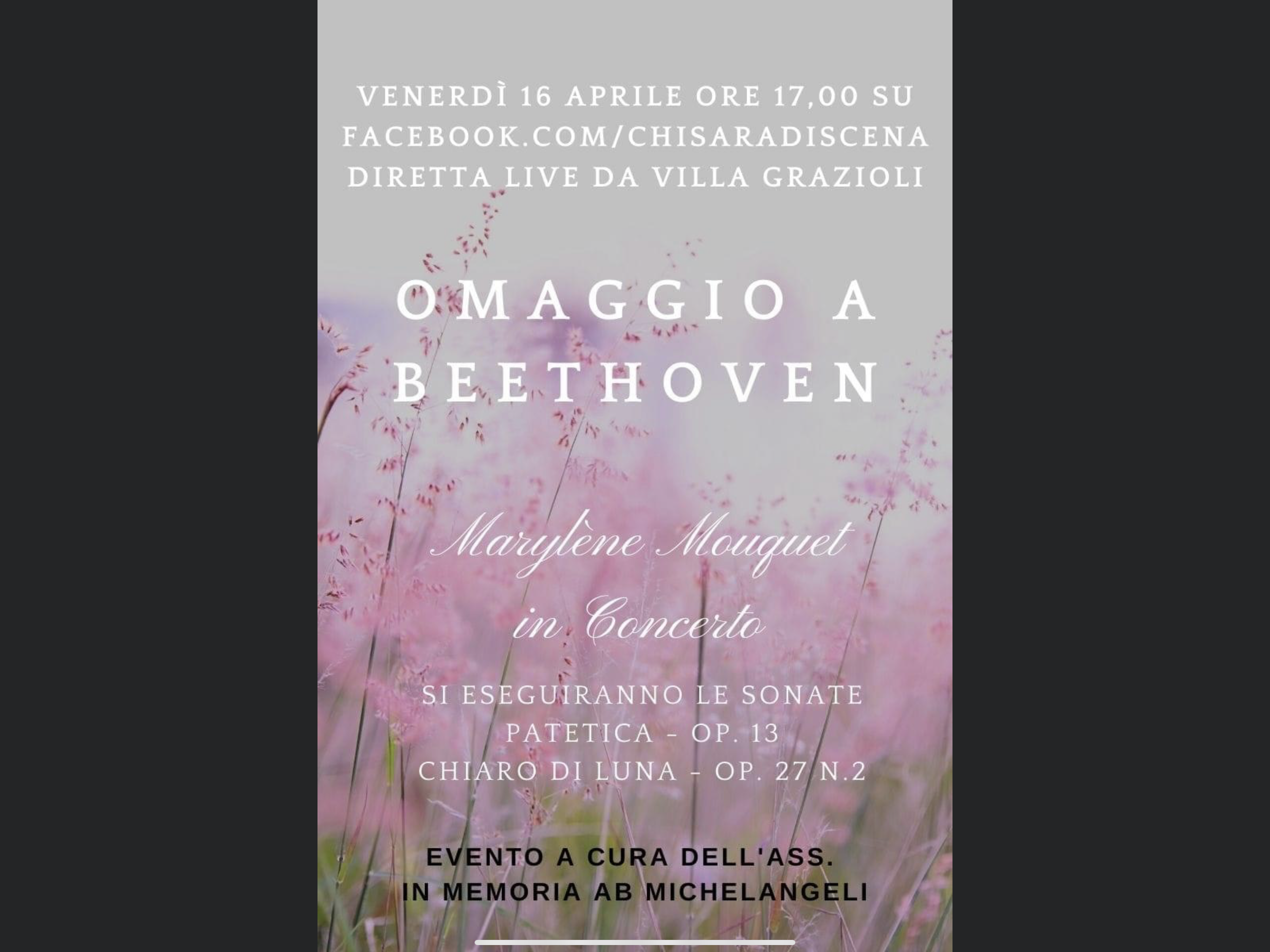
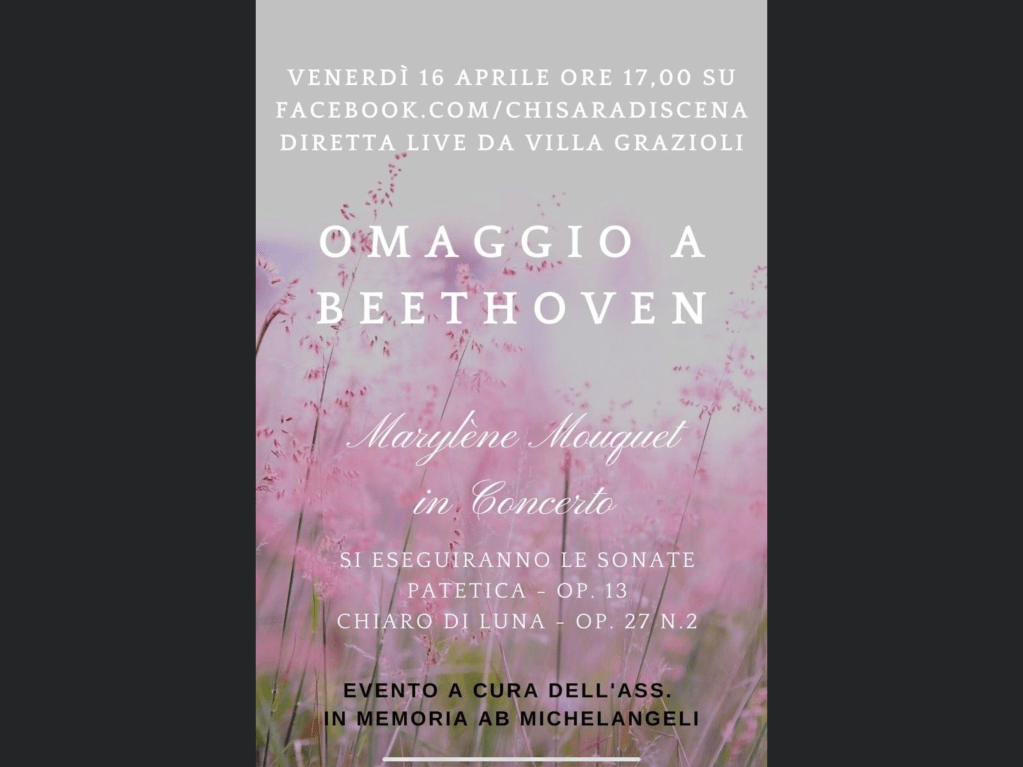
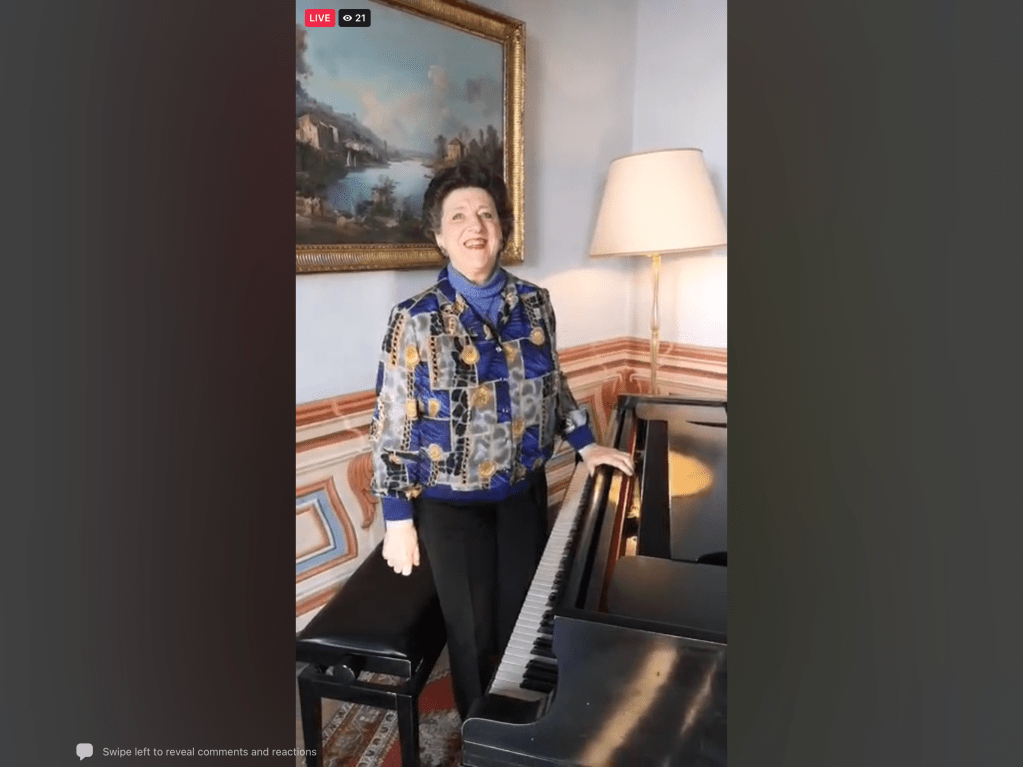
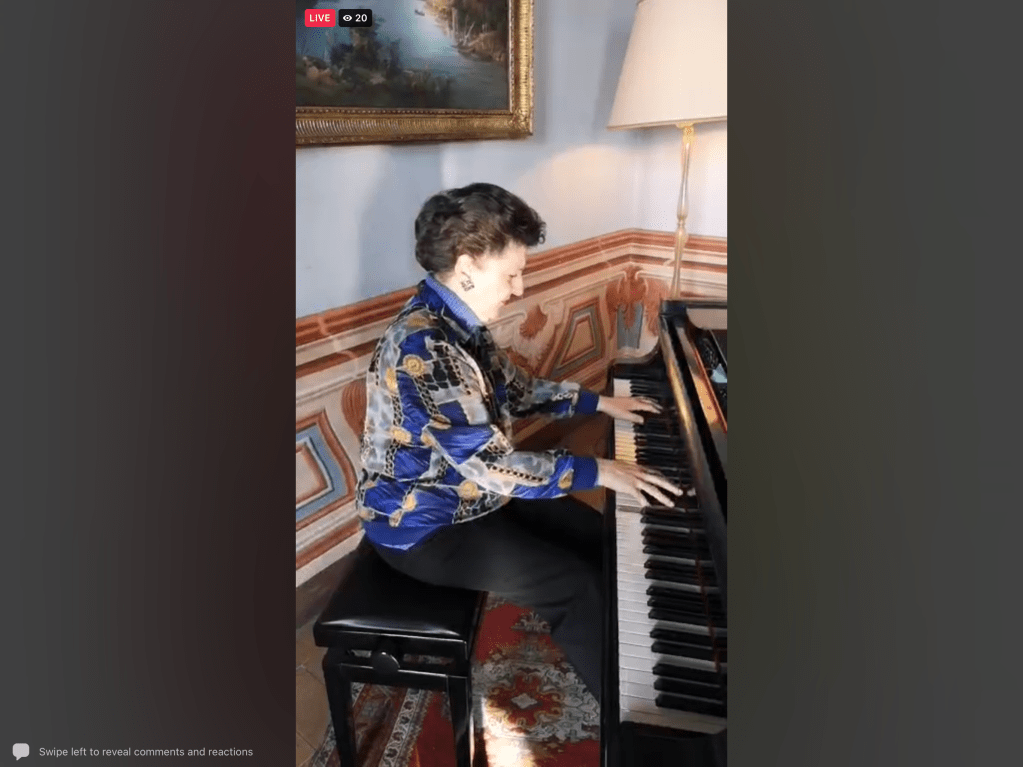
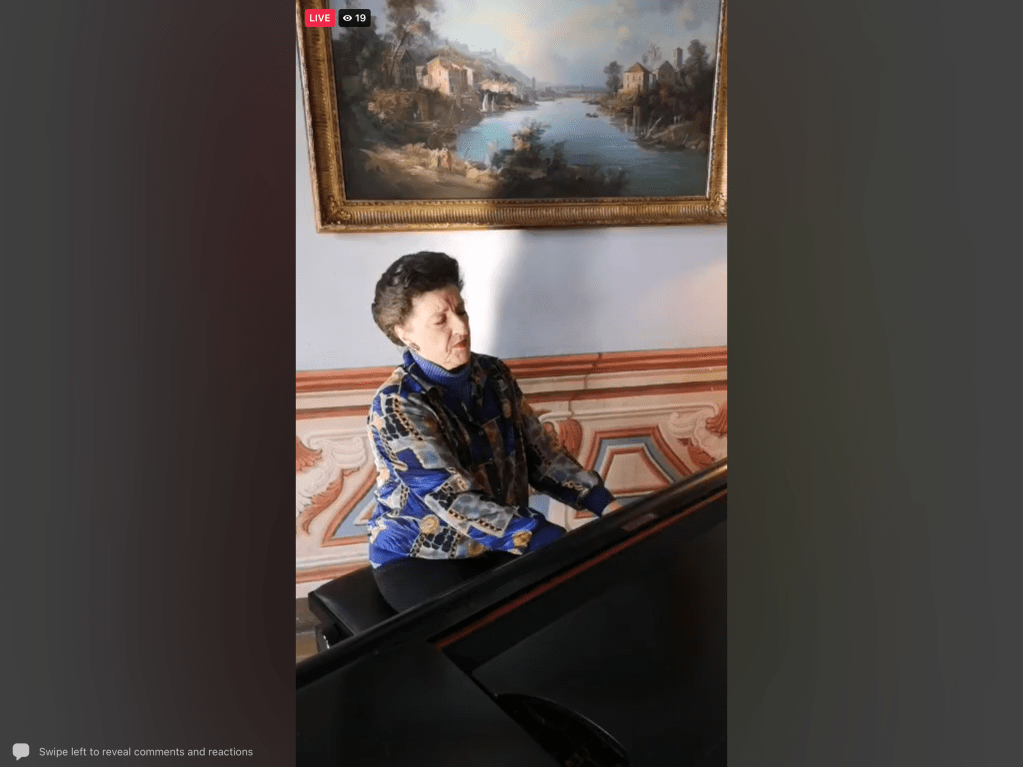
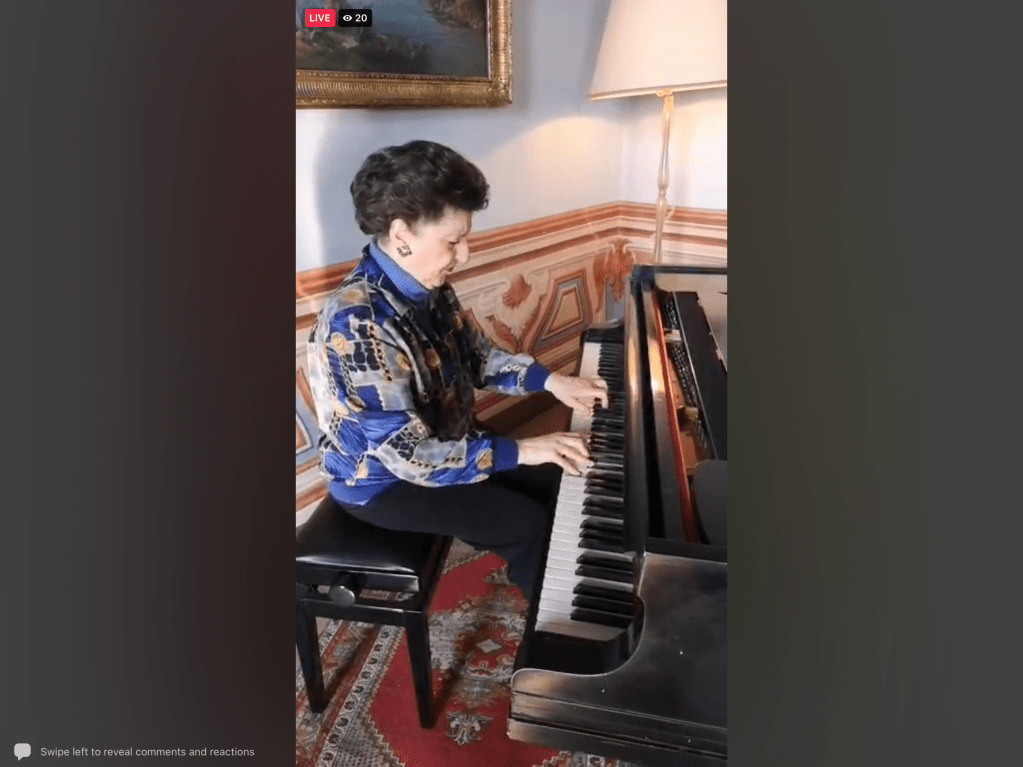
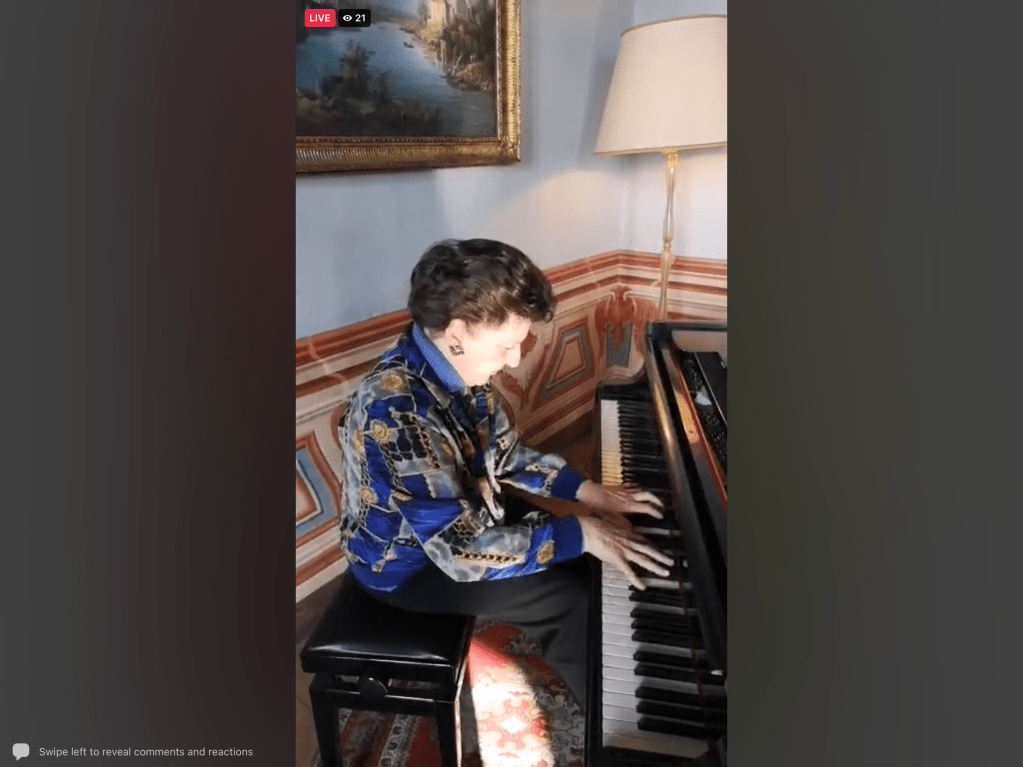
Marylene Mouquet at Villa Grazioli for the Michelangeli Association in celebration of Beethoven

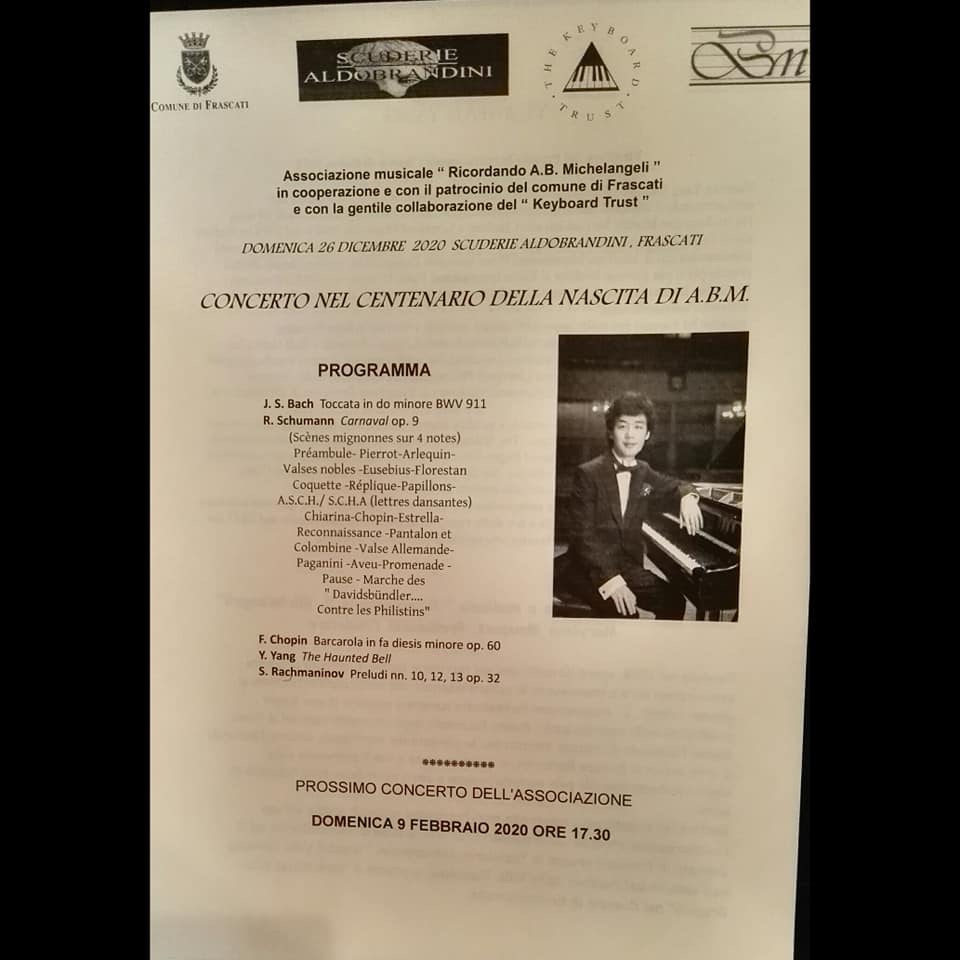
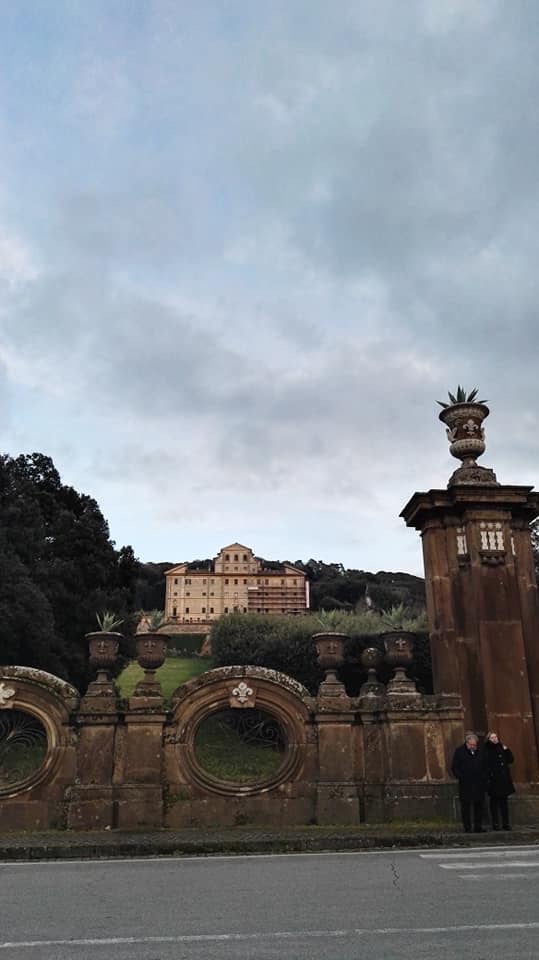
Marylene Mouquet at Villa Grazioli in Frascati .Two Beethoven sonatas op 13 and op 27 n.2 played with the great musicianship that the founder of the MIchelangeli Association has always shown and who has for some years given a platform to talented young musicians in the Aldobrandini Castle in Frascati at the centre of the Castelli Romani. Liszt and George Sand used to frequent the Villa on their ‘Grand tours’ of the hills around the Eternal City.For many years the distinguished French pianist has lived in Frascati on the hills overlooking Rome.Her next door neighbour,until recently,the Pope in the nearby Castel Gandolfo.Pope Francis, much to the dismay of the inhabitants has given up his summer palace to be nearer his congregation who ,until COVID, flocked to Rome to hear his wise words of brotherhood and tolerance.Marylene has long been the driving force of music via her Association dedicated to the memory of her mentor Arturo Benedetti Michelangeli.For many years she has included artists from the Keyboard Trust,founded by the assistant of Michelangeli -Noretta Conci Leech.I enclose an article about the remarkable Yuanfan Yang who was the last to give a live concert in Frascati before the pandemic struck .

https://christopheraxworthymusiccommentary.wordpress.com/2020/02/01/yuanfan-yang-in-italy-part-2-viterbofrascati-and-rome/

https://www.facebook.com/notes/christopher-axworthy/yuanfan-yang-in-italy-part-1-vicenza-and-rai-radio-3/10157118024482309/?fref=mentions

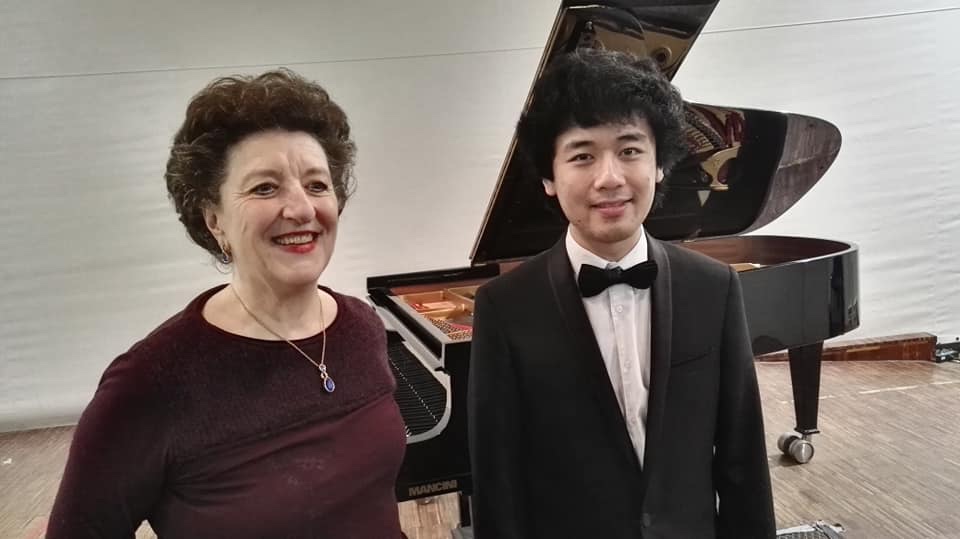
Yuanfan Yang with Marylene Mouquet after his concert for the 100 Anniversary of the birth of Michelangeli
Villa Aldobrandini Frascati

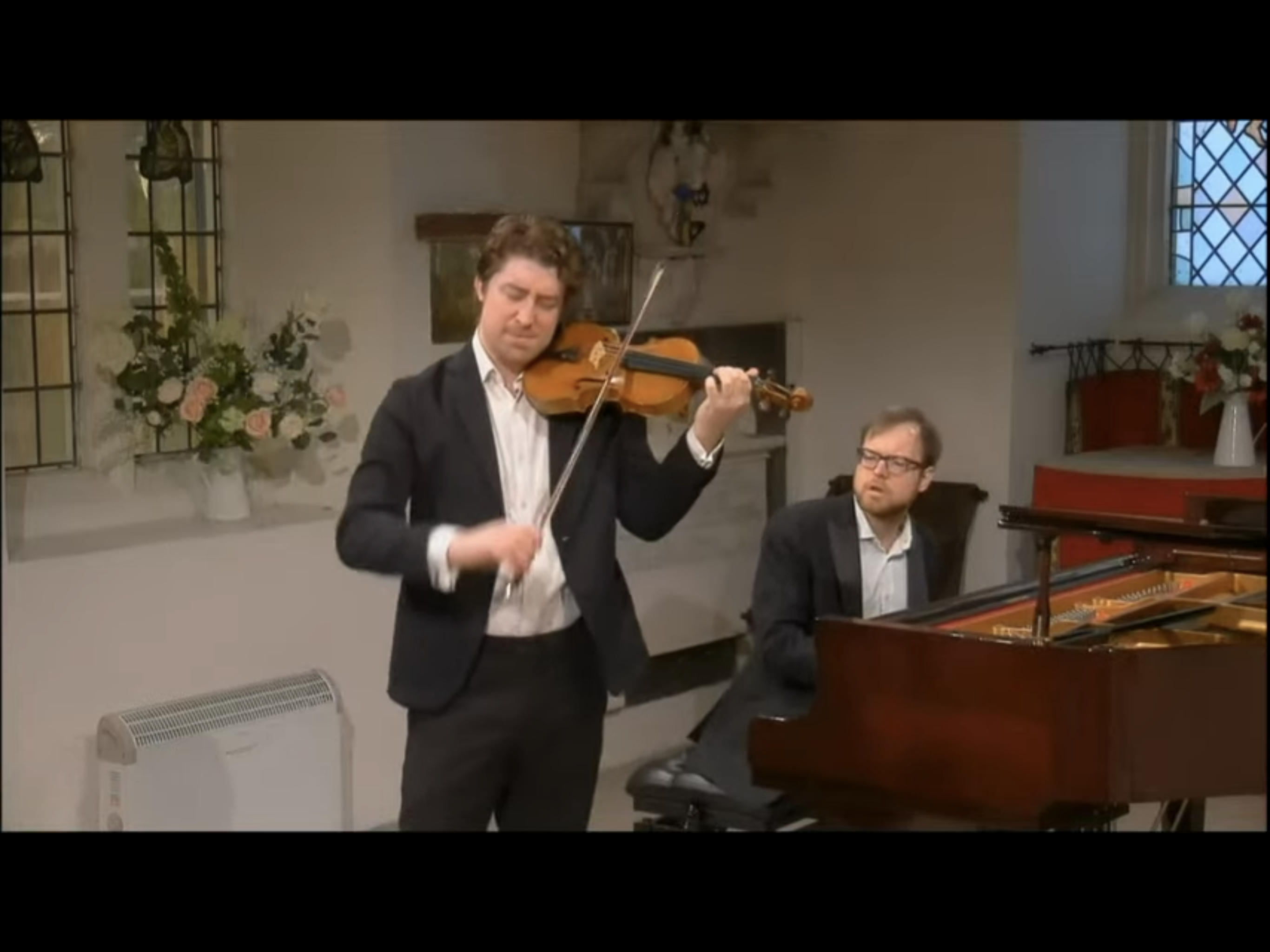
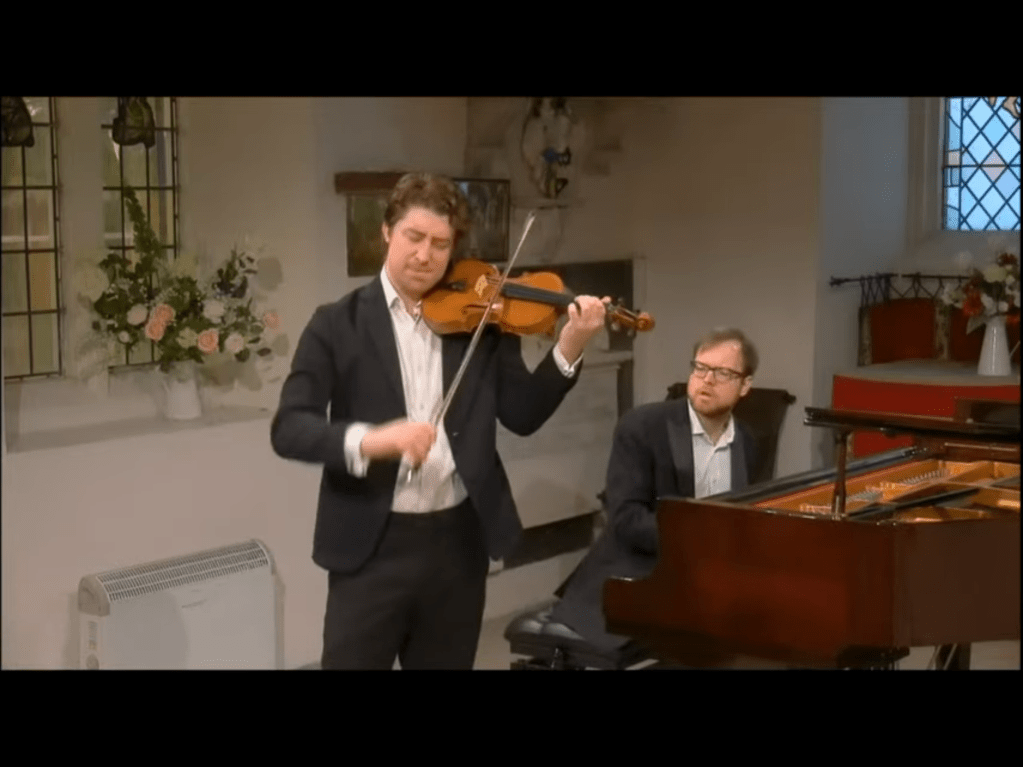
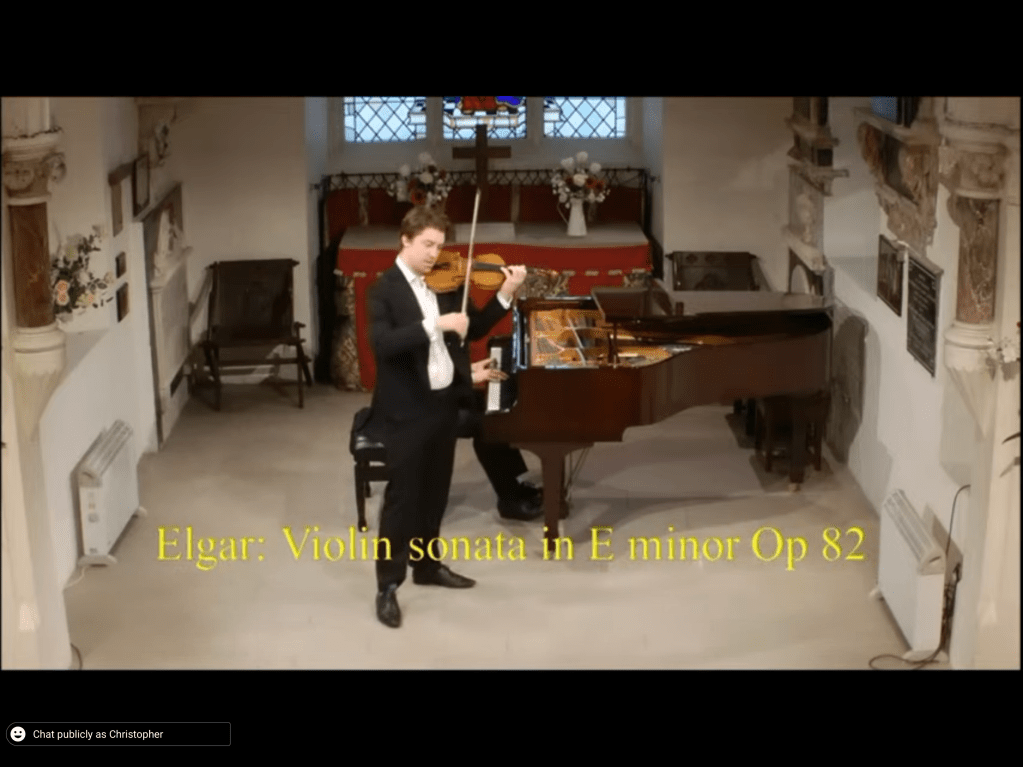
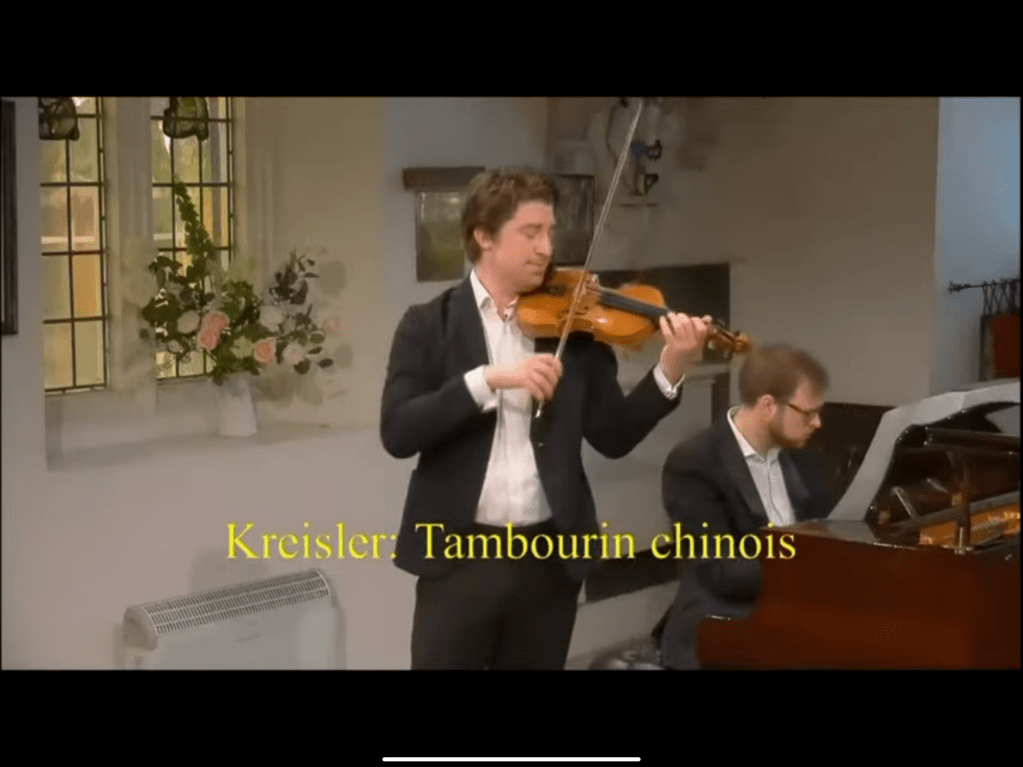
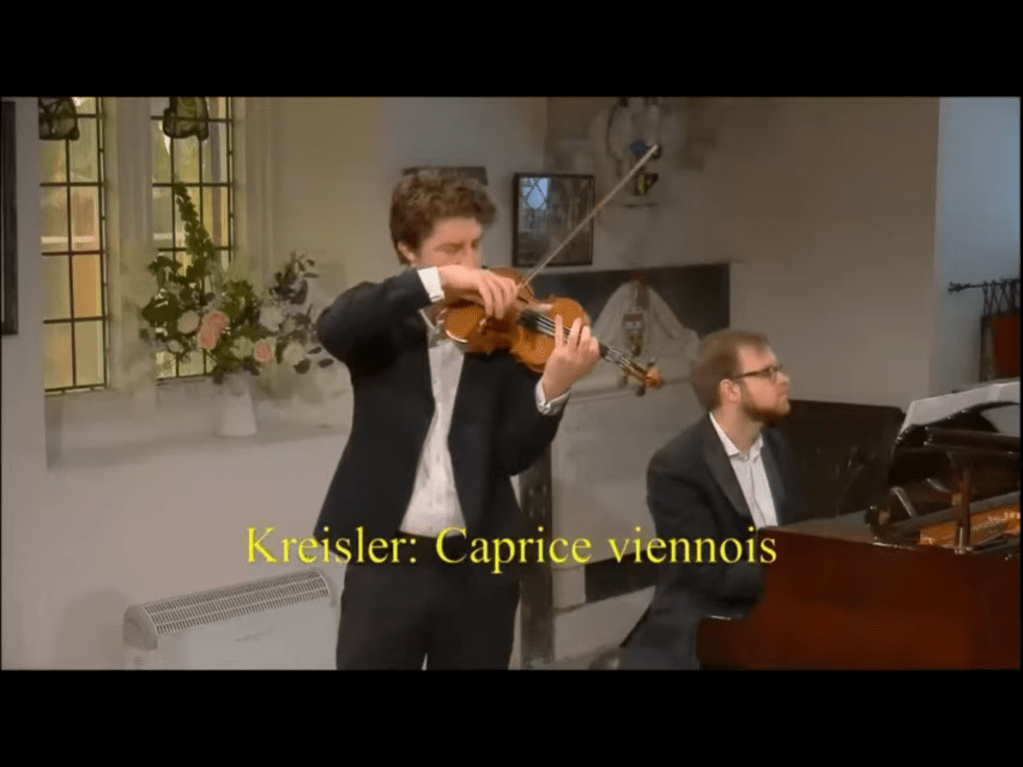
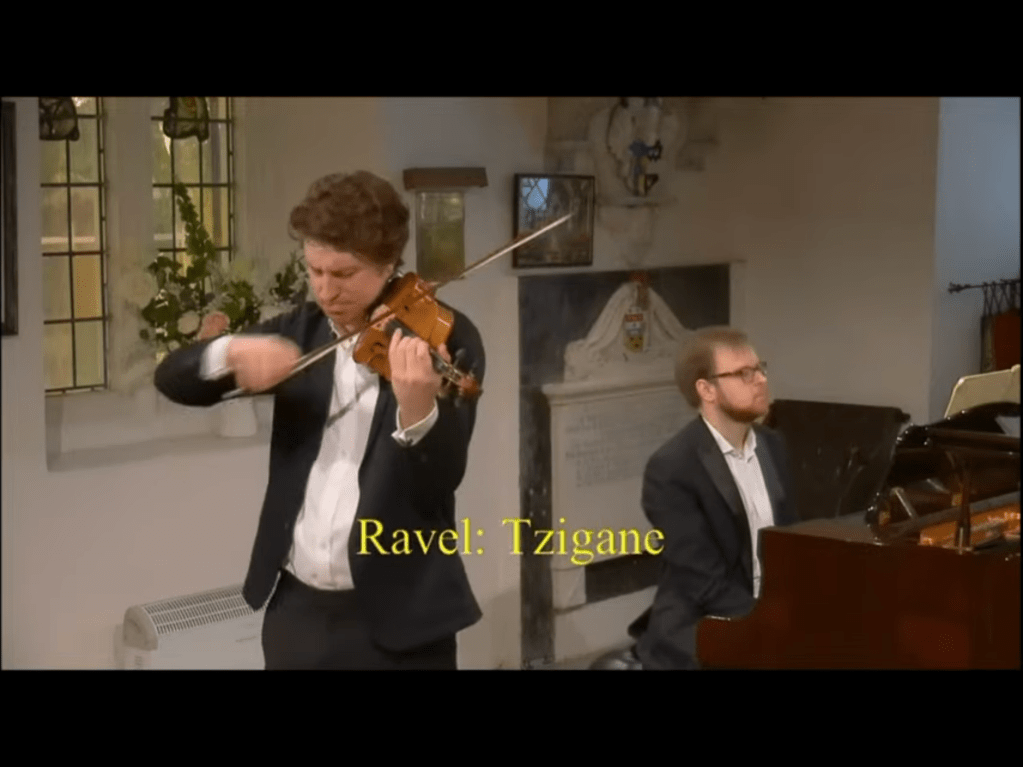
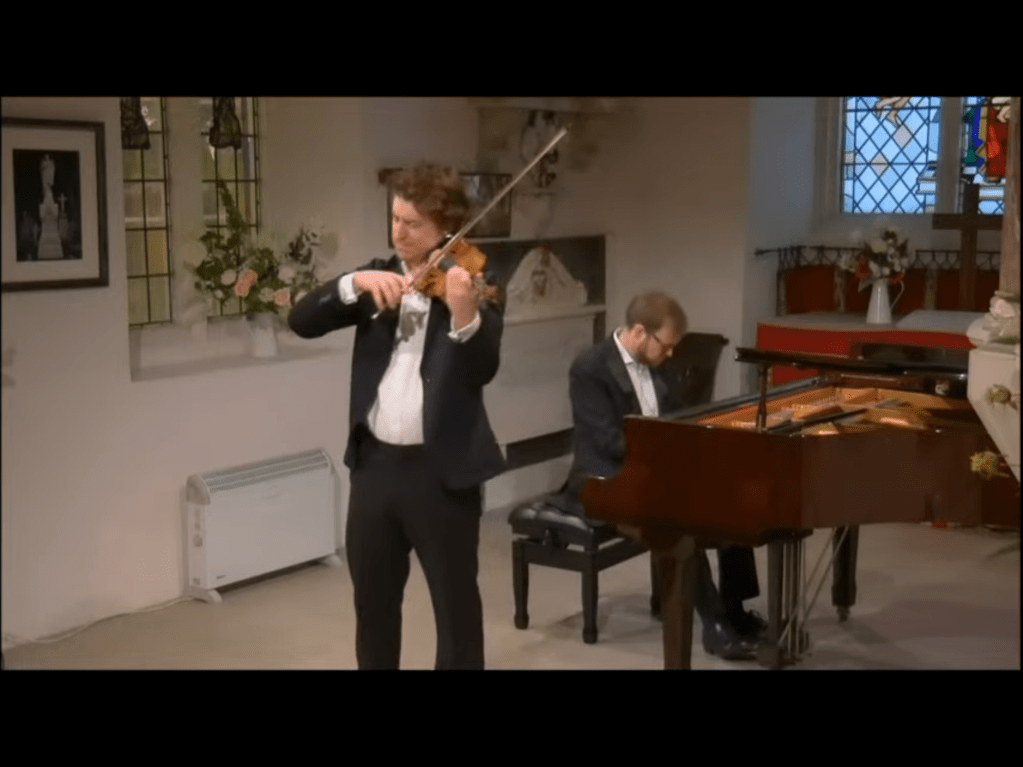
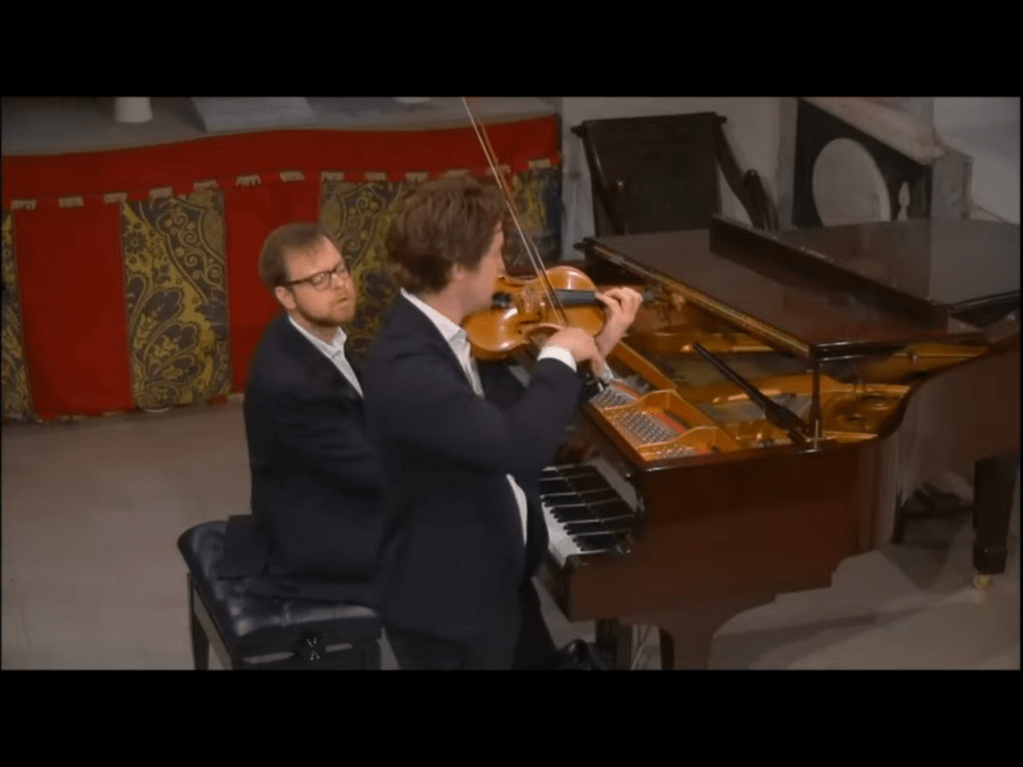
Michael Foyle & Maksim Stsura at St Mary’s

Thursday April 15 4.0 pm 

Michael Foyle (violin) 
Maksim Stsura (piano) 

Elgar: Violin sonata in E minor Op 82 Allegro-Romance :Andante-Allegro non troppo

Kreisler: Caprice viennois

Kreisler: Tambourin chinois

Rachmaninov: Romance Op 6 no 1

Ravel: Pièce en forme de Habanera Tzigane

Thank you Christopher Axworthy. They are a fabulous duo, and it is quite a feat with both musicians memorizing works like the Elgar sonata. Here is the HD version https://youtu.be/nRzmZOkRs58

A lesson in duo playing today at St Mary’s.Two artists free from restrictions of reading the score listening so attentively to each other. The Elgar violin sonata never quite gaining its place on concert programmes as the Cello concerto written only a year later in 1919 was given a totally convincing performance of passionate involvement from the opening notes.A typically capricious Romance was followed by the Pastoral last movement where Elgar incorporates the melody from the Romance at the end as a tribute to the dedicatee who died before she could accept Elgar’s tribute.

Sir Edward Elgar wrote his Violin Sonata in E minor, Op. 82, in 1918, at the same time as he wrote his String Quartet in E minor and his Piano Quintet in A minor.These three chamber music works were all written at “Brinkwells”, the country house near Fittleworth in West Sussex that Lady Elgar had acquired for her husband to recuperate and compose in, and they mark his major contribution to the chamber music genre.His Cello Concerto of 1919 completed the quartet of introspective and melancholy works that comprised Elgar’s last major creative spurt before his death in 1934.Elgar’s wife noted that the slow movement seemed to be influenced by the ‘wood magic’ of the Fittleworth woods.When the sonata was close to completion, Elgar offered to dedicate it to a family friend, Marie Joshua, and wrote to her: “I fear it does not carry us any further but it is full of golden sounds and I like it, but you must not expect anything violently chromatic or cubist”. Marie Joshua died four days after receiving the letter, before she had had an opportunity to reply. As a tribute to her memory, Elgar quoted the dolcissimo melody from the slow movement just before the coda of the final movement.


All the charm and warmth of the much loved Kreisler followed with two typical famous encore pieces .Kreisler was one of the most noted violin masters of his day, and regarded as one of the greatest violinists of all time, he was known for his sweet tone and expressive phrasing.Like many great violinists of his generation, he produced a characteristic sound which was immediately recognizable as his own. Although it derived in many respects from the Franco-Belgian school, his style is nonetheless reminiscent of the gemütlich (cozy) lifestyle of pre-war Vienna .He gave the first performance of Elgar’s violin concerto and often gave recitals with Rachmaninov.And it was in fact the long drawn out nostalgia of Rachmaninov’s early Romance that followed. There is the famous story of Kreisler loosing his way during a recital with Rachmaninov and asking his partner desperately where they were.Carnegie Hall was Rachmaninov’s sang froid reply.


Colour and fireworks from Spain from the pen of a French man with Ravel’s Habanera and his Gypsy showpiece the Tzigane.Dedicated to the great niece of Joseph Joachim the great violinist friend of Brahms.Jelly d’Aranyi lived in a little village in Oxford – Ewelme with a Swedish count and her sister also violinist Adila Fachiri.A great violinist to who Bartok dedicated his two sonatas .She played a curious role in the emergence and world premiere in 1937 of Robert Schumann’s Violin Concerto claiming messages she received at a 1933 séance, allegedly from Schumann himself, about this concerto that had lain unnoticed in the archives.It is the basis of Jessica Duchen s best selling book :Ghost Variations .

The original instrumentation of the Tzigane was for violin and piano (with optional luthéal attachment). The first performance took place in London on April 26, 1924 with the dedicatee on violin and with Henri Gil-Marchex at the piano (with luthéal).The luthéal was, in Ravel’s day, a new piano attachment (first patented in 1919) with several tone-colour registrations which could be engaged by pulling stops above the keyboard. One of these registrations had a cimbalon-like sound, which fitted well with the gypsy-esque idea of the composition. The original score of Tzigane included instructions for these register-changes during execution but the luthéal, however, did not achieve permanence. By the end of the 20th century the first print of the accompaniment with luthéal was still available at the publishers, but by that time the attachment had long since disappeared from use.

Michael Foyle launched his career by winning The Netherlands Violin Competition in 2016. His London debut followed with a recital at the Wigmore Hall and since then he has performed recitals in the UK’s most prestigious venues, including Queen Elizabeth Hall, Purcell Room, Buckingham Palace, St. Martin-in-the-Fields, Bridgewater Hall and Usher Hall, regularly being broadcast on BBC Radio 3. In 2018-19 he released his debut CDs, ‘The Great War Centenary – Debussy, Janacek and Respighi Sonatas’ on Challenge Records and ‘Lutoslawski and Penderecki: Complete Violin and Piano Works’ on Delphian Records, both to critical acclaim. He now pursues a busy solo career, recently performing concertos with the English Chamber Orchestra, the Polish Baltic Philharmonic, Youth Symphony Orchestra of Russia in Great Hall of Moscow Conservatory, and a return to the Rotterdam Philharmonic. He has given over 200 recitals with duo pianist Maksim Stsura, and performed premieres of solo and chamber works by over 30 living composers, and performed as Guest-Concertmaster with orchestras such as BBC Symphony and The Halle. Michael became Professor at the Royal Academy of Music in London in 2016, the youngest violinist appointed in the institution’s 200-year history. Michael was born in Scotland in 1991 and, as a teenager, won the BBC Young Musician of the Year Tabor Award and led the National Youth Orchestra of Great Britain. He studied at the Royal Academy of Music in London with Maureen Smith (where he received the Roth Prize for the highest graduating violinist) and then at the Vienna Konservatorium with Pavel Vernikov. He won the Royal Overseas League String Competition, the Salieri-Zinetti International Chamber Music Competition and Beethoven Society of Europe Competition, and was selected for the Park Lane Group, City Music Foundation, Kirckman Concert Society, Making Music Young Concert Artists and Live Music Now. 

Pianist Maksim Stsura won First Prizes at the 7th Estonian Piano Competition (2008), the Steinway-Klavierspiel-Wettbewerb in Germany (2004), the International Frederic Chopin Piano Competition in Estonia (2000) and the Intercollegiate Beethoven Piano Competition (2013). He has appeared as soloist with orchestras such as the Amadeus Chamber Orchestra, Estonian National Symphony Orchestra and the Saint Petersburg State Academic Symphony Orchestra. As a chamber musician, Maksim is in great demand, collaborating with Jakobstad Sinfonietta (Finland), Mediterranean Chamber Brass (Spain), Florin Ensemble (UK) and Wiener Kammersymphonie (Austria), among many others. In 2014 he started his Doctoral course at the Royal College of Music, working towards his DMus. Maksim’s research has been generously supported by a Neville Wathen Award, Leverhulme Postgraduate Studentship and Mr Nigel Woolner MBE. His research titled ‘Piano Transcription of a 21st-century Orchestral Score – Freedoms and Limitations’ focuses on works by Mark-Anthony Turnage and James Dillon.Since 2012 Maksim has been the pianist in the award-winning Foyle-Stsura Duo, having performed extensively in the UK and internationally in venues including the Concertgebouw in Amsterdam, Bridgewater Hall in Manchester and the Wigmore Hall. He has played live on BBC Radio 3, NPO Radio 4 and Estonian Klassikaraadio and recorded for Delphian Records and Challenge Classics.

https://christopheraxworthymusiccommentary.wordpress.com/2020/03/19/st-marys-the-virtual-concert-hall-n-2-michael-foyle-and-maksim-stsura-a-duo-made-in-heaven/

Andrea Bacchetti -Geniality in Genoa in praise of the Universal Genius of J.S.Bach

12 aprile 2021 ore 20:30

Intorno al Preludio: Andrea Bacchetti

  • Johann Sebastian Bach
    Il clavicembalo ben temperato – Libro II, BWV 870 – 893

Bach gave the title Das Wohltemperirte Clavier to a book of preludes and fugues in all 24 major and minor keys, dated 1722, composed “for the profit and use of musical youth desirous of learning, and especially for the pastime of those already skilled in this study”. Some 20 years later Bach compiled Book 2 completed in 1742,which was intended as a complement to Book 1. It is generally far more difficult than Book 1, with greater technical and structural difficulty for the performer. It was the ultimate workbook, open to constant change and refining by Bach himself.

Genius at work indeed in Genoa tonight.
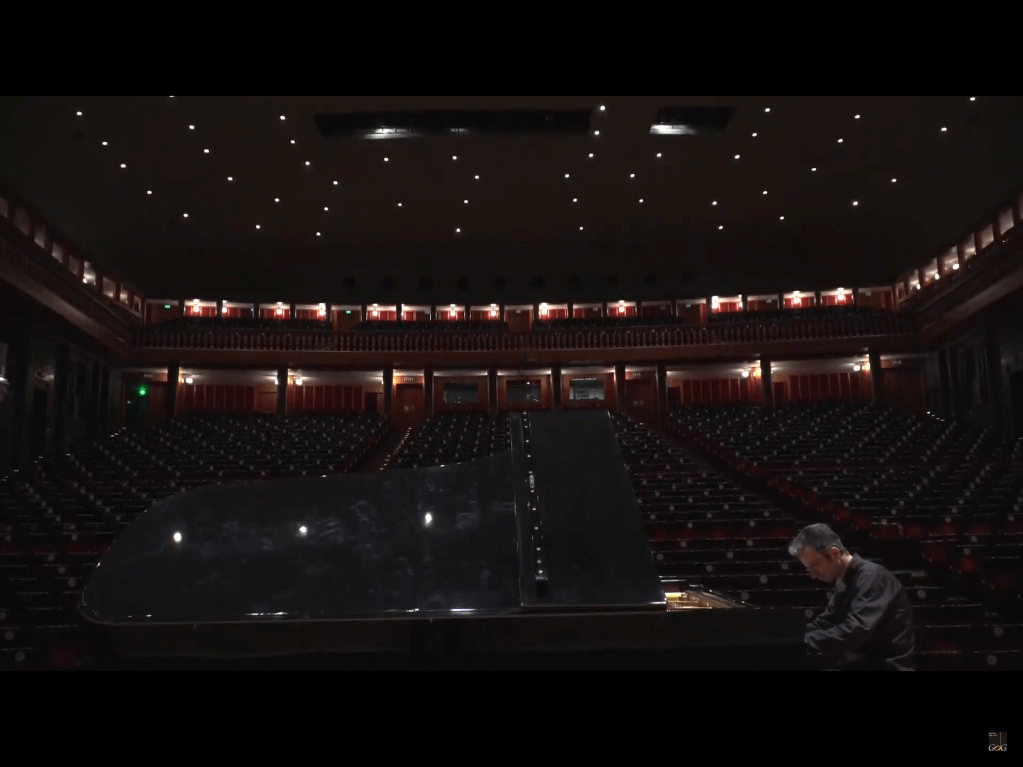
130 minutes of total concentration and music of a crystalline clarity but with a sense of colour and character that kept this imaginary audience spellbound from the first to the last of the second book of the Wohltemperirte Clavier.
Bach had infact indicated that they were composed ‘for the profit of musical youth desirous of learning and especially for the pastime of those already skilled in this study’.
Busoni famously said the first book were for performers and the second for composers.
In fact the second book in much longer and more complex but this did not deter Andrea Bacchetti ,despite admitting his fear at such a daunting task ,from giving a note perfect performance.
Without the score in a completely empty hall with just the camera watching and listening to his every move.
I have known and admired Bacchetti for many years.He even gave a noble performance of the Goldberg Variations in the Ghione theatre ,fifteen years ago,where Nikolaeva and Tureck had trod before him.


But I was not expecting a performance of such authority and distilled genius as he offered today to the glory of the Universal genius that is Johann Sebastian Bach.
From the very first noble notes of the C major prelude through a world of musical wisdom and experience with the sheer beauty of the C sharp major prelude or the jagged edges of the F major Fugue.His highly original reading of the F minor prelude contrasting with its bucolic fugue.The complexity of the F sharp minor fugue contrasting with the mellifluous G major prelude or the decisiveness of the G minor fugue.The B minor prelude played much more flowingly than I remember Gulda in tennis cap staring at us as he teased the rhythm out of this beguiling prelude.The nobility of the D major prelude and the wonderful colouring of the fugue was followed by the refined rhythmic buoyancy of the D minor prelude with it’s long unwinding three part fugue.The beautiful pastoral flow of the E flat prelude leading to the aristocratic shaping of the fugue.The mellifluous E major giving way to the solemn immensely complex four part fugue.The luminosity he brought to the F sharp prelude contrasted with the extreme complexity of the fugue played with an amazing clarity and control.The gaiety of the dance in the G sharp minor prelude only highlighted the extreme chromaticism of the fugue.The all too brief florid line in A major contrasted with the operatic double counterpoint of the A minor prelude before the rhythmic urgency of the fugue.The mellifluous B flat prelude and fugue just flowed so naturally from his hands as we arrive at the serenity of B flat minor and the extreme complexity of the four part fugue.The final B minor I have mentioned above but I see the words of Ebenezer Prout written in my score by my teacher Sidney Harrison:’pray unto the lord my God re – member ever more to sing his praises ‘ and the fugue ‘and we shall go forth passing through the mountains and valleys that be on the way to heav’n’.How apt they are today as Bacchetti had taken us on a long multi faceted voyage of discovery.(I remember visiting Angela Hewitt in the interval of one of her Bach recitals at La Pergola in Florence and asking her if she knew about Ebenezer Prout- we had both been introduced to each other in our youth by Sidney Harrison.She not only knew them but began singing them at full voice until they came to ask her to continue the second part of her recital!)


But Bacchetti has such a refreshing way of looking at the music with his highly original intellect that allows the music to flow so naturally from his fingers.
And what fingers they are !
Hardly using the sustaining pedal as his finger legato and sense of balance were of such transcendental control that one was hardly aware of it except that his clarity and precision were of almost superhuman prowess.
The immensely complex B flat minor prelude and fugue, after two hours of playing,showed no sign of fatigue or strain and the simplicity of the final B minor was so refreshing coming as it does like a breath of fresh air after the most dense and intense air that Bach shares with us in his long journey of genial inspiration.

Born in 1977, Andrea Bacchetti had from a very early age received advice from musicians such as Karajan, Magaloff, Berio, Horszowski .At the age of eleven, he made his debut with I Solisti Veneti, conducted by Claudio Scimone.
From then on, he has has played in international festivals all over the world as Lucerne, Salisbury, Belgrade, Santander, Toulouse (Piano aux Jacobins), Lugano, Sapporo, Brescia and Bergamo, Bologna, Rome (Uto Ughi for Rome), La Roque d’Anthéron, Milan (MI.TO), La Coruña (Festival Mozart), Pesaro, Cervo, Martina Franca (Valle d’Itria Festival) Bellinzona,Ravenna, Ravello, Santiago de Compostela (A. Brage piano cycle), Warsaw (Beethoven Festival), Paris (La Serre d’Auteil), Bad Wörishofen, Spoleto, Husum, Murten Classics.
He has also performed in : Konzerthaus (Berlin); Salle Pleyel, Salle Gaveu cycle Piano 4 (Paris); Rudolfinum Dvorak Hall (Prague); Teatro Coliseo (Buenos Aires); Rachmaninoff Saal, The Moscow State Philharmonic Society (Moscow), IBK Concert Hall Arts Center (Seoul); Auditorium Nacional de España (cycle of Scherzo and CNDM), Teatro Real, Fundación March (Madrid); Fundação Calouste Gulbenkian (Lisboa); Toppan Hall, Hamarikyu Asahi Halland Musashino Concert Hall (Tokyo), De Warande (Antwerp); Sociedad Filarmonica (Lima), Fundación Filarmonica (Quito), Huelecourt Art Project, (Bruxelles); Mozarteum Brasileiro e Cultura Artistica (São Paulo); Hyogo Performing Arts Center (Osaka), Philia Hall, (Yokohama), Parco della Musica (Rome);Zentrum Paul Klee (Bern); Gewandhaus (Leipzig).
He has played with many orchestras including Lucerne Festival Strings, Camerata Salzburg and Salzburg Chamber Soloists, RTVE Madrid, Sinfónica de Asturia, Oviedo, OSCYL, Valladolid; MDR Leipzig, Kyoto Symphony Orchestra, Sinfónica de Tenerife, Filarmonica della Scala (Milan), OSNR Turin, Sinfónica del Estado de Mexico, RTL Lubiana, Cappella Istropolitana, Bratislava, MAV Budapest, Russian Chamber Philharmonic St. Petersburg, Dubrovnik Symphony Orchestra, Philharmonique de Nice et de Cannes, Prague Chamber Orchestra, ORF Wien, Toscanini Philharmonic of Parma, Philarmonie der Nationen (Hamburg), Enesco Philharmonic (Bucharest); with many conductors as Bellugi, Guidarini, Venzago, Luisi, Zedda, Manacorda, Panni, Burybayev, Pehlivanian, Gullberg Jensen, Nanut, Lü Jia, Justus Frantz, Baumgartner, Valdes, Renes, Bender, Bisanti, Ceccato, Chung amongst others.
Currently he records exclusively for Sony Classical. His discography includes :SACD with the “6 Sonatas” by Cherubini (Penguin Guide UK, Rosette 2010), “The Scarlatti Restored Manuscript” (RCA Red Seal) that received an ICMA award in the Baroque Instrumental CD category in 2014; his Bach recordings include the “Two-Part Inventions & Sinfonias” (CD of the month for BBC Music Magazine – September 2009), “The Italian Bach” (CD of the month for The Record Geijutsu – May 2014) and the Keyboard Concertos BWV 1052 – 1058 with the ONR Rai National Orchestra (CD of the month for Musica, May 2016).
He is an assiduous chamber music player playing with artists such as Filippini, Larrieu, Prazak Quartet, Uto Ughi, Quatuor Ysaye, Cremona Quartet, String Quartet of La Scala.Composers such as Vacchi, Boccadoro, Del Corno, amongst others, have dedicated works to him.

Ancora giovanissimo, Andrea Bacchetti raccoglie consigli da Karajan, Magaloff e Berio.
Debutta ad 11 anni con i Solisti Veneti in Sala Verdi a Milano.
Da allora suona nei maggiori festival internazionali e si è esibito in prestigiosi centri musicali.
Andrea Bacchetti è ospite in Italia e all’estero delle maggiori orchestre e delle più importanti associazioni concertistiche.
Fra la sua discografia è da ricordare il SACD con le sonate di Cherubini (Rosette Penguin Guide UK), The Scarlatti Restored Manuscript (vincitore dell’ICMA nella categoria Baroque Instrumental); di Bach, Invenzioni e Sinfonie (CD del mese BBC Music Magazine), The Italian Bach (Cd del mese Record Geijutsu); i concerti per tastiera di Bach alla guida dell’Orchestra Nazionale della RAI, premiato con 5 stelle dalla rivista MUSICA, Goldberg Variations (CD del mese delle riviste Pizzicato e Fonoforum).
Nella musica da camera proficue sono state le collaborazioni con Rocco Filippini, il Prazak Quartet, il Quatuor Ysaye, il Quartetto di Cremona, Uto Ughi, Maxence Larrieu e Antonella Ruggero.

Cristian Sandrin Master musician at St Mary’s

Tuesday 13 April 4.0 pm 

Mozart: Piano Sonata in C major K279 Allegro-Andante-Allegro

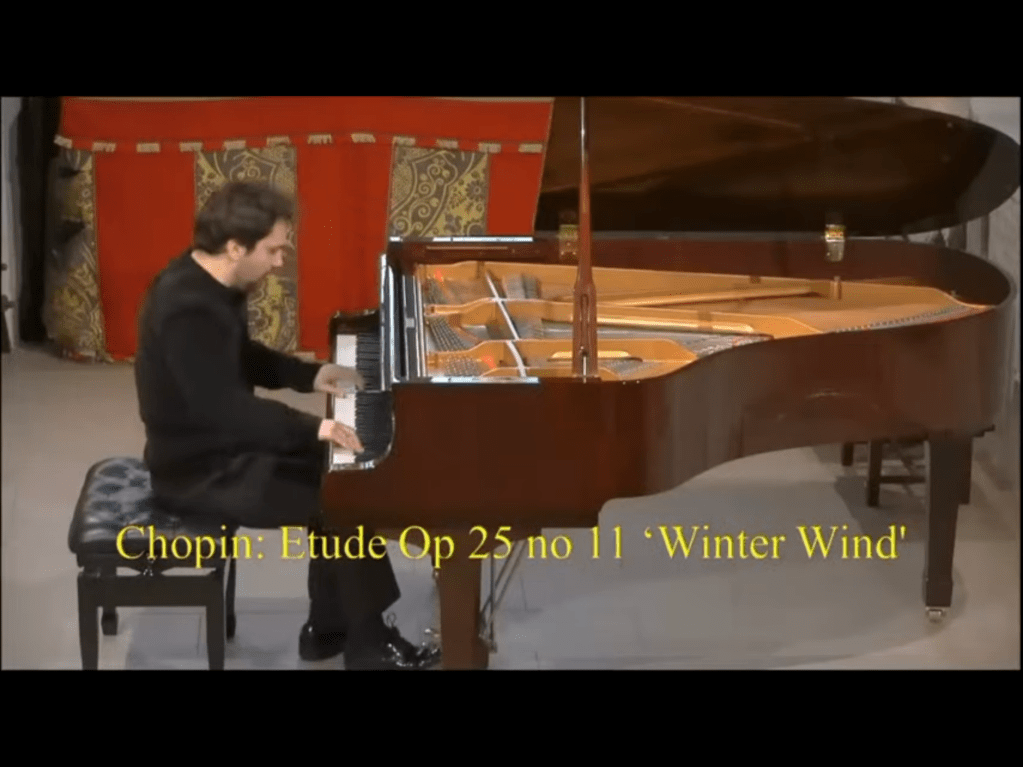
Chopin: Etude Op 25 no 11 ‘Winter Wind’

Ravel: 3 pieces from Miroirs
Une barque sur l’océan
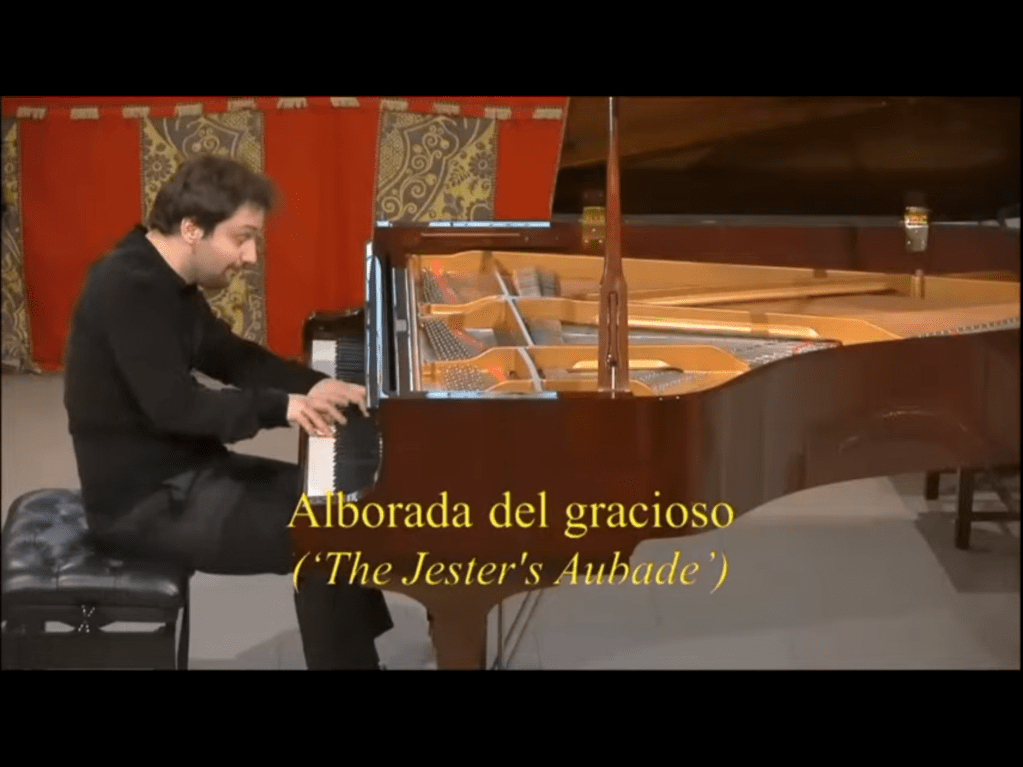
Alborada del gracioso
La vallée des cloches

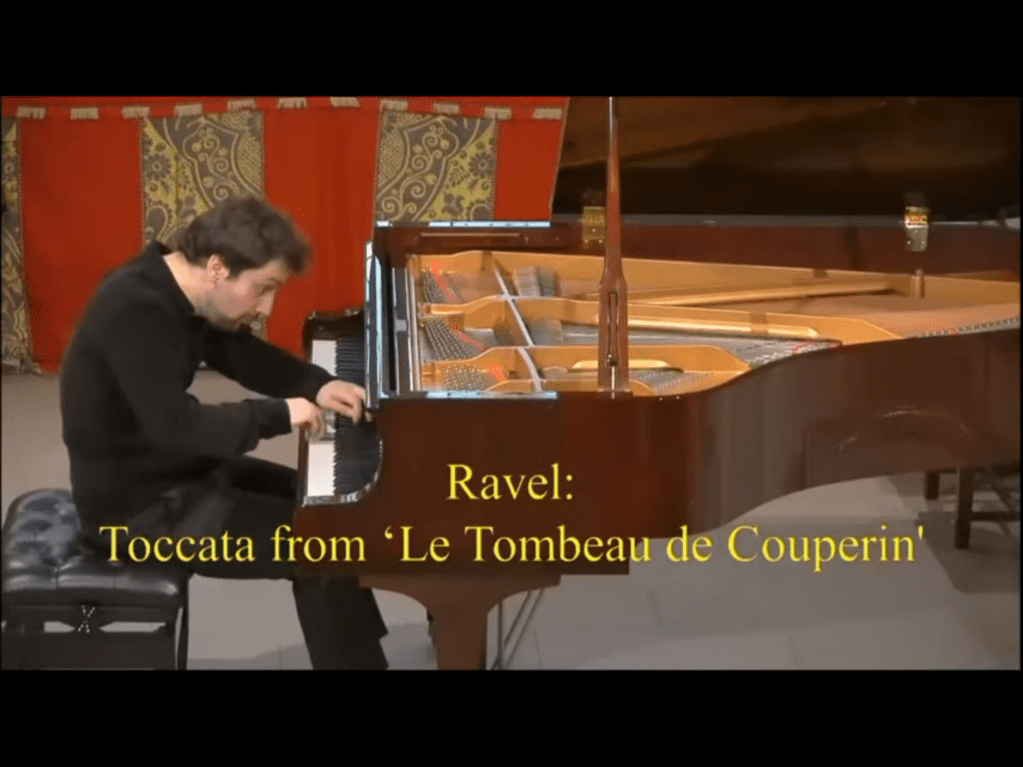
Ravel: Toccata from ‘Le Tombeau de Couperin’

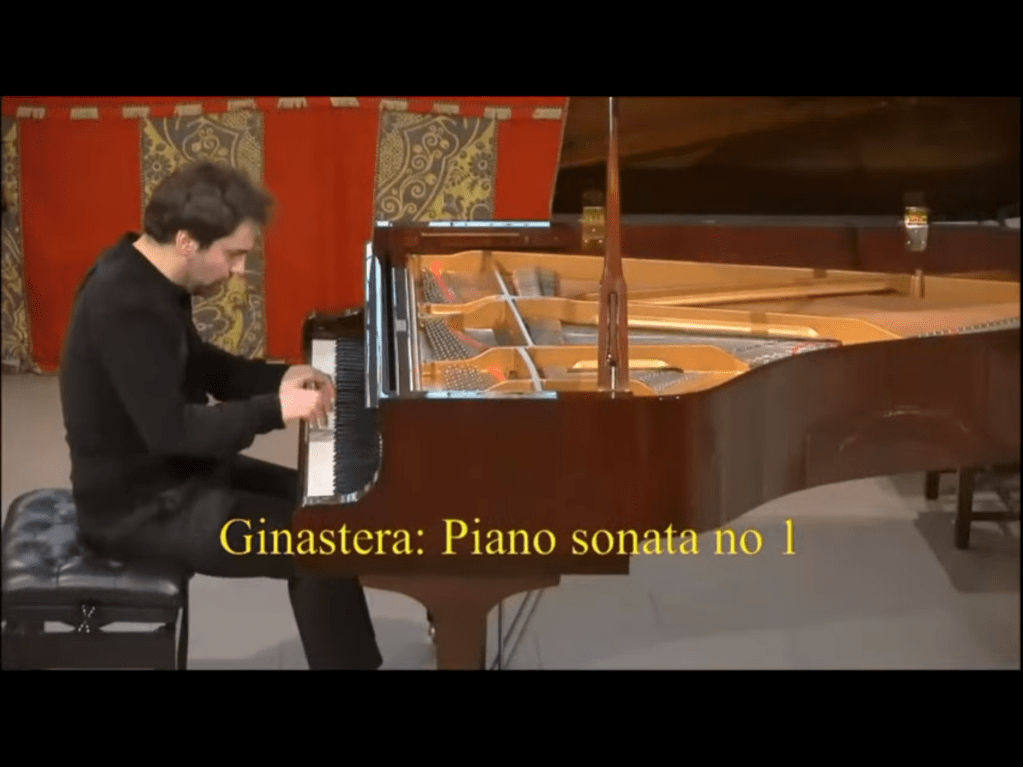
Ginastera: Piano sonata no 1 (1952) Allegro marcato-Presto misterioso-Adagio molto appassionato-Ruvido ed ostinato

‘Sorry about the internet problems this afternoon – hope it didn’t spoil a magnificent recital. Here is the HD version’-Hugh Mather

Cristian had told me that there were so many notes in today’s recital that having just recorded the Goldberg variations he was getting quite alarmed.
I told him I would send him some notes over the air if need be.
Unfortunately today being the 13th the internet connection at St Mary’s had decided to play up!
Luckily there was no need for my assistance because from the very first notes of Mozart’s early C major sonata it was obvious with what artistry this young Romanian pianist dispensed of the notes.The Sonata was written at the age of 18 during the visit Mozart paid to Munich for the production of La finta giardiniera in 1774 .
A Mozart so full of character it had me almost rolling in the aisles as you could almost see Mozart laughing as the acciaccatura’s poked fun at the operatic scenes that were being enacted before our very eyes.
A rhythmic energy and infectious ‘joie de vivre’ that is only heard these days from Martha Argerich’s genial hands.With Mozart’s miraculous bursts of song coupled also with his impish sense of humour.
A sumptuous cantabile in the Andante with a sense of legato that like the ‘bebung’ on the fortepiano allowed him to join one note miraculously to the other in a vibration of sounds that belies the percussive nature of the instrument.
Mozart of course has the last laugh with a final Allegro of such bucolic charm that Cristian and we seemed surprised that the fun should ever end.


A Chopin Winter Wind where one could again marvel at the legato of the opening statement with a legato I have only noticed from the aged Wilhelm Kempff in his visionary Liszt recordings.I could only catch glimpses of Cristian sailing up and down the keyboard in between the hic-cups of internet glitches and I will catch up with the count as St Mary’s download their superb HD recording.


Miroirs suffered the same fate – but I have heard Cristian’s superb performances on other occasions ( see below 4/3/2019)
A miracle occurred in Alborada where the gremlins of St Mary’s allowed us to be moved by the deeply felt recitativi and of course marvel at the control and technical prowess in the double glissandi and repeated notes.


Repeated notes is the operative word with Ravel’s sumptuous Toccata that ends the suite ‘Le Tombeau de Couperin’ . Ravel had dedicated each movement to friends that had fallen in the First World War where the composer was a humble lorry driver.
He was one of the few who lived to tell the tale of sacrifice not to say political butchery of a generation.
A superb performance if not only for the relentless rhythmic drive but above all the magic moments when the sun shone through and glistened amongst the butchery.


Of course Ginastera is a piece of great effect,always,but in Cristian’s artistic hands it became of Bartokian proportions. Ginastera was commissioned by the Carnegie Institute and the Pennsylvania College for Women to write a piano sonata for the Pittsburgh International Contemporary Music Festival in 1952.The performance was given by pianist Johana Harris, wife of American composer Roy Harris ,and the work was dedicated to both Harrises. Ginastera’s intention for the piece was to capture the spirit of Argentine folk music without relying on explicit quotations from existing folk songs.Not only the savage relentless ritual dance rhythms but also the whispered legato of the second movement and the great cries of lament in the third before the relentless final toccata of erotic triumph with which it drives the latin temperament to its inevitable goal.

Cristian’s first contact with the piano happened naturally, at very young age, since music played an inherent part of family life. Born in Bucharest, Cristian first studied in Romania under Marina Dragomirescu and Cristian Dumitrescu, winning numerous local competitions and having his public debut at the prestigious Romanian Atheneum at the age of 13. Upon moving to London, Cristian accepted a place at the Royal Academy of Music, where he studied for 7 years: a particular opportunity, to be closely mentored by both Diana Ketler and Christopher Elton. He completed his last degree at the Academy in 2019, the Advanced Diploma, a special programme reserved only for the very fine students of this institution. Before that, in 2018 he received a DipRAM distinction, awarded for an outstanding performance for the Master of Music final recital. Cristian Sandrin is very passionate about music, and his love for Mozartian repertoire led him to conduct numerous piano concertos from the keyboard, in Summer Piano Festivals and for the official opening of the Angela Burgess Recital Hall at the Royal Academy of Music. Cristian toured extensively across the UK as an artist of the Countess of Munster Recital Scheme from 2018 to 2020. He performed a very successful and critically well received debut solo recital at the Wigmore Hall in 2017. A very special and memorable experience for any young musician, this Wigmore opportunity was made possible by the support of the Kirckman Concert Society. Further support from Imogen Cooper’s Music Trust provided Cristian with exclusive mentorship and guidance in 2017. Since 2019, Cristian is being supported by the Keyboard Charitable Trust.Other UK engagements included recitals at St Martin in the Fields, Queen Elizabeth Hall, St James Piccadilly, Brighton, Oxford, Chipping Campden. In Romania, Cristian Sandrin is a frequent guest artist of the Bacau State Philharmonic, Sibiu State Philharmonic, Ramnicu-Valcea State Philharmonic and Bucharest Symphony Orchestra. International engagements included performances at Salle Cortot in Paris, Marstall Platz in Berlin, Salla Manuel de Falla in Madrid, Palazzo Ricci in Montepulciano, “La Fenice” Theatre in Venice, “Bulgaria Hall” in Sophia and the Polish National Philharmonic Hall. In the past season he has been invited to perform solo recitals and chamber music in the Naarden International Piano Festival (Netherlands), the Eifel Musicale Festival (Germany) and the KameArt Experience (Romania).He is a laureate of many international competitions, most recently being awarded the “Roslyn Tureck Special Prize” for the best interpretation of Bach during the Olga Kern International Piano Competition 2019 in New Mexico, USA. Other recent achievements included top prizes in the Città di Ollegio Piano Competition (2019), Concours Musical de Versailles (2019), the Windsor International Piano Competition (2018), the Sheepdrove Intercollegiate Piano Competition (2018), Automobile Club de France Piano Competition (2011), the “Animato” Competition in Paris (2012), ProPiano International Competition (2010), “Yourii Boukoff” Competition (2009) and the Eastbourne Symphony Orchestra Young Soloist Competition (2015). Cristian is a past winner of the Harold Craxton Chamber Music prize (in 2016), and the William Sterndale Bennett Prize (in 2014) at the Royal Academy of Music.Cristian is grateful extremely grateful to the Tillett Trust, the Hattori Trust, the Martin Musical Scholarship Fund, Help Musicians UK, the Cohen Foundation, the Harold Craxton Memorial Trust and the Royal Society of Musicians. The financial support offered by these trusts enabled Cristian to study at the Royal Academy of Music, one of UK’s leading music institutions.

https://christopheraxworthymusiccommentary.wordpress.com/2020/10/13/cristian-sandrin-at-st-marys/

https://christopheraxworthymusiccommentary.wordpress.com/2019/04/03/cristian-sandrin-at-st-marys-with-encore-performance/

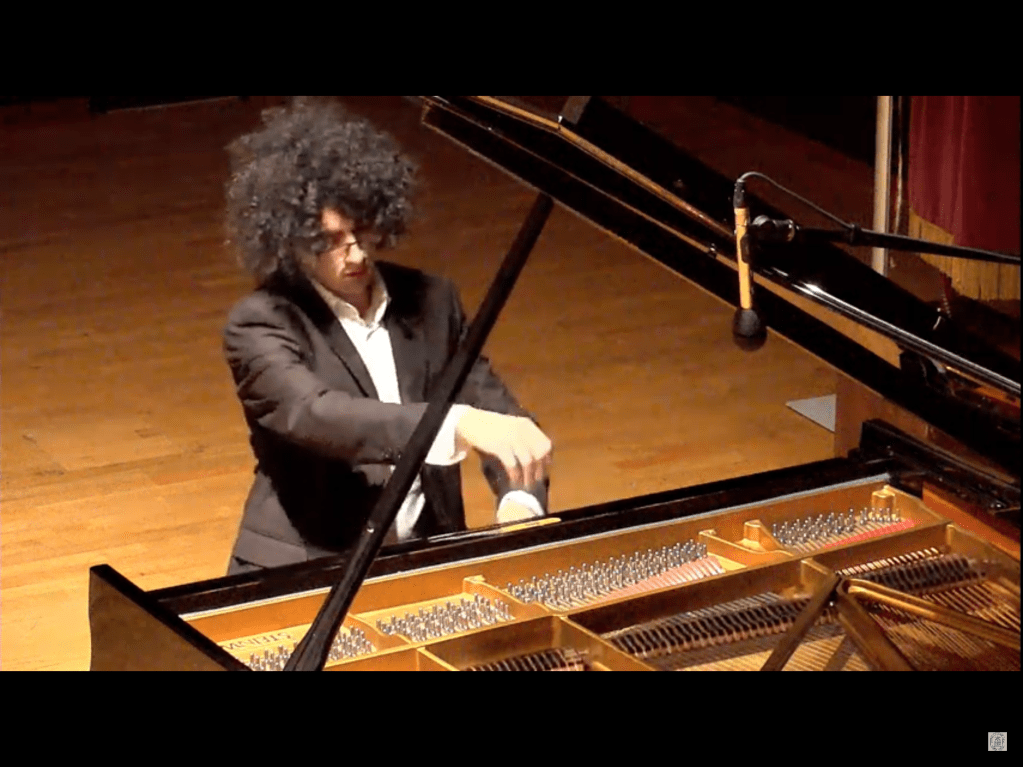
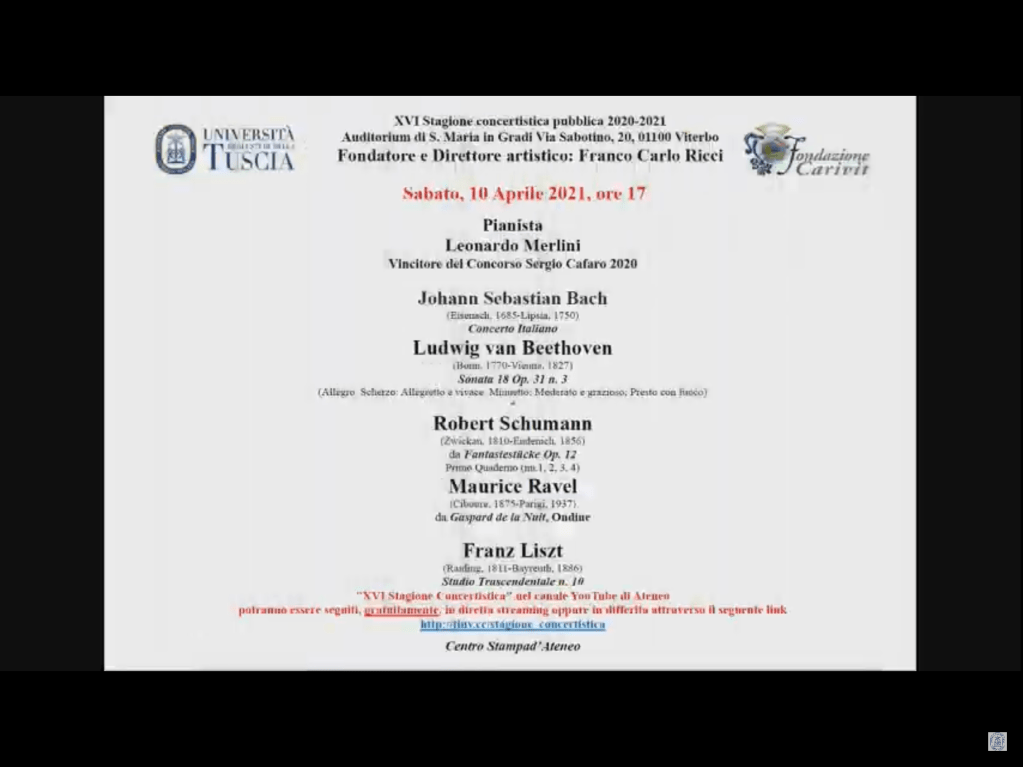
Leonardo Merlini -Premio Cafaro 2020 at Tuscia University Viterbo

http://tiny.cc/stagione_concertistica

Some fine playing from this eighteen year old Tuscan pianist winner of the Premio Sergio Cafaro 2020.
After the Easter lock down in Italy the streamed concerts at Viterbo University have been allowed to continue with a remarkable recital by Leonardo Merlini.
A pianist that immediately shows all the musical intelligence and integrity that was so much part of the Cafaro studio that is a stone’s throw from the Ghione Theatre in Rome.
Artists such as Roberto Prosseda,Alessandra Ammara,Francesco Libetta,Luisa Prayer,Laura Manzini ,all now distinguished artists were formed by Sergio Cafaro and his wife Annamaria Martinelli.
It is she who is still carrying the flame and has founded this prize for the most talented young musicians each year in the name of her beloved husband and their work together of a lifetime dedicated to helping to form real artists.
https://www.facebook.com/notes/christopher-axworthy/premio-sergio-cafaro/10155983211097309/


It was the absolute clarity of this young man’s playing that was so remarkable allied to a scrupulous attention to detail.
The Bach Italian concerto was played with a fine non legato touch with delicately placed ornaments of crystal clarity.There was also some very telling phrasing with some very slight punctuation that was of a true musician.The Andante too showed a remarkable control and the freedom of a bel canto singer that made for a great contrast with the relentless rhythmic drive of the outer movements.
Beethoven’s almost pastoral sonata op 31 had a crystalline freshness but could have had just a little more weight in the passage work to contrast with the simplicity of the mellifluous outpourings in what is one of Beethoven’s happiest sonatas. No clouds here as this is Beethoven in an unusually genial mood.
There was great beauty and sense of colour in the four pieces he chose from Schumann’s Fantasiestucke.
Des Abends was played with a touching simplicity and control that contrasted so well with the tempestuous Aufschwung that followed.The magical duet in Warum could have been even more to the fore with the accompaniment a mere murmur but Grillen was thrown of with aristocratic poise.
Ravel’s Ondine just flowed so magically from his fingers with a clarity and astonishing technical prowess.The glissandi flowed so naturally from his hands as they hovered over the keys and the climax was played with passionate involvement leading to the gentle single strand of melody drowned in pedal ,as Ondine disappears into the depths ,just as the composer asks in the score .
Of course the Liszt Trascendental study in Fminor was played with astonishing control and passionate excitement where Leonardo allowed himself to be totally involved in Liszt’s ravishing score of great virtuosity and emotivity.

Leonardo MerliniNato nel 2003, a Piombino, Leonardo Merlini inizia lo studio del pianoforte a cinque anni sotto la guida del M° Alessandro Gagliardi. Fin da piccolo risulta vincitore in vari concorsi, tra cui il “Riveria Etrusca” e il “J.S. Bach”.Nel 2017 vince il 2° Premio nella competizione Steinway di Verona e nel 2018 ottiene una borsa di studio per frequentare le masterclass del M° Aquiles delle Vigne.Tra i riconoscimenti più importanti: il Premio Maria Giubilei, il Premio Humberto Quagliata, il Premio Enrico Galletta e il Premio Sergio Cafaro.

https://christopheraxworthymusiccommentary.wordpress.com/2021/01/22/duo-prosedda-amara-french-women-composers-for-four-hands-from-palazetto-bruce-zane-in-venice/

https://christopheraxworthymusiccommentary.wordpress.com/2021/01/13/roberto-prosseda-pays-tribute-to-the-genius-of-chopin-and-the-inspirational-figure-of-fou-tsong/

https://christopheraxworthymusiccommentary.wordpress.com/2020/02/27/a-lion-in-villa-torlonia-luca-lione-at-teatro-di-villa-torlonia/

Sasha Grynyuk at St Mary’s for the glorification of Love and Passion

Tuesday April 6 4.0 pm 

Sasha Grynyuk (piano) 

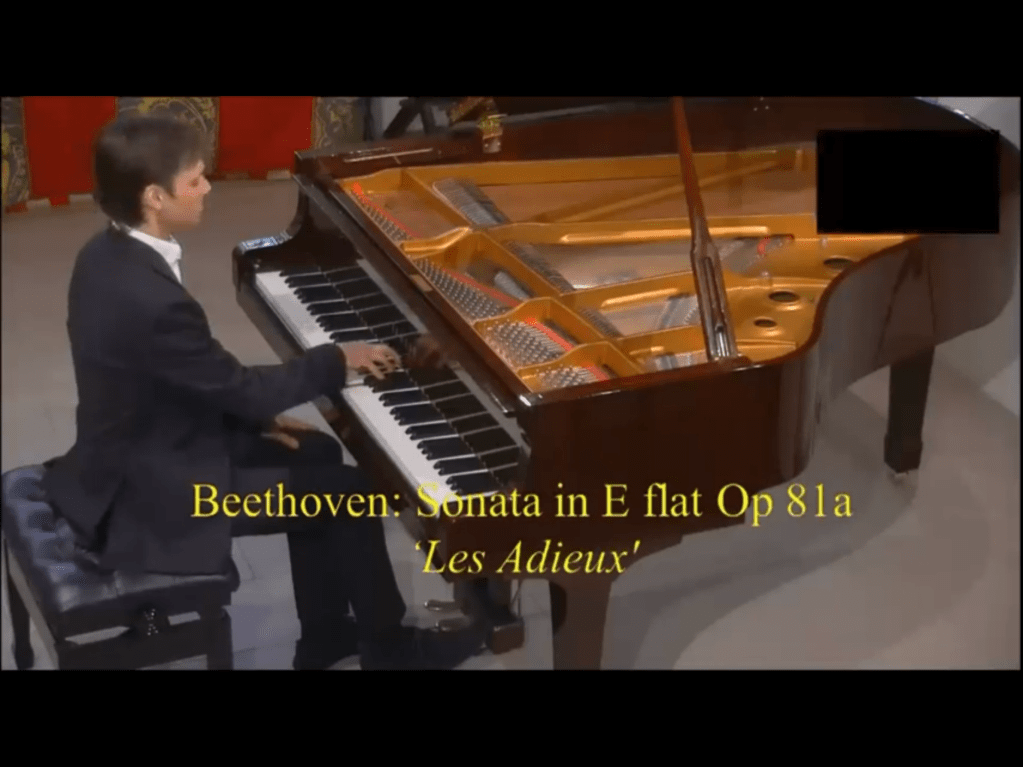
Beethoven: Sonata in E flat Op 81a ‘Les Adieux’ The Farewell Adagio- allegro ,The Absence Andante espressivo,The Return Vivacissimamente

Schumann: Davidsbündlertänze Op 6

Messiaen: Vingt regards sur l’enfant-Jésus no 10
Regard de l’esprit de joie

More superb playing from Sasha Grynyuk.From the first delicate notes of Beethoven’s Les Adieux sonata where he transformed the composers most precise indications into sumptuous sounds of a pastoral farewell,a heartfelt absence and a truly joyous return.
The conflict between Florestan and Eusebius in one of Schumann’s greatest works.Inspired by Schumann’s love for his future wife,Clara,it was played with such loving care by Sasha’s delicate hands that one thought that each of the eighteen pieces could not get any more beautiful.Overwhelmed by the fourteenth ‘zart und singend’ that is possibly the most beautiful thing Schumann ever wrote,we were left with a desolate waltz as this wedding party draws away to a distant magic land.
The barbaric Regard de l’Esprit de Joie by Messiaen was a tour de force of dynamic drive and histrionic declarations of faith.The passionate belief of Messiaen together with his love of nature was overwhelming in it’s relentless insistence.The final transcendental scale in Sasha’s hands just proved that love and passion go hand in hand as they had done all through his enthralling performances today.

Beethoven’s Sonata op 81a ‘Les Adieux’ was written during the years 1809 and 1810.The French attack on Vienna, led by Napoléon Bonaparte in 1809, forced Beethoven’s patron, Archduke Rudolph, to leave the city. and on the first publication in 1811 a dedication was added reading “On the departure of his Imperial Highness, for the Archduke Rudolph in admiration”.

The opening Adagio where Beethoven writes Le-be-Wohl over the first three chords were indeed played with an even deeper meaning on it’s return where the hesitation before the final chord had us already on the edge of our seats.Great care of the phrasing on the gentle upward phrases meant that the arrival at the Allegro sped along in two with an almost pastoral feel of open air and freshness.Sasha’s scrupulous attention to detail made great contrasts between the bare open notes and the bass syncopated comments.It led in turn to the open horn calls answering each other and the delicate quavers like a clear flowing stream in this outdoor landscape.The problematic crescendo on a single note at the end was superbly interpreted and played with great deliberacy instead of the usual half hearted efforts of lesser musicians!The andante espressivo sang with a delicate but full voice where the sforzandi only re enforced the intense feeling created on the arrival of His Imperial Highness the esteemed Archduke Rudolph.Beethoven’s magical pedal over pianissimi rising arbesques made the joy of the return even more intense.There was such clarity in Sasha’s playing with great playfulness and a pastoral feel of well being that was truly refreshing.Played with a rhythmic drive and joie de vivre that even in the final poco andante he kept a constant pulse leading to the joyous ride to the finish.A performance of remarkable lucidity and character where Beethoven’s ever more precise indications were interpreted and made to live again as he himself must have imagined them in his secret ear.

Davidsbündlertänze (Dances of the League of David), Op 6, is a group of eighteen pieces composed in 1837 by Robert Schumann who named them after his music society Davidsbundler-. The low opus number is misleading as it was written after Carnaval Op. 9, and the Symphonic Studies Op. 13 and is widely regarded as one of the greatest piano works of the Romantic era.Schumann’s early piano works were substantially influenced by his relationship with Clara Wieck and on September 5, 1839, Schumann wrote to his former professor: “She was practically my sole motivation for writing the Davidsbündlertänze, the Concerto, the Sonata and the Novellettes.” They are an expression of his passionate love, anxieties, longings, visions, dreams and fantasies.In fact the theme of the Davidsbündlertänze is based on a mazurka by Clara Wieck and the intimate character pieces are one of his most personal works.In 1838, Schumann told Clara that the Dances contained “many wedding thoughts” and that “the story is a wedding eve party, during which old crockery is smashed to bring good luck.”They are not true dances , but characteristic pieces, musical dialogues about contemporary music between Schumann’s characters Florestan and Eusebius that represent the impetuous and the lyrical, poetic sides of Schumann’s nature. Each piece is ascribed to one or both of them. Their names follow the first piece and the appropriate initial or initials follow each of the others except the sixteenth (which leads directly into the seventeenth, the ascription for which applies to both) and the ninth and eighteenth, which are respectively preceded by the following remarks: “Here Florestan made an end, and his lips quivered painfully”, and “Quite superfluously Eusebius remarked as follows: but all the time great bliss spoke from his eyes.”It is one of the most precisely notated works of Schumann where rests,legato and staccato marking are all most carefully indicated.The difficulty for any interpreter is to incorporate all these details into an overall architectural shape from the arresting opening to the wistful waltz dying away into the distance.It was a work that Rubinstein preferred not to play in public because of its quiet ending.Gieseking was superb in his no nonsense multicoloured driven performance.Geza Anda was the most magically poetic with his liquid sound and intelligence.I once suggested to Fou Ts’ong that he should play it for us in his annual Rome recital but he loved it too much and it fell wonderfully apart.(I was on tour when he played it in Rome and poor Ts’ong exhorted: ‘but Chris it was like cooking a meal for someone who did not show up!’He went on to make a wonderful recording of it.All this to say what a challenge Sasha took on today and how refreshing it was to be swept along on a great wave of sounds of such poetic delicacy,colour and at times passionate involvement.Never loosing the undercurrent that drives the music on there was a constant forward movement and great sense of fantasy as Florestan and Eusebius fight it out at the opening before the intimate confessions of Eusebius in the second piece the same sumptuous colours that are dreamt of in the distance of the seventeenth piece after a journey of longing and passion.Florestan bursting on the scene in the third piece played with bucolic charm with Sasha’s great care of legato and staccato.The fourth was played with sweeping passion before the touching simplicity of the coquettish Eusebian charm of the fifth.The devilish syncopation that Florestan combines in the sixth almost caught Sasha out but the continual drive kept him on course magnificently to the passionate outpouring of the coda.Such deeply felt communion in the nicht schnell with the beautiful duet of the mellifluous middle section.Such frivolity too,as Florestan takes over ,with his great character shining through ,leading to the passionate outpourings of the Balladenmassig.The simple beauty of the eleventh was a wonderful oasis before the twelfth that was thrown off with skittish charm before the passionate ‘wild und lustig ‘ of Florestan that Eusebius manages to calm with an almost Brahmsian melodic line of such elegance and beauty.Uniting in a coda of sweep and the charm of a candle coming gently to its end.The most beautiful of course was left to Eusebius with the fourteenth piece played with a heart melting cantabile surrounded by magic figurations flowing on a kaleidoscope of beautiful sounds.Rudely awoken by the fifteenth and the Frisch of Florestan only to have Eusebius wave his magic wand where wondrous sounds appeared of sweep and innermost passion which the fleeting bass notes just seemed to highlight. Florestan takes wing with a capricious interlude of syncopated play between the hands before dissolving into a distant land .Ravishing marvels of sumptuous beauty in Sasha’s delicate hands out of which emerges the recollection of the second piece that gradually builds up to a climax where Florestan and Eusebius seem united but infact it is Eusebius who has the last say.A magic chord opens a landscape where Eusebius alone looks nostalgically back at what has surpassed.Playing of great poetry and the sumptuous sounds of a true musician that could admire all the marvels that surround him whilst on a long journey of discovery.

Vingt regards sur l’enfant-Jésus (“Twenty visions of the infant Jesus”) is a suite of 20 pieces for solo piano by the French composer Olivier Messiaen (1908–1992). It is a meditation on the infancy of Jesus and was composed in 1944 for his wife Yvonne Loriod.Regard De l’Esprit de joie is the tenth and Messiaen writes in the score Thème de danse orientale et plain-chantesque-comme un air de chase,comme des cors,Thème de joie,Thème de Dieu,Dans un grand transport de joie.Messiaen uses Thèmes or leitmotifs, recurring elements that represent certain ideas. They include:Thème de Dieu (“Theme of God”)Thème de l’amour mystique (“Theme of Mystical Love”)Thème de l’étoile et de la croix (“Theme of the Star and of the Cross”)Thème d’accords (“Theme of Chords”).For example, Messiaen has written that “The ‘Theme of Chords’ is heard throughout, fragmented, concentrated, surrounded with resonances, combined with itself, modified in both rhythm and register, transformed, transmuted in all sorts of ways: it is a complex of sounds intended for perpetual variation, pre-existing in the abstract like a series, but quite concrete and quite easily recognizable through its colours: a steely grey-blue shot through with red and bright orange, a mauve violet spotted with leather-brown and encircled by bluish-purple.”

The first performance I ever heard of this piece was at the Leeds International Piano Competition played by Jean Rodolph Kars who has since become a Trappist monk I believe! It is the work of a great believer as the hammered out declaration of the Thème de joie can testify.I don’t know if Sasha is a true believer but I think to play this work with his conviction it must be in that instant truly meaningful.The startling rhythmic savagery of the opening and the constant collision of sounds only added to the heart rending beauty of broken glass and the mysterious repetitive noises over the entire keyboard.The final frantic dance that Messiaen exhorts ‘comme un air de chase,comme des cors’ Sasha generated such excitement with some truly transcendental playing where almost every one of the many notes has a different accidental.Great declarations were played with such overwhelming passionate conviction that the final explosion came as a relief from the tension that had been so masterly created.

Winner of over ten international competitions, prizes and awards, Sasha was chosen as a ‘Rising Star’ for BBC Music Magazine and International Piano Magazine . His successes also include First Prizes in the Grieg International Piano Competition and the BNDES International Piano Competition, in addition to winning the Guildhall School of Music’s most prestigious award – the Gold Medal – previously won by such artists as Jacqueline Du Pré and Bryn Terfel.Sasha has performed in many major venues including Wigmore Hall, Barbican Hall, Royal Festival Hall, Queen Elizabeth Hall, Bridgewater Hall (Manchester), Wiener Konzerthaus, Weil Recital Hall (Carnegie Hall, New York), Teatro Real (Rio de Janeiro) and Salle Cortot (Paris). He has performed with such orchestras as the Royal Philharmonic, Bergen Philharmonic and Orchestra Sinfonica Brasiliera. His recording of music by Glenn Gould and Friedrich Gulda for Piano Classics was chosen as the record of the month for the German magazine Piano News and shortlisted for the New York Classical Radio Award. Among Sa sha’s ongoing projects are performances of Shostakovich’s original piano score for the 1929 silent film The New Babylon , which he premièred at LSO St. Luke’s and later performed at Leif Ove Andsnes’ Rosendal Festival, Norway. Born in Ukraine, Sasha studied at the Guildhall School in London. Sasha is a Keyboard Trust artist and currently benefits from the artistic guidance of its founder Noretta Conci-Leech.

https://christopheraxworthymusiccommentary.wordpress.com/2020/11/11/sasha-grynyuk-for-cranleigh-arts-online/

https://christopheraxworthymusiccommentary.wordpress.com/2019/11/26/sasha-grynyuk-an-unexpected-visit-from-a-master-pianist/

Can Arisoy Keyboard Trust New Artists Recital

Scarlatti – Sonata in D minor, K213

Beethoven – Piano Sonata No. 26, op 81a “Les Adieux”. The Farewell Adagio-allegro ,The Absence Andante espressivo , The Return Vivacissimamente

Brahms – 3 Intermezzi,op 117

Liszt – Transcendental Etudes – “Paysage” & “Mazeppa” 


A Scarlatti Sonata in D minor immediately showed his musical credentials with a very expressive and delicate almost operatic cantabile of great meaning.
It was the same meaning that he brought to the opening of Beethoven’s Les Adieux Sonata with a poignant farewell that then sped along with such pastoral innocence as the distant horns answered each other from afar.The heartache of an absence of radiant beauty to be joyously awakened by the surprise return.All depicted so vividly by this young Turkish born pianist with a scrupulous attention to Beethoven’s very precise indications.
The three intermezzi op 117 were played with sumptuous beauty.
The simplicity of the first was contrasted with the gently flowing heartbeat of the second and the elegant nostalgia of the third.
But it was with the two Transcendental Studies by Liszt that a flood gate of emotions opened up and a dynamic participation that was truly spellbinding.
The simplicity of Paysage where his sense of colour was quite mesmerising as he added colour upon colour until the sumptuous climax , ritenuto ed appassionata assai,that gave way to the gradual return to the serenity of this beautiful landscape that Liszt depicts with such simplicity.
It was Mazeppa though that unleashed the devil in Can Arisoy as he threw caution to the wind in a breathtaking all or nothing performance that was quite enthralling.
The conversation with Dr Elena Vorotko immediately after such an extraordinary performance just demonstrated the sensitive musicianship and intelligence of this twenty one year old pianist who had come to study at the Menuhin school at the age of fourteen and is now completing his studies at the Guildhall in London.

Critically acclaimed pianist Can Arisoy was born in 2000 in Turkey. Can is the 2nd prize winner in the 2016 Beethoven Junior Intercollegiate Piano Competition in London and 2016 Nilüfer International Piano Competition. He was awarded The Young Talent Prize at the Ibiza International Piano Competition and was a finalist at the 2020 International Yamaha Music Foundation of Europe Scholarships. Can started his piano studies at the age of 5. In 2006 he attended The Bilkent University’s junior music department with a full scholarship. He gave his first concert at the age of 7 and his first orchestral concert as a soloist at the age of 11 with Bilkent Youth Symphony Orchestra. At the age of 14, he gave a recital on Turkish National Radio 3 Ankara. At the same age, Can gained a place at The Yehudi Menuhin School with a full scholarship to study with Prof. Marcel Baudet. Can has worked with pianists such as; Boris Berman, Paul Roberts, Murray MacLahclan, Edith Fischer, Idil Biret, Robert Levin, Gülsin Onay, David Dolan, José Ramón Mendez, Markus Schirmer, Paul Coker, Jeremy Young, Pierre Réach and Jean Bernard Pommier in International Masterclasses. Since the age of 14, Can has performed in England, Turkey, France, Spain, and Austria, in venues such as Wigmore Hall, Steinway Hall, Champs Hill, Clapham Omnibus, London King’s Place, Gloucester Music Society, Bilkent Concert Hall and Saygun Hall. He played with The Pelly Concert Orchestra in 2017 and The Dorking Chamber Orchestra in 2018 as a soloist and performed in music festivals including The Gstaad Music Festival, ISA Piano Festival, Gümüslük International Piano Festival, Music Alp International Music Academy and Chethams Piano Series. In 2018 his performance of Brahms’ Horn Trio was chosen for The Yehudi Menuhin School 2018 Highlights CD. In the same year, Can became a “Talent Unlimited” artist in the UK. In 2019 he gave his first Masterclass at the Izzet Baysal Fine Arts University in Turkey. Can is continuing his studies at the Guildhall School of Music and Drama with Prof. Caroline Palmer. Can is generously supported by Zetland Foundation, Talent Unlimited, and Sevda-Cenap And Music Foundation.
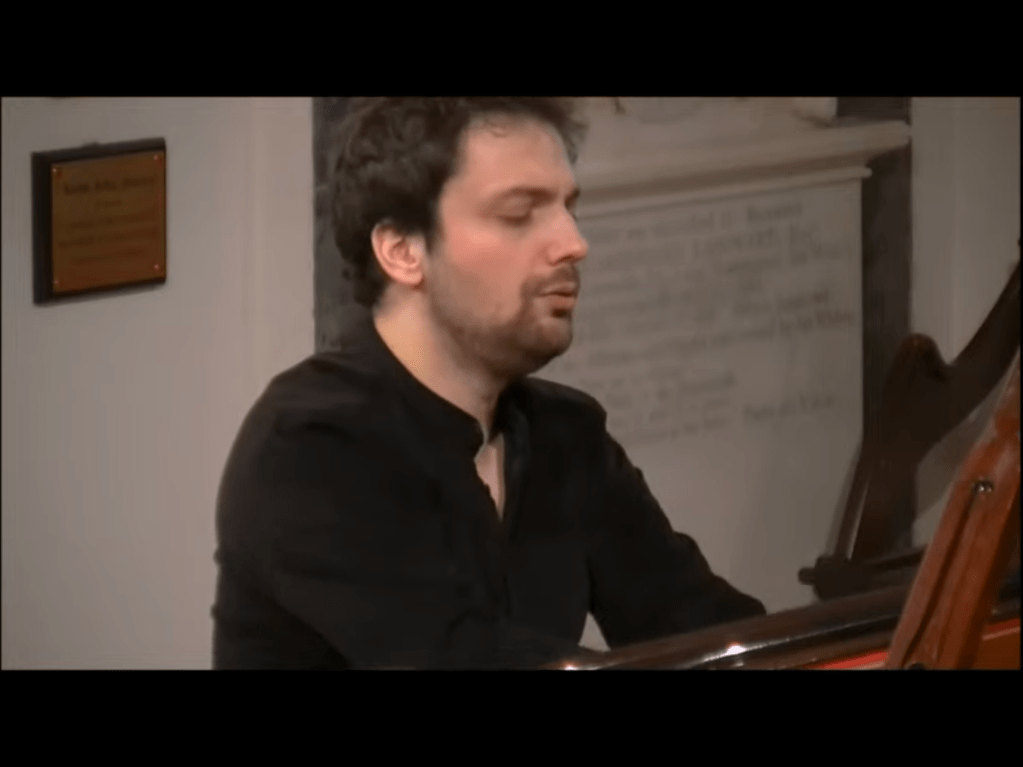
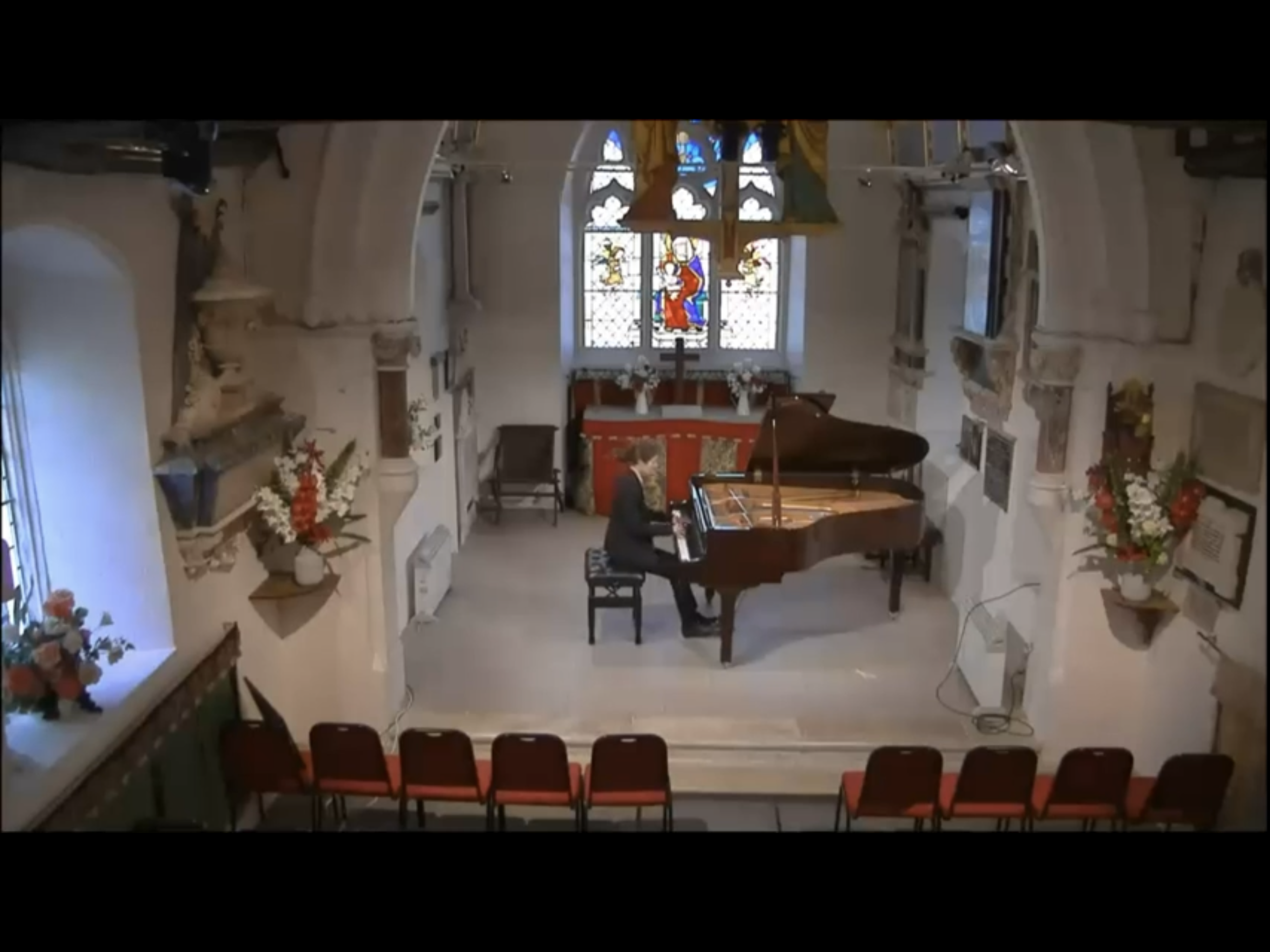
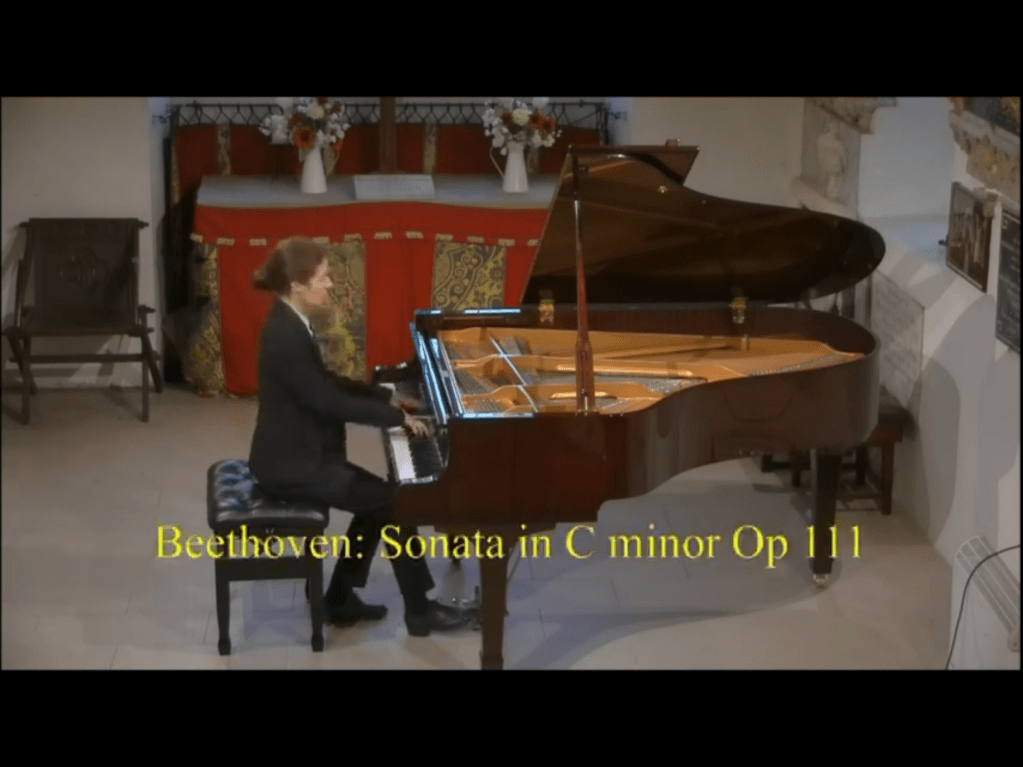
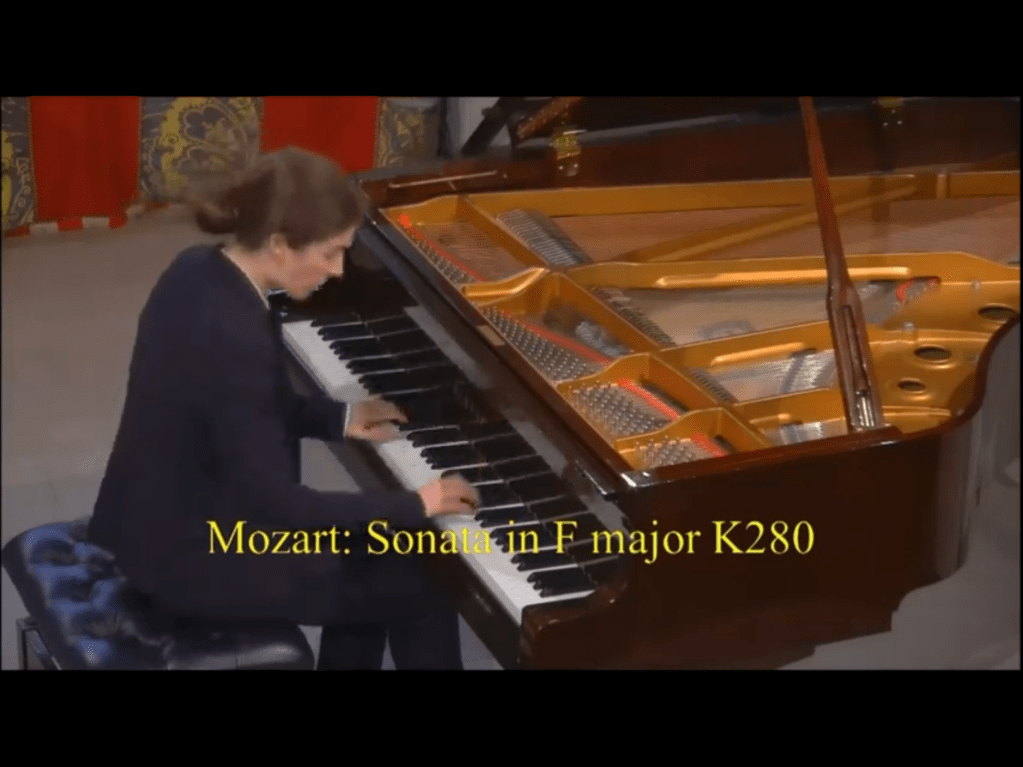
Sofia Sacco at St Mary’s

Tuesday 30 March 4.00 pm

Sofia Sacco (piano)

Bach: Prelude and fugue in D minor BWV 875

Beethoven: Sonata in C minor Op 111

Mozart: Sonata in F major K280

Shostakovich: Prelude and fugue no 24 in D minor

Some musicianly playing from this young Italian pianist infact one could see that already from the programme that she presented.
Immediately showing her sensitive musicianship with a very energetic Bach prelude in D minor that dissolved into a truly pastoral fugue where the voices were played with a true finger legato that allowed the fugue subject to appear so naturally and with such serenity.
It was the exact opposite of the Shostakovich in the same key where the extreme stillness and serenity of the opening was contrasted with the brilliance of the gradual tumultuous climax of the fugue.
A very clever choice to open with Bach and end with Shostakovich who had been inspired by the Bach competition in Leipzig to write his own set of Preludes and Fugues.


Beethoven’s last sonata op 111 was the centre piece of the recital and it was refreshing to see her take the plunge with the left hand alone from the very first opening flourishes.The Maestoso opening was played with a very musicianly sense of balance that gave great architectural shape before the menacing C that heralds the Allegro con brio ed appassionato.It was played with great clarity and spirit but just missing the feeling of water boiling over at hundred degrees.
The Arietta and variations were played with a beautiful sense of balance and the final ascent into a paradise of magic sounds amidst trills and elaborate passage work was most beautifully played.I missed the continual forward movement though where each variation should grow out of the other and maybe a more flowing tempo could have helped this.
But there was magic indeed in the final pages where her true musicianship and sensitivity shone through and made one imagine what genius was able to transmit the sounds in his head to the page when he himself was completely deaf!


Mozart’s early F major Sonata was given a simplicity and freshness that was the ideal work to follow Beethoven’s great final statement on the Sonata

Italian born, versatile pianist Sofia Sacco begun playing the piano at a young six,before furthering her skills at “Conservatorio Pollini” in Padua. Passionate about Russian music, Sofia is currently exploring Shostakovich’s solo and ensemble works. Solo recitals at prestigious Italian venues include Sale Apollinee of Teatro la Fenice, Cappella dei Mercanti in Turin, Velletri Auditorium, Academic Theather in Castelfranco Veneto. Her performance of Beethoven’s 4th piano concerto with the Pollini Symphony Orchestra was a notable highlight. Sofia is an enthusiast chamber musician, playing regularly in ensembles. She also had the chance to perform Poulenc’s Concerto for two pianos in Auditorium Pollini. Sofia placed first at various competitions, including the “Crescendo International Piano Competition”, “A. Baldi International Piano Competition”, and “Piove di Sacco National Piano Competition”, and has attended masterclasses with professors L. Zilberstein, B. Petrushansky, E.Krakovsky, K. Bogino, and C. Grante among others. Graduated summa cum laude in 2016, Sofia was awarded a Scholarship in recognition of her full marks, which allowed her to continue pursuing her musical studies with A. Silva and M. Ferrati. Inquisitive and widely curious, she is also graduated in Physics at University of Padua with high honours. Sofia is currently based in London, undertaking her MA in Piano Performance at the Royal Academy of Music under the mentorship of Professor Rustem Hayroudino, as an entrance Scholarship student.

Andrzej Wiercinski in Warsaw Sfera Sacrum Easter Festival

Warsaw Philharmonic – Chamber Music Hall

Piano Recital

Andrzej Wierciński – piano

Playing of crystalline clarity by Andrzej Wiercinski in the Beethoven-Penderecki Sfera Sacrum Easter Festival
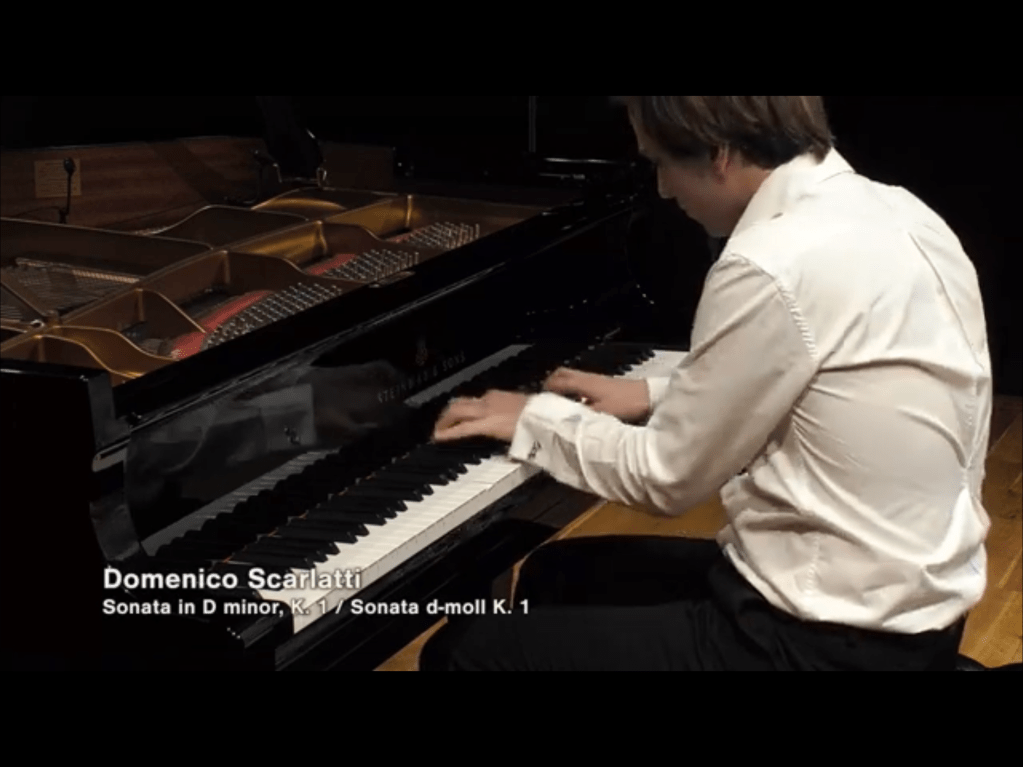
From Scarlatti of such jewels with rays of light just sparkling from his wonderfully agile fingertips.
A Litanei by Schubert in a sumptuous transcription by Liszt played with truly heartrending delicacy contrasting with the transcendental fireworks of the A minor Paganini study.
Has Red riding hood ever had a more terrifying journey than with his Rachmaninov op 39 n. 6 Etude Tableau?
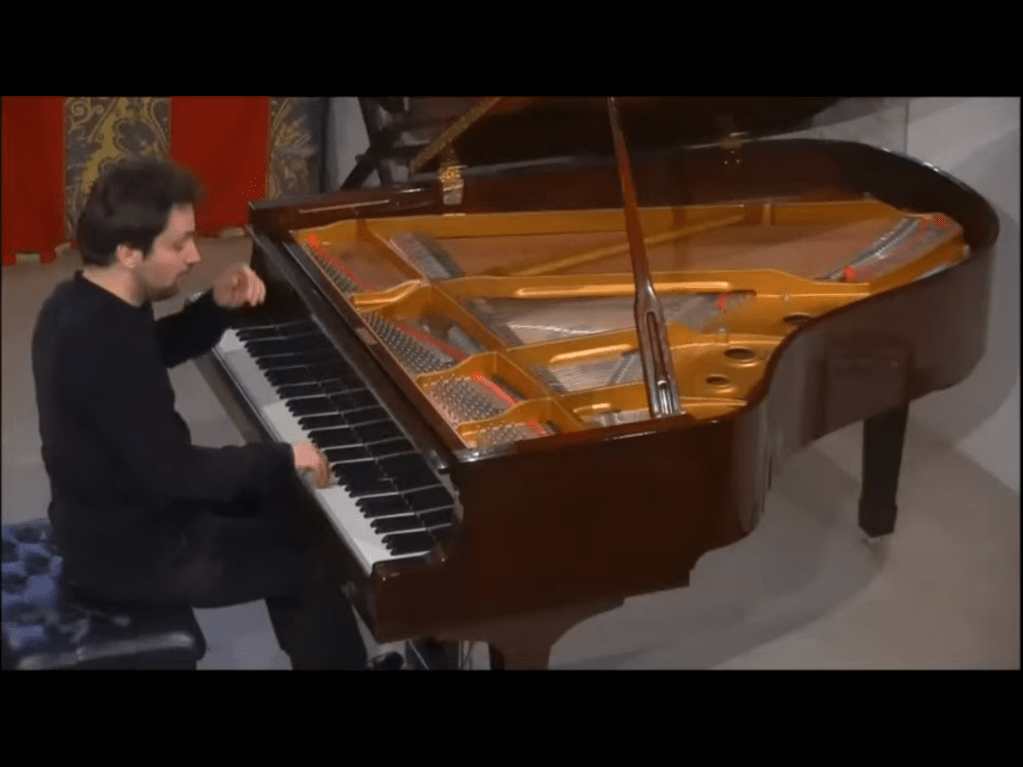
And I would never like to climb Ligeti’s Diabolic Staircase with this expert climber where even watching from the sidelines left one completely breathless.
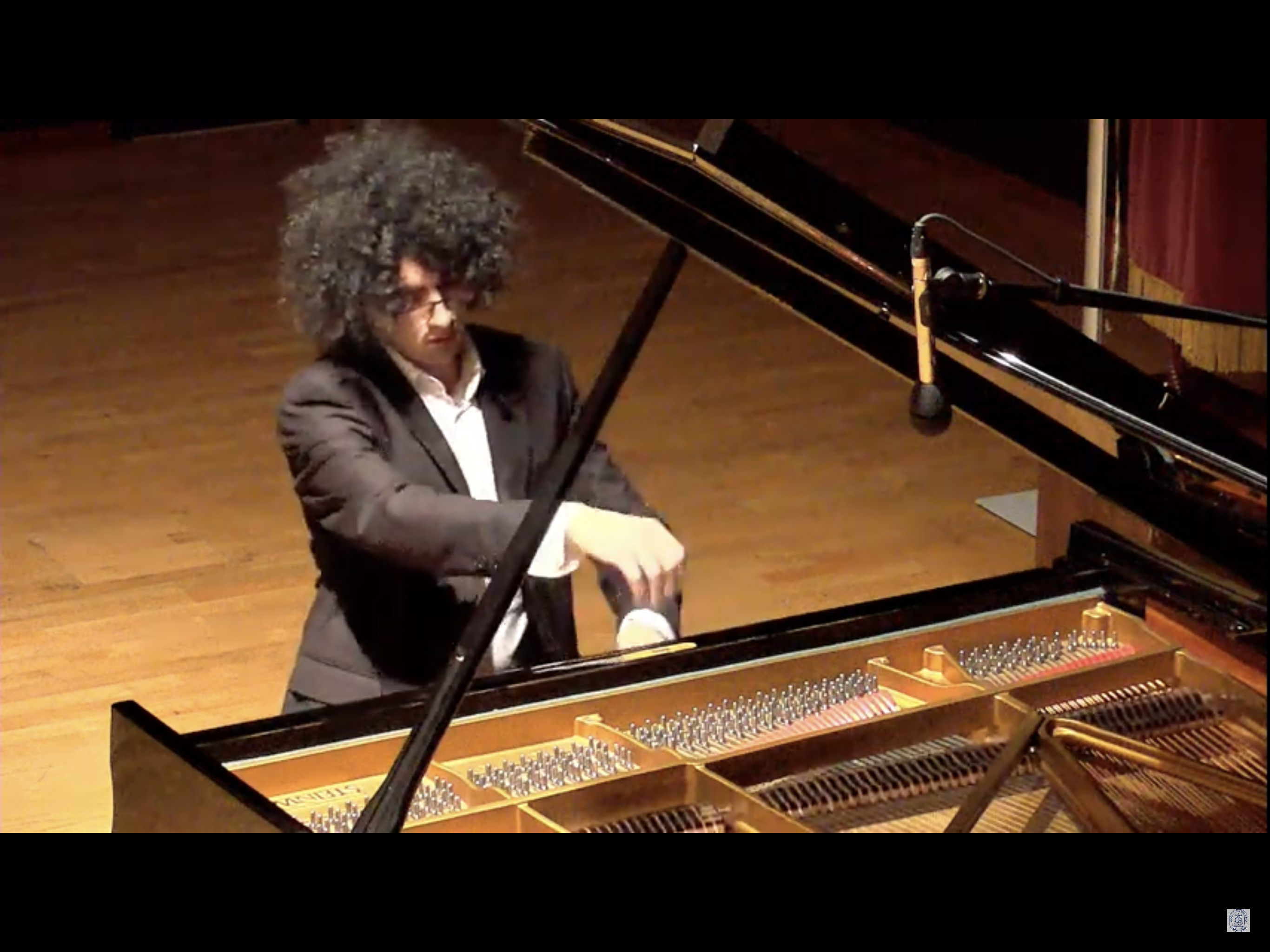
But a Chopin B Minor Scherzo played with such mastery where Chopin’s extraordinary opening exuberance dissolved into the most sumptuous sounds and colours as he shaped the passionate contours as only a true native musician could.The beautiful Polish folk song that Chopin quotes in the central section was played with a magical sense of balance that seemed to give the piano a golden sheen before the final outburst of quite transcendental playing.
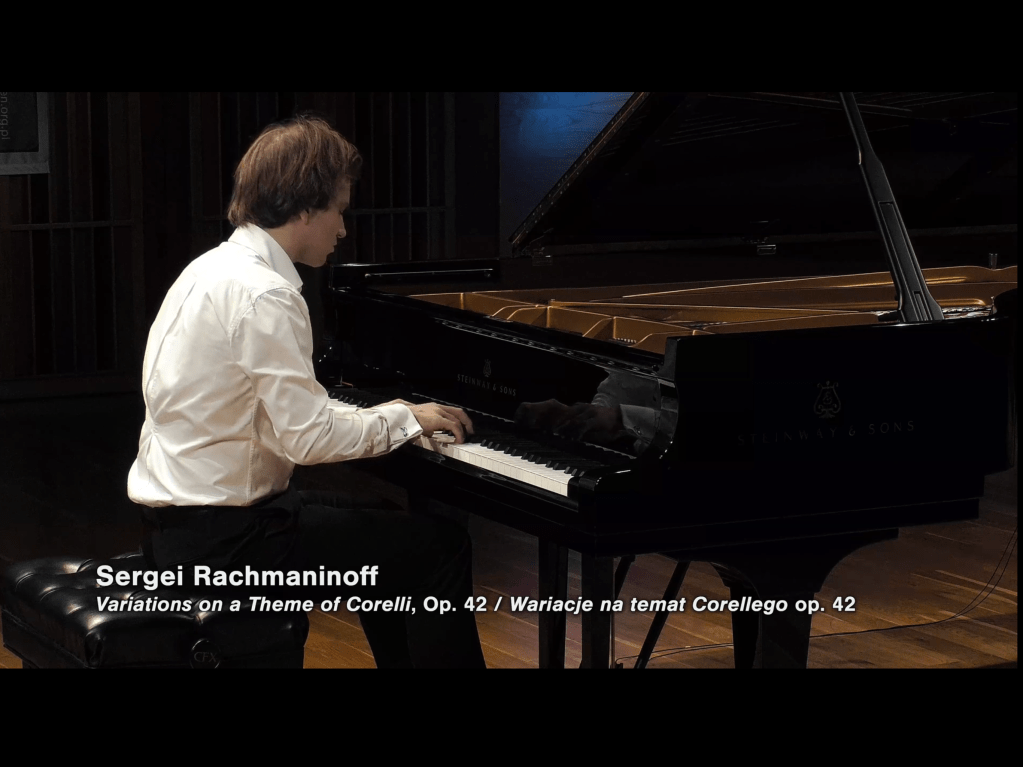
Rachmaninov’s Corelli variations were given an extraordinary performance of beauty and exuberance that I have already spoken about in a previous recital together with his recital that was so unforgettable last summer https://christopheraxworthymusiccommentary.wordpress.com/2020/08/16/andrzej-wiercinski-in-poland-from-the-ridiculous-to-the-sublime/

Domenico Scarlatti

Sonata in D minor, K. 1


Sonata in C major, K. 159


Sonata in G minor, K. 450


Franz Schubert (ar. Ferenc Liszt)


Litanei (Auf das Fest Aller Seelen), D. 343


Ferenc Liszt


Étude No. 6 in A minor from Grandes études de Paganini, S. 141


Sergei Rachmaninov


Étude No. 6 in A minor from Études-Tableaux, Op. 39


György Ligeti


Étude No. 13 „L’escalier du diable


Fryderyk Chopin


Scherzo in B minor, Op. 20


Sergei Rachmaninov


Variations on a Theme of Corelli, Op. 42

https://christopheraxworthymusiccommentary.wordpress.com/2020/08/16/andrzej-wiercinski-in-poland-from-the-ridiculous-to-the-sublime/