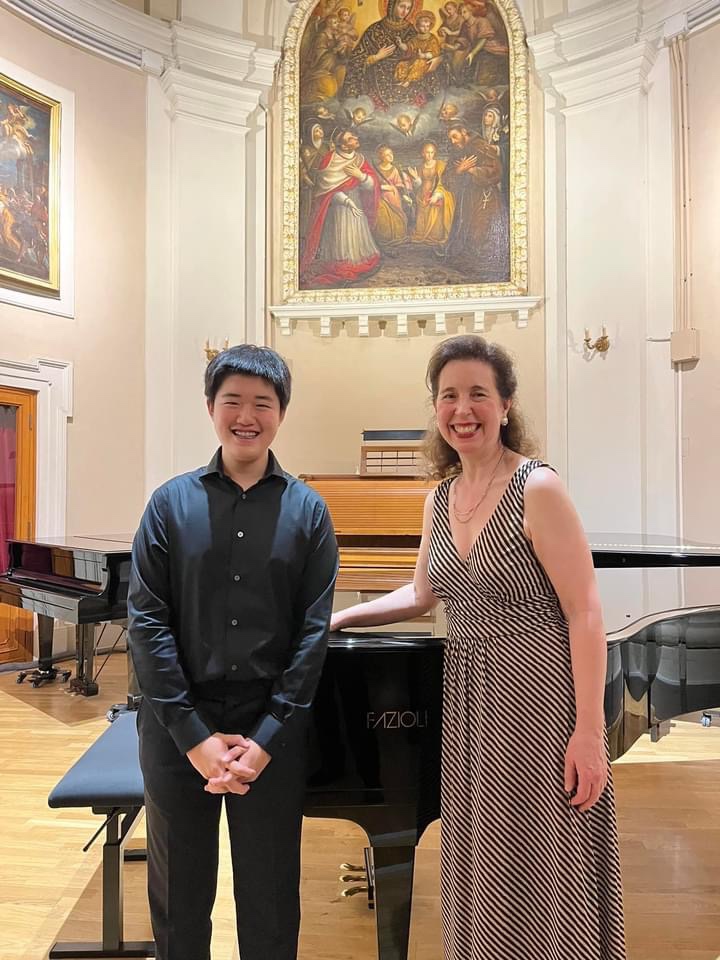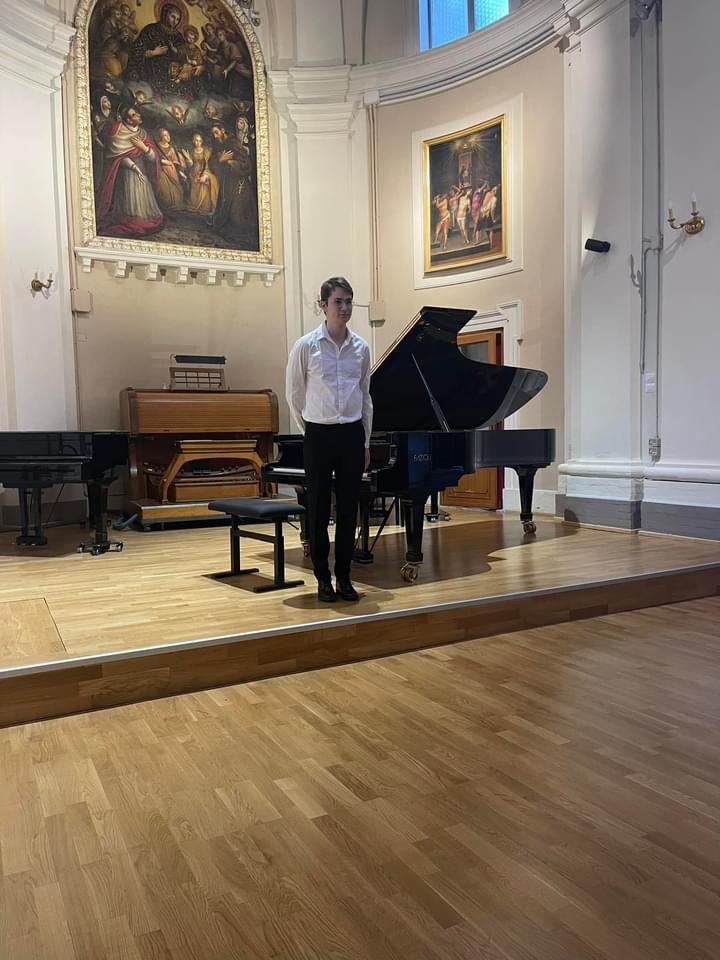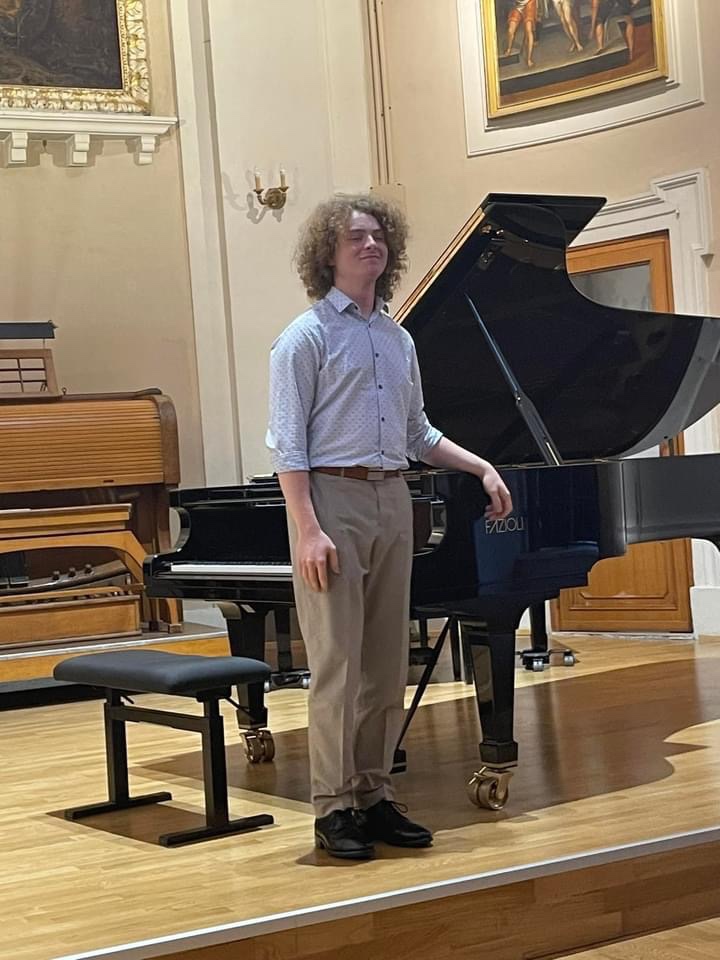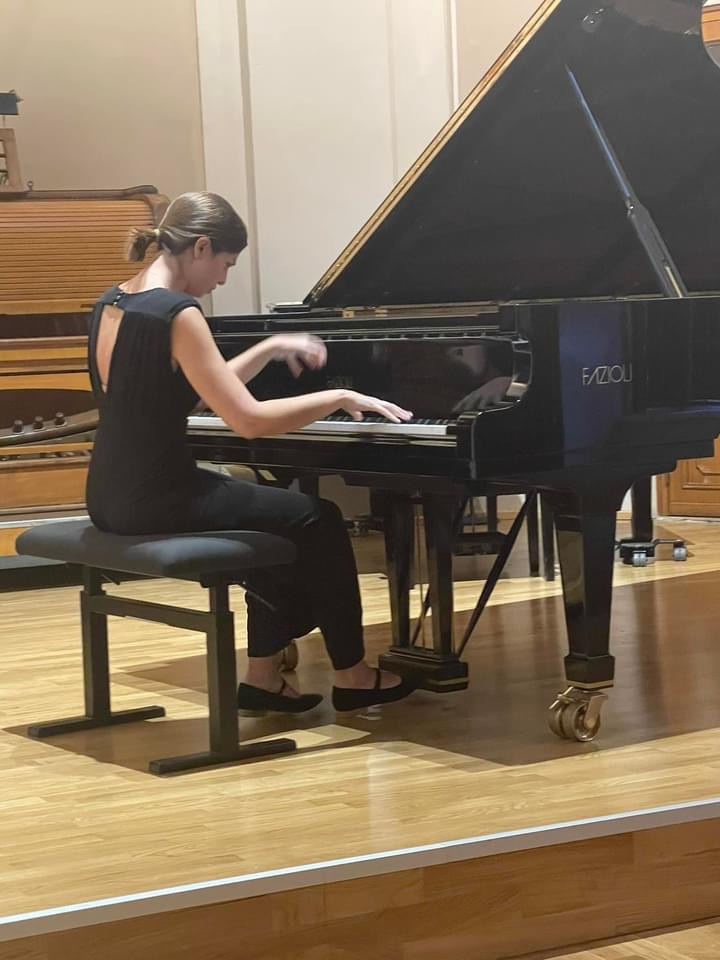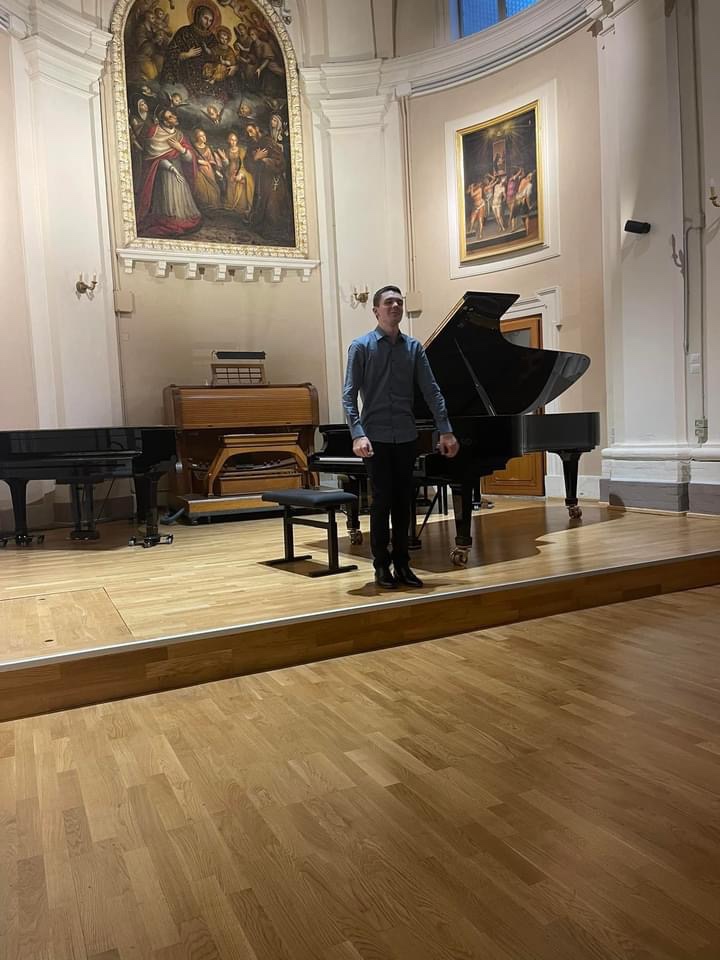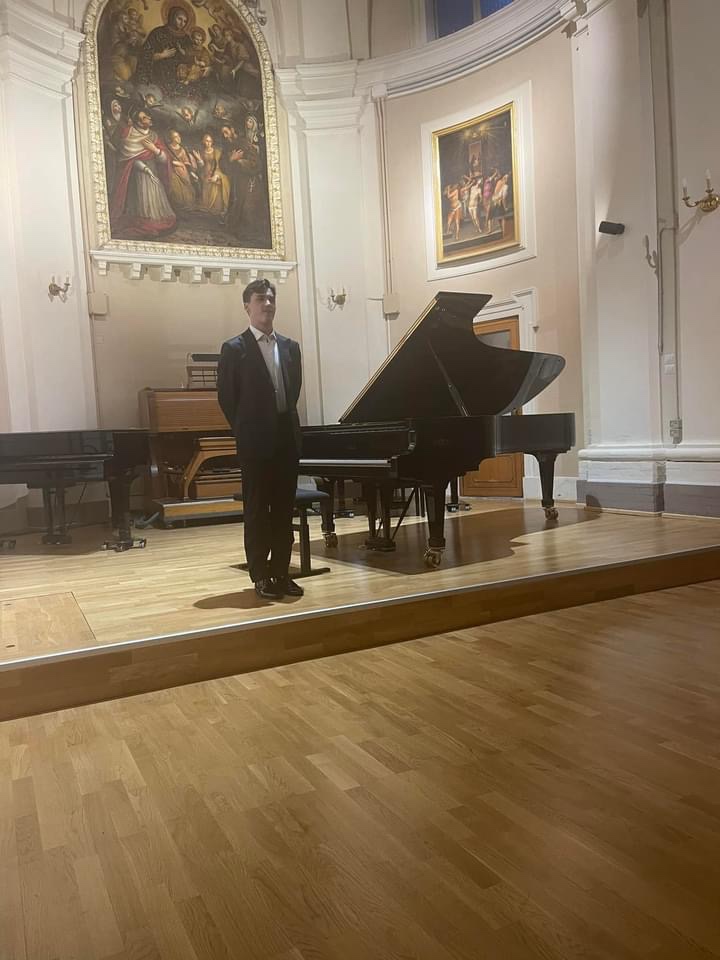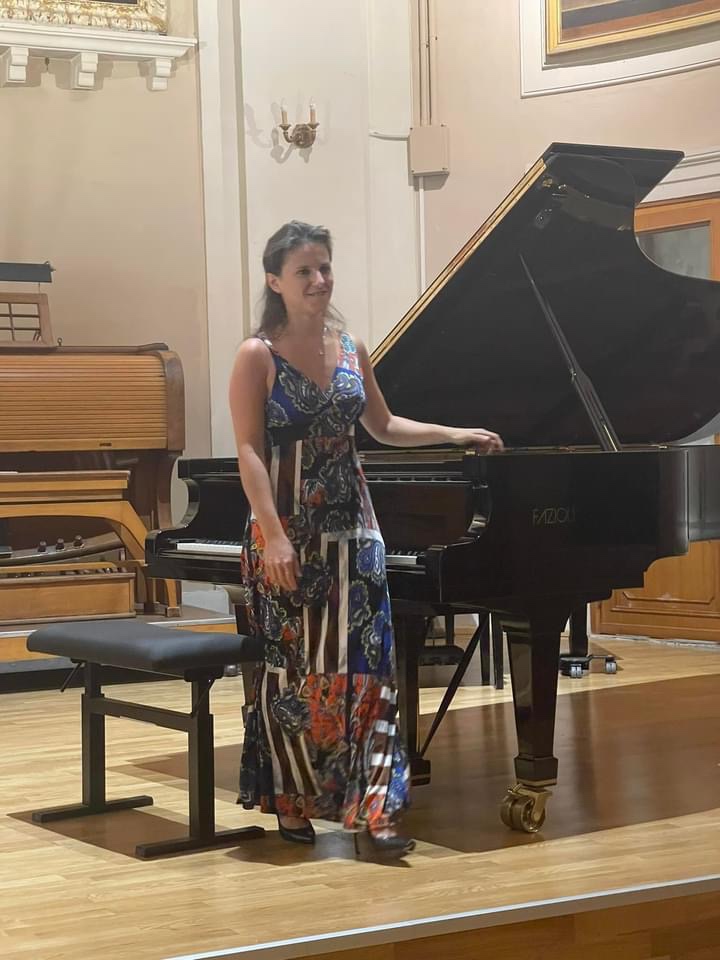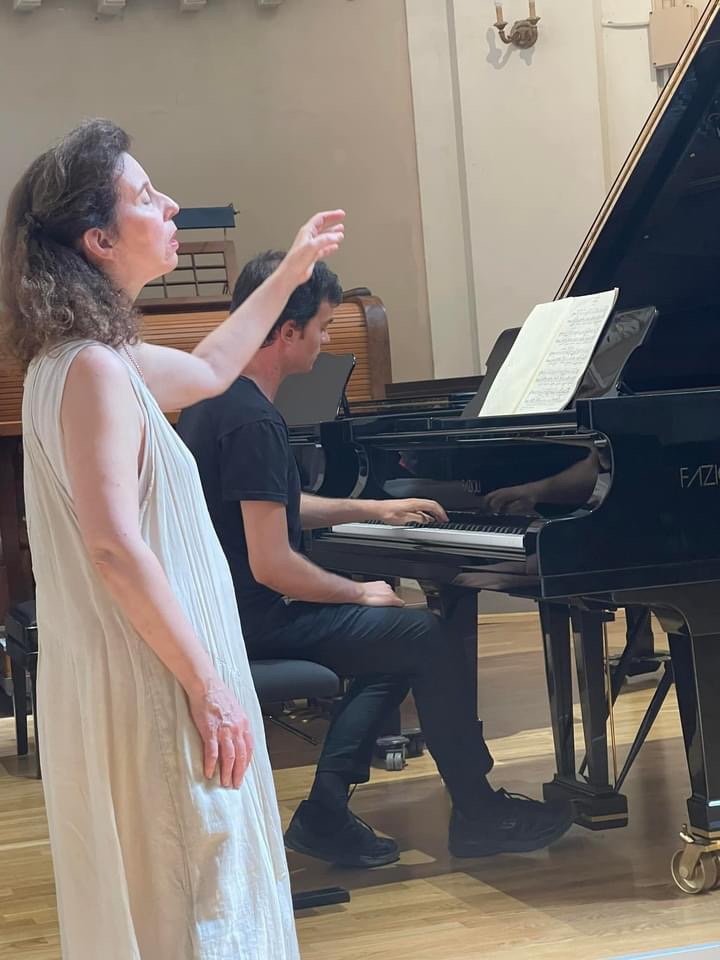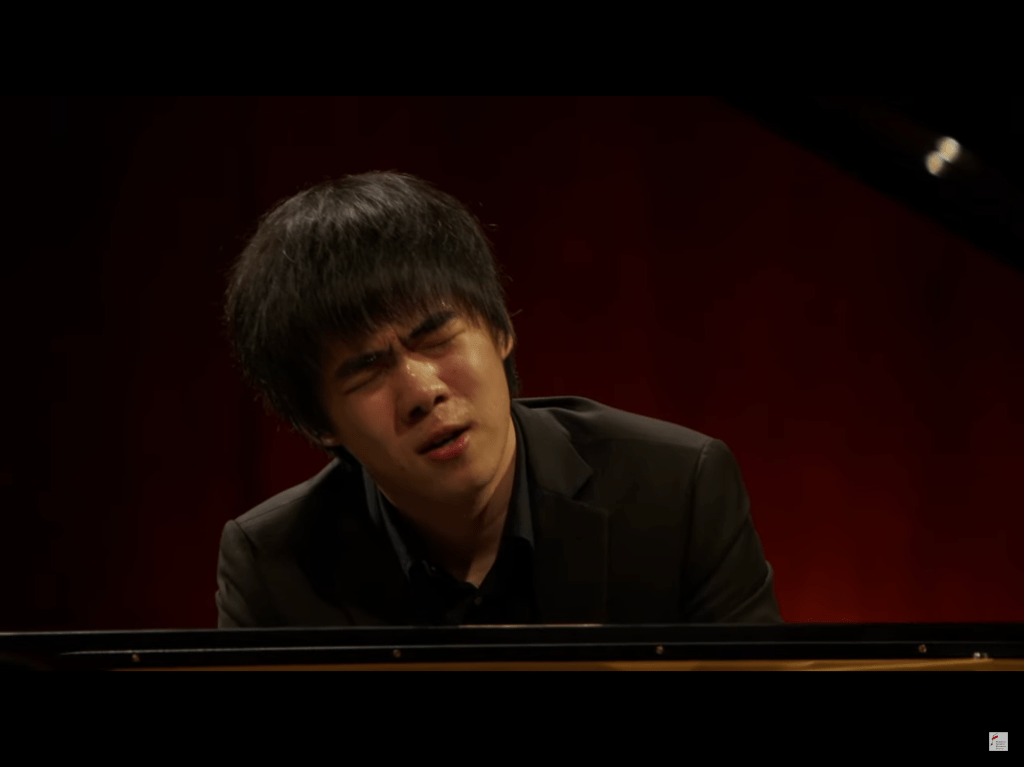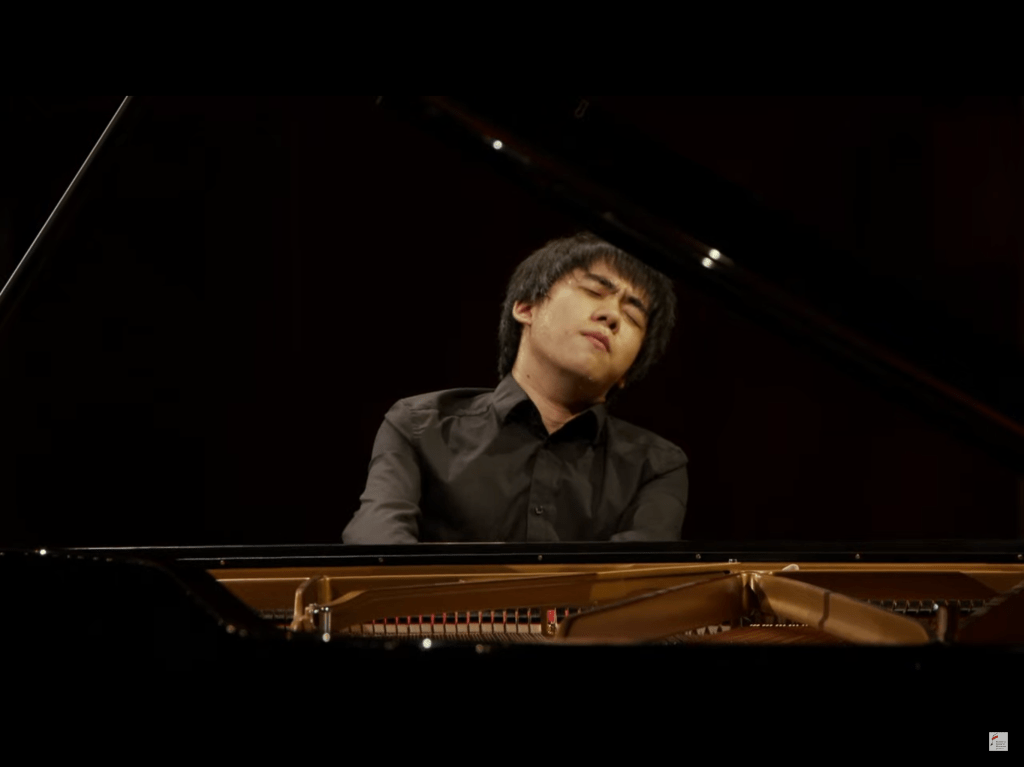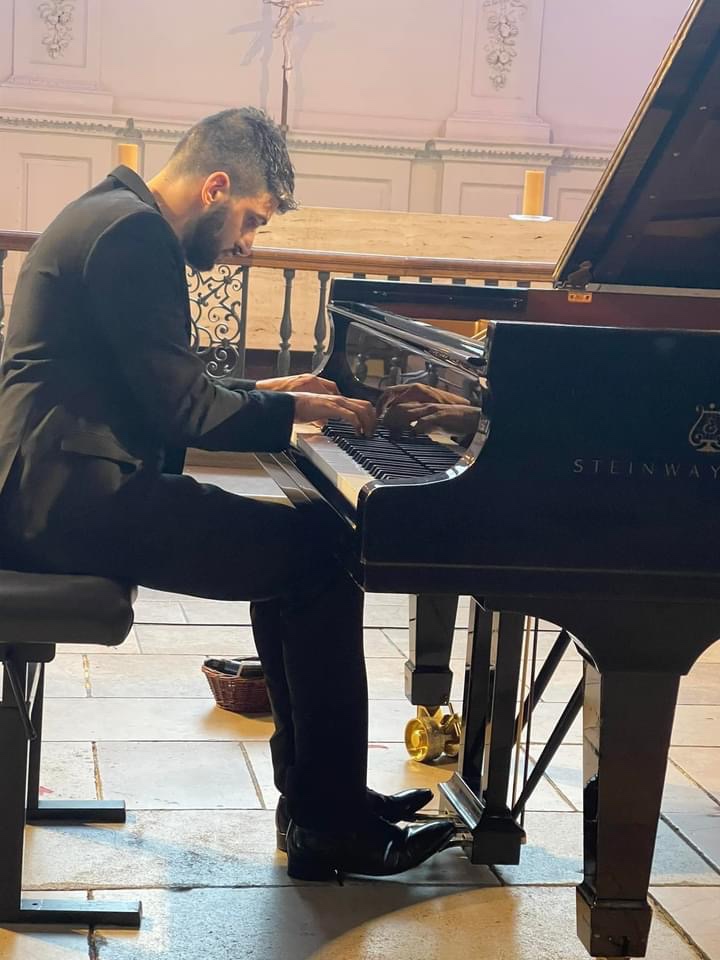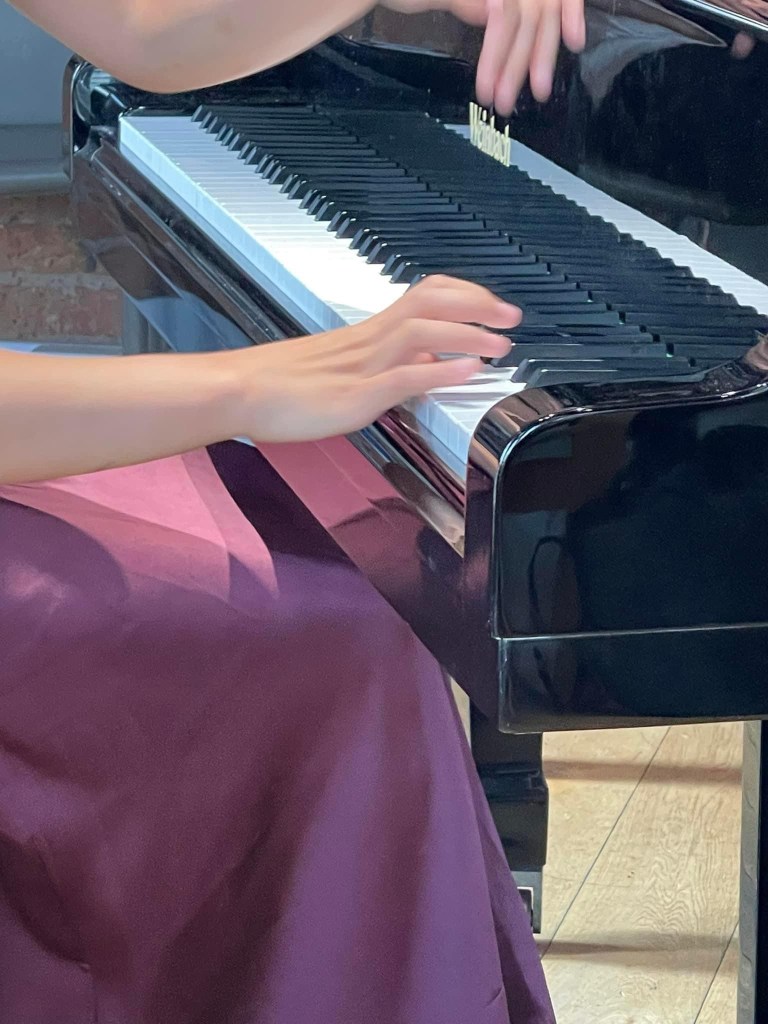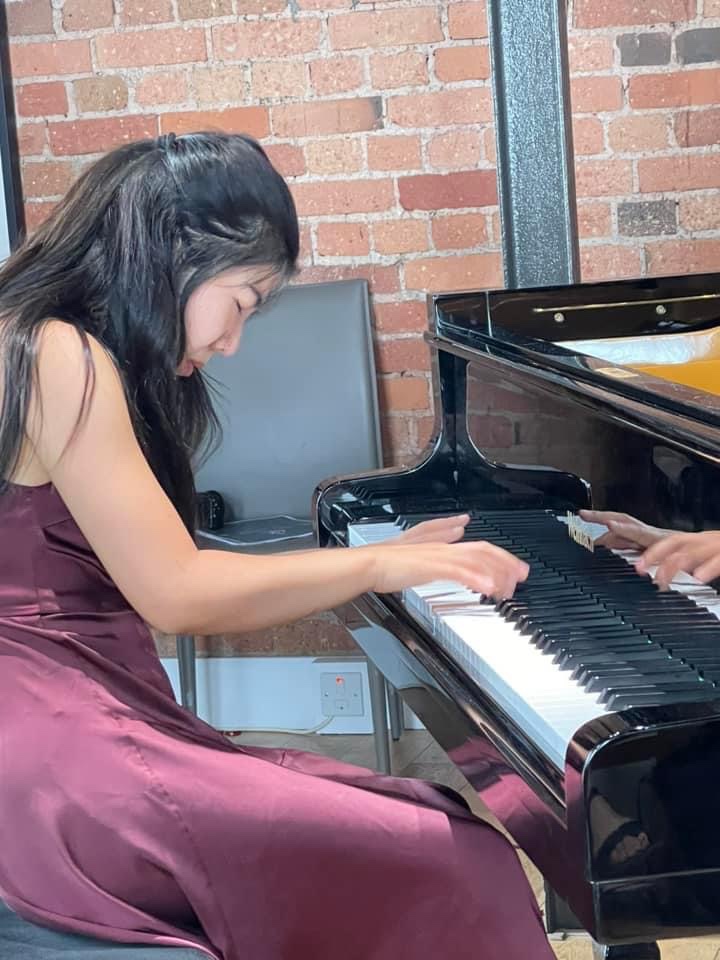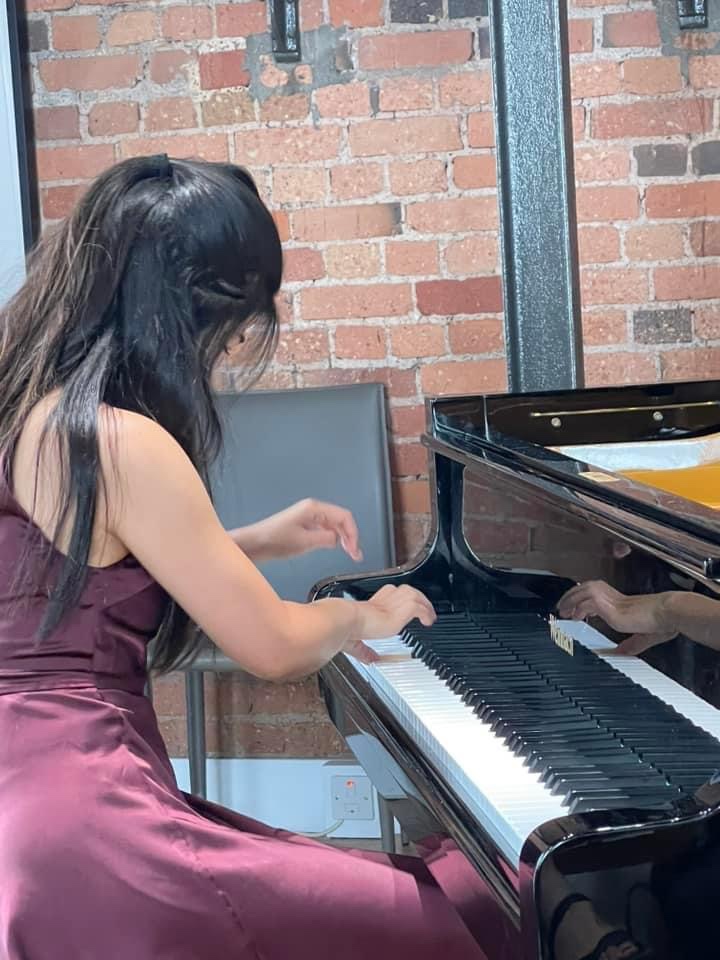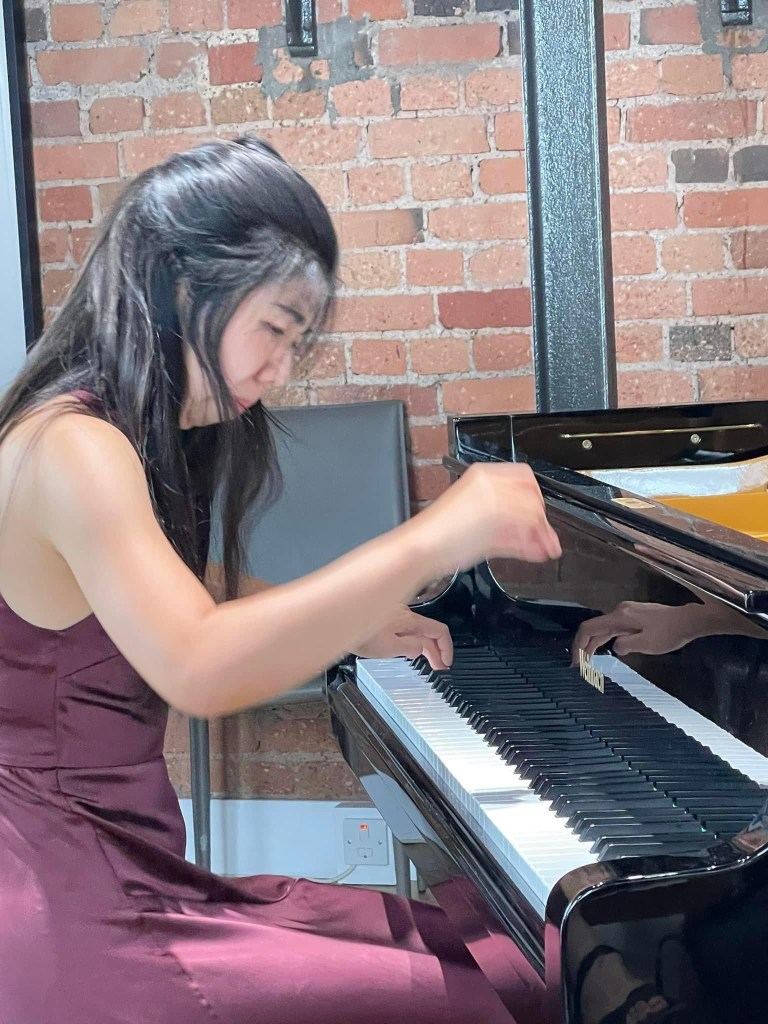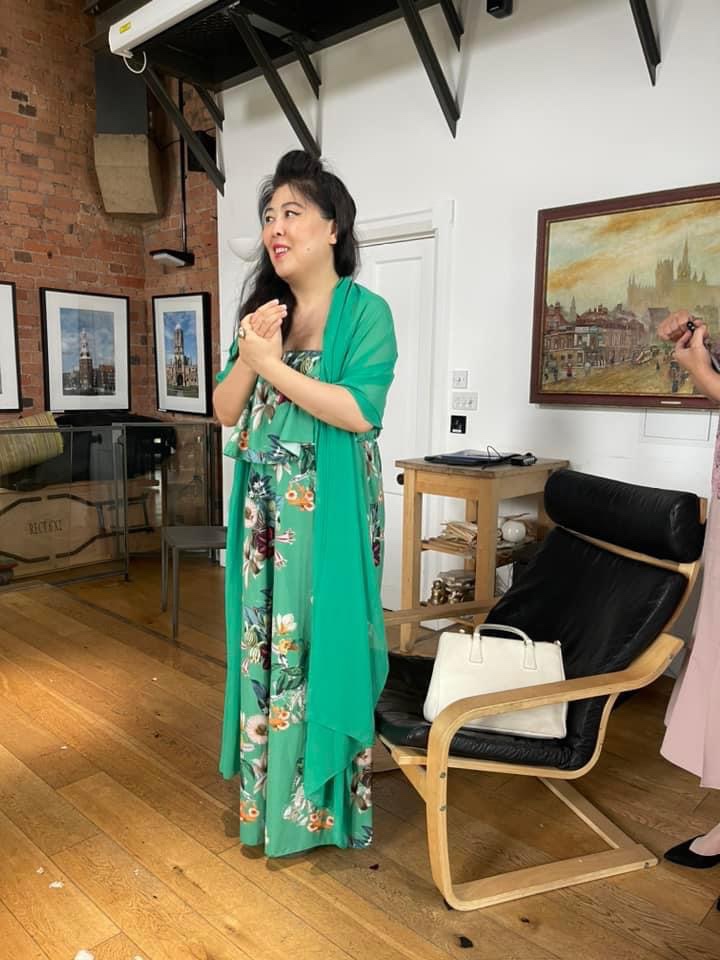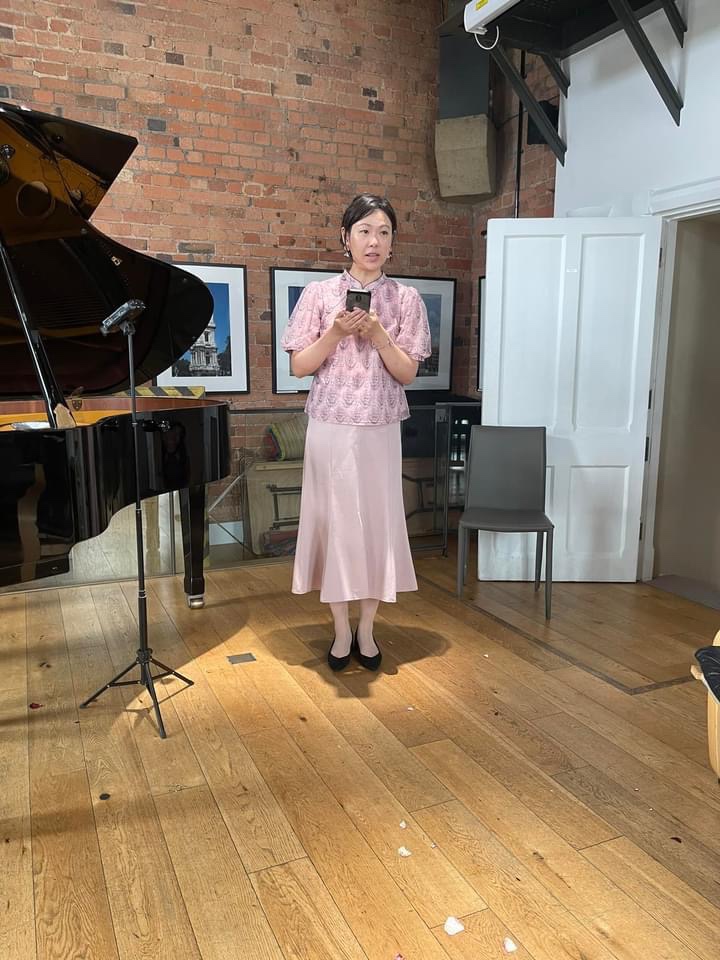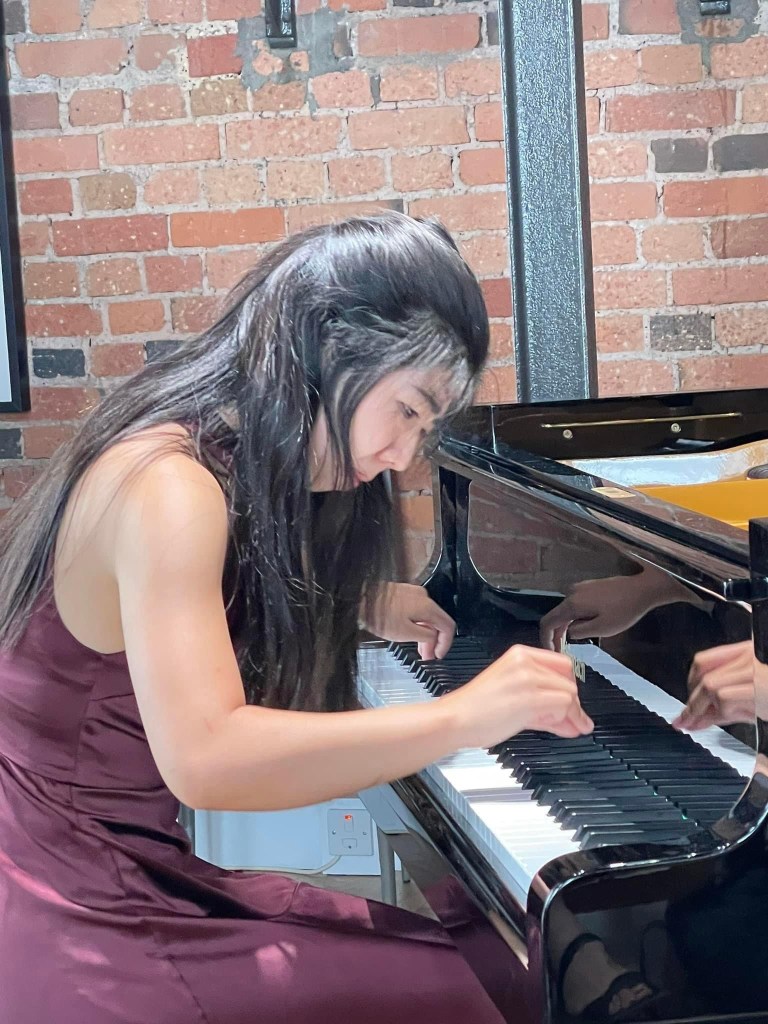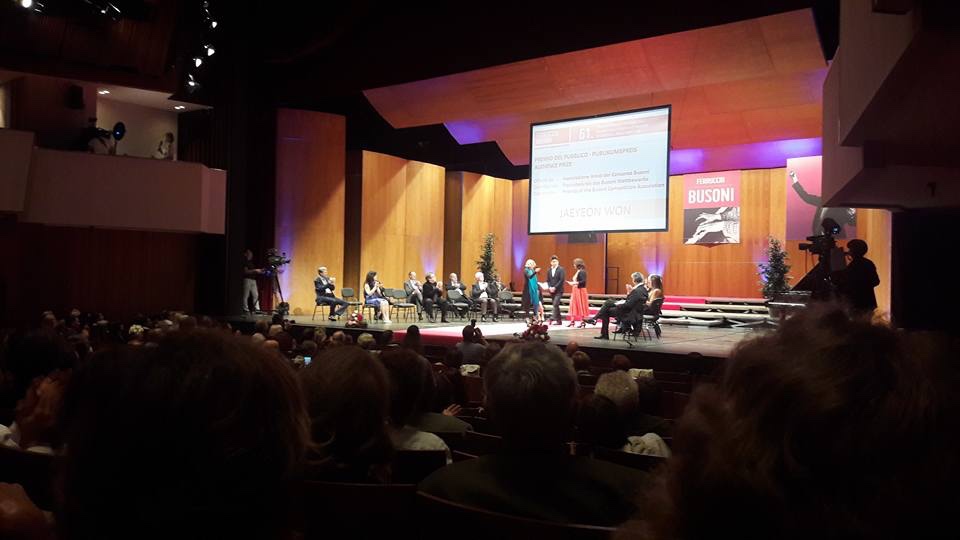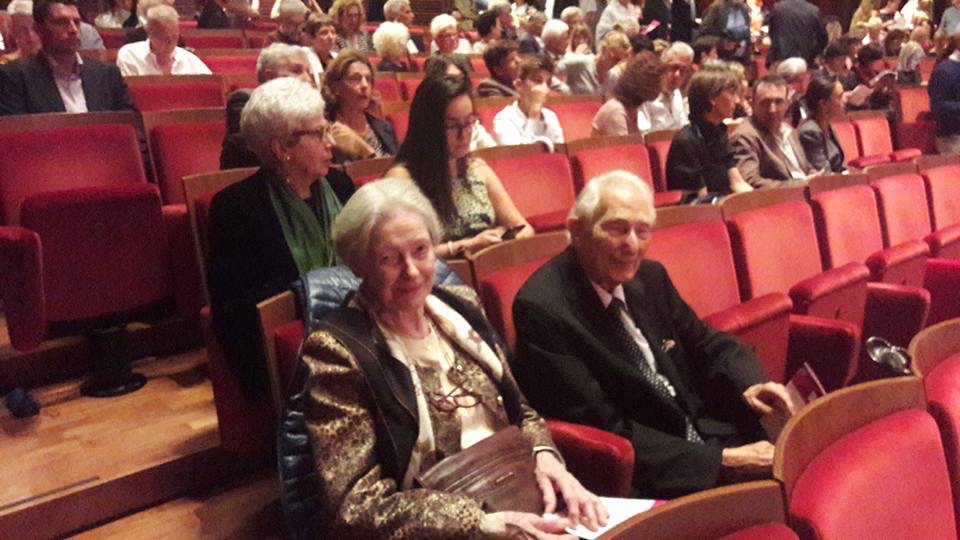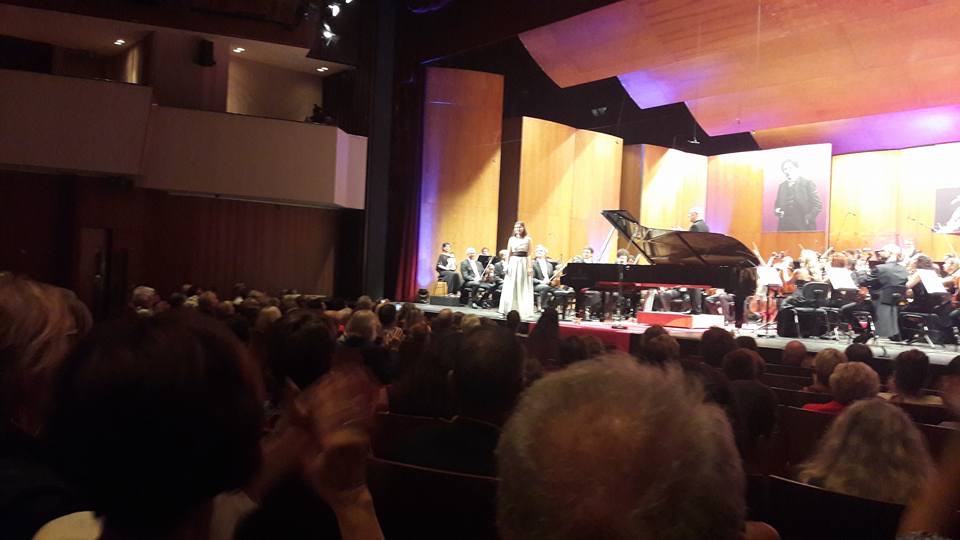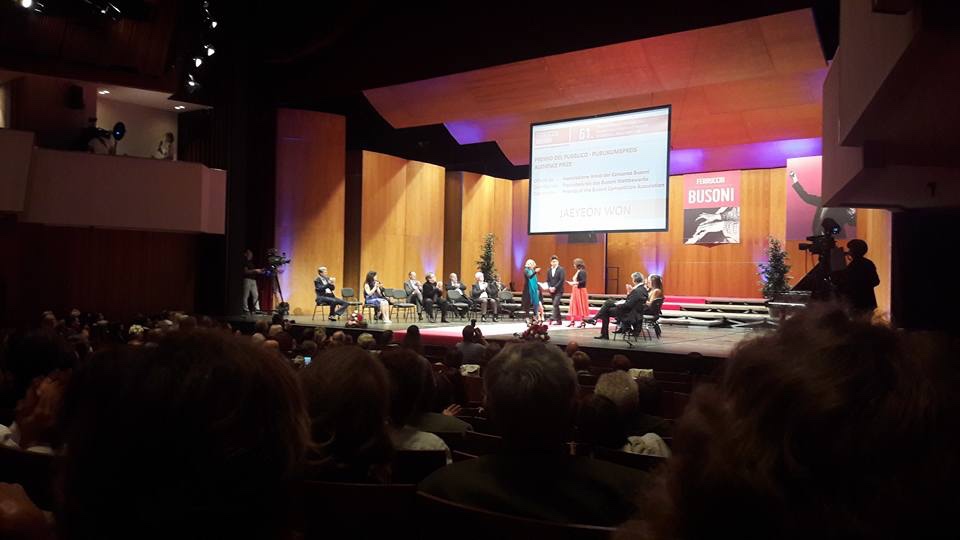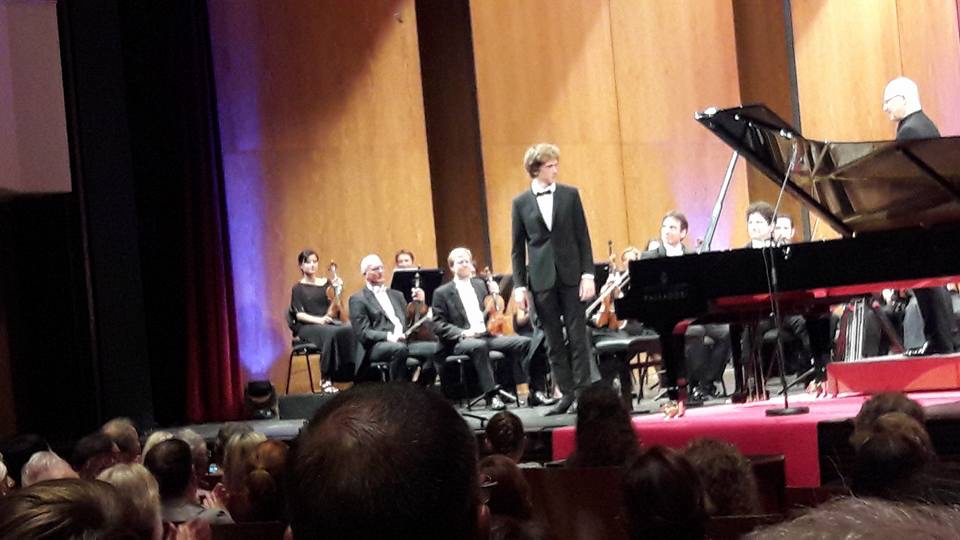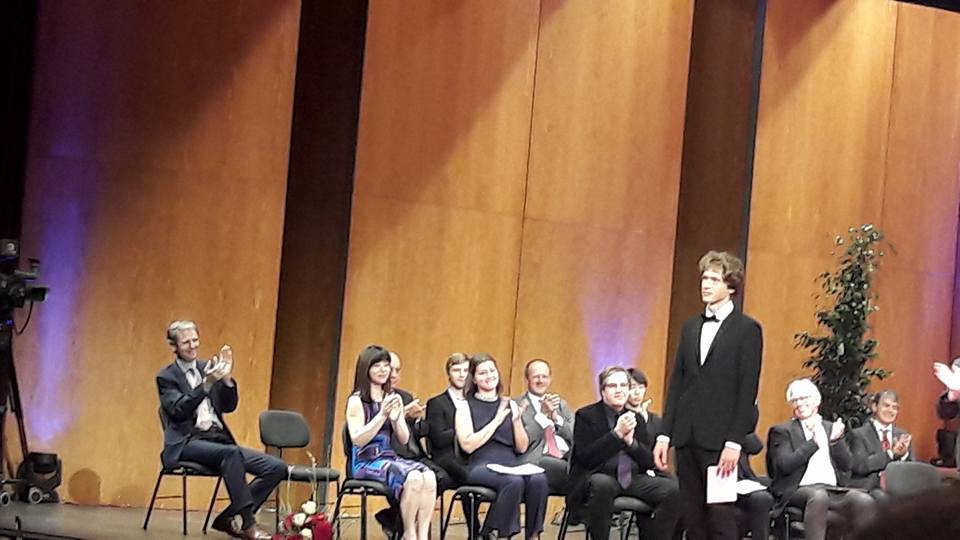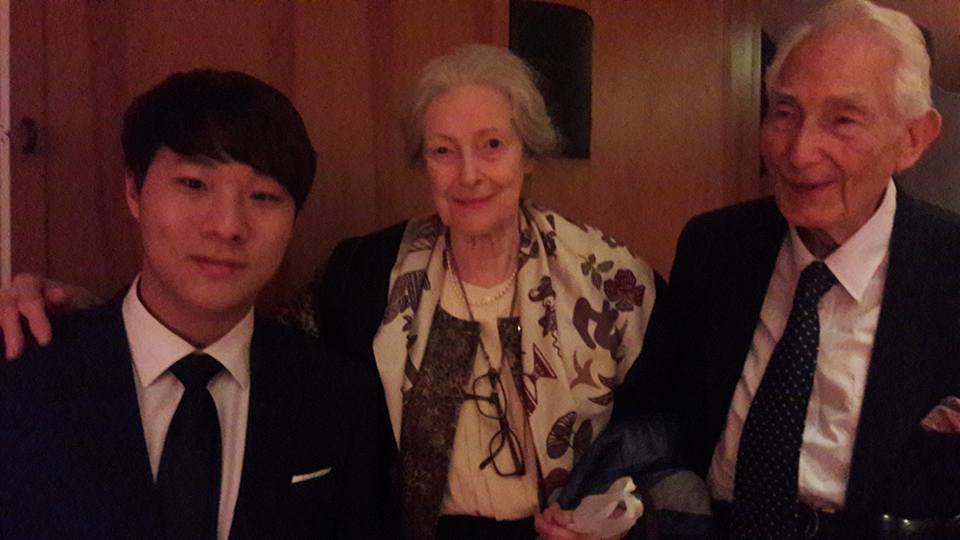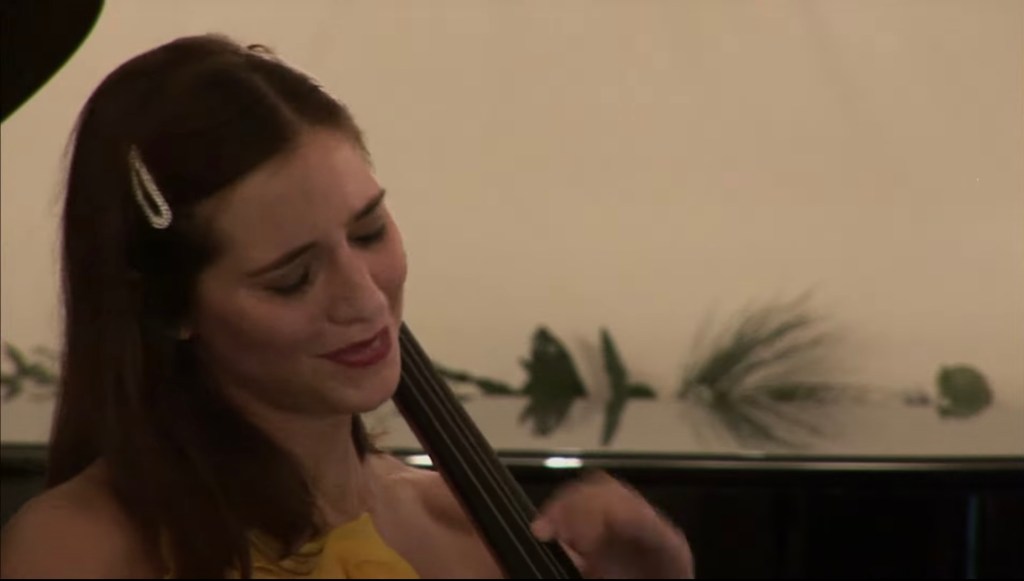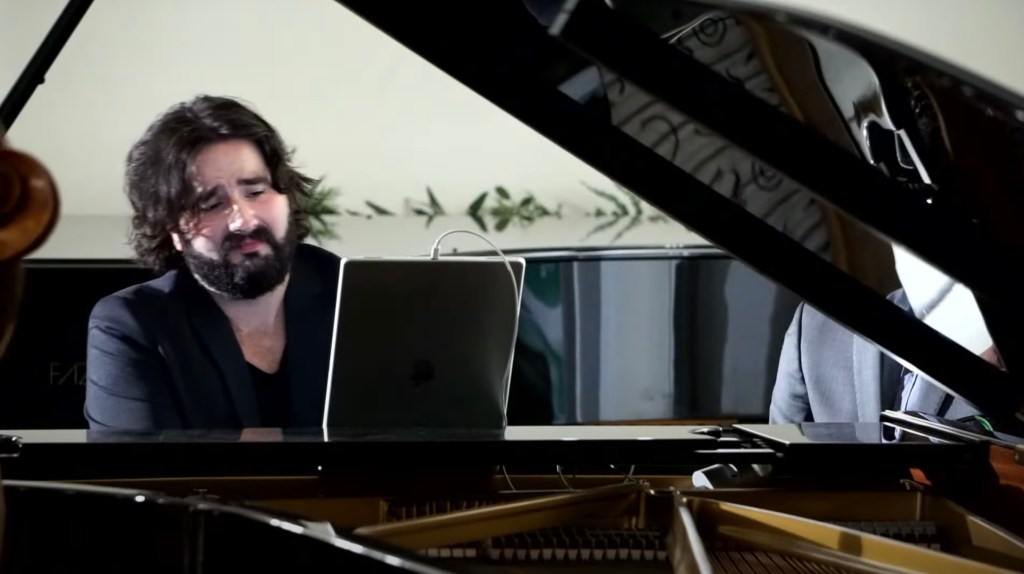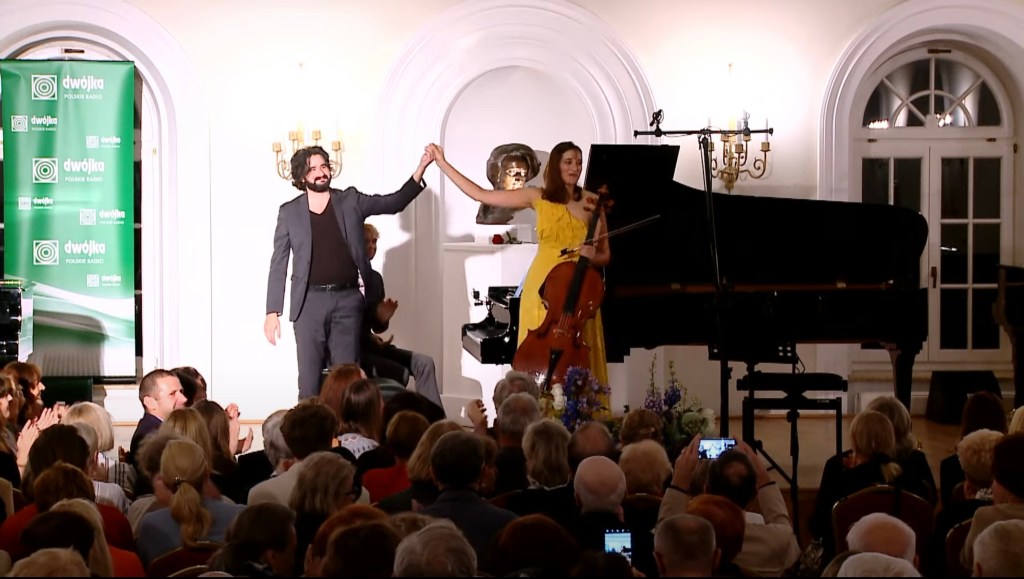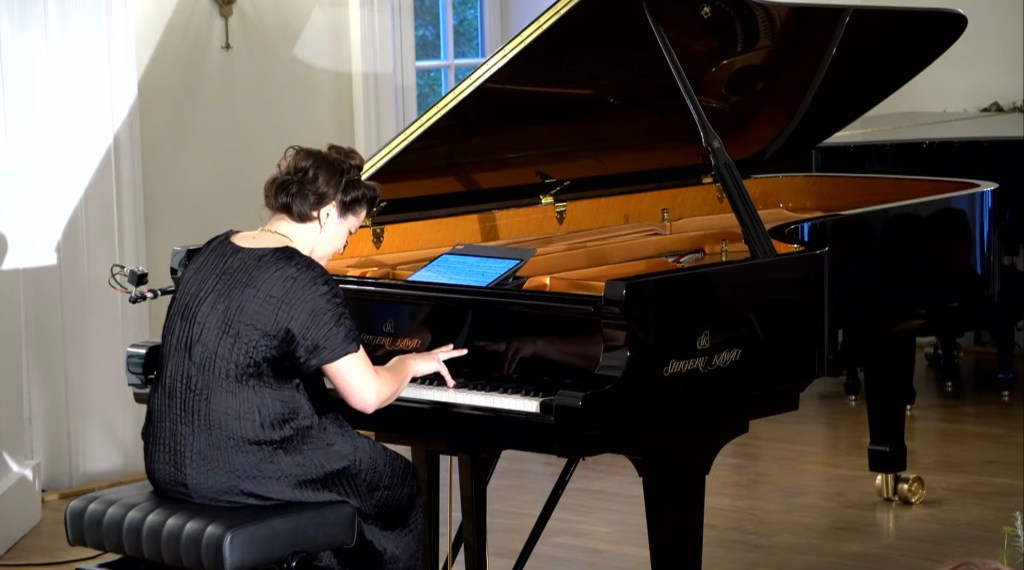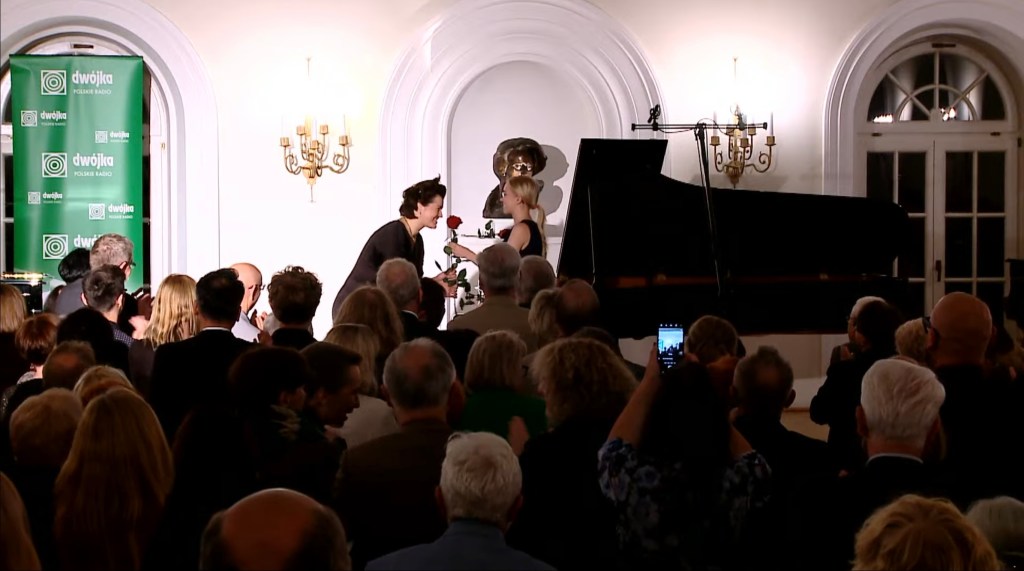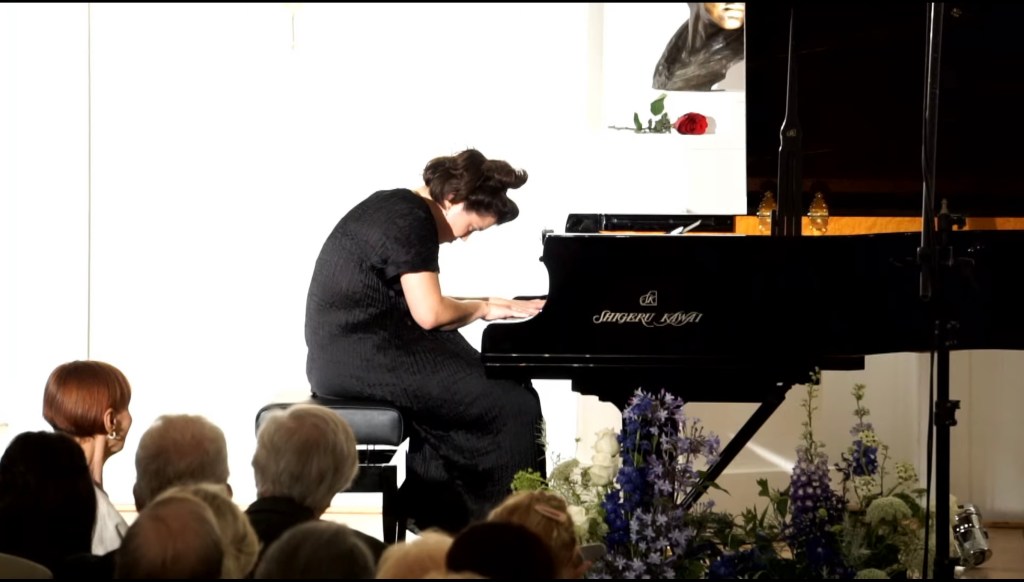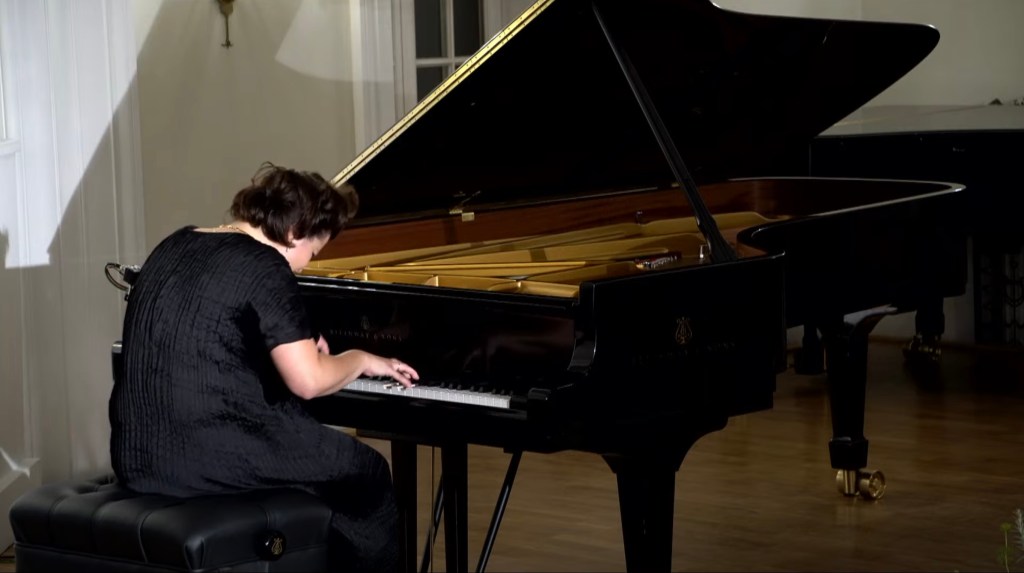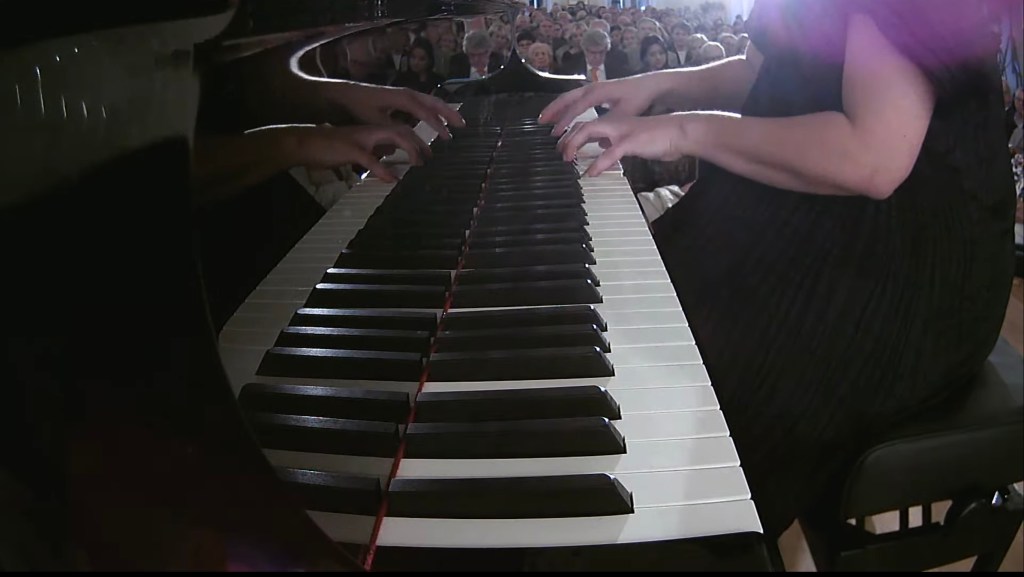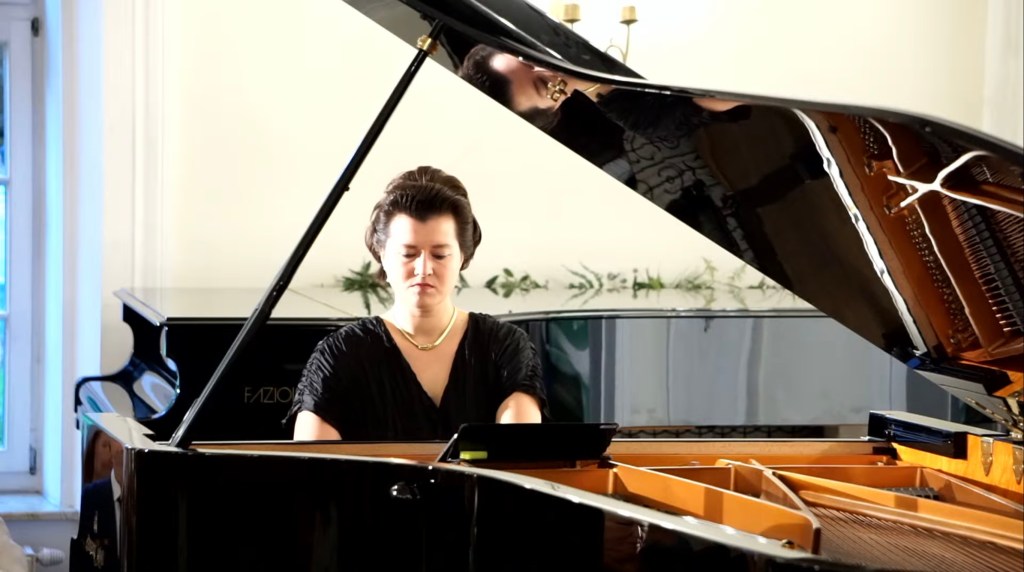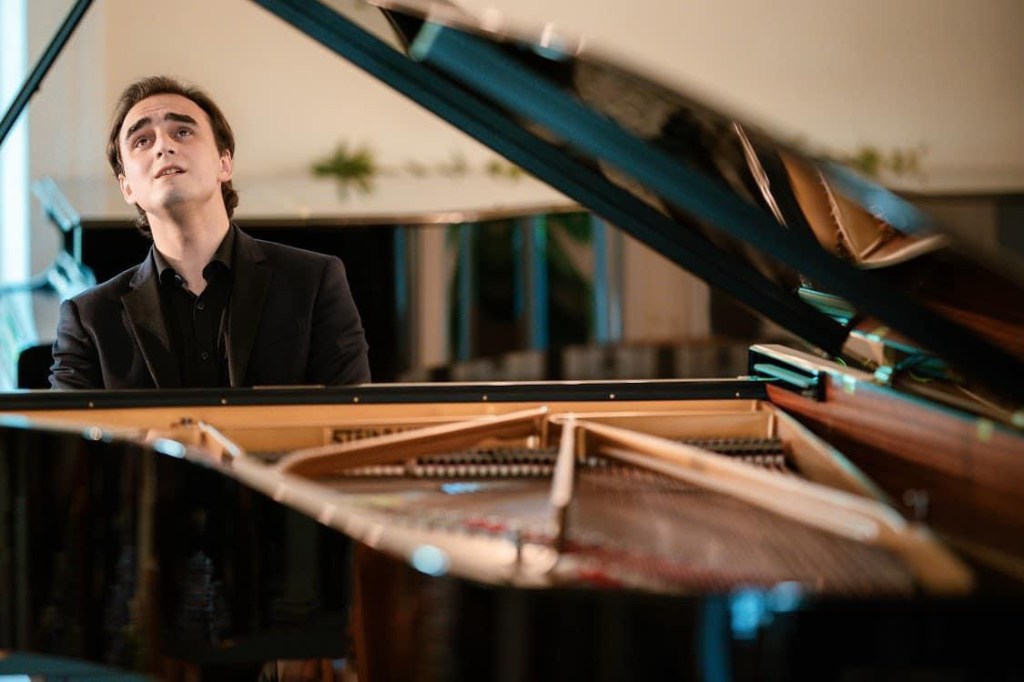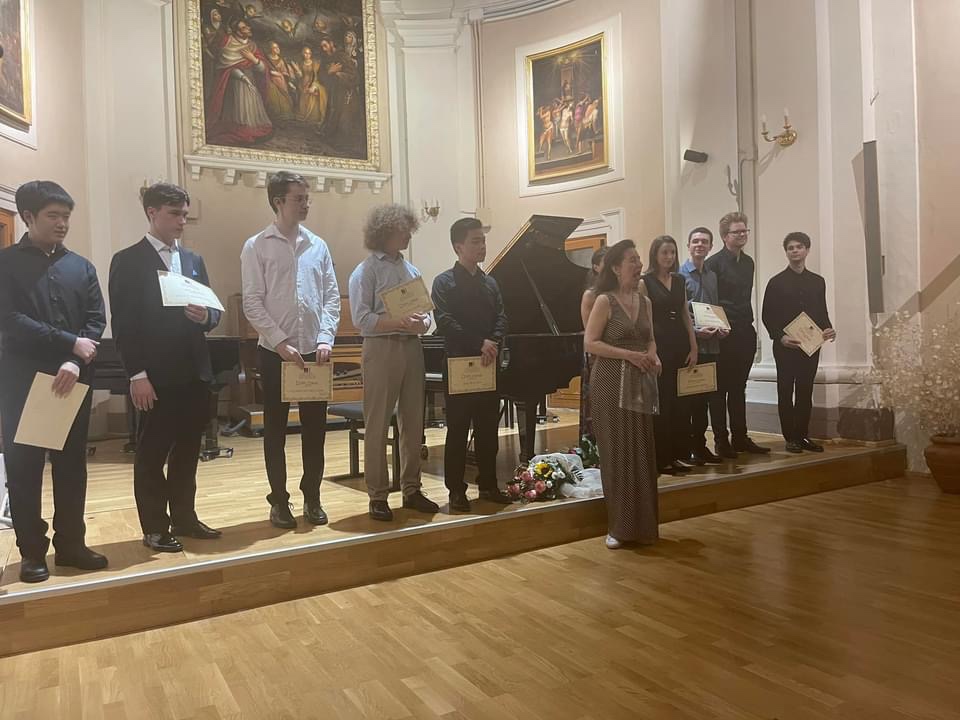
A superb Grieg Piano Concerto from Gabrielé Sutkuté with the YMSO under their genial artistic director James Blair. From the very first famous declaration of intent Gabrielé played with great authority and dynamic drive. It gave new life to this much loved warhorse as this young Lithuanian looked afresh at the score and imbued it with the same crystalline purity that had secured her recently the top award at the Royal College of Music.
It was in the cadenza that she really took charge as she attacked the great climax like the tiger she can be.But before that she had created a magic atmosphere as she floated the melodic line on a wave of sound that she had created by her sumptuously played arpeggiandi. If the slow movement was not quite chiselled enough to soar above the sumptuous orchestral sounds it was because she loved it so much that she wanted to integrate totally with her superb young companions.
The final movement was played with wild abandon and a coda at breathtaking speed. The final glorious outpouring of melodic sounds from the orchestra allowed her to soar across the keyboard with cascades of notes with fearless virtuosity and abandon. She even had the strength to roar like a Lion in the final triumphant declamation that Grieg had reserved for the piano in his one and only concerto much admired by Liszt.
Many of Gabrielé illustrious colleagues and teachers had come to applaud her and witness the triumphant success that she had truly earned.
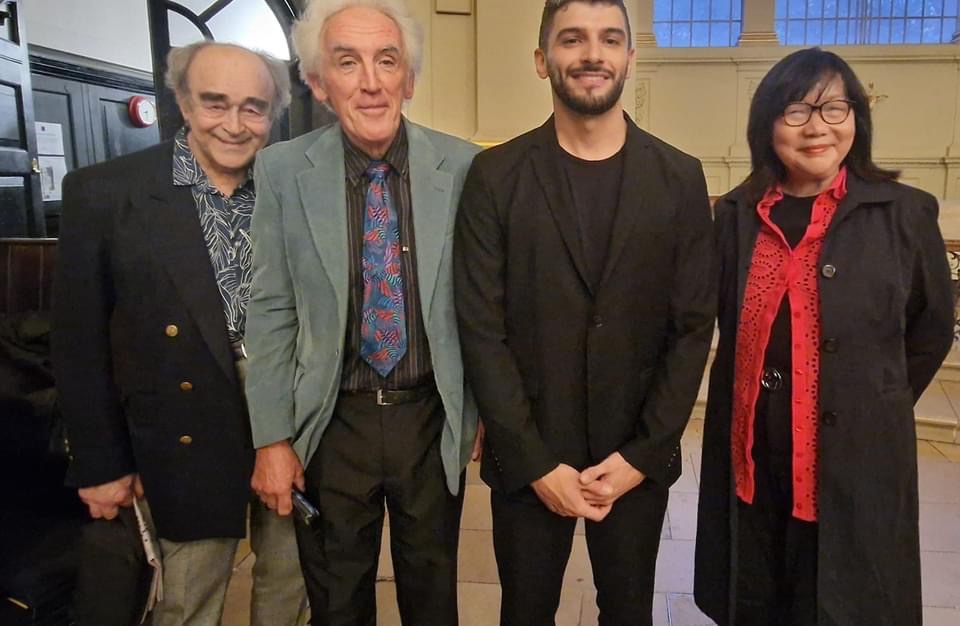
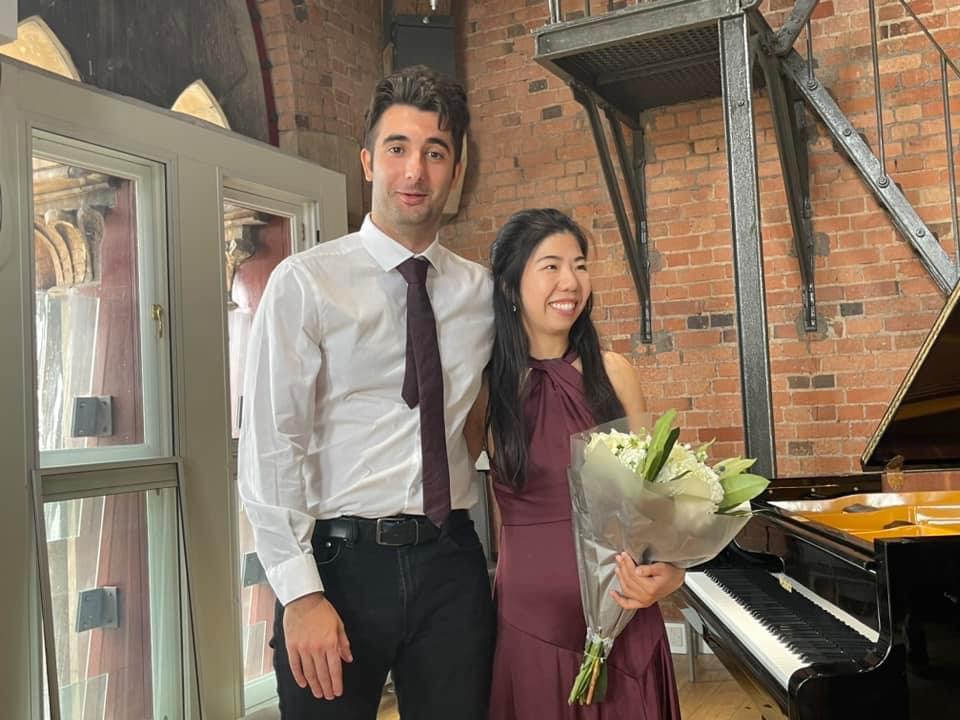
Gabrielé with Sofya Gulyak and Vanessa Latarche (her actual teachers at the RCM) and Christopher Elton (with whom she studied for six years at the RAM.) Gabrielé had also taken part in Alberto Portugheis (centre left) historic masterclasses at Steinway Hall recently.
The Piano Concerto in A minor, Op. 16 was composed by Edvard Grieg in 1868, was the only concerto Grieg completed and is one of his most popular works.The work is among Grieg’s earliest important works, written by the 24-year-old composer in 1868 in Sollerod ,Denmark, during one of his visits there to benefit from the climate.The work was premiered by Edmund Neupert on 3 April 1869, in Copenhagen, with Holger Simon Paulli conducting. Some sources say that Grieg himself, an excellent pianist, was the intended soloist, but he was unable to attend the premiere owing to commitments with an orchestra in Christiania (Oslo).Among those who did attend the premiere were the Danish composer Niels Gade and the Russian pianist Anton Rubinstein who provided his piano for the occasion.The Norwegian premiere in Christiania followed on August 7, 1869, and the piece was later heard in Germany in 1872 and England in 1874. At Grieg’s visit to Franz Liszt in Rome in 1870, Liszt played the notes at sight before an audience of musicians and gave very good comments on Grieg’s work which would later influence him.The concerto is the first piano concerto ever recorded—by pianist Wilhelm Backhaus in 1909. Due to the technology of the time, it was heavily abridged and ran only six minutes.On April 2, 1951, the Russian-born American pianist Simon Barere collapsed while playing the first few bars of the concerto, in a performance with conductor Eugene Ormandy and the Philadelphia Orchestra at Carnegie Hall in New York.He died backstage shortly afterwards.It was to have been Barere’s first performance of the work.
Gabrielé joined the audience after the interval to witness a superb performance of Mahler’s mighty Sixth Symphony.The piano had disappeared to accommodate the vast forces in this work of evil machinations contrasted with moments of sumptuous radiance.It was conducted with great conviction and subtlety as the young forces played their hearts out in a truly mesmerising performance.The monumental first movement is the true heart of this work with it’s brooding insistence and military style attack (we had used it with devastating effect in Rome for the sound track on stage of “Mourning becomes Electra’ by Eugene O’Neil.The Andante moderato was played with sumptuous sound from the strings with a flexibility of great subtlety and ravishing beauty.
A production of the Teatro Ghione in Rome with music from the Mahler Sixth Symphony The chairman Roger Bramble exclaiming his satisfaction with the sumptuous performance of the Grieg Concerto and pointing out that Gabrielé ,who received another round of applause ,was now in the audience to enjoy the more difficult choice of repertoire of Mahler’s mighty Sixth Symphony. Not the forty five minutes outlined, in his charming speech,but more like eighty. A wonderful choice for these young musicians to learn from the experience and superb musicianship of James Blair ,what it means to pace and shape such a noble work. The chairman also pointed out that this reality of the YMSO ,that has given so much to so many aspiring young musicians over the years ,is reliant on the generosity of its patrons and in particular an EU funded project that connects culture practitioners worldwide for dialogue ,exchange and co-operation.A superb orchestra galvanised into one by its artistic director with it’s youthful passion allied to superbly trained young musicians at the beginning of a professional career in music .Sections of the orchestra singled out by James Blair With Sofya Gulyak (Gold Medal winner at Leeds ) who with Vanessa Latarche (Head of Keyboard Studies at the RCM) Gabrielé is receiving invaluable advice and help
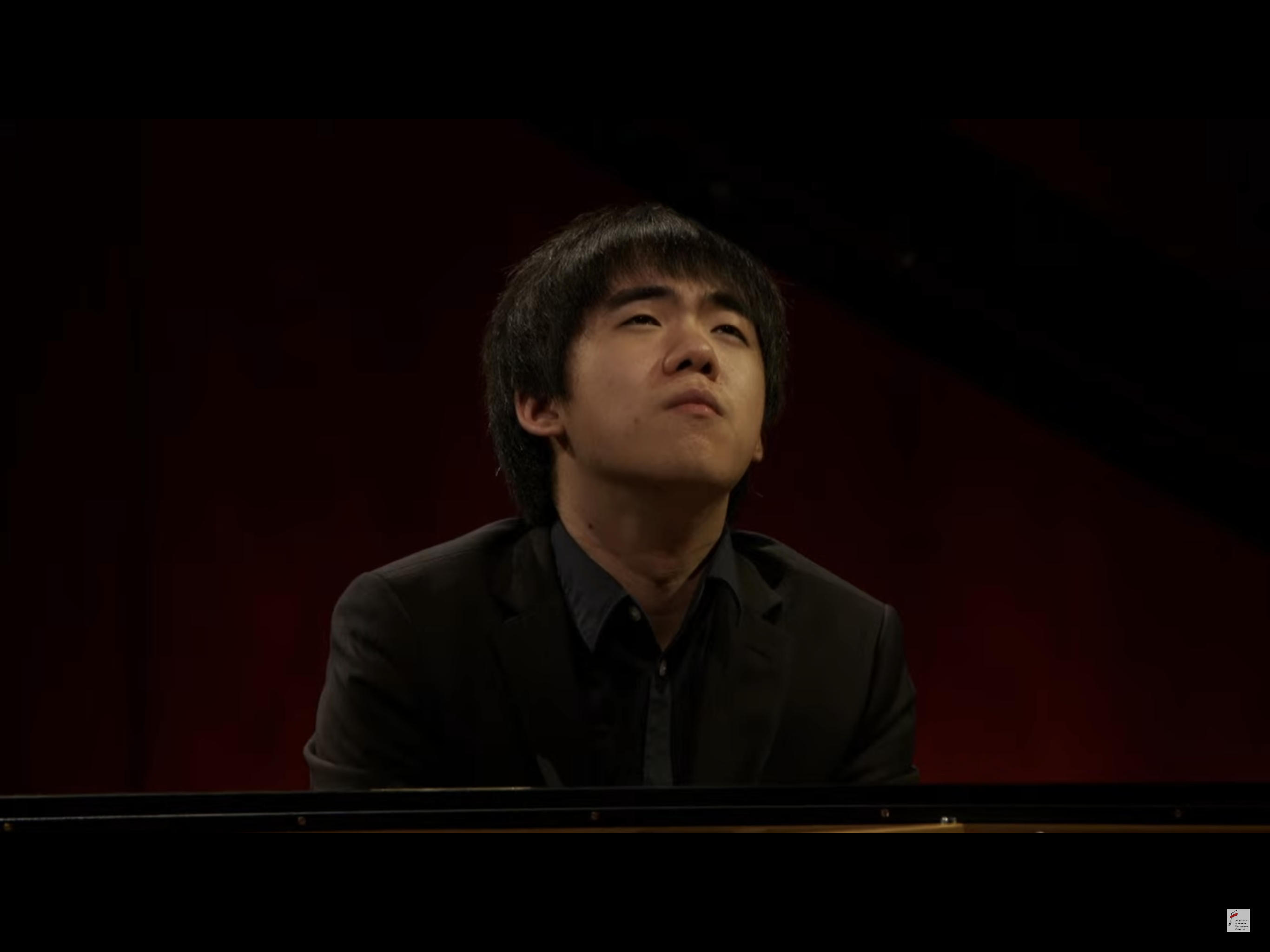
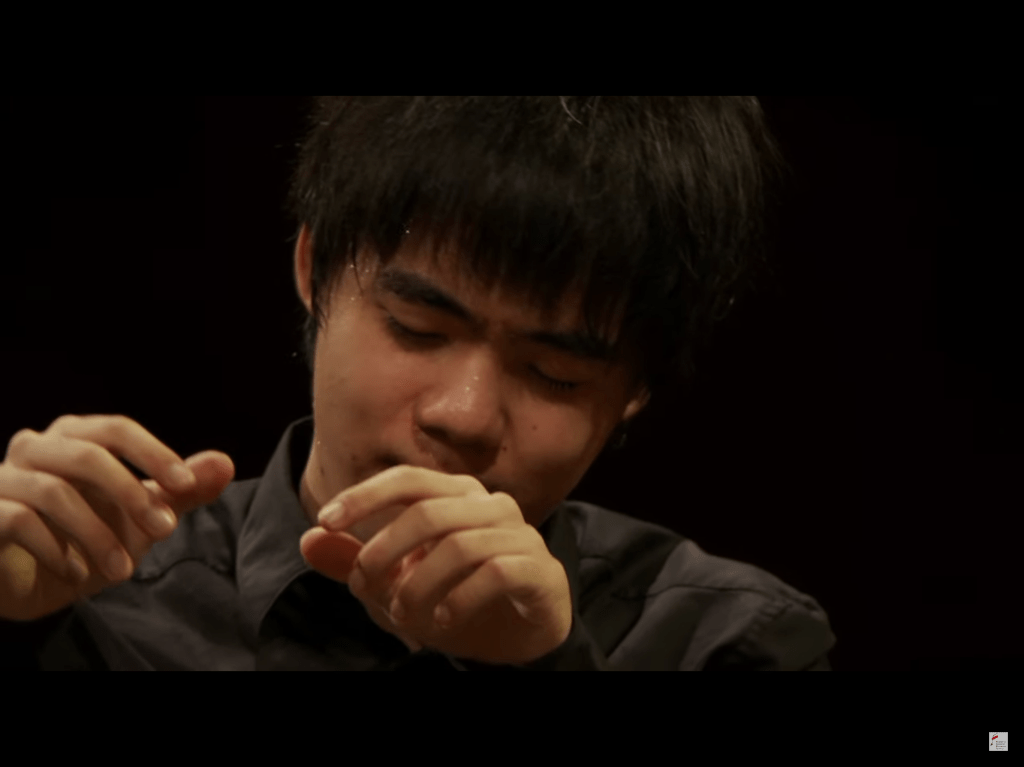
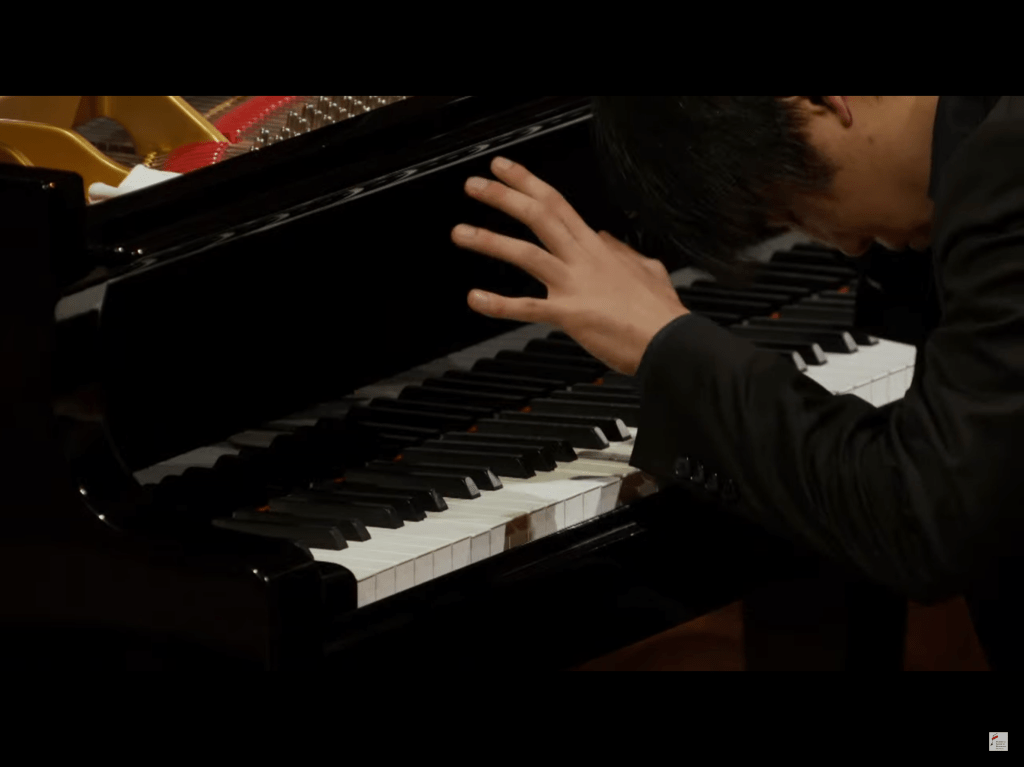
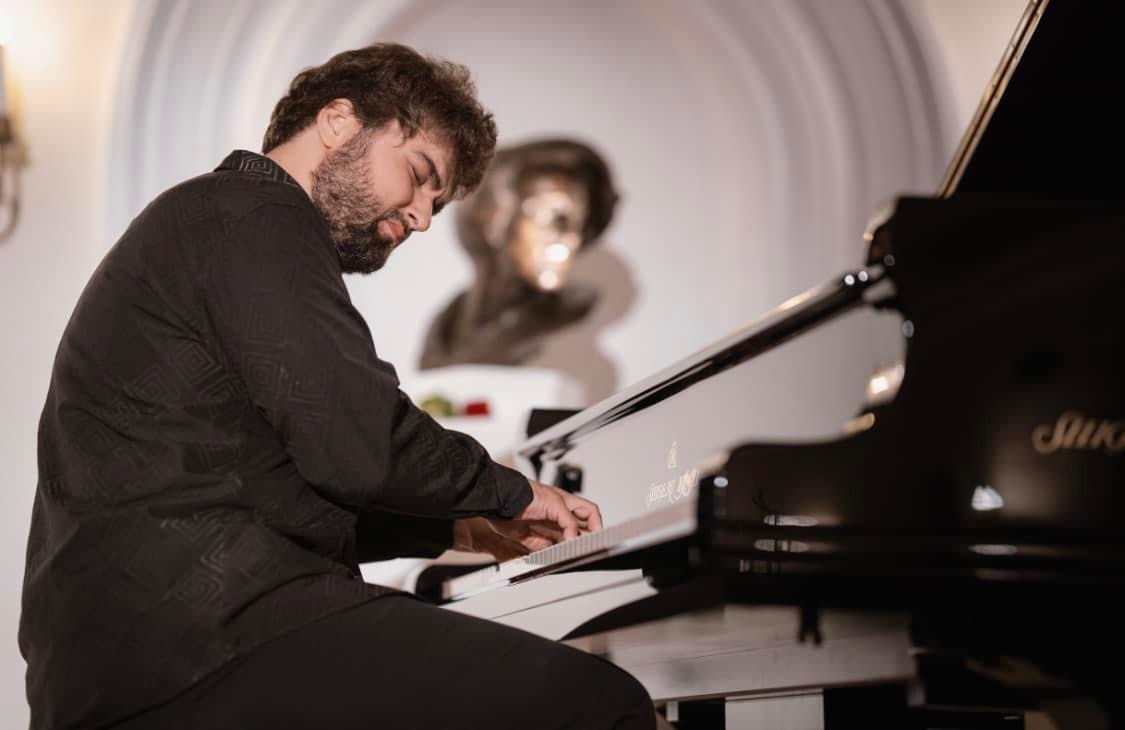
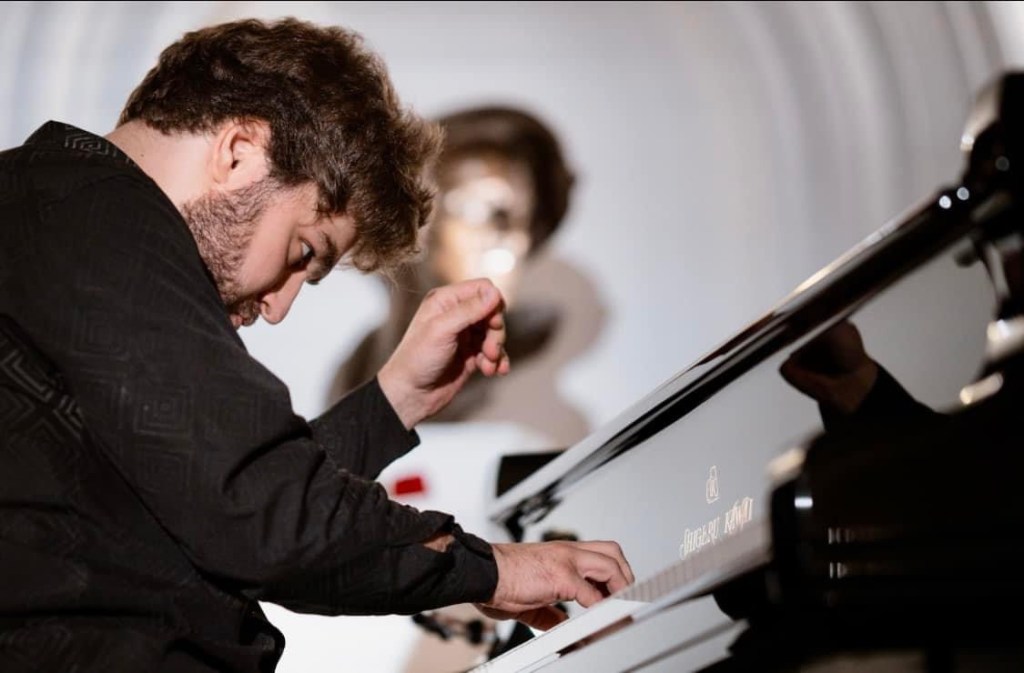
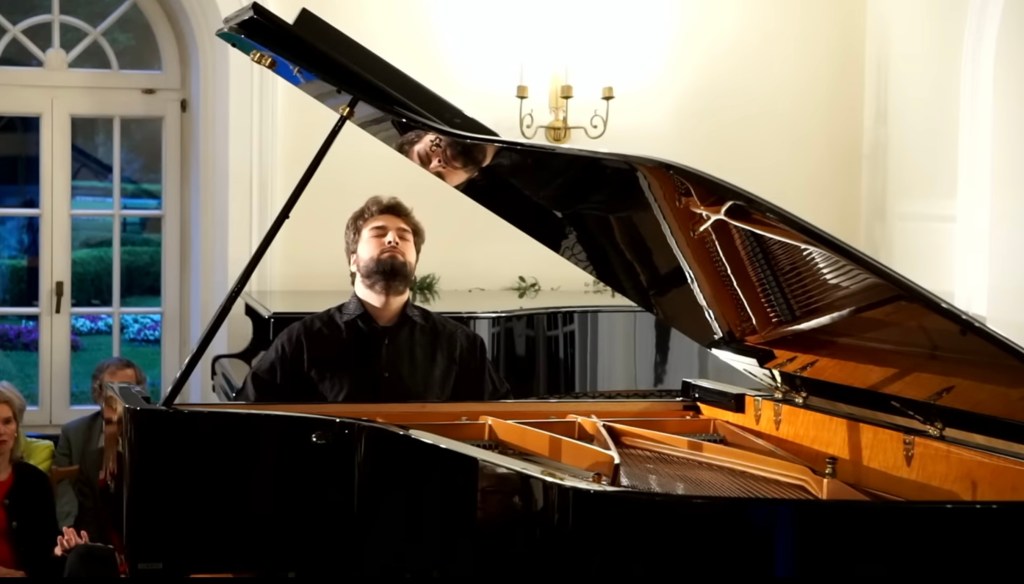
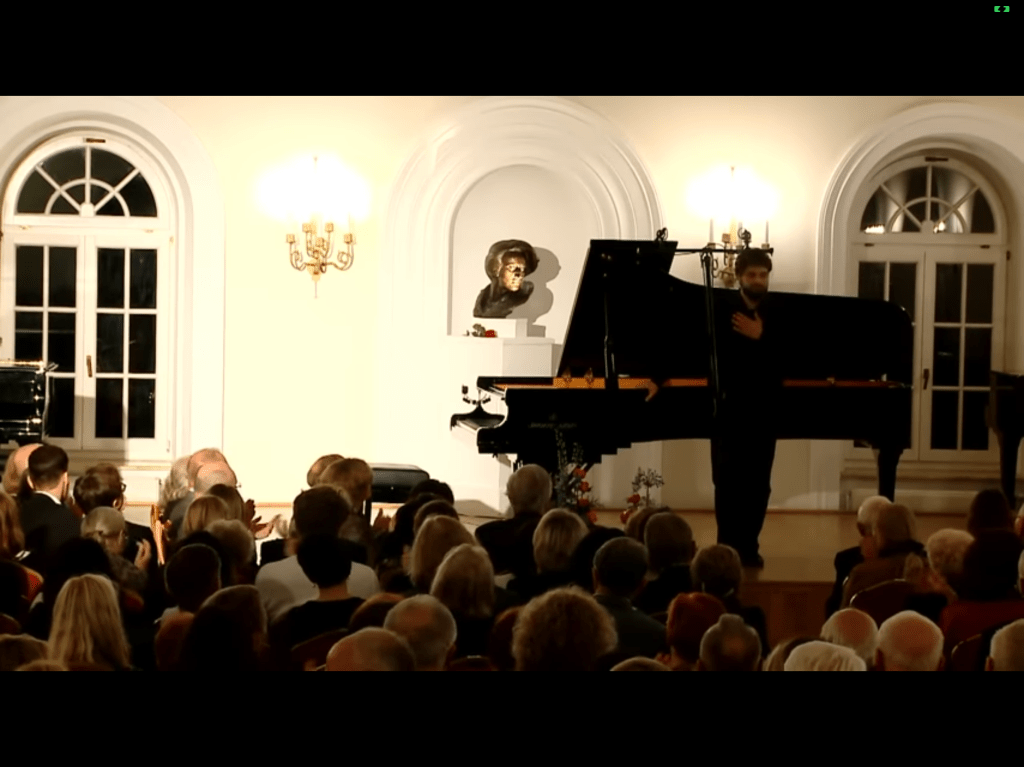
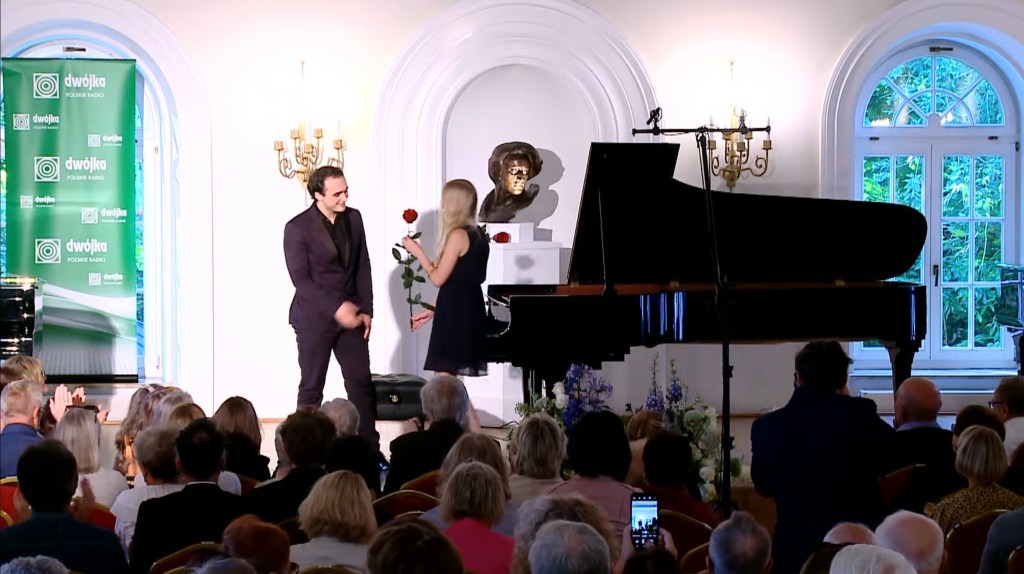
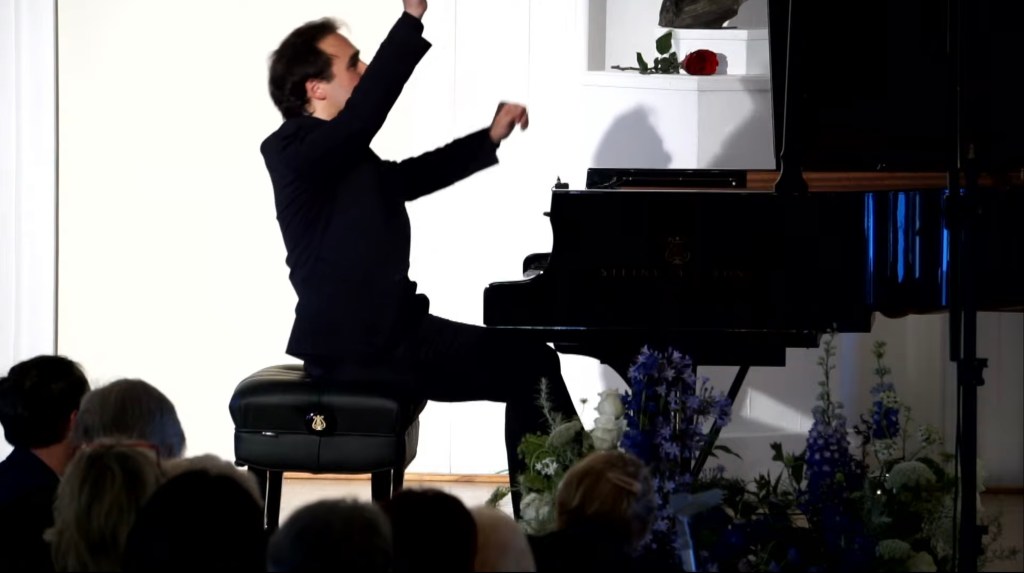
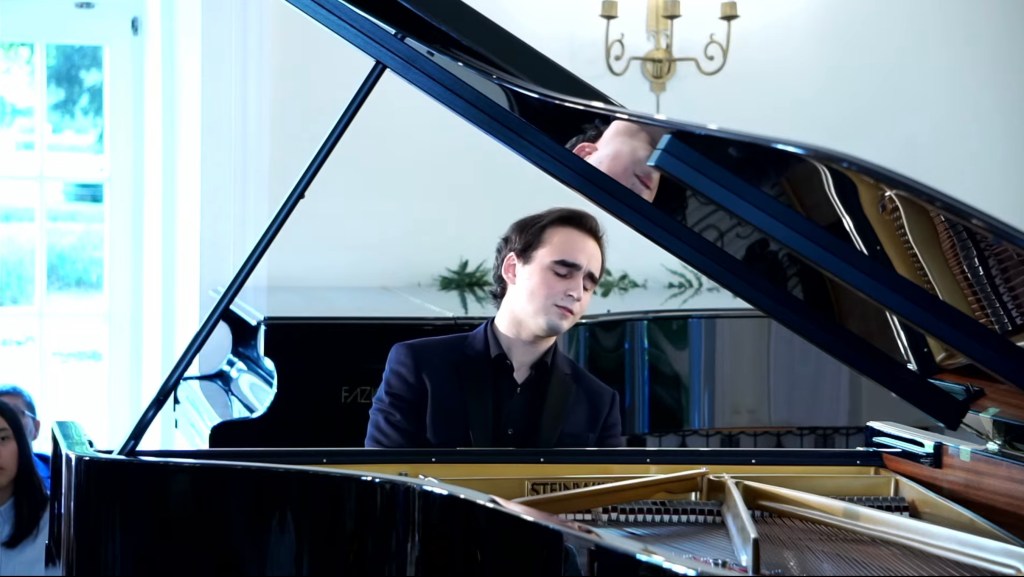
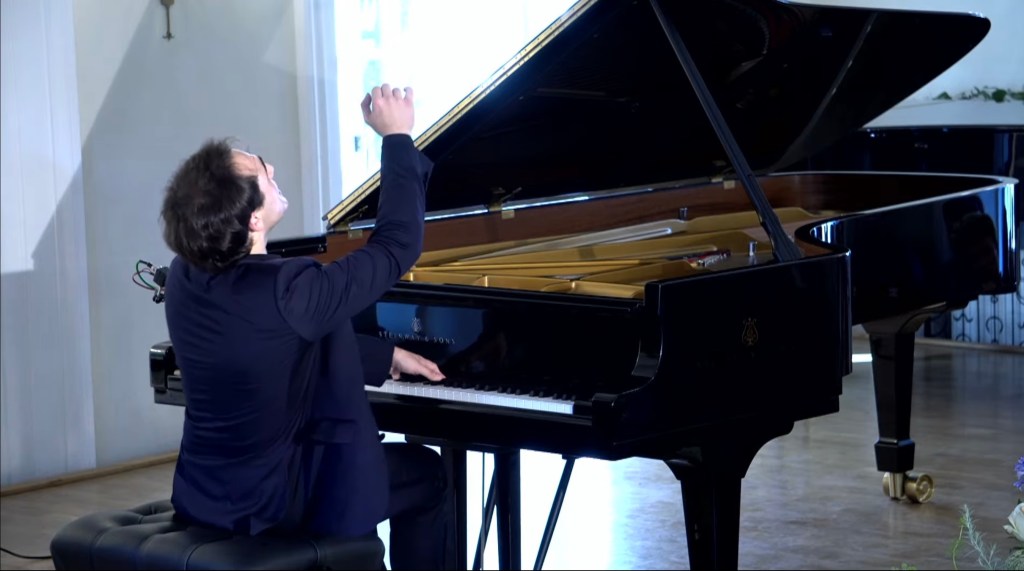
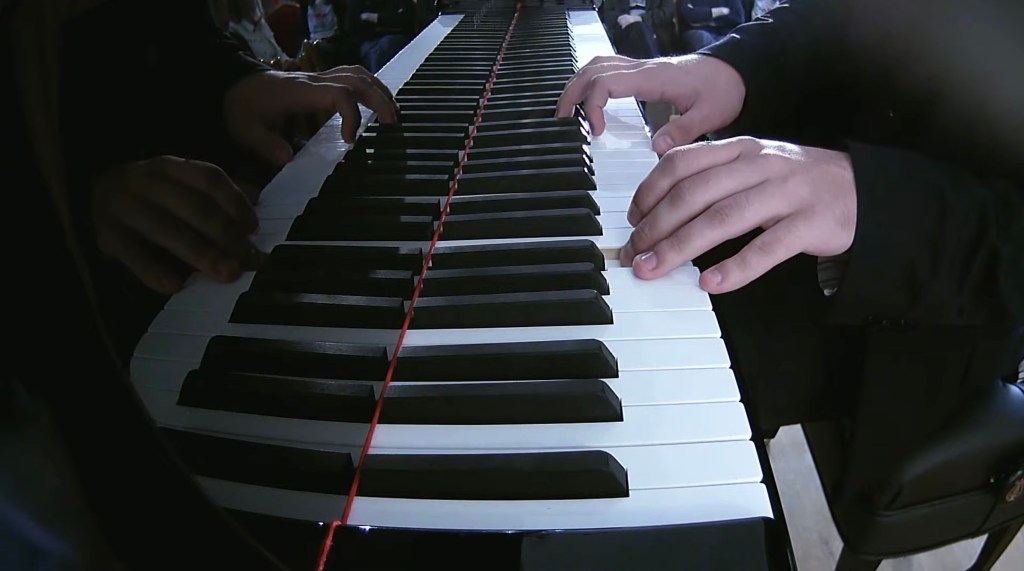
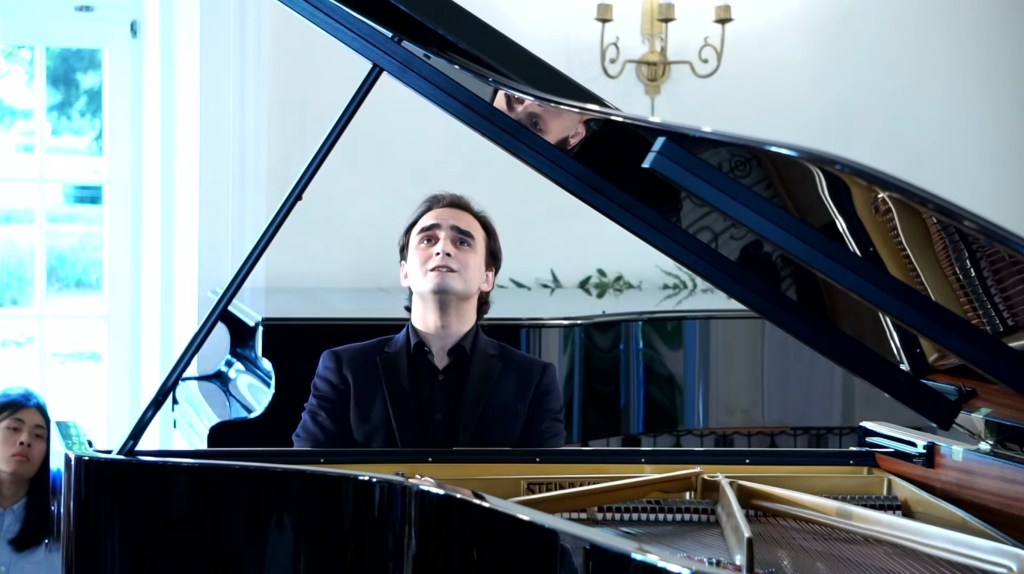
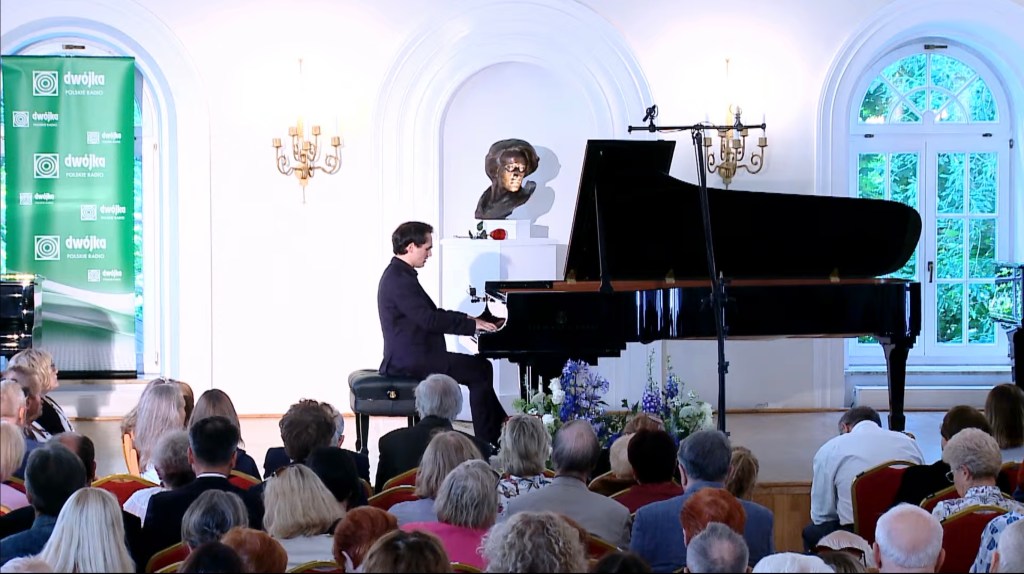
Maxim Kinasov came on stage and threw himself into the keyboard with the same animal like ferocity that I have not seen since Richter.Infact it reminded me so much of Richter to see this young man so enveloped in the sounds that he was producing.Pulling,punching caressing the most wondrous rich sounds out of the piano.An Intermezzo dedicated to Brahms by Slonimsky opened his programme of dedications – to Brahms,Paganini,Bach and finally to the oppression of World War Two with Prokofiev’s 7th Sonata ,one of the Trilogy of War Sonatas.
Max writes that I got the wrong Slonimsky,Nicolas instead of Sergei and i am glad too be corrected and to learn even more about this remarkable family https://en.m.wikipedia.org/wiki/Sergei_Slonimsky
From the very first notes Maxim’s fingers were like limpets on the keys .His whole body was engaged in the music that was being reproduced in a voyage of discovery that was quite hypnotic and mesmerising.An outpouring lament of sumptuous sounds .A deep yearning as the variations unfolded ,a kaleidoscope of colour with trills gleaming like jewels .There was an animal like urgency of cascades of notes ending in a silence of such aching poignancy.Like an animal let loose on the keys with that same hypnotic ferocity of Richter and the same total mastery.A ferocious passion that swept all before it.
From the opening theme of Paganini it was obvious that we were in for an exhilarating performance of Brahms’s notoriously difficult variations.The beautifully shaped theme led to variations of such differing character all played with a continuous driving forward movement .Even the beautiful second ‘poco animato’ was on a great wave carrying all with it on its long voyage.There was charm too in the eighth variation that contrasted with the overpowering force of the ninth and tenth.There was ravishing beauty in the poco Andante before the tumultuous whirlwind of the final Presto.What grandeur at the end!I doubt this piano has ever sounded so ‘grand’ as in the velvet gloved hands of this giant of a pianist.
The Bach/Siloti Prelude in B minor was played with a simplicity and a magical sense of colour but there was also a certain solidity to the sound that gave it an austere reverent importance.
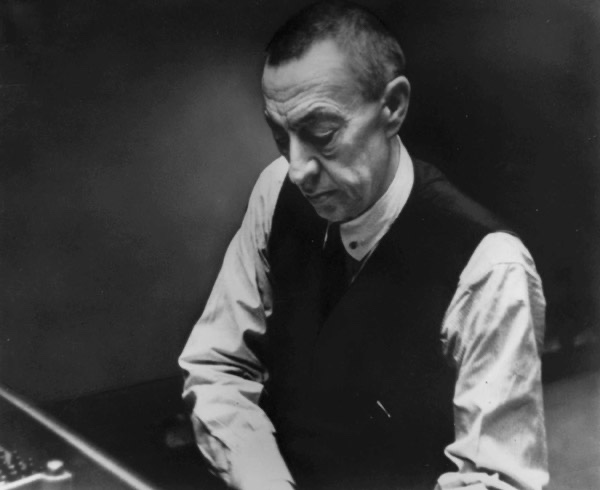
The Prokofiev Sonata unleashed the same unconventional ferocity that I remember from its dedicatee Sviatoslav Richter when he played it in London in 1971.I was a student in my final years at the Royal Academy and i remember being overwhelmed by a force of nature that broke all the conventional rules that had been imbued in me in that noble institution.I remember my wife thinking she had made a mistake in an acting exam and being told by a great Italian artist:’But there are no rules just convince me.’And my God Richter certainly did that as Maxim did today too.From the very first call to arms of ferocity and clarity.Through the sumptuous beauty of the Andante with it’s swirling visions of desolation in a hoped for paradise.The final brutality of the Precipitato with a driving intensity that swept Maxim on to impossible heights where the rhythms kept him afloat and notes became superfluous.The hysterical excitement of the final breathtaking pages were greeted by cheers from an audience hypnotised by a truly great artist.Headed for the heights this tormented soul finds home only at the keyboard like Richter or Beethoven even!
Chapeau Maestro I am proud to be able to say that I heard you at the beginning of your illustrious career
Maxim Kinasov is the First Prize Winner of more than 10 prestigious international piano competitions around the world, including UK ‘s 2022 Birmingham International Piano Competition and 2022 Windsor International Piano Competition, and 2019 Cantù International Piano and Orchestra Competition and 2014 Chopin Roma International Piano Competition in Italy . He also won Second Prizes in prestigious 2019 Hastings International Piano Concerto Competition ( UK ) and 2015 Gian Battista Viotti International Piano Competition ( Italy ). In 2017, he graduated with distinction from Moscow Tchaikovsky Conservatoire in the class of Sergei Dorensky and moved to the UK to study at the Royal Northern College of Music in Manchester. In 2018, Maxim won the RNCM Gold Medal and played in the Gold Medal Winners concert at Wigmore Hall in March 2019. Also, he was selected as a Kirckman Concert Society Artist for 2019-20 and played his full-length solo debut at Wigmore Hall in October 2019. He completed his International Artist Diploma degree in 2021 at the RNCM in the class of Ashley Wass . Maxim performed internationally with the most prestigious orchestras in the UK and abroad, such as the BBC Philharmonic Orchestra, Royal Philharmonic Orchestra, The Hallé, City of Birmingham Symphony Orchestra, RNCM Symphony Orchestra , Orchestra of the Teatro Carlo Felice , St Petersburg State Academic Symphony Orchestra and the European Union Chamber Orchestra .
“𝗠𝗮𝘅𝗶𝗺 𝗞𝗶𝗻𝗮𝘀𝗼𝘃 came on stage and threw himself into the keyboard with the same animal like ferocity that I have not seen since Richter. (…)
An Intermezzo dedicated to Brahms by 𝗦𝗹𝗼𝗻𝗶𝗺𝘀𝗸𝘆 opened his programme of dedications (…) From the very first notes Maxim’s fingers were like limpets on the keys. (…) a voyage of discovery that was quite hypnotic and mesmerising. A deep yearning as the variations unfolded, a kaleidoscope of colour with trills gleaming like jewels. (…) A ferocious passion that swept all before it. (…)
From the opening theme of 𝗣𝗮𝗴𝗮𝗻𝗶𝗻𝗶 (…) we were in for an exhilarating performance of 𝗕𝗿𝗮𝗵𝗺𝘀’s notoriously difficult variations. The beautifully shaped theme led to variations of such differing character all played with a continuous driving forward movement. (…) this piano has ever sounded so ‘grand’ as in the velvet gloved hands of this giant of a pianist.
The 𝗕𝗮𝗰𝗵/𝗦𝗶𝗹𝗼𝘁𝗶 Prelude in B minor was played with a simplicity and a magical sense of colour but there was also a certain solidity to the sound that gave it an austere reverent importance. (…)
The 𝗣𝗿𝗼𝗸𝗼𝗳𝗶𝗲𝘃 Sonata unleashed the same unconventional ferocity that I remember from its dedicatee Sviatoslav Richter (…) Through the sumptuous beauty of the Andante with its swirling visions of desolation in a hoped for paradise. The hysterical excitement of the final breathtaking pages were greeted by cheers from an audience hypnotised by a truly great artist. (…)
Chapeau Maestro, I am proud to be able to say that I heard you at the beginning of your illustrious career.”
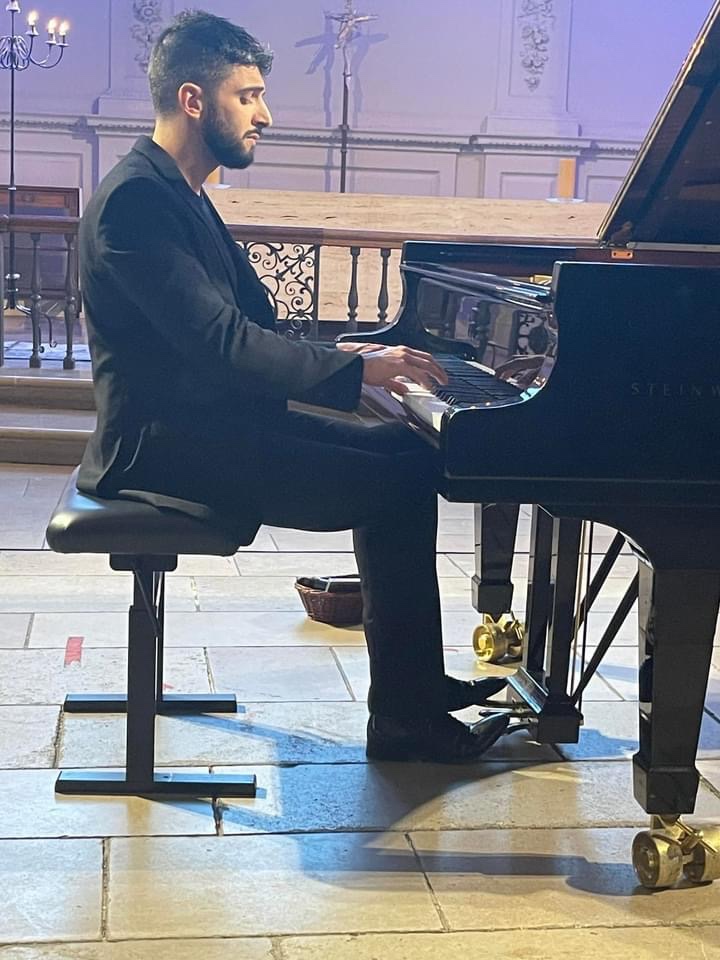
A complete concert together for two remarkable musicians who up until today had only played in various festive occasions but never had a chance to play an entire recital together.The delicacy and sensitivity of Mengyang were complimented by the musicianship and showmanship of Ilya.Both had completed their training in the class of Vanessa Latarche at the Royal College so their musical pedigree was assured.Both have now been elevated to professorships at the Royal College.Two virtuosi who have mastered much of the solo piano repertoire but have the humility and responsibility of helping young musicians.Encouraging them to put aside their newly acquired skills and to focus on listening to themselves and translating the composers wishes into sounds.A concert of duet ‘lollipops’ in the sense that they presented a programme of well known duets by great composers.It was just this that showed off their remarkable pedigree as they presented these works with a freshness and intelligent musicianship that made one realise what gems they can be in the right hands.
Four hands!Means just that but also four feet .It also needs a policeman to decide the logistics of the different height of the stool and also who is to turn the pages and when.I remember Benjamin Britten ‘complaining’ that in his duo with Richter he would suddenly find two great feet on his as they fought for the pedals.In the passion of the moment Richter’s great temperament took over from Britten’s more gentlemanly control.The most important thing of course is a sense of balance that allows the musical line to shine through.These are all things that need real musicians listening with the sensitivity and humility that is necessary for all chamber music ensembles.
Opening with the first of Brahms’ 21 Hungarian Rhapsodies with the passionate tenor sweep from Ilya replied by the delicate cascading notes from Mengyang.It immediately showed their sense of control of sound as the melodic line was passed from the tenor to the soprano.Ilya’s heart beating palpitations in the bass never overshadowing the melodic line that he had now passed to Mengyang.The change of gear in the ‘trio’ section was played with teasing and beguiling style.An opening that immediately established the musical credentials of these two fine musicians.
The Hungarian Dances ) by Johannes Brahms (WoO 1) are a set of 21 lively dance tunes based mostly on Hungarian themes, completed in 1879.They vary from about a minute to five minutes in length. They are among Brahms’s most popular works and were the most profitable for him. In 1850 Brahms met the Hungarian violinist Ede Reményi and accompanied him in a number of recitals over the next few years. This was his introduction to “gypsy-style” music such as the csardas which was later to prove the foundation of his most lucrative and popular compositions.Only numbers 11, 14 and 16 are entirely original compositions.The better-known Hungarian Dances include Nos. 1 and 5, the latter of which was based on the csardas “Bártfai emlék” (Memories of Bártfa ) by Hungarian composer Bela Kéler which Brahms mistakenly thought was a traditional folksong.A footnote on the Ludwig-Masters edition of a modern orchestration of Hungarian Dance No.1 states: “The material for this dance is believed to have come from the Divine Csárdás (ca. 1850) of Hungarian composer and conductor Miska Borzó.”
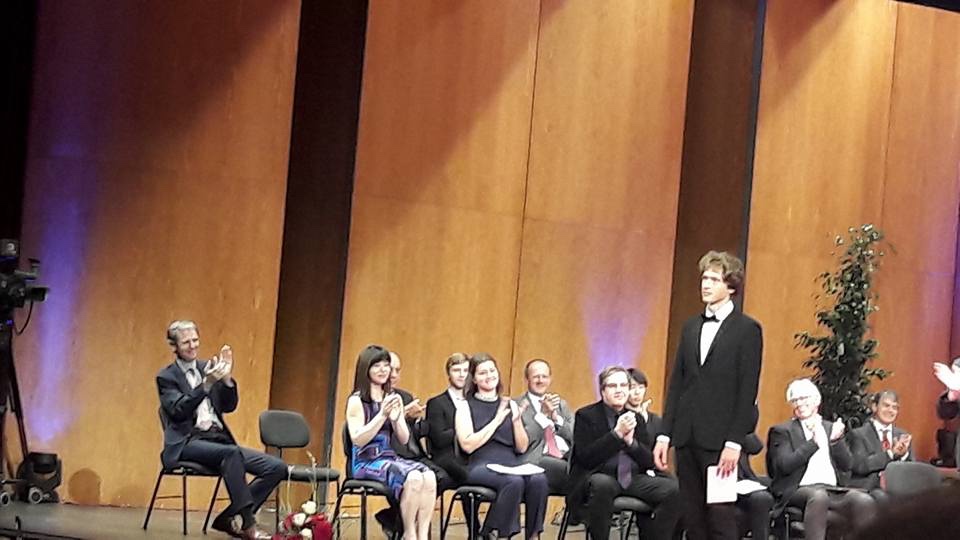
A great sense of balance allowed these gems to shine with subtle colour and refined shape.The famous ‘mother’s hour’ Berceuse was played with great delicacy.I remember Perlemuter who lived in the same house as Fauré telling us of the simplicity that Fauré wanted in his music – sentiment without sentimentality.Ilya and Mengyang obviously with their great love and sensitivity for the music sometimes held up the natural flow as they imbued the music with their own heartfelt feelings.The Berceuse,Le Jardin de Dolly and Tendresse were moments to cherish but it was in the Mi-a-ou,Kitty- valse and Le pas espagnol ,where they allowed the music to flow with a rhythmic drive and ‘joie de vivre’,that was truly capitivating The composer playing the secondo part to the primo of the young Mlle Lombard, daughter of his host and hostess at Trevano, Lake Lugano, in 1913.
The Dolly Suite, op.56, consists of six short pieces written or revised between 1893 and 1896, to mark the birthdays and other events in the life of the daughter of the composer’s mistress, Emma Bardac.Fauré wrote or revised the pieces between 1893 and 1896,for Régina-Hélène Bardac (1892–1985), known to her family as Dolly (she was later to become Madame Gaston de Tinan), the young daughter of the singer Emma Bardac,with whom Fauré had a long-running affair.He was in the habit of sending pieces of music, in manuscript, to mark Dolly’s birthdays and other family occasions.The Berceuse, marking Dolly’s first birthday, was a very early piece, composed in 1864 for Suzanne Garnier, the daughter of a family friend. In 1893 Fauré made some small amendments and changed its title from “La Chanson dans le jardin” to “Berceuse” – that is, a cradle song.”Mi-a-ou” was written for Dolly’s second birthday in June 1894.The title does not refer to a pet cat, as has often been supposed,but to Dolly’s attempts to pronounce the name of her elder brother Raoul, who later became one of Fauré’s favourite pupils.The young Dolly called her brother Messieu Aoul, which Fauré took as the original title for the piece.”Le jardin de Dolly”, was composed as a present for New Year’s Day 1895. It contains a quotation from Fauré’s First Violin Sonata composed 20 years earlier.The Bardacs’ pet dog was called Ketty, and in Fauré’s manuscript the piece is called “Ketty-Valse”.’Tendresse”, written in 1896, was originally dedicated to Adela Maddison,wife of a music publisher.The suite ends with a Spanish dance, a lively and picturesque piece of scene-painting, in the style of Espana by Fauré’s friend Emmanuel Chabrier .The first public performance of the suite was given by Alfred Cortot and Edouard Risler in 1898.Fauré himself enjoyed taking part in performances of the work, not only in public but en famille with the young children of his friends.
One of the great works for piano written in that miraculous last year that Schubert was to be on this earth.Schubert had found a free form but within an architectural framework that was to lead the way for Liszt,Berlioz and Wagner.Mengyang and Ilya played with beauty and style with a give and take that was evident from the very opening melodic outpouring.The same magical palpitation that was to bind this remarkable work together as one. There was drama too with the ‘Largo ben marcato’declaration with it’s dynamic rhythmic figures kept firmly in control with a remarkable sense of ensemble.Bursting unexpectedly into a beautifully mellifluous duet between bass and soprano that was played with disarming simplicity and ravishing colour.The fervent dotted rhythms returning where even trills were involved in a duet of transcendental control where it was evident that these were four hands with an extraordinary technical command.(It is much simpler to play loud and fast that to play pianissimo and fast that is only for true masters.) The Scherzo was played with a playful sense of style and an infectious buoyancy that allowed the trio to be played with real ‘delicatezza’without loosing any of their exhilarating rhythmic drive.Magic was in the air as the opening theme returned as a bridge to the knotty twine of the fugato.There was a sense of control and balance that allowed the musical line to shine through the intricate stream of notes that were passed from one voice to another.The drama that was enacted in the final eight bars was so overwhelming that our valiant players and also the audience needed a moment’s reflection before seeking the childlike simplicity of Debussy’s Petite Suite
The Fantasia in F minor by Franz Schubert D.940 (op .posth. 103), is considered by many to be one of Schubert’s most important works for more than one pianist and one of his most important piano works altogether. He began writing the Fantasia in January 1828 in Vienna and it was completed in March of that year, and first performed in May. Schubert’s friend Eduard von Bauernfeld recorded in his diary on May 9 that a memorable duet was played, by Schubert and Franz Lachner.It was dedicated to Caroline Esterházy, with whom Schubert was in (unrequited) love.Schubert died in November that year of 1828 and after his death, his friends and family undertook to have a number of his works published. This work is one of those pieces; it was published by Anton Diabelli in March 1829.
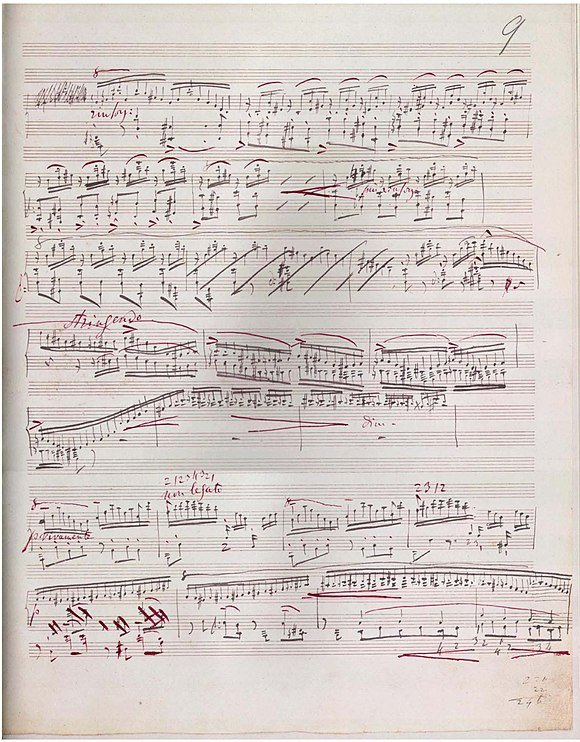
A plate from the original autograph in the Austrian National Library
The basic idea of a fantasia with four connected movements also appears in Schubert’s Wanderer Fantasy for solo piano and represents a stylistic bridge between the traditional sonata form and the essentially free-form tone poem.The basic structure of the two fantasies is essentially the same: allegro, slow movement, scherzo, allegro with fugue.The form of this work, with its relatively tight structure (more so than the fantasias of Beethoven and Mozart) was influential on the work of Franz Liszt who arranged the Wanderer Fantasy as a piano concerto, among other transcriptions he made of Schubert’s music.
It was the simplicity and beauty of Debussy that one was truly aware that this was a duo that played as one.There could be no greater compliment as they allowed the ‘bateau’ to float in calm magical waters and the Cortège to proceed with such joyous steps.The crystalline clarity of the Menuet was played with a simplicity and jewel like beauty.The ballet was imbued with insinuating elegance and drive.A ravishing performance that filled the air with freshness and light after the monumental drama played out in Schubert.
The Petite Suite was composed from 1886 to 1889, and was first performed on 2 February 1889 by Debussy and pianist-publisher Jacques Durand at a salon in Paris.It may have been written due to a request (possibly from Durand) for a piece that would be accessible to skilled amateurs, as its simplicity is in stark contrast with the modernist works that Debussy was writing at the time.The first two movements are settings of poems from the volume Fetes galantes by Paul Verlaine (1844–1896).
One of the best known Hungarian Dances was played with rhythmic drive and perfect ensemble.The ‘Trio’ section was like a gust of wind blowing over the keys interrupted by improvised almost serious melodic comments immediately dismissed by the driving rhythmic dance just waiting to erupt.
An encore of Schubert’s famous March militare was played with all the ‘joie de vivre’ and superb musicianship that had made this concert such a joyous occasion for us all.
Mengyang Pan was born in China and has been living in the UK since 2000. She began her piano study at the age of three before becoming a junior student at the Central Conservatory of Music in Beijing. At the age of 14, she left China to study at the Purcell School in the UK with professor Tessa Nicholson. Upon graduating with high honours, she went on to complete her musical education at the Royal College of Music training under professor Gordon Fergus-Thompson and Professor Vanessa Latarche.The prize winner of many competitions including Rina Sala Gallo International Piano competition, Bromsgrove International Young Musician’s Platform, Dudley International Piano Competition, Norah Sands Award, MBF Educational Award, Mengyang has performed in many prestigious venues such as the Royal Festival Hall, Wigmore Hall, Cadogan Hall, Bridgewater Hall and Birmingham Symphony Hall amongst many others. As soloist, Mengyang has appeared with many orchestras and her collaboration with conductors such as Maestro Vladimir Ashkenazy, John Wilson and Mikk Murdvee has gained the highest acclaim. Mengyang also finds much joy in teaching. In 2019, Mengyang was appointed piano professor at the Royal College of Music in London, she also teaches at Imperial College
A critically acclaimed pianist, Ilya Kondratiev is the prize-winner of several renowned international music competitions, including Franz Liszt Budapest 2011, Franz Liszt Weimar 2011, the Fifth Tbilisi 2013, Brant Birmingham 2015 and Chappell Gold Medal in 2016. Born in Russia, he studied from the age of seven in Samara with the distinguished teacher Victoria Soifer and, from the age of 16, at the Moscow State Tchaikovsky Conservatory with the People’s Artist of Russia Zinaida Ignatieva. In 2014 he moved to London in order to further his studies at the Royal College of Music under Vanessa Latarche and Sofia Gulyak, graduating with a Master of Performance and an Artist Diploma. Ilya performs extensively as a soloist and chamber music player at venues such as the Great Hall of Moscow Tchaikovsky Conservatory, Gasteig Munich, Weimarhalle, Palacio de Festivales de Santander, the Palaceof Arts in Budapest and the Great Hall of the Tbilisi Conservatoire. In 2011 Ilya was invited to work with Elisabeth Leonskaya at the Franz Liszt Piano Academy in Schilllingfurst, Germany and with Pavel Gililov at the Eppan Piano Academy in Italy. He has also performed in the masterclasses of Dina Yoffe, Konstantin Shcherbakov, Willem Brons, Dmitry Bashkirov, Jerome Rose, Leslie Howard, Lang Lang and Arie Vardi. In 2015 and 2017 Ilya was invited to the ‘Encuentro’ Festival in Santander and in 2016 appeared as a guest artist in the Gumusluk Festival in Turkey, and the Beethoven Music Festival and Academy in Altaussee
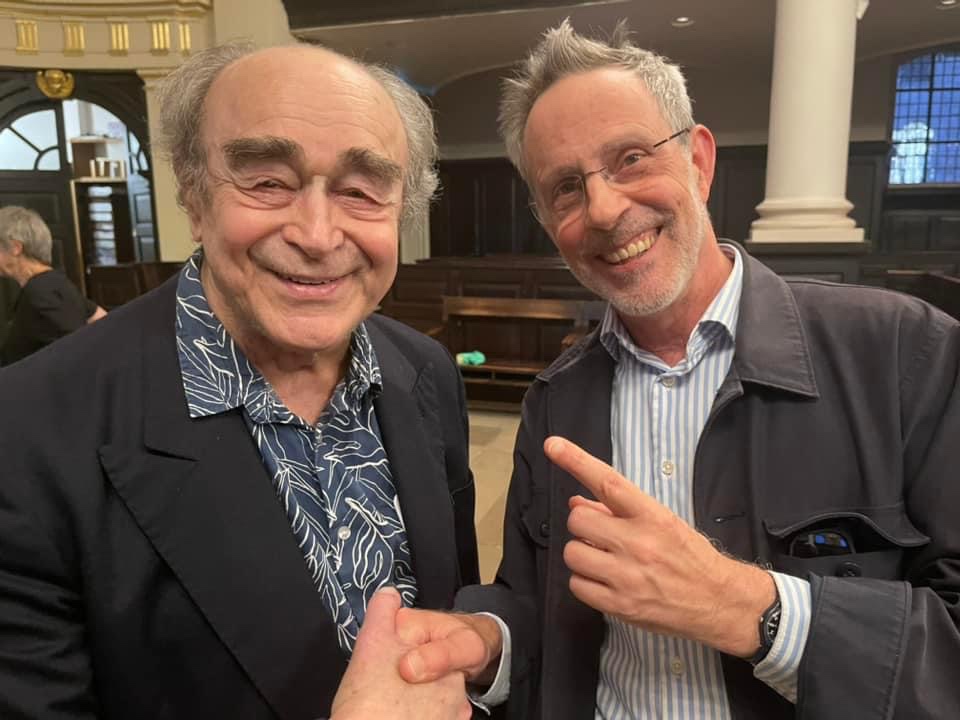
https://youtube.com/live/Ro3FZmydEpA?feature=shareMemorable afternoon in the company of not only a great musician but a great human being I mentioned Peter the Great when he gave what was to be his last concert two years ago …..never more have my words rung so true .
Here is the link to a documentary that will be shown on Hungarian Television to celebrate a great artist https://youtu.be/gSD7W8CmnN0
Peter Frankl was born in Budapest in 1935 and is recognised as one of the great pianists of the last century. His father died in a labour camp and he was in the Budapest ghetto in 1944. After studying at the Franz Liszt Academy of Music in Budapest, he won several piano competitions in the late 1950s, and made his London debut in 1962 and first performed in New York in 1967 when he appeared with the Cleveland Orchestra under George Szell. Since then, he has played on the world’s top stages with the most celebrated orchestras and eminent conductors, including Abbado, Boulez, Davis, Haitink, Maazel, Masur, Muti, and Solti. His world tours have taken him to Japan, Korea, Australia, New Zealand, and South Africa. He has appeared more than 20 times at London’s BBC Proms and at many major festivals. He is also a well- known chamber music performer. For years, the Frankl-Pauk-Kirshbaum Trio travelled the world, and his many chamber music partners include the world’s most renowned artists. He is a much-respected teacher and served as Professor of Piano at the Yale School of Music in USA for 30 years.
In this conversation, he talks about his early life, his subsequent career as an international soloist, chamber musician and teacher, and his reflections on a long and fruitful life as an eminent musician.
From the very first note of Chopin’s first nocturne Lara Melda demonstrated her poise and aristocratic bearing in one of Chopin’s simplest Bel canto outpourings.
Her fingers seemed to belong to the centre of the keys as they extracted a velvet sound of subtlety and ravishing beauty.Not only a regal bearing like Gina Bachauer but the same golden sound of a small hand that clung to each key like a limpet. Gilels had the same way of squeezing golden sounds out of the keys.Even in the most passionate outpouring his sound would only get richer but never hard and ungrateful. Ravishing sounds in Brahms A minor intermezzo op 116 that seemed to disappear into a celestial oblivion as Lara threw herself into the keys with a rhythmically savage Capriccio in D minor.Passion and beauty combined as she ravished the piano extracting sounds of pure golden richness.
This was just a prelude to Chopin’s Sonata in B minor.The first movement was played with aristocratic control but with moments of tenderness and beauty as she allowed the second subject all the time of a great bel canto singer.Over a gentle continuous accompaniment she could weave a golden thread of such elastic freedom knowing that the anchor was always there.There was dynamic drive and control in the development and the triumphant return of the second subject was played with passion tinged with pathos as it led to the majestic final chords. The jeux perlé of the scherzo was played like the last movement of the B flat minor sonata.It is often likened to the wind over the graves but here it was a wind of joyous beauty. The melodic trio was played with great poise as she joined the busy counterpoints together finding a melodic path that gave great shape and strength to this melodic respite before the return of the busy joyous weaving of the opening.
There was grandeur in her announcement of the tender beauty of the Largo.A melodic line of subtle colour and shape that had been hinted at in her opening Nocturne.There was ravishing beauty as the gently floating sounds in the right hand were a continual presence of golden beauty above the utter simplicity of the suggestive tenor melody. Some truly ravishing playing where her overall sheen of sound created a cocoon in which she was free to shape Chopin’s genial creations with kaleidoscopic colours of subtle inflections. The Finale Rondo was breathtaking in its relentless forward movement but also for the transcendental control that allowed her to build the excitement to fever pitch until it spilt over into the scintillating coda. A masterly sense of balance allowed her to add moments of sudden quietness even in the most energetic of moments that allowed her the space to build the sound without any forcing. Infact the whole Sonata reminded me of the sheen of sound that one can appreciate in the magnificent historic recordings of Guiomar Novaes.One of the greatest pianist considered a God in her native Brazil.Her greatest admirer and pupil was our dear friend Nelson Freire who had inherited the sound that we hear today from Lara. A very delicate ‘story’ by Turkish composer Adnan Saygun created an intimate atmosphere of great desolation very similar to the ringing bell landscape of Ravel’s Le Gibet In just forty minutes Lara had ravished,seduced and enriched us with her poetry,intelligence and golden sounds.
Lara announcing her encore ‘Masal’ by Turkish composer Adnan SaygunWith super enthusiastic Jonathan Mark Roberts from Llandudno
Alim Beisembayev at the Richmond Concert Society with Beethoven op 10 n.3 and op 111 (in place of the advertised op 110) and a second half of Rachmaninov and Liszt. I remember coming to this modern Catholic Church many years ago to hear Vlado Perlemuter long before he became my teacher and friend.He complained bitterly about the acoustics that he could not hear himself play.But for Vlado right up to his 90th birthday,when Joan and I had to push him on stage at the Wigmore Hall ,every step to the stage was always like going to the guillotine!Cherkassky standing in for Bolet of course loved it !
Beethoven’s early sonata op 10 n.3 was played with much more grace and lightness than we are used to hearing .This together with op 2 n.3 and op 7 begin to show the evolution of Beethoven from the early Haydn inspired Sonatas through to the revolutionary ‘middle period’ of the ‘Tempest’,Waldstein’ ‘Appassionata’ and on to the visionary last Sonatas where the gate is thrown open with the most Schubertian of all the sonatas that of op 90.It was a performance of Murray Perahia that had first made me aware of the grace and fantasy in this Sonata.Subtle phrasing and changing colours together with the same youthful rhythmic energy of the first two concerti.Alim too took me by surprise with the grace he gave to the opening octaves.A speed that at first I thought was excessive but he convinced me by his superb sense of musical architecture where everything fell so perfectly into place.There was astonishing brilliance but allied to a rhythmic precision that like a perfectly crafted clock was a marvel to behold.The rising scales in the left hand answered by the impatient comments from the right and continuing without any slacking of tempo or tension as the left hand jumped from one end of the keyboard to the other .I have only heard this sort of clockwork musical precision in early Beethoven from Perahia.(Is it just a coincidence that they were both Gold medal winners in Leeds?)The Largo e mesto was a bold and profound statement where his sensibility and aristocratic poise gave great weight to a slow movement that was the innovative creation of a genius.Alim’s control of the pedal too was masterly as he had understood the effects that Beethoven indicates in the score and translated it to the modern day instrument – not just blindly following the road map but understanding what it was really saying.The beautiful ‘pastoral’ Minuet was played with a simplicity that allowed Beethoven’s rude interjections to bring a smile to his face.And a Trio so finely crafted that the question and answer over a continuous stream of triplets was quite ravishing in its rhythmic perfection.The question and answer of the Rondo was also finely woven and full of rhythmic energy.The glistening stream of jeux perlé silver scales shooting across the keyboard were without any slackening but with a masterly control of sound with the insistent gasps in the left hand .It was an unforgettable way to close a remarkable performance.
Today in Alim’s hands we could hear the gentlest of whispers and savour his refined palette of colour on the sumptuous Steinway concert grand that they had brought in especially for the concert. I had heard Alim some years ago ,the star student of Tessa Nicholson,at the Purcell School. Today,after his years of intense study with her at the Royal Academy he has now completed his Master’s Degree with Vanessa Latarche at the Royal College where he will complete his Artist’s Diploma in his third and final year. I heard now a great artist with a refined tone palette of sounds and a musical intelligence that spontaneously recreated the music.He held the audience in his spell from the first to the last note.
Alim had decided,in agreement with the charming people at Richmond concert society, that he would play op 111 instead of the advertised op 110.I remember Stephen Kovacevich trying the piano in our theatre in Rome and asking if I would mind if he played the Schubert A major sonata instead of the last B flat.The piano,the hall,the atmosphere and above all the artist were more attuned to giving a worthy interpretation of the penultimate sonata rather than the last in that moment.Alim gave a masterly performance and ,as he said in his introduction,a young artist has to start to climb the mountain some time!I will not say he conquered the mountain but then does anyone?What he did do was to show us a vision that was memorable for its fresh close look at the score and to transmit what he found with a poetic freshness that must have been the core of the inspiration of a genius.I doubt the deep rumble in the bass at the end of the introduction has ever been more menacing as it’s whisper took us finally to the home key of C. But that is only an arrival marked ‘f’ because what comes after is the real start of the sonata and is marked ‘ff’.Small details but fundamental for the structure of such a monumental work.The moments of rest from this boiling cauldron were played with a ravishing control of sound without ever loosing sight of the burning intensity that was waiting to erupt.There was a long religious wait at the end of a long cloud of C – home at last – at the end of the first movement.Barely touching the keys of the Arietta he created an atmosphere where we the audience were drawn in to the ravishingly noble story that was unfolding from Alim’s poetic hands.Alim hardly moves when he plays ,there is no extraneous physical show as his total concentration and masterly control allows the notes to speak for themselves – ‘Je sens,je joue,je transmets.’This as Rubinstein showed us in his Indian summer is the height of maturity where true love of music transcends one’s own persona.The variations were allowed to evolve in such a natural way that Alim’s technical perfection passed unnoticed .There was a remarkable control of sound and tempo in the long communing from the murmured bass fragments reaching out on high to the celestial vision that will miraculously appear on the last page.These fragments come together on a vibration of celestial sounds that could never be called anything as mundane as trills in Alim’s magic hands.Beethoven’s vision of paradise was indeed celestial as revealed to us today.Alim at 25 shows signs of a maturity way above his age.
Playing of ravishing beauty as he showed us the two sides of Beethoven.From the unexpectedly exquisitely shaped op 10.n.3 finishing with the magical vibration of sounds of op 111 on which Beethoven floats on high his final thoughts of a paradise already in view. Liszt transcendental studies that were real miniature tone poems. Has ‘Ricordanza ‘ever sounded as beautiful as if it was Liszt’s own ‘Benediction’ ?Petri came near but Alim today even nearer! The wild passionate fervour of the F minor study with at last the rhythmic clarity that Liszt demands.Calmed by the ravishing sounds of evening only to be led into the terrifying blizzard depicted in Chasse Neige. Playing that when he decided to relinquish his masterly control was breathtaking in it’s wild abandon.
Alim presenting his programme to a very attentive audience
The D major Prelude by Rachmaninov was played with the same subtle poetry and stillness that evoked the young Richter .And the mighty E flat minor Etude -Tableau was breathtaking in it’s aristocratic passionate abandon. Rage over a lost penny was his way of thanking the eclectic audience in Richmond in their 61st season that has seen some of the greatest artist of the age.They can now add Alim to that illustrious list .
I should also add that Alim is one of the nicest,simplest people I know and I was very touched by his consideration for me today.But the greatest artists are always the simplest ,you see ,as their souls have found peace and satisfaction in being able to comunicate the message hidden in music to others.
‘A Star is Born: Liszt’s Transcendental Studies from Alim Beisembayev A necessary purchase for all lovers of piano music. Alim Beisembayev is the real deal ‘ Colin Clarke
‘ The Leeds International Piano Competition winner in Autumn 2021 was hailed as a worthy prizewinner all round. Now 24, the UK-trained Kazakh pianist, Alim Beisembayev, has turned his considerable energies to the mind-boggling virtuosity required in Liszt’s 12 Études d’exécution transcendante. If he doesn’t quite make them sound as easy as pie, he certainly delivers them with beguiling nonchalance, a gleaming touch and unflappable clarity, aided and abetted by superb recorded sound.’ Jessica Duchen
Born in Kazakhstan in 1998, Alim has already performed with the State Academic Symphony Orchestra of Russia “Evgeny Svetlanov”, Moscow State Symphony and Fort-Worth Symphony, and at Royal Festival Hall and Wigmore Hall. During his time at the Purcell School he won several awards, including First Prize at the Junior Cliburn International Competition. Alim was taught by Tessa Nicholson at school and continued his studies with her at the Royal Academy of Music. He is currently completing his master’s degree at the Royal College of Music with Professor Vanessa Latarche. He is generously supported by numerous scholarships such as the ABRSM, the Countess of Munster, Hattori Foundation, the Drake Calleja Fund trusts, and belongs to the Talent Unlimited charity scheme.Alim Beisembayev won First Prize at The Leeds International Piano Competition in September 2021, performing Rachmaninov’s Rhapsody on a Theme of Paganini with the Royal Liverpool Philharmonic Orchestra and Andrew Manze. He also took home the medici.tv Audience Prize and the Royal Liverpool Philharmonic Society Prize for contemporary performance, with The Guardian praising him as a “worthy winner” with a “real musical personality”.Highlights of the 2021/22 season include debuts with the Royal Liverpool Philharmonic (under Case Scaglione), BBC Symphony Orchestra (Clemens Schuldt), RCM Symphony Orchestra (Sir Antonio Pappano) and SWR Symphonieorchester Stuttgart (Yi-Chen Lin). Recent and forthcoming recitals include the Wigmore Hall, Southbank Centre, Oxford Piano Festival, Bath Mozartfest, St George’s Bristol, and Chopin Institute in Warsaw, in addition to a tour of Europe, in association with the Steinway Prizewinner Concerts Network, and Korea, with the World Culture Network. His debut release with Warner Classics was released in September 2021 — an EP featuring Scarlatti, Ligeti and Ravel.
Wherever there is something special you will find Mike Oldham – master page turner too St Margaret of Scotland – Twickenham
Jean Rondeau the Prince of the Harpsichord. An artisan arriving on stage with sleeves rolled up ready to caress and lovingly coax sounds from the beautiful antique box before him. Cherishing every moment he shares with the delicate instrument just as a master violin maker lovingly shapes the wood that with great artistry and mastery he brings to life.Transforming it into a breathing,living instrument of another age. There were filigree embellishments that were like delicately carved Chinese ornaments of refined intertwined golden thread.
But there was also a sense of line and architectural shape that kept us on the edge of our seats for the eighty minutes of continuous music that poured with such simplicity from his hands. A body in continuous motion like on a great wave following the currents of sound that were flowing with such power and inevitability from this beautiful instrument.A body and instrument that become one is a rarity indeed.
I am not competent to go into the details of harpsichord technique or the specialist scholarship that is needed to bring this music to life in an authentic way. But by God I do know when a musical genius is at work. Schumann exclaimed on hearing the young Chopin what could very well apply to Jean Rondeau tonight :’Hats off ,Gentlemen,a genius !‘
Inna Faliks in London to play for the first time in the JE3 Arts centre. Telling her story of growing up in Odessa under the Soviet regime and even playing on the red piano in the room allocated to her family. A three room appartment allocated to seven people! Immigration was the word used in 1988 when the family prepared to flee to a freer life in the USA. Now head of piano at UCLA in Los Angeles she came to London to share her story with us.
Elegant as a poet – glamorous as Streisand but above all a Tiger on the keys.
Eloquent as a poet but above all an eloquence in music that is so immediate and simple as every note touched places that other musicians can rarely reach.
A first half opening with Shchedrin’s athletic Basso Ostinato.Like a tiger being let out of cage as Inna ravaged this magnificent Yamaha piano with devilish glee .A ‘coup du theatre’ indeed after which we needed the calm aristocratic sounds of Bach’s knotty twine. Jan Freidlin’s Ballade in Black and White was composed for Inna who gave it’s premiere in 2011 in Carnegie Hall.It was played with a clarity and total conviction that was enthralling. After Bach it was Mozart to calm the air now with a performance of his D minor Fantasy of great simplicity and beauty. The ‘Maiden’s Wish’ was played with wondrous jeux perlé in the style of the pianists of another age,that of pure gold.Scintillating exuberance and aristocratic style made one wonder why this little gem has been so rarely heard in the concert hall since the grandiloquence of Arrau.
Following with the most famous of showpieces :’ La Campanella’.Paganini and Liszt in cahoots to beguile and seduce with seemingly impossible pianistic gymnastics. Inna played it with amazing clarity and insinuating charm with a kaleidoscope of colours that made this old war horse shine as new. Streams of gold and silver sounds were thrown off with an ease and precision that were breathtaking in their audacity. The mighty Polonaise Fantasie,from which this moving tale takes its name,was played with aristocratic style and ravishing beauty. There was an architectural shape of such intelligence that restored this work to the Olympian heights of beauty and originality penned at the end of Chopin’s all too short life.It gave great meaning to a work that can sometimes,in lesser hands,appear simply fragmented and structurally weak. Inna showed us the revolutionary originality of the form that is free but in a highly original frame where Chopin’s genius shines through every bar. Inna had realised this as she saw in this masterpiece a road plan of her own extraordinary life.
Inna Faliks with her companion for life Misha Shpigelmacher
The most moving part was to come,both in words and in music,as Inna described the reappearance of Mischa Shpigelmacher in her life. Out of the blue an old schoolboy friend suddenly appears at her concerts. A spark is felt as she decides to turn down a sumptuous after concert supper and to flee to Paris with Mr Shpigelmacher becoming fast best friends and an obvious kindred spirit for life. Now happily married with two teenage children Mr and Mrs Shpigelmacher are still best friends and enjoying together this moving celebration of love in London.
What better music could there be than Beethoven’s op 126 Bagatelles. Ravishing beauty and quixotic changes of character they were played with the true mastery of someone who listens to the sounds she is creating. A purity of sound with a fluidity where bar lines seemed not to exist .Even Beethoven’s precise pedal makings in the third were translated into the magical disintegration of the melodic line.A magic disappearing trick interpreted as Beethoven obviously intended. It contrasted with the ferocious fourth that in turn dissolves into a bagpipe drone on which a fragmented melodic line is allowed to float as if suspended in air. The purity of the melodic line in the fifth was a lesson in how to let the composers words speak for themselves without any personal intervention from the mere performer. ‘Je sens,je joue,je trasmets’. The tornado that is unleashed in the sixth broke the spell but created another even more mysterious cloud of sounds where mere words have no place. Like in the last great trilogy of Sonatas,in particular op 111,the fragments of melody were floated on a bass pedal note like puffs of smoke that Beethoven could see with the vision of the paradise that awaits. With subtle intelligence and scholarship she could turn these baubles into gems. Penned in the last moments of Beethoven’s life when he could find the serenity that had eluded him all his life.
Inna imbued them with the same love that she communicated so movingly in this personal story.One that has become even more poignant for the events that are unfolding with disturbing intensity in her homeland where her soul still abides. Dedicating the performance to her family:her parents,Irene and Simon Faliks who were brave enough to leave the USSR when they did. Her husband and best friend,then and now,Misha Shpigelmacher.Her two children,Nathaniel and Frida,as well as to anyone who has ever left a place in search of a better life. If music be the food of love,play on!
What a story! Simple great music pouring from a sensitive soul as she communicates the remarkable adventure that is her life. Fragments pieced together on a constant bass undercurrent which is love itself. No greater story could there be than this extraordinary ‘Love of life’.
With Gabriel Prokofiev and Ian Jones (centre left) vice head of Keyboard at the RCM where Inna will share her thoughts on Monday with four wonderful young artists Inna Faliks class on Monday 13 March, room 203 Royal College of Music 9.30-10.30am: Jose Navarro 10.30-11.30am: Gabriele Sutkute 12-1pm: Grace Dong 1-2pm: Zvjezdan Vojvodic The remarkable JW3 Community and Arts Centre An exhibition of visual art organised by our hostess freshly returned from Venice today
Great pyrotechnics from the twenty year old Alexander Doronin and astonishingly mature musicianship. A recital at Steinway Hall for the Keyboard Trust in the presence of his teacher Dmitri Alexeev -the second time this week that I have seen the Alexeev’s following the career of super talented young musicians in their care . https://christopheraxworthymusiccommentary.com/2023/03/06/victor-maslov-at-leighton-house-masterly-playing-of-intelligence-and-poetic-vision/ Together with star pianist Vitaly Pisarenko they were there to follow these early steps in what surely will be an important career. The clarity and chiselled precision suited perfectly the neoclassicism of Stravinsky (1924 not the earlier youthful effort as mistakenly on the programme ) or the diabolical streams of notes that Ligeti like a spider’s web would trace with such glee over the entire keyboard. It was the same precision and intelligent musicianship that he brought to the two early works by Brahms.A clarity that missed Brahms’s sumptuous orchestral sonorities but gave it a refreshingly youthful rhythmic impetus of great conviction . It was however in the Berg Sonata that he found the magical sonorities that brought the ingenious knotty twine of this early masterpiece vividly to life.A superb performance that just showed what glories await his full maturity on graduation amazingly still two years off.
A short conversation with Leslie Howard discovering news of his early studies at the Gnessin school in Moscow for super talented children.And now perfecting his already extraordinary professional talent with a Master as in the class of Dmitri Alexeev at the RCM. His artistry will bloom under the guidance of the ever generous Alexeev’s as Sasha’s magnificent youthful Ferrari will turn into a magical carriage full of a kaleidoscope of gold and silver gems. Meeting the artist afterwards with all the guests is a highlight of these very special occasions.
Wiebke Greinus our genial hostess
Together with the ever generous Wiebke Greinus and her colleagues at Steinways.And ,of course,with the genial Leslie Howard passing from Aida to Grainger at the touch of a hat -(Mario’s!) showing us the sumptuous colours that are hidden in the magnificent instruments on display.
Mario lending an ear to Leslie Howard
A glass of wine in hand and good relaxed conversation together with the star of the evening,Alexander Doronin.The cockles of our hearts were truly warmed on one of the coldest nights of the year.
Dmitri Alexeev with students past and present Vitaly and Sasha Sarah Biggs ,General Manager of the KT Tatyana Sarkissova with a student of hers from the RAMVitaly Pisarenko -Leslie Howard -Sasha Doronin
Day two of this mini festival ‘New Faces’ saw another four pianists on the threshold of important careers.
2.0 pm Andrea Molteni
Andrea Molteni had flown in from Como and demonstrated his remarkable artistry with playing of a purity and clarity that illuminated all that he played.
A refreshing intelligence that gave new life to Chopin’s Fantasy where the indications of the composer were scrupulously observed without any adhesion to the so called ‘tradition’.From the very first note marked staccato in the score but when have we ever been aware of it?It gave such strength to the contrast of the beseeching legato answering phrases .There was a sense of improvisation too but always with a direction and ultimate goal in view.A freedom but within a certain framework.A miracle of beauty at the end with the tumultuous build up to the final Adagio sostenuto but then with his scrupulous attention to the silences that Chopin demands there followed the pianissimo yearning phrases before the final glistening stream.The rest that followed was so pregnant with meaning that the two majestic final chords came as a blessed relief.
The early Brahms Scherzo op 4 ,rarely heard in the concert hall,was played with an incisive rhythmic drive and an orchestral sense of colour.A performance of great breadth and nobility with the final ‘ben marcato’and ‘piu mosso’octaves of searing depth and sonority.Only to be dismissed in such an abrupt manner as indicated by Brahms in his quasi orchestral score.It is easy to see how the Sonata op 5 evolved after this work op 4.
The Beethoven Sonata op 110 was played with simplicity and beauty where again his attention to the indications of the composer were translated into sounds that had an overpowering force .We were swept along by this driving energy from the first to the last notes .The beauty of the left hand swirling accompaniment in the first movement I have rarely heard Beethoven’s precise indications so clearly played.The Scherzo was ‘Allegro molto’ but not so much so that it interrupted the continuous pastoral flow of one of Beethoven’s most perfect creations.Surely this and the fourth concerto must be among the most celestial creations of this tormented soul.Beethoven’s own long held pedal at the end of the scherzo was where the first chord of the Adagio was so rightly placed and created a magic atmosphere for all that followed .It was a magic that Andrea maintained to the final religiously fervent outpouring of passion and exultation.It should be noted too that Andrea did not split the final cascade of notes between the hands that would have only under minded the explosion on the final A flat chord.
An exciting young Italian piano talent, Andrea Molteni is developing his international profile with regular appearances in the USA, Italy, UK, Europe, Russia, China and Singapore. His latest album, Scarlatti Sonatas (that was released in January 2022), has already got important reviews from critics such as Jean-Charles Hoffele and has been broadcasted in the German radio MDR Kultur.The album “Petrassi and Dallapiccola Complete Piano Works” (May 2021) received reviews on significant music magazines (magazine Musica, December 2021; Opus Klassiek, May 2021) and it has been broadcasted in Radio Classica and in the French Radio France Musique. Winner of numerous International Competitions, Mr. Molteni enjoys the artistic guidance of William Grant Naboré under the auspices of the prestigious International Lake Como Piano Academy. In 2020, he was awarded a master’s degree Magna cum Laude in Advanced Performance Studies by the Conservatorio della Svizzera Italiana in Lugano.
Maxim Kinasov came on stage and threw himself into the keyboard with the same animal like ferocity that I have not seen since Richter.Infact it reminded me so much of Richter to see this young man so enveloped in the sounds that he was producing.Pulling,punching caressing the most wondrous rich sounds out of the piano.An Intermezzo dedicated to Brahms by Slonimsky opened his programme of dedications – to Brahms,Paganini,Bach and finally to the oppression of World War Two with Prokofiev’s 7th Sonata ,one of the Trilogy of War Sonatas.
Nicolas Slonimsky, born Nikolai Leonidovich Slonimskiy, was a Russian-born American conductor, author, pianist, composer and lexicographer.Born: 27 April 1894, Saint Petersburg Died: 25 December 1995, Los Angeles California.A film ‘A touch of genius’ was made for his 100th birthday https://youtube.com/watch?v=0LYSd05BbOg&feature=share.It was fascinating to read about a composer I had not heard before.I was intrigued to find out more after the overwhelming performance today.
Max writes that I got the wrong Slonimsky,Nicolas instead of Sergei and i am glad too be corrected and to learn even more about this remarkable family https://en.m.wikipedia.org/wiki/Sergei_Slonimsky
Sergei Mikhailovich Slonimsky 12 August 1932 – 9 February 2020) was a Russian and Soviet composer, pianist and musicologistHe was the son of the Soviet writer Mikhail Slonimsky and nephew of the Russian-American composer Nicolas Slonimsky.Slonimsky died in Saint Petersburg on 9 February 2020 after a long illness.He composed more than a hundred pieces: 5 operas, 2 ballets, 34 symphonies and works in all genres of chamber, vocal, choral, theatre and cinema music, including Pesn’ Volnitsy (The Songs of Freedom, based on Russian folk songs, 1962), A Voice from the Chorus, a cantata set to poems by Alexander Blok. Concerto-Buffo, Piano Concerto (Jewish Rhapsody), Cello Concerto, 24 preludes and fugues, etc.
From the very first notes Maxim’s fingers were like limpets on the keys .His whole body was engaged in the music that was being reproduced in a voyage of discovery that was quite hypnotic and mesmerising.An outpouring lament of sumptuous sounds .A deep yearning as the variations unfolded ,a kaleidoscope of colour with trills gleaming like jewels .There was an animal like urgency of cascades of notes ending in a silence of such aching poignancy.Like an animal let loose on the keys with that same hypnotic ferocity of Richter and the same total mastery.A ferocious passion that swept all before it.
From the opening theme of Paganini it was obvious that we were in for an exhilarating performance of Brahms’s notoriously difficult variations.The beautifully shaped theme led to variations of such differing character all played with a continuous driving forward movement .Even the beautiful second ‘poco animato’ was on a great wave carrying all with it on its long voyage.There was charm too in the eighth variation that contrasted with the overpowering force of the ninth and tenth.There was ravishing beauty in the poco Andante before the tumultuous whirlwind of the final Presto.What grandeur at the end!I doubt this piano has ever sounded so ‘grand’ as in the velvet gloved hands of this giant of a pianist.
The Bach/Siloti Prelude in B minor was played with a simplicity and a magical sense of colour but there was also a certain solidity to the sound that gave it an austere reverent importance.
The Prokofiev Sonata unleashed the same unconventional ferocity that I remember from its dedicatee Sviatoslav Richter when he played it in London in 1971.I was a student in my final years at the Royal Academy and i remember being overwhelmed by a force of nature that broke all the conventional rules that had been imbued in me in that noble institution.I remember my wife thinking she had made a mistake in an acting exam and being told by a great Italian artist:’But there are no rules just convince me.’And my God Richter certainly did that as Maxim did today too.From the very first call to arms of ferocity and clarity.Through the sumptuous beauty of the Andante with it’s swirling visions of desolation in a hoped for paradise.The final brutality of the Precipitato with a driving intensity that swept Maxim on to impossible heights where the rhythms kept him afloat and notes became superfluous.The hysterical excitement of the final breathtaking pages were greeted by cheers from an audience hypnotised by a truly great artist.Headed for the heights this tormented soul finds home only at the keyboard like Richter or Beethoven even!
Chapeau Maestro I am proud to be able to say that I heard you at the beginning of your illustrious career
Maxim Kinasov is the First Prize Winner of more than 10 prestigious international piano competitions around the world, including UK ‘s 2022 Birmingham International Piano Competition and 2022 Windsor International Piano Competition, and 2019 Cantù International Piano and Orchestra Competition and 2014 Chopin Roma International Piano Competition in Italy . He also won Second Prizes in prestigious 2019 Hastings International Piano Concerto Competition ( UK ) and 2015 Gian Battista Viotti International Piano Competition ( Italy ). In 2017, he graduated with distinction from Moscow Tchaikovsky Conservatoire in the class of Sergei Dorensky and moved to the UK to study at the Royal Northern College of Music in Manchester. In 2018, Maxim won the RNCM Gold Medal and played in the Gold Medal Winners concert at Wigmore Hall in March 2019. Also, he was selected as a Kirckman Concert Society Artist for 2019-20 and played his full-length solo debut at Wigmore Hall in October 2019. He completed his International Artist Diploma degree in 2021 at the RNCM in the class of Ashley Wass . Maxim performed internationally with the most prestigious orchestras in the UK and abroad, such as the BBC Philharmonic Orchestra, Royal Philharmonic Orchestra, The Hallé, City of Birmingham Symphony Orchestra, RNCM Symphony Orchestra , Orchestra of the Teatro Carlo Felice , St Petersburg State Academic Symphony Orchestra and the European Union Chamber Orchestra .
What an afternoon this was turning out to be as Antonina Suhanova stepped onto the platform.A slim young woman who would play Mozart and Rachmaninov.An exemplary Mozart played with joy and exhilaration.A beautiful velvet sound in a work that she shaped with intelligence and crystalline beauty.
But then she attacked Rachmaninov’s First Sonata with a menace and passion.A spine tingling outpouring of desperation with a cauldron of romantic sounds of burning intensity.How this young lady produced such overpowering sounds and an overall sheen is a mystery.At last there was an architectural line that gave direction to a work that I have often dismissed as overlong and over elaborate.There was a ravishing beauty of desolation to the ‘Lento’ and an energetic ride on a continuous wave of sounds in the Allegro molto.This was a truly great performance and it totally convinced me of what a masterpiece it is.Only Kantarow recently has come anywhere near the towering performance that we heard today.An unforgettable performance that literally brought tears to my eyes being totally overwhelmed by the emotional power that music can exert on some very rare occasions from the hands of a master magician,
Pianist Antonina Suhanova has performed on international stages since 2000, in venues like the Steinway Hall in New York, the Wiener Saal in Salzburg, the Wigmore Hall and the Barbican Hall in London. From 2012 to 2018 she acquired First Class Bachelor of Music, Master of Performance and Artist Diploma degrees, all with distinction, under the tutelage of the British pianist Ronan O’Hora at the Guildhall School of Music and Drama. During her studies, Antonina participated in numerous masterclasses of such world-renowned pianists as Vladimir Ashkenazy, Idil Biret, Steven Osborne, Matti Raekallio, Richard Goode, Robert Levin and Yefim Bronfman. Antonina has appeared as a soloist with the “ Moscow Virtuosi ” Chamber Orchestra, the Latvian National Symphony Orchestra, the City of Cambridge Symphony Orchestra and other collectives, collaborating with such distinguished conductors as Andris Nelsons and Vladimir Spivakov. She has performed at renowned festivals in the United Kingdom, USA, Brazil, China, Italy, Germany, Netherlands, Switzerland, Austria and Russia. Antonina is a recipient of the Hattori Foundation Senior Award, Help Musicians UK awards, the Drake Calleja Trust award, the William Brown prize in the Scottish International Piano Competition (2017) and a nominee for the International German Piano Award 2018. In 2018, her solo debut at the Wigmore Hall was broadcasted live on BBC Radio 3. In 2020 as the Musicians ‘ Company prize winner Antonina made her solo debut at the Southbank Centre, Purcell Room. In 2022 she became grant holder of Oleg Prokofiev Trust and was invited to perform at the Rio Piano Festival in Brazil. Since September 2022 Antonina joined the faculty of the Junior Guildhall School of Music and Drama. Antonina ‘ s artistic schedule in 2023 includes appearances with the Surrey Mozart Players, the Epsom Symphony Orchestra, as well as solo and chamber music recitals across the UK.
5.10 pm Danilo Mascetti
There was a rhythmic freshness to this most ‘Pastoral’ of Beethoven Sonatas.A clarity and innocent purity to the sound and a scrupulous attention to detail that brought this work vividly to life.A scherzo played with the same drive and joy that was so much part of Rubinstein’s characterful playing of this sonata.Incidentally it was the one he chose for his very last performance at the Wigmore Hall in 1976.The deliciously nonchalant ending of the Scherzo was followed by the beautiful cantabile of the Minuet.The Trio in particular was played with a subtle sense of colour and beguiling character that made one understand why Saint Saens had used it as the theme for his variations for two pianos.The Presto con fuoco was a little too fast even for Danilo but he gave it such character and sense of exhilaration that any minor mishaps passed unnoticed with the ‘joie de vivre’that was being transmitted.
Danilo’s superb intelligence and musicianship totally convinced me that it was right to extract only the Allegretto second piece from the Drei Klavierstucke.It stands so well on it’s own with the simple beauty of the opening melody with the ornament perfectly incorporated like a singer into the overall phrasing.The contrasting episodes played with menacing intensity that made the return to the opening melody so touchingly poignant.
It was such a good idea after all the notes we had heard this afternoon to finish with a piece of moving simplicity.Hauntingly beautiful as the pungent clashing harmonies describe the emotional impact of a true believer.There were magical embellishments that shone like stars in the night sky as the kiss of the baby Jesus invokes such intensity and reverence.It was played with great beauty by Danilo in a meditative performance of masterly control and technical assurance.it should be mentioned that Danilo was fresh from the International Piano Academy Lake Como where he had been working with William Naboré and Dag Achatz.
Danilo Mascetti is an Italian pianist known for his intense performances and original programming, combining traditional repertoire with less known piano works. Equally at home with classical piano and fortepiano, since his debut with Pomeriggi Musicali Orchestra in the prestigious Sala Verdi, Milan, Danilo performs regularly all over Europe with orchestras such as Thessaloniki State Orchestra, Johannesburg Philharmonic Orchestra, Symphonic State Orchestra of Craiova. From 2014 he performs in China and Japan, debuts in London at Steinway Hall, in New York at Merkin Hall, Wallenstein Palace in Prague, Rome, Russia, South Africa and Morocco, with orchestras such as the West Bohemian Symphony Orchestra, Philharmonic Orchestra Hradec Králové, the Nova Amadeus orchestra, the NYCA Symphony Orchestra. Highlights from the last seasons include concerts in Turkey at the Bodrum Gu ¨ mu ¨ s ¸ lu ¨ k Mu ¨ zik Festivali; in Cambridge, with Brahms Concerto n. 1 with Peter Britton, conductor, at the West Road Concert Hall; performances of newly written piano concertos by E. Karlidag and E. Sener with the Talent Unlimited Orchestra. During the summer he presents a tour with the new programme “Contemplations” in the UK, and the premiere of three new harpsichord works at Castello Sforzesco in Milano. Exciting performances for the beginning of 2023 include harpsichord performances for Ton Koopman, a Double Mozart Concerto in Den Haag with historical orchestra, and Brahms Quintet op. 34 on historical instruments. Danilo is originally from Lake Como and is currently based in The Hague (NL) and Brno (CZ)
Thanks to the Mathers whose generosity and infectious love for all that they do has created a mecca for so many young artists at the start of their career.