Very moved to see that this remarkable young pianist is the recipient of an Eileen Rowe musical Trust Award.
Eileen Rowe the remarkable teacher in Ealing who dedicated her life to sharing her passionate discipline for music with young children.
We as students would be only too pleased to help her with her enormous piano practice in her house in St Stephens Road where every room contained a piano.
Danielle Salamon,Katherine Stott and many others were accepted into her musical family and treated to the wonderful roast lunches that were part of a days teaching for her.
Generous in life as she is in the hereafter having left all her goods to creating a fund to help needy young musicians resident in Ealing.
The Trust administered by her star pupil Vanessa Latarche,now head of keyboard studies at the RCM ,together with Doctor HughMather,retired consultant physician at Ealing Hospital ,whose children were pupils of Eileen Rowe.
He is now the passionate instigator and Deus ex Machina of regular concerts in which not only can some of the finest young talents be appreciated by his discerning public but like Miss Rowe in giving regular paid engagements to these young artists he is offering more often than not a much needed life line in a very delicate part of their professional life.
Dmitri Alexeev a long time resident in Ealing since his victory in the Leeds International Piano Competition in the 70`s when he took first prize from the likes of Mitsuko Uchida and Andras Schiff.
A long time favourite in Rome where I heard him give the most remarkably physical account of Rachmaninovs third piano concerto.
In fact his total identification with the music has remained with me ever since when he used to play regularly in Rome as he was Lanza Tomassi`s (the head of the radio in Rome)favourite pianist.
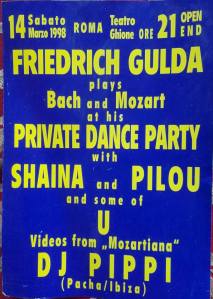
His performances in my theatre in Rome were organised by another remarkable lady who was his agent in Milan:Donatella Brizio.
In particular his performance of the Chopin B minor Sonata will long be remembered by all those lucky enough to have been present
Alexeev now with the same dedication as Eileen Rowe has become one of the most renowned and sought after teachers in the world. A place in his studio at the Royal College of Music is one if the most sought after accolades of aspiring young pianists from around the globe.
And so it was with great anticipation that I came to Victor Maslov`s recital today.
Winner of many prizes and competitions he is now perfecting his studies at the RCM with Alexeev as a Future of Russia Foundation scholar.
Some wonderfully delicate quiet playing that revealed all his early training in Russia.Indeed fingers of steel but wrists of rubber gave a very special sound to this not easy to tame piano.
The Brahms Handel variations suffered,however, from a lack of insistent propulsion and instead of a continuous crescendo to the final triumphant explosion of the original theme we got a series of exquisite episodes.Hampered by some rather fussy rubatos and insistence on finding counter melodies in the repeats we rather lost the overall architecture of this monumental almost orchestrally conceived work.
Whereas Dmitri Alexeev’s totally physical identification with all he plays in which the shapes and sounds of the music are reflected in the movement of his body and hands. Strangely enough above a certain level there was none of this self identification which led to a very brilliant but rather brittle sound. Not the rich orchestral sound world of Brahms. It was this above all that was missing in what has the makings of a remarkable performance.
The massive fugue almost an inevitable release as is the coda of Chopins fourth ballade ,was played with great assurance but a feeling that Victor had not quite tamed the difficult beast set before him.
The little encore of the exquisite Prelude in G sharp minor by Rachmaninov showed off the real artistry of this young musician.
His performance of the 8 Etudes Tableaux op 33 also had some most poetic moments in the quieter passages that abound.
Here again in the sumptuous sound world in the more robust passages the full robust sound was substituted by a very brilliant but again rather brittle sound where he seemed to exclude the very bodily participation that was so unforgettable in Alexeevs performances .
I have no doubt that this young man inspired by his teacher will aspire to the career that he already richly deserves.
Ashley Fripp at St Bartholomew the Great for the City Music Society. Mozart K.311,Liszt Sposalizio,Ravel Gaspard de la Nuit
Quite a surprise to find this church in London by Smithfield Market in the shadow of the Barbican.
The oldest church in London dating back to the 11th Century.
Even the more surprising though was the wonderful acoustic for the lunchtime recital by Ashley Fripp for the City Music Society Young Artists Series .
A wonderful sounding Steinway “D” at the foot of the altar created the ideal situation for some remarkable music making .
Ashley Fripp Gold Prize Winner from the Guildhall and now completing his studies in Florence with Elisso Virsaladze has already been admired in many important venues throughout the world .
I well remember a remarkably poetic performance of the Chopin D flat nocturne op 27 from Warsaw even the more remarkable as it was on a Kawai Shigeru piano!
Unfortunately arriving late for his recital as I had mistakenly made for St Lawrence Jewry the usual venue for the City Music Society concerts not having fully understood this change of venue.
But what a change!
Whereas in St Lawrence the resonant acoustic was not helped by an over brilliant Fazioli piano instead of Sir Thomas Beecham’s old piano that is resident there .
Dinara Klintons remarkably subtle piano playing last year was completely lost in this “church” acoustic .
The change to St Bartholomew the Great was a revelation in that every note could be savoured to the full with just the right amount of resonance that can help an artist create real intimacy in such a large space.
The wonderful sounding Steinway Concert Grand sitting so nobly in the middle of this remarkably ancient building.
Arriving for the second movement of the Mozart D major Sonata K.311 I was completely seduced by the sublime melodic invention of one of Mozart’s most simple and touching slow movements.
In Ashley’s very sensitive hands this movement was allowed to sing and be shaped with such ravishing sounds that filled every crevice of this noble edifice .The very subtle use of rubato and the exquisite ornaments completely won over a very full hall where not a pin could be heard such was the atmosphere and concentration that Ashley was able to capture .
The charm and wit of the Rondeau was played with all the style and virtuosity that one could expect from a disciple of Elisso Virsaladze . But there was more to it than that for there was a personal involvement and sense of character that totally contrasted with the sublime slow movement and that showed a great musical personality that allowed the music to talk so directly with such conviction .
Introducing Liszt Sposalizio – The Marriage of the Virgin – Ashley demonstrated his intellectual involvement that got to the very core of the music and allowed him to interpret it with such meaningfulness.
Some very subtle colours in this very suggestive piece where the terrific technical demands were never allowed to overpower the real musical line.
Gaspard de la Nuit by Ravel ended the programme and as Ashley told his audience it was written by Ravel with the intent of outdoing even Liszt’s Transcendental Studies with the technical demands required by all those that dare tread its waters.
The poems of Bertrand eloquently read by Ashley before each of the three movements to his attentive audience.
The water nymph Ondine can never before have sounded so happy to bathe in these subtle waters created on this occasion
The tolling bell of Le Gibet played with such understatement that it became even more insistent and sinister that usual .
Scarbo played at an almost impossible pace but held together with such breathtaking virtuosity that made one realise how Ravel had indeed succeeded in his mission to out do Liszt.
Some amazing feats of virtuosity from Ashley but always with the most subtle colours and sense of the real character of each piece to the fore as he had so courageously described in the poems read before each performance .
Hin-Yat Tsang at Steinway Hall in London tonight. Some wonderful performances from Albeniz to Bizet taking in Scriabin,Barber and Schumann.
It was fifty years ago that as a first year student at the Royal Academy I would practise there in the evenings hardly able to believe my luck to be there too and to be surrounded by people that loved music as much as I did.
There were some regulars who used to practise almost as much as me and one of these was Eleanor Wong who together with her sister Linda would be there every evening too.
Eleanor a final year student of that remarkable and versatile musician Freddie Jackson who some years later died whilst conducting the Verdi Requiem in the Dukes Hall……what a way to go for a wonderfully dedicated musician.
Eleanor would often knock on my door and ask if she could try out her programmes for up and coming performances in concert and competitions (she won the silver medal at Vercelli) Having just started at the RAM and not used to hearing such fine playing I was bowled over with just the right enthusiasm that helped her in her quest to prepare .
Linda her sister too,a student of another very fine sensitive musician , Max Pirani ,would often play too .
Two Wongs don’t make a right Gordon Green would affectionately quip!
Not in this case for sure .For both were remarkably talented with that inner energy that only comes from real passionate involvement and dedication
All this to say that Eleanor is now founder of the prestigious Hong Kong International Piano Competition with musicians of the calibre of Peter Frankl,Bryce Morrison,Vladimir Ashkenazy and Peter Donohoe on the jury.
She herself is often to be seen on the juries of International Competitions and was last seen on the Leeds Competition of Dame Fanny Waterman (who coincidentally had her 97th birthday today too)
Eleanor Wong has built up an enviable reputation for spotting and training great young talent some of whom then go on from Hong Kong to perfect their considerable talent at colleges in London as she herself had done all those years ago.
Just such a case is Hin-Yat Tsang who has just graduated with honours from the class of Dmitri Alexeev (coincidentally winner of the Leeds Piano Competition in the 70’s)at the Royal College of Music. Now continuing his studies in Berlin with Klaus Hellwig this youngman ,only in his early twenties, will be flying off, after his recital for the Keyboard Charitable Trust , to Barcellona to compete in an International Piano Competition himself.
I could not help but notice many traits of his teacher who had so impressed a young student fifty years ago.
The same inner fire that seems when he is at the piano to exclude all else with his total concentration and involvement with the music.
Even the way he holds his hands and the stillness of his body whilst expressing with discrete facial expressions the varying moods that he is experiencing in the music.
The very complex Humoreske by Schumann `was given a totally convincing performance held strictly under a tight reign but allowing at the same time the music to move and breathe naturally.
Andras Schiff had noted just this in the masterclasses at the RAM where he was very impressed and inspired by Hin Yats interpretation as indeed the audience including some very distinguished musicians at Steinway Hall were witness today.( https://www.youtube.com/watch?v=RdqiQ9VQxrE.)
A nocturne “Homage to John Field” op.33 by Samuel Barber together with his encore of a “Song without words” by Bizet just showed what an inquisitive and informed musician Hin-Yat Tsang is.
The Barber full of the “fioriture ” as in Chopin or Field but translated into the twentieth century sound world of Barber of some quite transcendental difficulty.Thrown off with all the colour and seeming simplicity of art that belies art.
The Bizet was given an aristocratically suave typically french nobility with all the charm that could have been almost of a Chaminade or Poulenc.
Bryce Morrison tells me that Glen Gould, that inquisitive genius ,was the last person that surprisingly he had heard treading these waters.
El Puerto by Albeniz that opened the programme again was given a musicians performance with strong rhythms and sense of line that did not allow these spanish folk idioms to descend into sentimentality.
On the contrary as Alicia De Larrocha has taught us over the years the real passion and tension lies in the rhythm and colours that need only to be played with a simplicity that allows the story within to be revealed in all it moving majesty.
Scriabin’s Sonata Fantasy played with some real technical mastery where the musical line was always allowed to appear and disappear in between the typically virtuosistic spider like figurations that are so much part of this early Scriabin .
All the youthful preparation that had been lain so solidly by Eleanor were now at the service of the music from this remarkable young pianist who we wish well in his undoubted successes on the International circuit.
Hats off to them for founding this Trust whose sole aim is to help remarkable young talents such as on display tonight to find a public with which to share their exceptional performances.
For they know that it is only by playing regularly in public that these young musicians that have dedicated their youth to studying the piano can progress and learn to fly to heights that not even they could imagine.
JamalAliyev and Maria Tarasewicz at St James`s Piccadilly for the Concordia Foundation series of Gillian Humphreys.
Having heard Jamal over the past few years it was splendid to hear how this promising and exceptionally talented young student has blossomed into the great artist that overwhelmed a very attentive audience in St James`s Piccadilly today. Right from the opening work with the Paganini Variations on a theme by Rossini one was immediately aware of being part of a very special occasion. The subtle phrasing,the total involvement and a transcendental control of the instrument where the music was allowed to speak directly to a public completely mesmerised.
Paul Tortelier,who would have been 103 yesterday played it in my theatre with just the same communication and showmanship that it so much part of this encore piece. Jamal playing with just the same weight on a Gabrielli cello of 1752. After such a performance one wondered how he could play anything else afterwards. Helped also by the resonant acoustic and the exquisite playing of Maria Tarasewicz who was with him every inch of the way.
Some beautiful sounds on this very fine concert Fazioli and with the lid fully open such was her musicianship she never overpowered the cello. In fact in the Arpeggione Sonata there was some very fine duo playing in which each of these young artists were listening attentively to each other in a real musical conversation.The seemingly endless melodic invention of Schubert only equalled by Mozart,was given a performance of such eloquence and musicality each player replying to the other in a totally convincing performance. Some exquisite sounds from the piano totally matched the passionate commitment from the cellist.
This same passionate commitment was in evidence in a remarkable performance of the first movement of Dvorak`s cello concerto. The same commitment and nobility that was so much part of Jaqueline Du Pre`s historic performance with Daniel Barenboim in the Albert Hall during the political upheaval forty years ago. Such was the participation of public and performers that the cut in the orchestral part although understandable nevertheless came as a surprise . I am sure that it will be only a question of time before we hear Jamal play this work with the greatest orchestras worldwide.
A transcendental performance from both players of Chopin’s Polonaise Brillante played with great flair and sense of style and colour which characterised this very passionate performance that brought this magnificent concert to a rousing conclusion. Present to share in his success were two remarkable ladies:Gillian Humphreys of Concordia and
Canan Maxton who have followed and helped the progress of Jamal in his journey from an exceptionally talented young cellist to the mature great artist that kept this packed lunchtime audience so enthralled.
JamalAliyev and Maria Tarasewicz at St James`s Piccadilly for the Concordia Foundation series of Gillian Humphreys.
Having heard Jamal over the past few years it was splendid to hear how this promising and exceptionally talented young student has blossomed into the great artist that overwhelmed a very attentive audience in St James`s Piccadilly today. Right from the opening work with the Paganini Variations on a theme by Rossini one was immediately aware of being part of a very special occasion. The subtle phrasing,the total involvement and a transcendental control of the instrument where the music was allowed to speak directly to a public completely mesmerised.
Paul Tortelier,who would have been 103 yesterday played it in my theatre with just the same communication and showmanship that it so much part of this encore piece. Jamal playing with just the same weight on a Gabrielli cello of 1752. After such a performance one wondered how he could play anything else afterwards. Helped also by the resonant acoustic and the exquisite playing of Maria Tarasewicz who was with him every inch of the way.
Some beautiful sounds on this very fine concert Fazioli and with the lid fully open such was her musicianship she never overpowered the cello. In fact in the Arpeggione Sonata there was some very fine duo playing in which each of these young artists were listening attentively to each other in a real musical conversation.The seemingly endless melodic invention of Schubert only equalled by Mozart,was given a performance of such eloquence and musicality each player replying to the other in a totally convincing performance. Some exquisite sounds from the piano totally matched the passionate commitment from the cellist.
This same passionate commitment was in evidence in a remarkable performance of the first movement of Dvorak`s cello concerto. The same commitment and nobility that was so much part of Jaqueline Du Pre`s historic performance with Daniel Barenboim in the Albert Hall during the political upheaval forty years ago. Such was the participation of public and performers that the cut in the orchestral part although understandable nevertheless came as a surprise . I am sure that it will be only a question of time before we hear Jamal play this work with the greatest orchestras worldwide.
A transcendental performance from both players of Chopin’s Polonaise Brillante played with great flair and sense of style and colour which characterised this very passionate performance that brought this magnificent concert to a rousing conclusion. Present to share in his success were two remarkable ladies:Gillian Humphreys of Concordia and
Canan Maxton who have followed and helped the progress of Jamal in his journey from an exceptionally talented young cellist to the mature great artist that kept this packed lunchtime audience so enthralled.
A last minute cancellation led to an improvised concert of great music making from a duo in life as on stage . Michelangelo Carbonara used to play quite regularly in my theatre in Rome as did many other fine students from the Piano Academy of William Nabore in Como. Now a highly respected professional musician he is fast making a name for himself as a fine pianist of unusually refined musicianship. Kyung- Mi Lee a kindred spirit on the cello gave a programme together with Michelangelo of works by Beethoven and Rachmaninov .
Michelangelo completing this improvised concert with a Mozart Sonata for piano solo K.311.Some very refined playing especially in the slow movement where his sense of balance allowed the melodic line to sing with such a beautiful unforced sound that it was hard to believe that this was the same piano that we have heard so many times before in lesser hands.
With his superb ornamentation and sense of line one more than forgave his lack of time in preparing this very intricate work This was a real musician’s work in progress that he chose to share with us and with only a little more time to prepare will become a very special performance indeed.Especially fine was not only his sense of real identification with the character and spirit of this deceptively simple work but above all his real understanding of the style.
The two G minor Sonatas for Cello and Piano ( or should it be Piano and cello?) by Beethoven op 5 n.2 and Rachmaninov op 19 showed off all their innate musicianship. A duo which signifies, as Menuhin would say, of mutual anticipation A musical conversation in which the two performers listen to each other and are more interested in the whole than in their own very difficult parts. A real case in point was the slow movement of the Rachmaninov where the sumptuous opening on the piano was totally incorporated and intertwined with the cello . Rarely have I heard such an integrated performance of the Allegro scherzando where the two instruments were united as one .
The intricate piano figurations in the first moment like silver to the wonderful sumptuous sounds from Kyung- Mi’s cello . The Beethoven was a real lesson in style from the opening dotted rhythms on the piano to the wonderful melodic lines that followed.The last movement at an irresistibly right tempo to bring this early masterpiece to a brilliant conclusion . An encore of the beautiful slow movement from Chopin’s cello sonata brought an evening of rare music making to a close.
Paavo Jarvi and Leonidas Kavakos with the Orchestra of Santa Cecilia at the Parco della Musica. Bartok Dance Suite Sz77 and 2nd Violin Concerto Sz122 and Brahms second symphony op73
Ovation not only from the public but above all from the orchestra What more can one say?
A pleasure to see that great cellist Luigi Piovano savouring every note as he led the cellist into the sumptuous world of Brahms.
A hard driven performance of the Second Symphony by a real kapellmeister along the lines of a Bohm or Jochum in which a real sense of line gave all the necessary time to allow Brahms’ music to speak for itself without any sentimentality or exaggeration.
Great sense of balance too in which the magnificent brass section were always part of the great line being created before our eyes. The exchange between the woodwinds and strings was pure chamber music .
Missing the spiritual magic and some of the real warmth of a Walter or Pappano.It was,however, a remarkable performance always kept on a tight reign that allowed the orchestra to ride so naturally on these long lines and play with all the warmth and mutual anticipation that has been so much part of the Pappano era .
A difficult first half of Bartok . The Dance Suite amazingly written in 1923 where all the dance rhythms were fully characterised by this highly professional and esteemed conductor taking us into this extraordinarily revolutionary sound world.
Kavakos ,quite rightly taking the world by storm with his seemingly effortless perfect violin playing .Musicianship to the fore and amazing feats of concentration between violinist,orchestra and conductor in the second violin concerto of 1939.
Missing some of the savage naked emotion of the Hungarian gypsy tradition nevertheless was given an amazingly assured performance from all concerned .where again the musical line was paramount . No mean feat for such a complex work .
An exemplary performance missing the warmth and soul of a Menuhin who was one of the very first to realise and help the suffering genius of this still rarely played composer.
An encore for Kavakos of a movement from a Bach solo suite on his wonderfully rich sounding “Abergavenny”Stradivari violin.
Played almost without vibrato in the true baroque tradition but with a sense of shade and colour that showed all the transcendental virtuosity and real musicianship of who must be today one of the finest violinists before the public.
Grande Goldberg al Parco della Musica ieri sera con un Beatrice Rana in un vero stato di grazia.
Un ora e mezza in un silenzio totale in una sala gremita.
Era anche trasmesso in diretta sulla radio e registrato per futuro visione per televisione. Un tour de force per una ragazza appena compiuta 24 anni.
Strano come quasi tutti i piu grandi interpreti dei Goldberg sono donne da Tureck,Nikolaeva, Hewitt e adesso a questa illustre lista si puo aggiungere Beatrice Rana.
They say that miracles never strike twice in the same place .
Well Beatrice Rana proved them wrong last night with a miraculous performance of the Goldberg Variations in a sold out hall in Rome.
Only just 24 years old she gave as near perfect performance as I have ever heard.
For an hour and a half holding the complete attention of this vast audience.
Not only those fortunate enough to find a ticket but for all those listening live on the Rai Radio 3. Also to be televised by RAI 5 ,the cultural channel ,this was an even more remarkable performance than the one she gave just three months ago for the BBC at the Wigmore Hall.
Gone were some of the rubatos that a young pianist can be forgiven for doing in their genuine quest to find the maximum expression in this monumental work.
Already in three months that same expression is now inside the notes.
It was as though the long journey with this work,for her teacher Benedetto Lupo tells me she learnt it with him as a girl, she was inside the very bones of this masterpiece written by Bach for the insomnia of Count Kaiserling.
The Count had asked Bach to write for his pupil Johann Gottlieb Goldberg ,who lived in the Counts house,”some klavier pieces which should be of such a smooth and somewhat lively character that he might be a little cheered up by them in his sleepless nights.”
Bach was never so rewarded for one of his works as for this.The Count presented him with a golden goblet filled with 100 louis-d’or.
No goblet for Beatrice last night but a ten minute ovation from an audience that had barely dared to breathe such was the concentration generated.
A performance that was without interval by this charming young musician in a flame red dress.
The return of the Aria after the Quodlibet was absolute magic with a total control of sound even in the almost inaudible whispered final breath.
Virtuosity abounded as in her extraordinary clarity and precision in the 5th Variation taken at an extraordinary pace but totally convincing because of the rock steady tempo she managed to maintain .
The 29th variation was not quite so rock steady in her quest to arrive at the ultimate explosion of the Quodlibet where Bach unites two folk- songs :”I’ve not been with you for so long,Come closer closer,closer,closer” and “Beets and spinach drove me far away.Had my mother cooked some meat,then I’d have stayed much longer”.
I remember Tureck too was not so rock steady in this variation which is understandable with the build up of tension over such a long span .
So much to admire in her intelligent and tasteful understanding of ornamentation also the rock steady pulse that she was able to maintain throughout with a remarkable sense of colour that revealed a true mastery .
A mastery that is easy to appreciate, but nevertheless remarkable for a twenty year old girl from the south of Italy,in the Tchaikowsky and Prokofiev Concertos that have been so admired in her CD with Pappano .
This is true mastery where art conceals art .
She joins that select group of women, Rosalyn Tureck, Tatyana Nikolaeva and ,Angela Hewitt who have made the Goldbergs their own.
Hats off to Benedetto Lupo who has been her guide and mentor from her early beginnings in Puglia a land blessed by the Gods indeed.
Lecce the wonderful spanish baroque city known in fact as the Florence of the south .
Interesting to note that pulling out my score of the Kirkpatrick edition a programme fell out of another memorable performance .
That of Rosalyn Tureck in 1972 when she played the Goldbergs twice in the same evening at the Festival Hall in London . First on the harpsichord and second after an hour interval,on the piano.
Interesting to note in her programme notes: The justifiable performance of Bach on the piano is conditioned by the usage of pianistic devices.This instrument,known by Bach in its early stage,has evolved through several centuries ,its style changing with each era. It is capable of many styles of sonority and technique. If played ” pianistically”,meaning 19th and early 20th century style,it is anachronistic.
However,in performing Bach on the piano I do not play the instrument in this former pianistic style.
I employ an entirely different technique and touch.
Music and instrument treated with respect and knowledgeable art,the integrity of the music should stand,retaining its clarity,its structure and its infinite significance to the human spirit.
Rosalyn who repeated the Goldbergs in my theatre in Rome in 1991 after a twenty years absence fom public performances to enable her to concentrate entirely on her studies of Bach in Oxford. Known by Harold Schonberg as the ” High Priestess of Bach” and as Artur Rubinstein quipped: “Tureck made Bach box office” .
I am sure if they were looking on tonight they would have a wry knowledgeable smile on their lips as they saw how this vast public devoured the performance of the young lady in the flame red dress.
Paolo Restani at Viterbo University today for Prof Franco Ricci’s Saturday Concert Series.
It was in 1980 when I drove the car to Naples from Circeo where I was on holiday on the chance finally of listening to the masterclass of Vincenzo Vitale at the Villa Pignatelli.
A legendary name as was that of Vincenzo Scaramuzza who transferred to South America where he founded the famous school that has produced such artists as Martha Argerich,Nelson Freire and Bruno Leonardo Gelber. All with its origins in the famous Neapolitan School of piano playing of Florestano Rossomandi Vincenzo Vitale his teachings of piano technique as that of Pierre Sancan would be discussed at length by us students. Vitale whose students included Bruno Canino , Michele Campanella,Laura de Fusco,Carlo Bruno,Francesco Nicolosi,Sandro De Palma,Franco Medori and Riccardo Muti amongst many other brilliant pianists. The fifteen year old student playing a fabulous “Feux Follets”,one of the most tortuous pieces by Liszt, was Paolo Restani who I was listening to today thirty eight years later.
Vincenzo Vitale students are immediately recognisable by the crisp clear,clean use of the fingers like perfect little hammers somewhat to the exclusion of the warm rich natural sound of the Matthay school. Of course technique is only a means to an end as the superlative musicianship of Canino is testimony.
Strangely enough Vincenzo Vitale,a former student of Alfred Cortot,only spoke of musical matters in his masterclass.Obviously preferring to talk about technical matters in the privacy of his studio
Paolo Restani presented a programme in Viterbo showing off the glorification of the Vitale school of highly professional piano playing glorified in fact in Michele Campanella’s 50 anniversary this season in the University Season. A programme based on short virtuosi studies and preludes obviously with the Viterbo public also in mind. The three largest pieces were in fact Debussy L’Isle joyeuse the Chopin A flat Polonaise and the Liszt Spanish Rhapsody. Passing through a selection of Rachmaninov Preludes op 32 and some Chopin and Liszt studies.
All played with an ease on a piano that was rather too small to accommodate such an overpowering technique. Some beautiful moments though in Chopin’s op posth Nocturne and Debussy’s suggestive “La plus que lent”.Not always following the composers markings though most notably in Chopin’s “Revolutionary “study where the dramatic difference between forte and piano was not put in evidence also some ingenious fingerings that were certainly not Chopin’s!
All presented with a conviction though and sense of communication that held his audience spell bound until the ovation at the end. A generous encore of the Liszt Rigoletto paraphrase that I had just read on a quick visit into the centre of Viterbo that the Verdi opera was presented due to Papal censorship under the different name of Triboletto in the beautiful Teatro dell’Unione, another of Italy’s beautiful theatres the opens and closes with alarming regularity.
A mad dash to the station at the end by this Lisztian figure who had so captivated the Viterbese public to catch his last train back to the Eternal city where he repeats the programme tomorrow.
Interesting concert at my local conservatory in Latina
Maurizio Bignardelli a distinguished professor for 23 years at Latina Conservatory and a curriculum full of important engagements. It is nice to think that one of those concerts was in the Ghione theatre almost thirty years ago.When a brilliant young flautist was keen on making his debut in Rome . Maria Paola Manzi a student of our much missed Lya De Barberiis. Now also a distinguished teacher in her own right. How many musicians have been formed by the remarkable Lya De Barberiis with whom I had a piano duo for many years until her death a few years ago when she was well into her 90’s An interesting programme to say the least introduced in a very informative and professional way by one of Maurizio’s prize students,Emanuele Demartis.
Sonatas for flute and piano by two names that have passed into history as the finest piano virtuosi of their day:Robert Casadesus and Walter Gieseking
Who could have imagined that I would have to come to Latina to hear the Sonata op18 by Casadesus and the Sonatina 1937 by Gieseking
Impeccable performances from two fine musicians before an attentive audience completed with Drei Tanz Improvisationen and the famous Strauss transcription of Standchen for solo piano that gave the flautist time to prepare between the two very complex sonatas. Nice to think that the fine formation of these musicians is now allowing them to share this serious ,inquisitive musicianship in smaller venues throughout Italy via the smaller but no less important Conservatories that abound in Italy.
Latina Conservatory that thanks to their enlightened and passionate musical staff can boast a Symphony Orchestra formed by the professors,professional musicians from Rome but above all the most talented students. Designed to give much needed orchestral experience to the highly trained students who are given the opportunity to play in the magnificent Teatro D’Annunzio.
A theatre built in the Mussolini era when workers were brought down from the venetian area to drain the Pontine marshes and transform them from malerial swamps into the most arable land capable of providing food for the nearby Rome. A theatre in the rationalist architecture that has become part of Italy’s artistic heritage. Also its heritage is the political bickering in these parts that means that this much needed theatre opens and shuts with alarming regularity. It reminds me of the Don Camillo books that I used to devour as a child in West London. Politics should never enter into this world but as Roman times onwards has taught us administration of public monies can lead to all sorts of temptations and misunderstandings. The prisons are filling with administrators that not always have the idea that public purse is for the welfare of the popolulation and not their own small world. Human nature does not change even in this beautiful unknown part of Italy “baciato dal sole”. In fact the ancient Romans were the first to take note as the ancient remains that abound in these parts can testify The next concert by the Latina Respighi Conservatory Orchestra is on the 17th March under its very fine conductor, formed at the school of the legendary Franco Ferrara,Benedetto Montebello. Lets hope the political bickering will have calmed down to allow this remarkable musical activity to continue and flourish. The summer has been taken up for the past fifty years since Menuhin and Szigeti found the beautiful hillside town of Sermoneta,with the masterclasses and concerts of the Pontine Festival by some of the finest musicians from Hollinger,Kempff,Rosen,Navarra,Filippini,Giuranna,Petracchi and Canino to Virsaladze in the present period . Sermoneta with the Caetani Castle where Liszt used to come to discuss composition with the composer Roffredo Caetani .
Liszt’s piano is still in the historic world famous gardens of Ninfa at the foot of Sermoneta . Sir William Walton and his wife Susanna used to pass by regularly on the way to their home on Ischia to admire and copy these gardens justly famous world wide as the Waltons gardens at la Mortella have since become The hills around here are certainly abounding with the “Sound of Music”.