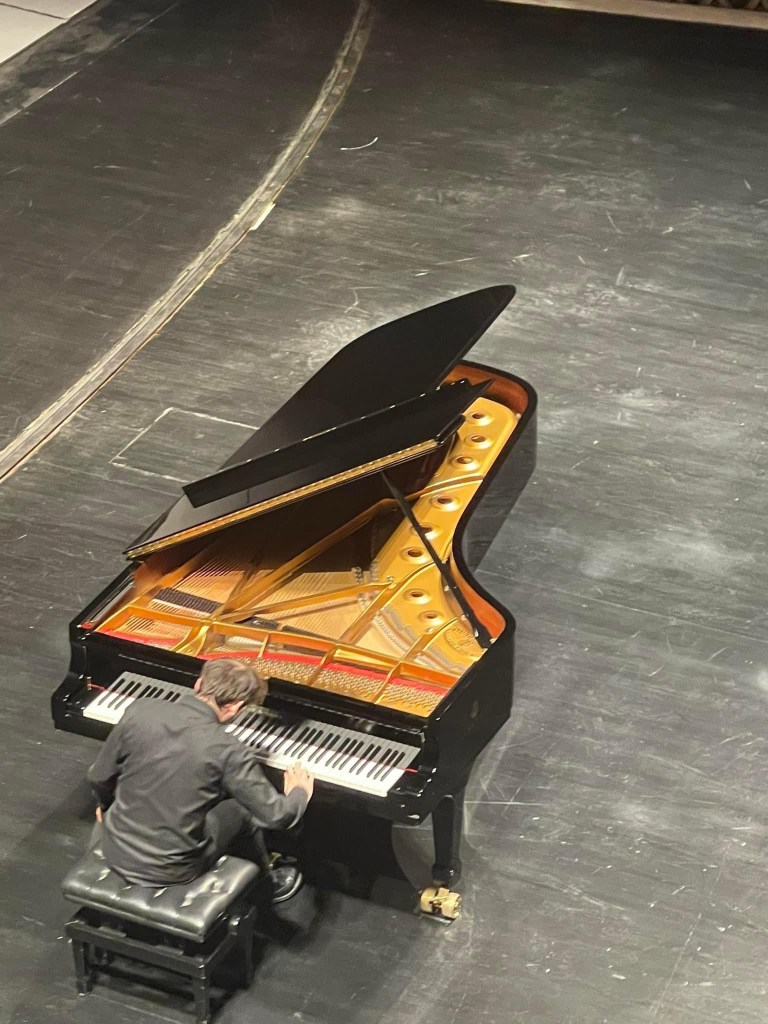
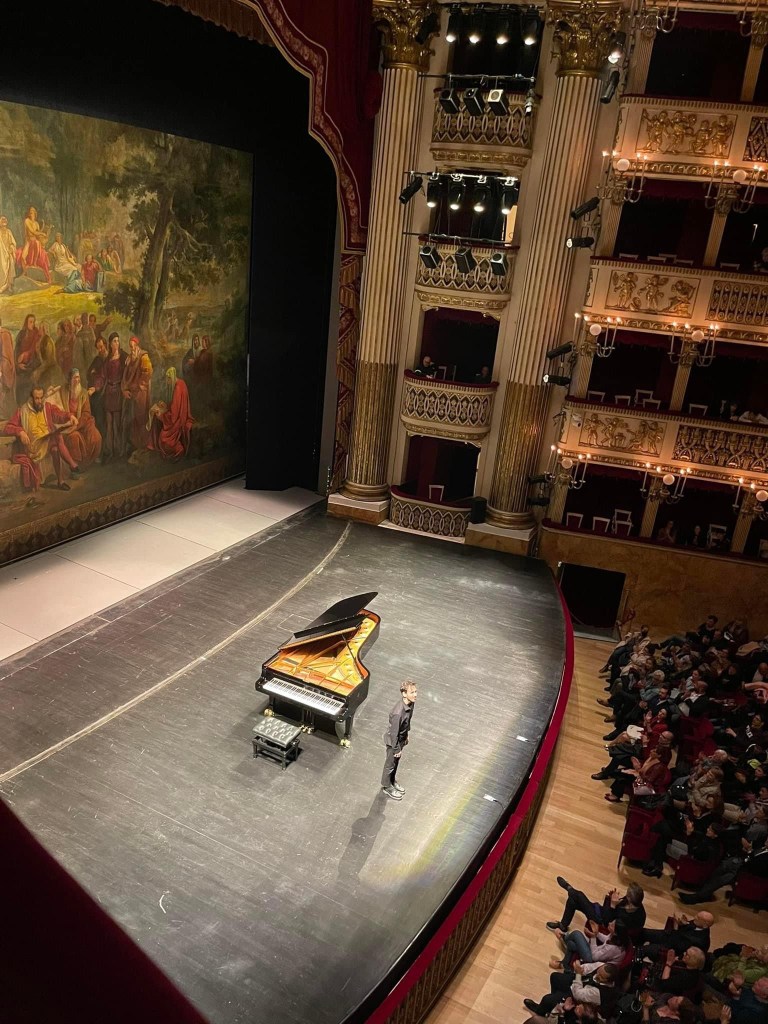
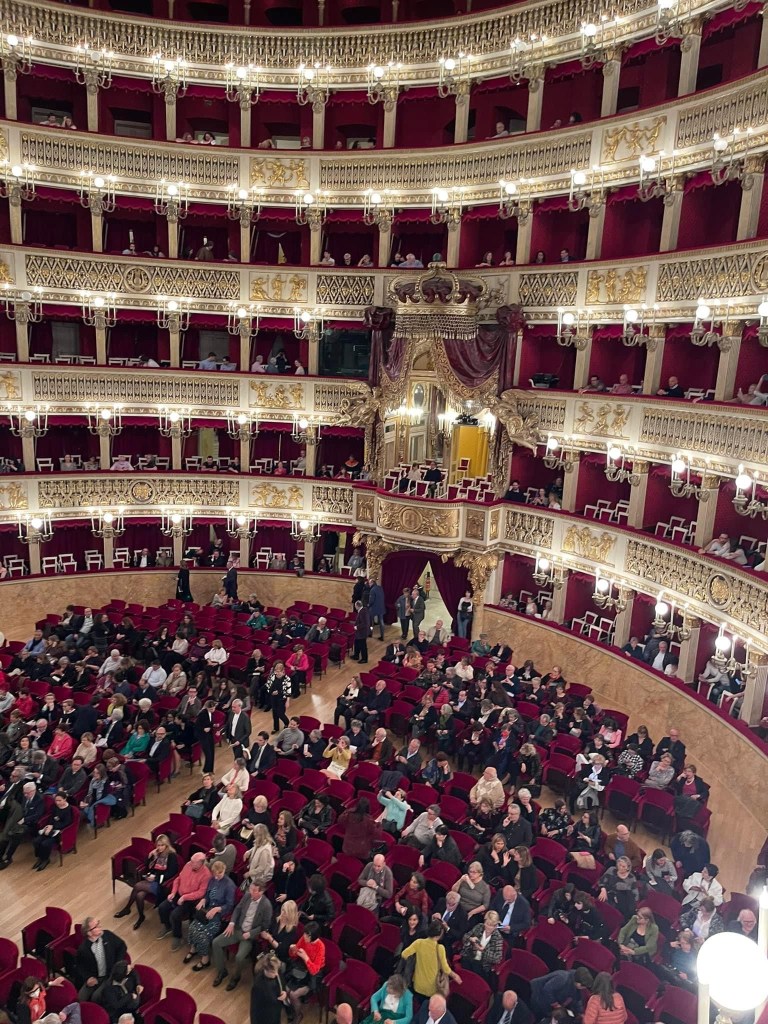
Cremona Musica ….2023 Day 2 Angelo Fabbrini the crowned Prince of Cremona

Angelo Fabbrini ‘Una Vita per la Musica’

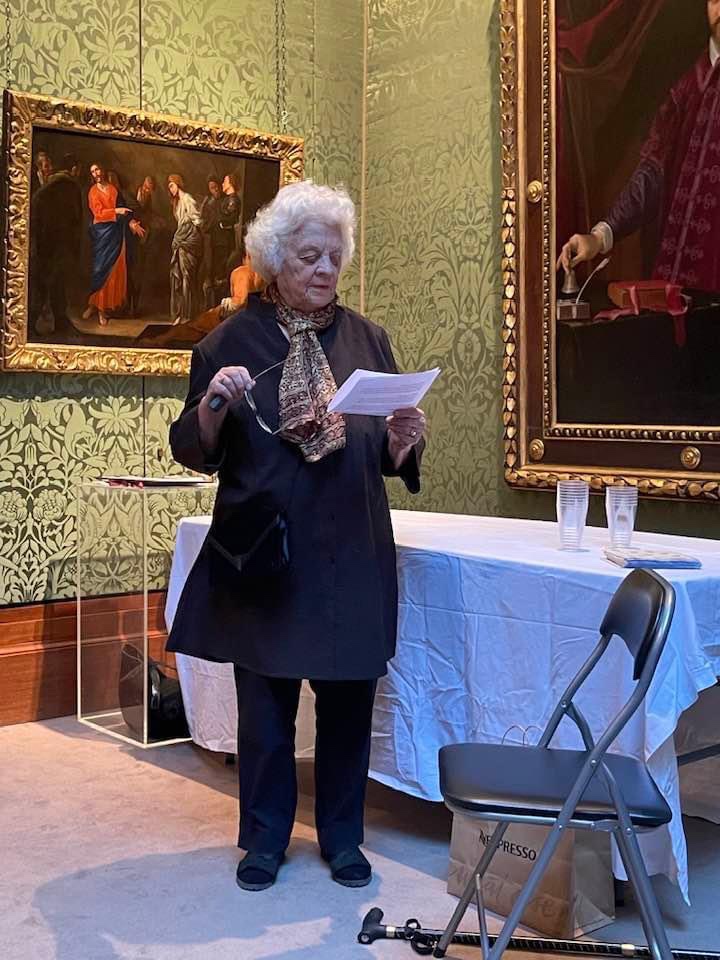
What a wonder it was at the end of a long day to hear Angelo Fabbrini telling us of his encounters with Michelangeli and Magaloff and to experience the extreme modesty of a man who has symbolised integrity,honesty and passion for so many great pianists of our time as they relied on him to turn their dreams and wishes into a possibility.The greatest of compliments from Magaloff as he came off stage and thanked Fabbrini for allowing him to play without being aware of the mechanics of the piano.Or Michelangeli asking why he had not told him of the birth off his son and would he consider him as Godfather!Michelangeli too asking for the seemingly impossible and Fabbrini replying my name is Angelo not Michel angelo!But Angelo he is knowing that the artist knows what he is looking for and with great respect and much work Fabbrini was always there to provide it.A wonderful man who was crowned with the highest honour of Cremona Musica at the Museo del Violino Saturday evening

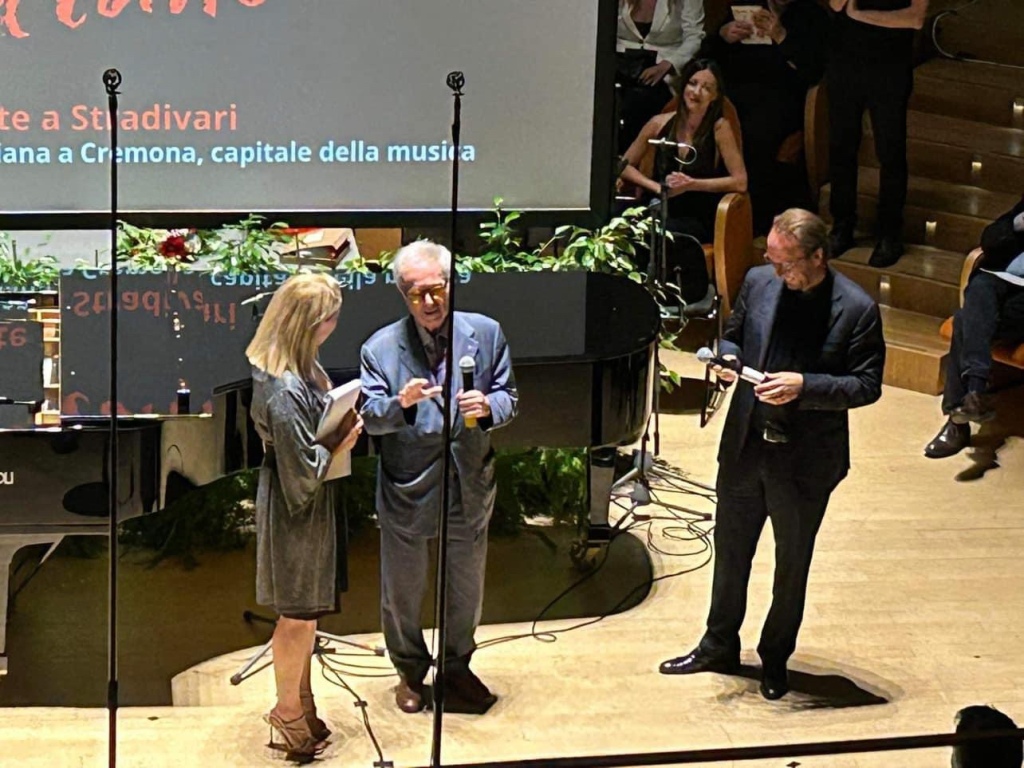
Valentina Lo Surdo and Roberto Prosseda with Angelo Fabbrini

The day had begun on the bus taking us from the Hotel in the centre of Cremona to the Exhibition Centre.It was on the bus too that one could encounter the most interesting people in music from every corner of the world .Discussions about conducting with the renowned Finnish conductor Atso Almila in Cremona to talk about the remarkable Finnish Conducting School.Jed Distler telling us in a most amusing way the encounters he has had with musicians via their recorded performances that he writes about and also talks about in his New York Radio programme : ‘Beyond the Keys’.A discussion about pianists and competitions with Eric Schoones of ‘Pianist Magazines’ in the Netherlands.He is here to present the German edition of his book ‘Walking up the Mountain Track :The Zen Way to Enlightened Musicianship’.The title taken from a book that for Glenn Gould was the Bible.Danieli Longo flown in especially from Rio to talk about her teaching experiences in the Conservatory there .Also Paolo Bartolini founder of the Rites of Spring Music Festival on Long Island – Paolo like Roberto was born in Latina and brought up on the Campus Musicale di Latina and the Ghione Theatre in Rome.All this before the gate to the fair opens at ten o’clock!

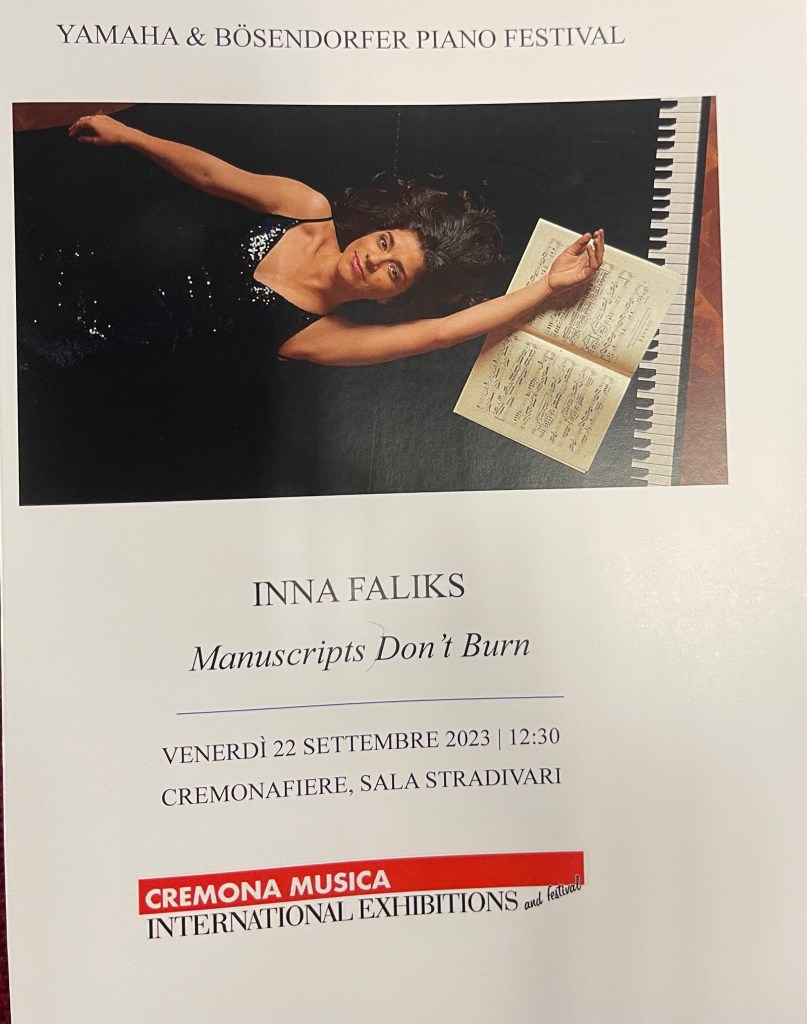
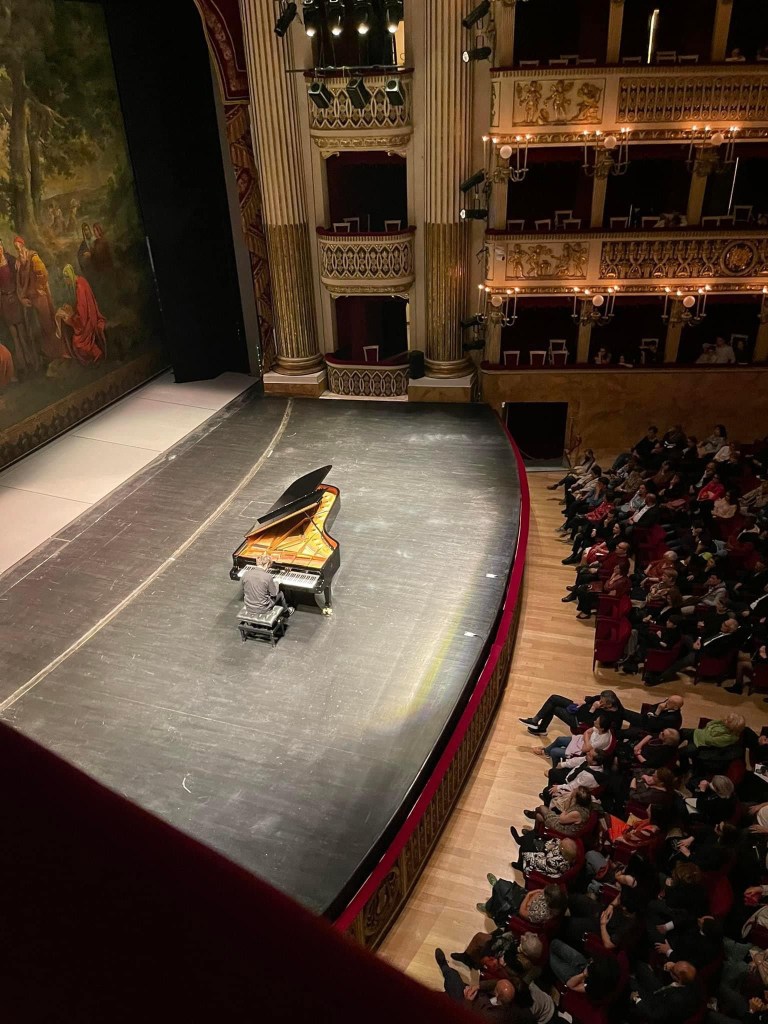
A birthday treat for Inna Faliks organised by her great friend Jed Distler after a long day where she and Boris Petrushansky were part of the jury of the Piano Link International Amateurs Competition.In the beautiful Teatro Ponchielli an 8 hour journey for ten carefully chosen pianists who in spite of not being professional musicians have never lost their passion for the piano
The jury of the Piano Link Competition in Teatro Ponchielli
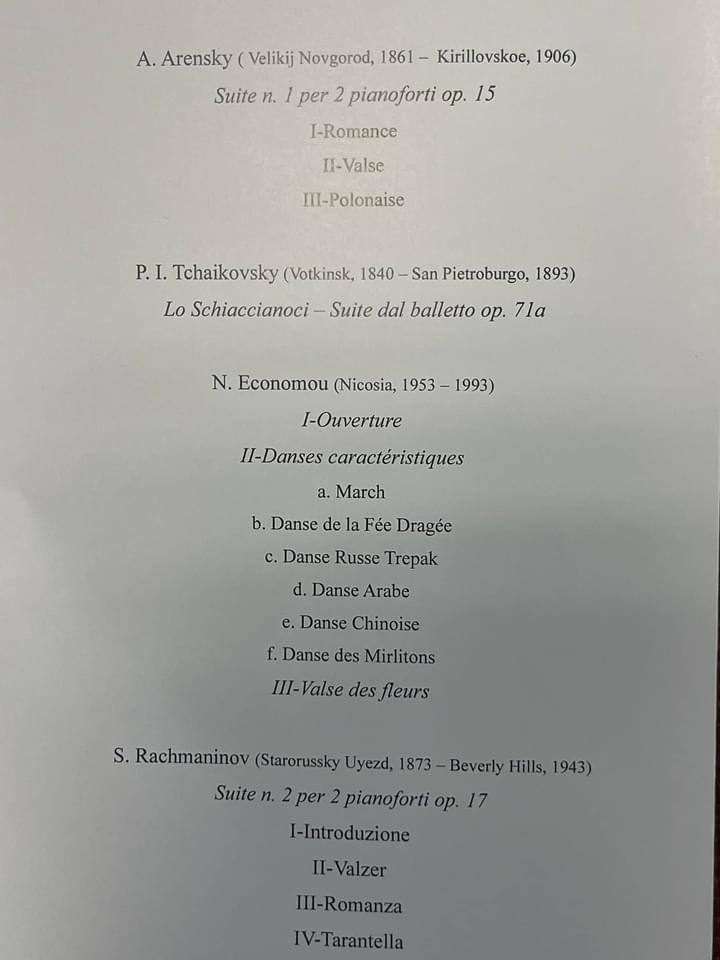
What a way to start the day with two wonderful pianos played by two superb pianists.A programme of popular classics including a transcription of the Nutcracker by Nicholas Economou .I had heard Economou play it in a festival he had organised many years ago at La Fenice in Venice.It was a three day festival and he had played this work with Martha Argerich on the first day .We were performing a play in Venice and could only get to the second day when Martha was long gone.Economou was a very fine pianist and very good looking young man.He came from a well to do family in Cyprus where he was killed in a road accident in his sports car.Very interesting to hear this arrangement as we are used to hearing these days only Pletnev’s for solo piano.The Danse de la Fée Dragée was played with some magical colours as was the Danse Chinoise but it was the Valse des Fleurs that stole the show .It was the waltz too of the Arensky Suite that was ravishingly played as was the intrepid Rachmaninov Waltz.Gesualdo was awarded third prize at the Busoni Competition in 2009 and it is good to see him teamed up with an equally fine musician .Listening carefully to each other they played as one even though they played on two completely different instruments ,Bosendorfer and Yamaha,but they managed to match the sound in a remarkable way.

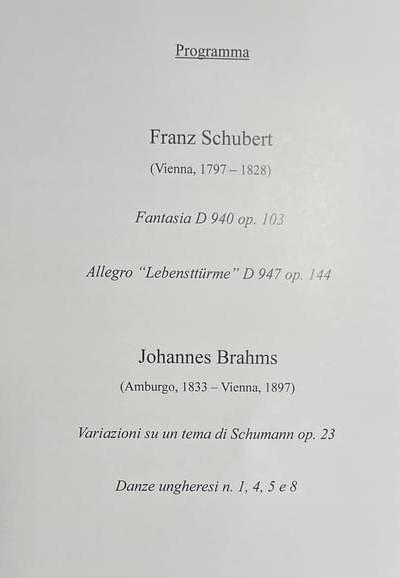
In the same hall a little later in the day there was another piano duo but this time four hands on one piano.Two beautiful twins,Eleonora and Beatrice Dallagnese,playing the Yamaha concert grand in a programme completely from memory.At only 23 like the Jussen brothers they are dedicating themselves to a duo career playing without the score which gives a freedom to interact as the music evolves so naturally without being tied to the printed page.Some beautifully delicate Schubert with a sense of architectural shape that was the same that they were to demonstrate in the Brahms Schumann Variations op 23.Four of the better know Hungarian dances allowed them to let their hair down,metaphorically speaking ,as they squeezed every bit of charm out of these works that they played with an intoxicating style and rhythmic energy.A fifth Hungarian dance was a present they were happy to share to a very enthusiastic audience.

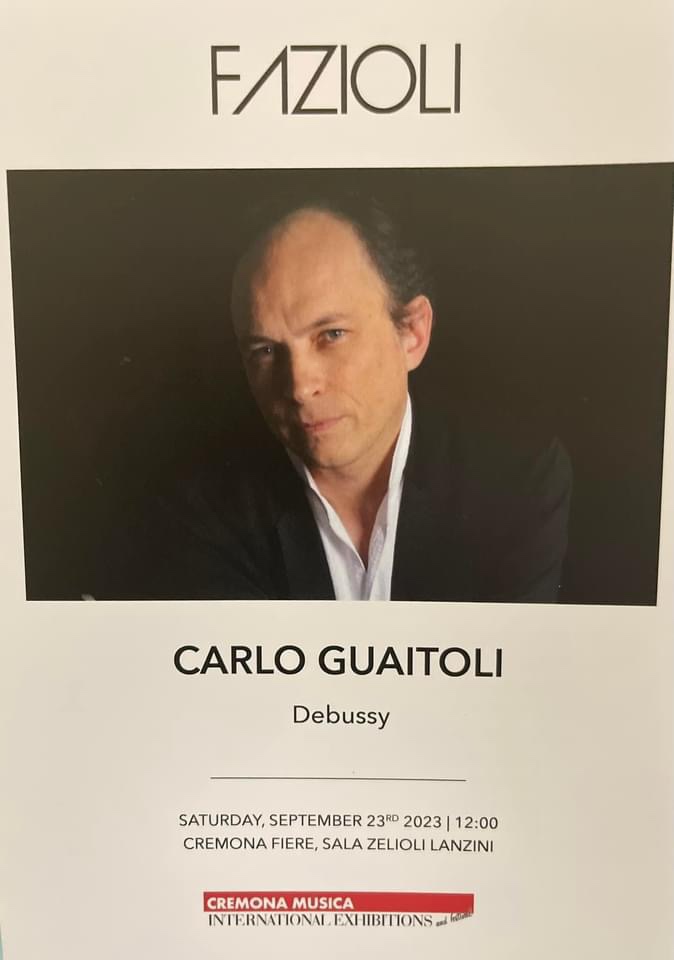
Carlo Guaitoli’s recital of Debussy included the Second Book of Preludes and were played with great character and ravishing sounds.Has ‘General Levine’ ever signed off so surely?Or ‘Ondine’ getting up to her mischief in such ravishing waters.’Canope’, Fou Ts’ong’s favourite prelude,created such desolation before the beauty and precision of the alternating thirds prelude.’Feux d’Artifice’ was a true tone poem with the Marseillaise rising out of the distant mist at the end after the sheer exhilaration of the fireworks on display.Carlo is now the Artistic Director of the Casagrande Competition and it is good to see the rebirth of such a noble competition by an artist of Carlo’s stature.I remember the first editions in which my teacher Vlado Perlemuter was on the Jury together with Paul Badura Skoda.A great tradition overseen by Adriana Casagrande,the daughter who looked after the jury and competitions with such care.A 16 year old Alexander Lonquich created quite a stir when he won first prize.Perlemuter was very amused to see Badura Skoda on stage tuning the rather out of tune piano himself!Carlo a student of Sergio Perticaroli ,the 1952 winner of the Busoni Competition, who died after a long illness that had left him paralysed.He had the misfortune to eventually die in mid August and Carlo and I were the only people there to salute a great artist who had given so much to so many aspiring young musicians.

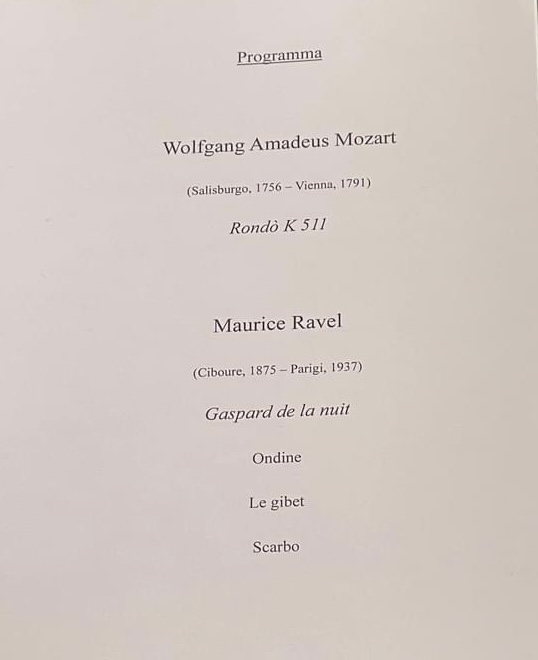
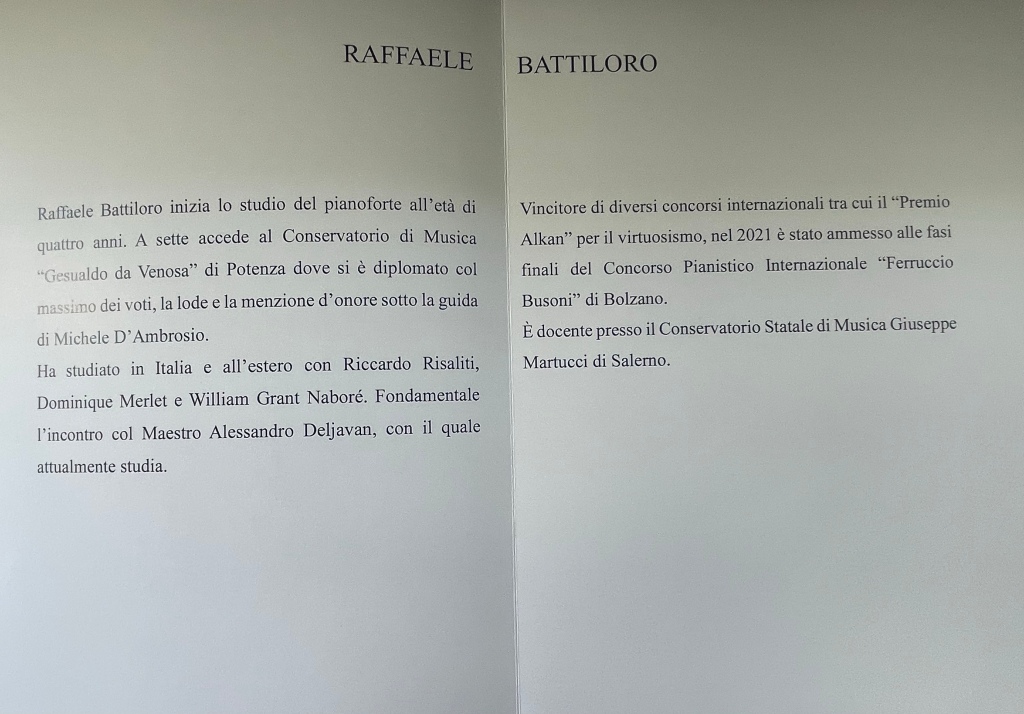
Raffaele Battiloro looking like a romantic hero from some fiction,played on Fabbrini’s Bechstein finding some ravishing sounds in Mozart’s A minor Rondo.It was played with great style as you would expect from the school of William Naboré.Now studying with Alessandro Deljavan,an ex student of Naboré who created quite a stir in the Van Cliburn Competition for his individual style that was much appreciated by the rapturous reception he received from the audience. Raffaele too plays with a freedom that can sometimes loose control as his fiery temperament is allowed to take precedence over his head .It lead to some very exciting playing of Scarbo where he was pushed to the very limit of his control.Le Gibet,on the other hand,was played unusually slowly but with remarkable control of sound that was beautifully sustained.Ondine was ravishingly played with delicacy and a sumptuous sense of balance.The long sustained pedal at the end where Ondine’s whispers could barely be heard before the final explosion as she plunges back into the water and swims away into the distance.

The Purcell School comes to Cremona with their director Paul Hoskins ready to take part in the ‘ Beyond Erasmus’ round table discussions.Together with Menuhin and Chethams,the Purcell School is the most important institution for aspiring young musicians in the UK ,where musical training goes hand in hand with academic studies .William Fong ,head of keyboard studies ,had brought with him two ex students Kira Frolu and Thomas Kelly .It was a programme of three works all written at the beginning of the twentieth century.Kira Frolu,now studying at the RAM with Tessa Nicholson,played Mac Dowell’s Fireside Tales op 61 with ravishing sounds and the unmistakable ‘American’ sound of MacDowell .She brought a sense of character to the six short pieces that ranged from languid beauty to rhythmic good humour and even incorporated capricious jazz idioms ending with the long hymn like outpouring of ‘By Smouldering Embers’.A beautiful performance of ‘Estampes’ by William Fong who despite his onerous teaching commitments at the Purcell School and the Royal Academy manages to maintain playing of the highest order.Thomas Kelly ,now at the RCM with Dmitri Alexeev,is fast making a name for himself as the Ogdon of our day.He played the 16 Variations and Fugue by Rebecca Clarke that was written whilst she was a student of Charles Villiers Stanford and discovered in the archive only in 2003.

Tom Kelly finding a place to practice .Little did anyone know he was practicing Brahms B flat Concerto that he has to play as soon as he gets back to the UK!

Thomas Kelly at the National Liberal Club The ‘outrageous’ virtuoso with a heart of pure gold.

A charming and fascinating encore of six hands on one piano with Percy Granger’s ‘Zanzibar Boat Song’ in which William Fong also managed to turn the pages ,showing yet again his extraordinary versatility.
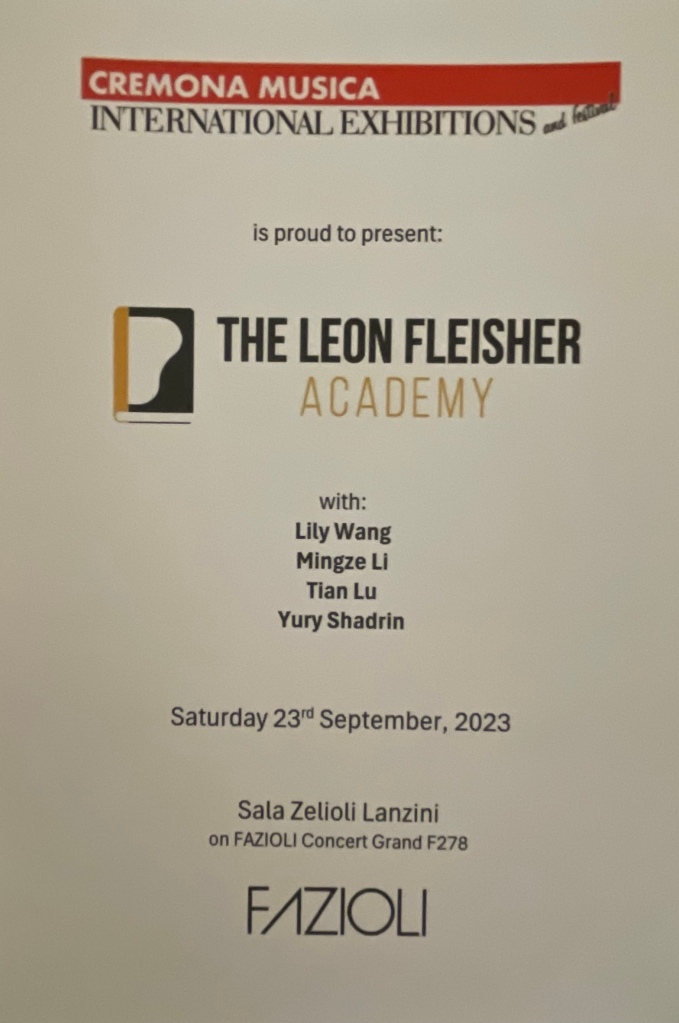
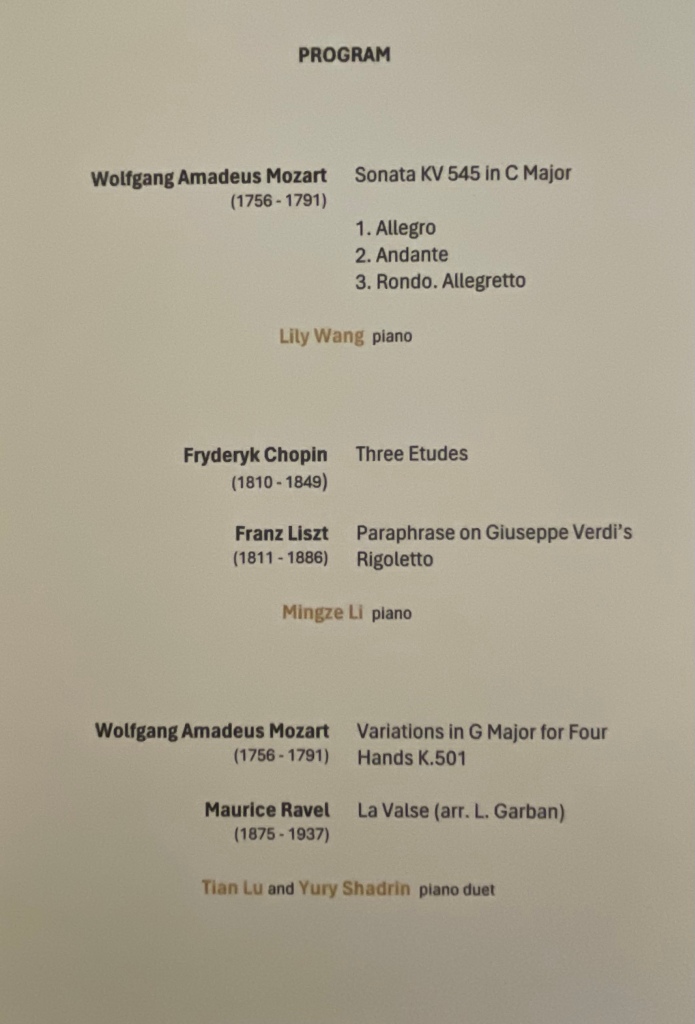
Yuri Shadrin and Tian Lu ,former students of Leon Fleischer,who taught in Baltimore for the last 12 years of his life.The school started 8 years ago with the idea of training children from an early age to give a solid technical background to students should they wish eventually to pursue a career in music.
Lily Wang ,six years old .
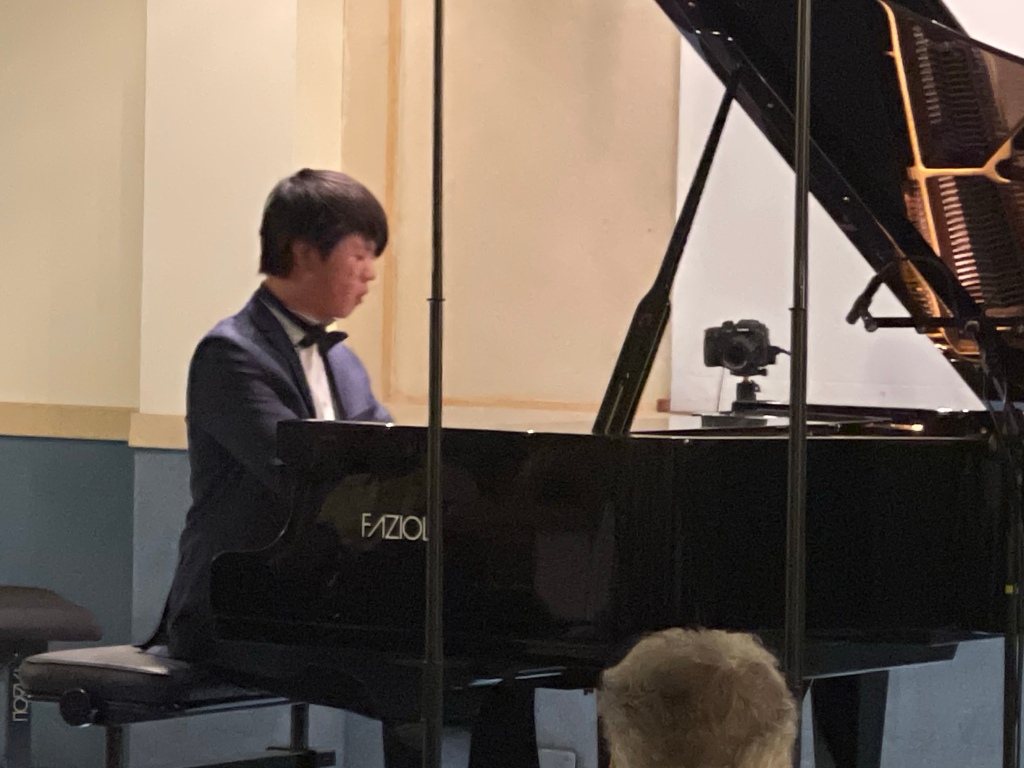
Mingze Li ,fourteen years old
The Piano Experience restoring historic pianos
Maestro Fabbrini standing in front of some of the archive material from a life dedicated to helping and assisting the greatest pianists of our time.
The magnificent volunteer helpers in Cremona lead by Valentina Lo Surdo
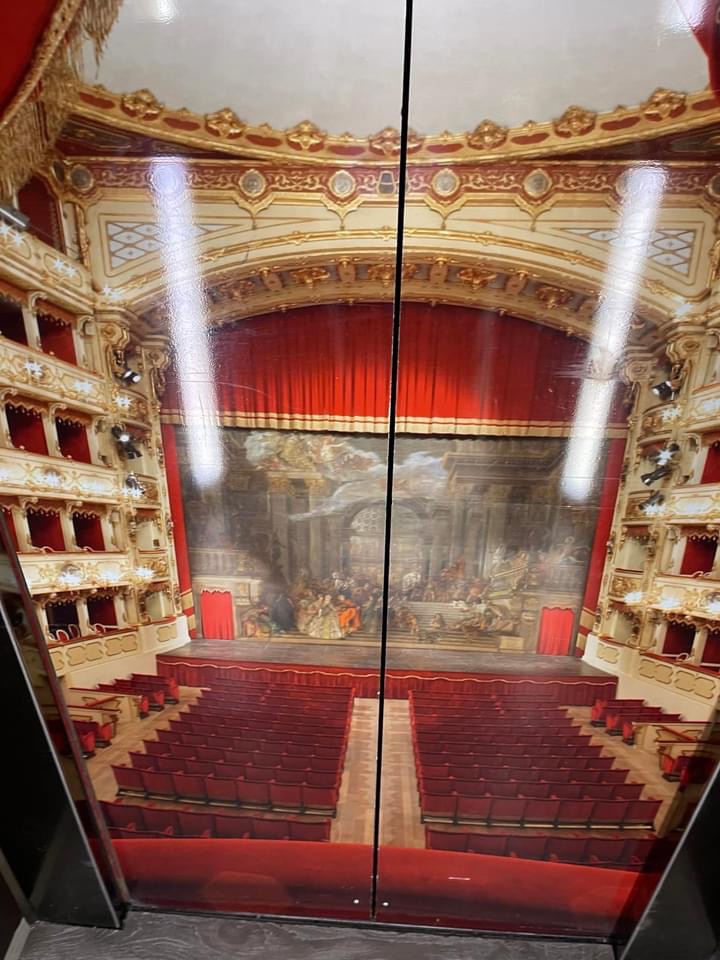
The lift doors in the Hotel Impero showing the inside of Teatro Ponchielli Premi speciali:
Premio Cremona Musica – Premio del pubblico
Friendship Award — Sarà attribuito il Premio Speciale Friendship Award 2023 al/la pianista che avrà ottenuto il maggior numero di voti da parte di tutti i concorrenti del concorso. Ogni partecipante sarà invitata/o ad esprimere una sola preferenza tra tutti i concorrenti di entrambe le categorie.
Giuria:
La Giuria del PianoLink International Amateurs Competition è composta da rinomati pianisti ed esponenti del panorama musicale internazionale
Boris Petrushansky (Russia), Presidente
Maurizio Baglini (Italy)
Inna Faliks (Ukraina)
Nareh Arghamanyan (Armenia)
Patrick Jovell (Sweden)
Sono ammessi al Concorso tutti i pianisti amatori di ogni nazionalità e provenienza nati prima del giorno 1 Settembre 1992, che non siano pianisti professionisti o che non lo siano più da almeno 10 anni. Si intendono pianisti professionisti coloro i quali svolgano attività pianistica concertistica e/o didattica pianistica remunerate. Si considera pianista amatore chi svolga la propria attività pianistica al di fuori del proprio ambito professionale, avendo conseguito o meno di un titolo di studio musicale. Sono ammessi al Concorso i pianisti amatori che svolgano attività professionale nell’ambito dell’insegnamento musicale, purché relativo a materie e/o strumenti musicali diversi dal pianoforte.

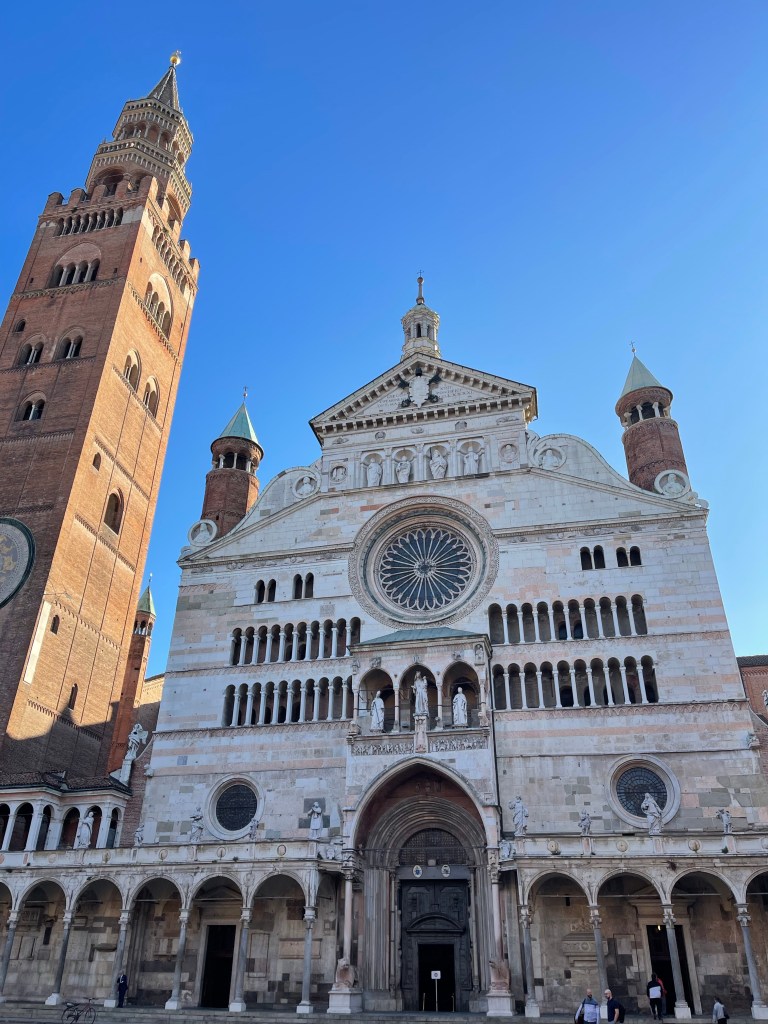
Cremona a city where passions are ignited and shared and dreams become a global reality ….2023 Day 1 – 2 and 3

Another amazing edition of Cremona Musica with three days dedicated to all forms of music .Creating a link without barriers between people who have a passion for a means of communication where words are superfluous.Music is indeed the food of love and unity between man and in Cremona it is playing on with a gentle insistence that is being noted by a world hungry for quality and not just quantity.

Cremona Musica ….2023 Day 2 Angelo Fabbrini the crowned Prince of Cremona

Cremona Musica ……2023 Day 3 The day of reckoning

The success of Cremona Musica 2023:

the Italian way between tradition and innovation

The numbers of the 2023 edition of Cremona Musica International Exhibitions and Festival, which took place in the international capital of lutherie from September 22nd to 24th, witness the success of the Italian kermess: 360 exhibitors, over half of which from 35 foreign countries, 180 events in 3 days, over one thousand professionals involved in concerts, masterclasses andpresentations and 70 international buyers from 23 countries. Cremona Musica confirms itself as a unique and extraordinary experience for every music lover.

«The synergies with the local institutions have been crucial for the success of Cremona Musica» for the President of Cremonafiere Roberto Biloni; «we are already working on the 2024 edition, which will take place from the 27th to the 29th of September: we are deeply convinced that there are still wide margins of growth».

Among the hundreds of musicians who joined the kermess, some internationally renowned artists and enterprises received the prestigious Cremona Musica Awards: cellist Steven Isserlis were awarded for the Performance category, Reycled Orchestra of Cateura (Paraguay) for the Project, Jean-Jacques Eigeldinger for Communication, Amalia Ramirez for Guitar lutherie, and Fisarmoniche Paolo Soprani for Accordion Manufacturing.

Italian piano tuner and repairer Angelo Fabbrini received the special prize A Life for Piano during the Saturday night concert Io suono italiano, an event which paid homage to Italian culture from Dante to Stradivari: the premiere of the video project Istante Dante was intertwined with the performance of renowned artists, such as Indian musician and scholar Singh Bai Baldeep and Italian pianist Roberto Prosseda, artistic director of Cremona Musica.

Once again Cremona shows the pivotal role of Italian culture in connecting the international world of music professionals and lovers, thanks to a unique mix of high quality exhibitors and engagingevents: a three-days immersion in an exciting atmosphere that feeds the eyes, the ears and the soul of every participant.

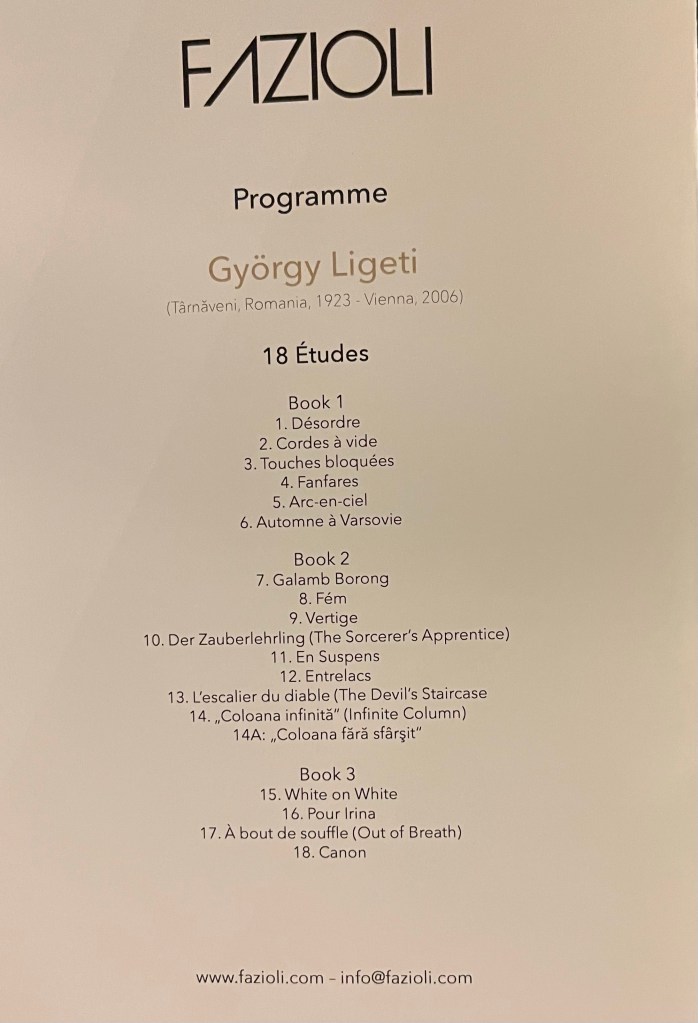
To celebrate the 100th anniversary of the birth of Gyorgy Ligeti Han Chen has recorded the complete studies for piano .A recording that has won many awards for the precision and clarity that he brings to these notorious,transcendentally difficult studies.But there was also drama and passion albeit contained within a rhythmic discipline that was astonishing in its driving forward movement.What drama he brought to ‘Automne à Varsovie’ and I wonder if the ‘Devil’s Staircase’ has ever been approached so fearlessly.The chiselled sounds of great purity of ‘Pour Irina ‘were a contrast to the slow contemplation of ‘White on White’.
A tour de force of intellect and mastery

https://christopheraxworthymusiccommentary.com/2023/03/10/inna-faliks-love-of-life-the-extraordinary-story-of-a-great-artist-told-with-masteryintelligence-and-beauty/
What a wonder Inna invariably is. Whatever she plays it is with such weight and authority even when she dives into the piano to extract the dead sounds of the Oud as in Fazil Say’s very evocative ‘Black Earth’ .Or even recites in Russian where she says the meaning is not of such fundamental importance as the sound the words make with the music her hands are carving on the keyboard.Even a full choir was taking part in the very moving ‘Sirota’ by Ljova Zhurbin.It was an important part of a fascinating performance with ‘Weight in her fingertips’ that allowed her to also play so beautifully the Lullaby from Richard Danielpour’s recent opera.
Chopin’s Maiden’s Wish and of course the Polonaise Fantasie which figures so prominently in her life, showed the versatility of this great pianist living life to the full and sharing her musical discoveries with the generosity and intelligence of the showgirl she is at heart.
Avventurosa e appassionata” (The New Yorker), la pianista americana di origini ucraine Inna Faliks si è imposta sulla scena internazionale grazie alle sue notevoli esecuzioni del repertorio pianistico più diffuso, ma anche per innovativi progetti interdisciplinari e collaborazioni con compositori contemporanei. Dopo aver debuttato da giovanissima al Gilmore Festival e con la Chicago Symphony Orchestra, si è esibita in alcuni dei palcoscenici più prestigiosi al mondo e con importanti orchestre, guidata da direttori come Leonard Sslatkin e Keith Lockhart. Tra le performance più recenti, quelle al Ravinia Festival di Chicago, alla National Gallery di Washington, all’Accademia Chigiana di Siena, da solista con orchestre americane e in numerosi tour in Cina.


Inna Faliks collabora con alcuni tra i più significativi compositori d’oggi, come Billy Childs, Richard Danielpour, Timo Andres e Clarice Assad. Nel 2008 ha ideato la premiata serie Music/Words, con decine di performance a New York, Chicago e Los Angeles, sia dal vivo che in radio. Porta regolarmente in tour il suo recital-monologo Polonaise-Fantasie, the Story of a Pianist, racconto della sua emigrazione da Odessa agli Stati Uniti con musiche Bach, Chopin, Gershwin e Carter.


Docente di Pianoforte presso la UCLA (University of California-Los Angeles), le sue masterclass sono richieste in tutto il mondo. Ha scritto articoli e saggi per il Los Angeles Times e il The Washington Post, mentre la sua autobiografia musicale, Weight in the Fingertips, sarà pubblicata nel 2023 da Globe Pequot. Inna Faliks è un’artista Yamaha.


Inna Faliks’s 2023-24 concert season is marked by the long-awaited release of her memoir, Weight in the Fingertips – a Musical Odyssey from Soviet Ukraine to the World Stage. , on bookshelves October 15th. In March 2024, she will release the album Manuscripts Don’t Burn, a very personal album that is a combination of music written for her and music of Schubert-Liszt and Fanny Mendelssohn. Today’s program is a deeply personal celebration of both the book and the CD.


Faliks has asked the composers Maya Miro Johnson and Veronika Krausas to compose works for her that respond to one of her favorite novels, Ukrainian-born Russian writer Mikhail Bulgakov’s Master and Margarita. A modern day retelling of Faust, it is also powerful commentary on the life of an artist during a totalitarian regime. Faliks carried the book out of Odessa when her family immigrated – and it has been a long-term companion through her artistic life, and is frequently mentioned in her own book.


Maya Miro Johnson imagines the character of Margarita. right before she meets Mephistopheles, in the book. Manuscripts Don’t Burn is the most famous phrase from the novel – the devil speaks it as he recreates a lost manuscript of the Master, the lover of Margarita. This young composer uses extended techniques and many sound effects to create the mysterious dark landscape of the novel


Veronika Krausas creates an elegant dance suite that responds to a variety of quotes from the novel, chosen by Faliks. Minimalist and elegant, the music takes a more humorous, reserved approach to the novel.


Juxtaposing Black Earth and Sirota in this program allows Faliks to travel to the Black Sea. As her home city of Odessa is under attack, she conjurs it through the sounds of Sirota, which uses a 1907 recording of the “Jewish Caruso”, the legendary Odessa cantor Gershon Sirota. Black Earth is a reimagining of a tragic Turkish Ballad, complete with sounds of the Saz, a Turkish Lute.
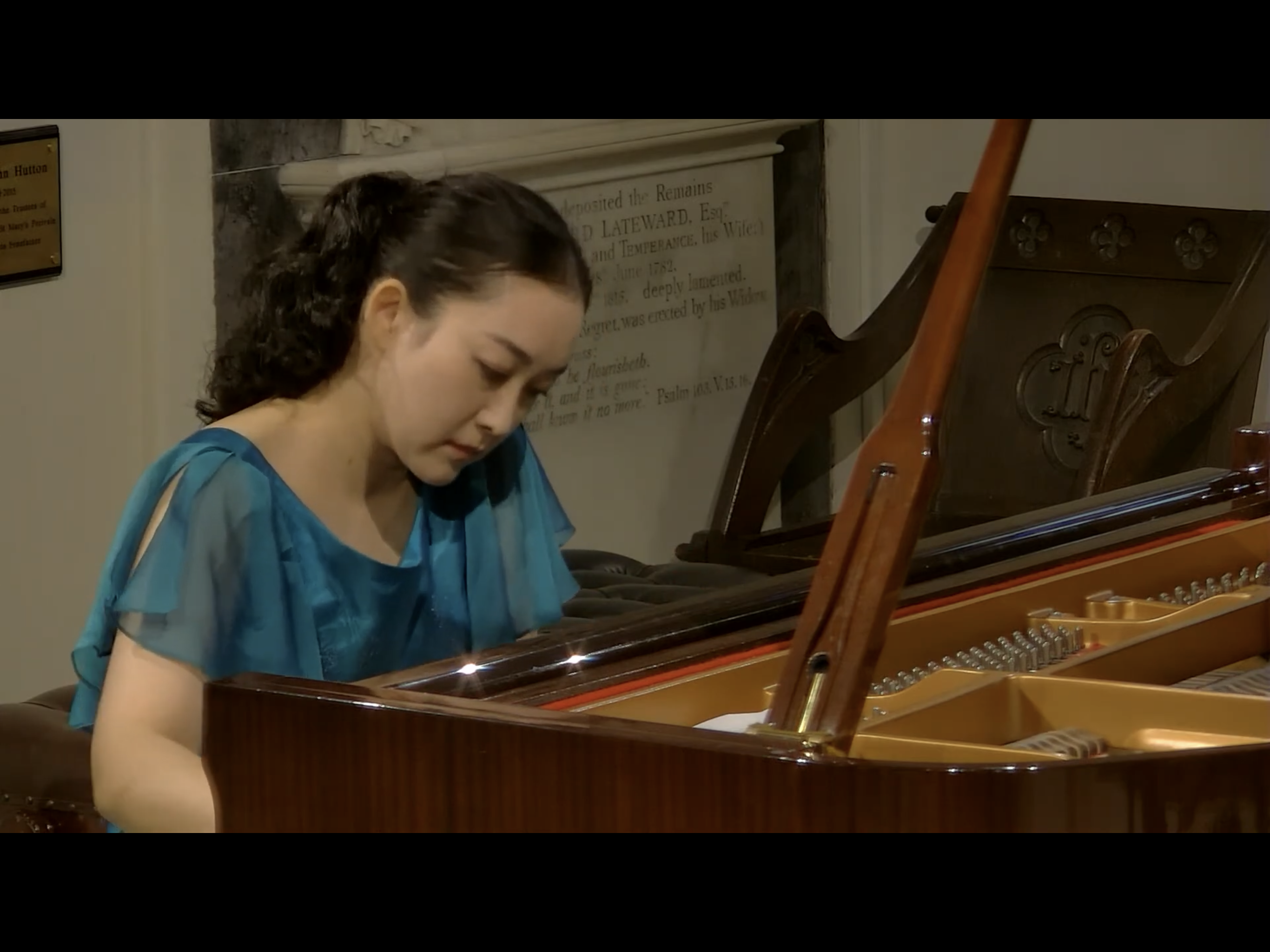

Danielpour’s mournful Lullaby is from his piano suite “Joys and Sorrows”, written for Faliks to premiere in 2023.


It is followed by Chopin’s Polonaise-Fantasie – the center piece of Faliks’s one woman show Polonaise-Fantasie the Story of a Pianist, on which her book is based.
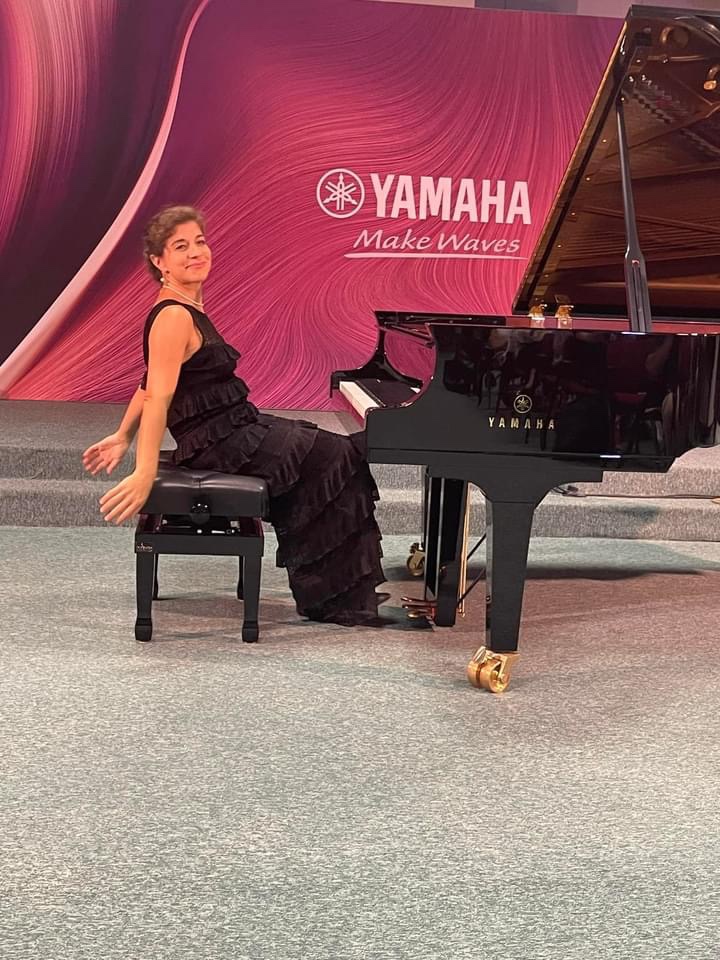
Inna Faliks with Paolo Fazioli
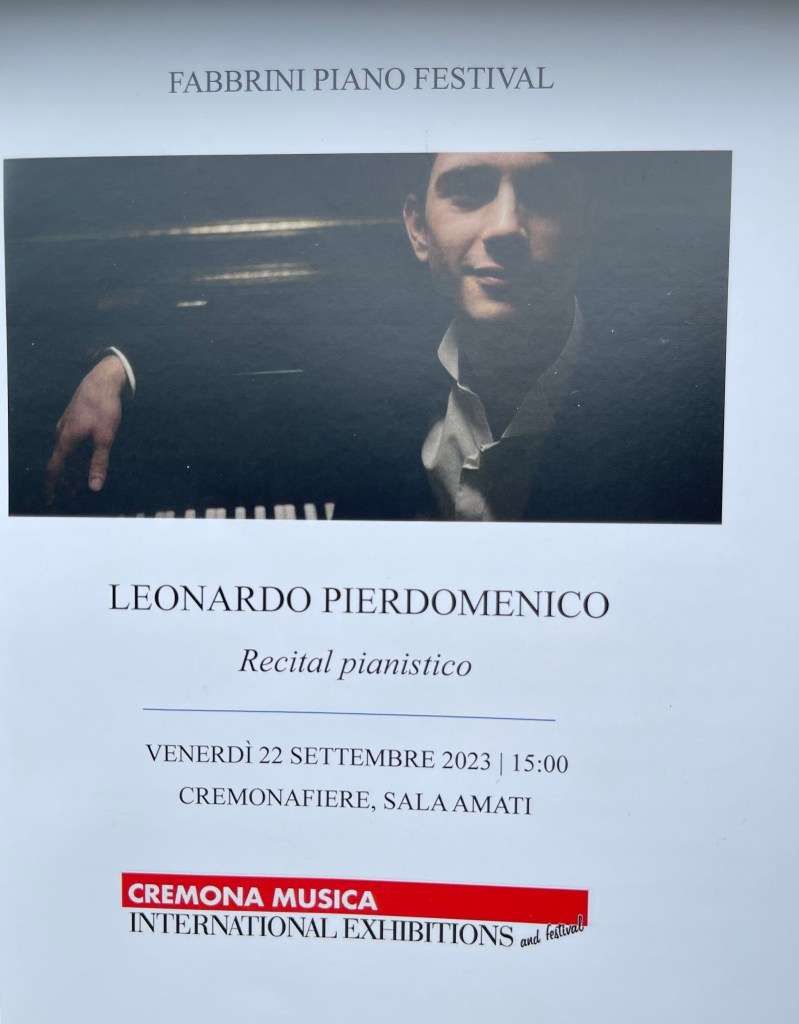
Wonderful to see how Leonardo in the space of just a few years has become a great artist who thinks more of the music than himself.Mentored by William Naboré over these past two years I have seen a very fine pianist turn into an artist where music just pours from his fingers with the the same purity and simplicity as Rubinstein in his Indian summer.
https://christopheraxworthymusiccommentary.com/2022/09/26/william-grant-nabore-thoughts-and-afterthoughts-of-a-great-teacher/
A different repertoire from the great master but the musical communication is the same.I have never heard ‘Les Jeux d’Eau’ played with such purity of sound and sense of colour as the fountains were allowed to sparkle and shine whilst beneath a sumptuous melody of Philadelphian richness was being played out in the tenor register.
A remarkable sense of control and what a marvellous idea to link ‘Les Jeux d’Eau’ with the murky waters of the ‘Ballade’ of Hero and Leander.It was interesting too,and showed what a thinking musician he is,as he chose to play the original finale of Liszt rather than the published one.
Scarlatti and Clementi were played with a rhythmic drive and simplicity.The Scarlatti K.213 of disarming beauty.
It was refreshing to see a Bechstein on stage signed by Angelo Fabbrini and I hope this might signal the return to the concert hall of the preferred piano for many of the greatest artists between the wars.
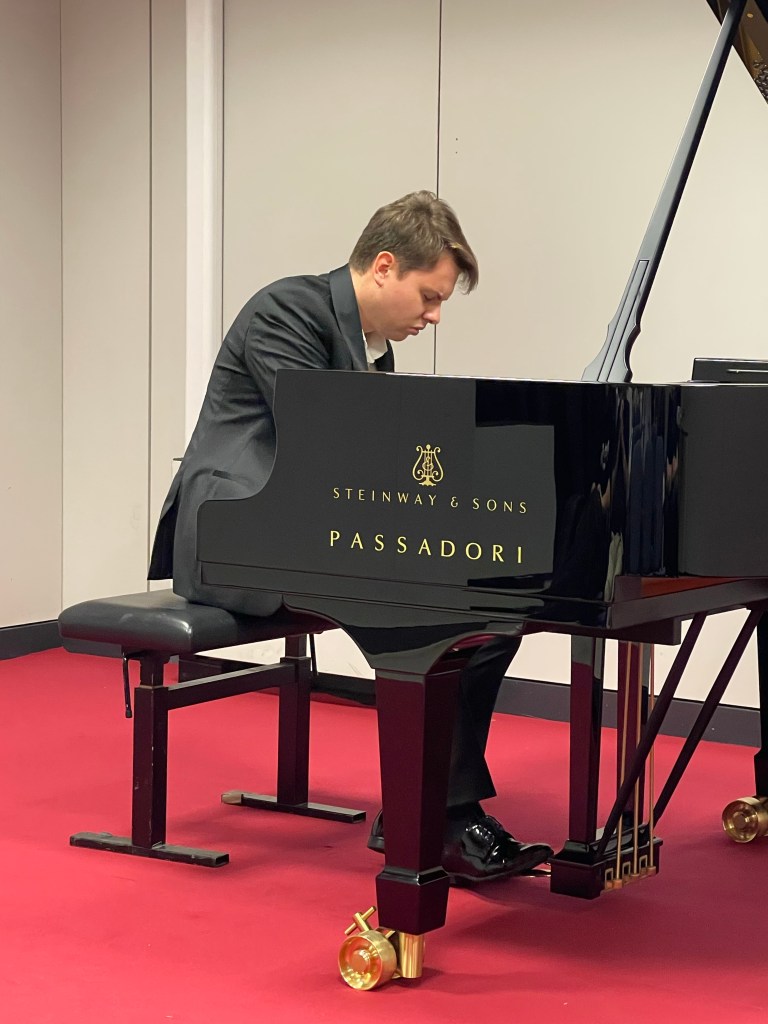
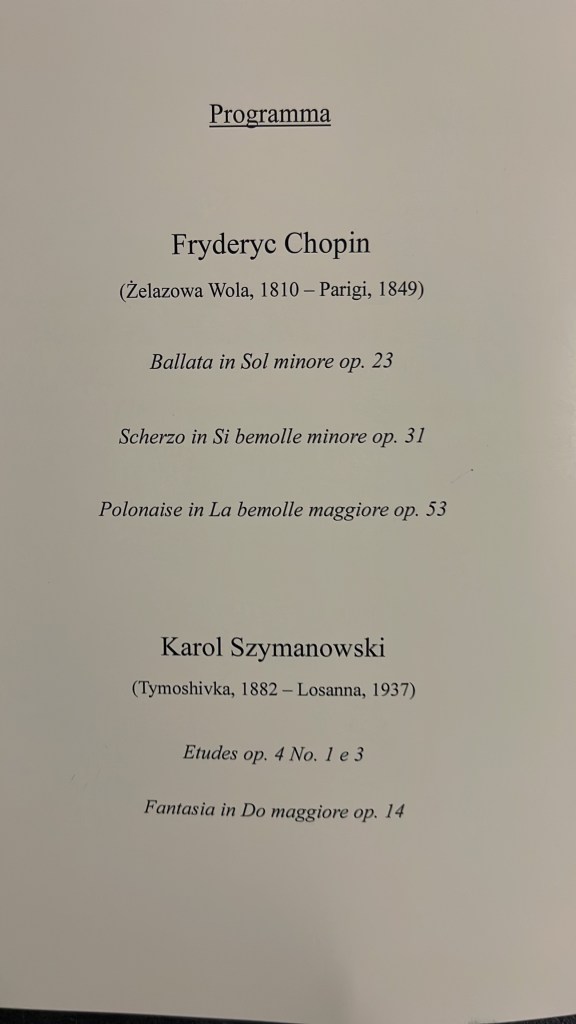
The young Polish pianist,winner of the Paderewski International Piano Competition presented three of the best known works by Chopin together with two studies and the Fantasia op 14 by Szymanowski.
I was sorry to miss the Szymanowski but such are the amount of concerts programmed in the these three days it is sometimes impossible to enjoy a complete programme.
The Chopin First Ballade showed his very solid musicianship and superbly trained fingers.There was an architectural control that allowed this well known work to unfold without any rhetoric or with passages tainted by tradition.A clarity and purity that could now be added a simplicity but this is a young musician with fire in his fingers and the same love for his homeland as Chopin had in his heart.A tour de force of cavalry advancing in the ‘Polonaise Héroique’ never allowed him to sacrifice the musical line or his sumptuous sense of balance.
Presided over by the President of the Chopin institute and their Press Spokesman Aleksander Laskowski who is seen here presenting a portrait of Jed Distler who covered the last Chopin competition for the Gramophone Magazine
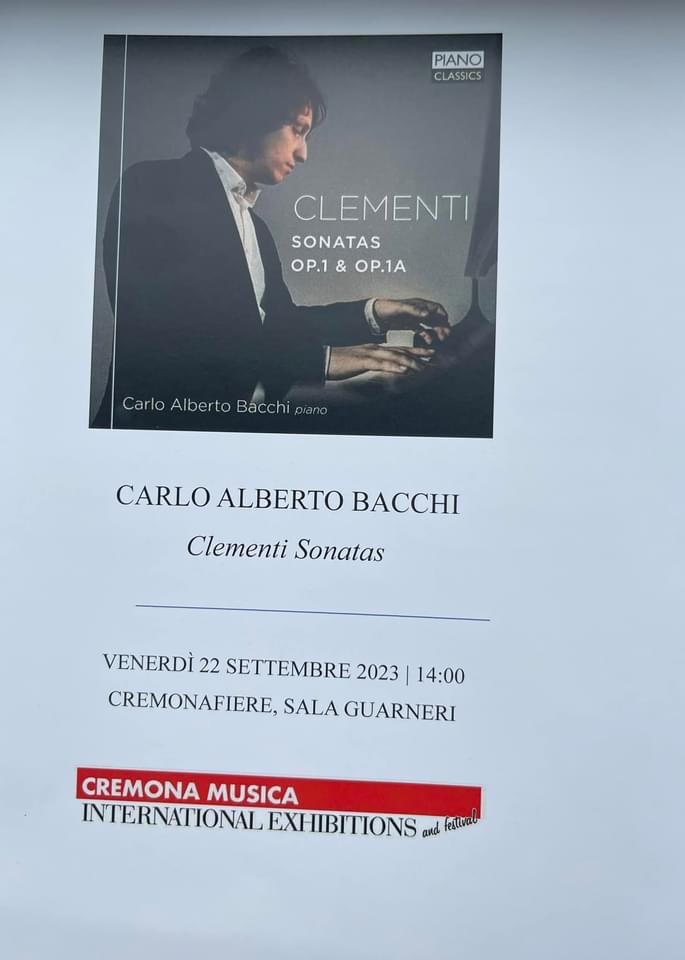
Some beautifully measured playing from a student of Robert Prosedda from the Rovigo Conservatory.The students are studying Clementi Sonatas under his guidance and making recordings of the complete 110 Sonatas unjustly neglected in the concert hall .Carlo Alberto has dedicated himself to learning and recording the Sonatas op 1
https://www.youtube.com/live/pAoDYqnb8q4?feature=shared
Concerto di Carlo Alberto Bacchi, pianoforte, con presentazione del CD Piano Classics “Clementi Piano Sonatas op. 1”


https://www.piano-classics.com/articles/c/clementi-sonatas-op1-op1a/


Muzio Clementi (1752-1832):
Sonata op. 1 n. 1
Sonata op. 1 n. 5
Sonata op. 1a n. 2
Sonata op. 1a n. 5


Carlo Alberto Bacchi, nato il 24 marzo 2001, intraprende lo studio del pianoforte all’età di 9 anni con Sara Bertani. Dal 2018 studia con Roberto Prosseda, di cui è attualmente allievo presso il Conservatorio “Francesco Venezze” di Rovigo. Ha partecipato a varie masterclass con maestri quali Carlo Guaitoli, George Vatchnadze, Boris Berman, Bruno Monsaingeon, Roland Poentinen. Ha parallelamente seguito seminari di composizione con Mauro Montalbetti, Elvira Muratore, Richard Danielpour. Sta inoltre frequentando il corso di direzione d’orchestra con Donato Renzetti presso l’Accademia di Alto Perfezionamento di Saluzzo, seguendo anche master classes di direzione con Gyorgy Rath.
È attivo come pianista concertista, sia da solista (in recital e con orchestra), sia in formazioni da camera. Ha suonato per numerosi enti, tra cui il Teatro Comunale di Carpi, Cremona Musica e l’Associazione Venezze di Rovigo. Nel gennaio 2020 è stato protagonista della lezione-concerto “in Itinere” assieme a Roberto Prosseda presso il Teatro Verdi di Pordenone, più volte trasmessa dalla Radio Televisione Italiana.
Il suo primo CD, dedicato alle Sonate op. 1 di Clementi, esce nell’ottobre 2023 per l’etichetta Piano Classics.
Alberto Nosè got his first international recognition at the age of eleven, winning the First Prize at the Jugend für Mozart Music Competition in Salzburg, thanks to which he made his first tour in Italy, Austria and France. Winner of the Piano Masters in Monte Carlo in 2015, Concert Artists Auditions in New York in 2012, Top of the World in Tromsø in 2011 and Paloma O’Shea in Santander in 2005, Maj Lind in Helsinki in 2002, Vendôme Prize in Paris in 2000, Premio Venezia in 1998, other than being laureate at the Chopin Competition in Warsaw in 2000, he performs in major concert halls all over the world: Carnegie Hall and Kaufman Music Center in New York, Southbank Center and Wigmore Hall in London, Konzerthaus in Berlin, Théâtre du Châtelet and Salle Pleyel in Paris, Mozarteum in Salzburg, Suntory Hall in Tokyo, Auditorio Nacional in Madrid, Teatro La Fenice in Venice, Parco della Musica in Rome. He is regularly invited to important concert seasons in France, Germany, Switzerland, Poland, Spain, USA, Mexico, South America, China, Japan and Hong Kong and in the juries of the most prestigious international piano competitions such as the F. Chopin in Warsaw.
I was only able to hear the two transcriptions of songs by Charles Trenet by Alexis Weissenberg, but it was enough to be seduced by ravishing sounds and a sense of style that was ‘old style’ virtuosity. I have heard a lot about Alberto Nosé from his colleagues and am glad to see that they were not exaggerating.Playing of scintillating colour where notes become simply streams of gold and silver sounds of another age.
A fascinating encounter with Andrej Gavrilov,one of the legendary pianist of our time.Presenting his book about his friendship with Sviatoslav Richter he needed no encouraging to tell us about his other passion,that for Bach.He was even persuaded to played some extracts from his well worn ‘Wohltemperierte Klavier’. A pianist who at 18 won the Tchaikowsky Competition which he was ‘persuaded’ to enter by the Minister of Culture,Madame Furtsova,and then his isolation by Leonid Breznev and finally his friendship with Richter.A fascinating story and his infectious passion for Bach ‘almost’ convinced
Andrej Gavrilov with Valentina Lo Surdo (right) and colleague
The indomitable Roberto Prosseda with Angelo Fabbrini and Constantine Sgourdas.
https://christopheraxworthymusiccommentary.com/2021/01/13/roberto-prosseda-pays-tribute-to-the-genius-of-chopin-and-the-inspirational-figure-of-fou-tsong/

Cremona the city of dreams – a global network where dreams become reality

The rebirth of a global network in Cremona -If music be the food of love please please play on

Danieli Longo Benedetti with CA

FESTIVALES DE PIANO, en Cremona Música

Mayumi Sakamoto at St Mary’s ‘A superb pianist of great intelligence and class’

https://youtube.com/live/Sb0Q4owJe84?feature=shared


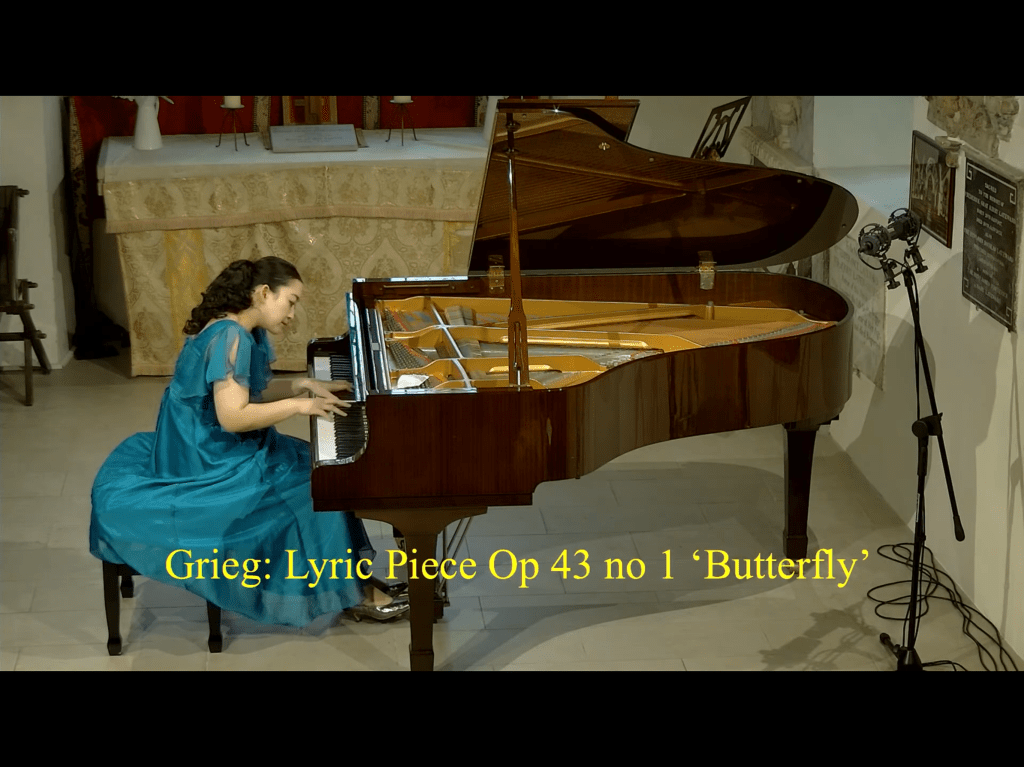
A fairy Princess descends on Perivale to show us with such modesty how Grieg can really sound in the hands of a master.Eloquence,elegance a multifaceted sense of colour and above all a complete mastery of style that was recognised with the Gold Medal at the International Grieg Competition in Oslo .A breathtaking mastery with fingers that belonged to the keys like limpets searching out ravishing sounds that are hidden within and are only found by a very select few.They are great artists indeed and a very rare breed.It was Dr Mather who was approached by a Japanese member of the audience asking if his wife could give a concert at St Mary’s -‘She plays quite well’ he said and the family had recently transferred to Ealing sharing their time between Tokyo and Ealing.Looking at her CV Dr Mather was amazed to see the success that she had won in many International Piano competition.The result was today’s concert that in Dr Mather’s words was ‘sensational – a pianist of great class’ and in fact one of the finest recitals out of 2000 that St Mary’s has ever had.

From the very first notes there was authority and ‘weight’ which gave a depth to the sound of great beauty.The repeat of the opening of the prelude was like an echo in veiled tones of whispered secrets.The Sarabande was unfolded with disarming simplicity followed by the stylish Gavotte of rhythmic energy with a beautifully fluid trio.An Air of poignant beauty with a depth of sound, the return of the melody in the tenor register with ornamentation was deeply moving.But it was the clarity and ‘fingerfertigkeit’ of the Rigaudon that was so impressive ,played as it was with infectious good humour.It contrasted with the nostalgia of the central episode before the return of the opening.It closed a transcendental performance of aristocratic authority
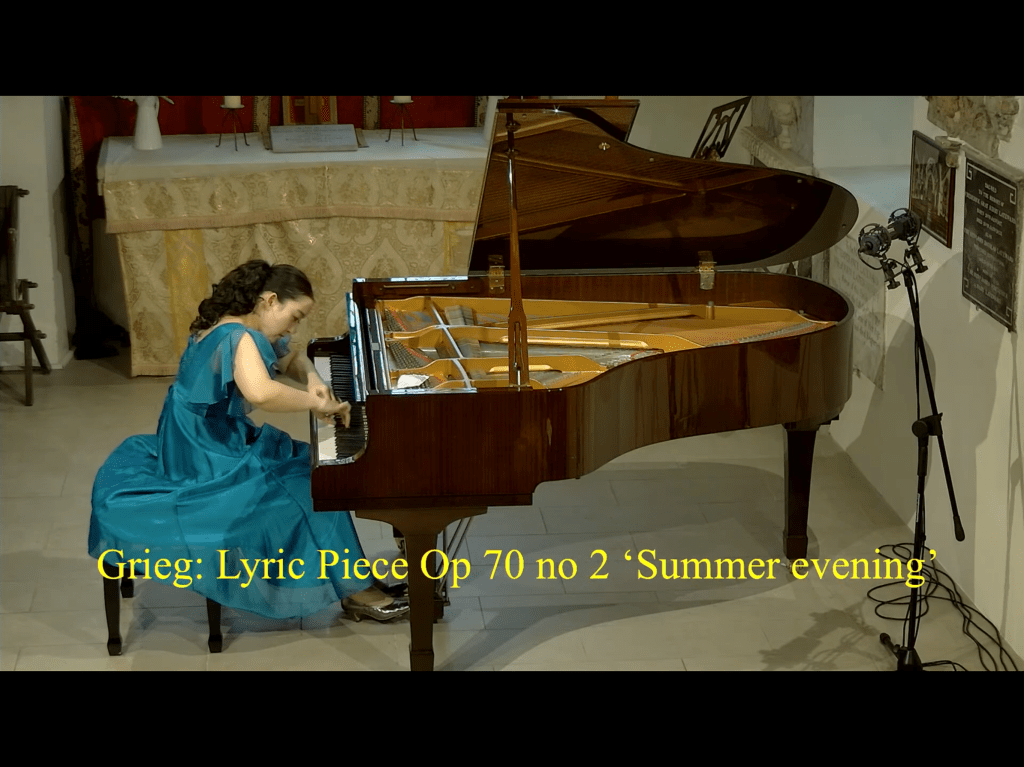
Mayumi explained the affinity to nature of the Lyric Pieces by Grieg and the Japanese works that she had chosen to contrast with them.It is ‘Divinity’ that decides all types of nature and it is this simple belief that joins the two worlds together.Certainly her performance of ‘To Spring’ had something of the divine to it.Rarely played these days the Lyric pieces are of disarming simplicity and beauty it is good to be reminded especially by a pianist of such sensibility and stature.Like Gilels they can bring a subtle shading and sumptuous sense of balance to these pieces and show us with an explosion of beauty what jewels they can be in the hands of real artists.
A beautifully expressive and expansive page of improvised beauty and luminosity
Beautifully wistful as I remember from Gieseking .This Butterfly just slipped from her fingers with a very subtle sound palette.A jeux perlé of improvised freedom but given a shape of beguiling insinuation
A much longer work of a Messianic delicacy of brittle sounds of poignant beauty and what a wonderfully atmospheric ending of great suggestion .
A similar sound world that the Japanese works share but with the immediately subtle recognition of Grieg’s native folk idiom played with such delicacy and subtle shading.
A change of mood brought us this Japanese dance of throbbing rhythms building to a tumultuous climax and showing us another side to the pianist’s character.Florestan had appeared on the scene
An important work rarely played these days.
Cherkassky used to include it regularly in his recitals but it takes a great musician to give it shape and form joining seemingly rather fragmented episodes into one united whole.
Mayumi with her superb musicianship brought this youthful work to life with a freedom and sense of character but also a sense of shape and overall direction as she opened with a passionate outpouring of Romantic sounds.
An Andante of simplicity allowing the music to flow naturally with a ravishingly sensitive cantabile A measured Minuet was played with a capricious sense of style and the Finale with dynamic drive bursting into mellifluous interludes of driving passion and closing with a climax of glorious sumptuous sounds.

Born in Japan, Mayumi Sakamoto graduated from Tokyo University of the Arts Mayumi has been studying at the Hochschule fur Musik und Theater Hannover in Germany on a scholarship from the Rohm Music Foundation since 2005 and gained the KA degree (“Diplom” degree in Music, Artistic Training in Music) in 2007 additionally graduating the Soloist-diploma course 2013, with the orchestra prize. 

Mayumi won the 1st prize and the Prix d’Oslo at the International Edvard Grieg Piano Competition in Norway> She was the 2nd Prize winner at the Top of the World International Piano Competition in Norway as well as at the XII Andorra International Piano Competition accompanied by the Special Prize for French Pieces of Music and Special Scholarship in Andorra. Pinerolo International Piano Competition in Italy, the Scottish International Piano Competition and the 2003 Leeds International Pianoforte Competition, a semi-finalist at the 2002 International Tchaikovsky Competition in Moscow, and a diploma recipient at the Van Cliburn International Piano CompetitionShe also received prizes at numerous piano competitions in Japan including the 1st Prize at the 52nd All Japan Student Music Concours at the age of 15.Mayumi has recorded a CD of the Mozart’s piano concertos with the WDR Rundfunkorchester Köln in 2012, and Grieg’s Piano Concerto with Göttingen Symphony Orchestra, Germany, 2013.

https://www.mayumisakamoto.com/english

The generosity of Kapellmeister Mather A celebration of a great man and his team on the 2000th Anniversary concert

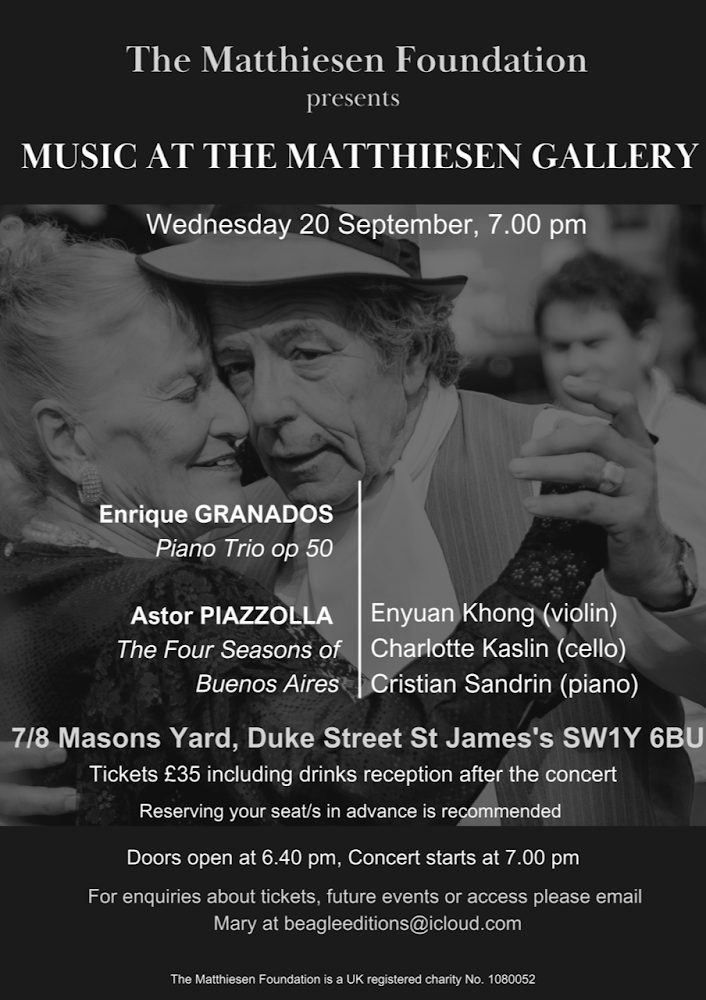
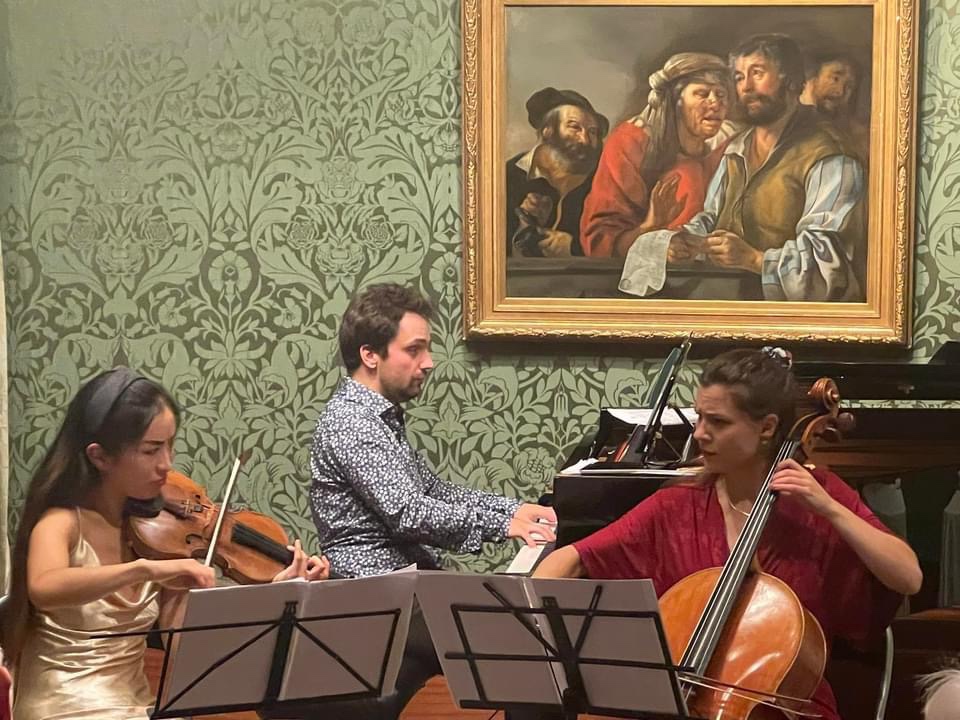
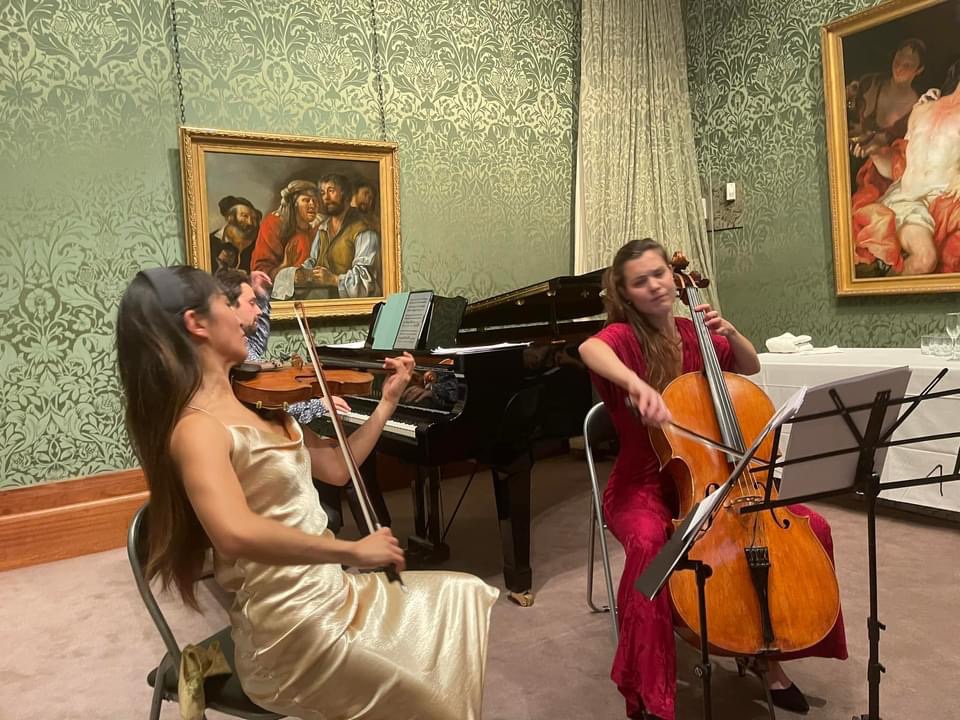
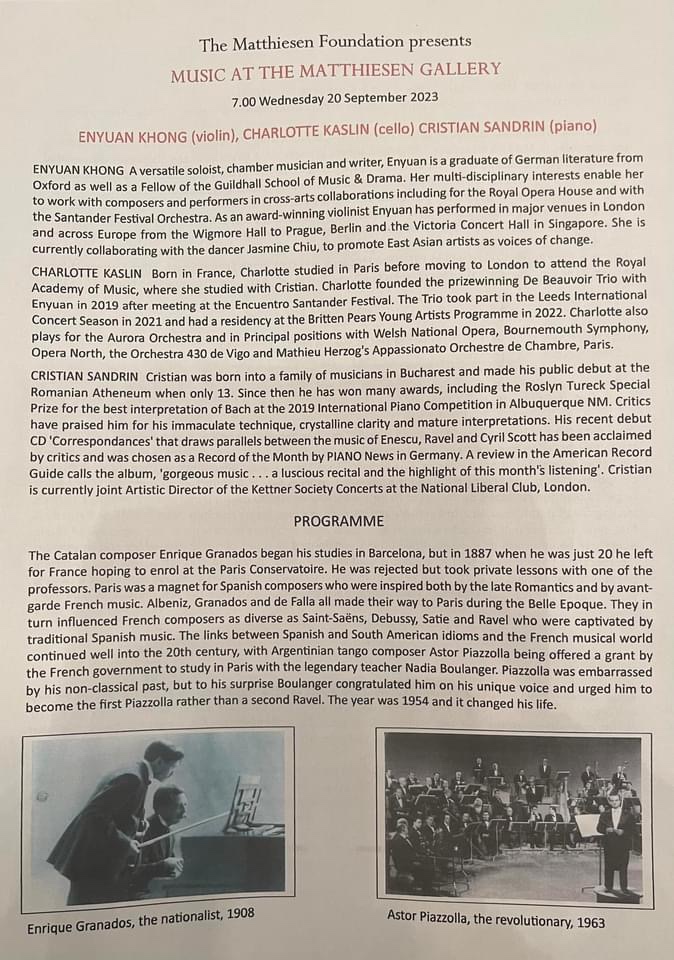
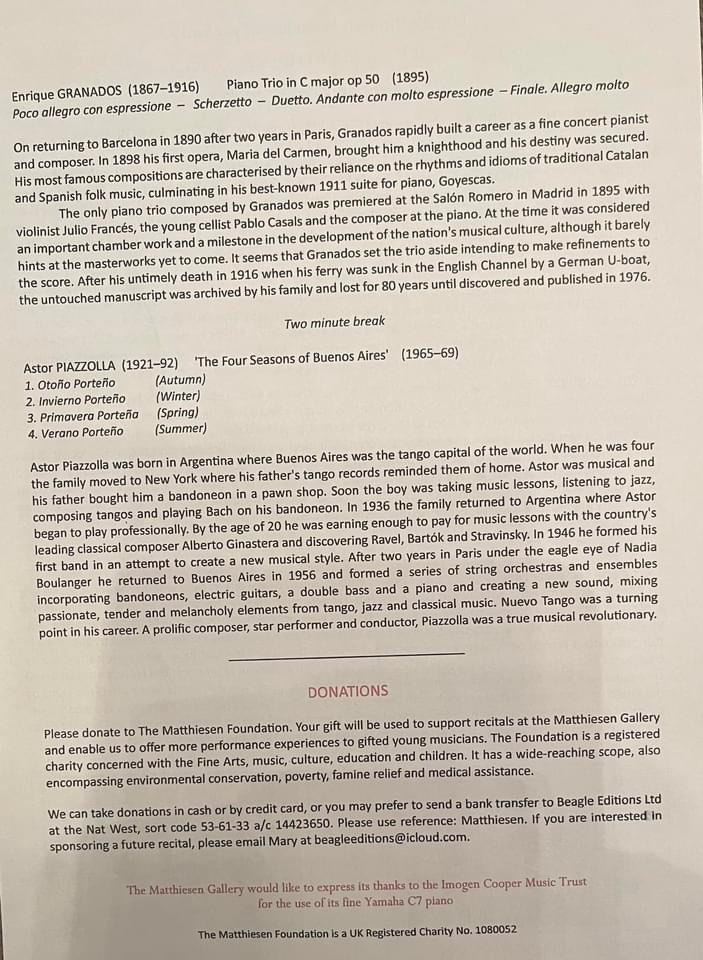
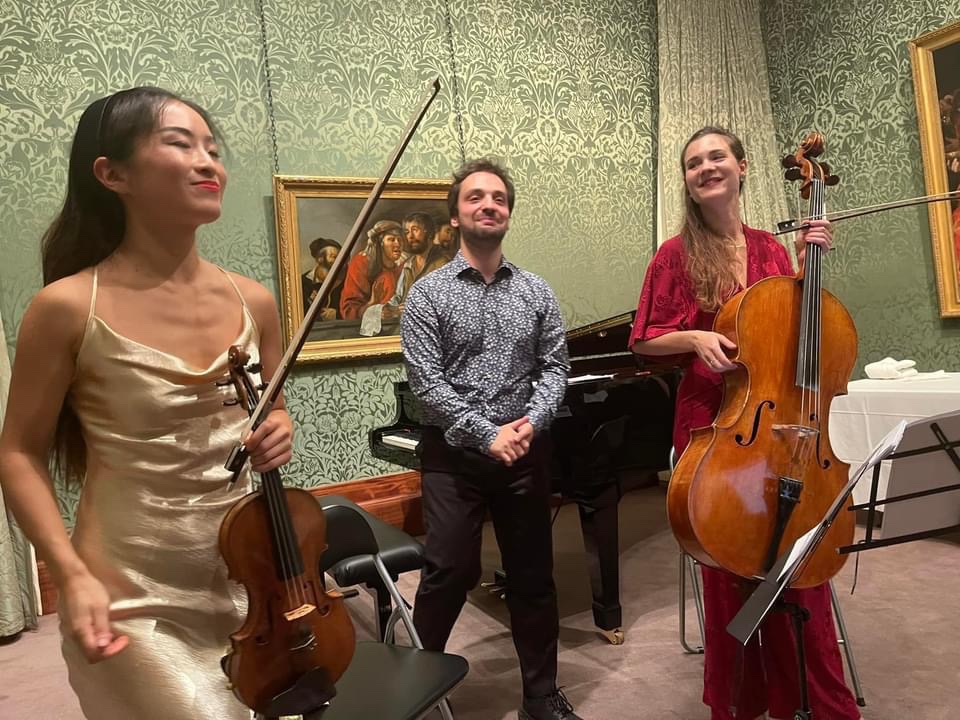
Trio :Cristian Sandrin -Enyuan Khong – Charlotte Kaslin ‘A feast of exhilaration and seduction for Mary Orr’ for the Matthiesen Foundation at the Matthiesen Gallery

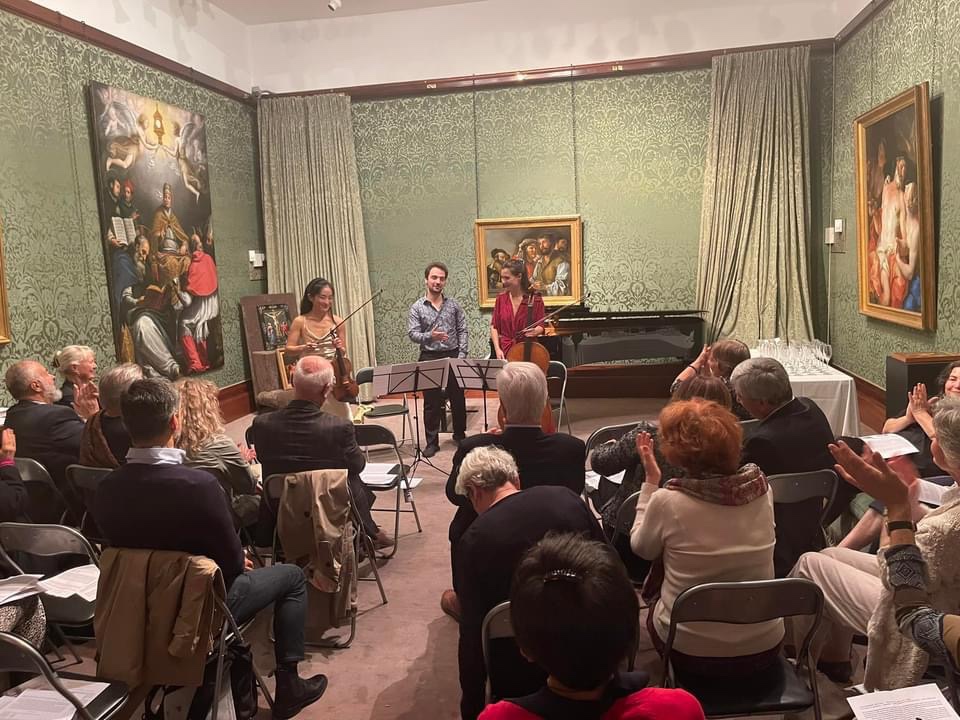
A sumptuous feast of exhilaration and seduction surrounded by beauty in Mary Orr’s salon at the Matthiesen Gallery in Mayfair

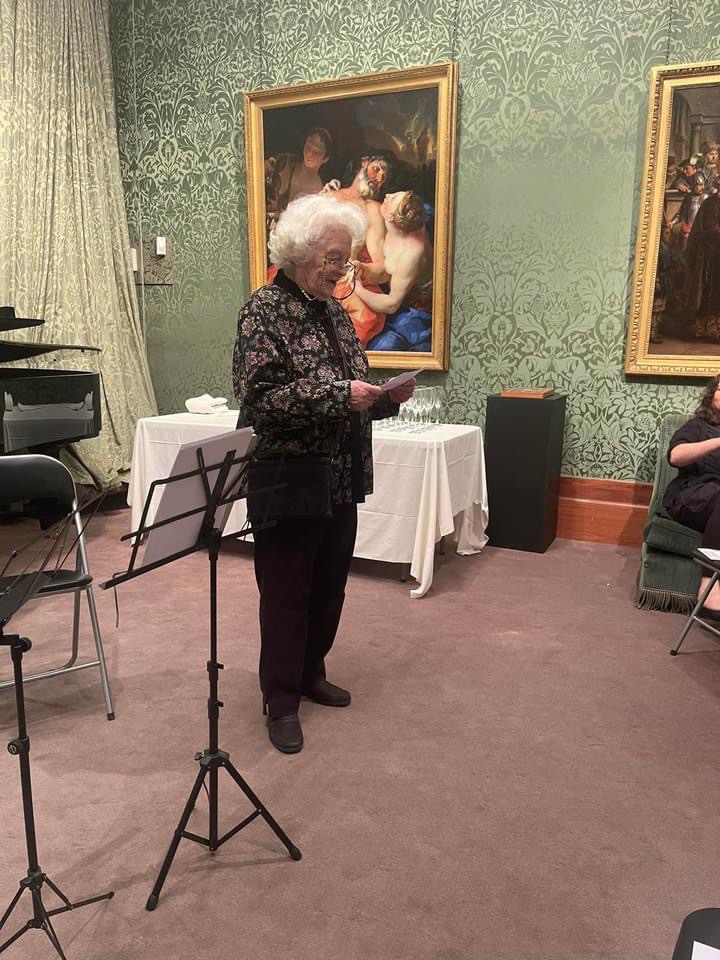
Mary Orr introducing the concert


A trio of Mendelssohnian delight from a composer who after being summonsed to play to President Wilson after the enormous success of the premiere of his opera Goyescas which turned out to be Granados’s last performance before returning home on a ship that was torpedoed in the English Channel.

Piazzola on the other hand bringing the seduction of the night life and ravishing sleeze of Buenos Aires into the concert hall with the tangos of San Martin brought to life with passionate conviction by the Khong,Kaslin,Sandrin Trio.There was the unmistakable smoky atmosphere of Argentina missing slightly the slightly larger ensemble and of course the bandoneon but made up for with the choice of the more refined Tangos of insinuating melodic outpourings.Enyuan Khong adding some very expressive slides to her superb violin playing and Charlotte giving just that much more throbbing rubato.Cristian of course like the chameleon he is was able with the twitch of his shoulder and the switch of his foot to create just the sleeze that Mr Matthiessen had contributed to by turning down the house lights!


The Granados Trio an early work only discovered in 1976 and rarely programmed since.A great sweep and passion to the first movement in which the violin and cello play together with searing intensity of sumptuous sounds but of course the piano has the last word that in Cristians hands were of a purity and disarming simplicity.A ‘Scherzetto’ very much in the style of Mendelssohn with its lightweight rhythmic energy played with an evident ‘joie de vivre’.The musette Trio was full of buoyancy and life but interrupted by a solo piano recitativo before the return to the ‘Scherzetto’ with its impishly capricious ending.There was a veiled beauty to the ‘Duetto’ of a real ‘song without words’ and showed the superb ensemble of this newly formed trio.A finale truly ‘Dumka’ style followed with its infectious dance rhythms.
I wonder if Granados would have published it had he not perished so ignominiously near to our shores.
I imagine it was eventually found right at the bottom of his cupboard 80 years after it’s premiere in 1895 with the seventeen year old Pablo Casals.Forgotten about as he discovered his true genius for his native Spanish idioms wrapped up in transcendental pianistic trickery.

The Trio op. 50 in C major by Enrique Granados, one the most important Spanish works for piano was written in 1895.It was inspired and an attempt to reconcile the grand late-romantic Central European musical forms with a distinctly Spanish language based on the teachings of Felipe Pedrell. A work with a very complex musical structure in consonance with the late-romantic European tradition and an inspired content of a personal and poetical nature.

The Granados trio was premiered in Madrid with the composer himself at the piano, the violinist Julio Francés and a 17 year-old cellist Pablo Casals, at the time a student at the Madrid Conservatory. The work was never again performed during Granados’ life. After his tragic death it remained in complete oblivion until its publication in 1976 by Unión Musical Española.

Pantaleón Enrique Joaquín Granados Campiña, commonly known as Enrique Granados Born: 27 July 1867, Lleida ,Spain
Died: 24 March 1916, English Channel

A delay in New York, incurred by accepting a recital invitation from President Wilson caused him to miss his boat back to Spain. Instead, he took a ship to England, where he boarded the passenger ferry SS Sussex for Dieppe France. On the way across the English Channel , the Sussex was torpedoed by a German U boat , as part of the German World War I policy of unrestricted submarine warfare.According to witness Daniel Sargent, Granados’s wife, Amparo, was too heavy to get into a lifeboat. Granados refused to leave her and positioned her on a small life raft on which she knelt and he clung. Both then drowned within sight of other passengers.However, according to a different account from another survivor, “A survivor of the 1916 torpedo attack on a Cross channel ferry, Sussex, recognised Spanish composer Granados in a lifeboat, his wife in the water. Granados dived in to save her and perished.”The ship broke in two parts, and only one sank (along with 80 passengers). Ironically, the part of the vessel that contained his cabin did not sink and was towed to port, with most of the passengers, except for Granados and his wife, who were on the other side of the boat when it was hit. Granados and his wife left six children: Eduard (a musician), Solita, Enrique (a swimming champion), Víctor, Natalia, and Francisco.

The personal papers of Enrique Granados are preserved in, among other institutions, the National Library of Catalonia.

The Trio by Granados is an inspired and solid attempt to reconcile the grand late-romantic Central European musical forms with a distinctly Spanish language

— Juan Carlos Garvayo,

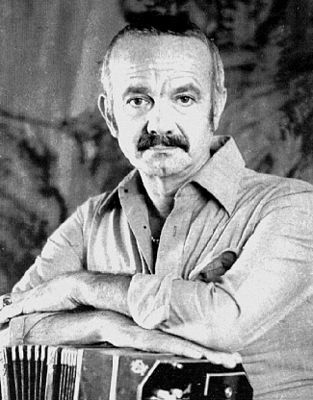
Astor Pantaleón Piazzolla Born
March 11, 1921 Mar dei Plata ,Argentina Died
July 4, 1992 (aged 71)Buenos Aires ,Argentina

The Cuatro Estaciones Porteñas, also known as the Estaciones Porteñas or The Four Seasons of Buenos Aires, are a set of four tango compositions written by Astor Piazzola ,which were originally conceived and treated as different compositions rather than one suite, although Piazzolla performed them together from time to time. The pieces were scored for his quintet of violin (viola), piano, electric guitar, double bass and bandoneon.By giving the adjective portenoreferring to those born in Buenos Aires,the Argentine capital city, Piazzolla gives an impression of the four seasons in Buenos Aires. The order of performance Piazzolla gave to his “Estaciones Porteñas” is: Otoño (Autumn), Invierno (Winter), Primavera (Spring), Verano (Summer). It was different from Vivaldi’s order.

The Seasons

  1. Verano Porteño (Buenos Aires Summer)
    written in 1965,originally as incidental music for the play ‘Melenita de oro’by Alberto Rodríguez Muñoz.
  2. Invierno Porteño (Buenos Aires Winter
    written in 1969.
  3. Primavera Porteña (Buenos Aires Spring)
    premiered in 1969,contains counterpoint.
  4. Otoño Porteño (Buenos Aires Autumn)
    premiered 1969. Astor Pantaleón Piazzolla (March 11, 1921 – July 4, 1992) was an argentine tango composer, bandoneon player, and arranger. His works revolutionized the traditional tango into a new style termed nuevo tango , incorporating elements from jazz and classical music A virtuoso bandoneonist, he regularly performed his own compositions with a variety of ensembles. Described as “the world’s foremost composer of Tango music”.At Ginastera’s urging, on August 16, 1953, Piazzolla entered his classical composition “Buenos Aires Symphony in Three Movements” for the Fabian Sevitzky Award. The performance took place at the law school in Buenos Aires with the symphony orchestra of Radio del Estado under the direction of Sevitzky himself. At the end of the concert, a fight broke out among members of the audience who were offended by the inclusion of two bandoneons in a traditional symphony orchestra. In spite of this Piazzolla’s composition won him a grant from the French government to study in Paris with the legendary French composition teacher Nadia Boulanger at the Fontainebleau conservatory. Piazzolla was tired of tango and tried to hide his tango and bandoneon compositions from Boulanger, thinking that his destiny lay in classical music. Introducing his work, Piazzolla played her a number of his classically inspired compositions, but it was not until he played his tango Triunfal that she congratulated him and encouraged him to pursue his career in tango, recognising that this was where his talent lay. This was to prove a historic encounter and a crossroads in Piazzolla’s career.With Boulanger he studied classical composition, including counterpoint which was to play an important role in his later tango compositions.
The indomitable Mary Orr with a heart of gold selflessly helping talented young musicians find an audience
https://christopheraxworthymusiccommentary.com/2023/07/06/ignas-maknickas-and-wouter-valvekens-music-at-the-matthiesen-gallery-if-music-be-the-food-of-love-pleaseplease-play-on/
Cristian Sandrin introducing the Granados Trio

Cristian Sandrin https://christopheraxworthymusiccommentary.com/2023/05/22/cristian-sandrin-at-the-national-liberal-club-a-voyage-of-discovery-of-nobility-and-timeless-beauty/

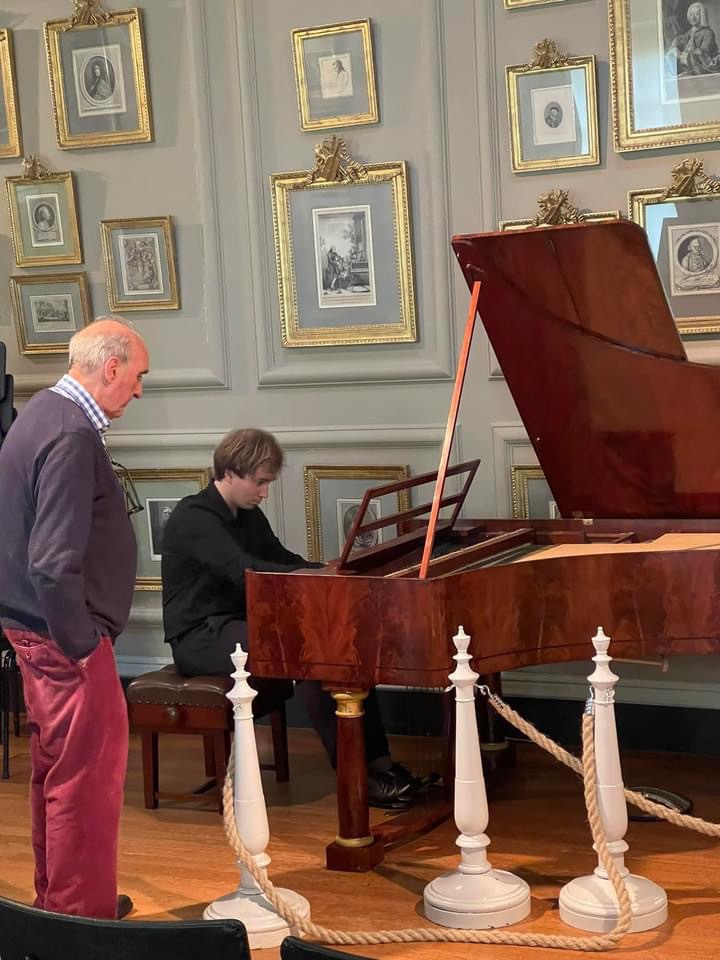
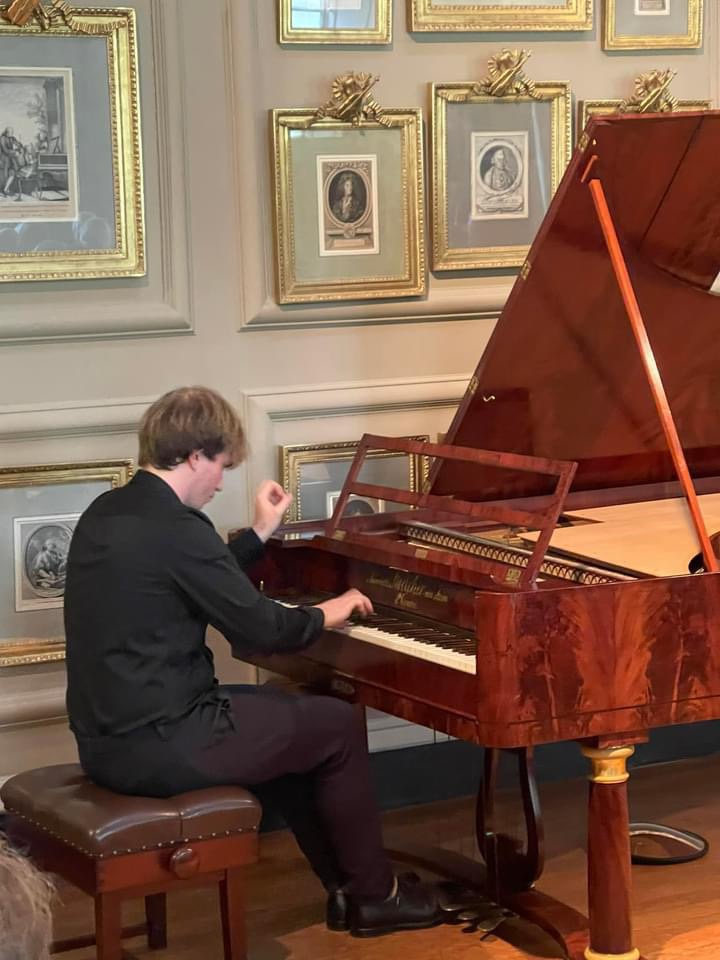
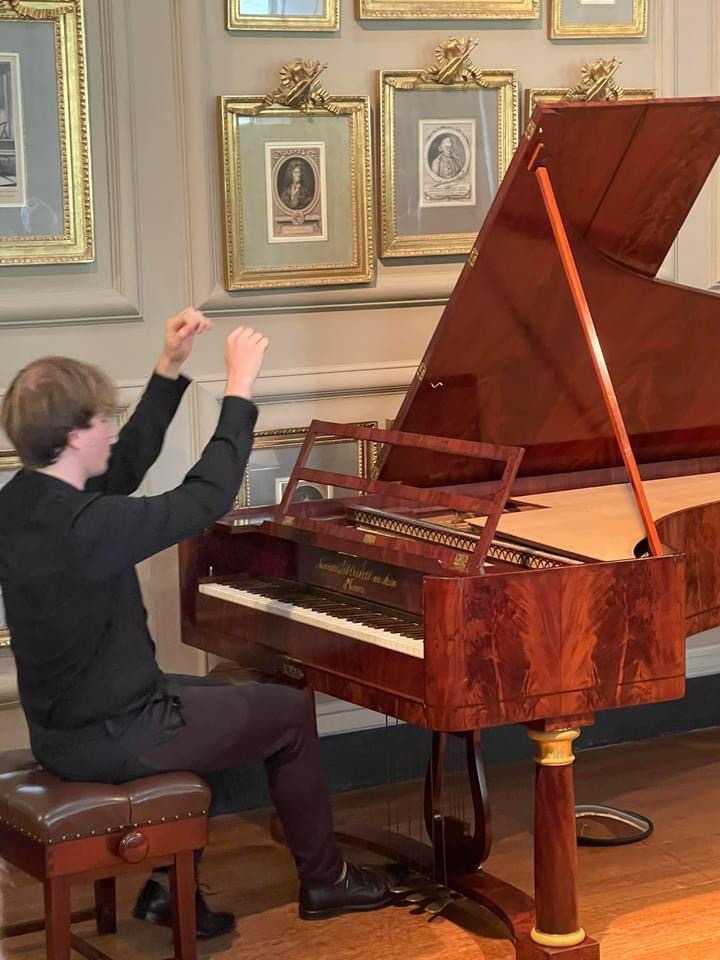
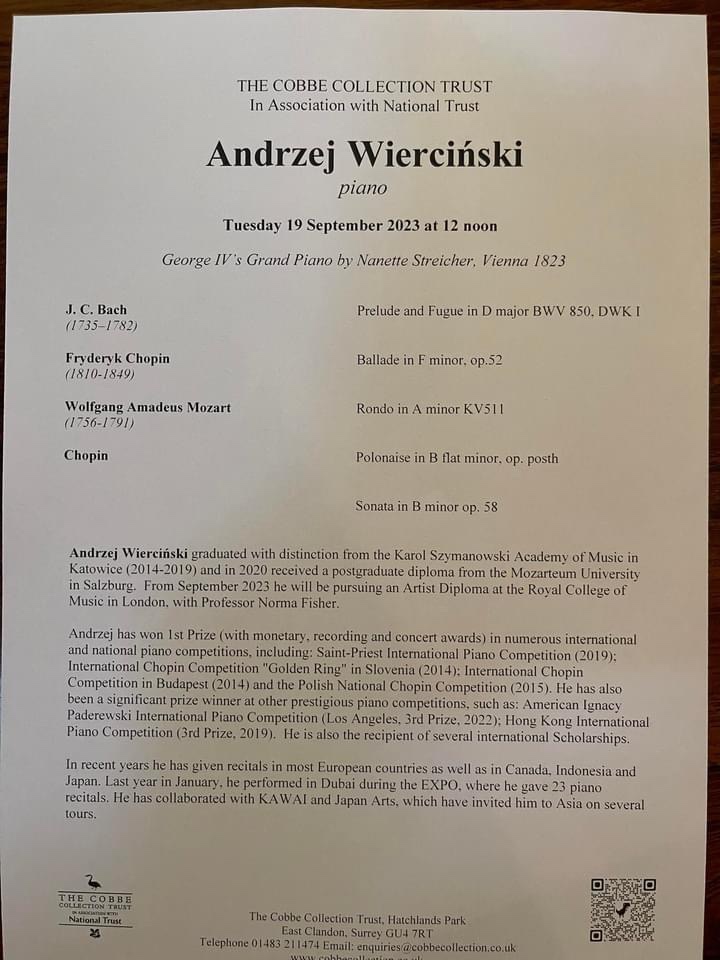
Andrzej Wiercinski at Hatchlands – The Cobbe Collection Trust.A great pianist on a wondrous voyage of discovery

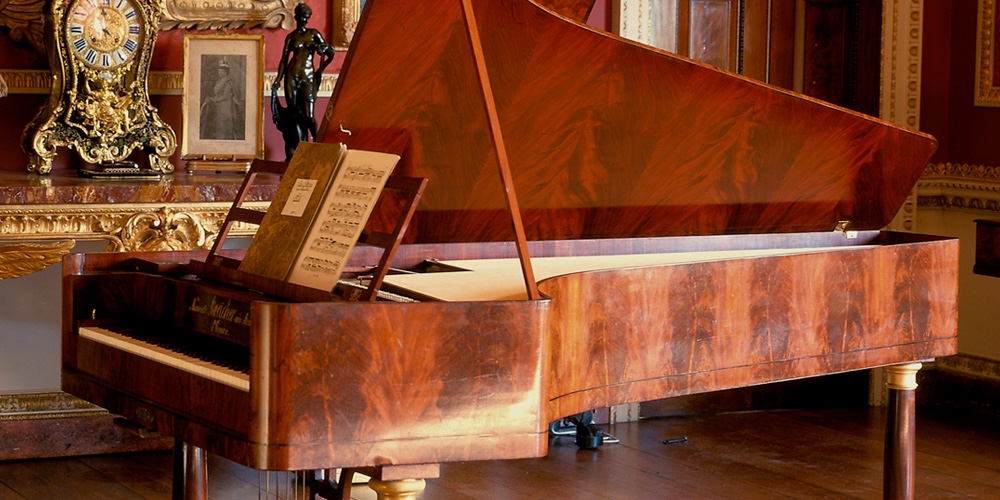
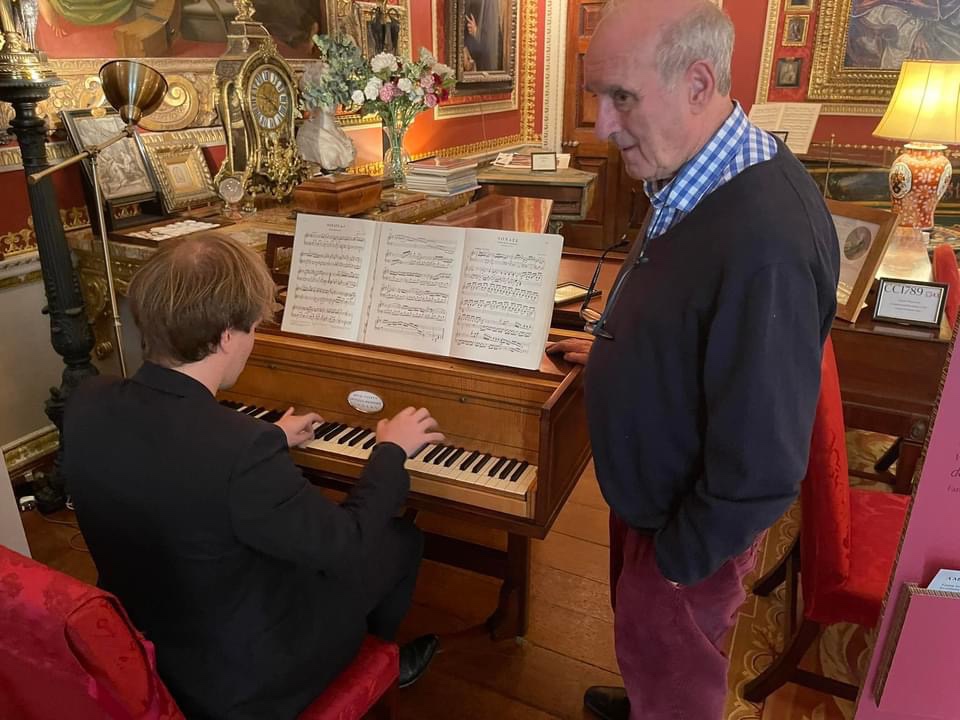
Made by Beethoven’s favourite maker for King George IV in 1823, the year in which Beethoven was in correspondence with the King asking him to accept the dedication of the piano version of the Battle Symphony. This must have been one of very few Viennese instruments in England at the time and, unusually for this maker, it incorporates a drum, bell and cymbel. Loaned by H.M. The Queen to the Cobbe Collection Trust.

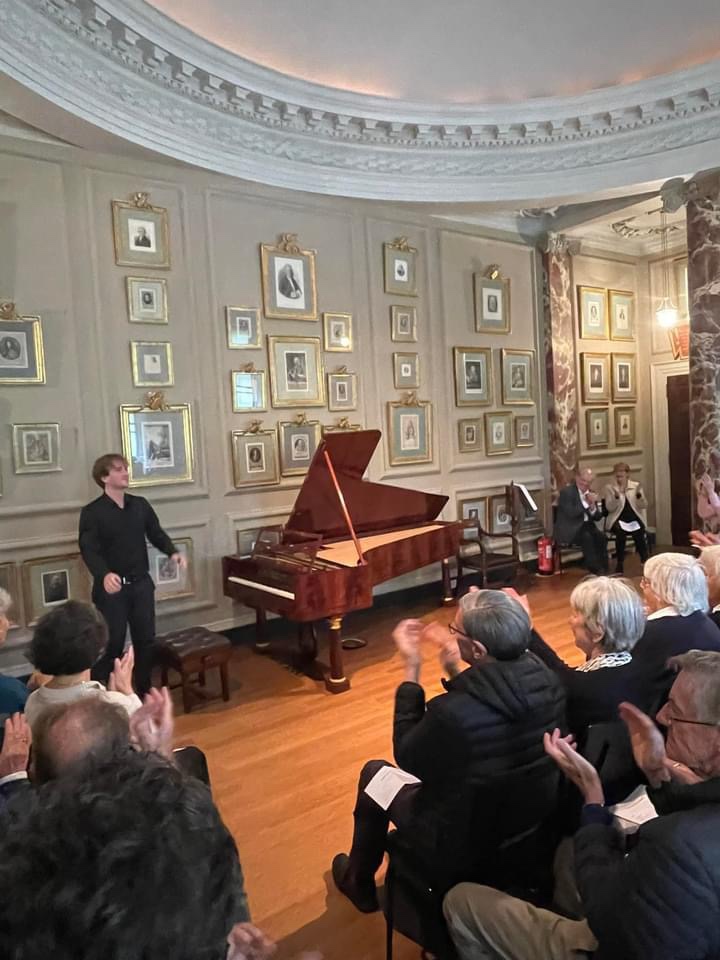
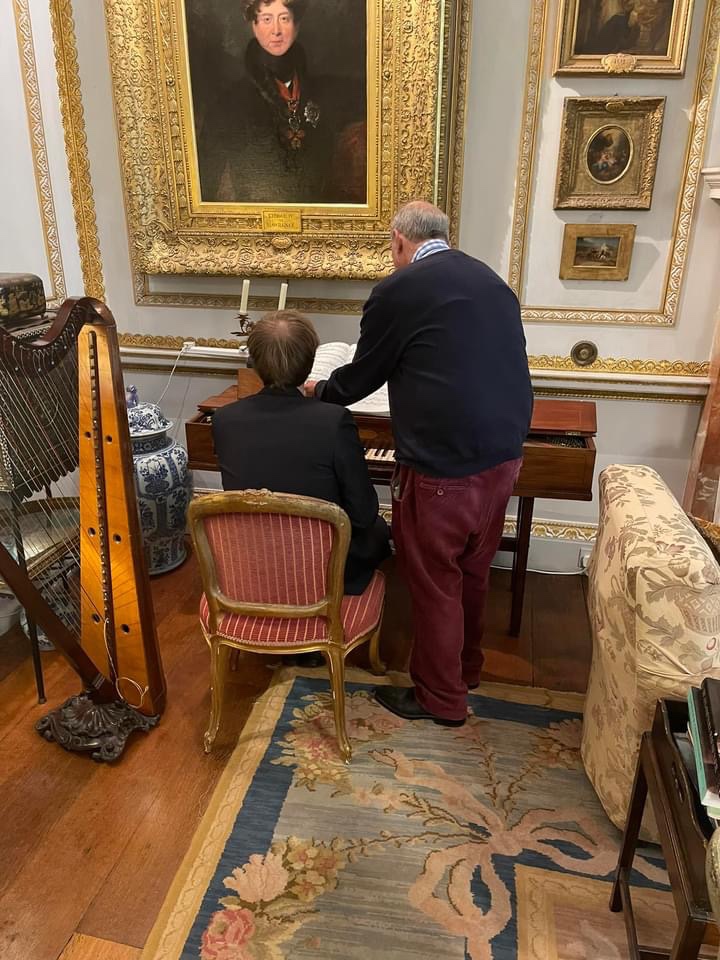
A triumph at Hatchlands but it was Chopin’s Erard that stole Andrzej heart before his concert on George IVs remarkable 1823 Streicher Viennese piano.A piano beautifully restored and it was Alec Cobbe who explained to Andrzej how to drive it .Six pedals needs some working out.Fazioli now has four pedals and if playing with an I pad you can add another two which equals six.But this piano was built two hundred years ago when there were certainly no I pads and pedals had a completely different meaning and usage.

Andrzej with Alec Cobbe the driving instructor par excellence

With just an hour to get used to driving the left and the right pedals Andrzej though had fallen in love with the veiled beauty of sound of the Erard that Chopin had used in Scotland on his final tour just a year before his death.Andrzej spent most of his precious rehearsal time entranced by the sound of this instrument .However it was quite remarkable how on the Streicher piano he was able to immediately adapt the sound via the pedals during the concert that gave clarity and delicacy in the Bach and Mozart and depth of sound in the Chopin.A musician who listens to himself and can instantly search for and find sounds that can bring the music alive with intelligence,scholarship and passion is a musician to be reckoned with.

The Bach Prelude and Fugue in D Book 1 immediately showed us the refined tone palette he could find with delicacy and a rhythmic dance from the bass that I remember very well from Rosalyn Tureck’s much more robust performance on the modern Steinway.An infectious lilt to the music almost like riding a horse but on this instrument there were some very subtle shadings and colours .The Fugue,too,unusually staccato but the short note never accented which gave a beautiful rhythmic propulsion to the fugue that was shaped with the same care as a tone poem and not just allowed to bounce along on its own as we are all too often used to hearing.A Prelude and Fugue shaped into a wondrous overture with the great artistry that was to be the hallmark of the entire concert.

The Chopin Fourth Ballade which had sounded ravishingly veiled on the Erard was here much brighter but Andrzej allowed the music to breathe so naturally with the variations gaining each time in nobility with masterly control.The return of the introduction with the inner tenor register slightly highlighted gave such depth to the sound as it spun into the heights with an etherial cadenza before the contrapuntal return of the theme that was played with ever more crystalline clarity.The final variations were played with passionate commitment but also a remarkable control of texture that made the final glorious full sonority so overwhelming.The five adjoining chords leading to the coda were played with disarming simplicity without any fuss just five simple chords to diffuse the sumptuous climax before a busy coda of transcendental difficulty.But even here the remarkable time and shape he brought to this afterthought revealed the genius of Chopin that this was not just empty virtuosity but textures of passionate poignancy as the temperature rose to boiling point before cascading to the final noble chords of one of the greatest most poetic creations of the Romantic piano repertoire.

Back to Mozart and a shift to the left with the pedals to find that beautiful clarity of Bach once more.A clarity with a delicacy of sound that suited the intimacy of Mozart’s Rondo in Aminor.Andrzej later was to experiment on J C Bach’s piano on which Mozart himself had played his A minor Sonata ; but in the concert on the Streicher piano he had found the ideal colour that revealed the disarming simplicity and poignant beauty of this jewel in Mozart’s crown.

He chose Chopin to finish this short lunchtime concert and it was the early youthful Polonaise published after his death that was able to demonstrate the restrained grandeur with the delicate jeux perlé virtuosity that Chopin would have astonished the salons of his youth with.Exquisite charm of the central musette contrasted with the return of the refined showmanship of the Polonaise.Andrzej was to play another Polonaise by a contemporary,Kurpinski,as an encore which demonstrated the same charm and style of the period

Born
March 6, 1785
Włoszakowice, Kingdom of Poland, Polish-Lithuanian Commonwealth
Died
September 18, 1857 (aged 72)
Warsaw, Kingdom of Poland, Russian Empire

Karol Kazimierz Kurpiński (March 6, 1785 – September 18, 1857) was a Polish composer,conductor and pedagogue .A romanticist and one of the most revered composers before Chopin who he met in 1828. He helped to lay the foundations of a national style and prepared the ground for Polish music of the Romantic period particularly Chopin. He contributed to the development of Polish opera, introducing new musical devices and achieving a novel mode of expression

This was to be no ordinary concert but a voyage in time to find the very source of the creative process which in no way limits fantasy,passion or commitment but puts it into the context of the age in which it was born.What a surprise Alec Cobbe had,to discover a Polonaise by Beethoven that Andrzej played on Haydn’s own piano.A piano that Beethoven too would have known in the period of the first three Sonatas op 2 that Beethoven was to dedicate to his teacher.

Haydn’s piano that Andras Schiff used for his Haydn series in the Wigmore Hall recently

Surrounded by so many beautiful instruments all wonderfully restored and to be able to play the same instruments that composers had used to create eternal masterpieces is a lesson indeed.But all these instruments are in rooms that are a size that allows them to be fully appreciated and not, as so often happens,antique instruments being brought into halls that can accomodate many more than these poor instruments can comunicate with in the same manner.To quote myself :’…….an example to us all of how Mozart could be played respecting the period but not being intimidated by it…….. becoming one,as the very operatic meaning of Mozart was transmitted through them to us thirsty for such enticing musical integrity and inspiration and dare I add ‘authenticity!’(https://christopheraxworthymusiccommentary.com/2023/08/25/impeccable-living-mozart-as-queen-bodicea-drives-her-flaming-chariot-to-meet-grieg-salasswigutpastuszka-and-the-ohorkiestra-take-warsaw-by-storm/).

The final work in this all too short recital was the Sonata in B minor op 58 by Chopin.A performance in which architecture and artistry combined with poetry and passion bringing to life a masterpiece written towards the end of Chopin’s short life.A subdued opening of the Allegro Maestoso as Alec Cobbe had advised.The more restrained you play the greater the effect on this instrument.There was a subtle aristocratic shape to the second subject ‘sostenuto’ as Chopin writes but not a change of tempo and it was this overall architectural shape that gave such nobility to a work that in lesser hands can sound so fragmented.The left hand in the development was like a recitativo leading to the triumphant return of the opening this time in all its blazing glory.A Scherzo of clarity,like quick silver, as it weaved a wondrous shape with such luminosity of sound.A Trio that was with a gloriously replenished full sound of unusual brooding nobility but also wistful and beseeching as it searched for its way back to the Scherzo that in the end just seemed to evolve out of thin air.Straight into the mighty opening chords of the Largo before the purity of the melodic line on a pulsating accompaniment like a constant and reflective heart beat.The long and expansive meanderings that follow were of poignant beauty and the sudden unexpected appearance of the tenor and bass voices were revealed as if by magic.The opening melodic line returning with an even mellower sound leading us to the poignant beauty of the final duet between the two beautiful worlds with which Chopin had so entranced us.The Finale grew out of the final chord of the Largo building up to the agitato Rondo with very carefully controlled and phrased octaves spread over the entire keyboard.A masterly control of sound and tempo left Andrzej time to even add an ornament to the second appearance of the rondo theme as it gradually built to a climax of extraordinary technical mastery.A building of tension and excitement that that finally burst into flames with the treacherous final page played with the security and total abandon of a young virtuoso on the crest of a wave.

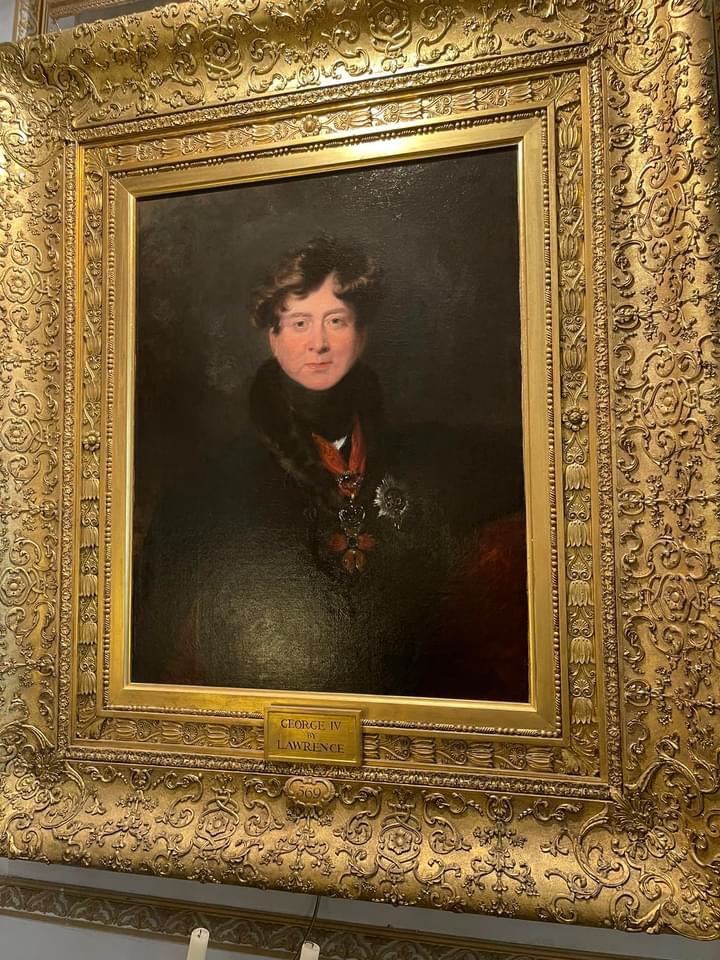
A portrait of George IV sitting above J.C.Bach’s piano on which Mozart had played his Sonata K 310 shortly after completing it
As recorded by the maker’s inscription, this piano (dated 1843) was chosen by the composer Julius Benedict for Jane Stirling. At the time she was residing in Paris and became Chopin’s pupil in that year. The composer played the instrument on many occasions. Later on, Jane Stirling brought it to the Stirling family seat, Keir House in Scotland, where she and Chopin sojourned with her cousin in October 1848. At Keir, according to her niece Miss Minnie Stirling, ‘Chopin had his own sitting room and his own piano, given to him by my aunt’. It is likely that this is the piano referred to, since it remained at Keir, possibly in anticipation of Chopin returning the following year. Thereafter, it survived at Keir from where it came to the collection in 1981.
This instrument survived in a family house in a village near Saint-Germain-en-Laye where Johann Christian Bach went in August 1778. He had arrived there to stay with the duc de Noailles, the maréchal of Saint-Germain, who was one of the most important musical patrons in France. We know of Bach’s visit to Saint-Germain from a letter that Mozart wrote to his father. On his way through Paris, Bach had renewed his acquaintance with the younger composer, then in mourning for his mother, and shortly after, it seems, generously suggested to de Noailles that Mozart should come out for the day. Mozart must have made a good impression, as he stayed for nearly three weeks.
At this date, French piano-building was in its infancy, the instruments in Paris being mostly imported from London, and Bach clearly thought it necessary to bring a London instrument with him. He might have been asked to do so by the duc de Noailles, for in at least two instances Bach is known to have received requests from friends – Denis Diderot and Madame Brillon, a pupil – to choose a London piano for them. In both cases, he selected one made by Zumpe. Bach signed his name on the soundboard of this piano, almost certainly when he chose it in the makers’ workshop.
It is most probable that this piano was present whilst the two composers were guests of the duc de Noailles. It would have been used for much of the music-making described by Mozart and may well have been used by him for an early, if not the first, performance of his great piano sonata K.310 in A minor, which he had just composed.
The maréchal was clearly on good terms with the town, for when the Revolution came, instead of his house being sacked it was merely confiscated and immediately leased back to him on terms from which his sons could benefit after him. It was not until the 1840s when a new road was planned to run through the centre of the building that the contents of the house were dispersed and the building partially demolished. Miraculously, the duc de Noailles’ beautiful Salon de Musique, in which this historic week of music took place, survives in one of the fragments of the Hotel de Noailles still standing on either side of a street in Saint-Germain.
The instrument shows considerable evolution in size and fullness of sound from the earlier instrument by Zumpe.
Hatchlands East Clandon Surrey
Portrait of George IV the most culturally enlightened Monarch

Andrzej Wiercinski at La Mortella Ischia The William Walton Foundation – Refined artistry and musical intelligence in Paradise

Andrzej Wiercinski at St Mary’s the making of a great artist

Andrzej with Alec Cobbe

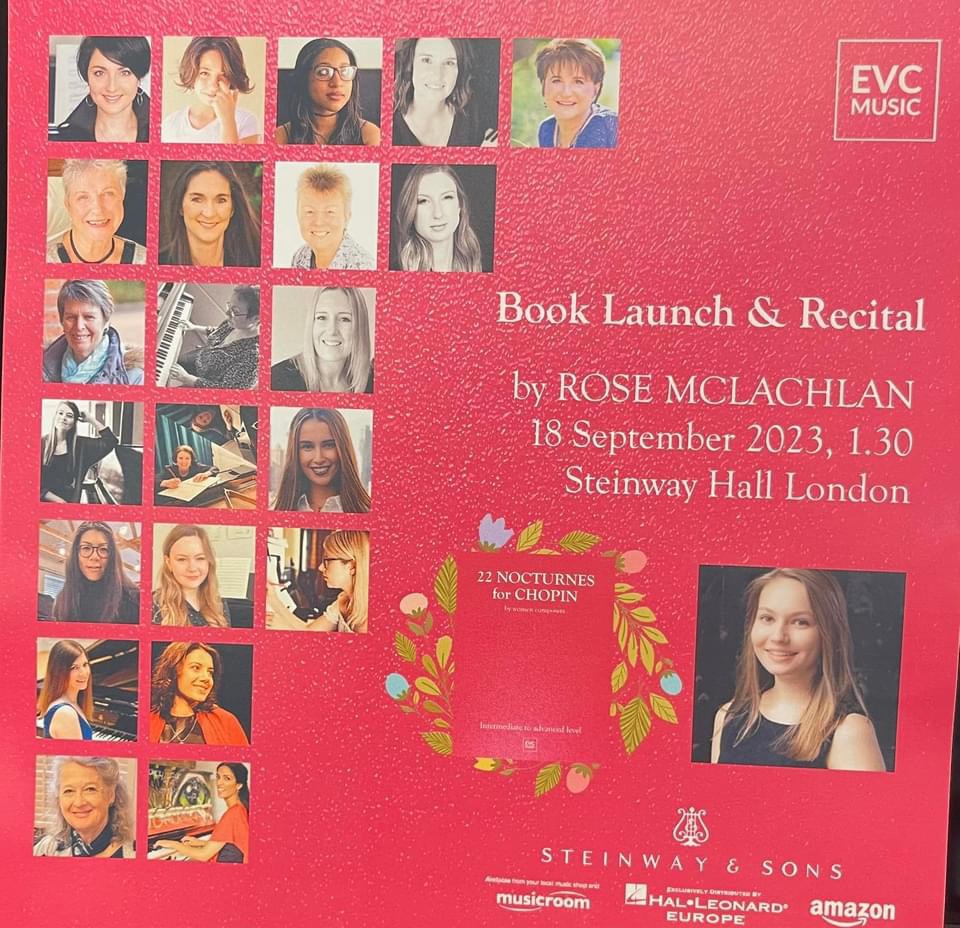
Rose McLachlan inspires and performs 22 Nocturnes for Chopin by women composers

Amazing seance at Steinways today where Rose McLachlan had comissioned 22 female composers to write a nocturne inspired by Chopin.
So not like Rosemary Brown but a much more eclectic choice. To give a voice to some of the woman composers of the day of which far too little is known.
Rosemary Brown would receive music from the hereafter and Peter Katin would perform it at the Wigmore Hall.
The difference is that these are living composers writing music inspired by Chopin and performed by a young pianist whose father had infact been a student of Peter Katin.
But Rose is indeed a Rose and making her way in the music profession with performances that are already being noted by the critics for their authority and musical integrity.
Inspired by a project that she had to present for her master’s degree she decided on this project of creativity to give a voice to a category that has lain silent for too long.
https://christopheraxworthymusiccommentary.com/2022/08/24/rose-mclachlan-at-st-james-piccadilly-je-sensje-joue-je-trasmet-artistry-and-poetic-imagination-of-a-musician/


Some beautiful playing for composers inspired by the world of Chopin.
With the amazing McLachlan family at the helm we heard fourteen of these nocturnes by composers that were also present.

The McLachlans united with Rose today

With Father Murray presenting ,brother Matthew page turning ,Mother Katherine coordinating and last but not least Rose dedicating her extraordinary artistry to presenting each of these composers with total commitment and artistry .
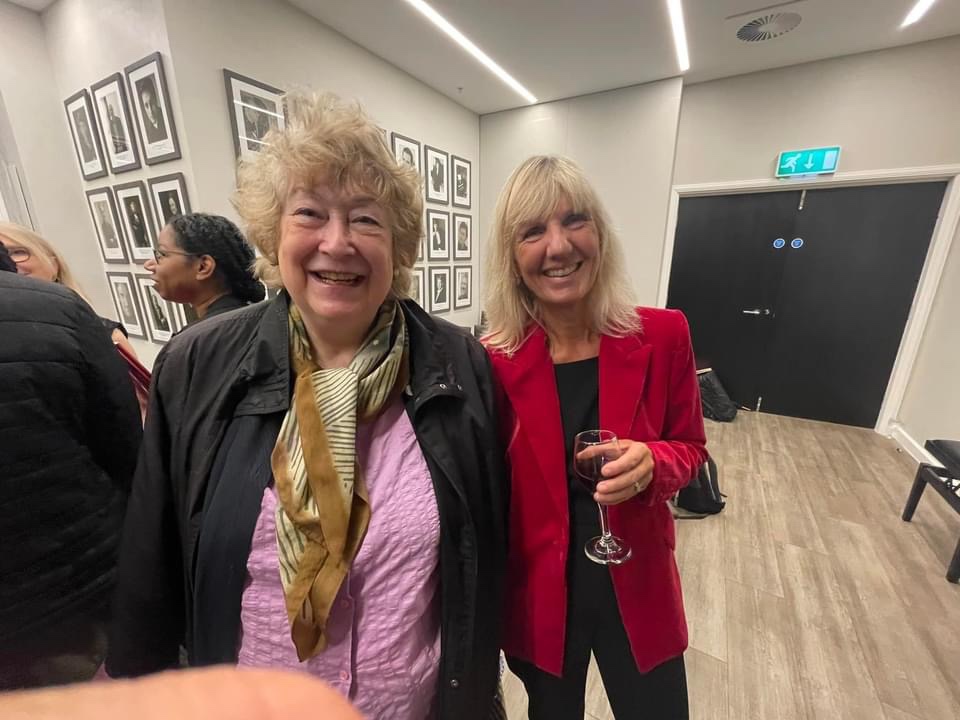
Some very distinguished guests and the entire concert with interviews all streamed live giving a platform to some dedicated women composers of whom we speak all too rarely.

Murray Mc Lachlan with Jed Distler
Tim Parry editor of the International Piano
Lady Rose Cholmondeley President of the Chopin Society with Katherine Page (Mrs McLachlan),
Alanna Crouch (right) and mother,composer of a nocturne in D flat particularly admired by New York critic Jed Distler
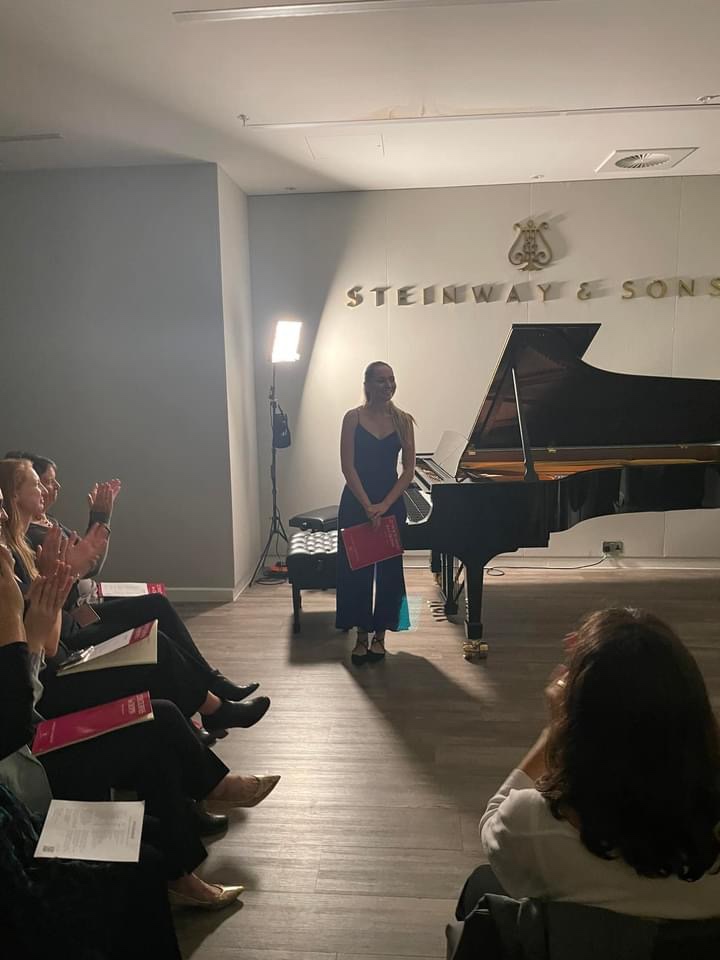
Rose McLachlan receiving just applause at the end her recital at Steinway Hall London

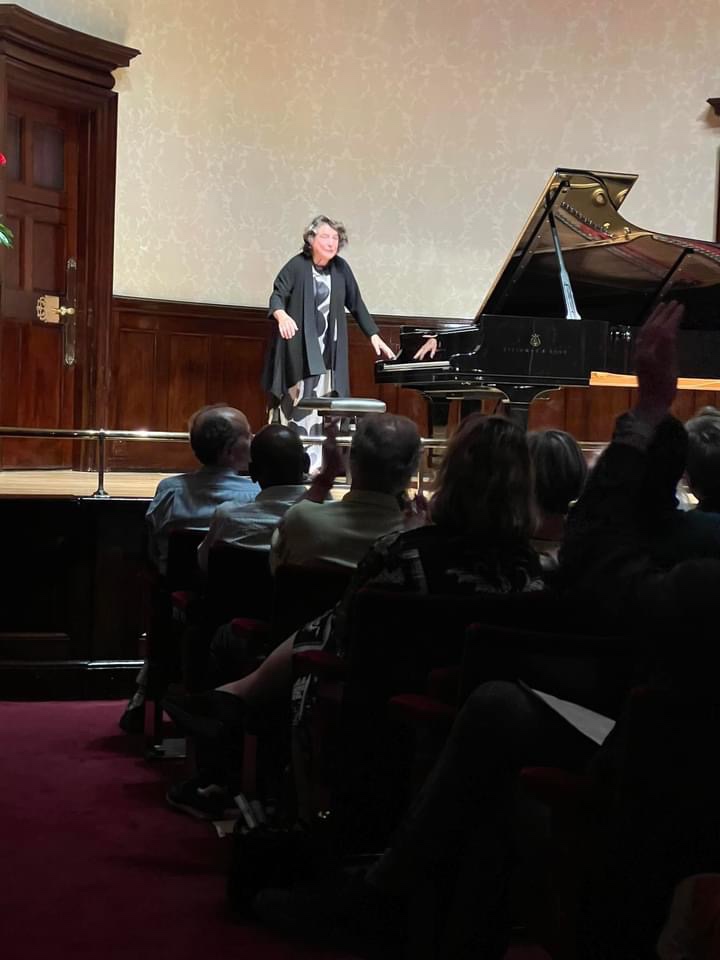
Leonskaja The Queen of the Keyboard ignites and inspires the Wigmore Hall

Johannes Brahms (1833-1897)


Piano Sonata No. 1 in C Op. 1 (1852-3) I. Allegro
II. Andante (nach einem altdeutschen Minneliede) III. Allegro molto e con fuoco – Più mosso
IV. Allegro con fuoco – Presto non troppo ed agitato


Piano Sonata No. 2 in F sharp minor Op. 2 (1852)
I. Allegro non troppo, ma energico
II. Andante con espressione
III. Scherzo. Allegro – Trio. Poco più moderato
IV. Finale. Sostenuto – Allegro non troppo e rubato


Interval


Piano Sonata No. 3 in F minor Op. 5 (1853) I. Allegro maestoso
II. Andante espressivo
III. Scherzo. Allegro energico
IV. Intermezzo. Andante molto
V. Finale. Allegro m moderato ma rubato

Elisabeth Leonskaja the Queen of the Keyboard .Music pure music just erupted from the depths of her soul and struck us with unusual force .
Not since Tatyana Nikolaeva or Annie Fischer have we experienced a direct communication between the composer, the music and the audience.
Rushing on and off as she was a lady on a mission with total self effacing authority.Gradiosity,Majesty,Etherial ,Orchestral,Nobility and above all seductive …….breathtaking in its architectural shape with the construction of three great monuments before our astonished eyes.
We are not used to such overwhelming authority and music pure music.
It puts us all to shame as we listen enraptured seduced and totally overwhelmed ……Why are there no others like this left from the days of Wilhelm Kempff ,Edwin Fischer ,Rudolf Serkin?A musician where the medium becomes almost irrelevant and is the means through which music can live and breathe as it did when the ink was still wet on the page.Alexei Lubimov was a revelation recently too ,in Warsaw, but with out this Leonine temperament that I also remember from Wilhelm Kempff when he played op 5 in London in the 70’s before his Indian Summer of sublime introspection.

Kapellmeister Lubimov leads us to the very heart of music with simplicity and mastery

There was a beauty and flexibility of her arms and wrists as she seemed to be swimming in a tide of sounds with a naturalness that was extraordinarily beautiful to see.There was an etherial beauty to the question and beseeching answer in the Andante of op 1 followed by the grandeur of the Scherzo and the contrasting fluidity of the Trio.An opening of great orchestral sounds played from on high with a dynamic drive that was like a Lioness being let loose to devour the keys.There was colour and mystery added to the declamatory outpourings of the Allegro non troppo,ma energico op 2 .Absolute desolation of the Scherzo again contrasting with the fluidity of the Trio.The veiled luminosity of the chorale in the Finale of op 5 I have never heard so whispered as she drew us in to listen as the music became ever more noble and passionate.Her control of sonority and sense of balance allied to a passionate wild abandon was surely the sum of a great master.
A vision of space and timeless wonder.
Curzon and Rubinstein are the only memories I have of the coda of the Andante espressivo of op 5 with sounds that I never expected to hear again until today. The final arpeggios thrown into the air to capture that luminosity but then catching the sound as it reverberated within the piano and nourished our souls .
A Scherzo that shot from these ethereal chords like someone igniting a rocket.
The aristocratic grandeur she brought to the last pages will resound in the walls of this hallowed hall for long to come .
But seated at the piano and visibly exhausted she allowed Chopin’s Nocturne in E flat to flow from her fingers like water flowing over some celestial stream .To watch her fingers on high play every note like bells being caressed and to hear such whispered secrets made one wonder was it just a dream that we had just experienced the greatest performances of Brahms this hall has ever known!

In the autumn of 1853 having met some of the biggest names in music, the young man travelled to Düsseldorf and rang the Schumanns’ doorbell.
The visit was life-changing. Robert and Clara Schumann could not have been warmer or more extravagant in their praise.

Schumann’s famous description of the young Brahms appeared in the Leipzig Neue Zeitschrift für Musik of 28 October 1853, in an article headed ‘Neue Bahnen’ (‘New paths’). Less than a month earlier, Brahms had called at the house of Robert and Clara Schumann in Düsseldorf. (‘He played us sonatas, scherzos etc. by him, all of them full of effusive imagination, intimate feeling and masterly form’, wrote Clara in her diary.)

Seated at the piano, he began to reveal wondrous regions to us. We were drawn into ever more magical spheres. In addition, the playing was absolutely inspired, transforming the piano into an orchestra of lamenting and loudly jubilant voices. There were sonatas, more like veiled symphonies; songs, whose poetry would be understood without knowing the words, although a profound vocal melody runs through them all; individual piano pieces, some of them demonic in nature while graceful in form; then sonatas for violin and piano, string quartets—and each work so different from the next that it seemed to stream forth from its own individual source. And then it seemed as though he were uniting them all like a stream roaring forth into a waterfall, with a peaceful rainbow above its tumultuously descending waves, and butterflies flitting about on the banks accompanied by the song of nightingales.


Two of the ‘veiled symphonies’ (Robert Schumann’s words) that Brahms played to the Schumanns were the first two works in tonight’s programme. The Piano Sonata No. 1 in C (dedicated to Joachim) was completed after the Piano Sonata No. 2, but was
published first.

The Piano Sonata No. 1 in C major, Op. 1, was written in Hamburg in 1853, and published later that year. Despite being his first published work, he had actually composed his Piano Sonata n. 2 first, but chose this work to be his first published opus because he felt that it was of higher quality. The piece was sent with his second sonata to Breitkopf &. Härtel with a letter of recommendation from Schumann who had already praised Brahms enthusiastically, and the sonata shows signs of an effort to impress in its symphonic grandeur, technical demands, and dramatic character. It was dedicated to Joseph Joachim

The sonata is in four movements:

  1. Allegro
  2. Andante (nach einem altdeutschen Minneliede),
  3. Allegro molto e con fuoco — Più mosso
  4. Allegro con fuoco — Presto non troppo ed agitato

Text of song

Verstohlen geht der Mond auf.
Blau, blau Blümelein!
Durch Silberwölkchen führt sein Lauf.
Blau, blau Blümelein!
Rosen im Tal,
Mädel im Saal,
O schönste Rosa!
Stealthily rises the moon.
Blue, blue flower!
Through silver cloudlets makes its way.
Blue, blue flower!
Roses in the dale,
Maiden in the hall,
O handsomest Rosa!

The first movement is in conventional sonata form with a repeated exposition. The opening of the first theme resembles the opening of Beethoven’s “Hammerklavier Sonata . The second movement is a theme and variations inspired by the song Verstohlen geht der Mond auf. Brahms was to rewrite it for female chorus in 1859 (WoO 38/20). The third movement is a scherzo and trio. The fourth is a loose rondowhose theme is noticeably changed at every recurrence. It is highly technically demanding on the performer, with toccata-like intensity and rapid thirds throughout. The form of the rondo is a palindrome ABACACABA.

The Piano Sonata No. 2 in F♯ minor, Op. 2 of was written in Hamburg but in 1852, and published the year after.

It was dedicated to Clara Schumann

The sonata is in four movements:

  1. Allegro non troppo, ma energico
  2. Andante con espressione
  3. Scherzo: Allegro — Poco più moderato
  4. Finale: Sostenuto — Allegro non troppo e rubato — Molto sostenuto

The first movement is in the conventional sonata -allegro form. The second movement is a theme and variations based on the German Minnesang “Mir ist leide“. Like the theme and variations of the first Sonata ,the variations move from the minor mode to the parallel major. The third movement is a scherzo and trio whose beginning theme is almost identical to that of the second movement. The finale begins with a brief introduction in A the relative major of F sharp minor. The main subject of the introduction serves as the first theme of this movement, which is in sonata form and contains a repeated exposition. The codaof the finale, marked pianissimo and to be played with the soft pedal, returns to and expands upon material from the movement’s introduction.

The Piano Sonata No. 3 in F minor, Op. 5 of was written in 1853 and published the following year. The sonata is unusually large, consisting of five movements as opposed to the traditional three or four. When he wrote this piano sonata, the genre was seen by many to be past its heyday. Brahms, enamored of Beethoven and the classical style, composed Piano Sonata No. 3 with a masterful combination of free Romantic spirit and strict classical architecture. As a further testament to Brahms’ affinity for Beethoven, the Piano Sonata is infused with the instantly recognizable motive from Beethoven’s Symphony n. 5 during the first, third, and fourth movements.Composed in Dusseldorf , it marks the end of his cycle of three sonatas and was presented to Schumann in November of that year; it was the last work that Brahms submitted to Schumann for commentary. Brahms was barely 20 years old at its composition. The piece is dedicated to Countess Ida von Hohenthal of Leipzig.


Brahms worked on his Sonata No. 3 in F minor while staying with the Schumanns as a guest. Its most obvious feature is the addition of an Intermezzo between the Scherzo and the Finale. This casts a look back to the passionate Andante second movement, at the top of which Brahms briefly quoted a poem by CO Sternau about lovers in the moonlight. The closing bars, where the measure changes from three to four beats in a bar, magically discharge some of the most erotic music Brahms wrote.
The sonata is in five movements:

  1. Allegro maestoso
  2. Andante Andante espressivo — Andante molto
  3. Scherzo . Allegro energico avec trio (F minor – D♭ major – F minor)
  4. Intermezzo (Rückblick / Regard en arrière) Andante molto
  5. Finale. Allegro moderato ma rubato (F minor, ending in F major)

The second movement begins with a quotation above the music of a poem by Otto Inkermann under the pseudonym C.O. Sternau.Perhaps symbolizing the two beating hearts in this Andante are its two principal themes which alternate throughout the movement.

Der Abend dämmert, das Mondlicht scheint,
da sind zwei Herzen in Liebe vereint
und halten sich selig umfangen

Through evening’s shade, the pale moon gleams
While rapt in love’s ecstatic dreams
Two hearts are fondly beating.

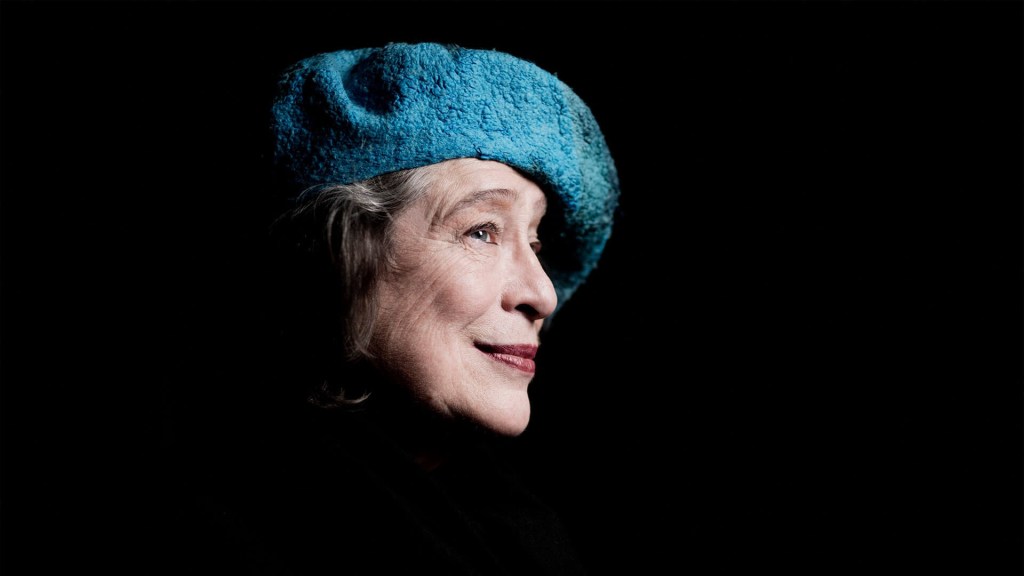
Elisabeth Leonskaya at the Wigmore Hall. True Queen of the keyboard

Masterclass with Andrea Molteni playing the ‘Hammerklavier ‘at the International Piano Academy Lake Como recently
https://christopheraxworthymusiccommentary.com/2022/03/24/andrea-molteni-at-steinway-hall/

Elisabeth Leonskaya – The Oracle Speaks

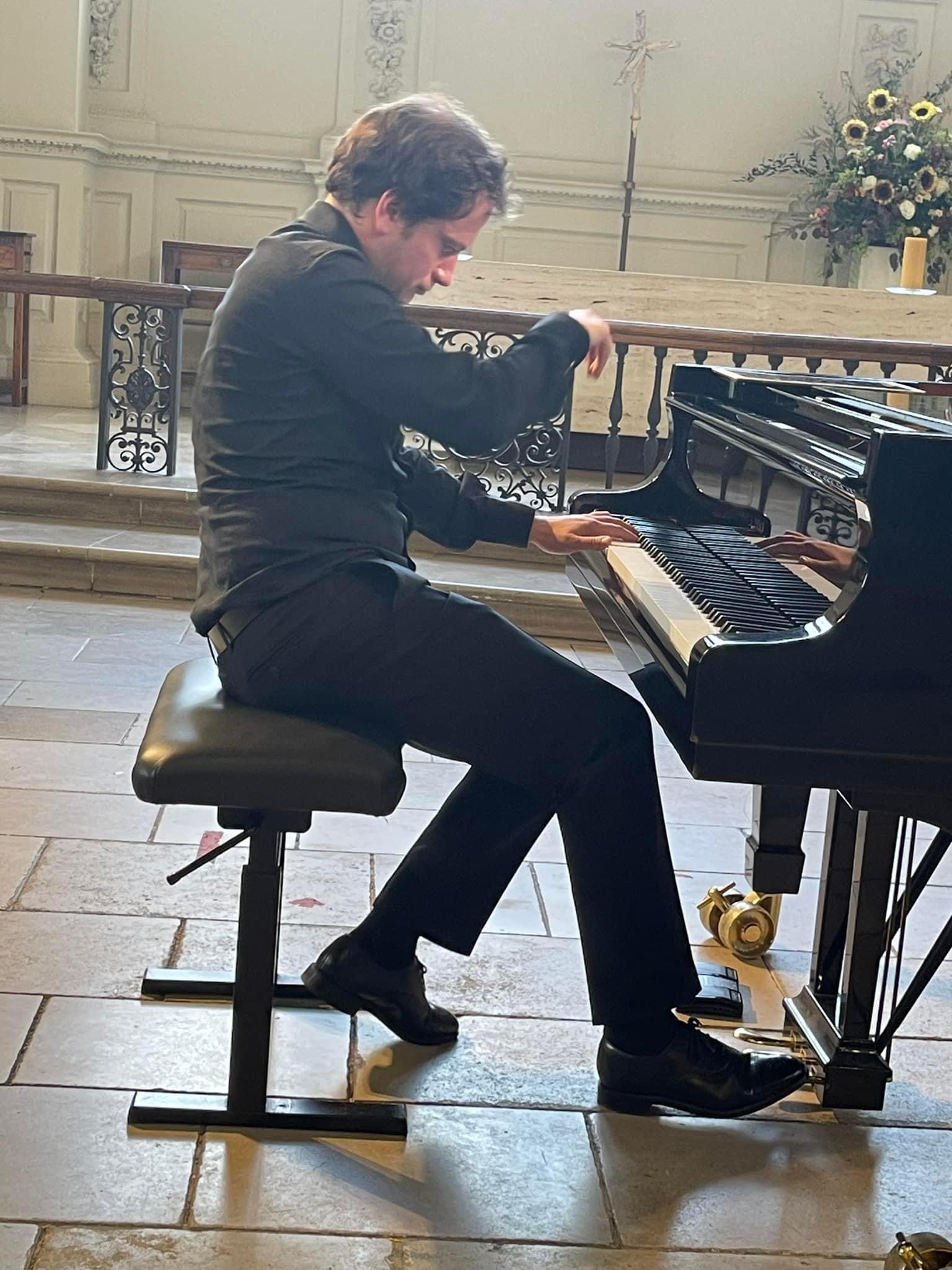
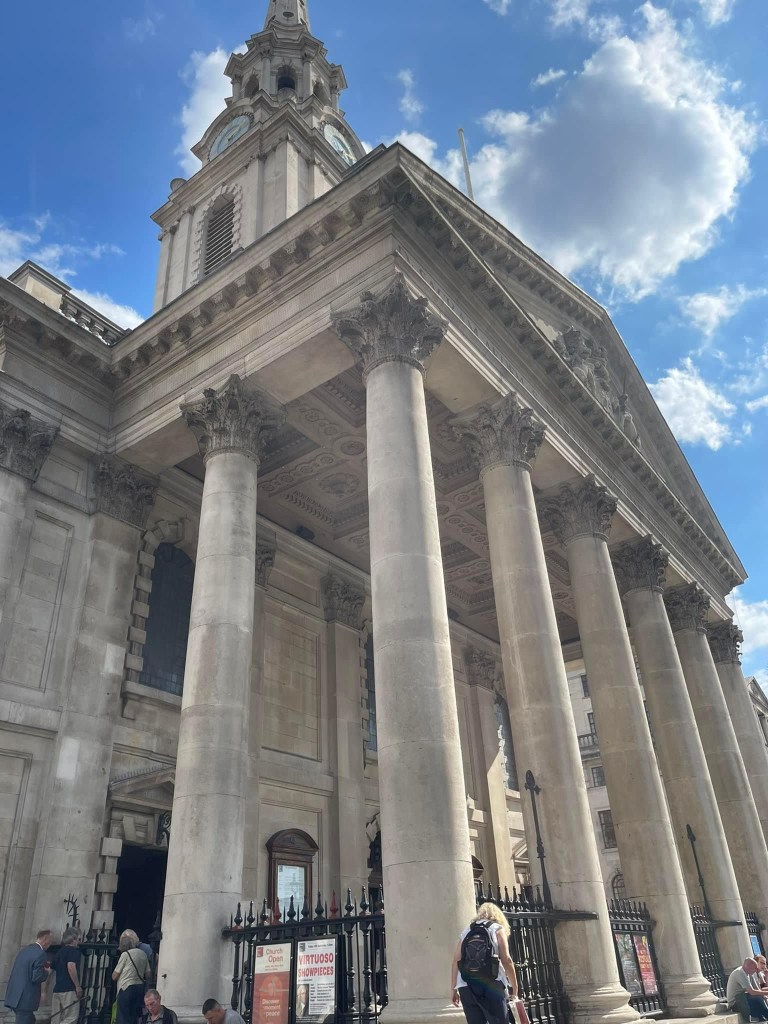
Mihai Ritivoiu at St Martin in the Fields Simple great Beethoven from a musician who thinks more of the music than himself

At the centre of Mihai Ritivoiu’s recital is the timeless music of that greatest of composers, J.S. Bach and the influence he had on many composers through the ages. Father of the fugue, Beethoven was to emulate this musical device in his Op.110 sonata, and Busoni was inspired to make his own transcriptions of many of Bach’s works. Similarly Mihai himself brings us right up to date with his own variations on one of Bach’s Chorales as well as performing a new work by Stephane Delplace, which he recently premiered.

The concert with an almost obligatory title these days where packages are easier to sell Mihai had decided on : “Inspirational Bach.” Johann Sebastian Bach (1685-1750) is unquestionably the most revered figure in the entire history of western classical music, “The Father of Music” , and often being referred to by other composers, like Frédéric Chopin ,Ludwig Van Beethoven and Wolfgang Amadeus Mozart, as a key inspiration.

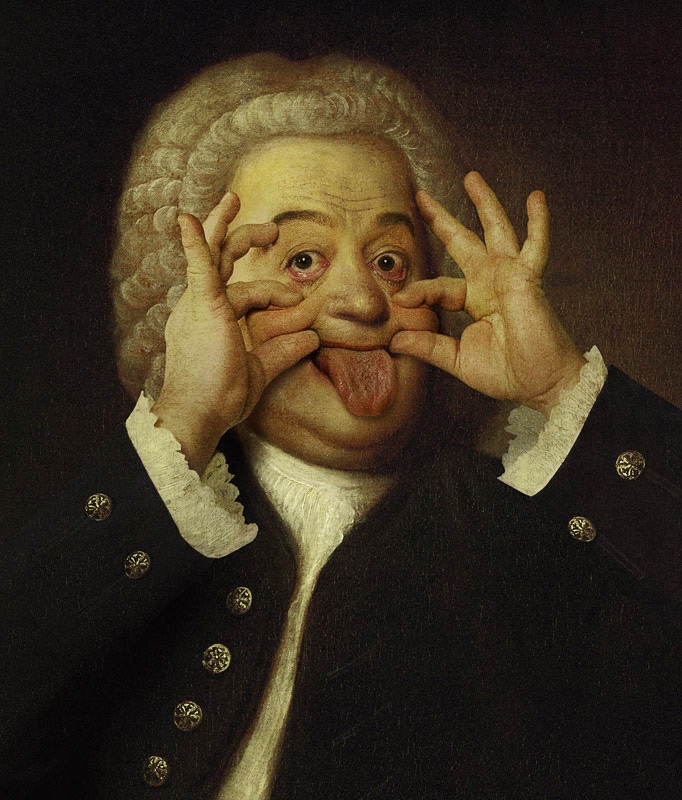
Portrait of Bach, 1748
Born 21 March 1685 (31 March 1685 ) in Eisenach
Died 28 July 1750 (aged 65) in Leipzig


Simple grand Beethoven at St Martins.
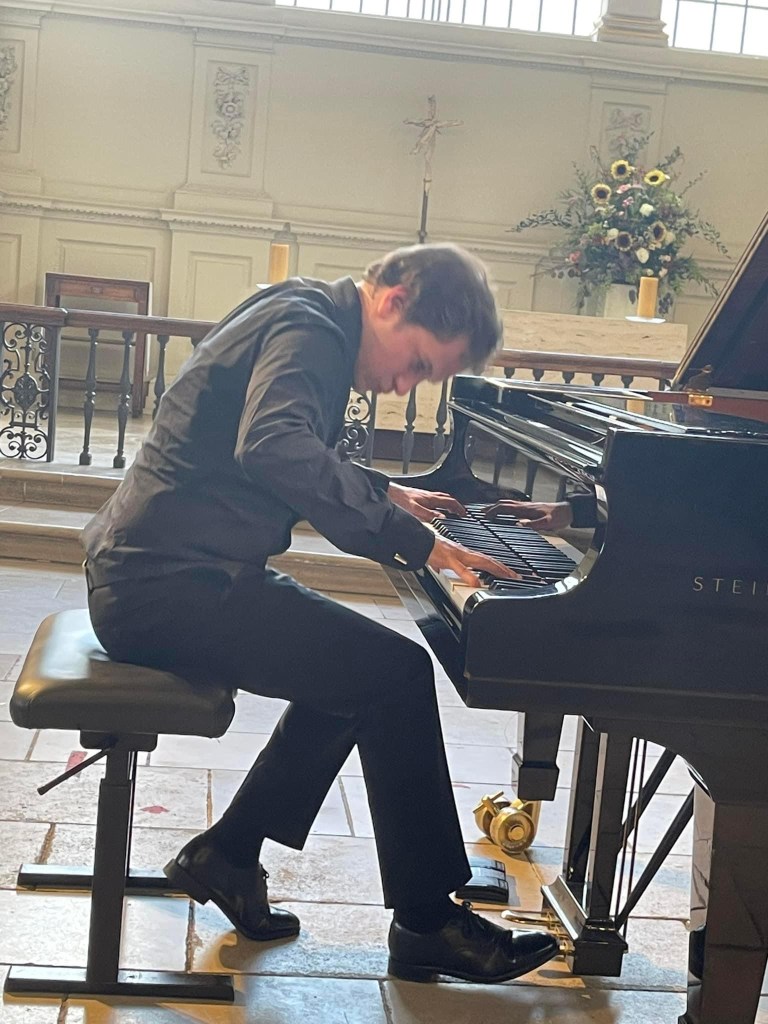
I was thinking how proud Joan Havill would be to hear Mihai Ritivoiu blessed by the Gods today as he took us into realms of beauty and mystery that dreams are made of with Beethoven’s penultimate Sonata op110.
A Brahms op 116 n 4 floundering ,perchance to dream on a magic wave of sounds posing questions of unanswerable poignancy.
An artist of quite extraordinary powers of communication.
A musician who thinks more of the music than himself is an artist to cherish indeed these days.

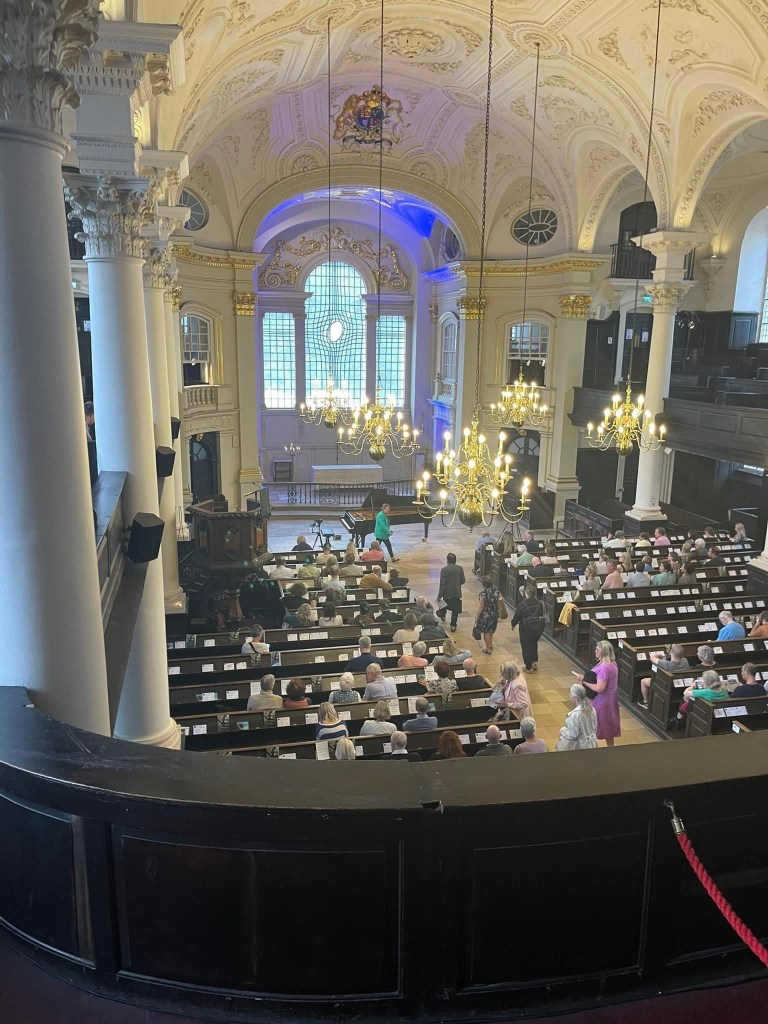
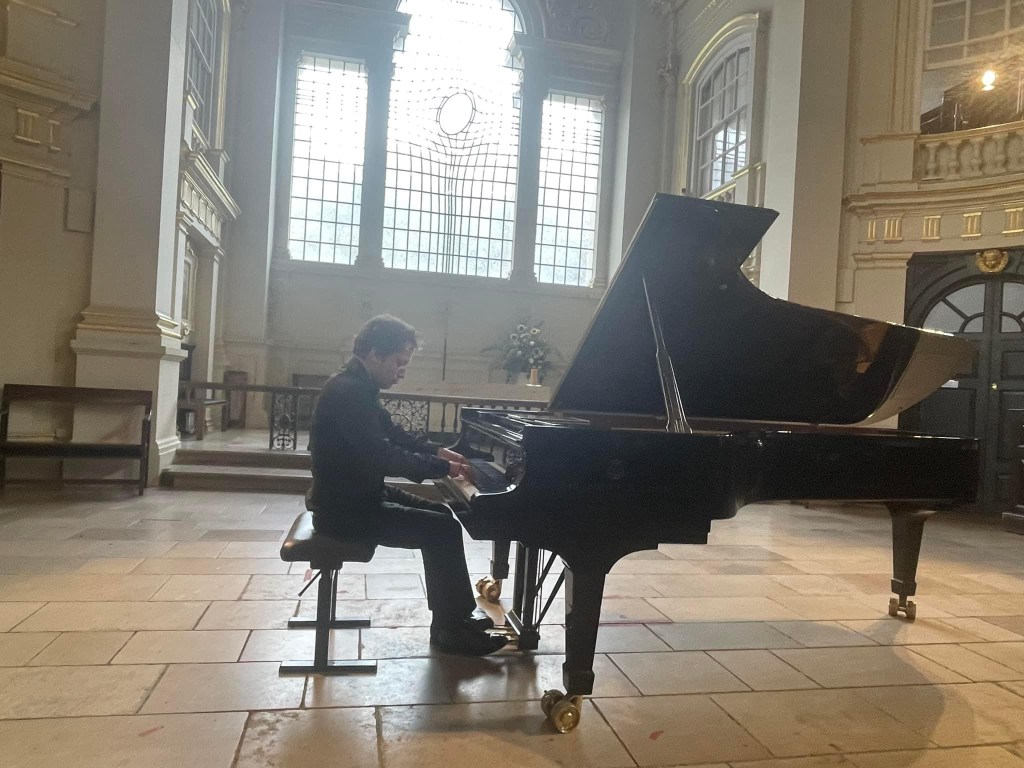
Beginning his recital with one of the most sublime of Busoni’s transcriptions of Bach’s Chorale Preludes BWV 639 ‘ Ich ruf zu dir,Herr Jesu Christ’ and creating an atmosphere of beauty and serenity that was to pervade the whole recital.There was a purity and clarity of sound with a sense of balance that allowed the melodic line to float on a sumptuous cloud of golden sounds created deep in the bass with delicacy and richness of sonority.The final phrases were of a whispered beauty of the revelation of a true believer.With the radiance of the sun shining through the great glass window behind the altar it was indeed a poignant start to a recital of beauty,simplicity and contemplation .’Light is suspended in a veil by the etching of the clear glass with a swirl of flecks; and at dusk, as daylight fades, the central oval glows, mysteriously self-lit.’The painting of The Veil of St Veronicaby Zurbarán is cited by Shirazeh Houshiary as a source for her East Window which was installed in 2008 .Zurbarán’s image of a piece of cloth bearing a likeness of the face of Christ connects with Houshiary’s idea of the veil that underlies her design of the steel grid of the window. Here, abstraction and representation merge into an iconic whole that invites contemplation.’

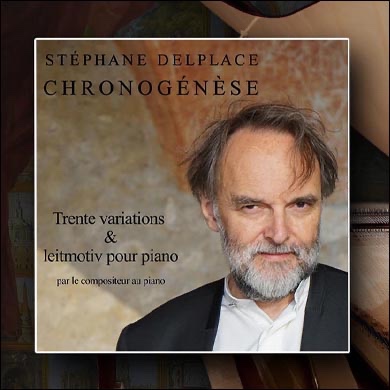
Mihai followed Bach with a fascinating work by Stephane Delplace.There was a recurring leit motif reminiscent of bells chiming out of which emerged Bach like contrapuntal passages of nostalgia and beauty.There was also a mellifluous outpouring of continuous motion of purity and simplicity that was a wash of pastoral innocence.

Stéphane Delplace was born 11th November 1953 (age 69) in Bordeaux France ,and is a composer ,teacher and pianist .He studied piano under Pierre Sancan , as well as Harmony (Alain Bernaud), Counterpoint (Jean-Paul Holstein), Fugue (Michel Merlet ), and Orchestration (Serge Nigg) at the Conservatoire de paris from 1979 to 1984.Delplace began to compose in the mid-1980s, with a firm conviction, though unpopular at the time, that tonal music still hides infinite unexplored territories.Never parting from this ideal, his music finds its roots in that of Bach,Brahms,Faure,Ravel,Prokofiev ….

Bach’s mighty Chromatic Fantasia and Fugue followed with a performance of great authority where Mihai’s vision of line was of a flexibility that made the weaving stream of notes a living and searching sound with recitativi of poignant beauty of searing significance .The beautifully embellished final phrases leading the way to whispered secrets as the fugue subject emerged from the final chord much as Beethoven was to do in his op 110 Sonata that we were to appreciate later in the programme.There was a rhythmic buoyancy to the fugue as it gradually built in fervour with layer upon layer added until the final glorious explosion of arrival at it’s goal with the final note placed with such an aristocratic sense of timing deep in the bass.

Not to be outdone Mihai had written his own variations on the chorale from Bach’s St John Passion:’Herzliebster Jesu,was hast du verbrochen’ (‘Ah, holy Jesus, how hast thou offended?’).Its text is a Passion hymn by J Heermann, famously found in both the St John and St Matthew Passions. A melancholy affect is created by the slow-moving counterpoint, spiced with suspensions and chromatic lines and the final notes of the melody are filled in chromatically, highlighting the poignancy that is at the heart of both the theology and the music of the prelude.The tune has been used many times, including settings by J.S. Bach : one of the Neumeister Chorales for organ, BWV 1093,two movements of the St John Passion, and three of the St Matthew Passion .Brahms used it too for one of his Eleven Chorale Preludes for organ, Op. 122: No. 2.Max Reger’s Passion, No. 4 from his organ pieces op 145 (1915–1916), uses this melody. Mauricio Kagel quoted the hymn, paraphrased as “Herzliebster Johann, was hast du verbrochen”, in his oratorio Sankt- Bach-Passion telling Bach’s life, composed for the tricentenary of Bach’s birth in 1985. Mihai’s variations were very impressive and I was trying to guess the various composers that maybe had inspired each variation. The 2nd was Rachmaninov,3rd Debussy water nymph,4th chiselled beauty of notes being shadowed alla Poulenc or Schumann,5th was certainly De Falla,6th Ravel,7th Debussy -Rachmaninov ,8th was the return of the original chorale this time with comments and the 9th Russian maybe Prokofiev.A fascinating work that just showed what a real thinking musician Mihai is and am sure that my comments on an innocent first hearing will bring a smile to his face but it showed what a rich palette of invention he could bring to his own composition.

His performance of op 110 by Beethoven was simply one of the most beautiful and convincing that I can remember hearing.As he said Beethoven’s use of the extremes of the keyboard could be considered the search for the infinite in what was to be his penultimate sonata.Op 111 the last of the 32 Sonatas finishes with a glimpse of paradise as the trills take on an etherial significance much as they were to do for Scriabin a century later.The amazing thing was that Beethoven was totally deaf but the sounds that only he could hear in his head he was able to write down with such meticulous care able to share this great testament with eternity.The only sonata without a dedication as it was thought it might be a secret memorial for his ‘Immortal Beloved’.Published without a dedication, there is evidence that Beethoven intended to dedicate Opp. 110 and 111 to Antonie Brentano (Op.111 was eventually dedicated to the Archduke Rudolf) and 110 very significantly left without.Mihai’s was a performance of purity and pastoral innocence with a wondrous musicianship that can say so much with so little effort or personal intervention.There was a great contrast with the Scherzo of almost wild abandon and masterly control in the treacherous Trio where his remarkable restraint made the return of the Scherzo even more of a contrast.Ravishing beauty of the Adagio and a subtle use of the pedal and the bebung effect of allowing a single note to vibrate – not easy on the modern day instruments.It lead to an aria of subtle poetic significance almost as though Beethoven was at last at peace with himself and the world.The great bass entries in the Fugue were every bit as breathtaking as the bass pedal stops of a church organ.The return of the fugue subject in inversion floated in on the vibrations left from the huge sonorities of repeated insistent chords.It was so noticeable too the way that Mihai caressed the keys never hitting but stroking with horizontal movements never vertical.The whole effect both visual and in sound was of luminosity and sublime beauty as Beethoven built the final pages to a colossal climax of passion and the fervent conviction of someone who could see the light that awaited him just six years on.

Antonie Brentano, Portrait by Joseph Karl Stieler 1808

Programme

Bach/Busoni – Chorale Prelude BWV 639, “Ich ruf zu dir, Herr Jesu Christ”
Stephane Delplace – Sisyphe
Bach – Chromatic Fantasia and Fugue in D minor, BWV 903
M. Ritivoiu – Variations on a Bach Chorale – “Herzliebster Jesu, was hast du verbrochen”
Beethoven – Piano Sonata in A flat major op 110

Mihai Ritivoiu Piano

Born in Bucharest, Mihai Ritivoiu is a laureate of numerous national and international competitions, most notably the George Enescu International Competition.

Mihai leads an international career performing solo and chamber music recitals in Europe and Asia, and has played concertos with the George Enescu Philharmonic Orchestra, Lausanne Chamber Orchestra, the English Chamber Orchestra and the MDR Leipzig Radio Orchestra. He collaborated with conductors such as Joshua Weilerstein, Robert Trevino, Michael Collins, Cristian Mandeal, Christian Badea and Horia Andreescu. He has been invited to play at prestigious festivals, including Young Euro Classic in Berlin, George Enescu Festival in Bucharest, St Magnus International Festival, and appeared on stages such as Cadogan Hall, Barbican Centre, Konzerthaus Berlin, Studio Ernest Ansermet Geneva and the Romanian Athenaeum and Radio Hall in Bucharest. 

Regularly invited to play on BBC Radio 3’s programme ‘In Tune’, his performances have been broadcast on Radio Romania Muzical, Radio Television Suisse and Medici TV. His debut album “Transcendence” with solo works by Franck, Enescu and Liszt has been praised as “beautifully recorded, handsomely played – a solo recital to cherish” (The Arts Desk).

A graduate with the highest honours from the National University of Music in Bucharest and the Guildhall School of Music & Drama in London, Mihai studied with Professors Viniciu Moroianu and Joan Havill. He has taken part in masterclasses and lessons with Dmitri Bashkirov, Dominique Merlet, Emmanuel Ax, Richard Goode, Jean-Claude Pennetier and has been mentored by Valentin Gheorghiu and Christopher Elton. Most recently, he has pursued directing from the keyboard with Ricardo Castro at the Scuola di Musica di Fiesole.

In addition to his solo recitals and concerto appearances, Mihai has a rich chamber music activity. His partners have included Corina Belcea, Antoine Lederlin, Roland Pidoux, Oleg Kogan and Alexander Sitkovetsky. He forms a duo with the cellist Yoanna Prodanova, with whom he has performed in the United Kingdom, France and The Netherlands. Their first album as a duo, with works for piano and cello by Chopin, Fauré and Janacek was recently released on the Linn Records label.

Mihai is a City Music Foundation artist and a Freeman of the Worshipful Company of Musicians. He has received generous support from the Liliana and Peter Ilica Foundation for the Endowment of the Arts, Erbiceanu Cultural Foundation and Ratiu Family Charitable Foundation.

Mihai Ritivoiu’s triumphant recital signals a musical renaissance at the National Liberal Club

Alexandre Kantorow ignites and delights Naples at San Carlo with his great artistry

April 22, 2023

ALEXANDRE KANTOROW

A truly breathtaking and exhilarating performance of Brahms first Piano Sonata op 1.
From the very first notes there was a sumptuous richness to the sound with the deep bass harmonies opening up endless possibilities of colour.
Infact the melting whispered cantabile of the second subject had a fluidity of ravishing beauty.Here was a true musician the same one that had mesmerised me in the performance he gave to an empty Philharmonie in Paris during the Covid pandemic.An oasis of beauty and hope for the future.A performance of Rachmaninov’s seemingly ungrateful first sonata that in his hands revealed a hidden masterpiece.

Alexandre Kantorow takes the Philharmonie de Paris by storm

Waiting for Kantorow in the sumptuous beauty of San Carlo Opera House in the heart of Naples

It was the same today in the bustle of Naples on a Saturday night where he created an oasis of beauty revealing a masterpiece every bit as noble as the better known third sonata.Revealing a true symphony for piano with transcendental command and a technical mastery at the service of the composer.Here was a Furtwangler at the piano commanding attention and revealing the very soul of recreation.The Schubertian questioning and answering of the Andante was unforgettable for the portent that was concealed in so few notes.A truly magical duet between the tenor and soprano voices was a celestial ending.A spectacular Scherzo immediately broke the spell with its dynamic driving energy contrasting with the beautifully fluid trio.The finale was indeed Allegro con fuoco with it’s burning intensity and driving bass energy.Above all there was clarity and precision not only technically but of the mind of a great artist that can give us the complete architectural shape of a very complex work

A selection of six Schubert Lieder in the transcription of Liszt.Miniature masterpieces recreated by the genius Liszt.In Kantorow’s hands they were indeed imbued with the magical atmosphere of Schubert that Liszt had miraculously recreated.Six miniature tone poems in this artist’s sensitive hands where each one was a true ‘song without words’.Avoiding the more obvious well known Erlkonig,Standchen etc Kantorow brought us the rarely heard ‘other six’.I imagine he may have chosen them at the last minute like Schiff and Richter preferring not to be pinned down to a specific programme years in advance.’Sei mir gegrusst,Du bist die Ruh’,Meeresstille,Die junge Nonne,Rastlose Liebe,Der Wanderer’ by process of elimination were the Lieder he actually played.I have rarely heard them in concert and they were a revelation of sumptuous golden sounds,melancholic simplicity,mystery but above all a sense of balance that allowed the melodic line to sing out no matter the glittering ingenious cascades of notes that Liszt envelopes them in.They sparkled and shone like the jewels they are but above all communicated the emotion of the poetry and digging even deeper,revealing a world where the actual words are just not enough.Hypnotic performances that showed the extraordinary sensitivity and artistry of this youthful poet of the piano.A remarkable technical command of hands and feet! Yes,it was Anton Rubinstein who said the pedal was the soul of the piano and nowhere has it been more apparent than in the series of wondrous sounds and atmospheres that surrounded this beautiful black box on a stage that is used to welcoming the greatest voices of the age.A public that had escaped to a world of pure magic as they surrendered to the beauty and passion that was filling this historic temple of music that has resounded to some of the greatest performances ever heard.

The Wanderer Fantasy continued this Schubertiade without a break (probably because we were expecting all twelve Lieder as printed) but also because it had created an atmosphere that Kantorow was happy to maintain to the tumultuous ending of Schubert’s Wanderer Fantasy.A Fantasy that had opened the door for Liszt with it’s newly created form created with the transformation of themes.Liszt was to continue and pursue this new form bringing to it to even more Romantic self identification.He was happy to inspire his son in law Richard Wagner who was to bring it to unheard of heights of inspiration.To quote Badura Skoda :’It is Schubert’s most monumental piano piece and stands as a guidepost to the future not only in the matter of form ,but also in its grandiose ‘orchestral’ use of the piano’.Kantorow imbued it with orchestral sounds and even the scales and arpeggios that abound were linked to a bass that was the anchor that guided us through a work written in the same year as Beethoven’s visionary last thoughts in the evolution of the Sonata from op 2 to the final Sonata op 111. The four movements are developed from a single thematic cell ,a rhythmic motive taken from the song Der Wanderer (that we had heard earlier in Liszt’s transcription ). All the themes in the Fantasy are developed from a single Leitmotiv as in the symphonic poem of a later era.Here the classical symphonic order of movements -Allegro,Adagio,Scherzo,Finale – corresponds to the principal sections of one larger sonata movement (exposition,development,recapitulation and coda).

It was this architectural shape that was missing in a performance of great beauty and transcendental command where he chose rather fast tempi that meant there was a continual relaxation of tempo in the more lyrical passages that rather fragmented a work that in many ways anticipates the symphonic sonata of the Brahms op 1.In Brahms Kantorow had kept a bass anchor that was like a great wave that took us from the first note to the last and gave great weight and authority as in fact he had done in the Rachmaninov Sonata from the Philharmonie.His Schubert of course was played with the same artistry and sensitivity but I missed this undercurrent that could have given great weight and authority to this most Beethovenian of all Schubert’s piano works.I found the opening of the Scherzo – Presto rather fragmented and the last movement too fast for it’s Allegro indication.The last movement lost something of it’s accumulation of grandeur and crescendo of excitement that was so telling in Arrau’s artistocratic hands.This was a Schubert Fantasy of a young poet that I am sure will gain in weight and authority as it enters his soul.

Amazingly only the night before Kantorow had played a magnificent Rachmaninov First Piano Concert in Turin with Barenboim’s assistant Thomas Guggeis – two artists in their twenties who can be heard in this link to the live radio broadcast:

https://www.raiplaysound.it/audio/2023/04/Radio3-Suite—Il-Cartellone-del-21042023-99a3944b-9d83-4ad2-9378-0e65eb224d08.html.

Three encores in a crescendo of acceptance as Kantorow treated us to another Schubert transcription of sumptuous beauty.

It was followed by the encore he had played the night before in Turin :Vecsey/Cziffra ‘Valse Triste’.Played with passion and insinuating style together with all the jeux perlé ‘tricks of the trade’ associated with the heir to Liszt that was the extraordinary Cziffra.Like the ‘bel canto’ stars that have ignited this stage for the past two centuries Kantorow knew how to ignite and excite an audience that was now following his every move with rapt attention and adulation.Realising like the great artist he is that he could not leave his audience yet he gave them what they were craving for with the greatest circus act of our age :Volodos’s revisitation of Mozart’s ‘Turkish March’.It sent the audience into delirium with everyone on their feet cheering this great new star that had arrived in their midst.

A surging mass of people outside on a festive Saturday evening in the centre of Naples
Waiting for Kantorow in one of the most beautiful theatres in the world
Kantorow ‘Veni,vidi,vici’
Nice to join in the fun of Naples by night in the Pizzeria opposite San Carlo with my adopted family waiting to run me home.
Nice to know that Michael Aspinall’s favourite restaurant awaits just around the corner too

https://youtu.be/iwLnSGPtero

Giulia Toniolo a musician of style and authority

Some superb musicianly playing from Giulia Toniolo as you might expect from the class of Norma Fisher and Maddalena De Facci.St Olave’s an oasis of peace amongst the ever changing landscape that now surrounds the Tower of London.

St Olave’s dwarfed by its surroundings


An old Bosendorfer piano acquired some years ago from Wilfred Parry at the Royal Academy of Music and surrounded by the beautiful historic interior of St Olave’s so cruelly treated during the war but that now what has survived belies the fast moving world on its doorstep.
I had heard Giulia a few years ago in the masterclasses in Siena of Lilia Zilberstein and listening now two years on I am amazed by the authority and technical command she has acquired in these years of intensive study with Norma Fisher.


It is of course a question of musicianship and understanding the very structure of music – the very rock on which it is constructed.It is on this rock that a musician can grow and sow the seeds of interpretations of honesty,integrity and authority. Chopin would describe the word rubato as roots firmly planted in the ground but the branches free to move every way the wind will take them.
I well remember Norma’s playing from when our mutual teacher in our early years,Sidney Harrison,would to take me to listen to his star student as she became a household name in the concert halls of the world.

https://christopheraxworthymusiccommentary.com/2022/05/12/norma-fisher-at-steinway-hall-the-bbc-recordings-on-wings-of-song-the-story-continues/
I remember so vividly a performance of the Brahms Handel variations of a richness of sound and orchestral colour that I had not heard before from other ‘pianists’ and it was the same rich full sound that she found in Chopin’s Berceuse.Sounds that were formed from the bass and gave such a solid foundation to the exquisite sensibility of what floated above.


It was just this solidity that made everything Giulia did speak with such authority and inevitability.There were no frills or thrills but there was transcendental drive and masterly control with an architectural coherence that gave such shape to the edifice that was being constructed before our very eyes.


Her technical command was demonstrated by a performance of Bartok’s Suite Out of Doors that I
have rarely heard played with such authority and drive but also with an exquisite kaleidoscope of sounds that could bring Bartok’s extraordinary Hungarian peasant landscape to life.The barberic attack of the Drums contrasted with the extraordinary fluidity of the Pipes, and the strident final outcry was of devastating effect.A Barcarolle that was a moving plasma of weaving sounds before the delicate pungent dissonances of the Musette.Giulia’s transcendental control of sound brought the Night’s music to life with its desolate atmosphere of total darkness out of which the sound of night animals would hoot,sing or scratch but never interrupt the constant night atmosphere made of liquid pianissimo sounds, whereas the animals were making shrieks in the night.I have heard Radu Lupu play it in the first round of the Leeds that he went on to win.It was the first time that I had been aware of sounds from pianississimo to mezzo forte – Richter was soon to show us what this acute mastery of sound could lead to.


Giulia had a beautiful old but badly regulated piano with a broken string from the Rachmaninov Anniversary concert that another of Norma’s former students had given the day before.It was an even more extraordinary ‘tour de force’ from Giulia because the very roots were so firm not even a broken string could shake them.Her playing of the final Chase was breathtaking for its command and relentless drive .An interrupted impromptu seemed just the right encore to offer in the circumstances !Thank you Debussy!


The concert had begun with one of Clementi’s 110 sonatas of which we very rarely hear any in the concert hall.I think if it was played with the authority and conviction as today we would hear a lot more of a composer who was known as the ‘Father of the Piano ‘ and who was mostly active in England.His music is a mixture of the solidity of Beethoven and the mellifluousness of Mendelssohn.Giulia’s sense of balance allowed the melodic lines to sing unimpeded and her total conviction was quite overpowering in its authority.It was interesting to hear one of Mendelssohn’s major works for piano afterwards and it was the deeply felt sentiments of Mendelssohn without any sentimentality that gave great strength to a performance of colour and great fluidity.The last movement were simply streams of sumptuous sounds that poured with such ease from Giulia’s masterly fingers