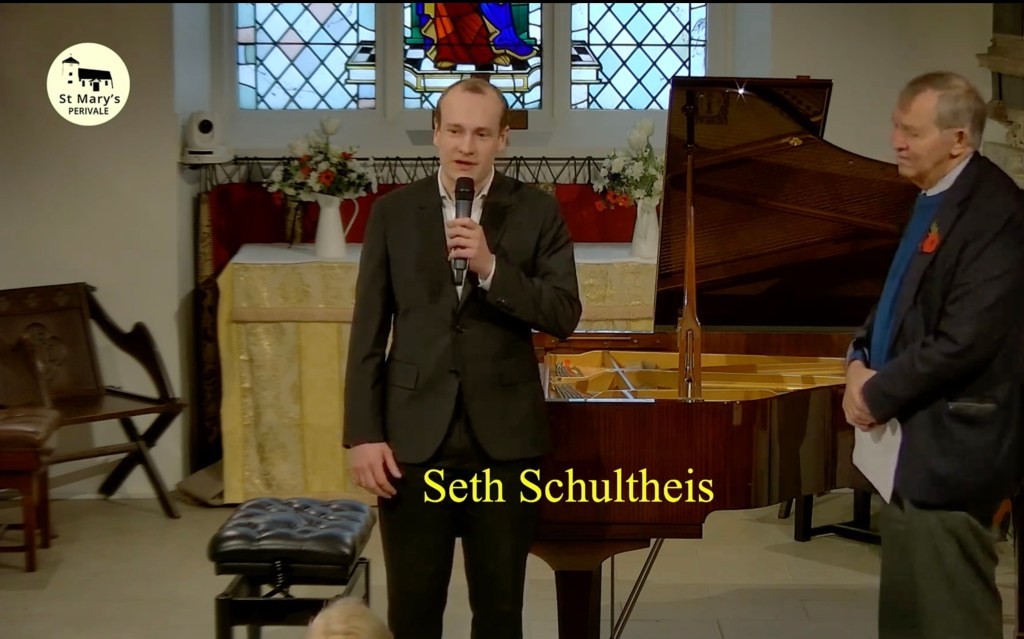
As Dr Mather said there was some remarkably moving playing from this young American pianist now studying as a fellow at the Royal Academy in London. Jed Distler in New York had told me that he found him a very interesting player ……he just did not tell me how interesting!
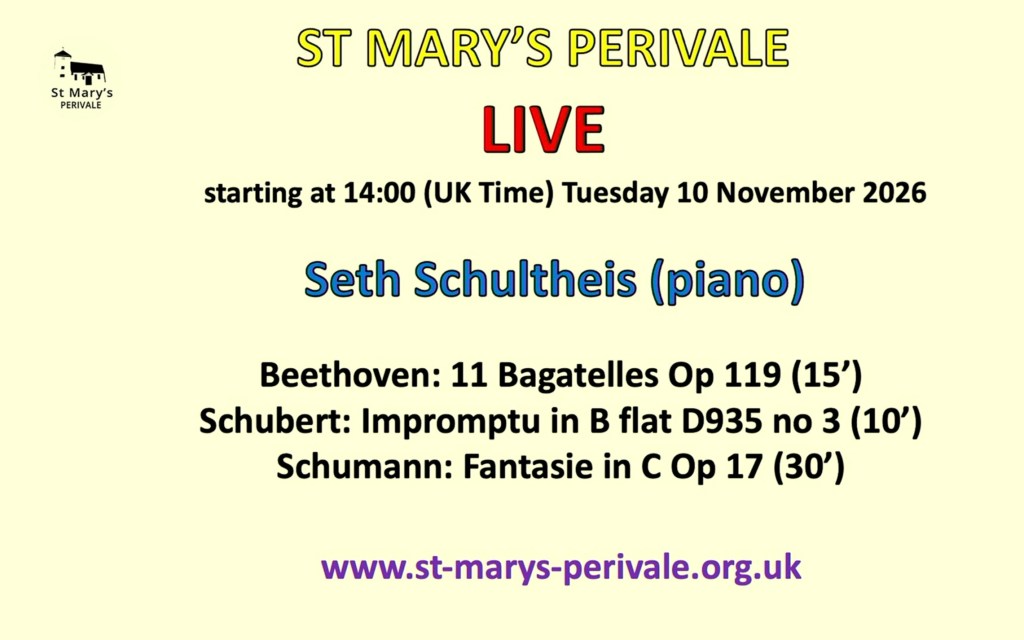
Standing in at fairly short notice for an indisposed Shunta Morimoto, Gold medal winner of the 2022 Hastings Competition, he played three major works that immediately showed his remarkable musical pedigree. It is a masterly musicianship that does not draw attention to itself with histrionics or self indulgence as this is a musicianship that is hidden in the very notes themselves that he played with masterly authority and technical control. Almost note perfect performances not of note picking accuracy but the perfection of a musician where every note has a meaning and a place in a big architectural line.
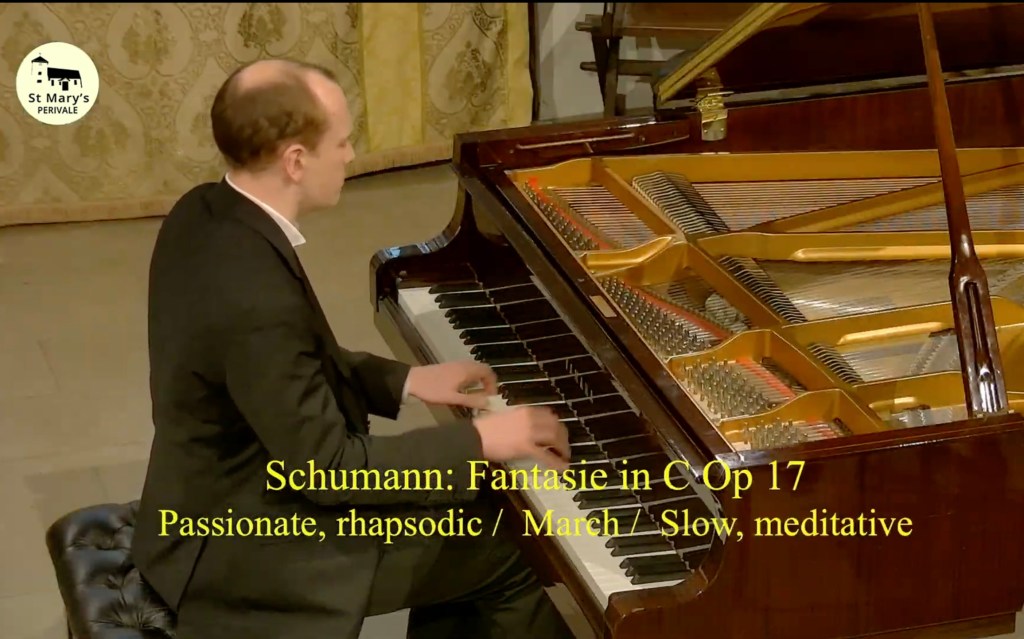
He is more a Pollini than a Serkin. His seeming lack of showmanship or visible signs of passion or fearless bravura can be deceptive to all but those with ears like his that can follow a musical conversation of such coherence and simplicity that there can be no disagreement or turbulent argumentation. I have rarely heard the treacherous coda of the second movement of the Schumann played with such control or accuracy because his building up from the bass automatically meant the notes above sorted themselves into order! That is, if you are a master of your craft. The final bars of the ‘Langsam’ were played with ravishing beauty where all Schumann’s indications were there but within a framework of beauty and radiance where the slight crescendo and more movement just gave wing to one of the most wondrous moments in this work that Schumann had dedicated to Liszt . Liszt in turn had dedicated his Sonata to Schumann and in both works it is the final page of genius that marks them both as the pinnacle of the Romantic piano repertoire.
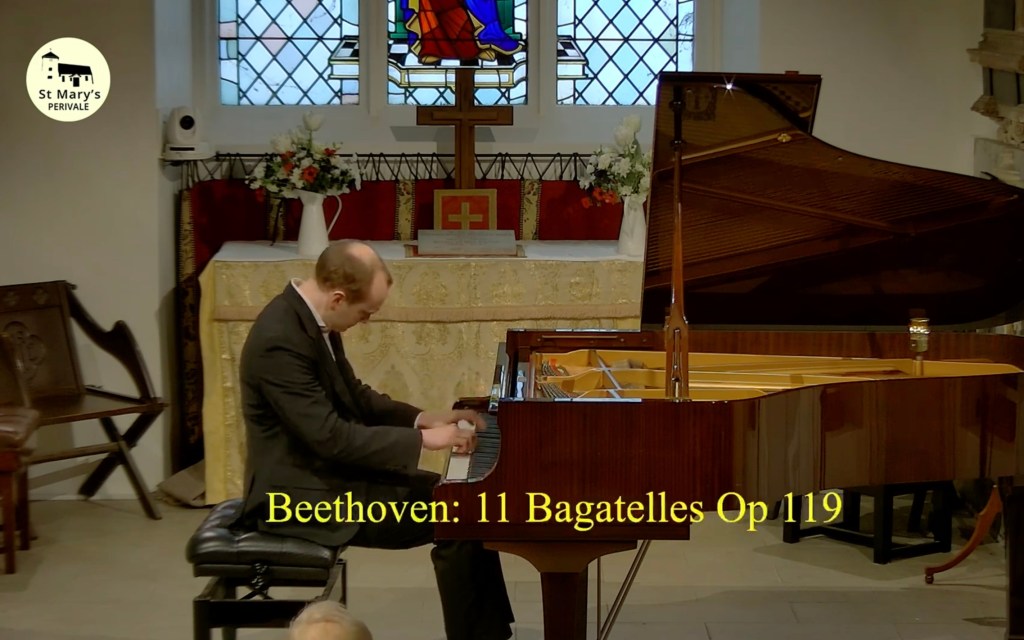
Beethoven’s Eleven Bagatelles are jewels that reveal that Beethoven was not only the monumental genius of the Symphony or sonata but could etch miniature images to appease his publisher who thought they would be more saleable to a larger public.Beethoven eventually managed to have the entire set published by Clementi in London in 1823. They are models of perfection where each one has a voice and character of quite remarkable poetic invention. From the opening Allegretto with its staccato and legato contrast of innocence and simplicity to the rambling question and answer of the second with its genial ending pointing eventually to the etherial meanderings of op 111, all played with crystalline clarity and disarming simplicity. The Schubertian charm and grace of the third ‘à l’Allemande’ with its surprise nonchalant ending contrasting with the flowing story that is being told of the ‘Andante cantabile’ that follows .Seth brought an infectious lilt to the ‘Risoluto’ of the fifth. An imposing almost improvised introduction to the sixth allowed the Allegretto to take wing with beguiling charm before the trills of the seventh. At first just ornamental but building to Beethoven’s masterly use of the trill in his mature years that brought this little bagatelle to a monumental close.The eighth was almost too serious with counterpoints chasing each other before the flight of the waltz of the ninth . Seth had told us that some of the Bagatelle’s would last only a few seconds and if you blinked you would not have even noticed the tenth that Seth played with impish good humour. The last was played with a glowing radiance with a beautiful flowing ‘Andante’ to the final hymn like chords echoed with poignant significance after a moment of a silence that with Beethoven is indeed always golden.
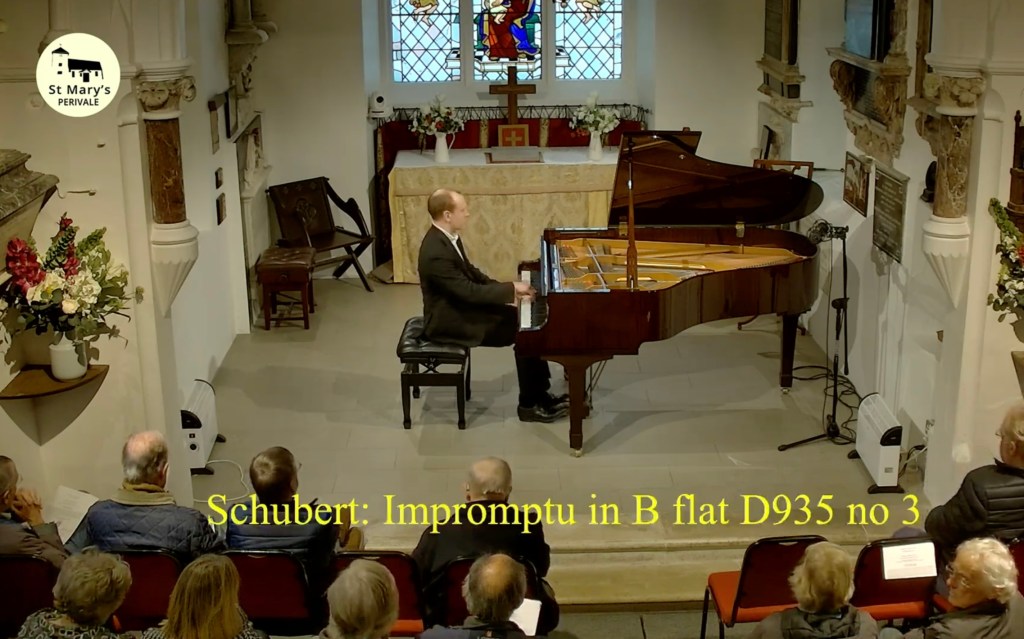
There was a beautiful flowing tempo to the Impromptu in B flat by Schubert as is indicated by the composer which allowed the variations to evolve with such natural simplicity, Seth’s finger legato meant that he could achieve a remarkable clarity without any blurring of the edges. He brought charm and refined good taste to the variations with a superb balance between the hands and a jeux perlé that was of crystalline clarity. If there was charm in the second variation there was a subdued passion in the third, before the lilting grace of the fourth and the exquisite jeux perlé of the fifth and the final lento of a coda of poignant significance. Played with a simplicity and beauty where the composer was allowed to speak through the notes for himself without any exaggeration or interference from unnecessary personal effusions.A Schumann Fantasy that reminded me if the young Pollini who gave two introductory recitals in London in the QEH with Prokofiev 7, Petroushka and the Schumann Fantasy all works that were included in a career that spanned three decades and which was concluded with this very Fantasy in a moving occasion described by a fellow Italian with such poetic understanding
Seth okayed the guest movement with architectural understanding what it missed in passion and sweep it gained in intelligence and poetic understanding . A second movement of such musical mastery that Schumann’s dotted rhythms were turned into phrases of extraordinary shape and drive . The last movement was played with refined ravishing beauty . Sometimes the hands not synchronised as it gave an extra magical colour to Schumann ‘s love letter to his Clara
No encore was possible after such a feast of music even though Hugh did try!
Seth Schultheis is an American pianist based in London who recently won First Prize and the Chamber Music Prize in the 2025 Telekom Beethoven Competition Bonn. Fluent in a wide range of styles and composers, Seth is also a dedicated performer of contemporary music. After his success in the TBC, Seth performed Beethoven Concerto No. 2 with the Beethoven Orchestra Bonn under the direction of Dirk Kaftan for the Beethovenhalle New Year’s Concert, where his playing was described as “brilliant”, imbued with “clarity and precision”, “refined sensitivity”, and “rhythmic vitality” (General Anzeiger Bonn). Since the beginning of 2026, Seth has been invited to the 30th Ludwig van Beethoven Easter Festival in Warsaw, where he performed Beethoven Concerto No. 3 with Sinfonia Iuventus and Alexander Humala at the National Philharmonic. He subsequently embarked on an 8-concert tour throughout Germany with the Klassische Philharmonie Bonn and conductors Rafaël Merlin and Julien Leroy, performing Beethoven Concerto No. 4 in such venues as Konzerthaus Berlin, Laeiszhalle Hamburg, and Meistersingerhalle Nürnberg. Over this summer, Seth continued his fellowship with the Aspen Contemporary Ensemble, and will perform solo recitals at Hatfield House Chamber Music Festival and Wigmore Hall.
He received the majority of his training at the Manhattan School of Music, where he was twice awarded the Harold Bauer Prize. He attended Precollege and earned a Bachelor’s Degree under the tutelage of Phillip Kawin, before completing a Master’s Degree with Solomon Mikowsky, with additional lessons from Wael Farouk and Jiayin Li. Most recently, he earned a Professional Diploma with Distinction at the Royal Academy of Music with Mei-Ting Sun, and was selected as an Aud Jebsen Fellow for the following year.
http://www.seth.schultheis.com