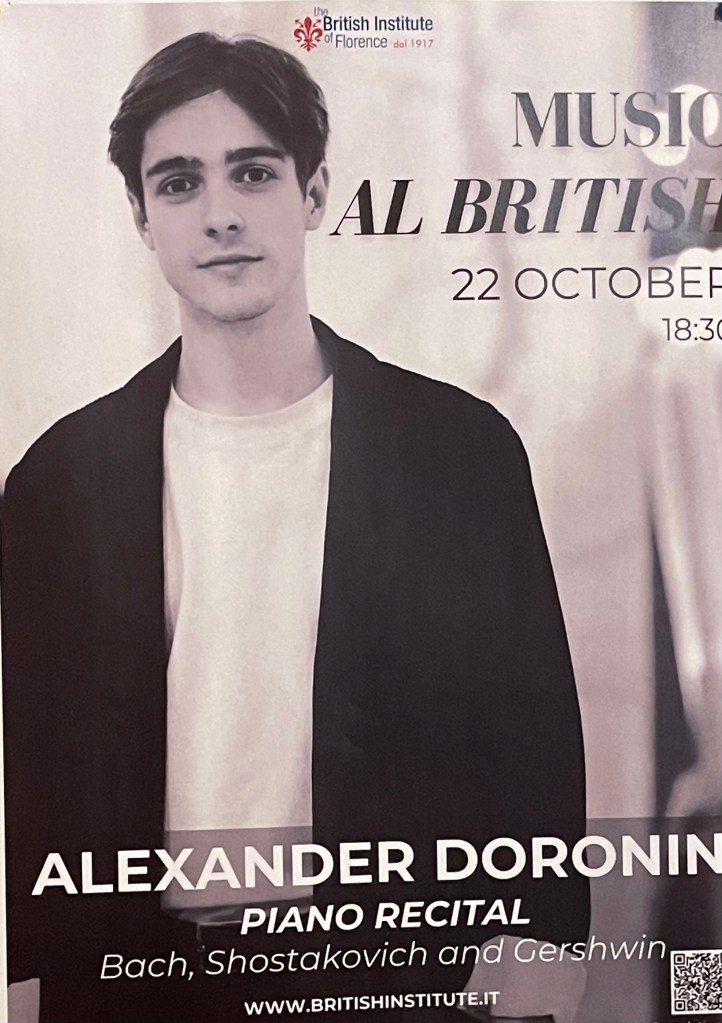
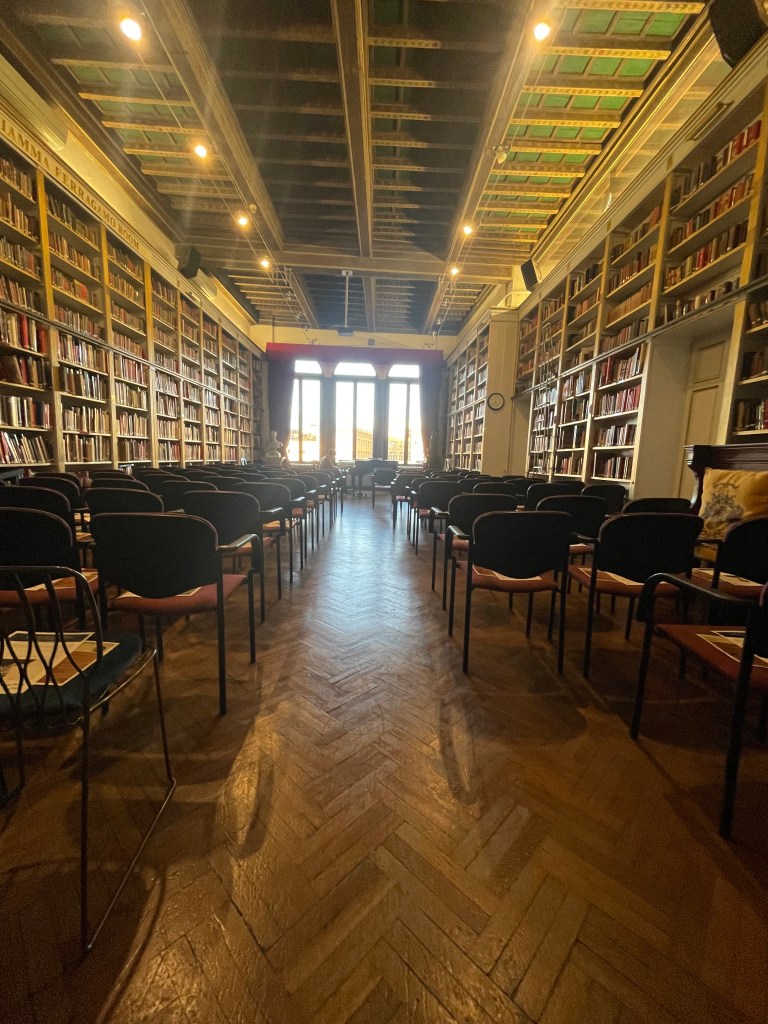
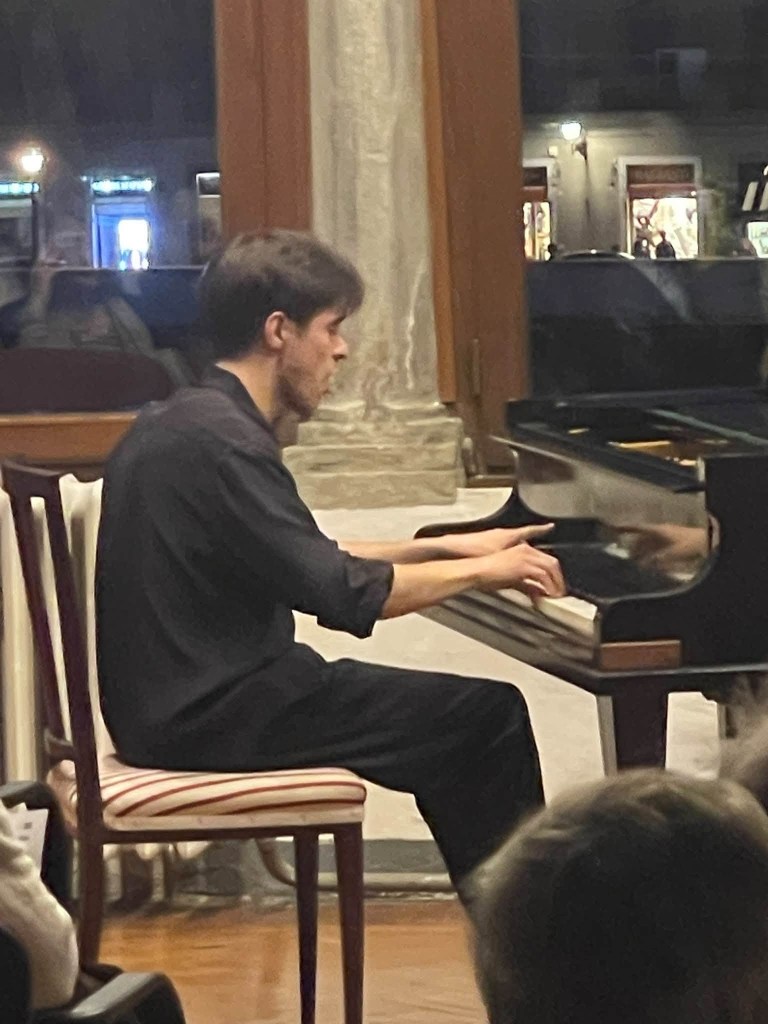
Alexander Doronin making his Florentine debut for the Keyboard Trust in the Harold Acton Library of the British Institute with a programme of Bach, Shostakovich and Gershwin.
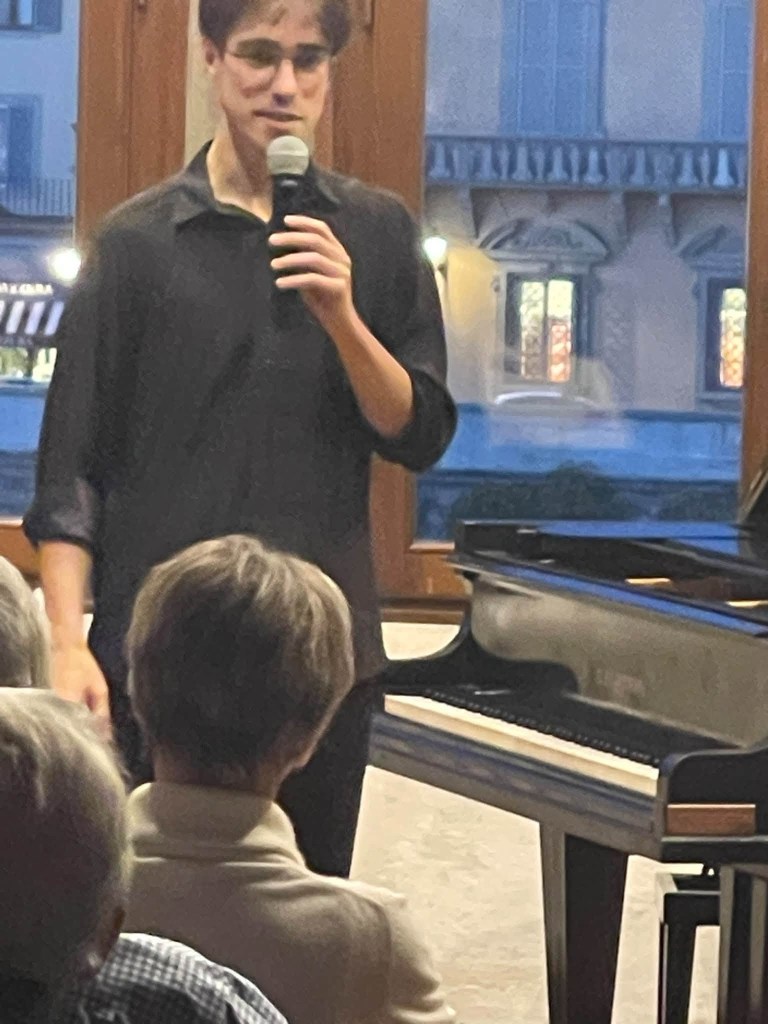
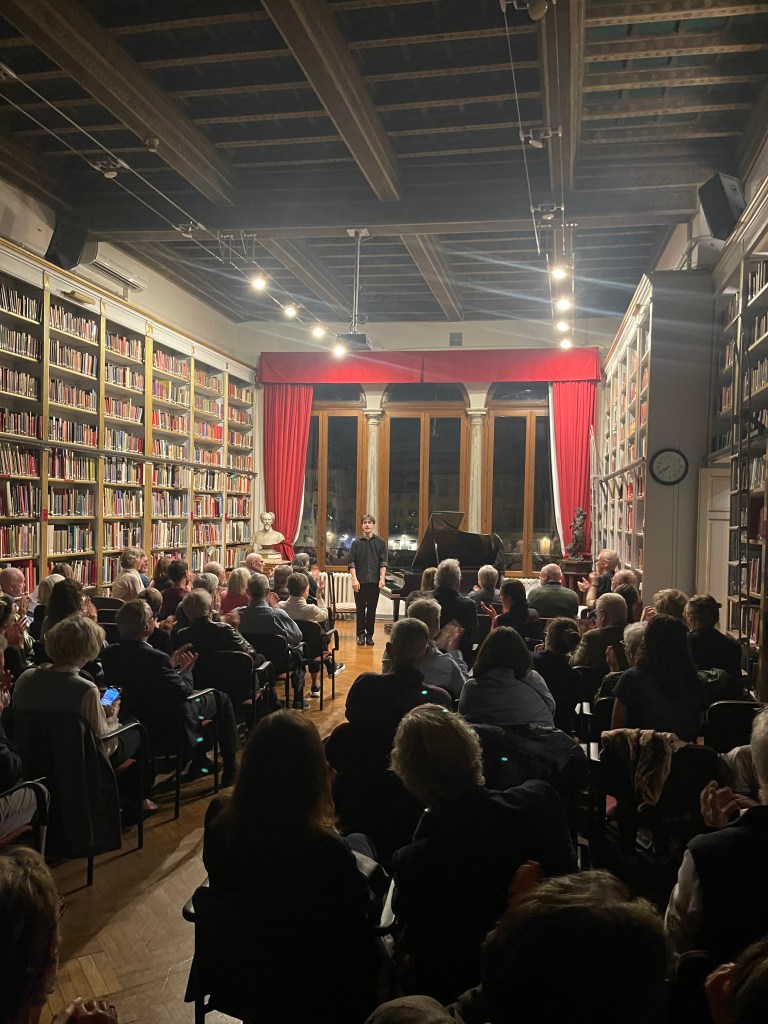
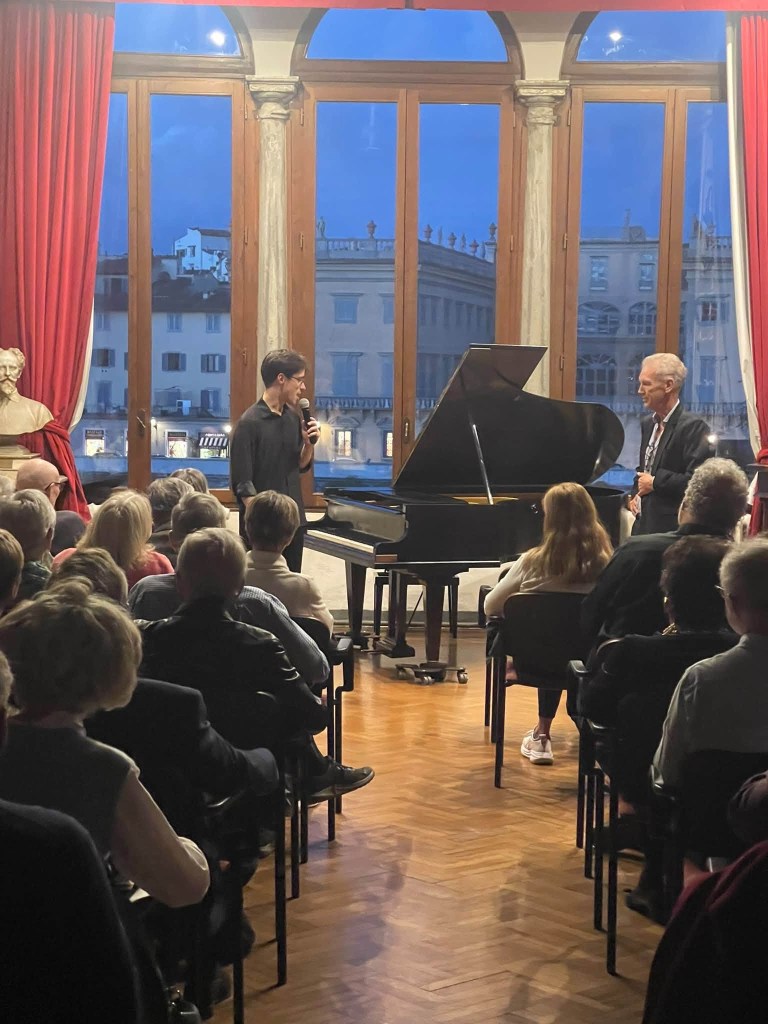
This is a young man with a story to tell and an extraordinary palette of sounds with which he paints pictures in sound with chameleonic changes of character and colour that held a very full hall spellbound. After a programme of such sensitivity and eloquence the encore was indeed a song with out words, by Mendelssohn, of whispered undulating beauty.
The concert had begun with Bach’s Italian concerto with the opening ‘Allegro’ full of rhythmic drive but allied to a refined sound world where very subtle changes of colour brought this movement vividly to life. A range of colours as he appeared to change manuals and registers without ever drawing attention to itself but allowing Bach’s music to seemingly speak with flowing ease and simplicity. A whispered ‘Andante’, where the left hand accompaniment was completely colourless and opaque, so when the ‘Aria’ entered with chiselled glowing beauty there was this duet of almost religious purity and poignancy. The final ‘Presto’ just flew from his fingers, but like the first movement, with a fluidity without any harsh accents or rhythmic hi jinx, as the music was a flood of sounds of hypnotic immediacy. Very subtle colouring to the counterpoints where this young man had an orchestra in his hands that with extraordinary mastery he could give a voice to all the strands of Bach’s knotty twine never getting into a tangle but allowing us to follow each voice with string quartet clarity and reasoning .
What a voyage of discovery this recital was with a pianist who had ten wonderful players in his hands that he could command with such mastery as he paid scrupulous attention to the composers intent as left as mere dots and dashes on the page.
It was even more apparent with the 24 Preludes op 34 by Shostakovich. A work which in a lifetime of concert going I have never heard played in public before. We hear of his Preludes and Fugues inspired by the Bach playing of Tatiana Nikolaeva when Shostakovich was on the jury of the Bach Competition in Leipzig. But these twenty four preludes are miniature tone poems similar to the well known 22 Visions Fugitives by Prokofiev.
Here the mastery and poetic imagination of this young man had turned these works of Shostakovich into the vibrant jewels that obviously had inspired the composer to jot them down. Rather than fearing twenty four pieces by a semi contemporary Russian composer we were so spellbound that we could easily have listened to many more . Here were stories being told by a poet of the piano with a range of sounds of the eloquence and colours of the human voice. From delicacy, quixotic, demonic , desolate , nostalgic, pompous, radiance , ravishing bel canto, lonesome landscapes , this was an compendium of sounds and experiences as Shostakovich played on our sensibilities like a Cordon Bleu cook with our taste buds. One of the audience members was so entranced that she likened them to Julian Barnes’s ‘The Noise of Time’. Julian with Angela Hewitt had give a recital here together a few years back so maybe the memory still lingers in this wondrous Harold Acton Library
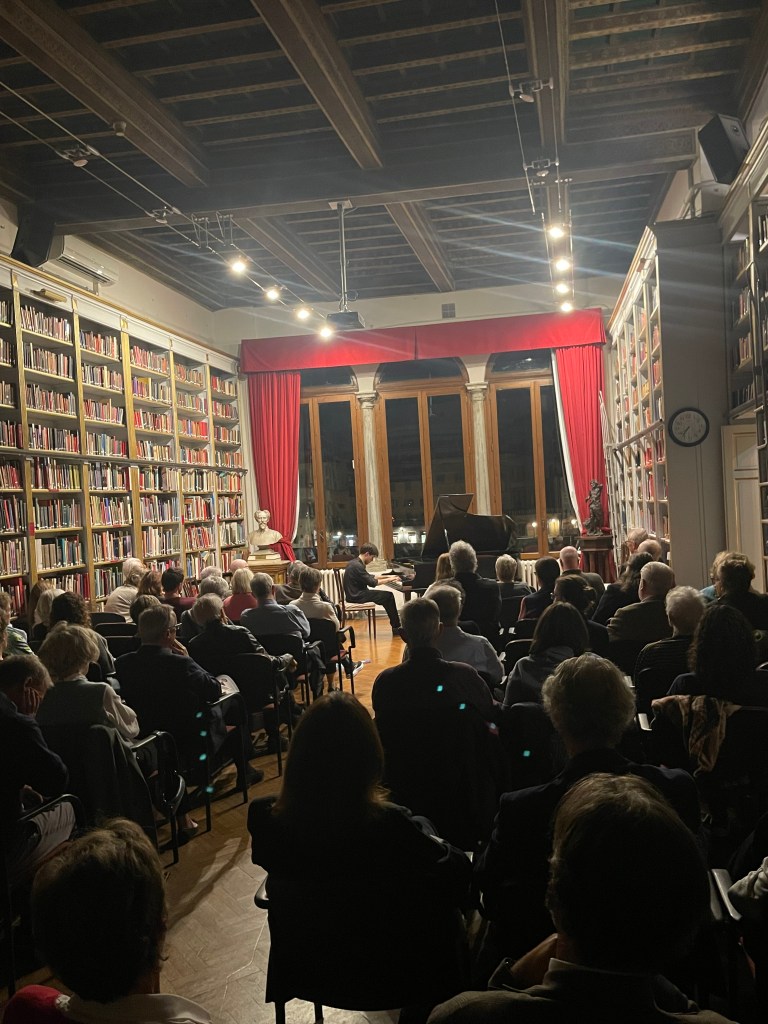
I stopped counting after the first few preludes and like the audience allowed myself to be transported into a magic land of make believe. The impish motif of one of the first preludes returned though, and it struck me that Shostakovich , the master craftsman, had given an overall architectural shape to these twenty four pictures .
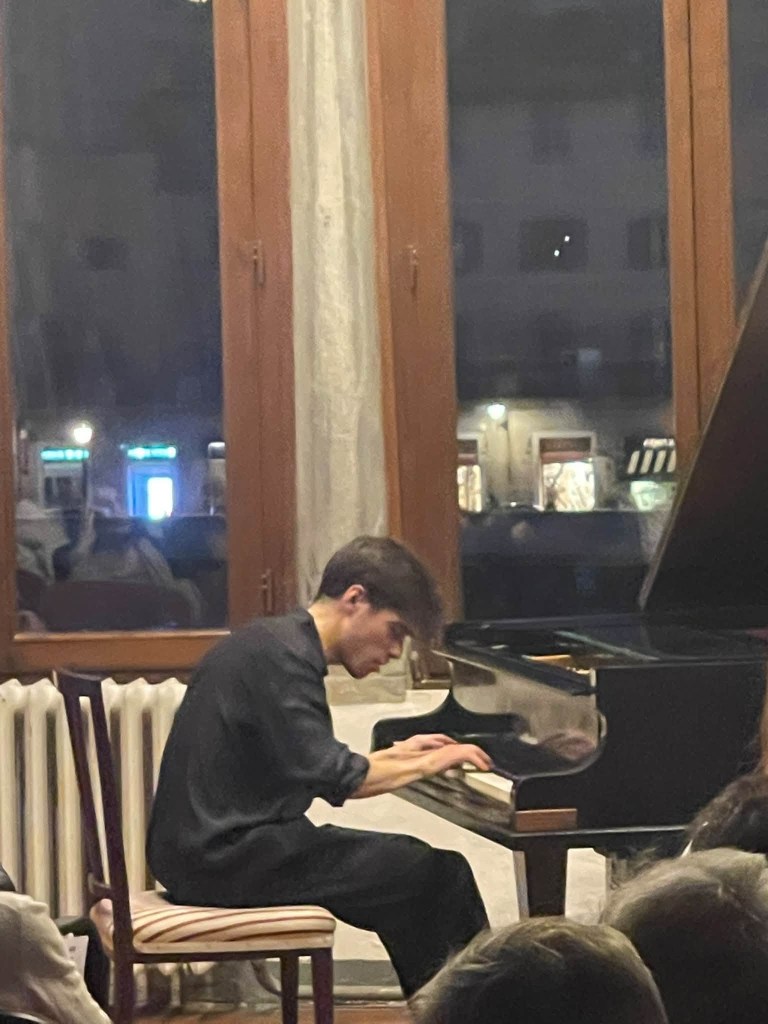
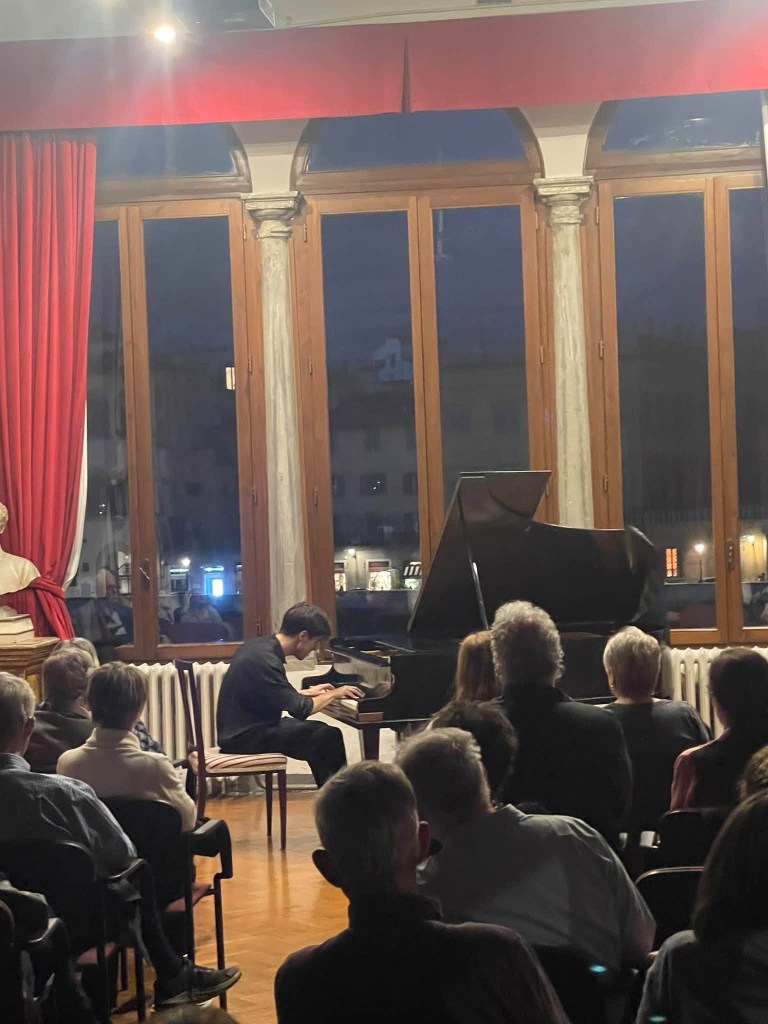
Just as I was thinking that this must be the final prelude our Prince of the Keyboard was allowing the trill of Gershwin’s clarinet to transport us into the world of show business with the famous Benny Goodman clarinet ‘wail’ that heralds the opening of Rhapsody in Blue .
We are so used to this famous piece being played or almost hammered out with rhythmic fireworks and with it’s final sumptuous Hollywoodian denouement that listening to Sasha we were suddenly aware of what a genial invention this piece is. It was in fact Nadia Boulanger, the renowned pedagogue of most of the greatest contemporary composers of the day, who refused to teach Gershwin as she did not want to risk ruining his genial natural talent.Ravel simply asked Gershwin how much he earned, and when he told him he said that it was he who should be asking for lessons from Gershwin!
What subtlety where real jazz is often improvised with insinuation and style rather than hammered out with percussion and showmanship . A quite extraordinary range of sounds from this young man, that when the famous tenor jazz melody appeared in the left hand it was of such an overpowering effect of recognition and radiance that it was like a jewel suddenly catching the light and allowed to enchant and bewitch us all with its radiant beauty. We were caught in a spell where technical mastery and poetic intensity were on hand but we were never aware of it. Such was the power of recreational music making that we were held breathless and spellbound by a work brought to life with the ink seemingly still wet on the page . Even the final chords which are often hammered out, here were ntoned with a sense of balance that where we expected hammered out chords they were suddenly whispered as being the start of a crescendo to the wonderful joyous final burst of mellifluous slinky jazz idioms .
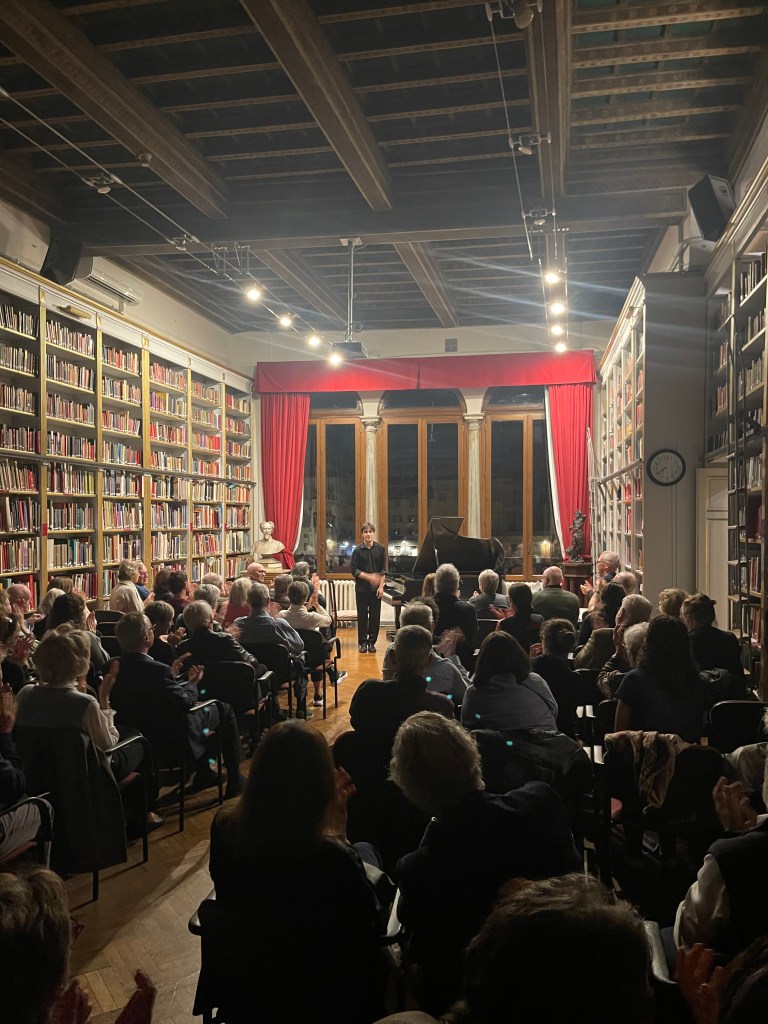
An ovation from a more than usually full hall was greeted by the whispered disarming beauty of a Mendelssohn song without words. Subtle colouring and refined good taste was a wonderful way to finish this concert by an extraordinary pianist of refined poetic mastery
Sasha confided afterwards that he had arrived in Florence on a night train from Salzburg where he has a term studying at the Mozarteum before completing his Master degree at the Royal College in London next spring. But he was also still jet lagged as he had just flown in from concerts in Hong Kong as winner of their International Piano Competition!
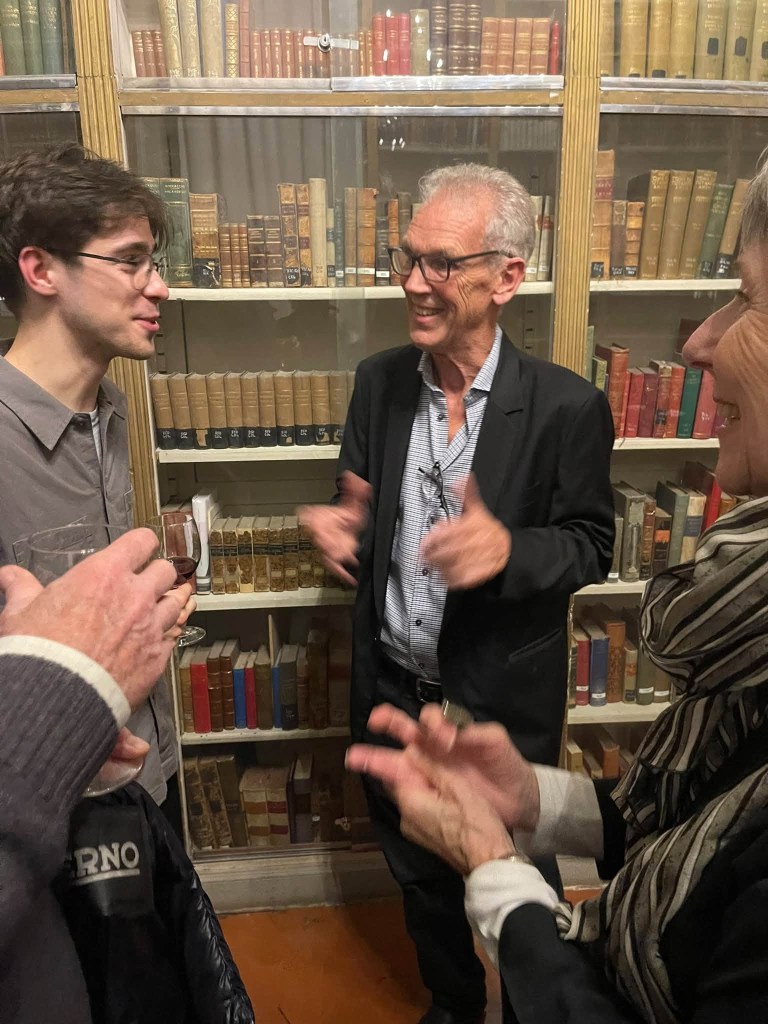
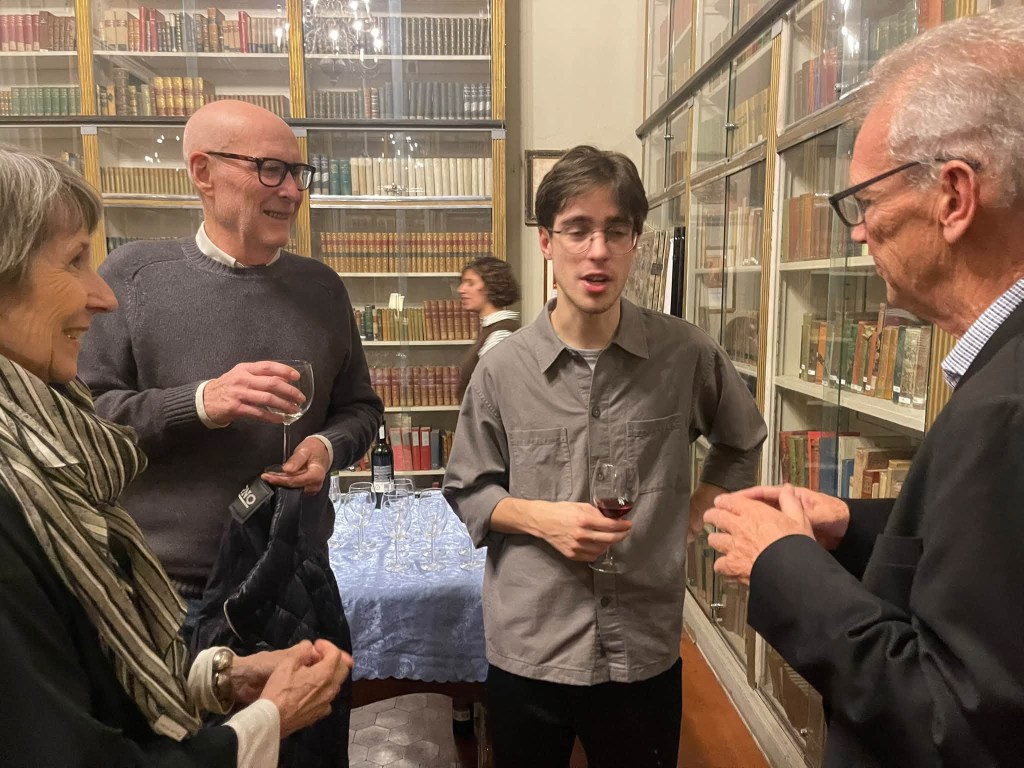
After every concert in this collaboration between the Keyboard Trust and Simon Gammell’s British Institute the audience say it is the best ever.
This time they really meant it !!
Of course there is no such thing as comparative music making but it is the communication and emotions that we are treated to in an unrepeatable moment that make music in this new ‘A.I’ age so essential.
We were sorry that Sir David Scholey the generous sponsor of Music at British , should miss such a treat due to fatigue at the age of 91, but hope that Sasha will play for him this morning in his beautiful home overlooking the Uffizi gallery.
It is the tonic that we all need !
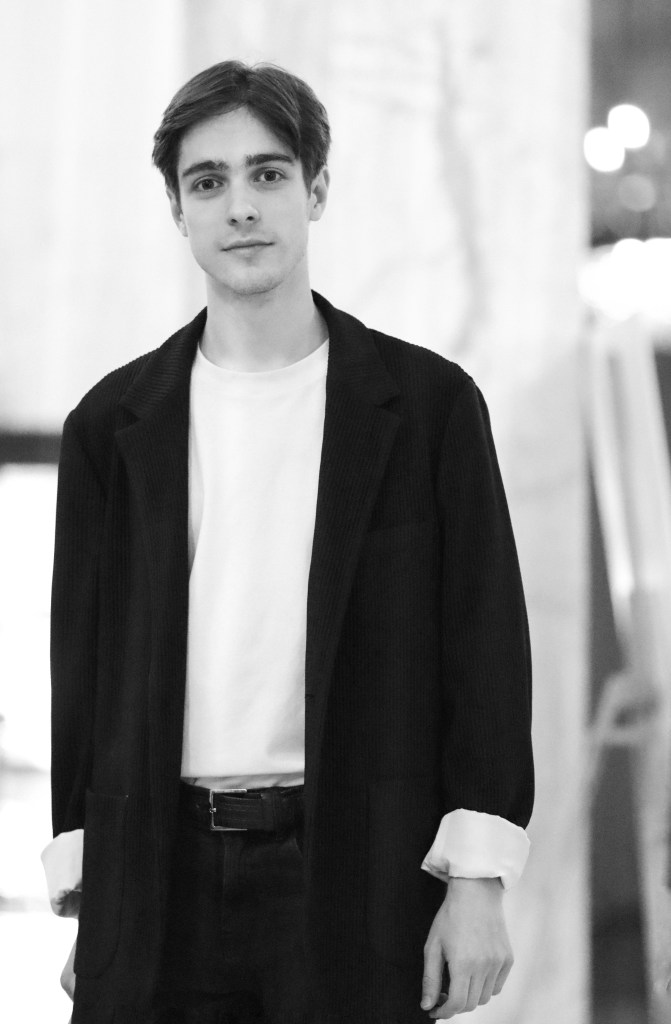
Doronin studied at the Gnessin Moscow Special School of Music with Mikhail Khokhlov (piano) and Olga Martynova (harpsichord) from 2015 to 2021, before moving to London to study at the Royal College of Music as an ABRSM Scholar.
He graduated in 2025 with a First Class Bachelor of Music degree and is now pursuing a Master of Music degree as a Musicians’ Company Lambert Scholar, under the guidance of Professor Dmitri Alexeev. In 2025 he won First Prize and the Gold Medal at the 7th Hong Kong International Piano Competition, which brought with it a series of international engagements.
As a soloist he has performed with the Russian National Orchestra under Mikhail Pletnev and the Royal College of Music Symphony Orchestra, among others, and given recitals across the UK, Austria, Poland, China, Vietnam, the Netherlands and Switzerland. Alongside his solo career, Alexander performs regularly in chamber and collaborative projects.
EDUCATION
2021–25Royal College of Music, London — BMus (First Class); currently MMus, with Dmitri Alexeev
2015–21Gnessin Moscow Special School of Music — with Mikhail Khokhlov (piano), Olga Martynova (harpsichord)
SUPPORT
London Symphony Orchestra Scholar
Musicians’ Company Lambert Scholar
Eileen Rowe Musical Trust
Drake Calleja Trust
Countess of Munster Trust
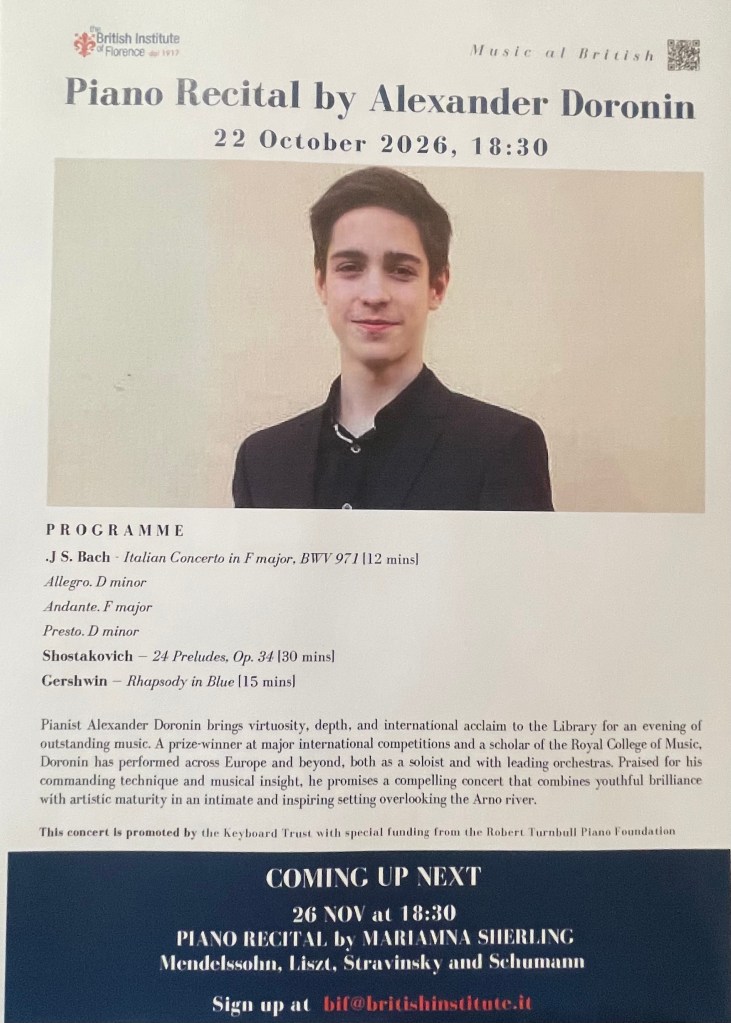
Pianist Alexander Doronin brings virtuosity, depth, and international acclaim to the Library for an evening of outstanding music. A prize-winner at major international competitions and a scholar of the Royal College of Music, Doronin has performed across Europe and beyond, both as a soloist and with leading orchestras. Praised for his commanding technique and musical insight, he promises a compelling concert that combines youthful brilliance with artistic maturity in an intimate and inspiring setting overlooking the Arno river.
Programme:
J S. Bach – Italian Concerto in F major, BWV 971 [12 mins]
Allegro. D minor
Andante. F major
Presto. D minor
Shostakovich — 24 Preludes, Op. 34 [30 mins]
Gershwin. Rhapsody in Blue [15 mins]
Here is a video of Alexander playing Brahms: https://youtu.be/eHqyBeUTUt4

https://christopheraxworthymusiccommentary.com/2023/12/05/ileana-and-joan-3rd-december-2023/

