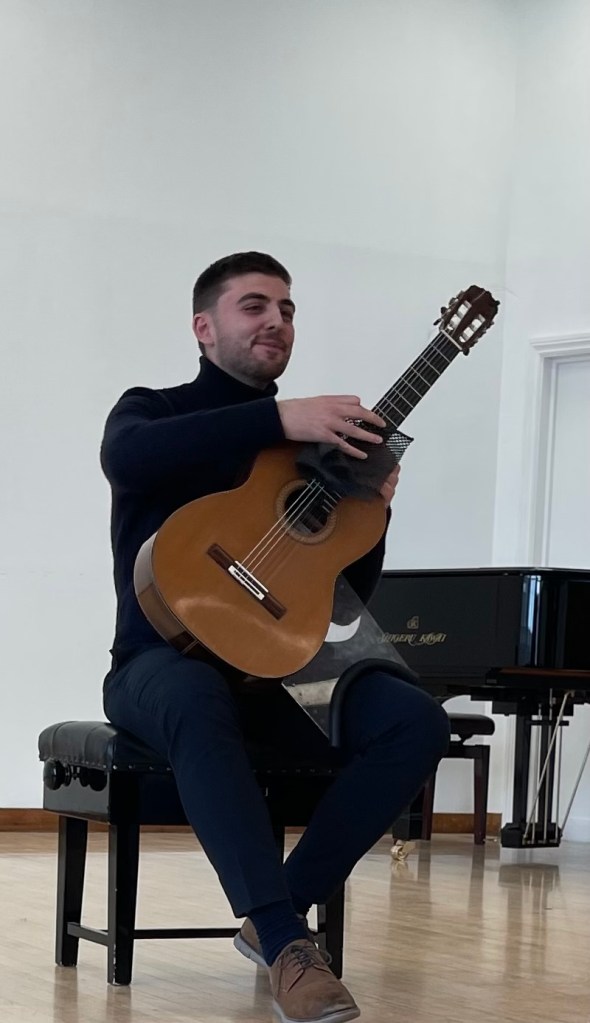
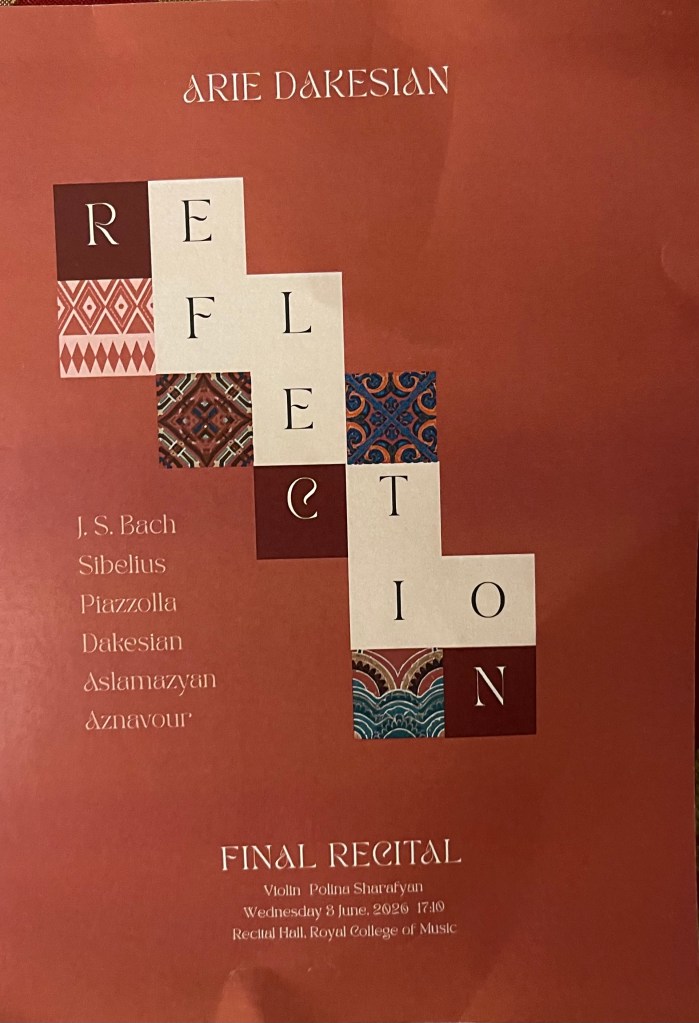
An eclectic programme from this young dedicated artist. Beginning with Bach and ending with Aznavour and taking in works from his Armenian background as well as Spanish,Argentinian and Finnish composers. Playing of intelligent musicianship allied to a sense of style and colour that could bring to life this multi faceted programme.
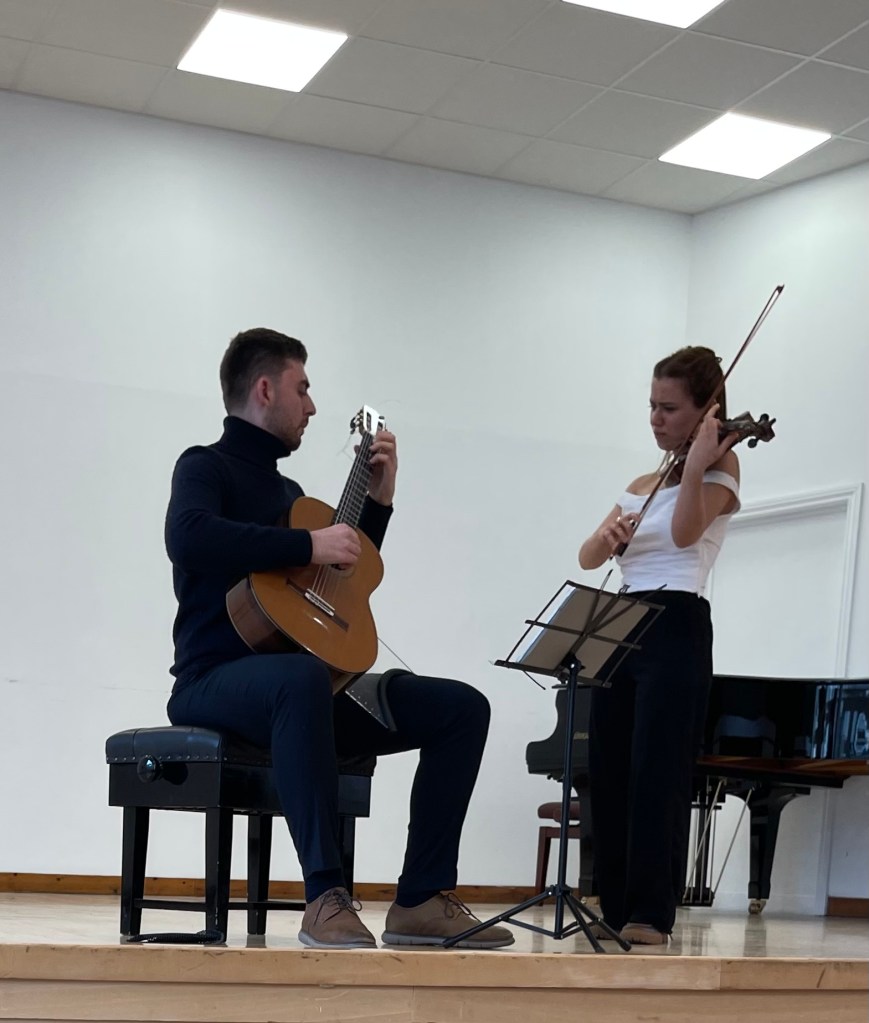
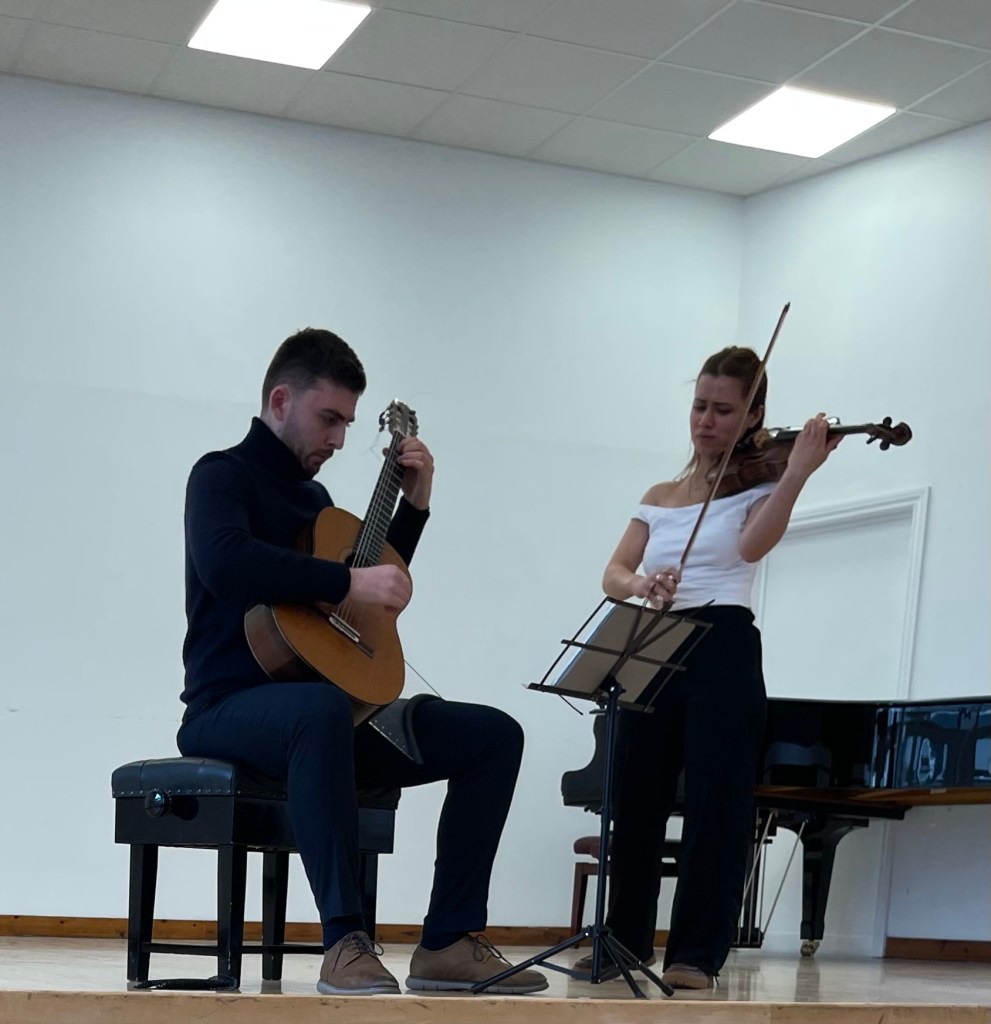
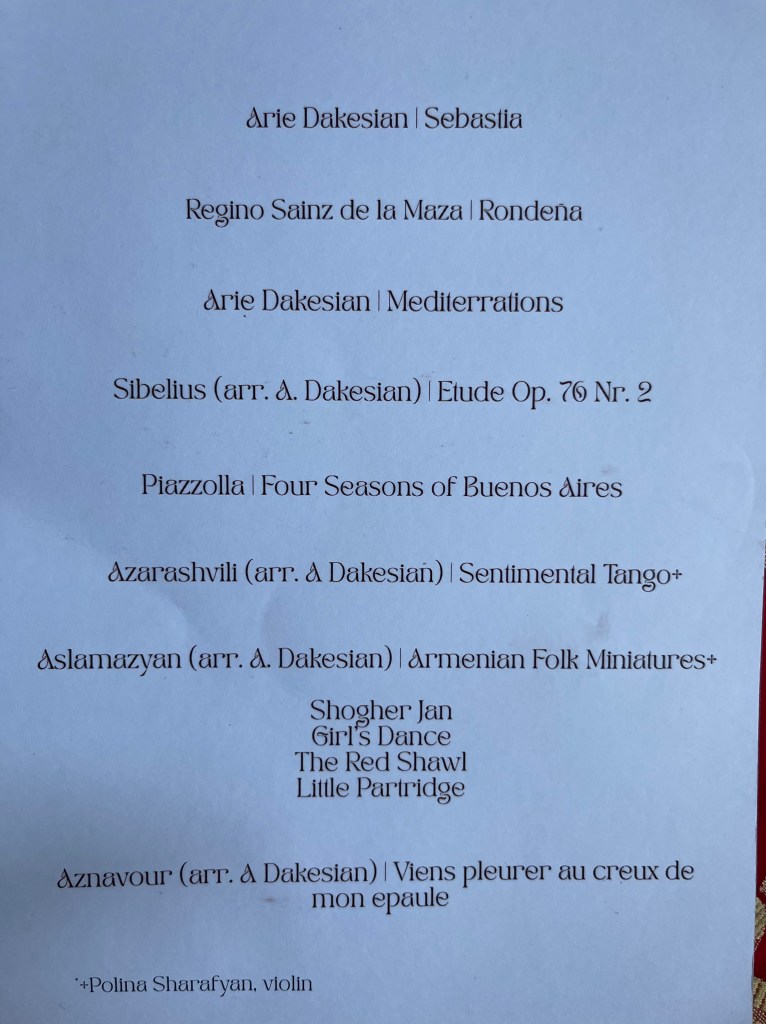
Even joined by a colleague violinist Polina Sharafyan for his own arrangement of folk songs for violin and guitar. His Bach was also tinged with his own very strong personality and given the teasingly enticing name of ‘Sebastia’ . It is a well known Prelude by J.S. Bach given a personal view by a musician who is also a great communicator and eclectic entertainer.
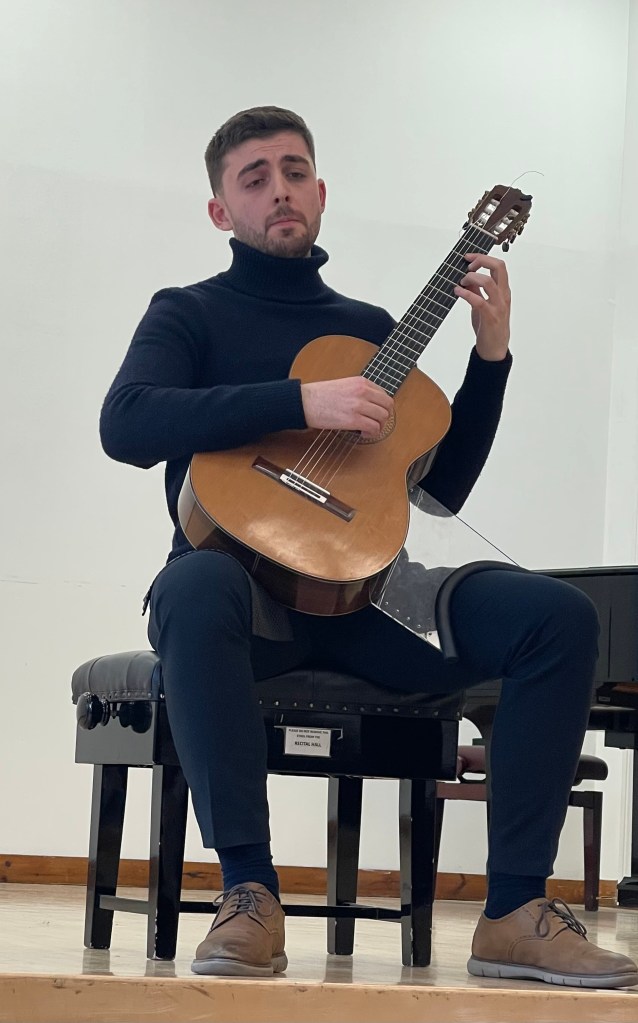
Rondeña was written in 1962 and was the only Spanish piece in his programme. Written by a composer and guitarist whose last concert was in Italy in 1979 aged 80. Here was all the traditional use of the guitar, from the land where it was really reborn, with playing of dynamic drive ,searing rhythmic intensity and strumming of the sound board . This was to give way to Arie’s own Mediterrations where I could hear influences of French chansonnier and much else in a piece of enticing and embraceable charm. A fascinating study by Sibelius transcribed in such a subtle way alla Tárrega seemed made for the subtle delicate intricacy of Arie’s agile fingers
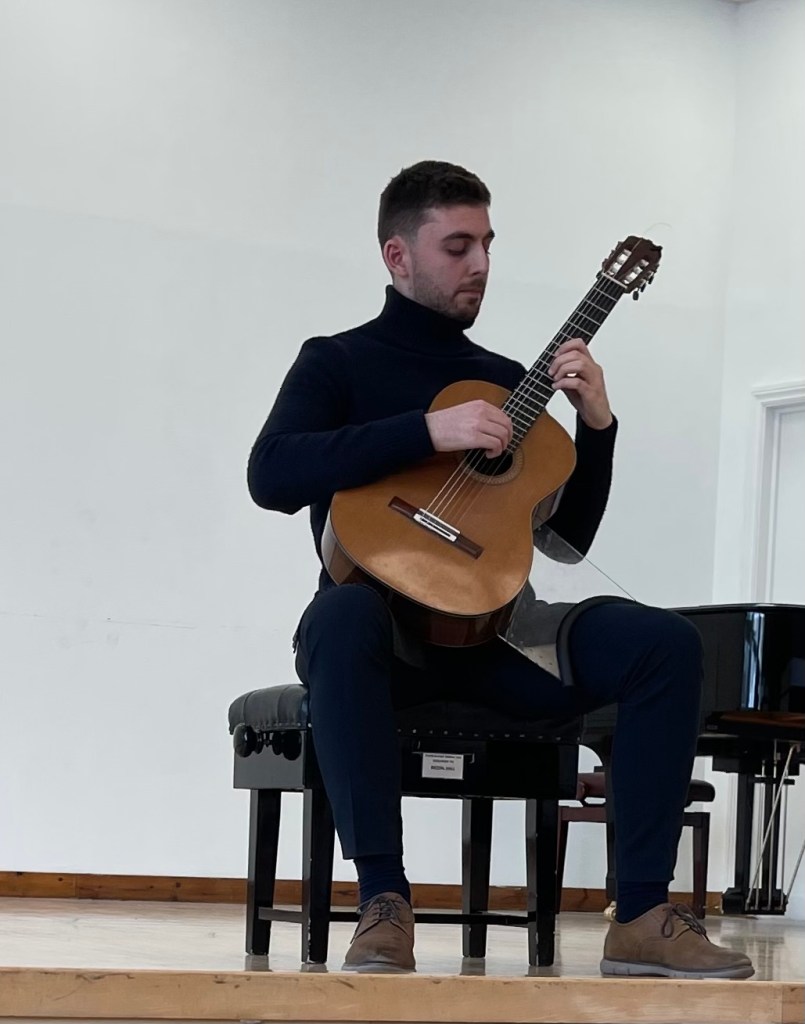
We were to experience more French charm with the final piece in his programme that was a song by Charles Aznavour in Arie’s own arrangement. ‘Viens pleurer au creux de mon epaule’ which found a very sensitive interpreter with an insinuating outpouring of sentiment and charm. Of course Tango was never far away and Piazzolla’s Four Season of Buenos Aires and Azarashvili’s Sentimental Tango were grouped together in a sumptuous feast or red hot traditional Tango rhythms.
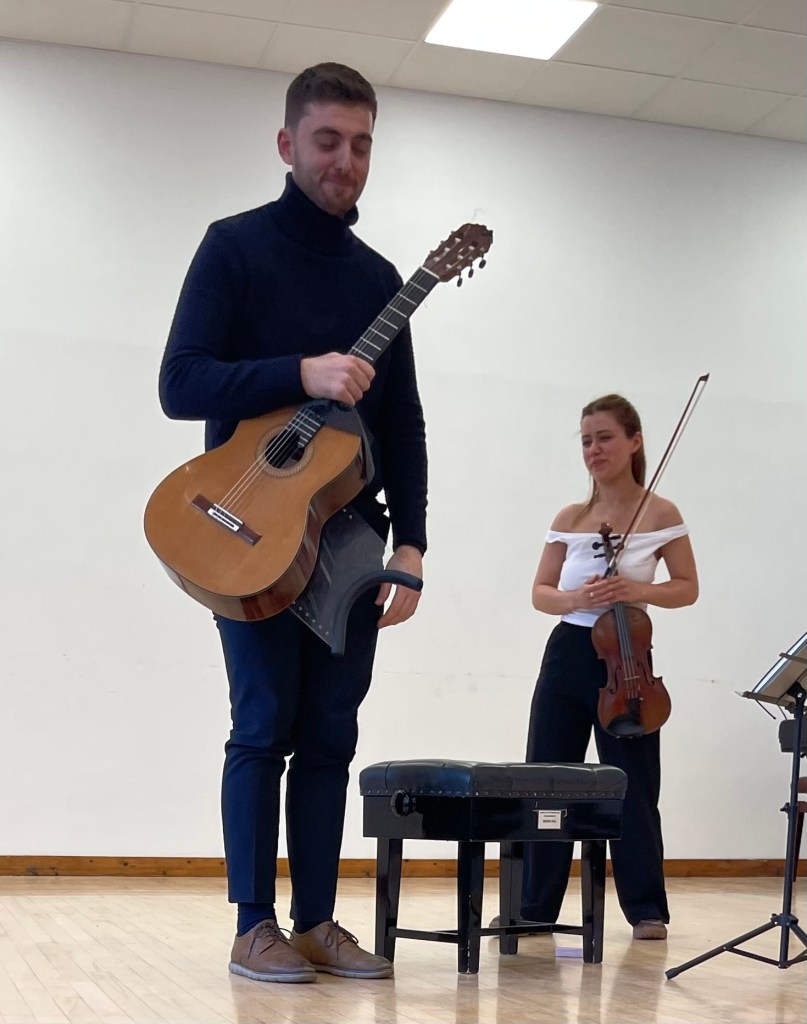
The surprise of this short recital was the appearance of the violinist Polina Sharafyan for duo arrangements of Traditional Armenian Miniatures. An almost improvised freedom as these two players intoned the traditional Armenian folk melodies with passionate intensity and extraordinary freedom .
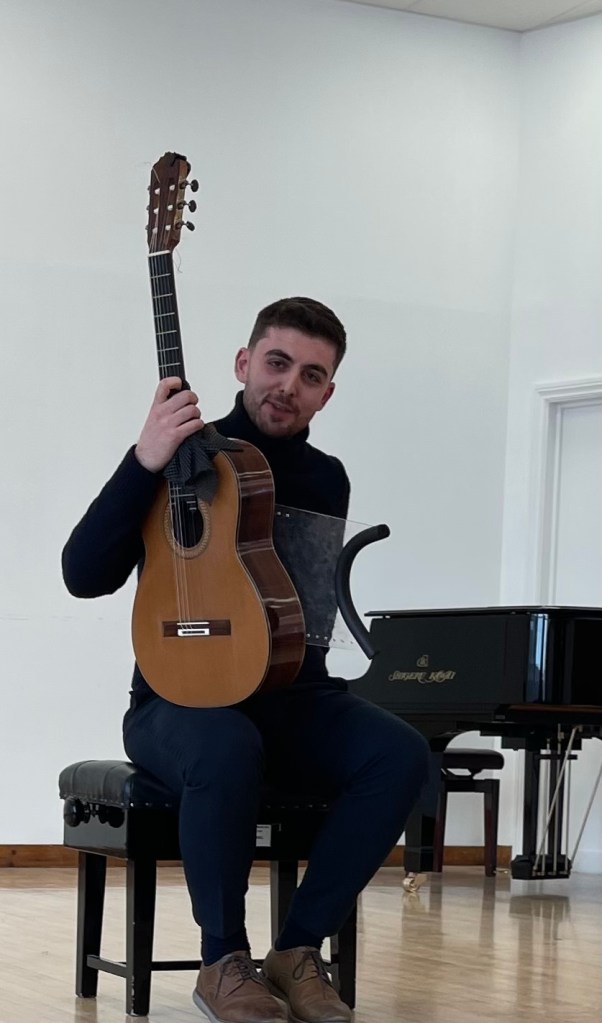
Couple things to know about me: you might say I share many of my hobbies with a pensioner! I love reading, taking walks, cooking, and also very much into table tennis which I like to think I’m good at. I adore the simple pleasures in life, and enjoy being as much as I enjoy doing. The reason why I do what I do is simply because sharing my music is the best way I’ve found for me to be of service to others. I don’t particularly wish on playing in the biggest halls with the greatest musicians and orchestras; I focus on sharing my music with as many people as possible, and if that means playing in large venues alongside great artists, sounds great!
The most complicated question you can ask me is where I’m from. That’s because I’m ethnically Armenian although I was born and raised in Lebanon, so there is simply no right answer. It all started in the capital city of Beirut in a densely populated Armenian town called Bourj Hammoud; that’s also where I bought my first guitar and had my first ever guitar lesson at the local Parsegh Ganatchian Music School at the age of six. Time there went by very quickly, and before I knew it I was graduating in 2019 as the first ever guitarist to complete the 10-year programme in nearly two decades. During my teenage years, I used to perform quite a lot both as a solo artist and a chamber musician across Lebanon, which included a wide variety of classical repertoire, as well as an exploration of Armenian as well as Eastern folk music.
I then went on to pursue my higher eduction in Armenia, and was even enrolled at the Yerevan State Conservatory for a short period of time, having lessons with Hakob Jaghatspanyan for a little shy of a year. There, I had a wider access and to and really fell in love with the music of Komitas, who is considered the father of Armenian folk music. I naturally took a deeper interest in the world of Armenian folklore and the vast artistic wealth it had to offer.
With a strong desire to immerse myself into the music industry, I wanted to travel abroad to study. With the pandemic at its peak and the utter collapse of the Lebanese economy, this didn’t seem like a feasible decision. After long months of intense emails in search of support to fund my studies, I finally gathered enough funds with the help of the honorary Houston Family Scholarship from the Royal College of Music (RCM) in London, two weeks before the start of term in September 2020.
Having recently completed my undergraduate studies, I have now dived even deeper into everything performance-related as I pursue my Masters of Music in Performance at the Royal College of Music. Supporting my studies are the RCM Houston Family Scholarship, Ouzounian Trust, the Julian Bream Trust, the Kathleen Trust, and the St Marylebone Educational Trust. I have the joy of meeting with and learning from Gary Ryan and Christopher Stell on a weekly basis. Since moving to London, I’ve had the immense pleasure of working with the stars of the industry: among them are are Sergio Assad, Antigoni Goni, Gabriel Bianco, Judicael Perroy, Sean Shibe, Dušan Bogdanovic, Carlos Bonell, Mark Eden, Laura Snowden, Steve Goss, and Xuefei Yang.
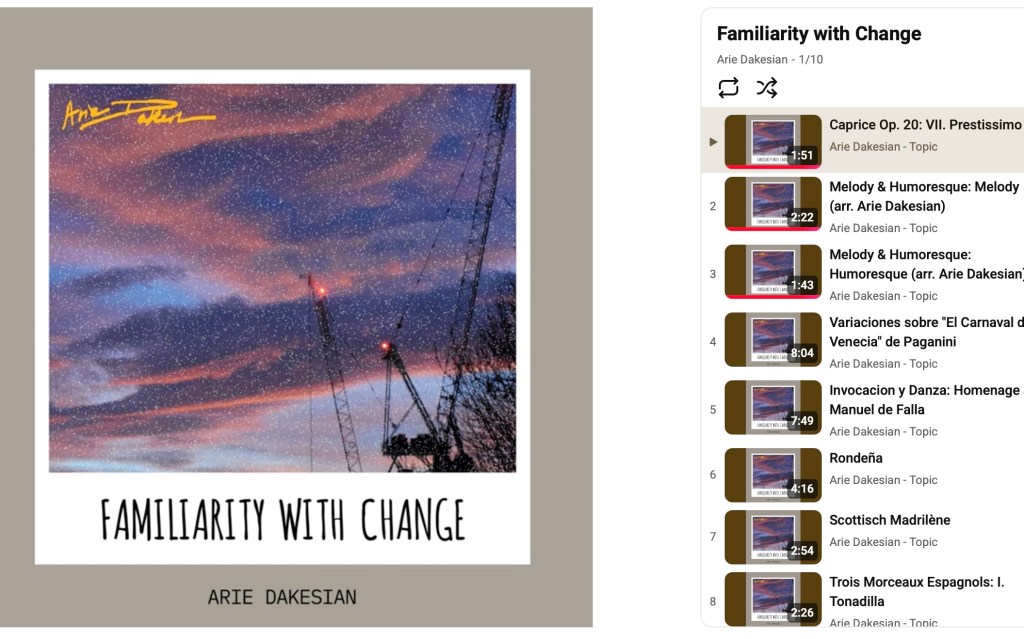
Recent notable performances include the Amaryllis Fleming Concert Hall, Kew Gardens, Kings Place, Royal Albert Hall, and Wigmore Hall.
With a busy concert schedule for the 2024/25 season, I’m currently preparing for concerts in collaboration with the Tillett Trust. I was fortunate enough to be selected for the highly prestigious Tillett Debut Scheme 2024, which allows a two-year collaboration and a wide range of performances; it gives me great joy to say this makes me the fifth guitarist to ever be awarded since the scheme emerged in 1995. With this comes great responsibility to be a good ambassador of the instrument, but more importantly the great honour of sharing my music with lots of new audiences. Debut for the Tillett Trust scheduled for November 2025 at Kings Place.
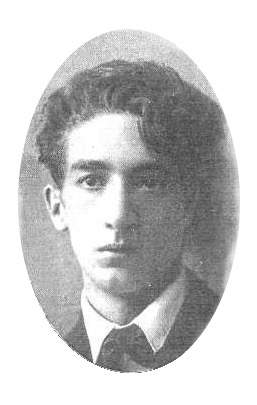
At 18, he performed at his first concert at the Teatro Arriaga of Bilbao.
He later moved to Barcelona where he worked as a concert musician. There, he befriended Miguel Llobet and Andrés Segovia. In 1920, he played for the first time in Madrid. A year later, he toured South America, giving 90 concerts. On 20 May 1920, he was awarded a Golden Medal by the University of Buenos Aires , where he became friends with composer Antonio José Martinez Palacios, who dedicated some guitar compositions to Sainz de la Maza.
He toured Europe, giving concerts in France in 1926, in Germany in 1927 and Great Britain in 1928. Five years later, he toured South America for the second time, with concerts in Uraguay,Argentina and Brazil.Sainz de la Maza performed for the last time at the Church of San Nicola di Bari in Italy, on 9 July 1979, aged 82. He died in Madrid two years later.