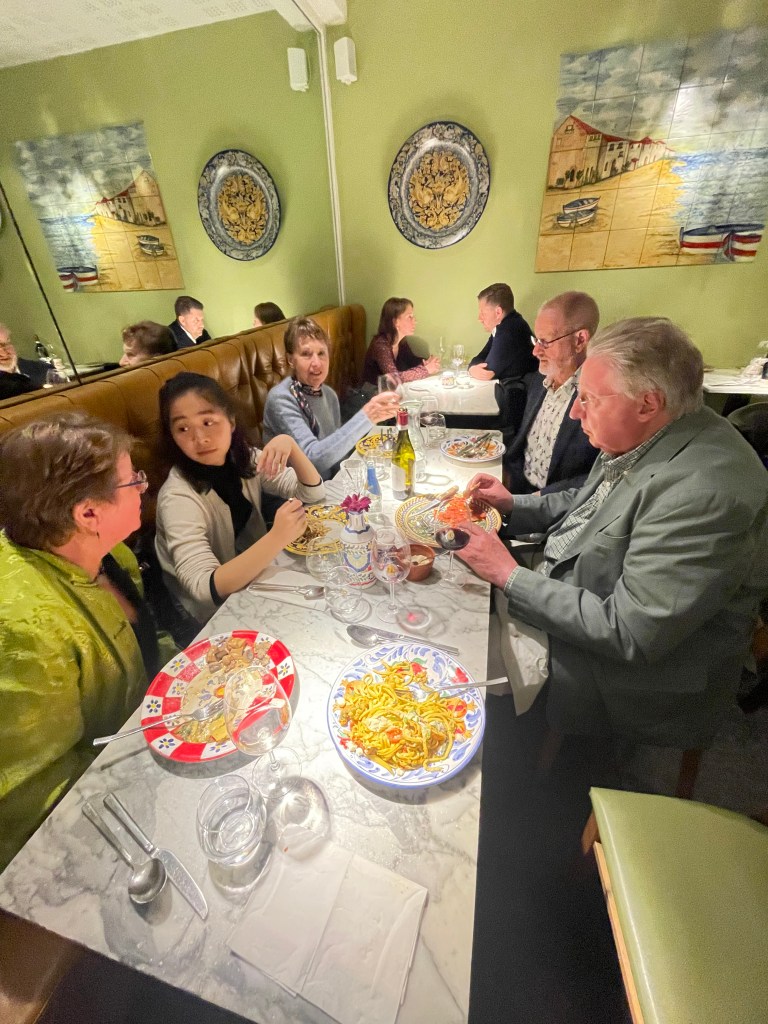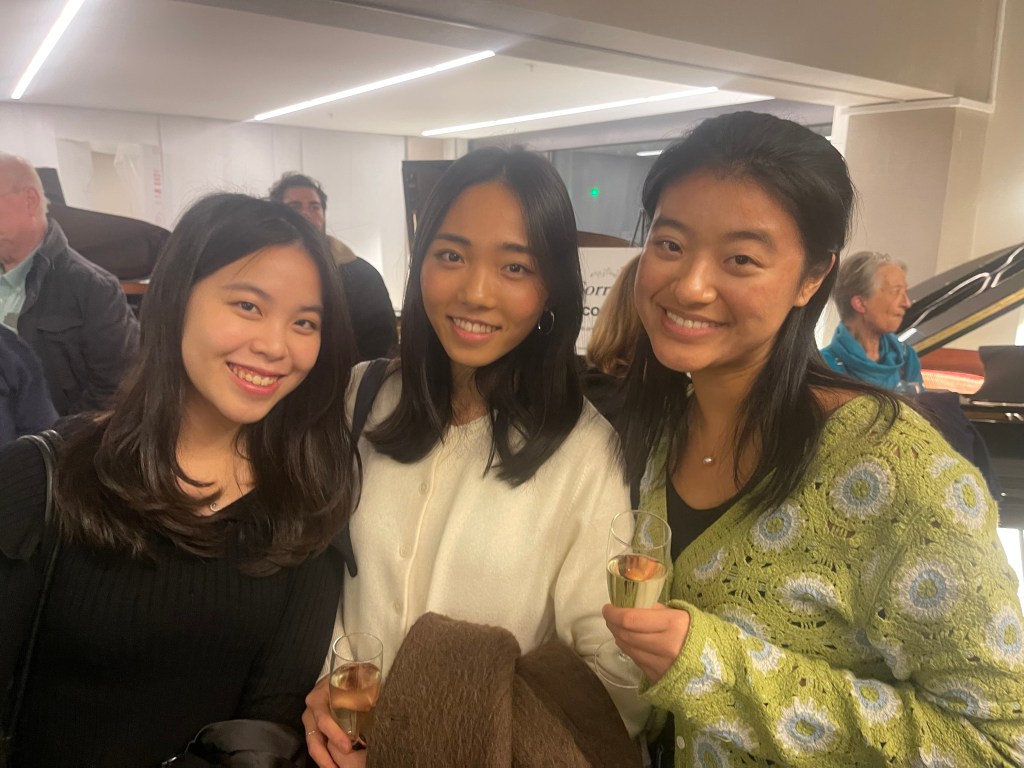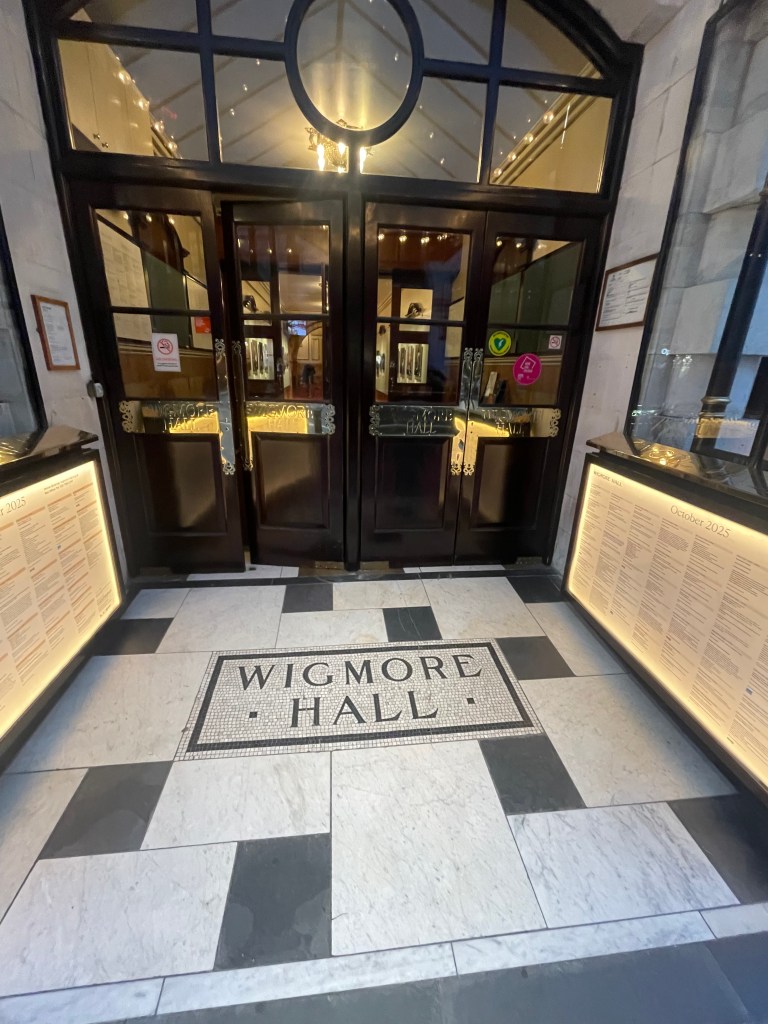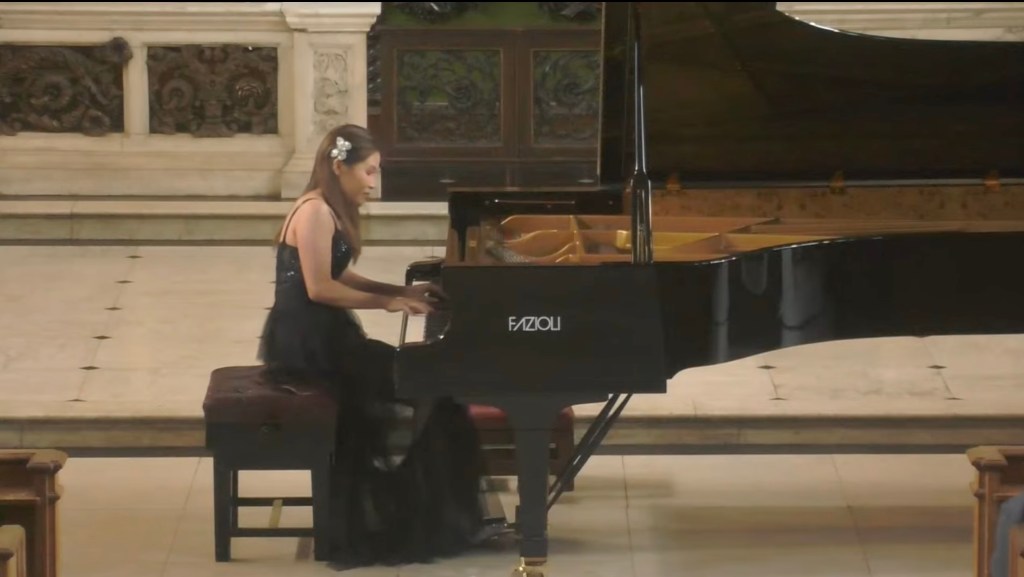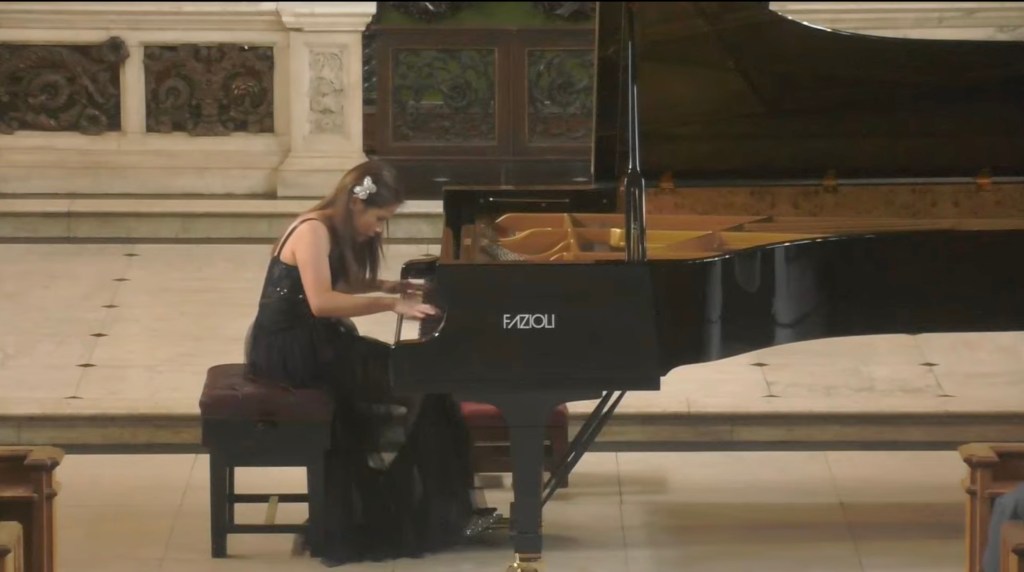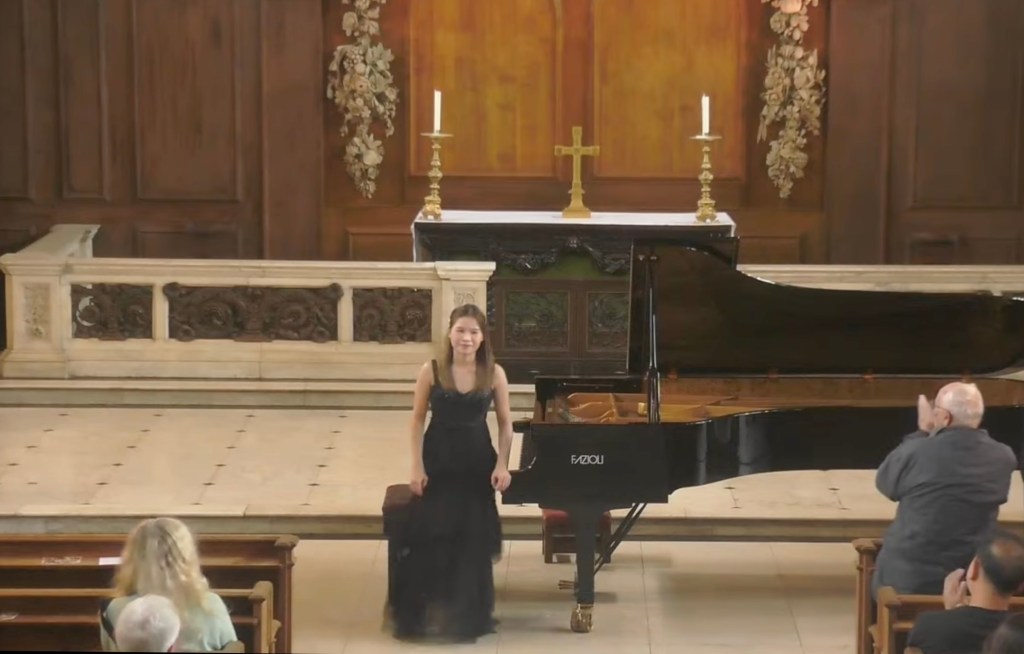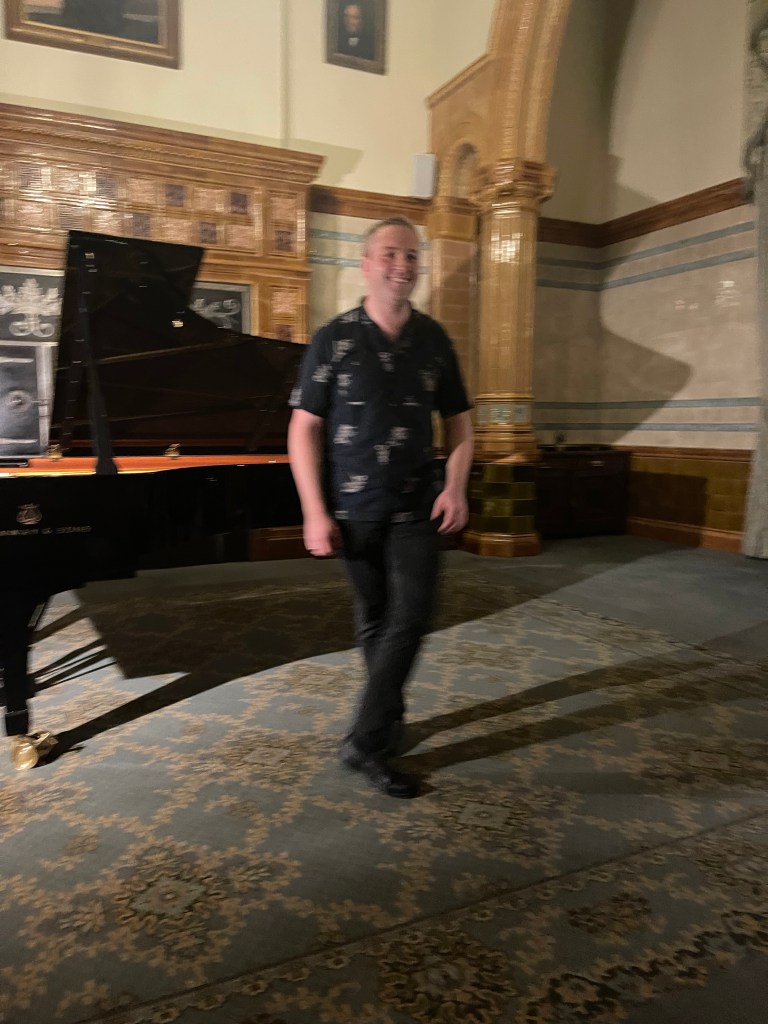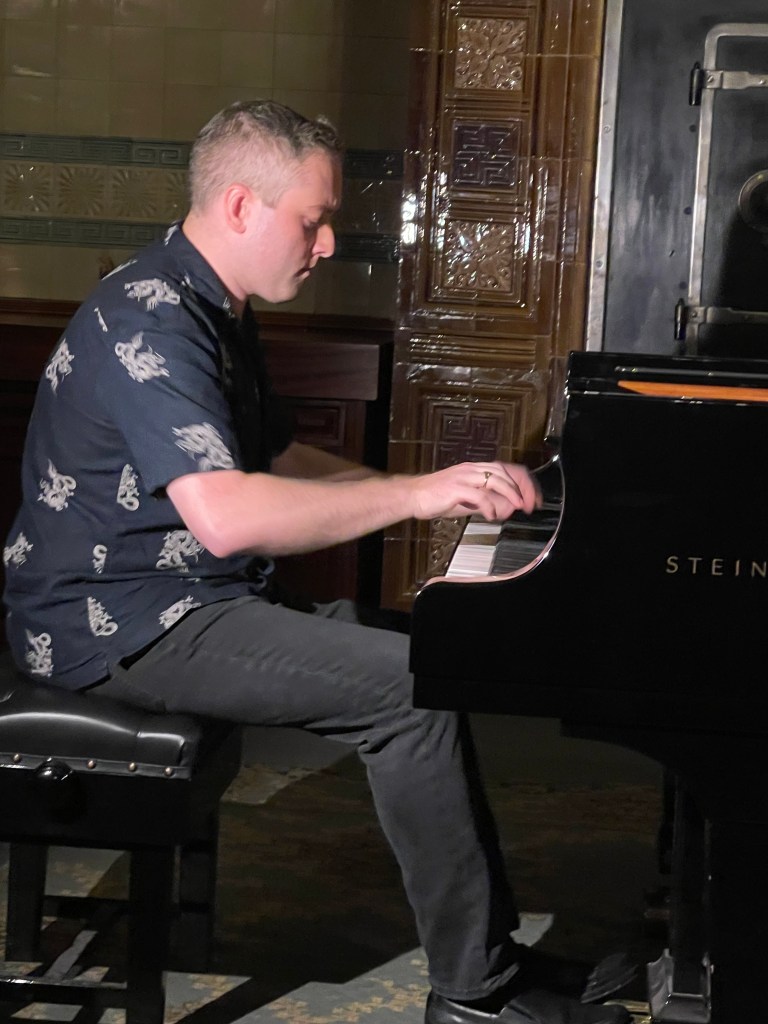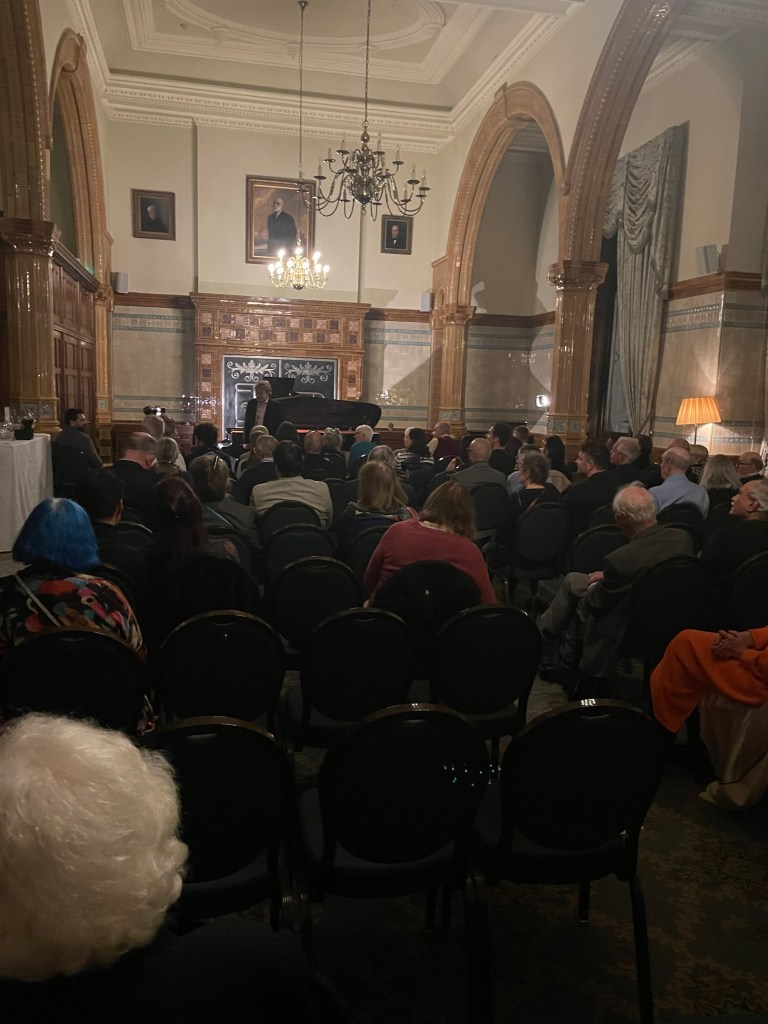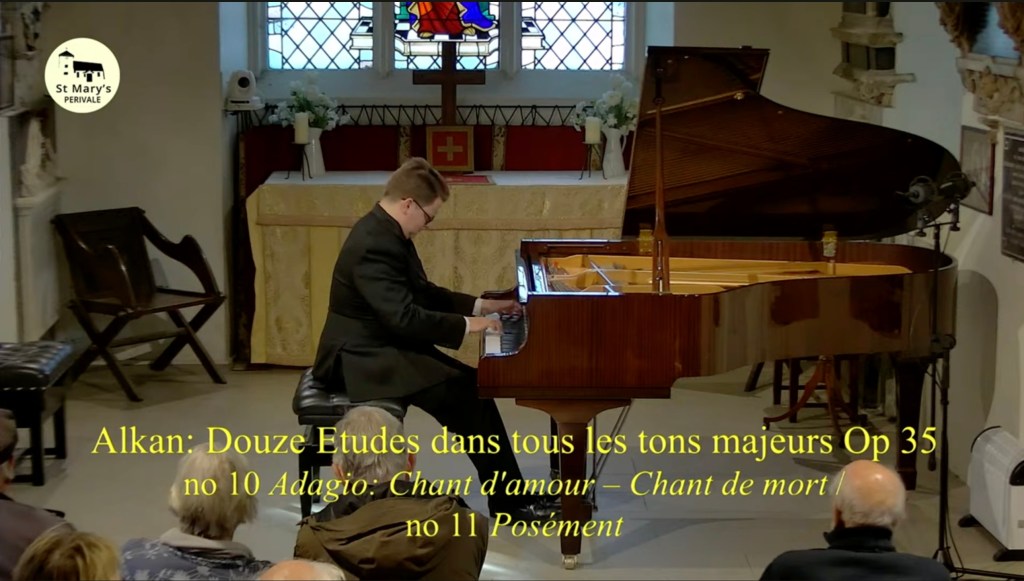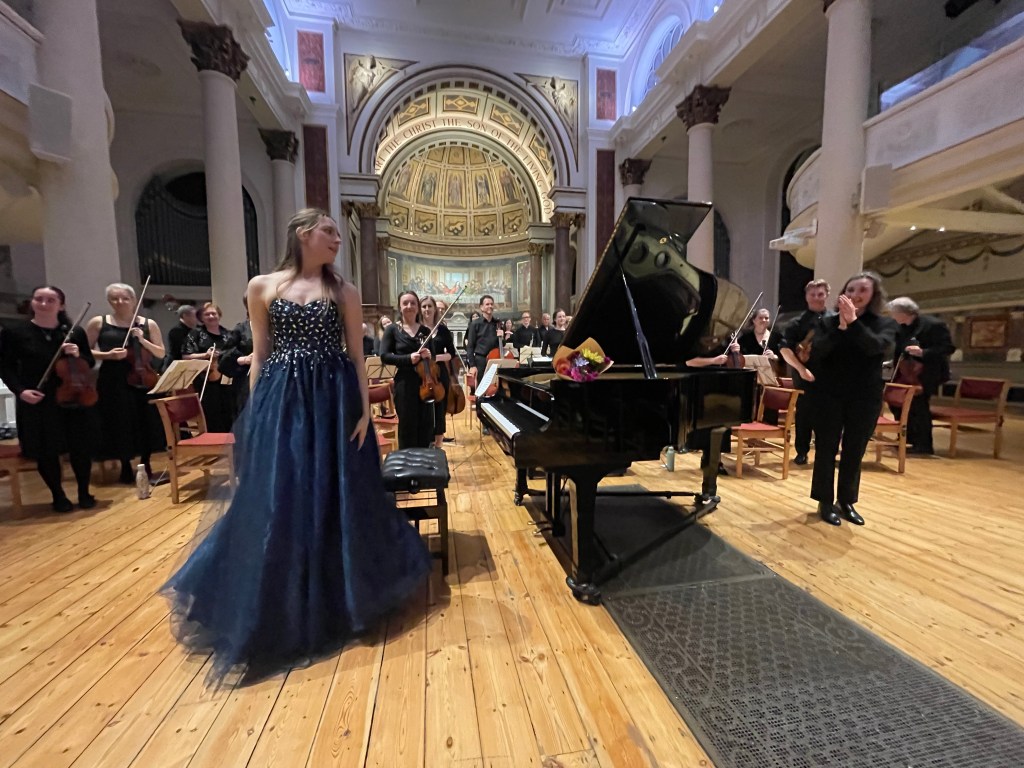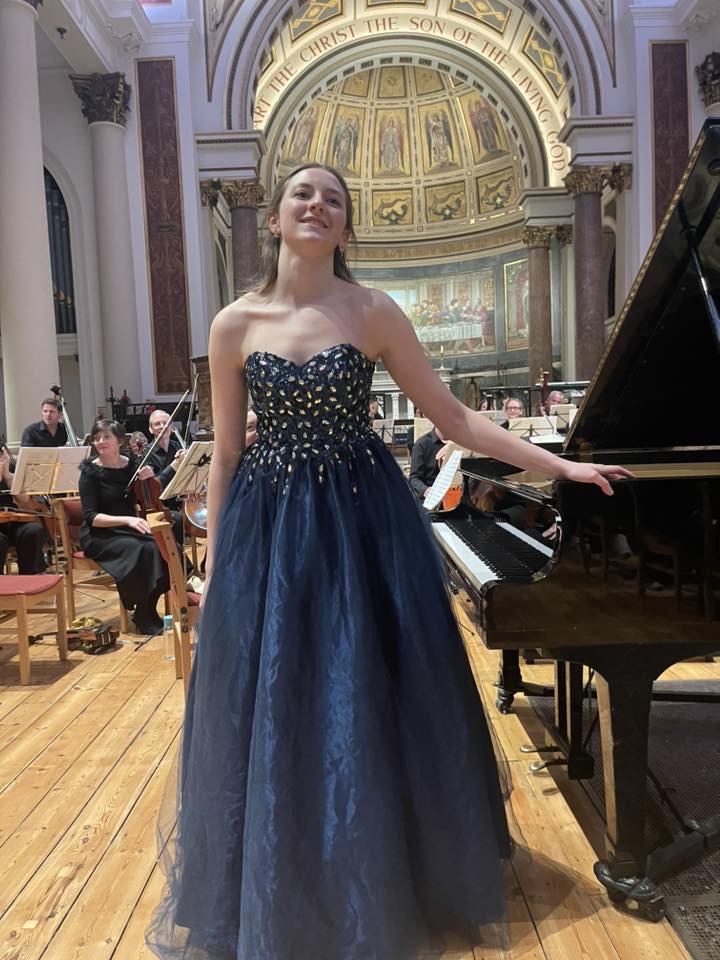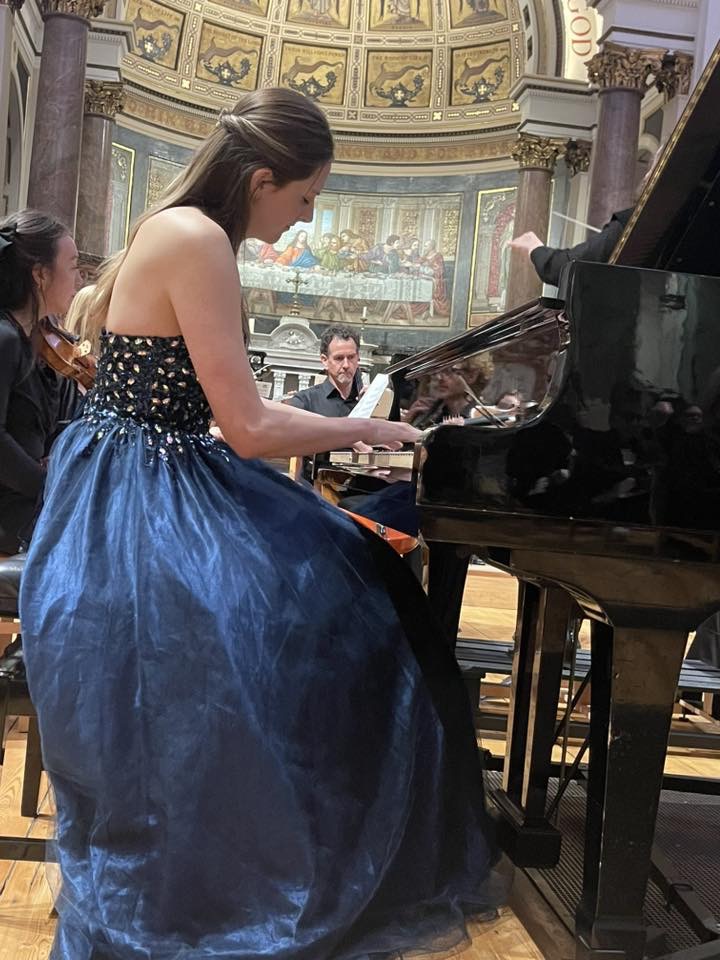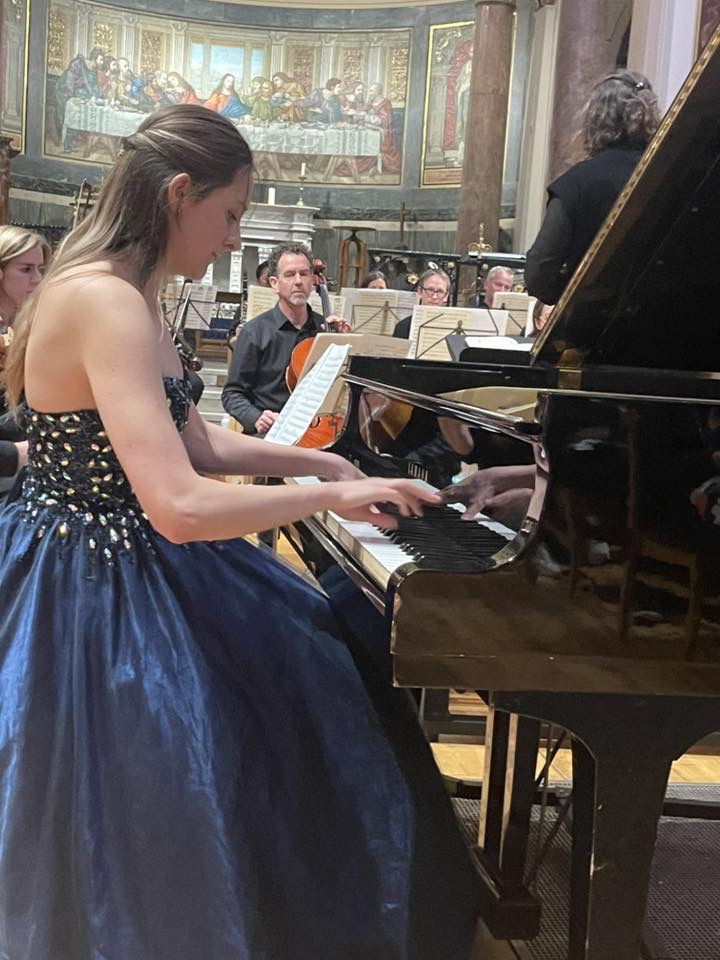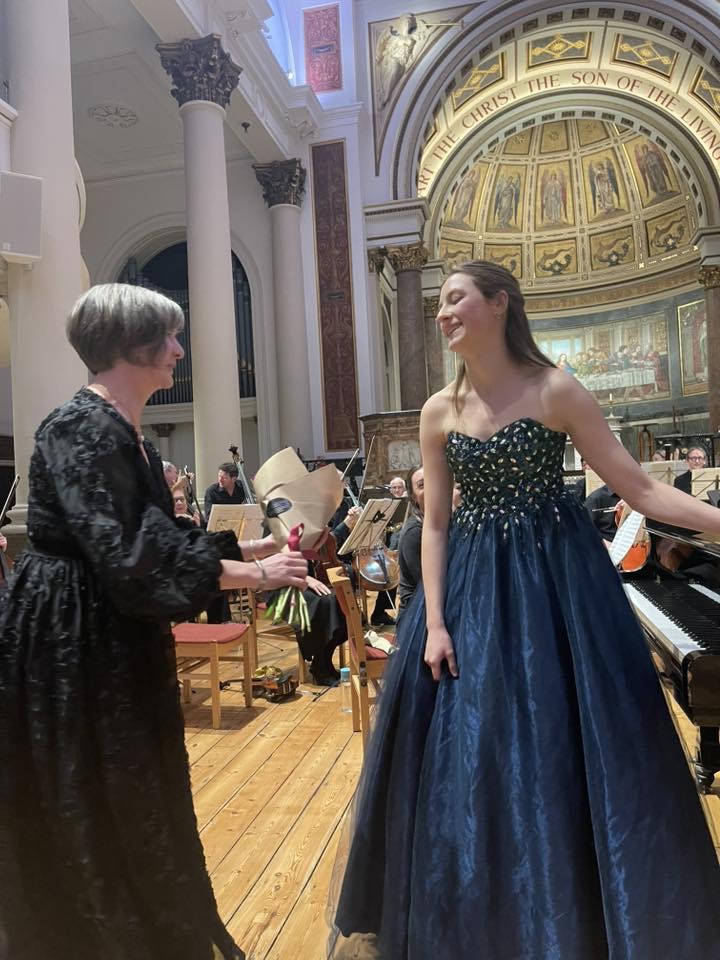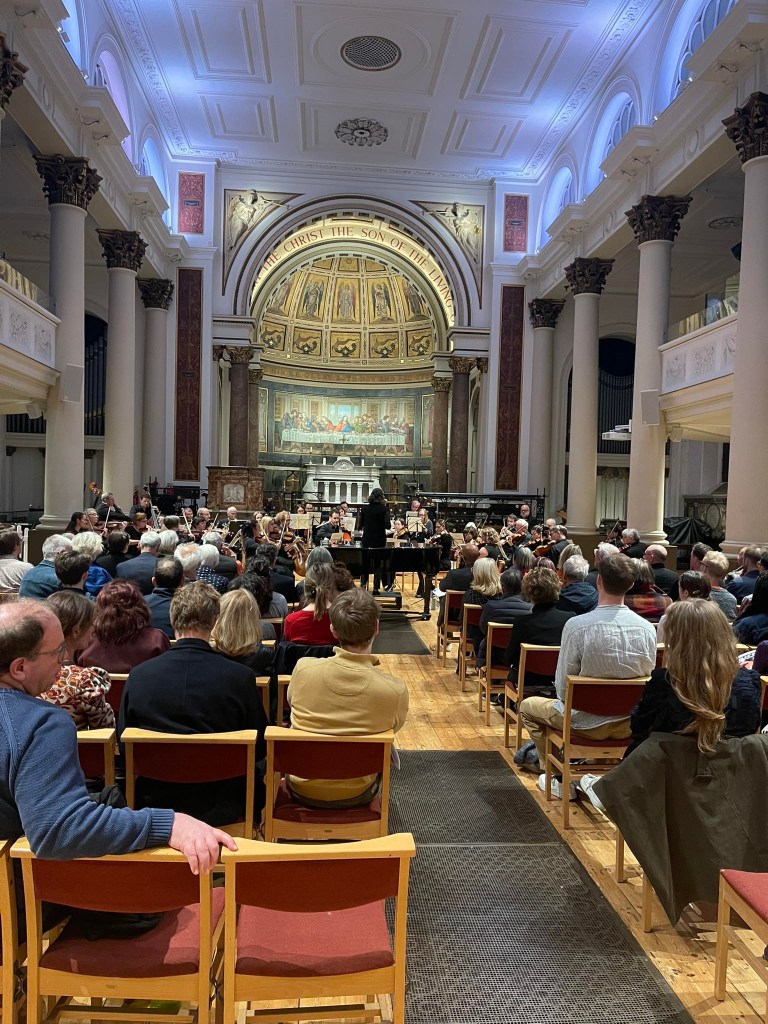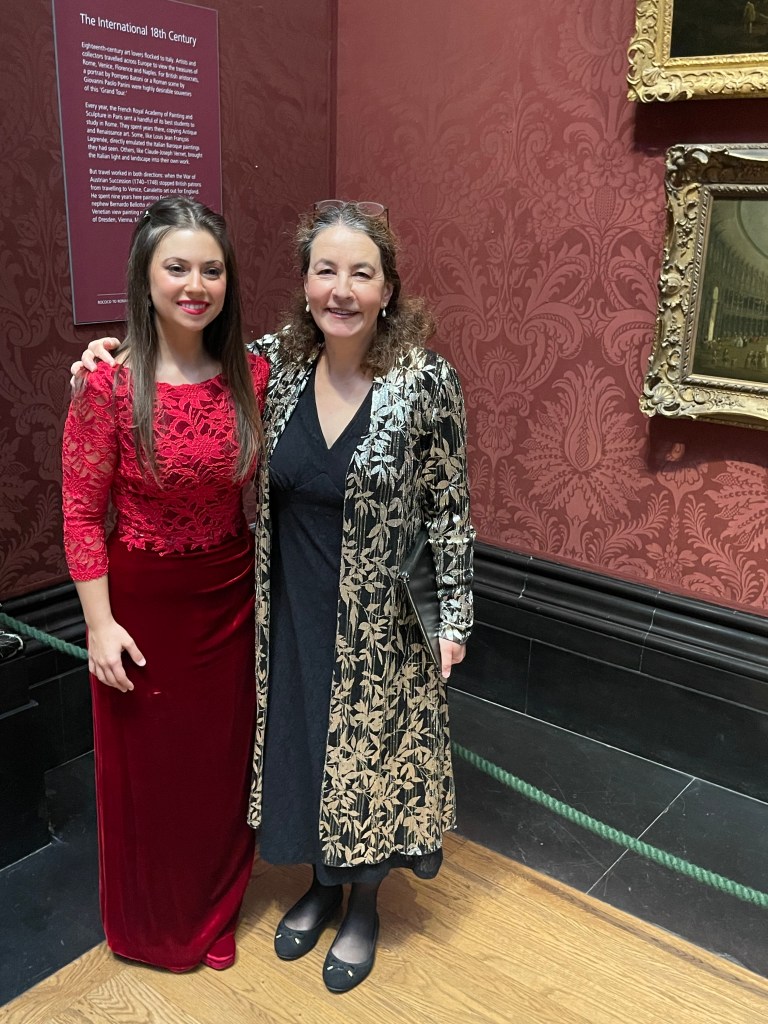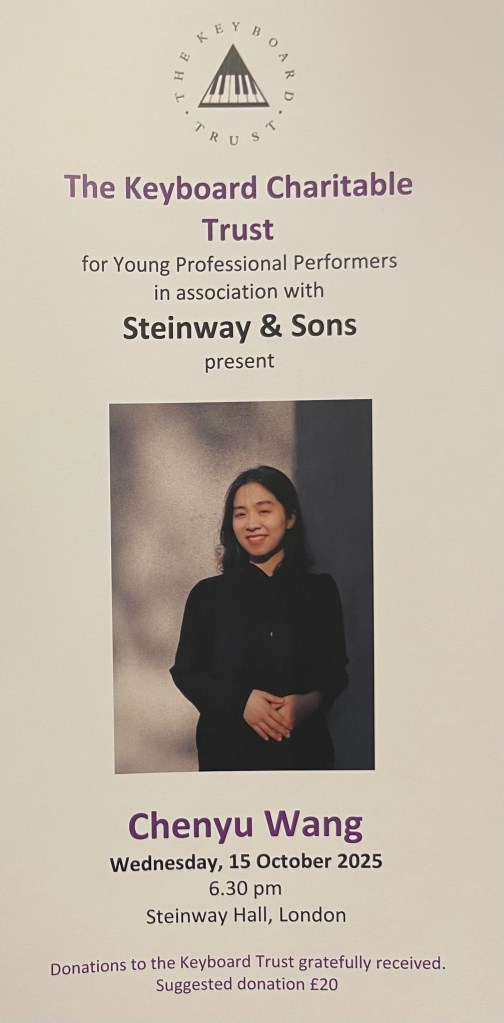
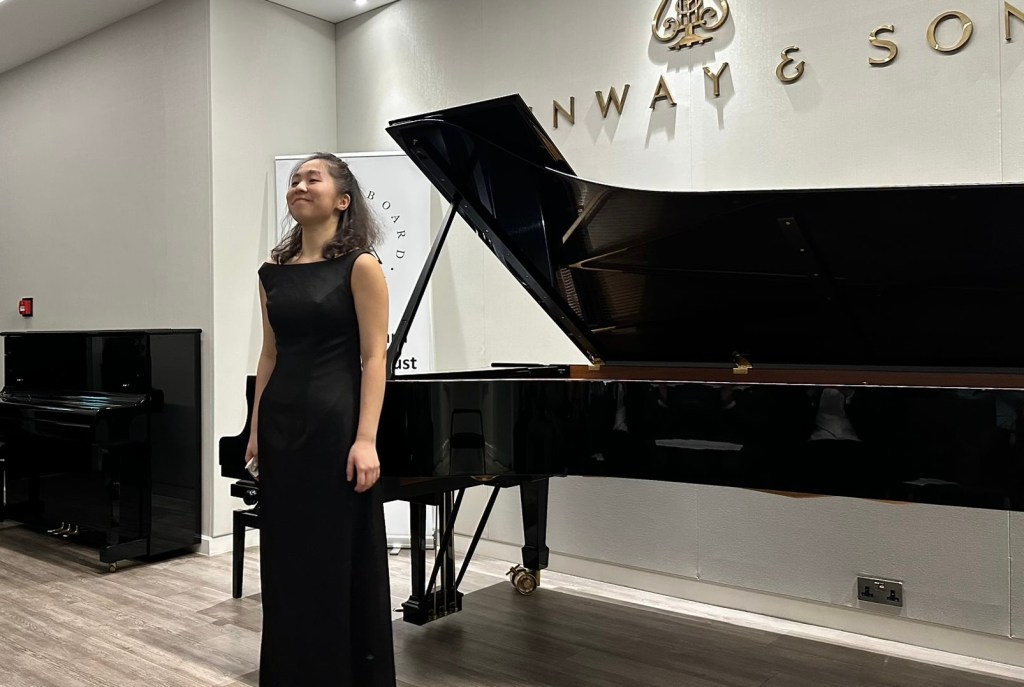
Chenyu Wang at Steinway Hall for the Keyboard Trust

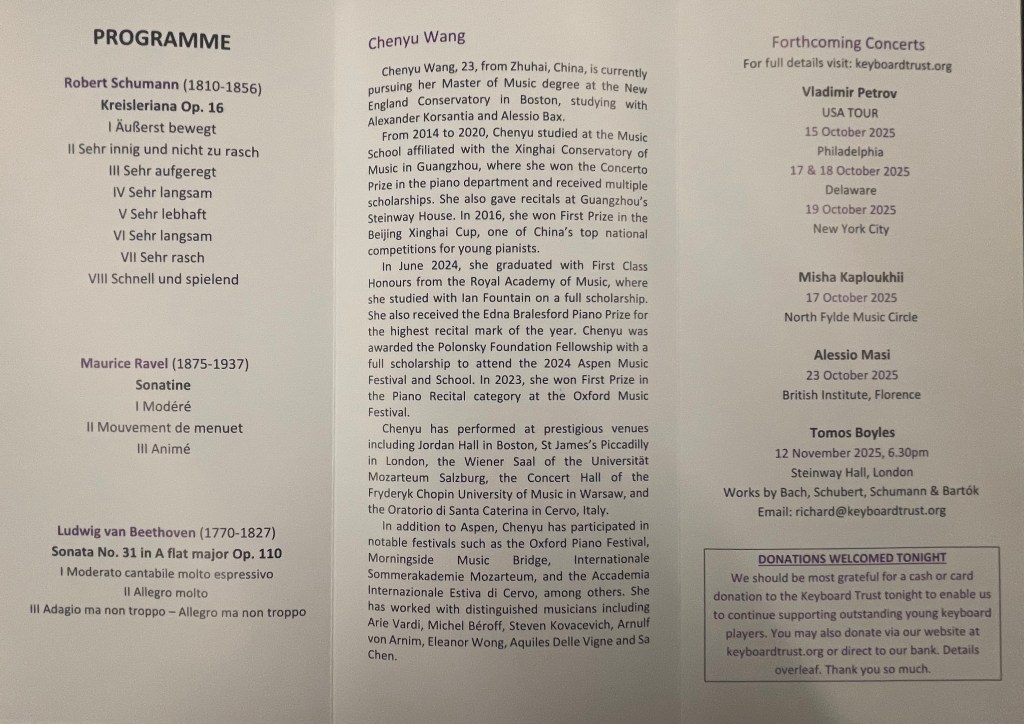
An artist is known by their programmes and Chenyu Wang presented three master works that showed her artistry and masterly musicianship.
A graduate from the Royal Academy under Ian Fountain , whose birthday it was too .

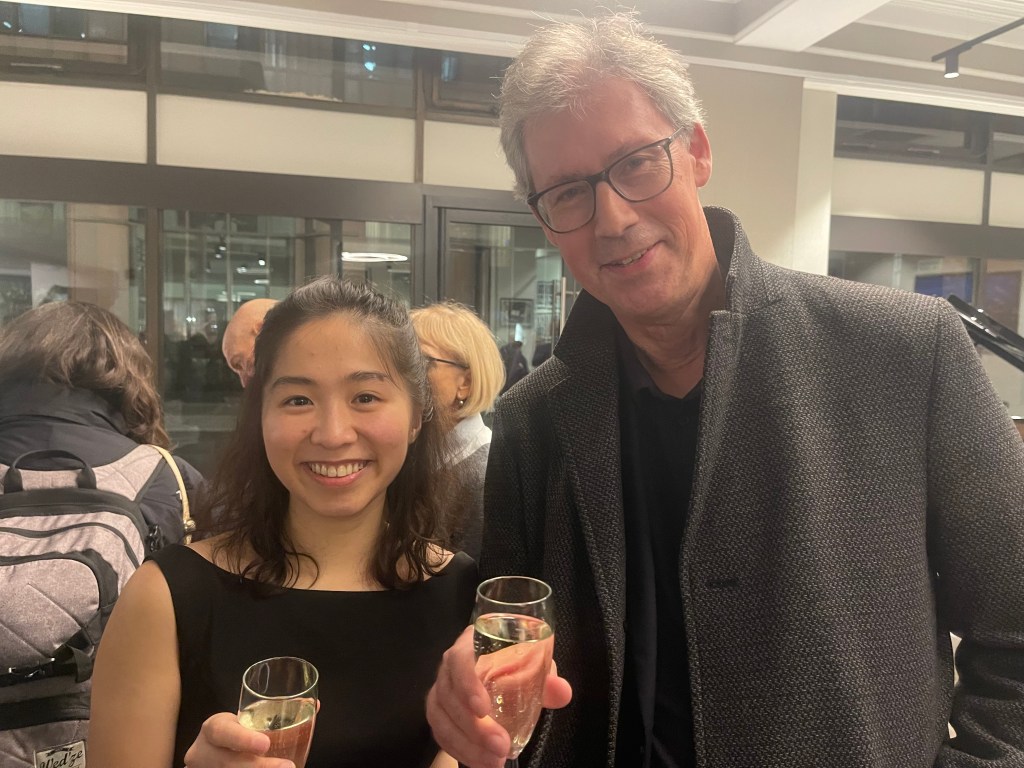
What better way to pass a special day than listening to his student playing with such superb musicianship: Beethoven op 110, Schumann Kreisleriana op 16 and the simple beauty of Ravel’s Sonatine. Chenyu who had just flown in from Boston where she is now preparing her Masters at the New England Conservatory under Alessio Bax, who with Paul Lewis was one of the first pianists to benefit from the Keyboard Trusts caring hands under the founders Noretta Conci and John Leech.
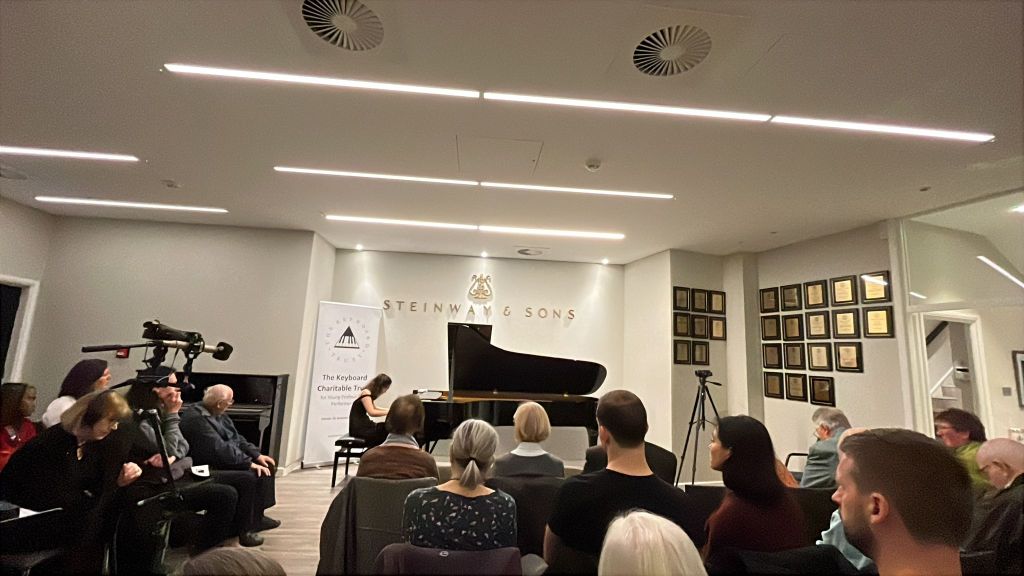
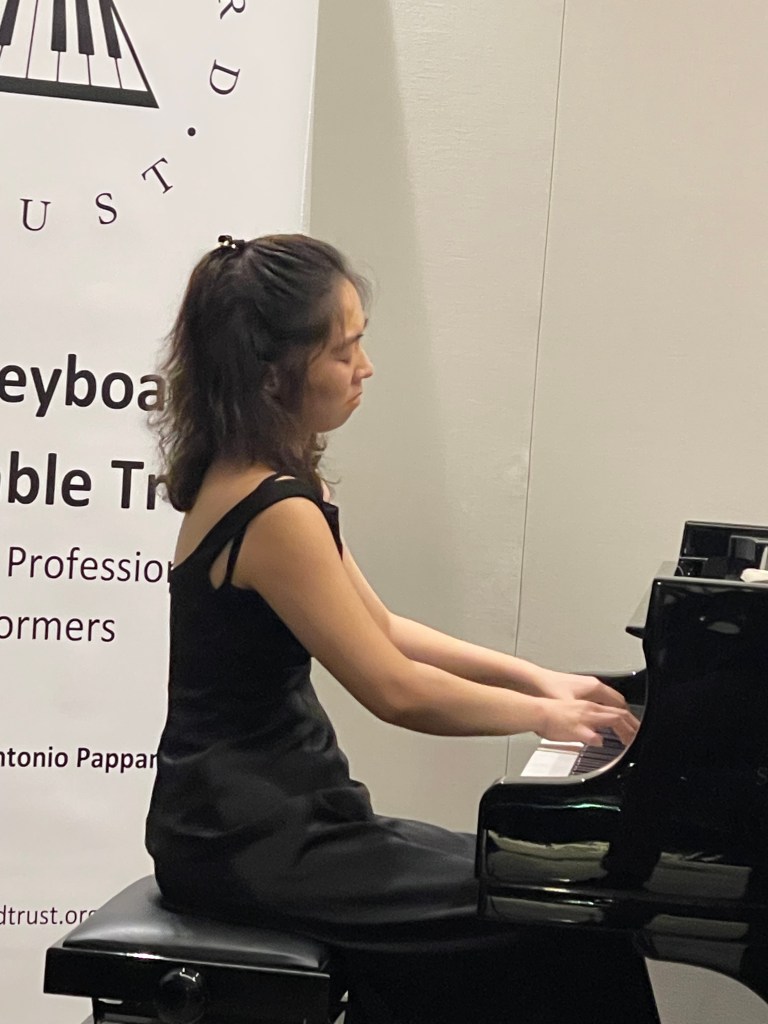
Kreisleriana opened this short recital where the eight episodes poured from her hands with poetic beauty and extraordinary technical control. Each piece played with ravishing beauty and passionate commitment, whilst at the same time she could knit them into one complete whole. The first episode just shot from her fingers with extraordinary authority and drive but it was the legato and control of sound in the second episode that was even more remarkable for the shape and beauty she was able to bring to this long and, in lesser hands, seemingly meandering piece. The penultimate episode too was a ‘tour de force’ of dynamic playing with no splitting of hands for this young master, just hair raising passionate driving urgency. But it was the final teasingly simple episode that she played with remarkable musicianship as the syncopated bass notes just added an anchor to the seemingly whimsical upper parts. Expanding into a sumptuously rich outpouring of Philadelphian sounds but always returning to the whispered snail like meanderings that were to take us to the whispered adieu at the bottom of the keyboard.
Simplicity and radiant beauty refreshed the air as she allowed Ravel’s Sonatine to vibrate with crystalline ease. Even the last movement was a wave of brilliant sounds gradually gaining more and more momentum with hypnotic vibrancy.

Taking all the time needed to play the magical opening notes of Beethoven’s penultimate sonata . I was reminded of Glenn Gould who would spend hours over the opening notes of the Fourth Concerto that has so much in common with the genial opening of this sonata too. The genius of Beethoven, who with so few notes could say so much. Chenyu brought a poignant stillness to the first movement of op 110 playing with disarming simplicity and radiant beauty . The transition to the development where Beethoven takes one magical step down and D flat becomes E flat, was where Chenyu displayed her breathtaking knowing understatement. There was immediately a rude awakening with the dynamic Beethovenian drive of the ‘Allegro molto’ where the treacherous leaps in the ‘Trio’ were played with fearless mastery .This set the scene for one of Beethoven’s most poignant outpourings of bel canto. The delicacy and kaleidoscope of colours that Chenyu found created a magic that held us spellbound in wonder that music could contain such unfathomoble secrets. Gradually allowing the music to unfold as Beethoven reaches the ecstatic climax with his vision of the paradise that was to await just a few years on at the age of only 57.

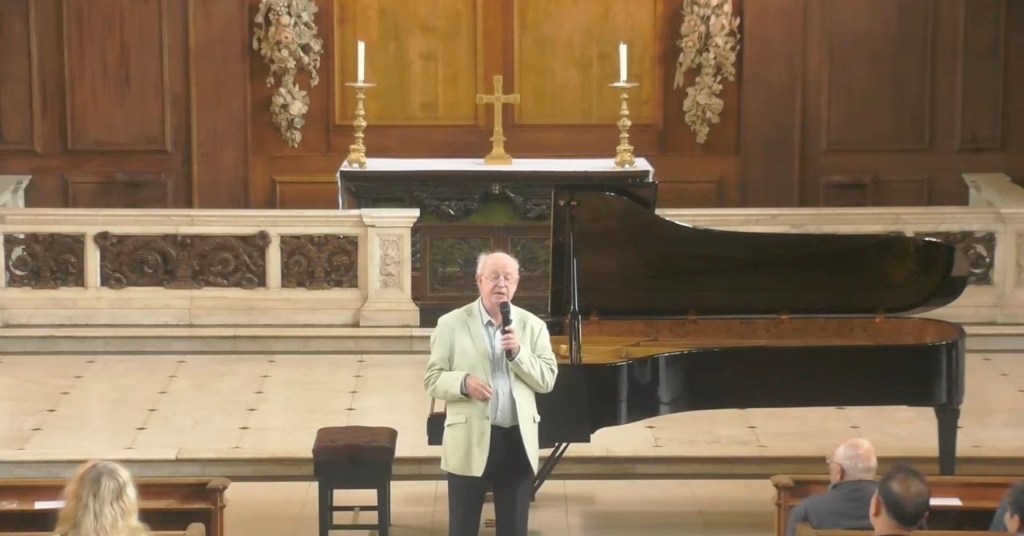
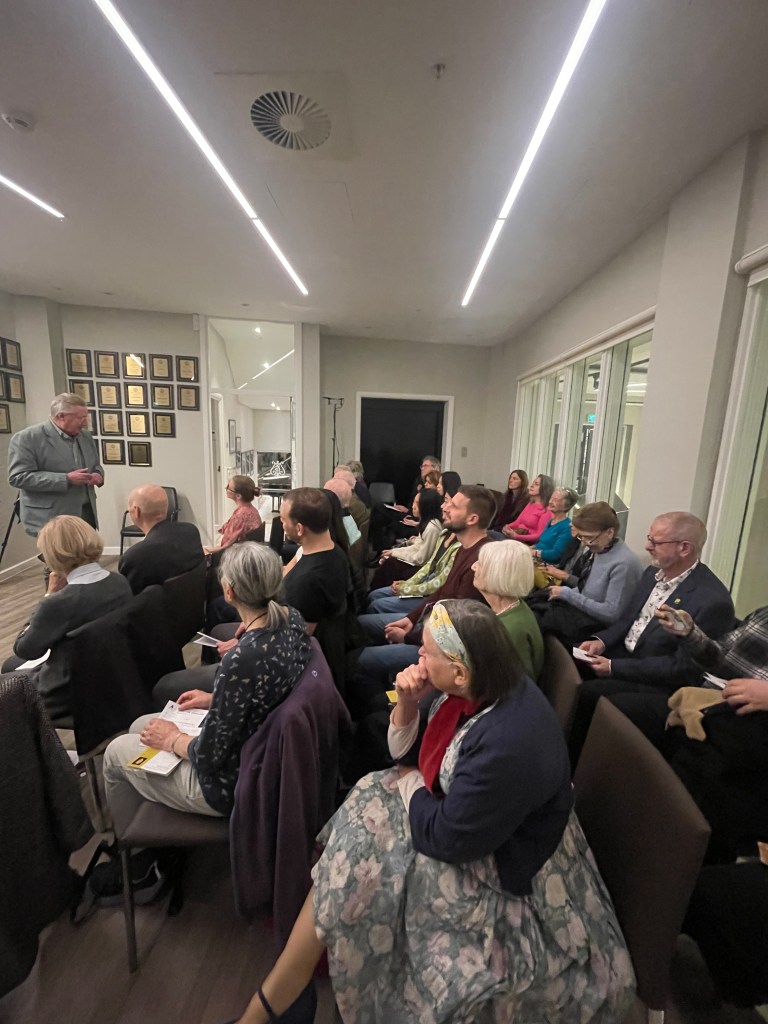
Leslie Howard in conversation with Chenyu

Playing of mastery and maturity as this twenty three year old descended on London for just twenty four hours. A permanent jet lag was a small price to pay for being able to share such wonders with us last night, and to celebrate the birthday of her mentor Ian Fountain the only British pianist with Benjamin Frith in 1989 to win the Rubinstein Competition.

Leslie Howard , founder trustee of the Keyboard Trust and master pianist will give his annual Wigmore recital ( I think almost the 50th) on 23rd of this month .

He was generously presiding and conducting a short public conversation with his remarkable younger colleague .
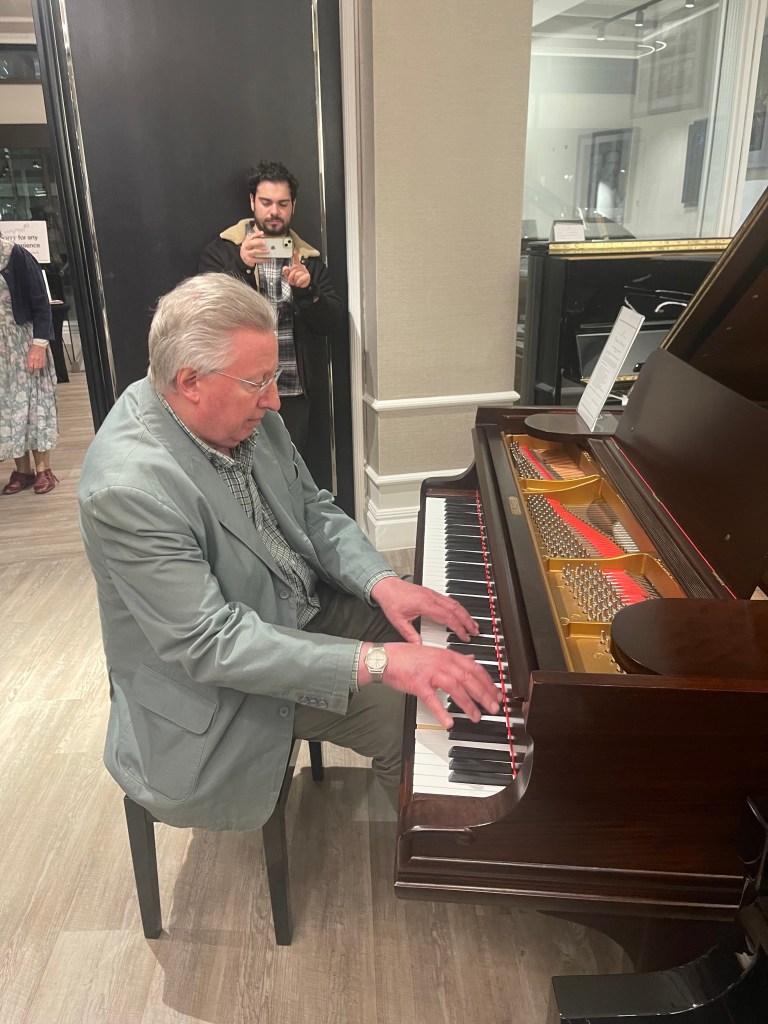
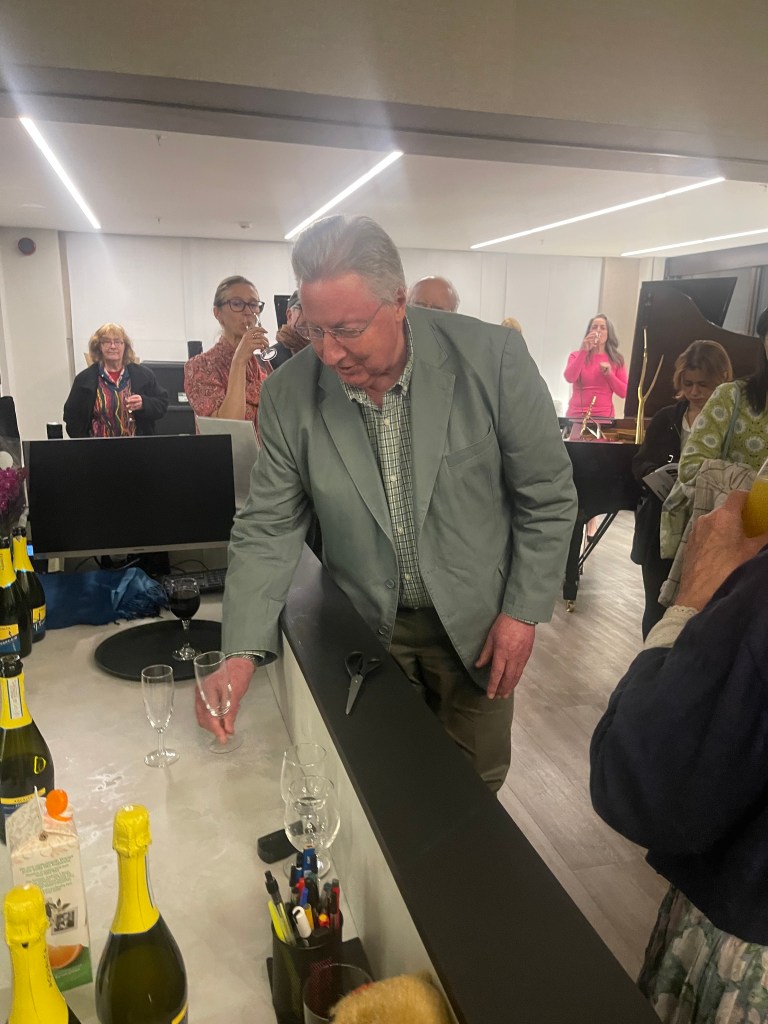
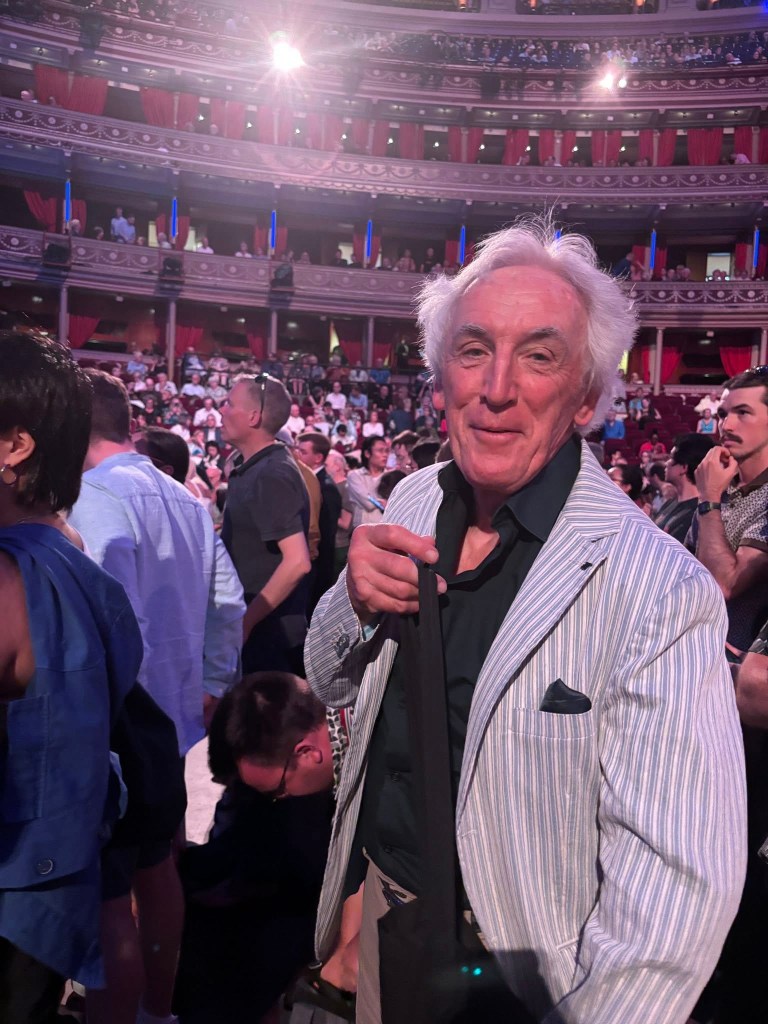
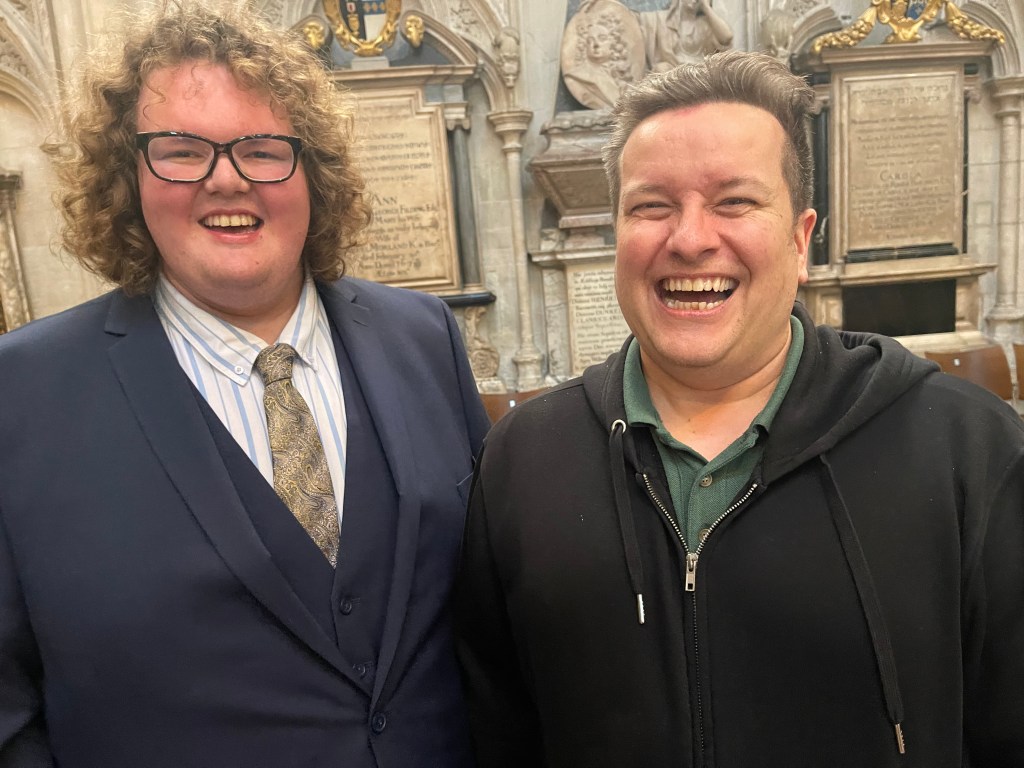
Celebrations were now in order above all for the magnificent music making we had been treated to but also to celebrate not only Ian Fountain’s birthday but also mine!
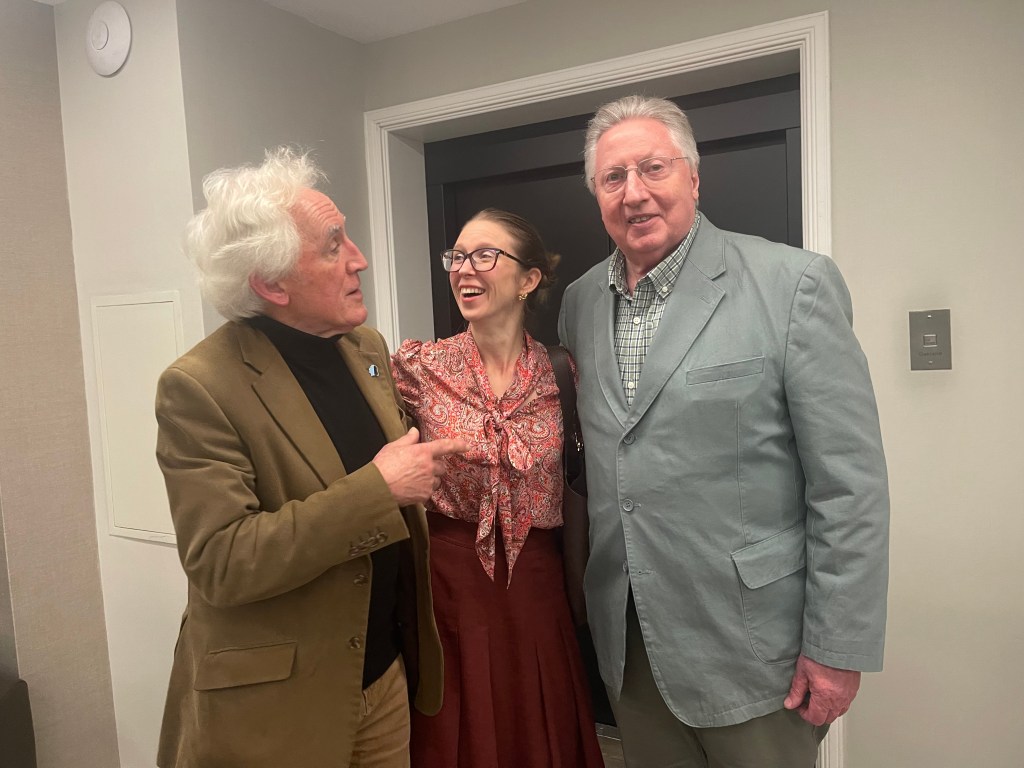
The Artistic Directors of the Keyboard Trust : Elena Vorotko . CA and LH either side

Chenyu is already in the sky looking down on the proceedings with a knowing twinkle in her eye.
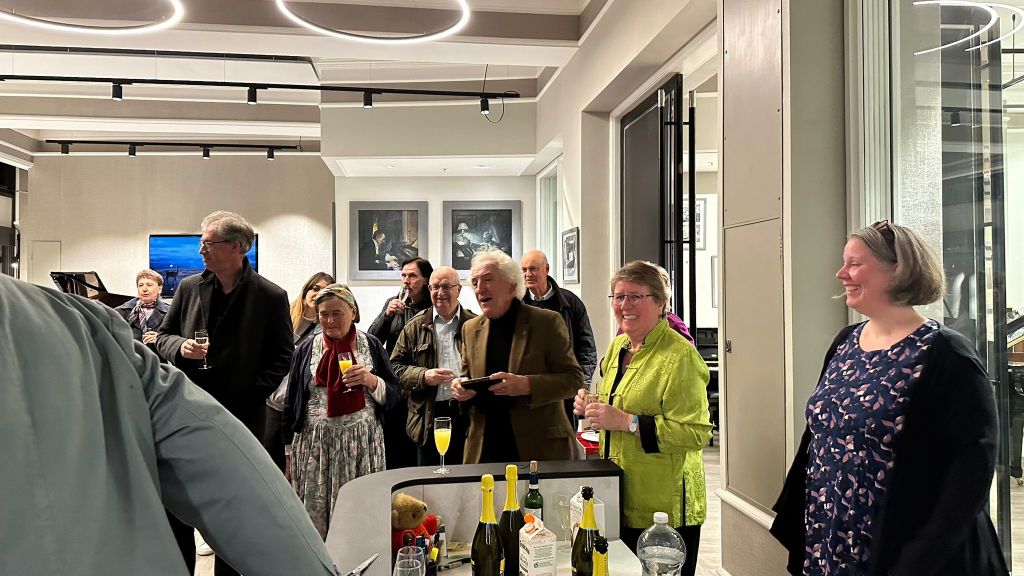
Chenyu Wang, 23, from Zhuhai, China, is currently pursuing her Master of Music degree at the New England Conservatory in Boston, studying with Alexander Korsantia and Alessio Bax.

From 2014 to 2020, Chenyu studied at the Music School affiliated with the Xinghai Conservatory of Music in Guangzhou, where she won the Concerto Prize in the piano department and received multiple scholarships. She also gave recitals at Guangzhou’s Steinway House. In 2016, she won First Prize in the Beijing Xinghai Cup, one of China’s top national competitions for young pianists.

In June 2024, she graduated with First Class Honours from the Royal Academy of Music, where she studied with Ian Fountain on a full scholarship. She also received the Edna Bralesford Piano Prize for the highest recital mark of the year. Chenyu was awarded the Polonsky Foundation Fellowship with a full scholarship to attend the 2024 Aspen Music Festival and School. In 2023, she won First Prize in the Piano Recital category at the Oxford Music Festival.

Chenyu has performed at prestigious venues including Jordan Hall in Boston, St James’s Piccadilly in London, the Wiener Saal of the Universität Mozarteum Salzburg, the Concert Hall of the Fryderyk Chopin University of Music in Warsaw, and the Oratorio di Santa Caterina in Cervo, Italy.

In addition to Aspen, Chenyu has participated in notable festivals such as the Oxford Piano Festival, Morningside Music Bridge, Internationale Sommerakademie Mozarteum, and the Accademia Internazionale Estiva di Cervo, among others. She has worked with distinguished musicians including Arie Vardi, Michel Béroff, Steven Kovacevich, Arnulf von Arnim, Eleanor Wong, Aquiles Delle Vigne, and Sa Chen.

https://christopheraxworthymusiccommentary.com/2023/06/02/the-gift-of-music-the-keyboard-trust-at-30/

Programme for Leslie Howard’s annual Wigmore Hall recital!

23rd October 2025 at 7:30pm

BEETHOVEN Sonata no. 11 in B flat major, opus 22

TCHAIKOVSKY Grande Sonate (no. 3) in G major, opus 37

LISZT Deux Polonaises, S223:

LISZT Liebesträume — Drei Notturnos, S541

LISZT Soldaten- Chor & Marsch aus der Oper Faust von Charles Gounod, S743

More than 50 years ago, Leslie Howard performed three consecutive recitals at Wigmore Hall celebrating the music of Beethoven, Liszt, and the great Russian Romantics. These three aspects of the piano repertoire have been informing many of his recital and recording programmes every since. His 2025 Wigmore recital continues the tradition:

The culmination of Beethoven’s first great group of piano sonatas, the composer himself suggesting that the composition the B flat major sonata went so smoothly that the piece seemingly took care of itself. The result is a work of consummate refinement and elegance, with a perfect balance between lyricism and concertante display, demonstrated in miniature in the minuet and trio and at large in the grand dramatic structure of the whole work.

Tchaikovsky left his first sonata as an incomplete first movement in F minor; his second, a four-movement work in C sharp minor, remained in manuscript until it appeared after the composer’s death as his opus 80; the third fared rather better, and was completed in 1878 and published contemporaneously with the violin concerto. It was taken up by Nikolay Rubinstein, and enjoyed considerable success in its day, despite Tchaikovsky’s initial customary doubts and misgivings. It is a bold piece, often very orchestral in its texture, and notably intricate in deriving its materials from very short motivic cells. (Leslie Howard recorded all three sonatas for Hyperion.)

Liszt’s inexhaustible fecundity produced a vast range of compositions of all kinds, and the public is only gradually coming to terms with Liszt’s range and true depth. The pieces in the present recital are amongst his most beloved works, presenting first the two very imposing polonaises – the one a powerful elegy, the other overflowing with joy. Then come the Liebesträume (Love’s dreams) – three nocturnes. The third has always been Liszt’s most popular intimate melody, but it it is even more striking when heard in conjunction with its two companions. Of course, all three pieces were originally songs with piano – always entitled Liebesträume, and the nocturnes retain the song titles: Hohe Liebe (Great love), Seliger Tod (Blessed death) and O lieb, so lang du lieben kannst (Oh Love, as long as you are able to love).

The final piece is a conundrum. Not that anyone will fail to recognise the famous Soldiers’ March and Chorus from Gounod’s Faust, but this rather riotous piano elaboration of it first appeared in print as the opus 17 of one Josef Löw (1834-1886). Because of references in Liszt’s correspondence, it was long thought that there must have been a missing piece of Liszt with this title. Further investigation shows that Liszt was approached to help young Löw by gifting the young fellow something that he could claim as his own, and this work is immediately identified. Unsurprisingly, the published piece is fulsomely dedicated to Liszt. But there are no surviving manuscripts, and no way of knowing how much, if anything, Löw contributed to the publication. And there are many felicitous touches and hallmarks that bear clear testimony to Liszt’s authorship!
photo credit Dinara Klinton https://christopheraxworthymusiccommentary.com/2024/03/20/christopher-axworthy-dip-ram-aram/

Rachel Cheung at St James’s Piccadilly with mastery and burning intensity

Beethoven Sonata in C-sharp minor, Op. 27 No. 2 ‘Moonlight’  Adagio sostenuto- Allegretto – Presto agitato


Schumann Fantasiestücke, Op. 12  Des Abends – Aufschwung – Warum – Grillen -In der Nacht – Fabel – Traumes Wirren – Ende vom Lied


Gounod/Liszt Faust Waltz 

https://www.youtube.com/live/_ZFRiEz3CKs?si=4iIki0HtNAKkaaHT

Rachel Cheung playing for the Beethoven Piano Society of Europe, how could she not open but with Beethoven.The thirty two sonatas Julian Jacobson had presented in this very hall a few years ago in a marathon non stop performance of all thirty two at one sitting. He was now presenting his colleague from Hong Kong with just one of the thirty two steps of Beethoven that map the long and tormented existence of a genius.

Today he was presenting Rachel in whose Academy in Hong Kong he had recently given masterclasses. Rachel today just presented one Sonata ,but it is the most well known of all sonatas , known as the ‘Moonlight’. A title that Beethoven did not choose but his publisher thought would sell better if it had a title ! One of his two Sonatas ‘quasi una fantasia’ that make up op 27. Both extraordinarily original works where Beethoven is breaking away from his teacher Haydn and the classical model sonata form .
Op 27 n.2 which Rachel played today suffers from its title in that people usually play the first movement too slowly gazing into the magical inexistent moonlit waters. It is infact written in two and the continual triplets are but an accompaniment to the melody that is floated above. Rachel played it as Beethoven had written and her beautiful flowing tempo and the glistening clarity of the melodic line was given an architectural shape that gave a noble beauty to this ‘Adagio sostenuto.’ The ‘Allegretto’ was played with Beethovenian severity where grace and Haydenesque charm would have contrasted better with the Trio that she played with great authority. The ‘Presto agitato’,last movement was played with masterly control and burning intensity. Even the beautiful mellifluous passages had an urgency to them that brought us to the tumultuous cascades of notes, and after a brief relieving cadenza, the final burst of driving urgency was played with masterly authority.

It was the world of Schumann where Rachel’s mastery really shone brightly. There was an authority and beauty to all that she did, where even the opening ‘Des Abends’ was played with a chiselled beauty and timeless beauty. A magical accompaniment on which the melodic line could float with poignant meaning. ‘Auschwung’ just sprung from her fingers with a passionate outpouring of driving intensity , but even here there was a beautiful melodic line that floated magically above an ever more agitated accompaniment . There was wondrous beauty to ‘Warum’ where the beauty of the duet between the voices was played with ravishing sounds with exquisite phrasing and magical colouring. She brought a great sense of character to ‘Grillen’ with a continuous whimsical display of rhythmic and melodic episodes played with extraordinary brilliance and beguiling capricious charm. ‘In der Nacht’ brought a superb web of weaving sounds played with absolute mastery and clarity and with a terrifying driving force. Even here, wondrous melody suddenly appeared, as Schumann in this period, like Schubert, seemed to have a never ending song in his heart. ‘Fabel’ brought capricious comments of improvised lightness in reply to the slow melodic story that was unfolding with such poetic imagination. ‘Traumes Wirren’ was played with fearless mastery as this ‘perpetuum mobile’ drove its way relentlessly over the entire keyboard with exhilarating exuberance. There was a nobility to the ‘Ende vom Lied’ that Rachel played with aristocratic authority. The absolute stillness that she brought to the final few bars was magic indeed. As Schumann wrote so poignantly to Clara : ‘everything ultimately dissolves into a merry wedding – but my distress for you came back at the end, and the wedding bells sound as if commingled with a death knell.”

A masterly performance that held us spellbound with the poetic beauty and authority of her playing

The final work was the Gounod /Liszt Faust paraphrase. A pianistic show piece that Rachel played with fearless abandon but with masterly control . A kaleidoscope of colours illuminated the extraordinary brilliance of the jeux perlé as Liszt weaves a magical web of sounds incorporating Gounod ‘s magical melodies . Grandeur and sumptuous rich sounds filled this beautiful church with sounds of the opera where glissandi were thrown off with the same natural ease as a singer with the embellishments of bel canto. A breathtaking ‘tour de force’ of a work that in Liszt’s day would turn refined aristocratic ladies into a screaming mob wanting souvenirs of their idol to take home . Rachel’s performance ,too, generated such excitement that the final tumultuous bars were greeted with a spontaneous standing ovation.

Hong Kong-born pianist Rachel Cheung is recognized as one of the most sought-after artists in Asia. She has been hailed as “a poet, but also a dramatist,” displaying “the most sophisticated and compelling music-making” (The Dallas Morning News). She won over audiences and critics alike as a finalist at the 2017 Van Cliburn International Piano Competition with “stunningly imaginative” (Musical America) interpretations marked by “flights of both beauty and virtuosity” (Theater Jones) and was awarded the Audience Prize by online vote. Also a Steinway Artist, she continues to build a reputation for her elegant stage presence, giving sensitive and refined performances across three continents. 

Rachel has appeared with the St. Petersburg Philharmonic, Hong Kong Philharmonic, Jerusalem Symphony, Hong Kong Sinfonietta, Sydney Symphony, London Chamber, and Fort Worth Symphony Orchestras, collaborating with conductors including Edo de Waart, Vladimir Ashkenazy, Jaap van Zweden, Leonard Slatkin, Sir Mark Elder, Christopher Warren-Green, and Nicholas McGegan. 

She has performed in recital at the Auditorium du Louvre in Paris, Elbphilharmonie in Hamburg, Steinway Hall in London, Weill Recital Hall at Carnegie Hall, Richmond Hill Centre for Performing Arts in Toronto, Philharmonie de Paris, and in other cities across the United States, Europe, and Asia. 

As an active chamber musician, Rachel has collaborated with world-renowned artists including soprano Anna Netrebko, tenor Yusif Eyvazov, mezzo-soprano Virpi Räisänen, violinists Joshua Bell and Ning Feng, violist Vladimir Mendelssohn, cellists Camille Thomas, Zlatomir Fung, and Narek Hakhnazaryan, as well as the Brentano String Quartet and Quatuor Hanson. 

Born and raised in Hong Kong, Rachel graduated with first-class honors from the Hong Kong Academy for Performing Arts under the tutelage of Eleanor Wong and later studied with Peter Frankl at the Yale School of Music, where she was awarded the Elizabeth Parisot Prize for outstanding pianists. Her additional competition honors include prizes at the Leeds, Chopin, Vladimir Horowitz, Gina Bachauer, and Geneva International Piano Competitions. 

In 2019, Rachel was awarded Artist of the Year (Music) by the Hong Kong Arts Development Council. In 2025, she founded the Rachel Cheung Music Academy in Hong Kong, aiming to create a vibrant musical community and inspire the next generation of musicians. Her first concert DVD was released by VAI in 2007, and her debut international album, Reflections, featuring the Chopin Preludes, was released by Universal Music. 

Presented in association with the Beethoven Piano Society of Europe  

photo credit Dinara Klinton https://christopheraxworthymusiccommentary.com/2024/03/20/christopher-axworthy-dip-ram-aram/

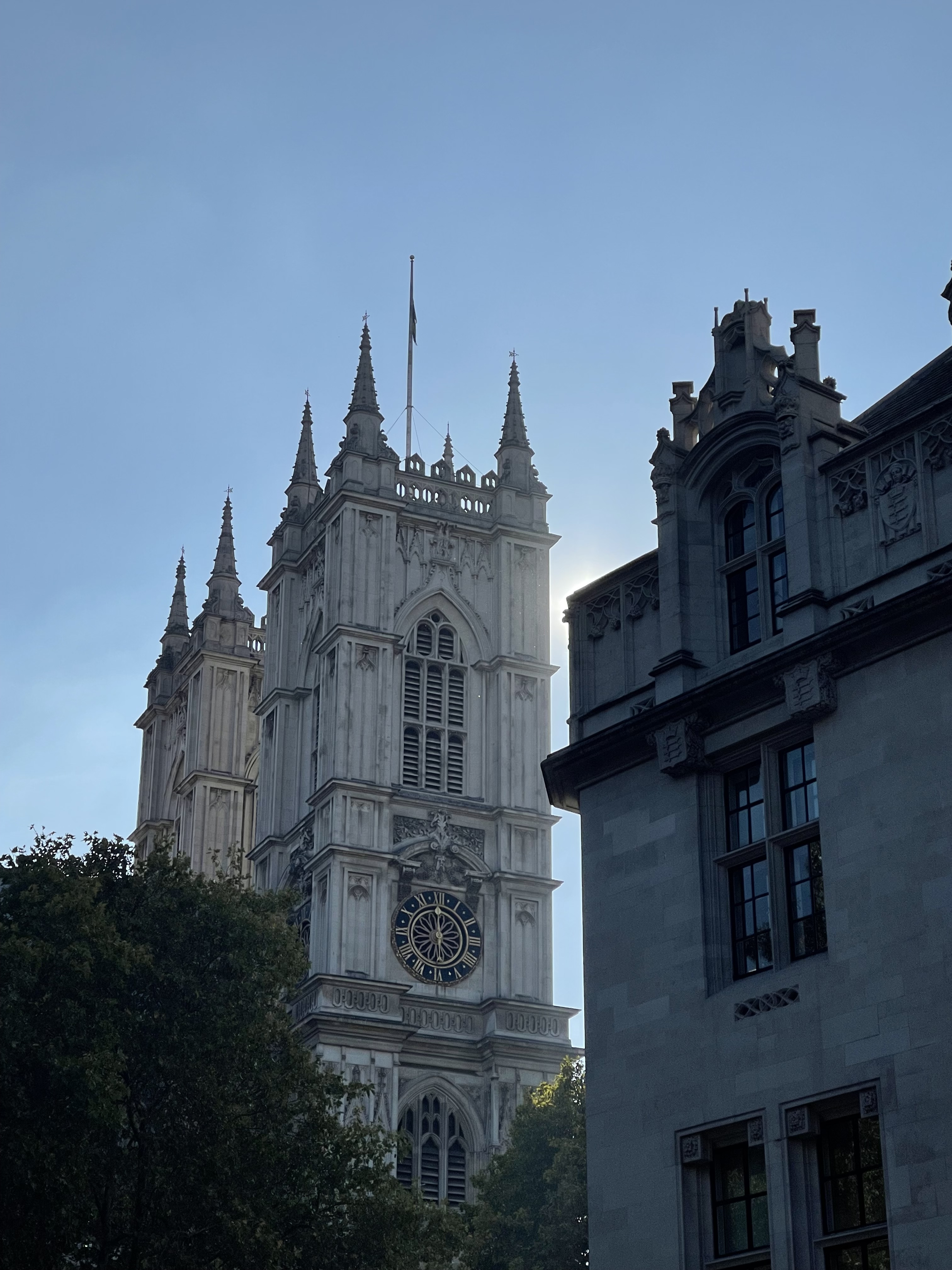
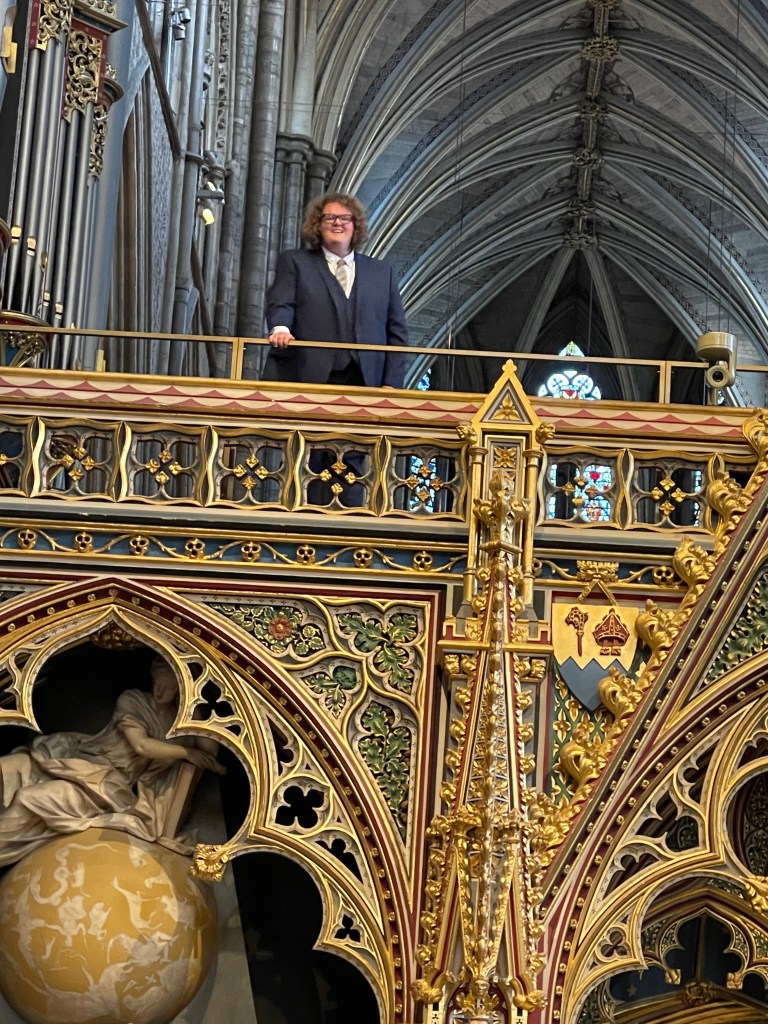
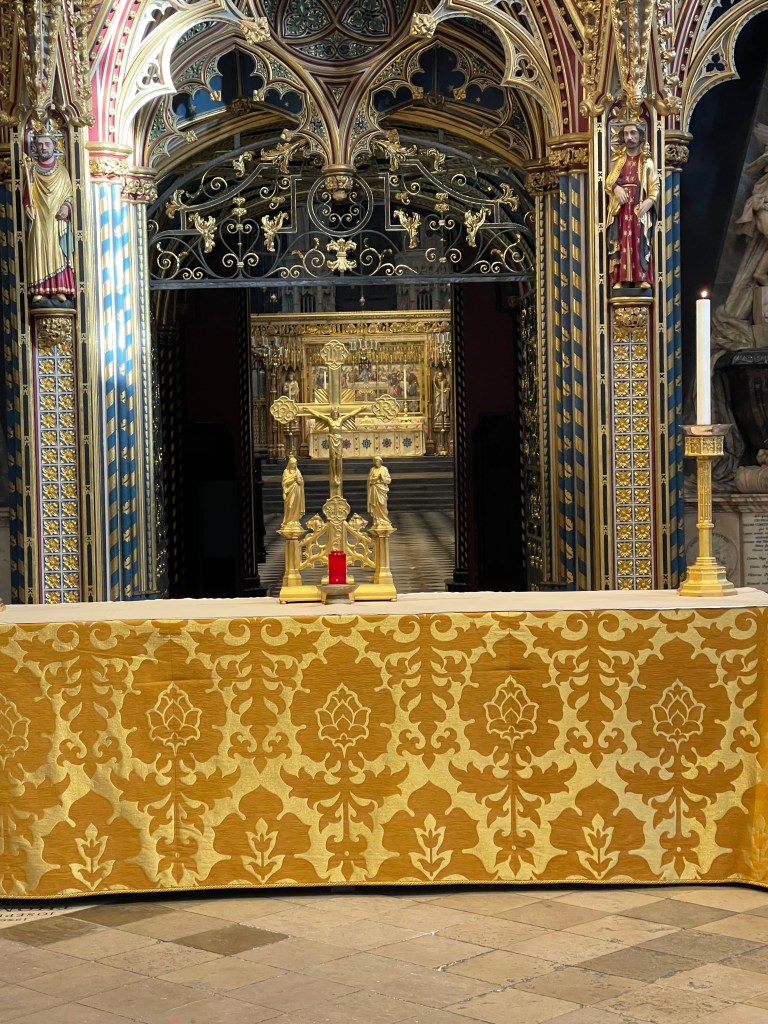
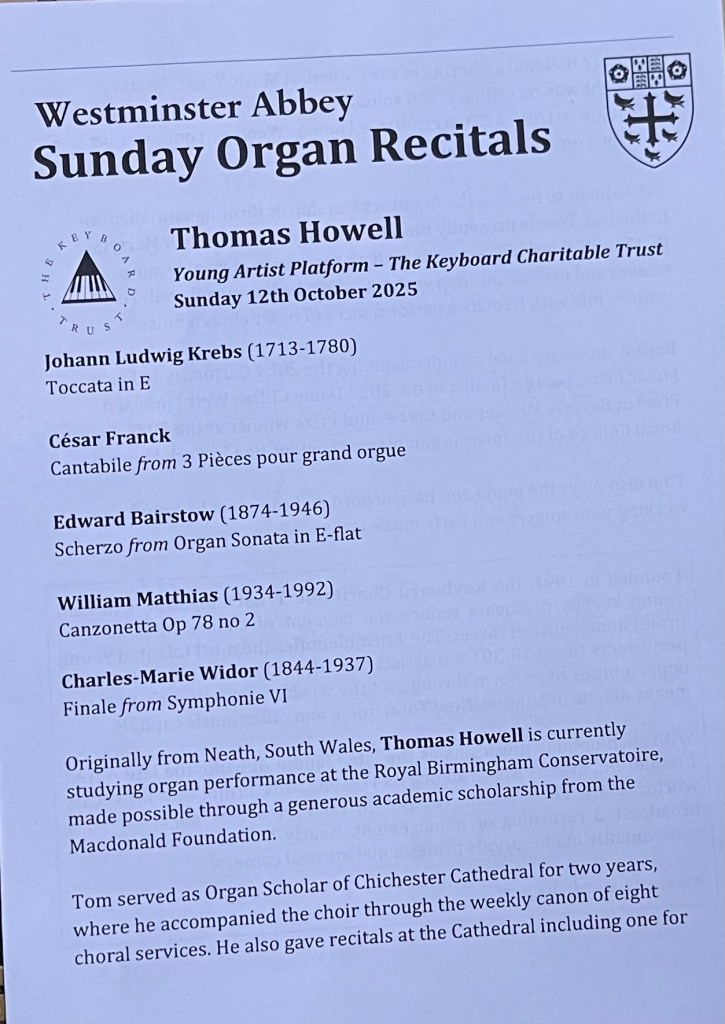
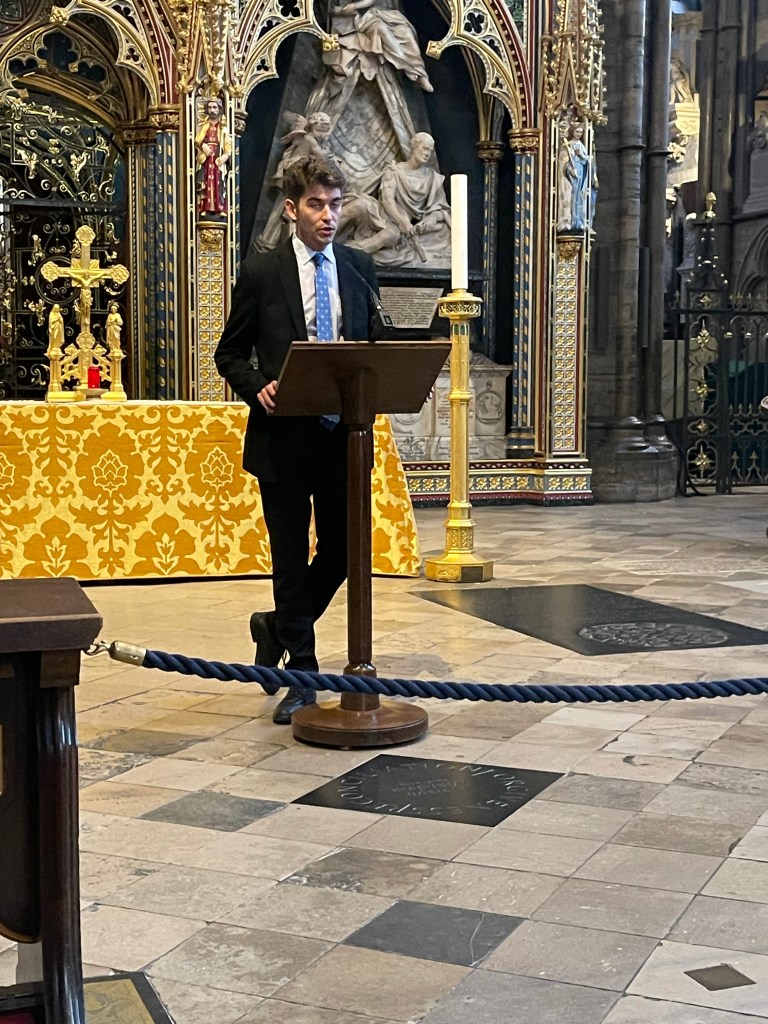
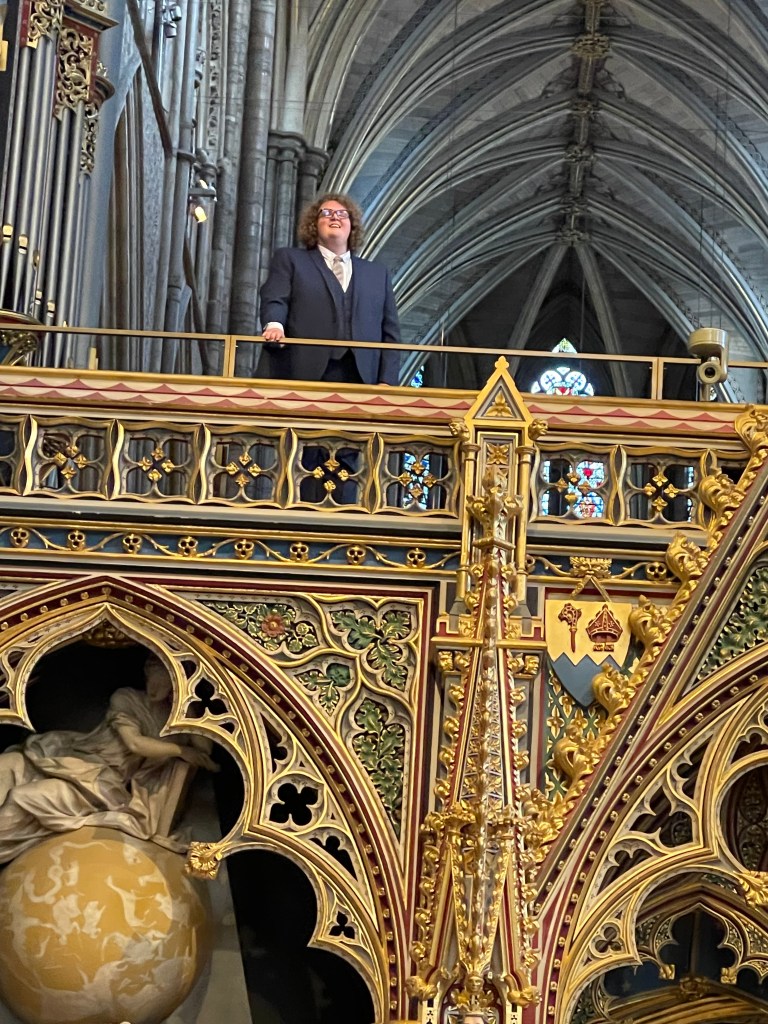
Thomas Howell at Westminster Abbey for the Keyboard Trust Annual Organ Concert

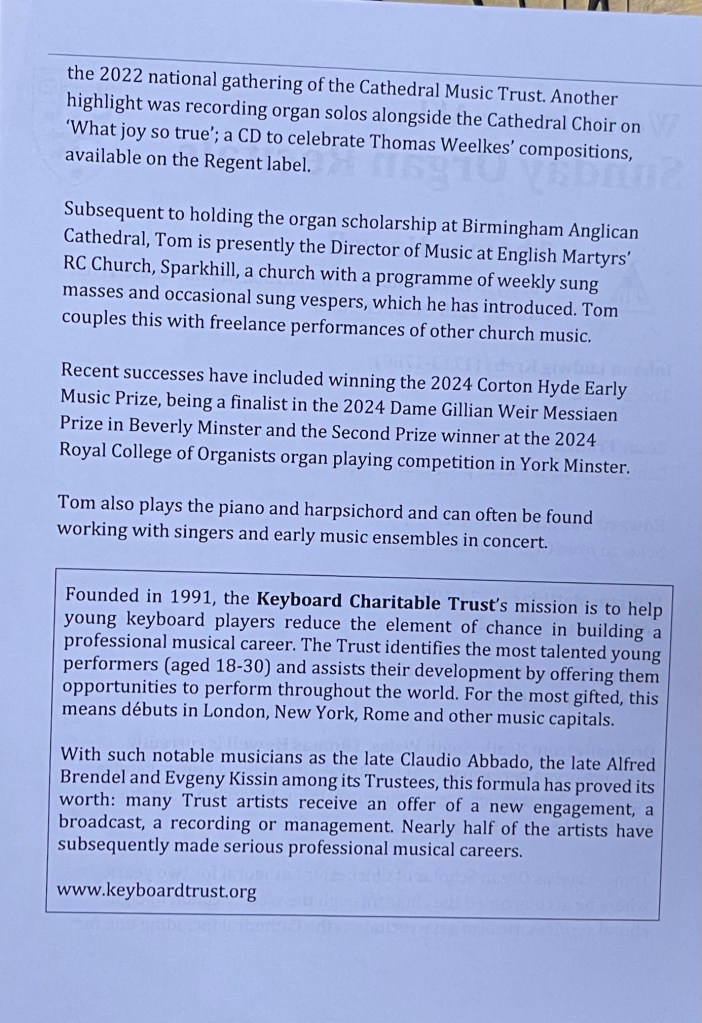
Thomas Howell is currently studying the organ at the Royal Birmingham Conservatoire, under the tutelage of Daniel Moult and Nicholas Wearne, through a generous academic scholarship from the Macdonald foundation. Alongside building a career as an organist, Tom plays the piano and continuo for soloists and ensembles at the conservatoire. He is also the organist of English Martyrs’ church, Birmingham.
Tom served as Organ Scholar of Chichester Cathedral (2020-2022) and took part in a CD ‘What joy so true’ to celebrate Thomas Weelkes (Regent label).
As a hobby, Tom has played the carillons of York Minster, Bournville and Saltley and has recently published an anthology of bell music (Carillon Society of Britain and Ireland).

Review by Daniel Moult Head of Organ Royal Birmingham Conservatoire

THOMAS HOWELL has already established his reputation on the UK organ scene whilst still an undergraduate at the Royal Birmingham Conservatoire, studying under Daniel Moult and Nicholas Wearne. He has held positions at the cathedrals of Chichester and Birmingham, is
a competition winner (including second prize at the prestigious IAO RCO Competition 2024), and is also active as a piano accompanist and carillonneur (in his spare time). His adoption by the Keyboard Trust will open further opportunities in the UK and beyond, not least
Sunday’s recital in the Summer Organ Festival Young Artist Platform at Westminster Abbey.


The Abbey organ has power and authority, but is not without its traps for the unwary. Its position on the screen at the head of the Nave means that the sound can be rather diffuse, a situation not helped by the substantial acoustic in the main body of the building.

Thomas was able to overcome these issues with commendable success, in playing that was invariably clear, well-paced, and in sympathy with the size of the room. Whilst this is a challenge facing all organists performing in many a cavernous space, it is a skill which can elude even the experienced concert player.

But from the outset, in his charming rendition of Johann
Ludwig Kreb’s Toccata in E, Thomas was able to project the material with unstinting clarity and rhetorical poise. Many organ concerts now include a large tv screen, so that the audience can engage visually with the performer (as with a piano or other instrumental
recital). This is not the case at the Abbey, although the stunning architecture is perhaps a differently inspiring and engaging stimulus. So the non-organists might not have appreciated the deft footwork involved in the opening pedal solo of this galant work by one of Bach’s
favourite students.
In the best tradition of English town hall organ concerts, Thomas’ programme presented an eclectic stylistic mix with nothing beyond seven minutes’ or so duration. This was the perfect
solution to the festival, which attracts both a large tourist audience and more familiar concert goers.

The Cantabile by César Franck took us to a very different sound world and emotional space, showing a beautiful sense of line and a confident control of bigger architecture, as well as a fine control of legato. This is a small masterpiece, with its modest size belying the intensity of the material and the superb compositional craft. Thomas
summoned up the colours specifically demanded by Franck, with apt and well-balanced registrations.

But it was the subsequent Scherzo from the Organ Sonata of Sir Edward Bairstow which fitted the Abbey organ’s Edwardian pedigree like a glove. Suitably refined and plummy tones graced this curious music, at times rumbustious and fun, but elsewhere darker and even menacing. If the series allowed for spoken introductions or brief programme notes (a mixed blessing, of course), it might have been appropriate to mention the background of the Sonata. Bairstow composed this whilst on holiday on the Isle of Arran in
1937, with Europe in an already precarious political state.


Proud of his Welsh heritage, Thomas included as his penultimate piece the elusive Canzonetta by fellow Welshman, William Matthias. Alternating between folk-like simple melody and more extended harmonies (sometimes reminiscent of Olivier Messsiaen), the
short work was perhaps a little more of a challenge for the largely non-musician audience.
But is sometimes good to take our audiences beyond their comfort zones, and I sensed that this curious and effective piece held their attention.

Whatever the case, the Final from Charles-Marie Widor’s Symphonie VI blew away any lingering mystery or uncertainty, with
its unabashed opening swagger. Here, the true ‘ff’ of the instrument was revealed (the louder sections of the Bairstow having been deliberately held in check) to powerful effect. As is sometimes the case with Widor’s finales, the middle section is less direct in expression, although this made for a yet more arresting return to the main material. And the ending was suitably cataclysmic, with a massive G major final cadence filling the space with optimism and joy.


Young organ performers today face a dilemma, as they must find their own musical way in the midst of social media populism and the cult of the personality.

In the case of Thomas, he exhibited a strong and mature musical character of his own, and gave us an accessible
programme of integrity and substance. His future is surely bright, and he and others will be the ambassadors of the organ that showcase the organ art and its rich heritage.

https://christopheraxworthymusiccommentary.com/2023/06/02/the-gift-of-music-the-keyboard-trust-at-30/
photo credit Dinara Klinton https://christopheraxworthymusiccommentary.com/2024/03/20/christopher-axworthy-dip-ram-aram/

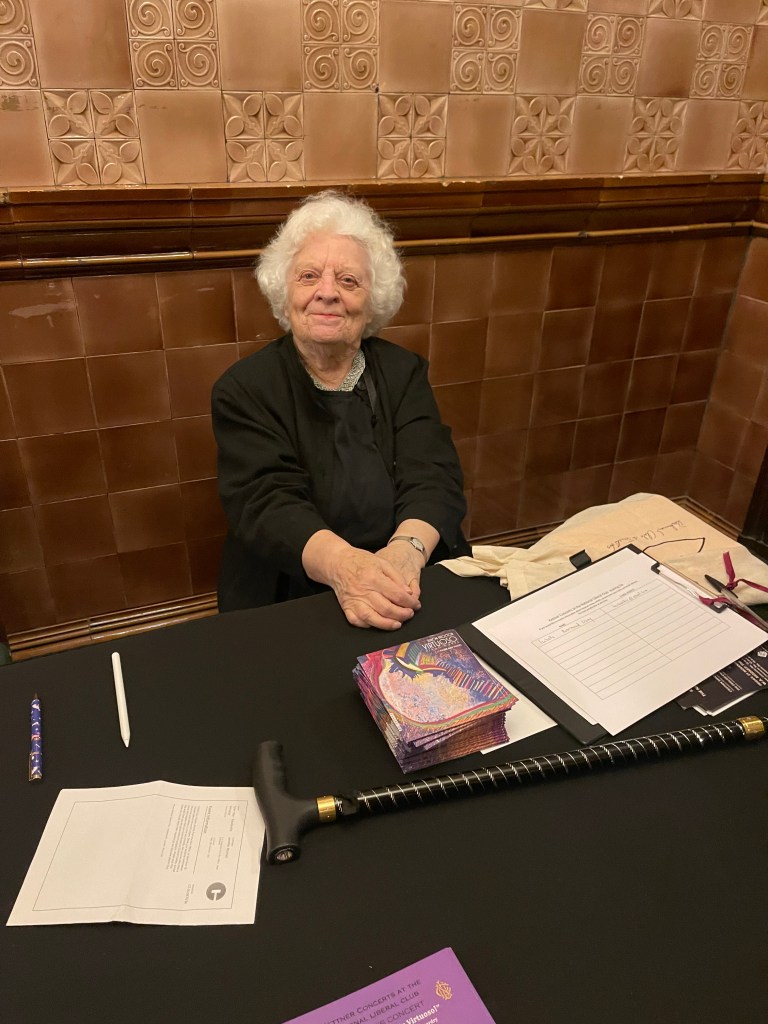
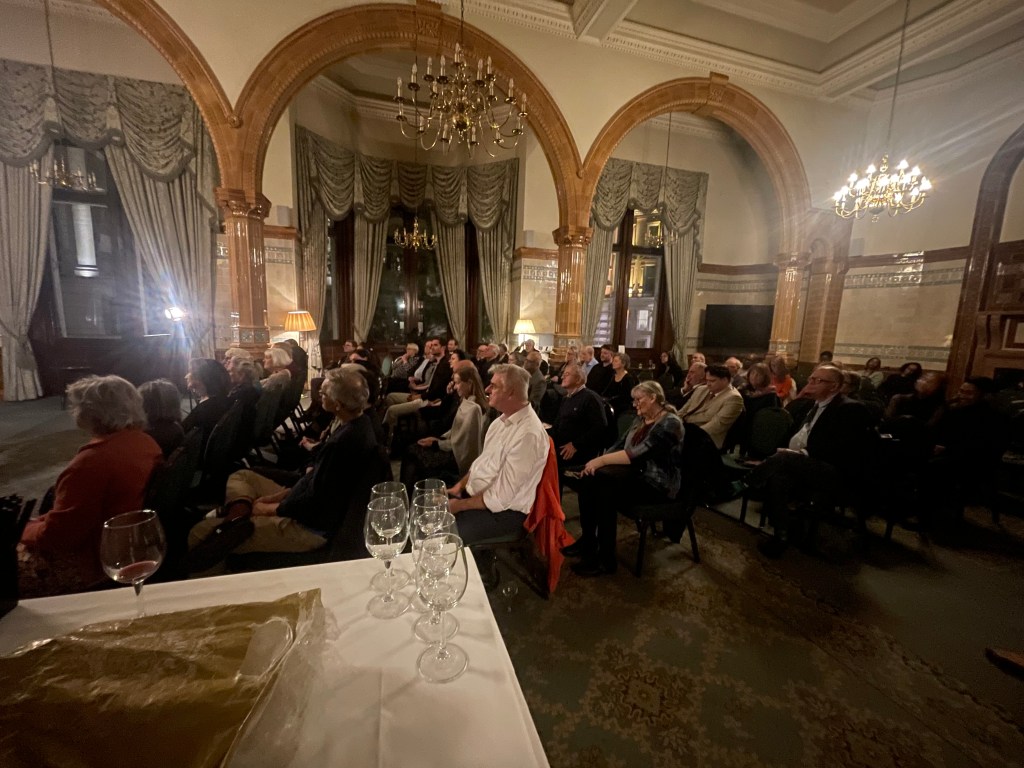
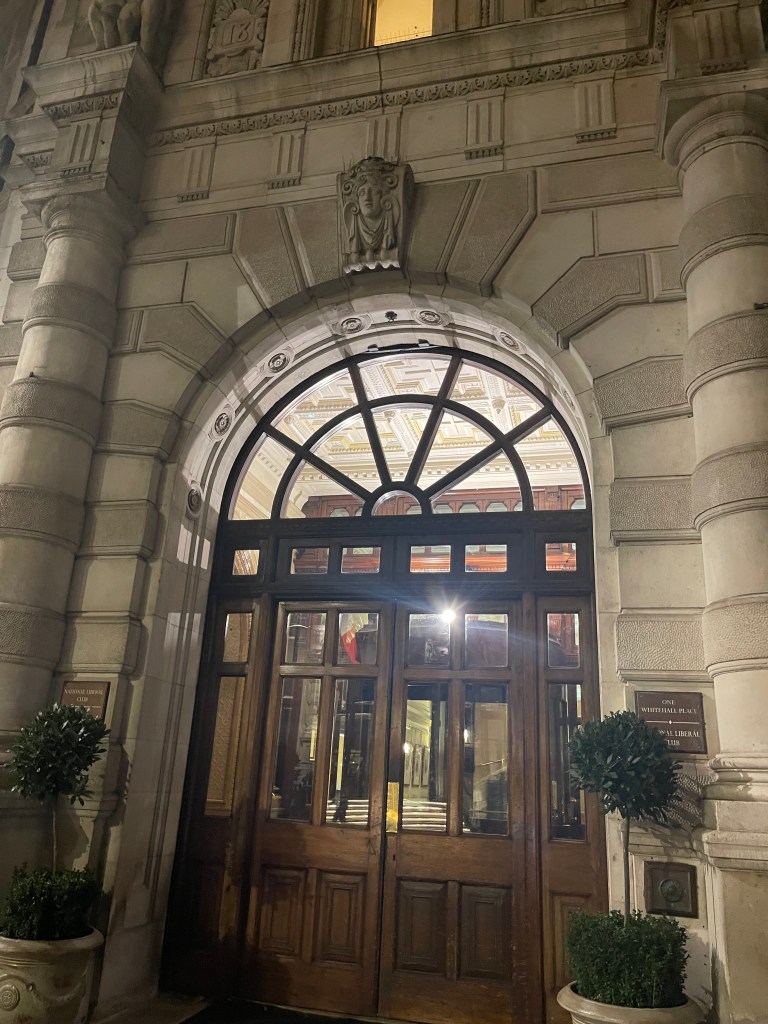
Tyler Hay ‘Vaudeville Virtuoso’ Wit,Wonder and Wizardry at the National Liberal Club

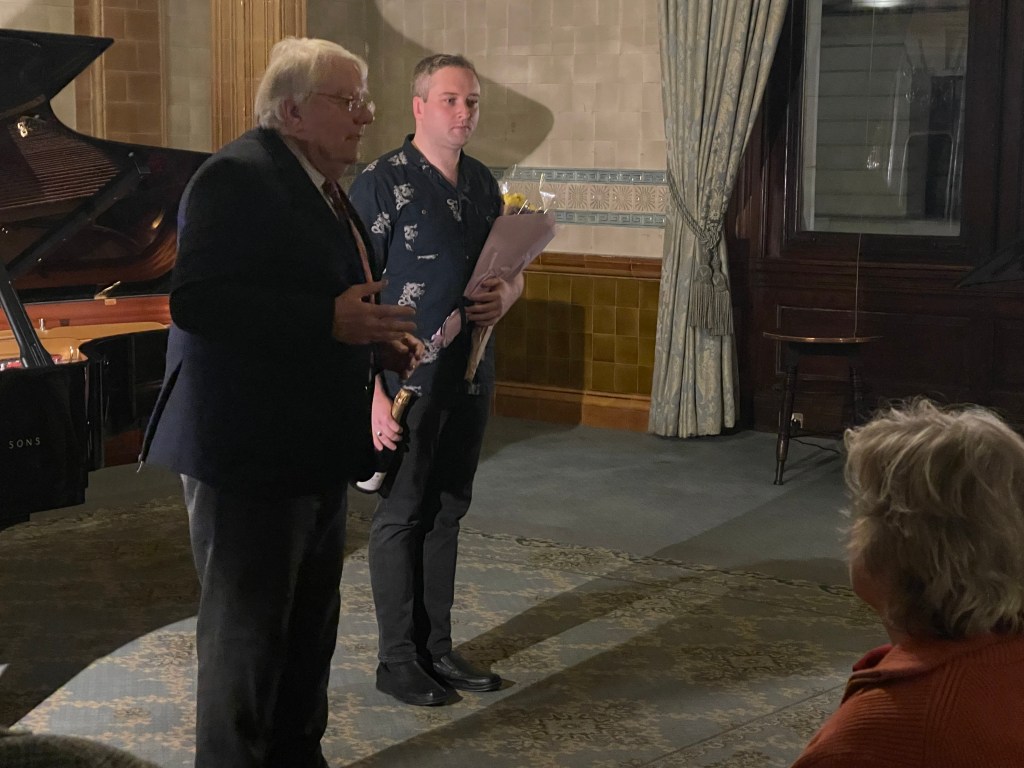
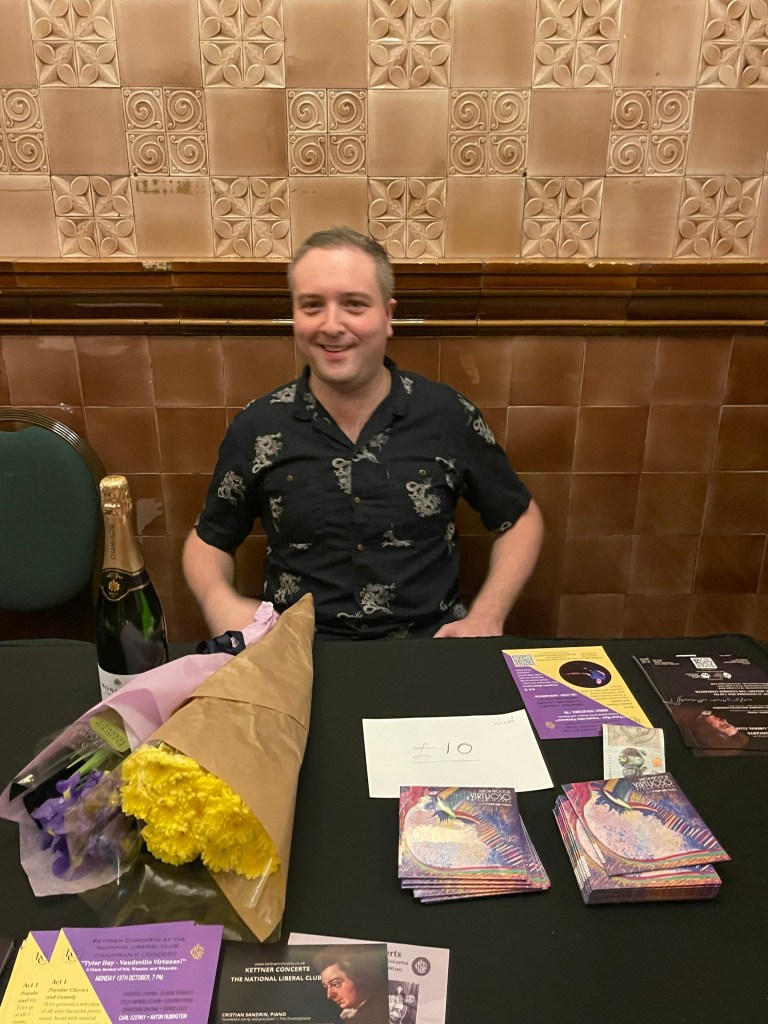
The extraordinary Tyler Hay excites and stimulates the senses at the National Liberal Club with a recital of ‘petit rien’, full of ebullient fun and outrageous virtuosity. Thwarted by Ben Westlake in a comic partnership that goes back after many years of cruising together over many seas. It took Chairman Peter Whyte to restore order with a bottle of vintage champagne and a bunch of flowers!

‘Tyler Hay Vaudeville Virtuoso! ‘ A piano Recital of Wit,Wonder,and Wizardry shouts the poster.

We will not be asking for our money back but demanding a return fight!

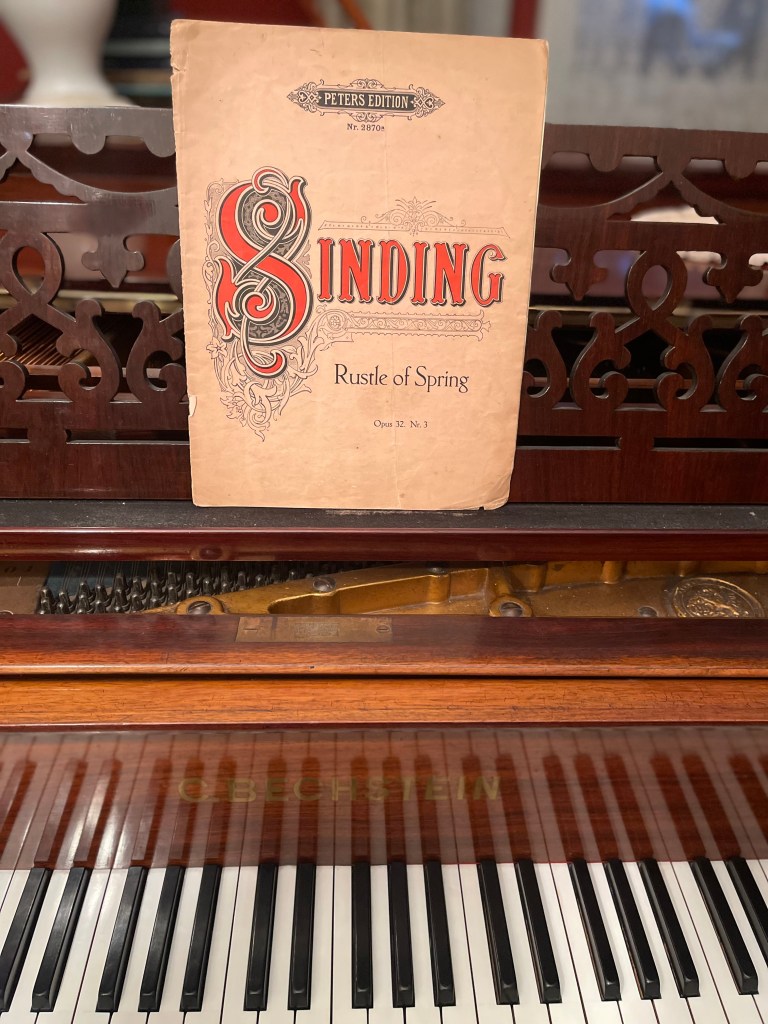
A programme that had begun with the Polonaise Héroique. Frederick Lamond declared it to be more often a Bolognaise than a Polonaise! Heroically played by the new born Victor Borge where their wit belies the artistry and mastery involved. Debussy’s ‘Girl with the flaxen Hair’ followed and was played with a tenderness and beauty that showed what a sensitive heart this young man possesses too. Spring was in the air with Mendelssohn and Sinding .

A ‘song’ and a ‘rustle’ that used to be on the music stand next to the aspidistra in every respectable household until ousted by the TV.

And a virtuoso piece by Liszt before we adjourned to the bar with bells jingling in our heads from a dizzying display of refined virtuosity with Liszt’s helpful additions to the extraordinary goings on of Paganini ! Yes,’La Campanella!’

After the interval two rarely heard masterworks discovered by Tyler on his journey into the archives to find neglected masterpieces that for some reason have been overlooked and even overshadowed by the works that our concert programmes are all too often besieged with ! As Tyler said so many childhoods have been spoilt by the name of Czerny with he and Clementi being responsible for so much youthful anguish Gradus ad Parnassum – the later being very rarely reached ! But within the 861 works of this pupil of Beethoven and teacher of Liszt there are some gems for those that have the ears and above all the fingers to bring them back to life . One such piece was played tonight : ’34 variations and fugato on an original theme by Carl Czerny.’ . An amazing display not only of ‘fingerfertigkeit’ but a finesse and refined palette of sounds that only Horowitz was able to show us in the better known ‘Ricordanza’ Variations. Played with passion and fury but also with delicacy and a kaleidoscope of colour .This was indeed a discovery and the only recording that exists is of Tyler Hay pilfered from a live performance and ready to be consumed by thousands on you tube!

The main work in the programme showed Tyler Hay, the serious thinking musician, who could bring Anton Rubinstein’s First (of four) Sonata brilliantly to life, giving it an architectural shape and narrative that indeed makes one wonder why it is not heard more often in the concert hall. This was certainly no vaudeville but a brilliant searching musician with a virtuoso technique and a heart of gold.

Awarded the Kettner equivalent of the nobel by the Chairman Peter Whyte – a bottle of vintage Champagne and a bunch of daisies!

The next concert in the Kettner series is a celebration for Halloween and will be given by Shunta Morimoto ,the twenty year old winner of the Hastings International Piano Competition (at 17!). The concerts take place in the historic Hall where Rachmaninov gave his last European performance in 1939 before fleeing to a New World where he died in 1943.

https://christopheraxworthymusiccommentary.com/2024/05/22/shunta-morimoto-at-brighton-festival-the-sublime-inspiration-of-a-poet-of-the-piano/ https://christopheraxworthymusiccommentary.com/2023/03/23/shunta-morimoto-takes-london-by-storm-i-have-a-dream-a-poet-speaks-through-music/ https://christopheraxworthymusiccommentary.com/2022/05/23/shunta-morimoto-a-colossus-bestrides-villa-aldobrandini-as-it-had-when-liszt-was-in-residence/
photo credit Dinara Klinton https://christopheraxworthymusiccommentary.com/2024/03/20/christopher-axworthy-dip-ram-aram/

Mark Viner at St Mary’s ‘Mastery and Mystery on an extraordinary voyage of discovery’

with Dr Hugh Mather welcoming Mark
https://www.youtube.com/live/Dan74Oe3C8Y?si=3KBZZKmSQ6tKhf9s
A quite extraordinary artist who I often hear in the beautiful church in Bedford Park of St Michael’s and All Angels

He lives opposite and like Liszt frequents the church ( and the Tabard opposite !) as a fervent believer and quite regularly is seen serving at Mass. Not only serving but also adding a musical offering of his quite unique scholarship and pianistic mastery . Two or three times a year he can be heard in repertoire that one will probably have never heard in concert before!

His next concert will be on the 19 December as his Christmas offering – a feast fit for celebration indeed .

I heard this concert just a month ago and I am glad to include my thoughts here. I am even more grateful to Dr Mather and his team for allowing Mark to play the same programme in their beautiful church on Ealing Golf Course , St Mary’s Perivale .Their superb recording facilities allow this recital to be recorded and heard world wide .It is an important document that should be shared more widely and not only a humble offering to our Lord.


Described by International Piano Magazine as “one of the most gifted pianists of his generation”, Mark Viner is steadily gaining a reputation as one of Britain’s leading concert pianists; his unique blend of individual artistry combined with his bold exploration of the byways of the piano literature garnering international renown. He began playing at the age of 11 before being awarded a scholarship two years later to enter the Purcell School of Music where he studied with Tessa Nicholson for the next five years. Another scholarship took him to the Royal College of Music where he studied with the late Niel Immelman for the next six years, graduating with first class honours in a Bachelor of Music degree in 2011 and a distinction in Master of Performance 2013; the same year which afforded him the honour to perform before HM the King. 

After winning 1st prize at the Alkan-Zimmerman International Piano Competition in Athens, Greece in 2012, his career has brought him across much of Europe as well as North and South America. While festival invitations include appearances the Raritäten der Klaviermusik, Husum in Germany, the Cheltenham Music Festival and Harrogate Music Festival in the United Kingdom and the Festival Chopiniana in Argentina, radio broadcasts include recitals and interviews aired on Deutschlandfunk together with frequent appearances on BBC Radio 3. His acclaimed Wigmore Hall début recital in 2018 confirmed his reputation as one of today’s indisputable torchbearers of the Romantic Revival. 

He is particularly renowned for his CD recordings on the Piano Classics label which include music by Alkan, Blumenfeld, Chaminade, Liszt and Thalberg, all of which have garnered exceptional international critical acclaim. His most important project to date is a survey of the complete piano music of Alkan: the first of its kind and which is expected to run to some 18 CDs in length. Aside from a busy schedule of concerts and teaching, he is also a published composer and writer and his advocacy for the music of Alkan led to his election as Chairman the Alkan Society 2014. 

Volume 8 !!!! Available shortly hopefully for Christmas

Dominika Mak plays Schumann with the Kensington Chamber Orchestra

The Schumann Piano Concerto, one of the most beautiful of all Romantic concerti for its chamber music quality where the piano is part of a whole and not just the virtuoso pianist battling with the orchestra. A concerto that requires more musicianship than muscle, as the pianist must dialogue with the orchestra with a question and answer and give and take that requires the orchestra to listen as attentively as the pianist. It was just this dialogue that immediately captured the attention with the poetic almost improvised freedom of the central rhapsodic episode of the first movement.

Dominika’s refined arpeggios like an Aeolian harp on which she floated one of Schumann’s most poetic of melodies that was answered by the beauty of Massimo Roman’s clarinet . A duet where each player was listening to the other whilst the excellent Michal Oren was ever vigilant to keep the orchestra on their toes also listening and ready to follow with unusual flexibility this poetic outpouring between two voices.

It was the same chamber music quality in the ‘Andantino grazioso’ where Dominika’s refined playing was answered by the orchestra in a dialogue of poetic poignancy. The perfect tempo, set by Dominika, allowed this movement to flow with natural freedom where the ‘cello’s too could have an important voice in this continual dialogue between the piano and orchestra. Some whispered playing of glowing beauty at the end of this second movement when Schumann allows the melodic line to disintegrate before linking it to the dynamic drive of the ‘Allegro vivace’ last movement. Dominika here as in the first movement playing with masterly control but always where the architectural shape was formost in her mind. Her heart, of course, was always ready to shape Schumann’s ebb and flow of jeux perlé in the last movement with beguiling charm and poetic rhythmic drive.

The cadenza in the first movement showed even more Dominika’s refined musicianship. Shaping the phrases with beauty and elegance where even the tempestuous chordal climax was merely a series of moving harmonies reaching out to the long trills that would take her back to continue the poetic dialogue with her colleagues.

An unexpectedly refined performance with a non professional group of players was greeted by an ovation and Dominika, the guest soloist, was invited to play some more.

Chopin’s Berceuse was the ideal choice as Dominika’s glowing sounds wafted around this beautiful church with radiance and refined beauty as her aristocratic music making held the audience ,which included the orchestra at this point , spellbound.

An orchestra that Michal Oren enticed to listen to themselves as she at the helm directed them with musicianship and style,as we were immediately aware of from the very opening Overture in Italian Style.

photo credit Dinara Klinton https://christopheraxworthymusiccommentary.com/2024/03/20/christopher-axworthy-dip-ram-aram/

Dominika Mak plays Schumann with the Kensington Chamber Orchestra

The Schumann Piano Concerto, one of the most beautiful of all Romantic concerti for its chamber music quality where the piano is part of a whole and not just the virtuoso pianist battling with the orchestra. A concerto that requires more musicianship than muscle, as the pianist must dialogue with the orchestra with a question and answer and give and take that requires the orchestra to listen as attentively as the pianist. It was just this dialogue that immediately captured the attention with the poetic almost improvised freedom of the central rhapsodic episode of the first movement.

Dominika’s refined arpeggios like an Aeolian harp on which she floated one of Schumann’s most poetic of melodies that was answered by the beauty of Massimo Roman’s clarinet . A duet where each player was listening to the other whilst the excellent Michal Oren was ever vigilant to keep the orchestra on their toes also listening and ready to follow with unusual flexibility this poetic outpouring between two voices.

It was the same chamber music quality in the ‘Andantino grazioso’ where Dominika’s refined playing was answered by the orchestra in a dialogue of poetic poignancy. The perfect tempo, set by Dominika, allowed this movement to flow with natural freedom where the ‘cello’s too could have an important voice in this continual dialogue between the piano and orchestra. Some whispered playing of glowing beauty at the end of this second movement when Schumann allows the melodic line to disintegrate before linking it to the dynamic drive of the ‘Allegro vivace’ last movement. Dominika here as in the first movement playing with masterly control but always where the architectural shape was formost in her mind. Her heart, of course, was always ready to shape Schumann’s ebb and flow of jeux perlé in the last movement with beguiling charm and poetic rhythmic drive.

The cadenza in the first movement showed even more Dominika’s refined musicianship. Shaping the phrases with beauty and elegance where even the tempestuous chordal climax was merely a series of moving harmonies reaching out to the long trills that would take her back to continue the poetic dialogue with her colleagues.

An unexpectedly refined performance with a non professional group of players was greeted by an ovation and Dominika, the guest soloist, was invited to play some more.

Chopin’s Berceuse was the ideal choice as Dominika’s glowing sounds wafted around this beautiful church with radiance and refined beauty as her aristocratic music making held the audience ,which included the orchestra at this point , spellbound.

An orchestra that Michal Oren enticed to listen to themselves as she at the helm directed them with musicianship and style,as we were immediately aware of from the very opening Overture in Italian Style.

photo credit Dinara Klinton https://christopheraxworthymusiccommentary.com/2024/03/20/christopher-axworthy-dip-ram-aram/

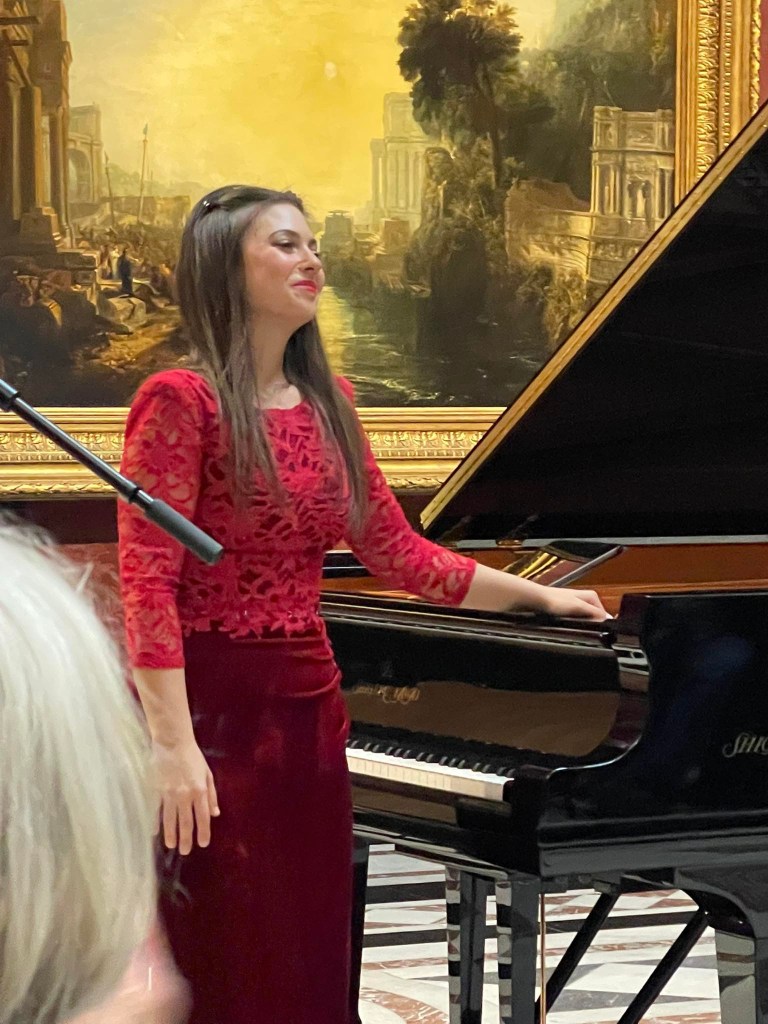
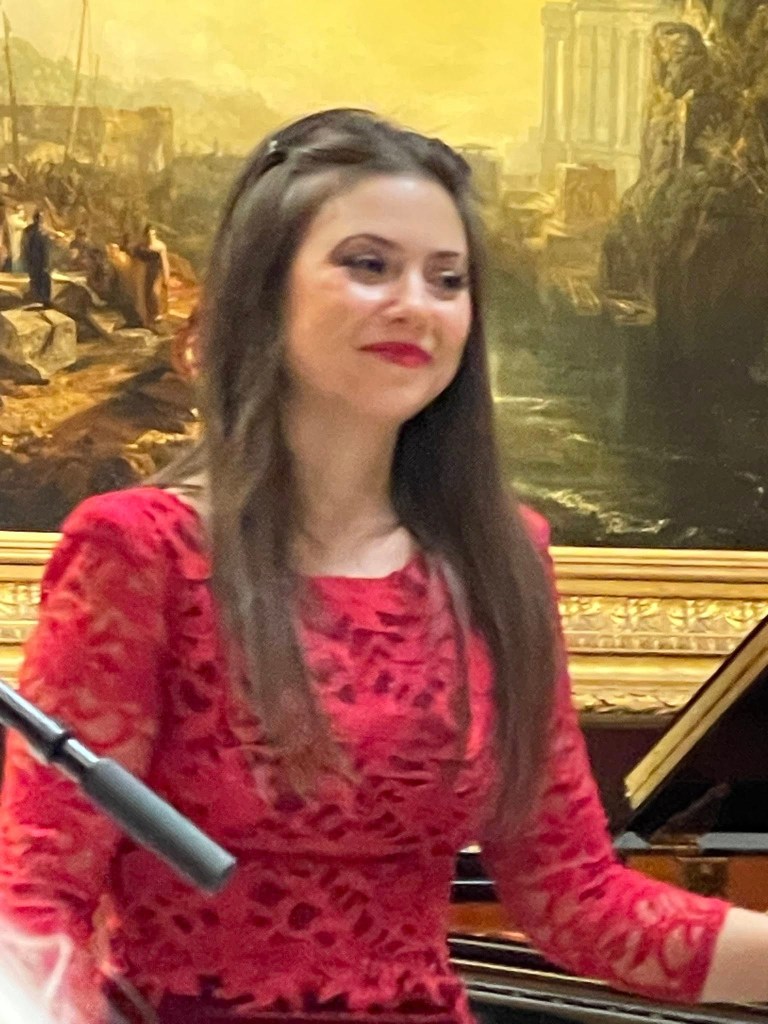
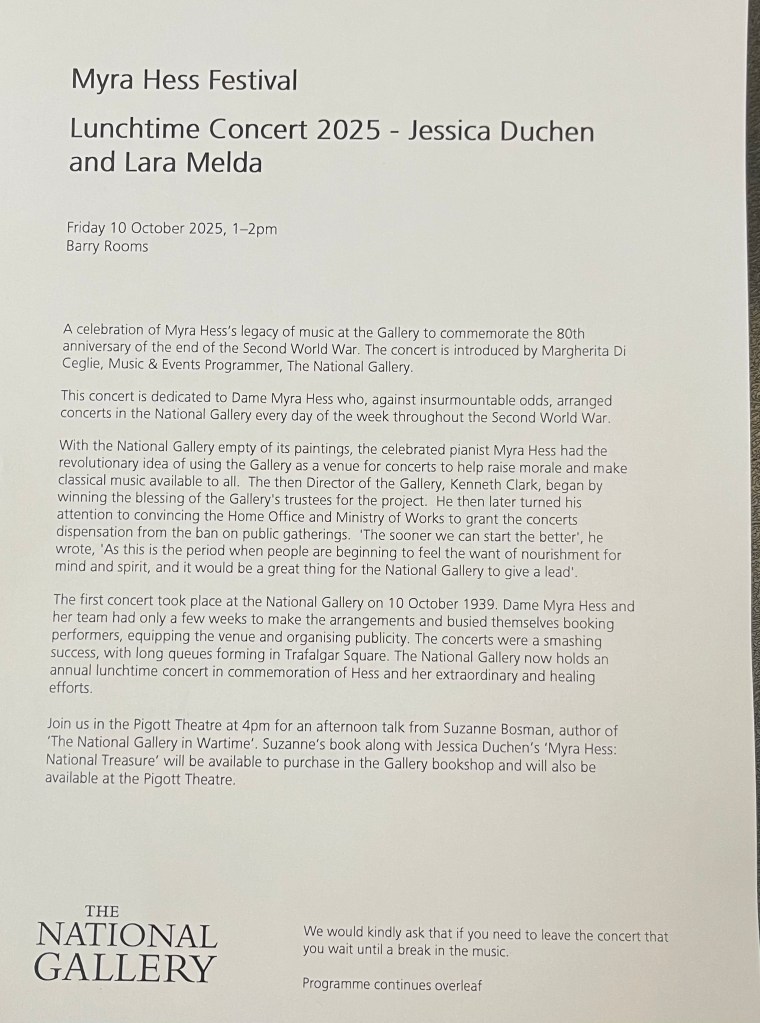
Myra Hess ‘ Jessica Duchen and Lara Melda pay tribute to our National Treasure’

Magic in the air at the National Gallery as Jessica Duchen and Lara Melda told the moving story of resilience and courage as Myra Hess became a National Treasure with the concerts that helped save people’s soul during the Second World War.

10th October 1939 was celebrated today in 2025 with the piano in the same spot and in the same gallery.

A story told in words and music. The words spoken with remarkable intensity and the presence of an actress who has lived with and digested these words.

She knows the poignant significance of what made Dame Myra every bit a hero as Churchill when our country was under siege. The people needed Hope,Courage and Solace and Myra showed them that music could be a soothing balm for such terrifying experiences.

Lara playing with the same authority and superb musicianship that Uncle Tobbs had bequeathed to his star student. A sense of colour and beauty where every note spoke so eloquently. Nowhere more was this evident than in the fleeting beauty of Schumann’s ‘Prophet Bird’. The sublime understatement of the chorale interruption was played with ravishing whispered beauty .The Prophet Bird was obviously enchanted because she took wing again with a nostalgic smile on her face, disappearing into the far distance. Lara could make the music come vividly to life, just as Myra Hess could do. Myra took America by storm filling the major halls to capacity wherever she went. In fact she could have stayed in America during the war, as many of her colleagues did ,but she like the Queen Mother wanted to be with her people in their hour of need. Myra was not a Chopin player in the traditional sense but would bring a classical understanding and beauty to a composer that had been distorted beyond belief in the name of tradition. Lara too brought an aristocratic beauty and architectural understanding to the first Ballade where even the jeux perlé cascades of notes were given a shape and meaning and not used as an egoistic showpiece of note spinning self gratification. Lara gave back to Chopin what his genius rightly deserves and she received an ovation from a distinguished audience, one or two even remember hearing Dame Myra too. The seriousness and musicianship she brought to Beethoven was indeed worthy of Dame Myra. A’Tempest’ Sonata we have heard many times but rarely as today. A sense of line and forward drive like riding on a great wave of hidden energy. A beautifully controlled ‘Adagio’ was followed by an ‘Allegretto’ that just took wing with a continual lift and rhythmic energy that was remarkable. Even the final note was placed with perfection instead of the more usual nonchalant indifference of lesser musicians.

Last but not least were Jessica’s poignant words describing Dame Myra’s wish to make music in the National Gallery just one last time, after the end of the war time concerts. A wish which was fulfilled only today with the piece that became synonymous with Dame Myra for a nation that she had given such comfort to in their hour of need . Lara visibly moved played ‘Jesu Joy of Man’s Desiring’ with a whispered simplicity of ravishing playing of searing beauty.

What a tribute to our National Treasure and we could enjoy such mastery without even paying a shilling !

Jessica with an extraordinary presence after years of researching her National Treasure and Lara with music making of the same aristocratic beauty as Myra Hess .

The only way to end such a story of selfless humility and courage was as Myra herself would have done with ‘Jesu joy of man’s desiring ‘ …………Lara playing a Shegeru Kwai and filling Room 36 with the same magnificence as Dame Myra Hess all those years ago

photo credit Dinara Klinton https://christopheraxworthymusiccommentary.com/2024/03/20/christopher-axworthy-dip-ram-aram/

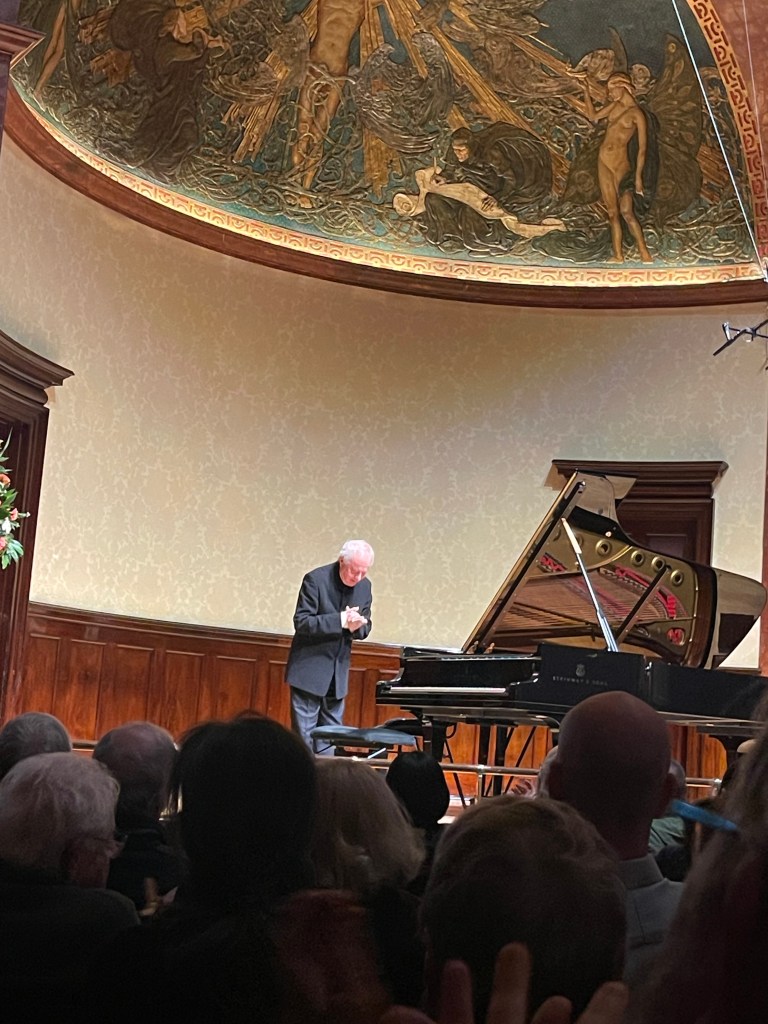
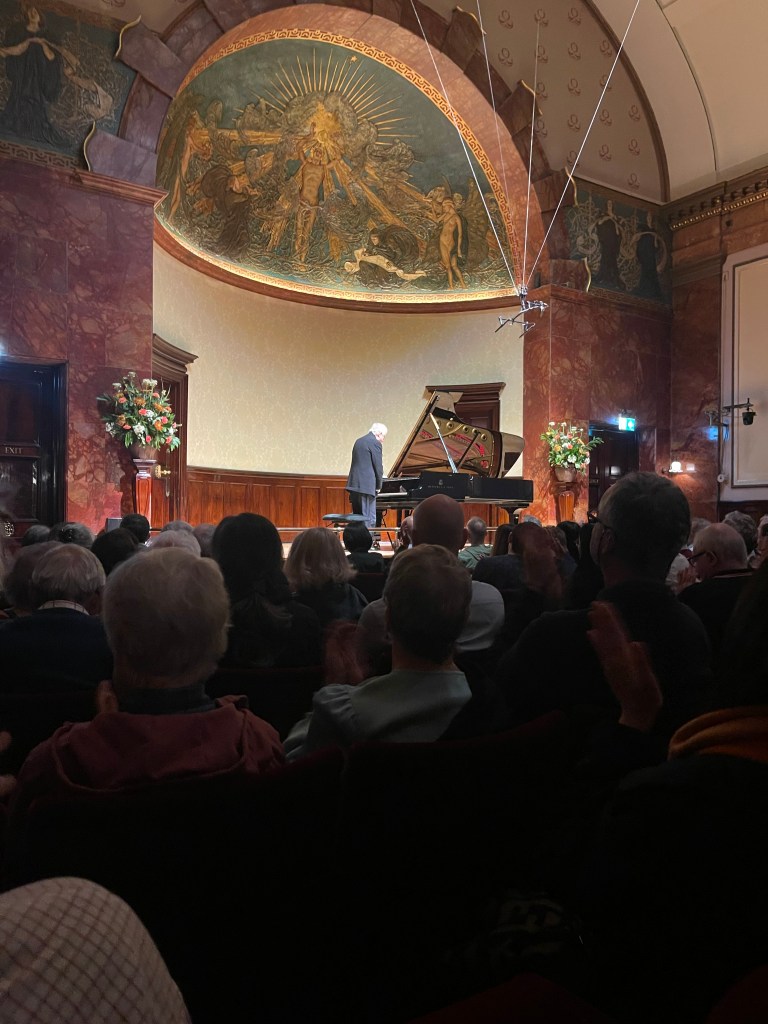
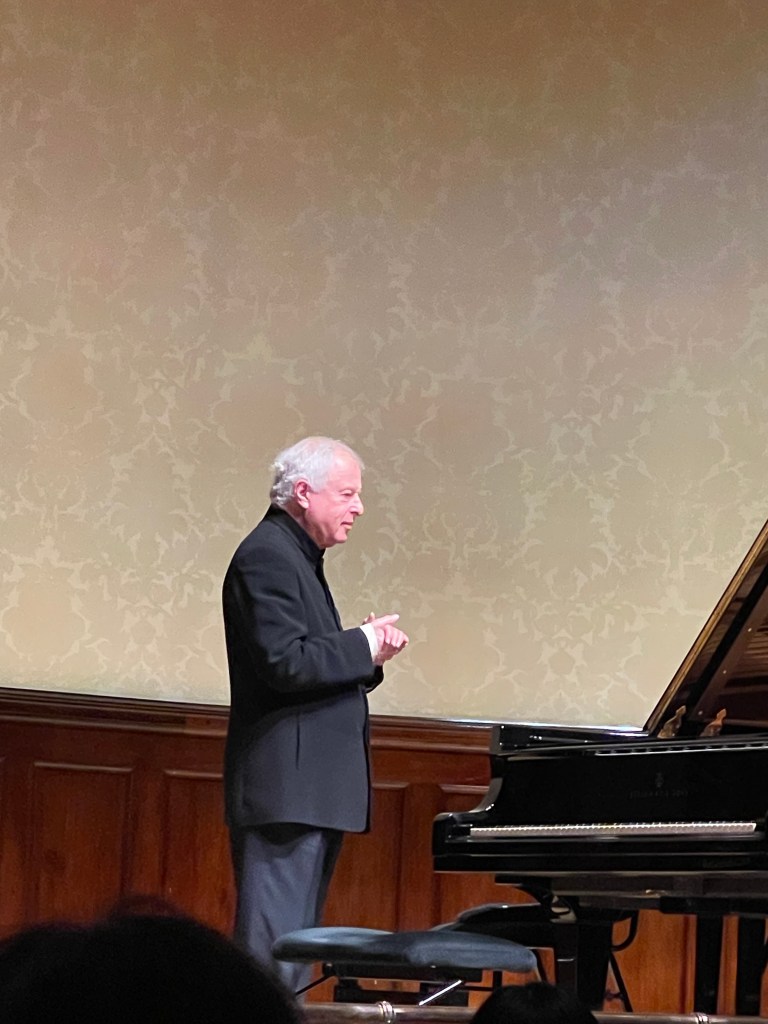
Kapellmeister Schiff points the way

Fantasy on the menu tonight for Andras Schiff in a unique musical ritual, worshipping together the genius of Bach Haydn Mozart Beethoven Mendelssohn and Schumann.Chopin was never far away either!

Reminding me ever more of Kempff where music just poured from his hands that were forever searching for the perfect legato and orchestral sounds.

A world in which a musical language speaks louder than words as they delve into the very core of creation searching ever more for the life blood contained within.

Technical and pianistic problems are not even contemplated as such, but are the means to communicate the real message that is there to those who dedicate their life to a never ending journey of discovery.

It was fascinating to see his use of the pedals both romantic and baroque that gave an enormous sense of freedom to all that was floated above it . Anton Rubinstein called the pedal the soul of the piano’ and was obviously referring to the gradual addition of the sustaining pedal to the keyboard instruments of the day. It was noticeable that Andras held with his hand the bass notes at the opening of the chromatic fantasy creating a pedal note for the improvised freedom that Bach allows. As quoting Casals ‘ there is no freedom without order.’ Chopin of course described to his students that music should be like a tree with the roots firmly planted in the ground that allowed the branches to flow feely above. It was this sense of ordered freedom that pervaded his Bach and meant that nothing was hurried of exaggerated but the music was allowed to unfold with a natural simplicity and logic. The opening of the Mozart fantasy too was played with very strident opening chords that were gently and silently echoed by putting his hand down silently on the note again . It reminded me of Arrau and Perlemuter playing loudly with the soft pedal down in order to get that very French sounding nasal effect. The search for sound is so rare these days in the quest for volume and speed!

Mendelssohn actually writes in the score in the first movement very long pedals that give you an idea of how the notes above are just wafts of changing harmony. The ending in particular ( like in Beethoven’s op 126 that Andras played on Tuesday here, together with Schubert Drei Klavierstücke and the Fantasy Sonata ) a very long pedal created a very etherial ghostly effect of unearthly sounds that we rarely hear in the concert hall where clarity and precision is usually the norm!. Andras took it to the limit with a last movement that had some wondrous moments, where lightweight chords just seemed to bounce in mid air, but maybe the streams of notes are more brilliant jeux perlé than the actual changing harmonies that Mendelssohn so clearly marked in the first movement.

The Schumann Fantasy was a fascinating voyage of discovery.

Schumann prefaced it with a quote from Friedrich Schlegel :Durch alle Töne tönetIm bunten Erdentraum Ein leiser Ton gezogen Für den, der heimlich lauschet. “Resounding through all the notes in the earth’s colourful dream There sounds a faint long-drawn note For the one who listens in secret.”

And this explains the great pedal note of G that Andras began with his right hand leaning over his left deep into the bass . It was this insistence of G that was to pervade the whole movement with the sometimes over zealous insistence of discovery. It meant that everything else was floated on this sound which gave a strange impression of improvisation and freedom. Maybe exaggerated but stimulating indeed!

Andras had explained though about the musical quotation of a phrase from Beethoven’s song cycle An die ferne Geliebte ( To the distant beloved )  in the coda of the first movement . The text of the passage quoted is: Accept then these songs beloved, which I sang for you alone]. Both the Schlegel lines and the Beethoven described Schumann’s situation of being separated from Clara Wieck by her severe father. Schumann wrote to Clara: The first movement may well be the most passionate I have ever composed – a deep lament for you. They still had many tribulations to suffer before they finally married four years later.

Andras too pointed out that Charles Rosen had found in the original version in the library in Budapest that the ending of the first movement was repeated at the end of the last movement. Schumann later cancelled this idea, and I personally think he did it because to say I love you too many times looses it’s effect. Andras ,though, decided to play it giving a certain unity to this great love poem. He asked our forgiveness and that of Schumann, but it made for a stimulating rethinking of a masterwork that we can sometimes take for granted in lesser hands.

It was all through this recital a feeling of discovery and recreating the works as though the ink were still wet on the page.The plastic precision that CD’s have accustomed us to in the concert platform was substituted for a living,vibrant ,exciting journey of discovery together with a musician who delves deeper than most into the mystery of recreation.

The programme tonight was begun with the Aria of the Goldberg Variations which was a refined hors d’oeuvre to a sumptuous feast which consisted of the Chromatic Fantasy and Fugue , Mozart Fantasy in C minor and Haydn’s in C major . Ending the first half with Beethoven’s Sonata quasi una fantasia op 27 n 1

After the interval Mendelssohn Fantasy in F sharp minor op 28 and Schumann ‘s monument to Beethoven but dedicated to Liszt , who actually erected the monument in Bonn, the Fantasy op 17 .

Chopin’s pulsating Waltz in A minor op 34 n. 2 was a thank you to his faithful public who he could not greet afterwards for fear he would miss his last bus home!

A hectic few days for this genial and ever generous kapellmeister. Playing Schubert and Beethoven here just two days ago, but also celebrating his great friend Peter Frankl’s 90th birthday as well as a lecture and concert for the Oxford Union.

photo credit Dinara Klinton https://christopheraxworthymusiccommentary.com/2024/03/20/christopher-axworthy-dip-ram-aram/

Susanna Braun at St Mary’s ‘The clarity and precision of a master musician’

https://www.youtube.com/live/6QVWdL5iCcM?si=gNOUXi4Ob5tLF5Gh

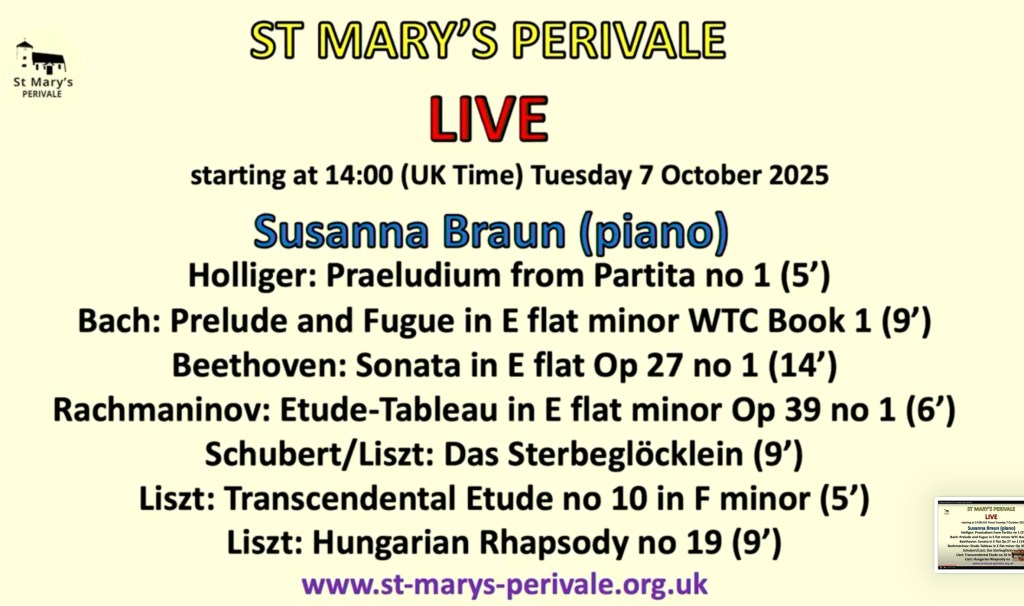
Many are tuned in to the Chopin Competition live stream in Warsaw where many pianists are in the running who have been promoted by Dr Mather. We should not forget that the indomitable St Mary’s are continuing, non stop, to give a platform to young artists with three concerts or more every week, also live streamed to an audience worldwide. I managed to hear this brilliant young Swiss pianist on play back and thank God I did ! Superb playing of the clarity and precision of a baroque keyboard player but with the colour and sumptuous sounds of a superb pianist too. Strange curled fingers like ten little hammers, necessary for playing antique instruments, but rather unnatural for the piano with pedals . Chopin was the first to show us that the scale of D flat was for starters not C major, with a hand that caressed the keys and extracted the sound like limpets sucking the lifeblood from each note. But this young Swiss pianist is also a formidable musician with a passionate heart. She is also very knowledgable and able to choose a stimulating programme where the final cluster of Holliger on E flat was the sound out of which emerged the Bach prelude from book one. A Beethoven sonata op 27 but not the ‘Moonlight’ but its sister less often played but still a Sonata ‘quasi Fantasia’ as Beethoven announced. A transcription of a Schubert song that was new to me but was transformed into a magical tone poem by Franz Liszt. The Nineteenth Hungarian Rhapsody was also new to me and what a discovery with the same Hungarian inspired virtuosity and sense of beguiling dance but with that strange late world that was beginning to open up a whole new vision for the future by the genial Abbé Liszt . It was the encore of Scarlatti that gave the game away with Susanna’s obvious baroque training such was the clarity and drive but also the ornamentation that she discreetly added to such a scintillating sonata.

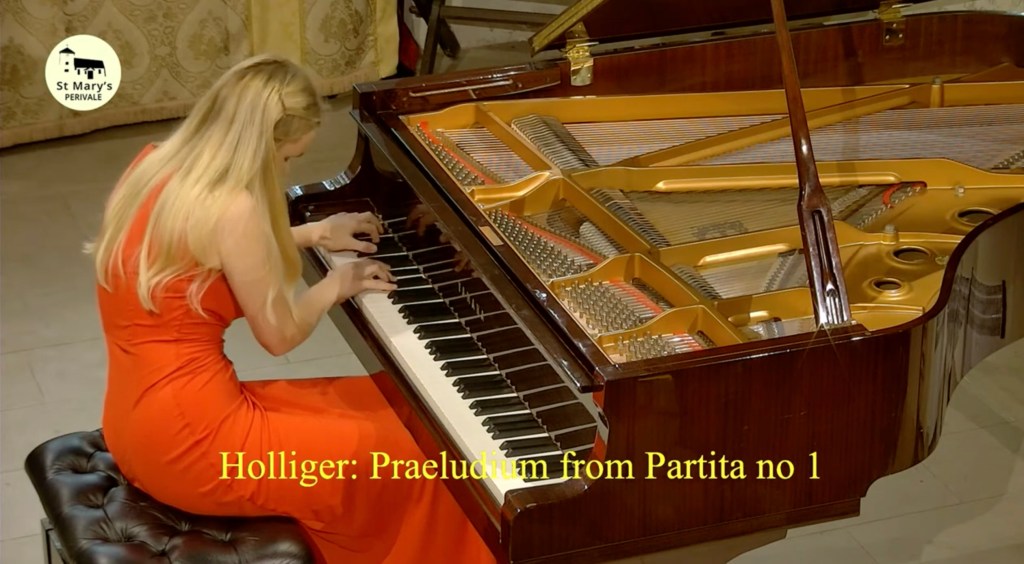
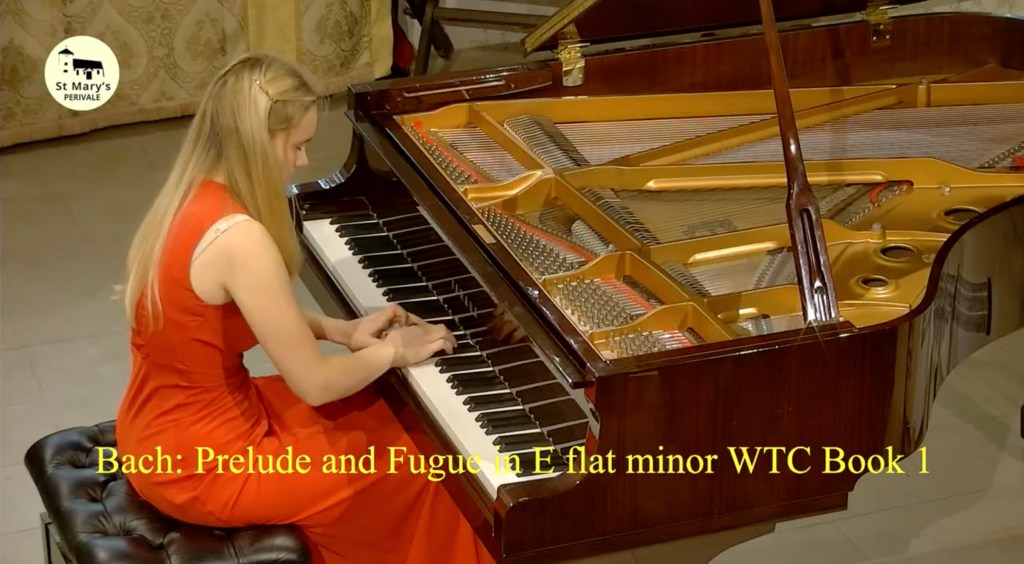
Holliger Praeludium from partita n. 1 is dedicated to Andras Schiff . Here are Susanna’s own words: My E-flat pairing of Holliger and Bach where his admiration for Bach resonates in his own Partita for Piano (completed on Dec 31, 1999). The title itself recalls the Baroque form, and its seven movements combine references to tradition with avant-garde elements. Notably, Holliger employs soggetti cavati, a Renaissance technique deriving melody from vowels, echoing Bach’s own cryptographic motifs such as B-A-C-H. The opening Praeludium recalls Bach’s improvisatory preludes. It erupts in thunderous clusters, followed by resonant triads Holliger calls the inner voice: “music as from inside your body… like a backstage chorus singing”. He himself described it as “like a Couperin or Rameau harpsichordist warming up with big arpeggios.” When its final cluster fades, only a single E-flat remains. That very note becomes the opening of Bach’s Prelude and Fugue in E-flat minor, BWV 853. A difficult work played with clarity and technical brilliance with extravagant sounds of reverberations.

A final cluster played with the arm as the glory of Bach shone through this extraordinary modern sound world. It was like a celestial cloud opening with beautiful radiance and fluidity with the simplicity of the fugue gradually unfolding.

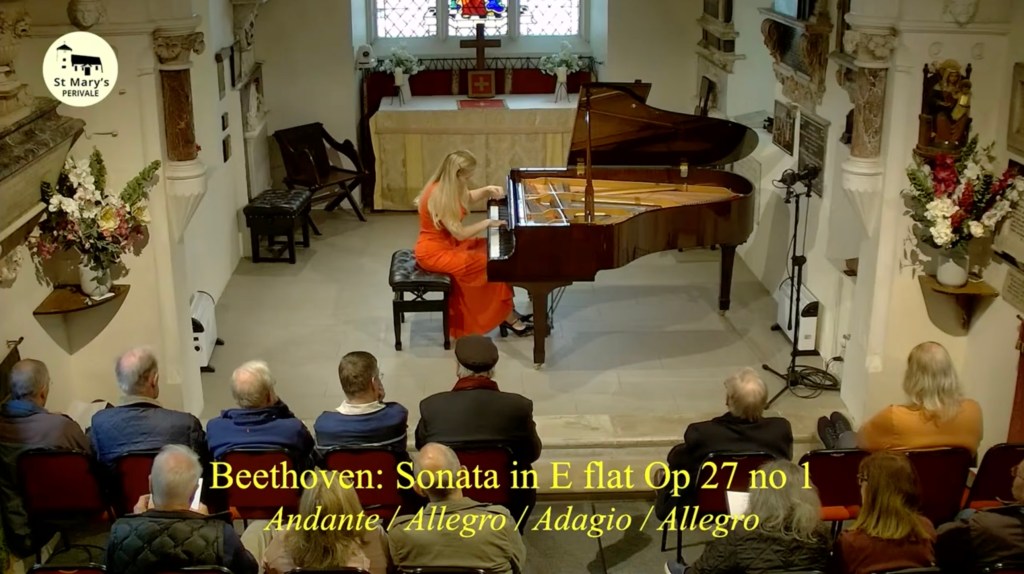
Playing in two as Beethoven indicates allowed the Andante of the Sonata to flow naturally with beauty and deep feeling but without any sentimentality.The ‘Moonlight’ Sonata was written in two as well and is too often played in four which takes away the extraordinary architectural shape of these highly original opening movements of a classical sonata. The ‘Allegro’ central interruption was played with dynamic brilliance and extraordinary clarity. Driving Beethovenian impatience was quelled with the exquisite beauty of the return of the ‘Andante’ that just dissolved to a whisper without any rallentando! Susanna’s extraordinary intelligence and musicianship allowed each movement to flow into the next in a work of unique originality for it’s time. A true ‘Allegro molto e vivace’ second movement, was played with the irascible youthful Beethovenian drive and impatience, with the central driving bass rhythms giving extra energy always especially when played with the dynamism of this young Swiss pianist. The ‘Adagio’ she so rightly said was similar to the second movement of the C minor concerto and she played it with the same poignant nobility and extraordinary beauty that Beethoven could conjure out of his genius that had nothing to do with Bel Canto but was more of orchestral origin. It was Susanna’s thinking up from the bass always that gave strength to Beethoven’s deeply felt mellifluous outpouring. After a beautiful whispered cadenza Susanna held us in suspense on a single A flat before allowing the ‘Allegro vivace’ finale to take us by storm. A rhythmic energy with dynamic contrasts all played at red hot temperature. Extraordinary clarity and precision but also passionate drive and understanding, of overwhelming energy that made the short return of the ‘Adagio’ so moving as it was unexpected.

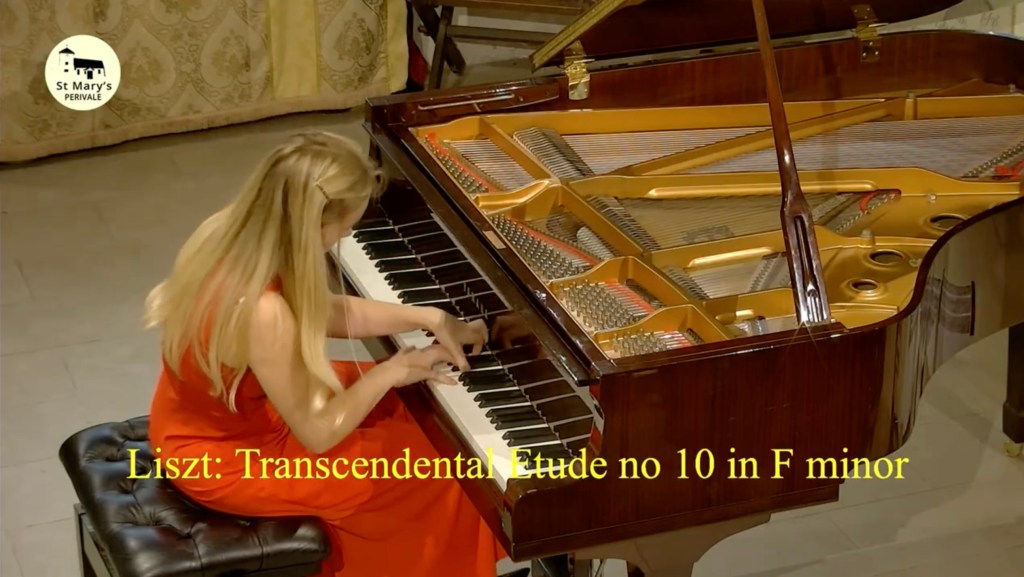
Rachmaninov’s well known Etude Tableau was with the Liszt F minor Study the only two pieces from the standard piano repertoire today. The Rachmaninov was played with fearless passion and a kaleidoscope of colour that brought this miniature tone poem vividly to life.

There was a chiselled beauty to the Schubert song transcription by Liszt which I have to admit I did not know. Her ravishing sense of balance with playing of ease and natural beauty as the bells were allowed to sound all around this glorious melodic outpouring. Sustained by the bass as the melody was played with ever more passionate conviction and mastery . A trilled pedal note that was a mere vibration on which the bells were allowed to glisten with wondrous beauty.

The Liszt F minor transcendental study was played with quite extraordinary mastery but also with colour and a passionate temperament that was quite breathtaking in its audacity .

She brought a great sense of style and authority to Liszt’s 19th Hungarian Rhapsody which was his last . A true sense of the Hungarian idiom almost savage in it’s Gypsy drive with technical difficulties thrown off with the ease of native players with their extraordinary natural technical mastery.

Swiss pianist Susanna Braun debuted at the Tonhalle Zürich in 2024, performing Mozart’s Piano Concerto KV 466, where her delicate touch, virtuosity, and musical sensitivity captivated audiences. Her interpretation was praised for its freshness and maturity, offering a refreshing contrast to routine performances. In June 2025, she made her debut with the BBC Philharmonic, performing Grazyna Bacewicz’s Piano Concerto for a BBC Radio 3 recording. Highlights of the second part of the 2025 season will include a performance with the Youth Symphony Orchestra of Ukraine of Ludwig van Beethoven’s Piano Concerto No. 4, with the Camerata Manchester, performing Ludwig van Beethoven’s Triple Concerto, and the release of her first CD for the Valaris Music label dedicated to the music of Liszt. 

She holds an “International Artist Diploma” from the Royal Northern College of Music, a Master’s from the Hochschule für Musik FRANZ LISZT in Weimar, a diploma ( corso triennale di alta perfezionamento ) from the Imola International Academy “Incontri con il Maestro”, a B.Mus with honours from RNCM and a Diplôme Supérieur from the Schola Cantorum in Paris. She is currently pursuing the “Post-Diploma Course” at the Imola International Academy “Incontri con il Maestro”, and a Master’s in Specialized Music Performance – Soloist at the ZHdK (Zurich University of the Arts). Her main teachers are and were Boris Petrushansky, Grigory Gruzman, Till Fellner, Helen Krizos and Danilo Manto. 

She has performed at prestigious venues, including the TivoliVredenburg in Utrecht, Concertgebouw in Amsterdam and Bridgewater Hall in Manchester, and has collaborated o.a. with Sinfonietta Schaffhausen and Jena Philharmonie. Susanna has won multiple awards, including first prizes at the 10th International Piano Competition in Enschede. She is also the artistic director of “BlenioMusica,” an annual chamber music festival in Switzerland . Susanna Braun is part of the Valaris Music family. Susanna is grateful for the Excellence Scholarship from the ZHdK Foundation. 

photo credit Dinara Klinton https://christopheraxworthymusiccommentary.com/2024/03/20/christopher-axworthy-dip-ram-aram/
Miracles in Warsaw this morning as Jackie Zhang reaches for the heights …………………that a competition can create a situation where a young man can reach Olympian heights where only the Gods dare to tread is justification for the sweat tears and torment that these young artists are prepared to go through …….to reach such heights is indeed a marvel .