

Fantasy on the menu tonight for Andras Schiff in a unique musical ritual, worshipping together the genius of Bach Haydn Mozart Beethoven Mendelssohn and Schumann.Chopin was never far away either!


Reminding me ever more of Kempff where music just poured from his hands that were forever searching for the perfect legato and orchestral sounds.
A world in which a musical language speaks louder than words as they delve into the very core of creation searching ever more for the life blood contained within.
Technical and pianistic problems are not even contemplated as such, but are the means to communicate the real message that is there to those who dedicate their life to a never ending journey of discovery.
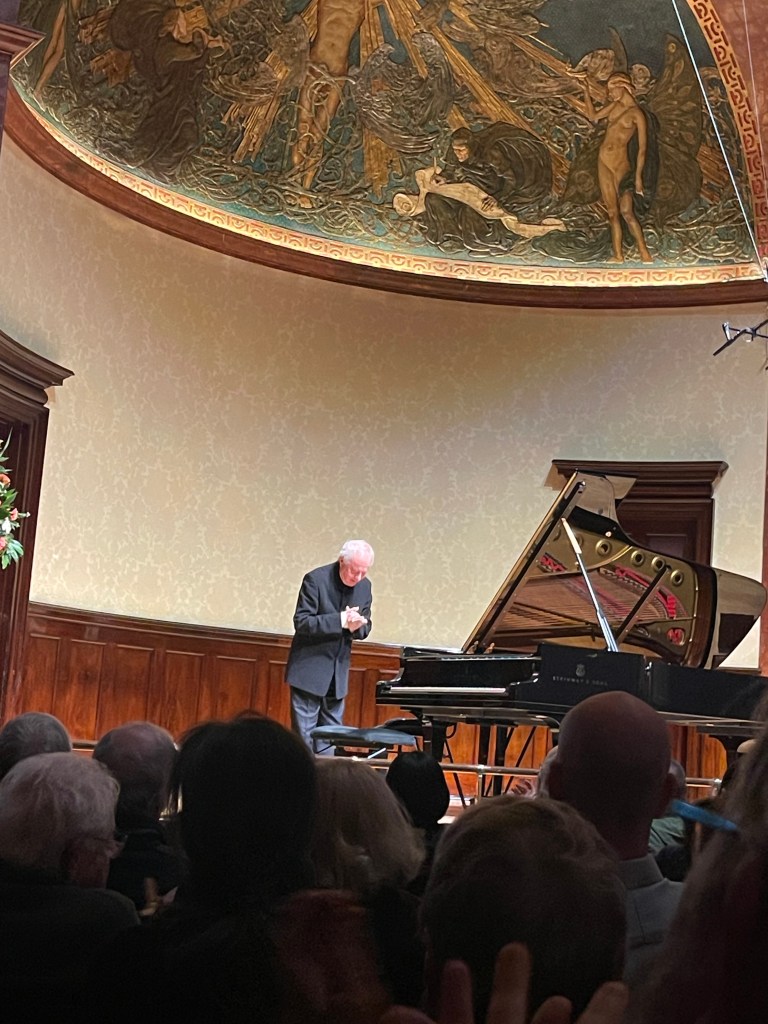
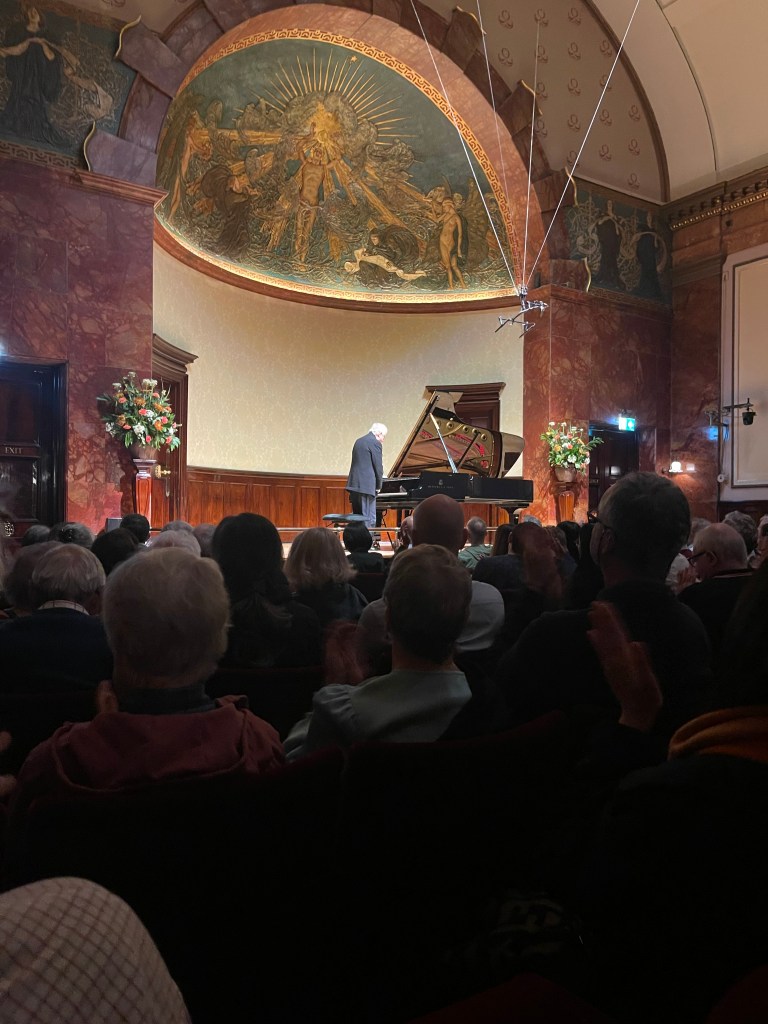
It was fascinating to see his use of the pedals both romantic and baroque that gave an enormous sense of freedom to all that was floated above it . Anton Rubinstein called the pedal the soul of the piano’ and was obviously referring to the gradual addition of the sustaining pedal to the keyboard instruments of the day. It was noticeable that Andras held with his hand the bass notes at the opening of the chromatic fantasy creating a pedal note for the improvised freedom that Bach allows. As quoting Casals ‘ there is no freedom without order.’ Chopin of course described to his students that music should be like a tree with the roots firmly planted in the ground that allowed the branches to flow feely above. It was this sense of ordered freedom that pervaded his Bach and meant that nothing was hurried of exaggerated but the music was allowed to unfold with a natural simplicity and logic. The opening of the Mozart fantasy too was played with very strident opening chords that were gently and silently echoed by putting his hand down silently on the note again . It reminded me of Arrau and Perlemuter playing loudly with the soft pedal down in order to get that very French sounding nasal effect. The search for sound is so rare these days in the quest for volume and speed!
Mendelssohn actually writes in the score in the first movement very long pedals that give you an idea of how the notes above are just wafts of changing harmony. The ending in particular ( like in Beethoven’s op 126 that Andras played on Tuesday here, together with Schubert Drei Klavierstücke and the Fantasy Sonata ) a very long pedal created a very etherial ghostly effect of unearthly sounds that we rarely hear in the concert hall where clarity and precision is usually the norm!. Andras took it to the limit with a last movement that had some wondrous moments, where lightweight chords just seemed to bounce in mid air, but maybe the streams of notes are more brilliant jeux perlé than the actual changing harmonies that Mendelssohn so clearly marked in the first movement.
The Schumann Fantasy was a fascinating voyage of discovery.
Schumann prefaced it with a quote from Friedrich Schlegel :Durch alle Töne tönetIm bunten Erdentraum Ein leiser Ton gezogen Für den, der heimlich lauschet. “Resounding through all the notes in the earth’s colourful dream There sounds a faint long-drawn note For the one who listens in secret.”
And this explains the great pedal note of G that Andras began with his right hand leaning over his left deep into the bass . It was this insistence of G that was to pervade the whole movement with the sometimes over zealous insistence of discovery. It meant that everything else was floated on this sound which gave a strange impression of improvisation and freedom. Maybe exaggerated but stimulating indeed!
Andras had explained though about the musical quotation of a phrase from Beethoven’s song cycle An die ferne Geliebte ( To the distant beloved ) in the coda of the first movement . The text of the passage quoted is: Accept then these songs beloved, which I sang for you alone]. Both the Schlegel lines and the Beethoven described Schumann’s situation of being separated from Clara Wieck by her severe father. Schumann wrote to Clara: The first movement may well be the most passionate I have ever composed – a deep lament for you. They still had many tribulations to suffer before they finally married four years later.
Andras too pointed out that Charles Rosen had found in the original version in the library in Budapest that the ending of the first movement was repeated at the end of the last movement. Schumann later cancelled this idea, and I personally think he did it because to say I love you too many times looses it’s effect. Andras ,though, decided to play it giving a certain unity to this great love poem. He asked our forgiveness and that of Schumann, but it made for a stimulating rethinking of a masterwork that we can sometimes take for granted in lesser hands.
It was all through this recital a feeling of discovery and recreating the works as though the ink were still wet on the page.The plastic precision that CD’s have accustomed us to in the concert platform was substituted for a living,vibrant ,exciting journey of discovery together with a musician who delves deeper than most into the mystery of recreation.
The programme tonight was begun with the Aria of the Goldberg Variations which was a refined hors d’oeuvre to a sumptuous feast which consisted of the Chromatic Fantasy and Fugue , Mozart Fantasy in C minor and Haydn’s in C major . Ending the first half with Beethoven’s Sonata quasi una fantasia op 27 n 1
After the interval Mendelssohn Fantasy in F sharp minor op 28 and Schumann ‘s monument to Beethoven but dedicated to Liszt , who actually erected the monument in Bonn, the Fantasy op 17 .
Chopin’s pulsating Waltz in A minor op 34 n. 2 was a thank you to his faithful public who he could not greet afterwards for fear he would miss his last bus home!

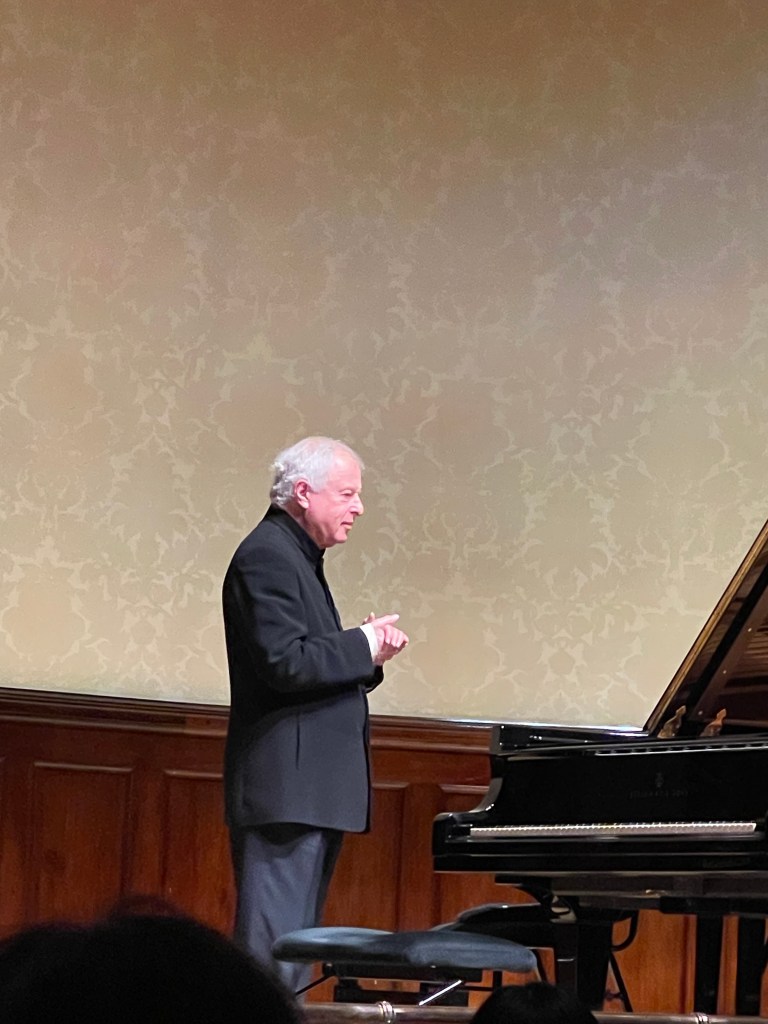

A hectic few days for this genial and ever generous kapellmeister. Playing Schubert and Beethoven here just two days ago, but also celebrating his great friend Peter Frankl’s 90th birthday as well as a lecture and concert for the Oxford Union.


