Friedrich Kuhlau (1786-1832): Divertissement op. 68, no. 6 in C-Sharp minor for flute solo 2. Dick Kattenburg (1919-1944): Sonata for flute and piano op.5 3. George Hüe (1858-1948) : Fantasie pour flûte et piano
Presented in association with Tunbridge Wells International Music Competition.
Russian flutist Maria Filippova made her concerto debut with the Symphony Orchestra of Nizhni Novgorod under the baton of Renat Zhiganshin in 2008. She has since performed in numerous concert halls across Russia and Europe. Over the years, Maria has performed as a soloist with several esteemed orchestras, including the Symphony Orchestra of Moscow state Philharmonic Society, Symphony Orchestra of Czech radio, Symphony Orchestra of Nizhniy Novgorod state Philharmonic Society named after M. Rostropovitch and various Municipal chamber orchestras across Russia. As an orchestral player Maria has extensive experience playing as part of the English-leading orchestras and ensembles and had a privilege to perform in various prestigious venues such as Cadogan Hall, Barbican Centre, Wigmore Hall and Royal Albert Hall. During her studies Maria became a laureate of the regional, all-Russia and international competitions more than once. In 2014, aged 14, Maria became the winner of the Nutcracker Television Competition and the Concertino-Praga Competition, where her gala performance was broadcast on Czech Radio. Since then, Maria was overall Grand Prix Laureate at the Gnessin Competition in Moscow, received a gold medal of the Delphic Games in Vladivostok and also became a finalist of the Moscow International Flute Competition, where she performed her program of the third round in the Great Hall of the Moscow Conservatory. In 2024 she became a winner of a Tunbridge Wells International Music Competition. This year Maria will be undertaking the Artist Diploma course at RCM supported by The Carne Junior Fellowship (Philip Carne) and the Neil Black award (Countess of Munster Musical Trust).
Domenica 10 novembre ore 12; Museo Pietro Canonica
Le parafrasi da concerto di Franz Liszt da Verdi
FRANZ LISZT 22 October 1811 Doborjan Kingdom of Hungary, AustrianEmpire
31 July 1886 (aged 74) Bayreuth , Kingdom of Bavaria, German EmpireMaster and pupil Giovanni Bertolazzi with Domenico Bevilacqua an ex student of Giovanni from Ravenna Conservatory now studying in Imola with Boris Petrushansky
R. Wagner – F. Liszt: Isoldes Liebestod, S. 447
Domenico Bevilacqua, pianoforte
G. Verdi – F. Liszt: Ernani. Parafrasi da concerto, S. 432; Miserere dal Trovatore, S. 433; Salve Maria! Da Jérusalem (I Lombardi), S. 431ii ; Don Carlos. Coro di festa e marcia funebre, S. 435; Aida. Danza sacra e duetto finale, S. 436; Reminiscenze di Simon Boccanegra, S. 438; Rigoletto. Parafrasi da concerto, S. 434
Giovanni Bertolazzi, pianoforte
Valerio Vicari , the genial artistic director of Roma 3 Orchestra presenting the concert
Sensational is the only word to describe Giovanni Bertolazzi playing all seven of the opera paraphrases of Verdi by Liszt Presenting his student ,Domenico Bevilacqua, opening with Liebestod which had all the colours and musicianship of his mentor But when Giovanni struck up the Ernani paraphrase there was a authority and breathtaking presence that was to hold a museum packed to the rafters mesmerised by such artistry on this sunny Sunday morning in Villa Borghese they even demanded more and Giovanni very generously offered three encores. A little waltz written for piano by Puccini ; De Falla’s Ritual Fire Dance alla Rubinstein ! And by even great insistence Valse Triste by the violinist Vecsey (Agosti was often his duo partner) in the spectacular arrangement for piano by Cziffra.
A triumph and it is thanks to Valerio Vicari who had spotted his talent a few years ago and has brought his talent to the fruition that is being applauded worldwide today.
Domenico Bevilacqua opened this all Liszt concert with a sumptuous performance of Liebestod .It is a work that Giovanni too had played a few years ago for Roma 3 in the historic Villa Torlonia. https://christopheraxworthymusiccommentary.com/2022/01/17/giovanni-bertolazzi-in-rome-liszt-is-alive-and-well-at-teatro-di-villa-torlonia/ Today Domenico showed a depth of sound from the arresting opening chords that were played with strength but never hardness.A kaleidoscope of colours allowed the twisting and turning of the counterpoints to entwine with fluidity and glowing beauty as they built to a passionate climax only to die away to a magical whisper. A superb sense of style and stretching the insinuating sounds to their maximum without ever loosing sight of the overall architectural shape.Authority and control immediately created an electric atmosphere where this young virtuoso held us in the palm of his hands as he took us on a wondrous voyage of discovery. And what a wonder this Ernani paraphrase is and strangely heard so rarely in the concert hall.Maybe because of it’s transcendental difficulty that for Giovanni was not a problem .The massive hurdles he surmounted with ease with a sense of style and balance always at the service of the music.
Liszt made a concert paraphrase of Ernani in 1847, but this remained unpublished. A second Paraphrase de concert was made in the following years and revised in 1859. The opera itself was first staged in Venice in 1844 and deals with the rivalry for the love of Elvira of the bandit Ernani and Don Carlo, King of Spain, complicated by the implacable hostility of Elvira’s uncle, Don Ruy Gomez, who conspires with Ernani against the King. When matters seem resolved, Don Ruy gives a signal, agreed with Ernani, that the latter should die, if Don Ruy demands it. The signal is given, and Ernani stabs himself. The third act is set in a cathedral vault at Aix-la-Chapelle, before the tomb of Charlemagne. Don Carlo, who is to be elected Holy Roman Emperor, overhears the conspirators, turns and addresses his illustrious predecessor in O sommo Carlo (O supreme Carlo), and extends clemency to Ernani and Elvira. It is this melody that provides the basis of Liszt’s paraphrase.
The deep bass notes intoned with ponderous seriousness in the ‘Miserere’ before the sumptuous tenor melody with subtle gentle comments on high becomes ever more dramatic and insistent .
First staged in Rome in 1853, Il trovatore has a plot of some complexity. The troubadour of the title, Manrico, is the supposed son of the gypsy Azucena, but actually the stolen child of the old Count di Luna, a rebel and declared enemy of the young Count di Luna. Both are in love with Leonora, and Manrico, in his stronghold, is preparing to marry her, when news comes of the imminent death of his supposed mother, taken by the Count and condemned to death by burning. In his attempt to save her, Manrico is taken prisoner by the Count. In the fourth act Leonora, brought to a place outside Manrico’s prison, thinks to bring him new hope. From the tower the Miserere is heard, Miserere d’un’ alma già vicina / Alla partenza che non ha ritorno! (Have mercy on a soul already near / To the parting from which there is no return). Leonora’s horrified exclamation, Quel suon, quelle preci solenni, funeste (What sound, what solemn, mournful prayers) leads to Manrico’s Ah che la morte ognora / È tarda nel venir (Ah how slow the coming of death), from the tower, his farewell to his beloved. Once again Liszt has chosen the point of highest tragedy for his 1859 paraphrase. It is followed by Leonora’s offer of herself to the Count, in return for her lover’s release, having secretly taken poison, her death, and that of Manrico, executed, but now finally revealed by Azucena to the Count as his own brother.
The ‘Salve Maria’ was Liszt’s first paraphrase of Verdi and it was played with chiselled sounds of great purity
Verdi’s opera of 1842, I Lombardi was recast in 1847 for Paris as Jérusalem. The Paris version transposes the action from Lombardy to France. The prayer, sung by Hélène, daughter of the Count of Toulouse, who has killed her lover’s father, again comes in the first act. Liszt’s version, more transcription than paraphrase, made originally in 1848, is dedicated to Madame Marie Kalergis, née Comtesse Nesselrode. The tremolo effect, originally for violins, is preserved in Liszt’s version, more particularly, perhaps, in the alternative transcription for the newly invented armonipiano, with its tremolo pedal.
Don Carlos there was immediately a dynamic rhythmic energy with extraordinary empty bass sounds that created quite an astonishing atmosphere of desolation.
Dating from 1867-68, Liszt’s treatment of the Coro di festa e marcia funebre from Don Carlos is based on the opera of that name, first seen in its original version in Paris in 1867. Drawn from Schiller’s dramatic poem, the plot centres on the Spanish Infante, son of Philip II, and his love for Elisabeth de Valois, originally his betrothed but then the wife of the King. The involvement of Don Carlos with rebels in Flanders and the interventions of Princess Eboli, who is also in love with Don Carlos, bring further complications, ending in his condemnation and final mysterious rescue into the monastery founded by his grandfather, from behind whose tomb a voice calls him. The Church has an important part to play and the Grand Finale of the third act brings a popular celebration, in front of the Cathedral of Valladolid, honouring the King. This spectacular scene is followed by a funeral march, as monks escort heretics to their deaths at the stake.
What a ravishingly beautiful paraphrase this ‘Aida’ is where Liszt has completely understood the chamber quality of an opera that is all too often thought of as only the triumphal march.The ending is one of the most beautiful things in all of Verdi’s operas and it was this that Giovanni played with ravishing sounds and an extraordinary expressiveness ending in bare whispers of breathtaking beauty.
Verdi wrote his Egyptian opera Aida for the opening of the Cairo Opera House in 1871. Aida, daughter of the King of Ethiopia but enslaved by the Egyptians, is in love with Radames, appointed captain of the Egyptian armies in their fight against the Ethiopians. Victorious in battle, Radames is promised the hand of Aida’s mistress, Amneris, daughter of the King of Egypt, as a reward for his triumph. In an assignation with Aida, whom he loves, he divulges military secrets to her, overheard by her father, a prisoner of the Egyptians. Accused of treachery, Radames is condemned to death, to the dismay of Amneris, and, immured in a tomb, he is joined by Aida, allowing the two to die together, while Amneris mourns the fate of her beloved Radames. Liszt offers a paraphrase of the Danza sacra e duetto final,published in 1879. The sacred dance, from the end of the first act, accompanies the reception by Radames of the sacred sword, the symbol of his army command. Priestesses in the temple chant their prayer to the god Phtha, Possente, possente Phtha!, followed by their dance. In the fourth act the chant of the priestesses in the temple is heard, as Radames and Aida, entombed below, bid farewell to life in O terra addio, o valle di pianti (O earth, farewell, O vale of tears, farewell), and Amneris, distraught, offers her own prayer.
Boccanegra was the last of Liszt’s paraphrases and was played with a radiant beauty even if it appeared to me to be the least successful . There were many beautiful things but Liszt seemed to lack an overall shape and form that had been so clear in the previous paraphrases.
Liszt’s Réminiscences de Boccanegra was written in 1882, a year after Verdi’s revision of his 1857 opera. It deals with events in medieval Genoa, plots against the Doge, Simone Boccanegra, and the machinations of the goldsmith Paolo Albiani. The opera ends with the death of Boccanegra, poisoned by Paolo, but the happy joining together of his daughter Amelia with Gabriele Adorno, who succeeds Boccanegra as Doge. Liszt’s reminiscences start with a reference to the 1881 Prologue, in which the election of Boccanegra as Doge is proposed. This leads to the final chorus of the second act, All’armi, o Liguri (To arms, O Ligurians), a popular rebellion against the Doge, that is to be defeated. A further reference is to the final ensemble of the third act, bringing the death of Boccanegra, but otherwise general reconciliation. Liszt ends the work with a return to the theme of the Prologue.
Rigoletto paraphrase has long been a favourite of virtuosi in the concert hall. It is easy to see why with its ravishing rubato and sense of style allied to astonishing pianistic brilliance. There was charm and elegance too and Giovanni was certainly not lacking in showmanship and scintillating virtuosity in a performance of fearless dynamism.
Liszt’s concert paraphrases, are more than mere transcriptions, offering a re-interpretation based on thematic material drawn from their source. Among the best known of his Verdi arrangements is his Rigoletto Paraphrase de concert, written in 1859. Verdi’s opera had had its first performance in Venice in 1851. The plot centres on the court jester of the title, a servant and accomplice of the Duke of Mantua in his amorous adventures. Cursed by a courtier whose daughter the Duke has dishonoured, Rigoletto suffers the loss of his own daughter, Gilda, seduced by the Duke and then abducted, for the Duke’s pleasure, by the courtiers. In the last act of the opera Rigoletto has hired an assassin, Sparafucile to murder the Duke as he dallies with Sparafucile’s sister, Maddalena. They are observed from the darkness outside by Rigoletto and his daughter, who is to die at the assassin’s hands. It is this final scene that Liszt takes as the basis of his paraphrase. The theme that dominates is the Duke’s Bella figlia d’amore (Fair daughter of love), interspersed with the light-hearted replies of Maddalena, and the exclamations of Gilda, as she sees her lover’s infidelity exposed.
Three encores from an enthusiastic over capacity audience : An original piano piece by Puccini – Piccolo valzer from 1894 ; Manuel De Falla Ritual Fire Dance ; Vecsey/Cziffra Valse Triste .The disarming simplicity of Puccini’s little waltz was immediately dispelled by the impetuosity and animal drive of De Falla Ritual Fire Dance. Hands thrown in the air ,a little less than Rubinstein, but it gave an electric shock drive to the boiling hot atmosphere that De Falla evokes.The Valse Triste I have heard Giovanni play many times in public but rarely with the same abandon and improvised freedom that he demonstrated today.Giovanni had taken us on a long journey from Liszt the virtuoso to the Liszt the visionary, demonstrating that this talented young musician has become a great artist ready to grace the great concert halls of the world for years to come.
Franz Liszt compose diverse parafrasi da concerto su opere di Giuseppe Verdi, trascrizioni virtuosistiche ed elaborate, basate su celebri melodie da opere verdiane. Questi brani rappresentano non solo una forma di omaggio da parte di Liszt a Verdi, ma anche un’opportunità per il compositore ungherese di esplorare nuove possibilità tecniche ed espressive al pianoforte. Tra le più famose troviamo le parafrasi tratte da “Rigoletto”, “Il Trovatore” e “Aida”. Liszt prende i temi più drammatici o lirici delle opere e li rielabora con una scrittura pianistica virtuosistica e ricca di colori, che esalta sia le qualità tecniche del pianista che la forza emotiva della versione originale. Le parafrasi non si limitano a una semplice trascrizione: Liszt interviene trasformando, espandendo e rielaborando i temi, creando nuove opere che stanno in equilibrio tra la fedeltà al modello e l’innovazione personale.
La morte di Isotta, scena finale del “Tristano e Isotta” di Wagner, è una delle trascrizioni più celebri di Liszt. In questa parafrasi, Liszt trasforma il celebre “Liebestod” di Isotta in un capolavoro pianistico che evoca con grande intensità il senso di estasi e di annullamento amoroso che caratterizza la scena finale dell’opera. La trascrizione riflette la profondità tragica e mistica del dramma wagneriano, mantenendo l’intensità emotiva dell’originale, ma trasponendola in una dimensione intima e pianistica.
The house of Pietro Canonica in the centre of Villa Borghese The Globe Theatre in Villa Borghese Music everywhere on this Sunday morning in Villa Borghese A sculpture by Pietro Canonica
Standing at the back the distinguished pianist Clive Britton one of the last students of Claudio Arrau in New York and one of the few like his mentor to present all seven Verdi paraphrases in concert.Arrau was a student of Martin Krause a student of Franz Liszt https://breraplus.org/en/story/clive-britton/
Patrick Matthiesen presenting Dominika Mak in his gallery in Mayfair. He had heard her practicing and was so overwhelmed he invited her to give a public recital.
Dominika Mak playing in the beautiful Matthiesen Gallery in an evening of refined elegance with playing of ethereal beauty surrounded by wonderful paintings in a room that one would be more lightly to find in a castle in the Loire than in the centre of London.
Playing of exquisite good taste and beauty allowed us to close a door for a moment on this upside down world where a power game of quantity over quality is fast arriving at an autodestruct stage of no return! Haydn B minor Sonata brought to life with sounds that rarely are heard these days from pianos that are geared up to project to the masses. As Paul Lewis exhorted a young pianist in his masterclass yesterday :’ draw the public in to you there is no need to project …….Schubert is a Genius …..trust him!’
Not Schubert for Dominika Mak but Haydn of exquisite refined beauty but also dynamic drive and passion .Chopin the third and fourth Ballades where she had a wondrous story to share with streams of golden sounds that just flowed from her elegant fingers with a simplicity and aristocratic nobility that is hidden within the soul of the Polish people.
A genial idea to link the sound world of mazurkas by Chopin and Szymanowski with the ethereal water nymph Ondine creating an atmosphere of magic and ravishing beauty. This had now created the atmosphere for Chopin’s Nocturne in D flat that floated on an ethereal wave of whispered sounds .Playing as if in a trance with an improvised beauty sharing Chopin’s deepest thoughts with us as we listened with baited breath transported to a far better world than we could ever envisage. A power game playing outside these exquisite confines, where the autodestruct button gets ever nearer in a world where greedy quantity takes precedence over refined quality.
Haydn’s B minor sonata n 47 was played as if the ink were still fresh on the page! A sense of discovery with a kaleidoscope of colours where every note had a meaning and an important place in a chain of ravishing sounds.There was a crystalline clarity of velvet beauty from an artist who listens to herself and loves the sounds that pour with such ease from her well oiled fingers.A minuet and trio of poignant beauty and extraordinary eloquence with playing of exquisite delicacy.This was not porcelain doll beauty but playing that had drive and contrast too as was shown in the Finale. A Presto of extraordinary ‘jeux perlé’ brilliance with a refined palette of sounds and breathtaking fearless energy. A performance of a work I have heard many times but today it was as though I was hearing it for the first time such was her power of communication allowing Haydn’s genial invention to speak for itself with simplicity, fantasy and mastery.I had heard Dominika just a few weeks ago at a celebration of Chopin at the POSK in London. It does not necessarily follow that because Chopin is a much loved National Hero that he is revealed only to Polish pianists.Fou Ts’ong was awarded the mazurka prize at one of the first Chopin Competitions after the war much to everyone’s suprise. As he explained the soul to be found in Chopin is the same that is in Chinese poetry – you see the soul has no boundaries! https://christopheraxworthymusiccommentary.com/2024/10/20/posk-chopin-festival-2004-mak-dubiel-pawlak-swigut-a-feast-of-music-and-full-immersion-with-lady-rose-cholmondeley-and-prof-john-rink/ Some Polish pianists can love Chopin too much and exaggerate the deep rooted nostalgia that Chopin nurtured always for his homeland. Chopin at 18 left his homeland never to return again and became the refined aristocratic composer who spent most of his life in the privileged circles of Paris high society. Dominika is Polish but she also understands the refined aristocratic composer where sentiment is hidden deep within the notes and not just superficially on the surface.It was Artur Rubinstein ( he too an exile from an early age) who broke away from a tradition where sentiment had become sentimentality and deeply rooted nostalgia became heart on sleeve showmanship for pianists who would also talk to the public whilst they played to let them know how clever they were! Dominika’s playing that I heard at POSK revealed an artist not only of refined sensibility but a musician of aristocratic authority with playing that was flexible but always as Chopin said with roots firmly planted in the ground but with the branches free to sway in the wind. Six Preludes from his set of 24 ( Chopin never played them as a set or intended them to be played together ) immediately showed Dominika’s remarkable sense of balance, where in the 13th the melody was allowed to sing sustained by a continuous flow of harmonic beauty that was allowed to emerge at poignant moments.The 14th ,just one page, usually played like a battle cry was here the same wind over the graves of his later Funeral March Sonata where Chopin’s originality had Schumann declaring that it was more ‘like a mockery than any music’. Dominika played it like a living amalgam of sounds rising and falling with unusual poetic beauty. She brought a radiance to the ‘Raindrop’ prelude that was of great beauty but also strength with the sombre whispered left hand of the central episode creating the terrible weather in Valdemossa where Chopin had eloped with George Sand, taking refuge from the vulgar peasants and dreadful weather in the cell of a Monastery high in the hills on Majorca.The 16th is a ‘tour de force’ for any pianist but in Dominika’s hands became a frantic swirl of sounds played fearlessly and almost spotlessly! There was deep rooted nostalgia to the 17th with a timeless outpouring of melody of searing beauty.The deep A flats at the end creating a magic carpet on which the melody was heard more and more in the distance.The cadenza prelude of the 18th was played with extraordinary musicianship where the melody and accompaniment were played with unexpected and refreshing originality. The 3rd and Fourth Ballades were played as tone poems of extraordinary originality.The pastoral beauty of the third contrasting with the poignant beauty and majesty of the fourth , long considered the pinnacle of the Romantic piano repertoire together with the Liszt Sonata and the Schumann Fantasy .If the climax of both could have had more incisive bite and weight Dominika convinced us that first and foremost these were two visions of beauty where even the extraordinary technical demands made especially in the codas was only a poetic means of expression that grew out of the story that was being told.The Mazurkas op 59 I had heard from Dominika’s hands a few week ago and was overwhelmed by her understanding and recreation of miniature tone poems that Schumann described as ‘canons covered in flowers’. Today she repeated that miracle and added another that were three of the four Mazurkas written for Artur Rubinstein by his friend Szymanowski. Written in 1925 they have the same dance rhythm as Chopin but a musical language that owes more to Stravinsky with its strange intoxicating harmonies. Rubinstein used to play them as a brief window opener in his all Chopin recitals.It was this refreshing purity and clarity that added another dimension to Ravel’s water nymph,Ondine,who flutters in and out of the ravishing waves of the first of the suite ‘Gaspard de la Nuit’.It was in the climax of ‘Ondine’ that suddenly Dominika showed us her technical mastery as she threw herself with fearless abandon in a work that Ravel wanted to put virtuosi pianists to the test as Balakirev had done with his Islamey.It was after this final ‘tour de force’ that Dominika chose to play one of Chopin’s most beautiful bel canto creations.The Nocturne in D flat was played with barely whispered sounds of great daring and freedom.Her innate musicianship allowed her to steer her way through this sublime music with unusual freedom but also with an architectural vision that was totally convincing.L’aula Gaber and Mary Orr with Dominika Mak and Patrick Matthiesen.Christopher Elton always present to hear his students in public together with Tom Zalmanov and Dominika both students at the Royal Academy of Music https://christopheraxworthymusiccommentary.com/2024/05/16/tom-zalmanov-at-steinway-hall-for-the-keyboard-trust/ Tom will be playing at the Wigmore Hall on Wednesday at 1.00pm in the RAM Piano Series which recently saw Emanuil Ivanov give an incredible performance of Rzewski .Prof Elton of course was there too ! https://christopheraxworthymusiccommentary.com/2024/10/09/emanuil-ivanov-sensational-performance-at-the-wigmore-hall-of-rzewski-the-people-united-will-never-be-defeated-a-staggering-performance-of-total-mastery-and-musical-communication/Sir Norman Rosenthal who will be hosting his 80th birthday concert for friends in the Gallery on Friday thanks to the generosity of Patrick Matthiesen His protégé Samson Tsoy will play late Beethoven and Aksel Rykkvin with Zany Denver will perform lieder by Beethoven and Schubert including Normans Gesang of 1825 https://christopheraxworthymusiccommentary.com/2024/07/19/review-of-samson-tsoy-the-trilogy-at-fidelio/Victor Braojos and Paul Mnatsakanov two extraordinary young artists playing regularly in London. Victor a fellow of the Guildhall and Paul in his final year as post graduate at the RCM. https://christopheraxworthymusiccommentary.com/2024/05/24/paul-mnatsakanov-graduation-recitals-at-the-royal-college-music/Victor Braojos a protégée of the indomitable Mary Orr of the Young Artists Concert Series https://christopheraxworthymusiccommentary.com/2024/10/17/victor-braojos-at-imperial-college-the-voice-of-spain-with-loveauthority-and-passion/Superb aspiring young musicians all supporting each others recitals as did Barenboim,Du Pre,Fou Ts’ong,Andre Tchaikowsky,Nelson Freire,Martha Argerich ,Perleman, Zuckerman in the 60’s when life was slower and jet setting careers were not yet the norm.The extraordinary Christopher Elton a fellow student of Gordon Green and now in his 80’s but still with an undiminished passion for music that takes him to International Piano Juries as well as helping the students that flock to his studio at the RAM
Some extraordinary playing from this young man who I have listened to since the age of 13 when he was the youngest pianist to be accepted by the Royal College of Music in the class of Dmitri Alexeev. And I well remember his remarkable performance of great clarity of Brahms Handel variations where this young man could already hold his own with the more mature artists of the class
It is never easy for a young man to have to grow up along side such a precocious talent . His appearances in the finals of the young musician of the year from a very early age have always aroused great interest although through a strange twist of fate he has not yet been crowned. But he has certainly been noticed and it has been a joy to watch such a gifted young boy turn gradually into an artist and a young man with a personality and musical voice of his own .It is a great accolade to the remarkable Alexeev’s who like the Craxton’ s years ago take these young musicians into their inner circle and not only instruct but nurture their progress with patience and understanding.
The Bach B major prelude and Fugue book 2 was played with a clarity and beauty of sculptured sounds of great purity allowing the Prelude to contrast with the serious four part fugue that unwound in a beautiful pastoral tempo .The difference between staccato and legato contrasts adding great character to knotty twine of such nobility from the Genius of Kothen.
Chopin’s second Ballade was played with the same clarity and with a flowing tempo as the ‘Andantino’ was allowed to unfold with such natural poise and sense of style but slightly lacking in the colours that Jacky was to unleash in the later part of the programme.Jacky has an extraordinary clarity to all he does which was to make his playing of the ‘Presto con fuoco’ so exciting and refreshingly precise. His playing of the ‘Andantino’ ,though ,lacked a certain weight and warmth as though his fingers were not sucking the juice out of each note with limpet like insistence.There was a natural flow and beguiling sense of rubato as the voices duetted together gradually becoming more passionate and insistent with the ‘stretto piu mosso’ indicated by the composer. Jacky always plays with such intelligent musicianship and sense of architectural understanding and the eruption of the ‘Presto con fuoco’ lead so naturally into the dynamic drive of the ‘agitato’ coda.The deep bass melodic octaves ,though, were strangely played on the surface and not the marcato and legato of Chopin’s very precise pedal indications.The coda too was played with great passion and remarkable technical mastery but slightly missed the sumptuous grand sound that Chopin clearly marks. Even the final long pedal on the ‘forzato’ chord was ignored where the return of the ‘Andantino’ should be like a memory after a long journey, of sounds lost in a mist of mystery and peace. This was in many ways a remarkable performance but missing the sense of a story being told of wondrous beauty.
It was just this beauty that he now found and that ignited the late B major Nocturne. Here there was a beautiful sense of improvised freedom and subtle colouring.The luminosity of the sound was quite magical and of a languid beauty where his superb trills were of true bel canto shape. An exquisite coda of the controlled freedom of mature mastery.
The Sonata in Bb flat minor is one of Chopin’s greatest works of classical discipline but also of romantic freedom and invention.The last movement of such originality that it had Schumann declare the sonata as “four of Chopin’s maddest children under the same roof” and found the title “Sonata” capricious and slightly presumptuous.He also remarked that the Marche funèbre “has something repulsive” about it, and that “an adagio in its place, perhaps in D-flat, would have had a far more beautiful effect”.In addition he stated that the movement “seems more like a mockery than any music”,and when Felix Mendelssohn was asked for an opinion of it, he commented, “Oh, I abhor it.” From the opening notes this sixteen year old musician showed us what a masterpiece of originality Chopin had written.Schumann had famously written about the arrival of Chopin playing his salon variations op 2 with ‘ Hats off ,Gentlemen, a genius’ . Little could he have imagined what the word genius really can mean.Often not pleasant because so unexpected! Jacky brought a dramatic note to the opening ,which he decided not to repeat, ending the much debated to be or not to be theory.This was a young musician with a vision of maturity and mastery.If he attacked the opening chords unnecessarily with a little too much vehemence from above, they immediately dissolved into a masterly ‘doppio movimento’ of whispered insistence gradually building to the beautiful second subject that was played with poignant nobel sentiment.The development grew so naturally out of the exposition and any thought of a repeat would have been only bending to convention and not for artistic invention.The opening fanfare was now transposed to the left hand with nobility and sumptuous full sounds.The coda played a little too vertically instead of the horizontal shaping that Chopin indicates with his accelerando to the final majestic chords. His playing of the ‘Scherzo’ was superb for its technical assurance and clarity and the sumptuous beauty he brought to the ‘Trio’ was of great beauty and artistry. There was a beautiful flowing tempo to the ‘Marche Funebre’ that allowed Jacky to shape this movement with nobility and gloriously rich sounds.The trio just grew out of these noble sounds as it was allowed to flow with simplicity and radiance.It gave great architectural shape to a movement that can seem repetitive in less intelligent hands and it was wonderful to see the Funeral March come into view again after such radiant beauty.This time ,though, it was played with searing intensity with an extra bass note just adding colour and mist as the March disappeared into the distance.The last movement was played with superb clarity and technical mastery but there was also the gentle throbbing that evolved in its midst and where the movement for a moment became almost sentimental instead of only the cold wind blowing over the graves.
The Granados was a tour de force of bravura and style as the teasingly virtuosistic outpouring of notes depicted so vividly the sunlight, luminosity, and vital life of Spain.
Jacky had kept the best for last and it was his breathtaking performance of ‘Mazeppa’ by Liszt that was quite overwhelming, not only for the technical mastery but for the sense of balance and style. Here this young man had shown us his remarkable clarity and technical mastery but also a kaleidoscopic sense of colour with passionate outpourings of fearless virtuosity that became the ravishing beauty of a great tenor operatic aria accompanied with sensibility of great artistry.
Jacky Zhang is 16 and lives in South London. He is currently studying at the Royal College of Music as a fourth-year undergraduate. He studies Piano with Professor Dmitri Alexeev and Composition with Professor Kenneth Hesketh. He also has other interests such as songwriting, producing, and composition for screen.
An inspired and inspiring afternoon in the company of Schubert. Three pianists with a refined musical palette playing to one of the great musicians of our time Paul Lewis A former student of Joan Havill at the Guildhall , taken under the wing of Alfred Brendel as he has scaled the musical heights to reach almost the last rung ………only paradise awaits now Inspiring three superb young musicians to reach out for those heights too and I suspect are students of Ronan O’Hora whose musical pedigree is second to none.
Paul Lewis with Ronan O’Hora
With humility and mastery they enjoyed a journey of discovery together in which in every key there were an infinite variety of sounds . Cantabile but what sort of cantabile? Don’t project the sound but draw the audience in to you! What character does this piece have? Just listen to the charm of the left hand in the second impromptu op 90 or the ethereal beauty of the first moment musicaux there is no need to underline it Schubert has already thought of that ! Overwhelming display of passion and extraordinary facility in the Wanderer Fantasy that the maestro dared not interrupt but lead to an inspired exchange of views in which we were all involved and so privileged to overhear such wonderful confessions between musicians on a wondrous journey of discovery
Programme
2pm Berniya Hamie
Schubert 4 Impromptus, D899
I. Allegro molto moderato
II. Allegro
III. Andante
(IV. Allegretto)
3pm Chloé Dumoulin
Schubert 6 Moments Musicaux, D780
I. Moderato
II. Andantino
III. Allegro moderato
III. Andante
IV. Moderato
(V. Allegro vivace
VI. Allegretto )
4pm Elisabeth Tsai
Schubert Fantasie in C major, D760 ‘Wanderer Fantasy’
I. Allegro con fuoco ma non troppo
II. Adagio
III. Presto
IV. Allegro
Paul Lewis is internationally regarded as one of the leading musicians of his generation. His cycles of core piano works by Beethoven and Schubert have received unanimous critical and public acclaim worldwide, and consolidated his reputation as one of the world’s foremost interpreters of the central European classical repertoire. His numerous awards have included the Royal Philharmonic Society’s Instrumentalist of the Year, two Edison awards, three Gramophone awards, the Diapason D’or de l’Annee, the Preis Der Deutschen Schallplattenkritik, the Premio Internazionale Accademia Musicale Chigiana, and the South Bank Show Classical Music award. He holds honorary degrees from Liverpool, Edge Hill, and Southampton Universities, and was appointed Commander of the Order of the British Empire (CBE) in the 2016 Queen’s Birthday Honours.
He works regularly as soloist with the world’s great orchestras, including the Berlin Philharmonic, Boston Symphony, Chicago Symphony, London Symphony, London Philharmonic, Bavarian Radio Symphony, NHK Symphony, New York Philharmonic, LA Philharmonic, and the Royal Concertgebouw, Cleveland, Tonhalle Zurich, Leipzig Gewandhaus, Philharmonia, and Mahler Chamber Orchestras.The 2017/18 season saw the start of a two year recital series, exploring connections between the sonatas of Haydn, the late piano works of Brahms, and Beethoven’s Bagatelles and Diabelli Variations, as well as appearances with the WDR Sinfonieorchester, Orchestra Mozart di Bologna, Boston Symphony, San Francisco Symphony, and the Bavarian Radio Symphony Orchestra. The Haydn, Beethoven, Brahms series continues through the 18/19 season, alongside appearances with the Orchestre Symphonique de Montreal and Kent Nagano, the Berlin Philharmonic and Chicago Symphony with Bernard Haitink, the Orchestra dell’Accademia Nazionale di Santa Cecilia with Manfred Honeck, and the Tonhalle Orchestra Zurich with Francois-Xavier Roth.Paul Lewis’s recital career takes him to venues such as London’s Royal Festival Hall, Alice Tully and Carnegie Hall in New York, the Musikverein and Konzerthaus in Vienna, the Theatre des Champs Elysees in Paris, the Concertgebouw in Amsterdam, and the Berlin Philharmonie and Konzerthaus. He is also a frequent guest at the some of the world’s most prestigious festivals, including Tanglewood, Ravinia, Schubertiade, Edinburgh, Salzburg, Lucerne, and the BBC Proms where in 2010 he became the first person to play a complete Beethoven piano concerto cycle in a single season.His multi-award winning discography for Harmonia Mundi includes the complete Beethoven piano sonatas, concertos, and the Diabelli Variations, Liszt’s B minor sonata and other late works, all of Schubert’s major piano works from the last six years of his life including the 3 song cycles with tenor Mark Padmore, solo works by Schumann and Mussorgsky, and the Brahms D minor piano concerto with the Swedish Radio Symphony Orchestra and Daniel Harding. Future recording plans include a multi-CD series of Haydn sonatas, Beethoven’s bagatelles, and works by Bach.Paul Lewis studied with Joan Havill at Guildhall School of Music and Drama in London before going on to study privately with Alfred Brendel. He is co-Artistic Director of Midsummer Music, an annual chamber music festival held in Buckinghamshire, UK.
Trills, Beethoven, and the secret of Chopin: Read quotes from Paul Lewis’ piano masterclass at SFCM ⬇San Francisco Conservatory 1: “Almost always, think of trills as part of the melody. The melody note comes first, then the trill, not too fast; you want each note in the trill somehow connected to the melody.” 2: “What Beethoven’s so good at is leading us to believe something and then doing something completely different.” 3: “This uses the whole keyboard: Give us more of a sense of that, just take a bit of time for us to feel the distance there. Because it felt normal, expected, like it was easy for you to play. Give us the feeling that this is taking some effort.”
4: “A feature of Beethoven’s music is humor, but the way he uses humor is often quite brutal.” 5: “[Ballade No. 4 in F Minor, Op. 52] is, I think, the closest Chopin gets to this idea of endless melody. There’s no real end. There’s no resolution. If you come to the end of the phrase, it’s only to go on to something else.” 6: “Beethoven writes orchestral music for the piano, Schubert writes vocal music for the piano. But Chopin writes piano music for the piano, which is occasionally vocal.” 7: “The secret about Chopin is that nothing he wrote is difficult. Everything he wrote works wonderfully well if you’re just relaxed and free enough to do it. But we get in the way of that ourselves, so if you’re feeling restricted in some way then you’re only restricted by yourself.” 8: “Don’t let your fingers do too much. Don’t do too much on each individual key and don’t lean in and try too hard; just let it happen. These instruments are built to project to 2,000-plus seats.” 9: “Listen to your sound. If you think you can hear it getting a little bit tight, just take a step back from it, and don’t try so hard.” 10: “When we get into ‘pianist mode,’ we want certain things to be pronounced or heard more. But keep in mind the sort of bell-like quality we can draw from the piano; don’t listen so much in pianist mode.”
A coffee concert at 10 am due to Harry Potter showing with orchestra at 12. However Louis-Victor Bak filled the Elgar Room with an audience only too pleased to get up at dawn to hear such ravishing playing washed down with a much needed coffee and croissants.
Playing on Elton John’s Red Piano Tour Yamaha , now bequeathed to the Albert Hall for these young musicians concerts from the RCM just a stones throw away.
Royal College of Music
Elton John had been a student at the RAM and he has shown great sensibility and generosity towards fellow students who may not follow the golden path that has illuminated his showman’s career.
Bak had chosen a French programme which makes up his new CD and includes the two books of Images by Debussy and the almost unknown Sonata by Cecile Chaminade. The Images showed off Bak’s aristocratic French good taste and a kaleidoscope of refined sounds. The elegiac outpouring of ‘Homage a Rameau’ was played with an elegance as dramatic outpourings were replied by beseeching outcries of subtle ethereal fluidity. A passionate climax with streams of chords spread over the entire keyboard were played with aristocratic nobility. The dynamic drive of ‘Movements ‘ was notable for the shrouded mist of sounds on which sudden outcries float and melodic lines ,unmistakably French, are allowed to bathe in the glorious mists that were pouring from Bak’s highly cultured hands. If the ‘Reflections in the water’ had suffered from rather a languid tempo it may have been for a room that had not yet been heated by such sumptuous sounds and someone to switch the heating on at such an unusual hour !
There was now fluidity and luminosity as the second book of Images opened with a mastery of colour and atmosphere .A glorious outpouring of sounds out of which emerged a solitary melodic line of crystalline poignancy as the bells became ever more insistent . There was the etched melodic line as the noble lines of the ruined temple were bathed in magical moonlit sounds so generously effused in the pedal. I doubt the Goldfish has ever bathed in such sumptuous sound as it flitted around reaching out with a very french elegance within an atmosphere of decadence too.
Chaminade’s much neglected Sonata received a masterly performance of persuasive advocacy. In fact whereas Bak’s Debussy had been exemplary for it’s intellectual and musical understanding ,Chaminade unleashed in Bak a pianist possessed as he moved with so much more freedom allowing the outpouring of Romantic sounds to overcome any intellectual restraint. The first movement opening with a great romantic melody as this French Rachmaninov filled the piano with the sumptuous sounds of someone who was first and foremost a virtuoso pianist. In fact she was one of the first women virtuosi to follow after Clara Schumann. There was the suave elegance of the Andante of romantic effusions of powerful sentiment with long elegant lines of elegiac melody and an unashamedly rhetorical outpouring of great beauty The Allegro unleashed a movement of great virtuosity with sumptuous sounds of dynamic exuberance played with mastery and passion by this young French virtuoso.
It may have been an early start but by the end of this hour of sumptuous music making there was a queue to acquire Bak’s new CD to take back home to enjoy and digest such discoveries .
A queue from South Kensington station to the RAH had now formed for Harry Potter at noon .Little did they know what they had missed !
Cécile Louise Stéphanie Chaminade was a French composer and pianist. In 1913, she was awarded the Légion d’Honneur, a first for a female composer. Ambroise Thomas said, “This is not a woman who composes, but a composer who is a woman.” Born: 8 August 1857, Paris – 13 April 1944 (age 86 years), Monte Carlo Monaco
Cécile Chaminade had two things going against her as a composer. The first was that she was a woman in a man’s world; the second that she produced so many works (around 400) that it’s easy to be taken in by her enormous facility and she was also very long-lived – so her music had fallen out of fashion well before her death in 1944. Her only Piano Sonata was written in 1893 and like most of her larger-scale works, a comparatively early production, from the period when she had to make her mark in the sophisticated musical milieu of Paris. and is dedicated to Moritz Moszkowski who was to become her brother in law.
What an amazing place London is with a clash between giants in two different halls tonight Gerstein at the Barbican and Yuja Wang and Vikingur Olafsson at the RFH.
Chances to hear the monumental Busoni concerto are rare because of the forces that are required even in Busoni’s anniversary year. (1/4/1866 – 27/7 1924). A soloist who can weave his way through the intellectual and technical demands of 80 minutes of music ,a full Symphony orchestra and a male voice choir. Benjamin Grosvenor brought it to the proms with great success as Emanuil Ivanov has been playing it to great acclaim in Birmingham and Sofia. I had just heard the same team of Gerstein-Oramo with the Berlin Philharmonic ( Busoni’s original orchestra for the first performance in 1904) just ten days ago and I remember in that same Philharmonic Hall with Levit and Pappano with the Santa Cecilia orchestra on tour both were streamed live.
But tonight there was a dream team and magic in the air. Oramo with his BBC orchestra brought a masterly clarity to the Bacewicz Second Symphony which I had not heard before and found myself thinking why is this not heard more often.
An orchestral masterpiece with an orchestra playing their hearts out as they followed every move of their genial much admired conductor.
The Busoni concerto more an orchestral piece with piano obligato according to Gerstein and he should know because of all the pianists playing today he is the one that has found the key to Busoni’s elusive sound world .
His lecture recital on Busoni and Liszt a while back at the Wigmore Hall was a true revelation. Busoni the continuation of LIszt’s prophetic sound world of his later years when he could foresee the direction that music was taking.
I can now understand the enthusiasm of my old teacher Gordon Green forty years ago who had studied with Egon Petri a student of Busoni passing his passion on to all his disciples including notably Peter Donohoe and Stephen Hough. It is a unique sound world and takes a genial interpreter to be able to find and share the path that makes sense of seemingly plotless sounds. Gerstein tonight with Oramo revealed this monumental concerto to an audience on their feet cheering after 80 minutes of intense music making . The male voice choir illuminating the final movement with a moving contemplation of the words of Oehlenschlager shown with subtitles discretely above the orchestra, the piano barely touching the keys as time stood still until the final outburst of red hot octaves brought the work to a triumphant close.
Ferruccio Dante Michelangiolo Benvenuto Busoni Empoli 1st April 1866 Vienna 27th July 1924 photo of the composer in 1905, soon after completing the concerto in C major BV 247 Based on Aladdin by Adam Oehlenschlager. Composed 1901–04 First performance November 10, 1904: Berlin Published 1906 by Bretikopf & Hartel Duration 70 min in 5 Movements for piano orchestra men’s chorus
The first performance took place in the Beethoven-Saal, Berlin, Germany, on November 10, 1904, at one of Busoni’s own concerts of modern music. Busoni was the soloist, with Karl Muck conducting the Berlin Philharmonic and the choir of the Kaiser Wilhelm Memorial Church .The reviews were mixed, some expressing hostility or derision.A year later, the work was played in Amsterdam by the Concertgebouw , conducted by Busoni, with Egon Petri as soloist. The century following has seen relatively few performances, owing to the large orchestration, complex texture, need for a male chorus, and the staggeringly demanding solo part.
Apart from the immense demands required of the soloist and the large forces needed, there is a further difficulty that can affect performances of this work: the role of the soloist.
As Busoni himself wrote, piano concertos tended to be modelled after either Mozart or Beethoven.In Mozart’s case, the concerto centres around the spotlit virtuoso composer-performer, who appears to spontaneously create the work before us, on-stage. The orchestra mostly provides a background accompaniment. But with Beethoven, the work is often conceived in symphonic terms; the piano takes the secondary role, reflecting on or responding to ideas that have already been introduced by the orchestra (excepting the fourth piano concerto)
Busoni combined both these precedents in the Piano Concerto, Op. 39, creating a huge work of symphonic proportions which was originally accused of having only a piano obbligato .The work presents exceptional challenges for the soloist, who is often nevertheless required to incorporate a glittering cascade of notes into the overall orchestral sound. This self-abasement of the familiar 19th-century heroic soloist’s role thus requires careful consideration of balance in performance. But as Edward Dent comments:
‘Despite the incredible difficulty of the solo part, Busoni’s concerto at no point offers a display of virtuosity. Even its cadenzas are subsidiary episodes. At the same time the pianoforte hardly ever presents a single theme in its most immediate and commanding shape. It is nearly always the orchestra which seems to be possessed of the composer’s most prophetic inspiration. Busoni sits at the pianoforte, listens, comments, decorates, and dreams.’
Adam Oehlenschläger as a young man
Adam Oehlenschlager’s verse drama Aladdin , or the Magic Lamp was first published in Danish in 1805.The play has a number of parallels with the works and ideas of Goethe such as the Faust figure of the wicked magician Noureddin who takes advantage of Aladdin’s youth and inexperience to get hold of the wonderful lamp;Goethe was also much preoccupied with Plato’s philosophy, including his theory of Forms and the allegory of the Cave
During his travels in Germany in 1805–6, Oehlenschläger spent several months in Weimar in the company of Goethe and his closest circle of friends. He used the opportunity of his daily visits to read out Aladdin to Goethe, freely translating from the Danish.At the time, Goethe was in the process of completing the final version of Faust Part 1.
Subsequently, Oehlenschläger prepared a German edition of Aladdin, translating and revising the work himself and adding an explanatory introduction for his intended German readers. This edition was published in 1808 in Amsterdam.The new version included a special dedicatory poem To Goethe and was split into two parts, intended to be given on two successive evenings. More especially, this version had a new finale differing considerably from the original Danish edition by having various magical scenic transformations.Busoni was quite taken with this early German version of Aladdin and planned to adapt it as a one-evening work. In a letter to his wife, dated London, February 10, 1902, Busoni wrote:
‘I have thought it out and decided not to use Oehlenschläger’s Aladdin for an opera, but to write a composition in which drama music, dancing and magic are combined – cut down for one evening’s performance if possible …………I have planned 6 works for the summer, the principal one being the pianoforte Concerto. How beautiful!’ Busoni never completed his adaptation of Aladdin,[22] although he did compose music for the final chorus in the magic cave; this soon made its way into the Piano Concerto.
Oehlenschläger’s stage direction “Deep and quiet, the pillars of rock begin to sound:” is printed above the score where the chorus enters. Busoni follows the text exactly, only omitting a few verses which were not appropriate.According to Dent:
‘The actual meaning of the words hardly matters. The chorus is directed to be invisible; it sings in plain chords, like a body of soft trombones added to the orchestra. The effect which Busoni desired was stated by him once in a letter to a friend who had mistakenly suggested to him that it might be better to re-write the chorus for mixed voices; he replied that he had no desire to convert his Concerto into an oratorio; he insisted that the chorus should be invisible, and said that its function was ‘to add a new register to the sonorities which precede it’.’
Deep and quiet, the pillars of rock begin to sound:
Lift up your hearts to the power eternal, Feel Allah’s presence, behold all his works! Joy and pain interweave in the light of the world; The world’s [mighty] pillars stand peacefully here. Thousands and thousands and once again thousands Of years – serene in their power as now – Flash by purely with glory and strength, They display the indestructible.
Hearts glowed [so brightly], hearts became colder. Playfully interchanged life and death. But in a peaceful awaiting they stretch out, Gorgeous, powerfully, early and late. Lift up your hearts to the power eternal, Feel Allah’s presence, behold all his works! Thus the dead world comes completely to life. Praising divinity, the poem falls quiet!
Grażyna Bacewicz before World War II 5 February 1909 Lodz,Poland – 17 January 1969 (aged 59) Warsaw
In 1928 she began studying at the Warsaw Conservatory where she studied violin with Józef Jarzębski and piano with Jozef Turczynski , and composition with Kazimierz Sikorski graduating in 1932 as a violinist and composer.She continued her education in Paris having been granted a stipend by Paderewski to attend the Ecole Normale and studied there in 1932–33 with Nadia Boulanger (composition) and André Touret (violin). She returned briefly to Poland to teach in Łódź, but returned to Paris in 1934 in order to study with the Hungarian violinist Carl Flesch.After completing her studies, Bacewicz took part in numerous events as a soloist, composer, and jury member. From 1936 to 1938 she was the principal violinist of the Polish National Radio Orchestra , directed by Grzegorz Fitelberg .This position gave her the chance to hear much of her own music. During World War II, Grażyna Bacewicz lived in Warsaw . She continued to compose and gave secret underground concerts, where she premiered her Suite for Two Violins.
Bacewicz also dedicated time to family life. She was married in 1936, and in 1942 gave birth to a daughter, Alina Biernacka who became a recognized painter.Following the Warsaw uprising they escaped the destroyed city and temporarily settled in Lublin.After the war, she took up the position of professor at the State Conservatoire in Łódź . At this time she was shifting her musical activity towards composition, drawn by her many awards and commissions. Composition finally became her only occupation from 1954, the year in which she suffered serious injuries in a car accident.She died of a heart attack in 1969 in Warsaw.
Her musical legacy includes 4 symphony’s ,5 violin concertos,2 cello concertos.a concerto for one and two pianos and much else besides .
‘Anna Fedorova’s beautiful sound and natural freedom in making music with total technical security makes for one of the finest Chopin performances I have heard in a long,long time’- Menahem Pressler September 2022
Halloween comes early at the Razumovsky Academy especially when Anna Fedorova is presenting her new CD ‘Intrigues of Darkness’.
A hall full of warmth and joy as Anna played her heart out on Fou Ts’ong’s Steinway D that now sits so proudly in this extraordinary Salon of the Kogan’s.
Oleg Kogan introducing Anna and welcoming his guests
There is a warmth that’s envelopes you the moment you step into this cove of culture built by Oleg’s own hands and now filled with sumptuous music but also cordon bleu after concert treats, prepared by this great ‘cellist’s loving hands.
A capacity audience in this wonderfully welcoming hall
I have rarely heard Ts’ong’s piano sound so beautiful as in Anna’s hands.It just underlined Menahem Pressler’s words on listening to her a few years ago in which he extolled ‘the beautiful sound and natural freedom in making music with total technical security made for the finest Chopin performances he had heard in a long,long time’. It was indeed the Chopin encore that stole our hearts with the most beautiful performance of the Minute waltz I have ever heard. A whispered trill that was just a reverberation of notes that became a web of golden sounds played with a ‘joie de vivre’ and subtle rubato that was truly breathtaking.
But Anna had taken us into the depths of Darkness with a performance of Gaspard de la Nuit that was both ravishing and astonishing. The chiselled beauty of Ondine as she flitted in and out of the undulating water until with a big splash she disappeared only to leave us with the desolate vision of Le Gibet and the impish devilment of Scarbo.
The most sublime of all Chopin’s Nocturnes op 27 n. 1 and 2 showed the same beauty with strength that was to win Fou Ts’ong a major prize in Warsaw much to the surprise of the Polish contestants who thought only they could understand and enter the soul of their National hero. Four pieces by De Falla from his Suite El Amor Brujo had us clicking our heels and stamping out feet as we cheered Anna’s truly explosive Ritual Fire Dance.
Mussorgsky’s Pictures was played with remarkable character and beauty as this was a musician listening to herself and with a supreme sense of balance bringing to life without excessive exaggerations the great bells of Kiev that I have never heard played with such sumptuous beauty and heartfelt nostalgia for her homeland.
There was a chiselled beauty to the very opening notes of Gaspard De La Nuit. Notoriously difficult to control the gentle murmuring of the stream which is inhabited by the water nymph, Ondine. Anna created immediately the shimmering beauty of this luxuriant pool as Ondine darted in and out of the waves with a clarity of line and beauty no matter the cascades of notes that surrounded this etherial being. Building with transcendental difficulty to a great climax where Anna threw herself with passionate abandon, arms flying and body rotating around the sumptuous sounds that she created helped by an added bass note that gave even more splendour to her breathtaking daring.Great final splashes of sound as the water nymph was able to look at us from afar with a single strand of melody played with a pedal effect of clouded mystery before a tumultuous wave took her off into the far distance. The desolate landscape of ‘Le Gibet’, that Anna depicted in sound with the ever present tolling bell in the distance. It was played with a flowing tempo where the architectural shape was always foremost in her mind , the hypnotic sultry harmonies just creating even more atmosphere. There was a simplicity and purity to the strand of melody that emerges but still the tolling bell continues, played with masterly whispered insistence. The dramatic appearance of ‘Scarbo’ deep in the bass was made even more terrifying by the silence before the sharply vibrating chords. Bursting into demonic passionate outbursts leading to the driving forward movement on which the demonic goblin comments and rides so gleefully. This was a work written specifically by Ravel to rival Balakirev’s Islamey as one of the most transcendentally difficult showpieces for piano. It was masterly the way that Anna ignored the technical hurdles in her quest to give character to the devilish impatience and delight of this little menace. A remarkable performance of architectural shape and colour where technical hurdles were transformed into a tone poem of scintillating exhilaration and excitement .Two nocturnes of op 27 are completely different one from the other. To the first Anna created a beautiful sonorous wave of harmonies on which floated a desolate melody of unrequited longing. Building to an almost polonaise like climax but stopped in its tracks by an aristocratic left hand recitativo before the heart rending beauty of the long final sighing adieu. The second is one of the most beautiful bel canto melodies that Chopin ever wrote. In the warm key of D flat the melodic line glows with ravishing beauty especially when played with the subtle naturalness that carried Anna so magically through all the bel canto embellishments and even through the heartrending question and answer between the hands. This was a favourite encore of Rubinstein and Anna had found the same timeless beauty that was Rubinstein’s in his Indian Summer.It was Rubinstein who made the Ritual Fire Dance his own throwing his hands up and down in the central episode as the melodic line rang out on this wave of animal like energy. I cannot recall ever hearing the Suite El Amor Brujo in public before today .The Ballet of 13 pieces first appeared in 1914 but De Falla made this suite from four of the movements in 1922 and it is this that Anna played. There was a beguilingly hypnotic beauty to ‘Pantomime’ with its insinuating rhythmic drive. ‘The Dance of Terror’ was played with fiery repeated notes and streams of delicate glissandi and there was an etherial beauty to the ‘Magical Circle’ before the opening fanfare to the ‘Ritual Fire Dance’ that Anna played with commanding authority and hysterical insistence. All through these four short pieces there had been a feeling of theatrical showmanship where Anna was telling a story of compelling Spanish earthy participation. It made for a great ending of a first half of her programme and as Rubinstein always said: ‘ you must send them to the bar on a high!’ Here is the great master himself doing just that : https://fb.watch/vzkiyex7PC/?I am never happy to see Mussorgsky Pictures on piano recital programmes as it is so often a vehicle to show of technical accomplishments and forceful amounts of sound. There are occasions though when in the hands of a true musician these ten pictures can be turned in gems of startling originality and seemingly more pianistic than they can appear on the page. Tonight was just such an occasion of a pianist who thinks more of the composer than herself.Of course there is an element of showmanship which just adds a frisson of excitement to what might be an intellectual exercise. Anna has this sense of showmanship buy also of aristocratic good taste who knows the bounds of respect and decency for the works she is interpreting. I am always quoting :Je sens.je joue je transmets that is the secret of a true interpreter at the service of the composer. The sense of character and chameleonic colour she brought to each picture was remarkable as were the promenade interludes each one different as it approached the pictures in Hartmann’s gallery of paintings. The opening promenade at an unusually fast gait as in fact the composers asks ( and rarely gets!) ‘Allegro giusto,nel modo rustico,senza allegrezza, ma poco sostenuto’. ‘Gnomus’ was depicted with terrifying outbursts.Slitherting trills vying for their rightful place before shooting off to the top of the piano with fearless abandon.’The Old Castle’ moving so sedately with the ever present pulsating undercurrent and a final luminous light in the sky before the heavy steps to the next picture. The ‘Tuileries’ was played with remarkable technical mastery with notes thrown off with nonchalant ease and charm as they raced up to the top of the keyboard with Anna’s technical assurance of a perfect arrival.The lumbering ‘Bydlo’ was played with sumptuous full sound with Ts’ong’s magnificent piano gleaming as never before. A whispered promenade on tip toe took us to the impish good humour of the unhatched chicks.The slithering chicks trillingly shaped with unusual musical meaning without ever leaving the confusing caos of the chicks! What grandeur she brought to ‘Goldenberg’ and what a contrast to the beseeching cries of ‘Schmuyle’ with his vibrating notes magically played by Anna with transcendental technical mastery. It was the same frightening mastery that she brought to the ‘Market Place at Limoges’ that I have rarely heard played at such a pace and amazingly with such character. Scaling the heights with long held pedals before being seized by reverence ,awe and fear at the sight of the Catacombs. Sounds allowed to reverberate around the hall with remarkable daring as the ‘Cum mortuis in lingua mortua’ wafted in on high with it’s magical harmonic changes and timelessness. What fearless drive Anna gave to ‘Baba Yaga’ as she threw herself at the piano like a woman possessed . A Queen Boadicea indeed! Exhilaration,excitement of orchestral sounds suddenly taken from under our feet by fleeting vibrations in the right hand with isolated , non legato ( sic) comments deep in the bass. Baba Yaga on the prowl again built to a tumultuous climax only to have the sight of the legendary Gate of Kiev revealed in all its glory. It was played with remarkable technical control but above all of balance and sound that seemed to have endless possibilities without ever getting hard or ungrateful. Bells ringing all over the keyboard and particularly significant for Anna and her family forced to flee from their homeland and assist their compatriots by raising funds for the cause from afar. A particular warmth from the tenor bell that was indeed of the warm heart of a people so badly mistreated by a selfish dictator! A remarkable ending to a beautiful evening of glorious music making amongst friends in the warmest atmosphere imaginable in a concert hall, as in the Kogan’s Razumovsky Academy. The ‘Minute’ waltz played as an encore was of such beauty I could have danced all night! .The opening trill a bare whisper of reverberating sounds was a revelation that in all these years I have never heard played with such delicate style and beguiling charm. Just a minute ! This beautiful young artist is a supreme stylist and a quite extraordinary human being .
Anna has created her own Davidsbundler Academy ,in The Haig ,together with her parents and husband Nicholas Schwartz where over 50% of teaching hours goes to Ukrainian refugee students.
A special greeting from Annabelle Lady Weidenfeld Anna wrote on hearing of the saddest of news : ‘Beyond sad to learn the news that legendary, irreplaceable Menahem Pressler has left us. He seemed timeless, forever young with endless fascination and love for music, always radiating light and warmth, inspiring and motivating everyone around him. I was so fortunate to meet and play for him at Verbier festival in 2012, I will forever remember our lesson on Chopin Piano sonata N3, when we traveled to the different universe of magic and got lost in wonders of harmonies and colours of sound. This lesson was a turning point of my life and Menahem has become one of the strongest musical influences. I will also forever remember the magical performance he gave same year at Verbier of Schubert’s Winterreise with Christoph Pregardien. The last time I heard Menahem perform was at the Concertgebouw at the age of 95 with Franck Piano Quintet – incredibly demanding work which he has never played before but insisted on learning – fascinating! Completely packed hall gave him standing ovations the moment he appeared on stage and then we were all treated with a great dose of magic. Menahem’s spirit will stay with us forever and he will continue living and sharing his magic through his legacy, his music.’Anna ,Ilya and Oleg Kogan with Lady Annabelle WeidenfeldAnna with the world’s most renowned page turner Mike OldhamOleg with Misha Kaploukhii who played here earlier this month https://christopheraxworthymusiccommentary.com/2024/10/22/misha-kaploukhii-at-the-razumovsky-academy-with-technical-mastery-and-poetic-sensitivity/With Filip Michalak who had come straight from a lunchtime recital still in concert dress https://christopheraxworthymusiccommentary.com/2024/10/29/filip-michalak-at-st-marys-radiance-and-beauty-of-great-artistry/With honorary patron Lady LipworthOld friends are always the best. Anna and Nicky on their wedding day
Words are not enough to describe a work of such universal genius as the Diabelli variations and it’s interpreter today,Filippo Gorini, touched by genius was able to guide us through this maze of emotions with selfless mastery visibly still moved by a work he has been playing and living with for well over a decade.
Raffaello Morales his friend from their early teen student days together,surely, is also touched by genius as he has created an oasis of culture in a metropolis where quantity rather than quality reigns.
A distinguished audience including Dame Imogen Cooper whose performances of the Diabelli are legendary like her and Filippo’s mentor Alfred Brendel.
Wonderful cooking smells wafted around this very suggestive haven with a cordon bleu menu to follow Beethoven. I personally after a performance like we heard today need to seek solice and silence to savour the earth shattering experience we had just been through together . I really cannot imagine anyone able to digest anything after having digested Beethoven whole in his most dramatic and enigmatic mood and expect there might be many left overs tonight!
Goldberg ,Hammerklavier, Rzewski whatever it might be I certainly will not miss one of the most eclectic and masterly musicians of our day. Filippo has a twinkle in his eye and is sure to come up trumps to have the joy of sharing his musical discoveries in such a magically intimate space.
As stimulating introduction playing extracts from the theme and variations ,without any sign of the score, that was securely fastened within him. Crucial parts of this seemingly insignificant theme that Beethoven uses to transform into a totally new world with the innocuous opening turn transformed into a beautiful waltz or a dynamic rhythmic puzzle of frantic force. Even the accompaniment of just repeated notes Beethoven transforms into a Fugue of incredible force and power.The 22nd variation where Diabelli’s little waltz is parodied with Mozart’s ‘Notte e giorno faticar’ which was a little nudge from Beethoven to his publisher who was impatient to see the finished work. As Filippo pointed out the German title ‘Veränderungen’ translates as change, alteration, modification, transformation, change, shift, variation. Showing us the deeply meditative Andante of the 20th variation transformed with its almost unrecognisable ponderous long chords.
This was Beethoven’s penultimate work for an instrument that had followed the compositional career of a Genius , only the ‘trifles’ of op 126 were to follow. And like in his late sonatas op 109 and op 111 Beethoven at the end of each of these masterworks reaches out to the paradise that only he can envisage in his private ear.The miracle is that even totally deaf he could write down these sounds for posterity. It is with the charm and beauty of a Tempo di Menuetto that closes this monumental work.But even here it is not just a minuet but a gradual unwinding of etherial sounds reaching on high and just a very insignificant final chord played without force or rhetoric. This was not just an ending of a journey but the start of a journey that was to take him from us at the age of only 57.
I was not expecting a complete performance as it was billed as a lecture recital but Filippo after showing us many of the key moments, at 7 o’clock he started his long journey of a theme and the thirty three transformations of the Genius of Bonn. A theme that was played as a waltz with Beethoven’s dynamic marks noted but not yet distorting the natural flow as is the case in so many performances. It was Serkin too who was literally to bounce on the seat as he played with the same infectious lilt as Filippo today. What wondrous full rich sounds Filippo brought immediately to the pomposity of the first variations or the music box clockwork perfection of the second.Beauty and freedom to the third with the startlingly whispered left hand just a poignant interruption to the flow. This pastoral episode exploding into the 6th ‘Allegro man non troppo e serioso’ firing off notes as Serkin would do with injections of startling drive and energy. Trills shrilly upward moving with one hand answered by the other and a real wake up call , typical of the duel personality of Beethoven where serenity is interrupted by irascible impatience. Filippo’s playing of the 7th I have never heard played with such overpowering bass notes and it was quite an overwhelming even exhilaratingly exhausting experience. What energy he brought to Diabelli’s innocent little turn punched out with demanding vigour as it burst into a ‘presto’ of unrelenting forward movement played with a drive where the energy not the notes were Filippo’s prime concern , but which he played with exemplary precision despite Beethoven’s impossible demands. Diabelli’s little turn was transformed into such beguiling beauty in Filippo’s sensitive hands with the ‘Allegretto’ of the 11th. I noticed Dame Imogen looking over his shoulder for the secret of his wonderful legato meanderings in the 12th! The 13th was remarkable for the rests that separated pompous outbursts with whispered impish answers. I have never heard the ‘Grave e maestoso’ played with such veiled majesty and it contrasted with the ‘presto scherzando’ that just shot from Filippo’s fingers with crystalline whispered sounds of clockwork precision.The drive of the 16th and 17th I never thought I would hear the like since Serkin’s performance, but Filippo was like a man possessed and took us and himself by storm with dynamic drive and transcendental virtuosity. The ‘poco moderato’ of the 18th was given all the time to breathe and was a ravishing pastoral oasis after experiencing such a battleground.The long drawn out chords that Filippo’s had demonstrated in his talk brought this first half to a deeply felt close ( as in the 15th of the Goldberg variations) where a second of meditative silence brought a moment of peace before the final 13 variations still to come in this monumental work.
Trills abounding from one end of the keyboard to another with extraordinary energy signalled the second half and took us to the quote from Mozart that Filippo had explained earlier was a wake up call for Beethoven’s impatient publisher. I was surprised that the gasps of the ‘Adagio ma non troppo’ of the 29th were not made more apparent as Beethoven had gone to the trouble to mark them meticulously. A small detail compared to the extraordinary character Filippo gave to these last variations.The very heart of this work is the 31st variation that Filippo played with weight delving deep into the notes where Beethoven’s ‘ bel canto’ was so much more intense and poignant than that of Bellini. Beethoven had taken these embellishments as inner palpitations of meaningful significance and not the egoistic enhancement of the popular operas of the day.The 32nd variation was a fugue every bit as breathtaking as Serkin with wild hysterical abandon that Filippo like Serkin kept under strict architectural control bursting into streams of notes and a final impatient cadenza. The following six bars are in my opinion the most startlingly original and poignantly significant in the whole work.This is real Genius where six bars can mean so much with so little.The final variation , a minuet, as I have already mentioned, reaching into the distance that Beethoven could already perceive and that he was to join in only a few years after the finish of this monumental work.
Ludwig van Beethoven 17 December 1770 Bonn 26 March 1827 (aged 56) Vienna
The 33 Variations on a waltz by Anton Diabelli, op 120, was written between 1819 and 1823 by Beethoven on a waltz by Anton Diabelli .It forms the first part of Diabelli’s publication Vaterlandischer Kunstlerverein , the second part consisting of 50 variations by 50 other composers including Carl Czerny,Franz Schubert ,Hummel,Moscheles,Kalkbrenner,a twelve year old Franz Liszt and a host of lesser-known names including Franz Xaver Mozart and others now largely forgotten.It is often considered to be one of the greatest sets of variations for keyboard along with Bach’s Goldberg Variations.Tovey called it “the greatest set of variations ever written”and pianist Alfred Brendel has described it as “the greatest of all piano works”.It also comprises, in the words of Hans von Bulow “a microcosm of Beethoven’s art”. Alfred Brendel wrote, “The theme has ceased to reign over its unruly offspring. Rather, the variations decide what the theme may have to offer them. Instead of being confirmed, adorned and glorified, it is improved, parodied, ridiculed, disclaimed, transfigured, mourned, stamped out and finally uplifted”.Maynard Solomon in The Late Beethoven: Music, Thought, Imagination expresses this idea symbolically, as a journey from the everyday world (“Diabelli’s theme conveys ideas, not only of the national, the commonplace, the humble, the rustic, the comic, but of the mother tongue, the earthly, the sensuous, and, ultimately, perhaps, of every waltzing couple under the sun”Of great significance, according to Kinderman, is the discovery that a few crucial variations were added in the final stage of composition, 1822–23 and inserted at important turning-points in the series. A careful study of these late additions reveals that they stand out from the others by having in common a return to, and special emphasis on, the melodic outline of Diabelli’s waltz, in the mode of parody.
Title page of the Vienna 1823 edition with Beethoven’s autograph dedication with Veranderungen which means not just simple variations change, alteration, modification, transformation, change, shift, variation, Autograph Beethoven-Haus Bonn, NE 294
The autograph of the Diabelli variations gives a detailed insight into Beethoven’s working routine. It nicely illustrates how the composer worked, how he strove for a perfect final version by adding, crossing out and pasting over notes, by inserting sheets and so on. Beethoven’s handwriting gives evidence of the conflict between producing a well-readable copy and giving way to spontaneity and unrestrained expression. His way of writing says much about his musical intentions, and the manuscript also mirrors his complex personality.
His handwriting had always been quite attracting. Anton Diabelli, who ordered the variation cycle, wanted to own the autograph by all means and claimed that he as the publisher needed it as proof of ownership. And indeed, he managed to obtain it. Later, it came into the possession of two well-known autograph collectors: Heinrich Steger from Vienna and Louis Koch from Frankfurt. Thereafter, the manuscript remained in private possession for many years. Thanks to the contribution of many supporters, among them the public authorities, public and private foundations as well as music aficionados from all over the world, the manuscript could be acquired in 2009 and be added to the collection of the Beethoven-Haus. Last but not least this important achievement is owing to the efforts of outstanding Beethoven interpreters who gave charity concerts. Thanks to this common commitment artists and laymen can now enjoy this unusual master composition.
At only 29 years of age, Filippo Gorini’s musicianship has drawn unanimous acclaim in recitals in venues such as Milan’s Teatro alla Scala, Amsterdam Concertgebouw, Berlin Konzerthaus, Vienna Konzerthaus, Hamburg Elbphilharmonie, London Wigmore Hall, Louis Vuitton Foundation Paris, Zurich Tonhalle, Van Cliburn Foundation, Vancouver Recital Society, as well as with orchestras such as the Santa Cecilia Orchestra in Rome, the Salzburg Mozarteum Orchester, the Nagoya Philharmonic, the Flanders Symphony Orchestra, the Gyeonggi Philharmonic in Seoul, the Opera Nacional de Chile.Filippo’s highlights from 2023-24 include his recital debuts in Teatro alla Scala di Milano and at Cal Performances in Berkeley, and concertos with the Orchestra del Maggio Musicale Fiorentino conducted by Daniele Gatti, Shenzhen Phillharmonic and Musikalische Akademie Mannheim, as well as a chamber music tour in New York’s Carnegie Hall, Boston, Philadelphia, Washington DC for the Marlboro Music Festival.Filippo’s multi-year project “The Art of Fugue Explored” has shown his vision and creativity to go further than just his performing abilities: with the support of the Borletti-Buitoni Trust, he has released the work on Alpha Classics in 2021, performed it internationally over 30 times, and has released on RAI5 and RaiPlay a series of filmed conversations on Bach’s music involving personalities such as Peter Sellars, Frank Gehry, Sasha Waltz, Alexander Sokurov, Alexander Polzin, Alfred Brendel, George Benjamin, and many more. Produced by Unitel, they will soon be published internationally.His upcoming project “Sonata for 7 cities”, due for 2025-26, aims to show a new, responsible and ethical approach to concert life with monthly residencies in Vienna, Cape Town, Hong Kong, Tokyo, Portland, Milan and more, centred around performances, outreach, teaching, and philanthropy. During this project he will also perform seven newly commissioned piano pieces by composers such as Beat Furrer, Stefano Gervasoni, Yukiko Watanabe, Michelle Agnes Magalhaes, Federico Gardella, Oscar Jockel.Filippo has received the “Premio Abbiati”, the most prestigious musical recognition in Italy, in 2022, as well as the Borletti-Buitoni Trust Award 2020 and First Prize at the Telekom-Beethoven Competition 2015. His three albums featuring Beethoven and Bach late works, released on Alpha Classics, have garnered critical acclaim, including a Diapason d’Or Award and 5-star reviews on The Guardian, BBC Music Magazine, Le Monde.Alongside his solo career, Filippo has performed chamber music with musicians such as Marc Bouchkov, Itamar Zorman, Pablo Ferrandez, Brannon Cho and Erica Piccotti, in renowned festivals such as the Marlboro Music Festival, the Prussia Cove Chamber Music Seminars, as well as “Chamber Music Connects the World” in Kronberg with Steven Isserlis. He has taught masterclasses at the Liechtenstein Musikakademie, the University of British Columbia, the Royal Welsh College of Music, and the conservatories in Bergamo and Siena. He follows actively the world of contemporary composition, and has played works by composers such as Stockhausen, Kurtág, Boulez and Lachenmann as well as commissioning new pieces.After graduating with honours from the Donizetti Conservatory in Bergamo and the Mozarteum University in Salzburg, Filippo’s artistic development is now supported by the mentorship of Maria Grazia Bellocchio, Pavel Gililov, Alfred Brendel and Mitsuko Uchida.
“There is no doubt: a star has risen, perhaps of the brightest kind” ★★★★★, Diapason D’Or
Premier prix du concours Telekom-Beethoven à Bonn en 2015, soutenu par Alfred Brendel avec qui il étudie, Filippo Gorini débute sa carrière discographique à vingt-deux ans par un défi, les Variations Diabelli (1823). Les avoir souvent jouées au concert lui permet d’animer avec un timing impeccable le cycle gigantesque, conscient des continuités d’une variation à l’autre, des ruptures de surface et des ruptures profondes. Sans surjouer le caractère de chacune, il fait naître un tout véritable de la diversité arrogante que Beethoven a organisée et bousculée dans ce cahier. Gorini, en technicien déjà consommé, offre une vision limpide et tonique. Ses phrasés sont personnels et parfois immenses, la polyphonie richissime. Le jeune interprète dépasse le détail ciselé au bénéfice d’un discours plus ample, les pages d’intériorité abyssale ne l’effraient pas.
Comme chez son maître Brendel, le lyrisme de l’expression et la transparence de la sonorité semblent primordiaux, soutenus par un élan vigoureux. L’intelligence pianistique a de quoi impressionner : chaque trait est précisément pensé. L’exubérance frôle quelquefois la nervosité (Variations XXI, XXIII, XXVII, XXVIII, XXXII), mais n’y succombe jamais. La touche de parodie, si chère à Brendel quand il analyse ou joue cette oeuvre, et les regards moqueurs sur la valse banale de Diabelli font merveille. Le parcours exploratoire de la main gauche, le poids exquis de la main droite, la force légère d’accent captivent. Les phases abruptes ou fulgurantes (premier groupe de variations « telluriques » se refermant avec la Variation X), les inflexions plus hautaines (Variations XIV, XV, XXIV) ou quasi désespérées (XXIX, XXX et XXXI) se répondent avec une extrême intensité. Cela ne fait guère de doute : une étoile se lève, peut-être de première grandeur. L’art si individuel de Filippo Gorini, qui paraît réconcilier des éléments incompatibles, correspond à la souveraine liberté de pensée de Beethoven : les proportions sont distendues, mais les rapports restent justes.
Some remarkable playing of aristocratic maturity and simple beauty. I cannot remember ever listening with such satisfaction to these six pieces op 118 as today .They were played with sumptuous rich sound and scrupulous attention to Brahms’ markings. I do not mean just attention to the dots and dashes on the page but the true meaning behind a notation which is the nearest a composer can get to describing the sounds in his head. A full rich sound ,never hard, but with a glowing luminosity that rarely I have heard on an instrument that I have listen to for many a year. It reminded me of the richness of sound of Bruno Leonardo Gelber who had acquired a rich sound through being bedridden as a child with poliomyelitis and only having a keyboard on his bed to practice on. No pedal of course so there was the chameleonic legato , like an organist, never leaving the keys , playing with weight in the horizontal not vertical sense. It is the school of Scaramuzza of course where so many great pianists were created in Argentina.I read that Filip had been mentored by Gabriela Montero and expect this has been a great influence allowing him to search out this wonderful golden sound that gave such body and strength to all he did today.
The six Klavierstucke op 118 are the penultimate works written by Brahms for piano and are miniature tone poems of poignant intimacy and passionate declarations. Filip broke straight in with the passionate sweep of the A minor Intermezzo with fingers like limpets sucking out the beauty of each note that was given it’s just weight and poignancy. Followed by the simple beauty of the Intermezzo in A of crystalline beauty of great significance with its duet between the voices of fluidity as each voice outdoing the other for succulence. Dynamic drive and passion of the Ballade in G minor was soon dispelled by the mellifluous outpouring of searing Brahmsian simplicity.The final notes are marked without pedal and the final note just a quaver barely whispered that had me searching for the score to find if this was indeed Brahms’s rarely noticed intention! Busy weaving of the Intermezzo in F minor unexpectedly interrupted by a long sustained chorale of clouded beauty which Filip shaped with masterly architectural musicianship.The final chords were again played with ravishing beauty of ever more diminishing wondrous sounds.The Romanze in F was a revelation as Filip gave precedence to the legato line in the treble ,that is indeed marked by Brahms. So often we hear the espressivo inner parts and loose the emotional strength of a work where it is so easy to get lost in Brahms’s wonderful meandering counterpoints. What refreshing pastoral beauty he brought to the ‘Allegretto grazioso’ that just flowed like a bubbling brook from his sensitive hands. The Intermezzo in E flat minor is an epic tone poem that Filip played with an echoing radiance as the story unfolded with the orchestral colours and contours that were independent but part of a sumptuous whole. Gradually springing to life as this was now an orchestra ringing out with passion and sumptuous full sounds.Dying away to a mere whisper with the left hand weaving a web of clarity as the right intoned the melodic line with a glowing fluidity to the final sumptuous lento of a chord spread out with such aristocratic grandeur at the end of an epic tale.
It is quite rare these days to hear these early Polonaises by Chopin in concert. We often hear the later one’s ,in particular the Polonaise Héroique of 53 , but rarely these days to we hear the equally heroic Polonaise op 40 n. 1 that used to be almost obligatory in recitals of pianist in the age of Paderewski.
There was grandeur of the Polonaise in C sharp minor with the radiant beauty of the central episode always moving forward with a wonderful flowing lyrical cantabile.There was a sudden call to arms as the opening Polonaise returned. It’s twin in E flat minor opening with a deep brooding mystery bursting into life with its mazurka central episode contrasting with the Polonaise of driving intensity.
The Polonaise op 40 n.1 is, like Liszt’s second rhapsody one of the most instantly recognisable works for piano. Filip whose parents are both Polish,transferred to Denmark , has this music in his blood and it flowed with an aristocratic nobility and inevitability that was mesmerising Even gently placing a deep bass note to add just that extra sumptuous sound to such a noble outpouring.
The Polonaise Fantasie is one of the last works of Chopin where the composer is breaking away from traditional forms and like Liszt and Schubert using them as a basis for a form where themes could be transformed like characters in an opera. Chopin opens this masterpiece with fanfares of great declarations where the final reverberations are spread over the entire keyboard. From the very opening Filip’s masterly playing illuminated a work that can in lesser hands seem more a collection of episodes than the great monument that it really is.The whispered return of the opening melodic line followed a long drawn out central episode of languid beauty. Whispered because it was just like a memory of the past which was gradually to be caught up in a whirlwind of exhilaration and excitement and a climax that was allowed to fill the piano with sumptuous rich sounds before dying away on the rhythm of a polonaise to the simple gentle final chord of A flat.
What Chopin recital could it be without an encore of his most recognisable of waltzes .The Waltz op 64 n.2 in C sharp minor that Rubinstein would inevitably include in his memorable recitals. It was played with charm and delicacy with some unusual inner counterpoints of great beauty. A beguiling beauty and ravishing jeux perlé and a wonderful way to end such a masterly recital.
Filip Michalak, a distinguished Danish-Polish classical pianist, has become a prominent figure in the Scandinavian music scene, earning accolades across Europe, the United States, and the Middle East. He has garnered numerous prestigious awards, including the “Stars at Tenerife” competition in Spain and top prizes in Denmark’s “Nordjyllands Talentkonkurrence” and the “Steinway Festival.”
In 2017, Michalak’s talent shone brightly as a finalist in the “8th Nordic Piano Competition” and semi-finalist in France’s “St. Priest International Piano Competition.” He won the “Chopin Prize Competition” at the Royal Northern College of Music (RNCM), where he was also a finalist in the Gold Medal Competition. His international acclaim grew with his participation in the Leeds International Piano Competition and a 2021 nomination for the Vendome Prize in New York. Through The Keyboard Charitable Trust in London, Michalak has performed in renowned venues in London, Frankfurt, Florence, and Rome. As a soloist, he has captivated audiences with Beethoven’s 5th and Chopin’s 2nd Piano Concertos. His USA tour in March 2024 featured solo recitals and a performance of Brahms’ 1st Piano Concerto with the Manchester Symphony Orchestra. Michalak has enchanted festival audiences, including at the Duszniki International Chopin Festival in Poland and the Helsingborg Piano Festival in Sweden. Recent highlights included Mozart’s Piano Concerto No. 12 and Brahms’ Piano Quintet at the Elmore Chamber Music Festival in August 2024. As an Artistic Director, he has significantly influenced the Södertälje Chamber Music Festival and spearheaded the inaugural Aalborg Chamber Music Festival in September 2024. His education includes studies at The Royal Danish Academy of Music in Copenhagen, Ingesund Musikhögskolan in Sweden, and the Royal Northern College of Music in Manchester. Participation in the “Gabriela Montero Piano Lab” has further enriched his artistry. Now a thriving freelance artist, Michalak continues to mesmerize global audiences with his dynamic performances and unwavering passion for music.
The concert was repeated in the St Martin’s series in Ruislip Roger Nellist thanking Filip for his extraordinary concert .St Martin’s Ruislip An old but a piano with a pedigreeA capacity audience in the Church Hall of St Martin’s Photo by Roger Nellist After concert lunch Filip ,Roger Nellist and CA
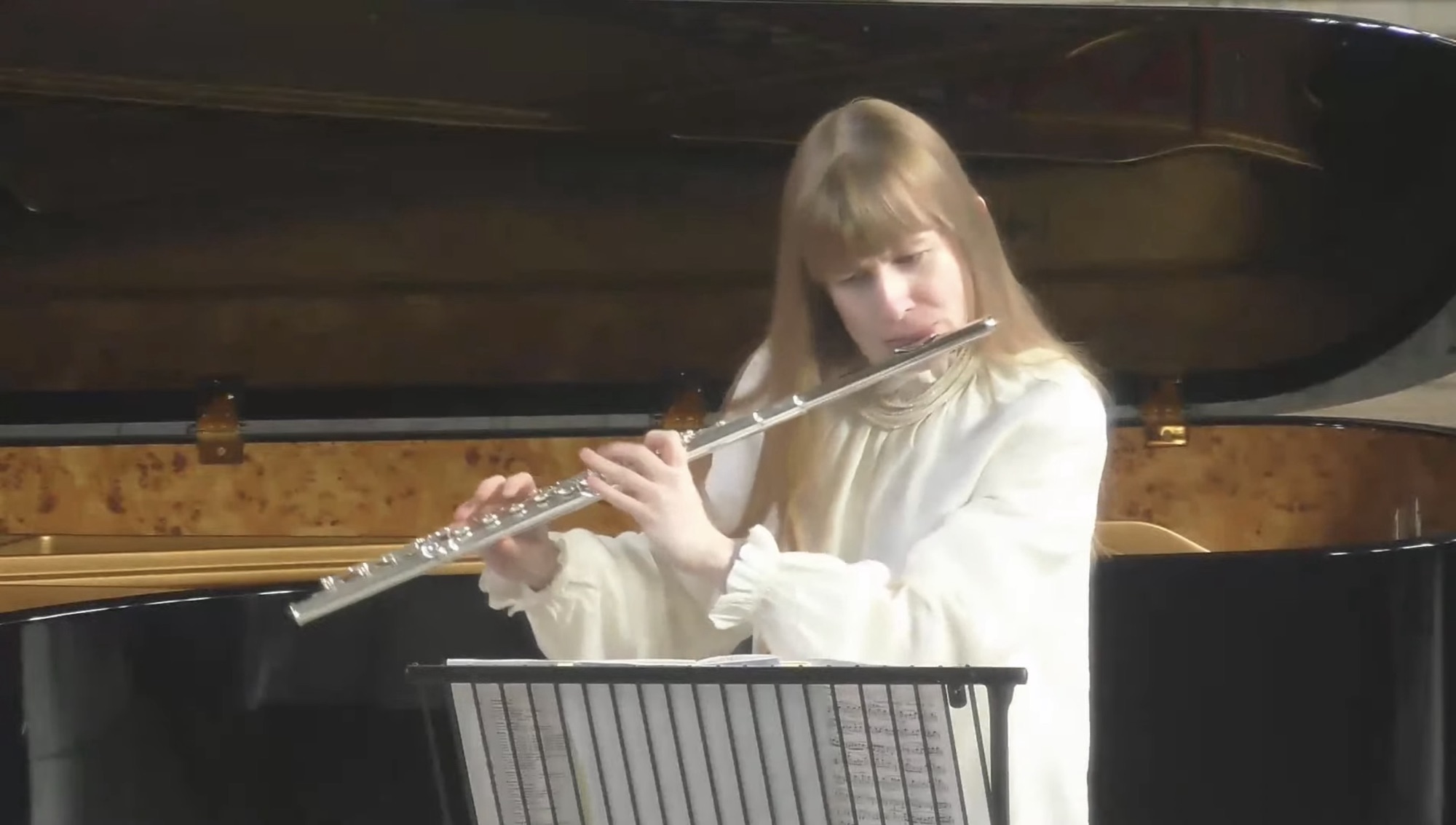
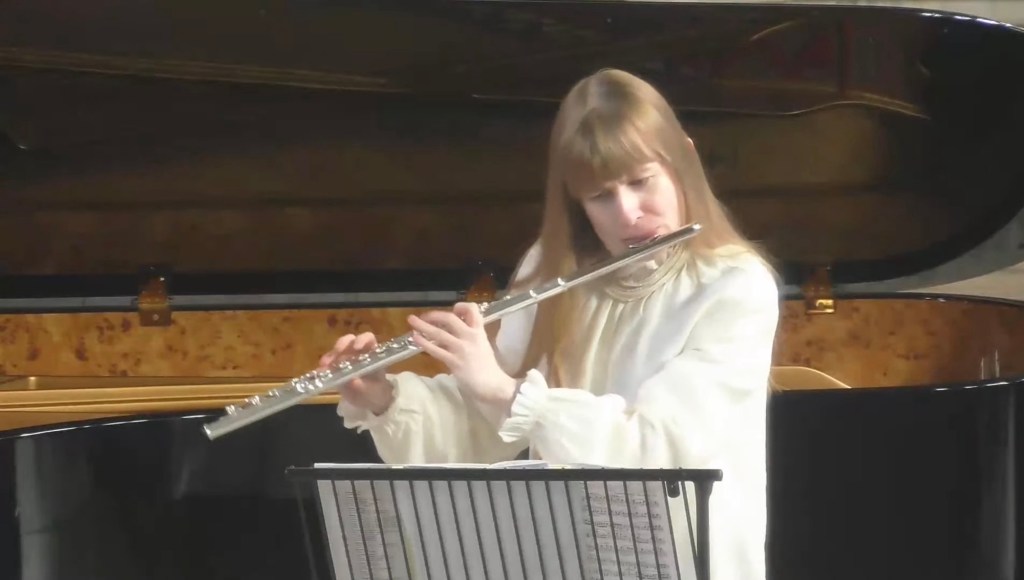
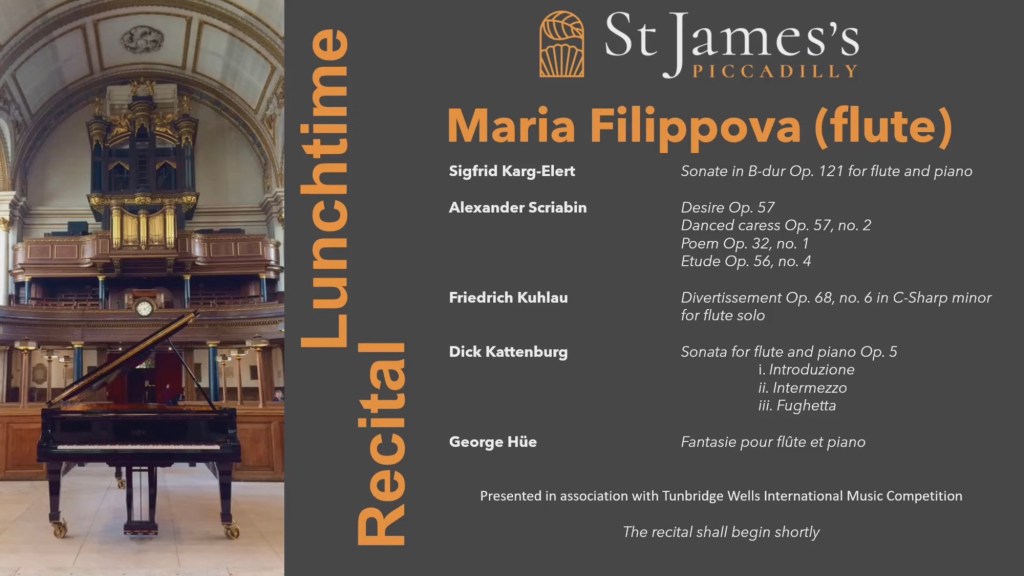

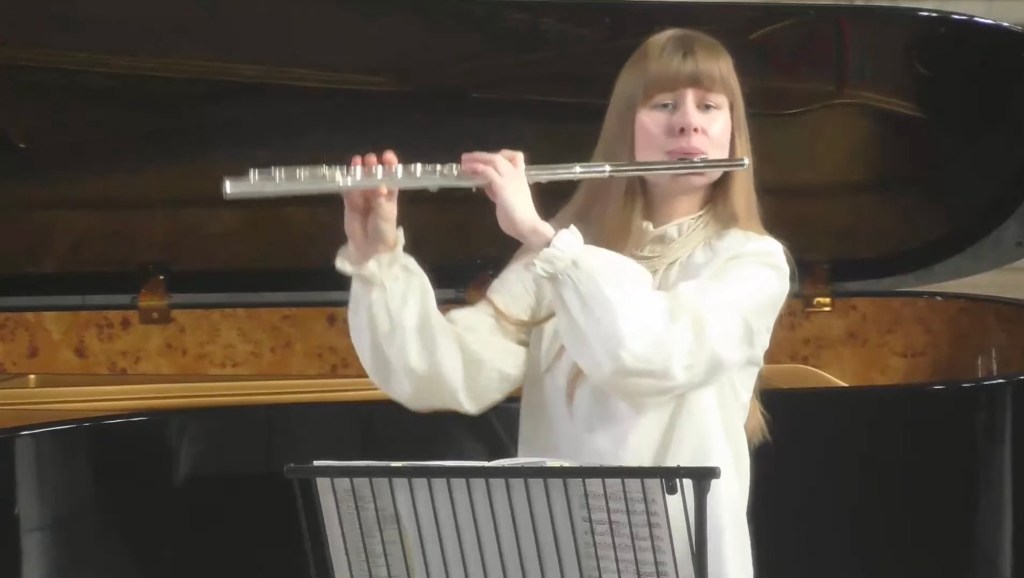


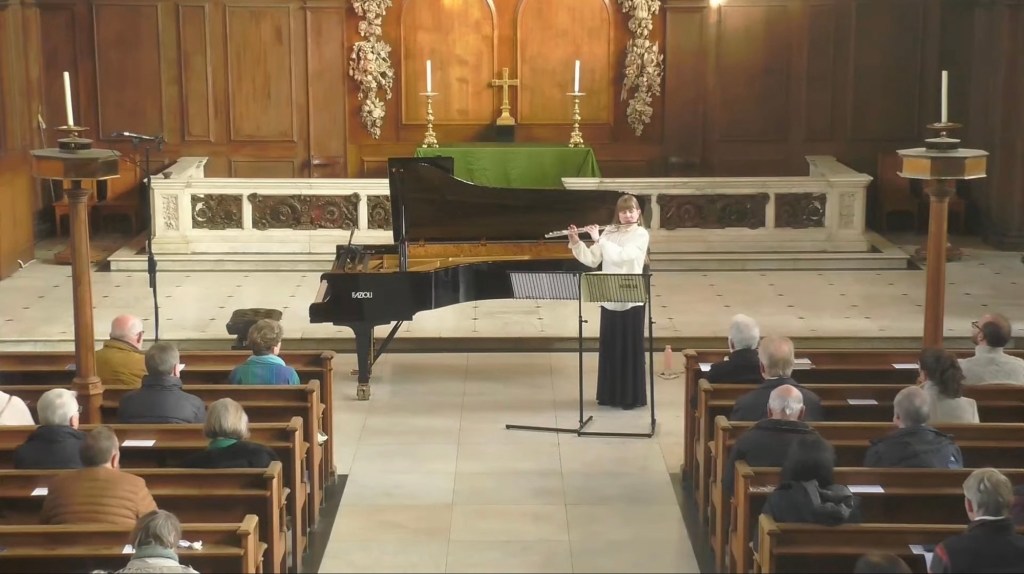
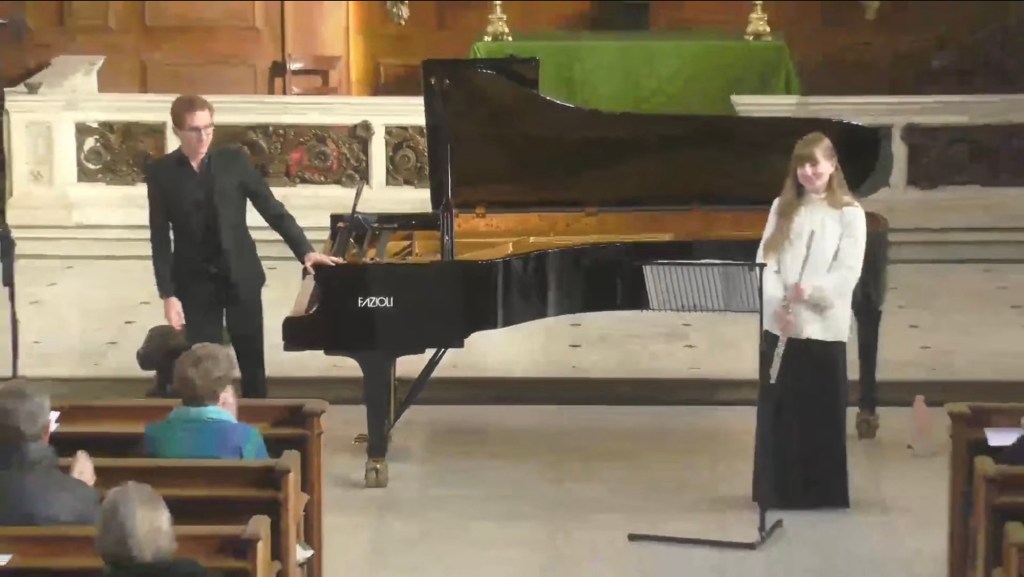
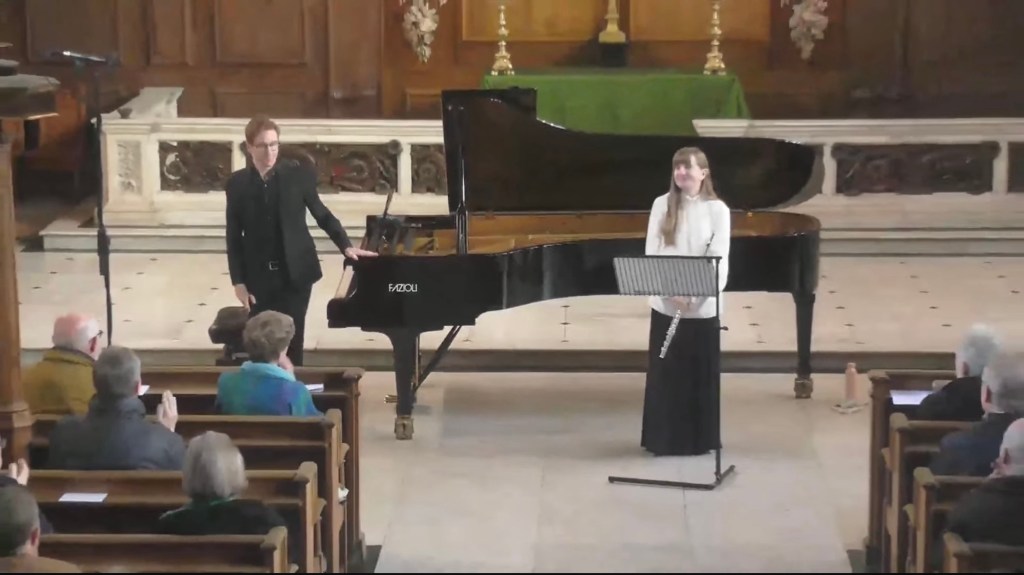
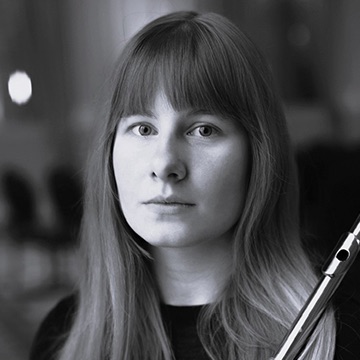
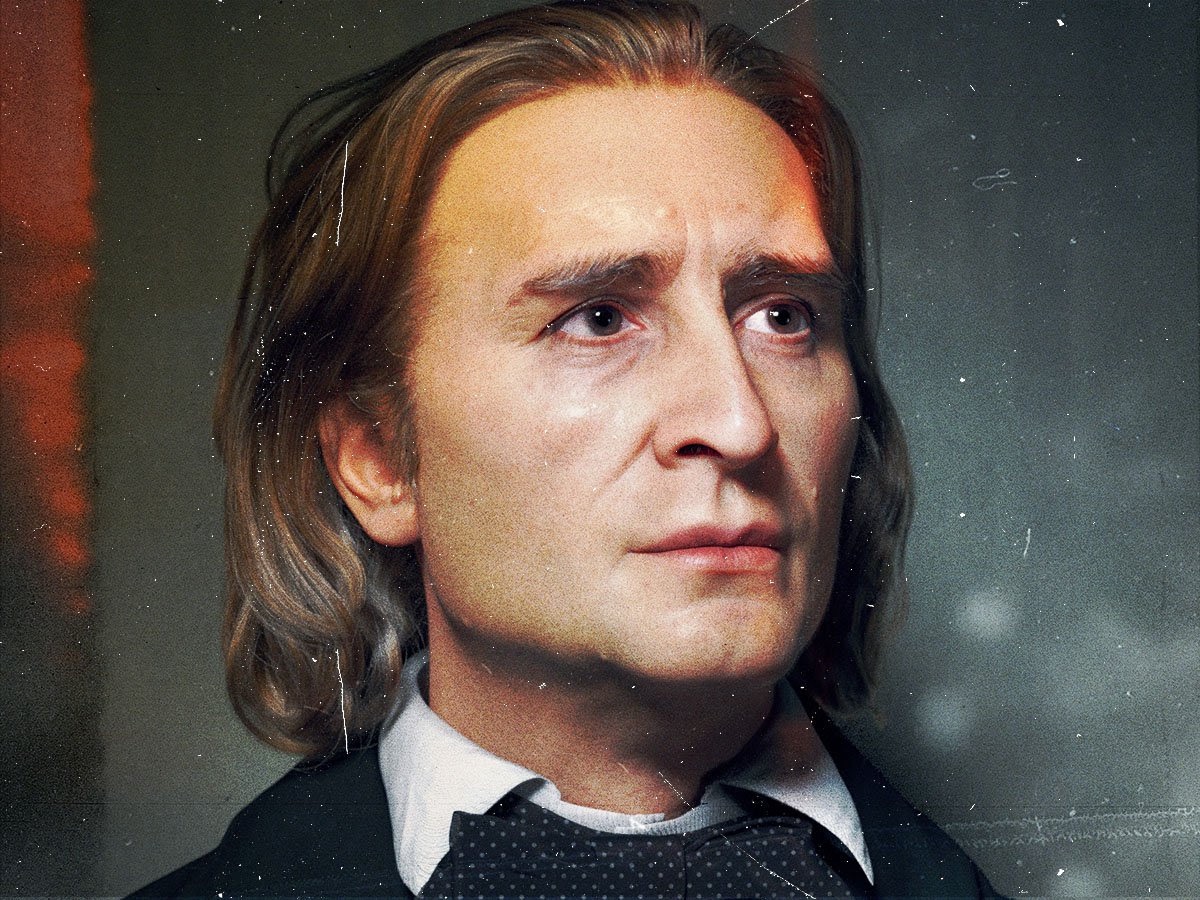
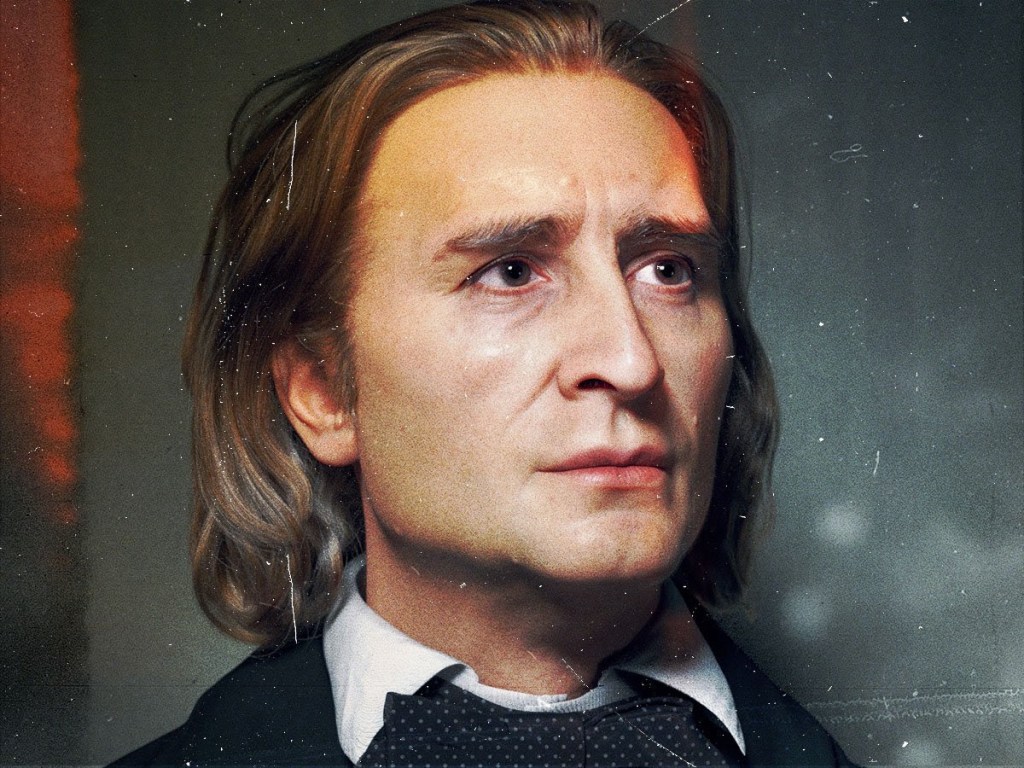
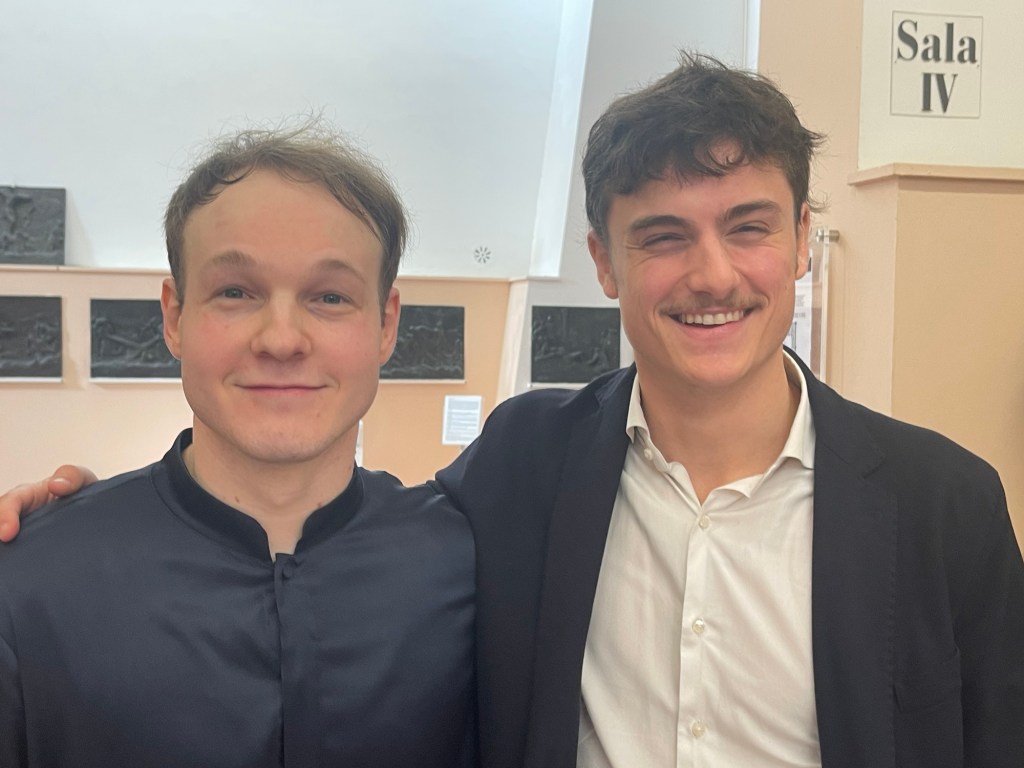
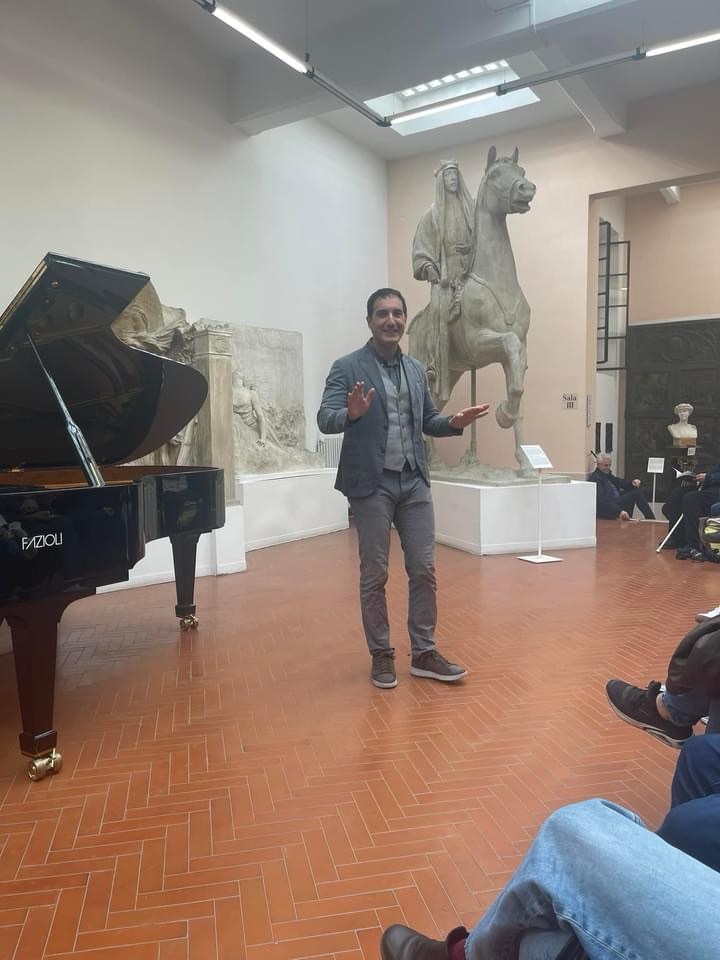

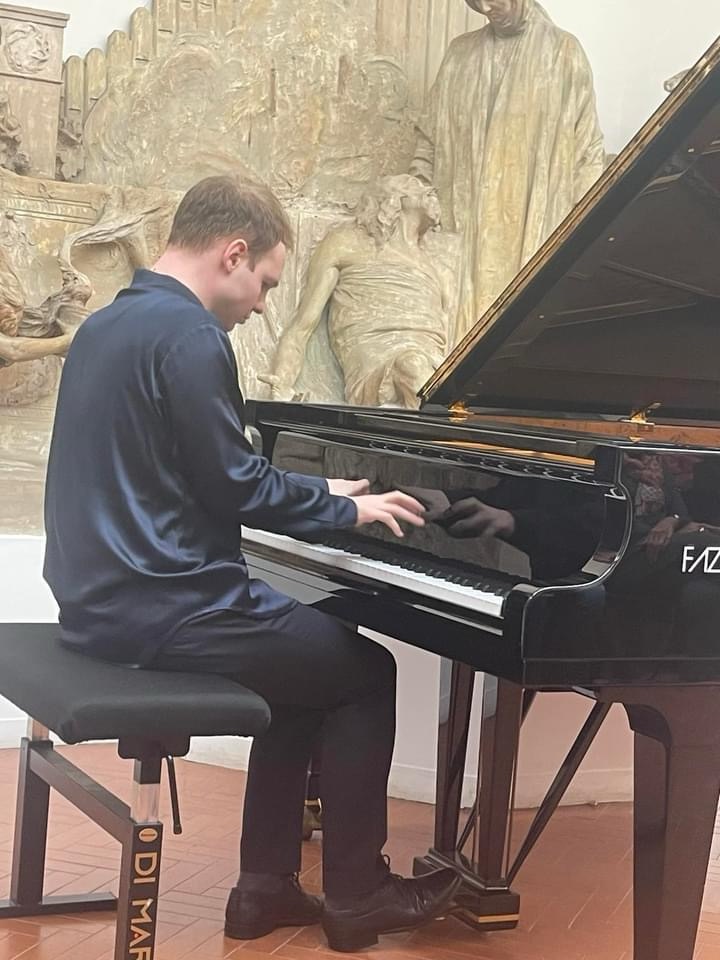

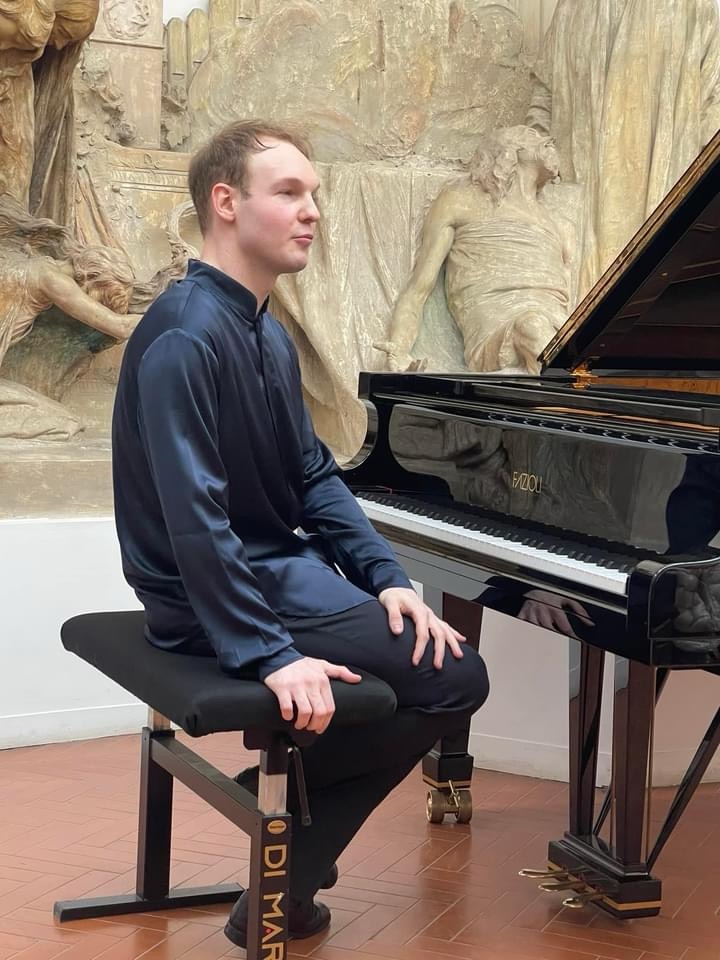
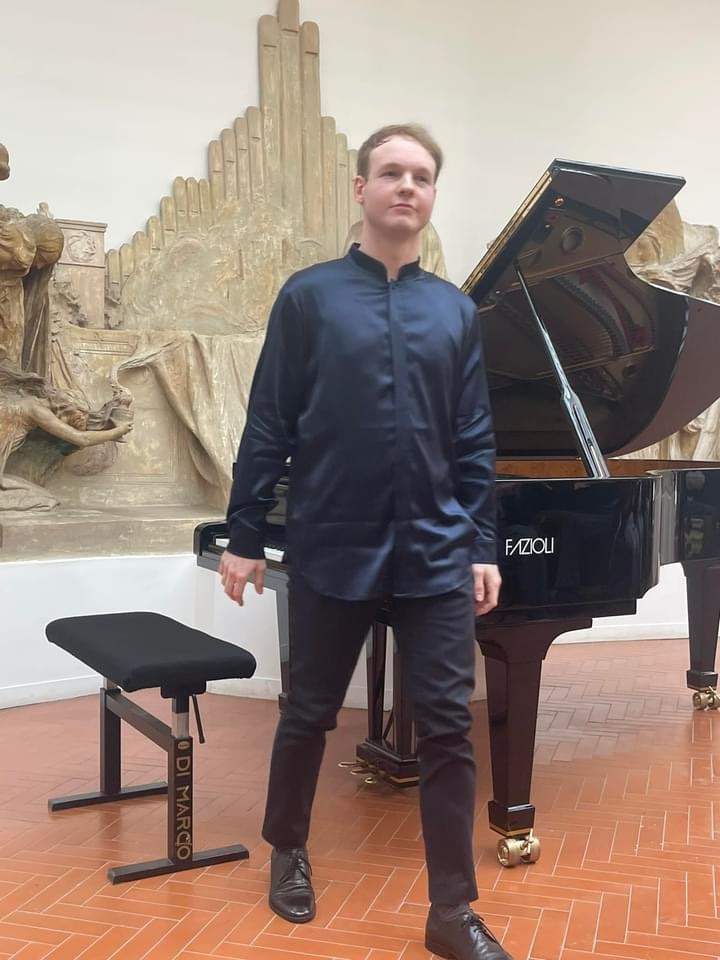


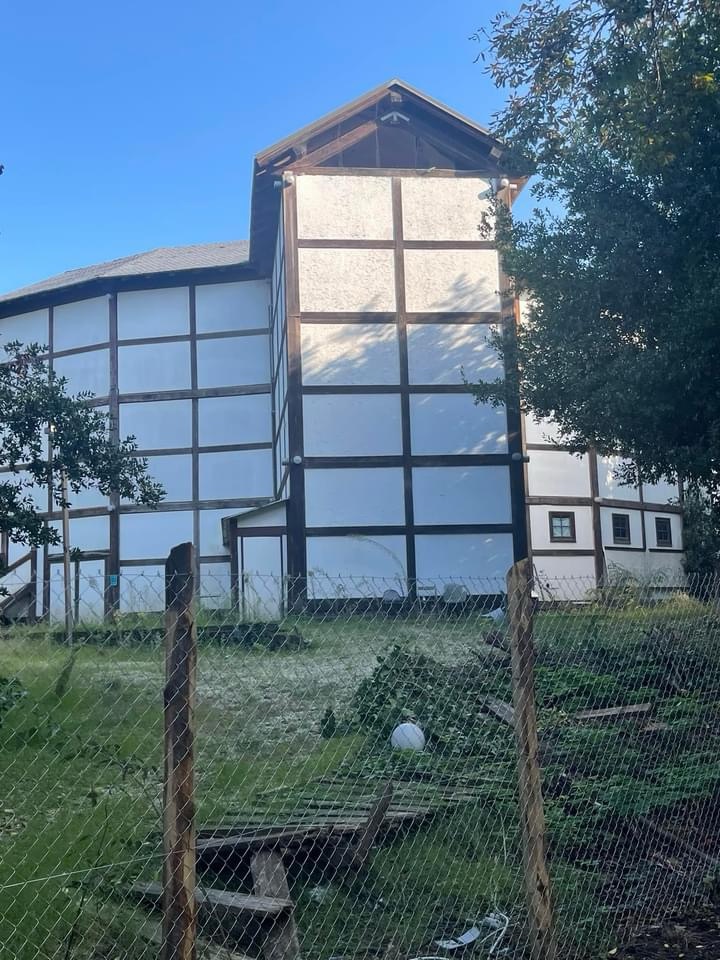
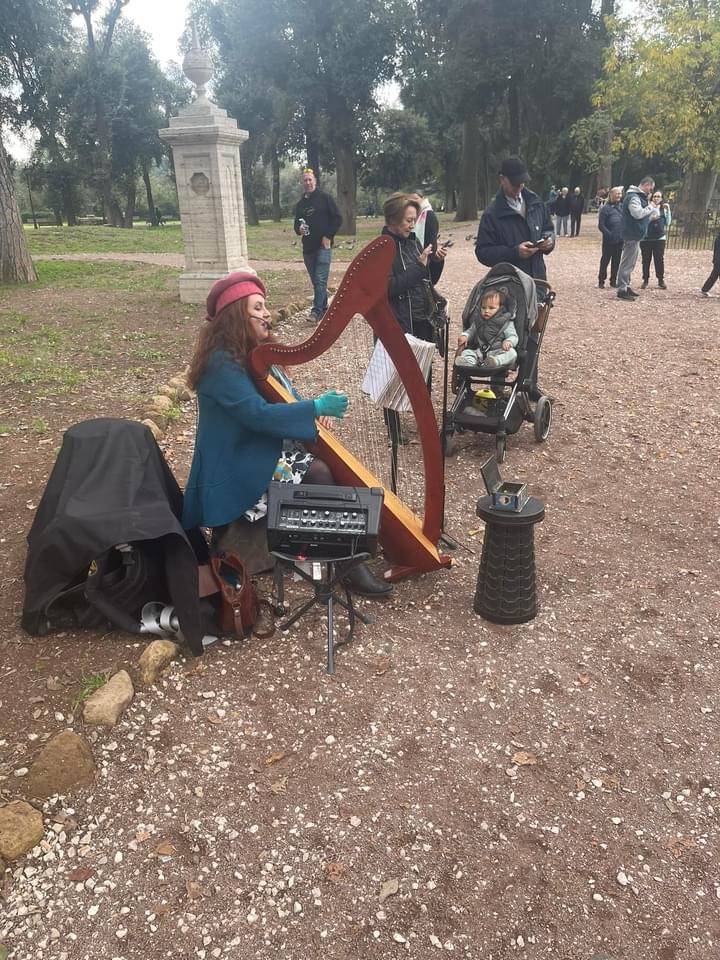
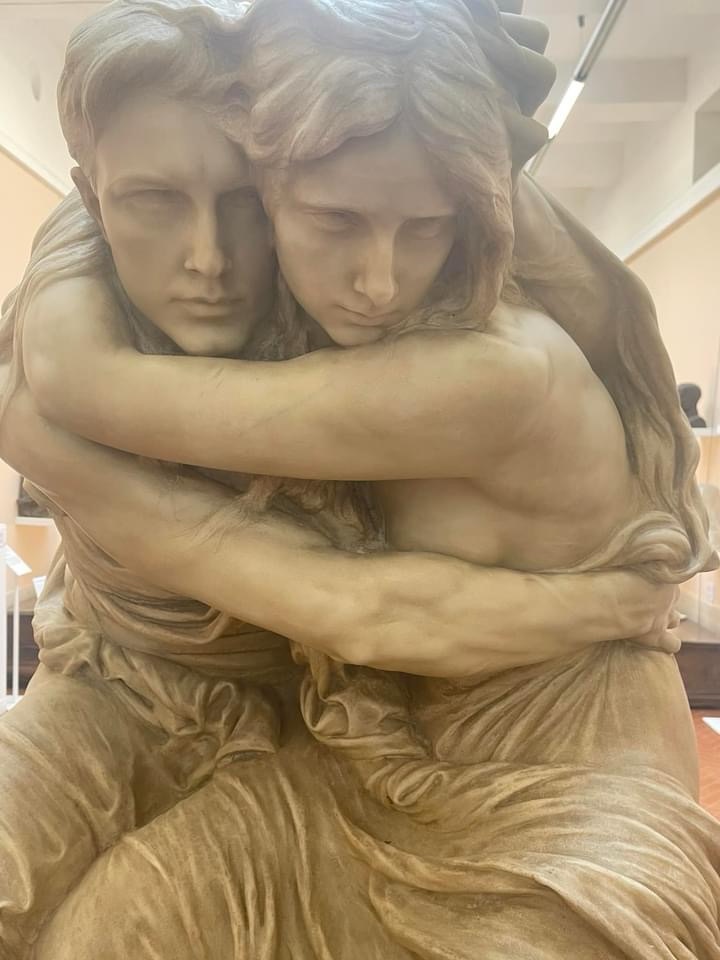
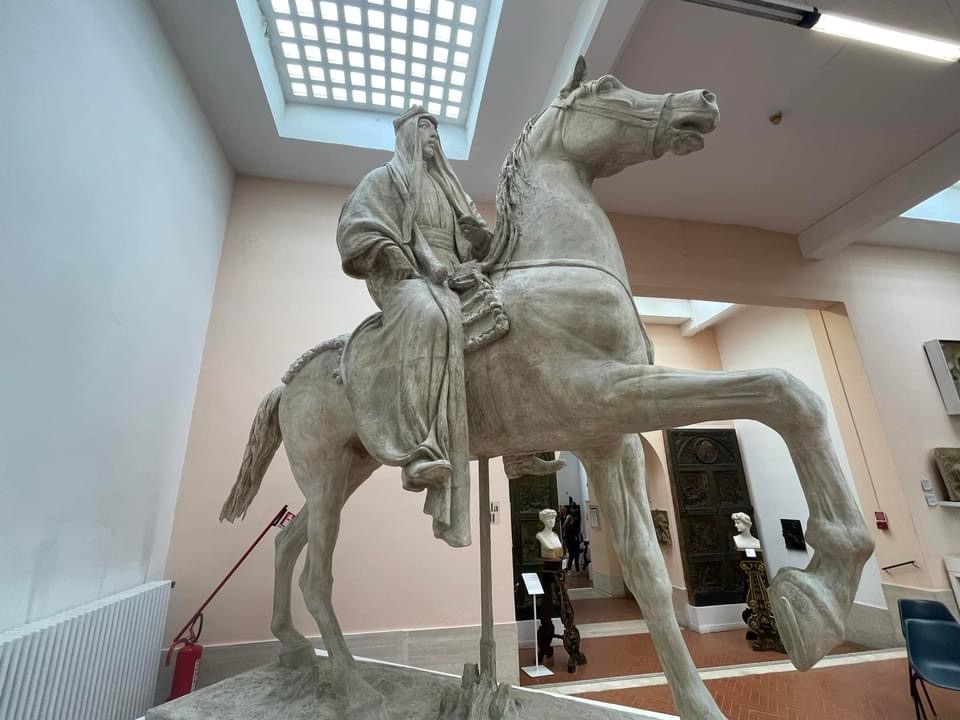
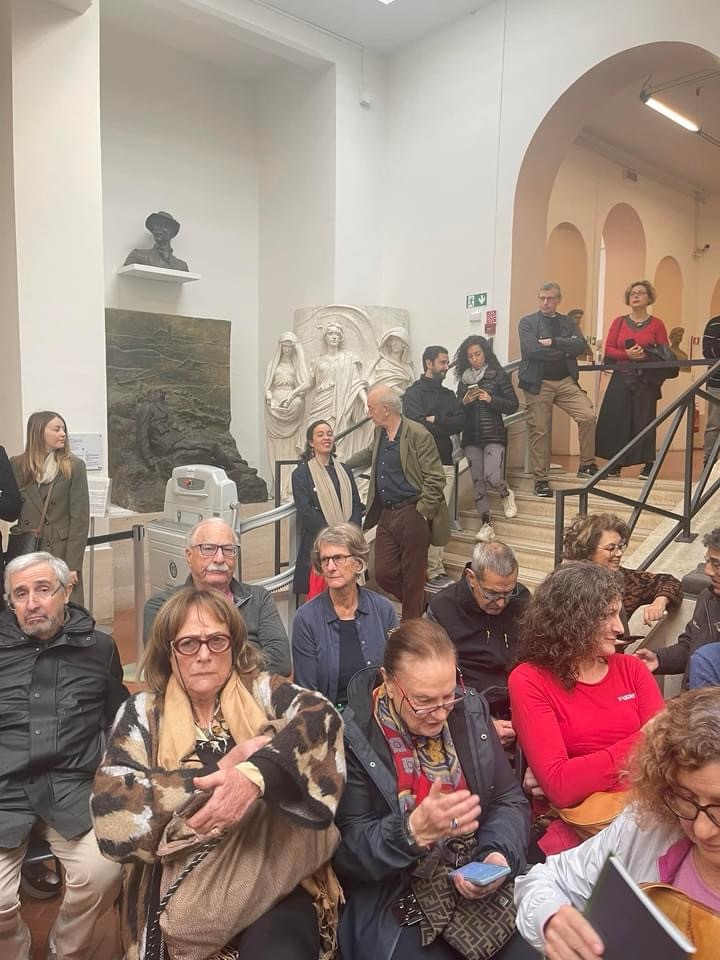
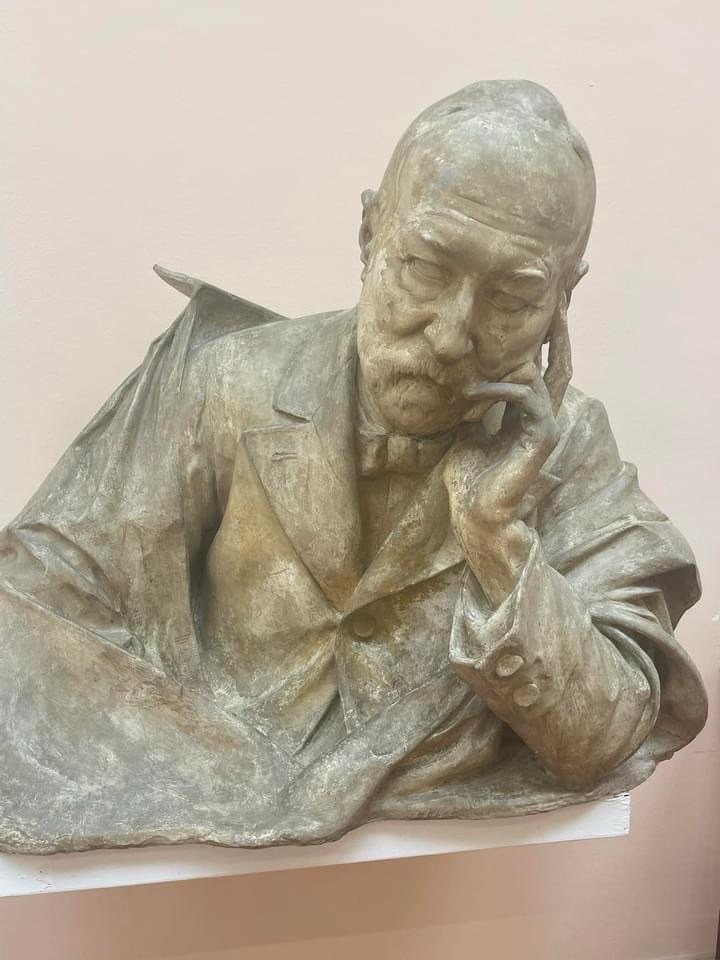
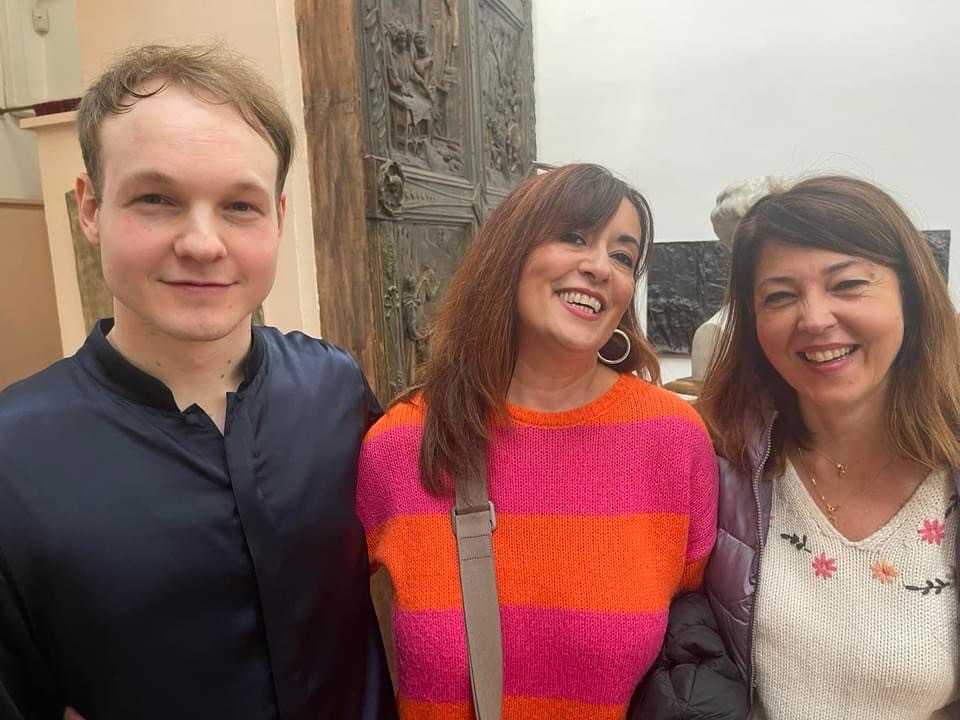

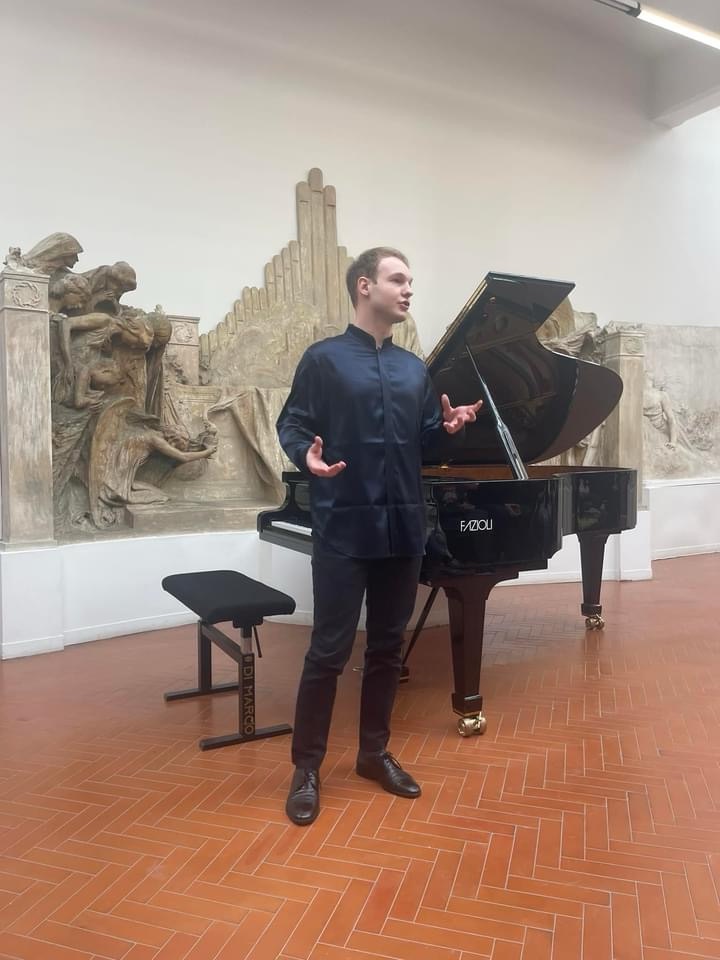
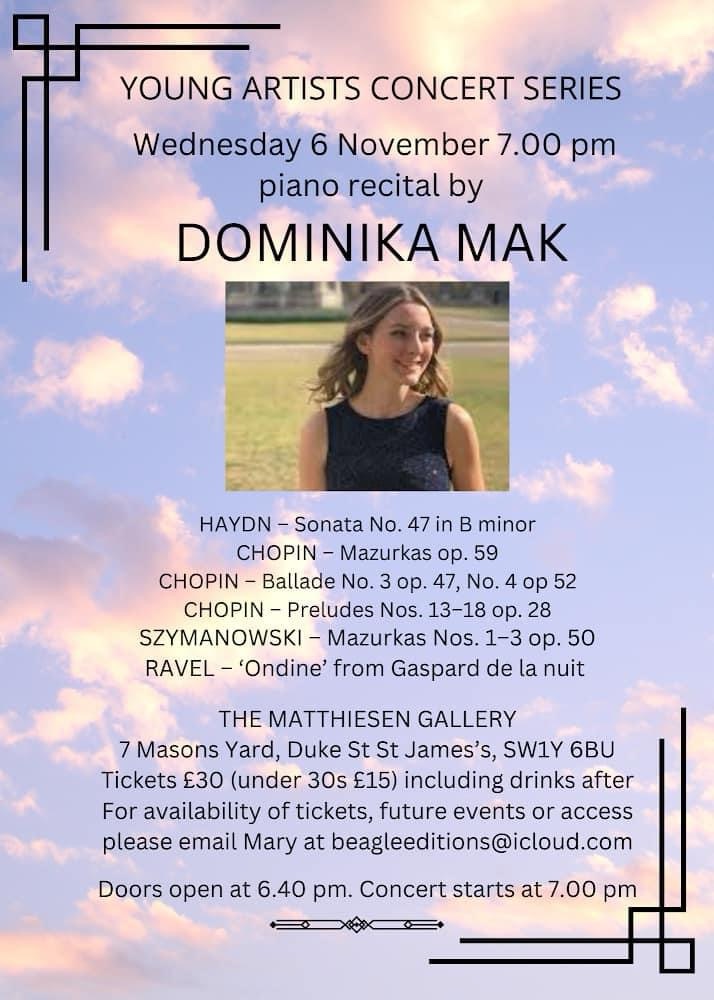
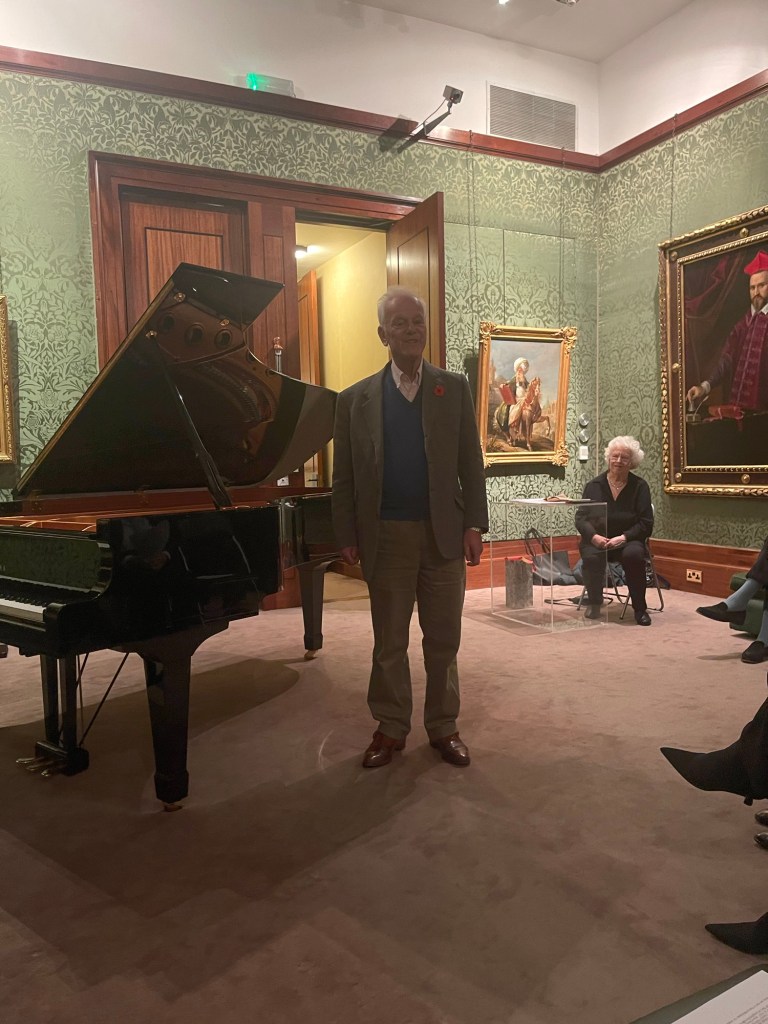
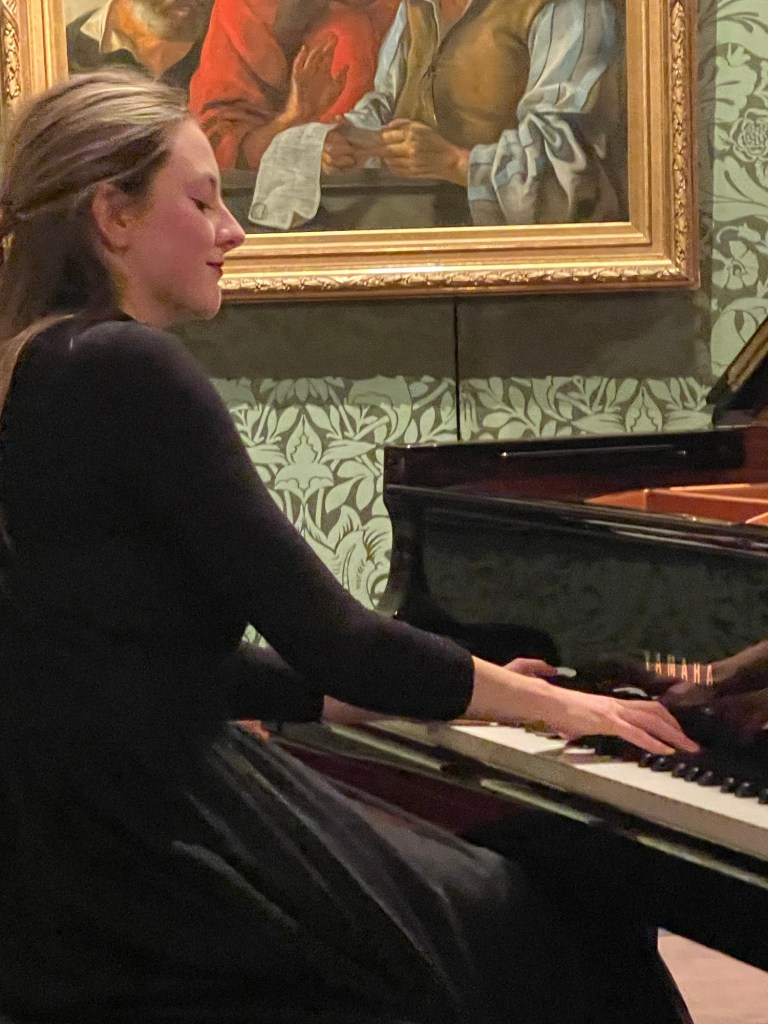
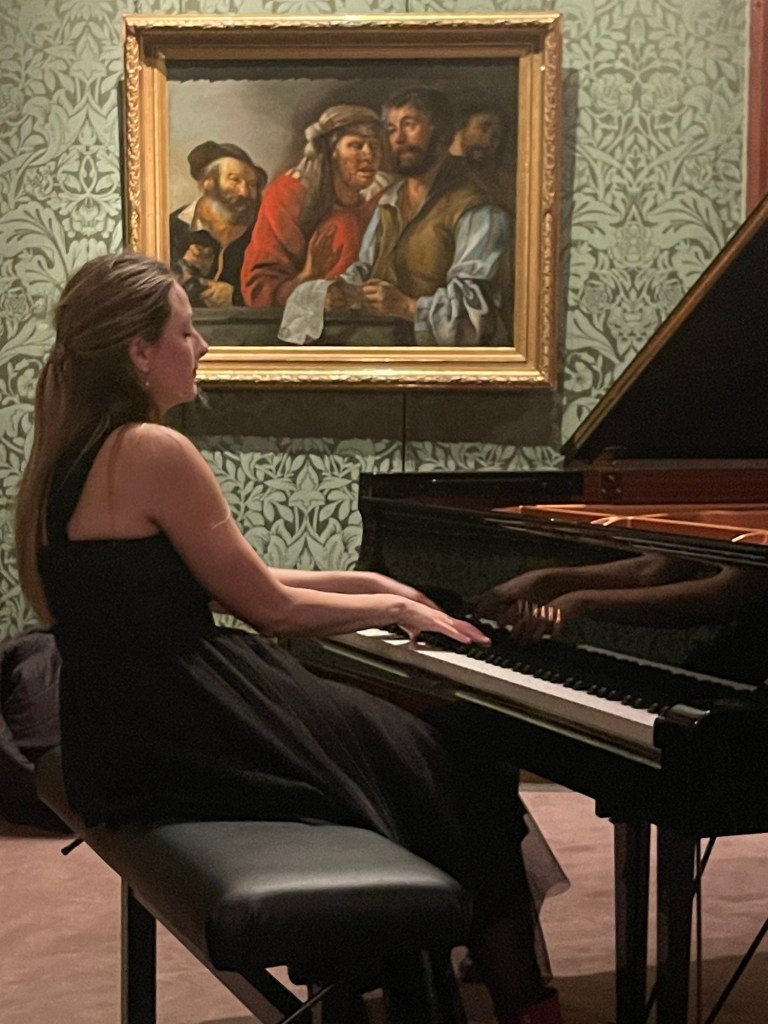
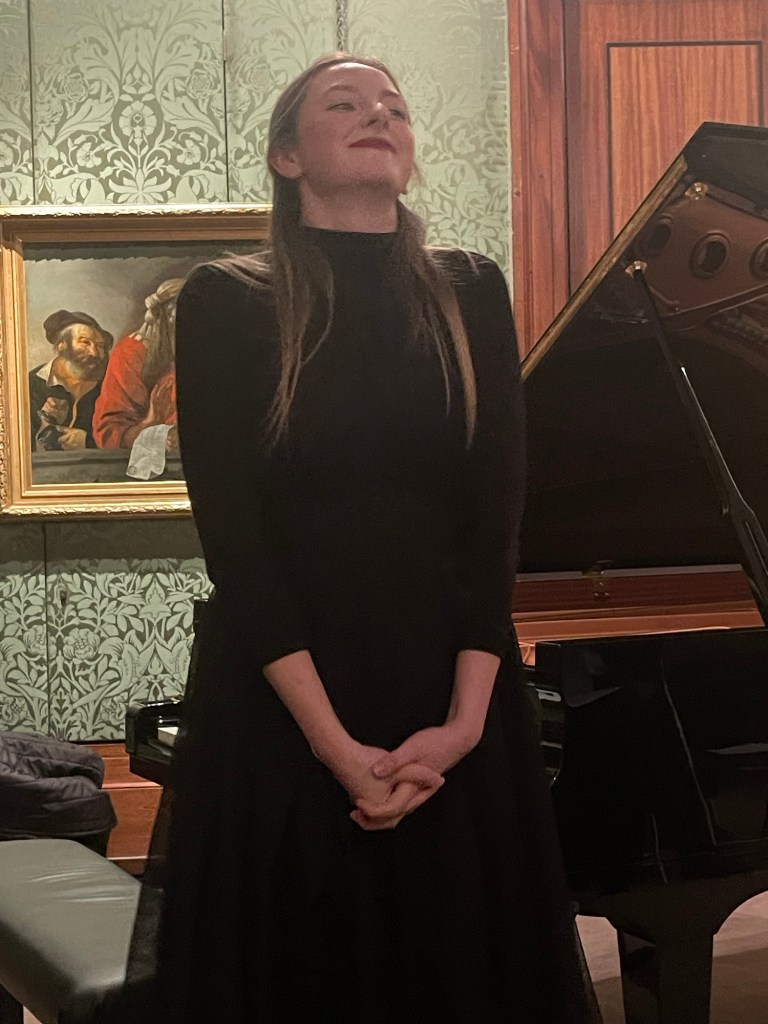
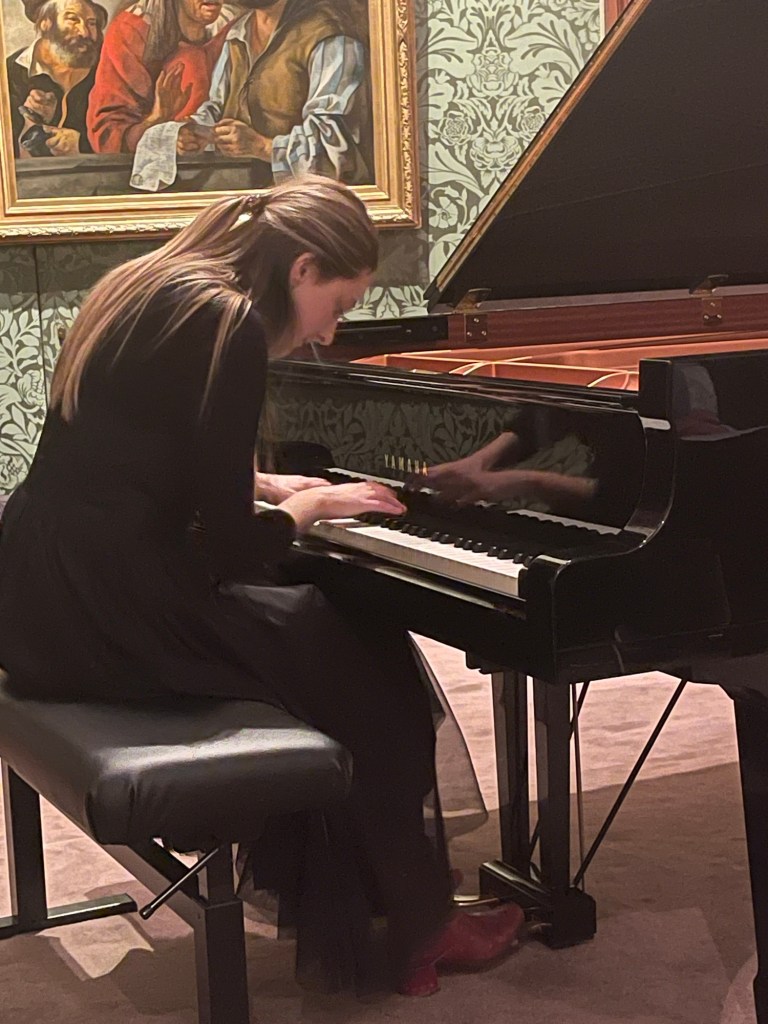
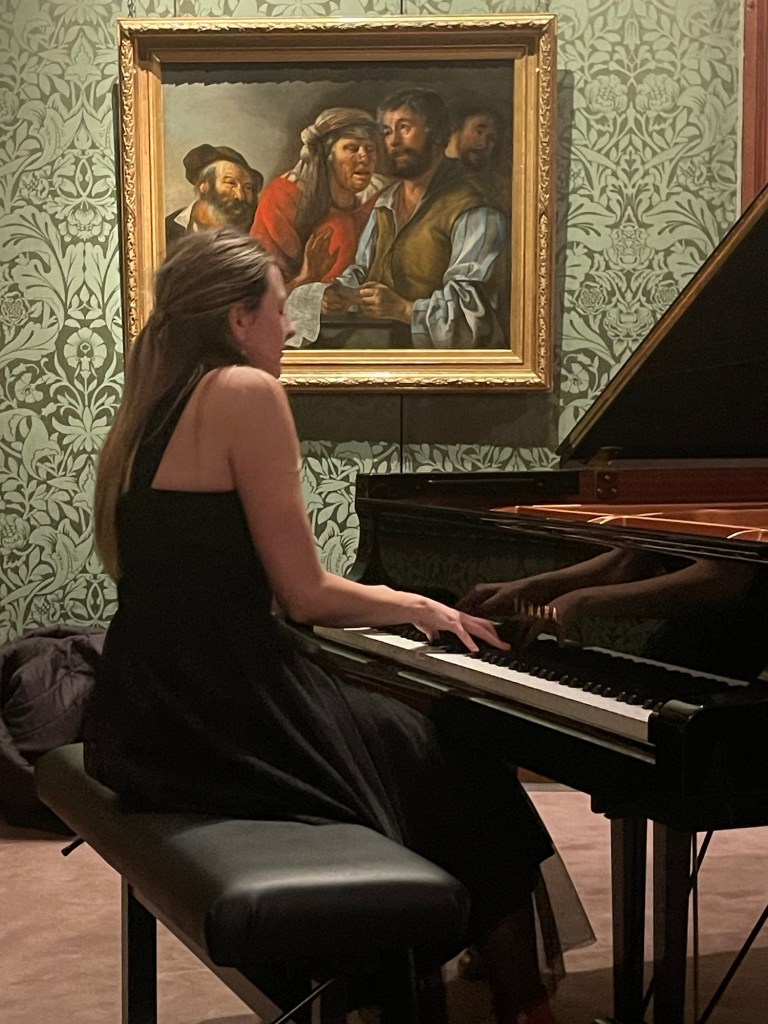
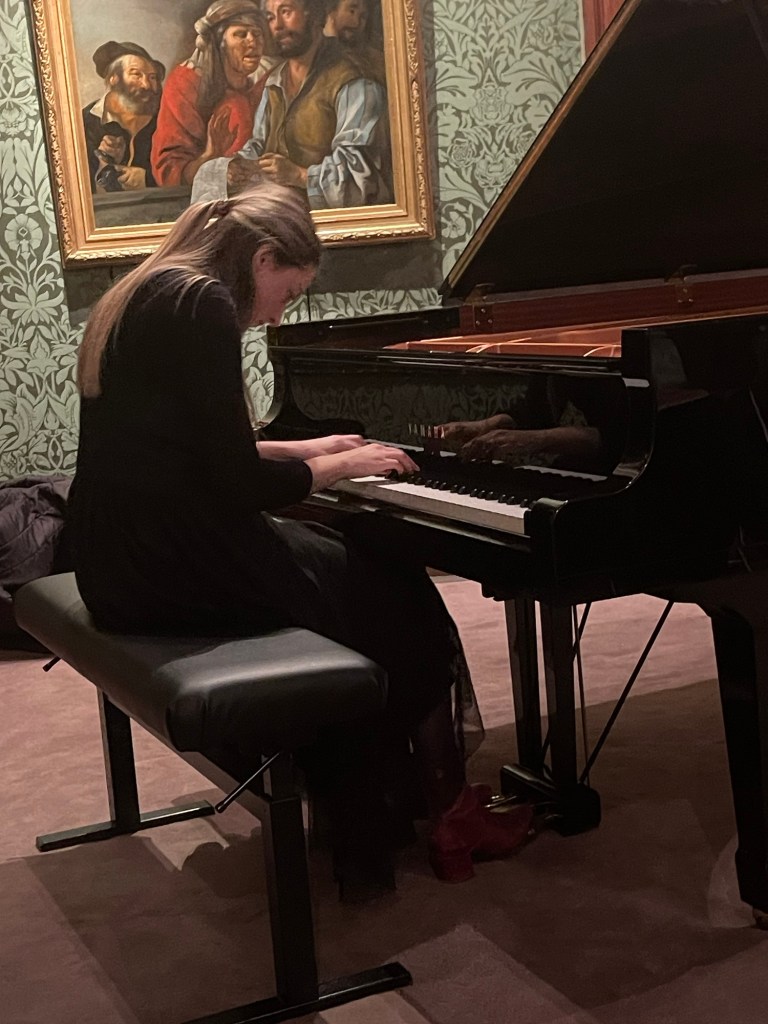
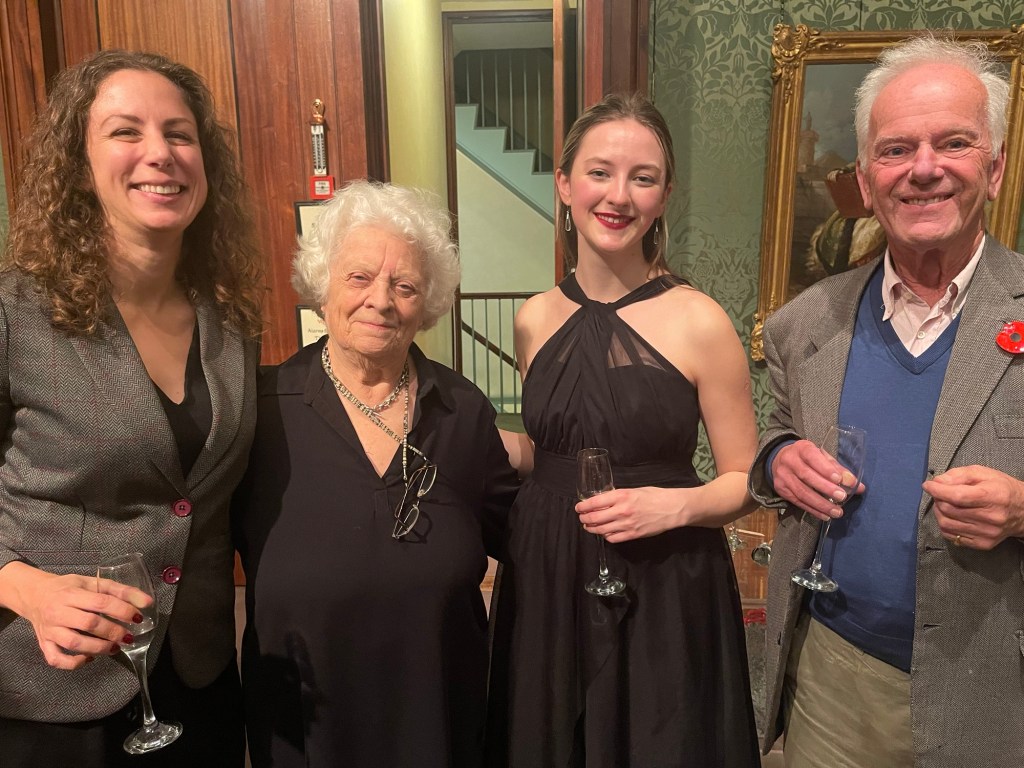
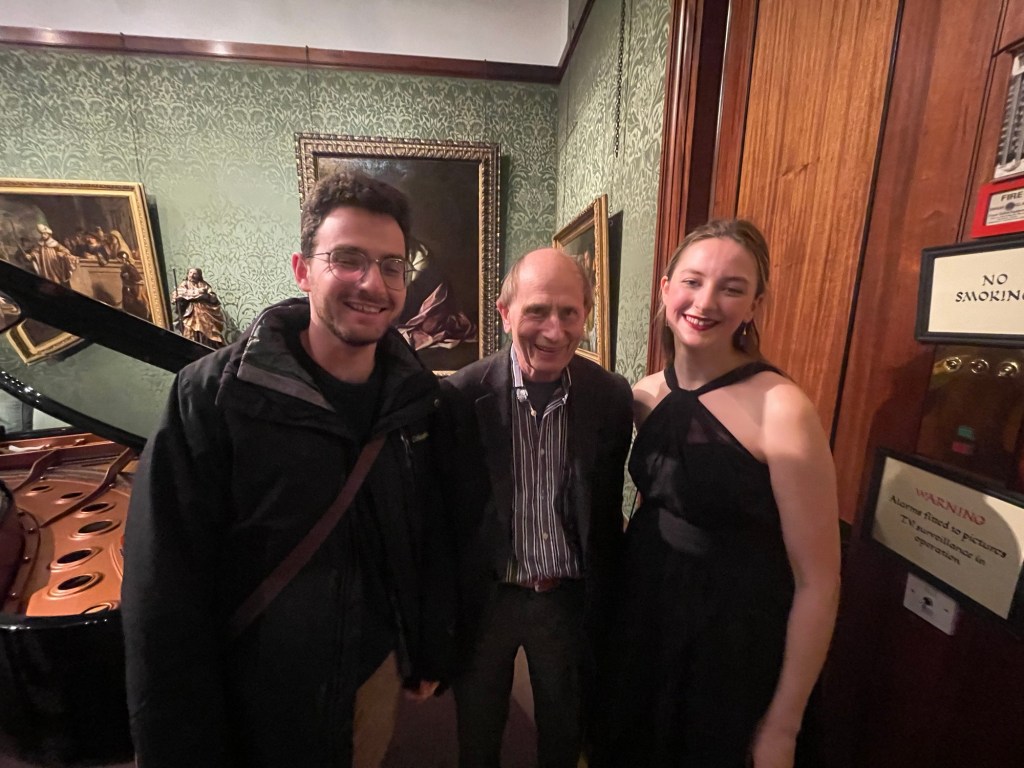
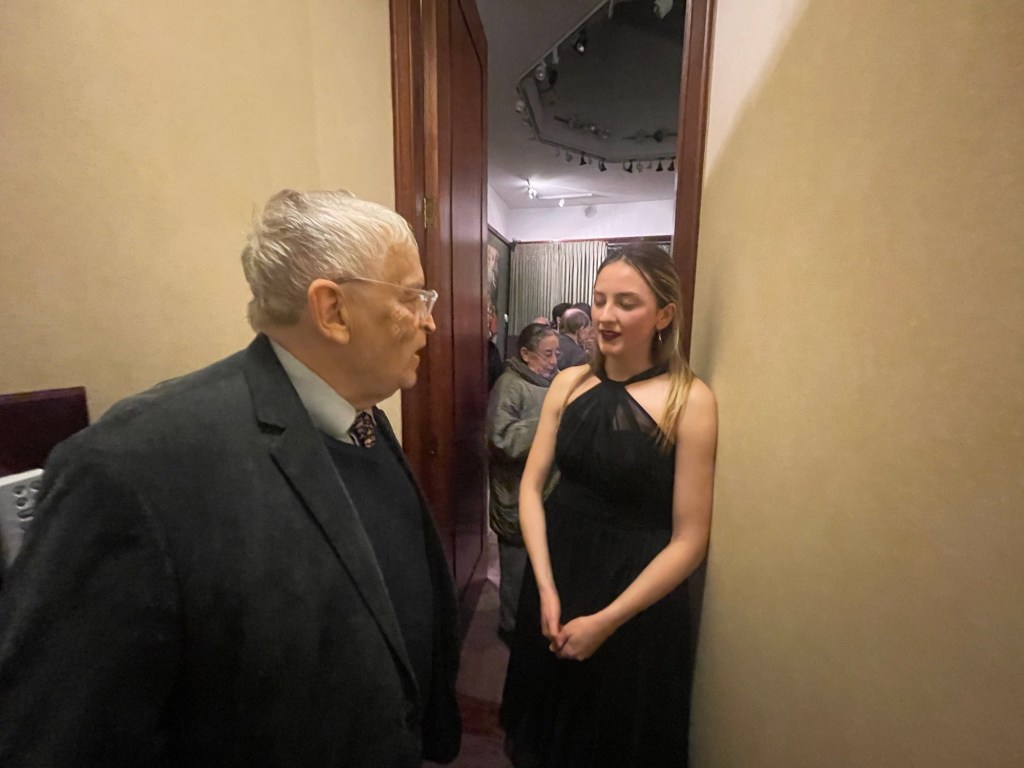
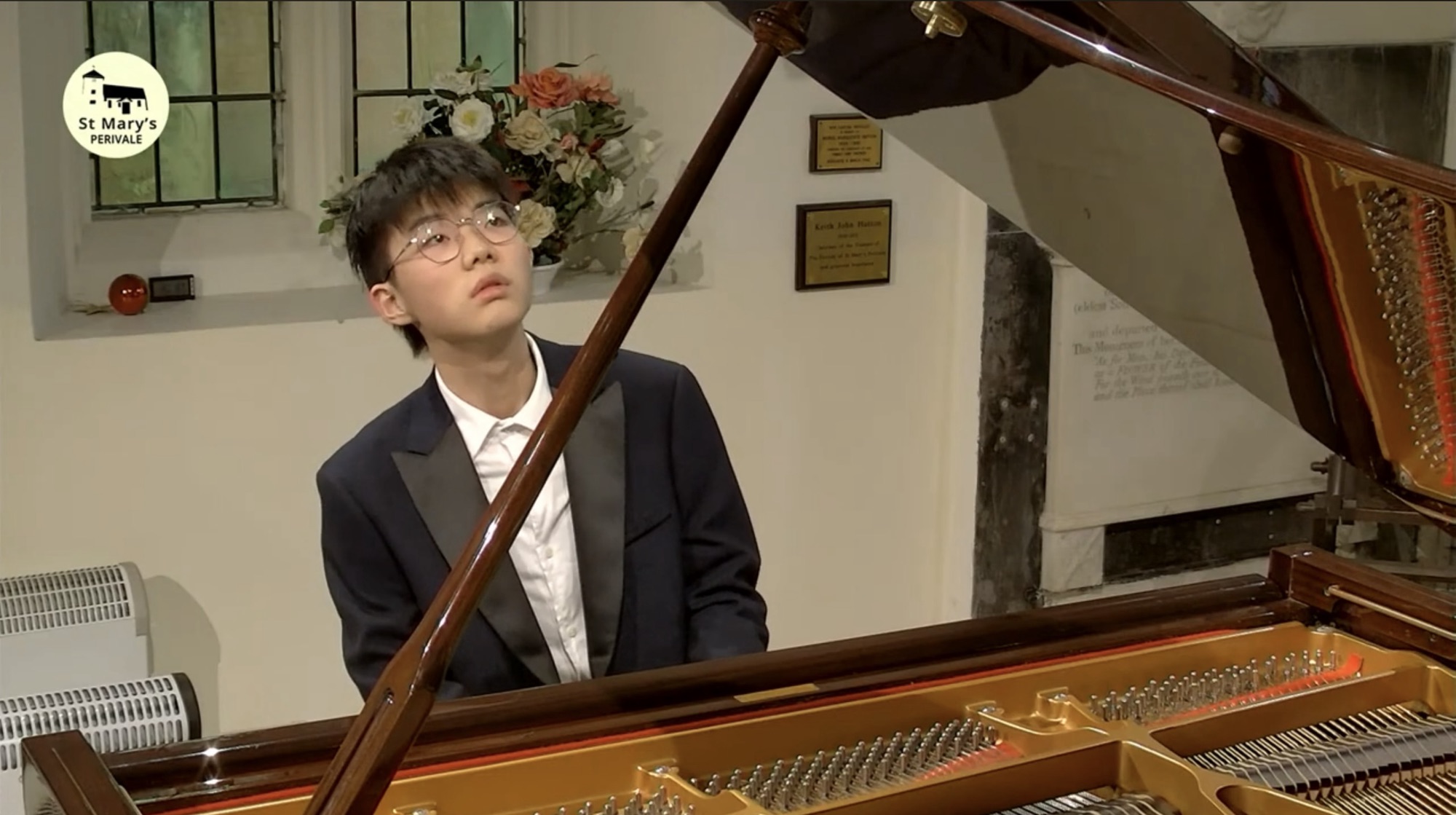
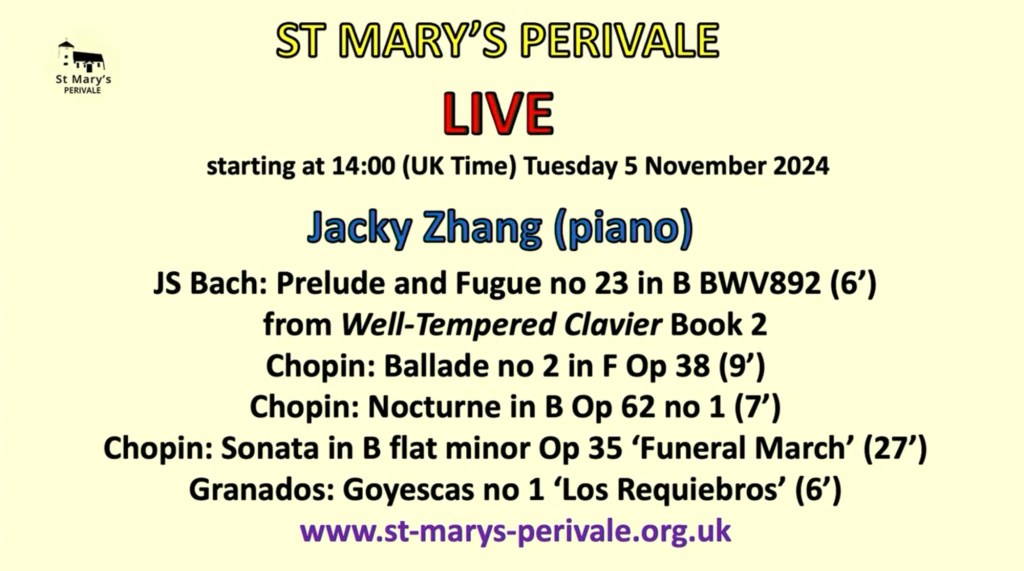
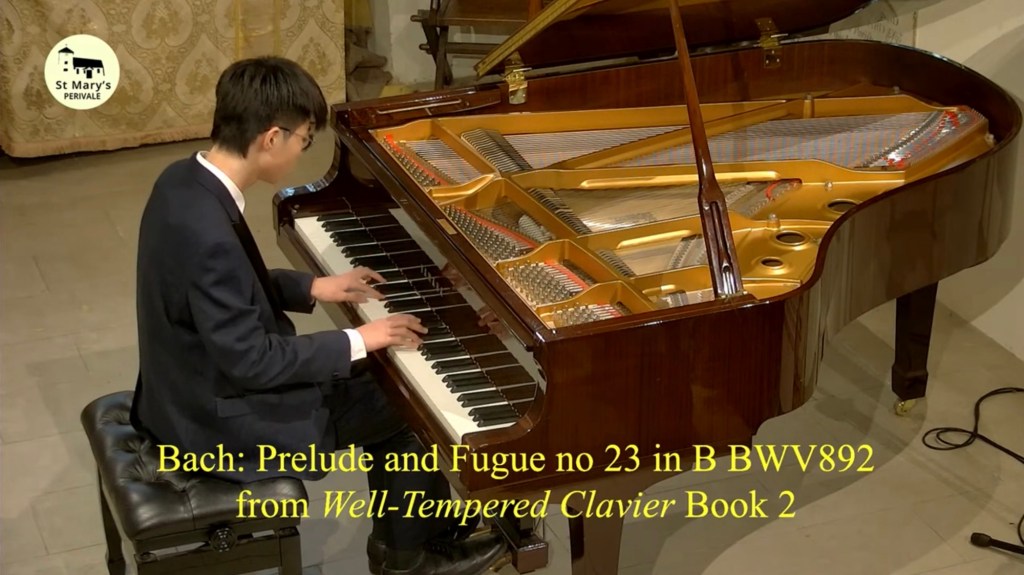
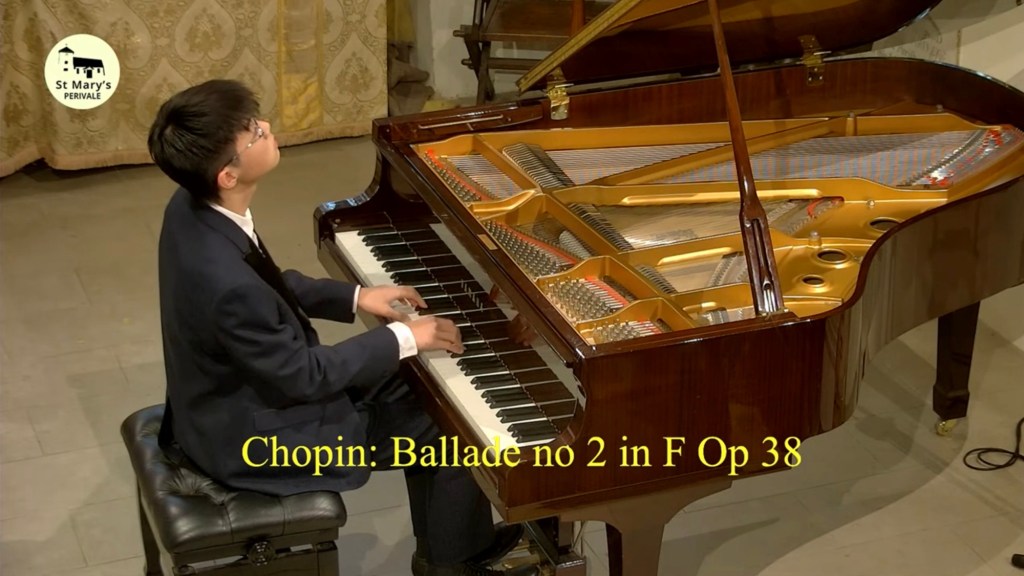
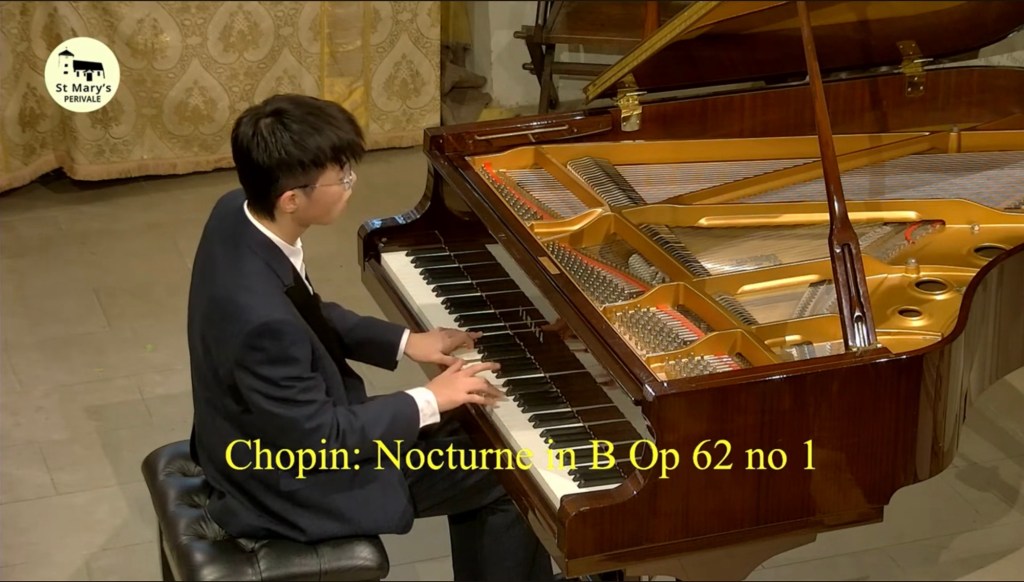
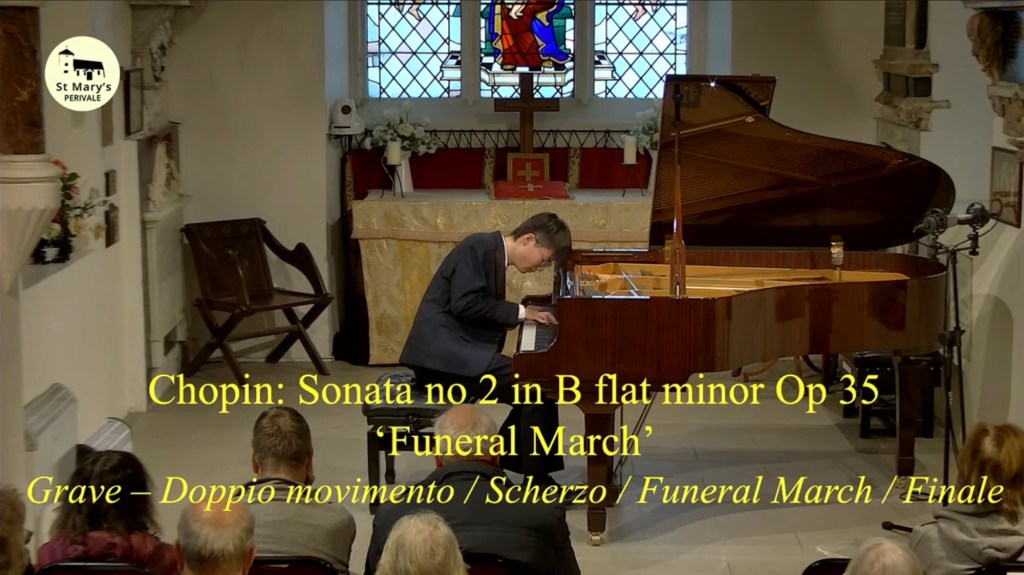
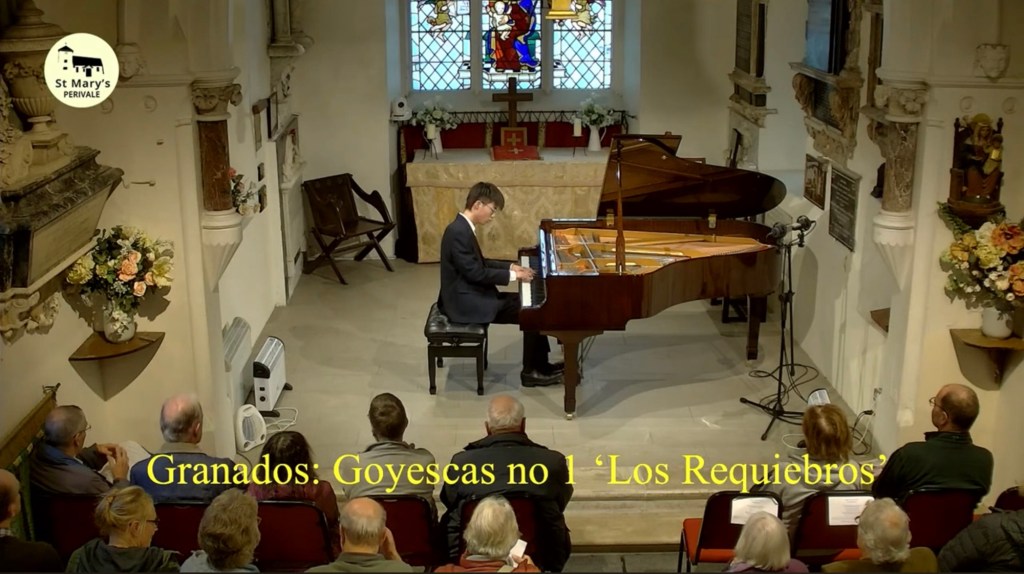
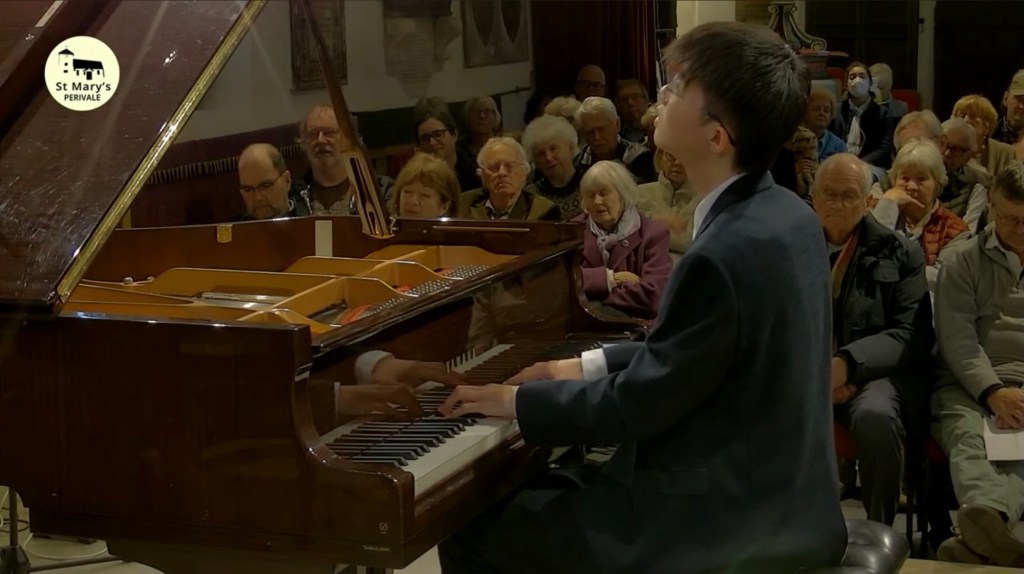
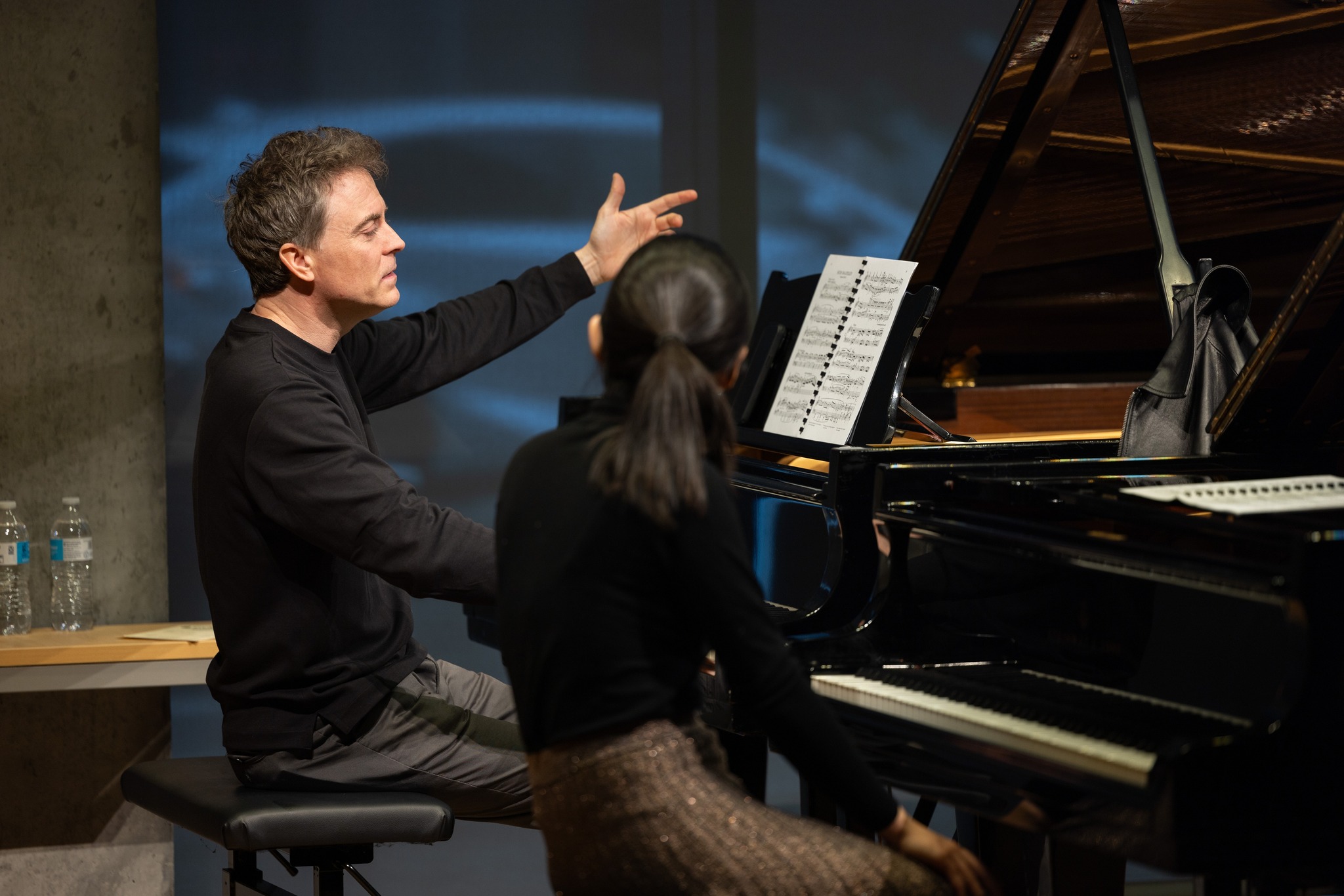
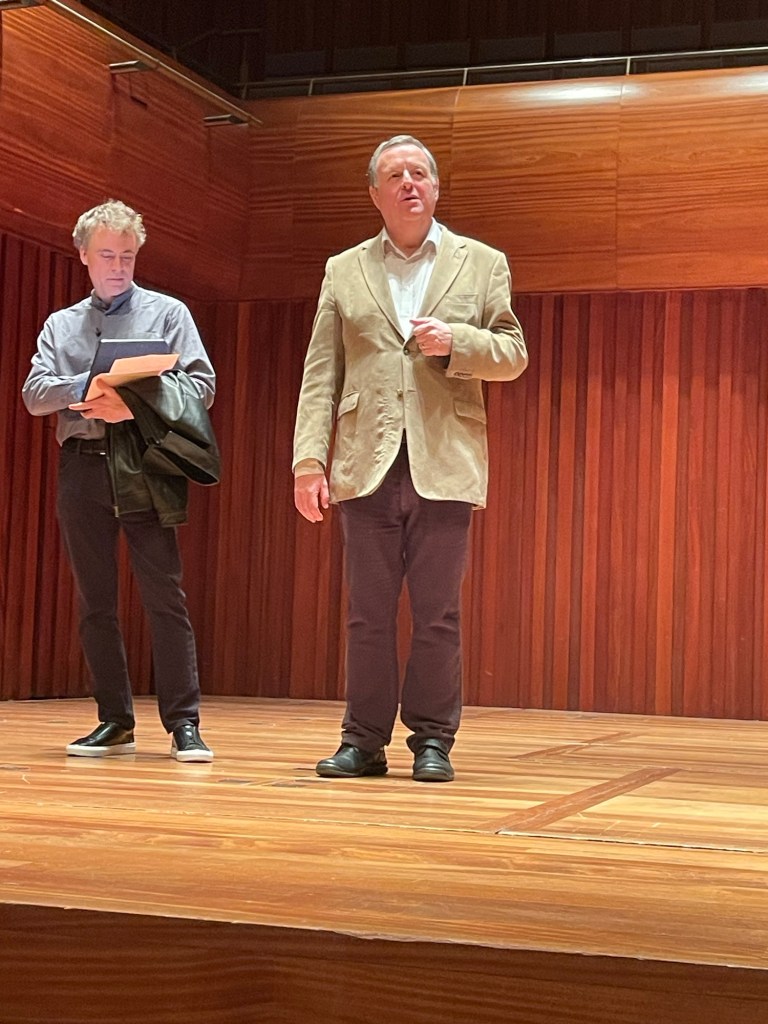
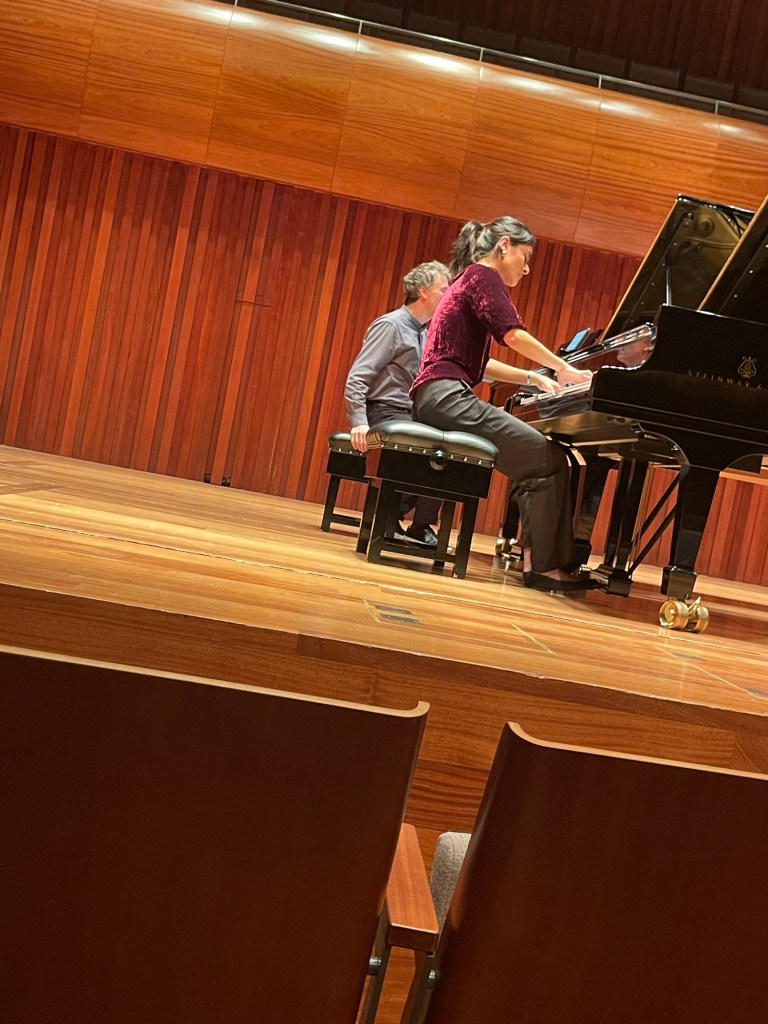
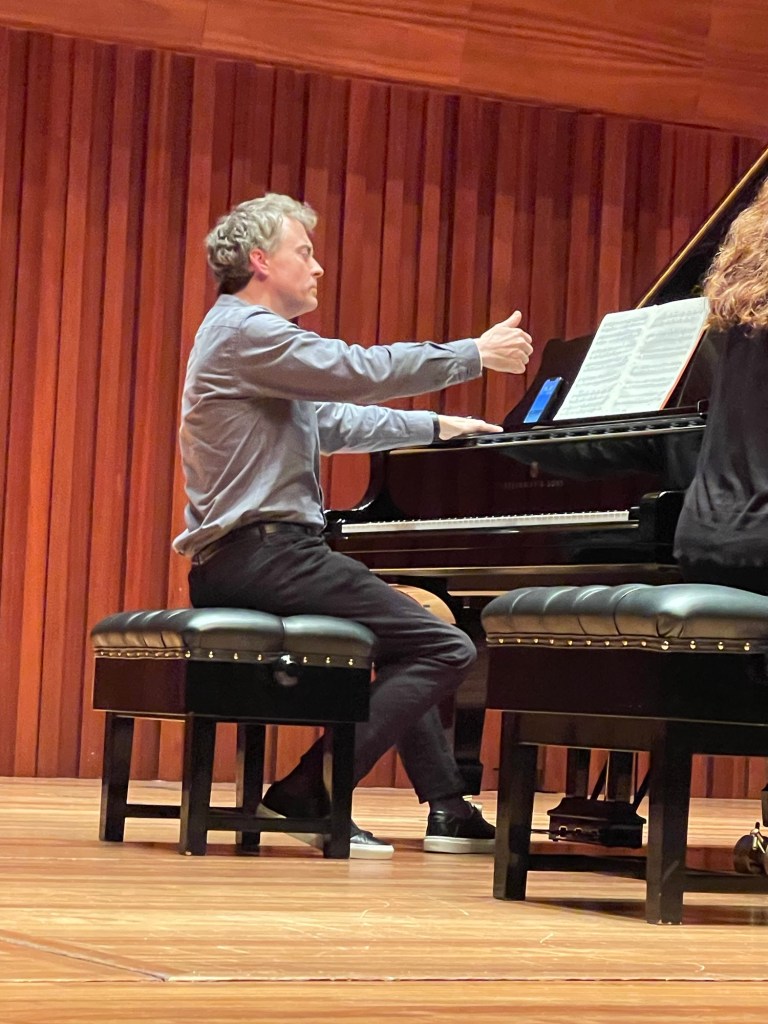
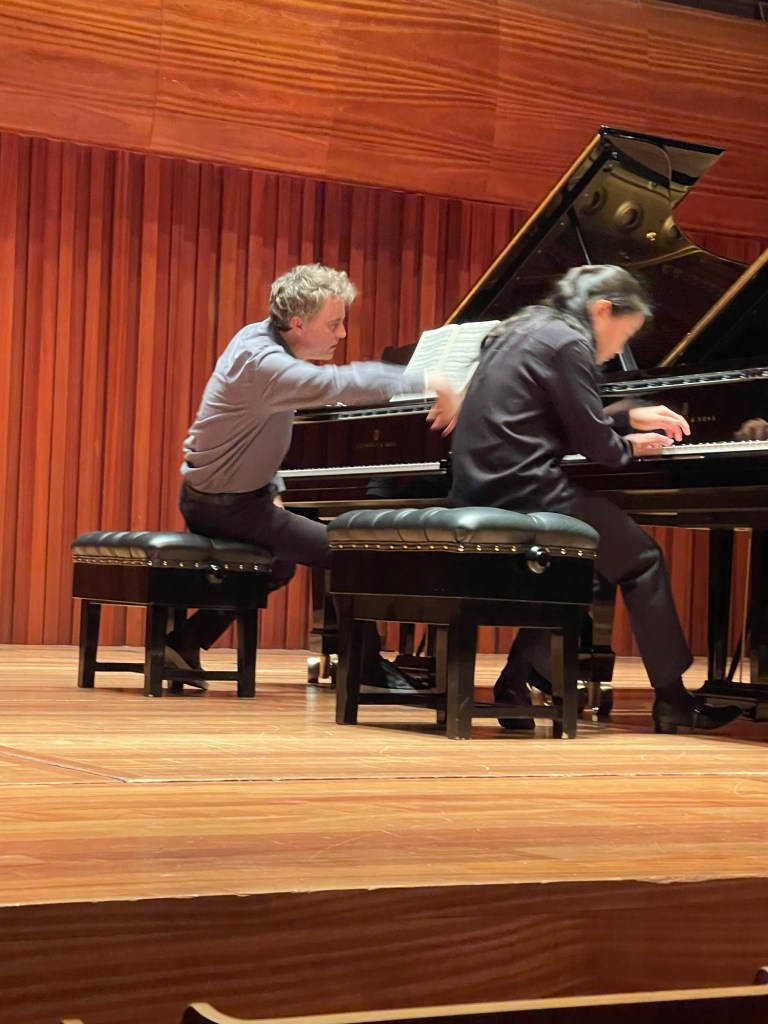
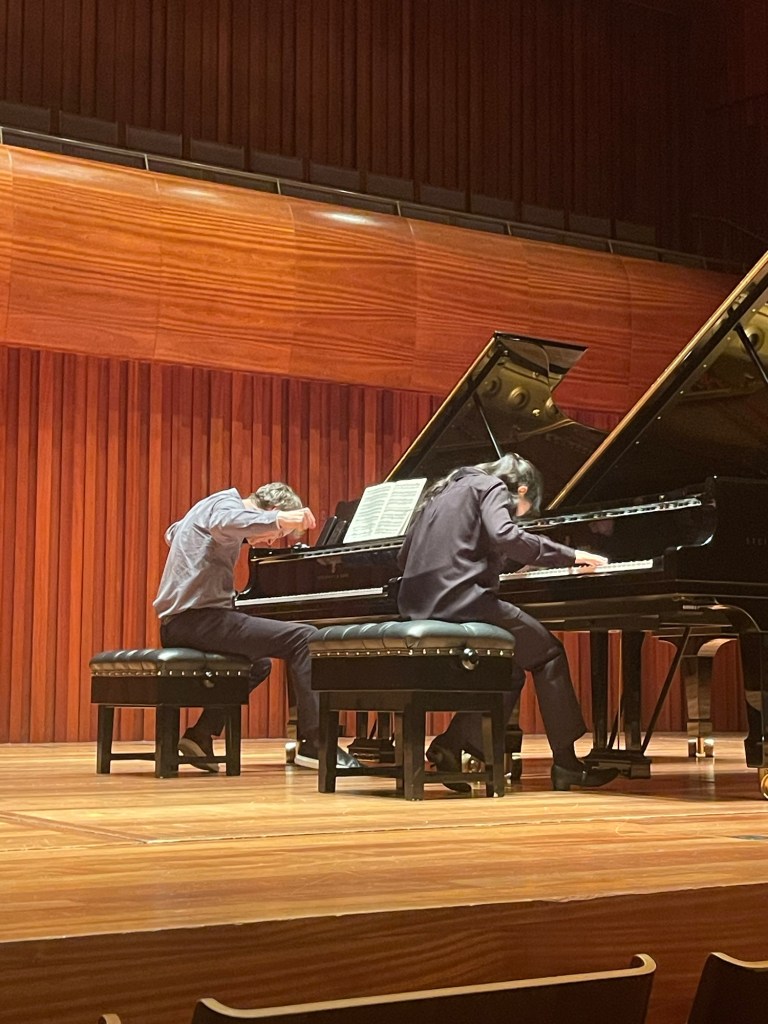
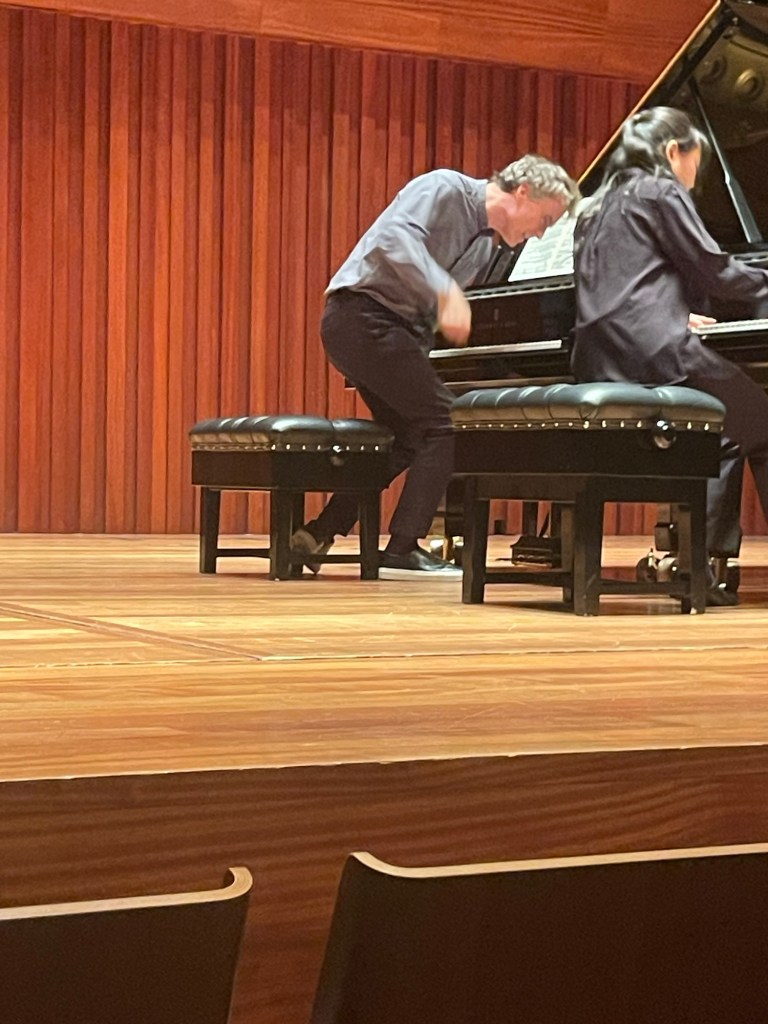
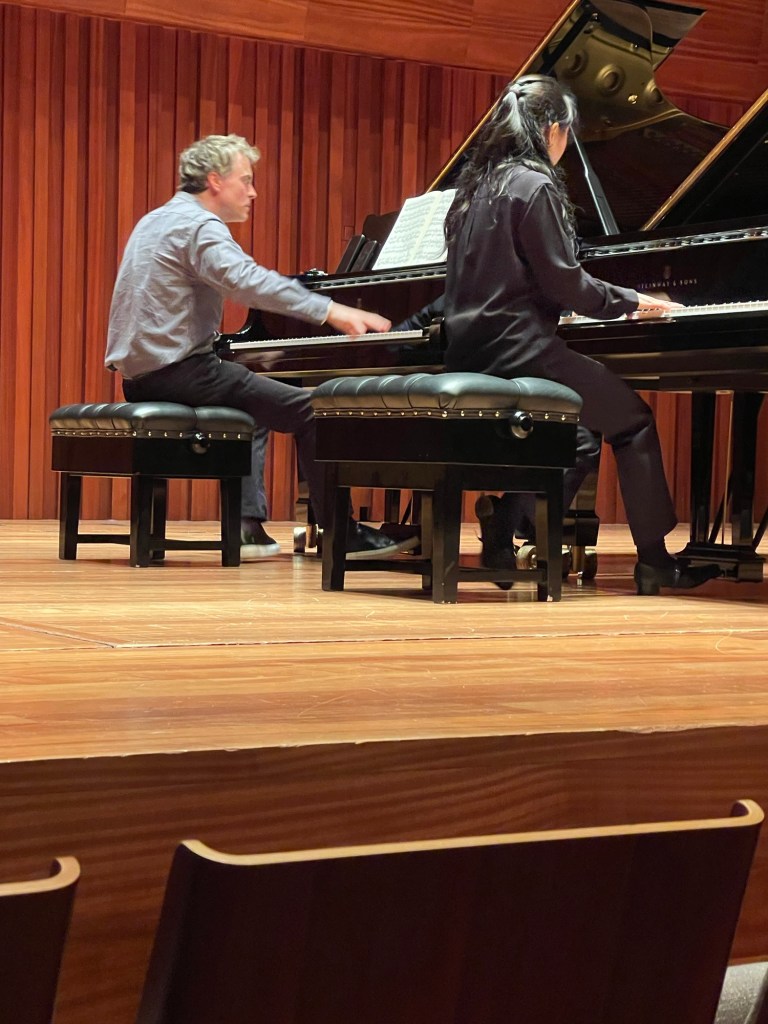
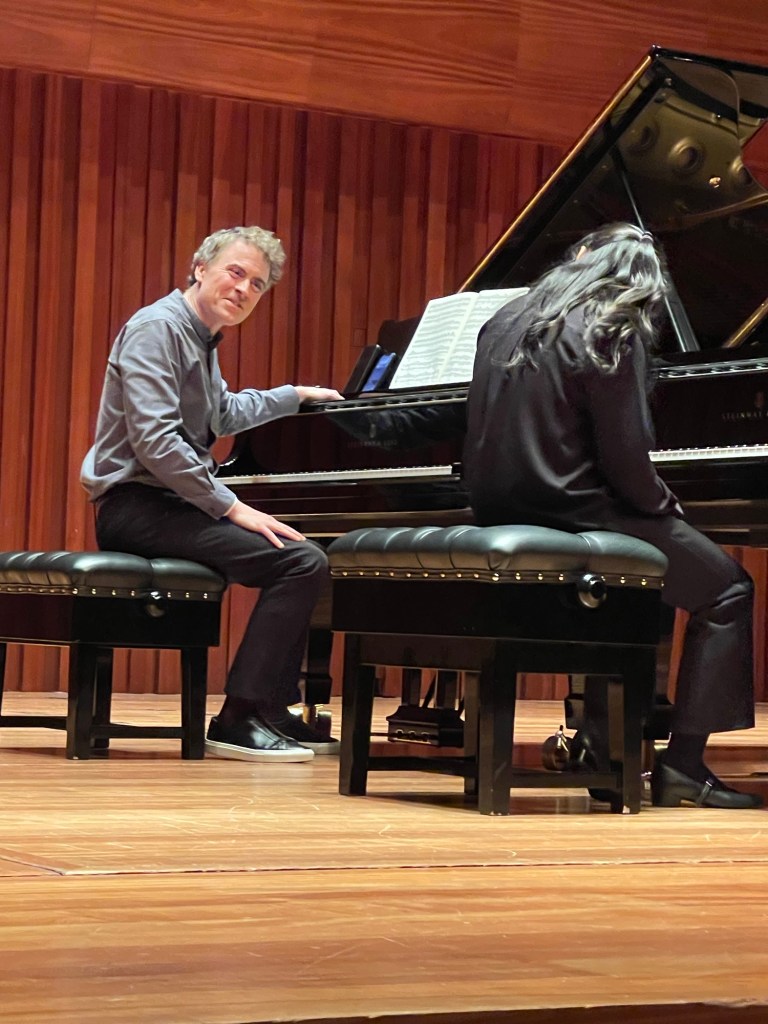
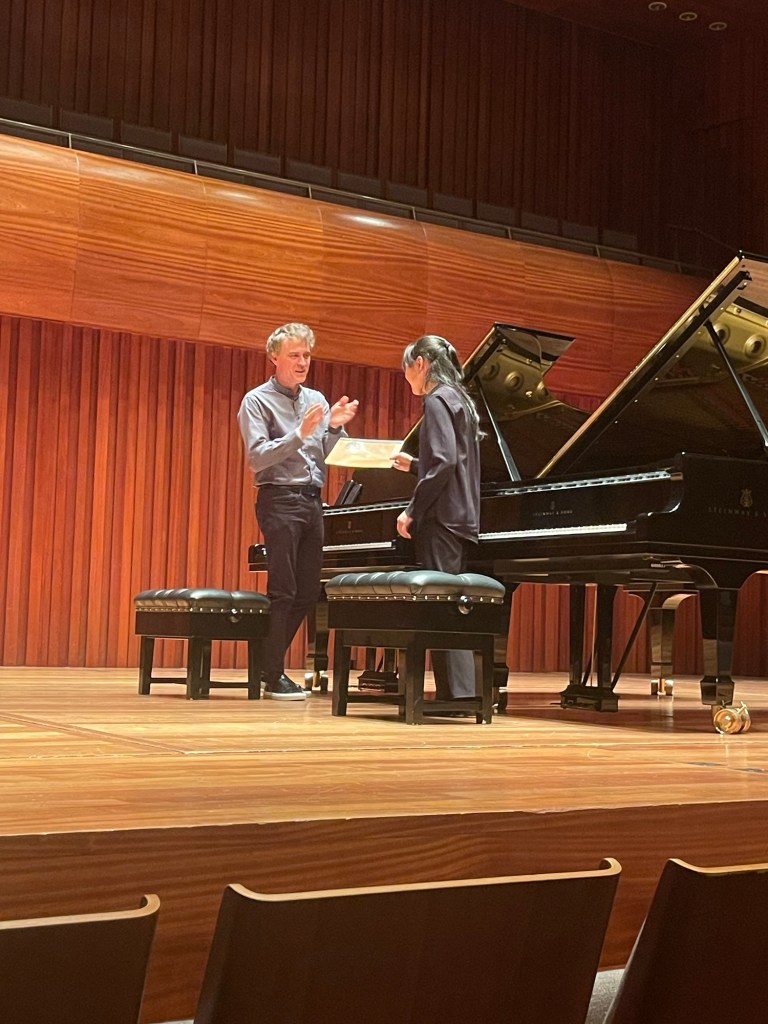
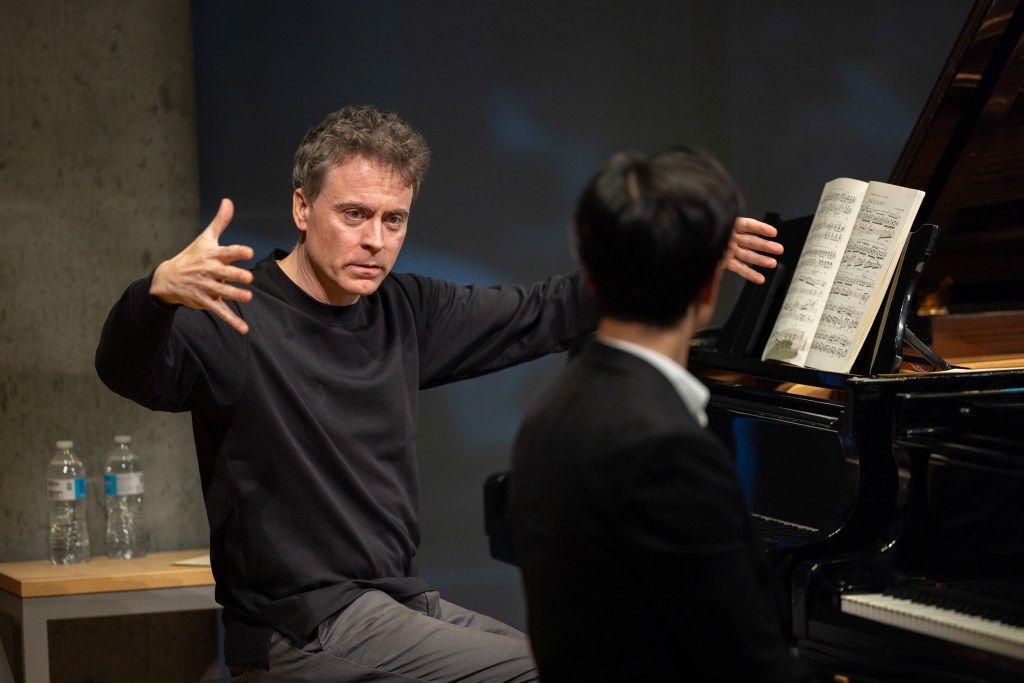
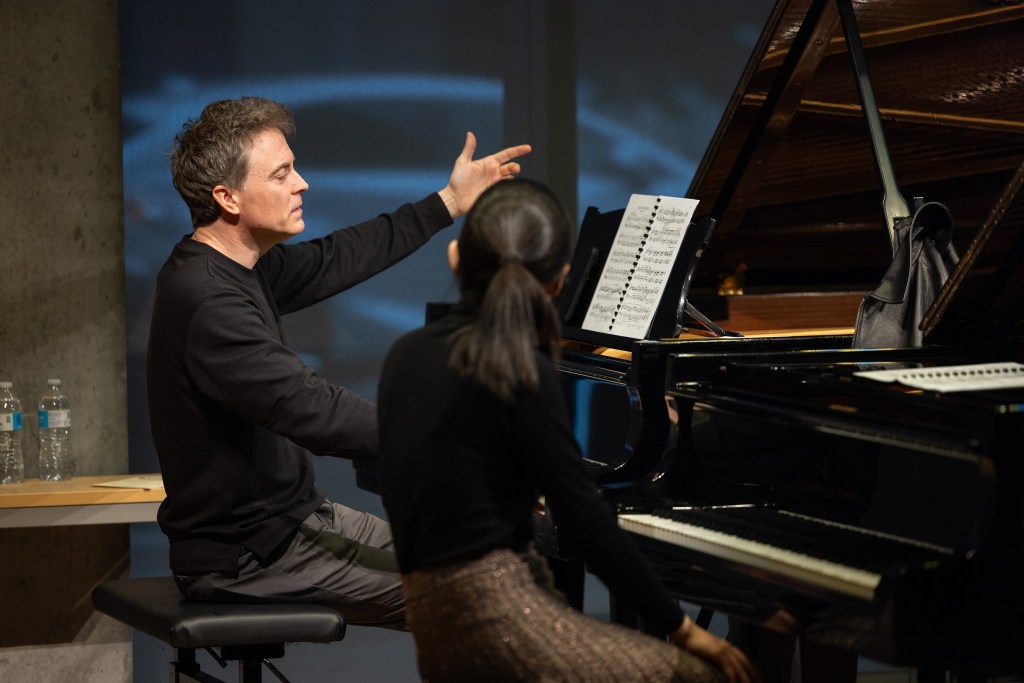
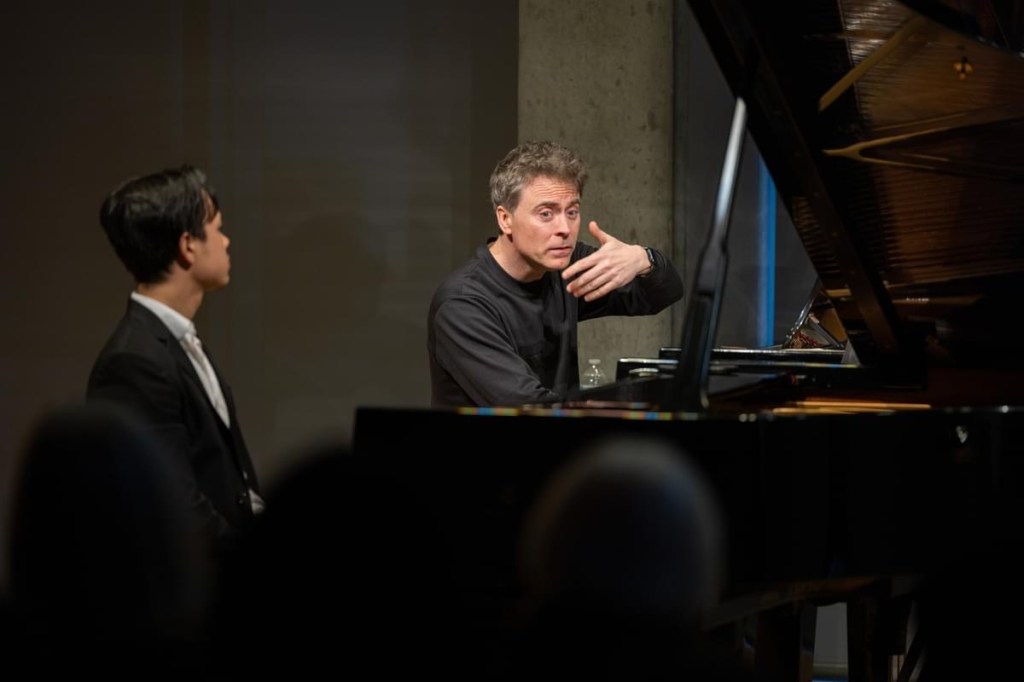
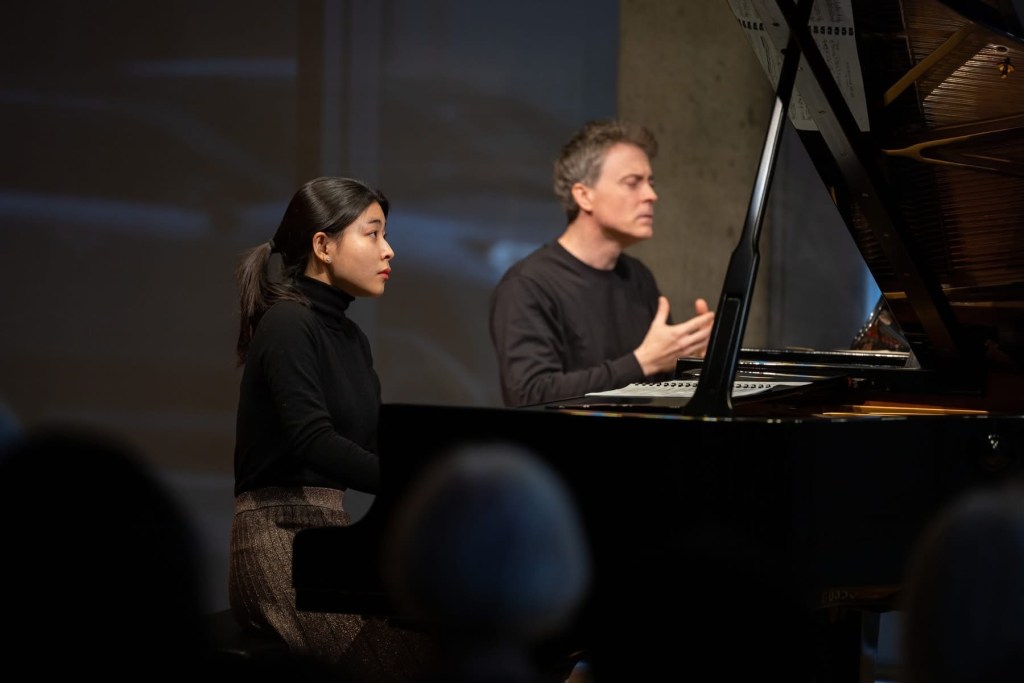
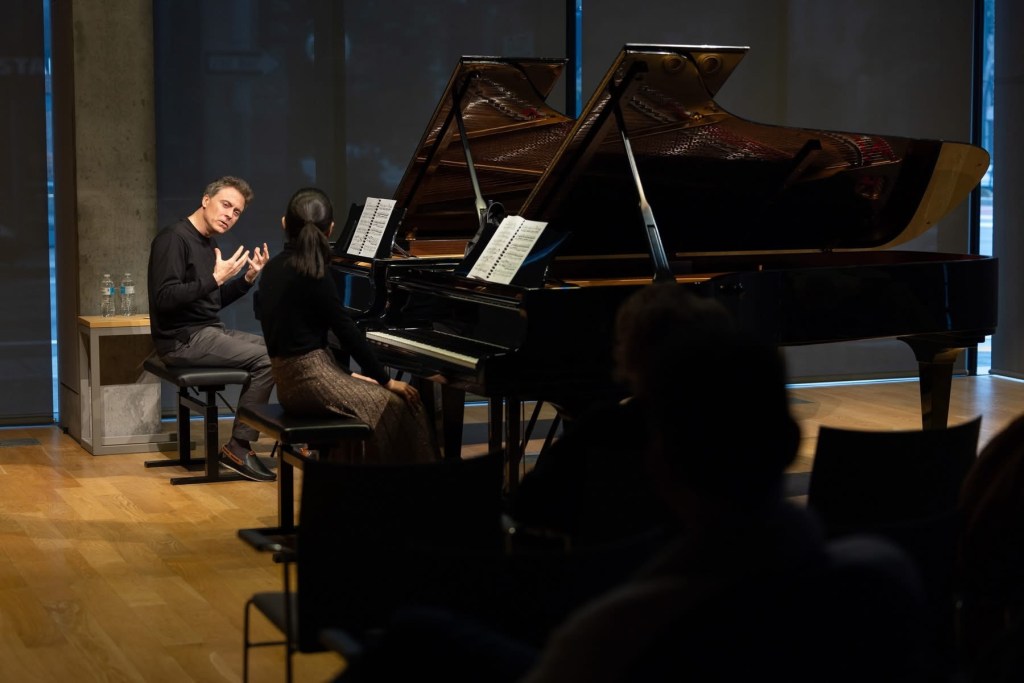
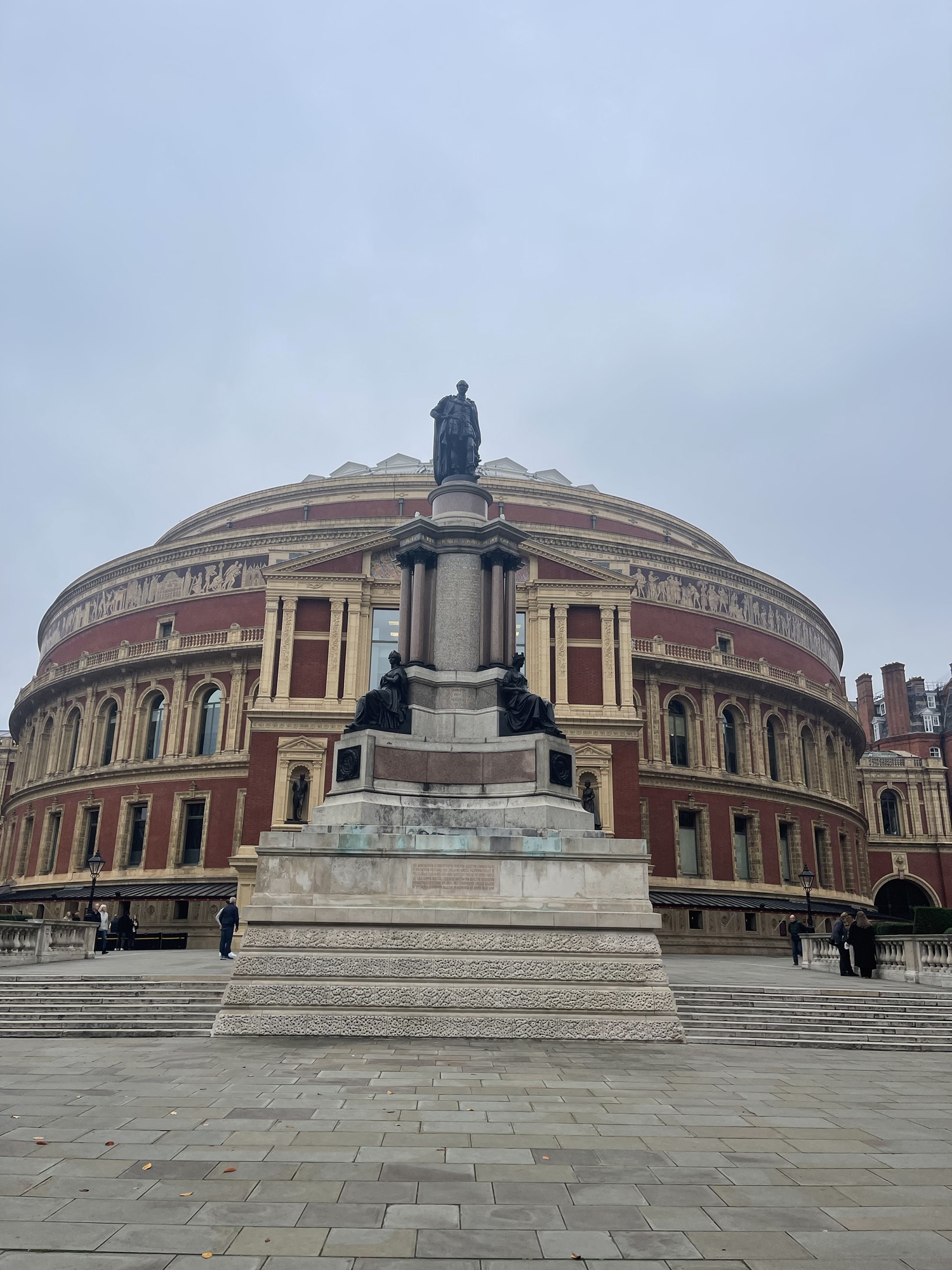
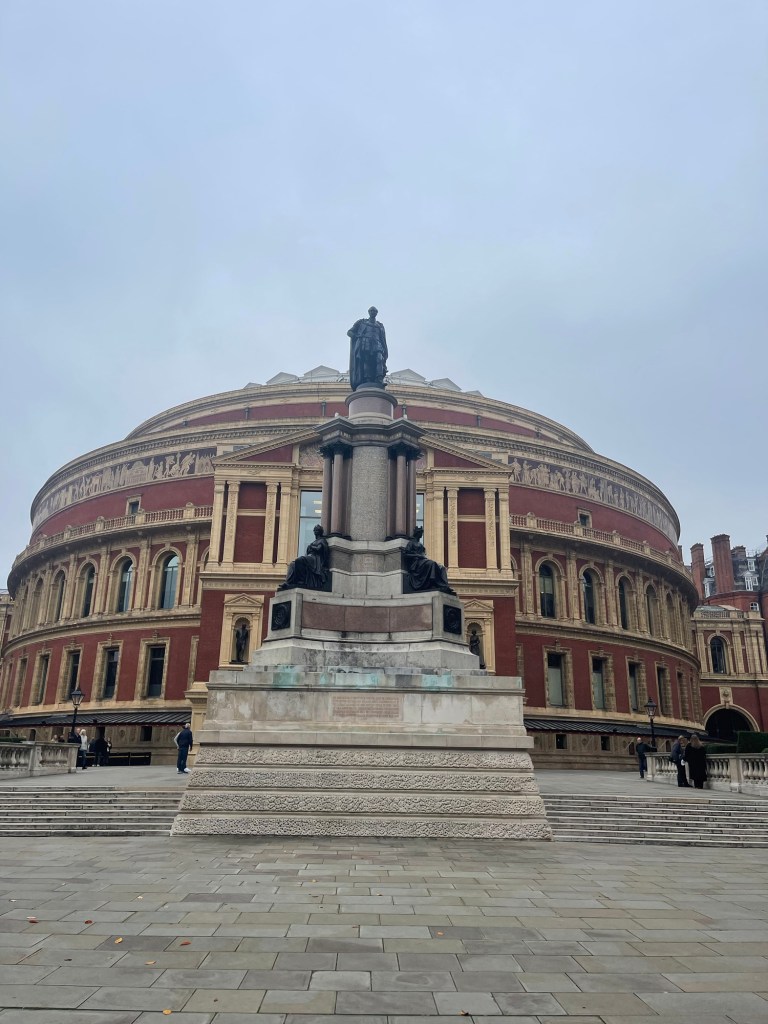
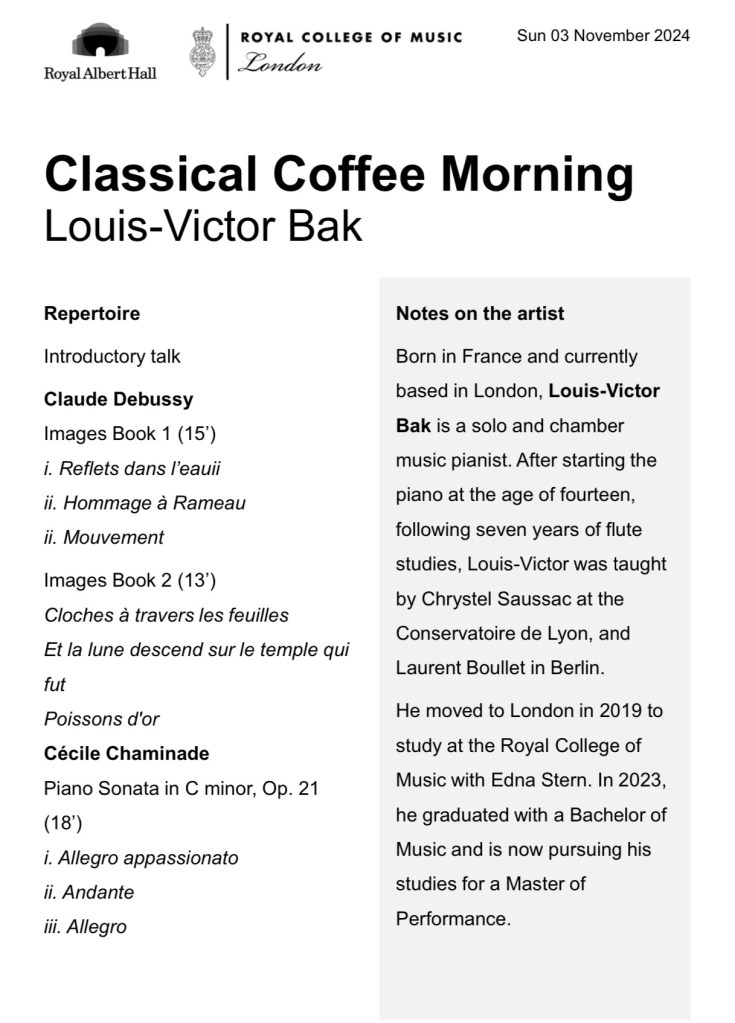
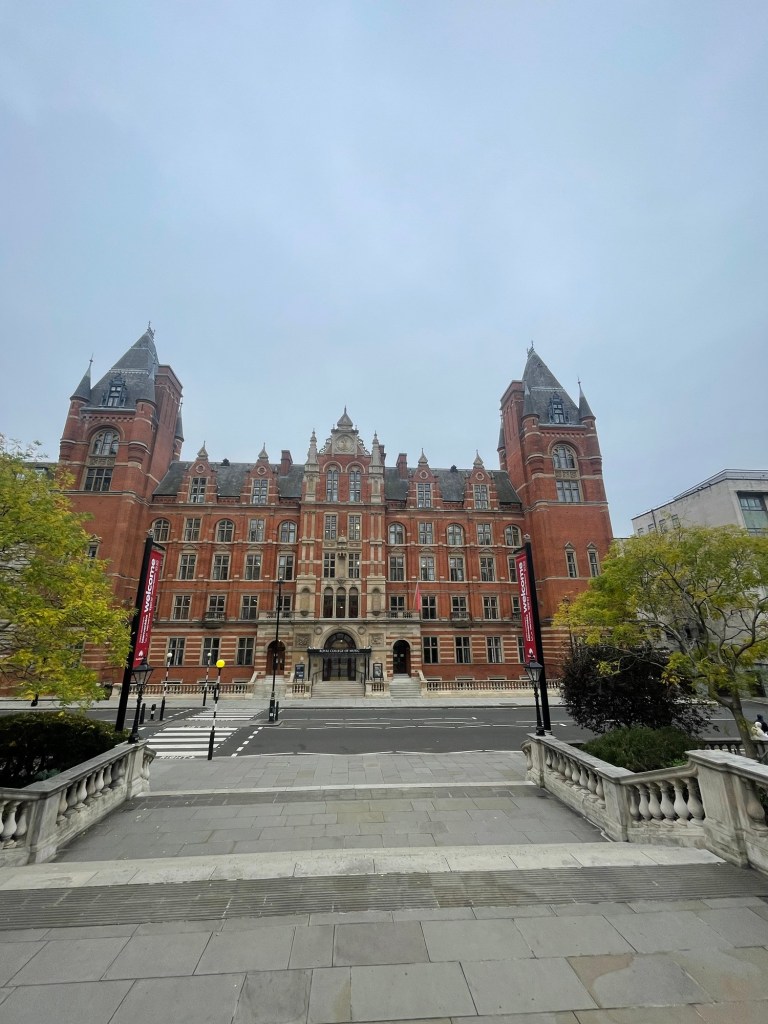
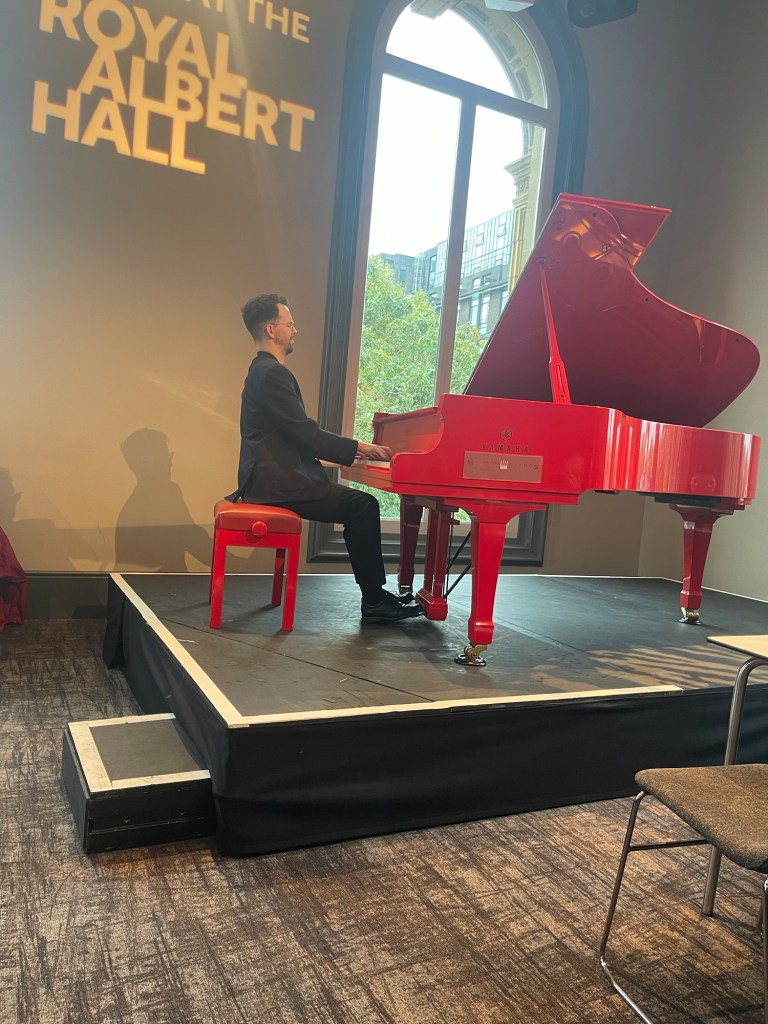
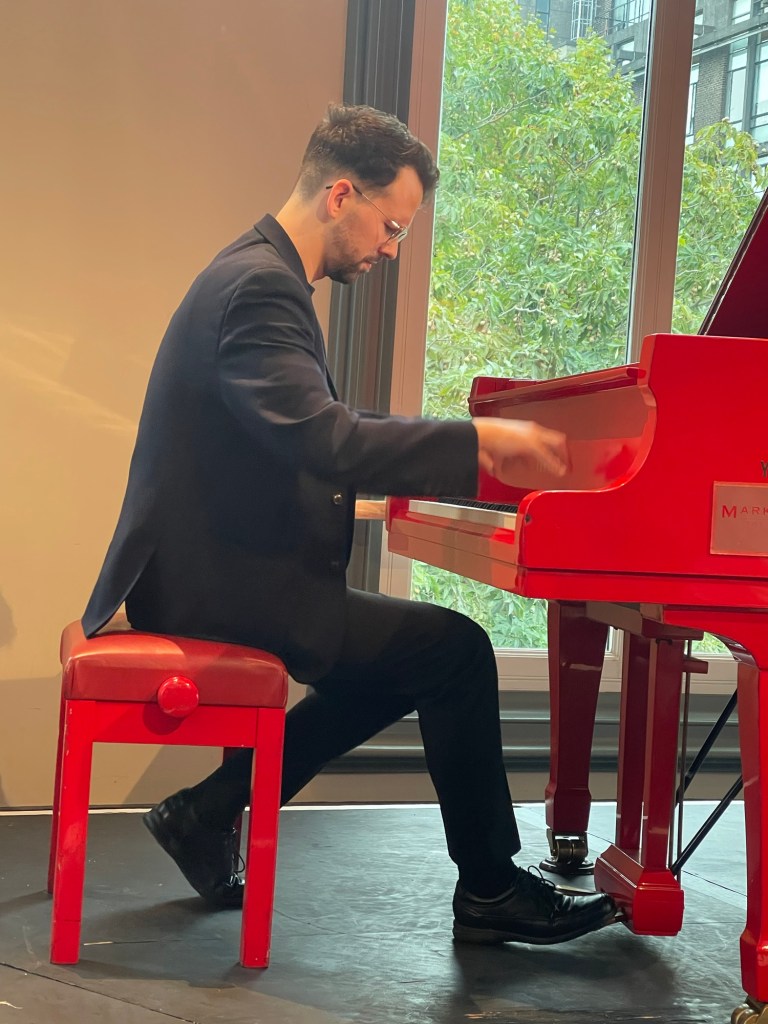
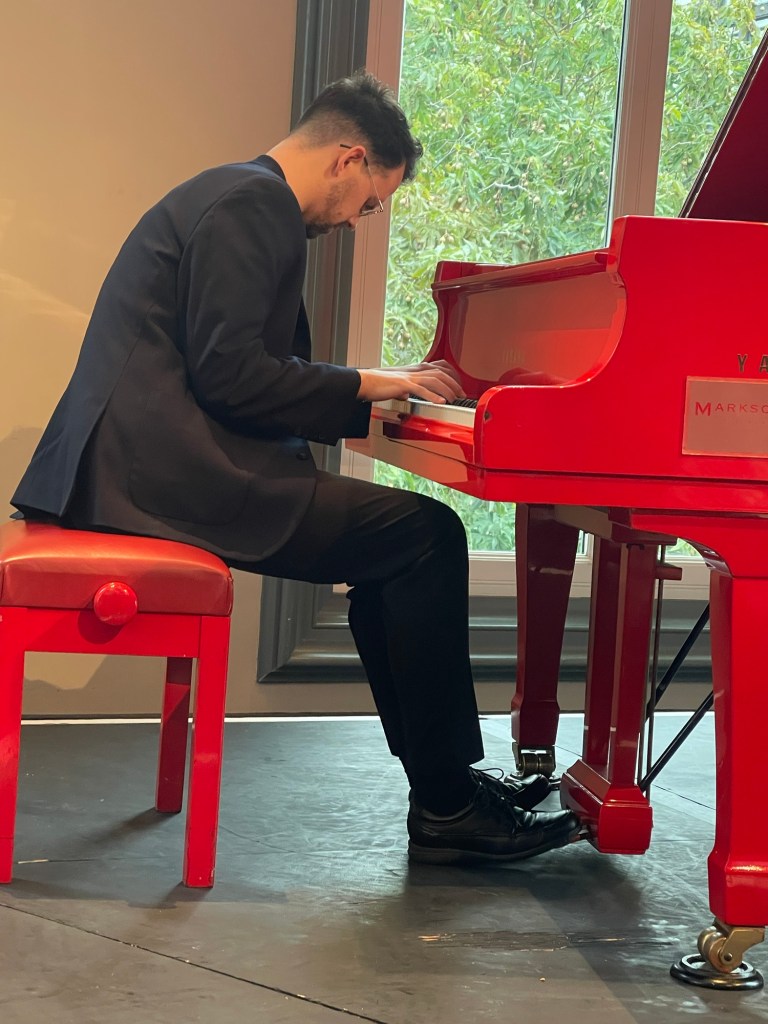
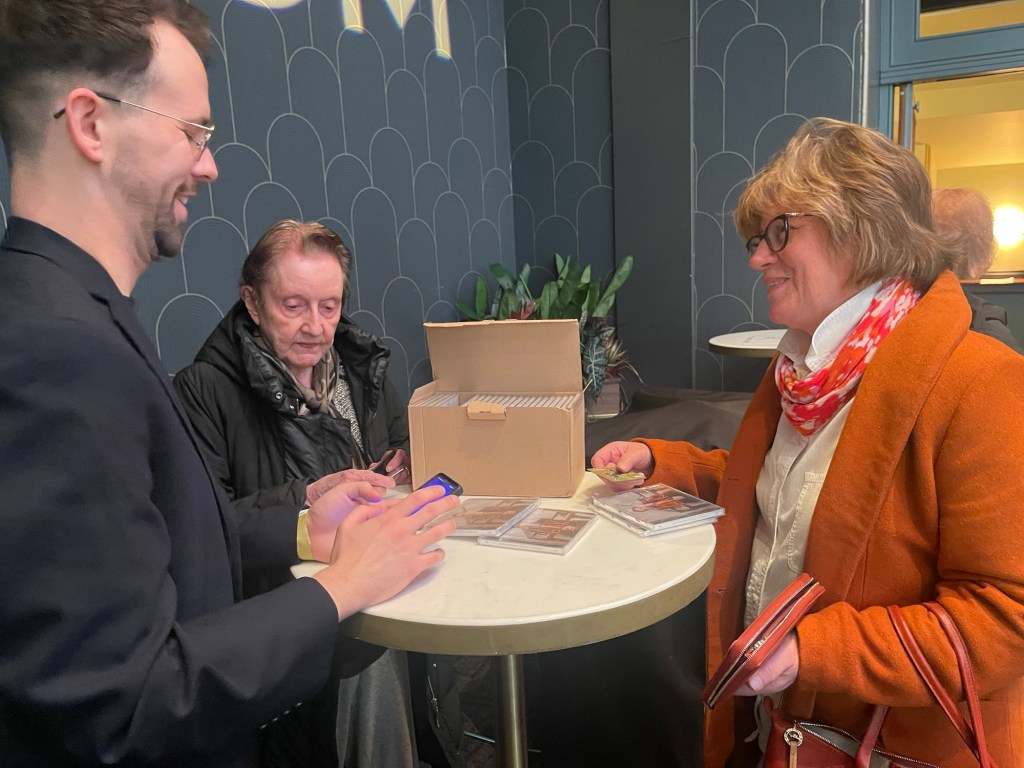
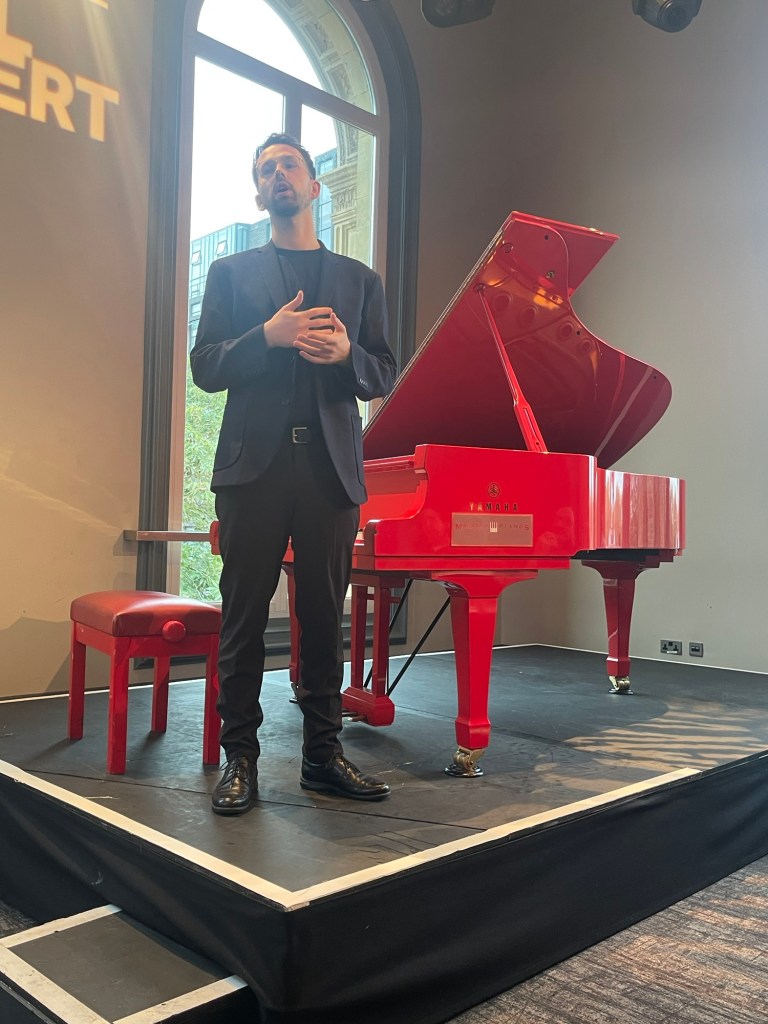
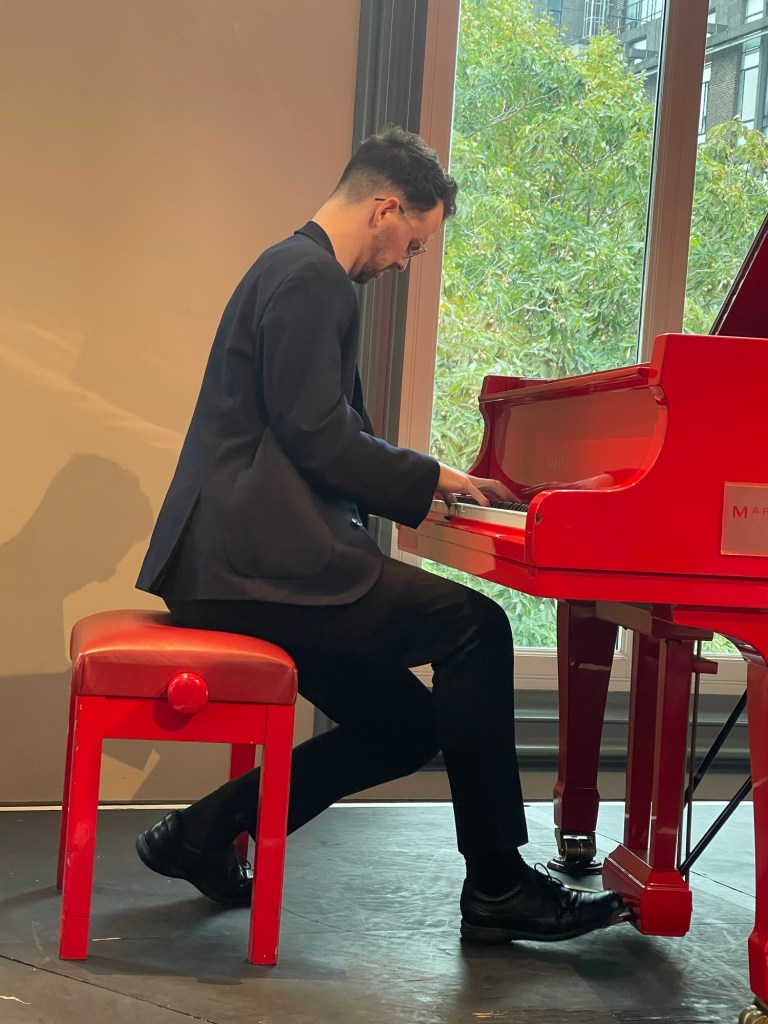
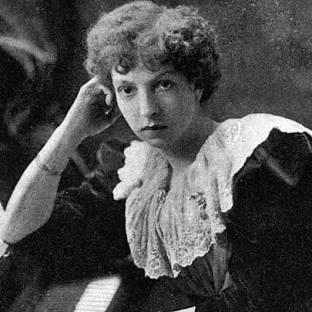


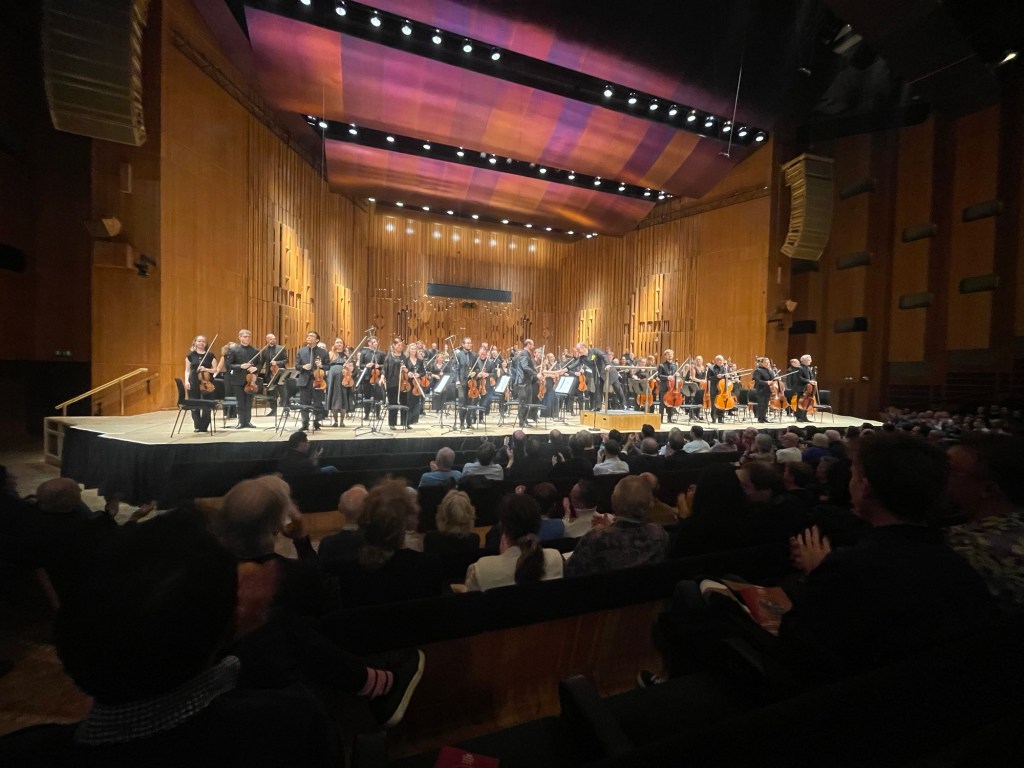


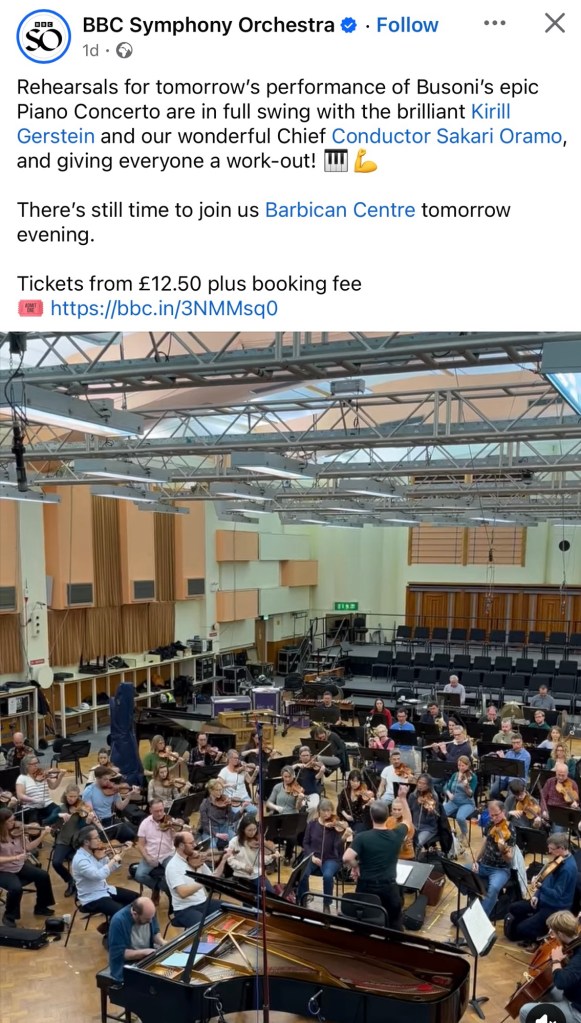


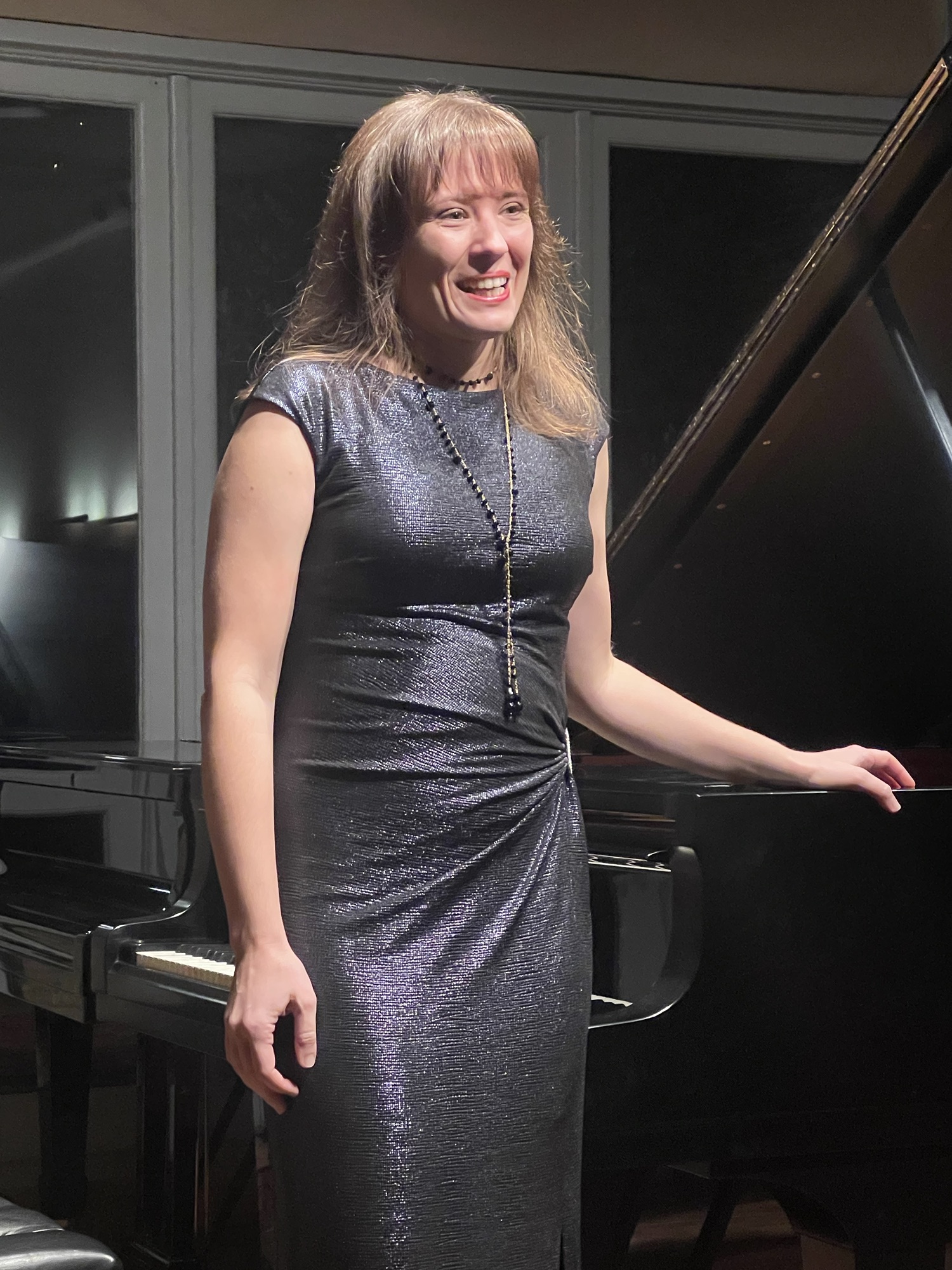

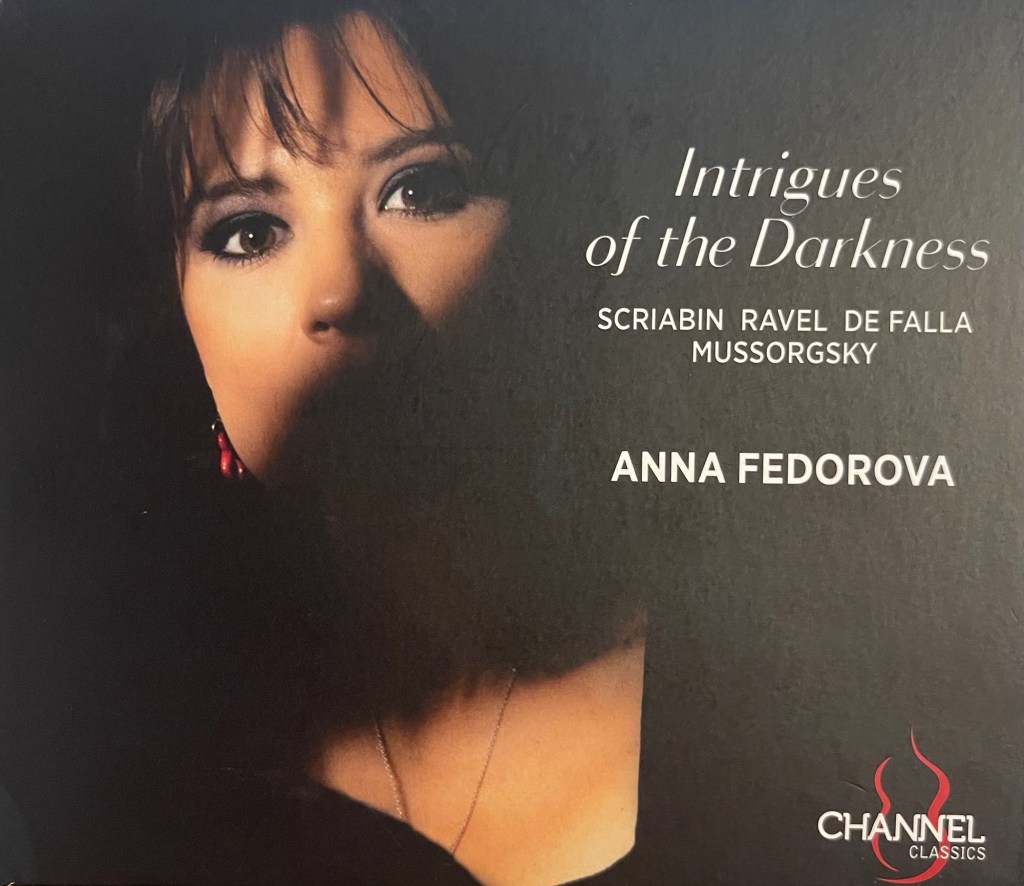
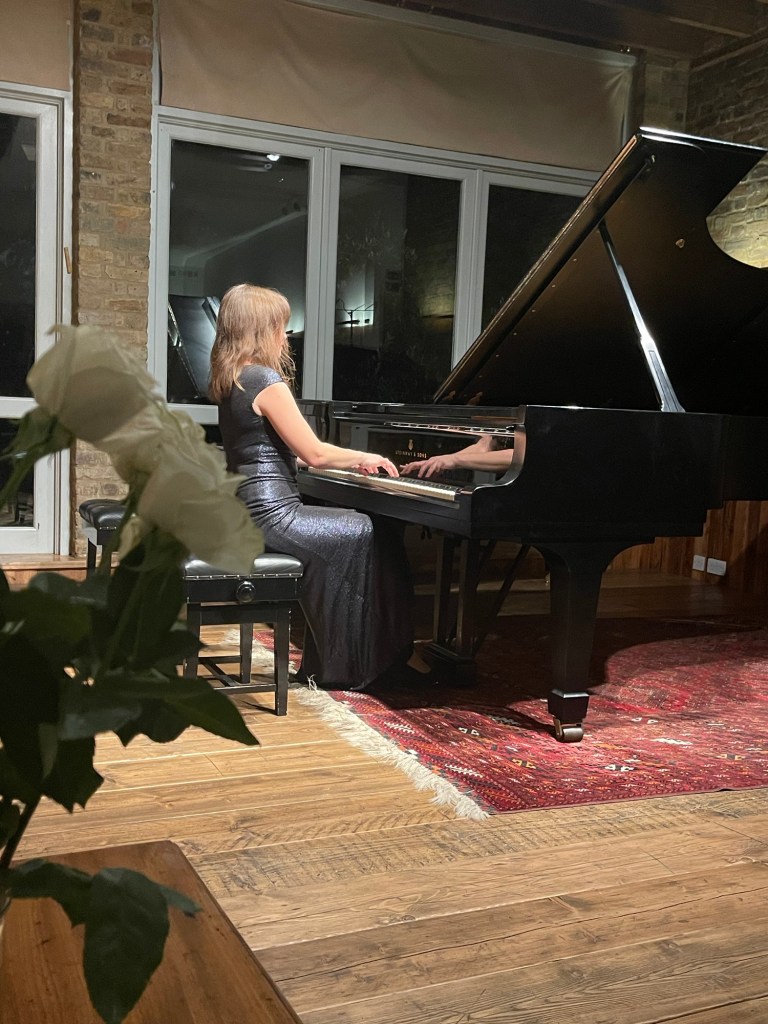
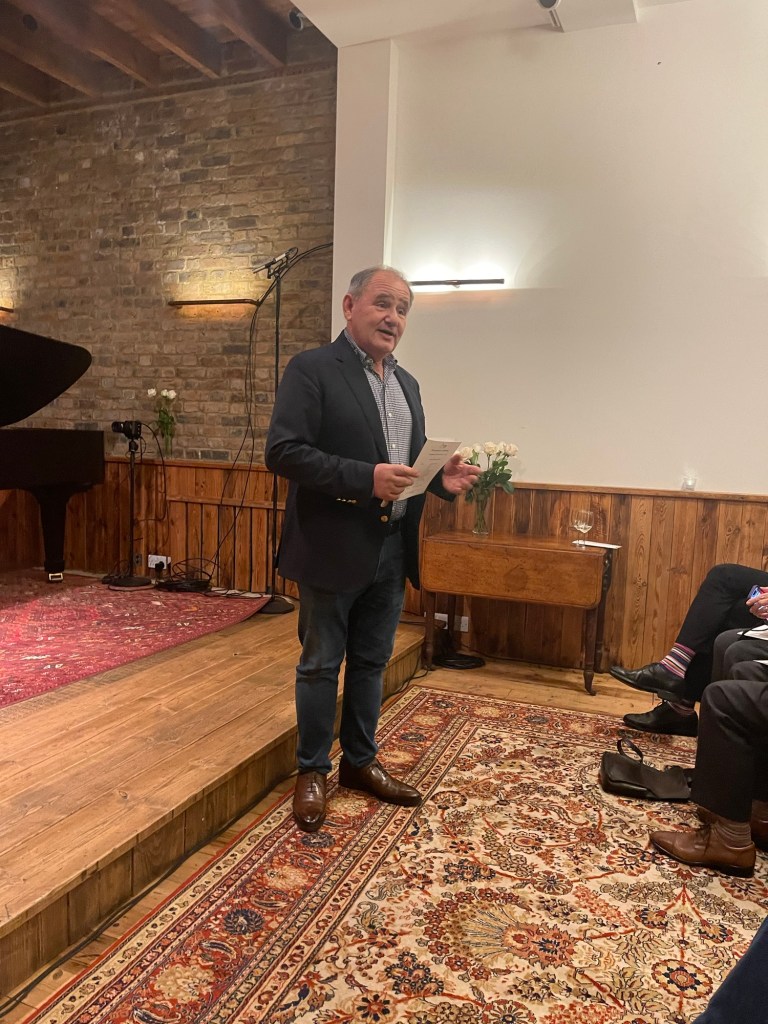
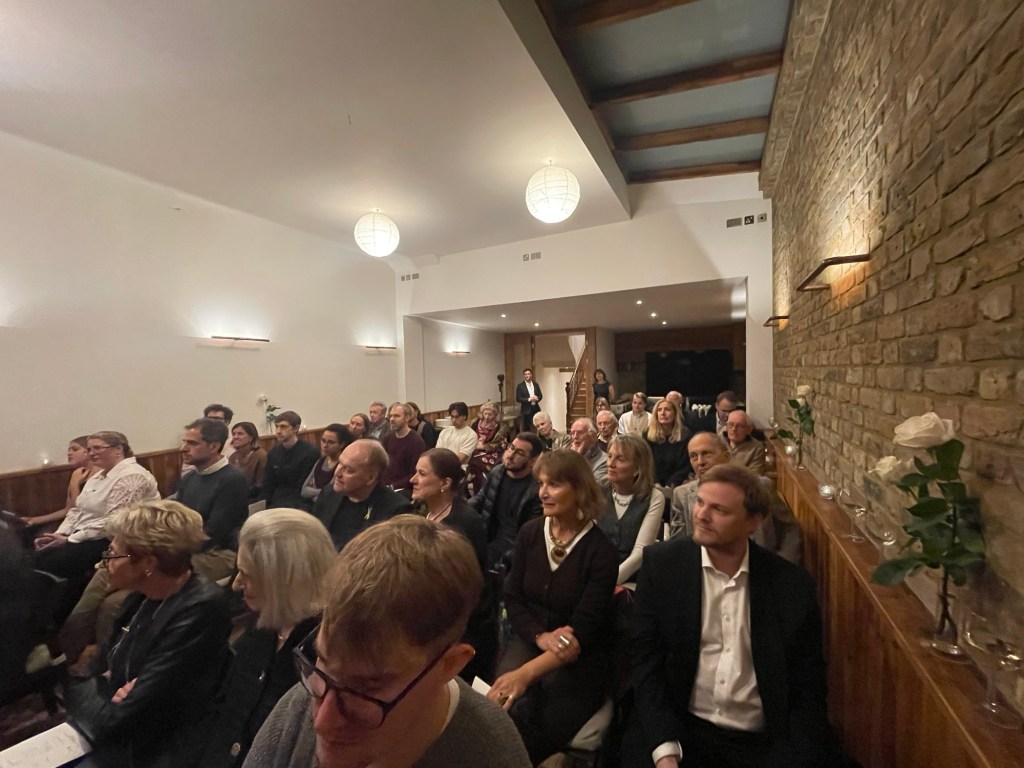
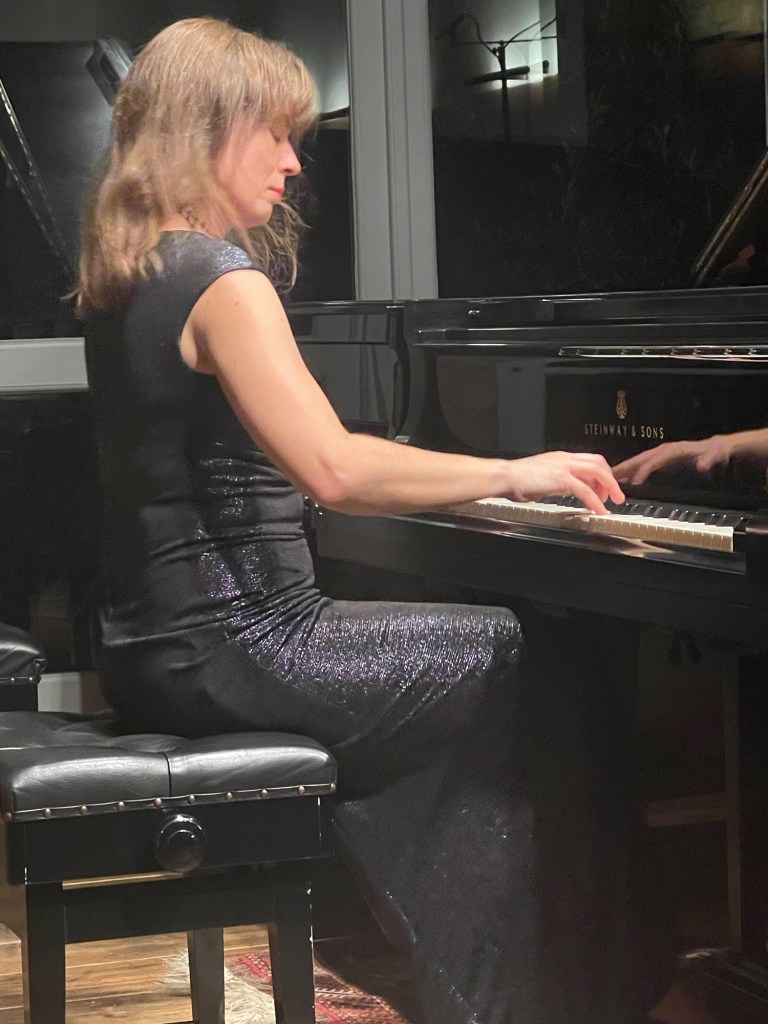

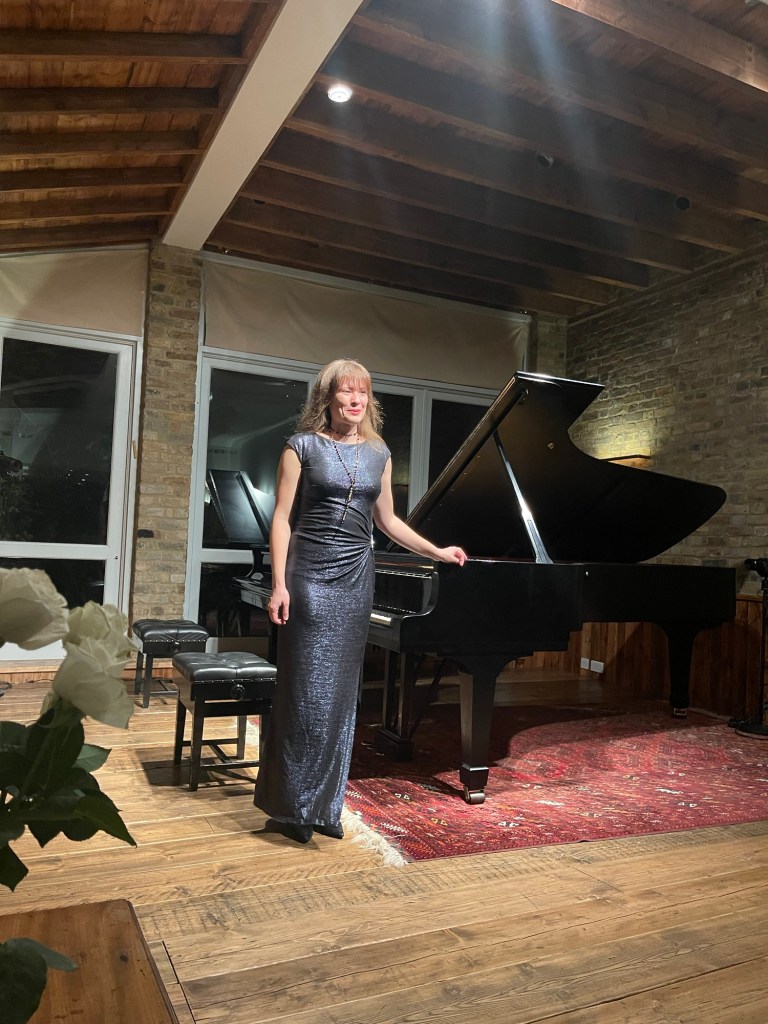
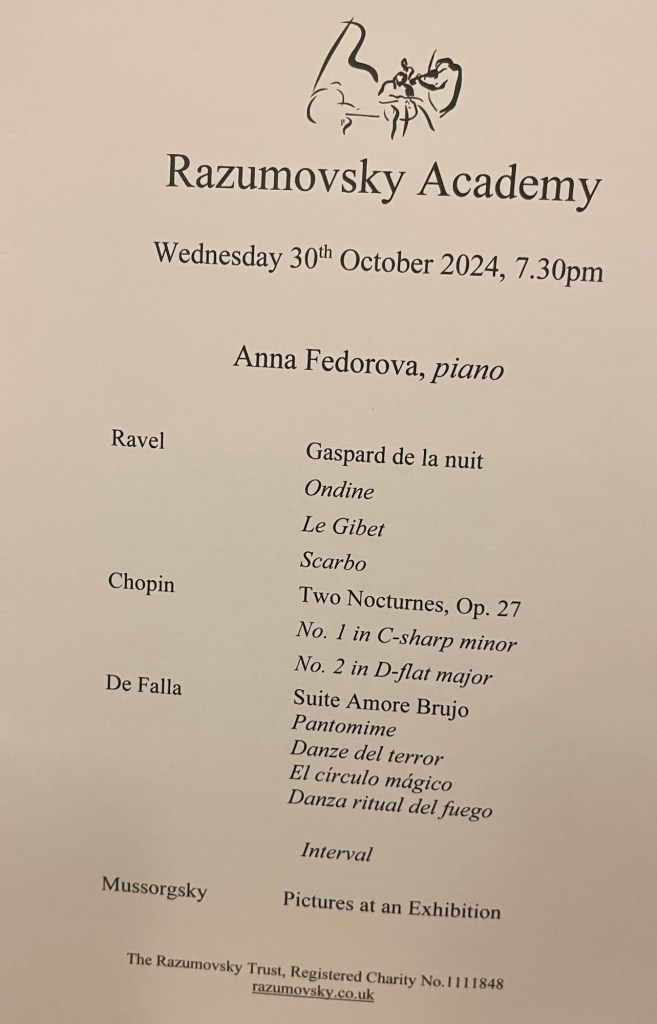

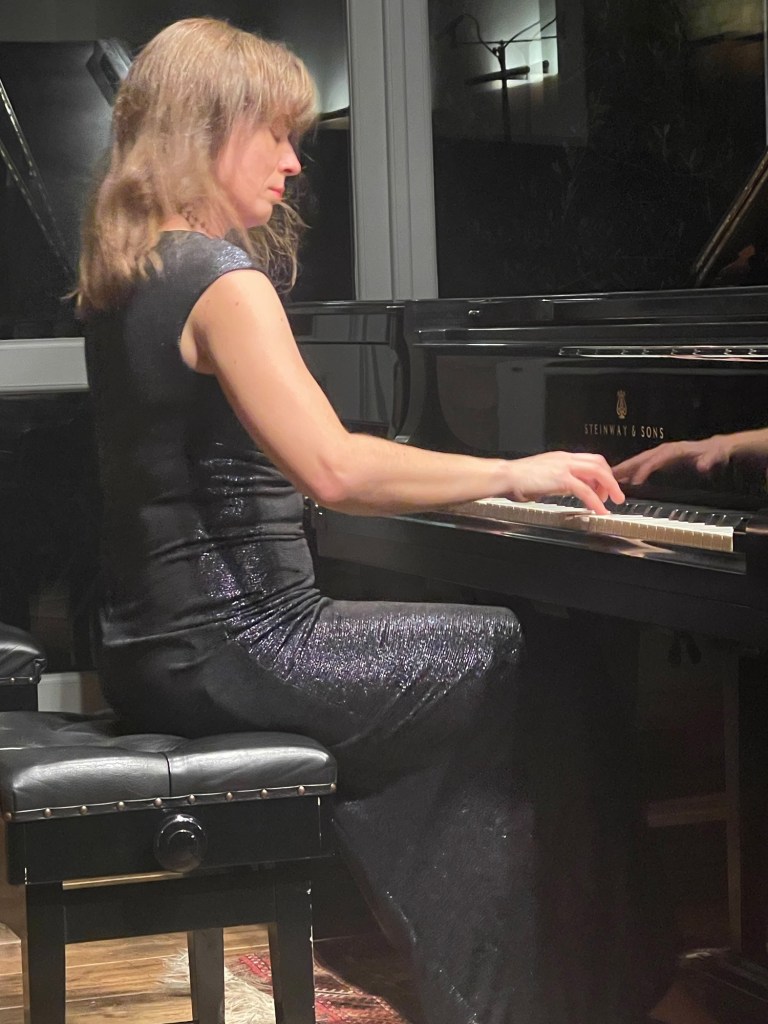
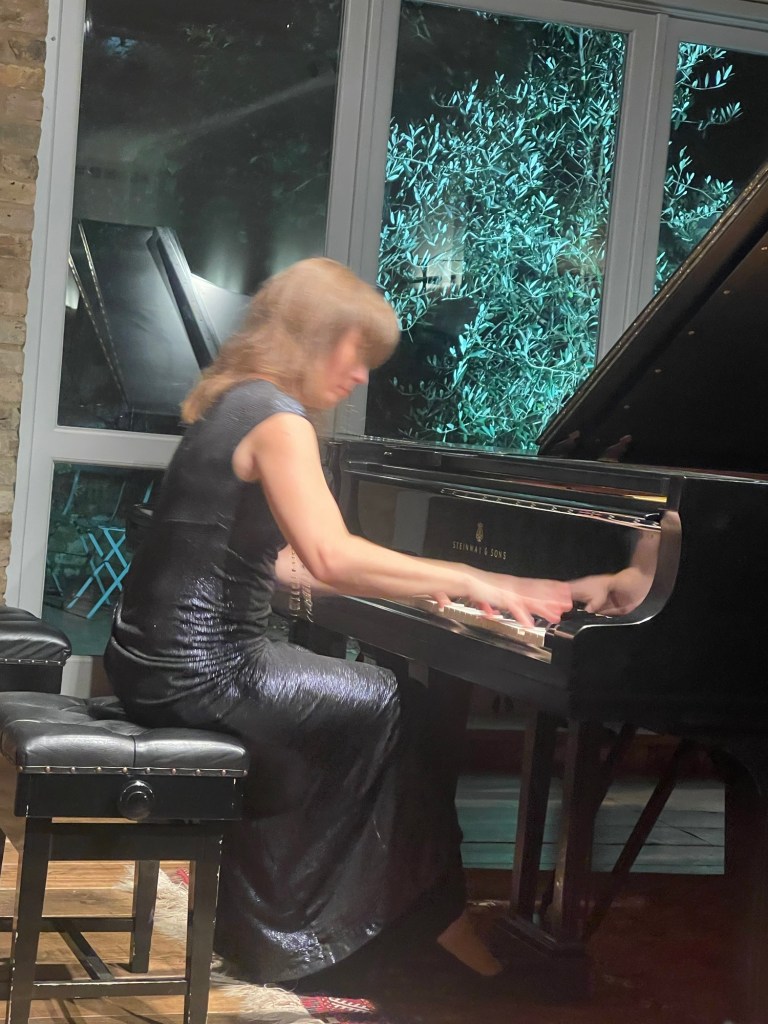
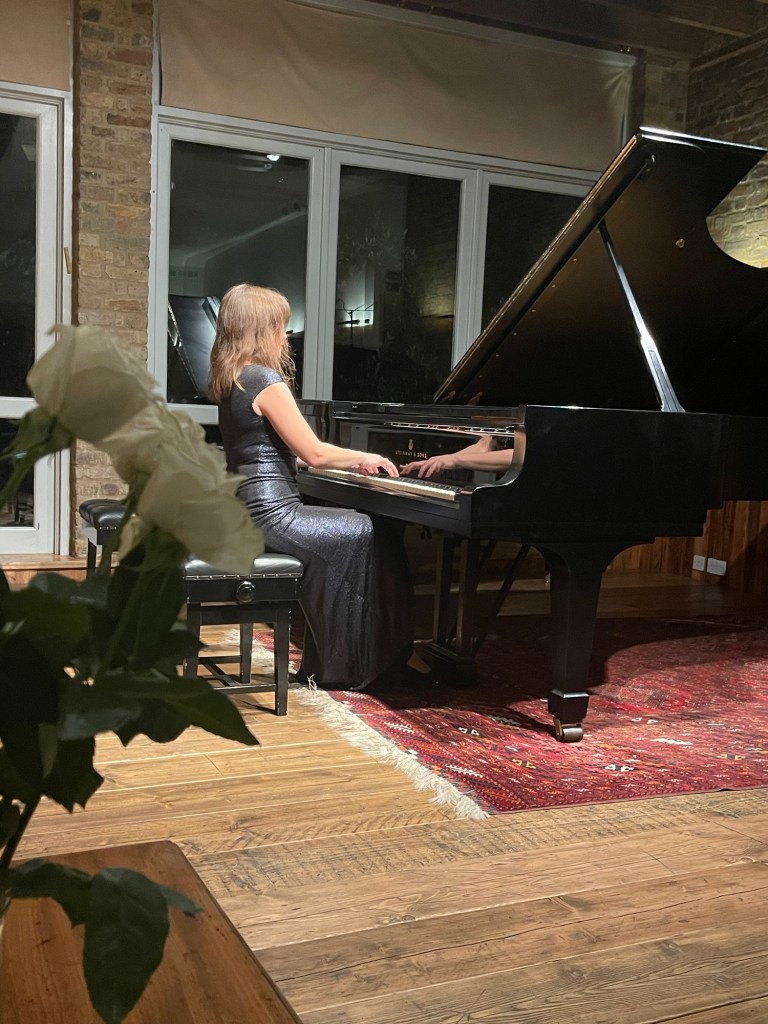
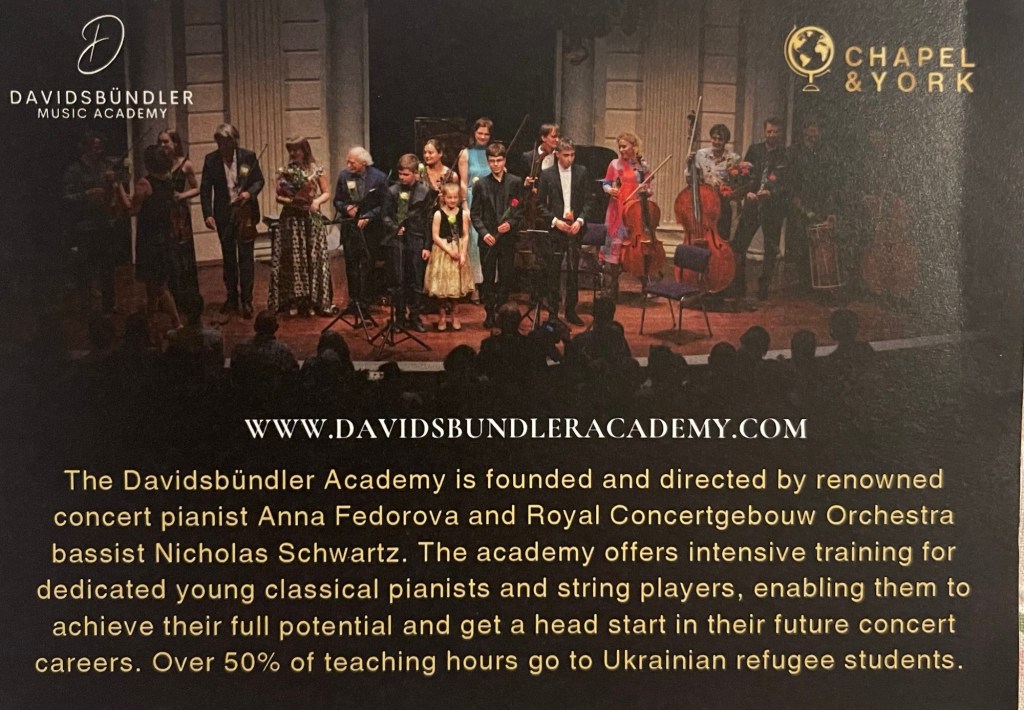
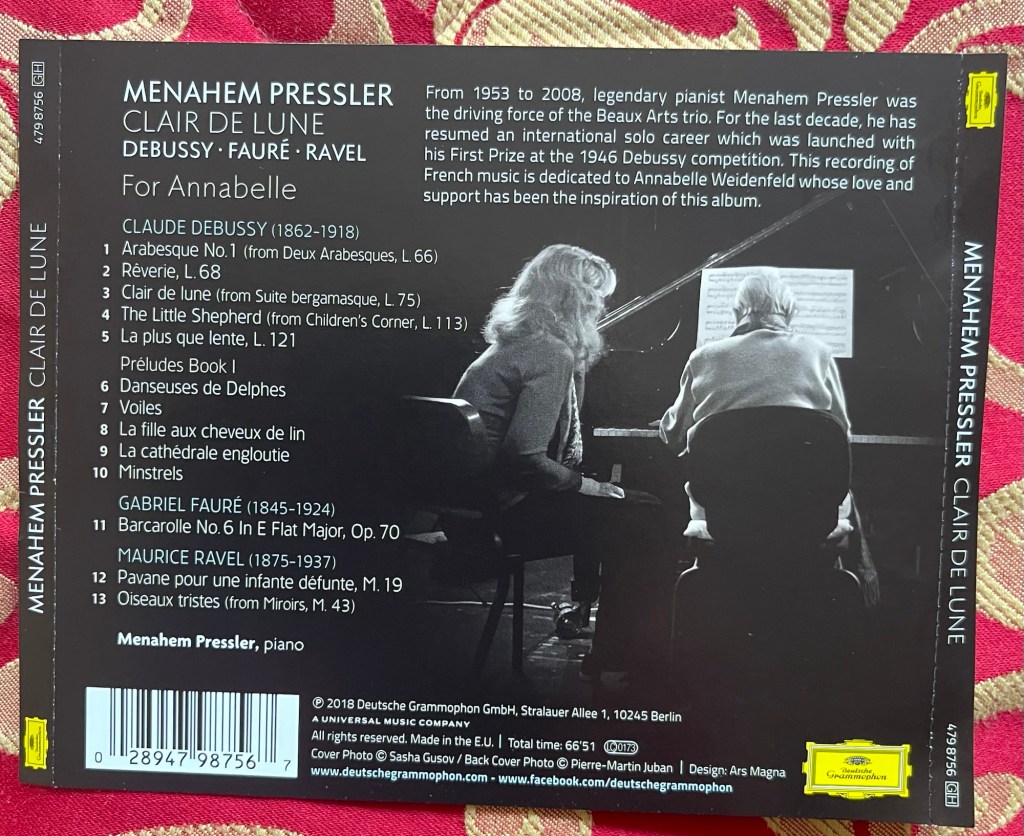

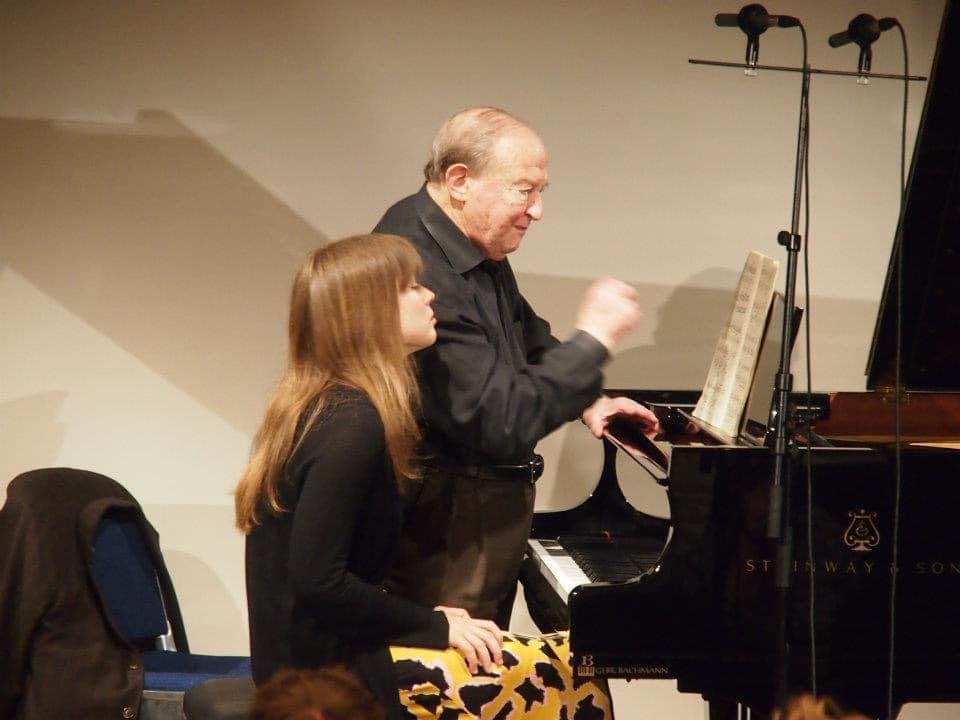

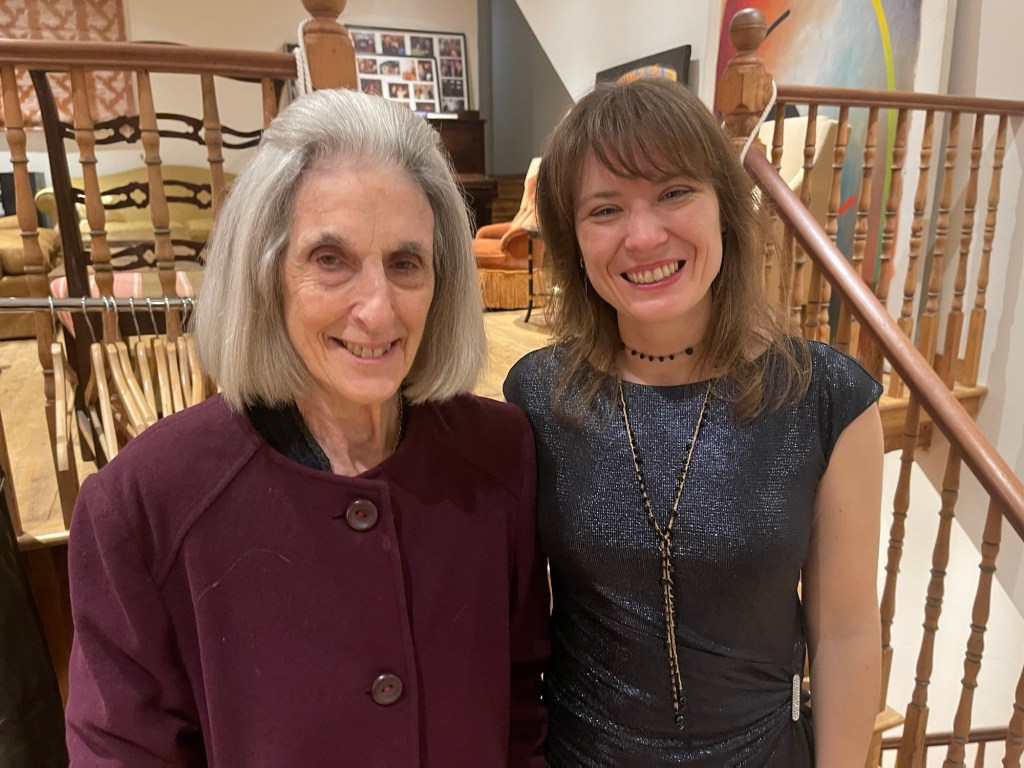


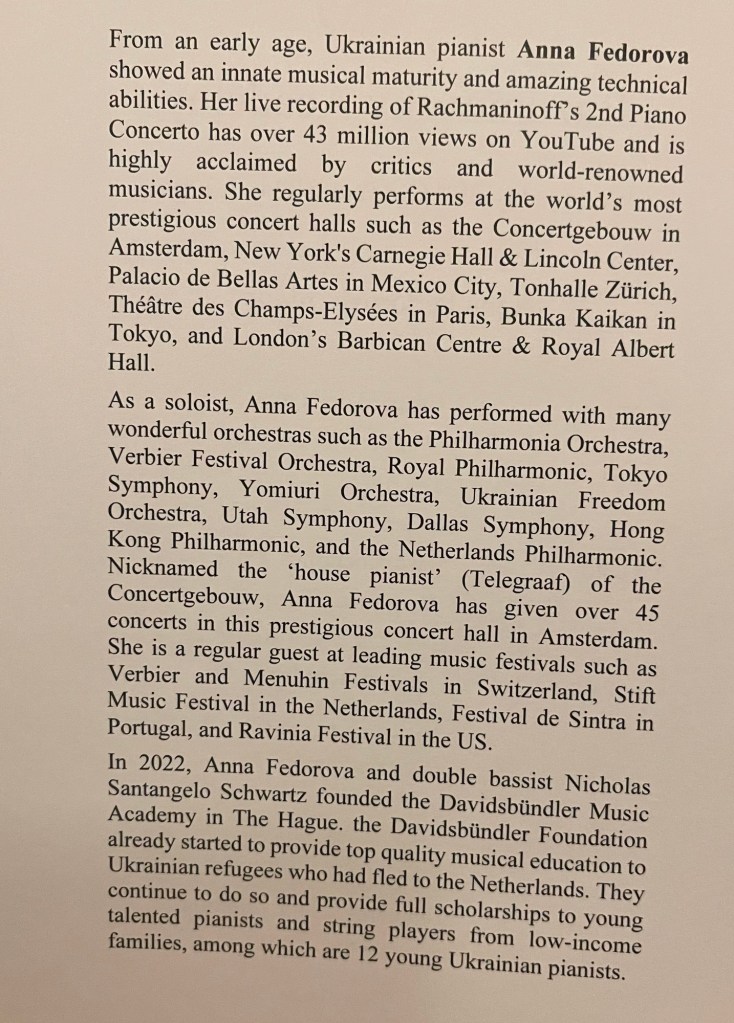

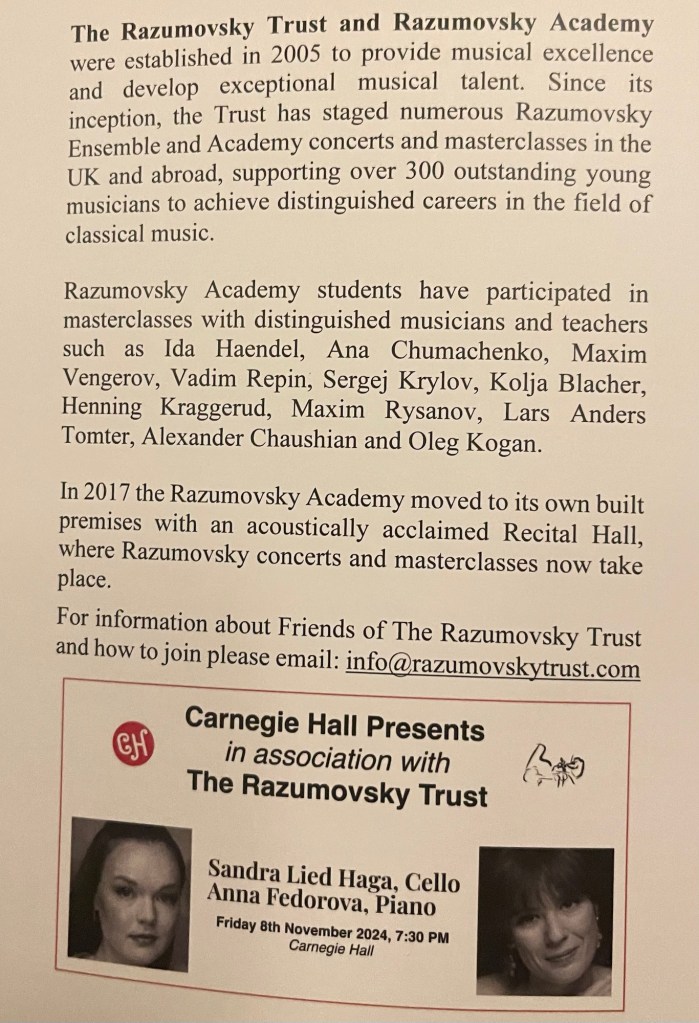
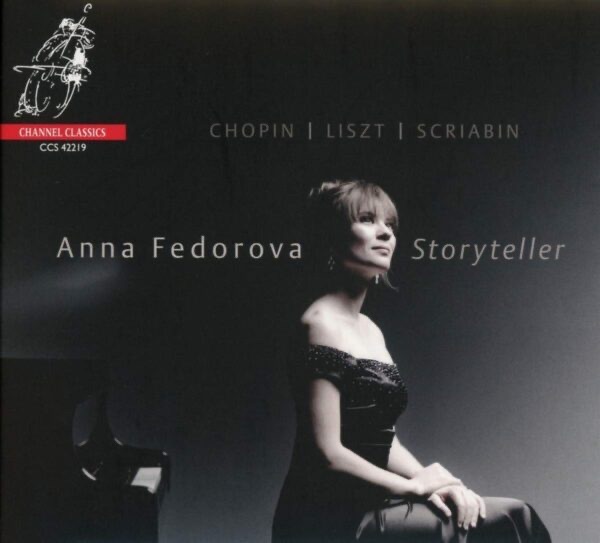

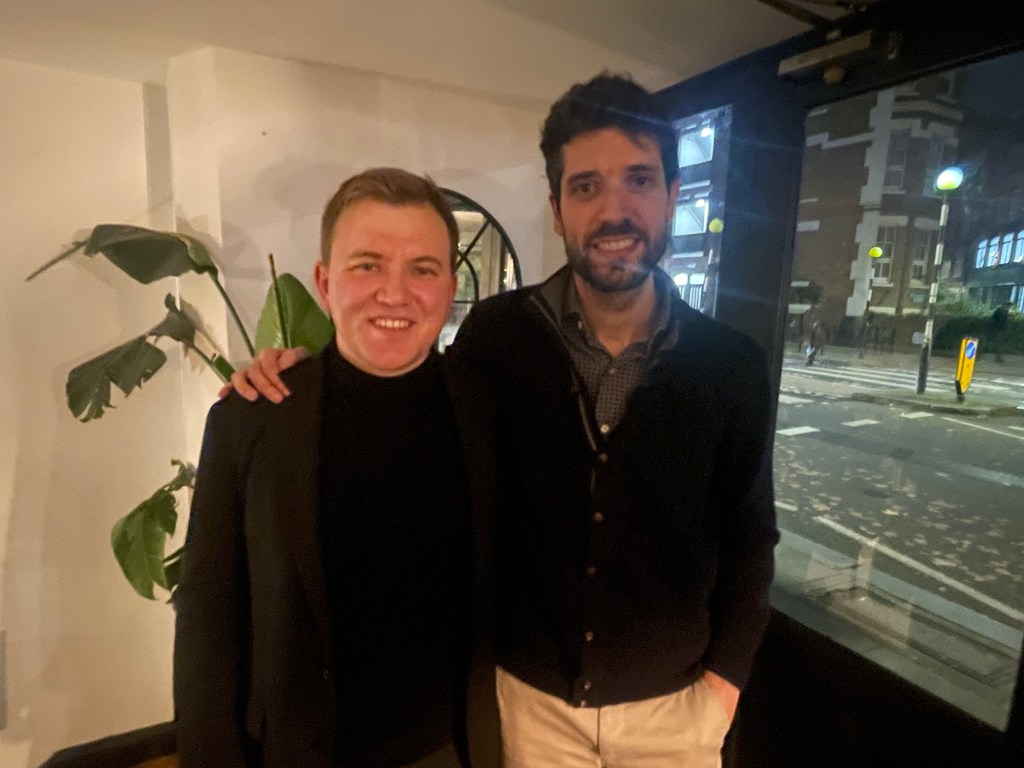


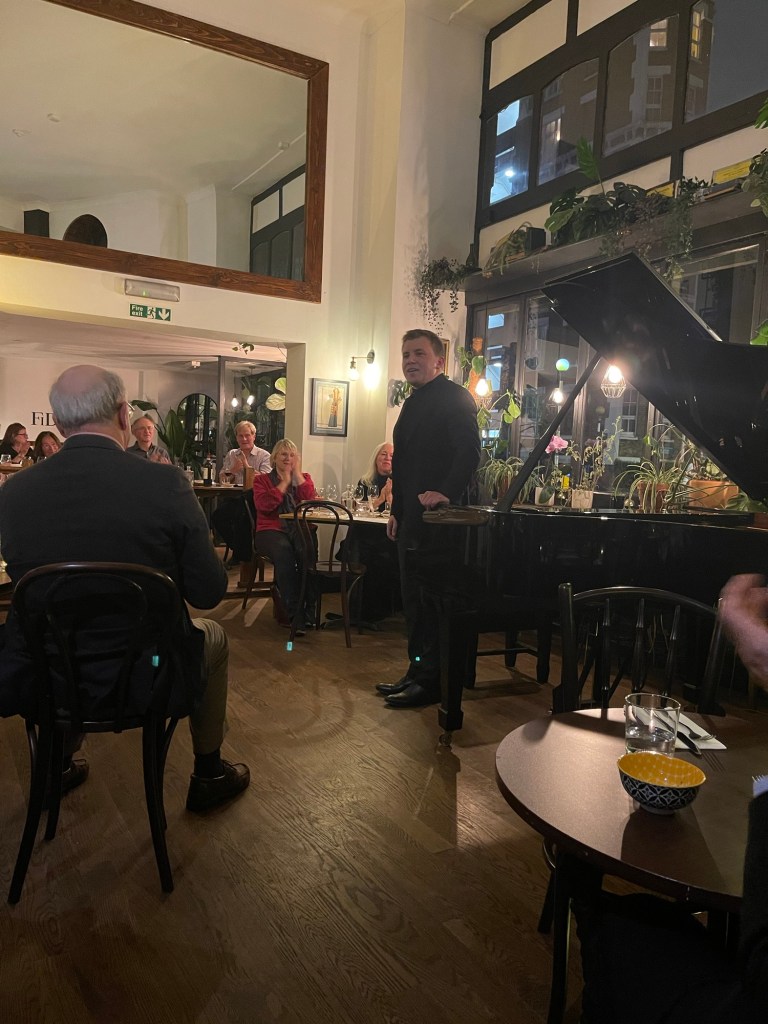
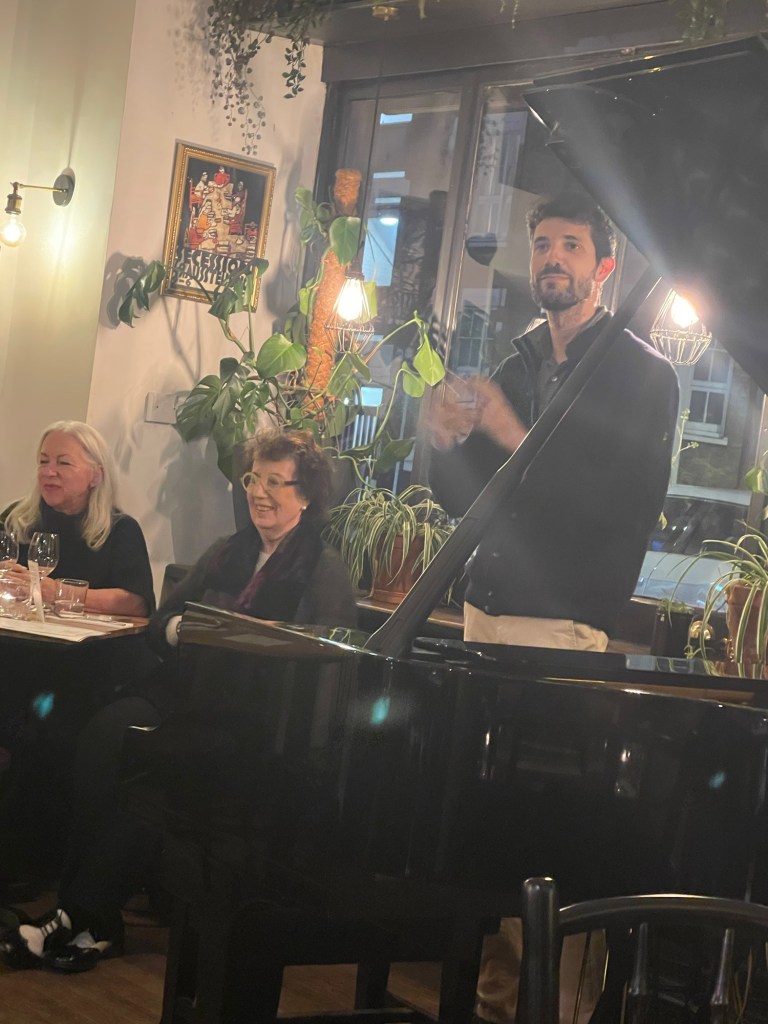

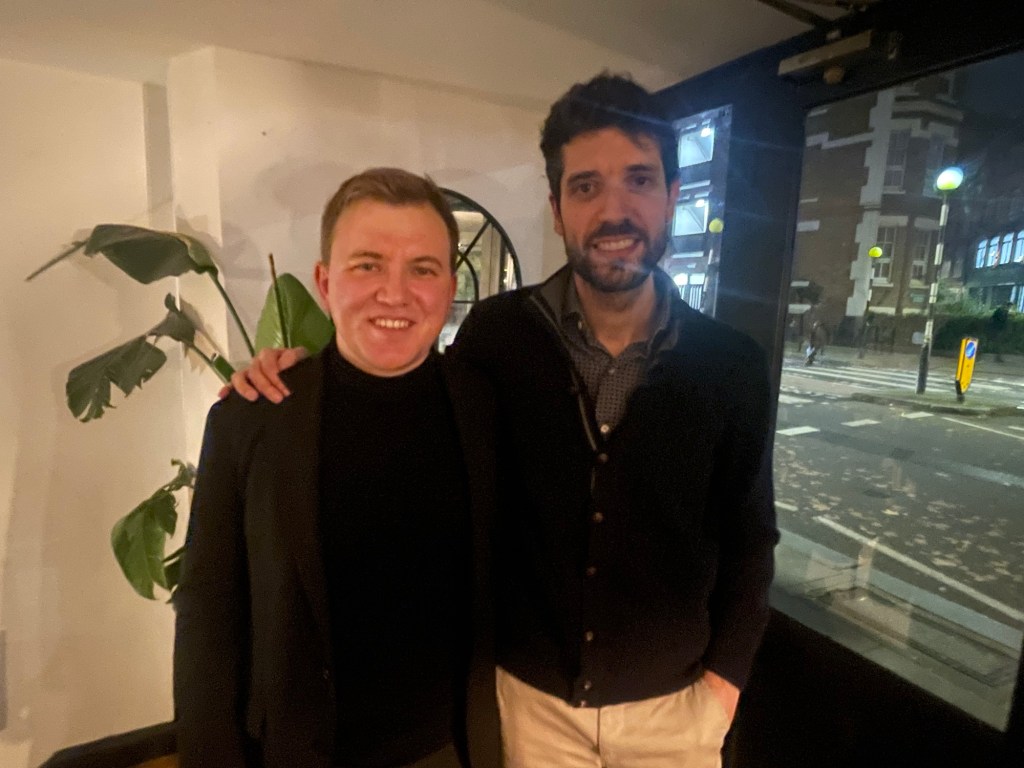
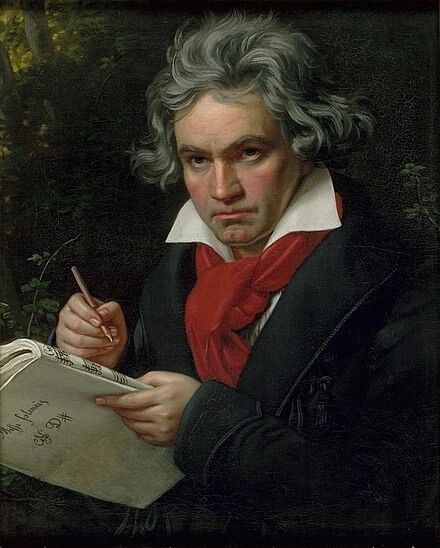

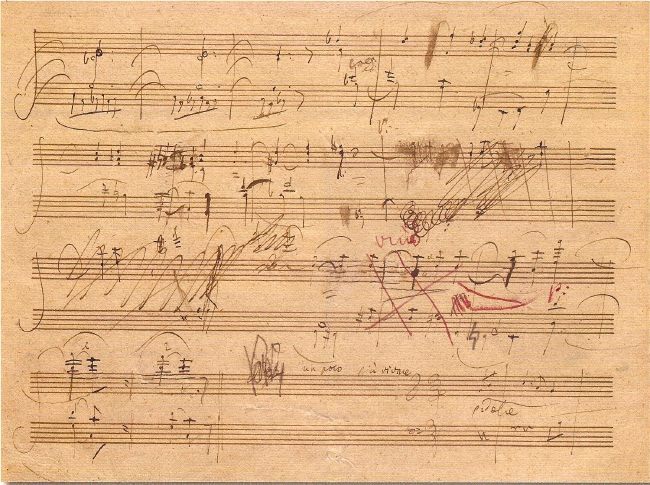
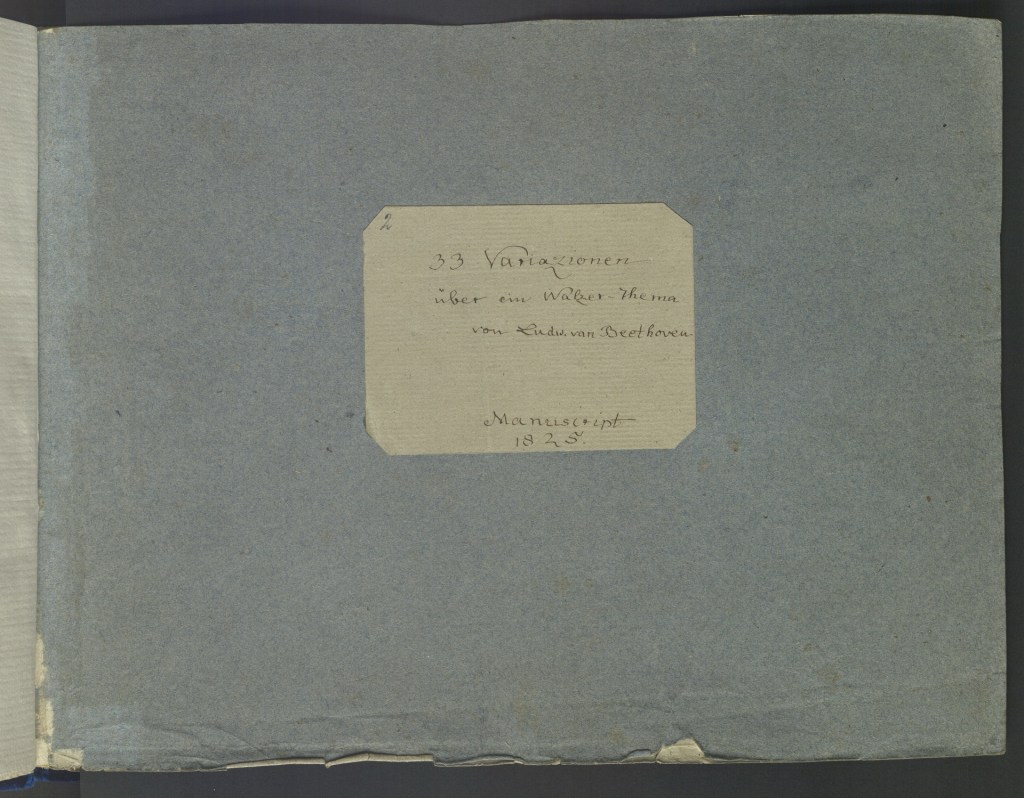
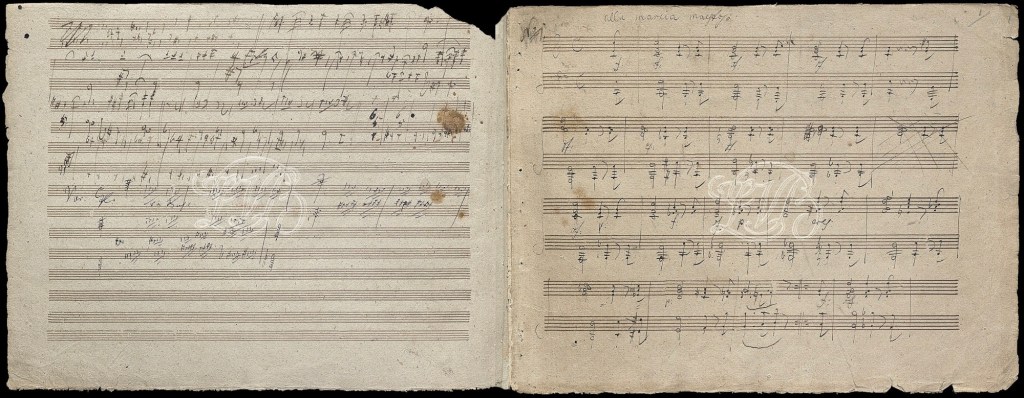
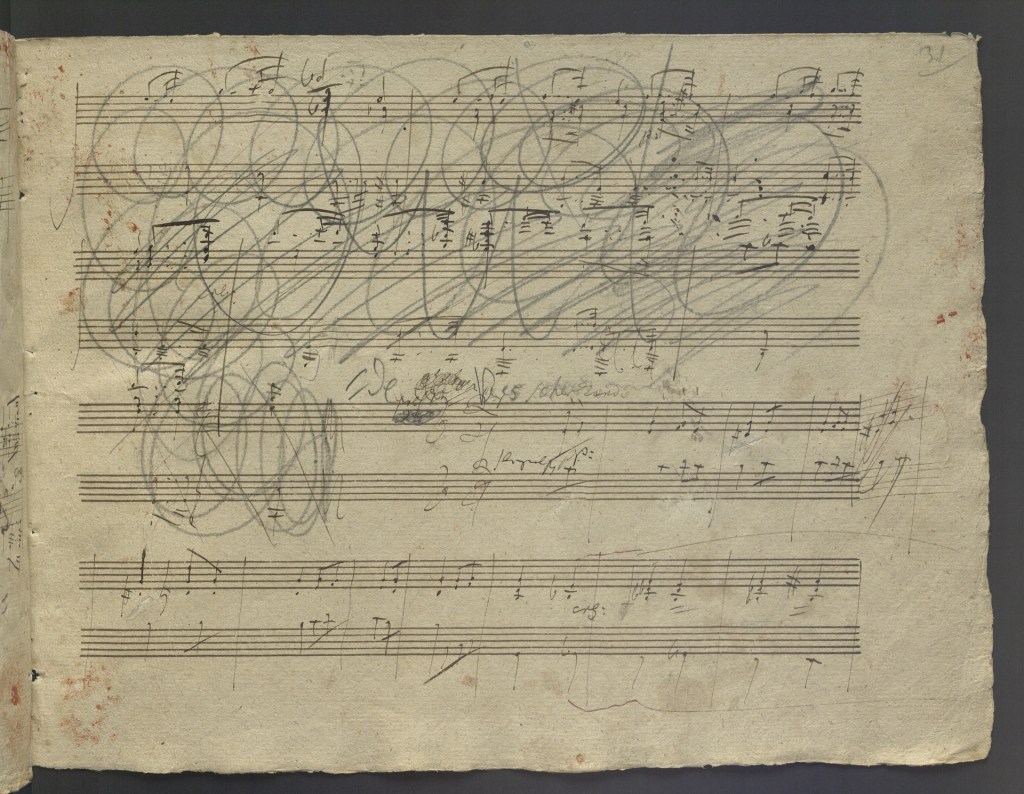


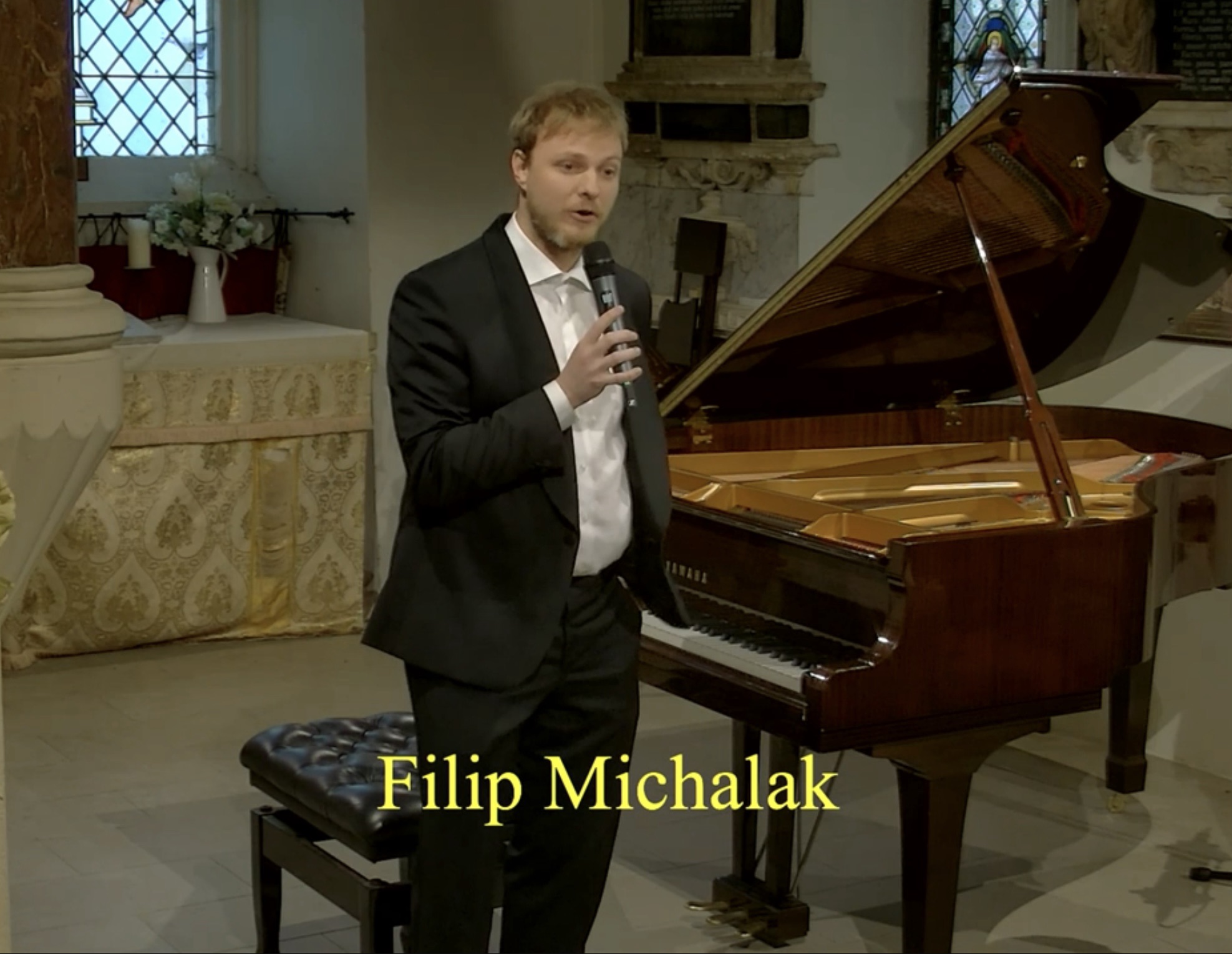
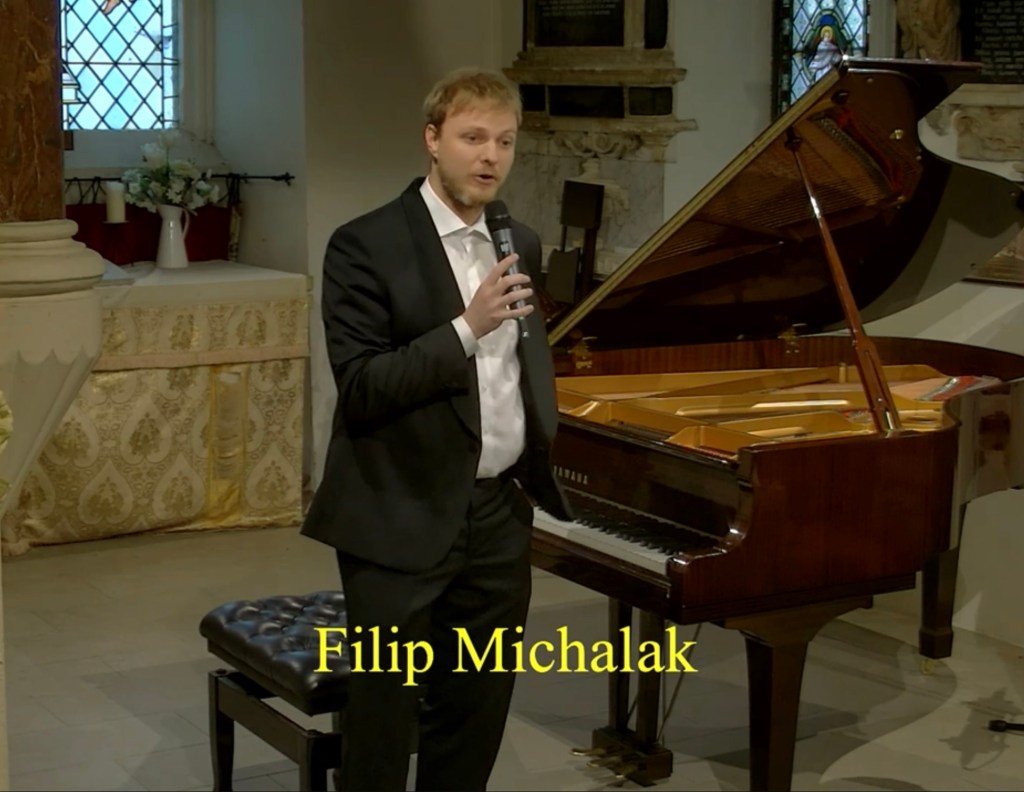
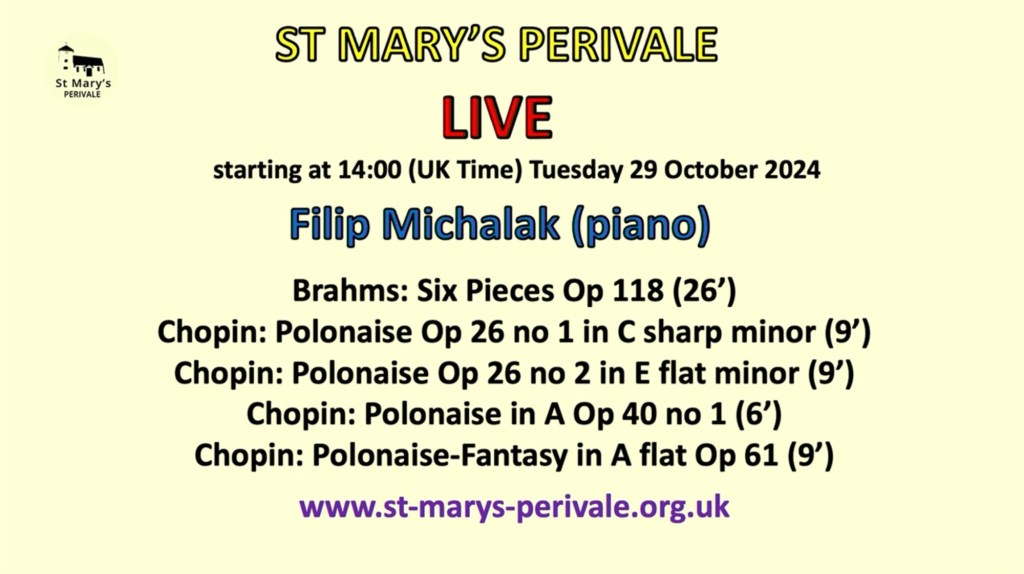
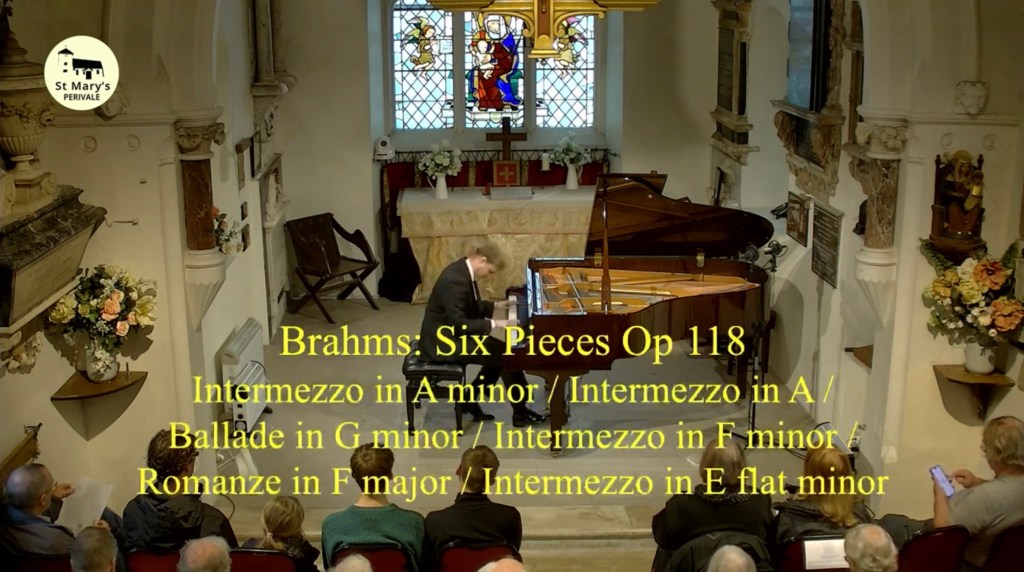

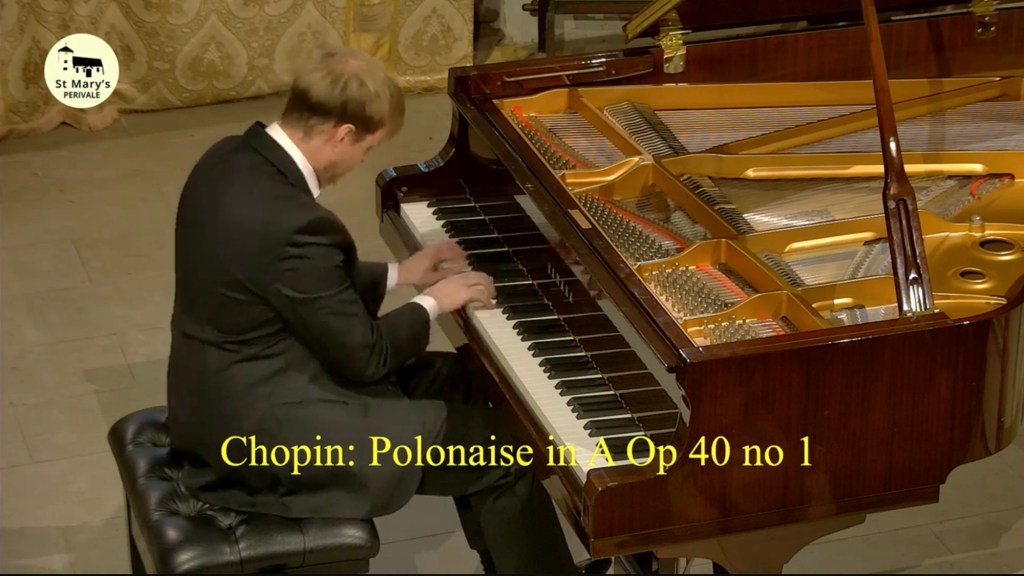

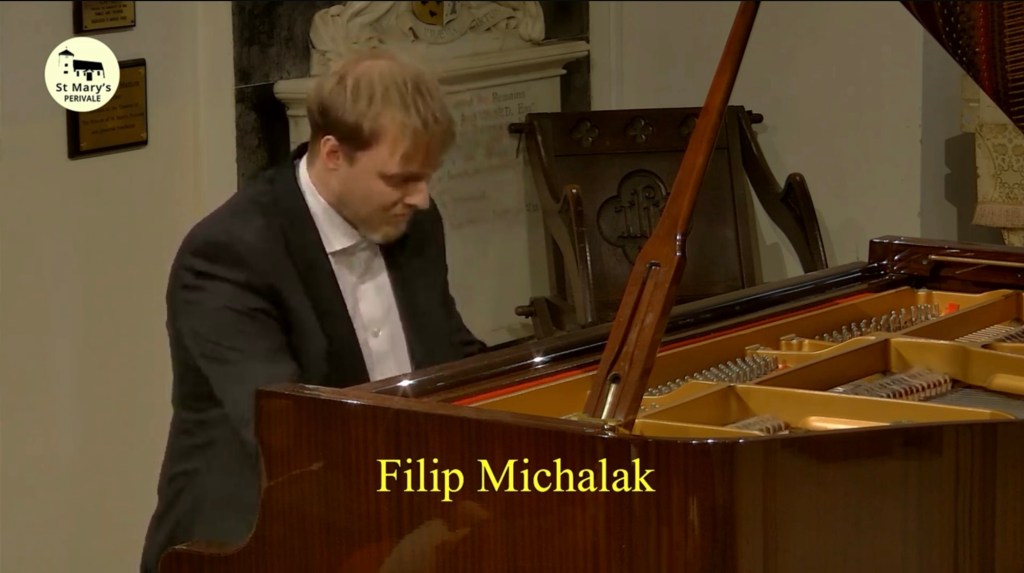
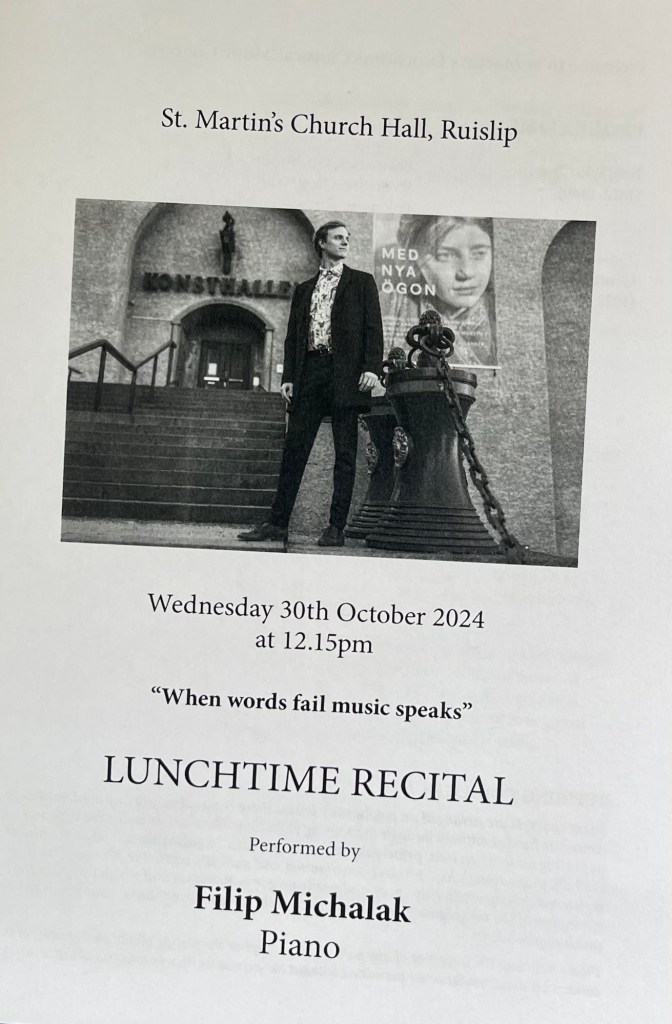
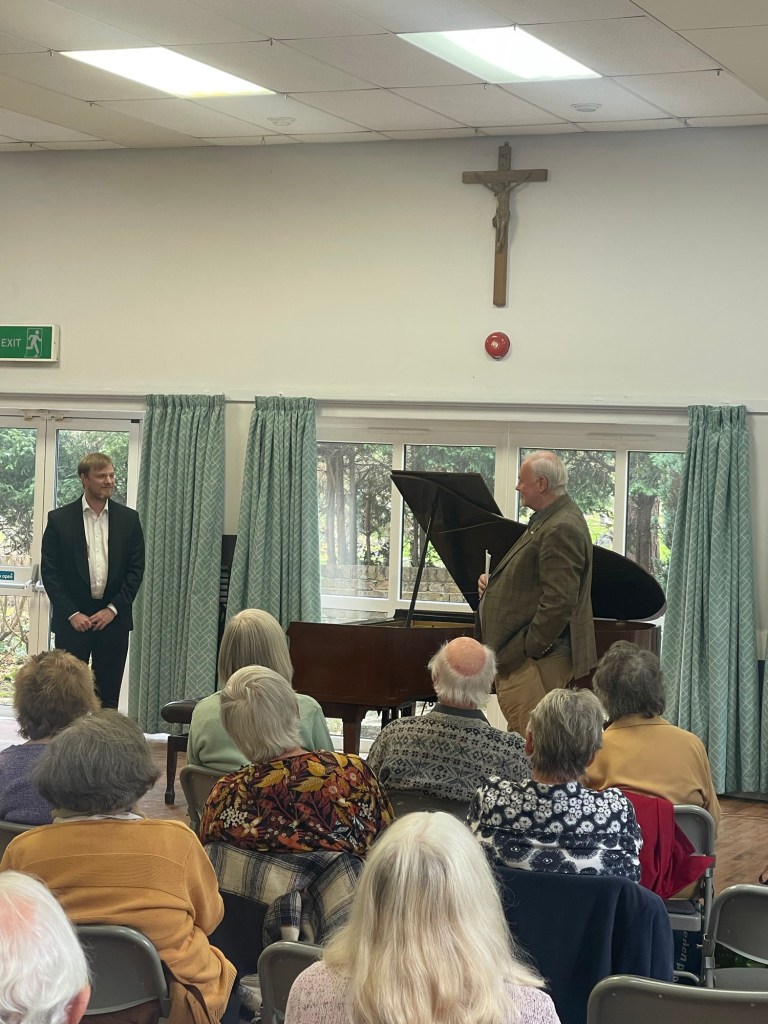
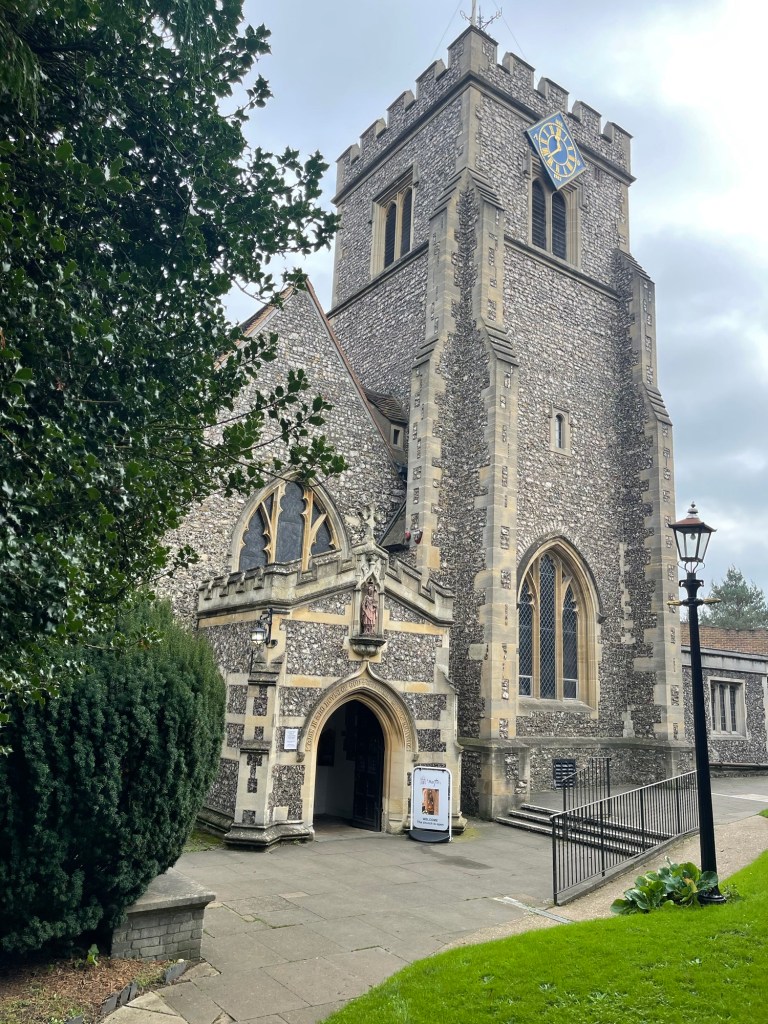
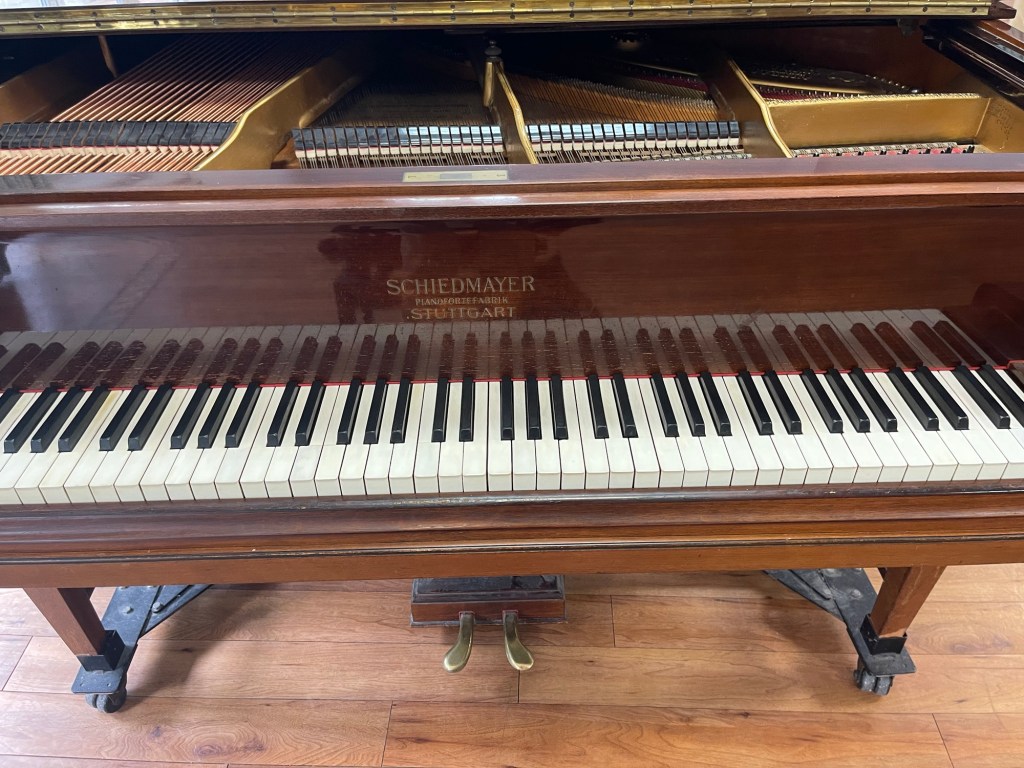
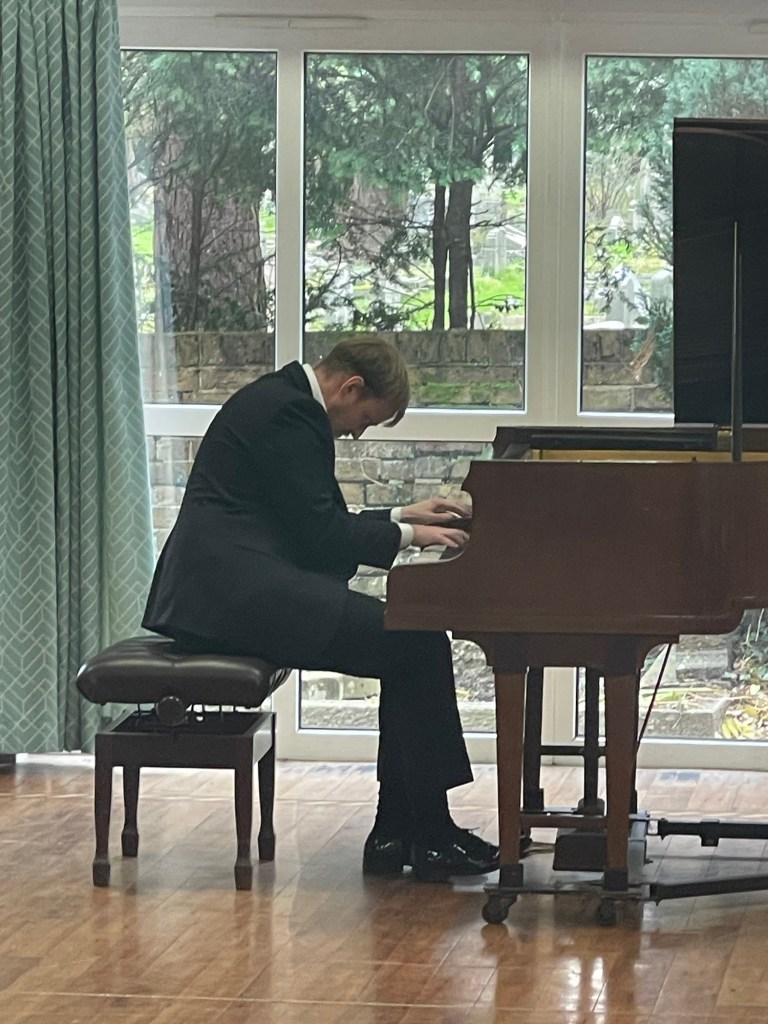
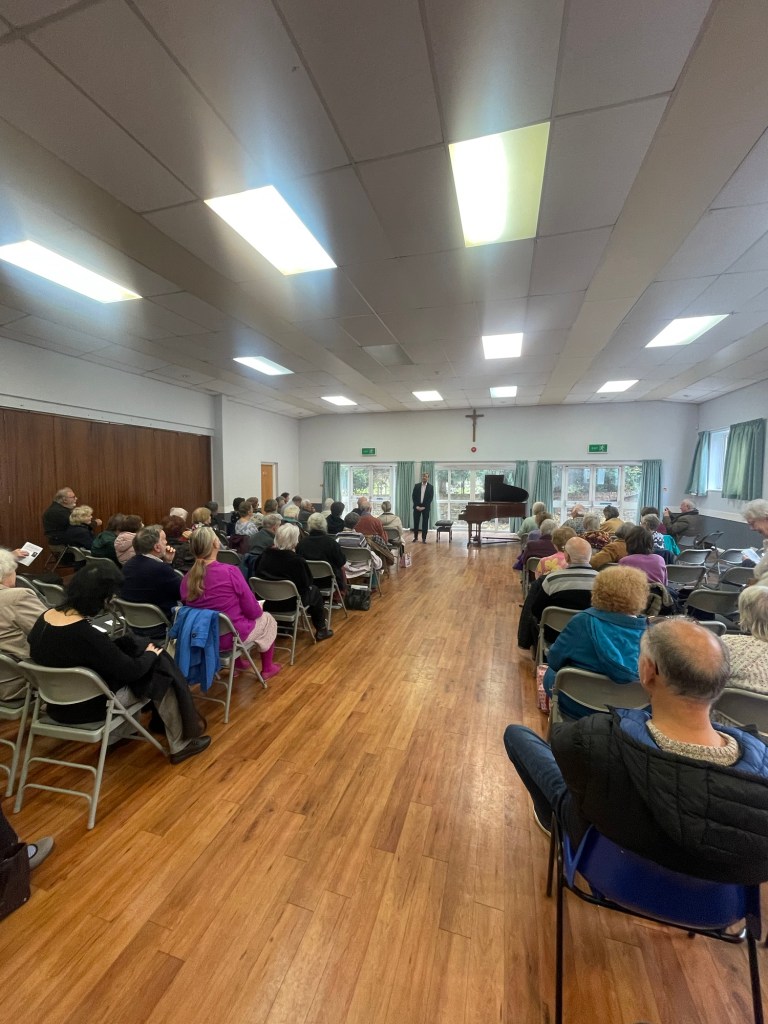
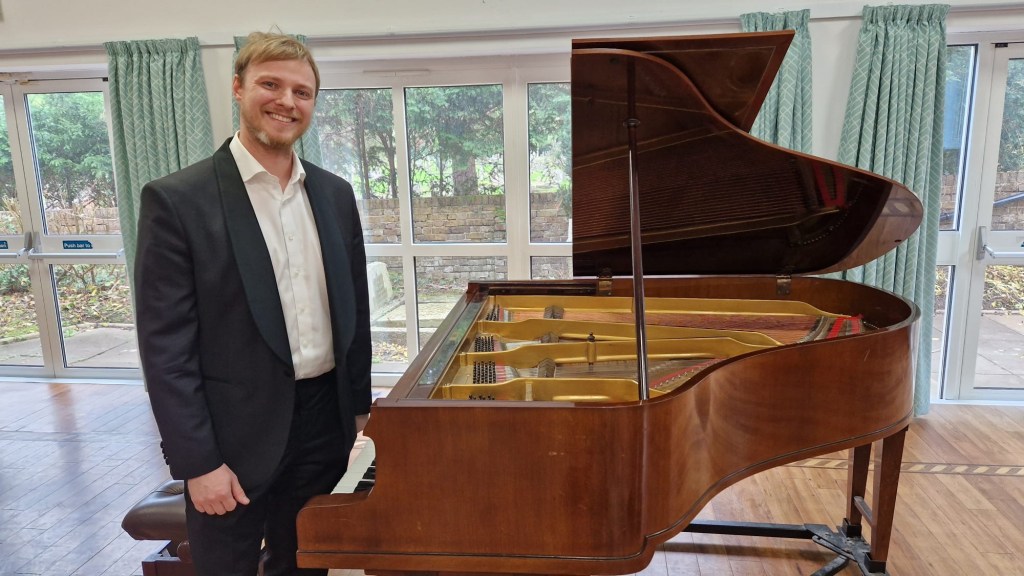
 ChristopherAxworthy-MusicCommentary