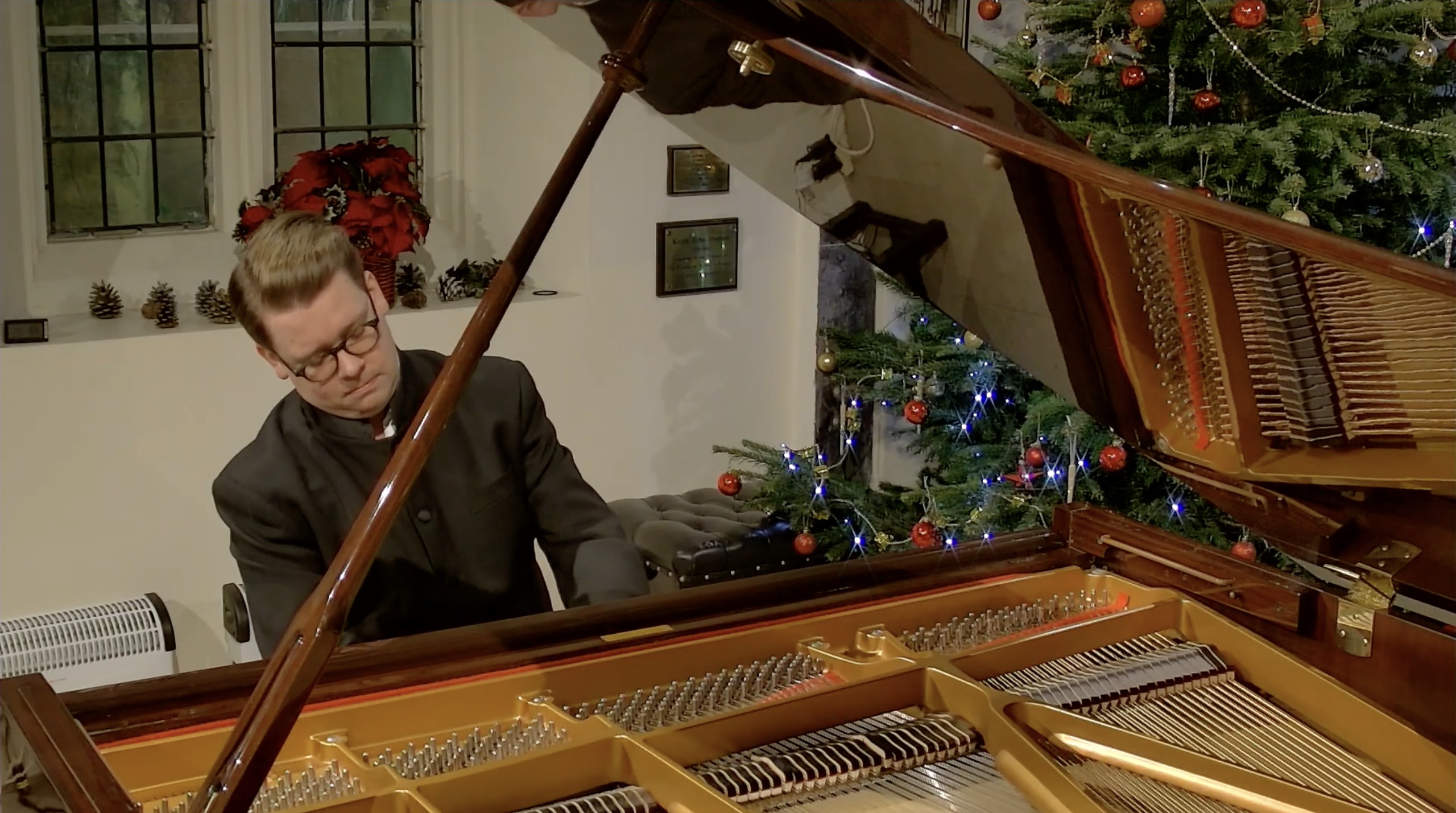
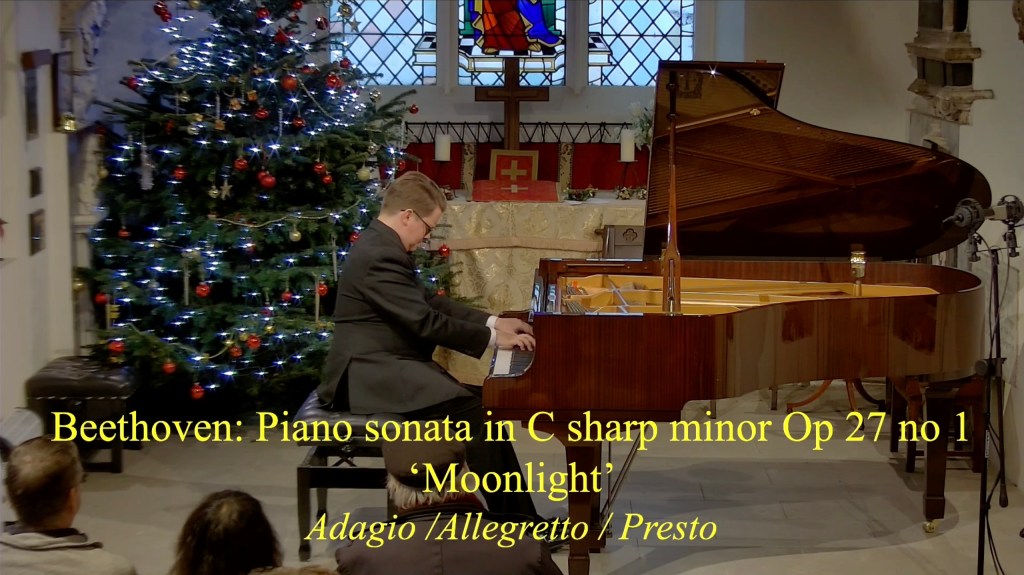
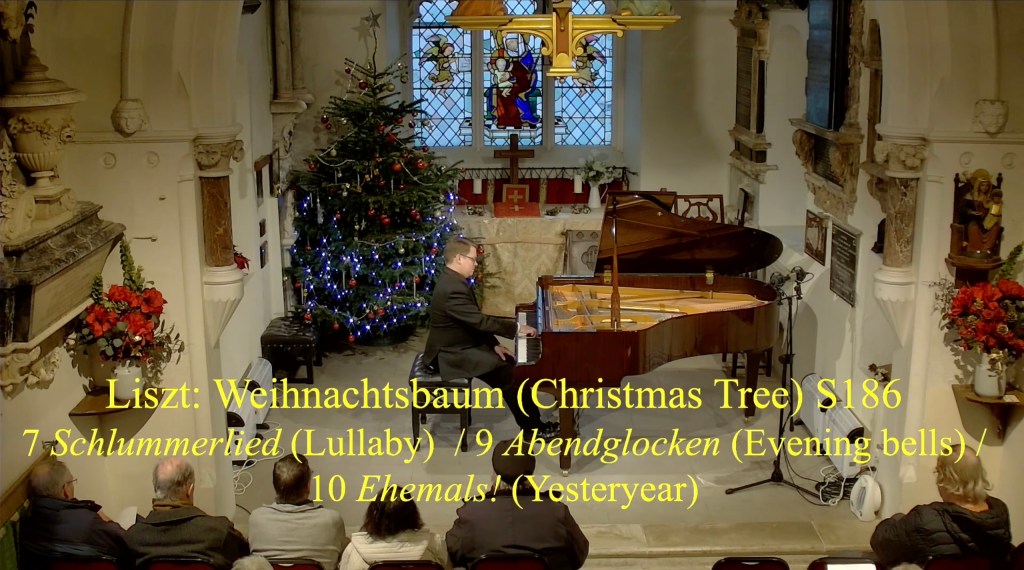
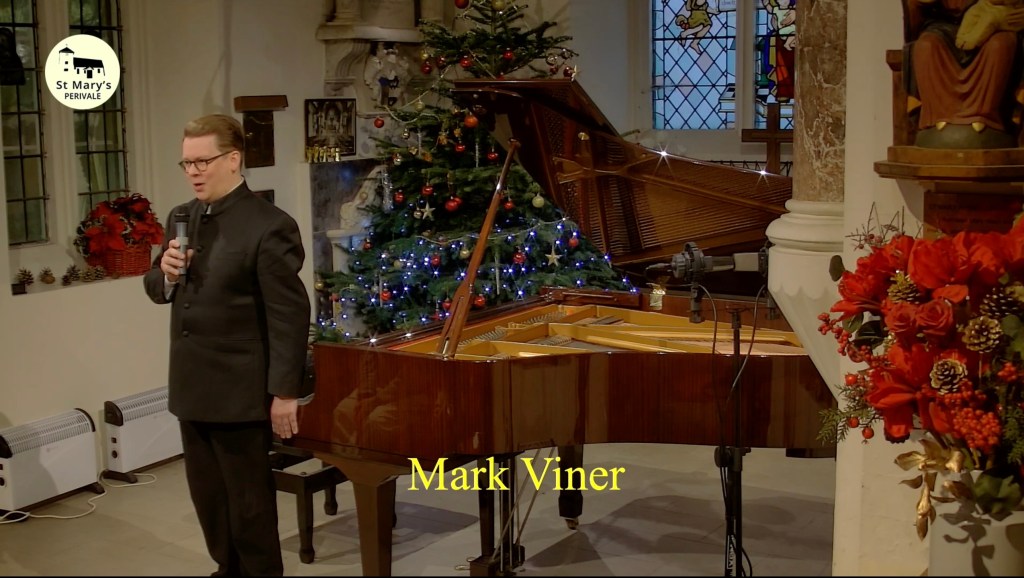
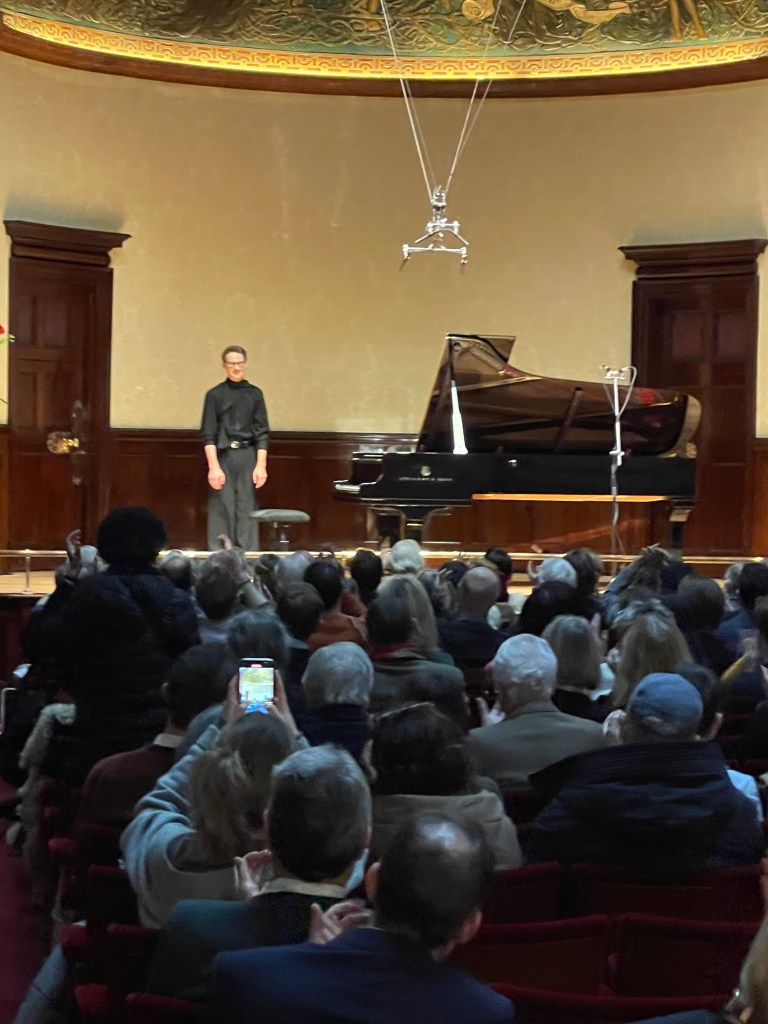
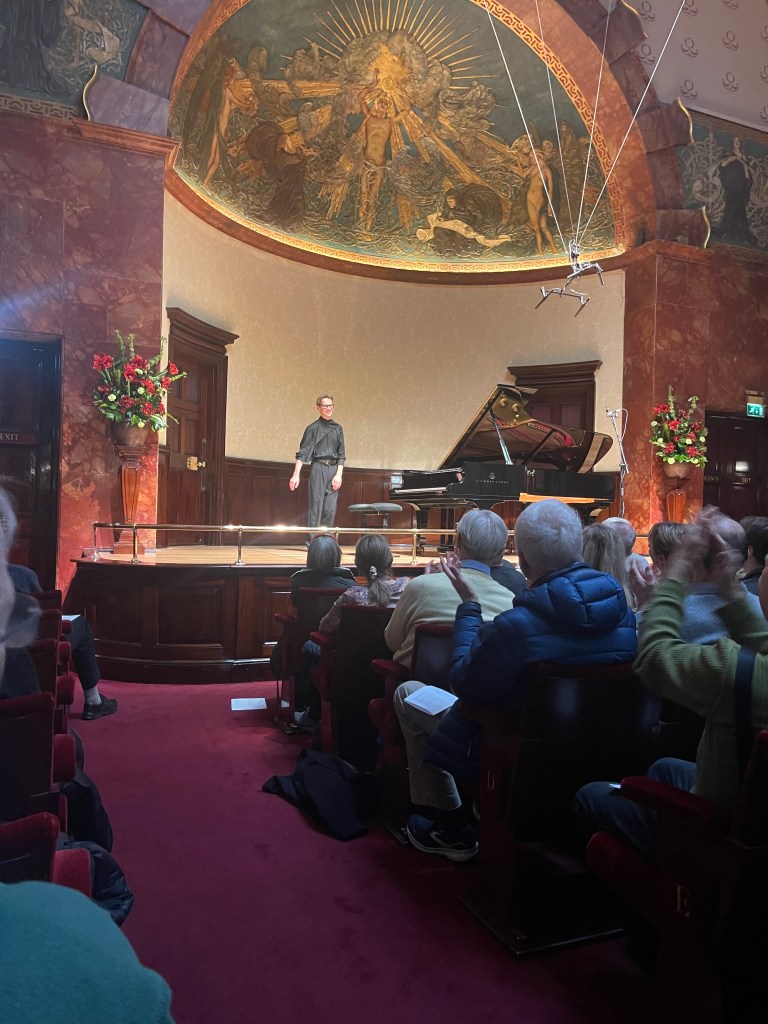
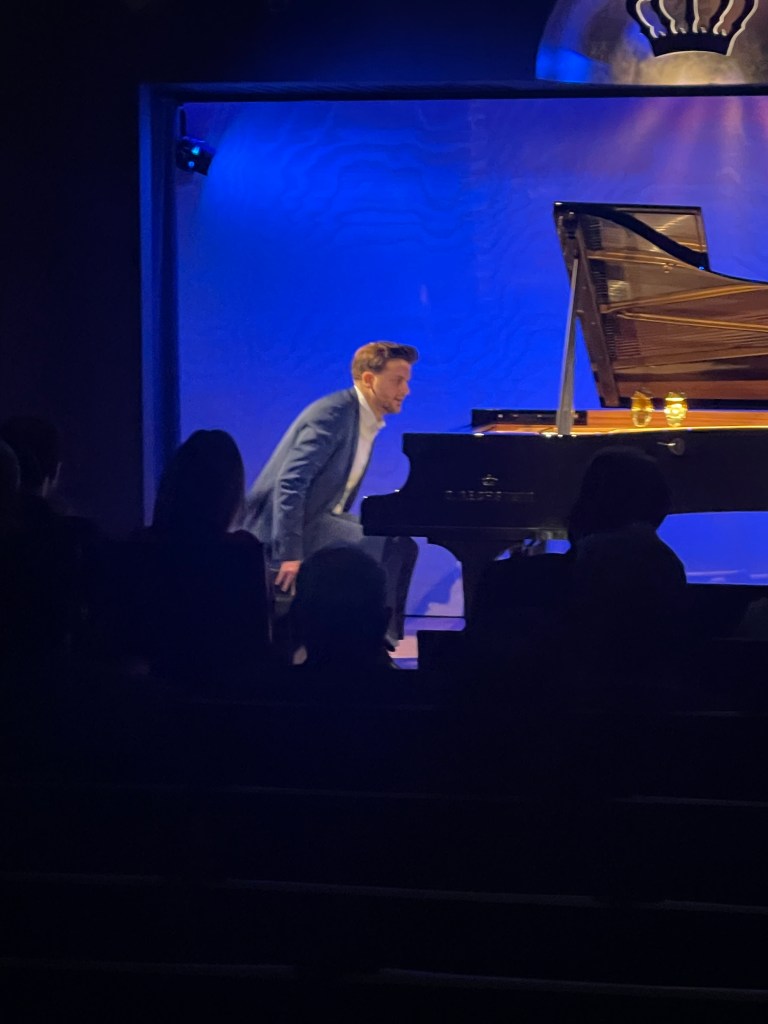
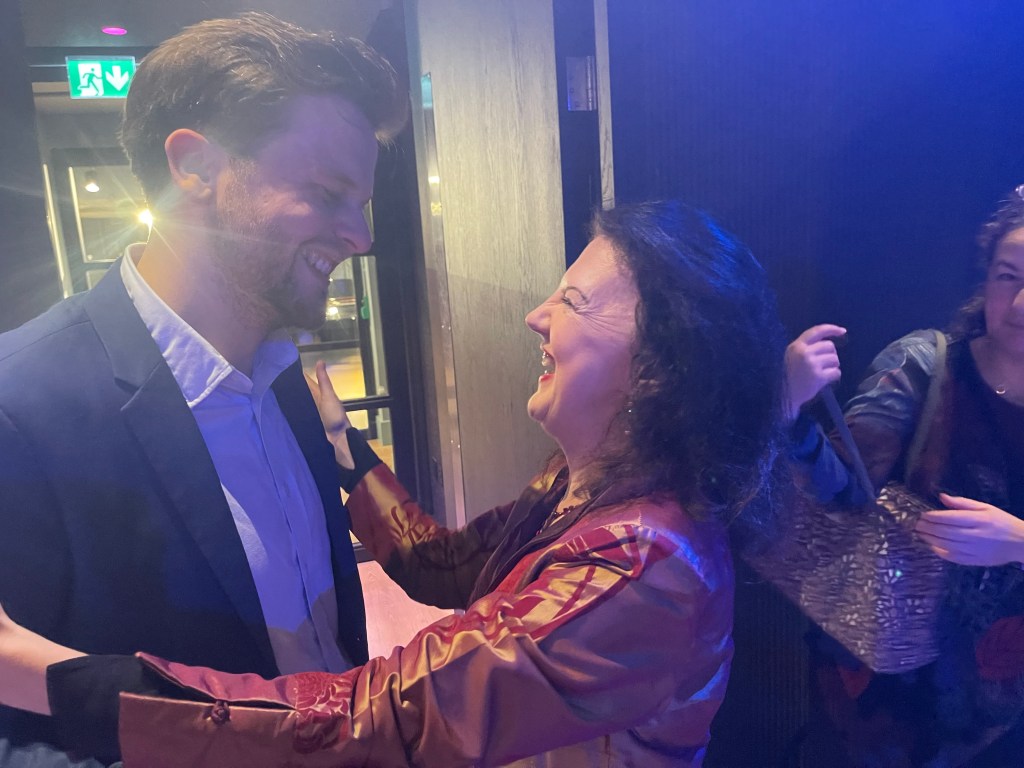
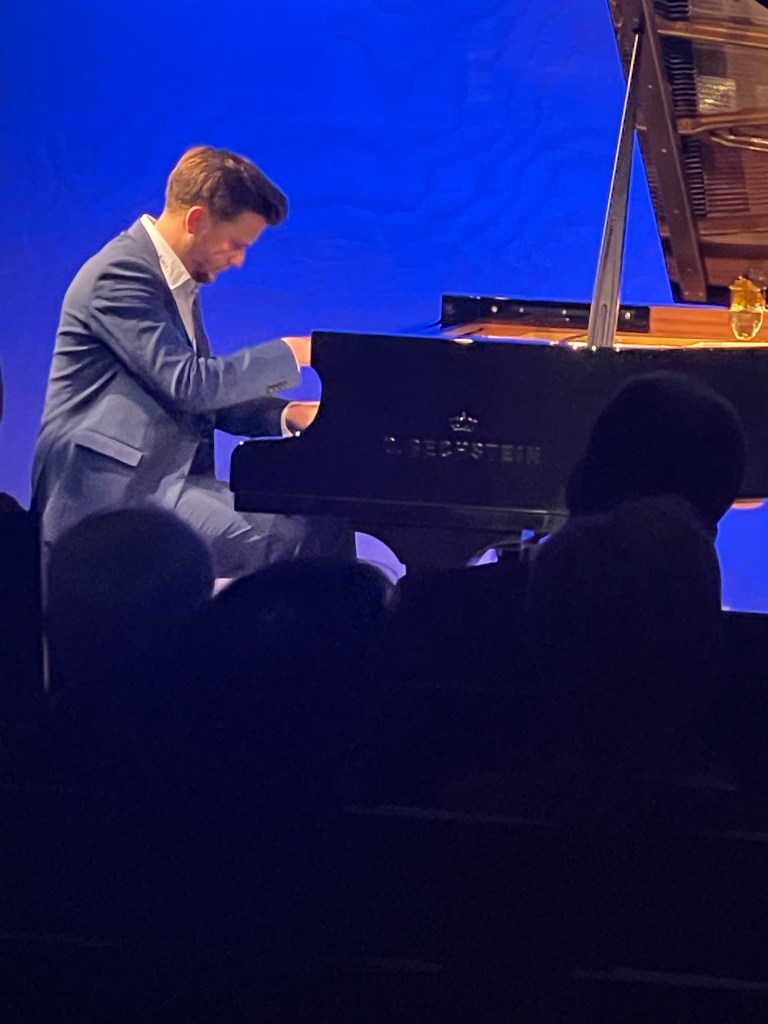
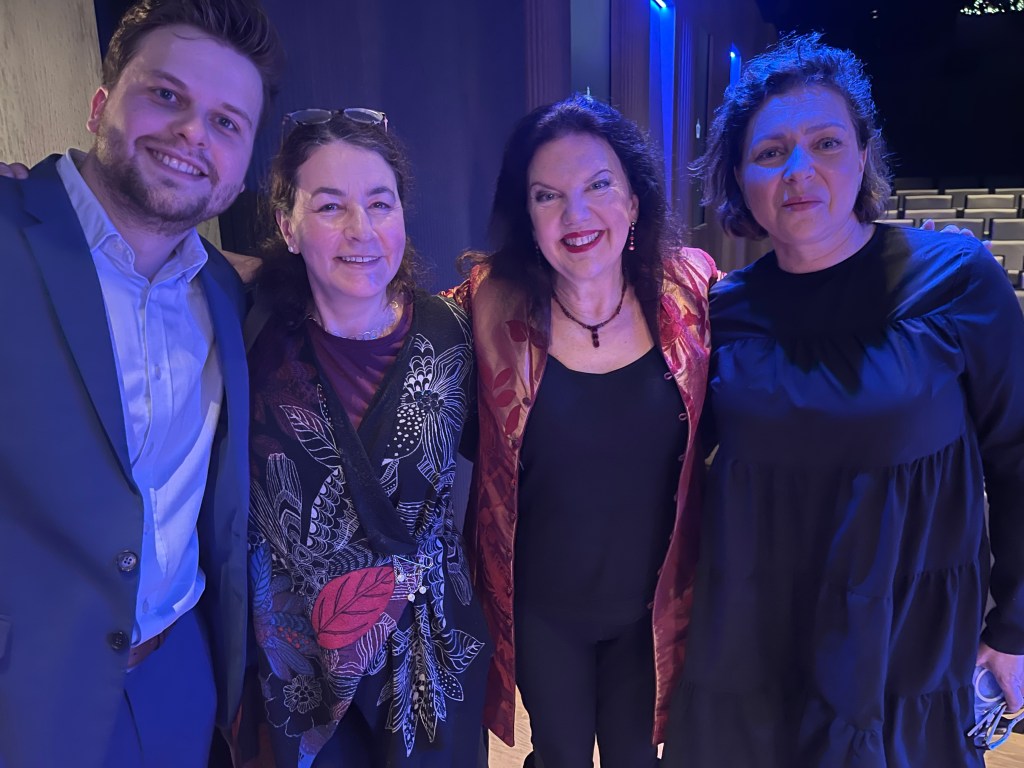
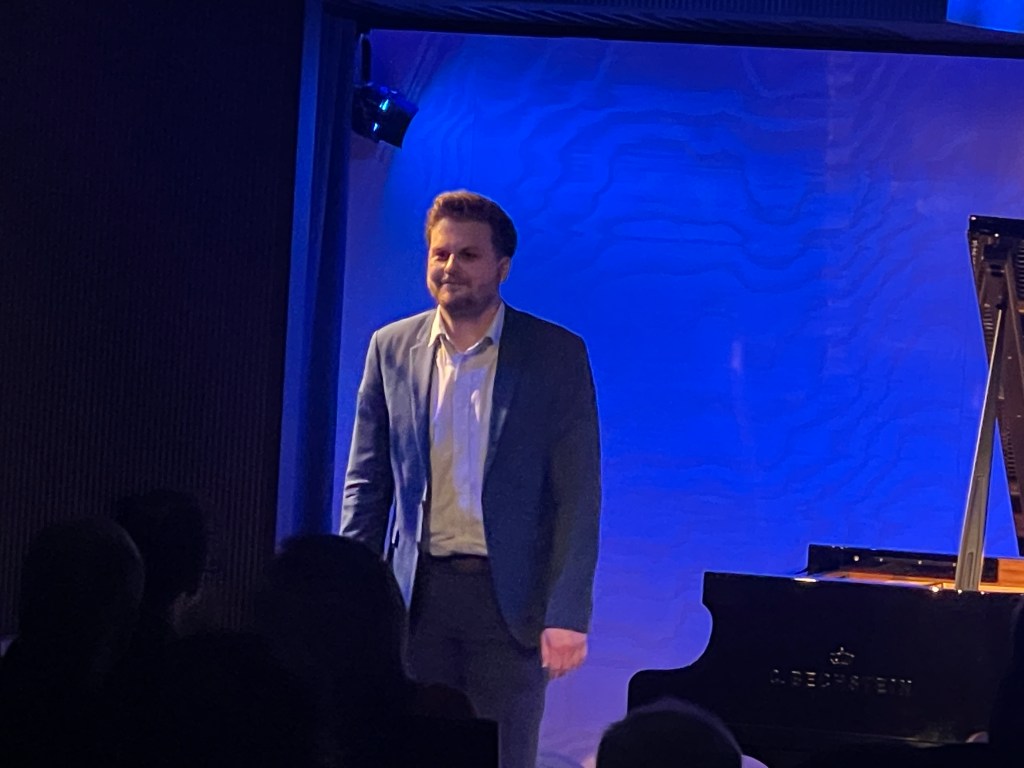
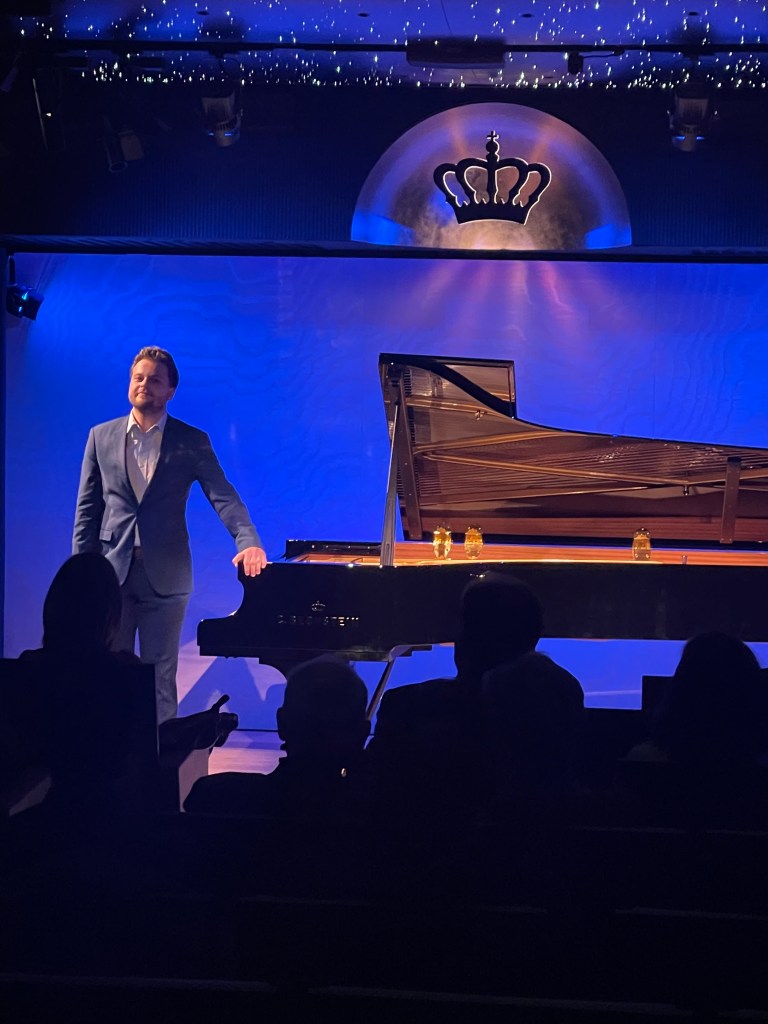
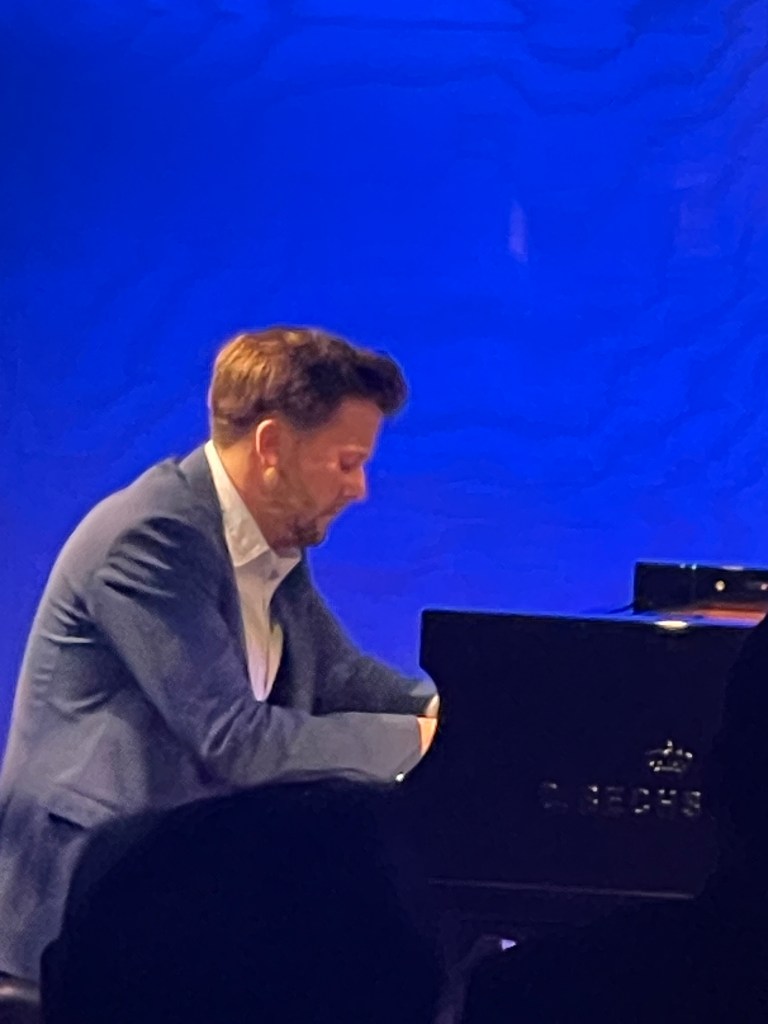
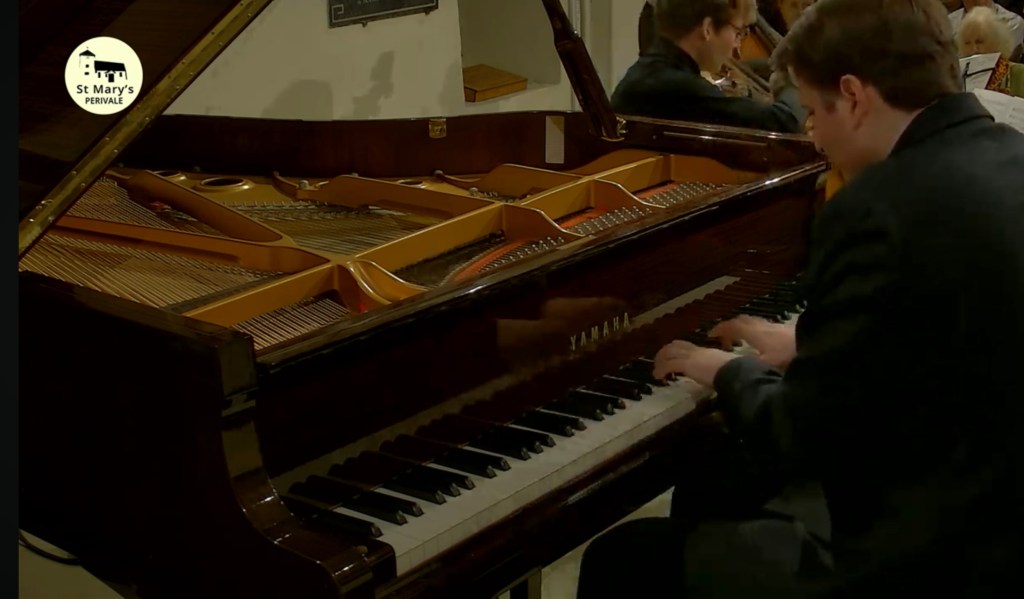
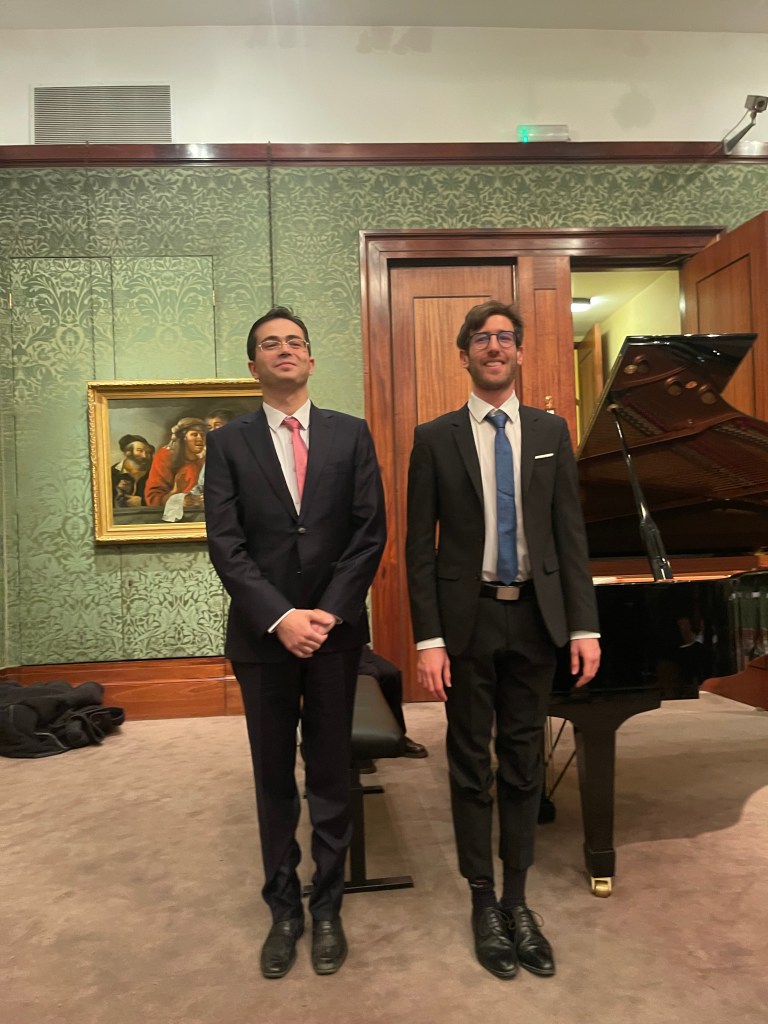
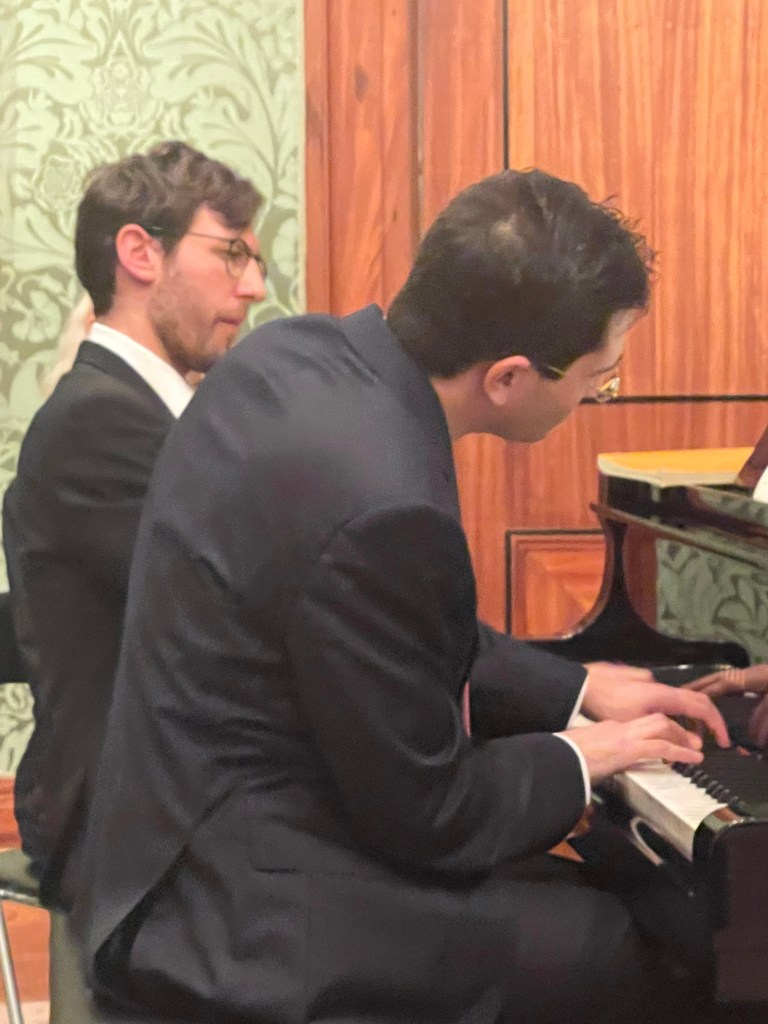
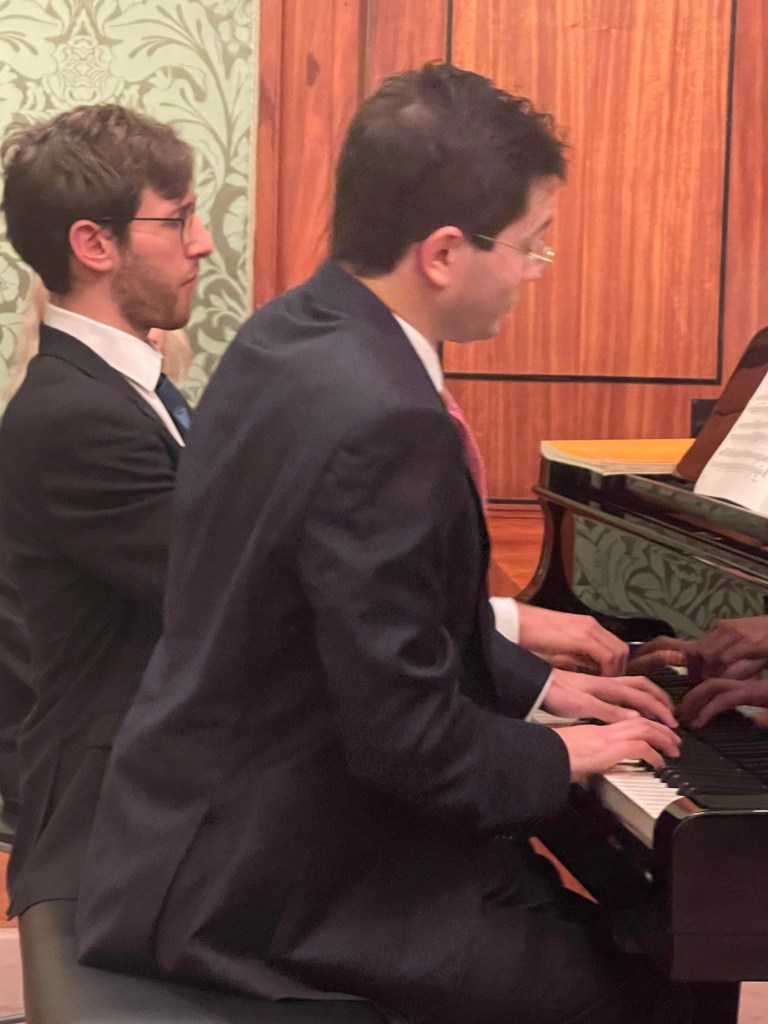
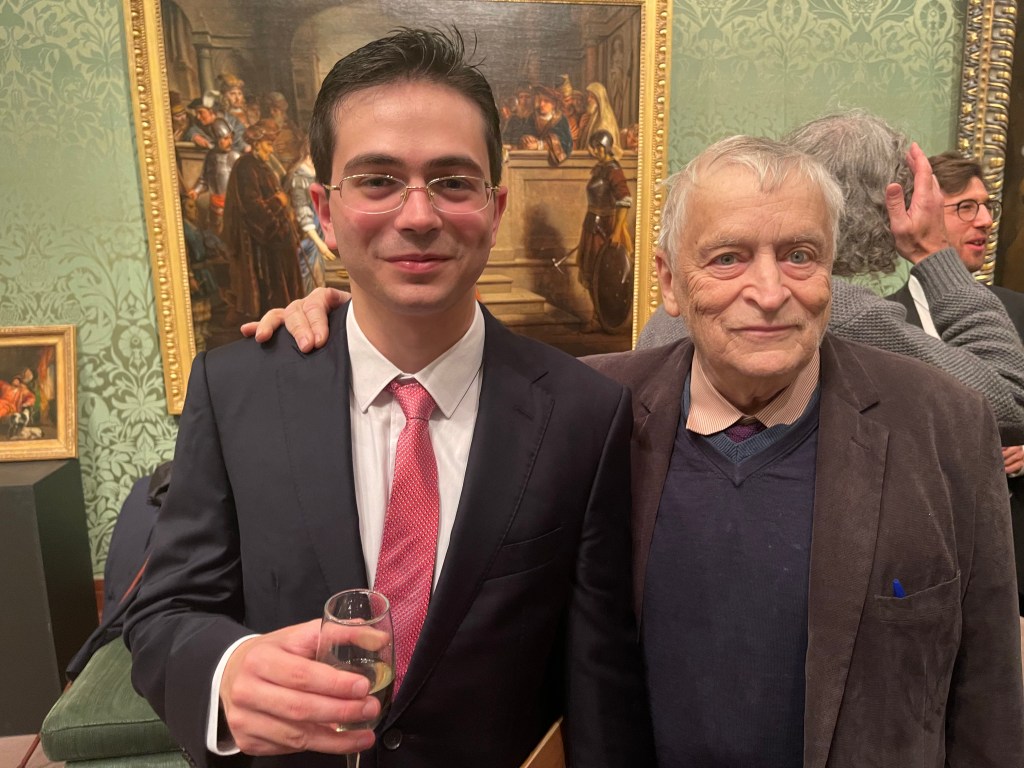
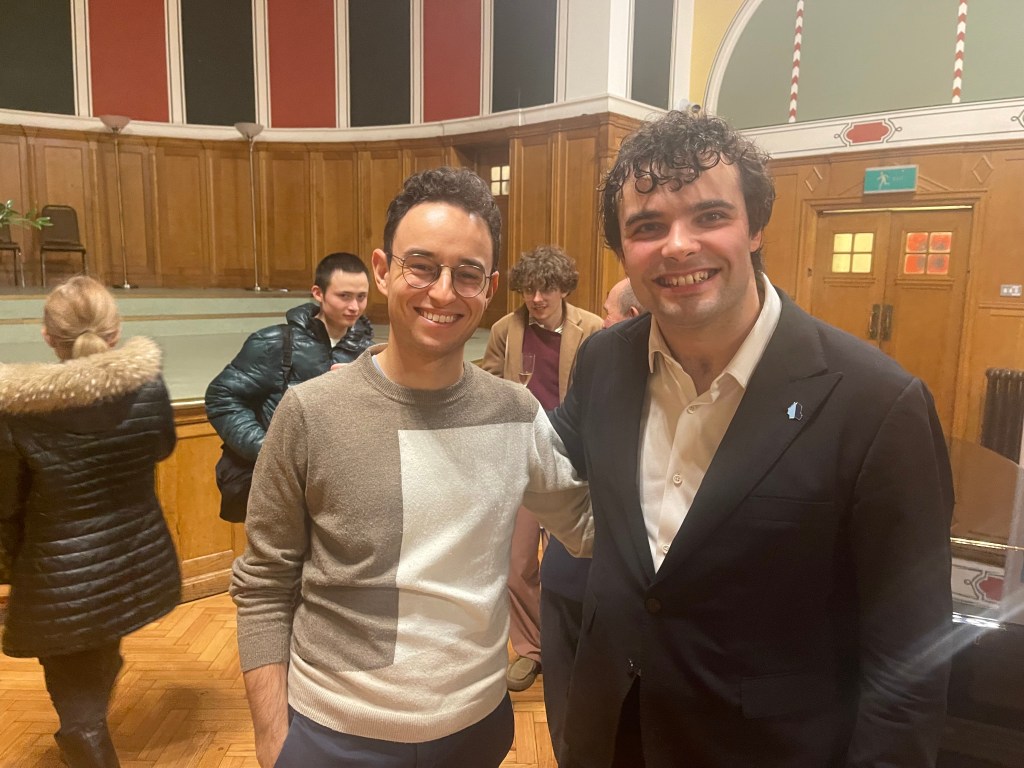
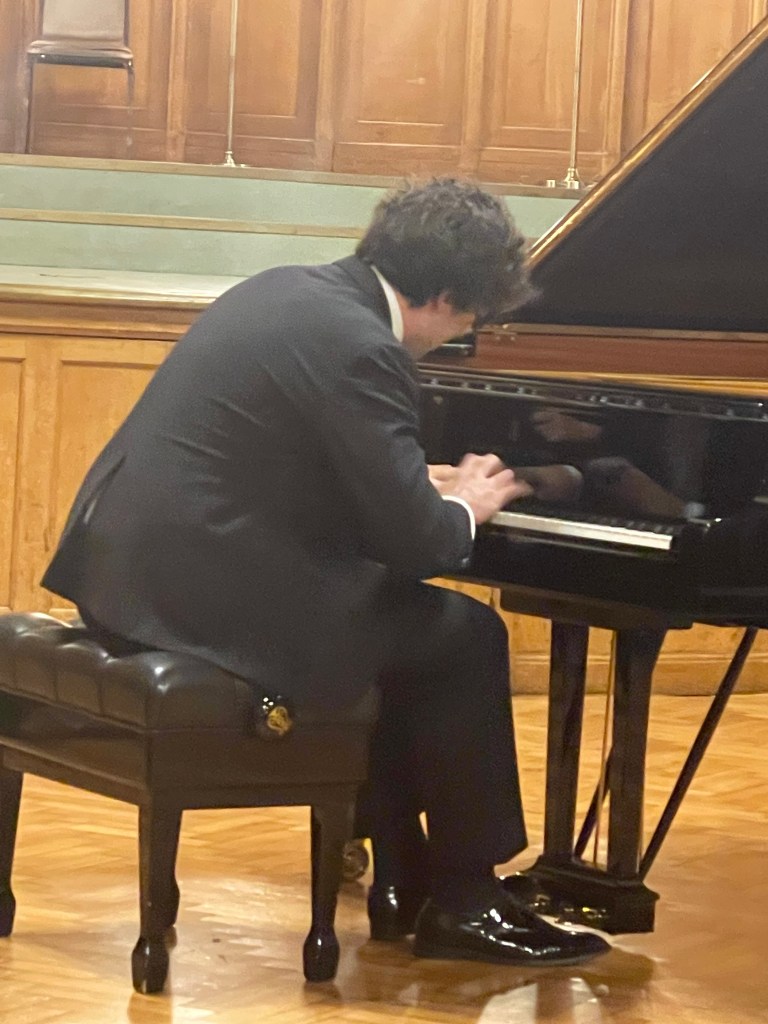
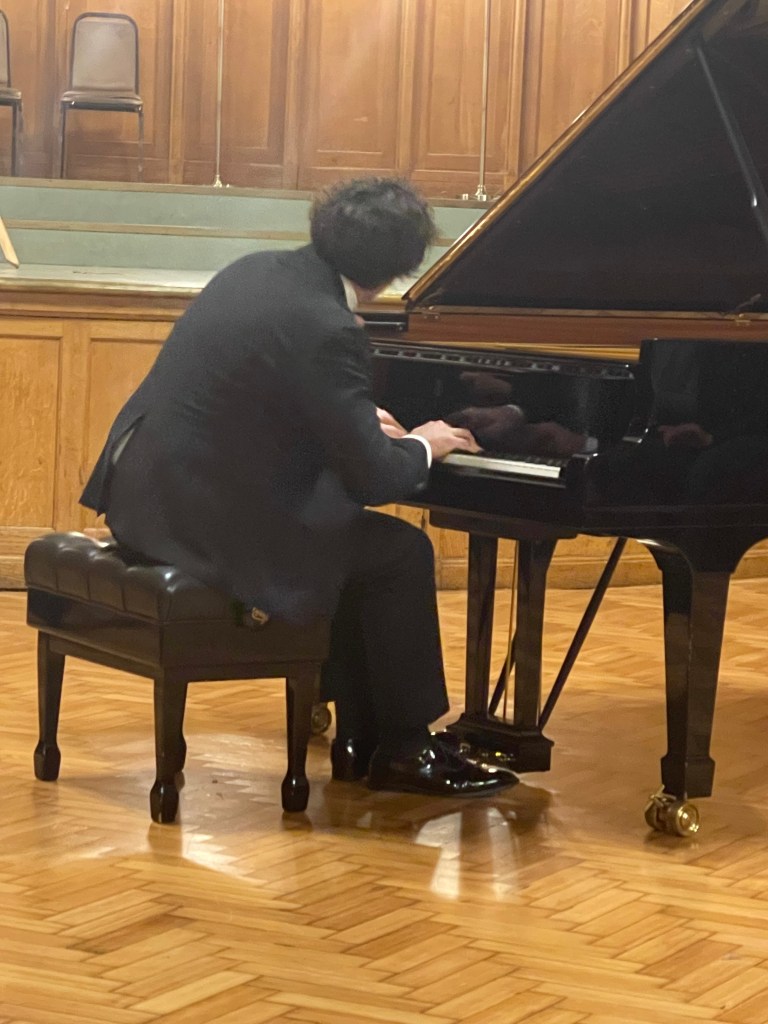
The extraordinary thing about a Mark Viner recital is his ability ,one might even say a mission or passion, to bring a fresh light to all he does. Whether delving deep into the archives for works too long kept in obscurity or looking at the most revered classics afresh with the same microscope and absolute fidelity to the composer that he uses to bring neglected masterpieces to the fore. And so it was today with two of the most played classics :Beethoven’s ‘Moonlight’ and Chopin’s G minor Ballade and relatively unknown works with a Christmas appeal. A transcription of two movements from Tchaikowsky’s ‘Nutcracker’ in the transcription of Taneyev which has long been overtaken by the genial much played one by Mikhail Pletnev. ‘A Christmas Tree Suite’ by Liszt that has long been in oblivion as are too many of his misunderstood later works. And the final triumphant March of the ‘Three Holy Kings’ from Liszt’s rarely heard oratorio ‘Christus’.
Mark’s annual Christmas Concert in Bedford Park where he resides
A programme decided only three days ago with Dr Hugh Mather to be able to substitute a sick colleague at St Mary’s Perivale. Luckily Mark has been playing this programme or similar in seven pre Christmas recitals in Oxford ,several in Germany for Moritz von Bredow.
The Tabard Inn Bedford Park Chiswick
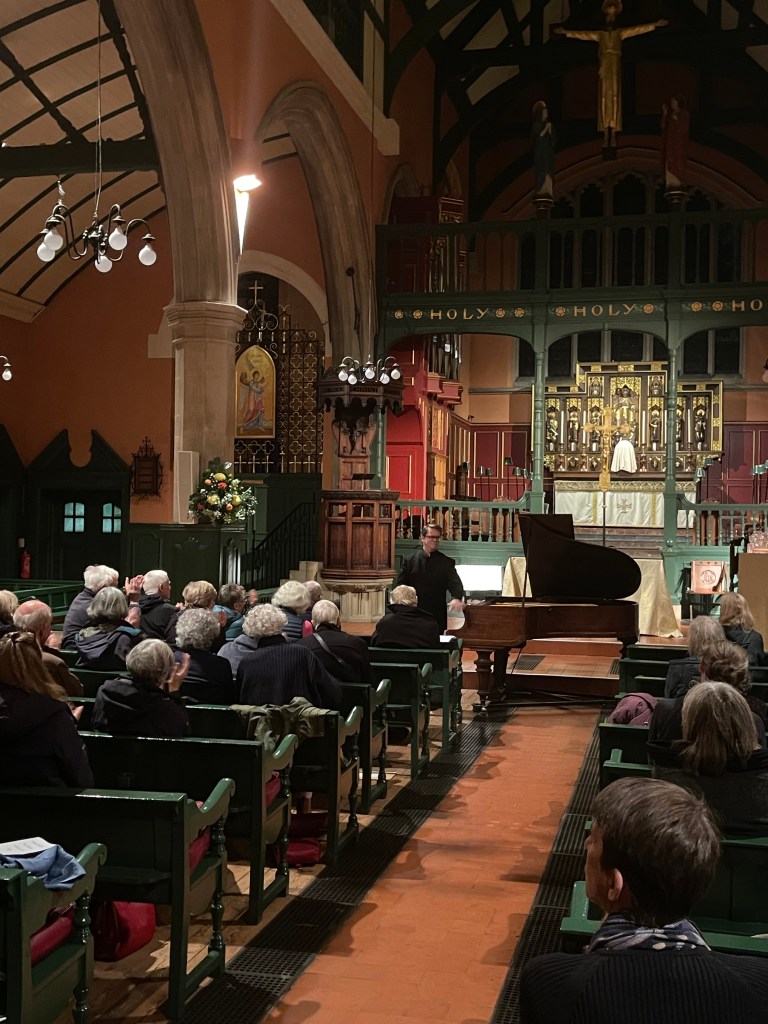
Finally on Thursday in his beloved St Michael’s and All Angels where he and his partner officiate and feel at home as much in the Church as in the Tabard Inn opposite or their sumptuous home next door.
Screenshot
Beethoven’s miss-named ‘Moonlight’ Sonata had no sign of dreamy rays in Mark’s ‘illuminated’ reading. ‘Adagio sostenuto’ first movement in two not the tainted moonlit twelve! There was a fluidity and glowing beauty of Beethovenian strength and nobility. An authoritative performance that would come as a surprise to those that have struggled with a much maligned piece. Even Beethoven’s long pedal markings were intelligently noted and interpreted on an instrument very different from the one that Beethoven could actually still hear.The Minuet was played with unusual weight and seriousness which suited the sumptuous rich sounds of the Trio.The ‘Presto’ finale was played with extraordinary clarity and dynamic rhythmic drive where even the beautiful mellifluous episodes were on a burning cauldron of bubbling energy.
Screenshot
Chopin’s First Ballade was given an aristocratic reading of nobility and refreshing simplicity. Gone were all the layers of dirt that tradition has accumulated over the years and like Rubinstein Chopin’s vision of beauty was allowed to tell it’s own untarnished story.
Everything sang in Mark’s remarkable hands even the first great climax usually played like the 1812 overture,whereas in Mark’s hands the top notes of the sumptuous chords were allowed to glow with a radiance of architectural brilliance. The coda was taken at breakneck speed and might have enjoyed a more mellifluous ride but this was a vision of a man who had a story to tell and this was an integral part of his story of beauty and the beast!
Has the ‘ Sugar Plum Fairy ‘ ever sounded so radiant and glowing as she retraced her steps with infinite delicacy and stealth. There was a wonderful fluidity to the ‘Pas de deux ‘ which in Taneyev’s agile transcription should at least be rechristened ‘ de trois’ or ‘de quattro’. Not quite as pianistically daring as Pletnev it was nevertheless good to hear what was obviously the starting point for a pianistic genius of our times. Mark played it with sumptuous sounds and expansive melody of grandiose beauty with streams of notes just pouring from his well oiled fingers, just as ballet stars would be inspired to great heights by this magnificent score.
Screenshot
As a teenager I would frequent the music department of Chiswick Library and bring home scores to look at and try to play on my grandmother’s upright Broadwood. A piano that her husband had bought before going to the 1914 -18 war never to come back to enjoy the piano that stood in the parlour and would eventually be played by his two daughters. One of the pieces I brought back from the library was Liszt’s ‘Christmas’s Tree Suite’ . I remember the bright orange cover and my disappointment at what I found inside.Today Mark played three pieces from the suite the whole of which he has just recorded on one of his numerous CD’s. This is late Liszt where the composer was looking to the future with a sound world that was no longer necessarily with a tonal centre.This of course explains the strange inconclusive finish of the first piece and the resonant sounds in reply to the melodious recitativi of the second.The final piece was with a strident melody opening out to a full sumptuous outpouring. I must say I am still not completely convinced or maybe I am just mislead by the title.Mark played it with masterly conviction and burning authority and I look forward to listening to his recording of the whole work with that orange covered score at hand – I wonder if it is still languishing on the shelf sixty years on !!!
Screenshot
Liszt”s own transcription of the March from his ‘Christus’ Oratorio was played with astonishing mastery with an outpouring of great resonance expanding into a show piece of great effect .
Another wondrous voyage of discovery from one of the most important young artists before the public today
Described by International Piano Magazine as “one of the most gifted pianists of his generation”, Mark Viner is steadily gaining a reputation as one of Britain’s leading concert pianists; his unique blend of individual artistry combined with his bold exploration of the byways of the piano literature garnering international renown. He began playing at the age of 11 before being awarded a scholarship two years later to enter the Purcell School of Music where he studied with Tessa Nicholson for the next five years. Another scholarship took him to the Royal College of Music where he studied with the late Niel Immelman for the next six years, graduating with first class honours in a Bachelor of Music degree in 2011 and a distinction in Master of Performance 2013; the same year which afforded him the honour to perform before HM the King.
After winning 1st prize at the Alkan-Zimmerman International Piano Competition in Athens, Greece in 2012, his career has brought him across much of Europe as well as North and South America. While festival invitations include appearances the Raritäten der Klaviermusik, Husum in Germany, the Cheltenham Music Festival and Harrogate Music Festival in the United Kingdom and the Festival Chopiniana in Argentina, radio broadcasts include recitals and interviews aired on Deutschlandfunk together with frequent appearances on BBC Radio 3. His acclaimed Wigmore Hall début recital in 2018 confirmed his reputation as one of today’s indisputable torchbearers of the Romantic Revival. He is particularly renowned for his CD recordings on the Piano Classics label which include music by Alkan, Blumenfeld, Chaminade, Liszt and Thalberg, all of which have garnered exceptional international critical acclaim. His most important project to date is a survey of the complete piano music of Alkan: the first of its kind and which is expected to run to some 18 CDs in length. Aside from a busy schedule of concerts and teaching, he is also a published composer and writer and his advocacy for the music of Alkan led to his election as Chairman the Alkan Society 2014.
The indomitable Marcella Crudeli created the Rome International Piano Competition amazingly 33 years ago.The eternal city was one of the few capital cities that did not have an International Piano Competition.Although it was talked about and envisaged, it was never actually realised (various ideas to name one after Carlo Zecchi or Guido Agosti came to nothing).It was Marcella Crudeli who created a competition in the name of Rome itself.
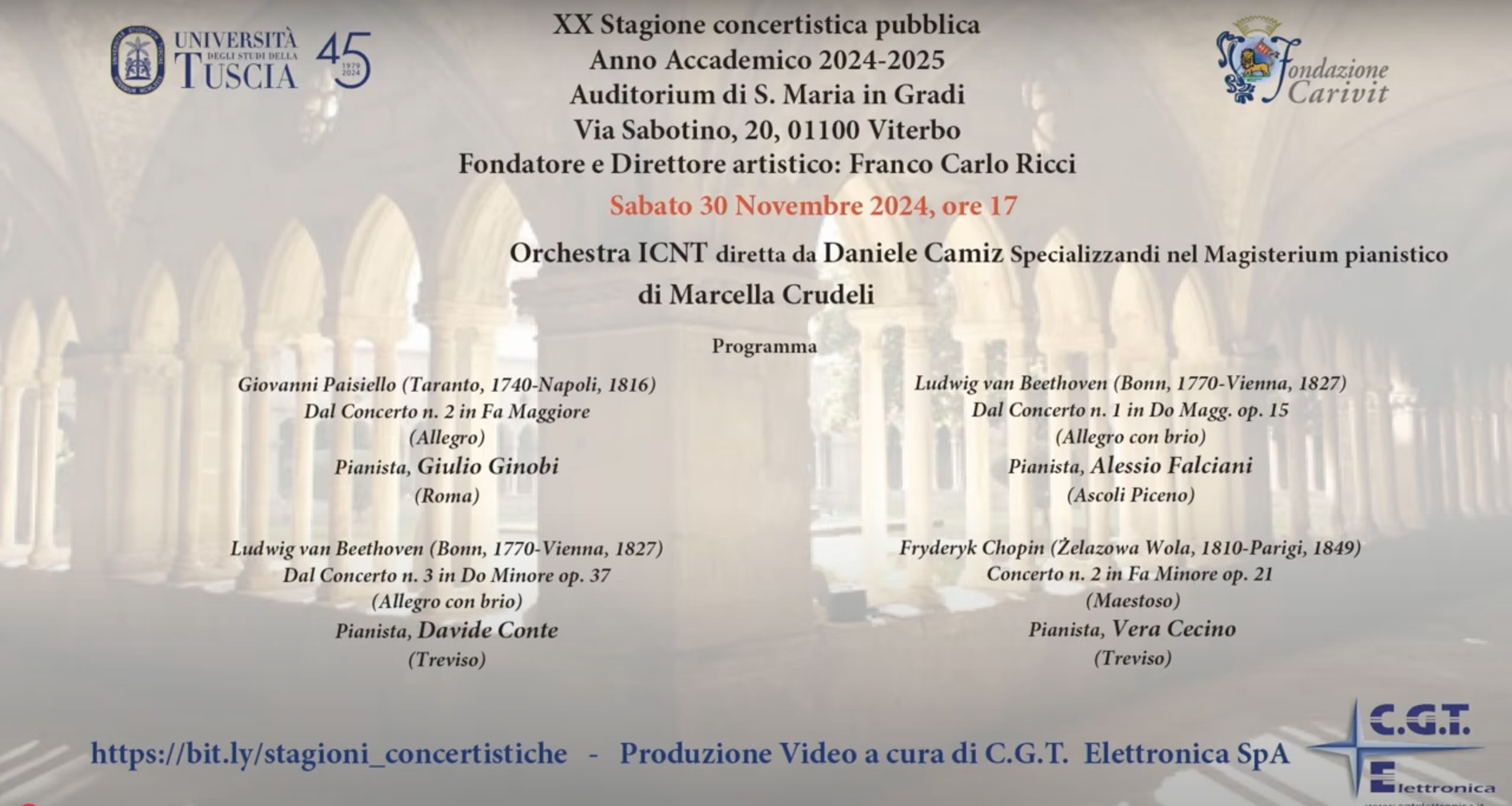
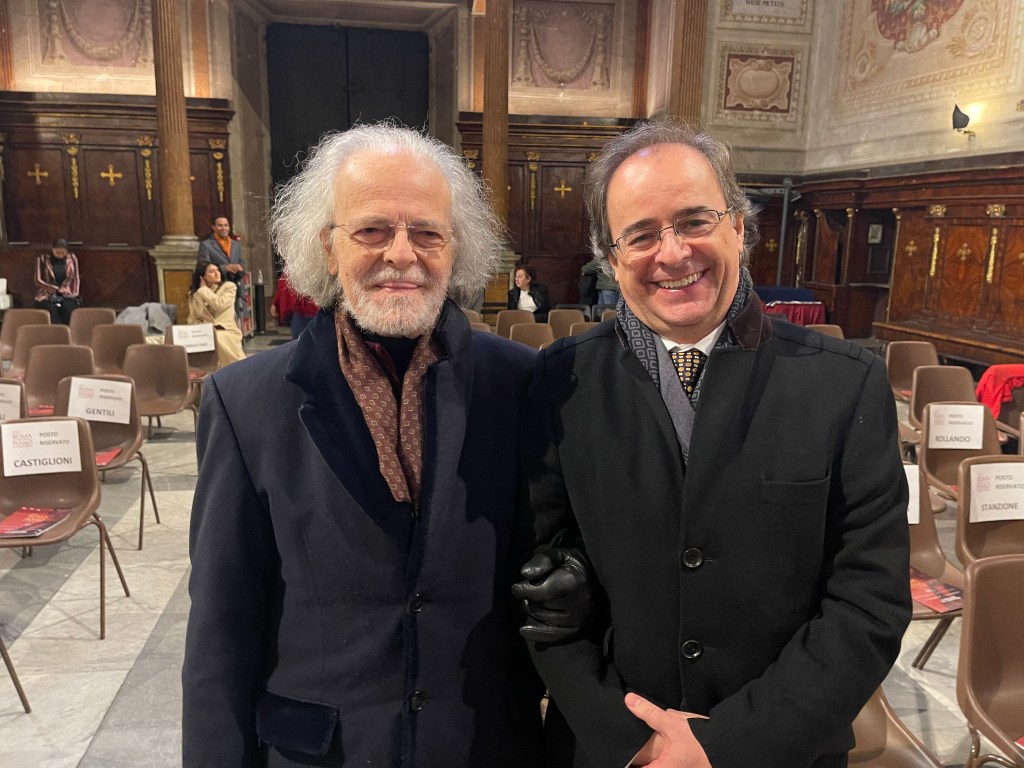
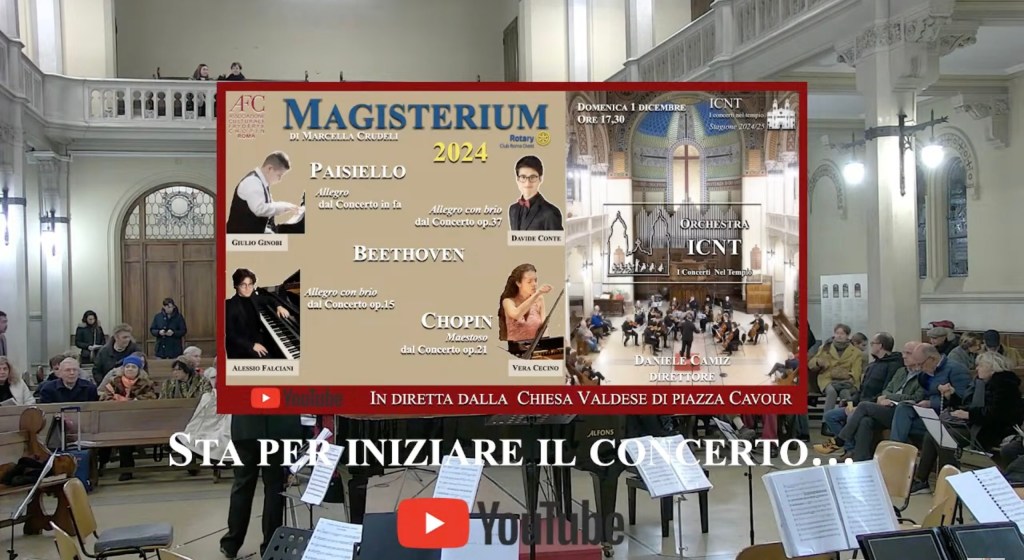
She also holds masterclasses for young musicians where every year she ensures that a selected few can give a public concert with orchestra, a rare occurrence indeed for masterclasses.This year Prof Franco Ricci ,a close collaborator of Marcella Crudeli, invited four of her prize students to play in his 25th Anniversary Series in Viterbo.A movement each of concertos by Paisiello,Beethoven and Chopin with the splendid orchestra of young players directed by Daniele Camiz
Marcella Crudeli applauding her four prize students at the end of the concertGiulio Ginobi
A very youthful looking Giulio Ginobi seemed made for playing the piano. Fingers that were like limpets clinging to the keys with commanding assurance as he brought radiance and precision to the first movement of Paisiello’s concerto n. 2 in F. Playing with simplicity and great poise, he brought a freshness and refined good taste to this early work that was quite exhilarating.The surprise was the encore where his technical assurance and sense of style in Rachmaninov’s Prelude op 23 n.5 was worthy of a pianist twice his size! A beautiful central episode where the inner counterpoints were allowed to float so magically on a wave of sumptuous sounds.
Alessio Falciani
Alessio Falciani brought rhythmic drive and beauty to Beethoven’s Concert op 15 ( n. 1 but was actually written after n. 2).A beautifully shaped central episode where the question and answer with the orchestra was of real chamber music ensemble.Not attempting Beethoven’s glissando into the recapitulation instead he played a rock solid scale after the communing with the orchestra in whispered tones before this devilish explosion. A cadenza that was not one of Beethoven’s two but was very virtuosistic and played with commanding authority. A very elaborate cadenza with some beautiful cantabile playing of great style and a very grandiose ending taken over majestically by the splendid orchestra. A Schubert song in the arrangement by Liszt was played with subtle style and sumptuous beauty of sound.
Davide Conte
Davide Conte played the first movement of Beethoven’s 3rd Concerto in C minor op 37.It was played with great fluidity and clarity with a good sense of tempo maintained with dynamic drive.Some beautiful cantabile playing leading to Beethoven’s own cadenza.Played with great control with the great flourishes spread over the whole keyboard with radiance and mastery inspite of some rearranging of the hands! A beautiful ending ,where the exchange between the piano and orchestra was quite magical. An encore full of charm with a central episode that was surely inspired by Spain but unfortunately I have no idea what it was.
Vera Cecino
Vera Cecino formed at the remarkable school of Maddalena de Facci in Venice as was her brother Elia Cecino who won the Premio Venezia and has gone on to win many other International Prizes as his career takes wing. Vera , a few years younger, is fast following in her brother’s footsteps. A beautiful performance of Chopin’s second concerto ( like Beethoven it was written before the first!).A very expansive melodic line was played with great assurance where everything sang with radiance and style. Playing of great eloquence and aristocratic good taste where even the most virtuosistic passages were allowed to sing and were given great architectural shape. Some beautiful ensemble playing with the horn and bassoon, from a pianist who lived every moment with passionate conviction and mastery. An encore of a paraphrase by Liszt of Ernani (?) was played with commanding authority and ravishing beauty
ICNT Orchestra conducted by Daniele CamizThe beautiful young percussionist of the ICNT orchestraProf Franco Carlo Ricci (left) Artistic Director of the Tuscia University Concerts with a fellow jury member of the 33rd Rome International Piano Competition
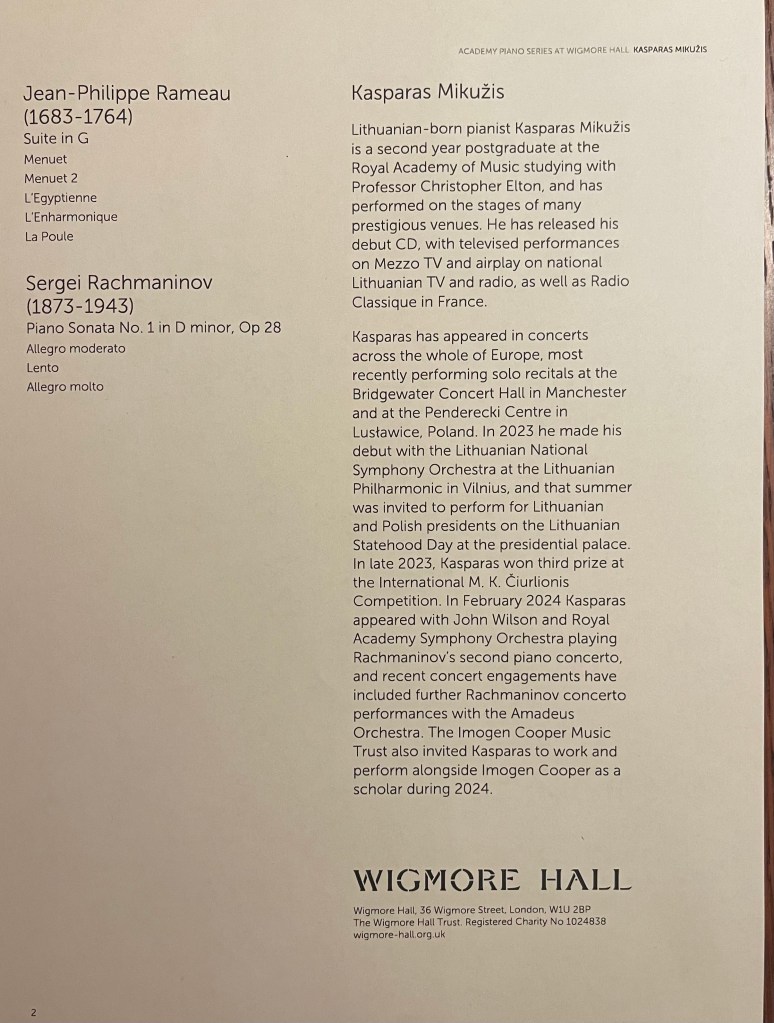
Currently completing his postgraduate studies, the prize-winning Lithuanian pianist has been selected as a 2024 scholar of the Imogen Cooper Music Trust, as well as of the Countess of Munster Musical Trust and the Keyboard Trust. This programme features movements from Rameau’s Suite in G – including character pieces depicting ‘The Hen’, ‘The Enharmonic’ and ‘The Egyptian’ – alongside Rachmaninov’s First Piano Sonata, composed in 1908 in Dresden.
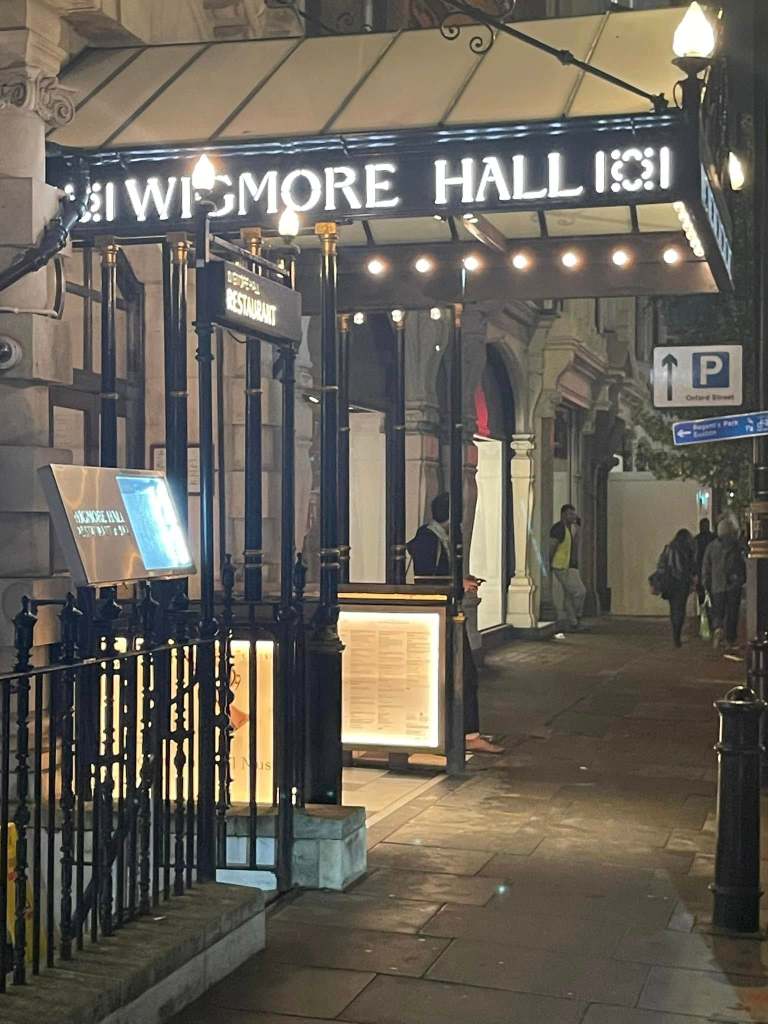
The triumph of the Lithuanians -Kasparas Mikužis ignites the Wigmore with the two ‘R’s’ There must be something in the air in Lithuania that allows their musicians to play with enviable fluidity and ravishing beauty.
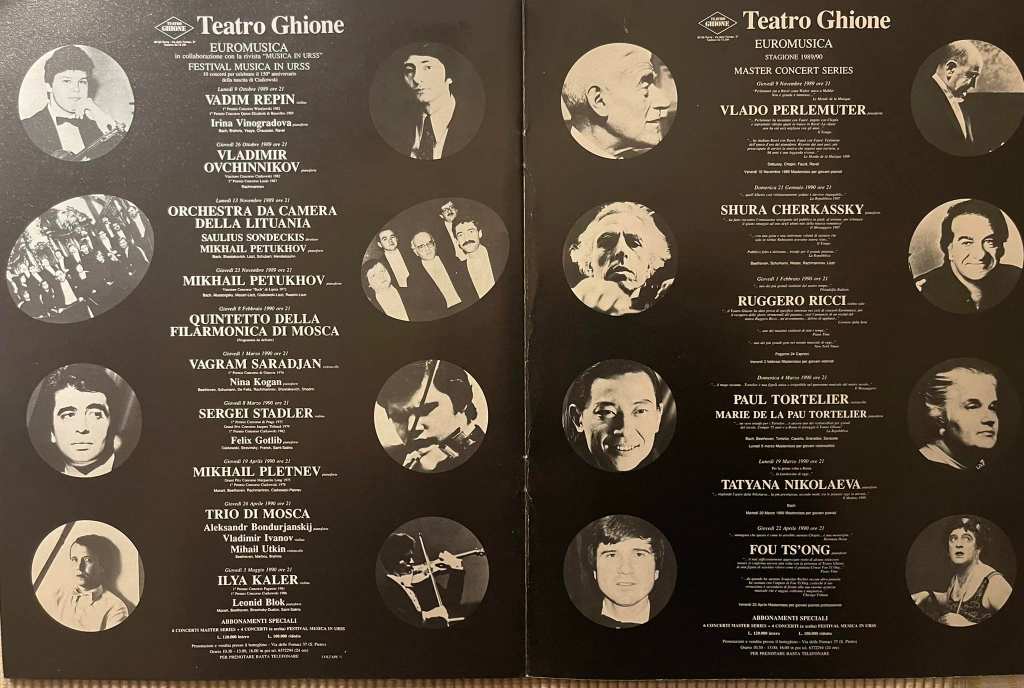
The Ghione programme with Saulius Sondeckis
I remember many years ago in Rome with Saulius Sondeckis conducting the Lithuanian Chamber Orchestra playing unbelievably quietly and with such simplicity and fluidity.
It was the same that we heard today from the very first notes of Rameau with a wonderful flexibility and fluidity that the music seemed to just pour from the fingers of this extraordinary young musician .A minuet with ornaments that glistened like jewels contrasting with the profound utterings of ‘L’Egyptienne’ so elaborately embellished and played with poignant dignity and beauty .There followed a deeply poetic ‘L’Enharmonique’ before the delicious hypnotic rhythmic insistence of ‘La Poule.’ Nothing though could have prepared us for the explosion of ravishing sounds and passionate outpourings of Rachmaninov’s much troubled First Sonata. Like Kantorow a few months ago on this very stage Kasparas has seen the secret path through this seeming labarinth of notes .The throbbing passion and innocent nostalgia together with the menace of the opening were the leit motifs of quite overwhelming authority and command.A performance for all those present ,including his teacher Christopher Elton, that will be placed on a pinnacle next to that of Kantorow restoring a masterpiece to it’s rightful place in the piano repertoire
Kasparas with Christopher Elton
Just five movements from Rameau’s suite of eight, beautifully chosen and placed in an order that made one unified whole. The first minuet played with remarkable poise for a debut recital on such an important stage.
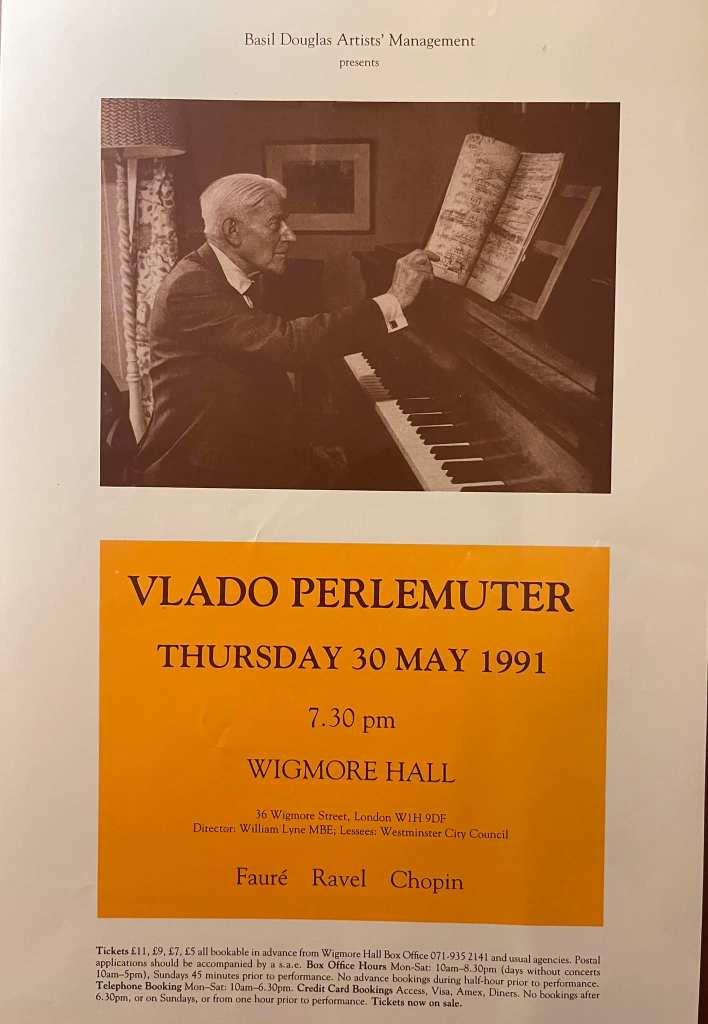
I remember Vlado Perlemuter telling me even at his last public performance aged 90 ,as I opened the door for him, he confided that every time those few steps were like going to the guillotine! Kasparas too confided afterwards that for him ( as for all great artists), those few steps were the most difficult but that once he had summoned up the courage, the arrival at the piano was like being greeted by a great friend.
From the very first Minuet there was a lucidity and flexibility of natural stylish playing with ornaments like tightly wound springs . There was the continuous flowing sounds of the second minuet where the ornaments glistened like sparkling jewels .These contrasted with profound outpouring of the elaborately embellished ‘L’Egyptienne’ played with poignant dignity and beauty.Paired with ‘L’Enharmonique’ that was deeply poetic .’La Poule’ burst onto the scene with a radiant glowing insistence with some ravishing contrasted layers of sound and hypnotic characterisation.
A short break and a long pause of reflection before Kasparas embarked on his long voyage of discovery with Rachmaninov’s First Sonata. The second sonata had enjoyed a revival since Horowitz presented it in one of his recitals during his long Indian summer.Since then there is rarely a season where it does not figure on recital programmes. The first has fared less well and it is enough to say that even Rachmaninov found it a difficult work to compose.Taking standard forms but like the Liszt Sonata or Schubert Wanderer giving the main motifs a life of their own as they are transformed during a long voyage almost as if there was a great story unfolding. Ogdon was one of the first to bring it to light but was more of an intellectual performance of a pianistic genius than creating a platform for dramatic story telling of menace,exhilaration and reconciliation.It was Kantorow in his historic Philharmonie recital that suddenly shone a light on a misunderstood masterpiece.Since that performance it has now almost taken the place of the second in conservatories,competitions and concert halls.
Lukas Genusias recently found the original manuscript with changes that the composer was later to make as with his 1913 and 1931 versions of the second sonata. Horowitz was to make his own version of the second from both versions , sanctioned by his friend Rachmaninov who was plagued with depression and doubts.
I think the newly found original score closely resembles the final published one that Kasparas played today but I would be very interested to see changes made by the composer as he did with many works that were not immediately of the success of his more popular scores.
Kasparas brought streams of golden sounds and a pulsating passion from the very opening. A frightening amount of notes that are infact streams of sounds after the opening menace of the first notes deep in the bass.The third motif is a wonderful fluid melody of heartbreaking nostalgia and warming reconciliation that between the menace and the pulsating hypnotic insistence of a single note that is like a heartbeat naked for all to see. A passionate climax of overwhelming emotion was played with transcendental mastery as it died to a mere whisper with a gentle drooping tear barely whispered in our ear .Kasparas painted a canvas of such unconcealed emotion and passion that this might well be given an X certificate on it’s next appearance ! An etherial opening to the ‘Lento’, building in emotional beauty with a ravishing sense of balance .The melodic line rose like an eagle of radiant beauty above the seething cauldron of ever more intense sounds .There was a timeless beauty to the ending where the magic wand of this young musician had cast his spell on a thankfully large audience.
This was short lived as the ‘Allegro molto’ exploded with supersonic energy and astonishing mastery. Bursting into a rhythmic march of exhilaration and breathtaking daring .Rachmaninov’s melodic line coming through a maze of sounds like a knight in shining armour with glorious romantic abandon and with our Prince leading the way with fearless authority. Here the reappearance of the theme of reconciliation was one of those magic moments, all too rare in this mechanical age , when a group of unknown people are suddenly united in a joint experience of emotional beauty .A miracle and one that this young Lithuanian performed with mastery and humility. The final tumultuous awakening was quite overwhelming and was greeted with rapturous applause by those that had been fortunate enough to share in such an experience .
A simple little piece by a compatriot composer was Kasparas’s way of thanking us.
Rachmaninov’s First in D minor op 28 was completed in 1908.It is the first of three “Dresden pieces”, along with the symphony n.2 and part of an opera, which were composed in the quiet city of Dresden.It was originally inspired by Goethe’s tragic play Faust,although Rachmaninoff abandoned the idea soon after beginning composition, traces of this influence can still be found.After numerous revisions and substantial cuts made at the advice of his colleagues, he completed it on April 11, 1908. Konstantin Igumnov gave the premiere in Moscow on October 17, 1908. It received a lukewarm response there, and remains one of the least performed of Rachmaninoff’s works.He wrote from Dresden, “We live here like hermits: we see nobody, we know nobody, and we go nowhere. I work a great deal,”but even without distraction he had considerable difficulty in composing his first piano sonata, especially concerning its form.Rachmaninoff enlisted the help of Nikita Morozov , one of his classmates from Anton Arensky’s class back in the Moscow Conservatory, to discuss how the sonata rondo form applied to his sprawling work.Rachmaninov performed in 1907 an early version of the sonata to contemporaries including Medtner.With their input, he shortened the original 45-minute-long piece to around 35 minutes and completed the work on April 11, 1908. Igumnov gave the premiere of the sonata on October 17, 1908, in Moscow.
Lukas Geniusas writes about his premiere recording of the Rachmaninov Sonata n. 1 to be issued in October : ‘About a year ago I came across a very rare manuscript of the Rachmaninov’s Sonata no.1 in its first, unabridged version. It had never been publicly performed. This version of Sonata is not significantly longer (maybe 3 or 4 minutes, still to be checked upon performing), first movement’s form is modified and it is also substantially reworked in terms of textures and voicings, as well as there are few later-to-be-omitted episodes. The fact that this manuscript had to rest unattended for so many years is very perplexing to me. It’s original form is very appealing in it’s authentic full-blooded thickness, the truly Rachmaninovian long compositional breath. I find the very fact of it’s existence worth public attention, let alone it’s musical importance. Pianistic world knows and distinguishes the fact that there are two versions of his Piano Sonata no.2 but to a great mystery there had never been the same with Sonata no.1.’
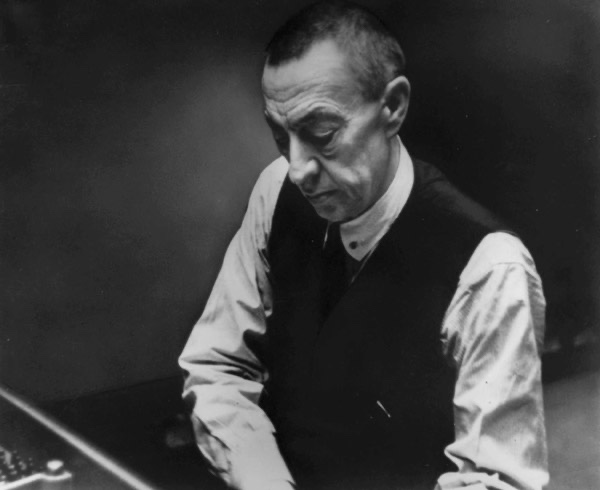
Sergei Rachmaninov (1873–1943)
Piano Sonata No. 1 in D Minor Op. 28 (1907)
Allegro moderato
Lento
Allegro molto
Rachmaninoff wrote to his friend Nikita Morozov on 8 May 1907:
‘The Sonata is without any doubt wild and endlessly long. I think about 45 minutes. I was drawn into such dimensions by a programme or rather by some leading idea. It is three contrasting characters from a work of world literature. Of course, no programme will be given to the public, although I am beginning to think that if I were to reveal the programme, the Sonata would become much more comprehensible. No one will ever play this composition because of its difficulty and length but also, and maybe more importantly, because of its dubious musical merit. At some point I thought to re-work this Sonata into a symphony, but that proved to be impossible due to the purely pianistic nature of writing’.
It is said that Rachmaninoff withdrew this reference to literature and certainly the music contains other associations.
The ‘literature’ he referred to is Goethe’s Faust (possibly with elements of Lord Byron’s Manfred) and there is convincing evidence to believe that this plan to write a sonata around Faust, Gretchen and Mephistopheles was never entirely abandoned. of course there are other musical elements present as it is not programme music. The pianist Konstantin Igumnov, who gave its premiere performance in Moscow, Leipzig and Berlin, visited Rachmaninoff in November 1908 after the Leipzig recital, the composer told him that ‘when composing it, he had in mind Goethe’s “Faust” and that the 1st movement related to Faust, the 2nd one to Gretchen and the 3rd was the flight to the Brocken and Mephistopheles.’
Faust in the opening monologue of the play:
In me there are two souls, alas, and their
Division tears my life in two.
One loves the world, it clutches her, it binds
Itself to her, clinging with furious lust;
The other longs to soar beyond the dust
Into the realm of high ancestral minds.
A man whose soul is rent between the hedonistic pleasures of the earth and spiritual aspirations – Sacrum et Profanum. Exploring this all to human dichotomy, Rachmaninoff builds almost unbearable tension.
In the Allegro moderato as Faust wrestles with his soul and temptations. Kantorow constructed and extraordinary edifice of unique sound, each note of each the massive chord weighted perfectly against the others to create a richness of great magnificence and splendour, rather like an organ His tone is liquid gold and even in passages of immense dynamic power he did not break the sound ceiling of the instrument. There was superb delicacy here. The delineation of eloquent melody and the dense polyphony of Rachmaninoff’s writing was miraculously transparent.
The Lento second movement could well be interpreted as a lyrical poem expressing the love of Gretchen for Faust. Kantorow was so poetic here yet managing the dense polyphony once again with great artistry, tenderness and delicacy. His melodic understanding was paramount. The legato cantabile tone was sublime, the execution carrying with it an uncanny feeling of lyrical improvisation. A fervent and impassioned love song…
The wildness of the immense final movement Allegro molto with its references to a terrifying Dies Irae and death can well associate this massive declamation to Mephistopheles and insidious and destructive evil. Kantorow built a Chartres Cathedral of sound here with immense structural walls embroidered with the most delicate of decoration relieved by moments of refined reflection. Are we exploring the darker significance of Walpurgis Night? Kantarow extracted and expressed a diabolism seldom encountered in any piano recital. All my remarks are assuming his towering technical ability and nervous pianistic concentration of a remarkable kind. Overwhelming.
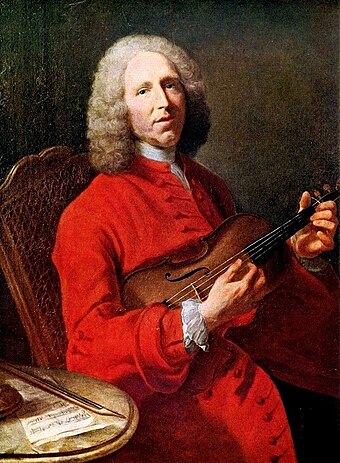
The French Baroque composer Jean-Philippe Rameau wrote three books of Pièces de clavecin for the harpsichord. The first, Premier Livre de Pièces de Clavecin, was published in 1706; the second, Pièces de Clavecin, in 1724 ;and the third, Nouvelles Suites de Pièces de Clavecin, in 1726 or 1727. They were followed in 1741 by Pièces de clavecin en concerts, in which the harpsichord can either be accompanied by violin (or flute) and viola da gamba or played alone. An isolated piece, “La Dauphine“, survives from 1747.
The exact date of publication, at Rameau’s own expense, of the Nouvelles Suites de Pièces de Clavecin remains a matter of some controversy. In his 1958 edition of the works, the editor Erwin Jacobi gave 1728 as the original publication date. Kenneth Gilbert, in his 1979 edition, followed suit. Others later argued that these works did not appear until 1729 or 1730. However, a recent reexamination of the publication date, based on the residence Rameau provided in the frontispiece (Rue des deux boules aux Trois Rois), suggests an earlier date, since Rameau’s residence had changed by 1728. As a result of this and other evidence, the closest approximation for the original publication date stands between February 1726 and the summer of 1727. This dating is given further authentication by the comments of Friedrich Wilhelm Marpurg, who provided their publication date as 1726. There are almost 40 extant copies of the original 1726/27 edition.
Two later editions followed both around 1760. The first (printed perhaps slightly before 1760) was simply a reimpression of the original engravings, although several plates were reengravings, suggesting that the original plates had undergone sufficient impression to wear them down to a state of illegibility. A second appeared in London under the title A Collection of Lessons for the harpsichordfrom the printer John Walsh which was based on the earlier Parisian edition.Suite in G major/G minor, RCT 6
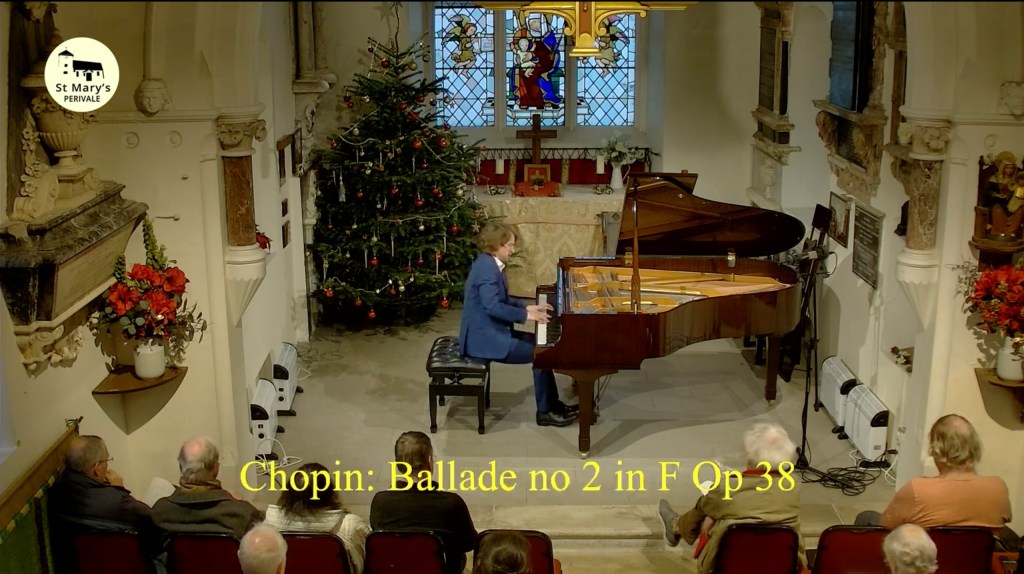
A fascinating survey of some music that I did not know but including also a substantial group of Chopin with two Ballades,two studies, a nocturne and six preludes all played with simplicity and mastery.
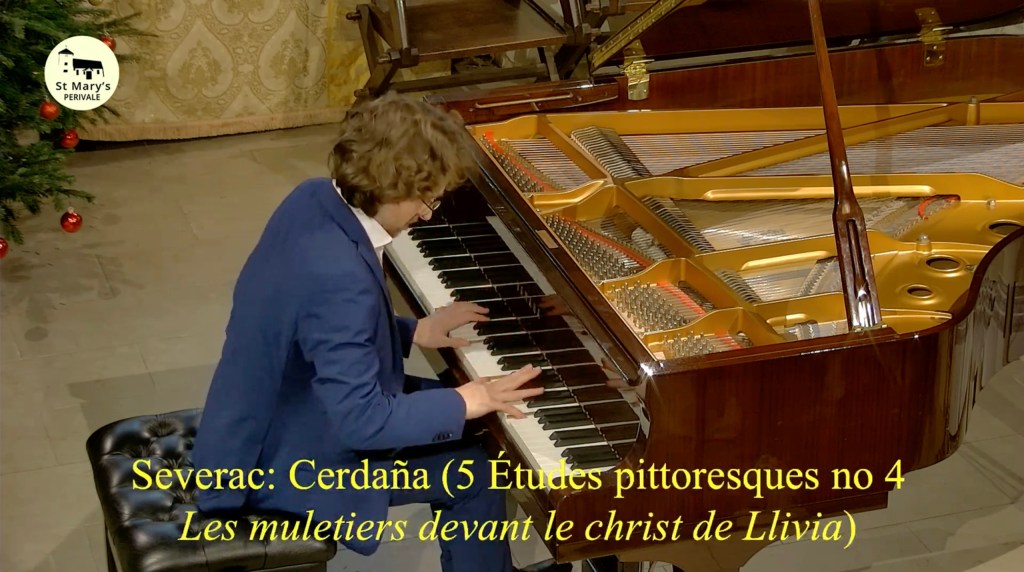
But it was the Turina and Severac that astonished for it’s flamboyance, colour and technical mastery.Playing of great authority brought these two almost unknown works vividly to life with the scintillating brilliance and exhilarating streams of notes of Turina played with burning conviction.
It was followed by the glowing purity of mellifluous outpourings of Severac.A sumptuous tenor melody accompanied by arabesques played with etherial lightness over the whole keyboard as it grew in grandeur.Music of great atmosphere and nostalgia brought magically to life with virtuosistic flamboyance.
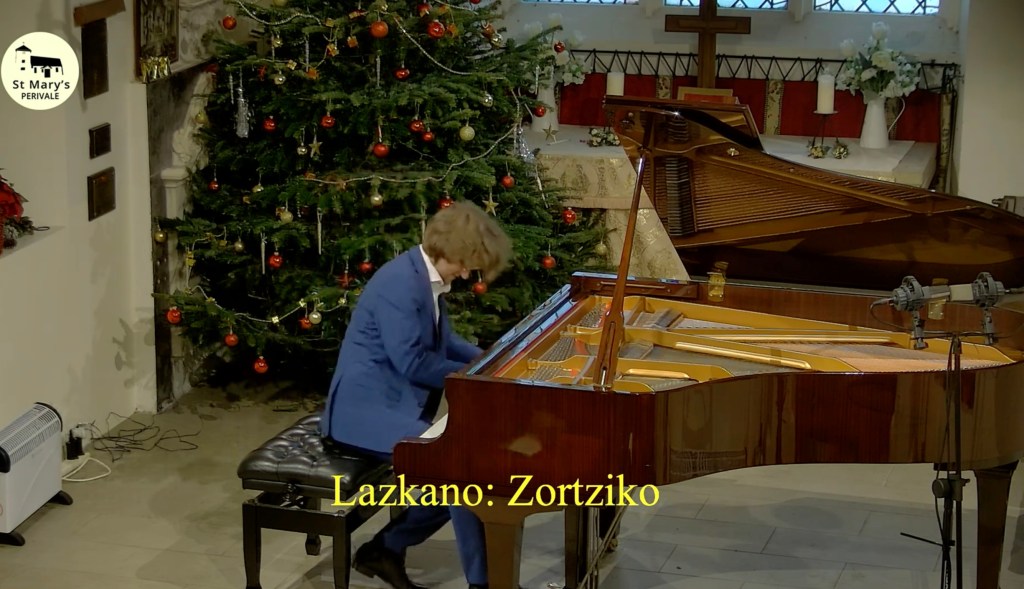
The little ‘greeting’ ‘Zortziko’ by Lazkano was remarkable for it’s use of the reverberations of sound that Julian could create with such imagination and beauty.
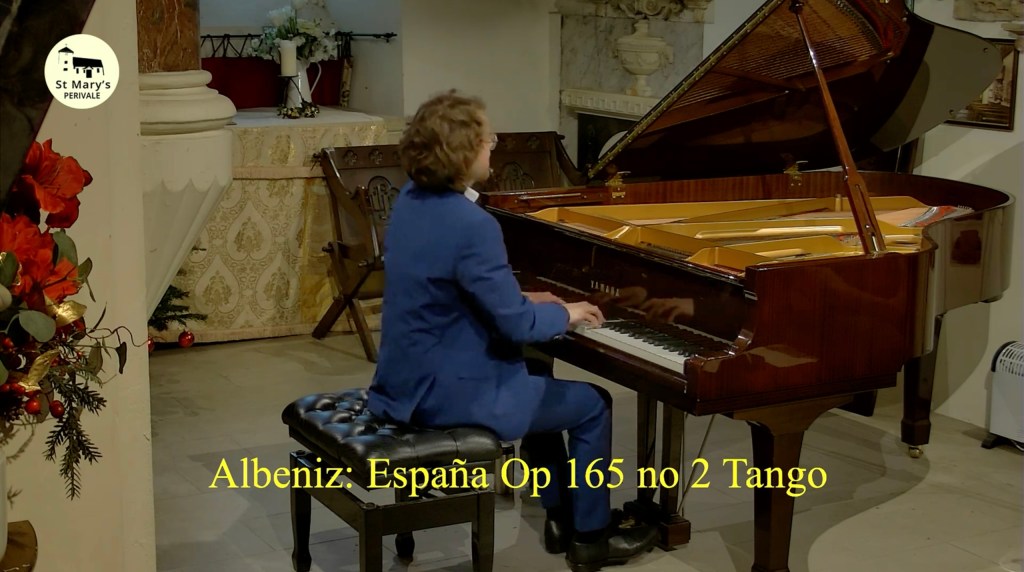
The Albeniz Tango I have heard many times from the hands of Cherkassky but in the Godowsky arrangement.Julian played the original Albeniz that was much simpler but he played it with the same beguiling rubato, glowing luminosity and magic that was the world that Shura could conjure up out of thin air.
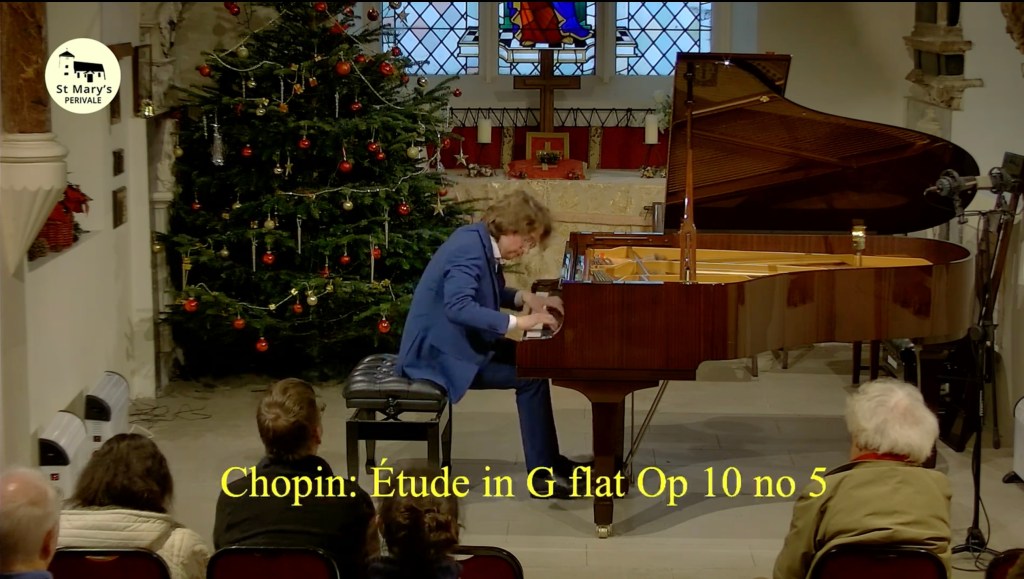
The Chopin Ballades that he chose are the two most pastoral with the beautiful flowing lines of the third that he played with lilting beauty and charm.He was able to incorporate all the ravishing embellishments and Chopin’s genial mellifluous outpouring of delicacy and refined beauty into an architectural whole.The final climax a consequence of all that had come before where Julian found beautiful sumptuous sounds of aristocratic nobility before the stream of notes that takes us to the final cadence that was played with simplicity and not the more usually heard rhetorical slamming of the door!.The second Ballade too was played with disarming simplicity which made the tempestuous interruptions so much more breathtaking. Julian playing with remarkable conviction and real weight ,where he dug deep into the notes without any hardening of sound but with a richness that made the dynamic drive of the coda ever more exhilarating and exciting.The two studies he played showed off Julian’s breathtaking mastery but also his musicianship.A black key study that I have rarely heard played with such assurance and ‘joie de vivre’ where the notes just seemed to pour from his fingers with natural ease to which was added charm and style.The octave study was remarkable for the power without hardness that he could bring to the outer episodes.But it was the central episode where Julian’s intelligent musicianship could show us so clearly the architectural shape of refined beauty where his slight weight on the thumb notes gave a depth and richness to the sudden outpouring of melodious octaves that the genius of Chopin could portray even in a simple study.The nocturne in B was played with great weight and no sentimentality.This was deeply felt aristocratic playing where the ‘bel canto’ embellishments were incorporated into the long melodic lines that Chopin chisels with such poignancy .It was the same disarming simplicity that Julian brought to the first of a group of six preludes.The simple charm of the A major was followed by the passionate outpouring of the glorious F sharp minor .It was here that amongst the streams of notes Julian could show us the melodic line so clearly and beautifully.He brought great nobility to the E major Largo before the scintillating jeux perlé brilliance of the tenth.Simple beauty of the eleventh was followed by the dynamic drive of the impetuous Presto of the thirteenth.Chopin never intended for his Preludes to be played as a set of twenty four in one sitting and Julian showed us just how right he was!
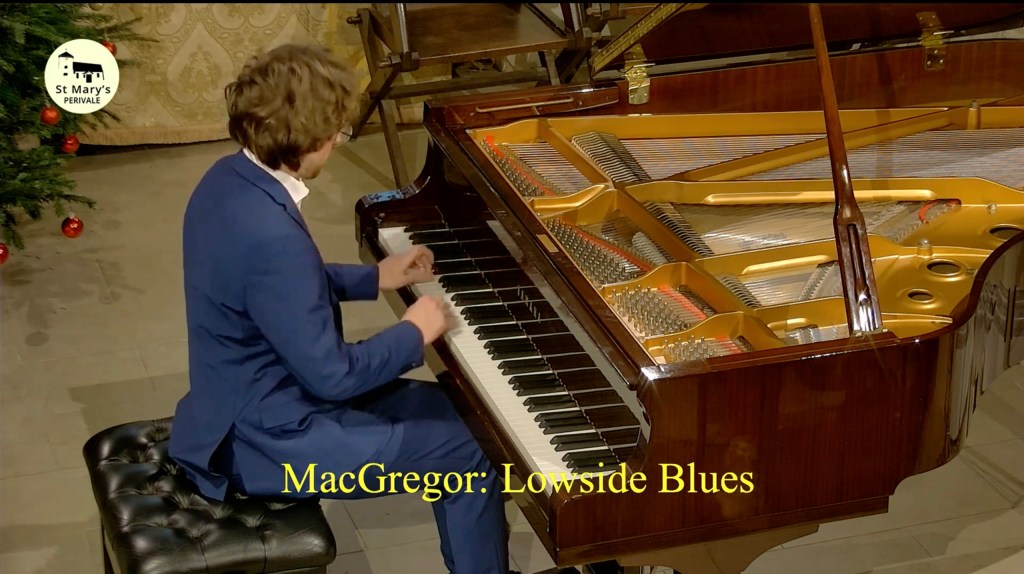
Four short pieces by virtually unknown ( to me at least) women composers. Julian brought a purity of luminous sounds to Tanaka’s ‘Lavender Field’ but it was Joanna Mc Gregor’s ‘Lowside Blues’ that ignited the atmosphere with the enticing jazz rhythms and joyous, riotous fun of the genial head of keyboard at the Royal Academy and that she often adds to a sometimes over serious institution (she was also the only one of four whose name I recognised! )
A single encore although Julian could have gone on much longer.
‘Warum’ by Schumann was played with ravishing subtle beauty and had us all asking ourselves : ‘Why’ is Julian the only pianist who can discover and present ( all from memory) so many still unknown composers in such varied programmes of ‘something old and something new?’
Hats off dear Julian the teenager that we have followed and admired for so many years has become a great pianist with something important to say and ready to take the world by storm.
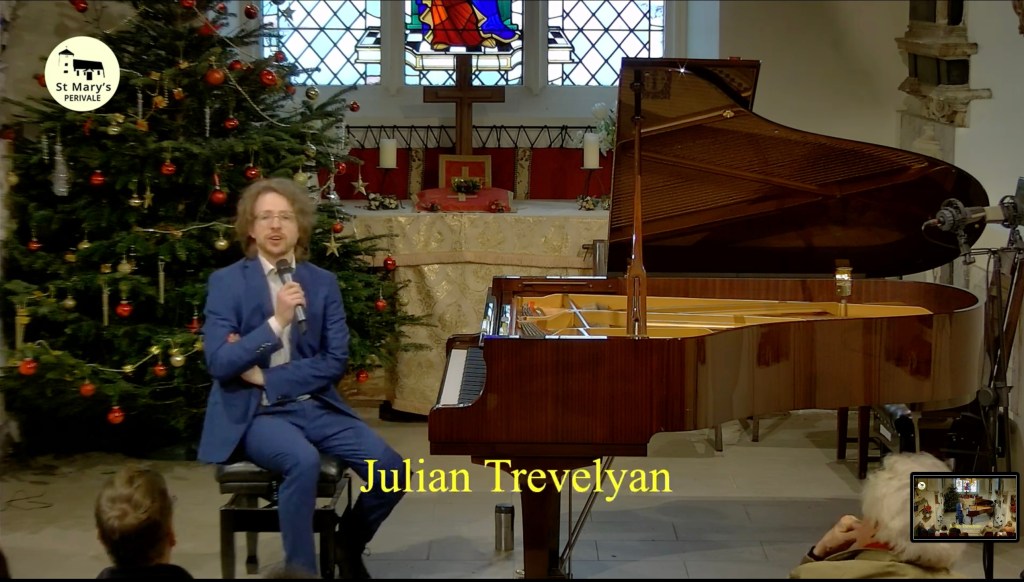
Julian Trevelyan is a concert pianist who performs regularly throughout Europe and in the UK. He came to international attention when, at the age of sixteen, he came top in the 2015 Long-Thibaud-Crespin international competition in Paris. He has since gained further laureates and prizes in Belgium, England, Germany and Switzerland. . Recent competition successes in Europe include the Silver Medal in the 2023 Horowitz competition Kyiv-Geneva, and the second prize, the Mozart concerto prize and the audience prize in the 2021 Géza Anda international piano competition in Zürich. In September 2024 he gained 5th prize in the Leeds International Piano Competition. In 2023, Julian returned to the Ecole Normale de Musique de Paris Alfred Cortot to take part in the Elite program, to develop various musical projects and prepare for competitions
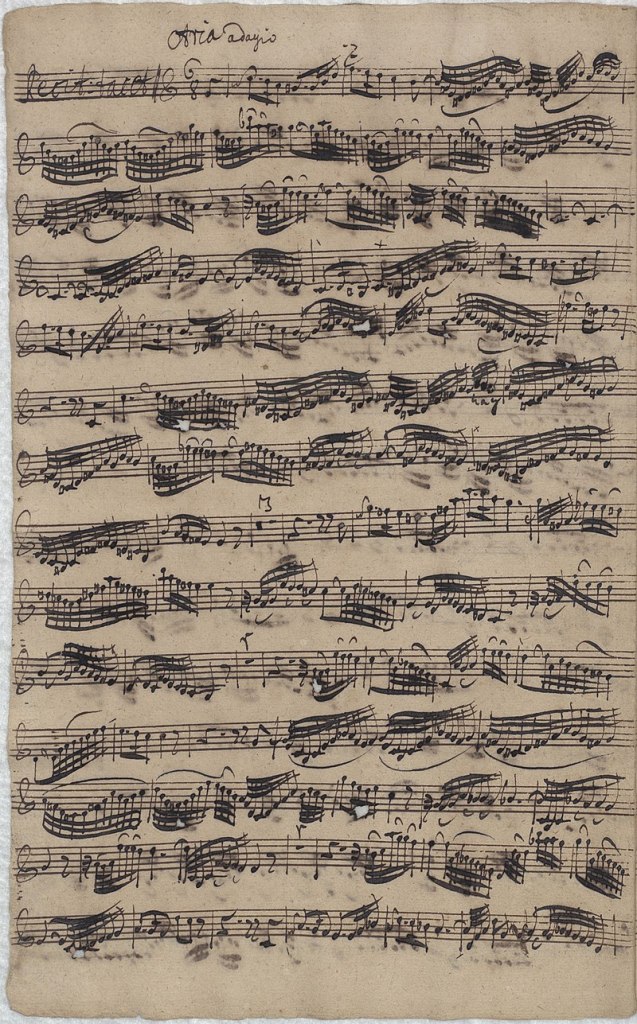
BACH/RACHMANINOV: Violin partita no. 3 in E major BWV 1006 (transcription)
Prelude
Gavotte
Gigue
SCRIABIN:
Mazurka in E major, op. 25, no. 4
Mazurka in C-sharp minor, op. 25, no. 5
Mazurka in F-sharp major, op. 25, no. 6
CHOPIN: Sonata no. 3 in B minor, op. 58
I. Allegro maestoso
II. Scherzo: Molto vivace
III. Largo
IV. Finale
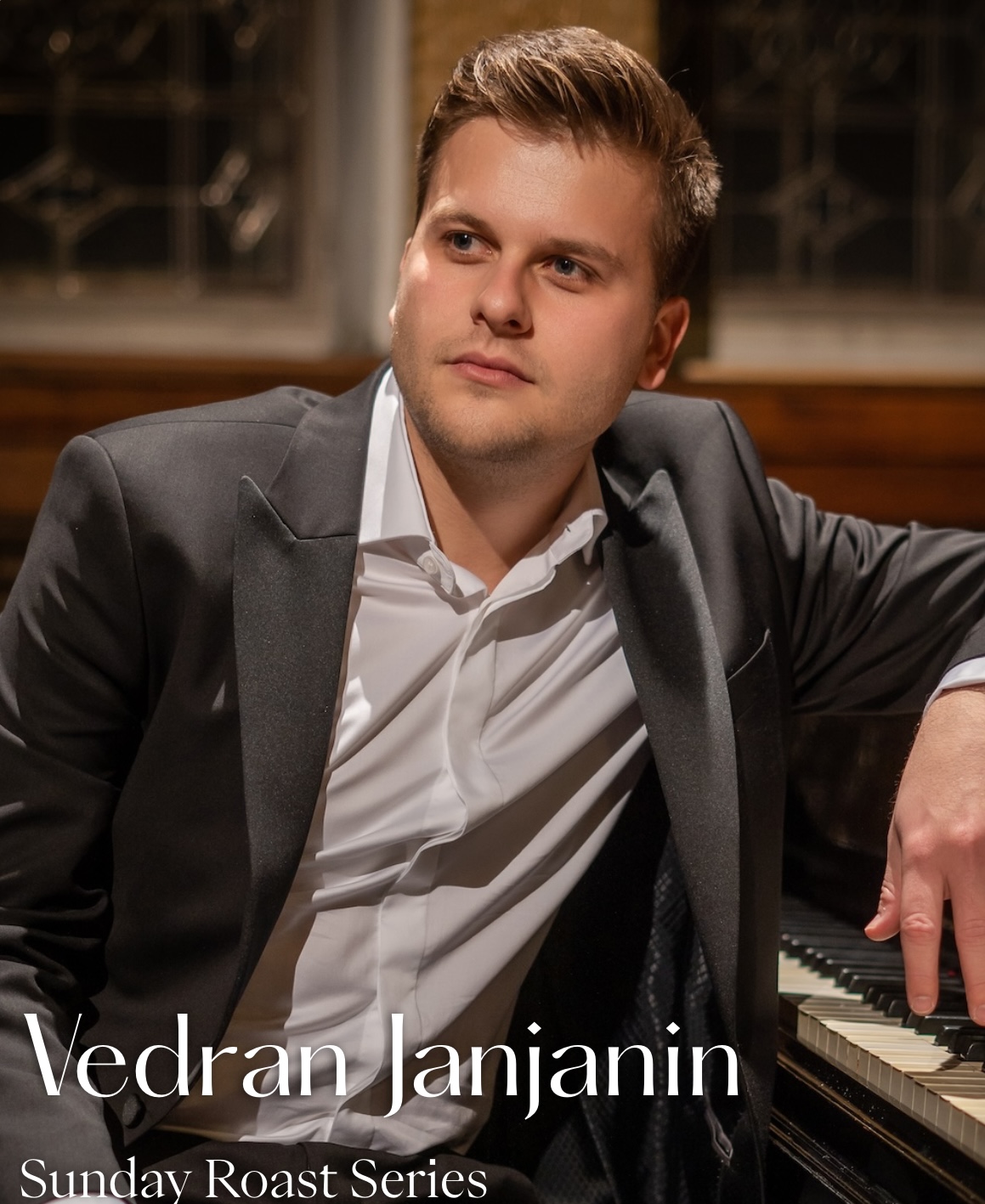
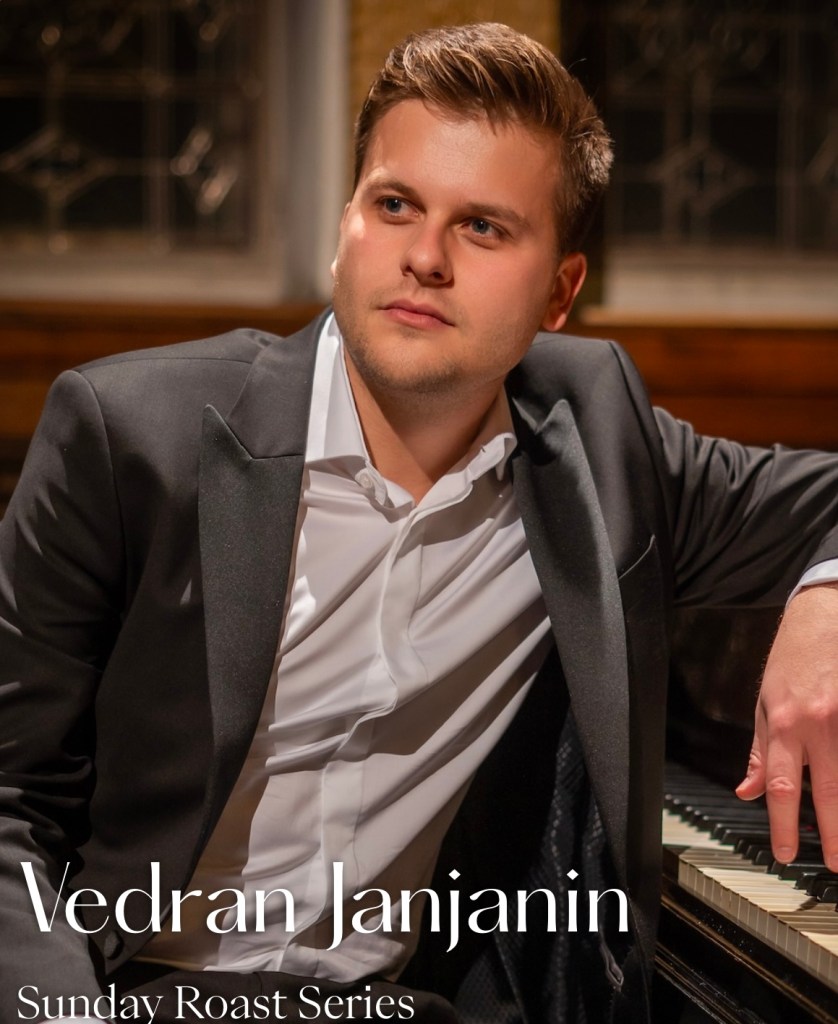
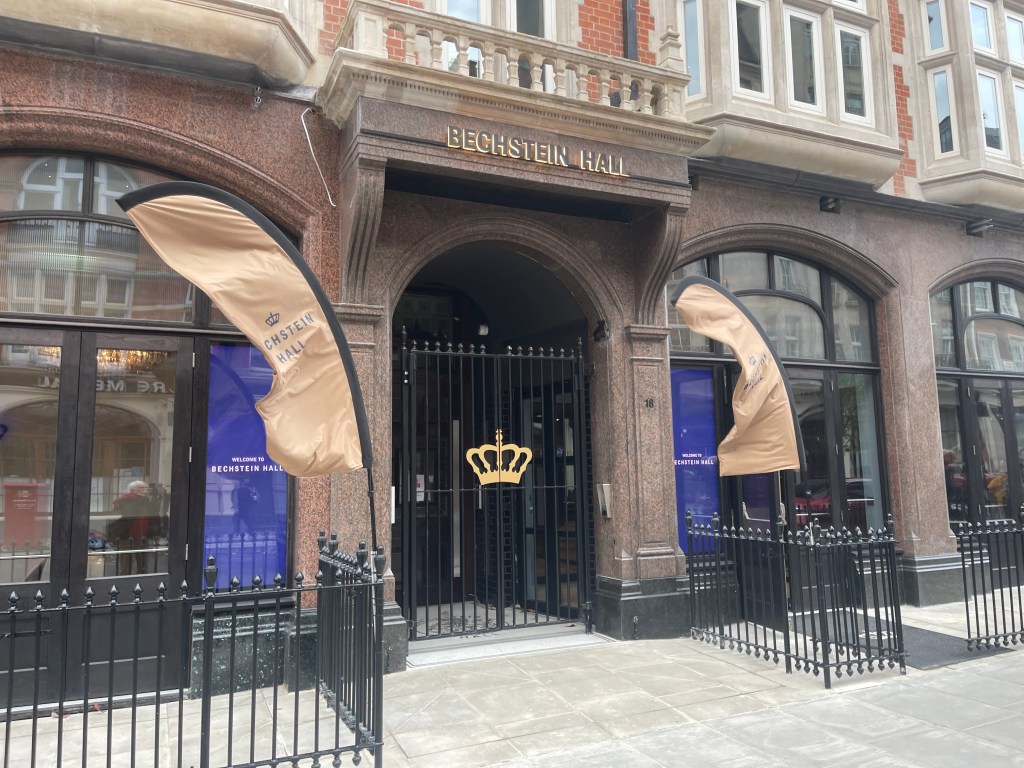
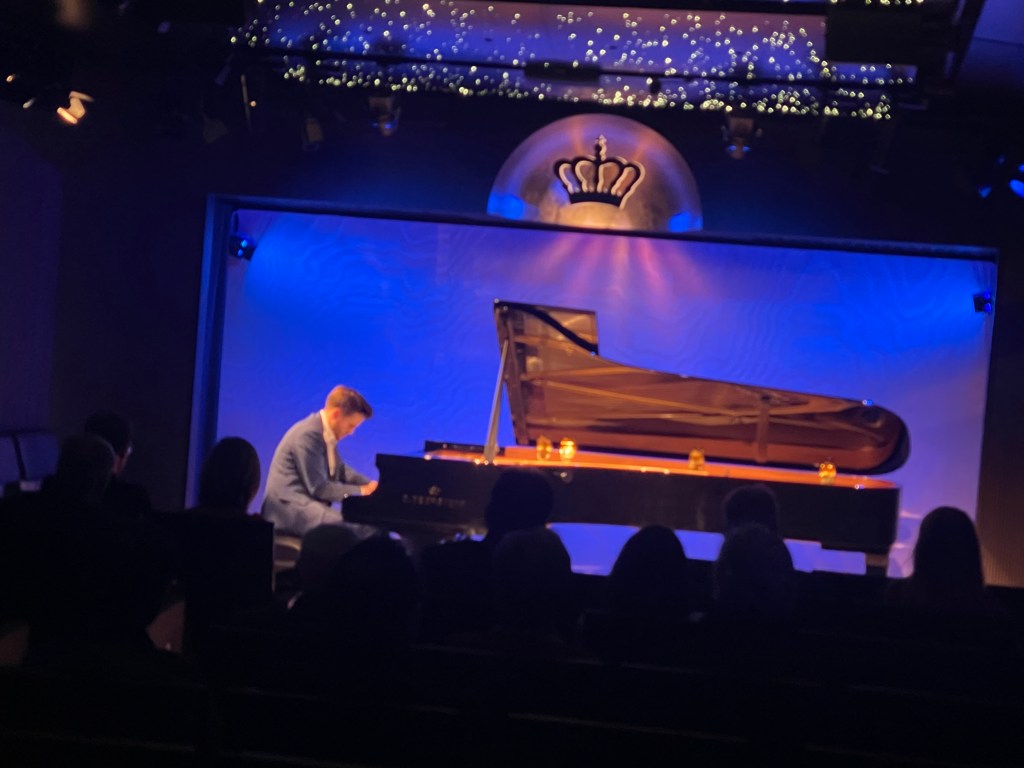
Vedran Janjanin in the Roast series in the new Bechstein Hall.
Things were certainly hotting up towards the end of an after lunch recital of Bach,Scriabin and Chopin .
Sparks started to fly with the Kapustin jazz study n 1 which followed an equally jazzy piece by Vedran’s sister that she had dedicated to her brother .
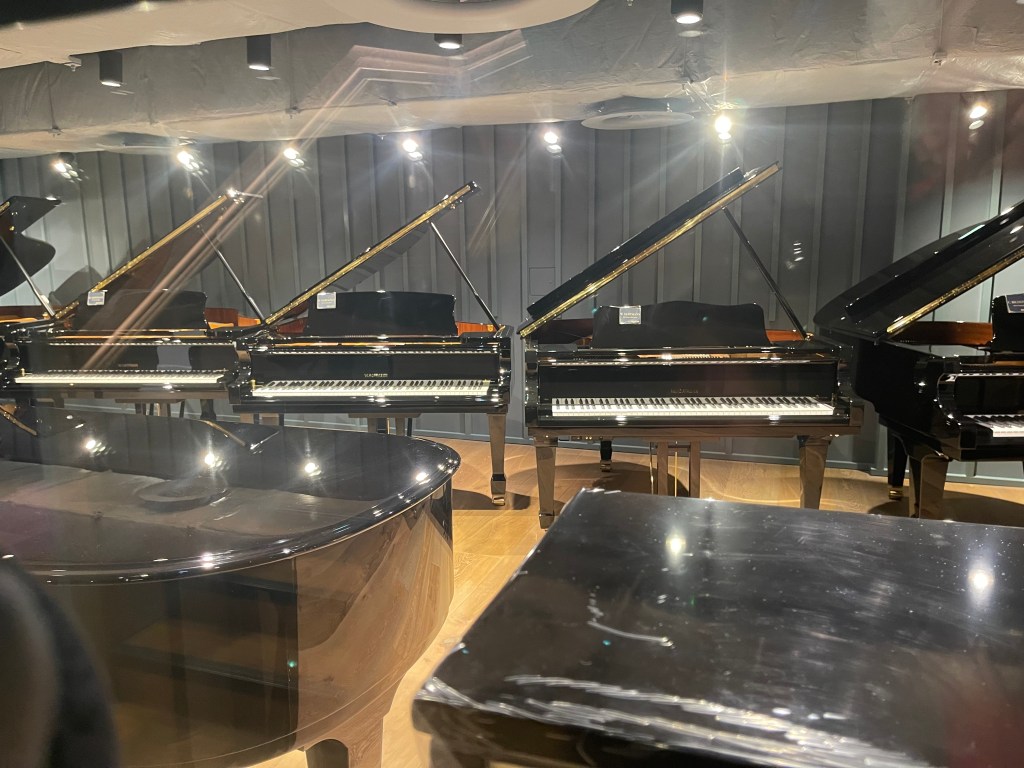
Scintillating playing very much in tune with the beautiful nightclub atmosphere that Bechstein have generously offered to us in London to show off their magnificent instruments.
Vedran had begun with Bach ,Siloti style with a sumptuous performance of the Prelude in B minor. A ravishing sense of balance with glorious golden sounds that were only broken by Bach but this time Rachmaninov style.
A reworking of three movements from the third Partita for solo violin.Maybe he knew that Tasmin Little was in the audience ?
Played with impish clarity and charm with the grace of the Gavotte followed by the knotty twine of the Gigue .Streams of notes with Rachmaninov’s voice exulting the genial writing of J.S Bach.
There was a luminosity and sense of improvisatory beauty to the three mazurkas by Scriabin op 25 with a kaleidoscope of colour and sounds that Vedran told me afterwards could be controlled with the acoustically assisted sound available in ten easy steps !
The second half of the programme was dedicated to Chopin with the Sonata in B minor.
Some beautiful things especially in the Largo and the trio of the scherzo second movement.The finale too was played with dynamic drive as the final explosion of the rondo brought this masterpiece to an exciting conclusion. The first movement suffered from a lack or architectural shape and although there were many beautiful moments he missed the overall sweep that he was able to find elsewhere.
Vedran with Jessica Duchen, Tasmin Little ,Josephine Knight
Many musician friends were there to applaud their colleague from my old Alma Mater – the Royal Academy where he he tells me he has formed a trio with his former chamber music coach
Vedran Janjanin is a young emerging artist from Croatia, currently residing in London. After finishing his studies at Zagreb Music Academy and Franz Liszt Academy in Budapest, he was recognised by the Royal Academy of Music in London and given full scholarship for the Advance Diploma studies in Piano performance.
His debut performance at Wigmore Hall in February 2023 won him rave reviews from the critics and a new invitation to perform a solo recital in January 2024.
He has performed in countries such as Italy, Slovenia, Serbia, Austria, Hungary, Germany and England, and was featured by numerous orchestras a soloist, such as the Zagreb Philharmonic Orchestra, Central European Youth Orchestra, Zagreb Academy Symphony Orchestra and Croatian Young Musicians Orchestra. He collaborated with established international musicians such as Andrey Gugnin, Sujari Britt, Istvan Balazs, Darija Auguštan, Ivan Krpan, Jelena Štefanić and others.
His most recent collaboration is a duo with one of Britain’s leading cellist – Josephine Knight, holder of the Alfredo Piatti Chair of Cello at the Royal Academy of Music, where she teaches.He was guided by eminent pianists and pedagogues such as Emanuel Krasovsky, Christopher Elton, Kalman Drafi, Dina Yoffe, Jerome Rose, Janos Devich, Eugen Indjic, Wayne Marshall OBE and Andrei Korobeinikov.
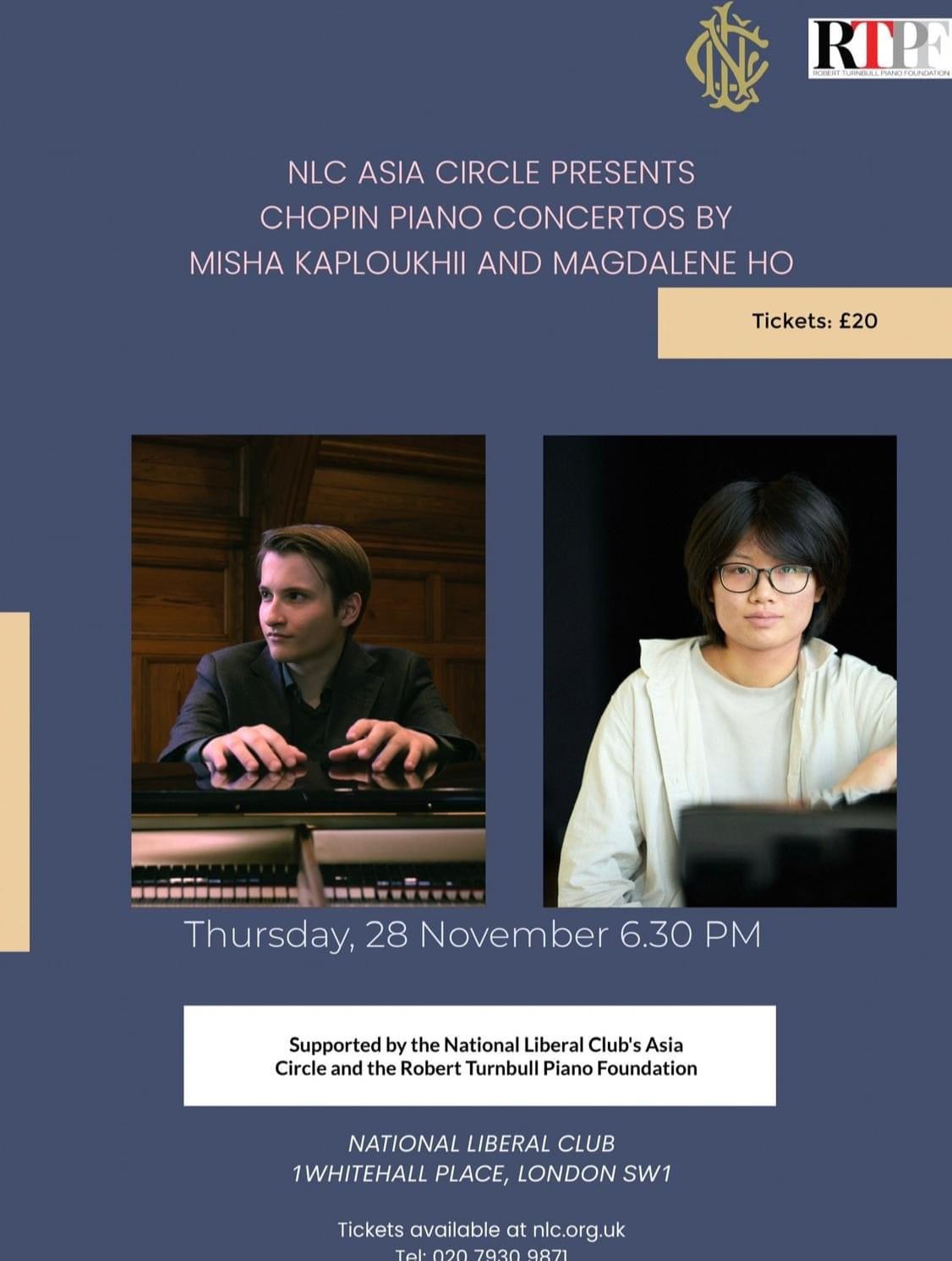
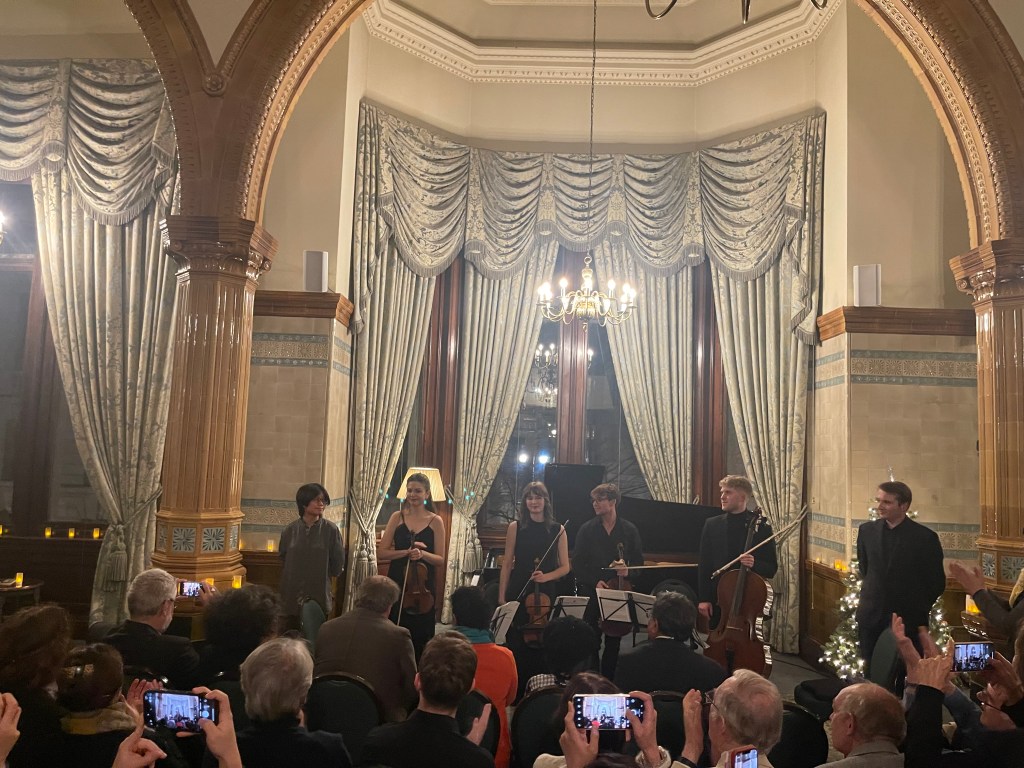
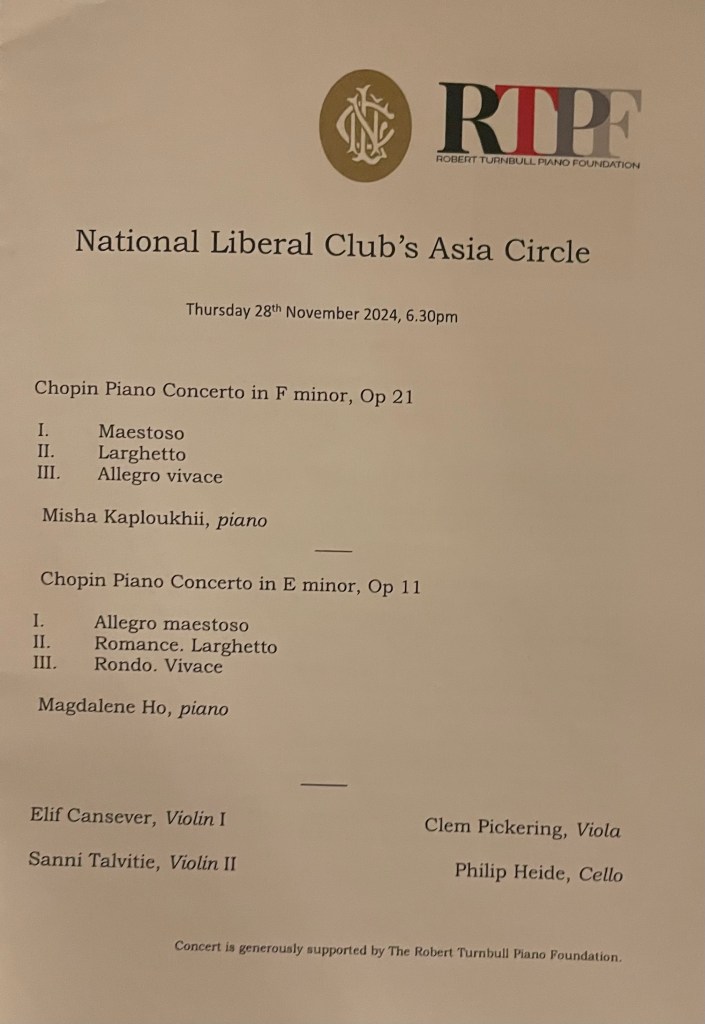
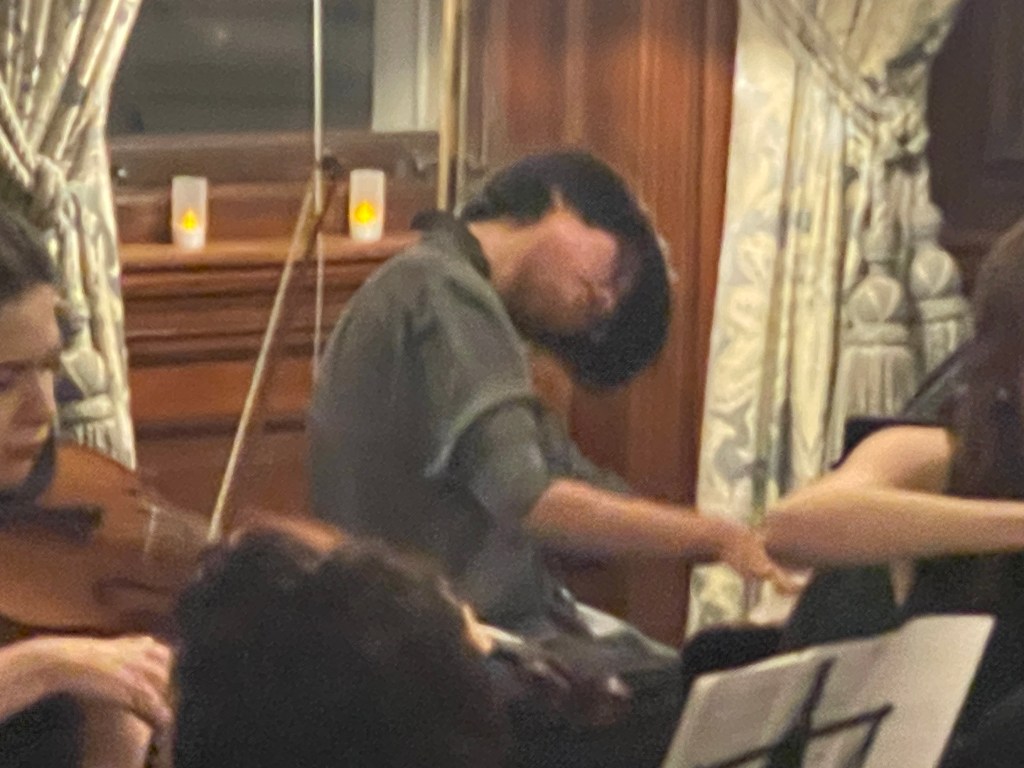
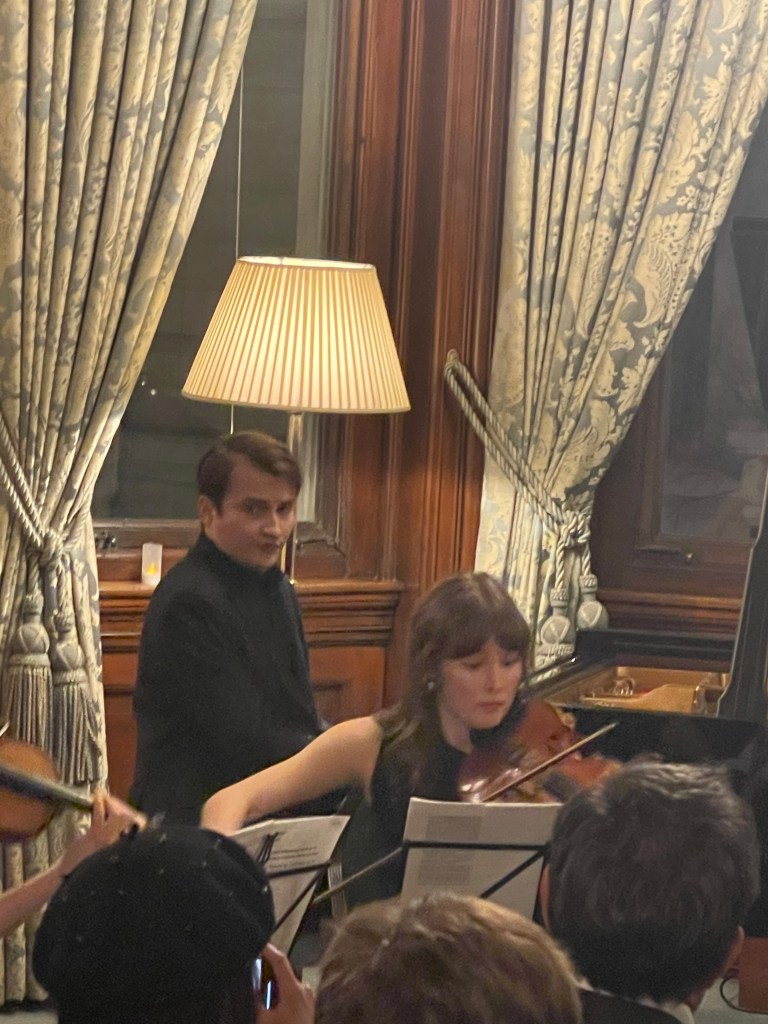
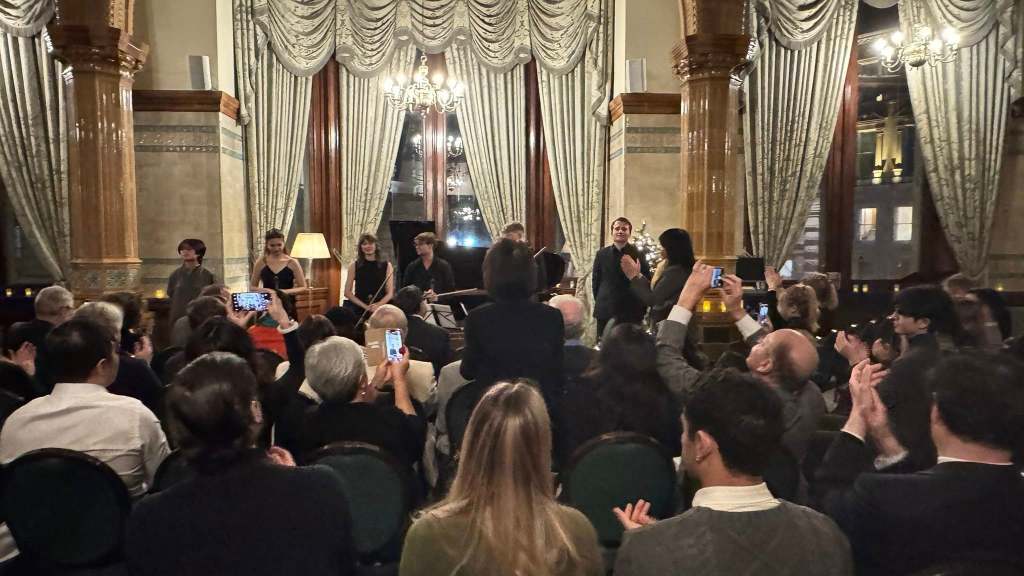
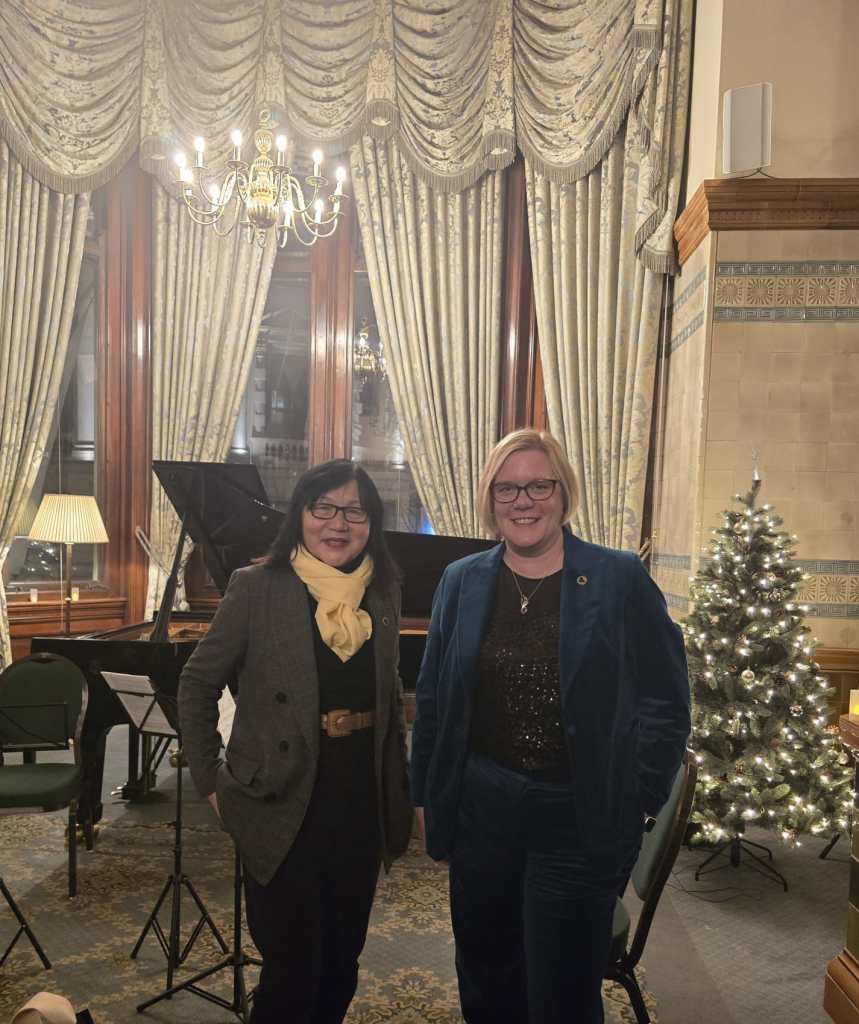
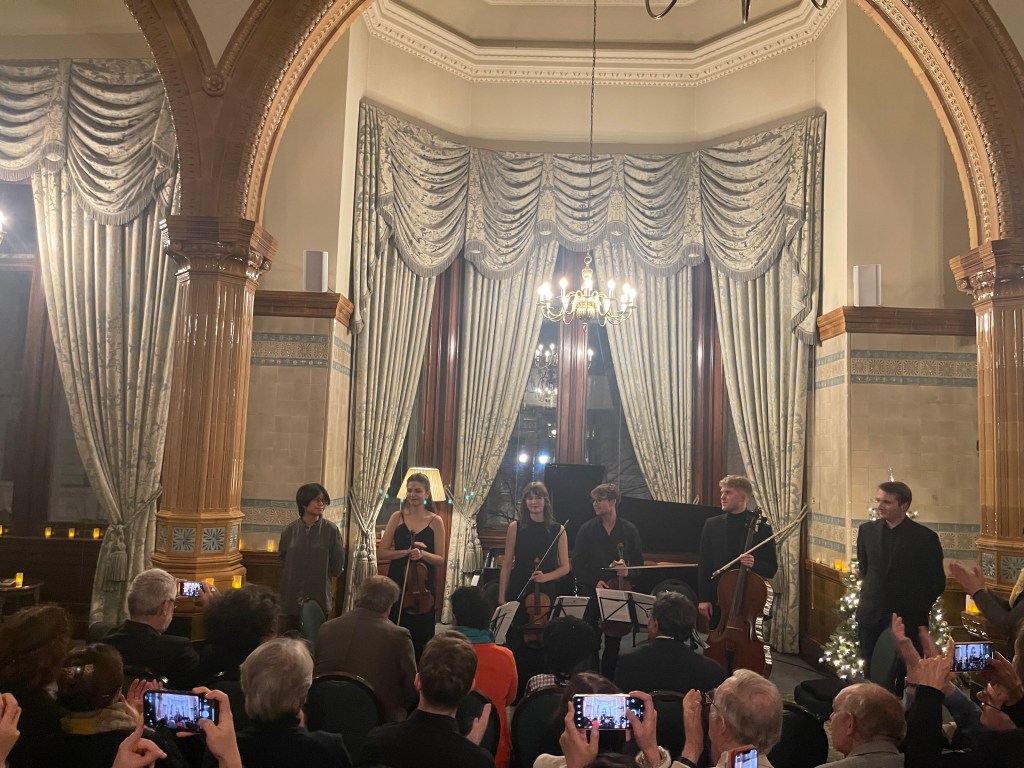
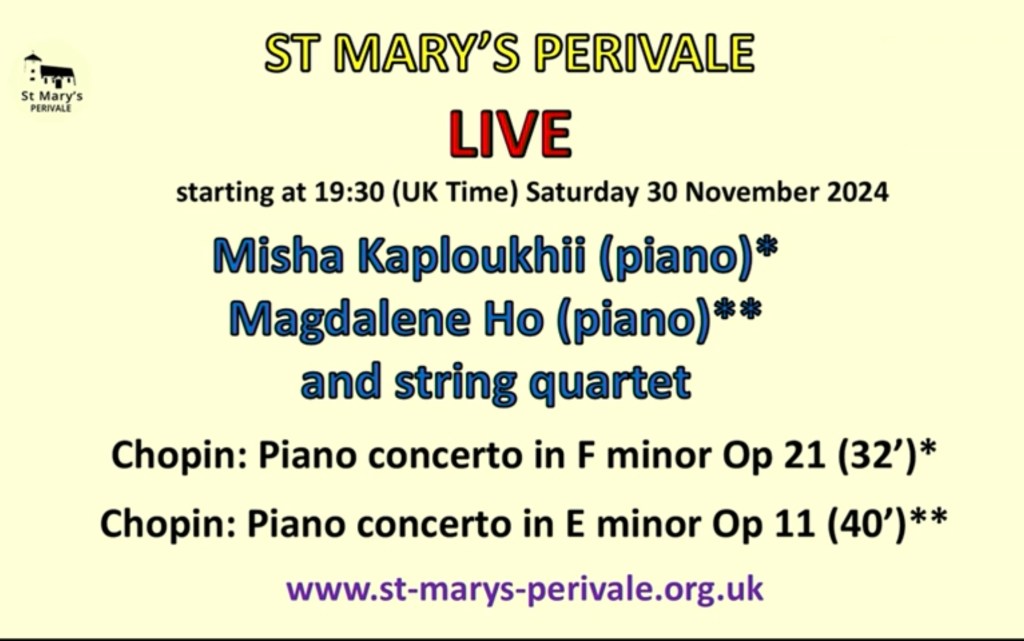
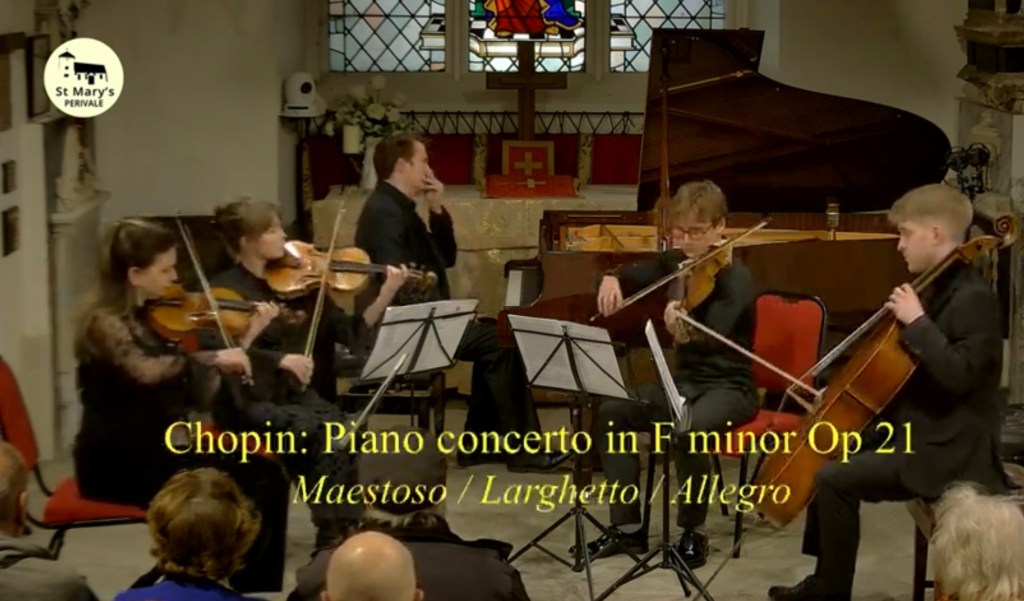
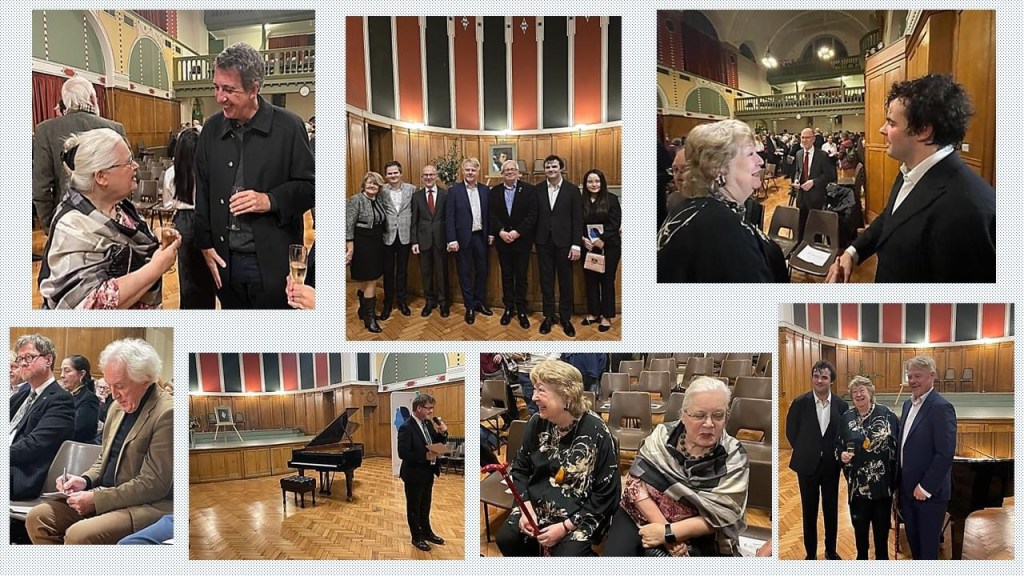
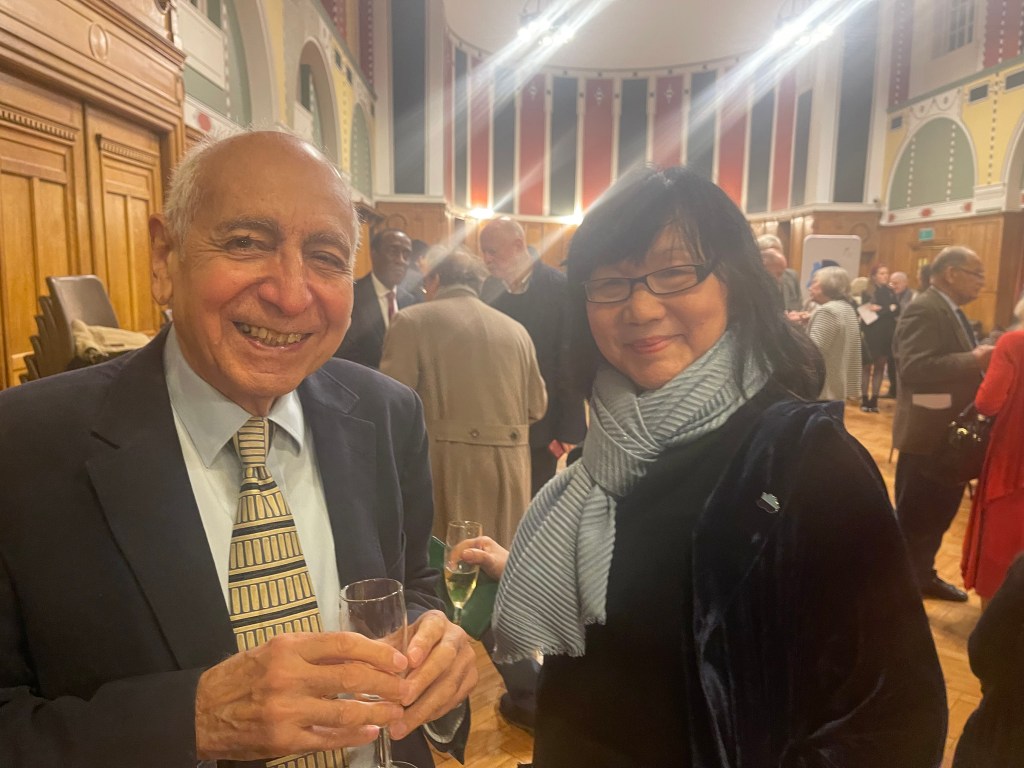
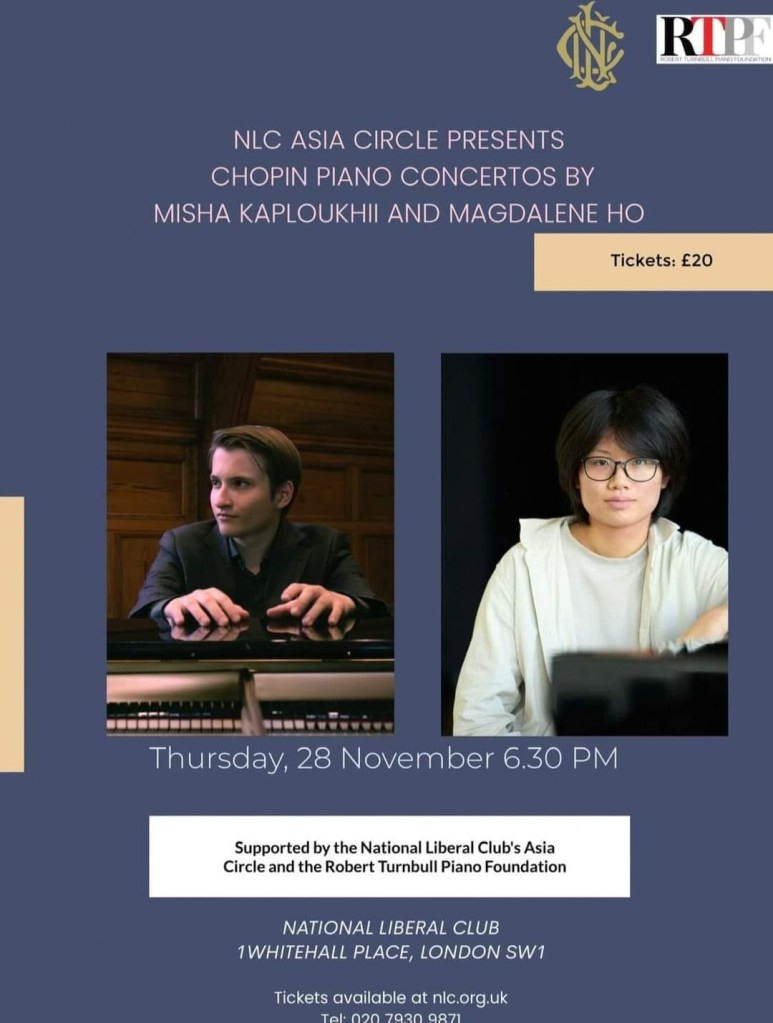
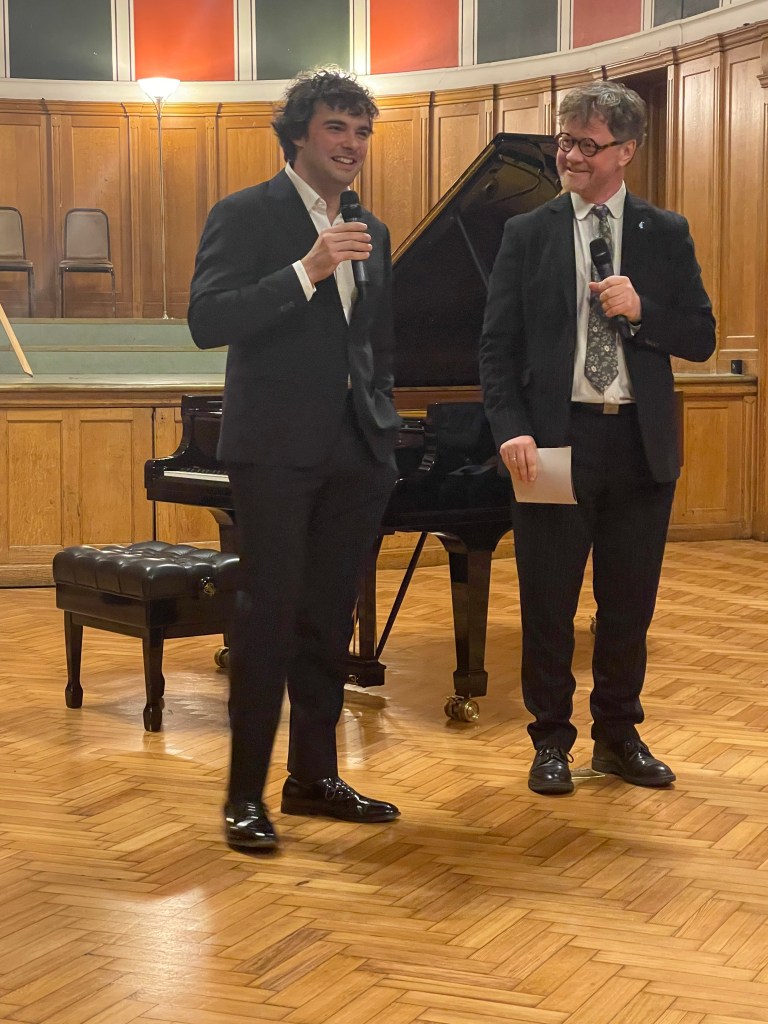
Superb playing from these two young stars of the Royal College of Music, with a concert promoted by Yisha Xue and the Robert Turnbull Piano Foundation repeated at the Mecca for all great young pianists in Perivale.One in the sumptuous surrounds of the National Liberal Club and the other in the historic St Mary’s Perivale
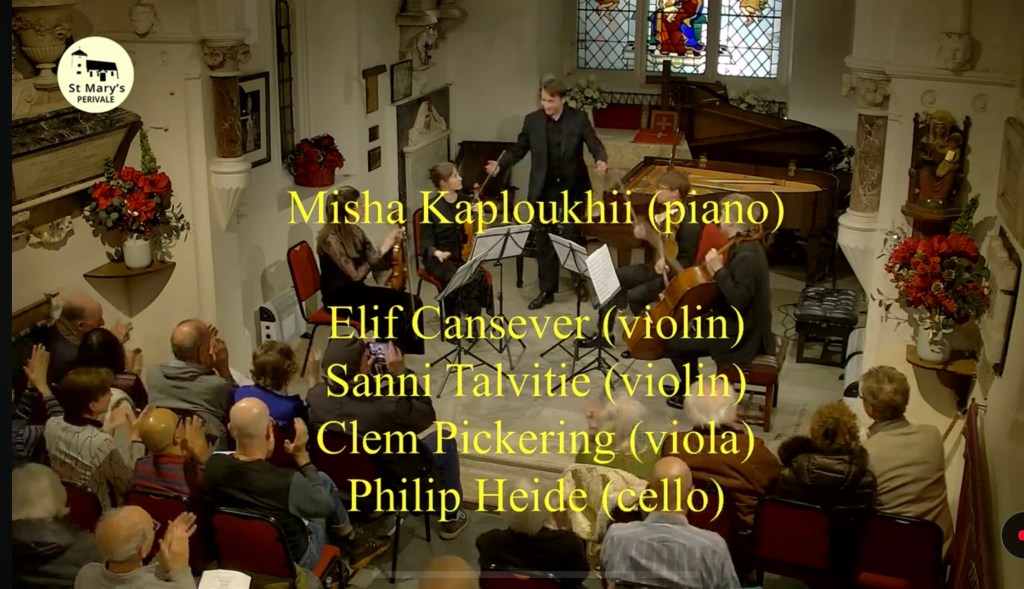
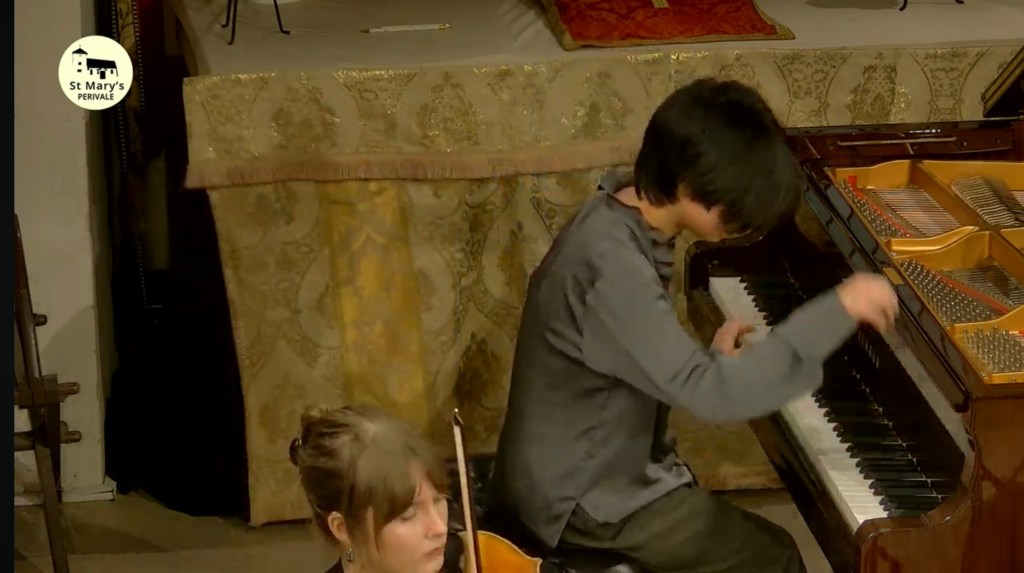
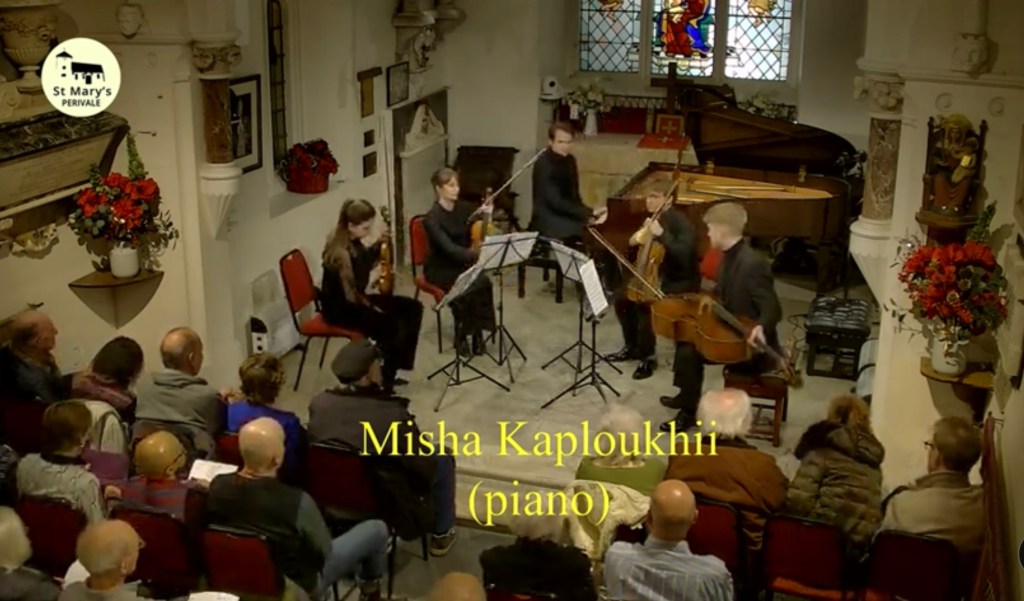
Misha brought a spontaneity to his playing as the streams of golden sounds poured from his fingers with such ease and an aristocratic sense of style.From the opening bel canto of the F minor concerto it was obvious that here was a stylist who could give all the time necessary to allow the music to breathe and beguile without any excentricities or exaggerations.Looking intently at his colleagues as he was living every moment and was ready to capture beauty as on the wings of song.There was virtuosity but it never drew attention to itself as it was incorporated into a concerto that is one long mellifluous outpouring. The string quartet were following the every move of our soloists and it was only in the long tuttis that we were aware that with single instruments there is simply not the volume to create the climax that the soloist is preparing us for.
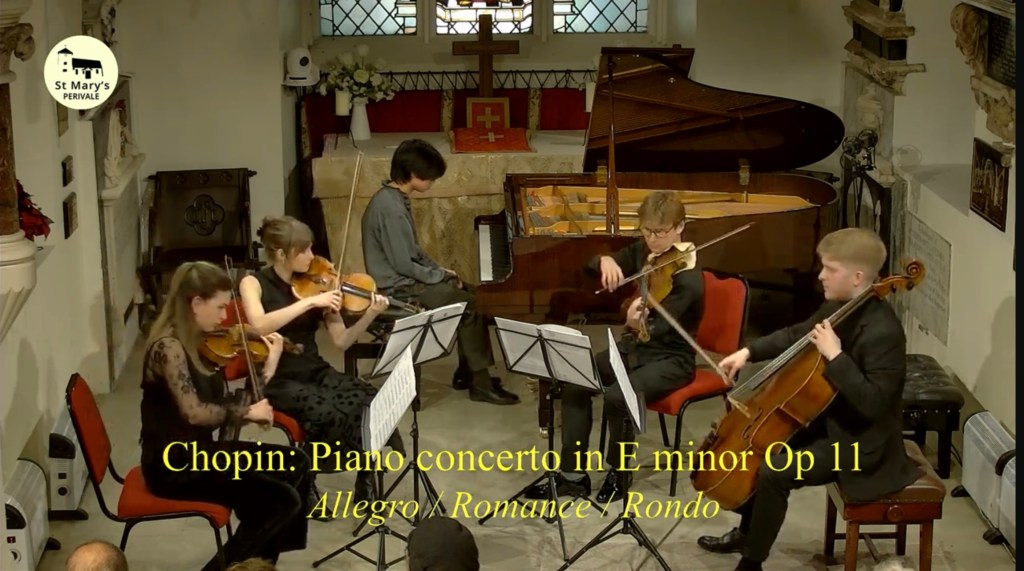
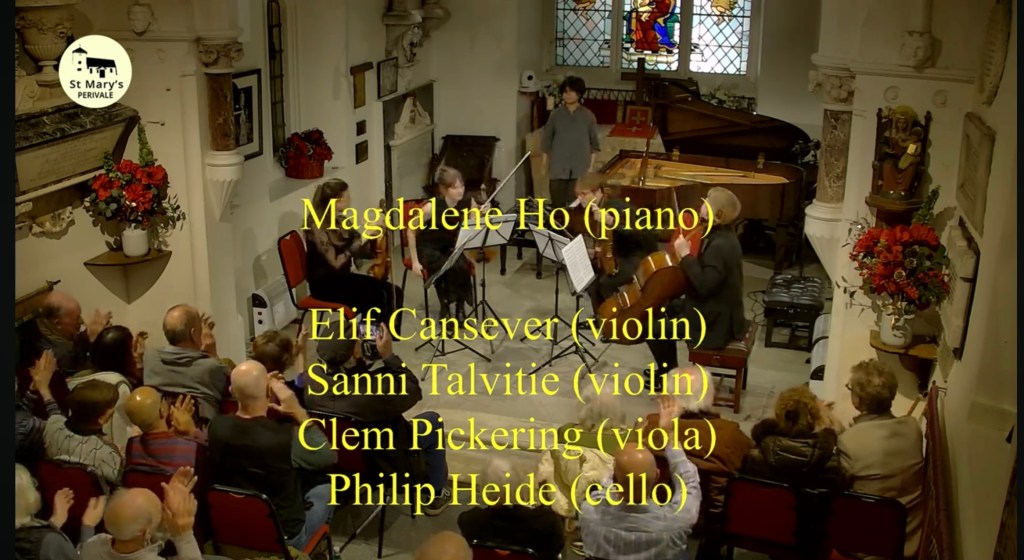
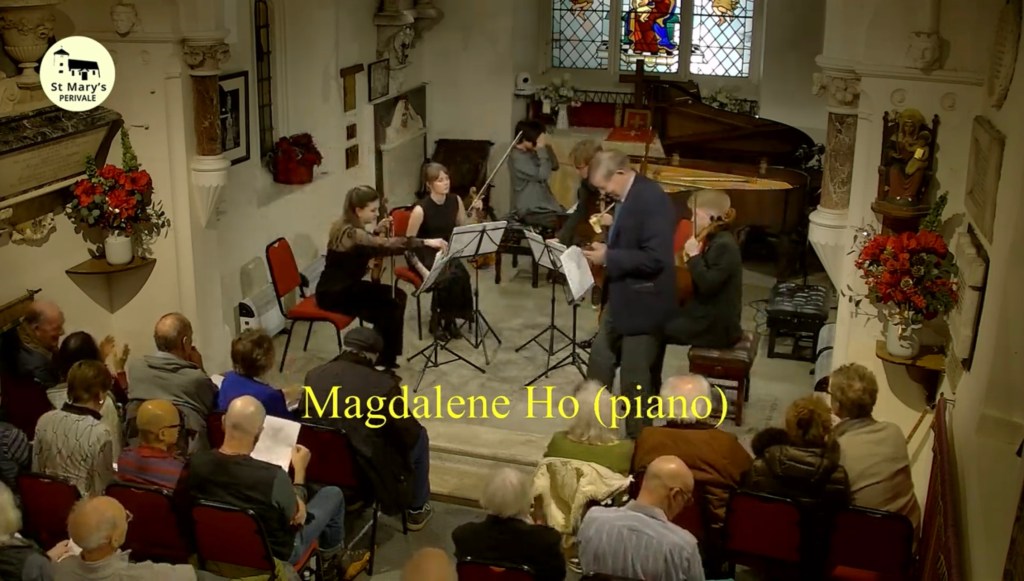
Magdalene gave a much more measured performance of extraordinary mastery and if the first movement seemed rather slow it was, though, full of ravishing detail .Especially the second subject where she played the deep bass note with her right hand before allowing it to carve such magic above pulsating chords.The grandiloquence of the opening was played with absolute clarity and majesty but a slightly faster tempo might have given it more electric excitement.It was in the slow movement that Magdalene showed her mature musical genius as she allowed Chopin’s bel canto to glow with ravishing sounds of simplicity and sublime beauty.The Rondo she thought of in more melodic terms rather than abandoning herself to the dance.She found such subtle beauty and an extraordinary architectural shape to this movement allowing herself finally to relish the final pages of virtuosistic brilliance.This version with string quartet was much more successful in the smaller space of St Mary’s or maybe it was because of the superb streaming that there seemed to be more weight to their playing.However to hear these two concertos played with such mastery and superb musicianship was indeed a rare treat
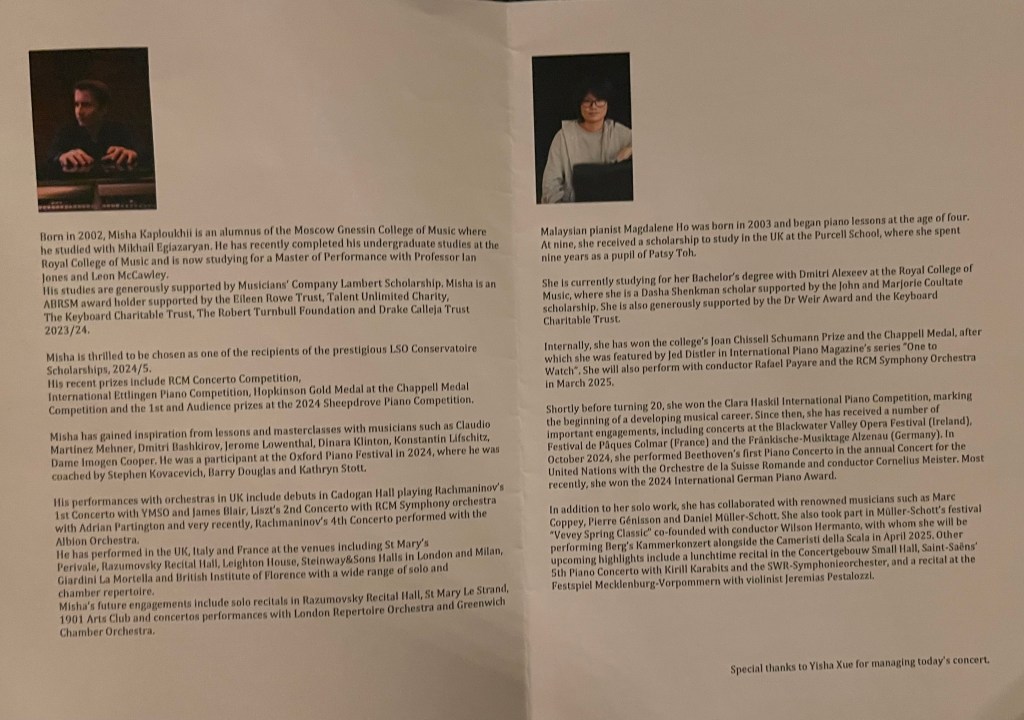
Misha Kaploukhii was born in 2002 and is an alumnus of the Moscow Gnessin College of Music. He is currently studying at the Royal College of Music and is an RCM and ABRSM award holder generously supported by the Robert Turnbull Piano Foundation and Talent Unlimited studying for a Bachelor of Music with Prof. Ian Jones. Misha has gained inspiration from lessons and masterclasses with musicians such as Claudio Martínez Mehner, Dmitri Bashkirov, Jerome Lowenthal and Konstantin Lifschitz. He has performed with orchestras around the world including his recent debut in Cadogan Hall performing Rachmaninov’s First Piano Concerto. His repertoire includes a wide range of solo and chamber music. Recently, Misha won prizes in the RCM Concerto Competition (playing Liszt’s Second Piano Concerto) and in the International Ettlingen Piano Competition. https://christopheraxworthymusiccommentary.com/2024/11/14/misha-kaploukhii-in-florence-and-milan-for-the-keyboard-trust-and-robert-turnbull-piano-foundation/
Malaysian pianist Magdalene Ho was born in 2003 and started learning the piano at the age of four. In 2013, she began studying in the UK with Patsy Toh, at the Purcell School. In 2015, she received the ABRSM Sheila Mossman Prize and Silver Award. As part of a prize won at the PIANALE piano festival in Fulda, Germany, she released an album of Bach and Messiaen works in 2019. She was a finalist at the Düsseldorf Schumann Competition 2023 and was awarded the Joan Chissell Schumann Prize for Piano at the Royal College of Music a few months later. In September 2023, she won the Clara Haskil International Piano Competition in Vevey along with receiving the Audience Prize, Young Critics’ Prize and Children’s Corner Prize. She has been studying with Dmitri Alexeev at the Royal College of Music since September 2022, where shee. is a Dasha Shenkman Scholar supported by the Gordon Calway Stone Scholarship, and by the Weir Award via the Keyboard Charitable Trust. She recently won the Chappell Gold Medal at the RCM https://christopheraxworthymusiccommentary.com/2024/05/12/magdalene-ho-a-musical-genius-in-paradise/
We had the privilege of experiencing two extraordinary and unforgettable days at the Casals Forum!
It is difficult to put into words the exceptional talent and the stunning performances of the six nominees for the 13th International German Piano Award.
These days were filled with musical beauty and the passion that each artist brought to the stage. My heartfelt congratulations go to all six nominees, who enriched both the jury and the audience with their incredible talent.
However, I would like to extend a very special congratulations to 𝐌𝐀𝐆𝐃𝐀𝐋𝐄𝐍𝐄 𝐇𝐎:
After 11 years, she is the first woman to win the International German Piano Award!
Dear Magdalene, your performance in the Grand Prix with Schumann’s Piano Concerto was nothing short of breathtaking, and your appearances on all previous stages were equally unforgettable. Every note was deliberate and played with gentle precision—a true masterpiece. Congratulations on this outstanding achievement! You are undoubtedly a pianist of great promise.
Thank you to C. Bechstein for the wonderful Grand-Piano!
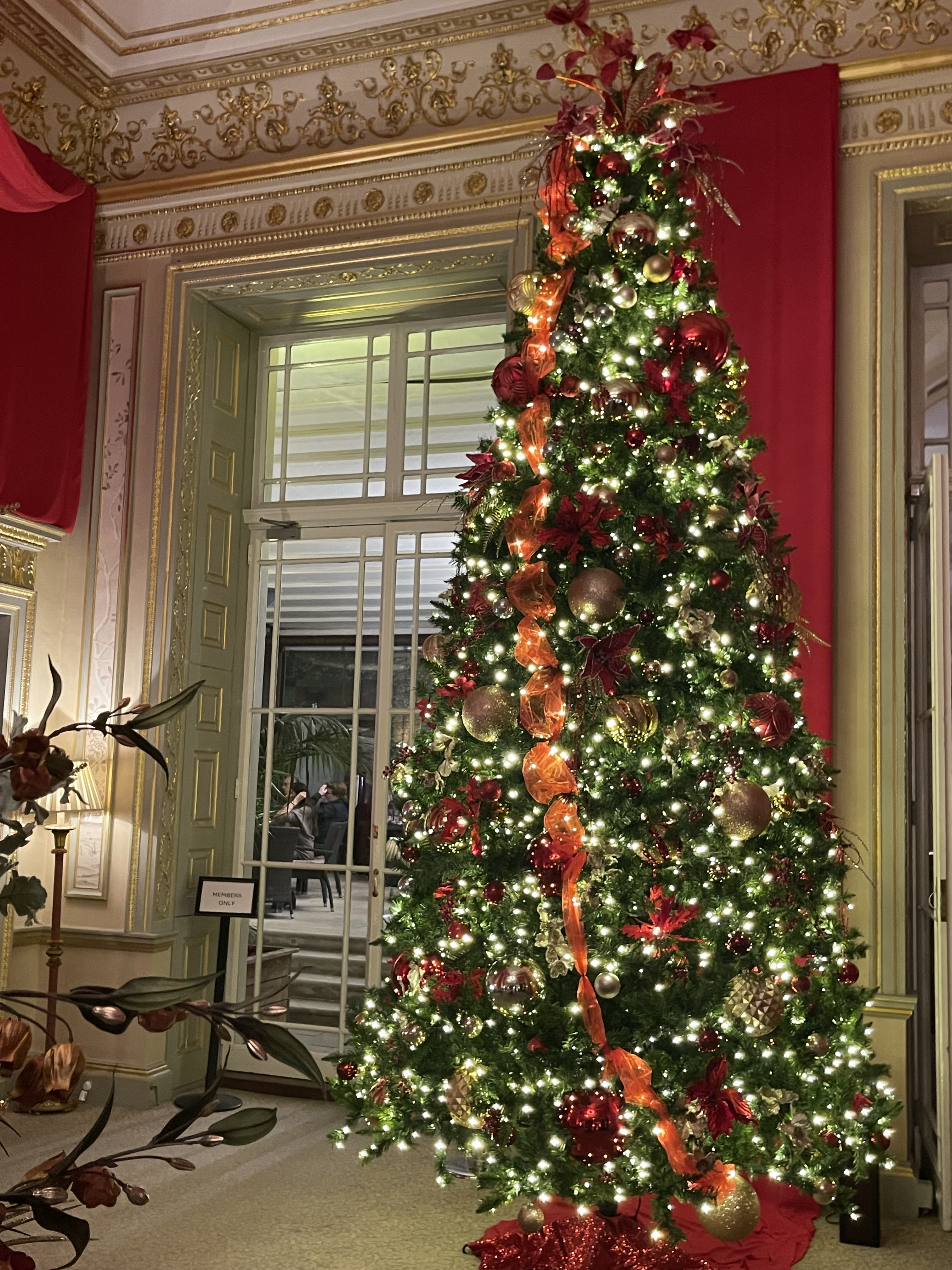
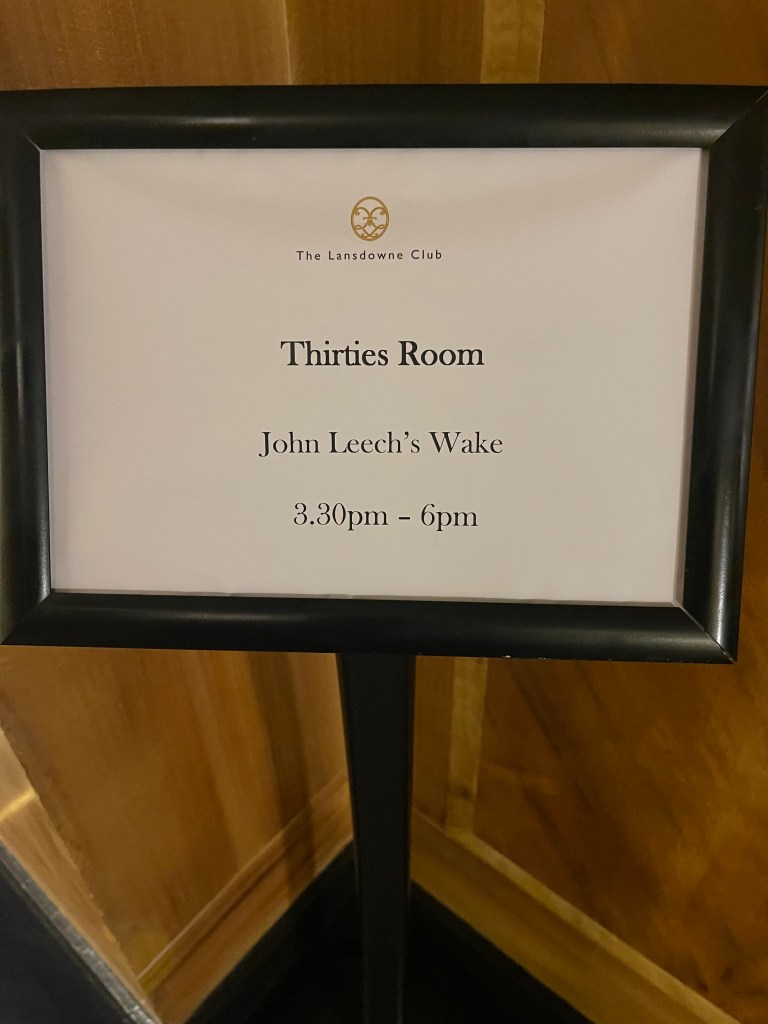
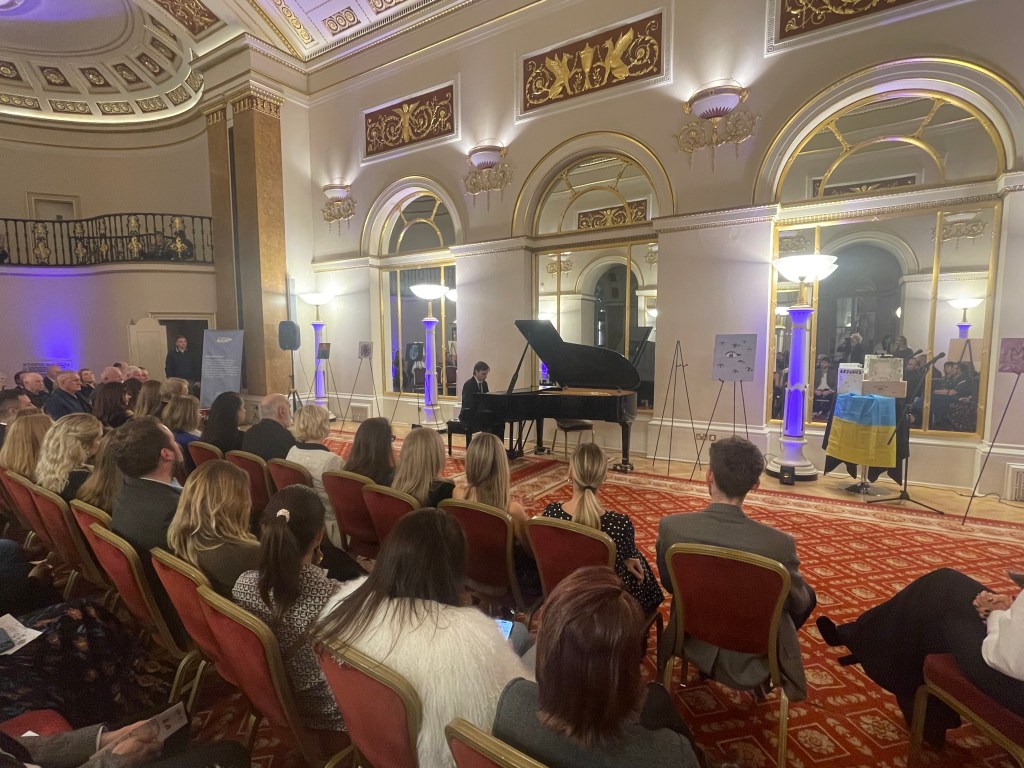
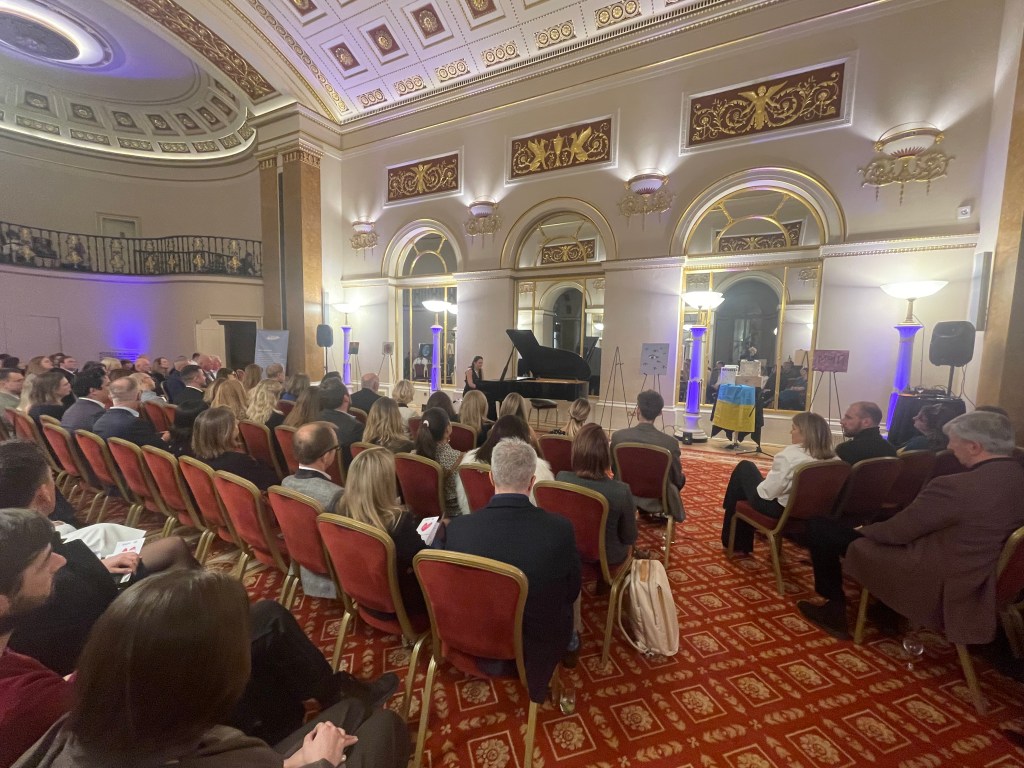
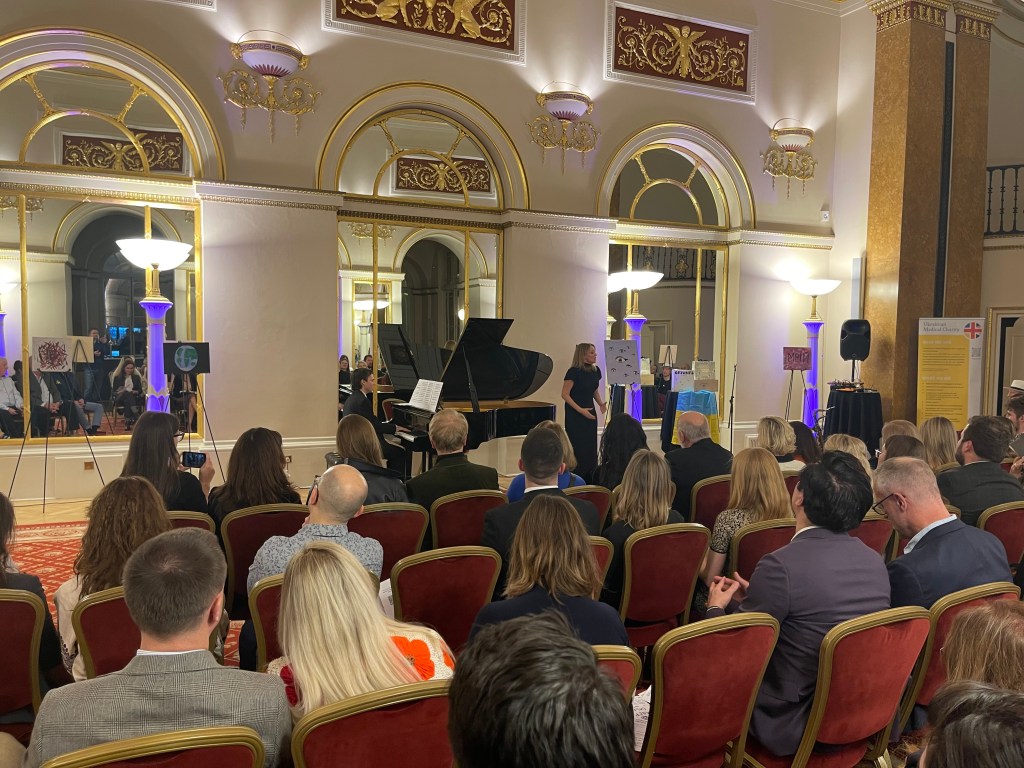
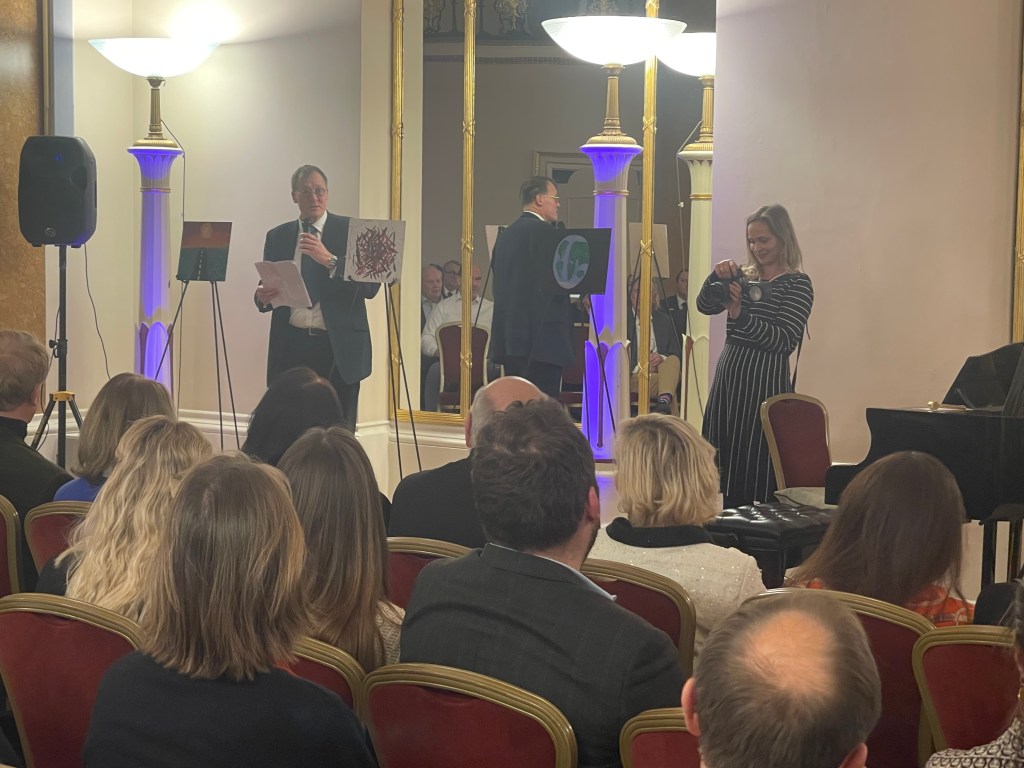
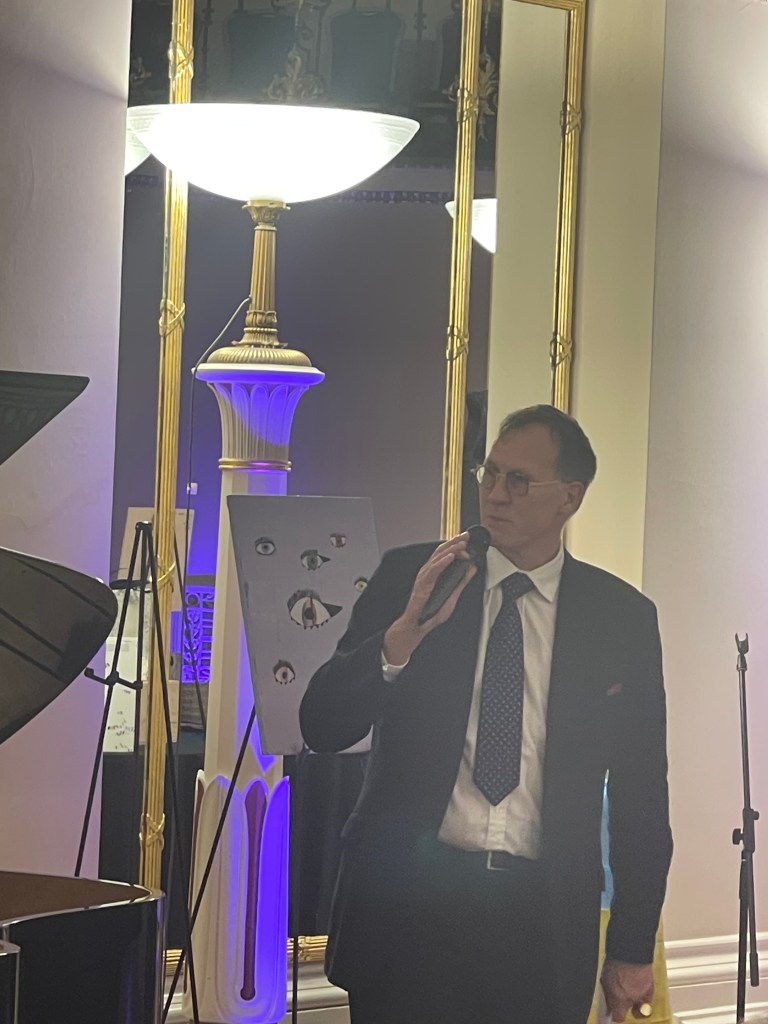
An extraordinary evening in the Lansdowne Club all decked up for Christmas. Here in their sumptuous ballroom we were awakened to the plight of innocent children in Ukraine whose childhood has been robbed by the ignominious war that Putin is waging against their homeland.
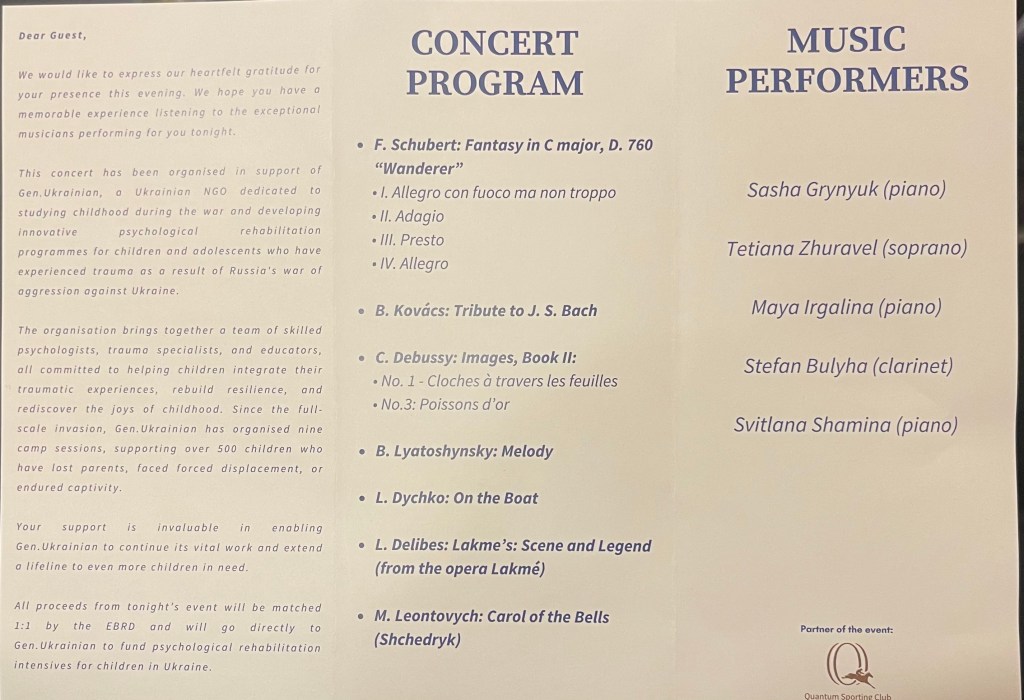
On wings of song, ‘Gen Ukrainian’ or the equivalent of Save the Children were holding a gala Christmas concert to raise funds and awareness of the rape of innocence by an egocentrical dictator.
Sasha Grynuk’s own parents fled his hometown that was in flames and were able to seek refuge the UK.
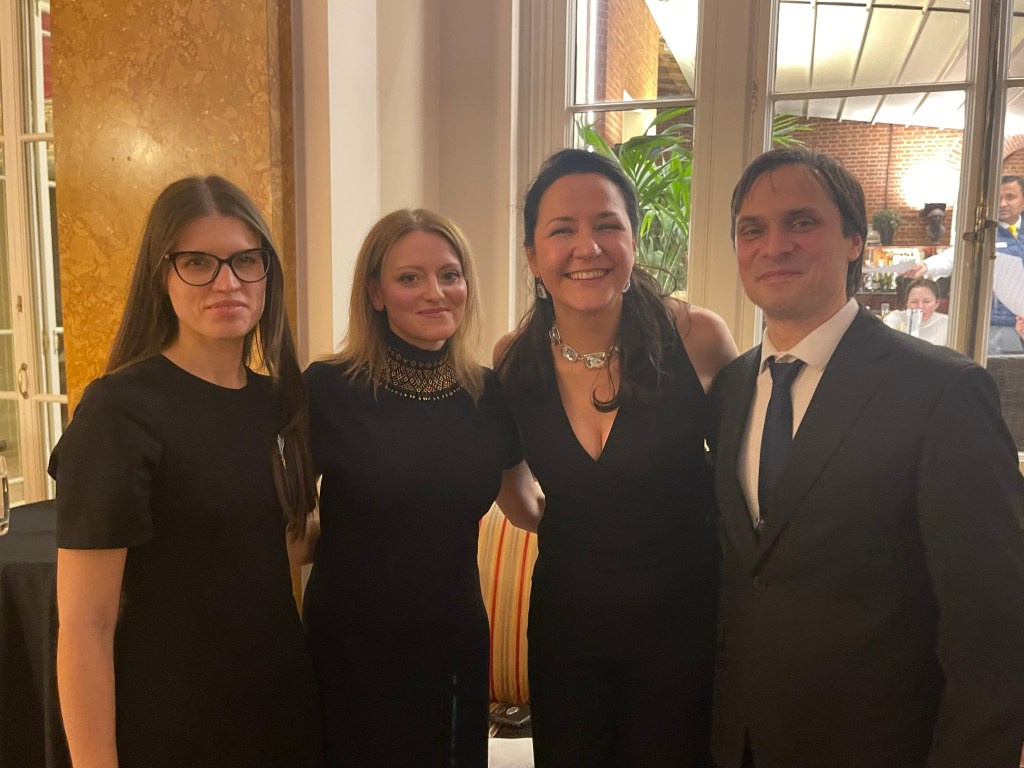
And it is Sasha with his wife and parents together with their Ukrainian friends that have organised concerts to raise funds for the innocent people in their homeland left almost without hope for a peaceful solution to this cruel invasion.
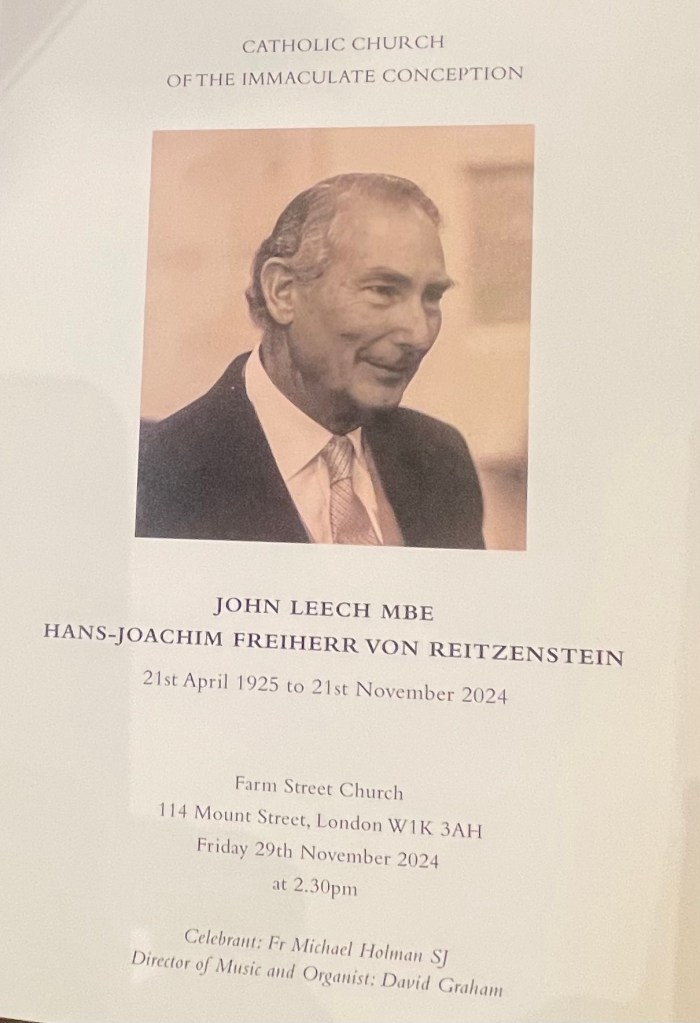
It was by chance that there was another ‘wake’ upstairs to celebrate John Leech the founder of the Keyboard Trust who breathed his last breath a week ago in his 100th year.
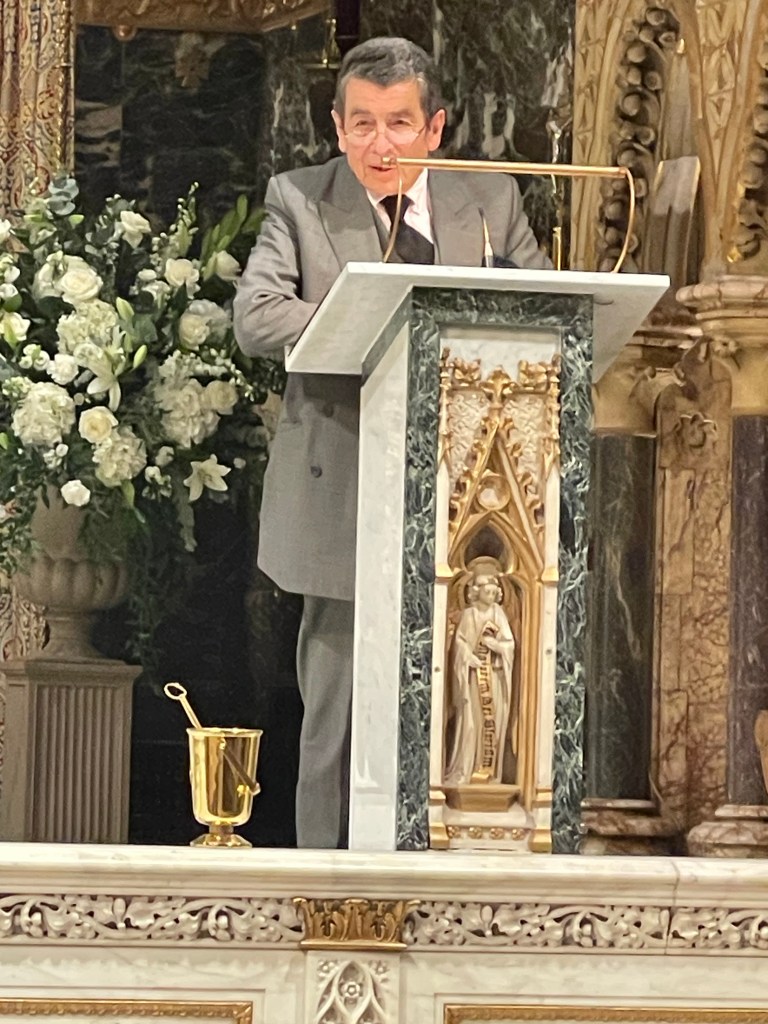
Sir Geoffrey Nice ,the renowned peacemaker barrister ,had spoken of his great friend’s unstinting generosity in helping others, at the family service held in the beautiful Farm Street Catholic Church. A church just a stones’ throw from Berkeley Square where the nightingales have long given up trying to be heard !
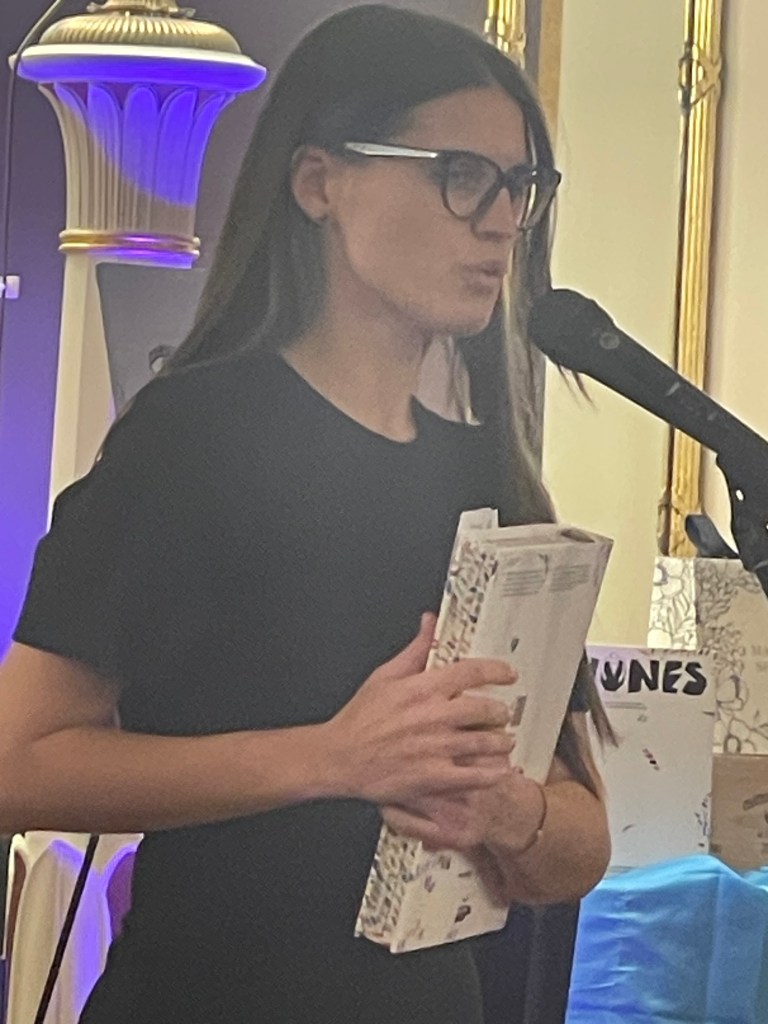
A concert also run by a Ukrainian barrister, Ksenia Iaremych for an organisation that brings together a skilled team of psychologists,trauma specialists,and educators all committed to helping children integrate their traumatic experiences ,rebuild resilience and rediscover the joys of childhood ,many of whom orphaned.
Ksenia Iaremych the Gen.Ukrainian ambassador in the UK
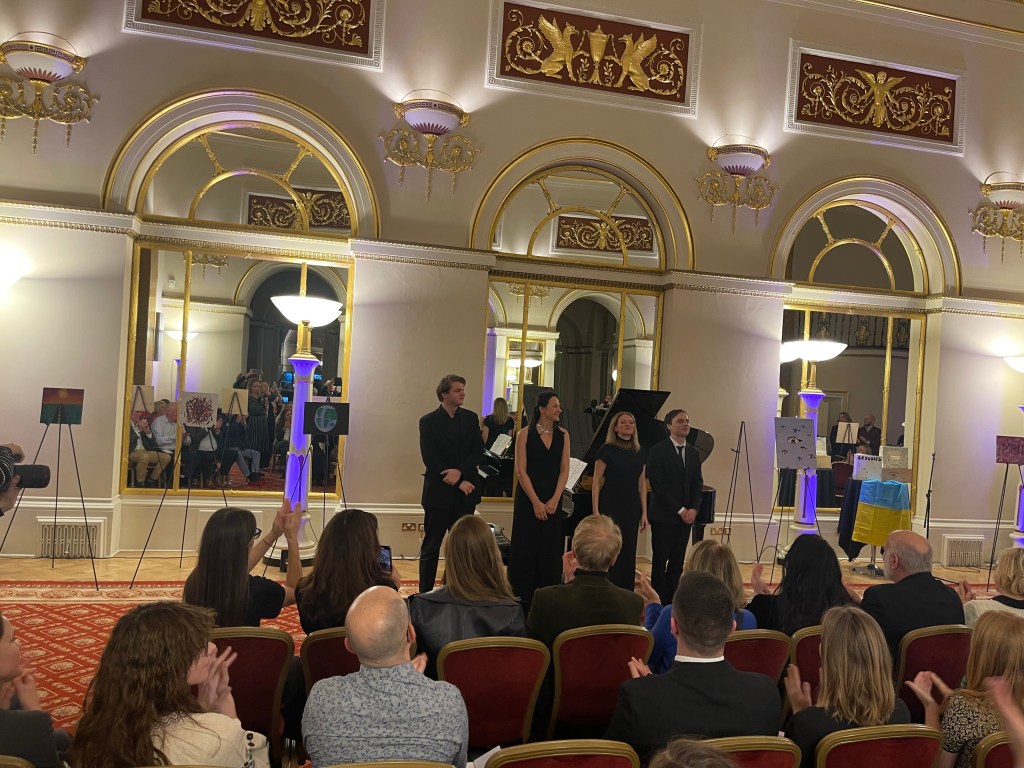
Paintings that these children ,some only 9 or 10 years old were on display and later auctioned after a sumptuous feast of music that had finished with the moving ‘Carol of the Bells’ played by Sasha Grynuk and Maya Irgalina .The Great Gate of Kiev springs to mind as an imaginary symbol of bells that will bring exhilaration, hope and peace.
Sasha Grynuk opening the concert with Schubert Wanderer Fantasy
The concert had begun rather late due to the pre- concert celebrations for the sponsors and guests.However when Sasha did sit at the piano silence reigned and music took over where words are just not enough.Sasha playing with passionate conviction and mastery a work by Schubert that was a revolutionary new form as he too was looking forwards not backwards and creating a sublime new world that was to shine a light and create a path for all those that came after.Sasha carrying the torch for his homeland as his hands ignited the fantasy and invention of a genius who had died at the age of barely 31 years .I have written about his performance recently in Florence and Milan for the Keyboard Trust and he plays every week to Noretta Conci Leech,founder with her late husband John Leech of the Keyboard Trust. A disciple of Benedetti Michelangeli who in a give and take exchange of ideas inspires Sasha to the heights that we heard tonight. Rythmic energy,a kaleidoscope of colour allied to a clarity and precision due to a very particular mastery of the pedals.Above all the wonder at the beauty and freshness that they could find in the many masterworks that they have studied together over the past few years.
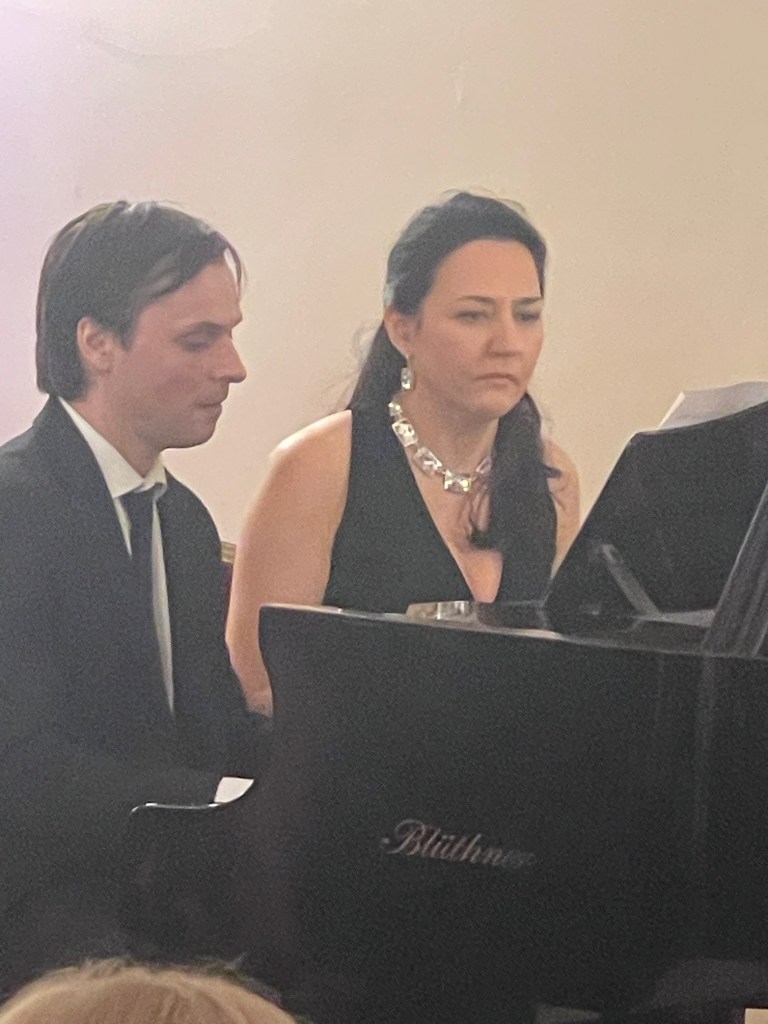
Maya Irgalina followed Sasha on this beautiful Bluthner piano (Bluthner regularly hold concerts here for aspiring young musicians https://christopheraxworthymusiccommentary.com/2023/09/13/gabriele-sutkute-takes-mayfair-by-storm-passion-and-power-with-impeccable-style/).Some beautiful playing of Debussy from Images Book 2: ‘Cloches à travers les feuilles’ with the bells again that were to close this memorable evening .But these were bells seen through a haze of sounds which from Irgalina’s hands were ravishing and of glowing fluidity as the vision of the bells came more and more into view. A performance of extraordinary sensitivity and radiance that ignited the vision of a Gold Fish that had so inspired Debussy’s imagination.This was a famous piece of Benedetti Michelangeli who played it with a more chiselled clarity but Irgalina chose richer velvety sounds bathed in pedal as Debussy’s genial imagination brought this picture vividly to life miraculously transmitted to us this evening by her ten inspired fingers.
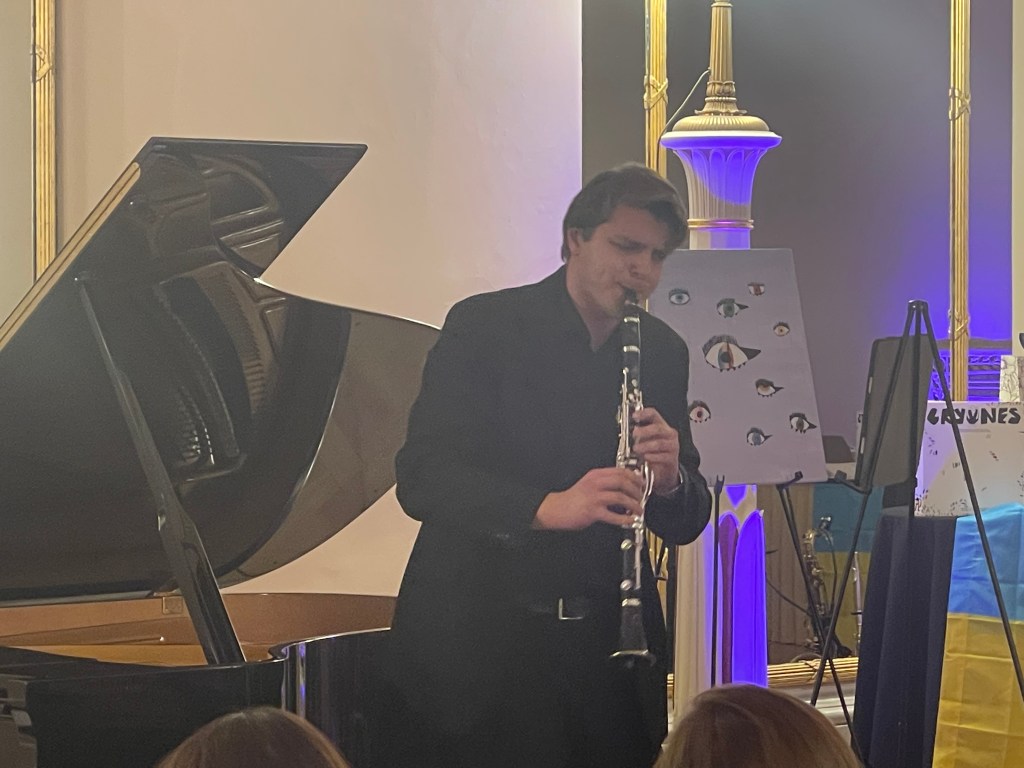
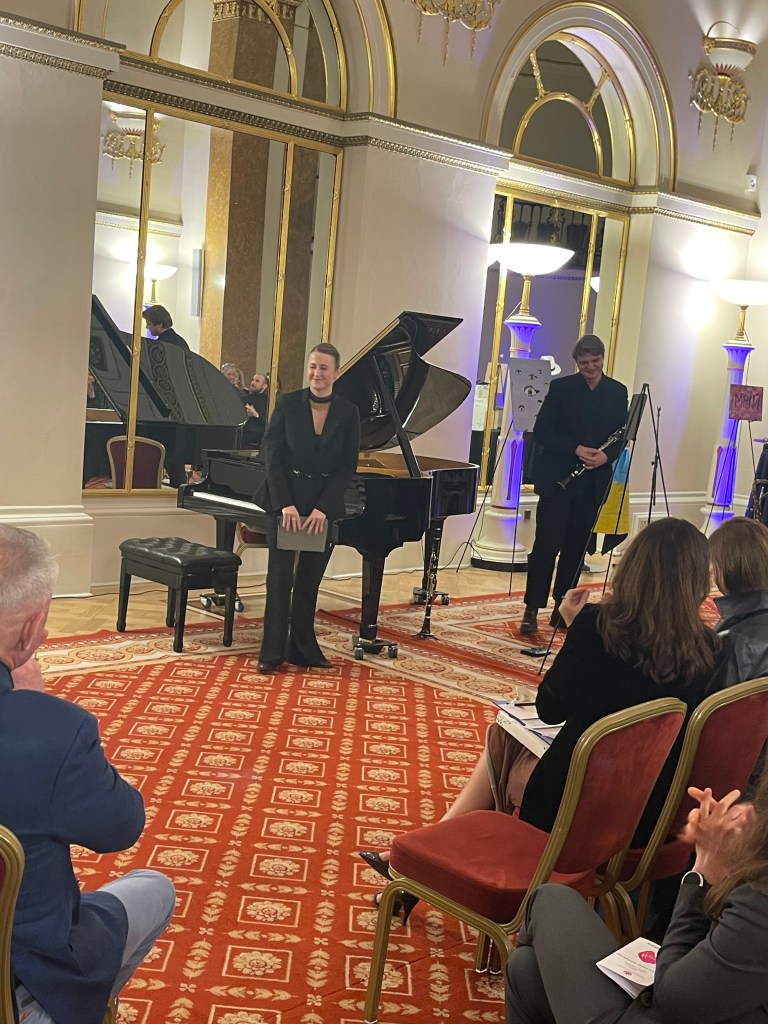
Stefan Bulyha played a piece for solo clarinet with improvised freedom and musicianship: B.Kovács Tribute to J.S. Bach.
He was also united with Svitlana Shamina in a beautifully suggestive performance of the Melody by B.Lyatoshynsky.
A star shining brightly ,too,was the soprano Tetiana Zhuravel,in London for the Tales of Hoffman at Covent Garden ,and was here accompanied by Sasha. Her voice was of such passionate radiance that as she reached for the long top C I feared for the beautiful candelabra in the Lansdowne such was the intensity and perfection of her voice.
Of course the stars of the evening were Sasha Grynuk and Maya Irgalina for playing with such passionate intensity the traditional Ukrainian Hymn to Peace that is the ‘Carol of the Bells’ by M.Leontovych. Playing of passionate intensity that ignited even more the atmosphere and prepared the public for the auction of the paintings of these children so scarred by a useless war for whom we hope the nightingale will return to sing once more in peace in Berkeley Square.
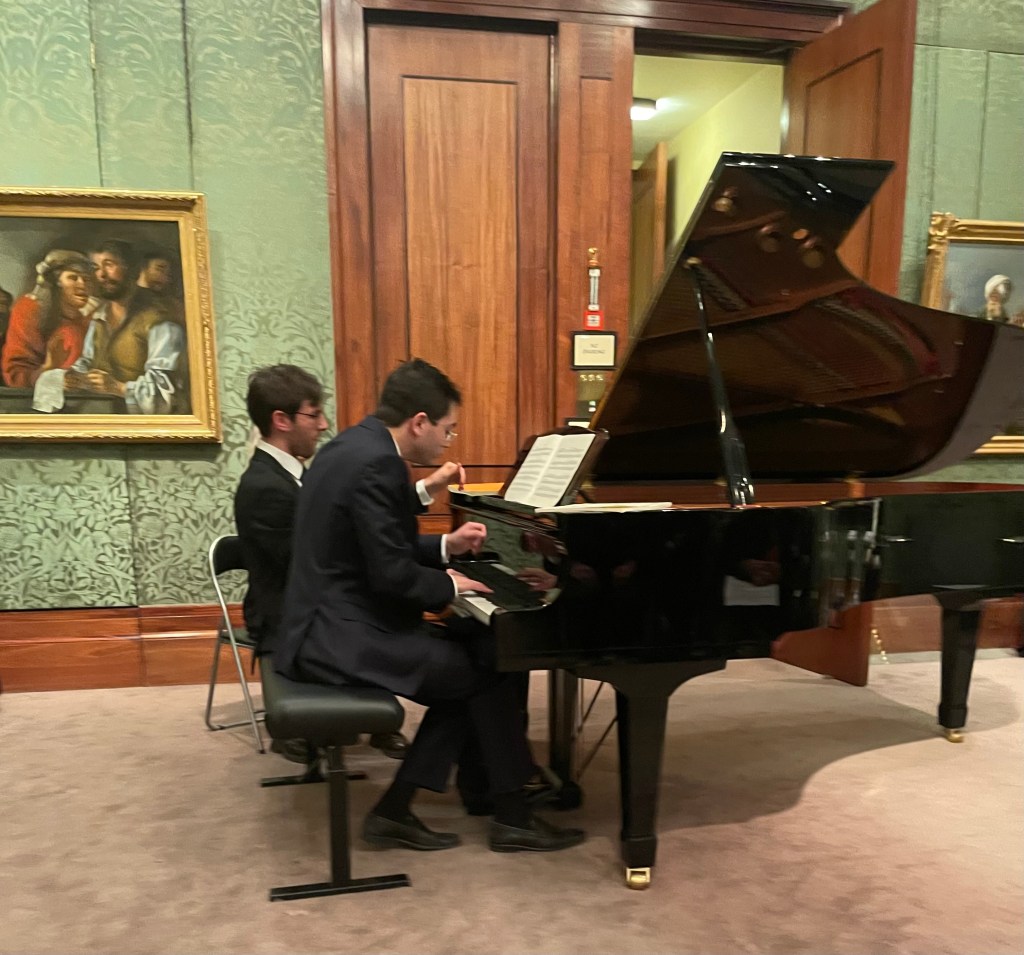
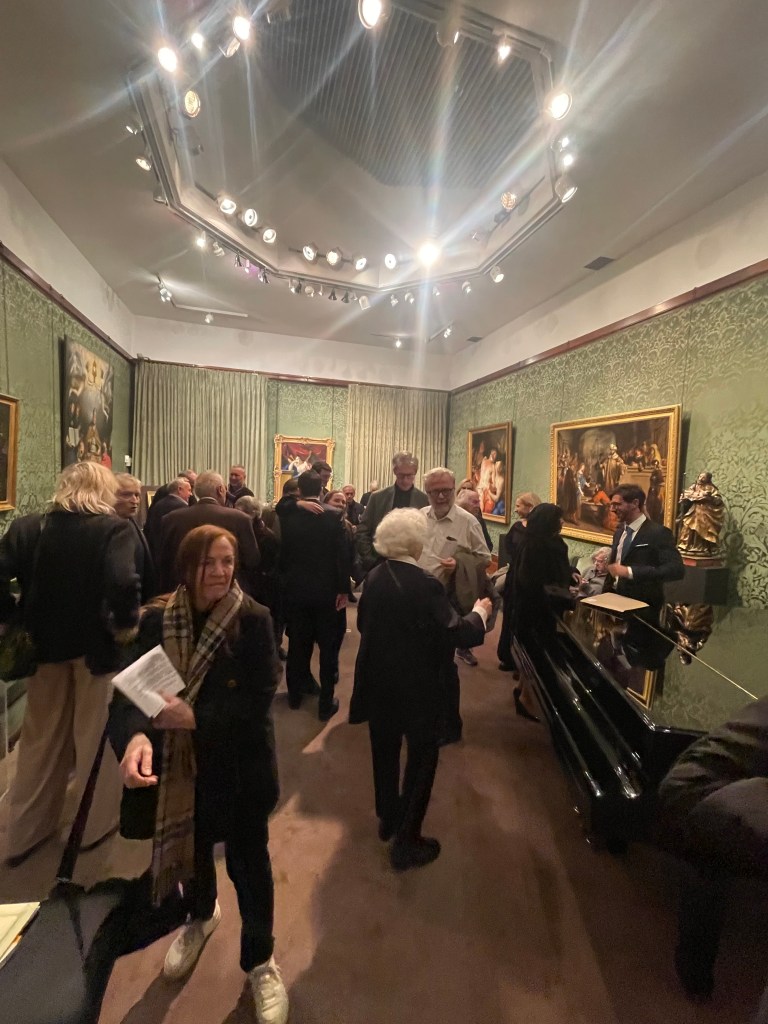
What better way to spend the evening than in the company of two friends making music together in the sumptuous surrounds of the Matthiesen Gallery.
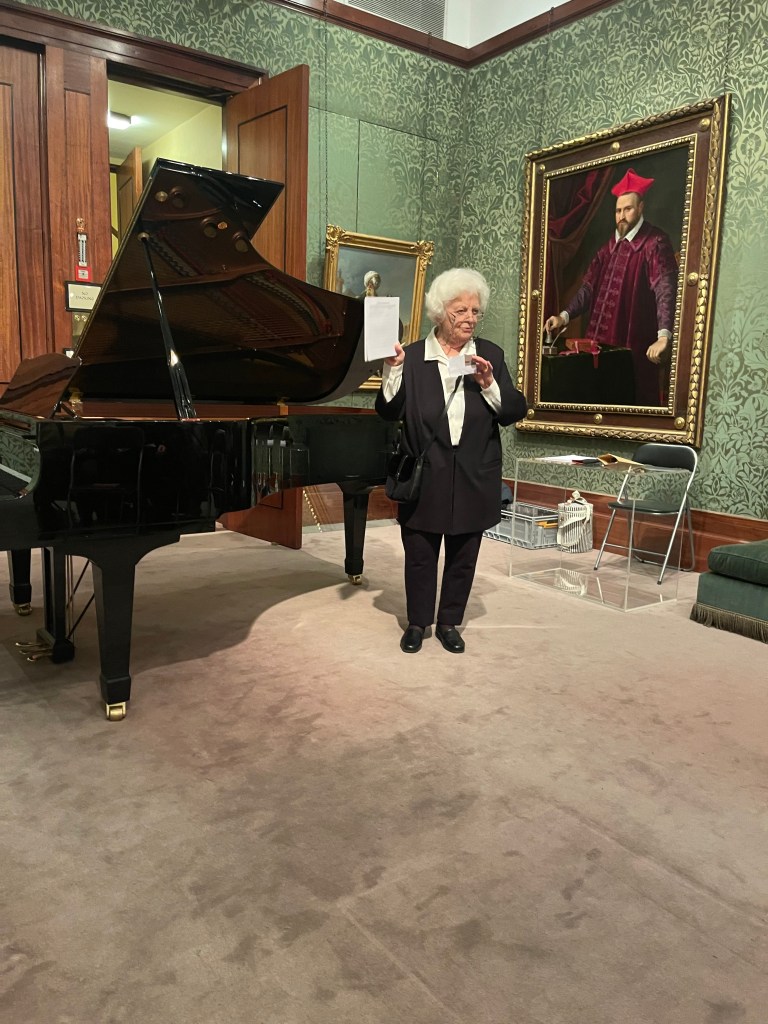
The remarkable Mary Orr presenting her Young Artists Concert Series
The beautiful Yamaha C 7 piano generously loaned by the Imogen Cooper Music Trust which like Patrick Matthiesen and the indomitable Mary Orr are helping exceptionally talented young musicians to take their rightful place in an overcrowded music profession.
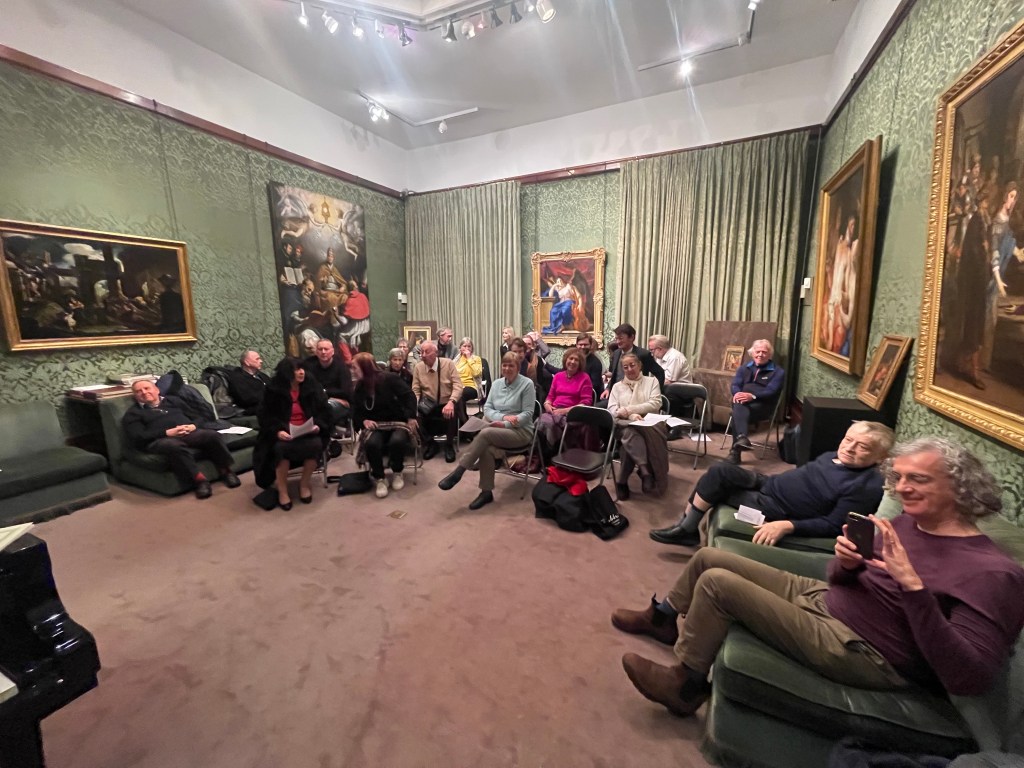
The sumptuous Matthiesen Gallery with silk draped walls and magnificent paintings the ideal setting for ‘Hausmusik’
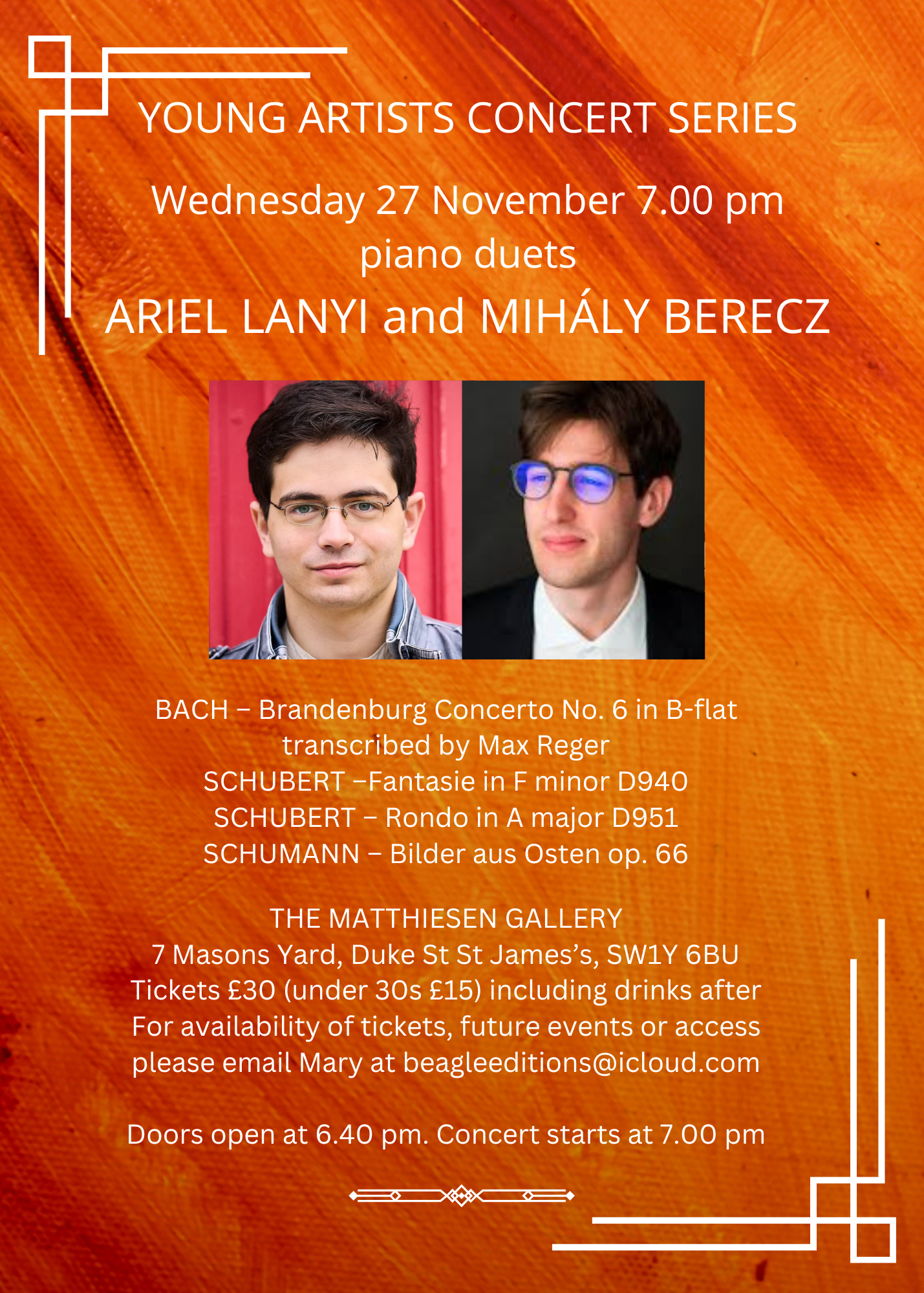
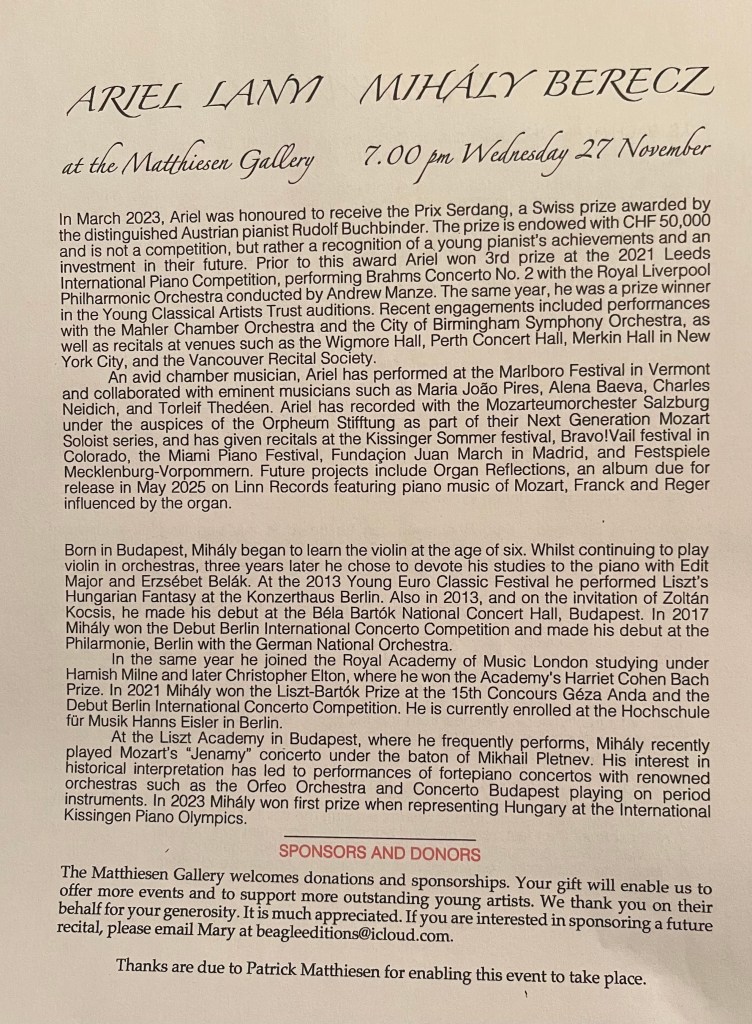
When the two young artists are called Ariel Lanyi and Mihaly Berecz you can expect sparks to be flying as intensity and musical integrity unite.Two major young artists making a name for themselves in the profession after having been friends at the Royal Academy of Music where they were both in the class of Hamish Milne /Ian Fountain.
Of the so-called “Viennese masters,” only Schubert was actually born and raised in that city. Surprisingly, this composer of more than 600 art songs, or Lieder, and numerous sonatas for piano did not, for most of his life, own a piano. A great deal of composing was done at a writing table and revised later at a borrowed piano in the home of a friend.
Schubert left the largest number of piano duets and four-hand works of all the great composers. His Rondo, D. 951, dates from 1828, the last year of his life. Schubert began writing the Fantasia also in January 1828 in Vienna. The work was completed in March of that year, and first performed in May. Schubert’s friend Eduard von Bauernfeld recorded in his diary on May 9 that a memorable duet was played, by Schubert and Franz Lachner. The work was dedicated to Caroline Esterházy, with whom Schubert was in (unrequited) love.
Original manuscript of the Fantasy in F minor
Schubert died in November 1828. After his death, his friends and family undertook to have a number of his works published. This work is one of those pieces; it was published by Anton Diabelli in March 1829.
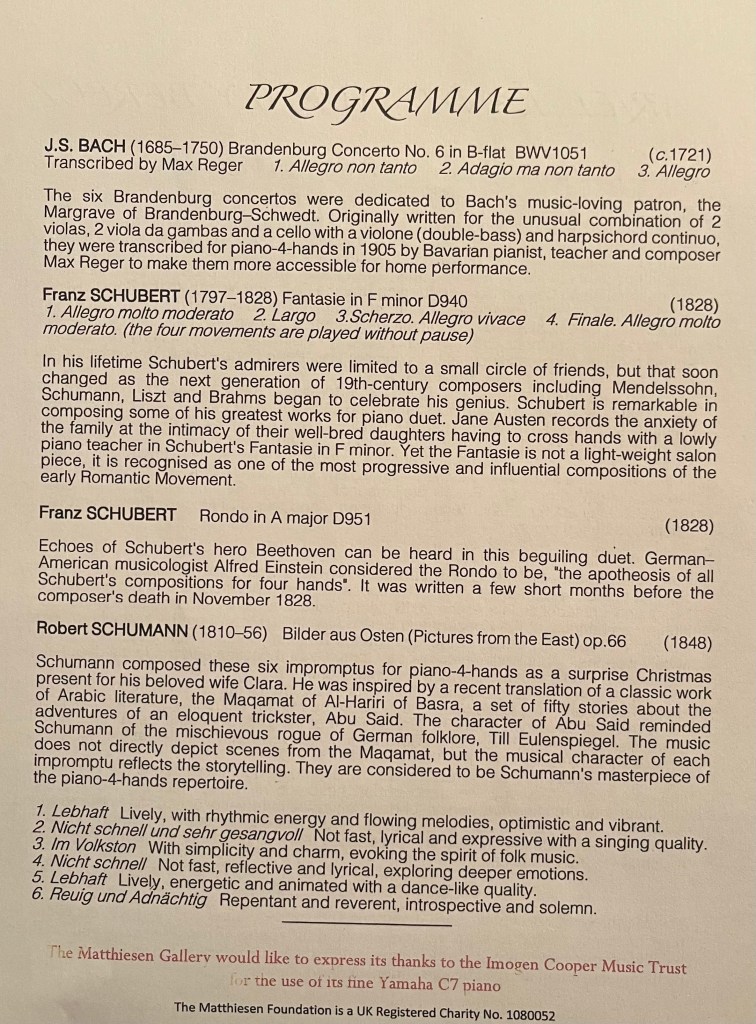
Ariel and Mihaly began the concert with the Reger transcription of the Brandenburg Concerto n. 6 BWV 1051 by J.S. Bach, which had been written to make these master works more accessible to a larger public.It was played with great rhythmic intensity and a superb sense of balance. Ariel in the bass sustaining the joyous outpourings from Mihaly’s inspired fingers with an infectious ‘joie de vivre’ and crystal clear simplicity that the Genius from Kothen could weave with incredible mellifluous invention.There was the austere intensive beauty of the Adagio and the knotty twine of the final Allegro that was played with a buoyancy and hypnotic rhythmic elan.
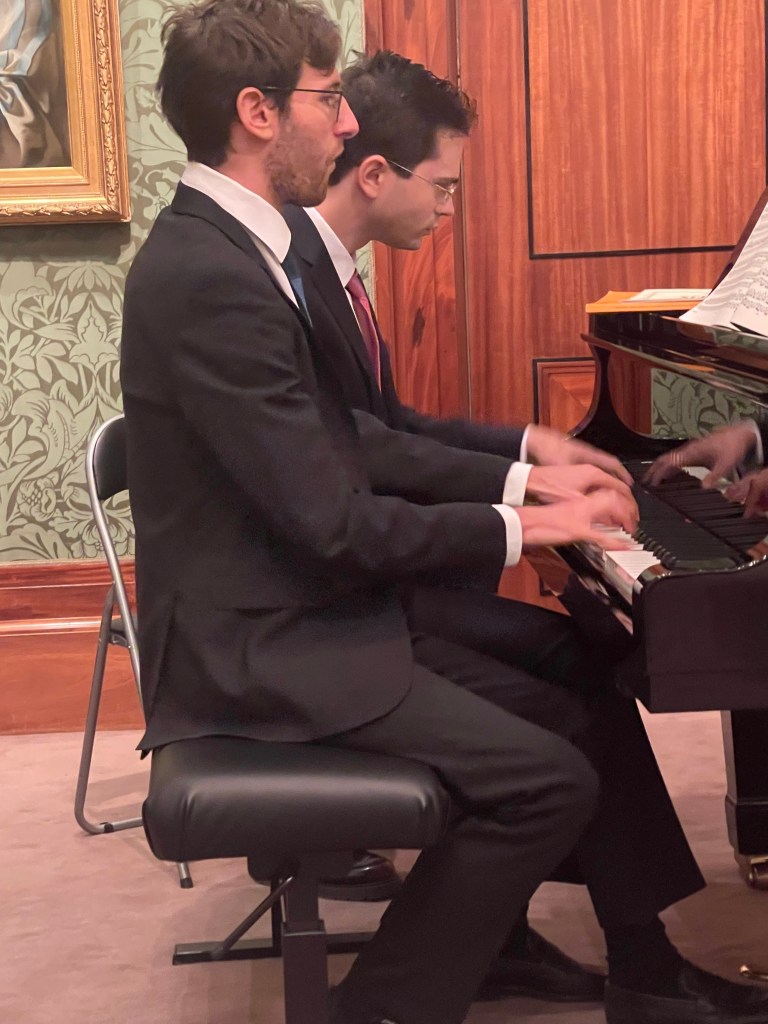
Ariel Lanyi and Mihály Berecz
The Schubert that followed was played with the same intensity and scrupulous musical integrity of these two major young artists. But playing together in the intimate relationship that four hands on one piano must inevitably be, means that there can be a freedom and flexibility and a sense of searching for colours by means of a chameleonic search for colour together and inevitably an ultra sensitive sense of balance that can only be created with years of working together as a duo.The intensity and musicianship they brought to these two works was remarkable but the etherial magic and breathtaking beauty eluded them.It was obviously their choice to interpret Schubert as Beethoven but the difference is that everything Schubert wrote was of song ,like Chopin ,whereas Beethoven was more orchestral.There were of course many beautiful things where the burning intensity of Ariel took our breath away in the Rondo as the beauty of the theme from the hands of Mihály was beautifully shaped if lacking in fluidity and colour which strangely he found in the final bars when he ventured on high with a final timeless ornament that suddenly opened the heavens.
The Fantasie had Ariel at the helm and Mihály at the steering wheel.A beautiful flowing tempo allowed this magical melody to expand and breathe as the bel canto was a glimpse of the paradise that awaited Schubert in the all too near future.The Largo was played with a rhythmic drive and dynamic seriousness that was more of Beethoven at his most imperious and this was obviously the choice of these two remarkable thinking musicians.It was played with remarkable unity and musical intent and might have been a contrast if the Scherzo could have had more elegance and charm and not been of such Beethovenian seriousness.The final fugato was a tour de force of musicianship and duo playing and here all the dynamic drive and energy were used to overwhelming effect rarely experienced in this much played work.The return of the opening was played with extraordinary sensitivity but just missed the etherial fluidity that could have been such a contrast to the final chords that were of true Beethovenian intensity.
Ariel is a remarkable artist who has been touched by the Gods as has Mihály but they are more in tune with the three B’s than the two S’s.B’s need intellectual intelligence and kapellmeister musicianship .The S’s need charm and lightness even capricious seductiveness that is not part of their genes at the moment.Schumann was played with enviable seriousness and integrity, but was the opening really ‘Lebhaft’ as it progressed ,intense and driven, missing the romantic sweep like the opening of a window to let the intoxicating air in.Instead there was indeed remarkable rhythmic drive but where playful lightness might have created more character.The second was played with beautiful long lines shaped with noble sentiments and a really exquisite featherlight ending.The third ‘Im Volkston ‘ suited these two very intense young musicians with it’s it noble opening bursting into rumbustious dance.
Sir Norman Rosenthal having celebrated his 80th last week in this gallery with music making amongst friends.He has long been an admirer and mentor of Ariel
The fourth ,that by specific request of Sir Norman Rosenthal was repeated as and encore, was beautifully shaped, elegant and flowing.The fifth ‘Lebhaft’ was played rather too seriously, very dramatic where Schumann’s flight of fancy hardly took wing.The final piece flowed beautifully and its triumphant ending brought words of praise from Sir Norman for a work that he confessed he had never heard.These two remarkable young musicians have the makings of a life long duo but it just needs time to share this voyage of discovery together .A world of wonder and ethereal beauty is there waiting for these four extraordinarily talented young hands to delve deep into the heart of the piano and find the sounds that are there for those that seek.
This is Martha Argerich and Daniel Barenboim childhood friends sharing the secrets they have learnt after a lifetime of music making Q.E.D:
Prof Matthiesen had just returned from Florence where he was generously sponsoring a concert of The Beethoven Trilogy with the prestigious Amici della Musica.
The Beethoven trilogy with Anne Queffélec who had encountered a kindred spirit at the Leeds Piano Competition many years ago ,Imogen Cooper, with whom she has formed a formidable long standing piano duet partnership. The music profession may be overcrowded but when you are talking about real dedicated interpreters they are few and far between these days.
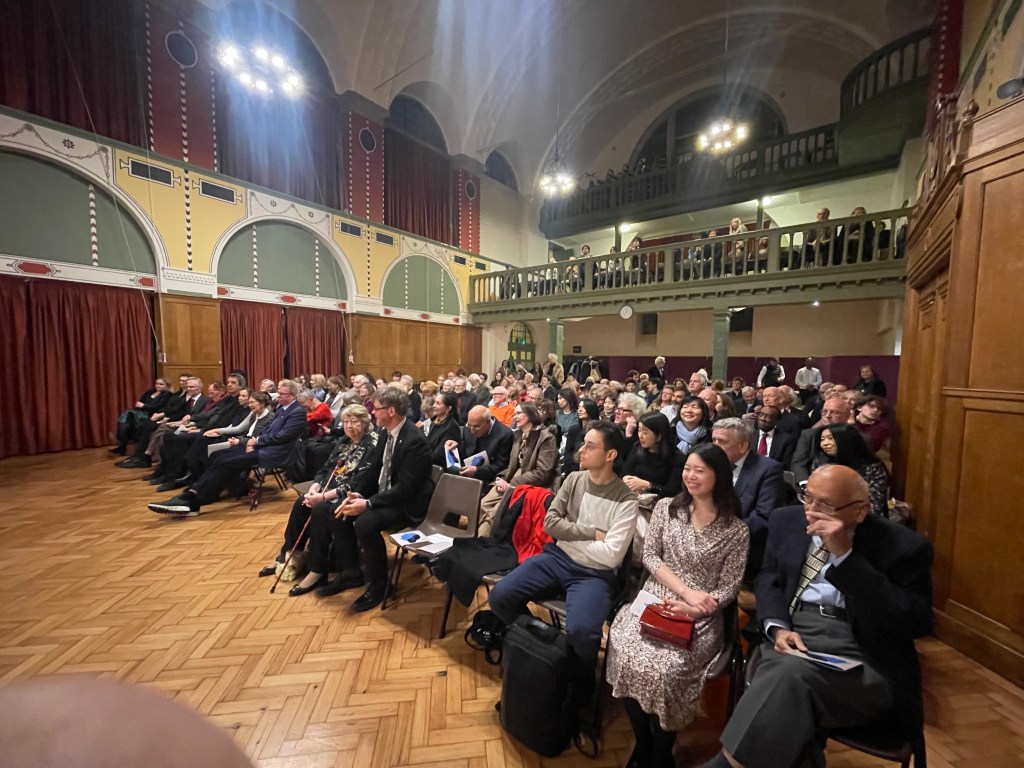
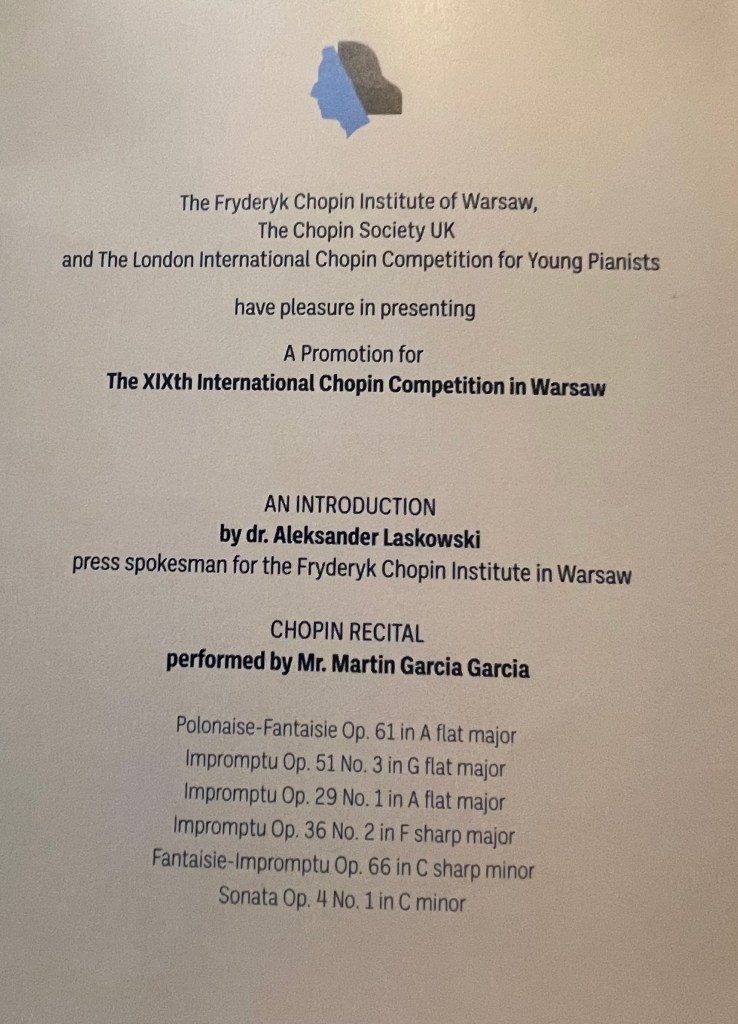
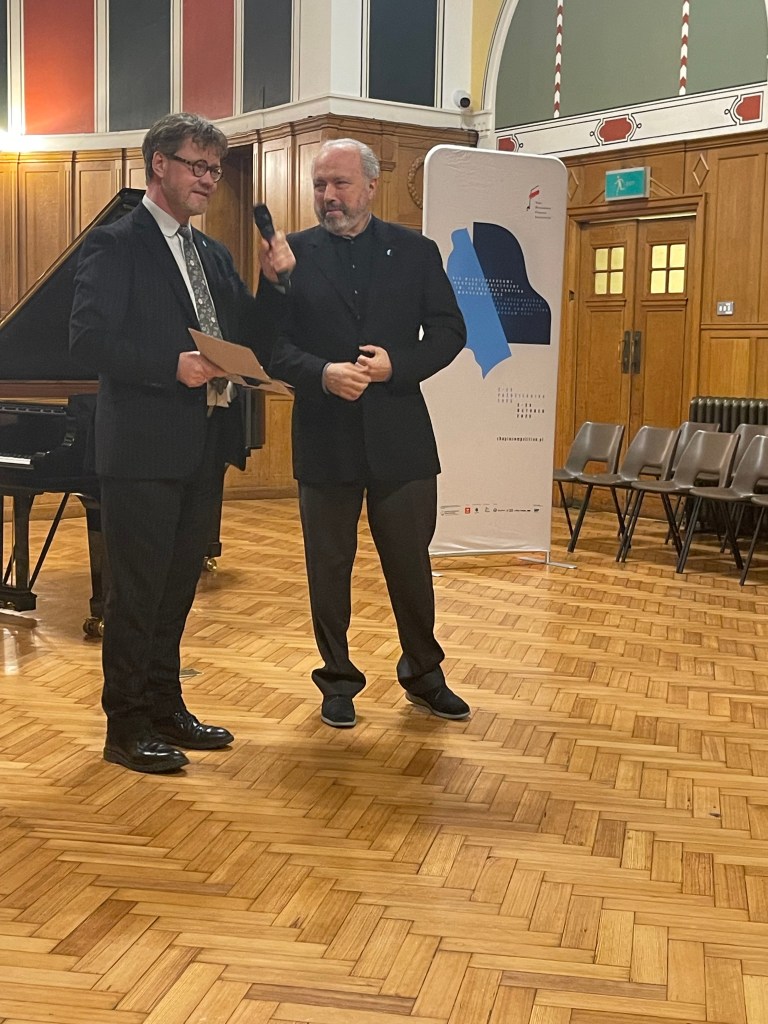
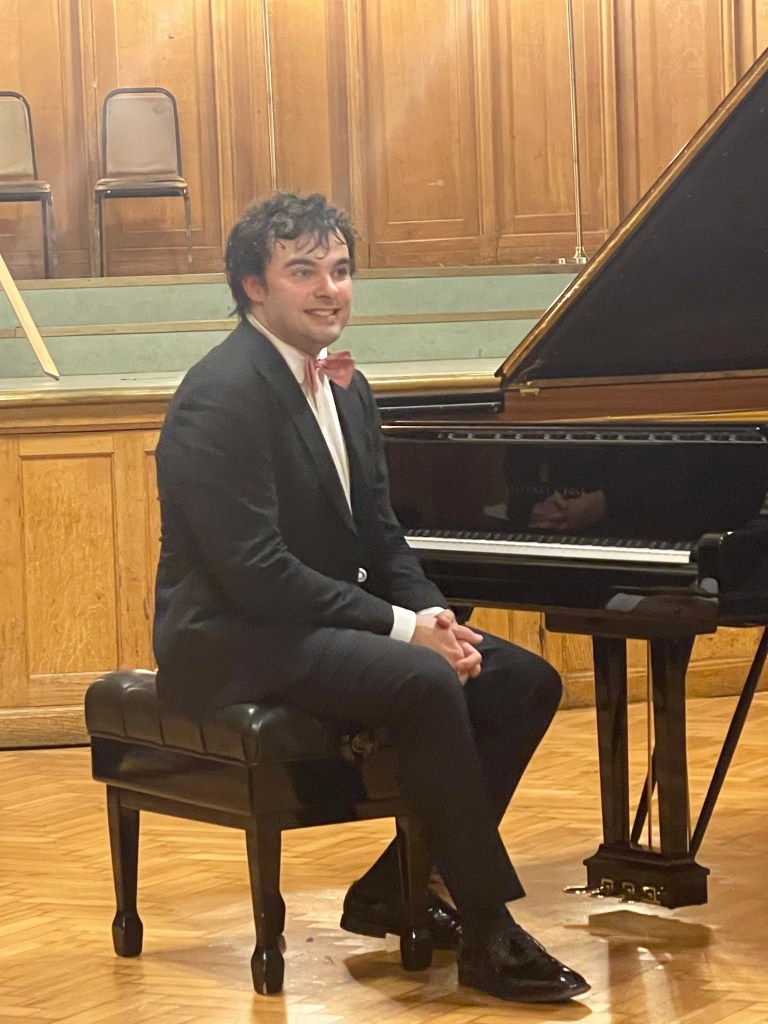
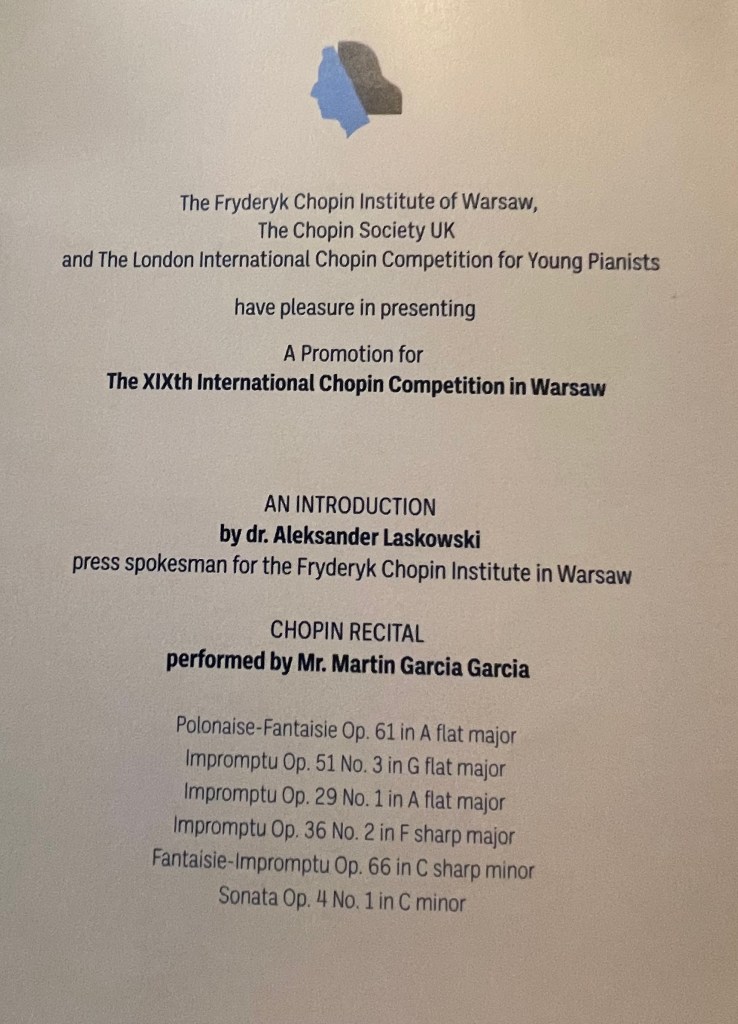
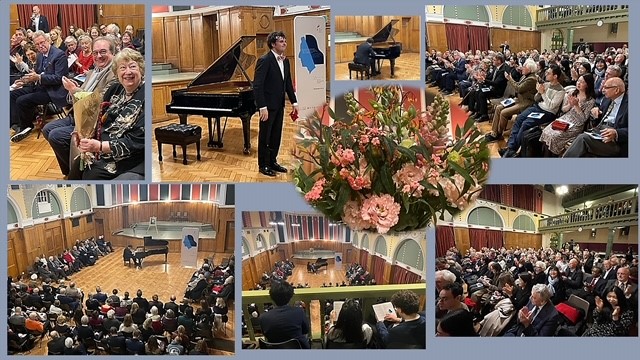
A recital by Martin Garcia Garcia , a top prize winner in the last competition in 2021 ,followed a surprise announcement of a new prize for the best performance of Chopin Ballades donated by the son of Bella Davidovich ( she had been the winner of the first competition after the war in 1949). She was 21 then and is still alive,aged 96, and living in America.
Aleksander Laskowski was proud to announce, with the son of Bella Davidovich, Dmitry Sitkovetsky this important new prize and to introduce Martin Garcia Garcia to a discerning public of critics,pianists,musicologists and lovers of Chopin .
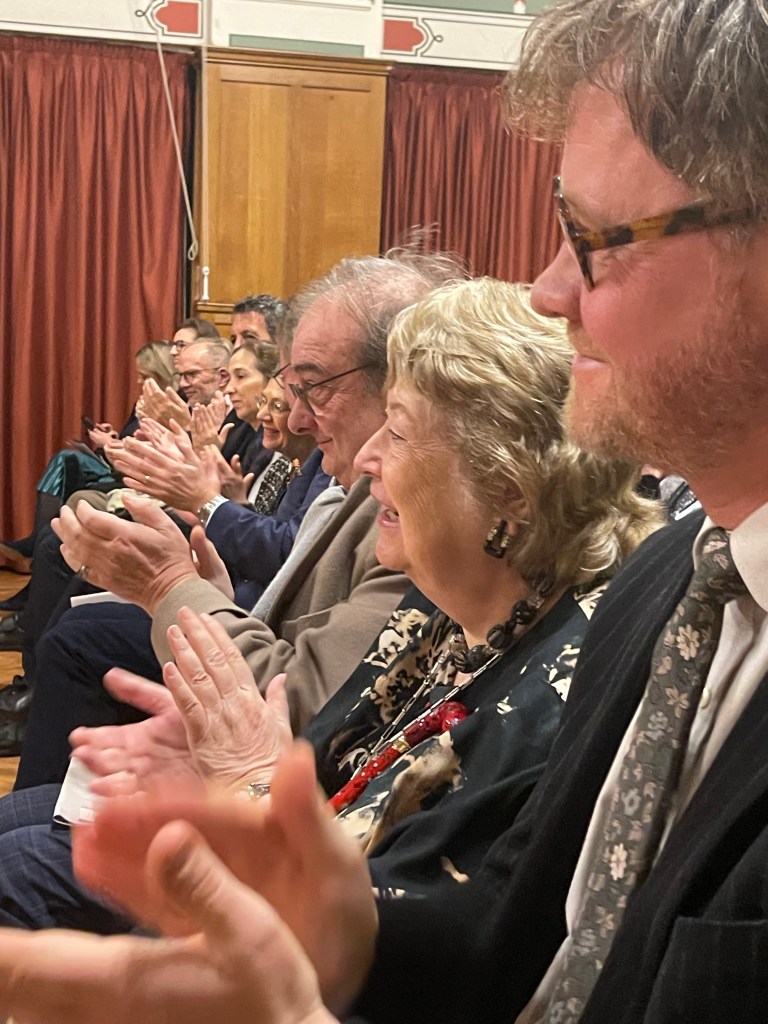
Lady Rose Cholmondely was presiding with the indomitable Gillian Margaret Newman and their many distinguished guests
A programme that included a magnificent performance of Chopin’s first sonata op 4. A work that is rarely heard as it takes a great musician to give an architectural shape to this early work full of youthful virtuosity and a tantalising jeux perlé that was to astonish and seduce the Parisian salons more used to swashbuckling virtuosity of showmanship. Here even in this early work there is the refined elegance and scintillating understatement of poetic beauty. A sense of balance that was more of bel canto than canoristic crowd pleasing. Here in this ‘Allegro maestoso’ there is a beguiling mix of virtuosity and Polish tradition. Opening with a delicate fugato that expands into a beautiful second subject ‘espressivo’ as embellishments are thrown off with glistening beauty. Much brilliance of alternating thirds ,sixths and tenths but with a refined elegance that Martin played with a natural ease as his whole body seemed involved in the sounds he was making.A fluidity and mastery that was hypnotic with the beauty that he was able to create with such simplicity.
This was music written to seduce and astonish by an eighteen year old genius ready to take the world by storm. His variations op 2 were greeted by Schumann with ‘Hats off, gentlemen, a genius’ and although this work does not have the weight or maturity of the other two sonatas Martin showed us today that it is unjustly neglected. Of course it requires a virtuoso technique and a musicianship that can see the wood from the trees and give shape and coherence to a work in progress of a composer who was looking for a form in which to express himself.The starting point is the established sonata form ( Haydn had bequeathed to his pupil Beethoven a form that was to be transformed into the miraculous outpouring of the final trilogy) and it is this form that Chopin transforms already in his teens into a work marked with his personality. A charming ‘Minuet’ where the stamp of the Mazurka is already discernible .A beautiful flowing ‘Larghetto’ where Chopin’s mastery of bel canto is already so magically expressed in pianistic terms.A ‘Presto’ Finale as long as the other three movements put together, is a ‘tour de force’ of invention and dynamic virtuosity. Martin seemed to relish the enormous amount of notes that were pouring from his fingers with such ease as he shaped them into streams of sumptuous sounds of exhilaration,excitement and beauty. An astonishing performance and a very persuasive one for a badly neglected work .We talk of finding fragments of nocturnes these days, hidden in the archives of important libraries, but here we have an extraordinary work completely overlooked by the very people who are so excited by album leaves left as gifts to the composer’s lady pupils and admirers!
Listening to Martin I am reminded of the late Nelson Freire whose natural mastery and love of music illuminated our lives for so long after the passing of Arthur Rubinstein.
The Polonaise Fantaisie opened this short recital where from the very first notes it was obvious that we were in the presence of a great artist who could play with weight and mastery bringing to life a work as if the ink were still wet on the page. A kaleidoscope of colours as the opening chords reverberated with timeless beauty expanding into a nobility of refined elegance and bitter sweet nostalgia only to disappear on ‘wings of song’. An extraordinary sense of balance of sumptuous beauty even in the most passionate of climaxes where everything in Martin’s hands sang with an evident love for the sumptuous sounds that he was creating.
The four Impromptus that followed were played with extraordinary style and beauty .The first appearing as from afar out of the last imperious chord of the Polonaise- Fantaisie. It was played with a beguiling jeux perlé that I have only every heard from Magaloff. The beautiful sostenuto played with real weight and timeless beauty as Martin shaped it with the same simplicity of the wind blowing gently in the branches (to quote Chopin). It was exhilarating,titivating and had one wondering why it is played so rarely in concerts these days. The exquisite charm and beauty of the third was quite different from the aristocratic ‘frenchness’ that was Rubinsteins’.
An unusual photo of Arthur Rubinstein on his return to his birthplace in Poland.His joie de vivre and Love of life will remain an example to us all
But it was of chiselled beauty as it wove and breathed with infinite aristocratic charm until the sumptuous tenor melodic outpouring of the ‘sostenuto’. A rubato of great artistry as its was played with freedom but also without ever breaking the long melodic lines. It was immediately followed by the ravishing tone poem of the second where the gentle flowing left hand was just the base on which a beautifully simple melodic line was woven. Delicate embellishments given all the time to breathe by Martin who made them seem so natural and of such gleaming beauty. A central march was played with imperious full sounds before the ingenious two bar modulation that takes us back to the simple beauty of the opening this time accompanied by flowing lines first in the left hand and then magically in the right.From here notes were just thrown off with such ease as streams of golden sounds illuminated the melodic line. Finishing these four Impromptus with a breathtaking performance of the Fantaisie -Impromptu, leaning over to take the opening C sharp with his right hand with such knowing authority as waves of notes filled this beautiful piano with sumptuous sounds of passion and scintillating excitement.The beautiful central Largo we were to hear again later in the encore by Mompou where it is quoted, but here it was played with simple refined beauty of sumptuous richness.
An encore of Schumann’s portrait of Chopin from Carnaval was followed by one of Mompou’s Chopin variations n.10 ,the one based on the Fantaisie -Impromptu.
photo courtesy of the Chopin Society UK
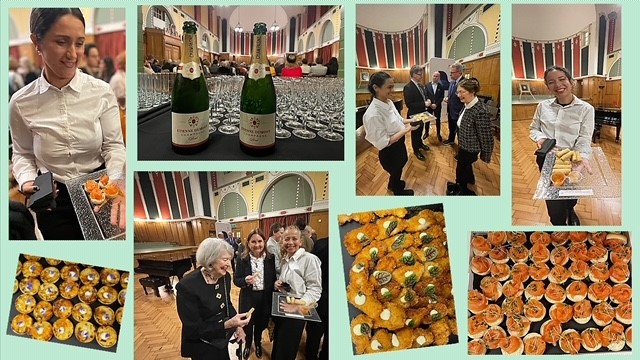
An eclectic choice to close a masterly recital before the champagne so generously flowed with canapés that were obviously inspired by the exquisite playing that we had been treated to by the Chopin Institute in Warsaw .
The distinguished pianist Martino Tirimo who had played with his Rosamunde Trio at the Chopin Society last week.With Yisha Xue
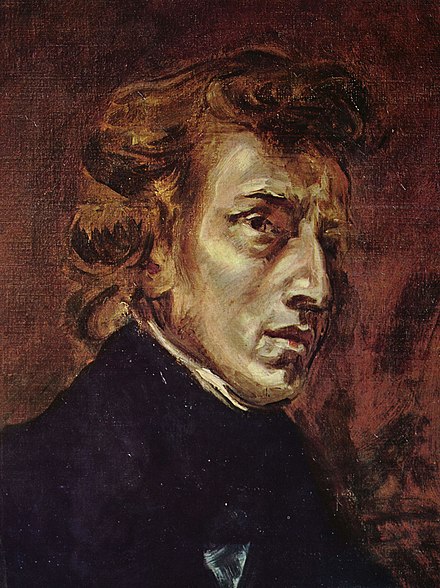
photo courtesy of the Chopin Society UK Chopin in 1838 part of a joint portrait with Georges Sand by Delacroix
Fryderyk Chopin Źelazowa Wola 1st March 1810 Paris 17th October 1849
The Sonata No. 1 in C minor, Op. 4 was written in 1828 (probably begun around July). It was written during Chopin’s time as a student with Józef Elsner, to whom the sonata is dedicated. Despite having a low opus number, the sonata was not published until 1851 by Tobias Haslinger in Vienna, two years after Chopin’s death. The sonata has four movements. Allegro Maestoso (C minor): The first movement is in sonata form. Only in the aspect of key relations does this movement break from tradition – the second group of themes is based in C minor as much as is the first, so that the dramatic contrast is lost.
Menuetto (E flat ): This is the only minuet that Chopin is known to have written. The central Trio is in E flat minor.
Larghetto ( A flat): in five/four time , which is very unusual for pieces of that era. The third beat of each five-beat bar carries a secondary accent, which is marked explicitly in certain bars. In other places, it can be inferred, and in still other places Chopin seems to defy this convention and not expect this.
Finale: Presto (C minor): A virtuosic finale in C minor and sonata-rondo form. The most difficult and most effective movement of the sonata, it, among the finales of Chopin’s piano sonatas, takes the longest to perform.
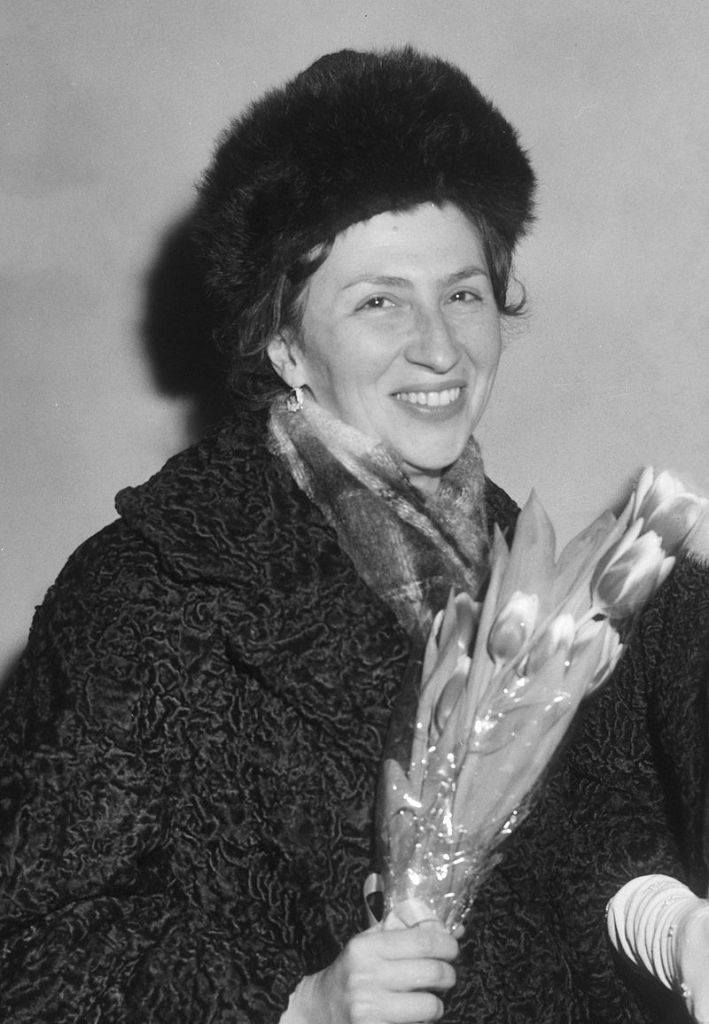
Bella Davidovich
Bella Davidovich was born in Baku, Azerbaijan in 1928, into a Jewish family of musicians and began studying piano when she was six. Three years later, she was the soloist for a performance of Beethoven’s Piano Concerto n. In 1939, she moved to Moscow to continue her musical education. At the age of 18 she entered the Moscow Conservatory where she studied with Kostantin Igumnov and Yakov Flier. In 1949, she shared the first prize with Halina Czerny-Stefańska at the IV International Chopin Competition . This launched her on a career in the Soviet Union and Eastern Europe, in which she appeared with every major Russian conductor and performed as a soloist with the Leningrad Philharmonic Orchestra for 28 consecutive seasons. She also taught at the Moscow Conservatory for sixteen years, and taught at the Juilliard School. She was married to violinist Julian Sitkovetsky. Their son, Dmitry, is a violinist and conductor.
In 1978 she emigrated to the United States, where she became a naturalised citizen . She has taught at the Juilliard School since 1982. With the spirit of perestroika, she became the first Soviet émigré musician to receive an official invitation from the Soviet agency Goskoncert to perform in her native country. She played concertos, a recital with her son Dmitry Sitkovetsky playing the violin, and chamber music with the Borodin String Quartet to sold-out halls.
Martin Garcia Garcia with friends and admirers at the after concert reception
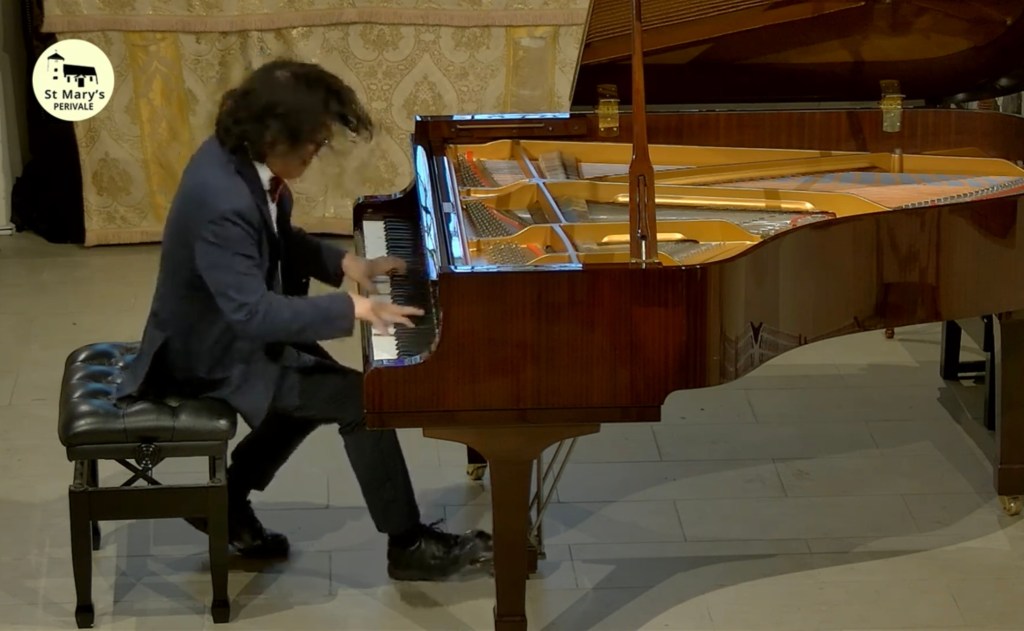
Some remarkable playing from this nineteen year old pianist winner of this years’ Hastings International Piano Competition.Playing of Serkin intensity with impeccable musicianship and technical mastery. Fingers like limpets that were drawn into the keys allied to an intellect and passion that could delve deep into the scores and not only show the architectural shape but also the jewels that are hidden within
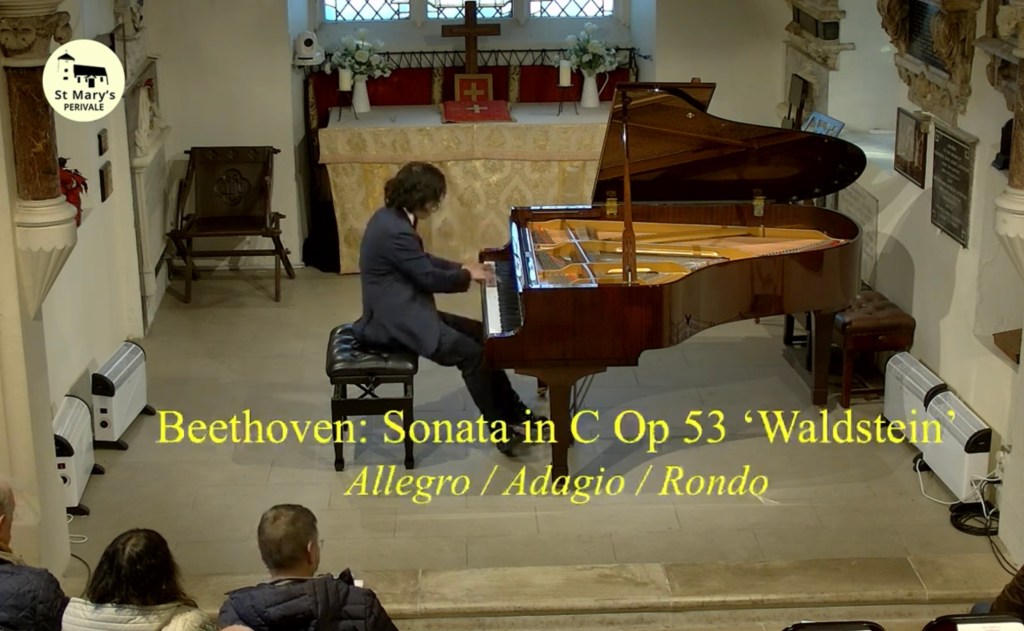
A Waldstein Sonata that was played with a driving rhythmic urgency but that could melt so easily into a mellifluous second subject where beauty and strength were combined.The introduction to the rondo was played with an intensity where every note had a poignant meaning .A simplicity where even the final top G suddenly was reborn as the undulating accompaniment of the rondo appeared as if from afar.The three contrasting episodes ever more explosive and technically challenging were played with remarkable mastery.But it was the poetic beauty of the Rondo that made the most effect as suddenly a gun shot of a luminous C signalled the opening of a music box.’Prestissimo’ as the pace quickened, which Curtis maintained until the end with the famous glissandi played with one and two hands never allowing this energetic force to diminish in any way.
Delius dismissed Beethoven as being all scales and arpeggios and in a way he is right nowhere more than here or in the Emperor Concerto,both written in the same period . But scales and arpeggios at the service of the genius of Beethoven when played with the mastery we heard today is breathtaking and exhilarating.
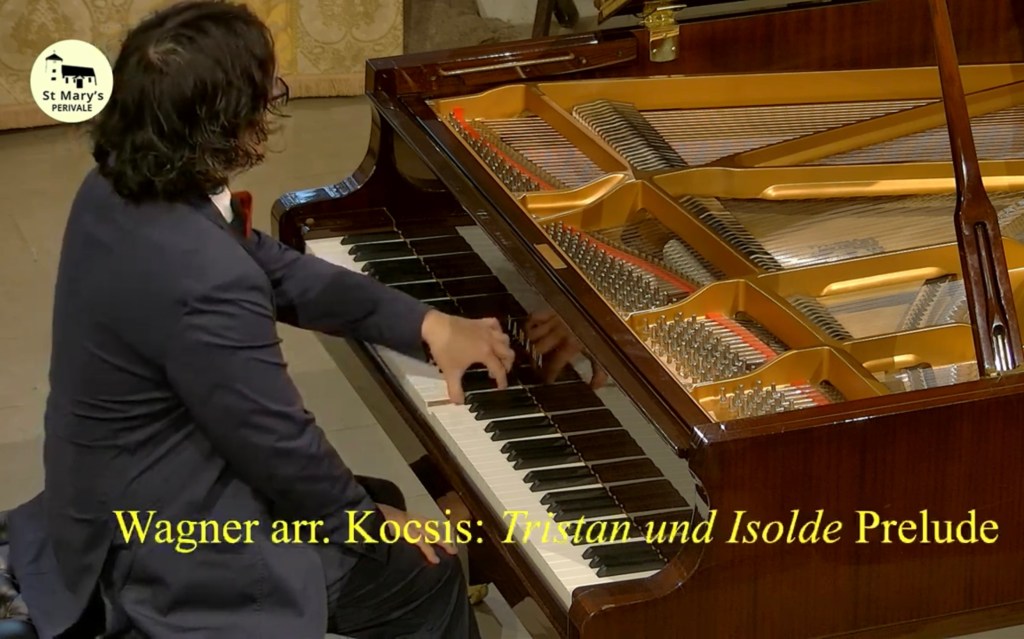
We are so used to listening to Liszt’s transcription of Wagner’s Liebestod that this transcription by Zoltan Kocis of the Prelude took me by surprise. As Hugh Mather said there is five hours of music that separates them and it was the tranquil beauty of these intense counterpoints that lead so beautifully into the Liszt Sonata in B minor.
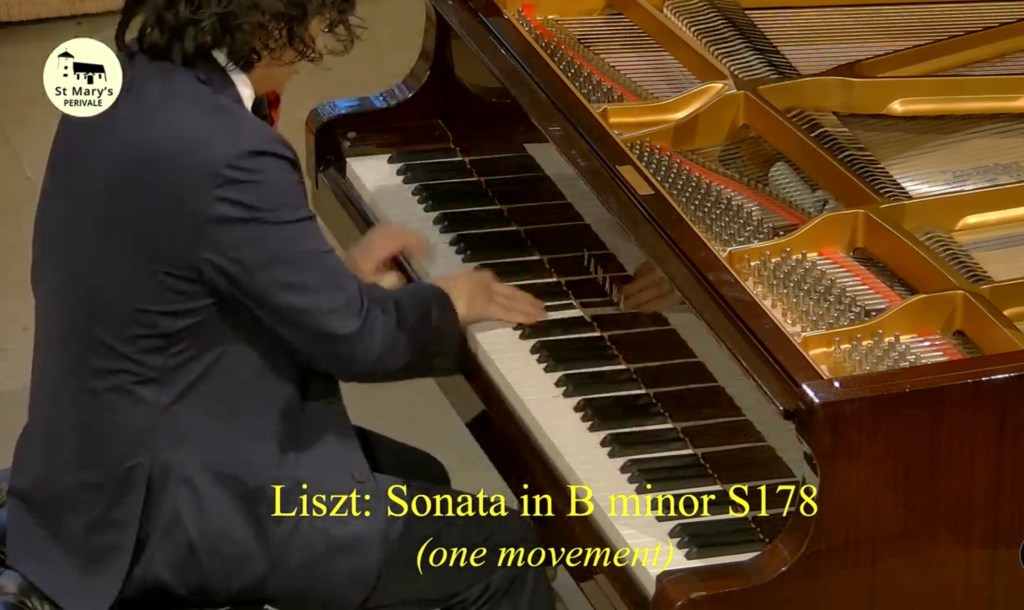
This was truly a masterly performance the like of which I have only ever heard from Gilels. Not only was it played with passion and ravishing beauty but the intensity and overall architectural shape was maintained from the first to the last note.I have never heard the last three chords played with such luminosity and delicacy each one with it’s own voice.The final B played by the left hand but with the right hand and the whole of Curtis’s body as bystanders.This was a young man who had seen this entire monumental work as a great story that was unfolding.The clarity and precision he brought to the most transcendentally challenging passages was mirrored by the beauty and simplicity that he brought to the many lyrical passages. I had heard Curtis play the ‘Hammerklavier’ just a few months ago with the same intelligence and mastery with which he played the Liszt Sonata today.A musician who questions and ponders the scores before devouring them whole at any age would be a considerable achievement but at 19 one is left without words except perhaps one :Genius!
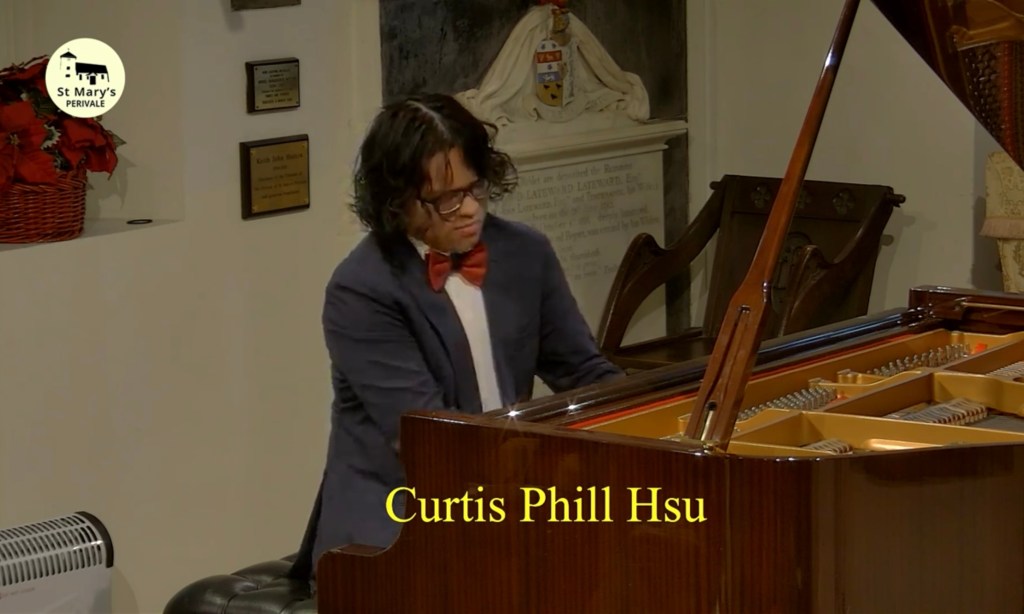
Born in Alabama, USA, in 2004, Curtis Phill Hsu took up the piano at the age of four. Following his initial participation in the 2014 International Summer Academy, he became fascinated with the city and the Mozarteum University Salzburg. Soon after, he was admitted into the Mozarteum Pre-College in 2016 and has been studying with Prof. Andreas Weber ever since. Within the first semester, Curtis was already nominated for the Leopold Mozart Institute’s High Talent Program (Hochbegabungsförderung). After completing his Bachelor’s degree at the Mozarteum University Salzburg in 2023, Curtis is continuing his Master’s studies at the Hanover University of Music, Drama and Media under Prof. Arie Vardi. In 2024, Curtis won the coveted Sophia Guo First Prize with a performance of Tchaikovsky Piano Concerto No. 1 with the Royal Philharmonic Orchestra under Rory Macdonald at the 17th Hastings International Piano Concerto Competition, including the Sussex Prize, awarded for the best performance in the semi-finals, and the Festival d’Auvers-sur-Oise Prize, offered by Juror Pascal Escande. In addition, Curtis was honoured with The Hastings Fellowship supported by Arts Council England, an artist development and professional coaching package that helps young artists develop and sustain professional careers.
Ian Brignall of Hastings International presenting their Gold Medal Winner 2024
Yisha Xue hosting Curtis in her home on his special trip to mLondon from Hannover where he is studying with Arie Vardi with Dr Mather,Curtis and Ian Brignall,general manager of Hastings International





































 ChristopherAxworthy-MusicCommentary