YUANFAN YANG IN ITALY Part 1 Vicenza and Rai Radio 3

YUANFAN YANG IN ITALY Part 1
Yuanfan Yang at the Teatro Comunale in Vicenza.
Amazing performance for ‘Incontro sulla Tastiera’ that for 45 years the indefatigable MariaAntonietta Squeglia has been organising in the beautiful city of Palladio.
But today there was something special in the air and a party atmosphere ignited by a young UK born chinese pianist whose improvisations and incredibly natural musicianship were being likened by an enthusiastic public to the prodigy Mozart!
At the end of the concert Yuanfan announced that he wanted to give  the audience the chance to take part too.
Can anyone offer a few notes on which he would create a piece,their piece,in this very moment?

Discussing the encore improvisation of three voices in jazz style
The public were a bit wary of this novelty and no one wanted to be embaressed.
So Yuanfan turned his back on the keyboard and played five or six random notes and then created a piece in the style of Beethoven.
The President of ‘Incontro’ was heard complaining that Beethoven had been missing from the programme!
And what a beautiful piece it was!
Better than Beethoven?!

Review of the concert in Vicenza by Eva Purelli
Now of course the cat was out of the bag and three people wanted to offer notes for a second encore from a now very insistant public.
No problem for our young musician touched by genius.
He improvised in jazz style using all three themes.
It brought the house down and poor Maria Antonietta and the sponsor Ermanno Detto have been bombarded by enthusiastic messages of disbelief and astonishment from their public.

Maria Antonietta Squeglia and Mrs Jieling Yu Yang in the Teatro Comunale of Vicenza
But it was the story that his mother had to tell over breakfast today that revealed the true amazing facts about a young boy who out of the blue was discovered at a birthday party to be able to play the piano!
He was 5.
At the age of 6 the BBC made a programme about him and his amazing musical genius.
Yuanfans parents from Beijing were at Edinburgh University where he was born.With first class degrees from Bejing University they were invited on the Thatcher UK/China exchange to complete their Master degrees at Edinburgh University.
His mother obtained a master in Telecomunications and his father in East European Studies.
His father is a professor now at Leeds University and for many years his mother taught at Leeds High School.

Yuanfan with Busoni Winner 2017 Ivan Krpan after Ivan’s performance of Liszt 1 at the Sala S.Cecilia in Rome with the Zagreb Philharmonic in celebration of the Presidency of Croazia to the European Union.Yuanfan made a 7 hour trip from Vicenza to salute his colleague and fellow KCT artist….a true family indeed.
They brought the five year old Yuanfan a piano as soon as they realised that he was born with this talent.
The mother of one of his friends had asked who his teacher was,as he had played so beautifully.
But he does not play the piano,she exclaimed, we do not even have one at home!
Well all that changed overnight and Yuanfan was taken to study at Chethams in Manchester with that magnificent trainer of so many amazing talented children,Murray McLachlan.
The family have altered their own lifestyle to give him all the opportunities that his talent demands.
Winning many International competitions and even the BBC composing competition and top prize in China for his First Piano Concerto that as winner toured eight major.cities in China!
It was,infact,his own piece :’The Haunted Well’ ,the prize winning piece of the BBC competition, played immediately after the interval that ignited the enthusiasm of a usually rather retiscent audience.
It was this four minute piece that the audience looked at with suspicion in a programme that included Schumann Carnaval,Chopin B flat minor sonata and Bach C minor toccata.
They soon realised that they need not have worried about this so called ‘contemporary ‘ piece.
They had obviously had some nasty experiences in the past.
But here was a piece full of magical sounds.
Of a fantasy of colours and subtle shading of the clock that stikes 13 at midnight (so clearly introduced by Yuanfan in a charmingly simple way….apologising for not being able to talk in Italian)’
It was all so clear as these’pictures’painted in sound filled the air with such sumptuous sounds.
Transcendental technical feats alla Messian were eagerly accepted by an audience immediately so involved in the story ..just like the Papillons  of Schumann….that he had to tell.
The Chopin B flat minor sonata ( his performance is new to me) was a revelation of clarity allied to a beauty and rigour that I have only experienced from the hands of Rubinstein.
If only we could have started the concert over again we would have realised what a superb performance he gave of Schumann ‘s Carnaval.
Full of subtle poetry and colour but with an aristocratic sense of rubato and flow that is of the chosen few.

Raffaella Squeglia presenting the concert
Technical considerations never entered into the discussion such was his total mastery.
But his incredible technical mastery was also there to be admired by colleagues who have struggled for hours to master ‘Paganini’ or the ‘March of Davidsbundler!’

Sponsor Ermanno Detto with Maria Antonietta Squeglia and enthusiastic friends.
His Bach Toccata now is like a rock.But a multicoured rock that never wavers but is full of subtle colours and discreet ornamentation …..much more to follow….but would recommend wherever you are in the world to tune in on Friday 24th Jan at 11 pm Italian time to his live broadcast on RAI Radio 3.
Rai Radio 3 ‘La Stanza della Musica’
Yuanfan Yang last nights broadcast available on their wesite Rai radio 3 ‘La stanza della musica.’
It created quite a stir.
Due to the overunning of Tristan with the live transmission from the opening of the season in Bologna there was barely 30 minutes left to midnight.
Like Cinderella the midnight hour decides our fate!
There was a quick rethining for the programme and as in all true theatre and live performances there was magic in the air.
After one of the most beautiful Chopin Barcarolle`s that I can remember and opening with his own piece which starts on the same E flat with which the live relay of Tristan finishes.
He was invited by a phone in audience to improvise on The Godfather Theme of Nino Rota.
As requested ,first in jazz mode and then in vulcanic mode.
A sensational way to finish the day for Stefano Roffi and all his team applauding and cheering him from behind the glass that separates the studio from the control room.
Radio switchboard almost erupted too with enthusiastic calls…….and it was almost midnight as Yuanfans prize winning piece The Haunted Bell struck its midnight E flat 13 times!
Stefano tells me it is available forever on their web site.
From ” Here to Eternity” one might well say!

Yuanfan Yang in concert

Minkyu Kim at St Mary’s Viva Franz Liszt – the poet of the piano!

Minkyu Kim was born in South Korea in 1995. He studied piano with Soojeong Jeong at Goyang High School of Arts and with Hyung-Joon Chang and Sehee Kim at Seoul National University. He won many prizes including second prize in the Korean Liszt Competition, first prize in the Jock Holden Memorial Mozart Piano Prize at RCS and first prize in the BPSE Senior Intercollegiate Piano Competition. In addition to performing the entire Transcendental Etudes by Liszt, Minkyu has performed piano concertos with the Scottish Ensemble and Royal Scottish National Orchestra.
After graduating with honours from the university in 2017, he is now attending Royal Conservatoire of Scotland with a full scholarship from ABRSM, studying with Aaron Shorr and Sinae Lee.
It was Dr Hugh Mather who recommended me not to miss this concert and  to listen to this “staggering recital by a master pianist”.
And so it was that I listened in Rome on the excellent streaming from Perivale thousands of miles away.Little could Minkyu have imagined that I was listening in the company of:

Vlado Perlemuter and Alicia De Larrocha
Vlado Perlemuter,Alicia De Larrocha,Rosalyn Tureck  and others who adorn the walls of the Ghione theatre just a stone`s throw from St Peters Square.
Minkyu Kim is one of 14 pianist selected to compete in the Utrecht Liszt Competition next March.
A competition that has seen the launching of artists such as Vitaly Pisarenko, Alexander Ullman and Mariam Batsashvili.

Rosalyn Tureck,Stockhausen, Berio,Fausto Zadra and Ileana Ghione
And of course how could Dr Hugh Mather be mistaken as he listens regularly to the finest young pianists in his series dedicated to helping hundreds of young musicians.Offering professional engagements to these young musicians for the loyal very discerning public in his hallowed haven of St Mary`s?
We are used to barnstorming Liszt performances of his early works or rather tepid intellectual experiences with the later obscure works that look very much towards the future.
But today we were treated to both early and late Liszt together with the transcription of 6 of Chopin`s Polish songs
It was of a sublime beauty where every note was caressed with such love and care.Yes caressed for such were the beautiful movements of his hands on the keyboard just as Giulini`s conducting movements were like watching a Michelangelo afresco.
It was the beauty of sound and the subtlety of phrasing that held a rather depleted but courageous audience spellbound from the first to the last note of this all Liszt recital.
Between 1847 and 1860, Chopin’s friend Franz Liszt arranged six of the Op. 74 songs as piano transcriptions under the title Six Chants polonais, S.480, a set which has long been a concert and recording favourite. The six are:
  • 1. Mädchens Wunsch (No. 1: Życzenie – The Wish) Played with great delicacy combined with an extraordinary flexibility and at times passionale musicality
  • 2. Frühling (No. 2: Wiosna – Spring)Such beautiful simple lyricism with some wonderful colouring and very subtle phrasing.
  • 3. Das Ringlein (No. 14: Pierścień – The Ring), which leads without a break into …
  • 4. Bacchanal (No. 4: Hulanka – Merrymaking)A real understanding of rubato brought the Mazurka to life with lyricism and rhythmic energy.A moment of absolute magic before the glissandi that gradually grew in energy until the final double handed flourish.But even here Liszt was careful to fully recognise the subtle artistocratic style of Chopin rather than the demonstrative glissandi of his own Hungarian Rhapsodies.
  • 5. Meine Freuden (No. 12: Moja pieszczotka – My Darling)Played with such a delicate melodic line a meltingly beautiful ending of pure magic
  • 6. Heimkehr (No. 15: Narzeczony – The Bridegroom).The stormy sounds shaped so beautifully by Minkyu where we could almost picture the tempestuous rowdiness of the Bridegroom!
In this arrangement, Das Ringlein leads without a break into Bacchanal, and towards the end of the latter song, immediately before the coda, Liszt includes a short 6-bar reprise of the earlier song.
These were followed by four late works written in 1880 just six years before Liszt’s death at the age of 75.The beautiful En Reve that my teacher Gordon Green(a disciple of Egon Petri) encouraged his students to learn  together with the Bagatelle sans tonalité long before they had been accepted as part of the repertoire.
En Reve is so beautiful – very short as are all these later pieces- finishing as it disappears into oblivion.The Bagatelle too almost like one of the Valse Oubliée fifty years on when the genius of Liszt was reaching far into the distance foreseeing the direction that music was to take.All beautifully and convincingly played by someone who was totally
dedicated to transmitting his love of this music to a public that were following every note of his quite ravishing playing.
The final work was the Grosse Konzertsolo S 176 which was written a few years before the great B Minor Sonata.
As Leslie Howard said in his introduction in this very hall a few months ago this almost unknown or at least rarely played piece would be the ideal preparation for those wishing to approach the B minor Sonata which is one of the pinacles of the Romantic repertoire.
A superb performance that showed not only his ultra sensitivity but also his aristocratic sense of grandeur and superb sense of line.A wonderful sense of balance that allowed the melodic line to sing so mellifluously but allied to an enormous command of the keyboard that could unleash all the extraordinary technical demands that Liszt himself commanded before his astonished and doting public.
A very interesting encore was of the early version of Chasse Neige the last of Liszt’s 12 Transcendental studies .It was fascinating to hear this early version of a much loved piece .
An extraordinary recital of rarely heard music in the hands of a true poet of the piano.All best wishes to him in Utrecht in March. Viva Franz Liszt!

A Chain of Magnificence in Villa Torlonia – Costantino Catena plays Wolf-Ferrari

A CHAIN OF MAGNIFICENCE IN VILLA TORLONIA
A superb display of musicianship and virtuosity in the true magnificence of Teatro Torlonia in Rome.

Arricia –  Costantino Catena in front of ‘Saint’Agostino e il Bambino’ by Alessandro Mattia
A continuous ‘chain’ of notes of sumptuous beauty in the extraordinary hands of Costantino ‘Catena’ .
From the opening Schumannesque Bagatelles of Wolf-Ferrari to the truly transcendental display of the Liszt Norma fantasy.
Taking in the rarely heard Gesange der Fruhe one of the last works of Schumann.
It is a work that Guido Agosti often had on his music stand and that he loved to play so much.
The Carnaval Jest of Vienna completed a fascinating programme from a master pianist.
The concert was presented by Giovanna Manci Accademia Sfaccendati a friend and colleague of long standing.
We gave many lieder/song recitals together and even recorded the music for ‘Cosi e se vi pare’ by Pirandello, the last work directed by the legendary Orazio Costa Giovangili.
It toured the world for many years with my wife Ileana Ghione whose birthday it would have been today 15th January.

The last public performance of the musicologist Michael Aspinall who wrote the cadenzas for Caballe and Sutherland .They even came to applaud him in Rome .Now dedicated to teaching some of the finest young singers in career
Our bank manager had told us that his daughter had a nice voice and could she audition for us.
Her voice was of a ravishing beauty in the words of Michael Aspinall,with whom we recommended she studied immediately after we too had been seduced by the agility and beauty of her voice.

Costantino Catena with Giovanna Manci
A great singing career eluded her as she and her husband Giacomo Fasolo dedicated themselves to promoting young musicians via their Coop Art based in the magnificent Palazzo Chigi in Arricia in the hills above Rome.
It was just this organisation now in its 40th year that had collaborated with the ever attentive Valerio Vicari of Roma 3 University in presenting their discovery of Wolf-Ferrari.
It had brought them to Teatro Torlonia,one of the principal homes of Roma 3,which also includes Teatro Palladium and their own Aula Magna.
Promoting the almost unknown chamber works of Ermanno Wolf -Ferrari with the remarkable Neapolitan pianist Costantino Catena.
His first recording in this series was recorded at Palazzo Chigi in Ariccia.
To follow are CDs of the works for violin and piano and Quintets in a series that aims at a revalutation of this much neglected composer.
Villa Torlonia,the residence of Mussolini had also been neglected for obvious reasons.
Wolf -Ferrari ,being the son of the German painter August Wolf and Venetian mother Emilia Ferrari had found himself in the same conflict as Furtwangler and many others for working under the Nazi regime.
However in recent times Villa Torlonia has been restored to its magnificence and given to the Italian people for cultural events.
It is time now to revalue the chamber works of Wolf-Ferrari .His operas have long been accepted and performed in the greatest opera houses.
It has taken Costantino’s searching mind and curiosity to bring his many neglected works to our attention now.

Costantino Catena-“Catena jumps through all the circus hurdles with grace and fluidity in the ‘Tarantella di Bravura sulla Muette’ di Portici by Liszt and shows extreme sensibility in ‘RW- Venezia’ capturing all the desolation of Liszt at Wagner’s funeral” Bryce Morrison Gramophone
Costantino Catena’s early training was from the School of Luigi D’Ascoli in Salerno.He was much influenced and helped by Aldo Ciccolini,Joaquin Achucarro and Michele Campanella but also obtained degrees in Philosophy and Psychology from Naples University!
His inquisitive mind and quite extraordinary musicianship is allied to a transcendental technique that seems to have no limits.
It also allowed him to unearth the manuscript in the Staatsbibliothek in Munich of the Bagatelle that opened todays recital and is the first work on his new CD.

The first in a series of CD’s dedicated to the chamber works of Wolf-Ferrari and produced in Ariccia.The cover is a painting of brother Teodoro Wolf – Ferrari(1876-1945)
https://www.facebook.com/notes/christopher-axworthy/the-hills-of-rome-are-ringing-with-the-sound-of-music-donchev-in-velletri-and-ta/10156952461477309/
As Luca Ciammarughi (another remarkable artist from the Ariccia stable) states in the programme notes of the CD “we are closer to the world of Brahm’s Klavierstucke than that of Beethoven.There is also a certain theatricality in Wolf-Ferrari’s piano pieces,not only in their life like humour-but in their writing which is characterised by continuous contrasts in which the pauses and the interruptions purposely disturb the serene flow of line”

The concert programme at Teatro Torlonia
I would go even further and say they are more similar to the sound world of Schumann with his Floristan and Eusebius contrasts that characterise the inner conflict and anguish than affected them both.
Amazingly Costantino had also re -constructed the first of the Bagatelles that was based on the unfinished sketch left by the composer.
This first of the 6 Bagatelles was very imposing indeed immediately dissoving into a delicate cantabile.Even the rhythmic scherzo type bagatelle had something of the sound world of Schumann as certainly also the sumptuous delicacy reminded one of Kreisleriana.
The last Bagatelle was of a grandeur that might be almost Rachmaninov with its great horn like melody and bells ringing.
There was a very impressive pianissimo ending too that showed off the enormous range that this remarkable pianist could find on a quite modest Yamaha B piano.
It may not have been just a coincidence that the recital continued with two important works of Schumann from both his early and late periods.

The beautiful Teatro Torlonia
The Faschingsshwank aus Wien op 26 (Carnaval Jest of Vienna ) was given a very musicianly reading with a great sense of architectural line.There was a sumptuous full sound (hard to believe it was a Yamaha) and a foreward movement that was quite exhilarating.The melody was played with a delicate passion ,the swirling accompaniment never overpowering the flow of Schumann’s melodic invention.The syncopated chords were played with a delicacy without a trace of sentimentality.
I am not sure I would have slowed the march section down to accomodate the Marseillaise.Schumann certainly does not ask for it but then Costantino is a great artist and if that is his decision there must be a reason and it was very impressive!
There was beauty and delicacy to the sound in the Romanze played with a simplicity and real sense of line.The Scherzino was rather on the light side with some rather clipped phrasing that was not so convincing and not asked for by Schumann.The Intermezzo was passionately played with great sonority dissapearing to a magical whisper as it heralded the Finale.There were some strange fluctuations in tempo and again clipped ending to phrases instead of just shaping but there was great forward movement and the presto coda brought the piece to an impressive ending.

The camera cannot quite keep up with Maestro Catena in certain parts
The Gesange de Fruhe op 133 (Songs of Dawn) were beautifully played and showed even more the influence that Schumann had obviously had on Wolf-Ferrari.
It is a comlex work and I fear the audience got lost by the end!
There was a beautiful musicianly sense of line and architectural shape and a relentless rhythmic impetus to the Lebhaft.
The most beautiful of these strange late pieces is the fourth and it is the one that both Agosti and Fou Ts’ong would play over and over again.It is very similar to the last of Brahms Ballades op 10 and here it was beautifully shaped with the accompanying figurations quite magically following Schumann’s beautiful melodic line.
There was no applause as the audience had obviously got lost!

The public staircase to the Theatre
No matter because the opening fanfare of the Norma fantasy kept everyone on their toes as we were treated to the most transcendental display of piano playing that I have witnessed since Mark Viner played it for us in London.
They were even more impressive that Hamelin because both Costantino and Mark had a fearless sense of grandeur and a real sense of theatre.
Of the curtain opening and something magical about to happen.
It certainly was an extraordinary performance even the more so for the sonorities that he managed to obtain from this rather modest piano.
His great sense of balance and ear for sumptuous sound allied to a technical fearlessness, even in the most impossibly difficult alternating hands, really held us spell bound.
The combination of the two melodies together at the end were played in an almost hushed cantabile that was nothing short or a revelation.
As Schumann would have said “Hats off Gentlmen.A genius!”.

Teatro Torlonia
In reply to the ovation he received from a large enthusiastic audience he played just one more piece by Wolf-Ferrari .
Beautiful it was indeed and he tells me it is on his CD.
But I was quite satisfied to close the curtain after Norma as in the  greatest of Opera Houses.

“Puttin’ on the Ritz” Chines Shines in Padua for the Keyboard Trust

Alberto Chines at the Ritz
It was nice to hear Alberto Chines at last playing in the North Italian Tour for the Keyboard Charitable Trust.
He had played some time ago at Steinway Hall in London and Elena Vorotko-Bridges,co artistic director and responsable in particular for the Historic Instrument programme of the Keyboard Trust had been enthusiastic about his scholarly but artistic approach to the baroque repertoire.
Infact the original programme for this tour had been modified as the organisers who know their public had thought it might be too eclectic for their numerous faithful public of over 20 years standing.
Talking to Alberto one is immediately aware of his intelligent and informed musicianship.
His awareness, as he himself says, that an artist is known by the programmes he presents.
It is something that Leslie Howard,founder trustee and co artistic director,is equally insistent on.He often advises young musicians on how to organise and arrange a programme rather than just offering a haphazard series pieces that they are preparing ,most often for International Competitions!This was the original proposal:
RAMEAUSuite in E minor RCT 2:La Villageoise Le Rappel des Oiseaux Rigaudons  Musette en RondeauTambourin BEETHOVEN Sonata in D major Op.28(Pastoral) RAMEAU Suite in A minor RCT5:V11. Gavotte with Six Doubles BEETHOVEN Variations and Fugue for Piano in E flat major Op. 35 ‘Eroica’

Palazzo Barbarigo Padua
Of course the promoters of over 20 years standing ,Elia Modenese and Elisabetta Gesuato are both very fine musicians and know their audience.
Alberto was happy to offer from his very large repertoire a more immediately accessable programme of 4 Scarlatti Sonatas,Beethoven Sonata op 27 n.2 (Moonlight),Schubert Sonata in B flat D.960.
While I was sorry not to hear the first programme Alberto’s superb musicianship shines through and informs everything he does.
I do sometimes make some notes during a performance if I think it can be helpful.But for me it is the overall impression that is so important.

The Ritz Abano
It was the absolute clarity of Alberto’s performances that was so remarkable .The sense of architecture of each of the works he presented whether a short Scarlatti Sonata of a few minutes or the last Sonata of Schubert of over 40.
It is not a dry clarity but a very subtle use of the pedals as he searches for the sound that he thinks the composer was striving for.
The so called ‘Moonlight’ Sonata is a case in point where Beethoven asks for a very long sustaining pedal in the first movement ‘Adagio sostenuto.’The name ‘Moonlight’ was not actually a title that Beethoven attributed and in a recent masterclass by Andras Schiff he started very spiritedly with:”now lets forget about this Moonlight thing!”
Andras Schiff also recently played the two Brahms concertos on an instrument of the period .Conducting too from the keyboard as he said “it is sometimes good to play without a policeman!”
He has just finished recording them in London with the Orchestra of the Age of Enlightenment.
It does indeed shed new light on works we thought we knew intimately.

Presentation in Il Mattino di Padova
The sound is very particular to pianos of that period but it is the impression that an informed musician can strive for even on a modern day instrument.The tempo too. Adagio but played in 2 not 4 that might also give an impression of Andante if not treated very carefully.
But as Alberto says the instruments of that period could not sustain sounds as the modern day instruments and it is essential though that the long melodic line must be allowed to flow and be shaped and we must not just be aware of the triplet accompaniment that most amateur pianists churn out with delight so regularly!
In Albertos performance there was also some very subtle phrasing with some slight inflections to the rhythm that only a true artist could add to shape and create the revolutionary (for it’s time) atmosphere for which the composer was obviously striving.
The ‘Allegretto’ was quite simply played with some very pointed phrasing in the trio before its return.
It created an almost hushed serene atmosphere before being taken by storm with the ‘Presto agitato.’

with critic Alessandro Tomassi and surgeon uncle Emilio
Played with great rhythmic drive and absolute clarity but with an almost orchestral sense of colour.A very acute sense of balance allowed the melodic line to sing so clearly without force The final two great flourishes normally played with such vehemence were here played with an almost echo effect with the long trill dissolving so magically into the downward spiral to the distant murmur from the bass and the immediate build up to the final explosive flourish and slam of the door.

Elia Modenese presenting the programme at the Ritz
This was a real musician’s performance where a great work that has been overplayed in every way for too long is now restored to its orginal quite revolutionary form.
It is the same great musicianship that we have come to expect from Murray Perahia where even seasoned performers reach for their scores as they are taken on his often remarkable journey of rediscovery.
It is the same journey that we were treated to today.
Even more remarkable was the little encore offered at the end of a long recital listened to with great attention by a numerous public of long standing.
’Fur Elise’ that I have not heard in concert since Wilhelm Kempff’s rare recitals years ago in London.
It was played very slowly but with such beauty and it brought an instant cry of recognition from the public.
It was played with a freedom and with great feeling.The crystal clear cantabile of the middle section contrasted so well with the disarming innocent return of the original melody.
There was a charm that one does not often associate with Beethoven.
Absolute adherence to Beethoven’s own indications with no ritardando at the end allowed for some moments of magical silence before being greeted by an ovation from a public totally won over on hearing such well known works as if for the first time!

Programme for the three concerts in Venice and Padua
The four Scarlatti Sonatas with which he opened his programmes were played with a crystal clarity and unrelenting rhythmic pulse.
Some beautiful elaborate ornamentation played with astonishing clarity and precision brought such expressivess to the simple melodic lines of the Sonatas.
K 209 was played with a driving rhythm but with some beautiful contrast in dynamics.
It was not the sound of a Horowitz or Michelangeli where each note was a single jewel or icicle but this was played more with layers of sound as one could imagine changing from one manual to another.
The well known Sonata K.159 was played at quite a pace but was beautifully shaped and ornamented with some very pointed and telling phrasing.

biography of Alberto Chines in the programme in Abano
We were treated to the famous Rigaudon by Rameau as an encore at the Ritz and were able to appreciate the driving almost drum like rhythmic energy that Alberto gave this music even on the modern day Steinway.
His ornamentation was quite superb and only added to the jewel like precision and beauty of this music originally conceived for other keyboards.
The Schubert B flat Sonata D.960 the last of the three written in such a short while before Schubert’s untimely tragic death.
This was a ‘classical’ performance of absolute clarity and a sense of architectural forward movement that was quite mesmerising.It was the same almost insistant forward movement that was so much part of Serkin’s almost frenzied but certainly not sentimental performances of these great monuments that Schubert has left us.
Then suddenly in the development section,like ray of light, there would be more pedal and a slight ease of the tension that created absolute magic.
It was magic too in the ‘Andantino’ second movement that was played with such subtle colouring and flexibility of the melodic line just as the great lieder singers have taught us .

Elisabetta Gesuato presenting the programme at Palazzo Barbarigo
The middle section was played like the entry of the horns in a great symphony – sounding so much like Brahms!
To be taken over by the flutes and clarinet – it was all so clear in this musical conversation that Alberto was treating us to in such a fascinatingly simple way.
The return of the opening melody was then played with a simplicity and intensity that was quite breathtaking .As it quietly modulated and more and more pedal was added as it came to the end of its heartfelt journey.
The Scherzo seemed to enter in on this magic cloud as Alberto took us on this journey where everything seemed to make such logical sense .Even the stabbing syncopated interruptions in the bass were integrated into the whole.
The last movement was played as Schubert asks “Allegro ma non troppo” and the call to arms of the single octave and simple rondo theme which follows leads to some passionate outbursts and typical rondo like melody over a rolling bass – so similar to the preceeding C minor or G major Sonatas.
The final few bars were played with transcendental aplomb and brought this great work to a tumultuous close.
It is a performance that will long be remembered by all those present.
I am looking forward now to hearing his new CD of Dances and Tales.
They should indeed be quite a remarkable musical journey in the hands of this extraordinary young artist.

Music in the air in Padua

and in the square of the famous Cafe Pedrocchi

How does he get the piano into position one wonders

Prior to his two concerts in Padua ….Alberto checks out the other musicians that seem to be everywhere

Dances and Tales new CD repertoire

faithful Padua public and now old friends

Behind Alberto the genial Avv.Malipiero who was at school in this Illustrious Institute with such a proud history of Resistence during the war

The White Glove Restaurant at the Ritz
‘Puttin’ on the Ritz’ – Fred Astaire
Have you seen the well to do
Up and down Park Avenue
On that famous thoroughfare
With their noses in the air
High hats and narrow collars
White spats and lots of dollars
Spending every dime
For a wonderful time
Now, if you’re blue
And you don’t know where to go to
Why don’t you go where fashion sits
Puttin’ on the Ritz
Different types who wear a day coat
Pants with stripes and cutaway coat
Perfect fits
Puttin’ on the Ritz
Dressed up like a million dollar trooper
Trying hard to look like Gary Cooper
Super duper
Come, let’s mix where Rockefeller’s
Walk with sticks or “umbrellas”
In their mitts
Puttin’ on the Ritz
Now, if you’re blue
And you don’t know where to go to
Why don’t you go where fashion sits
Puttin’ on the Ritz
Different types who wear a day coat
Pants with stripes and cutaway coat
Perfect fits
Puttin’ on the Ritz
Dressed up like a million dollar trooper
Trying mighty hard to look like super duper
Mr. Cooper
Come, let’s mix where Rockefeller’s
Walk with sticks or “umbrellas”
In their mitts
Puttin’ on the Ritz

The Hall of Mirrors at the Ritz where my dear duo partner Lya De Barberiis used to perform regularly as did the Armellini’s a permanent fixture on the music scene at home in Padua

The Birthday of a Renaissance Man -Alberto Portugheis at 79n

The Birthday of a Renaissance Man Alberto Portugheis at 79
Happy Birthday Alberto Portugheis.What can one say that has not already been said?
We can just rejoice and celebrate this remarkable renaissance man who dedicates himself to pointing us all in the direction of peace and beauty that he has dedicated a lifetime to.
A noble light illuminating our way for all those that care about the human condition and are prepared to take heed.
I look forward to his concert on the 12th August with his great friend in this same hall and their eventual celebrations as they enter their 80th year!
https://www.facebook.com/notes/christopher-axworthy/happy-birthday-martha-and-alberto-a-page-turners-view-of-a-remarkable-occasion-/10154252098337309/

Sasha Grynyuk with Katya Gorbatiouk and Noretta and John Leech
Surrounded by friends in St James`s Piccadilly to celebrate his 79th birthday.
Freshly returned from a birthday concert that his great friend Martha Argerich dedicated to him in Tel Aviv on the 1st January.
Now in London with his sister who had flown in especially from Buenos Aires for his annual birthday celebrations in his adopted city .
He will return with her shortly to his native Argentina for his annual masterclasses and concerts.
Many illustrious friends were present to celebrate their greatly admired friend and colleague who has given us so much for so long.
His message of peace mixed with the beauty of music is a rare and much appreciated lesson for us all.

Alberto with his sister Beatriz

with the distinguished critic Bryce Morrison

with Canan Maxton of Talent Unlimited

with Noretta Conci Leech founder of the Keyboard Charitable Trust

John Leech co founder of the Keyboard Charitable Trust and co author of publications with Alberto

with pianist Hao Zi Yoh

Ileana looking on in her favourite church

St James’s Piccadilly

Birthday lunch en famille at Zedal Piccadilly

with John Leech

Italy awaits the return of Yuanfan Yang

Italy awaits the return of Yuanfan Yang
It is thanks to Dr Hugh Mather and Roger Nellist that we were able to hear Yuanfan Yang in Perivale today prior to his Italian tour for the Keyboard Charitable Trust.Yuanfan had won the Rome International Piano Competition in 2018.Better known as the Marcella Crudeli Competition even if the Fanny Waterman of Italy does not want it to stop when she retires but must continue like the Leeds Competition and be known only as the Rome Competition.
Why is there a photo of Rosalyn Tureck in the Teatro Olimpico as a heading here,one may ask?It is because Yuanfan Yang’s tour will start in Vicenza which is the city of Palladio .The Teatro Olimpico was designed by Palladio and made entirely of wood and can only be used in the warmer months as obviously no form of heating is allowed.

My wife Ileana Ghione in the centre in the brown dress
Lord Burlington took a fancy to La Rotonda, one of the imposing Palladian villas in this Venetian area of Italy.
He had a replica built in the ‘countryside’ in Chiswick and used to take his guests on a coach ride from Burlington House in London after dinner to listen to Handel perform in the villa.
It was here in Vicenza that I took Rosalyn Tureck many years ago to perform a Bach recital in this historic theatre.
It is where my wife used to perform and she is infact still on the cover of the tourist brochure
It is in Vicenza that Yuanfan will start his tour for the ‘Incontro con La Tastiera’ organised by Maria Antonietta Squeglia and her daughter Raffaella.The concerts during the winter months are held in the magnificent Teatro Comunale complex where Radu Lupu, Murray Perahia and many other illustrious artists perform every season.

Programme in Perivale today streamed live to my home in Italy
Yuanfan will play in Italy a superb programme which will start as today in Perivale with the C minor Toccata by Bach.
It will then include Schumann Carnaval op 9.
A piece of his own ‘The Haunted Bell’ and the Chopin Sonata op 35 Funeral March.
In Rome he will play the Chopin Barcarolle that he played today and three Preludes from op 32 by Rachmaninov in place of the Chopin Sonata.
In Frascati in the historic Villa Aldobrandini he will play in the series to celebrate the 100th anniversary of the birth of Michelangeli and has been asked to improvise in the style of Mozart on a theme given to him by the audience!

Streamed live from Perivale today
A quite remarkable young man born in Edinburgh of Chinese parents and studying as a child at Chethams in Manchester with that superb trainer of talented young musicians Murray McLachlan.
He has completed his studies at the Royal Academy with Christopher Elton and is now at the Royal College with Vanessa Latarche and Dmitri Alexeev.
His Italian tour after Vicenza will include the Univeristy of Viterbo for Prof Franco Carlo Ricci (whose biographies of Francesco Siciliani and Vittorio Rieti are definitive ),Frascati Villa Aldobrandini for the distinguished french pianist Marylene Mouquet and in the historic Teatro di Villa Torlonia in Rome for Roma 3 University directed Valerio Vicari.
He will also be giving a live radio broadcast for the Italian Radio RAI 3.
I have heard Yuanfan many times since that first time when he won the Liszt Competition held by the Liszt Society of Leslie Howard.
I remember this young man in his first year of studies in London playing a magnificent Vallee d’Oberman and running off with first prize from a very distinguished jury indeed.
I also heard him a few years later for Canan Maxton’s Talent Unlimited Showcase concert.
He played one of the finest performances I have every heard of Brahms Handel Variations
And then just a while ago I heard a performance streamed live from Perivale of his Schumann Carnaval that was of such subtle artistry that it was hard to believe that this young man could have matured so wonderfully.
There is something about the Chinese personality that understands Chopin so well.
One thinks that only the Polish can truly understand Chopin ,but it was Fou Ts’ong who ran off with the best mazurka prize many years ago at the Chopin Competition in Warsaw.
He explained in his many wonderful masterclasses that he gave for us in Rome that Chinese poetry and the poetry in Chopin’s works have much in common.
It was infact Bizet who wrote the most magnificent spanish music with Carmen never having set foot in Spain!
And it was indeed the Chopin Barcarolle that seemed to illuminate this young artists face as he played the ravishing melodic phrases with such a flexible rubato but without any excess. Always with such refined taste never slipping into the rather sloppy rubato that can pass for the Chopin tradition in lesser hands.
But here is an artist that from the very first bass C sharp it was clear that we were in very special hands.
And as Yuanfan explained to the full house today the Barcarolle is like a journey to Venice full of subtle ebb and flow and pure magic.
It is something of course he will be seeing for himself when he flies into Marco Polo Airport in Venice at the start of his tour later this month.
I am much looking forward to the Chopin B flat minor Sonata op 35 which I have not heard him play yet.
The Bach which opened the programme today and will open his programmes in Italy was a young man’s Bach.
As he explained the Toccatas were written to show off the keyboard technique and it certainly did that in his hands.
It reminded me of the same ‘joie de vivre’ that Martha Argerich brought to this piece years ago in Florence beforeplaying the Liszt Sonata.
But I think there is much more in these Toccatas than just rhythmic delight.
It was Angela Hewitt the other night in Perugia with this very Toccata who created such a special atmosphere with the Adagio after the opening flourishes.
The toccata was played not at breakneck speed but with a constant rhythmic pulse that did not budge for a moment.
Like Rosalyn Tureck but with more song and dance than she cared to admit to.The strands of the subject played really quite quietly where every one became such a clear voice in its own right.
The counter melodies just a delightful humorous comment.
This of course will come to Yuanfan as he matures.As it has come to Angela after living and performing these masterpieces for so many years.
The Haydn Variations in F minor were beautifully shaped with a great sense of colour and character.As he explained to the audience it was a piece inspired by the death of a friend.
In contrast the Sonata in E minor Hob XVI:34 was played with such a joyous spirit and the last movement was like a well oiled spring jumping out of the keyboard with a great sense of charm and pure fun.
The Andante was magically shaped and the embellishments quite exquisite.
Four Rachmaninov Preludes op 32 completed this short programme.
The turbulence of n.1 in C major was thrown off with great elan but ending so mellifluosly leading into the beautifully melodic n.5 in G major.
A wonderful sense of colour and balance allowed the melodic line to sing out on a cloud of magical harmonies.
The G sharp minor n.12 that followed was full of that typical Russian melancholy building up to a climax only to die away into the depths of dark despair disappearing into thin air.
The grandeur of the D flat n.13 was played with sumptuous sound and the aristocratic pianism of the pianist that Perlemuter described as looking as though he had swallowed a knife but producing the most romantic sounds he had ever heard.

streamed today to my computer near to Naples
It brought the concert to its official ending but then Yuanfan knew it was tradition in Perivale for him to improvise on themes given to him by the audience.
Something this remarkable young musican loved to do as it gave something back to the audience and allowed them to participate in the music making too.
An amazing display of an all but lost art that in this young man’s hands caused quite a stir at the final concert in the Rome International Piano Competition as it did indeed today.

A la recherche de Thalberg

A la recherche de Thalberg
CHRISTOPHER AXWORTHY·

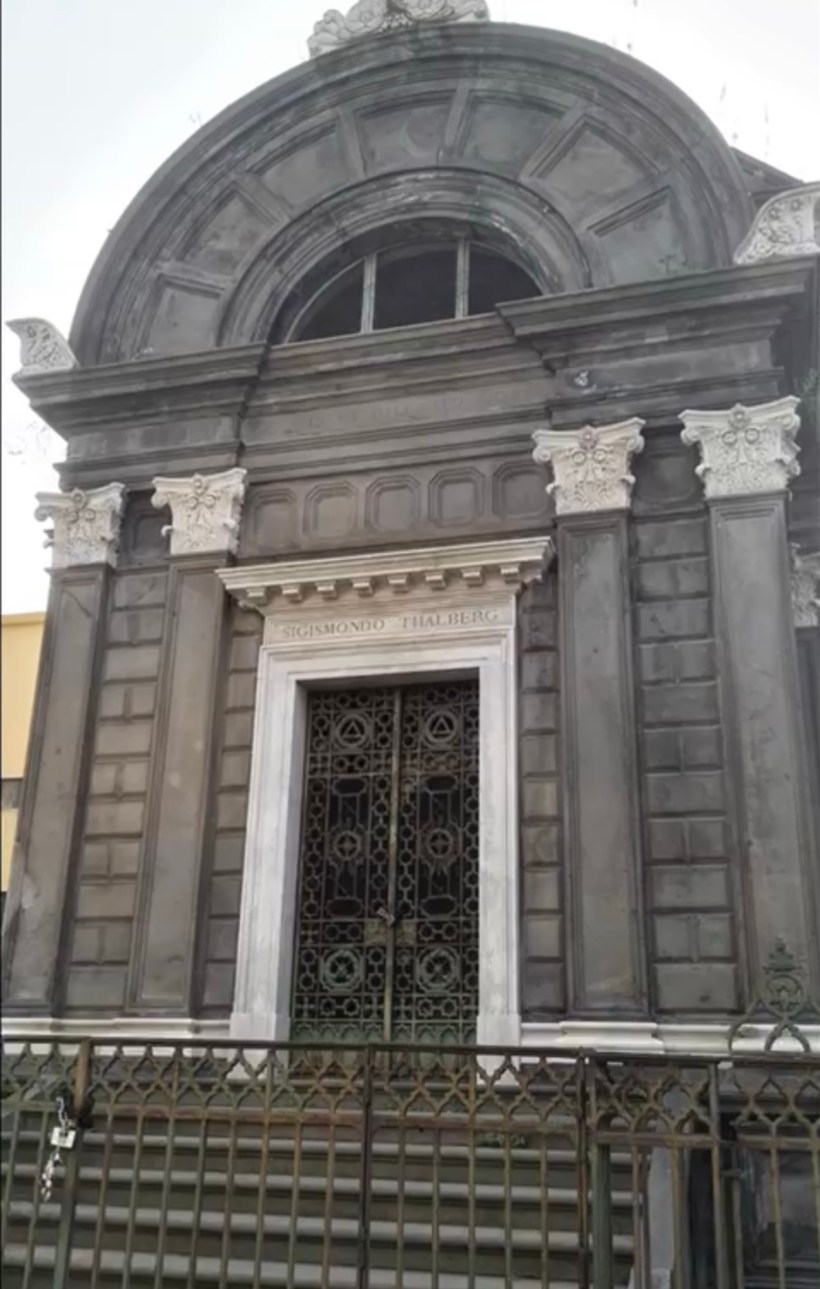
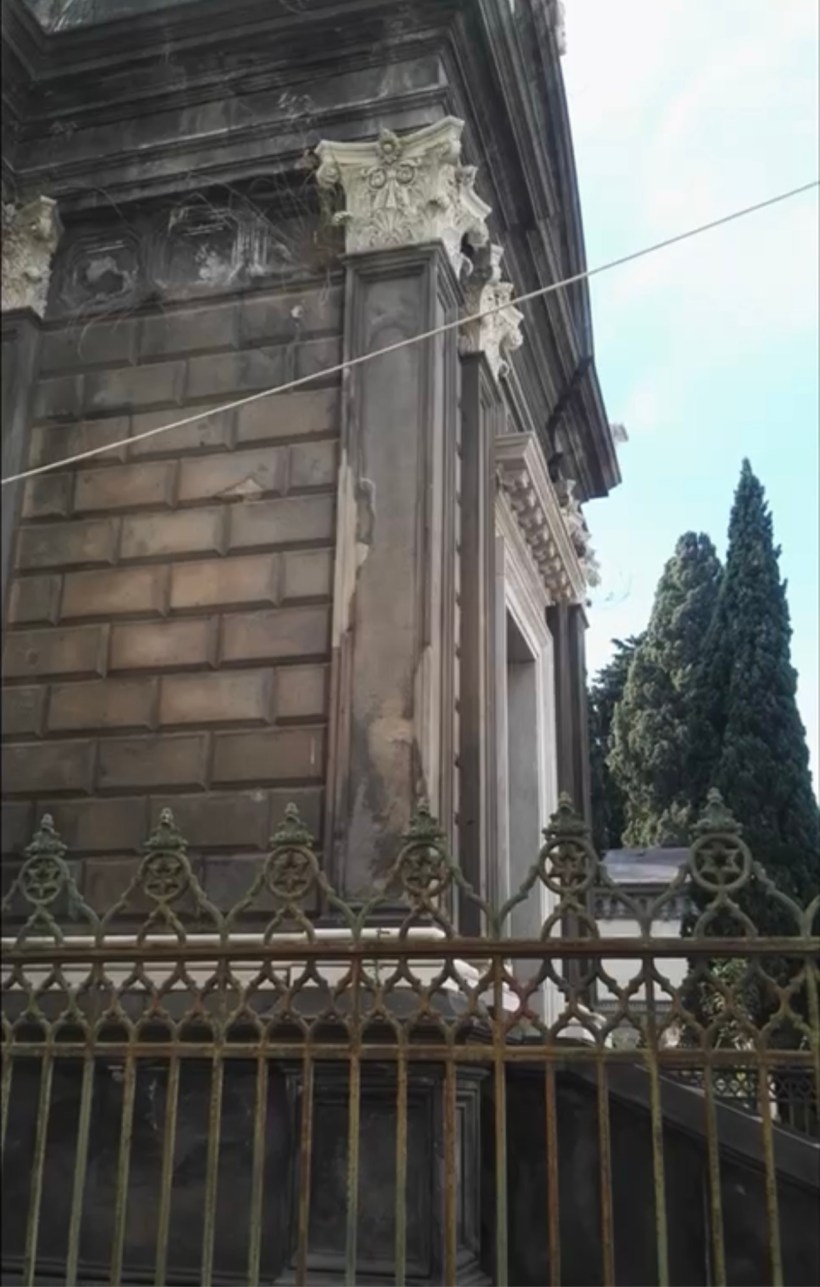
It was fascinating to look for Thalberg’s tomb in Naples Monumental Cemetery especially after hearing Mark Viner’s live performances and recordings of Thalberg.It is one of the most imposing of Chapels in an overcrowded cemetery of what were once some extraordinary monuments to greatly admired people.They are now very sadly neglected as indeed is the city of Naples itself.But Naples and its Poggioreale Cemetery are remarkable vibrant places full of atmosphere and as such are quite unique.I was reminded today of Highgate Cemetery and of the grave next to Karl Marx that Doreen Davis,who passed away last year had asked me to look after. That of Shura Cherkassky.
And so it was interesting to delve into the archive and find out who Thalberg was – this is what I found:

Robbers desecrate Thalberg’s grave

6:10, 20th August 2017
The Italian newspaper Il Mattino recently ran a story with the headline ‘Raid on Naples cemetery: tomb of the composer Thalberg desecrated’.
When Sigismond Thalberg died in April 1871, his wife Francesca Lablanche built a mausoleum to house his remains in Naples’ Poggioreale cemetery. It is close to the graves of Mercadante and Donizetti, an impressive structure befitting the son of an Austrian aristocrat who became one of the greatest piano virtuosos of the day. Thalberg’s embalmed body was placed in a glass coffin and wrapped in an ermine cape, a gift from the Tsar of Russia.
Within a few days of his interment, the lid of the glass coffin had been raised and the ermine cape stolen. Pianist Francesco Nicolosi, president of Sigismund Thalberg International Study Centre, says ‘this led to the end of the embalming, and Thalberg’s body from that moment became petrified’. Now, nearly 150 years later, robbers have again vandalised his sepulchre, forcing the front door and a second gate, and smashing the marble floor with a pickaxe in order to reach the underground tomb. Marble and lead seem to have been the target, as well as the valuable brass that held the structure of the glass coffin in place. Worst of all, Thalberg’s body had been plucked from its resting place and thrown into a corner.
Renata and Giulia Ferrara Pignatelli, daughters of Princess Francesca Ferrara Pignatelli, are Thalberg’s great-great granddaughters. Donna Renata says that it was her sister Giulia and Francesco Nicolosi who made the discovery when they visited to check if the cleaning of the external walls of the tomb had been done.
British virtuoso Mark Viner, today’s leading champion of Thalberg, reacted with a mixture of sadness and shock. ‘The desecration of any grave is an outrage on any level,’ he says, ‘but during the arduous process of preparing the music for performance and recording, these distant names become close acquaintances. I think this comes close to explaining my feeling of real pain and sadness.’
Thanks to the generosity of Donna Giulia, the tomb and mausoleum have now been restored and Thalberg’s body has been placed in a new glass coffin. ‘Before closing the new lid,’ says Nicolosi, ‘I made visible Thalberg’s hand that was previously covered by a blanket.’
Thalberg’s tomb can be visited by appointment. Write to the Sigismund Thalberg International Study Centre at info@centrothalberg.it
Sigismond Thalberg (8 January 1812 – 27 April 1871) was a composer and one of the most distinguished virtuoso pianists of the 19th century.
  • Sigismond Thalberg was born in Pâquis near Geneva, Switzerland, on 8 January 1812. According to legend, he was the illegitimate son of Prince Moritz Dietrichstein and Baroness Maria Julia Wetzlar von Plankenstern. However, according to his birth certificate , he was the son of Joseph Thalberg and Fortunée Stein who were both from Frankfurt-am-Main.
  • Little is known about Thalberg’s childhood and early youth. It is possible that his mother had brought him to Vienna at the age of 10 (the same year in which the 10-year-old Franz Liszt arrived there with his parents). According to Thalberg’s own account, he attended the first performance of Beethoven’s 9th Symphony on 7 May 1824 in the Karntnerthortheater.

Inauguration in Naples of the Monument to Sigismund Thalberg (1812-1871), Austrian pianist and composer, by the sculptor Giulio Monteverde (1837-1917), 1879, Italy, drawing by Eduardo Dalbono (1841-1915), engraving by Centenari from L’Illustrazione Italiana, Year 6, No 40, October 5, 1879.

There is no evidence as to Thalberg’s early teachers. Baroness von Wetzlar, his mother, who according to Wurzbach was occupied with his education during his childhood and early youth, was a brilliant amateur pianist. It may be therefore that she gave him his first instruction at the piano.
Sigismond Thalberg, 1826.
In spring 1826 Thalberg studied with Ignaz Mascheles in London. Moscheles, according to a letter to Felix Mendelssohn of 14 August 1836, had the impression that Thalberg had already reached a level at which no further help would be needed in order to become a great artist.Thalberg’s first public performance in London was on 17 May 1826. In Vienna on 6 April 1827 he played the first movement, and on 6 May 1827 the Adagio and the Rondo of Hummel’s concerto in B Minor. After this, Thalberg performed regularly in Vienna. His repertoire was mainly classical, including concertos by Hummel and Beethoven. He also performed chamber music. In the year 1828 his Op. 1, a fantasy on melodies from Carl Maria von Weber’s Euryanthe, was published.
In 1830 Thalberg met Mendelssohn and Frederic Chopin in Vienna. Their letters show their opinion that Thalberg’s main strength was his astonishing technical skills. Further information can be found in the diary of the 10-year old Clara Wieck. She had heard Thalberg on 14 May 1830 at a concert which he gave in the theatre of Leipzig. He had played his own Piano Concerto op.5 and a fantasy of his own. Two days before, Clara had played the first solo of the 2nd Concerto of John Field to him, and, together with him, the first movement of a four handed Sonata of Hummel. Her diary, edited by her father Friedrich Wieck, notes Thalberg as “very accomplished”. His playing was clear and precise, also very strong and expressive.
In the early 1830s Thalberg studied counterpoint under Simon Sechter. As a result, passages of canon and fugue can be found in some of Thalberg’s fantasies of this time. An example is his Fantasy, Op. 12, on melodies from Bellini’s opera Norma, which contains a march-theme and variations (one of them a canon), and a fugue on a lyrical theme. The fantasy was published in 1834 and became very popular; but on publication, it was criticised by some, for example by Robert Schumann.
Thalberg successfully changed his composing style, reducing the counterpoint. Several works in his new style, among them the Deux Airs russes variés Op.17, were even enthusiastically praised by Schumann.

In November 1835 Thalberg arrived in Paris. He performed on 16 November 1835 at a private concert of the Austrian ambassador Count Rudolph Apponyi. On 24 January 1836 he took part in a concert of the “Society of the Paris Conservatoire concerts”, playing his “Grande fantaisie” op.22. Thalberg was praised by many of the most prominent artists, among them Rossini and Meyerbeer.Chopin didn’t share his fellow artists’ enthusiasm. After hearing Thalberg play, in Vienna, Chopin wrote: “He plays splendidly, but he’s not my man. He’s younger than I and pleases the ladies – makes potpourris on La Muette – produces his piano and forte with the pedal, not the hand – takes tenths as I do octaves and wears diamond shirt studs”.
His début at the Conservatoire concert was in the Revue et Gazette musicale of 31 January 1836, enthusiastically reviewed by Hector Berlioz. The Ménestrel of 13 March 1836 wrote:Moscheles, Kalkbrenner, Chopin, Liszt and Herz are and will always be for me great artists, but Thalberg is the creator of a new art which I do not know how to compare to anything that existed before him … Thalberg is not only the premier pianist of the world, he is also an extremely distinguished composer.
On 16 April 1836 Thalberg gave his first solo concert in Paris, and the success was again sensational. According to Rudolph Apponyi’s diary, Thalberg made a profit of 10,000 Francs, a sum which no virtuoso had gained before from a single concert.
Liszt had heard of Thalberg’s successes during the winter 1835–36 in Geneva, in spring 1836 in Lyon, and in Paris. In his letter to Marie d’Agoult of 29 April 1836, he compared himself to the exiled Napoleon. In a review of 8 January 1837, in the Revue et Gazette musicale, Liszt controversially denigrated Thalberg’s compositions.

After Thalberg returned to Paris in the beginning of February 1837, a rivalry developed between him and Liszt. On 4 February Thalberg heard Liszt play in concert for the first time in his life. Thalberg was stupefied. While Liszt then gave over a dozen concerts, Thalberg gave only one concert on 12 March 1837 in the Paris Conservatoire, and a further concert on 2 April 1837. In addition, on 31 March 1837, both Liszt and Thalberg played at a benefit concert to raise money for Italian refugees.
In May 1837 Thalberg gave a concert in London, following which The Athenaeum gave an enthusiastic review. Such enthusiasm followed Thalberg throughout the following years. His fantasy op.33 on melodies from Rossini’s opera Moise became one of the most famous concert pieces of the 19th century, and was still praised by Berlioz in his Memoirs (1869). The fantasy was published at end of March 1839 and in May 1839 studied by Clara Wieck who was delighted by it. In 1848 the fantasy was played by Liszt’s daughter Blandine.

After Thalberg’s stay in London in May 1837, he made a first, short tour, giving concerts in several towns in Great Britain, but he became ill and soon returned to Vienna. In spring 1838 he gave concerts in Paris again. A note in the Revue et Gazette musicale of 4 March 1838, shows that Thalberg’s fame had in the meanwhile grown. He was now called “the most famous of our composers”. Thalberg left Paris on 18 April 1838, travelling to Vienna, the very day that Liszt gave there a charity concert for the benefit of the victims of a flood in Hungary. Thalberg invited Liszt for dinner, and the two great pianists dined together on the 28th with Prince Moritz Dietrichstein, who told Liszt, that he was delighted to have “Castor and Pollux” together in his home. During the evening, Thalberg remarked to Liszt with admirable candour : ” In comparison with you, I have never enjoyed more than a succes d’estime in Vienna”. They dined again the next day, after Liszt’s concert on 29 April 1838. Liszt and Thalberg were both dinner guests of Metternich. During Liszt’s stay in Vienna Thalberg did not perform at all.
In October 1838 Thalberg became acquainted with Robert Schumann. According to Schumann’s diary, Thalberg played from memory etudes by Chopin, Joseph Cristof Kessler and Ferdinand Hiller. He also played with great skill and inspiration works by Beethoven, Schubert and Dussek, as well as Schumann’s Kreisleriana, Op. 16 at sight. On 27 November 1838 Thalberg took part in a charity concert, playing his new fantasy, Op. 40, on melodies from Rossini’s opera La Donna del Lago (“The Lady of the Lake” after Walter Scott). At one of his own “Farewell concerts” on 1 December 1838, he played three of his Etudes, Op. 26, his fantasy, Op. 33 on “Moïse” and his Souvenir de Beethoven, Op. 39, a fantasy on melodies from Ludwig van Beethoven’s symphonies. As a result, in the Neue Zeitschrift fur Musik of 8 March 1839, an enthusiastic review by Schumann of the second book of Thalberg’s Etudes, Op. 26 appeared, concluding “He is a God when sitting at the piano.”
  • After Thalberg’s “Farewell concert” in Vienna, he began his first extended European tour. On 19 and 21 December 1838 he gave two concerts in Dresden, and he performed twice at the Court. Receiving honours from the King of Saxony, he told him “Wait until you have heard Liszt!” In Leipzig he gave a concert on 28 December 1838, attended by Mendelssohn who on the following day, in a letter to his sister Fanny gave an enthusiastic account. Mendelssohn became a friend and admirer of Thalberg.
After a second concert in Leipzig on 30 December 1838, Thalberg travelled to Berlin, to give a series of concerts there. Via Danzig, Mitau and other places he performed at St.Petersburg, receiving excellent reviews. From St. Petersburg he went on a steamboat to London where he gave further concerts. He then journeyed to Brussels, to meet his friend the violinist Charles de Bériot .There he gave several private performances.
After Brussels, Thalberg arrived in the Rhineland, where he gave a series of concerts with Bériot. He returned to London at the beginning of February 1840, and then travelled from London to Paris together with Baroness Wetzlar, his mother, awaiting the arrival of Liszt.

Thalberg had already announced in December 1838, during his stay in Leipzig, that he would take time off at the end of his tour, and did not perform at any concert during his stay in spring 1840 in Paris.
At this time Mendelssohn, after meeting Liszt, compared him to Thalberg in a letter to his mother:
Thalberg, with his composure, and within his more restricted sphere, is more nearly perfect as a real virtuoso; and after all this is the standard by which Liszt must also be judged, for his compositions are inferior to his playing, and, in fact, are calculated solely for virtuosi.
After the end of the Parisian concert season, Thalberg travelled as tourist in the Rhineland. In the beginning of June 1840 he attended a music festival directed by Louis Spohr in Aachen. He got an invitation from the Russian Tsarina and performed at a court-concert in Ems, but this was his only concert during his stay in the Rhineland. According to a note in the Revue et Gazette musicale of 2 August 1840, p. 410, Thalberg’s friend, the violinist Charles Auguste de Bériot, would get married two days later in Elsene (Ixelles). His bride was a young lady Maria Huber, born in Vienna, from Germany. She was an orphan and had been adopted by Prince von Dietrichstein, Thalberg’s father. It may therefore be presumed that Thalberg wanted to take part in the wedding celebration. During previous visits to the Rhineland he wanted only to relax. He also taught Bériot’s son, the pianist Charles-Wilfrid de Bériot.In the Revue et Gazette musicale of 9 May 1841, an essay by Fétis appeared, ‘Etudes d’exécution transcendente’, in which Liszt was praised for a new composing style which had been stimulated by Thalberg’s challenge. In letters to Fétis of 17 May 1841, and to Simon Löwy of 20 May 1841, Liszt agreed with this analysis.

Thalberg performed in Brussels in fall 1840. He then travelled to Frankfurt-am-Main where he stayed until January 1841. It had been announced that Thalberg would give concerts in Paris again in spring 1841, but he changed his plans. In Frankfurt he only took part in a charity concert on 15 January 1841, playing his fantasies on La Donna del Lago and Les Huguenots He was busily composing new works; his Second Don Giovanni Fantasy op.42 and the fantasy op.51 on Rossini’s Semiramide date from this time.
In the second half of January 1841, Thalberg travelled from Frankfurt to Weimar, where he performed three times at the Grand Duke’s court and also in the Theatre. He then went to Leipzig, where he visited Mendelssohn and Schumann. On 8 February 1841 he gave a solo concert in Leipzig, enthusiastically reviewed by Schumann, playing his ‘Second Don Giovanni Fantasy’ op.42, his ‘Andante final de Lucia di Lammermoor ‘, op.44, his ‘Thême et Etude’ op.45 and his Caprice op.46 on melodies from Bellini’s La Sonnabula.
Clara Schumann noted in her diary:On Monday Thalberg visited us and played to the delightment beautiful on my piano. An even more accomplished mechanism than his does not exist, and many of his piano effects must ravish the connoisseurs. He does not fail a single note, his passages can be compared to rows of pearls, his octaves are the most beautiful ones I ever heard.
Mendelssohn’s student Horsley wrote of the meeting of his teacher and Thalberg:We were a trio, and after dinner Mendelssohn asked Thalberg if he had written anything new, whereupon Thalberg sat down to the piano and played his Fantasia from the “Sonnambula” … At the close there are several runs of Chromatique Octaves, which at that time had not previously heard, and of which peculiar passages Thalberg was undoubtedly the inventor. Mendelssohn was much struck with the novel effect produced, and greatly admired its ingenuity … he told me to be with him the next afternoon at 2 o’clock. When I arrived at his study door I heard him playing to himself, and practising continually this passage which had so struck him the previous day. I waited for at least half an hour listening in wonderment to the facility with which he applied his own thoughts to the cleverness of Thalberg’s mechanism, and then went into the room. He laughed and said: ‘Listen to this, is it not almost like Thalberg?’After his stay in Leipzig, Thalberg gave concerts in Breslau and Warsaw. He then travelled to Vienna and gave two successful concerts there. In a review in the Leipziger Allgemeine musikalische Zeitung, Thalberg was described as Liszt’s only rival.
In winter 1841–1842, Thalberg gave concerts in Italy, while Liszt, from end of December 1841 until beginning of March 1842, gave a series of concerts in Berlin. Thalberg matched Liszt’s successes in Berlin. He then returned via Marseilles, Toulon and Dijon, arriving on 11 April 1842, in Paris. On the next day he gave his first, and on 21 April his second concert. According to an account by Berlioz, Thalberg made a profit of 12,000 Francs from his first, and of 13,000 Francs from his second concert. The concerts were reviewed in the Revue et Gazette musicale by Henri Blanchard who two years before, in his review of Liszt’s concert on 20 April 1840, had nominated Thalberg as Cesar, Octavian or Napoleon of the piano. In spring 1842, Blanchard reached for new superlatives even surpassing his former ones. In his review of Thalberg’s second concert he wrote, Thalberg would in 100 years have been canonized, and by all coming pianists be invoked with name of Holy Thalberg. According to the account by Berlioz, at the end of Thalberg’s second concert a golden crown was thrown to the stage.
In addition to his own concerts, Thalberg took part in a concert of Emile Prudent. He then travelled via Brussels to London. Later in 1842 Thalberg was decorated with the Cross of the French Legion of Honour. He travelled to Vienna where he stayed until autumn 1842. In the second half of November until 12 December 1842, he made a further tour in Great Britain, and in January 1843 he returned to Paris. At end of March 1843 he performed at a private concert of Pierre Erard, but this was his only concert appearance during that season.
In March 1843 Heinrich Heine wrote about Thalberg:His performance is so gentlemanly, so entirely without any forced acting the genius, so entirely without that well-known brashness that makes a poor cover for inner insecurity. Healthy women love him. So do sickly women, even though he does not engage their sympathy by epileptic seizures at the piano, even though he does not play at their overstrung, delicate nerves, even though he neither electrifies them nor galvanizes them.
In winter 1843–44 Thalberg gave concerts in Italy again. At end of March 1844 he returned to Paris, where at the same time also Liszt was expected. Liszt arrived on April 8 and gave on 16 April a first concert, at which he played his Norma-fantasy, published shortly before. When composing his fantasy, Liszt had put many Thalberg-effects to it. In his later years, he told August Göllerich, one of his pupils:As I met Thalberg, I said to him: ‘Here I have cribbed everything from you.’ ‘Yes,’ he replied, ‘there are Thalberg-passages included which are indeed indecent.’
Shortly after Liszt’s concert on 11 May 1844, Thalberg left Paris. He travelled to London and gave a concert there on 28 May 1844. At a further concert in London he played a concerto for three pianos by J.S. Bach together with Moscheles and Mendelssohn. He also took part in a concert of Jules Benedict. In August 1844 he returned to Paris where he stayed until 1845. During the winter 1844–45 he gave a piano course for selected students at the Paris Conservatoire. On April 2, 1845, he gave a concert in Paris, playing his fantasies op.63 on Rossini’s Barber if Seville, op.67 on Donizetti’s Don Pasquale and op.52 on Aubert’s La Muette de Portici, as well as his ‘Marche funèbre variée’ op.59 and the ‘Barcarolle’ op.60.
In spring 1848, in Vienna, Liszt met Thalberg once more. On 3 May 1848 Thalberg gave a benefit concert which Liszt attended. According to an account by his pupil Nepomuk Dunkl, Liszt was sitting on the stage, carefully listening and loudly applauding. It was 11 years since he had first heard his rival’s playing.

On 22 July 1843 Thalberg married Francesca (“Cecchina”), the eldest daughter of Luigi Lablache, first bass at the Théâtre des Italiens in Paris. Thalberg went with his wife to Italy where they stayed for the winter 1843–44.
In 1855, after Thalberg’s operas Florinda and Cristina di Svezia had failed, he realized his ambition to give concerts in America. From July to December 1855 he performed with overwhelming success in Rio de Janeiro and Buenos Aires. He returned to Europe, but after a stay of several months in Paris went on the steamboat Africa to North America, where he arrived on 3 October 1856, in New York. After Thalberg’s debut there on 10 November 1856, a performance marathon ensued, during which he spent eight months giving concerts 5 or 6 days a week. Occasionally he gave two or even three concerts a day. On Sundays, concerts were generally only allowed if they presented “sacred music”, but several times Thalberg performed anyhow, playing pieces like his Moïse-fantasy, based on a prayer from Rossini’s opera, or his Huguenots-fantasy with the chorale “Ein feste Burg ist unser Gott” as main subject. His Andante op. 32 and the Marche funèbre varié op. 59 were also allowed.
Thalberg’s first American season ended with a concert on 29 July 1857 in Saratoga Springs NY. On 15 September 1857 he gave another concert in New York, starting his second season. With very few intermissions he was busy until his last concert on 12 June 1858, in Peoria, IL. By then he had visited nearly 80 cities and given more than 320 regular concerts in the United States and 20 concerts in Canada. In addition, he gave at least twenty free concerts for many thousands of schoolchildren. Thalberg also gave a series of solo matinees in New York and Boston at which he played own works as well as chamber music. From 1857, the violinist Henri Vieuxtemps toured with Thalberg. They played works by Beethoven, and Duos composed by Thalberg.
Thalberg’s financial success on these tours was immense. He got an average of about $500 per concert and probably made more than $150,000 during his two seasons, the equivalent today of about $3 million. A large part of his appeal on these tours was his unpretentious and unassuming personality; he did not resort to advertising gimmicks or cheap crowd-pleasing tricks, instead offering superbly polished renditions of his own compositions, which had already been well known in America. On rising from the piano, he was always the same quiet, respectable, self-possessed, middle-aged gentleman that he was at the dinner table of his hotel. He played works byBeethoven, among them the sonatas op. 27 no. 2 (“Moonlight”) and op.26 (“Funeral March”) as well as the first movements of the Third and Fifth Piano Concertos. His cadenza to Beethoven’s third concerto was admired. He also played works by Bach,Chopin, Hummel, Mendelssohn and several other composers. The New-York Musical Review and Gazette of July 24, 1858, wrote:
Thalberg … quite unexpectedly closed what has been a most brilliant career – completely successful, musically, giving to the talented and genial artist abundance of both fame and money. There is probably not another virtuoso, whether with instrument or voice (Liszt alone excepted), who could have excited a moiety of the enthusiasm, or gathered a fragment of the dollars, which Thalberg has excited and gathered.
The “unexpected close” referred to the announcement in June 1858 in Chicago that Thalberg would make only one of three scheduled appearances before immediately returning to Europe. In fact, Thalberg did not even perform at that concert, but very hastily left. His wife had arrived from Europe, following reports that Thalberg had an extra-marital liaison.

The true reason why Francesca Thalberg had left for America in June 1858 and shortly afterwards, together with her husband, very hastily returned to Europe is unknown. The death of Thalberg’s father in law, Lablache, on 23 January 1858, could be one reason. A further possibility is that there may have been consideration of legitimizing Thalberg to enable him to succeed his natural father Prince Franz Joseph von Dietrichstein.
After Thalberg’s return to Europe, he settled in Posillipo near Naples in a villa, which had belonged to Lablache. For the following four years Thalberg lived in silence there. In spring 1862 he gave concerts in Paris and London once again and was as successful as ever. After a last tour in Brazil in 1863 he put an end to his career. He suggested taking a position as piano professor at the conservatory in Naples, but it was defeated since an Italian nationality would be necessary. One year later he got an offer from the same conservatory which he refused. Vitale’s claim that he published instructive editions of J.S. Bach’s “Well Tempered Clavier” and Muzio Clementi’s “Gradus ad Parnassum” has been recently disputed by Chiara Bertoglio. When he died on 27 April 1871 he left behind a collection of many hundreds of autographs by famous composers, among them Bach, Handel, Mozart, Haydn, Beethoven, Schubert and others, even Liszt. The collection was sold after Thalberg’s death. He is buried at Nuovo Cemetery in Napoli (Naples) Italy in the Doganella section of Naples

Sigismond Thalberg was one of the most famous and most successful piano composers of the 19th century. During the 1830s and the 1840s his style was a major force in European piano-playing. He was greatly in fashion and was imitated by others. In 1852, Wilhelm von Lenz wrote:
‘The piano playing of the present day, to tell the truth, consists only of Thalberg simple, Thalberg amended, and Thalberg exaggerated; scratch what is written for the piano, and you will find Thalberg.’
Ten years later, in 1862, a London correspondent of the Revue et Gazette Musicale wrote:
‘Nobody in fact has been so much imitated; his manner has been parodied, exaggerated, twisted, tortured, and it may have happened more than once to all of us to curse this Thalbergian school’.
Expressions like “exaggerated”, “twisted” and “tortured” indicate that some contemporaries were starting to feel jaded of his style. It was at this time when Thalberg’s career as composer and as virtuoso came to an end.
In the late 19th century, Thalberg’s fame had come to depend on his association with a single piano technique, the ‘three-hand effect’. Carl Friedrich Weitzmann, in his Geschichte des Klavierspiels (1879), wrote about this.
‘His bravura pieces, fantasies on melodies from Rossini’s Mosè and La donna del lago on motifs fromBellini’s Norma and on Russian folk-songs, became extraordinarily popular through his own, brilliant execution; however, they treat their subjects always in one and the same way, [namely] … to let the tones of a melody be played in the medium octave of the keyboard now by the thumb of the right, now of the left hand, while the rest of the fingers are executing arpeggios filling the whole range of the keyboard’.
In a review in the Revue et gazette musicale the finale of Thalberg’s Mosè fantasy is described as follows
‘it consists of a principal melody on the strings in the medium of the instrument, played alternately by both thumbs, while both hands are traversing with rapid arpeggios the whole range of the keyboard.’
It is not a difficult trick, and it sounds (and looks) much harder than it is, but it was new in the 1830s and it caused a sensation. Audiences were entranced, and would rise up from their seats to see how Thalberg did it.
While Thalberg was still in Vienna, in the Revue et Gazette musicale of 8 January 1837, Liszt’s review of some of Thalberg’s piano works appeared. Liszt claimed that in the Grande fantaisie op.22 the left hand continually played arpeggios and nothing else. The description was polemic, since in large parts of the piece the left hand plays a variety of firms: but thumb-melodies were not mentioned by Liszt.
In response to Liszt’s review, in his essay “MM. Thalberg et Liszt”‘ in the Revue et Gazette musicale of 23 April 1837, Fétis claimed that Thalberg had created a new piano-style by uniting two different schools. While playing brilliant passages, Thalberg simultaneously executed a singing melody. Liszt, in his reply in the Revue et Gazette musicale of 14 May 1837, wrote:
‘Posing M. Thalberg as representative of a new school! Apparently the school of arpeggios and thumb-melodies? Who would admit that this was a school, and even a new school? Arpeggios and thumbs-melodies have been played before M. Thalberg, and they will be played after M. Thalberg again.’
Fétis protested against Liszt’s insinuation. He played for the first time his Mosè fantasy. The audience noted a magical effect. They could see that in the finale Thalberg was playing a bass and accompanying with his left hand. His right hand was busily occupied with rapid arpeggios. But in addition, a broad melody was to be heard. Liszt’s explanation of the thumb-melodies was accurate. This characterization of his style followed him until the end of his life.
Thalberg by the late 19th century was often only characterised as “Old Arpeggio”; his musical innovations were unrecognised or had been forgotten. Others were tempted by the successes of Thalberg’s works to inundate the musical world with imitations ad nauseam. In the end his reputation was submerged by the trivial productions of his imitators.

The Battle Between “Il penseroso” and “The Old Arpeggio”

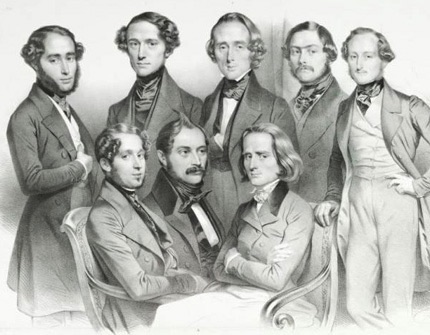
Before the time of television and the internet, live music performances were a primary form of entertainment. Performances were held in private homes, as well as concert halls. Many rivalries formed among pianists and composers. This created a unique angle for entertainment as individuals could then debate the merits of each musician and choose sides. One of the more famous piano duels was held between Franz Liszt and Sigismond Thalberg.

The Sublime Simplicity of Angela Hewitt

The sublime simplicity of Angela Hewitt.
A crystal clear purity where every voice was allowed to be heard and shaped with such subtle beauty and shading.

The tower of the Basilica of S.Pietro as seen from afar
It was only fitting that it should have resounded in one of the most beautiful of churches in central Italy. Caravaggio,Tintoretto,Sassoferrato ,Reni and many other masterpieces only added to the sheer joy that Angela was sharing with us in the name of the Red Cross.
The gradual crescendo in ‘Jesu Joy of Man`s Desiring’ made the whispered final phrase even more poignant.
The minutes of total silence followed by a spontaneous standing ovation made for the greatest Christmas present that one could ever desire indeed.
In the Basilica of San Pietro in Perugia that Karajan considered had the finest of acoustics.
How could I ever forget as a student in Florence in 1972 Martha Argerich opening what was to be one of her last solo recitals with such an ecstatic performance of the Bach C minor Toccata followed by the grandest of Liszt sonatas.
But it was the Toccata today in hands of Angela Hewitt that will remain with me until my dying day.

The magnificengt interior of the Basilica di S.Pietro in Perugia
After the opening speeches in perfect Italian replying to her hostess and thanking all the people that had flocked with tangible effect to support the Red Cross as she herself had done with such obvious joy.
It was this joy of sharing her music with us that was so evident to all present on this very cold winter`s evening.
It was that same joy that William Pleeth would describe of the young Jaqueline Du Pre bouncing down the corridor in a competition when she was not yet the renowned cellist she was to become.
They thought she must have played well.
“No” she exclaimed”I have not played yet but it fills me with joy the thought that it will be my turn soon.”

The very poignant story of my wife’s last performance and the fact of her wedding ring being found on the pavement outside our theatre the day after that tragic last performance of Hecuba.The whole of Florence was talking about this beautiful true story,that I had not seen.It was published two weeks later when I had gone to Florence to hear Angela playing at La Pergola .I remember what fun we had in the interval remembering our adored Sidney Harrison and much to everyone’s astonishment intoning the words to Bach’s fugues that his teacher Ebener Prout had set to words.
It was just this joy that poured from the hands of Angela the moment she sat down at her adored Fazioli concert grand.(4 pedals Angela?Yes Fazioli.sometimes have four and I sometimes use the fourth too……a sign of a true love affaire indeed!)
After the opening flourish of the C minor Toccata, Bach immediately follows with an Adagio played with such sublime stillness and profundity that an unforgettable atmosphere was created.
A bond that drew us all together in a spiritual rite that was indeed a coming together where words are just not enough.
I had come early to see this famous Basilica.

Angela happily posing before the recital
Angela too had arrived early and found me lighting a candle for my wife whom she had known well.
“So Ileana will be with us too tonight” I told her as she happily posed for a photo for her old student friend.
In fact it was.Angela who was the first to telephone me 14 years ago,when she read in the Italian press of Ileana being struck down so unexpectedly on stage in Rome whilst playing the terrifying Hecuba.
It was in this poignant stillness that I knew that she too was thinking of her mother for whom she had given a memorial concert a few years back in Toronto Cathedral where her father had been organist for many years.
Parents I had met years ago when they accompanied the winner of the one and only Glenn Gould competition to Rome to make her debut in our theatre in the shadow of that other St.Peters – the very centre of Christendom.
After the very poignant Adagio the theme of theToccata was stated very quietly which allowed the comments of the counter melodies to answer one another in a continuous musical conversation rather than the usual battle that takes place in lesser hands.
When the theme came in the left hand it was like an old friend joining in an absorbing musical conversation that bubbled along like water flowing in a sparkling br0ok.
The cadenza type interruption only gave a chance to the counter melodies to gather arms and become even more vociferous on the very gentle restatement of the theme in the alto register.
Ever more intricate this “knotty twine” in Angela’s hands became a joyous burst of energy of such clarity but at the same time with such changes of colours and always with the sumptuous velvety tones of this obviously very new Fazioli.
The bubble finally burst into the Adagio recitativo with a final meandering scale Presto from the top of the keyboard to the very bottom.The last note judged to absolute perfection just added to the nobility of this opening work in one of the most beautifully shaped programmes I have heard for a very long time.
As Angela confided afterwards a very tiring programme that she had only played in Hampstead last november whilst she is still touring the world with the final two programmes of her Bach Odyssey.
A series comprising all the major keyboard works that she had been persuaded to embark on by John Gilhooly of the Wigmore Hall in London.
She will be awarded in 2020 the “ Bach Medal” in Bach’s home city of Leipzig of which she is rightly very proud.
Most other musicians would be happy if they only played all the works of Bach but Angela has also almost completed her recording of the 32 Sonatas of Beethoven.So I was surprised when she told me that she was just about to record also the variations of Beethoven.
I would not be surprised if likeFilippo Gorini recently she brought out the Diabelli followed by the Hammerklavier too!

The four pedals on the Fazioli concert grand
Today we were treated to the six variations op 34 in F followed by the mighty 15 variations and Fugue op 35 “Eroica Variations.“
It was good to see the 32 Variations in C minor too that has been missing from concert programmes for far too long.
Angela laughingly told me Beethoven described them as trash!
It was as though Angela was playing a different instrument such was the luminosity of sound as she shaped the Adagio cantabile so beautifully.A sense of grace and charm for these rarely heard variations that I have only heard in the concert hall years ago from Richter.
There was such extreme delicacy in the first variation as Angela spun a magic web of intricate embellishments.
It contrasted so well with the rhythmic energy of the second and the beautiful legato of the Allegretto third or Beethoven’s almost too serious Tempo di Menuetto of the fourth.
The dotted rhythms of the fifth were very subdued with magic horns leading into the cantabile of the sixth.
Joyous and playful and very reminiscent of the bubbling energy of the early cello sonatas.The simplicity of the return of the theme was transformed with Beethoven’s magical embellishments that in Angela’s sensitive hands seemed to be spread over the keyboard like seemless streams of gold.
The very simple playful ending was rudely interrupted by Beethoven’s call to arms with the ‘Eroica Variations’ that followed on immediately.
The Eroica theme was played so simply that Beethoven’s three note interruption came even more as a suprise.
What fun Angela seemed to be having as she played these variations with a quiet mastery that was quite mesmerising.
The beautiful legato of ‘a due’ and ‘a tre’ was suddenly interrupted with the rhythmic energy of ‘a quattro’.
A bewitching lilt to the first variation was immediately trasformed into the second of swirling virtuosity.
The left hand in the fourth variation was played so smoothly that the almost cheeky comments from the right hand gave it great character before the sublime legato of the fifth.
The same beauty with more intricate crossing of hands that she found in the eighth.This led into the more playful variations with the left hand sforzandi of the ninth and the dizzingly busy tenth.
The almost Mozartian charm she brought to the eleventh contrasted so well with the octaves dashing up and down the keyboard in the question and answer session that followed.
The acciaccaturas of the thirteenth magnificently insistent were a perfect contrast for the minor version of the theme that led into the most profound last variation.The longest of all the variations it was played with a rare understanding of the complex almost Floristan and Eusebius character of Beethoven.Disappearing in a puff of smoke a left hand murmur played so magically and leading the way to the final great fugue.
Here as in Bach the clarity of Angela’s playing was quite astonishing as she played with all the energy and contrasts that the composer demands.
A transcendental control and rhythmic drive that was maintained with an almost military precision until the final explosion of three chords before the momentarily defusing adagio led to the ever mellifluous statement of the theme.
Beethoven’s invention seemingly endless until he decides to draw things to a conclusion with a short question and answer coda and a final slam of the door.
This was indeed a remarkable performance of one of Beethoven’s greatest works for the keyboard.
Angela’s interpretations of the First Partita and the Italian Concerto are well known from her performances worldwide over the past forty years.
There was all the clarity and purity in the Prelude and a mellifluously flowing Allemande of such fexibility with some very subtle phrasing that made this well known work speak so enchantingly.Especially at the ending which seemed as though hearing it for the first time.
A Corrente that bounced along with some very delicate ornamentation.A Sarabande that seemed more flowing than usual but with such a flexible melodic line that allowed for such delicate ornamentation in the ritornelli. A lovely melodic shape to a fast flowing Menuet I and a subdued Menuet II that contrasted so well before the repeat.
There was sheer joy in her crystal clear Gigue of absolute perfection.
A brightly polished jewel indeed.
The Beethoven C minor variations were played with great authority.
Beethoven’s indications were scrupulously observed allowing the first three variations to be shaped so delicately instead of the usual pistol shots in lesser hands.The thirteenth was teasingly thrown off with great elan before the more virtuosistic variations took over.
The wonderful pianissimo cloud created in the left hand made the swirling shapes above it even more exciting.
It led to the delicate phrasing of almost Mozartian contrast and the gradual question and answer crescendo to the final octaves of great power only to be answered by the final two almost tongue in cheek quiet chords.
Interesting the broken chords in the left hand of the Italian Concerto like Beethoven four that we had discussed a while back.
There was a great sense of driving rhythmic energy with some very subtle changes of dynamics.The sublime simplicity of the Andante was faster than most but with such a subtle almost unnoticeable pause before the coda that was absolute magic. The last movement was played at a real Presto with an infectious interplay of voices.
What better choice for a final farewell than ‘Jesu,Joy of Man’s Desiring’ from the Cantata n.147 in the arrangement of another great woman pianist Dame Myra Hess.
A strange coincidence that my old copy from Squires in Ealing is stamped Red Cross Competition.
Angela’s performance tonight for the Red Cross too was absolutely sublime as I had mentioned at the beginning with my first impressions jotted down enthusiastically immediately after the concert.
Greeted by a standing ovation she was happy to share in the joy she had so generously created surrounded by friends and admirers from her adopted home town in the Italy- ‘the museum of the world’- that she adores and  that has enriched her life so much.
We look forward now to her annual summer festival in her home town on Lake Trasimeno

O Come all ye Faithful – A Songmakers’ Christmas Carol +++++

O Come all ye Faithful -A Songmakers’ Christmas Carol  +++++
Reading again this piece (and please please do)that was as much as I could remember of Graham’s own words last November there is very little to add. ………….beauty,integrity,loyalty,commitment,faithfulness and above all friendship are wonderful things to be reminded of particularly in this Christmas period .Words that are fast becoming obselete ……for many….far too many………I cherish those for whom these values still have some meaning and are a guiding beacon in life …..Graham for me and many others is just such a shining light.
A Winter Birthday to cherish

The ever elegant Janet Suzman toasting the wonderful journey they had just shared with us
“But Graham you don`t have to play every note as though someone was sticking a knife into you” exhorted John Streets to the seventeen year old boy from South Africa at our Chamber Music Lessons that we shared as freshers at the RAM.
“But you do ,you do!! ” shrieked the 80 year old Janet Suzman “It makes all the difference”
……and it certainly does as the last note in a magical Christmas Songmakers`Almanac proved today.
Graham kept us spellbound as we waited for him to place a last note of pure gold.
“Don’t put your daughter on the stage” they all sang ……
………….but just you try to keep `em off it!
No logistics or music 360 degrees but pure jewels showered onto an audience seduced,ravished and even a little bewildered that such an evening could still exist in a world where vulgarity and speed seem to have taken the place of beauty and timelessness.

Graham with a musician admirer and next door neighbour backstage
How could I not exclaim to Janet Suzman how wonderful it was to see her back on stage?
It has been too long !
I enthusiastically told her how wonderfully elegant she was with her ruby red velvet ‘spolverino’ over a very ‘slinky’ black evening dress.

Teatro Ghione St Peters Rome
Red and black – just like my theatre in Rome ….it is the most elegant combination of colours as I have learnt over the years since asking the great set designer Eugenio Guglielminetti what colour we should paint the the ceilings and woodwork of our theatre in Rome.
The walls we had covered with ruby red velvet that had been passed through a machine to make it look antique and warm.My wife the distinguished actress Ileana Ghione trusted her childhood friend ………..but when he said “black” we spent many sleepless nights with the seed of doubt!
There was no doubt once seen.
And as proven today it is of an elegance which suited the refined artistry of one of England’s greatest actresses.

On stage at the Wigmore Hall
How could I not exclaim to my student friend that he looks ever more like his mentor Gerald Moore.
An elegant dinner jacket and bow tie so rare these days when artists arrive before the public in a black shirt or even worse a white polo neck!
My old piano teacher Sidney Harrison well known for his informed and intelligent radio and TV broadcasts would always put on a tie and jacket when the red light came on.
There is a sense of occasion that is so often missing these days.
The feeling that when the curtain goes up – or that famous door opens in the Wigmore Hall – there should be something magic that happens.
A tingle of something that is unique to a performance shared with people who have travelled far and wide to experience what cannot be experienced at home with a CD or video player.
As Gilels used to say it is the difference between fresh or canned food!
And so it was tonight that in this hall where we are so often treated to all the Sonatas or Quartets of Beethoven or Schubert.The 48 Preludes and Fugues or complete works of Bach.Complete song cycles etc etc .
All marvellously played by artists with an extraordinary genial capacity to be able to play entire cycles and then repeat them a few days or even hours later in the same hall or on the other side of the globe.
It is rare though to find a programme pieced together with the loving care and attention that Graham has treated us to with his Songmakers’ Almanac over the past forty years.

Linn Rothstein with Ailish Tynan and Theodore Platt
But within these evenings we are treated to some sumptuous performances of music, poetry and song.
How could one not be ravished by the beauty of Graham’s playing in the Strauss “Three Kings.”Or moved by “The Birds” of Benjamin Britten.
The truly ravishing voices of Ailish Tynan,Anna Huntley or Theodre Platt (making his Wigmore debut!) .
The refined authority of Janet Suzman and a Graham Johnson who can at last take the stage as actor and not be upstaged by one of our greatest living actresses.

The company with William Lyne sitting so comfortably on the head of John Gilhooly
I well remember Gerald Moore in his farewell performance at the RFH where not only the music will be cherished for ever but also his very witty speech given with the timing and inflection of a great actor.
Exhorting us not to come back stage as there were so many friends wishing to say farewell that it might mean that Elisabeth, Victoria and Dieter might miss their last buses home!
His final performance poignantly on his own on the vast stage of the Festival Hall will never be forgotten by those lucky enough to be present.
No video exists Thank God!
How could we forget “The Growing Pains of Adrian Mole” or “Christmas Presents “ where grown ups we are told need Father Christmas more that children!
Or be reminded of the sublime words of Thomas Hardy.
Letting their hair down with Harry Woods hilarious “Poor Papa – He’s got nothin’ at all” alla Scott Joplin with Theodore Platt or the fun and games they all had with Poulenc “We want a little sister.”
The first half ended with Hugo Wolf’s “Epiphany” where the three singers sneaked off one by one until poor Graham was left alone still playing on stage!

Distinguished audience too with Roman Simovic ,leader of the LSO and his equally distinguished viola playing wife Milena.
With Linn Rothstein,the pianist and Graham’s next door neighbour with the first clarinet of the Copenhagen Philharmonic Franco Pedro Lopez.
Nice to be reminded after the interval with “Mistletoe from Fraser’s 1835 Magazine” and that Beethoven had a sense of humour too in “The Kiss.”
Kodaly was born on the same day as Beethoven in 1882 as was Noel Coward in 1899.
The beautifully suggestive Kodaly “Sadly rustle the leaves” was contrasted with the wonderful fun of Coward exhorting “Mrs Worthington” not to put her daughter on the stage!
It was nice to be reminded too of Herbert Howells,who I often used to see at the RCM, with his beautiful “Come Sing and Dance” from Ailish Tynan.
It was followed by the equally beautiful Charles Ives “Christmas Carol” from the creamy rich voice of Anna Huntley.
All three singers had such fun with the Humperdinck Christmas finale.
But it was Graham Johnson placing the final note of the evening with such loving care that will always remain in my memory for a long time to come.
It was a special occasion that will never be forgotten.
Mitsuko Uchida said the other day to one of her admiring public who wanted to take a photo backstage: “I do not like photos or selfies or people secretly recording concerts.They should remain like a beautiful memory of an unforgettable shared experience and not suddenly posted on social media.”
Perchance to dream indeed.
We were reminded tonight that dreams do still exist!

Graham Johnson, John Gilhooly, Janet Suzman,Ailish Tynan, Anna Huntley ,Theodore Platt

Happy 249th The fifth and ninth Symphonies at St Lawrence and St Martins

Happy 249th Birthday Beethoven The fifth and ninth Symphonies at St Lawrence Jewry and St Martin in the Fields
CHRISTOPHER AXWORTHY·

A standing ovation from a public who long overstayed their lunch break – captivated as they were by the spell that Beethoven can still weave when played by artists of this stature.
A standing ovation awaited at the end of an extraordinary performance by Tessa Uys and Ben Schoeman of Beethoven 9th Symphony on his 249th birthday.An ovation for the performers but above all for Beethoven’s score that can still astonish and amaze us especially when played with a clarity and rhythmic drive even more revolutionary and evident when played on the same instrument.

The score by Scharwenka that had found its way from Tessa’s mother’s studio in S Africa to sit so comfortably on Sir Thomas Beecham’s Steinway in St Lawrence Jewry in the City of London
Playing on Sir Thomas Beecham`s beautiful instrument it was a revelation of beauty,clarity and rhythmic energy from two superb musicians sharing the same keyboard.
With Ben`s two sensitive feet allowing Tessa`s radiant tone to shine like jewels whilst enveloping it with all the sumptuous sounds of a Berlin Philharnonic.
Four hands,two feet but above all four wonderful ears to bring to life so mellifluously Beethoven`s Ode to Joy .It was a rare privilege to be present at Beethoven`s birthday celebration today in St Lawrence Jewry.
Beethoven 5th on Monday at St Martins will certainly not go unnoticed as we enter into his 250th celebration year.
The extraordinarily wide range of dynamics that Sir Thomas’s Steinway allowed these two superb musicians to delve deeply into Beethoven’s mammoth score and to still surprise and astonish us as though hearing it for the first time.
It was the four hand transcription by Scharwenka that Tessa had grown up with in her mother’s studio in South Africa .
All nine symphonies that she and her compatriot Ben Schoeman will be presenting during the 250th anniversary year.Both South African pianists who had perfected their studies in London and both gone on to win the coveted Royal Overseas League annual competition amongst the top students in London.
Tessa and I had both been in the class of our adored Gordon Green at the Royal Academy in London and I had been delighted many years later to invite the now very distinguished Tessa to play in my theatre in Rome.

Tessa’s famous brother and the personage that he created of Evita Bezuidenhout
My wife,the actress, Ileana Ghione and I had also hurried to see Tessa’s famous actor /satyrist brother Peter Dirk Uys when he made one of his rare visits to the little Tricycle theatre in Kilburn.A hilarious political satyrist when there was much to criticise with the South African apartheid regime.
I remember him telling his sold out audience the story of his government’s solution to the birth control crisis.Their solution was to give free contraceptives to the needy population………… which they then stapled on to cards for easier handling!!!
It was interesting too to hear the piano that had once stood in St Martin in the Fields and that had remained in my memory of a performance I gave there of Beethoven op 111 on completion of my studies at the RAM in 1972.

New York Steinway D n. 217359
The piano,an American Steinway is in need of restoration and the performance for Beethoven’s birthday was also a special fund raising concert to restore this still beautiful sounding piano to its former glory.
I had heard this duo before last year and can say that their performance has grown in stature as they have lived together with these scores.
The remarkable opening of the 9th Symphony with the atmosphere created by Ben Schoeman’s bass murmur and the ravishing beauty from Tessa of the fragments that Beethoven offers in this magical awakening.Some astonishing outbursts and a very impressive build up to the end of the first movement.There was a rhythmic energy to the Scherzo that was played with a precision and sense of line passing from one voice to another with a great sweep only adding to Beethoven’s never ending rhythymic energy.Very pregnant silences made this energy even more mesmerising .
The beautiful stillness of the Adagio molto e cantabile .A simple melodic line from Tessa with the deeply felt bass of Ben made a very satisfying symphonic whole indeed.The sublime melodic invention of Beethoven was sumptuously expressed from the hands of Ben to the extraordinarily poignant comments from Tessa.The final movement was a kaleidoscope of subtle invention leading to the overwhelming ‘Ode to Joy’ with a sense of colour and invention bursting into the final transcendental outburst where Sir Thomas’s piano was made to glow on this very special occasion .
A joy indeed to see these two artists embracing each other after their 90 minute journey together with Beethoven
After the “Ode to Joy” at St Lawrence Jewry.The magnificent call to arms today at St Martin in the Fields.
We await in April Beethoven`s great delusion with the Eroica in Perivale on the 22nd in Hugh Mather`s remarkable series
A magnificent performance of the Fifth Symphony at St Martin in the Fields completely full two days before Christmas.
The driving rhythms and joyous fanfares so well suited to this four hand version especially when played by two such superb convinced and convincing musicians.
A quick change around and five Hungarian Dances had the audience on their feet cheering such was the infectious subtle rubato that had the audience holding their breath with excitement .

Ileana Ghione Constance Channon Douglass and husband Cesare – centre stage as always Lydia Agosti with her husband one of the most revered musicians of our time on the right.
I remember playing these dances with our mentor Guido Agosti.
He used to come to our house on the seashore every weekend .His wife and mine would disappear onto the beach whilst the Maestro and I played four hands all day ready to give a concert to our beloved ones in the evening!
These Hungarian dances were very much part of our repertoire and much appreciated .

The end of the 9th Symphony

All ready for the fifth Symphony at St Martin in the Fields

The end of the fifth Symphony

St Martin’s full to the rafters for the fifth Symphony