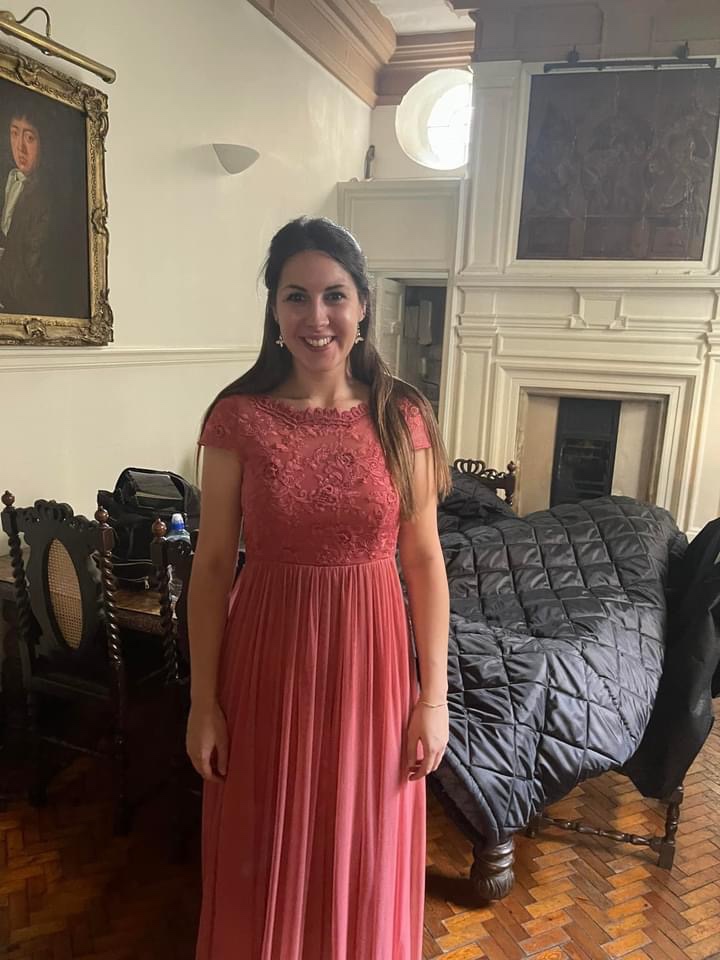
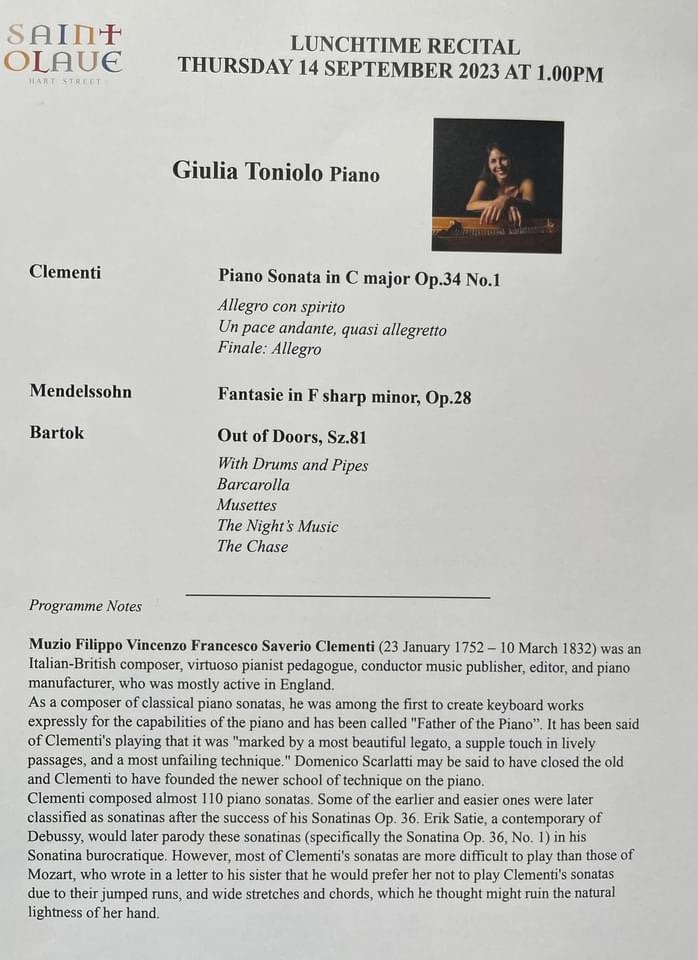
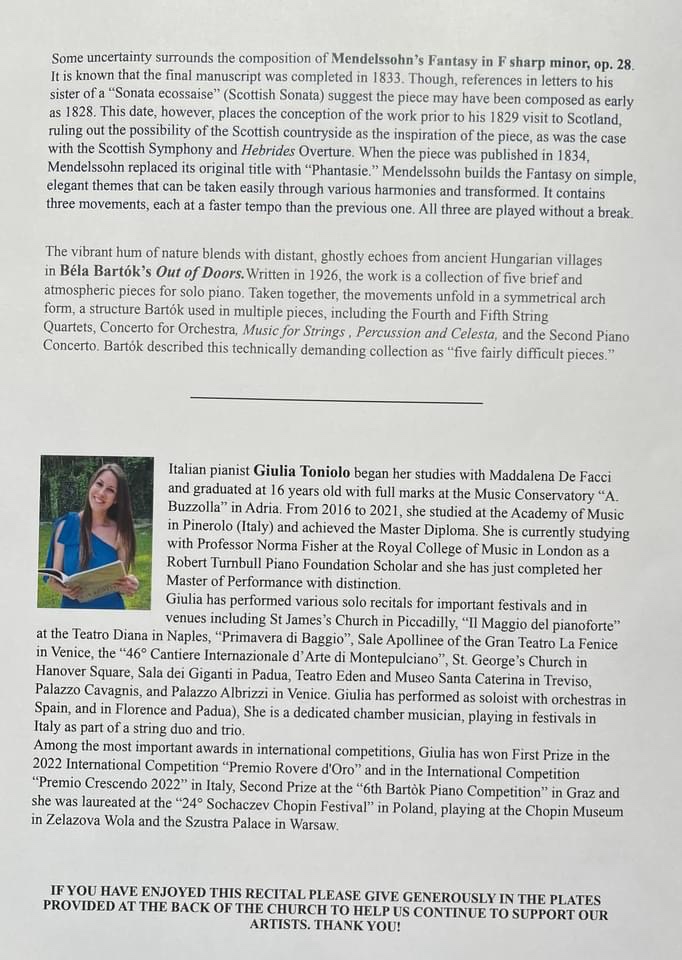
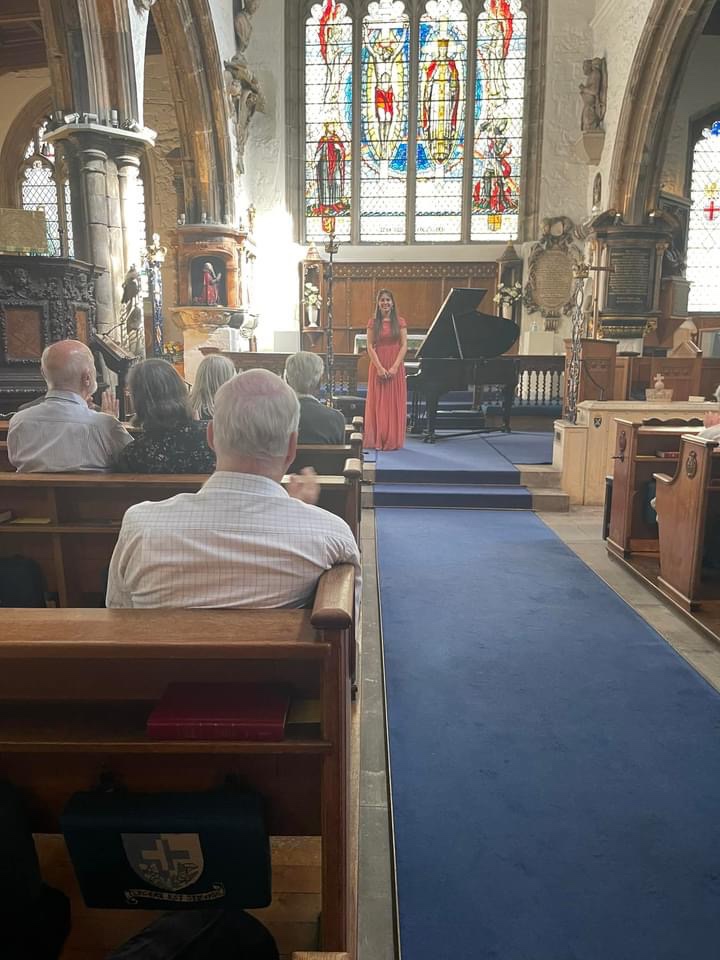
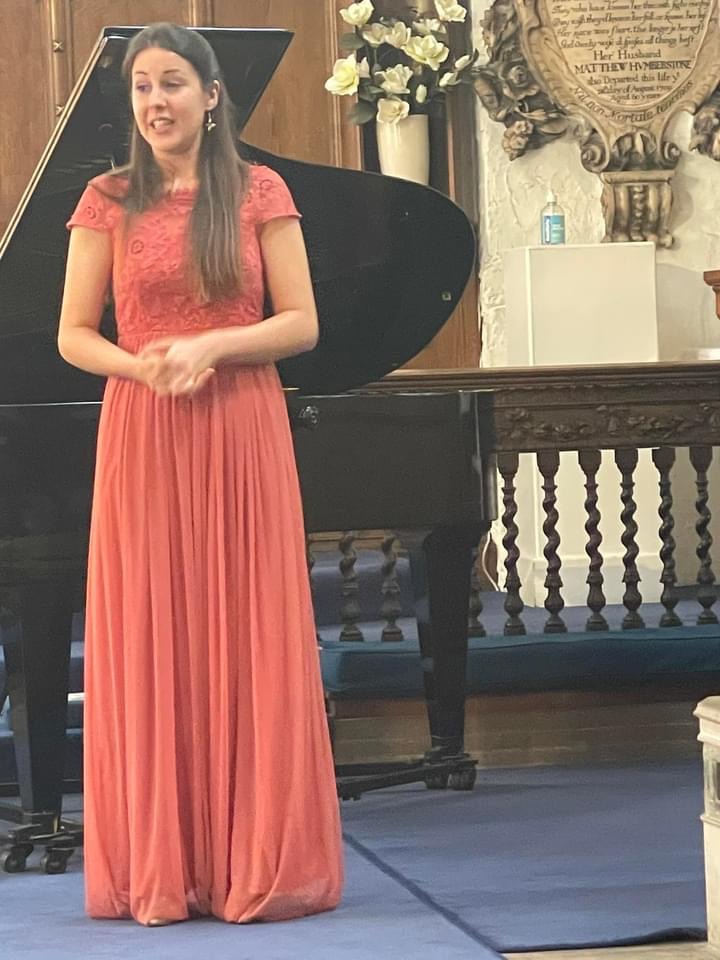
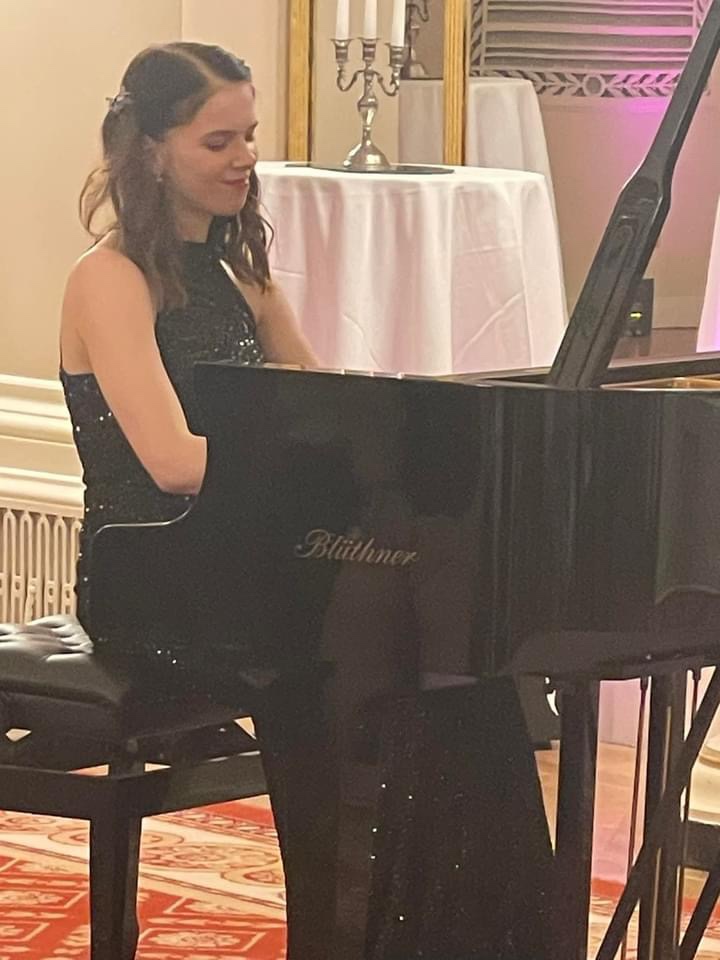
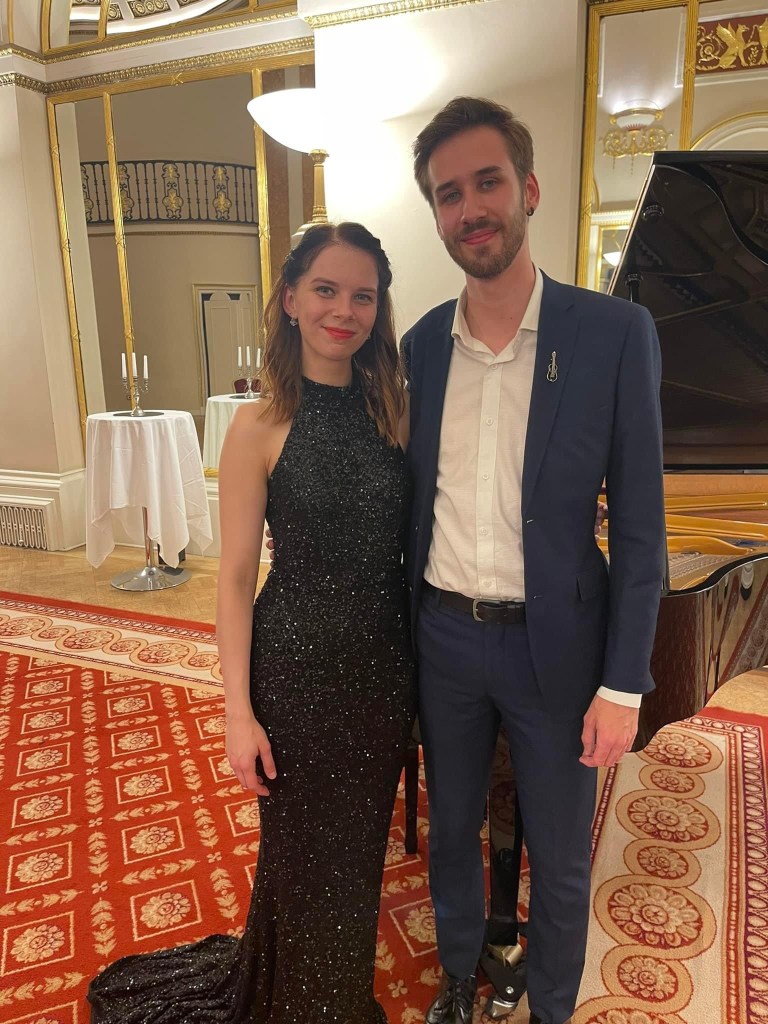
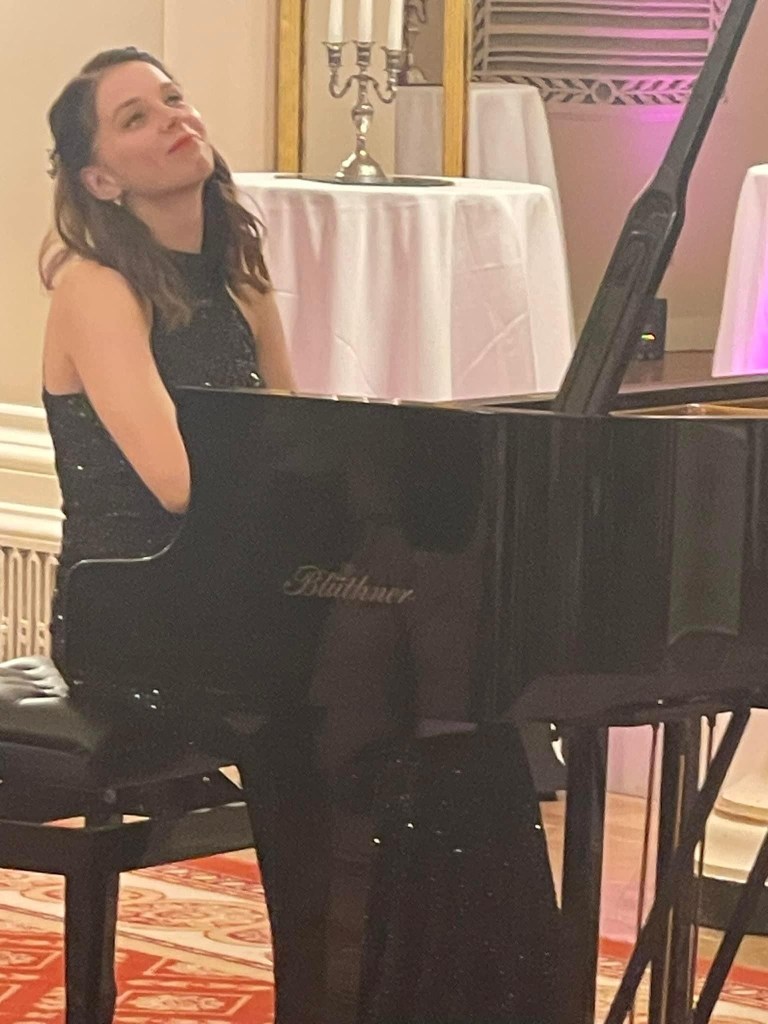
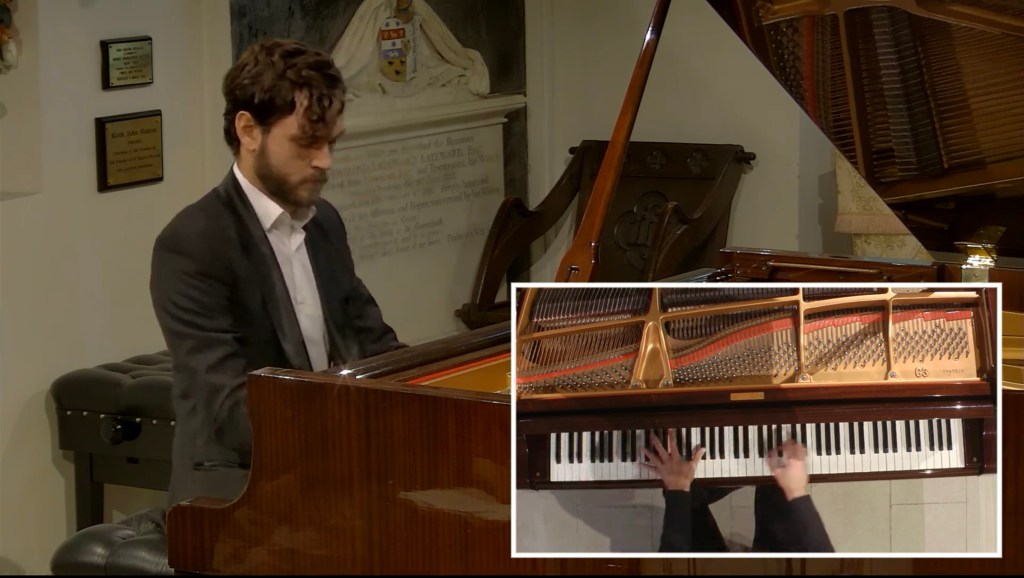
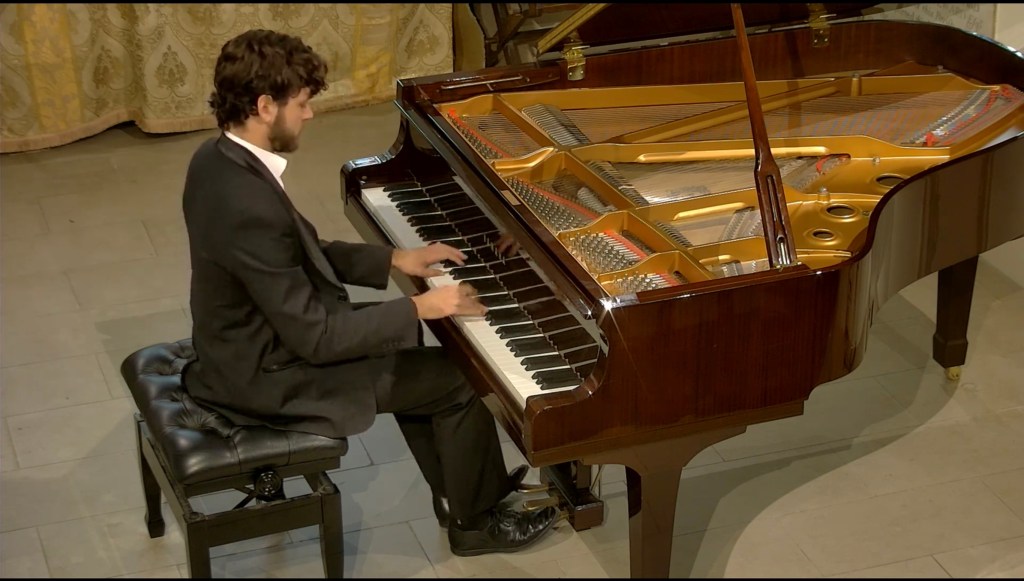
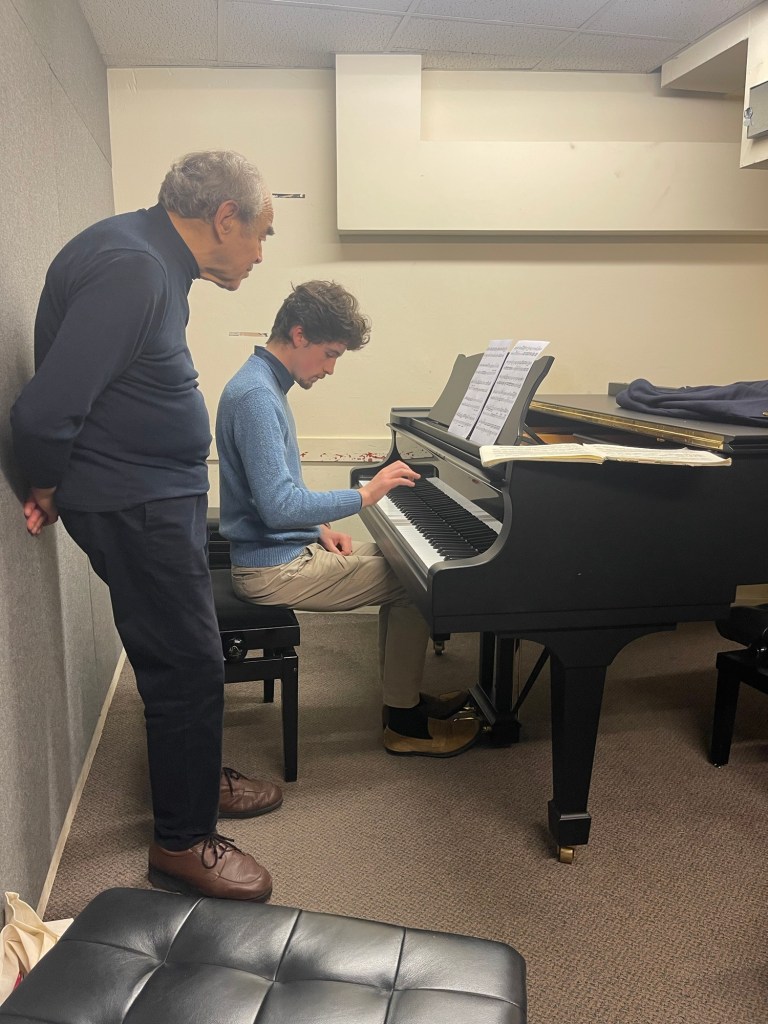
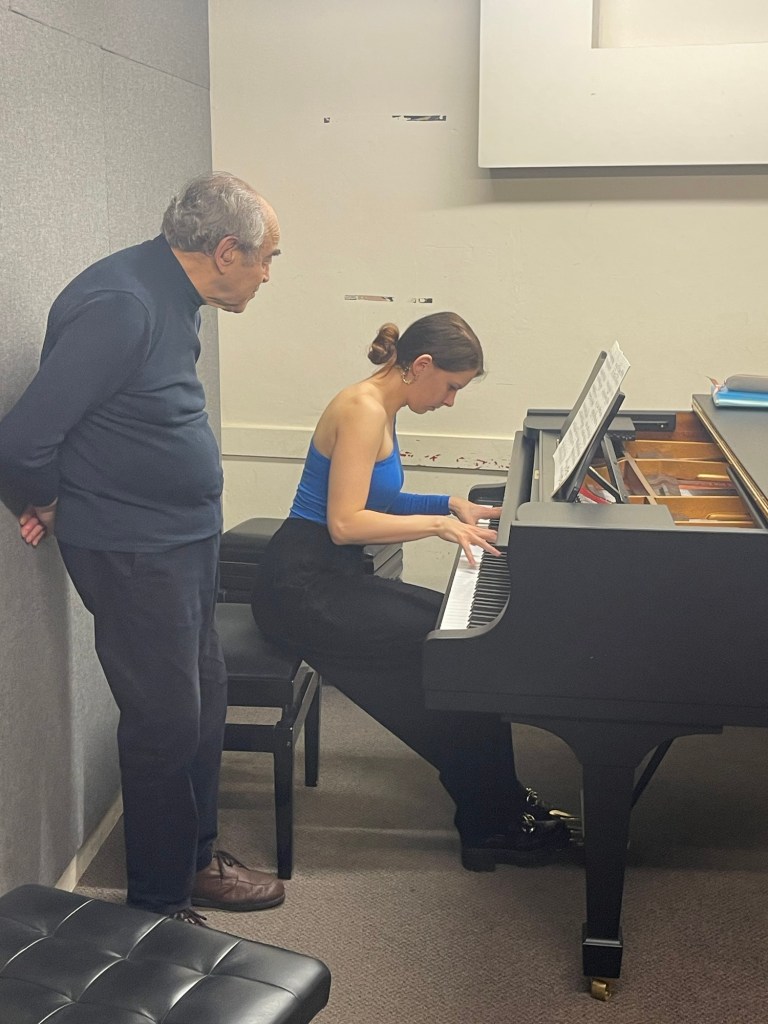
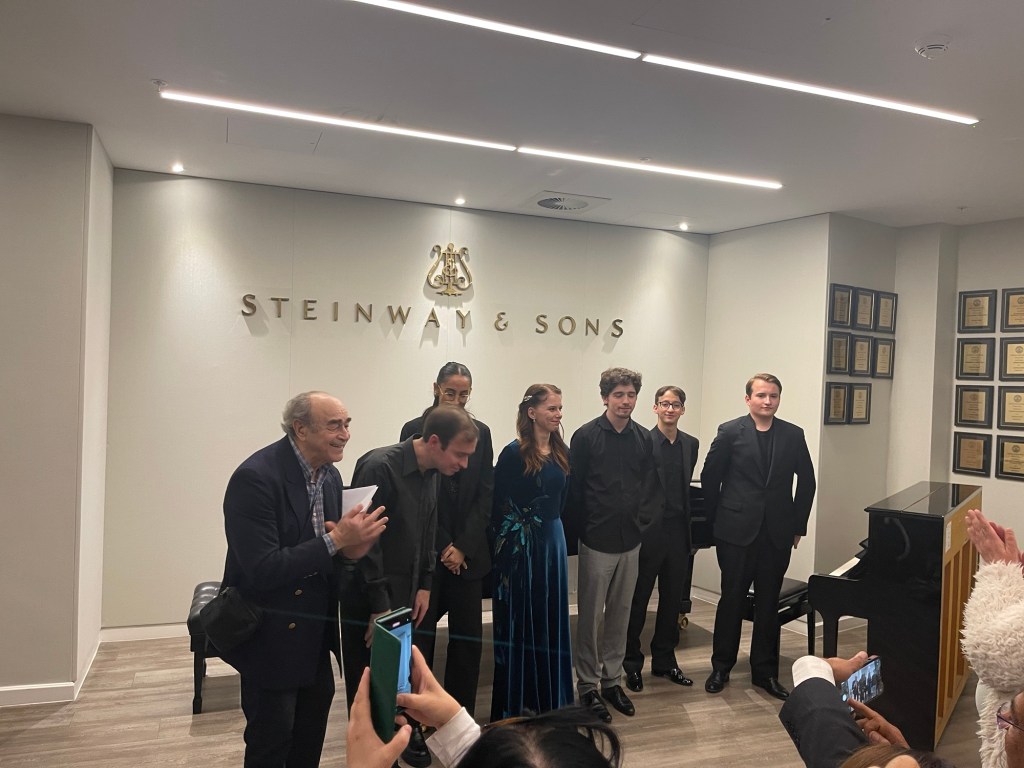
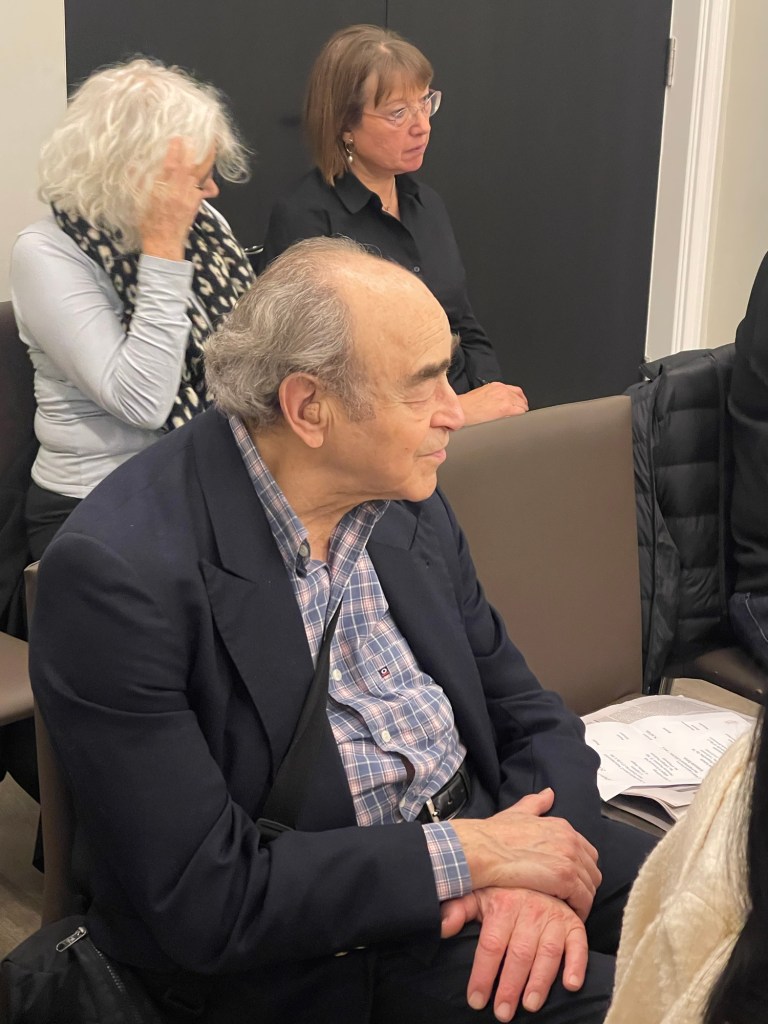
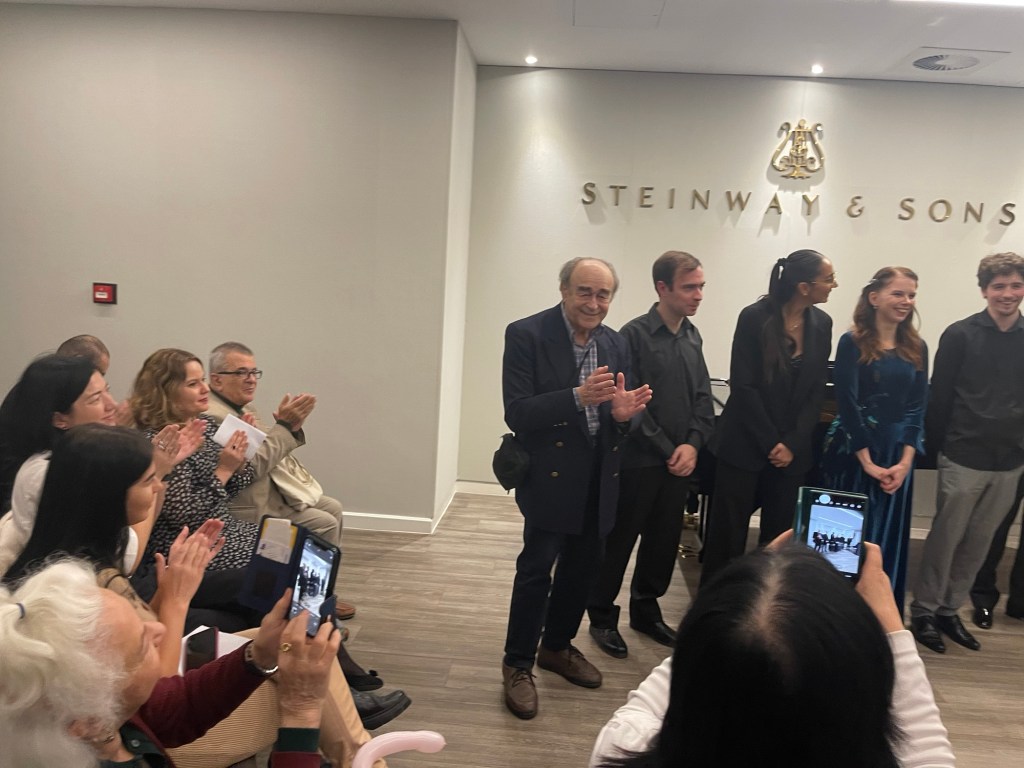
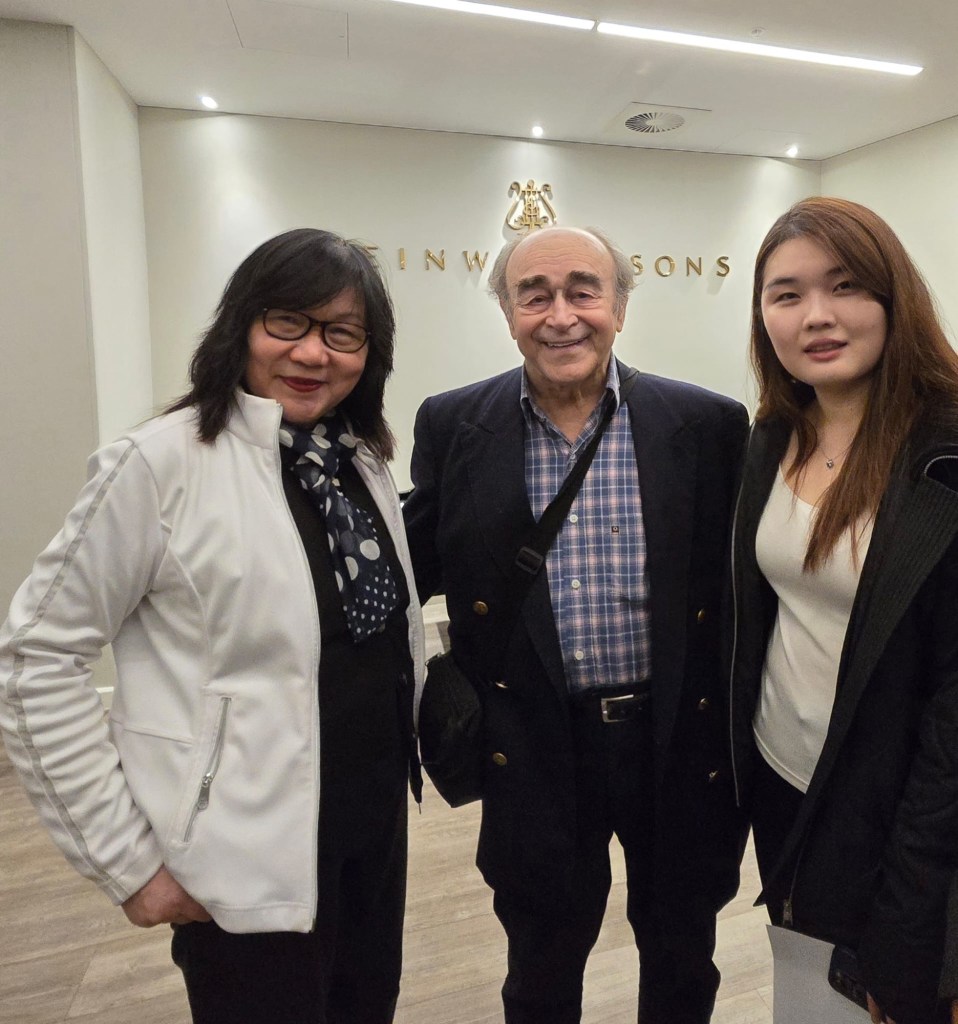
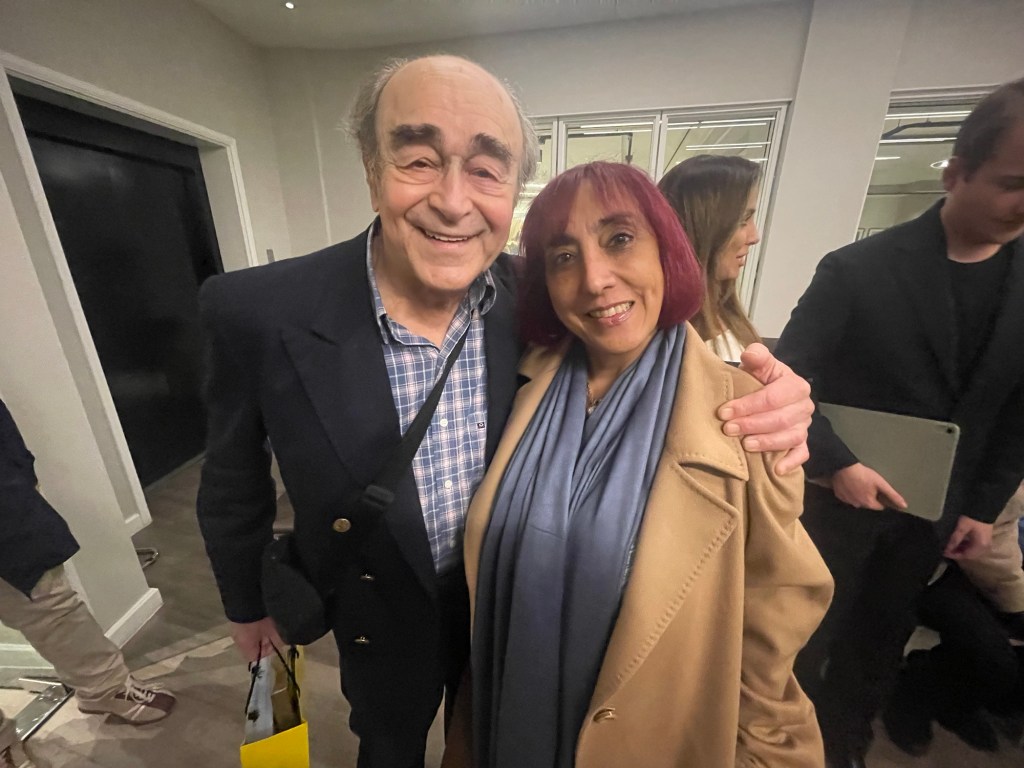
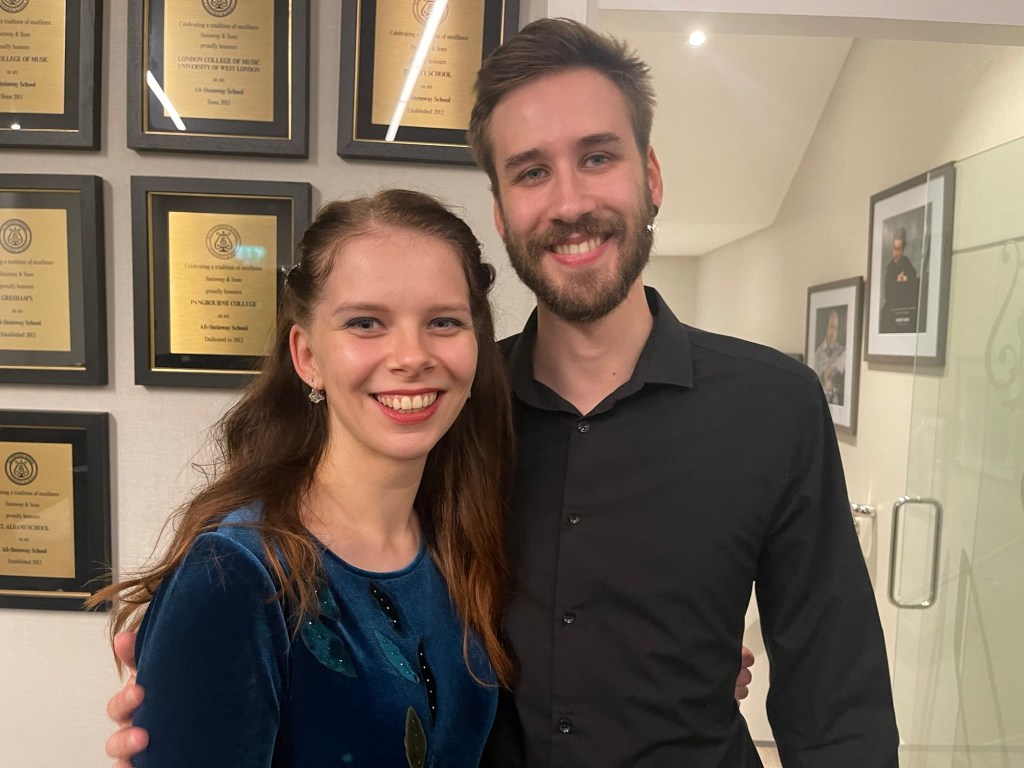
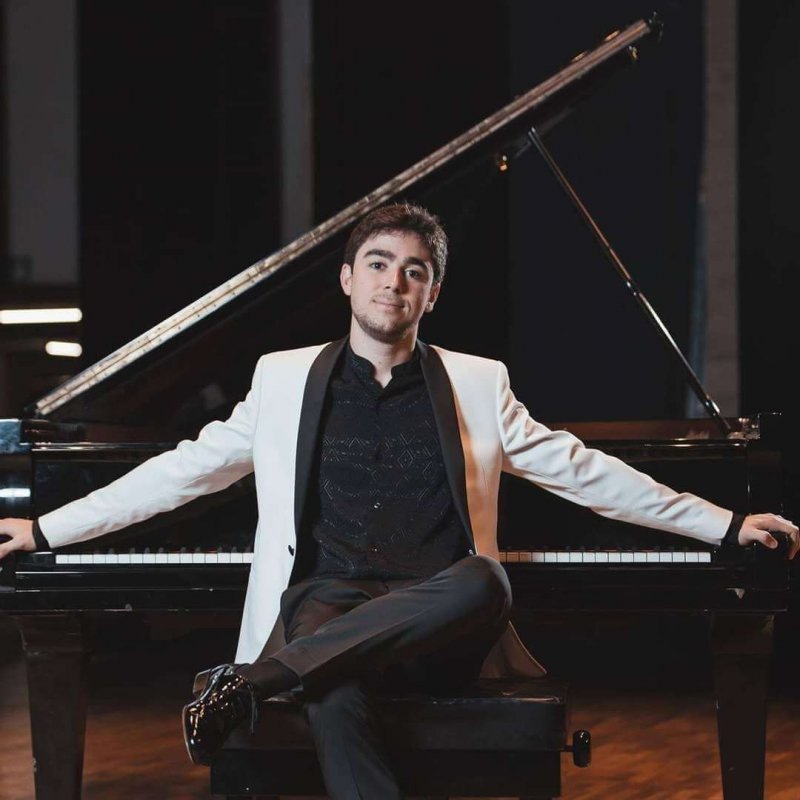
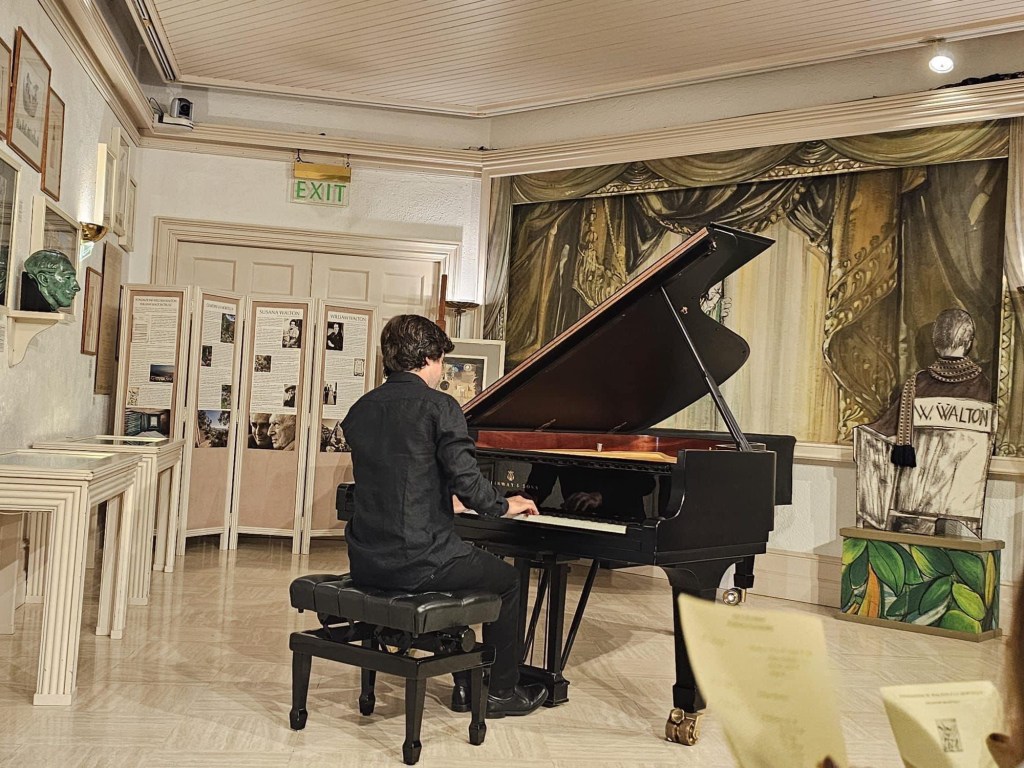
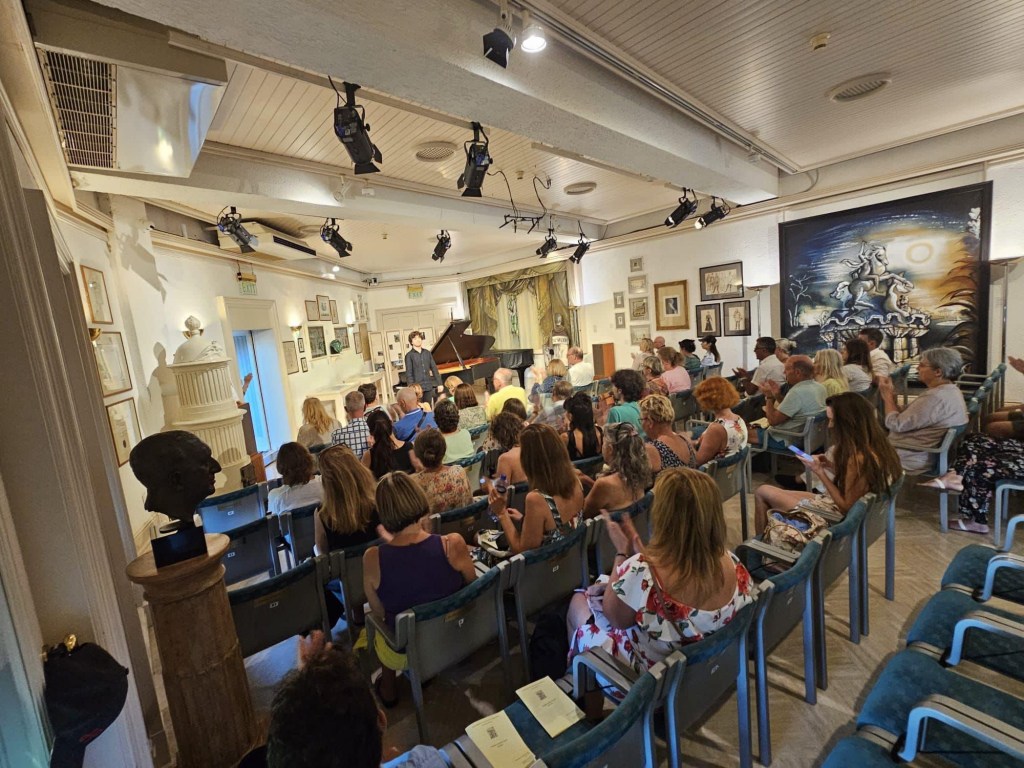
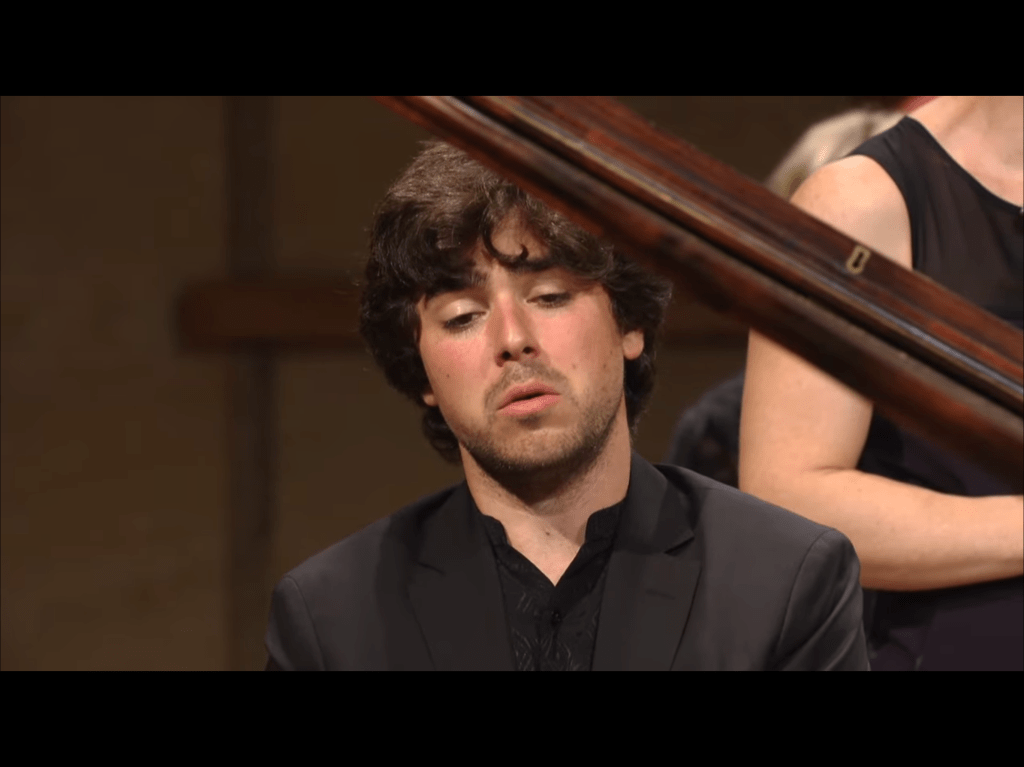
Some superb musicianly playing from Giulia Toniolo as you might expect from the class of Norma Fisher and Maddalena De Facci.St Olave’s an oasis of peace amongst the ever changing landscape that now surrounds the Tower of London.
St Olave’s dwarfed by its surroundings
An old Bosendorfer piano acquired some years ago from Wilfred Parry at the Royal Academy of Music and surrounded by the beautiful historic interior of St Olave’s so cruelly treated during the war but that now what has survived belies the fast moving world on its doorstep. I had heard Giulia a few years ago in the masterclasses in Siena of Lilia Zilberstein and listening now two years on I am amazed by the authority and technical command she has acquired in these years of intensive study with Norma Fisher.
It is of course a question of musicianship and understanding the very structure of music – the very rock on which it is constructed.It is on this rock that a musician can grow and sow the seeds of interpretations of honesty,integrity and authority. Chopin would describe the word rubato as roots firmly planted in the ground but the branches free to move every way the wind will take them. I well remember Norma’s playing from when our mutual teacher in our early years,Sidney Harrison,would to take me to listen to his star student as she became a household name in the concert halls of the world.
It was just this solidity that made everything Giulia did speak with such authority and inevitability.There were no frills or thrills but there was transcendental drive and masterly control with an architectural coherence that gave such shape to the edifice that was being constructed before our very eyes.
Her technical command was demonstrated by a performance of Bartok’s Suite Out of Doors that I have rarely heard played with such authority and drive but also with an exquisite kaleidoscope of sounds that could bring Bartok’s extraordinary Hungarian peasant landscape to life.The barberic attack of the Drums contrasted with the extraordinary fluidity of the Pipes, and the strident final outcry was of devastating effect.A Barcarolle that was a moving plasma of weaving sounds before the delicate pungent dissonances of the Musette.Giulia’s transcendental control of sound brought the Night’s music to life with its desolate atmosphere of total darkness out of which the sound of night animals would hoot,sing or scratch but never interrupt the constant night atmosphere made of liquid pianissimo sounds, whereas the animals were making shrieks in the night.I have heard Radu Lupu play it in the first round of the Leeds that he went on to win.It was the first time that I had been aware of sounds from pianississimo to mezzo forte – Richter was soon to show us what this acute mastery of sound could lead to.
Giulia had a beautiful old but badly regulated piano with a broken string from the Rachmaninov Anniversary concert that another of Norma’s former students had given the day before.It was an even more extraordinary ‘tour de force’ from Giulia because the very roots were so firm not even a broken string could shake them.Her playing of the final Chase was breathtaking for its command and relentless drive .An interrupted impromptu seemed just the right encore to offer in the circumstances !Thank you Debussy!
The concert had begun with one of Clementi’s 110 sonatas of which we very rarely hear any in the concert hall.I think if it was played with the authority and conviction as today we would hear a lot more of a composer who was known as the ‘Father of the Piano ‘ and who was mostly active in England.His music is a mixture of the solidity of Beethoven and the mellifluousness of Mendelssohn.Giulia’s sense of balance allowed the melodic lines to sing unimpeded and her total conviction was quite overpowering in its authority.It was interesting to hear one of Mendelssohn’s major works for piano afterwards and it was the deeply felt sentiments of Mendelssohn without any sentimentality that gave great strength to a performance of colour and great fluidity.The last movement were simply streams of sumptuous sounds that poured with such ease from Giulia’s masterly fingers
Amazing there is a piano genius is in our midst ……….Thomas Kelly a new Ogdon ………piano playing the like of which is a once in a lifetime experience . Rachmaninov’s first sonata was performed in the very room where the master gave his last London performance in 1939 ( you can read my review from a recent performance here .
I know the Ogdon recording that was one of the first to appear commercially and I have heard another two remarkable Russian pianists play it recently .They all play with remarkable clarity and phenomenal technical mastery but there is a secret line in this work that is very hard to find.It can turn a problematic work – for Rachmaninov too – into a tone poem of extraordinary poetic potency.
It was Alexandre Kantorow who I heard recently who had found that elusive thread that weaves a maze of notes into a cauldron of potent sounds of great significance.A leit motif that appears throughout and is the thread to this up until now elusive work.Listening to Thomas Kelly recently I was overwhelmed by the importance of a work I had up until now always thought of as the poor brother of the Second Sonata.Thomas Kelly and Alexandre Kantorow had found the elusive thread that gave great cohesion and architectural shape to this early work.They also had a kaleidoscopic range of sounds and a phenomenal technical mastery.
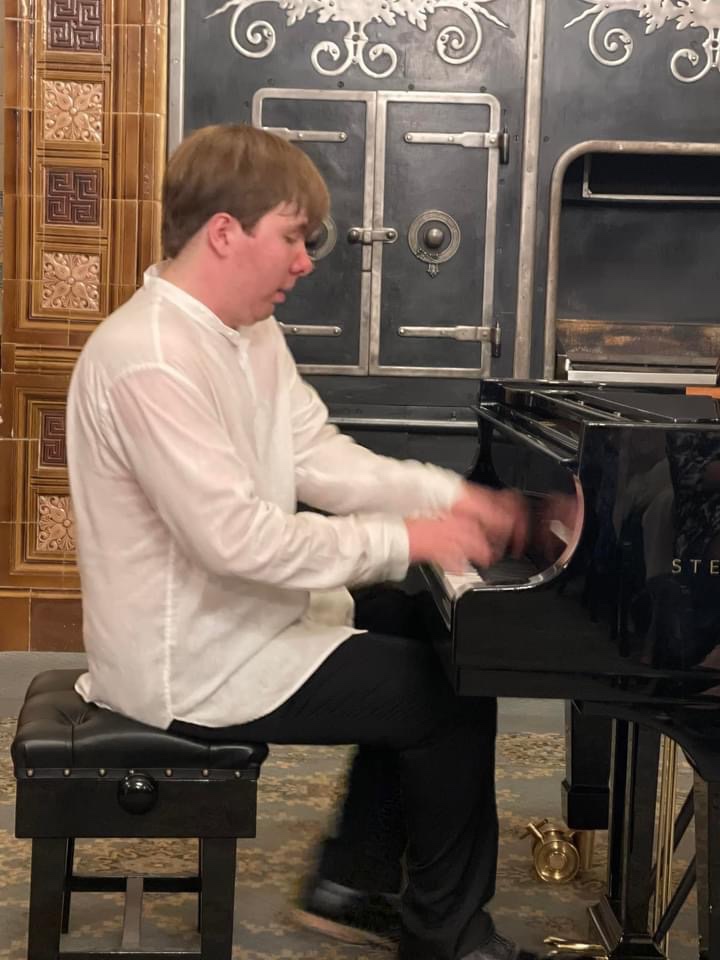
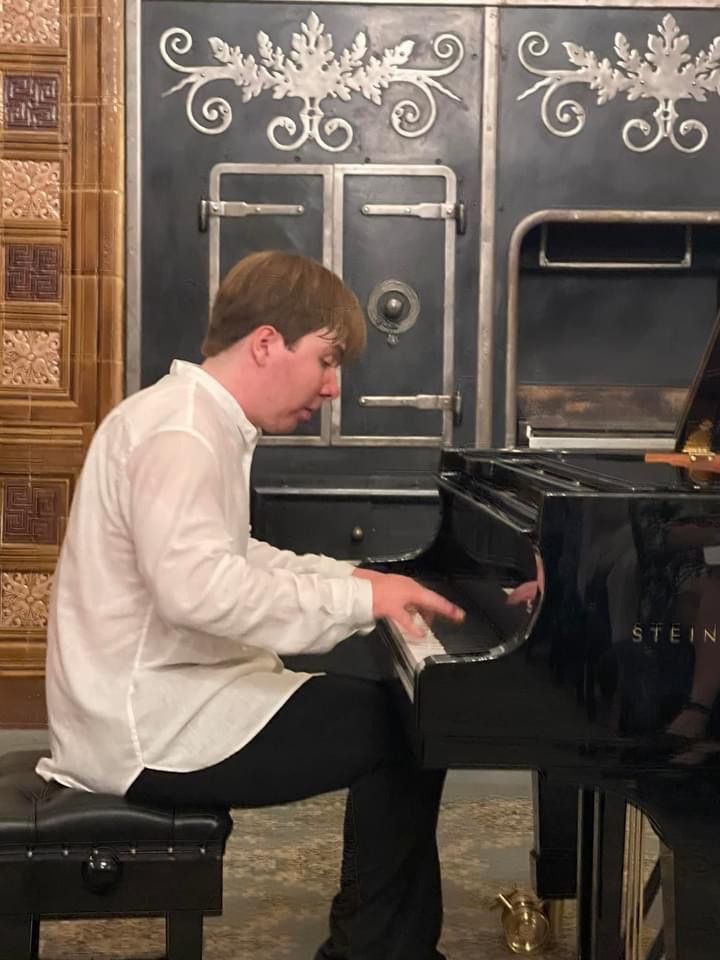
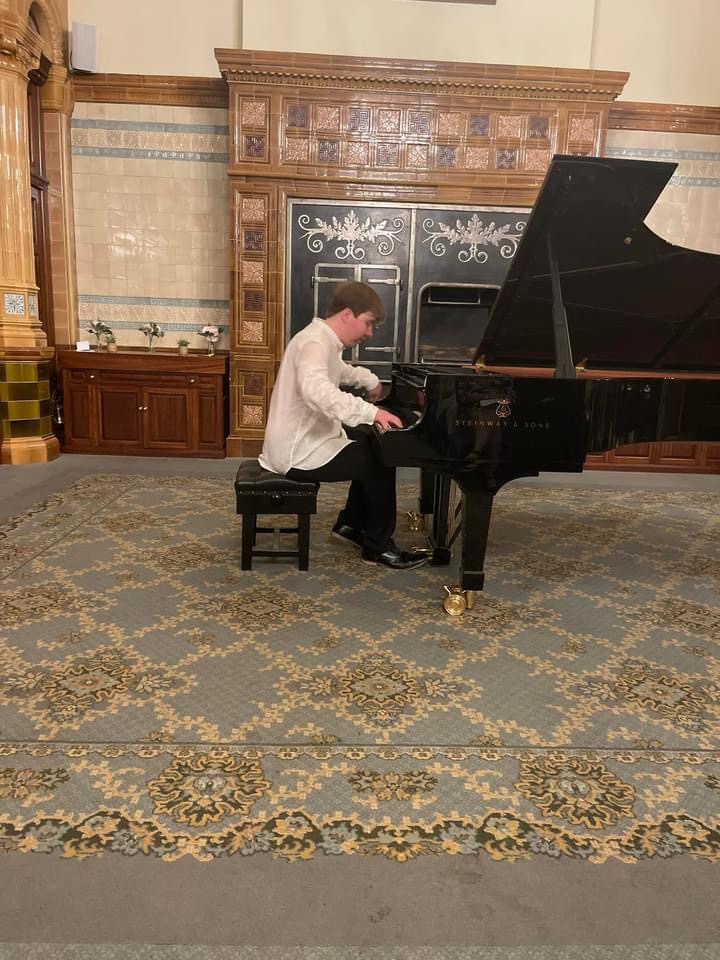
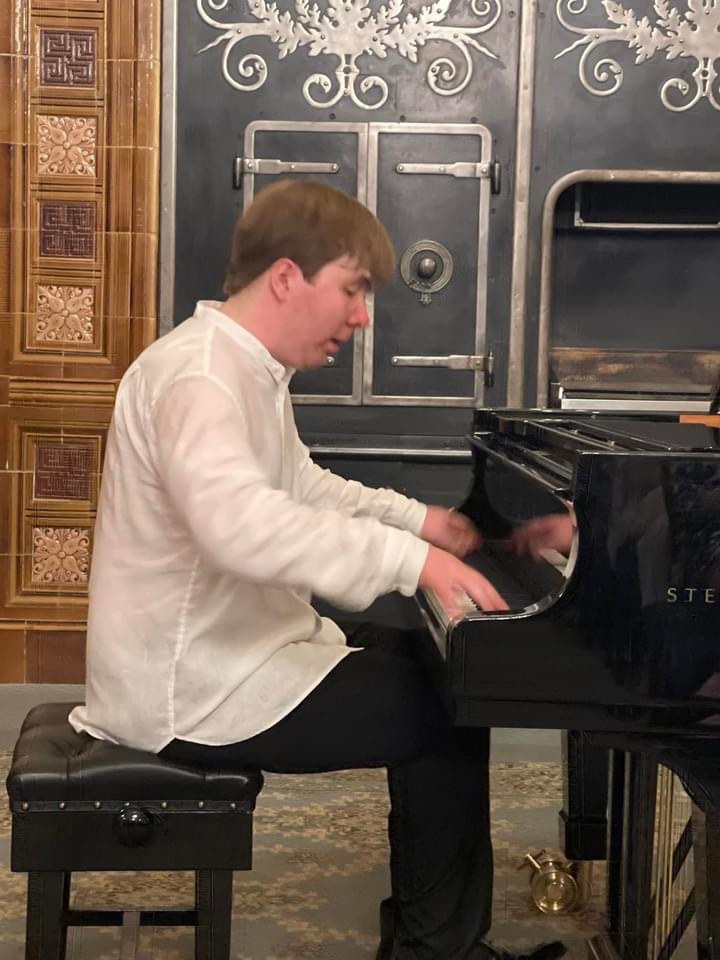
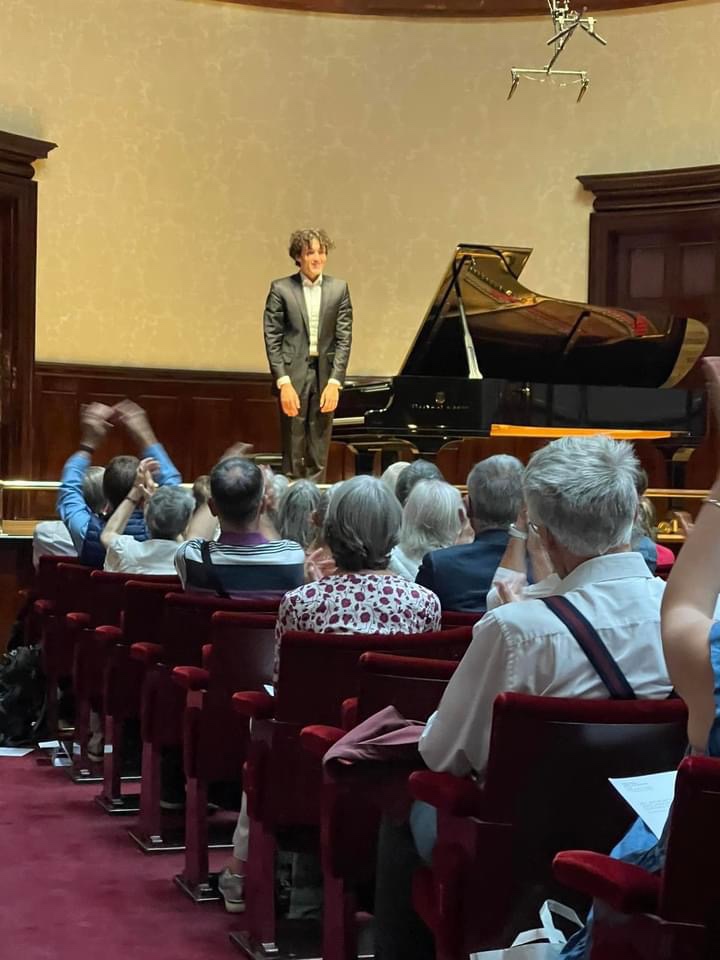
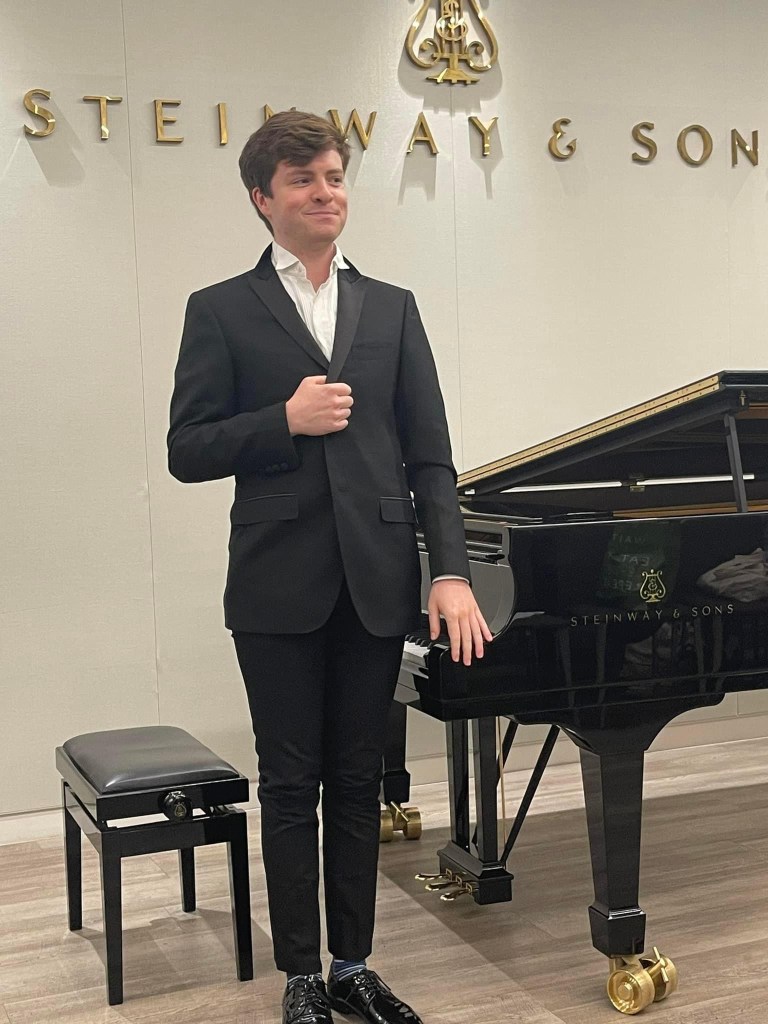
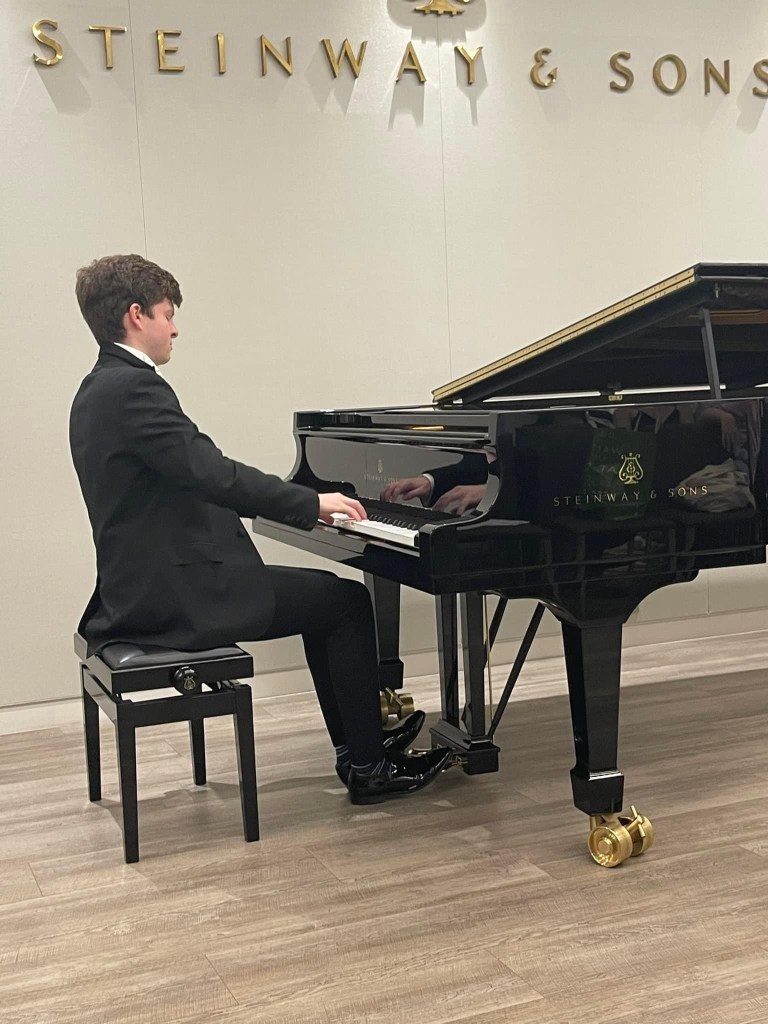
I was amazed last night to watch Tom play with such assurance and mastery hardly moving but watching and listening with absolute authority .There was not a moment of doubt about where all the nuts and bolts should go and like Sokolov he would lean over to strike a bass note at exactly the moment of most impact emotionally and architecturally.I think the Sonata deserves to be in the Guinness book of records for the most notes in the shortest space of time and it was an amazing feat of piano playing of genius from this pianist still only in his early twenties.But there was much more besides as there was a sense of colour and balance and a range of sounds and touch that turned this magnificent Steinway Concert Grand into an orchestra of Philadelphian proportions.
But that was just an opener for the four Liszt Paganini studies of breathtaking virtuosity with the beguiling charm and colours of the masters of the Golden age of piano playing.Rachmaninov’s devilish transcription of the Mendelssohn Scherzo was thrown off with the same ease that Moiseiwitsch (also a member of the Liberal Club) managed to record by the skin of his teeth. Ravishing beauty of Rachmaninov’s own Lilacs was followed by the Mephisto Waltz played with devilish virtuosity and some extra notes added by Busoni and even later by Horowitz.I was surprised that I actually thought the original Liszt was superior to these slight alterations or additions that Busoni ( a pupil of Liszt) had made and the addition of Horowitz that rather spoils the ending with too much sound rather than Liszt’s rather terse single note of much greater effect.Liszt had after all changed the ending of his Sonata from a crowd pleasing triumphant ending to one of the most genial visionary pages in all the romantic piano repertoire.Busoni’s slight additions to La Campanella are quite teasingly and tastefully done whereas his triumphant ending to the Goldberg Variations I find hard to accept just as I found unnecessary in a masterpiece that is Liszt’s original version of the First Mephisto Waltz.
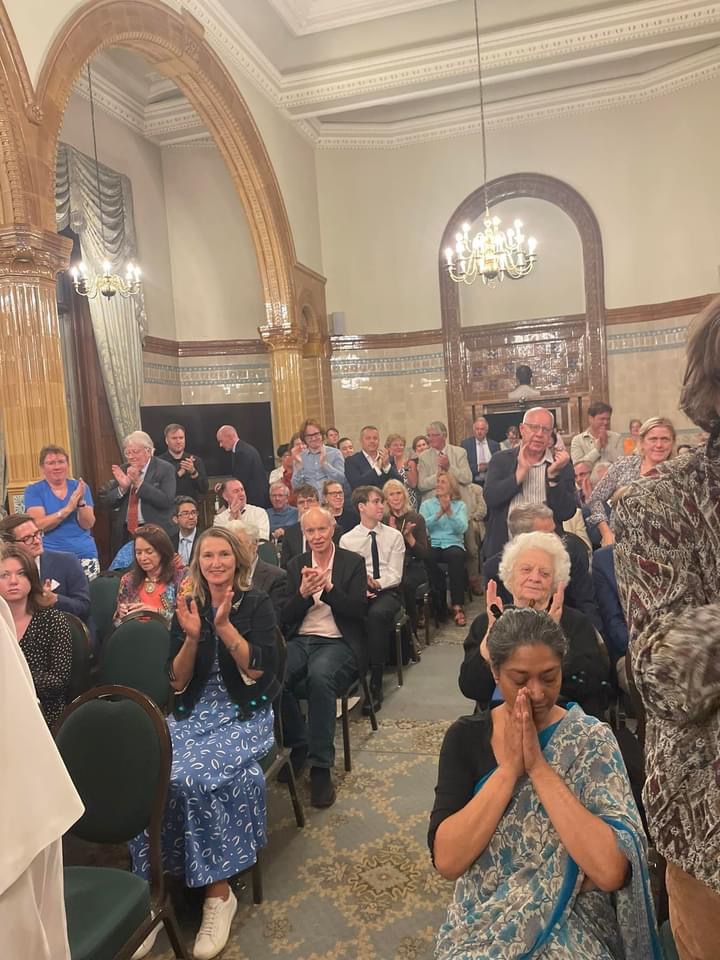
A standing ovation for a piano genius
Scarlatti’s little Sonata in B minor was played with the jeux perlé of other times.Tom had by now entered another world and his Scarlatti had entered this world too and was for my taste a little too ear teasing and unlike the performance i had heard recently as an opening to his concert before the Rachmaninov rather than after .But what artistry and what a musician that can adapt and change like a chameleon to the atmosphere and perfumes of the moment.One expects De Pachmann to talk to the public to tell them how he is getting on or guide them through a performance pointing out moments that might be influenced by this or that colleague.But De Pachmann was an old man and much feted artist – Thomas Kelly still has fifty years to go before he reaches that status!
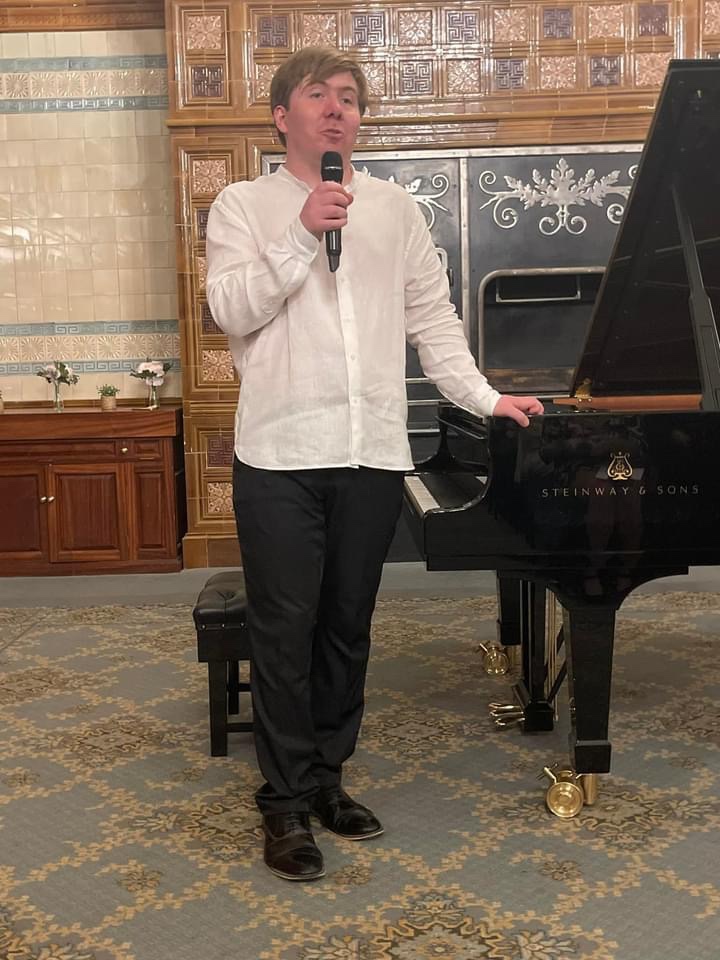
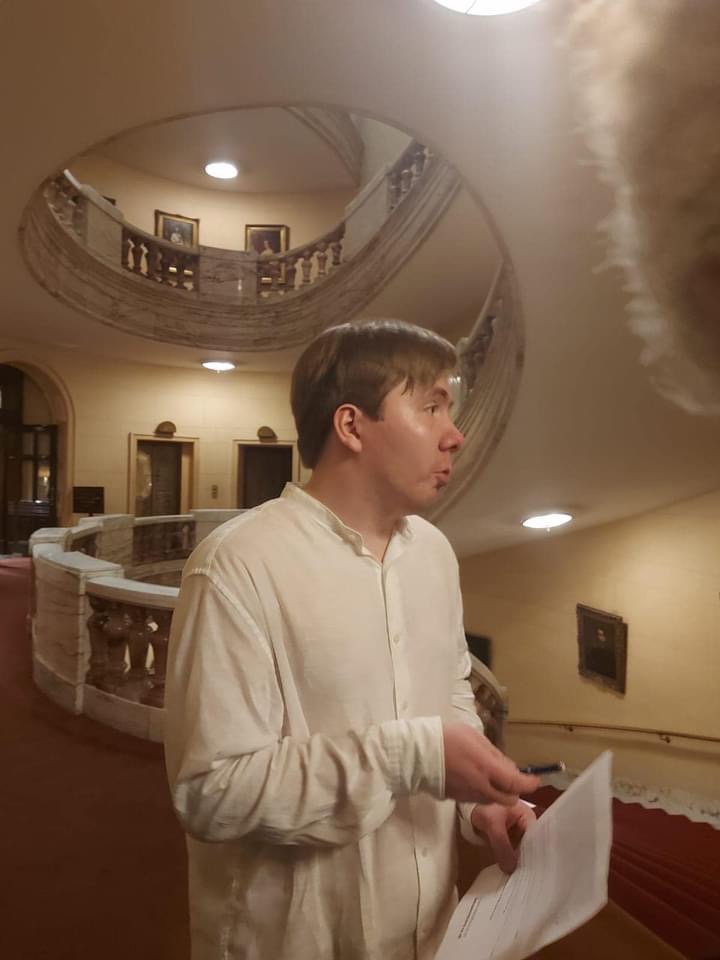
Tom introducing the second half of virtuoso pieces for piano
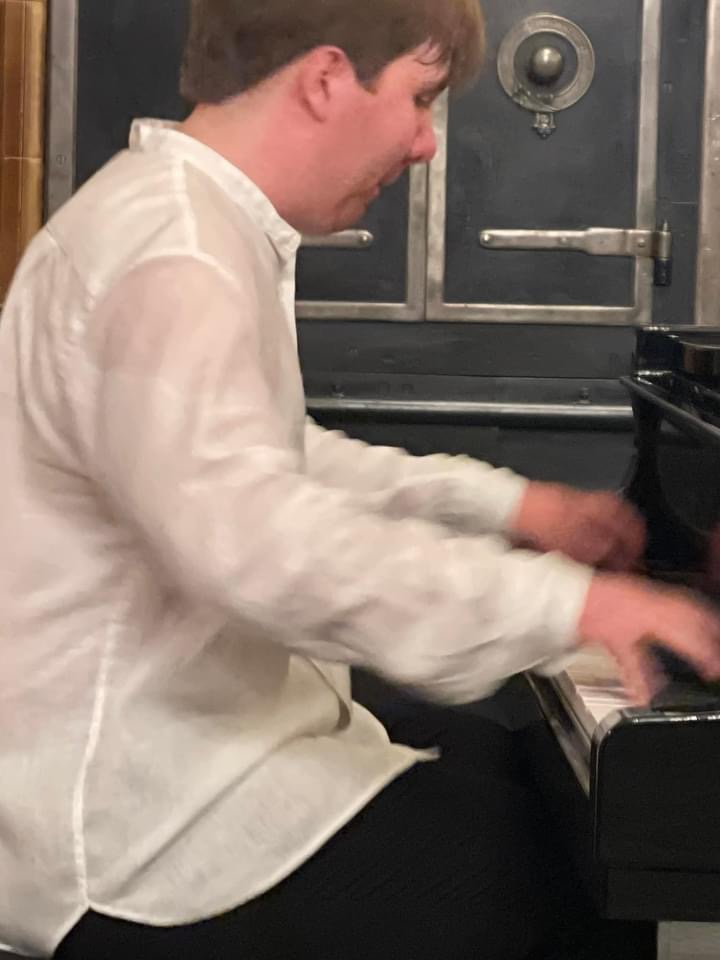
What extraodinary ravishing beauty he brought to the Thalberg Don Pasquale Fantasie A work wrapped up in piano trickery of such ingenious invention that in his day it made him a serious rival for Liszt the virtuoso.Liszt’s genius prevailed though and took him to a visionary world that opened up new vistas that were then taken up by Busoni and so into the next century.Tom’s mastery of style, colour and balance are a potent mixture that with his complete technical mastery can bring this world back to us with beguiling authority.Thomas Kelly – Piano Man !
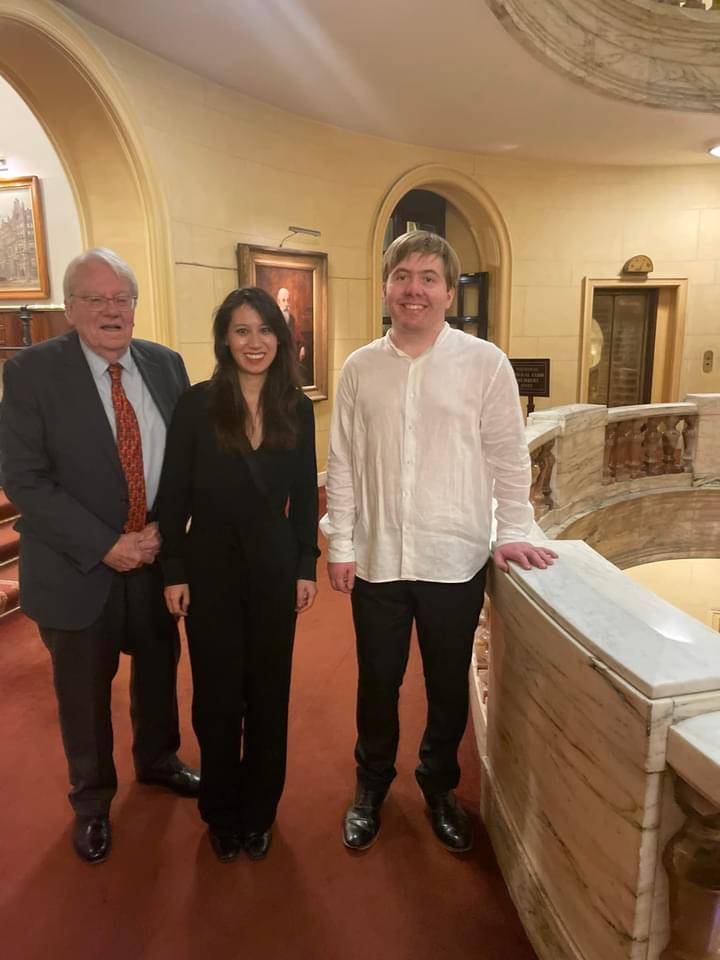
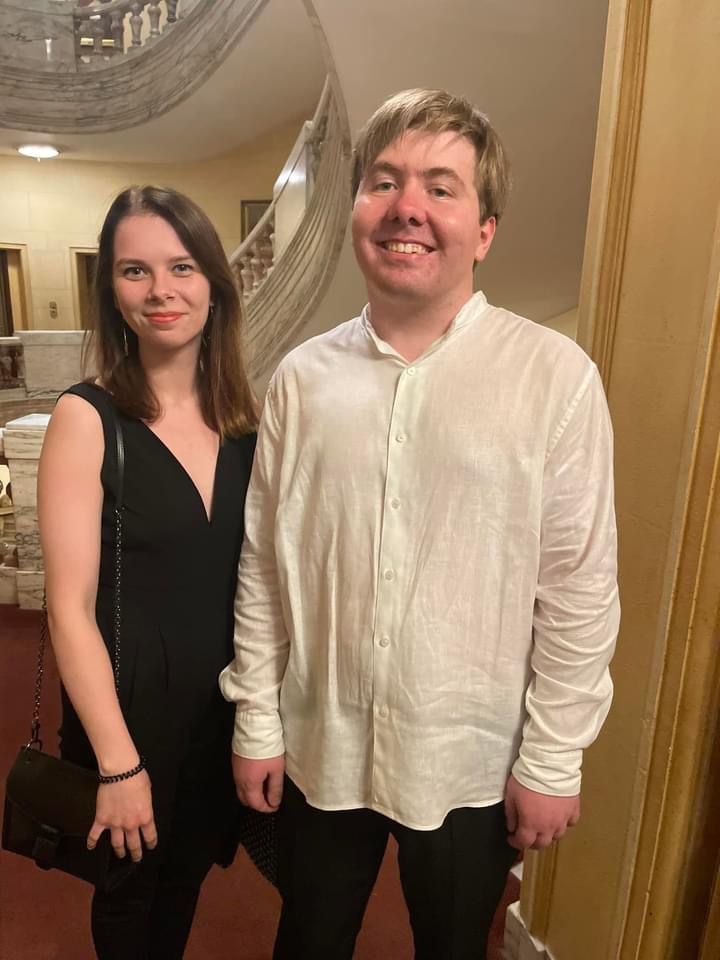
Tom with Peter Whyte chair and Hannah-Elizabeth Teoh c/o artistic director with CrIstian Sandrin
Dr Hugh Mather comments:’Couldn’t agree more. We hear all the up-and-coming pianists at Perivale and I have no doubt that Thomas is in a league of his own. Simply phenomenal. Will be exciting to watch his progress over the next few years.’
David Earl ,the distinguished pianist comments :’This is phenomenal playing of a work I know well, and was inspired to learn thanks to the Ogdon RCA recording. Thomas’s layering of the 3rd movement’s paragraphs, and lyrical inner voicing is possibly the finest performance yet of Opus 28. Truly great. Thank you for posting Christopher.’
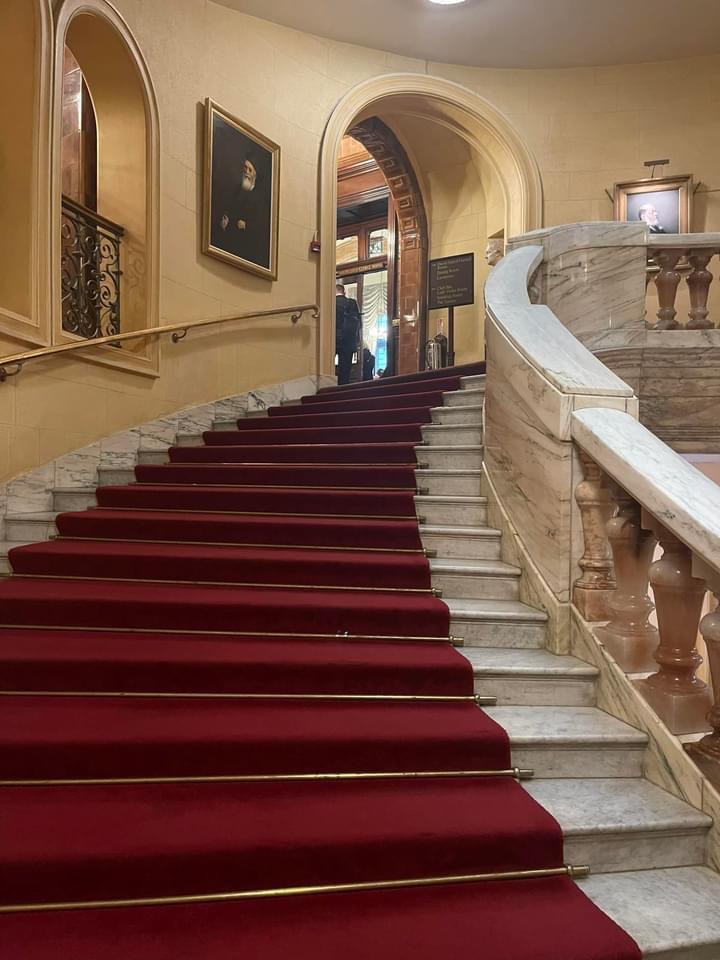
The splendid staircase to the David Lloyd George Concert Hall
In 1939, Rachmaninoff gave his last ever UK recital in the David Lloyd George Room at the National Liberal Club, London. Now, in the very same room, 2021 Leeds finalist Thomas Kelly marks the 150th year since Rachmaninoff’s birth, and the 80th year since his death, with a programme of virtuoso repertoire celebrating Rachmaninoff alongside other legendary pianist-composers.
Rachmaninoff’s formidable Piano Sonata No.1 comprises the first half of his impressive programme, with Liszt and Thalberg highlighted in the second half, culminating with Horowitz’s transcription of Busoni’s arrangement of Liszt’s Mephisto Waltz No. 1 – an emblem of the rich history of virtuoso performers and their role in the creation and development of piano repertoire, fittingly delivered by one of the most exciting young virtuosos of today.
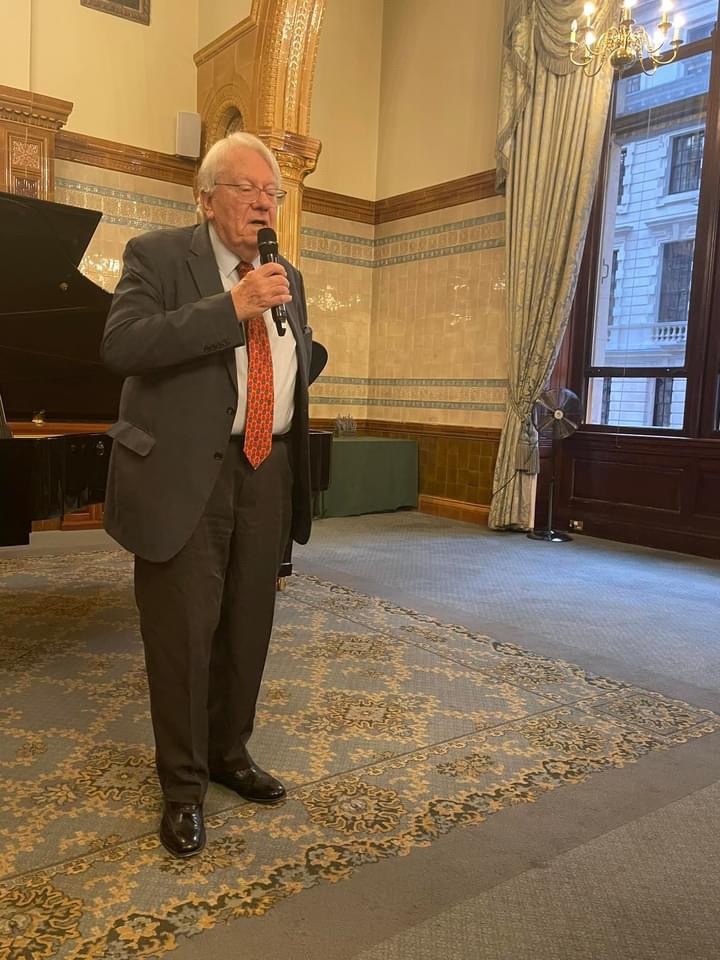
Peter Whyte chairman of the Kettner Society explaining about the presence of Rachmaninov and Moiseiwitsch at the National Liberal Club of which Benno Moiseiwitsch was a member
Programme:
Rachmaninoff Sonata No.1 in D Minor Op.28
INTERVAL
Liszt Paganini Etudes No.2, 3, 4, 6
Thalberg Grande fantasie sur des motifs de l’Opera “Don Pasquale” by Donizetti
Mendelssohn/Rachmaninoff Scherzo from “A Midsummer Night’s Dream”
Rachmaninoff Lilacs Op.21 No.5
Liszt/Busoni/Horowitz Mephisto Waltz No.1
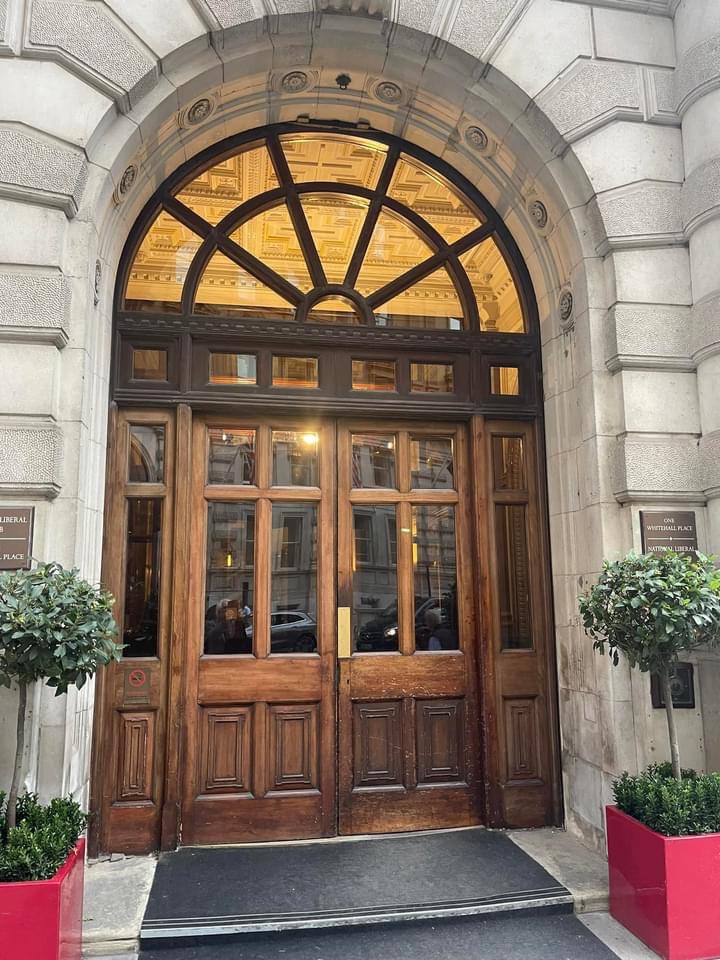
The National Liberal Club
Piano Sonata No. 1 in D minor op 28 was completed in 1908.It is the first of three “Dresden pieces”, along with the symphony n.2 and part of an opera, which were composed in the quiet city of Dresden.It was originally inspired by Goethe’s tragic play Faust,although Rachmaninoff abandoned the idea soon after beginning composition, traces of this influence can still be found.After numerous revisions and substantial cuts made at the advice of his colleagues, he completed it on April 11, 1908. Konstantin Igumnov gave the premiere in Moscow on October 17, 1908. It received a lukewarm response there, and remains one of the least performed of Rachmaninoff’s works.He wrote from Dresden, “We live here like hermits: we see nobody, we know nobody, and we go nowhere. I work a great deal,”but even without distraction he had considerable difficulty in composing his first piano sonata, especially concerning its form.Rachmaninoff enlisted the help of Nikita Morozov , one of his classmates from Anton Arensky’s class back in the Moscow Conservatory, to discuss how the sonata rondo form applied to his sprawling work.Rachmaninov performed in 1907 an early version of the sonata to contemporaries including Medtner.With their input, he shortened the original 45-minute-long piece to around 35 minutes and completed the work on April 11, 1908. Igumnov gave the premiere of the sonata on October 17, 1908, in Moscow,
Lukas Geniusas writes about his premiere recording of the Rachmaninov Sonata n. 1 to be issued in October : ‘About a year ago I came across a very rare manuscript of the Rachmaninov’s Sonata no.1 in its first, unabridged version. It had never been publicly performed. This version of Sonata is not significantly longer (maybe 3 or 4 minutes, still to be checked upon performing), first movement’s form is modified and it is also substantially reworked in terms of textures and voicings, as well as there are few later-to-be-omitted episodes. The fact that this manuscript had to rest unattended for so many years is very perplexing to me. It’s original form is very appealing in it’s authentic full-blooded thickness, the truly Rachmaninovian long compositional breath. I find the very fact of it’s existence worth public attention, let alone it’s musical importance. Pianistic world knows and distinguishes the fact that there are two versions of his Piano Sonata no.2 but to a great mystery there had never been the same with Sonata no.1.’
The Mephisto Waltzes (German: Mephisto-Walzer) are four waltzes composed from 1859 to 1862, from 1880 to 1881, and in 1883 and 1885. Nos. 1 and 2 were composed for orchestra, and later arranged for piano, piano duet and two pianos, whereas nos. 3 and 4 were written for piano only. Of the four, the first is the most popular and has been frequently performed in concert and recorded.
The first Mephisto Waltz is a typical example of programme music taking for its program an episode from Nikolaus Lenau’s 1836 verse drama Faust not Goethe. The following program note, which Liszt took from Lenau, appears in the printed score:
There is a wedding feast in progress in the village inn, with music, dancing, carousing. Mephistopheles and Faust pass by, and Mephistopheles induces Faust to enter and take part in the festivities. Mephistopheles snatches the fiddle from the hands of a lethargic fiddler and draws from it indescribably seductive and intoxicating strains. The amorous Faust whirls about with a full-blooded village beauty in a wild dance; they waltz in mad abandon out of the room, into the open, away into the woods. The sounds of the fiddle grow softer and softer, and the nightingale warbles his love-laden song.
In 1843 Thalberg had married in Paris the daughter of the famous bass Luigi Lablache, widow of the painter Boucher. Attempts at operatic composition proved unsuccessful, with Florinda, staged in London in 1851 and Cristina di Suezia in Vienna four years later. His career as a virtuoso continued until 1863, when he retired to Posilippo, near Naples, to occupy himself for his remaining years with his vineyards. He died in Posilippo in 1871.
Some mystery surrounds the birth and parentage of the virtuoso pianist Sigismond Thalberg, popularly supposed to have been the illegitimate son of Count Moritz Dietrichstein and the Baroness von Wetzlar, born at Pâquis near Geneva in 1812. His birth certificate, however, provides him with different and relatively legitimate parentage, the son of a citizen of Frankfurt, Joseph Thalberg. There seems no particular reason, therefore, to suppose the name Thalberg an invention. Legend, however, provides the story of the Baroness proclaiming him a valley (“Thal”) that would one day rise to the heights of a mountain (“Berg”). Thalberg’s schooling took him to Vienna, where his fellow-pupil the Duke of Reichstadt, the son of Napoleon, almost persuaded him to a military career. Musical interests triumphed and he was able to study with Simon Sechler and with Mozart’s pupil Hummel. In Vienna he performed at private parties, making a particular impression when, as a fourteen-year-old, he played at the house of Prince Metternich. By 1828 he had started the series to compositions that were to prove important and necessary to his career as a virtuoso. In 1830 he undertook his first concert tour abroad, to England, where he had lessons from Moscheles. In 1834 he was appointed Kammervirtuos to the Emperor in Vienna and the following year appeared in Paris, where he had lessons from Kalkbrenner and Pixis.
Paris in the 1830s was a city of pianists. The Conservatoire was full of them, while salons and the showrooms of the chief piano-manufacturers Erard and Pleyel resounded with the virtuosity of Kalkbrenner, Pixis, Herz, and, of course, Liszt. The rivalry between Thalberg and Liszt was largely fomented by the press. Berlioz became the champion of the latter, while Fétis trumpeted the achievements of Thalberg. Liszt, at the time of Thalberg’s arrival in Paris, was in Switzerland, where he had retired with his mistress, the Comtesse Marie d’Agoult. It was she who wrote, under Liszt’s name, a disparaging attack on Thalberg, to which Fétis replied in equally offensive terms. The so-called “revolutionary princess”, Princess Belgiojoso, achieved a remarkable social coup when she persuaded the two virtuosi to play at her salon, in a concert in aid of Italian refugees. As in other such contests victory was tactfully shared between the two. Thalberg played his Moses fantasy, and Liszt answered with his new paraphrase from Pacini’s opera Niobe. The Princess declared Thalberg the first pianist in the world, while Liszt was unique. She went on to commission a series of variations on a patriotic theme from Bellini’s I Puritani from the six leading pianists in Paris, to which Liszt, Thalberg, Chopin, Pixis, Herz and Czerny contributed. This composite work, Hexaméron, remained in Liszt’s concert repertoire.The first of these operas was written in the winter of 1842 and performed early in January the following year in Paris. The elderly Don Pasquale attempts late marriage, with the purpose of siring children and thus disinheriting his nephew Ernesto. He is induced to see reason by what he supposes to be a real marriage to his nephew’s betrothed, disguised and behaving as an untamed shrew. All ends happily, when Don Pasquale agrees, with relief, to allow his nephew to marry the girl. Thalberg’s fantasy captures something of the spirit, humour and romance of its source
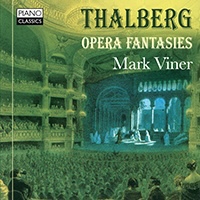
Mark Viner another great English virtuoso dedicated to bringing a forgotten world back to life with mastery and artistry .A swashbuckling extravaganza of nineteenth century pianism and a veritable contribution to Romantic Revivalism. This, Mark Viner’s début recording, presents the operatic paraphrases of the neglected pianist‐composer Sigismond Thalberg, aristocratic rival of Liszt and innovator of the so‐called ‘three‐hand effect’. Here are some of the very finest of his works – a music of opulent grandeur which draws upon all the heady romantic rhetoric and dramatic narrative of the opera house whilst being sumptuously conceived for the piano. A tour de force of virtuosity and an evocation of an era. Mark Viner is one of the most exciting young British pianists of his generation. 1st prize winner of the 2012 Alkan‐Zimmerman Competition in Athens, he is also the Chairman of the Alkan Society and is steadily gaining a reputation for his bold championing of unfamiliar pianistic terrain.
Lilacs (Siren) was composed by Rachmaninov in April 1902, along with ten other songs that were then combined with an earlier piece, Fate (1900), into the opus 21 set of 12 Songs published by Guthiel in December 1902. Rachmaninov was married to Nathalie Satin in April 1902 and wrote this set largely to help pay for their honeymoon, which lasted until August. In June,he wrote to his friend Nikita Morozov, “these songs were written in a hurry and are quite unfinished and unbeautiful. But they’ll almost have to stay this way, as I don’t have time to tinker with them further. It would be nice to get done with all this dirty work by the July 1st so I can get to work on something new.”
In the morning, at daybreak,
over the dewy grass,
I will go to breathe the crisp dawn;
and in the fragrant shade,
where the lilac crowds,
I will go to seek my happiness...

In life, only one happiness
it was fated for me to discover,
and that happiness lives in the lilacs;
in the green boughs,
in the fragrant bunches,
my poor happiness blossoms...
The poem is by Ekatrina Beketova , an eighteenth-century Russian poet; it describes bunches of lilac flowers as “where happiness lives.”
Around 1908, Rachmaninov began to receive bouquets of lilacs at his performances from an anonymous admirer at every concert or recital Rachmaninov gave, no matter where he was appearing in the world, through 1918.Madame Felka Rousseau of Russia identified herself to Rachmaninov as the mysterious donor of the lilacs. She stated that she would’ve preferred to have remained anonymous, but was curious as to why so much time had gone by since he had appeared in Russia.He explained that as long as the current political situation remained as it was in Russia, it was unlikely that he would be able to return at all. Soon after that, the lilacs stopped coming.
Lilacs was one of only two of Rachmaninov’s own songs that he adapted into solo piano transcriptions. He made the arrangement around 1913 and often used it as an encore piece. He recorded it three times, the first such recordings being made for Victor in 1920, the second as an Ampico piano roll sometime in the 1920s, and the last time at his final recording session held at the RCA studio in Hollywood on February 6, 1942. This last version would not be released until long after Rachmaninov’s death.
Thomas Kelly was born in November 1998. He started playing the piano aged 3, and in 2006 became Kent Junior Pianist of the Year and attained ABRSM Grade 8 with Distinction. Aged 9, Thomas performed Mozart Concerto No. 24 in the Marlowe Theatre with the Kent Concert Orchestra. After moving to Cheshire, he regularly played in festivals, winning prizes including in the Birmingham Music Festival, 3rd prize in Young Pianist of The North 2012, and 1st prize in WACIDOM 2014. Between 2015 and 2021 Thomas studied with Andrew Ball, firstly at the Purcell School of Music and then at the Royal College of Music. Thomas has also gained inspiration from lessons and masterclasses with musicians such as Vanessa Latarche, William Fong, Ian Jones, Tatiana Sarkissova, Valentina Berman, Boris Berman, Paul Lewis, Mikhail Voskresensky and Dina Yoffe. Thomas began studying with Dmitri Alexeev in April 2021, with whom he will continue whilst studying Masters at the RCM.Thomas has won 1st prizes including Pianale International Piano Competition 2017, Kharkiv Assemblies 2018, at Lucca Virtuoso e Bel Canto festival 2018, RCM Joan Chissell Schumann competition 2019, Kendall Taylor Beethoven competition 2019, BPSE Intercollegiate Beethoven competition 2019 and the 4th Theodor Leschetizky competition 2020. In 2021 Thomas was a finalist in the Leeds International Piano Competition. Most recently, he was awarded 2nd prize and special prize for best semi-final performance at Hastings International Concerto Competition 2022.He has performed in a variety of venues, including the Wigmore Hall, the Cadogan Hall, St John’s Smith Square, Steinway Hall London, Holy Trinity Sloane Square, St James’ Piccadilly, Oxford Town Hall, St Mary’s Perivale, St Paul’s Bedford, the embassies of Russia and Brazil in London, the Poole Lighthouse Arts Centre, the Stoller Hall, Leeds Town Hall, at the North Norfolk Music Festival, Paris Conservatoire, the StreingreaberHaus in Bayreuth and separately at the Teatro Del Sale and the British Institute in Florence.Thomas is supported by the Kendall-Taylor award. He has been generously supported by the Keyboard Charitable Trust since 2020, and Talent Unlimited since 2021.
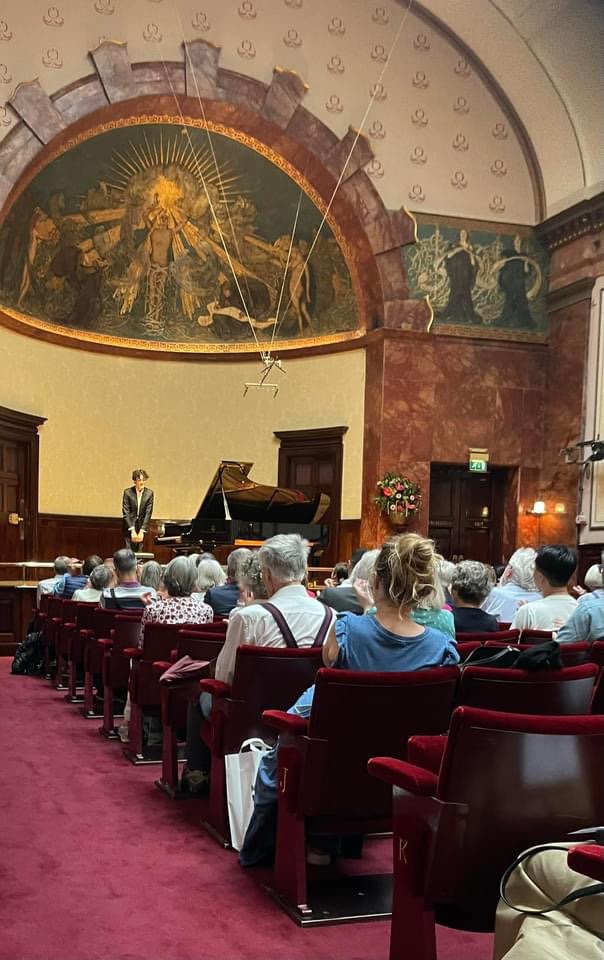
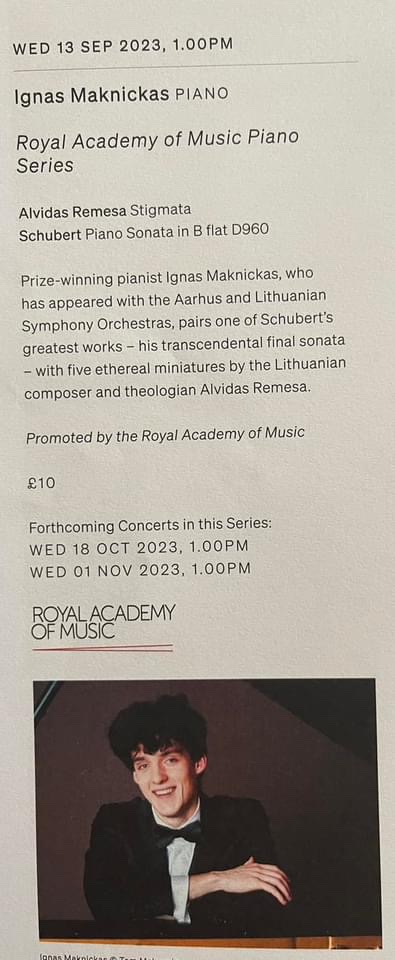
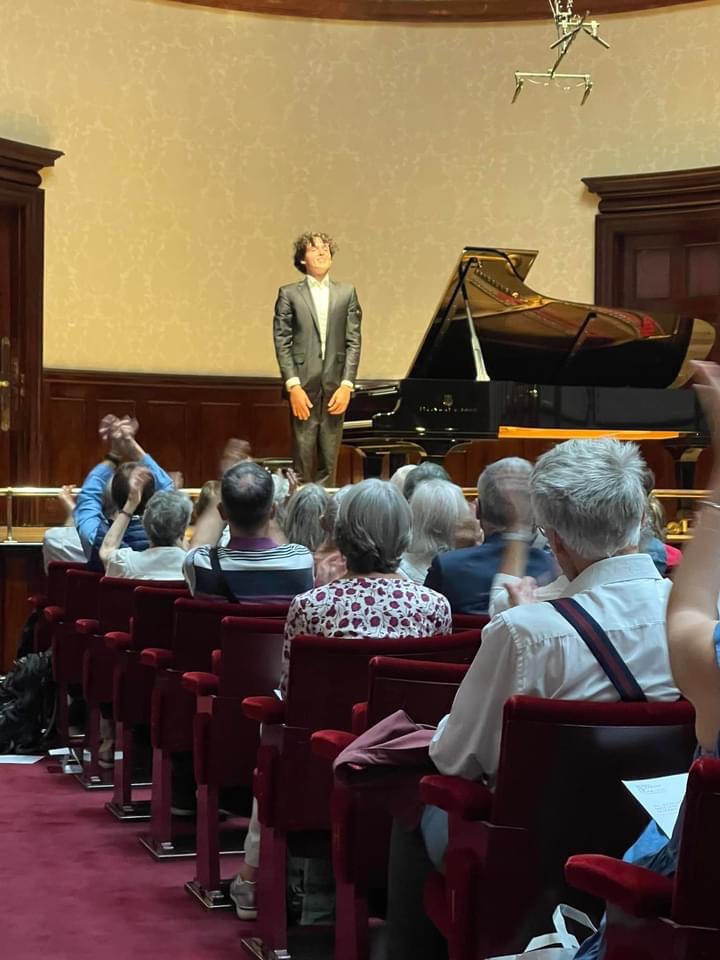
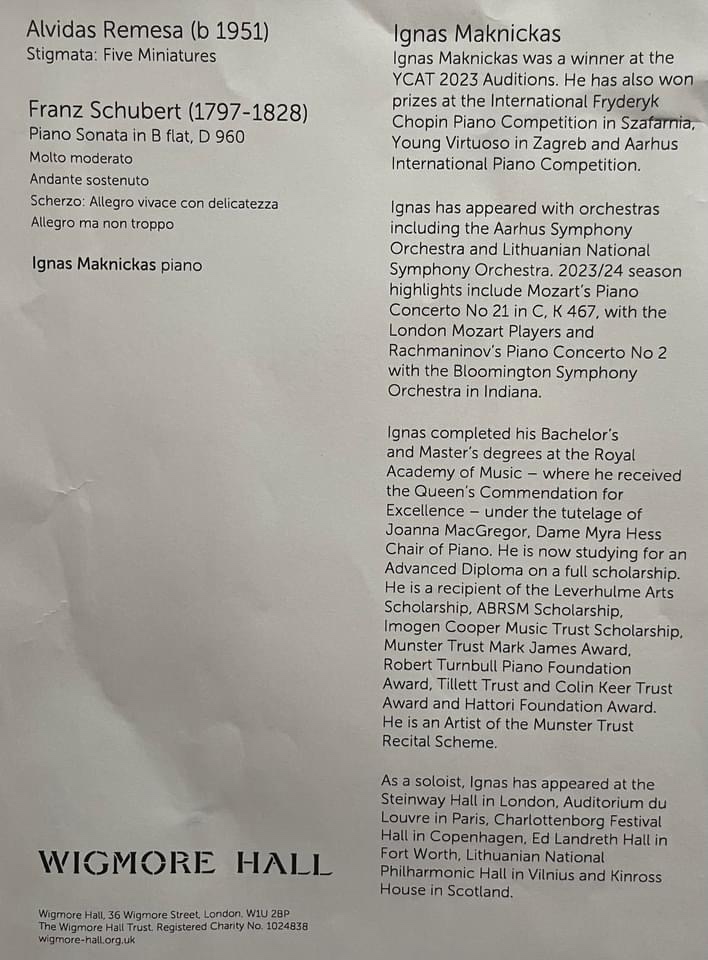
Fascinating to be at Ignas Maknickas Wigmore debut after hearing him at the beginning of his studies here in London when he played the Mozart Double concerto with Alim Baesembayev in the RAM Piano Festival. Alim has gone on to a glorious victory in the Leeds and judging by what we heard today it is just a question of time before Ignas too receives his just recognition A young enormously talented Lithuanian pianist with a fluidity of sound and an enviable ease and fluency at the keyboard who has gradually realised that as Curzon said,playing the piano is 90% work and 10 % a God given talent possessed by a rare few. Showing now a mastery and authority that could allow him to take us into a magic sound world that is of those very few blessed artistic souls . Sounds that not many even know exist or imagine that can be conjured out of a box of hammers and strings with the ease of a master magician . This is what we heard today from the very first magic notes played with an ease and fluidity the belied the tension that he must have been suffering with a major London debut in his hands . I have heard him play the Schubert Sonata several times this year but never as today.It was Fou Ts’ong who said that it is easier to be intimate in a big hall than vice versa.The Wigmore hall is the ideal size with its resonance and walls that have been witness to some of the greatest chamber music performances of the past century. Ignas rose to the challenge and obviously relished every minute as was obvious from the ravishing opening colours to the aristocratic ‘joie de vivre’ he brought to Schubert’s final Allegro ma non troppo. A scherzo that was a lesson on how to play with charm, grace and beauty and not just speed and the worst sort of Beethovenian brutality.Has the Trio ever sounded so absolutely right just as did the rude interruptions of G in the last movement? Everything fell wonderfully into place in a musical conversation that held us mesmerised for almost thirty five minutes. It should have been forty had he not decided to leave out the bars that Schubert penned to return to the opening exposition. Arrau and Serkin would not have been amused.Schiff simply says who are we to decide that we know better than the composer? Richter clocking in at almost an hour with slower tempi that lesser mortals would ever have thought possible also never excluded the composers repeats. Ignas’s sense of flow and architectural shape was remarkable and accounted for a faster than usual ‘Molto moderato’ first movement that after the initial surprise worked so beautifully without any artificial tampering with the overall pulse.Wondrous colours would appear very discreetly in the tenor or thumb register that would be like jewels glittering in this golden paradise.The Andante sostenuto was played simply and beautifully with again flowing tempi that allowed the music to unfold with such naturalness.A central episode like a corteo constantly and respectfully moving forward .
To make a London debut playing Schubert’s last Sonata is throwing down the gauntlet indeed especially here in the Wigmore Hall where only the most serious musicians are allowed to tread. Ignas came out triumphantly …….But no it was Schubert that came out triumphantly – Ignas was simply the medium between us and the composer!There can be no greater compliment than that for a debut recital! One knew four or five years ago that here was a remarkably gifted young man. I am reminded of what Serkin remarked to Richard Good on listening to Murray Perahia :”You told me he was good but you did not tell me HOW good!” Bravo Ignas you have done justice to your birthright. You don’t choose to be talented it chooses you and it is a big responsability to give up your youth to create a thing of beauty that brings joy to others. What better way to finish this recital than to return to the wondrous sound world with which he had opened so we could begin to realise that the magic box of jewels he had shared with us had come full circle perchance to dream once more.
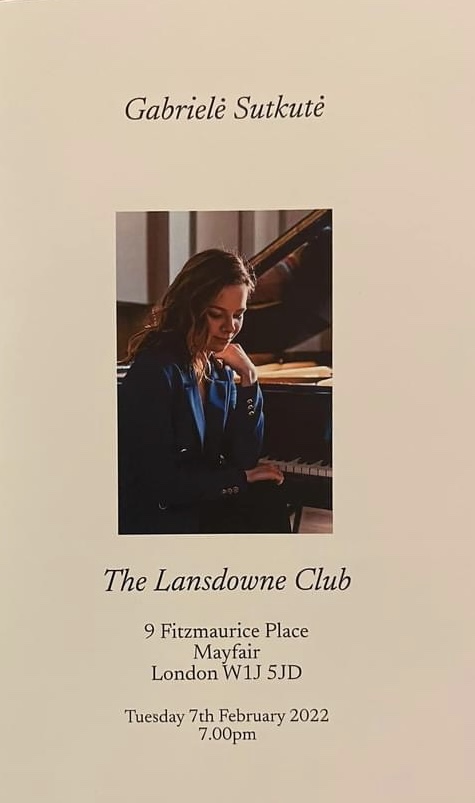
Gabrielé Sutkuté in ‘Some a chanted evening.’ Astonishes and bewitches at the Landsdowne Club.
Even the cats came out to see what was going on !Was it just a coincidence that the first piece on the programme is from the folk song ‘A farmers wife had lost her cat ‘ this one seemed very much at home to me and a very fortunate cat indeed.
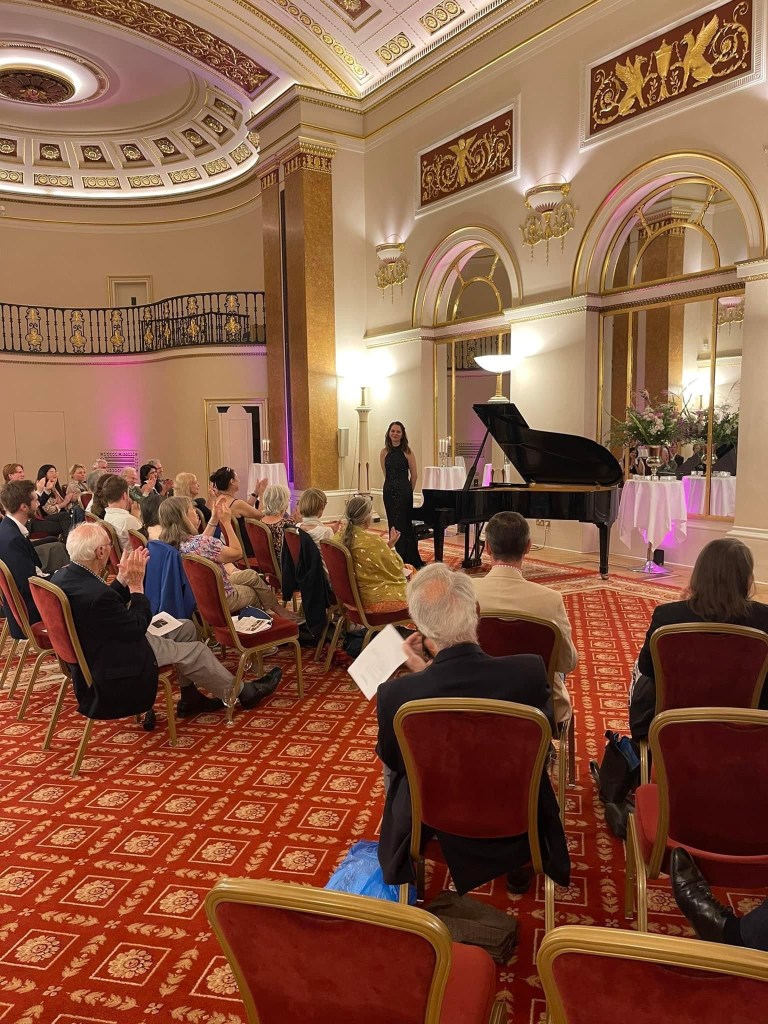
Haydn to cherish,Scriabin to ravish,Liszt to astonish ,Rameau to admire but above all Debussy and Ravel to seduce. Kapustin to leave us breathless.At only 24 hours notice (substituting an indisposed colleague ) this young Lithuanian beauty took Bluthner at the Lansdowne by storm at the start of their season and of of her professional career that is heading for the heights in the fast lane .
I can do no better than quote from Elena Vorotko’s review of a performance that Gabrielé gave recently for the Keyboard Trust of which she is c/o artistic director:
‘Passion and power with Gabrielė’s complete technical freedom, acute musical intuition and impeccable sense of style that made her performance an exhilarating experience for the audience.Haydn’s Fantasia in C major, the main theme of which is a folk song ‘the farmer’s wife had lost her cat’.This was masterfully played with an impish sense of humour, stylishly articulated and with great rhythmic drive.’ ‘In Scriabin’s 2nd Piano Sonata Gabrielė found yet another, totally different soundscape. A warmer and more velvety sound created mesmerising moments of delicate lyricism.The powerful and unpredictable second movement was brilliantly executed, with great ease and yet total involvement in the musical narrative.’’In Ravel’s ‘Oiseaux Tristes’ and ‘La Valse’ she created much more transparent, ‘glassy’ sonorities, so well suited for French repertoire. With a perfect sense of musical timing she achieved a moving rendition of the saddest of birds. La Valse showed off her total command of the instrument in this fiendish and highly complex virtuosic arrangement of a large scale orchestral work.’
Her Rameau and Liszt were new additions to her repertoire for me.The beauty of these miniature tone pictures by a genius almost three centuries before the so called ‘impressionists’ always astonishes.What a wonder ‘Les Tendres Plaintes’ is when played with such ease and colour not intimidated by a style of concealed passion and drive but consumed by it and transmitted with musical integrity and inspiration and dare I add ‘authenticity!’The gentle awkward steps of Les Cyclopes designed to bring a smile not a frown to our face.
Of course her intelligent musicianship brought us two of Liszt’s Venezia e Napoli with the Canzone linked as it is to the Tarantella by the composer himself but rarely even noticed by virtuosi anxious only to show off their wares.A ravishing Canzone full of Italian fervour and Latin seduction linked by the pedal to the Tarantella that was not only astonishing for it subtle refined virtuosity but above all for the beauty of the central mellifluous outpouring .In such a masterly way it gradually unwound into show stopping pyrotechnics of unheard of virtuosity that could turn the seemingly refined nobility of the day into a hysterical mob rushing to the piano to grab any souvenir that they could cherish in their dreams.
I have heard Gabrielé play many times during her student days at the RAM and RCM and admired the Lithuanian school of playing that is of well oiled ease where sounds are always liquid and beautiful and never hard or ungrateful.Milda Daunoraité ,Rokas Valuntonis and Ignas Maknickas are the other three pianists who have appeared on the scene in London all demonstrating this purity of sound and natural way of playing the piano .It was infact exemplified also in the Hungarian School in particular of Geza Anda.It is early training and discovery that is so important ,fundamental I would add,and is the basis of a life of dedication to which can be added to these first foundations later a more intensive study of interpretation and performance practices as one aims for artistic heights.Gabrielé I have heard in much of this repertoire and also a masterclass on the Grieg Piano concerto with Inna Falik’s (https://christopheraxworthymusiccommentary.com/2023/03/10/inna-faliks-love-of-life-the-extraordinary-story-of-a-great-artist-told-with-masteryintelligence-and-beauty/).
All masterly performances including her triumph at the RCM when she was awarded their highest honour of the Chappell Gold Medal .A distinguished jury of Alex Ullman ( Britten Fellowship holder and winner of both Liszt International Piano Competitions), Deniz Gelenbe and Diana Ketler had no hesitation in awarding her the top prize for a performance of Franck /Bauer that was truly memorable.
Her performances have always been impeccable of an intelligence with a refined musical palette but there were moments when one felt she could sit back and be an observer rather than always be in the driving seat.Now having finished her studies and embarking on the first steps alone of the hazardous path of a solo career she has found those moments .It was with Debussy’s beguiling ‘La plus que lente’ that she allowed the music to flow of it’s own evolution with sumptuously subtle sounds and ravishing rubato.As the sounds enveloped us all another cat was seen to take a peek into the ballroom.Enticed no doubt by the scene of decadence and the sight of desolate birds lost in the atmosphere of fluidity and luminosity that Gabrielé was evoking with such kaleidoscopic artistry.
They left in a hurry as the distant rumblings of menace and insinuating decadence gradually spun out of this brilliant Bluthner piano.The daring virtuosity of Gabrielé ignited the atmosphere with the rather evil smell of an époque that was to lead to unheard of evil and terror.Glissandi in all directions spun from her fingers as the cauldron of sounds built to boiling pitch that finally had to be switched off as abruptly as possible so as not to contaminate the world again.A stunning performance of devilish virtuosity and brilliance where the tension was only released with one of Kapustin’s Jazz Etudes played as I imagine only Oscar Peterson could have matched.
Exhilaration ,virtuosity and charm cleansed the air and allowed us to cheer this beautiful young artist on her journey reaching for the heights.
Presentation of the opening concert for the new Bluthner season at The Lansdowne Club by Christopher Chalmers The beautiful ballroom at the Lansdowne Club in Mayfair https://christopheraxworthymusiccommentary.com/2023/06/02/the-gift-of-music-the-keyboard-trust-at-30/Two rising stars piano and Portuguese guitarist Gonçalo Maia Caetano sharing these magic moments together Reaching for the heights with an evident joy of simplicity and mastery
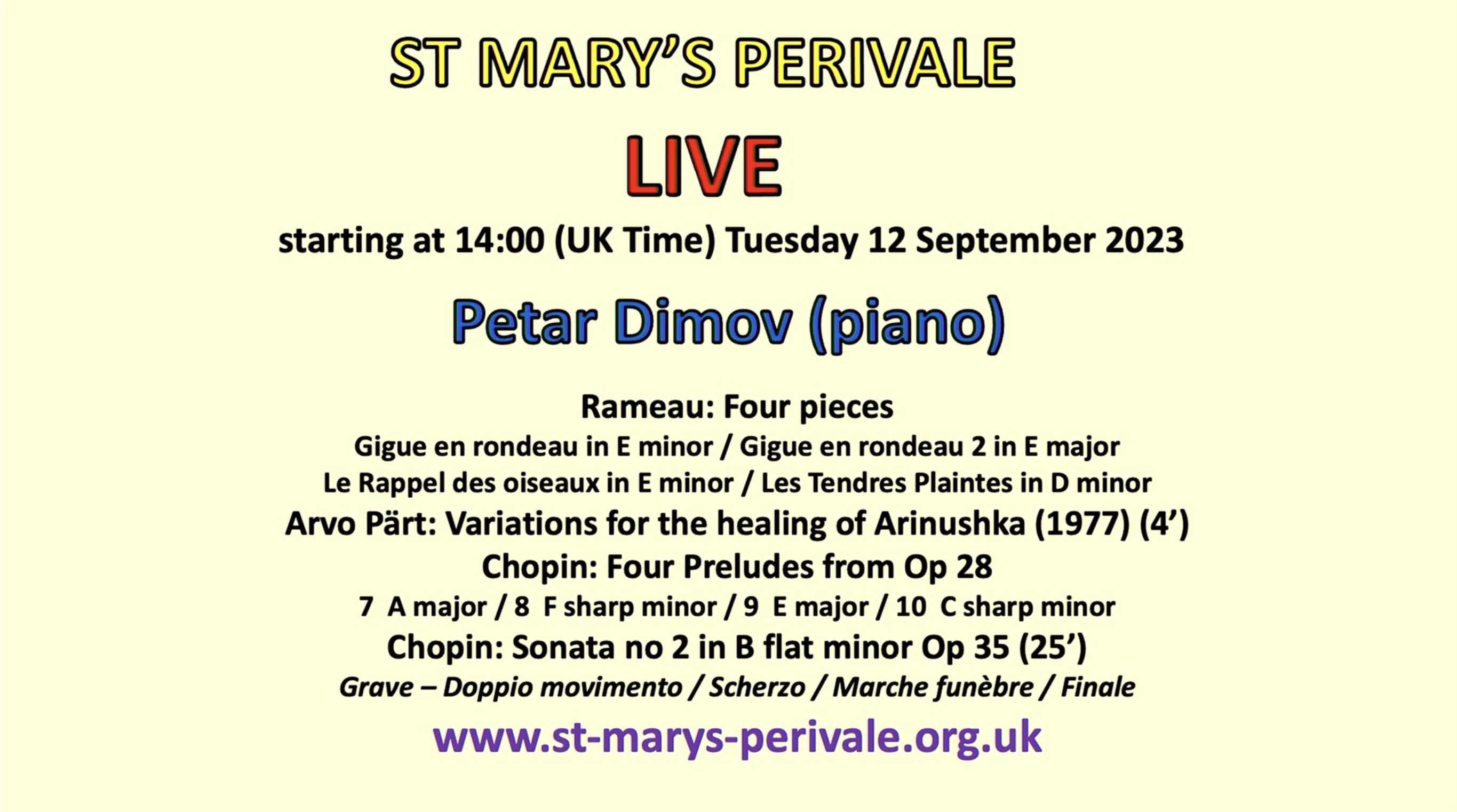
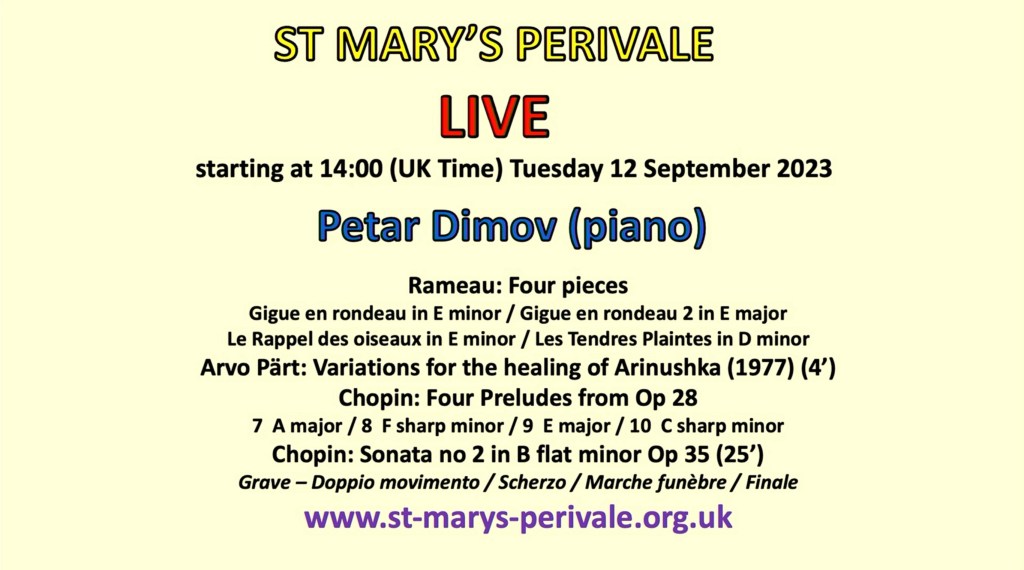
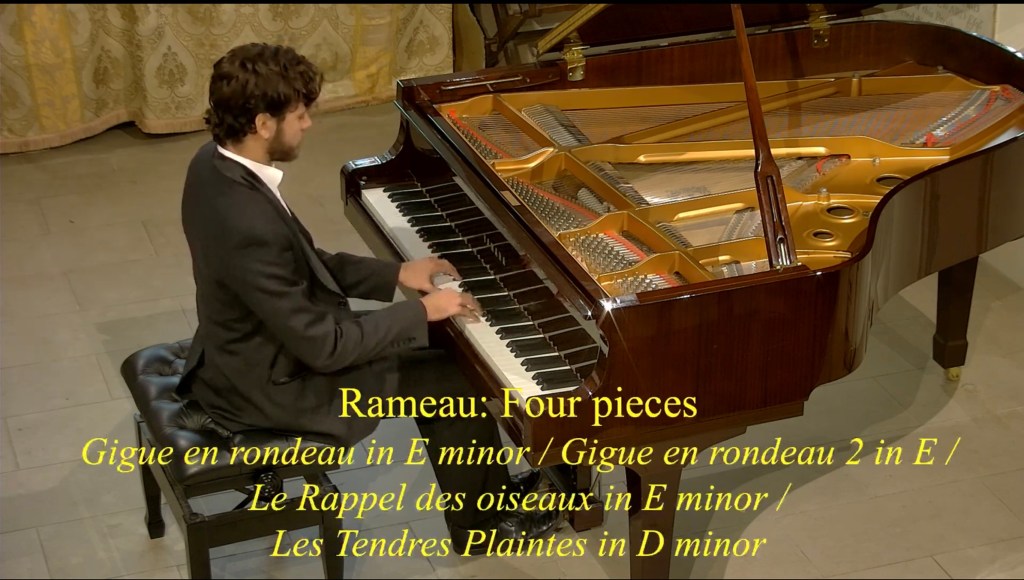
A beautiful programme that showed immediately that we were to be in the sensitive hands of a true musician .A choice of pieces by Rameau full of character and rhythmic drive but also of tenderness and colour as each picture was painted by an artist with a clear visionary view of these miniature masterpieces.A sense of fluidity and freedom that brought these miniature tone poems vividly to life.There was a fluidity to Les Tendres Plaintes that was played with great expression and whispered beauty immediately transformed into the atmospheric sound world of Arvo Part.
Petar had created a programme that had an overall architectural shape and sense of colour much as I had heard Volodos recently play a complete first half of Liszt specifically asking for there not to be any interruption between the pieces.
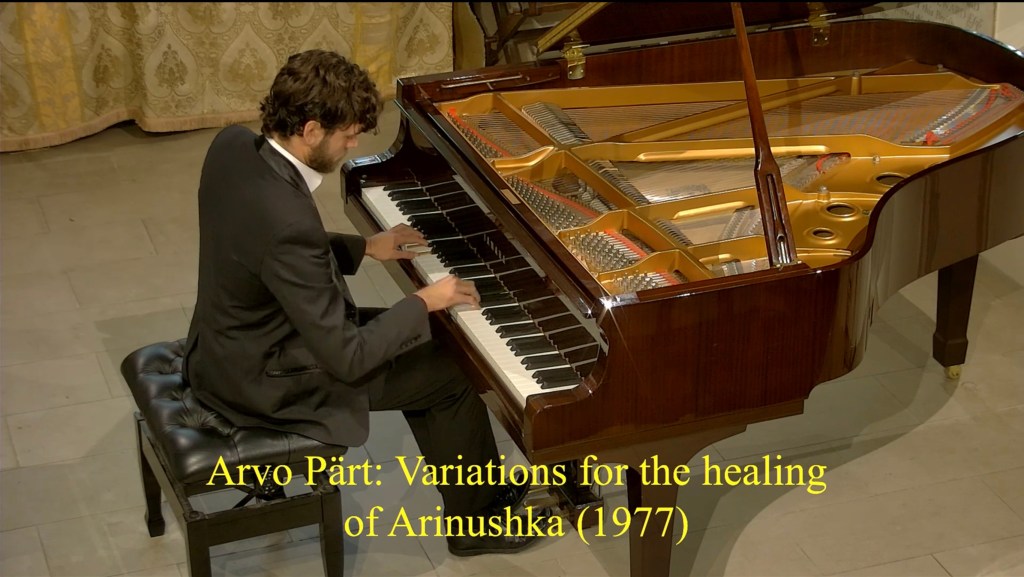
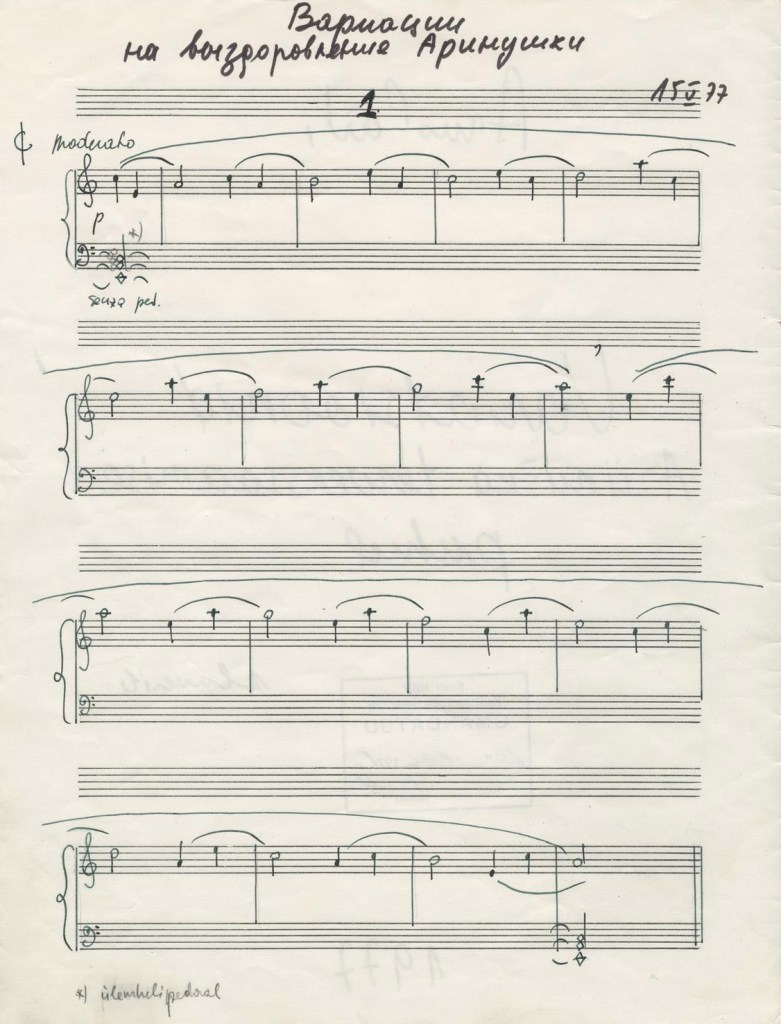
The same simplicity and fluidity but with three centuries that separate them.It just goes to show that the world of sound is as timeless as it is full of wonder.It was this sense of wonder and purity that Petar brought to these Variations of Arinuschka and it was a pity to ruin the spell created by applause before the utter simplicity of Chopin’s shortest of 24 preludes .
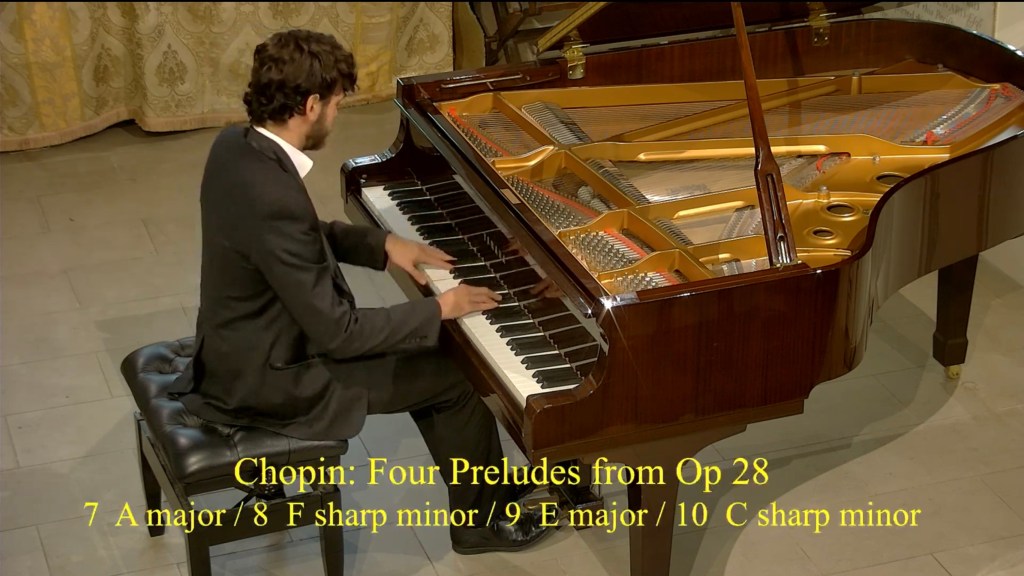
Petar’s Chopin was full of passion and romantic colours a long song from beginning to end.No jagged edges but simple pure beauty.I doubt that the Prelude in F sharp minor has ever flowed so beautifully more like an Aeolian Harp op 25 n.1 than the Winter Wind op 25 n.11.There was an undercurrent of passion and drive but contained under the shelter of aristocratic control.The E major Prelude was played with a nobility and importance before the almost flippantly impish Prelude in C sharp minor was thrown of with an easy jeux perlé of enviable lightness as it was greeted by the chorale like melodic line each time on its arrival to base.
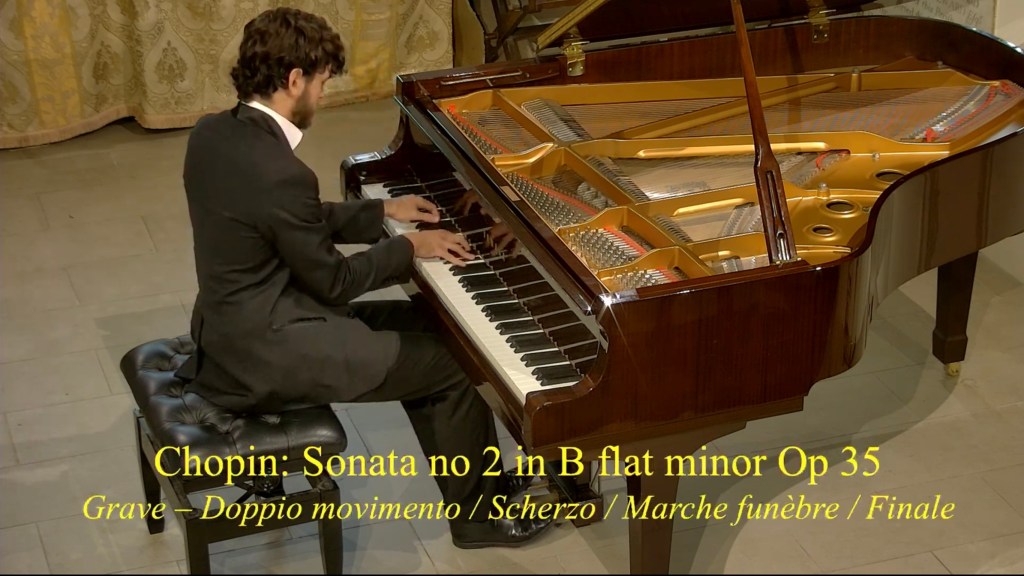
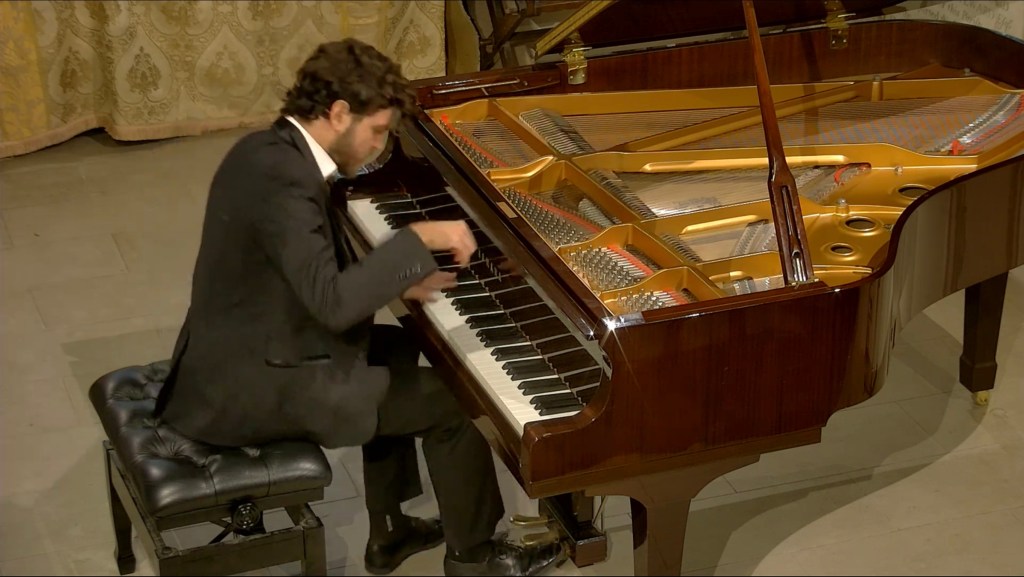
The Sonata in B flat minor one of the great works for piano was given a performance of aristocratic strength – there was none of the too much discussed repeat of the exposition but straight into the development with it contrasts like Beethoven’s Fourth Concerto between heaven and hell.The rhythmic strident opening motif in the bass was answered by the beseeching tenderness of the treble.United in a development of grandeur and nobility melting to the beautiful second subject that came as such a contrast as it was shaped with style and subdued passion.A Scherzo that was kept beautifully under control and at a tempo that suited the Trio without interrupting the overall architectural shape.Ravishing beauty and subtle rubato with a naturally measured return to the Scherzo that gave great cohesion to a movement that can seem ,in lesser hands,a series of unrelated episodes.The famous Funeral March was played with austere sonority with a relentless forward movement,gently leading into a Trio that flowed with timeless reverence.Out of the final chord emerged the whirlwind of sounds that Schumann had criticised so much. A movement of an innovative genius and who knows where it would have taken Chopin had he been granted more than his 39 years on this earth.Petar throughout the furious wind that blew across the keys found a throbbing sense of line only interrupted by sudden gusts of wind until it blew itself out on a wave of grandeur and .majesty
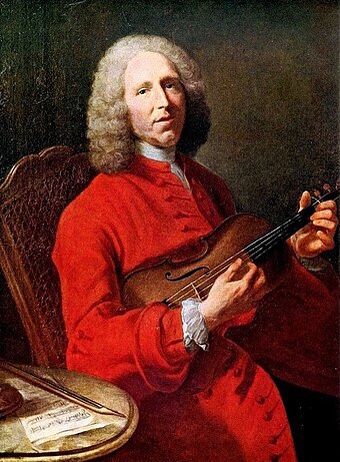
Jean-Philippe Rameau (25 September 1683 – 12 September 1764) was one of the most important French composers and music theorists of the Baroque era. He replaced Jean-Baptiste Lully as the dominant composer of French opera, and was attacked by those who preferred Lully’s style.
Jean-Philippe Rameau, by Joseph Aved 1728
Rameau’s music is characterised by the exceptional technical knowledge of a composer who wanted above all to be renowned as a theorist of the art. Nevertheless it is not solely addressed to the intelligence and Rameau himself claimed “I try to conceal art with art”. The paradox of this music was that it was new, using techniques never known before, but it took place within the framework of old-fashioned forms; Rameau appeared revolutionary to the Lullystes, disturbed by the complex harmony of his music, and reactionary to the “philosophes” who only paid attention to its content and who either would not or could not listen to the sound it made. The incomprehension he received from his contemporaries stopped Rameau repeating such daring experiments as the second Trio des Parques in Hippolyte et Aricie, which he was forced to remove after a handful of performances because the singers were unable to interpret it correctly. So the greatest harmonist of his era went unrecognised at the very time that harmony – the “vertical” aspect of music – was taking precedence over counterpoint, which represented its “horizontal” aspect.Rameau introduces an imitation of nature in Le rappel des oiseaux (roughly translated as ‘The conference of the birds’). This piece was most likely inspired by Rameau’s friendship with the Jesuit Père Castel, who discussed with the composer the phenomenon and study of birdsong. The French Baroque composer Jean-Philippe Rameau wrote three books of Pièces de clavecin for the harpsichord .The first, Premier Livre de Pièces de Clavecin, was published in 1706; the second, Pièces de Clavessin, in 1724 ;and the third, Nouvelles Suites de Pièces de Clavecin, in 1726or 1727 They were followed in 1741 by Pieces de Clavecin en concerts , in which the harpsichord can either be accompanied by violin (or flute) and viola da gamba or played alone. An isolated piece, “La Dauphine“, survives from 1747.
Pièces de Clavessin (1724)
Suite in E minor, RCT 2
Allemande
Courante
Gigue en Rondeau I
Gigue en Rondeau II
Le Rappel des Oiseaux
Rigaudon I – Rigaudon II et Double
Musette en rondeau. Tendrement
Tambourin
La Villageoise. Rondeau
Suite in D major, RCT 3
Les Tendres Plaintes. Rondeau
Les Niais de Sologne – Premier Double des Niais – Deuxième Double des Niais
Les Soupirs. Tendrement
La Joyeuse. Rondeau
La Follette. Rondeau
L’Entretien des Muses
Les Tourbillons. Rondeau
Les Cyclopes. Rondeau
Le Lardon. Menuet
La Boiteuse
Variations for the Healing of Arinushka for solo piano was composed in 1977 for the composer’s daughter Ariina who was recovering from an appendix operation. The piece contains six short variations, the first three of which are in minor key and the other three in major. They are based on a very simple theme of a rising and falling octave scale. The clear and transparent soundscape of this early tintinnabuli composition is created by the resonating overtones and subtle use of the pedal. Variations… was first performed in November 1977 in Lithuania by Rein Rannap.
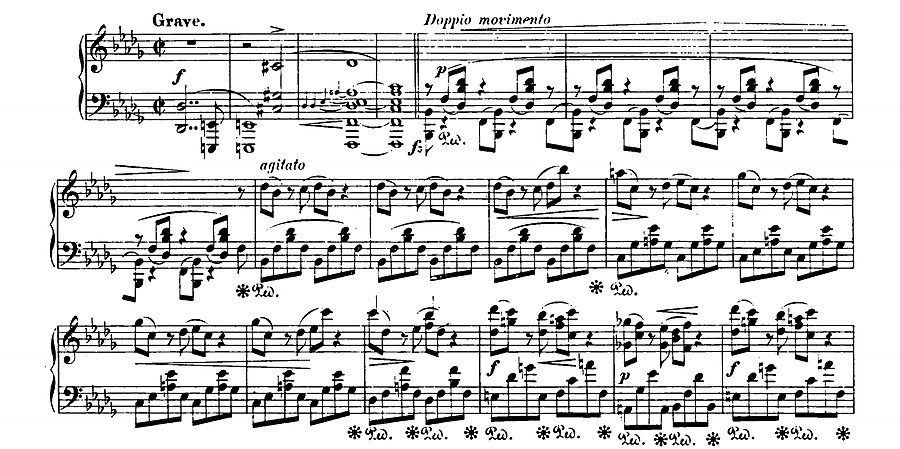
Breitkopf & Härtel edition edited by Johannes Brahms (1878). This edition lacks a backwards repeat sign at the Doppio movimento and therefore indicates that the repetition of the exposition should start at the Grave.
Around 1837 Chopin composed a Funeral March , a piece which most likely reflected the musician’s profoundly mournful mood following the breaking of his engagement to Maria Wodzińska. When he then went to the island of Majorca,at the end of 1838, he began to write a piece, Grave , which will later be the first movement of the sonata, and a Presto which will be the finale; this time in composing Chopin was influenced by the worsening of his illness and influenced by the gloomy ruins and cemetery of the Certosa di Valldemossa,certainly not cheerful visions in the pouring rain that gave no respite. The Scherzo was written when the musician returned to Nohant in the second part of 1839.
In a letter to his friend Fontana he wrote: “I am composing a Sonata in B flat minor in which the Funeral March that you already know will be found. There is an Allegro, then a Scherzo and, after the March, a small Finale, not very long, in which the left hand chatters in unison with the right hand”. In writing the Scherzo , the musician had thought of collecting the pieces already composed in a Sonata, perfecting and polishing them.The Sonata in B flat minor was published in 1840 in Paris by Troupenas, later in Leipzig by Breitkopf & Härtel and in London by Wessel. The piece is one of the few by Chopin that does not feature a dedication, perhaps it was actually a tribute intended for George Sand, to be kept private. Contemporaries were rather baffled by this Sonata. In the first place Robert Schumann who, while recognizing the beauty of the piece, even found “something repulsive” in the Funeral March and defined the Finale as “something more like an irony than any other music”. Even Felix Mendelssohn, not understanding the modernity of the Finale, declared that he abhorred it.Later Vincent d’Indy even went so far as to argue that Chopin had chosen certain keys not for strictly musical reasons, but only for executive convenience. The Funeral March was performed, in the version orchestrated by Reber , together with the Preludes op. 28 no. 4 and 6, played by the organist Léfebure-Wély, at the composer’s funeral on 30 October 1849. Of the Sonata Schumann wrote: “It might be called a whim, if not a hubris, that he called it the Sonata , for he brought together four of his most bizarre creatures, to be smuggled under that name into a place where they otherwise would not have penetrated “. The Sonata op. 35 has also been taken to support the view of many critics that Chopin had found himself in difficulty with the sonata and its formal construction.Others have found the composition to be defective in poetic unity and continuity, constructed with limited technique, judgments based mostly on an outward view of the work rather than an examination of its content.
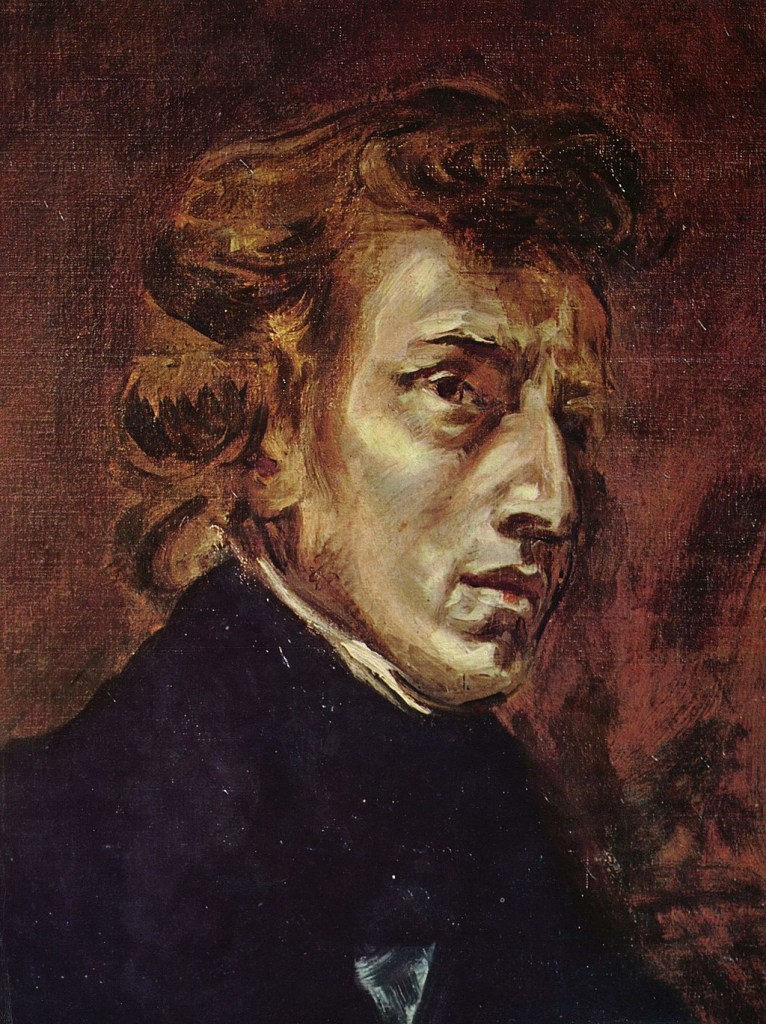
Chopin at 28, from Delacroix’s joint portrait of Chopin and Sand 1838
Chopin’s 24 Preludes, op .28, are a set of short pieces for the piano, one in each of the twenty-four keys , originally published in 1839.
Chopin wrote them between 1835 and 1839, partly at Valldemossa,Mallorca, where he spent the winter of 1838–39 and where he had fled with George Sand and her children to escape the damp Paris weather.In Majorca, Chopin had a copy of Bach’s ‘48’ and as in each of Bach’s two sets of preludes and fugues, his Op. 28 set comprises a complete cycle of the major and minor keys, albeit with a different ordering.Whereas Bach had arranged his collection of 48 preludes and fugues according to keys separated by rising semitones , Chopin’s chosen key sequence is a circle of fifths , with each major key being followed by its relative minor, and so on (i.e. C major, A minor, G major, E minor, etc.). It is thought that Chopin might have conceived the cycle as a single performance entity for continuous recital.An opposing view is that the set was never intended for continuous performance, and that the individual preludes were indeed conceived as possible introductions for other works.Chopin himself never played more than four of the preludes at any single public performance.Nor was this the practice for the 25 years after his death. The first pianist to program the complete set in a recital was probably Anna Yesipova in 1876.Nowadays, the complete set of Op. 28 preludes has become part of the repertoire , and many concert pianists have recorded the entire set, beginning with Busoni in 1915, when making piano rolls for the Duo-Art label. Alfred Cortot was the next pianist to record the complete preludes in 1926.He would also play the 24 Studies op 10 and 25 together with the 24 Preludes op 28 in the same programme.Something that Fou Ts’ong had done at the Festival Hall in London and on my request at the Ghione Theatre in Rome.
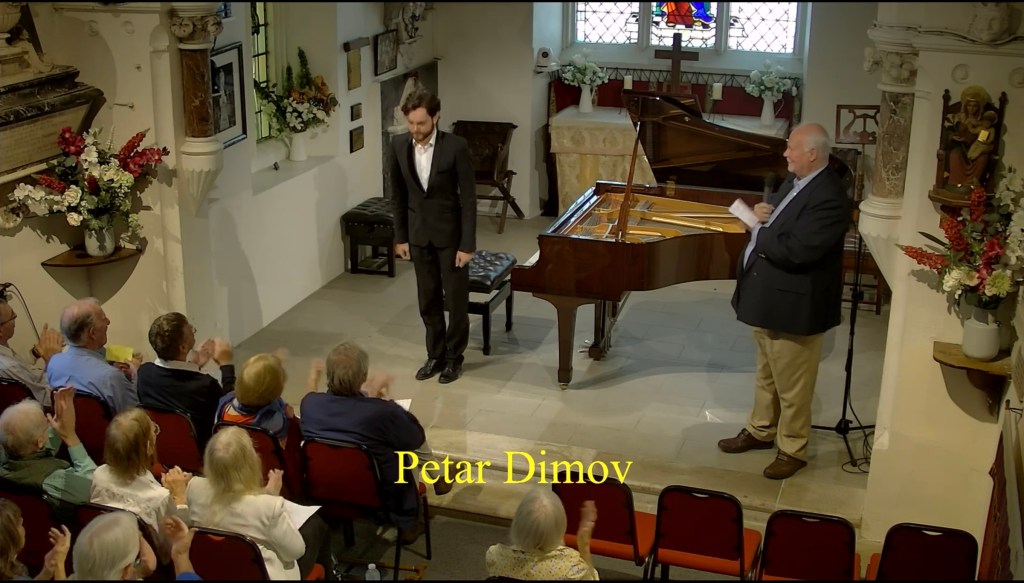
Petar Dimov is a Bulgarian pianist and composer based in London. He was a scholar at the Royal College of Music in London from 2014 to 2020 in the piano class of Norma Fisher, obtaining a Master of Performance degree with Distinction in 2020 and a Bachelor of Music degree with Honours in 2018. His musical education began in his native Plovdiv (Bulgaria) where he studied with Svetlana Koseva until his graduation in 2014. He has won over twenty prizes from International competitions and has performed in Bulgaria, Cyprus, France, Greece, Italy, Macedonia, Romania, Serbia, Spain, Turkey and the UK. As a composer, Petar Dimov has had output for orchestra, chorus, various solo instruments and chamber ensembles. Dimov is currently supported by the Talent Unlimited foundation.
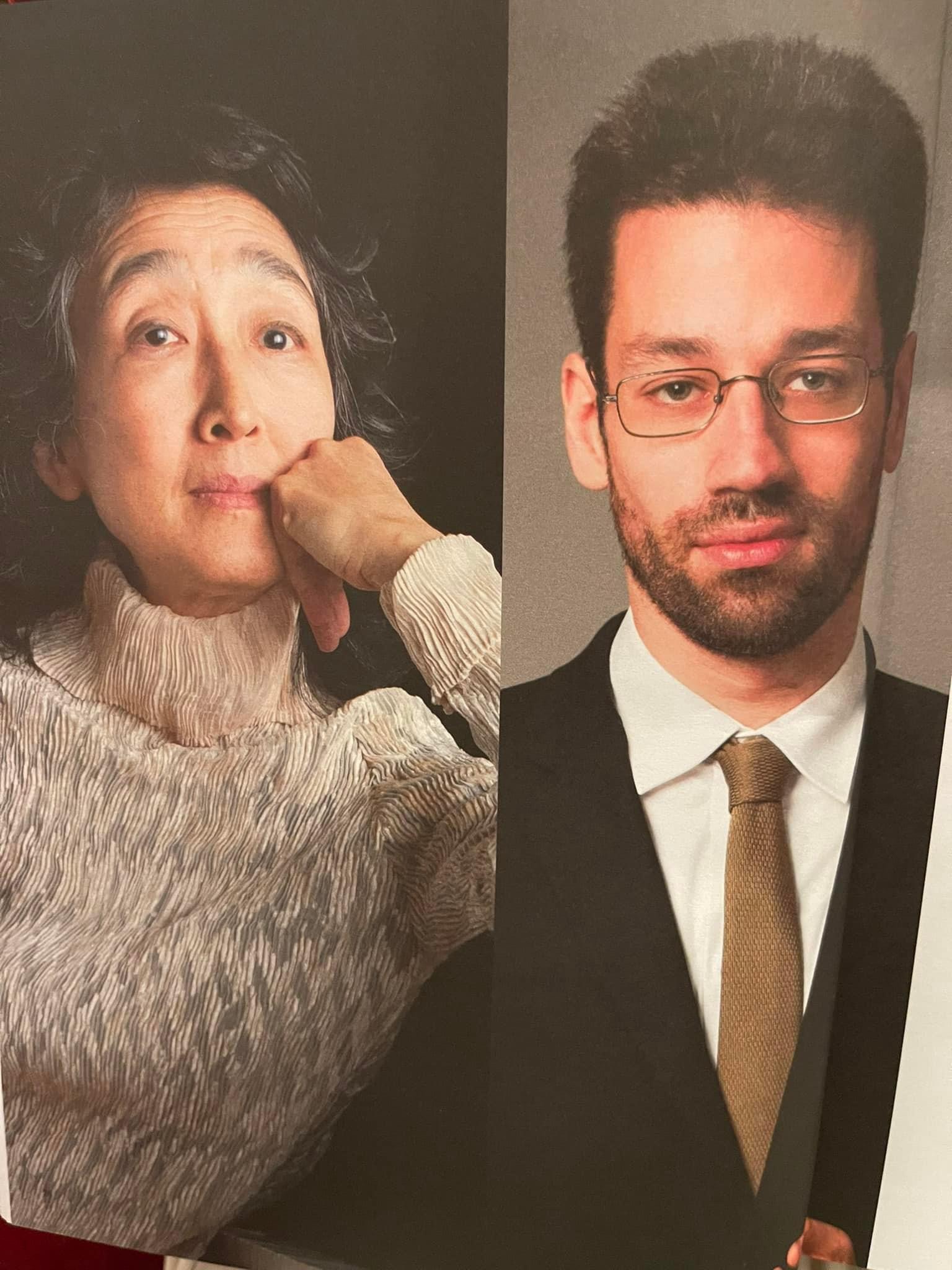
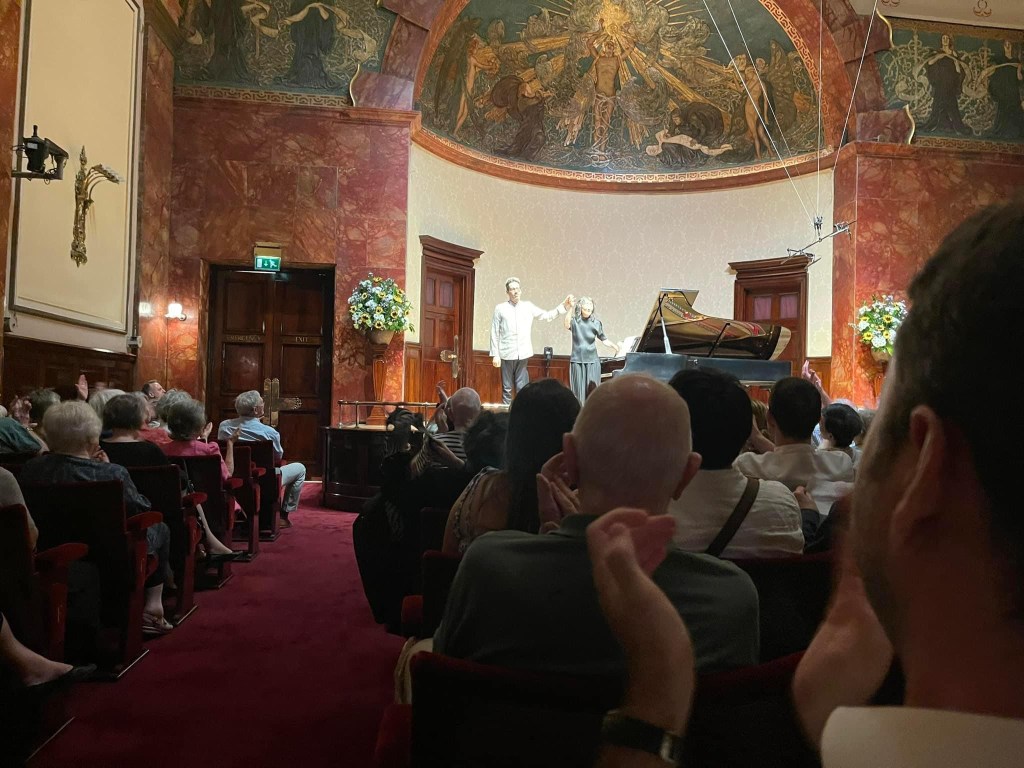
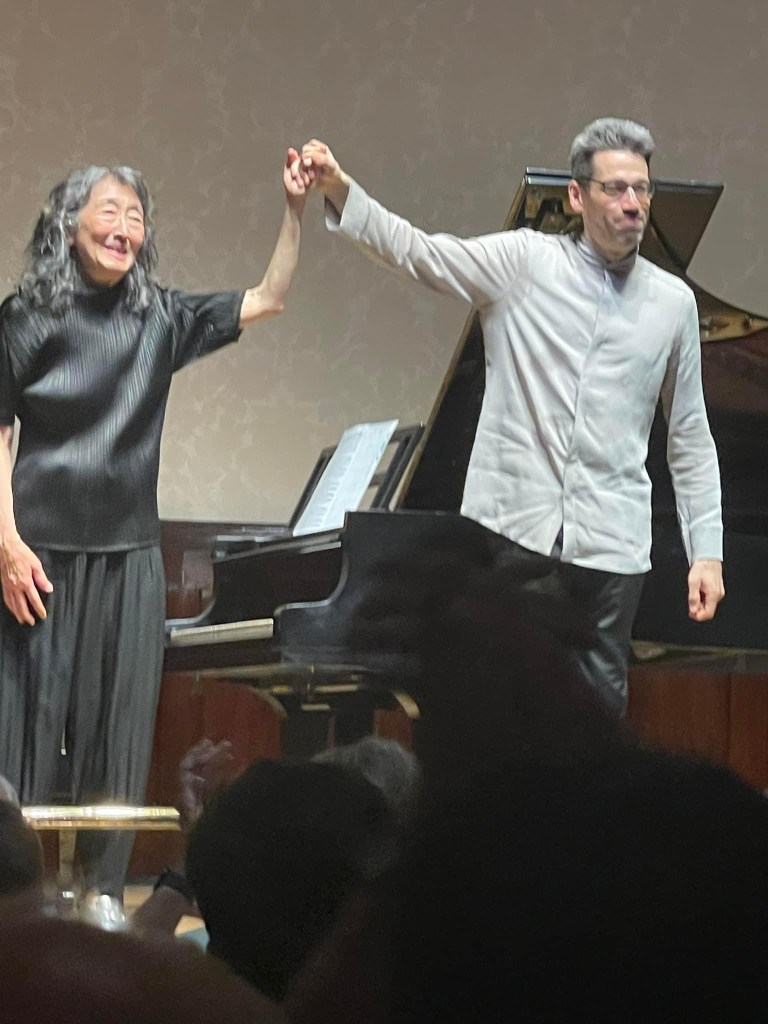
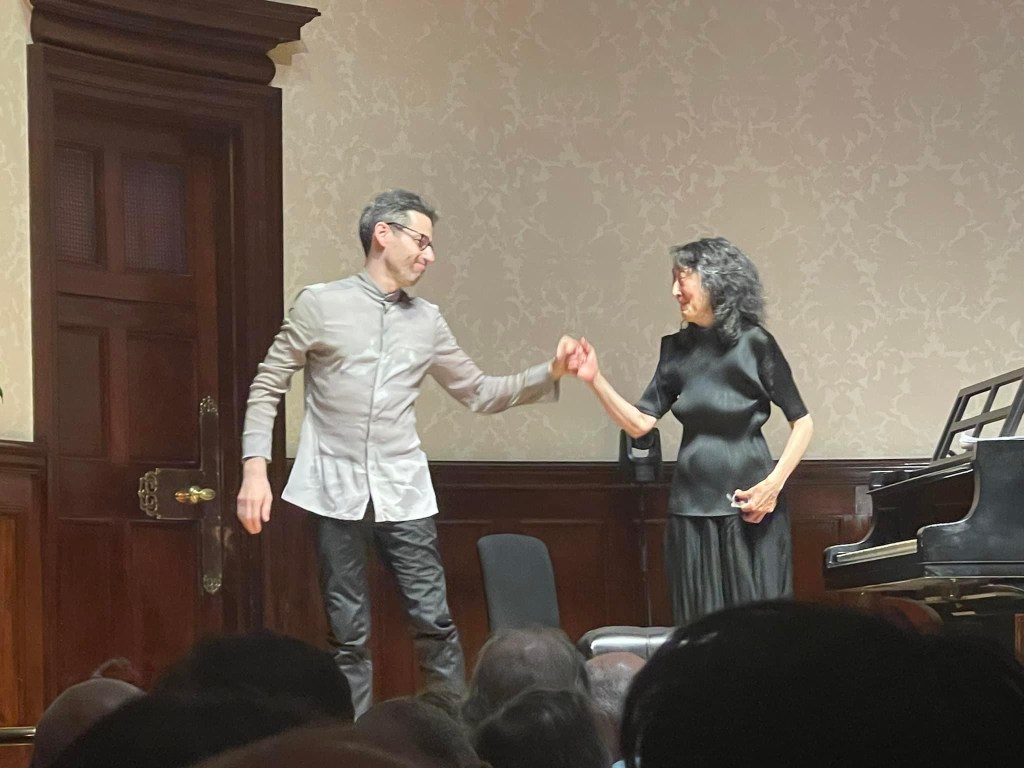
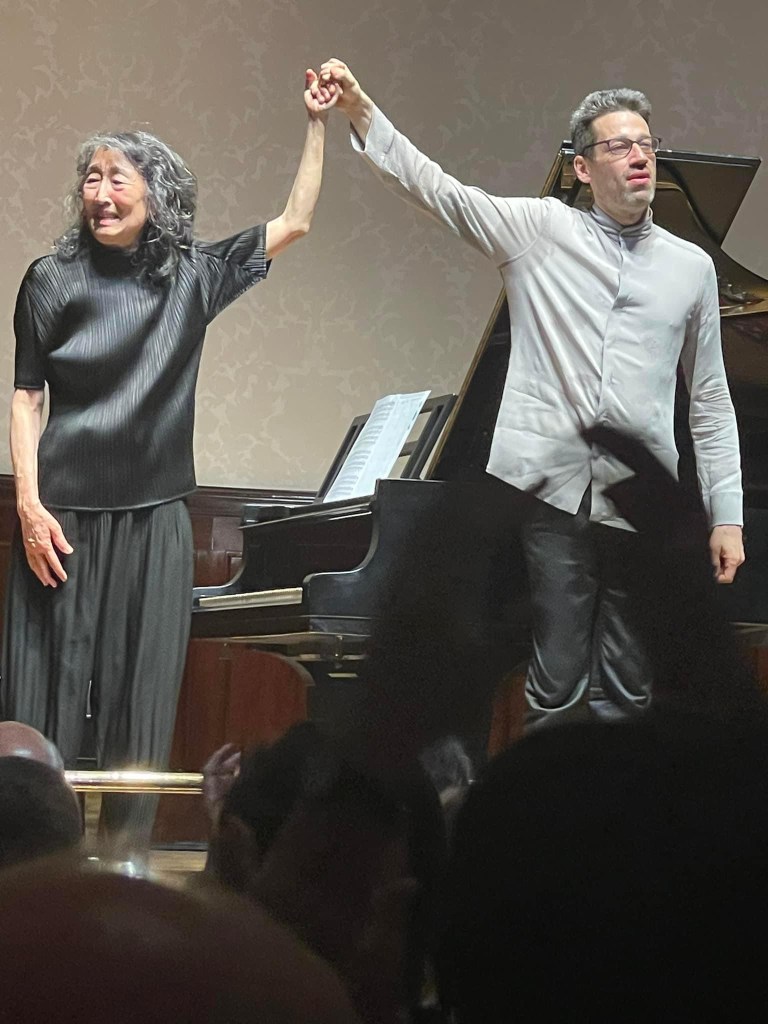
Sublime Schubert at the Wigmore Hall with Mitsuko Uchida and Jonathan Biss. Of course we have known for some time that Uchida can unlock the secrets of Schubert as no other but little could have led us to believe that the same poetry could flow from such an intellectual as Jonathan Biss.
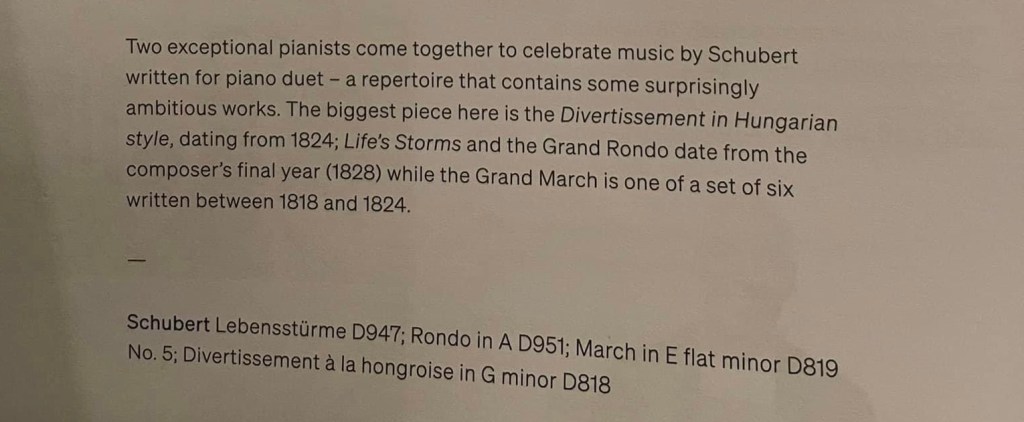
A transcendental control of sound that could produce what his beautiful programme notes describe as ethereal with unearthly beauty. Words can only go so far to describe what sounds can do so much better and it was the sounds that created the magic that one could only imagine from his written notes . What a voyage of discovery too with a March in E flat minor from 1824 that was such an extraordinary work of incredible poignancy and sheer genial invention.
Jonathan strangely describes it in only a few words in his notes but you could write a book about the revolutionary form and modernity of sound and invention.Of course it leaps out at you – in E flat minor!!!!- whatever next …..indeed if Schubert had lived a true life span where would it have all led?An astonished silence at the end was gently filled with the simple sublime beauty of the Rondo in A that has recently enchanted the audiences of Barenboim and Argerich. This was just as beautiful and infact the final few bars like a balloon inflating before our very eyes only to dissolve without a trace into the magic stratosphere with a turn that must be the most sublime ever invented.
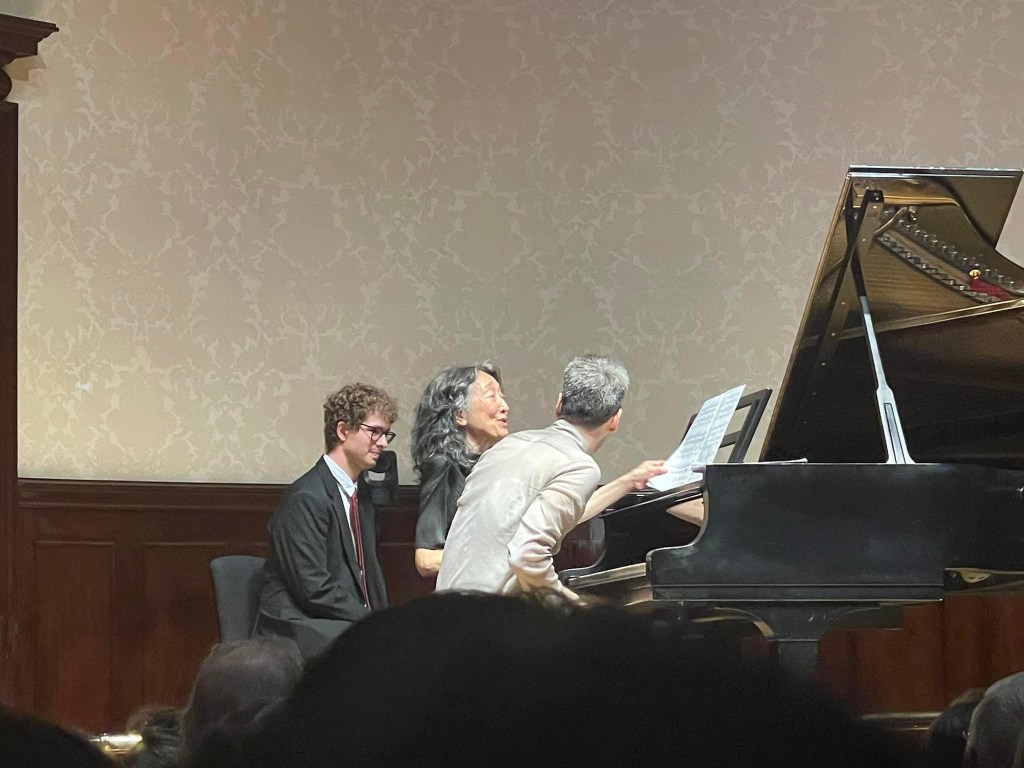
The concert had begun with a well known masterpiece ‘Lebenssturme’ written in Schubert’s final hour where moments of sublime beauty make one wonder how he could share the vision of paradise that awaited him with us mortals left behind.An extraordinary performance of passion ,colour and astonishment that was truly unforgettable. The whole of the second half saw a swapping of chairs with Uchida this time at the top.
Even the genius of Uchida could not prevent the tedium of a series of dances with every repeat noted with intellectual punctiliousness that made this divertissement not very ‘divertente’ clocking in at fifty minutes. There were some beautiful things because we were in the hands -four -of masterly musicians. The gentle lilt of the Allegretto finale so beautifully played sent me finally to sleep perchance to dream of the wonders they had shared with us in the first half of the concert. Performances that will remain with us,as Mitsuko has said when asked for a selfie in the Green room in Perugia ,a photo should be like a beautiful memory and not a fixed image that may appear instantly on the other side of the globe.
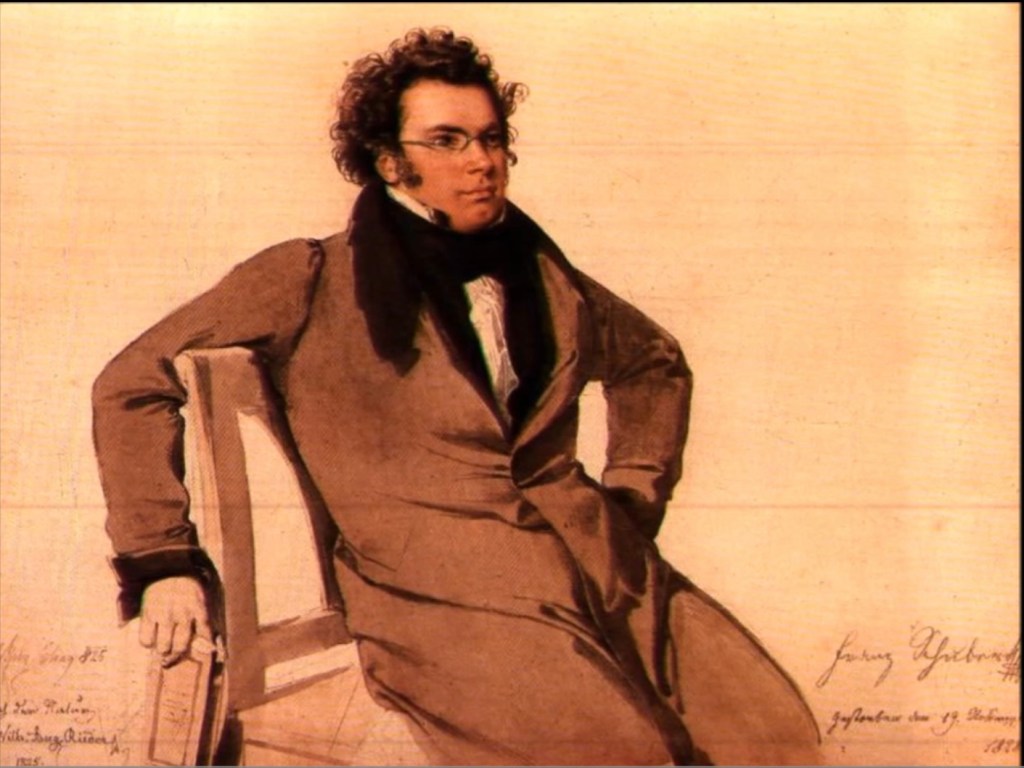
In 1823, Schubert wrote his first large-scale song cycle , Die schone Müllerin (D. 795).This series, together with the later cycle Winterreise (D. 911, also setting texts of Müller in 1827) is widely considered one of the pinnacles of Lieder.He also composed the song ‘Du bits die Ruh’You are rest and peace,D. 776 during this year. Also in that year, symptoms of syphilis first appeared.
In 1824, he wrote the Variations in E minor for flute and piano; Trockne Blumen, a song from the cycle Die schone Müllerin ; and several string quartets. He also wrote the The Arpeggione Sonata D. 821.In the spring of that year, he wrote the Octet in F D. 803.a sketch for a “Grand Symphony,” and in the summer went back to Zseliz. There he became attracted to Hungarian musical idiom and wrote the Divertissement à la hongroise in G minor for piano duet D. 818 and the String Quartet in A minor Rosamunde D. 804.It has been said that he held a hopeless passion for his pupil, the Countess Caroline Esterházy but the only work that bears a dedication to her is his Fantasia in F minor for piano duet D. 940.This dedication, however, can only be found in the first edition and not in Schubert’s autograph.
From 1826 to 1828, Schubert resided continuously in Vienna, except for a brief visit to Graz ,Austria, in 1827. In 1826, he dedicated a Symphony D. 944, that later came to be known as the Great C major to the Gesellschaft der Musikfreunde and received an honorarium in return.[The String Quartet in D minor D. 810 ,with the variations on Death and the Maiden , was written during the winter of 1825–1826, and first played on 25 January 1826. Later in the year came the String Quartet in G major, D 887, first published as op. 161,the Rondo in B minor for violin and piano D. 895 ,Rondeau brillant, and the Piano Sonata in C major D 894, first published as Fantasie in G, op. 78. He also produced in 1826 three Shakespearian songs, of which “Ständchen” D. 889 and “An Sylvia ” D. 891 were allegedly written on the same day, the former at a tavern where he broke his afternoon’s walk, the latter on his return to his lodging in the evening.
The works of his last two years reveal a composer entering a new professional and compositional stage.Although parts of Schubert’s personality were influenced by his friends, he nurtured an intensely personal dimension in solitude; it was out of this dimension that he wrote his greatest music.The death of Beethoven affected Schubert deeply,and may have motivated Schubert to reach new artistic peaks. In 1827, Schubert wrote the song cycle Winterreise D. 911 ,the Fantasy in C major for violin and piano (D. 934, first published as op. post. 159), the Impromptus for piano, and the two piano trios (the first in B-flat major (D. 898), and the second in E-flat major, D. 929,in 1828 the cantata Mirjams Siegesgesang Victory Song of Miriam, D 942 on a text by Franz Grillparzer ,the Mass in E flat D. 950, the Tantum Ergo D. 962 in the same key, the String Quintet in C D. 956 ,the second “Benedictus” to the Mass in C D. 961,the final three piano sonatas D. 958, D. 959, and D. 960,and the collection 13 Lieder nach Gedichten von Rellstab und Heine for voice and piano, also known as Scheanengesang (Swan-song, D. 957)The Great C major symphony is dated 1828, but Schubert scholars believe that this symphony was largely written in 1825–1826 (being referred to while he was on holiday at Gastein in 1825—that work, once considered lost, is now generally seen as an early stage of his C major symphony) and was revised for prospective performance in 1828. The orchestra of the Gesellschaft reportedly read through the symphony at a rehearsal, but never scheduled a public performance of it. The reasons continue to be unknown, although the difficulty of the symphony is the possible explanation.In the last weeks of his life, he began to sketch three movements for a new Symphony in D D 936A;In this work, he anticipates Mahler’s use of folksong-like harmonics and bare soundscapes.Schubert expressed the wish, were he to survive his final illness, to further develop his knowledge of harmony and counterpoint, and had actually made appointments for lessons with the counterpoint master Simon Sechter.
On 26 March 1828, the anniversary of Beethoven’s death, Schubert gave, for the only time in his career, a public concert of his own works.The concert was a success popularly and financially,even though it would be overshadowed by Paganini’s first appearances in Vienna shortly after.
In the midst of this creative activity, his health deteriorated. By the late 1820s, Schubert’s health was failing and he confided to some friends that he feared that he was near death. In the late summer of 1828, he saw the physician Ernst Rinna, who may have confirmed Schubert’s suspicions that he was ill beyond cure and likely to die soon.Some of his symptoms matched those of mercury poisoning ,a common treatment for syphilis, again suggesting that Schubert suffered from it.At the beginning of November, he again fell ill, experiencing headaches, fever, swollen joints, and vomiting. He was generally unable to retain solid food and his condition worsened. Five days before Schubert’s death, his friend the violinist Karl Holz and his string quartet visited to play for him. The last musical work he had wished to hear was Beethoven’s String Quartet in C sharp minor op 131 ;Holz commented: “The King of Harmony has sent the King of Song a friendly bidding to the crossing”.
Schubert died in Vienna, aged 31, on 19 November 1828, at the apartment of his brother Ferdinand. The cause of his death was officially diagnosed as typhoid fever , though other theories have been proposed, including the tertiary stage of syphilis . Although there are accounts by his friends that indirectly imply that he was syphilitic, the symptoms of his final illness do not correspond with tertiary syphilis. Six weeks before his death, he walked 42 miles in three days, ruling out musculoskeletal syphilis. In the month of his death, he composed his last work, “Der Hirt Auf Den Felsen”, making neurosyphilis unlikely. Finally, meningo-vascular syphilis is unlikely because it presents a progressive stroke-like picture, and Schubert had no neurological manifestation until his final delirium, which started only two days before his death. This, and the fact that his final illness was characterized by gastrointestinal symptoms (namely vomiting), led Robert L. Rold to argue that his final illness was a gastrointestinal one, like salmonella or indeed typhus.
At the height of his Weimar period, Franz Liszt arranged four marches for piano four hands by Franz Schubert for orchestra in 1859-60 for his eminent Viennese colleague Johann Herbeck (1831-77). Among these, the march from Opus 121 was subsequently incorporated as the middle movement in the orchestration of Franz Schubert’s “Divertissement à la hongroise,” the corner movements of which were orchestrated by Max Erdmannsdörfer (1848-1905). The edition unites the three remaining Schubertian marches in Liszt’s orchestration in one volume.
Johann Herbeck, as a conductor in Vienna, was not only the most important discoverer of Franz Schubert, but also an unabashed champion of Franz Liszt’s music in an extremely reactionary environment. Given these preferences, as well as the high esteem in which Liszt held Schubert’s work, reflected especially in piano transcriptions of songs, but also in the orchestration of Schubert’s piano songs (and, of course, in the problematic arrangement of the Wanderer Fantasy for piano and orchestra), it was natural for Herbeck to ask Liszt to orchestrate other works by Schubert, and apparently it was agreed that these should be some of the marches for piano four hands that were already popular at the time. In any case, Liszt wrote to Herbeck from Weimar on November 18, 1859: “Dear friend, having returned from Zwickau a few hours ago, I have received your kind letter and must unfortunately apologize for not being able to comply with your request regarding Schubert’s marches as quickly as I had intended. This delay, which was very unpleasant for me, was caused by an indisposition which forced me to remain in bed for a whole week at the end of October. After that, the Weimar and Jena Schiller celebrations made it completely impossible for me to proceed with the orchestration of the marches. – But I promise you that you will receive the score by Christmas at the latest.”
Herbeck replied to Liszt from Vienna in January 1860: “I received the eagerly awaited Prometheus, as well as the marches, and I immediately fell upon them with a real ravenous appetite. […] I appreciate the great honor that has been bestowed upon me by the friendly dedication of Schubert’s marches, which have been so magnificently re-composed, and I thank you most sincerely for it. Prometheus will be performed on February 26 in the Redoutensaal; the marches, the Schubert piano fantasia and the manuscript rhapsody with orchestra of your composition (which I expect with each passing day from Berlin) played by H. v. Bülow will follow on March 25.”Schubert’s Funeral March from Opus 40 in Liszt’s orchestration was premiered on March 10, 1862 at the 4th Society Concert. On March 27, 1863, Schubert’s unfinished ‘Lazarus’ was premiered. On February 28, 1864, either one of the two marches was repeated, or the one from the ‘Divertissement à la Hongroise’ was heard for the first time, and on November 27, 1864, Carl Tausig was the soloist in the Wanderer Fantasy by Schubert/Liszt. On December 17, 1865, Schubert’s unfinished Symphony in B minor was played for the first time in Vienna under Herbeck’s direction. On February 25, 1866, Schubert’s Funeral March was repeated in Liszt’s version, After the premiere of the orchestration of the Funeral March, Eduard Hanslick wrote: “Another novelty was Liszt’s orchestral arrangement of Schubert’s Funeral March in E-flat minor. As the composition is presented as a piano piece, it is genuinely Schubertian in its tuneful manner, naturally flowing, but by no means significant; the trio in E-flat major, which sounds too jolly for a funeral march, becomes downright tedious in its harmonic and rhythmic simplicity and meager eighth-note accompaniment in such frequent repetition. But how Liszt understood to treat this little drawing! An imposing colorful picture, which one cannot get enough of and which reveals ever new coloristic wonders. This is true poetry of instrumentation, in contrast to that heartless technical dexterity that one must praise in so many modern orchestral pieces. How the theme first appears in the darkness of the violas and low clarinet notes, then becomes lighter through the addition of violins and flutes, how finally in the second part horns, trumpets and the three trombones along with tuba gradually spread a solemn glow over it like burning sunset, all this defies description. And that major trio, how Liszt knows how to enrich and elevate it through alternating, finely graduated instrumentation! First the cellos bring the melody in singing tenor, then the violins on the G string, finally French horn, clarinet and flute over an accompaniment of the violins slightly enlivened by triplets. In the second part of the trio, the first horn blows solo, the three lower horns accompany with muted sound, while two flutes flutter gently over it in tied arpeggios; at last, all the violins and cellos grasp the theme in unison and in octaves, raising it to supreme power, whereupon, at the very end, a new twist surprises us: the melody in the oboes. Liszt appears here in the full glory of his art – as always when Schubert provides the ideas. In its genius, this arrangement by Liszt can almost be called a new creation, and yet no measure of the original is changed by it, no Schubertian note is given the lie. If Schubert could hear his March in Liszt’s orchestration, I think he would make the same admiring exclamation that is recounted to Voltaire when he saw one of his tragedy roles played unsurpassably by the Clairon: “Is it me who has done this?””
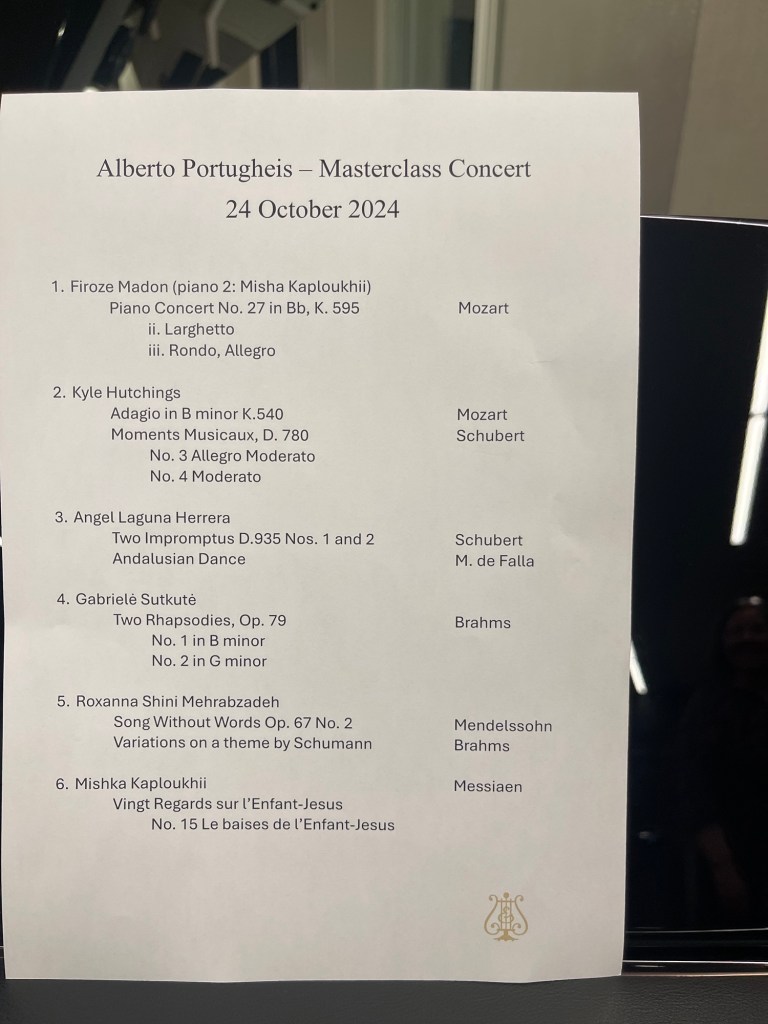
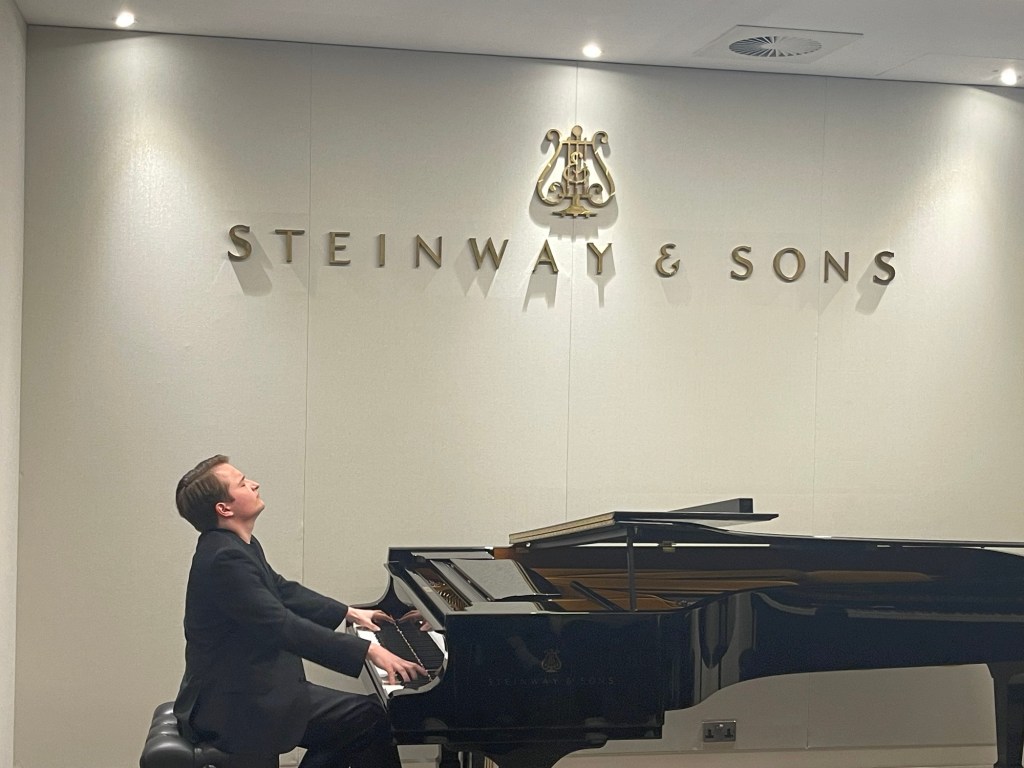
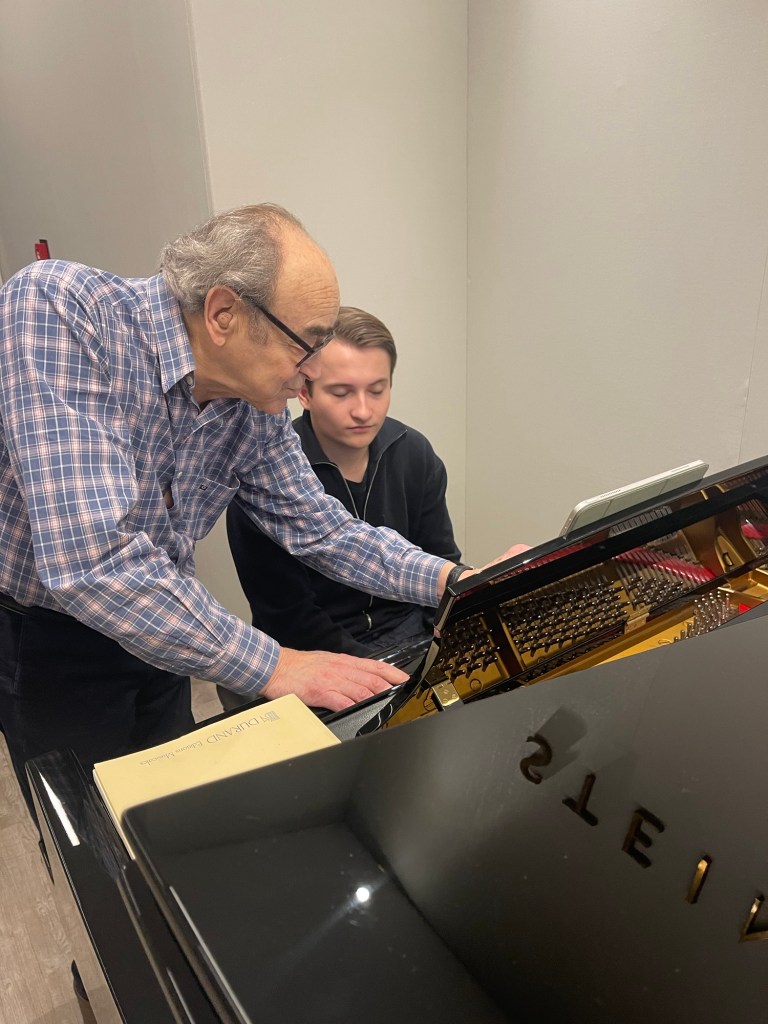
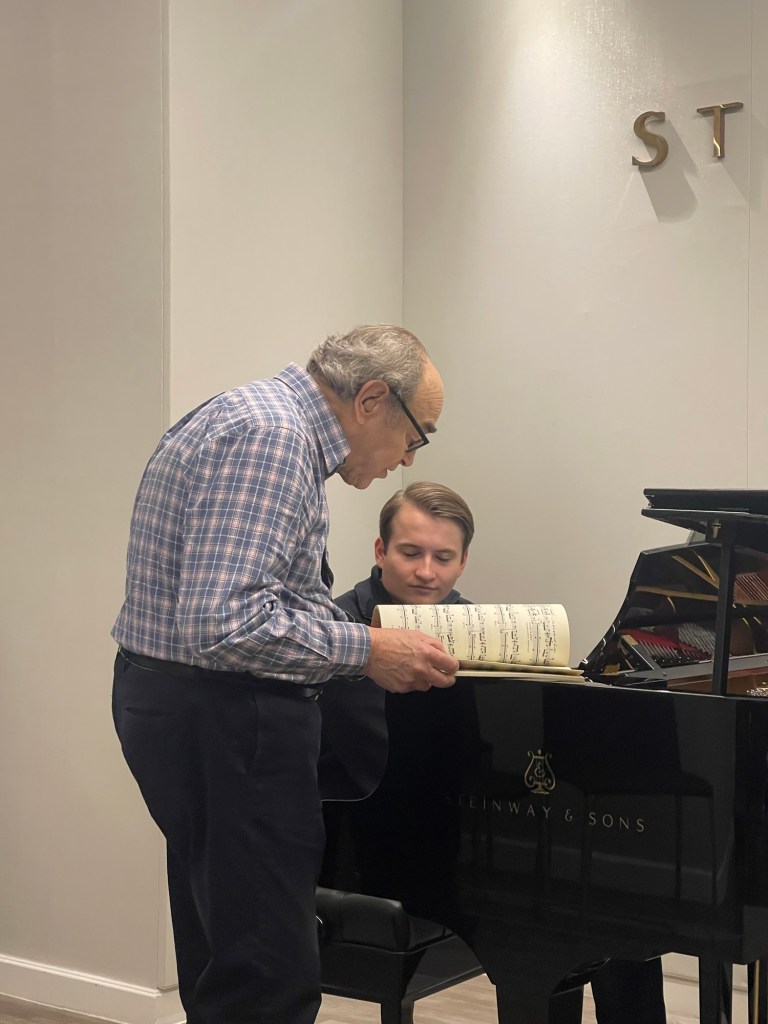
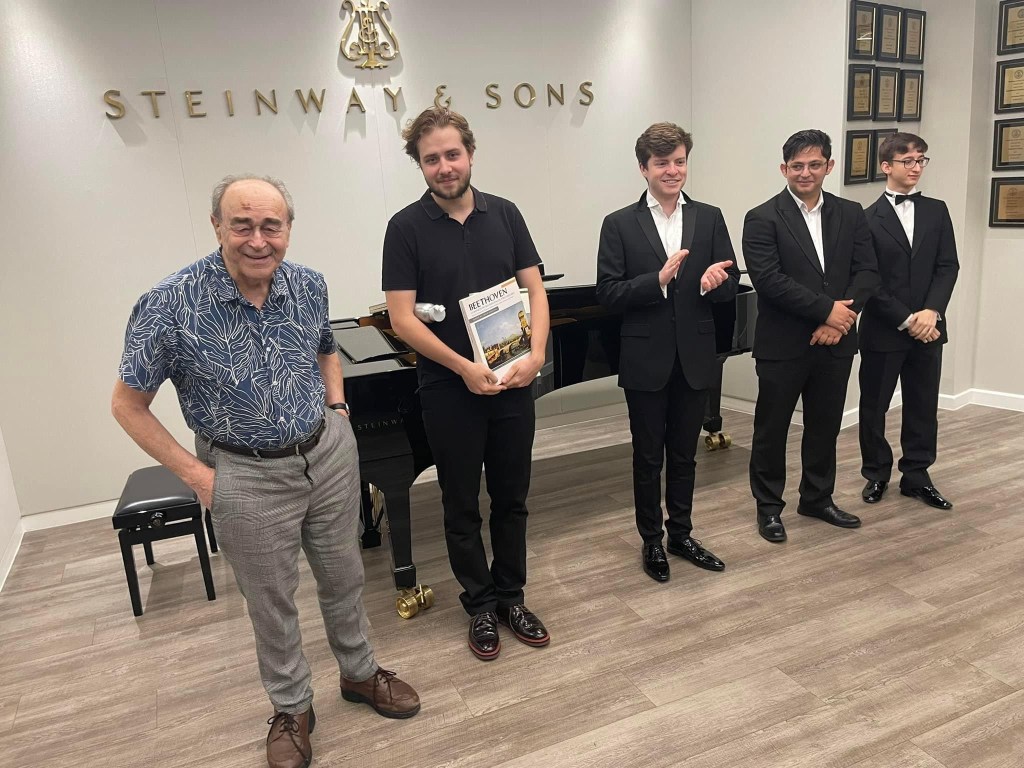
Masterclasses where the composers wishes are paramount as Maestro Portugheis with humility and respect shares his thoughts with young musicians in annual masterclasses that he holds in many different cities throughout the world.
A total respect for the composers wishes is the start of an interpretation to turn dots and dashes into the same sounds that the composer could imagine in his head.Nowhere is that more apparent than with the elderly Beethoven – totally deaf as he wrote down his final Sonatas with indications on performance that were sounds only in his head .He was able to transform his wishes precisely onto the printed page to share with posterity.A miracle indeed and there are one or two performers who can perform miracles as they translate these wishes into sound with mastery and artistry.
A lifetime voyage of discovery that Alberto Portugheis shares with talented young musicians with determination,severity but above all love.
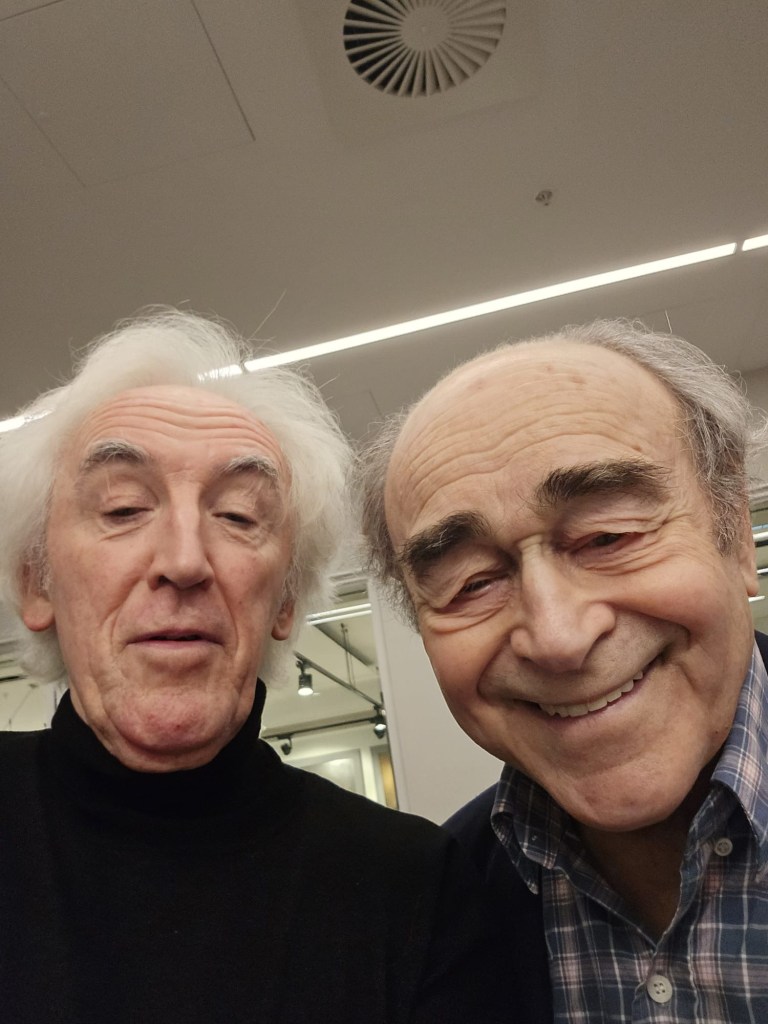
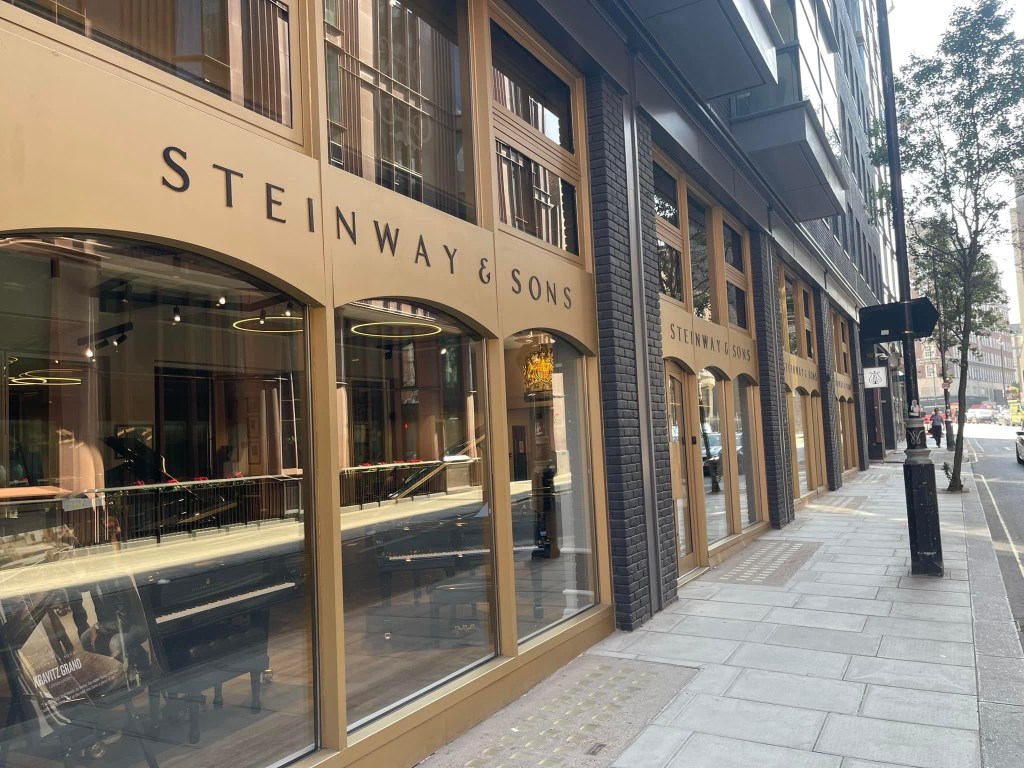
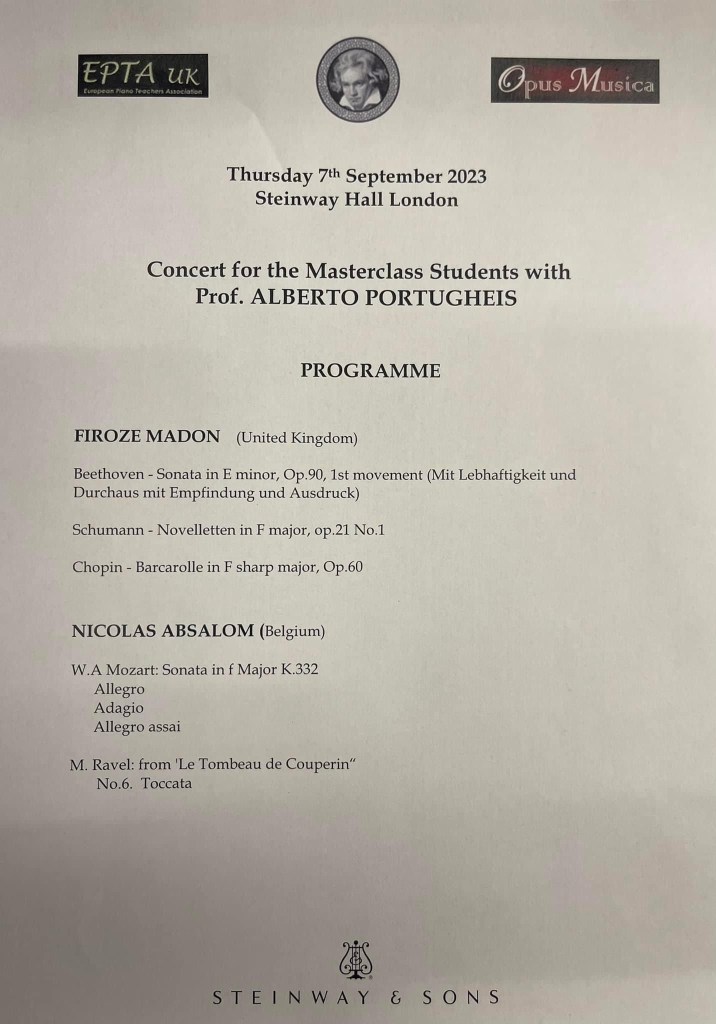
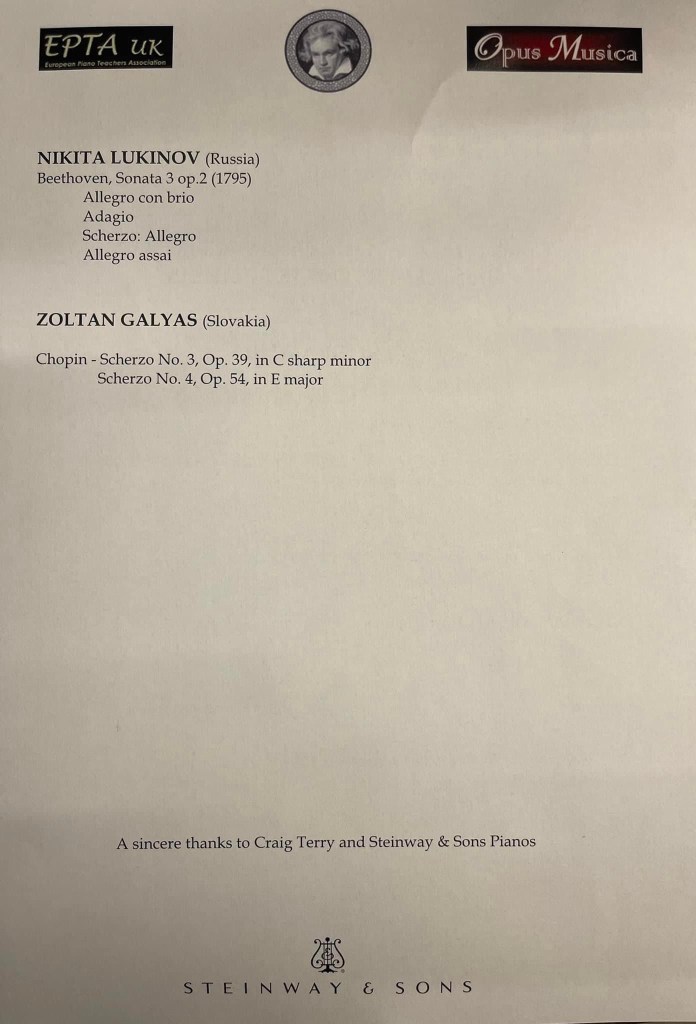
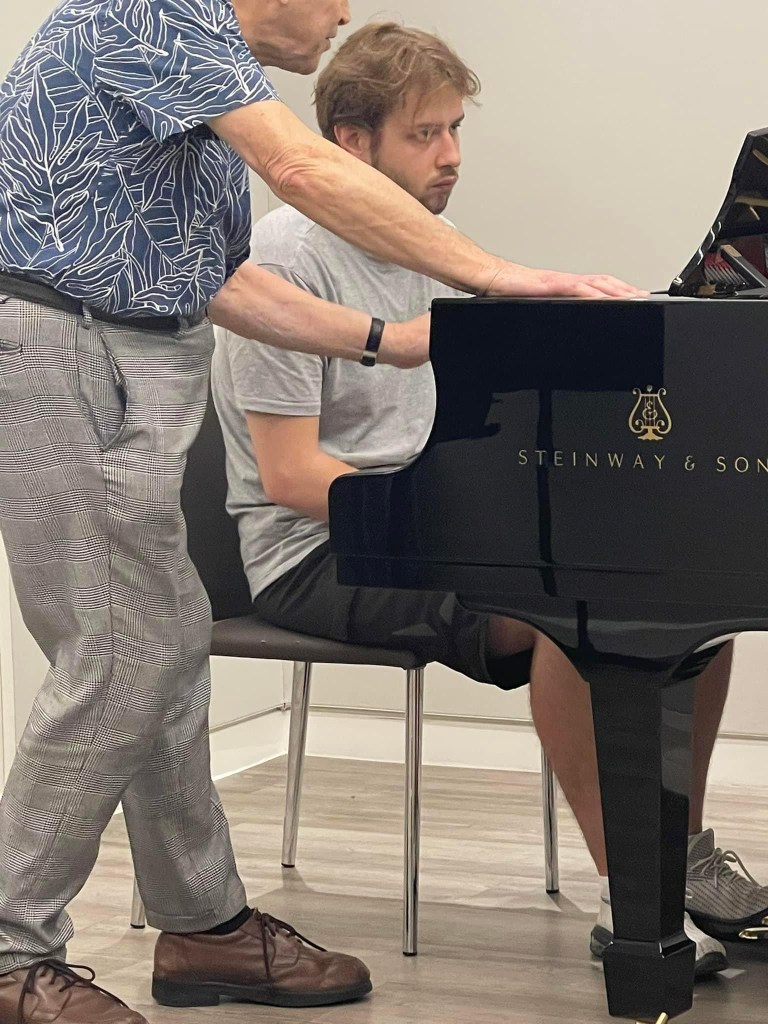
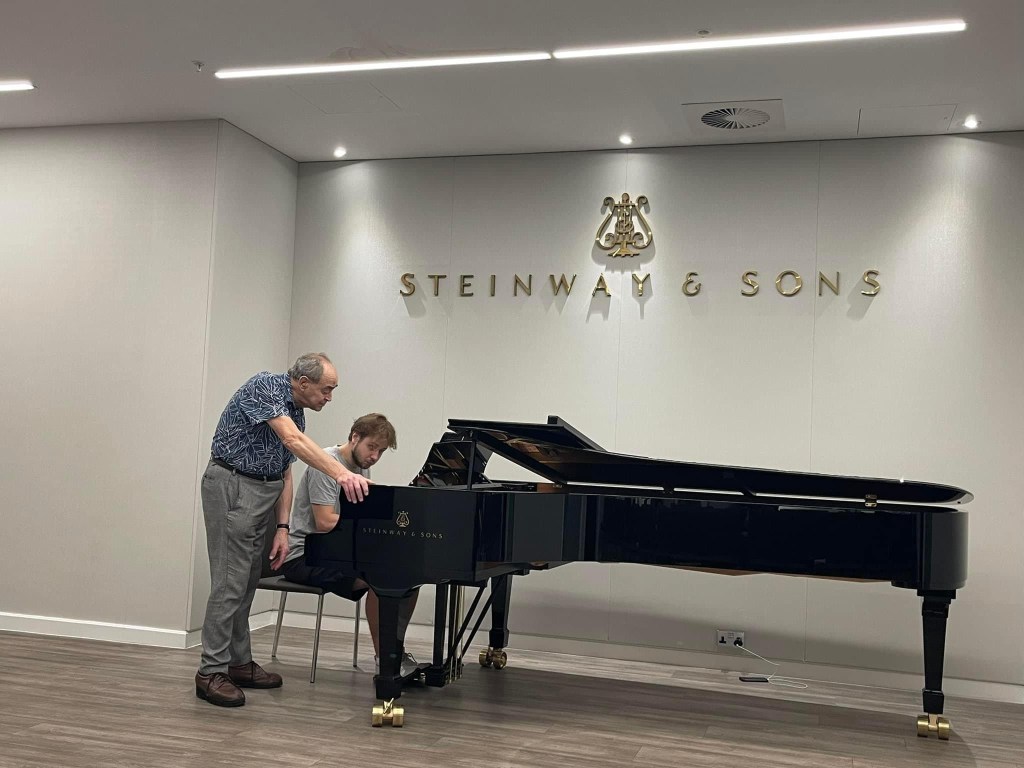
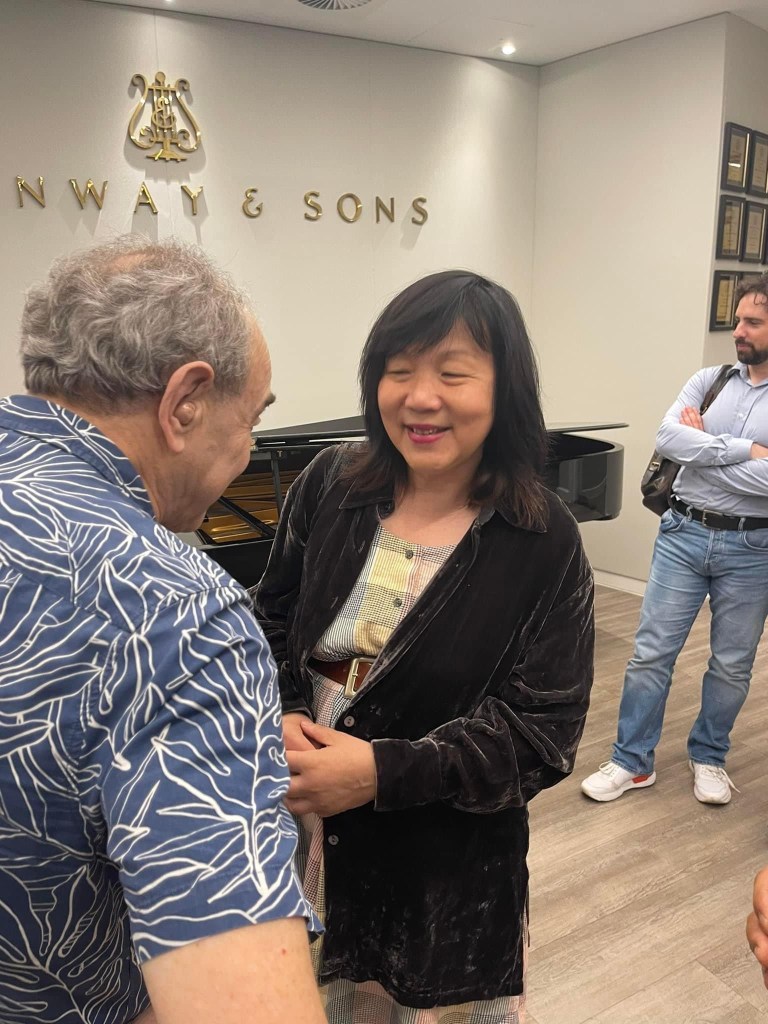
Patsy Toh (Mrs Fou Ts’ong- https://christopheraxworthymusiccommentary.com/2021/01/13/roberto-prosseda-pays-tribute-to-the-genius-of-chopin-and-the-inspirational-figure-of-fou-tsong/) teacher at the Purcell School of Firoze Madon and also Magdalene Ho ,both now in the class of Dmitri Alexeev at the RCM .Magdalene (19) was the winner last weekend of the Clara Haskil Competition Maestro Portugheis with his ‘boys’Nicolas Absalom. https://christopheraxworthymusiccommentary.com/2019/08/15/the-thomas-harris-international-piano-foundation-part-12/ https://christopheraxworthymusiccommentary.com/2019/11/10/viva-alberto-portugheis-and-the-thomas-harris-international-piano-foundation/I have heard Nicolas many times over the past five years in the various competitions and masterclasses held in collaborazione with the late Mrs Harris and the foundation created by her to celebrate the memory of her son who had also been mentored by Maestro Portugheis . Nicolas has matured ,via his studies in Weimar and Berlin into an artist of stature.One can gauge the maturity and musicianship of an artist in performances of the genius of Mozart that Schnabel famously decreed was too difficult for adults but too easy for children.Nicolas is now a mature young man and his Mozart was of great clarity and purity and technically impeccable showing great style. Of course the Ravel Toccata showed of his technical preparation but above all showed his musical intelligence choosing a tempo in which Ravel’s enchanted sound world could ravish and seduce as well as astonish!Zoltan GalyasZoltan Galyas I have not heard before and was intrigued to hear that he had to take his two children to school before joining the class at 10 am in Steinways.Talking to him afterwards too I was full of admiration for a born pianist ,as he so clearly demonstrated ,who was fully employed playing in Hotels and clubs in order to survive with a young family ( similar of course to the ‘menial’ tasks that Bach and Mozart had to undertake for their ‘masters’ in order to survive ).A pianist who has hands like limpets that are made to cling to the keys ,never hitting but digging deep into each key where his fingers are so obviously at home. A Chopin third Scherzo ,despite the odd blemishes,that was played by a true musician who could shape the majestic octaves horizontally into a musical line that led so naturally into the magical chorale that is heralded with such majesty.A coda of lightening speed but with fingers that knew where they were going but a driver that just needed to be less in a hurry! As Zoltan had explained he had started studying the Fourth Scherzo and was working now backwards and has arrived at the doorstep of the First .The fourth is a work close to his heart as was obvious from the warmth and control he could coax out of this wonderful black beast that Steinways so graciously allow real pianists to perform on in their beautiful new streamlined show room.Firoze Madon https://christopheraxworthymusiccommentary.com/2023/05/06/thibaudet-inspires-at-the-rcm-in-london/I had forgotten that I had heard Firoze play in a masterclass at the RCM of Thibaudet and I remember how impressed I was with his inborn musicality and sensitivity to sound.He had great respect for the Beethoven op 90 Sonata where the rests above all were so precise but also the rhythmic energy and sense of architectural shape.The Schumann Novelette was played with great contrasts between the opening strident chords and the romantic sweep of the composers poetic soul.’Marcato e con forza’ but in Firoze’s hands it was never allowed to become hard or ungrateful but full and expansive as he allowed the music to pour from his youthful hands with the same spirit with which the composer had obviously penned them.From the opening bass C sharp Firoze created a panorama of beauty and continuous mellifluous flights of invention in Chopin’s miraculous outpouring of song that is his Barcarolle.A performance of great authority and aristocratic musicianship that could dig deep into the soul of Chopin without any superficiality or excess.Nikita Lukinov https://christopheraxworthymusiccommentary.com/2023/06/05/nikita-lukinov-at-st-marys/I think all of us present today were aware that we were in the presence of a young master. A control and authority where delicacy and rhythmic energy combined in an Allegro con brio that was played with ravishing style and colour allied to dynamic rhythmic energy.The famous double thirds he organised to give the utmost precision without the terror of having to start a sonata already on a slippery slope .A bit like op 111 or op 106 should we play it like a master pianist or a master musician ?Nikita is both as he demonstrated with his masterly musicianship throughout.Not sure Arrau or Serkin would have forgiven him his pianistic trickery though!An Adagio that was barely whispered as it flowed on a continuous current of grandeur and beauty .Scintillating clarity to the scherzo with a trio that was just great washes of sound .The Beethovenian elegance of the Allego assai was played with transcendental control where the composer already transforms the inherited Sonata form into a new style of elegance with genial surprises and weight. The Schnabel Edition of the the 32 Sonatas was a just prize for a young musician headed for the heights Maestro Portugheis presenting the Schnabel Beethoven Edition to Nikita in recognition of his masterly performance of the longest and most important of the early Sonatas.Work behind the scenes with scrupulous attention to the composers indications – transforming them into sounds with humility respect and artistry Following the score during the performance – this is where an interpretation is born and the starting point for an artist to bring the composers wishes to life.Yisha Xue of the National Liberal Club where Nikita will perform on the 6th November in the KT series En Blanc e Noir
Patsy Toh (centre) with Firoze Madon and his mother
I have never forgotten the appearances of Rudolf Serkin in London in the ‘70’s .Playing the two Brahms concerti at the reopening of the refurbished Festival Hall heralded sporadic visits for recitals and also complete Mozart Concertos with Abbado down the road at the newly opened Barbican.How could one ever forget his monumental performance of the ‘Hammerklavier’ where the tension created was so great that even he was left shaken and astonished by the genius of Beethoven as he struck the final mighty chord.Diabelli Variations that were like thirty three electric shocks until the atomic explosion of the fugue.But there was also early Beethoven op 2 n.1 that was played with the same humility and respect as op 111 in a programme that also included Schumann’s Carnaval and Busoni’s Berceuse and Toccata.One year I remember him playing the Reger Variations too.Serkin was not a stylist but a great pianist with a technical mastery that knew no difficulties but it was placed at the service of the composer of which he was the humblest of servants.A dedication that was ready to work 8 hours a day even in his old age to be able to do justice to the composers he was serving.
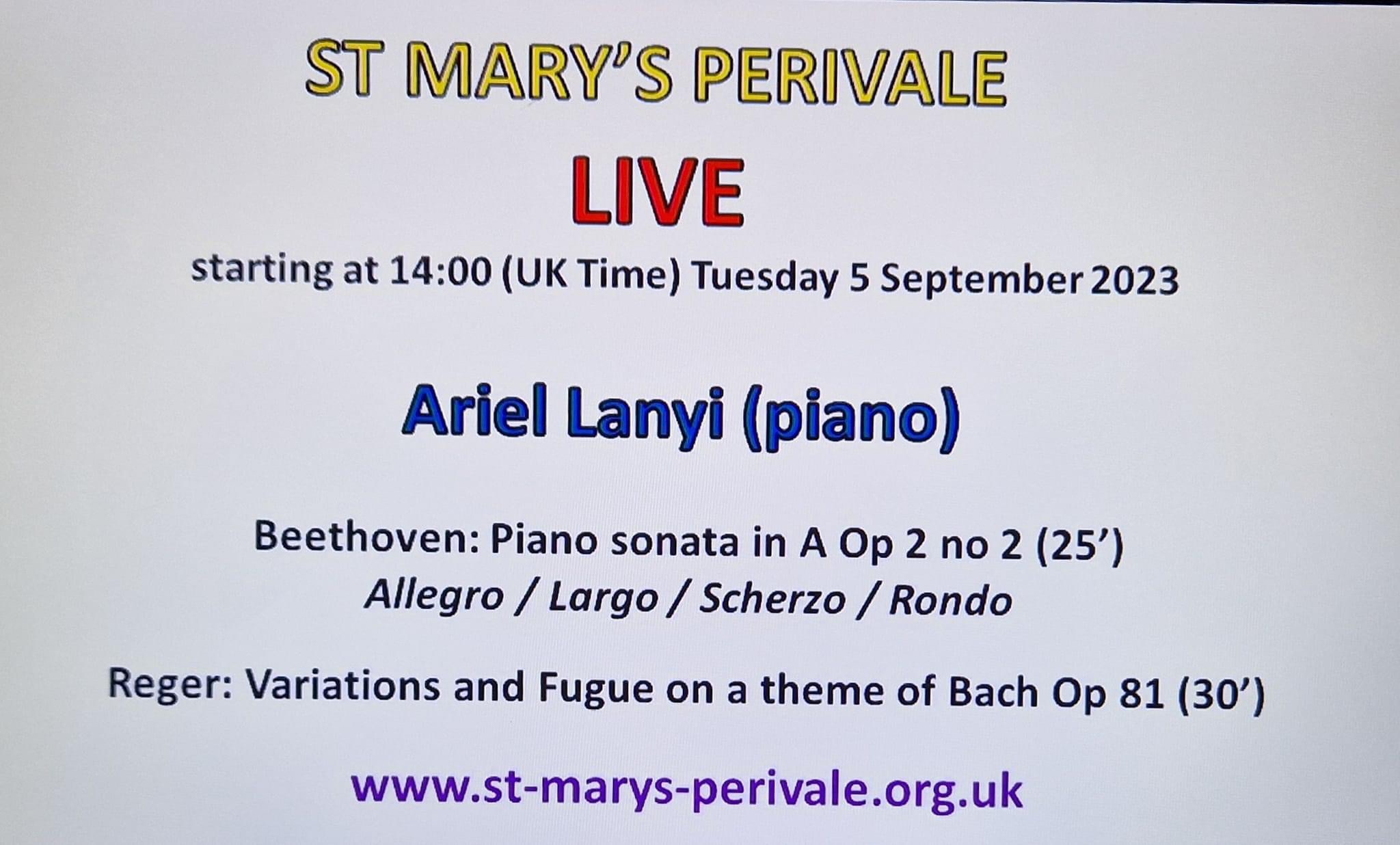
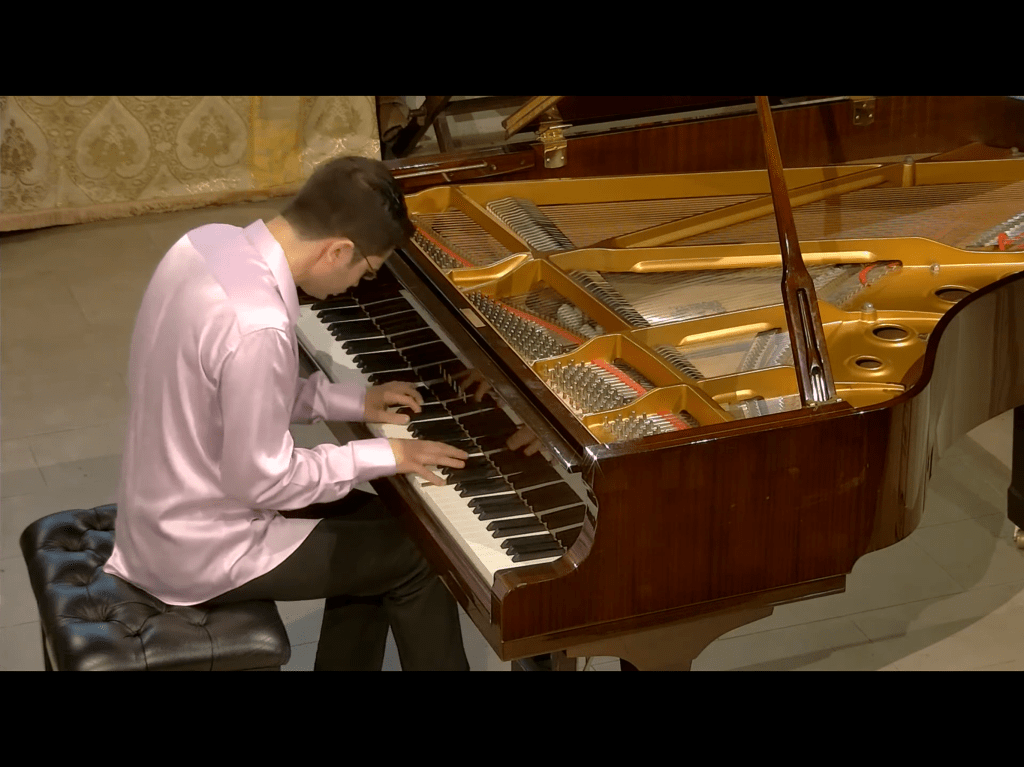
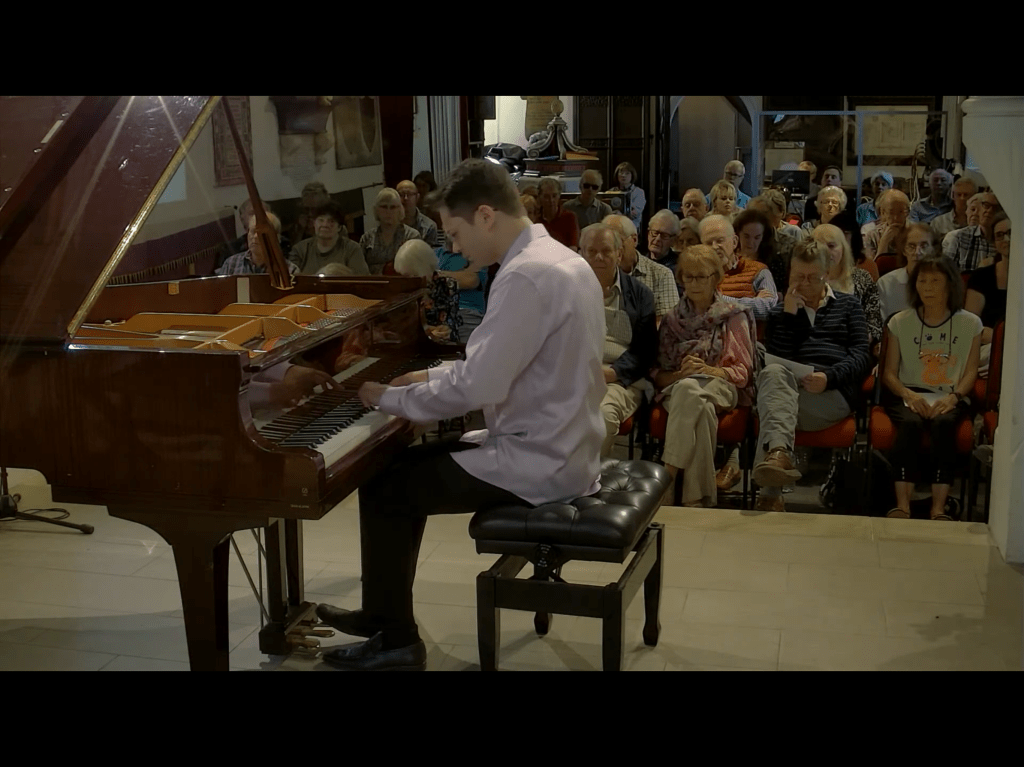
I have followed Ariel Lanyi’s career since his arrival in London and after today’s performances I have no doubt that here at last we have a musician of honesty,integrity and modesty with an uncontaminated sound.A prophet for whom we have been in such need to save us from certain schools of playing that are fast becoming confused with entertainers!
Perahia,Zimmerman,Brendel,Arrau all have one thing in common which is exactly the rare gift to illuminate the thoughts of the composer and to turn a page of black dots qnd dashes into a living breathing thing as it must have been when the ink was still wet on the page.I remember Richard Goode discovering a very young Perahia and sending him to play for his own teacher Serkin.’You told me he was good’ exclaimed the master ‘but you did not tell me HOW good’.Agosti,my own teacher and friend was like Brendel and would ask students to bring only the greatest of works to his class as a lifetime was not enough for an in-depth study of masterworks by Mozart,Beethoven or Bach.There was no time to waste on anything less .Andras Schiff prefers not to announce his programmes years in advance and knows his public will trust him to play only the greatest of music as he announces the programme as the concert progresses..Ariel too has this intellectual curiosity allied to a transcendental pianistic command that he can search out and delve deeply into the great compositions of the masters.
Beethoven’s Piano Sonata No. 2 in A major op.2 n.2 was written in 1795 and dedicated to Joseph Haydn . It was published simultaneously with his first and third sonatas in 1796 .It was was the first Beethoven sonata to reach America and was performed in New York on June 5, 1807.
Today Ariel made us aware of the genius of Beethoven even in the very first Sonatas of the 32 that were to span a lifetime.This group of three Sonatas dedicated to his teacher Haydn already show a unique personality that whilst using the standard forms can astonish and inspire rather than just bowing and curtsying with the eloquence and elegance of their time.Beethoven the revolutionary was already sending sparks flying.Ariel brought a clarity and rhythmic drive to op 2 n. 2 and a sound that was so similar to Serkin that I was quite astonished and was pleasurably surprised to discover that my memory had not been playing tricks as I was reminded what simplicity and intelligence could bring to these early scores.Simple,pure Beethoven – easily said but as Schnabel said of Mozart :’too easy for children but too difficult for adults’.There were orchestral colours in the ‘Largo appassionato’ with the beautiful legato cantabile melody accompanied by the pizzicato bass- a real tour de force of technical control.It was even more astonishing at the end where Beethoven incorporates counterpoints in its midst that Ariel managed to play with layers of sound that were an extraordinary technical feat.There was grace and charm to the scherzo and a beautifully flowing Trio that contrasted so poignantly with the return of the Scherzo .A complete change of landscape with the Rondo written ‘Grazioso’ and with pedal indications that were beautifully transposed into sounds of ravishing beauty and fluidity.The Beethovenian outbursts were played with dynamic drive and energy and were like electric shocks in this pastoral landscape where Beethoven’s rapid changes of humour could so rudely interrupt the proceedings.
It was a great privilege to be reminded of the Reger Variations and to realise what a great work has been ignored for too long in the concert hall.The deeply expressive Bach Cantata gradually trasformed into variations of sublime beauty but also of the same technical difficulty as one finds often in Brahms.Ariel never lost sight of the musical line as the variations led to the final triumphant fourteenth variation.Out of the sound of the last chord emerged the fugue with simplicity and clarity much as in Beethoven op 110.Leading to the final intricate pages of knotty twine clarified for us with the same simplicity and drive of someone who has had the same vision as the composer and can guide us through the maze with simple transcendental ease.
Johann Baptist Joseph Maximilian Reger (19 March 1873 – 11 May 1916), commonly known as Max Reger, was a German composer, pianist, organist, conductor, and academic teacher. He worked as a concert pianist, as a musical director at the Leipzig University Church, as a professor at the Royal Conservatory in Leipzig, and as a music director at the court of Duke Georg II of Saxe-Meiningen.Reger seemed determined to create as epic a sound from the piano as possible, uniting the harmonic chromaticism of Liszt and Wagner, the rhythmic hemiola and chordal density of Brahms, and the contrapuntal mastery of Bach. Arnold Schoenberg, who famously emancipated dissonance from tonal contexts, considered Reger a genius, and indeed, we can only speculate how much further Reger’s musical expressionist tendencies might have gone had he not died of a heart attack in 1916.Ironically enough, the Bach theme in Op. 81 was not chosen by Reger himself but by one of his performer advocates, the pianist August Schmid-Lindner.
Reger’s dedication to Bach bore especially rich creative fruit, not only in the noble ‘Bach’ Variations , but in a number of ingenious keyboard transcriptions, not least the complete orchestral Suites and Brandenburg Concertos (arranged for piano four hands), and the two-part Inventions, various Preludes and Fugues from The Well-tempered Clavier and sundry Fantasias and Toccatas (refashioned for organ solo). The Variations and Fugue on a theme of Johann Sebastian Bach dates from the summer of 1904, although perennial in their eloquence and vitality and the uncommon richness of their modulations, the Variations are nonetheless rooted in the musical past, much as Bach’s own music had been.The main theme is taken from the beautiful contralto/tenor duet ‘Seine Allmacht zu ergründen, wird sich kein Mensche finden’ (‘No man can fathom His omnipotence’) which is, in turn, from Bach’s Cantata No 128, Auf Christi Himmelfahrt allein. Reger asks for the melody to be played ‘sweetly and always very legato—that is to say, like an oboe solo’ (Bach’s original is scored for oboe d’amore and continuo) and, while treating it to appreciative pianistic colours, opts thereafter to home in on particular elements of the theme rather than to vary it ‘whole’. There is the Fugue at the end after fourteen variations and it is a colossal, three-tier edifice, the first two episodes being four-part fugues (Bach’s original melody reappears in the treble towards the end of the second), the last section combining them both for a towering grand finale.
In March 2023, Ariel Lanyi was honored to receive the Prix Serdang, a Swiss prize awarded by the distinguished Austrian pianist Rudolf Buchbinder. The prize is endowed with CHF 50,000 and is not a competition, but a recognition of a young pianist’s achievements and an investment in their future. Prior to this Ariel won 3rd Prize at the 2021 Leeds International Piano Competition. In the same year he was a prize winner in the inaugural Young Classical Artists Trust (London) and Concert Artists Guild (New York) International Auditions. Highlights this season include a recording with the Mozarteumorchester Salzburg under the auspices of the Orpheum Stifftung as part of their Next Generation Mozart Soloist series. Further afield Ariel takes part in the Bendigo Chamber Music Festival in Australia, gives concerts in the USA, and undertakes a tour of Colombia. In 2023 he was nominated as a Rising Star Artist by Classic FM. Over the last year Ariel returned to Wigmore Hall (as soloist and chamber musician), the Miami International Piano Festival, and Marlboro Music Festival in Vermont. He undertook a tour of Argentina and gave recitals in the Homburg MeisterKonzert series in Germany, the Menton Festival in France, Perth Concert Hall (broadcast by BBC Radio 3), and across the UK including the Brighton and Bath Festivals. In 2021 Linn Records released his recording of music by Schubert to critical acclaim.
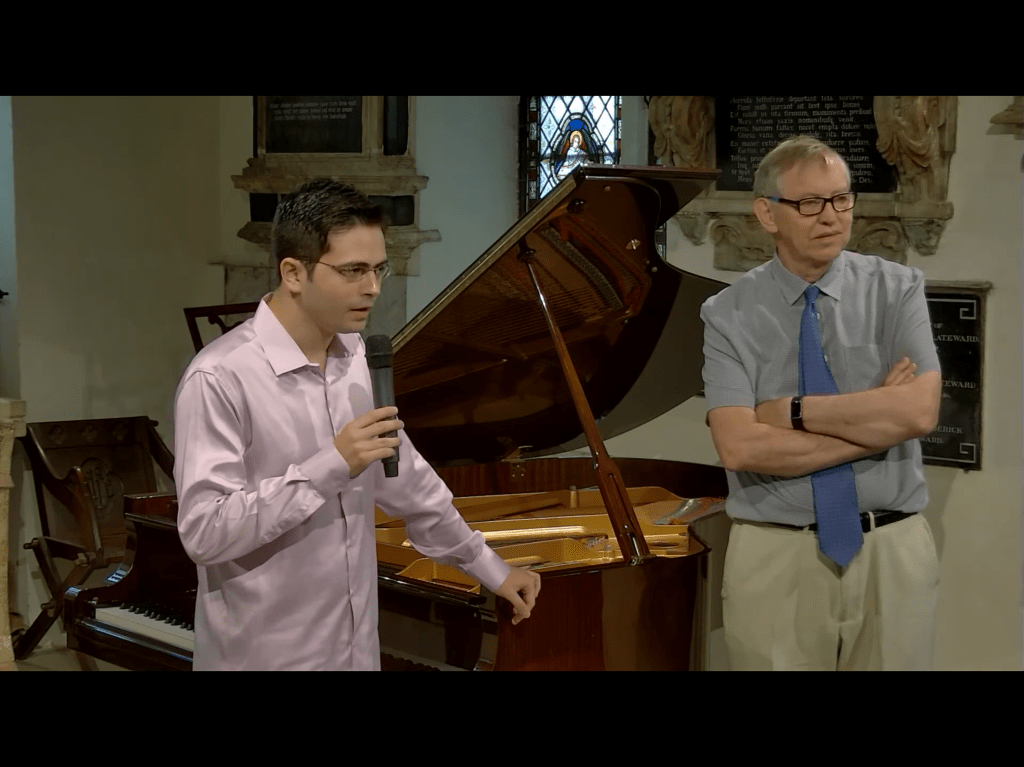
Ariel introducing the Reger to an eventually astonished audience
Born in Jerusalem in 1997, Ariel studied with Lea Agmon and Yuval Cohen. Based in London, he recently completed his studies at the Royal Academy of Music with Hamish Milne and Ian Fountain. He has received extensive tuition from eminent artists such as Robert Levin, Murray Perahia, Imogen Cooper, Leif Ove Andsnes, Steven Osborne, and the late Leon Fleisher and Ivan Moravec. Awards include 1st Prize at the 2018 Grand Prix Animato Competition in Paris and 1st Prize in the Dudley International Piano Competition, as well as a finalist award at the Rubinstein Competition.
A programme from Kate Liu searching for the inner beauty and subtle sounds in all she played .A series of Mazurkas ,Waltzes and Nocturnes were allowed to unfold as if in a dream with ravishing whispered sounds .Even the Waltz in B minor op 69 n. 2 was played very slowly and beautifully as was the opening nocturne op 27 n.1. Missing the natural flow as she delved deep into sounds of delicacy and beauty.She had been awarded the Mazurka audience prize and Bronze Medal in the Chopin Competition in 2015 .A curious coincidence that a pianist with the same surname Bruce Liu should win first prize in 2021 It had been Fou Ts’ong in 1955 who had astonished the audience in Warsaw when the Mazurka prize was awarded to a non Polish pianist!Kate Liu was also awarded the Mazurka prize forty years later and she showed us why with three Mazurkas of exquisite sensibility and beauty.
It was obviously a moment of reflection for Kate Liu as even in the Schumann Etudes Symphoniques she found more of Eusebius than Florestan within.There was of course technical assurance and mastery and a rhythmic drive that seemed to ignite her playing after the five posthumous studies where she was able reveal the very soul of Schumann with exquisite timeless sounds .Her control and technical prowess ignited her performance with a ‘presto possibile’ of remarkable precision and the drive she brought to the Allegro con energia that followed was breathtaking with the sudden surprise entry of Florestan.Followed by the ravishing beauty and control of the Andante espressivo Chopinesque study leading into the finale played with driving rhythm and dynamic energy.Two encores were both from the world of Eusebius with the exquisite Bagatelle op 126 n. 5 where Beethoven could finally see the paradise that awaited him after a very difficult life full of earthly trials and tribulations.
The first edition Schumann’s Etudes Symphoniques in 1837 carried an annotation that the tune was “the composition of an amateur”: this referred to the origin of the theme, which had been sent to Schumann by Baron von Fricken, guardian of Ernestine von Fricken, the Estrella of his Carnaval op. 9. The baron, an amateur musician, had used the melody in a Theme with Variations for flute. Schumann had been engaged to Ernestine in 1834, only to break abruptly with her the year after. An autobiographical element is thus interwoven in the genesis of the Études symphoniques (as in that of many other works of Schumann’s).Of the sixteen variations Schumann composed on Fricken’s theme, only eleven were published by him. (An early version, completed between 1834 and January 1835, contained twelve movements). The final, twelfth, published étude was a variation on the theme from the Romance Du stolzes England freue dich (Proud England, rejoice!), from Heinrich Marschner’s opera Der Templer und die Judin based on Sir Walter Scott’s Ivanhoe (as a tribute to Schumann’s English friend, William Sterndale Bennett to whom it is dedicated )The earlier Fricken theme occasionally appears briefly during this étude. The work was first published in 1837 as XII Études Symphoniques. Only nine of the twelve études were specifically designated as variations. The entire work was dedicated to Schumann’s English friend, the pianist and composer, and Bennett played the piece frequently in England to great acclaim, but Schumann thought it was unsuitable for public performance and advised his wife Clara not to play it.The highly virtuosic demands of the piano writing are frequently aimed not merely at effect but at clarification of the polyphonic complexity and at delving more deeply into keyboard experimentation. The Etudes are considered to be one of the most difficult works for piano by Schumann (together with his Fantasy in C and Toccata) and in Romantic literature as a whole.
With Prof Paleczny
Only nine of the twelve études were specifically designated as variations. The sequence was as follows:
Theme – Andante [C♯ minor]
Etude I (Variation 1) – Un poco più vivo [C♯ minor]
Etude II (Variation 2) – Andante [C♯ minor]
Etude III – Vivace [E Major]
Etude IV (Variation 3) – Allegro marcato [C♯ minor]
Etude V (Variation 4) – Scherzando [C♯ minor]
Etude VI (Variation 5) – Agitato [C♯ minor]
Etude VII (Variation 6) – Allegro molto [E Major]
Etude VIII (Variation 7) – Sempre marcatissimo [C♯ minor]
Etude IX – Presto possibile [C♯ minor]
Etude X (Variation 8) – Allegro con energia [C♯ minor]
Etude XI (Variation 9) – Andante espressivo [G♯ minor]
Etude XII (Finale) – Allegro brillante (based on Marschner’s theme) [D♭ Major]
On republishing the set in 1890, Brahms restored the five variations that had been cut by Schumann. These are now often played, but in positions within the cycle that vary somewhat with each performance; there are now twelve variations and these five so-called “posthumous” variations which exist as a supplement.
The five posthumously published sections (all based on Fricken’s theme) are :
Kate Liu inserted them between Etude VIII and Etude IX
Variation I – Andante, Tempo del tema
Variation II – Meno mosso
Variation III – Allegro
Variation IV – Allegretto
Variation V – Moderato.
An open air screen for all to enjoy in this festival where every concert is sold out in advance
Beethoven’s Bagatelles Op. 126 were published late in his career, in the year 1825 and dedicated to his brother Nikolaus Johann ( 1776–1848).Beethoven wrote to his publisher, Schott Music that the Opus 126 Bagatelles “are probably the best I’ve written”.In prefatory remarks to his edition of the works, Otto von Irmer notes that Beethoven intended the six bagatelles be played in order as a single work, at least insofar as this can be inferred from a marginal annotation Beethoven made in the manuscript: “Ciclus von Kleinigkeiten” (cycle of little pieces).Another reason to regard the work as a unity rather than a collection: starting with the second Bagatelle, the keys of the pieces fall in a regular succession of descending major thirds a pattern used in Beethoven’s ‘Eroica’Symphony and the String Quartet op 127
Pianist Kate Liu gained international acclaim after winning the Bronze Medal and Best Mazurka Prize at the 17th International Fryderyk Chopin Competition in Warsaw, Poland. She was also awarded the audience favorite prize voted by the Polish public on the Polish National Radio.
As a soloist, Kate has performed in many important venues, such as the Seoul Arts Center, Tokyo Metropolitan Theatre, Carnegie’s Weill Hall, Severance Hall in Cleveland, La Maison Symphonique de Montréal, Warsaw National Philharmonic, Kennedy Center in Washington, D.C., Shanghai Concert Hall, Osaka Symphony Hall, Polish National Radio Symphony Orchestra Hall, Phillip’s Collection, and others. She has collaborated with orchestras including the Cleveland Orchestra, Warsaw Philharmonic Orchestra, Orchestre Symphonique de Montréal, Polish Radio Orchestra, Poznan Philharmonic, Yomiuri Nippon Symphony Orchestra, Daegu Symphony Orchestra, Rochester Philharmonic, Hilton Head Symphony Orchestra, and Evanston Symphony Orchestra. Her debut album of works by Chopin was released on the Fryderyk Chopin Institute label in 2016.
Born in Singapore, Kate began playing the piano when she was four years old and moved to the United States when she was eight. Her private studies then were at the Music Institute of Chicago with Emilio del Rosario, Micah Yui and Alan Chow. Early on in her career, she won 1st Prizes at the Third Asia-Pacific International Chopin Competition and the New York International Piano Competition. She received a Bachelor’s degree from the Curtis Institute of Music studying with Robert McDonald, as well as a Master’s and Artist Diploma degree from The Juilliard School under the tutelage of Robert McDonald and Yoheved Kaplinsky.
It is interesting to note the past winners of the Chopin competition from 1927 to the present day
Lina Tufano,the artistic director of the Incontri Musicali in Ischia writes to Sarah Biggs, C.E.O of the Keyboard Trust :
Pedro gave us 2 wonderful recitals!
He is a very talented young pianist! The audience enjoyed so much his performances in both the concerts ( the Hall was full) that gave him a standing ovation. He has a very sharp musical intelligence, Mozart’s sonata was emotional and expressive , Fantasia baetica by De Falla was colorful and impressive and here his interpretation was really superbe. He played Mussorgsky ‘s Pictures and Schumann’s Kreisleriana with great confidence. I liked him so much that I asked him to come back and play to La Mortella when he wants (may be before the Chopin competition, so that he can play in 2 concerts the whole Chopin programs?)
Thank you Sarah,and thanks to the Keyboard Trust for sending us such talented young pianists! We are waiting for the next one!
And to me C/O artistic director of the Keyboard Trust :
Caro Christopher, Pedro è stato davvero bravissimo, è un giovane pianista di grande talento! Ha tenuto 2 concerti in una sala piena e con un pubblico straordinariamente attento e caloroso che ha gradito moltissimo le sue esecuzioni tanto che gli ha tributato alla fine una standing ovation. È un pianista dotato di grande intelligenza musicale, attento ad ogni sfumatura e particolare della partitura, la sonata di Mozart davvero ammirevole per equilibrio ed espressività, mai leziosa, una straordinaria Fantasia baetica di De Falla, dove davvero ha dato il meglio di se’ con una esecuzione appassionata e piena di colori. Belle le interpretazioni dei Quadri di Mussorgsky e della Kreisleriana di Schumann, 2 monumenti della letteratura pianistica affrontati con grande sicurezza . Mi è talmente piaciuto che l’ho invitato a ritornare alla Mortella quando vorrà! Grazie per avercelo segnalato, mancavi solo tu! Ti aspettiamo per Thomas Kelly. Un caro saluto