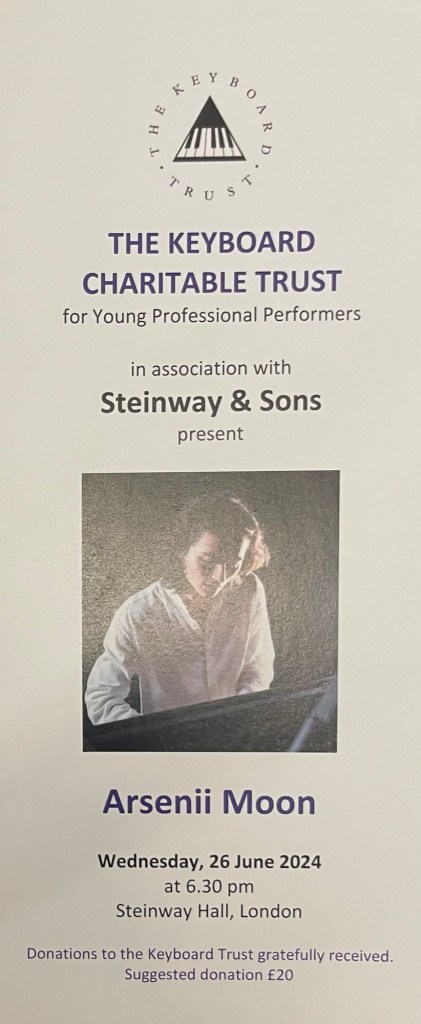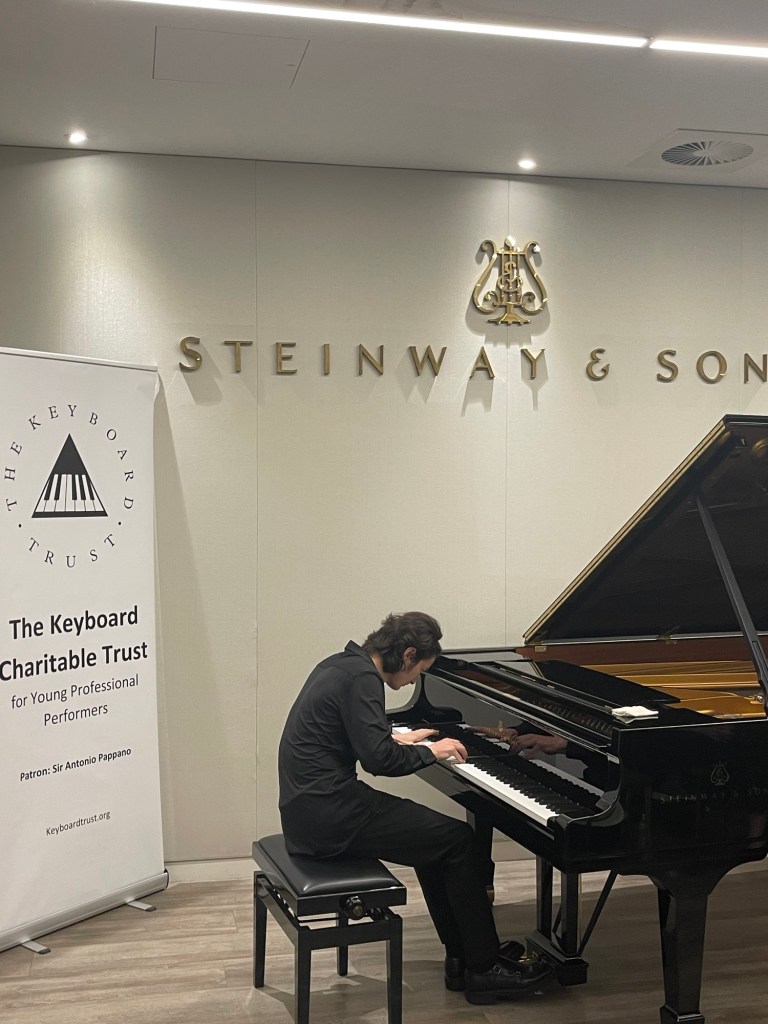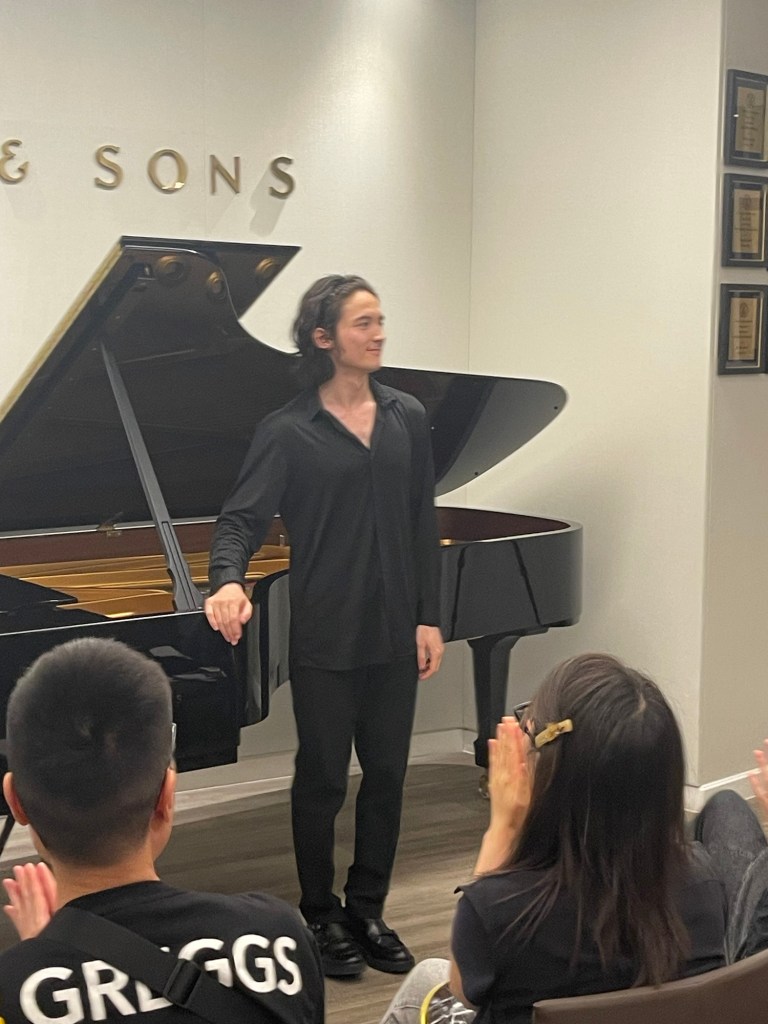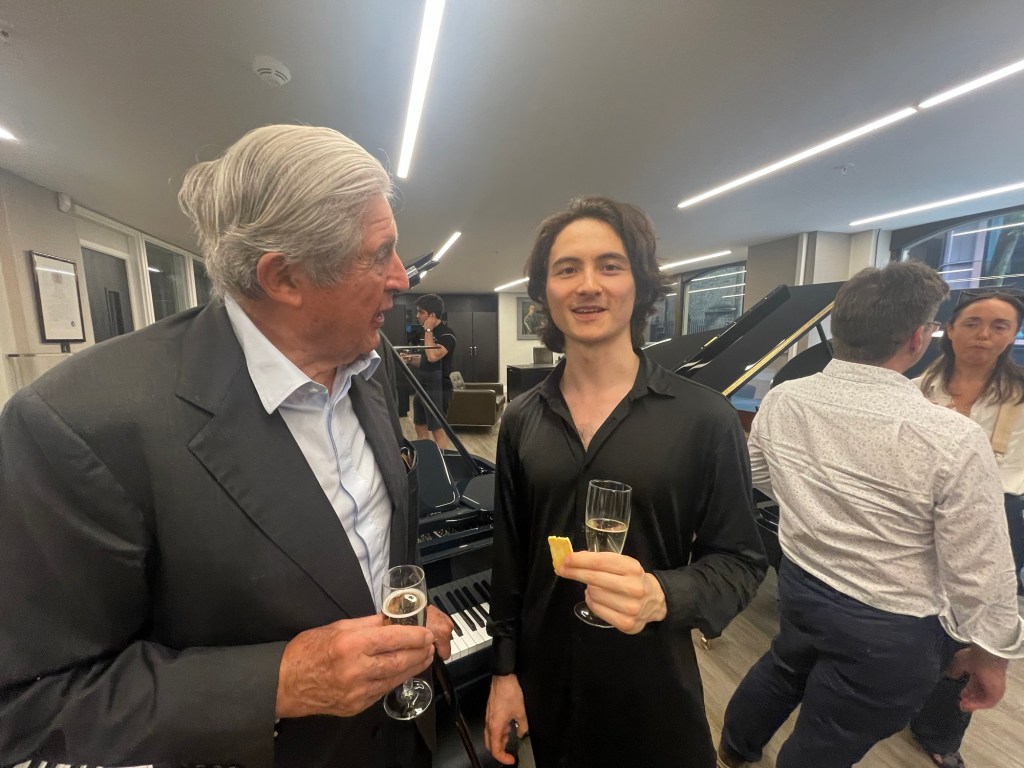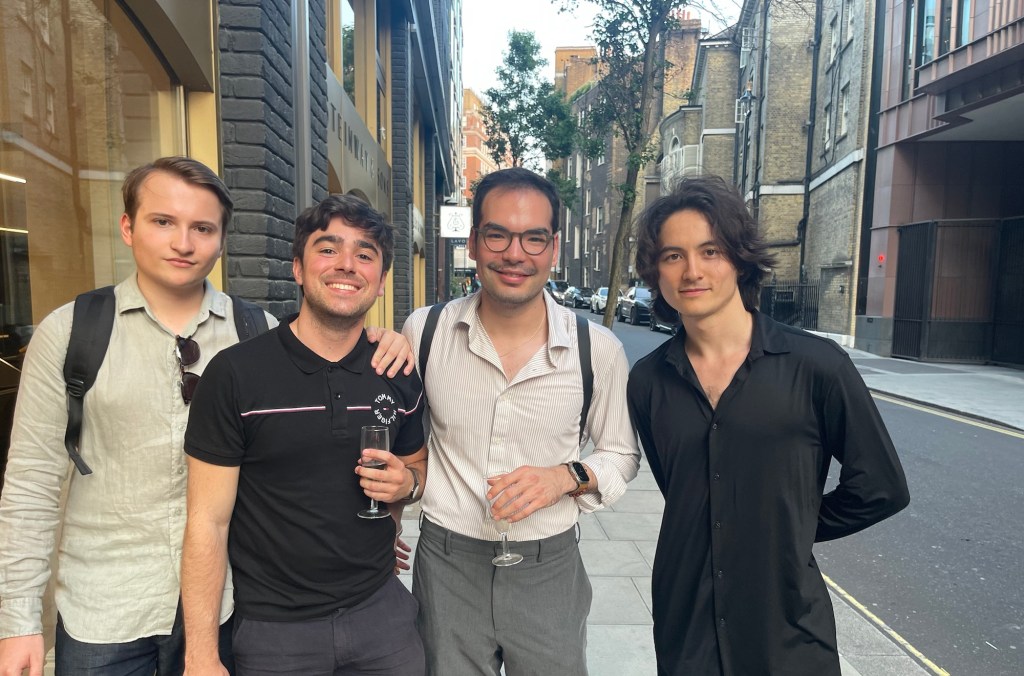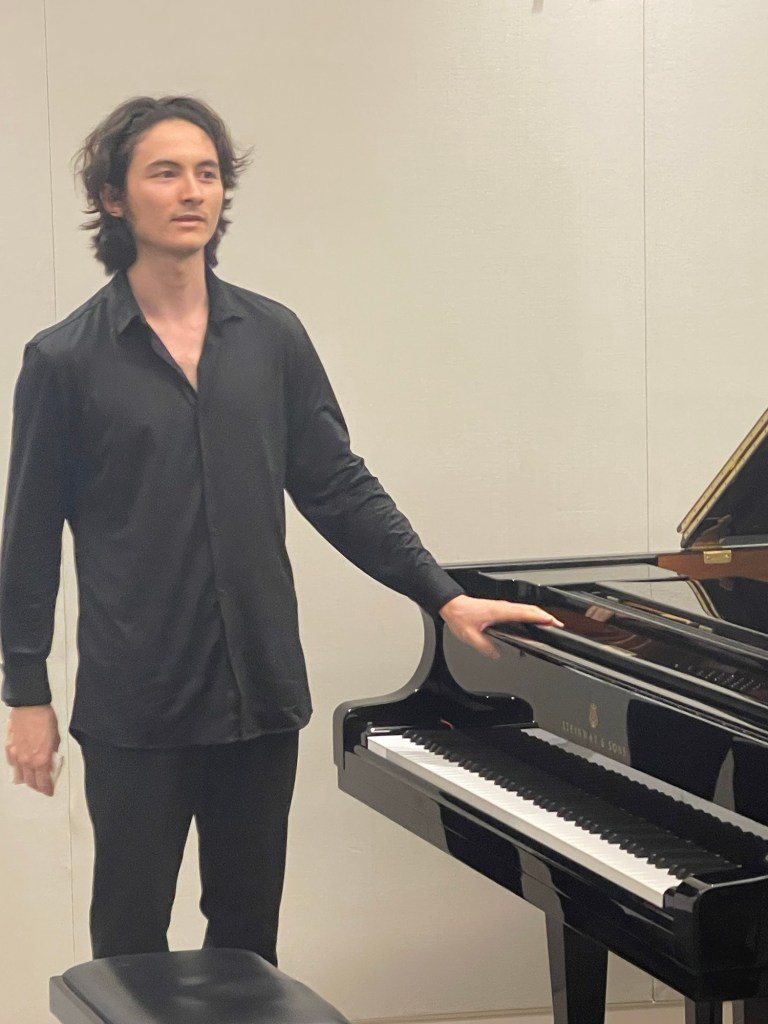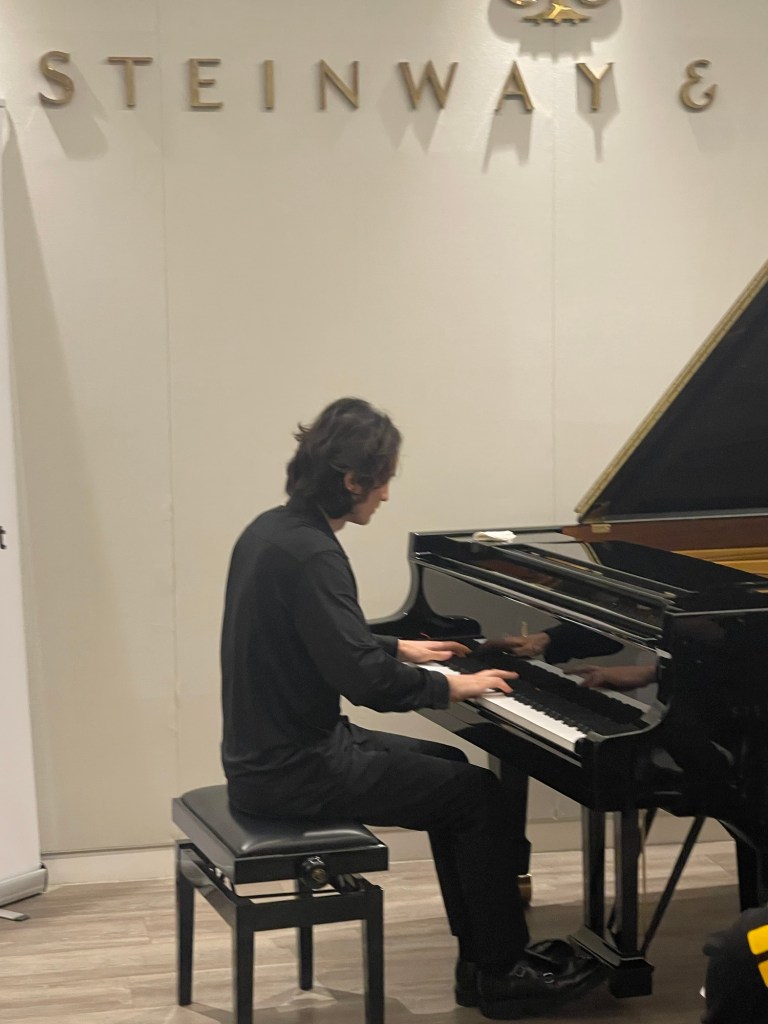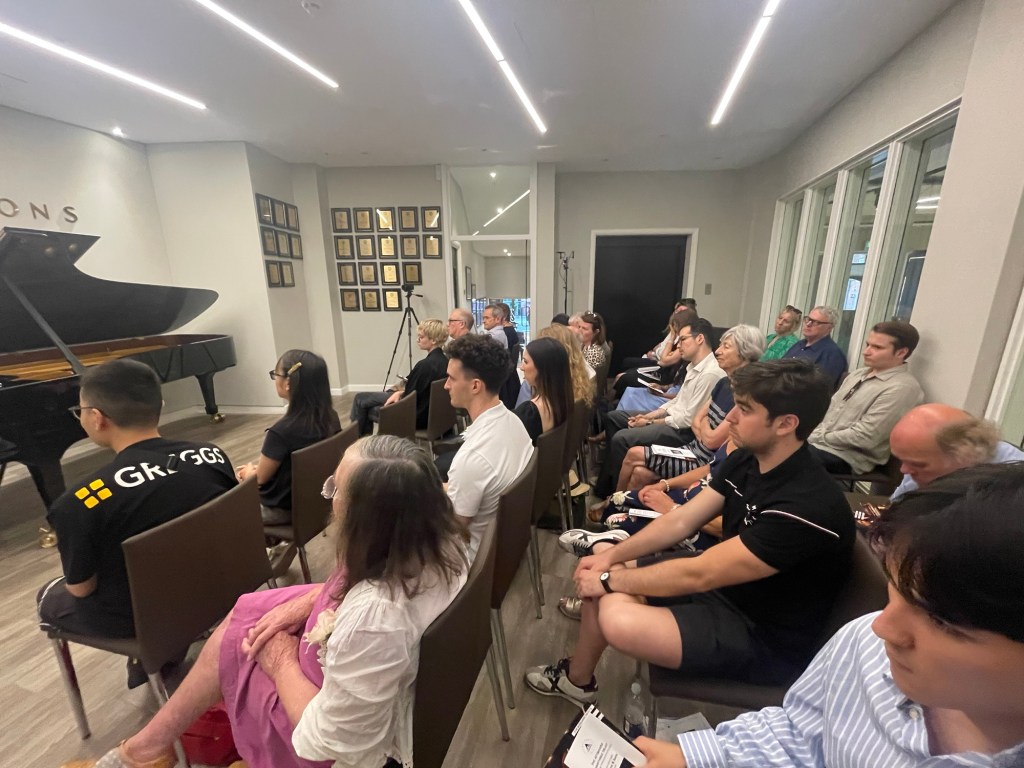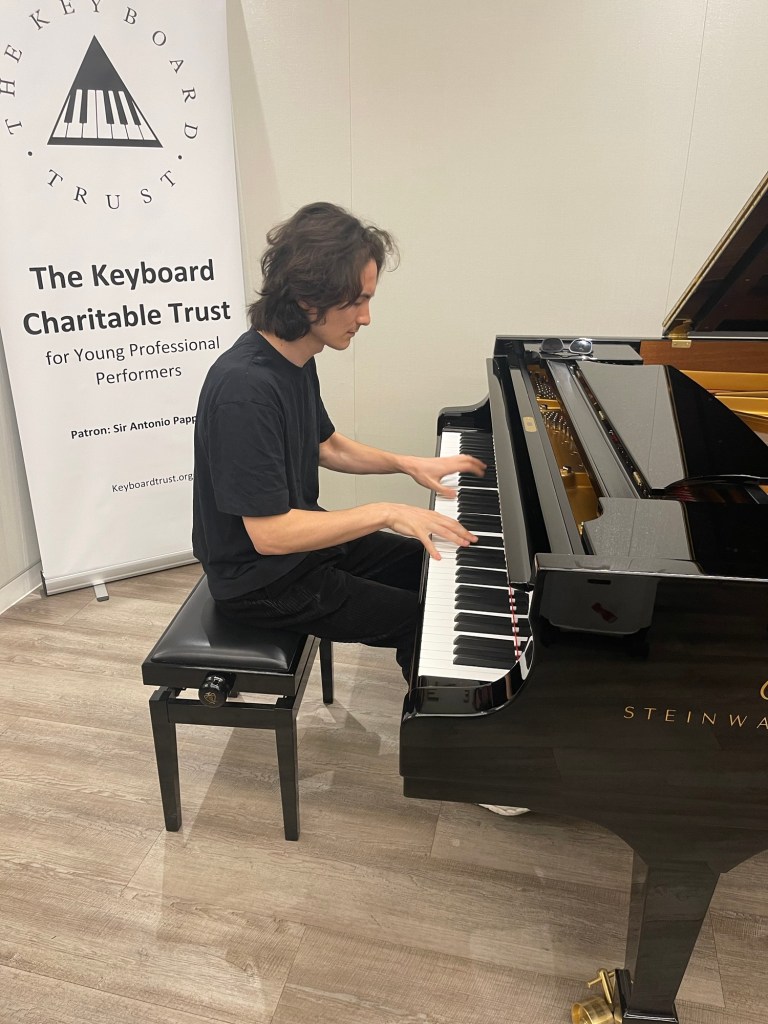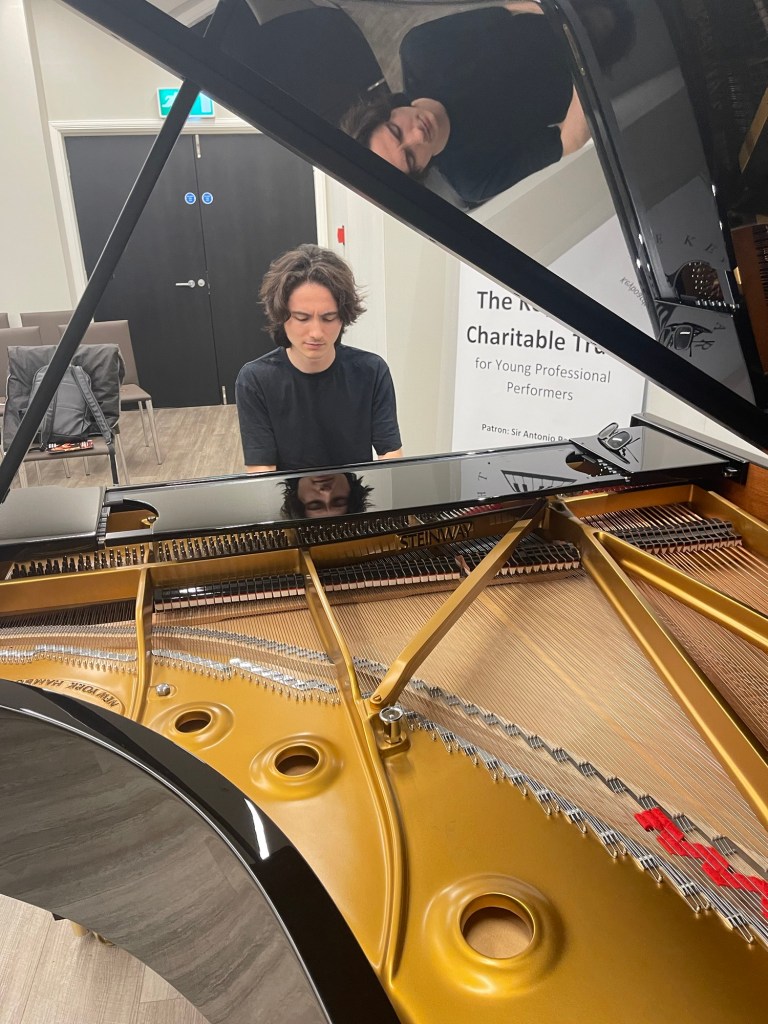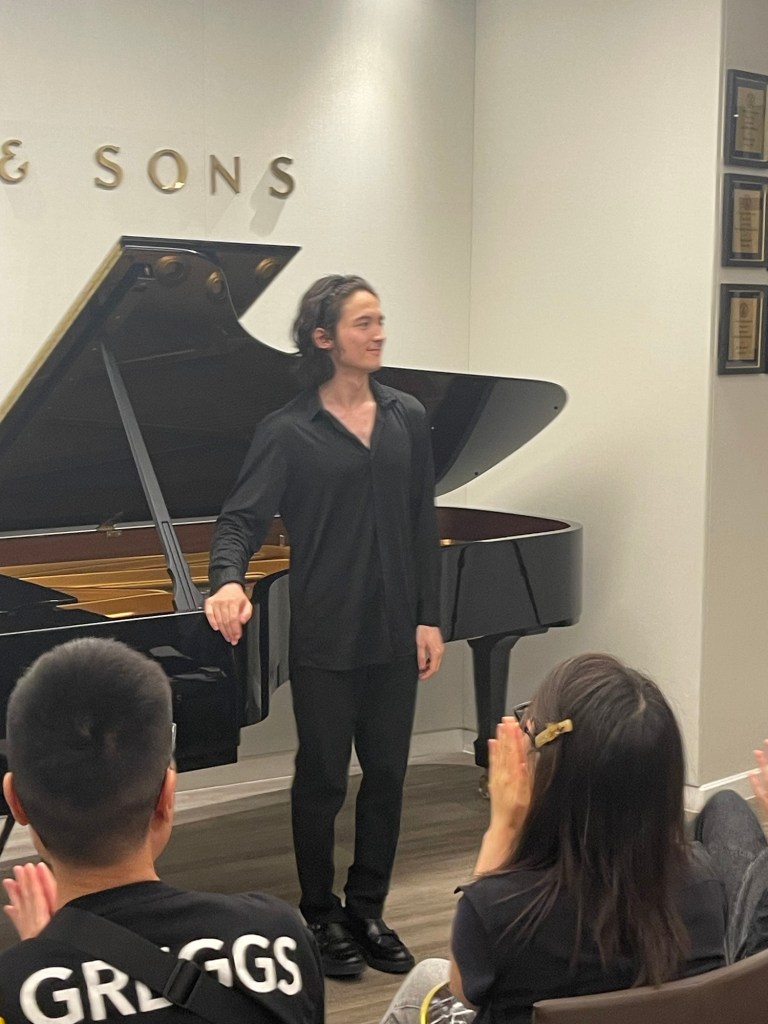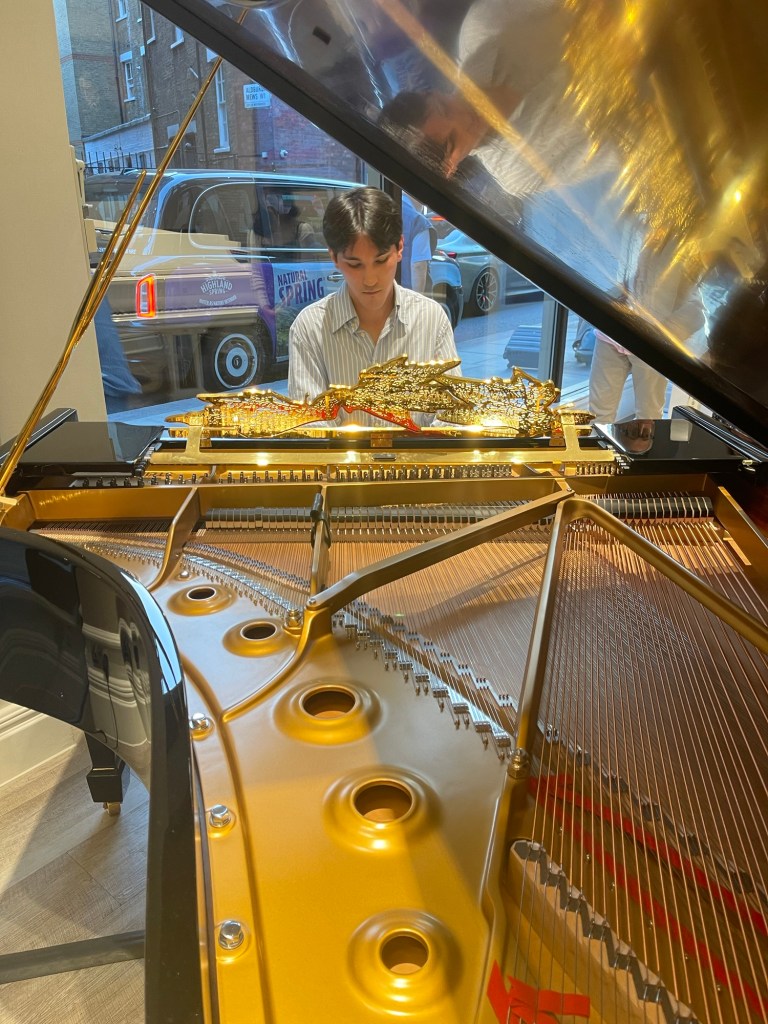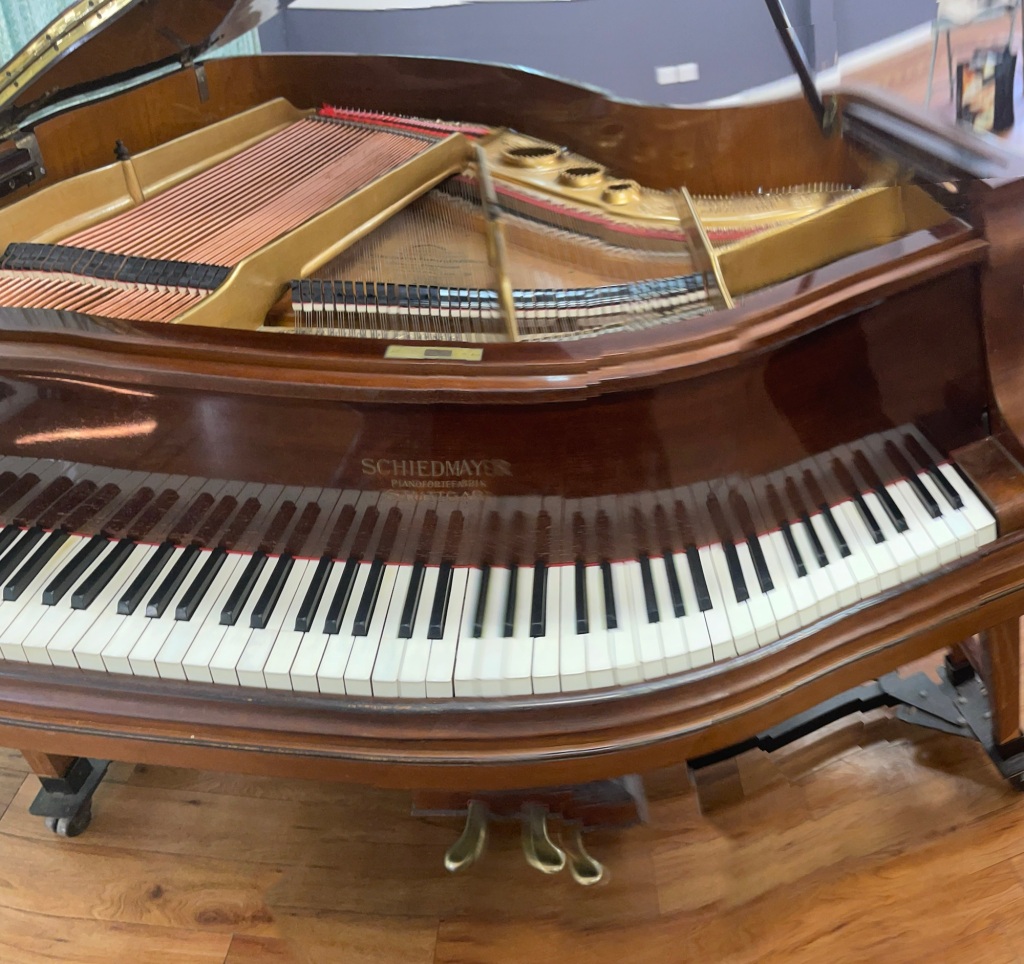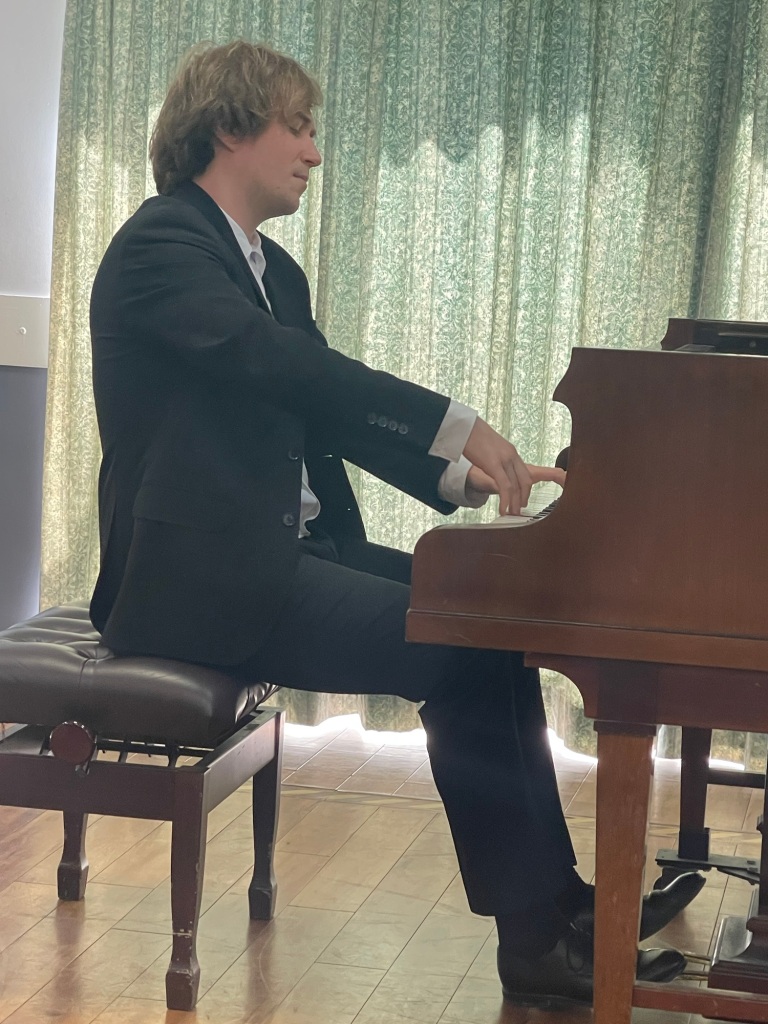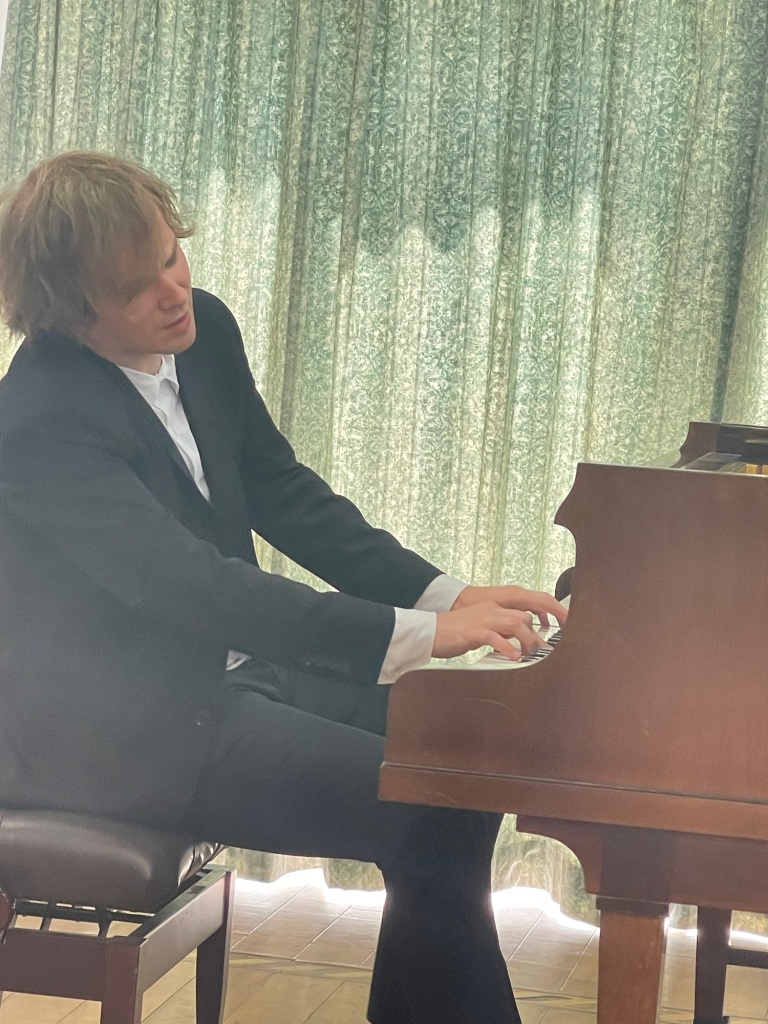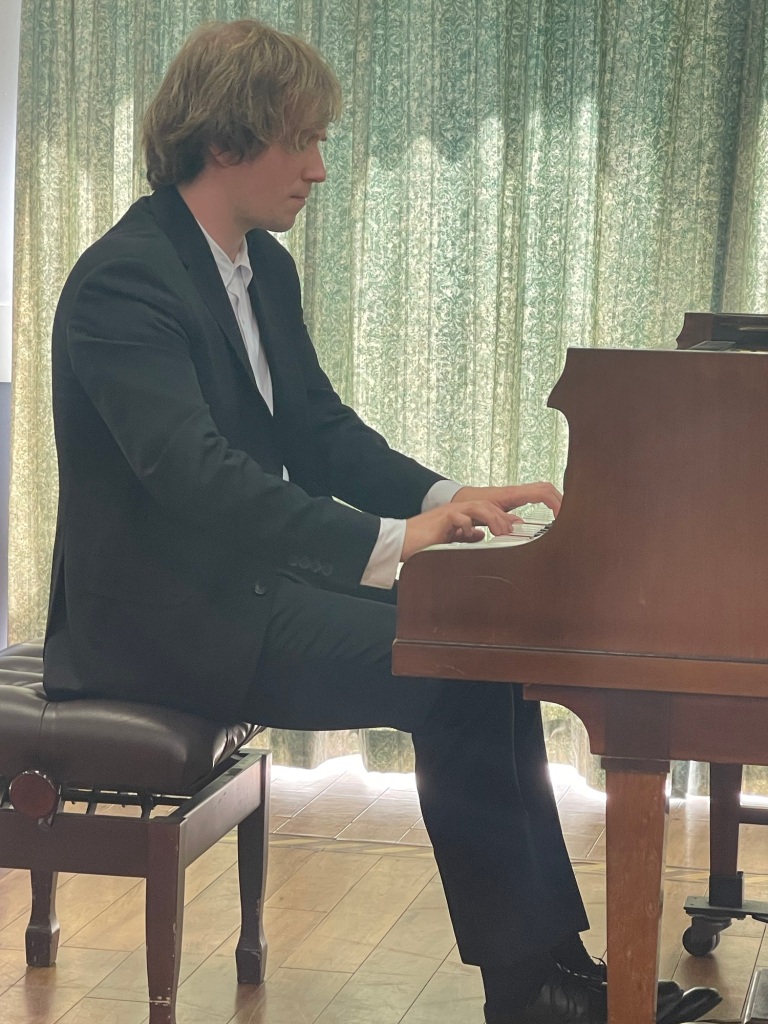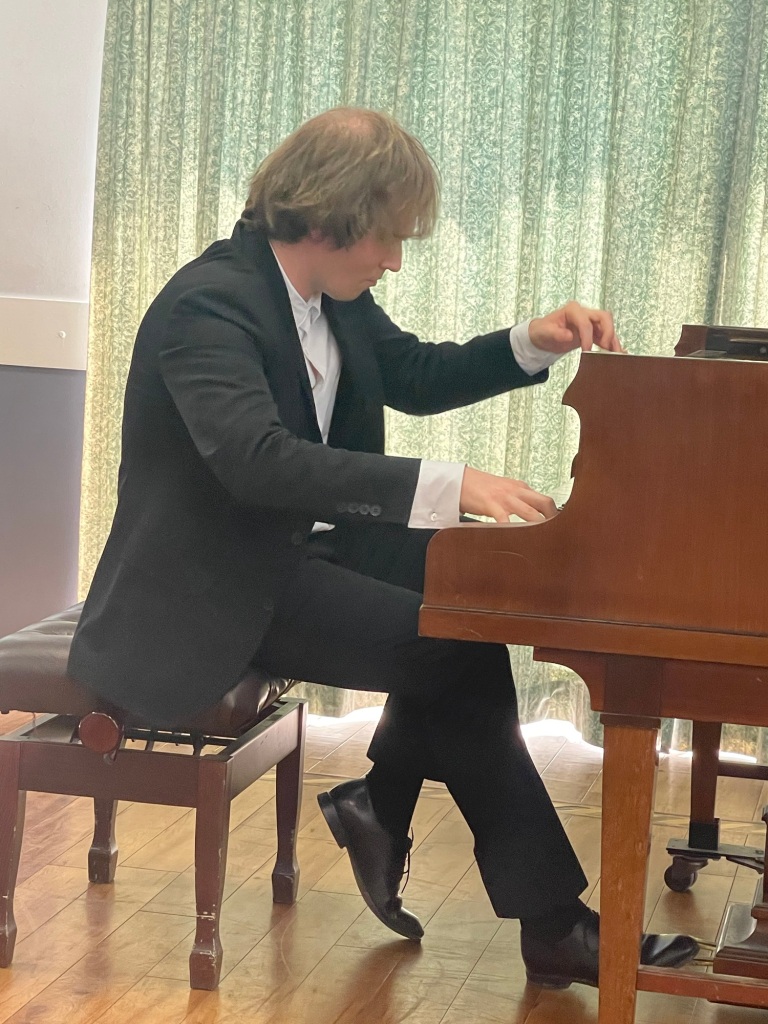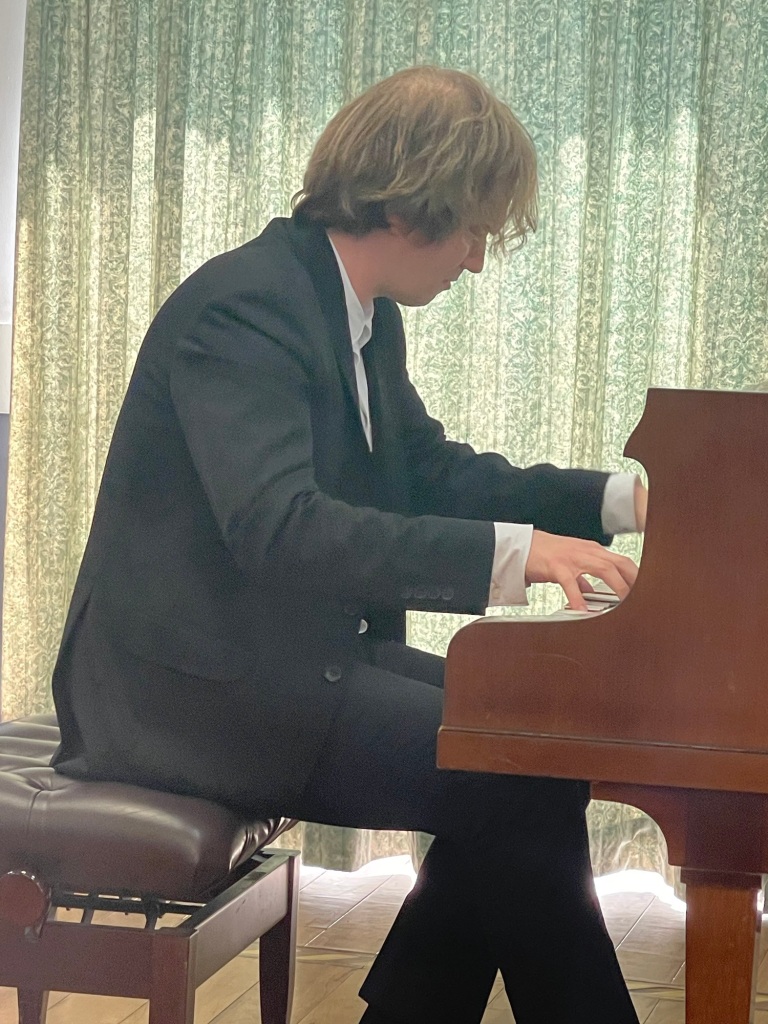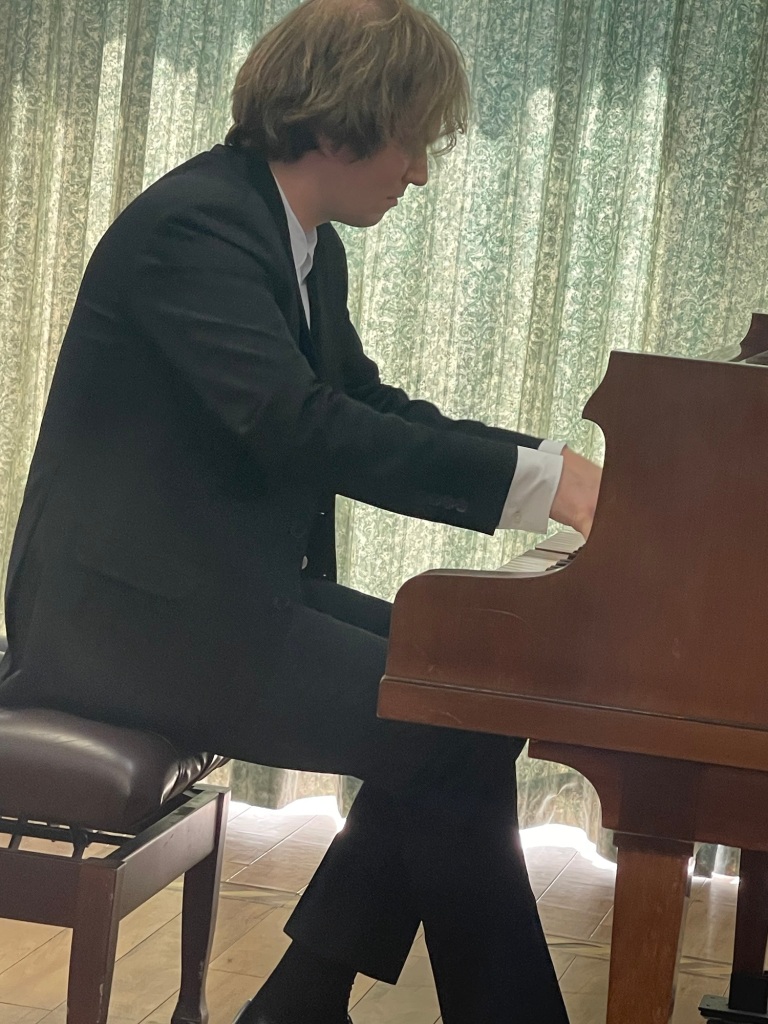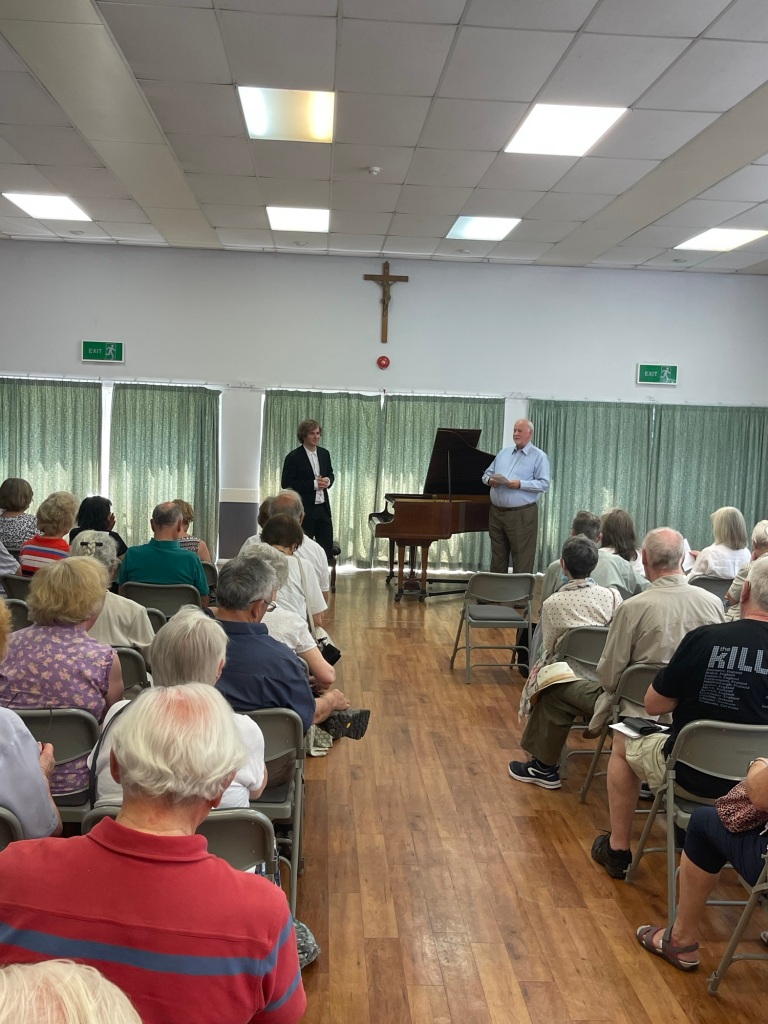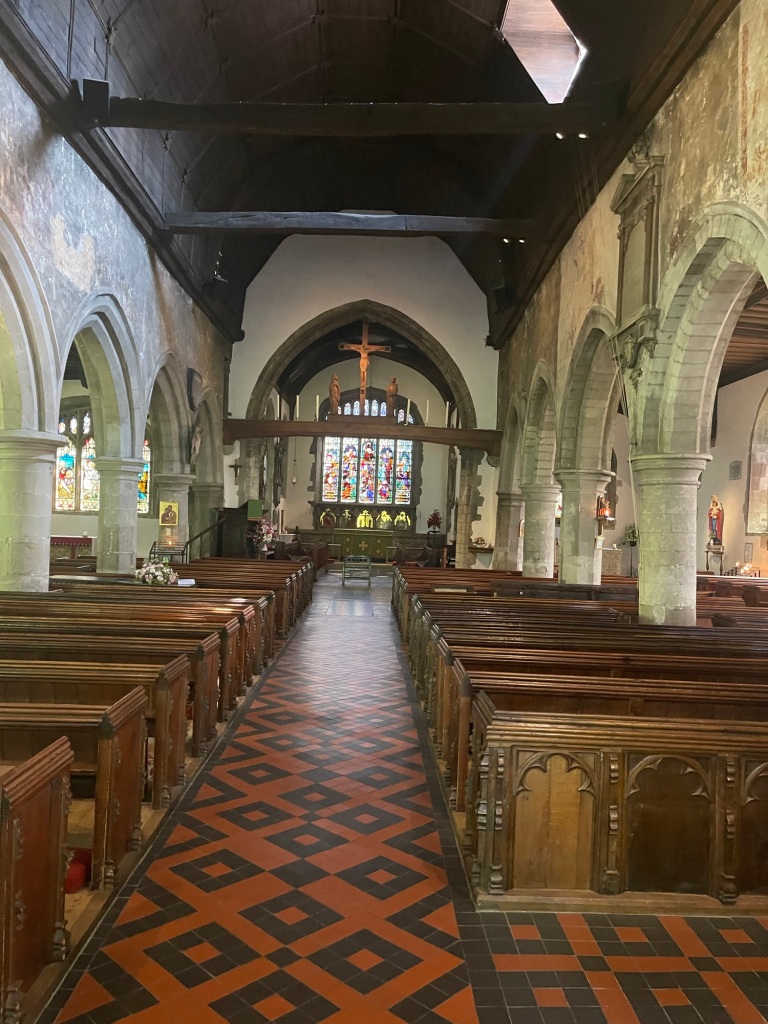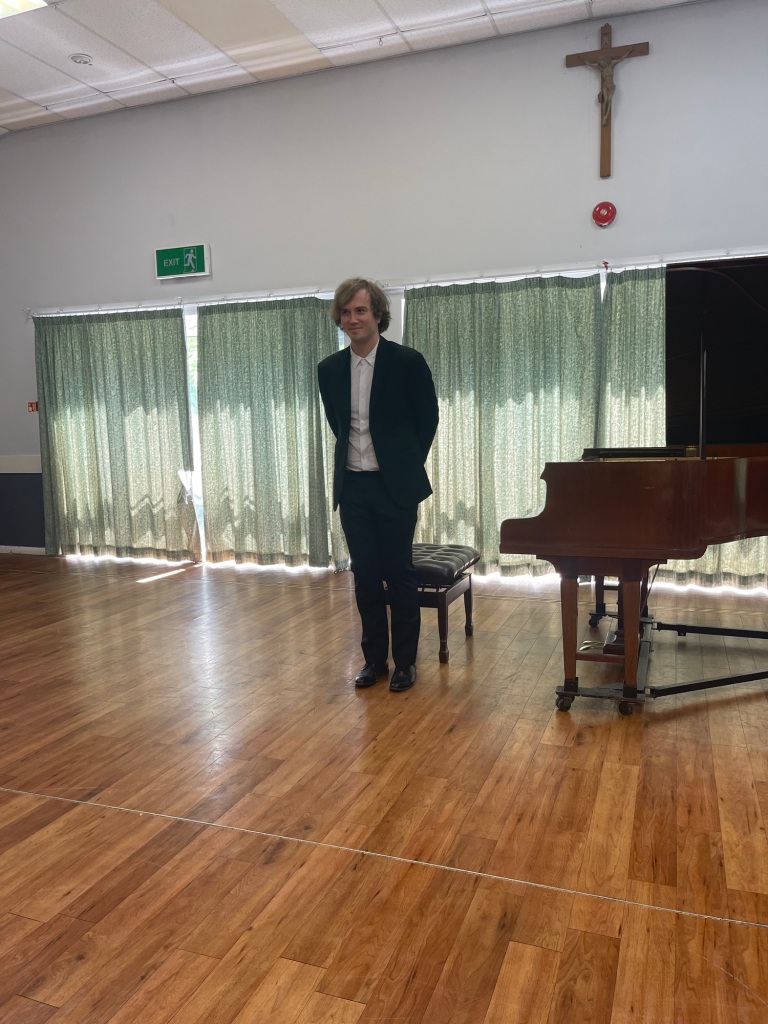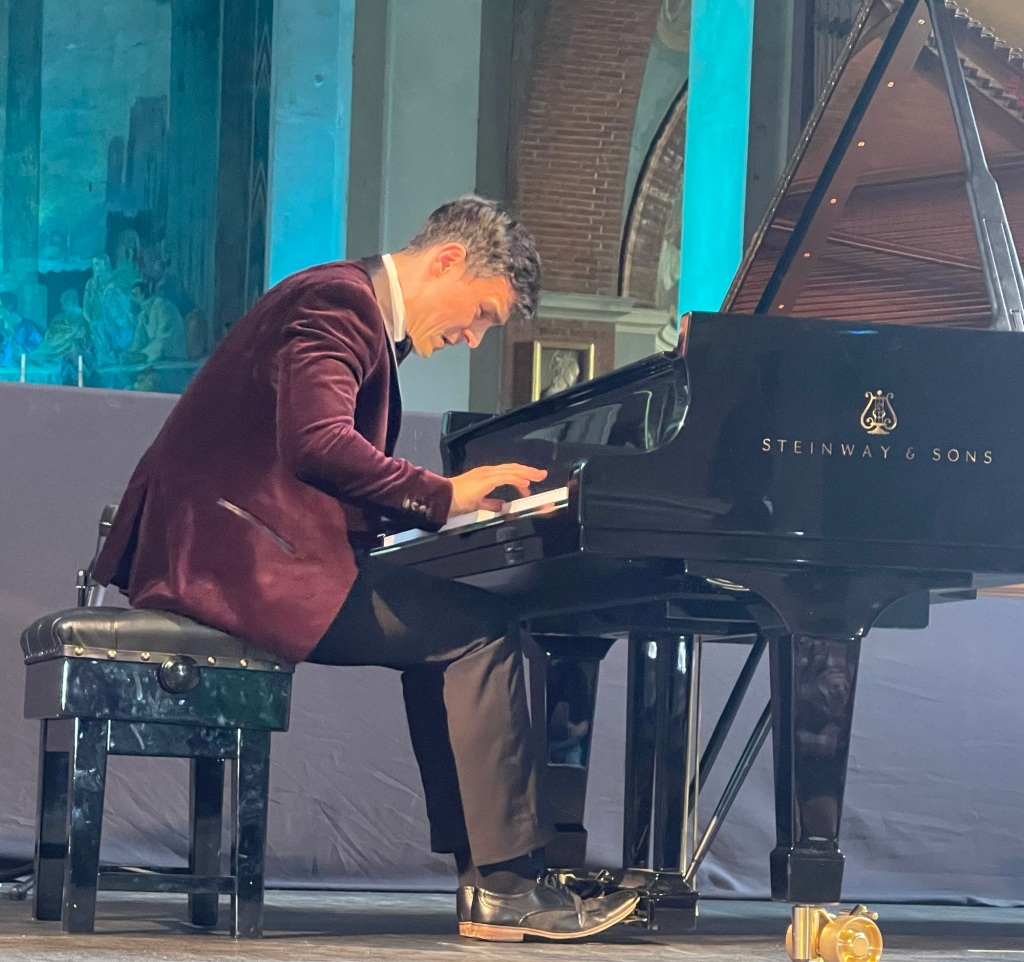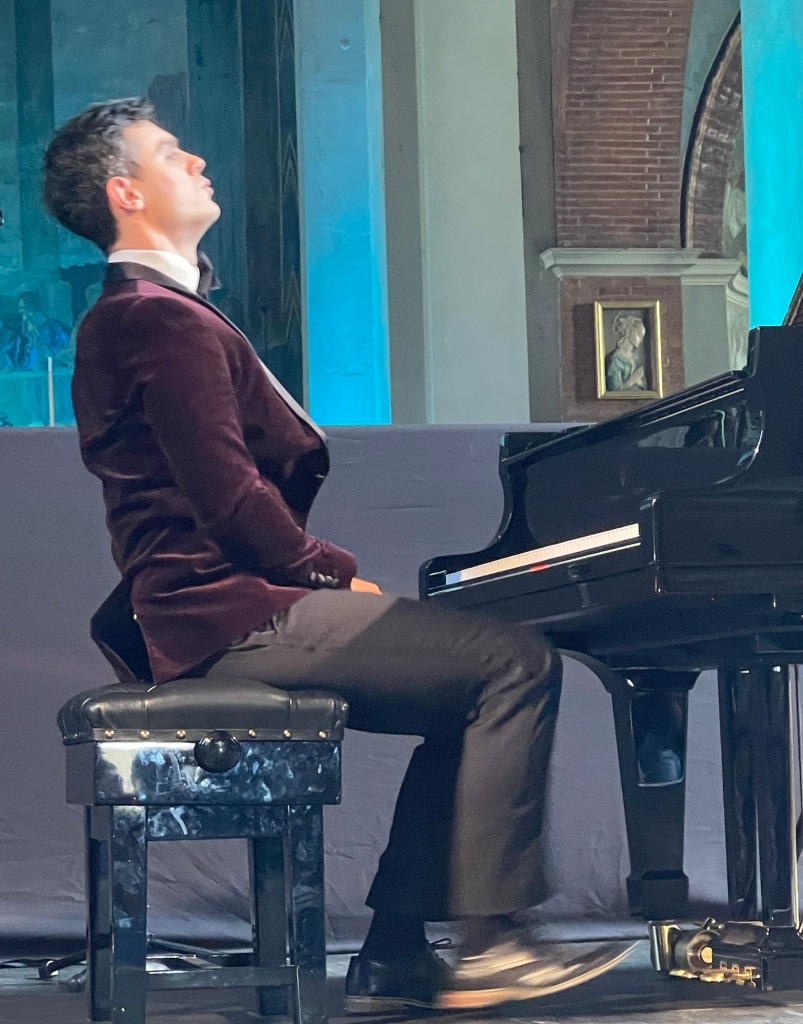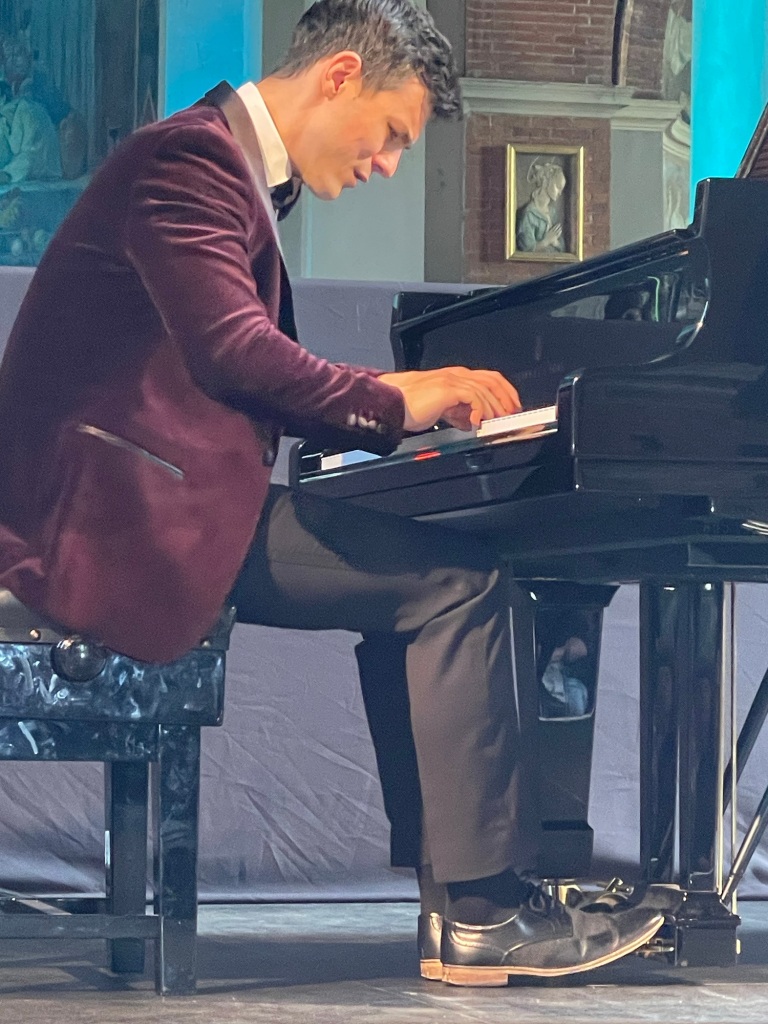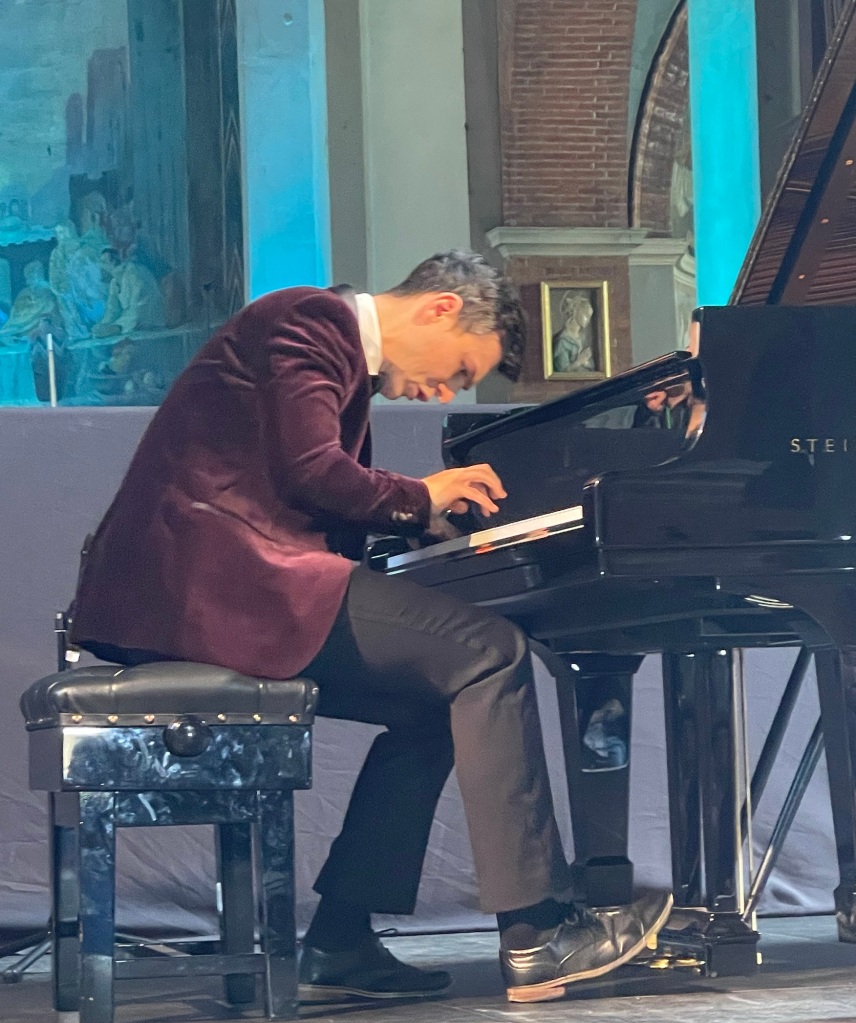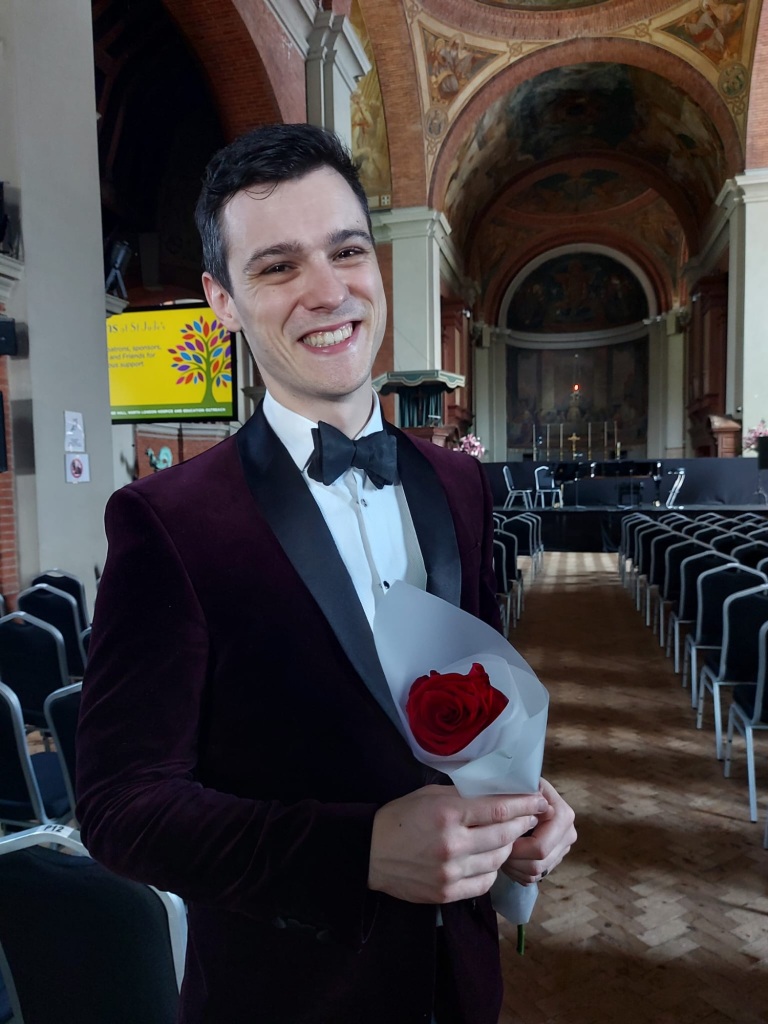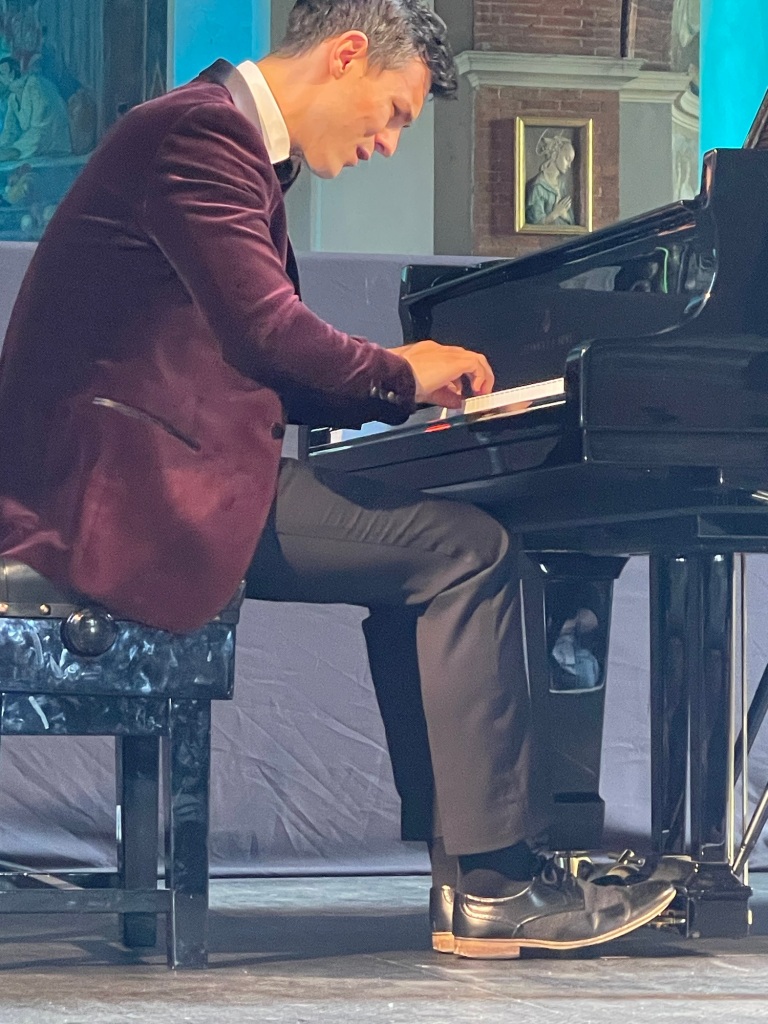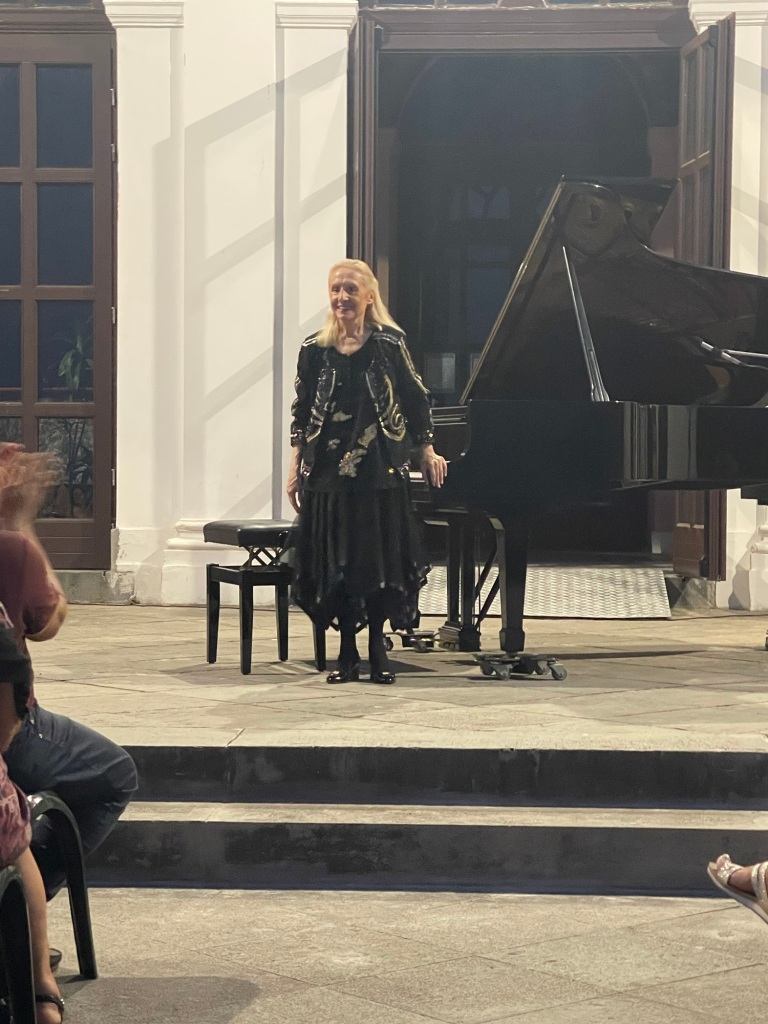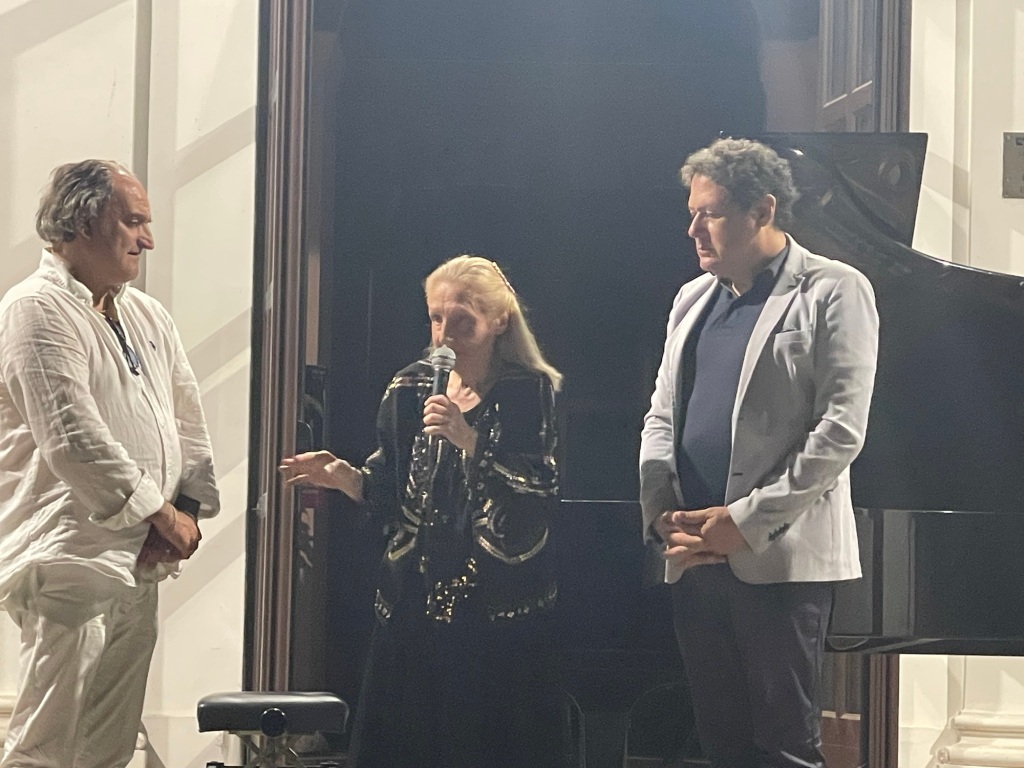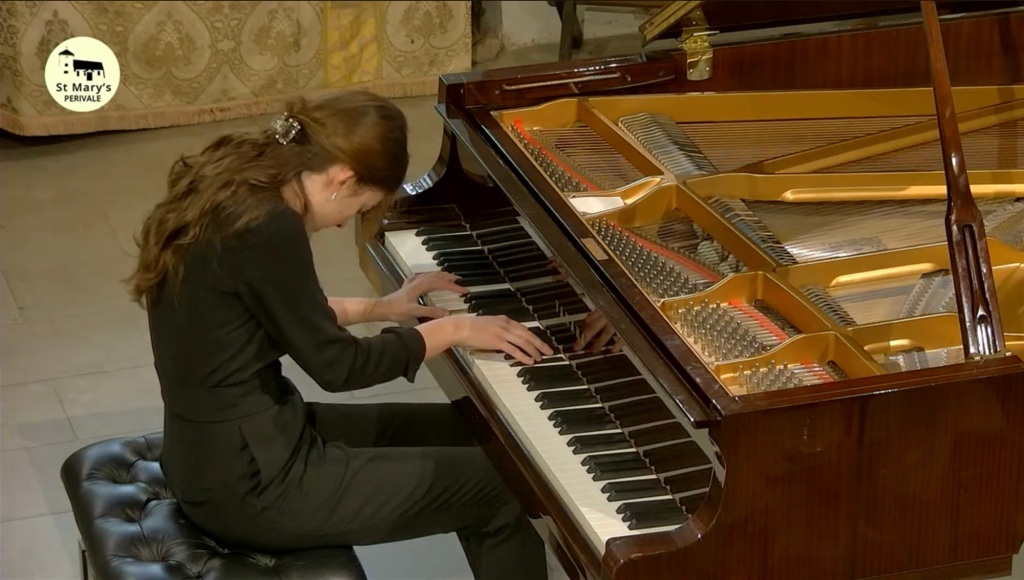
Alexander Soares at St Mary’s with curiosity and intellectual mastery

https://youtube.com/live/WdBHO_VuFeY?feature=shared


A fascinating programme by this real thinking musician . A French Suite not by J.S. Bach but of his own making chosen from rarely heard pieces from the French repertoire.
An outpouring of song in Sposalizio that was a vision of Raphael’s The Marriage of the Virgin that had inspired Liszt on his visit to Milan in 1858.
An important but neglected work by John Ireland written in 1915 with the magnificently stormy essay of his Rhapsody .
Finally on home territory with Les Adieux op 81a by Beethoven where Alexander Soares’ rather intellectually pensive programme on this stormy winter’s days suddenly sprang to life with a performance of remarkable intelligence and control.
The clouds had only momentarily lifted though as we were treated to one of Chopin’s most subtly poignant Mazukas from op 17 that was played with mastery and musicianly control of sound.
An afternoon of not easy music making but with those that have the ears to listen carefully an afternoon of very refined playing opening new vistas on the vast keyboard repertoire there is still to discover.

Alexander graduated with first class honours from Clare College, University of Cambridge. He then pursued postgratuate studies with Ronan O’Hora at the Guildhall School of Music & Drama, achieving a Master’s with Distinction. In 2015 he completed a doctorate investigating memorisation strategies for contemporary piano repertoire, under the supervision of Professor Daniel Leech-Wilkinson. He is most grateful for generous support from the Guildhall School Trust, Help Musicians UK, Countess of Munster Trust, Martin Musical Scholarship Foundation, Park Lane Group and Making Music.

A keen chamber musician, Alexander has performed on numerous occasions in the Barbican, working with notable artists such as Boris Brovtsyn and Alexander Baillie. Collaborating with violinist Mihaela Martin, he debuted in Spain at the Palacio de Festivales, Sala Argenta. He has also toured France, in venues including Auditorium St. Germain and Opéra Rouen, performing Stravinsky’s Les Noces on Pleyel’s original double grand pianos, manufactured in the late nineteenth century. Alexander has greatly benefitted from the guidance of pianists including Richard Goode, Stephen Kovacevich, Stephen Hough, and Steven Osborne.

A BBC Music Magazine Rising Star in 2021, pianist Alexander Soares has garnered a reputation as an authoritative soloist, sensitive collaborator, and dynamic recording artist. In recital, he has been praised for his performances that are “brilliantly unbuttoned” ( The Sunday Times ) with playing of “huge intensity” ( The Telegraph ) and “diamond clarity and authority” ( BBC Radio 3 ). He came to international attention in 2015, performing the solo and chamber music of Pierre Boulez in a live BBC Radio 3 broadcast at the Barbican Centre; in the same year he also won the Gold Medal in the prestigious Royal Overseas League Competition and was selected as a solo artist by City Music Foundation. Alexander has since performed in major venues and festivals across the UK, Europe and USA, with regular radio broadcasts on BBC Radio 3, FranceMusique, WDR, SWR2 and RTP. In 2019 he signed with Rubicon Classics to release his debut solo album Notations & Sketches. Praised for its captivating programme — the piano solo works of Boulez, Dutilleux and Messiaen — the disc was selected as ‘Editor’s Choice’ by Gramophone Magazine (May 2019) anId received widespread critical acclaim. In 2021, following the release of his second solo CD – Threnodies – Alexander was noted as “a thoughtful programmer” ( BBC Music Magazine ). He has also recorded with critical acclaim for KAIROS and Delphian Records. He combines a busy and varied performing schedule with doctoral supervision at Guildhall School of Music & Drama, and research of musical memorisation. http://www.alexander-soares.com

Kapellmeister Jacobson informs and delights with mastery at St Mary’s

https://youtube.com/live/R1zN2PqMLIY?feature=shared

A Kapellmeister position was a senior one and involved supervision of other musicians. J.S. Bach worked from 1717 to 1723 as Kapellmeister for Prince Leopold of Anhalt- Cothen. Haydn worked for many years as Kapellmeister for the Esterházy family .Handel served as Kapellmeister for George, Elector of Hanover (who eventually became King George 1 st of Great Britain.Becoming a Kapellmeister was a mark of success for professional musicians. For instance, Joseph Haydn once remarked that he was glad his father ,a wheelwright,had lived long enough to see his son become a Kapellmeister.The term also implied the possession of considerable musical skill. When the 18th-century actor and musician Joachim Daniel Preisler heard the famous soprano Aloysia Weber (Mozart) Mozart’s sister-in-law) perform in her home, he paid her the following compliment in his diary:The well-known Mozardt is her brother-in-law and has taught her so well that she accompanies from a score and plays interludes like a Kapellmeister

Wilhelm Kempff used to arrive at the DG recording studio asking them what they would like him to play that day! Badura – Skoda would quite happily improvise or transpose into any key as Robert Levin can do too. Levin even adding an ornamentation that does not distort a piece but that is so much in style that it actually enhances its beauty .These are complete musicians who chose a programme with the key relationships interrelated. It was at the turn of the last century that even the great virtuosi of the day would improvise between each piece to link them harmonically together into a satisfying musical whole.

Dr. Hugh Mather so rightly said today that we are used to pianists presenting four or five works usually with a competition list in mind and that the idea of an ‘oldie’ like Julian who can play the entire piano repertoire without a trace of an I pad or musical copy is inconceivable for this new generation of ‘pianists’ .Julian is the only person I know who has played the 32 Beethoven Sonatas on the same day. On the first occasion he would play all from memory except the ‘Hammerklavier’ .He soon modified that when he realised that to play the knotty twine of the fugue was more difficult with the score than without!

I have two pianists both trained at the Menuhin School who have similar gifts which can also be trained and encouraged from an early age.Can Arisoy and Damir Duramovic .Damir was asked at the last minute to play at an important venue on Cyprus with the teenage winner of an international violin competition.On the programme was the Kreutzer and Tzigane two of the most difficult works where the piano part is perhaps more difficult than that of the violin.After one rehearsal they played the entire recital to an astonished audience from memory.Damir had never played them before !

Damir Durmanovic in Cyprus

Other two other occasions I have been moved to use the word kapellmeister : https://christopheraxworthymusiccommentary.com/2023/08/29/kapellmeister-lubimov-leads-us-to-the-very-heart-of-music-with-simplicity-and-mastery/……….

……..and the other is the very man who so generously in his retirement as a consultant physician of Ealing hospital is giving a lifeline to musicians mostly young but as only he only he could dare say ‘oldies’ like himself with his dedicated and expert team of retired trustees : https://christopheraxworthymusiccommentary.com/2023/07/24/the-generosity-of-kapellmeister-mather-a-celebration-of-great-man-and-his-team-on-the-2000th-anniversary-concert/

A fascinating recital of French music was on the programme and which Julian introduced with spirited and knowledgeable asides that illuminated what he played.Enticing but never boring his audience who were entranced as I was too in the depths of the Italian countryside (thanks to the superb streaming of all the concerts from St Mary’s).A programme that Julian, to quote Baudelaire, described as ‘Luxury,calm and pleasure’ – a concise way of comparing French school to the German ( I wonder what he would entitle that :‘Sturm und Drang maybe?).Amusing to know that Debussy’s favourite composers were Palestrina,Mussorgsky and ……….Chabrier! . ‘ What rules ……..it is my pleasure that leads me’, said Debussy to his conservative Conservatoire teachers! Was it not Nadia Boulanger who not long after in this same period in Paris discovered the true passion and hidden talent of two of her students who had come to her studio for a severe training in compositional techniques.Piazzola hid his tangos from her allowing her to see only his attempts at conventional music ………..she was the one when she discovered his true bent who helped him on to his true path of Nuevo Tango that was to take the world by storm.Gershwin too went to her to study counterpoint but she famously refused to teach him saying she would only ruin his natural musicianship that is the Gershwin we know today!

And so to the music which Julian plays with such a refreshing sense of improvised discovery that everything he plays is of simplicity and directness.Highly professional playing , of course, but the occasional fluff or knot that does not quite unravel as Ravel demands was of no importance with the immediacy of communication of a dedicated musician . Music and life are intertwined growing together in wisdom and living and maturing together in peace and harmony.‘ Eureka’ an age old message that Barenboim and Said hoped might unknot seemingly unresolvable problems in the far East!

Two Debussy early Arabesques where the first was played with a beautiful sense of balance.The melodic line was allowed to float on a wave of changing harmonies.Played with a subtle flexibility just as Chopin had described the elusive word ‘Rubato’ to his high society lady pupils.It was the same clarity and simple unaffected artistry that he brought to the ‘joie de vivre’ charm of the second with an occasional Spanish breeze .A rather more serious contrasting central episode was immediately dispelled but with the fresh air return of the opening.

Gabriel Urbain Fauré 12 May 1845 – 4 November 1924 was a French composer, organist, pianist and teacher. He was one of the foremost French composers of his generation, and his musical style influenced many 20th-century composers. Among his best-known works are his Pavane,Requiem,the songs :Apres un reve,Clair de lune .Although his best-known and most accessible compositions are generally his earlier ones, Fauré composed many of his most highly regarded works in his later years, in a more harmonically and melodically complex style.Fauré’s music has been described as linking the end of Romanticism with the modernism of the second quarter of the 20th century. When he was born, Chopin was still composing, and by the time of Fauré’s death, jazz and the atonal music of the Second viennese School were being heard.

The great french Canadian pianist Louis Lortie will be celebrating the centenary on the Monday the 5th February with some of the piano works of Fauré at the Wigmore Hall

Fauré’s best known Nocturne followed and was played with the beautiful long lines that we know from Fauré’s choral music.Fauré was much influenced by Chopin with the bel canto of the Nocturnes and Impromptus and even a Ballade.It is a very personal unmistakable language where the composer seems to be avoiding at all cost a perfect cadence! Vlado Perlemuter one of my teachers and a lifelong friend asked me to tell the audience in one of the many recitals he gave in my series in Rome that he had lived in the same house as Fauré and the great old Director of the Paris Conservatoire ,where Perlemuter was a star teenage student of Cortot,would send the music up to the boy to try out the pieces he was writing with the ink still wet on the paper.This year is the centenary of the death of a composer whose piano music is unjustly neglected by young pianists.

Julian also played the Valse Caprice n.3 op 59 with its scintillating opening and its contrasting languid central section before the brilliant ending of charm and exhilaration.

As Julian rightly said that if a twenty year old student had brought him the Menuet Antique as Ravel had penned it he would have asked for lessons from the student.Ravel obsessed with clocks and precision which is shown in all his works from this very early Menuet through Le Tombeau,Miroirs,Gaspard de la Nuit to the two piano concertos and the extraordinary transcription of his own La valse ….just to mention a few of his masterpieces.Julian played this charming Menuet with a clarity and purity of sound which was already the voice of so many of the masterpieces still to come.

Eric Alfred Leslie Satie 17 May 1866 – 1 July 1925 who signed his name Erik Satieafter 1884, was the son of a French father and a British mother. He studied at the Paris Conservatoire , but was an undistinguished student and obtained no diploma. In the 1880s he worked as a pianist in café-cabaret in Montmartre , Paris, and began composing works, mostly for solo piano, such as his Gymnopédies and Gnoissiennes Satie’s example guided a new generation of French composers away from post-Wagnerian Impressionism towards a sparer, terser style.
He gave some of his later works absurd titles, such as ‘True Flabby Preludes (for a Dog)’ 1912), ‘Sketches and Exasperations of a Big Wooden Man’ 1913 and Bureaucratic Sonatina’ 1917.
He never married, and his home for most of his adult life was a single small room, first in Montmartre and, from 1898 to his death, in Arcueil , a suburb of Paris. He adopted various images over the years, including a period in quasi-priestly dress, another in which he always wore identically coloured velvet suits, and is known for his last persona, in neat bourgeois costume, with bowler hat wing collar, and umbrella. He was a lifelong heavy drinker, and died of cirrhosis of the liver at the age of 59.

The two pieces by Satie were the ‘Iconic’ Gymnopédie n. 1 played with a beautifully etched melodic line shaped like the musician Julian instinctively is even although I doubt Satie would have approved of anything other than an icy impersonality ! The virtually unknown Nocturne n. 4 .was a fascinating discovery with it’s angular purity and meandering beauty.

https://youtube.com/watch?v=KlD3CcS9N8g&feature=shared

I have only ever heard Chabrier in the recital hall from Artur Rubinstein who used to enchant us with his Scherzo – Valse from the Dix pièces pittoresques . Today Julian played the Bourée fantastique that I have only ever heard from Angela Hewitt in the concert hall.

Alexis-Emmanuel Chabrier 18 January 1841 – 13 September 1894) was a French composer and pianist. His family did not approve of a musical career for him, and he studied law in Paris and then worked as a civil servant until the age of thirty-nine while immersing himself in the modernist artistic life of the French capital and composing in his spare time. From 1880 until his final illness he was a full-time composer. He was admired by, and influenced, composers as diverse as Debussy ,Ravel ,Richard Strauss ,Satie,Stravinsky, and the group of composers known as Les Six Writing at a time when French musicians were generally proponents or opponents of the music of Wagner, Chabrier steered a middle course, sometimes incorporating Wagnerian traits into his music and at other times avoiding them.Chabrier died in Paris at the age of fifty-three from a neurological disease, probably caused by syphilis.

A truly comic piece of high spirits from a composer highly esteemed by his colleagues of the day but now almost unknown except for his colourful orchestral piece ‘Espagna’ that Julian spiritedly pointed out had been plagiarized by Perry Como .Beautifully and convincingly played by Julian as all the works today and in Hugh Mather’s words was one of the most enjoyable concerts of the more than 2000 that St Mary’s has hosted over the past few years.

Julian Jacobson presenting his programme in an inimitable way

For half a century Julian Jacobson has been a vital presence on the British music scene as well in more than forty countries on five continents. He has given concerts in most of the principal UK venues and appeared at the major festivals including Aldeburgh, Edinburgh and the Proms. As a chamber musician he has partnered distinguished musicians such as Ivry Gitlis, Sandor Vegh, Zara Nelsova, Lydia Mordkovich, Christian Lindberg, Leonidas Kavakos, Steven Isserlis, Nigel Kennedy, Raphael Wallfisch, the Brodsky and Chilingirian Quartets. A large and varied discography for labels covers a repertoire from Beethoven to Gershwin and contemporary music.

His involvement with the Beethoven sonatas dates back to his time as Head of Keyboard Studies at the Royal Welsh College of Music and Drama in the 1990s where he gave one of his first complete cycles. He has since presented the 32 sonatas on eleven separate occasions, five of which were “marathon” performances where he played the complete cycle from memory in a single day. Since 2014 he also serves as Chairman of the Beethoven Piano Society of Europe. In 2024 he is developing a parallel interest in French music, giving several performances of the complete 24 Debussy Preludes.

Jacobson has given many world or UK premieres of works by major composers including Michael Nyman, who wrote the the piano trio “Time Will Pronounce” for his ensemble the Trio of London. His own compositions include five film scores and several instrumental pieces published by Bardic Edition, as well as his highly acclaimed Gershwin transcriptions which he has recorded with his duo partner Mariko Brown. Julian was one of the very first musicians to start a daily broadcast during lockdown, commencing on day two and continuing for six weeks with a different piece every day. He teaches at the Royal College of Music London and the Royal Birmingham Conservatoire, and is Guest Professor at Xiamen University, China.

Julian Jacobson and Cristian Sandrin – A life on the ocean waves – liberally speaking !

Julian Jacobson Boogie woogie and Beamish at City University of London

Maxim Vengerov in Rome -The Pavarotti of the violin ignites Rome with supreme Mastery and Joie de Vivre

Brahms Scherzo dalla Sonata F.A.E.
Franck Sonata per violino e pianoforte
Alexey Shor Sonata per violino n. 1 prima italiana
Prokofiev Sonata per violino e pianoforte n. 2

Some superb playing from Maxim Vengerov with the sumptuous sounds of Roustem Saitkoulov where even the usually brilliant sound of Fazioli was filled with the same radiance and warmth that Vengerov emanates since his astonishing international debut at the age of fourteen.
Magisterial performances all played truly by and above all with the heart .Two famous Sonatas by Cesar Franck and Prokofiev were preceded by the Brahms FAE Scherzo of searing intensity.
He even convinced us that the Sonata by Shor was up there with these masterpieces .The entire concert including the Shor Sonata was played without the score by Vengerov .The music had entered his very being as he allowed the music to pour from his soul with such generosity like the greatest of opera singers.Brahms with a dynamic drive but that allowed moments when the melody could pour from Vengerov’s wonderful ‘Kreutzer’ Stradivarius with searing intensity always richly supported by the sumptuous sounds of a truly grand piano.Some wonderful sounds from Saitkoulov but with an I pad that had one or two teething problems at the beginning that he managed to disguise with superb professional aplomb.It was in the Recitativo of the Cesar Franck that they played as one and from then on the wonderful interplay between these two musicians held us spell bound.Out of the aching silence created at the end of the ‘Fantasia’ floated the magic sounds of the gentlemanly question and answer of the Allegretto poco mosso – Menuhin of course called it mutual anticipation.Rugged sounds at the opening of the Shor sonata that sounded more like Prokofiev than Prokofiev as the very long and intense Allegro agitato was played with superb musicianship and interplay between the two players.A ‘Scherzo’ that was a perpetuo mobile of brilliance played with quite considerable mastery leading to a deeply felt final mediation played with great intensity as it dissolved into eternity.The actual Prokofiev Sonata was all lyrical joy and good spirits and the way Vengerov allowed his bow to bounce on the strings in the last movement was one of the marvels that are often called genius.


But it was the intimacy and warmth that he brought to Schon Rosmarin that revealed the true Pavarotti of the violin .

His ‘joie de vivre’ and beguiling sense of style had us cheering as he teased us like Pavarotti or Rubinstein would do when the important work had been nobly done and now the party could begin.The Prokofiev March :’Love for Three Oranges’ was of power and exhilaration and was followed by Kreisler of refined elegance and the style of the ‘master’ himself .Not only Schon Rosmarin but immediately followed by Liebes – Freud with the accent very much on Freud .A final encore for the Roman audience now in delirium was the 18th Rachmaninov Paganini variation .It was played with such searing intensity from a man in love and loving every minute of sharing with us.A tireless bowing arm that just tore into his wonderful instrument with such passionate intensity that truly reached the heart strings of everyone of us lucky to be present in person.A great event for Rome thank goodness broadcast live on Rai Radio 3 :

https://www.raiplaysound.it/audio/2024/02/Radio3-Suite—Il-Cartellone-del-31012024-a726eccd-1704-4970-8aff-76cc15e8d5f6.html


It reminded me of the fourteen year old boy from Siberia who had us all standing on the seats cheering at the end of his Wigmore Hall debut that has gone down in history after a Waxman Carmen Fantasy of unbelievable agility and colour.

https://youtube.com/watch?v=w_F15yU4AYM&feature=shared
Another young genius from the class of Zakhar Bron Vadim Repin had also just made his European debut in Rome in the Ghione Theatre.In the interval Barone Agnello went back stage to offer the eighteen year old boy a tour of Sicily .
We all celebrated at Arnoldo’s in the centre of Rome but all this young boy wanted to do was to drive the sports car of Carrena his agent from Italconcert .This was before the wall had been knocked down and these young geniuses were allowed to fly free.
Last but not least was Natalia Preschepenko who went on to be lead violinist in the Artemis string quartet.
But the crowned King was and always will be Maxim Vengerov

Vengerov – Trpceski violin superstar at the Barbican.

Vengerov and Papian Enescu Festival Che Festa !

The Violin Sonata in A was written in 1886, when César Franck was 63, as a wedding present for the 28-year-old violinist Eugène Ysaye .Twenty-eight years earlier, in 1858, Franck had promised a violin sonata for Cosima von Bulow .This never appeared; it has been speculated that whatever work Franck had done on that piece was put aside, and eventually ended up in the sonata he wrote for Ysaÿe in 1886.Franck was not present when Ysaÿe married, but on the morning of the wedding, on 26 September 1886 in Arlon,their mutual friend Charles Bordes presented the work as Franck’s gift to Ysaÿe and his bride Louise Bourdeau de Courtrai. After a hurried rehearsal, Ysaÿe and Bordes’ sister-in-law, the pianist Marie-Léontine Bordes -pène played the Sonata to the other wedding guests.The Sonata was given its first public concert performance on 16 December of that year,at the Musée Moderne de Peinture in Brussels where Ysaÿe and Bordes-Pène were again the performers.The Sonata was the final item in a long program which started at 3pm. When the time arrived for the Sonata, dusk had fallen and the gallery was bathed in gloom, but the museum authorities permitted no artificial light whatsoever. Initially, it seemed the Sonata would have to be abandoned, but Ysaÿe and Bordes-Pène decided to continue regardless. They had to play the last three movements from memory in virtual darkness. When the violinist Armand Parent remarked that Ysaÿe had played the first movement faster than the composer intended, Franck replied that Ysaÿe had made the right decision, saying “from now on there will be no other way to play it”. Vincent d’Indy,who was present, recorded these details of the event.Ysaÿe kept the Violin Sonata in his repertoire for the next 40 years of his life, with a variety of pianists.His championing of the Sonata contributed to the public recognition of Franck as a major composer.This recognition was quite belated; Franck died within four years of the Sonata’s public première, and did not have his first unqualified public success until the last year of his life on 19 April 1890, at the Salle Pleyel, where his String Quartet in D was premiered.it is in four movements: Allegretto ben moderato,Allegro,Ben moderato: Recitativo-Fantasia,Allegretto poco mosso.

The F-A-E Sonata, a four-movement work for violin and piano, is a collaborative work Robert Schumann , the young Johannes Brahms , and Schumann’s pupil Albert Dietrich . It was composed in Dusseldorf in October 1853.The sonata was Schumann’s idea as a gift and tribute to violinist Joseph Joachim , whom the three composers had recently befriended. Joachim had adopted the Romantic German phrase “Frei aber einsam” (“free but lonely”) as his personal motto . The composition’s movements are all based on the notes F-A-E, the motto’s initials, as a musical cryptogram.Schumann assigned each movement to one of the composers. Dietrich wrote the substantial first movement in sonata form . Schumann followed with a short Intermezzo as the second movement. The Scherzo was by Brahms, who had already proven himself a master of this form in his E flat minor Scherzo for piano and the scherzi in his first two piano sonatas. Schumann provided the finale.Schumann penned the following dedication on the original score: “F.A.E.: In Erwartung der Ankunft des verehrten und geliebten Freundes JOSEPH JOACHIM schrieben diese Sonate R.S., J.B., A.D.” (“F.A.E.: In expectation of the arrival of their revered and beloved friend, Joseph Joachim, this sonata was written by R.S., J.B., A.D.”).[1]The composers presented the score to Joachim on 28 October at a soirée in the Schumann household, which Bettina von Arnim and her daughter Gisela also attended.The composers challenged Joachim to determine who composed each movement. Joachim played the work that evening, with Clara Schumann at the piano. Joachim identified each movement’s author with ease.The complete work was not published during the composers’ lifetimes. Schumann incorporated his two movements into his Violin Sonata n. 3 . Joachim retained the original manuscript, from which he allowed only Brahms’s Scherzo to be published in 1906, nearly ten years after Brahms’s death.Whether Dietrich made any further use of his sonata-allegro is not known. The complete sonata was first published in 1935.All three composers also wrote violin concerti for Joachim. Schumann’s was completed on 3 October 1853, just before the F-A-E Sonata was begun. Joachim never performed it, unlike the concertos of Brahms and Dietrich.

Prokofiev’s Violin Sonata No. 2 in D Major, Op. 94a (sometimes written as Op. 94bis), was based on the composer’s own Flute Sonata in D op. 94 ,written in 1942 but arranged for violin in 1943 when Prokofiev was living in Perm in the Ural Mountains , a remote shelter for Soviet artists during the Second World War . Prokofiev transformed the work into a violin sonata at the prompting of his close friend, the violinist David Oistrakh . It was premiered on 17 June 1944 by David Oistrakh and Lev Oborin .

It is in four movements:

  1. Moderato
  2. Presto – Poco piu mosso del – Tempo I
  3. Andante
  4. Allegro con brio – Poco meno mosso – Tempo I – Poco meno mosso – Allegro con brio

ALEXEY SHOR was born in Kiev in 1970, immigrated to Israel in 1991, and now lives primarily in the USA. There he completed his higher education, earned a PhD in mathematics and worked as a mathematician for years. He began composing in 2012, but his compositions immediately attracted attention and were performed in the most prestigious concert halls such as Wiener Musikverein, Berlin Philharmonie, Carnegie Hall, Kennedy Center (Washington DC), Great Hall of Moscow Conservatory, Mariinsky Theatre (St. Petersburg), Kremlin Palace (Moscow), The Concertgebouw (Amsterdam), Gasteig (Munich), Wigmore Hall (London), Teatro Argentina (Rome) and many others. Mr. Shor’s scores are published by Breitkopf & Hartel and P.Jurgenson. CDs with his compositions have been issued by Warner Classics, DECCA, SONY Classics, Delos, Berlin Classics and Melodiya. The Overture to his ballet Crystal Palace was performed at the 40th Gramophone Classical Music Awards ceremony in London. In 2018 he has been awarded an honorary professorship at the Komitas State Conservatory of Yerevan. Shortly after, he became Composer-In-Residence for the Malta Philharmonic Orchestra Academie and Armenian State Symphony Orchestra. Since 2017, he has also been Composer-in-Residence at the Malta International Music Festival and Piano Competition

Alexey Shor

Many internationally acclaimed artists have performed Mr Shor’s music, including (in alphabetical order) Behzod Abduraimov, Salvatore Accardo, Ray Chen, Steven Isserlis, Evgeny Kissin, Denis Kozukhin, Shlomo Mintz, Mikhail Pletnev, Gil Shaham, Yeol Eum Son, Yekwon Sunwoo, Maxim Vengerov, Nikolaj Znaider and many others.

Mr Shor also holds a Ph.D. in mathematics.

Allegro Agitato – Scherzo – Meditation

Universally hailed as one of the world’s finest musicians, and often referred to as the greatest living string player in the world today, Grammy Award winner Maxim Vengerov also enjoys international acclaim as a conductor and has held teaching positions in the world’s leading conservatoires throughout his career.

Born in 1974, he began his career as a solo violinist at the age of 5, won the Wieniawski and Carl Flesch international competitions at ages 10 and 15 respectively, studied with Galina Tourchaninova and Zakhar Bron, made his first recording at the age of 10, and went on to record extensively for high-profile labels including Melodia, Teldec and EMI, earning among others, Grammy and Gramophone artist of the year awards.

The Violinist

From my first public debut at the age of 5, I dreamt of playing for people all over the world. I believe that music is a universal way to connect people regardless of their political or geographical belonging. Till date, I’ve played over 3,000 concerts and am glad to have spread the joy of music making with audiences around the globe.

Depending on repertoire, I play on different instruments and bows, but most of the time I bring to concerts my faithful companion that has been with me since 1998 – the legendary 1727 “Kreutzer” Stradivari.

I’m proud to be deeply rooted in the tradition of Franco-Belgian and Russian violin schools. My favorite violinists are Fritz Kreisler, Eugène Ysaÿe, George Enescu, David Oistrakh and Jascha Heifetz to name a few.

The Educator

There are many exceptional talents in the world. However, only a few of them are lucky to find teachers that would help them realize their full potential, and open doors into the wonderful world of music. I consider myself extremely fortunate to have found the greatest teachers in violin playing, conducting and other musical disciplines.

Since the age of 26, I feel obliged to give back and to pass on the torch to my younger colleagues, all the precious knowledge I have received from my musical gurus.

Being a teacher comes with a great responsibility as anything you say will affect your students not only in music, but also in their lives.

The Conductor

A violin has four strings, while an orchestra has hundreds. Being a conductor has deepened and expanded my horizons in music. Having a solo career as a violinist can be lonely at times. That’s why it is such a fulfilling way to share the music making process with colleagues from orchestras.

To be a conductor is to be a “musical chef,” the man behind the scenes, who must acknowledge the fact that the only instrument of the conductor is the orchestra, and each member has its distinct voice with which you must instantly build an almost telepathic connection. That challenge is an extremely humbling experience that I enjoy.

Both of my conducting teachers, Vag Papian and Yuri Simonov, are rooted in the German-Russian conducting schools. It was a true pleasure learning from these great Maestros and it is my goal to pass on their teachings to the next generation.

The Recording Artist

I have always been fascinated by recordings as a child. For my sixth birthday, my father gave me a tape recorder which greatly motivated me to practice because when I recorded myself, it was as if I was indirectly playing for others. I would play over and over again, listening back until I became satisfied with the results.

When I was 10, I received an invitation from the Russian label Melodia to record my first LP. After two days of recording I felt I was a different violinist. With the help of the recording producer, I was learning how to make studio recordings sound not only perfect, but also to make it sound as if I was playing a live concert.

Having witnessed the evolution of recordings from LPs to CDs and now in digital format, we are lucky to have a wide selection of materials to study from and enjoy. I am truly fortunate to be a part of this generation!

My personal gratitude to my guiding forces through my life and career.

Vengerov Galina Turchaninova

Galina Turchaninova was a student of Boris Sergeev from St. Petersburg (Leningrad, Russia). Those five and a half years of studying with her were my first steps in my native town, Novosibirsk, Russia.

I could not have dreamt of a better teacher. It was never easy, nevertheless, she will always be my musical mother. Her attitude towards violin was to learn to play just as a child learns to walk and to speak.

Her teaching was tough but fair. In fact, she has actually never treated me like a child. To be fully prepared for lessons with her, I had to practice up to 7-8 hours a day with the help of my mother. Was this the right way to treat a child? It’s a big question because she used to remind me that “talent comes with a price”. As a result and before I even realised it, at the age of 7, I was already playing the Mendelssohn violin concerto and at the age of 8, Lalo’s Symphonie Espagnole along with other pieces.

Later on, after my studies with her, each time I visited Moscow with concerts, seeing her again gave me warm feelings and it was like going back to my tough but memorable childhood. 

Her passing in May 2020 shortly after her 90th birthday made me realise that I was so lucky to have studied with her. I am honoured and certainly entitled to call myself a follower of the great Russian traditions of violin playing. 

May God bless her soul!

Vengerov Rostropovich

Maestro Mstislav Rostropovich was undeniably one of the greatest musician of the 20th century.

It’s rare for one person to have so many unique qualities. Being a genius in music, at the same time he was very humble. Rostropovich has studied composition with Prokofiev and instrumentation with Shostakovich. In his early years he has written quite a few orchestral, instrumental and chamber works. Once I asked him as to why he has never published any of them? He replied: “Having had teachers like I had, I did not dare to publish any of my own compositions, so I burned them all!”

Maestro was an incredibly generous person. His infectious energy would transform any event and would turn it to magic.

He was someone you could call a Guru – musical Saint who knew no boundaries. His musical wisdom has been a source of inspiration to all people who cared to listen to his voice. Whether he was playing, conducting or teaching, he would use the power of Music to defend the true values in life. He stood up for the universal truth, and fought for it tirelessly as a warrior of light with a bow in his hand. He was a very deep and lighthearted personality at the same time. His sense of humour could break any ice wall. His vivid imagination brought him to another dimension of human state of mind. Nothing was impossible for Slava! He has lived up to the meaning of his name – Slava! – which stands for Glory from russian translation. The Glorious Mstislav Rostropovich has set new “Absolute” standards in performing arts (and also drinking quantities of vodka) and has influenced many generations of musicians.

At our first meeting he said to me – “When you interpret a musical work, most important is what you think about while you play it”. Musician is an important link from composer to the audience. If you wish to use music to express your own emotions, better become a composer yourself. But once you decide to play Mozart, Beethoven, Tchaikovsky, Ravel or Shostakovich, you have to be a different person in each of these works. The color of your sound should be so different, so, the listener could hardly recognize your own style. That quality distinguishes a true artist from just a good instrumentalist”.

Through Rostropovich’s recordings and performances he connected us with the spirit of the great composers of his epoch: Schostakovich, Prokofiev, Britten, Dutilleux to mention a few who dedicated their works to him. The passion for music, a true unconditional love for life and his genuine trust in people was so strong, he has inspired millions around the world to make a change, so, with Music the world would become a better place.

I have been so fortunate to learn from Maestro and to collaborate with him for 17 years.

In my heart Slava is immortal.

Roustem SAITKOULOV was born in Kazan (Russia) and belongs to the great school of Russian piano. He started to play at age 4 and entered the school affiliated to the Kazan Higher National Conservatory at the age of 6. He continued his studies at the Tchaïkowsky Conservatory in Moscow, then at the Higher School of Music in Munich. He was awarded numerous international piano prizes: Busoni Competition in Bolzano (Italy), UNISA Competition (South African University) in Pretoria, Géza Anda Competition in Zurich (Switzerland), Marguerite Long Competition in Paris (France). He was also the award-winner at Roma Piano Competition and Monte-Carlo Piano Masters in 2003.

http://www.bs-artist.com/pages/les-artistes/roustem-saitkoulov.html

Ivan Donchev complete Beethoven in Formello.The tumultuous Middle period with op 53,54,57.Warmth,humanity and musicianship combined with elegance and style

The seventh of eleven recitals in Formello by Ivan Donchev in his Beethoven Cycle that Formello is bravely championing and which are eagerly followed by a large and appreciate audience.
Ivan ,like his beloved mentor Aldo Ciccolini is a stylist but with a classical background that allows him to smooth out some of the more irascible sharper edges of Beethoven with his real searching musicianship which as the title to this recital announces is both of passion and vision.ivan is a thinking musician with a heart of gold and before the concert I could see him referring to the Arrau edition of the sonatas which as he says is an urtext that refers also to many other editions.It is as near a complete guide to Beethoven’s world as one could hope for and despite a rather muffled piano Ivan was able to transmit the very essence of the well known ‘Waldstein’ and ‘Appassionata’ sonatas with simplicity and integrity.


Claudio Leon Arrau & Lothar Hoffman- Erbrech
Contains the following pieces: Piano Sonata No. 16 in G Major, Op. 31, No. 1 ; Piano Sonata No. 17 in D Minor (“Tempest”), Op. 31, No. 2 ; Piano Sonata No. 18 in E-flat Major (“Hunting”), Op. 31, No. 3 ; Piano Sonata No. 19 in G Minor, Op. 49, No. 1 ; Piano Sonata No. 20 in G Major, Op. 49, No. 2 ; Piano Sonata No. 21 in C Major (“Waldstein”), Op. 53 ; Piano Sonata No. 22 in F Major, Op. 54 ; Piano Sonata No. 23 in F Minor (“Appassionata”), Op. 57 ; Piano Sonata No. 24 in F-sharp Major (“A Thérèse”), Op. 78 ; Piano Sonata No. 25 in G Major, Op. 79 ; Piano Sonata No. 26 in E-flat Major (“Les adieux”), Op. 81a ; Piano Sonata No. 27 in E Minor, Op. 90 ; Piano Sonata No. 28 in A Major, Op. 101 ; Piano Sonata No. 29 in B-flat Major (“Hammerklavier”), Op. 106 ; Piano Sonata No. 30 in E Major, Op. 109 ; Piano Sonata No. 31 in A-flat Major, Op. 110 ; Piano Sonata No. 32 in C Minor, Op. 111 Publisher ID: EP8100B

He even surprised us with a remarkably clear performance of the Sonata op 54 ,that rather neglected partner in this trio of Sonatas from this crucial middle period of a Beethoven’s creative life.
‘Without Mozart Beethoven would probably not have existed’ quite rightly declared Ivan at the end of this Beethoven marathon.Announcing an encore that he wanted to dedicate to Mozart on this weekend that would celebrate his birth on the 27th January 1756.


The Adagio from the sonata in F K.332 was played with disarming purity and simplicity where finally after the ‘sturm und drang’ of the highly tempered Beethoven the disarming simplicity of Ivan’s playing was of etched gold as he allowed the music to unfold with such naturalness.Almost without pedal Ivan had found the soul of this troublesome piano and after three very fine performances of Beethoven where Ivan like Beethoven battled with adversity he had now found a world where the music could unfold with the simplicity of a child but with the wisdom of a mature musician.Allowing the sounds to unfold with the same flexibility of a bel canto singer I was indeed reminded of the aristocratic musicianship of Aldo Ciccolini where warmth,humanity and musicianship were combined with elegance and style…………………

Aldo Ciccolini Naples 15 August 1925 – France 1 February 2015 became a naturalized French citizen in 1971.His father, whose family bore the title of Marquis in the city of Macerata , worked as a typographer.He took his first lessons with Maria Vigliarolo d’Ovidio, and entered Naples Conservatory in 1934 at the age of 9, with special permission of the director, Francesco Cilea.He studied piano with Paolo Denza , a pupil of Busoni , and harmony and counterpoint with Achille Longo.
He began his performing career playing at the Teatro San Carlo at the age of 16. However, by 1946 he was forced to play in bars to support his family. In 1949, he won, ex-aequo (tied) with Ventsislav Yankov , the Marguerite Long- Jacques Thibault Competition in Paris (among the other prizewinners were Badura-Skoda and Barbizet). He became a French citizen in 1971[and taught at the Conservatoire de Paris from 1970 to 1988, where his students included Akiko E-bikes,Jean- Yves Thibaudet,Artur Pizarro ,Gerry Moutier , Nicholas Angelich, André Sayasov and Jean-Luc Kandyoti.Other students included Francesco Libetta,Antonio Pompa-Baldi ,Jean-Marc Savelli and Ivan Donchev
One must compliment Formello for inviting such an interesting musician as Prof Alvaro Vatri who could in so few words describe the music that Ivan was to perform.Not just cold facts but a man who truly loves the music and could share this enthusiasm with us with intelligence and passion.

The Waldstein sonata has always been the one that closest resembles Delius’s rather rude remark that Beethoven is all scales and arpeggios!An element of truth of course can be found in the Waldstein sonata op 53 as indeed it can with the Emperor Concerto op 73 written just five years later during the period where Beethoven had interrupted his chronicle of Sonatas .

His trilogy that Ivan presented today was to lead to op 78 and 81a that in turn was to be the gateway to the miraculous last period when Beethoven’s turbulent life had been tampered by the loss of his hearing.He could envisage the paradise that was awaiting and was miraculously able to described in music and bequeathed to postering with his final trilogy op 109,110 and 111.

This rather muffled instrument did not allow Ivan the absolute clarity of Beethoven writing where a precision and rhythmic drive are the characteristics of the Allegro con brio.With his fine musicianship and sense of style he managed to shape the music into an architectural whole even though he was forced to find some rather unusual counterpoints in the second subject ornamentation that were a musicians answer to resolving a problematic instrument and making musical sense in a stylistic way.It was a very interesting voyage of discovery of a true musician that at all costs could make the music speak where the composers intrinsic message was of paramount importance.The all too short Adagio introduction to the Rondo was played with a flowing tempo that quite rightly was looking forward to the long bell of G that would toll and be miraculously transformed by the Genius that was Beethoven into the mellifluous outpouring of Schubertian beauty bathed in pedal ( that Beethoven specially indicates and that Ivan scrupulously noted ).The contrasting episodes ever more technically challenging were played with dynamic energy but Ivan had to add more pedal than necessary to give the architectural shape and harmonic meaning to an instrument that he had not yet completely conquered.The coda prestissimo was the contrast that Beethoven intended and opened like the true music box that Beethoven’s teacher Haydn had indicated in his C major Sonata many years before.That great much missed musicologist Piero Rattalino had discussed with Ivan the famous glissandi octaves that appear before Beethoven waves his magic wand and where trills are transformed into magic cloud on which Beethoven’s vision of paradise could ride unimpeded by the mere ‘scales and arpeggios’ so rudely dismissed by a less universal genius.Should one attempt the alternating glissandi and rely on a good instrument and strong fingers ( lubricated in Serkin’s case with a very deft lick before taking the plunge) .Or like Kissin with an equally deft jump with both hands and play them like scales.Ivan has taken Rattalino’s advice in choosing a tempo in which they can be played as very lightweight octaves .It was this that had decided the tempo not only of the prestissimo coda but also of the tempo of the Allegretto Grazioso Rondo and in turn the Adagio molto introduction.For a thinking musician these are all considerations that must be taken into account with the humility and integrity of a performer at the service of the composer.

Ivan rose to the challenge and had now conquered the piano and discovered the secrets that all pianos have hidden away in this black box of hammers and strings.Beethoven would indeed take a hammer to some instruments in frustration of the inadequate instruments of his time where his Genius could already foresee the possibilities of the instruments that were still to be perfected.

The Sonata op 54,the so called poor member of this trilogy,suddenly in Ivan’s hands became the masterpiece that it truly is.Ivan had found more incisive rhythmic bite and the contrast in the first movement between the gracious minuet of ‘mutual anticipation’ (as Menuhin was wont to describe the English character) contrasting with the tumultuous irascible outbursts of completely different character.This was indeed Floristan rudely interrupting Eusebius and was one of the finest and most persuasive performance I have heard.The perpetuum mobile of the second movement of great difficulty was give a musicianly shape and indeed was a true Allegretto .Like the opening of the Waldstein this was more of a stylistic solution as absolute precision and clarity were not possible.It was shaped with the same intrinsic character but clarity and the all important silences were not always possible without interrupting the unending flow of notes that poured from Ivan’s finely trained fingers.

Ivan discussing the Appassionata Sonata with the Professor – a stimulating exchange before his superb performance.

A superb performance of the ‘Appassionata’ in which Beethoven’s very precise indications were scrupulously noted. The long held pedal in the first movement before the coda was a moment of real rest before the storm and on this instrument was particularly poignant.Unfortunately an instrument where the dynamic energy within the rests are of such searing importance as Ivan did play the opening trill followed by a rest exactly as written but the electric shock of silence was weakened by the rather muffled sound .Certain passages in the first movement he had to give more rounded edges making music as a supreme stylist rather than an intellectual perfectionist.One must admire Ivan too for not playing safe as he played Beethoven’s vast arpeggios with one hand rather than dividing them as lesser mortals ( pianists!) do .If you want to play safe don’t play Beethoven say I and more importantly so does Arrau!The second subject was particularly beautiful on this instrument but the blurring at the end of the long desolate scale to Beethoven’s rumbustuous outburst of dynamic drive was weakened by having to add pedal and slow it down rather than being rudely interrupted as Beethoven’s irascible temperament caused him to shut and open doors with an abruptness that was not of his age.

Our two hosts thanking Ivan for bringing such culture to Formello

A beautiful Andante con moto anticipates the string quartet writing of the last movement of op 109.It was played with intelligence and beauty as the variations flowed so easily from one to the other before the ‘bump in the night’ shock of an interruption and the gust of wind as Beethoven joined this slow movement to the final Allegro ma non troppo.Here again the control and technical ease with which Ivan played this perpetuum mobile was remarkable for the shape and style that he could add without ever altering the intrinsic pulse .Of course for a true musician like Ivan the ritornelli by the composers are not just suggestions but demands for a repeat usually with more intensity.The accelerando into the presto coda was exciting because the Allegro had indeed been ‘non troppo’ so Ivan was able to play the coda with a precision and indeed now remarkable clarity.He should actually have kept the pedal on to the end as Beethoven asks which paradoxically the piano would have accommodated happily this time.I think an artist of Ivan’s stature can and should be allowed some artistic license after such an exemplary display of respect for the composer he is the humble servant of.

I look forward now to Ivan’s performance of the Sonatas op 27 and 28 in nearby Velletri on the 25th February on the 1876 Pleyel piano beautifully restored by its proud owner Ing Giancarlo Tammaro who was present tonight to applaud this very fine artist and maybe check that he would not break his much loved period instrument!No fear of that with a musician who listens to what he is playing with intelligence,humility and mastery and it is sure to be an exhilarating voyage of discovery!

Compliments should go to the President of the Bernardo Pasquini Cultural Association,Guido Romeo for not only having the courage to present eleven Beethoven recitals ( thanks of course to the Assessore alla Cultura of Formello) but above all to fill the hall on a rather cold Sunday evening inform,enthuse and delight them too as that little box in every living room no longer does …certainly not on a Sunday evening !

Beethoven’s Piano Sonata No. 21 in C major, Op. 53, known as the Waldstein, is one of the three most notable sonatas of his middle period (the other two being the Appasionata op.57and Les Adieux op 81a ) Completed in summer 1804 and surpassing Beethoven’s previous piano sonatas in its scope, the Waldstein is a key early work of Beethoven’s “Heroic” decade (1803–1812) and set a standard for piano composition in the grand manner.

Count Ferdinand Ernst Joseph Gabriel von Waldstein und Wartenberg (24 March 1762 – 26 May 1823) was a German nobleman and patron of the arts

The sonata’s name derives from Beethoven’s dedication to his close friend and patron Count Ferdinand Ernst Gabriel von Waldstein , member of Bohemian noble Waldstein family (Valdštejn). It is the only work that Beethoven dedicated to him.It is also known as L’Aurora (The Dawn) in Italian, for the sonority of the opening chords of the third movement, thought to conjure an image of daybreak.

It was Waldstein who recommended young Beethoven to joseph Haydn and arranged a scholarship for him. His entry in Beethoven’s friendship book on the composer’s departure for Vienna in November 1792 remains famous:
Dear Beethoven! You go to realise a long-desired wish: the genius of Mozart is still in mourning and weeps for the death of its disciple. (…) By incessant application, receive Mozart’s spirit from Haydn’s hands.
In 1804 Beethoven dedicated his Sonata Op. 53, known as the Waldstein, to him.However, it seems that both men hardly had contact with one another at that time. Beethoven dedicated no other work to Waldstein.

The Waldstein has three movements:

  1. Allegro con brio
  2. Introduzione: Adagio molto The Introduzione is a short Adagio that serves as an introduction to the third movement. This replaced an earlier, longer middle movement, later published as the Andante favori ,Wo0 57.
  3. Rondo -Allegretto moderato

The Piano Sonata No. 22 in F major, op .54, was written in 1804 It is contemporary to the first sketches of the fifth Symphony and is one of Beethoven’s lesser known sonatas, overshadowed by its widely known neighbours

“the whole work is profoundly humorous, with a humour that lies with the composer rather than with the childlike character portrayed by the music. No biographical details are known as to whether Beethoven thought of any person or household divinity in connection with this sonata; but its material is childlike, or even dog-like, and those who best understand children and dogs have the best chance of enjoying an adequate reading of this music; laughing with, but not at its animal spirits; following in strenuous earnest its indefatigable pursuit of its game whether that be its own tail or something more remote and elusive; and worthily requiting the wistful affection that is shown so insistently in the first movement and even in one long backward glance during the perpetuum mobile of the finale.” Donald Tovey

Beethoven’s Piano Sonata No. 23 in F minor, op57Appassionata, was composed during 1804 and 1805, and perhaps 1806, and was dedicated to Count Franz von Brunswick. The first edition was published in February 1807 in Vienna .It was not named during the composer’s lifetime, but was labelled in 1838 by the publisher of a four-hand arrangement of the work. Instead, Beethoven’s autograph manuscript of the sonata has “La Passionata” written on the cover, in Beethoven’s hand.

It has three movements:

  1. Allegro assai
  2. Andante con moto
  3. Allegro ma non troppo – Presto
https://youtube.com/watch?v=oR2QpKkzYI8&feature=shared

Ivan Donchev’s extraordinary recreation of Beethoven’s Pastoral Symphony at Villa Torlonia

Filip Michalak triumphs in Florence and so on to the live stream of Tuscia University in Viterbo with reviews of both performances

In our latest collaboration with theKeyboard Trust (UK), we are thrilled to present the brilliant young Danish/Polish pianist Filip Michalak in concert in the Library, with a delightfully diverse repertoire:

Filip Michalak at St Mary’s ‘something old but oh so new in a great artists hands’

Filip Michalak in London for The Keyboard Charitable Trust

PROGRAMME: 

Domenico Scarlatti (Napoli, 1685-Madrid, 1757):

Sonate K 213 in D minor , K 38O in E major, K 466 in F minor

Fryderyk Chopin (Żelazowa Wola, 1810-Paris, 1849):

4 Mazurkas  Op. 30

n.1 in C minor,n.2 in B minor,n.3 in D flat ,n.4 in C sharp minor 

César Franck (Liegi, 1822-Paris, 1890): 

Prélude,Choral et Fugue  M 21

Franz Schubert (Vienna, 1797-Vienna, 1828) transcribed by Franz Liszt (Raiding, 1811-Bayreuth, 1886)

Ständchen (Serenade)

Sergej Rachmaninov (Onega, Velikij Novgorod, 1873-Beverly Hills, 1943) transcribed by Vyacheslav Gryaznov (Yuzhno-Sakhalinsk, Unione Sovietica, 1982)

Vocalise Op 34 n. 14

Astor Piazzolla (Mar del Plata,  1921-Buenos Aires, 1992):  Oblivion

Libertango.

Fascinating recital by the young Danish pianist Filip Michalak who certainly had a tale to tell. In the series of star pianists from the Keyboard Trust in collaboration with the British Institute in Florence he presented a programme originally conceived as a panorama of styles and emotions from the baroque to the present day .

In reviewing it in London a year ago I had given it the title of ‘Something Old -Something New ‘
https://christopheraxworthymusiccommentary.com/2023/04/26/filip-michalak-at-st-marys-something-old-but-oh-so-new-in-a-great-artists-hands/
A slightly modified programme today as this young man had fallen in love with Franck’s Prelude Choral and Fugue which was now the centre piece of his panorama.
Fascinating stories on and off stage as this is a young man with something to say.


A Polish father who had fallen in love with Denmark and transferred his life there .A young singer with a visiting Polish choir had caught his eye and they decided to live happily every after together in Denmark.Filip appeared on the scene shortly after and of course was brought up bathed in Polish culture together with that of Denmark.

https://christopheraxworthymusiccommentary.com/2023/11/08/magdalene-ho-the-genial-clara-haskil-winner-at-19-takes-leighton-house-by-storm/


It was this mixture that was immediately evident in his performance of the four Chopin Mazukas op 30. Chopin too had been an exile but had never lost his nostalgic yearning for the traditional music of his homeland.Filip played them with the sense of improvised freedom of fantasy,delicacy and above all an insinuating rhythmic flexibility that is inborn and cannot be just learnt.The great bell like toll of the third mazurka was played with such commanding authority as it burst into infectious dance with its quixotic changes of character as he reached out to the deeply brooding fantasy of the fourth. The rhythmic drive of the second was played always with the beguiling style as to the manner born.


Polish pianists always assume that only they can understand the nostalgic world of the mazurka.So it came as a great shock and indeed a great lesson when the Chinese pianist Fou Ts’ong was awarded the Mazurka prize in the Chopin competition in Warsaw in the early ‘60’s.As T’song explained this anomaly later saying that it was because a soul is universal and does not know borders.The soul that is found in Chinese poetry ( of which his father was a renowned expert who had committed suicide together with his wife during the cultural revolution ) is the same soul that inspired Chopin in his early lifelong exile from his homeland.
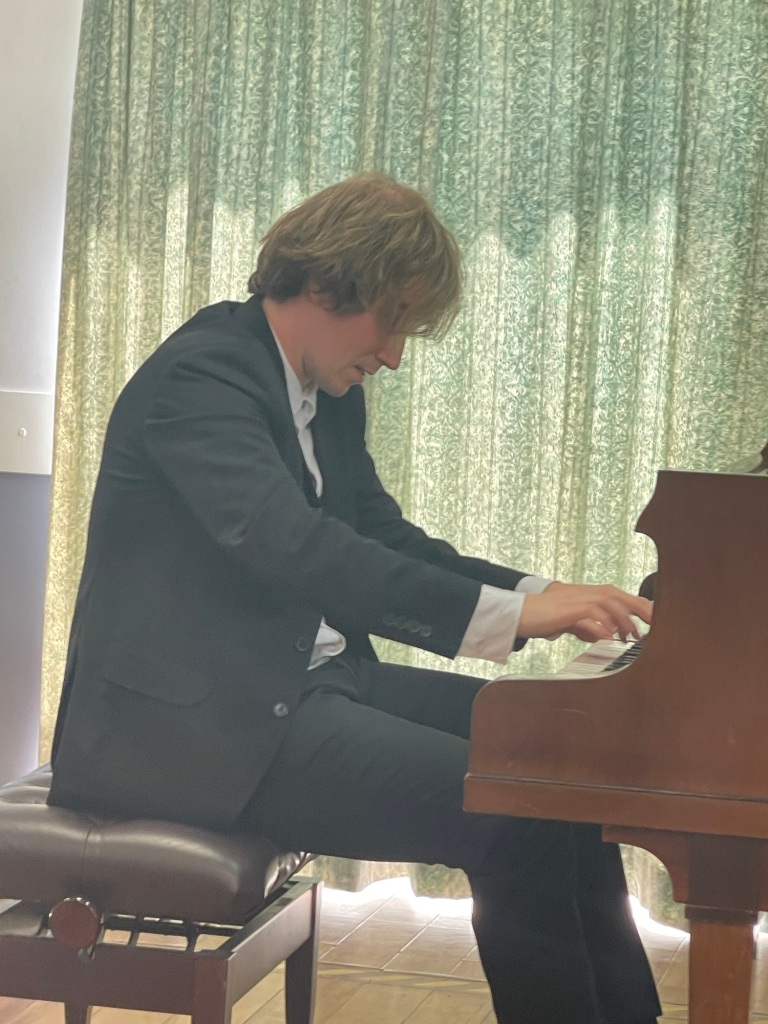
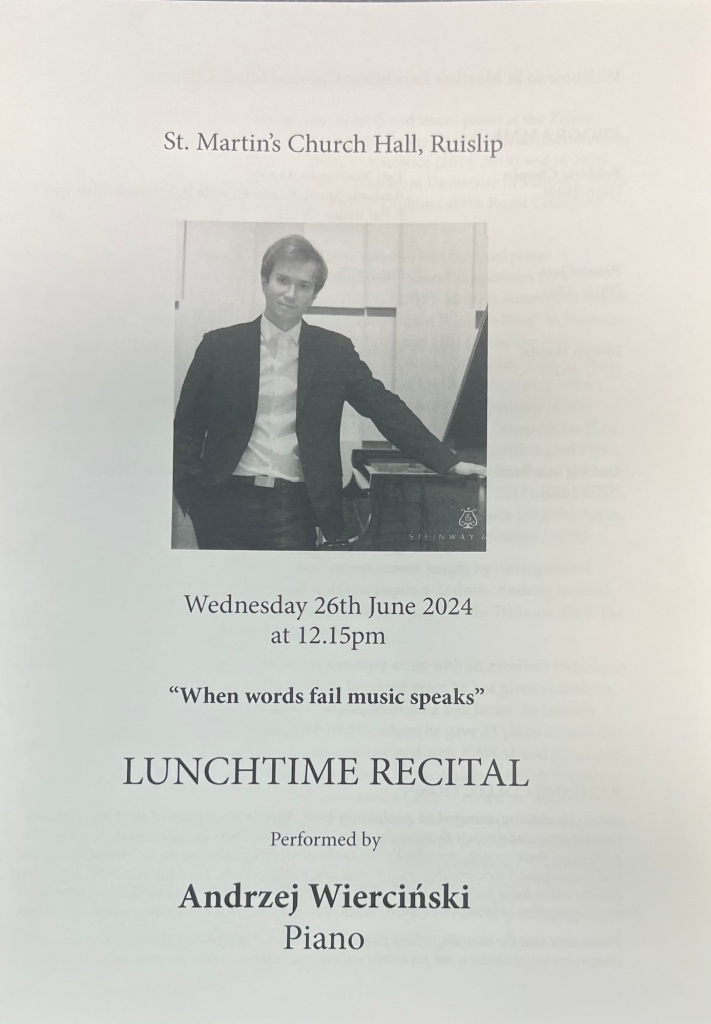

Filip Michalak had opened his programme with three Scarlatti Sonatas in this beautiful room with a view.Surrounded by the books in the ‘Harold Acton Library’ that the great aesthete had bequeathed to the British Institute,he opened with the whispered delicacy of the Sonata in D minor.It immediately demonstrated his artistic sensibility drawing us in to eavesdrop in this intimate atmosphere rather than projecting out to the audience that had filled the hall.Magical sounds poured from this matured Bechstein piano of 1890 ,that like the wonderful Riserva Chianti that we were offered by the sponsor afterwards,had matured well and there was a knowingly warm glow to the sound of a wondrous music box.This contrasted immediately with the sparkling brilliance of the well known Sonata in E.With its horn calls of gentle rhythmic insistence it was played with the same elasticity that Filip was to bring to the Mazurkas that followed.It was Chopin who had described to his noble women students who flocked to him for lessons ,that ‘rubato’ ,that very elusive elasticity of tempo,was like a tree with the roots firmly placed in the ground but with the branches free to sway and move with the breeze that passes through them above.

It was exactly this that this young artist demonstrated with the Sonata in F minor that followed.Etherial arpeggios were gently transformed into a beguiling melody of great yearning.These too were a great lesson of a stylist who could see that the simple notes of Scarlatti although limited to the plucked instruments of his time were conceived (like with Bach) with the human voice in mind where the song and the dance were the very basis of the fantasy of a Genius.A genius who could pen over five hundred sonatas each with their individual character and architectural shape.There are of course two schools of thought :those that conceive these works as monumental that should be played with reverence and respect for the performance practices of the inferior instruments of their age.There are those ,like our young poet today,who believe that Scarlatti like Bach had a heart and soul that beats with the same human sensibility in every age and where customs and performance practices should be known and respected but not at the expense of the inner meaning – or dare I say soul – in the moment of creation.Food for thought maybe but was left behind with the magisterial performance of Cesar Franck’s Prelude Choral and Fugue that followed.

Simon Gammell OBE Director of the British Institute presenting the concert

This was now the centre piece of Filip’s rich panorama that he shared with us.This was the sumptuous outpouring of a true believer that was conceived in one long arch culminating in the fugue where the contrapuntal genius of Franck allowed him to combine the three themes that had been transformed from the opening declamation.He was able to join them together at the very climax of this work with exultation and exhilaration to the glory of our maker!This was after the return of the etherial opening with the theme magically floated on a wave of moving sounds becoming ever more intense until bursting into the climax.It requires a transcendental technique too because Franck had a hand span that was much larger than the norm – which was confirmed by Filip who was eavesdropping at the door during my short introduction to his recital! Filip managed to keep the rhythmic energy at boiling point despite all these difficulties maintaining a remarkable sense of line with the swirling mass of notes out of which the themes emerge.Before this tumultuous final fugue there had been the choral of disarming simplicity as the opening theme was revealed at the end of long arpeggiated chords like bells shining brightly at the end of each glissando like chord.The final page of the fugue was played with burning excitement and transcendental control and the two final chords aristocratically placed with the same nobility of the organist of Sainte Clotilde in Paris.

After the exhilaration and virtuosity of Franck it was as though Filip was now liberated of his new passion and was free to return to his panoramic story of ‘Something Old and Something New’.Two songs by Schubert and Rachmaninov transcribed for the piano were played with a golden etched sound that held the audience spell bound.The genius of Liszt combined with Schubert created a magic atmosphere as the melodic line was mirrored with exquisite sensibility on a wave of gently moving harmonies.Rachmaninov’s ‘Vocalise’ was even in the original a ‘song without words’ and this transcription by Gryaznov took me by surprise not only for the sublime beauty of the opening but also for the unexpected passionately contrapuntal orchestral climax that then just dissolved to a whisper leaving a trail of magic silence that was ‘golden’ indeed.Now our young Danish Prince could let his hair down with the ravishing,enticing and hypnotic sounds of the Nuevo Tango of Piazzola.

Sir David Scholey and many friends congratulating Filip over a glass of wonderful Riserva Chianti offered by one of the sponsors

‘Oblivion’ just filled the silence created by the ‘Vocalise’ where the language changed but the intense sentiment was the same until the piano just burst into flames with the driving hysterical rhythmic energy of Libertango.A ‘tour de force’ of stamina and technical mastery built to fever pitch until a red hot glissando shot from one end of the piano to the other and had him and many members of the public on their feet in astonished enthusiasm.

Enthusiastic audience members happy to congratulate and talk to Filip

By great demand Filip was happy to take us to calmer pastures where Brahms’ sheep were safely left to graze.The beautiful waltz in A flat op 39 n. 15 just confirmed that a thing of beauty is a joy for ever.A work like Liebestraum or Fur Elise that was heard in every parlour where there once stood proudly a piano but whose place has now been taken over by a giant TV screen!

What a coincidence that only two days ago Evgeny Kissin had chosen this same beautiful waltz like today as a farewell gift to a doting audience in Rome.

Kissin in Rome ‘Mastery and mystery of a great artist’

Kissin had moved on to Paris and London and our young poet will move tomorrow to the Tuscia University in Viterbo .The concert will be streamed live and will conclude this short tour that the KT is proud to have shared with such a talented young artist at the start of his career.

A feast fit for a ‘Prince’ generously offered by a great friend and admirer of Music at British
Our young Prince delighted to capture for posterity such wonderful morsels
An enthusiastic audience member congratulating Filip
Music in the air today in Florence
https://christopheraxworthymusiccommentary.com/2023/11/08/magdalene-ho-the-genial-clara-haskil-winner-at-19-takes-leighton-house-by-storm/
Rehearsing in Florence
Below is the recording of the live stream that the University has very intelligently decided to continue even after the pandemic.These concerts thanks to Prof Ricci,the artistic director ,can be enjoyed not only in Viterbo but also in homes throughout the world where there is a need to bring culture back into peoples homes .The television has taken the place of the piano in peoples parlours and this rather dangerous box is filled with TV programmes by popular demand that are all too easily consumed by many who chose not to stimulate their curiosity ,open horizons and tax their brains.
https://www.youtube.com/live/kM-Hr0xOKVs?si=XL1kPlpE_xwrK1ni
Some more extraordinary playing from Filip with a fine Steinway piano and a very grateful resonant acoustic .
Filip was able to take more time and give more space to many of the smaller works on the programme.
The Scarlatti in particular was barely whispered but the sounds just flew out of the piano and reverberate so magically around a hall that I have rarely seen so full.
Chopin Mazurkas that in Florence had seemed a little too rustic were turned into the ‘canons covered in flowers’ that they truly are.A nostalgic yearning for the homeland that was Chopin’s birthright but seen through the eyes of an aristocratic poet from the distant salons in Paris.
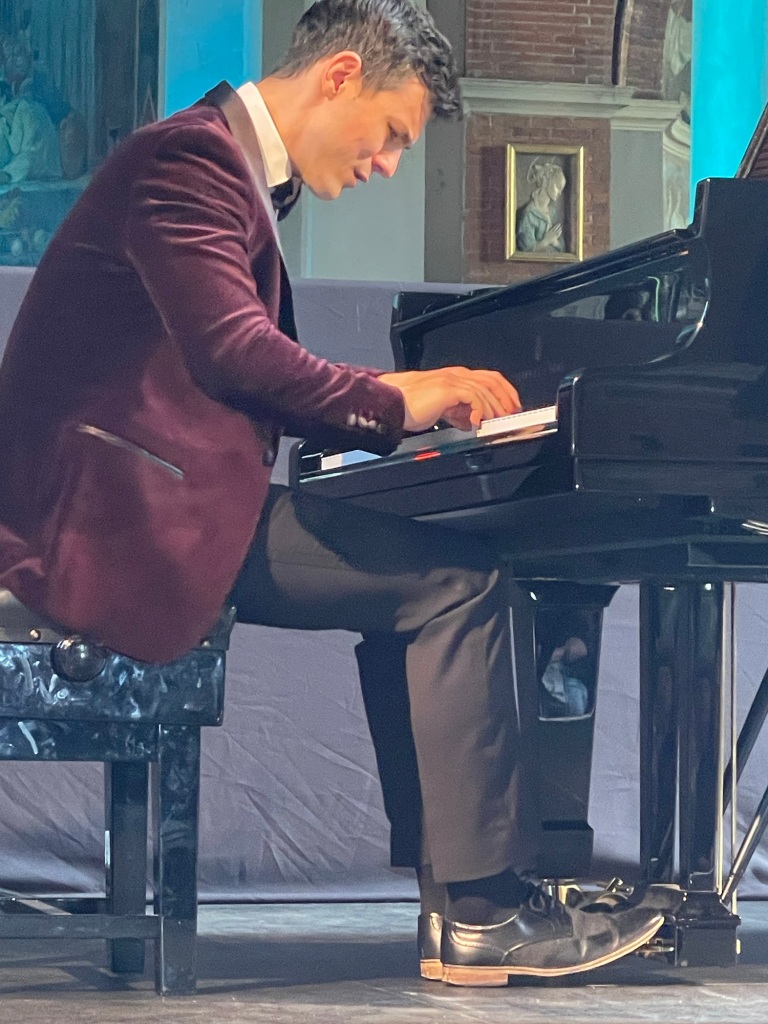
A Franck where Filip was able to scale the heights that culminated in a contrapuntal explosion of a true believer.
Of course the two songs truly penetrated the soul with the lilting beauty of Schubert followed by the chiselled ravishment of Rachmaninov’s sumptuous Vocalise.
After the exhilaration and sleezy insinuating excitement of Piazzola Filip had to play two encores and was besieged by autograph hunters at the end too.
The Brahms Waltz in A flat was even more beautiful than in Florence and a Chopin Waltz op 64 n.2 that just flew from the fingers of a pianist who was now on the crest of a wave.
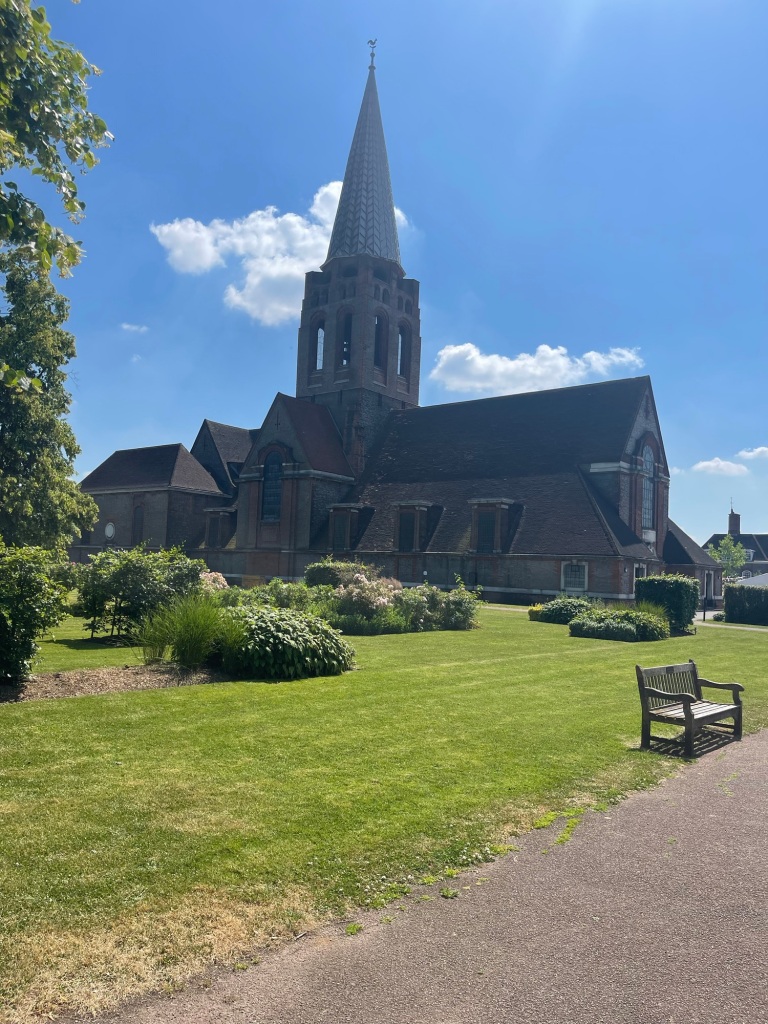
Last but not least our dashing young Dane gave an impromptu twenty minute concert at Rome airport to an astonished admiring audience of over a hundred fellow travellers .
Giuseppe Domenico Scarlatti
Napoli 26 October 1685 – Madrid 23 July 1757.

Italian composer Domenico Scarlatti (1685–1757) wrote 555 solo keyboard sonatas throughout his career. Circulated irregularly in his lifetime,these are now recognized as a significant contribution which pushed the musical and technical standards of keyboard music.These sonatas for solo keyboard were originally intended for harpsichord,clavichord or fortepiano and there are four sets of catalogue numbers:
  • K: Ralph Kirkpatrick (1953; sometimes Kk. or Kp.)
  • L: Alessandro Longo (1906)
  • P: Giorgio Pestelli (1967)
  • CZ: Carl Czerny
This
picture was taken in 1849 by Louis-Auguste Bisson, a few months before Chopin died of what doctors thought was tuberculosis.
  • Chopin based his mazurkas on the traditional polish folk dance also called the mazurka (or “mazur” in Polish). However, while he used the traditional mazurka as his model, he was able to transform his mazurkas into an entirely new genre, one that became known as a “Chopin genre”He started composing his mazurkas in 1825, and continued composing them until 1849, the year of his death. The number of mazurkas composed in each year varies, but he was steadily writing them throughout this time period.Over the years 1825–1849, wrote at least 59 compositions for piano called Mazurkas. Mazurka refers to one of the traditional Polish dances.There’s also a great deal of passion in the mazurkas; some of them are as demanding, physically and intellectually, as Chopin’s longer ballades or scherzos. Robert Schumann immediately grasped the embedded nationalism, characterising the Polish dance rhythms, modes and bagpipes as a rebuke to Russia: ‘If the mighty autocrat of the north knew what a dangerous enemy threatened him in the simple tunes of Chopin’s mazurkas,’ he wrote, ‘he would forbid this music. Chopin’s works are canons buried in flowers.’
César-Auguste-Jean-Guillaume-Hubert Franck was a French Romantic composer, pianist, organist, and music teacher born in present-day Belgium. He was born in Liège. He gave his first concerts there in 1834 and studied privately in Paris from 1835, where his teachers included Anton Reicha.
Born: December 10, 1822, Liege ,Belgium
Died: November 8, 1890,

Prélude, Choral et Fugue, FWV 21 was written in 1884 by César Franck with his distinctive use of cyclic form.Franck had huge hands ,wide like the span of emotions he conveys,capable of spanning the interval of a 12th on the keyboard.This allowed him unusual flexibility in voice-leading between internal parts in fugal composition, and in the wide chords and stretches featured in much of his keyboard music.Of the famous Violin Sonata’s writing it has been said: “Franck, blissfully apt to forget that not every musician’s hands were as enormous as his own, littered the piano part (the last movement in particular) with major-tenth chords… most pianistic mortals ever since have been obliged to spread them in order to play them at all.”The key to his music may be found in his personality. His friends record that he was “a man of utmost humility, simplicity, reverence and industry.” Louis Vierne a pupil and later organist titulaire of Notre-Dame, wrote in his memoirs that Franck showed a “constant concern for the dignity of his art, for the nobility of his mission, and for the fervent sincerity of his sermon in sound… Joyous or melancholy, solemn or mystic, powerful or ethereal: Franck was all those at Sainte-Clotilde.”In his search to master new organ-playing techniques he was both challenged and stimulated by his third and last change in organ posts. On 22 January 1858, he became organist and maître de chapelle at the newly consecrated Sainte Clotilde (from 1896 the Basilique-Sainte-Clotilde), where he remained until his death. Eleven months later, the parish installed a new three-manual Cavaillé-Coll instrument,whereupon he was made titulaire.The impact of this organ on Franck’s performance and composition cannot be overestimated; together with his early pianistic experience it shaped his music-making for the remainder of his life.Many of Franck’s works employ “cyclic form”, a method aspiring to achieve unity across multiple movements. This may be achieved by reminiscence, or recall, of an earlier thematic material into a later movement, or as in Franck’s output where all of the principal themes of the work are generated from a germinal motif. The main melodic subjects, thus interrelated, are then recapitulated in the final movement.

His music is often contrapuntally complex, using a harmonic language that is prototypically late Romantic , showing a great deal of influence from Franz Liszt and Richard Wagner . In his compositions, Franck showed a talent and a penchant for frequent modulatory sequences, achieved through a pivot chord or through inflection of a melodic phrase, arrive at harmonically remote keys. Indeed, Franck’s students reported that his most frequent admonition was to always “modulate, modulate.” Franck’s modulatory style and his idiomatic method of inflecting melodic phrases are among his most recognizable traits.

Franck had huge hands (evinced by the famous photo of him at the Ste-Clotilde organ), capable of spanning the interval of a 12th on the keyboard.This allowed him unusual flexibility in voice-leading between internal parts in fugal composition , and in the wide chords and stretches featured in much of his keyboard music (e.g., his Prière and Troisième Choral for organ). Of the Violin Sonata’s writing it has been said: “Franck, blissfully apt to forget that not every musician’s hands were as enormous as his own, littered the piano part (the last movement in particular) with major-tenth chords… most mere pianistic mortals ever since have been obligated to spread them in order to play them at all.”

The key to his music may be found in his personality. His friends record that he was “a man of utmost humility, simplicity, reverence and industry.” Louis Vierne, a pupil and later organist titulaire of Notre-Dame, wrote in his memoirs that Franck showed a “constant concern for the dignity of his art, for the nobility of his mission, and for the fervent sincerity of his sermon in sound… Joyous or melancholy, solemn or mystic, powerful or ethereal: Franck was all those at Sainte-Clotilde.”Unusually for a composer of such importance and reputation, Franck’s fame rests largely on a small number of compositions written in his later years.

Vocalise” is a song by Sergei Rachmaninov , composed and published in 1915 as the last of his 14 Songs or 14 Romances, op.34.Written for high voice (soprano or tenor) it contains no words, but is sung using only one vowel of the singer’s choosing . It was dedicated to soprano singer Antonina Nezhdanova but is performed in various instrumental arrangements more frequently than in the original vocal version.

Astor Pantaleón Piazzolla (March 11, 1921 – July 4, 1992) His works revolutionized the traditional tango into a new style termed nuevo tango , incorporating elements from jazz and classical music A virtuoso bandoneonist, he regularly performed his own compositions with a variety of ensembles. In 1992, American music critic Stephen Holden described Piazzolla as “the world’s foremost composer of Tango music”.At Ginastera’s urging, on August 16, 1953, Piazzolla entered his classical composition “Buenos Aires Symphony in Three Movements” for the Fabian Sevitzky Award. The performance took place at the law school in Buenos Aires with the symphony orchestra of Radio del Estado under the direction of Sevitzky himself. At the end of the concert, a fight broke out among members of the audience who were offended by the inclusion of two bandoneons in a traditional symphony orchestra. In spite of this Piazzolla’s composition won him a grant from the French government to study in Paris with the legendary French composition teacher Nadia Boulanger .
In 1954 he and his wife left their two children (Diana aged 11 and Daniel aged 10) with Piazzolla’s parents and travelled to Paris. Piazzolla was tired of tango and tried to hide his tango and bandoneon compositions from Boulanger, thinking that his destiny lay in classical music. Introducing his work, Piazzolla played her a number of his classically inspired compositions, but it was not until he played his tango Triunfal that she congratulated him and encouraged him to pursue his career in tango, recognising that this was where his talent lay. This was to prove a historic encounter and a crossroads in Piazzolla’s career.
With Boulanger he studied classical composition, including counterpoint , which was to play an important role in his later tango compositions.

Oblivion is an instrumental work by Astor Piazzolla. Composed in 1982, it was originally arranged for bandonéon, piano and bass, but its growing success over the years inspired many reprises for piano solo, clarinet, orchestra, and even a spoken version, all of which you can find in our catalog! The piece was commissioned and featured in the 1984 film Enrico IV (“Henry IV”) by Marco Bellocchio. Adapted from the eponymous theatrical piece by Luigi Pirandello, the plot tells the story of a man who, after losing conscience, thinks he is the famous king. The piece became popular from the film and lives to this day through concert performances. Piazzola elicits an atmospheric and haunting ambience in his composition, evoking the image of oblivion.Libertango was recorded and published in 1974 in Milan.The title is a portmanteau merging “Liebertad” (Spanish for “liberty”) and “tango”, symbolizing Piazzolla’s break from classical tango to tango nuevo.

Filip Michalak in Florence

A tour de force of transcendental pianism showed the other side of this young pianist in Bacewicz’s monumental 2nd Sonata of 1953.

A virtuoso performance not only for the keyboard command but for the amazing kaleidoscope of sounds that he could find in this rather dry acoustic.” (Recital at Steinway Hall in London)

The young danish/polish classical pianist, Filip Michalak is an active soloist and chamber musician. He has performed across Europe in countries such as Poland, Germany, England, France, Italy and all Scandinavian countries and has future engagements in more European countries, China and Middle East. Filip is a 1st prize winner at “Stars at Tenerife” in Spain and has won numerous prizes in his home country, such as 1st prize in the “Nordjyllands Talentkonkurrence” and several prizes in the “Steinway Festival”. In 2017 he became a finalist of the “8th Nordic Piano Competition” and was later that year a semi-finalist in “St. Priest International Piano Competition” in France.

He recently won “The Chopin Prize Competition” at Royal Northern College of Music (RNCM) and was also one finalists of the annual Gold Medal Competition at RNCM. In 2021 he was accepted to one of the biggest piano competition in the world in Leeds and was nominated for the Vendome Prize. 

Filip is currently an artist in The Keyboard Charitable Trust in London and has already performed in venues in London and Frankfurt for the Trust. 

He recently performed Beethoven’s 5th Piano Concerto with Shrewsbury Sinfonia in October 2021.

In 2013 he performed “Rhapsody in Blue” by G. Gershwin at the opening ceremony of the new concert house “Musikkens Hus” in Aalborg in Denmark. In 2016 he performed an arrangement of Mussorgsky’s “Pictures at an Exhibition” for piano and orchestra with Ingesund String Orchestra. 

Filip is also an active chamber musician playing with all different ensembles. Future engagements include a concert tour in China with violinist Kehan Zhang and performances with his duo partner mezzo-soprano Lovisa Huledal in Sweden. He is the Artistic Director of Södertälje Chamber Music Festival in Sweden which had its first edition in 2019 and has just had its 3rd edition in August 2022.

During his career, he has attended several masterclasses with well-known pianist and professors as John O’Conor, Boris Berman, Yoheved Kaplinsky, Sergejs Osokins, Ferenc Rados, Claudio Martinez Mehner, Mikhail Voskresensky, Olli Mustonen, Marianna Shirinyan, Alexander Ghindin, Alesandro Deljavan, Vitaly Berzon, Valentina Lisitsa, Graham Scott, Alexey Lebedev, Ilya Maximov, Niklas Pokki, Peter Jabloski and Peter Friis Johansson. 

In 2013 he started at The Royal Danish Academy of Music in Copenhagen in prof. Niklas Sivelövs class. Later on in 2015 he received many scholarships to study abroad and for 3 years he was a student of prof. Julia Mustonen-Dahlkvist at Ingesund Musikhögskolan in Sweden and simultaneously he was pursuing his master-degree at Royal College of Music in Stockholm. Filip has finished his Post Graduate Diploma (PGDip) at Royal Northern College of Music in Manchester with prof. Graham Scot. Furthermore he continued studying with prof. Julia Mustonen-Dahlkvist as an Artist in Residence of the Ingesund Piano Center until 2022.

Currently Filip is one of 9 pianist in the “Gabriela Montero Piano Lab” Academy and is mentored by the world famous pianist, composer and improviser Gabriela Montero.

https://christopheraxworthymusiccommentary.com/2023/06/02/the-gift-of-music-the-keyboard-trust-at-30/

Jacopo Petrucci at Roma 3 Mystery and beauty combine with musical intensity to exult the grandeur of Prokofiev

Nato a L’Aquila nel 1999, consegue nel 2017 il diploma di Pianoforte con il massimo dei voti e menzione d’onore presso il Conservatorio “A. Casella”, con i Maestri Mara Morelli e Orazio Maione. Si perfeziona successivamente presso la Scuola di Musica di Fiesole con Andrea Lucchesini e presso l’Accademia Nazionale di Santa Cecilia con Benedetto Lupo. Particolarmente interessato al panorama musicale del Novecento e della Contemporanea, collabora con importanti realtà come il PMCE, l’Ensemble Novecento e il “Cantiere Internazionale d’Arte” di Montepulciano. Sia come solista che come componente di formazioni da camera, ha tenuto concerti per l’Accademia Filarmonica Romana, la stagione dei Giardini “La Mortella” di Ischia, la Società Aquilana dei Concerti “B. Barattelli”. Frequenta attualmente il biennio specialistico di Composizione e nel 2023 è risultato vincitore del “Premio Casella”.

Some quite extraordinary playing from this young pianist who I remember hearing at the S.Cecilia Academy in the final examination recital of the class of Benedetto Lupo..I remember being impressed by his playing but nothing like today listening to him in concert with no one to judge him but the audience. I was completely overwhelmed by his authority and technical mastery but above all by his artistry and musical integrity. Having left ‘school’ and embarking on a career he has freed his wings and allowed his remarkable talent to take flight.Lucky us who have discovered this wonderful series at Roma 3 where they are able to give a platform to such star performers at the beginning of their career. I am not a great fan of Prokofiev as I find his percussive use of the piano and march like rhythms too overwhelming as his music is too often used as a vehicle for displays of virtuosity,strength and stamina. But there is another side to Prokofiev,the lyrical and melodic ,as Jacobo very eloquently pointed out.This is especially true with the earlier pieces like the Visions Fugitives op 22 or the first movement of the second piano concerto op 16.

Even in his tour de force of the ‘Toccata’ there was a quite considerable range of sounds and colours.There was ,of course,the insistent mesmerising drive of the opening played with great clarity where every strand of this intricate web of sounds was of extraordinary simplicity.There was drama too with enormous sonorities that rode on this continual living rhythmic drive that was always technically impeccable. It took courage and was quite a feat to open a concert with such a notoriously tricky piece. His musicianship allowed the architectural shape to be so clear amid all the challenges and hurdles that were strewn in his path.

Jacobo chose to show us the fantasy and beauty of the ‘Tales of an Old Grandmother’ with its four movements full of changing character and imagination.The kaleidoscopic colours that Jacopo was able to find showed a quite refined technical mastery able to create continually changing landscapes.The capricious suggestive sounds of the ‘Moderato’ with its very atmospheric melody bathed in long held pedals contrasted with the impish opening and ending and was immediately followed by the ‘Andantino’ of beauty and fluidity.The insistent impish bass of the ‘Andante assai’ on which floated a tenor melodic line opened up to a beautiful mellifluous outpouring of searing intensity which was matched by the magical sounds that Jacopo was able to find in the ‘Sostenuto’ with his kaleidoscopic range of sounds and colours.

The 8th Sonata unlike it’s companions of the ‘War Trilogy’ is more lyrical than percussive and is the work above all others where the two worlds of violence and peace can live together with moments of searing beauty contrasting with devilish virtuosity.Jacopo was able, with his superb musicianship,to shape the four movements into one architectural whole.From the long haunting and even daunting first movement to the beguiling laziness of the long drawn out waltz of the ‘Andante sognando’ to the spiky energy ,virtuosity and orchestral colours of the ‘Vivace’.This was an extraordinarily convincing performance of a very elusive masterpiece that Jacopo was able to transmit with quite remarkable authority.His spoken eloquence and intelligence was only matched by playing that underlined what he had said but also added much more where words are just not enough.Action speaks louder that words.And music takes over where words are just not enough.Q.E.D.

The audience in this beautiful new concert space at Roma 3 University

The Toccata op 11

The Toccata in D minor, Op. 11 was written in 1912 and played by the composer on December 10, 1916, in Petrograd.It is an extremely difficult showpiece and according to the biography of the composer by David Gutman,Prokofiev himself had trouble playing it because his technique, while good, was not quite enough to master the piece. This fact is not universally accepted, however, and his performance as reproduced in 1997 for the Nimbus Records series The Composer Plays is certainly virtuosic.

The toccata genre has undergone great change since Bach’s time. Originally denoting works of recitative or improvisatory character, since the 19th century the emphasis has been on a continuous pulsating rhythm. In Prokofiev’s masterpiece, composed in 1912, this rhythm grows into a hammering motoric drive that dispenses with developed themes or motifs. That which seems fascinating and enthralling to us today came as a shock to the critics of that time. But there were also proponents such as Prokofiev’s friend Nikolai Myaskovsky, who wrote of the Toccata: “It is a fiendishly clever thing, edgy, energetic and full of personality”.

Tales of an Old Grandmother op 31 is a set of four piano pieces and was composed in 1918 and premiered by the composer himself on January 7 the following year in New York City, probably at Aeolian Hall.It has an approximate duration of ten minutes and it was first published by Gutheil in Moscow in 1922.It was composed during Prokofiev’s exile in the United States after the outbreak of the Russian Revolution. An arrangement for orchestra also exists.Prokofiev’s pianistic output of this period is scarce since he put all his efforts into composing his opera The Love for Three oranges . He also composed, around that time, Four Pieces, Op. 32. Both were written in order to mitigate his economic situation because of the delay of the opera’s premiere;however, he did not obtain the money in royalties he expected for them.

The set of works describes an old grandmother narrating tales to her young grandson who listens carefully in her lap. It is full of nostalgia, with all the movements written in minor keys.

The work comprises four untitled movements:

  1. Moderato (D minor)
  2. Andantino (F-sharp minor)
  3. Andante assai (E minor)
  4. Sostenuto (B minor)

Sergei Prokofiev’s Piano Sonata No. 8 in B♭ major, op .84 is the third and longest of the three ‘war sonatas’ it was completed it in 1944 and dedicated it to his partner Mira Mendelson , who later became his second wife.The sonata was first performed on 30 December 1944, in Moscow by Emil Gilels

Prokofiev with Mira Mendelson (left), the sonata’s dedicatee, in 1946

In March 1939, Prokofiev began working seriously on a cycle of three piano sonatas, the Sixth, Seventh, and Eighth, to be known later in the West as the “War Sonatas.” The circumstances of their composition were summed up by Mira Mendelson, Prokofiev’s partner for the last twelve years of his life, “In 1939 Prokofiev began to write three piano sonatas… working on all ten move- ments at once, and only later did he lay aside the Seventh and Eighth and con- centrated on the Sixth.” It took Prokofiev five years to complete the cycle, from 1939 through 1944.

During the summer of 1944, in a state of great optimism, Prokofiev worked on both his Fifth Symphony and the Eighth Sonata. These two works represent not only the distillation and perhaps culmination of Prokofiev’s creative life, they might also be deemed metaphors for his country’s past history, the hopelessness of the early war years, and finally, victory. Indeed, both works embody what he called “an expres- sion of the greatness of the human spirit.” The first theme group of the opening movement, derived from melodies from his music for the film The Queen of Spades (Op. 70), consists of three different melodic profiles. Following a bridge section, a new theme in G minor flows into the allegro of the development. The recapitulation restates the first theme slightly modified.

Much of the thematic material of the second movement was taken from the ball scene in his incidental music for Eugene Onegin (Op. 71). Its dream-like quality is ex- pressed in its marking: Andante sognando, “slow and dreamy.”

The third movement, Vivace, is a bril- liant, fast sonata-rondo form, forging ahead with an extensive middle section and coda.

Checking the votes from the members of Roma 3 audience
Valerio Vicari,artistic director of Roma 3 Orchestra

Malta Philharmonic Orchestra in Rome with Erica Piccotti and Carmine Lauri directed by Michael Laus

Leonardo Pierdomenico A master at St Mary’s A memorable recital by a great artist

Impossible to arrive on time for this concert with Erica Piccotti who was recently a guest in my house in London with Leonardo Pierdomenico for concerts together at Bob Boas Salon and at the RAM for the prestigious Cello Gold.

I am happy to enclose an article I wrote about them on that occasion.

I was supporting a very talented young pianist Jacopo Petrucci from the school of Benedetto Lupo who I had recently heard in Florence in his complete Beethoven Series :

https://christopheraxworthymusiccommentary.com/2023/12/07/lupo-gatti-in-florence-lift-up-your-hearts/)

Jacopo unfortunately for me was performing the other side of this ‘Infernal’ City for Roma 3 ‘s magnificent ‘Young Artists Piano Solo Series’ that offers a platform to many super talented young pianists (https://christopheraxworthymusiccommentary.com/2024/01/25/__trashed/) Jacopo had also been a student of Orazio Maione in l’Aquila before taking wing and flying down to Rome .Orazio whose mother’s 100th anniversary we celebrated in Naples recently.

Naples pays homage to Annamaria Pennella

I had done my homework though for one of my favourite works .

The Double Concerto op 102 was Brahms’ final work for orchestra. It was composed in the summer of 1887, and first performed on 18 October of that year in the Gurzenich in Cologne, Germany.Brahms approached the project with anxiety over writing for instruments that were not his own.He wrote it for the cellist Robert Hausmann , a frequent chamber music collaborator,and his old but estranged friend, the violinist Joseph Joachim .The concerto was, in part, a gesture of reconciliation towards Joachim, after their long friendship had ruptured following Joachim’s divorce from his wife Amalie ( Brahms had sided with Amalie in the dispute.)

The concerto makes use of the musical motif A–E–F, a permutation of F–A–E, which stood for a personal motto of Joachim, Frei aber einsam (“free but lonely”).Thirty-four years earlier, Brahms had been involved in a collaborative work using the F-A-E motif in tribute to Joachim: the F-A- E Sonata of 1853.

Joachim and Hausmann performed the concerto, with Brahms at the podium, several times in its initial 1887–88 season, and Brahms gave the manuscript to Joachim, with the inscription “To him for whom it was written.” Clara Schumann reacted unfavourably to the concerto, considering the work “not brilliant for the instruments”.Richard Specht also thought critically of the concerto, describing it as “one of Brahms’ most inapproachable and joyless compositions”. Brahms had sketched a second concerto for violin and cello but destroyed his notes in the wake of its cold reception.Later critics have warmed to it: Donald Tovey wrote of the concerto as having “vast and sweeping humour”.

Casals and Thibaud recorded it with Cortot conducting in 1929: https://youtube.com/watch?v=90h1x-Rd9bE&feature=shared

Kissin in Rome ‘Mastery and mystery of a great artist’

Words cannot do justice to the three monumental performances we heard today from Evgeny Kissin.Who would have thought that Beethoven op 90 and Chopin Nocturne op 48 n 2 and the F minor Fantasie would appear like new as they were recreated before our incredulous eyes by a pianist who from a leggendary child prodigy passing through sometimes questionable interpretations has now in his first half century become one of the greatest artists I have ever heard.
This is a man in love above all with the sound of the piano but also with his evident joy to be able to share his voyage of discovery with an audience. Only from Sokolov have I heard such pianistic and musical perfection.If sometimes the tempi were slow and the music was not allowed to take wing it was because every note and every rest was pregnant with meaning.’Tempo di Marcia’ the Fantasie it was not ……but it was by a strange paradox that it was mesmerising in the way that in convincing himself he drew us in to this recreation and we too were hypnotised ravished and following with baited breath the conversation between interpreter and composer.The central episode of the nocturne became monumental instead of incidental but as Curzon said on hearing Radu Lupu in Leeds :thank God I lived to hear that!


Beethoven op 90 where the punctuation was so precise but orchestral in its precision and contrapuntal clarity.There were remarkable contrasts between the military and the liquid purity of the melodic.Beethoven’s search for a way back became a hide and seek of suspense. The second movement flowed so mellifluously with a truly wondrous sense of balance as the melodic line floated indeed on magic wings of song.The left hand rests too became so important and infact every detail was noted like a Toscanini or Boulez at the helm of the Philharmonic.
The lights dim and this voyage of discovery continues ……..


I thought nothing could have ever compared to my memory of Michelangeli playing Brahms Ballades until tonight where there was obviously magic in the air.The sublime heights Kissin reached will remain with me for a long time as Michelangeli had over fifty years ago.The fourth Ballade, ‘Andante con moto’ it was not but what does that matter when he could delve into the very soul of this sublime creation.Reverberations appeared as if the whole piano was vibrating out of which emerged a melodic line that was truly breathtaking .The Ballades had opened with such delicacy and beauty with the bass sustaining and adding another dimension to the wonderful legato that defied the fact that this black box was merely hammers hitting the strings.How was it possible that in Kissin’s hands tonight it became a wondrous box of jewels that glittered and sang with the same expressiveness of a Schwarzkopf.This is the illusion that a great artist after years at the helm can arrive at :Nirvana finding a wondrous world that others can never reach.A gradual rise in tension was suddenly released with the return of the opening theme even more legato with staccato left hand like pizzicato strings of an orchestra that suddenly took on a sinister appearance .Yes, Kissin with just ten fingers could find the sounds that only Walter could find with a full Symohony orchestra.In the second Ballade the clouds parted and the rising sun illuminated a beautiful pastoral scene and there was a ravishing beauty of poignant purity.It contrasted with the orchestral central episode only to have an even more wondrous appearance of the opening melodic line but with calm and reconciliation after the storm.The third Ballade opened with a startling reawakening of rhythmic precision and insistence but also with kaleidoscopic sounds.Purity and luminosity of religious intensity was of disarming simplicity in the central episode.

A full hall at the Parco della Musica Sala S.Cecilia

Prokofiev’s Second Sonata immediately followed after rapturous applause for Brahms but Kissin deciding to stay on stage this time.A completely different sound world opened up of the fantasy of a true world of dreams.A melodic line of amazing clarity appeared amongst the multicoloured sound world that had suddenly been unleashed.Rhythmic drive of the second movement with its spiky notes pointed with deadly precision was followed by the restless driving meanderings of great intensity of the Andante.The final movement brought this great gust of wind to an exciting end.
An ovation from a hall that I have rarely seen so full even for other pianistic giants like Sokolov or Volodos.Kissin who indeed had been ‘kissed’ by the Gods tonight played a Chopin Mazurka op 67 n.4 in A minor of refined purity and ravishing beauty that you could feel two thousand people united in following every subtle move that the melodic line was allowed to take with an almost improvised freedom and elasticity that I have not heard since Rubinstein.
Prokofiev’s March from ‘The Love for Three Oranges’ of course was a staggering tour de force of control and of dynamic range but it was the Brahms Waltz in A flat op 39 n.15 ,that Kissin wanted to send us away with,that was of such sublime beauty that I never expect to hear the like again ………until this masters next appearance!
Like Richter he can take a melodic line at such slow tempi because he can find so many different sounds within each note .It may mean some unorthodox changes of tempi that are hardly noticeable or of importance because the voyage is so beautiful that to stop and stare like with his Rachmaninov 3rd just a month ago is such a refreshing change from the usual speed mongers that occupy too often our concert halls.A thing of beauty is indeed a joy forever applies here stronger than ever.
The first time I heard Richter in London it was not his demonic energy or unorthodox technical genius that surprised so much as how quietly he could play and what control of sound never loosing the overall architectural shape of the music.
Kissin has arrived at a maturity now that for me marks him out as the only reason why live performance of well worn masterpieces can still be one of the most stimulating artistic experiences.

Beethoven’s previous piano sonata, Les Adieux , was composed almost five years before Op. 90. Beethoven’s autograph survives and is dated August 16 and was published almost a year later, in June 1815, by S. A. Steiner, after Beethoven made a few corrections.Beethoven’s letter to Prince Moritz von Lichnowsky, sent in September 1814, explains the dedication:
‘I had a delightful walk yesterday with a friend in the Brühl, and in the course of our friendly chat you were particularly mentioned, and lo! and behold! on my return I found your kind letter. I see you are resolved to continue to load me with benefits. As I am unwilling you should suppose that a step I have already taken is prompted by your recent favors, or by any motive of the sort, I must tell you that a sonata of mine is about to appear, dedicated to you. I wished to give you a surprise, as this dedication has been long designed for you, but your letter of yesterday induces me to name the fact. I required no new motive thus publicly to testify my sense of your friendship and kindness.’

Beethoven’s friend and biographer Anton Schindler reported that the sonata’s two movements were to be titled Kampf zwischen Kopf und Herz (“A Contest Between Head and Heart”) and Conversation mit der Geliebten (“Conversation with the Beloved”), respectively, and that the sonata as a whole referred to Moritz’s romance with a woman he was thinking of marrying.Schindler’s explanation first appeared in his 1842 book Beethoven in Paris and has been repeated in several other books. Later studies showed that the story was almost certainly invented by Schindler, at least in part, and that he went so far as to forge an entry in one of Beethoven’s conversation books to validate the anecdote.

Most of Beethoven’s piano sonatas are in three or four movements, but this one has only two. Both are provided with performance instructions in German. A few of Beethoven’s works of this period carried similar instructions in place of the traditional Italian tempo markings.

  1. Mit Lebhaftigkeit und durchaus mit Empfindung und Ausdruck (“With liveliness and with feeling and expression throughout”)
  2. Nicht zu geschwind und sehr singbar vorgetragen (“Not too swiftly and conveyed in a singing manner”)

The restless character of the first movement has been described by Tovey as “full of passionate and lonely energy “ and Charles Rosen , wrote of its “despairing and impassioned” mood.Andras Schiff hears Bach’s influence in the “beautiful counterpoint ” that unfolds in the development.

The second movement is a gentle sonata – rondo movement in E major
where its Romantic character, foreshadows Schubert as has long been noted by numerous musicians.

According to Wilfred Mellers , “Opus 90 belongs neither to [Beethoven’s] middle nor to his late phase and Denis Matthews sees it as having “more claim to kinship with the great sonatas of the last period than to the previous ones.” Hans von Bulow declared that this is the work “with which the series of pianoforte works of the Master’s so-called ‘last period’ begins.”Schiff has drawn attention to the apparent connection between the ending of this sonata, which closes in the key of E and the E major chord that opens the Sonata in A major, Op. 101, composed in 1816n declaring that : “If I go into the next sonata it sounds like a continuation of the previous one.”

The Ballades, Op. 10, were written by Brahms in his youth. They were dated 1854 and were dedicated to his friend Julius Otto Grimm. Their composition coincided with the beginning of the composer’s lifelong affection for the pianist and composer Clara Schumann, who was helping Brahms launch his career. The Scottish ballad “Edward” from J. G. Herders anthology of folk songs “Stimmen der Völker in Liedern” made such a deep impression on Brahms that, as he told a friend, the melodies came to him effortlessly.

Dein Schwert, wie ist’s von Blut so rot? Edward, Edward!
Dein Schwert wie ist’s von Blut so rot, und gehst so traurig her? – O!
O, ich hab’ geschlagen meinen Geier todt, Mutter, Mutter!
O, ich hab’ geschlagen meinen Geier todt, und keinen hab’ ich wie er – O!

Why does your Brand sae drop wi’ blude, Edward, Edward,
Why does your Brand sae drop wie blude, and why sae sad gang ye, O?
O, I hae kill’d my hawk, sae gude, mither, mither,
O, I hae kill’d my hawk, sae gude, and I had nae mehr but he, O


“Edward” provided the motif for the first of four ballade compositions, musical tales of a dramatic romantic nature that were linked with memories of Clara Schumann for Brahms. Julius Grimm, to whom the pieces were dedicated, also said that “the Ballades are really for her”. Robert Schumann was very enthusiastic about his young colleague’s composition. Chopin had written the last of his four Ballades only 12 years earlier, but Brahms approached the genre differently from Chopin, choosing to take its origin in narrative poetry more literally.

They are arranged in two pairs of two, the members of each pair being in parallel keys . The first ballade is one of the best examples of Brahms’s bardic or Ossianic style; its open fifths, octaves, and simple triadic harmonies are supposed to evoke the sense of a mythological past.

  1. D minor. Andante
  2. D major. Andante
  3. B minor. Intermezzo. Allegro
  4. B major. Andante con moto

The tonal center of each ballade conveys an interconnectedness between the four pieces: the first three each include the key signature of the ballade that follows it somewhere as a tonal center, and the fourth ends in the key signature of D major/B minor despite cadencing in B major.

Brahms returned to the wordless ballade form in writing the third of the Six pieces for piano op 118 . His Op. 75 vocal duets titled “Ballads and Romances” include a setting of the poem “Edward”—the same that inspired Op. 10, No. 1.

Sergei Sergeyevich Prokofiev – 27 April [o.s. 15 April] 1891 – 5 March 1953

Sergei Prokofiev’s Piano Sonata No. 2 in D Minor, Op. 14, was written in 1912 and published 1913, it was premiered on 5 February 1914 in Moscow with the composer performing.Prokofiev dedicated the work to his friend and fellow student at the St Petersburg Conservatory, Maximilian Schmidthof, who committed suicide in 1913. It covers a huge emotional range: from Romantic lyricism to aggressive brutality’.

  1. Allegro ma non troppo – Più mosso-Tempo Primo
  2. Scherzo.Allegro marcato
  3. Andante
  4. Vivace – Moderato – Vivace

The Fantaisie in F minor, Op. 49, by Chopin was composed in 1841, when he was 31 years old and the most harmonious year in his stormy relationship with the author George Sand (the pen name of Amandine-Aurore-Lucile Dupin, Baroness Dudevant) From Chopin’s letters it is known that he used the name “fantasy” to show some sort of freedom from rules and give a Romantic expression.Frédéric Chopin continued the tradition of a self-contained movement in his Fantaisie.This Fantaisie is considered one of his greatest works.Scholars have long been trying to figure out the mystery of Chopin’s one and only solo Fantasie. The highly individual form is a puzzle to all who prefer more traditional genre concepts. Is it a sonata movement, a rondo, or even a free combination of character movements such as march, recitative or chorale? Chopin lovers have no need of such considerations, seeing that nobody would ever dare to doubt that this Fantasie is one of the greatest works from his pen. After completing the composition, Chopin wrote “The sky is bright, but my heart is afflicted by sorrow”. This gloomy contrast pervades the Fantasie. It is an exceptional work from every point of view

Fantazja F-Moll Op.49 / Fantasy in F Minor Op.49. Wydanie faksymilowe rękopisu ze zbiorów Biblioteki Narodowej w Warszawie .Facsimile Edition of the Manuscript Held in the National Library in Warsaw
The magnificent Parco della Music in Rome di Renzo Piano
The house photographer Musacchio who I remember taking historic photos of Rosalyn Tureck at the Ghione theatre
(Riccardo Musacchio was born in Rome in 1964. He started working for the principal theatres and auditoriums of the Capital. Official photographer for the Santa Cecilia National Academy, for the Auditorium Music Park of Rome, the Sistina Theatre, Courtial International and many other collaborations. His contributions to national and international magazines and newspapers have consented him an approach outside of the theatre world. His archives, already rich of photographs of conductors, prose actors, sopranos, tenors, dancers etc, also include portraits of writers, scientists, geographic reporter).

Kissin the Conqueror

Kissin- The Conqueror

Sasha Grynyuk astonishes and seduces with superb musicianship and artistry together with friends at St Mary’s

https://youtube.com/live/PznPE9LJiJo?feature=shared

Sasha Grynyuk never fails to surprise and astonish with his superb musicianship and impeccable technical mastery.Today was even more astonishing to learn that he had transformed one of the most awkward piano concertos into a beautiful chamber work that could stand by side with one of the great works in the chamber repertoire.He not only played the Dvorak Concerto without the score but he had also reduced the full orchestral part to a string quartet so this beautiful concerto can be heard more often in the concert hall.Richter too never failed to astonish on his first appearances in the west not only with his pianistic perfection but also with his repertoire choices.He chose this concerto for his London orchestral debut and went on to make a landmark recording of it with Carlos Kleiber.I have never seen it programmed since in London or at least so very rarely.So it is thanks to Sasha for allowing us to hear this beautifully mellifluous work today.An orchestra of four beautiful young lady musicians who played with the same superb musicianship ,listening to each other as in the concerto there was a question and answer between the soloist and the orchestra.There is a pastoral character to the concerto that I had never been aware of with a continuous outpouring of melodic invention unmistakably traditional Czech .There were moments of passionate outbursts but like Grieg they were never overpowering but more of intensity than dramatic.The Andante in particular where the chiselled beauty of the piano rose above the harmonious warm background of the strings who were always ready to burst into melody .The dynamic opening of the solo piano in the Allegro reminded me of Brahms’ first Concerto with its dance like energy.There were moments of brilliance from Sasha but played with such musicianship that the actual technical mastery never drew attention to itself but just added to the overall architectural shape of the ‘quintet’.The cadenza too was astonishing for its pure musical shape created by cascades of notes played with such ease and naturalness.

Some superb playing from his four companions too with the searing intensity of Urska Horvat’s cello matched by the simple beauty of Kesari Pundarika’s viola.The superb violins of Sue In Kang and Ana – Elisabeta Popesu- Deutsch.

They all joined together in a performance of the Schumann Quintet that I have rarely heard played with such simplicity and clarity.What it lacked in the burning intensity of Rubinstein and the Guarneri Quartet all those years ago it gained in an architectural shape with playing of simple superb musicianship.Rubinstein as his solo career was coming to an end played the Brahms and Schumann Quintets in the Festival Hall and I remember Rubinstein well into his 80’s running on stage as he plunged into the first chords of the Schumann taking his colleagues very much by surprise.But of course he had this way of injecting energy into his beautiful playing like sudden electric shocks when he would even lift himself off the piano stool.Today there was the same superb playing but with musicians listening to each other and with modesty and humility showing us the simple beauty of all they played.

Winner of over ten international competitions, prizes and awards, Sasha was chosen as a ‘Rising Star’ for BBC Music Magazine and International Piano Magazine . His successes also include First Prizes in the Grieg International Piano Competition and the BNDES International Piano Competition, in addition to winning the Guildhall School of Music’s most prestigious award – the Gold Medal – previously won by such artists as Jacqueline Du Pré and Bryn Terfel.Sasha has performed in many major venues including Wigmore Hall, Barbican Hall, Royal Festival Hall, Queen Elizabeth Hall, Bridgewater Hall (Manchester), Wiener Konzerthaus, Weil Recital Hall (Carnegie Hall, New York), Teatro Real (Rio de Janeiro) and Salle Cortot (Paris). He has performed with such orchestras as the Royal Philharmonic, Bergen Philharmonic and Orchestra Sinfonica Brasiliera. His recording of music by Glenn Gould and Friedrich Gulda for Piano Classics was chosen as the record of the month for the German magazine Piano News and shortlisted for the New York Classical Radio Award. Among Sa sha’s ongoing projects are performances of Shostakovich’s original piano score for the 1929 silent film The New Babylon , which he premièred at LSO St. Luke’s and later performed at Leif Ove Andsnes’ Rosendal Festival, Norway. Born in Ukraine, Sasha studied at the Guildhall School in London. Sasha is a Keyboard Trust artist and currently benefits from the artistic guidance of its founder Noretta Conci-Leech.

Antonín Leopold Dvořák was born in Nelahozeves, the son of butcher and innkeeper František Dvořák (1814–1894) .He frequently employed rhythms and other aspects of the folk music of Moravia and his native Bohemia, following the Romantic-era nationalist example of his predecessor Bedřich Smetana.
Born: September 8, 1841, Nelahozeves,Czechoslovakia
Died: May 1, 1904,Prague
Anna Čermáková and Antonín Dvořák were married on 17 November 1873 at St Peter’s church in Prague. During the first three years of their marriage they had three children – Otakar, Josefa and Růžena – but all of them died in infancy. Over the ten-year period between 1878 and 1888 the Dvořáks had another six children, all of whom survived into adulthood: Otilie, Anna, Magdalena, Antonín, Otakar and Aloisie. The oldest child, Otilie – “Otilka”, inherited her father’s talent for music and several of her short piano pieces have survived to this day. In 1898 she married Dvořák’s pupil, the composer Josef Suk. Their grandson Josef Suk (1929–2011) later became a fine violinist. Otilie died prematurely in 1905 at the age of twenty-seven. Dvořák’s daughter Magdalena (known as “Magda” by her family) was also musical and became a concert singer. Son Otakar was later credited for preserving a large number of recollections about his father, which he wrote in 1960.

Dvořák composed his piano concerto from late August through 14 September 1876. Its autograph version contains many corrections, erasures, cuts and additions, the bulk of which were made in the piano part. The work was premiered in Prague on 24 March 1878, with the orchestra of the Prague Provisional Theatre conducted by Adolf Czech with the pianist Karel Slavkovsky . The first performance in England was with soloist Oscar Beringer at the Crystal Palace on October 13 1883.

While working on the concerto, Dvořák himself realized that he had not created a virtuosic piece in which the piano does battle with the orchestra. Dvořák wrote: “I see I am unable to write a Concerto for a virtuoso; I must think of other things.” What Dvořák composed instead was a symphonic concerto in which the piano plays a leading part in the orchestra, rather than opposed to it.

In an effort to mitigate awkward passages and expand the pianist’s range of sonorities, the Czech pianist and pedagogue Vilem Kurz undertook an extensive rewriting of the solo part; the Kurz revision is frequently performed today.

The concerto was championed for many years by the noted Czech pianist Rudolf Firkusny , who played it with many different conductors and orchestras around the world before his death in 1994. Once a student of Kurz, Firkušný performed the revised solo part for much of his life, turning towards the original Dvořák score later on in his concert career.

Leslie Howard who has recorded all of the works of Liszt declared “… there is nothing in Liszt that is anywhere near as difficult to play as the Dvořák Piano Concerto – a magnificent piece of music, but one of the most ungainly bits of piano writing ever printed”.

The concerto is scored for solo piano and an orchestra consisting of 2 flutes ,2 oboes , 2 clarinets, 2 bassoons , 2 horns, 2 trumpets , timpani , and strings .It has three movements:

  1. Allegro agitato
  2. Andante sostenuto
  3. Allegro con fuoco
  • Championed by Sviatoslav Richter which he recorded with Bavarian State Orchestra conducted by Carlos Kleiber . EMI Great Recordings of the Century (catalog no. 66947)He also made his much awaited orchestral debut in London with it in the Royal Albert Hall together with the Chopin Andante spianato and Grande Polonaise
Robert Schumann
June 8, 1810, Zwickau ,Germany -July 29, 1856, Endenich,Bonn.

Schumann composed his piano quintet in just a few weeks in September and October 1842, in the course of his so-called Year of Chamber Music. Before 1842 Schumann had completed no chamber music at all, with the exception of an early piano quartet composed in 1829. Following his marriage to Clara in 1840, Schumann turned to the composition of songs, chamber music and orchestral works. During his year-long concentration in 1842 upon chamber music he executed the three string quartets, Op. 41, the piano quintet, Op. 44; the piano quartet, Op. 47; and the Phantasiestückefor piano trio, Op. 88. Schumann’s work in that year was buoyant in character as he had begun his career primarily as a composer for the keyboard; after his detour into writing for string quartet, according to Joan Chisell, the “reunion with the piano” which the piano quintet provoked gave “his creative imagination … a new lease on life.”

Clara Schumann (née Wieck) in 1838. Robert Schumann dedicated the quintet to Clara, and she performed the piano part in the work’s first public performance in 1843.

He dedicated the piano quintet to his wife Clara. She was due to perform the piano part in the first private performance of the quintet on the 6th December 1842 at the home of Henriette Voigt and her husband Carl.However she fell ill and Felix Mendelssohn stepped in, sight-reading the “fiendish” piano part.Mendelssohn’s suggestions to Schumann after this performance led to revisions to the inner movements, including the addition to the third movement of a second trio.

Clara Schumann did play the piano part at the quintet’s first public performance, which took place on the 8th January 1843 at the Leipzig Gewandhaus

Sasha Grynyuk Anniversary recital of a great pianist in Perivale

Duo Degas – Chistiakova – Benocci in Viterbo- Excitement and Exhilaration of a duo who play as one in life and music.

https://youtube.com/live/qDyZy3ZN0wk?feature=shared

Wonderful to watch these two very fine pianists and to know that the life and music of their piano duo has kept apace with their growing family.A programme from the Russian repertoire of succulent Rachmaninov and sumptuous Tchaikowsky with a complete change of mood for an encore of Piazzola’s hypnotic and sizzling Libertango.

The Six Morceaux are among the earliest of Rachmaninoff’s mature works. Rachmaninov had graduated from the Moscow Conservatory in 1892, and-only two years later had already made a reputation for himself as a pianist and composer. These little pieces reflect themes of yearning and display some of Rachmaninov’s famous intricate passagework. The Morceaux are often considered as the forerunners of his later 13 Preludes, Op. 32, from 1910.They were played with sensitivity,colour and character.The ‘Barcarolle’ with the beauty of the melodic line ever more intense and cascades of arpeggios from Gala accompanying her husbands majestic chordal melody in the tenor register of this fine Steinway piano .I too had played this instrument some years ago in duo with Lydia De Barberiis and it has aged well – like good wine,a fine vintage matures especially if looked after with the love and care of Professor Ricci,the artistic director and creator of this series for almost thirty years

A rhythmic drive and crystalline sounds in the ‘Scherzo ‘ and some delicate colouring from Gala with Diego offering an abrupt surprise ending.’The Russian melody’ was played with simplicity and childlike innocence and just contrasted with the delightful dance of beguiling charm of the ‘Valse’.A delicate accompaniment from Diego and the elastic fluidity from Gala.A passionate outpouring in the ‘Romance’ was contrasted with the etherial pedal effect of the echoing in ‘Glory’ a traditional Russian melody.

And so to the Ballet music of Tchaikowsky which they have recorded.A very fine CD which they had invited me to write the sleeve notes for and that I was delighted to have the opportunity to delve into the archive and find out more about such famous melodies.

There was the drama of the opening of ‘Swan Lake’ as the story unfolds.The ‘Dance of the Swans’ with the delicacy of Diego’s accompaniment to Gala’s charm and kaleidoscope of colours bringing vividly to life the deliciously elegant swans before the excitement that they brought to the ‘Hungarian Dance’ finale.

‘Sleeping Beauty’ made a brief appearance in an early transcription by the youthful Rachmaninov with an opening of great expectation and its beautifully shaped melodic line.A curtain raiser for the ‘Nutcracker’ that we are more used these days in hearing in the two hand virtuoso arrangement by Pletnev rather than the more sober but no less exciting four hand arrangement of Langer.A ‘Sugar plumb fairy’ of wistful lightness and a build up of sound as cascades of notes passed from one player to the other with ease and sense of showmanship that this music demands.Beautiful bell like sounds of a luminosity and gentle insistence with their hands barely touching the keys and a whirlwind of rhythmic drive.Diego brought great character to the bass strides on which Gala added the magic melody of Chinese delight!A glorious outpouring of familiar melodies with the ‘Flower Waltz ‘ with arabesques of Romantic delight and exhilaration.

I have said it before but it is even more remarkable now how these two artists can play as one with a sense of balance as they listen to the music they are creating together with such sensitivity and love .

Il Duo pianistico a 4 mani Gala Chistiakova e Diego Benocci si è formato nel 2014, quando i due pianisti si perfezionavano presso l’Accademia Pianistica Internazionale di Imola.

Diego Benocci è nato a Grosseto, ha iniziato gli studi musicali presso l’Istituto Musicale della sua città con il M° Giuliano Schiano. Si è diplomato presso il Conservatorio “G. Frescobaldi” di Ferrara e ha concluso il corso di laurea presso il Conservatorio di Stato “L. Cherubini” di Firenze nella classe della Prof.ssa Maria Teresa Carunchio e l’Accademia Pianistica Internazionale “Incontri col Maestro” di Imola sotto la guida del M° Enrico Pace e del M° Igor Roma.Tiene regolarmente concerti in tutta Europa e in Asia come solista, musicista da camera e suona con orchestre in importanti festival.

Gala Chistiakova è nata a Mosca in una famiglia di musicisti. Ha iniziato i suoi studi di pianoforte a 3 anni con sua madre Liubov Chistiakova. Dal 1993 al 2005 ha studiato alla Scuola Centrale del Conservatorio di Mosca intitolato a Pëtr Il’ič Čajkovskij con i professori Helena Khoven e Anatoly Ryabov. Nel 2014 Gala ha terminato il Conservatorio di Mosca e un corso post-laurea in una classe del professor Mikhail Voskresensky. Nel 2011 ha iniziato i suoi studi presso l’Accademia Pianistica Internazionale “Incontri col Maestro” (classe del Prof. Boris BorisPetrušanskij) in Italia. Vincitrice di oltre 30 concorsi internazionali, vive oggi con il marito Diego Benocci a Grosseto dove dirigono insieme il Festival Musicale Internazionale “Recondite Armonie” e il Progetto di Scambio Culturale “Giovani Musicisti del Mondo”. Nel 2022 sono stati nominati codirettori artistici e docenti del festival IMOC a Grosseto.

Il duo ha un vasto repertorio e ha tenuto concerti in Russia, Italia, Francia, Portogallo, Germania, Regno Unito, per numerose stagioni musicali internazionali riscuotendo ovunque grande successo di pubblico e di critica.  

Nel 2021 in duo hanno vinto la borsa di studio all’Accademia Chigiana nella classe della prof.ssa Lilya Zilberstein. Hanno collaborato come duo con orchestre sinfoniche e da Camera e recentemente si sono esibiti al Conservatorio Čajkovskij di Mosca, alla Weston Recital Hall di Oxford, al Festival International de Musique de Chambre Est Ouest in Belgio, al Madeira Piano Festin Portogallo e in un concerto straordinario per G. Armani a Londra. 

Il loro primo CD con musiche di Čajkovskij è stato pubblicato nel 2021 dall’etichetta italiana OnClassical e le loro registrazioni sono state trasmesse in più occasioni su Rai Radio 3. 

Di recente il duo è risultato vincitore del primo premio assoluto e del premio “Marche Musica” al XXXI Concorso Pianistico Internazionale “Roma”

Gala Chistiakova and Diego Benocci in Viterbo A duo that plays as one with beauty and style.