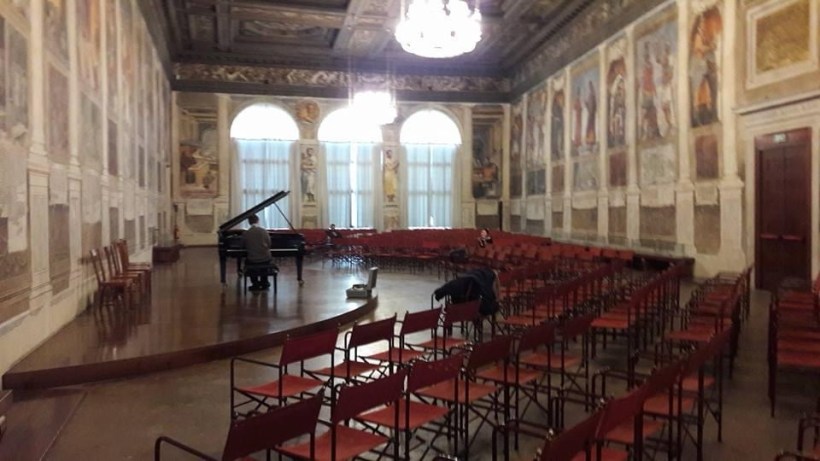
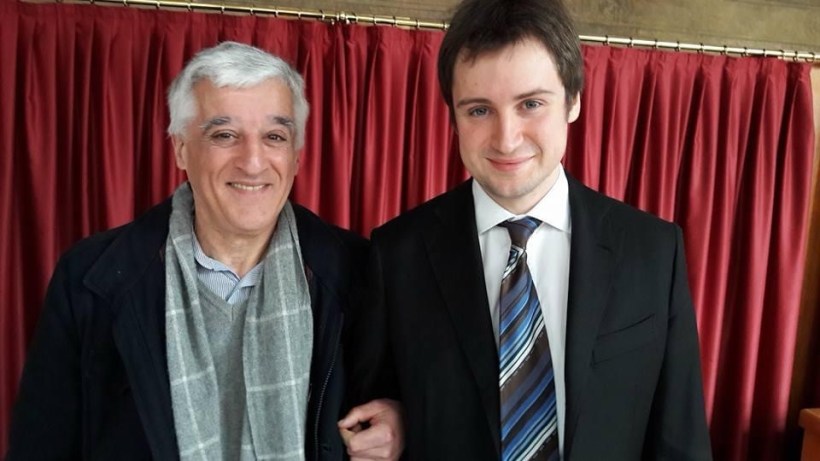
A last minute cancellation led to an improvised concert of great music making from a duo in life as on stage . Michelangelo Carbonara used to play quite regularly in my theatre in Rome as did many other fine students from the Piano Academy of William Nabore in Como. Now a highly respected professional musician he is fast making a name for himself as a fine pianist of unusually refined musicianship. Kyung- Mi Lee a kindred spirit on the cello gave a programme together with Michelangelo of works by Beethoven and Rachmaninov .
Michelangelo completing this improvised concert with a Mozart Sonata for piano solo K.311.Some very refined playing especially in the slow movement where his sense of balance allowed the melodic line to sing with such a beautiful unforced sound that it was hard to believe that this was the same piano that we have heard so many times before in lesser hands.
With his superb ornamentation and sense of line one more than forgave his lack of time in preparing this very intricate work This was a real musician’s work in progress that he chose to share with us and with only a little more time to prepare will become a very special performance indeed.Especially fine was not only his sense of real identification with the character and spirit of this deceptively simple work but above all his real understanding of the style.
The two G minor Sonatas for Cello and Piano ( or should it be Piano and cello?) by Beethoven op 5 n.2 and Rachmaninov op 19 showed off all their innate musicianship. A duo which signifies, as Menuhin would say, of mutual anticipation A musical conversation in which the two performers listen to each other and are more interested in the whole than in their own very difficult parts. A real case in point was the slow movement of the Rachmaninov where the sumptuous opening on the piano was totally incorporated and intertwined with the cello . Rarely have I heard such an integrated performance of the Allegro scherzando where the two instruments were united as one .
The intricate piano figurations in the first moment like silver to the wonderful sumptuous sounds from Kyung- Mi’s cello . The Beethoven was a real lesson in style from the opening dotted rhythms on the piano to the wonderful melodic lines that followed.The last movement at an irresistibly right tempo to bring this early masterpiece to a brilliant conclusion . An encore of the beautiful slow movement from Chopin’s cello sonata brought an evening of rare music making to a close.
Paavo Jarvi and Leonidas Kavakos with the Orchestra of Santa Cecilia at the Parco della Musica. Bartok Dance Suite Sz77 and 2nd Violin Concerto Sz122 and Brahms second symphony op73
Ovation not only from the public but above all from the orchestra What more can one say?
A pleasure to see that great cellist Luigi Piovano savouring every note as he led the cellist into the sumptuous world of Brahms.
A hard driven performance of the Second Symphony by a real kapellmeister along the lines of a Bohm or Jochum in which a real sense of line gave all the necessary time to allow Brahms’ music to speak for itself without any sentimentality or exaggeration.
Great sense of balance too in which the magnificent brass section were always part of the great line being created before our eyes. The exchange between the woodwinds and strings was pure chamber music .
Missing the spiritual magic and some of the real warmth of a Walter or Pappano.It was,however, a remarkable performance always kept on a tight reign that allowed the orchestra to ride so naturally on these long lines and play with all the warmth and mutual anticipation that has been so much part of the Pappano era .
A difficult first half of Bartok . The Dance Suite amazingly written in 1923 where all the dance rhythms were fully characterised by this highly professional and esteemed conductor taking us into this extraordinarily revolutionary sound world.
Kavakos ,quite rightly taking the world by storm with his seemingly effortless perfect violin playing .Musicianship to the fore and amazing feats of concentration between violinist,orchestra and conductor in the second violin concerto of 1939.
Missing some of the savage naked emotion of the Hungarian gypsy tradition nevertheless was given an amazingly assured performance from all concerned .where again the musical line was paramount . No mean feat for such a complex work .
An exemplary performance missing the warmth and soul of a Menuhin who was one of the very first to realise and help the suffering genius of this still rarely played composer.
An encore for Kavakos of a movement from a Bach solo suite on his wonderfully rich sounding “Abergavenny”Stradivari violin.
Played almost without vibrato in the true baroque tradition but with a sense of shade and colour that showed all the transcendental virtuosity and real musicianship of who must be today one of the finest violinists before the public.
Grande Goldberg al Parco della Musica ieri sera con un Beatrice Rana in un vero stato di grazia.
Un ora e mezza in un silenzio totale in una sala gremita.
Era anche trasmesso in diretta sulla radio e registrato per futuro visione per televisione. Un tour de force per una ragazza appena compiuta 24 anni.
Strano come quasi tutti i piu grandi interpreti dei Goldberg sono donne da Tureck,Nikolaeva, Hewitt e adesso a questa illustre lista si puo aggiungere Beatrice Rana.
They say that miracles never strike twice in the same place .
Well Beatrice Rana proved them wrong last night with a miraculous performance of the Goldberg Variations in a sold out hall in Rome.
Only just 24 years old she gave as near perfect performance as I have ever heard.
For an hour and a half holding the complete attention of this vast audience.
Not only those fortunate enough to find a ticket but for all those listening live on the Rai Radio 3. Also to be televised by RAI 5 ,the cultural channel ,this was an even more remarkable performance than the one she gave just three months ago for the BBC at the Wigmore Hall.
Gone were some of the rubatos that a young pianist can be forgiven for doing in their genuine quest to find the maximum expression in this monumental work.
Already in three months that same expression is now inside the notes.
It was as though the long journey with this work,for her teacher Benedetto Lupo tells me she learnt it with him as a girl, she was inside the very bones of this masterpiece written by Bach for the insomnia of Count Kaiserling.
The Count had asked Bach to write for his pupil Johann Gottlieb Goldberg ,who lived in the Counts house,”some klavier pieces which should be of such a smooth and somewhat lively character that he might be a little cheered up by them in his sleepless nights.”
Bach was never so rewarded for one of his works as for this.The Count presented him with a golden goblet filled with 100 louis-d’or.
No goblet for Beatrice last night but a ten minute ovation from an audience that had barely dared to breathe such was the concentration generated.
A performance that was without interval by this charming young musician in a flame red dress.
The return of the Aria after the Quodlibet was absolute magic with a total control of sound even in the almost inaudible whispered final breath.
Virtuosity abounded as in her extraordinary clarity and precision in the 5th Variation taken at an extraordinary pace but totally convincing because of the rock steady tempo she managed to maintain .
The 29th variation was not quite so rock steady in her quest to arrive at the ultimate explosion of the Quodlibet where Bach unites two folk- songs :”I’ve not been with you for so long,Come closer closer,closer,closer” and “Beets and spinach drove me far away.Had my mother cooked some meat,then I’d have stayed much longer”.
I remember Tureck too was not so rock steady in this variation which is understandable with the build up of tension over such a long span .
So much to admire in her intelligent and tasteful understanding of ornamentation also the rock steady pulse that she was able to maintain throughout with a remarkable sense of colour that revealed a true mastery .
A mastery that is easy to appreciate, but nevertheless remarkable for a twenty year old girl from the south of Italy,in the Tchaikowsky and Prokofiev Concertos that have been so admired in her CD with Pappano .
This is true mastery where art conceals art .
She joins that select group of women, Rosalyn Tureck, Tatyana Nikolaeva and ,Angela Hewitt who have made the Goldbergs their own.
Hats off to Benedetto Lupo who has been her guide and mentor from her early beginnings in Puglia a land blessed by the Gods indeed.
Lecce the wonderful spanish baroque city known in fact as the Florence of the south .
Interesting to note that pulling out my score of the Kirkpatrick edition a programme fell out of another memorable performance .
That of Rosalyn Tureck in 1972 when she played the Goldbergs twice in the same evening at the Festival Hall in London . First on the harpsichord and second after an hour interval,on the piano.
Interesting to note in her programme notes: The justifiable performance of Bach on the piano is conditioned by the usage of pianistic devices.This instrument,known by Bach in its early stage,has evolved through several centuries ,its style changing with each era. It is capable of many styles of sonority and technique. If played ” pianistically”,meaning 19th and early 20th century style,it is anachronistic.
However,in performing Bach on the piano I do not play the instrument in this former pianistic style.
I employ an entirely different technique and touch.
Music and instrument treated with respect and knowledgeable art,the integrity of the music should stand,retaining its clarity,its structure and its infinite significance to the human spirit.
Rosalyn who repeated the Goldbergs in my theatre in Rome in 1991 after a twenty years absence fom public performances to enable her to concentrate entirely on her studies of Bach in Oxford. Known by Harold Schonberg as the ” High Priestess of Bach” and as Artur Rubinstein quipped: “Tureck made Bach box office” .
I am sure if they were looking on tonight they would have a wry knowledgeable smile on their lips as they saw how this vast public devoured the performance of the young lady in the flame red dress.
Paolo Restani at Viterbo University today for Prof Franco Ricci’s Saturday Concert Series.
It was in 1980 when I drove the car to Naples from Circeo where I was on holiday on the chance finally of listening to the masterclass of Vincenzo Vitale at the Villa Pignatelli.
A legendary name as was that of Vincenzo Scaramuzza who transferred to South America where he founded the famous school that has produced such artists as Martha Argerich,Nelson Freire and Bruno Leonardo Gelber. All with its origins in the famous Neapolitan School of piano playing of Florestano Rossomandi Vincenzo Vitale his teachings of piano technique as that of Pierre Sancan would be discussed at length by us students. Vitale whose students included Bruno Canino , Michele Campanella,Laura de Fusco,Carlo Bruno,Francesco Nicolosi,Sandro De Palma,Franco Medori and Riccardo Muti amongst many other brilliant pianists. The fifteen year old student playing a fabulous “Feux Follets”,one of the most tortuous pieces by Liszt, was Paolo Restani who I was listening to today thirty eight years later.
Vincenzo Vitale students are immediately recognisable by the crisp clear,clean use of the fingers like perfect little hammers somewhat to the exclusion of the warm rich natural sound of the Matthay school. Of course technique is only a means to an end as the superlative musicianship of Canino is testimony.
Strangely enough Vincenzo Vitale,a former student of Alfred Cortot,only spoke of musical matters in his masterclass.Obviously preferring to talk about technical matters in the privacy of his studio
Paolo Restani presented a programme in Viterbo showing off the glorification of the Vitale school of highly professional piano playing glorified in fact in Michele Campanella’s 50 anniversary this season in the University Season. A programme based on short virtuosi studies and preludes obviously with the Viterbo public also in mind. The three largest pieces were in fact Debussy L’Isle joyeuse the Chopin A flat Polonaise and the Liszt Spanish Rhapsody. Passing through a selection of Rachmaninov Preludes op 32 and some Chopin and Liszt studies.
All played with an ease on a piano that was rather too small to accommodate such an overpowering technique. Some beautiful moments though in Chopin’s op posth Nocturne and Debussy’s suggestive “La plus que lent”.Not always following the composers markings though most notably in Chopin’s “Revolutionary “study where the dramatic difference between forte and piano was not put in evidence also some ingenious fingerings that were certainly not Chopin’s!
All presented with a conviction though and sense of communication that held his audience spell bound until the ovation at the end. A generous encore of the Liszt Rigoletto paraphrase that I had just read on a quick visit into the centre of Viterbo that the Verdi opera was presented due to Papal censorship under the different name of Triboletto in the beautiful Teatro dell’Unione, another of Italy’s beautiful theatres the opens and closes with alarming regularity.
A mad dash to the station at the end by this Lisztian figure who had so captivated the Viterbese public to catch his last train back to the Eternal city where he repeats the programme tomorrow.
Interesting concert at my local conservatory in Latina
Maurizio Bignardelli a distinguished professor for 23 years at Latina Conservatory and a curriculum full of important engagements. It is nice to think that one of those concerts was in the Ghione theatre almost thirty years ago.When a brilliant young flautist was keen on making his debut in Rome . Maria Paola Manzi a student of our much missed Lya De Barberiis. Now also a distinguished teacher in her own right. How many musicians have been formed by the remarkable Lya De Barberiis with whom I had a piano duo for many years until her death a few years ago when she was well into her 90’s An interesting programme to say the least introduced in a very informative and professional way by one of Maurizio’s prize students,Emanuele Demartis.
Sonatas for flute and piano by two names that have passed into history as the finest piano virtuosi of their day:Robert Casadesus and Walter Gieseking
Who could have imagined that I would have to come to Latina to hear the Sonata op18 by Casadesus and the Sonatina 1937 by Gieseking
Impeccable performances from two fine musicians before an attentive audience completed with Drei Tanz Improvisationen and the famous Strauss transcription of Standchen for solo piano that gave the flautist time to prepare between the two very complex sonatas. Nice to think that the fine formation of these musicians is now allowing them to share this serious ,inquisitive musicianship in smaller venues throughout Italy via the smaller but no less important Conservatories that abound in Italy.
Latina Conservatory that thanks to their enlightened and passionate musical staff can boast a Symphony Orchestra formed by the professors,professional musicians from Rome but above all the most talented students. Designed to give much needed orchestral experience to the highly trained students who are given the opportunity to play in the magnificent Teatro D’Annunzio.
A theatre built in the Mussolini era when workers were brought down from the venetian area to drain the Pontine marshes and transform them from malerial swamps into the most arable land capable of providing food for the nearby Rome. A theatre in the rationalist architecture that has become part of Italy’s artistic heritage. Also its heritage is the political bickering in these parts that means that this much needed theatre opens and shuts with alarming regularity. It reminds me of the Don Camillo books that I used to devour as a child in West London. Politics should never enter into this world but as Roman times onwards has taught us administration of public monies can lead to all sorts of temptations and misunderstandings. The prisons are filling with administrators that not always have the idea that public purse is for the welfare of the popolulation and not their own small world. Human nature does not change even in this beautiful unknown part of Italy “baciato dal sole”. In fact the ancient Romans were the first to take note as the ancient remains that abound in these parts can testify The next concert by the Latina Respighi Conservatory Orchestra is on the 17th March under its very fine conductor, formed at the school of the legendary Franco Ferrara,Benedetto Montebello. Lets hope the political bickering will have calmed down to allow this remarkable musical activity to continue and flourish. The summer has been taken up for the past fifty years since Menuhin and Szigeti found the beautiful hillside town of Sermoneta,with the masterclasses and concerts of the Pontine Festival by some of the finest musicians from Hollinger,Kempff,Rosen,Navarra,Filippini,Giuranna,Petracchi and Canino to Virsaladze in the present period . Sermoneta with the Caetani Castle where Liszt used to come to discuss composition with the composer Roffredo Caetani .
Liszt’s piano is still in the historic world famous gardens of Ninfa at the foot of Sermoneta . Sir William Walton and his wife Susanna used to pass by regularly on the way to their home on Ischia to admire and copy these gardens justly famous world wide as the Waltons gardens at la Mortella have since become The hills around here are certainly abounding with the “Sound of Music”.
Murray Perahia in Rome tonight. A long awaited return with a recital of Bach BWV.817,Schubert D.935 Mozart and Beethoven op 111.
It was in 1972 that Murray Perahia took Leeds by storm with his poetic accounts of Schumann’s Davidsbundler ,Mendelssohn’s Sonata op.106 and Chopin’s First Piano Concerto.
I well remember the excitement as a student when he substituted in Rome that same year his mentor Rudolf Serkin in a recital of the Brahms Violin Sonatas with Pina Carmirelli in the historic Sala dei Greci of the Conservatory. Even more engraved in my memory was his memorable accounts of the Schumann Fantasie and the Liszt Spanish Rhapsody many years later also in Rome in the Teatro Olimpico in his so called Horowitz period.
Celebrated worldwide for his rigorous musicianly accounts of the great masters this poet of the piano can shed new light on the most well known works in the piano repertoire.
So tonight it was a very welcome surprise for me to find that instead of the promised “Hammerklavier” sonata – a magisterial account had just been heard at the Barbican in London and a new recording is imminent – we were to hear ,what for me is a new addition to his repertoire, Beethoven’s last sonata op 111.
A magisterial interpretation indeed that just missed that frenzied appassionate approach of Serkin that I remember so well from an unforgettable performance at the Royal Festival Hall in London.
Maestoso indeed with the imperious opening bars which for me could have had more shape from mezzoforte leading to fortissimo although the final arrival was quite overwhelming .The short piano chords were rather lacking in weight for my taste but obviously he was thinking of wind instruments rather that strings .
Here was the same sense of sturm und drang though that I remember so well from his Hammerklavier fugue in London recently.
But here in this op.111 there was not quite yet the desperate frenzy that Serkin had been able to convey.
These are obviously early days for what will become one of the legendary interpretations of this elusive work.
The second movement played with all the orchestral colours that are necessary to give this work its strong masculine unsentimental character right from the seemingly simple Adagio molto semplice e cantabile.
The rhythmic build up was very impressive and totally convincing leading to the central outburst that can rarely have been given such an architectural sweep from the bass upwards .
The theme seeming to disintegrate before reappearing triumphantly on an inexorable wave that Perahia maintained in a very impressive unsentimental curve never lacking though in great inner passion .
Surely this is the very essence of these last utterings of Beethoven with the frustration of struggling with his deafness and seeming to totally ignore the limitations of the piano pushing it to its very limit in a revolutionary way.
The final appearance of the theme on a sustained trill, while not allowing the rhythmic impulse to lack for a second ,brought this performance to a very impressive ending.
I am sure in the series of performances that are surely planned that a true auror of sonorous magic will surround what is architecturally and musically already a very remarkable performance .
Perhaps it was a mistake to open the second half with the Rondo in A minor by Mozart.
Beautifully played ,of course ,but listening tonight it was obvious that even if op. 111 only lasts half the time of the Hammerklavier it is such a final statement that it needs to stand like a great monument in its own ground.
The first half consisted of Bach’s 6th French Suite .
Perahia has created a Bach style all his own that owes nothing to Schiff,Tureck, Gould or anyone else.
It is full of the most subtle character .Always in style and with great taste but with such a variety of colour and rhythm that it is quite extraordinary to behold .He almost convinces us that Bach must have envisaged this very instrument .
The well known Schubert Impromptus op 142 showed off all of the qualities that have made Perahia one of the rare musicians these days that one can really trust to tell the truth and nothing but the truth.
He can make such a well known score re-live, finding details that seem to have been overlooked by so many other lesser interpreters.
The wonderful shaping and colours.
The sense of charm and and passion when required.
A sense of giving new life to such well known pieces by delving into the score with the eyes of a superlative intelligent thinking musician but always with the heart of a poet.
This is what makes Perahia one of the most interesting musicians before the public today. No encores possible after Beethoven’s last utterings although the numerous public flocked to the Parco della Musica in the Roman rain to hear this great pianist in Rome at last would have gladly sat through the other 31 Beethoven Sonatas.
Lets hope S.Cecilia will have learnt its lesson and not wait another 20 years before reinviting Perahia back to the Eternal City.
Standing ovation at the end of Maurizio Pollini’s 75th birthday concert at the Royal Festival Hall in London
And how could it be otherwise than a first half dedicated to Chopin whose birthday was the following day the 22nd February.
It was after all Chopin that sprang Pollini onto the world stage at only 18 when he won the International Chopin Competition in Warsaw.
The first piece the Nocturne op 27 n.1 in C sharp minor with hardly a murmur from Pollini’s left hand on which floated the most ethereal melody.
Similar sounds that he was to find in the Cathedrale Engloutie offered as his first encore Was not Debussy editor of an edition of Chopin’s works?
I am sure that with this great thinking musician it was not just a coincidence.
The two nocturnes op.27 floating the most beautiful Chopin melodies into the refined air created by this remarkable musician who incredibly was celebrating with us his 75th birthday.
The third and fourth Ballades again in a very subdued manner hardly rising above mezzo forte such was his self identification with Chopin as we have come to know him via the letters of his few appearances in public.
Such magisterial musicianship a lesson in taste and style.
His wonderful sense of balance and beauty of sound allowed him to shape the works with the same power as the barnstorming musicians who seem to frequent these vast halls.
For Chopin was used to playing in the salons of the day on much less powerful instruments and certainly not to an audience of thousands .
It was the mastery and years of experience that allowed Pollini to draw us into the Salon world of Chopin and the full house sat in complete silence hypnotised by this now obviously very frail musician .
Who could ever forget the first appearances of Pollini in London with the Hammerklavier,Petroushka and one of the most remarkable Schumann Fantasies that London has ever heard .
We were astonished by the perfection and power of this young Italian pianist .But most of all astounded by his musicianship similar to that of the much admired Solomon, a career sadly cut short by a stroke .
This perfection has now become the norm but Pollini has moved on and in his quest for even more identification with the composers he has lived with for a lifetime,he like Kempff too late in his life, sacrifices note picking accuracy for a sense of true legato something with much more meaning for him and for us and that he very generously shares it with .
This is why his public worldwide flock to savour this feast of music in this remarkable artists twilight hour.
The beautiful Berceuse ideally suited to this atmosphere created from the very first notes of the recital.
It was shaped with such supremely delicate rubato that one was not even aware of the elasticity of his phrasing and the total exclusion of anything percussive in his quest to disguise the true nature of the piano.
This was followed by the mighty first scherzo where a little more power and dynamism would have been the perfect foil for all that had been created before .
But Pollini chose to keep the same atmosphere and there was a general sheen and aura to the very mellow sounding instrument.
The instrument as always provided for Pollini and also in the past for Michelangeli by their faithful technician,that great wizard in his own right , Angelo Fabbrini.
I would not be surprised if the mellow rich sound was not something that they had worked on together for this very particular 75th anniversary programme.
Such is the probing,searching musicianship of this artist that has given us a lifetime of dedication to music .
The second half dedicated to the Twelve Preludes Book 2 by Debussy.
The superb exquisite sounds but also the total dedication to Debussy’s most precise indications in the score I have only heard once before in this hall from Sviatoslav Richter.
Michelangeli too was remarkable but a completely different sound world from these half lights and subtle piano and pianissimi .
Rarely rising above mezzo forte again we were drawn into the magic world of a composer who so much admired Chopin.
Already the murmurings of Brouillards and Feuilles mortes drew us into a quite unique sound world .
The spell only slightly disturbed by the Puerta del vino and General Lavine eccentric only to be re found in the sublime sounds that he found in La terrasse des audiences du clair de lune and Ondine. A real sense of humour too in the preposterous Hommage a S.Pickwick Esq ,P.P.M.P.C leading into a Canope of real magic.
Les tierces alternees could have cleared the air with a more virtuosistic contrast .
The Feux d’artifice remarkable for the wonderful final apparition of la Marseilles with such sublime clarity it seem to float into this vast hall with a simplicity and cleanliness that took the audiences breath away.
Always generous with his adoring public.
Three encores which seemed to give him even more energy as after La Cathedrale he sat down and gave us such exemplary performances of the third Scherzo and finally restored to its rightful place at the pinnacle of the piano repertoire the much maligned First Ballade.
Here at last it was allowed to sing out with such simplicity and power without any of the rhetoric that tradition has passed on to musicians without the power of Pollini to interpret what the composer actually wrote himself.
A real lesson from a master who we can only wish many many more happy returns…………..
Magnificent Beethoven from Murray Perahia and the Academy of St Martins in the Fields tonight at the Barbican in London. Beethoven Concertos n.2 and 4 in their complete concerto series together.
Starting with a riveting performance of the Coriolan Overture this magnificent complex playing without a conductor .Each individual player listening intently to the other to produce a performance of hypnotic tension.
This orchestra founded by Neville Marriner I heard many times in rehearsal in the Dukes Hall in my Academy student days. In a break from hours of practise I would listen to Brendel rehearsing Mozart with them.
Wonderful memories relived today with Murray Perahia certainly the equal of a Brendel or Serkin at the total service of the music that they have lived with and serve with total dedication.
In this hall I well remember the Mozart cycle with Serkin and Abbado and seeing Serkin returning to the auditorium to listen to Abbado conducting.
Such is the unselfish total dedication to music that comes across with the truly great performers.
And so it is tonight.
No histrionics but total command and absorbed in making music together. We the public privileged to be able to eavesdrop on this communion between such musicians.
Beethoven second concerto in such a robust performance.
Gone are the usual rather feline niceties for the rough and tumble in the true spirit of Beethoven.
The second movement in particular robust but for that even more expressive .
The communion between the questioning piano and poignant subdued string reply was even more moving.
The great cadenza in the first movement, written by Beethoven at the time of the fourth for the performances by Ries, played with all the surprising musicianship that has made this musician one of the most highly revered of our time.
I remember Serkin remarking when he was asked to listen to Perahia the young student “you told me he was good but you did not tell me how good”.
The last movement played with such joy and rhythmic ebullience it created an infectious almost party spirit.
The sublime fourth concerto given a truly masterly interpretation that caught not only the audience by surprise but above all the musicians themselves.
A spontaneous standing ovation and a general embarrassment amongst the musicians exhausted,exhilarated and totally overwhelmed that they had produced such a performance.
Perahia conducting where necessary from the keyboard but in the Orphean declarations of the orchestra in the second movement there were no gestures from Perahia to the orchestra as he beseeched them from his wonderfully moving replies from the keyboard.
In the first movement such real rhythmic passion ,almost frenzy, that I have not seen in this concerto since the memorable performances of Perahias mentor Rudolf Serkin. Combined with such melting moments of sublime poetry as in the gentle unfolding at the end of the cadenza and the truly magical question and answer between the orchestra leading to such a passionate vehemently final two chords.
The last movement Rondo theme thrown off with a little too much frivolousness for my taste but how can one complain when it was played with such overwhelming conviction.
Perfection can never be totally satisfying but it can certainly be sublime as it certainly was tonight.
Much looking forward to Murray Perahias “Hammerklavier” in Rome on the 6th March. The eternal city does not know what is awaiting its lucky inhabitants.
We who heard it in this very hall a while back know that we are in the presence of a true master.
André Gallo at Viterbo University today for the collaboration between the distinguished musicologist Prof.Franco Ricci and the Keyboard Charitable Trust.
A yearly appointment where we already heard such stars as Alexander Ullman and Vitaly Pisarenko and now it is the turn of Andre Gallo.
Already noted by Noretta Conci-Leech and Bryce Morrison at Steinway Hall last year when Andre made his debut for the trust.
In fact Bryce Morrison,one of the most highly respected of critics, described his playing “a superb pianist with an intriguing and daring personality” . In 25 years of the Trust he cannot remember hearing a more masterly performance from the Trusts performers .
Having already performed in the meantime in Cyprus where his concert and masterclass were received with enormous admiration and enthusiasm it was with great anticipation that we were able to hear Andre again in a recital in Viterbo .
Next friday he can be heard again in a live radio broadcast of an hour of music and interview for the Italian Radio Rai 3 at 22.30 .
Immediately apparent was the way that he caressed the piano, a true act of love that was transmitted immediately to an enraptured public overcome by the sheer beauty of the sounds he produced.
This way of caressing the piano very much in the mold of the Tobias Matthay school of playing personified in the playing if Myra Hess and Moura Lympany.
Gone is the aggressive ,percussive almost brutal way of attacking the keyboard by the so called lions of the keyboard and is replaced even in the most dramatic outbursts by a sound that is never allowed to be forced
Anyone who has read of Chopin’s insistence when teaching that was not to start with a C major scale where the hand has to be held in a restricted way .It was to start with the C sharp scale where the hand was allowed to be in a more natural position.
And so it was today a joy to behold the sounds we were hearing reflected in the shaping of his hands on the keyboard .
A real lesson of beauty being in the eye of the beholder.
Something so rare to see and hear in these days of super resilient instruments where projection of sound is no longer a question of balance but of brute force.
A single encore was enough to put a seal on what has been described by the Prefect of Viterbo as the finest pianist they have heard in the past twelve years since this remarkable series began.
The first little piece from Kinderscenen by Schumann where we could marvel at the wonderful expressive sounds produced and by his aristocratic sense of line and balance. This had been evident from the very first piece in this extraordinary recital . The Arabeske op 18 by Schumann in which the magical coda so reminiscent of the codicil of his songs and was the natural consequence of all that had so rightly gone before.
Chopin’s famous posthumous Nocturne in C sharp minor he had reverted to the original Feuille D’Album where the central section, so seemingly out of place in the eventual published nocturne , does not exist .And so this nocturne together with Grieg Das Wander and Mendelssohn’s sublime Song Without Words op 19 n.1 were played as a whole .
For not only is Andre a masterly pianist he is also a thinking musician discussing his ideas with other such distinguished musicians on the faculty of that extraordinary Academy in Imola where Andre is already on the faculty.
So many of the works presented I had never heard before in all my years of playing and frequenting concerts.
Such is his probing mind to seek out new repertoire and present it in his own seemingly simple inimitable way.
This was the case of the “Suite Francaise d’apres Claude Gervaise” by Poulenc played with all the aristocratic elegance that can restore this music to its rightful place in the piano repertoire .
Such suave nonchalance in the Novelette n.1 too and true transcendental clarity in the difficult Toccata.
It was only matched in the other unknown piece to me of Dutilleux’s “Au gre des ondes” Where the scintillating rhythm of the Claquettes and Etude were electrifying.
The two well know Arabesques by Debussy were played with just the right sense of improvisation that is so difficult for some to gauge.This though combined with the rarely heard Ballade of rare beauty .
Ravel’s Menuet Antique was given a truly enchanting performance where the subdued middle section of such sublime sound was the total foil for this hypnotic Menuet.
The Danzas Argentinas op 2 by Ginastera in which the wonderful languid cantabile of the middle dance was contrasted with the savage rhythmic impulse of the other two.
The bubbling over of subtle rhythmic energy was unmasked in the final dance played with a virtuosity and seemingly endless resilience that quite took this totally bewitched audience by storm. .
Wonderful to be back in this beautiful hall where my old teacher Vlado Perlemuter used to play regularly when he was well into his eighties.
The hall that Richter loved too and would often spend hours working on his programmes that he would record in nearby Mantua.
The same magnificent Steinway “D” of 1954 that Emanuel Rimoldi played this morning in a programme of Mozart Sonata K.310,Liszt Aida paraphrase and the Ten Preludes op.23 by Rachmaninov.
The scene was set by my dear friend Filippo Juvar responsable for inviting some of the finest musicians to Padua over the past 40 years.
I well remember the telephone call after Perlemuter’s Italian debut in my theatre in 1984 at the age of 81.
Incredulous that this leggendary pianist,pupil of Moskowski,Cortot and Ravel was alive and still playing in public.Perlemuter had lived in the same house as Faure who used to pass him his latest compositions to try out.
Would he play in Padua?
Thus started his Italian career that lasted until his 90th year.
We shared Annie Fischer too.
They felt “en famille” and so looked forward to making music amongst old friends.
And what music!
So it was to Filippo I looked as Emanuel Rimoldi sat at the same piano this morning.
Fresh from his Wigmore Hall and Manchester camerata debut for the Keyboard Trust only a week ago.
There was certainly magic in the air in Padua today and I think I can quite rightly say that rarely can Padua have heard a more beautifully ravishing recital than today.
In Hollywood lingo you might say “A star is born”.
A Mozart as though hearing it for the first time.
So unexpected but oh so right the different layers of colours that he found in a truly noble Allegro Maestoso.
Quite startling the sheer beauty of sound combined with a sense of style and structure that I have not heard since Rosalyn Tureck and been so taken aback by the seemingly simple way the music is allowed to speak.
A glorious delicate cantabile in the Andante con espressione that was just as Mozart indicated.
The tempestuous middle section always kept perfectly in style and the magical minor section was truly memorable .
One could almost feel the public gasp in astonishment.
The murmurings of the Presto at just the right tempo that made the magical major section in Mozart’s seemingly endless invention so unusually right.
With the statement of the theme in the left hand we were made aware too of what invention there was in the right.
Instead of the usual “starter” this was a performance that like those of the much missed Curzon one never wanted to end.
He made us realise what a true genius Liszt was in a performance of the Danza sacra e duetto finale da Aida di Verdi S.436.
A work in which gone is the ceremonial march and pomp that is usually associated with most productions of this much loved opera.
Liszt has seen into the heart of this work which is one of the most touchingly moving chamber operas.
Just as Zeffirelli had realised in his memorable production in Verdi’s little jewel of a theatre in Bussetto.An Aida restored to its touchingly intimate atmosphere as Liszt too had totally understood.
So it was with the meltingly moving statement in the left hand that Liszt had brought this neglected masterpiece to a close, just as Verdi had intended.
Some amazing feats of delicacy and transcendental virtuosity that was totally at the service of this very poetic atmospheric piece.
Finishing in the same key as the first of Rachmaninov’s op 23 preludes begins was only one of the very memorable things hidden in this artists subtle musicianship.
Art that conceals art one might say.
Preludes as only once before heard in such a musicianly whole and that was from that very first recording that astonished and ravished us all years ago.
That of Sviatoslav Richter.
We marvelled at the seriousness and total dedication to the score of pieces that had been up until then used as a vehicle to show off many a pianist’s technical bag of tricks.
Here as then they were restored to their rightful place at the pinnacle of the piano repertoire.
The delicate strands of the first prelude in which all the various layers made total sense coupled also to a ravishing piano sound.
The second famous”cavallo di battaglia” of so many pianist played with such grandiose virtuosity and temperament the wonderful left hand melody in the central section allowed to sing because the ravishingly subdued accompaniment was held so much at bay.
The gentle disintegration of the Tempo di Minuetto so poignantly nostalgic .
Unbelievable sense of control in the D major cantabile where the filigree accompaniment in the right hand seemed to float in the air as the melody was allowed to sing with such poise and good taste.
The famous Alla marcia played with such solid rhythm and shape and some very violent climaxes played with almost military precision always timed to perfection that led to the most thrilling performance .The elusive ending at last made such sense as I am sure the Paganini variations would in his hands too.A sense of being thrown off but with the real musical meaning always foremost in mind .
Wonderfully nostalgic sixth prelude with an awesome sense of balance that allowed the piano to reverberate in an extraordinarily expressive way .Led to the enormously busy C minor prelude where the melody shaped with such care seemed to soar above the most intricate of weavings .
The enormous difficulties of the ” feux follets ” prelude played with a seeming ease .This was the only one I felt could have had a little more old style teasing rubato at the cadences The last Largo played with such understated sense of line and balance it really was a lesson in its self in true cantabile playing .
Total silence with the rapt attention of an almost full house brought an ovation that was thanked with the little Waltz Melancolique by Rebikov that I remember Cherkassky playing in my theatre as an encore .
Here it was again with just the same charm and colour of that other much missed magician of the keyboard .
What amazing people true artists are .
Emanuel who had played the same programme well enough in London just a week ago had now reproduced a performance and a piano sound in Padua the like of which I just never thought I would live to hear again after the passing of Rubinstein and Cherkassky.
All together an overpowering emotional experience totally unexpected …..