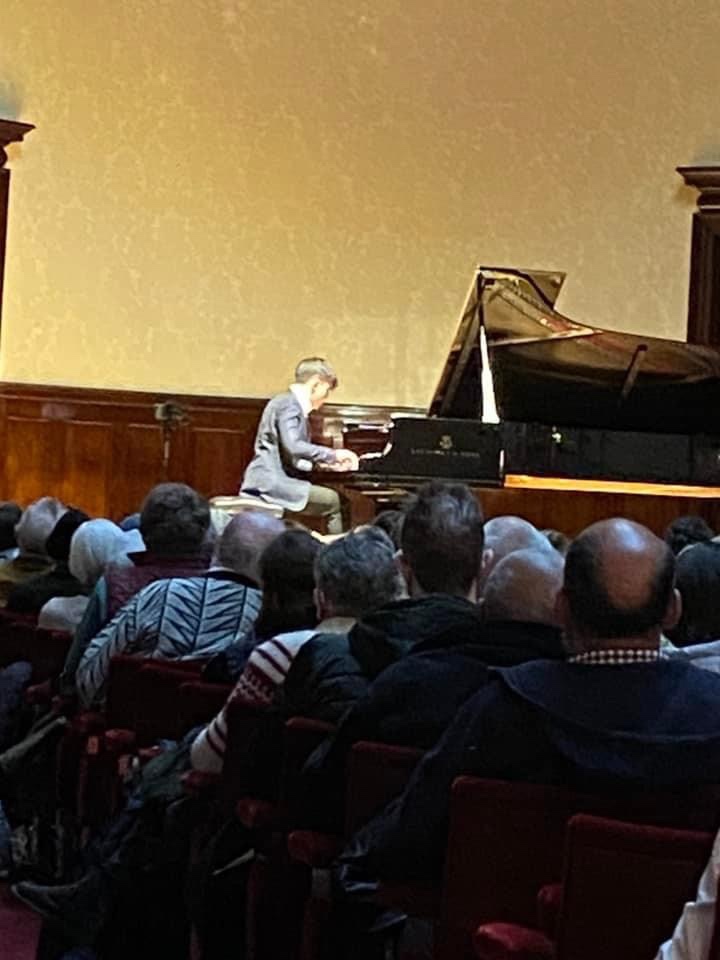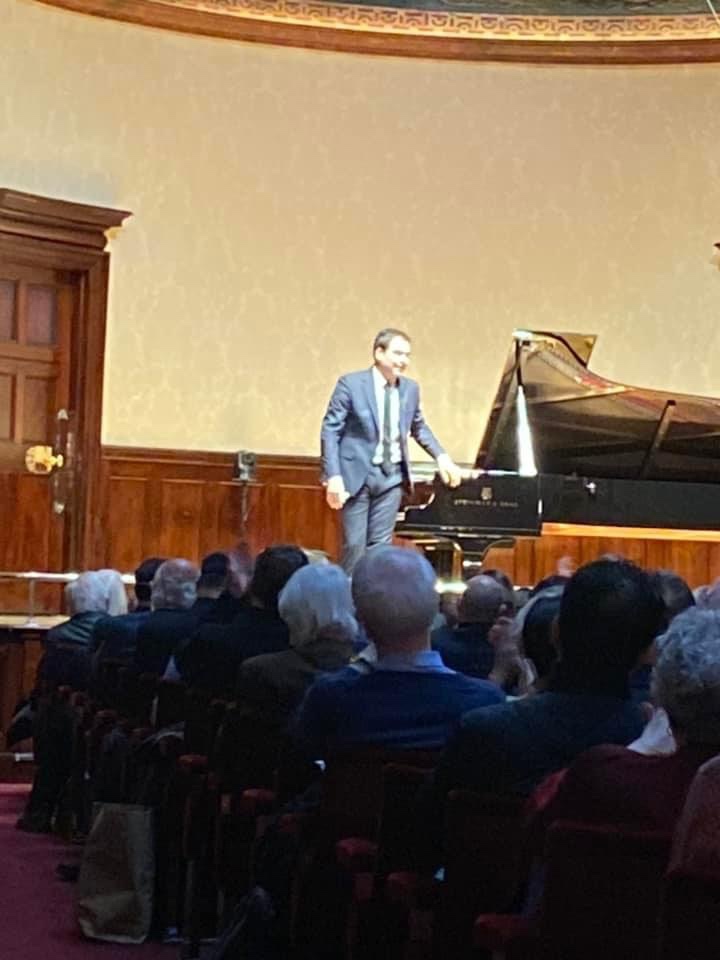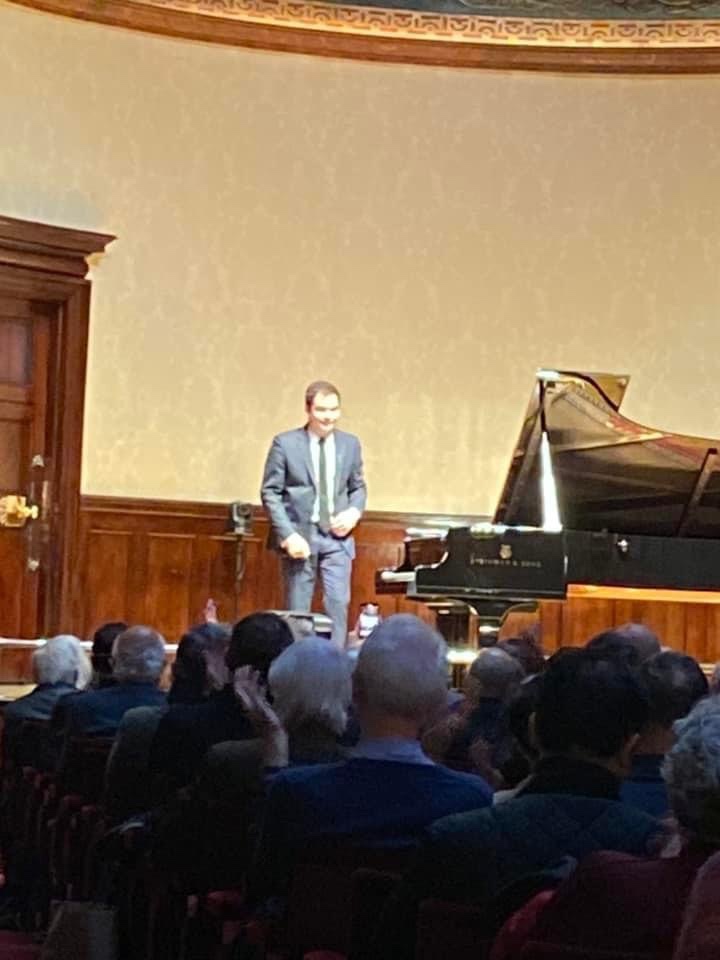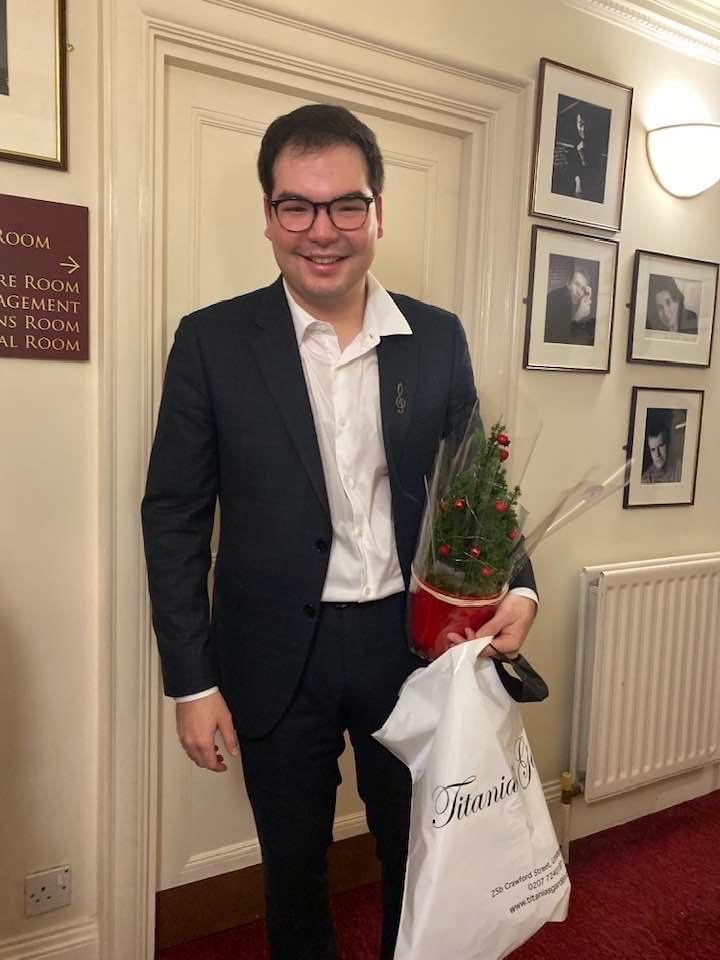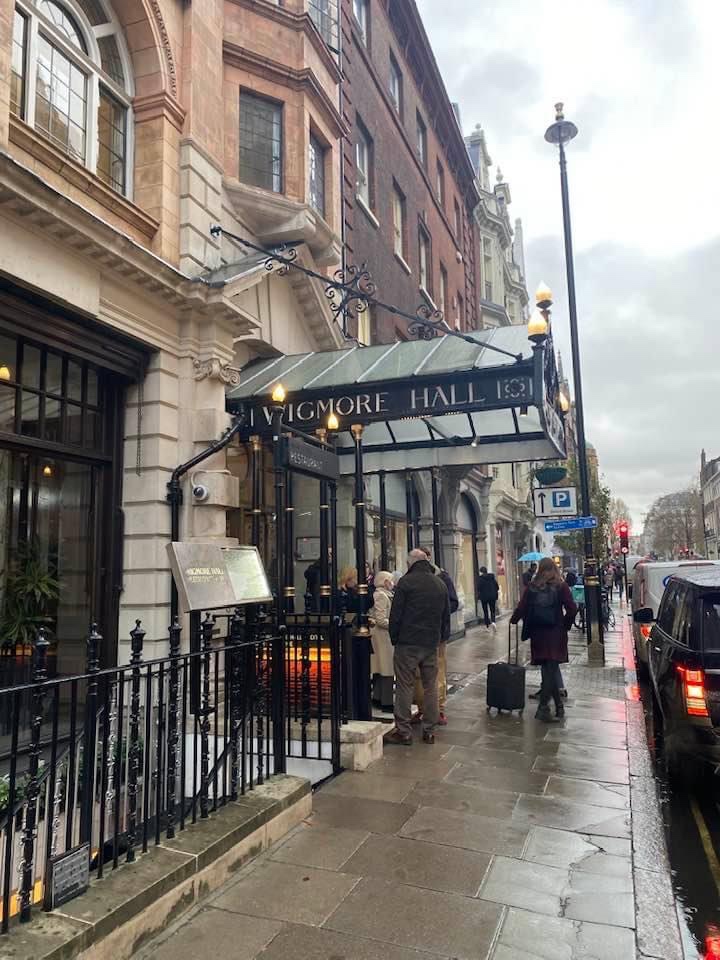
Talent Unlimited a Christmas treat to relish

St James’s Church Sussex Gardens Lancaster Place
The artists curriculum

What better way to celebrate Christmas as Omicron the evil off spring of COVID 19 shows its fangs .Snow White has nothing on this as France slams the door in our face with unexpected Christmas cheer!But it is Canan Maxton and her faithful friend Jessie Harrington who remind us that music is the food of love …………..and it is this very spirit that pervades all they do to help young musicians spread the word with their enormous talent that music must and will overcome all.It was this selfless generosity that was underlined by all the superb players that took part in the concert in St James’s Lancaster Gate.

Jessie Harrington thanking Nicolò Foron as she expounded her growing musical knowledge.

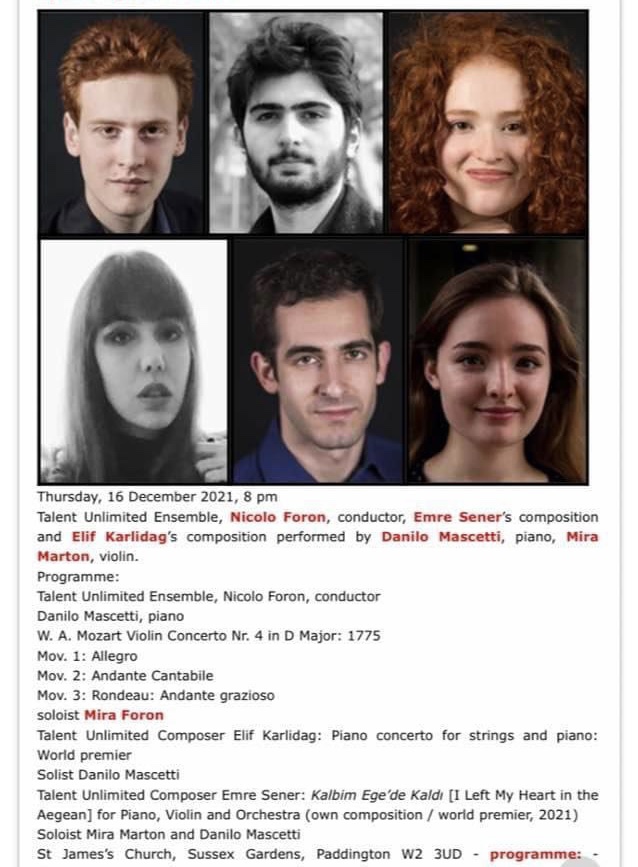
A heartfelt tribute to Jessie Harrington ,who shares her birthday with Beethoven,from Nicolò Foron and his Talent Unlimited Ensemble with a special encore of “Happy Birthday to you”.In A major as Jessie knowledgeably informed us!This was just the icing on a cake so lovingly prepared by Canan Maxton.A sumptuous feast of music in this beautiful church in the centre of London that gave us the chance to hear new works by two young composers both present together with a violin concerto by Mozart and a Symphony by Haydn.

Canan Maxton presenting her Talent Unlimited Christmas treat

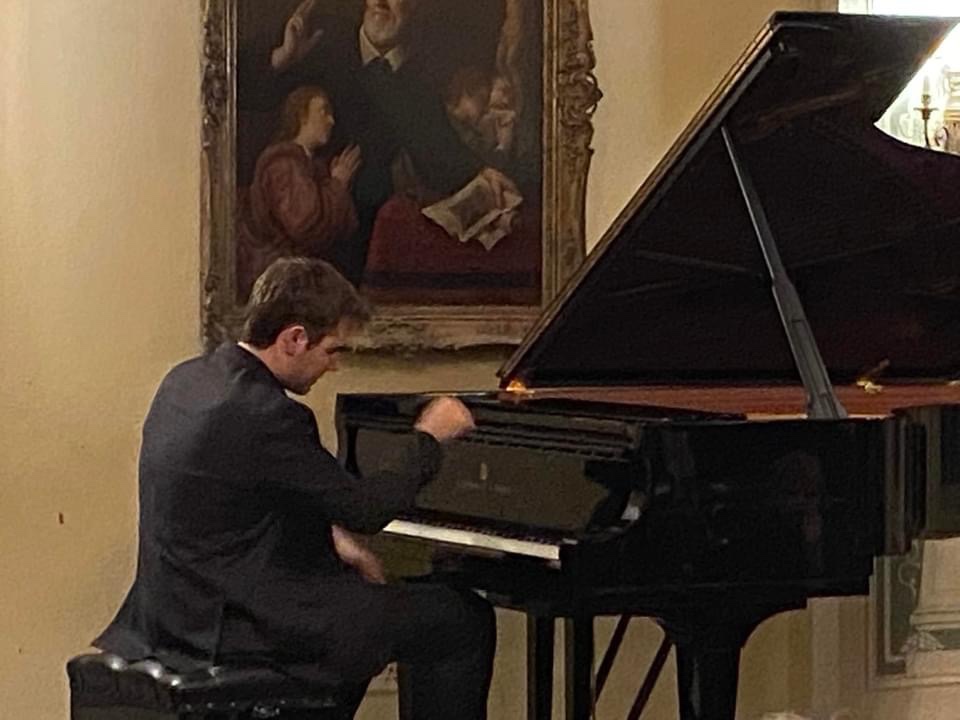
The concert had opened with a world premier of the Piano Concerto for piano and strings by Elif Karlidag a beautiful young composer,conductor and pianist.
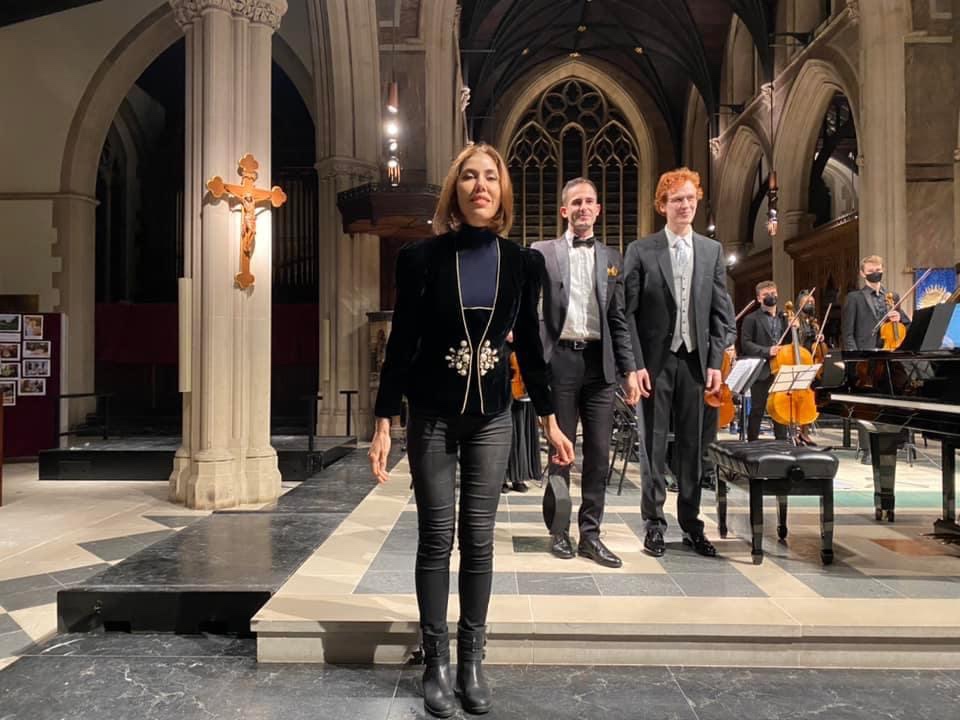
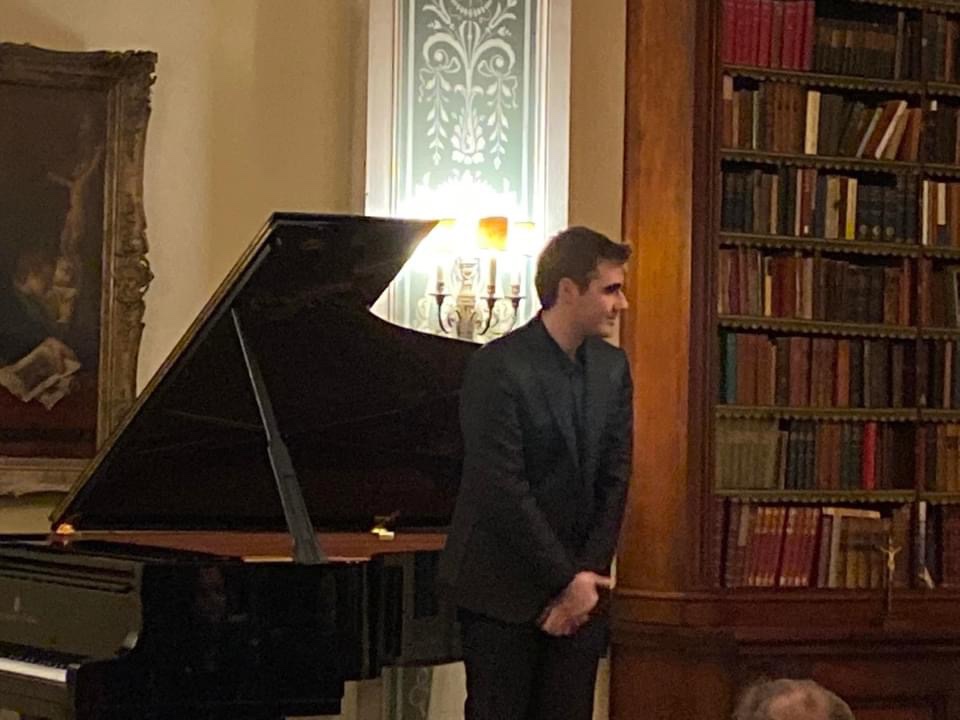
Elif Karlidag with Danilo Mascetti and Nicolò Foron

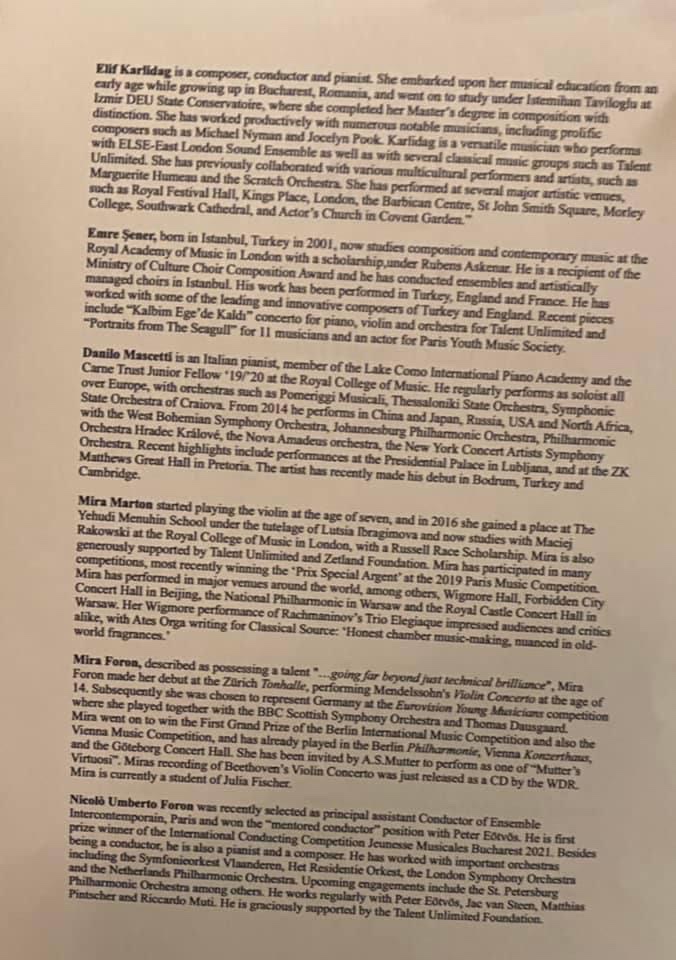
She received her early training in Bucharest but finished her Master’s degree at the Izmir Conservatoire under Istemihan Taviloglu.She has since worked with Michael Nyman and it was very much this influence that was felt in her very atmospheric piano concerto.Played by Danilo Mascetti who I had heard recently in the Chopin Competition in Warsaw and was much impressed by the clarity and musicianship of his performances.It was just this clarity and sensitive artistry that was apparent in this concerto obviously greatly influenced by the slow movement of Ravel’s G major concerto.It was full of atmosphere with jewel like sounds from the piano that just floated on the sweeping waves of sound from the string orchestra.An encore dedicated with loving thanks to Canan Maxton was offered by Danilo in the form of a Cimarosa sonata .It was played with a refined musical line shining brightly over a delicate non legato accompaniment and showed off his quite considerable artistry.

What could be a better contrast ( something old something new as Semprini would say ) than an exhilarating performance of Mozart’s D major violin concerto K.218 with the youthful brother and sister team of Mira and Nicolò Foron.
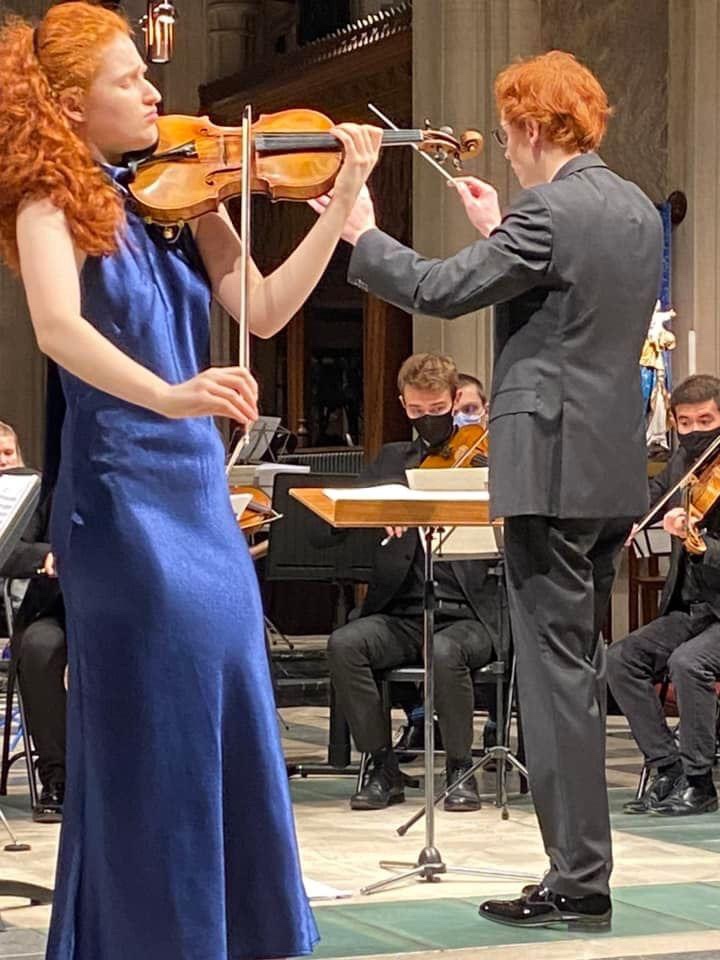
Mira and Nicolò Foron with a superb Mozart K.218

It was obvious from the first sumptuous notes of Mira’s violin entry that this was a great musical personality.It does not surprise me to read that she has been mentored by Ann Sofìe Mutter and is now studying with Julia Fischer.In fact the way she moves and lives the music is the rare gift that had overwhelmed me recently with Julia Fischer and Pappano in Rome .Mira too with her brother (I assume from their flaming red hair that they are related) created the same living and breathing animal that inhabited the genial Mozart concerto with their infectious rhythmic drive and ravishing sense of phrasing and searing intensity.A very fine performance much appreciated by this slightly Omicron depleted audience!

Amazing technical wizardry from Mira Foron

Emre Sener’s piece for piano violin and chamber orchestra saw Danilo joined by another superb violinist Mira Marton.Emre is a Turkish born composer now studying at the Royal Academy with Rubén’s Askenar and his composition was much more jagged than Elif’s mellifluous concerto.It was a fascinating juxtaposition of mysterious sounds with much use of the instruments just brushing delicately the strings including the pianist.Chopin asks con legno in his F minor concerto but here Emre asks senza legno but almost glissare sopra.Sudden stillness too created the atmosphere that the startling rhythmic question and answer between piano,violin and orchestra immediately broke the spell in a wake up dialogue of rhythmic intensity.

Ernst’s Grand Caprice on Schubert’s Der Erlkonig op 26 was played as an encore in a hair raising transcription for solo violin that showed the superb technical wizardry of this beautiful young violinist.
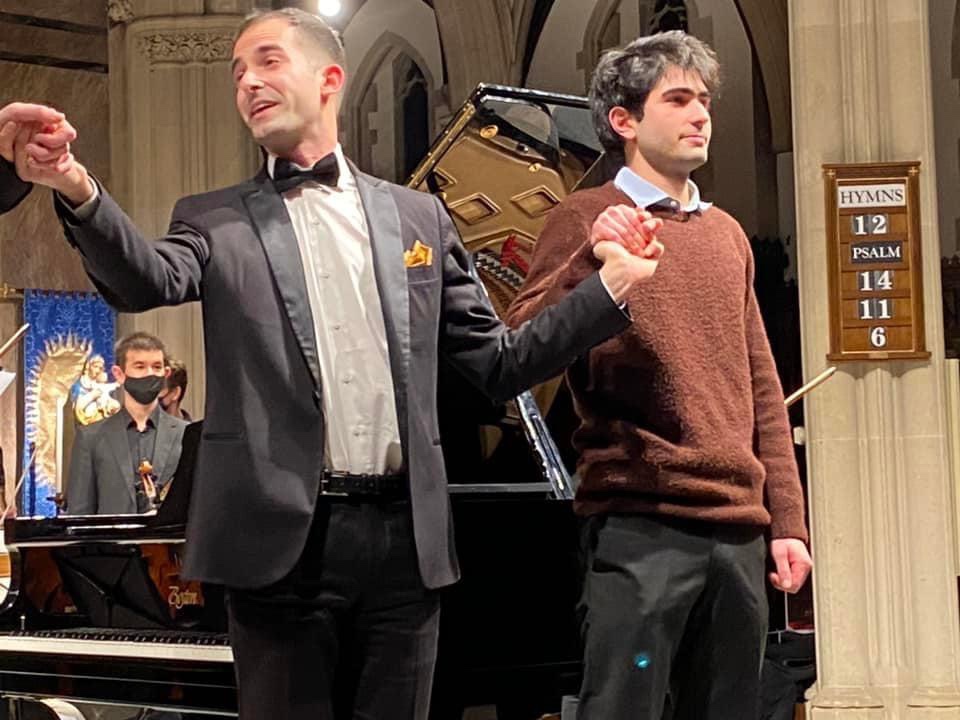
Composer Emre Sener with Danilo Mascetti

Some extraordinarily exhilarating playing from the soloists with such precision and dedication that was seconded by the scrupulous attention of drawing all together in a unified whole by Nicolò Foron.I read that the conductor is principal assistant to Boulez’s extraordinary Ensemble Intercontemporain and that just goes to explain the extreme clarity and precision that Nicolò was able to obtain from his dedicated players.

Mira Marton and Danilo Mascetti ravishing and enchanting with Massenet

An encore from Mira Marton with a performance of searing beauty of Massenet’s Thais played in a magical duo performance with Danilo where both artists reached sublime heights of ravishing beauty with their superb natural musicianship and artistry.

Nicolò Foron with the Talent Unlimited Ensemble

Last but certainly not least was a simmering performance of Haydn’s Symphony n.88 in G Hob.I/88 which was written by Haydn for the Esterhaza orchestra under the benevolent Prince Nikolaus Esterhazy. It is notably the first of his symphonies written after the completion of the six Paris symphonies in 1786.It was completed in 1787, just like his 89th symphony and is one of his best-known works, even though it is not one of the Paris or London symphonies and does not have a descriptive nickname.There was burning energy from the very first notes and the Largo was played with a great sweep to the melodic line with a surprisingly sumptuous orchestration that Nicolò conducted with great architectural shape.There was an infectious dance rhythm to the minuet with the syncopated trio a great contrast.The bucolic spirit of pure opera buffo finale was an exhilarating way to end this Christmas feast from Talent Unlimited
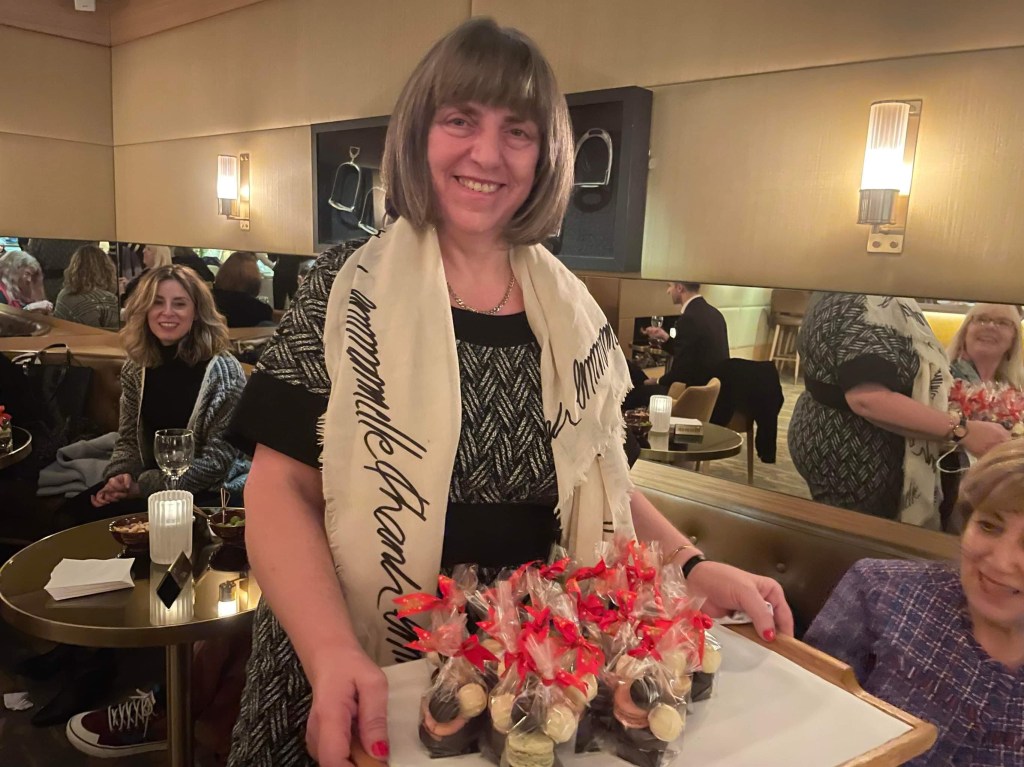
Jessie Harrington after concert birthday celebration
The Talent Unlimited artists
https://christopheraxworthymusiccommentary.wordpress.com/2018/11/30/talent-unlimited-showcase-recital/

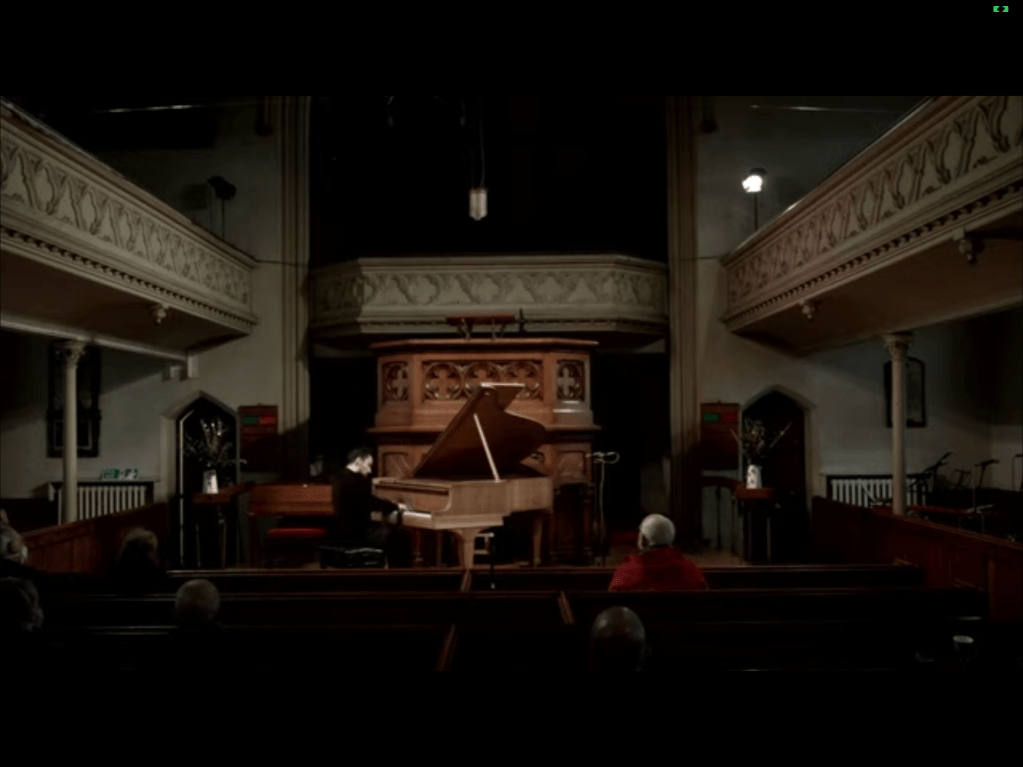
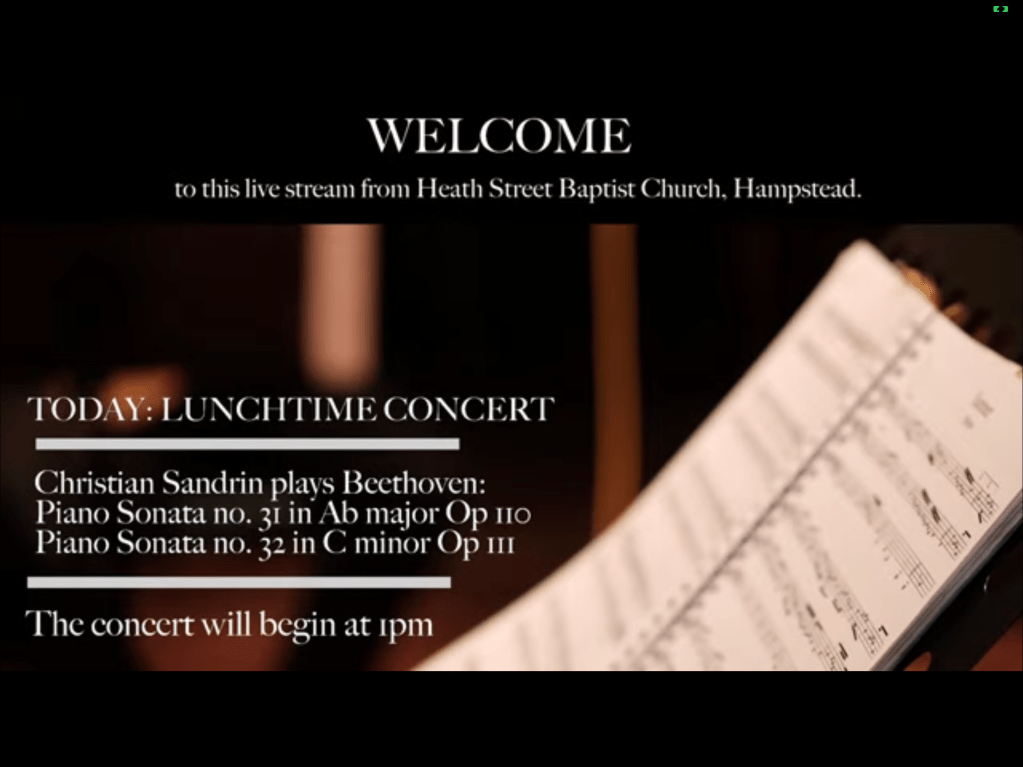
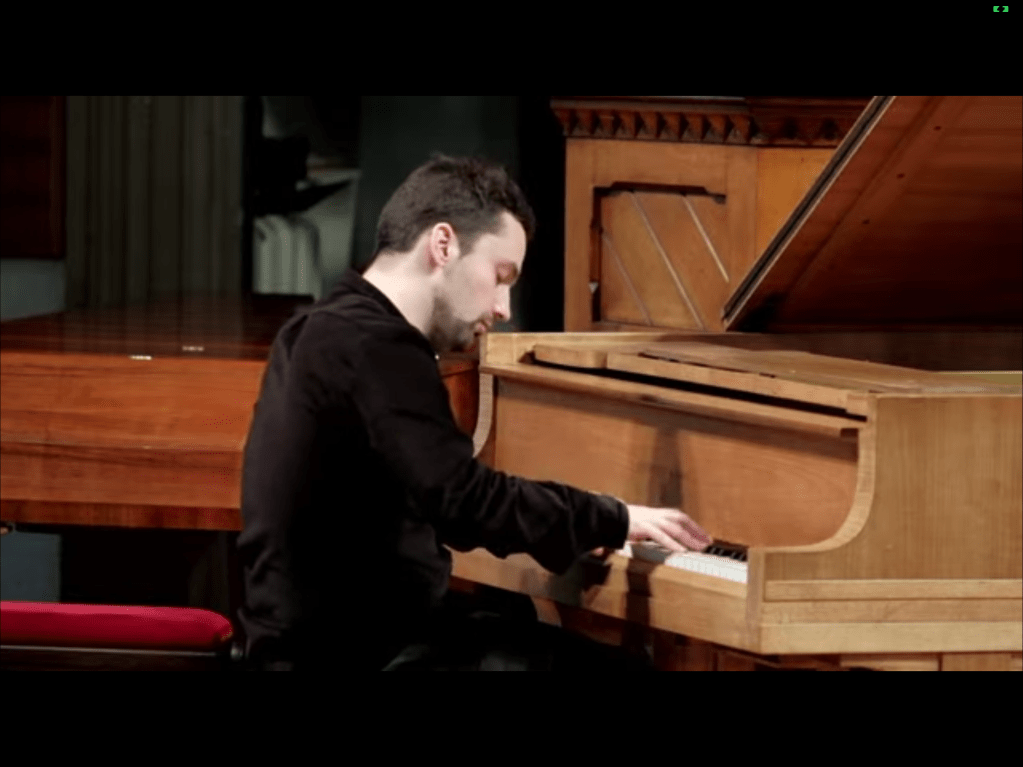
Cristian Sandrin in Hampstead Simple great Beethoven

A remarkable performance of Beethoven’s last two,sonatas, by Cristian Sandrin for their directness ,simplicity and great architectural understanding.
From the first notes of op 110 there was an outpouring of continuous energy that lasted until the final chords of op 111.
Of course with op 110 it was a mellifluous outpouring of such poignancy that like Chopin’s late Barcarolle there is a continuous stream of song from the first to the last note.
Even the fugue in op 110 was played with such pastoral calm as was the fourth variation of the Adagio of op 111 both gradually leading to the ‘star’ (as Scriabin would have put it)or the natural culmination of a lifetime condensed into music.
A simplicity where slight blemishes had no importance such was the great tidal wave that engulfed us.


It was only the third time the Cristian had played the trilogy in public – and even here today it was only two thirds of the journey as time did not permit him to include op 109.
He has the simplicity that I remember from Jacob Lateiner or Eduardo Del Pueyo – not world famous names but well remembered for their masterly musicianship.
It was Lechetitsky who gave Artur Schnabel the greatest compliment of his life when he accused him of being a musician not a pianist.
Schnabel used to boast that the difference between his programmes and those of his colleagues was that his were boring from beginning to end!
Cristian has just come through performing the Goldberg Variations a journey that took almost a year – and it was not the rock concert of Lang Lang but rock solid like Andras Schiff or Angela Hewitt and the start of a lifetimes’ journey : https://www.facebook.com/601611479/posts/10159508229546480/.


Cristian is now being mentored by Dame Imogen Cooper in London and William Grant Naboré in Rome as he is turning his attention to Beethoven and I am sure before long also to Schubert.As Andras Schiff says he leaves the virtuoso repertoire to others as there is not enough time in one life to discover and ponder over the deep meaning in the masterpieces of Bach,Beethoven,Mozart and Schubert.Leaving others to juggle with the thousands of notes that often say much less.A great lesson of humility and musical integrity at the service of the composer.

Cristian having been asked with only two days notice to substitute an indisposed colleague and also having played the evening before in the centenary celebrations of Saint- Saens at the National Liberal Club.Enjoying every minute with Tyler Hay and the Kettner Philharmonic of the scintillating effervescence of Carnaval of the Animals .Well it is Christmas after all!


But what a beautiful venue it was today in this intimate chapel in Hampstead a true temple dedicated to art and the perfect framework for the Beethoven’s trilogy and a corner stone for our civilisation.
The fact that Beethoven could not hear these sounds except in his own inner ear but was still able to write them down and share them with posterity is truly miraculous.
Today we witnessed a miracle .


https://www.youtube.com/watch?v=kZE4LcJ7zq0

https://christopheraxworthymusiccommentary.wordpress.com/2021/09/24/cristian-sandrin-the-imogen-cooper-trust/

https://christopheraxworthymusiccommentary.wordpress.com/2021/06/06/sandrin-plays-mozart-simplicity-and-purity-in-bucharest/

https://christopheraxworthymusiccommentary.wordpress.com/2020/10/13/cristian-sandrin-at-st-marys/

‘Moderato cantabile,molto espressivo’ Beethoven writes at the opening of his op 110 penultimate sonata.The problem is always how expressive should one be without changing the serious structure of the piece?Cristian struck just the right note of sentiment without sentimentality a beautiful robust but delicate cantabile that permeated this most mellifluous of all Beethoven’s Sonatas.The legg(i)ermente arpeggios played with a clarity and delicate precision as they led to the beautifully simple second subject.The transition of E flat to D flat was played with a magical sense of timing and delicacy as it led to the development with its swirling left hand figurations which Cristian played with scrupulous attention to Beethoven’s very precise indications.No ritardando at the end as this was not a full stop but just a continuation of all that had come before. A rock solid Allegro molto of great rhythmic energy.The bass notes being the anchor on which hung the treacherous passage work of the trio which dissolved so naturally into the return of the Allegro molto and the magical final chord that was allowed to vibrate.The delicate left hand arpeggiando bathed in pedal all so remarkably notated by a composer who was totally deaf !The opening chords of the Adagio were very lovingly placed and were of sublime beauty as this great improvisation unfolded with magical sounds.Notes made to vibrate (bebung of the fortepiano) and the gentle pulsating chords in the left hand on which the Arioso dolente in a seemingly free way (as Schnabel indicates ‘sempre liberamente’)but always with the great architectural line of bel canto so clearly shaped .Even the fugue entered almost unnoticed on this wave of deep contemplation.Usually a rude interruption but in Cristian’s sensitive hands a mere continuation of this outpouring of song (very similar to the great choral works of that other genius J.S.Bach).’Perdendo le forze ,dolente’ Beethoven implores and it was just this that appeared on the cloud of a simple but truly magical modulation.The pulsating left hand chords seeming even more like the beating of Beethoven’s own heart at last at peace with the world.The repeated chords too ,before the apparition of the fugue in inversion,were played with great reverence within the sound world that Cristian had held us spell bound and not the more usual out of place dramatic outburst.The gradual build up of the delicate inverted fugue was played with simple beauty where Beethoven’s scrupulous indications and written in accelerandi were recreated with Beethovens passion and vigour shining like a beacon of exultation and hope .

‘Maestoso’ Beethoven mark’s in his last Sonata op 111.It was the weight of Cristians left hand that immediately created the imposing declaration.Played with very taught rhythms that led to the agonised groans of sforzando piano that herald the menacing tremolando and explosion finally on C.But ‘C’ only ‘forte’because the statement of the theme is marked ‘fortissimo’ so often overlooked by lesser interpreters.As Perlemuter ( who had studied with Schnabel too) told me,it must be like water boiling over at 100 degrees.And so it was in Cristian’s hands but played with a very precise rhythmic pulse and clarity that allowed the improvised interruptions to become an integral part of this startling call to arms!The development too with just a sudden quite ‘G’ played with such orchestral precision and the long thematic notes allowed to shine out with such unforced clarity.There was true animal excitement too in the absolute precision of the left hand chords as the recapitulation and coda were played with simple authority .The final chord had started with the coda just dissolving in sound without any misplaced rallentando.The Arietta:Adagio was played ‘molto semplice and cantabile’ with the sound of a string quartet where every strand had a meaning of great poignancy in this outpouring of aching beauty coming from Beethoven’s very soul.The tempo changes, written in by Beethoven himself and it is for the real interpreter to maintain this pulse from the beauty of the opening to the sublime ending.A celestial vision on a cloud of trills that the composer miraculously could envisage and comunicate via the printed page.There were moments here where Cristian’s youthful passion will mature into a deeper more profound reflection and never allow his own involvement to change the rock solid pulse.It was Barbirolli praising the sometimes over expressive Jaqueline Du Pré saying quite simply :’If you don’t play with passion when you are young,what do you pare off in maturity?I love it!’ And so do I!

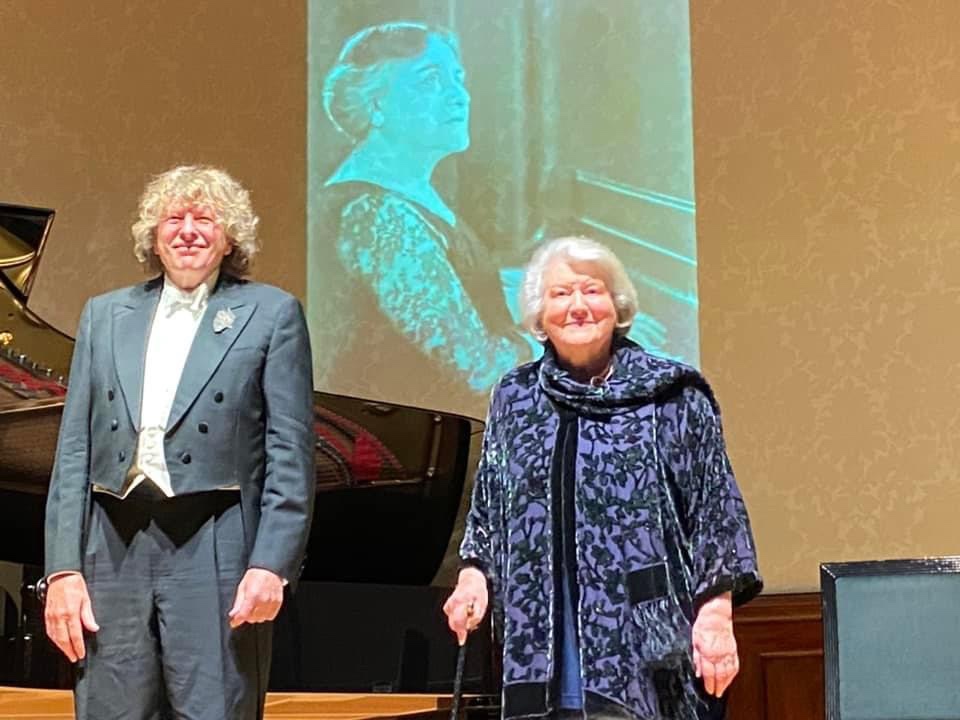
Dame Patricia Routledge and Piers Lane integrity and humility ravish and enrich

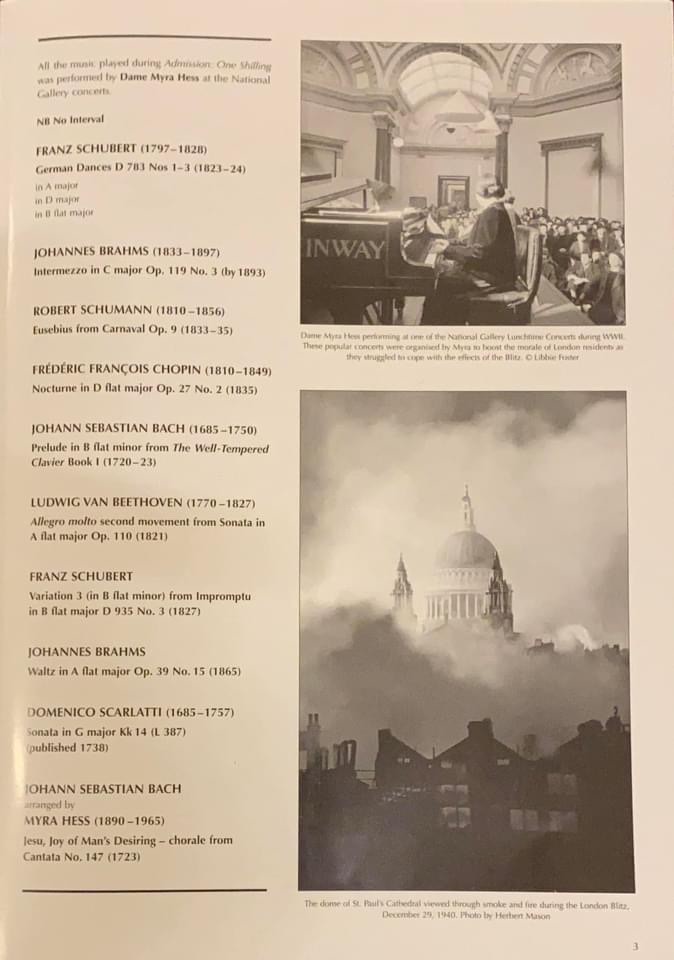
‘Admission :one shilling’What emotions -what artistry-what a story!
At ninety three Dame Patricia Routledge held us in the palm of her hand as she recounted the remarkable story of Myra Hess a woman of great integrity,simplicity,humility and resilience.
With her enchanting nightingale Piers Lane the audience was entranced and moved to tears.


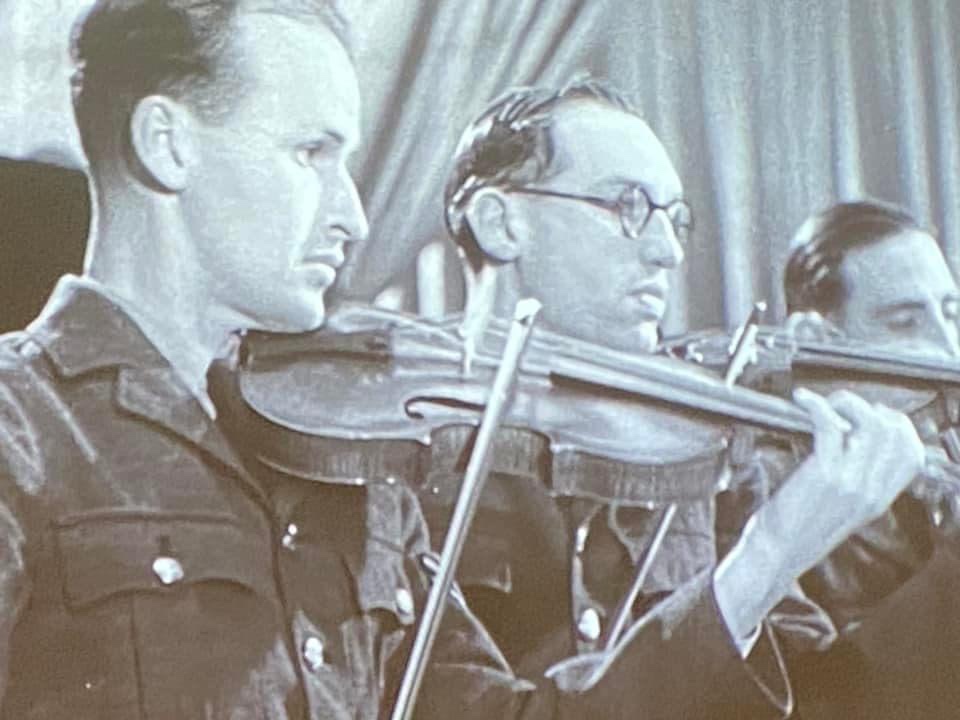
It was also fascinating to hear Dame Myra in a short film playing part of Mozart’s G major Concerto and to see a very youthful David Martin and Frederick Grinke in military uniform leading the chamber orchestra in the National Gallery.


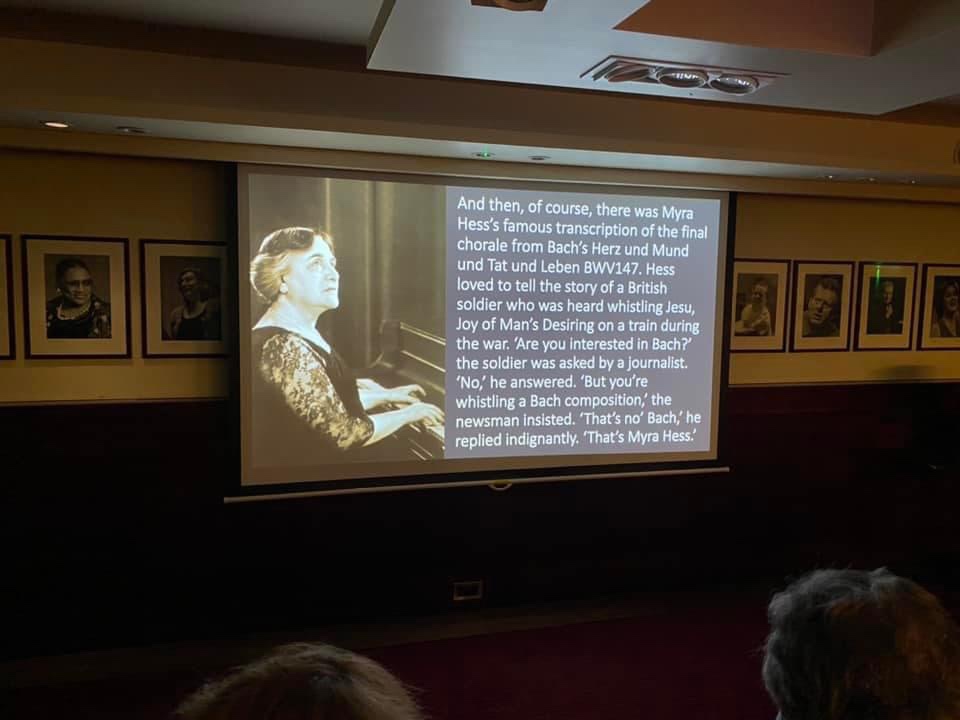
And to know that one of the millions of soldiers whistling ‘Jesu Joy’ in between cigarette’s,before going to the front,when told it was Bach simply replied but that’s Myra Hess.


Times of great solidarity to overcome evil and unite with humility and sense of solidarity,pride and bravery in the name of unity. Strangely to think these days ,where quantity takes precedence over quality, of maintaining the principles that are the foundation of any civilisation.
Nice to be reminded of the words humility and integrity that seem to have disappeared from our vocabulary these days.

Duo Carbonara-Soscia – technical brilliance and transcendental control in Viterbo

Some extraordinary playing from Michelangelo Carbonara and Giulia Soscia for the series directed by Prof Franco Ricci at the Tuscia University in Viterbo.


Prof Ricci has written many important books which includes the only biography of Francesco Siciliani ( renowned artistic director in Florence,Milan and Rome who launched Callas in her unsurpassed bel canto roles ).
He also wrote a biography of the little known composer Vittorio Rieti and has many of his original compositions.
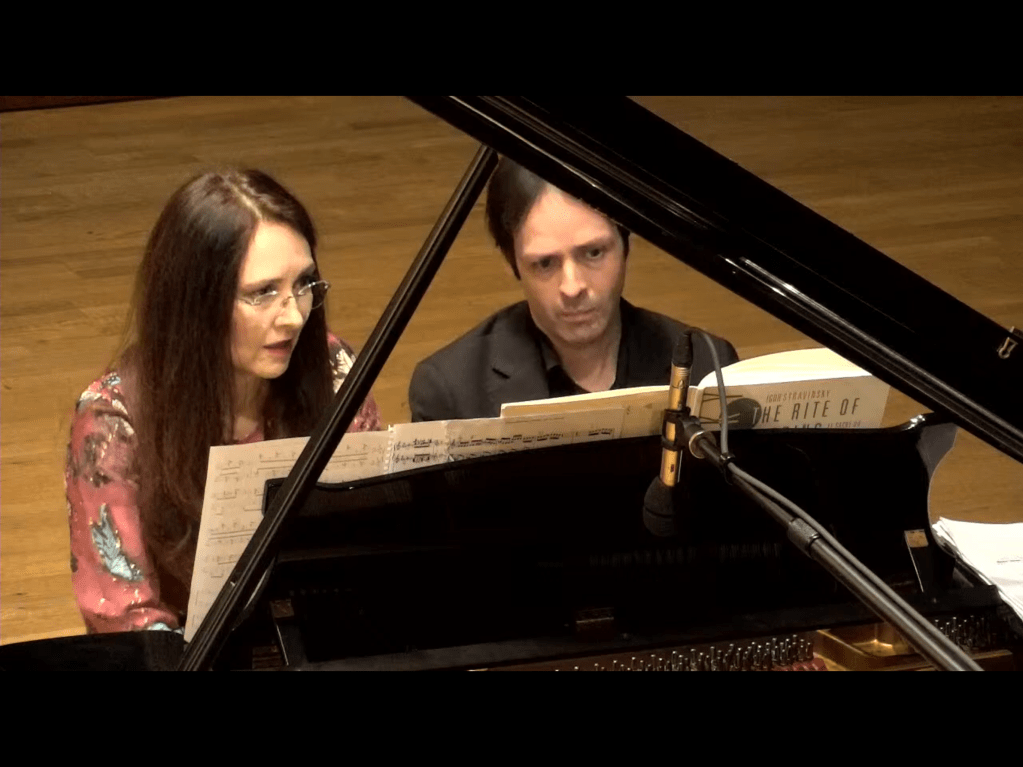
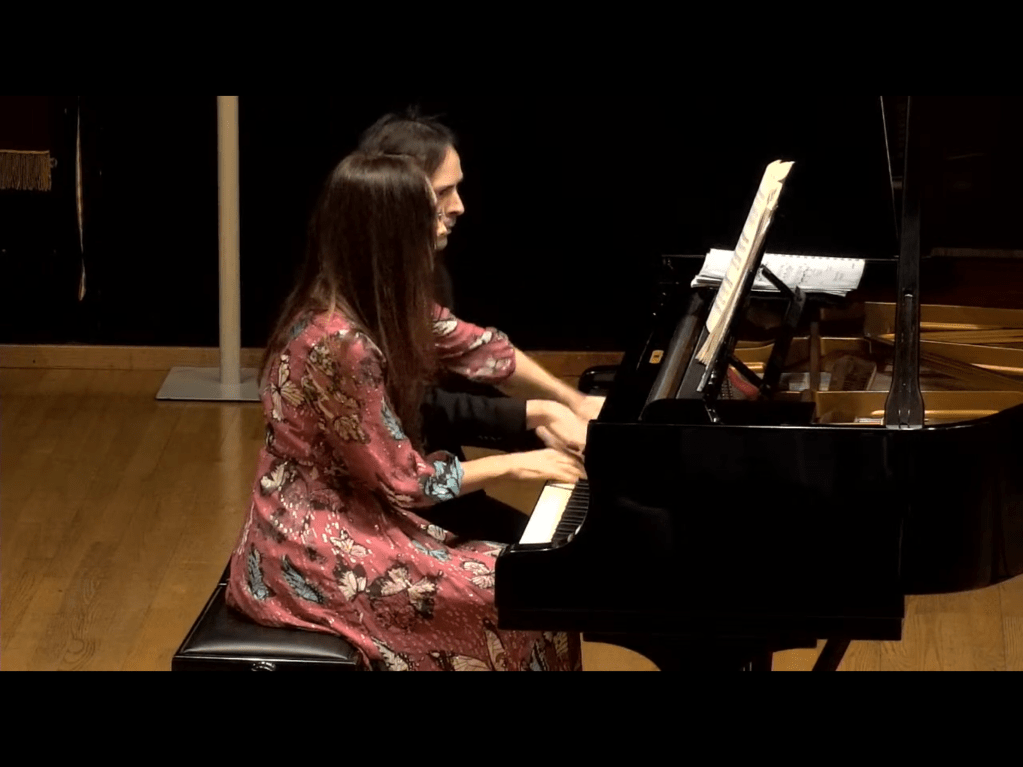
One of which today was the world premiere of the reduction for four hands by Giulia Soscia of the original two piano version written for Gold and Fitzdale :Second Avenues Waltzes.


A duo that plays as one as was evident from their performances of Stravinsky ,Rieti and Respighi.
A clarity and rhythmic precision that gave such architectural shape to Stravinsky’s original version of the Rite of Spring.From the subtle beauty of the opening to the insinuating harmonies and rhythms that takes us to the great baccanale that caused such a scandal at its first performance in Paris under Pierre Monteux.The Rite of Spring is a ballet and orchestral concert work written for the 1913 Paris season of Diaghilev’s Ballets Russes company; the original choreography was by Nijinsky.When first performed at the Théatre des Champs-Elysées In Paris on 29 May 1913 the music and choreography caused a sensation’ Stravinsky’s score contains many novel features for its time, including experiments in tonality,metre,rhythm,stress and dissonance and is regarded as among the first modernist works.The music influenced many of the 20th-century’s leading composers and is one of the most recorded works in the classical repertoire.


There was Parisian elegance in the waltzes by Rieti a world evidently much influenced by Poulenc and Satie but also with a very original voice of pungent rhythms and contrasts.

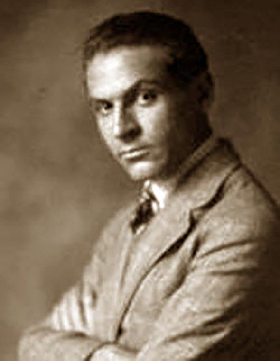
Vittorio Rieti

b. 1898 – d. 1994

Vittorio Rieti was a Jewish-Italian composer. Born in Alexandria, Egypt, he moved to Milan to study economics. He subsequently studied in Rome under Respighi and Casella, and lived there until 1940.In 1925, he temporarily moved to Paris and composed music for George Balanchine’s ballet for Diaghilev’s Ballets Russes, Barabau. He met his wife in Alexandria, Egypt and emigrated to the United States in 1940, becoming a naturalized American citizen on the 1st of June 1944. He taught at the Peabody Conservatory of Music in Baltimore (1948–49), Chicago Musical College (1950–54), Queens College, New York (1958–60), and New York College of Music (1960–64). He died in New York on 19 February 1994.His music is tonal and neo-classical with a melodic and elegant style.

Respighi’s Pines of Rome was played with great washes of sound and sumptuous contrasts before the menacing build up to the enormous final outburst.It is a symphonic poem in four movements for orchestra completed in 1924 by Ottorino Respighi and transcribed by him for four hands.The piece, which depicts pine trees of Villa Borghese;Near a catacomb;Gianicolo;Appian Way at different times of the day, is the second of Respighi’s trilogy of tone poems based on the Eternal city, along with Fountains of Rome (1917) and Roman Festivals (1928).It premiered on 14 December 1924 at the Augusteo Theatre in Rome with Bernardino Molinari conducting the Augusteo Orchestra (S.Cecilia).Children are playing by the pine trees in the Villa Borghese Gardens , dancing the Italian equivalent of the nursery rhyme “Ring a Ring o’Roses”and “mimicking marching soldiers and battles; twittering and shrieking like swallows”.The children suddenly disappear and shadows of pine trees that overhang the entrance of a Roman catacomb dominates.It is a majestic dirge, conjuring up the picture of a solitary chapel in the deserted countryside with a few pine trees silhouetted against the sky. The third is a nocturne set on the Gianicolo .The full moon shines on the pines that grow on the hill of the temple of Janus, the double-faced god of doors and gates and of the new year. Respighi took the opportunity to have the sound of a nightingale recorded and requested in the score that it be played at the movement’s ending, the first such instance in music. The nightingale was recorded in the yard of the McKim Building of the American Academy in Rome.In the final movement Respighi recalls the past glories of the Roman Empire in a representation of dawn on the great military road the Appian Way. In the misty dawn, as a triumphant legion advances along the road in the brilliance of the newly-rising sun. Respighi wanted the ground to tremble under the footsteps of his army

Remarkable performances that brought these three works vividly to life with perfect balance,transcendental control and technical brilliance.


Here is the link to the concert that can be enjoyed for the next few months. https://youtube.com/watch?v=KOI97IH8CbM&feature=share

“Michelangelo is a very special talent, I haven’t encountered such a talent in a very longtime…
meeting such a talent is not only a great pleasure, it is much more: it gives faith to the future in music”
FOU TS’ONG

Michelangelo Carbonara was born in 1979 in Salerno (Italy), starting musical studies when he was five. He owes his piano formation to Sergio Perticaroli, William Grant Naboré and Fou Ts’ong. At seventeen, he graduated with top grades from the Conservatory of Santa Cecilia in Rome under the guidance of Fausto Di Cesare. In 1999 he achieved his Piano Specialization Degree with top grades at the Academy of Santa Cecilia, earning the Grant for the Best Graduate of the Year in the class of Sergio Perticaroli. Michelangelo furthered his studies at the Salzburg Mozarteum in Austria and the Académie Musicale de Villecroze (with Dominique Merlet) in France. In 2001 he was admitted to the famous International Piano Foundation “Theo Lieven” and the International Piano Academy Lake-Como (headed by the legendary Martha Argerich), to follow the master classes of Fou Ts’ong, Leon Fleisher, Graham Johnson, Dmitri Bashkirov, Alicia De Larrocha, Peter Frankl, Claude Frank, William Grant Naboré, Andreas Staier and many other luminaries. He has won numerous national and international piano competitions (around 20 prizes). At 18 he made his international debut with orchestra in Austria, where he played the Third and the First Beethoven Concertos in the same programme. In 2003 he debuted in China, also giving a master class at the Central Conservatory of Music in Beijing. His repertory is extremely broad and covers the entire Schubert Sonatas and almost all the piano works by Schubert, Weber, Brahms, Schumann, a lot of Beethoven’s, Clementi’s, Mozart’s Haydn’s Sonatas and dozens of Scarlatti’s. Particular attention is also given to Polish composers (amongst which Chopin, Szymanowski, Lutoslawski, Paderewski). For 2006 he is preparing Mozart’s complete piano Concertos. In the next months there will be releasing three compact disc of his piano playing by Tactus, Papageno and Geva labels. Other activities include composition and conducting.

Simplicity is the final achievement.” FRÉDÉRIC CHOPIN

Giuliana Soscia, pianista, compositore, arrangiatore e direttore d’orchestra, menzionata accanto ai grandi nomi del jazz internazionale, nasce a Latina e si diploma nel 1988 con il massimo dei voti presso il Conservatorio “Santa Cecilia” di Roma. Intraprende subito un’intensa attività concertistica come solista e in gruppi da camera, vince i primi concorsi pianistici e consegue il Tirocinio in Pianoforte con Anna Maria Martinelli presso il Conservatorio O. Respighi di Latina, si perfeziona in interpretazione barocca con la clavicembalista A.M.Pernafelli e in pianoforte con il pianista, compositore Sergio Cafaro, dal quale attinge e matura l’idea di completare il percorso con l’arte dell’improvvisazione e del jazz, inclusa la composizione. Intraprende lo studio della fisarmonica e della composizione jazz e consegue il Diploma Accademico di II Livello in Composizione Jazz con il massimo dei voti e la lode presso il conservatorio “D.Cimarosa” di Avellino, che la porteranno a dedicarsi esclusivamente al jazz e ad affermarsi tra i jazzisti più riconosciuti dalla critica in Italia e all’Estero.Il 1 settembre 2017 abbandona per sempre la fisarmonica per tornare a dedicarsi esclusivamente al pianoforte e alla composizione. Svolge un’intensa attività concertistica, dal 1986 ad oggi. Si esibisce quindi nei più importanti Festival jazz e Teatri al mondo, comprese Televisioni e Radio nazionali, con i suoi progetti e come solista in importanti orchestre jazz, con un’intensa attività concertistica e consensi di pubblico e critica: Teatro San Carlo di Napoli , Teatro dell’Opera di Hanoi (VIETNAM), Teatro dell’Opera di Ankara (TURCHIA), Experimental Theatre dell’NCPA Mumbai (INDIA), GD Birla Sabhaggar Kolkata (INDIA), Civil Services Officer’s Institute New Delhi (INDIA), Qeen’s Hall di Edinburgh (UK), RSAMD di Glasgow (UK), Mac Robert Art Centre di Stirling (UK), il Byre Theatre di St. Andrews (UK), Sesc Campinas Saõ Paulo (BRASILE), Sesc Ipiranga Saõ Paulo (BRASILE), Teatro Pirandello di Lima (PERU’), ICPNA Lima Jazz Festival (PERU’), The India Council for Cultural Relations” di Kolkata (INDIA),“India Habitat Centre, Stein Auditorium” di New Delhi (INDIA) , Festival “16th East West Music & Dance Encounters from Feb 4 – 18, 2018” a Bangalore (INDIA), IIC di Marsiglia (FRANCIA), IIC di Addis Abeba (ETIOPIA), Auditorium Parco della Musica di Roma, Sala Accademica del Conservatorio “Santa Cecilia” di Roma, Sala Verdi del Conservatorio G.Verdi di milano, Teatro Menotti di Spoleto 65° Coupe Mondial Accordeon, Roccella Jazz Festival, Casa del Jazz di Roma, Teatro Verdi di Trieste, Dean Benedetti Jazz Festival con la Fondazione Festival Pucciniano, , EJE European Jazz Festival di Cagliari, Lucca Jazz Donna, 54° Festival Pontino di Musica FONDAZIONE CAMPUS INTERNAZIONALE dI Musica, “ Il Jazz Italiano per l’Aquila” , Teatro Lirico G.Verdi di Trieste, “Musica sulle bocche International Jazz Festival” e tanti altri.

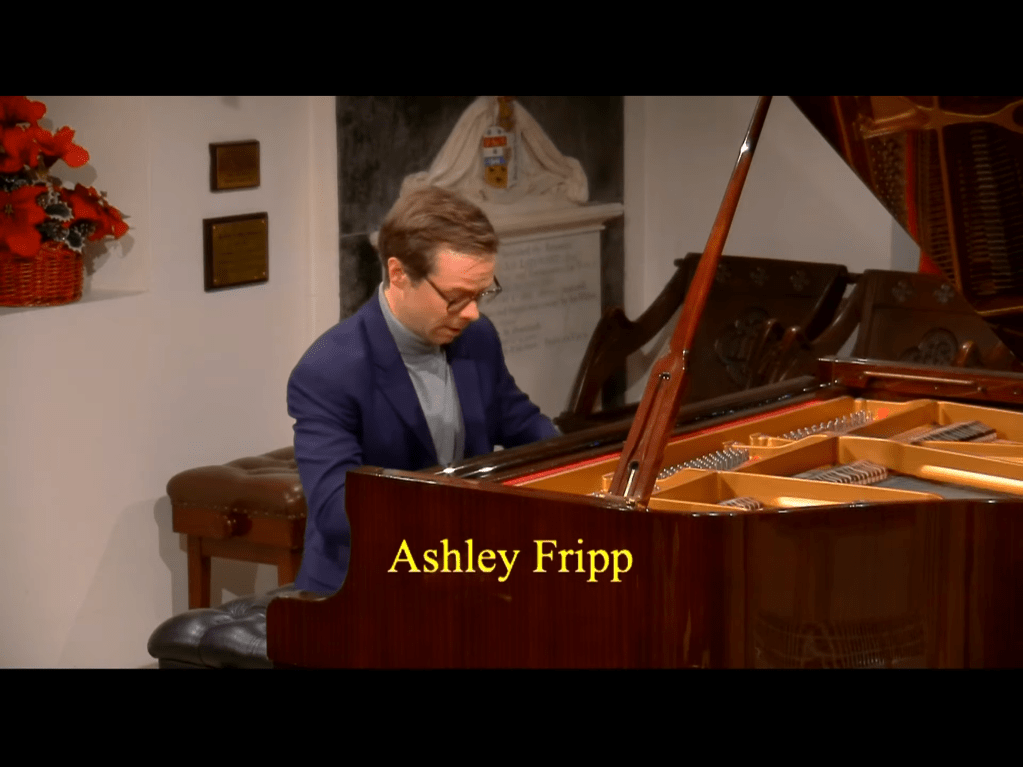
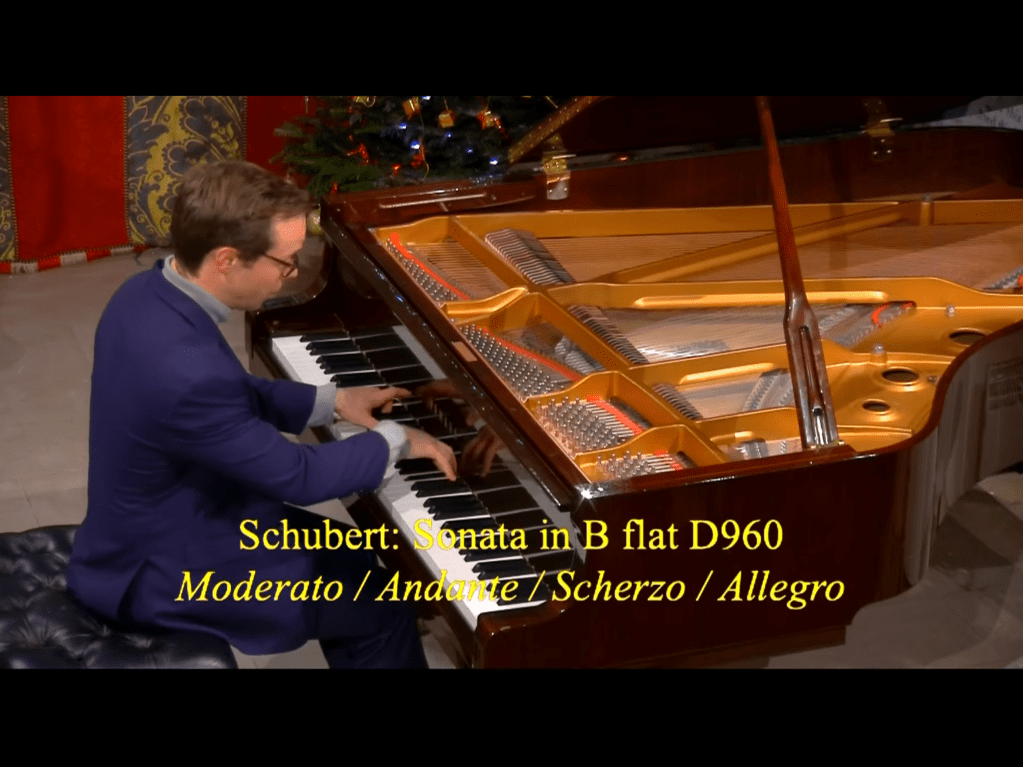
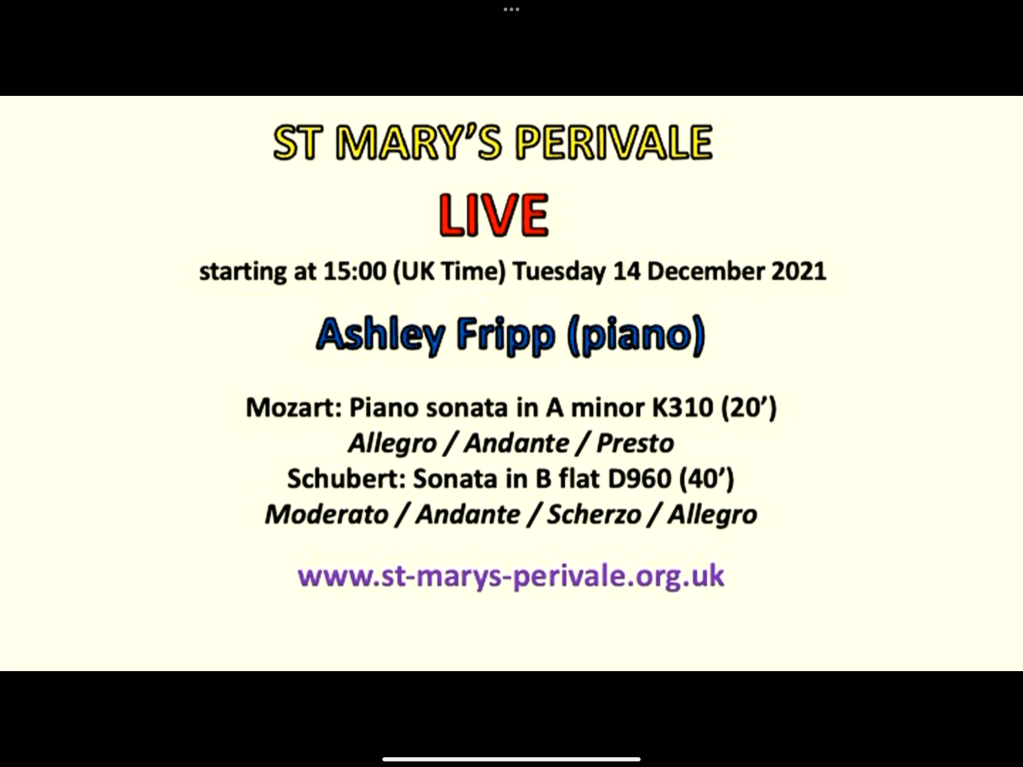
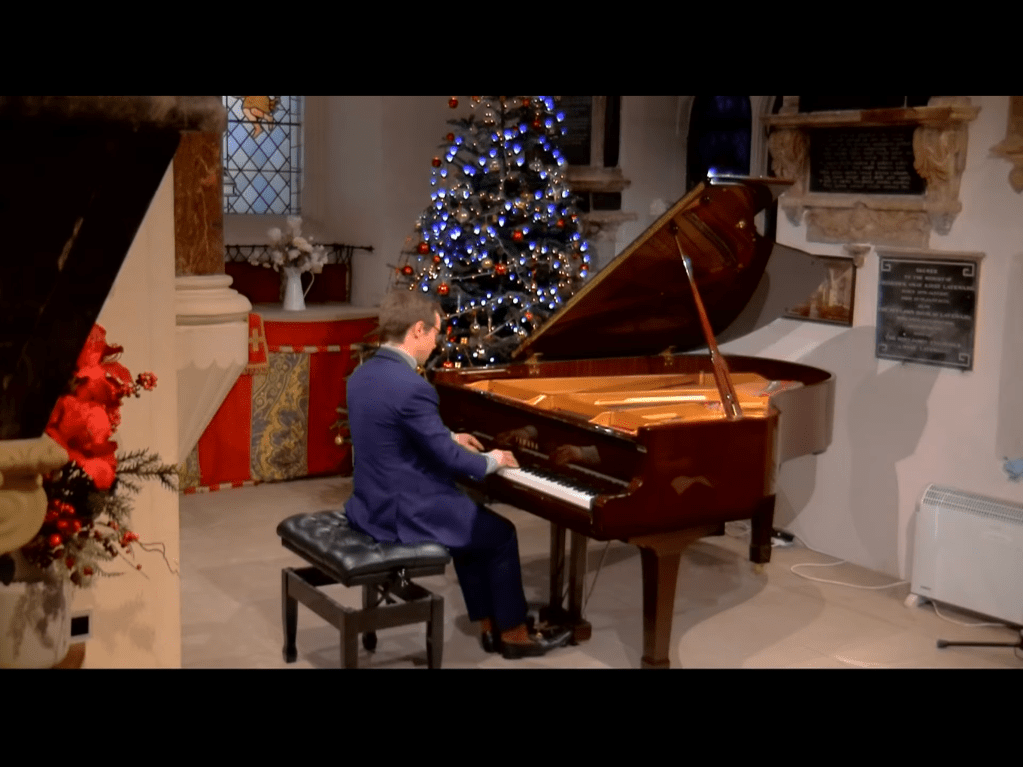
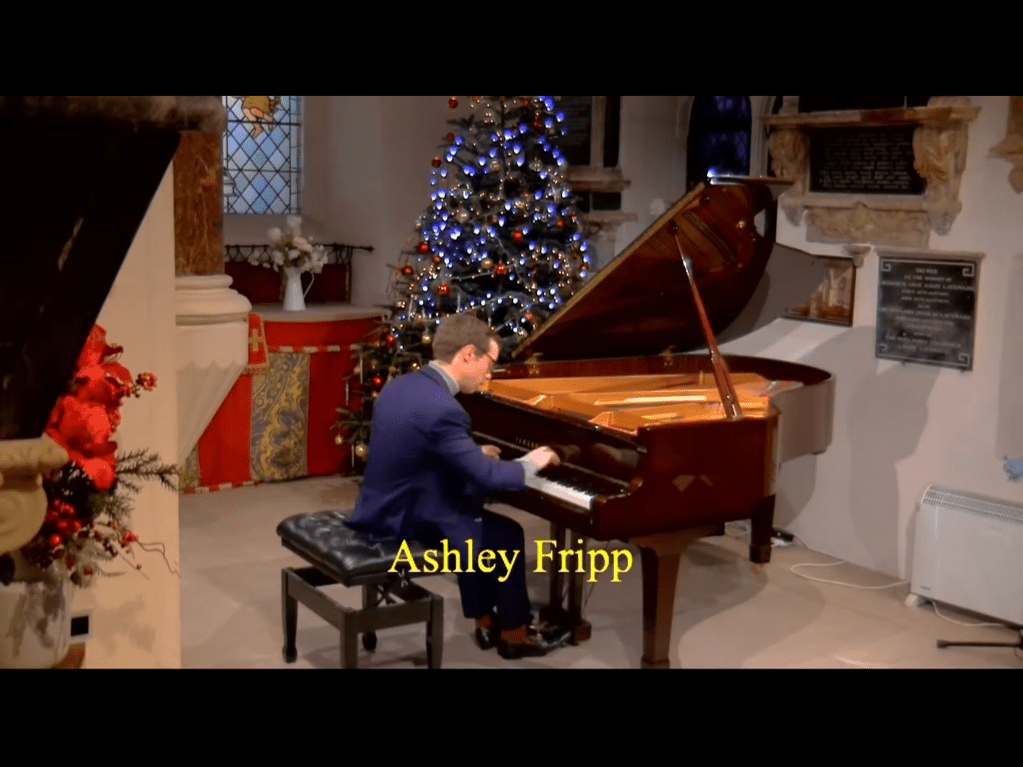
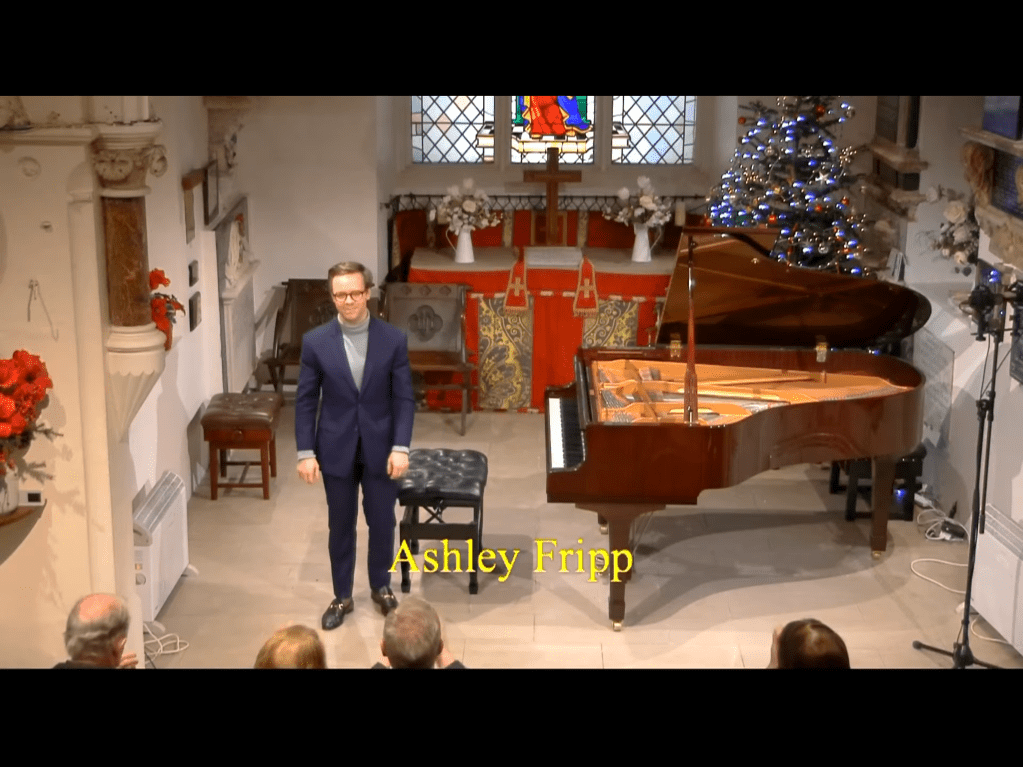
Ashley Fripp at St Marys penetrating the soul of Mozart and Schubert

Tuesday 14 December 3.00 pm


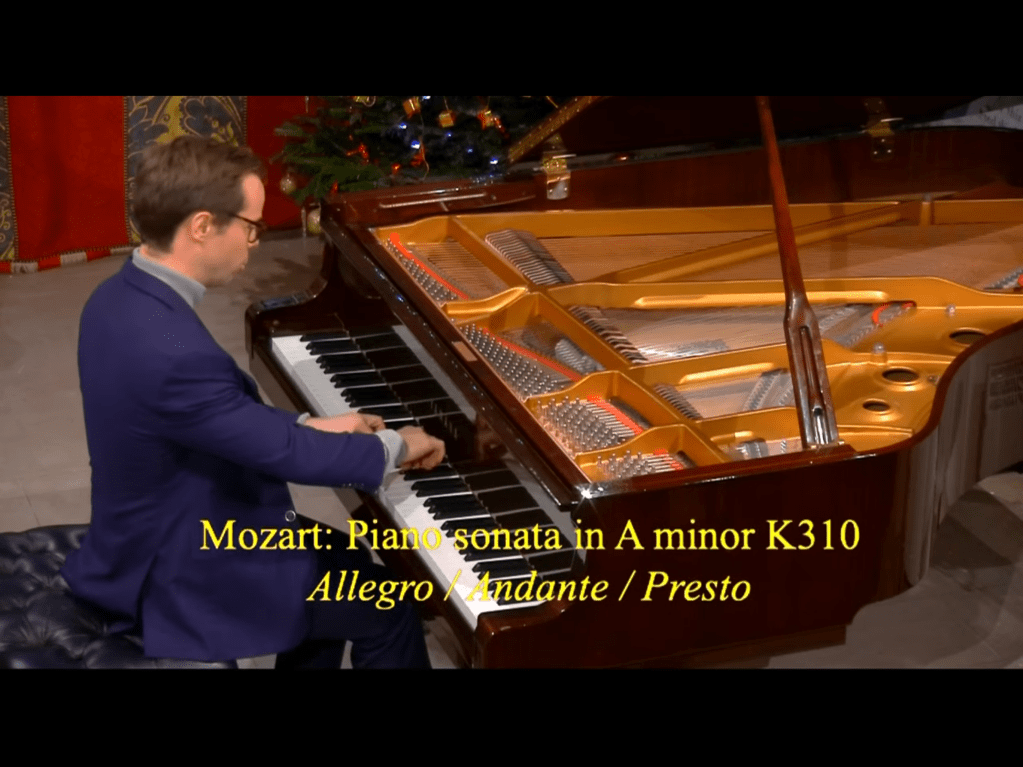
Mozart: Piano sonata in A minor K310
Allegro / Andante / Presto

Schubert: Sonata in B flat D 960
Moderato / Andante / Scherzo / Allegro

Christmas certainly is a magical time no more than today to pass from aristocratic Beethoven in Hampstead to sumptuous Mozart and Schubert in Perivale. https://christopheraxworthymusiccommentary.wordpress.com/2021/12/14/cristian-sandrin-in-hampstead-simple-great-beethoven/


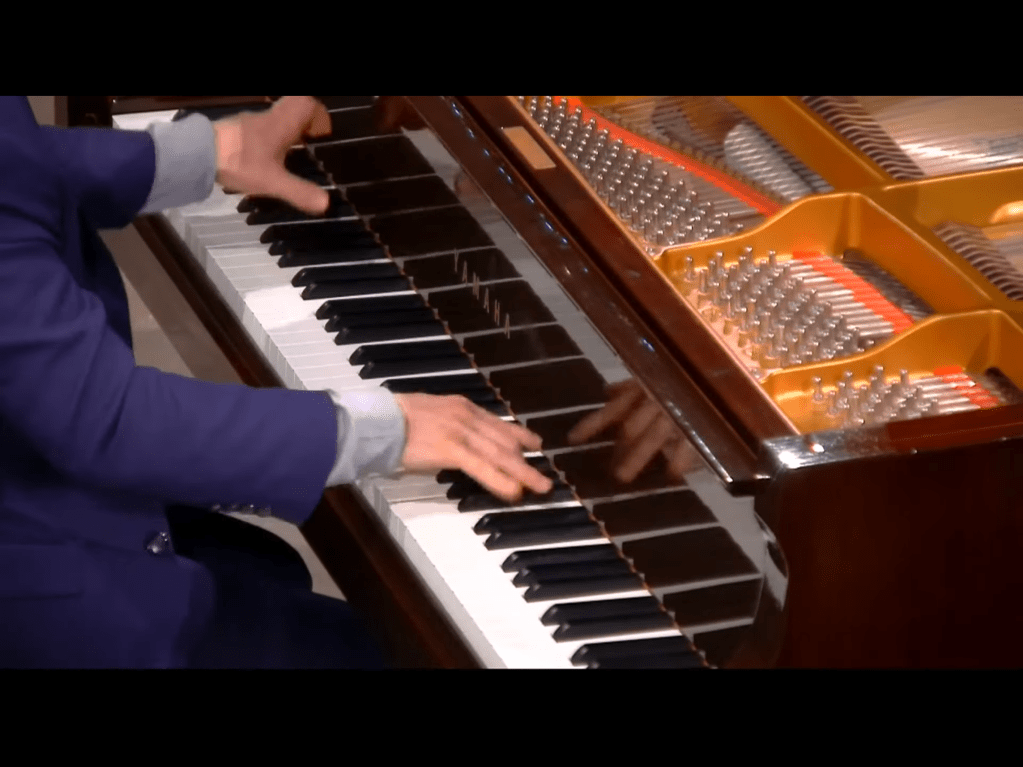
Ashley Fripp with performances not only of great intelligence and technical mastery but where he managed to penetrate the very soul of these two masterworks with such contrasts between ravishing beauty and dynamic rhythmic drive.


Mozarts A minor sonata was played with grandeur and urgency as the notes just seemed to pour from his fingers with jewel like precision.The Andante cantabile was true opera with the sumptuous bel canto contrasting with the menacing central section and the return to the sublime where peace once more reigns.
The restless and breathless Presto with its almost Schubertian melodic middle section just miraculously appearing on this relentless wave of such rhythmic drive.


Schubert’s last sonata written only a few months before his tragically early death was full of radiance and ravishing beauty.Drama too but such simplicity in the scherzo and even the interruptions of the last movement could not curb Schubert’s seemingly endless stream of melodic invention.
A superb performance from a master musician .

Here is the link to enjoy the performances at your leisure :https://www.youtube.com/watch?v=JKIe3zQysh8

Piano Sonata No. 8 in A minor K.310 was written in 1778.It is the first of only two that Mozart wrote in a minor key (the other being n.14 in C minor K.457).It was composed in the summer of 1778 around the time of his mother’s death and one of the most tragic times of his life.The surviving manuscript was written using the same type of paper that was used for the Symphony n.31 in D K.297 which Mozart purchased while in Paris.

Playing of great rhythmic energy but also a luminous melodic sound where everything was allowed to sing with such intensity.The arresting opening was immediately answered by the contrasting charm of reply all so subtly phrased by Ashley.The ornaments on the beat just adding to the rhythmic drive.Even the chords over silvery left hand figurations were played with lyrical fullness and beauty of sound and shape.The development took on an orchestral texture with the pungent harmonies over quick silver accompaniment alternating between right and left hands with brilliance and ease.The phrasing of the Andante was of such simplicity and subtlety that one could understand why Mozart should be considered too easy for children and too difficult for adults.But not in Ashley’s sensitive hands where there was such delicacy and attention to phrasing like an operatic scene where one could almost imagine the different characters taking their places.There was drama too in the middle section where a question and answer was played out over a continually moving bass and then taking over the melodic line with throbbing right hand harmonies of simple emotion of great poignancy.The Presto was like a breathless whirlwind of relentless forward movement.The melody moving into the bass with almost unnoticed ease as Ashley took such trouble over maintaining the same overall sound in the continual outpouring of continuous motion.The sun did come out for a moment as a magical ray of light was shed in the major key creating the contrast that is such a part of Mozart’s genial invention.

Schubert’s last three piano sonatas D.958, 959 and 960, are his last major compositions for solo piano. They were written during the last months of his life, between the spring and autumn of 1828, but were not published until about ten years after his death, in 1838–39.One of the reasons for the long period of neglect of Schubert’s piano sonatas seems to be their dismissal as structurally and dramatically inferior to the sonatas of Beethoven.In fact, the last sonatas contain distinct allusions and similarities to works by Beethoven, a composer Schubert venerated.However,analysis has shown that they maintain a mature, individual style and are now praised for that mature style, manifested in unique features such as a cyclical formal and tonal design, chamber music textures, and a rare depth of emotional expression.Schubert had been struggling with syphilis since 1822–23, and suffered from weakness, headaches and dizziness. However, he seems to have led a relatively normal life until September 1828, when new symptoms such as effusions of blood appeared. At this stage he moved from the Vienna home of his friend Franz von Schober to his brother Ferdinand’s house in the suburbs, following the advice of his doctor; unfortunately, this may have actually worsened his condition. However, up until the last weeks of his life in November 1828, he continued to compose an extraordinary amount of music, including such masterpieces as the three last sonatas.

Ashley is not only very eloquent with sounds but also with words.It was fascinating to have his thoughts about his journey with Schubert’s last sonata before he delved even deeper into that realm where words cannot reach.The longest of all Schubert’s sonatas ( if one does the ritornello in the first movement it would add a good 10 minutes to the 40 that Ashley offered today.I think for time reasons Ashley chose not to repeat.Many great pianists insist on the repeat which includes eight extra bars of Schubert’s sublime music.As Andras Schiff says :who are we mere performers to question the creator?)Ashley quoted too a Danish philosopher :’life can only be lived forwards but understood backwards’ in relation to Schubert reaching for the cosmos even though he knew that he had very little time left on this earth.Quoting Brendel too: ‘when Schubert writes in a major key it can be even more tragic than the minor!’……especially I think coming from minor to major – as in the slow movement .Ashley is a thinking musician and his studies that continue still in Florence with Eliso Virsaladze are opening up ever more spiritual and intellectual horizons as one might expect from the city that is the very cradle of our culture.

There was a beautiful mellow sound from the opening with the glorious melodic line a stream of pure gold cut off by a menacing rumble deep in the bass.A pianissimo trill, a mere murmur in the bass is very difficult to control and needs a transcendental technique………a good piano helps too!A gradual build up to the repeat of the theme in all its glory dissolving almost immediately to a magic duet between tenor and soprano voices.As Ashley says this liquid sound and fluidity as in many of Schubert’s songs gives life and hope.The eternal life of water flowing.

The playful pastoral staccato and legato searching for a way back with the declamatory question and answer led to the development and the mystery and wonder of the minor key.Major to minor or minor to major touches deeply our inner emotional senses.There was a beautiful flexibility to the melodic line like a human voice and the return of the staccato and legato playfulness this time took us to the left hand palpitations of Schubert’s heartbeat.Building to a passionate climax finding a resolution only in the simplicity of the melodic line as it passes from one voice to another .Magically leading us to a wonderland of sounds played so profoundly but simply by Ashley as it leads us back,like a sleepwalker,to the sublime return of the recapitulation.

The Andante sostenuto was a great song with a delicate filigree accompaniment spread all around it.Ashley had a supreme control of sound and the melodic line was bathed in pedal which gave great fluidity to the melodic line while the accompaniment was played with a completely different opaque colour – the contrast was quite ravishing as the melodic line was played with searing architectural shape.The magical modulation this time from minor to major for the almost Brahmsian chorale of velvet richness was like the sun shining through the clouds.The chorale contrasting with the mellifluous flowing song like answer in the treble.Clouds appeared once more with the major returning to the minor and the opening melody accompanied by the rumbles of thunder in the distance deep in the bass.It is this constant rumbling bass throughout the sonata that must be the cloud hanging over Schubert’s earthly existence as he lay on his deathbed unable to curb the continuous outpouring of music that was in his head.

The Scherzo played ‘allegro vivace con delicatezza’but also with the simplicity of a child’s hide and seek with its constant changes of character and position.Once again the deep bass notes this time in the Trio trying to interrupt the eternal flow!But the playfulness of the Scherzo wins this time.A least until the sinister call to order of the octave ‘G’in the last movement ‘Allegro ma non troppo’.An apparent playfulness overshadowed always but the sinister ‘G’ but leading to a mellifluous outpouring of melody that is a constant of Schubert’s genius. Here now erupting into a volcanic episodes of drama and athletic virtuosity played with passion and dynamic control by Ashley.The menacing ‘G’ now becomes a sinister ‘G flat’ and ‘F’before the final explosion that brings Schubert’s last masterpiece to a miraculously exciting conclusion.A remarkable performance of great maturity by Ashley at the start of a lifetime journey of penetrating the very soul of Schubert with the intelligence and humility of a true musician .

His encore of a waltz by Chopin was a lesson in aristocratic style and artistry .

British pianist Ashley Fripp has performed extensively as recitalist, chamber musician and concerto soloist throughout Europe, Asia, North America, Africa and Australia in many of the world’s most prestigious concert halls. Highlights include the Carnegie Hall (New York), Musikverein (Vienna), Concertgebouw (Amsterdam), the Philharmonie halls of Cologne, Paris, Luxembourg and Warsaw, the Bozar (Brussels), the Royal Festival, Barbican and Wigmore Halls (London), the Laeiszhalle (Hamburg), the Megaron (Athens), Konzerthaus Dortmund, the Gulbenkian Auditorium (Lisbon) and the Konserthus (Stockholm). He has won prizes at more than a dozen national and international competitions, including at the Hamamatsu (Japan), Birmingham and Leeds International Piano Competitions, the Royal Over-Seas League Competition, the Concours Européen de Piano (France) and the coveted Gold Medal from the Guildhall School of Music & Drama. In 2013, Ashley won the Worshipful Company of Musicians’ highest award, The Prince’s Prize, and was chosen as a ‘Rising Star’ by the European Concert Hall Organisation (ECHO). He has also performed in the Chipping Campden, Edinburgh, Brighton, Bath, City of London and St. Magnus International Festivals as well as the Oxford International Piano Festival and the Festival Pontino di Musica (Italy). A frequent guest on broadcasting networks, Ashley has appeared on BBC television and radio, Euroclassical, Eurovision TV and the national radio stations of Hungary, Spain, Luxembourg, the Netherlands, Poland, Belgium and Portugal. He has collaborated with orchestras including the Lithuanian National Symphony Orchestra, the National Youth Orchestra of Great Britain, the Milton Keynes City Orchestra and the Kammerorchester der Universität Regensburg (with whom, in 2012, he recorded Chopin Piano Concertos Nos. 1 & 2). He has worked with conductors including Semyon Bychkov, James Judd, Vasily Petrenko, Robertas Šervenikas, Hilary Davan Wetton, Jonathan Bloxham, Graham Buckland and Peter Stark. Ashley Fripp studied at the Guildhall School of Music & Drama with Ronan O’Hora. He is currently studying with Eliso Virsaladze at the Scuola di Musica di Fiesole (Italy) and undertaking doctoral studies into the piano music of Thomas Adès at the Guildhall School.

https://christopheraxworthymusiccommentary.wordpress.com/2021/02/15/ashley-fripp-at-st-marys-a-song-for-a-valentine/

https://christopheraxworthymusiccommentary.wordpress.com/2020/02/14/ashley-fripp-in-florence-a-walk-to-the-paradise-garden/

Bocheng Wang at St James’s Piccadilly Supreme musicianship and style

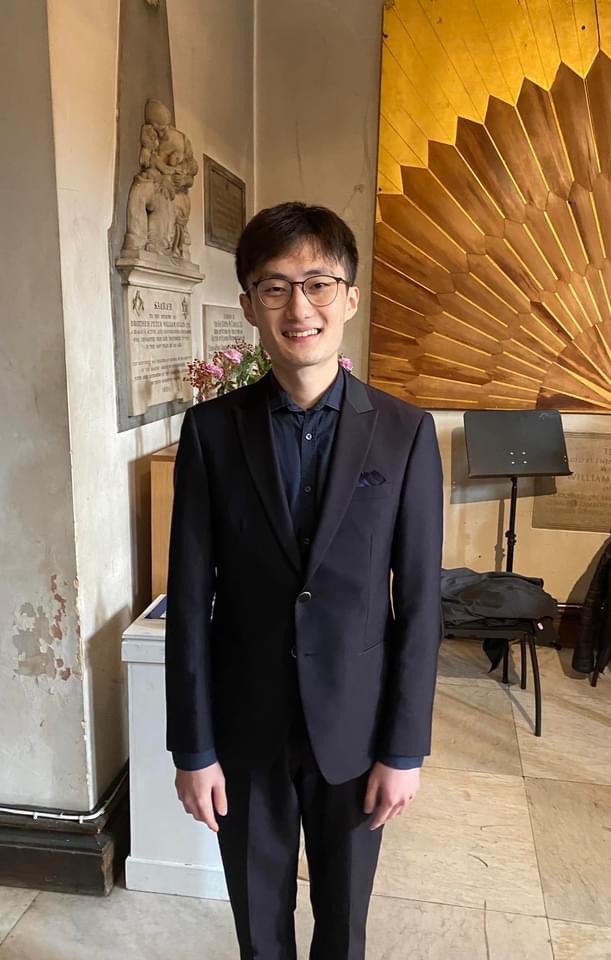
Bocheng Wang at St James’s Piccadilly.Some exquisite playing from this young Chinese pianist perfecting his studies with Ian Fountain at the Royal Academy.Above all supreme musicianship allied to a technical control and sense of style that allowed him to give such shape and form to whatever he played.
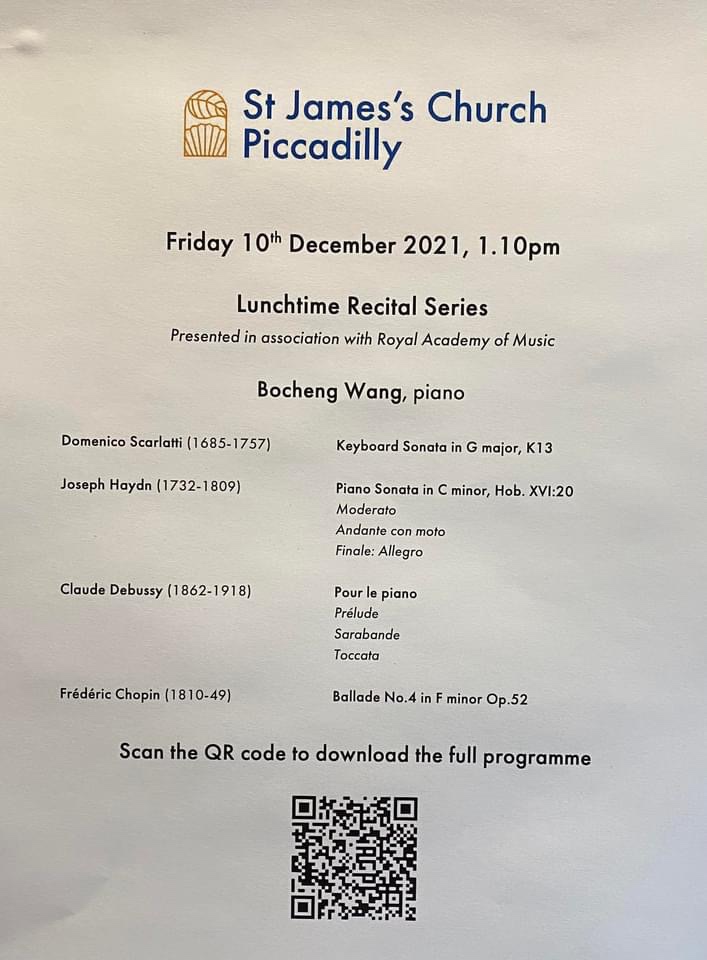
A brilliant Sonata in G K 13 by Scarlatti was a scintillating stream of sounds of driving rhythmic energy.Played with jewel like precision and irresistible charm.


There was such beauty in the opening of Haydn’s C minor Sonata.A mellifluous outpouring of great sensitivity in one of Haydn’s most gracious creations.There were subtle contrasts between the melodic and rhythmic episodes of almost operatic proportions.Sublime beauty too in the central section played with ravishing colour and aristocratic control.The Andante played ‘con moto’ as Haydn asks where there was simplicity and elegance as the music was allowed to unfold so naturally with such subtle shading.The finale -Allegro that was played with such elegance that found Haydn in this sonata in such pastoral reflective mood.


The opening Prelude of Debussy’s ‘Pour Le Piano’ was played with great excitement and magical shifts of sound.It was however the nobility of Rubinstein that his rather fast tempo did not completely allow.In the central section though there were some magical music box sounds that gleamed and glistened in his sensitive hands.The final recitativo and closing flourish was played with aristocratic control as he found the nobility that had eluded him in the opening.There was great beauty and elegance in the Sarabande with mysterious sounds in the central section of great atmosphere A very moving climax but that did not quite find that yearning quality that was so memorable in Perlemuter’s hands where he played with great weight of limpet like legato.There was a subtle fluidity to the Toccata with great washes of sound and romantic abandon.Chopin’s Fourth Ballade opened with extreme delicacy and his very subtle rubato in the theme was of sublime beauty.His great control and technical mastery allowed this pinnacle of the romantic repertoire to unfold with a scintillating display of streams of golden sounds and moments of great poetic poignancy.The cadenza before the return of the main theme in Cortot’s most poetic words ‘avec un sentiment de regret’ was of quite ravishing beauty and the build up to the final great climax was played with transcendental control and technical mastery.The five quiet chords before the explosion of the coda created an atmosphere of such serenity that made what came after even more exhilarating and breathtaking as he brought this masterpiece to it’s final inevitable conclusion.

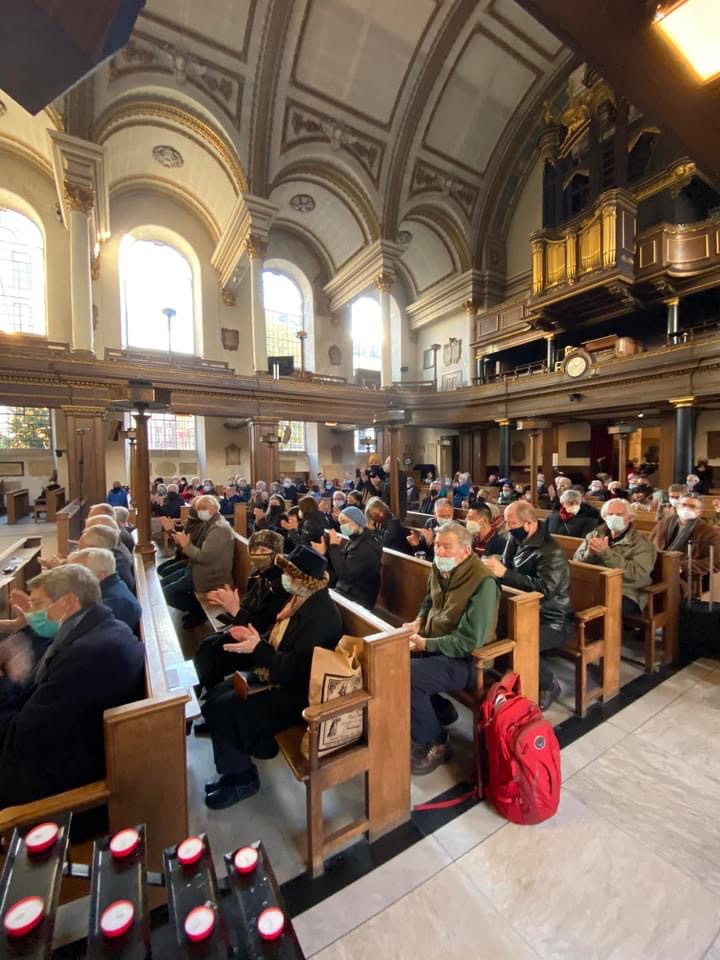
Chopin’s late Nocturne in E major op 62 n.2 was offered as an encore to an enthusiastic and insistent public.It showed off to the full his extraordinary refined playing of great musicianship that had been the hallmark of his entire lunchtime recital in this most beautiful of churches, a real oasis just a stones throw from Piccadilly Circus

This is the link to the concert that will be available to enjoy until the end of December https://youtu.be/idlXdgJ6ESs

https://christopheraxworthymusiccommentary.wordpress.com/2021/05/19/bocheng-wangs-wondrous-chopin-at-st-marys/

George Harliono at the Wigmore Hall

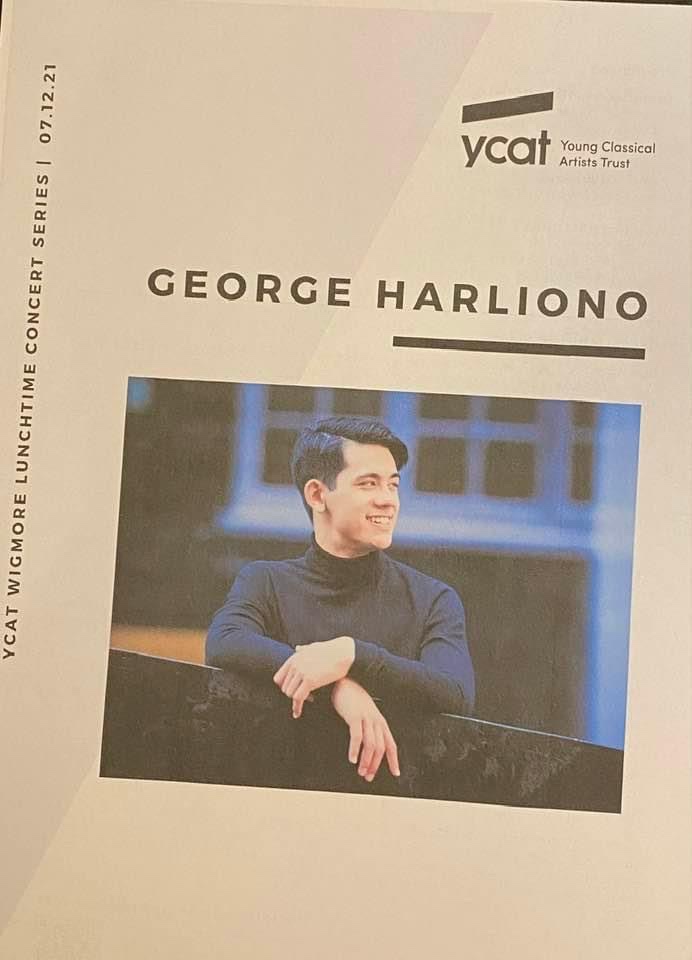
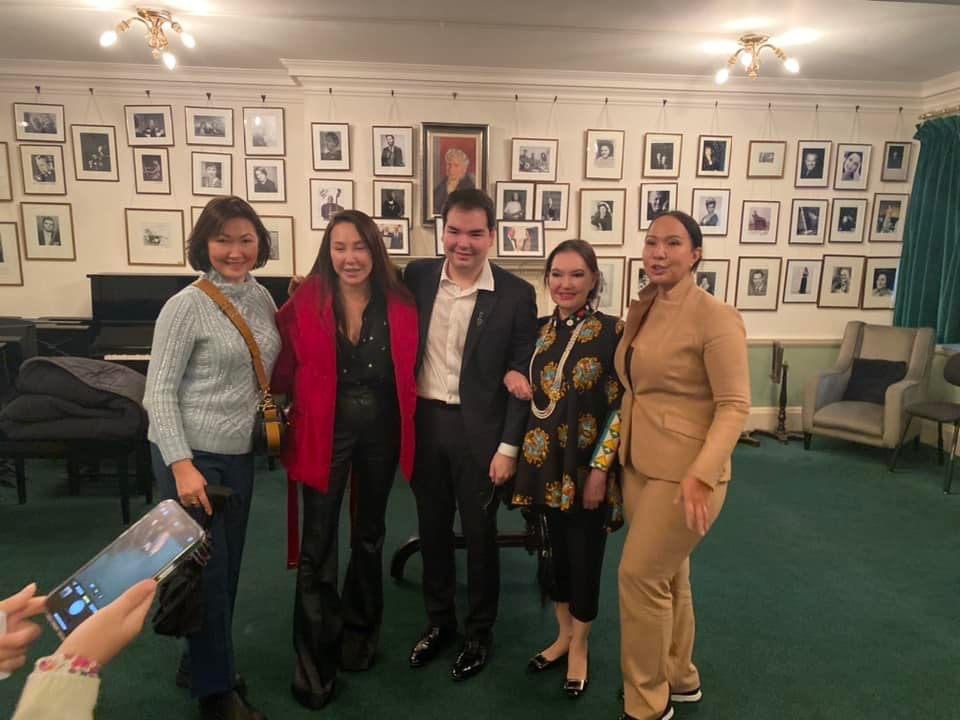
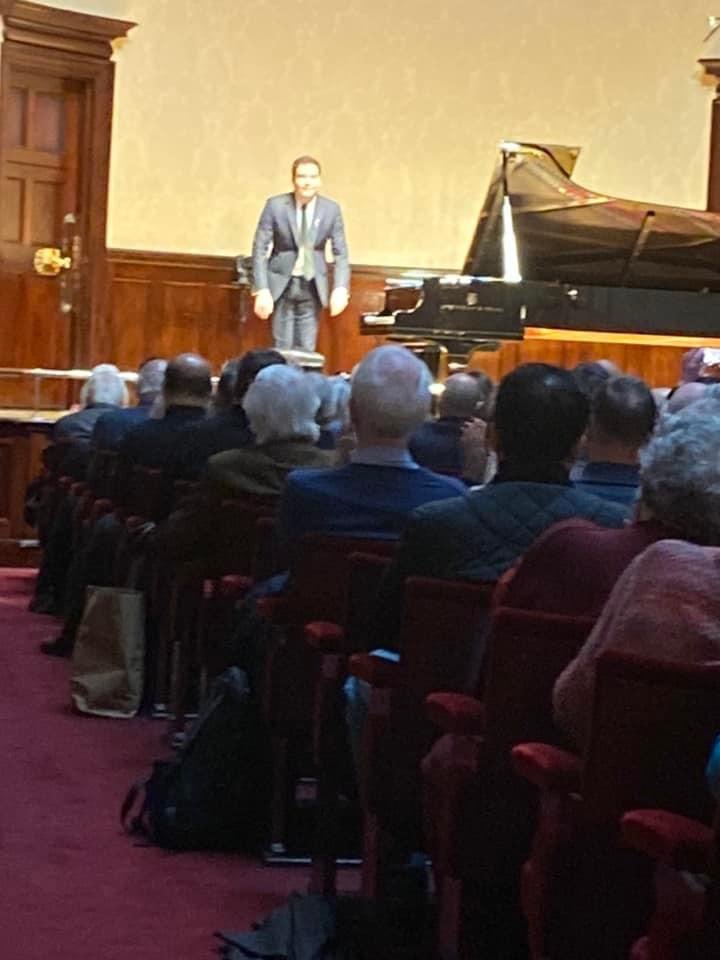
George Harliono at the Wigmore Hall YCAT presentation concert.Some astonishing playing with not only a technical fluidity but a kaleidoscopic repertoire of sumptuous sounds played with a musicality that is rare indeed.Episodes of ravishing beauty and subtle dynamic shading alternated with enviable technical wizardry.
But this was still a youthful vision of an artist who has a golden palette in his hands but as yet cannot see the wood for the trees.Wondrous trees though they might be.
His sense of architectural shape and real weight we had to wait until the encore to catch a glimpse of .
A Brahms intermezzo of such beauty and maturity that I have only heard similar from the hands of Radu Lupu.


This is what we had been waiting for during a remarkable display of playing with the Bach Chaconne,Prokofiev 2nd Sonata and even Liszt’s Spanish Rhapsody.
A display of transcendental control of sound at whatever speed he chose and an extraordinary sensibility but missing the overall shape and the control from the bass that gives an underlying energy and shape to larger forms.
Schubert’s Standchen in the Liszt transcription was given a memorable performance where the form and shape were governed by the melodic line that he played with infinite gradations of tone of jewel like wonder.
The concert opened with the Bach Siciliano in the famous transcription by Kempff but was hampered though by his preoccupation with the non legato accompaniment that strangely kept this marvel rather earthbound.
A second encore for an enthusiastic audience on their feet .He threw himself into Chopin’s first study with a devil may care velocity that almost caught even him out.But here too at last was the great bass melody deciding the fate of the transcendental accompaniment that he played with phenomenal technical and musical prowess.

There were sumptuous sounds from the very outset of the recital with the melodic line floating above the accompaniment in Wilhelm Kempff’s transcription of the Siciliano from the flute Sonata BWV.1031 .A whispered repeat created the magic world that George wanted to share with us throughout the recital with seemless streams of sound and ravishing half lights.His preoccupation with the difference between the non legato accompaniment and the mellifluous flute melody did not allow him the freedom that he was to find later in the recital with Standchen.In fact one had the impression that he was more preoccupied with the details than the overall picture.

This too became more evident as the recital progressed .The Bach Chaconne was immediately much more fluid and was played with great authority.However the etherial contrasts and refined sensitivity robbed this great monument of its nobility.The lightweight left hand octaves entered like a breath of fresh air as a series of episodes,sometimes of ravishing beauty and astonishing technical control,became more evident than the gradual build up to the mighty final declaration of nobility and grandeur that Bach had perceived for solo violin.George in general favoured very fast tempi and it was this lack of continuous pulse that made the great climax at the end seem so divorced from what had come before,instead of being the culmination of Bach’s glorious creation.The big bass notes too in the final page were more like canon shots than the great stops of a magnificent organ that Agosti,a pupil of Busoni,had insisted on.It was an extraordinary performance though that showed off more the qualities of a master pianist than the architectural shape and grandeur of this monumental chaconne.In fact there was much more of the remarkable George Harliono than Johann Sebastian Bach.

It was in the Prokofiev second Sonata that the continual driving rhythms and kaleidoscopic sense of colour allied to a transcendental technical control found an ideal interpreter in George.The simplicity of the opening with its sudden rhythmic outbursts and changes of mood was beautifully captured.There was real beauty in the melodic sections with magical colours that contrasted with the rhythmic interruptions.The Allegro marcato was played with great authority and rhythmic drive and the Andante with deep brooding of haunting beauty.The vivace finale was played with astonishing bravura and rhythmic drive with the theme from the first movement appearing like a distant memory of beauty and reflection.

The Spanish Rhapsody was astonishing for its musicianly sense of colour and enviable technical command.But I missed here too the almost animal rhythmic drive that had us sitting on the edge of our seats when Gilels let rip in the Festival Hall.It was such refined musicianly playing that did not fully suit the blazing passions and savage rhythmic excitement of red hot Spain.

British pianist George Harliono was invited to make his first one hour long, solo recital at the age of nine and since then has performed in numerous locations both in the UK, USA, Europe and Asia, appearing at venues such as Wigmore Hall, The Berlin Philharmonie Kammermusiksaal, The Royal Albert Hall and Chicago Symphony Centre.In 2013 he was invited to record Beethoven’s Piano Sonata Op.2 No.1 at the Southbank Centre in London. In 2016 his performance of Tchaikovsky Piano Concerto No.1 at the Great Hall of The Moscow Conservatory was broadcast live on Russian national TV and streamed live on Medici TV.Since his concerto debut at the age of 12 he has been a regular performer with orchestras including the Moscow State Symphony Orchestra, The Mariinsky Orchestra, Tatarstan National Symphony Orchestra, New Millennium Orchestra of Chicago and Tyumen Philharmonic Orchestra. George also regularly performs alongside eminent artists such as Lang Lang and Denis Matsuev and has worked with many renowned conductors including Valery Gergiev, Alexander Sladkovsky, Evgeny Shestakov and Anton Lubchenko.George has been awarded prizes in numerous competitions throughout the world including The Grand Piano Competition in Moscow, Royal Overseas League Music Competition in London, Gina Bachauer Piano Competition in Utah and Dinu Lipatti Piano Competition in Bucharest.Most recently he performed with The Mariinsky Orchestra in Vladivostok, Russia under the baton of Valery Gergiev and was also invited to perform a recital as part of the Scherzo Young Series in Madrid. Scherzo is the most important piano series in Madrid and has previously featured artists such as Yuja Wang and Mitsuko Uchida.He studies with Professor Vanessa Latarche (Chair of International Keyboard Studies and Head of Keyboard, Royal College of Music in London). He has taken masterclasses with Dmitri Bashkirov, Lang Lang and Vladimir Ovchinikov among others. George also works closely with Alexander Sladkovsky who has taken a personal interest in his development as an artist.”George Harliono is very talented, he’s got a phenomenal career ahead of him.” Says the acclaimed Russian pianist Denis Matsuev.George began studying at The Royal College of Music for a BMUS Degree on a full four year scholarship in September 2017. He is one of the youngest students ever to be accepted onto this course.In 2018 he was shortlisted for an award in the ‘Sound of Classical Poll’ at the Classic BRIT Awards in London, which promotes the best emerging artists and ones-to-watch in classical music.Upcoming engagements for George include concerto performances at Teatro Colon in Buenos Aires and Zaryadye Hall in Moscow.

The aristocratic style and vision of Alim Beisembayev

A standing ovation for Alim Beisembayev with masterly performances of Clementi and Chopin.Aristocratic performances where the young 17 year old youth I had heard at the Purcell School a few years ago has blossomed and grown into a great artist. I had heard him play the same programme last June at that piano Mecca in Perivale.

https://christopheraxworthymusiccommentary.wordpress.com/2021/06/02/alim-beisembayev-a-master-at-st-marys/

But today after his triumph in Leeds this was an even more assured performance.
Chopin 24 Preludes were quite simply one of the most moving and memorable that I have ever heard in public or on disc ( Cortot excepted of course)
A Clementi sonata of scintillating streams of golden sounds that just made one wonder why is this music not more often played.
An encore of ‘Chasse Neige’ by Liszt that was truly a wonder and summed up the artistry of this young artist with his transcendental technical control.Imagination and kaleidoscopic sense of colour that added to his youthful passion and uninhibited sense of style was nothing short of sensational.

A very full Wigmore Hall for the BBC live broadcast


There were so many wondrous things,that like listening to that other Leeds winner Murray Perahia,he had you listening afresh as his uncontaminated interpretation from Chopin’s own hand was turned into musical sounds that were at once fresh and amazingly original.
I was asked to review this concert but all I can do is point to some of the landmarks that I have lived with all my life but now find myself . in a magic land of wondrous sounds and aristocratic comments that I had not visited before.


The opening sounded like a magic harp just glowing in intensity as jewel like sounds seemed to appear in its midst like magic.
There was the languid beauty of the second and the fleeting lightness of the third ,a final flourish led to the sublime beauty of the fourth with the bass pulsating like a heartbeat of searing intensity.
Such liquid sounds in the fifth that were shaped into clouds of sound.
The sublime sixth with the ending a magical disappearance on a cloud of pedal as Chopin himself had indicated.There was grace and elegance with an extraordinary sense of timing in the seventh as we were enveloped in the streams of romantic sounds of the eighth.A build up of tension of aching intensity before the etherial coda.There was great architectural shape to the ninth with a truly surprise entry of the bass which lent such aristocratic nobility to a prelude often considered as ‘also ran’.Scintillating ‘jeux perlé’ of the tenth and subtle colouring and beauty of legato of the eleventh.The frenzied dance of the twelfth was astonishing for its clarity and total technical command but even more for its mazurka like characterisation that I have never been aware of in the usually laboured or virtuoso bravura performances that are the norm in lesser hands.Wondrous sense of melodic line in the thirteenth and fifteenth- the so called ‘raindrop ‘ prelude – with a middle section where the continuous tolling of a bell (as in Ravels Le Gibet ) I had never been aware of before today’s performance.

The B flat minor n.16 was astonishing for its sweeping sounds of transcendental difficulty.But even at this breakneck speed you could see Alim slightly lift his arm and place it with a disarming mastery that I have only ever seen from Arrau or Gilels.The palpitations of the seventeenth immediately entered on the final vibrations of the three carefully placed chords.The deep bass notes at the end I have never heard played so simply or to such effect as today.A wonderful moving melodic line to the nineteenth just belied the enormous technical demands as it was allowed to unwind so naturally with disarming authority.Aristocratic control of sound in the twentieth,so short but used by many composers as the basis of variations for its seemingly simple construction.Such passionate streams of sound in the twenty second where one was not aware that it is familiarly known as the octave prelude.
You see such was Alims identification with the musical world of Chopin that his total mastery allowed him to concentrate on the purely musical meaning of a work that Fou Ts’ong used to describe as 24 problems.
The pastoral simplicity -au bord d’une source springs to mind -of the penultimate prelude as streaks of lightening and red hot blazing sounds took us to the final devastating three notes deep in the bass.

Alim receiving gifts in the green room


What to say of the marvel of Clementi – a magic box of jewels made to gleem and shine in Alims hands
Scales that were streams of gold and silver combined with ethereal sounds and a musicianship that never left the great architectural shape that was being created by his magic fingers.
‘Il lento e patetico’ was played with the weight that I have only heard from the greatest interpreters.
Whirlwind sounds in the Presto with a fabulous ‘jeux perle’ of lightness and ‘joie de vivre’ that was the vocabulary of the pianists of the Golden era of piano playing and until today rarely even hinted at especially with Alims good taste and aristocratic sense of style created together with his mentor of the past ten years Tessa Nicholson and the unforgettable school of Fou Ts’ong who has inspired so many generations of aspiring young musicians.

Friends getting Alim after his concert

Joanna Kacperek at St Mary’s A scintillating display of style and musicianship

Tuesday 7 December 3.00 pm

Soler: 4 Keyboard Sonatas: 
K 104 in D Minor, 
K 102 in D Minor, 
K 106 in E Minor, 
K 88 in D Flat Major 

Schubert: Piano Sonata in B Major D 575
Allegro / Andante / Scherzo / Allegro

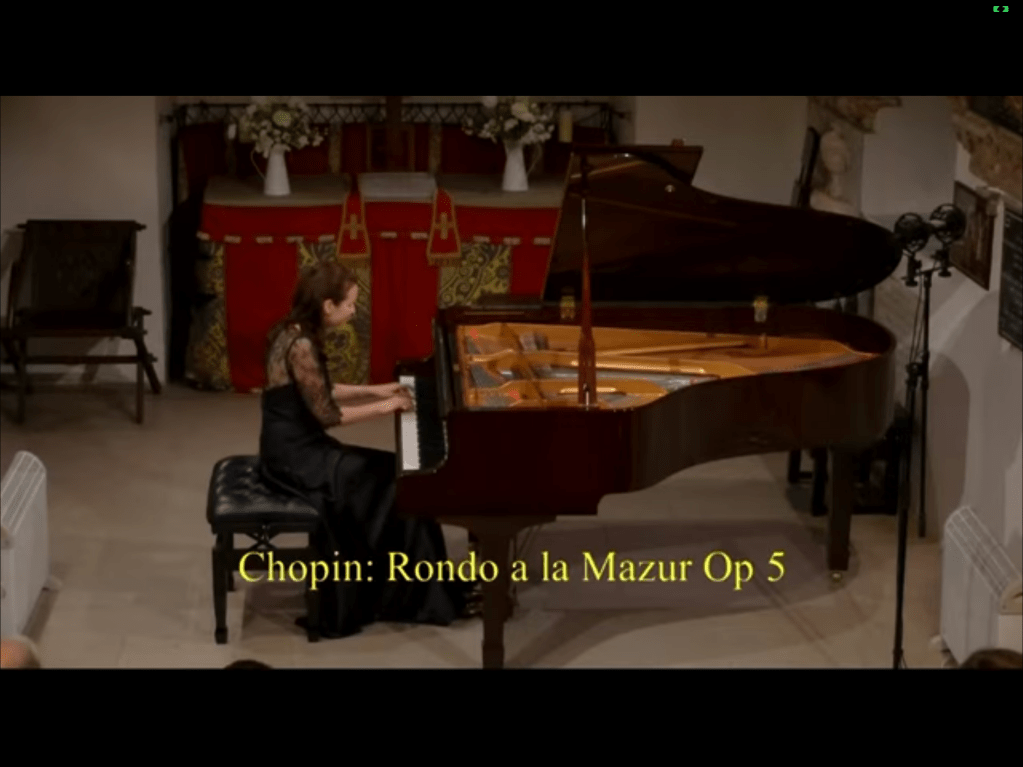
Chopin: Rondo a la Mazur Op 5

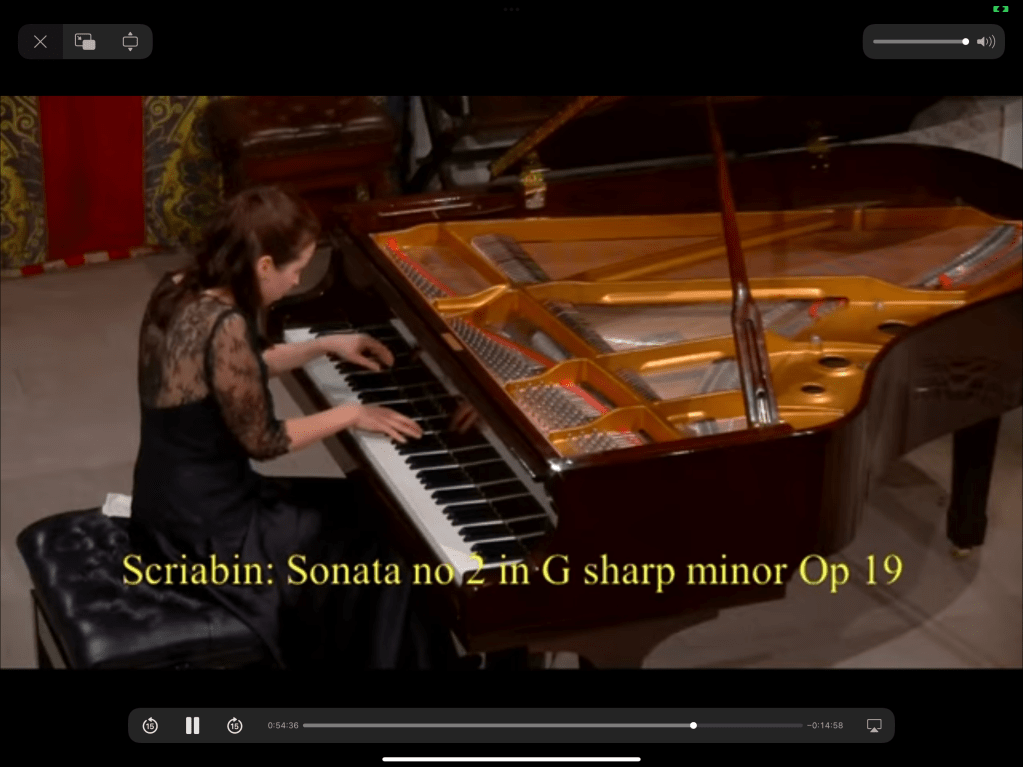
Scriabin: Sonata no 2 in G Sharp Minor Op 19
Andante/ Presto

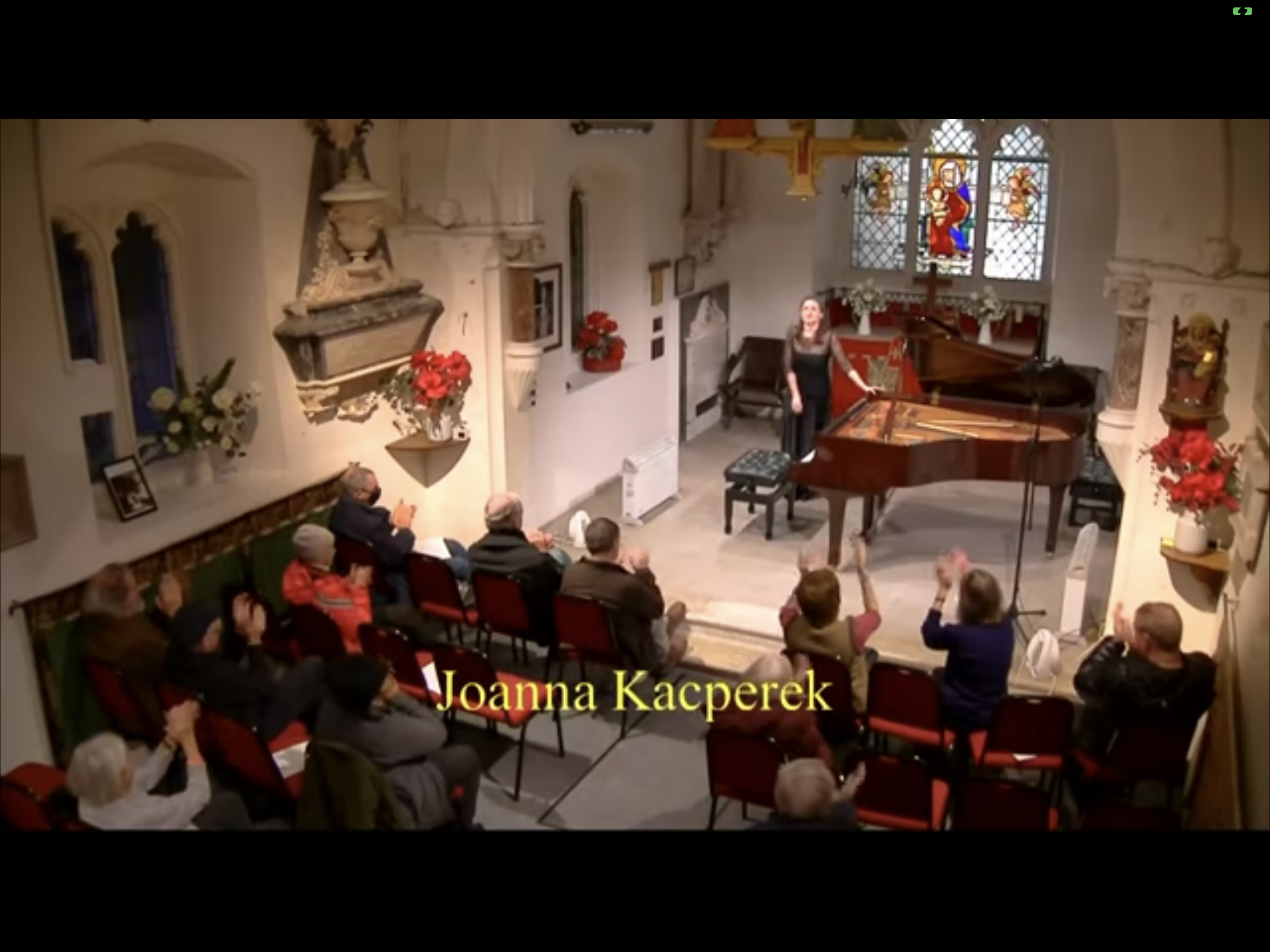
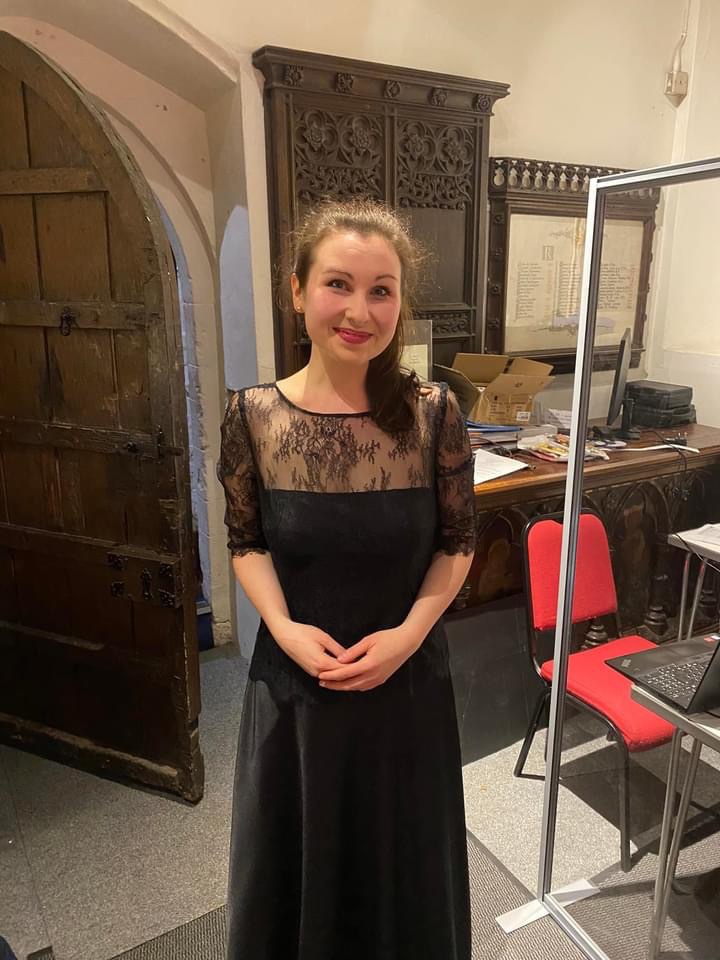
Joanna Kacperek standing in at very short notice for a pianist stranded in Austria!A scintillating display of dexterity and style with four Sonatas by the ‘Spanish’Scarlatti -Antonio Soler.He wrote 471 Sonatas rarely heard and so it was refreshing to hear four of them played with vibrant rhythmic energy and crisp delicate passage work shaped by a true musician as you might expect from the school of Norma Fisher.
An eclectic choice of programme too with Schubert’s rarely heard B major Sonata given a reading of both beauty and intelligence.Chopin’s Rondo op 5 was played by a native who brought Chopins early sparkling rondo vividly to life with irresistible charm,grace and scintillating virtuosity.
Scriabin’s two movement Fantasy Sonata was played with sumptuous colour and a sense of line that gave great coherence to this ravishing early work of Scriabin.The second movement was played with passion and great technical flair by this beautiful young Polish but Ealing based pianist.It was very refreshing to see her husband the pianist Andrew Yiangou following with such pride his talented partner in life.There must be something about the air in Ealing that produces such talented and dedicated people!

https://youtu.be/zIwtZ9IHQeQ

International concert pianist, Joanna Kacperek has performed in major concert halls in Poland (Warsaw Philharmonic, Concert Studio of the Polish Radio, the Royal Castle in Warsaw, NOSPR in Katowice) and abroad (including United Kingdom, France, Italy, Spain, Germany, Norway, Russia, the Ukraine, Canada and Japan). As a soloist, she has performed with such orchestras as the Symphony Orchestra of the National Philharmonic in Warsaw, State Academic Symphony Orchestra in Moscow and Lviv Virtuosos Chamber Orchestra. In 2021 Joanna graduated with distinction from The Royal College of Music in London in the class of Norma Fisher, as the recipient of the C. Bechstein Scholarship and The Zetland Foundation Scholarship. J oanna is also a graduate from the Fryderyk Chopin University of Music in Warsaw (diploma with distinction) where she studied with Ewa Poblocka. She also studied at the ‘Berlin University of Arts’ in Germany (academic year 2016/2017) where she was mentored by Professor Markus Groh as the receipt of an Erasmus scholarship. Joanna has also received the scholarships from the Polish Minister of Culture and the Prime Minister. Joanna Kacperek has won international piano competitions in Szafarnia (‘F.Chopin’), Pilsen (‘B.Smetana’), Paris (‘M.Magin’) as well as the National Witold Lutoslawski Music Competition in Warsaw. The achievements of the pianist include winning a special prize at the International Edvard Grieg Piano Competition in Bergen (2016), granted unanimously by the jury and the composer Christian Blom for the best performance of his work. In November 2017, together with violinist Roksana Kwasnikowska, Joanna won The 2 nd International Beethoven Chamber Music Competition, organized by The Krzysztof Penderecki European Music Centre, Internationale Beethoven Gesellschaft and The Ludwig van Beethoven Association. Alongside a growing career as a soloist, Joanna Kacperek is highly celebrated for being a multi-faceted pianist. She regularly performs with singers and instrumental players. Her duo with violinist Roksana Kwasnikowska represented Poland at the Kyoto International Music Students Festival in Japan (2015) and regularly performs recitals both in Poland and abroad. In 2021 she was chosen as Young Artist and took part in The Leeds Lieder Festival 2021 (duo with Ava Dodd).

Pietro Fresa in London – refined seduction and intelligence at Brompton Oratory

Pietro Fresa at Brompton Oratory showed his true colours with performances of such disarming simplicity.That the ebullient early Mozart could charm and excite as the late Schubert Impromptus op 142 could seduce and reduce us to tears .Some remarkable playing from a musician who could hold us entranced as he allowed the genius of Mozart and Schubert to penetrate our souls with playing of sublime eloquence and ravishing beauty

Piano Sonata No. 5 in Gmajor K 283 (1774)

  1. Allegro
  2. Andante (in C major)
  3. Presto

This sonata is part of the earliest group of sonatas that Mozart published in the mid-1770s and was written down during the visit Mozart paid to Munich for the production of his La finta giardiniera from late 1774 to the beginning of the following March.

It was this work that opened Pietro’s recital in the beautiful St Wilfrid’s Hall,part of Brompton Oratory.A new work for his repertoire that contrasted so well with the late Schubert Impromptus that made up the rest of this short but intense recital.There were great contrast and rhythmic drive from the first notes of the Allegro.A beautifully shaped opening melody was immediately contrasted with Mozart’s joyous youthful exuberance .Great attention to detail meant that every phrase was imbued with such character with the beauty of the legato melodic line contrasted with the very pointed rhythmic phrasing of the streams of golden sounds that seemed to flow so naturally from Pietro’s hands.A development of a mere eighteen bars but it allowed a contrast that the magical reappearance of the opening theme was as refreshing as it was seductive.

From the very first notes Pietro had shown his musical credentials of intelligence,sensitivity and technical brilliance.The Andante was played with such simplicity – Schnabel use to say that Mozart was too easy for children but too difficult for adults.It is a simplicity that comes from a real understanding of phrasing and sense of architectural shape.He allowed Mozart’s melodic line to sing incorporating Mozart’s precise dynamic indications into a musical line that had great meaning and significance.The Presto was played with all the youthful verve and technical agility that Mozart himself would have astonished his audiences with.But even here there were melodic episodes of refined detail and eloquence.But it was the rhythmic drive and ‘joie de vivre’ that left us breathless.That is until Mozart just adds two quiet arpeggiated chords pointedly placed as if to say that’s all there is !

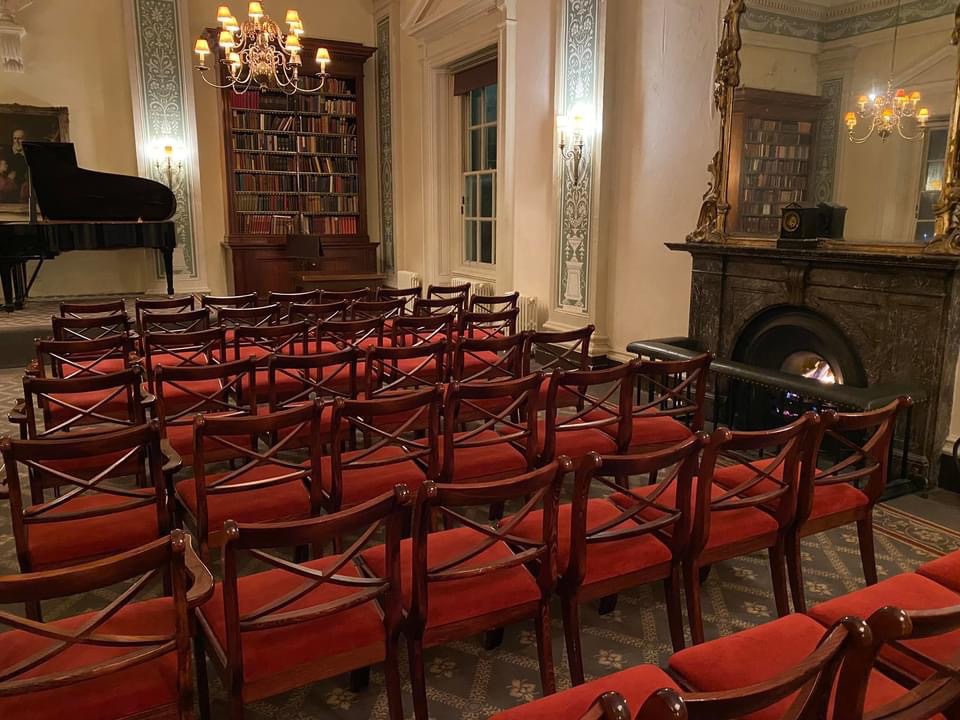
The warm hospitable of St Wilfrid’s Hall

It was probably in just such a hall that Mozart himself might have played.The log fire blazing and book shelves lined with antique editions not to mention the refined candelabras just adding to the atmosphere that Pietro’s refined playing created.

Pietro being introduced to the public by Claudia

The atmosphere too of being in someone’s house in this concert lovingly organised by Claudia and colleagues to raise funds for the Oratory Scout Group.Many young scouts too were eager to listen to Pietro’s very interesting introductions and it should be mentioned too that Pietro himself is only twenty one and not so much older than they are!

The second set of four Impromptus was published posthumously as Op. 142 in 1839 (with a dedication added by the publisher to Franz Liszt).They were probably written in 1827 just a year before Schubert’s death at the age of only 31.

Four Impromptus, D. 935 (Op. posth. 142) N 1 in F minor N.2 in A flat major N.3 in B flat major N.4 in F minor

As the first and last pieces in this set are in the same key of F minor and the set bears some resemblance to a four-movement Sonata,it has been suggested that these Impromptus may be a sonata in disguise, notably by Schumann and Einstein, who claim that Schubert called them Impromptus and allowed them to be individually published to enhance their sales potential.However it is also believed that the set was originally intended to be a continuation of the previous set op 90 as Schubert originally numbered them as Nos. 5–8.It is one of Schubert’s most important compositions and takes a great musician to be able to truly bring them to life and unite them into a whole.I remember in particular memorable performances by Annie Fischer ( in the Teatro Ghione in Rome) and Serkin and Brendel (in the Festival Hall in London).I also remember an inspired performance in Padua by Pietro’s teacher Boris Petrushansky.I had heard Pietro play Mozart’s last piano concerto in Rome recently though and although he gave a fine professional performance it showed a youthful immaturity that did not totally convince. https://christopheraxworthymusiccommentary.wordpress.com/2021/10/30/mozart-triumphs-at-torlonia-with-jonathan-ferrucci-pietro-fresa-sieva-borzak/

So today I was overwhelmed by a performance of great sensitivity allied to the same maturity and sense of style as his teacher.From the opening there was great authority allied to a very subtle sense of colouring.There was great weight to all that he did where every note had a significance as it created a sumptuous whole.Even the fortissimo outbursts were played with restrained phrasing of aristocratic control.There was ravishing beauty in the legato melody with its magical music box sounds high on up on the keyboard played with a luminosity that was simple and enchanting.Dissolving into the heart melting question and answer over a gently moving accompaniment.There were such subtle sounds as the musical conversation was both moving and uplifting.I have never forgotten Annie Fischer in her 70’s in this Impromptu and Pietro barely 21 came very close in the atmosphere that he was able to create.The second Impromptu was played at a true Allegretto tempo with such beautiful gentle sounds of real meaning,but never sentimental as can so often befall this much loved Impromptu.There was an etherial beauty of sounds as the trio magically unwound gradually building to a climax only to disappear to a mere whisper and the return of the opening in veiled sounds of sublime beauty.There was beautiful luminous sound to the theme of this set of five variations that make up the third Impromptu that unwound with such beauty and variety of touch and sound.The subtle beauty of the first variation was of a melodic line just resting so gently on the undulating accompaniment.The lyrical playfulness of the second and the almost too serious passion of the third.Beautiful lyricism in the bass of the fourth was in complete contrast to the delicious jeux perlé streams of golden sounds of the fifth,A gentle coda of sublime seriousness brought us to realms of concealed gold indeed.The final Impromptu was very much Serkin’s with the electric current that runs through it and scintillating swirls of sound.Pietro combined both the lyrical and rhythmical elements that whilst not having the same animal excitement – who does!- he found such eloquence and beauty in the middle section before the gradual menacing race to the headlong plunge and the final note deep in the bass.

An encore of an effortless black key study by Chopin was played with all the ease and musical assurance of the great virtuosi of a past age .

The name of the pianist Pietro Fresa (Bologna 2000) first became known in musical circles when he made his debut at St. George’s Hall, Liverpool in September 2017. On this occasion he performed Ludwig van Beethoven’s third concerto, opus 37 for piano and orchestra, as representative of the Italian nation for the event “Bologna-Liverpool UNESCO city of music”. In the same year he received an invitation to the Festa Europea della Musica di Roma; during which event, held at the Camera dei Deputati, the Medaglia della Camera was conferred on him by the Hon. Laura Boldrini in recognition of his musical talent and as a winner of international awards. As regards his training, Pietro Fresa was admitted to the Conservatorio G. B. Martini of Bologna in 2010 where he obtained the highest marks possible graduating with distinction under the guidance of Maestro Carlo Mazzoli in July 2017. During the same period and at only eleven years old, Pietro won a place at the prestigious Accademia Pianistica Internazionale in Imola on the course entitled “Incontri col Maestro” (“Meetings with the Maestro”). Here he studied with the Chinese concert pianist, Jin Ju, whilst at present he is a pupil of the renowned Russian Maestro, Boris Petrushansky. After the Conservatorio he began his studies at the London Royal College of Music, thanks to a generous study grant, and here he attends the courses of the Maestri Dmitri Alexeev and Sofya Gulyak. In addition, Pietro has honed his skills under the instruction of teachers such as Andreas Frölich, Enrico Pace, Roberto Cappello, Vovka Ashkenazy, Leonid Margarius, Stefano Fiuzzi and Vanessa Latarche, participating in their Masterclasses on a regular basis. At twelve years old, he gave his first public performance with the orchestra and inaugurated the academic year of the Conservatorio at the Manzoni Auditorium in Bologna performing Haydn’s Hob.XVIII/11 in D Major. Since then he has embarked on an intensive career as a concert pianist both as a soloist and in chamber music in numerous musical events including Musica in Fiore at the Sala Farnese of the Municipality of Bologna, the San Giacomo Festival at the church of that name in Bologna, the prestigious season Genus Bononiae at the Auditorium of Santa Cristina in Bologna, the Concerts of the Teatro Guardassoni and of the Cenobio of S. Vittore in Bologna, the season entitled Talenti in Musica in Modena, the programme of the Officers’ Club in Bologna, the Literary Society of Verona, the Festival Talent Music Mater Courses and the concerts of the Teatro Sancarlino of Brescia as well as the Teatro Comunale of Bologna. He has been awarded first prize in more than thirty piano competitions. One noteworthy occasion being his triumph at the Vienna International Competition, the Grand Prize Virtuoso Competition, where he carried off the first prize enabling him to perform at the renowned Metallener Saal of the Musikverein (Vienna).