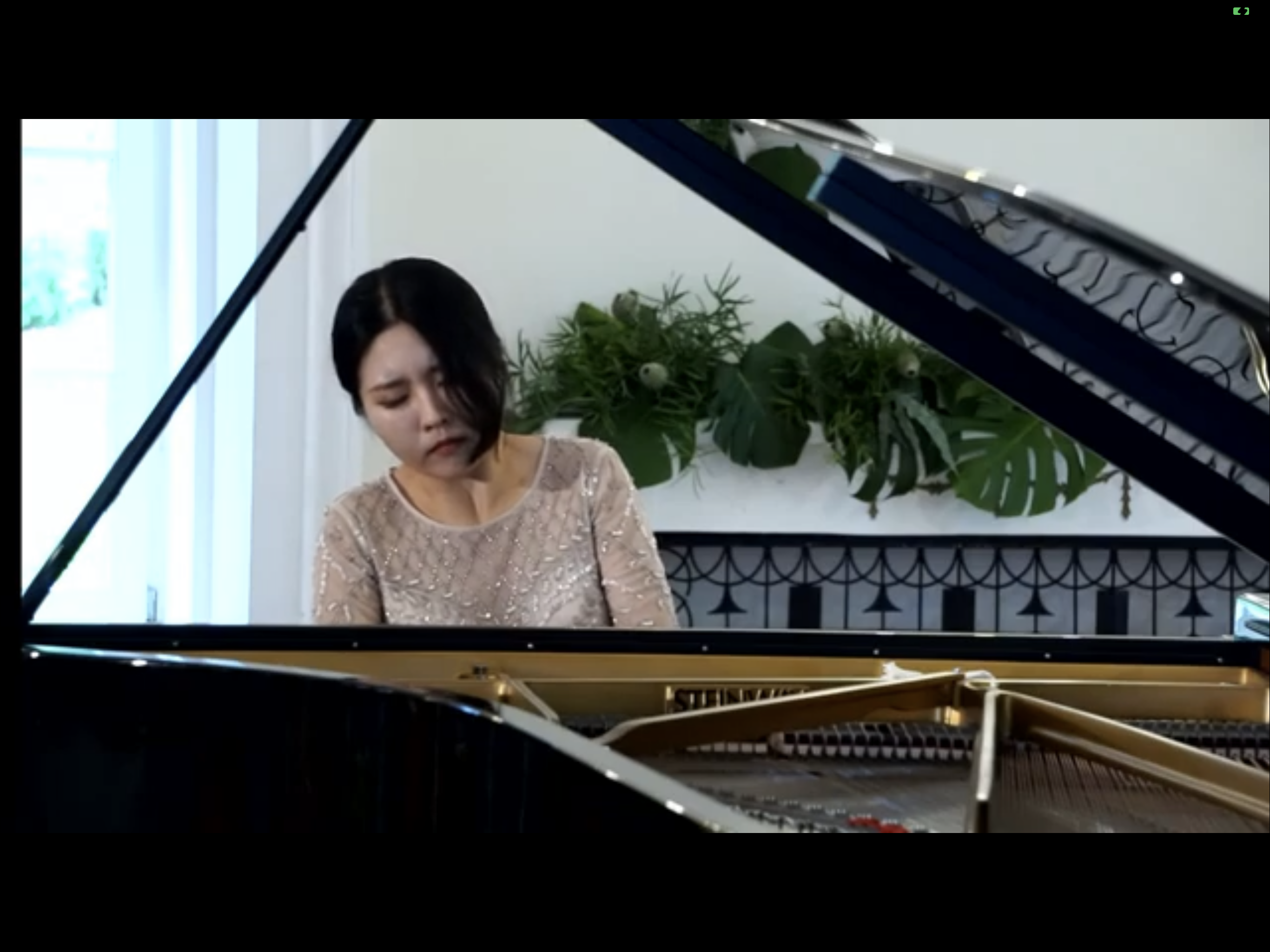
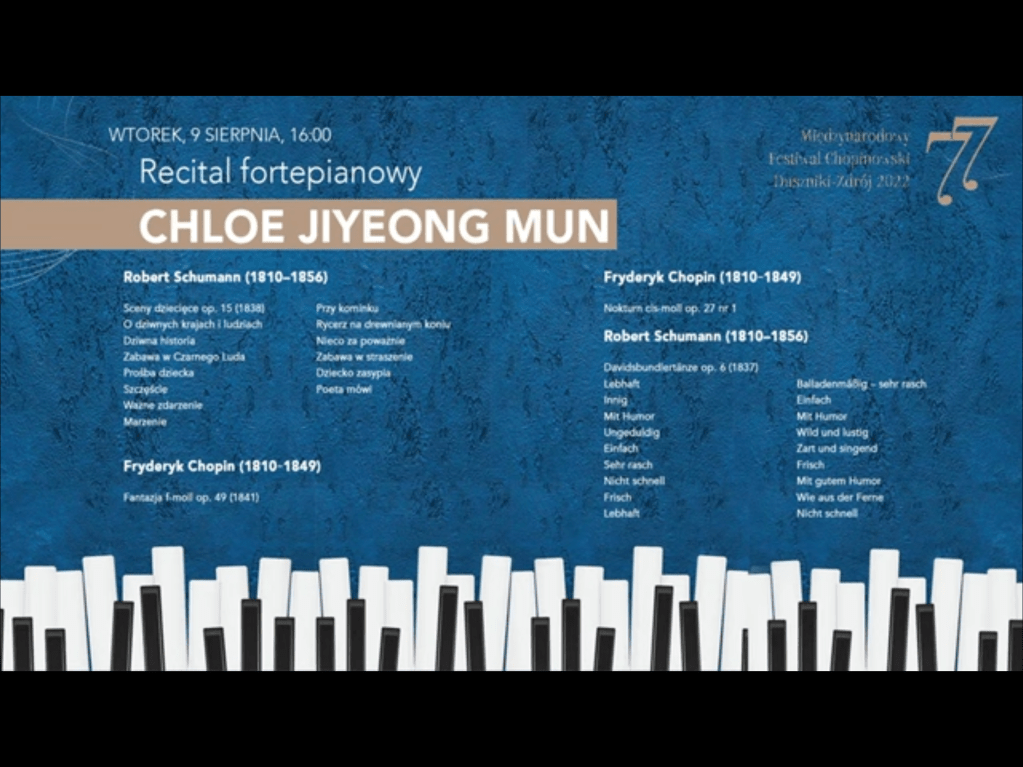
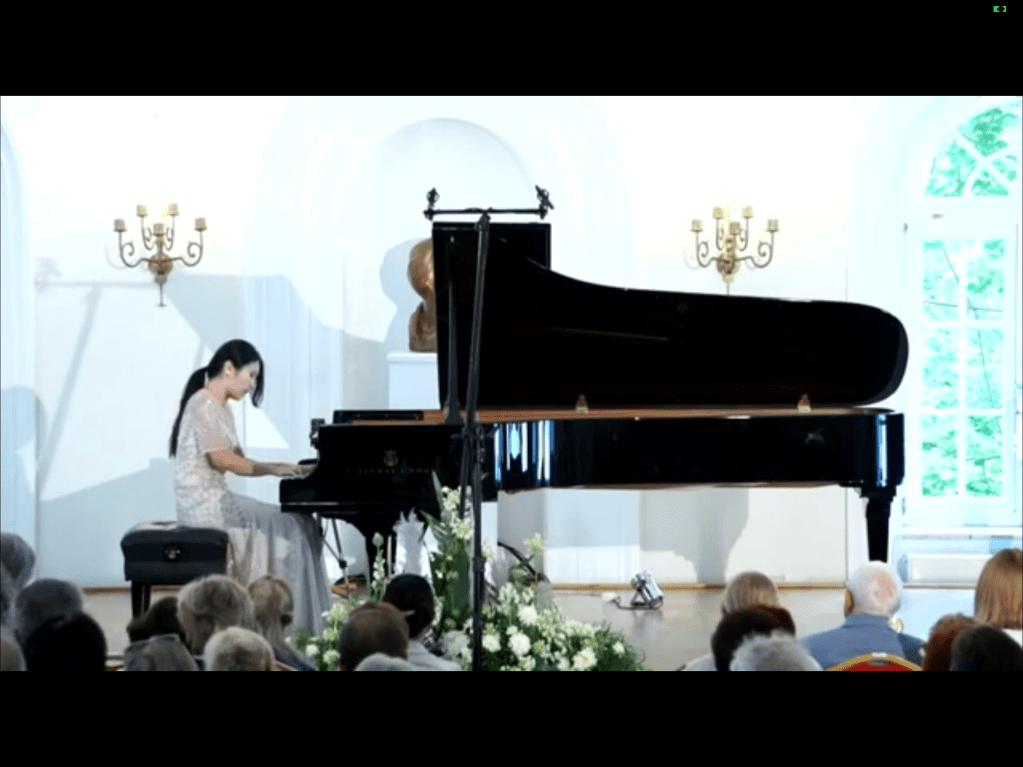
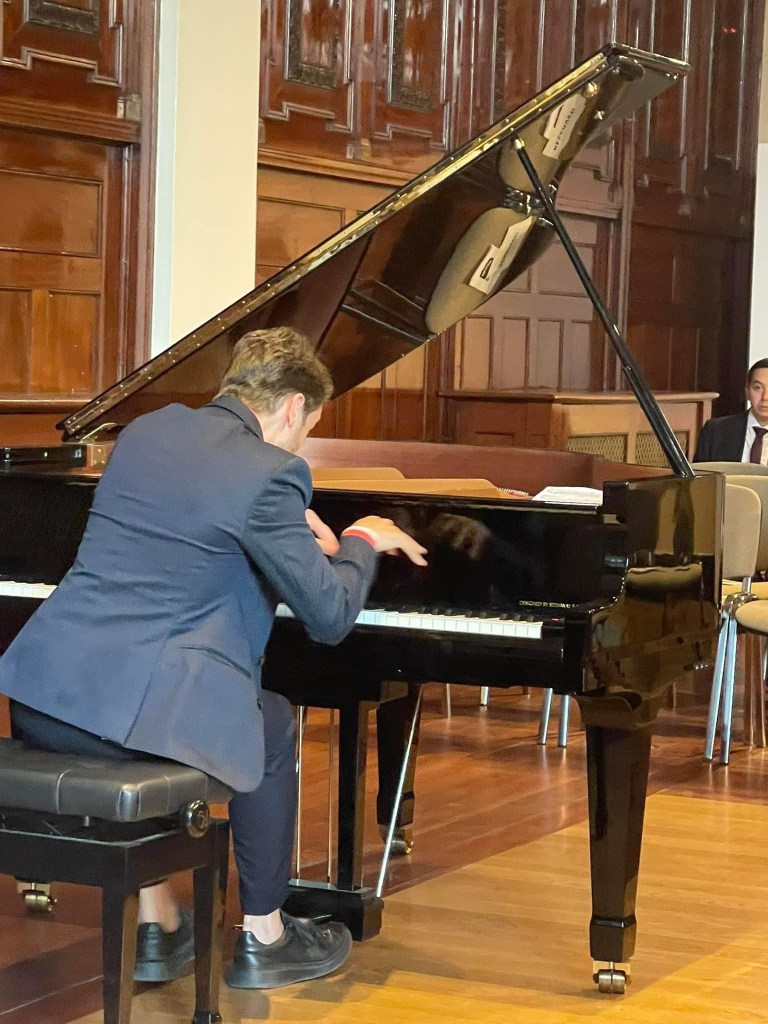
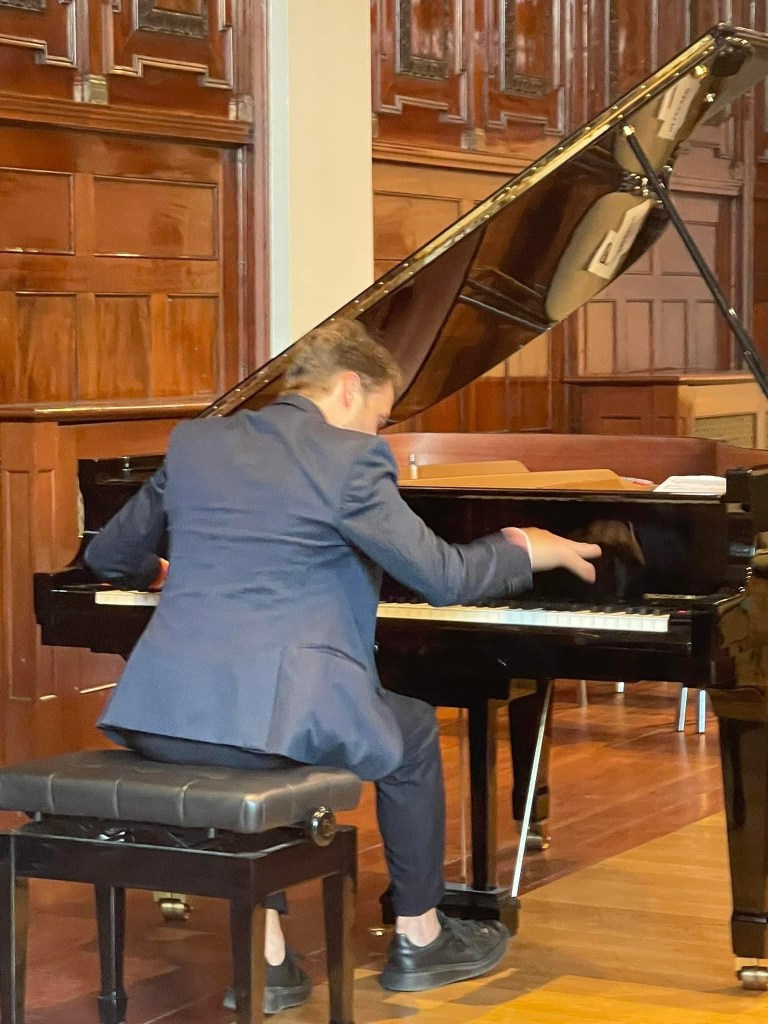
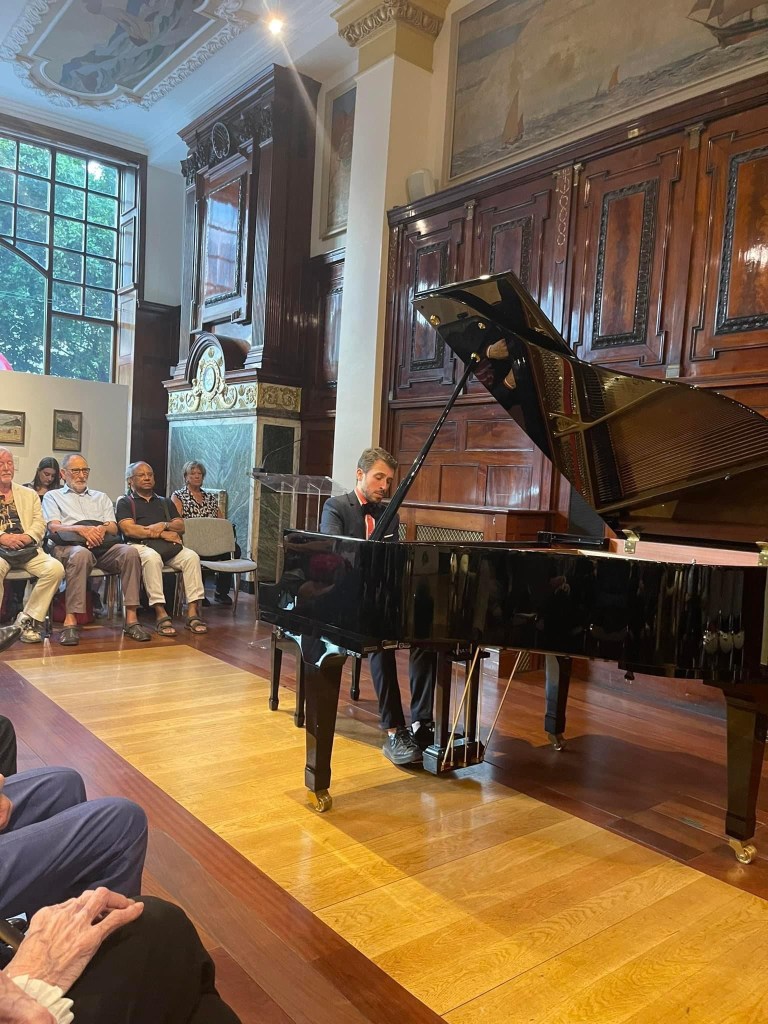
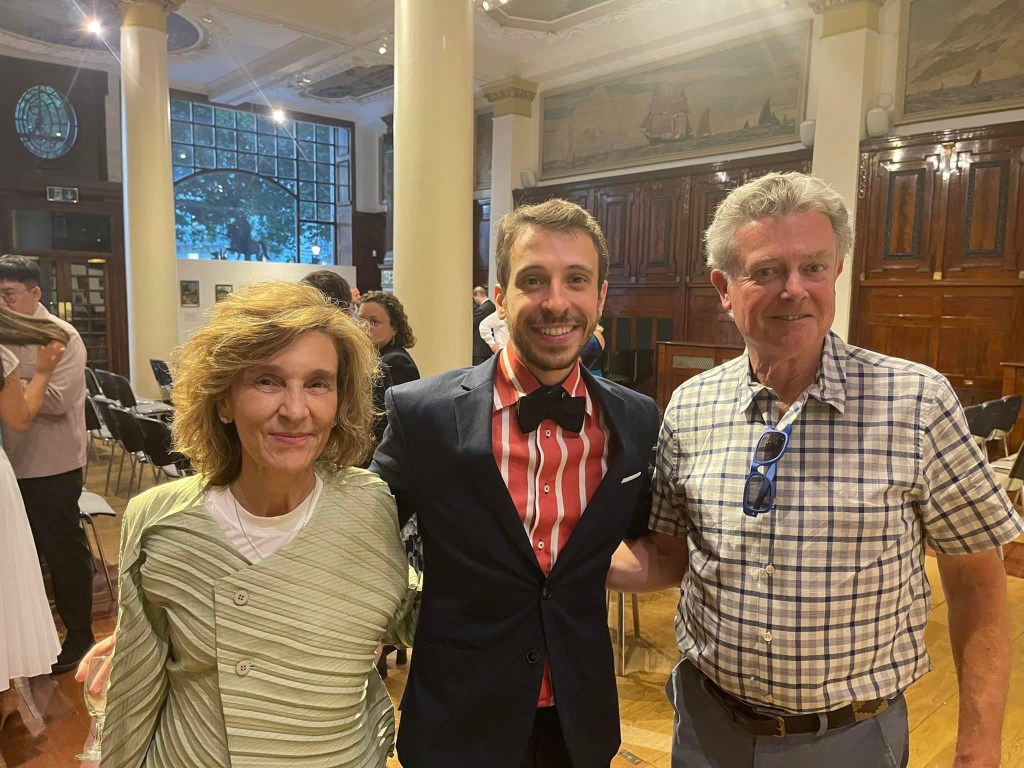
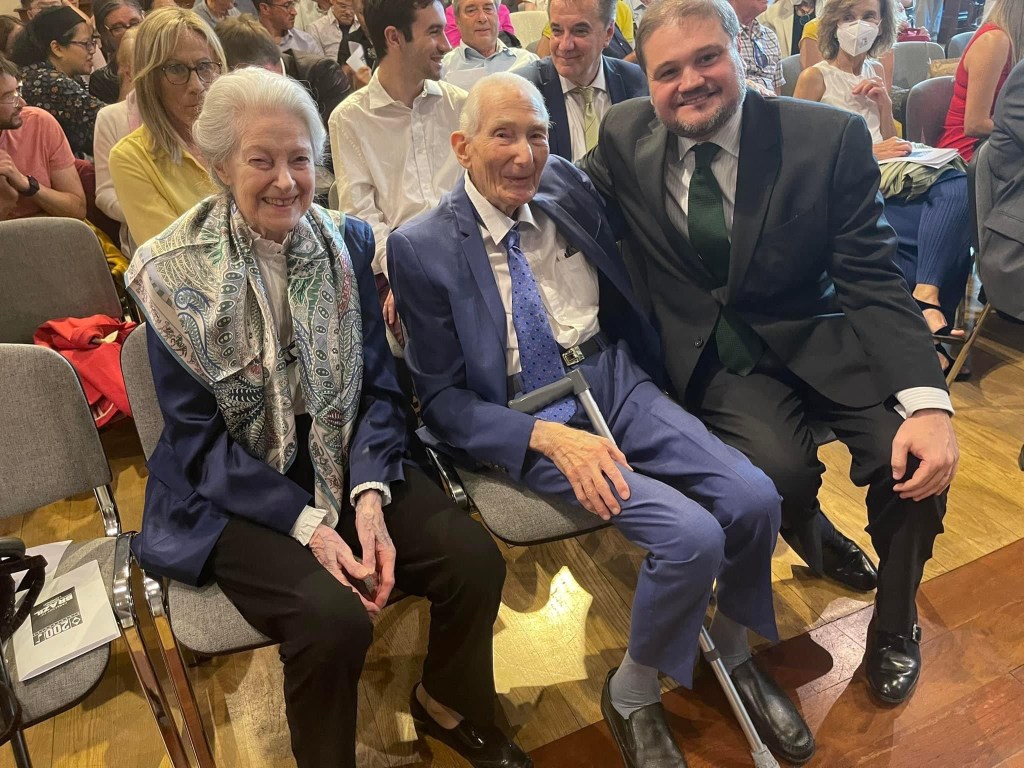
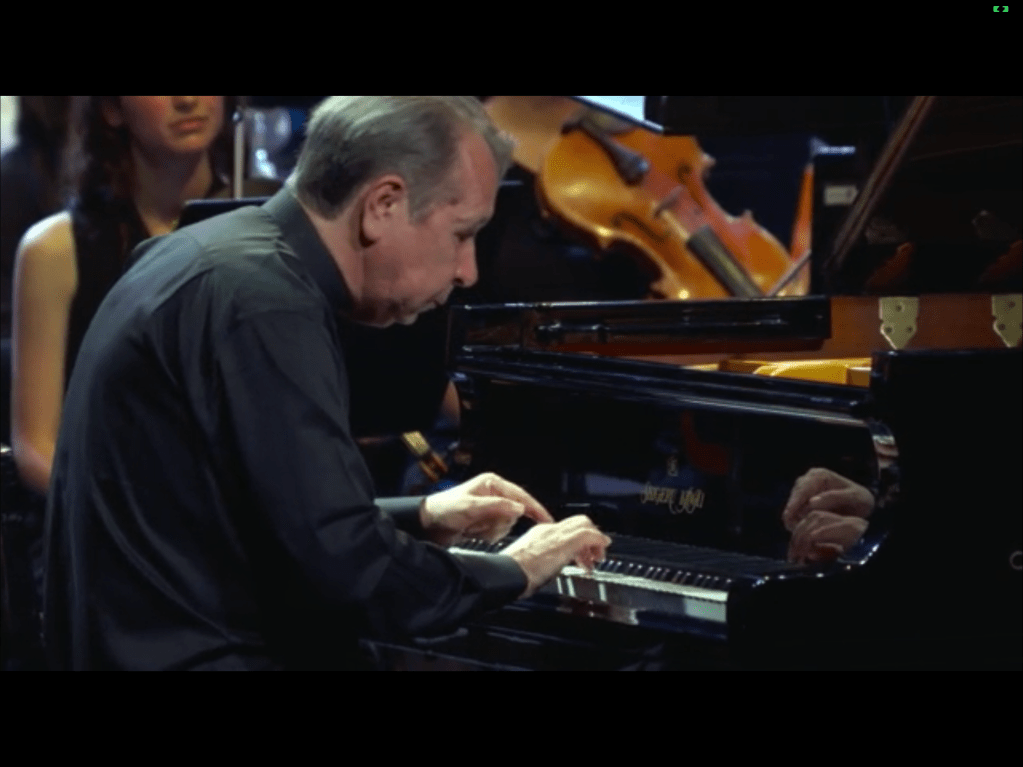
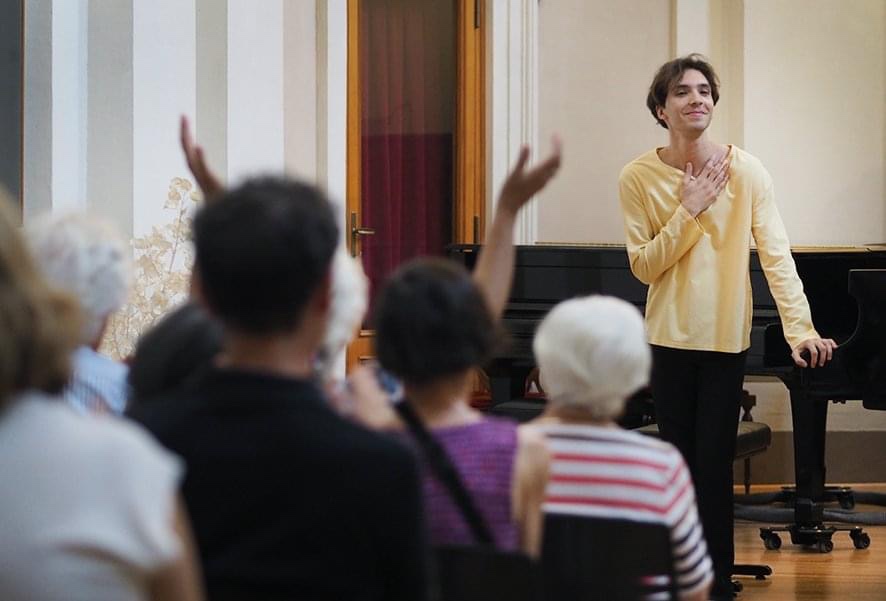
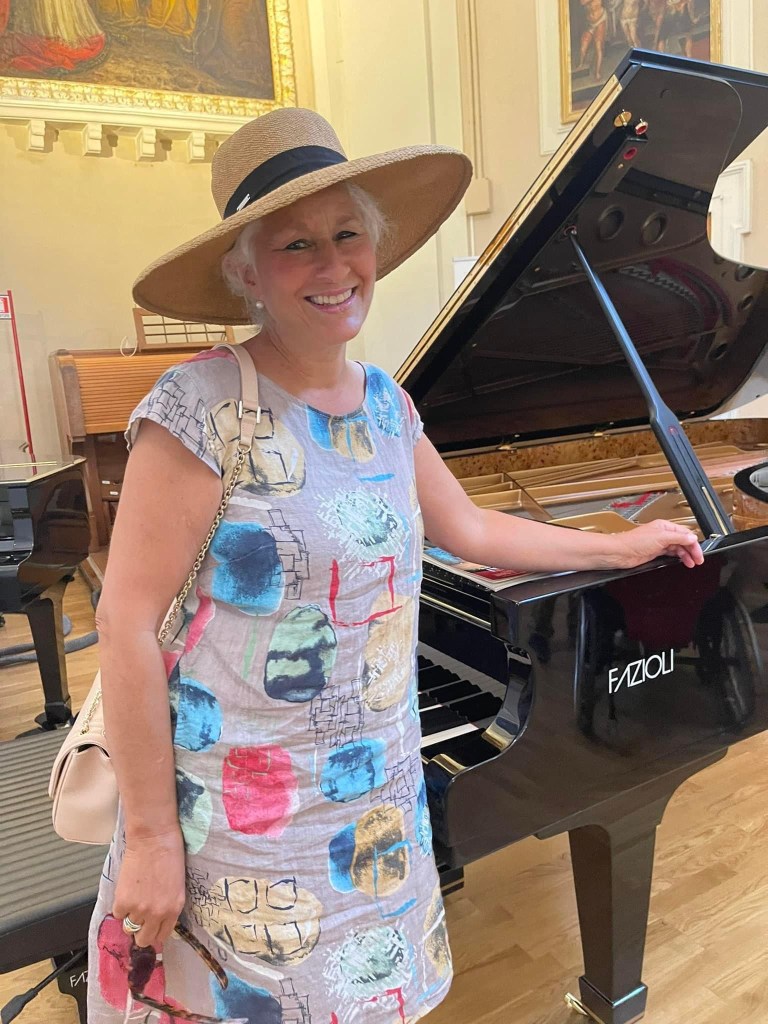
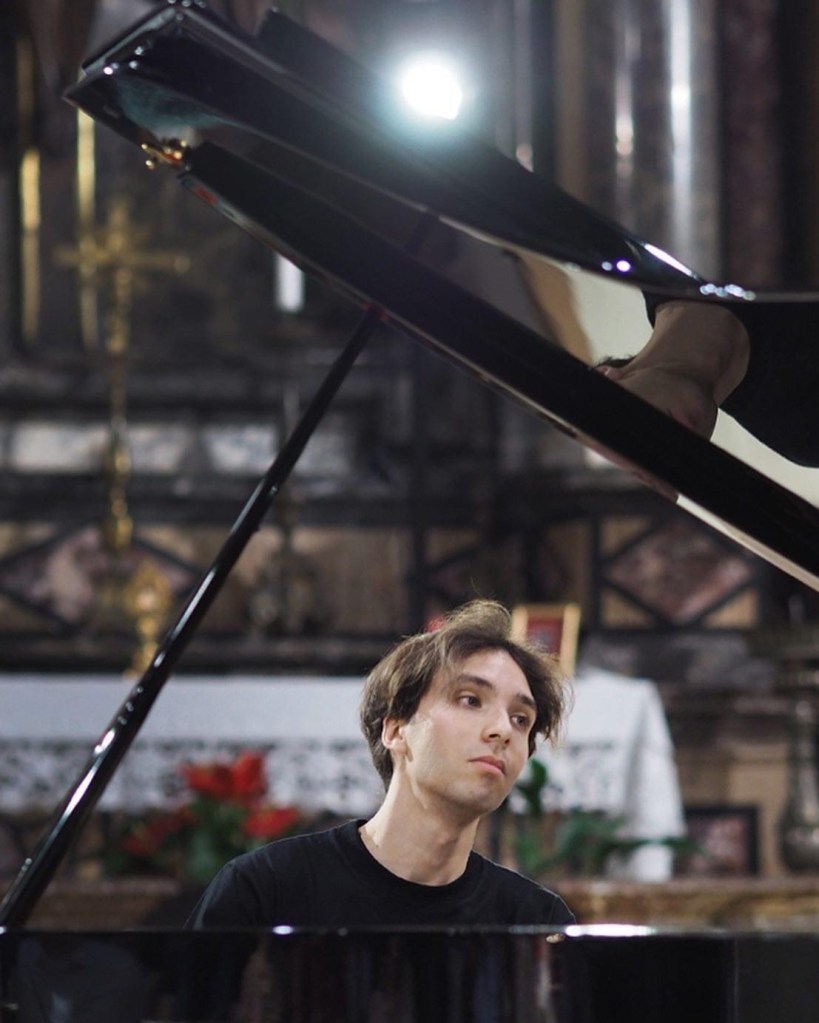
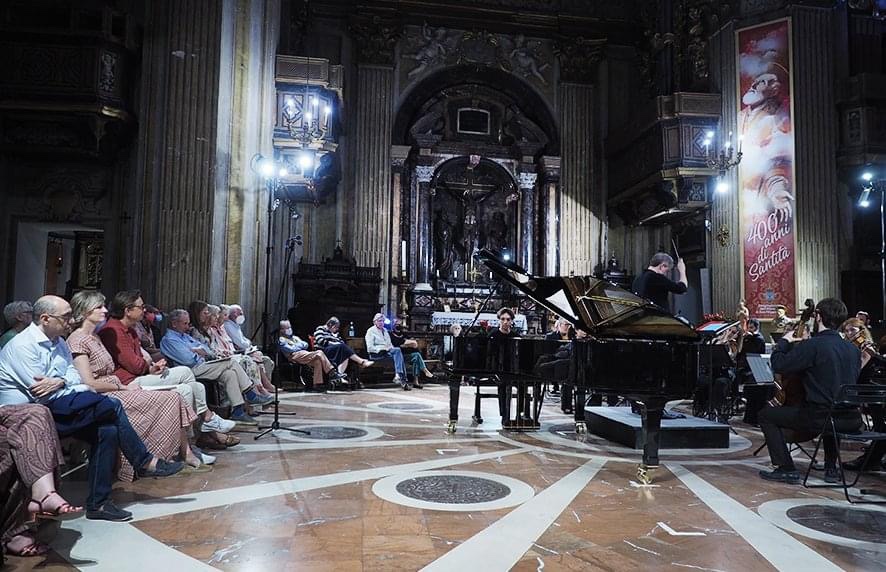
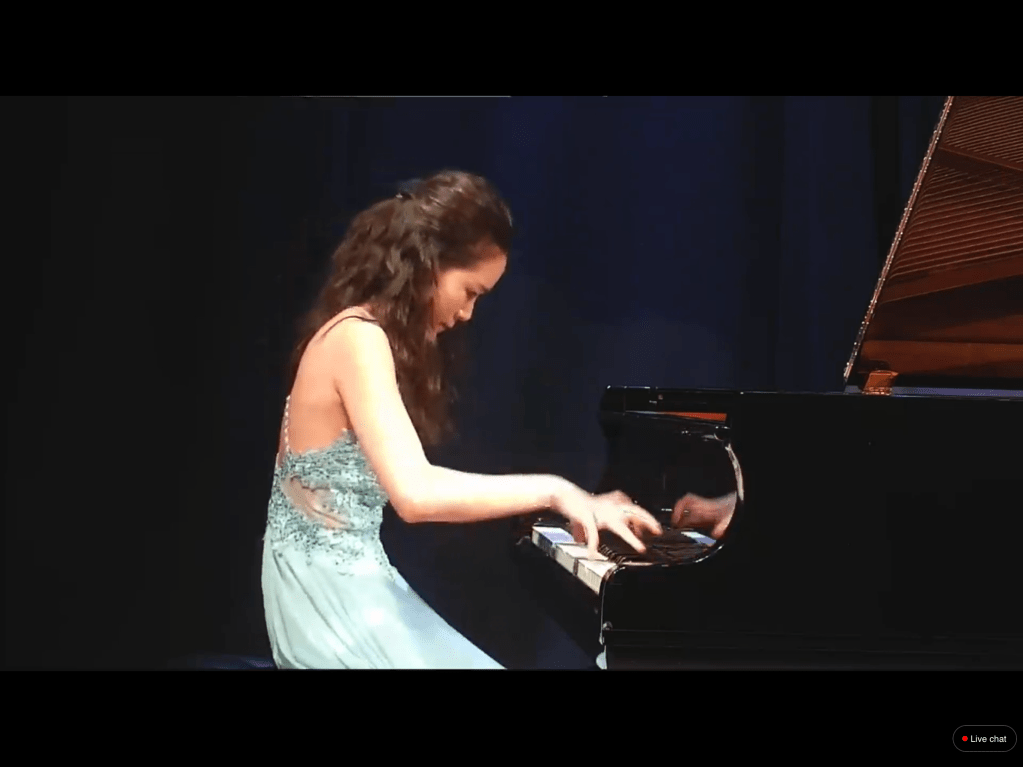
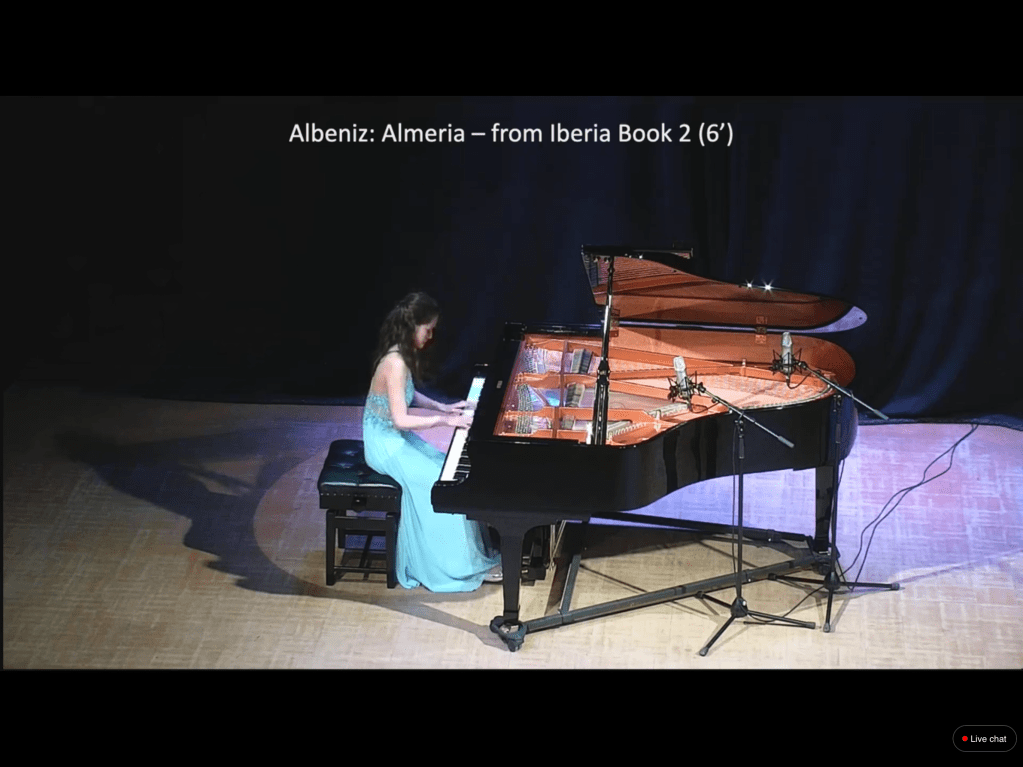
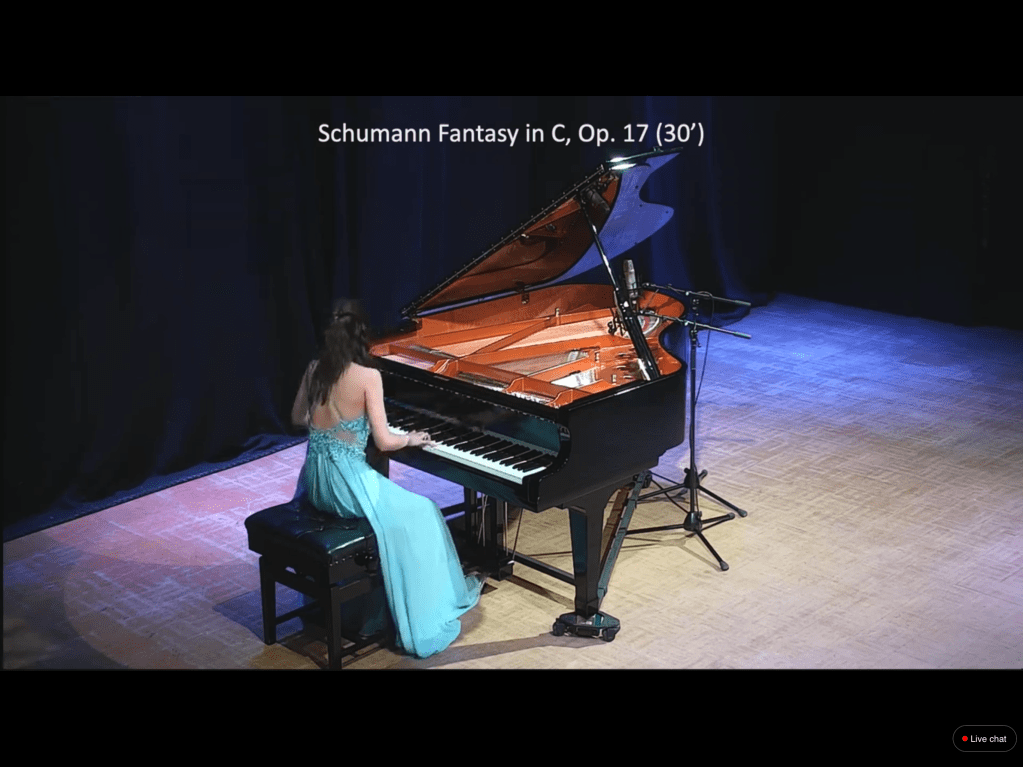
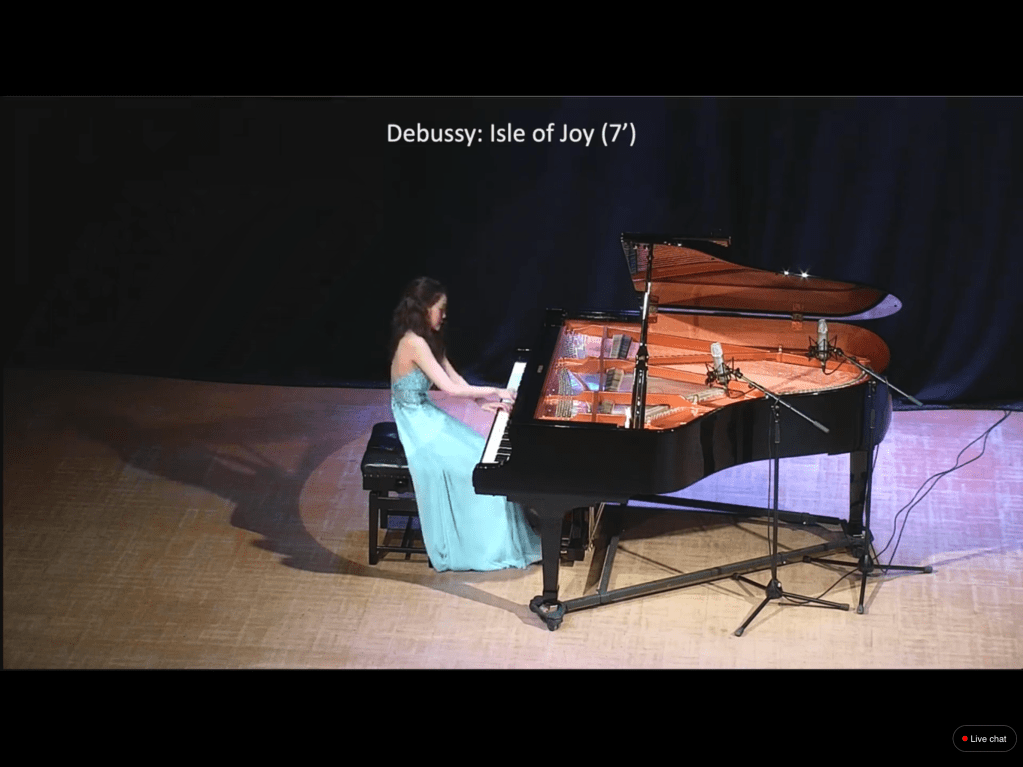
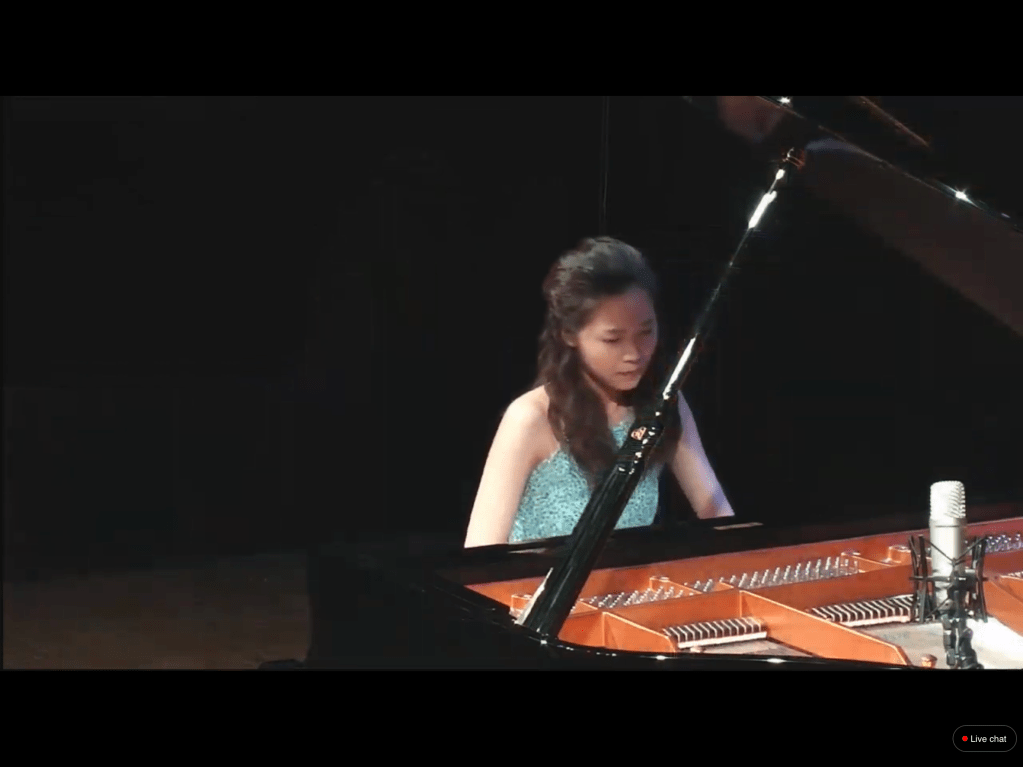
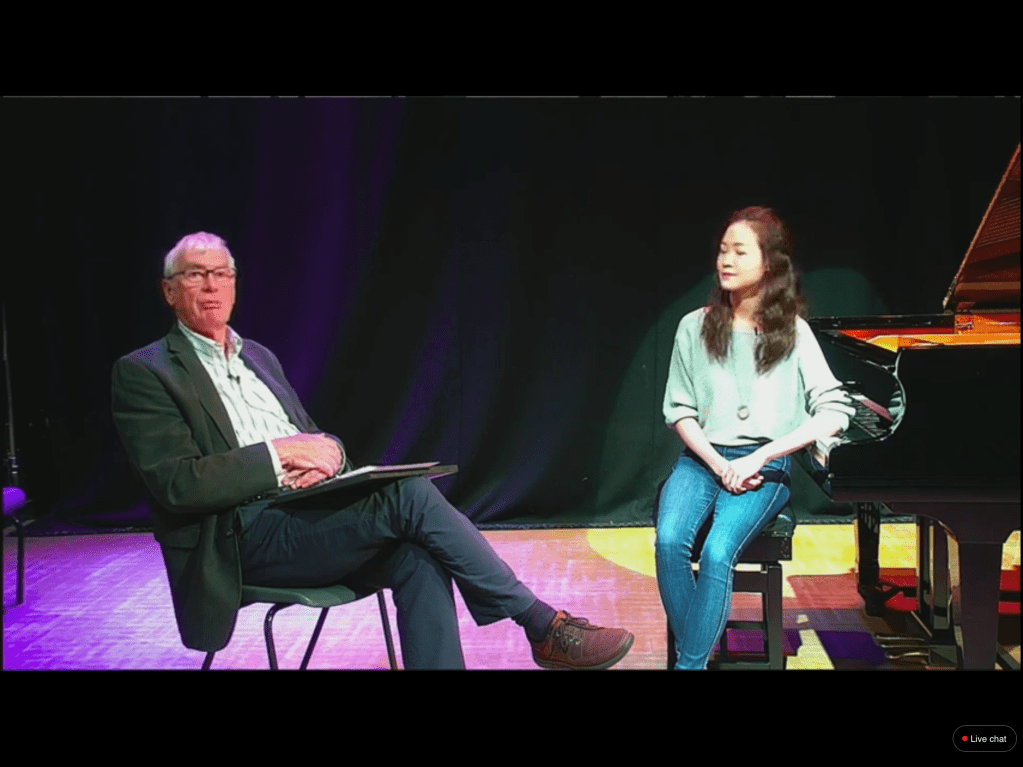
A recital of Schumann and Chopin of such refined perfection and aristocratic simplicity where the music just flowed from her fingers with a control and sense of colour that was of ‘sublime perfection’. There was passion and technical brilliance too when needed but an overall line and subtle sense of colour that belied any personal rhetoric or showmanship. Here was someone listening so intently to the sounds she was making and was able to control her performances with a musicianship and sense of style that was unique. Kinderszenen by Schumann were exactly that – ‘scenes of childhood’ where each piece was a miniature tone poem of a magic world that Schumann depicts with such poetry and character. ‘In slumberland’-Kind im Einschlummern- was so beautiful because she noted all the minute detail that Schumann had indicated and the simplicity with which the final pungent harmonies were allowed to almost play themselves was indeed sublime. Leading to the final ‘Poet speaks’- who could not have been touched here by Alfred Cortot’s magic performance of such depth and poignancy. https://youtube.com/watch?v=rNUNNNNj_Qw&feature=share Chloe arrived at the same heights but with the simplicity of a child rather than the reminiscence of an adult.Her extraordinary attention to detail had me searching the score as I have only done in the past with Murray Perahia’s performances of poetry,intellectual refinement and transcendental command. A Pandora’s box full of sparkling radiant jewels. To watch Chloe you would not think it possible to produce such sounds for the rounded precision of her fingers do not have the same beauty as those of Volodos. Even her body movements show no sign of the great landscapes she is depicting. But obviously she has a total concentration looking at the keys with dagger like glances and shaping from within every note with jewel like perfection . ‘Wichtige Begebenheit’ – great event -I have never heard played with such authority with the fortissimo central section contrasting with the outer contours and a ‘Traumerei’ that was of such subtle colouring even the final lead up to the chord in the last bars was played with unusual sensitivity as it was allowed to dissolve so magically to the final farewell. There was a wonderful sense of line in ‘Am Kamin’- by the fireside- where her sense of balance allowed the melody to speak so eloquently without any forcing.’Ritter von Steckenpferd’- on the rocking horse – was played at a sedate pace instead of the usual reckless rocking.Rock and roll indeed . Schumann’s subtle phrasing allowed time to breathe as it built to a grandiose final ride.The syncopated melodic line in ‘Fast zu ernst’- almost too serious -was a lesson in sublime simplicity and sense of control with a balance of ravishing beauty that led to ‘Furchtenmachen’- Hobgoblin-that was enough to scare even the hardiest of souls.’Hasche – Mann’- Blind man’s bluff -was thrown off with an ease and precision that made the contrast with the ‘Bittendes Kind’ – pleading child – even more poignant before the joyous joie de vivre of ‘Gluckes genug’ – Perfect happiness . ‘Vom fremden Landern und Menschen’-A tale of distant lands -that Chloe opened with was played with the same subtle attention to detail and with beauty of sound that held our attention from the very first note. What stories she had to share with us , but even if we had heard the same tale many many times before today there was a story teller who could share her fantasy and surprise as she described each scene as if for the very first time. Schnabel had famously said,referring to Mozart,that it is music too difficult for adults but too easy for children .Chloe has shown us today what simplicity can really mean when allied to an artist who listens with a palette of colours ready to capture our imagination. The second work by Schumann in this recital streamed live from Poland was the Davidsbundlertanze op 6. Listening to the performance today I was once again convinced that this is the greatest of all Schumann’s works. The heights of beauty that he reaches in the 14th dance are quite overwhelming as is the fantasy world he creates in the 17th – so similar to the magic world of Ravel in the last of his ‘Valses nobles’ where they both look back with nostalgia and sense of fantasy that is of pure genius for the atmosphere that is evoked. And Schumann goes even further with the deep nostalgia of the final little valse de l’adieu and as the composers himself adds “Quite superfluously Eusebius remarked as follows: but all the time great bliss spoke from his eyes.” It is a very complex work to hold together as a whole and needs an undercurrent to flow without interruption from the first to the last note – a long journey admiring the view but without too much lingering or stopping. Gieseking has always been a model for me and only equalled on record by the sublime colours that Geza Anda could add. I once suggested to Fou Ts’ong that he might like to play them at his annual visit to my concert series in Rome.He learnt them especially and even recorded them but like André Tchaikowsky he loved them so much he could not resist adding an over personal touch to something that is already Schumann’s own fantasy world.Smothered by by love indeed.That is the problem on how to define the true balance between the architectural line in which the details must be allowed to sparkle and shine too. Murray Perahia played them like the great poet he is and he had the jury members of the Leeds Competition famously in tears. Chloe came close today with her ravishing sense of colour and refined sense of line. The great Balladenmassig with which the second book opens was played with all the passion and sumptuous sound of the grandest of Brahms and was a complete contrast to the fleeting lightness and melodic insinuations of the opening Lebhaft.The beseeching quality of the second dance ‘ inning’ was played with a sense of line that was truly golden and contrasted so well with the rhythmic high jinks of the third ‘Mit Humor’The beauty of the coda gave us a foretaste of what she would treat us to in the sumptuous 15th dance later. What passion there was in the 4th ‘ungeduldig’ with its almost too serious ending before the capricious meanderings of the 5th.Chloe’s technical prowess allowed her to follow Schumann’s syncopated phrasing in a dance of frenzied activity.The sheer beauty of the 7th was played with a sense of balance that allowed Schumann’s intimate musings space to expand as his heart truly opened. The infectious dance of the 8th and 9th added great impetus to the final two pieces in this first book.What fun Chloe had in the 12th dance and what glorious Brahmsian sonorities she found in th 13th.The beautiful tenor melody allowed to float on a continuous moving background before the fleeting coda as Schumann asks getting faster and faster as it blows itself out before the greatest of all dances with Schumann’s sublime song Zart und singend. A remarkable performance of a work that Rubinstein would not play in public because of its quiet ending that according to him was wrong for the end of the first half of a programme that the great pianist would always orchestrate in crescendo.Or the triumphant ending of the final work of a recital ! I can only imagine that he would have brought the same sublime simplicity and beauty of sound to this masterpiece that Chloe did today. Blessed by the spirits indeed and the only encore possible was the melody from Gluck’s Orfeo ed Euridice in the arrangement by Sgambati played like a celestial angel indeed. Two works by Chopin completed the programme. The Fantasie in F minor was played with aristocratic nobility of subtle beauty and free of the rhetoric that this work is so often treated to by lesser hands. The extraordinary Nocturne in C sharp minor op 27 n.1 ,sister to the famous D flat nocturne op 27 n.2,was played with an almost Debussian sound that made one realise what a visionary genius Chopin was and had he lived as long as Franz Liszt what direction the piano might have taken. We will of course never know but let us just be grateful for what he was able to leave us in his all too short journey on earth. https://christopheraxworthymusiccommentary.com/2021/08/31/the-sublime-perfection-of-chloe-jiyeong-mun-in-warsaw/ https://christopheraxworthymusiccommentary.com/2021/03/08/chloe-mun-in-budapest/https://christopheraxworthymusiccommentary.wordpress.com/2019/10/30/the-rising-star-of-chloe-jiyeong-mun/
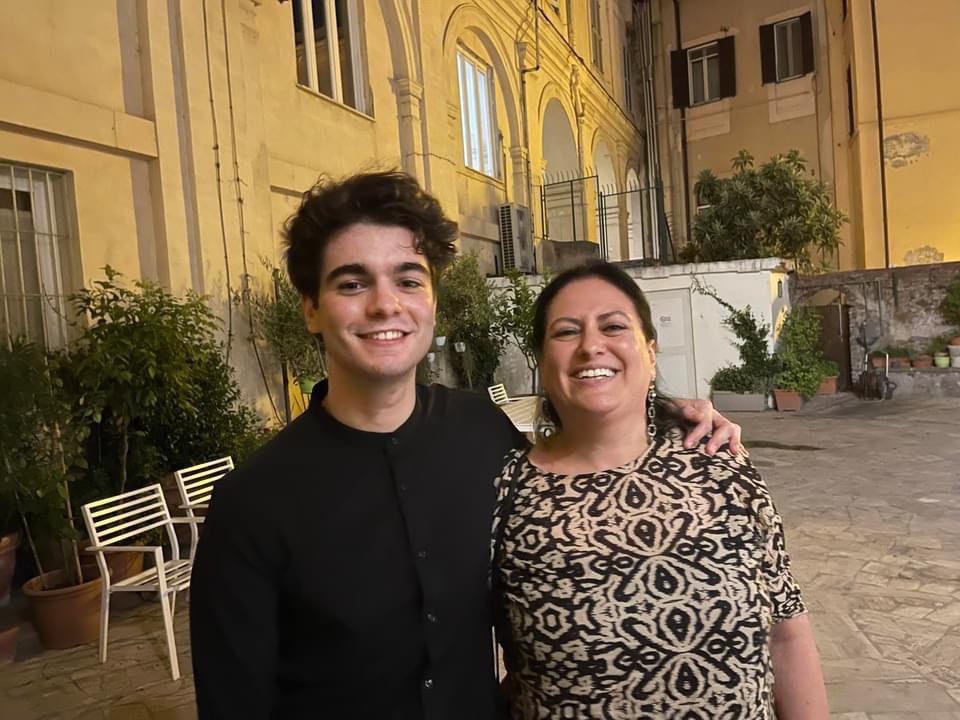
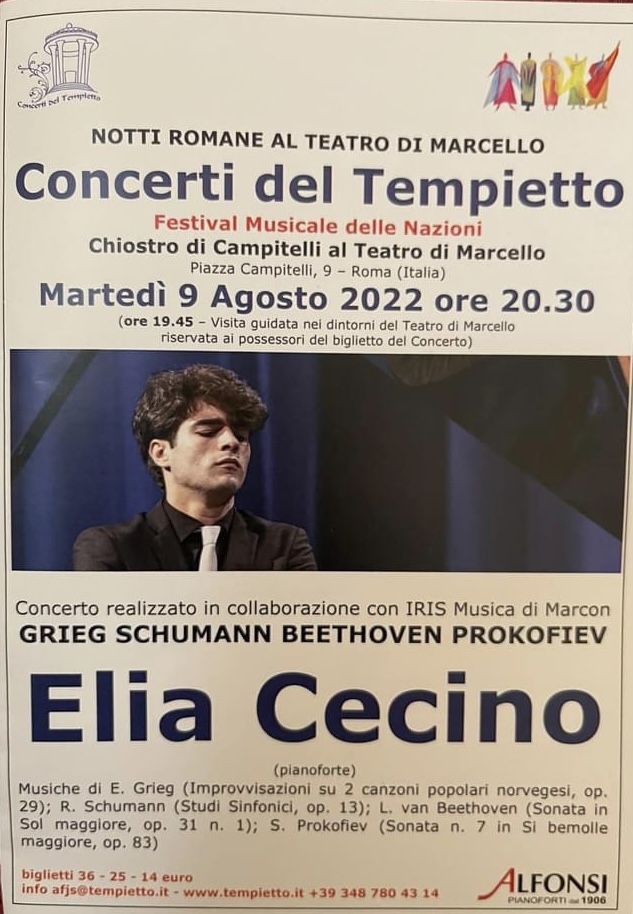
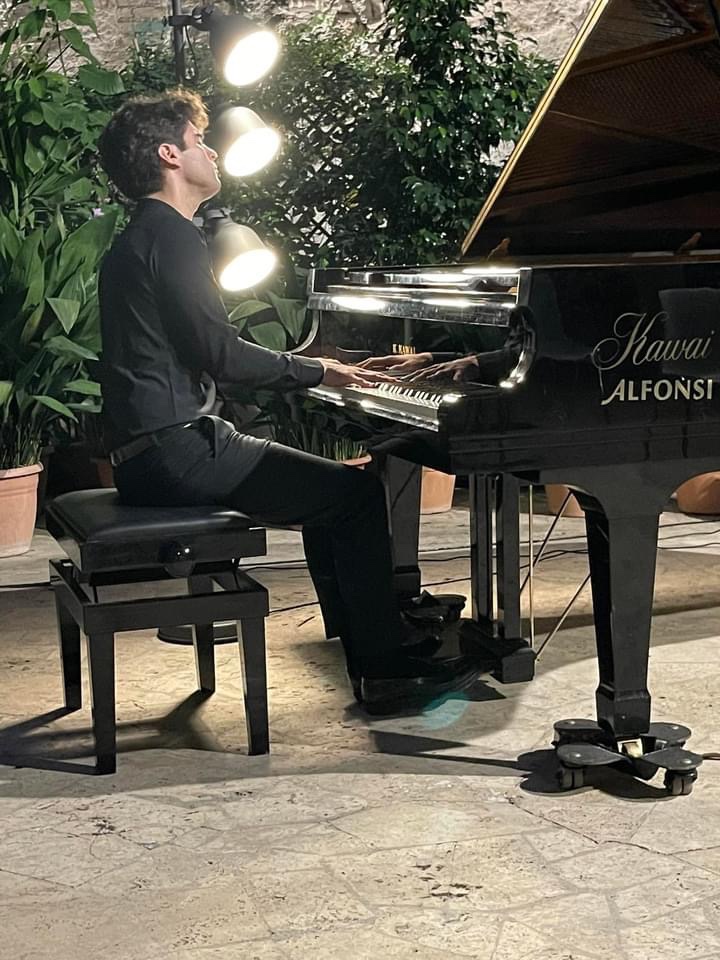
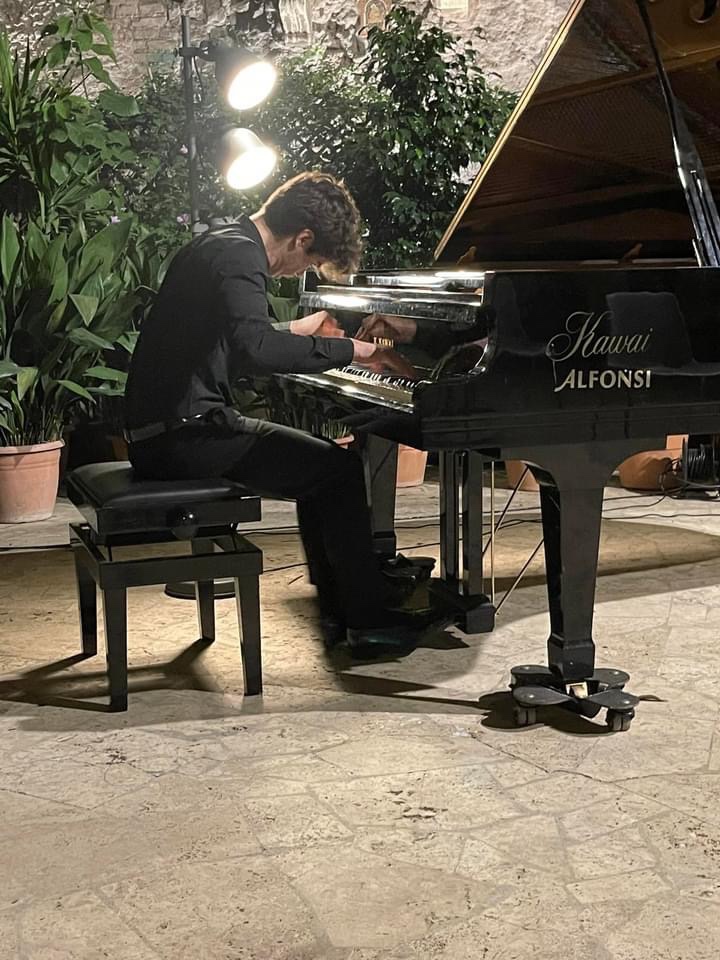
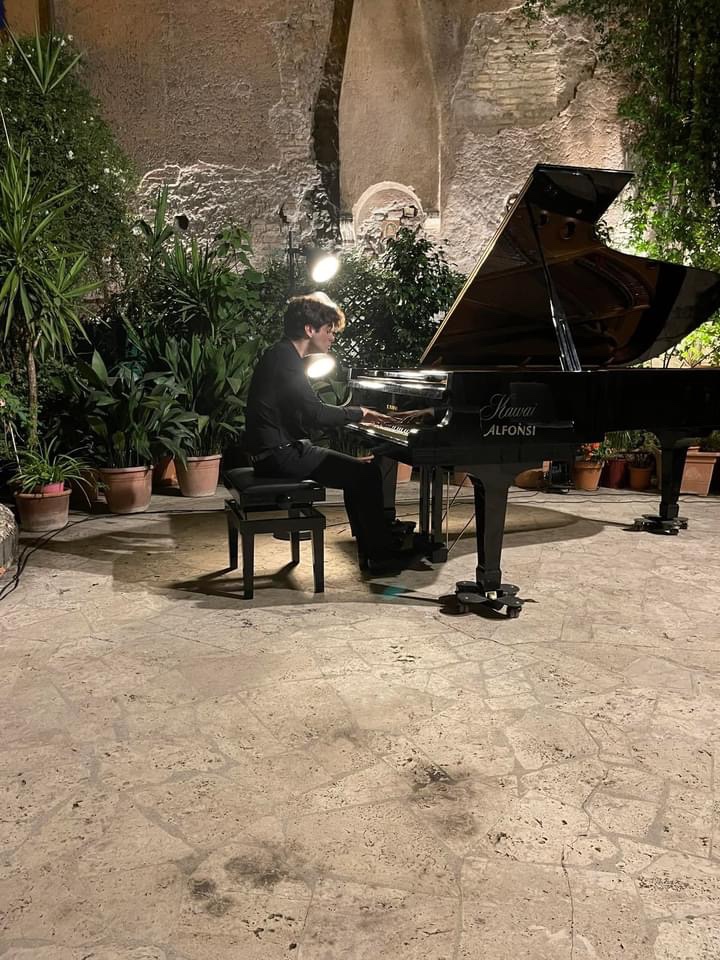
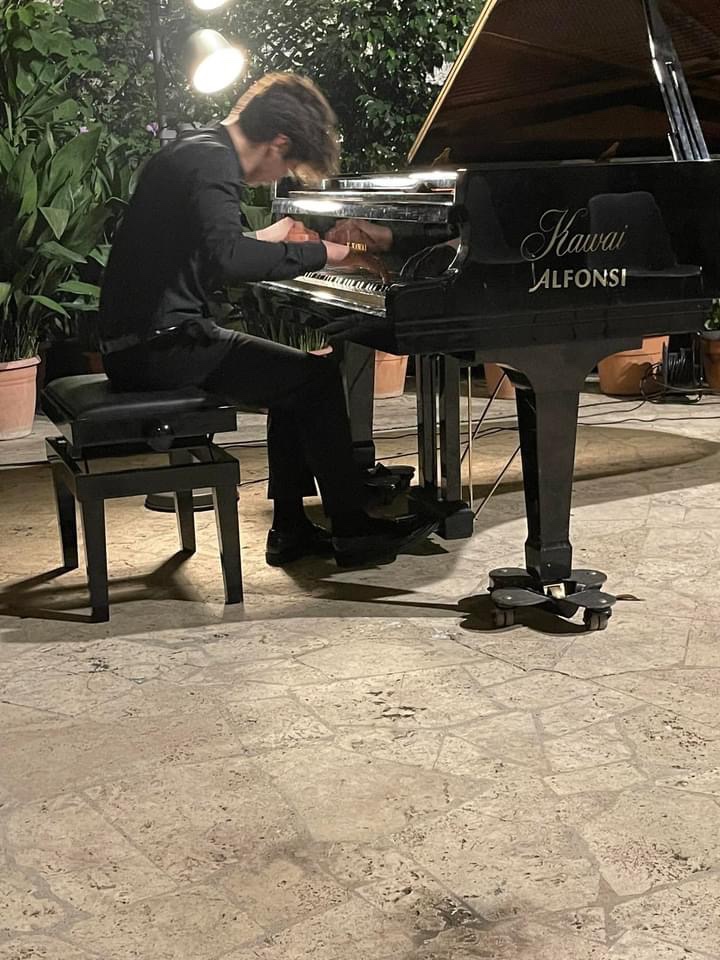
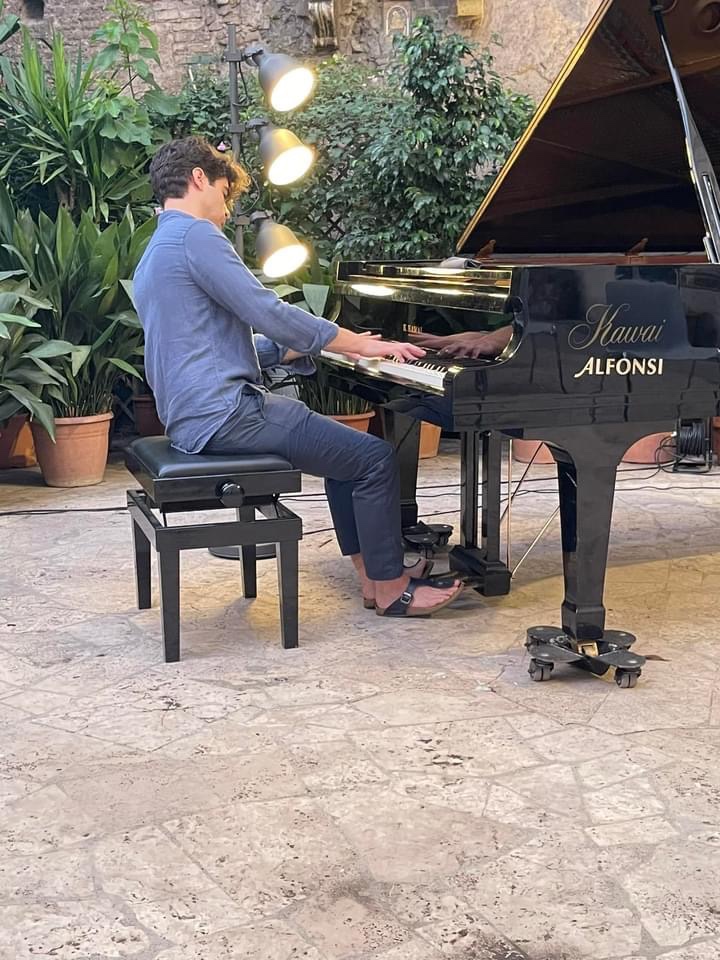
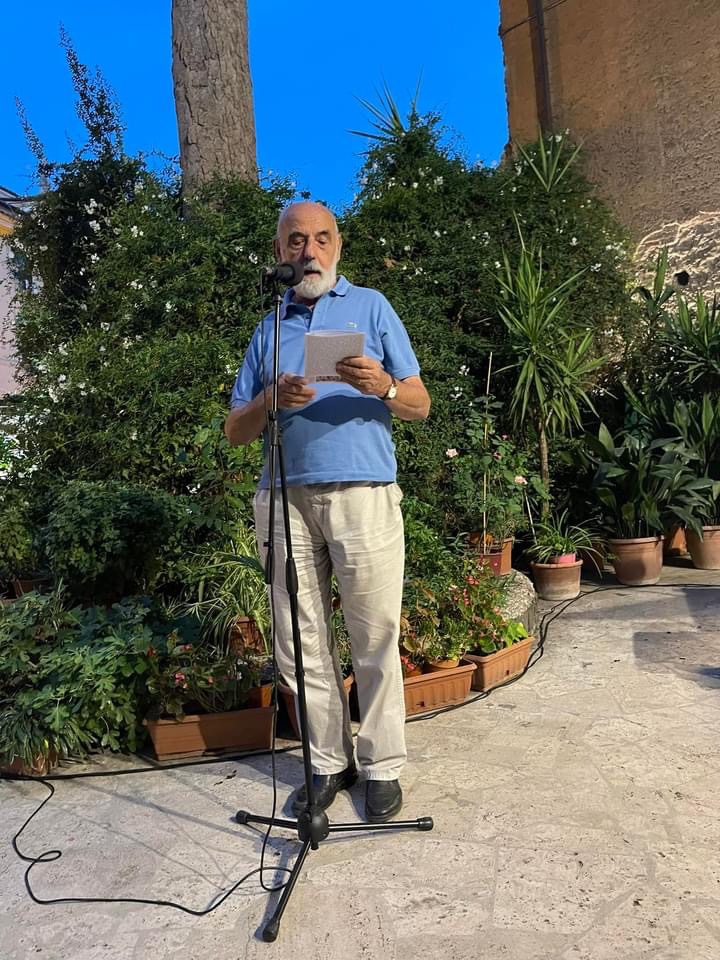
Refined musicianship and authority were the hallmark of a remarkable recital by Elia Cecino in the Tempietto courtyard in the centre of Rome.Three masterworks played with an architectural sense of line and total mastery that belied his 22 years.His annual recital has been a highlight of the Music Festival of the Nations since his first appearance here at the age of thirteen.Winner of many accolades the latest of which in New Orleans where he won first prize that leads to many appearances with major American orchestras .
Maddalena de Facci founder of Iris Musica di Marcon
On his way now to Bergen with his remarkable teacher Maddalena de Facci by his side to guide his talent as he reaches for the heights.We were treated to some little known pieces by Grieg in preparation for the International Competition held in Bergen where Grieg wrote much of his music.Hardly surprising that Elia should have offered Liszt’s Chasse Neige as a final encore to remind us of a completely different climate from the one we were enjoying today!
In the balmy air of the open air courtyard with this unique backdrop of the Eternal city Elia allowed all the passion and colours of Liszt’s remarkable tone poem to overwhelm us after a recital that was a tour de force of intellectual and technical bravura.
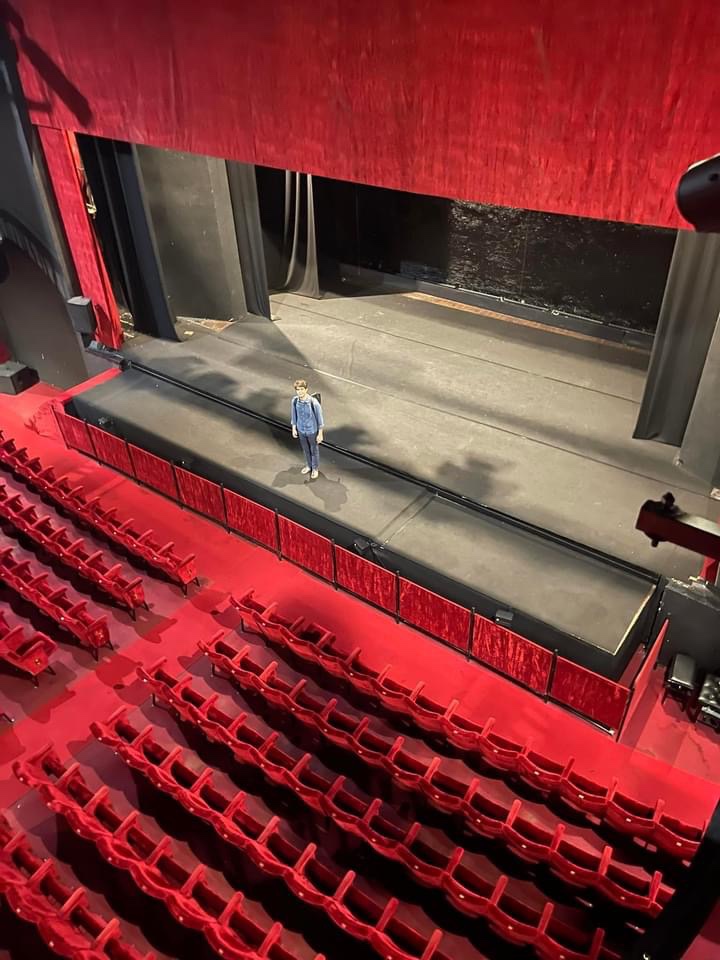
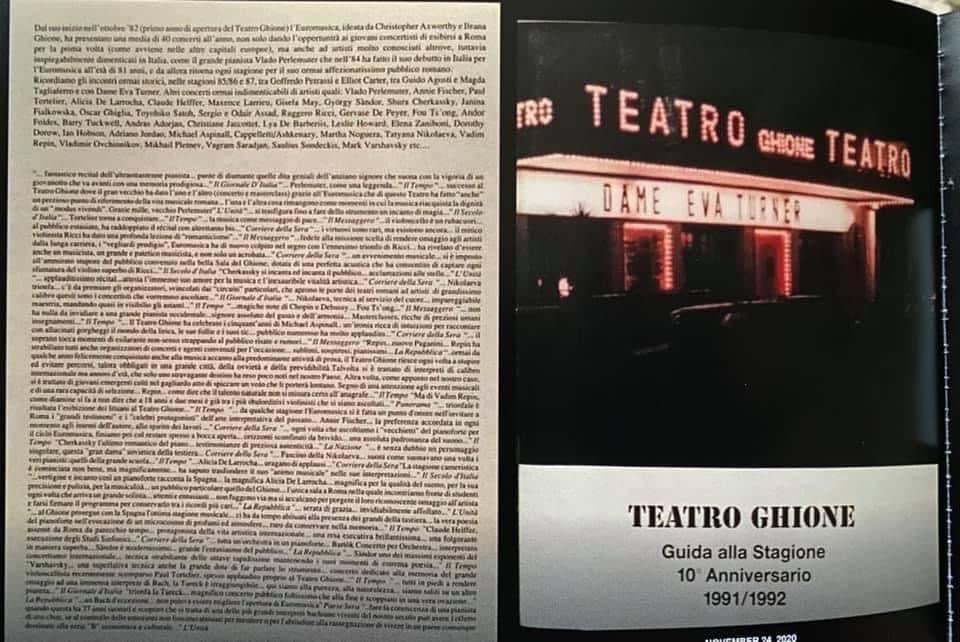
Elia checking out his place at the Ghione Theatre in Rome on the 16th September.He joins an illustrious list of past performers that have included Perlemuter,Cherkassky,Tureck,Fischer,Agosti,Sandor,Fou Ts’ong,Lazar and Boris Berman,Moura Lympany,Alicia de Larrocha,Peter Frankl.Angela Hewitt,Janina Fialkowska etc.
His performance of Tchaikovsky’s First Piano Concerto at the Ghione Theatre will be his next appearance in the Eternal City on the 16th September following on from the Grieg Concerto in Bergen that is sure to crown yet another triumph for this young virtuoso
Two beautiful rarely heard miniatures by Grieg opened the programme.Improvisations on Norwegian Folk Songs op 29 .The first an Allegretto con moto with the title ‘The lad and the lass in the Cow-shed loft!’with a grandiose opening followed by a dance of frantic rhythmic passion.It contrasted so well with the second:Andante ‘This was once a King’ with playing of ravishing beauty and a sumptuous sense of balance.It was beautifully shaped and played with great weight and real depth of sound.It contrasted so well with the scintillating dance of the middle section before the beauty of the final closing bars.They were played with the same simplicity and love for his homeland that characterises all that Grieg wrote.I have heard Elia’s interpretation of Beethoven and Prokofiev as you can see from the articles below but this is the first time I have heard his Schumann Symphonic Studies op 13.Excluding the five posthumous studies often included in performances,where they are inserted between the 11 published variations.Elia played the original op 13 with a sense of rhythmic drive and architectural shape that gave great weight and significance to this often fragmented work.From the weight of the opening the theme “the composition of an amateur”: this referred to the origin of the theme, which had been sent to Schumann by Baron von Fricken, guardian of Ernestine von Fricken, the Estrella of his Carnaval Op. 9. The baron, an amateur musician, had used the melody in a Theme with Variations for flute. Schumann had been engaged to Ernestine in 1834, only to break abruptly with her the year after. Of the sixteen variations Schumann composed on Fricken’s theme, only eleven were published by him.The final, twelfth, published étude was a variation on the theme from the Romance Du stolzes England freue dich (Proud England, rejoice!), from Marschner’s opera ‘Der Templer und die Judin’, which was based on Sir Walter Scott’s Ivanhoe.It was incorporated as a tribute to Schumann’s English friend, William Sterndale Bennett to whom the work is dedicated.The essential character of Op. 13 was of ‘studies’ in the sense that the term had assumed in Chopin’s set op 10 .That of concert pieces through which the investigation of possibilities of technique and timbre become ‘symphonic études’ through the wealth and complexity of the colours evoked The keyboard becomes an “orchestra” capable of blending, contrasting or superimposing different timbres.It was not only Elia’s mastery of the technical hurdles, but above all the underlying rhythmic current and sense of line that gave his performance a sense of architectural shape and of mounting excitement from the simplicity of the theme to the final triumphant outpouring of the final pages.There was a clarity in the first variation and a rhythmic drive and forward propulsion to the second.Contrasting with the beauty of the tenor melodic line accompanied by lightweight fluttering of butterfly proportions.There was a monumental eighth variation that Agosti likened to the structure of a Gothic cathedral.It was followed by the breathtaking Mendelssohnian virtuosity of the ninth.What energy and passion he gave to the tenth only to dissolve into the Chopinesque beauty of the eleventh .The energy and rhythmic power of the finale was breathtaking in its sweep and orchestral sound.It was refreshing to hear again Elia’s performance of Beethoven’s Sonata op 31 n.1 .It was also a surprise for us all including Elia who had been expecting to play Scriabin’s 3rd Sonata.Seeing the printed programme mistakenly with Beethoven instead of Scriabin with great professionalism he was able to make an immediate change at the last minute!A performance of great clarity and freshness where Beethoven’s impish sense of humour was given full reign .With the syncopations of the first movement where Beethoven has the last laugh before the ravishing beauty of the bel canto slow movement with its legato melody and non legato accompaniment and the pastoral mellifluous beauty of the last movement only to be reminded of Beethoven’s little joke at the end!Prokofiev’s 7th Sonata was not only played with scintillating virtuosity but with a driving rhythmic force allied to a sense of colour that was truly orchestral.Not having been able to rehearse before the concert he was now able to let rip and throw himself into the fray with a breathtakingly fearless performance of the ‘Precipitato’ last movement.You will find a more detailed account in the articles below from a previous performance .
Elia in prova a few minutes before the concert just trying out a new encore of the ‘Assai Allegro Furioso’ by Grieg.All pointed fingers and rhythmic fervour for a rarely performed piece (the last of a collection of 23 short piano pieces )that he will play later this month in Bergen in view of the house where it was written.
Angelo Filippo Jannoni Sebastianini for many years the ‘deus ex machina’ of the Concerti del Tempietto inspired in the 80’s by the example of the Ghione Theatre Classical music, opera arias and music played in the magical charm of Rome by night and in an exceptional setting: as part of the Festival Musicale delle Nazioni, the historic Summer Roman music festival, Concerti del Tempietto.. Among the remains of the Temple of Apollo Sosianus, in the cloister adjacent to the church of Santa Maria in Portico in Campitelli, for three months young musicians are on stage every evening. Each concert is preceded by a guided tour in the archaeological park around the Theater of Marcellus, the monumental theater dedicated in the name of Augustus’s favorite nephew.Twenty centuries ago the area was in fact a space dedicated to performances and sacred rites, and the theater itself was used for public performances for over four centuries.
A celebration on the 13th September in London for the launch of the book ‘The Gift of Music’ written by the founder of the Keyboard Trust ,John Leech in it’s 30th Anniversary year.Elia is a member of the select group of young musicians of the Keyboard Trust.It will be presented by the Honorary Patron Sir Antonio Pappano at the National Liberal Club in a special gala to celebrate the founders of the KCT now in their ninetieth year
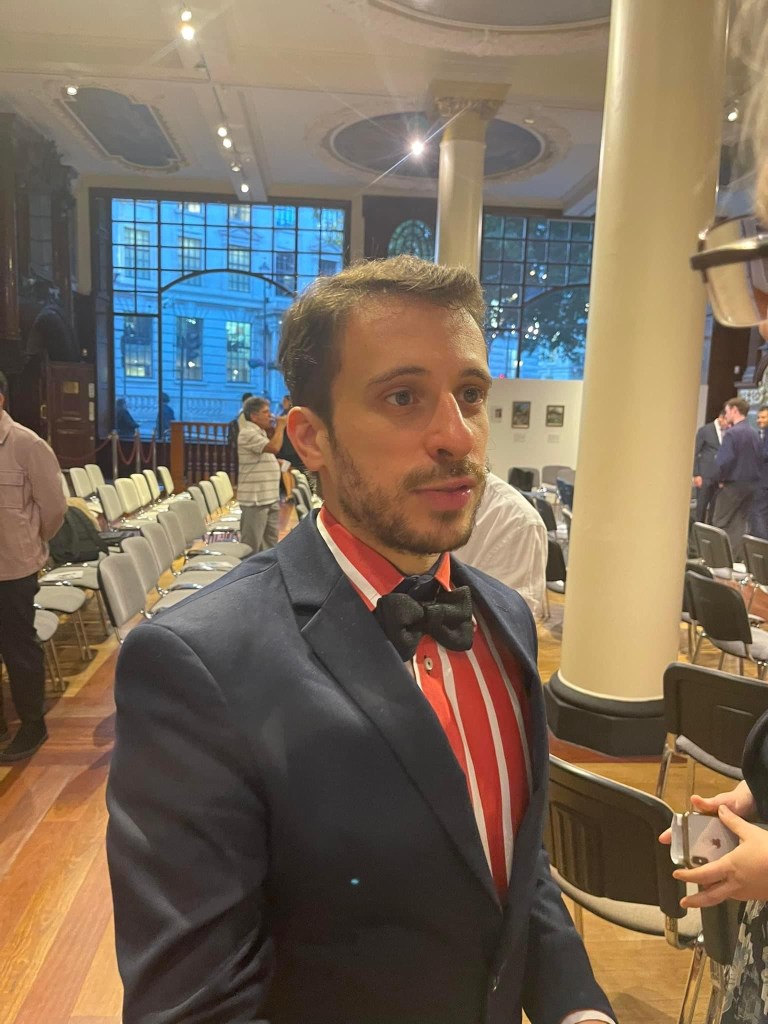
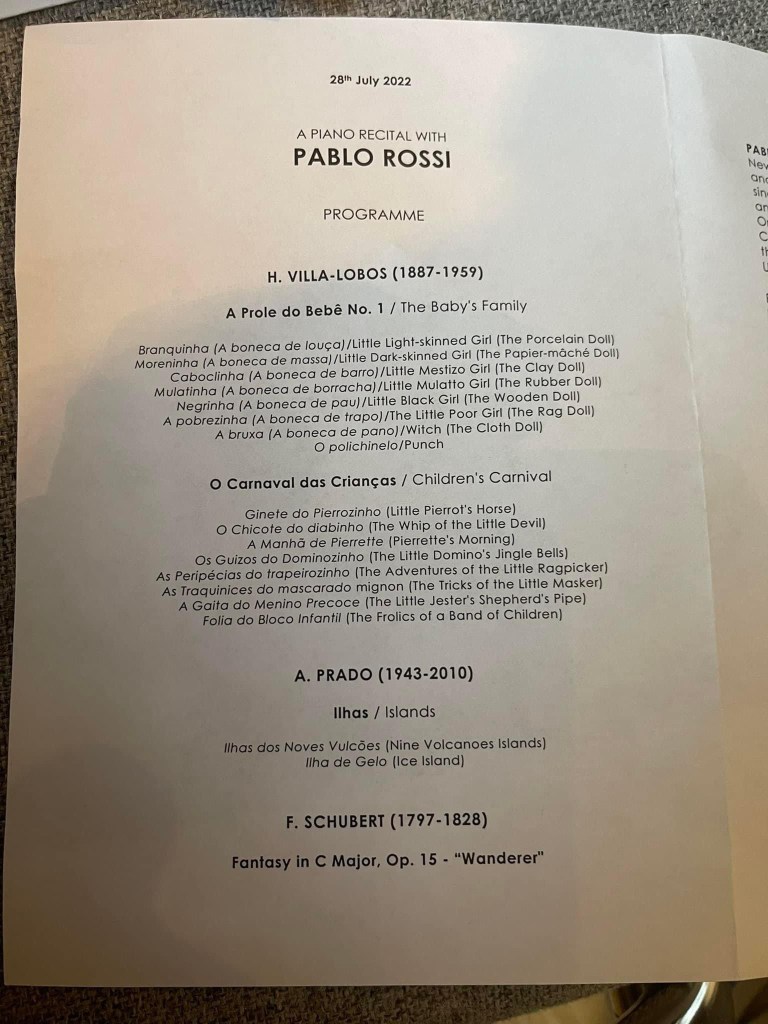
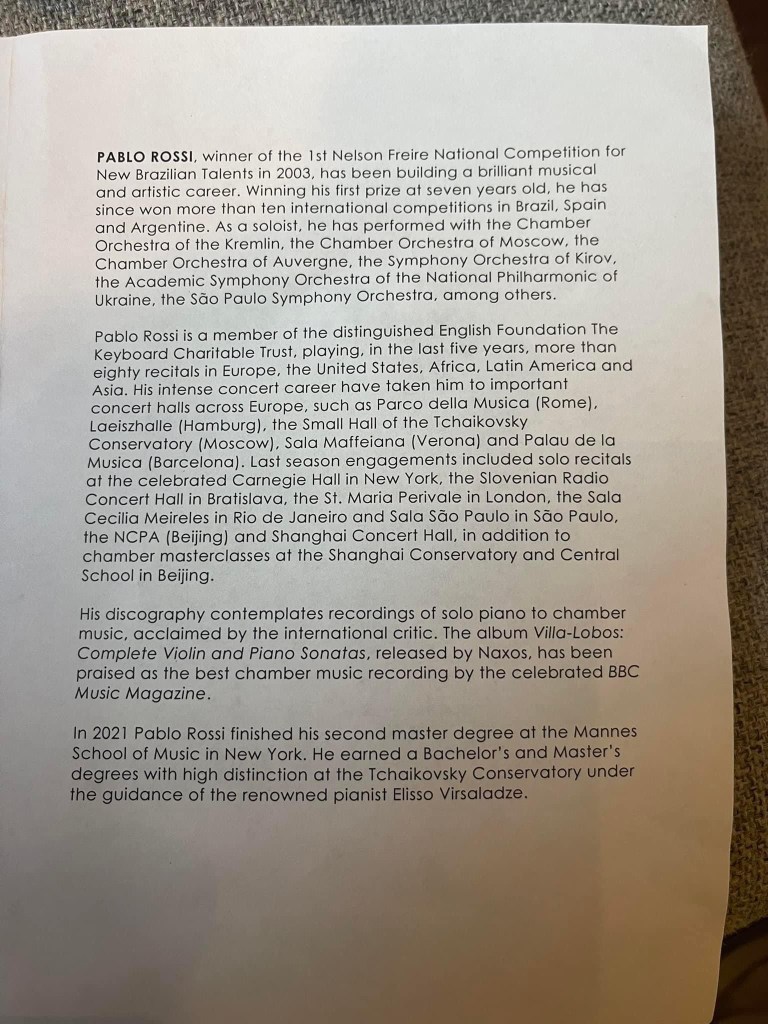
Brazil 200 celebrations with Pablo Rossi in London. A star is truly born with playing of supreme artistry and authority with the same charm and style of Rubinstein for whom Villa Lobos wrote many of his works .Joan Chisell remarked in a review in the 70’s:’Mr Rubinstein turned baubles into gems.’ Pablo did more than that today as he convinced us of the wondrous colours and aristocratic simplicity of Villa Lobos’s two Children’s Suites. The performance of Schubert’s Wanderer Fantasy that followed was breathtaking in its overwhelming sweep .It kept us on the edge of our seats seduced and ravished like a relentless tornado as it took us all by storm.
With the same musicianship from his years of study with Elisso Virsaladze he restored this work to the pinnacle where it belongs.Beethovenian in scope but unmistakably Schubertian in content the contrast he brought to the complex character of this early work must have been the same spark that had so inspired Liszt. Winner some years ago of the first Nelson Freire competition he will give a concert to celebrate this much loved pianist in the hallowed surroundings at the piano festival in France at La Roque d’Antheron on the 7th August.
What better tribute could there be from a pianist who has inherited the mantle from a true master and become he too an advocate of the music of his native Brazil.A mantle that had been inherited from Artur Rubinstein who strangely enough Pablo has always physically resembled .
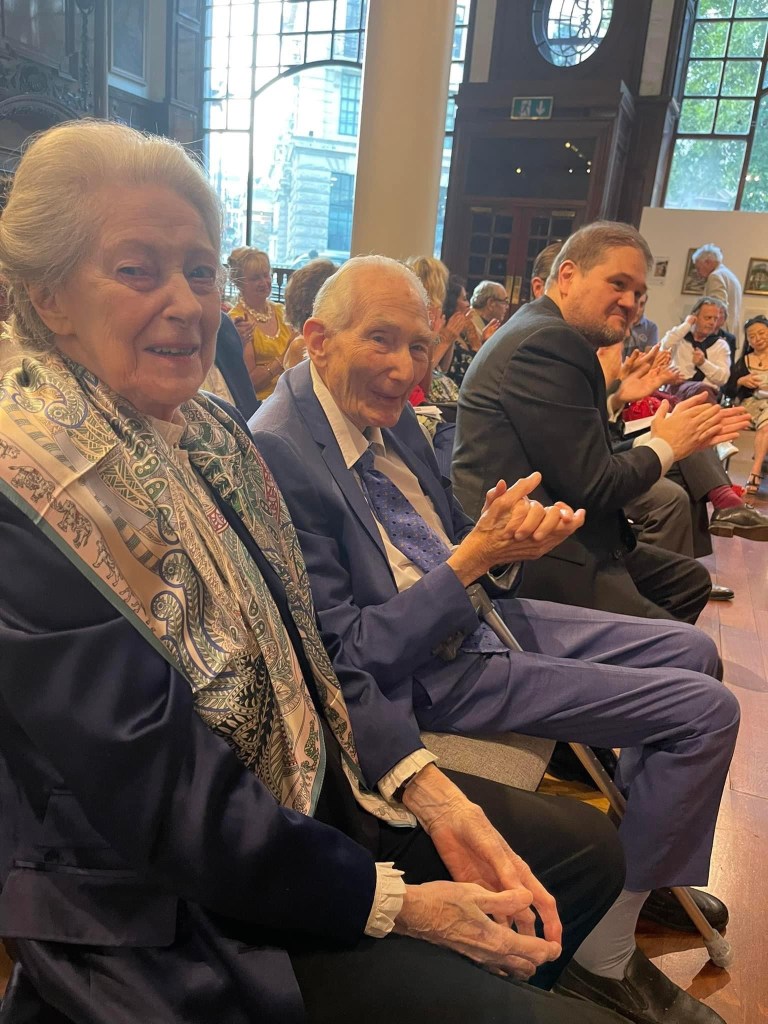
Noretta Conci and John Leech founders of the Keyboard Trust who have befriended and helped Pablo since the age of sixteen
Now this young man in his early thirties who was brought to prominence at only sixteen by Noretta and John Leech of the Keyboard Trust has come of age and has inherited his rightful place as heir to this great tradition. Ready to conquer the hearts and admiration of a world that awaits the rarity of a great artist able to move and entertain an adoring public following in the footsteps of the greatest of them all : Franz Liszt
The renowned critic Bryce Morrison a great admirer of the music of Villa Lobos which he also promoted in his early pianistic career in America.Clearly ravished by the beauty of Pablos playing together with Sarah Biggs,General manager of the KCT .
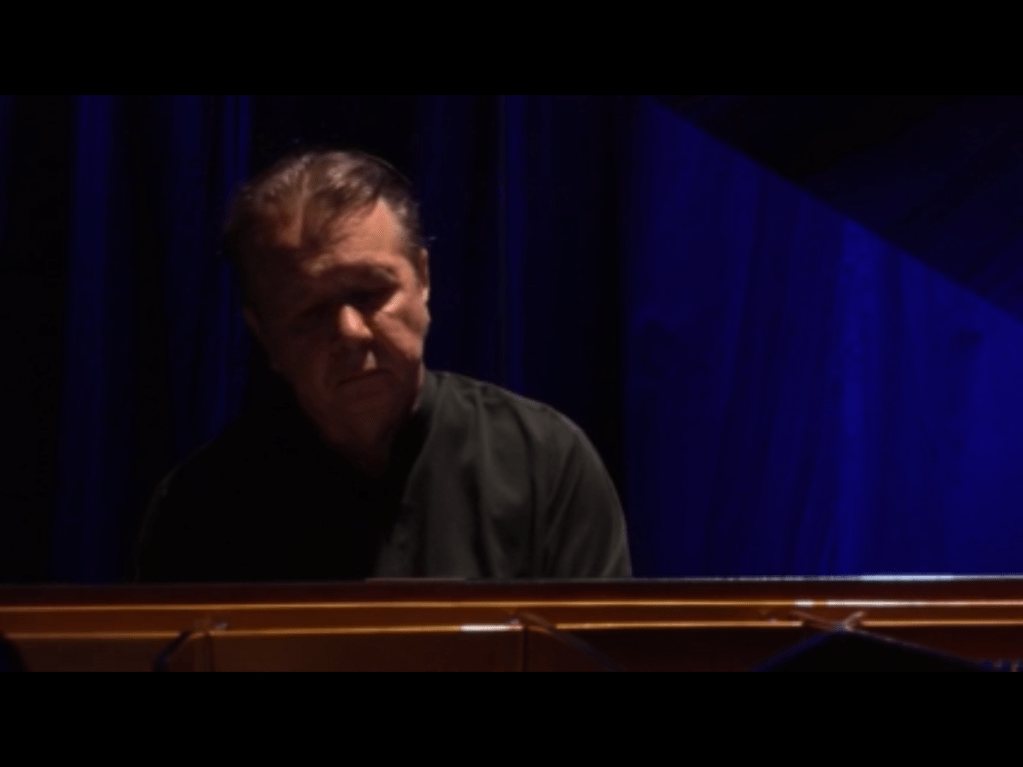
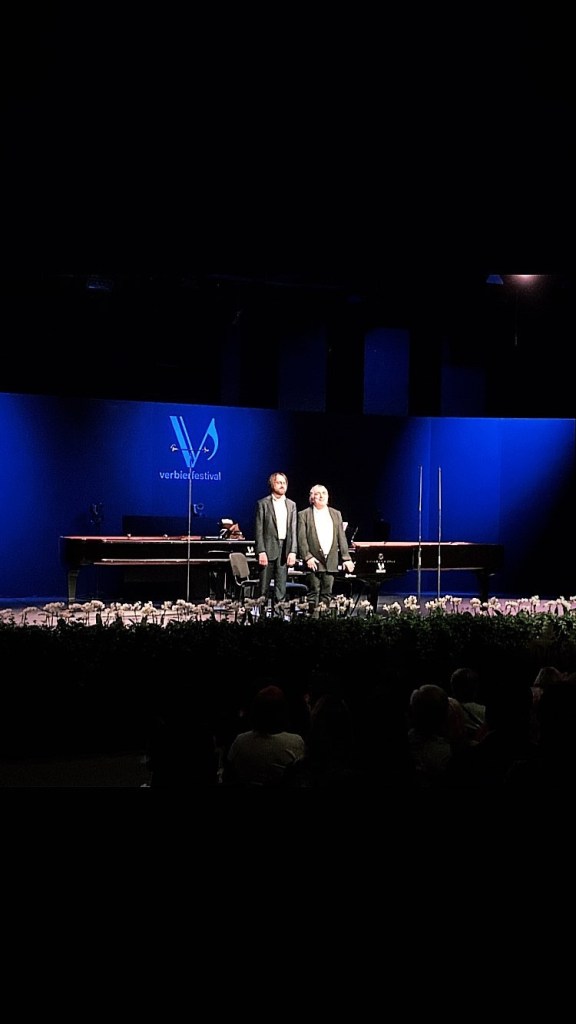
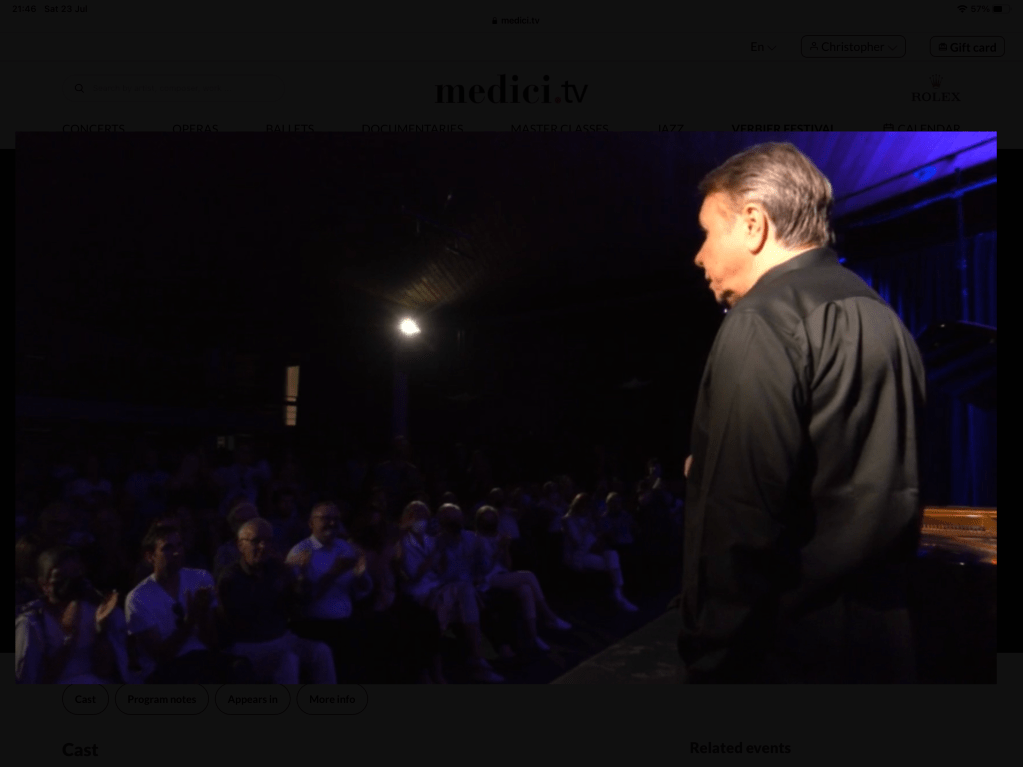
Food for thought indeed from Pletnev,this elusive pianist,and the discussions between Elisso’s class after the concert were fascinating as they were bewildering.Thanks to the extraordinary humanity and unique musicianship of Elisso all was quite clear once back in her studio in Fiesole where intensive study and hard work left no room for doubt or discussion.Music is the star and the wishes of the composer are paramount …..https://christopheraxworthymusiccommentary.com/2022/07/25/mikhail-pletnev-in-verbier-fakefool-or-genius/
After his initial debut in London at the age of sixteen for the Keyboard Trust and a few months later at the Ghione Theatre in Rome Pablo went to Moscow on the advice of Noretta Conci to study with Elisso Virsaladze.A very close and trusting relationship was born over many years of intensive study as he added to his already extraordinary natural talent the unique guidance and training of a pianist much admired by Sviatoslav Richter.Graduating from the Moscow Conservatory with the highest accolades he proceeded to perfect his understanding and musical training at the Mannes School of Music with Jerome Rose in New York receiving his second masters degree in 2021
A wonderful arch of the hand and natural flexibility hovering over the keys allowing the music to flow directly out of him like a great painter before his canvas
Now in 2022 the transformation from an extraordinarily talented young pianist into an artist of great stature took me completely by surprise.The assurance and authority not only in the music of his compatriot Villa Lobos and Prado ,but also the maturity and breathtaking sweep of his Schubert left me and all those present amazed.Still the young man of aristocratic bearing and irresistible charm ,even the same rather eccentric footwear,but there was above all the music and sense of communication that are of a born few.Pablo had the same charming asides that Rubinstein used to regale us with on his annual visits to London after a sumptuous feast of music played with an ease and simplicity that inspired generations of pianists.
Having finished the concert and receiving an ovation from a public overwhelmed by the audacity and beauty of his Schubert ….he thanked his friends at the Brazilian Embassy for inviting him to London but what more did they want ….his contract he had completed ?!………..
Roberto Doring Pinho da Silva and Joao Marcos Paes Leme ,Minister Councellors both admirers and mentors of Pablo
After much insistence …….Chopin was heard to be requested from the audience and it was Chopin that we got.But what Chopin! The most famous of all nocturnes op 9 n.2 in E flat played with such subtle colouring and the rubato of a great bel canto singer.Sublime simplicity. Thanks should go to the Brazilian Embassy too for inspiring a new series of recordings on the Naxos label for their 200th anniversary celebrations.Pablo has just completed the piano works of Villa Lobos and is obviously a wonderful cultural ambassador for bringing unknown Brazilian music to the fore.
Waiting to pounce with the same natural movements that were so typical of Artur Rubinstein.Even though Rubinstein’s footwear was more elegant in his mature years !
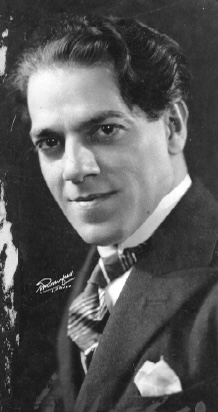
Heitor Villa-Lobos March 5, 1887 – November 17, 1959 was a Brazilian composer,conductor, cellist, and classical guitarist described as “the single most significant creative figure in 20th-century Brazilian art music” and has become the best-known South American composer of all time.A prolific composer, he wrote numerous orchestral,chamber,instrumental and vocal works, totaling over 2000 works by his death in 1959.In about 1918 Villa-Lobos abandoned the use of opus numbers for his compositions as a constraint to his pioneering spirit.
With the piano suite Carnaval das crianças (Children’s carnival) of 1919–20, Villa-Lobos liberated his style altogether from European Romanticism:the suite, in eight movements with the finale written for piano duet, depicts eight characters or scenes from Rio’s Lenten Carnival.In February 1922, a festival of modern art took place in Sao Paolo and Villa-Lobos contributed performances of his own works. The press were unsympathetic and the audience were not appreciative; their mockery was encouraged by Villa-Lobos’s being forced by a foot infection to wear one carpet slipper.(sic!)
Heitor Villa-Lobos, c. 1922 Born March 5, 1887 Died November 17, 1959 (aged 72)
In July 1922, Rubinstein gave the first performance of the piano suite A Prole do Bebê (The Baby’s Family), composed in 1918. There had recently been an attempted military coup on Copacabana Beach,and places of entertainment had been closed for days; the public possibly wanted something less intellectually demanding, and the piece was booed. Villa-Lobos was philosophical about it, and Rubinstein later reminisced that the composer said, “I am still too good for them.” The piece has been called “the first enduring work of Brazilian modernism”.Rubinstein suggested that Villa-Lobos tour abroad, and in 1923 he set out for Paris.His avowed aim was to exhibit his exotic sound world rather than to study. Just before he left he completed his Nonet (for ten players and chorus) which was first performed after his arrival in the French capital in Rubinstein’s hotel room to a select public.He stayed in Paris in 1923–24 and 1927–30, and there he met influential residents where his Parisian concerts of his music made a strong impression.
His meeting with Artur Rubinstein in 1918 prompted Villa-Lobos to compose piano music such as Simples coletânea of 1919—which was possibly influenced by Rubinstein’s playing of Ravel and Scriabin on his South American tours—and Bailado infernal of 1920.The latter piece includes the tempi and expression markings “vertiginoso e frenético”, “infernal” and “mais vivo ainda” (faster still).When touring Europe with his music he said, “I don’t use folklore, I am the folklore” and “I have not come to learn, I have come to show what I have done” showing that he was quite aware of his unique position among classical composers, and he made good use of his origins to publicise his own works.
Serious and affectionate discussions between Noretta Conci and Pablo
Carnaval das crianças of 1919–20 saw Villa-Lobos’s mature style emerge; unconstrained by the use of traditional formulae or any requirement for dramatic tension, the piece at times imitates a mouth organ, children’s dances, a harlequinade , and ends with an impression of the carnival parade. This work was orchestrated in 1929 with new linking passages and a new title, Momoprecoce.
Naïveté and innocence is also heard in the piano suites A Prole do Bebê (The Baby’s Family) of 1918–21.It was exactly this naiveté and innocence that Pablo captured so beguilingly.The childlike simplicity of the melodic line chiselled out so clearly wherever it was to appear but accompanied by magic sounds that seemed to float around the melodic line with streams of gold and silver of subtle colouring.A remarkable sense of balance due to his continual gentle movements allowing him to stroke the keys with such ease that opened a Pandora’s box of kaleidoscopic sounds that sparkled and shone like jewels of voluptuous beauty.
The extended Rudepoema for piano which we had heard in a previous concert in the Brazil 200 series,played by another KCT pianist Sasha Grynyuk.It was written for Rubinstein 1921-26 and is a multi-layered work, often requiring notation on several staves, and is both experimental and demanding and the most impressive result of this formal development.It was written in Rio de Janeiro from 1921 to 1926 and is the largest and most challenging work Villa-Lobos wrote for solo piano. It is in one continuous movement and runs about 19–20 minutes.
John Leech and Alberto Portugheis joining in the discussions
The piece has been described as “Le Sacre du printemps meets the Brazilian jungle”.However, the score’s dedicatee, Artur Rubinstein explained, “The ‘Rude’ of the title did not have the English meaning. In Brazil it meant ‘savage’. When I asked him if he considered me a savage pianist, he said excitedly, ‘We are both savage! We don’t care much for pedantic detail. I compose and you play, off the heart, making the music live, and this is what I hope I expressed in this work'”.It was intended as a tonal portrait of Rubinstein, who premiered the work at the Salle Gaveauin Paris on 24 October 1927, on the first of a pair of concerts devoted to Villa-Lobos’s compositions.The dedication of the score to Rubinstein reads, “My true friend, I do not know if I can have fully assimilated your soul with this Rudepoema but I swear with all my heart that I have the impression in my mind of having recorded your temperament and of having mechanically transcribed it on paper, like an intimate Kodak.Therefore, if I have succeeded, you will be the true author of this work”.
Bryce Morrison in discussion with followers of the KCT
José Antônio Rezende de Almeida Prado or Almeida Prado (February 8, 1943 – November 21, 2010) was an important Brazilian composer and pianist.On his death, his personal friend, conductor Joao Carlos Martins stated that Prado had possibly been the most important Brazilian composer ever.He wrote over 400 compositions and won various prizes for his work.He was born in Santos,Sao Paolo in 1943 and died there in 2010.He studied piano with Dinora de Carvalho,harmony with Osvaldo Lacerda and composition with Camargo Guarnieri and later from 1970 to 73 with Olivier Messiaen and Nadia Boulanger in Paris and brief studies with Gyorgy Ligeti and Lukas Foss in Darmstadt.
Almeida Prado 1943-2010
The work that Pablo played was from his suite written in 1973 ‘Ilhas’ Islands .The ‘Ice Island’ was full of mysterious sounds and vibrations spread over the entire keyboard in an impressionistic piece that owed much to Bartok in it’s insistent repeated motives creating a hypnotic atmosphere similar to that in the suite ‘Out of doors’.Here Pablo’s sense of colour and ability to create an overall form from such extraordinary sounds showed a musicianship that could form a coherent whole from such sparse shapes and colours spread over the entire keyboard.
Not expecting or getting applause he plunged straight into the ‘Children’s Carnaval’ suite by Villa Lobos.I recognised it because the first piece ‘Ginete da Pierrazinho’ had been an encore that Nelson Freire had played for us in Rome and had touchingly remembered in a later recital that it had been my late wife’s favourite piece!Nelson was an extraordinary human being and inherited the same warmth,generosity and artistry from Artur Rubinstein.
Pablo still trying to do up his jacket!
The Fantasie in C major, Op. 15 ( D.760), popularly known as the Wanderer Fantasy, is a four-movement fantasy for solo piano composed by Schubert in 1822 when only 25 in a life that was tragically cut short by the age of 31.It is widely considered his most technically demanding composition for the piano and Schubert himself said “the devil may play it,” in reference to his own inability to do so properly.The whole work is based on one single basic motif from which all themes are developed. This motif is distilled from the theme of the second movement, which is a sequence of variations on a melody taken from the lied “Der Wanderer”, which Schubert wrote in 1816. It is from this that the work’s popular name is derived.
with Yisha Xue who will be hosting at the National Liberal Club the presentation of ‘The Gift of Music’ .The story told by John Leech in the 30th celebration year of the Keyboard Trust.On the 13th September it will be presented by Sir Antony Pappano,the honorary patron ,and is a much awaited event for all the hundreds of young musicians who have benefitted from their close relationship with Noretta and John Leech.
The four movements are played without a break. After the first movement Allegro con fuoco ma non troppo in C major and the second movement Adagio (which begins in C-sharp minor and ends in E major), follow a scherzo presto in A-flat major and the technically transcendental finale, which starts in fugato returning to the key of C major and becomes more and more virtuosic as it moves toward its thunderous conclusion.Liszt was fascinated by the Wanderer Fantasy, transcribing it for piano and orchestra (S.366) and two pianos (S.653). He additionally edited the original score and added some various interpretations in ossia and made a complete rearrangement of the final movement (S.565a).
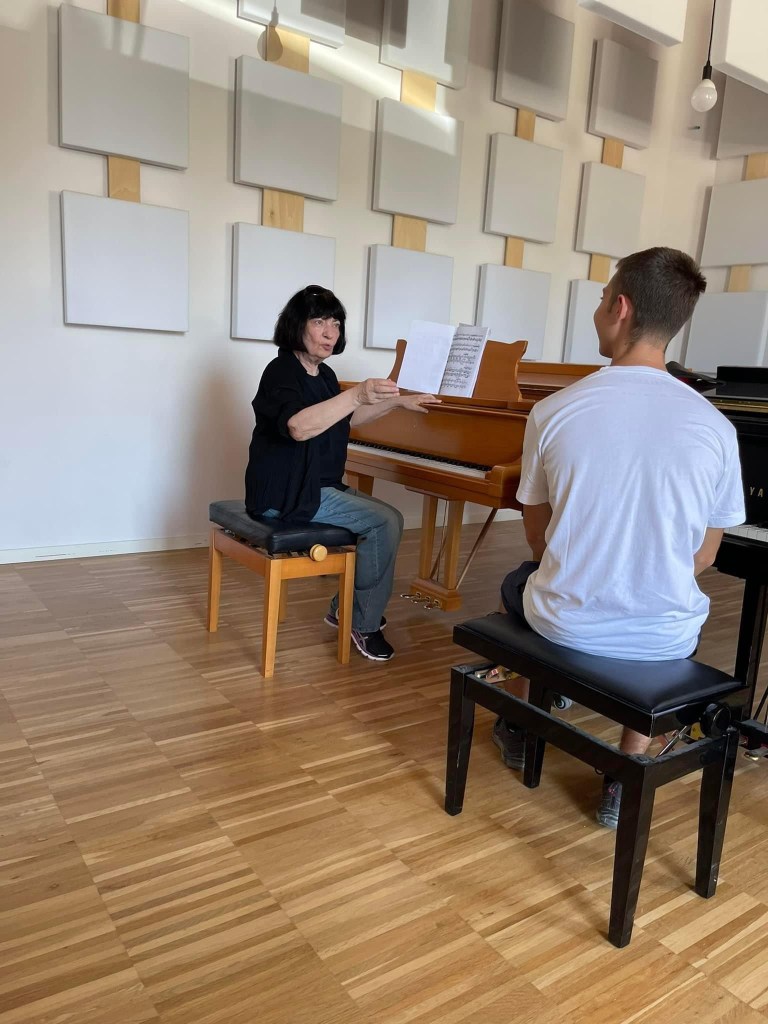
Elisso explaining the Wanderer Fantasy recently in her class in Fiesole
I remember a recent lesson I had listened to of Elisso Virsaladze in which I was struck by the vehemence of the Wanderer Fantasy and the ragged corners that we are more used to in a Beethoven almost twice Schubert’s age .It made me wonder about the maturity of the 25 year old Schubert and could he have had a premonition that his life was to be curtailed only six years later.We are used to the mellifluous Schubert of rounded corners and seemless streams of melodic invention.But surely in the final three sonatas written in the last months of his life the A major and C minor start with a call to arms and only in the last B flat sonata do we arrive at the peace and tranquility that Beethoven was to find too in his last sonata.But the deep rumblings in the bass in Schubert’s last sonata give food for thought that his life was not all sweetness and light.I remember Richter’s long tribulation in the recording studio to put on record as near definitive version as possible of the Wanderer Fantasy with the help of the pianist and musicologist Paul Badura Skoda.
It was exactly like a tornado with which Pablo presented the opening flourishes of this remarkable work .It was played with the authority and breathless urgency that Richter and now Trifonov had unleashed on an unsuspecting public.This was a full symphony orchestra not a chamber orchestra but one that was capable of moments of excitement and urgency but also moments of lyricism and delicacy.The contrasts that Pablo found kept us on the edge of our seats as the underlying rhythmic current flowed from the source to the mouth of this great stream of sounds.Not a Schubert for the weak hearted but a Schubert of a man that had known great tenderness but also great suffering.There was a technical prowess that seemed to have no limitations as his body movements followed the great streams of sound that poured out of this little Boston with then same dynamic energy and richness as the greatest of concert grands.
Serious discussions after the performance
The natural movements that followed the contours of the music allowed him to seek out sounds without any ungrateful hardness even in the most challenging passages that abound in a work that the composer himself said : ‘May the devil play it ‘.The fullness of rich sound in the solemn Adagio – The Wanderer – was remarkable for its sonority.I even found it a little too important a statement but was then led by Pablo to the magic of the variations where streams of golden sounds just poured like water over the keys leading to a climax worthy of the mightiest of Beethoven only to disappear in a series of vibrations all so similarly found in late Beethoven.The scherzo ,presto,was played with a clarity and sense of dance that created just the contrast and lyrical interlude before the tumultuous final explosion in preparation for the Allegro fugato.
Noretta and I looked at each other as he embarked on the Allegro with an urgency almost in two instead of four.But we need not have worried as Pablo is also a great virtuoso as he fearlessly led us to the tumultuous conclusion with no sign of collision or mishap.A remarkably exciting conclusion to a superb performance.
Patrizia Faro like me one of Pablo’s oldest friends Noretta and John Leech with Roberto Doring Pinho da Silvia
I listened very carefully to his first Chopin recital where the Fantasie,Barcarolle and Polonaise Fantasie seem to be a collection of unrelated episodes in which he was obviously enjoying himself teasing a kaleidoscope of beautiful seemingly unrelated sounds like a magician pulling endless baubles out of a top hat. It was the same programme that had been streamed during the pandemic from Bari. https://christopheraxworthymusiccommentary.com/2021/02/16/pletnev-in-bari-streaming-of-ravishing-beauty-and-seduction/
It made me wonder:’is a true interpreter he who takes the markings left by the composer as the starting point of an interpretation or is it valid to take just the notes and bring the meaning behind them to life as decided by an informed or uniformed entertainer?That can lead to a very personal or subjective approach. Well I think both should be valid as is obvious from the score that a deaf composer could leave us with his trilogy of dreams so clearly annotated onto a dumb page. Agosti,Perahia and Serkin have shown us that this is the true path of an interpreter and not just an entertainer or ‘giocaliere delle note’ as the headline of a Cherkassky recital of all transcriptions was reported in the Corriere della Sera many years ago. Since that moment Shura,who was a very serious artist,would not allow anyone to choose his programmes or even suggest what encores he should play. I used to stand in the wings and he would announce to me as he returned to the stage the pieces he would play knowing full well that we were all waiting for the Godowsky Tango or Boogie Woogie etude. There are interpreters who are intellectual and do their research and delve deeply into the archive to find a dot or a dash in più that could give a clue to the composers initial inspirational spark.They are not necessarily those that can convince as true performing artists are made of many different parts as Liszt has more than amply shown us.
Magic moments!!Babayan in conversation with Kissin
There are those who are not quite so academic and follow their instinct as Rubinstein explained to the pianists in his first competition. A pianist must be like the bees and listen to as much music as possible and acquire his own sense of taste of good and bad and create as the bees do their own unique honey. Of course this implies a technical mastery such as many have from an early age in the East where they may not have the intellectual capacity or access to the tradition of the great interpreters or original manuscripts as in the West. Pogorelich had a sense of colour and technical mastery that was unique but when DGG sent a demo recording of his Ravel to Perlemuter for some phrase that could be used for promotional purposes ,Vlado in all innocence replied ‘quesque c’est que ca’.
Curzon declared that to be a great pianist was 90% work and 10% talent – Curzon was blessed by the Gods indeed …………as was the complex undefinable Mikhail Pletnev who appeared before us in Verbier. The same Pletnev that Sandor had implored not to abandon such a God given gift for conducting !
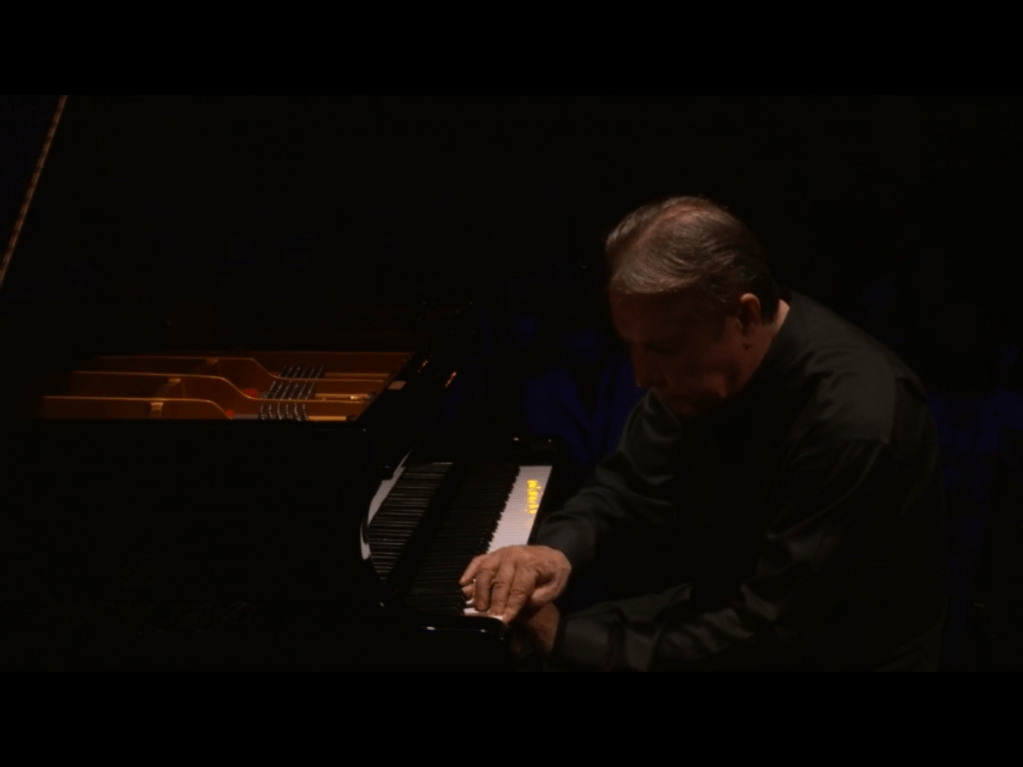
Pletnev played the Chopin Preludes in his final recital and for me it was simply the reincarnation of the magic that Cortot had immortalised on 78 rpm discs. A performance of such freedom and sense of colour such an overall vision that was indeed what we might very well call recreation. He may not see the wood from the trees any more but by God the word genius is as near as one can get to describing sounds that do not fit into any vocabulary but touch you very deeply,in fact much more than any words ever could.Curzon on the jury of the Leeds competition in the late 60’s had not been convinced of the genius of Radu Lupu and did not vote him into the finals.Luckily he was outvoted and was the first to say after his performance of Beethovens 3rd Concerto:’Thank God I lived to hear that!’
Pletnev’s encore of Scriabin’s op 2 n.1 Study underlined this genius with a work so often churned out by lesser hands but today was shaped where whispered secrets went hand in hand with aristocratic grandeur. To see him shuffle on and off must have been how the nearly blind Cortot must have appeared when the poet speaks directly through such a medium. As Trifonov demonstrated in Verbier too genius can be a hard burden to bear in everyday life .
Here is one reply to this very delicate but fundamental question on the very meaning of interpreter as opposed to an entertainer :https://www.youtube.com/watch?v=dT7PYlm55r8………
Lang Lang was a great pianist from the studio of Gary Graffman but now is more the entertainer who was inspired as a child by Tom and Gerry ………he would have loved Pletnev’s Beethoven 3………But thanks to Lang Lang China sells more pianos than anywhere in the world and the Trust Funds that he has been able to set up help innumerable young musicians world wide ………..His piano mummy was after all Dame Fanny Waterman one of the most remarkable people I have ever met ……..’you are so eloquent’ she would say to me on the phone as we listened to the same concerts on the BBC in different countries and would compare notes together………….’Graham Johnson we agreed together was the greatest accompanist alive ………..on that a meeting was arranged between Dame Fanny and Graham who had shared chamber music lessons with me in John Streets class when we were both ‘kids’ at the RAM .Small world! There are still enough fingers on our hands to count the great musicians of our day …………dedication and sacrifice are for the chosen few.
All you need is love’ as the song goes but some pianists sound as though that love has run its course whereas real love grows more profound with every day !
Karl Ulrich Schnabel once praised a student at the Piano Academy in Como : ‘Oh so you are a composer ………but with Beethoven’s notes!’
Another pianist also now in career was not accepted into the class :’You think more of yourself than the music!’
Charles Rosen,one of the great minds of our day, was much more to the point :’You play like a whore!’
Just to put things in perspective Morecambe and Wise with Andre Previn – Grieg Piano Concerto :https://youtu.be/V7Nmeq3ggss
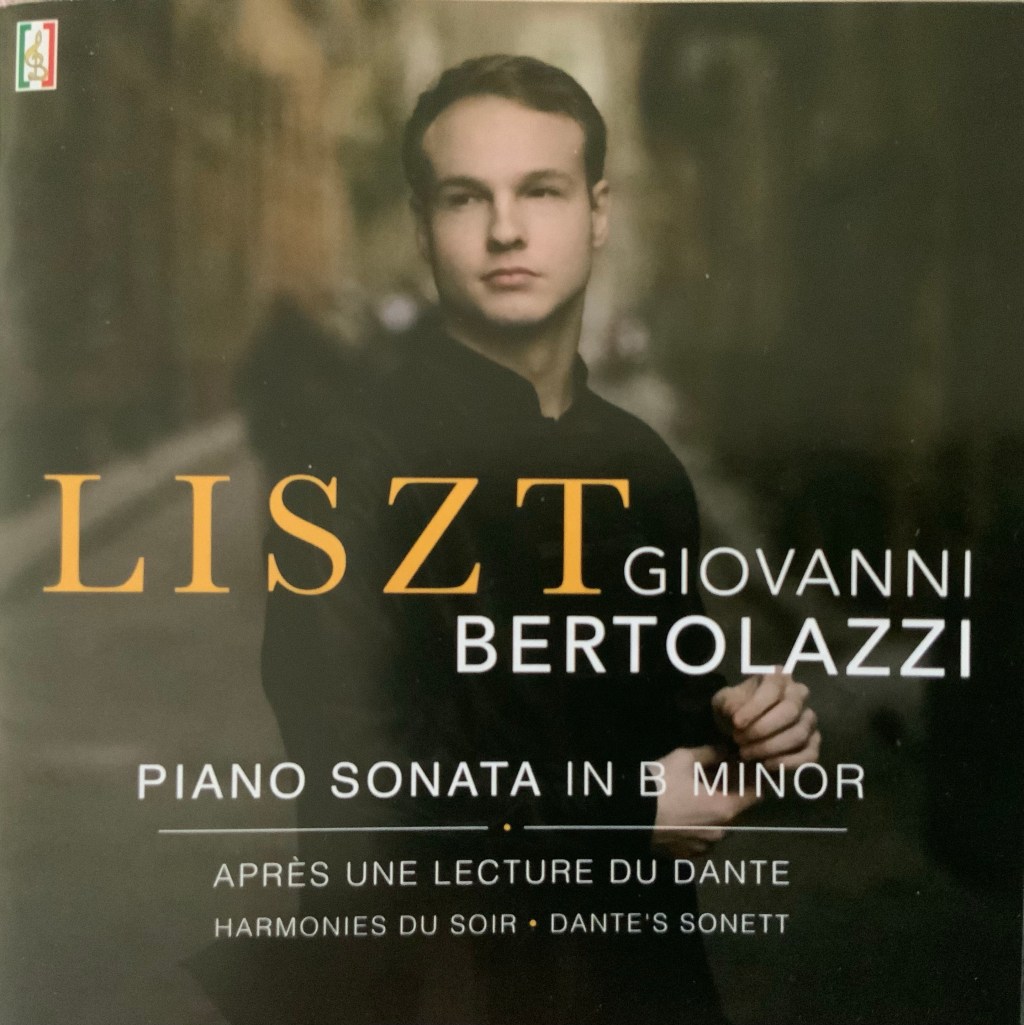
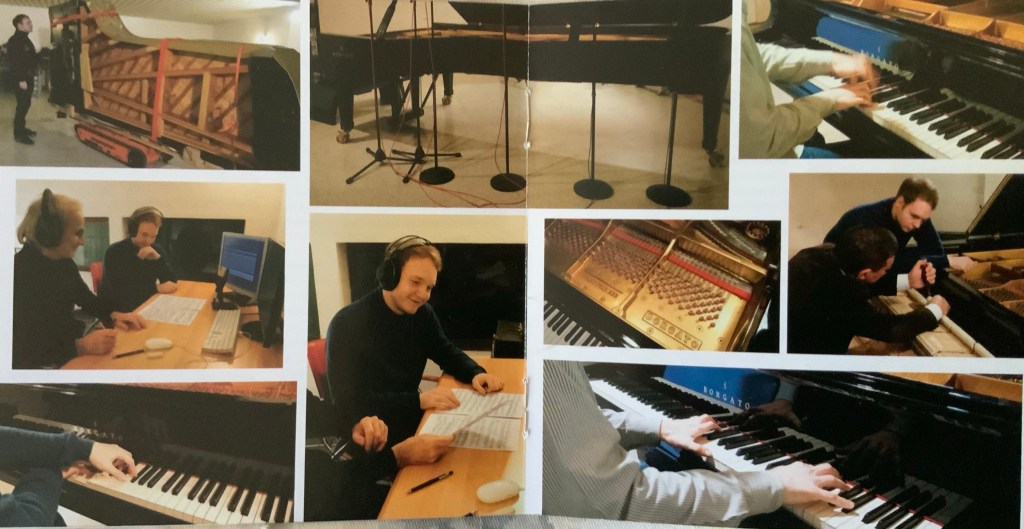
Two young pianists flying high in Verbier- Nikita Lukinov and Giovanni Bertolazzi what do they have in common? The most intelligent and exciting performances of the Liszt sonata that I have heard for too long. A masterpiece dedicated to Schumann and despite Clara Schumann’s refusal to play such a bombastic piece it is recognised together with the Schumann Fantasie (dedicated to Liszt) and Chopin’s 4th Ballade as the pinnacles of the romantic piano repertoire. Liszt also meticulously edited all the sonatas of Beethoven yet so many pianists disregard the very precise indications in his own music preferring to play as loud and fast as possible. The rot sets in from the very first page where the indications of p,mf,f are substituted for the ff that is not requested until the second page. Cortot,the great poet of the piano,made the first recording and his rhetorical opening did not set a good example to future generations who misunderstood his unique personal vision as an example to follow. I never expected to hear the Liszt sonata restored to what the composer actually wrote until I heard the twenty year old Nikita Lukinov in London………later in Rome I was to be catapulted into a performance of such fire and imagination by Giovanni Bertolazzi who had a vision of the sonata that held me mesmerised. Maybe not quite as meticulous as Nikita but Sergio Tofano,the great Italian actor, once said to his students that there is no such thing as a right or a wrong way but you must convince the audience. By God these two young pianists certainly convinced me and I will not forget that in a hurry. I am glad that Giovanni has been able to record the sonata and just hope Nikita will follow suit soon…….two beacons shining brightly whose paths have crossed this summer in Verbier ………small world !
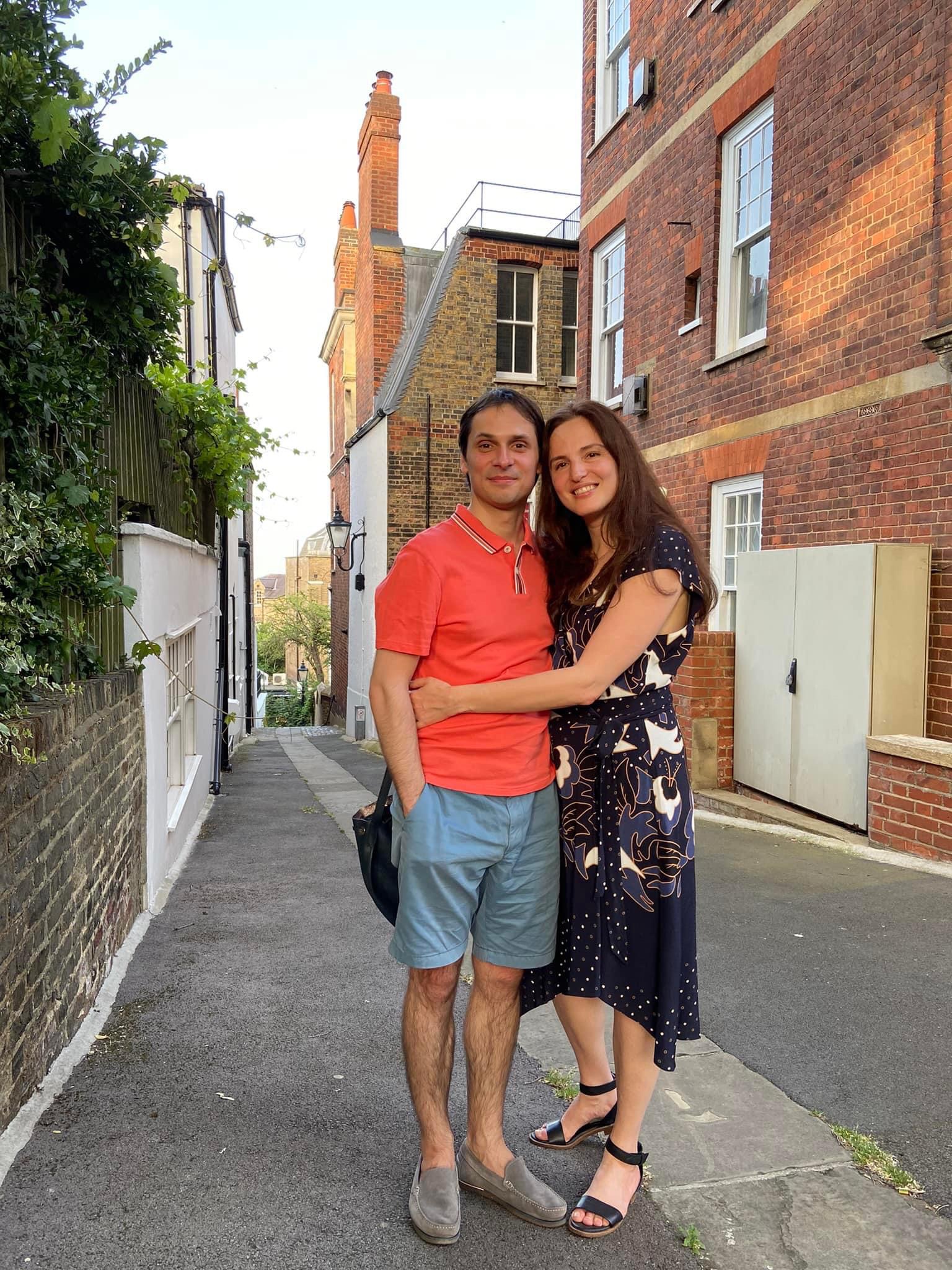
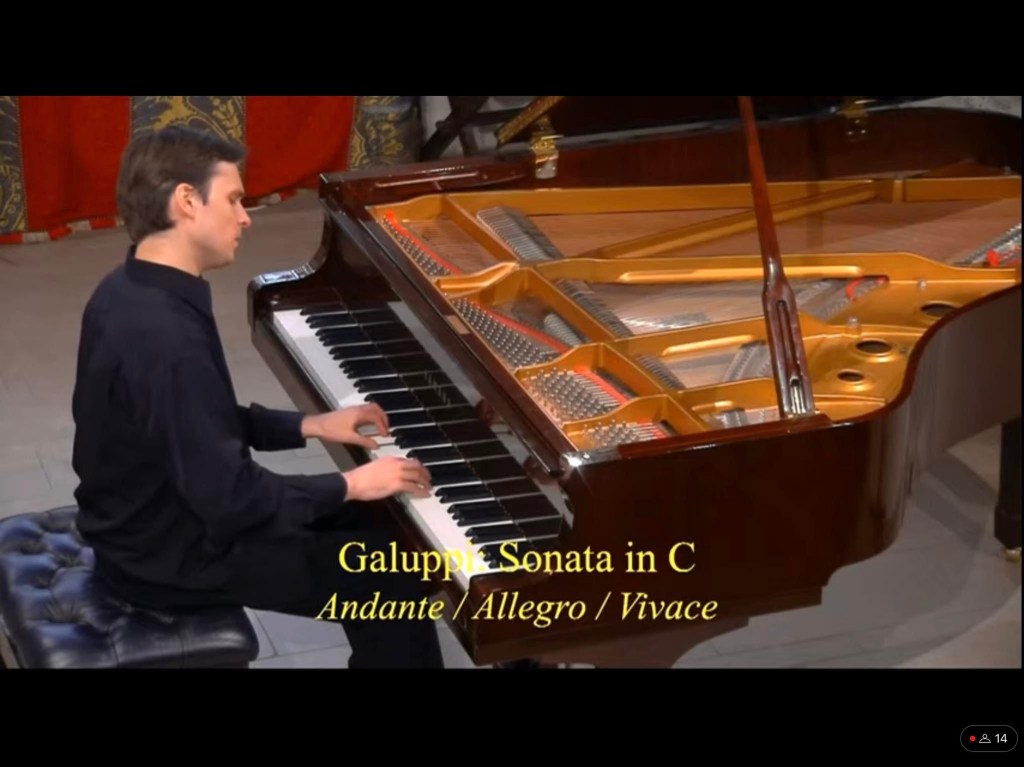
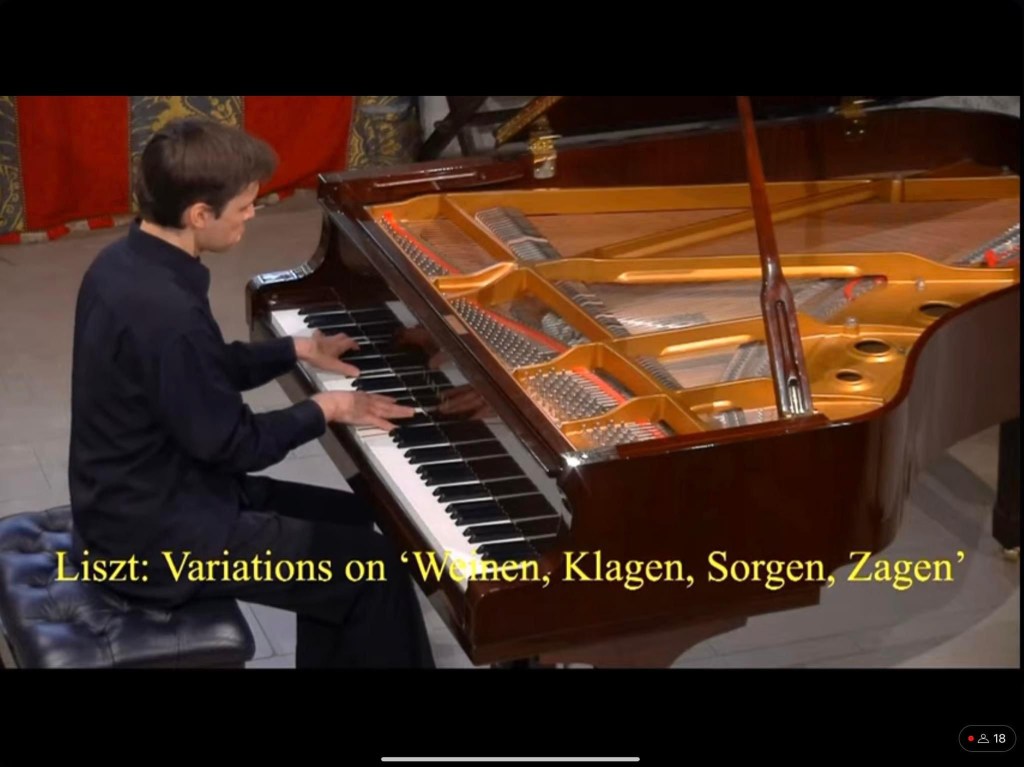
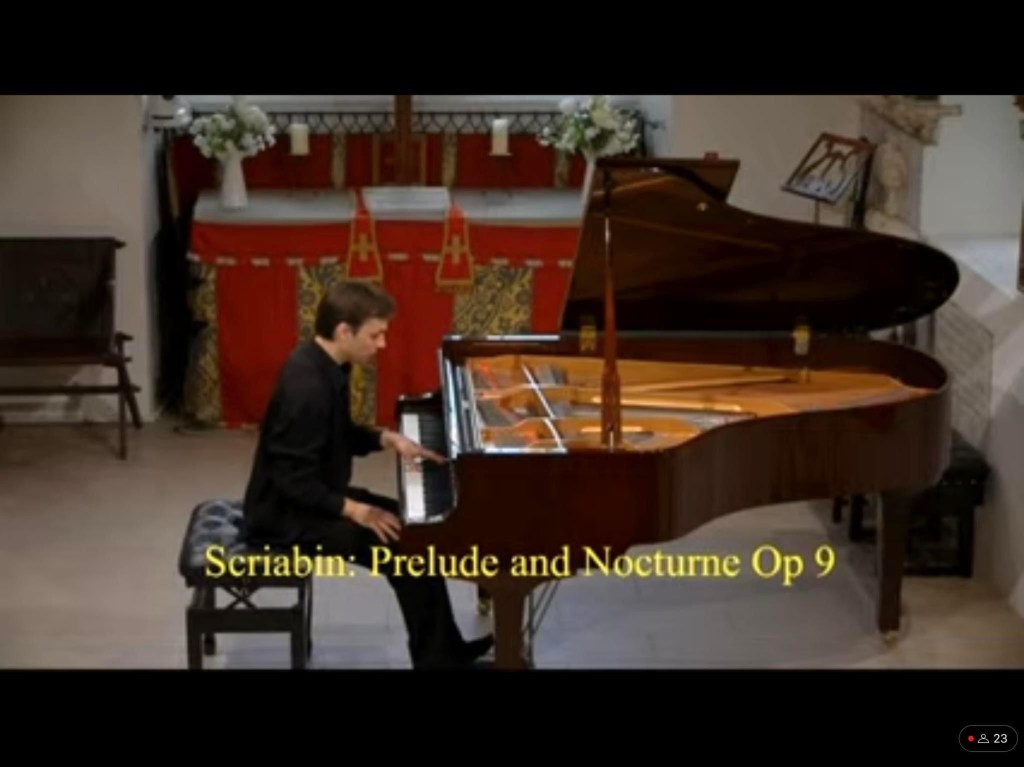
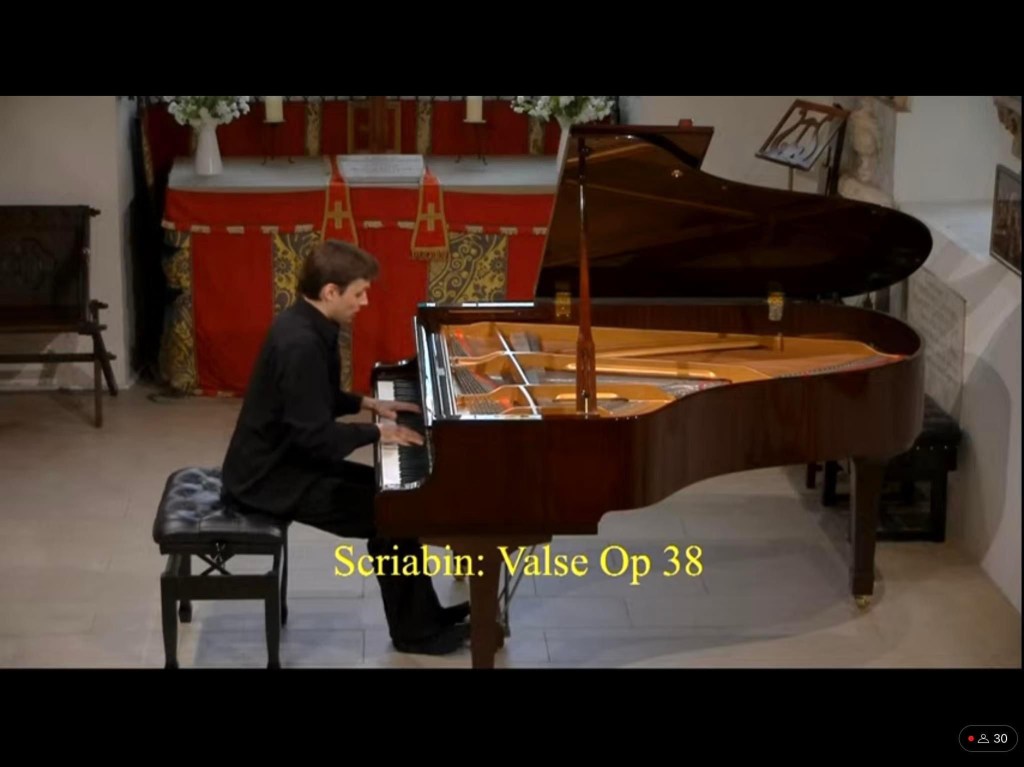
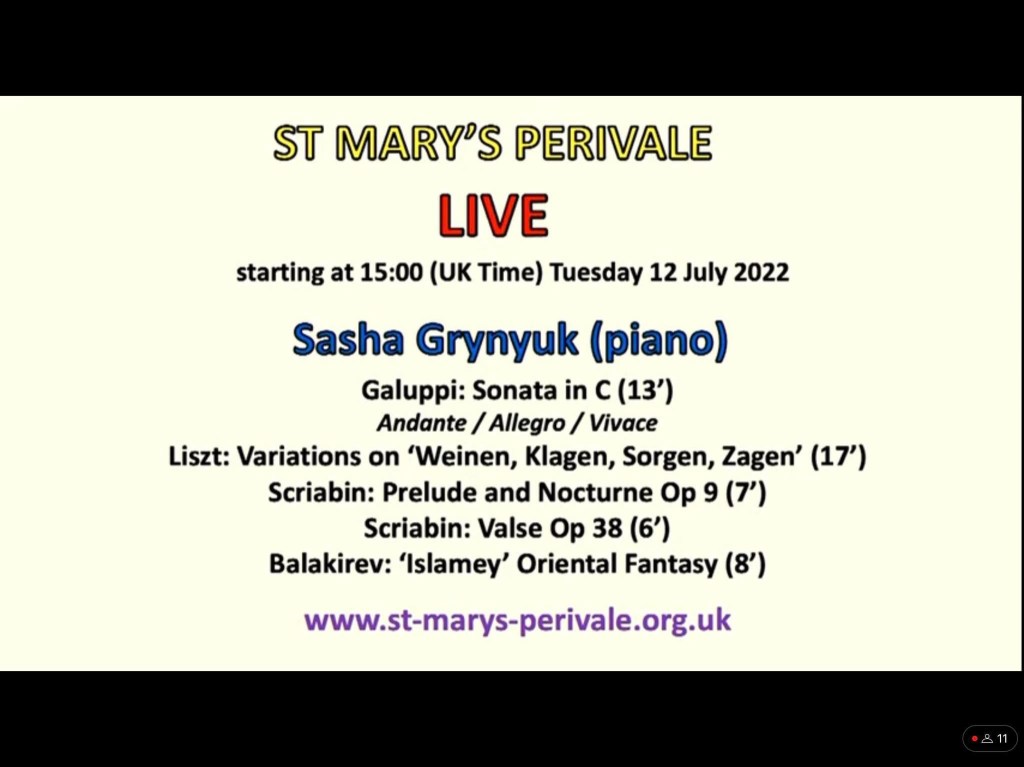
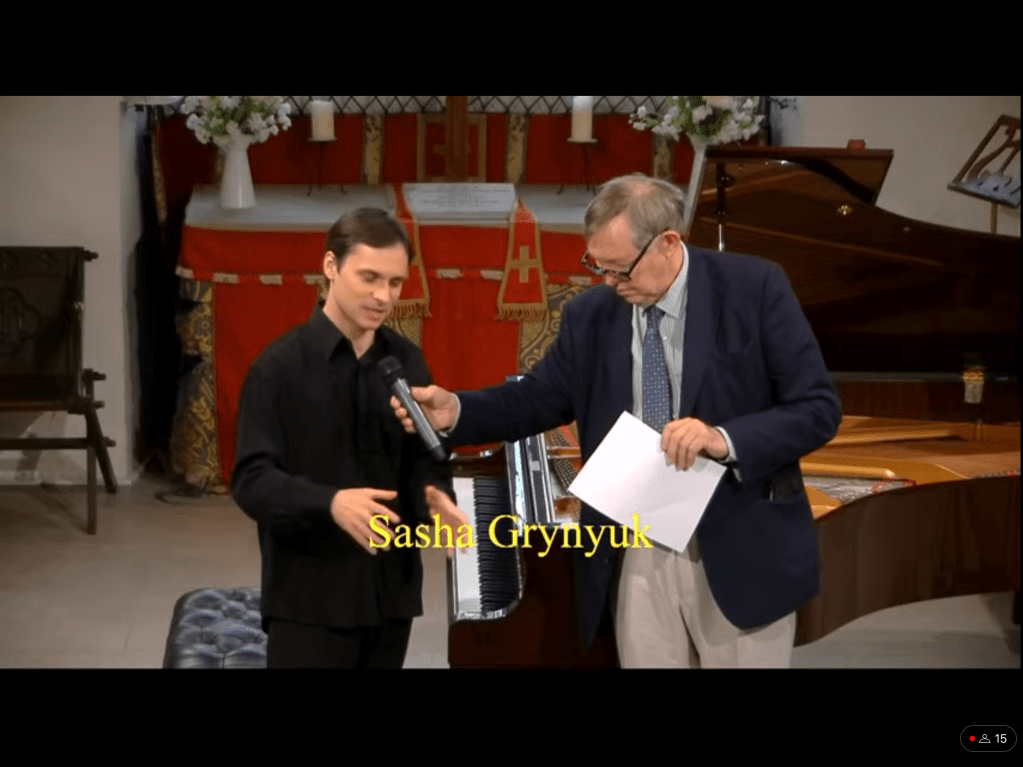
Today on this special occasion in the torrid heat of the English summer (nothing of course compared to where I am listening to this today)there was a special clarity and luminosity as a great pianist serenades his bride of a year with a superlative display of music making of a simplicity and clarity that is of a chosen few.Two of the nicest people I know sharing a life in music together . The Galuppi sonata where it was good to hear all three movements.The first movement was a favourite encore of Benedetti Michelangeli but it was refreshing to hear the cascades of crystal clear notes of the Allegro and the elegance of the vivace. I have heard his Liszt but it was overwhelming on rehearing it today played with such musicianship where the cascades of notes were all to the means of an architectural whole.The sublime simplicity of the chorale and its sublimation on high was breathtaking in its breadth and meaning. To play Scriabin’s Prelude and Nocturne with such control of sound and colour with just the left hand was even more astonishing that the amazing feats of virtuosity with which he astonished and seduced us in Islamey. A charming ground in C by Purcell was an unusually beguiling encore and quite hypnotic in its irresistible repetition
Winner of over ten international competitions, prizes and awards, Sasha was chosen as a ‘Rising Star’ for BBC Music Magazine and International Piano Magazine . His successes also include First Prizes in the Grieg International Piano Competition and the BNDES International Piano Competition, in addition to winning the Guildhall School of Music’s most prestigious award – the Gold Medal – previously won by such artists as Jacqueline Du Pré and Bryn Terfel.Sasha has performed in many major venues including Wigmore Hall, Barbican Hall, Royal Festival Hall, Queen Elizabeth Hall, Bridgewater Hall (Manchester), Wiener Konzerthaus, Weil Recital Hall (Carnegie Hall, New York), Teatro Real (Rio de Janeiro) and Salle Cortot (Paris). He has performed with such orchestras as the Royal Philharmonic, Bergen Philharmonic and Orchestra Sinfonica Brasiliera. His recording of music by Glenn Gould and Friedrich Gulda for Piano Classics was chosen as the record of the month for the German magazine Piano News and shortlisted for the New York Classical Radio Award. Among Sa sha’s ongoing projects are performances of Shostakovich’s original piano score for the 1929 silent film The New Babylon , which he premièred at LSO St. Luke’s and later performed at Leif Ove Andsnes’ Rosendal Festival, Norway. Born in Ukraine, Sasha studied at the Guildhall School in London. Sasha is a Keyboard Trust artist and currently benefits from the artistic guidance of its founder Noretta Conci-Leech.
It may have been a short recital by this young German-Iranian pianist but it was enough from the very first notes to realise his intelligent sensitive musicianship.Studying in the class of Norma Fisher as was obvious from his way of thinking from the bass upwards with a sense of architectural shape and spaciousness that is so much part of a real thinking musician.A transcendental control that meant that he could fearlessly conquer the hurdles that Liszt lays before those that dare play his Dante Sonata.
Even the dramatic opening ,that I am not sure if I would have divided between the hands,was played with on overall sense of line and architectural shape.A continual sense of forward movement and a sumptuous sense of sound that enveloped the entire sonata and gave it such an overall shape and cohesion.Even the treacherous octave leaps at the end were played with the same sumptuous sound and sense of shape and was not just a technical hurdle but an integral part of the overall conception of a work that can so often appear episodic.There were ravishing sounds in the central episode with a superb sense of balance but always with the feeling of an anchor in the bass .It allowed him freedom and at the same time a sensitivity that was never sentimental or rhetorical.
It was Chopin who described the elusive word ‘rubato’ as flexibility like a tree with the roots firmly in the ground but the branches free to move and sway naturally in the wind.There was great passion and drama too from a young man who is obviously living the drama but there was always a control and sense of line.
His ravishing beauty of sound was in evidence from the very first notes of the recital with the sumptuous chorale prelude by J.S.Bach:’Ich ruf zu dir, Herr Jesu Christ’BWV 639.The serenity and understanding of the magical colouring that Busoni could conjure out of the piano was matched with playing of a fluidity and unforced sound that was memorable.There was a kaleidoscopic range of sounds spread over the entire keyboard in Messiaen ‘s Vingt Regards sur l’Enfant-Jésus IX. Regard de temps (Mystère de la plénitude des temps; le Temps voit naître en lui Celui est éternel…).It was the ideal bridge between the early Haydn Sonata in C minor n.33 Hob XV1.20 and the Liszt Dante Sonata.This early Sonata is often referred to as Haydn’s ‘Appassionata’ with its dynamic contrasts and dramatic intensity and is in fact the first great sonata for the piano.It was played with a sense of style and a luminosity of sound with phrasing of delicacy and beauty.A playful development led to a climax of searing beauty.The Andante con moto was beautifully fluid and sensitively shaped with a constant forward movement .There was a driving rhythmic energy and sense of dance to the Finale Allegro. His sensitivity to the changing harmonies gave great musical shape to the streams of notes of great brilliance that Haydn adds to this remarkable early work.
Parvis Hejazi is a 22-year-old German-Iranian pianist and composer, living in London.From 2012-2017, he studied piano and composition at the University of the Arts in Bremen. In 2021, he graduated with honours and distinction from the Royal College of Music in London. He is currently studying for a Master’s degree at the RCM under Norma Fisher and Vanessa Latarche.He has also studied with such leading pianists as Stephen Hough, Jerome Rose, Norma Fisher, Dmitri Alexeev, Niel Imelman, Jerome Lowenthal, Leon McCawley, Anatol Ugorski, Igor Levit, Konrad Elser, Markus Groh, Vanessa Latarche, Christopher Hinterhuber and Lars Vogt.Parvis holds several scholarships including the RCM Scholarship, the Evangelisches Studienwerk (Villigst) and the Deutsche Stiftung Musikleben.
He is an honorary member of the Deutsche Gesellschaft für Philosophie and is supported by donors Karin and Uwe Hollweg and the Gisela and Erich Andreas Foundation.He enjoys a wide range of musical activities ranging from solo recital and concerto programmes to chamber music performances, and from composing to conducting.In 2021, he won the Grand Prix at the International Piano Competition in Kyiv, First Prize and the special prize ‘Le maitre de piano’ in the International Piano Competition in Gagny (Paris) in 2017 – and First Prizes in several other national and international competitions including the final stage in the ‘Jugend musiziert’ Competition in Germany for organ, piano and piano duo and the Federal Composition Competition of the Jeunesses Musicales where he received the highest award every year from 2012-2016.In 2018, his composition ‘In memoriam E. A. Poe’ (composed in 2010) was selected as a compulsory piece for pianists to play in the reputable WESPE competition in Germany. In 2019, he was a finalist in the prestigious Chapell Medal International Piano Competition and was selected for the Gateway Scheme, a programme designed by the Royal College of Music to promote extraordinarily talented musicians.Broadcasts of concerts, recordings, interviews and TV documentaries have been transmitted on German state TV and radio channels such as ARD, NDR, HR and the Deutschlandfunk – and he has performed in major concert venues throughout Europe, the USA and Israel.
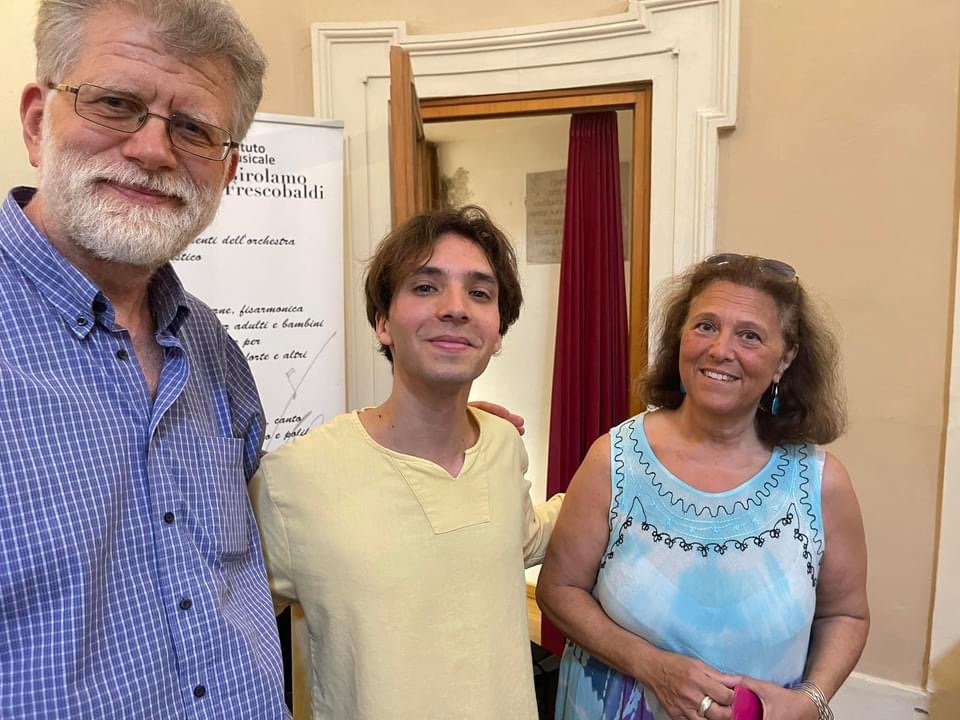
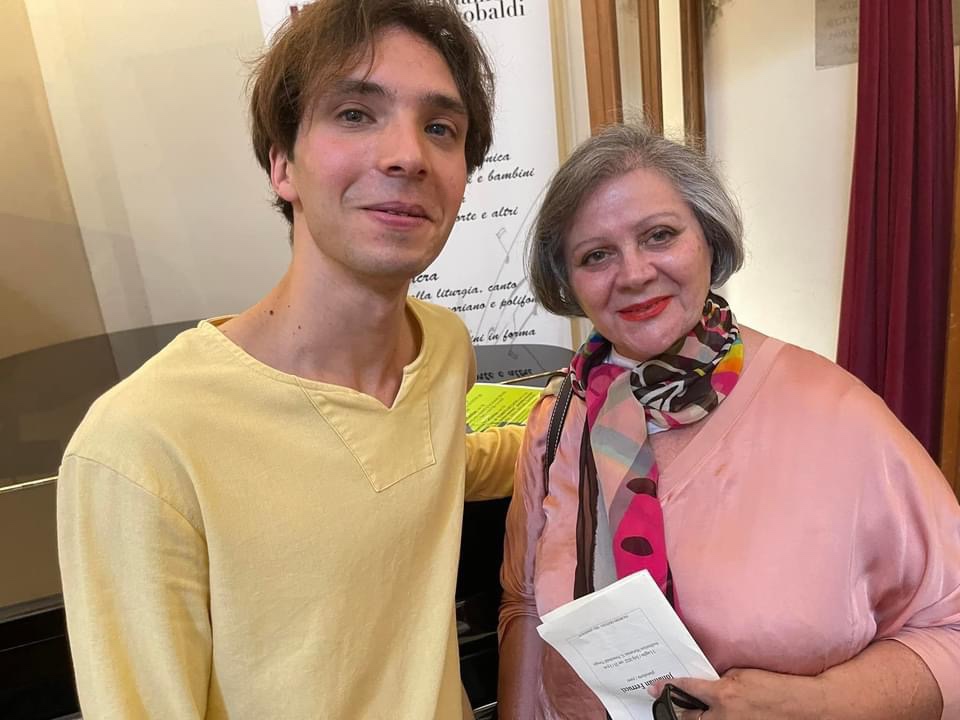
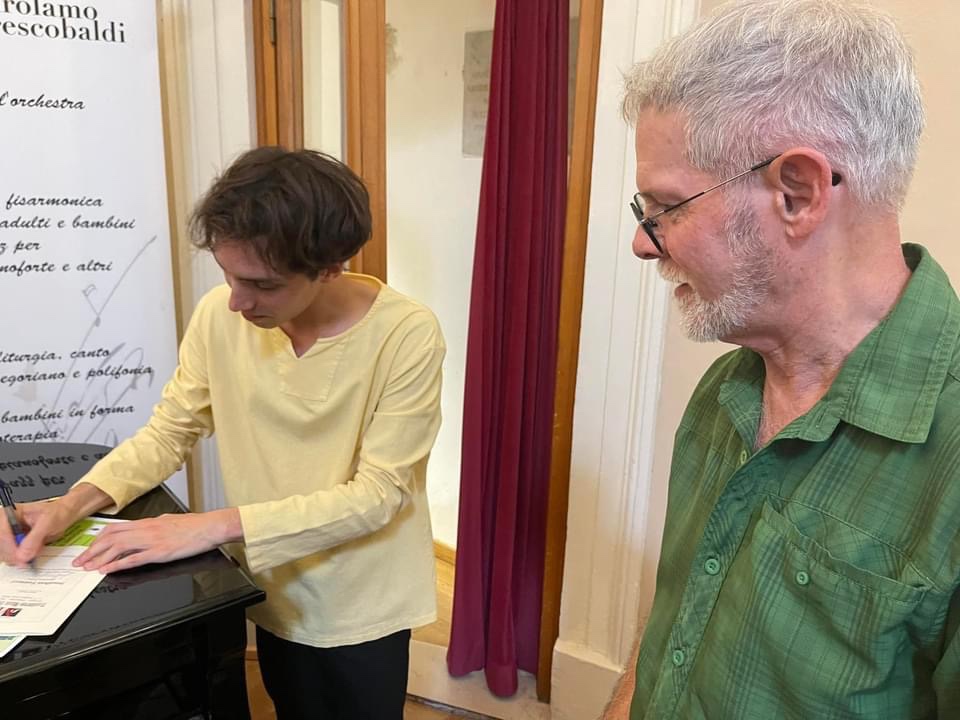
The new venue for young artist’s concerts in the IMGF Frescobaldi Institute of Music with it antique 99 seat hall
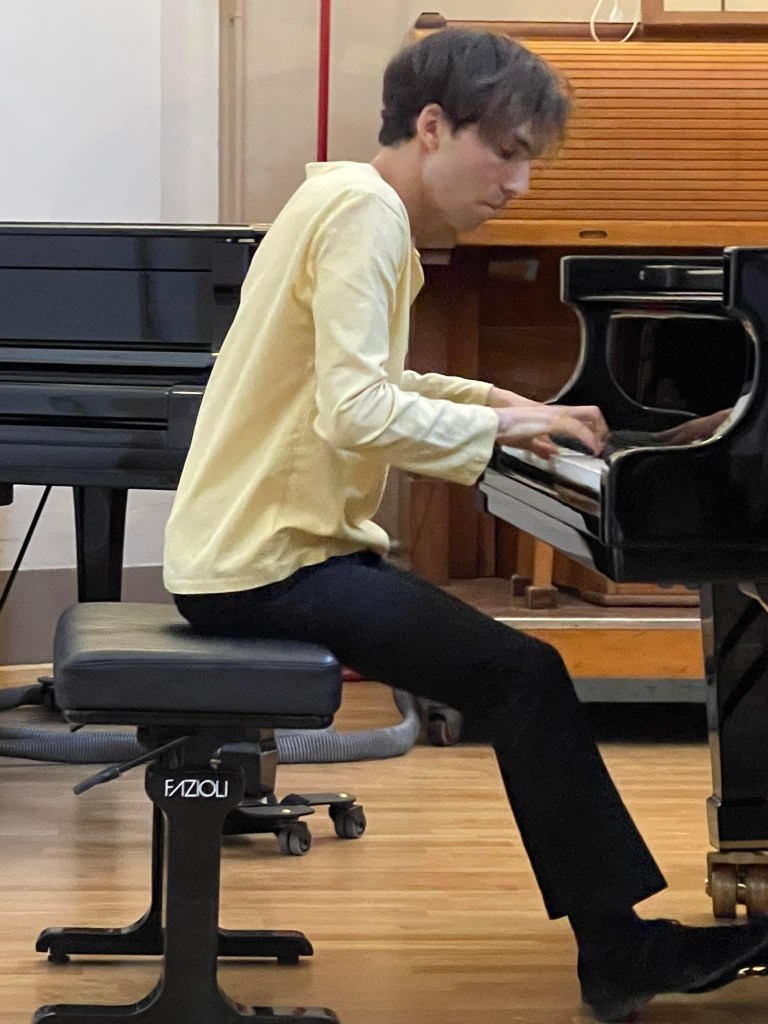
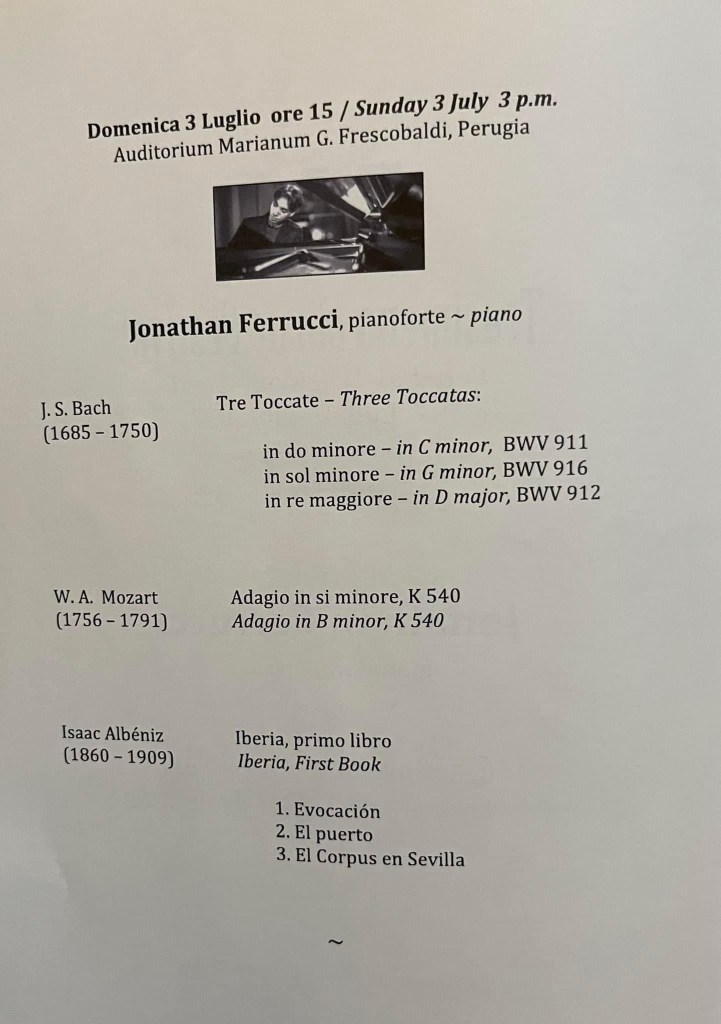
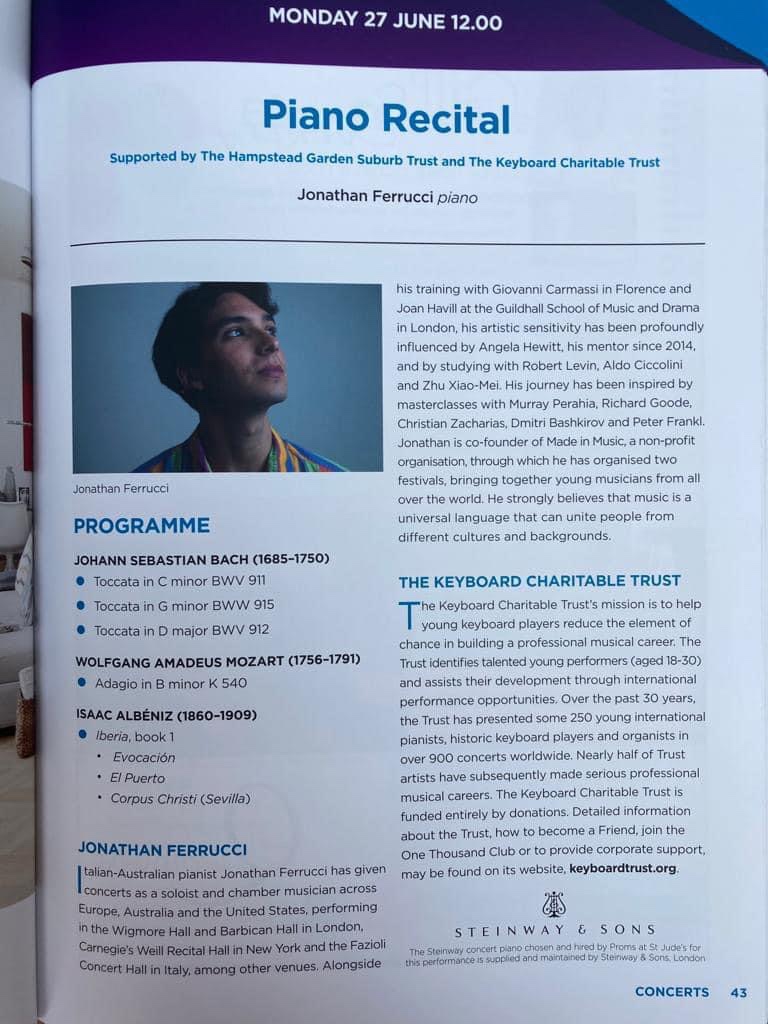
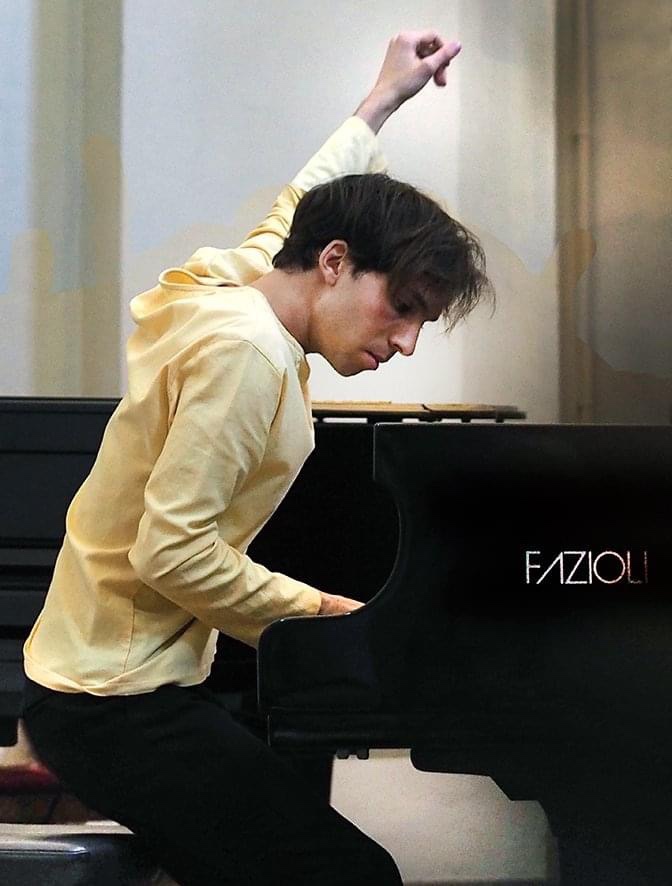
A standing ovation for Jonathan Ferrucci at Angela Hewitt’s Festival with playing that just gets bigger and bigger as he seems to get smaller and smaller!A Bach that reminded me of Gulda as he seemed to be searching for that undefined structure where Bach leaves a provocative question mark with a freedom that brought three Toccatas vividly and originally to life. And as he so eloquently said an Adagio in B minor where Mozart is searching for an intense and contemplative memory that he cannot find.Played with a desolate anxiety of isolated sounds that one associates more with composers of the next century. There was a sultry radiance to Albeniz’s Evocacion and an El Puerto that had us wanting to click our heels and stamp our feet.His Fetes Dieu was a towering tour de force of brilliance,colour and sumptuous sounds. Three tone poems of such radiance and ravishing sounds as each one had a very special story to tell. Granados’s Spanish dance n 5 was offered as an encore and which he had learnt like all of us as a child. But,by God,I doubt we could have imagined it could sound as it did today in Jonathan’s magic hands.
An old school friend of Angela who had flown in especially for the festival from Canada
It was lovely to meet so many of Angela’s friends from Canada who could suffer the torrid afternoon heat.But they filled the hall to enjoy again a pianist who is being mentored by Angela and who took her place the other evening whilst our much loved Angela is isolated with COVID.So near but still unfortunately so far in her house on lake Trasimeno.
I have written about Jonathan’s performance of the Bach and Mozart that he performed recently in London: https://christopheraxworthymusiccommentary.com/2022/05/02/jonathan-ferrucci-the-essence-of-music-with-aristocratic-intelligence-and-passion-at-st-marys/But like all real artists every performance is different and today the Bach Toccatas although having the same overall framework there were many differences where Jonathan felt free to elaborate with even more fantasy than on previous occasions.The overall impression was of a voyage of fresh discovery as he dug even deeper into the score.As he had said in his introductory talk,Bach in his Toccatas allowed himself a freedom and room for improvisation that is much less restrictive that the more usual dance based movements of his Partitas ,Suites or variations.
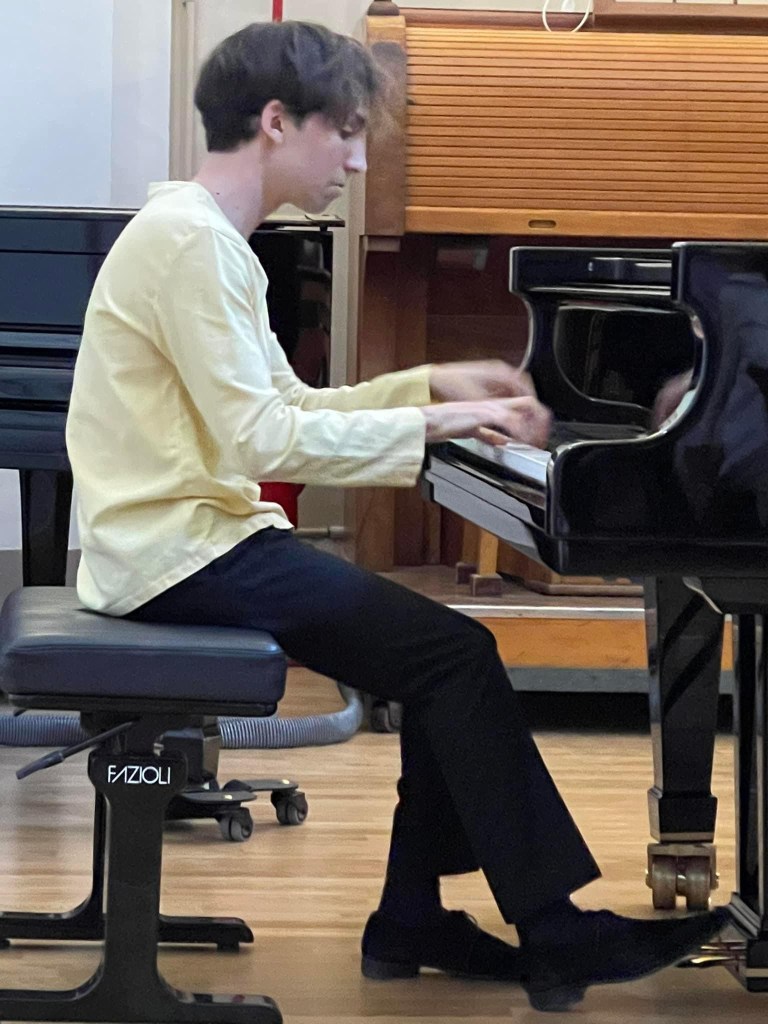
Today Jonathan on this magnificent Fazioli piano was having fun as he took his audience on a journey of discovery.Some things worked better than others and I found the opening of the D major Toccata rather quixotic but on the other hand the return of the theme in the C minor Toccata entering almost as a whisper after a long pause was masterly as was the vehemence of the G minor toccata .
It was the first time I had heard him play Spanish music though,and it was here with the same sense of improvisation added to a sumptuous sense of colour that he turned the first three of Albeniz Iberia into real gems.
I had missed them recently at the Hampstead Proms where he had played the same programme for the Keyboard Charitable Trust but was glad to have heard his masterly playing today.
He will be touring the USA for the Keyboard Trust in a long postponed trip due to the pandemic and is working on various programme proposals for this ten concert tour which includes a trip to the beautiful little theatre that Lorin Maazel constructed on his estate in Castletown,Virginia .
It was a New York critic who once said after a performance of Iberia by Alicia de Larrocha :’There is really nothing in Isaac Albeniz’s Iberia that a good three-handed pianist could not master, given unlimited years of practice and permission to play at half tempo. But there are few pianists thus endowed.’
In discussion with Jonathan’s father
I have never forgotten a performance by a hot blooded young Spaniard at one of the first Leeds Piano Competitions,Rafael Orozco,with a hair raising performance of such colour and brilliance of the Fetes Dieu a Seville.Annie Fischer who was on the jury had never forgotten either and when she asked me what had happened to him I was able to tell her that he was living in Rome and enjoying a more settled life away from the usual non stop concert tours.Unfortunately his life was cut short far too early living life to the full as was obvious from his hot blooded youthful performances.
Fête-dieu à Séville whose alternative titles are : Corpus Christi; El Corpus en Sevilla ,describes the Corpus Christi Day procession in Seville, during which the Corpus Christi is carried through the streets accompanied by marching bands. Musically, this piece consists of a processional march that eventually becomes overwhelmed by a mournful saeta, the melody evoking Andalusian cante jondo and the accompaniment evoking flamenco guitars. The march and saeta alternate ever more loudly until the main march theme is restated as a lively tarantella that ends abruptly with a flamboyant fffff climactic chord; finishing with a gentle coda again evoking flamenco guitars along with distant church bells.
Guess whose hands ?
It was given a transcendental performance where the triumphant theme rings out whilst the piano is submerged by the excited crowds thronging the streets.A tour de force technically as it requires great flexibility and sense of balance to keep the same sense of line spread over the entire keyboard.Jonathan’s extreme flexibility which comes from his expert yoga exercises were particularly useful here.Allied to his technical mastery there was also a fluidity of sound never hard or ungrateful as he flew from one end of the keyboard to the other with the grace and ease of an eagle swooping in on its prey.The tarantella too showed off the clockwork precision and fluid sounds of someone who is happy to spend hours at the keyboard perfecting his ‘fingerfertigkeit’.It was Curzon who when asked the secret of a great pianist replied:’90% hard work allied to 10% of talent ‘.Of course God was very generous with Curzon as he obviously has been with Jonathan.It is that 10% that we were able to appreciate in particular in the final bars where the gentle coda with distant church bells created a magic that held the audience spellbound with breathtaking silence.
The wonderfully enthusiastic old school friend of Angela had given up her afternoon trip around Umbria to hear once again Angela’s young star pianist.
Evocación is an impressionist reminiscence of Albéniz’s native country, combining elements of the southern Spanish fandango and the northern Spanish jota song forms. The rarely seen seven-flat key signature of A flat minor is in itself part of the Evocación.The sumptuously rich sounds coming after the crystal clear purity of Mozart took us by surprise as the kaleidoscopic sense of colour was given full reign and was a true revelation.The sumptuous bass of this Fazioli sounded so similar to that of the Bosendorfer and just opened up a sound world that took me by surprise from a piano that is best known for its clarity and brilliance.A great artist though can search for the sounds that are in his head and reproduce them as if by magic with the same sense of illusion of a magician where the seemingly impossible can happen.There was a subtle sense of phrasing where the notes just seemed to flow one out of the other with a fluidity that belies the very nature of this black box full of hammers and strings.
a full house at 3 o’clock on a torrid afternoon in Perugia
El Puerto is a zapateado inspired by El Puerto de Santa Maria in Càdiz.A lively Andalusian dance in 6/8 marked on two beats, the second being very stressed was in many way the most remarkable performance with its energy and transcendental technical command of irresistible verve and sense of style.
S.Filippo Neri inaugural concert where Jonathan was able to stand in for Angela playing Mozart K 453The many admirers in the green room after the concert
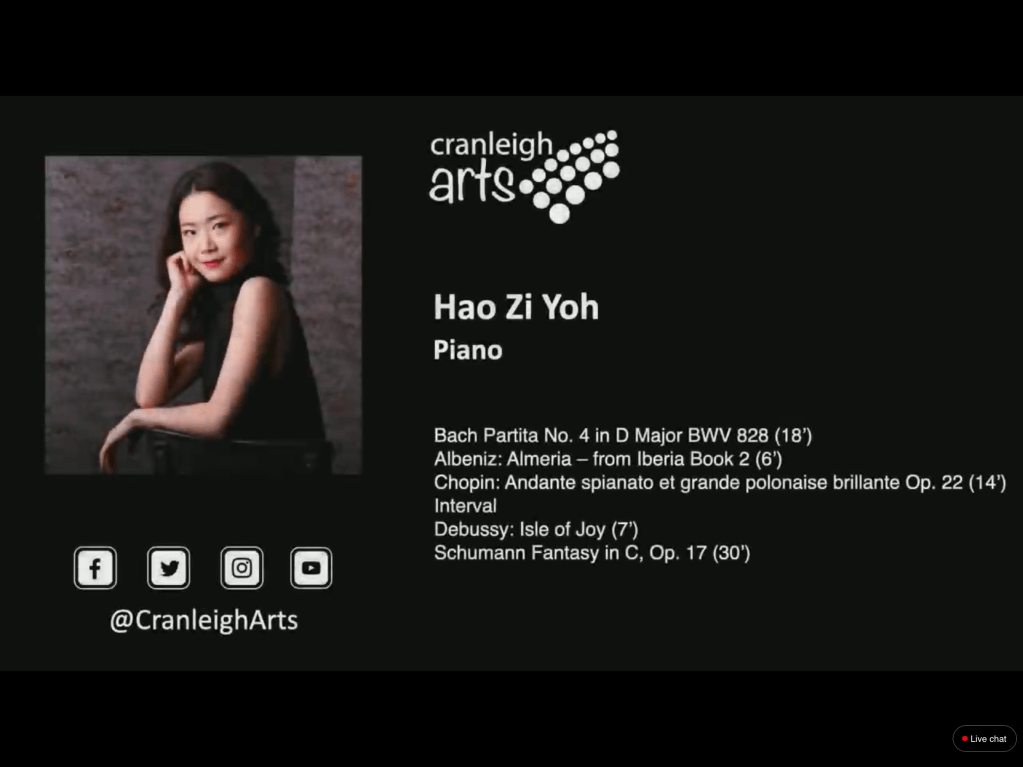
Chopin: Andante spianato et grande polonaise brillante Op. 22
Interval
Schumann: Fantasy in C, Op. 17
I. Durchaus fantastisch und leidenschaftlich vorzutragen; Im Legenden Ton
II. Mäßig. Durchaus energisch
III. Langsam getragen. Durchweg leise zu halten
Debussy: Isle of Joy
Hao Zi Yoh
I have heard Hao Zi many times but today in this glorious programme she made me even more aware of her unique qualities of scrupulous musicianship but also with a sensitivity to sound and colour that brought everything she touched vividly to life.Even the encore that she introduced so eloquently depicting a Malaysian rain forest was played with the same artistry and luminosity that she had brought to the Bach Partita that had opened this programme.Gently coaxing out sounds by plucking and dampening the piano strings whilst gently intoning a native chant.Bursting into more traditional cascades of notes played in the traditional manner all done with the utmost seriousness that created the atmosphere of her native country.
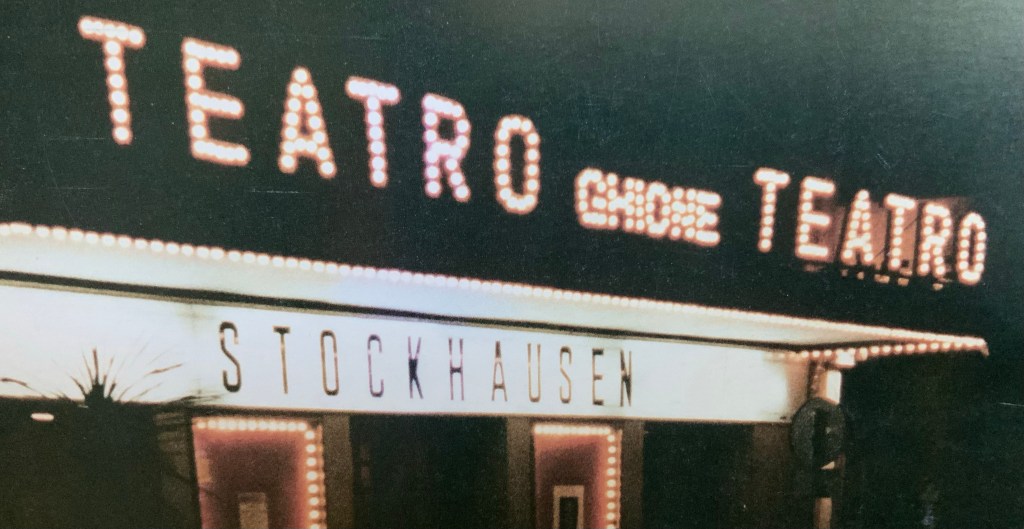
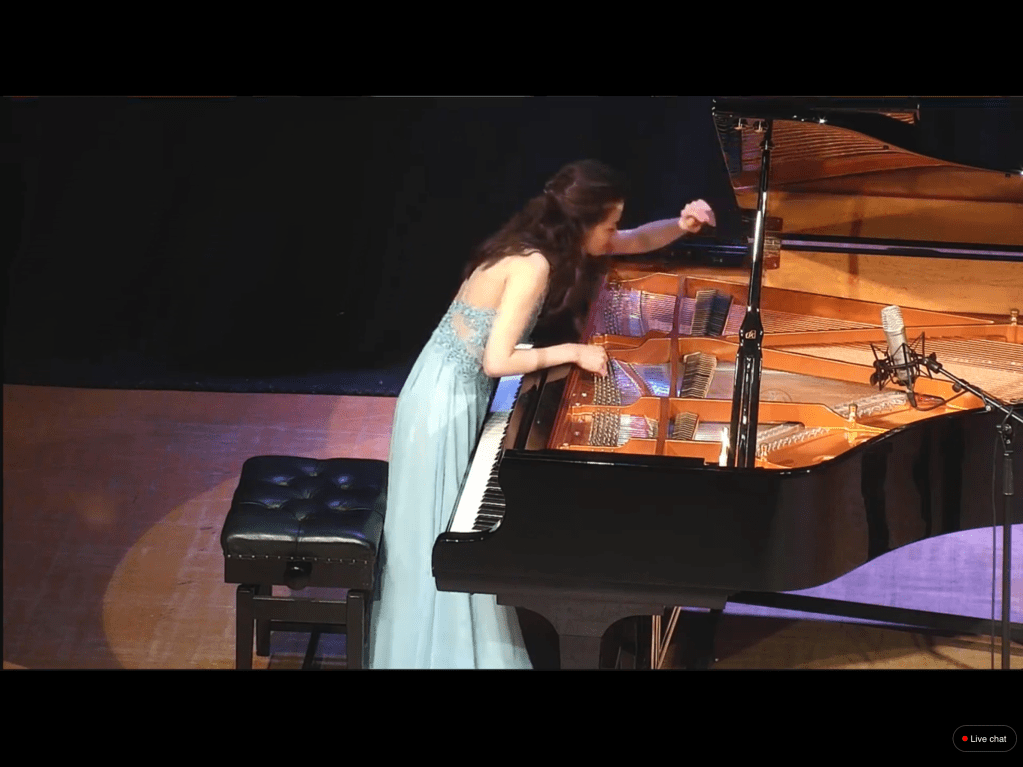
I remember Stockhausen asking me in Rome if he could use our Steinway Concert grand instead of the Yamaha that had been brought in specially for his complete Klavierstucke.How could I say no?But I did specify that the piano could only be used with two hands and two feet in the traditional manner!I had recently seen John Tilbury fill a piano with nuts and bolts in the search for special sound effects.Adulescu too turned the piano on its side as he threw rocks onto the strings!Luckily they were pianos that were brought in for the occasion whilst mine sat safely locked in a corner of the hall.
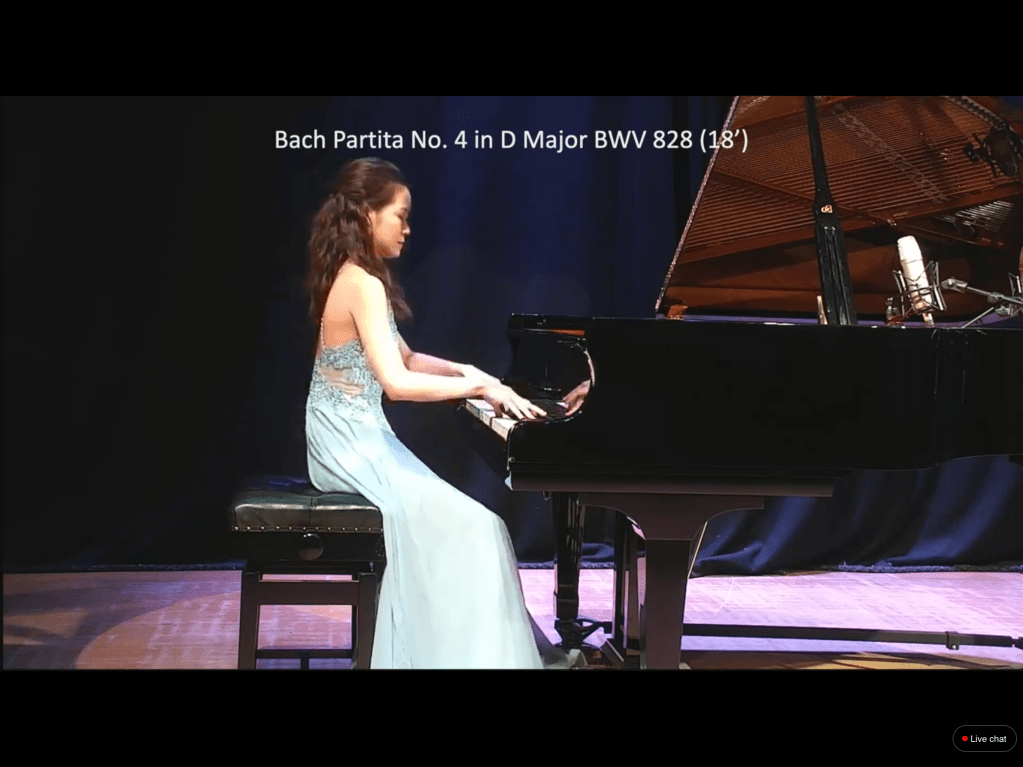
It just shows the esteem that Stephen Dennison and his colleagues in Cranleigh have for the artistry of Hao Zi to allow her to search for sounds inside the piano instead of only from the exterior.Infact from the very first notes of Bach’s glorious fourth partita we were aware of the extraordinarily luminous sounds that Hao Zi could conjure from this new Shegeru Kwai that was especially chosen by Sasha Grynyuk for the hall.
The opening of the fourth Partita BWV 828 was played with authority and with a sound of great clarity as the imperious opening chords in 2/2 are suddenly brought to life in 9/8 bringing a sense of rhythmic energy as it springs to life at the opening of this Partita written in 1728 and part of the Clavierubung n.1.There was an operatic freedom to the Allemande that was shaped with delicacy with some very subtle colouring that immediately brought a magic spell to this mellifluous outpouring .This contrasted with the injection of rhythmic energy of the Courante before the ravishing beauty of the Aria.Hao Zi brought subtle phrasing and a sense of colour with playing of great delicacy.Even the final cadence was judged to perfection before the playful Sarabande with its cascades of arpeggios ,just shifts of sounds creating an orchestral effect of shifting harmonies.There were ornaments in the Menuet that sparkled like jewels as even here she brought this playful movement vividly to life .She brought authority to the Gigue which was played with relentless rhythmic energy but was also shaped with such care with a sound that was never hard or mechanical as often it can be in lesser hands as they cope with the transcendental technical difficulties of this movement.Hao Zi was not at all intimidated as she turned any technical hurdles into music of searing intensity and intelligence .
Iberia is a suite for piano composed between 1905 and 1909 by Isaac Albeniz. There are four books of three pieces each; Almeria is from the second book. Iberia is Albéniz’s best-known work and considered his masterpiece. It was highly praised by Debussy and Messiaen , who said: “Iberia is the wonder for the piano; it is perhaps on the highest place among the more brilliant pieces for the king of instruments”.A critic in New York in 1988 pointed out whilst praising Alicia de Larrocha’s performance:’There is really nothing in Isaac Albeniz’s Iberia that a good three-handed pianist could not master, given unlimited years of practice and permission to play at half tempo. But there are few pianists thus endowed’. The Andalusian seaport of Almeria, is loosely based on tarantas, a flamenco form characteristic of the region of Almeria.Alicia de Larrocha often played in my season in Rome so I could admire in rehearsal and performance her workmanlike simplicity and intelligence born of hard work and dedication.A small hand that could with rubber like placticity mould itself around even the most gargantuan chords.I was reminded of her today as I listened to the sumptuous performance of Hao Zi where she filled this tone poem with subtle sounds and passionate outpourings.There was heartrending nostalgia too as the melodic line just floated on a cloud of sounds without any sentimentality or added effects apart from those that Albeniz depicts in the score.Grandiose chords too of a fullness that was never hard or ungrateful but luminous and inviting as they dissolved into the magic land of AlmeriaThe spell had been set for the Chopin Andante Spianato that floated in on the wave of Almeria .An audience that was obviously too entranced to break this spell with applause was rewarded with a performance of such subtle beauty and shape.One was not aware of single notes as her sense of legato enveloped even the most elaborate of embellishments that were just streams of gold and silver sounds ornamenting this magic bel canto atmosphere.Playing the full orchestral introduction to the ‘Grande Polonaise Brillante’ this was more a Polonaise Fantasy with which Chopin would have entranced the aristocracy in the Parisian salons of the day so used to the funabulistic high jinks of Liszt or Thalberg. It was to lead Schumann to exclaim ‘Hats off gentlemen ,a genius’.Hao Zi spun a magic web where ,of course,there were moments of great brilliance and octaves of majestic grandeur. The jeux perlé streams of sound though were played with subtle shape and sense of phrasing that one was not aware of the ‘fingerfertigkeit’ involved.Music just streamed from Hao Zi’s hands as it must have done from Chopin’s creating a magic and enveloping sense of forward movement where every note was part of a musical shape of ravishing charm and elegance.Liszt taking the Parisian salons by storm in his own inimitable way.
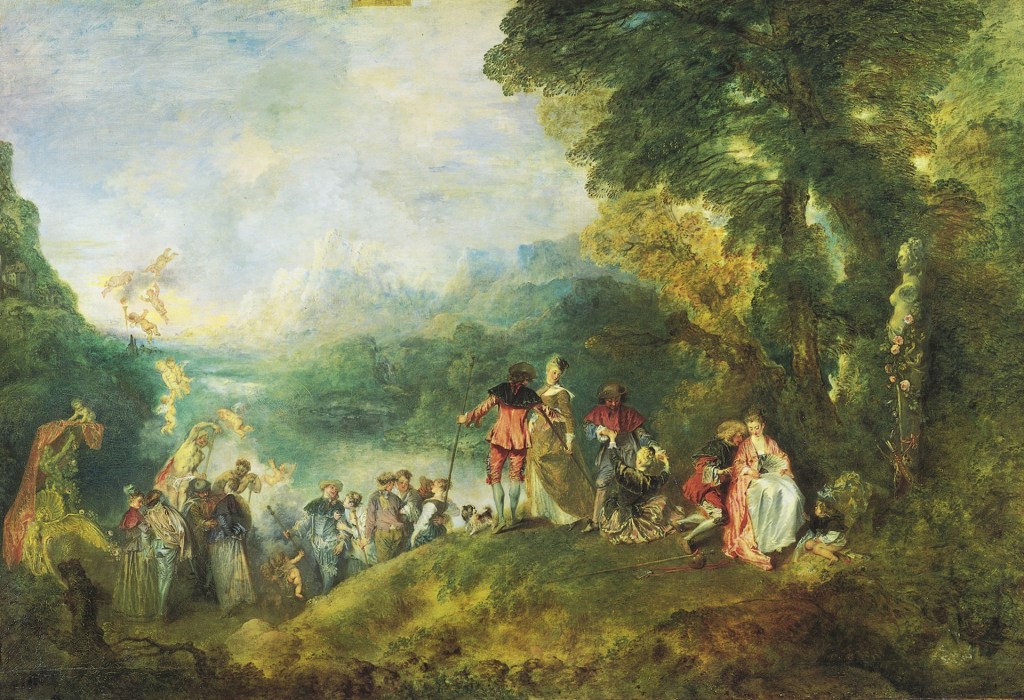
The Schumann Fantasy has its origin in early 1836, when Schumann composed a piece entitled ‘Ruines’expressing his distress at being parted from his beloved Clara Wieck (later to become his wife). Schumann prefaced it with a quote from the poet Schlegel :’Resounding through all the notes In the earth’s colourful dream There sounds a faint long-drawn note For the one who listens in secret.’ Also a quote from Beethoven’s song cycle An die ferne Geliebte (to the distant beloved) in the coda of the first movement :’Accept then these songs beloved, which I sang for you alone’.Schumann wrote to Clara: ‘The first movement may well be the most passionate I have ever composed – a deep lament for you.’It became the first movement of the Fantasy.Later that year, he wrote two more movements to create a work intended as a contribution to the appeal for funds by Liszt to erect a monument to Beethoven in his birthplace, Bonn.It is dedicated to Liszt who in turn dedicated to him his B minor Sonata – two pinnacles of the Romantic piano repertoire.It was exactly this romantic sweep and passionate beauty that Hao Zi brought to the first movement.With a great sense of architectural line she managed to piece together all the various episodes with a wonderful sense of colour and style.The middle,section Im leggenden ton had some truly magical moments as it built to a passionate climax of great intensity.There was rhythmic energy in the second movement which despite the intricate dotted rhythms was beautifully shaped and led to the transcendental difficulty of the coda where the difficulties just disappeared as Hao Zi turned these hurdles into music of passionate urgency.There was an aristocratic sense of timelessness in the last movement and the gentle resolution although not exactly what the composer asks for was a musical solution of sublime beauty.The three last chords were of such beauty and calm creating a magic atmosphere where the audience held their breath for many minutes after the last chord had sounded.L’isle Joyeuse with its opening of mystery and delicacy as the astonishing clarity of Hao Zi’s playing brought this very evocative piece vividly to life.Written in 1903 as originally part of a series of three pieces :L’isle joyeuse,Masques and a piece that became D’un cashier d’esquisses.L’isle joyeuse was inspired by a painting by Watteau:’Pèlerinage à l’ile de Cythère’.Most probably the island was Jersey,where Debussy had spent much time with his new companion Emma Bardac.Played with great temperament and sense of colour with the passionate outpouring of the final triumphant declaration bringing this beautiful recital to a stimulating conclusion.Watteau:’Pèlerinage à l’ile de Cythère’
Malaysian pianist Hao Zi Yoh was born in 1995 and began her music studies at the age of 3. By the age of 12, she already performed at Carnegie Hall as a gold medalist of the Bradshaw and Buono International Piano Competition. Most recently, Hao Zi was selected as participant in the Preliminary Round of Chopin Piano Competition in Warsaw 2021. At the age of 14, she moved to Germany to study with Prof. Elza Kolodin at the Hochschule für Musik Freiburg. It was then she won top prizes in many international competitions including EPTA Belgium, Enschede, RNCM James Mottram (Manchester, 2012) and Concurso international de piano Rotary Club Palma Ramon LLull, Mallorca (Spain 2013).In 2014, she came under the tutelage of Prof. Christopher Elton at the Royal Academy of Music, London, generously supported by Lynn Foundation, Leverhulme Trust, Countess of Munster and Craxton Memorial Trust. She received 3rd Prize at Roma International Piano Competition, the Phillip Crawshaw Memorial Prize for an Outstanding Musician from Overseas at the Royal Overseas League Competition. She was also recipient of prestigious Martin Musical Scholarship Trust Philharmonia Piano Fellowships on the Emerging Artists Programme 2017/18. During her studies, she explored her relationship with music and her interest in creating sound colours: her MMus Project 2016 involved collaborating with percussionist Daniel Gonzalez to create a version of Ravel’s Gaspard de la nuit for Piano and Percussion.Apart from this, Hao Zi also participated in creative outreach projects led by the Open Academy for children and elderly with Dementia, where she performed in Music for Moment Concerts at the Wigmore Hall. She collaborated with author-illustrator David Litchfield and improvised to his storytelling of award-winning book “The Bear and the Piano”.She is further developing her performing career being part of the Keyboard Trust London, Talent Unlimited. Hao Zi is also a piano tutor at King’s College London and gives masterclasses at Imperial College London.
A very interesting interval conversation between Stephen Dennison and Hao Zi Yoh
Terra del Fuoco indeed as this young Spanish pianist /composer ignited the already torrid heat in Florence with a scintillating display of ‘joie de vivre’as rays of sunlight just shot from his agile fingers.
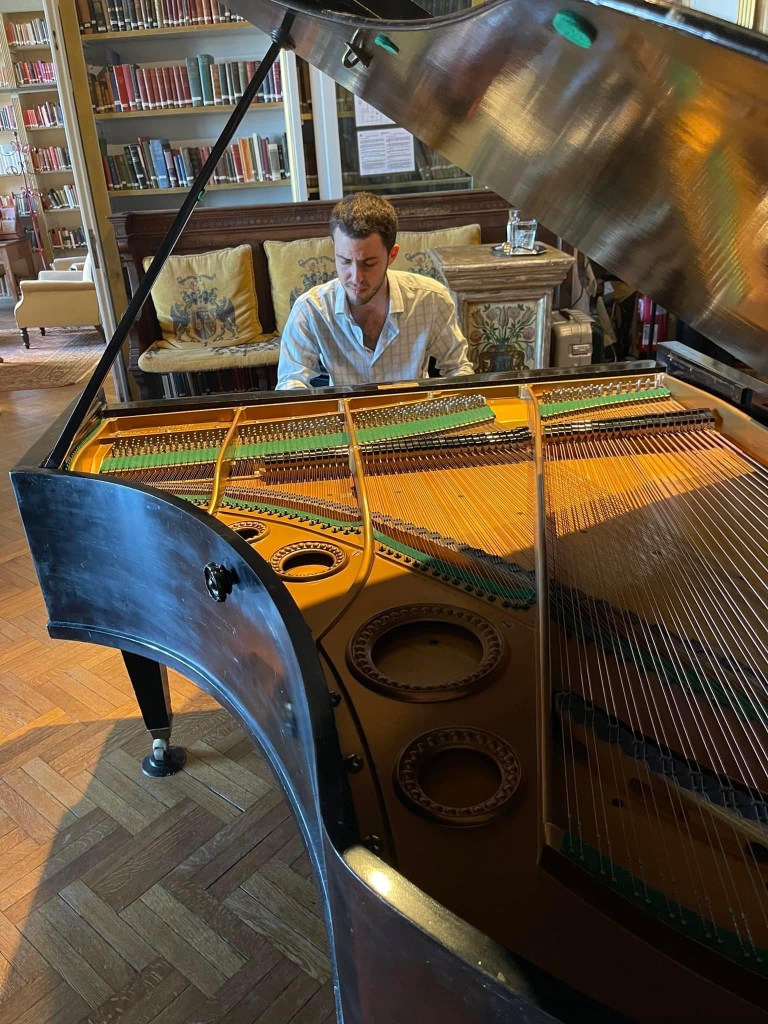
In rehearsal on the 1890 Bechstein in the Harold Acton Library
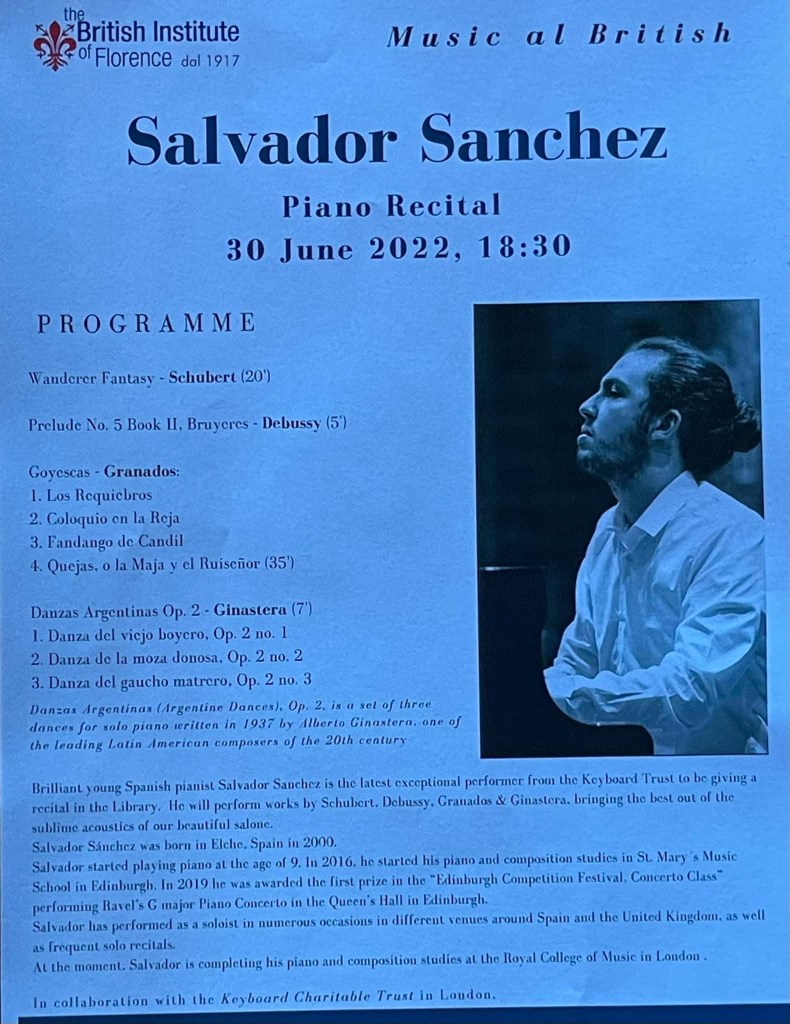
A Wanderer Fantasy where Schubert’s youthful energy and brilliance were matched with intelligence and sublime beauty as Salvador Sanchez with his noble opening statement took us on a long and intricate journey.From the heroic opening,the teasing fun of the scherzo to the very heart of the Wanderer.It was here that Salvador’s romantic soul allowed the sublime variations to seduce and beguile before the astonishing pyrotechnics of the fugato.
The four-movement Fantasy in C op 15 D.760 was written in 1822 and is widely considered Schubert’s most technically demanding composition for the piano. Schubert himself said “the devil may play it,” in reference to his own inability to do so properly.The whole work is based on one single basic motif from which all the themes are developed. This motif is distilled from the second movement, which is a sequence of variations on the song “Der Wanderer”, which Schubert wrote in 1816. It is from this that the name is derived. The four movements are played without a break. After the first movement Allegro con fuoco ma non troppo and the second movement Adagio follow a scherzo presto and the technically transcendental finale, which starts in fugato becoming more and more virtuosic as it moves toward its thunderous conclusion.Liszt was fascinated by the Wanderer Fantasy, and transcribed it for piano and orchestra (S.366) and two pianos (S.653). He also edited the original score and added some various interpretations making a complete rearrangement of the final movement (S.565a).
Calming the waters with Debussy’s mists of sound Salvador was able to conjure up an atmosphere that was certainly not the one we were experiencing in Florence today. The wonderful blue sky and crystal clear atmosphere was more a tune to what Salvador had up his sleeve in the second part of his recital in the Harold Acton Library of the British Institute. His performance of the complete Goyescas had Leslie Howard on the edge of his seat a while ago in his first concert for the Keyboard Trust. https://christopheraxworthymusiccommentary.com/2021/06/30/salvador-sanchezs-scintillating-artistry-for-the-keyboard-trust/ Four pieces were re-enacted today without even waiting for the mist to clear!
Goyescas op 11 is subtitled Los majos enamorados (The Gallants in Love), and was written in 1911 . It was inspired by the work of the Spanish artist Francisco Goya even though the piano pieces have not been authoritatively associated with any particular paintings with two exceptions not included in the selection of these four pieces from the seven that make up the two books. The piano writing of Goyescas is highly ornamented and extremely difficult to master, requiring both subtle dexterity and great power. Some of them have a strong improvisational feel.The suite was written in two books starting in 1909, and by 31 August 1910, the composer was able to write that he had composed “great flights of imagination and difficulty.” Granados himself gave the première of Book I in Barcelona on 11 March 1911 and completed Book II in December 1911 giving its first performance in Paris on 2 April 1914.The boat ‘The Sussex’ on which he was returning from America was torpedoed in the English Channel on the 24th March 1916.A survivor of the 1916 torpedo attack on a Cross channel ferry, Sussex, recognised Spanish composer Granados in a lifeboat, his wife in the water. Granados dived in to save her and perished.”The ship broke in two parts, and only one sank (along with 80 passengers). Ironically, the part of the vessel that contained his cabin did not sink and was towed to port, with most of the passengers, except for Granados and his wife, who were on the other side of the boat when it was hit. Granados and his wife left six children: Eduard (a musician), Solita, Enrique (a swimming champion), Víctor, Natalia, and Francisco.
Music that is clearly in the blood of this young virtuoso from Alicante.Conquering the enormous technical hurdles that Granados delighted in pouring into his famous Goyescas.Written of course before he went down with the ship.(His ship was torpedoed on his way home from New York where his opera based on Goyescas received its premiere.Being summoned to play for the President at the White House’ he fatally caught a later boat home). Pieces of a transcendental difficulty not only to play the notes but to keep in the memory with the intricate strands of melody that are so richly embellished in a true maze of sounds.The ‘Fandango’was played with hypnotic rhythmic verve and contrasted with the sublime beauty of ‘The Maiden and the Nightingale’ where the sheer beauty of the maiden truly delighted the nightingale who was ready to warble to her hearts delight with such clarity and daring.’Los Requiebras’ was a tour de force of technical and musical mastery as the melodic line passed from one part of the keyboard to the other.Magical filigree embellishments of fleeting beauty passed like shafts of gold and silver ornamenting the sumptuous beauty of the melodic line.’Coloquio en La Reja’ showed off his extraordinary sense of balance allowing sounds of ravishing beauty to sing so naturally unforced. This young Spaniard’s sense of timing and subtle stretching of the tempo that like Chopins Mazurkas cannot be taught but has to come from the soul. And Salvador not only has a soul but also the passion and fire of a hot blooded Latin.
Op. 2, is a set of three dances written in 1937 by Alberto Ginastera one of the leading Latin American composers of the 20th century .The first piece, Danza del viejo boyero (“Dance of the Old Herdsman”), immediately strikes the ear as being odd as the left hand plays only black notes, while the right plays only white notes.Danza de la moza donosa (“Dance of the Donosa Girl”) is a gentle dance in 6/8 time where a piquant melody meanders its way through the first section, constantly creating and releasing tension through the use of chromatic inflections.With directions such as furiosamente ,violente,mordento and salvaggio ,Ginastera left no doubt as how to play the third dance, Danza del gaucho matrero (“Dance of the Outlaw Cowboy”)!
No more evident that in the Argentinian Dances by Ginastera where having astonished with the brilliance of the ‘del viejo boyero’he seduced with the sublime musings of ‘la moza donosa’only to be literally caterpulted into the astonishing exuberances of ‘del gaucho matrero’ Astonished and not a little exhausted by this sparkling display of virtuosity Salvador was ready to offer one of his own compositions. The calm and translucent sounds brought us to the atmosphere that Bartok brings to his own ‘open air’ that was probably the inspiration for this very evocative piece. Salvador is also a remarkable composer and on the 10th July a commissioned work for string quartet and magnetised (!)piano will receive it’s premiere in London.
Simon Gammell OBE director of the British Institute
It was so refreshing on this suffocatingly hot day to see the radiance and fun he was evidently having sharing music with this elite audience.A new series that director Simon Gammell and wife Jennifer have organised with the astonishing array of artists from the ever expanding roster of the Keyboard Trust.Here they are in our collaboration with six of the artists chosen to play this season in Florence from October ‘21 to October ‘22