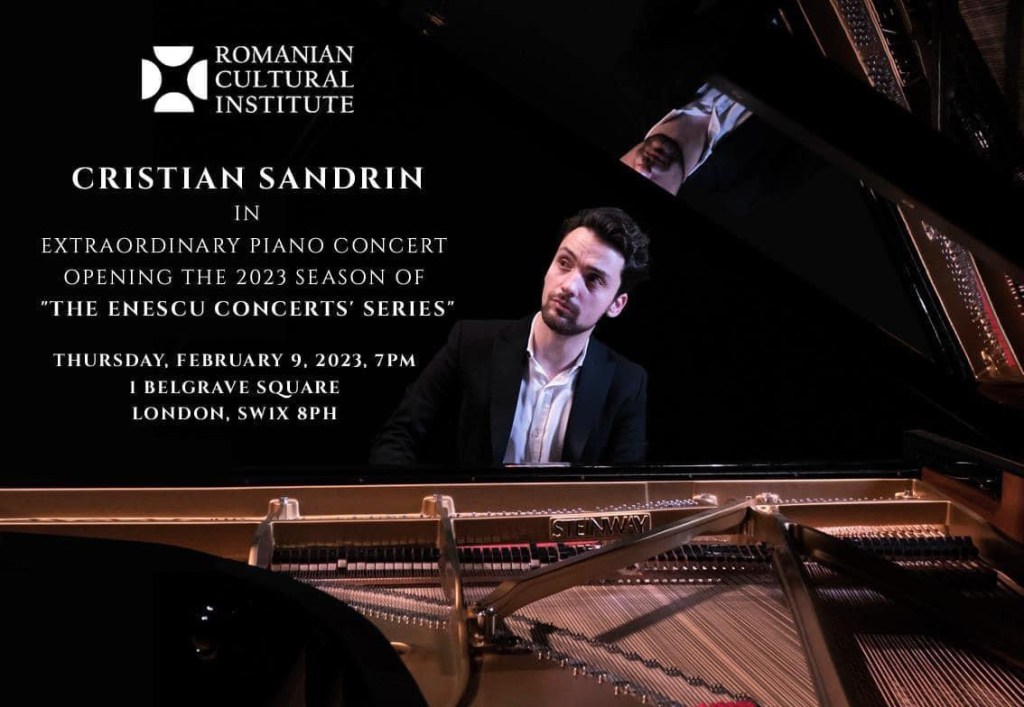
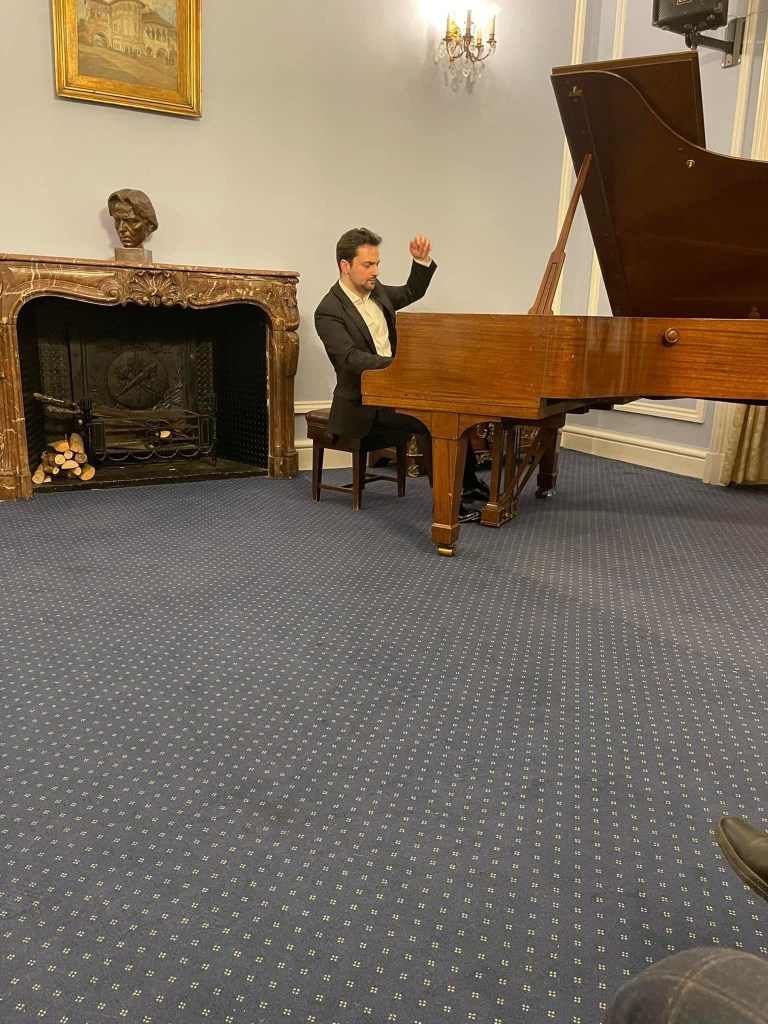
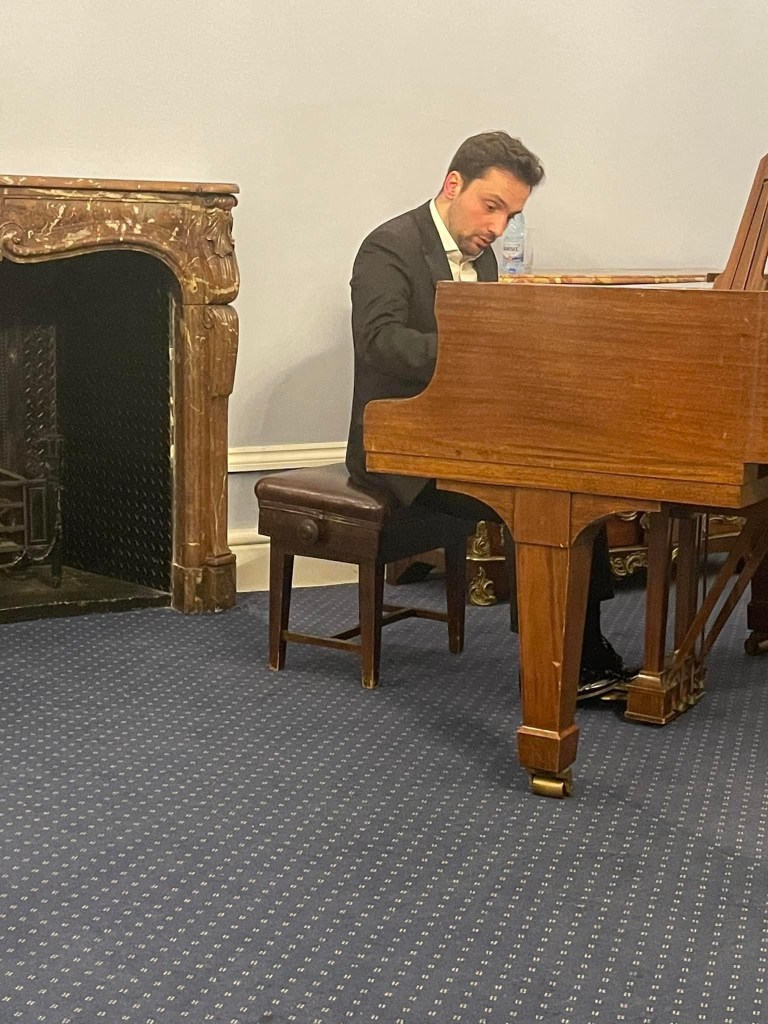
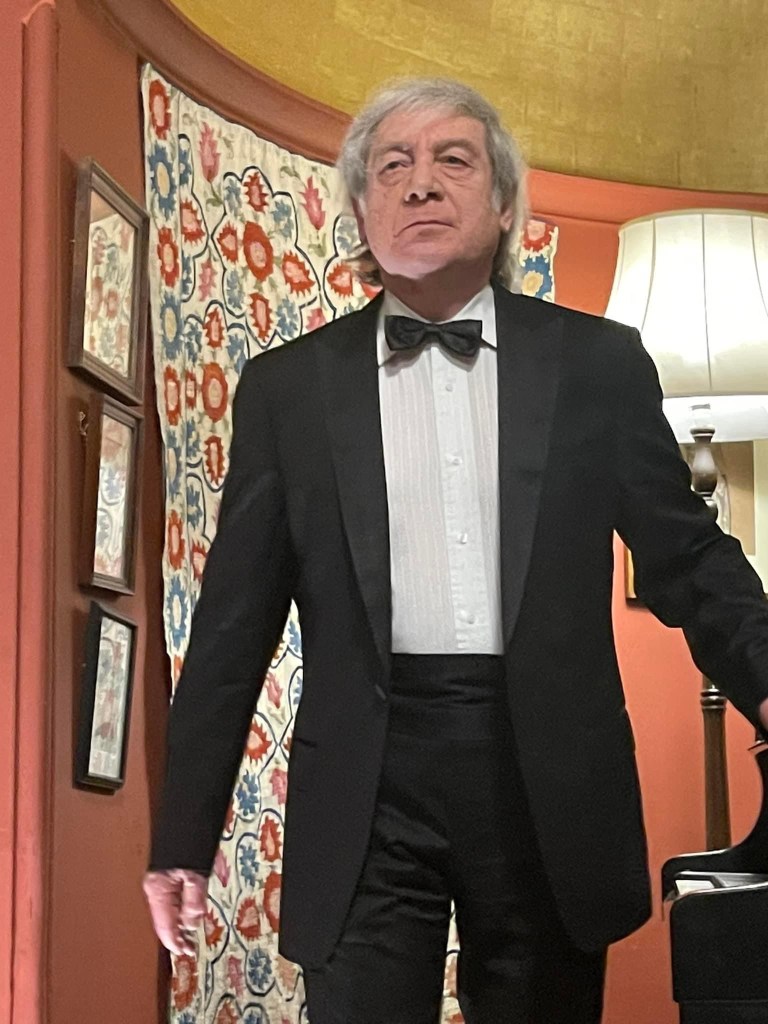
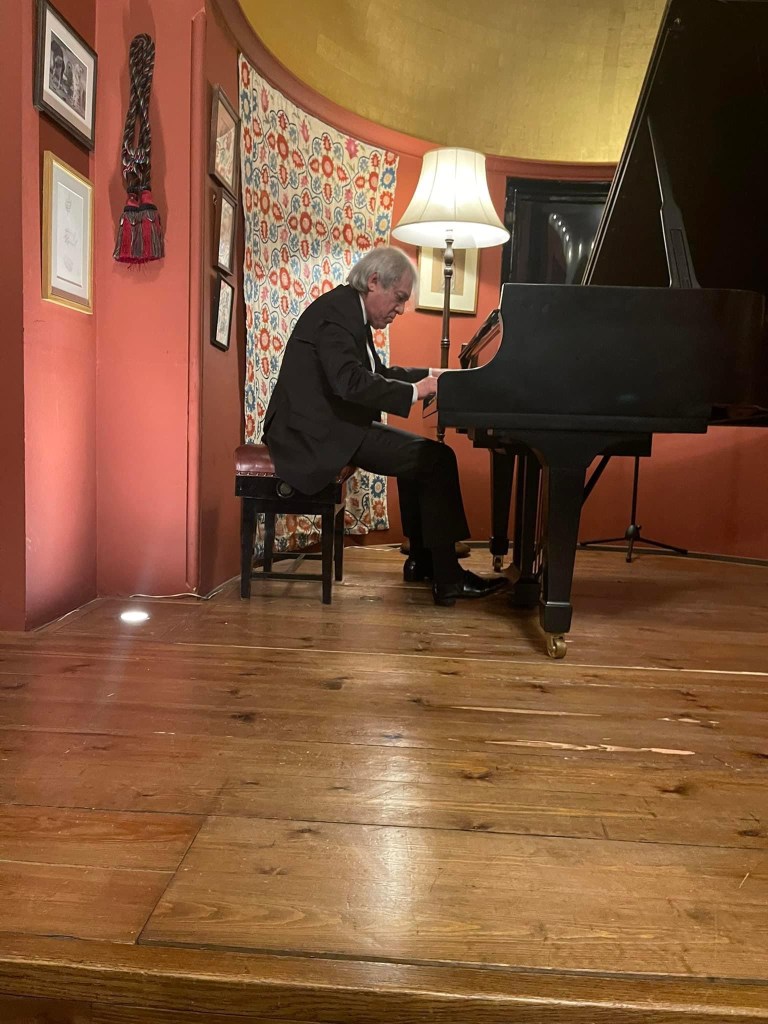
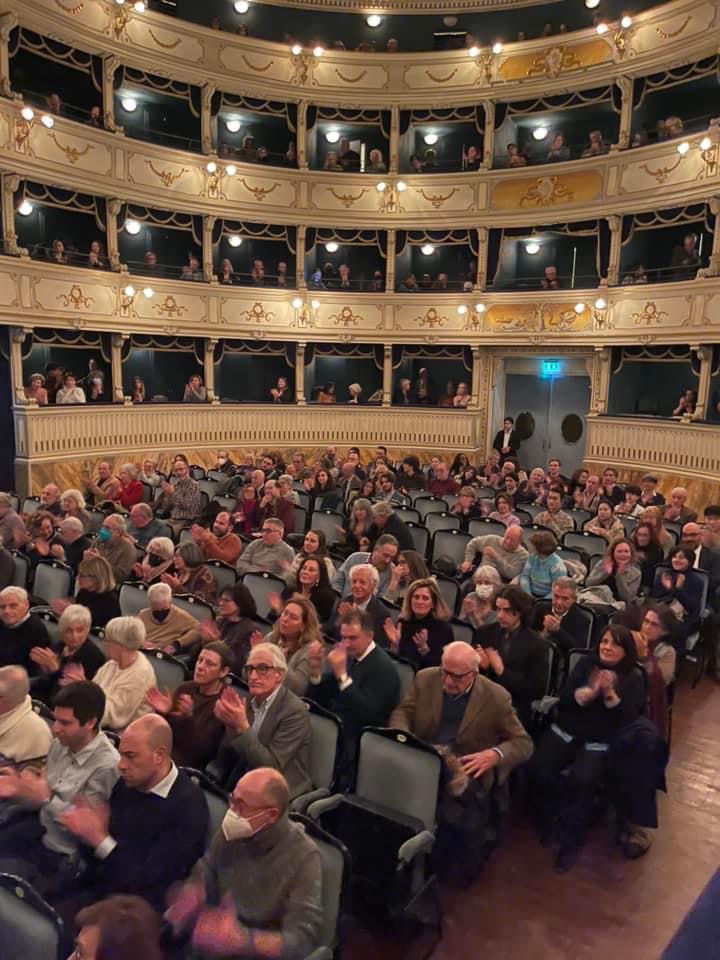
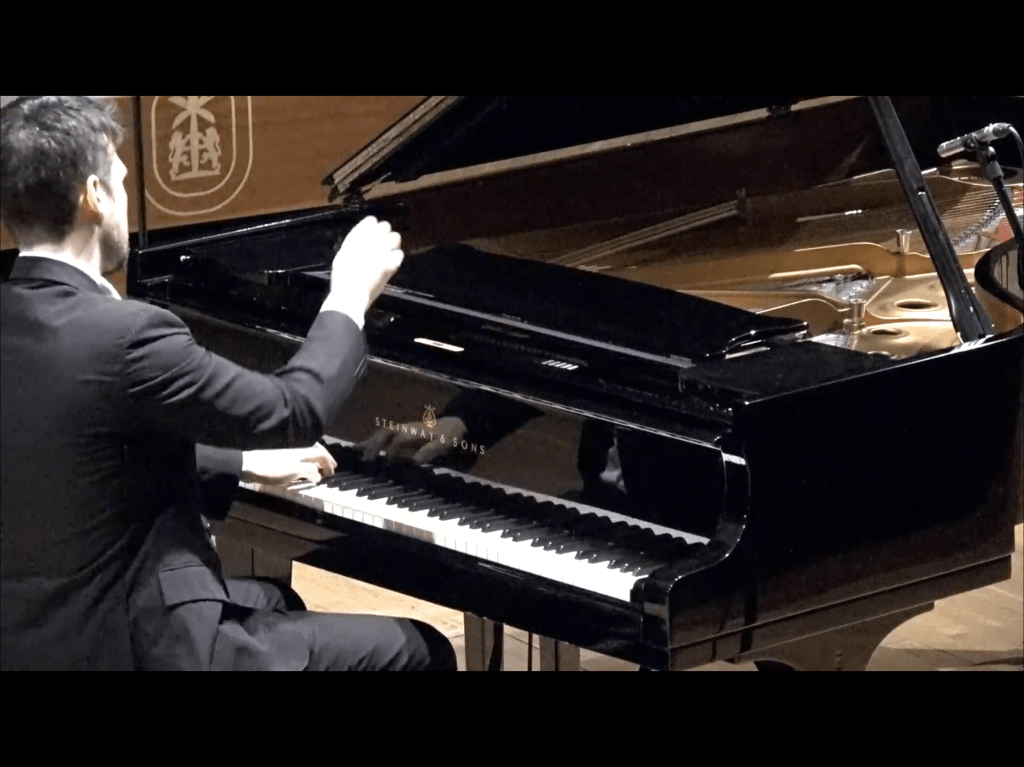
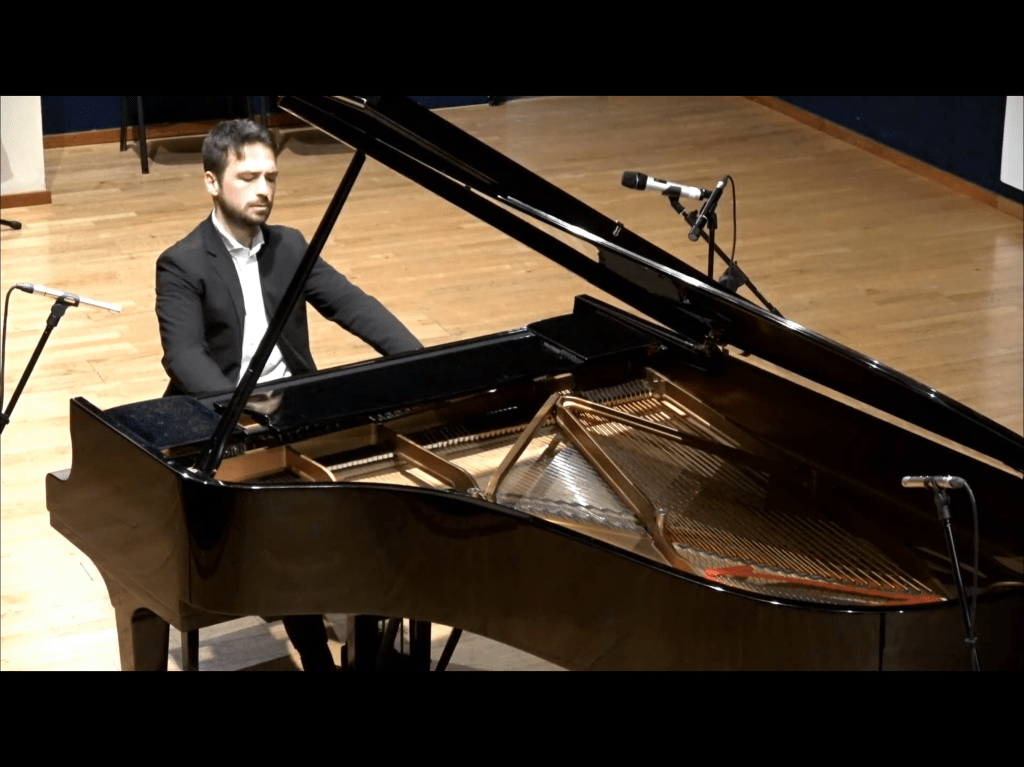
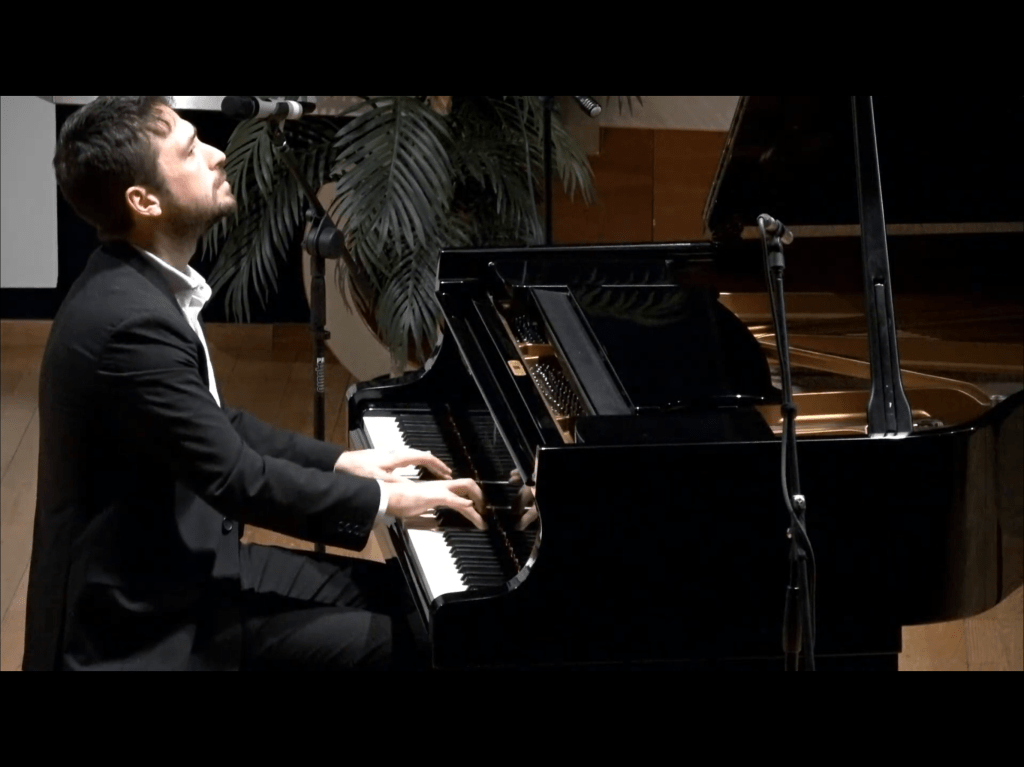
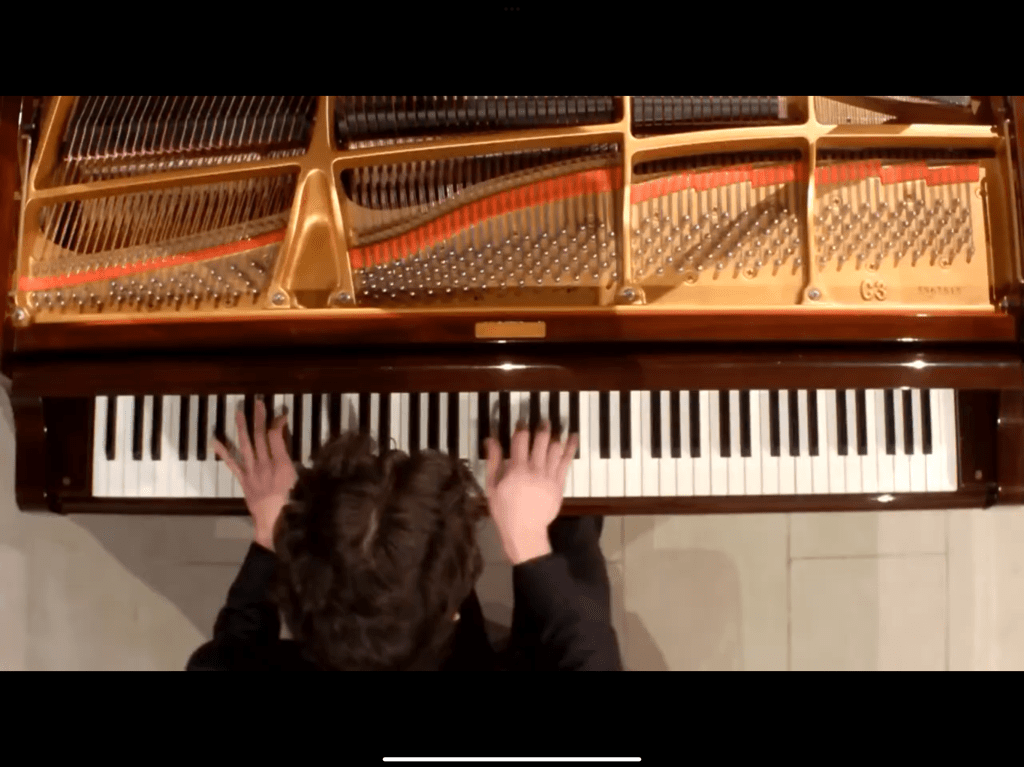
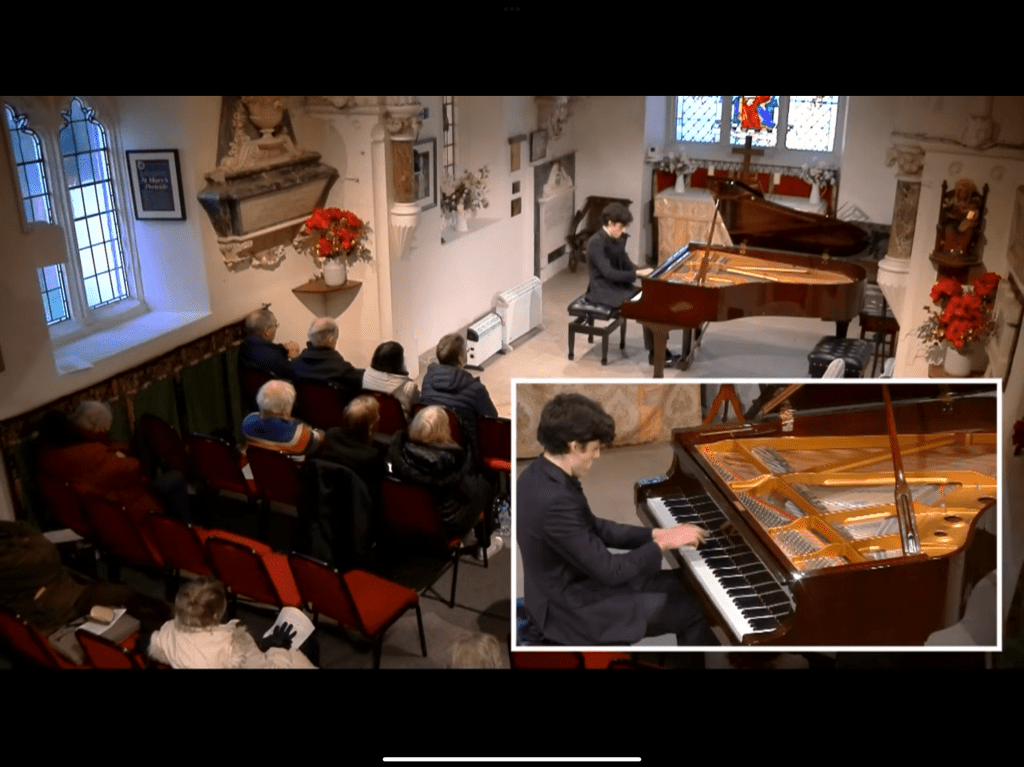
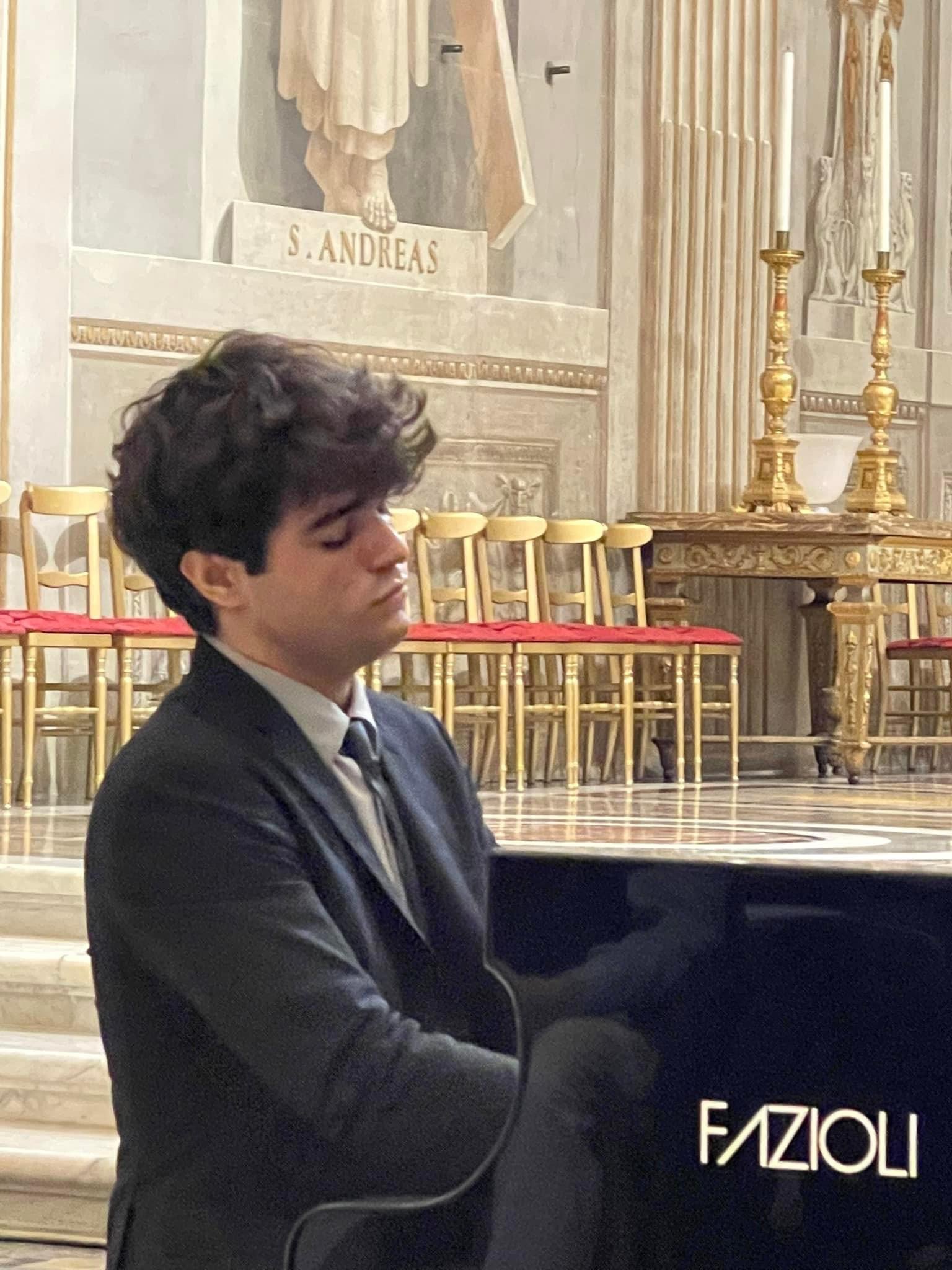
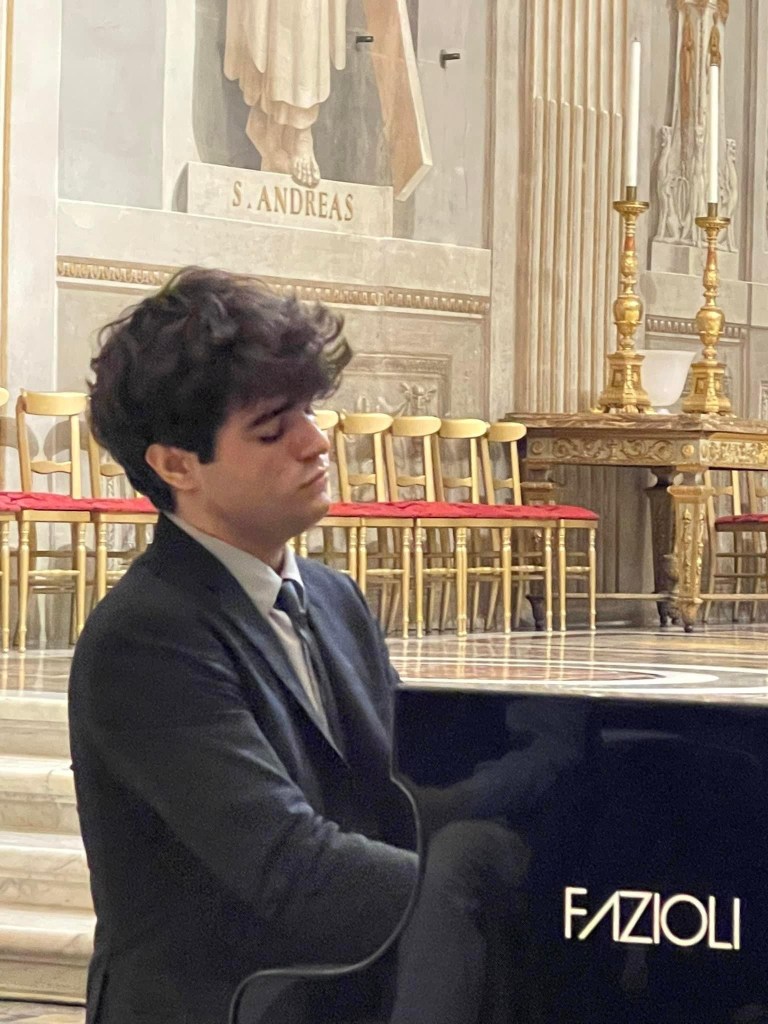
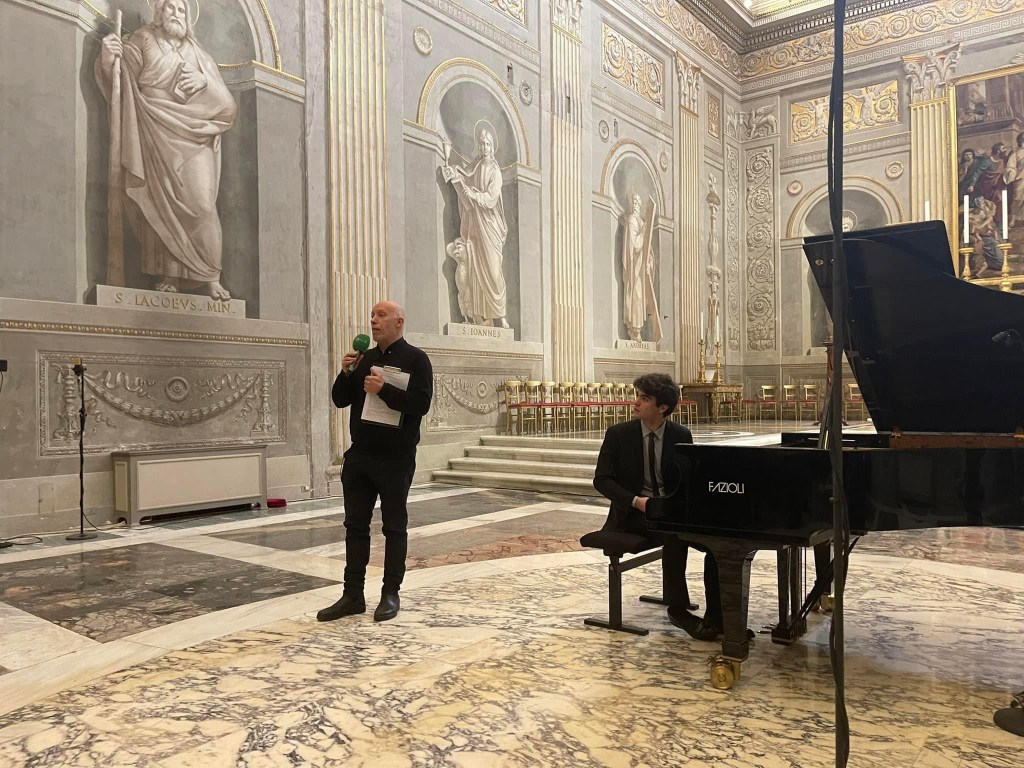
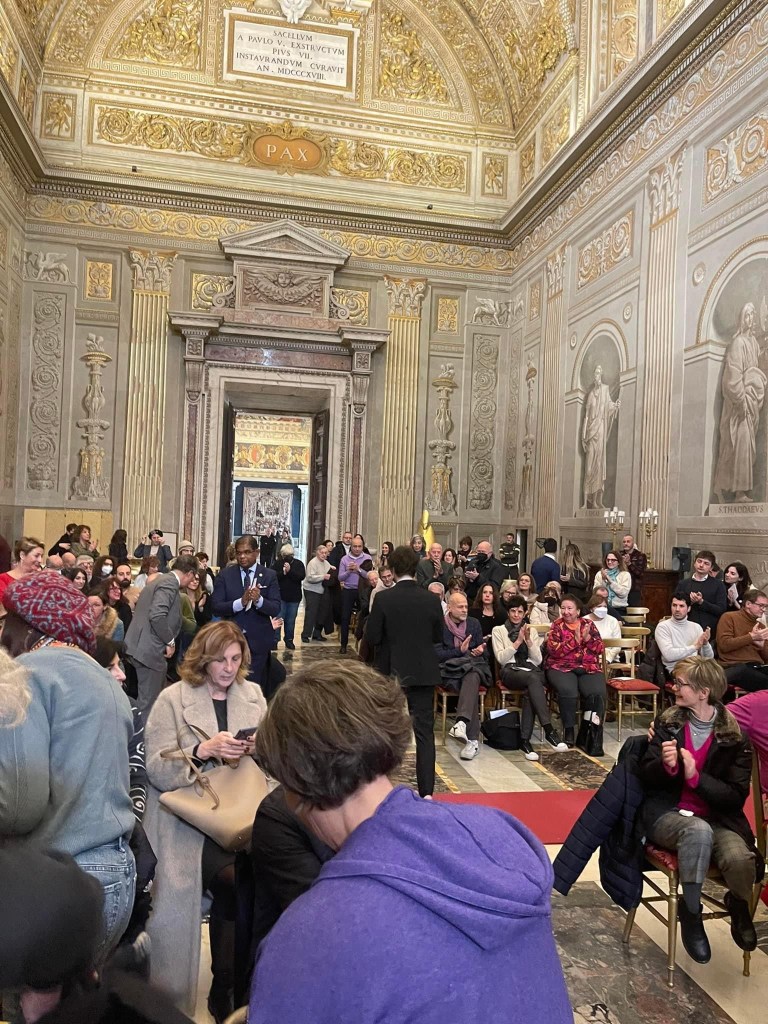
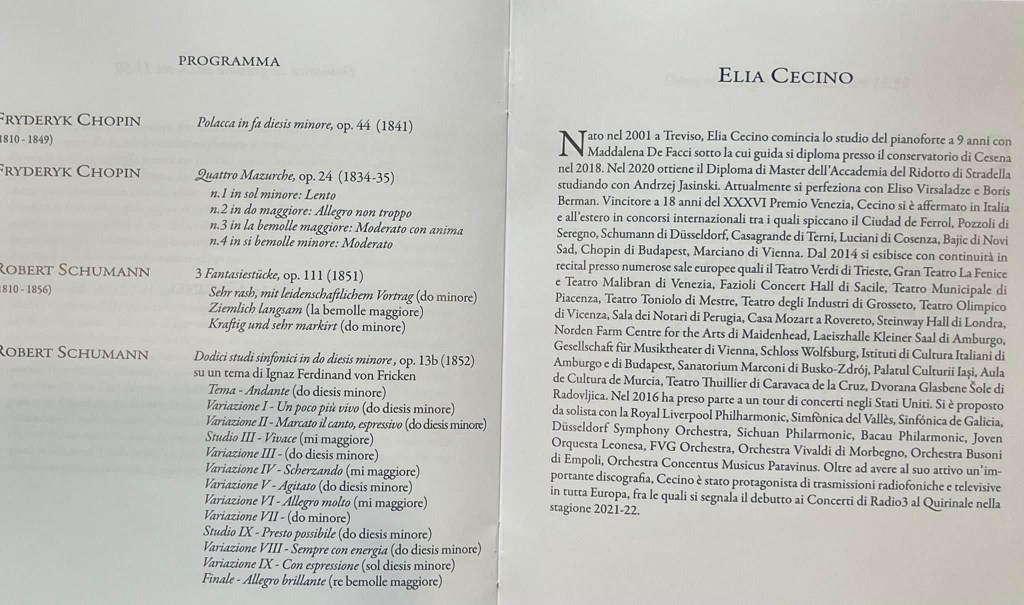
Great celebrations at the beautiful Romanian Cultural Embassy with a pre launch presentation of Cristian Sandrin’s new CD that includes the remarkable first Sonata by Enescu.
The cover of the new CD that will be available shortly
A National hero celebrated every year,in Bucharest and throughout the whole of Romania with a festival and international competition in his name. Cristian gave a superb performance of this two movement work with its bleak second movement after the brilliance of the first.
Pablo Casals described Enescu as “the greatest musical phenomenon since Mozart”and “one of the greatest geniuses of modern music”Queen Marie of Romania wrote in her memoirs that “in George Enescu was real gold”.Yehudi Menuhin considered Enescu “the most extraordinary human being, the greatest musician and the most formative influence” he had ever experienced.[
With Enescu looking on from the mantelpiece we were treated to a performance of great rhythmic energy and a subtle kaleidoscope of sounds.A performance of weight and authority of a masterpiece that deserves to be heard more often in the concert hall. The concert had begun with two Petrarc sonnets by Liszt that were played with ravishing sounds and passionate conviction.
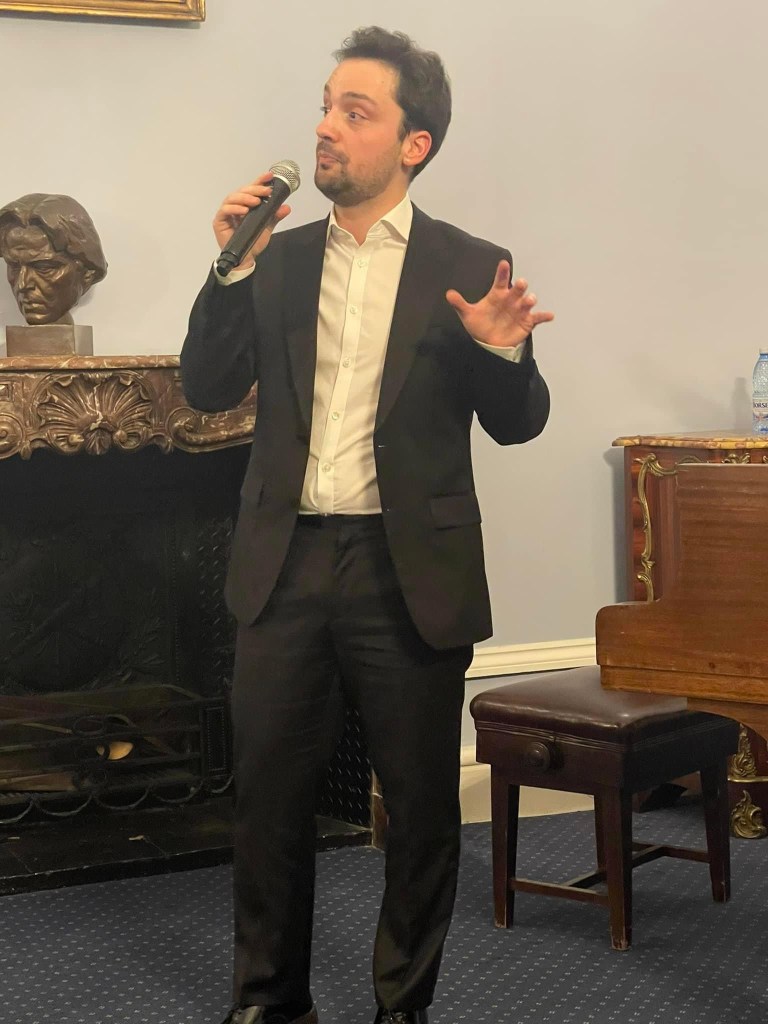
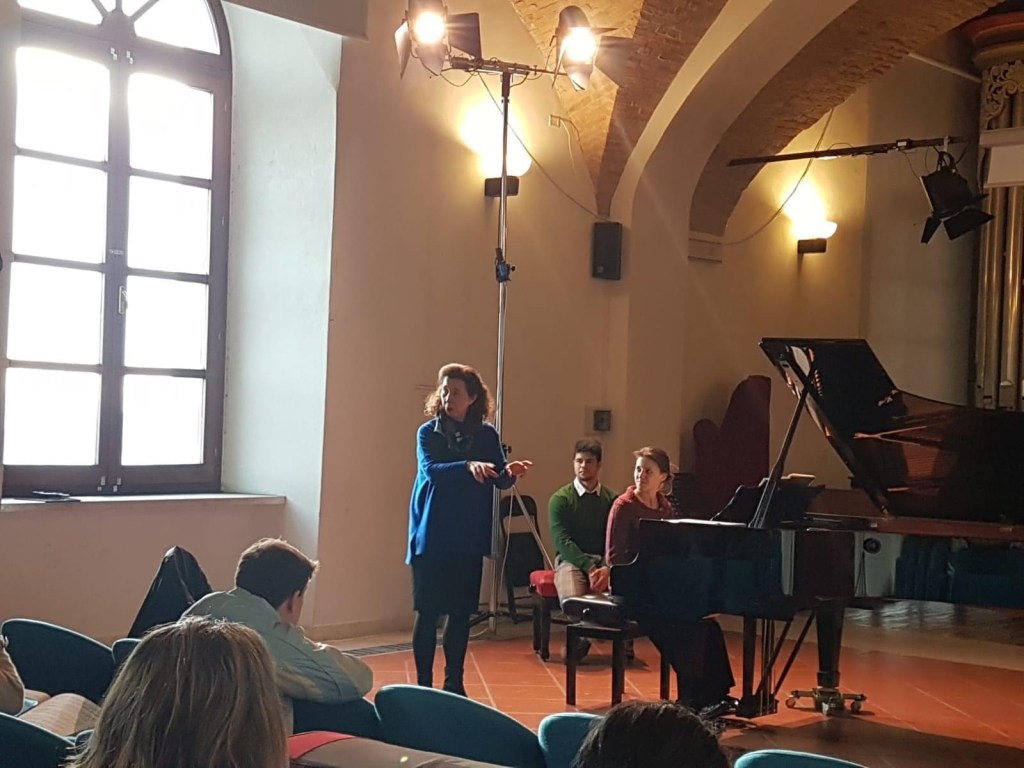
Cristian introducing his surprise programme
It was a concert without a printed programme and so after the interval we were astonished when Cristian announced that he would now play Beethoven’s Sonata in E op 109 and Chopin Sonata in B minor op 58! Reminiscent of Andras Schiff who prefers not to be tied down years in advanced to a specific programme but knows the public will trust him to play only the greatest of works.He had appeared on the Wigmore Stage recently and after the interval had announced quite casually that he would now play Beethoven’s monumental ‘Hammerklavier’Sonata! Wilhelm Kempf would regularly arrive at the recording studio and simply ask ‘what would you like me to play today?’ Cristian like Schiff is a superb musician who is mentored by that great musician Imogen Cooper.Everything he plays is imbued with intelligence and beauty. https://christopheraxworthymusiccommentary.com/2022/05/17/cristian-sandrin-plays-goldberg-variations-the-start-of-a-lifetime-journey-of-discovery/
An architectural shape which creates a great arch of noble importance where the details are not of prime importance as much as a structure that is constructed like a great cathedral on rock. A lesson of musical integrity and serious intent that was bequeathed to him by his recently deceased father the renowned pianist Sandu Sandrin. The school of Enescu of an age of complete musicians at the service of the music . And what music was heard tonight!
Queen Elisabeth of Romania with George Enescu and Dimitrie Dinicu at Peles Castle
Beethoven’s last thoughts on the sonata opened in a magic cloud of insinuating beauty only to be interrupted by Beethovenian outbursts of majestic nobility.Driving rhythms of the second movement with its relentless energy left Beethoven free to express his inner soul with the sublime theme and variations that followed. Beethoven’s ever more present celestial trills created streams of sound on which floated on high the theme before laying to rest weary and barely able to whisper the final heart rending return of the magical opening.
George Enescu ……..of whom Yehudi Menuhin, Enescu’s most famous pupil, said “He will remain for me the absoluteness through which I judge others.Enescu gave me the light that has guided my entire existence.”
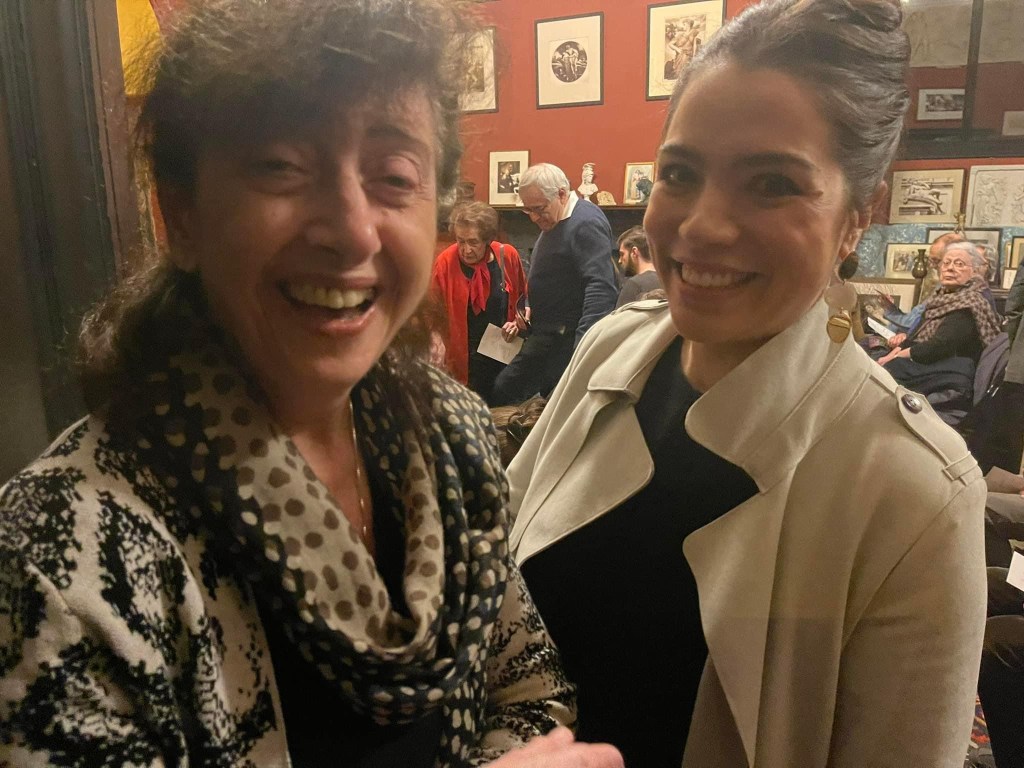
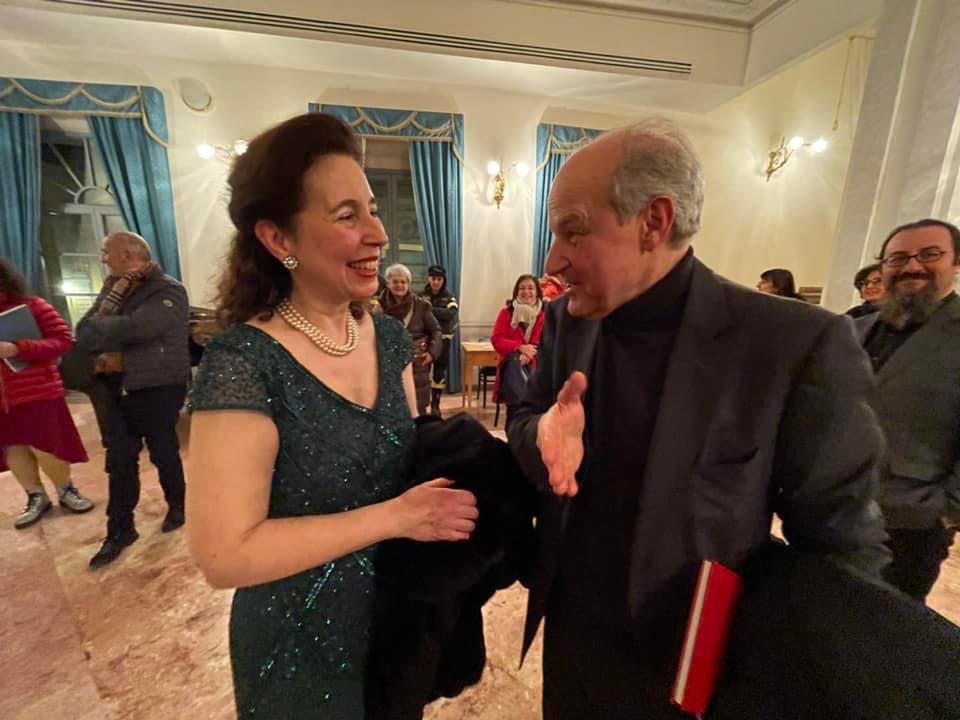
Cristian with the director of the Romanian Institute,Catinca Maria Nistor,who had given a very poetic welcoming introduction to this evening’s concert
Chopin’s B minor Sonata completed this marathon recital.Notable was the ravishing masculine nobility that he gave to the second subject of the first movement and the mounting excitement he brought to the final rondo. Playing of nobility and architectural weight that lent to Chopin a strength and shape that made one aware of what a revolutionary genius he truly was!
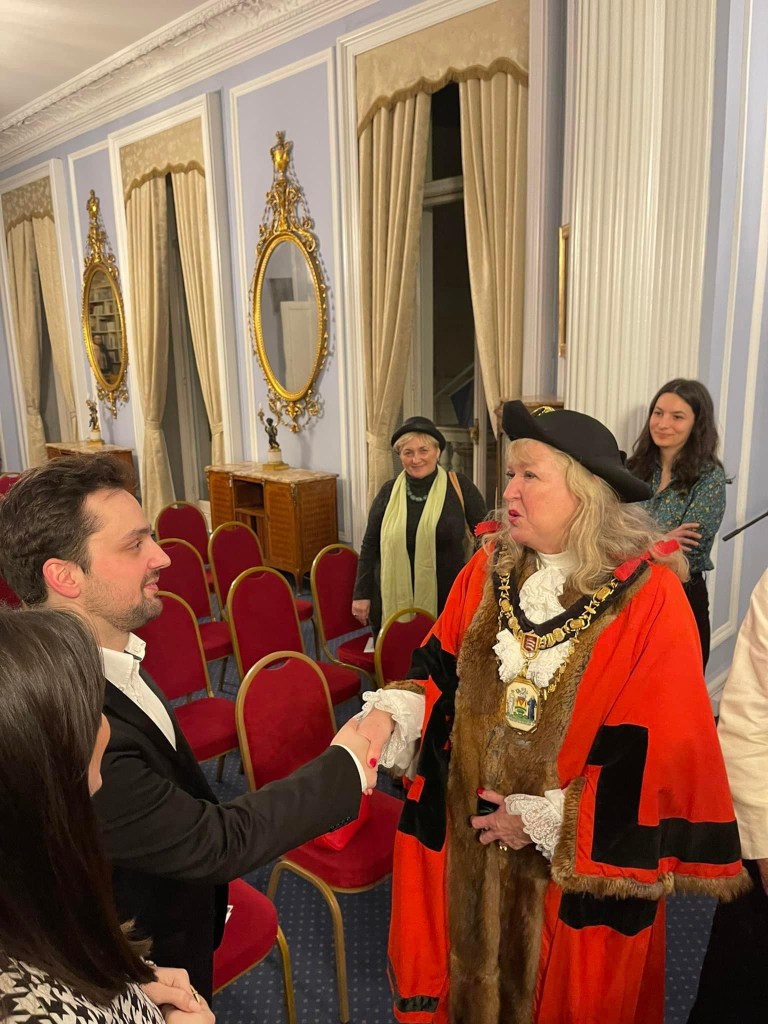
Honoured by the presence of the Mayor of Harrow where there is a particularly large Romanian community The group photo celebrating this great opening event in the name of Romania’s greatest musician .Great celebrations in the sumptuous Romanian Cultural Institute in Belgravia And finally dinner in a nearby Lebanese Restaurant which stayed open especially to feed this young artist after his marathon recital.
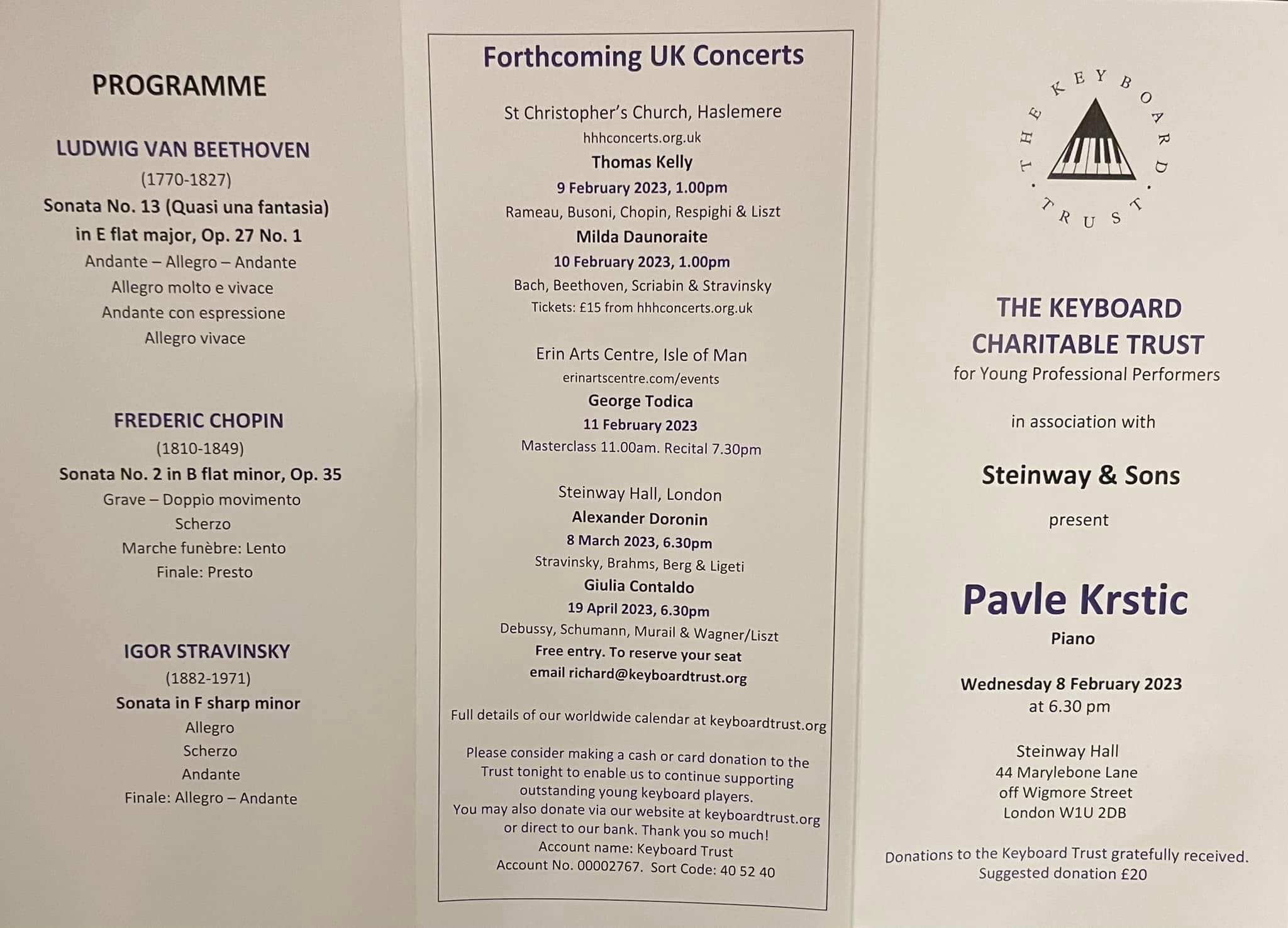
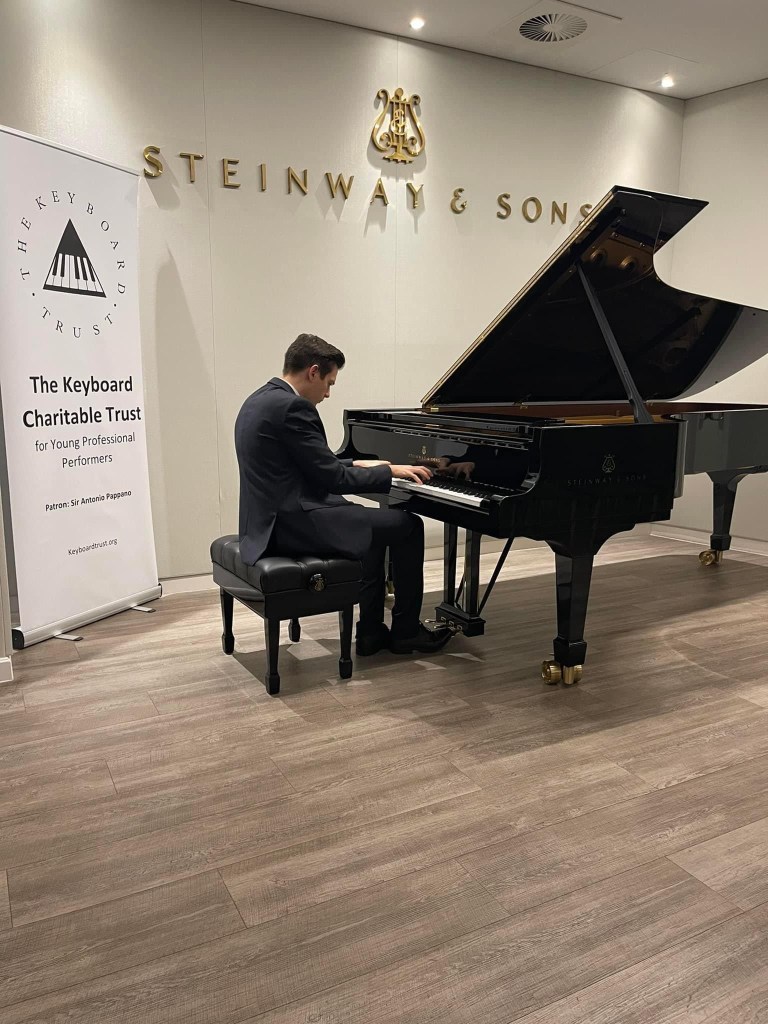
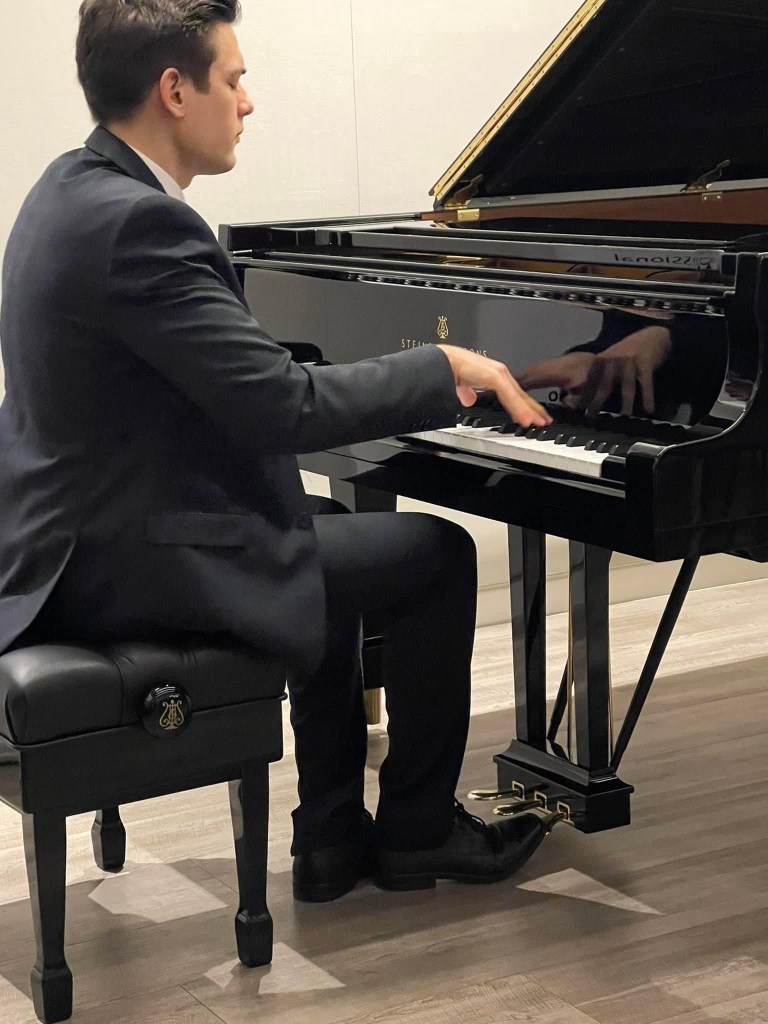
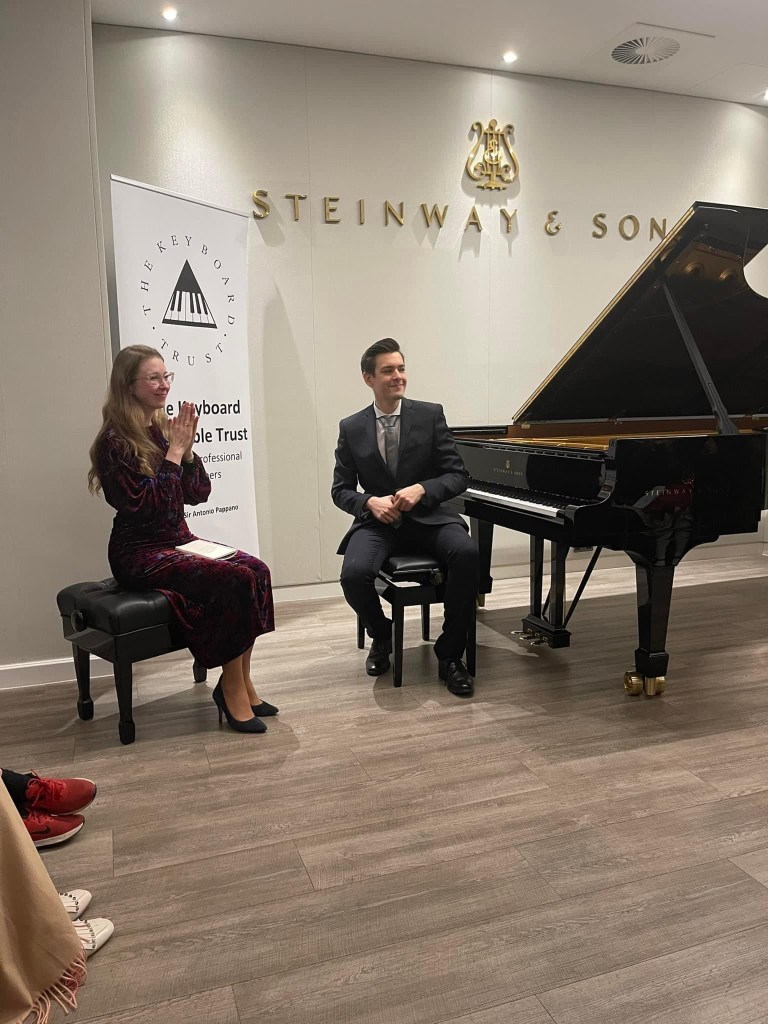
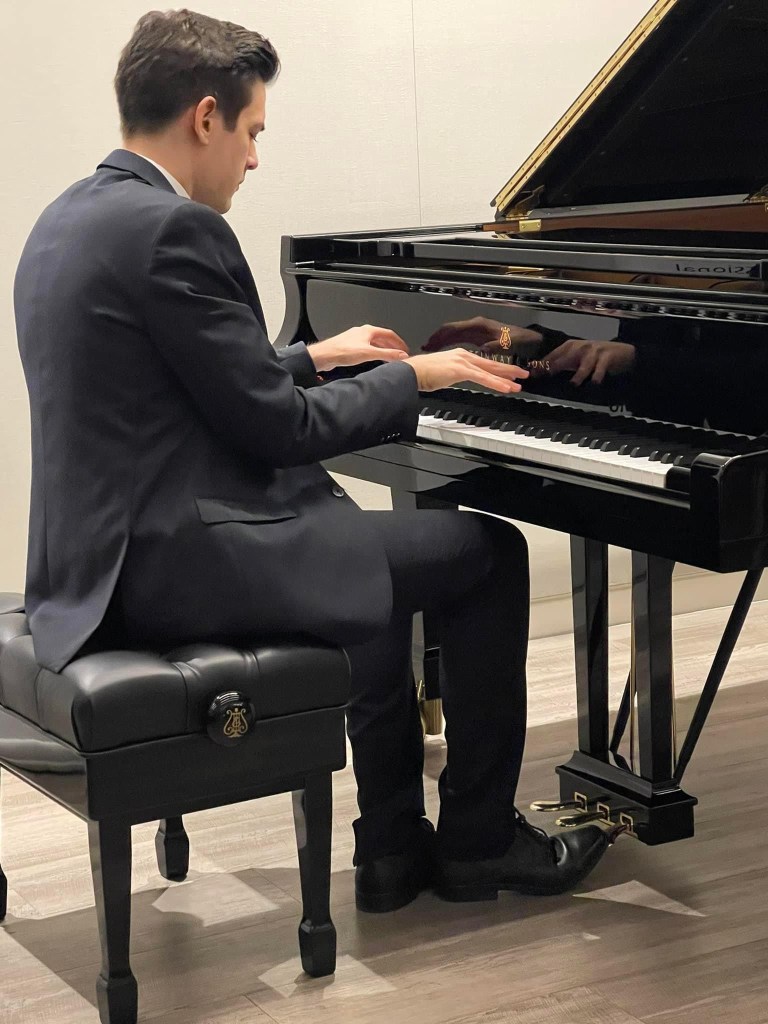
Pavle Krstic flew in from Salzburg invited by the Keyboard Trust to play at Steinway Hall in London.
Three sonatas on the programme by Beethoven,Chopin and an early Sonata by Stravinsky that the composer had hoped had been destroyed by the regime when he left his homeland in 1914. Two great works,one by Beethoven with his ‘quasi una fantasia’companion to the renowned ‘Moonlight’Sonata and Chopin’s B flat minor ‘Funeral March’Sonata. Strange no Mozart,considering that Pavle for the past ten years has been resident in Salzburg where he has been in the class of Pavel Gililov. Only a Sonata that the composer Stravinsky was horrified to see had survived the revolution!
Elena Vorotko,co artistic director of the KT in conversation with Pavle after his superb performances
As Pavle explained ,in his very informed and enjoyable conversation with Elena Vorotko,he chose this early unknown Stravinsky because after the success of his Chopin CD recorded last year in Verona he had been persuaded to record the complete piano works of a composer who much to his friend Rubinstein’s consternation thought of the piano as a percussive instrument!
Rubinstein had commissioned his great friend Stravinsky to write a piano piece for him.’Piano rag music’ duly arrived on his doorstep but it was such an ungrateful piece that he refused to play in public so Stravinsky dedicated his Petrouchka suite to him that was so technically challenging Rubinstein asked permission to make his own arrangements. Such a free arrangement that Rubinstein kept it only for the concert hall and not encapsulated on record. A pirate recording has survived though from his historic ten Carnegie Hall recitals the proceeds of which he gave to ten charities to thank America for befriending and supporting him during his long career. Rubinstein would have loved this early sonata that when Pavle was rehearsing I thought was some Godowsky type show piece that he intended to astonish us with after the three sonatas on the official programme .
An astonishing funabulistic show piece with a melodic effusion Hollywood style. What a shock to learn that it was the Stravinsky sonata! It certainly was not the one I was expecting that I had been forced to learn as a student to play to Nadia Boulanger.A later work of Stravinsky’s rather impersonal barren stile of neo classicism ?! This youthful work Pavle played with astonishing clarity and bravura that with some judicious cuts could grace the concert hall as a virtuoso encore piece. It was interesting after hearing his very musicianly account of the Chopin Sonata to learn that he was using the new recommended Ekier edition where the question of the first movement repeat was swiftly resolved. Not only was it his brilliant playing but also his very eloquent explanation that made a very persuasive case for an edition that my generation still find rather clinical and hard to accept compared to the old Paderewski Edition which is now by the Chopin National Edition to be considered obsolete!
What a joy to be part of this voyage of discovery together
An exemplary account of Beethoven’s Sonata op 27 n.1 demonstrated his musical pedigree and technical mastery on a magnificent Steinway D piano that could happily grace any of the great concert halls of the world. Halls of much bigger dimension than the relatively small space available for recitals at Steinways .A magnificent instrument for which we can only be immensely grateful to Steinways allowing young artists of the calibre of Pavle an important platform in central London.Sound though needs space to travel to be able to find that kaleidoscope of colours and chiaroscuro that the Steinway for generations has allowed the greatest artists to share with the world. We are left to imagine what other wonders Pavle could have discovered but as Fou Ts’ong so wisely said it is much easier to be intimate in a large space than in a small one.
Pavle after great insistence from a full hall astonished us even further with a breathtaking account of Rachmaninov’s fourth of the Moments Musicaux.
Musicianship,virtuosity and sumptuous sound combined to give a performance of exhilaration and brilliance.
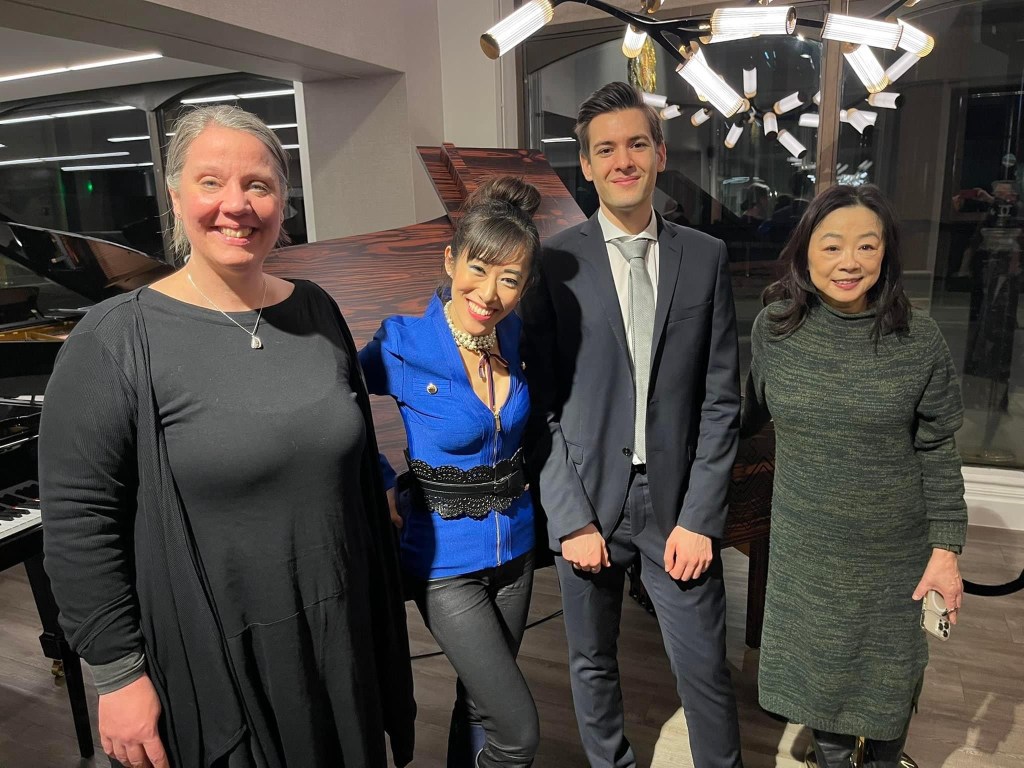
Our adorable hostess Wiebke Greinus (concert and artists manager) together with the distinguished pianist Aisa Ijiri whose photo adorns the wall of Steinway’s Hall of Fame
The only thing to do after a performance like that was to share a cup of champagne with the artist in the beautiful new space that Steinways have created here in the centre of London.
Pavle in good company with Aisa left and friend Two thirds of the artistic direction of the KT with Aisa …Leslie Howard our distinguished colleague unfortunately was indisposed and could not join us .A full house and only one empty seat that Michael Church valiantly occupied until his cough became uncontrollable and he had to miss the Stravinsky …….we await his enlightened words in the International Piano Magazine What fun we had !And above all some great music making from an artist already with Bachelor’s and Master’s degrees from Salzburg Mozarteum University.He is in the process of preparing a thesis on Chopin editions for his PHD.How lucky we are to meet such wonderful thinking musicians ……… and be able to give them a step or two up that very tricky ladder of being able to share their art with others . Pavle writes ‘Thank you very much for the wonderful and very interesting text! I loved revisiting our discussions from yesterday through it. 😊 I have many more arguments for the Ekier edition (which I was also apprehensive of at first), by the way, which I didn’t get to yesterday. In terms of content and the studiousness of his editorial decisions, I think he actually did a far better job than Paderewski. There are many places in the Preludes, which I wrote my Master’s thesis on, which show these kinds of details’.
Dmitri Alexeev showed us what we have been missing for too long in London A demonstration of supreme artistry with playing of authority and weight. Such artistry that in the Mozart C minor Sonata every note was played with seeming simplicity with only the slightest of inflections but that gave such meaning and poignancy to every note.There was great drama too but it was all within a certain architectural framework with a sense of direction that left no doubt that we were in the hands of a master who has lived with this music for a lifetime.
It was the same authority that he brought to Schumann with a memorable account of Waldszenen where every one of the nine pieces was painted with extraordinary characterisation with a sound that created a complete world of ravishing beauty.The first Novelette too was an explosion of sumptuous and even sensuous sounds driven with a passion and beauty that swept all before it.
The ravishingly sumptuous sound he brought to the beautiful opening of Prokofiev’s 8th Sonata created a barren landscape out of which was to erupt explosions of frenzy and breathtaking dynamism.It took us by surprise as Prokofiev had intended with the last of his trilogy of War Sonatas. War is a cruel and ugly beast but there are also moments of peace that become even more poignant in the midst of a full battle.And a full battle was waged tonight with Alexeev’s total immersion with all his transcendental piano playing exposed with brutality,dynamism and driving rhythmic energy.Even the Andante sognando was a dream of almost nightmare proportions before the driving insistence of the final battle.Looking back for a moment to the desolate beauty of the first movement it just made the final cries for help even more terrifying.
The indomitable Lilian Hochhauser friend of Emil Gilels and many other great Russian artists who together with her husband Victor was responsible for bringing them to be heard in the west
A remarkable performance that kept the full house riveted to their seats even Lilian Hochhauser a great friend of Emil Gilels who gave the first performance in the early 40’s was cheering as we all were as we were left breathless with the terror and excitement that war can produce and be reproduced from the descriptive soul and hands of a master.
Mastery and sublime inspiration of Dmitri Alexeev
Visions fugitives op 22 was the only way to break the spell after a performance of that stature. These jewels that Prokofiev had also penned were the ideal antidote for his later nightmare visions. The first was played with an unusual freedom as though Alexeev was freeing himself of the tight reigns that he had set himself before.The impish second (n.10) even brought a smile to lips when played with the charm and control of sound of a pianist of another age. One of the Albumblatter op 126 that Schumann had produced towards the end of his life, n.16 Schlummerlied was the simple charm of his second encore before bursting into the unbridled passion of the Intermezzo from Schumann’s Carnaval Jest from Vienna op 26
And jesting indeed he now was as,he was persuaded to play a fourth encore with the charming staccato song without words by Mendelssohn op 67 n.2 on which floats a beguiling melody of Victorian charm.
A full house for an artist much missed for too long in London
An ever more insistent audience brought us the Spanish dance n.5 by Granados.It was played with insinuating charm and beguiling rhythmic agitation. Was it just a coincidence that Granados too went down in a torpedoed boat during the First World War? An unforgettable evening in beautiful Leighton House a true oasis of artistic endeavour between the wars and recently restored to it’s original splendour.
Lisa Peacock a feathered friend of great artists
It is thanks to Lisa Peacock that once again this music room resounds to the sounds of great artists as it had done in the past. A sumptuous feathered nest to revive any soul.
MOZART: Sonata C minor KV457
The Piano Sonata No. 14 in C minor K. 457, was composed and completed in 1784, with the official date of completion recorded as 14 October 1784 in Mozart’s own catalogue of works.It was published in December 1785 together with the Fantasy in C minor K.475 as opus 11 by the publishing firm Artaria,Mozart’s main Viennese publisher.The title page bore a dedication to Theresia von Trattner (1758–1793), who was one of Mozart’s pupils in Vienna. Her husband, Thomas von Trattner (1717–1798), was an important publisher as well as Mozart’s landlord in 1784. Eventually, the Trattners would become godparents to four of Mozart’s children.It was composed during the approximately 10-year period of Mozart’s life as a freelance artist in Vienna after he removed himself from the patronage of the Archbishop of Salzburg in 1781. It is one of the earliest of only six sonatas composed during the Vienna years, and was probably written either as a teaching tool or for personal use.Sonatas during this time were generally written for the domestic sphere– as opposed to a symphony or concerto,they were designed to convey ideas in a small, intimate setting.The sonata is in three movements Molto allegro,Adagio ,Allegro assai.The Sonata is only one of two sonatas Mozart wrote in a minor key, the other being the Sonata in A minor K.310 which was written six years earlier, around the time of the death of Mozart’s mother .Mozart was extremely deliberate in choosing tonalities for his compositions; therefore, his choice of C minor for this sonata implies that this piece was perhaps a very personal work.
SCHUMANN : Waldszenen Op.82
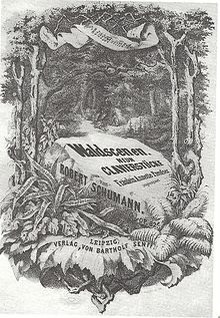
Forest Scenes , op.82, is a cycle of nine character pieces ,composed in 1848 and 1849. The sequence of the pieces reveals the striving for a largely symmetrical architecture of the cycle. The first piece ( Entrance ) corresponds to the last ( Farewell ), the second ( Hunters in wait ) to the penultimate ( Hunting song ). The third piece ( Lonely Flowers ) is also thematically related to the third piece ( Vogel als Prophet ): flowers and birds are both representatives of living nature. Finally, the disreputable place , as an eerie place, corresponds in contrast to the homely inn . All of these pieces center around the fifth piece ( Friendly Landscape ) as an axis of symmetry.The main key of B flat major determines the beginning, middle and end of the cycle. The Lonely Flowers also use B flat major, whereas the thematically relevant bird as a prophet (probably because of its more mysterious character) is in the relative key of G minor. It is also worth noting that the two uncanny pieces ( Hunters on the Lauer and Verrufene Stelle ) are in D minor, while their positive counterparts ( Jagdlied and Herberge ) are both in E flat major.
Title page of the first edition
SCHUMANN: Novelette Op.21 No.1
The Novelletten, op 21, is a set of eight pieces written by Schumann in 1838 and is dedicated to Adolf von Henselt.February 1838 was a period of great struggle for Schumann who originally intended the eight pieces to be performed together as a group, though they are often performed separately.
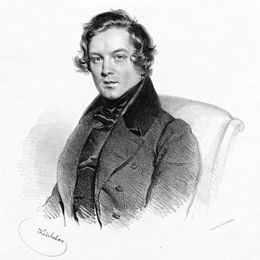
Schumann in 1839
After seeing his beloved Clara again at a concert in August 1837 , Schumann, despite the difficulty of their relationship, felt more relieved and went through a serene period during which he composed some more relaxed and happy works, among which the Novellettes .The origin of the title has been a field of discussion by critics, but the reality is very simple and has been explained by the composer himself: «How happy I have been in recent days… In these last three weeks I have written a frightening amount of music, of jokes, of family scenes with parents, a wedding: in short, as you can see, all the most desirable things. I called the whole thing Novelletten because your name is Clara like Novello’s and because Wiecketten unfortunately didn’t sound as good!» Schumann in the letter refers to the singer Clara A.Novello whose name was the same as his girlfriend.The Novellettes reflect the happiest and most peaceful period the composer went through while composing them; this serenity is clearly represented by the keys of the eight pieces which are all written in a major key, with the prevalence of D major; it was a period in which, as he himself said, he wrote easily, as had happened few other times; moreover, the presence of the inspiring figure of Clara is evident in the momentum and lyricism that dominate the composition. The collection, even if it includes only eight pieces, is of considerable size and is the most extensive among the piano works of the musician, so much so that no real connection can be found in the structure; the individual pieces therefore remain autonomous, showing in this a weakness of the composition, as if there were already a sort of weariness of the musician towards the piano.Despite everything, the Novellettes contain some of Schumann’s most inspired and happy pages.The first Novelletta , nearly five minutes long, opens incisively with the grand-looking main theme. Then enters the second melody, sweet and dreamy which suggests melancholy sensations and which returns several times alternating with the more marked initial section.
Entry-Hunters lying in wait-Lonely flowers-Disreputable place-Friendly landscape,hostel,Bird as a prophet,Hunting song,Farewell.
Interval
PROKOFIEV: Sonata No.8 Op.84
Piano Sonata No. 8 in B♭ major, op.84 is the third and longest of the three ‘war sonatas ‘.He completed it in 1944 and dedicated it to his partner Mira Mendelson ,who later became his second wife.The sonata was first performed on 30 December 1944, in Moscow by Emil Gilels
Prokofiev with Mira Mendelson ,the sonata’s dedicatee, in 1946
The sonata has three movements.
Andante dolce — Allegro moderato (in B♭ major)
Andante sognando (in D♭ major)
Vivace (in B♭ major)
Russian pianist Dmitri Alexeev is one of the world’s most highly regarded artists. His critically acclaimed recitals on the world’s leading concert stages and concerto appearances with the most prestigious orchestras have secured his position as one of “the most remarkable pianists of the day” (Daily Telegraph).
He has performed in all the major concert halls around the world and with all leading orchestras including the Berlin Philharmonic, Chicago Symphony, Philadelphia, Royal Concertgebouw of Amsterdam, the five London orchestras, Orchestre de Paris, Israel Philharmonic and Munich Bavarian Radio Orchestra. He has worked with conductors including Ashkenazy, Boulez, Dorati, Giulini, Jansons, Muti, Pappano, Rozhdestvensky, Salonen, Svetlanov, Temirkanov, Tilson Thomas and Klaus Tennstedt. Alexeev has been a juror for many of the world’s most prestigious international piano competitions including Leeds, Chopin (Warsaw), Van Cliburn, Santander, Beethoven (Vienna) and Tchaikovsky (Moscow)Alexeev has made many fine recordings for EMI, BMG, Virgin Classics, Hyperion and Russian labels. Following his Virgin Classics recording of the complete Rachmaninov Preludes, which won the Edison Award in the Netherlands, BBC Music Magazine described him as “a pianist at once aristocratic, grand and confessionally poetic. This is an inspiring disc.” His recording of the complete Chopin Mazurkas was released in 2014. A recording that Gramophone Magazine referred to as “one of the best recordings of the Chopin Mazurkas that have appeared in the past three-quarters of a century – one of the best alongside those of Rubinstein and Yakov Flier.” His recordings of the complete Scriabin works for piano solo were released by Brilliant Classics in 2022. Alexeev’s two piano transcriptions of works by Shostakovich, Stravinsky and Gershwin, as well as his transcriptions of Brahms’ Ballade for Viola and Piano were recently published.
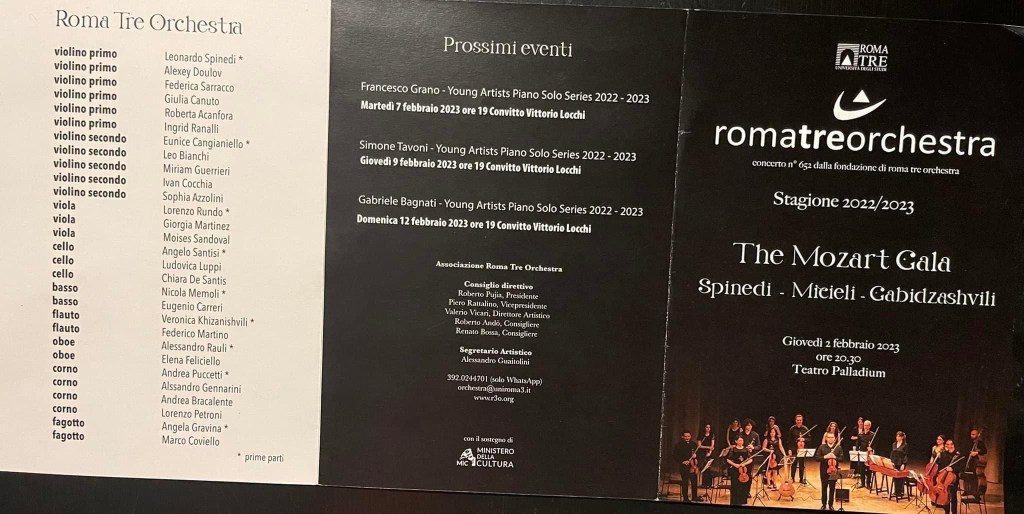
It was Rubinstein who quipped that Tureck makes Bach box office and I think we can say judging from the full house at Teatro Palladium that Valerio Vicari makes Mozart box office too .Valerio Vicari,the artistic director of the Roma Tre Orchestra and concert season at the University where he too was a student under Prof.Robert Pujia.Together with the help of the University they have created over the past twenty years a reality that is proving to be unique in Italy.A season for Young Artists on the threshold of starting a career in music giving concerts even during the pandemic thanks to streaming from their Teatro Palladium.Valerio is also Professor of Latin and corrected my Italian title to the more perfect Latin …….hats off indeed and many thanks for all that he is doing .
Wolfgang Amadeus Mozart. The Symphony No. 25 in G minor, K. 183/173dB, was written by the then 17-year-old Wolfgang Amadeus Mozart in October 1773,shortly after the success of his opera seria Lucio Silla. It was completed in Salzburg on October 5, a mere two days after the completion of his Symphony No. 24.Its first movement was used as the opening music in Miloš Forman’s film biographical Amadeus. This is one of two symphonies Mozart composed in G minor, sometimes referred to as the “little G minor symphony”. The other is the Symphony No. 40. The symphony is laid out in standard classical form: Allegro con brio, Andante, Menuetto & TrioTrio Allegro. Scored for two oboes, two bassoons, four horns and strings.Convitto Vittorio Locchi
Now the solo concerts are held in the splendid surroundings ,just a stones throw from the theatre ,in the Convitto Vittorio Locchi.
Valerio Vicari still a student at heart but with a unique managerial capacity to organise and galvanise his young forces that flock to him for assistance
The theatre is now mainly the seat for the orchestral concerts that Valerio has battled to create over the last sixteen or more years giving valuable orchestral experience to young talented musicians freshly minted from the many State run Conservatories that abound in Italy.No one thinks about what do these superbly trained young musicians do once their studies are completed.Well Valerio has found a solution for these young musicians who are ever grateful for a serious platform in which to gain invaluable concert experience.This activity after twenty long years has now been recognised by the Government authorities.An activity,that despite all the difficulties,the mission of Roma 3 has never wavered and now with this financial backing can take the message of music and youthful hope into many places in Italy far from the Eternal city.
Mozart does you good as the full house and final ovation can confirm with Roma 3 Orchestra at Teatro Palladium.
Some very impressive conducting from Vakhtang Gabidzashvili
An orchestra that is now being heard not only in Rome but in tournées throughout Italy .An impressive amalgamated sound in Mozart’s early G minor Symphony under Vakhtang Gabidzashvili.An orchestra that knew how to sensitively support the two solists who had stood in at short notice for an indisposed violinist/ pianist.
Leonardo Spinedi,soloist and also leader of the Roma 3 orchestra Mozart in 1770 aged fourteen The Violin Concerto No. 3 in G major K.216 was composed in Salzburg in 1775 when Mozart was 19 years old. In a letter to his father Mozart called it the “Straßburg-Concert”,which comes from the motive in the third movement’s central section, a local, minuet-like dance that already had appeared as a musette – imitating tune in a symphony by Carl Ditters von Dittersdorf It is scored for solo violin two flutes (second movement only), two oboes ,two horns in G and D, and strings Allegro Adagio Rondo:Allegro
The leader of the orchestra Leonardo Spinedi valiantly stepping in with a very authoritative performance of the 3rd violin concerto.Playing with grace and charm and imbuing this much loved concerto with great style.
This portrait of Mozart was painted in 1777 in Bologna the same year as the Piano Concerto No. 9 K. 271 known as the Jeunehomme or Jenamy concerto,written in Salzburg in 1777, when the composer was 21 years old.The work is scored for solo piano, 2 oboes,2 horns (in E♭), and strings Allegro Andantino, Rondo
He composed the work for Victoire Jenamy, the daughter of Jean – Georges Noverre and a proficient pianist.Mozart himself performed the concerto at a private concert on 4 October 1777. Jenamy may have premiered the work earlier.Charles Rosen describes it as ‘perhaps the first unequivocal masterpiece of the classical style ‘.Alfred Brendel chose it as his farewell to the concert platform and called it “one of the greatest wonders of the world”.Alfred Einstein dubbed it “Mozart’s Eroica”.Ruben Micieli standing in at a few days notice with a sparkling performance Mozart ‘Jeunehomme’ concerto and an encore of Mozart alla Turca!
Ruben Micieli learnt the Jeunehomme in just a few days and like ‘the young man’ he filled it with sparkling clarity and purity of sound .But it was Mozart goes to town that stole the show as Ruben gave a breathtaking account of Fazil Say’s virtuoso show piece,a fantasmagoric Mozart encore that brought the house down .
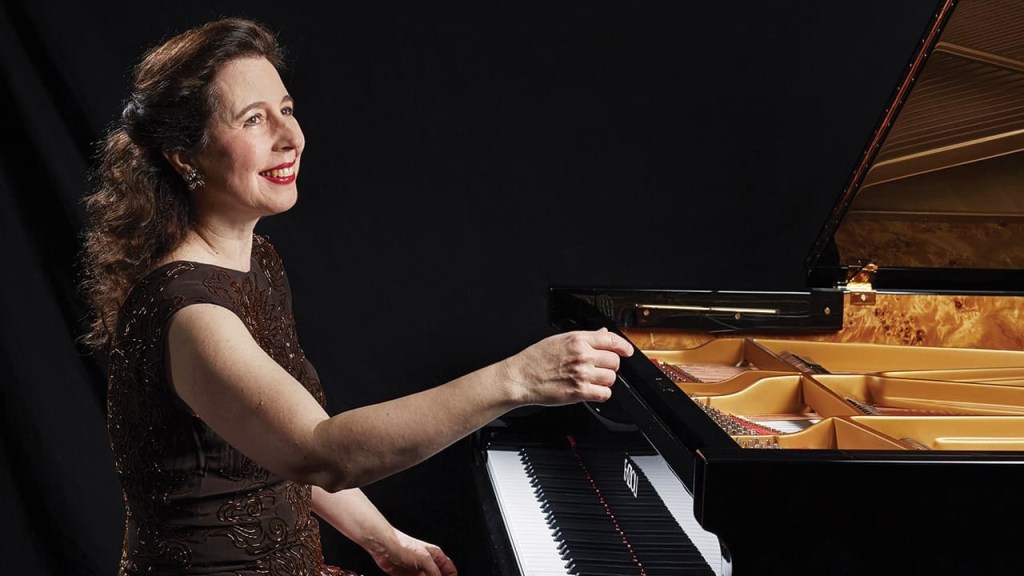
Angela Hewitt for the 100th anniversary of the Chigiana Academy Teatro dei Rozzi – the subdued blue reminding me of the theatre in Blackpool in the UK where Eleonora Duse performed.
Angela’s Bach is a human Bach not a monument to be worshipped from afar but a musical genius who also had human feelings that he expressed within the formal boundaries of music of his time.He also had seventeen children so he must surely have had a sense of humour!Angela’s Bach is based on the song and the dance but above all on the human voice.It is this that kept the audience enthralled with eight Preludes and Fugues from Book two of the Well Tempered Clavier played alternately at times with a rhythmic drive and others a beseeching melodic line of great beauty.Has the D minor prelude ever seen such a seemless stream of notes with unexpected colours appearing like jewels suddenly gleaming brightly.The opening D major had something of the nobility that she brought later to the opening of the Overture BWV 831.There was a pastoral beauty to the Prelude in E flat contrasting with the simple joy of the Fugue and there was delicate expression to the end of the D sharp Fugue too.The poignant simple beauty of the E major contrasting with the nobility and grandeur of the four part fugue.The busy weaving of the E minor Prelude and Fugue you could begin to see what Delius meant when he dismissed Bach as ‘knotty twine!’He obviously had not heard Angela’s wonderful sense of colour and shape and a way of highlighting without exaggeration.She would just shine a mini spotlight on the entry of the fugue but with a kaleidoscope of different colours.The F major prelude was allowed to flow so naturally before the joyous eruption of the three part fugue.Her Bach has great architectural shape but within that Gothic cathedral there were so many hidden shapes and different characters that made what looked like a dry exercise on paper become a vibrant exhilarating and moving experience.I was reminded of the great actress Sybil Thorndyke who was also a very fine pianist who was the first to show me the refined beauty of the final F minor Prelude that could almost have been written one hundred years later.It was contrasted though with the rumbustuous outcry of the Fugue like a popular ditty ( was not the quodlibet the last of the Goldberg variations based on two popular songs of the day?It just shows that Bach may have been a genius but he was also a person of his times.The Quodlibet combines :’I have so long been away from you,come closer,come closer’ and ‘Cabbage and turnips have driven me away,had my mother cooked meat,I’d have opted to stay!’).It was this Fugue that going backstage in the interval of one of her many concerts in Florence we ended up singing Ebenezer Prout’s famous words to the Bach Fugues.I pretended to remember but she knew them all and was dancing around the room reciting them showing what fun Bach can be too!A lifetime companion indeed !Lucky Angela!And lucky us who can share her ‘joie de vivre’ in her ever generous tournées world wide. P.S. The only other time I remember being so overwhelmed by Preludes and Fugues in the concert hall was a rare recital by Friedrich Gulda in the Queen Elisabeth Hall in London .Appearing on stage as though ready for the gym with tennis shoes and baseball hat looking the audience in the eye as he played A recital of Bach and Debussy where his performance of the Prelude in A flat BXV 886 has haunted me ever since. Angela in Siena chose a perfect sequence of n. 5 to n. 12 from Book two which worked so perfectly as a whole that it could have well been a suite by Bach on its own.Gulda like Gould was a genius and like all genii was extremely unconventional not to say eccentric by our ‘more normal’standards.And it was indeed Angela Hewitt who had won the one and only Glenn Gould International Bach Competition and had been promoted by the Canadian Embassy in concerts including the Ghione Theatre and Teatro Olimpico in Rome in 1985.It was on that occasion that I met her father and mother.Her father ,Godfrey,was a very distinguished organist for 50 years at Christ Church Cathedral in Ottawa and mother Marion a distinguished piano teacher https://www.google.co.uk/url?sa=t&rct=j&q=&esrc=s&source=web&cd=&ved=2ahUKEwjm2ovmh4H9AhWZSPEDHd5fDrkQFnoECCIQAQ&url=https%3A%2F%2Fangelahewitt.com%2Fpress%2Farticles%2Fangela-hewitt-plays-for-her-mom%2F&usg=AOvVaw35i8C2WYW_wlYw-2kLeygB
Gulda years later in the ‘90’s announced a Mozart recital in the Ghione Theatre in Rome.A Bosendorfer was duly delivered for the concert.But Gulda appeared on stage in a wig and declared himself to be Mozart as a dancer began her sensuous performance to Gulda who pretended to play on an electric keyboard.The audience waited patiently for the promised Mozart recital but with pop music blaring away at full force began to leave in droves.About eleven thirty after Gulda had consumed a bottle and a half of Gin I enquired when he thought the performance would finish as the hall was by now empty.’I will finish when I am ready’ was the reply ……when he was sure the hall was empty he sat at the piano and he played so wonderfully that I just wish the audience could have waited a little longer.After the performance he went to the Alexanderplatz Jazz Club where he stayed until the early hours.In the meantime he had announced to the press his death because he wanted to see what the obituaries would say about him !When he did actually die a few years later there was not a squeak about him in the press!Crying Wolf I believe it is called!But the Bach I have heard from him and now Angela I will never forget.
Johann Sebastian Bach
Johann Sebastian Bach da “Il Clavicembalo ben Temperato”, Libro II Preludio e Fuga n. 5 in re magg. BWV 874 Preludio e Fuga n. 6 in re min. BWV 875 Preludio e Fuga n. 7 in mi bem. magg. BWV 876 Preludio e Fuga n. 8 in re diesis min. BWV 877 Preludio e Fuga n. 9 in mi magg. BWV 878 Preludio e Fuga n. 10 in mi min. BWV 879 Preludio e Fuga n. 11 in fa magg. BWV 880 Preludio e Fuga n. 12 in fa min. BWV 881
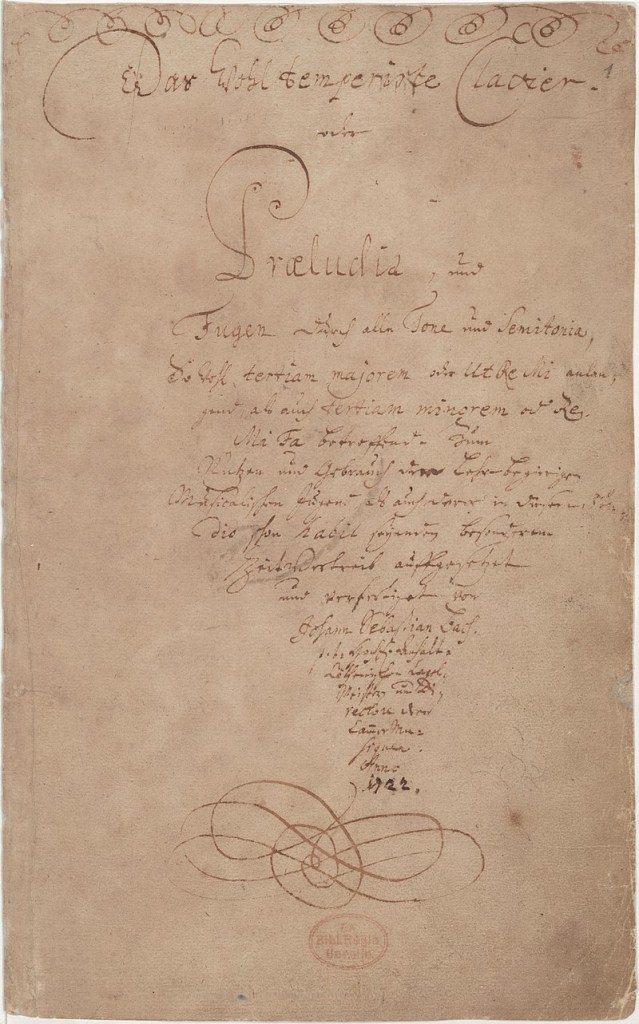
Top of Bach’s title page for the 1st book of ‘The Well-Tempered Clavier’, 1722, showing handwritten loops which some have interpreted as tuning instructions.Each set contains twenty-four pairs of preludes and fugues.The first pair is in C major the second in C minor,the third in C sharp major the fourth in C sharp minor and so on. The rising chromatic pattern continues until every key has been represented, finishing with a B minor fugue. The first set was compiled in 1722 during Bach’s appointment in Kothen the second followed 20 years later in 1742 while he was in Leipzig.
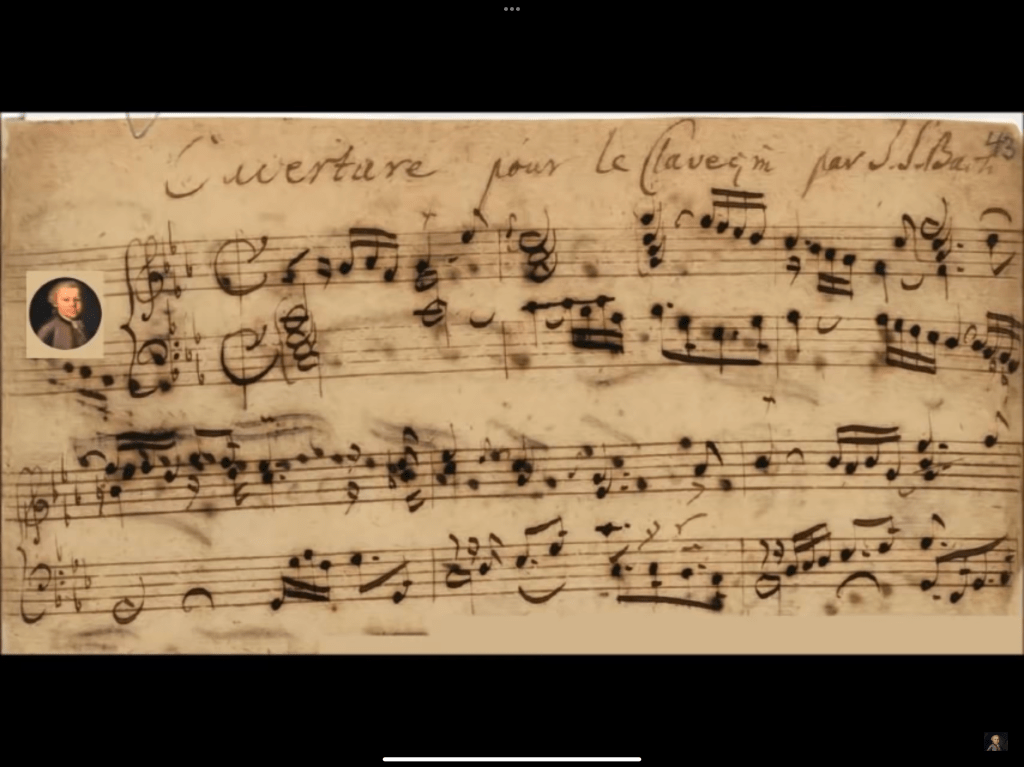
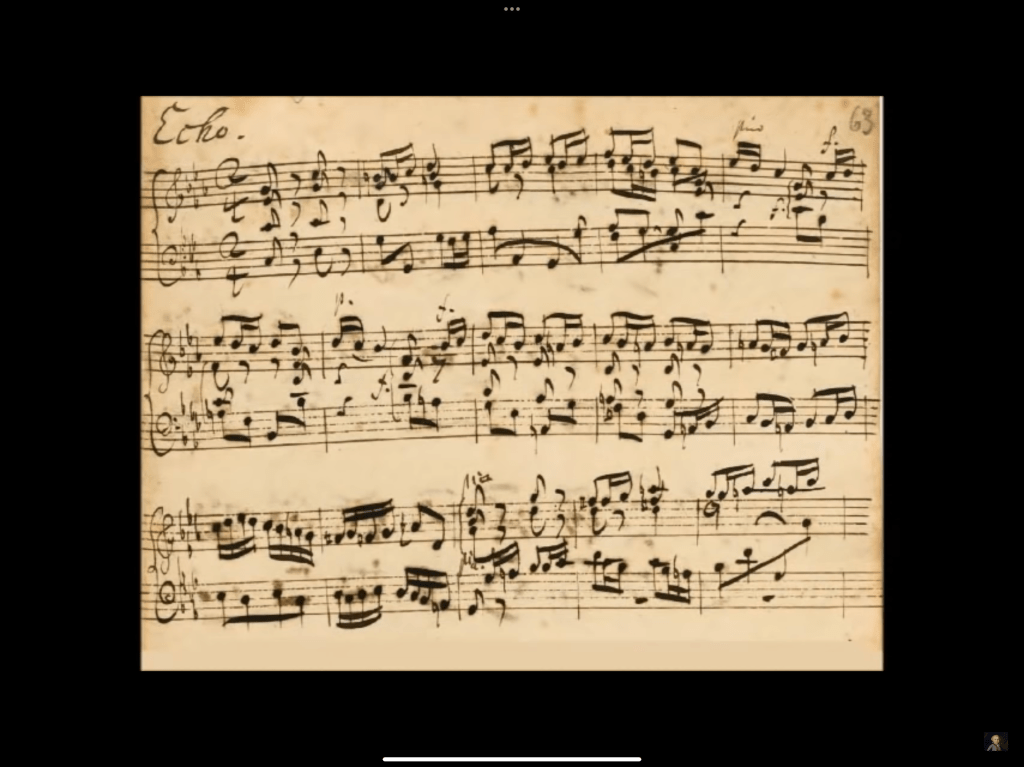
Johann Sebastian Bach Ouverture in stile francese in si min. BWV 831 1. Ouverture 2. Courante 3. Gavotte I 4. Gavotte II (re maggiore) 5. Passepied I 6. Passepied II 7. Sarabande 8. Bourrée I 9. Bourrée II 10. Gigue 11. Echo
A monumental performance of the Bach Overture in the French Style was again a complete revelation just as the Preludes and Fugues had been in the first part of this extraordinary recital.A work I have rarely heard in the concert hall but the declamative nobility of the opening immediately made one aware that this was a work of great weight and importance.An Overture that lasts almost half the length of the whole work with the noble opening returning after the interruptions of a four part fugue played with pulsating rhythmic energy.A Courante gently flowing with florid ornamentation that just added to the radiance after the grandeur and nobility of the opening.A Gavotte n.1 of grace and charm and a slightly more serious Gavotte n.2 with Angela’s obvious joy at the return to the Gavotte n.I full of her infectiously spontaneous ‘joie de vivre’.The refined courtly dance of the Passepied n.1 in 3/8 contrasted with the more melodic Passepied n.2,a formal trio like contrast before the return of the Passepied n.1.A deeply meditative Sarabande that was played with an aristocratic florid beauty.The two Bourées with their civilised rhythmic dance and beguiling outpouring of popular melodic effusions of a period of formal civilised culture.Even the Gigue had a gracious 6/8 lilt of courtly elegance before the fun and games of the Echo.A regal stately opening that gave way to an exhilarating rhythmic drive where Bach’s continual stopping and starting was of startling good humour and brought this monumental work to the conclusion that only the genius of Bach could have envisaged.A masterly performance that had me searching out the score to delve even more deeply into a work I had overlooked for too long.Thank you dear Angela also for that !
The Overture in the French style,BWV 831, original title Ouvertüre nach Französischer Art, also known as the French Overture and published as the second half of the Clavier- Ubung 11 in 1735 (paired with the Italian Concerto ) and is a suite in B minor for a two-manual harpsichord.An earlier version of this work exists, in the key of C minor (BWV 831a); the work was transposed into B minor to complete the cycle of tonalities in Parts One and Two of the Clavier-Übung.[The keys of the six Partitas (B♭ major, C minor, A minor, D major, G major, E minor) of Clavier-Übung I form a sequence of intervals going up and then down by increasing amounts: a second up (B♭ to C), a third down (C to A), a fourth up (A to D), a fifth down (D to G), and finally a sixth up (G to E).The key sequence continues into Clavier-Übung II (1735) with two larger works: the Italian Concerto, a seventh down (E to F), and the French Overture, an augmented fourth up (F to B♮). Thus this sequence of customary tonalities for 18th-century keyboard compositions is complete, extending from the first letter of his name (Bach’s “home” key, B♭, in German is B) to the last letter of his name (B♮ in German is H).The term overture refers to the fact that this suite starts with an overture movement, and was a common generic name for French suites (his orchestral suites were similarly named). This “overture” movement replaces the allemande found in Bach’s other keyboard suites. Also, there are optional dance movements both before and after the Sarabande .In Bach’s work optional movements usually occur only after the sarabande. All three of the optional dance movements are presented in pairs, with the first one repeated after the second, but without the internal repeats. Also unusual for Bach is the inclusion of an extra movement after the Gigue.This is an “echo”, a piece meant to exploit the terraced loud and soft dynamics of the two-manual harpsichord. Other movements also have dynamic indications (piano and forte)which are not often found in keyboard suites of the Baroque period, and indicate here the use of the two keyboards of the harpsichord. With eleven movements, the French Overture is the longest keyboard suite ever composed by Bach.
A full and very enthusiastic public were rewarded with two encores.The Gigue from the fifth French Suite in a wildly driven performance of astonishing relentless urgency.Followed by a sumptuous performance of an unusual transcription of ‘Sheep May Safely Graze’ which was of truly sublime beauty.
‘A nice masterclass in Perugia yesterday at the Conservatorio. Eight students played Preludes and Fugues for me from the Well-Tempered Clavier, and besides going through those specific ones, I talked a lot about Bach interpretation in general. And then at the end sat down and played four of them from Book II. A lot of students turned up, so it was a nice crowd. I hope it inspires them to go on with this wonderful music.’ Angela Hewitt
Lydia and Guido Agosti with my wife Ileana Ghione.We met whilst I was helping Lydia with her course ‘Da Schoenberg ad Oggi” with her students from the Silvio D’Amico Academy in Rome .The course took place in the ballroom of the Circolo dei Rozzi and we were told in 1978 about the abandoned theatre next door.It has since been restored to the splendour that it is today.Guido Agosti gave his legendary six week course at the famous Academy founded by Count Chigi.Lydia was invited to bring her course to Siena so they could both be happily occupied together during the Maestro’s annual six week sojourn in Siena Bach can be fun too !The magnificent Palazzo Pubblico and the Campo.The little house perched on the roof on the right was were Hilda Colucci lived.She had been the Arts Officer at the British Council in Rome.A post taken over by the late Jack Buckley.Hilda had made a pact with the local council that she would completely renovate that little house and install a lift at her own expense if she could live in it for the rest of her life!Of course as time past and the councillors changed,the new ones realised that she was living on a gold mine and they tried by devious legal means to get her out.She got a lawyer from Siena and being Sienese herself she also got a lawyer from Florence!The strain and struggle never altered Hilda’s wonderful jovial demeanour but she had a stroke and ended up in a Hotel where she was well looked after by friends.It is the same hotel where I am staying today recommended by the Chigiana – the Canon d’Oro………small world.Hilda’s name is still on the door bell in Piazza del Campo.I like to think she must be looking on from on high and chuckling to herself.’Che buffo’ she would always say.With the artistic director of the Chigiana Foundation,Nicola Sani.it was nice to reminisce among friends of long standing.Angela thinks we first met in 1985 when she came the first time to the Ghione Theatre .I was very wary to say that it was much before that,when Sidney Harrison who was my teacher and became her neighbour and mentor when she was living in Fielding Road in Chiswick.Sidney had often adjudicated festivals in Canada (his wife Sydney was Canadian born) and had know Angela’s parents and their little girl who won all the prizes!Nicola Sani was my neighbour in Rome, he at n.3 and we at n.4 Carlo Dolci .Our downstairs neighbour was Audrey Hepburn with a beautiful little house she built in our garden for her son Luca,still at school when her marriage to Dr Dotti broke up.What a wonderful refined presence she was and when she knew she was dying of cancer she used her fame to help publicise the plight of starving children of the third world.They don’t mak’em like that anymore.She and my wife were great admirers of each others art and had much in common as human beings,they also shared the hairdresser in Piazza di Spagna too!With Carlo Rea and his family .Carlo used to play in the orchestra that Franco Ferrara used for his legendary conducting course .A course where Mehta,Abbado,Barenboim and most of the great conductors of our day learnt from one of the great musicians that were at the Chigiana during the summer months.I came there as a first year student at the RAM ,together with Peter Bithell ,to study with Guido Agosti,a student of Busoni ,and we thought we would get the sack if they ever found out in London.When we got back to the RAM we found we had been awarded the Tobias Matthay Fellowship for our initiative!
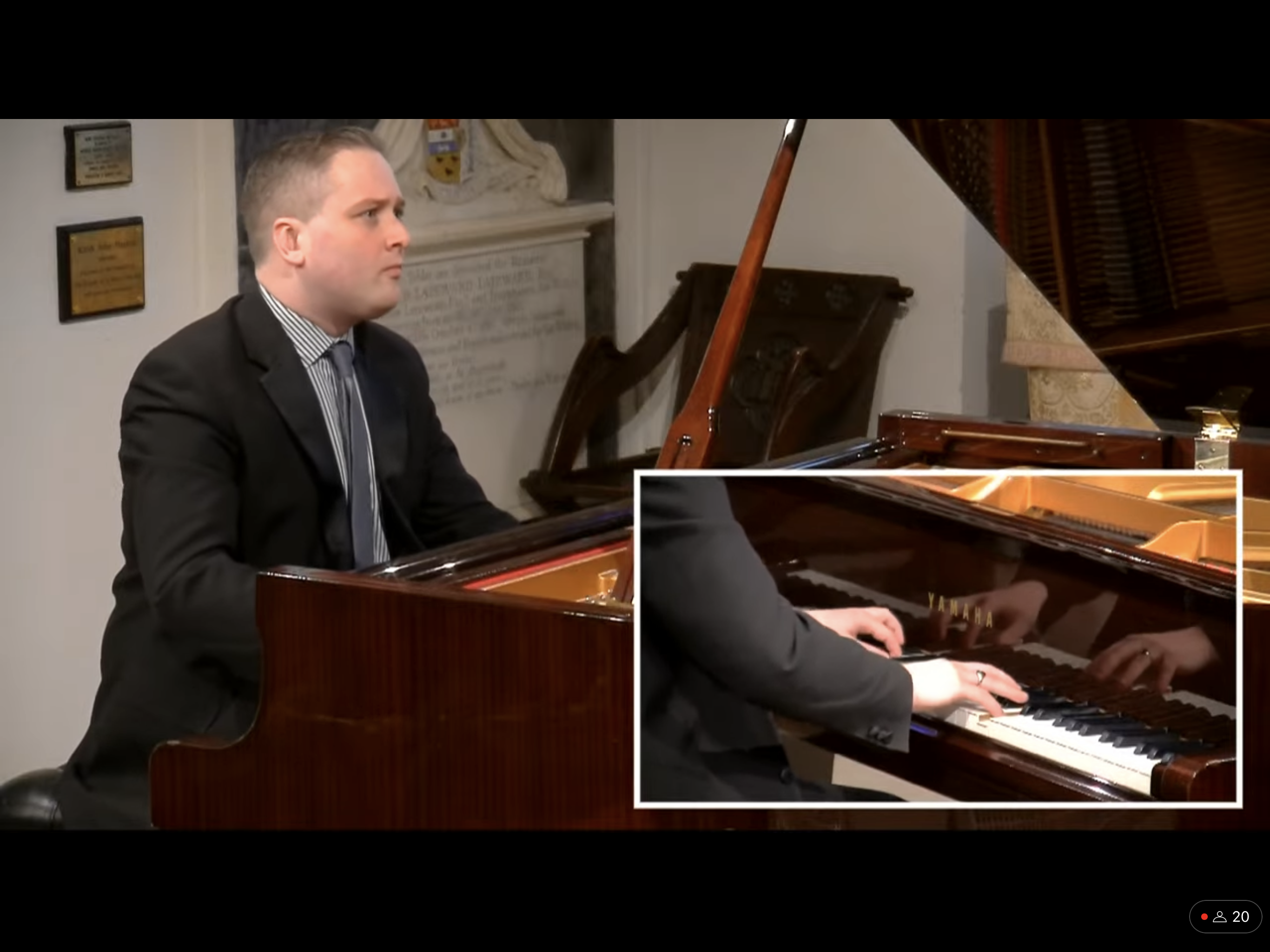
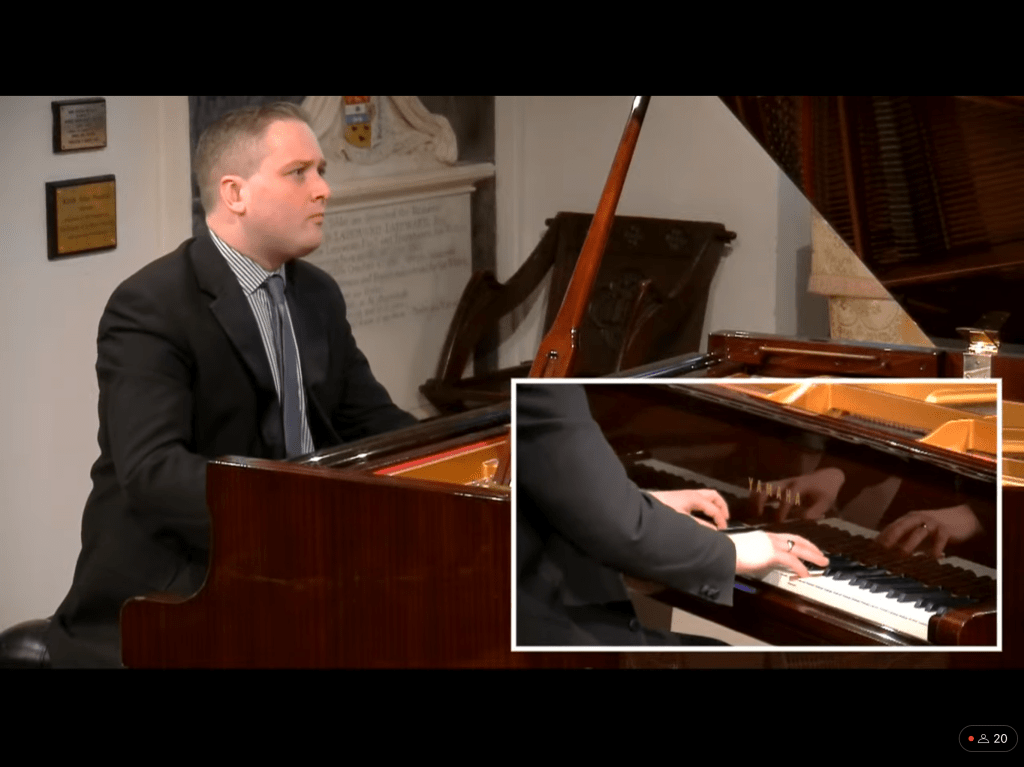
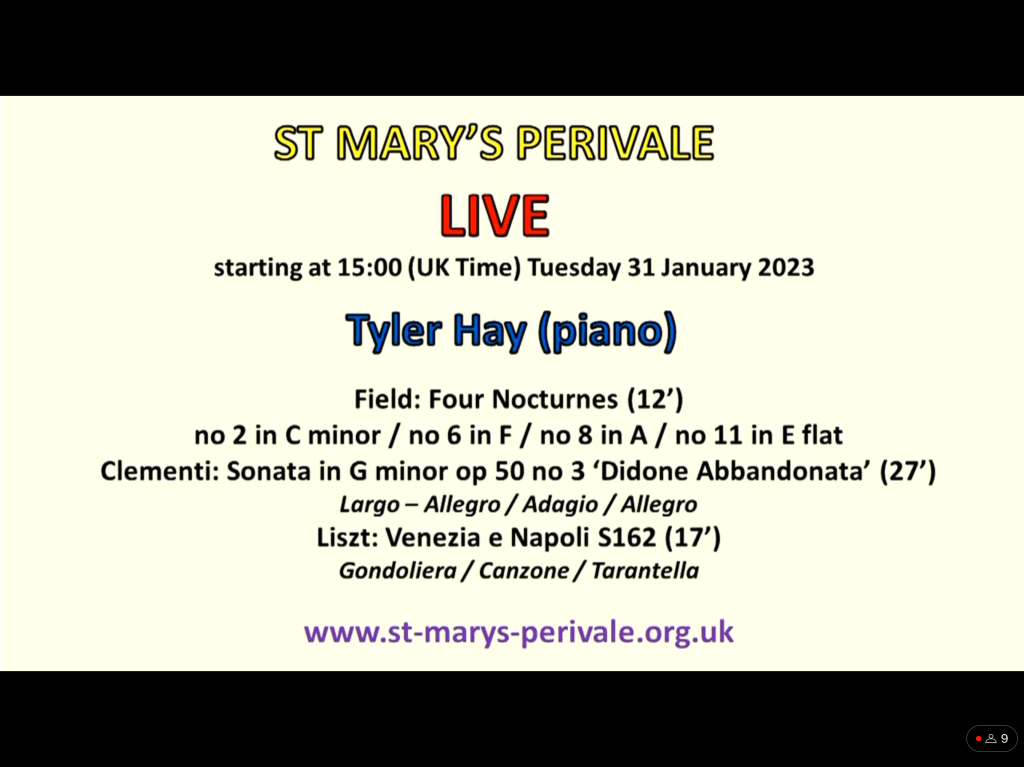
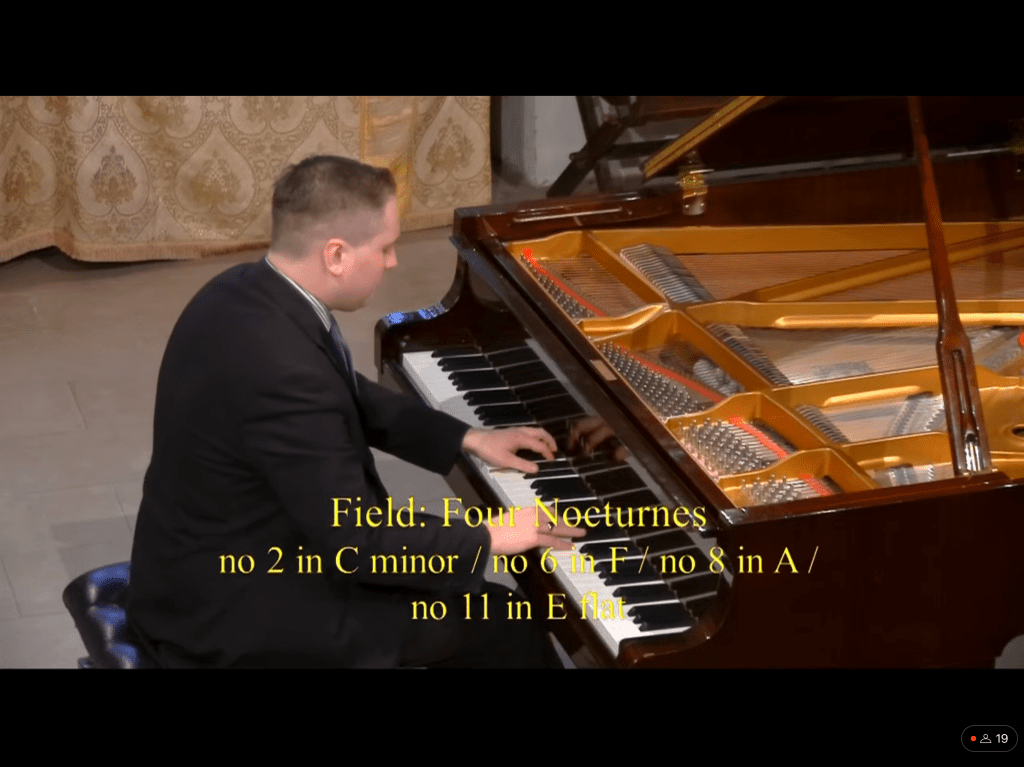
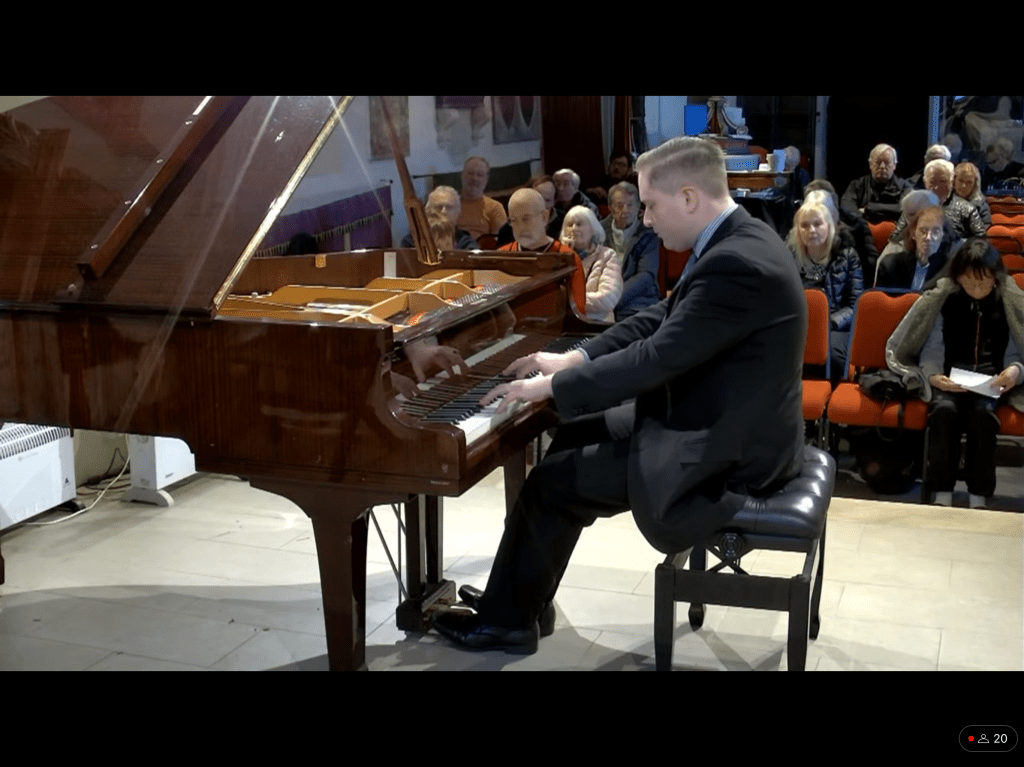
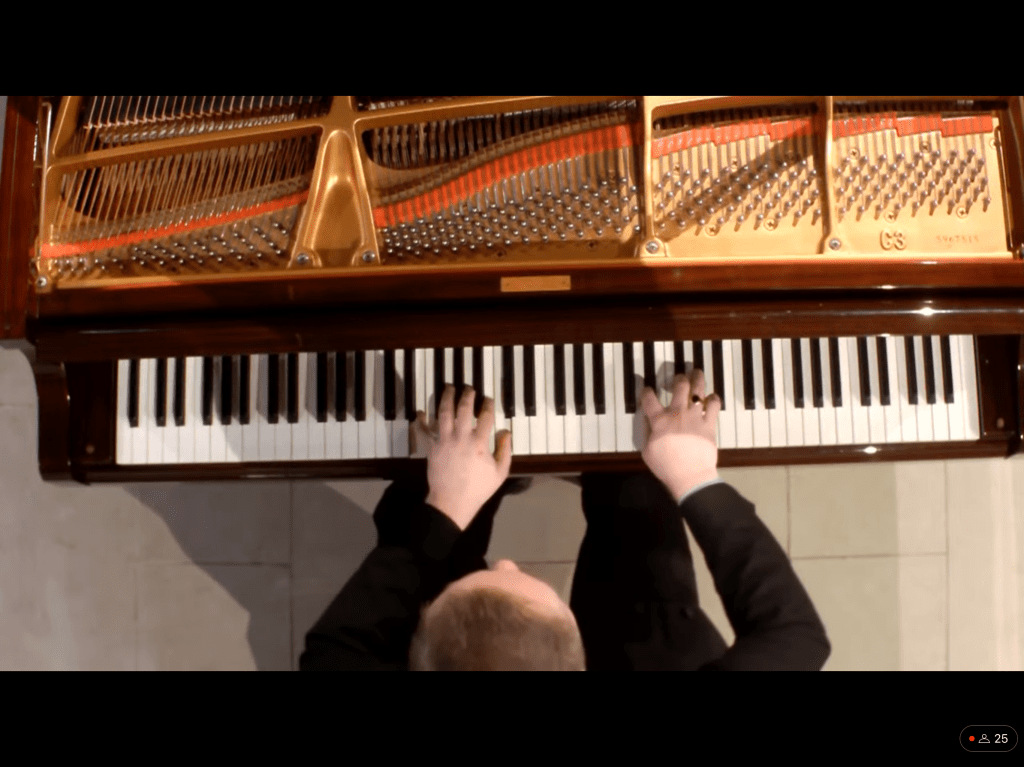
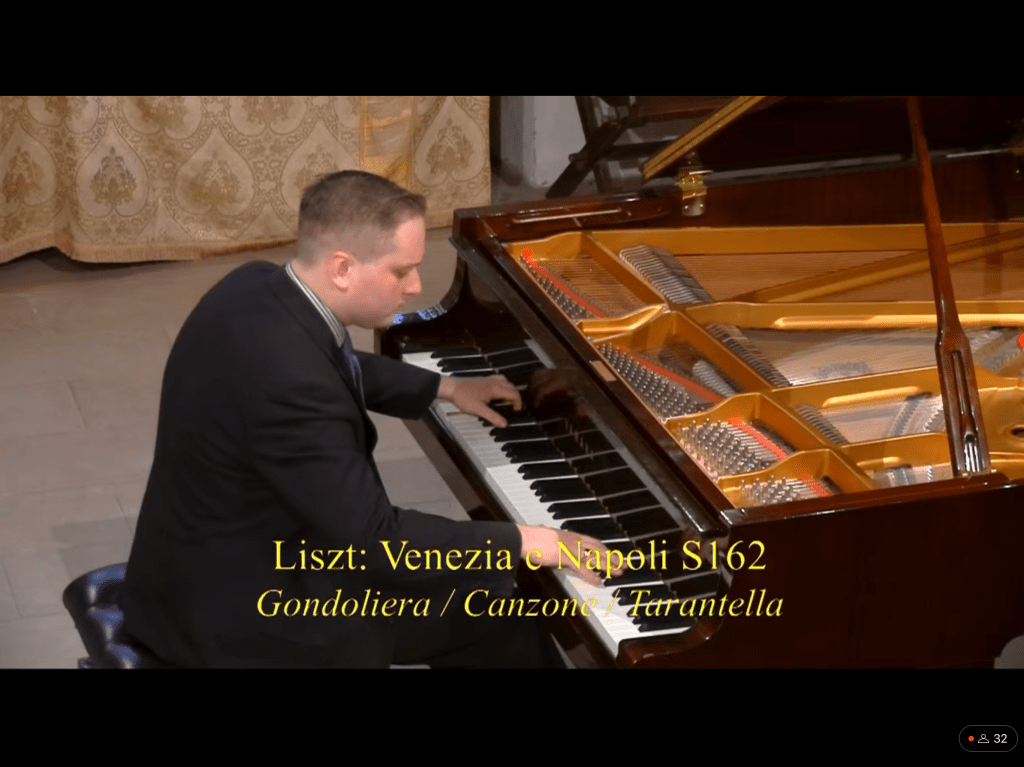
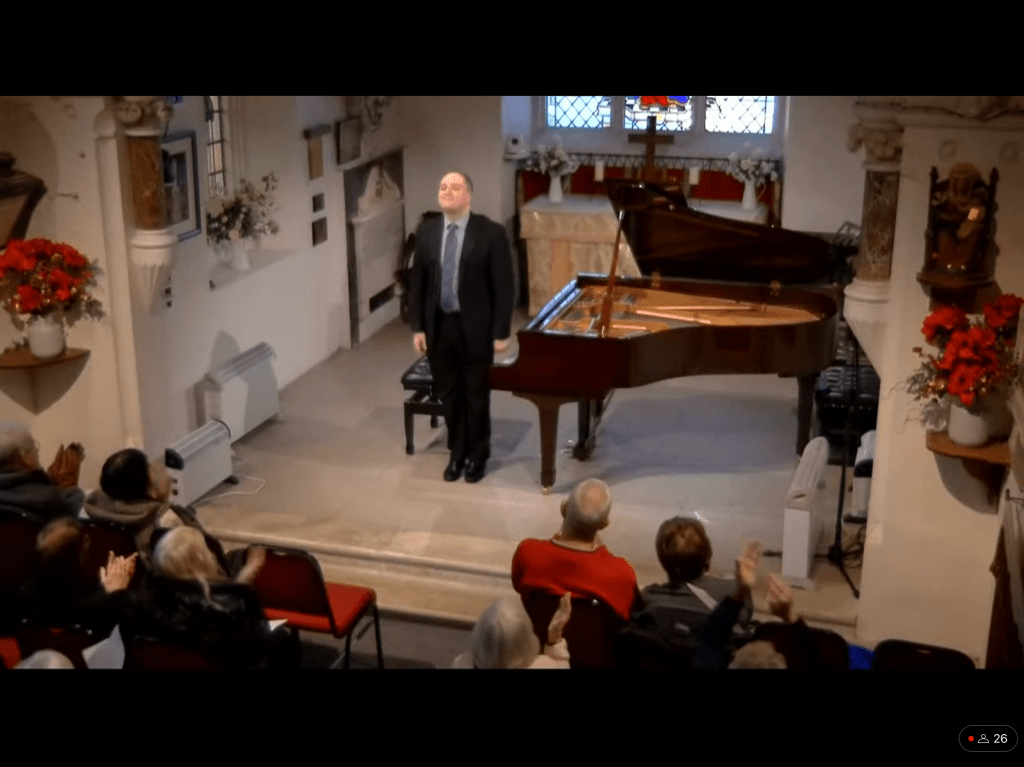
I have heard Tyler play many times over the past few years and it is good to see how he has matured into an artist of great stature.A technical assurance allied to a musical intelligence and curiosity that allows him to delve deep into the piano archives finding many unjustly neglected scores.The marvel is that Tyler together with Mark Viner and Thomas Kelly are a hope for future music making and are able to bring their discoveries vividly to life in recording and on the concert platform Three artists ,each very different,all with a superb technical training giving their playing such weight and assurance.Not always an easy thing as much of the music was written for composer – virtuosi and make great demands on the pianist.All three received their early training at the Purcell School for gifted young musicians and all three went to the Royal College of Music to perfect the base that they had been given as gifted youths.Both Tyler and Mark Viner studied with that superb trainer of young musicians Tessa Nicholson (both later perfecting their studies with Niel Immelman ).Another of her students from Purcell and later continuing with her at the RAM,Alim Beisembayev ,recently won the Gold Medal at the Leeds.Thomas Kelly studied with the late Alan Ball at the Purcell School and later at the RCM .The intense beauty Tyler brought to the Field nocturnes was matched by the dynamic virtuosity required from Clementi (his infamous Gradus ad Parnassum gives some idea of what is expected).The Liszt Venezia e Napoli showed off his superb sense of style as well as dynamic showmanship.
https://youtube.com/live/ZHUy1ujd42Y?feature=shareSumptuous purity of sound and gentle flowing accompaniments belied Tylers rather military appearance.Jorge Bolet too looked more like a sergeant major than a pianist but his ravishing delicacy and astonishing subtle brilliance have passed into legend.Bolet was from the remarkable school of David Stapleton as was Earl Wilde and many other legendary figures of the not too distant past.Tyler perfected his studies with Niel Immelman who was from the school of the great English pianist Cyril Smith who epitomised the Stapleton school.I well remember Niel Immelman and Frank Wibaut (and many others including David Helfgott of ‘Shine’ fame and the indomitable Fanny Waterman) astonishing the rather more solid formation of their fellow students with their natural ease and kaleidoscopic palette of sounds.There was ravishing beauty in the C minor nocturne that Liszt likened to ‘a moonlit walk amongst the birch trees’ .A luminous sound with fiortiori embellishments played like streams of gold with the embellishments incorporated so unobtrusively into the Bel canto line.The innocent Pastoral beauty of the F major nocturne with it’s simplicity and the beautiful little cadenza just added to the ever more embellished melodic line played with the utmost delicacy leading to the beautiful bell like finale.There was grace and intimate charm in the A major nocturne that was Schumann’s favourite.Its seemless Schubertian outpouring of song so beautifully shaped in Tyler’s ever more sensitive hands.The E flat nocturne based on an Irish folk song was played with the beguiling innocence and purity of sound that had made these performance such an enticing showcase for Tyler’s less adventurous colleagues.
John Field (26 July 1782 – 23 January 1837), was an Irish pianist, composer, and teacher.He was born in Dublin into a musical family, and received his early education there, in particular with the Italian composer Tommaso Giordani .The Fields soon moved to London, where Field studied with Muzio Clementi .Under his tutelage, Field quickly became a famous and sought-after concert pianist. Together, master and pupil visited Paris,Vienna and St Petersburg.Ambiguity surrounds Field’s decision to remain in the former Russian capital, but it is likely that Field acted as a sales representative for the Clementi Pianos.
Field became well-known for his post-London style, probably developed in Moscow around 1807. The characteristic texture is that of a chromatically decorated melody over a sonorous left hand supported by sensitive pedalling. Field also had an affinity for ostinato patterns and pedal points, rather unusual for the prevailing styles of the day. Entirely representative of these traits are Field’s 18 nocturnes and associated pieces such as Andante inedit, H 64. These works were some of the most influential music of the early Romantic period and do not adhere to a strict formal scheme but create a mood without text or programme.They were admired by Chopin who subsequently made the piano nocturne famous, and Liszt who published an edition of the nocturnes based on rare Russian sources that incorporated late revisions by Field.
None have quite attained to these vague eolian harmonies, these half-formed sighs floating through the air, softly lamenting and dissolved in delicious melancholy. Nobody has even attempted this peculiar style, and especially none of those who heard Field play himself, or rather who heard him dream his music in moments when he entirely abandoned himself to his inspiration.– Franz Liszt’s preface to his edition of Field’s nocturnes, 1859.
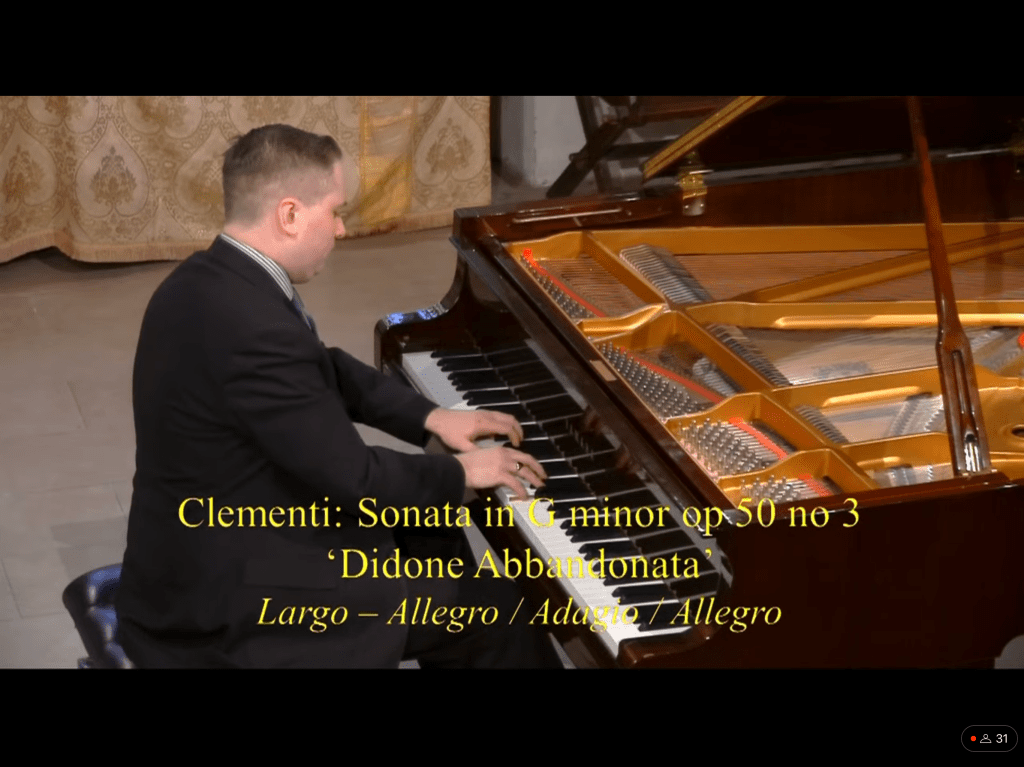
Tyler imagines that Clementi must have heard Purcell’s Dido and Aeneas (and maybe even seen it on the stage in London ) and been inspired to write his only openly programmatic work.A very fine work inexplicably excluded from programmes and rarely played even in Italy or elsewhere.It’s dramatic slow opening leading to the Allegro and Tyler’s driving rhythmic energy where passionate outpourings contrasted with expressive melodic passages.There was great beauty that Tyler brought to the Adagio with it’s tolling bell like opening and long held pedals where the delicate melodic line emerged with it’s ghostly murmurings The final Allegro burst onto the scene with the scintillating rapidity of Tyler’s remarkable ‘fingerfertigkeit’.Passages of almost operatic exhilaration as Tyler’s electric energy brought this remarkable work vividly to life.Hopefully it will be a visiting card for all pianists to consider for their future programmes.
Muzio Filippo Vincenzo Francesco Saverio Clementi (23 January 1752 – 10 March 1832) was an Italian composer,pianist,pedagogue,conductor ,music publisher, editor, and piano manufacturer, who was mostly active in England.Encouraged to study music by his father, he was sponsored as a young composer by Sir Peter Beckford who took him to England to advance his studies. Later, he toured Europe numerous times from his long-standing base in London.Clementi moved with his wife Emma (née Gisborne) and his family to the outskirts of Lichfield ,Staffordshire and rented ‘Lincroft House’ on the Earl of Lichfield`s Estate from 1828 until late 1831. He then moved to Evesham where he died on 10 March 1832, after a short illness, aged eighty. On 29 March 1832, he was buried in the cloisters of Westminster Abbey.Accompanying his body were three of his students: Johann Baptist Cramer, John Field and Ignaz Moscheles. He had five children, a son Carl by his wife Caroline (née Lehmann) who died soon after his birth and the others, Vincent, Caecilia, Caroline, and John Muzio with his second wife Emma.
Didone Abbandonata – Piano Sonata in G, Op. 50, No.3 is the final sonata composed by Muzio Clementi in 1821. It was titled after Metastasio’s often-set opera libretto where Clementi seeks to tell the tragic story of Virgil’s heroine instrumentally. It is the only example of such a programmatic piece in the composer’s oeuvre.One of the most eminent pianists of his time – who even engaged in a contest with Mozart and did not lose – Muzio Clementi created fundamental pedagogical works for piano and altogether 63 sonatas for piano solo. Didone abbandonata dates from his last compositional opus for solo piano sonatas written in 1821. The topic of Dido, who was abandoned by Aeneas and expressed her grief through mourning, despair and, ultimately, raving madness, was extremely popular and subjected to countless arrangements since the 17th century in operas, single “scena” and many instrumental works. The performance instructions for the sonata are as numerous as they are uncommon, and symbolize Dido’s hyper-expressiveness.
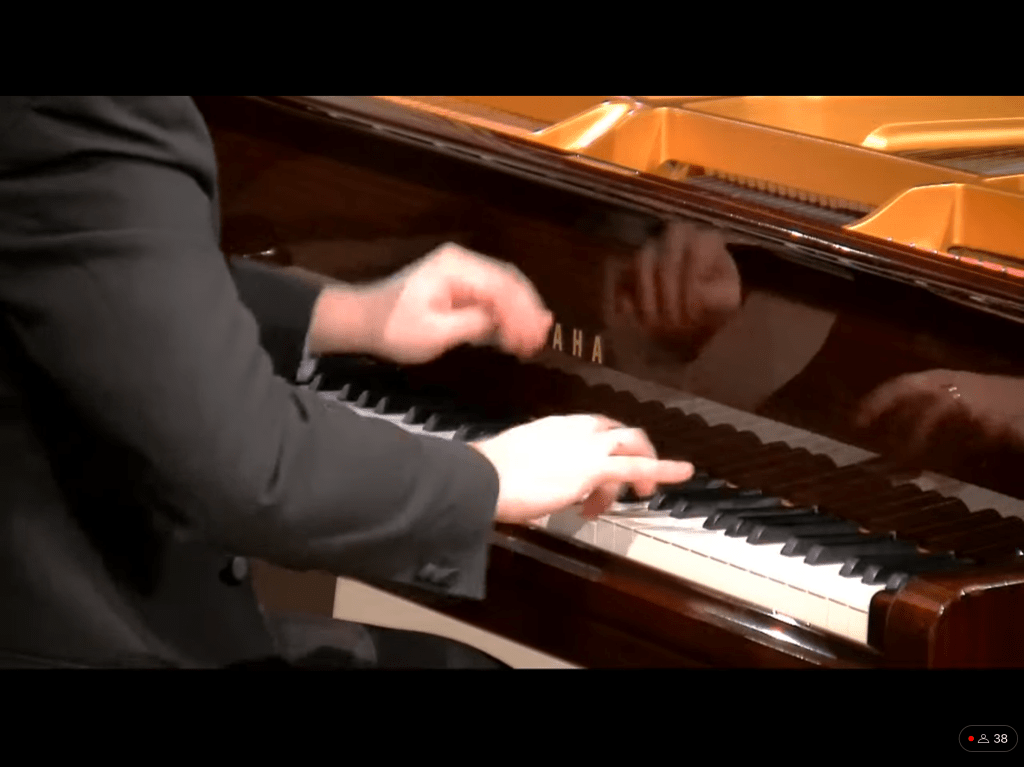
And now a well known work by Liszt that is often included in recitals.Cherkassky used to play the Tarantella on it’s own.That great Liszt authority Leslie Howard rightly points out that at the Canzone and Tarantella should be played together as they are linked by the umbelical pedal that Liszt so clearly indicates.Tyler of course played the entire suite of three pieces.Creating a ravishing atmosphere with the delicate arabesques where Liszt could immediately create the languid liquidity of that magic city.A melodic line that just floated above the gentle waves and was beautifully etched with subtle embellishments that seemed to flow with such ease from Tyler’s authoritative hands.There was dramatic intensity to the ‘canzone’ with Tylers sense of the nobility and grandeur of operatic rhetoric.A beautifully florid ending linked up to the astonishing funabulistics that Liszt demands in the Tarantella.Repeated notes thrown of with the jeux perlé ease of the great virtuosi of the Golden age of piano playing.An era when understatement was far more astonishing than rumbustuous empty virtuosity of the ‘I plays mainly by force” .A way of playing digging deep right to the bottom of the keys(and beyond!)that characterises mistakenly much of the Russian school of playing epitomised by the much lamented Alexander Toradze and the ever present Denis Mutseev.From Tyler’s hands flowed seemless streams of gold and silver with a central episode of ravishing beauty and subtle breathtaking rubato.This was the lesson that the Belcanto singers of their day had imparted and inspired pianists to imitate.The excitement and virtuosity that Tyler aroused in the final pages of the Tarantella was astonishing for its pianistic perfection and passionate involvement.
Venezia e Napoli where each of the three piece is based on what was familiar material in the streets of Italy at the time of their conception.
Gondoliera is described by Liszt in the score as La biondina in gondoletta—Canzone di Cavaliere Peruchini (Beethoven’s setting of it, WoO157/12, for voice and piano trio just describes it as a Venetian folk-song, and Peruchini remains elusive) and he treats it in a much gentler way than in the earlier version with a particularly fine verse with tremolo accompaniment; the tremolo guides a very dark musing upon Rossini’s Canzone del Gondoliere—‘Nessùn maggior dolore’ (Otello) which itself recalls Dante’s Inferno and the Tarantella—incorporating themes by Guillaume Louis Cottrau (1797–1847)—emerges from the depths, much more subtle than in its previous, primary-coloured garb, but ultimately triumphantly boisterous.
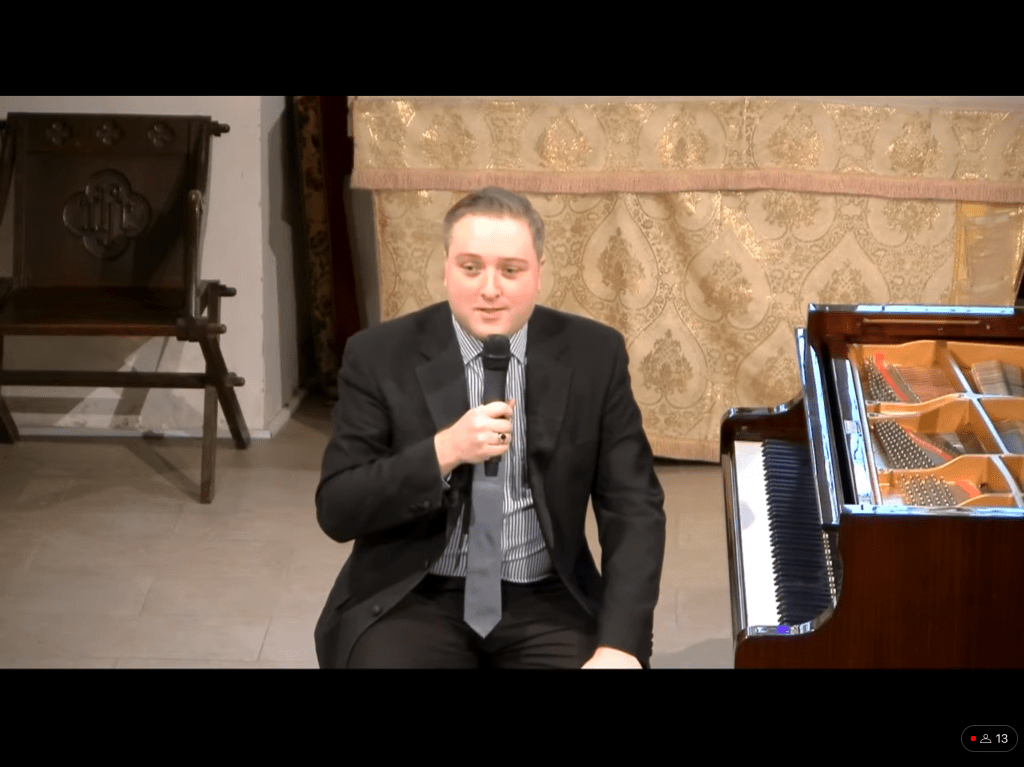
Tyler is also a gifted communicator whose introductions were not only informative but also amusing with delectable asides that made one relish even more his remarkable performances
Tyler Hay was born in 1994 and gained a place to study at the Purcell School in 2007 where he studied under Tessa Nicholson. He studied with Graham Scott and Frank Wibaut at the RNCM and with Niel Immelman and Gordon Fergus-Thompson at the RCM. Tyler has performed Rachmaninoff’s 2nd Sonata at Wigmore Hall, Scriabin’s 5th So nata at the Purcell Room and Ravel’s Concerto for Left Hand Alone at the Queen Elizabeth Hall . In 2016, Tyler won first prize in the keyboard section of the Royal Overseas League Competition and as well as winning the RNCM’s Gold medal competition, also won first prize in the Liszt Society Competiti on. He competed in the final stages of the Leeds International Piano Competition in 2021 and won 1st prize in the Dudley International Piano Competition in November, 2022. CDs of Liszt, John Ogdon and Kalkbrenner are available on Piano Classics and Tyler’s latest album of virtuoso piano music by Simon Proctor is now available on Navona Records
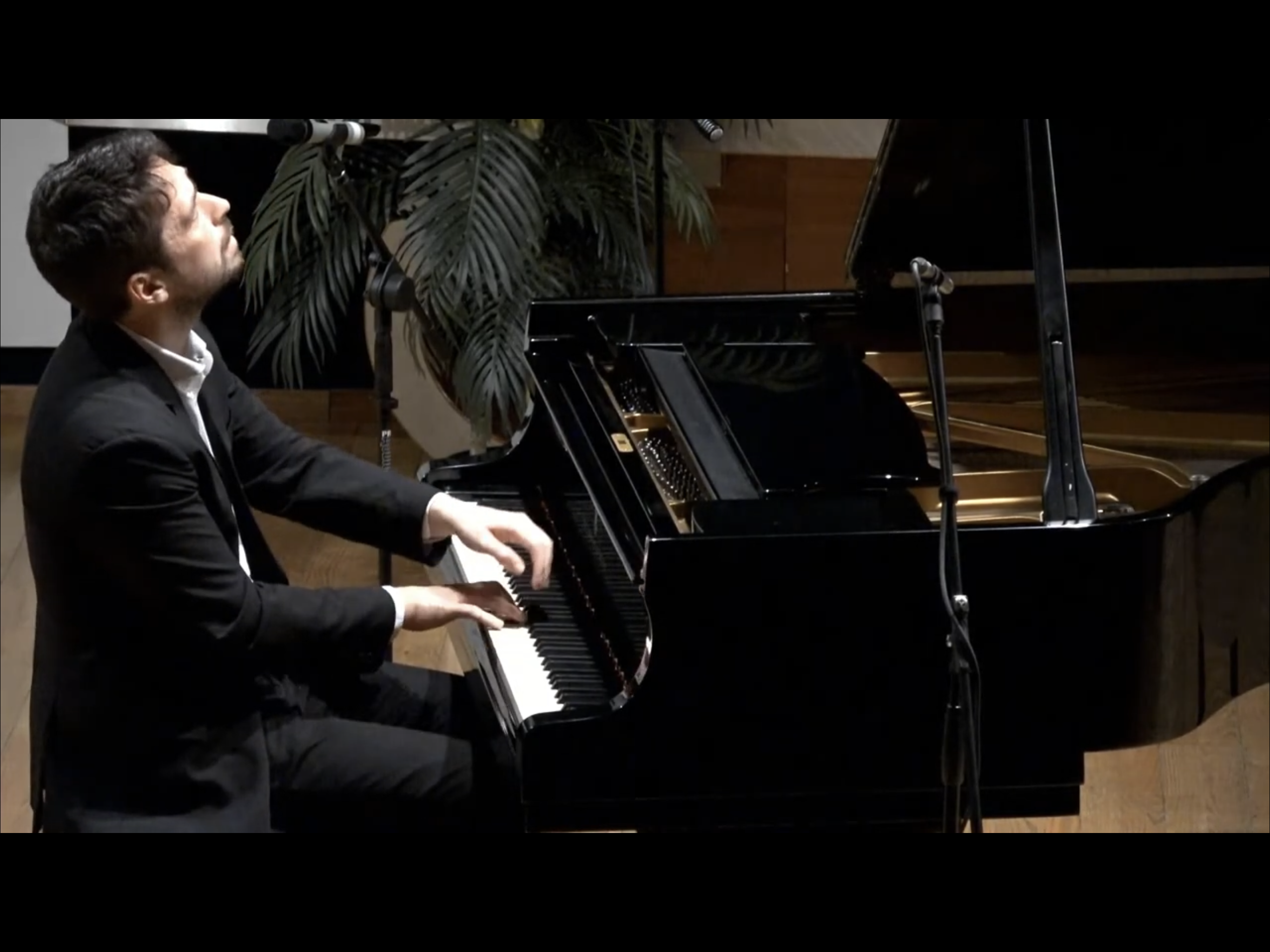
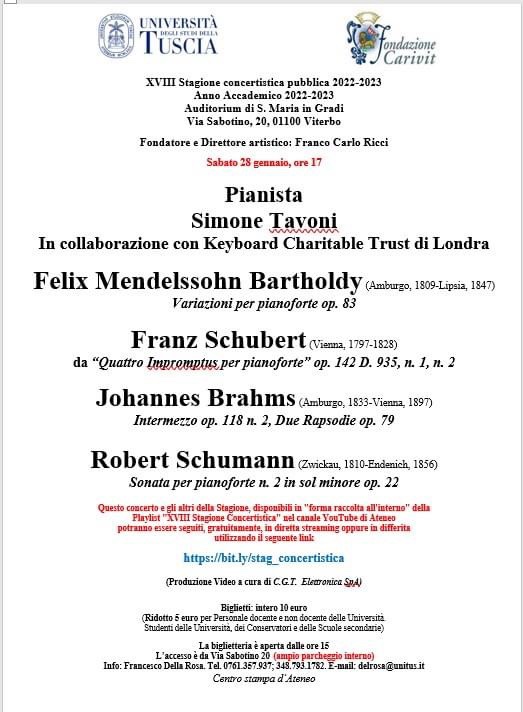
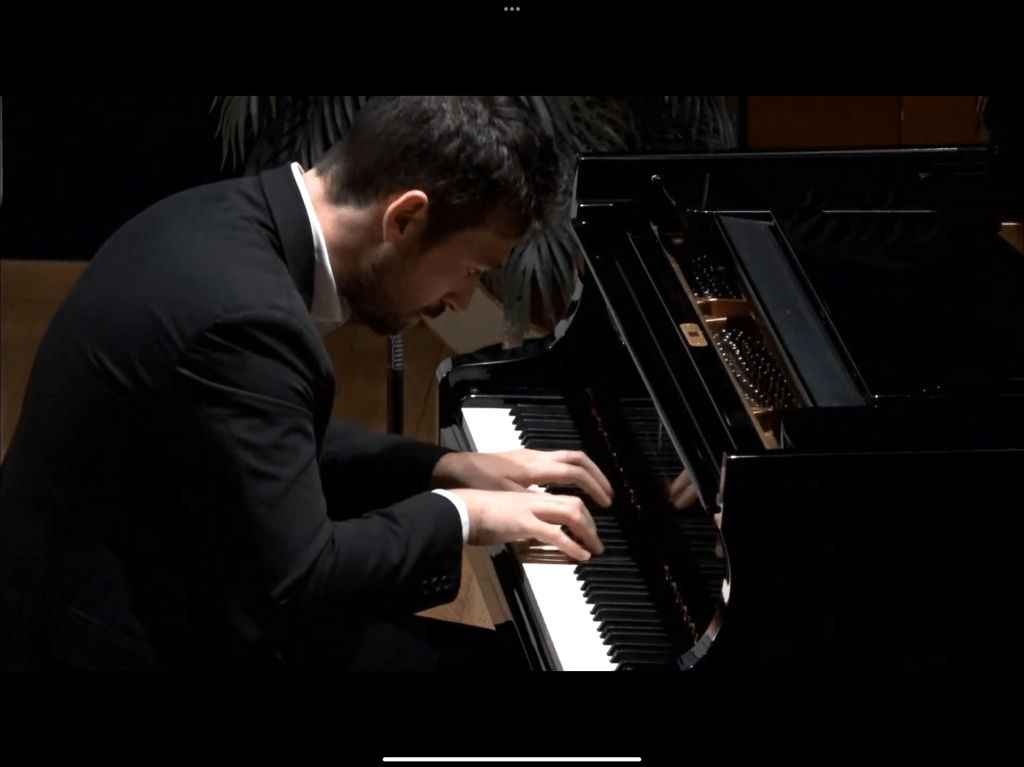
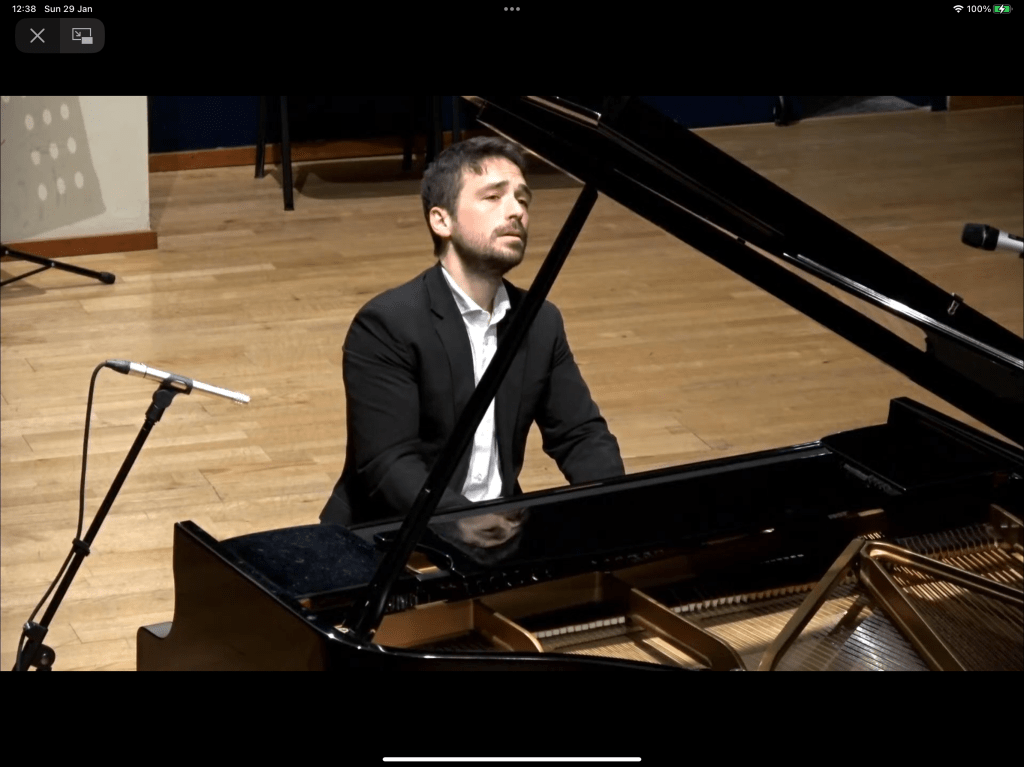
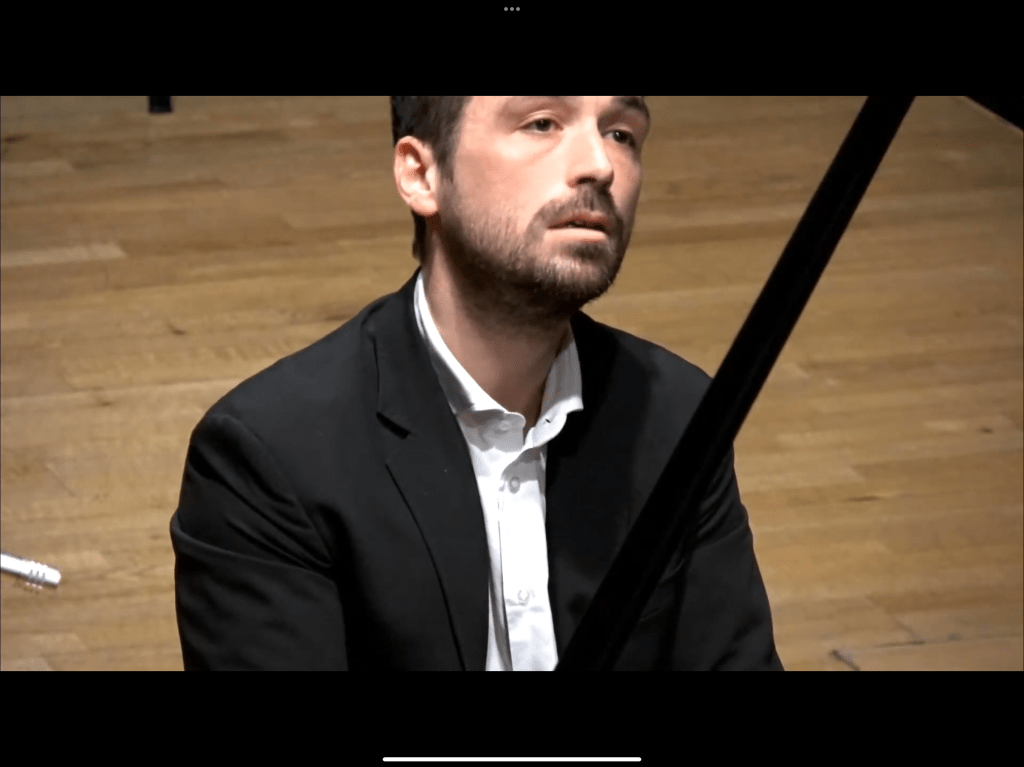
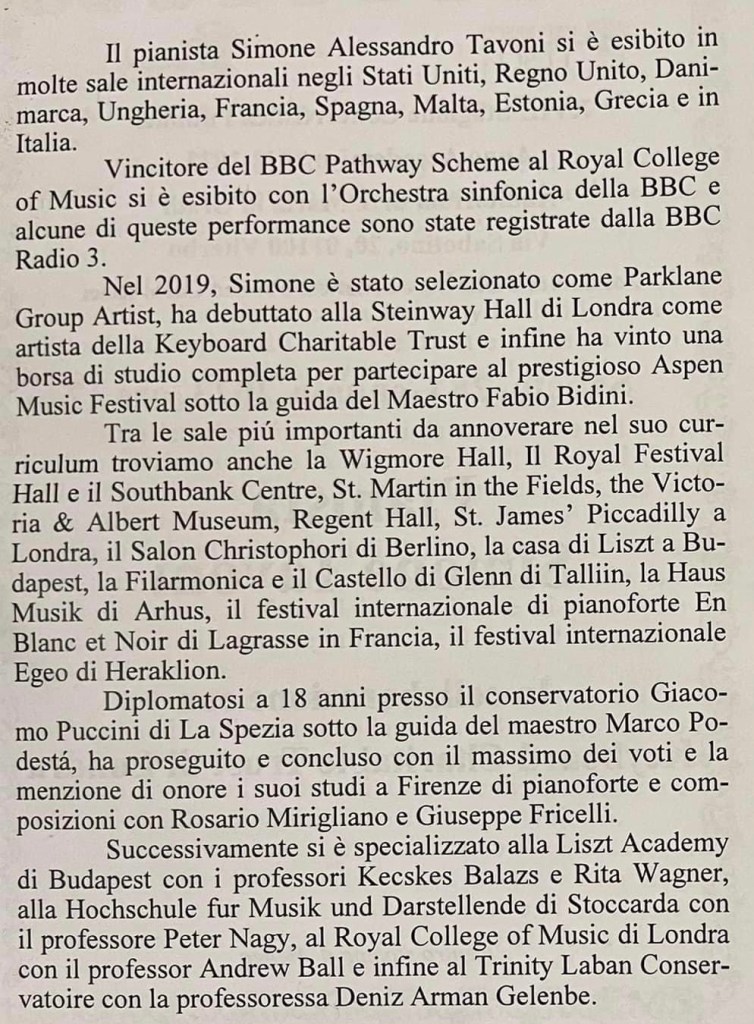
Simone Tavoni in Viterbo,city of the Popes – 80 km from Rome. Florid Mendelssohn Variations op 83 were played with a ravishing jeux perlé that were just streams of gold.Mendelssohn’s enticing melodies were allowed to float on a magic wave of sounds due to Simone’s very sensitive sense of touch. Two Schubert Impromptus,the first of his late set, revealed Simone’s superb musicianship as Schubert’s irrepressible outpouring of song was given an underlying structure and sense of architectural shape that made one marvel at the maturity of an already mortally sick composer at such an early age . Simone brought sumptuous orchestral colour and power to the two Brahms Rhapsodies op 79 but it was the heart rending simplicity and ravishing beauty of the op 118 n.2 intermezzo,that was to be the final work for piano of Brahms, that was so aristocratically poignant. The frenzy and passion in Schumann of the outer movements was calmed by the beauty and subtle shaping of the ‘lied’ that Schumann had chosen to weave into his Sonata op 22 Simone was happy to offer to an enthusiastic public his own improvisation in the style of a Chopin mazurka which just added the final touch to a recital that had been a demonstration of intelligence and sensitive musicianship.
The beauty of the theme was contrasted by the fluidity of the first variation and the clarity but also delicacy of the counterpoints that followed .There were clouds of drama on the horizon followed by the legato right hand with insistent brief interjectory comments from the left.Gentle leaps reminiscent of Saint Saens were followed by the final flowing beauty and passionate virtuosity of the ending,burning itself out so beautifully with an elegant flourish before the gentle final chords that signalled the end of the dream.Played by Simone with a sense of style and simplicity that avoided all rhetoric as the music was allowed to speak for itself quite simply without any complications.
The variations op 83 were written in 1841 and the four hand adaptation was published after his death as op 83a.The theme and variations that Simone plays today have five whereas the four hand adaptation have eight.Mendelssohn made his first public concert appearance at the age of nine and was a prolific composer from an early age. As an adolescent, his works were often performed at home with a private orchestra for the associates of his wealthy parents amongst the intellectual elite of Berlin.Between the ages of 12 and 14, Mendelssohn wrote 13 string symphonies for such concerts, and a number of chamber works.His first work, a piano quartet, was published when he was 13.He suffered from poor health in the final years of his all too short life, probably aggravated by nervous problems and overwork. A final tour of England left him exhausted and ill, and the death of his sister, Fanny, on 14 May 1847, caused him further distress. Less than six months later, on 4 November, aged 38, Mendelssohn died in Leipzig after a series of strokes.His funeral was held at the Paulinerkirche, Leipzig, and he was buried at the Dreifaltigkeitsfriedhof I in Berlin-Kreuzberg. The pallbearers included Moscheles, Schumann and Niels Gade.Mendelssohn had once described death, in a letter to a stranger, as a place “where it is to be hoped there is still music, but no more sorrow or partings.”
Simone played the Schubert Impromptus with great authority and intelligence.The opening declamation of the F minor impromptu dissolving into the deeply meditative central episode with its heart melting treble melody answered by the bass.There were a stream of sounds rippling unobtrusively throughout played with a transcendental control of balance.I had not heard before the legato treble contrasted so clearly with a non legato bass but it was nevertheless very authoritative and totally convincing.The A flat Impromptu that followed was played with great delicacy as one of Schubert’s most poignantly beautiful melodies was allowed to unfold so naturally.The slightly chiselled right hand of the melodic line towards the end showed Simone’s sensibility to Schubert’s sublime mellifluous sound world.The gradual unfolding of the central episode produced some sumptuous rich sounds of great beauty and contrast.
The Schubert Impromptus are a series of eight pieces for solo piano composed in 1827. They were published in two sets of four impromptus each: the first two pieces in the first set were published in the composer’s lifetime as Op. 90; the second set was published posthumously as Op. 142 in 1839 (with a dedication added by the publisher to Franz Liszt).As the first and last pieces in this set are in the same key (F minor) the set bears some resemblance to a four-movement sonata.It has been suggested that these Impromptus may be a sonata in disguise, notably by Robert Schumann and Alfred Einstein ,who claim that Schubert called them Impromptus and allowed them to be individually published to enhance their sales potential.It is also believed that the set was originally intended to be a continuation of the previous set, as Schubert originally numbered them as Nos. 5–8.
High drama and sumptuous orchestral sounds heralded the opening of the two rhapsodies op 79.There was also a beautiful fluidity and simplicity to the central episode of the first with a melodic line that was allowed to shine so clearly due to Simone’s impeccable sense of balance .He allowed the excitement to mount in the coda of the first that then seemed to be searching a way out with Simone creating a magic atmosphere as it dissolved to a mere whisper.The same orchestral sounds burst onto the scene with fervid passion in the second rhapsody with chordal exhilaration of great rhythmic energy and menace.The two rhapsodies had opened up a completely different sound world of sumptuous orchestral sounds that Simone shared with us thanks to his kaleidoscopic palette of colours.
The Rhapsodies, Op. 79 were written in 1879 during Brahms’ summer stay in Portschach,when he had reached the maturity of his career. They were inscribed to his friend, the musician and composer Elisabeth von Herzogenberg .At the suggestion of the dedicatee, Brahms reluctantly renamed the sophisticated compositions from “Klavierstücke” (piano pieces) to “rhapsodies”
No. 1 in B minor. Agitato is the more extensive piece, with outer sections in sonata form enclosing a lyrical, nocturne-like central section in B major and with a coda ending in that key.
No. 2 in G minor. Molto passionato, ma non troppo allegro is a more compact piece in a more conventional sonata form.
In each piece, the main key is not definitely established until fairly late in the exposition.
There was ravishing beauty to his playing of the A major Intermezzo which he played with poignant strength that did not allow any sentimentality or rhetoric.A beautiful fluidity to the central episode allowed the two voices to converse with such delicacy.Barely touching the keys at the end as he stroked the utmost meaning from one of Brahms’ most beautiful utterances.
The Six Pieces for Piano, Op. 118, were completed in 1893 and dedicated to Clara Schumann ,the collection is the penultimate composition published during Brahms’ lifetime. It is also his penultimate work composed for piano solo. Consistent with Brahms’s other late keyboard works, Op. 118 is more introspective than his earlier piano pieces, which tend to be more virtuosic in character. Simone played the second piece the Intermezzo in A major. Andante teneramente
Driving rhythm and passionate involvement burst onto the scene with Schumann’s op 22 Sonata.But there was beauty too as the melodic line was allowed to shine through all the fervent outpourings of notes that litter the score with such youthful exhilaration and virtuosity.Even with Schumann’s quixotic changes of mood the driving tempo was never allowed to sag in Simone’s authoritative hands.There was great delicacy in the second movement reaching moments of fervent exultation and the even more tender return of the opening theme ‘avec un sentiment de regret’ to quote Alfred Cortot.There was the absolute frenzy of the scherzo where a more legato syncopation of the chords that followed would have given more startling contrast.The last movement burst impatiently onto the scene with driving passion and a technical prowess that was quite overwhelming.A young man’s convincing performance of the still youthful and passionate composer Robert Schumann.
Clara Schumann claimed to be “endlessly looking forward to the second sonata”, but nevertheless Robert revised it several times. At Clara Schumann’s request, the original finale, marked Presto passionato was replaced with a less difficult movement in 1838.Clara considered it “not too incomprehensible,” though she admitted that she would “play it if necessary, but the masses, the public, and even the connoisseurs for whom one is really writing, don’t understand it.”The Andantino of the sonata is based on Schumann’s early song “Im Herbste”; It is dedicated to Schumann’s friend the pianist Henriette Voigt and was published in September 1839.
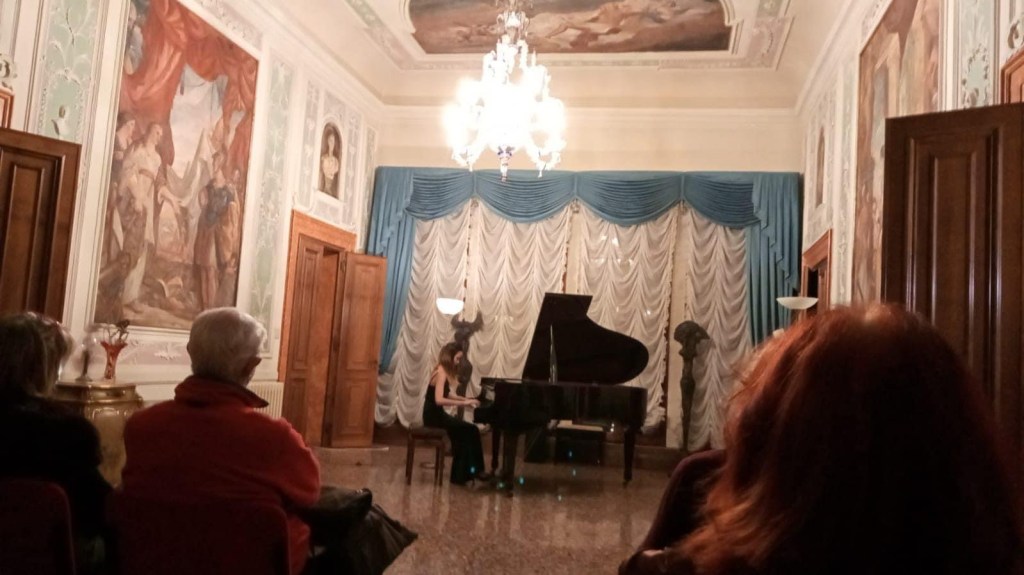
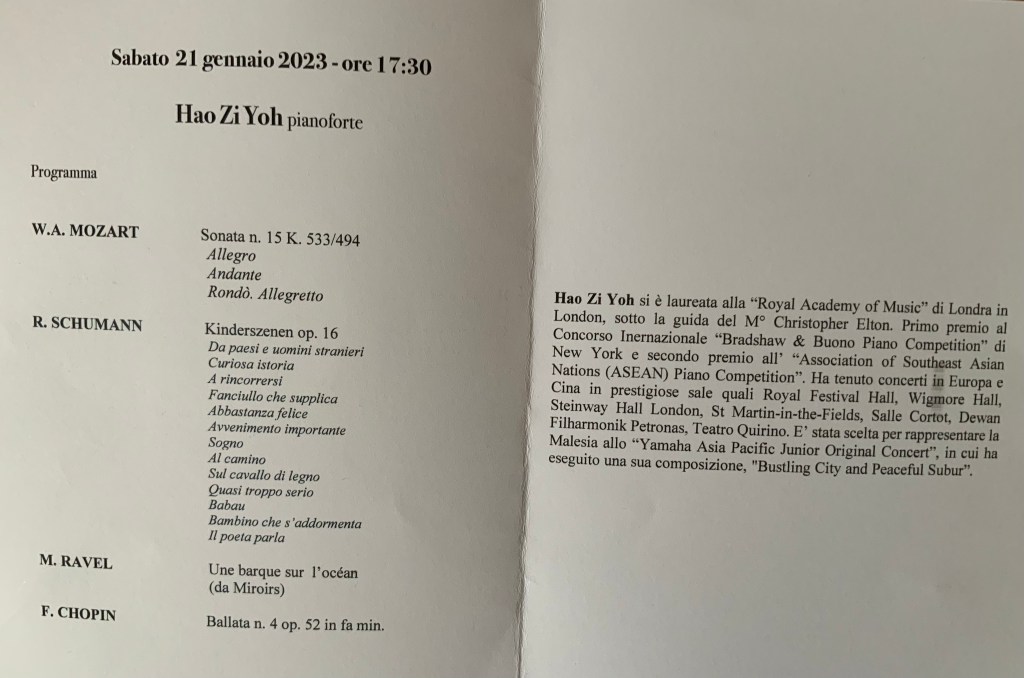
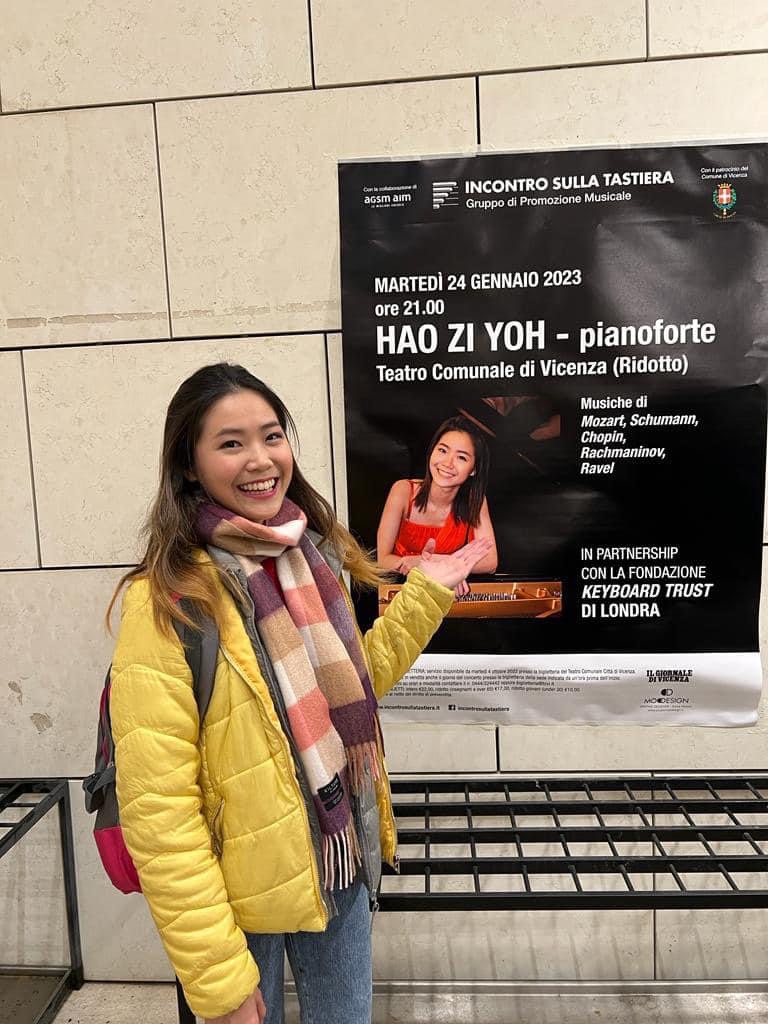
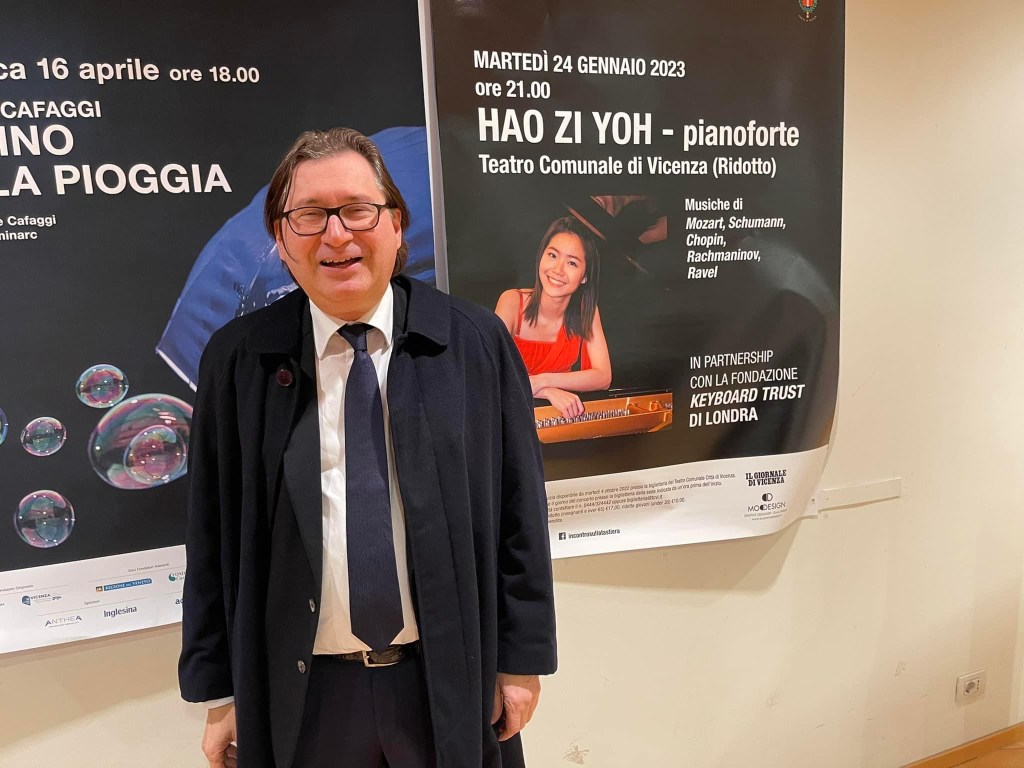
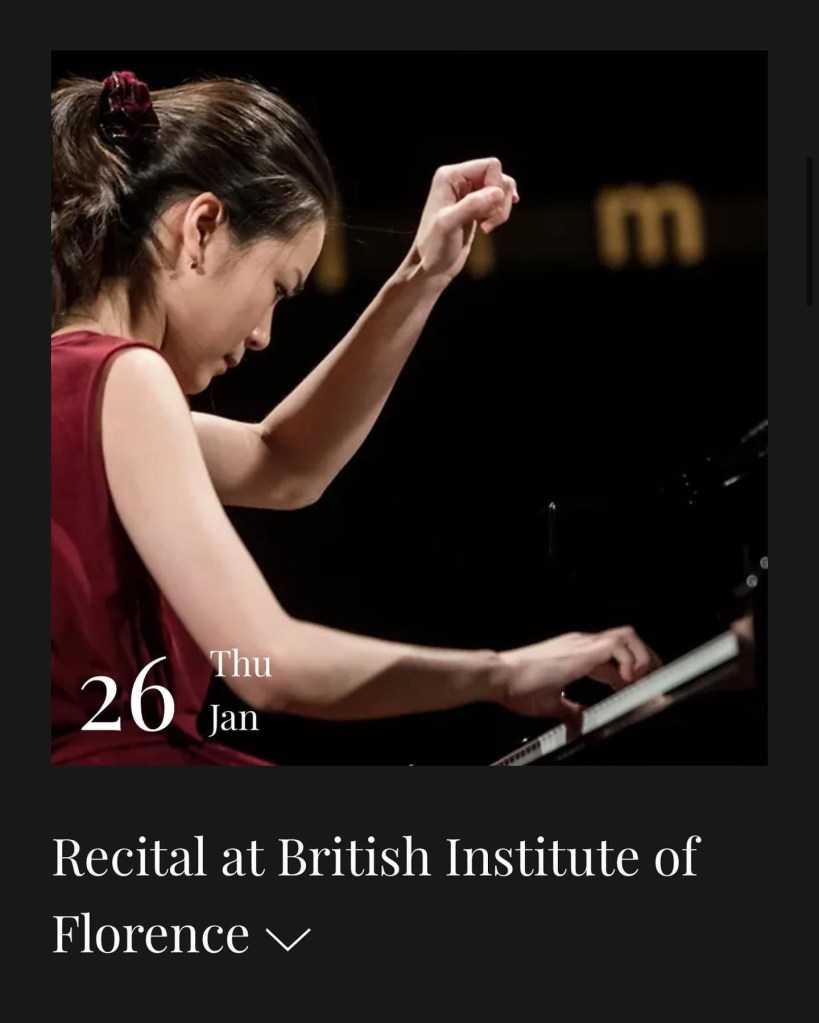
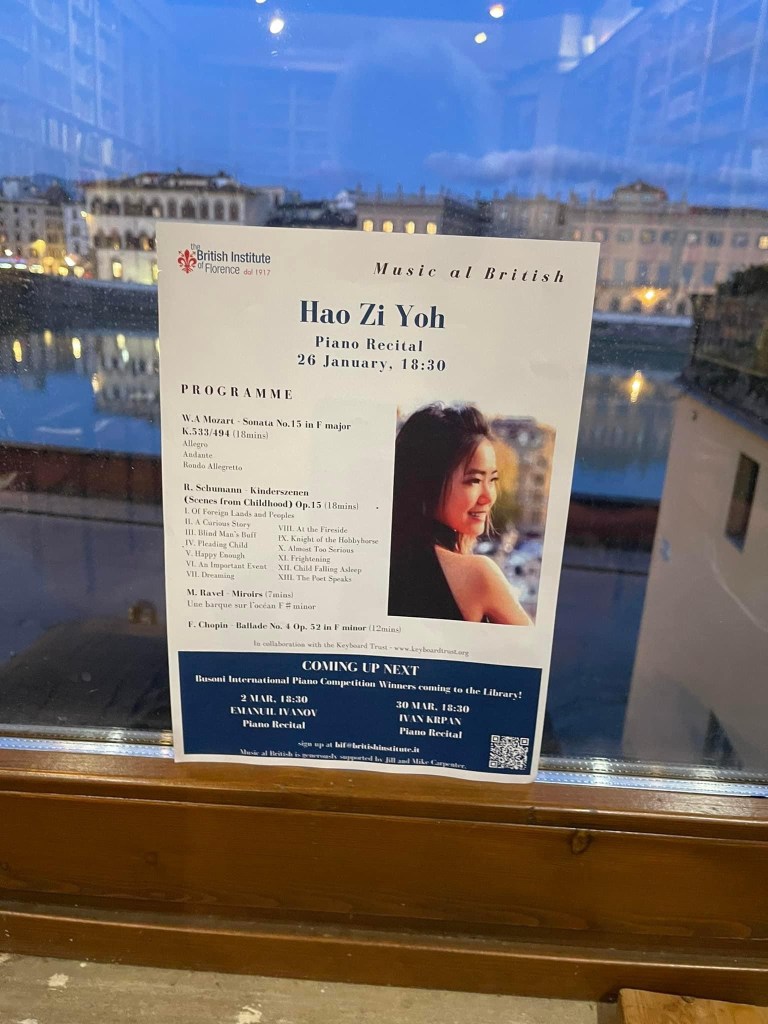
Hao Zi Yoh on her Italian tour for the Keyboard Trust played in Venice,Padua and Florence :Mozart Sonata K.533/494 ;Schumann Kinderszenen op 15 ;Ravel ‘Une barque sur l’océan’ from Miroirs;Chopin Ballade n.4 op 52.
A longer programme in Vicenza was with the addition of Schumann Novelette op.21 n.8 and Ravel ‘Noctuelles ‘and ‘Alborada del grazioso’ from Miroirs.Her encore was Chopin ‘s ‘Minute’ Waltz op 64 n.1.It was indeed her refined elegance and supreme artistry that summed up in only a minute her pure beautiful music making and had given her the ovation she truly deserved.
Mozart’s Piano Sonata No. 15 in F major K. 533/494 (finished 3 January 1788)is in three movements :Allegro – Andante – Rondo: Allegretto.The Rondo was originally a stand-alone piece composed by Mozart in 1786 (Rondo No. 2, K. 494 ).In 1788, Mozart wrote the first two movements of K. 533 and incorporated a revised version of K. 494 as the finale, having lengthened it in order to provide a more substantial counterpart to the other two movements.There was clarity and a disarming simplicity to Hao Zi’s playing with crystal clear articulation and a rhythmic drive that was spellbinding from the first notes.Great elegance in the beautifully shaped Andante was played with an aristocratic sense of style.There was drama too but always within the confines of the overall shape of the movement that unlike Beethoven was just a passing cloud until returning to the serenity of the opening melodic line.The cascading arpeggios replying one to the other at the end were played with a refined delicacy that was absolutely ravishing.The purity of sound and child like simplicity gave such charm to her playing of the rondo.The ever more vivacious ornamentation just added to the rhythmic impetus with her sparkling jewel box full of kaleidoscopic colours.A coda deep in the bass in such reflective mood as the rondo theme just dissolved before our eyes with the magic that Hao Zi had recreated.
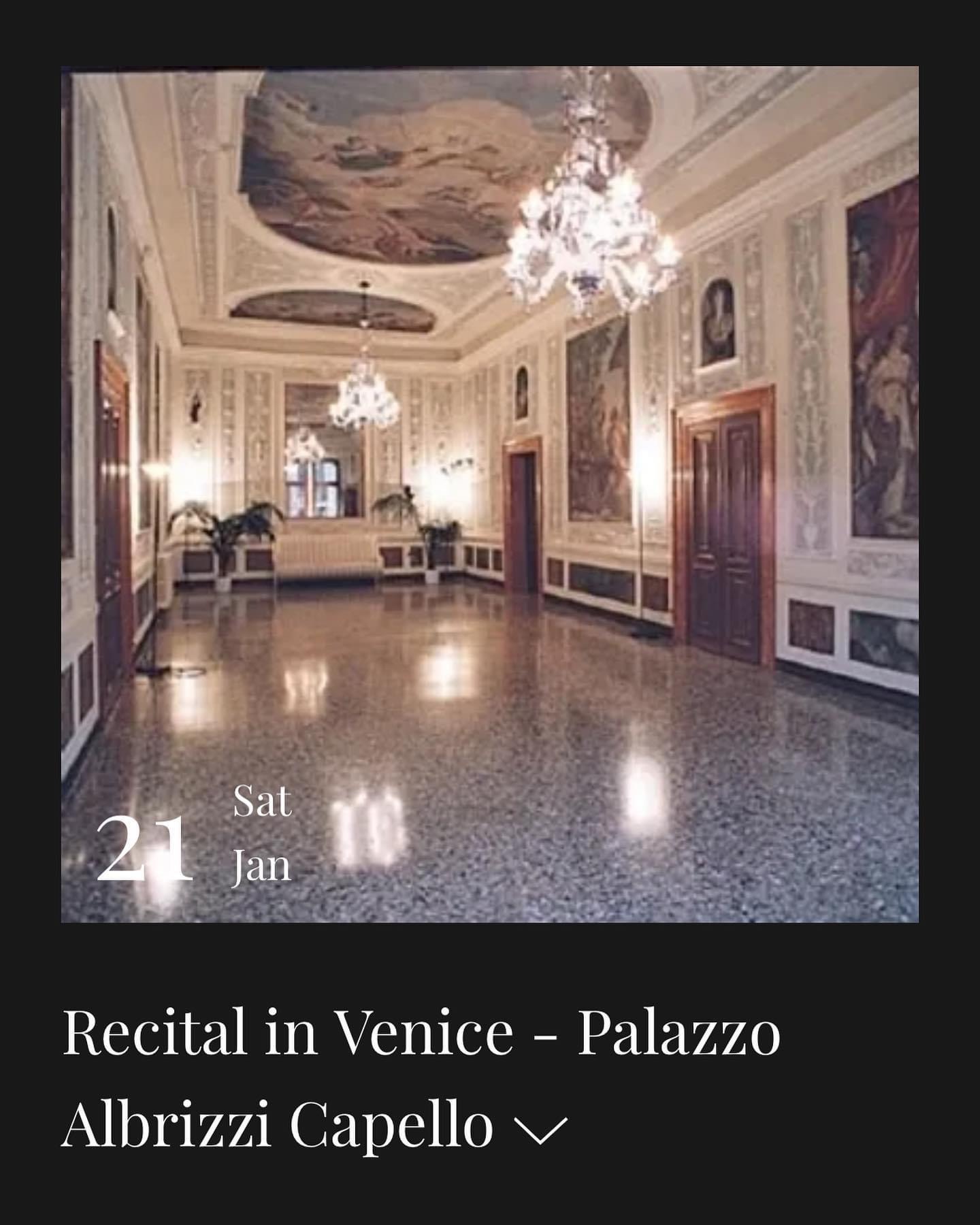
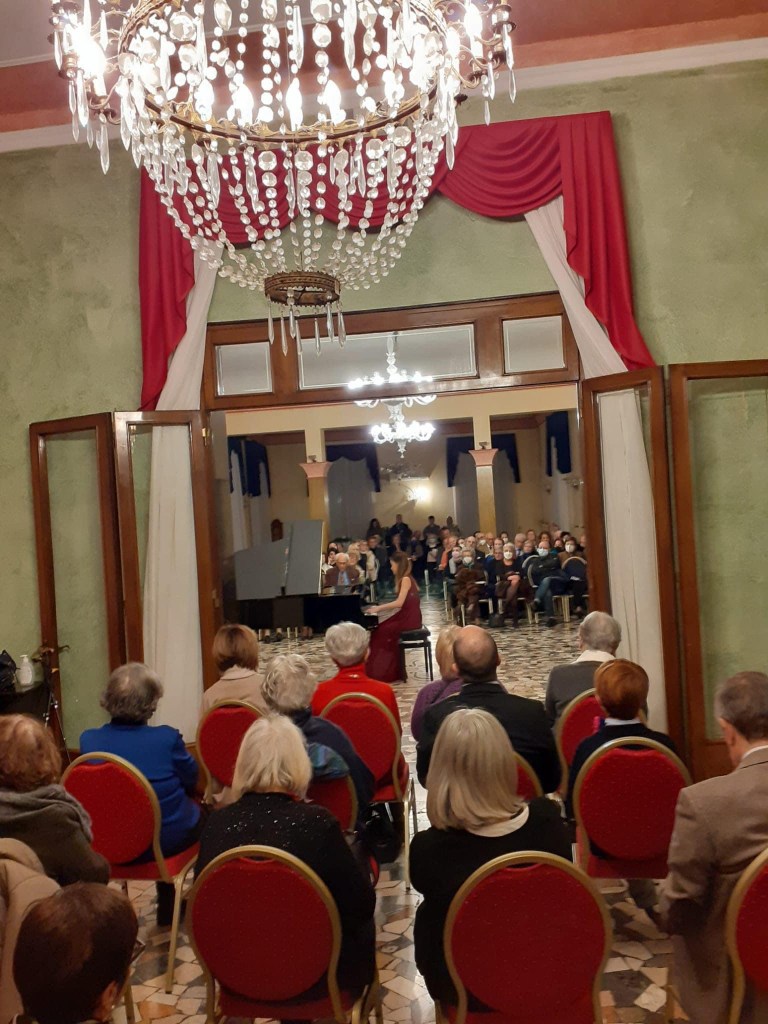
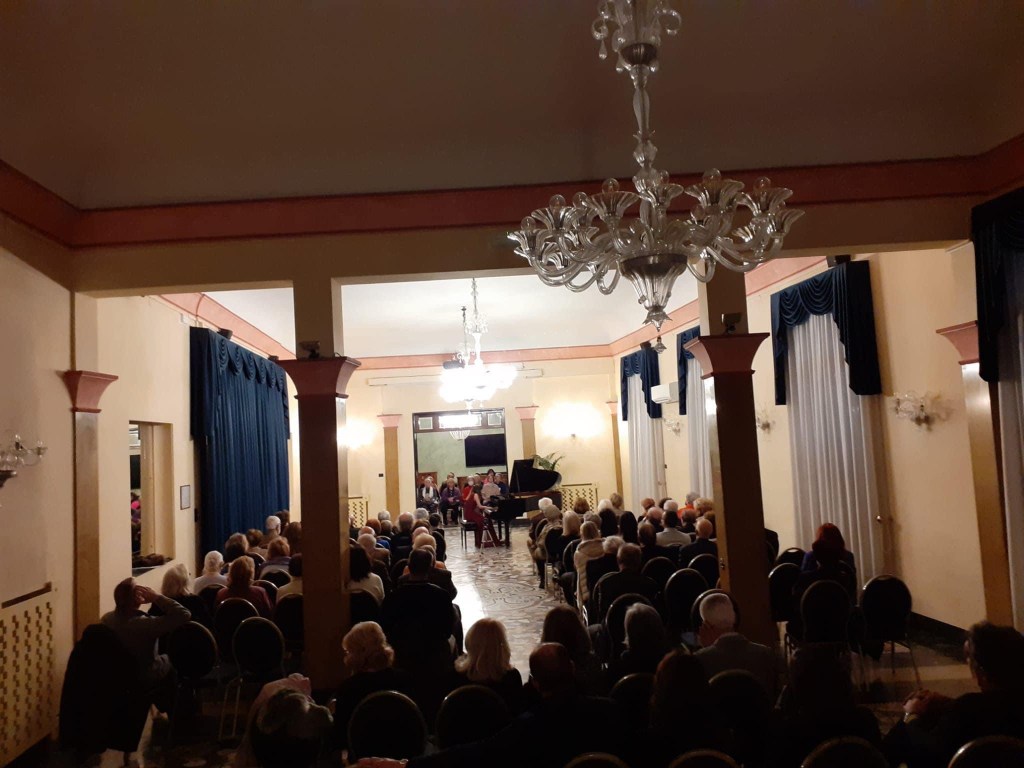
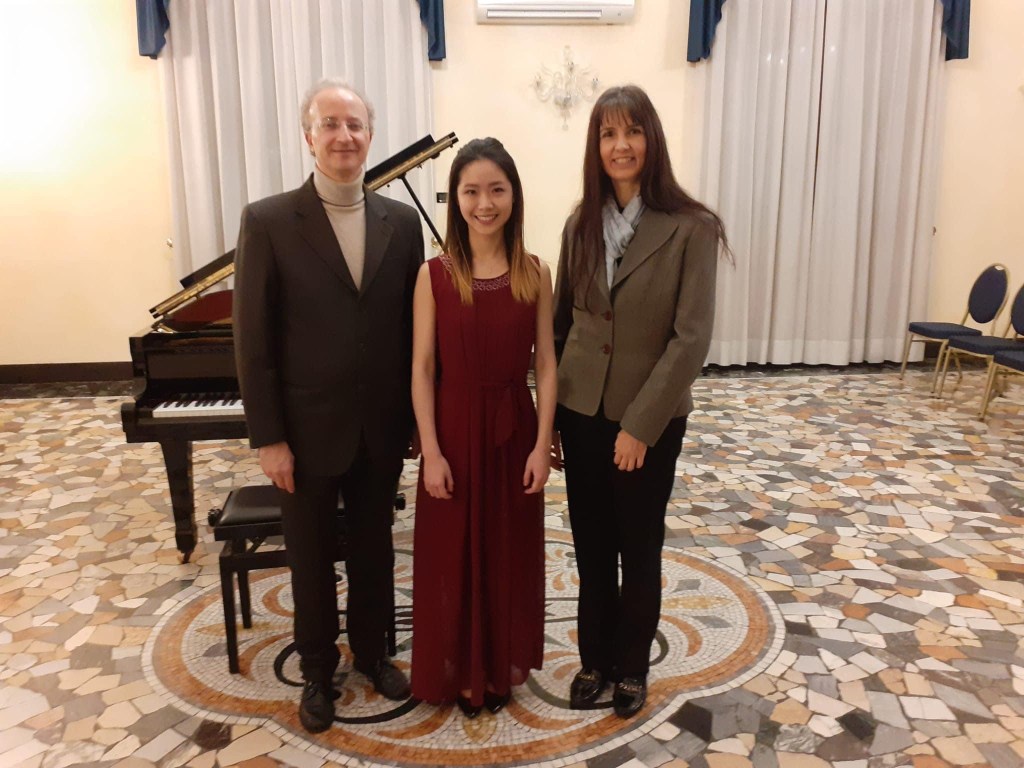
The beautiful Palazzo Albrizzi Capello in the centre of Venice A full house and a happy return to Palazzo Zacco-Armeni the seat of the Circolo Unificato dell’EsercitoElia and Elisabeta Modenese of Agimus Padova who organise every year the young people’s concerts in Padua and Venice
Schumann wrote 30 movements for Kinderszenen- Scenes from childhood but chose 13 for the final version. The unused movements were later published in Bunte Blatter- coloured leaves op 99, and Albumblatter Op. 124. Schumann told his wife Clara that the “thirty small, droll things”, most of them less than a page in length, were inspired by her comment that he sometimes seemed “like a child”. He described them in 1840 as “more cheerful, gentler, more melodic” than his earlier works.It was just this sense of character that came across so vividly with the same inflections and slight pauses that Curzon and Cortot brought to these seemingly simple pieces.The beautiful fluid sounds ‘Of foreign lands and people’with the melodic line shaped so eloquently with a magical sense of balance.The playful rhythmic lilt she gave ‘A curious story’ led so well to the hell for leather fun of ‘Blind man’s bluff’ .Could one ever resist such a ‘Pleading child ‘that made him ‘Happy enough’to sing such a joyous song on his way to a truly ‘Important event’.Played with such grandeur and precision never allowing the tone to harden.’Dreaming’ with such magical sounds and subtle phrasing shaped with infinite love and care.Ready for the duet between the voices ‘At the fireside’ before jumping onto a ‘Hobby horse’ of such rhythmic energy.It was ‘Almost too serious’ for her delicate projection of the melodic line helped by the rich bass notes .Her delicacy and precision was beautiful as it was ‘Frightening’ and the ‘Child falling asleep’ must have been an angel indeed as it shone out like a diamond amongst these jewels.The final chords of ‘A poet speaks’ was a lesson in how to persuade us that the piano was not a percussive instrument. Alfred Cortot could explain better than anyone https://youtube.com/watch?v=UroWVTDb8Oo&feature=share
With Maria Antonietta Sguelia the indefatigable organiser of the Incontri who with her daughter Raffaella have given a platform to Keyboard Trust Artists for the past twenty years.
The Novelletten, op 21, is a set of eight pieces written by Schumann in 1838 and is dedicated to Adolf von Henselt.February 1838 was a period of great struggle for Schumann who originally intended the eight pieces to be performed together as a group, though they are often performed separately.The concluding piece of the set that Hao Zi played is actually two pieces in one. The first part is a passionate etude in 2/4, the second has the nature of a march ending in D major, the principal key of the cycle.There was a romantic outpouring of sumptuous beauty with some pungent harmonies within the alternating legato and staccato.She brought such clarity as she pin pointed the melodic line in the first episode made up of the dotted rhythms that Schumann was so fond of.She brought an equally infectious rhythmic drive to the second where the gradual diminuendo created a magical base on which floated one of Schumann’s most heavenly melodies.Nobility and passion marked the final episode of the best known of these eight novelettes.It was the one together with the fourth that I have never forgotten from the hands of Sviatoslav Richter on one of his first visits to London in the 70’s.If Hao Zi did not quite have the animal like rampage of Richter she made up for it with her sumptuous sounds and an architectural shape that makes one wonder why it is not more often played these days.
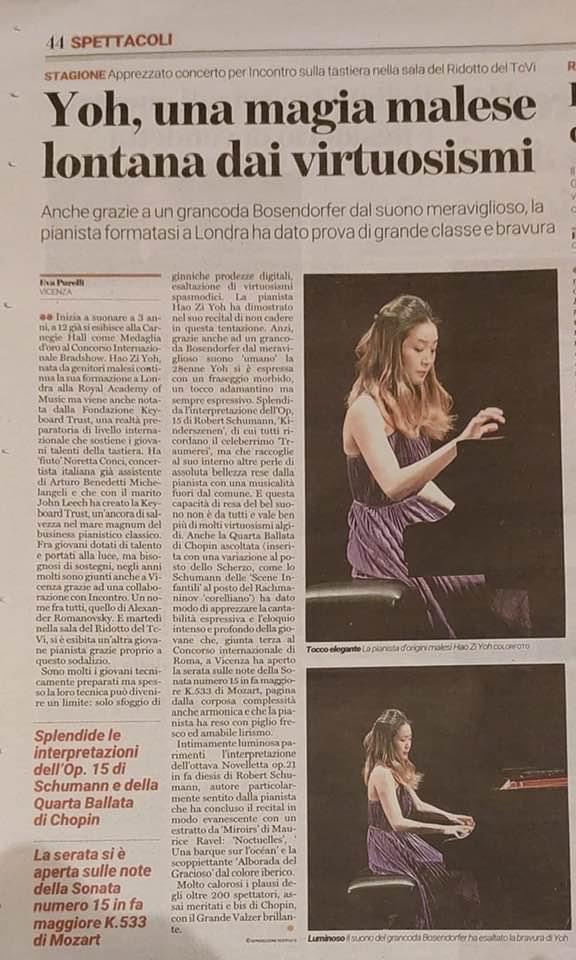
Teatro Comunale Ridotto in Vicenza Five star review from Eva Purelli from Il Giornale di Vicenza. ‘Yoh,a Magic Malaysian a long way off from the empty virtuosi of the keyboard.Thanks to the Bosendorfer concert grand with its marvellous sound,the pianist was able to show off her great class and bravura.’ Eva Purelli Il Giornale di Vicenza
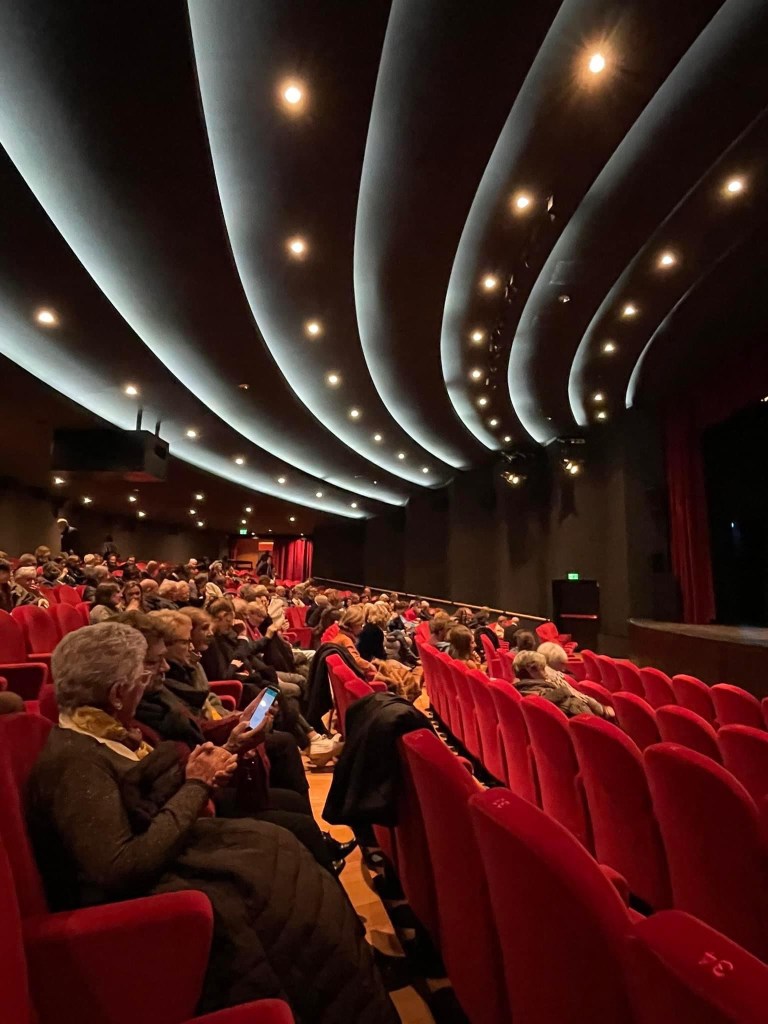
She started to play at the age of 3 and already at 12 played at the Carnegie Hall as Gold Prize Winner of the Bradshaw International Competition. Hao Zi Yoh,born of Malaysian parents,continued her training at the Royal Academy of Music but was also noticed by the Keyboard Charitable Trust,that sustains internationally young keyboard talents. Already noticed by Noretta Conci,Italian concert pianist,assistant of Arturo Benedetti Michelangeli,who with her husband John Leech created the Keyboard Trust,which is a saving anchor in the great music business sea of classical pianists. Amongst the young particularly talented brought to light and in need of sustaining ,over the years many have also come to Vicenza,thanks to the collaboration with the ‘Incontro’.Alexander Romanovsky was one amongst many of those chosen. Tuesday in the small hall of the Teatro Comunale another young pianist played thanks to this partnership. There are many young pianists technically prepared but often their technique becomes a obstacle with only prodigious finger gymnastics,the triumph of virtuosity with the flexing of muscles. The pianist Hao Zi Yoh showed in her recital that she had not fallen into this trap.On the contrary,thanks to the marvellous natural sound of a Bosendorfer Concert Grand ,the 28 year old Yoh was able to play with subtle phrasing and a jewel like touch of great intensity.Her interpretation of Robert Schumann’s op 15 ‘Kinderszenen’,from which we all know the famous ‘Traumerei’ (Dreaming)but that includes in the collection pearls of absolute beauty that the pianist demonstrated with her unique musicality.This absolute beauty of sound does not belong to all pianists but is worth much more than any cold virtuosity. Chopin’s Fourth Ballade ( played in place of the Fourth Scherzo as the Schumann ‘Scenes from childhood’ replaced the Rachmaninov Corelli Variations)demonstrated her expressively eloquent and profound singing touch from a pianist who had won third prize in the Rome International Piano Competition. In Vicenza she opened with Mozart’s 15th Sonata in F K.533 of intricate harmonic structure that she played with freshness and loving lyricism. Equally expressive and luminous was her interpretation of the 8th Novelette op.21 by Robert Schumann,a composer particularly close to her heart.She had closed her recital with a sparkling performance of a selection from Ravel’s ‘Miroirs’:’Noctuelles’,’Une barque sur l’océan ‘ and the explosion of Spanish colour in ‘Alborada del Gracioso’. Great applause from an audience of 200 was well deserved and was thanked with an encore of Chopin’s brilliant ‘Minute’Waltz. Eva PurelliThe distinguished critic Eva Purelli
Miroirs has five movements, each dedicated to a member of Les Apaches.Around 1900, Maurice Ravel joined a group of innovative young artists, poets, critics, and musicians referred to as Les Apaches or “hooligans”, a term coined by Ricardo Vines to refer to his band of “artistic outcasts”.To pay tribute to his fellow artists, Ravel began composing Miroirsin 1904 and finished it the following year
The indomitable Maria Antonietta Sguelia promoting music in Vicenza at the Teatro Comunale and the historic Teatro Olimpico for a lifetime
“Noctuelles” (“Night Moths”). D♭ major. Dedicated to Léon-Paul Fargue and is a highly chromatic work, maintaining a dark, nocturnal mood throughout. The middle section is calm with rich, chordal melodies, and the recapitulation takes place a fifth below the first entry.”Une barque sur l’océan” (in English “A Boat on the Ocean”). F♯minor. Written for Paul Sordes , the piece recounts a boat as it sails upon the waves of the ocean. Arpeggiated sections and sweeping melodies imitate the flow of ocean currents. It is the longest piece of the set.Alborada del gracioso” (Spanish: “The Jester’s Aubade -Morning Song of the Jester”). D minor — D major. Dedicated to Michel -Dimitri Calvocoressi Alborada is a technically challenging piece that incorporates Spanish musical themes into its complicated melodies.
Ermanno Detto sponsor and friend of Incontri with the concert dedicated each year to his late mother and also this year with great sadness to his father.
There was a fluidity of sound together with the fleeting lightness of Noctuelles.A deeply brooding atmospheric middle section with a completely different sound colour from the Schumann that one could only describe as unmistakably French.These moths flittered around the keyboard with kaleidoscopic colours that just seemed to flow so naturally from Hao Zi’s hands.The final flourish as they disappeared into the night air was of quite ravishing beauty.One could almost see the waves splashing about in ‘Une barque’with an astonishing fluidity out of which emerged a gentle melody that gradually became ever more turbulent.Storm clouds of mysterious sounds were played with astonishing technical prowess with streams of wonderful sounds just cascading from her fingers with such ease.What beauty she brought to the left hand melodic line as the waves weaved their delicate way in the right hand and calm was restored as rays of sunlight seemed to appear between the clouds with such subtle radiance.The Alborada showed off Hao Zi’s technical mastery as the repeated notes and double glissandi were simply incorporated into a musical tone poem of such languid beauty mixed with a passionate frenzy of astonishing virtuosity.
The Ballade No. 4 in F minor, Op. 52 by Frederic Chopin completed in 1842 in Paris It is commonly considered one of Chopin’s masterpieces, and one of the masterpieces of 19th-century piano music.Of the four ballades, it is considered by many pianists to be the most difficult, both technically and musically.It is also the longest, taking around ten to twelve minutes to perform. According to John Ogdon , it is “the most exalted, intense and sublimely powerful of all Chopin’s compositions… It is unbelievable that it lasts only twelve minutes, for it contains the experience of a lifetime.
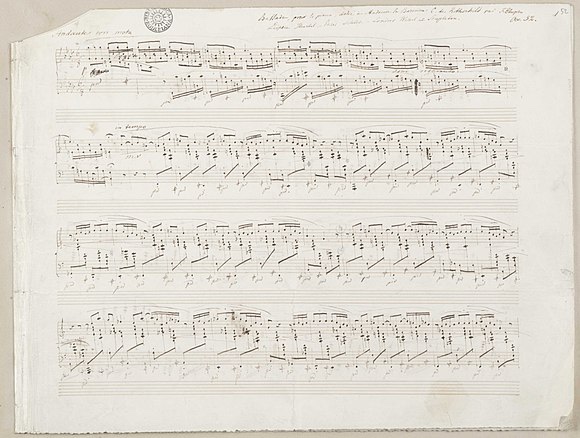
A room with a view in the beautiful Harold Acton Library home of the British Institute directed by Simon Gammell OBE who together with his wife Jennifer have created a centre for excellence and an essential meeting place for all lovers of the Arts Manuscript of Chopin op 52 in the Bodleian Library in Oxford
This was a monumental performance of one of the greatest works in the piano repertoire.It was played with an aristocratic nobility but a sensitivity to sound that made one realise what Cortot meant when he said:’ avec un sentiment de regret’ at the return of the opening heartbeating repeated notes.A magical cadenza brought us to the main theme seemingly lost until it found its way with such swirling mists of sound and a gradual magisterial build up to the final explosion and the five redeeming chords that seem to find such peace after such a storm of romantic passion. The transcendentally intricate coda that follows was indeed breathtaking in Hao Zi’s hands.It was played with an unrelenting forward propulsion that did not exclude the most intricate shaping of this extraordinary after thought of pure genius.
I truly mean what I write here: click on the link for an hour’s unforgettable music, wherever you are. Performance doesn’t come better than this. Jack
Nice to remember Jack Buckley who died last September in London at the age of 84 – A life lived to the full right until the last – he will be much missed.For a lifetime he promoted music in Italy and was a great friend of Harold Acton.He was an indefatigable promoter of Sir William Walton and Sir Maxwell Davis bringing to Rome the London Symphony Orchestra under Andre Previn with an all Walton programme.He also helped Lady Walton found the William Walton Trust on Ischia and helped Joy Bryers found the European Youth Orchestra.He was Arts officer of the British Council in Rome for many years having followed in the footsteps of the remarkable Hilda Colucci.In later years he became a very erudite commentator on the Arts via Seen and Heard International.
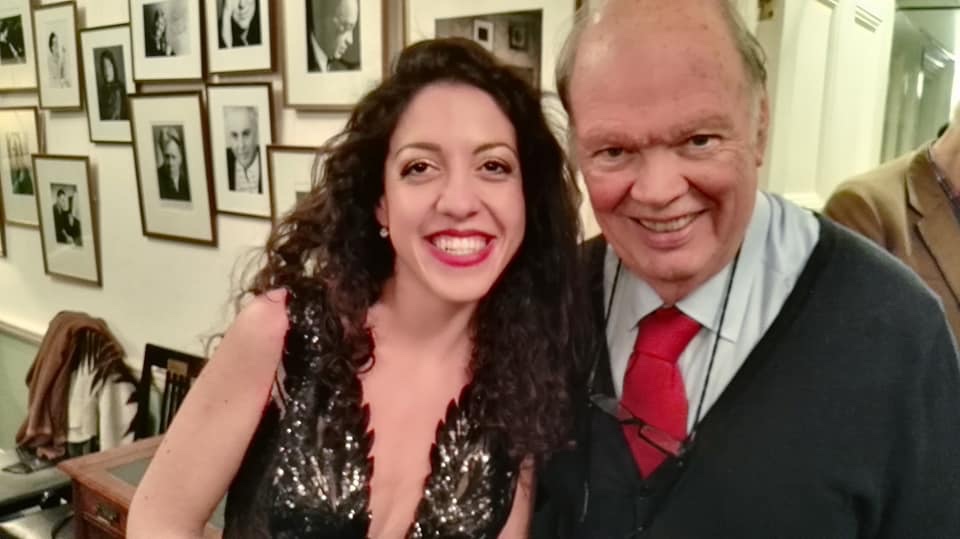
Jack Buckley with another great female pianist Beatrice Rana
I have heard Hao Zi many times as these articles will show and some include performances and a biography of this remarkable young musician :
I was invited about four years ago to a concert at the Royal Academy of Music in which two ‘freshers’were performing the Mozart Double Concerto.I had known Alim Beisembayev since his studies at the Purcell School with Tessa Nicholson and it was she who had invited me to the concert in which Alim was playing with a young Lithuanian student Ignas Maknickas.Two very talented young pianists embarking on an intensive professional training.Alim has gone on to win the Gold Medal at the Leeds International Piano Competition and on todays performance Ignas is well on the way to receiving International recognition too .I had heard Ignas a few years later at the Imogen Cooper Musical Trust and at St James’ Piccadilly and began to realise that the young rather undisciplined pianist of the Mozart Double was fast maturing into a pianist to be reckoned with.Today I heard a great artist ready to take the world by storm.But not only for his extraordinary natural technical skill but for his intelligence and simple but profound musicality.A fluidity of sound that seems to be the norm for the Lithuanian school of pianists who have come to perfect their studies in London.A school that creates pianists with a relaxed natural technical ease that gives the sound they make a fluidity and purity similar to the remarkable Hungarian School .(I am reminded of the fluid,liquid sound of Geza Anda).Rokas Valuntonis ,Gabrielé Sutkuté and Milda Daunoraite are three Lithuanian pianists whose career I have been following with great interest ,who all play with a natural ease and fluidity of sound.An exhilarating ‘joie de vivre’ that allows the music to flow so naturally from their finely trained fingers and gives them a security that is so often missing in young performers in need of experience.
From the very first notes there was a rhythmic energy and passionate involvement but with a clarity and technical ease that allowed him to pursue Schumann’s wishes to the full.The rippling left hand I have never heard so clearly since Geza Anda.A clarity that was unobtrusive but gave a support to the passionate outpouring of Schumann’s heart in ‘the most passionate thing he had ever written’.There was tenderness too as Schumann’s deep lament for his beloved Clara gave rise to ravishingly lyrical interludes.Never allowing the tempo to sag,Ignas had entered so well into the very heart of a composer deeply in love.There was an overall architectural shape to his playing that never denied intimate moments of reflection,always picking up the tempo(something that the composer had not marked clearly in the score).The second movement was played with great musicality as Schumann’s sometimes irritating dotted rhythms were give a shape and meaning as they led to the gradual build up to the treacherous coda.Hurdles placed in these final two pages that Ignas took in his stride shaping them into the overall argument with transcendental control and never loosing his wonderful luminous sound.It was a control sound that he had realised from the outset that the march is marked only mezzo forte as it gradually built up to this final exhilarating explosion of pyrotechnics.Liszt was said to have played this coda with glee and although he played the entire work in private he never actually played it in public considering it not ‘effective’.The first performance I had ever heard was in the 60’s from the golden hands of Artur Rubinstein.It was Rubinstein too,a showman like Liszt,who never played Davidsbundler in public (Schumann’s most poetic early masterpiece) because it finished quietly and audiences required a more triumphant finish to the first or second half of a recital!The central ‘etwas langsamer’was played with ravishing beauty and the lightness of the pianissimo scherzando was shaped with such delicacy and even the slight ritardando at the end although not marked in the score was the touch of a true poetic stylist.The deep beauty of the last movement where Schumann declares openly his deep feeling for his distant beloved was played with a fluidity and a control of balance,that never allowed the melodic line to be overwhelmed by the fluid accompaniment,even in the most passionate climaxes.The deeply contemplative final page where the temperature was allowed to discreetly rise,as Schumann indicates,but without any exaggeration as the music drew to its final three whispered chords with a natural musicianship and intelligence that could be called recreation!
The Fantasie in C, op.17, was written in 1836. It was revised prior to publication in 1839, when it was dedicated to Franz Liszt.Liszt in return dedicated his B minor Sonata to Schumann.The two works are generally considered to be the pinnacles of piano music of the Romantic period.The Fantasie is in loose sonata form. Its three movements are headed:Durchaus fantastisch und leidenschaftlich vorzutragen; Im Legenden-Ton –Mäßig. Durchaus energisch – Langsam getragen. Durchweg leise zu halten. The piece has its origin in early 1836, when Schumann composed a piece entitled Ruines expressing his distress at being parted from his beloved Clara Wieck (later to become his wife). This later became the first movement of the Fantasy.Later that year, he wrote two more movements to create a work intended as a contribution to the appeal for funds to erect a monument to Beethoven in his birthplace, Bonn.
Liszt’s Beethoven Monument in Bonn
The movements’ subtitles (Ruins, Trophies, Palms) became Ruins, Triumphal Arch, and Constellation, and were then removed altogether before Breitkopf & Härtel eventually issued the Fantasie in May 1839.Schumann prefaced the work with a quote from Friedrich Schlegel:Durch alle Töne tönet Im bunten Erdentraum Ein leiser Ton gezogen Fur den, der heimlich lauschet.(Resounding through all the notes In the earth’s colourful dream There sounds a faint long-drawn note For the one who listens in secret.)Agosti a student of Busoni who was a student of Liszt wrote the word Cla-ra in my score over the long A to G in the last movement.
Cla- ra written by Agosti a pupil of Busoni who was a pupil of Liszt.
There is a musical quotation of a phrase from Beethoven’s song cycle An die ferne Geliebte (to the distant beloved )in the coda of the first movement :’Accept then these songs beloved, which I sang for you alone.’All Schumann wrote to Clara: The first movement may well be the most passionate I have ever composed – a deep lament for you. They still had many tribulations to suffer before they finally married four years later.
Cla- ra in Agosti’s hand in my score
Liszt had played the piece to Schumann privately, and later incorporated it into his teaching repertory, but he considered it unsuitable for public performance and never played it in public.However, Liszt returned the honour by dedicating his own Sonata in B minor to Schumann in 1853. Clara Schumann did not start to perform the Fantasie in her concerts until 1866,ten years after the composer died ,the Liszt Sonata she never played as she considered it ‘a blind noise’!
It was Artur Rubinstein who in his ‘80’s decided that this last masterpiece for the piano of Schubert should be shared by him in the concert hall.In fact there is a wonderful very aristocratic performance available on an historic video from Poland .His protégé, Janina Fialkowska had discovered it during the pandemic when she finally decided that the time was right to include this masterpiece in future programmes. https://youtube.com/watch?v=qLTM-Y3dXs4&feature=share. Rubinstein had recorded the sonata in the studios in Rome but he had brought his own beautiful piano with him.He realised that this was one long outpouring of song – the last that was to flow from a composer aware that there was little time left on this earth.It requires a fluidity of sound and a sense of balance and control that never allows for any Beethovenian symphonic heavyness .Even in the tumultuous climaxes there must be an overall glow to the sound as the forty minutes of continuous mellifluosity should be like floating on the continual undisturbed movement of a mountain stream.Ignas had just this sound and entered perfectly into this ravishing sound world.His musicianship and sense of overall architectural shape revealed a maturity way beyond his actual age.The deep bass rumble (menacing like the Appassionata?) was played with superb control which is not easy on a good but not perfectly regulated piano.He created a sublime outpouring of song in the Andante sostenuto only interrupted by the deeply sonorous chorale central episode .But it was the Scherzo Allegro vivace con delicatezza that I will remember for its freshness ,luminous shape and the beauty of the trio with its bump in the night ‘fzp’that are usually so intrusive.Not in this musicians hands as he shaped the music with the same musicality and loving care of all he did.Including the interruption of ‘G’ in the ‘Allegro,ma non troppo’last movement.It merely signalled the quixotic changes of character in a movement of grace and great drama.a memorable performance form a youthful poet of the piano.
Schubert’s last three piano sonatas ,D 958, 959 and 960, are his last major compositions for solo piano. They were written during the last months of his life, between the spring and autumn of 1828, but were not published until about ten years after his death, in 1838–39.Like the rest of Schubert’s piano sonatas, they were mostly neglected in the 19th century but the late 20th century, however, public and critical opinion had changed, and these sonatas are now considered among the most important of the composer’s mature masterpieces. The last year of Schubert’s life was marked by growing public acclaim for the composer’s works, but also by the gradual deterioration of his health. On March 26, 1828, together with other musicians in Vienna Schubert gave a public concert of his own works, which was a great success and earned him a considerable profit. Schubert had been struggling with syphilis since 1822–23, and suffered from weakness, headaches and dizziness. However, he seems to have led a relatively normal life until September 1828, when new symptoms appeared. At this stage he moved from the Vienna home of his friend Franz von Schober to his brother Ferdinand’s house in the suburbs, following the advice of his doctor; unfortunately, this may have actually worsened his condition. However, up until the last weeks of his life in November 1828, he continued to compose an extraordinary amount of music, including such masterpieces as the three last sonatas.Schubert probably began sketching the sonatas sometime around the spring months of 1828; the final versions were written in September.A year after the composers death Schubert’s brother Ferdinand sold the sonatas’ autographs to another publisher, Anton Diabelli who would only publish them about ten years later, in 1838 or 1839.Schubert had intended the sonatas to be dedicated to Johann Nepomuk Hummel whom he greatly admired. Hummel was a leading pianist, a pupil of Mozart, and a pioneering composer of the Romantic style (like Schubert himself).However, by the time the sonatas were published in 1839, Hummel was dead, and Diabelli, the new publisher, decided to dedicate them instead to Robert Schumann who had praised many of Schubert’s works in his critical writings.
Born in California in 1998, Ignas was raised in Lithuania. In 2017, graduating from the National M.K. Ciurlionis School of Art in Vilnius, he was honoured by the President of Lithuania, H.E. Dalia Grybauskaite. With his sister and three brothers the talented Maknickas Family Ensemble has represented Lithuania on National Television and at State Occasions.Ignas completed his Bachelor of Music at the Royal Academy of Music on full scholarship under Professor Joanna MacGregor. In September 2021 he commenced the Master of Arts Programme with Professor MacGregor, also on full scholarship. He is a recipient of the Julien Prize, the ABRSM Scholarship Award, the Imogen Cooper Music Trust Scholarship, Munster Trust Mark James Award, Robert Turnbull Piano Foundation Award, Tillett Trust and Colin Keer Trust Award and Hattori Foundation Award. He is an Artist of the Munster Trust Recital Scheme.He has attended masterclasses with Dmitri Bashkirov, Dame Imogen Cooper, Christopher Elton, Stephen Hough, Yoheved Kaplinsky, Marios Papadopoulos, Menahem Pressler, Geoffrey Simon, Tamás Ungár, Arie Vardi and Ilana Vered. As a soloist he has appeared at the Steinway Hall in London, Auditorium du Louvre in Paris, Charlottenborg Festival Hall in Copenhagen, Ed Landreth Hall in Fort Worth, Lithuanian National Philharmonic in Vilnius and Kinross House in Scotland.”
Elia Cecino at the Quirinale -The President’s Palace in Rome – a live radio broadcast with some memorable performances of Chopin and Schumann played with aristocratic musicianship and youthful passion. But it was when the microphones were turned off,as air time had run out,that for us lucky ones in the audience Elia treated us to a ravishing performance of Tchaikowsky’s Nocturne.We listened with baited breath as Elia allowed the music to float around this golden hall with sounds that were truly etched in gold and silver.
Chopin’s Polonaise in F sharp minor that opened this morning concert was played with aristocratic nobility but also a driving rhythmic energy and a remarkable architectural shape.There was dynamic energy and astonishing technical command but also a poetic sense of phrasing created by a masterly sense of balance.The mazurka central episode sprang to life as he shaped it with inflections that gave such meaning to a seemingly repetitive rhythmic cell.Bursting into an outpouring of glorious song that was shaped with such sensitivity and loving care before the return of the Polonaise now imbued with a hypnotic drive and sumptuous rich sound.A climax of such nobility as the driving cascades of octaves were played with passionate conviction .Dying away to a mere whisper with only a menacing shadow left as an undercurrent of the polonaise rhythm.An extraordinarily poetic ending to this tone poem that Chopin has miraculously etched and is a premonition of the later Polonaise Fantasie op 61.
The four mazurkas op 24 were played with beguiling freedom and subtle rhythm.A sense of balance that allowed the melodic line to sing without any forcing of tone or being overpowered by the driving dance rhythms.A Lento of beauty and yearning contrasting with Allegro non troppo of infectious dance rhythms and foot stamping but with the magic shepherds bagpipe that opens and closes the scene.A Moderato con anima full of wistful nostalgia and refined elegance trailing into the distance at the end with ravishing fluidity.A final Moderato of beguiling insistent dance with it’s driving forward movement played with infectious good humour and it’s central episode of question and answer but always ending on a note of sweet nostalgia.They were all bathed in a glorious golden glow due to a trascendental control of pedal and ultra sensitive touch. Chopin was only a few years older that Elia when he penned these jewel like tone poems .Elia understood perfectly entering with such understanding this world of poetic yearning.
The Schumann Fantasiestucke op 111 is a late work which I first heard from the hands of Cherkassky in the first concert he gave in Rome in 1985.It was the opening work in a recital and was followed by a monumental performance of the Liszt Sonata.The renowned critic Peter Stadlen had likened the performance of Liszt to that of pre war Horowitz.It was too much for Guido Agosti a direct descendent of Liszt via Busoni who did not agree with such freedom of interpretation but he did appreciate the late Schumann piece . One of Agosti’s most beloved works in his later years was the Gesange des Fruhe (Songs of Dawn) op 133 which was written only three years before Schumann’s death.Elia plunged into the first of op 111 with passionate abandon with its relentless whirlwind of sounds.Followed by a most Schubertian of melodic outpourings which Elia played with a luminous cantabile which contrasted with the more sinuous dotty Schumannisms of the central episode.There was joyous relief with Elia’s sumptuous full sound and bounding energy of the Brahmsian march last movement .It soon dissolved into one of Schumann’s quixotic changes of mood played with a subtle elegance and charm before the return of the March and an unexpected coda where Florestan and Eusebius were at last united!
Presenting the performances for the listeners on Radio 3
The Symphonic Studies op 13 made up the whole of the second half of the programme and Elia chose to play just the original twelve variations as published in 1837.He did not include the five extra ones that Schumann had cut out but had been restored by Brahms in his edition of 1890 .They are often added into the fabric of the original twelve but Elia chose to play the original ones only and also to ignore variants that Schumann too had eliminated in his final edition.It gave great strength to the overall shape of the work with a sense of architectural line that took us so inevitably to the finale.Elia had realised that the seventh variation is the culmination point of the studies .Agosti likened it to a Gothic cathedral and Elia played it with grandiose nobility with the bass notes giving a solid foundation to such a monumental edifice .There was astonishing technical precision to the Mendelssohnian ‘presto possibile’ with its fleeting lightweight chords played at lightening speed.There was great weight and beauty that he brought to the nocturne like penultimate study giving emotional meaning to the melodic line with the accompaniment just a mere vibration of harmonies.The finale was played with astonishing power and driving rhythmic energy.The dramatic change of harmony towards the end was placed with aristocratic precision and control which made the change even more astonishing.The tumultuous ending was played with an exhilaration and driving force that was truly breathtaking.The studies had started with his future father in law’s theme played with a disarming simplicity as the variations were allowed to unfold with a continual driving undercurrent.From the simplicity of the rhythmic bass of the first to the passionate outpouring of the second.There followed the simple fleeting notes of butterfly lightness while the tenor melody is allowed to intone the theme with the beautiful ornament just adding to it’s poignant beauty.There was a fleeting lightness to the scherzando after the rather ponderous precisely placed chords of the previous one.A remarkable performance of great power and beauty but above all a sense of shape and direction of a mature musician who had seen the work as a unified whole.
A full hall on a very cold Sunday morning in Rome Elia with his mentor Maddalena de Facci Francesco Moretti of MA MUSIC Agency – http://www.mamusic.itImposing sculpture by Manzu