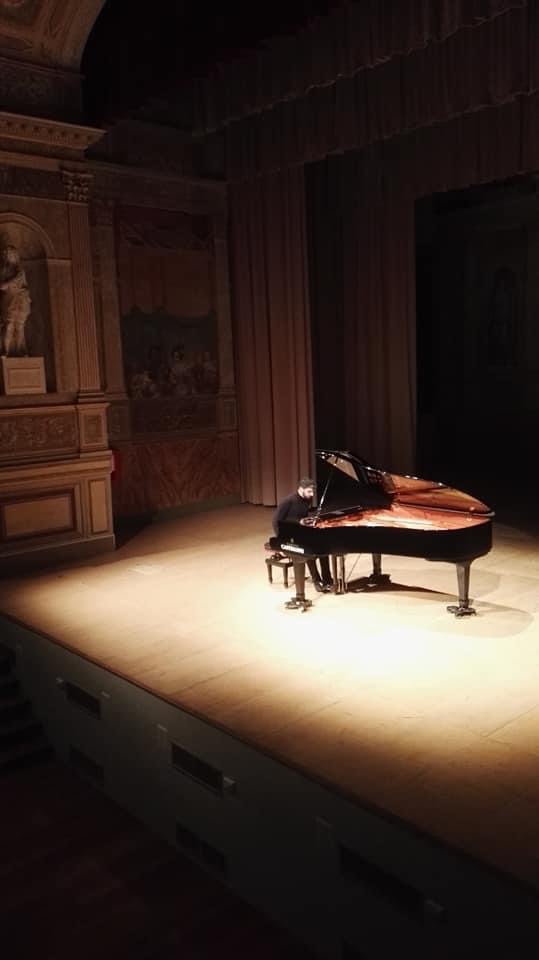
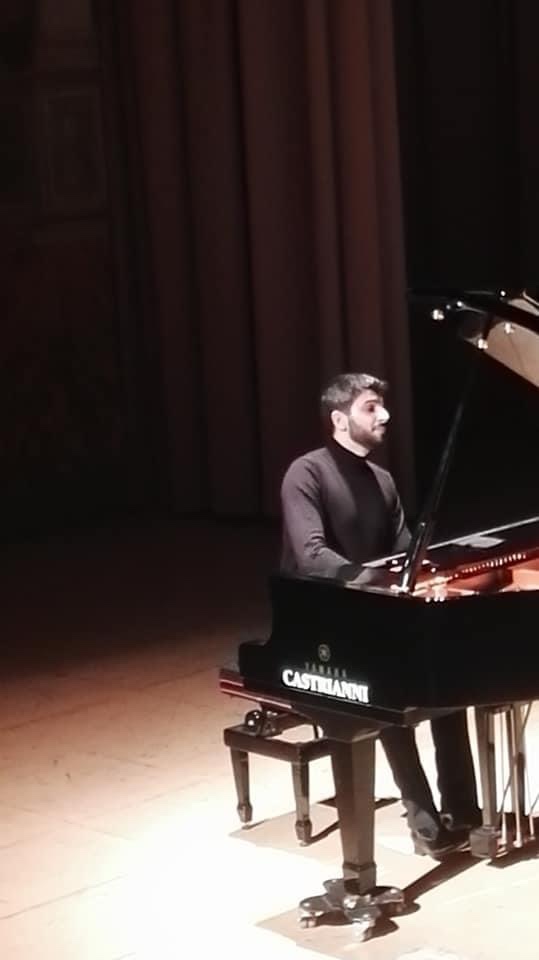
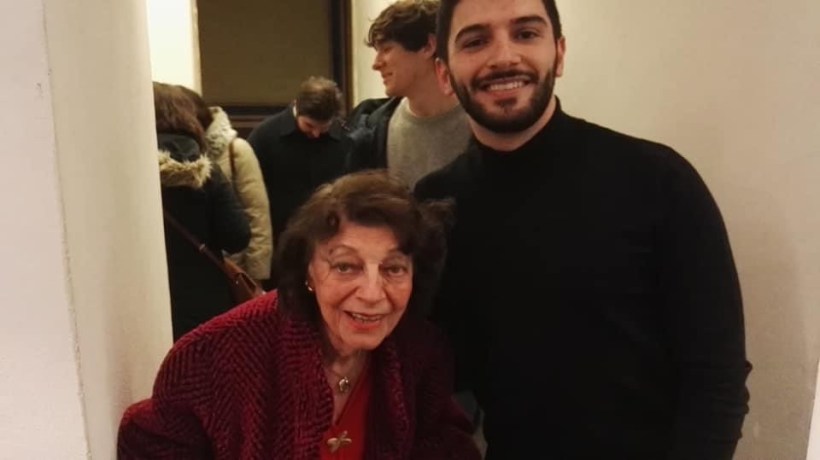
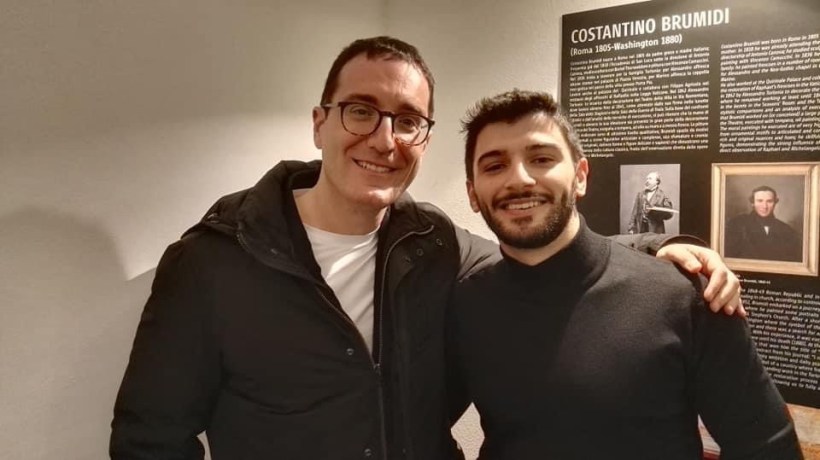
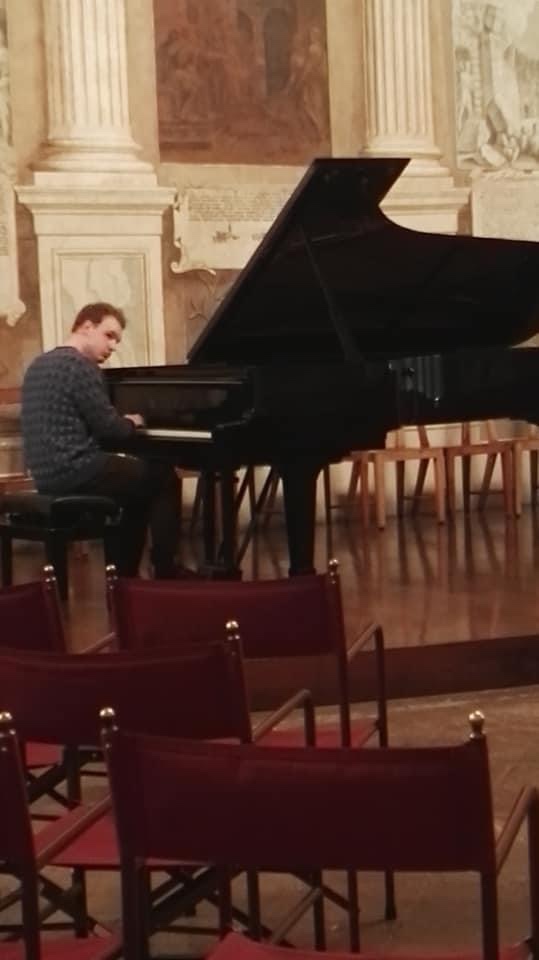
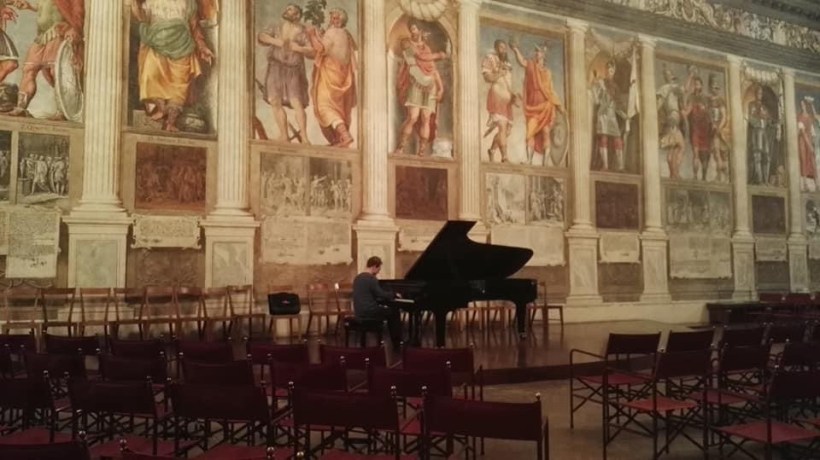
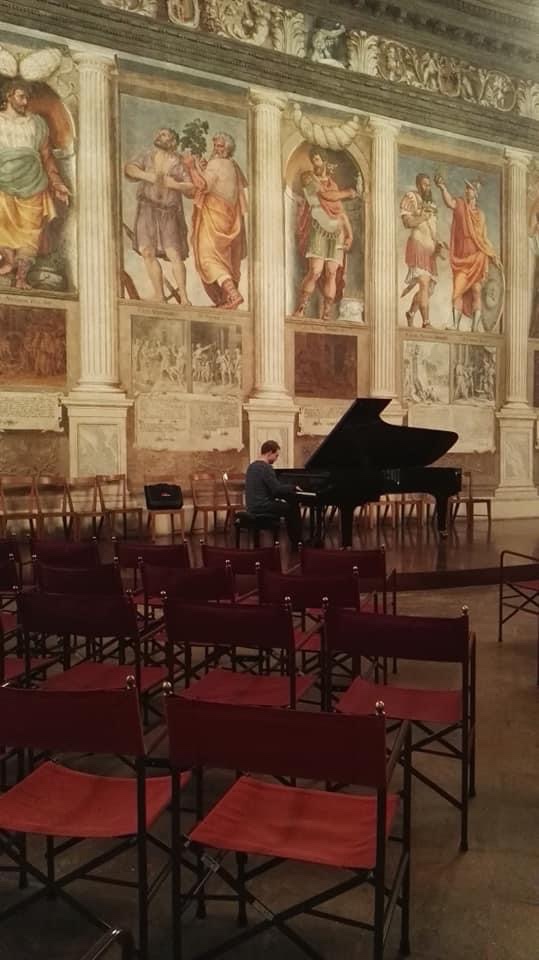
Jonathan Ferrucci in London for the Keyboard Trust
He played the Bartok sonata magnificently.
Crystal clear decisive rhythms.
Deeply expressive second movement.
Spontaneous applause after the first movement and cheers at the end of the last.
The Bach/Kempff played with a clarity that took me by surprise as I have become used to more romantic overpedalled performances.
This was startlingly shorn of rhetoric and sugary rubatos but so much more expressive because of it.
He introduced the Schumann Fantasie himself and gave a very fine performance as you would expect from a disciple of Joan Havill
A great sense of rhythmic drive and overall sense of line.
I would have tried to link the second movement to the third.
But this is a real thinking musician like Ivan Krpan that does not move if not convinced.
The coda of the second movement was very secure and musically shaped.
Slightly missing the magic that this fine but small Steinway just did not have.
The ending was beautifully controlled and the final crescendo/accelerando well judged.
It is rare to find such a well thought out and finely planned performance of this much maligned masterpiece.
An encore.
Two for the price of one!
Scriabin nocturne op.9 became the study op. 42 n.5.
He had reworked the study in a day at my request not having played it for some time.
He has more than confirmed the successes that Jacques Samuel, Guildhall and Padua have already demonstrated.
Helped and admired by Angela Hewitt he is a major player in an overfull profession.
He is also very intelligent and simpatico.
His father is a writer of psychology in Florence ….his mother is Australian.
This is what I wrote about him in Padua which also talks about his first remarkable teacher in Florence.
The original programme changed to accomodate Liszt Valse Oubliee n.1
Tyler just played at Hatchlands on Thalberg’s 1845 Erard.
He had to change Jeux d`eau a la Villa d`Este as the keyboard was shorter than Liszt`s later Erard.You can read about Liszt’s piano and the Villa D’Este here:
He played Valse oubliee n.1….worked up in the half hour before the concert.
Introducing the programme he showed a mastery and control not only on the Keyboard but like Mark Viner he can explain and enthuse so well his unique scholarship.
Never having played a historic instrument before he soon became aware of controlling his tone from mezzo forte upwards and played the big Schubert A minor in a masterly fashion.
Thalberg’s 1845 Erard
I have often found this sonata a bit long on the modern piano but today that was not the case due to his continual drive and the mellow but full cantabile that is not of the modern day pianos.
His performance of the Kalkbrenner variations on Chopin`s B flat mazurka was introduced in such an enticing manner.
A great charmer full of unique anecdotes and information
We were ready for a scintillating performance where the great difficulties passed unnoticed such was the charm and nonchalance with which he threw off the really extraordinary difficulties.
Just like Mark in this music they are pretty unique.
Neither look the part but does that matter when you can play like that.
An encore of a Kalkbrenner study op 143 n.13 played with such charm and subtle rubato I am sure his recording shortly to be issued will receive the same praise as Mark Viner’s are of Thalberg and Alkan.
The Price of Genius – Trifonov at the Barbican London
Interesting to note how the PR boys deal with Genius.
A programme full of Vogue model type fotos but in reality it was the same distracted genius of yore.
It cannot be easy to live with genius which is consuming you alive.
Such is Trifonov as he has been I imagine from his very early youth.
I remember meeting Trifonov at his 21st birthday party after he had just played Rachmaninov 1st Piano concerto at the Festival Hall on the same Fazioli piano that he used today.
The problem was that whilst at the rehearsal everything sounded well, with the notorious acoustic of the RFH the sound did not seem to reach into the crevaces of which there are many.
The audience were kept waiting whilst urgent discussions were in progress.
The concert of course was a great success but the audience at home got a better picture from listening on the radio than a lot of us got in the hall.
The same old Danil- a true genius ……..the PR boys have tried to smarten him up but they really have not understood that it is the contents not the container that counts
A beautiful private party afterwards where we were seated around a table of some 30 people.
Trifonov was very silent, quietly enjoying the party that his wonderful benefactress had arranged for him .
I was seated next to a man who was preparing a video about this young man long before he became world famous.
I seemed to recognise his voice although we had not been introduced.
It turned out to be Christopher Nupen who had made all those wonderful films years before about Ashkenazy,Barenboim,Jaqueline Dupre and many others in that truly golden era in London.
Our hostess announced that Danil had to leave early as he had to catch an early flight to his next destination.
I left at the same time together with Christopher and I just casually asked Danil what he thought of the piano.
Talk about a red rag to the bull.
He kept us in the street for two hours talking passionately about the piano and the music in a stream of breathless words with the passion of a man possessed.
He had been quietly waiting for an opportunity to talk about his passion,his life blood- Music.
I remember our hostess telling us off for keeping his taxi waiting and stopping him from getting an early night!
Christopher had written to our hostess to ask who I was “who was that man with a ‘shock ‘ of white hair “.
He was most amused when I quoted his words to him in an E mail correspondence later!
All this to say that it was the same Danil who appeared before us last night.
Crumpled suit ,towseled hair,tie skew- whiff – but his passion for music still intact.
He looked tired.
Consumed no doubt by his own passionate total dedication to music.
And it was the music that he shared with us last night.
Breathless,disordered,desperate,passionate.Genius does not always come lightly .
There is always the element of hit and miss in a constant voyage of discovery- of possibility.
Richter too had this superhuman self consuming talent that was ignited the moment he reached the keyboard.
He threw himself at the piano just as Trifonov did tonight.
Fou Ts’ong is the only other person I have met who was totally consumed and dedicated to music in this way.
He mused with himself in an almost private conversation in which it was the music not he that counted.
It is not always pleasant and can sometimes seem out of control and disorderly.
But as Gilels used to say about recording in comparison to live performance that it is the difference between canned or fresh food.
A programme that could have been played without a break such was his communion with the instrument once
he had arrived at its feet.
The Andante Favori led without a break into the Sonata op 31 n.3 .
It was a Beethoven both beautiful and bewitched.
It was a continual voyage of discovery which of course missed the very backbone of the work.
But what did it matter these were new eyes and ears searching desperately for the substance that was within.
It was not easy to accept – was Richter’s Appassionata?
But you could not take your eyes off it ‘s remarkable meanderings.
Bunte Blatter op 99 by Schumann were down as a selection but tonight he chose to play all twelve pieces .This too leading without a break into the Presto Passionato op 22.
It is interesting to note, and I am sure it is not just by chance, that the two rejected movements were included in tonight’s programme Andante Favori was to be the slow movement of the Waldstein Sonata as the Presto Passionatao was to be the final of the G minor Sonata.
Nothing is down to chance with a musician with such a searching mind.
The Bunte Blatter were both extremely beautiful and extremely dispersive.
The search was on and I must say on this occasion I did not think he had found the link that could bind these “Coloured Leaves” together.
Some wonderful subtle colouring and some gigantic plunges into an ocean of sound but some meandering without a strict sense of pulse and direction.
Talk about technical perfection or colour or sound is superfluous.This was a man who had thrown himself into the ocean and was swimming his way to survival.
Sink or swim indeed.
A first half that lasted almost 90 minutes !
He was not at all exhausted but we certainly were.
But then we are not superhuman.
After the interval came a remarkable performance of Prokofiev’s 8th Sonata.
It was as though the other works had been leading up to this performance.
I would have preferred a more sumptuous sound especially at the seductive opening. Gilels gave the first performance so I could just imagine that creamy rich sound.
More bite ,more edge ,more backbone .
But who am I to say.
This was a man creating the work afresh on the spot.
A work that Sviatoslav Richter described as a tree heavy with fruit.
Such sensous sounds and subtle colours not because he was seraching for them but because the music was speaking directly to him and he transmitting them to us.
Je joue,je ecoute je trasmet indeed.
The Vocalise was the single encore offered to an audience on their feet shouting for more.
He looked tired now and probably had not even realised himself the marathon that he had run this evening.
A unique artist.
Not always pleasant to listen to.
But someone who brings a breath of fresh air into what is fast becoming a rather artificial world of perfectly reproduced performances.
Like the piano in Steinways that you press a button and you can have any number of great pianists playing in your living room.
Press it again and it will repeat exactly the same.
Just a month later we were able to hear him in another of the great churches in the centre of London that dedicate themselves also to classical music :St Andrew Holborn.
Playing the great warhorse that Nikolai Rubinstein had declared worthless and unplayable.
Tchaikowsky deeply offended refused to change a note.
It was Hans von Bulow to whom Tchaikowsky dedicated the score and who gave the first performance in Boston in 1875 of a work that he described :” The ideas are so original,so noble,so powerful.The details so interesting;though there are many of them ,they do not impair the clearness and unity of the work .The form is mature,ripe,and distinguished in style.”
Bulow sent what is thought to be the first cable ever dispatched from Boston to Moscow telling Tchaikowsky of the concerto’s undisputed triumph with the Boston public.
The superb programme notes had me wanting to know more about this concerto that I have heard all my life.
From the very first performance with Jerome Rose at the Albert Hall on their Tchaikowsky nights to Rokas Valuntonis and Alice Sarah Ott’s performances this week.
Via such notable performances by Byron Janis,Artur Rubinstein,Beatrice Rana,Shura Cherkassky,Van Cliburn,Martha Argerich,Peter Katin,Yuja Wang but above all Clifford Curzon………………
The first performance of the original version took place on October 25, 1875, in Boston, conducted by Benjamin Johnson Lang and with Bülow as soloist. Bülow had initially engaged a different conductor, but they quarrelled, and Lang was brought in on short notice.
According to Alan Walker, the concerto was so popular that Bülow was obliged to repeat the Finale, a fact that Tchaikovsky found astonishing. Although the premiere was a success with the audience, the critics were not so impressed.
One wrote that the concerto was “hardly destined ..to become classical”.
Superb programme notes that had me searching for more information
George Whitefield Chadwick, who was in the audience, recalled in a memoir years later: “They had not rehearsed much and the trombones got in wrong in the ‘tutti’ in the middle of the first movement, whereupon Bülow sang out in a perfectly audible voice, The brass may go to hell“.(sic)
However, the work fared much better at its performance in New York City on November 22, under Leopold Damrosch.Benjamin Johnson Lang appeared as soloist in a complete performance of the concerto with the Boston Symphony Orchestra on February 20, 1885, under Wilhelm Gericke. Lang previously performed the first movement with the Boston Symphony Orchestra in March 1883, conducted by Georg Henschel, in a concert in Fitchburg, Massachusetts.
The Russian premiere took place on November 1/13, 1875 in Saint Petersburg, with the Russian pianist Gustav Kross and the Czech conductor Eduard Nápravník. In Tchaikovsky’s estimation, Kross reduced the work to “an atrocious cacophony”.
Rokas Valuntonis playing Tchaikowsky with Dario Peluso
The Moscow premiere took place on November 21/December 3, 1875, with Sergei Taneyev as soloist.
The conductor was none other than Nikolai Rubinstein, the same man who had comprehensively criticised the work less than a year earlier.
Rubinstein had come to see its merits, and he played the solo part many times throughout Europe. He even insisted that Tchaikovsky entrust the premiere of his Second Piano Concerto to him, and the composer would have done so had Rubinstein not died.
At that time, Tchaikovsky considered rededicating the work to Taneyev, who had performed it splendidly, but ultimately the dedication went to Bülow.
Tchaikovsky published the work in its original form, but in 1876 he happily accepted advice on improving the piano writing from German pianist Edward Dannreuther, who had given the London premiere of the work, and from Russian pianist Alexander Siloti several years later.
The solid chords played by the soloist at the opening of the concerto may in fact have been Siloti’s idea, as they appear in the first (1875) edition as rolled chords, somewhat extended by the addition of one or sometimes two notes which made them more inconvenient to play but without significantly altering the sound of the passage.
Various other slight simplifications were also incorporated into the published 1879 version. Further small revisions were undertaken for a new edition published in 1890.
The American pianist Malcolm Frager unearthed and performed the original version of the concerto and in 2015, Kirill Gerstein made the world premiere recording of the 1879 version. It received an ECHO Klassik award in the Concerto Recording of the Year category. Based on Tchaikovsky’s own conducting score from his last public concert, the new critical Urtext edition was published in 2015 by the Tchaikovsky Museum in Klin, tying in with Tchaikovsky’s 175th anniversary and marking 140 years since the concerto’s world premiere in Boston in 1875.
For the recording, Kirill Gerstein was granted special pre-publication access to the new Urtext edition.
Yuja Wang recently played this version too and Julian Trevelyan is playing this early version this same evening in St Albans
.
Rokas chose to play the established 1890 version with this newly formed orchestra created in December 2012 by Dario Peluso and Celia Talbot.
LEO under Dario Peluso at St Andrew Holborn
Infact it is thanks to Celia Talbot that we were give an exemplary programme free of the usual empty PR tactics.
Both financial sector professionals they share a passion for the performing arts.
L ondon E uphonia O rchestra
– LEO is made up of a dedicated group of people from varied backgrounds:from full time musicians to students,doctors,lawyers,policemen,charity workers,bankers,teachers,scientists and journalists ,all with musical talent and passion in common.
Professor Bithell with Linn Rothstein
Dario as Rokas Valuntonis both receive guidance from Professor Peter Bithell who was present with Linn Rothstein to admire and encourage this new formation.
A very fine performance for Rokas Valuntonis on his first outing with this old warhorse.
Some beautiful things not least the wonderful sense of balance that allows the melodic line to shine through no matter what!
Professor Bithell in discussion with Dario Peluso
There were one of two moments where Rokas’s “liquidity of sound and devillish performance skill” managed to shine through thick and thin from one or two moments where the brass and woodwind were also at their virgin state with Tchaikowsky’s complex scoring.
There was no doubt about which edition was being used as the great chords rang out above some very radiant and expressive string playing.
Discussions with Linn Rothstein
Some truly superb playing especially in the cadenza where the bell like appearance of the melodic line was wonderfully realised.
The octaves of course were dispatched not only as a great virtuoso but also given a shape a direction that only a mature artist of stature could perceive.
The slow movement after some initial confusion from the orchestra was lit by the the magical sounds from the piano.
If the “devillish” playing of the prestissimo section caught the orchestra slightly off balance it was a small price to pay for the sheer beauty of shape and sound that they all brought to this moment of peace and simplicity.
Friends and colleagues celebrating after this ” first” performance of Tchaikowsky.
The Russian dance derived from a Ukranian melody in the last movement was played with great rhythmic energy leading to the majestic sweep and passionate outpouring for which this concerto has become the symbol of the great romantic concerto repertoire .
Discussussion with colleague Joon Yoon winner of the Guildhall Gold Medal last year
Jonathan Ferrucci in London for a recital supporting his friend and colleague from the Guildhall
Searching for information about the pianist on Google as information was sadly lacking from the programme as is so often the case these days
due to PR packaging, I was taken aback to find not only details of her studies and family but also a declaration that she has been diagnosed with MS .One is reminded of Jaqueline Du Pre all those years ago stricken with MS at the height of her fame at almost the same age as Alice.
Born in 1988 of Japanese mother and father a German civil engineer…. she and her sister,Mona Asuka Ott studied with Karl Heinz Kammerling at the Saltzburg Mozarteum.
I then found this declaration that filled me with great admiration for the dedication to her great artistry that we had witnessed tonight from this waif like shoeless pianist.
Playing with a range of sound from the almost inaudible to sounds that could easily compete with the magnificent London Symphony Orchestra under the even more petite Elim Chan,winner of the 2015 Donatella Flick LSO conducting Competition:
Donatella Flick applauding the winner of her competition of 2015
“Today I would like to share something very personal with you.
As some of you may know, I have recently had some issues with my health which raised concerns and impacted upon my work. After many medical appointments and examinations, I was finally diagnosed with multiple sclerosis on 15th January this year.
When the doctors first raised the possibility of it last year, I felt as if the world had collapsed around me. I went through a roller-coaster of feelings of panic, fear and devastation. I had many, many questions. How would this impact my life? My work?
I have since spent a lot of time researching multiple sclerosis and its implications and have met with many doctors. With each new piece of information, I realise I previously had a false image of this disease. Multiple sclerosis is a disease of the central nervous system and, while no known cure exists, thanks to huge medical advances over the years a large majority of people affected by it are able to live full and fulfilling lives.
It’s going to take me a while to get to know this condition and how I will manage it for myself. There will come times when I will have to face challenges and make adjustments, but in finding the right balance of treatment I am confident and optimistic that I will continue to live my life – and travel and perform – as before. I’m looking forward to continuing my season as planned.
A standing ovation for Alice after a magnificent Tchaikowsky concerto at the Barbican
Sharing this with everybody was not an easy decision, but I believe it is the right one. MS is a very misunderstood disease in our society and by being open about it I hope I can encourage others (especially those who are diagnosed with it when they think their lives have only just begun) to do the same.
Generosity of applause and congratulations from the pianist to her colleagues
An acknowledgement is not a weakness, but a way to protect and gain strength, both for oneself and for those around us. I am grateful to my loved ones who have shown me so much support and love over the past few months. They have not only had their own emotions to deal with but have also had to face questions about my welfare. In clarifying my situation, I also hope to relieve them and give them the time and space to process this.
Sometimes life leads you on an unexpected path, and I am at the very beginning of this new one for me. However I strongly believe it is up to us to make the best out of it.”
Alice
Elim Chan and the LSO at the end of Scheheradzade
Linn Rothstein talking to one of the orchestra after the concert.Linn with her husband Jack Rothstein had been close companions of Jaqueline Du Pre in her long fight with MS .
It is by complete coincidence that I arrived in Eindhoven for the Rothstein wedding celebrations to find the Storioni Chamber Festival in full flight in the Musikgebouw.
Finghin Collins with Linn Rothstein
These two magnificent halls that make up this concert complex in the middle of a thriving commercial centre in the heart of this vibrant city – the home of Philips and much more besides.
The Storioni Trio playing the Triple concerto written especially for them by Kalevi Aho.
It received a very fine performance with the Gurzenich Kammer Orchester Koln under Daniel Raiskin with Wouter Vossen,violin,Marc Vossen,cello,Bart van der Roer,piano.
Gurzenich Kammer Orchester Koln
This concert in three parts under the title of Storioni Night began at 8.15 and after two intervals finished around midnight with an encore of Bizet from the Chamber Orchestra of Cologne after a magnificent performance of Souvenir de Florence.
A nice tradition here is that complimentary drinks are served in the interval and ensures an almost party atmosphere especially welcome on these balmy nights of superb hausmusik.
Finghin Collins with Lilli Maijala
The concert had begun with Finghin Collins playing Debussy L`Isle joyeuse.
Finghin who I met last summer in the Szigeti/Menuhin Festival in Sermoneta near my home in Latina,Italy.
Last year he was playing in duo with that superb violinist Fabrizio von Arx but it was also in the passionate musicality of solo works by Brahms that I discovered the first prize winner of the Clara Haskil Competition.
Tonight too in L`Isle joyeuse there was the same passion,intelligence and masterly playing that has always remained in my memory from when Annie Fischer played it as an encore in the Ghione Theatre in Rome many years ago.
It is fitting that he should have been recognised at the competition that bears the name of that other legendary woman musician pianist Clara Haskil.
Finghin playing in duo too with Lilli Maijala,viola,in two of the Marchenbilder by Schumann.
Some exquisite playing from both the piano integrating so well with the sumptuous sounds of the viola.
The piano lid fully open allowed the warm acoustic of the 1200 seat hall to create an intimacy that was hard to find in the smaller 400 seat hall next door.
I always remember Fou Ts`ong confiding to me that it is much easier to find that intimacy of close communication in a hall of thousands than it is in one of only hundreds!
The solo viola answered by a pure simple piano sound that Pressler has shown us is possible in a lifetime`s dedication to musical values.
Ronald Brautigam with Koln Orchestra
A Larghetto for horn and piano by Chabrier with Herve Joulain and Bart van de Roer on loan from the Storioni Trio.
A piece of great effect that owes much to Saint Saens in its great sweep and delicacy especially in the scintillating writing for the piano.
The Storioni Trio were then joined by that master viola player Amihai Grosz,lead viola player from the Berlin Philharmonic.
A performance of Mahler`s Piano Quartet of 1876.An early work full of scintillating colours and play between the intruments.
Amihai Grosz with Linn Rothstein
Amihai Grosz igniting the proceedings with his animal like participation.
A beautifully simple account of Mozart Piano Concerto K.414 was given such a lovingly intelligent performance by Ronald Brautigam.
A Liszt type figure with his great white locks that deceptively hid a soul of pure gold.
An intelligence and measure that only confirms the great musicianship for which he is rightly famed.
Aided and abetted by the conductor Daniel Raiskin in an exemplarily crystal clear account of this early concerto ,one of the three K 413/4/5 for string orchestra.
A beautiful performance of Tchaikowsky`s Souvenir de Florence with the Cologne Chamber Orchestra,this time without the policeman.
Listening so attentively to each other and yielding with such flexibility when in turn the violin,viola and cello were at the helm.
The encore of a slow piece from the suite by Bizet drew us in even closer to the intimacy that had been shared with us all tonight
Paderewski:
Menuet in G major Op 14 no 1
Cracovienne fantastique Op 14 no 6
Nocturne in B flat Op 16 no 4
Legend in A flat Op 16 no 1
Mazurka in A minor Op 9 no 2
Polonaise in B major Op 9 no 6
Chopin:
Nocturne in F minor Op 55 no 1
Ballade no 2 in F major Op 38
Mazurkas Op 59
Polonaise in F sharp minor Op 44
A Polish pianist and conductor, Michał Karol Szymanowski was born in 1988 into a musical family. He graduated with honours from the Academy of Music in Bydgoszcz, where he studied piano with Katarzyna Popowa-Zydroń and symphonic-operatic conducting under Zygmunt Rychert.
He honed his skills with Eldar Nebolsin at the Hochschule für Musik Hanns Eisler in Berlin. At present works as an assistant lecturer at his alma mater. He has won top awards in a number of national and international piano competitions, including Chopin Competition in Darmstadt, Germany (2017), MozARTè Competition in Aachen, Germany (2016), Chopin Competition in Daegu, Korea (2015), Zarębski Competition in Warsaw (2012), Yamaha Competition in Katowice (2011), Paderewski Competition in Bydgoszcz, (2010), Horowitz Competition in Kiev (2007). In 2015 he was the highest placed quarter-finalist in the International Chopin Piano Competition in Warsaw.
Michał has performed in many concerts across Europe and throughout the world, including the Palace of Nations in Geneva, the Paul VI Audience Hall in the Vatican (a concert for Pope Benedict XVI), at Warsaw’s Belvedere Palace for Polish President, numerous philharmonic halls as well as major festivals in Poland and abroad, among them Oficina de Música de Curitiba, Festival Chopiniana in Buenos Aires, Festival Europeo de Solistas in Caracas, Festival Pianistico di Roma, the Long Lake Festival in Lugano, and the Chopin and His Europe Festival in Warsaw, where he brilliantly performed piano concertos by Ignacy Jan Paderewski, Józef Wieniawski and Sigmunt Stojowski. He has performed under such eminent conductors as Alfredo Rugeles, Medardo Caisabanda, Juri Gilbo, Jacek Kaspszyk, Antoni Wit, Grzegorz Nowak and Marek Pijarowski with, among others, the Teresa Carreño Youth Orchestra of Venezuela, the Symphonic Orchestra of the National Theatre in Brasilia, Daegu Symphony Orchestra, Russian Chamber Philharmonic St. Petersburg and all major polish orchestras.
Apart from solo repertoire, Michał also frequently performs chamber music. He has released two solo albums for CD Accord (Naxos), featuring compositions by Fryderyk Chopin, Ignacy Jan Paderewski, Karol Szymanowski and Józef Wieniawski. The recordings were critically acclaimed. One reviewer wrote: “this is heartfelt music-making of the type one associates with such luminaries as Uchida, Schiff and Brendel”.
As Michał Szymanowski rather cheekily explained, Paderewski first and Chopin second to ensure there would not be a mass exodus in the interval!
He or Dr Hugh Mather need not have worried because the music was so beautifully and intelligently played it was a superb introduction to the genius that is Chopin.
We did however get more Paderewski by great demand, as an encore :The Melody op 16.
Enjoying my log fire with fine music in this rather unsettled month of May
One could say that the Paderewski was a curtain raiser that demonstrated the difference between a genius and a good craftsman.
Chopin ,though, had not been like Paderewski the Prime Minister of Poland or a pianist idol in America as Liszt had been in Europe a century before.
I think most pianists would have had a go at the Menuet in G probably in a shortened simpler version from the one that Michał Szymanowski opened his programme with this evening.
It immediately showed off the intelligent musicianship allied to a command of the keyboard that would be the envy of many.
Many of us will have struggled with the Menuet in G as children , but how many I wonder know the other five pieces that make up op 14 by Paderewski.
The last of these the Crakovienne Fantastique was given a crystal clear performance of hypnotic almost Gopak style dance rhythm.
The Nocturne op 16 n.4 was a completely different style from that of Chopin or Field.
In fact it owed more to Grieg or Tchaikowsky .
Full of nostalgia and charming atmosphere.The ending in Michal’s hands was quite magical.
The Legend op 16 n.1 was far removed from the Ballades of Chopin that had so inspired Liszt and Brahms.
A pleasing salon piece especially with Michal’s superb sense of balance made for a piece of great effect rather than Chopin’s inspired masterpieces of the poems of Mickiewicz.
The Mazurka op 9 where the typical dance was so apparent but far removed from the profound yearning for his homeland that made the 58 mazurkas of Chopin amongst his greatest works.
The Polonaise op 9 n.6 was superbly played with just the right amount of bravura and jeux perle of the great pianists of the past like Lhevine,Rosenthal Godowsky or Paderewski.
Michal’s thesis for his doctorate was indeed on Paderewski and it was very refreshing to be able to hear some of the works of a figure who is usually only thought of as a leggendary virtuoso of the past and who in turn became the first Prime Minister of Poland.
What is in fact very interesting is to see the intelligent musicianly performances of this young polish pianist.Never falling into the trap of sentimentality or crowd pleasing nuances.
Mount Circeo said to be the silhouette of Mussolini
It was Rubinstein who was one of the first pianists to react to the rather free almost improvisatory performances of Chopin.
The salon composer, as he was in the hands of many of the great pianists of the so called Chopin tradition.
De Pachmann in particular but also Paderewski,Hoffman and many others.
Rubinstein brought Chopin back to the world of the great composers like Bach,Beethoven,Brahms etc .
Playing with a virility where there had been feminine delicacy.
With nobility where there had been flashy virtuosity.
But above all true sentiment were there had been sentimentality.
Today in fact it was refreshing to hear this modern school of playing in the hands of Michal Szymanowski interpreting the very works of Paderewski that had largely been to please his vast public on his concert tours.
Michal possesses that strong noble cantabile that was of his great compatriots such as Malcuzinski,Niedsielski or Stefan Askenase .Added to a great sense of style and intelligent musicianship he is a great advocate for his compatriots music.
The proof was in the applause that greeted him after his first half totally dedicated to Paderewski.
The second half was dedicated to the genius that is Chopin.
The nocturne op 55 n.1 (Cherkassky’s favourite nocturne) although beautifully played did not have the fluidity that we had so appreciated in that of Paderewski.
The ending of the Nocturne immediately leading into the magical notes of the Second Ballade where with his great sense of measure and style it immediately became evident the difference between the two Polish Composers.
The four Mazukas op 59 seemed to ignite in our pianist tonight a sense of colour and fantasy that turned what in Paderewski’s hands were baubles ,in Chopin’s were true gems.
The Polonaise in F sharp minor op 44 was given a masterly performance and the same sense that Rubinstein brought to the middle section was apparent here today.
I think this might be the case where these rhythms can only be fully understood by fellow compatriots.
Dr Szymanowski explaining so enjoyably his programme
The most beautiful performance of the evening was still to come in the encore offered by insistent demand.A public totally won over by this pianist now on his fourth visit to this Mecca of great young pianists.
Michal at the end asked who they thought the encore was by: Paderewski or Chopin?
They got it right thanks to this truly illuminating recital tonight.
If it had not been for the magnificent streaming that allowed me to have the best seat in the house at St Mary’s Perivale, transported to the National Park of Circeo in Italy ,I would have thought that we were in the realms of the Joyce Hatto scandal.
Patrick Hemmerle in my garden today transported by the magic stream carpet
Such was the superb stylistic and commanding performance of the Chopin Studies today I would have sworn it was Guiomar Novaes , Nikita Magaloff or Nelson Friere instead of a certain Monsieur Hemmerle’!
Completely bowled over by the beauty and totally absorbing musicality I was not even aware of the transcendental difficulty of these revolutionary pieces for piano.
As Hugh Mather so rightly said in his introduction, these studies were written by the twenty year old genius that was Chopin!
As Patrick rightly said in reply to the tumultuous applause that greeted the first set of 12 studies op 10:”we are only half way!”
This is what I discovered on the web site of St Mary’s about this extraordinary artist.
Patrick Hemmerlé is a French pianist based in Cambridge. He is a fellow commoner and musician in residence at Clare Hall, part of Cambridge University. His primary interest is for the music of the great Austro-German composers, mainly Bach, Beethoven, Schumann and Schubert. Patrick has developed a double concert format which allows him to put in perspective Bach’s Goldberg Variations with Beethoven’s Diabelli Variations, the last three Sonatas of Schubert and Beethoven, or the 48 Preludes and Fugues of Bach. He devotes part of his time to composers who have remained relatively unknown and regularly includes in his concert programmes the works of Novak, Frank Martin, Emmanuel and many others.
Patrick has released two CDs, one for the Spanish Label Orpheus with works by Schumann, Brahms and Novak. The other for IndeSens with Novak’s Pan and Tchesnokov’s La Neige. A third CD with works by the French composer Jean Roger-Ducasse is in preparation. Patrick also gives lectures on music and also concert-lectures in which the works are discussed as well as played. He has given master classes in both England and France. He was trained in Paris, where he studied at the Conservatoire (CRR) with Billy Eidi winning first prize in 2002. He then continued his studies further, having private lessons with Nadine Wright, Joaquin Soriano, Ventislav Yankov and Eric Heidsieck.
Patrick is laureate of the International Competitions of Valencia, Toledo, Grosseto, Epinal and more recently CFRPM in Paris. He has received prizes for the best interpretation of works by Chopin, Albeniz, Beethoven ( Concerto Prize), Novak, Frank Martin and Tchesnokov.
Tuning in today rather sceptically I must say, I listened to the first study and although not the relentless passion of Richter all the hurdles,and there are many, were very well managed.
Infact it was in the second that I stopped counting the notes or at least forgot to because I was so involved in the music making that was opening up new horizons and perspectives.
The beautifully shaped left hand with the shimmering chromatic scales just adding a sheen to the proceedings.The crystal clear cantabile of the third study “How dear is my heart!”but also the beautifully singing top notes of the middle section that most amateurs are forced to leave out and that many professionals turn into a battle ground!
The fourth study had more to do with Rubinstein than with Richter’s impossibly fast video recording.Resolving all the technical challenges whilst shaping the music.The ending was every bit as exciting as Rubinstein’s inimitable performances.A slight pause before the final chord showed us the master we had in the driving seat today.
The playful “Black Key” study , Myra Hess used to play as an encore with an orange and two carrots.Childs play you might say, but today I was reminded of the aristocratic jeux perle’ of Magaloff in the way he highlighted very subtly certain harmonic comments from all directions.
I found the slow number six rather unstable rhythmically and feel it could be played more simply.
But he had such a persuasive cantabile that I almost forgave him!
The feather light alternate chords of the seventh could almost be called the butterfly study (like op 25 n.9) when played like this.
The shimmering cascading notes of the eighth beautifully phrased and ending somewhere between Horowitz’s charm and Novaes’s creamy rich legato.
A beautiful echo effect in the 9th that Rubinstein played with that aristocratic simplicity that was sometimes missing here.
A rather cheeky appogiatura at the end brought a smile of admiration for an artist who was really living the music so fearlessly.
The tenth seemed at first rather slower than we are used to hearing it.But it was so pregnant with meaning and full of magical moments.Not least the change of colour on the modulation.The held bass note on which floats the final few bars was quite enchanting.
The “Arpeggio” study was a kaleidoscope of colours .A bass note added as Freire would often do too gave a sumptuous sense of colour to a seemingly timeless study.
A wonderful hesitation at the beginning of the “Revolutionary”study again showed just what personality this young man already has.
No fear of following the rules in his total understanding of the musical values of these remarkable pieces.
I have dwelt more on the first set of studies which I have always thought of as less poetic than the second.
Today Patrick has convinced me that they are just as poetic in the hands of a true poet!
Of course op 25 could only highlight all the wonderful things that this true musician could revel in today.
The beautiful bell like cantabile of the first study”Aeolian Harp”of which there is a detailed description by Sir Charles Halle of Chopin playing it in England.
Wonderful counter melodies in the bass that only added to the sumptuous sounds of Patrick’s magic harp.
Beautiful repeated notes at the end of the second led so well to the jogging of the third with all its various inflections.
Staccato and legato living so well together in the fourth dissolving hand in hand happily ever after at the end.
The fifth slipped in almost unnoticed.
The beautiful middle section played with the subtle inflections that Chopin actually writes into the notes.A final rising crescendo on which emerges the “will o’ the wisp” double thirds that shimmer above the left hand melodic line.
Strange that he plays the downward double third scale with two hands I have never noticed that before.Unusual fingering too at the beginning of the slow seventh study.A telling rest in the left hand melody somehow took me by surprise.A wonderful surprise for the legato afterwards was even more telling.
A melodic line almost too flexible but by God I would not have changed a note today.
It was just so convincing and heartrending.
The silky legato of the eighth with very slight hesitations to such glorious effect.
A”Butterfly” every bit as featherweight as its partner op 10 n.7 disappearing like “scarbo” into thin air at the end.
The most thunderously legato octaves where the melodic line though was always to the fore.
A marvellously expressive middle section where the re emergence of the main theme was pure magic.
The final two studies were played with the aristocratic grandiosity of the great pianists of the past.
The added bass notes at crucial moments took our breath away as he plunged straight into the final C minor study.
What can one say?
I am tempted to use Schumann’s own words on the first appearance of Chopin in Paris:”Hats off gentlemen a genius.”
Looking at his CV and listening to his extraordinary performances today I would not be surprised at all.
Wonderful to be reminded of Fausto Zadra and that fateful day in the Ghione Theatre when time stood still at the coda of the Chopin Nocturne op 27 n.2.
It had been a very busy few days before as Fausto wanted his son to recite the poems that had inspired Chopin in his Four Ballades.
My wife Ileana Ghione was with Fausto to prepare him for this special come back recital with father and son.
It had been postponed several times but finally the date had been set.
Strangely Fausto did not want to rehearse but wanted to help his son.
We spent much time chatting together.
Fausto was a great talker always.
On the evening of the concert there were so many friends,family and admirers that the box office was taken by assault.
Marco Zadra in his moving performance at the Teatro della Cometa in Rome
Half an hour late I went backstage to tell Fausto that we were ready at last.
Fausto was strangely quiet which I put down to nerves.
Something that I know all great artists suffer from in that moment before going on stage.
Perlemuter even in his 80’s used to say it was like going to the guillotine every time!
The video camera was on to capture this very special return to Rome for Fausto with his beloved son Marco.
Towards the end of the first piece I heard my wife’s voice over the intercome system calling for the lights to be switched on.
Fausto had fallen asleep at the coda of this most beautiful of all nocturnes.
As it turned out even with numerous doctors in the hall Fausto had already left us for a more beautiful place.
Newspaper report in the Repubblica
Someone had informed the press who were at the door wanting to take pictures.
The public were leaving in complete silence and only his family and close friends were there to console each other.
I would not allow the newspaper to take fotos and they threatened to sue me as it was their right!
No fotos were taken.
Only the family and I know that in the confusion the video camera was left on and now sits in the drawer of Marco Zadra.
Never watched but nice to know that it is all there.
All this was told so beautifully by Marco of the story of his family from the beginnings to that fateful day 17th May 2001 at Teatro Ghione.
60th Anniversary concert of Uto Ughi at La Sapienza Rome with Michail Lifits
Uto Ughi’s first concert in 1959
A concert to celebrate sixty years since Uto Ughi’s first concert at Rome University for Lina Fortuna in her remarkable series of concerts started just after the war.
A lifetime in which Uto Ughi has been ever present.
He used to come to listen to Ruggiero Ricci at Teatro Ghione and I remember him playing with FouTs’ong the Kreutzer Sonata for Alba Buitoni in Perugia in the 70’s.
He played often too for the Filarmonica of Adriana Panni and I remember the wonderful sounds of his violin resounding from behind the altar filling the magnficent church surrounded by Caravaggios at her sad farewell .He had come to pay a private tribute to the remarkable lady who had given him his first concerts as a child prodigy.
Now in his 75th year he was happy to celebrate with us his unblemished artistry on his “Kreutzer” Stradivarius of 1701 and the most beautiful of Guarneri Gesu of 1744 that once belonged to Arthur Grumiaux.
I had the fortune to sit next to a master violinist Maestro Leofreddi who had played with Licia Mancini in 1995 in the Ghione Theatre in a homage for the 10th anniversary of the death of Guido Agosti.He like me was astonished to hear such perfection from a violinist at an age when some physical aspects could have tarnished his artistry.
Ughi with Michail Lifits infront of the magnificent mural of Sironi
Playing the entire concert without the score too from the very first note to the last delicious notes of “Schon Rosmarin” we were treated to a concert of rare artistry.
Starting with the Chaconne by Vitali in which the subtle exquisite sounds from the bass continuo- piano sustained an ever more intense gradual build up from Uto Ughi’s magnificent instrument.
It immediately established a rapport between piano,violin and audience that was to be carried through to the very last notes of the strepitoso “Le ronde des Lutins” and “Schon Rosmarin” offered as a thank you to an audience on their feet.
The Brahms Sonata n.3 in D minor was a meeting of equals.
Lifits and Ughi never having played together before found themselves on a wonderful voyage of discovery.Each one revelling in the company and conversation between equals.
The sumptuous sounds from the piano never overpowering the violin .Listening so intently to each other and above all the musical line that they were sharing together.
That is not to say that there were not great symphonic sounds from the piano matched by the golden tone of the violin .
A shared glee between complices as the audience burst into spontaneous applause between movements.
The scherzo glided along like a well oiled train.The piano throwing off its embellishments with a subtle joie de vivre.Immediately attacking the Presto agitato and not giving the audience a chance to interrupt this time.
The final chord placed with just that slight wait of a duo that has been playing for a liftime togther.
Feeling the need to communicate also verbally with his audience Uto Ughi happily introduced the Suite Popular Espagnola to them.
Explaining that only six of the seven original pieces had been transcribed for violin by Paul Kochanski.
There was some extremely atmospheric playing from both artists.
Very subtle whispered sounds from the piano matched by some very idiomatic sounds on the violin and a final ” voila” from Ughi as if to say now you may applaude.
The party atmosphere was now set.
A very beautiful opening to the Introduction of the Rondo Capricioso by Saint Saens was contrasted with a scintillating Allegro of such subtle rubato interrupted only by great orchestral sounds from the piano
Following with the great show piece by Ravel :The Tzigane.
Dedicated to Jelly d’Aranyi who lived for many years in Ewelme in Oxford the same village that Perlemuter,a disciple of Ravel ,had chosen as his summer home too.
It is a great show piece for both piano and violin.The only work that Ughi chose to have the score for.
He need not have worried because violin and piano played as one in an electrifying performance that brought the concert to its official close.
“Le ronde des lutins” was the extraordinary piece that Ughi chose to thank his devoted public.
Great feats for the violin of both pizzicato and legato in quick succession.
The piano was played with such subtlety that made the combination quite intoxicating.
Kreisler’s “Schon Rosmarin” was played with all the subtlety of the great man himself.
A rubato that was so much part of this world of nostalgia and charm it was the perfect ending to an afternoon celebration of one of the greatest artists before the public today.
Michail signing the souvenir for Ughi’s 60th celebrations