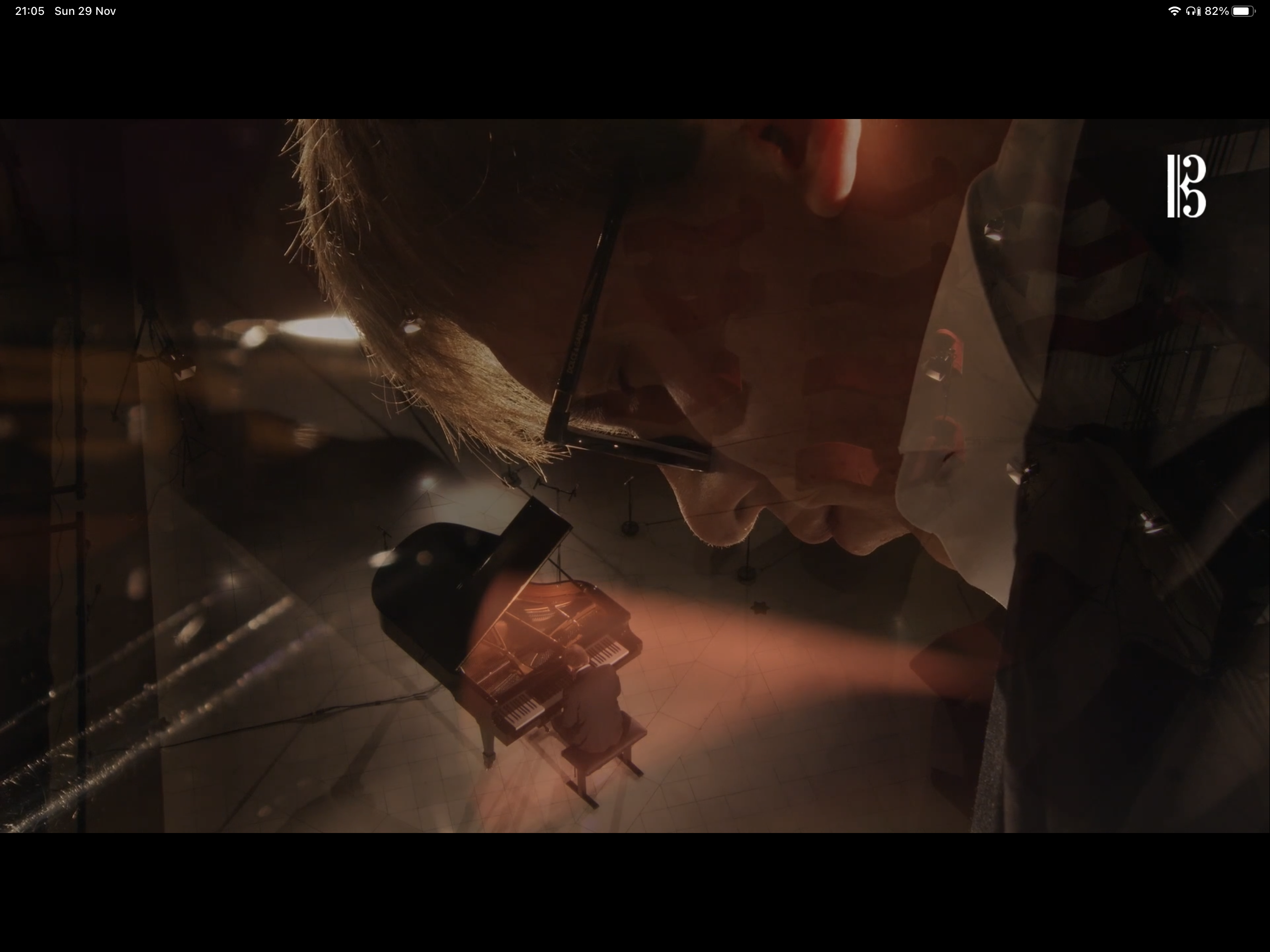
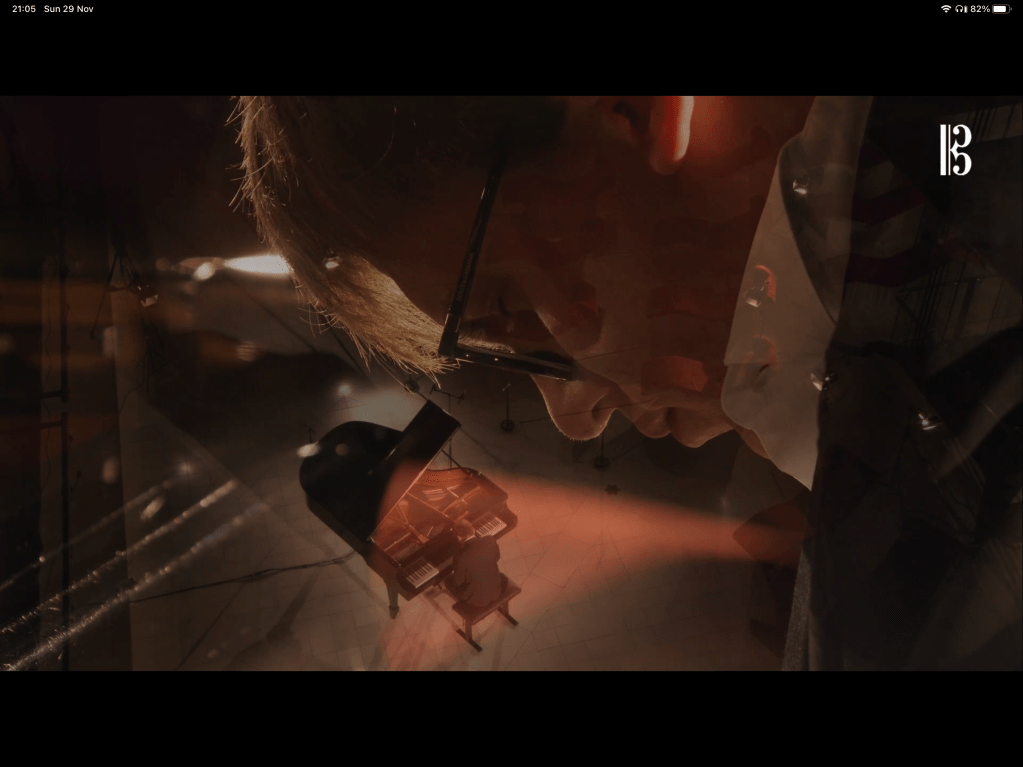
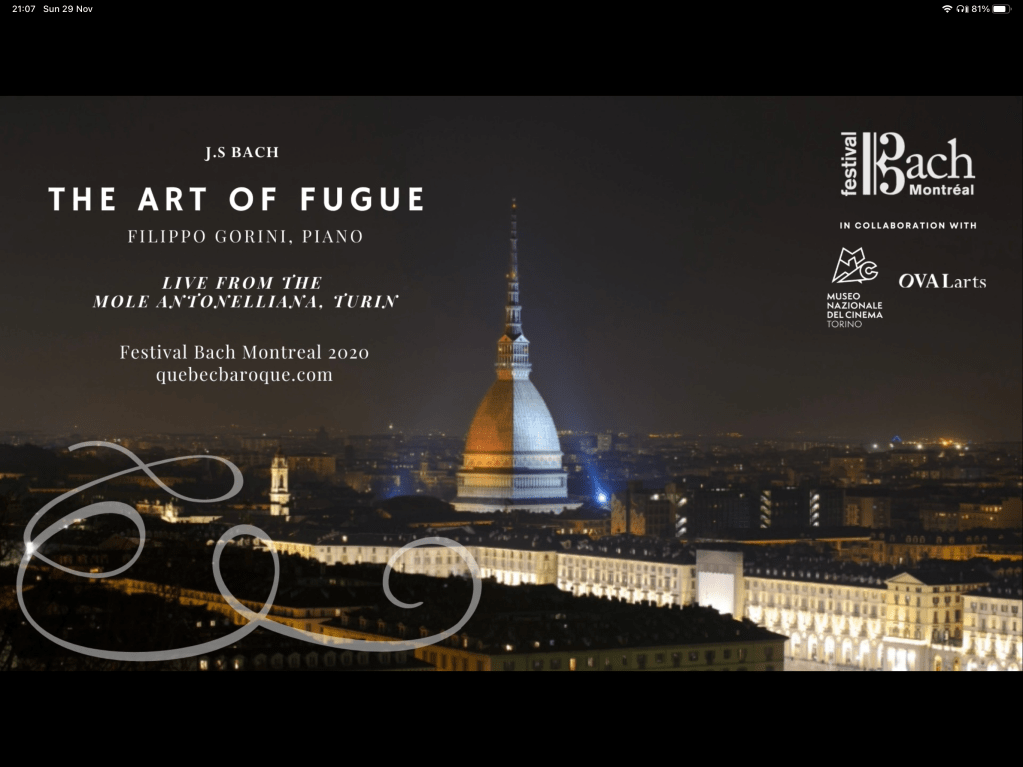
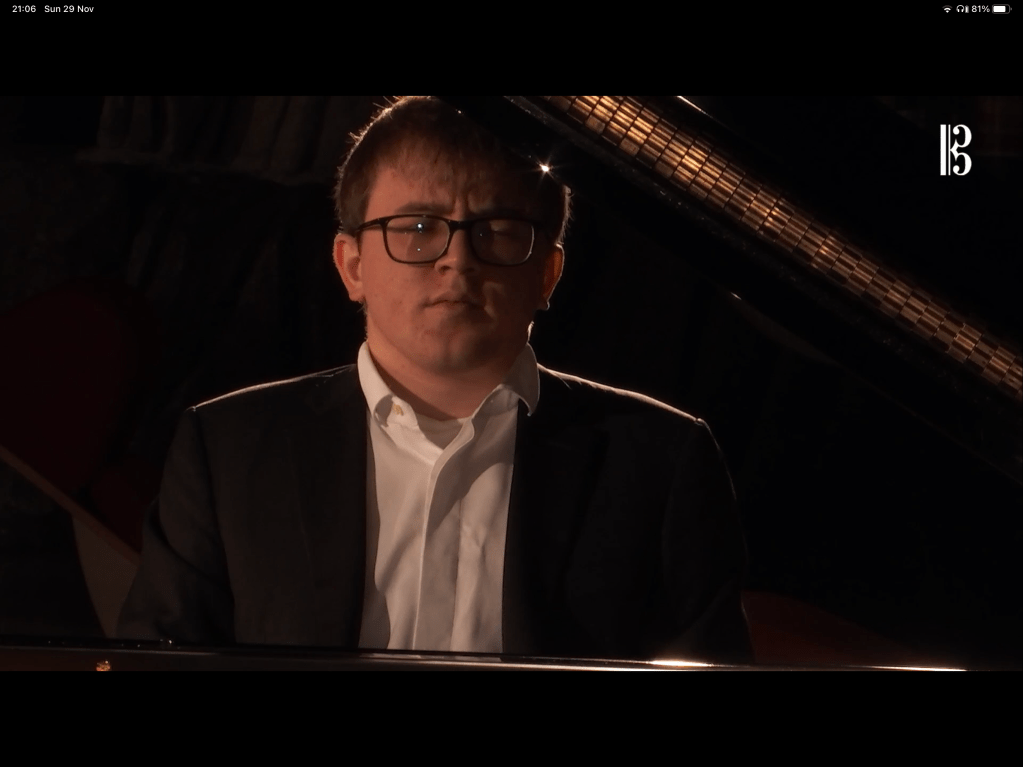
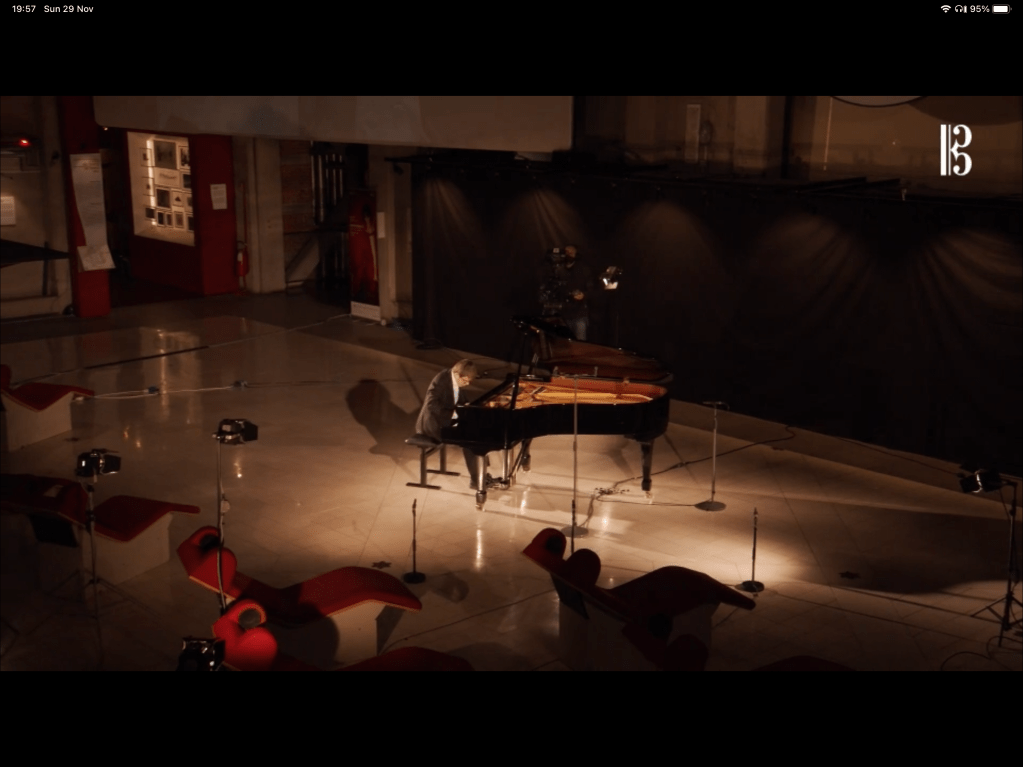
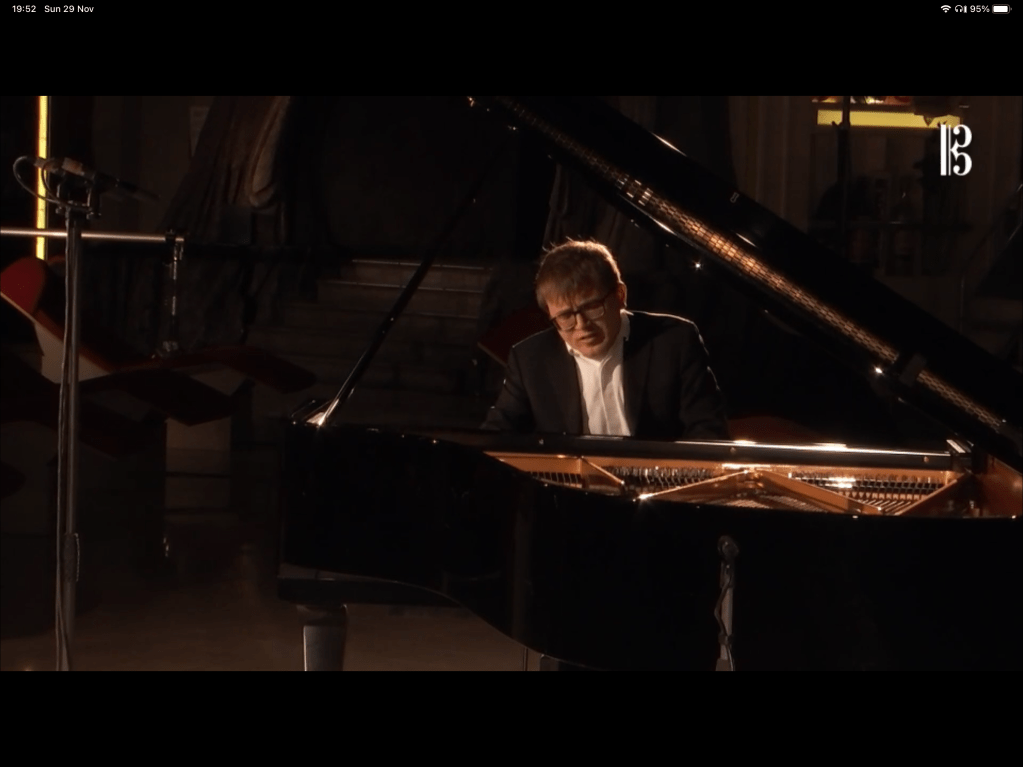
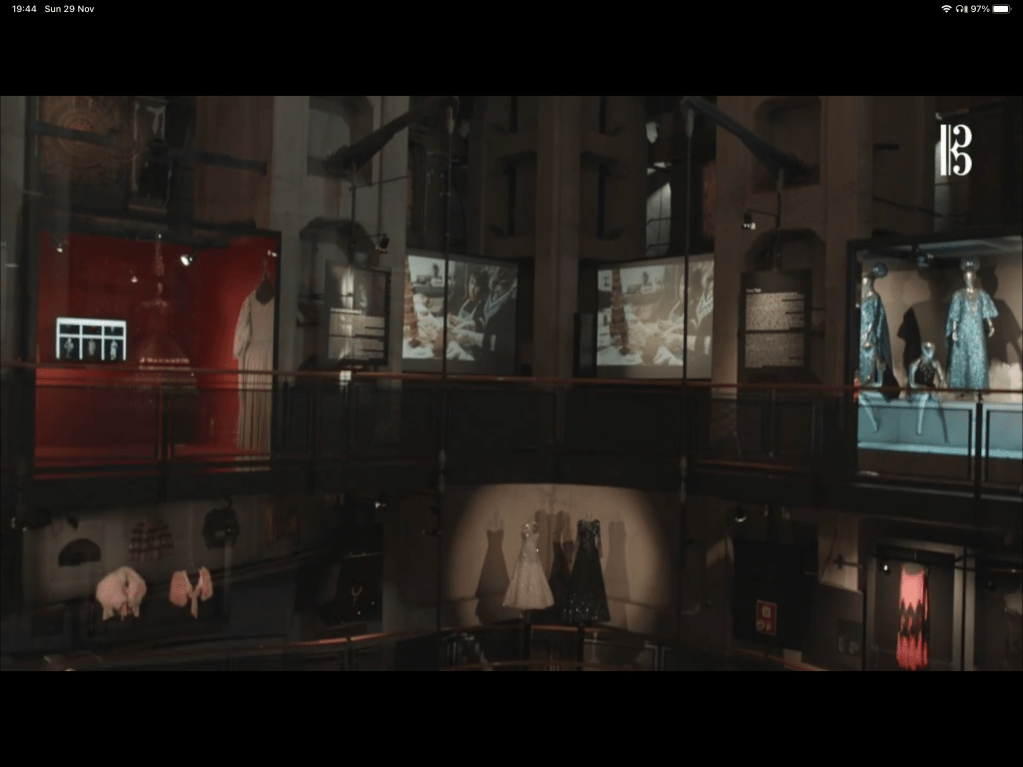
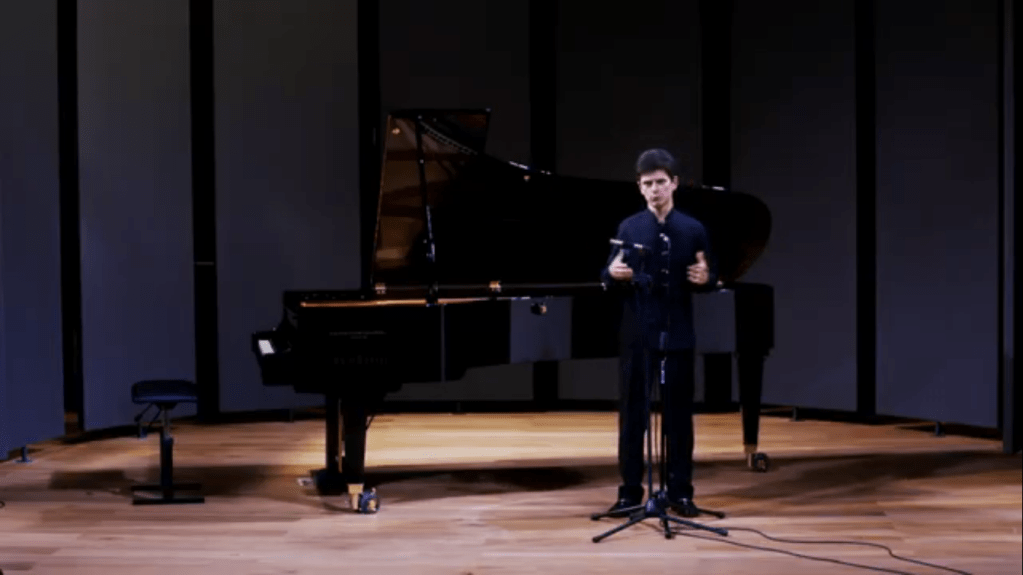
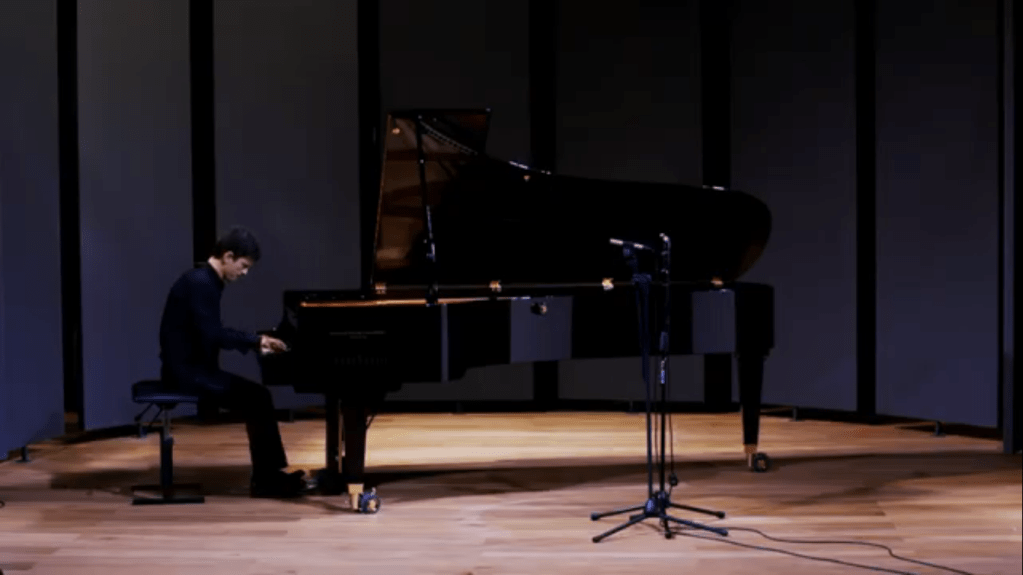
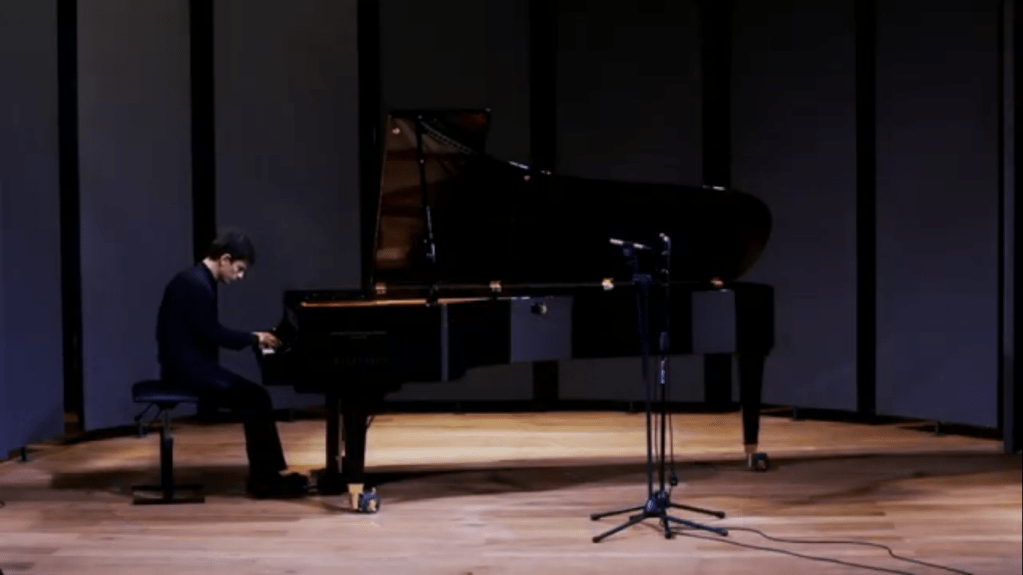
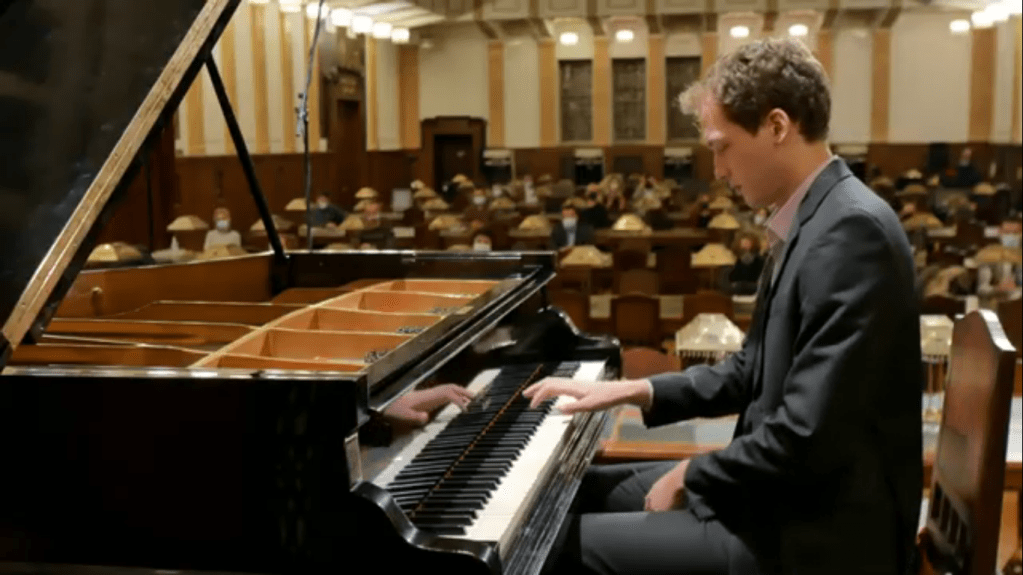
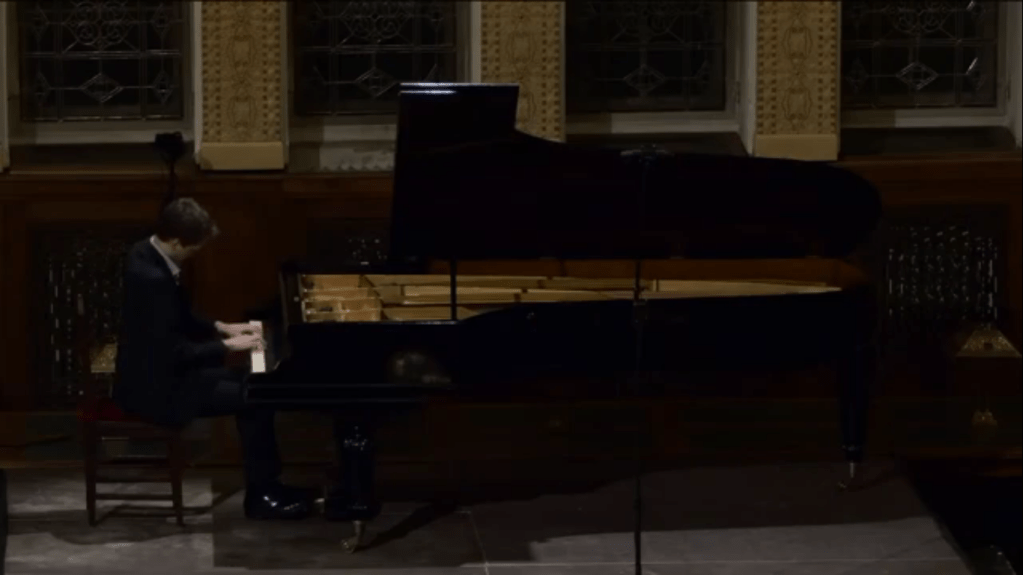
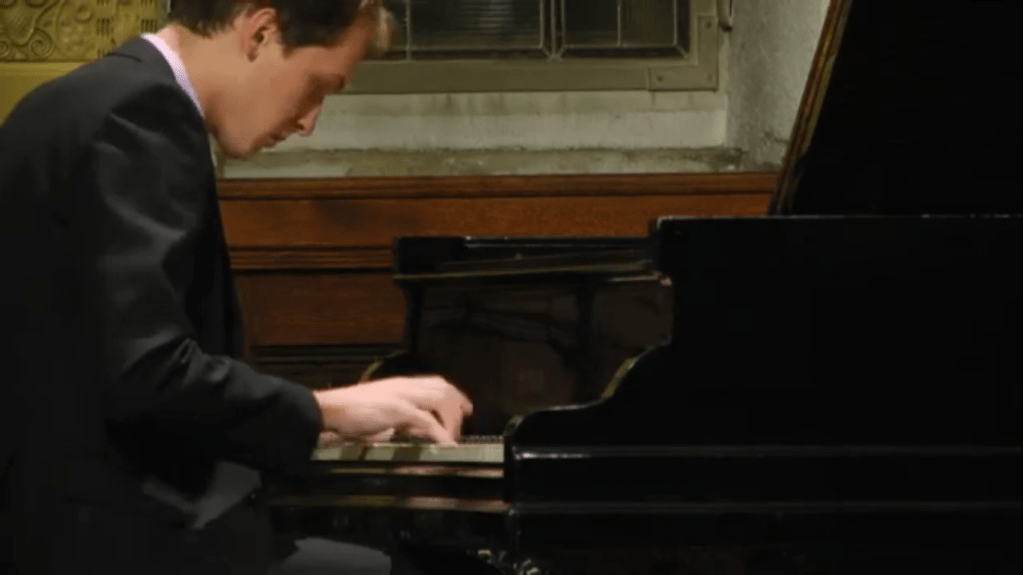
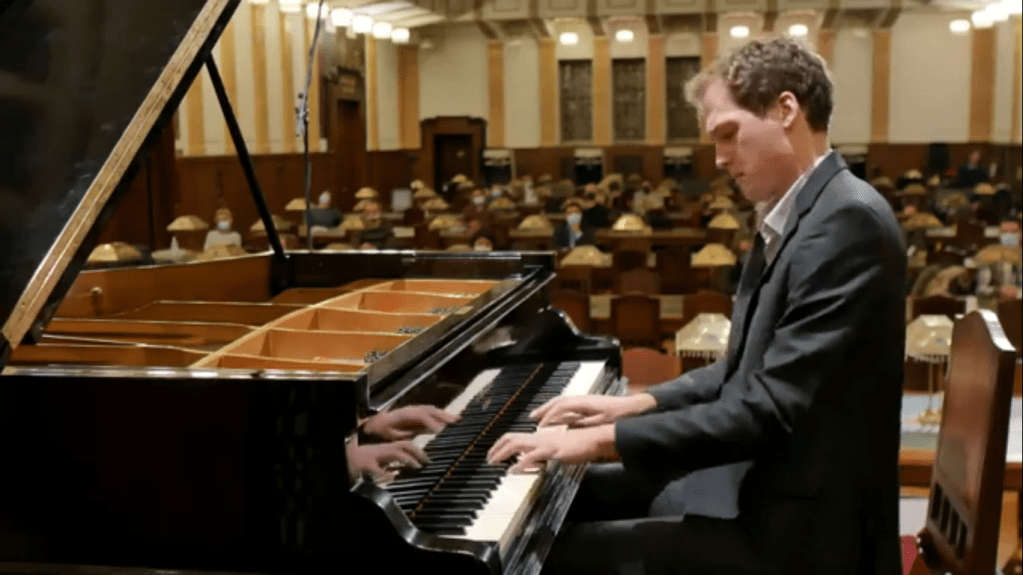
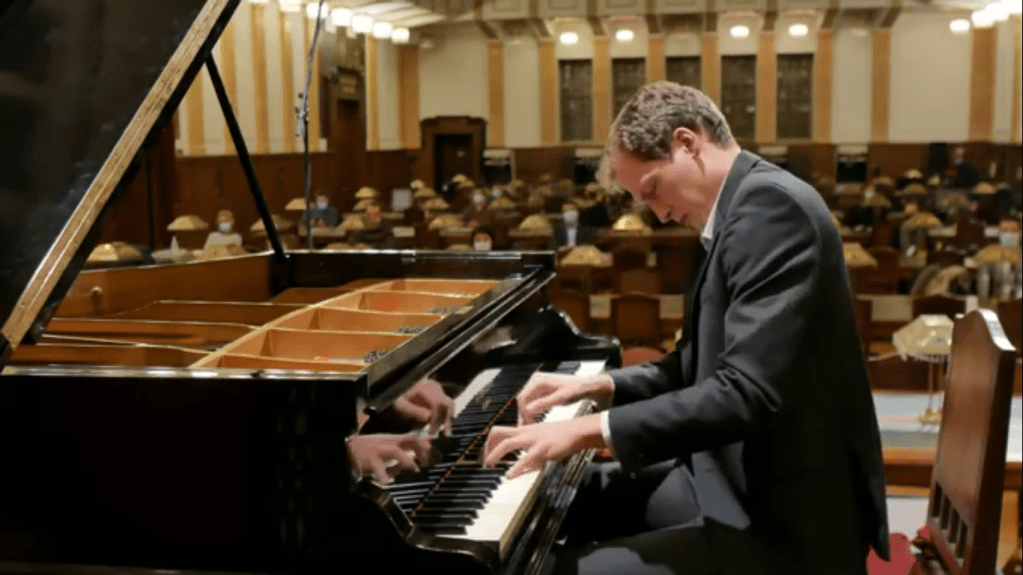
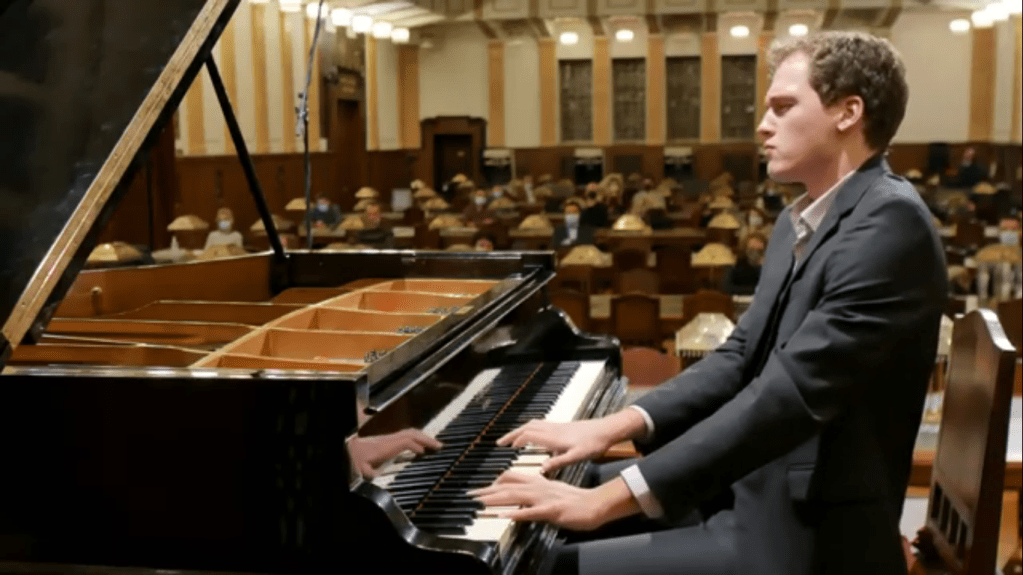
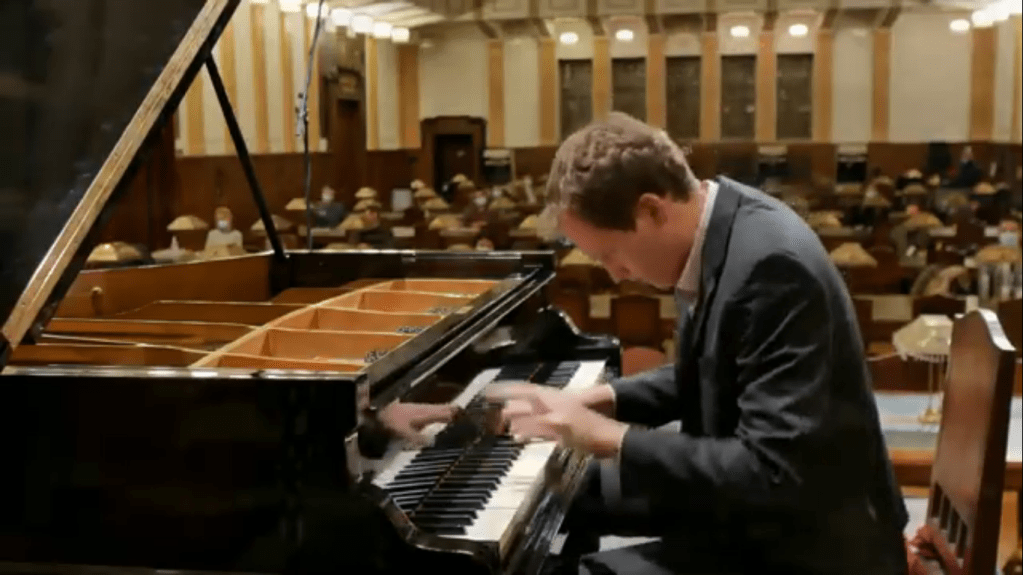
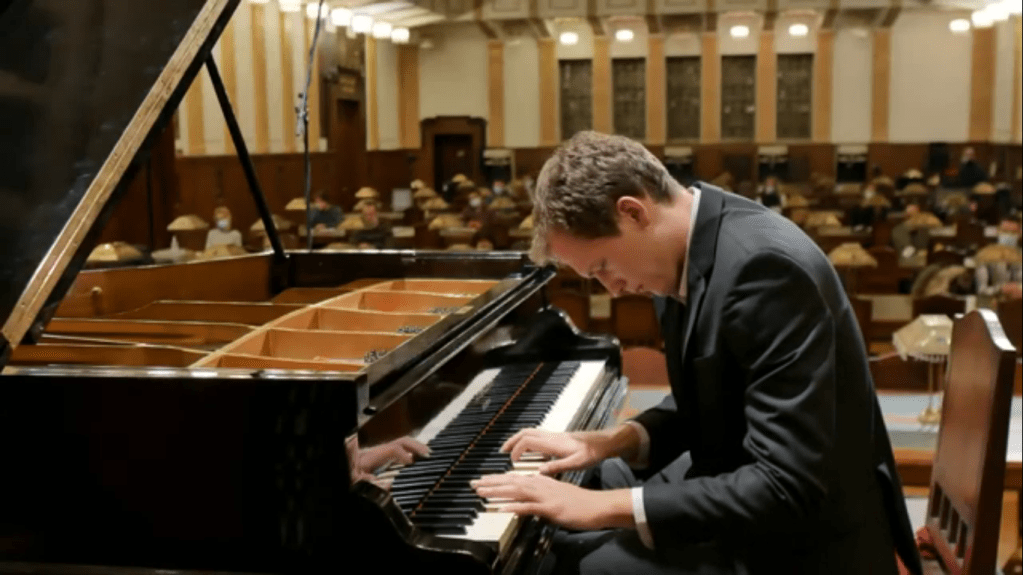
The Art of Fugue.Two hours of Bach’s mathematical genius revealed in an extraordinary performance by Filippo Gorini streamed live from the Molle Antoniana in Turin the tallest museum in the world.It is a major landmark in Turin and takes its name from its architect,Alessandro Antonelli.Construction began in 1863 and was completed in 1889, after the architect’s death and it was originally conceived of as a synagogue but it now houses the National Museum of Cinema.
With help from the Borletti Buitoni Trust this young musician mentored by Alfred Brendel and Mitsuko Uchida has tried to unravel,during this long lockdown period,the mysterious last masterpiece of Bach.Left unfinished Bach threw down the gauntlet at the 14th fugue as he left the world for good.
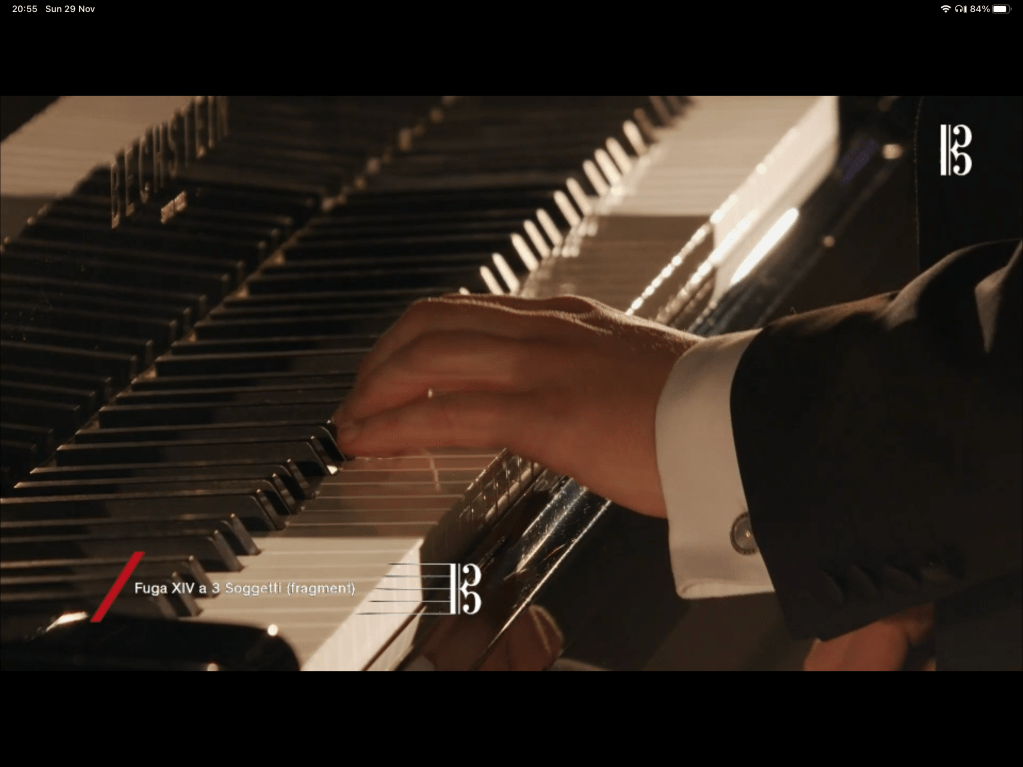
Written in the last decade of his life,The Art of Fugue is the culmination of Bach’s experimentation with monothematic instrumental works.It consists of 14 fugues and four canons in D minor, each using some variation of a single principal subject, and generally ordered to increase in complexity.It is an exploration in depth of the contrapuntal possibilities inherent in a single musical subject.
A handwritten manuscript of the piece known as the Unfinished Fugue is among the three bundled with the autograph manuscript. It breaks off abruptly in the middle of its third section, with an only partially written measure 239. This autograph carries a note in the handwriting of Bach’s son Carl Philipp Emanuel, stating “Über dieser Fuge, wo der Name B A C H im Contrasubject angebracht worden, ist der Verfasser gestorben.” “At the point where the composer introduces the name BACH [for which the English notation would be B♭–A–C–B♮] in the countersubject to this fugue, the composer died.”
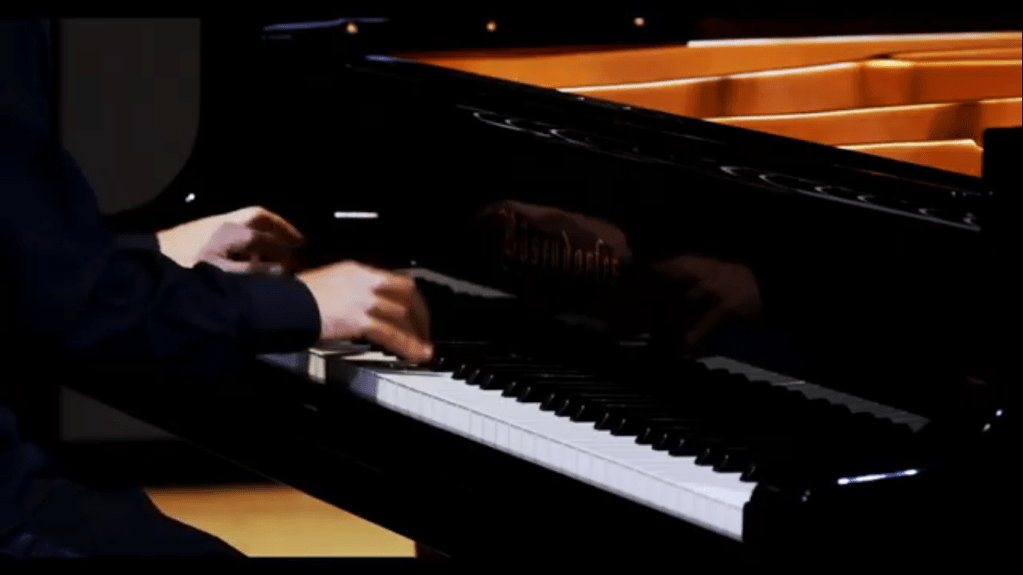
The abruptness and the aching minutes of silence as time was frozen was most moving.In this enormous building with a Bechstein piano sitting in its midst and a young man playing for almost two hours the most complicated music immaginable without a score and then suddenly stopping.I was reminded of Tatyana Nikolaeva playing it for us at the Teatro Ghione in Rome thirty years ago and insisting that not only the stage but also the auditiorium should be illuminated as much as possible.Licht, licht she implored.Today in this vast space I can understand the fact that the universality of The Art of Fugue cannot be contained in a restricted space.
The Genius of Bach indeed revealed by this young musician not only in his playing but in his nobly informed introduction https://youtu.be/pRaVgmsX7dM
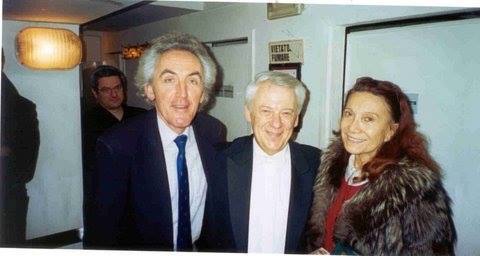
Ileana Ghione with her husband Christopher Axworthy backstage in their theatre in Rome with Aquiles delle Vigne
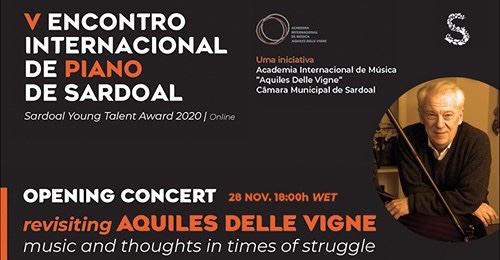
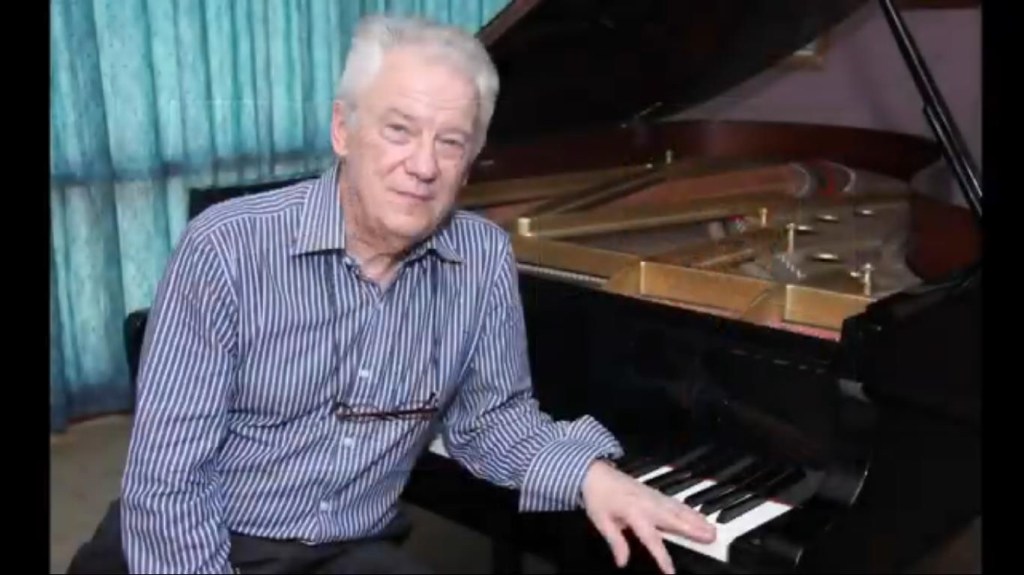
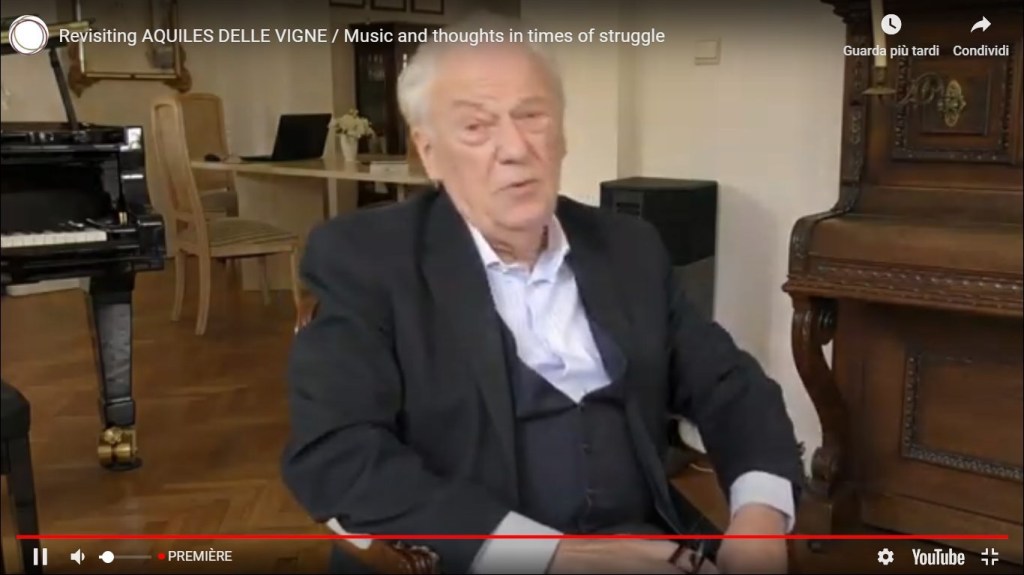
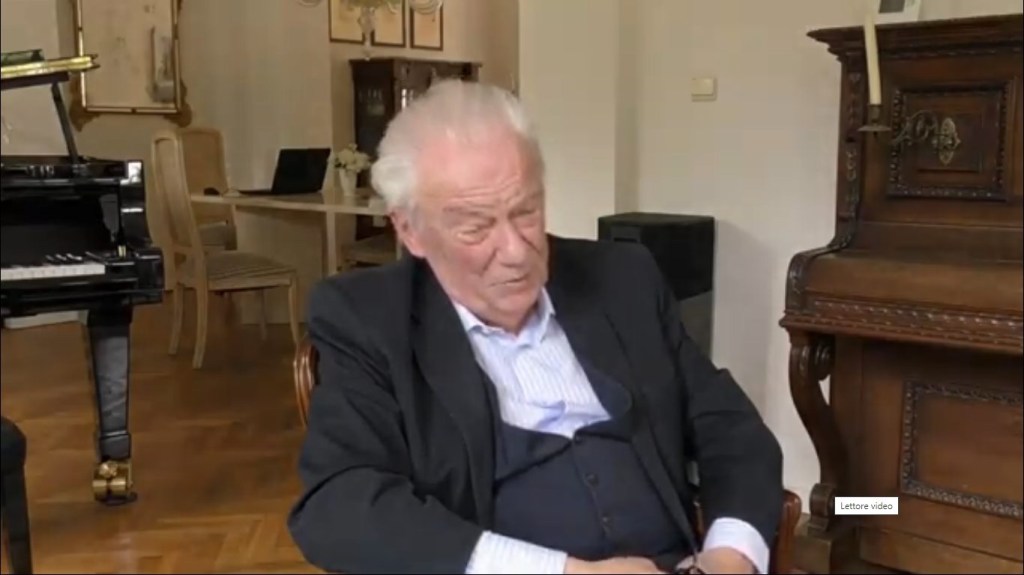
Wonderful to see Aquiles delle Vigne again after the concerts and masterclasses that he gave for us in Rome.His visits brought a radiance not only to us all but especially the students whom he helped with his great experience and humanity .A recital prefaced by some thoughts about the meaning of music.’An artist must trasmit ethics that will influence us all as human beings.’ Schnabel said that ‘ the truth is not in the note but behind and beside it.’ Liszt said that’ the score is only half the story that must be completed by the artist.’A final statement :’You are a pianist if you are born with the piano,suffer with the piano and die with the piano.In that case I will consider you a pianist!’
Jonathan Orr-Ewing:Hugh. It was fabulous to see and hear you. Your playing was terrific and it’s no surprise all of your musicians are inspired by your great example
Jelena Makarova:Dear Hugh, really enjoyed watching it. Bravo, beautiful programme wonderfully performed!Congratulations with the 1000th concert at the St. Mary’s Perivale!
A typical modest aside from our much loved master of Ceremonies:
‘An eventful afternoon at St Mary’s Perivale for my 1000th concert recital with a programme of Beethoven Appassionata and Schumann Fantasie. I get bad nerves before solo performances, and became paranoid about having a memory lapse in a live concert so I recorded the recital a few days ago. By Murphy’s law the machine playing back the recording today broke down at 40 mins – at the end of the Schumann 1st movt. Sincere apologies to everyone who was watching the recital. I have now uploaded the Schumann as a separate file. The whole episode will teach me to stay away from solo performances in future.’
There is indeed no business like show business and the show must go on as Dr Mather and his team have shown us in these difficult times.Three concerts a week and now even melologues and learned talks and all professional engagements offered mostly to young talented musicians.A whole generation of superb musicians who find themselves in great difficulty with one foot on a ladder that has been taken away by a cunning little chinese virus.
What to do?Actions speak louder than words and music takes over where words are just not enough.
Dr Mather and his team of volontary helpers includes a retired consultant physician,an expert BBC technician,a Government official and even a GP who makes tea and cakes and keeps this beautiful redundant church in order.All done for passion and the belief that culture replenishes the soul and that in being useful to young musicians who have sacrificed their youth for their art they are providing a much needed platform from which they can still weave their all important magic thread between artist and public.
Public recognition is growing rapidly, due to their superb streaming facilities.A true oasis that is fast being discovered in these barren times.Official recognition is long overdue.Hardly surprising as Barbara Hosking the 92 year old PR to Edward Heath said on BBC Private Passions:’ culture is what is sadly missing in Government today and we are paying dearly and daily the consequencies in our lives and expectations’
Few would have expected such masterly performances as we were offered today by our Master of Cermonies.
Schumann wrote his Fantasie as a contribution to Liszt’s monument for his master Beethoven, in Bonn. It was written as an outpouring of love for his future wife Clara Wieck and even contains a quote from Beethoven’s song ‘An die Ferne Geliebte- To the distant beloved.’It is dedicated to Liszt who later dedicated his Sonata in B minor to Schumann.Pinnacles of the Romantic piano repertoire.
The ‘Appassionata’ is one of the last works of Beethoven from his middle period before the final glorious outpouring of his later Sonatas.It is one of his greatest and most technically challenging and was considered by Beethoven to be his most tempestuous piano sonata until the arrival of the ‘Hammerklavier.'(A work that Dr Mather played just a few years ago at St Mary’s and can still be enjoyed on their you tube archive channel).It was written around 1804 just a year after Beethoven had come to grips with the irreversibility of his incroaching deafness.
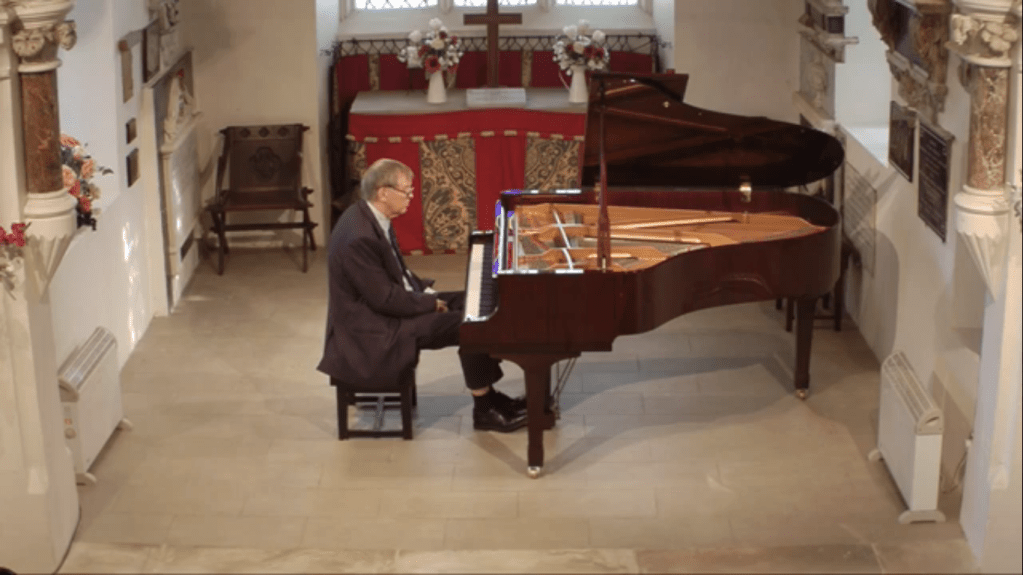
Hugh Mather studied the piano and organ from an early age, gaining the FRCO and the ARCM piano performers diplomas. He then pursued a medical career and was Consultant Physician at Ealing Hospital from 1982 to 2006, before retiring to pursue his musical interests. He continued his piano studies with James Gibb for many years, and gave countless concerts at St Mary’s Perivale, St Barnabas and elsewhere, as concerto soloist, recitalist, accompanist and chamber musician. More recently he has effectively retired from public performances and concentrated on organizing concerts. He has been Chairman of the Friends of St Mary’s Perivale since 2005, and has organised 1000 concerts there, as well as a further 600 at St Barnabas Church.
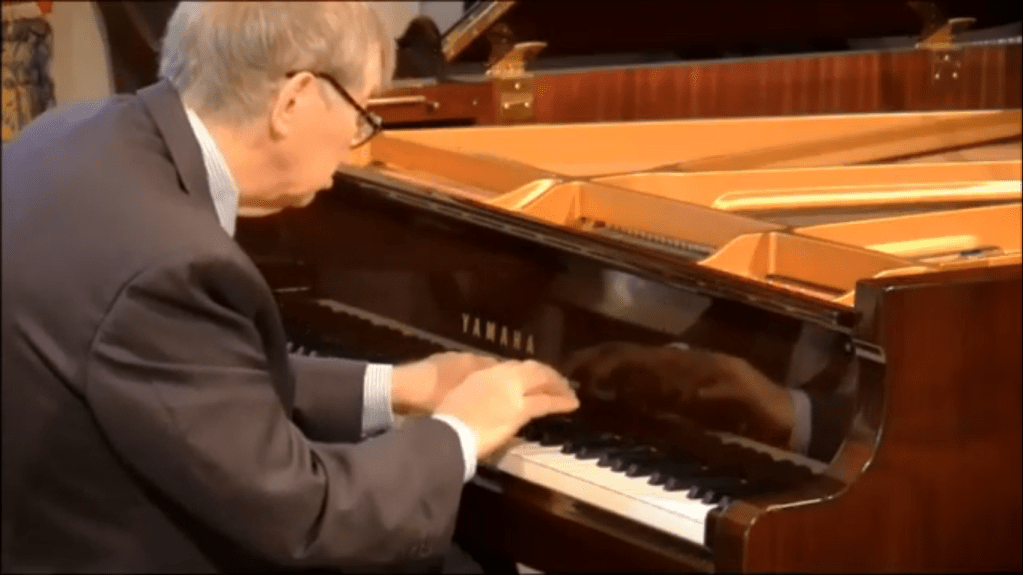
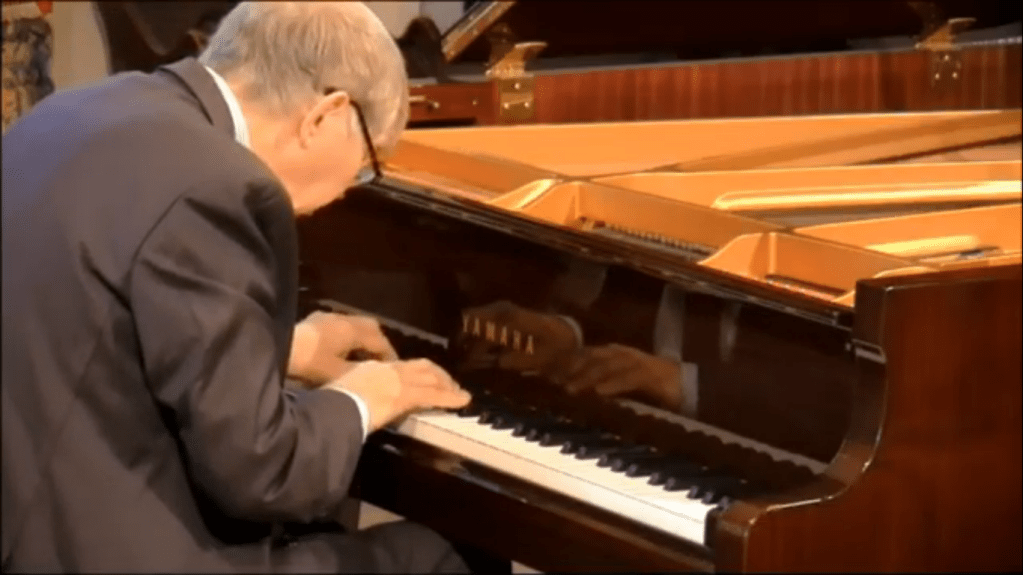
The Appassionata showed an enviable clarity and sense of line.There were no short cuts for Dr Mather as with Arrau like authority he took Beethoven’s word as sacrosanct with the solid musicianship of someone who has also played the organ for years.The opening flourish was thrown off with a youthful agility and sense of dynamic purpose that Beethoven himself is reported to have done.The whispered opening motif played with a rhythmic forward drive that is the key to this rather menacing precursor of the fifth symphony written only a few years later (op 67).There were beautiful contrasts too between the rhythmic outbursts and the lyrical second subject.Even the left hand repeated notes were played in an unusually mellifluous way and it made Beethoven’s furious outbursts even more astonishing.Here in this surprising first movement Beethoven’s not easy temperament is laid bare.Not the introspection of Schumann’s Florestan and Eusebius but the’ sturm and drang’ of an unquiet soul of a revolutionary.All this was brought to the fore in Dr Mather’s jewel like simplicity and clarity .One could almost see his scientific mind at work with his head down as he studied in minute detail the specimen.This was no cold hearted performance though but one where his love,respect and intelligence shone through in every phrase.The slight jiggery pockery in the explosive arpeggios before the coda was of a true professional musician who had no intention of being tripped up by Beethoven at the last hurdle!
A beautiful flowing ‘Andante con moto’ where every note sang with such loving understanding.Not the clinical precision of youth but a mature understanding of someone who has lived with this music for a lifetime. A beautiful slow transition from the Andante to the tempestuous ‘Allegro ma non troppo.’One could not help but admire the precision of Dr Mather’s fingerfertigkeit especially as his fourth and fifth fingers were not allowed to ride on the backseat as is often the case with this extremely busy movement.No slacking but a unrelenting rhythmic drive always with a wish to find the utmost lyricism and sense of line hidden in Beethoven’s knotty twine!The coda Presto could have been more frantic though- oh for one’s youth!- and the two long chords more legato to contrast with the frenetic rhythmic fervour that Beethoven demands afterwards.
As Hugh said he was worried about having a memory lapse in such a long and important recital but little did he count of the machine stopping during a replay.Human resiliance is so much more accomodating than a machine’s soulessness!Q.E.D.
A virtuoso performance even here as Dr Mather and his team downloaded the performance and had it on line before the end of the evening!Hats off indeed – I am sure Schumann would have approved as he did when the young Chopin appeared on the scene with his op 2 Variations!
The Schumann Fantasie is prefaced by some lines by the poet Schlegel where: “Resounding through all the notes ,In the earth’s colourful dream,There sounds a faint long-drawn note,For the one who listens in secret.”
I remember Agosti writing in my copy ‘cla…..ra’ over the first melodic notes of the sublime ‘Constellation’ last movement to give it the original title.
Agosti was a leggendary musician who held court during the summer months in Siena.All those that had heard him (the most renowned musicians of the day flocked to his studio)have never forgotten the intensity,power and beauty of his playing.It was created by never playing too loud too soon and his famous words are still ringing in my ears :’troppo forte ,troppo forte.’
It was exactly this sense of balance that Dr Mather realised today as the very opening ‘G’ marked ‘sfp’ is nothing more than an opening up of the sound within the piano giving reverberations on which Schumann’s passionate outpourings could float undisturbed.Some pianists play this opening G with such a bang that Agosti likened it ,rather cruelly, to Schumann giving his beloved Clara a clout on the jaw!
In Dr Mather’s hands it was a glorious outpouring of melody.The meandering triplets before the second subject was slightly slower and more carefully phrased than I was expecting and just demonstrated his continuous search for the not alway apparent song within the notes.I got the impression though that Dr Mather was a little intimidated by the silences that Schumann often indicates and rather liked to join the strands with his right foot.It was a beautiful performance that was infact the original ‘Ruins’ movement that Schumann had written for his as yet distant Clara.
The ‘Triumphal Arch’ of the second movement was played with great architectural sense of line .The poco meno and scherzando middle section was played with great sensitivity and the infamous coda was thrown off with great courage and the enviable precision of a mature thinking musician.The last movement was played as a great song from the first to the last note.Not disturbing the atmosphere at the end where Schumann marks poco a poco accelerando and many also add crescendo, playing only the final three chords piano.But Dr Hugh is obviously aware of the original edition where Schumann repeated the first movement coda to his distant beloved, and was content for us to bask in the extreme beauty of his performance.It comes with the loving care in maturity of he who has understood the real meaning of passion.
The same passion with which he has dedicated himself as he reaches his one thousandth concert in this beautiful unsuspecting church.
‘If music be the food of love play on’
Rudundant no longer!
Many congratulations and to the next millennio! Thanks are just not enough.
Ludwig van BeethovenSonata N. 5 in Do minore, Op.10 N.1- Allegro molto e con brio- Adagio molto- PrestissimoSonata N. 6 in Fa maggiore, Op.10 N.2- Allegro- Allegretto- PrestoPiano Sonata No. 7 in Re maggiore, Op. 10 N. 3- Presto- Largo e mesto- Menuetto: Allegro- Rondo: Allegro
This is what the distinguished french pianist Marylene Mouquet had to say about the recital:’Magnifico appuntamento con Beethoven grazie ad un artista esperto che ha capito l’essenza di Beethoven… Sa esprimerlo con brio, stile, forza d’animo e delicatezza. Grazie Ivan!
And this is what I have written about Ivan’s previous concerts nei Castelli Romani :
Some very fine playing from Ivan Donchev in the third of his series of the 32 Sonatas by Beethoven.Three early works of op. 10 written between 1796-98 belong to the close of the eighteenth century, part of that group of thirteen sonatas that remain within the classical tradition that Beethoven was at first to explore and expand. The Opus 10 sonatas are dedicated to Countess von Browne, the wife of Count Johann Georg von Browne-Camus, a nobleman of Irish ancestry in the Russian Imperial service in Vienna. Beethoven had dedicated his three String Trios, Opus 9, to the Count, to whom he was indebted in various ways, including the gift of a horse that he had soon abandoned.
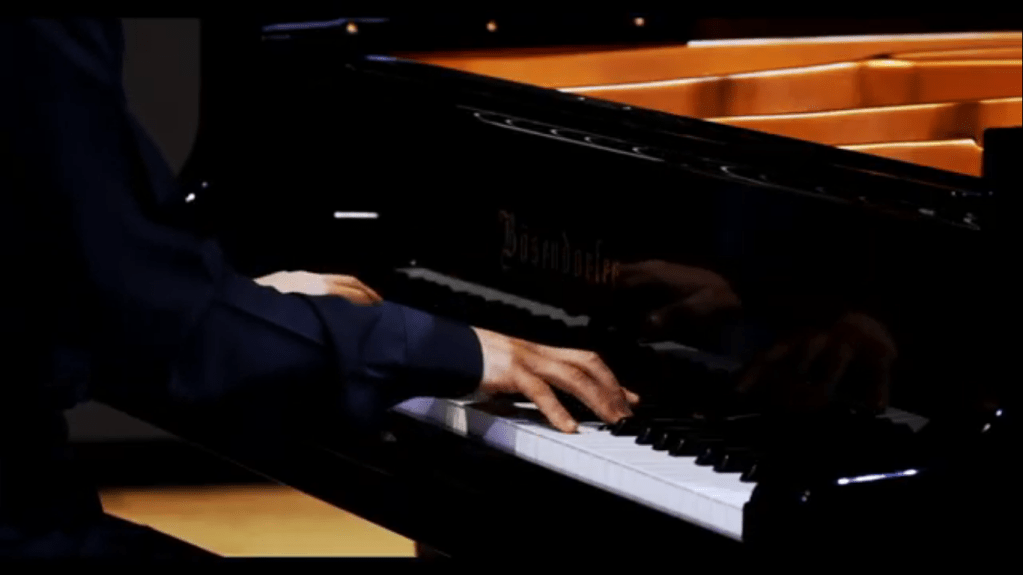
They are full of youthful energy but already show signs of Beethoven’s personality alternating a startling rhythmic call to arms with classical lyricism.Always there is an undercurrent that carries us from the first to the last note almost without rest.The Bosendorfer that Ivan played with its bright clear sound was ideally suited to this early sound world whereas the later sonatas are more dense and melodic and may need a much richer almost orchestral sound.The Arietta from op 111 or the theme from op 109 are surely contemplated with the same density of a string quartet.Already Beethoven in slow movement- Largo e mesto-of op 10 n.3 anticipates what is to come in the later Sonatas from op 106 to op 111.All this was brilliantly described by Ivan in his short but very succinct introductory talk.
The first Sonata op 10 n.1 in C minor anticipates the later op 13 Pathétique with its imperious opening alternating with contrasting lyricism.It was played with a precision and absolute faithfulness to Beethoven’s indications.The coda before the development showed a striking resemblance to a similar passage in the later op 10 n.3 where Beethoven had already taken the germ of this idea one step further.It was beautifully realised by Ivan and just confirmed what he had said about the chronological order of the sonatas showing so clearly Beethoven’s development as a composer.It is infact a unique journey and very rare that an evolutionary path can be seen so clearly from the first op 2 n.1 to the last op 111.
There was a great purity of sound and a sense of balance that allowed the melodic line of the ‘Adagio molto’ to sing out so clearly.The almost belcanto ornamentation was played with a lightness and sense of shape that was quite magical.The turbulent question and answer phrases were integrated so well into the overall architectural shape of this great song.Disappearing to a whisper before the driving energy of the Prestissimo finale which was played with great vigour but alternating with passages of eloquent charm.
The Sonata in F major op 10 n.2 was a favourite of Glenn Gould and it is a remarkable work where the usual slow movement is substituted with a minuet and trio of quite startling originality.The opening movement has something of a pastoral feel to it which has a playful development section played with a rhythmic buoyancy and forward movement that is quite hypnotic.The explosive left hand trills could have unwound even more abruptly so as not to disturb the relentless rhythmic energy that Ivan had instilled. The Minuet too could have been even more legato like a plasma that spreads across the keys in such a remarkable way.A beautiful trio section though moved so well one in a bar that made the comments in the left hand even more poignant .The devilish Presto finale was played with such precision and a relentlessness that was breathtaking.
The Sonata op 10 n.3 is the first of Beethoven’s great works where he stamps the Sonata formula with his own unique personality.The first movement played in two with Beethoven’s startling sforzandi like a call to arms interrupting the rhythmic flow.One can already see on the horizon op 13 and 22 with a visual pattern that is gradually becoming more marked as he moves away from the classical shape of Haydn and Mozart.The left hand figurations in the development section were played with driving insistence with pleading comments from the right hand sforzandi. There were beautiful lyrical contrasts where Ivan’s playing reminded me of Gelber with his way of slightly playing out of sinc on occasion that gave such expressive power without harshness of tone.Infact all through today’s performances were Ivan’s sense of fullness without hardness and expressivness without sentimentality.It was just this that gave such depth of meaning to the intense Largo e mesto of great beauty and powerful emotional meaning.Beethoven’s remarkable way of holding a long bass note whilst allowing the right hand to comment above with such clarity was to be exploited in his later Sonata op 31.n 2 ‘The Tempest.’The magical mists of sound that had been hinted at in the earlier op 2 n.3 are here used to startling effect as it reaches a climax where the bubble bursts as we are brought back to the final magical notes which again anticipate the last notes of the very final op 111.The Menuetto was played unusually gently and it contrasted so well with the bubbling charm of the Trio .The question and answer of the final Rondo was played with a brilliance and precision,the final scales and arpeggios just hovered over the keys as the work came to a gentle end.
This was indeed a remarkable third stop in a journey of discovery and I look forward to the next stop of this stimulating panorama.
Mozart: Piano sonata in D K 311 (16′)Allegro con spirito-Andante con espressione -Rondeau Allegro
Chopin: Three Mazurkas Op 59 (10′) 1 in A minor, 2 in A flat, 3 in F sharp minor
Debussy: Suite Bergamasque (17′) Prélude / Minuet / Clair de lune / Passepied
Brahms: Variations on a theme of Paganini Op 35 Book 2 (11′)
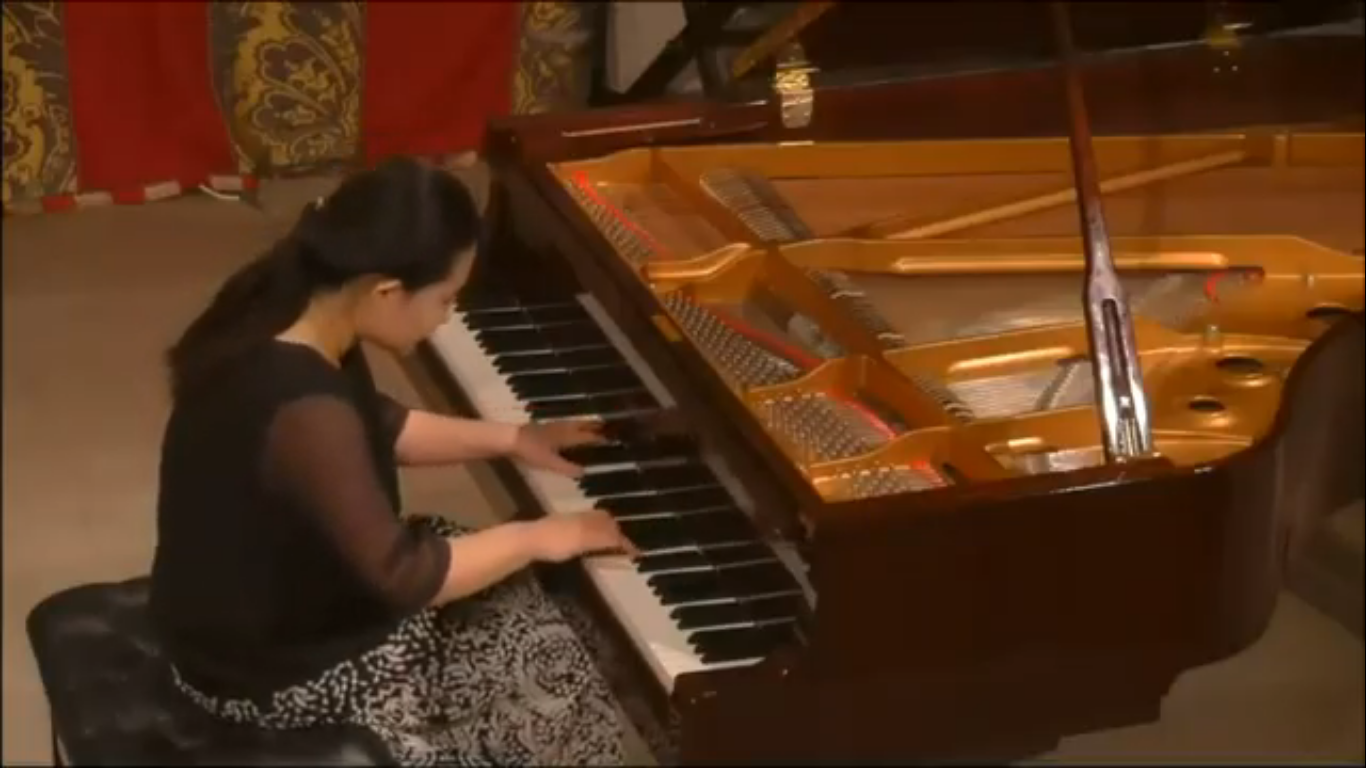
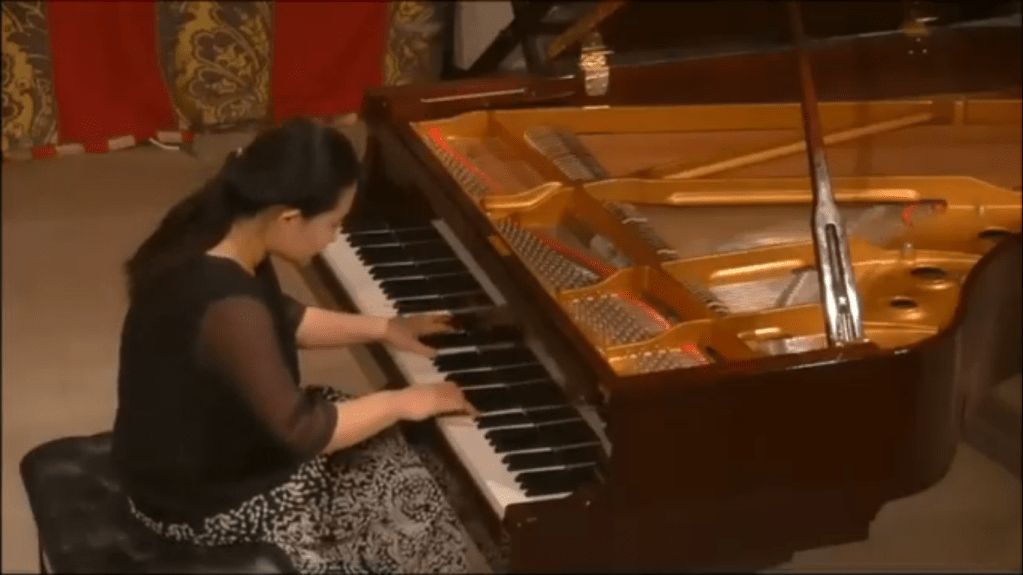
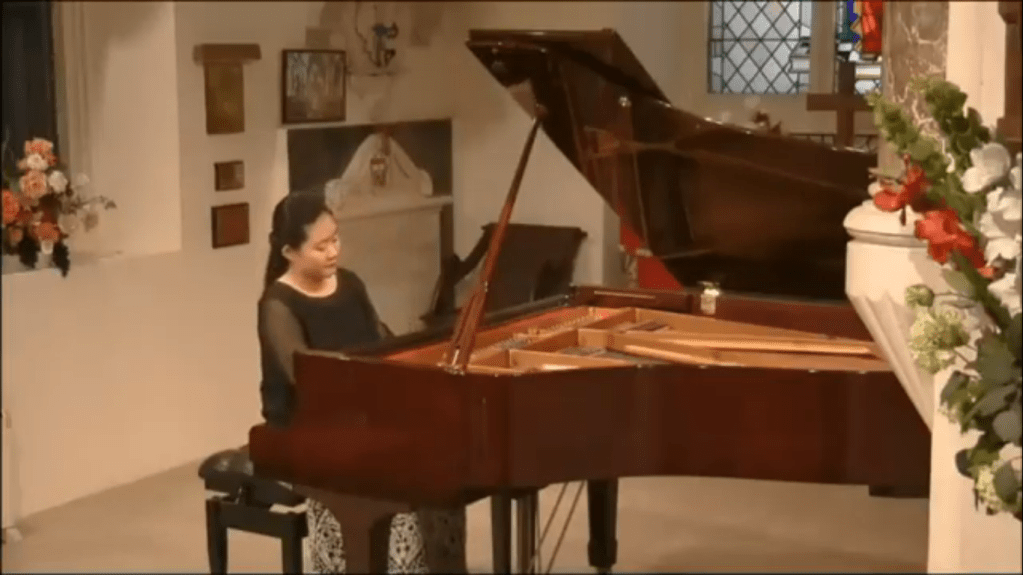
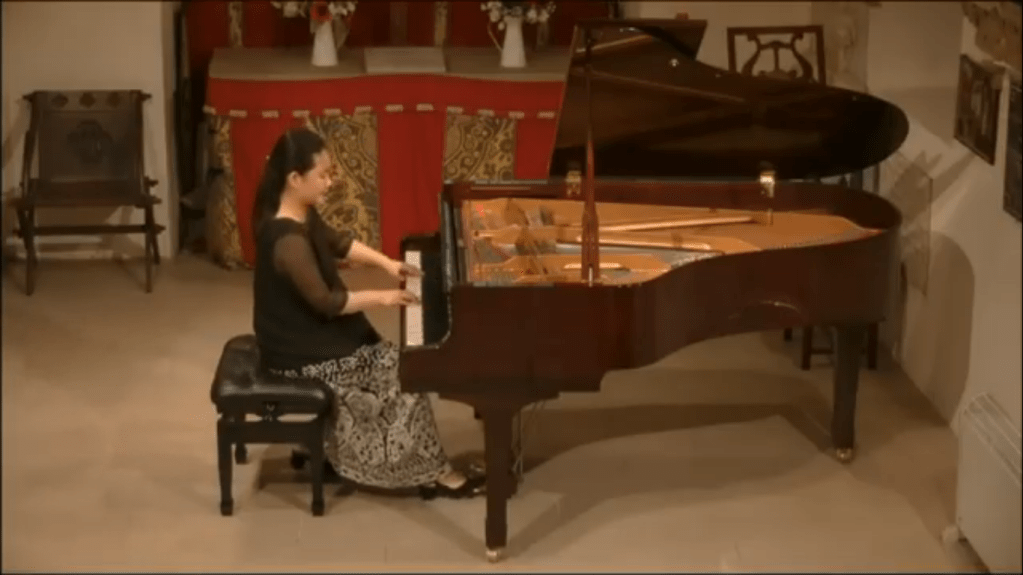
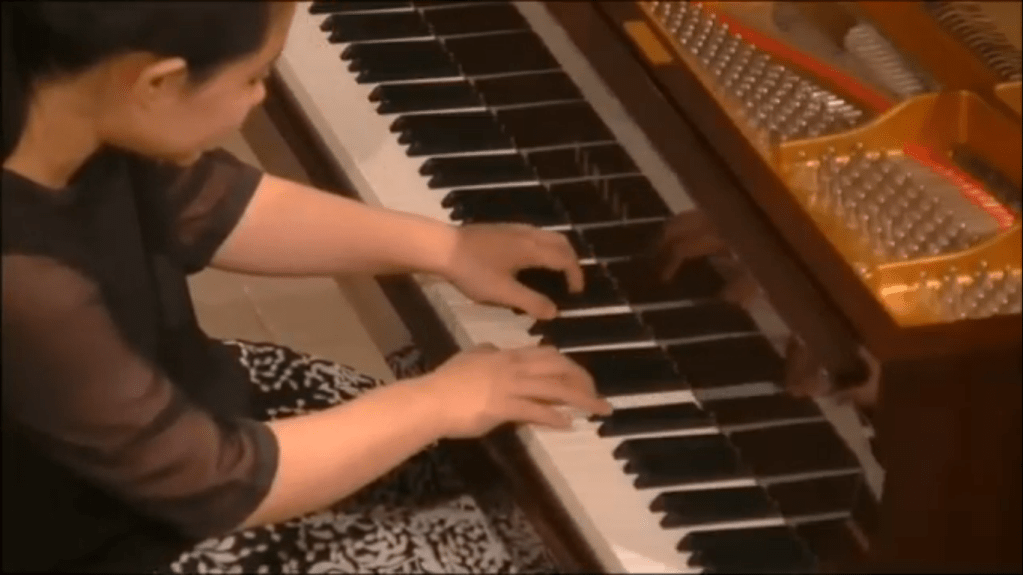
Born in 1994 in China, Ke studied at the Royal Academy of Music in London with Christopher Elton,Michael Dussek and Andrew West graduating with a Masters with distinction (DipRAM) in 2017. She is currently pursuing her Doctoral study at Guildhall School of Music and Drama with Joan Havill,Dr Alexander Soares and Rolf Hind. She has won top prizes at international competitions including 1st Prize at the 2016 Concours International de la vie de Maisons-Laffitte and Karoly Mocsari Special Prize (France), 1st Prize at the 2014 Shenzhen Competition (China) and 3rd Prize at the 2012 Ettlingen Competition (Germany. In 2017 Ke made her debut at Wigmore Hall under the auspices of the Kirckman Concert Society. She has given concerts across the UK, in France, Germany, Poland, the US and Canada. Recent engagements include recitals at the Purcell Room, Kings Place, the Saintonge Festival, Maison Laffitte and Salle Molière Lyon in France and the Chopin Festival at the Fisher Center in Bard College, New York.A committed chamber musician, Ke has undertaken a Tunnell Trust Award tour of Scotland, given a recital at Wigmore Hall and recorded music by Vieuxtemps for Champs Hill Records with violist Timothy Ridout. She has collaborated with the Cuarteto Casals at Santander International Piano Competition. Last summer Ke made her first appearance in Winchester Festival this summer. Ke is grateful for support from the Ian Fleming Award from Help Musicians UK; prizes from the Worshipful Company of Musicians, the Maisie Lewis Young Artist Fund and the Prince’s Award. She recently performed the Tchaikovsky Piano Concerto No.1 under the baton of Adrian Leaper at the Barbican Hall, as one of the finalists at the Gold Medal competition at Guildhall School of Music and Drama.
I have often admired Ke Ma’s playing for her precision and impeccable musicianship but sometimes found it could be rather cool and detached.Today she revealed her true self from the very opening notes of Mozart’s early D major Sonata K 311 written when only 21.It is full of wit and character which Ke Ma understood so well and to which she added her sense of colour and very sensitive phrasing.From the very first notes there was a delicacy added to her precision with also a beautiful sense of legato.There was great clarity and purity to the ‘Andante con espressione’ with a truly luminous cantabile due to her remarkable sense of balance .It gave such a wondrous sense of colour and heartrending meaning to every note.The Rondeau- ‘allegro’ had an operatic sense of character one could almost see the different personalities entering the stage one by one.
Three Mazukas by Chopin op 59 once again showed the affinity of the Polish and Chinese heart.The A minor was played with great shape full of subtle nostalgia and unexpected drama very sensitively portrayed.In contrast to the A flat and F sharp minor Mazukas that had a lovely lilt and sense of dance.The A flat, one of the happiest of Mazukas with a ravishing ending disappearing into the heights of the piano with the final gentle farewell stamp of the feet.The F sharp Mazurka still dancing into the distance at the end.Each one a tone picture with a story to tell brought vividly to life by this young chinese pianist.
Suite bergamasque by Claude Debussy is one of the composer’s most famous works for the piano. He began composing it around 1890, at the age of 28, but significantly revised it just before its 1905 publication.He was initially unwilling to use these relatively early piano pieces because they were not in his mature style, but in 1905 he accepted the offer of a publisher who thought they would be successful, given the fame Debussy had gained in the intervening fifteen years.The names of the movements were inspired by the poems of Paul Verlaine. The title of the third movement of Suite bergamasque is taken from Verlaine’s poem “Clair de lune” which refers to bergamasks:”Your soul is like a landscape fantasy,Where masks and bergamasks, in charming wise,Strum lutes and dance, just a bit sad to be ,Hidden beneath their fanciful disguise.”It was indeed Clair de lune that Ke Ma played with such delicate luminosity with some wonderful colouring and deep resonant bass notes that opened up the sound within the piano and gave a gentle glow to the very flexible melody.The Prelude was played with poetic declamations and some magical sounds.It was followed by a fairy light Minuet played with irresistible grace and charm as it built up gradually to a euphoric climax.The Passepied had a feather light buoyant bass on which floated Debussy’s magical melodic inventions disappearing to a whisper.Passion and delicacy combined to create a magic spell indeed.
She ended her programme with Book 2 of the Brahms Paganini Variations. The entire work consists of two books each one opening with the theme, Paganini’s Caprice No. 24 in A minor, followed by fourteen variations. It was published asStudies for Pianoforte: Variations on a Theme of Paganini. and dedicated to the piano virtuoso Carl Tausig.As Dr Mather rightly said today it is a work that strikes fear into the hearts even of the most accomplished pianists.Clara Schumann called it Hexenvariationen (Witch’s Variations) because of its difficulty.
Ke Ma certainly did not seem intimidated as she not only surmounted the great technical difficulties but imbued each variation with subtle character.A beautifully simple understated theme was followed by the first variation where Brahms immediately expects the pianist to embark on double thirds at breakneck speed.It was played with great rhythmic energy and architectural shape whose tension was relieved by the sumptuous melodic outpouring of the second variation.The playfulness of the 3rd belied tha actual technical difficulties involved and was played with an ease and grace by Ke Ma.Followed again by a sumptuous romantic melodic outpouring played with a subtle sense of colouring.The fleetingly featherweight triplets at lightening speed in the next two variations were followed by a combination of two’s against three’s that would have confounded the greatest of mathematicians.Now Brahms deals with the problems of octaves and againeven these held no terror for our young chinese pianist.They were thrown off with great ease and in such convincing Romantic style.A complete change of character with the beautifully mellifluous 12th variation gently led to the final ‘Presto ma non tanto’ finale thrown off with amazing technical assurance and sumptuously full sounds bringing the work to a grand conclusion via again the combination of two against three this time in double octaves!A work not for the faint- hearted and Ke Ma certainly has a heart that beats so expressively in everything that she plays.
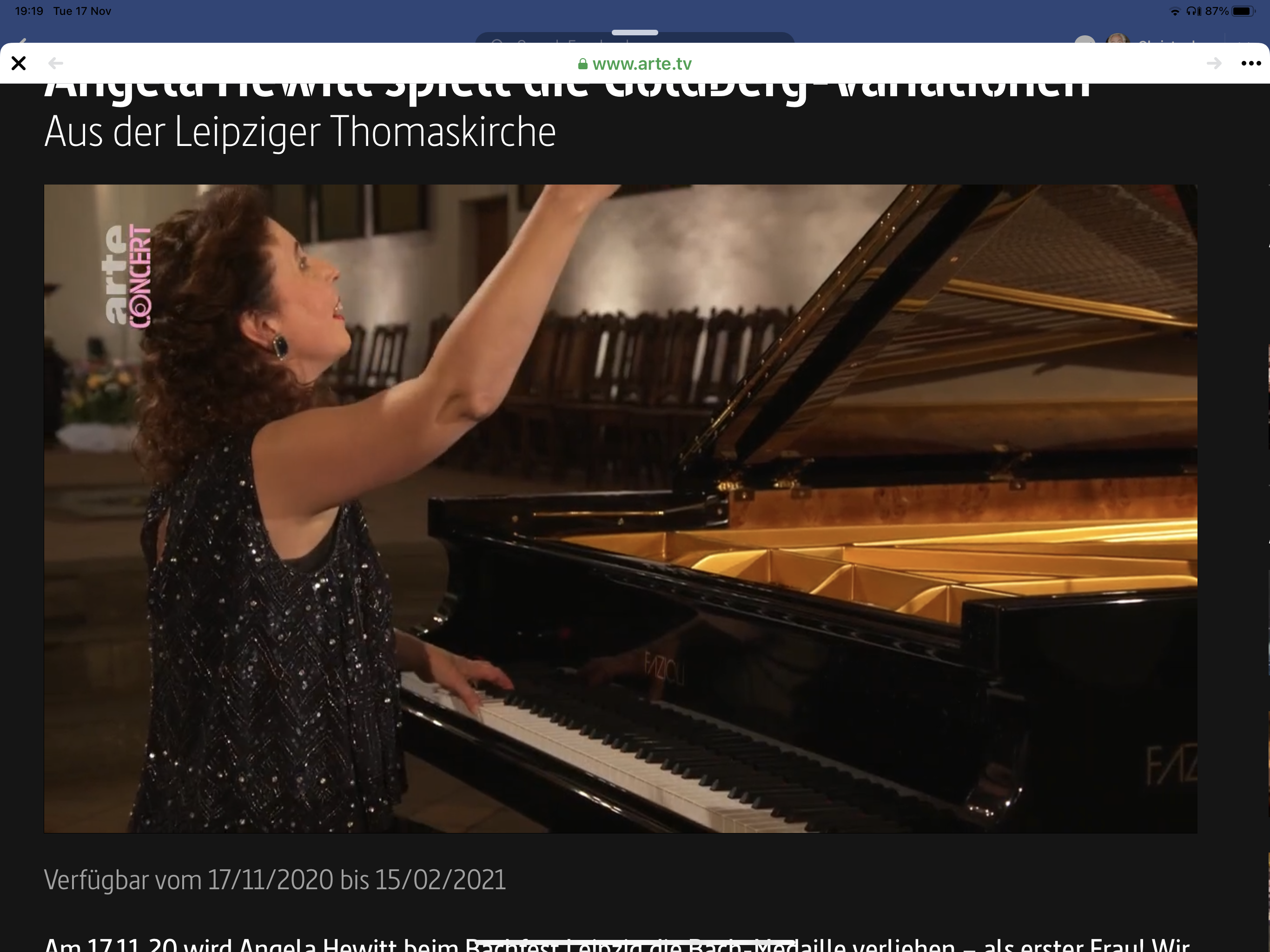
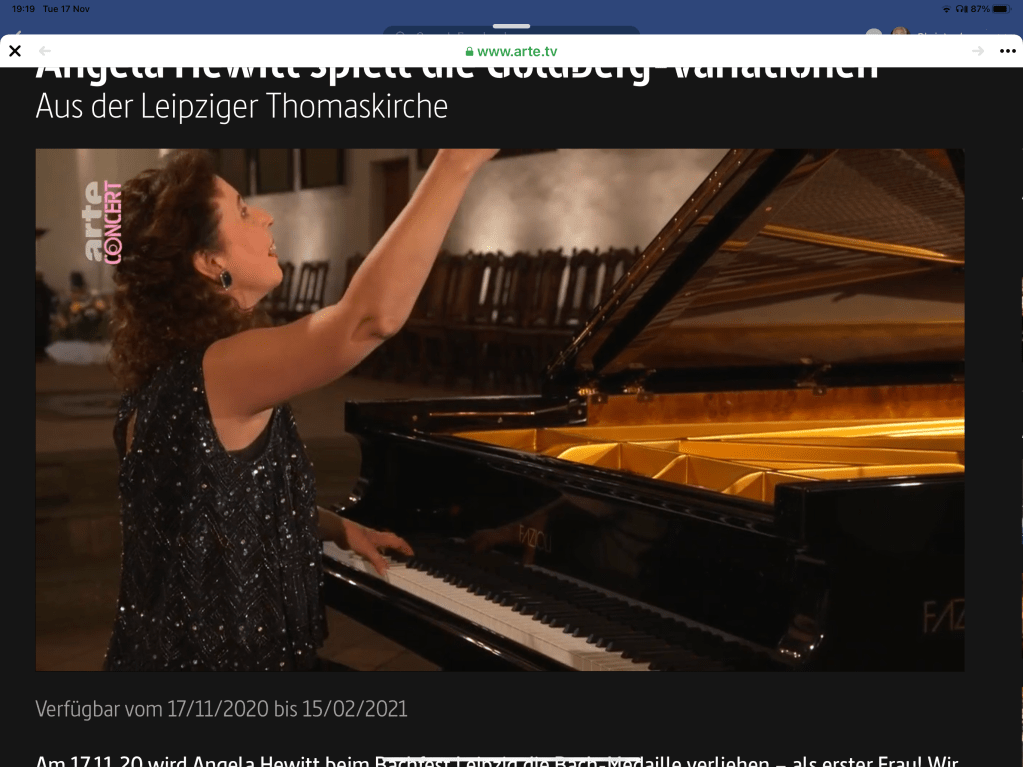
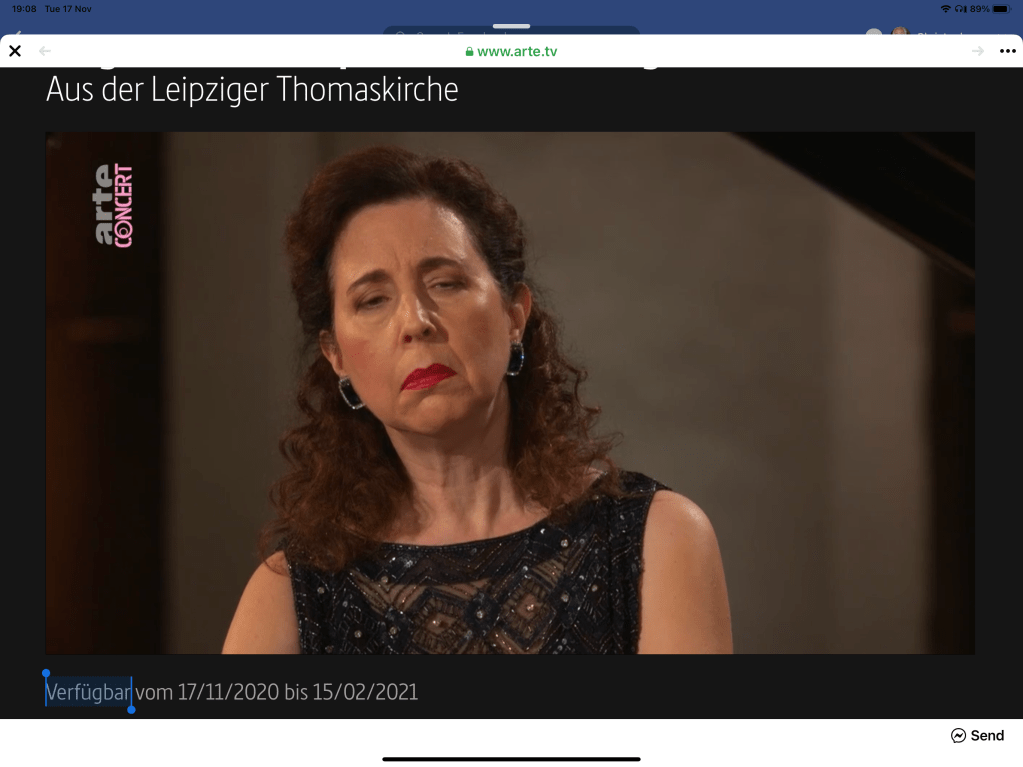
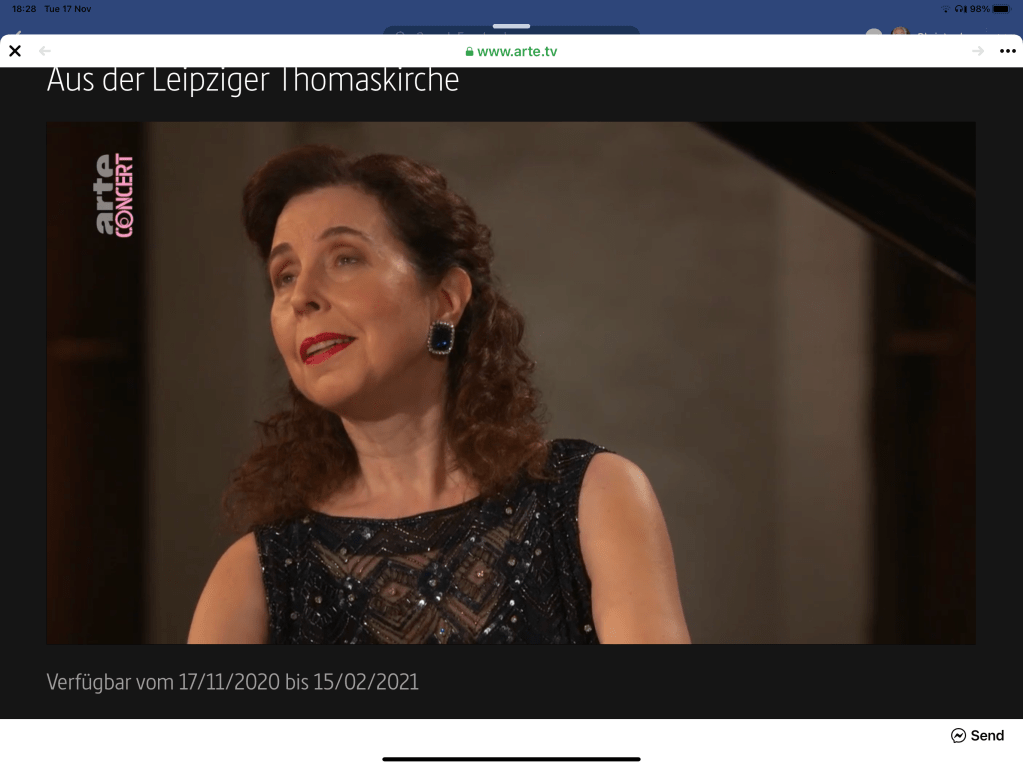
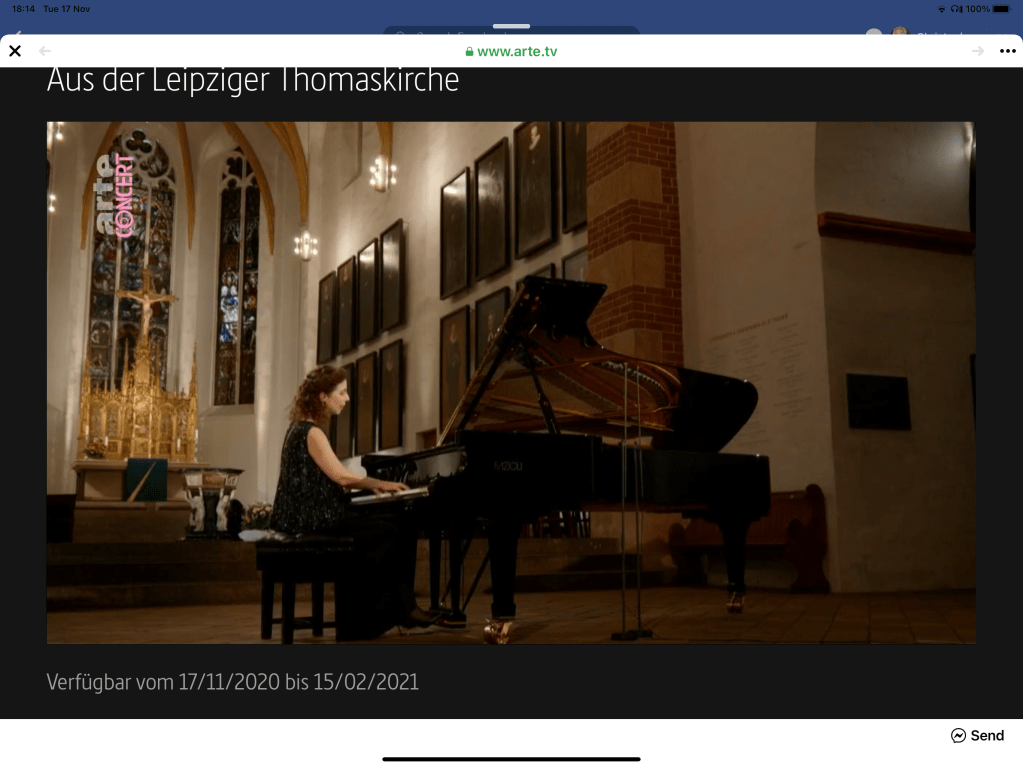
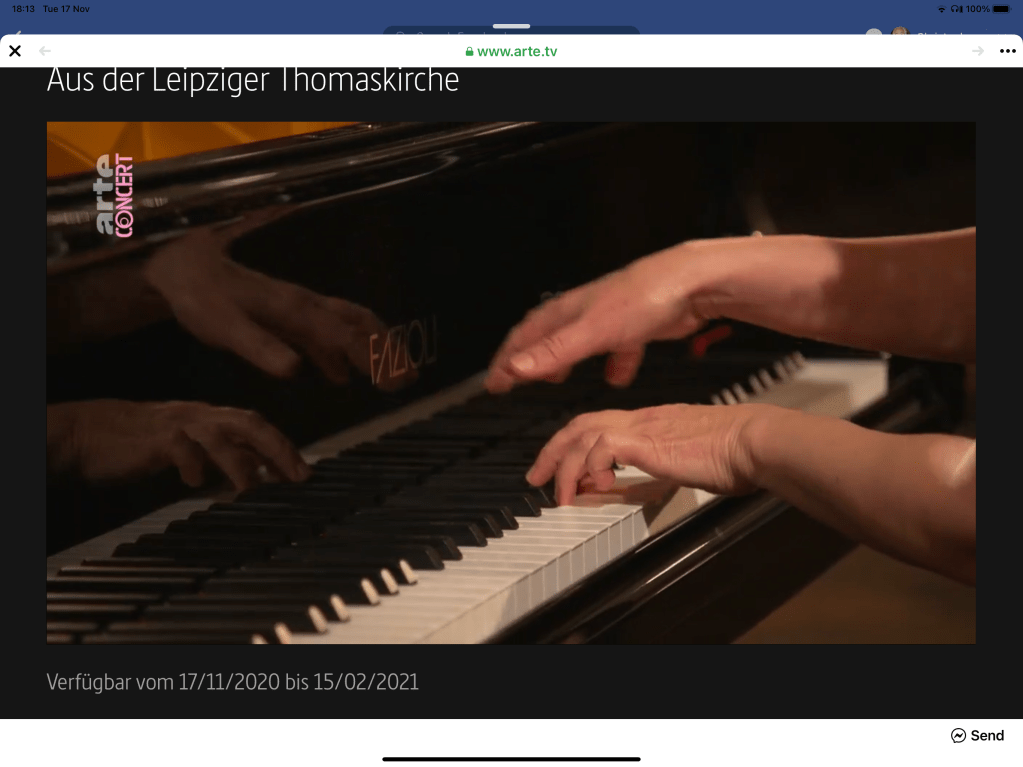
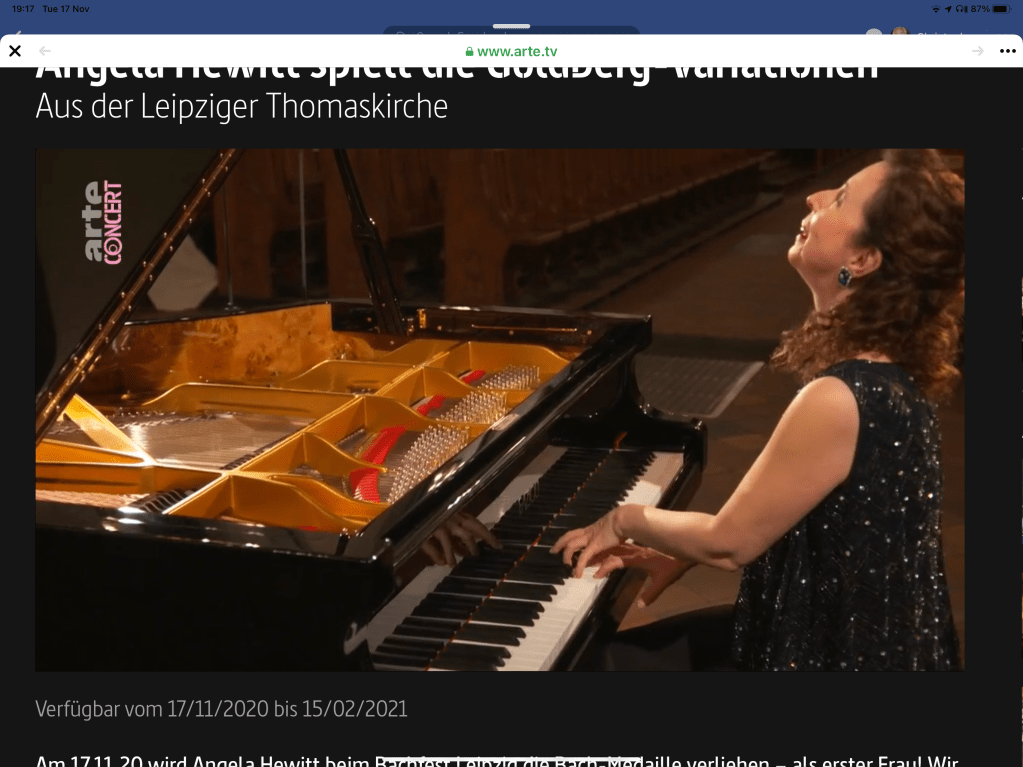
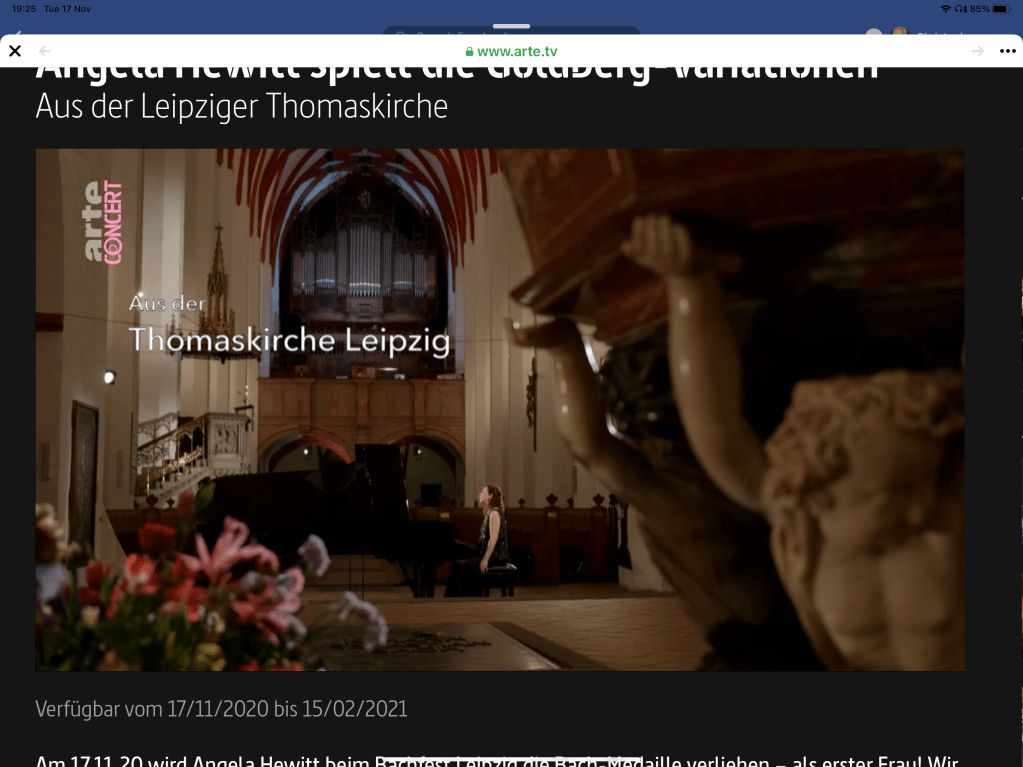
A wonderful performance in Bach’s own church in Leipzig.With Bach looking on how could it not be absolute perfection.Without doubt the greatest performance I have ever heard.One hour and twenty three minutes with all the repeats save one.
Such a personal performance from someone who has lived with this music for a lifetime.Small inflections,hesitations,rallentandi,rinforzandi from someone who had totally understood the message that Bach reveals in the music.
The massive added octaves in the mighty 29th variation,a knowing smile in the Quodlibet,the sublime beauty of the 25th,the teasingly playful voices in the 27th,the reawakening of the 22nd,the haunting lament of the 21st,the simple charm of the 19th,the majesty of the 16th,the subtle delicacy of the 13th,the transcendental difficulties of the 14h or even more of the 20th or 26th.
The almost religious pause before the reappearance of the aria,played with the knowledge of someone who had traversed a world of feelings and because of that had instilled every note and ornament with such deep meaning.The message of absolute faith for the glory of God.Here before Bach’s resting place there was just Angela and Bach in a magic communion that we were allowed to eavesdrop on.An unforgettably moving experience that luckily was recorded for posterity.
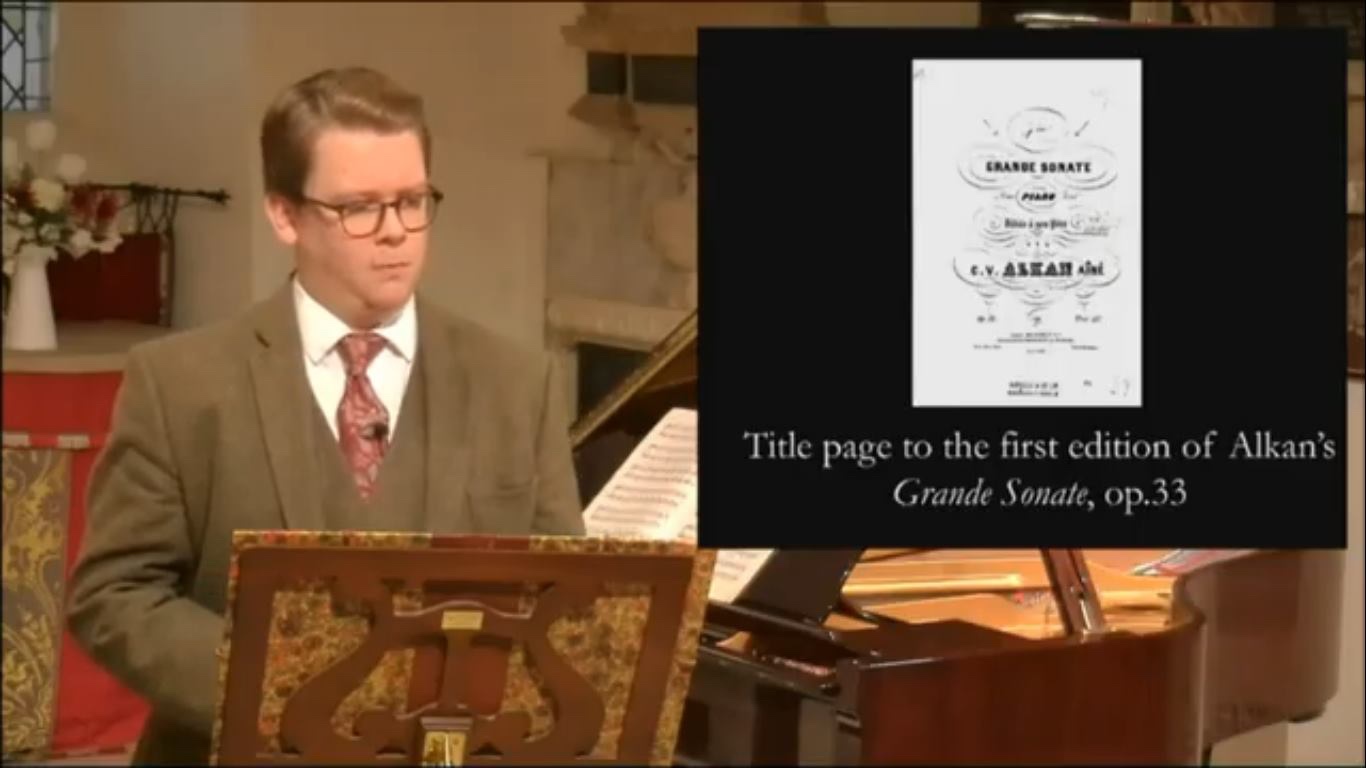
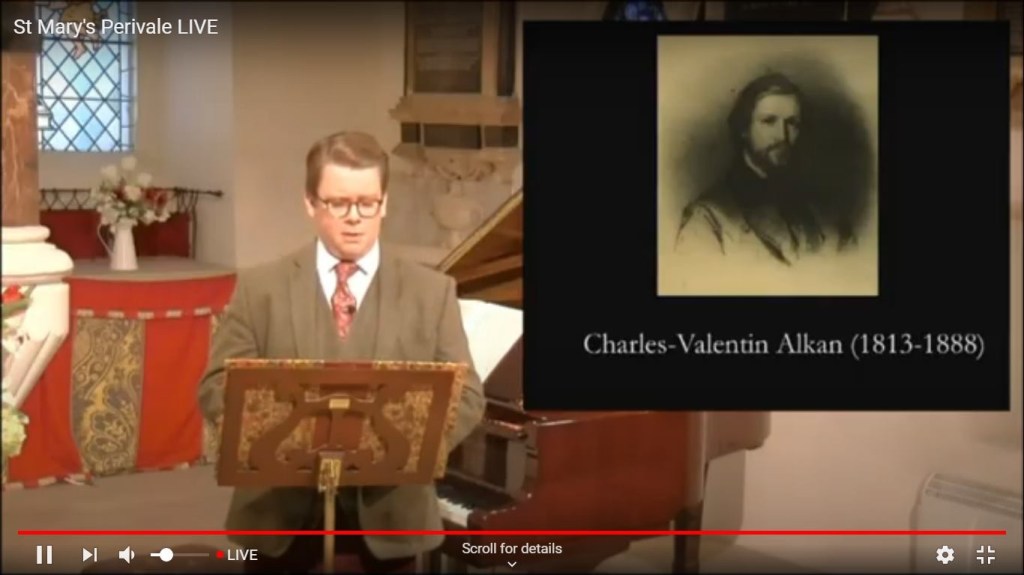
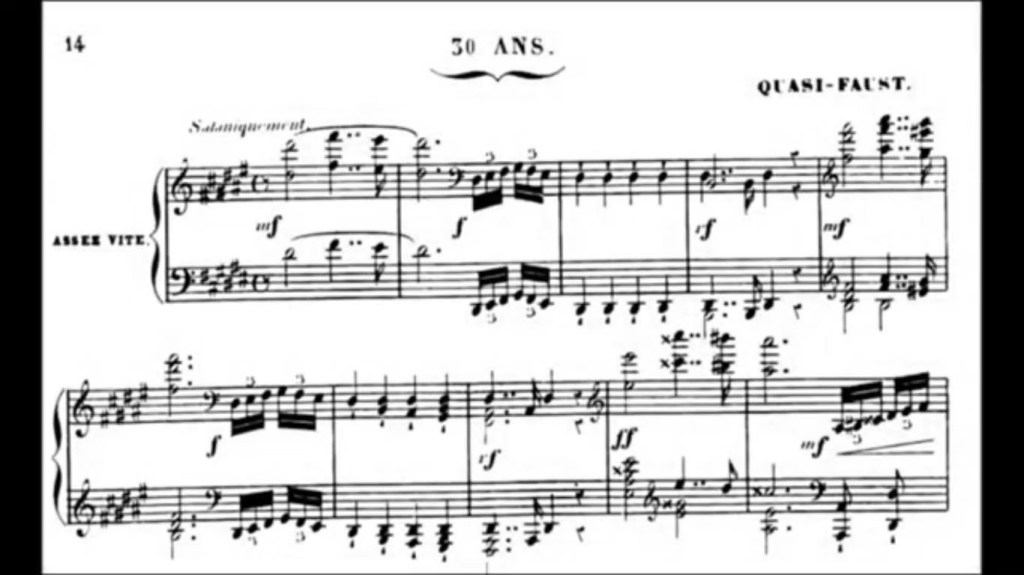
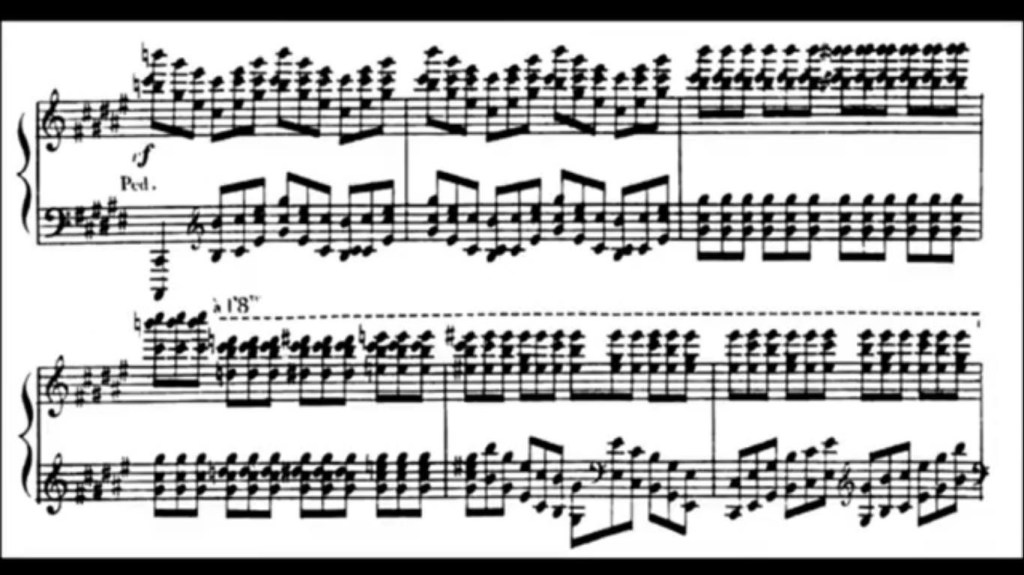
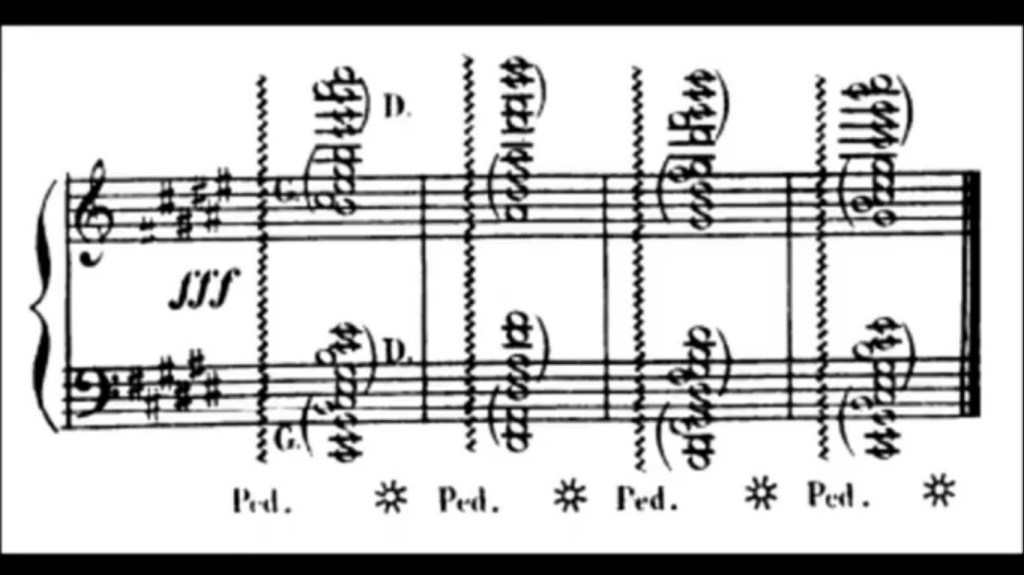
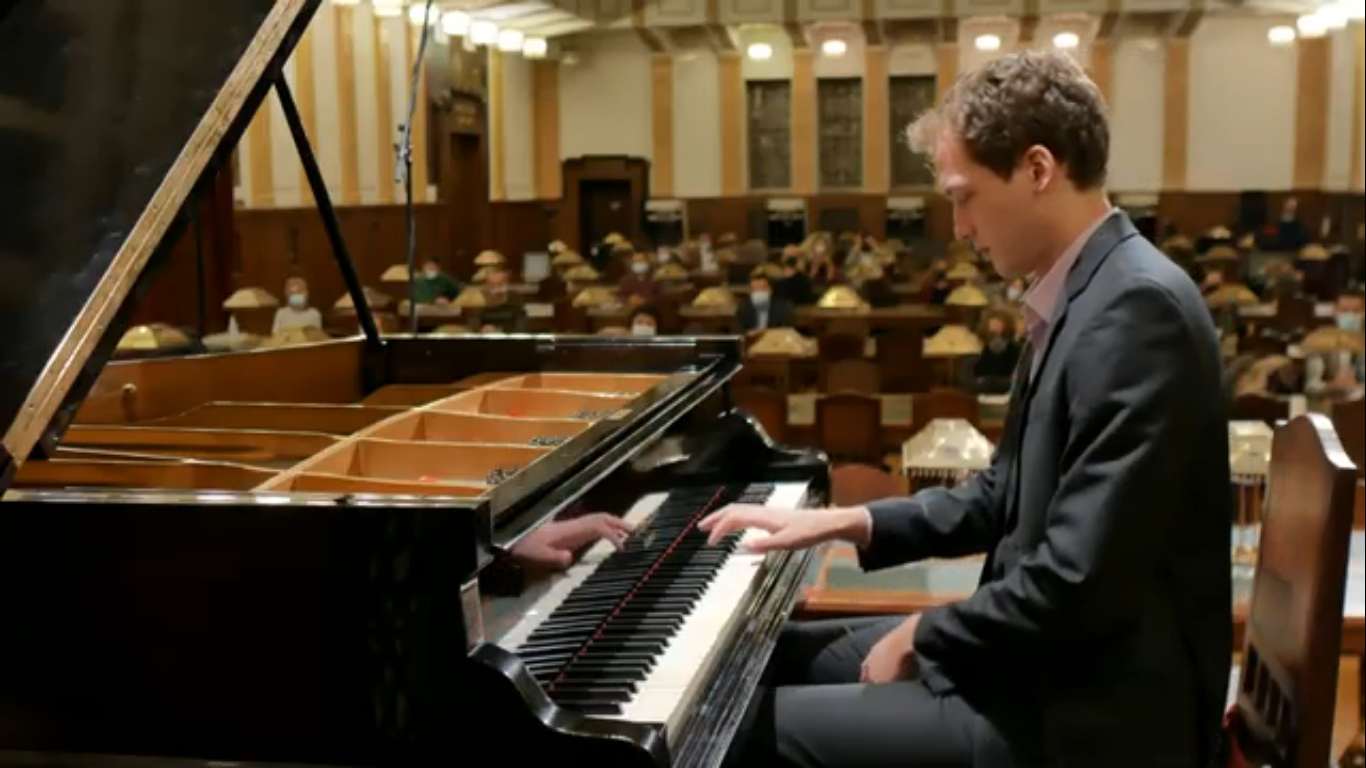
Alkan and his Grande Sonate Op 33 ‘Faustian Struggles and Promethean Prophesies’
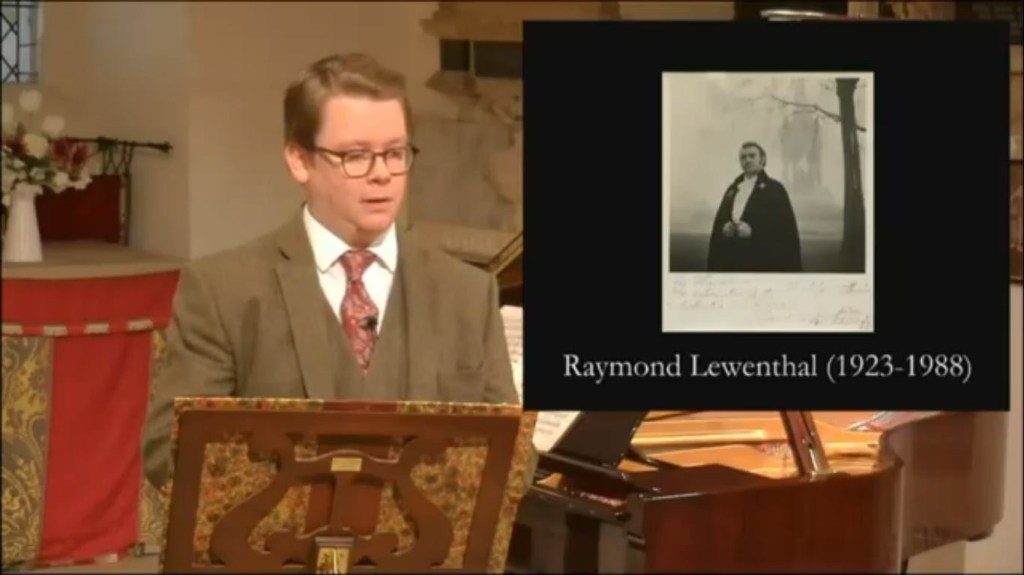
Today Mark Viner in professorial mode just as remarkable as his performances at the keyboard.I have been following his career for some years and via the Keyboard Charitable Trust we have been offering tours of Italy,USA as well as his official London debut at the Wigmore Hall .I remember the eclectic public in my theatre in Rome amazed and ravished as was the critic in Vicenza when I showed her the score of Alkan’s Le Vent with fingerings on every note ……it looked as though some virus had been at it! Bryce Morrison was on his feet cheering at his London debut and the five star reviews that his 7 CD’s have received is proof enough that here a unique figure has appeared on the musical horizon.Just as I remember Raymond Lewenthal and the queues around the hall to try to get a ticket.Raymond Lewenthal is Mark’s favourite pianist and the same heros welcome awaits his next major appearances.
This is what I have written over the years faites vos jeux:
Described by International Piano Magazine as “one of the most gifted pianists of his generation”, Mark Viner is steadily gaining a reputation as one of Britain’s leading concert pianists; his unique blend of individual artistry combined with his bold exploration of the byways of the piano literature garnering international renown. Born in 1989, he began playing at the age of 11 before being awarded a scholarship two years later to enter the Purcell School of Music where he studied with Tessa Nicholson for the next five years. Another scholarship took him to the Royal College of Music where he studied with Niel Immelman for the next six years, graduating with first class honours in a Bachelor of Music degree in 2011 and a distinction in Master of Performance 2013; the same year which afforded him the honour to perform before HRH the Prince of Wales.
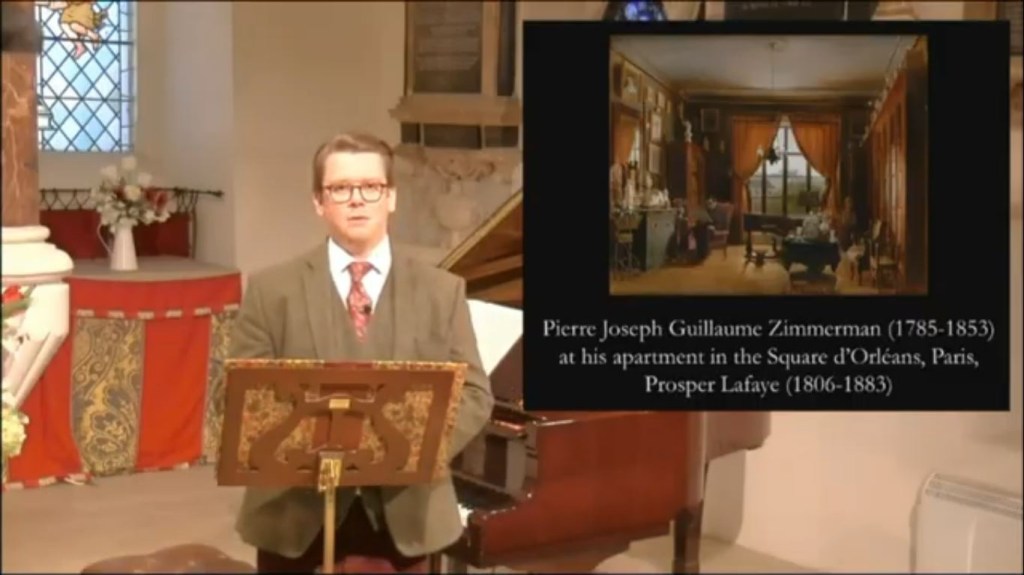
After winning 1st prize at the Alkan-Zimmerman International Piano Competition in Athens, Greece in 2012, his career has brought him across much of Europe as well as North and South America. While festival invitations include appearances the Raritäten der Klaviermusik, Husum in Germany, the Cheltenham Music Festival and Harrogate Music Festival in the United Kingdom and the Festival Chopiniana in Argentina, radio broadcasts include recitals and interviews aired on Deutschlandfunk together with frequent appearances on BBC Radio 3. His acclaimed Wigmore Hall début recital in 2018 confirmed his reputation as one of today’s indisputable torchbearers of the Romantic Revival.
He is particularly renowned for his CD recordings on the Piano Classics label which include music by Alkan, Chaminade, Liszt and Thalberg, all of which have garnered exceptional international critical acclaim. His most important project to date is a survey of the complete piano music of Alkan: the first of its kind and which is expected to run to some 17 CDs in length. Aside from a busy schedule of concerts and teaching, he is also a published composer and writer and his advocacy for the music of Alkan and Liszt led to his election as Chairman of both the Alkan Society and the Liszt Society in 2014 and 2017 respectively.
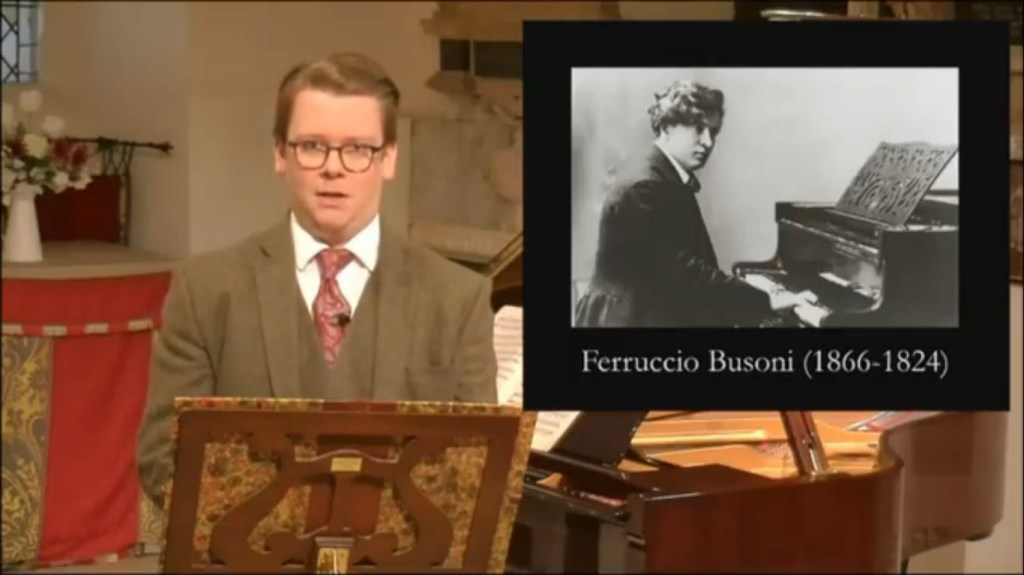
Streamed live from Zagreb on the 13th November from the Croatian National Archive Hall.Playing a Pleyel of 1911 that Svetislav Stancic acquired in 1924. Stancic ,1895-1970 was pupil of Barth,Ansorge and Busoni in Berlin and became a leggendary Professor at the Zagreb Academy .The International Piano Competition held every 4 years since 1999 is named after him .One of his pupils is Vladmir Krpan,no relation to Ivan , who used to play regularly in Rome in Teatro Ghione.
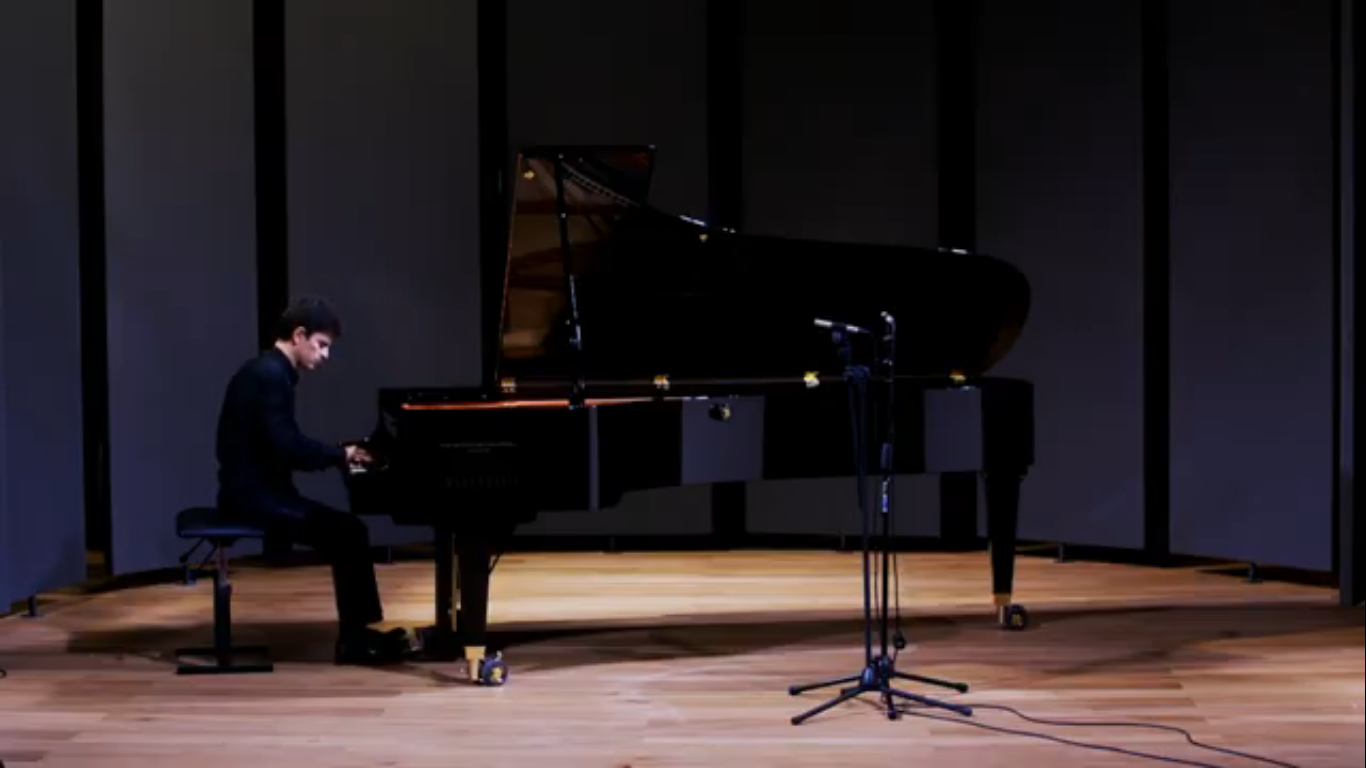
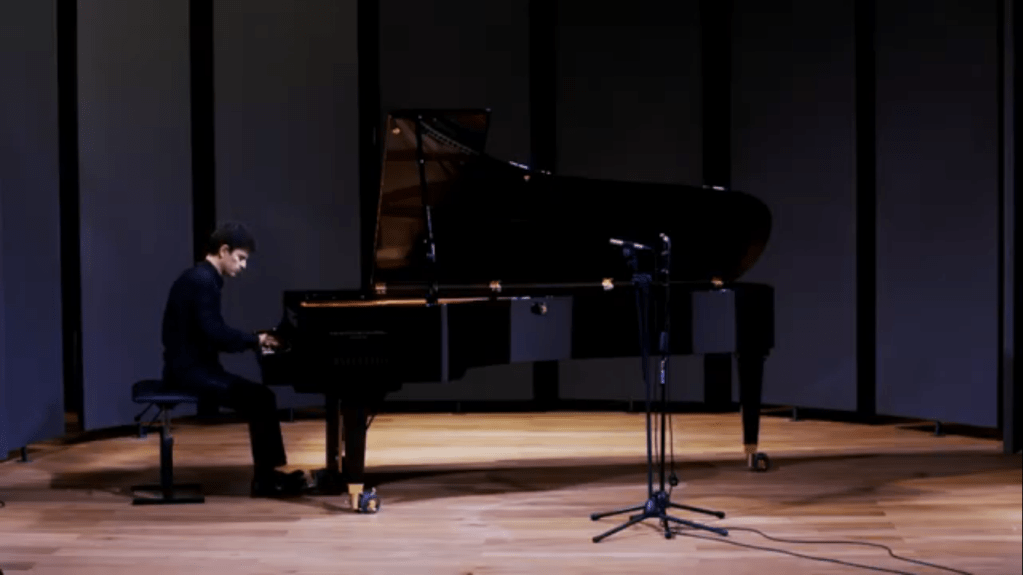
I have heard Ivan quite a few times since his run away victory in the Busoni Competition at the age of 20 .He has since come under the wing of the Keyboard Trust who offer a career development prize to the Busoni winner and was invited by them to make his London debut in 2018.In 2019 he made his debut in Rome at the Sapienza University and only last January represented his native Croatia in a special concert in the Symphony Hall in Rome to celebrate their Presidency of the European Union.Still only 23 I was very pleased when he told me that his next performance in Zagreb was being streamed live.
He tells me that concerts with social distancing are still taking place and that he had heard a magnificent Maria Jose Pires substitutiong an indisposed Martha Argerich recently in a season that includes two recitals by Ivo Pogrelich who is something of a national hero in Croatia.(www.lisinski.hr/en/) Here are some things that I have written about him over the past three years :
A real thinking musician from a family of musicians.His programmes reflect his thoughts and intellect and had me running to the history books to find out more about the composer Blagoje Bersa and some of these lesser known works of Liszt.
Ivan writes as I knew he would :My idea was to unify the programme with Bach.I started with his original music and finished with Liszt’s interpretation of his music – the variations.Also,the idea of spirituality which is always part of Bach’s music was reflected in Liszt’s pieces Ave Maria and Miserere from his Harmonies.Apart from that ,I think that the Bach variations are very modern and futuristic music which is reflected in Lugubre gondola,the piece inspired by Wagner and Venice.And then it was interesting to me how the same inspiration of Venice for Bersa and Liszt can have have a totally different outcome in their music.Finally,The Schubert song also has the same barcarolle like atmosphere so that was also a link between Bersa and Schubert/Liszt.The opening of both are strikingly similar”
J.S.Bach Partita n.2 BWV 826 Sinfonia-Allemande-Courante-Sarabande-Rondeaux-Capriccio- B .Bersa Venetian Barcarolle op 58-Schubert/Liszt Der Muller und der Bach S 565-F.Liszt Ave Maria S 173/2 from Harmonies Poétiques e Religieuses- F.Liszt La lugubre gondola S.200/1-F.Liszt Miserere d’après Palestrina S.173/8- F.Liszt Variations on a theme of Bach Weinen,Klagen,Sorgen,Zagen S.180 and encores of Chopin Prelude op 28 n.13,Schumann Arabesque op 18 Bach/Busoni Ich ruf zu dir
The six partitas for keyboard form the last set of suites that Bach composed, and are the most technically demanding of the three sets that include the French and English suites.They were composed between 1725 and 1731.Although each of the Partitas was published separately under the name Clavier-Ubung (Keyboard Practice), they were subsequently collected into a single volume in 1731 with the same name, which Bach himself chose to label his Opus 1.
Some very fine playing in which Ivan chose to give us Bach’s notes with a simplicity and purity of tone.There was no attempt at imitating the change of register as is so often the case.Here Bach’s ‘knotty twine’ was allowed to speak for itself with noble phrasing and a rhythmic impetus that carried us from the opening noble Grave of the sinfonia through the mellifluous Andante to the buoyancy and clarity of voicing in the Allegro.The Allemande seemed to flow so naturally out of this seemless stream of sounds and was played with a deeply moving simplicity.Art that conceals art indeed.Respect,simplicity,integrity and a transcendental technical command are what Bach demands.
Bach’s music is universal and Bach on the piano is and must be completely different from the harpsichord ,organ or human voice.No superficial imitation is needed to allow Bach’s mathematical jigsaw puzzle to ring out with the same nobility and belief for which it was written.The forward movement in 3/2 of the Courante was the perfect foil for the very subtle voicing of the Sarabande.The clarity and buoyancy of the Rondeaux was joined to the gentle nobility of the final Capriccio.The rhythmic energy transmitted from the very first to the very last note was exhilarating and at the same time purifying.The scene was now set for the great Romantic sounds that this young man could conjure out of this old but still very vibrant Pleyel piano.
The programme continued with Blagoje Bersa’s Venetian Barcarolle op 58.A work that had me rushing to the history books to find out more about this completely unknown composer to me:
BLAGOJE BERSA (1873 – 1934) was a composer of symphonic music, operas and songs, as well as chamber and piano works, He was undoubtedly one of the central figures of Croatian musical life at the turn of the 20th century. Born in Dubrovnik into a family of passionate amateur musicians, Bersa learned to play the piano by participating in performances with members of his family. He received his primary education in Zadar, Vienna and Trieste, and from 1893 to 1896 he studied music in Zagreb with Ivan Zajc, the renowned Croatian opera composer. From 1896 to 1899 he studied piano in Vienna with Julius Epstein and composition with Robert Fuchs (who also taught Gustav Mahler and Jean Sibelius). In 1902, he was appointed conductor at the theatre of Graz, and from 1911 to 1918 he worked as artistic counsellor and arranger at the publishing house L. Doblinger. After the end of the First World War, Bersa returned permanently to Croatia and from 1922 he taught composition and instrumentation at the Music Academy in Zagreb—a position he held until his death in 1934.
Ivan writes :”Bersa was a Croatian composer who wrote a lot of piano miniatures like the one I played.My Professor Ruben Dalibaltayan recorded all of them a few years ago and you will find them on line” youtu.be/KbgHONiebLY
A beautifully lyrical piece with a nationalistic flavour full of tradition and nostalgia.Almost conjuring the equivalent feel of the Mazuka of Poland transferred to Croatia.A miniature tone poem of song,dance and passionate outbursts.It was played with mouthwatering colours and real romantic fervour .The final farewell played with heartrending feeling and barely whispered sounds of great fluidity.Dare I say a piece of great effect which had me wanting to hear more to understand if it was real or superficial sentiment.
“Der Müller und der Bach” -“The Miller and the Brook”: “Oh dear little brook, you mean so well – but do you know what love does to you?” The hopeless Miller turns to the Brook in his heartbreak. The Brook answers with comforting and poetic words of love conquering pain. Resigned and exhausted, the Miller submits himself to the Brook’s ‘cool rest’. From “Die Schone Mullerin” song cycle by Schubert .Liszt transcribed six of the twenty songs for piano and it was the 19th of the original cycle that Ivan played today.Following straight on without a break from the Bersa Barcarolle the magic continued.A beautiful melodic line in the tenor register transferring to the soprano with such sumptuous sounds and a magical sense of colour.You could see the involvement on Ivan’s face and certainly hear from his totally commited performance finding some extraordinary romantic sounds from within this old Pleyel.
The Ave Maria and Miserere d’après Palestrina are the 2nd and 8th works in Liszt’s cycle of ten pieces under the title ‘Harmonies Poétiques et Religieuses’.I quote from Ivan’s own learned words:Ave Maria is the second movement of Liszt’s cycle Harmonies Poétiques et Religieuses. It is his piano arrangement of an earlier work for choir and organ. In this music you can hear how deep Liszt understood every word of this Christian prayer and reflected that in his music. It is very interesting to observe how in this overall simplicity of the piece, piano is used to invoke the meaning and character of every word of the prayer which Liszt, in the manner of vocal music writing, puts in the piano score. All the different nuances of text’s meaning are present in the music. The sound and emotional quality of this piece is not only used to give an effect and atmosphere but also to convey deeper spiritual messages. I can give one example here regarding the use of una corda pedal. Through the piece Liszt insists on using una corda often writing sempre una corda. In fact, almost the whole piece is played using una corda pedal. There are only three instances where he writes tre corde and when you look at those you’ll see that it all has a deeper meaning: the first place is on the text Dominus tecum (The Lord is with thee), second on the text Jesus, and the third on the text Mater Dei (Mother of God). It is as if Liszt is highlighting the three most important places in the prayer using the full sound of the instrument only there. As you can see, those three places are the only ones where God’s name is invoked. It is truly fascinating to observe details like that and to come closer to the ideas Liszt had in mind while composing this music.” And Ivan brought all this and more with playing of extreme delicacy and almost obsessive pleading with the same notes even resounding isolated in the final moving moments.A totally convinced and convincing interpreter that make one reassess the generally held view of Liszt the showman of the sparkling brilliance of his earlier works.
Never more so than with the ‘ lugubre Gondola’ S 200/1 which followed the ‘Ave Maria’ without a break.Liszt was Richard Wagner’s guest in the Palazzo Vendramin on the Grand Canal in Venice in late 1882. Liszt may have had a premonition there of Wagner’s death which inspired the first version of the work.Wagner died in Venice on February 13, 1883, and the long funeral procession to Bayreuth began with the funeral gondola to Venice’s Santa Lucia railway station. Liszt was by now almost certainly considering the piece to be a Wagner memorial,The sheer desolation over a rumbling bass of a single motif – as in Scriabin later – building to a tumultuous passionate outpouring and insistence of almost unbearable tension that just evaporated into thin air .The contemplative ‘Miserere d’après Palestrina’ was noted down by Liszt as a work of Palestrina which he heard performed in the Sistine Chapel. However, Palestrina has absolutely nothing to do with the odd melody of the motet which Liszt has collected and elaborated with tremolo and arpeggio variations.After the solemn contemplation there is a sudden burst of effusive sounds over the whole keyboard played with total conviction.From here he plunged straight into the mighty ‘Weinen Klagen’ variations with which he ended the concert.
“This massive set of variations was written by Franz Liszt in 1862, a very difficult time in his life. Two of Liszt’s three children had died within three years of each other;this was written after the death of his daughter Blandine when he had resigned his position of Kapellmeister to the court of Weimar due to continued opposition to his music These variations, whose title roughly translates as ‘weeping, plaints, sorrows, fears,’ are based on a theme from a Bach cantata of the same name, and display throughout radically chromatic harmonies suggesting anguish and despair. A fierce introduction leads to the theme and 43 variations, followed by a chromatic development in the shape of a recitative, and then a group of freer, faster variations, culminating with the choral ‘Was Gott tut, das ist wohlgetan’ (which also ends Bach’s cantata) and a brief coda in which the two themes are juxtaposed.It was one of the last pieces that the ninety year old Perlemuter had on his music stand and it is indeed an extraordinary work.Played by Ivan with great control and a fearless technical prowess as he embarked on the left hand octaves and then the enormous waves of sound across the entire keyboard.To be greeted by the simplicity of the final choral played with a luminous sound that led to the final ecstatic declaration of faith with which it ends.
The simplicity of the Chopin prelude op 28 n.13 in F sharp major offered as an encore was played with the same luminosity of sound and an exquisite sense of balance leading to the mellifluous flowing Arabesque of Schumann.It was played with an aristocratic sense of line where the wondrous sounds that he found in the coda were a reminder of the magical ending that Schumann often gives to the piano at the end of his songs.Music can and does reach where words are just not enough.Insistent applause was rewarded with an parting declaration of faith with the Choral Prelude by Bach in Busoni’s transcription :”Ich ruf zu dir ” I call on You my Lord-Please I beg You hear my crying
A truly humbling experience .An intelligence and maturity way above his 23 years he is an artist destined to thrill and move a waiting world for many years to come.
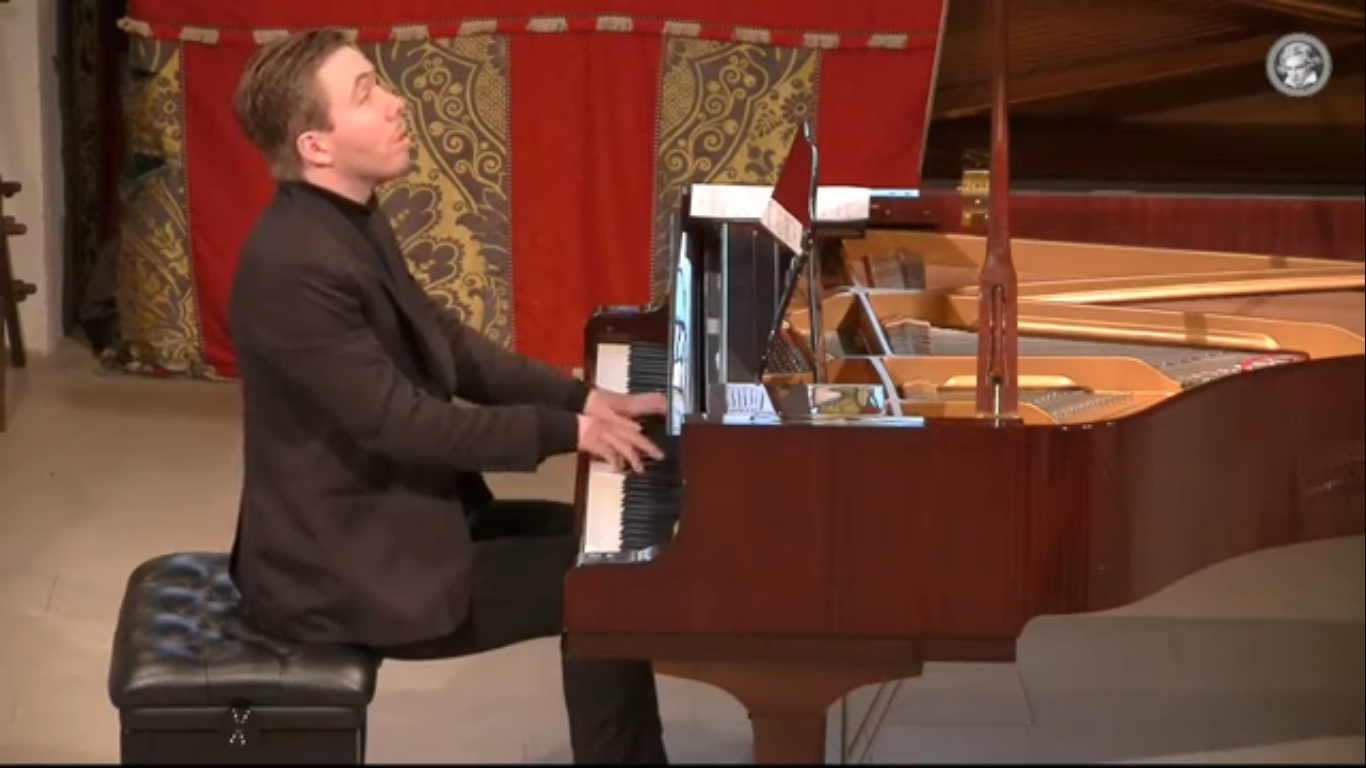
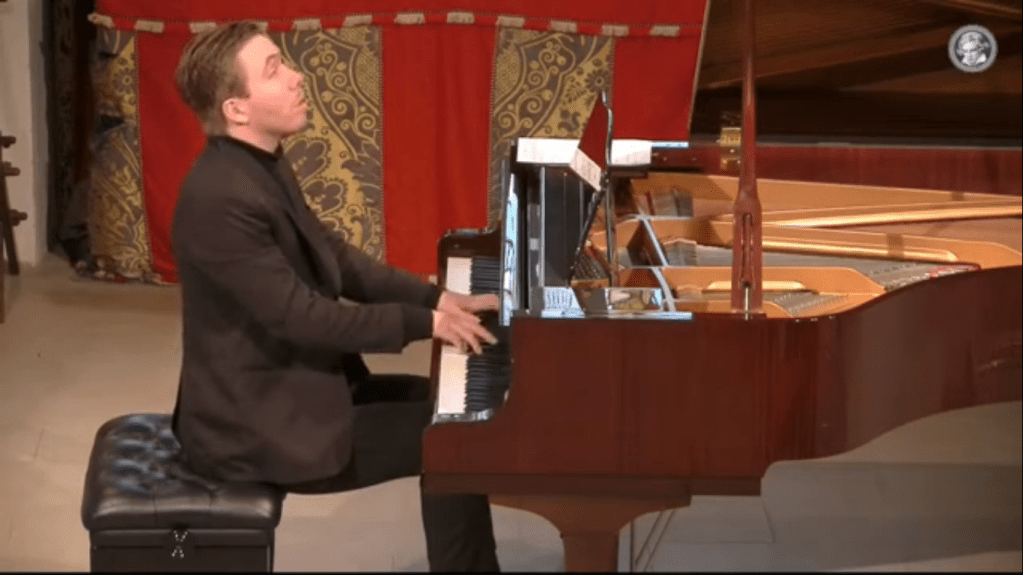
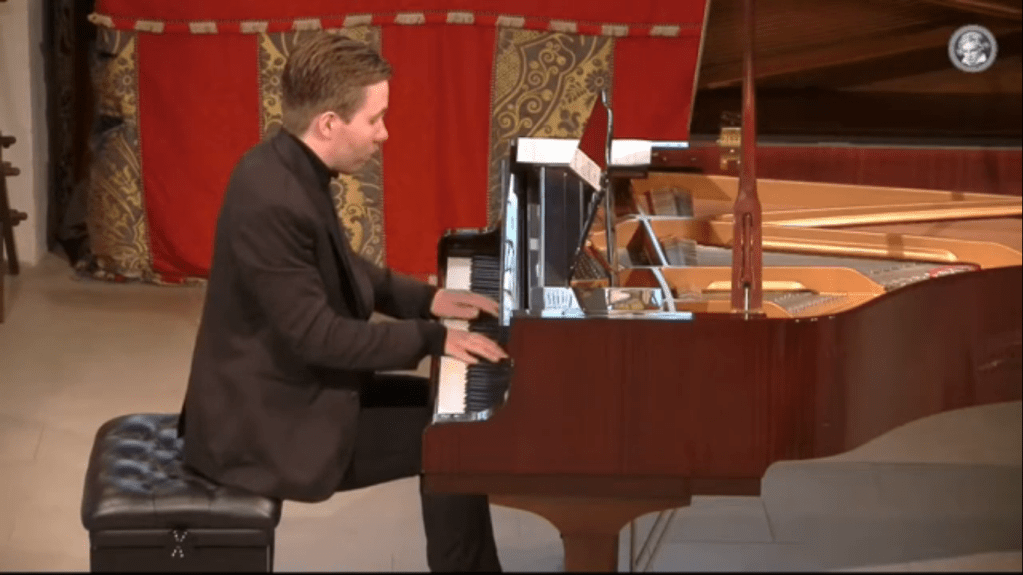
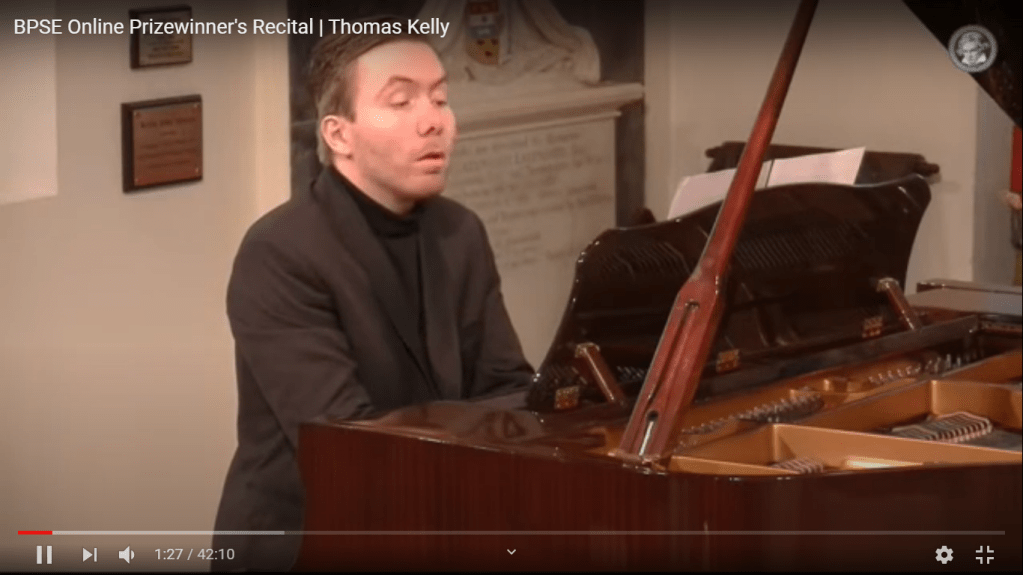
Thomas Kelly was born on 5 November 1998. He passed Grade 8 with distinction in 2006, andperformed Mozart Concerto No.24 in the Marlowe Theater two years later. After moving to Cheshire, he regularly played in festivals,including the Birmingham Festival. He won 3rd prize in Young Pianist of The North 2012 and 1st prize in WACIDOM 2014.Since 2015, Thomas has been studying with Andrew Ball, initially at the Purcell School of Music and now at Royal College of Music where he is in third-year undergraduate. Thomas has won first prizes including Pianale International Piano Competition 2017, Kharkiv Assemblies 2018, at Lucca Virtuoso e Bel Canto festival 2018, RCM Joan Chissell Schumann competition 2019, Kendall Taylor Beethoven competition 2019 and BPSE Intercollegiate Beethoven competition 2019.In addition, he has performed in a variety of venues, including the Wigmore Hall, Cadogan Hall, Holy Trinity Sloane Square, St James’ Piccadilly, Oxford Town Hall, St Mary’s Perivale, St Paul’s Bedford, the Poole Lighthouse ArtsCentre, the Stoller Hall, at Paris Conservatoire,the StreingreaberHaus in Bayreuth, the Teatro Del Sale in Florence, and in Vilnius and Palanga.Thomas’ studies at RCM are generously supported by Ms Daunt and Ms Stevenson, Pat Kendall Taylor and C. Bechstein pianos.
I have heard Thomas Kelly on many occasions since listening to him quite by chance at the Schumann Competition at the RCM.I was not surprised that he won first prize with a very persuasive performance of Carnaval – the work with which he chose to finish this short recital for the BPSE at St Mary’s Perivale.
It was a programme made up by a rarely performed work by Beethoven together with a reworking of the very well known ‘Moonlight ‘Sonata finishing with Schumann’s Carnaval op.9
Jonathan Östlund: Mondspiegel – Fantasia on Beethoven’s ‘Moonlight Sonata’ (mvt.1) (World Premiere)
A fascinating piece offered in World Première by the distinguished composer Jonathan Ostlund.As he himself says it is an elaboration of the first movement trying to evoke the atmosphere that the title ,which was not Beethoven’s but his publishers,evokes.It follows almost faithfully the original adding magical sounds and embellishments that give even more colour and atmosphere.It was played by Thomas with the ravishing liquid sounds and colours that had immediately caught my attention in his Schumann op.9 at the RCM.Rather self indulgent but short enough not to become too schmalzy especially when played with such serious and sensitive intent as at it’s world première today.
The composer himself has written:”By writing ‘Mondspiegel’, I expressed a homage and created a ‘meeting’, a little time travel exercise… Although Beethoven didn’t name it Moonlight Sonata himself, but rather his publisher did, it is easy to imagine this moonlit inspiration with Beethoven sitting by his piano,looking out over the skyline. I wanted to play with the elements of the moonlit scene, and its introvert qualities, while turning it into a fantasiawith an elegiac character, yet hopeful; with an air of springtime, and a meditation on the flow of inspiration, and of time.” — Jonathan Östlund
Jonathan Ostlund received his BA and MA in Composition at LTU, Sweden, and has so far completed more than 100 works, including several orchestral works, and two concertos. His achievements include CD-releases, publications and performances with the LSP in the U.K., France and Romania throughout 2010 and 2011.In 2012 he won the Public Choice Award for the Cello Sonata, premiered by A. Zagorinsky and E. Steen-Nokleberg, and was awarded 1st Prize in the LSO’s Composers’ Composition with his ‘Celebration Fanfare’, which was premiered during the Orchestra’s 90th Season Gala. In 2013 followed various premieres in the U.K. andFrance.
Beethoven Fantasia Op.77
As Thomas himself has penned :”Beethoven Fantasia Op.77 a highlight of his piano output which is simultaneously a seed from which more famous conceptions grew, and an insight into Beethoven’s capabilities as an improviser.John C Sutton wrote that Beethoven extemporised it during his famous concert on 22 December 1808 (performed alongside works such as the 4th Concerto, 5th Symphony and Choral Fantasy), later writing down the Fantasia as Op.77.”
After ending an improvisation of this kind Beethoven would burst into loud laughter and mock his listeners for the emotion he had caused in them. ‘You are fools!’, he would say.’
It was just this sense of character that was so much part of Thomas’s interpretation.As Thomas himself says:’The opening scales are like a call to attention, which is followed by a D flat major episode hinting at the sublime.’In fact it was just this difference between the scale interruptions that obviously gave the improviser time to decide what direction he would take next.It is nice to think of Beethoven seated at the piano changing from one mood to another.From the hauntingly beautiful first episode played with a beauty of sound and a feeling that the music was being created in that very minute.This infact is one of the first things I noted about Thomas’s playing .The spontaneity and obvious delight at finding the most ravishing tonal varieties due to his very natural technical agility allied to a very sensitive ear.There followed a cordial B flat major theme, a vicious passage of broken octaves played with a wonderful rhythmic impetus and forward drive. Impatient somewhat violent interruptions – obviously Beethoven having fun at the keyboard.The main theme in an unexpected B major has overtones of the choral themes in the Fantasy op 80 and 9th Symphony, on which Beethoven proceeds to write a set of his best variations.The final delicate collision of scales brings the work to a peaceful conclusion.A fascinating journey and a thanks to Thomas and the BPSE for including this rarely heard work in this 250th anniversary year
Schumann Carnaval Op.9 with which he ended this short recital needs no introduction.This is what I wrote exactly a year ago:
‘But it was a performance of op 9 Carnaval that caught my attention for the liquid sound and natural pianism almost of Nelson Freire dimension.Some things cannot be taught and the God given gift to communicate has been given only to a chosen few.They may exceed in rubato or excess of bravura but there is a quality of sound that goes straight to the heart in a direct musical conversation.Thomas Kelly ran away with the prize and I can just see Joan Chissell with a smile of recognition on her face.She was a critic who could in just a few well chosen words illuminate her articles in the Times and her books on Schumann have become a reference for us all’
And it was all here today but with a maturity and assurance that a year of discovery can make to a real young artist.There was all the sense of characterisation allied to a charm and above all a sense of colour that could bring these well know pieces vividly to life.A strange quaver instead of semiquaver right at the opening fanfare I put down to the exhuberance of the minute but the delicate charm in the più moto and animato was irresistible as was the relentless forward movement that took us to Pierrot’s door.Ravishing change of colour on the melodic notes but why play the ‘f’ staccato!Artistic licence and Thomas is certainly a remarkable artist!
Arlequin was thrown of with consummate ease and the great bass notes in Valse noble made the contrasting middle section even more magical.The same thumb melody was allowed to sing out in the left hand repeat the same as I have never forgotten from the hands of Cortot. Eusebius,Schumann’s tranquil companion was played with a simplicity but such wondrous colouring from within as Florestan just crept in with some wonderful jeux perlé playing.Coquette was played with just the right amount of charm and colour which led to the lovely question and answer of Réplique.The strange Sphinxes I have only ever heard from Rachmaninov and like Thomas today are not usually incorporated into performance being only a floor plan that Schumann places in the middle of this work.As Thomas says:”it is possible to think of the Sphinxes as casting a shadow over the Carnaval without being literally played”Papillons fluttered over the keyboard in masterly fashion with a lightness and playfulness that took us straight to the Dancing Letters that could have been even more ‘leggierissimo’ to contrast with the passionate outpouring of Chiarina.Chopin enters the scene with a mellifluous outpouring of Bel Canto which was played with baited breath on it’s magical repeat .The ease with which he played the repeated notes in Reconnaissance was masterly especially as they were imbued with such shape and colour too.The contrast with the almost hammered arguing of Pantalon et Colombine was remarkable as even here there was no harshness of sound but wonderful shape and colour.The gentle lilt to the Valse allemande was indeed the calm before the storm.Paganini entered the scene with amazing virtuosity and precision the reverberating final chord perfectly judged.Aveu was played with a simplicity that led to the Promenade and grandiose March of the Davidsbundler against the Philistines.Played with great technical prowess but also with a sense of style that cannot be taught but is in the very bones of the true artist.
George Todica a concert in collaboration with the Keyboard Charitable Trust
Tuesday 10 November 4.00 pm
Streamed LIVE concert in an empty church
George Todica (piano)
Chopin: Rondo à la Mazur op 5
Chopin: Mazurka in C# minor Op 41 no 4
Enescu: ‘Choral’ and ‘Carillon Nocturne’ from Suite no 3 Op 18
Rachmaninov: Variations on a theme by Corelli Op 42
very assured and deeply felt introductions mirrored by equally moving playing
Born in Iasi in 1993, he started his musical training when he was six, under the guidance of Silvia Panzariu. He went on attending the Octav Bancila School of Arts, later joining the classes of Raluca Panzariu and then Andrei Enoiu-Panzariu, and having lessons outside of school with pianist Iulian Arcadi Trofin. George came to the United Kingdom in 2010, after winning the ‘Constantin Silvestri’ Scholarship which allowed him study for one year at the Stewart’s Melville College in Edinburgh. A year later he entered the Royal Conservatoire of Scotland where he would study for the next six years, under the guidance of Graeme McNaught, Norman Beedie and Jonathan Plowright. He finished his Bachelor Degree in 2015 with First-Class Honours and his Masters Degree in 2017. His training was supported by two scholarships from the RCS, scholarships from The Tillet Trust and The Colin Keer Trust and a ‘Britton Award’ from Help Musicians UK. After a recent successful audition, he has been chosen for the Tillett Young Artist Platform scheme for 2017.George had his Wigmore Hall debut in October 2018 as a Tillett Trust Young Artist, and his competition success includes first prizes at the Norah Sande Award in England, the Llangollen International Eisteddfod in Wales, ‘Stefano Marizza’ Piano Competition in Italy, the Moray Piano Competition in Scotland, 2nd prize at the International Piano Campus Competition in France, as well as the Ligeti prize and the prize for the best performance the contemporary work for piano and orchestra and 3rd Prize at the International Piano Competition Istanbul.
He completed his studies in 2019 with his Artist’s Diploma at the Royal College of Music in London under the guidance of Norma Fisher
As a concert pianist, he has travelled to various venues in Italy, Austria, Croatia and the USA and has performed in prestigious halls such as the Teatro San Giuseppe in Torino, the Philharmonic Hall in Trento, the Mozarteum Concert Hall in Salzburg, the Fazioli Factory in Sacile, the Conservatoiro Tartini di Trieste and the Dôme de Pontoise in France. In the past few years, George has also been playing in the UK at the Glasgow Royal Concert Hall, the Edinburgh Society of Musicians, the Brunton Theatre in Edinburgh, the Erin Arts Centre on the Isle of Man, the Hall at Yamaha Music London, Inverness Town Hall, the Ardkinglas Castle in Argyll, and various other venues. He has performed with the Royal Scottish National Orchestra playing Saint-Saëns’s Carnival of the Animals and in the All About Piano Festival in London at the Institut Français du Royaume-Uni and at St. Martin-in-the-Fields.
A fascinating recital by this young Romanian pianist for the past ten years living in the UK – first on a special scholarship to a boarding school in Edinburgh and from there to the Glasgow conservatory and finally to London.His fiancée is the singer Charlotte Hoather – two attempts at marriage have been ruined by the Covid crisis but in the meantime they intend to share their music and unite their comunity
‘This Friday marked our fourth balcony concert, and it has been a real joy to sing to my neighbours and friends online alongside George. Despite being limited to our own home for a few weeks now, it has been a breath of fresh air to feel close to the lovely people who live near me. I feel connected to a bigger community, a neighbourly relationship that I reminded me of my childhood.’ Obviously a match made in heaven!
A programme of Chopin, Enescu and Rachmaninov so eloquently introduced by this young artist.
These first two works by Chopin are inspired by the Mazurka.The Rondo à la Mazur op 5 written when only 16 and for his own purpose to play in the salons of the day.This is an early work of brilliance and lyricism ,naive and immature but full of youthful energy and enthusiasm. Chopin would have astonished his audiences in Poland before moving to Paris at the age of 20 from where he was never to return.His heart though was returned after his death to his native Poland from where it had never really left.His bodily remains were buried in Père Lachaise Cemetery in Paris.
And it was the mature mazurka op 41 n.1 in C sharp minor where his youthful enthusiasm was replaced with majesty and solemnity,pride and wisdom.As George so wisely stated it was a mazurka that’ thinks before it talks!’ What a wonderful turn of phrase indeed.
There was a great sense of style as he threw off the continuous chain of jeux perlé notes with an ease and sense of shape that was charming as it was brilliant.An irresistible sense of belcanto too in the beautiful lyrical sections.Some truly magical moments with trills that gleamed like jewels in the web of sound that he so magically conjured with such nonchalance.Every note became so fibrantly alive as he brought this somewhat shallow work to life with the same yearning nostalgia that was to pervade Chopin’s later works.There was though a youthful exhuberance that was nowhere to be seen in his later years long from his homeland and the concert hall.
There were some wonderful changes of colour in the Mazuka op 41.The same yearning nostalgia played with a more masculine delicacy.A truly heartbreaking duet between the hands leading so gently back to the original dance rhythms and an exquisite coda dying away into the distance.
The middle part of the recital was dedicated to two movements from George Enescu’s 3rd Suite op 18 for piano.Enescu is not only George’s compatriot but also he confided his idol.He is not the only one either:Pablo Casals described Enescu as “the greatest musical phenomenon since Mozart” and “one of the greatest geniuses of modern music. Yehudi Menuhin, Enescu’s most famous pupil, once said about his teacher: “He will remain for me the absoluteness through which I judge others,he gave me the light that has guided my entire existence.” He considered Enescu “the most extraordinary human being, the greatest musician and the most formative influence” he had ever experienced.
Choral was inspired by the orthodox liturgy- almost a prayer as George described it .A confession of sin ,redemption and forgiveness.It was played with some wondrous sounds from every part of the keyboard.A musical language that fits no specific category but is strangely hypnotic and obviously for George at the very roots of his being.An ending of pure magic barely whispered as it disappeared into the very heights of the piano.
To be awoken by the bells of Carillon resonating and almost Messiaenic in its moving dissonance.Whispered responses from the faithful answered by the bells.A wonderful use of the sustaining pedal gave great resonance to the ever vibrating bells.Ringing out a final 12 times – each time slightly different with whispered responses arriving on the final major chord – transformed and redeemed!A very moving performance that I would love to hear more often in the concert hall.
The final work was the Rachmaninov Corelli Variations.Written in 1931 and based on a mediaeval melody La Folia that Corelli had used for a set of variations in 1700. Rachmaninov injects the very essence of Russian romanticism into it as he extracts as much substance as he can creating a real metamorphosis in the course of his 20 variations.
Rachmaninoff dedicated the work to his friend the violinist Fritz Kreisler. He wrote to another friend, the composer Nikolai Medtner on 21 December 1931:I’ve played the Variations about fifteen times, but of these fifteen performances only one was good. The others were sloppy. I can’t play my own compositions! And it’s so boring! Not once have I played these all in continuity. I was guided by the coughing of the audience. Whenever the coughing would increase, I would skip the next variation. Whenever there was no coughing, I would play them in proper order. In one concert, I don’t remember where – some small town – the coughing was so violent that I played only ten variations (out of 20). My best record was set in New York, where I played 18 variations. However, I hope that you will play all of them, and won’t “cough”.
The theme La Folia was played with great delicacy and sense of colour.A great sense of balance in the first variation allowed the melody to emerge amongst the embellishments with gentle comments from the bass.Legato and staccato were perfectly matched in the second and there was already magic in the air in the fourth with a wonderful sense of line.Scintillating virtuosity in the following variations leading to the booming bass of the 7th with cascades on notes above.Typical haunting harmonies of the ninth led to the extreme rhythmic precision of the tenth.A great sense of architectural shape in the eleventh that is usually just hammered home by lesser mortals.
Deep staccato notes alternated with meltingly pleading fragments and the Intermezzo had some startling cadenza like passages thrown of with a brilliance and lightness leading to the theme in the major key.It drifted so naturally into the most hauntingly mellifluous of the variations very similar to one of his preludes from op 32.The gradual reawakening to the final triumphant appearance of the sun had with some transcendental playing of great assurance in the final three variations.A small blemish was immediately and expertly covered as we approached the final piu mosso explosion of sounds.Left only with the reverberating bass ‘D’ and ‘the ashes’ as we are left in complete desolation and wonderment not least at the remarkable performance that we were offered by this young Romanian pianist.








 ChristopherAxworthy-MusicCommentary