Poeople would follow Peter Croser’s lessons and others to see how they progressed.


n


Here, actor David Tennant uses André Tchaikowsky’s skull in a 2008 production of Hamlet.


Poeople would follow Peter Croser’s lessons and others to see how they progressed.


n


Here, actor David Tennant uses André Tchaikowsky’s skull in a 2008 production of Hamlet.


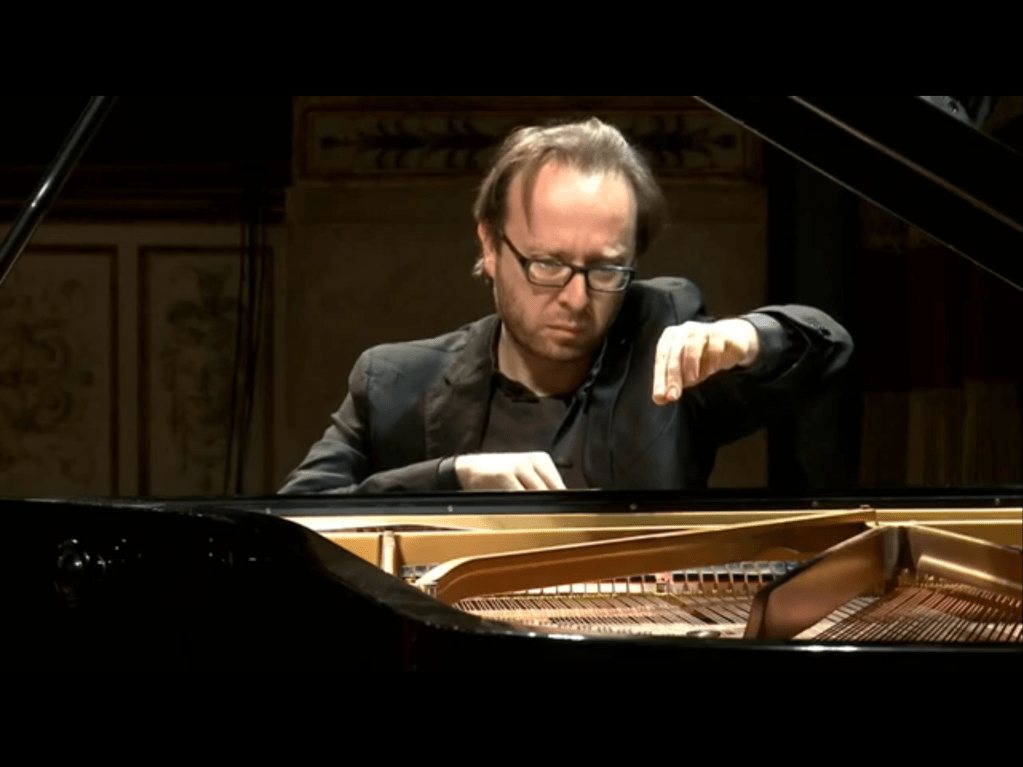
Alim Beisembayev (piano) was born in Almaty, Kazakhstan and started playing the piano at the age of 5. He is currently a student at the Royal Academy of Music where he is supported by a full scholarship and studies with Tessa Nicholson. Alim had numerous successes in international competitions: International Competition for Young Musicians “Nutcracker” in Moscow (1st prize, 2008), Franz Liszt International Junior Competition in Weimar, Germany (3rd prize, 2014), Junior Van Cliburn International Piano Competition in Fort Worth, Texas (1st prize, 2015). Alim previously attended the Central Music School in Moscow and the Purcell School for Young Musicians. He performed in halls such as the Royal Festival Hall, Purcell Room, the Great Hall of Moscow Conservatoire, Fazioli Concert Hall in Italy. In 2016, February, Alim made an appearanceon BBC’s ‘In Tune’. Alim currently studies at the Royal Academy of Music and performs chamber music as well as solo. He is also experienced in performing with orchestras such as the Evgeny Svetlanov State Symphony, Tchaikovsky State Symphony, Fort Worth Symphony.


The theme had been sent to Schumann by Baron von Fricken, guardian of Ernestine von Fricken, the Estrella of his Carnaval op. 9. The baron, an amateur musician, had used the melody in a Theme with Variations for flute. Schumann had been engaged to Ernestine in 1834, only to break abruptly with her the year after.
Hardly surprising then that Schumann thought it was unsuitable for public performance and advised his wife Clara not to play it!The entire work was dedicated to Schumann’s English friend, the pianist and composer William Sterndale Bennett who played the piece frequently in England to great acclaim.
Of the sixteen variations Schumann composed on Fricken’s theme, only eleven were published by him. The final, twelfth, published étude was a variation on the theme from the Romance Du stolzes England freue dich (Proud England, rejoice!), from Marschner’s opera based on Sir Walter Scott’s Ivanhoe (as a tribute to Schumann’s English friend and dedicatee Sterndale Bennett). The earlier Fricken theme does occasionally appear during this étude and the work was first published in 1837 as XII Études Symphoniques. On republishing the set in 1890, Brahms restored the five variations that had been cut by Schumann. These are now often played, but in positions within the cycle that vary somewhat with each performance; there are now twelve variations and these five so-called “posthumous” variations which exist as a supplement.

Alim played the original 12 Etudes Symphoniques and did not incorporate, as many do, the five posthumous variations.This gave a great architectural structure to the work and through the gradual build up and with his superb musicianship he did infact make these into truly Symphonic studies.
The simplicity and beauty of the theme and gentle question mark ending led so naturally into the lightweight scamperings in which the theme emerges with a superb sense of legato and staccato.The passionate beauty of the second variation played quite simply without any false exaggerations in the repeats but allowing the music to talk and speak for itself.The lightweight flight of the third was quite remarkable with the melodic line so beautifully shaped in the tenor register. The third chordal study played with a forward motion as it contrasted so well with Schumann’s lightweight flights of capricious fancy free invention. The passionate outburst of the fifth was played with impetus and impeccable technical control leading into the chords of the sixth played with great rhythmic energy and again total control especially in the trecherous final octaves.

The shape and structure of a Gothic Cathedral as Agosti described the seventh showed again Alim’s real musicianship and sense of architectural line .Allied always to a beautiful sense of contrast and colour but never forgetting the overall direction and shape of this musically most complex of studies.The ninth study was thrown of with a Mendelssohnian ease that belies the real technical difficulties involved.The tenth -the calm before the storm- was played with a beautiful left hand tremolando much as he had done in the Liszt study.It allowed the melodic line and counterpoints to sing unimpeded as they conversed amongst themselves gently leading to the great passionate outburst before dying away so magically.The finale was played with all the rhythmic impulse and romantic aplomb where his subtle sense of colour and shaping managed to shape the dotted rhythms, that Schumann too often inflicts on us, with such nobility and aristocratic control .
An encore of a Scarlatti Sonata in G showed off the crystalline technique and sense of colour together with an infectious sense of rhythmic urgency that can turn these seemingly innocent little sonatas into such sparkling jewels

Little could I have imagined that the McLachlan’s have four children three of whom are pianists and the odd one out at 16 is a professional footballer.Callum,21 is studying with Claus Tanski in Salzburg; Mathew at 19 with Dina Parakhina at the RCM in London and Rose 17,is studying with Helen Krizos at the RNCM.
I had heard Callum playing superbly in London on several occasions and Mathew’s playing I heard in Rome recently but Rose I had not heard until listening to her on a radio rebroadcast of Shostakovich’s Second Piano Concerto.It was written for his son’s 19th birthday but Rose was only 17 when she recorded the concert for the BBC!
It was a magnificent performance not only for the professional note perfect live recording.But it was played with a beauty of sound and sense of colour and subtle phrasing allied to the tongue in cheek rhythmic pungency that that this charming work exudes.
I wanted to hear more and found a private recording of part of a recital she gave recently for that connoiseur of pianist Dr Hugh Mather in his series in St Barnabas in Perivale.
Some beautiful performances of a real stylist.
Waldesrauschen S.145 one of the two rarely played concert etudes was here played with a wonderful sense of balance as the melodic line passed from the right hand to the left unnoticeably with the gently cascading embellishments of the ‘forest murmurs’ shimmering in the magical distance A passionate climax played with all the youthful spirit and virtuosity that Liszt himself must have shown in this very refined concert study of pure melodic invention.

The Abegg Variations op 1 by Schumann showed a a great sense of foreward movement and jeux perlé that was also so much part of a really beautiful performance of the Schubert Impromptu op 142 n.3 D935 /3.The sonata op 109 by Beethoven was sadly lacking from this video recording but I had heard from Dr Mather that is was a really exceptional performance for its musicianship but also for the beauty of sound that she was able to draw from this old but still very noble Bosendorfer.
It is hard to believe that her case with all her concert cloths was stolen at the station on her arrival to London from Manchester the previous evening .It was thanks to her friend who was able to lend her a concert dress for the occasion.
What a remarkable family the Mc Lachlans are rising to the occasion no matter what the difficulty as it is above all the the music that matters more than any other little inconvenience! Not only talented and professional but where music is the central part of family life!

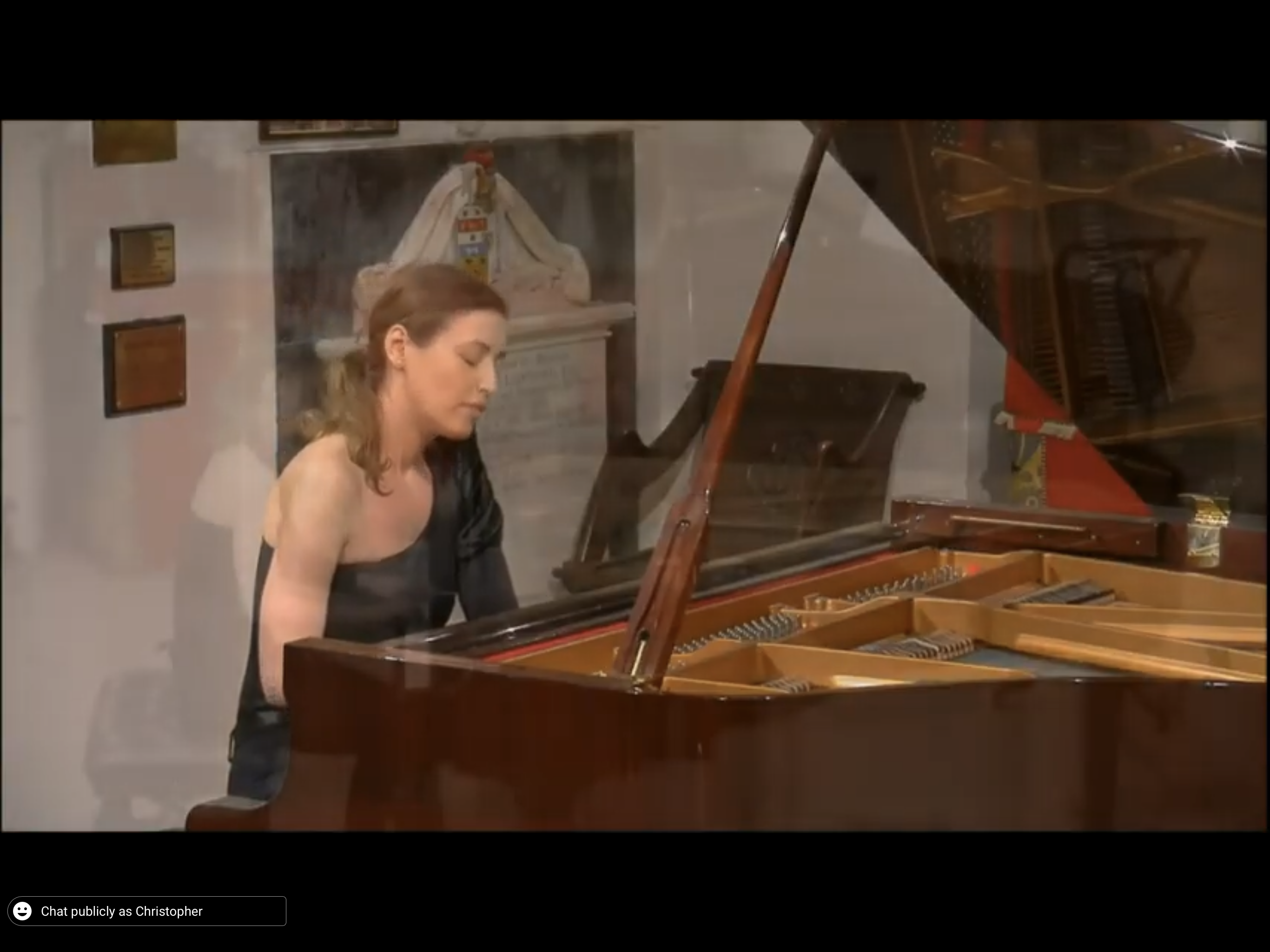
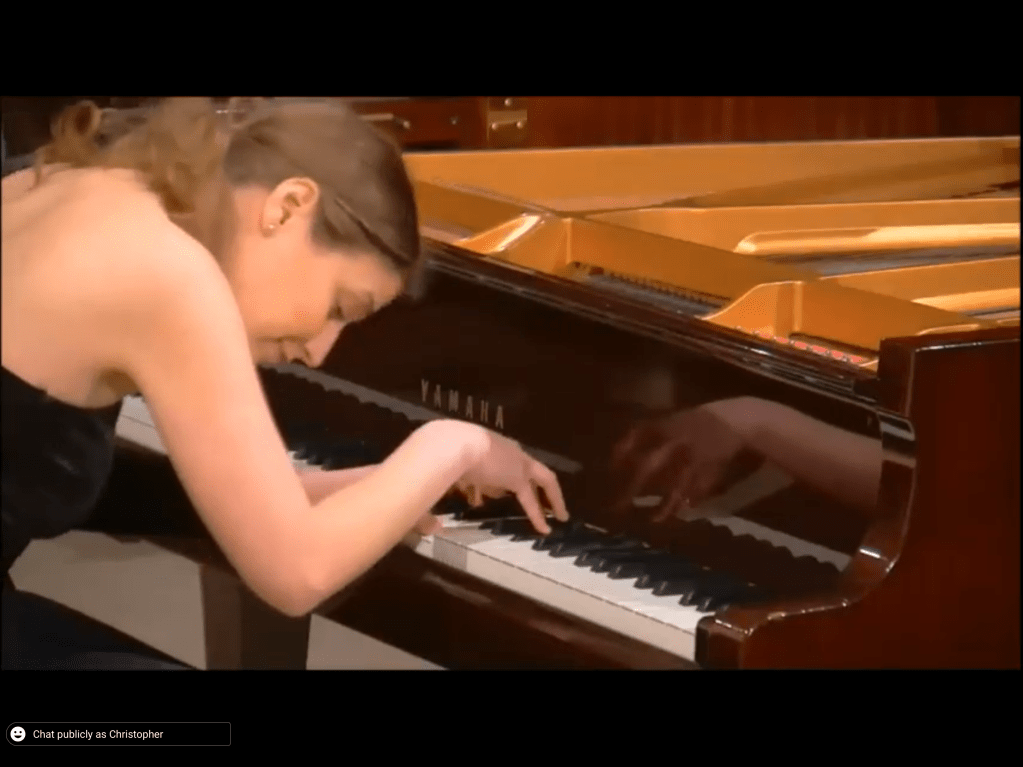
Rose McLachlan was born in 2002 and began piano lessons with her father Murray in 2008. She entered Chethams School of Music in 2010 as a chorister at Manchester Cathedral.
Rose is now (2018) a pianist studying with Helen Krizos, studying organ with Chris Stokes and having singing lessons with Helen Francis. In 2012, she passed Grade 8 piano with 144/150 – distinction and in 2017 was awarded the LtCL performers diploma with distinction. Rose was the overall winner of junior and senior classes of the 2016 Scottish Youth Prize at the Royal Conservatoire of Scotland. She also won the Sir David Wilcocks Organ Scholarship 2014/15.
She has performed Beethoven’s second concerto five times as well as solo recitals in Lanzarote, Portsmouth, Wilmslow, and various lunchtime concerts at Chethams. As an overall winner of the Chetham’s concerto competition in February 2018, Rose was selected to perform the Ravel G major concerto with the Chetham’s symphony orchestra during the 2018-19 season. Also scheduled for 2019 are performances of all Chopin’s Waltzes and Nocturnes for Sir Ernest Hall in his Camel Concerts series of recitals in Lanzarote.
Dinara Klinton was born in Ukraine and has recently completed the Artist Diploma in Performance course at the Royal College of Music. Dinara is the first recipient of the prestigious Benjamin Britten Fellowship, generously supported by the Philip Loubser Foundation. Prior to this she was awarded a Master of Performance degree with distinction at the RCM where she studied with Dina Parakhina and Vanessa Latarche. Upon graduating from the Moscow Central Music School, she went on her Graduate Diploma with Honors at the Moscow State Conservatory, where she worked with Eliso Virsaladze.Dinara has won many awards in prestigious international competitions, including Third prize at the Cleveland International Piano Competition in USA (2016), Third prize at the BNDES International Piano Competition in Rio de Janeiro, Brazil (2014), Second Prize at the 9th International Paderewski Competition in Bydgoszcz, Poland (2013), Second Prize at the Ferruccio Busoni International Piano Competition in Bolzano, Italy (2007), Grand Prix at the Berne Interlaken Classics International Piano Competition (2010) etc. She has also received the Diploma for the best semi-finalist at the XVII International Chopin Competition in Warsaw (2015) and Diploma of Outstanding Merit at the Hamamatsu International Piano Competition in Japan (2006).Dinara has appeared at many international music festivals including the Rheingau Music Festival, International Festival of Piano “La Roque d’Antheron”, Aldeburgh Proms, Cheltenham festival. She has performed all over the globe in such venues as Royal Festival Hall, Cadogan Hall in London, Tchaikoivsky Concert hall in Moscow, Great hall of Moscow state Conservatory, Konzerthaus Berlin, Gewandhaus zu Leipzig, Warsaw Philharmonic, Tokyo Sumida Triphony Hall. She made her debut recording at the age of sixteen, with Delos Records, and the album Music of Chopin and Liszt. Her second album Liszt: Études d’exécution transcendante, S. 139 was released in 2016 with GENUIN Classics. She is an Assistant Professor at the Royal College of Music.

I have heard Dinara play many times and I even heard a masterclass with Emanuel Ax in which she played some of the Liszt Trascendental Studies.She recorded the studies to great aclaim too.
On this occasion she had chosen to play Paysage and Chasse Neige but as the next pianist for the masterclass had not arrived in time she was asked if she would like to play another study.We were all astounded when she played Feux Follets with such ease and style.It is one of the most transcendentally difficult pieces in the piano repertoire.Emanuel Ax just grinned and wanted to know the secret of how she managed to play it so perfectly.
She became known affectionately as Miss Feux Follets at the College.
She has the most flexible hand and fingers but they are fingers of steel trained at a very early age at the Central Music School in Moscow.A technique that allows her to play not only with a sumptuous rich sound,never hard or brittle but also extraordinarily quiet sounds with so many different gradations of sound from mezzo forte to pianissimo.

It was this that we were aware of today in a programme of popular classics.Works that are particularly close to her heart since listening as a little girl to the LP’s that her mother had at home. A few short early pieces of Chopin were a framework for the Barcarolle op 60 considered by many to be one of his greatest works.
The nocturne in D flat op 27 and the Prelude op 28 n.15 were played with ravishingly beautiful sound.The Nocturne in particular was played with an exquisite sense of balance and colour where Chopin’s magical bel canto seemed to float on a layer of sumptuous sounds.The Prelude too one could appreciate why it has earned the name of Raindrop.Such was the refined beauty of the melodic line with a very subtle sense of rubato.It gave such flexibility to what in many hands can be a great tone poem with a menacing but overpowering middle section.Dinara kept the sound in strict control never letting the middle section overpower the out melodic sections from which it grows.
The two waltzes were played with all the subtle charm of someone who has lived with the music for a long time.They were played with a flexibility but also with great taste and simplicity.The melancholic waltz in A minor op 34 was paired with the brilliant waltz in E minor op posth.
It was though the Barcarolle in which Dinara’s poetic vision and sensibility was apparent from the very opening.The gentle ebb and flow of the left hand allowed the melodic line to float so magically above it.The cascading embellishments were like jewels being threaded through this magic world of sumptuous sounds.A sound both rich and yet delicate and multi coloured.It reminded me very much of the moulding that Volodos reveals in his unique playing where sound,movement and shape seem to be one.Playing with gloves of pure velvet even in the most passionate outpourings where the piano is made to sound like a truly ‘grand’piano with a seemless outpouring of ravishing golden sounds.

The second part of the programme was given over to Russian music of Tchaikowsky and Rachmaninov.Here she truly came into her own and the piano sang with such nostaglia and melancholy.Never more so than in the Rachmaninov Elegie .Creating a magic wave of sound on which the melancholic melody could float with an aristicratic sense of nostalgia.Perlemuter used to tell me that Rachmaninov looked as though he had swallowed a knife but that the sounds he drew from the piano were some of the most romantic he had ever heard.And so it was here with a left hand melody of such expressivness with the right hand just hovering delicately above it.It was one of those truly magical moments when a bond is created between the performer and the audience and where you can feel that we are all listening together in hushed silence to every single nuance.
The Valse Sentimentale was thrown off with an ease and delicacy together with such a sense of yearning,The Meditation was a magical outpouring of melodic invention and the trills at the end in the right hand accompanied a left hand of such subtle colouring.

The Prelude in D op 23 n.4 by Rachmaninov showed how much he owed Tchaikowsky with a melodic line of such ravishing beauty and accompaniments of great delicacy.The final Prelude in G major op 23 n.5 was played with an infectious rhythmic impulse and foreward drive contrasting with the central section of such romantic seduction.The climaxes were thrown off with superb technical assurance but always within the framework of the sound world she had created.
The Tchaikowsky Humoresque was played with great charm and style .It brought this recital to an end and that was a great lesson of ravishingly beautiful playing.
On Wings of Song one could say…………
…………….and what a song she shared with us today!

POINT and COUNTERPOINT
August 2019 — March 2020
A Personal Chronicle Of Events
by
CHRISTOPHER AXWORTHY
I dedicate this chronicle to John Leech on his 95th birthday,
one more than our gracious Queen who shares the same glorious day of 21 April.
John Leech and and Noretta Conci-Leech receiving their MBEs
The unexpected event of the coronavirus is having a devastating effect throughout the world. In the Keyboard Trust’s particular case, it has taken away the ladder we offer to some extraordinarily talented young musicians to take one more step on the very steep climb to a successful career. We hope that we can help put the ladder back in its rightful place as soon as it is possible.
In view of the extreme hardship at a very delicate moment in the lives of these young artists, our Founders and Chairman agreed that as an indication of our understanding of their plight we should pay the artists for all their cancelled concerts during this period (with a request for future reciprocity, if possible). This offer / payment has now been made to 15 artists for the 30 concerts scheduled at the outbreak of this emergency.
BUSONI INTERNATIONAL PIANO COMPETITION
The season began in Bolzano with the Busoni International Piano Competition (28 August – 6 September). As always, the competition was followed closely by our Founders — and the Keyboard Trust’s Career Development Prize was awarded to Emanuil Ivanov, a 22-year-old Bulgarian pianist perfecting his studies at the Birmingham Royal Conservatory under Pascal Nemirovski and Anthony Hewitt.
BRAZILIAN EMBASSY, LONDON
On 19 September Pablo Rossi gave a recital at the Brazilian Embassy in London where it is hoped we shall be able to collaborate with the Embassy in the future to restart a series in their beautiful Cunard Hall, just off Trafalgar Square.
TYLER HAY
Tyler Hay gave a recital at St James’s Piccadilly on 25 September.
https://christopheraxworthymusiccommentary.wordpress.com/2019/09/25/tyler-hay-kitten-on-the-keys/
His new CD recording of Kalkbrenner is receiving great praise from the critics:
MIHAI RITIVOIU
In September and October, Mihai Ritivoiu played at St John’s Smith Square and at St Mary’s Perivale:
CREMONA MUSICA INTERNATIONAL EXHIBITION
From 26 – 29 September there were three very intense days of the Cremona Musica International Exhibition. The Artistic Director, Roberta Prosseda, invited both Maurizio Baglini and Ivan Krpan to give recitals in the Fazioli Hall and John Leech to talk about the Keyboard Trust.
CONCERTS IN ITALY
In October, Jonathan Ferrucci played in Rome University 3’s Aula Magna Room — a recital in collaboration with the KT:
https://www.facebook.com/notes/christopher-axworthy/jonathan-ferrucci-in-rome/10156810268607309/
https://christopheraxworthymusiccommentary.wordpress.com/2019/10/03/jonathan-ferrucci-at-roma-3/
This is a very fruitful relationship with the enlightened Artistic Director, Valerio Vicari who promotes young musicians in over 60 concerts a year. His season started in September with ‘1770—2020: 250 years of Ludwig’ — The Maurizio Baglini Project. (Maurizio Baglini is a KT Emeritus Artist.)
Many other opportunities are opening up for the future. One of which last January was the recital by Yuanfan Yang in the beautiful Teatro di Villa Torlonia as part of his Italian tour.
IYAD SUGHAYER IN THE USA & KHACHATURIAN RECORDING
Between 16 and 21 October, Iyad Sughayer undertook the KT tour of the USA which included recitals in New York, Philadelphia, Delaware, Castleton Virginia and at the Washington Arts Club.
Helen Foss, Concert Manager in Delaware wrote:
‘Iyad was brilliant! Everyone at Cokesbury is still raving about his concert! His playing was astonishing. I cannot even imagine how all those notes even fit on a page of music and was in awe at his dynamics – from softly caressing the keys to crescendoing full force. I took several photos for him to send to his mother and thought about how pleased the composers of his music would be to hear how he interpreted their scores. You should have heard the remarks right after the concert – many exclaiming it was the best piano concert they had ever experienced.
All that said, Iyad was also a delight to get to know. Charming, funny, interesting, open, warm. In short, a magnificent representative of the Keyboard Trust. And now a friend of ours, too!
Thank you Keyboard Trust for yet another amazing performance. We are so very grateful.’
Iyad’s recent recording of works by Khachaturian has received five star reviews from all the major critics. You will find details and an interview with Burnett Thompson of the Washington Arts Club in the article below about his recital in March 2020 in St Mary’s, Perivale.
Iyad Sughayer with Beth Glendinning in Philadelphia
The notable critic Bryce Morrison wrote: ‘I’ve listened to your Khachaturian CD and it is utterly superb. I knew the Sonata from Gilels’ recording but you have all the outsize virtuosity for this outsize work. Everything in your playing is so richly coloured and with a born empathy for Khachaturian’s very distinctive idiom. A dazzling success, and I look forward to hearing you on further recordings and, hopefully, in London.’
DREW STEANSON & BOCHENG WANG AT FARM STREET CHURCH, LONDON
Thanks to Bobby Chen’s intiative, the beautiful Farm Street Church in Mayfair opened its doors to us and we were invited to fill it at teatime with meaningful sounds. A beautiful piano placed in front of Pugin’s masterly altar piece in an oasis that has long been the chosen refuge for our Founders.
Drew Steanson played on 19 October and Bocheng Wang on 7 December:
LUKE JONES AT STEINWAY HALL, LONDON
On 16 October — the same day that Iyad was playing at Steinway Hall in New York — Luke Jones gave his ‘audition recital’ at Steinway Hall in London.
EVELYNE BEREZOVSKY IN LONDON AND MOSCOW
In October, Evelyne Berezovsky stood in at the last minute for Lara Melda in St Mary’s, Perivale and gave ‘a sensational recital’ (Dr Mather):
This was just a prelude to her chamber music recital on Christmas Day in Moscow for ‘Bosendorfer Loft’, a series introduced to us by KT pianist, Emanuel Rimoldi. (Ilya Kondratiev had represented the KT in this series at Christmas in 2018.)
Evelyne Berezovsky performed at the Bösendorfer Loft on 25 December 2019 with participants from the Tchaikovsky competition in Moscow in 2019: Leonid Zhelezny (violin) and Vasiliy Stepanov (cello). They are both studying for a Master’s Degree at the Tchaikovsky State Conservatory in Moscow. The Christmas Day programme included Tchaikovsky’s Trio for violin, cello and piano Op.50 and Rachmaninov’s Two pieces Op.6 for violin and piano (Romance and Danse hongroise).
Evie wrote: ‘The whole Loft experience was wonderful — Alissa was very warm and helpful, the atmosphere of the hall on the night was relaxed yet professional (people seated on cushions lining the walls), and the audience very warm and appreciative. It was a cool venue and I felt like I could relax in what often can be a very stressful situation. The Yamaha was great, too. All in all, a very happy experience!’
And Alisa Kupriyova, promoter of the concert, said:
‘I’m very glad to have Evelyne here for the project’s Christmas Loft evening! It was very warm atmosphere and completely sold out: people sat not only on the rows but also on the pillows on the floor! There were more than 200 people that night. Trio went very well, it was a fruitful collaboration and the guys had a stunning success that evening! Many people from the audience wanted to enter backstage to speak to me and congratulate the artists. I’m very pleased and grateful that Loft Philharmonic has the opportunity to collaborate with the Keyboard Charitable Trust. Very big thanks to all the Directors for the high-level artists and good organisation at all management levels. We have a very important cultural mission and I’m very proud that we can manage it together!’
The whole video of the concert is at: https://youtu.be/MvbEymEPMtM
ILYA KONDRATIEV IN CYPRUS
After his enormously successful concert in Cyprus last year, Ilya Kondratiev was invited for a return visit on 31 January by the Pharos Arts Foundation. He performed at the Shoe Factory Cultural Centre with even greater success!
‘Ilya Kondratiev is a true force of nature — a fierce, gravity defying, almost demonic force — all wrapped up in the most refined, delicate package. His sold-out performance last night was transcendental and unanimously spectacular. We feel privileged that we witnessed such a level of virtuosity and musicianship by such a young pianist. The future is all his!!!’ – Yvonne Georgiadou, Artistic Director
JIYEONG (CHLOE) MUN AT WIGMORE HALL, LONDON
A major annual event for the KT is the Prizewinners Concert at Wigmore Hall. On 27 October, the recital was given by Jiyeong (Chloe) Mun, a remarkable young Korean pianist:
This is a review from Musical Opinion:
Jiyeong Mun and Founder, John Leech MBE
LESLIE HOWARD AT WIGMORE HALL (AND BURNETT THOMPSON)
On Sunday,10 November there were two extraordinary concerts, luckily in the same street. There was just enough time to get from one to the other. They were Artistic Director and Trustee, Leslie Howard’s annual Wigmore Hall recital and a concert by Burnett Thompson, former Artistic Director at the Maazel Estate in Castleton, USA, and now at the Washington Arts Club.
It was Leslie’s 45th Wigmore anniversary!
Burnett I had met in Castleton but I was not expecting such an extraordinarily enjoyable performance at the piano with introductions of a dry almost Cowardian wit that had us all hanging onto every word and note!
SIMONE TAVONI AT STEINWAY HALL, LONDON
On 13 November, Simone Tavoni gave his ‘audition recital’ at Steinway Hall in London:
IVAN KRPAN IN GERMANY
On the same day, in Frankfurt, Ivan Krpan played for the 25th Anniversary of the Rabuts’ concerts at the Bechstein Centrum:
‘Wow!’, sighed the lady at my side after Ivan’s encore with a prelude of Chopin, and said she couldn’t believe that at the age of 22 Ivan played in such a mature way full of tenderness. A neighbour, a piano player himself, took my hand and said ‘I am deeply grateful for this evening’ — and another piano playing lawyer said: ‘This was the very best I ever heard here.’ What an evening and after 24 wonderful concerts a real highlight as well for the programme for the lyrical and tender performance. Thanks to all of you for choosing another brillant young pianist to offer this outstanding concert to a breathless public.’ — Sibylle and Patrick Rabut
Ivan continued his short tour of Germany with performances at Steinway Hall in Hamburg and also in Berlin.
This was the report by Moritz von Bredow, Trustee and German Concert Manager:
November, 2019 – Steinway Hall, Hamburg & Representation of the City of Hamburg, Berlin
‘What a most wonderful and unusual pianist Ivan Krpan is! This was his programme:
For the Berlin recital, he omitted the Brahms intermezzi, but finally played No.2 as an encore. This was a very challenging and wonderfully interpreted programme.
The Brahms Intermezzi were played with the greatest intensity, nothing at all was left to chance, and throughout his interpretation, Ivan kept the tension, and the listener was left in awe.
It might be interesting to say that Ivan pointed towards his love for Liszt’s ‘Harmonies poétiques et religieuses’ S.173. Again, he was able to find a most convincing tonal language, and he played with the greatest inner tranquillity and strength, thus bringing to light not only the religious aspect of Liszt’s wonderfully meditative pieces, but also the depth in turmoil that can root in anyone’s soul.
Brahms’s Variations Op.9 (which he wrote when he was only 21!) on a Schumann theme, rarely played, were beautiful and sad at the same time — an Hommage, perhaps a premature eulogy on Robert Schumann, who was then already in a mental asylum. Interestingly, Clara Schumann had written variations of the same theme (from Schumann’s ‘Bunte Blätter’) one year before (in 1853, when Brahms had stayed with Liszt in Weimar and later went to visit Schumann in Düsseldorf, which gave the latter an uplifting energy during a phase that was already characterised by severe depression).
Ivan played with an incredible maturity, considering his young age of only 22, bringing out all the themes from other works by Robert Schumann, and his playing was absolutely beautiful in colour, tone, dynamics and rhythm.
Both halls were completely sold out, the smaller one in Hamburg with just under 60 people, the one in Berlin with just under 150 people. Raucous applause followed everywhere, and people were deeply moved. The Croatian General Consul attended the Hamburg recital with an entourage of four people, he was deeply impressed and considering helping Ivan in the future, too.
Ivan is a very interesting pianist, most notably also because he is far away from striving for superficial glory and far away from playing the piano only in order to show off how great a pianist or virtuoso he is. He is indeed both, but he won’t show it.
Ivan is quiet and calm, very attentive in conversation, and his piano playing is simply masterful in any respect. He has full control about anything he wants to do, and together with his amazing personality, it makes him a great artist.
Full marks, and I would strongly recommend Ivan to be given any opportunity that the Keyboard Trust is able to provide, especially our tour of the United States.’
On 23 January Ivan played with the Zagreb Philharmonic in Rome’s S. Cecilia Hall in a special concert to celebrate the Presidency of Croatia to the Eurpoean Union. Liszt’s First Piano Concerto was listened to by Yuanfan Yang on his Italian tour. He had had hurried back from Vicenza especially to meet his colleague and fellow KT artist.
Yuanfan Yang and Ivan Krpan in Rome
SASHA GRYNYUK
On 20 November, KT ‘emeritus’ artist, Sasha Grynyuk filled the breach at a moment’s notice for an indisposed colleague at St Mary’s, Perivale with extraordinary results:
UK LISZT SOCIETY ANNUAL PIANO COMPETITION 2019
On 30 November, the UK’s Liszt Society held its annual recital and Piano Competition. As winner of the 2018 Competition, Corbin Beisner gave the recital:
https://www.facebook.com/notes/christopher-axworthy/liszt-comes-to-perivale/10156968191772309/
https://christopheraxworthymusiccommentary.wordpress.com/2019/12/01/liszt-comes-to-perivale/
Minkyu Kim was the winner of the 2019 Competition and he went on to give a recital in Dr Mather’s series in St Mary’s, Perivale in January:
https://www.facebook.com/notes/christopher-axworthy/minkyu-kim-at-st-marys/10157109963937309/
ITALIAN TOUR 2020 — ALBERTO CHINES & YUANFAN YANG
The Italian tour this year was divided in two due to a change of venue in Padua — which gave two KT pianists the opportunity to perform.
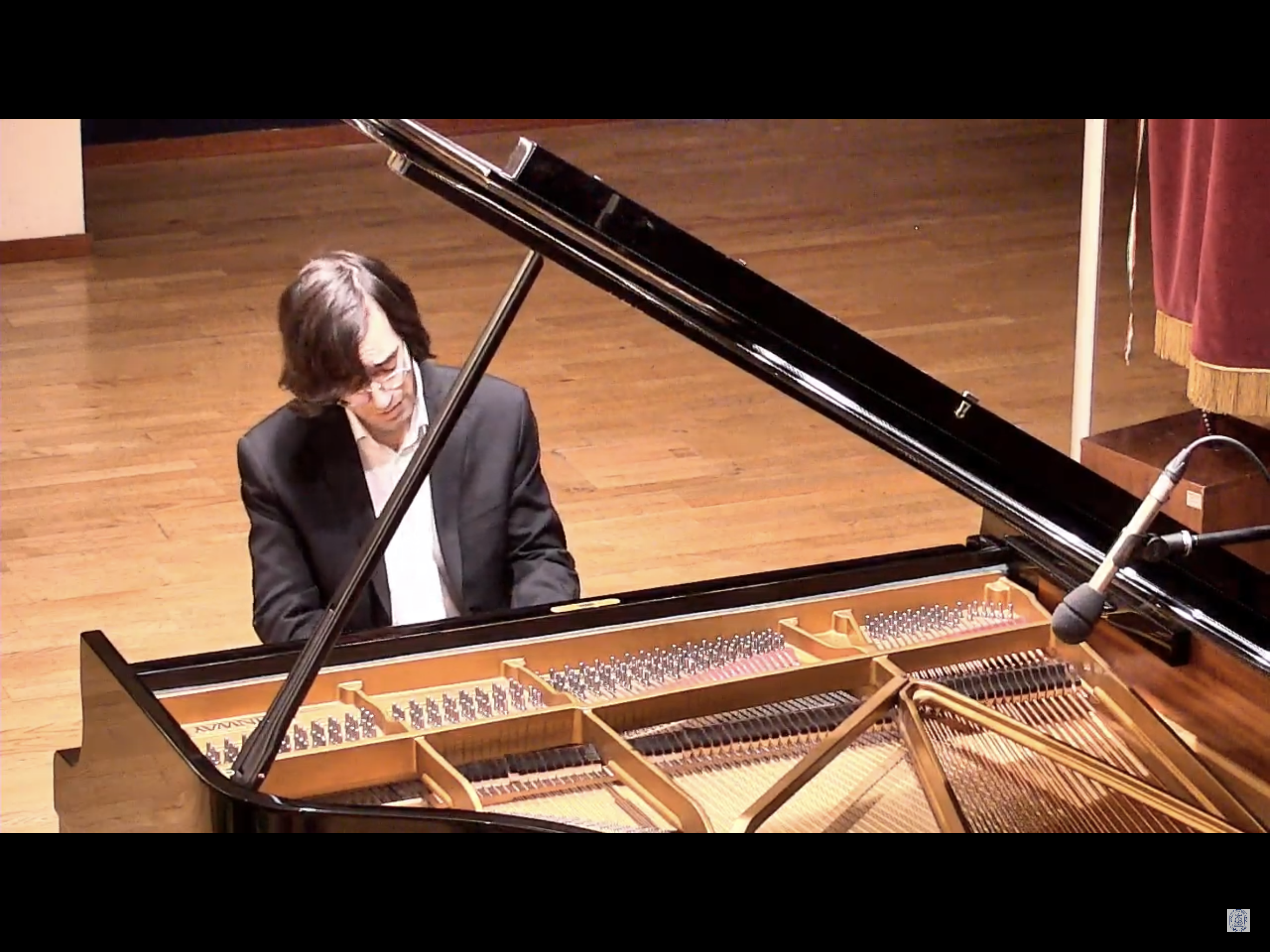
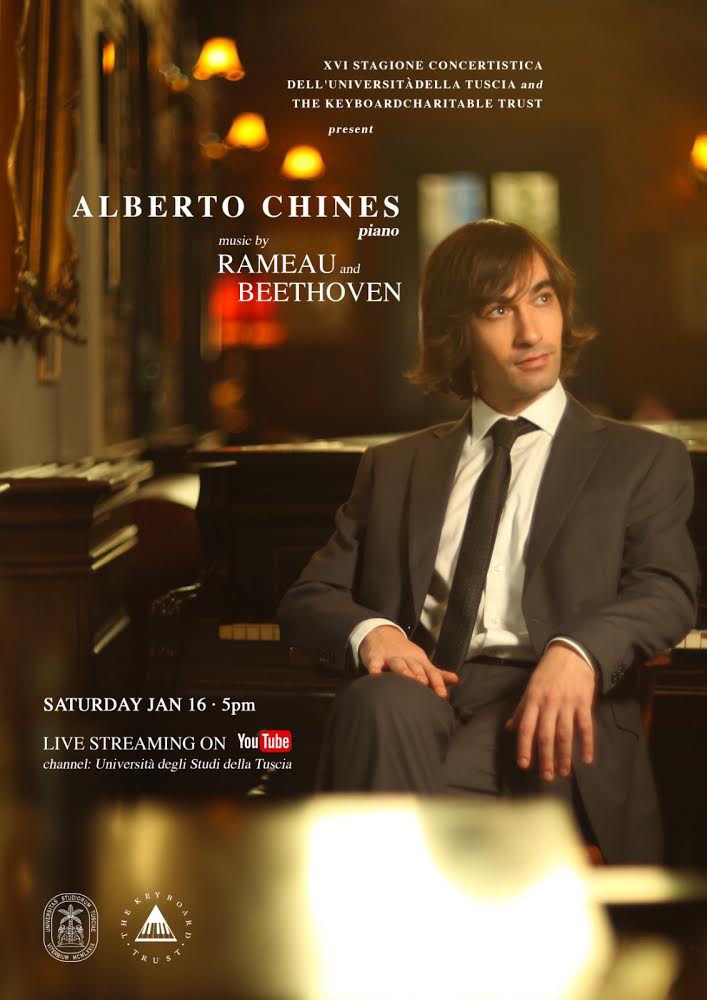
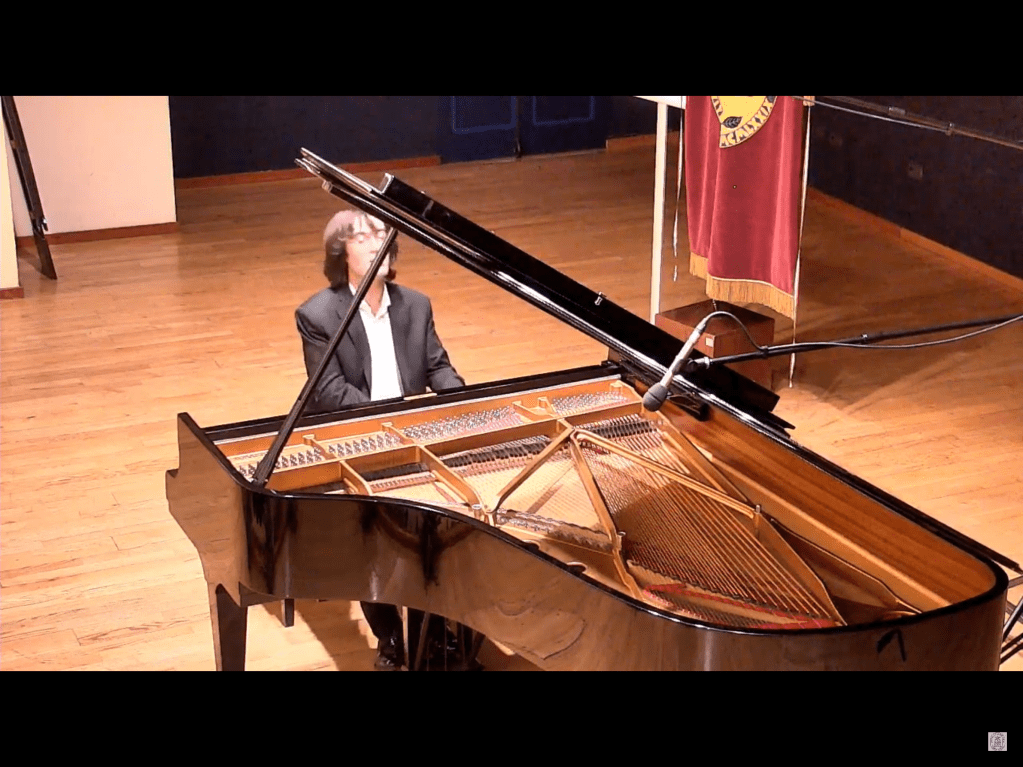
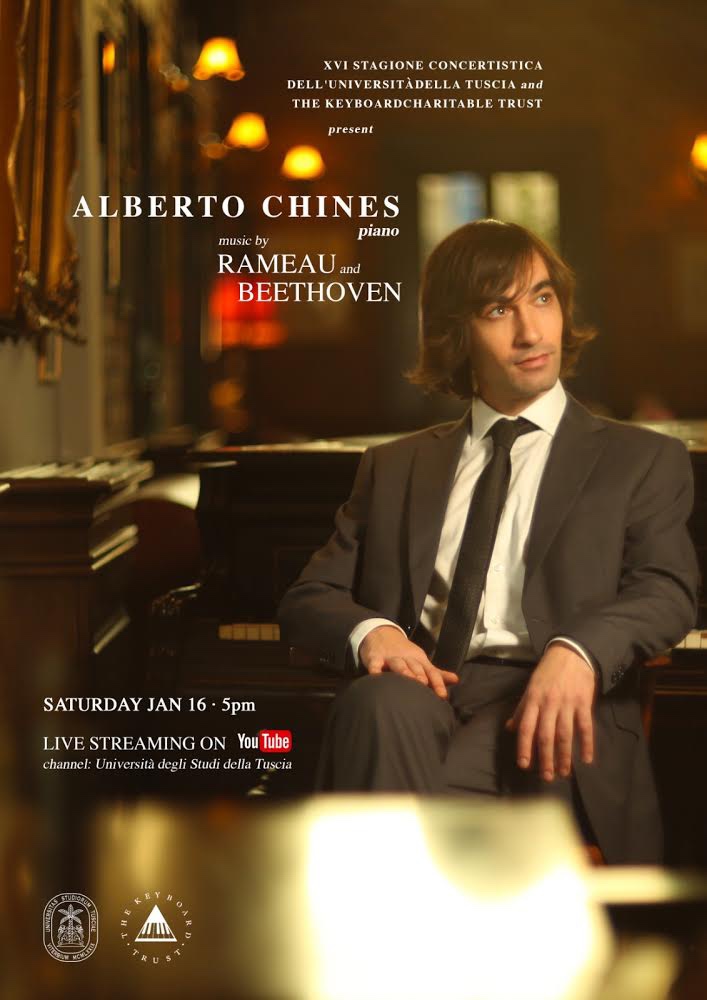
For the first three concerts of the tour, Alberto Chines had the chance to shine as he had done in his Steinway Hall concert. And shine he did with a superb performance of Schubert’s last Sonata and Beethoven’s Op. 27 No.2 the so-called ‘Moonlight’ Sonata. It was played with an intellectual and spiritual control of great authority. He even designed the poster!
The second half of the tour was with Yuanfan Yang (see separate entry). He gave some quite extraordinary performances that included the RAI 3 radio producer cheering from the control room as he improvised on themes via direct phone-in from the listening public. The ‘Godfather’ in stormy mode was quite sensational.
CRANLEIGH ARTS CENTRE – EDWARD LEUNG
On 24 January, Edward Leung played at the Cranleigh Arts Centre. These are the words of Stephen Dennison, Director:
‘You will be delighted to hear that Edward gave a star performance last night. For the first time in our 5 years of classical concerts we had an advance booking sell-out. The quality of performance is being recognised by our community.
The programme was excellent with the Chopin and Prokofiev Sonatas being loved by the audience. He is an excellent communicator and established a strong rapport with his words about what he played: our audience like that.
This was the first concert on our new hand crafted Shigeru Kawai piano. Edward hit it hard (!!) but also with great delicacy. It was a pleasure to have him stay over with us: his life story is very interesting and he was very open about the challenges facing a young professional trying to be famous.
He seems to know all the circle of his age group, some of whom have performed at Cranleigh and others who are scheduled. He has his Wigmore debut in April, accompanying violin I think he said. I do hope he succeeds. I know that the Cranleigh audience would love to hear him again in a year or so.
I spoke for a couple of minutes pre-concert about the valuable work of the Keyboard Trust as well as featured your logo on the programme. Thank you for finding Edward for us.’
INTERNATIONAL COMPETITION – PADUA
On 25 January, in Padua, the KT had a presence at the 17th annual International Competition Premio Citta’ di Padova with the prestigious Orchestra di Padova e del Veneto.
PONTUS CARRON – STEINWAY HALL, LONDON
On 5 February Pontus Carron gave an ‘authoritative’ and ‘remarkable’ recital at Steinway Hall in London:
BRITISH INSTITUTE LIBRARY, FLORENCE
A few days later, on 13 January, in Florence, a very interesting new venue opened up at the British Institute. Concerts take place in the library of that extraordinary aesthete Harold Acton. It is just a stone’s throw from the Ponte Vecchio and we hope to add it to our Italian tours in the future — whether live or virtual. We have to thank Angela Hewitt and Ashley Fripp for the introduction to the enlightened Director, Simon Gammell OBE.
JAMIE BERGIN IN BUXTON
On 14 February, Jamie Bergin gave a recital for Buxton Festival’s AGM, Trustees and Friends:
‘I thought that I should let you know that Jamie Bergin’s recital yesterday was a huge success and received tremendous applause and congratulations from all who were there. We were pleased that his mother and aunt were there too. They must have felt very proud at the audience reaction … He really is very talented and we look forward to hearing more of him in the future. Thank you for introducing him to us.’
TEMPLE CHURCH, LONDON – ORGAN RECITAL BY WILLIAM FOX
On 19 February William Fox, sub-organist at St Paul’s Cathedral in London, gave an outstanding organ recital at Temple Church with the following thrilling selection of pieces: ‘St Patrick’s Breastplate’ from Sonata Celtica (Op. 153) by Charles Villiers Stanford; Fantasia in A minor by William Byrd; Spring Song by Alfred Hollins and Sacred and Hallowed Fire by Cecilia McDowall.
CORONAVIRUS IN ITALY – GIOVANNI BERTOLAZZI
In February, there were already signs of coronvirus in Italy. In fact, a concert in Padua on 23 February was attended by an unusually small audience some of whom were already ‘social distancing’ and wore masks.
I attended a concert by Giovanni Bertolazzi, a finalist in the Busoni Competition, in the Sunday morning series in the Salone dei Giganti. (Giovanni Bertolazzi has yet to join the KT!)
After this concert all concerts in Italy were cancelled and the KT concert in this series that was due to take place on the 8 March with Nicola Losito was one of the first casualties.
Nicola Losito
GEORGE X. FU AT STEINWAY HALL IN LONDON
Concerts continued in London for a while longer.
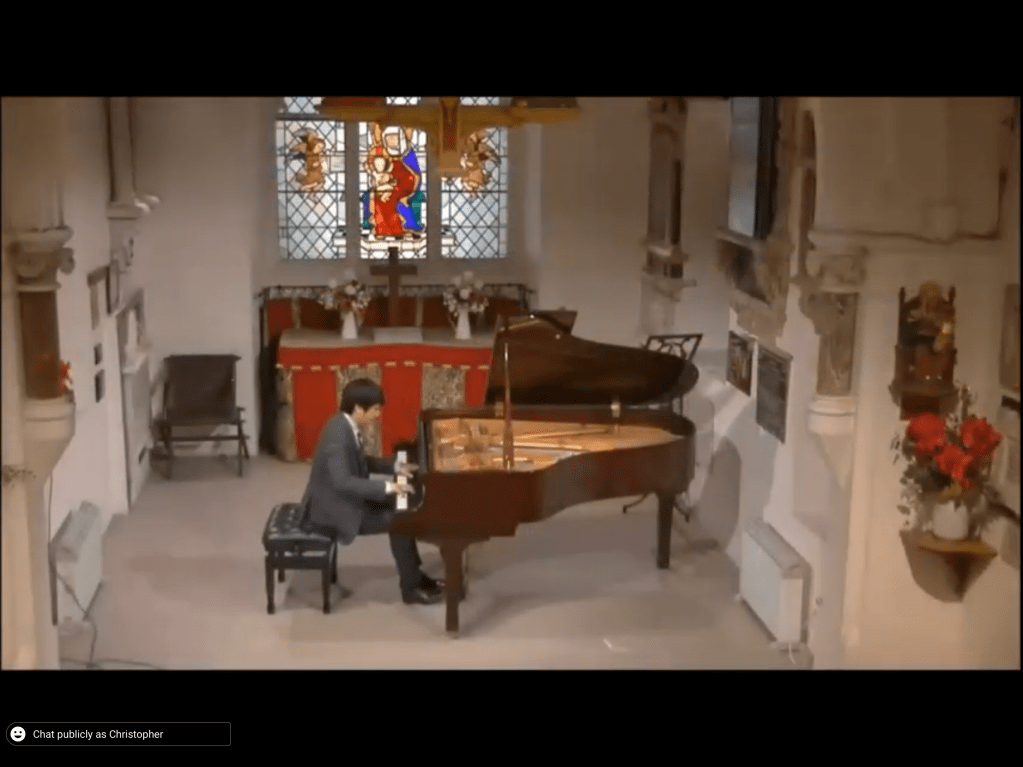
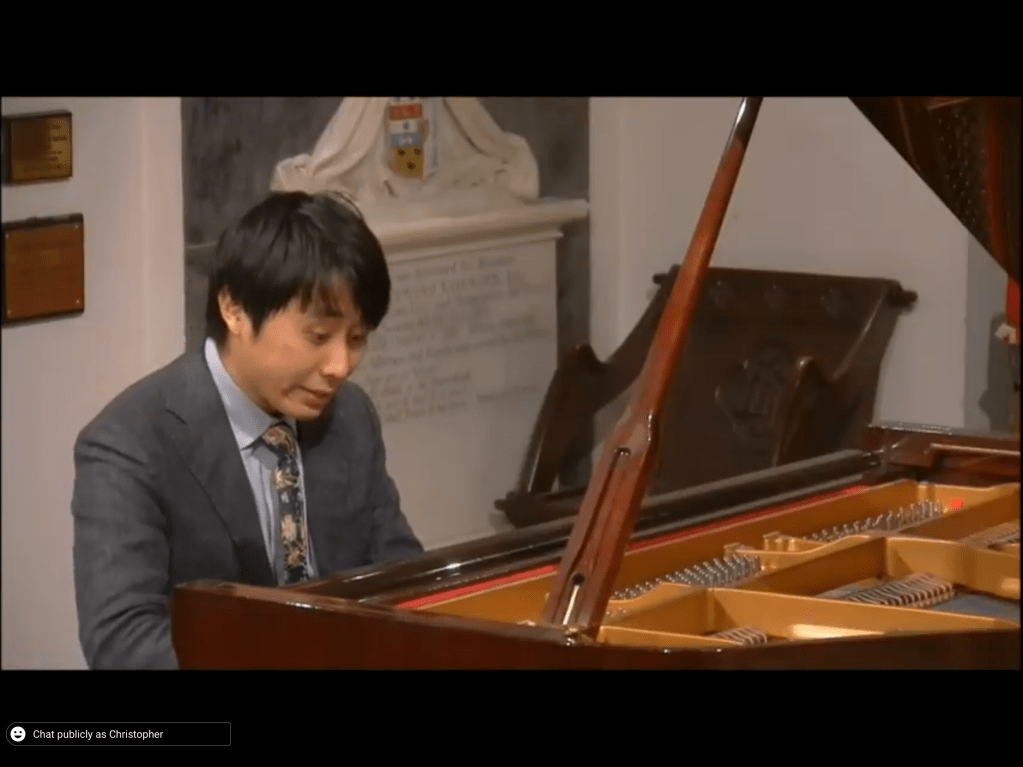
Our last concert at Steinway Hall was on 11 March with George Xiaoyuan Fu standing in at very short notice for Irma Giganti who had not been allowed to fly from Vienna:
LUKA OKROS AT ST JOHN’S, SMITH SQUARE, LONDON
Luka Okros, a KT artist, gave the last concert in London for the foreseeable future on 17 March at St John’s, Smith Square:
MARK VINER’S RECORDINGS
Mention should be made of the extraordinary reviews that Mark Viner’s remarkable severn CDs are receiving. He gave our Prizewinners Wigmore Hall recital last year.
Mark played at St Mary’s, Perivale on 10 March — and, on 13 March, presented his new CD of Alkan’s monumental Grande Sonate Op.33 at the Royal College of Music.
https://christopheraxworthymusiccommentary.wordpress.com/2020/03/12/mark-viner-at-st-marys-2/
PODCASTS
(http://keyboardtrust.org/podcasts/)
Mention should also be made of the podcasts that Sasha Grynyuk (in collaboration with my co-Artistic Directors, Elena Vorotko and Leslie Howard), have created and which can now be viewed on the KT website.
These feature interviews and short performances with Alexander Ullman, Evgeny Genchev, Martina Kazmierczak (harpsichord), Iyad Sughayer, Jean Rondeau, Mark Viner, André Gallo and Ilya Kondratiev with Dietlinde Turban Maazel Wood at Castleton, Virginia in the USA.
The Keyboard Trust is currently investigating ways to augment the website and YouTube channel with past performances of KT artists. I am sure we shall come up with some lovely surprises before this cunning little virus leaves us with a less complacent and surely more human world where music will once again be our guiding light.
Eliane de Castro and Paulo Gala are generously supporting a Keyboard Trust Book to celebrate the 30th Anniversary of the KT in 2021. Contributions in terms of thoughts or ideas would be gratefully received!
DR WEIR LEGACY AWARD (The Keyboard Trust Reaches Out To An Even Younger Generation)
The Executors of the will of the late Dr Kenneth Ross Weir appointed the Keyboard Charitable Trust to implement one of his key bequests: an annual award to support the musical education of a young keyboard player between the ages of twelve and twenty. Dr Weir was a frequent visitor at the Trust’s performances by its new intake of highly gifted pianists normally in their early twenties; he clearly thought of those whose circumstances deprived them of the training that might qualify them to enter the profession at this advanced level.
It is therefore natural that the Keyboard Trust’s three joint Artistic Directors – Prof. Leslie Howard, Dr Elena Vorotko and Christopher Axworthy – should be responsible for identifying the candidates for the Weir scholarships. Teaching and holding masterclasses at world-wide institutions, serving on juries of international competitions and tending links with academic exchange networks, they have far-reaching opportunities to become aware of potential beneficiaries. The scheme will therefore not be accessible by application.
This additional activity fits well with the Trust’s traditional field of intensively assisting highly promising young artists – pianists, organists and historical keyboard players – to build an international career in the short interval between ending their formal education and confronting a fully independent professional life. Those who respond well to Dr Weir’s support may find an easy continuity as they advance to maturity in their profession. Followers of the KT’s website should receive annual news of the award recipients at the beginning of each academic year.
ELIAS ACKERLEY – DR WEIR LEGACY – 2019-2020 RECIPIENT
The Keyboard Trust would like to congratulate Elias Ackerley, the first recipient of Dr Weir’s Legacy. Elias began his studies at the Curtis Institute of Music in Philadelphia, USA in September 2019.
Biography
Born in Shrewsbury in 2001, and emigrating the following year, Elias began his piano studies at the age of five in South Korea. After making rapid progress, he was taken on by Russian pianist, Oleg Shitin, under whose guidance he succeeded in a number of competitions, including winning the junior prize at the Gumi National Piano Competition in 2012.
In May 2013, at the age of eleven, Elias gave his debut recital in Chester and has since performed regularly in concerts in the UK, including as a soloist with a number of orchestras.
Between 2014 and 2019 Elias was a student at Chetham’s school of Music where he was a pupil of Dr Murray McLachlan (Head of Keyboard), under whose tutelage Elias succeeded in becoming the youngest ever winner of Chetham’s Beethoven competition in 2015.
More recently, Elias won first prize at the Scottish International Youth Piano Competition (2017), the Blue Ribbon at the National Eisteddfod (2017) and the Epta UK Piano competition (2018). He was a keyboard finalist in the BBC Young Musician of the Year in 2018.
Elias has received masterclasses from Sir Andras Schiff and Stephen Hough and lessons from Leslie Howard, Boris Berman and Robert McDonald.
Elias is currently a student of Prof. Gary Graffman at the Curtis Institute of Music.
‘Elias Ackerley is doing magnificently in that in addition to all the solo piano work – he was accepted as a piano student – he is also doing more chamber music than practically anyone else (and not just first year students!). He came to New York to have an extra lesson with me a couple of days ago because he is playing Brahms’ Paganini Variations in a student concert next week. It’s remarkable. Pamela Frank in the violin faculty – she is a good friend of mine – told me independently how interesting he is to work with. You should know about Paul Bryan, the Dean who is knowledgeable about the academic stuff (non musical stuff) he is doing. I can only be extremely complimentary, especially as he has only been here a few months. At this moment, he would get either an A or an A+ so far as I’m concerned.
My cell phone number is enclosed. I’d rather talk on the phone as I don’t have a computer, am 91 years old and am not learning new tricks!’ — Prof. Graffman, November 2019
Update from Elias Ackerley – April 2020
‘Hope you are well in these troublesome times. I just wanted to update you what is going on in terms of school. Currently I’m back at home but online classes and lessons have continued. I am receiving assignments and phone calls to catch up with lessons every week. I hope to be back at Curtis by September having just heard this current semester will not be resumed on site.’
Academic Year 2020-2021
A new Dr Weir beneficiary will be selected by the KT’s Artistic Directors shortly — to start studies in the next academic year. Full details will be provided in the next Newsletter!
Happy Birthday to our Founder
On behalf of all the Trustees, Artistic Directors and Friends of the Keyboard Trust, I wish John Leech MBE, our beloved Founder, a very HAPPY 95TH BIRTHDAY on 21 April 2020!
Christopher Axworthy, April 2020

Chinese born British pianist Mengyang Pan began her piano studies in China, eventually becoming a junior student at the Central Conservatory of Music Beijing. Having been offered a full scholarship, she accepted an invitation to study at the Purcell School in the UK with Tessa Nicholson before completing her musical education at the Royal College of Music with Vanessa Latarche.A brilliantly decorated star, Mengyang is the prize winner of many prestigious competitions including Rina Sala Gallo International Piano competition, Bromsgrove International Young Musician’s Platform, Dudley International Piano Competition, Norah Sands Award, MBF Educational Award, Chappell Gold Medal, Brent International Piano Competition and Ettlingen International Piano Competition. Famed for her graceful charm and wonderful communicative stage presence, Mengyang performs repeatedly in some of the best venues throughout the UK such as the Royal Festival Hall, Wigmore Hall, Cadogan Hall, Bridgewater Hall, Birmingham Symphony Hall, St. John’s Smith Square and Royal Albert Hall amongst many others.As an engaging and inspiring collaborator, Mengyang has appeared with many orchestras and her collaboration with conductors such as Maestro Vladimir Ashkenazy, John Wilson and Mikk Murdvee has gained the highest acclaim nationwide. She was presented with the Tagore Gold Medal by HRH Prince Charles in 2007 for outstanding representation of the Royal College of Music, the highest honour possible. In 2011, she was presented to HM Queen Elizabeth II and Duke of Edinburgh at Buckingham Palace for her contribution to the British music and art industry. Apart from performing, Mengyang is also passionate about teaching. She is currently a professor of piano at Royal College of Music, Imperial College Blyth Centre for Music and Visual Arts and St Paul’s School for boys. She also gives regular masterclasses at schools including the Purcell School, Imperial College, St Paul’s School and her native China, events which are greeted with considerable critical acclaim.

It was in 2012 that I first heard Mengyang Pan play in Monza.She gave an impeccable performance of the Emperor Concerto that still remains in my memory for its musicianship and technical command allied to an aristocratic passion and sense of style.It is she and Julien Brocal that stand out in my memory for the outstanding performances they gave in that circus arena.She certainly got my vote and I was sure that with an artist of such similar virtues such as Bruno Canino, the president of the jury, she must have got his too.She did infact win a top prize and has gone on to confirm those virtues that were so evident 8 years ago.

Always playing with impeccable preparation and a technical command that she aquired from the school of Tessa Nicholson.At the Purcell school she was in her class that has produced Mark Viner,Tyler Hay,Alim Beisembayev and many others.
All different but with virtuoso techniques at the service of the music.


Votre âme est un paysage choisi
Que vont charmant masques et bergamasques
Jouant du luth et dansant et quasi
Tristes sous leurs déguisements fantasques.
Your soul is a chosen landscape
Where charming masquerades and dancers are promenading,
Playing the lute and dancing, and almost
Sad beneath their fantastic disguises.

Precision,temperament and sheer enjoyment were the hallmarks of her performance of Moszkowski’s old warhorse ” Caprice Espagnol”.It was thrown off with the ease that the great virtuosi of their day used to relish at the end of their programmes.Technically impeccable as was her complete understanding of this world of Spanish dance and pure’ joie de vivre.’
An encore of the Paraphrase by Liszt of Verdi’s Rigoletto brought even finer playing as she seduced and ravished us with her great belcanto sound and scintillating arpeggio embellishments .The delicate repeated octaves were played with such a refined sense of style and musical understanding almost like the vibrated notes of the ‘bebung’ on the early pianos.Her passionate involvement and total fearlessness brought just that element of showmanship that is so much part of these pieces when Liszt used to wow his aristocratic audiences with devastating effect.
Caterina Grewe at St Mary’s
I had missed this one during the season and judging from the Christmas Tree it must have been the season of good will!
Hugh had told me it was a fine performance but he did not tell me HOW fine it was!
So it was a very pleasant surprise to have an hour of enchantment before listening to the ever more alarming bulletins from Downing Street.
‘A map of the world that does not show Utopia is not worth glancing at.’But then Oscar Wilde ‘had nothing to declare except his genius’
And enchantment it was indeed on this map today!Of a much better world than the one we are experiencing at the moment.
Caterina has a magic wand that cannot be taught or bought but immediately casts a spell over he who dares to enter into her world of sumptuous sounds and ravishing rubato as her fingers caress the keys.
A true technical mastery that allows her to discover the music as it is revealed to her in that moment.
Looking at her and listening to her simple unaffected innocent passion reminds me of Annie Fischer.I will never forget her performance of naked passion in L’Isle Joyeuse offered as an encore after a masterly performance of Brahms F minor Sonata in Rome..
Today the innocence of Schumann’s delicate Arabesque seemed to flow so naturally from her fingers as did the waters in her truly masterly account of Auf dem Wasser zu singen.
The sublime beauty of Der Aufenthalt where the outpouring of melodic effusion was played with such refined sense of style and passionate involvement .A heartrending ending led us so beautifully into the serenity of Du bist die Ruh.Time stood still as the melodic line sang so beautifully with the most delicate embellishments appearing and disappearing like magic in her sensitive hands.
A masterly performance of Liszt’s great B minor Ballade ranging from the meltingly beautiful to the grandest of passionate declamations.A magnificent tone poem and a performance that can only convince us even more that this is amongs the greatest of Liszt’s works.
The second Rhapsody (Tom and Jerry as LangLang describes it)was restored to its rightful place as one of the best known and most loved of all Romantic showpieces.
It was played with the astonishing freedom of someone who had truly got to the heart of the piece with such understanding and commitment.She brought it to life with a freshness and astonishing ‘devil may care’ freedom that Liszt himself must have displayed as the aristocratic audiences of the day were reduced to a spontaneous display of the emotions usually only associated with the masses!
Chopin’s posthumous nocturne in C sharp minor brought serenity and a subtle sense of stillness as she shaped the melodic line with a rare sense of refined Bellinian rubato.
What an oasis this teatime concert is as we prepare for news of this cunning little virus that is bringing such caos and bewildering loss into our daily lives.


I have heard Iyad play many times and listened to his superb new CD of the works of the Armenian composer Aram Khatchaturian.I must say that a whole CD whilst being very impressive can be overwhelming as well.So it was very refreshing to hear just one of the very earliest works as an opening to his recital a few weeks ago at St Mary’s Perivale. The Poem from 1927 took us on a fascinating journey full of oriental colours and flights of fantasy.Such subtle colours and seemless virtuosity that sprang so naturally from his hands.It was as though this young Jordanian born pianist knew the same wonderland that was a similar part of his heritage too. It is not surprising that his CD has created quite a stir in the press with a five star consensus from every angle. This is how Khachaturian himself described his musical formation:
“I grew up in an atmosphere rich in folk music: popular festivities, rites, joyous and sad events in the life of the people always accompanied by music, the vivid tunes of Armenian, Azerbaijani and Georgian songs and dances performed by folk bards [ashugs] and musicians — such were the impressions that became deeply engraved on my memory, that determined my musical thinking. They shaped my musical consciousness and lay at the foundations of my artistic personality… Whatever the changes and improvements that took place in my musical taste in later years, their original substance, formed in early childhood in close communion with the people, has always remained the natural soil nourishing all my work.“
His most popular work is of course Spartacus from the 1950’s although his early piano concerto of 1936 written for Lev Oborin received its UK premier in 1940 from the hands of Moura Lympany directed by Alan Bush.Moura worked on it with Uncle Tobbs(Tobias Matthay )who loved it.It was originally offered to Clifford Curzon but he said give it to Moura she learns so much quicker that I ever could.She recorded it twice with great success.

I will re-listen with care to his CD which was inspired by his early work with Murray McLachlan at Chethams where he was sent as a teenager to receive the training that his early talent demanded. “For his debut disc, the Jordanian-Palestinian pianist Iyad Sughayer has put together a recital spanning from the ample and demanding Sonata to the delightful Childrens Album, consisting of ten miniatures, in turn playful and poignant. The recital closes with a piece which did a great deal to establish Khachaturians name near the outset of his international career. Composed in 1932 (allegedly in a single evening), the Toccata in E flat minor soon established itself among the showpieces of the modern repertoire and was to become a calling-card for aspiring virtuosi. Iyad Sughayer was born in 1993 in Amman, where he received his early training.He now also teaches at the RNCM in Manchester.”

The Mozart Sonata in D K.576 took us immediately into a different world.A precision jewel that glittered in the hand of this young pianist who whilst giving great rhythmic impetus imbued the few essential notes of Mozart’s score with such character and playful meaning.A clarity and beauty of sound that allowed Mozarts genius to unfold without any artifice.Almost a cat and mouse game in the first movement as the left hand followed closely the right .The subtle modulations beautifully played as they searched for their way back to the opening subject.The Adagio had a beautiful sense of legato ,slightly lacking in colour but it was the purity and clarity of the sound that was something to marvel at.A superb use of the pedal never allowed a cloud to pass over the sublime simplicity of the melodic line even in the most intricate passages.The modulations were most movingly shaped with a slight rubato and legato and staccato played with such naturalness and good taste. The Allegretto was thrown off with a playful simplicity and a joyful mastery that was shared with his very appreciative audience.
Harmonies poétiques et religieuses (Poetic and Religious Harmonies), S.173, is a cycle of piano pieces written by Franz Liszt at Voronivtsi, the Polish-Ukrainian country estate of Liszt’s mistress Princess Carolyne von Sayn-Wittgenstein in 1847, and published in 1853. The pieces are inspired by the poetry of Alphonse de Lamartine, as was Liszt’s symphonic poem Les Préludes.Iyad chose four of the ten pieces : n.1 Invocation,n.9 Andante lagrimoso,n.7 Funerailles,n.10 Cantique d’amour.There was grandeur and a real self identification with Liszt’s great rhetorical statements in Invocation and an outpouring of melodic invention of heartrending significance in the Andante lagrimoso.The gong deep in the bass at the opening of Funerailles built up to a passionate outburst that melted so beautifully into one of Liszt’s most touching melodies .A wonderful liquid sound that contrasted so well with the full orchestral sounds that surround this moment of true magic.It could have been played with the same simplicity as Iyad’s Mozart but this was a young man playing with great commitment and passion as it led to the ever advancing army with a left hand of quite fearless technical assurance.The glorious victorious outbursts at the end were allowed to die away into the distance in a mist of mysterious sounds.Cantique d ‘ amour sang so expressively on a wave of magic arabesques with a wonderful sense of balance and use of the pedal that allowed the melodic line to be exposed and shaped so naturally.
“I’ve listened to your Khachaturian CD and it is utterly superb. I knew the Sonata from Gilels recording but you have all the outsize virtuosity for this outsize work. But everything in your playing is so richly coloured and with a born empathy for Khachaturian’s very distinctive idiom. A dazzling success, and I look for to hearing you on further recordings and, hopefully, in London.”Bryce Morrison
Press: Khachaturian Piano Works – Reviews Gramophone: “exhilarating and delivered with perfect clarity…a release that leaves one eager to hear Sughayer in other repertory while eloquently arguing that Khachaturian’s piano music deserves re-evaluation” Patrick Rucker. International Piano (Critic’s Choice): “in his championing of largely forgotten music…this Jordanian-Palestinian player shines.” Michael Church. Piano Journal (EPTA): ‘Sughayer tackles its fiendishly demanding outer movements with tremendously spirited pianism.’ Alexander Thompson. Planet Hugill: ‘Sughayer is clearly master of the complex demands of Khachaturian’s virtuoso piano writing’. Robert Hugill. Cross-Eyed Pianist: ‘this disc is fine showcase for Iyad Sughayer’s talent and an excellent introduction to the piano music of Aram Khachaturian.’ Frances Wilson. Music-Web International: ‘BIS appear to have unearthed another piano- playing diamond’. Richard Hanlon.
In my day it was Raymond Lewenthal that lit the way for a revival of the Golden Age of Piano Playing …….today the light is shining brightly for Tyler Hay and Mark Viner.
“On a foggy London night in January 1968,a tall Mephistophelian figure in top-hat and ground- length cape ,looking like a legendary personage out of the romantic past,stepped out of a limousine belonging to one of the peers of the realm,and swept through the stage door past the crowds gathered around it.Out in front of the Hall ,queues of people hoping to get tickets for the evening’s concert,were stretched around the block into Wimpole Street.””The Unique Lewenthal ” read the headlines of one of the reviews next morning of the first of his three all-Liszt recitals in London.

It is interesting to read his obituary in the New York Times:

Raymond Lewenthal, a colourful and imaginative explorer of forgotten Romantic piano repertory, died of a heart attack Monday night. He was 62 years old and lived in Hudson, N.Y.Mr. Lewenthal is especially remembered for helping to revive the difficult and arcane piano music of Charles-Valentin Alkan, but his restorative efforts were also devoted to other 19th-century composers – Busoni, Reinecke, Field, Henselt, Scharwenka, Thalberg and Anton Rubinstein. The pianist was known for his strong technique and grand manner – crowd-pleasing qualities he applied often to his public performances of Liszt. Harold C. Schonberg of The New York Times, wrote of a 1976 performance of Alkan’s ”Funeral March for a Parrot” that when Mr. Lewenthal, ”cadaverous, tall and saturnine, came out wearing black and a black silk topper decorated with a mourning band, and led a procession of four singers and four desperately squealing oboists . . . that was the Romantic revival.” A critic for The Times of London considered Mr. Lewenthal’s Liszt performances ”in the big Romantic manner such as we now associate with a vanished age.”Mr. Lewenthal was born in San Antonio of Russian-French parentage and grew up in Hollywood where he was a child actor in films until the age of 15. His piano education was both bicoastal and international, including stops in New York and Paris under teachers like Alfred Cortot, Lydia Cherkassky, Olga Samaroff and Guido Agosti. His career was interrupted and nearly ended in 1953 when he was assaulted in Central Park and suffered broken arms and hands. He stopped playing, traveled to Europe, studied there for three years and subsequently went to South America where he lived, often hand-to-mouth, for seven years. In 1964, he returned to the United States and resumed his career.Mr. Lewenthal’s last major appearances were his concerts – five in five days – with the National Symphony at the Kennedy Center in 1982. He was troubled by heart problems in later years and devoted much of his time to finishing and seeking a publisher for a large biography of his hero, Alkan. It is said to have occupied him for 25 years, and remains unpublished.

All this to introduce the two extraordinary figures of Mark Viner and Tyler Hay who have appeared recently on the concert scene with the same curiosity for a bygone age.
“The Golden Age of the Piano Virtuosi”was a programme late at night on the radio in which the newly discovered piano rolls of the great virtuosi of the past were shared with an enthusiastic audience of which I was one in a late night programme on the BBC introduced by Deryck Cooke .They had been found in the Brentford Piano Museum created by a charmingly eccentric personality, Frank Holland .His unique collection of player pianos and such like( he was an engineer and not a musician at all) were housed in a derelict church overlooking the Thames.We listened unbelievingly to feats of virtuosity from pianists we had only read about.Moritz Rosenthal,Leopold Godowsky,Mischa Levitzki.The seed was sown for me .
My old piano professor Sidney Harrison was chairman of the Museum and we would make regular visits to see Frank and his instruments.We even played some pieces in a benefit concert for sixteen hands on eight pianos.Irene Kohler,Eric Harrison,Sidney Harrison,Graham Johnson,Linn Hendry,Katherine Still and me all took part as we marvelled at this Alladin’s cave.
I even wrote to Cziffra and had a long correspondence with him about his piano transcriptions.I sought out the Chopin Studies by Godowsky in the Library at Senate House. Then out of nowhere appeard this romantic figure of Raymond Lewenthal who took London by storm with his performances of Liszt and Alkan.
I remember in particular his performance of the Hexameron.Princess Belgiojoso conceived the piece in 1837 and persuaded Franz Liszt to assemble a set of variations of the march along with five of his pianist-friends. Liszt composed the introduction, second variation, connecting sections and finale, and integrated the piece into an artistic unity. Five well-known composer-performers each contributed one variation: Chopin,Czerny,Herz,Pixis and Thalberg.
Princess Belgiojoso commissioned Hexaméron for a benefit concert for the poor on 31 March 1837 at the princess’s salon in Paris. The musicians did not complete the piece on time, but the concert was held as scheduled. The concert’s highlight was a piano “duel” between Thalberg and Liszt for the title of “greatest pianist in the world.” Princess Belgiojoso announced her diplomatic judgment: “Thalberg is the first pianist in the world–Liszt is unique.”
This winter I ventured to Naples to visit the tomb of Thalberg who had amassed vast wealth from his piano tours in America and elsewhere and had practically taken over a large part of Naples in his retirement.
https://christopheraxworthymusiccommentary.wordpress.com/2020/01/04/a-la-recherche-de-thalberg/
It is a fascinating world of a bygone age and it is Mark Viner with already seven CD’s of Alkan,Thalberg,Chaminade together with Tyler Hay who are bringing this world back to life.
These works were written by virtuoso pianists for their own performances.To astonish,ravish and seduce.Their model was of course Paganini.But they are works that need a transcendental technique together with a sense of style colour and the stamina to sustain the truly diabolical demands that are required to bring these works back to life.Both Tyler Hay and Mark Viner have these qualities in abundance thanks to their early training with Tessa Nicholson at the Purcell School and later with Niel Immelman at the Royal College.
I have written many times about their performances but am glad now in this time of confinement to receive Tyler’s latest CD of an almost completely forgotten piano virtuoso.A contemporary of Chopin and Liszt of whom Chopin wrote on his arrival in Paris:”Herz,Liszt and Hiller are all zeros next to Kalkbrenner”He dedicated his Concerto op 11 to him and wanted lessons but the arrogant Kalkbrenner would not teach him for less than three years!
So it is with great trepidation that I await to discover who is Kalkbrenner from the hands of Tyler Hay.
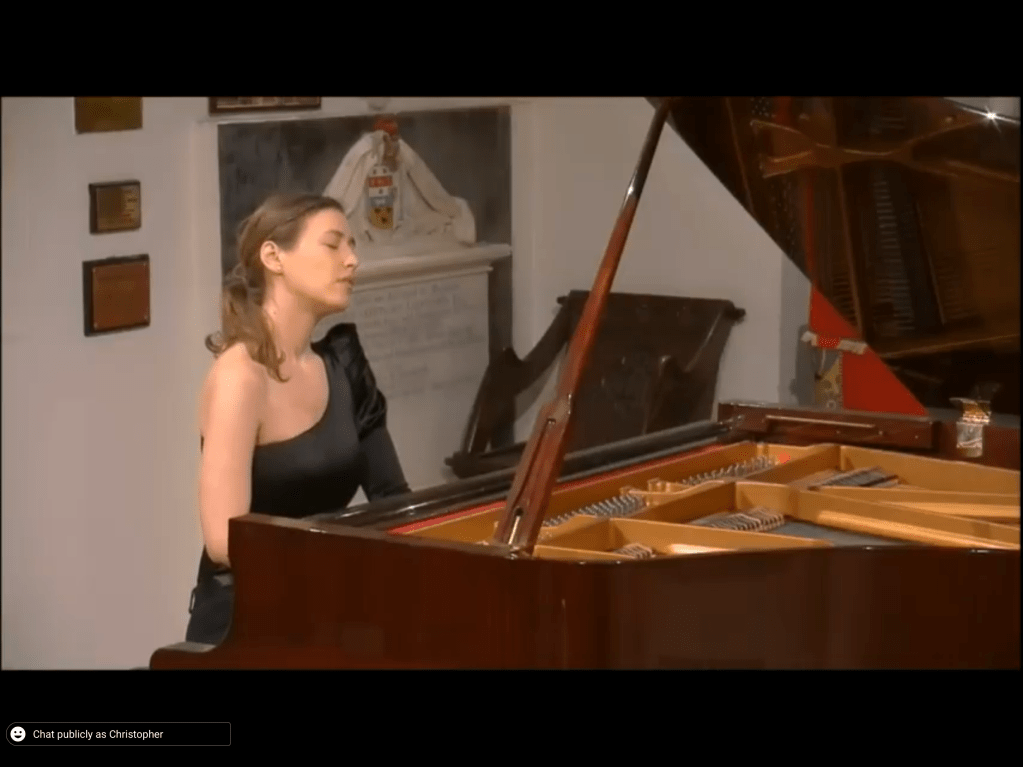
This is what I wrote in my appraisal a few months ago “Kitten on the Keys” when Tyler played the’ Variations Brillantes sur une Mazourka de Chopin’ op 120 at St James’s Piccadilly:

https://christopheraxworthymusiccommentary.wordpress.com/2019/09/25/tyler-hay-kitten-on-the-keys/